 エドガーで原本を確認する
UNITED STATES
SECURITIES AND EXCHANGE COMMISSION
WASHINGTON, D.C. 20549
FORM 20-F
☐ REGISTRATION STATEMENT PURSUANT TO SECTION 12(b) OR (g) OF THE SECURITIES EXCHANGE ACT OF 1934
OR
☒ ANNUAL REPORT PURSUANT TO SECTION 13 OR 15(d) OF THE SECURITIES EXCHANGE ACT OF 1934
For the fiscal year ended December 31, 2025
OR
☐ TRANSITION REPORT PURSUANT TO SECTION 13 OR 15(d) OF THE SECURITIES EXCHANGE ACT OF 1934
OR
☐ SHELL COMPANY REPORT PURSUANT TO SECTION 13 OR 15(d) OF THE SECURITIES EXCHANGE ACT OF 1934
Date of event requiring this shell company report for the transition period from ____________to _____________
Commission file number: 001-41671
Hongli Group Inc.
(Exact Name of Registrant as Specified in its Charter)
N/A
(Translation of Registrant’s Name into English)
Cayman Islands
(Jurisdiction of Incorporation or Organization)
No. 777, Daiyi Road
Changle County, Weifang City
Shandong Province, China, 262400
Tel: +86 0536-2180886
(Address of principal executive offices)
Jie Liu, Chief Executive Officer
Tel: +86 0536-2180886
Email: zongjingban@hongli-profile.com
No. 777, Daiyi Road
Changle County, Weifang City
Shandong Province, China, 262400
(Name, Telephone, E-mail and/or Facsimile number and Address of Company Contact Person)
Securities registered or to be registered pursuant to Section 12(b) of the Act:
| Title of Each Class | Trading Symbol (s) | Name of Each Exchange on Which Registered | ||
| Ordinary shares, par value $0.0001 | HLP | NASDAQ Capital Market |
Securities registered or to be registered pursuant to Section 12(g) of the Act:
None
Securities for which there is a reporting obligation pursuant to Section 15(d) of the Act:
None
Indicate the number of outstanding shares of each of the issuer’s classes of capital or common stock as of the close of the period covered by the annual report:
As of December 31, 2025, the issuer had 73,438,750 Ordinary Shares issued and outstanding.
Indicate by check mark if the registrant is a well-known seasoned issuer, as defined in Rule 405 of the Securities Act.
☐ Yes ☒ No
If this report is an annual or transition report, indicate by check mark if the registrant is not required to file reports pursuant to Section 13 or 15(d) of the Securities Exchange Act of 1934.
☐ Yes ☒ No
Indicate by check mark whether the registrant: (1) has filed all reports required to be filed by Section 13 or 15(d) of the Securities Exchange Act of 1934 during the preceding 12 months (or for such shorter period that the registrant was required to file such reports), and (2) has been subject to such filing requirements for the past 90 days.
☒ Yes ☐ No
Indicate by check mark whether the registrant has submitted electronically every Interactive Data File required to be submitted pursuant to Rule 405 of Regulation S-T (§232.405 of this chapter) during the preceding 12 months (or for such shorter period that the registrant was required to submit such files).
☒ Yes ☐ No
Indicate by check mark whether the registrant is a large accelerated filer, an accelerated filer, a non-accelerated filer, or an emerging growth company. See definition of “large accelerated filer,” “accelerated filer,” and “emerging growth company” in Rule 12b-2 of the Exchange Act.
| Large accelerated filer ☐ | Accelerated filer ☐ | Non-accelerated filer ☒ | ||
| Emerging growth company ☒ |
If an emerging growth company that prepares its financial statements in accordance with U.S. GAAP, indicate by check mark if the registrant has elected not to use the extended transition period for complying with any new or revised financial accounting standards† provided pursuant to Section 13(a) of the Exchange Act. ☐
† The term “new or revised financial accounting standard” refers to any update issued by the Financial Accounting Standards Board to its Accounting Standards Codification after April 5, 2012.
Indicate by check mark whether the registrant has filed a report on and attestation to its management’s assessment of the effectiveness of its internal control over financial reporting under Section 404(b) of the Sarbanes-Oxley Act (15 U.S.C. 7262(b)) by the registered public accounting firm that prepared or issued its audit report. ☐
If securities are registered pursuant to Section 12(b) of the Act, indicate by check mark whether the financial statements of the registrant included in the filing reflect the correction of an error to previously issued financial statements. ☐
Indicate by check mark whether any of those error corrections are restatements that required a recovery analysis of incentive-based compensation received by any of the registrant’s executive officers during the relevant recovery period pursuant to §240.10D-1(b). ☐
Indicate by check mark which basis of accounting the registrant has used to prepare the financial statements included in this filing:
| U.S. GAAP ☒ | International Financial Reporting Standards as issued | Other ☐ | ||
| by the International Accounting Standards Board ☐ |
If “Other” has been checked in response to the previous question, indicate by check mark which financial statement item the registrant has elected to follow.
☐ Item 17 ☐ Item 18
If this is an annual report, indicate by check mark whether the registrant is a shell company (as defined in Rule 12b-2 of the Securities Exchange Act of 1934).
☐ Yes ☒ No
(APPLICABLE ONLY TO ISSUERS INVOLVED IN BANKRUPTCY PROCEEDINGS DURING THE PAST FIVE YEARS)
Indicate by check mark whether the registrant has filed all documents and reports required to be filed by Sections 12, 13 or 15(d) of the Securities Exchange Act of 1934 subsequent to the distribution of securities under a plan confirmed by a court.
☐ Yes ☐ No
TABLE OF CONTENTS
INTRODUCTION
Unless otherwise indicated, numerical figures included in this Annual Report on Form 20-F (the “Annual Report”) have been subject to rounding adjustments. Accordingly, numerical figures shown as totals in various tables may not be arithmetic aggregations of the figures that precede them.
For the sake of clarity, this Annual Report follows the English naming convention of first name followed by last name, regardless of whether an individual’s name is Chinese or English. Numerical figures included in this Annual Report have been subject to rounding adjustments. Accordingly, numerical figures shown as totals in various tables may not be arithmetic aggregations of the figures that precede them. Certain market data and other statistical information contained in this Annual Report are based on information from independent industry organizations, publications, surveys and forecasts. Some market data and statistical information contained in this Annual Report are also based on management’s estimates and calculations, which are derived from our review and interpretation of the independent sources listed above, our internal research and our knowledge of the PRC information technology industry. While we believe such information is reliable, we have not independently verified any third-party information and our internal data has not been verified by any independent source.
| ● | Unless specifically described otherwise, as used in this Annual Report (except in the context of describing our consolidated financial information), the terms “we,” “us,” “our company,” “our”, and “Hongli” refer to Hongli Group Inc., a Cayman Islands holding company, and its subsidiaries; |
| ● | “CRF” refers to cold roll forming; |
| ● | “CNC” refers to computer number control; |
| ● | “Hongli Cayman” refers to Hongli Group Inc., a Cayman Islands exempted company; |
| ● | “Hongli Development” refers to Hongli Development Limited, a British Virgin Islands company; |
| ● | “Hongli HK” refers to Hongli Hong Kong Limited, a Hong Kong company and a direct wholly owned subsidiary of Hongli Cayman; |
| ● | “Hongli Shandong” and/or “VIE” refer to Shandong Hongli Special Section Tube Company Limited, a PRC company; |
| ● | “Haozhen Beijing” refers to Beijing Haozhen Heavy Industry Technology Company Limited, a PRC company and a direct 97% owned subsidiary of VIE; |
| ● | “Hongli WFOE” refers to Shandong Xiangfeng Heavy Industry Co., Ltd., a PRC company and a direct wholly owned subsidiary of Hongli HK; |
| ● | “Maituo Shandong” refers to Shandong Maituo Heavy Industry Company Limited, a PRC company and a direct wholly owned subsidiary of VIE; |
| ● | “Haozhen Shandong” refers to Shandong Haozhen Heavy Industry Technology Company Limited, a PRC company and a direct 70% owned subsidiary of VIE; |
| ● | “the PRC operating entities” refers to the VIE and its subsidiaries; |
| ● | “ROP” refers to a rollover protective structure; |
| ● | “China” and “PRC” refer to the People’s Republic of China, including, for the purposes of this Annual Report, Macau and Hong Kong; |
| ● | “shares,” “Shares,” or “Ordinary Shares” are to the ordinary shares of Hongli Group, Inc., par value $0.0001 per share; and |
| ● | All references to “RMB,” “yuan” and “Renminbi” are to the legal currency of mainland China, all references to “HKD” are to the legal currency of Hong Kong, and all references to “USD,” and “U.S. dollars” are to the legal currency of the United States. |
This annual report on Form 20-F includes our audited consolidated balance sheets as of December 31, 2024 and 2025, and the related consolidated statements of operations and comprehensive income (loss), changes in shareholders’ equity, and cash flows for each of the three years in the period ended December 31, 2025, and the related notes.
Unless otherwise noted, all currency figures in this filing are in U.S. dollars. Any discrepancies in any table between the amounts identified as total amounts and the sum of the amounts listed therein are due to rounding. Our reporting currency is U.S. dollar and our functional currency is Renminbi. This Annual Report contains translations of certain foreign currency amounts into U.S. dollars for the convenience of the reader. Other than in accordance with relevant accounting rules and as otherwise stated, all translations of Renminbi into U.S. dollars in this Annual Report were made at the rate of RMB7.1875 to USD 1, the year-end spot rate on December 31, 2025 or at the rate of RMB6.9931 to USD 1, the average rate for the year ended December 31, 2025. Where we make period-on-period comparisons of operational metrics, such calculations are based on the Renminbi amount and not the translated U.S. dollar equivalent. We make no representation that the Renminbi or U.S. dollar amounts referred to in this Annual Report could have been or could be converted into U.S. dollars or Renminbi, as the case may be, at any particular rate or at all.
MARKET AND INDUSTRY DATA
Market data and certain industry forecasts used in this Annual Report were obtained from internal surveys, market research, publicly available information and industry publications. Industry publications generally state that the information contained therein has been obtained from sources believed to be reliable, but that the accuracy and completeness of such information is not guaranteed. Similarly, internal surveys, industry forecasts and market research, while believed to be reliable, have not been independently verified, and we make no representation as to the accuracy of such information.
FORWARD-LOOKING STATEMENTS
This annual report on Form 20-F contains forward-looking statements. These statements are made under the “safe harbor” provisions of Section 21E of the Securities Exchange Act of 1934, as amended. These forward-looking statements can be identified by terminology such as “will,” “expects,” “anticipates,” “future,” “intends,” “plans,” “believes,” “estimates,” “may,” “intend,” “is currently reviewing,” “it is possible,” “subject to” and similar statements. Among other things, the sections titled “Item 3. Key Information-D. Risk Factors,” “Item 4. Information on the Company,” and “Item 5. Operating and Financial Review and Prospects” in this annual report on Form 20-F, as well as our strategic and operational plans, contain forward-looking statements. We may also make written or oral forward-looking statements in our filings with the SEC, in our annual report to shareholders, in press releases and other written materials and in oral statements made by our officers, directors or employees to third parties. Statements that are not historical facts, including statements about our beliefs and expectations, are forward-looking statements and are subject to change, and such change may be material and may have a material and adverse effect on our financial condition and results of operations for one or more prior periods. Forward-looking statements involve inherent risks and uncertainties. A number of important factors could cause actual results to differ materially from those contained, either expressly or impliedly, in any of the forward-looking statements in this annual report on Form 20-F. All information provided in this annual report on Form 20-F and in the exhibits is as of the date of this annual report on Form 20-F, and we do not undertake any obligation to update any such information, except as required under applicable law.
Part I
Item 1. IDENTITY OF DIRECTORS, SENIOR MANAGEMENT AND ADVISERS
Not Applicable.
Item 2. OFFER STATISTICS AND EXPECTED TIMETABLE
Not Applicable.
Item 3. KEY INFORMATION
Contractual Arrangements between Hongli WFOE and Hongli Shandong
Hongli WFOE, a wholly subsidiary of Hongli Cayman, and Hongli Shandong entered into a series of contractual arrangements in April 2021 (the “Contractual Arrangements”). Such Contractual Arrangements consist of a series of three agreements, along with shareholders’ powers of attorney (“POAs”) and irrevocable spousal consent letters. Neither Hongli Cayman nor its subsidiaries own any equity interests in the PRC operating entities.
The Contractual Arrangements are designed to allow Hongli Cayman to consolidate Hongli Shandong’s operations and financial results in Hongli Cayman’s financial statements in accordance with U.S. GAAP as the primary beneficiary for accounting purposes.
Due to PRC legal restrictions on foreign ownership in certain sectors or other matters, such as telecommunications and the internet, many China-based operating companies had to list on a U.S. exchange through Contractual Arrangements, or a VIE structure, without a direct ownership in main operating entities. However, even though the business of some other China-based operating companies, including Hongli Shandong, is not within any sensitive sector that Chinese law prohibits or restricts direct foreign investment in, some China-based operating companies, as well as Hongli Shandong, at the discretion of the management, still selected to utilize such VIE structure to list overseas to avoid the substantial costs and time. If Hongli Shandong had selected to directly list on a U.S. exchange without such Contractual Arrangements, Hongli Shandong would be required to obtain certain regulatory approvals in connection with the conversion of the PRC operating entities into wholly foreign owned entities which would take the Company approximately 3-6 months to complete, without certainty when the conversion would be completed successfully. As a result, management elected to pursue the VIE structure, at which time that the PRC government did not initiate a series of regulatory actions and statements to regulate business operations in China including enhancing supervision over the use of variable interest entities for overseas listing.
The PRC government has initiated a series of regulatory actions and statements to regulate business operations in China with little advance notice, including cracking down on illegal activities in the securities market, enhancing supervision over the use of variable interest entities for overseas listing, adopting new measures to extend the scope of cybersecurity reviews, and expanding the efforts in anti-monopoly enforcement. As we chose such VIE structure, we understand that we are subject to certain risks and uncertainties that may not otherwise exist if we had direct equity ownership in the operating entities. The VIE structure has inherent risks that may affect your investment, including less effectiveness and certainties than direct ownership and potential substantial costs to enforce the terms of the Contractual Arrangements. See “Item 3. Key Information - D. Risk Factors - We rely on Contractual Arrangements with the VIE and the shareholders of the VIE to consolidate the financial results of the PRC operating entities. We do not have an equity ownership in, direct foreign investment in, or control of, through such ownership or investment, the VIE.” We, as a Cayman Islands holding company, may have difficulty in enforcing any rights we may have under the Contractual Arrangements with Hongli Shandong, its founders and owners, in PRC because all of our Contractual Arrangements are governed by the mainland China laws and provide for the resolution of disputes through arbitration in the PRC, where the legal environment is not as developed as in the United States. See “Item 3. Key Information - D. Risk Factors - Any failure by the VIE or its shareholders to perform their obligations under our Contractual Arrangements with them would have a material adverse effect on our results of operation.” Furthermore, these Contractual Arrangements may not be enforceable in China if PRC government authorities or courts take a view that such Contractual Arrangements contravene applicable PRC laws and regulations or are otherwise not enforceable for public policy reasons. See “Item 3. Key Information - D. Risk Factors - The Chinese government exerts substantial influence over the manner in which we and the PRC operating entities must conduct business activities.” In the event we are unable to enforce these Contractual Arrangements, we may not be able to consolidate the financial results of Hongli Shandong, and our results of operation may be materially and adversely affected. For more information, see “Item 3. Key Information - D. Risk Factors - Risks Related to Our Corporate Structure” and “Item 3. Key Information - D. Risk Factors - Risks Related to Doing Business in China.”
Permission Required from the PRC Authorities for the VIE’s Operation.
The operation of the PRC operating entities is governed by laws and regulations in mainland China. The PRC operating entities have received all requisite permissions and approvals from the government authorities or agencies in mainland China to conduct its current business in mainland China. Hongli Cayman and its subsidiaries as well as the PRC operating entities have not received any denial from the mainland China government authorities or agencies for the VIE’s operation in mainland China. Hongli HK is a holding company with no operation except that Hongli HK holds all of the outstanding equity of Hongli WFOE and may distribute any dividends or payments (if any) received from Hongli WFOE to Hongli Cayman as dividends or transfer the cash proceeds from Hongli Cayman to Hongli WFOE. As of the date hereof, Hongli HK has received all the requisite license or permits from Hong Kong government with regards to its activities.
On February 17, 2023, the CSRC promulgated the Trial Measures and five supporting guidelines, which went effective on March 31, 2023. According to the Trial Measures, among other requirements, (1) domestic companies that seek to offer or list securities overseas, both directly and indirectly, should fulfil the filing procedures with the CSRC; if a domestic company fails to complete the filing procedure, such domestic company may be subject to administrative penalties; (2) if the issuer meets both of the following conditions, the overseas offering and listing shall be determined as an indirect overseas offering and listing by a domestic company: (i) any of the total assets, net assets, revenues or profits of the domestic operating entities of the issuer in the most recent accounting year accounts for more than 50% of the corresponding figure in the issuer’s audited consolidated financial statements for the same period; (ii) its major operational activities are carried out in China or its main places of business are located in China, or the senior managers in charge of operation and management of the issuer are mostly Chinese citizens or are domiciled in China; and (3) where a domestic company seeks to indirectly offer and list securities in an overseas market, the issuer shall designate a major domestic operating entity responsible for all filing procedures with the CSRC, and such filings shall be submitted to the CSRC within three business days after the submission of the overseas offering and listing application. According to the CSRC Notice, the domestic companies that have already been listed overseas before the effective date of the Trial Measures (namely, March 31, 2023) shall be deemed as Existing Issuers. Existing Issuers are not required to complete the filing procedures immediately, but they shall be required to file with the CSRC within three working days from the completion of any subsequent offerings.
After the completion of the private placement offering of 60,000,000 Ordinary Shares of the Company on December 5, 2024, we submitted a CSRC filing for correspondence on December 11, 2024 and later submitted a formal CSRC filing on January 2, 2025. As of the date of this report, the CSRC filing is still under review by CSRC.
On February 24, 2023, the CSRC, Ministry of Finance of the PRC, National Administration of State Secrets Protection and National Archives Administration of China promulgated the Provisions on Strengthening Confidentiality and Archives Administration of Overseas Securities Offering and Listing by Domestic Companies, or the Archives Rules, which took effect on March 31, 2023. Pursuant to the Archives Rules, domestic companies that seek for overseas offering and listing shall strictly abide by applicable laws and regulations of the PRC and the Archives Rules, enhance legal awareness of keeping state secrets and strengthening archives administration, institute a sound confidentiality and archives administration system, and take necessary measures to fulfill confidentiality and archives administration obligations. Such domestic companies shall not leak any state secret and working secret of government agencies, or harm national security and public interest. Furthermore, a domestic company that plans to, either directly or through its overseas listed entity, publicly disclose or provide to relevant individuals or entities including securities companies, securities service providers and overseas regulators, any document and materials that contain state secrets or working secrets of government agencies, shall first obtain approval from competent authorities according to law, and file with the secrecy administrative department at the same level. Moreover, a domestic company that plans to, either directly or through its overseas listed entity, publicly disclose or provide to relevant individuals and entities including securities companies, securities service providers and overseas regulators, any other documents and materials that, if leaked, will be detrimental to national security or public interest, shall strictly fulfill relevant procedures stipulated by applicable national regulations. The Archives Rules also stipulate that a domestic company that provides accounting archives or copies of accounting archives to any entities including securities companies, securities service providers and overseas regulators and individuals shall fulfill due procedures in compliance with applicable national regulations.
Any failure of us to fully comply with new regulatory requirements may significantly limit or completely hinder our ability to offer or continue to offer the Ordinary Shares, causing significant disruption to our business operations, severely damage our reputation, materially and adversely affect our financial condition and results of operations and cause the Ordinary Shares to significantly decline in value or become worthless. See “Item 3. Key Information-D. Risk Factor - Uncertainties with respect to the PRC legal system could have a material adverse effect on us”; “Item 3. Key Information-D. Risk Factor - Our failure to obtain prior approval of the China Securities Regulatory Commission for the listing and trading of our Ordinary Shares on a foreign stock exchange could have a material adverse effect upon our business, operating results, reputation and trading price of our Ordinary Shares”; “Item 3. Key Information-D. Risk Factor - New rules for China-based companies seeking for securities offerings in foreign stock markets was released by the CSRC recently”; and “Regulation - Regulation Related to M&A Regulations and Overseas Listings.”
On December 28, 2021, the Cyberspace Administration of China (the “CAC”), together with twelve other government agencies in mainland China, published the Measures for Cybersecurity Review which became effective on February 15, 2022, which required that any “network platform operator” controlling personal information of no less than one million users which seeks to list in a foreign stock exchange should also be subject to cybersecurity review. As the PRC operating entities’ business is engaged in cold roll formed steel profile manufacturing in mainland China and do not involve the collection of personal data of at least 1,000,000 users, implicate cybersecurity, we believe that neither we, nor the PRC operating entities are “network platform operator(s)”, and subject to the cybersecurity review of the CAC. On July 7, 2022, the CAC issued the Security Assessment Measures for Outbound Data Transfers which became effective on September 1, 2022, and it requires that a data processor to provide data abroad under specific circumstances shall apply for the security assessment in respect of the outbound data transfer. As the PRC operating entities do not engage in any operation of information in infrastructure or involve the process of personal data of more than 1,000,000 individual, and have not provided over 100,000 individual’s personal information or over 10,000 individual’s sensitive personal information since January 1 of the last years abroad, further, the PRC operating entities have not involved the “important data” under the Security Assessment Measures for Outbound Data Transfer. We believe that we, our subsidiaries, or the VIE are not subject to the security assessment of outbound data transfer under the Security Assessment Measures for Outbound Data Transfers. As of the date of this Annual Report, we are of the view that we are in compliance with the applicable PRC laws and regulations governing the data privacy, personal information and information and outbound data transfer in all material respects, including the data privacy, personal information and outbound data transfer requirements of the CAC, and we have not received any complaints from any third party, or been investigated or punished by any PRC competent authority in relation to data privacy and personal information protection. However, as there remains significant uncertainty in the interpretation and enforcement of relevant PRC cybersecurity laws and regulations, we could be subject to cybersecurity review or security assessment of outbound data transfer. In addition, we could become subject to enhanced cybersecurity review or investigations launched by PRC regulators in the future. If we (i) do not receive or maintain such permissions or approvals, (ii) inadvertently conclude that such permissions or approvals are not required, or (iii) applicable laws, regulations, or interpretations change and we are required to obtain such permissions or approvals in the future, it may result in fines or other penalties, including suspension of business, and revocation of prerequisite licenses, as well as reputational damage or legal proceedings or actions against us, which may have material adverse effect on our business, financial condition or results of operations. If we are not able to fully comply with the Measures for Cybersecurity Review, our ability to offer or continue to offer securities to investors may be significantly limited or completely hindered, and our securities may significantly decline in value or become worthless. See “Item 3. Key Information-D. Risk Factor - In light of recent events indicating greater oversight by the Cyberspace Administration of China over data security, particularly for companies seeking to list on a foreign exchange, though such oversight is not applicable to us, we may be subject to a variety of PRC laws and other obligations regarding data protection and any other rules, and any failure to comply with applicable laws and obligations could have a material and adverse effect on the business of the PRC operating entities, our listing on the Nasdaq Capital Market, financial condition, results of operations, and the offering.”
Dividend Distributions or Transfers of Cash among Hongli Cayman, Its Subsidiaries, and the PRC Operating Entities
As of the date of this Annual Report, none of Hongli HK, Hongli WFOE have made any dividends to Hongli Cayman. As of the date of this Annual Report, no dividends or distributions have been made to any U.S. investors. We intend to keep any future earnings to re-invest in and finance the expansion of the business of the PRC operating entities, and we do not anticipate that any cash dividends will be paid in the foreseeable future. As of the date of this Annual Report, Hongli Cayman, Hongli HK, Hongli WFOE as well as the PRC operating entities have not adopted or maintained any other cash management policies and procedures.
Hongli Cayman is a holding company with no material operations of its own and does not directly generate any revenue. Cash proceeds raised from overseas financing activities, including the cash proceeds from any securities offering, may be transferred by Hongli Cayman to Hongli HK, and then transferred to Hongli WFOE via capital contribution or shareholder loans, as the case may be. Cash proceeds may flow to the VIE from Hongli WFOE pursuant to certain contractual agreements between Hongli WFOE and the VIE as permitted by the applicable PRC regulations. The process for sending such proceeds back to the mainland China may be time-consuming after the closing of the offering. We may be unable to use these proceeds to grow the business of the PRC operating entities until the PRC operating entities receive such proceeds in mainland China. Any transfer of funds by the offshore holding company to the entities in the PRC, either as a loan or as an increase in registered capital, are subject to approval by or registration or filing with relevant governmental authorities in mainland China. Any foreign loans procured by the PRC operating entities and Hongli WFOE is required to be registered with China’s State Administration of Foreign Exchange (“SAFE”) or its local branches or satisfy relevant requirements, and Hongli WFOE may not procure foreign loans which exceed the difference between their respective total project investment amount and registered capital or 3.5 times (which may be varied due to the change of mainland China’s national macro-control policy) of the net worth of Hongli WFOE, and the VIE may not procure foreign loans which exceed 3.5 times (which may be varied due to the change of mainland China’s national macro-control policy) of the net worth of the VIE. According to the applicable PRC regulations on foreign-invested enterprises in mainland China, capital contributions to the PRC operating entities are subject to registration with the competent market regulation authority, reporting of foreign investment information through the enterprise registration system and the National Enterprise Credit Information Publicity System, and foreign exchange registration with a qualified bank, to the extent applicable. See “Item 3. Key Information-D. Risk Factors - Risks Related to Doing Business in China - Mainland China regulation of loans to and direct investment in PRC entities by offshore holding companies and governmental control of currency conversion may delay us from using the proceeds of future offering to make loans or additional capital contributions to our subsidiaries, which could materially and adversely affect our liquidity and our ability to fund and expand the business of the PRC operating entities.”
Under our current corporate structure, we rely on dividend payments from Hongli HK and Hongli WFOE to fund any cash and financing requirements we may have, including the funds necessary to pay dividends and other cash distributions to our shareholders or to pay any debt we may incur:
| ● | Hongli WFOE’s ability to distribute dividends is based upon its distributable earnings. Current mainland China regulations permit Hongli WFOE to pay dividends to Hongli HK in accordance with applicable PRC laws and regulations under which Hongli WFOE can only pay dividends to Hongli HK out of its accumulated profits, if any, determined in accordance with Chinese accounting standards and regulations. Furthermore, Hongli WFOE could make payments to Hongli HK pursuant to the relevant agreements between them as permitted by the applicable PRC regulations. In addition, Hongli WFOE is required to set aside certain after-tax profit to fund a statutory reserve as described below in this section. |
| ● | Based on the Hong Kong laws and regulations, as of the date of this Annual Report, there is no restriction imposed by the Hong Kong government on the transfer of capital within, into and out of Hong Kong (including funds from Hong Kong to mainland China), except transfer of funds involving money laundering and criminal activities and some tax restrictions between Hong Kong and mainland China as discussed herein below in this section. As a result, Hongli HK may further distribute any dividends or payments (if any) received from Hongli WFOE to Hongli Cayman as dividends. |
| ● | Under Cayman Islands law, a Cayman Islands company may pay a dividend on its shares out of either profit or share premium amount, provided that in no circumstances may a dividend be paid if this would result in the company being unable to pay its debts due in the ordinary course of business. If we determine to pay dividends on any of our Ordinary Shares in the future, as a holding company, unless we receive proceeds from future offerings, we will be dependent on receipt of funds from Hongli HK, which will be dependent on receipt of dividends or payments (if any) from Hongli WFOE, which will be dependent on payments from the VIE in accordance with the laws and regulations of the PRC and the Contractual Arrangements between them. |
| ● | Cash dividends, if any, on our Ordinary Shares will be paid in U.S. dollars. The PRC government also imposes controls on the conversion of RMB into foreign currencies and the remittance of currencies out of the PRC. Therefore, we may experience difficulties in completing the administrative procedures necessary to obtain and remit foreign currency for the payment of dividends from our profits, if any. Furthermore, if Hongli WFOE, Hongli HK or the VIE incurs debt on its own in the future, the instruments governing the debt may restrict their ability to pay dividends or make other payments. If either Hongli WFOE, Hongli HK or the VIE is unable to distribute dividends or make payments directly or indirectly to Hongli Cayman, we may be unable to pay dividends on our Ordinary Shares. |
The transfer of funds among the PRC operating entities are subject to the Provisions of the Supreme People’s Court on Several Issues Concerning the Application of Law in the Trial of Private Lending Cases (2020 Second Amendment, the “Provisions on Private Lending Cases”), which was implemented on January 1, 2021 to regulate the financing activities between natural persons, legal persons and unincorporated organizations. The Provisions on Private Lending Cases set forth that private lending contracts will be upheld as invalid under the circumstance that (i) the lender swindles loans from financial institutions for relending; (ii) the lender relends the funds obtained by means of a loan from another profit-making legal person, raising funds from its employees, illegally taking deposits from the public; (iii) the lender who has not obtained the lending qualification according to the law lends money to any unspecified object of the society for the purpose of making profits; (iv) the lender lends funds to a borrower when the lender knows or should have known that the borrower intended to use the borrowed funds for illegal or criminal purposes; (v) the lending is violations of public orders or good morals; or (vi) the lending is in violations of mandatory provisions of laws or administrative regulations.
In addition, the mainland China government imposes controls on the convertibility of the Renminbi into foreign currencies and, in certain cases, the remittance of currency out of mainland China. If the foreign exchange control system prevents us from obtaining sufficient foreign currencies to satisfy our foreign currency demands, we may not be able to transfer cash out of mainland China and pay dividends in foreign currencies to our shareholders. There can be no assurance that the PRC government will not intervene or impose restrictions on our ability to transfer or distribute cash within our organization or to foreign investors, which could result in an inability or prohibition on making transfers or distributions outside of mainland China and may adversely affect our business, financial condition and results of operations. See “Item 3. Key Information-D. Risk Factors - Risks Related to Doing Business in China - Restrictions on currency exchange may limit our ability to utilize our revenues effectively.”
If we are considered a mainland China tax resident enterprise for tax purposes, any dividends we pay to our overseas shareholders may be regarded as China-sourced income and as a result may be subject to PRC withholding tax at a rate of up to 10.0%. Certain payments from the VIE, Hongli Shandong, to Hongli WFOE are subject to mainland China taxes, including VAT.
In addition, each of Hongli WFOE and the PRC operating entities is required to set aside at least 10% of its after-tax profits each year, if any, to fund a statutory reserve until such reserve reaches 50% of its registered capital. Each of such entity in mainland China is required to set aside at least 10% of its after-tax profits each year, if any, to fund its statutory reserve until such reserve reaches 50% of its registered capital. After making allocations to the statutory reserve, each such entity may, upon approval by its shareholders’ meeting, set aside a portion of its after-tax profits to fund a discretionary reserve. Although the statutory reserves can be used, among other ways, to increase the registered capital and eliminate future losses in excess of retained earnings of the respective companies, the reserve funds are not distributable as cash dividends except in the event of liquidation.
Pursuant to the Arrangement between Mainland China and the Hong Kong Special Administrative Region for the Avoidance of Double Taxation and Tax Evasion on Income, or the Double Tax Avoidance Arrangement, the 10% withholding tax rate may be lowered to 5% if a Hong Kong resident enterprise owns no less than 25% of a mainland China project. However, the 5% withholding tax rate does not automatically apply, and certain requirements must be satisfied, including without limitation that (a) the Hong Kong project must be the beneficial owner of the relevant dividends; and (b) the Hong Kong project must directly hold no less than 25% share ownership in the mainland China project during the 12 consecutive months preceding its receipt of the dividends. In current practice, a Hong Kong project must obtain a tax resident certificate from the Hong Kong tax authority to apply for the 5% lower mainland China withholding tax rate. As the Hong Kong tax authority will issue such a tax resident certificate on a case-by-case basis, we cannot assure you that we will be able to obtain the tax resident certificate from the relevant Hong Kong tax authority and enjoy the preferential withholding tax rate of 5% under the Double Taxation Arrangement with respect to dividends to be paid by Hongli WFOE to its immediate holding company, Hongli HK. As of the date of this Annual Report, we have not applied for the tax resident certificate from the relevant Hong Kong tax authority. Hongli HK intends to apply for the tax resident certificate when Hongli WFOE plans to declare and pay dividends to Hongli HK. See “Item 3. Key Information-D. Risk Factors - Risks Related to Doing Business in China - There are significant uncertainties under the EIT Law relating to the withholding tax liabilities of Hongli WFOE, and dividends payable by Hongli WFOE to Hongli HK may not qualify to enjoy certain treaty benefits.”
Financial Information Related to the VIE
The following tables present selected condensed consolidating statements of operations and comprehensive income (loss), and cash flows for the years ended December 31, 2025, 2024 and 2023, and the selected condensed consolidating balance sheets as of December 31, 2025 and 2024, which showing financial information for parent company, Hongli Cayman, its subsidiaries (Hongli HK and Hongli WFOE), the VIE and its subsidiaries, eliminating entries and consolidated information.
SELECTED CONDENSED CONSOLIDATING STATEMENTS OF OPERATIONS
| For the Year Ended December 31, 2025 | ||||||||||||||||||||||||
| Hongli Cayman (Cayman Islands) |
Subsidiary (Hong Kong) |
Hongli WFOE (Mainland China) |
VIE and Its Subsidiaries |
Eliminations | Consolidated Total |
|||||||||||||||||||
| US$ | US$ | US$ | US$ | US$ | US$ | |||||||||||||||||||
| Revenues | - | - | - | 19,600,691 | - | 19,600,691 | ||||||||||||||||||
| Consulting fee income from VIE and VIE’s subsidiaries | - | - | 1,952,276 | - | (1,952,276 | ) | - | |||||||||||||||||
| Share of income from VIE | 1,952,276 | 1,952,276 | - | - | (3,904,552 | ) | - | |||||||||||||||||
| Share of income from subsidiary | (9,414 | ) | 23 | 9,391 | - | - | - | |||||||||||||||||
| Benefits through VIE and VIE’s subsidiaries | - | - | - | - | - | - | ||||||||||||||||||
| Consulting fee in relation to services rendered by Hongli WFOE | - | - | - | (1,952,276 | ) | 1,952,276 | - | |||||||||||||||||
| Net income (loss) | 1,942,840 | 1,952,276 | 1,952,276 | - | (3,904,552 | ) | 1,942,840 | |||||||||||||||||
| Comprehensive income (loss) | 3,686,640 | 3,696,076 | 3,696,076 | 652,188 | (7,392,152 | ) | 4,338,828 | |||||||||||||||||
| For the Year Ended December 31, 2024 | ||||||||||||||||||||||||
| Hongli Cayman (Cayman Islands) |
Subsidiary (Hong Kong) |
Hongli WFOE (Mainland China) |
VIE and Its Subsidiaries |
Eliminations | Consolidated Total |
|||||||||||||||||||
| US$ | US$ | US$ | US$ | US$ | US$ | |||||||||||||||||||
| Revenues | - | - | - | 14,105,620 | 14,105,620 | |||||||||||||||||||
| Consulting fee income from VIE and VIE’s subsidiaries | - | - | 146,528 | (146,528 | ) | - | ||||||||||||||||||
| Share of income from VIE | 146,528 | 146,528 | - | - | (293,056 | ) | - | |||||||||||||||||
| Share of income from subsidiary | 60,143 | (1 | ) | (60,142 | ) | - | - | - | ||||||||||||||||
| Benefits through VIE and VIE’s subsidiaries | - | - | - | - | - | - | ||||||||||||||||||
| Consulting fee in relation to services rendered by Hongli WFOE | - | - | - | (146,528 | ) | 146,528 | - | |||||||||||||||||
| Net income (loss) | (1,761,351 | ) | 146,528 | 26,244 | - | (293,056 | ) | (1,881,635 | ) | |||||||||||||||
| Comprehensive income (loss) | (1,761,351 | ) | 146,528 | 299,572 | (381,527 | ) | (293,056 | ) | (2,582,258 | ) | ||||||||||||||
| For the Year Ended December 31, 2023 | ||||||||||||||||||||||||
| Hongli Cayman (Cayman Islands) |
Subsidiary (Hong Kong) |
Hongli WFOE (Mainland China) |
VIE and Its Subsidiaries |
Eliminations | Consolidated Total |
|||||||||||||||||||
| US$ | US$ | US$ | US$ | US$ | US$ | |||||||||||||||||||
| Revenues | - | - | - | 15,997,954 | - | 15,997,954 | ||||||||||||||||||
| Consulting fee income from VIE and VIE’s subsidiaries | - | - | 780,491 | - | (780,491 | ) | - | |||||||||||||||||
| Share of income from VIE | 780,491 | 780,491 | - | - | (1,560,982 | ) | - | |||||||||||||||||
| Share of income from subsidiary | 64,242 | 299 | (64,541 | ) | - | - | - | |||||||||||||||||
| Benefits through VIE and VIE’s subsidiaries | - | - | - | - | - | - | ||||||||||||||||||
| Consulting fee in relation to services rendered by Hongli WFOE | - | - | - | (780,491 | ) | 780,491 | - | |||||||||||||||||
| Net income | 864,722 | 780,491 | 780,491 | - | (1,560,982 | ) | 864,722 | |||||||||||||||||
| Comprehensive income (loss) | 590,315 | 526,084 | 526,084 | (384,754 | ) | (1,052,168 | ) | 205,561 | ||||||||||||||||
SELECTED CONDENSED CONSOLIDATING BALANCE SHEETS
| As of December 31, 2025 | ||||||||||||||||||||||||
| Hongli Cayman (Cayman Islands) |
Subsidiary (Hong Kong) |
Hongli WFOE (Mainland China) |
VIE and Its Subsidiaries |
Eliminations | Consolidated Total |
|||||||||||||||||||
| US$ | US$ | US$ | US$ | US$ | US$ | |||||||||||||||||||
| Cash, cash equivalents and restricted cash | 4,632 | 1,744 | 41,819 | 1,836,972 | - | 1,885,167 | ||||||||||||||||||
| Consulting fee receivable due from VIE and VIE’s subsidiaries | - | - | - | - | - | - | ||||||||||||||||||
| Total current assets | 40,427,244 | 8,368,644 | 8,279,201 | 17,016,567 | (58,007,596 | ) | 16,084,060 | |||||||||||||||||
| Investments in VIE | 16,259,895 | 16,259,895 | 16,259,895 | - | (48,779,685 | ) | - | |||||||||||||||||
| Investments in subsidiaries | (5,314 | ) | (4,993 | ) | - | - | 10,307 | - | ||||||||||||||||
| Exchange adjustments | 1,150,299 | - | - | - | (1,150,298 | ) | - | |||||||||||||||||
| Accumulated benefits through VIE and VIE’s subsidiaries | - | - | - | - | - | - | ||||||||||||||||||
| Total non-current assets | - | - | 34,316,583 | 21,790,002 | - | 56,106,585 | ||||||||||||||||||
| Total Assets | 57,832,124 | 24,623,546 | 58,855,679 | 38,806,569 | (107,927,273 | ) | 72,190,645 | |||||||||||||||||
| VIE and subsidiaries profit shared with parent and pledged equity | 1 | 16,254,581 | 16,308,533 | 16,259,895 | (48,823,009 | ) | - | |||||||||||||||||
| Total Liabilities | - | 24,623,546 | 58,855,679 | 38,806,569 | (107,927,273 | ) | 14,358,522 | |||||||||||||||||
| Total Shareholders’ Equity | 57,832,123 | - | - | - | - | 57,832,123 | ||||||||||||||||||
| Total Liabilities and Shareholders’ Equity | 57,832,124 | 24,623,546 | 58,855,679 | 38,806,569 | (107,927,273 | ) | 72,190,645 | |||||||||||||||||
| As of December 31, 2024 | ||||||||||||||||||||||||
| Hongli Cayman (Cayman Islands) |
Subsidiary (Hong Kong) |
Hongli WFOE (Mainland China) |
VIE and Its Subsidiaries |
Eliminations | Consolidated Total |
|||||||||||||||||||
| US$ | US$ | US$ | US$ | US$ | US$ | |||||||||||||||||||
| Cash, cash equivalents and restricted cash | 4,654 | 1,767 | 46,083 | 872,282 | - | 924,786 | ||||||||||||||||||
| Consulting fee receivable due from VIE and VIE’s subsidiaries | - | - | - | - | - | - | ||||||||||||||||||
| Total current assets | 40,427,266 | 8,368,667 | 7,941,103 | 12,823,007 | (57,624,662 | ) | 11,935,381 | |||||||||||||||||
| Investments in VIE | 13,655,431 | 13,655,431 | 13,655,431 | - | (40,966,293 | ) | - | |||||||||||||||||
| Investments in subsidiaries | 4,101 | 4,399 | - | - | (8,500 | ) | - | |||||||||||||||||
| Exchange adjustments | (593,502 | ) | - | - | - | 593,502 | - | |||||||||||||||||
| Accumulated benefits through VIE and VIE’s subsidiaries | - | - | - | - | - | - | ||||||||||||||||||
| Total non-current assets | - | - | 32,877,029 | 20,198,011 | - | 53,075,040 | ||||||||||||||||||
| Total Assets | 53,493,296 | 22,028,497 | 54,473,563 | 33,021,018 | (98,005,953 | ) | 65,010,421 | |||||||||||||||||
| VIE and subsidiaries profit shared with parent and pledged equity | - | 13,659,532 | 13,701,989 | 13,655,431 | (41,016,952 | ) | - | |||||||||||||||||
| Total Liabilities | 1 | 22,028,497 | 54,473,563 | 33,021,018 | (98,005,953 | ) | 11,517,126 | |||||||||||||||||
| Total Shareholders’ Equity | 53,493,295 | - | - | - | - | 53,493,295 | ||||||||||||||||||
| Total Liabilities and Shareholders’ Equity | 53,493,296 | 22,028,497 | 54,473,563 | 33,021,018 | (98,005,953 | ) | 65,010,421 | |||||||||||||||||
SELECTED CONDENSED CONSOLIDATING STATEMENTS OF CASH FLOWS
| For the Year Ended December 31, 2025 | ||||||||||||||||||||||||
| Hongli Cayman (Cayman Islands) |
Subsidiary (Hong Kong) |
Hongli WFOE (Mainland China) |
VIE and Its Subsidiaries |
Eliminations | Consolidated Total |
|||||||||||||||||||
| US$ | US$ | US$ | US$ | US$ | US$ | |||||||||||||||||||
| Net cash (used in) provided by operating activities | (22 | ) | (23 | ) | (6,112 | ) | 907,258 | (22,834 | ) | 878,267 | ||||||||||||||
| Net cash (used in) provided by investing activities | - | - | - | (1,261,573 | ) | - | (1,261,573 | ) | ||||||||||||||||
| Net cash provided by (used in) financing activities | - | - | - | 1,255,752 | - | 1,255,752 | ||||||||||||||||||
| For the Year Ended December 31, 2024 | ||||||||||||||||||||||||
| Hongli Cayman (Cayman Islands) |
Subsidiary (Hong Kong) |
Hongli WFOE (Mainland China) |
VIE and Its Subsidiaries |
Eliminations | Consolidated Total |
|||||||||||||||||||
| US$ | US$ | US$ | US$ | US$ | US$ | |||||||||||||||||||
| Net cash (used in) provided by operating activities | (33,000,022 | ) | 1 | 33,317,755 | (381,390 | ) | (350,378 | ) | (414,034 | ) | ||||||||||||||
| Net cash (used in) provided by investing activities | - | - | (33,350,376 | ) | 38,567 | - | (33,311,809 | ) | ||||||||||||||||
| Net cash provided by (used in) financing activities | 33,000,000 | - | 5,559 | 503,018 | - | 33,508,577 | ||||||||||||||||||
| For the Year Ended December 31, 2023 | ||||||||||||||||||||||||
| Hongli Cayman (Cayman Islands) |
Subsidiary (Hong Kong) |
Hongli WFOE (Mainland China) |
VIE and Its Subsidiaries |
Eliminations | Consolidated Total |
|||||||||||||||||||
| US$ | US$ | US$ | US$ | US$ | US$ | |||||||||||||||||||
| Net cash (used in) provided by operating activities | (10 | ) | (299 | ) | 84,567 | 1,517,286 | (716,627 | ) | 884,917 | |||||||||||||||
| Net cash (used in) provided by investing activities | (8,368,965 | ) | 2,065 | (9,561 | ) | (2,253,634 | ) | 8,376,461 | (2,253,634 | ) | ||||||||||||||
| Net cash provided by (used in) financing activities | 8,373,651 | - | - | (586,781 | ) | (7,404,776 | ) | 382,094 | ||||||||||||||||
ROLL-FORWARD OF INVESTMENT IN SUBSIDIARIES AND VIE
| Balance, December 31, 2023 | $ | 13,680,265 | ||
| Comprehensive income for the year | 205,561 | |||
| Balance, December 31, 2024 | 13,066,030 | |||
| Comprehensive loss for the year | $ | (2,582,258 | ) | |
| Balance, December 31, 2025 | 17,404,880 | |||
| Comprehensive loss for the year | $ | 4,338,828 |
Emerging Growth Company Status
As a company with less than $1.235 billion in revenue during our last fiscal year, we qualify as an “emerging growth company” as defined in the Jumpstart Our Business Startups Act, or JOBS Act, enacted in April 2012, and may take advantage of reduced reporting requirements that are otherwise applicable to public companies. These provisions include, but are not limited to:
| ● | being permitted to present only two years of audited financial statements and only two years of related Management’s Discussion and Analysis of Financial Condition and Results of Operations in our Securities and Exchange Commission (“SEC”) filings; |
| ● | not being required to comply with the auditor attestation requirements of Section 404 of the Sarbanes-Oxley Act; |
| ● | reduced disclosure obligations regarding executive compensation in periodic reports, proxy statements and registration statements; and |
| ● | exemptions from the requirements of holding a nonbinding advisory vote on executive compensation and stockholder approval of any golden parachute payments not previously approved. |
We may take advantage of these provisions until the last day of our fiscal year following the fifth anniversary of the date of the first sale of our common equity securities pursuant to an effective registration statement under the Securities Act of 1933, as amended. However, if certain events occur before the end of such five-year period, including if we become a “large accelerated filer,” our annual gross revenues exceed $1.235 billion or we issue more than $1.00 billion of non-convertible debt in any three-year period, we will cease to be an emerging growth company before the end of such five-year period.
In addition, Section 107 of the JOBS Act provides that an “emerging growth company” can take advantage of the extended transition period provided in Section 7(a)(2)(B) of the Securities Act for complying with new or revised accounting standards. We have elected to take advantage of the extended transition period for complying with new or revised accounting standards.
Foreign Private Issuer Status
We are incorporated and registered in the Cayman Islands, and more than 50 percent of our outstanding voting securities are not directly or indirectly held by residents of the United States. Therefore, we are a “foreign private issuer,” as defined in Rule 405 under the Securities Act and Rule 3b-4(c) under the Exchange Act. As a result, we are not subject to the same requirements as U.S. domestic issuers. Under the Exchange Act, we will be subject to reporting obligations that, to some extent, are more lenient and less frequent than those of U.S. domestic reporting companies. For example, we will not be required to issue quarterly reports or proxy statements. We will not be required to disclose detailed individual executive compensation information. Furthermore, our directors and executive officers will not be subject to the insider short-swing profit disclosure and recovery regime.
Implication of The Holding Foreign Companies Accountable Act
Our Ordinary Shares may be prohibited to trade on a national exchange or “over-the-counter” markets under the Holding Foreign Companies Accountable Act (“HFCA Act”) if the PCAOB is unable to inspect our auditors for two consecutive years.
On December 16, 2021, the PCAOB issued a Determination Report which found that the PCAOB is unable to inspect or investigate completely registered public accounting firms headquartered in: (1) mainland China, and (2) Hong Kong. Our auditor, HTL International, LLC, headquartered in Houston, Texas, is an independent registered public accounting firm with the PCAOB, subject to laws in the United States pursuant to which the PCAOB conducts regular inspections to assess its compliance with the applicable professional standards. HTL is subject to inspection by the PCAOB on a regular basis, and HTL is not subject to the PCAOB determinations as of the date of this annual report. Notwithstanding the foregoing, in the future, if either there is any regulatory change or step taken by PRC regulators that does not permit HTL International, LLC to provide audit documentation located in mainland China or Hong Kong to the PCAOB for inspection or investigation or the PCAOB expands the scope of the Determination Report so that we are subject to the HFCA Act, as the same may be amended, you may be deprived of the benefits of such inspection which could result in limitation or restriction to our access to the U.S. capital markets and trading of our securities, including on a national exchange and on “over-the-counter” markets, may be prohibited under the HFCA Act. On August 26, 2022, the CSRC, the Ministry of Finance of the PRC, and PCAOB signed a Statement of Protocol, or the Protocol, governing inspections and investigations of audit firms based in China and Hong Kong. Pursuant to the Protocol, the PCAOB has independent discretion to select any issuer audits for inspection or investigation and has the unfettered ability to transfer information to the SEC. The PCAOB was required to reassess these determinations by the end of 2022. Under the PCAOB’s rules, a reassessment of a determination under the HFCA Act may result in the PCAOB reaffirming, modifying or vacating the determination. On December 15, 2022, the PCAOB determined that the PCAOB was able to secure complete access to inspect and investigate registered public accounting firms headquartered in mainland China and Hong Kong and voted to vacate its previous determinations to the contrary. However, whether the PCAOB will continue to be able to satisfactorily conduct inspections of PCAOB-registered public accounting firms headquartered in mainland China and Hong Kong is subject to uncertainty and depends on a number of factors out of our, and our auditor’s, control. See “Item 3. Key Information-D. Risk Factors - Ordinary Shares may be prohibited from being traded on a national exchange under the Holding Foreign Companies Accountable Act if the PCAOB is unable to inspect our auditors. The delisting of our Ordinary Shares, or the threat of their being delisted, may materially and adversely affect the value of your investment.” for more information.
A. [Reserved]
B. Capitalization and Indebtedness
Not applicable.
C. Reasons for the Offer and Use of Proceeds Risks and uncertainties related to the business and industry of the PRC operating entities include, but are not limited to, the following:
Not applicable.
D. Risk Factors
SUMMARY OF RISK FACTORS
Investment in our securities involves a high degree of risk. You should carefully consider the risks described below together with all of the other information included in this Annual Report before making an investment decision. The risks and uncertainties described below represent our known material risks to our business. If any of the following risks actually occurs, our business, financial condition or results of operations could suffer. In that case, you may lose all or part of your investment.
Risks Related to the Business and Industry
| ● | Our entrusted investment arrangement relating to a potential investment project may not result in a completed transaction or the timely recovery of our deposit, which could adversely affect our liquidity and results of operations. (see page 12) | |
| ● | Our acquisition of the Yingxuan Assets may be delayed or may not be completed as expected, which could adversely affect our expansion plans, operations and financial condition. (see page 12) | |
| ● | Ongoing geopolitical tensions around the world may have a material adverse effect on our business, financial condition, and results of operations. (see page 13) | |
| ● | The business of our PRC operating entities involves occupational hazards to their workforce. (see page 13) | |
| ● | The PRC operating entities may not be able to accurately forecast demand for their products. (see page 15) |
| ● | Environmental regulations impose substantial costs and limitations on the PRC operating entities’ operations. (see page 13) |
Risks Related to Our Corporate Structure
We are also subject to risks and uncertainties related to our corporate structure, including, but not limited to, the following:
| ● | We rely on Contractual Arrangements with the VIE and the shareholders of the VIE to consolidate the financial results of the PRC operating entities. We do not have an equity ownership in, direct foreign investment in, or control of, through such ownership or investment, the VIE. (see page 22) |
| ● | Any failure by the VIE or its shareholders to perform their obligations under our Contractual Arrangements with them would have a material adverse effect on our results of operation. (see page 22) |
| ● | Contractual Arrangements in relation to the VIE may be subject to scrutiny by the mainland China tax authorities and they may determine that we or the VIE owe additional taxes, which could negatively affect our financial condition and the value of your investment. (see page 24) |
| ● | If the VIE goes bankrupt or becomes subject to a dissolution or liquidation proceeding, its ability to operate its business might be materially and adversely hindered, which could materially and adversely affect our results of operations. (see page 25) |
Risks Related to Doing Business in China
Hongli WFOE and PRC operating entities are based in mainland China, Hongli HK is established in Hong Kong as a holding company, and the PRC operating entities have all of their operations in China, and therefore, we and the PRC operating entities face risks and uncertainties related to doing business in China in general, including, but not limited to, the following:
| ● | Uncertainties with respect to the PRC legal system could have a material adverse effect on us. (see page 27) |
| ● | Our Ordinary Shares may be prohibited from being traded on a national exchange under the Holding Foreign Companies Accountable Act if the PCAOB is unable to inspect our auditors. The delisting of our Ordinary Shares, or the threat of their being delisted, may materially and adversely affect the value of your investment. (see page 36) |
| ● | China’s economic, political and social conditions, as well as changes in any government policies, laws and regulations may be quick with little advance notice and could have a material adverse effect on the PRC operating entities’ business and the value of our Ordinary Shares. (see page 28) |
| ● | The Chinese government exerts substantial influence over the manner in which we and the PRC operating entities must conduct business activities. (see page 29) |
Risks Related to Our Ordinary Shares
In addition to the risks described above, we are subject to general risks and uncertainties related to our Ordinary Shares, including, but not limited to, the following:
| ● | We are a “foreign private issuer,” and our disclosure obligations differ from those of U.S. domestic reporting companies. As a result, we may not provide you the same information as U.S. domestic reporting companies or we may provide information at different times, which may make it more difficult for you to evaluate our performance and prospects. (see page 43) |
| ● | We may experience extreme share price volatility unrelated to our actual or expected operating performance, financial condition or prospects, making it difficult for prospective investors to assess the rapidly changing value of our Ordinary Shares. (see page 45) |
Risks Related to the Business and Industry
Our entrusted investment arrangement relating to a potential investment project may not result in a completed transaction or the timely recovery of our deposit, which could adversely affect our liquidity and results of operations.
On December 6, 2024, Hongli WFOE deposited approximately $32.9 million (RMB239.98 million) in anticipation of a proposed investment project. After the related framework agreement expired on December 31, 2025 without completion of the contemplated investment, the investment amount was transferred to an account designated by Shanghai Zhuofan Industrial Co., Ltd. in connection with a new entrusted investment arrangement. Shanghai Zhuofan, SBI China Mega Asset Management Limited and Hongli WFOE also entered into a project investment entrustment service agreement under which potential investment projects are to be sourced and screened. As of the date of this annual report, no investment project has been completed. There can be no assurance that any suitable investment opportunity will be identified, that any transaction will be completed on acceptable terms or at all, or that the deposited amount will be returned in a timely manner if no transaction is consummated. Any delay, dispute or failure in connection with this arrangement could adversely affect our liquidity, business, financial condition and results of operations.
Our acquisition of the Yingxuan Assets may be delayed or may not be completed as expected, which could adversely affect our expansion plans, operations and financial condition.
In November 2020, Hongli Shandong began the acquisition of the Yingxuan Assets, consisting of certain industrial land use rights, buildings, facilities and infrastructure, and later amended the total consideration to approximately $21.9 million. As of December 31, 2025, we had made cumulative payments of approximately $18.9 million in connection with this acquisition. However, assets with a value of approximately $7.7 million had not yet been legally transferred to us as of the filing date of this annual report. In addition, a remaining balance of approximately $2.8 million is contractually payable only upon completion of the legal title transfer for the remaining real estate and land use rights. See “Item 4. Information on the Company – B. Business Overview – Facilities and Equipment of the PRC Operating Entities – Yingxuan Assets Purchase.”
The completion of the transfer of the remaining Yingxuan Assets is subject to legal, administrative and other uncertainties, including the timely completion of title transfer procedures and coordination with the relevant counterparties and government authorities. If the transfer of the remaining Yingxuan Assets is significantly delayed or cannot be completed on acceptable terms, our expansion plans may be delayed or adversely affected, and we may not realize the expected operational or strategic benefits of the acquisition. Any such delay or failure could adversely affect our production planning, business operations, financial condition and results of operations.
Ongoing geopolitical tensions around the world may have a material adverse effect on our business, financial condition, and results of operations.
We may face risks associated with heightened tensions in geopolitical and economic relations. Rivalries and sanctions between major powers, including the United States and China, and unrest, terrorist threats, wars and other conflicts involving Ukraine, the Middle East and elsewhere have created increased global uncertainty. Such geopolitical tensions, along with trade disputes and regional conflicts, may result in economic instability, market volatility, and regulatory changes, which could impact our supply chain, operations, and consumer demand. In particular, trade tensions between the United States and China have resulted in, and may continue to result in, changes in tariff policies, import and export restrictions, sanctions, trade barriers and other protectionist measures. In 2025, the United States and China announced multiple rounds of tariff increases and retaliatory measures, although some of those measures were later suspended, reduced or otherwise modified. As of the date of this annual report, U.S.-China trade measures, including reciprocal tariffs, tariffs imposed in connection with the fentanyl-related national emergency, Section 301 tariffs, Section 232 tariffs and related exclusions and suspensions, continue to evolve and remain subject to further change.
Historically, tariffs have led to increased trade and political tensions, between the U.S. and China, as well as between the U.S. and other countries. Political tensions as a result of trade policies could reduce trade volume, cross-border investment, technological exchange, and other economic activities between major economies, resulting in a material adverse effect on global economic conditions and the stability of global financial and stock markets. Moreover, the heightened geopolitical uncertainty and potential for further escalation may discourage investments in securities issued by China-based companies (including us) and affect the global macroeconomic environment. For example, it has been reported that the U.S. administration may consider imposing further restrictions or prohibitions on trading of Chinese securities. Such geopolitical developments could materially and adversely affect our overall financial performance and prices of our Ordinary Shares.
Moreover, such tensions may lead to consumer boycotts, increased security measures, and travel restrictions, all of which could negatively affect our ability to conduct business, maintain supply chain operations, and expand into new markets. Any restrictions on international trade and capital flows may have a negative impact on our ability to access capital and expand our operations. As a result, any of these events could have a material adverse effect on our business, financial condition, and results of operations. However, our current business operations are primarily focused on the domestic Chinese and South Korean markets, and we have not exported products to the United States in the near future. Our revenues from South Korean market have remained stable, with business volume increasing compared to the same period last year. In the first quarter of 2026, sales in South Korea reached RMB5.4 million ($0.75 million), representing an increase of RMB0.8 million ($0.11 million), or 16%, from RMB4.7 million ($0.65 million) in the same period last year. Orders have continued to grow in the second quarter of 2026 as well. As such, the recent changes in the international trade landscape are not expected to have a material impact on our day-to-day operations.
The business of our PRC operating entities involves occupational hazards to their workforce.
The operations of our PRC operating entities rely heavily on their workforce, which is exposed to a wide range of operational hazards typical for the steel-making industry. These hazards arise from working at industrial sites, operating heavy machinery and performing other hazardous activities. Although the PRC operating entities provide their workforce with occupational health and safety training and believe that their safety standards and procedures are adequate, accidents at their sites and facilities have occurred in the past and may occur in the future as a result of unexpected circumstances, failure of employees to follow proper safety procedures, human error or otherwise. If any of these circumstances were to occur in the future, they could result in personal injury, business interruption, possible legal liability, damage to our business reputation and corporate image and, in severe cases, fatalities, any of which could have a material adverse effect on our business, financial condition, results of operations or prospects. The PRC operating entities have job-related injury insurance to protect them against such risks, but recoveries under the insurance coverage that we obtain in the future, if any, may not fully offset their costs in the event of a claim.
Environmental regulations impose substantial costs and limitations on the PRC operating entities’ operations.
The PRC operating entities use a variety of chemicals and produce significant emissions in their manufacturing operations. As such, the PRC operating entities are subject to various national and local environmental laws and regulations in China concerning issues such as air emissions, wastewater discharges, and solid waste management and disposal. These laws and regulations can restrict or limit their operations and expose them to liability and penalties for non-compliance. While the PRC operating entities believe that their facilities are in material compliance with all applicable environmental laws and regulations, the risks of substantial unanticipated costs and liabilities related to compliance with these laws and regulations are an inherent part of the PRC operating entities’ business. It is possible that future conditions may develop, arise or be discovered that create new environmental compliance or remediation liabilities and costs. While the PRC operating entities believe that they can comply with existing environmental legislation and regulatory requirements and that the costs of compliance have been included within budgeted cost estimates, compliance may prove to be more limiting and costly than anticipated.
Non-compliance with present or future construction and environmental regulations may result in potentially significant monetary damages and fines.
As the operations of the PRC operating entities’ business impact the environment, the PRC operating entities must comply with all applicable national and local environmental laws and regulations in China. The PRC operating entities are required to undertake environmental impact assessment procedures and pass certain inspection and approval procedures before commencing our operations. The PRC operating entities are also required to register with, or obtain approvals from, relevant environmental protection authorities for various environmental matters such as discharging waste generated by their operations.
The PRC operating entities intend to increase their capacity in the future by establishing new facilities. The PRC operating entities will be required to obtain certain environmental, construction and safety approvals and completed certain examination and acceptance procedures for these facilities. They may not be able to obtain such approvals or complete such procedures in a timely manner or at all. If for any reason the relevant government authorities in China determine that the PRC operating entities are not in compliance with environmental and construction laws and regulations, the PRC operating entities may be required to pay fines, suspend or cease their operations in the relevant premises. In addition, because the requirements imposed by environmental, health and safety laws and regulations may change and more stringent regulations may be adopted, the PRC operating entities may be unable to accurately predict the cost of complying with these laws and regulations, which could be substantial.
The PRC operating entities’ business is also affected by global economic conditions.
As the PRC operating entities profile products are applied to different kinds of machineries and equipment manufactured by enterprises in South Korea, Japan, and United States, the demands of the machineries and equipment in the world will to a certain extent impact the business of the PRC operating entities. Further, the PRC operating entities offer a broad range of products exported to South Korea, Japan, and United States, so the business of the PRC operating entities also depend upon factors relating to global economic conditions such as business conditions, interest rates, availability of credit, and applicable taxation in regional and local markets where they sell their products.
The PRC operating entities operate in a competitive industry. If the PRC operating entities are unable to compete successfully, they may lose market share to their competitors.
The domestic market for custom-made profile and related products is highly competitive. The PRC operating entities’ current or potential competitors include major and scaled manufacturers in China and overseas. Some of their competitors may have greater brand recognition, a larger group of customers or vendors, longer operating histories and greater marketing resources than we do. Customers may weight their experience and resources over us in various ways, therefore increasing our competitor’s respective market shares. This competition affects the prices at which the PRC operating entities are able to sell their products, and their ability to retain or attract customers.
You should not expect that the PRC operating entities will be able to compete successfully against current or potential competitors, and such competitive pressures may have a material and adverse effect on our business, financial condition and results of operations. Failure to compete successfully against existing or new competitors may cause the PRC operating entities to lose market share, customers and other business partners.
If the PRC operating entities are not able to continue to innovate or if the PRC operating entities fail to adapt to changes in their industry, our business, financial condition and results of operations would be materially and adversely affected.
The custom-made profile products industry has trends of developing high-end and high-tech products to fulfill the changing customers’ demands. Furthermore, the competitors of the PRC operating entities are constantly developing innovations in different types of steel products to enhance customers’ experience. The PRC operating entities continue to invest significant resources in their infrastructure, research and development and other areas to enhance their existing products as well as to introduce new products that will attract more participants to their marketplaces. The changes and developments taking place in this industry may also require the PRC operating entities to re-evaluate their business model and adopt significant changes to their long-term strategies and business plan. The failure of the PRC operating entities to innovate and adapt to these changes would have a material adverse effect on our business, financial condition and results of operations.
We cannot assure you that the internal growth strategy of the PRC operating entities will be successful, which may result in a negative impact on our growth, financial condition, results of operations and cash flow.
One of the strategies of the PRC operating entities is to grow internally through increasing the development of new products and improving the quality of existing products. However, many obstacles to this expansion exist, including, but not limited to, increased competition from similar businesses, the PRC operating entities’ ability to improve their products and product mix to realize the benefits of their research and development efforts, international trade and tariff barriers, unexpected costs, costs associated with marketing efforts abroad and maintaining attractive foreign exchange rates. We cannot, therefore, assure you that the PRC operating entities will be able to successfully overcome such obstacles and establish their products in any additional markets. The inability of the PRC operating entities to implement this internal growth strategy successfully may have a negative impact on our growth, future financial condition, results of operations or cash flows.
New lines of business or new products may subject us to additional risks.
From time to time, the PRC operating entities may implement new lines of business or offer new products within existing lines of business. There are substantial risks and uncertainties associated with these efforts, particularly in instances where the markets are not fully developed. In developing and marketing new lines of business and/or new products, the PRC operating entities may invest significant time and resources. Initial timetables for the introduction and development of new lines of business and/or new products may not be achieved and price and profitability targets may not prove feasible. External factors, such as compliance with regulations, competitive alternatives and shifting market preferences, may also impact the successful implementation of a new line of business or a new product. Furthermore, any new line of business and/or new products could have a significant impact on the effectiveness of our system of internal controls. Failure to successfully manage these risks in the development and implementation of new lines of business or new products could have a material adverse effect on our business, results of operations and financial condition.
If the PRC operating entities fail to manage their growth effectively, their business, financial condition and results of operations could be materially and adversely affected.
During any growth, the PRC operating entities may encounter problems related to their operational and financial systems and controls, including quality control and delivery and production capacities. For effective growth management, the PRC operating entities will be required to continue improving their operations, management, and financial systems and controls. The PRC operating entities’ failure to manage growth effectively may lead to operational and financial inefficiencies, which will have a negative effect on their profitability. We cannot assure investors that the PRC operating entities will be able to timely and effectively meet increased demand and maintain the quality standards required by their existing and potential customers.
The PRC operating entities may not be able to accurately forecast demand for their products.
The PRC operating entities order raw materials and supplies and plan production based on discussions with their customers and internal forecasts of demand. If they are unable to accurately forecast demand for their products, in terms of both overall volume and specific products, they may experience delayed product shipments and customer dissatisfaction which could have an adverse impact on our business, results of operations and financial condition.
If the PRC operating entities fail to promote and maintain their brand in an effective and cost-efficient way, our business and results of operations may be harmed.
We believe that developing and maintaining awareness of the PRC operating entities’ brand effectively is critical to attracting new and retaining existing customers. Successful promotion of the PRC operating entities’ brand and their ability to attract customers depend largely on the effectiveness of their marketing efforts and the success of the channels they use to promote their products. It is likely that the PRC operating entities’ future marketing efforts will require them to incur significant additional expenses. These efforts may not result in increased revenues in the immediate future or at all and, even if they do, any increases in revenues may not offset the expenses incurred. If the PRC operating entities fail to successfully promote and maintain their brand while incurring substantial expenses, our results of operations and financial condition would be adversely affected, which may impair the PRC operating entities’ ability to grow their business.
Any decline in the availability or increase in the cost of raw materials could materially affect our earnings.
The principal raw material used to manufacture the products of the PRC operating entities is steel. The manufacturing operations of the PRC operating entities depend heavily on the availability of raw materials. The availability of raw materials may decline and their prices may fluctuate greatly. During the fiscal years ended December 31, 2025, 2024 and 2023, Hongli Shandong, the VIE, purchased a total of approximately $4.4 million, $2.5 million, and $3.6 million, respectively, of raw materials from our top four suppliers, which accounted for approximately 45%, 35%, and 48% of our raw materials purchase, respectively. Though the PRC operating entities are not dependent on their current suppliers and may be able to find replacement in the market, we cannot assure you that their operations will not be interrupted if their major suppliers are unable or unwilling to provide them with raw materials on terms acceptable to them. This could result in a decrease in profit and damage to our reputation in the industry. If the cost of raw materials used by the PRC operating entities increase, whether because they have to use a substitute supplier or because their existing suppliers raise prices, the PRC operating entities may not be able to pass these higher costs on to their customers in full or at all. Any increase in the prices for raw materials could materially increase their costs and therefore lower their earnings.
Equipment failures or production curtailments or shutdowns could adversely affect the PRC operating entities’ production.
The production capacities of the PRC operating entities are subject to equipment failures and to the risk of catastrophic loss due to unanticipated events, such as fires, explosions and adverse weather conditions. Any such event could disrupt their operations, delay production and delivery, and adversely affect their business, financial condition and results of operations.
We have a substantial customer concentration, with a limited number of customers accounting for a substantial portion of our revenues.
We derive a significant portion of our revenues from a few major customers. The PRC operating entities had 3 major customers, who in aggregate accounted for approximately $13.9 million, or 71% of the sales, $9.5 million, or 67% of the sales, and $12.0 million, or 75% of sales for the fiscal years ended December 31, 2025, 2024 and 2023, respectively. All of these major customers have been with the PRC operating entities for an average of 10 years and we consider that their relationship with them are stable and solid. However, there can be no assurance that the PRC operating entities will maintain or improve relationships with customers who do not have long-term contracts with them. If the PRC operating entities cannot maintain long-term relationships with major customers or replace major customers from period to period with equivalent customers, the loss of such sales could have an adverse effect on our business, financial condition and results of operations.
Inherent risks exist whenever a large percentage of total revenues are concentrated with a limited number of customers. It is not possible for us to predict the future level of demand for our products and services that will be generated by these customers or the future demand for our products by these customers in the marketplace. If any of these customers experience declining or delayed sales due to market, economic or competitive conditions, the PRC operating entities could be pressured to reduce their product prices or these customers could decrease the purchase quantity of the products of the PRC operating entities, which could have an adverse effect on the margins and financial position, and could negatively affect our revenues and results of operations. If any of these three large customers of the PRC operating entities terminates the purchase of the PRC operating entities’ products, such termination would materially negatively affect our revenues, results of operations and financial condition.
Our revenue will decrease if the industries in which the customers of the PRC operating entities operate experience a protracted slowdown.
The products of the PRC operating entities mainly serve as key components in projects and machines operated by their customers which are in a broad range of industries. Therefore, the PRC operating entities are subject to the general changes in economic conditions affecting those industry segments of the economy. If the industry segments in which the customers of the PRC operating entities operate do not grow or if there is a contraction in those industries, demand for the PRC operating entities’ products will decrease. Demand for the PRC operating entities’ products is typically affected by a number of overarching economic factors, including, but not limited to, interest rates, the availability and magnitude of private and governmental investment in infrastructure projects and the health of the overall global economy. If there is a decline in economic activity in China and the other markets in which the PRC operating entities operate or a protracted slowdown in industries on which the PRC operating entities rely for their sales, demand for their products and our revenue will likewise decrease.
The PRC operating entities may require substantial additional funding in the future. There can be no assurance that such financing will be available to the PRC operating entities. If we are unable to raise additional capital, our financial condition and results of operations could be materially and adversely affected.
The PRC operating entities have been dependent upon bank loans to meet their capital requirements in the past. We cannot assure you that the PRC operating entities will be able to obtain capital in the future to meet their capital requirements for their product development and to maintain operations and improve financial performance. If the PRC operating entities were unable to meet their future funding requirements for working capital and for general business purposes, they could experience operating losses and limit their marketing efforts as well as decrease or eliminate capital expenditures. If so, our operating results, our business results and our financial position would be adversely affected. If adequate additional financing is not available on reasonable terms, the PRC operating entities may not be able to undertake their expansion plan, purchase additional equipment for their operations, satisfy the increased demands from their existing customers, or respond to new orders from potential customers, purchase necessary materials and supplies, develop new products, or hire additional employees. In that event, they would have to modify their business plans accordingly, which could have a material adverse effect on our business, financial conditions and results of operation.
Potential disruptions in the capital and credit markets may adversely affect the PRC operating entities’ business, including the availability and cost of short-term funds for liquidity requirements, which could adversely affect our results of operations, cash flows and financial condition.
Potential changes in the global economy may affect the availability of business and customer credit. The PRC operating entities may need to rely on the credit markets, particularly for short-term borrowings from banks in China, as well as the capital markets, to meet our financial commitments and short-term liquidity needs if internal funds from their operations are not available to be allocated to such purposes. Disruptions in the credit and capital markets could adversely affect their ability to draw on such short-term bank facilities. The PRC operating entities’ access to funds under such credit facilities is dependent on the ability of the banks that are parties to those facilities to meet their funding commitments, which may be dependent on governmental economic policies in China. Those banks may not be able to meet their funding commitments to the PRC operating entities if they experience shortages of capital and liquidity or if they experience excessive volumes of borrowing requests from the PRC operating entities and other borrowers within a short period of time.
Long-term disruptions in the credit and capital markets could result from uncertainty, changing or increased regulations, reduced alternatives or failures of financial institutions could adversely affect our access to the liquidity needed for our business. Any disruption could require us to take measures to conserve cash until the markets stabilize or until alternative credit arrangements or other funding for our business needs can be arranged. Such measures may include deferring capital expenditures, and reducing or eliminating discretionary uses of cash. These events would adversely impact our results of operations, cash flows and financial position.
Our indebtedness to lenders and other creditors is significant and if we encounter demands for payment that we cannot meet, it could have adverse consequences for our business and future prospects.
As of December 31, 2025, our current assets were approximately $16.1 million, and our current liabilities were approximately $14.4 million. As of December 31, 2024, our current assets were approximately $11.9 million, and our current liabilities were approximately $8.2 million.
For the fiscal year ended December 31, 2025, the PRC operating entities entered into various loan agreements with the banks for an aggregated amount of approximately $8.93 million to facilitate their operations. As of December 31, 2025, short-term loan balance was approximately $11.5 million, long-term loan balance was nil million. Interest rates for the loans outstanding during the fiscal year ended December 31, 2025 range from 2.80% to 6.28% per annum. For the fiscal year ended December 31, 2024, the PRC operating entities entered into various loan agreements with the banks for an aggregated amount of approximately $9.38 million to facilitate their operations. As of December 31, 2024, short-term loan balance was approximately $6.08 million, long-term loan balance was $3.30 million. Interest rates for the loans outstanding during the fiscal year ended December 31, 2024 range from 2.0% to 6.3% per annum. Substantially all outstanding bank loans as of December 31, 2025 were guaranteed by Jie Liu and the family members of Mr. Jie Liu, our CEO and certain loans were secured by patents, land use rights, construction in progress, real estate and accounts receivable.
Our ability to pay these liabilities and meet our obligations will also depend on our cash reserves, available additional financing and ongoing operating performance. Although we generated net cash provided by operating activities of approximately $0.9 million in 2025, there can be no assurance that we will continue to generate sufficient cash flow or be able to obtain additional financing on acceptable terms, or at all. In addition, we may continue to require bank borrowings and other financing to support our working capital needs and fund our Expansion Plan. If we are unable to meet our payment obligations when due or obtain sufficient financing as needed, our operations, Expansion Plan, business, financial condition and future prospects could be materially and adversely affected.
The business of the PRC operating entities depends on the continued efforts of their senior management. If one or more of the key executives of the PRC operating entities were unable or unwilling to continue in their present positions, the business of senior management may be severely disrupted.
The business operations of the PRC operating entities depend on the continued services of their senior management, particularly the executive officers named in this Annual Report. While the PRC operating entities have provided different incentives to their management, we cannot assure you that the PRC operating entities can continue to retain their services. If one or more of their key executives were unable or unwilling to continue in their present positions, the PRC operating entities may not be able to replace them easily, or at all, their future growth may be constrained, their business may be severely disrupted and our financial condition and results of operations may be materially and adversely affected, and the PRC operating entities may incur additional expenses to recruit, train and retain qualified personnel. In addition, although the PRC operating entities have entered into confidentiality and non-competition agreements with certain management, there is no assurance that any member of their management team will not join the competitors of the PRC operating entities or form a competing business. If any dispute arises between the PRC operating entities and their current or former officers, the PRC operating entities may have to incur substantial costs and expenses in order to enforce such agreements in China or the PRC operating entities may be unable to enforce them at all.
The business of the PRC operating entities is substantially dependent upon their key R&D personnel who possess skills that are valuable in this industry, and the PRC operating entities may have to actively compete for their services.
One key to the success of the PRC operating entities is their experienced R&D team which enables them to be a “custom-made profile shop” for their customers. The PRC operating entities compete for qualified personnel with other similar products manufacturing companies. Intense competition for these personnel could cause their compensation costs to increase, which could have a material adverse effect on our results of operations and financial performance. Key R&D personnel and our general managers of the PRC operating entities have entered into non-compete and confidentiality agreements with us, however, we cannot assure you that the PRC operating entities will not lose them because of such contractual obligations. The future success of the PRC operating entities and ability to grow their business will depend in part on the continued service of these individuals and the PRC operating entities’ ability to identify, hire and retain additional qualified personnel. If the PRC operating entities are unable to attract and retain qualified employees, they may not be able to meet their business and financial goals.
The PRC operating entities may be unable to hire, train and retain sufficient personnel to support their growth.
Any significant growth in the market for the products of the PRC operating entities or their entry into new markets may require additional employees for managerial, operational, financial and other purposes. As of April 27, 2026, the PRC operating entities have 176 full-time employees. The PRC operating entities would also need to continue to expand, train and manage their employees. Continued future growth will impose significant added responsibilities upon their management to identify, recruit, maintain, integrate, and motivate new employees.
A lack of insurance coverage could expose the PRC operating entities to significant costs and business disruption.
None of the PRC operating entities maintain any insurance to cover assets, property and potential liability of their business. The lack of insurance could leave their business inadequately protected from loss. If the PRC operating entities were to incur substantial losses or liabilities due to fire, explosions, floods, other natural disasters or accidents or business interruption, our results of operations could be materially and adversely affected.
The PRC operating entities may not be able to prevent others from unauthorized use of their intellectual property, which could cause a loss of customers, reduce our revenues and harm their competitive position.
The PRC operating entities rely on a combination of copyright, trademark, software registration, anti-unfair competition and trade secret laws, as well as confidentiality agreements and other methods to protect our intellectual property rights. To protect their trade secrets and other proprietary information, key R&D personnel and their general managers are required to enter into confidentiality agreements. These agreements might not provide effective protection for the trade secrets, know-how or other proprietary information in the event of any unauthorized use, misappropriation or disclosure of such trade secrets, know-how or other proprietary information. Implementation of intellectual property-related laws in China has historically been lacking, primarily because of ambiguities in the PRC laws and difficulties in enforcement. Accordingly, intellectual property rights and confidentiality protections in China may not be as effective as those in the United States or other developed countries, and infringement of intellectual property rights continues to pose a serious risk of doing business in China. Policing unauthorized use of proprietary technology is difficult and expensive. The steps the PRC operating entities have taken may be inadequate to prevent the misappropriation of their proprietary technology. Unauthorized copying, other misappropriation, or negligent or accidental leakage of their proprietary technologies could enable third parties to benefit from their technologies without obtaining their consent or paying them for doing so, which could harm the business and competitive position of the PRC operating entities. Though the PRC operating entities are not currently involved in any litigation with respect to intellectual property, they may need to enforce their intellectual property rights through litigation. Litigation relating to their intellectual property may not prove successful and might result in substantial costs and diversion of resources and management attention.
The PRC operating entities may face intellectual property infringement claims that could be time-consuming and costly to defend. If the PRC operating entities fail to defend themselves against such claims, we may lose significant intellectual property rights and may be unable to continue providing their existing products.
The success of the PRC operating entities largely depends on their ability to use and develop their technology without infringing the intellectual property rights of third parties, especially patents. The PRC operating entities may be subject to risk related to potential patent infringement claims, regarding the patents of our profile products developed by them used for the production of the profile products for their customers. The PRC operating entities may be subject to litigation involving claims of violation of other intellectual property rights of third parties. The PRC operating entities may be unaware of intellectual property registrations or applications relating to their products that may give rise to potential infringement claims against them. There may also be technologies licensed to and relied on by the PRC operating entities that are subject to infringement or other corresponding allegations or claims by third parties which may damage our ability to rely on such technologies. The PRC operating entities are subject to additional risks as a result of their hiring of new employees who may misappropriate intellectual property from their former employers. Parties making infringement claims may be able to obtain an injunction to prevent the PRC operating entities from delivering services or using technology involving the allegedly infringing intellectual property. Intellectual property litigation is expensive and time-consuming and could divert management’s attention from our business. A successful infringement claims against the PRC operating entities, whether with or without merit, could, among others, require them to pay substantial damages, develop non-infringing technology, or re-brand their name or enter into royalty or license agreements that may not be available on acceptable terms, if at all, and cease making, licensing or using products that have infringed a third party’s intellectual property rights. Protracted litigation could also result in existing or potential customers deferring or limiting their purchase or use of the PRC operating entities’ products until resolution of such litigation, or could require the PRC operating entities to indemnify their customers against infringement claims in certain instances. Any intellectual property claim or litigation in this area, whether the PRC operating entities ultimately win or lose, could damage the reputation of the PRC operating entities and have a material adverse effect on their business, results of operations or financial condition.
Pandemics and epidemics, natural disasters, terrorist activities, political unrest, and other outbreaks could disrupt our delivery and operations, which could materially and adversely affect our business, financial condition, and results of operations.
Global pandemics, or fear of spread of contagious diseases, such as Ebola virus disease (EVD), coronavirus disease 2019 (COVID-19), Middle East respiratory syndrome (MERS), severe acute respiratory syndrome (SARS), H1N1 flu, H7N9 flu, swine influenza, and avian flu, as well as hurricanes, earthquakes, tsunamis, or other natural disasters could disrupt our business operations, reduce or restrict our operations and services, incur significant costs to protect our employees and facilities, or result in regional or global economic distress, which may materially and adversely affect our business, financial condition, and results of operations. Historically, our financial and operating performance has been adversely affected by COVID-19, natural disasters and other catastrophes. As a result of COVID-19, the PRC operating entities have experienced slowdowns and temporary suspensions in production. The PRC operating entities’ business could be materially and adversely affected in the event that the slowdowns or suspensions last for a long period of time, or decrease demand for their products. During such epidemic outbreak, China may adopt certain hygiene measures, including quarantining visitors from places where any of the contagious diseases were rampant. Any prolonged restrictive measures in order to control the contagious disease or other adverse public health developments in China or our targeted markets may have a material and adverse effect on the PRC operating entities’ business operations.
Actual or threatened war, terrorist activities, political unrest, civil strife, and other geopolitical uncertainty could have a similar adverse effect on our business, financial condition, and results of operations. These events may disrupt supply chains, increase energy and raw material costs, contribute to inflation, impair customer demand, disrupt financial markets and increase overall economic uncertainty. In addition, such events may increase the risk of cyberattacks or other disruptions affecting critical infrastructure, financial institutions and global markets, which could adversely affect the operations of the PRC operating entities. The PRC operating entities may not be adequately prepared in contingency planning or recovery capability in relation to a major incident or crisis, and as a result, their operational continuity may be adversely and materially affected, which in turn may harm their reputation. Any one or more of these events may impede our operation and delivery efforts and adversely affect our sales results, or even for a prolonged period of time, which could materially and adversely affect our business, financial condition, and results of operations.
We may be exposed to liabilities under the Foreign Corrupt Practices Act, and any determination that we violated the foreign corrupt practices act could have a material adverse effect on our business.
We are subject to the Foreign Corrupt Practice Act, or FCPA, and other laws that prohibit improper payments or offers of payments to foreign governments and their officials and political parties by U.S. persons and issuers as defined by the statute for the purpose of obtaining or retaining business. We will have operations, agreements with third parties and make sales in South-East Asia, which may experience corruption. The existing business of the PRC operating entities in Asia creates the risk of unauthorized payments or offers of payments by one of the employees, consultants, or sales agents of our Company, because these parties are not always subject to the control of the PRC operating entities. It will be our policy to implement safeguards to discourage these practices by our employees. Also, our existing safeguards and any future improvements may prove to be less than effective, and the employees, consultants, or sales agents of our Company may engage in conduct for which we might be held responsible. Violations of the FCPA may result in severe criminal or civil sanctions, and we may be subject to other liabilities, which could negatively affect our business, operating results and financial condition. In addition, the government may seek to hold our Company liable for successor liability for FCPA violations committed by companies in which we invest or that we acquire.
We have identified material weaknesses and significant deficiencies in our internal control over financial reporting. If we fail to develop and maintain an effective system of internal control over financial reporting, we may be unable to accurately report our financial results or prevent fraud.
As defined under standards established by the PCAOB, a material weakness is a deficiency, or a combination of deficiencies, in internal control over financial reporting, such that there is a reasonable possibility that a material misstatement of the Company’s annual or interim consolidated financial statements will not be prevented or detected on a timely basis. As described elsewhere in our Annual Report for the fiscal year ended December 31, 2025, our management, together with our independent registered public accounting firm identified material weaknesses in the design and operation of our internal controls because:
| ● | The Company lacked key monitoring mechanisms, including an internal control department, to oversee and monitor risk management, business strategies and financial reporting processes. |
| ● | The Company did not have adequately designed and documented management review controls to effectively identify and prevent delays in account reconciliations. |
| ● | The Company lacked accounting personnel with sufficient knowledge of U.S. GAAP and the SEC reporting requirements, which resulted in several adjustments being identified and proposed by our independent registered public accounting firm. |
We also identified the following deficiencies that we believe to be significant deficiencies. As defined in standards established by the PCAOB, a “significant deficiency” is a deficiency, or a combination of deficiencies, in internal control over financial reporting that is less severe than a material weakness, yet important enough to merit attention by those responsible for oversight of our financial reporting as follows:
| ● | Lack of formal internal controls over financial closing and reporting processes. |
| ● | Lack of formal risk assessment process. |
In order to address the material weaknesses and significant deficiencies in internal control over financial reporting of the Company, we have: (a) hired an experienced outside consultant with adequate experience with U.S. GAAP and the SEC reporting and compliance requirements; (b) continued our efforts to provide ongoing training courses in U.S. GAAP to existing personnel, including our Chief Financial Officer, as well as establishing a regular assessment mechanism; (c) continued our efforts to set up the internal audit department, and enhance the effectiveness of the internal control system; and (d) continued our efforts to implement necessary review and controls at related levels and all important documents and contracts will be submitted to the office of its chief executive officer for retention.
We cannot be certain that these measures will successfully remediate the material weakness or that other material weaknesses will not be discovered in the future. If our efforts are not successful or other material weaknesses or control deficiencies occur in the future, we may be unable to report our financial results accurately on a timely basis or help prevent fraud, which could cause our reported financial results to be materially misstated and result in the loss of investor confidence or delisting and cause the market price of our ordinary shares to decline. In addition, it could in turn limit our access to capital markets, harm our results of operations, and lead to a decline in the trading price of our securities. Additionally, ineffective internal control over financial reporting could expose us to increased risk of fraud or misuse of corporate assets and subject us to potential delisting from the stock exchange on which we list, regulatory investigations and civil or criminal sanctions. We may also be required to restate our financial statements from prior periods. Because of our status as an emerging growth company, we are not required to obtain, and therefore you will not be able to depend on, an attestation from our independent registered public accountants as to our internal control over financial reporting for the foreseeable future.
Risks Related to Our Corporate Structure
We rely on Contractual Arrangements with the VIE and the shareholders of the VIE to consolidate the financial results of the PRC operating entities. We do not have an equity ownership in, direct foreign investment in, or control of, through such ownership or investment, the VIE.
We have relied and expect to continue to rely on the Contractual Arrangements with the VIE to consolidate the financial results of the PRC operating entities. We do not have an equity ownership in, direct foreign investment in, or control of, through such ownership or investment, the VIE.
If we had direct ownership of the VIE, we would be able to exercise our rights as a shareholder to effect changes in the board of directors of the VIE, which in turn could implement changes, subject to any applicable fiduciary obligations, at the management and operational level. However, under the current Contractual Arrangements, we rely on the performance by the VIE and its shareholders of their obligations under the contracts to consolidate financial results of the VIE. The shareholders of the VIE may not act in the best interests of our company or may not perform their obligations under these contracts. Such risks exist throughout the period in which we consolidate the financial results of the PRC operating entities through the Contractual Arrangements with the VIE. Although we have the right to replace any shareholder of the VIE under the Contractual Arrangements, if any shareholder of the VIE is uncooperative or any dispute relating to these contracts remains unresolved, we will have to enforce our rights under these contracts through the operations of PRC laws and arbitration, litigation and other legal proceedings and therefore will be subject to uncertainties in the PRC legal system. See “Item 3. Key Information-D. Risk Factors - Uncertainties with respect to the PRC legal system could have a material adverse effect on us.” Therefore, we do not have an equity ownership in, direct foreign investment in, or control of, through such ownership or investment, the VIE.
Any failure by the VIE or its shareholders to perform their obligations under our Contractual Arrangements with them would have a material adverse effect on our results of operation.
If the VIE or its shareholders fail to perform their respective obligations under the Contractual Arrangements, we may have to incur substantial costs and expend additional resources to enforce such arrangements. We may also have to rely on legal remedies under PRC laws, including seeking specific performance or injunctive relief, and claiming damages, which we cannot assure you will be effective under PRC laws. For example, if the shareholders of the VIE were to refuse to transfer their equity interest in the VIE to us or our designee if we exercise the purchase option pursuant to these Contractual Arrangements, or if they were otherwise to act in bad faith toward us, then we may have to take legal action to compel them to perform their contractual obligations.
All the agreements under our Contractual Arrangements are governed by PRC laws and provide for the resolution of disputes through arbitration in China. Accordingly, these contracts would be interpreted in accordance with PRC laws and any disputes would be resolved in accordance with PRC legal procedures. The legal system in the PRC is not as well established as in some other jurisdictions, such as in the United States. As a result, uncertainties in the PRC legal system could limit our ability to enforce these Contractual Arrangements. Meanwhile, there are some regulations that are unfavorable to the PRC operating entities. There are also very few precedents and little formal guidance as to how Contractual Arrangements in the context of a consolidated variable interest entity should be interpreted or enforced under PRC laws and there remain significant uncertainties regarding the ultimate outcome of such arbitration should legal action become necessary. In addition, under PRC laws, rulings by arbitrators are final and parties cannot appeal arbitration results in court unless such rulings are revoked or determined unenforceable by a competent court. If the losing parties fail to carry out the arbitration awards within a prescribed time limit, the prevailing parties may only enforce the arbitration awards in PRC courts through arbitration award recognition proceedings, which would require additional expenses and delay. In the event that we are unable to enforce these Contractual Arrangements, or if we suffer significant delay or other obstacles in the process of enforcing these Contractual Arrangements, we may not be able to consolidate the financial results of the PRC operating entities, and our results of operation may be negatively affected.
Our Ordinary Shares may decline in value or become worthless if we are unable to assert our contractual rights over the assets of the PRC operating entities that conduct all or substantially all of our operations.
We are an offshore holding company incorporated and registered in the Cayman Islands. As a holding company with no material operations of our own, we consolidate financial results of the PRC operating entities through Contractual Arrangements with Hongli Shandong and its subsidiaries. We have relied and expect to continue to rely on the Contractual Arrangements with the PRC operating entities, to operate our business. If the PRC government determines that the Contractual Arrangements constituting part of the VIE structure do not comply with PRC regulations, or if these regulations change or are interpreted differently in the future, it would likely result in a material change in our operations and our Ordinary Shares may decline in value or become worthless if we are unable to consolidate the financial results of the PRC operating entities.
Substantial uncertainties exist with respect to the interpretation and implementation of the PRC Foreign Investment Law and how it may impact the viability of our current corporate structure, corporate governance and business operations.
On March 15, 2019, the National People’s Congress, or the NPC, approved the Foreign Investment Law, which has taken effect on January 1, 2020 and replaced the trio of existing laws regulating foreign investment in China, namely, the Sino-foreign Equity Joint Venture Enterprise Law, the Sino-foreign Cooperative Joint Venture Enterprise Law and the Wholly Foreign-owned Enterprise Law, together with their implementation rules and ancillary regulations. The Foreign Investment Law embodies an expected PRC regulatory trend to rationalize its foreign investment regulatory regime in line with prevailing international practice and the legislative efforts to unify the corporate legal requirements for both foreign and domestic investments. However, since it is relatively new, uncertainties still exist in relation to its interpretation and implementation. For instance, under the Foreign Investment Law, “foreign investment” refers to the investment activities directly or indirectly conducted by foreign individuals, enterprises or other entities in China. Though it does not explicitly classify Contractual Arrangements as a form of foreign investment, there is no assurance that foreign investment through Contractual Arrangements would not be interpreted as a type of indirect foreign investment activity under the definition in the future. In addition, the definition contains a catch-all provision which includes investments made by foreign investors through means stipulated in laws or administrative regulations or other methods prescribed by the State Council. Therefore, it still leaves leeway for future laws, administrative regulations or provisions promulgated by the State Council to provide for Contractual Arrangements as a form of foreign investment. In any of these cases, it will be uncertain whether our Contractual Arrangements will be deemed to be in violation of the market access requirements for foreign investment under the PRC laws and regulations. Furthermore, if future laws, administrative regulations or provisions prescribed by the State Council mandate further actions to be taken by companies with respect to existing Contractual Arrangements, we may face substantial uncertainties as to whether we can complete such actions in a timely manner, or at all. Failure to take timely and appropriate measures to cope with any of these or similar regulatory compliance challenges could materially and adversely affect our current corporate structure, corporate governance and business operations.
However, the above recent developments may have added uncertainties to our ability to continue to list on Nasdaq or to offer our securities and we cannot assure you whether Nasdaq or regulatory authorities would apply additional and more stringent criteria to us since we are an emerging growth company and substantial all of our operations are conducting in China.
The shareholders of the VIE may have actual or potential conflicts of interest with us, which may materially and adversely affect our business and financial condition.
The shareholders of the VIE are currently controlling shareholders of us with 9.242% equity interest. As of the date of this report, the shareholders of the VIE are Mr. Jie Liu, the Chief Executive Officer and Chairman of Hongli Cayman, who holds 30% of the equity interest, Mr. Yuanqing Liu, who holds 40% of the equity interest, and Ms. Ronglan Sun, who holds 30% of the equity interest, respectively, of the VIE. As of the date of this report, these three shareholders of the VIE are also the shareholders of Hongli Development, which owns 9.242% equity interest in Hongli Cayman. Mr. Yuanqing Liu is the founder of the Hongli Shandong and the father of Mr. Jie Liu, and Ms. Ronglan Sun is the spouse of Mr. Yuanqing Liu and the mother of Mr. Jie Liu. Mr. Yuanqing Liu and Ms. Ronglan Sun have granted their proxy to Mr. Jie Liu to vote their shares in Hongli Development for all corporate transactions requiring shareholders’ approval, and Mr. Jie Liu as such may be deemed to have sole voting and investment discretion with respect to the Ordinary Shares held by Hongli Development. However, we expect their holding to be diluted as a result of any potential equity financing that we may contemplate, and thus they may have actual or potential conflicts of interest with us. These shareholders may breach, or refuse to renew, the existing Contractual Arrangements we have with them, which may have a material and adverse effect on our ability to effectively consolidate financial results of the PRC operating entities. We cannot assure you that when conflicts of interest arise any or all of these shareholders will act in the best interests of our company or such conflicts will be resolved in our favor. If we cannot resolve any conflict of interest or dispute between us and these shareholders, we would have to rely on legal proceedings, which could result in disruption of our business and subject us to substantial uncertainty as to the outcome of any such legal proceedings.
If the custodians or authorized users of our controlling non-tangible assets, including chops and seals of the VIE, fail to fulfill their responsibilities, or misappropriate or misuse these assets, our business and operations may be materially and adversely affected.
Under PRC law, legal documents for corporate transactions, including agreements and contracts that our business relies on, are executed using the chop or seal of the signing entity or with the signature of a legal representative whose designation is registered and filed with the relevant local branch of the State Administration for Market Regulation (“SAMR”), formerly known as the State Administration for Industry and Commerce. We generally execute legal documents by affixing chops or seals, rather than having the designated legal representatives sign the documents.
We use two major types of chops: corporate chops and finance chops. Chops are seals or stamps used by a PRC company to legally authorize documents, often in place of a signature. We use corporate chops generally for documents to be submitted to government agencies, such as applications for changing business scope, directors or company name, and for legal letters. We use finance chops generally for making and collecting payments, including issuing invoices. Use of corporate chops must be approved by department manager and office of the president, and use of finance chops must be approved by our finance department. The chops of our subsidiary and consolidated VIE are generally held by the relevant entities so that documents can be executed locally. Although we usually utilize chops to execute contracts, the registered legal representatives of our subsidiary and consolidated VIE have the apparent authority to enter into contracts on behalf of such entities without chops, unless such contracts set forth otherwise.
In order to maintain the physical security of our chops, we generally have them stored in secured locations accessible only to the designated key employees of the office of the president or finance departments. Our designated legal representatives generally do not have access to the chops. Although we have approval procedures in place and monitor our key employees, including the designated legal representatives of our subsidiary and consolidated VIE, the procedures may not be sufficient to prevent all instances of abuse or negligence. There is a risk that our key employees or designated legal representatives could abuse their authority, for example, by binding our subsidiary and consolidated VIE with contracts against our interests, as we would be obligated to honor these contracts if the other contracting party acts in good faith in reliance on the apparent authority of our chops or signatures of our legal representatives. If any designated legal representative obtains control of the chop in an effort to obtain control over the relevant entity, we would need to have a shareholder or board resolution to designate a new legal representative to take legal action to seek the return of the chop, apply for a new chop with the relevant authorities, or otherwise seek legal remedies for the legal representative’s misconduct. If any of the designated legal representatives obtains and misuses or misappropriates our chops and seals or other controlling intangible assets for whatever reason, we could experience disruption to our normal business operations. We may have to take corporate or legal action, which could involve significant time and resources to resolve the matter, while distracting management from our operations, and our business operations may be materially and adversely affected.
Contractual Arrangements in relation to the VIE may be subject to scrutiny by the mainland China tax authorities and they may determine that we or the VIE owe additional taxes, which could negatively affect our financial condition and the value of your investment.
Under applicable PRC laws and regulations, arrangements and transactions among related parties may be subject to audit or challenge by the mainland China tax authorities within ten years after the taxable year when the transactions are conducted. The mainland China enterprise income tax law requires every enterprise in mainland China to submit its annual enterprise income tax return together with a report on transactions with its related parties to the relevant tax authorities. The tax authorities may impose reasonable adjustments on taxation if they have identified any related party transactions that are inconsistent with arm’s length principles. We may face material and adverse tax consequences if the mainland China tax authorities determine that the Contractual Arrangements among Hongli WFOE, the VIE, and the shareholders of the VIE were not entered into on an arm’s length basis in such a way as to result in an impermissible reduction in taxes under applicable PRC laws, rules and regulations, and adjust the VIE’s income in the form of a transfer pricing adjustment. A transfer pricing adjustment could, among other things, result in a reduction of expense deductions recorded by the VIE for mainland China tax purposes, which could in turn increase its tax liabilities without reducing Hongli WFOE’s tax expenses. In addition, if Hongli WFOE requests the shareholders of the VIE to transfer their equity interests in the VIE at nominal or no value pursuant to these Contractual Arrangements, such transfer could be viewed as a gift and subject our Hongli WFOE and VIE to mainland China income tax. Furthermore, the mainland China tax authorities may impose late payment fees and other penalties on the VIE for the adjusted but unpaid taxes according to the applicable regulations. Our financial position could be materially and adversely affected if our consolidated variable interest entities’ tax liabilities increase or if it is required to pay late payment fees and other penalties.
If the VIE goes bankrupt or becomes subject to a dissolution or liquidation proceeding, its ability to operate its business might be materially and adversely hindered, which could materially and adversely affect our results of operations.
The VIE holds certain assets that are material to the operation of its business, including the use right of industrial land and production facilities. Under the Contractual Arrangements, the VIE may not cause it to, in any manner, sell, transfer, mortgage or dispose of its assets or its legal or beneficial interests in the business without our prior consent. However, in the event the shareholders of the VIE breach the Contractual Arrangements and voluntarily liquidate the VIE or the VIE declares bankruptcy and all or part of its assets become subject to liens or rights of third-party creditors, or are otherwise disposed of without our consent, the VIE may be unable to continue some or all of its business activities, which could materially and adversely affect our results of operations. If the VIE undergoes a voluntary or involuntary liquidation proceeding, independent third-party creditors may claim rights to some or all of these assets, thereby hindering its ability to operate business, which could materially and adversely affect our financial condition and results of operations.
You may face difficulties in protecting your interests, and your ability to protect your rights through U.S. courts may be limited, because we are incorporated and registered under Cayman Islands law.
Hongli Cayman is an exempted company with limited liability incorporated under the laws of the Cayman Islands. Our corporate affairs are governed by our amended and restated memorandum and articles of association, as amended, the Companies Act (Revised) of the Cayman Islands, which we refer to as the Companies Act below, and the common law of the Cayman Islands. The rights of shareholders to take actions against the directors, actions by minority shareholders and the fiduciary responsibilities of our directors to us under Cayman Islands law are to a large extent governed by the common law of the Cayman Islands. The common law in the Cayman Islands is derived in part from comparatively limited judicial precedent in the Cayman Islands and from English common law. Appeals from the Cayman Islands Courts to the Privy Council (which is the final Court of Appeal for British overseas territories such as the Cayman Islands) are binding on courts in the Cayman Islands. Decisions of the English courts, and particularly the Supreme Court and the Court of Appeal are generally of persuasive authority but are not binding in the courts of the Cayman Islands. Decisions of courts in other Commonwealth jurisdictions are similarly of persuasive but not binding authority. The rights of our shareholders and the fiduciary responsibilities of our directors under Cayman Islands law are not as clearly established as they would be under statutes or judicial precedent in some jurisdictions in the U.S. In particular, the Cayman Islands has a less developed body of securities laws than the U.S. Some U.S. states, such as Delaware, have more fully developed and judicially interpreted bodies of corporate law than the Cayman Islands. In addition, Cayman Islands companies may not have standing to initiate a shareholder derivative action in a federal court of the U.S.
Shareholders of Cayman Islands exempted companies like us have no general rights under Cayman Islands law to inspect corporate records or to obtain copies of lists of shareholders of these companies (other than copies of our amended and restated memorandum and articles of association and register of mortgages and charges, and any special resolutions passed by our shareholders). Under Cayman Islands law, the names of our current directors can be obtained from a search conducted at the Registrar of Companies. Pursuant to our amended and restated articles of association, shareholders will not have any right to inspect any account or book or document of the Company except as conferred by Companies Act or as authorized by our directors or by ordinary resolution of our shareholders. This may make it more difficult for you to obtain the information needed to establish any facts necessary for a shareholder motion or to solicit proxies from other shareholders in connection with a proxy contest.
As a company incorporated in the Cayman Islands, we are permitted to adopt certain home country practices in relation to corporate governance matters that differ significantly from the Nasdaq corporate governance requirements; these practices may afford less protection to shareholders than they otherwise would under rules and regulations applicable to U.S. domestic issuers.
As a result of all of the above, our public shareholders may have more difficulties in protecting their interests in the face of actions taken by management, members of the board of directors or controlling shareholders than they would as public shareholders of a company incorporated in the U.S.
You may experience difficulties in effecting service of legal process, enforcing foreign judgments or bringing original actions in mainland China against us based on foreign laws.
Hongli Cayman is an exempted company with limited liability incorporated and registered under the laws of the Cayman Islands, we conduct a significant portion of our operations in mainland China and the majority of our assets are located in mainland China. In addition, all of our senior executive officers reside within mainland China for a significant portion of the time and are PRC nationals. A substantial portion of the assets of these persons is located outside the United States. As a result, it may be difficult or impossible for you to bring an action against us or against these individuals in the United States or to effect service of process upon us or those persons inside mainland China in the event that you believe we have violated your rights, either under United States federal or state securities laws or otherwise, or if you have a claim against us. Even if you are successful in bringing an action of this kind, the laws of the Cayman Islands and of China may not permit you to enforce the U.S. courts judgments obtained in U.S. courts including judgments based on the civil liability provisions of the U.S. federal securities laws against our assets or the assets of our directors and officers.
In addition, our PRC legal counsel has advised us that mainland China does not have treaties providing for the reciprocal recognition and enforcement of judgments of courts with the Cayman Islands and many other countries and regions. Therefore, recognition and enforcement in mainland China of judgments of a court in any of these non-PRC jurisdictions in relation to any matter not subject to a binding arbitration provision may be difficult or impossible.
You may have difficulty enforcing judgments obtained against us in Cayman Islands.
Ogier (Cayman) LLP, our counsel with respect to the laws of the Cayman Islands, has advised us that the courts of the Cayman Islands are unlikely (i) to recognize or enforce against us, judgments of the United States courts obtained against us or our directors or officers predicated upon the civil liability provisions of the securities laws of the United States or any state in the United States; or (ii) in original actions brought in the Cayman Islands, to impose liabilities against us or our directors or officers predicated upon the civil liability provisions of the securities laws of the United States or any state in the United States, so far as the liabilities imposed by those provisions are penal in nature.
Ogier (Cayman) LLP has further advised us that, in those circumstances, although there is currently no statutory enforcement or treaty between the United States and the Cayman Islands providing for enforcement of judgments, the courts of the Cayman Islands may recognize and enforce a foreign money judgment of a foreign court of competent jurisdiction without a retrial on the merits based on the principle that a judgment of a competent foreign court imposes upon the judgment debtor an obligation to pay the amount for which the judgment was issued, provided certain conditions are met. For a foreign judgment to be enforced in the Cayman Islands, such judgment must be final and conclusive, given by a court of competent jurisdiction (the courts of the Cayman Islands will apply the rules of Cayman Islands private international law to determine whether the foreign court is a court of competent jurisdiction), and must not be in respect of taxes, a fine, or a penalty, inconsistent with a Cayman Islands judgment on the same matter, impeachable on the grounds of fraud, or obtained in a manner or of a kind that would be contrary to natural justice or the public policy of the Cayman Islands. Furthermore, it is uncertain that Cayman Islands courts would enforce: (1) judgments of U.S. courts obtained in actions against us or other persons that are predicated upon the civil liability provisions of the U.S. federal securities laws; or (2) original actions brought against us or other persons predicated upon the Securities Act, where the liabilities imposed by those provisions are penal in nature or otherwise contrary to Cayman Islands public policy. Ogier (Cayman) LLP has informed us that whether a judgment obtained from the U.S. courts under civil liability provisions of the securities laws will be determined by the courts of the Cayman Islands to be unenforceable, due to it being penal or punitive in nature or otherwise, will be fact specific. A Cayman Islands court may stay enforcement proceedings if concurrent proceedings are being brought elsewhere.
The ability of U.S. authorities to bring actions for violations of U.S. securities law and regulations against us, our directors and executive officers named in this Annual Report may be limited. Therefore, you may not be afforded the same protection as provided to investors in U.S. domestic companies.
The SEC, the U.S. Department of Justice, or the DOJ, and other U.S. authorities often have substantial difficulties in bringing and enforcing actions against non-U.S. companies such as us, and non-U.S. persons, such as our directors and executive officers in the PRC. Due to jurisdictional limitations, matters of comity and various other factors, the SEC, the DOJ and other U.S. authorities may be limited in their ability to pursue bad actors, including in instances of fraud, in emerging markets such as the PRC. It may also be difficult for you or overseas regulators to conduct investigations or collect evidence within China. Shareholder claims that are common in the U.S., including securities law class actions and fraud claims, generally are difficult to pursue as a matter of law or practicality in China. We conduct our operations mainly in the PRC and our assets are mainly located in the PRC. There are significant legal and other obstacles for U.S. authorities to obtain information needed for investigations or litigation against us or our directors, executive officers or other gatekeepers in case we or any of these individuals engage in fraud or other wrongdoing outside China or otherwise with respect to foreign entities.
In addition, local authorities in the PRC may be constrained in their ability to assist U.S. authorities and overseas investors in connection with legal proceedings. Although the local authorities in China may establish a regulatory cooperation mechanism with the securities regulatory authorities of another country or region to implement cross-border supervision and administration, such regulatory cooperation with the securities regulatory authorities in the U.S. have not been efficient in the absence of mutual and practical cooperation mechanism. According to Article 177 of the PRC Securities Law which became effective in March 2020, no overseas securities regulator is allowed to directly conduct investigation or evidence collection activities within the territory of the PRC. Article 177 further provides that Chinese entities and individuals are not allowed to provide documents or materials related to securities business activities to foreign agencies without prior consent from the securities regulatory authority of the PRC State Council and the competent departments of the PRC State Council. Accordingly, without the consent of the competent PRC securities regulators and relevant authorities, no organization or individual may provide the documents and materials relating to securities business activities to overseas parties. While detailed interpretation of or implementing rules under Article 177 have yet to be promulgated, the inability for an overseas securities regulator to directly conduct investigation or evidence collection activities within China may further increase difficulties faced by you in protecting your interests. See also “Item 3. Key Information-D. Risks Related to Our Ordinary Shares - You may face difficulties in protecting your interests, and your ability to protect your rights through U.S. courts may be limited, because we are incorporated under Cayman Islands law” for risks associated with investing in us as a Cayman Islands company. As a result, if we, our directors, executive officers or other gatekeepers commit any securities law violation, fraud or other financial misconduct, the U.S. authorities may not be able to conduct effective investigations or bring and enforce actions against us, our directors, executive officers or other gatekeepers. Therefore, you may not be able to enjoy the same protection provided by various U.S. authorities as it is provided to investors in U.S. domestic companies.
Risks Related to Doing Business in China
Uncertainties with respect to the PRC legal system could have a material adverse effect on us.
The PRC legal system is a civil law system based on written statutes. Unlike the common law system, prior court decisions under the civil law system may be cited for reference but have limited precedential value. In 1979, the PRC government began to promulgate a comprehensive system of laws and regulations governing economic matters in general. The overall effect of legislation over the past four decades has significantly enhanced the protection afforded to various forms of foreign investments in China. However, China has not developed a fully integrated legal system, and recently enacted laws and regulations may not sufficiently cover all aspects of economic activities in China.
Since these laws and regulations are relatively new and the PRC legal system continues to rapidly evolve, the interpretations of many laws, regulations and rules are not always uniform and enforcement of these laws, regulations and rules involves uncertainties, including, but not limited to, the laws and regulations governing the business of the PRC operating entities and the enforcement and performance of our arrangements with customers in certain circumstances. The laws and regulations are sometimes vague and may be subject to future changes, and their official interpretation and enforcement may involve substantial uncertainty. The effectiveness and interpretation of newly enacted laws or regulations, including amendments to existing laws and regulations, may be delayed, and the business of the PRC operating entities may be affected if the PRC operating entities rely on laws and regulations which are subsequently adopted or interpreted in a manner different from our understanding of these laws and regulations. New laws and regulations that affect existing and proposed future businesses may also be applied retroactively. We cannot predict what effect the interpretation of existing or new PRC laws or regulations may have on the business of the PRC operating entities.
From time to time, we may have to resort to administrative and court proceedings to enforce our legal rights. However, since PRC administrative and court authorities have significant discretion in interpreting and implementing statutory provisions and contractual terms, it may be more difficult to evaluate the outcome of administrative and court proceedings and the level of legal protection we enjoy than in more developed legal systems. In addition, any administrative and court proceedings in China may be protracted, resulting in substantial costs and diversion of resources and management attention. Furthermore, the PRC legal system is based in part on government policies and internal rules, some of which are not published on a timely basis or at all and may have retroactive effect. As a result, we may not be able to keep ourselves updated with these policies and rules in time and be aware of our violation of any of these policies and rules until sometime after the violation.
These uncertainties may affect our judgment on the relevance of legal requirements and our ability to enforce our contractual rights or tort claims. In addition, the regulatory uncertainties may be exploited through unmerited or frivolous legal actions or threats in attempts to extract payments or benefits from us. Such uncertainties, including uncertainty over the scope and effect of our contractual, property (including intellectual property) and procedural rights, and any failure to respond to changes in the regulatory environment in China could materially and adversely affect our business and impede our ability to continue our operations.
China’s economic, political and social conditions, as well as changes in any government policies, laws and regulations may be quick with little advance notice and could have a material adverse effect on the PRC operating entities’ business and the value of our Ordinary Shares.
A substantial majority of the operations of the PRC operating entities are conducted in China, and a significant portion of our net revenues are derived from customers where the contracting entity is located in China. Accordingly, our business, financial condition, results of operations, prospects and certain transactions we may undertake may be subject, to a significant extent, to economic, political and legal developments in China.
China’s economy differs from the economies of most developed countries in many respects, including the amount of government involvement, level of development, growth rate, control of foreign exchange and allocation of resources. While the PRC economy has experienced significant growth in the past two to three decades, growth has been uneven, both geographically and among various sectors of the economy, and the growth rate may decrease due to uncertainties with respect to national structural control along with other factors. Demand for the products of the PRC operating entities depends, in large part, on economic conditions in China. If China’s growth rate slows, or even declines, demand for the products of the PRC operating entities might be accordingly decreased. Any slowdown in China’s economic growth may cause the potential customers of the PRC operating entities to delay or cancel their plans to purchase the PRC operating entities’ products, which in turn could reduce our net revenues. Therefore, the business of the PRC operating entities might be adversely affected by the slowdown in the economic conditions, which would negatively affect sales of their products, operations of our company and our financial condition.
Although China’s economy has been transitioning from a planned economy to a more market oriented economy since the late 1970s, the PRC government continues to play a significant role in regulating industry development by imposing industrial policies. The PRC government also exercises significant control over China’s economic growth through allocating resources, controlling the incurrence and payment of foreign currency-denominated obligations, setting monetary policy and providing preferential treatment to particular industries or companies. Changes in any of these policies, laws and regulations may be quick with little advance notice and could adversely affect the economy in China and could have a material adverse effect on our business and the value of our Ordinary Shares.
The PRC government has implemented various measures to encourage foreign investment and sustainable economic growth and to guide the allocation of financial and other resources. However, we cannot assure you that the PRC government will not repeal or alter these measures or introduce new measures that will have a negative effect on us, or more specifically, we cannot assure you that the PRC government will not initiate possible governmental actions or scrutiny to us, which could substantially affect our operation and the value of our Ordinary Shares may depreciate quickly.
The Chinese government exerts substantial influence over the manner in which we and the PRC operating entities must conduct business activities.
The Chinese government has exercised and continues to exercise substantial control over virtually every sector of the Chinese economy through regulation and state ownership. The ability of the PRC operating entities to operate in China may be harmed by changes in its laws and regulations, including those relating to taxation, environmental regulations, land use rights, property and other matters. The central or local governments of these jurisdictions may impose new, stricter regulations or interpretations of existing regulations that would require additional expenditures and efforts on our and the PRC operating entities’ part to ensure compliance with such regulations or interpretations. Accordingly, government actions in the future, including any decision not to continue to support recent economic reforms and to return to a more centrally planned economy or regional or local variations in the implementation of economic policies, could have a significant effect on economic conditions in China or particular regions thereof, and could require us to divest ourselves of any interest we then hold in Chinese properties.
As such, the Company’s business segments may be subject to various government and regulatory interference in the provinces in which they operate. The Company could be subject to regulation by various political and regulatory entities, including various local and municipal agencies and government sub-divisions. The Company may incur increased costs necessary to comply with existing and newly adopted laws and regulations or penalties for any failure to comply. In the event that the PRC operating entities are not able to substantially comply with any existing or newly adopted laws and regulations, the business operations of the PRC operating entities may be materially adversely affected and the value of our Ordinary Shares may significantly decrease or become worthless.
The Chinese government may exert more control over offerings conducted overseas and/or foreign investment in China-based issuers, which actions may impact our operations materially and adversely, significantly limit or completely hinder our ability to offer or continue to offer securities to investors, and cause the value of our Ordinary Shares to significantly decline or be worthless.
In July, 2021, the General Office of the Central Committee of the Communist Party of China and the General Office of the State Council jointly issued the “Opinions on Strictly Cracking Down on Illegal Securities Activities According to Law,” or the Opinions, which was made available to the public on July 6, 2021. The Opinions emphasized the need to strengthen the administration over illegal securities activities, and the need to strengthen the supervision over overseas listings by Chinese companies. Effective measures, such as promoting the construction of relevant regulatory systems will be taken to deal with the risks and incidents of China-concept overseas listed companies, and cybersecurity and data privacy protection requirements and similar matters. In particular, the CSRC promulgated the Trial Administrative Measures of Overseas Securities Offering and Listing by Domestic Companies on February 17, 2023, which became effective on March 31, 2023 and established a filing-based regime for direct and indirect overseas securities offerings and listings by domestic companies. These rules and measures may subject us to additional compliance requirements in connection with this offering and our listing.
Furthermore, given recent statements by the Chinese government indicating an intent to exert more oversight and control over offerings that are conducted overseas and/or foreign investment in China-based issuers, although, as advised by our PRC counsel, we or the PRC operating entities are currently not required to obtain permission or approval from any of the PRC authorities or agencies to list on U.S. exchanges nor for the execution of Contractual Arrangements, and have not received any denial to list on the U.S. exchange, it is uncertain whether or when we might be required to obtain permission from the PRC government to list on U.S. exchanges or enter into Contractual Arrangements (including retroactively) in the future, and even if such permission is obtained, whether it will be later denied or rescinded, which could significantly limit or completely hinder our ability to offer or continue to offer our securities to investors and cause the value of our shares to significantly decline or be worthless. If the VIE or the holding company were required to obtain approval and were denied permission from Chinese authorities or agencies to list on U.S. exchanges, we will not be able to continue listing on U.S. exchange or continue to offer securities to investors, which could materially affect the interest of the investors and cause the value of our Ordinary Shares to significantly decline or be worthless.
Our failure to obtain prior approval of the China Securities Regulatory Commission for the listing and trading of our Ordinary Shares on a foreign stock exchange could have a material adverse effect upon our business, operating results, reputation and trading price of our Ordinary Shares.
The M&A Rule contains provisions that require that an offshore special purpose vehicle (“SPV”) formed for listing purposes and controlled directly or indirectly by Chinese companies or individuals shall obtain the approval of the CSRC prior to the listing and trading of such SPV’s securities on an overseas stock exchange. On September 21, 2006, the CSRC published procedures specifying documents and materials required to be submitted to it by a SPV seeking CSRC approval of overseas listings. However, the application of the M&A Rule remains unclear with no consensus currently existing among leading Chinese law firms regarding the scope and applicability of the CSRC approval requirement. We have not chosen to voluntarily request approval under the M&A Rule. Based on the understanding of the current PRC law, rules and regulations, we believe that the CSRC’s approval may not be required for the listing and trading of our ordinary shares on Nasdaq in the context of our initial public offering, given that Hongli WFOE was not established by a merger with or an acquisition of any PRC domestic companies as defined under the M&A Rules.
If prior CSRC approval was required, we may face regulatory actions or other sanctions from the CSRC or other Chinese regulatory authorities. These authorities may impose fines and penalties upon our operations in mainland China, limit our operating privileges in mainland China, delay or restrict the repatriation of the proceeds from the initial offering into China, or take other actions that could have a material adverse effect upon our business, financial condition, results of operations, reputation and prospects, as well as the trading price of our Ordinary Shares. The CSRC or other Chinese regulatory agencies may also take actions requiring us, or making it advisable for us, to terminate the initial offering prior to closing.
New rules for China-based companies seeking for securities offerings in foreign stock markets was released by the CSRC recently. Such rules may subject us to additional compliance requirements in the future.
On February 17, 2023, the CSRC promulgated the Trial Measures and five supporting guidelines, which went effective on March 31, 2023. According to the Trial Measures, among other requirements, (1) domestic companies that seek to offer or list securities overseas, both directly and indirectly, should fulfil the filing procedures with the CSRC; if a domestic company fails to complete the filing procedure, such domestic company may be subject to administrative penalties; (2) if the issuer meets both of the following conditions, the overseas offering and listing shall be determined as an indirect overseas offering and listing by a domestic company: (i) any of the total assets, net assets, revenues or profits of the domestic operating entities of the issuer in the most recent accounting year accounts for more than 50% of the corresponding figure in the issuer’s audited consolidated financial statements for the same period; (ii) its major operational activities are carried out in China or its main places of business are located in China, or the senior managers in charge of operation and management of the issuer are mostly Chinese citizens or are domiciled in China; and (3) where a domestic company seeks to indirectly offer and list securities in an overseas market, the issuer shall designate a major domestic operating entity responsible for all filing procedures with the CSRC, and such filings shall be submitted to the CSRC within three business days after the submission of the overseas offering and listing application. According to the CSRC Notice, the domestic companies that have already been listed overseas before the effective date of the Trial Measures (namely, March 31, 2023) shall be deemed as Existing Issuers. Existing Issuers are not required to complete the filing procedures immediately, but they shall be required to file with the CSRC within three working days from the completion of any subsequent offerings. If a domestic company fails to complete required filing procedures or conceals any material fact or falsifies any major content in its filing documents, such domestic company may be subject to administrative penalties, such as an order to rectify, warnings, fines, and its controlling shareholders, actual controllers, the person directly in charge and other directly liable persons may also be subject to administrative penalties, such as warnings and fines.
After the completion of the private placement offering of 60,000,000 Ordinary Shares of the Company on December 5, 2024, we submitted a CSRC filing for correspondence on December 11, 2024 and later submitted a formal CSRC filing on January 2, 2025. As of the date of this report, the CSRC filing is still under review by CSRC.
On February 24, 2023, the CSRC, Ministry of Finance of the PRC, National Administration of State Secrets Protection and National Archives Administration of China promulgated the Archives Rules, which took effect on March 31, 2023. Pursuant to the Archives Rules, domestic companies, including the domestic entities of overseas listed companies, that seek for overseas offering and listing shall strictly abide by applicable laws and regulations of the PRC and the Archives Rules, enhance legal awareness of keeping state secrets and strengthening archives administration, institute a sound confidentiality and archives administration system, and take necessary measures to fulfill confidentiality and archives administration obligations. Such domestic companies shall not leak any state secret and working secret of government agencies, or harm national security and public interest. Furthermore, a domestic company that plans to, either directly or through its overseas listed entity, publicly disclose or provide to relevant individuals or entities including securities companies, securities service providers and overseas regulators, any document and materials that contain state secrets or working secrets of government agencies, shall first obtain approval from competent authorities according to law, and file with the secrecy administrative department at the same level. Moreover, a domestic company that plans to, either directly or through its overseas listed entity, publicly disclose or provide to relevant individuals and entities including securities companies, securities service providers and overseas regulators, any other documents and materials that, if leaked, will be detrimental to national security or public interest, shall strictly fulfill relevant procedures stipulated by applicable national regulations. The Archives Rules also stipulate that a domestic company that provides accounting archives or copies of accounting archives to any entities including securities companies, securities service providers and overseas regulators and individuals shall fulfill due procedures in compliance with applicable national regulations.
As we completed the listing and the initial offering prior to March 31, 2023, we do not believe that our listing and the initial offering are subject to the requirements provided under the Trial Measures. As the Trial Measures and the Archives Rules were newly published, however, there are substantial uncertainties as to the implementation and interpretation, and how they will affect the future financing. Any failure of us to fully comply with new regulatory requirements may significantly limit or completely hinder our ability to offer or continue to offer the Ordinary Shares, cause significant disruption to our business operations, severely damage our reputation, materially and adversely affect our financial condition and results of operations, and cause the Ordinary Shares to significantly decline in value or become worthless.
We rely on dividends and other distributions on equity paid by our subsidiaries to fund any cash and financing requirements we may have, and any limitation on the ability of our subsidiaries to make payments to us could have a material adverse effect on our ability to conduct the business.
Hongli Cayman is a holding company, and we rely on dividends and other distributions on equity paid by our subsidiaries for our cash and financing requirements, including the funds necessary to pay dividends and other cash distributions to our shareholders and service any debt we may incur. If Hongli WFOE and Hongli Shandong incur debt on their own behalf in the future, the instruments governing the debt may restrict their ability to pay dividends or make other distributions to us. In addition, the mainland China tax authorities may require our subsidiaries to adjust its taxable income, in a manner that would materially and adversely affect their ability to pay dividends and other distributions to us.
Under PRC laws and regulations, Hongli WFOE, as wholly foreign-owned enterprise in China, may pay dividends only out of their respective accumulated after-tax profits as determined in accordance with PRC accounting standards and regulations. In addition, a wholly foreign-owned enterprise is required to set aside at least 10% of its accumulated after-tax profits each year, if any, to fund certain statutory reserve funds, until the aggregate amount of such funds reaches 50% of its registered capital. At its discretion, a wholly foreign-owned enterprise may allocate a portion of its after-tax profits based on PRC accounting standards to staff welfare and bonus funds. These reserve funds and staff welfare and bonus funds are not distributable as cash dividends.
In response to the persistent capital outflow and the Renminbi’s depreciation against the U.S. dollar in the fourth quarter of 2016, the People’s Bank of China and SAFE have implemented a series of capital control measures, including stricter vetting procedures for China-based companies to remit foreign currency for overseas acquisitions, dividend payments and shareholder loan repayments. The PRC government may continue to strengthen its capital controls and our subsidiaries’ dividends and other distributions may be subjected to tighter scrutiny in the future. Any limitation on the ability of our subsidiaries to pay dividends or make other distributions to us could materially and adversely limit our ability to grow, make investments or acquisitions that could be beneficial to our business, pay dividends, or otherwise fund and conduct the business of the PRC operating entities.
There are significant uncertainties under the EIT Law relating to the withholding tax liabilities of Hongli WFOE, and dividends payable by Hongli WFOE to Hongli HK may not qualify to enjoy certain treaty benefits.
Under the PRC EIT Law and its implementation rules, the profits of a foreign invested enterprise generated through operations, which are distributed to its immediate holding company outside the PRC, will be subject to a withholding tax rate of 10%. Pursuant to a special arrangement between Hong Kong and mainland China of the PRC, such rate may be reduced to 5% if a Hong Kong resident enterprise owns more than 25% of the equity interest in the PRC company. Hongli WFOE is wholly-owned by Hongli HK. Moreover, under the Notice of the State Administration of Taxation on Issues regarding the Administration of the Dividend Provision in Tax Treaties promulgated on February 20, 2009, the taxpayer needs to satisfy certain conditions to enjoy the benefits under a tax treaty. These conditions include: (1) the taxpayer must be the beneficial owner of the relevant dividends, and (2) the corporate shareholder to receive dividends from the mainland China subsidiary must have continuously met the direct ownership thresholds during the 12 consecutive months preceding the receipt of the dividends. Further, the State Administration of Taxation promulgated the Announcement on Issues concerning “Beneficial Owner” in Tax Treaties, which took effect on April 1, 2018 and superseded the previous rules on the recognition of “beneficial owner” status under tax treaties. In current practice, a Hong Kong enterprise must obtain a tax resident certificate from the relevant Hong Kong tax authority to apply for the 5% lower PRC withholding tax rate. As the Hong Kong tax authority will issue such a tax resident certificate on a case-by-case basis, we cannot assure you that we will be able to obtain the tax resident certificate from the relevant Hong Kong tax authority. As of the date of this Annual Report, we have not commenced the application process for a Hong Kong tax resident certificate from the relevant Hong Kong tax authority, and there is no assurance that we will be granted such a Hong Kong tax resident certificate.
Even after we obtain the Hong Kong tax resident certificate, we are required by applicable tax laws and regulations to file required forms and materials with relevant mainland China tax authorities to prove that we can enjoy 5% lower PRC withholding tax rate. Hongli HK intends to obtain the required materials and file with the relevant tax authorities when it plans to declare and pay dividends, but there is no assurance that the tax authorities of mainland China will approve the 5% withholding tax rate on dividends received from Hongli HK.
Mainland China regulation of loans to and direct investment in PRC entities by offshore holding companies and governmental control of currency conversion may delay us from using the proceeds of future offering to make loans or additional capital contributions to our subsidiaries, which could materially and adversely affect our liquidity and our ability to fund and expand the business of the PRC operating entities.
Hongli Cayman is an offshore holding company conducting operations in mainland China through the PRC operating entities pursuant to the Contractual Arrangements. We may make loans to our subsidiaries subject to the approval from governmental authorities and limitation of amount, or we may make additional capital contributions to our subsidiaries in China.
Any loans to Hongli WFOE in China, which is treated as a foreign-invested enterprise under PRC law, are subject to PRC regulations and foreign exchange loan registrations. For example, loans by us to Hongli WFOE in China to finance its activities cannot exceed statutory limits and must be registered with the local counterpart of SAFE. In addition, a foreign invested enterprise shall use its capital pursuant to the principle of authenticity and self-use within its business scope. The capital of a foreign invested enterprise shall not be used for the following purposes: (i) directly or indirectly used for payment beyond the business scope of the enterprise or the payment prohibited by relevant laws and regulations; (ii) directly or indirectly used for investment in securities investments other than banks’ principal-secured products unless otherwise provided by relevant laws and regulations; (iii) the granting of loans to non-affiliated enterprises, except where it is expressly permitted in the business license; and (iv) paying the expenses related to the purchase of real estate that is not for self-use (except for the foreign-invested real estate enterprises).
SAFE promulgated the Notice of the State Administration of Foreign Exchange on Reforming the Administration of Foreign Exchange Settlement of Capital of Foreign-invested Enterprises, or SAFE Circular 19, effective June 2015, in replacement of the Circular on the Relevant Operating Issues Concerning the Improvement of the Administration of the Payment and Settlement of Foreign Currency Capital of Foreign-Invested Enterprises, the Notice from the State Administration of Foreign Exchange on Relevant Issues Concerning Strengthening the Administration of Foreign Exchange Businesses, and the Circular on Further Clarification and Regulation of the Issues Concerning the Administration of Certain Capital Account Foreign Exchange Businesses. Although SAFE Circular 19 allows RMB capital converted from foreign currency-denominated registered capital of a foreign-invested enterprise to be used for equity investments within China, it also reiterates the principle that RMB converted from the foreign currency-denominated capital of a foreign-invested company may not be directly or indirectly used for purposes beyond its business scope. Thus, it is unclear whether SAFE will permit such capital to be used for equity investments in China in actual practice. SAFE promulgated the Notice of the State Administration of Foreign Exchange on Reforming and Standardizing the Foreign Exchange Settlement Management Policy of Capital Account, or SAFE Circular 16, effective on June 9, 2016, which reiterates some of the rules set forth in SAFE Circular 19, but changes the prohibition against using RMB capital converted from foreign currency-denominated registered capital of a foreign-invested company to issue RMB entrusted loans to a prohibition against using such capital to issue loans to non-associated enterprises. Violations of SAFE Circular 19 and SAFE Circular 16 could result in administrative penalties. SAFE Circular 19 and SAFE Circular 16 may significantly limit our ability to transfer any foreign currency we hold to Hongli WFOE, which may adversely affect our liquidity and our ability to fund and expand the business of the PRC operating entities in China.
On October 23, 2019, SAFE issued the Circular on Further Promoting Cross-border Trade and Investment Facilitation, or SAFE Circular 28, which took effect on the same day. SAFE Circular 28, subject to certain conditions, allows foreign-invested enterprises whose business scope does not include investment, or non-investment foreign-invested enterprises, to use their capital funds to make equity investments in China. Since SAFE Circular 28 was issued only recently, its interpretation and implementation in practice are still subject to substantial uncertainties.
In light of the various requirements imposed by PRC regulations on loans to and direct investment in PRC entities by offshore holding companies, and the fact that the PRC government may at its discretion restrict access to foreign currencies for current account transactions in the future, we cannot assure you that we will be able to complete the necessary government registrations or obtain the necessary government approvals on a timely basis, if at all, with respect to future loans to PRC subsidiaries in or future capital contributions by us to Hongli WFOE in China. As a result, uncertainties exist as to our ability to provide prompt financial support to our subsidiaries when needed. If we fail to complete such registrations or obtain such approvals, our ability to use the proceeds and to capitalize or otherwise fund our PRC operations may be negatively affected, which could materially and adversely affect our liquidity and our ability to fund and expand the business of the PRC operating entities.
Restrictions on currency exchange may limit our ability to utilize our revenues effectively and affect the value of your investment.
The mainland China government imposes controls on the convertibility of the RMB into foreign currencies and, in certain cases, the remittance of currency out of mainland China. Most of our revenues are denominated in Renminbi. The Renminbi is currently convertible under the “current account,” which includes dividends, trade and service-related foreign exchange transactions, but not under the “capital account,” which includes foreign direct investment and loans, including loans we may secure from our onshore subsidiaries.
Under our current corporate structure, we rely on dividend payments from Hongli HK and Hongli WFOE to fund any cash and financing requirements we may have, including the funds necessary to pay dividends and other cash distributions to our shareholders or to pay any debt we may incur. Currently, PRC subsidiaries may purchase foreign currency for settlement of “current account transactions,” including payment of dividends to us, without the approval of SAFE by complying with certain procedural requirements. Therefore, our subsidiaries are able to pay dividends in foreign currencies to us without prior approval from SAFE, subject to the condition that the remittance of such dividends outside of the PRC complies with certain procedures under PRC foreign exchange regulation, such as the overseas investment registrations by the beneficial owners of our company who are PRC residents. However, the relevant PRC governmental authorities may limit or eliminate our ability to purchase foreign currencies in the future for current account transactions. Since we expect a significant portion of our future revenue will be denominated in Renminbi, any existing and future restrictions on currency exchange may limit our ability to utilize revenue generated in Renminbi to fund our business activities outside of the PRC and/or transfer cash out of China to pay dividends in foreign currencies to our shareholders.
But approval from or registration with appropriate government authorities is required where RMB is to be converted into foreign currency and remitted out of mainland China to pay capital expenses such as the repayment of loans denominated in foreign currencies. Foreign exchange transactions under the capital account remain subject to limitations and require approvals from, or registration with, SAFE and other relevant PRC governmental authorities. This could affect our ability to obtain foreign currency through debt or equity financing for our subsidiaries. In addition, there can be no assurance that the PRC government will not intervene or impose restrictions on our ability to transfer or distribute cash within our organization or to foreign investors, which could result in an inability or prohibition on making transfers or distributions outside of China and may adversely affect our business, financial condition and results of operations.
In light of the flood of capital outflows of mainland China in 2016 due to the weakening RMB, the PRC government has imposed more restrictive foreign exchange policies and stepped up scrutiny of major outbound capital movement. More restrictions and substantial vetting process are put in place by SAFE to regulate cross-border transactions falling under the capital account. The PRC government may also at its discretion restrict access in the future to foreign currencies for current account transactions. If the foreign exchange control system prevents us from obtaining sufficient foreign currencies to satisfy our foreign currency demands, we may not be able to pay dividends in foreign currencies to our shareholders.
Fluctuations in exchange rates could have a material adverse effect on our results of operations and the price of our Ordinary Shares.
Most of our revenues and expenditures are denominated in RMB, whereas our reporting currency is the U.S. dollar. As a result, fluctuations in the exchange rate between the U.S. dollar and RMB will affect the relative purchasing power in RMB terms of our U.S. dollar assets and the proceeds from financing. Gains and losses from the re-measurement of assets and liabilities that are receivable or payable in RMB are included in our consolidated statements of operations. The re-measurement has caused the U.S. dollar value of our results of operations to vary with exchange rate fluctuations, and the U.S. dollar value of our results of operations will continue to vary with exchange rate fluctuations. A fluctuation in the value of RMB relative to the U.S. dollar could reduce our profits from operations and the translated value of our net assets when reported in U.S. dollars in our financial statements. This could have a negative impact on our business, financial condition or results of operations as reported in U.S. dollars. In addition, fluctuations in currencies relative to the periods in which the earnings are generated may make it more difficult to perform period-to-period comparisons of our reported results of operations.
The value of the RMB against the U.S. dollar and other currencies is affected by, among other things, changes in China’s political and economic conditions and China’s foreign exchange policies. With the development of the foreign exchange market and progress towards interest rate liberalization and Renminbi internationalization, the PRC government may in the future announce further changes to the exchange rate system and we cannot assure you that the Renminbi will not appreciate or depreciate significantly in value against the U.S. dollar in the future. It is difficult to predict how market forces or PRC or U.S. government policy may impact the exchange rate between the Renminbi and the U.S. dollar in the future. There remains significant international pressure on the PRC government to adopt a flexible currency policy.
Any significant appreciation or depreciation of the RMB may materially and adversely affect our revenues, earnings and financial position, and the value of, and any dividends payable on, our ordinary shares in U.S. dollars. For example, to the extent that we need to convert U.S. dollars we receive from our initial public offering into RMB to pay our operating expenses, appreciation of the RMB against the U.S. dollar would have an adverse effect on the RMB amount we would receive from the conversion. Conversely, a significant depreciation of the RMB against the U.S. dollar may significantly reduce the U.S. dollar equivalent of our earnings, which in turn could adversely affect the price of our ordinary shares. If we decide to convert our RMB into U.S. dollars for the purpose of making payments for dividends on our ordinary shares or for other business purposes, appreciation of the U.S. dollar against the RMB would have a negative effect on the U.S. dollar amount available to us.
Limited hedging options are available in China to reduce our exposure to exchange rate fluctuations. While we may decide to enter into hedging transactions in the future, the availability and effectiveness of these hedges may be limited and we may not be able to adequately hedge our exposure or at all. In addition, our currency exchange losses may be magnified by PRC exchange control regulations that restrict our ability to convert RMB into foreign currency. As a result, fluctuations in exchange rates may have a material adverse effect on the price of our ordinary shares.
Our Ordinary Shares may be prohibited from being traded on a national exchange under the Holding Foreign Companies Accountable Act if the PCAOB is unable to inspect our auditors. The delisting of our Ordinary Shares, or the threat of their being delisted, may materially and adversely affect the value of your investment.
The joint statement by the SEC and the PCAOB, Nasdaq listing rules, and the Holding Foreign Companies Accountable Act all call for additional and more stringent criteria to be applied to emerging market companies upon assessing the qualification of their auditors, especially the non-U.S. auditors who are not inspected by the PCAOB. These developments could add uncertainties to our listing and future offerings. Furthermore, the Holding Foreign Companies Accountable Act, or HFCA Act, which requires that the PCAOB be permitted to inspect the issuer’s public accounting firm, may result in the delisting of our Company in the future if the PCAOB is unable to inspect our accounting firm at such future time. In addition, on June 22, 2021, the U.S. Senate passed the Accelerating Holding Foreign Companies Accountable Act (“AHFCAA”), which requires the SEC to prohibit an issuer’s securities from trading on any U.S. stock exchanges if its auditor is not subject to PCAOB inspections for two consecutive years instead of three consecutive years. On September 22, 2021, the PCAOB adopted a final rule implementing the HFCA Act, which provides a framework for the PCAOB to use when determining, as contemplated under the HFCA Act, whether the PCAOB is unable to inspect or investigate completely registered public accounting firms located in a foreign jurisdiction because of a position taken by one or more authorities in that jurisdiction. On December 16, 2021, the PCAOB issued a Determination Report which found that the PCAOB is unable to inspect or investigate completely registered public accounting firms headquartered in: (1) mainland China, and (2) Hong Kong.
The lack of access to the PCAOB inspection in China could prevent the PCAOB from fully evaluating audits and quality control procedures of the auditors based in China. As a result, the investors may be deprived of the benefits of such PCAOB inspections. The inability of the PCAOB to conduct inspections of auditors in China makes it more difficult to evaluate the effectiveness of these accounting firms’ audit procedures or quality control procedures as compared to auditors outside of China that are subject to the PCAOB inspections, which could cause existing and potential investors in our stock to lose confidence in our audit procedures and reported financial information and the quality of our financial statements.
Our auditor, HTL International, LLC, headquartered in Houston, Texas, is also an independent registered public accounting firm with the PCAOB, subject to laws in the United States pursuant to which the PCAOB conducts regular inspections to assess its compliance with the applicable professional standards. HTL is subject to inspection by the PCAOB on a regular basis, and HTL is not subject to the PCAOB determinations as of the date of this annual report.
On August 26, 2022, the CSRC, the Ministry of Finance of the PRC, and PCAOB signed a Statement of Protocol, or the Protocol, governing inspections and investigations of audit firms based in China and Hong Kong. Pursuant to the Protocol, the PCAOB has independent discretion to select any issuer audits for inspection or investigation and has the unfettered ability to transfer information to the SEC. The PCAOB was required to reassess these determinations by the end of 2022. Under the PCAOB’s rules, a reassessment of a determination under the HFCA Act may result in the PCAOB reaffirming, modifying or vacating the determination.
On December 15, 2022, the PCAOB determined that the PCAOB was able to secure complete access to inspect and investigate registered public accounting firms headquartered in mainland China and Hong Kong and voted to vacate its previous determinations to the contrary. However, whether the PCAOB will continue to be able to satisfactorily conduct inspections of PCAOB-registered public accounting firms headquartered in mainland China and Hong Kong is subject to uncertainty and depends on a number of factors out of our, and our auditor’s, control. The PCAOB is continuing to demand complete access in mainland China and Hong Kong moving forward and resumed regular inspections in early 2023, as well as to continue pursuing ongoing investigations and initiate new investigations as needed. The PCAOB has indicated that it will act immediately to consider the need to issue new determinations with the HFCA Act if needed and does not have to wait another year to reassess its determinations.
However, the recent developments would add uncertainties to our offering and we cannot assure you whether Nasdaq or regulatory authorities would apply additional and more stringent criteria to us after considering the effectiveness of our auditor’s audit procedures and quality control procedures, adequacy of personnel and training, or sufficiency of resources, geographic reach or experience as it relates to the audit of our financial statements.
Any uncertainty related to our auditor and related regulatory developments could cause the market price of our ordinary shares to be materially and adversely affected, and our securities could be delisted or prohibited from being traded on the national securities exchange. If our Ordinary Shares are unable to be listed on another securities exchange by then, such a delisting would substantially impair your ability to sell or purchase our Ordinary Shares when you wish to do so, and the risk and uncertainty associated with a potential delisting would have a negative impact on the price of our Ordinary Shares.
The M&A Rules and certain other PRC regulations establish complex procedures for some acquisitions of Chinese companies by foreign investors, which could make it more difficult for us to pursue growth through acquisitions in China.
The Regulations on Mergers and Acquisitions of Domestic Companies by Foreign Investors, or the M&A Rules, adopted by six PRC regulatory agencies in August 2006 and amended in 2009, and some other regulations and rules concerning mergers and acquisitions established additional procedures and requirements that could make merger and acquisition activities by foreign investors more time consuming and complex, including requirements in some instances that the Ministry of Commerce of China (“MOFCOM”) be notified in advance of any change-of-control transaction in which a foreign investor takes control of a PRC domestic enterprise. Moreover, the Anti-Monopoly Law requires that the MOFCOM shall be notified in advance of any concentration of undertaking if certain thresholds are triggered. In addition, the security review rules issued by the MOFCOM that became effective in September 2011 specify that mergers and acquisitions by foreign investors that raise “national defense and security” concerns and mergers and acquisitions through which foreign investors may acquire de facto control over domestic enterprises that raise “national security” concerns are subject to strict review by the MOFCOM, and the rules prohibit any activities attempting to bypass a security review, including by structuring the transaction through a proxy or contractual control arrangement. In the future, we and the PRC operating entities may grow our business by acquiring complementary businesses. Complying with the requirements of the above-mentioned regulations and other relevant rules to complete such transactions could be time consuming, and any required approval processes, including obtaining approval from the MOFCOM or its local counterparts may delay or inhibit our and the PRC operating entities’ ability to complete such transactions, which could affect the ability to expand the business of the PRC operating entities or maintain their market share.
Failure to make adequate contributions to various employee benefit plans as required by PRC regulations may subject us to penalties.
We are required under PRC laws and regulations to participate in various government sponsored employee benefit plans, including certain social insurance, housing funds and other welfare-oriented payment obligations, and contribute to the plans in amounts equal to certain percentages of salaries, including bonuses and allowances, of our employees up to a maximum amount specified by the local government from time to time at locations where the PRC operating entities operate their businesses. The requirement of employee benefit plans has not been implemented consistently by the local governments in China given the different levels of economic development in different locations. If the local governments deem our contribution to be not sufficient, we may be subject to late contribution fees or fines in relation to any underpaid employee benefits, our financial condition and results of operations may be adversely affected.
Currently, we are making contributions to the plans based on the minimum standards although the PRC laws requires such contributions to be based on the actual employee salaries up to a maximum amount specified by the local government. If we are subject to late contribution fees or fines in relation to the underpaid employee benefits, our financial condition and results of operations may be adversely affected.
Any failure to comply with PRC regulations regarding the registration requirements for employee stock incentive plans may subject the PRC plan participants or us to fines and other legal or administrative sanctions.
In February 2012, SAFE promulgated the Notices on Issues Concerning the Foreign Exchange Administration for Domestic Individuals Participating in Stock Incentive Plans of Overseas Publicly-Listed Companies, replacing earlier rules promulgated in March 2007. Pursuant to these rules, PRC citizens and non-PRC citizens who reside in China for a continuous period of not less than one year who participate in any stock incentive plan of an overseas publicly listed company, subject to a few exceptions, are required to register with SAFE through a domestic qualified agent, which could be the PRC subsidiary of such overseas listed company, and complete certain other procedures. In addition, an overseas entrusted institution must be retained to handle matters in connection with the exercise or sale of stock options and the purchase or sale of shares and interests. We and our executive officers and other employees who are PRC citizens or who have resided in the PRC for a continuous period of not less than one year and who are granted options or other awards under the share compensation plan will be subject to these regulations. Failure to complete the SAFE registrations may subject them to fines and legal sanctions and may also limit our ability to contribute additional capital into our subsidiaries and limit our subsidiaries’ ability to distribute dividends to us. We also face regulatory uncertainties that could restrict our ability to adopt additional incentive plans for our directors, executive officers and employees under PRC law.
We face uncertainty regarding the PRC tax reporting obligations and consequences for certain indirect transfers of our operating company’s equity interests. Enhanced scrutiny over acquisition transactions by the PRC tax authorities may have a negative impact on potential acquisitions we may pursue in the future.
The PRC tax authorities have enhanced their scrutiny over the direct or indirect transfer of certain taxable assets, including, in particular, equity interests in a PRC resident enterprise, by a non-resident enterprise by promulgating and implementing the SAT Circular of Further Improving and Adjusting Foreign Exchange Administration Policies on Foreign Direct Investment, or Circular 59, and Circular of Strengthening Administration of Corporate Income Tax on Income from Transfer of Equity by Non-resident Enterprises, or Circular 698, which became effective in January 2008, and the SAT issued the Circular on Issues of Enterprise Income Tax on Indirect Transfers of Assets by Non-PRC Resident Enterprises, or Circular 7, in replacement of some of the existing rules in Circular 698, which became effective in February 2015.
Under Circular 698, where a non-resident enterprise conducts an “indirect transfer” by transferring the equity interests of a PRC “resident enterprise” indirectly by disposing of the equity interests of an overseas holding company, the non-resident enterprise, being the transferor, may be subject to PRC enterprise income tax, if the indirect transfer is considered to be an abusive use of company structure without reasonable commercial purposes. As a result, gains derived from such indirect transfer may be subject to PRC tax at a rate of up to 10%. Circular 698 also provides that, where a non-PRC resident enterprise transfers its equity interests in a PRC resident enterprise to its related parties at a price lower than the fair market value, the relevant tax authority has the power to make a reasonable adjustment to the taxable income of the transaction.
In February 2015, the SAT issued Circular 7 to replace the rules relating to indirect transfers in Circular 698. Circular 7 has introduced a new tax regime that is significantly different from that under Circular 698. Circular 7 extends its tax jurisdiction to not only indirect transfers set forth under Circular 698 but also transactions involving transfer of other taxable assets, through the offshore transfer of a foreign intermediate holding company. In addition, Circular 7 provides clearer criteria than Circular 698 on how to assess reasonable commercial purposes and has introduced safe harbors for internal group restructurings and the purchase and sale of equity through a public securities market. Circular 7 also brings challenges to both the foreign transferor and transferee (or other person who is obligated to pay for the transfer) of the taxable assets. Where a non-resident enterprise conducts an “indirect transfer” by transferring the taxable assets indirectly by disposing of the equity interests of an overseas holding company, the non-resident enterprise being the transferor, or the transferee, or the PRC entity which directly owned the taxable assets may report to the relevant tax authority such indirect transfer. Using a “substance over form” principle, the PRC tax authority may disregard the existence of the overseas holding company if it lacks a reasonable commercial purpose and was established for the purpose of reducing, avoiding or deferring PRC tax. As a result, gains derived from such indirect transfer may be subject to PRC enterprise income tax, and the transferee or other person who is obligated to pay for the transfer is obligated to withhold the applicable taxes, currently at a rate of 10% for the transfer of equity interests in a PRC resident enterprise.
On October 17, 2017, the SAT promulgated the Circular on Issues Relating to Withholding at Source of Income Tax of Non-resident Enterprises, or SAT Circular 37, which became effective on December 1, 2017, and Circular 698 was then replaced effective December 1, 2017. Certain provisions of the SAT Circular 37 were revised by the Announcement of the State Administration of Taxation on Revising Certain Taxation Normative Documents issued on June 15, 2018. Circular 37, among other things, simplified procedures of withholding and payment of income tax levied on non-resident enterprises.
We face uncertainties on the reporting and consequences on future private equity financing transactions, share exchange or other transactions involving the transfer of shares in our company by investors that are non-PRC resident enterprises. The PRC tax authorities may pursue such non-resident enterprises with respect to a filing or the transferees with respect to withholding obligation, and request our subsidiaries to assist in the filing. As a result, we and non-resident enterprises in such transactions may become at risk of being subject to filing obligations or being taxed, under Circular 59 or Circular 7 and Circular 37, and may be required to expend valuable resources to comply with Circular 59, Circular 7 and Circular 37 or to establish that we and our non-resident enterprises should not be taxed under these circulars, which may have a material adverse effect on our financial condition and results of operations.
The PRC tax authorities have the discretion under SAT Circular 59, Circular 7 and Circular 37 to make adjustments to the taxable capital gains based on the difference between the fair value of the taxable assets transferred and the cost of investment. Although we currently have no plans to pursue any acquisitions in China or elsewhere in the world, we may pursue acquisitions in the future that may involve complex corporate structures. If we are considered a non-resident enterprise under the PRC Enterprise Income Tax Law and if the PRC tax authorities make adjustments to the taxable income of the transactions under SAT Circular 59 or Circular 7 and Circular 37, our income tax costs associated with such potential acquisitions will be increased, which may have an adverse effect on our financial condition and results of operations.
In addition, in accordance with the Individual Income Tax Law promulgated by the Standing Committee of the National People’s Congress, later amended on August 31, 2018 and effective January 1, 2019, where an individual carries out other arrangements without reasonable business purpose and obtains improper tax gains, the tax authorities shall have the right to make tax adjustments based on a reasonable method, and levy additional tax and collect interest if there is a need to levy additional tax after making tax adjustments. As a result, our beneficial owners, who are PRC residents, may be deemed to have carried out other arrangements without reasonable business purpose and obtained improper tax gains for such indirect transfer, and thus be levied tax.
In light of recent events indicating greater oversight by the Cyberspace Administration of China over data security, particularly for companies seeking to list on a foreign exchange, though such oversight is not applicable to us, we may be subject to a variety of PRC laws and other obligations regarding data protection and any other rules, and any failure to comply with applicable laws and obligations could have a material and adverse effect on the business of the PRC operating entities, our listing on the Nasdaq Capital Market, financial condition, and results of operations.
Even though, currently, we are not subject to PRC laws relating to the collection, use, sharing, retention, security, and transfer of confidential and private information, such as personal information and other data, these laws continue to develop, and the PRC government may adopt other rules and restrictions in the future. Non-compliance could result in penalties or other significant legal liabilities.
The Cybersecurity Law, which was adopted by the National People’s Congress on November 7, 2016 and came into force on June 1, 2017, and the Cybersecurity Review Measures, or the “Review Measures,” which were promulgated on April 13, 2020, provide that personal information and important data collected and generated by a critical information infrastructure operator in the course of its operations in China must be stored in China, and if a critical information infrastructure operator purchases internet products and services that affect or may affect national security, it should be subject to cybersecurity review by the CAC. In addition, a cybersecurity review is required where critical information infrastructure operators, or the “CIIOs,” purchase network-related products and services, which products and services affect or may affect national security. Due to the lack of further interpretations, the exact scope of what constitute a “CIIO” remains unclear. Further, the PRC government authorities may have wide discretion in the interpretation and enforcement of these laws.
On June 10, 2021, the Standing Committee of the National People’s Congress promulgated the Data Security Law which took effect on September 1, 2021. The Data Security Law requires that data shall not be collected by theft or other illegal means, and it also provides that a data classification and hierarchical protection system. The data classification and hierarchical protection system protects data according to its importance in economic and social development, and the damages it may cause to national security, public interests, or the legitimate rights and interests of individuals and organizations if the data is falsified, damaged, disclosed, illegally obtained or illegally used, which protection system is expected to be built by the state for data security in the near future. In addition, on December 28, 2021, the Cyberspace Administration of China, or the CAC, together with certain other PRC governmental authorities, promulgated the revised Cybersecurity Review Measures, which became effective on February 15, 2022, superseding the previous version promulgated on April 13, 2020. Pursuant to the Cybersecurity Review Measures, critical information infrastructure operators purchasing network products and services are required to apply for cybersecurity review if such products and services, after being put into use, affect or may affect national security. Online platform operators carrying out data processing activities are also required to apply for cybersecurity review if such activities affect or may affect national security. The Cybersecurity Review Measures further require any online platform operator holding personal information of more than one million users to apply to the Cybersecurity Review Office for cybersecurity review before listing abroad. There remain uncertainties as to the interpretation and implementation of the Cybersecurity Review Measures in certain respects.
On July 7, 2022, the CAC promulgated the Security Assessment Measures for Outbound Data Transfers which became effective on September 1, 2022. The Security Assessment Measures for Outbound Data Transfers requires that a data processor to declare security assessment for its outbound data transfer to the competent authority of cyberspace administration through the local cyberspace administration at the provincial level, in the circumstances where (1) the data processor provides important data abroad; (2) the critical information infrastructure operator or the data processor processing the personal information of more than one million people provides personal information abroad; (3) the data processor that has provided the personal information of over 100,000 individuals or the sensitive personal information of over 10,000 individuals cumulatively since January 1 of the previous year or (4) other circumstances prescribed by the CAC for which declaration for security assessment for outbound data transfers is require. Since the Security Assessment Measures for Outbound Data Transfers became into force very recently, the “other circumstances” thereof are not yet clear. The “important data” under the Security Assessment Measures for Outbound Data Transfers refers to any data that, once tampered with, destroyed, leaked, illegally obtained or illegally used, may endanger national security, economic operation, social stability, public health and security, etc.
The PRC operating entities’ business is engaged in CRF profile manufacturing in China and do not engage in any operation of information in infrastructure or involve the collection of personal data of at least 1,000,000 users, or implicate cybersecurity, do not involve the process of more than 1,000,000 individual’s personal information, have not provided over 100,000 individual’s personal information or over 10,000 individual’s sensitive personal information since January 1 of the last years abroad, and have not involved the “important data” under the Security Assessment Measures for Outbound Data Transfer. Therefore, we believe that we, our subsidiaries, or the VIE are not subject to the cybersecurity review of the CAC under the Cybersecurity Review Measure and the security assessment of outbound data transfer under the Security Assessment Measures for Outbound Data Transfers. As of the date of this Annual Report, we have not received any notice from any authorities identifying us as a CIIO or requiring us to undertake a cybersecurity review by the CAC. Further, we have not been subject to any penalties, fines, suspensions, investigations from any competent authorities for violation of the regulations or policies that have been issued by the CAC to date. However, there remains uncertainty as to how the Cybersecurity Review Measure will be interpreted or implemented and whether the PRC regulatory agencies, including the CAC, may adopt new laws, regulations, rules, or detailed implementation and interpretation related to the Cybersecurity Review Measure. If any such new laws, regulations, rules, or implementation and interpretation come into effect, we expect to take all reasonable measures and actions to comply. We cannot assure you that PRC regulatory agencies, including the CAC, would take the same view as we do, and there is no assurance that we can fully or timely comply with such laws should they be deemed applicable to our operations. There is no certainty as to how such review or prescribed actions would impact our operations and we cannot guarantee that any clearance can be obtained or any actions that may be required for our listing on the Nasdaq capital market and the offering as well can be taken in a timely manner, or at all.
PRC regulations relating to the establishment of offshore special purpose companies by PRC residents may subject our PRC resident shareholders to personal liability and limit our ability to acquire PRC companies or to inject capital into our subsidiaries, limit our subsidiaries’ ability to distribute profits to us, or otherwise materially and adversely affect us.
In July 2014, SAFE has promulgated the Circular on Relevant Issues Concerning Foreign Exchange Control on Domestic Residents’ Offshore Investment and Financing and Roundtrip Investment Through Special Purpose Vehicles, or SAFE Circular 37, to replace the Notice on Relevant Issues Concerning Foreign Exchange Administration for Domestic Residents’ Financing and Roundtrip Investment Through Offshore Special Purpose Vehicles, or SAFE Circular 75, which ceased to be effective upon the promulgation of SAFE Circular 37. SAFE Circular 37 requires PRC residents (including PRC individuals and PRC corporate entities as well as foreign individuals that are deemed as PRC residents for foreign exchange administration purpose) to register with SAFE or its local branches in connection with their direct or indirect offshore investment activities. SAFE Circular 37 further requires amendment to the SAFE registrations in the event of any changes with respect to the basic information of the offshore special purpose vehicle, such as change of a PRC individual shareholder, name and operation term, or any significant changes with respect to the offshore special purpose vehicle, such as increase or decrease of capital contribution, share transfer or exchange, or mergers or divisions. SAFE Circular 37 is applicable to our shareholders who are PRC residents and may be applicable to any offshore acquisitions that we make in the future.
If any PRC shareholder who makes direct or indirect investments in offshore special purpose vehicles, or SPV, fails to make the required registration or to update the previously filed registration, the subsidiaries of such SPV in China may be prohibited from distributing its profits or the proceeds from any capital reduction, share transfer or liquidation to the SPV, and the SPV may also be prohibited from making additional capital contribution into its subsidiary in China. On February 28, 2015, the SAFE promulgated a Notice on Further Simplifying and Improving Foreign Exchange Administration Policy on Direct Investment, or SAFE Notice 13, which became effective on June 1, 2015. Under SAFE Notice 13, applications for foreign exchange registration of inbound foreign direct investment and outbound overseas direct investment, including those required under the SAFE Circular 37, will be filed with qualified banks instead of the SAFE. The qualified banks will directly examine the applications and accept registrations under the supervision of the SAFE.
We have requested our shareholders that we know are PRC residents and hold direct or indirect interests in us to make the necessary applications, filings and amendments as required under SAFE Circular 37 and other related rules. To our knowledge, all of our shareholders who are subject to the SAFE Circular 37 have completed the initial registrations with the local SAFE branch or qualified banks as required by SAFE Circular 37. However, we cannot guarantee that all or any of those shareholders will complete the SAFE Circular 37 registration in a timely manner. In addition, we may not at all times be fully aware or informed of the identities of all our beneficial owners who are PRC residents, and we may not always be able to compel our beneficial owners to comply with the SAFE Circular 37 requirements. As a result, we cannot assure you that all of our shareholders or beneficial owners who are PRC residents will at all times comply with, or in the future make or obtain any applicable registrations or approvals required by, SAFE Circular 37 or other related regulations. Failure by any such shareholders or beneficial owners to comply with SAFE Circular 37 could subject us to fines or legal sanctions, restrict our overseas or cross-border investment activities, limit our subsidiaries’ ability to make distributions or pay dividends or affect our ownership structure, which could adversely affect our business and prospects.
Furthermore, as the interpretation and implementation of these foreign exchange regulations has been constantly evolving, it is unclear how these regulations, and any future regulation concerning offshore or cross-border transactions, will be interpreted, amended and implemented by the relevant governmental authorities. For example, we may be subject to a more stringent review and approval process with respect to our foreign exchange activities, such as remittance of dividends and foreign-currency-denominated borrowings, which may adversely affect our financial condition and results of operations. In addition, if we decide to acquire a PRC domestic company, we cannot assure you that we or the owners of such company, as the case may be, will be able to obtain the necessary approvals or complete the necessary filings and registrations required by the foreign exchange regulations. This may restrict our ability to implement our acquisition strategy and could adversely affect our business and prospects.
Risks Related to Our Ordinary Shares
If we cannot continue to satisfy the continued listing requirements and other rules of Nasdaq Capital Market, although we exempt from certain corporate governance standards applicable to U.S. issuers as a Foreign Private Issuer, our securities may be delisted, which could negatively impact the price of our securities and your ability to sell them.
Even though our securities are listed on the Nasdaq Capital Market, we cannot assure you that our securities will continue to be listed on the Nasdaq Capital Market.
In addition, in order to maintain our listing on the Nasdaq Capital Market, we will be required to comply with certain rules of Nasdaq Capital Market, including those regarding minimum shareholders’ equity, minimum share price and certain corporate governance requirements. Even if we have initially met the listing requirements and other applicable rules of the Nasdaq Capital Market, we may not be able to continue to satisfy these requirements and applicable rules. On July 10, 2025, the Company received a deficiency letter from the Nasdaq Listing Qualifications Department (the “Staff”) of The Nasdaq Stock Market LLC (“Nasdaq”). The KETTER informed the Company that, based upon the closing bid price of the Company’s Ordinary Shares over the 30 consecutive business day period between May 27, 2025 and July 9, 2025, the Company is not in compliance with the requirement to maintain a minimum bid price of $1.00 per share of its Ordinary Shares for continued listing on The Nasdaq Capital Market, as set forth in Nasdaq Listing Rule 5550(a)(2) (the “Minimum Bid Price Requirement”). On October 3, 2025, the Company received a notification letter from Nasdaq, dated October 2, 2025, stating that the Company has regained compliance with the Minimum Bid Price Requirement. Nasdaq made this determination of compliance after the closing bid price of the Ordinary Shares has been trading at $1.00 per share or greater for the last 12 consecutive business days from September 16, 2025 to October 1, 2025. Accordingly, Nasdaq has considered that the Company has regained compliance with the Minimum Bid Price Requirement and this matter is now closed.
However, if we are unable to satisfy the Nasdaq Capital Market criteria for maintaining our listing in the future, our securities could be subject to delisting.
If the Nasdaq Capital Market subsequently delists our securities from trading, we could face significant consequences, including:
| ● | a limited availability for market quotations for our securities; |
| ● | reduced liquidity with respect to our securities; |
| ● | a determination that our Ordinary Share is a “penny stock,” which will require brokers trading in our Ordinary Share to adhere to more stringent rules and possibly result in a reduced level of trading activity in the secondary trading market for our Ordinary Share; |
| ● | limited amount of news and analyst coverage; and |
| ● | a decreased ability to issue additional securities or obtain additional financing in the future. |
In addition, the stock markets have experienced extreme price and volume fluctuations that have affected and continue to affect the market prices of equity securities of many companies. Stock prices of many companies have fluctuated in a manner unrelated or disproportionate to the operating performance of those companies. In the past, shareholders have filed securities class action litigation following periods of market volatility. If we were to become involved in securities litigation, it could subject us to substantial costs, divert resources and the attention of management from our business, and adversely affect our business.
Nasdaq may apply additional and more stringent criteria for our continued listing because insiders will hold a large portion of the company’s listed securities.
Nasdaq Listing Rule 5101 provides Nasdaq with broad discretionary authority over the initial and continued listing of securities on Nasdaq and Nasdaq may use such discretion to deny initial listing, apply additional or more stringent criteria for the initial or continued listing of particular securities, or suspend or delist particular securities based on any event, condition, or circumstance that exists or occurs that makes initial or continued listing of the securities on Nasdaq inadvisable or unwarranted in the opinion of Nasdaq, even though the securities meet all enumerated criteria for initial or continued listing on Nasdaq. In addition, Nasdaq has used its discretion to deny initial or continued listing or to apply additional and more stringent criteria in the instances, including but not limited to: (i) where the company engaged an auditor that has not been subject to an inspection by the PCAOB, an auditor that PCAOB cannot inspect, or an auditor that has not demonstrated sufficient resources, geographic reach, or experience to adequately perform the company’s audit; (ii) where the company planned a small public offering, which would result in insiders holding a large portion of the company’s listed securities; and (iii) where the company did not demonstrate sufficient nexus to the U.S. capital market, including having no U.S. shareholders, operations, or members of the board of directors or management. Our initial public offering was relatively small and the insiders of our Company hold a large portion of the company’s listed securities. Nasdaq might apply the additional and more stringent criteria for our continued listing, which may affect our continued listing on Nasdaq and the trading prices and liquidity of our shares.
We are a “foreign private issuer,” and our disclosure obligations differ from those of U.S. domestic reporting companies. As a result, we may not provide you the same information as U.S. domestic reporting companies or we may provide information at different times, which may make it more difficult for you to evaluate our performance and prospects.
We are a foreign private issuer and, as a result, we are not subject to the same requirements as U.S. domestic issuers. Under the Exchange Act, we will be subject to reporting obligations that, to some extent, are more lenient and less frequent than those of U.S. domestic reporting companies. For example, we will not be required to issue quarterly reports or proxy statements. We will not be required to disclose detailed individual executive compensation information. Furthermore, our directors and executive officers will not be subject to the insider short-swing profit disclosure and recovery regime. As a foreign private issuer, we will also be exempt from the requirements of Regulation FD (Fair Disclosure) which, generally, are meant to ensure that select groups of investors are not privy to specific information about an issuer before other investors. However, we will still be subject to the anti-fraud and anti-manipulation rules of the SEC, such as Rule 10b-5 under the Exchange Act. Since many of the disclosure obligations imposed on us as a foreign private issuer differ from those imposed on U.S. domestic reporting companies, you should not expect to receive the same information about us and at the same time as the information provided by U.S. domestic reporting companies.
Because we are a foreign private issuer and are exempt from certain Nasdaq corporate governance standards applicable to U.S. issuers, you will have less protection than you would have if we were a domestic issuer.
Nasdaq Listing Rules require listed companies to have, among other things, a majority of its board members be independent. As a foreign private issuer, however, we are permitted to, and we may follow home country practice in lieu of the above requirements, or we may choose to comply with the above requirement within one year of listing. The corporate governance practice in our home country, the Cayman Islands, does not require a majority of our board to consist of independent directors. Thus, although a director must act in the best interests of the Company, it is possible that fewer board members will be exercising independent judgment and the level of board oversight on the management of our company may decrease as a result. In addition, the Nasdaq Listing Rules also require U.S. domestic issuers to have a compensation committee, a nominating/corporate governance committee composed entirely of independent directors, and an audit committee with a minimum of three members. We, as a foreign private issuer, are not subject to these requirements. The Nasdaq Listing Rules may require shareholder approval for certain corporate matters, such as requiring that shareholders be given the opportunity to vote on all equity compensation plans and material revisions to those plans, certain ordinary share issuances. However, we currently rely on home country practice in lieu of the requirements under Nasdaq Listing Rules with respect to certain corporate governance standards which may afford less protection to investors.
For as long as we are an emerging growth company, we will not be required to comply with certain reporting requirements, including those relating to accounting standards and disclosure about our executive compensation, that apply to other public companies.
We are classified as an “emerging growth company” under the JOBS Act. For as long as we are an emerging growth company, which may be up to five full fiscal years of the closing of the initial offering, unlike other public companies, we will not be required to, among other things, (i) provide an auditor’s attestation report on management’s assessment of the effectiveness of our system of internal control over financial reporting pursuant to Section 404(b) of the Sarbanes-Oxley Act, (ii) comply with any new requirements adopted by the PCAOB requiring mandatory audit firm rotation or a supplement to the auditor’s report in which the auditor would be required to provide additional information about the audit and the financial statements of the issuer, (iii) provide certain disclosure regarding executive compensation required of larger public companies or (iv) hold nonbinding advisory votes on executive compensation. We will remain an emerging growth company for up to five years from our IPO in March 2023, although we will lose that status sooner if we have more than $1.235 billion of revenues in a fiscal year, have more than $700 million in market value of our Ordinary Shares held by non-affiliates, or issue more than $1.0 billion of non-convertible debt over a three-year period.
To the extent that we rely on any of the exemptions available to emerging growth companies, you will receive less information about our executive compensation and internal control over financial reporting than issuers that are not emerging growth companies. If some investors find our Ordinary Shares to be less attractive as a result, there may be a less active trading market for our Ordinary Shares and our share price may be more volatile.
We are an “emerging growth company” within the meaning of the Securities Act, and if we take advantage of certain exemptions from disclosure requirements available to emerging growth companies, this will make it more difficult to compare our performance with other public companies.
We are an “emerging growth company” within the meaning of the Securities Act, as modified by the JOBS Act. Section 102(b)(1) of the JOBS Act exempts emerging growth companies from being required to comply with new or revised financial accounting standards until private companies (that is, those that have not had a Securities Act registration statement declared effective or do not have a class of securities registered under the Exchange Act) are required to comply with the new or revised financial accounting standards. The JOBS Act provides that a company can elect to opt out of the extended transition period and comply with the requirements that apply to non-emerging growth companies but any such an election to opt out is irrevocable. We have elected not to opt out of such extended transition period, which means that when a standard is issued or revised and it has different application dates for public or private companies, we, as an emerging growth company, can adopt the new or revised standard at the time private companies adopt the new or revised standard. This will make comparison of our financial statements with another public company which is neither an emerging growth company nor an emerging growth company which has opted out of using the extended transition period difficult or impossible because of the potential differences in accounting standards used.
We may experience extreme share price volatility unrelated to our actual or expected operating performance, financial condition or prospects, making it difficult for prospective investors to assess the rapidly changing value of our Ordinary Shares.
Recently, there have been instances of extreme stock price run-ups followed by rapid price declines and strong stock price volatility with a number of recent initial public offerings, especially among companies with relatively smaller public floats. As a relatively small-capitalization company with relatively small public float, we may experience greater share price volatility, extreme price run-ups, lower trading volume and less liquidity than large-capitalization companies. In particular, our Ordinary Shares may be subject to rapid and substantial price volatility, low volumes of trades and large spreads in bid and ask prices. Such volatility, including any share-run up, may be unrelated to our actual or expected operating performance, financial condition or prospects, making it difficult for prospective investors to assess the rapidly changing value of our Ordinary Shares.
In addition, if the trading volumes of our Ordinary Shares are low, persons buying or selling in relatively small quantities may easily influence prices of our Ordinary Shares. This low volume of trades could also cause the price of our Ordinary Shares to fluctuate greatly, with large percentage changes in price occurring in any trading day session. Holders of our Ordinary Shares may also not be able to readily liquidate their investment or may be forced to sell at depressed prices due to low volume trading. Broad market fluctuations and general economic and political conditions may also adversely affect the market price of our Ordinary Shares. As a result of this volatility, investors may experience losses on their investment in our Ordinary Shares. A decline in the market price of our Ordinary Shares also could adversely affect our ability to issue additional shares of Ordinary Shares or other securities and our ability to obtain additional financing in the future. No assurance can be given that an active market in our Ordinary Shares will develop or be sustained. If an active market does not develop, holders of our Ordinary Shares may be unable to readily sell the shares they hold or may not be able to sell their shares at all.
Shares eligible for future sale may adversely affect the market price of our ordinary shares, as the future sale of a substantial amount of outstanding ordinary shares in the public marketplace could reduce the price of our Ordinary Shares.
The market price of our shares could decline as a result of sales of substantial amounts of our shares in the public market, or the perception that these sales could occur. In addition, these factors could make it more difficult for us to raise funds through future offerings of our ordinary shares. All of the shares sold in our initial public offering are freely transferable without restriction or further registration under the Securities Act. The remaining shares are “restricted securities” as defined in Rule 144. These shares may be sold in the future without registration under the Securities Act to the extent permitted by Rule 144 or other exemptions under the Securities Act.
Our Management has broad discretion in the use of the net proceeds from our financing activities and may not use them effectively.
Our management has broad discretion in the application of the net proceeds from our initial public offering and any future financing, including working capital, possible acquisitions, and other general corporate purposes, and we may spend or invest these proceeds in a way with which our shareholders disagree. The failure by our management to apply these funds effectively could harm our business and financial condition. Pending their use, we may invest the net proceeds from our financing in a manner that does not produce income or that loses value.
We do not intend to pay dividends for the foreseeable future.
We currently intend to retain any future earnings to finance the operation and expansion of the business of the PRC operating entities, and we do not expect to declare or pay any dividends in the foreseeable future. As a result, you may only receive a return on your investment in our ordinary shares if the market price of our ordinary shares increases.
We have incurred and will incur additional costs as a result of being a public company, which could negatively impact our net income and liquidity.
We incurred professional service expenses of approximately $1.21 million for the year ended December 31, 2024 and $0.84 million for the year ended December 31, 2025. Professional fees, including payments to attorneys, auditors, and consultants, were primarily incurred in connection with our efforts to prepare for our initial public offering and ongoing SEC filings. As a public company, we expect to incur significant legal, accounting, and other professional expenses that were not required while operating as a private company. In addition, Sarbanes-Oxley and rules and regulations implemented by the SEC and the Nasdaq Capital Market require significantly heightened corporate governance practices for public companies. We expect that these rules and regulations will increase our legal, accounting and financial compliance costs and will make many corporate activities more time-consuming and costly.
We do not expect to incur materially greater costs as a result of being a public company than those incurred by similarly sized U.S. public companies. If we fail to comply with these rules and regulations, we could become the subject of a governmental enforcement action, investors may lose confidence in us and the market price of our ordinary shares could decline.
The obligation to disclose information publicly may put us at a disadvantage to competitors that are private companies.
As a publicly listed company, we will be required to file annual reports with the Securities and Exchange Commission. In some cases, we will need to disclose material agreements or the results of financial operations that we would not be required to disclose if we were a private company. Our competitors may have access to this information, which would otherwise be confidential. This may give them advantages in competing with our company. Similarly, as a U.S.-listed public company, we will be governed by U.S. laws that our competitors, which are mostly private Chinese companies, are not required to follow. To the extent compliance with U.S. laws increases our expenses or decreases our competitiveness against such companies, our public listing could affect our results of operations.
There can be no assurance that we will not be a passive foreign investment company, or PFIC, for U.S. federal income tax purposes for any taxable year, which could result in adverse U.S. federal income tax consequences to U.S. holders of our Ordinary Shares.
A non-U.S. corporation will be a PFIC for any taxable year if either (1) at least 75% of its gross income for such year consists of certain types of “passive” income; or (2) at least 50% of the value of its assets (based on an average of the quarterly values of the assets) during such year is attributable to assets that produce passive income or are held for the production of passive income, or the asset test. Based on our current and expected income and assets, we do not presently expect to be a PFIC for the current taxable year or the foreseeable future. However, no assurance can be given in this regard because the determination of whether we are or will become a PFIC is a fact-intensive inquiry made on an annual basis that depends, in part, upon the composition of our income and assets. In addition, there can be no assurance that the Internal Revenue Service, or IRS, will agree with our conclusion or that the IRS would not successfully challenge our position. Fluctuations in the market price of our Ordinary Shares may cause us to become a PFIC for the current or subsequent taxable years because the value of our assets for the purpose of the asset test may be determined by reference to the market price of our Ordinary Shares. The composition of our income and assets may also be affected by how, and how quickly, we use our liquid assets and the cash raised from the initial offering. If we were to be or become a PFIC for any taxable year during which a U.S. Holder holds our Ordinary Shares, certain adverse U.S. federal income tax consequences could apply to such U.S. Holder and such U.S. Holder may be subject to additional reporting requirements A. History and Development of the Company
Item 4. INFORMATION ON THE COMPANY
Our Corporate History and Structure
Hongli Cayman is an exempted company incorporated on February 9, 2021, under the laws of the Cayman Islands. We have no substantive operations other than holding all of the issued and outstanding shares of Hongli Hong Kong Limited, or Hongli HK, which was established in Hong Kong on March 5, 2021. Hongli HK is also a holding company holding all of the outstanding equity of Shandong Xiangfeng Heavy Industry Co., Ltd., or Hongli WFOE, which was established on April 8, 2021 under the laws of the PRC.
As a holding company with no material operations of our own, pursuant to certain Contractual Arrangements, we consolidate financial results of VIE, Shandong Hongli Special Section Tube Co., Ltd., or Hongli Shandong, a PRC company, and through its 97% owned subsidiary, Beijing Haozhen Heavy Industry Technology Co., Ltd., or Haozhen Beijing, a PRC company; its wholly owned subsidiary, Shandong Maituo Heavy Industry Co., Ltd., or Maitou Shandong, a PRC company; and its 70% owned subsidiary Shandong Haozhen Heavy Industry Technology Co., Ltd., or Haozhen Shandong, a PRC company. The VIE was incorporated on September 13, 1999 and commenced our operations under the name Shandong Changle Hongli Steel Tube Co., Ltd. to provide industrial pipes and tubes products.
On September 13, 1999, Hongli Shandong was incorporated as a PRC limited liability company. It engages in production and sales of steel profile product; import and export business of mechanical processing, sales and above products (for items subject to approval according to law, business activities may be carried out only after approval by relevant departments.
On May 23, 2019, Hongli Shandong established its wholly owned subsidiary Maituo Shandong. Maituo Shandong’s registered business scope includes production of special-shaped steel pipe, construction machinery processing; mining machinery and agricultural machinery steel, stainless steel and corrosion-resistant alloy, automotive parts steel production, sales; CRF technology research and development and technical services; goods import and export (for projects subject to approval according to law, business activities may be carried out only after approval by relevant departments). As of the date of this annual report, Maituo Shandong has not commenced operations.
On September 18, 2020, Hongli Shandong and Shengda Technology Co. Ltd, a South Korean company, established Haozhen Shandong. Hongli Shandong owns a 70% equity interest in Haozhen Shandong. Haozhen Shandong’s registered business scope includes metal chain and other metal products manufacturing; metal chain and other metal products sales; metal structure manufacturing; metal structure dales; general parts manufacturing; high-quality special steel materials sales; steel calendering processing (except for items subject to approval according to law, and operating activities independently according to law with business license); goods import and export (for items subject to approval according to law, business activities may be carried out only after approval by relevant departments, and the specific business items shall be subject to the approval result). Haozhen Shandong has not commenced its operation as of today.
On February 4, 2021, Hongli Shandong established its 97% owned subsidiary Haozhen Beijing. Its registered business scope includes technology development, technology promotion, technology transfer, technology consulting, technical services; product design; model design; sales of self-developed products, metal materials, metal products, non-metal ore, metal ore, building materials; import and export of goods. Haozhen Beijing has not commenced its operation as of today.
We were advised by our PRC counsel that our holding company, its subsidiaries, and the VIE, Hongli Shandong and its subsidiaries, are not required to obtain permission or approvals from PRC authorities or agencies to list on the U.S. exchange markets, because the PRC operating entities fall outside the sectors subject to key restrictions by the PRC government.
As of May 13, 2026 and December 31, 2025, we have 74,738,750 and 73,438,750 Ordinary Shares issued and outstanding, respectively, of which Hongli Development holds 6,787,517 Ordinary Shares.
The following chart summarizes our corporate legal structure and identifies our subsidiaries and the PRC operating entities as of the date of this Annual Report.

| * | Mr. Yuanqing Liu is the initial founder of the Company and the father of Mr. Jie Liu. Ms. Ronglan Sun is the spouse of Mr. Yuanqing Liu and the mother of Mr. Jie Liu. Mr. Yuanqing Liu and Ms. Ronglan Sun have granted their proxy to Mr. Jie Liu to vote their shares in Hongli Development for all corporate transactions requiring shareholders’ approval and Mr. Jie Liu as such may be deemed to have sole voting and investment discretion with respect to the Ordinary Shares held by Hongli Development. |
Hongli WFOE, a wholly subsidiary of Hongli Cayman, Hongli Shandong and its shareholders, and Hongli HK entered into a series of Contractual Arrangements in April 2021. Such Contractual Arrangements consist of a series of three agreements, along with shareholders’ powers of attorney (“POAs”) and irrevocable spousal consent letters. Hongli Shandong, the VIE, and its PRC subsidiaries are the entities conducting the operation in the PRC. Neither Hongli Cayman nor its subsidiaries own any equity interests in the PRC operating entities.
The Contractual Arrangements are designed to allow Hongli Cayman to consolidate Hongli Shandong’s operations and financial results in Hongli Cayman’s financial statements in accordance with U.S. GAAP as the primary beneficiary for accounting purposes.
Due to PRC legal restrictions on foreign ownership in certain sectors or other matters, such as telecommunications and the internet, many China-based operating companies had to list on a U.S. exchange through Contractual Arrangements, or a VIE structure, without a direct ownership in main operating entities. However, even though the business of some other China-based operating companies, including Hongli Shandong, is not within any sensitive sector that Chinese law prohibits direct foreign investment in, some China-based operating companies, as well as Hongli Shandong, at the discretion of the management, still selected to utilize such VIE structure to list overseas to avoid the substantial costs and time. If Hongli Shandong had selected to directly list on a U.S. exchange without such Contractual Arrangements, Hongli Shandong would be required to obtain certain regulatory approvals in connection with the conversion of the PRC operating entities into wholly foreign owned entities which would take the Company approximately 3-6 months to complete, without certainty when the conversion would be completed successfully. As a result, management elected to pursue the VIE structure, at which time that the PRC government did not initiate a series of regulatory actions and statements to regulate business operations in China including enhancing supervision over the use of variable interest entities for overseas listing.
The PRC government has initiated a series of regulatory actions and statements to regulate business operations in China with little advance notice, including cracking down on illegal activities in the securities market, enhancing supervision over the use of variable interest entities for overseas listing, adopting new measures to extend the scope of cybersecurity reviews, and expanding the efforts in anti-monopoly enforcement. As we chose such VIE structure, we understand that we are subject to certain risks and uncertainties that may not otherwise exist if we had direct equity ownership in the operating entities. The VIE structure has inherent risks that may affect your investment, including less effectiveness and certainties than direct ownership and potential substantial costs to enforce the terms of the Contractual Arrangements. See “Item 3. Key Information-D. Risk Factors - We rely on Contractual Arrangements with the VIE and the shareholders of the VIE to consolidate the financial results of the PRC operating entities. We do not have an equity ownership in, direct foreign investment in, or control of, through such ownership or investment, the VIE.” We, as a Cayman Islands holding company, may have difficulty in enforcing any rights we may have under the Contractual Arrangements with Hongli Shandong, its founders and owners, in PRC because all of our Contractual Arrangements are governed by the mainland China laws and provide for the resolution of disputes through arbitration in the PRC, where the legal environment is not as developed as in the United States. See “Item 3. Key Information-D. Risk Factors - Any failure by the VIE or its shareholders to perform their obligations under our Contractual Arrangements with them would have a material adverse effect on our results of operation.” Furthermore, these Contractual Arrangements may not be enforceable in China if PRC government authorities or courts take a view that such Contractual Arrangements contravene applicable PRC laws and regulations or are otherwise not enforceable for public policy reasons. See “Item 3. Key Information-D. Risk Factors - The Chinese government exerts substantial influence over the manner in which we and the PRC operating entities must conduct business activities.” In the event we are unable to enforce these Contractual Arrangements, we may not be able to consolidate the financial results of Hongli Shandong, and our results of operation may be materially and adversely affected. For more information, see “Item 3. Key Information-D. Risk Factors - Risks Related to Our Corporate Structure” and “Item 3. Key Information-D. Risk Factors - Risks Related to Doing Business in China.”
Because we do not hold equity interests in Hongli Shandong, we are subject to risks due to uncertainty of the interpretation and the application of the PRC laws and regulations, including but not limited to regulatory review of overseas listing of mainland China companies through a special purpose vehicle and the validity and enforcement of the Contractual Arrangements. As of the date hereof, the agreements under the Contractual Arrangements have not been tested in any courts of law. We are also subject to the risks of uncertainty about any future actions of the mainland China government in this regard that could disallow the VIE structure, which would likely result in a material change in our operations and cause the value of Ordinary Shares to decrease significantly or become worthless. We may also be subject to sanctions imposed by PRC regulatory agencies including Chinese Securities Regulatory Commission, or CSRC, if we fail to comply with their rules and regulations.
The significant terms of the Contractual Arrangements are as follows:
Exclusive Business Cooperation and Management Agreement
Pursuant to the exclusive business cooperation and management agreement between Hongli WFOE and Hongli Shandong dated as of April 12, 2021, Hongli WFOE has the exclusive right to provide Hongli Shandong with complete business support, operational management, and technical and consulting services, including all services within the business scope of Hongli Shandong as may be determined from time to time by Hongli WFOE, such as but not limited to technical services, business consultations, and marketing consultancy. Additionally, Hongli WFOE has the full and exclusive right to manage and direct all cash flow and assets of Hongli Shandong and to direct and administrate the financial affairs and daily operation of Hongli Shandong. In exchange, Hongli WFOE is entitled to an annual service fee that equals the audited total amount of the net income of such fiscal year of Hongli Shandong. If Hongli Shandong’s annual net income is zero, Hongli Shandong is not required to pay the service fee. If Hongli Shandong sustained losses in any fiscal year, all such losses will be carried over to the next year and deducted from the service fee of the next year.
The exclusive business cooperation agreement remains in effect, unless terminated pursuant to the agreement or upon the mutual consent of the parties thereto. Hongli Shandong may not unilaterally terminate this agreement unless Hongli WFOE commits gross negligence or a fraudulent act against Hongli Shandong. However, Hongli WFOE has the right to terminate this agreement upon giving 30 days’ prior written notice to Hongli Shandong at any time.
Exclusive Option Agreements
Pursuant to the exclusive option agreement among Hongli HK, Hongli Shandong and the shareholders who collectively own all of Hongli Shandong dated as of April 12, 2021, such shareholders have jointly and severally granted Hongli HK an option to purchase their equity interests in Hongli Shandong. The purchase price shall be equal to the actual capital contributions paid in the registered capital of Hongli Shandong by the shareholders for the portion of equity interests to be purchased by Hongli HK or the lowest price allowed by the applicable PRC laws and regulations. Hongli HK or its designated person may exercise such option at any time to purchase all or part of the equity interests in Hongli Shandong until it has acquired all equity interests of Hongli Shandong, which is irrevocable during the term of the agreements.
The exclusive option agreement remains in effect for 10 years, and Hongli HK has the right to extend it for an additional 10 years.
Equity Interest Pledge Agreement
Pursuant to the equity interest pledge agreement among Hongli WFOE, Hongli Shandong, and the shareholders who collectively own all of Hongli Shandong dated as of April 12, 2021, such shareholders have pledged all of the equity interests in Hongli Shandong to Hongli WFOE as collateral to secure the obligations of Hongli Shandong under the exclusive business cooperation and management agreement and the exclusive option agreement. These shareholders are prohibited or may not transfer the pledged equity interests without prior written consent of Hongli WFOE unless transferring the equity interests in accordance with the performance of the exclusive option agreement.
The equity interest pledge agreement shall be terminated upon the full payment of the consulting and service fees under the exclusive business cooperation and management agreement and upon the fulfillment of Hongli Shandong’s obligation under the exclusive business cooperation and management agreement. Additionally, Hongli WFOE shall cancel or terminate this equity interest pledge agreement as soon as reasonably practicable.
Shareholders’ POAs
Pursuant to the shareholders’ POAs dated as of April 12, 2021, the shareholders of Hongli Shandong have given Hongli HK or its subsidiary an irrevocable proxy to act on their behalf on all matters pertaining to Hongli Shandong and to exercise all of their rights as shareholders of Hongli Shandong, including the right to attend shareholders meetings, to exercise voting rights and all of the other rights, and to designate and appoint the legal representative, the executive directors and/or director, supervisor, the chief executive officer and other senior management members of Hongli Shandong, and to sign and execute transfer documents and any other documents pursuant to the exclusive option agreement and the equity interest pledge agreement. The POAs shall remain in effect while the shareholders of Hongli Shandong hold the equity interests in Hongli Shandong.
Irrevocable Spousal Consent Letters
Pursuant to the irrevocable spousal consent letters dated as of April 12, 2021, the spouses of all the shareholders of Hongli Shandong consent to the execution of the exclusive business cooperation and management agreement, equity interest pledge agreement, exclusive option agreement, and the power of attorneys signed by their spouse. The spouses of the shareholders of Hongli Shandong further undertake not to make any assertions in connection with the equity interests of Hongli Shandong held by the shareholders and confirm no authorization or consent will be required from them for the shareholders’ performance of any transaction documents in connection with these agreements. However, if the spouse of any shareholder obtains any equity interest held by the shareholders for any reason, they commit to be bound by these agreements and comply with the obligation of the shareholders of Hongli Shandong thereunder.
Based on the foregoing Contractual Arrangements, Hongli Cayman is allowed to consolidate Hongli Shandong’s operations and financial results in Hongli Cayman’s financial statements for the periods presented herein as if the current corporate structure (“restructuring” or “reorganization”) had been in existence throughout the periods presented under common control in accordance with Regulation S-X-3A-02 promulgated by the SEC and Accounting Standards Codification (“ASC”) 810-10, Consolidation.
Recent Developments
April 2026 Private Placement
On April 11, 2026, the Company entered into a Securities Purchase Agreement (the “Securities Purchase Agreement”) with a U.S. investor (the “Investor”) for a private placement offering, providing the sale and issuance of 1,300,000 ordinary shares of the Company, par value $0.0001 per share (the “Shares”), at a purchase price of $0.25 per Share, for aggregate gross proceeds of $325,000. The Securities Purchase Agreement contains customary representations and warranties of the Company and the Investor and customary indemnification and obligations of the parties. The closing of the private placement occurred on April 24, 2026. The offer and sale of the Shares were made in reliance upon the exemption from registration provided by Section 4(a)(2) of the Securities Act of 1933 and/or Regulation D promulgated thereunder.
Nasdaq Notice of Deficiency and Regained Compliance
On July 10, 2025, the Company received a deficiency letter (the “Notice”) from the Staff of Nasdaq. The Notice informed the Company that, based upon the closing bid price of the Ordinary Shares over the 30 consecutive business day period between May 27, 2025 and July 9, 2025, the Company was not in compliance with the requirement to maintain a minimum bid price of $1.00 per share of its Ordinary Shares for continued listing on The Nasdaq Capital Market, as set forth in Nasdaq Listing Rule 5550(a)(2) (the “Minimum Bid Price Requirement”).
On October 3, 2025, the Company received a notification letter from Nasdaq, dated October 2, 2025, stating that the Company has regained compliance with the Minimum Bid Price Requirement. Nasdaq made this determination of compliance after the closing bid price of the Ordinary Shares has been trading at $1.00 per share or greater for the last 12 consecutive business days from September 16, 2025 to October 1, 2025. Accordingly, Nasdaq has considered that the Company has regained compliance with the Minimum Bid Price Requirement and this matter is now closed.
Investment Framework Agreement with Zhongke Beijing
On March 10, 2025, Hongli WFOE entered into an investment framework agreement (“Framework Agreement”) with Zhongke Hongyuan (Beijing) Holding Co. Ltd. (“Zhongke Beijing”), under which Hongli WFOE and Zhongke Beijing proposed to establish a new company, Jinan Langchi Heavy Industry Co., Ltd (“Jinan Langchi”), in Jinan, Shandong Province, China, for the purpose of potentially establishing a new factory in Xuzhou, Jiangsu Province, China. Pursuant to the Framework Agreement, Zhongke Beijing agreed to invest approximately $41.1 million (RMB 300 million), along with relevant patented processes and equipment and obligation to purchase land in Xuzhou for no more than RMB100,000 per mu (1 mu = approximately 0.165 acre), in exchange for a 60% equity interest in Jinan Langchi; and Hongli WFOE agreed to invest approximately $32.9 million (RMB 239.98 million), along with its customer base and market resources, in exchange for a 40% equity interest in Jinan Langchi. Hongli WFOE was expected to serve as the managing entity while Zhongke Beijing was expected to act as the investing shareholder of Jinan Langchi. The parties further agreed that the Company’s VIE entity, Hongli Shandong, would not participate in Jinan Langchi’s operations or management. The respective capital contributions were to be made no later than the end of June 2025. The term of the Framework Agreement commenced on March 10, 2025 and expired on December 31, 2025. Under the Framework Agreement, Zhongke Beijing was required to complete the land purchase in Xuzhou and obtain the relevant land certificate by the due date; otherwise, the project cooperation would terminate and the joint investment funds would be returned to the respective accounts.
On December 6, 2024, in anticipation of the proposed investment, Hongli WFOE deposited approximately $32.9 million (RMB 239,979,300) with Jinan Langchi. Because Zhongke Beijing did not complete the land purchase in Xuzhou and obtain the relevant land certificate before December 31, 2025, the Framework Agreement terminated in accordance with its terms.
On December 31, 2025, Hongli WFOE, Jinan Langchi and Shanghai Zhuofan Industrial Co., Ltd. (“Shanghai Zhuofan”) entered into an agreement confirming the termination of the Framework Agreement and providing for the transfer of the investment amount of approximately $32.9 million (RMB239.98 million) previously invested by Hongli WFOE from Jinan Langchi to an account designated by Shanghai Zhuofan. Hongli WFOE appointed Shanghai Zhuofan as the new entrusted party in connection with a potential investment project relating to such investment amount, for a term from December 31, 2025 to December 31, 2026.
In connection with that arrangement, on December 31, 2025, Shanghai Zhuofan, as the entrusting party, SBI China Mega Asset Management Limited, as the entrusted party, and Hongli WFOE, as the ultimate investor, entered into a project investment entrustment service agreement, pursuant to which Shanghai Zhuofan entrusted SBI China Mega Asset Management Limited to source and screen investment projects that satisfy Shanghai Zhuofan’s specified investment requirements. Under the agreement, Hongli WFOE is entitled to receive project-related information and exercise supervision rights. The contemplated investment amount is approximately $32.9 million (RMB239.98 million), and the agreement has a term from December 15, 2025 to December 14, 2026.
As of the date of this annual report, no investment project had been completed.
Corporate Information
Our principal executive office is located at 777 Daiyi Road, Changle County, Weifang City, Shandong Province, China, 262400. Our telephone number is +86 0536-2180886. Our website is hongliprofile.com. The information on our website does not form part of this Annual Report. Our registered office is situated at the office of Ogier Global (Cayman) Limited, 89 Nexus Way, Camana Bay, Grand Cayman, KY1-9009, Cayman Islands or at such other place in the Cayman Islands as the directors may at any time decide.
B. Business Overview
Overview
Hongli Cayman is an offshore holding company incorporated in the Cayman Islands as an exempted company with limited liability. As a holding company with no material operations of our own, we consolidate financial results of Hongli Shandong, the VIE and its subsidiaries through Contractual Arrangements. Neither we nor our subsidiaries own any equity interests in the PRC operating entities. Instead, we consolidate financial results of Hongli Shandong through a series of Contractual Arrangements dated April 12, 2021.
The PRC operating entities are a cold roll formed steel profile manufacturer in China with respect to function innovation, performance improvement, and customized manufacturing of their products. The PRC operating entities’ main business operation focuses on the design, production, deep processing, and sales of custom-made profile for machinery and equipment in a variety of sectors, including but not limited in mining and excavation, construction, agriculture, and transportation industries.
In addition to the manufacturing techniques, the PRC operating entities employ deformed flower designing in their product design which enables visualization of the formation process of the materials, and further ensures the high success rate of their research, development, and design.
In May 2022, the PRC operating entities started to provide CRF profiles with additional electrocoating services to meet their customers’ additional demands. Electrocoating is a method of painting that uses electrical current to deposit paint on a part surface, which is widely used for products, including but not limited to, hardware, sporting equipment, business appliance, and automotive. As of the date of this Annual Report, the PRC operating entities have produced various electrocoated products, among excavator cabs, safety frames for tractors, and weld-on brackets, generating a total revenue of approximately $1.81 million (RMB13.18 million). As of the date hereof, the PRC operating entities have received approximately 56,346 new orders of different types of electrocoated products with an estimated revenue of $1.81 million (RMB1318 million). Additionally, as the management is in negotiation with other existing and potential customers, the management of the PRC operating entities estimates that this newly added electrocoating service could generate additional income from the PRC operating entities in the future.
With more than 25 years of operating history, the PRC operating entities have developed customers in more than 30 cities in China and a global network covering South Korea, Japan, and the U.S.. The customers of the PRC operating entities include large corporations and international enterprises such as Weichai LOVOL Heavy Industry Co. Ltd. (“LOVOL”), SUNGJIN TECH CO., LTD (“South Korean VOLVO”), XCMG Group (“XCMG”), and some new customers associated with Katsushiro Machinery Co., Ltd. (“Japan Katsushiro”). The majority of the customers of our PRC operating entities have maintained business with us for an average of 10 years. In 2025, orders from both domestic and foreign customers increased. We expect to maintain positive relationships with our principal customers going forward. We anticipate that XCMG will serve as a key driver of our business growth over the next five years. Currently, we have ongoing business relationships with several of its subsidiaries, including XCMG Loader Co., Ltd., XCMG Road Machinery Co., Ltd., XCMG Agricultural Equipment Co., Ltd., and XCMG Forklift Co., Ltd. Orders from XCMG are projected to grow by approximately 50% on a continuing basis.
Innovations of the PRC Operating Entities
The PRC operating entities employ a broad array of manufacturing techniques, most importantly cold roll forming (“CRF”) which is the technique used for manufacturing all their products that differentiates the PRC operating entities from other steel pipe manufacturers that employ alternative forming techniques such as extrusion or pull-trusion. Cold roll formed steel pipe/tubing is widely used for applications where precise dimension and mechanical tolerances are required.
CRF reduces the cost of the material and improves the quality of the product in terms of its surface and size, and allows the PRC operating entities to both customize their products in accordance with customers’ request and deliver products with high quality, increase mechanical properties and strength. CRF expands their product applications to a variety of industries that have demands for roll forming profiles with high precision and low processing cost.
Currently, the PRC operating entities have applied for more than 73 patents for this technique, 67 of which have been approved, including 59 registered utility patents and 8 invention patents. Among these approved patents, there are especially two patents that the management of the PRC operating entities believes are material to the operations and business of the PRC operating entities. One is a repair treatment method of CRF profiles, providing solutions to fix H-shaped profiles during polish process. This patented technology requires less labor and increases the polish efficiency, and the management of Hongli Shandong has not seen other similar patents in the market as of the date of this report. The other one is a fine machining method for profile production and manufacturing, which realizes the automatic and fine machining of customized profiles, reduces the labor requirements, and decreases the cost. These approved patents have been applied to the PRC operating entities’ productions.
Product Applications
The PRC operating entities produce a comprehensive range of well-designed and customized profile products applied to different kinds of machineries and equipment that are widely used in a variety of sectors, including but not limited to, mining and excavation, construction, agriculture, and transportation industries.

| Applications | Percent of sales (LTM Period) |
Major Application/Uses | ||||||
| Mining/Excavation | 45 | % | ● | Widely used in mining industry as key components of excavation cabs | ||||
| Construction - Doors and windows category | 2 | % | ● | Primarily used as key components of construction cabs. Depending on demand, we manufacture products as significant components of windows, door, and walls with certain thermotolerance and extensibility. | ||||
| Agricultural | 52 | % | ● | Primarily for agricultural machinery used as significant components of cabs and ROPs. | ||||
| Transportation | 1 | % | ● | Used as key component of forklift for material transportation industry. | ||||
| ● | Mining/Excavation |


Products of the PRC Operating Entities
The PRC operating entities currently produce over 2,000 distinct profile products in a broad range of materials, sizes and shapes. Their outstanding CRF experience and technics enable them to design and produce different shapes and dimensions of profile products based on each specific project demand from different customers. The PRC operating entities have always striven to provide product offerings with high quality, precise manufacturing, and on-time delivery.
Below are the selective profile products the PRC operating entities have produced for their customers:

The PRC operating entities’ cold roll formed steel profile products have various forms of shapes, including but not limited to, angles, bows, beams, brackets, channels, cross-members, flanges, hats, panels, plates, posts, rails, stakes, tracks. Below are the cross-sections of the selective profile products they have produced for their customers:


Sales and Marketing

Domestic and International Footprint of the PRC Operating Entities
The PRC operating entities’ customers are mainly concentrated in the Chinese market. The customers of the PRC operating entities cover more than 30 cities in China, covering the major heavy industry machinery and agricultural machinery industry enterprises. The PRC operating entities provide their products directly to, or indirectly to suppliers of, some of the world’s leading original equipment manufacturers, such as XCMG and Komatsu Ltd. Enterprises.
Hongli Shandong has been devoting to its international expansion opportunities. As a part of their international expansion and to facilitate the relationship with the existing South Korean customers, Hongli Shandong designated two employees who speak Korean to constantly visit customers in South Korea to assist with logistics, advertisement, collecting or furnishing of information of the services and products of Hongli Shandong.
Hongli Shandong also plans to open a new sales office in Wisconsin, U.S. to be supported with two local salesmen to develop local business in the U.S. However, this plan has been delayed or might even be postponed due to the impact of ongoing geopolitical tensions around the world, the development of U.S. tariff policy and the potential market opportunities in the U.S., which may have a material adverse effect on our business, financial condition, and results of operations. Hongli Shandong currently has one independent contractor who works closely with Hongli Shandong to conduct market research and development in the U.S. market and respond to inquiry and quotes from potential U.S. customers. In May 2021, Hongli Shandong received an order from a customer in the U.S., for 600 units of D-shaped cold roll formed tubes which were delivered to such customer in November 2021.
Hongli Shandong also explored the market in Japan in collaboration with Japan Katsushiro who later purchased from the PRC operating entities through its PRC affiliated entities. In addition, on March 29, 2024, Hongli Shandong entered into a Basic Transaction Contract and Quality Assurance Contract with Shengdai Machinery (Shandong) Co., Ltd. (“Shengdai Shandong”), pursuant to which Hongli Shandong supplies profile materials, ancillary materials, components, semi-finished products and assemblies to Shengdai Shandong under individual purchase orders, to be exported to Japan. The agreement has a term of one year and automatically renews for successive one-year periods unless either party provides written notice of termination at least three months prior to the expiration of the then-current term. As of the date of this Annual Report, Hongli Shandong has provided 73,182 pieces of products, an increase of 10,581 pieces from 62,601 pieces in 2024, to Shengdai Shandong.
The chart below details our revenue by percentage generated from PRC and international markets.
| For the Years Ended December 31, | ||||||||||||||||||||||||
| 2025 | 2024 | |||||||||||||||||||||||
| Revenue | % of total Revenue |
Revenue | % of total Revenue |
Variance | Variance % | |||||||||||||||||||
| PRC | $ | 16,581,343 | 84.6 | % | $ | 12,196,548 | 86.5 | % | $ | 4,384,795 | 36.0 | % | ||||||||||||
| International | $ | 3,019,348 | 15.4 | % | $ | 1,909,072 | 13.5 | % | $ | 1,110,276 | 58.2 | % | ||||||||||||
| Total | $ | 19,600,691 | 100 | % | $ | 14,105,620 | 100 | % | $ | 5,495,071 | 39.0 | % | ||||||||||||
| For the Years Ended December 31, | ||||||||||||||||||||||||
| 2024 | 2023 | |||||||||||||||||||||||
| Revenue | % of total Revenue |
Revenue | % of total Revenue |
Variance | Variance % | |||||||||||||||||||
| PRC | $ | 12,196,548 | 86.5 | % | $ | 12,117,240 | 75.7 | % | $ | 79,308 | 0.7 | % | ||||||||||||
| International | $ | 1,909,072 | 13.5 | % | $ | 3,880,714 | 24.3 | % | $ | (1,971,642 | ) | (50.8 | )% | |||||||||||
| Total | $ | 14,105,620 | 100 | % | $ | 15,997,954 | 100 | % | $ | (1,892,334 | ) | (11.8 | )% | |||||||||||
The major customers of the PRC operating entities accounted for approximately $13.9 million, or 71%, $9.5 million, or 67% and $12.0 million, or 75% of sales for the fiscal years ended December 31, 2025, 2024 and 2023, respectively. The following table set forth the top customers each of which we generated more than 10% of sales from during the fiscal years ended December 31, 2025, 2024 and 2023:
| 2025 | 2024 | 2023 | ||||||||||||||||||||||
| Sale | % | Sales | % | Sales | % | |||||||||||||||||||
| Weichai LOVOL Heavy Industry Co. Ltd (“LOVOL”) | $ | 6,839,280 | 35 | % | $ | 6,056,622 | 43 | % | $ | 7,707,045 | 48 | % | ||||||||||||
| SUNGJIN TECH CO., LTD (“South Korean VOLVO”) | 2,598,767 | 13 | % | 1,654,578 | 12 | % | 3,441,899 | 22 | % | |||||||||||||||
| Shandong Lingong Construction Machinery Co., Ltd. (“SDLG”) * | - | - | - | - | 839,058 | 5 | % | |||||||||||||||||
| XCMG Group. ** | 4,478,023 | 23 | % | 2,389,467 | 17 | % | - | - | ||||||||||||||||
| Total | $ | 13,916,070 | 71 | % | $ | 10,100,667 | 72 | % | $ | 11,988,002 | 75 | % | ||||||||||||
| * | Sales to SDLG less than 10% of revenue in 2025 and 2024 |
| ** | Sales to XCMG exceeded 10% of total revenues for the first time in 2024. |
The PRC operating entities are one of the core strategic suppliers to LOVOL. The PRC operating entities started to provide raw materials to LOVOL in 2002 and began to provide various profile products since 2008, primarily used for cabs of excavator and structural parts for agricultural machinery, some of which are cab side, safety frame, axial-roller, and U frame. Under the current sales agreement with LOVOL, Hongli Shandong agrees to provide certain products to LOVOL based the price, amount and quality set forth on a certain procurement list. Hongli Shandong agrees to deliver the demanded products to LOVOL at its factory, the expense of which, as well as the risk during the transportation are bore by Hongli Shandong. Payment is made in accordance with LOVOL’s financial policies and the agreed account period arrangements. The contract is long-term effective unless superseded by a new contract or appendix or otherwise terminated in accordance with its terms, and it also contains detailed provisions regarding quality assurance, after-sales service, indemnification and liquidated damages.
South Korean VOLVO, as the controlling shareholder of SDLG, reached to the PRC operating entities in 2014 for profile product used for its loaders and then continued to engage them in its excavator productions, further, its South Korean and Sweden projects. Based on the 12-year business relationships, Hongli Shandong’s profile products satisfied South Korean VOLVO’s demands and made Hongli Shandong become its global strategic partner, providing certain profile products for all the excavators. Under the current supply agreement Hongli Shandong entered in to with South Korean VOLVO, Hongli Shandong agrees to deliver on time the correct quantity and identification in accordance with the agreed deliver terms or special supply instructions, and to comply with South Korean VOLVO’s transport, packaging and labeling requirements. South Korean VOLVO agreed to make payment in U.S. dollars to Hongli Shandong three months after the end of the month in which the invoice was received by South Korean VOLVO or the order products were delivered.
The PRC operating entities have worked with SDLG for more than a decade. Hongli Shandong is engaged in the design and production of profile product, as well as deep processing, including but not limited to, formation, laser cutting, and welding. Hongli Shandong was recognized as the outstanding supplier and quality suppliers by SDLG and expect to have increasing orders from SDLG. Pursuant to the current sales agreement with SDLG, Hongli Shandong agrees to provide products to SDLG based on the mutually-agreed relevant technics, drawing, technic standard, and other quality related documents. Additionally, Hongli Shandong agrees to deliver the demanded products to SDLG and bear the delivery fees, as well as any loss incurred during the delivery due to delay, products damages and any other related loss. After the receipt and inspection of the products, SDLG should make payments within 60 days upon the receipt of the invoices from Hongli Shandong. This sales agreement remains effective until it is terminated by any party therein upon three-month written notice or email, or new sales agreement becomes effective.
Additionally, the PRC operating entities started to directly and indirectly provide their products to XCMG from 2017. In 2025, orders from XCMG Group for loaders, agricultural machinery, road machinery, and forklifts have continued to increase, which generated approximately $3.4 million in sales. The revenue from XCMG amounted to $3,4 million, $1.8 million, and $1.1 million for the year ended December 31, 2025, 2024 and 2023, respectively. As a supplier of XCMG, we have established long-term cooperative relationships with four business units under XCMG. Currently, this is one of our key focus areas for the marketing and brand-building efforts of our operating entities in China.
We believe that Hongli Shandong will maintain close relationships with these long-term business partners, while developing new customers in the new market in the future.
Suppliers of the PRC Operating Entities
The PRC operating entities’ primary raw material input is strip steel. Depending on each client’s specific needs, the PRC operating entities purchase specific type of stainless steel billet and different manufacturing techniques are used for processing raw materials into finished goods to make sure the products meet the customer’s quality standard.
The PRC operating entities purchase their raw materials from a variety of sources and consolidate purchases among their top suppliers to improve cost and delivery terms. The PRC operating entities maintain flexibility to purchase raw materials from a variety of sources based on price, availability and end-user specifications. For example, they maintain active relationships with other suppliers to ensure alternative sources of supply. The PRC operating entities have also developed supply programs with certain of their key suppliers that they believe provide them with reduced lead times for steel purchases relative to their competitors. We believe the PRC operating entities’ scale is a key competitive advantage, as they are able to leverage our purchasing volume and market insights to obtain more favorable terms from their suppliers and drive procurement savings.
The following table sets forth the top suppliers, each of which the PRC operating entities purchased more than 10% of total purchases during the fiscal years ended December 31, 2025, 2024 and 2023:
| 2025 | 2024 | 2023 | ||||||||||||||||||||||
| Name | Purchase | % of Total Purchase |
Purchase | % of Total Purchase |
Purchase | % of Total Purchase |
||||||||||||||||||
| US$ | US$ | US$ | ||||||||||||||||||||||
| Jinan Lainuo Heavy Industry Co., Ltd.* | 3,175,707 | 33 | % | - | - | - | - | |||||||||||||||||
| Shandong Daming Xiehe Metal Technology Co., Ltd.* | 1,188,398 | 12 | % | - | - | - | - | |||||||||||||||||
| Shanghai Wanhe Supply Chain Management Co., Ltd.** | - | - | 1,095,406 | 15 | % | 3,585,131 | 48 | % | ||||||||||||||||
| Shandong Jixi Pipe Industry Co., Ltd.*** | - | - | 1,421,490 | 20 | % | - | - | |||||||||||||||||
| Total | 4,364,106 | 45 | % | 2,516,896 | 35 | % | 3,585,131 | 48 | % | |||||||||||||||
| * | 2025 was the first year in which purchases from Jinan Lainuo Heavy Industry Co., Ltd. and Shandong Daming Xiehe Metal Technology Co., Ltd. exceeded 10% of total purchases. |
| ** | Purchase from Shanghai Wanhe Supply Chain Management Co., Ltd. less than 10% of purchase in 2025. |
| *** | Purchase from Shandong Jixi Pipe Industry Co., Ltd. less than 10% of purchase in 2023 and 2025. |
During 2025, Hongli Shandong established a supply relationship with Jinan Lainuo Heavy Industry Co., Ltd. (“Jinan Lainuo”) and purchased steel coils and slit steel strip products from Jinan Lainuo under a series of individual purchase contracts. Under these contracts, the applicable products, including their material, place of origin, width, weight, quantity, unit price and total amount, are specified in the relevant contract. The contract price is the price for pickup by Hongli Shandong and includes value-added tax at a rate of 13%. Jinan Lainuo is required to provide the certificate of conformity and relevant material quality certificate for each batch of goods. Hongli Shandong may conduct sampling tests upon receipt and must raise any quality objection within seven days. The goods are accepted by weight, with the original mill weighbridge slip serving as the basis for inspection. Jinan Lainuo is required to supply goods that meet national quality standards and, if the goods fail to meet such standards, Jinan Lainuo is responsible for returns or replacement. The contracts generally provide for delivery within 25 to 40 days after the contract date, and payment is made by wire transfer, with prepayment required for orders and final settlement based on the actual delivered quantity.
During 2025, Hongli Shandong also purchased steel materials from Shandong Daming Xiehe Metal Technology Co., Ltd. (“Daming Xiehe”) under a series of individual sales contracts. Under these contracts, the applicable steel grade, surface treatment, specifications, width, quantity, weight, unit price and total contract amount are set forth in the relevant contract, and the contract price includes value-added tax at a rate of 13%. Daming Xiehe is required to provide product quality certificates, and acceptance is based on the applicable quality certificates and agreed technical standards. Delivery dates and delivery locations are specified in the relevant contracts. Daming Xiehe is responsible for arranging transportation and bearing the freight cost, as well as unloading at the delivery location. Where applicable, Hongli Shandong may also entrust Daming Xiehe to process the materials in accordance with drawings and dimensions provided by Hongli Shandong. Hongli Shandong may raise written quality objections within 180 days after taking delivery with respect to quality issues discovered after processing, although losses resulting from improper storage by Hongli Shandong are borne by Hongli Shandong. Payment is made by wire transfer in accordance with the schedule set forth in the relevant contract, title to the goods remains with Daming Xiehe until full payment is received, and Hongli Shandong is required to take delivery within the applicable pickup period or may become responsible for related risks and storage charges.
Hongli Shandong has established a stable, long-term supply relationship with Shanghai Wanhe Supply Chain Management Co., Ltd. (“Shanghai Wanhe”). Hongli Shandong purchases the raw materials from Shanghai Wanhe under specific purchase contracts. Under these contracts, the specifications, quantity, unit price and total amount of the raw materials are set forth in the relevant contract, and the actual quantity delivered is determined based on the delivery note, with settlement made on an actual basis. Shanghai Wanhe is responsible for arranging transportation of the goods to Hongli Shandong, and the contract price includes value-added tax, processing fees, loading charges and transportation costs. Quantity or packaging objections must be raised upon arrival, and quality objections must be raised within seven days after arrival.
The PRC operating entities do not have irreplaceable reliance on these suppliers. Their suppliers are all distributors, who source the raw materials from the raw material manufactories, so there are many other distributors in the market with the same sources of raw material. The PRC operating entities can always find other suppliers as a substitute to meet their purchase requirements of, including but not limited to, quality, volume, price, and delivery.
Facilities and Equipment of the PRC Operating Entities
The headquarter and executive office of the PRC operating entities is located in Weifang, China. On September 14, 2022, Hongli Shandong obtained the property ownership certificates for Yingxuan Assets, which are located at 777 Dayi Road, Building 1, 2, 3, and 4, Changle County, Weifang, Shandong, for approximately 70,186 square meters (755,476 square feet).
The PRC operating entities have a total of 8 facilities well-equipped with advanced manufacturing equipment, complex production lines, and experienced in-house R&D teams, enable them to facilitate their customers’ orders as a “custom-made profile shop” including designing, customizing, manufacturing, and delivery.
The PRC operating entities currently have 11 lines of CRF production lines, 3 units of laser welding coupled with inspection equipment, 3 units for high frequency welding coupled with inspection equipment, 5 units for welding robots, 5 units for 3D laser cutting machines, 3 units for 3D CNC bending machines, a hydraulic press, 2 units of CNC machining and 2D laser cutting machines.
In connection with the electrocoating services, the PRC operating entities purchased relevant equipment through leasing financing, including 1 unit of dust removal machine, 1 unit of pipe system, 1 unit of electrocoating machine, and 1 unit of Zeolite runner and regenerative catalytic oxidation machine.
The PRC operating entities intend to further expand their production capacity by purchasing a new facility in Economic Development Zone, Changle County, Weifang, Shandong, the same location as the current factories of Hongli Shandong, in order to cope with the anticipated increase in demand in the future. See “Business Strategies of the PRC Operating Entities - Expand the Production Capacity of the PRC Operating Entities.”
Yingxuan Assets Purchase
Due to the rapid development of our company in the past several years, the PRC operating entities find that the existing manufacturing capacities have been unable to meet their customers’ demands, especially their long-term development. In order to develop the business, Hongli Shandong has been working to expand our manufacturing capability by (i) purchasing a use right of three parcels of land with a factory building and associated infrastructure on one parcel of the land ; and (ii) purchasing new production facilities for the four workshops (“Expansion Plan”).
| (i) | A purchase of use right of three parcels of land with a factory building and associated infrastructure on one parcel of the land from Yingxuan |
In November 2020, Hongli Shandong signed a letter of intent with Yingxuan Heavy Industry Co., Ltd. (“Yingxuan”) for the planned purchase of all of Yingxuan’s assets located in an industrial area, including its use rights of three parcels of industrial land, building, facilities and infrastructure (collectively, the “Yingxuan Assets”) for a total consideration of approximately RMB125.0 million (approximately $17.1 million, the “Purchase Price for Yingxuan Assets”).
On January 1, 2021, Hongli Shandong and Yingxuan entered into three asset transfer agreements (the “YX Asset Transfer Agreements”), under which Hongli Shandong made various payments towards the Purchase Price in accordance with the payment schedule.
On May 5, 2023, Hongli Shandong entered into a supplementary agreement (the “YX Supplementary Agreement”) to the YX Asset Transfer Agreements with Yingxuan, pursuant to which Hongli Shandong, on one hand, agreed to increase the Purchase Price for Yingxuan Assets to RMB151.4 million (approximately $21.9 million) (the “Amended Purchase Price for Yingxuan Assets”) taking into account of the anticipated demolition reimbursement to be assigned to and received by Hongli Shandong from the local government, and on the other hand, Yingxuan agreed to waive all interest payments accrued and to be accrued based on the annual interest rate of 7% for the Purchase Price as set forth in the YX Asset Transfer Agreements. Hongli Shandong believes that the amount of the demolition compensation is estimated to be RMB21.6 million ($3.1 million) and such governmental reimbursement is expected to be available within the next 5 years.
As of the date of this report, legal title to two parcels of the Yingxuan Assets has been transferred to Hongli Shandong. The remaining balance of the Purchase Price is contractually payable only upon completion of the legal title transfers for the remaining Yingxuan Assets. Hongli Shandong believes that this parcel along with the building, facilities and infrastructure will satisfy its expansion needs in the next 5 years or more. In addition, the local government has certain allowance on the maximum amount of industrial land that they can grant use rights to, which results in that the transferor has not obtained the use rights for the other parcel of the land (approximately 31 acres). Hongli Shandong plans to apply the use right for such parcel on an as-needed basis and within the annual allowance by the local government.
As of December 31, 2025, Hongli has cumulatively paid Yingxuan approximately $18.9 million (equivalent to RMB132.1 million) towards the Amended Purchase Price for Yingxuan Assets, and received the real estate and land use rights transferred from Yingxuan of the corresponding Purchase Price in the amount of approximately $13.9 million (RMB97.5 million). The remaining assets, valued at approximately $7.7 million (RMB 53.9 million), have not yet been transferred as of the filing date of this report. A remaining balance of approximately $2.8 million (RMB19.3 million) is contractually payable only upon the completion of the transfer of legal titles for the remaining real estate and land use rights.
| (ii) | Yingxuan production facilities. |
There are four workshops inside the factory building that Hongli Shandong is purchasing from Yingxuan, for which we have certain manufacturing plans. The following table lists certain features and manufacturing capacity of each workshop we have acquired or are in the process of acquiring from Yingxuan.
| Work Shop No. | Size (square feet) |
Production Line |
Usage | Application in Industry |
Costs (in millions) |
Capacity | ||||||||||
| 1 | 105,379 | Automatic welding production line | Structural welding production | Evacuation Agriculture | $ | 1.79 | 20,000 Evacuation structural parts and 30,000 Agricultural structural parts | |||||||||
| 2 | 98,107 | Cold roll formed steel profile line | Cold roll forming | Construction Transportation | $ | 1.67 | 50,000 tons | |||||||||
| 3 | 164,419 | Components of cabs | Machinery cabs | Evacuation Agriculture | $ | 2.80 | (1) | 10,000 Evacuation machinery cabs and 10,000 Agricultural machinery cabs | ||||||||
| 4 | 171,690 | Cold roll formed steel profile line | Cold roll forming | Construction and Transportation | $ | 2.70 | 50,000 tons | |||||||||
| Total | 539,595 | - | - | - | $ | 8.96(RMB65M | ) | - | ||||||||
As of December 31, 2025, Hongli Shandong had purchased a total of 407 pieces of facilities for these workshops, for a total amount of approximately $3.2 million (RMB23.3 million). Hongli Shandong has made total payments of these facilities for $3.2 million (RMB23.3 million).
Competitive Strengths of the PRC Operating Entities
Solutions provider to customers, committed to one-stop service
The PRC operating entities are committed to offering their customers one-stop services with wide product diversity, high quality and reliability. The PRC operating entities serve as a “custom-made profile shop” for many of their customers. Differentiating from many other suppliers in China who either manufacture very limited profiles, or produce raw material steel, or solely engage in trading profiles, the PRC operating entities have not only an experienced R&D team understanding customers’ needs and specifications but also extensive and diversified manufacturing techniques and facilities to test, design and customize products based on the customers’ demands including bending, cutting, welding, assembling and coating.
Stable customer base
With more than 25 years of operating history, the PRC operating entities have developed a solid and stable customer base domestically and internationally. Their customers including large corporations and international enterprises such as South Korea VOLVO, LOVOL, and SDLG, and have developed new customers which are four factories set up by Japanese Katsushiro in China, XCMG Group, Weifang Hengxin Machinery Co., Ltd., Volvo Brazil and Heilongjiang Beidahuang Lovol. Most of the customers have been with the PRC operating entities for an average of 10 years and most of the main customers have been increasing their orders with the PRC operating entities.
Diversified market and territory outreach
We believe the PRC operating entities have diversified a customer portfolio and territory outreach to mitigate impact by economic and industry cycles. The PRC operating entities’ customers spread over are in more than 8 industries in more than 4 countries, and the PRC operating entities are still expanding to new areas, and this gives them protection against recession of one industry or one country.
Deep domain knowledge and industry expertise
The PRC operating entities have gained and developed deep domain knowledge and industry expertise from over 25 years of experience in service and production, which is built into and will continue to contribute to the robust and differentiated capabilities of their products. In addition to the strong support from their in-house R&D, the PRC operating entities collaborate with domestic and foreign universities who provide technique assistance, offer advice and guidance, conduct certain research, and develop innovative techniques based on the PRC operating entities’ demands. The PRC operating entities established the school-enterprise cooperative research and development center with Beijing Institute of Technology. Additionally, the PRC operating entities established good cooperative relations with domestic and foreign molding equipment companies. With such support, the PRC operating entities address the continuous innovation demands of their customers.
Rigorous quality Control
The PRC operating entities established a comprehensive quality management system, implemented by a quality management system (QMS) in compliance with ISO14001 quality management systems. The PRC operating entities have applied for the IATF16949, which is an international standard for automotive quality management systems. The PRC operating entities apply national standards of product quality testing system to ensure that the products manufactured have a pass rate of 95% to provide their customers with high-quality, highly reliable products.
Experienced and proven Management Team
Our senior management team, as well as the senior management team of the VIE, Hongli Shandong, has decades of leadership experience in the industrial custom-made profile industry, transportation and logistics and other relevant industrial sectors. Our management team and senior management intend to remain with us in the capacity of officers and/or directors, which will provide helpful continuity in advancing our strategic and growth goals.
Business Strategies of the PRC Operating Entities
The primary objective of the PRC operating entities is to expand their production capacity and customer base. In addition, the PRC operating entities will remain flexible in their product portfolio and intend to increase sale volume in newly developed markets or less competitive markets. At the same time, the PRC operating entities consider their relationship with their existing customers important in sustaining growth in earnings and cash flows from operating activities over various economic cycles. To achieve this objective, the PRC operating entities strive to expand their capacity, improve their cost structure, provide high quality service and products, expand their product offerings and increase their market share.
Expand Market Positions
We believe that the market position and scale of the PRC operating entities are their most compelling competitive strengths. The PRC operating entities’ management team is focused on expanding market share, which they believe will generate operating leverage and improved financial performance. The PRC operating entities believe this can be accomplished through acquisitions and organic initiatives, including offering new products, serving additional end markets and increasing customer penetration and geographic coverage.
As a part of the global sales layout of the PRC operating entities and to facilitate the relationship with the existing South Korean customers, Hongli Shandong designated two employees who speak Korean to constantly visit customers in South Korea to assist with logistics, advertisement, collecting or furnishing of information of the services and products of Hongli Shandong.
Hongli Shandong also plans to open a new sales office in Wisconsin, U.S. to be supported with two local salesmen to develop local business in the U.S. However, this plan has been delayed or might even be postponed due to the impact of ongoing geopolitical tensions around the world, the development of U.S. tariff policy and the potential market opportunities in the U.S., which may have a material adverse effect on our business, financial condition, and results of operations. Hongli Shandong currently has one independent contractor who works closely with Hongli Shandong to conduct market research and development in the U.S. market and respond to inquiry and quotes from potential U.S. customers. In May 2021, Hongli Shandong received an order from a customer in the U.S., for 600 units of D-shaped cold roll formed tubes which were delivered to such customer in November 2021. The long-term goal of the PRC operating entities is to become an independent custom-made profile supplier in the heavy machinery industry market, as well as construction industry in the U.S. As part of their business strategy, the PRC operating entities will also evaluate acquisition opportunities from time to time.
Hongli Shandong also explored the market in Japan in collaboration with Japan Katsushiro who later purchased from the PRC operating entities through its PRC affiliated entities. In addition, in November 2021, Hongli Shandong has entered into a one-year cooperation agreement with Shengdai Shandong to produce and supply S-shaped plates and C-shaped profiles, the accessories of Shengdai Shandong products to be exported to Japan. Such cooperation agreement automatically extended to an additional one-year term after the expiration of the initial one-year term pursuant to the agreement. As of the date of this Annual Report, Hongli Shandong has provided 73,182 pieces of products, an increase of 10,581 pieces from 62,601 pieces in 2024, to Shengdai Shandong.
Expand the product portfolio the PRC operating entities to be responsive to market conditions
The PRC operating entities seek to maintain flexibility to adjust their product pipeline and rapidly respond to changing market conditions. While prioritizing their high margin products, the PRC operating entities regularly evaluate their portfolio of assets to ensure that their offerings are responsive to prevailing market conditions. The PRC operating entities expect to see an increase in the sales volume of our construction machinery parts in the construction industry in the face of the domestic market trends to replace aluminum profiles for fire protection by steel structure curtain walls. However, the domestic market for steel structure curtain walls is currently dominated by imports. In the near future, it is a part of their business plan to cooperate with architectural design institute to promote domestic steel structure curtain walls. The PRC operating entities have been keeping interested customers in contact and expect to see an increase in their related annual sales in connection with the construction machinery parts. The PRC operating entities will continue to assess and pursue opportunities to utilize, optimize and grow production capacity to capitalize on market opportunities.
Expand the Production Capacity of the PRC Operating Entities
The PRC operating entities intend to further expand their production capacity by purchasing a new facility in Economic Development Zone, Changle County, Weifang, Shandong, the same location as the current factories of Hongli Shandong, in order to cope with the anticipated increase in demand in the future. As of December 31, 2025, Hongli Shandong had purchased a total of 425 pieces of facilities for these workshops, for a total amount of approximately $4.0 million (RMB27.9 million). The remaining payments balance is approximately $1.9 million (RMB13.0 million) are expected to be fully paid by using Hongli Shandong’s working capital. For the additional phase of the new facility, the PRC operating entities expect to install more production lines. This will allow them to produce more of their products in-house rather than through third-party contractors, which they believe will help increase their profit margin overall and give them more control and better oversight over our production timeline.
Provide Superior Quality Products and Customer Service
The products of the PRC operating entities play a critical role in a variety of construction, infrastructure, equipment and safety applications. The PRC operating entities’ emphasis on manufacturing processes, quality control testing and product development helps them deliver a high-quality product to their customers. The PRC operating entities focus on providing superior customer service through our geographic manufacturing footprint and continued development of their proprietary, vendor managed system, as well as their experienced sales forces. They also seek to provide high-quality customer service through continued warehouse optimization, including increased digitization and automation of certain systems to debottleneck loading and dispatch logistics and improve truck availability. They believe that warehouse, transportation and shipping logistics and speed of delivery represents a key area of commercial differentiation relative to their competitors.
Focus on Efficient Manufacturing and Cost Management
The PRC operating entities strive for continued operational excellence with the goal of providing high-quality products at competitive prices. The PRC operating entities has adopted single minute exchange of die (“SMED”) to supplement their laser welding at the beginning of 2022. SMED is a tool used in the roll forming manufacture to equip the machines and enable rapid and efficient adjustment of the machines to different manufacture process, or changeover, which can substantially reduce the raw material waste and reduce the adjustment frequency. They have also purchased, and expect to continue purchasing, automation equipment to improve the automation of the assembly and installation of certain products. The operating personnel of the PRC operating entities continually examine costs and profitability by product, plant and region. Their goal is to maximize operational benchmarks by leveraging skilled manufacturing and supply chain management processes.
Focus on key customer relationships
The PRC operating entities believe that their relationships with key customers provide them with a competitive advantage. Based on each customer’s demands, the PRC operating entities actively engage in the design and development of new profile of each project. They always ensure the quality and delivery of their product provided for their customers. In addition, they maintain close correspondence with their customers to update any new and cost-efficient techniques and adjust the price accordingly, and timely collect customers’ feedback through their sales, quality, and technique staff. It is their mission to continuously improve their equipment, techniques, and production to satisfy their customers’ wide variety of product demands.
Execute Pricing Strategy to Pass Through Underlying Costs
The PRC operating entities believe they have a track record of managing underlying commodity price exposure through their price negotiation, raw material procurement and inventory management program. In addition to managing underlying commodity prices, more recently they have had success in sharing transportation costs with their customers through their product pricing strategies. We believe there are opportunities to implement this pricing strategy for their other products as well.
Research and Development
The PRC operating entities maintain an internal dedicated engineering and technology team, consisting of design engineers who are responsible for die forming, process engineers who are responsible for production processes, university professors who are responsible for material properties, quality engineers who are responsible for production quality control, technical administrators who are responsible for projection development, and others who are responsible for process technology. As of April 20, 2026, the team of the PRC operating entities consisted of 31 full-time R&D personnel, which accounted for 18% of total employee headcounts. The PRC operating entities incurred R&D expenses of approximately $1.0 million, $0.8 million, $1.0 million during the fiscal years ended December 31, 2025, 2024 and 2023, respectively, which were included in the selling, general and administrative expenses in the statements of operations and comprehensive income for the corresponding fiscal years.
In June 2018, the PRC operating entities established a laboratory center, focusing on the research and development of roll forming profile. The PRC operating entities strive to further develop and improve their forming process by 1) developing more collaborative application products and services to improve the customer’s service experience; 2) updating their processing equipment to meet the personalized needs of enterprise customers; and 3) strengthening the latest theory and technology research of roll forming profile, to promote the technology development of roll forming profile to a higher level.
Intellectual Property
The PRC operating entities regard their trademarks, copyrights, patents, domain names, know-how, proprietary technologies, and similar intellectual property as critical to their success, and they rely on copyright, trademark and patent law in the PRC, as well as confidentiality procedures and contractual provisions with their employees, contractors and others to protect their proprietary rights.
As of the date of this annual report, the PRC operating entities currently own 67 patents, including 59 registered utility patents and 8 invention patents, which are valuable and important assets for their operations.
The intellectual property of the PRC operating entities is subject to risks of theft and other unauthorized use, and their ability to protect their intellectual property from unauthorized use is limited. In addition, the PRC operating entities may be subject to claims that they have infringed the intellectual property rights of others. See “Item 3. Key Information-D. Risk Factors - Risks Relating to the Business of the PRC Operating Entities - The PRC operating entities may not be able to prevent others from unauthorized use of their intellectual property, which could cause a loss of customers, reduce our revenues and harm their competitive position” and “Item 3. Key Information-D. Risk Factors - Risks Relating to the Business of the PRC Operating Entities - The PRC operating entities may face intellectual property infringement claims that could be time-consuming and costly to defend. If the PRC operating entities fail to defend themselves against such claims, we may lose significant intellectual property rights and may be unable to continue providing their existing products.”
Pursuant to the Patent Law of PRC, a patent is valid for a ten-year term for a utility model and a twenty-year term for an invention, respectively, starting from the registration date. The following is a list of our patents that have been authorized in PRC:
| No. | Current Owner |
Patent Name | Patent Number | Category | Registration Date |
|||||
| 1 | Hongli Shandong | A new hydraulic system of push bending machine | zl2016212539544 | Utility Model | 7/4/2017 | |||||
| 2 | Hongli Shandong | A new type of automatic shearing Butt Welder | zl2016212539493 | Utility Model | 7/4/2017 | |||||
| 3 | Hongli Shandong | A new type of step feeding device | zl2016212538700 | Utility Model | 7/4/2017 | |||||
| 4 | Hongli Shandong | An excavator in the cab with a cold forming profile | zl2016212539506 | Utility Model | 8/4/2017 | |||||
| 5 | Hongli Shandong | An improved transmission system for cold forming profile | zl2016212529152 | Utility Model | 8/18/2017 | |||||
| 6 | Hongli Shandong | A new type of push bending machine | zl2016212539559 | Utility Model | 7/4/2017 | |||||
| 7 | Hongli Shandong | A profile for excavator door frame | zl2019205793309 | Utility Model | 12/6/2019 | |||||
| 8 | Hongli Shandong | A profile for forklift truck cab door | zl2019205793347 | Utility Model | 12/6/2019 | |||||
| 9 | Hongli Shandong | A back post of an excavator cab | zl2019205793370 | Utility Model | 12/27/2019 | |||||
| 10 | Hongli Shandong | A profile for the front post of the cab of an excavator | zl2019205793366 | Utility Model | 12/27/2019 | |||||
| 11 | Hongli Shandong | A middle supporting column in the cab of an excavator | zl2019205793313 | Utility Model | 12/27/2019 | |||||
| 12 | Hongli Shandong | A profile for the framework of an excavator | zl2019205793296 | Utility Model | 12/27/2019 | |||||
| 13 | Hongli Shandong | A profile for the front column of the cab of a forklift truck | zl2019205793332 | Utility Model | 12/27/2019 | |||||
| 14 | Hongli Shandong | A profile for the front crossbeam on the top of a tractor cab | zl2019205793328 | Utility Model | 12/31/2019 | |||||
| 15 | Hongli Shandong | A special-shaped profile for front column of loader cab | zl2020225376679 | Utility Model | 11/6/2020 | |||||
| 16 | Hongli Shandong | A special-shaped profile for 14H excavator cab | zl2020226805544 | Utility Model | 11/19/2020 | |||||
| 17 | Hongli Shandong | A profile of V05 excavator cab | zl2020228145799 | Utility Model | 11/30/2020 | |||||
| 18 | Hongli Shandong | A profile structure of track machine cab | zl2020228145784 | Utility Model | 11/30/2020 | |||||
| 19 | Hongli Shandong | A profile structure of front column of forklift | zl2021201139036 | Utility Model | 1/16/2021 | |||||
| 20 | Hongli Shandong | A profile structure of straight out rear column of forklift | zl2021201139002 | Utility Model | 1/16/2021 |
| No. | Current Owner |
Patent Name | Patent Number | Category | Registration Date |
|||||
| 21 | Hongli Shandong | A special-shaped profile for door frame of loader cab and loader cab | ZL2020228146170 | Utility Model | 11/30/2021 | |||||
| 22 | Hongli Shandong | A special-shaped structure of excavator side beam | ZL2021201138993 | Utility Model | 1/16/2021 | |||||
| 23 | Hongli Shandong | A special-shaped profile for the right front leg of a forklift | ZL2021201139021 | Utility Model | 1/16/2021 | |||||
| 24 | Hongli Shandong | A type of road machinery profile | ZL2022232244264 | Utility Model | 3/7/2023 | |||||
| 25 | Hongli Shandong | A type of side S-type plate for construction machinery | ZL2022232902235 | Utility Model | 3/7/2023 | |||||
| 26 | Hongli Shandong | A type of agricultural machinery cab profile | ZL2022232234991 | Utility Model | 6/9/2023 | |||||
| 27 | Hongli Shandong | A type of panoramic cab profile structure for road machinery | ZL2023202771520 | Utility Model | 8/1/2023 | |||||
| 28 | Hongli Shandong | A type of rail structure for subway door | ZL2023202771516 | Utility Model | 8/1/2023 | |||||
| 29 | Hongli Shandong | A type of new anti-roll column structure | ZL2023202771427 | Utility Model | 11/10/2023 | |||||
| 30 | Hongli Shandong | A type of bracket structure for rice machine | ZL202320277154X | Utility Model | 1/16/2024 | |||||
| 31 | Hongli Shandong | A type of cab profile for rice machine | ZL2023204901590 | Utility Model | 7/21/2023 | |||||
| 32 | Hongli Shandong | A type of frame structure for construction machinery | ZL2023204901567 | Utility Model | 7/7/2023 | |||||
| 33 | Hongli Shandong | A type of electric vehicle battery pack profile structure | ZL2023204901514 | Utility Model | 7/7/2023 | |||||
| 34 | Hongli Shandong | A type of new energy construction machinery cab profile | ZL202223366020X | Utility Model | 3/7/2023 | |||||
| 35 | Hongli Shandong | A type of road machinery cab skeleton structure | ZL2023205034225 | Utility Model | 8/1/2023 | |||||
| 36 | Hongli Shandong | A type of new shaped steel pipe | ZL2023222139533 | Utility Model | 1/22/2024 | |||||
| 37 | Hongli Shandong | A type of steel pipe internal polishing device | ZL2023221433638 | Utility Model | 1/19/2024 | |||||
| 38 | Hongli Shandong | A type of descaling device for steel pipe processing | ZL2023223894709 | Utility Model | 3/29/2024 | |||||
| 39 | Hongli Shandong | A type of steel pipe automatic packing device | ZL2023221433623 | Utility Model | 4/9/2024 | |||||
| 40 | Hongli Shandong | A type of steel pipe oiling treatment equipment | ZL2023222934164 | Utility Model | 3/26/2024 | |||||
| 41 | Hongli Shandong | A type of seamless steel pipe perforation processing equipment | ZL2023223893918 | Utility Model | 4/5/2024 | |||||
| 42 | Hongli Shandong | A type of skid steer loader cab door frame | ZL202322500650X | Utility Model | 3/22/2024 | |||||
| 43 | Hongli Shandong | A type of steel pipe cutting machine | ZL2023225205151 | Utility Model | 05/10/2024 | |||||
| 44 | Hongli Shandong | A type of steel pipe positioning mechanism | ZL2023226077697 | Utility Model | 06/07/2024 | |||||
| 45 | Hongli Shandong | A type of automatic stacking device for special-shaped steel pipes | ZL2023226645765 | Utility Model | 06/25/2024 | |||||
| 46 | Hongli Shandong | A type of weld seam inspection device for special-shaped steel pipes | ZL2023226796093 | Utility Model | 05/03/2024 | |||||
| 47 | Hongli Shandong | A type of skid steer loader cab door frame | ZL2023225004260 | Utility Model | 03/16/2024 | |||||
| 48 | Hongli Shandong | A type of right-side frame for skid steer loader cab | ZL2023225004311 | Utility Model | 03/15/2024 | |||||
| 49 | Hongli Shandong | A type of pillar profile for skid steer loader cab | ZL2024207992609 | Utility Model | 12/13/2024 | |||||
| 50 | Hongli Shandong | A type of special-shaped pickled steel plate | ZL2024207601484 | Utility Model | 12/13/2024 | |||||
| 51 | Hongli Shandong | A type of special-shaped tube for skid steer loader cab | ZL2024207601499 | Utility Model | 12/13/2024 | |||||
| 52 | Hongli Shandong | A type of cross-sectional structure of the right-side frame of loader cab | ZL2024206967050 | Utility Model | 12/13/2024 | |||||
| 53 | Hongli Shandong | A type of hollow frame cross-section structure for pickled steel plates | ZL2024206967065 | Utility Model | 12/13/2024 | |||||
| 54 | Hongli Shandong | A type of special-shaped tube for skid steer loader cab pillar | ZL2024206967597 | Utility Model | 12/13/2024 | |||||
| 55 | Hongli Shandong | A repair treatment method of cold roll-forming profile | ZL2020114281114 | Invention | 12/9/2020 | |||||
| 56 | Hongli Shandong | A fine machining method for reducing profile production and manufacturing | ZL2021104365103 | Invention | 4/22/2021 | |||||
| 57 | Hongli Shandong | A type of stamping equipment for the production and processing of reducer pipe | ZL2023109870377 | Invention | 10/27/2023 | |||||
| 58 | Hongli Shandong | A type of profiled steel pipe forming mold for easy replacement | ZL2023112128819 | Invention | 12/26/2023 | |||||
| 59 | Hongli Shandong | A type of profiled steel pipe forming and positioning structure | ZL2023111878254 | Invention | 12/12/2023 | |||||
| 60 | Hongli Shandong | A type of automatic push-bending molding machine | ZL2023115946119 | Invention | 2/13/2023 | |||||
| 61 | Hongli Shandong | A type of profiled steel pipe polishing device | ZL2023115946392 | Invention | 2/23/2023 | |||||
| 62 | Hongli Shandong | A special-shaped profile for the front pillar of a work equipment loader safety cab | ZL2025210000000 | Utility Model | 4/14/2026 | |||||
| 63 | Hongli Shandong | A special-shaped profile for the rear pillar of a work equipment safety cab | ZL2025211385834 | Utility Model | 4/14/2026 | |||||
| 64 | Hongli Shandong | A special-shaped steel pipe polishing device | ZL2025108036476 | Invention | 9/23/2025 | |||||
| 65 | Hongli Shandong | A seamless special-shaped profile for a skid steer loader cab | ZL2024207601501 | Invention | 1/21/2025 | |||||
| 66 | Hongli Shandong | A special-shaped door frame profile with built-in sealing strip for industrial loaders | ZL2025210798219 | Utility Model | 4/29/2026 | |||||
| 67 | Hongli Shandong | A high-sealing door frame profile for construction machinery | ZL2025210798168 | Utility Model | 4/29/2026 |
REGULATIONS
Hongli Cayman is a holding company incorporated and registered under the laws of the Cayman Islands. We have no substantive operations other than holding all of the issued and outstanding shares of Hongli HK, which was established in Hong Kong. Hongli HK is a holding company all of the outstanding equity of Hongli WFOE, which was established under the laws of the PRC. We consolidate the financial results of the PRC operating entities through the Contractual Arrangements. We do not have any business or operations in Taiwan or Macau or Hong Kong. However, we will be dependent on receipt of funds from Hongli HK, which will be dependent on receipt of dividends or payments (if any) from Hongli WFOE, which will be dependent on payments from the VIE in accordance with the laws and regulations of the PRC and the Contractual Arrangements between them.
Unless the context otherwise requires, all references in this subsection to the “PRC” or “China” refer to mainland China, excluding, for the purpose of this section only, Taiwan and Macau and Hong Kong.
Regulations Related to Foreign Investment
Foreign Investment Law
On March 15, 2019, the National People’s Congress approved the Foreign Investment Law of the PRC, or the Foreign Investment Law, which came into effect on January 1, 2020 and replaced the trio of existing laws regulating foreign investment in China, namely, the Sino-foreign Equity Joint Venture Enterprise Law, the Sino-foreign Cooperative Joint Venture Enterprise Law of the PRC and the Wholly Foreign-invested Enterprise Law of the PRC, together with their implementation rules and ancillary regulations. On December 26, 2019, the State Council promulgated the Implementing Regulations of the PRC Foreign Investment Law, which became effective on January 1, 2020. The organization form, organization and activities of foreign-invested enterprises shall be governed, among others, by the PRC Company Law and the PRC Partnership Enterprise Law. Foreign-invested enterprises established before the implementation of the Foreign Investment Law may retain the original business organization and so on within five years after the implementation of this Law.
The Foreign Investment Law is formulated to further expand opening-up, vigorously promote foreign investment and protect the legitimate rights and interests of foreign investors. According to the Foreign Investment Law, foreign investments are entitled to pre-entry national treatment and are subject to a negative list management system. The pre-entry national treatment means that the treatment given to foreign investors and their investments at the stage of investment access shall not be less favorable than that of domestic investors and their investments. The negative list management system means that the state implements special administrative measures for access of foreign investment in specific fields. The Foreign Investment Law does not mention the relevant concept and regulatory regime of VIE structures. However, since it is relatively new, uncertainties still exist in relation to its interpretation and implementation.
Foreign investors’ investment, earnings and other legitimate rights and interests within the territory of China shall be protected in accordance with the law, and all national policies on supporting the development of enterprises shall equally apply to foreign-invested enterprises. Among others, the state guarantees that foreign-invested enterprises participate in the formulation of standards in an equal manner and that foreign-invested enterprises participate in government procurement activities through fair competition in accordance with the law. Further, the state shall not expropriate any foreign investment except under special circumstances. In special circumstances, the state may levy or expropriate the investment of foreign investors in accordance with the law for the needs of the public interest. The expropriation and requisition shall be conducted in accordance with legal procedures and timely and reasonable compensation shall be given. In carrying out business activities, foreign-invested enterprises shall comply with relevant provisions on labor protection.
Negative List Relating to Foreign Investment
Investment activities in the PRC by foreign investors are principally governed by the Guidance Catalog of Industries for Foreign Investment promulgated and as amended from time to time by the MOFCOM and National Development and Reform Commission (the “NDRC”). In June 2017, MOFCOM and the NDRC promulgated the Catalog (2017 Revision), which became effective in July 2017 and was amended in June 2018. In June 2018, the Guidance Catalog of Industries for Foreign Investment (2017 Revision) was replaced by the Special Administrative Measures (Negative List) for Foreign Investment Access (2018 Version). In June 2019, Special Administrative Measures (Negative List) for Admission of Foreign Investment (2019 Version) or the Negative List, replaced 2018 Version of the Negative List. In June 2020, the MOFCOM and the NDRC promulgated the Special Administrative Measures (Negative List) for Foreign Investment Access (2020 Version), or the Negative List, which became effective on July 23, 2020. In December 2021, the MOFCOM and the NDRC promulgated the Special Administrative Measures (Negative List) for Foreign Investment Access (2021 Version), which became effective on January 1, 2022. The 2021 version of the Negative list replaced the 2020 version of the Negative list. In September 2024, the NDRC and the MOFCOM promulgated the Special Administrative Measures (Negative List) for Foreign Investment Access (2024 Version), which became effective on November 1, 2024. The 2024 version of the Negative List replaced the 2021 version of the Negative List. Industries listed in the Negative List are divided into two categories: restricted and prohibited. Industries not listed in the Negative List are generally deemed as constituting a third “permitted” category. Establishment of wholly foreign-owned enterprises is generally allowed in permitted industries. Some restricted industries are limited to equity or contractual joint ventures, while in some cases Chinese partners are required to hold the majority interests in such joint ventures. In addition, restricted category projects are subject to higher-level government approvals. Foreign investors are not allowed to invest in industries in the prohibited category. Industries not listed in the Negative List are generally open to foreign investment unless specifically restricted by other PRC regulations.
Regulations Related to Intellectual Property Rights
Copyright
Pursuant to the Copyright Law of the PRC, which was first promulgated by the Standing Committee of the National People’s Congress, or the SCNPC on September 7, 1990 and became effective from June 1, 1991, and was last amended on November 11, 2020 and effected on June 1, 2021, copyrights include personal rights such as the right of publication and that of attribution as well as property rights such as the right of reproduction and that of distribution. Reproducing, distributing, performing, projecting, broadcasting or compiling a work or communicating the same to the public via an information network without permission from the owner of the copyright therein, unless otherwise provided in the Copyright Law of the PRC, shall constitute infringements of copyrights. The infringer shall, according to the circumstances of the case, undertake to cease the infringement, take remedial action, and offer an apology, pay damages, etc.
Trademark
Trademarks are protected by the Trademark Law of the PRC, which was adopted in 1982 and subsequently amended in 1993, 2001, 2013 and 2019 as well as by the Implementation Regulations of the PRC Trademark Law adopted by the State Council in 1983 and as most recently amended on April 29, 2014. The Trademark Office of China National Intellectual Property Administration handles trademark registrations. The Trademark Office grants a 10-year term to registered trademarks and the term may be renewed for another 10-year period upon request by the trademark owner. A trademark registrant may license its registered trademarks to another party by entering into trademark license agreements, which must be filed with the Trademark Office for its record. As with patents, the Trademark Law has adopted a first-to-file principle with respect to trademark registration. If a trademark applied for is identical or similar to another trademark which has already been registered or subject to a preliminary examination and approval for use on the same or similar kinds of products or services, such trademark application may be rejected. Any person applying for the registration of a trademark may not injure existing trademark rights first obtained by others, nor may any person register in advance a trademark that has already been used by another party and has already gained a “sufficient degree of reputation” through such party’s use.
Patent
The Patent Law of the PRC promulgated on March 12, 1984, which became effective on April 1, 1985 and was recently revised by China National Intellectual Property Administrations is on October 17, 2020 (which revision became effective on June 1, 2021), provides for patentable inventions, utility models and designs. An invention or utility model for which patents may be granted shall have novelty, creativity and practical applicability. China National Intellectual Property Administration is responsible for examining and approving patent applications. The protection period is 20 years for inventions, 10 years for utility models and 15 years for designs, all of which commence from the date of application of patent rights under the current Patent Law of the PRC. In addition, for invention patents, in situations where a patent is only granted after 4 years or more from its filing date and 3 years or more after a request for substantive examination date, the patentee can request for an extension of protection term for any unreasonable delay.
Domain name
The domain names are protected under the Administrative Measures on the Internet Domain Names, or the Domain Name Measures, which was promulgated by the PRC Ministry of Industry and Information Technology, or the MIIT, on August 24, 2017, which became effective on November 1, 2017 and replaced the Administrative Measures on China Internet Domain Names promulgated by the MIIT on November 5, 2004. Pursuant to these measures, the MIIT is in charge of the administration of PRC internet domain names. The domain name registration follows a first-to-file principle. Applicants for registration of domain names must provide the true, accurate, and complete information of their identities to domain name registration service institutions. The applicants will become the holder of such domain names upon the completion of the registration procedure.
Regulations Related to Foreign Exchange
The principal regulations governing foreign currency exchange in China are the Foreign Exchange Administration Regulations, promulgated by the State Council in 1996 and most recently amended in 2008. Under the PRC foreign exchange regulations, payments of current account items, such as profit distributions and trade and service-related foreign exchange transactions, can be made in foreign currencies without prior approval from State Administration of Foreign Exchange or SAFE by complying with certain procedural requirements. By contrast, approval from or registration with appropriate governmental authorities is required where Renminbi is to be converted into foreign currency and remitted out of China to pay capital expenses such as the repayment of foreign currency-denominated loans.
In November 2012, SAFE promulgated the Circular of Further Improving and Adjusting Foreign Exchange Administration Policies on Foreign Direct Investment, or SAFE Circular 59, which was most recently amended in 2019 and substantially amends and simplifies the current foreign exchange procedures. Pursuant to SAFE Circular 59, the opening of various special purpose foreign exchange accounts, such as pre-establishment expenses accounts, foreign exchange capital accounts, and guarantee accounts, the reinvestment of Renminbi proceeds derived by foreign investors in China, and remittance of foreign exchange profits and dividends by a foreign-invested enterprise to its foreign shareholders no longer require the approval or verification of SAFE, and multiple capital accounts for the same entity may be opened in different provinces, which was not possible previously.
In February 2015, SAFE promulgated the Notice on Further Simplifying and Improving the Administration of the Foreign Exchange Concerning Direct Investment, or SAFE Circular 13, pursuant to which, instead of applying for approval regarding foreign exchange registrations of foreign direct investment and overseas direct investment from SAFE, entities and individuals may apply for such foreign exchange registrations from qualified banks. The qualified banks, under the supervision of SAFE, may directly review the applications and conduct the registration.
In March 2015, SAFE issued the Circular of the State Administration of Foreign Exchange on Reforming the Administration of Foreign Exchange Settlement of Capital of Foreign-invested Enterprises, or SAFE Circular 19. Pursuant to SAFE Circular 19, a foreign-invested enterprise may, according to its actual business needs, settle with a bank the portion of the foreign exchange capital in its capital account for which the relevant foreign exchange administration has confirmed monetary capital contribution rights and interests (or for which the bank has registered the injection of the monetary capital contribution into the account). In addition, for the time being, foreign-invested enterprises are allowed to settle 100% of their foreign exchange capital on a discretionary basis. A foreign-invested enterprise shall truthfully use its capital for its own operational purposes within the scope of business. Where an ordinary foreign-invested enterprise makes domestic equity investment with the amount of foreign exchanges settled, the invested enterprise must first go through domestic re-investment registration and open a corresponding account for foreign exchange settlement pending payment with the foreign exchange administration or the bank at the place where it is registered.
In June 2016, SAFE promulgated Circular on Reforming and Regulating Policies on the Control over Foreign Exchange Settlement of Capital Accounts, or SAFE Circular 16, pursuant to which, in addition to foreign currency capital, enterprises registered in China may also convert their foreign debts, as well as repatriated fund raised through overseas listing, from foreign currency to Renminbi on a discretional basis. SAFE Circular 16 also reiterates that the use of capital so converted shall follow “the principle of authenticity and self-use” within the business scope of the enterprise. According to SAFE Circular 16, the Renminbi funds so converted shall not be used for the purposes of, whether directly or indirectly, (i) paying expenditures beyond the business scope of the enterprises or prohibited by laws and regulations; (ii) making securities investment or other investments (except for banks’ principal-secured products); (iii) granting loans to non-affiliated enterprises, except as expressly permitted in the business license; and (iv) purchasing non-self-used real estate (except for the foreign-invested real estate enterprises).
In January 2017, SAFE promulgated the Circular on Further Improving Reform of Foreign Exchange Administration and Optimizing Genuineness and Compliance Verification, or SAFE Circular 3, which stipulates several capital control measures with respect to the outbound remittance of profit from domestic entities to offshore entities, including (i) under the principle of genuine transaction, banks shall check board resolutions regarding profit distribution, the original version of tax filing records, and audited financial statements; and (ii) domestic entities shall hold income to account for previous years’ losses before remitting the profits. Further, pursuant to SAFE Circular 3, domestic entities shall make detailed explanations of the sources of capital and utilization arrangements, and provide board resolutions, contracts and other proof when completing the registration procedures in connection with an outbound investment.
In October 2019, SAFE promulgated the Notice for Further Advancing the Facilitation of Cross-border Trade and Investment, or SAFE Circular 28, which, among other things, allows all foreign-invested enterprises, or FIEs, to use Renminbi converted from foreign currency-denominated capital for equity investments in China, as long as the equity investment is genuine, does not violate applicable laws, and complies with the negative list on foreign investment. However, since this circular is newly promulgated, it is unclear how the SAFE and competent banks will carry it out in practice.
On April 10, 2020, SAFE issued the Notice of the State Administration of Foreign Exchange on Optimizing Foreign Exchange Administration to Support the Development of Foreign-related Business. This notice provides that under the condition that the use of funds is genuine and compliant with current administrative provisions on use of income relating to capital account, enterprises are allowed to use income under capital account such as capital funds, foreign debts and overseas listings for domestic payment, without submission to the bank prior to each transaction of materials evidencing the veracity of such payment.
Regulations Related to Dividend Distribution
The principal laws and regulations regulating the distribution of dividends by FIEs in China include the PRC Company Law, which was adopted in 1993, amended in 1999, 2004, 2013 and 2018, and most recently revised in 2023, and the PRC Foreign Investment Law and its Implementation Regulations, which came into effect on January 1, 2020. Under the current regulatory framework in China, FIEs in China may pay dividends only out of their retained earnings, if any, determined in accordance with PRC accounting standards and regulations. A PRC company is required to set aside as statutory reserve funds at least 10% of its after-tax profit, until the cumulative amount of such reserve funds reaches 50% of its registered capital unless otherwise provided by applicable PRC laws. A PRC company cannot distribute any profits until any losses from prior fiscal years have been offset. Profits retained from prior fiscal years may be distributed together with distributable profits from the current fiscal year.
Regulations Related to Foreign Exchange Registration of Offshore Investment by PRC Residents
In July 2014, SAFE issued the Circular of the State Administration of Foreign Exchange on Issues concerning Foreign Exchange Administration over the Overseas Investment and Financing and Round-trip Investment by Domestic Residents via Special Purpose Vehicles, or SAFE Circular 37 and has replaced the Notice on Relevant Issues Concerning Foreign Exchange Administration for Domestic Residents’ Financing and Roundtrip Investment Through Offshore Special Purpose Vehicles (known as Circular 75). SAFE Circular 37 regulates foreign exchange matters in relation to the use of special purpose vehicles, or “SPVs,” by PRC residents, including PRC institutions and PRC resident individuals, to seek offshore investment and financing or conduct round trip investment in China. Under SAFE Circular 37, an SPV refers to an offshore entity established or controlled, directly or indirectly, by PRC residents or entities for the purpose of seeking offshore financing or making offshore investment, using legitimate domestic or offshore assets or interests, while “round trip investment” refers to the direct investment in China by PRC residents or entities through SPVs, including the establishment or acquisition of foreign-invested enterprises or projects in China to obtain ownership, control rights, management rights and other interests. Circular 37 requires that, before making contribution into an SPV, PRC residents or entities are required to complete foreign exchange registration with SAFE or its local branch.
In February 2015, SAFE promulgated the SAFE Circular 13. SAFE Circular 13 has amended SAFE Circular 37 by requiring PRC residents, including PRC institutions and PRC resident individuals to register with qualified banks instead of SAFE or its local branch in connection with their establishment or control of an SPV.
In addition, pursuant to SAFE Circular 37, an amendment to registration or subsequent filing with qualified banks by such PRC resident is also required if there is a material change with respect to the capital of the offshore company, such as any change of basic information (including change of such PRC residents, change of name and operation term of the SPV), increases or decreases in investment amount, transfers or exchanges of shares, or mergers or divisions. Failure to comply with the registration requirements as set forth in SAFE Circular 37 and SAFE Circular 13, misrepresentation or failure to disclose controllers of foreign-invested enterprises that are established by round-trip investment may result in bans on the foreign exchange activities of the relevant onshore company, including the payment of dividends and other distributions to its offshore parent or affiliates, and may also subject relevant PRC residents to penalties under the Foreign Exchange Administration Regulations of the PRC.
All of our shareholders who are subject to the SAFE Circular 37 have completed the initial registrations with the local SAFE branch or qualified banks as required by SAFE Circular 37.
Regulations Related to Foreign Debt
A loan made by foreign investors as shareholders in an FIE is considered foreign debt in China and is regulated by various laws and regulations, including the PRC Regulation on Foreign Exchange Administration, the Interim Provisions on the Management of Foreign Debts, the Statistical Monitoring of Foreign Debt Tentative Provisions, the Detailed Rules for the Implementation of Provisional Regulations on Statistics and Supervision of Foreign Debt, and the Administrative Measures for Registration of Foreign Debt. Under these rules and regulations, a shareholder loan in the form of foreign debt made to a PRC entity does not require the prior approval of the SAFE. However, such foreign debt must be registered with and recorded by the SAFE or its local branches within fifteen business days after the entering of the foreign debt contract. Pursuant to these rules and regulations, the balance of the foreign debts of an FIE cannot exceed the difference between the total investment and the registered capital of the FIE.
On January 12, 2017, the People’s Bank of China, or the PBOC, promulgated the Notice of the People’s Bank of China on Matters concerning the Macro-Prudential Management of Full-Covered Cross-Border Financing, or PBOC Notice No. 9. Pursuant to PBOC Notice No. 9, within a transition period of one year from January 12, 2017, FIEs may adopt the currently valid foreign debt management mechanism, or the mechanism as provided in PBOC Notice No. 9 at their own discretions. PBOC Notice No. 9 provides that enterprises may conduct independent cross-border financing in Renminbi or foreign currencies as required. Pursuant to PBOC Notice No. 9, the outstanding cross-border financing of an enterprise (the outstanding balance drawn, here and below) will be calculated using a risk-weighted approach and cannot exceed certain specified upper limits. PBOC Notice No. 9 further provides that the upper limit of risk-weighted outstanding cross-border financing for enterprises is 350% of its net assets, or the Net Asset Limits. Enterprises must file with the SAFE in its capital item information system after entering into the relevant cross-border financing contracts and prior to three business days before drawing any money from the foreign debts.
In 2024, SAFE promulgated the Guidelines on Capital Account Foreign Exchange Operations, which cover, among other things, the operational procedures for capital account foreign exchange registration, account opening, inward and outward remittance of funds, foreign exchange settlement, and the utilization of funds by enterprises.
Based on the foregoing, if we provide funding to our wholly foreign-owned subsidiaries or the PRC operating entities through shareholder loans, the balance of such loans cannot exceed the difference between the total investment and the registered capital of the subsidiaries and we will need to register such loans with the SAFE or its local branches in the event that the currently valid foreign debt management mechanism applies, or the balance of such loans will be subject to the risk-weighted approach and the Net Asset Limits and we will need to file the loans with the SAFE in its information system in the event that the mechanism as provided in PBOC Notice No. 9 applies. Pursuant to PBOC Notice No. 9, after a transition period of one year from January 11, 2017, the PBOC and the SAFE would determine the cross-border financing administration mechanism for the FIEs after evaluating the overall implementation of PBOC Notice No. 9. As of the date hereof, neither the PBOC nor the SAFE has promulgated and made public any further rules, regulations, notices, or circulars in this regard. It is uncertain which mechanism will be adopted by the PBOC and the SAFE in the future and what statutory limits will be imposed on us when providing loans to the PRC subsidiaries.
Regulation Related to M&A Regulations and Overseas Listings
On August 8, 2006, six PRC regulatory agencies, including the Ministry of Commerce, the State Assets Supervision and Administration Commission, the State Administration for Taxation, the State Administration for Industry and Commerce, the China Securities Regulatory Commission, or the CSRC, and SAFE, jointly issued the Regulations on Mergers and Acquisitions of Domestic Enterprises by Foreign Investors, or the M&A Rule, which became effective on September 8, 2006 and was amended on June 22, 2009. The M&A Rules, among other things, require that (i) PRC entities or individuals obtain MOFCOM approval before they establish or control an SPV overseas, provided that they intend to use the SPV to acquire their equity interests in a PRC company at the consideration of newly issued share of the SPV, or Share Swap, and list their equity interests in the PRC company overseas by listing the SPV in an overseas market; (ii) the SPV obtains MOFCOM’s approval before it acquires the equity interests held by the PRC entities or PRC individual in the PRC company by Share Swap; and (iii) the SPV obtains CSRC approval before it lists overseas.
The Anti-Monopoly Law promulgated by the SCNPC on August 30, 2007 and effective on August 1, 2008 requires that concentrations of undertakings meeting the applicable turnover thresholds be notified to the PRC anti-monopoly enforcement authority, currently the State Administration for Market Regulation, before they are implemented. In addition, on February 3, 2011, the General Office of the State Council promulgated a Notice on Establishing the Security Review System for Mergers and Acquisitions of Domestic Enterprises by Foreign Investors, or Circular 6, which officially established a security review system for mergers and acquisitions of domestic enterprises by foreign investors. Further, on August 25, 2011, MOFCOM promulgated the Regulations on Implementation of Security Review System for the Merger and Acquisition of Domestic Enterprises by Foreign Investors, or the MOFCOM Security Review Regulations, which became effective on September 1, 2011, to implement Circular 6. Under Circular 6, a security review is required for mergers and acquisitions by foreign investors having “national defense and security” concerns and mergers and acquisitions by which foreign investors may acquire the “de facto control” of domestic enterprises with “national security” concerns. Under the MOFCOM Security Review Regulations, MOFCOM will focus on the substance and actual impact of the transaction when deciding whether a specific merger or acquisition is subject to security review. If MOFCOM decides that a specific merger or acquisition is subject to security review, it will submit it to the Inter-Ministerial Panel, an authority established under the Circular 6 led by the NDRC and MOFCOM under the leadership of the State Council, to carry out the security review. The regulations prohibit foreign investors from bypassing the security review by structuring transactions through trusts, indirect investments, leases, loans, control through Contractual Arrangements or offshore transactions. In addition, the current principal rules governing national security review of foreign investment are the Measures for the Security Review of Foreign Investment promulgated by the NDRC and MOFCOM on December 19, 2020 and effective from January 18, 2021, under which foreign investments that affect or may affect national security may be subject to security review.
On February 17, 2023, the CSRC promulgated the Trail Administrative Measures of the Overseas Securities Offering and Listing by Domestic Company, or the Trail Measures, and five support guidelines, which went effective on March 31, 2023. According to the Trail Measures, among other requirements, (1) domestic companies that seek to offer or list securities overseas, both directly and indirectly, should fulfil the filing procedures with the CSRC; if a domestic company fails to complete the filing procedure, such domestic company may be subject to administrative penalties; (2) if the issuer meets both of the following conditions, the overseas offering and listing shall be determined as an indirect overseas offering and listing by a domestic company: (i) any of the total assets, net assets, revenues or profits of the domestic operating entities of the issuer in the most recent accounting year accounts for more than 50% of the corresponding figure in the issuer’s audited consolidated financial statements for the same period; (ii) its major operational activities are carried out in China or its main places of business are located in China, or the senior managers in charge of operation and management of the issuer are mostly Chinese citizens or are domiciled in China; and (3) where a domestic company seeks to indirectly offer and list securities in an overseas market, the issuer shall designate a major domestic operating entity responsible for all filing procedures with the CSRC, and such filings shall be submitted to the CSRC within three business days after the submission of the overseas offering and listing application.
According to the CSRC Notice, the domestic companies that have already been listed overseas before the effective date of the Trial Measures (namely, March 31, 2023) shall be deemed as Existing Issuers. Existing Issuers are not required to complete the filing procedures immediately, but they shall be required to file with the CSRC within three working days from the completion of any subsequent offerings.
After the completion of the private placement offering of 60,000,000 Ordinary Shares of the Company on December 5, 2024, we submitted a CSRC filing for correspondence on December 11, 2024 and later submitted a formal CSRC filing on January 2, 2025. As of the date of this report, the CSRC filing is still under review by CSRC.
Following the completion of the Company’s private placement of 1,300,000 ordinary shares on April 24, 2026, the Company has been evaluating the applicable filing requirements and actively preparing the relevant filing documents. Given that the filing submitted by the Company to the China Securities Regulatory Commission in connection with its private placement conducted in December 2024 remains under review by the CSRC, the Company will proceed with the relevant filing procedures for this transaction as soon as practicable.
Regulations Related to Private Lending
The transfer of funds among companies are subject to the Provisions of the Supreme People’s Court on Several Issues Concerning the Application of Law in the Trial of Private Lending Cases, (“the Provisions on Private Lending Cases”), which was issued by the Supreme People’s Court of the People’s Republic of China on August 25, 2015 and amended on August 19, 2020 and December 29, 2020, respectively, to regulate the private lending activities between natural persons, legal persons and unincorporated organizations. The Provisions on Private Lending Cases do not apply to the disputes arising from relevant financial services such as loan disbursement by financial institutions and their branches established upon approval by the financial regulatory authorities to engage in lending business.
The Provisions on Private Lending Cases set forth that private lending contracts will be upheld as invalid under the circumstance that (i) the lender swindles loans from financial institutions for relending; (ii) the lender relends the funds obtained by means of a loan from another profit-making legal person, raising funds from its employees, illegally taking deposits from the public; (iii) the lender who has not obtained the lending qualification according to the law lends money to any unspecified object of the society for the purpose of making profits; (iv) the lender lends funds to a borrower when the lender knows or should have known that the borrower intended to use the borrowed funds for illegal or criminal purposes; (v) the lending is in violations of mandatory provisions of laws or administrative regulations; or (vi) the lending is violations of public orders or good morals.
In addition, the Provisions on Private Lending Cases set forth that the People’s Court shall support the interest rates not exceeding four times of the market interest rate quoted for one-year loan at the time the private lending contracts were entered into.
Regulations Related to Tax
Enterprise Income Tax
Enterprise Income Tax Law, or the EIT Law, which was recently amended on December 29, 2018. On December 6, 2007, the State Council enacted the Regulations for the Implementation of the Enterprise Income Tax Law. Under the EIT Law and relevant implementation regulations, both resident enterprises and non-resident enterprises are subject to the enterprise income tax so long as their income is generated within the territory of PRC. “Resident enterprises” are defined as enterprises that are established in China in accordance with PRC laws, or that are established in accordance with the laws of foreign countries but are actually or in effect controlled from within the PRC. “Non-resident enterprises” are defined as enterprises that are organized under the laws of foreign countries and whose actual management is conducted outside the PRC, but have established institutions or premises in the PRC, or have no such established institutions or premises but have income generated from inside the PRC. Under the EIT Law and relevant implementing regulations, a uniform corporate income tax rate of 25% is applied. If non-resident enterprises have not formed permanent establishments or premises in the PRC, or if they have formed permanent establishment or premises in the PRC but there is no actual relationship between the relevant income derived in the PRC and the established institutions or premises set up by them, however, enterprise income tax is set at the rate of 10% with respect to their income sourced from inside the PRC.
The EIT Law and its implementation rules permit certain “high and new technology enterprises strongly supported by the state” that independently own core intellectual property and meet statutory criteria, to enjoy a reduced 15% enterprise income tax rate.
According to the Administrative Rules for the Certification of High Tech Enterprises, effective on January 1, 2008 and amended on January 29, 2016 (effective as of January 1, 2016), for each entity accredited as High Tech Enterprise, such status is valid for three years if it meets the qualifications for High Tech Enterprise on a continuing basis during such period.
Value-Added Tax (“VAT”)
The Provisional Regulations of the PRC on Value-added Tax was promulgated by the State Council on December 13, 1993, and most recently amended on November 19, 2017. The Detailed Rules for the Implementation of the Provisional Regulations of the PRC on Value-added Tax (Revised in 2011) were promulgated by the MOF on December 25, 1993, and were recently amended on October 28, 2011 (collectively with the VAT Regulations, the VAT Law). On April 4, 2018, MOF and the State Administration of Taxation, or the SAT jointly promulgated the Circular on Adjustment of Value-Added Tax Rates, or MOF and SAT Circular 32. On March 20, 2019, MOF, SAT and General Administration of Customs, or GAC, jointly issued a Circular on Relevant Polices for Deepening Value-added Tax Reform, or MOF, SAT and GAC Circular 39, which became effective from April 1, 2019. According to the abovementioned laws and circulars, all enterprises and individuals engaged in the sale of goods, the provision of processing, repair and replacement services, sales of services, intangible assets, real property and the importation of goods within the territory of the PRC are the taxpayers of VAT. The VAT tax rates generally applicable are simplified as 13%, 9%, 6% and 0%, and the VAT tax rate applicable to the small-scale taxpayers is 3%. The Value-added Tax Law of the PRC, or the VAT Law, was adopted by the Standing Committee of the National People’s Congress on December 25, 2024 and came into effect on January 1, 2026, the VAT tax rates are the same as stipulated in the currently valid VAT Law. The draft is in the legislative procedure, and it will take time to become effective.
Withholding Tax
The Implementing Rules of the Enterprise Income Tax Law of the PRC provides that since January 1, 2008, an income tax rate of 10% will normally be applicable to dividends declared to non-PRC resident investors which do not have an establishment or place of business in the PRC, or which have such establishment or place of business but the relevant income is not effectively connected with the establishment or place of business, to the extent such dividends are derived from sources within the PRC.
Pursuant to an Arrangement Between the Mainland of China and the Hong Kong Special Administrative Region for the Avoidance of Double Taxation and the Prevention of Fiscal Evasion with Respect to Taxes on Incomes, or the Double Tax Avoidance Arrangement, and other applicable PRC laws, if a Hong Kong resident enterprise is determined by the competent mainland China tax authority to have satisfied the relevant conditions and requirements under such Double Tax Avoidance Arrangement and other applicable laws, the 10% withholding tax on the dividends the Hong Kong resident enterprise receives from a mainland China resident enterprise may be reduced to 5%. Based on the Circular on Certain Issues with Respect to the Enforcement of Dividend Provisions in Tax Treaties, or the SAT Circular 81, issued on February 20, 2009, by the SAT, however, if the relevant mainland China tax authorities determine, in their discretion, that a company benefits from such reduced income tax rate due to a structure or arrangement that is primarily tax-driven, such mainland China tax authorities may adjust the preferential tax treatment. According to the Circular on Several Questions regarding the “Beneficial Owner” in Tax Treaties, which was issued on February 3, 2018, by the SAT and took effect on April 1, 2018, when determining the applicant’s status of the “beneficial owner” regarding tax treatments in connection with dividends, interests or royalties in the tax treaties, several factors, including without limitation, whether the applicant is obligated to pay more than 50% of his or her income in 12 months to residents in third country or region, whether the business operated by the applicant constitutes the actual business activities, and whether the counterparty country or region to the tax treaties does not levy any tax or grant tax exemption on relevant incomes or levy tax at an extremely low rate, will be taken into account, and it will be analyzed according to the actual circumstances of the specific cases. This circular further provides that applicants who intend to prove his or her status of the “beneficial owner” shall submit the relevant documents to the relevant tax bureau according to the Announcement on Issuing the Measures for the Administration of Non-Resident Taxpayers’ Enjoyment of the Treatment under Tax Agreements.
Tax on Indirect Transfer
On February 3, 2015, the SAT issued the Circular on Issues of Enterprise Income Tax on Indirect Transfers of Assets by Non-PRC Resident Enterprises, or SAT Circular 7. Pursuant to SAT Circular 7, an “indirect transfer” of assets, including equity interests in a PRC resident enterprise, by non-PRC resident enterprises, may be re-characterized and treated as a direct transfer of PRC taxable assets, if such arrangement does not have a reasonable commercial purpose and was established for the purpose of avoiding payment of PRC enterprise income tax. As a result, gains derived from such indirect transfer may be subject to PRC enterprise income tax. When determining whether there is a “reasonable commercial purpose” of the transaction arrangement, features to be taken into consideration include, inter alia, whether the main value of the equity interest of the relevant offshore enterprise derives directly or indirectly from PRC taxable assets; whether the assets of the relevant offshore enterprise mainly consist of direct or indirect investment in China or if its income is mainly derived from China; and whether the offshore enterprise and its subsidiaries directly or indirectly holding PRC taxable assets have real commercial nature which is evidenced by their actual function and risk exposure. According to SAT Circular 7, where the transferee fails to withhold any or sufficient tax, the transferor shall declare and pay such tax to the tax authority by itself within the statutory time limit. Late payment of applicable tax will subject the transferor to default interest. SAT Circular 7 does not apply to transactions of sale of shares by investors through a public stock exchange where such shares were acquired on a public stock exchange. On October 17, 2017, the SAT issued the Circular on Issues Relating to Withholding at Source of Income Tax of Non-resident Enterprises, or SAT Circular 37, which further elaborates the relevant implemental rules regarding the calculation, reporting and payment obligations of the withholding tax by the non-resident enterprises. Nonetheless, there remain uncertainties as to the interpretation and application of SAT Circular 7. SAT Circular 7 may be determined by the tax authorities to be applicable to our offshore transactions or sale of our shares or those of our offshore subsidiaries where non-resident enterprises, being the transferors, were involved.
Regulations Related to Employment and Social Welfare
Employment
The Labor Law of the PRC, which was promulgated on July 5, 1994, effective since January 1, 1995, and most recently amended on December 29, 2018, the Labor Contract Law of the PRC, which was promulgated on June 29, 2007, and amended on December 28, 2012, and the Implementation Regulations of the Labor Contract Law of the PRC, which was promulgated on September 18, 2008, are the principal regulations that govern employment and labor matters in the PRC. Under the above regulations, labor contracts shall be concluded in writing if labor relationships are to be or have been established between employers and the employees. Employers are prohibited from forcing employees to work above certain time limit and employers shall pay employees for overtime work in accordance to national regulations. In addition, wages may not be lower than the local minimum wage. Employers must establish a system for labor safety and sanitation, strictly abide by state standards, and provide relevant education to its employees. Employees are also required to work in safe and sanitary conditions.
Social Insurance and Housing Fund
Under the Social Insurance Law of the PRC that was promulgated by the SCNPC on October 28, 2010, and came into force as of July 1, 2011, and was most recently amended on December 29, 2018 (also the effective date), together with other laws and regulations, employers are required to pay basic pension insurance, unemployment insurance, basic medical insurance, employment injury insurance, maternity insurance, and other social insurance for its employees at specified percentages of the salaries of the employees, up to a maximum amount specified by the local government regulations from time to time. When an employer fails to fully pay social insurance premiums, relevant social insurance collection agency shall order it to make up for any shortfall within a prescribed time limit, and may impose a late payment fee at the rate of 0.05% per day of the outstanding amount from the due date. If such employer still fails to make up for the shortfalls within the prescribed time limit, the relevant administrative authorities shall impose a fine of one to three times the outstanding amount upon such employer.
In accordance with the Regulations on the Management of Housing Fund which was promulgated by the State Council in 1999 and most recently amended in March 2019 (which became effective as of March 24th 2019), employers must register at the designated administrative centers and open bank accounts for depositing employees’ housing funds. Employer and employee are also required to pay and deposit housing funds, with an amount no less than 5% of the monthly average salary of the employee in the preceding year in full and on time.
Employee Stock Incentive Plans
Pursuant to the Notice of Issues Related to the Foreign Exchange Administration for Domestic Individuals Participating in Stock Incentive Plan of Overseas Listed Companies, which was issued by the SAFE on February 15, 2012, employees, directors, supervisors, and other senior management who participate in any stock incentive plan of a publicly-listed overseas company and who are PRC citizens or non-PRC citizens residing in China for a continuous period of no less than one year, subject to a few exceptions, are required to register with the SAFE through a qualified domestic agent, which may be a PRC subsidiary of such overseas listed company, and complete certain other procedures.
In addition, the SAT has issued certain circulars concerning employee stock options and restricted shares. Under these circulars, employees working in China who exercise stock options or are granted restricted shares will be subject to PRC individual income tax. The PRC subsidiaries of an overseas listed company are required to file documents related to employee stock options and restricted shares with relevant tax authorities and to withhold individual income taxes of employees who exercise their stock options or purchase restricted shares. If the employees fail to pay or the PRC subsidiaries fail to withhold income tax in accordance with relevant laws and regulations, the PRC subsidiaries may be subject to sanctions imposed by the tax authorities or other PRC governmental authorities.
Regulations Related to Product Liability
Pursuant to the PRC Product Quality Law, which was promulgated on February 22, 1993 and amended on July 8, 2000, August 27, 2009, and December 29, 2018, a manufacturer is prohibited from producing or selling products that do not meet applicable standards and requirements for safeguarding human health and ensuring human and property safety. Products must be free from unreasonable dangers threatening human and property safety. Where a defective product causes personal injury or property damage, the aggrieved party may make a claim for compensation from the manufacturer or the seller of the product. Manufacturers and sellers of non-compliant products may be ordered to cease the production or sale of the products and could be subject to confiscation of the products and fines. Earnings from sales in violation of such standards or requirements may also be confiscated, and in severe cases, an offender’s business license may be revoked.
Regulations Related to Environmental Protection and Work Safety
Environmental Protection
Pursuant to the PRC Environmental Protection Law promulgated by the Standing Committee of the National People’s Congress on December 26, 1989, amended on April 24, 2014, and effective on January 1, 2015, any entity which discharges or will discharge pollutants during the course of operations or other activities must implement effective environmental protection safeguards and procedures to control and properly treat waste gas, waste water, waste residue, dust, malodorous gases, radioactive substances, noise, vibrations, electromagnetic radiation, and other hazards produced during such activities.
Environmental protection authorities impose various administrative penalties on persons or enterprises in violation of the Environmental Protection Law. Such penalties include warnings, fines, orders to rectify within a prescribed period, orders to cease construction, orders to restrict or suspend production, orders to make recovery, orders to disclose relevant information or make an announcement, imposition of administrative action against relevant responsible persons, and orders to shut down enterprises. Any person or entity that pollutes the environment or damages the ecology resulting in damage may also be held liable under the Civil Code of the PRC and other applicable laws and regulations. In addition, environmental organizations may also bring lawsuits against any entity that discharges pollutants detrimental to the public welfare.
Work Safety
Under relevant construction safety laws and regulations, including the PRC Work Safety Law, which was promulgated by the Standing Committee of the National People’s Congress on June 29, 2002, amended on August 31, 2014 and June 10, 2021, and effective on September 1, 2021, production and operating business entities must establish objectives and measures for work safety and improve the working environment and conditions for workers in a planned and systematic way. A work safety protection scheme must also be set up to implement the work safety job responsibility system. In addition, production and operating business entities must arrange work safety training and provide their employees with protective equipment that meets the national or industrial standards.
Regulations Related to Fire Control
Pursuant to the PRC Fire Protection Law, which was promulgated by the Standing Committee of the National People’s Congress on April 29, 1998, amended on October 28, 2008, April 23, 2019, April 29, 2021, and effective on April 29, 2021, and the Interim Provisions on Administration of Fire Control Design Review and Acceptance of Construction Project promulgated by the Ministry of Housing and Urban-Rural Development on April 1, 2020, which became effective on June 1, 2020, and was amended by the Ministry of Housing and Urban-Rural Development on August 21, 2023, with such amendment taking effect on October 30, 2023, the construction entity of a large-scale crowded venue (including the construction of a manufacturing plant whose size is over 2,500 square meters) and other special construction projects must apply for fire prevention design review with fire control authorities, and complete fire assessment inspection and acceptance procedures after the construction project is completed. The construction entity of other construction projects must complete the filing for fire prevention design and the fire safety completion inspection and acceptance procedures within five business days after passing the construction completion inspection and acceptance. If the construction entity fails to pass the fire safety inspection before such venue is put into use or fails to conform to the fire safety requirements after such inspection, it will be subject to (i) orders to suspend the construction of projects, use of such projects, or operation of relevant business, and (ii) a fine between RMB30,000 (approximately $4,000) and RMB300,000 (approximately $43,000).
Regulations Related to Import and Export Trade
Customs Law
Pursuant to the PRC Customs Law, which was promulgated by the Standing Committee of the National People’s Congress on January 22, 1987, amended on July 8, 2000, June 29, 2013, December 28, 2013, November 7, 2016, November 4, 2017, and April 29, 2021 and effective on April 29, 2021, unless otherwise stipulated, the consignee or consignor of import and export goods may take import and export goods through Customs declaration procedures and pay duties themselves, and Customs clearing enterprises which are authorized by the consignee or consignor of import and export goods and have been granted registration by Customs may also take import and export goods through Customs declaration procedures and pay duties. Where a consignee or consignor of import or export goods or a Customs clearing enterprise handles Customs declaration procedures, they shall be subject to registration by Customs in accordance with law. Where an enterprise has not been registered by Customs in accordance with law, and where personnel have not obtained their professional qualifications for Customs clearances in accordance with law, they must not engage in Customs declarations.
Import and Export Commodity Inspection Law
Pursuant to the PRC Import and Export Commodity Inspection Law, which was promulgated by the Standing Committee of the National People’s Congress on February 21, 1989, amended on April 28, 2002, June 29, 2013, April 27, 2018, December 29, 2018 and April 29, 2021 and effective on April 29, 2021, and the Implementing Regulation for the PRC Import and Export Commodity Inspection Law, which was promulgated by the State Council on August 31, 2005, amended on February 6, 2016, March 1, 2017, March 2, 2019 and March 29, 2022 and effective on May 1, 2022, the General Administration of Customs of China is in charge of the inspection of import and export commodities nationwide, the formulation and adjustment of the catalogue of import and export commodities that must be inspected, and the announcement and implementation of the catalogue. The import and export commodities listed in the catalogue must be inspected, otherwise the related bodies may be confiscated of their illegal income and subjected to a fine ranging from 5% to 20% of the value of the goods, where the case constitutes a criminal offence, criminal liability shall be pursued in accordance with the law.
C. Organizational Structure
See “Item 4. Information on the Company - A. History and Development of the Company.”
D. Property, plants and equipment.
See “Item 4. Information on the Company - B. Business Overview - Facilities and Equipment of the PRC Operating Entities.”
Item 4A. UNRESOLVED STAFF COMMENTS
Not applicable.
Item 5. OPERATING AND FINANCIAL REVIEW AND PROSPECTS
You should read the following discussion and analysis of our financial condition and results of operations in conjunction with our consolidated financial statements and the related notes included elsewhere in this annual report on Form 20-F. This discussion may contain forward-looking statements based upon current expectations that involve risks and uncertainties. Our actual results may differ materially from those anticipated in these forward-looking statements as a result of various factors, including those set forth under “Item 3. Key Information-D. Risk Factors” or in other parts of this annual report on Form 20-F.
A. Operating results
Overview
Hongli Cayman is an offshore holding company incorporated and registered in the Cayman Islands. As a holding company with no material operations of our own, we consolidate financial results of Hongli Shandong, the VIE and its subsidiaries through Contractual Arrangements. Neither we nor our subsidiaries own any equity interests in the PRC operating entities.
Neither we nor our subsidiaries own any equity interest in Hongli Shandong. Instead, we consolidate financial results of Hongli Shandong through a series of Contractual Arrangements dated April 12, 2021.
The PRC operating entities are a cold roll formed steel profile manufacturer in China with respect to function innovation, performance improvement, and customized manufacturing of their products. The PRC operating entities’ main business operation focuses on the design, production, deep processing, and sales of custom-made profile for machinery and equipment in a variety of sectors, including but not limited in mining and excavation, construction, agriculture, and transportation industries.
With more than 25 years of operating history, the PRC operating entities have developed customers in more than 30 cities in China and a global network covering South Korea, Japan, and the U.S.. The customers of the PRC operating entities include large corporations and international enterprises such as Weichai LOVOL Heavy Industry Co. Ltd. (“LOVOL”), SUNGJIN TECH CO., LTD (“South Korean VOLVO”), XCMG Group, and new customers associated with Katsushiro Machinery Co., Ltd. (“Japan Katsushiro”). Most of the customers of the PRC operating entities have been with us for an average of 10 years. As of December 31, 2025, our key customers have increased their order volumes with the PRC operating entities. The Company continues to maintain strong and growing business relationships with our principal customers going forward.
Recent Factors Affecting Our Results of Operations
As Hongli Cayman has consolidated the financial results of PRC operating entities under the Contractual Arrangements, we believe the following key factors affect our financial condition and results of operations:
Fluctuations in Prices of Steel - The main raw material of the PRC operating entities’ products is steel. Fluctuations in steel prices can lead to volatility in the pricing of their products, which influences the buying patterns of their customers. Because the cost of raw materials represents over half of our total cost of sales, higher or lower cost steel affects our gross margins. Increases in the market price of steel typically enable us to raise our selling prices. It is hard to predict the steel price given the current market condition, however, we do not think that the regular fluctuation of steel price will have a material impact on our results of operations or liquidity due to the operating strategies on the sales-side and cost-side discussed above. Nevertheless, we cannot assure you that in the future, the market will be stabilized or drive the steel price up significantly to the extent that our operating strategy may not be able to successfully mitigate such impact and we and the PRC operating entities will continue monitoring market trends and adjust the operating strategies as needed. To a lesser extent, our gross margins and selling prices can also be impacted by the prices of equipment, transportation and labor.
Development of the Customer Industries - The PRC operating entities produce a comprehensive range of well-designed and customized profile products applied to different kinds of machineries and equipment that are widely used in a variety of sectors, including but not limited to, mining and excavation, construction, agriculture, and transportation industries. Currently, the PRC operating entities’ customers come from the industries of mining and excavation, construction, agriculture, and transportation. At the same time, the PRC operating entities are also actively developing the market expansion of products in other fields. Geographically, the PRC operating entities’ main market focus is in PRC with expanding market outreach globally. If the customers of the PRC operating entities could not improve their products and compete over their competitors in such sectors, their business operation and financial condition could impact their demands from the PRC operating entities, which impacts our revenues.
Company Scale - The future development of the PRC operating entities depends on the Company’s scale. The current manufacturing capacity of the PRC operating entities is saturated. If the PRC operating entities expect to increase their sales volume, enhance their R&D ability to develop more products, and increase their production volumes, they need to expand our scale, by purchasing more facilities, expanding the factories, hiring more employees, etc. Currently, the PRC operating entities are seeking to expand their manufacturing facility to accommodate increasing orders. Please see “Item 4. Information on the Company – B. Business Overview – Facilities and Equipment of the PRC Operating Entities - Yingxuan Assets Purchase.”
Key Financial Performance Indicators
We consider a variety of financial and operating measures in assessing the performance of the business of the PRC operating entities. The key financial performance measures we use are revenue and gross profit and gross margin. Our review of these indicators facilitates timely evaluation of the performance of the business of the PRC operating entities and effective communication of results and key decisions, allowing the business of the PRC operating entities to respond promptly to competitive market conditions and different demands and preferences from the PRC operating entities’ customers. The key measures that we use to evaluate the performance of the business of the PRC operating entities are set forth below and are discussed in greater details under “Results of Operations”:
Revenue
Our revenue is primarily derived from the sale of various cold roll-formed steel profiles, including agricultural machinery cab assemblies, construction machinery cab assemblies, excavator cab assemblies, and special-shaped steel pipes. Our revenue primarily depends on the PRC operating entities’ ability to maintain relationships with key customers such as LOVOL, South Korean VOLVO, and XCMG, as well as to develop new customer relationships. Revenue is also influenced by market competition, overall economic conditions, pricing strategies, inflationary pressures, and fluctuations in foreign exchange rates.
Gross Profit and Gross Margin
Gross profit is the difference between revenue and the cost of revenue. Our cost of revenue consists of the cost of raw materials, direct labor and related production overhead. Raw materials account for the largest portion of our cost of revenue. Supplies and prices of the PRC operating entities’ various raw materials can be affected by worldwide supply and demand factors, as well as other factors beyond control such as financial market trends. The PRC operating entities purchase, directly and indirectly through third-party suppliers, significant amounts of steels and other raw materials annually. The prices of the PRC operating entities’ raw materials are highly dependent on the steel price in the market, the fluctuation in steel prices will directly impact our gross margin rate.
To protect our operation from such volatility, from time to time, we purchase and store major raw materials, such as steel and aluminum, in advance to provide economic buffers regarding portions of our pricing and supply, for the majority of our raw material purchases we do not typically enter into any fixed-price contracts and may not be able to accurately anticipate future raw material prices for those inputs. Over the past years, the PRC operating entities have implemented certain operating strategies to achieve cost reduction and productivity improvement in our supply chain. Some of the major operating strategies the PRC operating entities have implemented on reducing raw materials costs are volume buying, direct purchasing, and price negotiations. In addition, the PRC operating entities achieve manufacturing efficiency by standardizing and optimizing certain procedures across our production cycles such as procurement, engineering and product development, manufacturing, dealer management, and pricing. On the other hand, labor is a primary component in the cost of operating the business of the PRC operating entities. Increased labor costs due to competition, increased minimum wage or employee benefits costs, or otherwise, would adversely impact our operating expenses. And our success also depends on the PRC operating entities’ ability to attract, motivate, and retain qualified employees, including senior management and technically competent employees, to keep pace with our growth strategy.
Gross margin is gross profit divided by revenue. Gross margin is a measure used by management to indicate whether we are selling our products at an appropriate gross profit. Our gross margin is impacted mainly by the price of our raw material and labor, as well as the products of the PRC operating entities. We consider many factors such as cost of revenue increases and competitive pricing strategies. To maintain the current gross margin and to achieve a higher gross margin, the PRC operating entities seek to maintain continued focus on their R&D efforts that we believe will enhance their existing market positions and allow them to compete in the steel profile product category.
Results of Operations
We, a Cayman Islands holding company, do not conduct any substantive operations of our own, rather, we consolidate financial results of the VIE through the Contractual Arrangement.
For the Years Ended December 31, 2025 and 2024
The following table summarizes the results of our operations for the years ended December 31, 2025 and 2024, respectively, and provides information regarding the dollar and percentage increase or (decrease) during such periods.
| For the year ended December 31, |
Amount Increase |
% Increase |
||||||||||||||
| 2025 | 2024 | (Decrease) | (Decrease) | |||||||||||||
| US$ | US$ | US$ | ||||||||||||||
| Revenues, net | 19,600,691 | 14,105,620 | 5,495,071 | 39.0 | % | |||||||||||
| Cost of revenues | 13,221,811 | 9,585,873 | 3,635,938 | 37.9 | % | |||||||||||
| Gross profit | 6,378,880 | 4,519,747 | 1,859,133 | 41.1 | % | |||||||||||
| Operating expenses | ||||||||||||||||
| Sales and marketing expenses | 935,432 | 669,542 | 265,890 | 39.7 | % | |||||||||||
| Research and development | 994,500 | 818,312 | 176,188 | 21.5 | % | |||||||||||
| Share-based compensation | - | 1,968,000 | (1,968,000 | ) | (100.0 | )% | ||||||||||
| General and administrative expenses | 2,015,663 | 2,647,189 | (631,526 | ) | (23.9 | )% | ||||||||||
| Total operating expenses | 3,945,595 | 6,103,043 | (2,157,448 | ) | (35.4 | )% | ||||||||||
| Income (loss) from operation | 2,433,285 | (1,583,296 | ) | 4,016,581 | (253.7 | )% | ||||||||||
| Other income and (expenses) | ||||||||||||||||
| Interest and financing expenses, net | (469,710 | ) | (466,386 | ) | (3,324 | ) | 0.7 | % | ||||||||
| Other income | 215,881 | 185,299 | 30,582 | 16.5 | % | |||||||||||
| Other expenses | (7,932 | ) | (8,860 | ) | 928 | (10.5 | )% | |||||||||
| Total other expenses, net | (261,761 | ) | (289,947 | ) | 28,186 | (9.7 | )% | |||||||||
| Income (loss) before income taxes | 2,171,524 | (1,873,243 | ) | 4,044,767 | 215.9 | % | ||||||||||
| Income tax expense | 228,684 | 8,392 | 220,292 | 2625.0 | % | |||||||||||
| Net income (loss) | 1,942,840 | (1,881,635 | ) | 3,824,475 | 203.3 | % | ||||||||||
| Gross margin rate | 32.5 | % | 32.0 | % | 0.5 | % | 1.7 | % | ||||||||
Revenue
We derive revenues from sales of products in the domestic and overseas markets. The following table presents our revenues by geographical regions.
| For the year ended December 31, | ||||||||||||||||||||||||
| 2025 | 2024 | Variance | % | |||||||||||||||||||||
| US$ | % | US$ | % | US$ | ||||||||||||||||||||
| PRC | 16,581,343 | 84.6 | % | 12,196,548 | 86.5 | % | 4,384,795 | 36.0 | % | |||||||||||||||
| International | 3,019,348 | 15.4 | % | 1,909,072 | 13.5 | % | 1,110,276 | 58.2 | % | |||||||||||||||
| Total | 19,600,691 | 100.0 | % | 14,105,620 | 100.0 | % | 5,495,071 | 39.0 | % | |||||||||||||||
In 2025, Chinese manufacturers recovered after an economic slowdown triggered by weakening global demand last year. These factors actively affected our revenue performance. For the year ended December 31, 2025, our total revenues increased by approximately $5.5 million, or 39.0%, to $19.6 million, compared to $14.1 million for the year ended December 31, 2024.
The increase was primarily driven by a growth in PRC sales, which growth by approximately $4.4 million to $16.6 million in 2025, from $12.2 million in 2024, mainly due to increased orders from our domestic customers. Moreover, international sales also increased, reaching $3.0 million in 2025, an increase of $1.1 million, or 58.2%, from $1.9 million in the prior year.
Cost of revenues
Our cost of revenues consists primarily of expenses incurred to manufacture our products, including the cost of raw materials, direct labor, and depreciation of production machinery and equipment. For the year ended December 31, 2025, the cost of revenues increased by approximately $3.6 million, or 37.9%, compared to the same period in 2024. This increase was generally in line with the growth in total revenues.
Gross profit
Our gross profit was approximately $6.4 million in 2025, representing an increase of $1.9 million, or 41.1%, compared to $4.5 million in 2024. As a percentage of revenues, our gross margin growth to 32.5% in 2025 from 32.0% in 2024, an increase of 0.5 percentage points or representing a 1.7% relative increase.
Operating expenses
Operating expenses primarily consisted of salary expenses and related employee benefits relating to our sales and marketing, finance, legal, human resources and executive office personnel, and included research and development expenses, shipping and handling expenses, depreciation and amortization expenses, office overhead, professional service expenses and travel and transportation costs.
Operating expenses were approximately $3.9 million for the year ended December 31, 2025, representing a decrease of $2.2 million, or 35.4%, compared to $6.1 million in 2024. The decrease was primarily driven by $2.0 million in share-based compensation recognized in 2024. On May 7, 2024, the Company issued 1,200,000 Ordinary Shares to three employees as part of their 2024 compensation packages. The Ordinary Shares were valued at $1.64 per share, based on the closing market price on May 6, 2024, resulting in $1,968,000 recognized as share-based compensation expense during the year.
Sales and marketing expenses
Our sales and marketing expenses primarily consisted of salaries and related employee benefits for sales and marketing personnel, as well as shipping and handling costs, port and customs clearance fees, storage expenses, promotional and marketing expenditures, and other costs associated with sales and marketing activities. For the year ended December 31, 2025, sales and marketing expenses were approximately $0.9 million, representing an increase of $0.2 million, or 39.7%, compared to $0.7 million in 2024. The increase was generally in line with the growth in sales during 2025.
Research and development (“R&D”) expenses
Substantially all research and development (R&D) costs reflect the Company’s efforts in product development activities. In 2025, R&D expenses were approximately $1.0 million, representing an increase of $0.2 million, or 21.5%, compared to $0.8 million in 2024. The increase was primarily attributable to the Company’s increased investment in research and development as the agricultural machinery and construction machinery markets continued to develop favorably in 2025. The Company plans to increase R&D investment as needed in the future to support the development of new products.
General and administrative (“G&A”) expenses
Our general and administrative (G&A) expenses primarily consisted of salaries and employee benefits, repair and maintenance, professional services, depreciation and amortization, travel, entertainment, and office supplies. In 2025, other G&A expenses were approximately $2.0 million, a decrease of $0.6 million, or 23.9%, compared to $2.6 million in 2024. The decrease was mainly attributable to a decrease of $0.4 million in professional service expenses as less professional service was provided in 2025.
Interest and financing expenses, net
Interest and financing expenses, net primarily consisted of interest expenses on loans, finance leases, and other financial liabilities, as well as expenses related to the discounting of notes receivable prior to maturity, net of insignificant interest income. Interest and financing expenses, net were approximately $470,000 in 2025, a decrease of $3,000, or 0.7%, compared to approximately $466,000 in 2024. The decrease was mainly attributable to lower interest expenses in 2025, as the Company refinanced its short-term loans at more favorable interest rates. The weighted average interest rate on short-term loans was 3.46% in 2025, compared to 4.35% in 2024.
Other income
Other income primarily consists of proceeds from the sale of scrapped materials, government subsidies, foreign currency exchange gains or losses, gains or losses on the disposal of property and equipment, and other miscellaneous items. In 2025, the Company recorded other income of approximately $216,000, representing an increase of $31,000, or 16.5%, compared to $185,000 in 2024. The increase was mainly due to a gain of approximately $17,000 on the disposal of equipment in 2025, compared to a loss of approximately $77,000 recognized in 2024 from similar transactions.
Total other income and expenses, net
Total other income and expenses, net, amounted to a net expense of approximately $262,000 in 2025, a decrease of $28,000, or 9.7%, compared to $290,000 in 2024. This decrease was primarily attributable to the changes in interest and financial expenses, net and other income, as discussed in the respective sections above.
Income (loss) before income taxes
Our income before income taxes was approximately $2.2 million for the year ended December 31, 2025, representing an increase of approximately $4.0 million compared to loss before income taxes of approximately $1.9 million in 2024. This growth was primarily attributable to an increase in sales and other factors discussed in the sections above.
Income tax expense
Income tax consisted of the following:
| For the year ended December 31, |
||||||||
| 2025 | 2024 | |||||||
| US$ | US$ | |||||||
| Current tax provision | 246,804 | 39,615 | ||||||
| Deferred tax provision (benefit) | (18,120 | ) | (31,223 | ) | ||||
| Income tax expense | 228,684 | 8,392 | ||||||
For the year ended December 31, 2025, the Company recorded a current tax provision of approximately $246,804 and a deferred tax benefit of $18,120, resulting in a net income tax expense of $228,684. In comparison, for the year ended December 31, 2024, the Company recorded a current tax provision of approximately $39,615 and a deferred tax benefit of $31,223, resulting in a net income tax expense of $8,392.
Net income (loss)
As a result of the foregoing, we reported a net income of approximately $1.9 million, or $0.03 per basic and diluted share, for the year ended December 31, 2025, compared to net loss of approximately $1.9 million, or $0.11 per basic and diluted share, for the same period in 2024.
Foreign currency translation
Our principal country of operations is the PRC. The financial position and results of our operations are determined by using RMB, the local currency, as the functional currency. The consolidated financial statements are reported using U.S. Dollars. The results of operations and the statement of cash flows denominated in foreign currency are translated at the average rate of exchange during the reporting period. Assets and liabilities denominated in foreign currencies at the balance sheet date are translated at the applicable rates of exchange in effect at that date. The equity denominated in the functional currency is translated at the historical rate of exchange at the time of capital contribution.
The spot exchange rate of the U.S. Dollar against the RMB decreased to 6.9931 as of December 31, 2025, compared to 7.2993 as of December 31, 2024. The average exchange rate for the year ended December 31, 2025, also decreased to 7.1875, from 7.1957 in 2024. As a result of these foreign currency exchange rate fluctuations, we recorded a foreign currency translation adjustment gain of approximately $2,397,000 in other comprehensive income for the year ended December 31, 2025, compared to a foreign currency translation adjustment loss of approximately $701,000 in other comprehensive income for the year ended December 31, 2024.
Comprehensive income (loss)
Our comprehensive income was approximately $4.3 million for the year ended December 31, 2025, compared to comprehensive loss of approximately $2.6 million for the year ended December 31, 2024.
For the Years Ended December 31, 2024 and 2023
The following table summarizes the results of our operations for the years ended December 31, 2024 and 2023, respectively, and provides information regarding the dollar and percentage increase or (decrease) during such periods.
| For the year ended December 31, |
Amount Increase |
% Increase |
||||||||||||||
| 2024 | 2023 | (Decrease) | (Decrease) | |||||||||||||
| US$ | US$ | US$ | ||||||||||||||
| Revenues, net | 14,105,620 | 15,997,954 | (1,892,334 | ) | (11.8 | )% | ||||||||||
| Cost of revenues | 9,585,873 | 10,752,114 | (1,166,241 | ) | (10.8 | )% | ||||||||||
| Gross profit | 4,519,747 | 5,245,840 | (726,093 | ) | (13.8 | )% | ||||||||||
| Operating expenses | ||||||||||||||||
| Sales and marketing expenses | 669,542 | 631,359 | 38,183 | 6.0 | % | |||||||||||
| Research and development | 818,312 | 962,961 | (144,649 | ) | (15.0 | )% | ||||||||||
| Share-based compensation | 1,968,000 | - | 1,968,000 | 100.0 | % | |||||||||||
| Other G&A expenses | 2,647,189 | 2,631,085 | 16,104 | 0.6 | % | |||||||||||
| Total operating expenses | 6,103,043 | 4,225,405 | 1,877,638 | 44.4 | % | |||||||||||
| (Loss) Income from operation | (1,583,296 | ) | 1,020,435 | (2,603,731 | ) | (255.2 | )% | |||||||||
| Other income and (expenses) | ||||||||||||||||
| Interest and financing expenses, net | (466,386 | ) | (631,558 | ) | 165,172 | (26.2 | )% | |||||||||
| Other income | 185,299 | 591,440 | (406,141 | ) | (68.7 | )% | ||||||||||
| Other expenses | (8,860 | ) | (47,855 | ) | 38,995 | (81.5 | )% | |||||||||
| Total other expenses, net | (289,947 | ) | (87,973 | ) | (201,974 | ) | 229.6 | % | ||||||||
| (Loss) income before income taxes | (1,873,243 | ) | 932,462 | (2,805,705 | ) | (300.9 | )% | |||||||||
| Income tax expense | 8,392 | 67,740 | (59,348 | ) | (87.6 | )% | ||||||||||
| Net (loss) income | (1,881,635 | ) | 864,722 | (2,746,357 | ) | (317.6 | )% | |||||||||
| Gross margin rate | 32.0 | % | 32.8 | % | (0.8 | )% | (2.4 | )% | ||||||||
Revenue
We derive revenues from sales of products in the domestic and overseas markets. The following table presents our revenues by geographical regions.
| For the year ended December 31, | ||||||||||||||||||||||||
| 2024 | 2023 | Variance | % | |||||||||||||||||||||
| US$ | % | US$ | % | US$ | ||||||||||||||||||||
| PRC | 12,196,548 | 86.5 | % | 12,117,240 | 75.7 | % | 79,308 | 0.7 | % | |||||||||||||||
| International | 1,909,072 | 13.5 | % | 3,880,714 | 24.3 | % | (1,971,642 | ) | (50.8 | )% | ||||||||||||||
| Total | 14,105,620 | 100.0 | % | 15,997,954 | 100.0 | % | (1,892,334 | ) | (11.8 | )% | ||||||||||||||
In 2024, Chinese manufacturers faced a series of significant challenges, particularly an economic slowdown triggered by weakening global demand. These factors adversely affected our revenue performance. For the year ended December 31, 2024, our total revenues declined by approximately $1.9 million, or 12%, to $14.1 million, compared to $16.0 million for the year ended December 31, 2023.
The decrease was primarily driven by a reduction in international sales, which fell by approximately $2.0 million to $1.9 million in 2024, from $3.9 million in 2023, mainly due to decreased orders from our overseas customers. In contrast, domestic sales remained stable, reaching $12.2 million in 2024, an increase of $0.1 million, or 0.7%, from $12.1 million in the prior year.
Cost of revenues
Our cost of revenues consists primarily of expenses incurred to manufacture our products, including the cost of raw materials, direct labor, and depreciation of production machinery and equipment. For the year ended December 31, 2024, the cost of revenues decreased by approximately $1.2 million, or 11%, compared to the same period in 2023. This decrease was generally in line with the decline in total revenues.
Gross profit
Our gross profit was approximately $4.5 million in 2024, representing a decrease of $0.7 million, or 14%, compared to $5.2 million in 2023. As a percentage of revenues, our gross margin declined to 32.0% in 2024 from 32.8% in 2023, a decrease of 0.8 percentage points or representing a 2.4% relative decrease.
Operating expenses
Operating expenses primarily consisted of salary expenses and related employee benefits relating to our sales and marketing, finance, legal, human resources and executive office personnel, and included research and development expenses, shipping and handling expenses, depreciation and amortization expenses, office overhead, professional service expenses and travel and transportation costs.
Operating expenses were approximately $6.1 million for the year ended December 31, 2024, representing an increase of $1.9 million, or 44%, compared to $4.2 million in 2023. The increase was primarily driven by $2.0 million in share-based compensation recognized in 2024. On May 7, 2024, the Company issued 1,200,000 Ordinary Shares to three employees as part of their 2024 compensation packages. The Ordinary Shares were valued at $1.64 per share, based on the closing market price on May 6, 2024, resulting in $1,968,000 recognized as share-based compensation expense during the year.
Sales and marketing expenses
Our sales and marketing expenses primarily consisted of salaries and related employee benefits for sales and marketing personnel, as well as shipping and handling costs, port and customs clearance fees, storage expenses, promotional and marketing expenditures, and other costs associated with sales and marketing activities. For the year ended December 31, 2024, sales and marketing expenses were approximately $0.67 million, representing a decrease of $0.04 million, or 6%, compared to $0.63 million in 2023. The decrease was generally in line with the decline in sales during 2024.
Research and development (“R&D”) expenses
Substantially all research and development (R&D) costs reflect the Company’s efforts in product development activities. .In 2024, R&D expenses were approximately $0.82 million, representing a decrease of $0.14 million, or 15%, compared to $0.96 million in 2023. retain content as standing The Company plans to increase R&D investment as needed in the future to support the development of new products.
Other general and administrative expenses
Our other general and administrative (G&A) expenses primarily consisted of salaries and employee benefits, repair and maintenance, professional services, depreciation and amortization, travel, entertainment, and office supplies. In 2024, other G&A expenses were approximately $2.65 million, an increase of $0.02 million, or 0.6%, compared to $2.63 million in 2023. The increase was mainly attributable to a $0.06 million rise in depreciation and amortization expenses, driven by new buildings placed into operation and increased allocation of depreciation. Additionally, transportation expenses increased by $0.04 million in 2024, contributing to the overall rise.
Interest and financing expenses, net
Interest and financing expenses, net primarily consisted of interest expenses on loans, finance leases, and other financial liabilities, as well as expenses related to the discounting of notes receivable prior to maturity, net of insignificant interest income. Interest and financing expenses, net were approximately $466,000 in 2024, a decrease of $165,000, or 26%, compared to approximately $632,000 in 2023. The decrease was mainly attributable to lower interest expenses in 2024, as the Company refinanced its short-term loans at more favorable interest rates. The weighted average interest rate on short-term loans was 4.35% in 2024, compared to 5.70% in 2023.
Other income
Other income primarily consists of proceeds from the sale of scrapped materials, government subsidies, foreign currency exchange gains or losses, gains or losses on the disposal of property and equipment, and other miscellaneous items. In 2024, the Company recorded other income of approximately $185,000, representing a decrease of $406,000, or 69%, compared to $591,000 in 2023. The decrease was mainly due to a loss of approximately $106,000 on the disposal of equipment in 2024, compared to a gain of approximately $339,000 recognized in 2023 from similar transactions.
Total other income and expenses, Net
Total other income and expenses, net, amounted to a net expense of approximately $290,000 in 2024, an increase of $202,000, or 230%, compared to $88,000 in 2023. This increase was primarily attributable to the changes in interest and financial expenses, net and other income, as discussed in the respective sections above.
(Loss) income before income taxes
Our loss before income taxes was approximately $1.9 million for the year ended December 31, 2024, representing a decrease of approximately $2.8 million compared to income before income taxes of approximately $0.9 million in 2023. This decline was primarily attributable to a decrease in sales, the recognition of non-cash share-based compensation, and other factors discussed in the sections above.
Income tax expense
Income tax consisted of the following:
| For the year ended December 31, |
||||||||
| 2024 | 2023 | |||||||
| US$ | US$ | |||||||
| Current tax provision | 39,615 | 92,869 | ||||||
| Deferred tax provision (benefit) | (31,223 | ) | (25,129 | ) | ||||
| Income tax expense | 8,392 | 67,740 | ||||||
For the year ended December 31, 2024, the Company recorded a current tax provision of approximately $39,615 and a deferred tax benefit of $31,223, resulting in a net income tax expense of $8,392. In comparison, for the year ended December 31, 2023, the Company recorded a current tax provision of approximately $92,869 and a deferred tax benefit of $25,129, resulting in a total income tax expense of $67,740.
Net income (loss)
As a result of the foregoing, we reported a net loss of approximately $1.9 million, or $0.11 per basic and diluted share, for the year ended December 31, 2024, compared to net income of approximately $0.9 million, or $0.07 per basic and diluted share, for the same period in 2023.
Foreign currency translation
Our principal country of operations is the PRC. The financial position and results of our operations are determined by using RMB, the local currency, as the functional currency. The consolidated financial statements are reported using U.S. Dollars. The results of operations and the statement of cash flows denominated in foreign currency are translated at the average rate of exchange during the reporting period. Assets and liabilities denominated in foreign currencies at the balance sheet date are translated at the applicable rates of exchange in effect at that date. The equity denominated in the functional currency is translated at the historical rate of exchange at the time of capital contribution.
The spot exchange rate of the U.S. Dollar against the RMB increased to 7.2993 as of December 31, 2024, compared to 7.0999 as of December 31, 2023. The average exchange rate for the year ended December 31, 2024, also increased to 7.1957, from 7.0809 in 2023. As a result of these foreign currency exchange rate fluctuations, we recorded a foreign currency translation adjustment loss of approximately $701,000 in other comprehensive loss for the year ended December 31, 2024, compared to a foreign currency translation adjustment loss of approximately $659,000 in other comprehensive income for the year ended December 31, 2023.
Comprehensive income
Our comprehensive loss was approximately $2.6 million for the year ended December 31, 2024, compared to comprehensive income of approximately $0.2 million for the year ended December 31, 2023.
Critical Accounting Policies
The discussion and analysis of our financial condition and results of operations are based upon our consolidated financial statements, which have been prepared in accordance with accounting principles generally accepted in the United States of America (“U.S. GAAP”). The preparation of these consolidated financial statements requires us to make estimates and judgments that affect the reported amounts of assets, liabilities, revenues and expenses. We evaluate our estimates on an ongoing basis, including those related to revenue recognition and income taxes. We base our estimates on our historical experience and on various other assumptions that we believe to be reasonable under the circumstances, the results of which form the basis for making the judgments we make about the carrying values of our assets and liabilities that are not readily apparent from other sources. Because these estimates can vary depending on the situation, actual results may differ from the estimates.
We consider an accounting estimate to be critical if: (i) the accounting estimate requires us to make assumptions about matters that were highly uncertain at the time the accounting estimate was made, and (ii) changes in the estimate that are reasonably likely to occur from period to period or use of different estimates that we reasonably could have used in the current period, would have a material impact on our financial condition or results of operations. The management determines there are no critical accounting estimates and critical accounting policies.
B. Liquidity and capital resources
PRC implements strict foreign exchange control policies. The main regulation of PRC’s foreign exchange control is the Foreign Exchange Administration Regulations, promulgated by the State Council in 1996 and most recently amended in 2008. For the foreign exchange payments under current account items, under existing PRC foreign exchange regulations, such as the Foreign Exchange Administration Regulations; the Guidelines on Foreign Exchange Business under Current Account (Edition 2020), which was promulgated by SAFE and became effective on August 28, 2020; the Supplementary Announcement of State Taxation Administration and State Administration of Foreign Exchange on Issues Relating to Tax Filing for Outbound Payments under Trade in Services and Other Items, which was promulgated by State Administration of Taxation and SAFE and became effective on June 29, 2021, it shall be based on true and legitimate transactions. For a single transaction of payments which exceeds $50,000, domestic institutions shall complete the tax record-filing formalities prior to making the first foreign exchange payment, and before the bank making payment, the bank shall review the documentation including the relevant contracts, settlement list and the electronic tax record-filing form. The foreign exchange payment under current account times is made legitimately only if the formalities of tax filing are completed by the domestic institutions and the documentation review is completed by the bank.
There are no regulatory restrictions with regards to cash transfers in RMB between the entities in China, however, cash transfer, if any, between the PRC entities and/or Hongli WFOE, is subject to reasonable business purpose, relevant management approval and applicable internal control procedures and booking, and with respect to Hongli WFOE and Hongli Shandong, pursuant to Contractual Arrangements.
We intend to keep any future earnings to re-invest in and finance the expansion of the business of the PRC operating entities, and we do not anticipate that any cash dividends will be paid in the foreseeable future. Under Cayman Islands law, a Cayman Islands company may pay a dividend on its shares out of either profit or share premium amount, provided that in no circumstances may a dividend be paid if this would result in the company being unable to pay its debts due in the ordinary course of business.
Current PRC regulations permit our indirect PRC subsidiaries to pay dividends to the Company only out of their accumulated profits, if any, determined in accordance with Chinese accounting standards and regulations. In addition, each of our subsidiaries in mainland China is required to set aside at least 10% of its after-tax profits each year, if any, to fund a statutory reserve until such reserve reaches 50% of its registered capital. Although the statutory reserves can be used, among other ways, to increase the registered capital and eliminate future losses in excess of retained earnings of the respective companies, the reserve funds are not distributable as cash dividends except in the event of liquidation.
The PRC government also imposes controls on the conversion of RMB into foreign currencies and the remittance of currencies out of mainland China. Therefore, we may experience difficulties in completing the administrative procedures necessary to obtain and remit foreign currency for the payment of dividends from our profits, if any. Furthermore, if Hongli WFOE and Hongli Shandong incur debt on their own in the future, the instruments governing the debt may restrict their ability to pay dividends or make other distributions to us. If either Hongli WFOE, Hongli HK or the VIE is unable to distribute dividends or make payments directly or indirectly to Hongli Cayman, we may be unable to pay dividends on our Ordinary Shares.
Cash dividends, if any, on our Ordinary Shares will be paid in U.S. dollars. If we are considered a mainland China tax resident enterprise for tax purposes, any dividends we pay to our overseas shareholders may be regarded as China-sourced income and as a result may be subject to mainland China withholding tax at a rate of up to 10.0%.
In order for us to pay dividends to our shareholders, we will rely on payments made from Hongli Shandong to Hongli WFOE, pursuant to Contractual Arrangements between them, and the distribution of such payments to Hongli HK as dividends from Hongli WFOE. Certain payments from the VIE, Hongli Shandong, to Hongli WFOE are subject to PRC taxes, including VAT.
Pursuant to the Arrangement between Mainland China and the Hong Kong Special Administrative Region for the Avoidance of Double Taxation and Tax Evasion on Income, or the Double Tax Avoidance Arrangement, the 10% withholding tax rate may be lowered to 5% if a Hong Kong resident enterprise owns no less than 25% of a mainland China project. However, the 5% withholding tax rate does not automatically apply and certain requirements must be satisfied, including without limitation that (a) the Hong Kong project must be the beneficial owner of the relevant dividends; and (b) the Hong Kong project must directly hold no less than 25% share ownership in the mainland China project during the 12 consecutive months preceding its receipt of the dividends. In current practice, a Hong Kong project must obtain a tax resident certificate from the Hong Kong tax authority to apply for the 5% lower mainland China withholding tax rate. As the Hong Kong tax authority will issue such a tax resident certificate on a case-by-case basis, we cannot assure you that we will be able to obtain the tax resident certificate from the relevant Hong Kong tax authority and enjoy the preferential withholding tax rate of 5% under the Double Taxation Arrangement with respect to dividends to be paid by Hongli WFOE to its immediate holding company, Hongli HK. As of the date of this Annual Report, we have not applied for the tax resident certificate from the relevant Hong Kong tax authority. Hongli HK intends to apply for the tax resident certificate when Hongli WFOE plans to declare and pay dividends to Hongli HK. See “Item 3. Key Information-D. Risk Factors — Risks Related to Doing Business in China — There are significant uncertainties under the EIT Law relating to the withholding tax liabilities of Hongli WFOE, and dividends payable by Hongli WFOE to Hongli HK may not qualify to enjoy certain treaty benefits.”
Any transfer of funds by the holding company to the PRC operating entities, either as a shareholder loan or as an increase in registered capital, are subject to approval by or registration or filing with relevant governmental authorities in mainland China. Any foreign loans procured by the PRC operating entities and Hongli WFOE is required to be registered with SAFE or its local branches or satisfy relevant requirements, and Hongli WFOE may not procure foreign loans which exceed the difference between their respective total project investment amount and registered capital or 3.5 times (which may be varied due to the change of mainland China’s national macro-control policy) of the net worth of Hongli WFOE, and the VIE may not procure foreign loans which exceed 3.5 times (which may be varied due to the change of mainland China’s national macro-control policy) of the net worth of the VIE. According to the relevant PRC regulations on foreign-invested enterprises in mainland China, capital contributions to the PRC operating entities are subject to the filing with State Administration for Market Regulation in its local branches, the Ministry of Commerce in its local branches and registration with a local bank authorized by SAFE.
Additionally, pursuant to the exclusive business cooperation and management agreement between Hongli WFOE and Hongli Shandong, Hongli WFOE has the full and exclusive right to manage all cash flow and assets of Hongli Shandong and to administrate the financial affairs and daily operation of Hongli Shandong. There are no terms in the Contractual Arrangements that may restrict the transfer of funds between Hongli Shandong and Hongli WFOE.
On March 31, 2023, we closed our initial public offering of 2,062,500 Ordinary Shares at the offering price of $4.00 per share for total gross proceeds of $8.25 million before deducting underwriting discounts and offering expenses. Net proceeds of our offering were approximately $7.2 million. In addition, we granted the underwriters a 45-day option to purchase up to an additional 309,375 Ordinary Shares at the public offering price. On May 2, 2023, the underwriter exercised the over-allotment option in full for total gross proceeds of $1,237,500 before deducting underwriting discounts and commissions. Net proceeds of our over-allotment option were approximately $1.1 million. Our Ordinary Shares began trading on the Nasdaq Capital Market under the symbol “HLP” on March 29, 2023.
Following the completion of the IPO, all net proceeds of approximately $8.4 million—including the exercise of over-allotment options—were transferred from Hongli Cayman to Hongli HK, and subsequently from Hongli HK to the wholly foreign-owned enterprise (“WFOE”). The WFOE loaned a total of $8.4 million to Hongli Shandong through an entrusted loan arrangement with Weifang Bank. Hongli Shandong utilized these proceeds to repay a portion of a $10.5 million (RMB70 million, based on the 2023 exchange rate) bank loan. Please refer to the Item 14. MATERIAL MODIFICATIONS TO THE RIGHTS OF SECURITY HOLDERS AND USE OF PROCEEDS.
On November 13, 2024, the Company entered into a Securities Purchase Agreement (the “Securities Purchase Agreement”) with certain non-U.S. investors (the “Purchasers”) for a private placement offering, pursuant to which the Company agreed to sell and issue 60,000,000 ordinary shares, par value $0.0001 per share, at a purchase price of $0.55 per share, for an aggregate purchase price of $33,000,000. The transaction closed on December 5, 2024. Upon closing, the Company issued 60,000,000 ordinary shares to the Purchasers and received gross proceeds of RMB239,979,300, equivalent to $33,000,000. The ordinary shares issued in this transaction were offered and sold in reliance on the exemption from registration provided by Rule 903 of Regulation S under the Securities Act of 1933, as amended. The 60,000,000 new Ordinary Shares were registered for resale under the Company’s registration statement on Form F-3 (File No. 333-284050), initially filed with the U.S. Securities and Exchange Commission on December 5, 2024 and declared effective on February 4, 2025.
On April 11, 2026, the Company entered into a Securities Purchase Agreement (the “Securities Purchase Agreement”) with a U.S. investor (the “Investor”) for a private placement offering, providing the sale and issuance of 1,300,000 ordinary shares of the Company, par value $0.0001 per share (the “Shares”), at a purchase price of $0.25 per Share, for aggregate gross proceeds of $325,000. The Securities Purchase Agreement contains customary representations and warranties of the Company and the Investor and customary indemnification and obligations of the parties. On April 24, 2026, the transaction contemplated by the Securities Purchase Agreement was closed. Upon closing, the Company issued a total of 1,300,000 ordinary shares to the Investor following receipt of gross proceeds of $325,000.
As of December 31, 2025, we had cash and cash equivalents of approximately $1.9 million, and our current assets were approximately $16.1 million, and our current liabilities were approximately $14.4 million. Total shareholders’ equity as of December 31, 2025 was approximately $57.8 million. Substantially all of our current operations are conducted in the PRC and most of our revenue, expenses, cash and cash equivalents are denominated in RMB. Substantially all of our cash and cash equivalents were held by the Company in the PRC.
In assessing our liquidity, we monitor and analyze our cash on hand and held in the bank, our ability to generate sufficient revenue sources in the future and our operating and capital expenditure commitments. The Company plans to fund working capital through its operations, bank borrowings, additional capital contributions from shareholders, as well as the proceeds we received from the IPO. For the years ended December 31, 2025, we generated positive cash flow of approximately $0.7 million. For the years ended December 31, 2024, we used $0.4 million in operating activities. For years ended December 31, 2023, we generated positive cash flow of approximately $0.9 million. Our working capital requirements are affected by the efficiency of the PRC operating entities’ operations, the numerical volume and dollar value of their sales contracts, the progress or execution on their customer contracts, and the timing of accounts receivable collections. The PRC operating entities had been using their historical funds to optimize our sales and production and the PRC operating entities generated positive cash flows from their business for their ordinary course of operations in 2025. In order to further grow and expand the business, the PRC operating entities are seeking bank loans and equity financing to fund and execute their Expansion Plan, and there can be no assurance that the PRC operating entities will possess or be able to secure the bank loans to meet these payment obligations under the Expansion Plan when they become due. See “Item 3. Key Information-D. Risk Factors — Risks Related to the Business and Industry — Our indebtedness to lenders and other creditors is significant and if we encounter demands for payment that we cannot meet, it could have adverse consequences for our business and future prospects.”
The following table sets forth summary of our cash flows for the periods indicated:
| For the year ended December 31, | ||||||||||||
| 2025 | 2024 | 2023 | ||||||||||
| US$ | US$ | US$ | ||||||||||
| Net cash provided by (used in) operating activities | 878,267 | (414,034 | ) | 884,917 | ||||||||
| Net cash used in investing activities | (1,261,573 | ) | (33,311,809 | ) | (2,253,634 | ) | ||||||
| Net cash provided by financing activities | 1,255,752 | 33,508,577 | 382,094 | |||||||||
| Effect of exchange rates on cash | 87,935 | 326,383 | (311,747 | ) | ||||||||
| Net increase (decrease) in cash and cash equivalents | 960,381 | 109,117 | (1,298,370 | ) | ||||||||
| Cash, cash equivalents and restricted cash at beginning of the year | 924,786 | 815,669 | 2,114,039 | |||||||||
| Cash, cash equivalents and restricted cash at end of the year | 1,885,167 | 924,786 | 815,669 | |||||||||
Operating Activities
For the year ended December 31, 2025, net cash provided by operating activities was approximately $0.9 million, including a net income of approximately $1.9 million, adjusted for non-cash items totaling approximately $1.0 million, and negative changes in operating assets and liabilities of approximately $2.1 million. The unfavorable changes in working capital were primarily due to an increase in accounts receivable of $3.2 million, and an increase in notes receivable of $0.7 million. These negative impacts were partially offset by a decrease in prepayments of $1.0 million, a decrease in accounts payable and accrued expenses of $0.4 million, and a decrease in inventory of $0.2 million, along with other minor changes.
For the year ended December 31, 2024, net cash used in operating activities was approximately $0.4 million, including a net loss of approximately $1.9 million, adjusted for non-cash items totaling approximately $3.0 million, and negative changes in operating assets and liabilities of approximately $1.5 million. The unfavorable changes in working capital were primarily due to an increase in prepayments of $1.1 million, an increase in inventory of $0.4 million, and an increase in notes receivable of $0.4 million. These negative impacts were partially offset by a decrease in accounts payable and accrued expenses of $0.3 million, along with other minor changes.
For the year ended December 31, 2023, net cash provided by operating activities was approximately $0.9 million, including a net income of approximately $0.9 million, adjusted for non-cash items of approximately $0.7 million and negative changes in operating assets and liabilities of approximately $2.2 million and positive changes of $1.5 million. The negative changes in operating assets and liabilities mainly included an increase in prepayments of $0.1 million, an increase in accounts payable, accrued expenses and income tax payable of $2.0 million. The positive changes in operating assets and liabilities mainly included a decrease of accounts receivable of approximately $1.2 million, a decrease in notes receivable of approximately $0.06 million, a decrease in inventory of $0.2 million, and a decrease in due from related parties of $0.1 million.
Investing Activities
For the year ended December 31, 2025, net cash used in investing activities was approximately $1.3 million. During the year, the Company prepaid approximately $1.1 million for the acquisition of the Yingxuan Assets, paid $0.4 million loan advance to related parties, and spent approximately $0.2 million on purchase of property and equipment. These investment expenditures were partially offset by approximately $0.4 million repayment of loan from related parties and $0.04 million cash proceeds from the sale of equipment.
For the year ended December 31, 2024, net cash used in investing activities was approximately $33.3 million. During the year, the Company paid $33.4 million as a deposit for investment in joint venture, prepaid approximately $0.3 million for the acquisition of the Yingxuan Assets, and spent approximately $0.03 million on purchase of property and equipment. These investment expenditures were partially offset by approximately $0.35 million loan repayment received from a related party, along with minor cash proceeds from the sale of equipment.
For the year ended December 31, 2023, net cash used in investing activities was approximately $2.3 million, which were primarily the result of payment made to acquire property and equipment of approximately $0.3 million, payment made to acquire intangible assets of approximately $0.6 million and prepayments made for purchase of Yingxuan Assets of approximately $1.8 million, which was partially offset by the proceeds received for sales of properties of approximately $0.7 million, and a loan made to a related party of approximately $0.4 million.
Financing Activities
For the year ended December 31, 2025, net cash provided by financing activities was approximately $1.3 million. This was primarily driven by net proceeds from short-term loans of approximately $1.5 million (borrowings of approximately $8.9 million offset by repayments of approximately $7.4 million). These inflows were partially offset by repayments totaling of approximately $0.3 million related to long-term loans.
For the year ended December 31, 2024, net cash provided by financing activities was approximately $33.5 million. This was primarily driven by proceeds from a private placement of $33.0 million; net proceeds from long-term loans of approximately $0.3 million (borrowings of approximately $0.4 million offset by repayments of approximately $0.1 million); net proceeds from short-term loans of approximately $0.3 million (borrowings of approximately $7.2 million offset by repayments of approximately $6.9 million); and net proceeds of approximately $0.02 million from related parties (advances of approximately $1.06 million offset by repayments of approximately $1.04 million). These inflows were partially offset by payments totaling of approximately $0.09 million related to finance leases and other financing liabilities.
For the year ended December 31, 2023, net cash provided by financing activities was approximately $0.4 million. This amount includes: (i) net proceeds from the initial public offering of $8.4 million, (ii) proceeds from long and short-term loans totaling $6.4 million, (iii) repayments of long and short-term loans totaling $13.1 million, (iv) repayments of financing liabilities and finance leases amounting to $0.5 million, and (v) net repayments to related parties of $0.6 million.
Loans, Guarantees and Pledges
Loans represent amounts due to various banks and financial institutions on scheduled payment dates set out in the loan agreements. These loans are secured by pledge or guarantees and are classified as short term or long term based on their maturities. Substantially all of the loans are used for the purchase of raw materials. Substantially all outstanding loans as of December 31, 2025 and 2024 were guaranteed by the CEO, the family members of the CEO, companies owned by those family members.
As of December 31, 2025 and 2024, short-term loans and long-term loans, and third party and related party companies, personal guarantees and pledges provided for the outstanding loans were as follows:
| As of December 31, | ||||||||||||||
| Financial Institutions | Loan period | Interest rate | 2025 | 2024 | ||||||||||
| US$ | US$ | |||||||||||||
| China Minsheng Bank(2)(3) | February 11, 2025 to February 11, 2026 | 3.30 | % | 285,996 | - | |||||||||
| China Minsheng Bank(2)(3) | June 30, 2025 to June 30, 2026 | 3.30 | % | 428,994 | - | |||||||||
| China Minsheng Bank(2)(3) | September 3, 2025 to September 3, 2026 | 3.30 | % | 571,992 | - | |||||||||
| Bank of Rizhao(2) | April 10, 2025 to April 10, 2026 | 3.50 | % | 714,990 | - | |||||||||
| Rural Commercial Bank of Shandong(2) | September 29, 2025 to September 29, 2026 | 3.20 | % | 3,574,952 | - | |||||||||
| Rural Commercial Bank of Shandong(2) | November 21, 2025 to November 18, 2026 | 3.50 | % | 714,990 | - | |||||||||
| XCMG Commercial Factoring (Xuzhou) Co., Ltd(2)(3) | November 28, 2025 to November 25, 2026 | 3.50 | % | 500,493 | - | |||||||||
| XCMG Commercial Factoring (Xuzhou) Co., Ltd(2)(3) | December 12, 2025 to March 25, 2026 | 3.50 | % | 171,598 | - | |||||||||
| Bank of Beijing(2) | December 29, 2025 to December 29, 2026 | 3.10 | % | 714,990 | - | |||||||||
| Industrial and Commercial Bank of China | March 21, 2025 to March 20, 2026 | 3.65 | % | 142,998 | - | |||||||||
| Industrial and Commercial Bank of China | March 21, 2025 to March 18, 2026 | 3.65 | % | 285,999 | - | |||||||||
| Bank of Beijing(1) | December 25, 2024 to December 25, 2025 | 3.10 | % | - | 958,996 | |||||||||
| Rural Commercial Bank of Shandong(1)(2) | December 2, 2024 to November 26, 2025 | 4.35 | % | - | 684,997 | |||||||||
| Bank of Rizhao(1)(2) | April 17, 2024 to April 10, 2025 | 3.70 | % | - | 1,095,996 | |||||||||
| China Minsheng Bank(2) | August 30, 2024 to August 30, 2025 | 4.00 | % | - | 684,997 | |||||||||
| Weihai City Commercial Bank(1) | February 29, 2024 to February 25, 2025 | 3.75 | % | - | 1,095,995 | |||||||||
| Agricultural Bank of China(2) | September 29, 2024 to September 28, 2025 | 3.90 | % | - | 1,315,195 | |||||||||
| Short-term loans | 8,107,992 | 5,836,176 | ||||||||||||
| Shenzhen Qianhai WeBank Co., Ltd.(1) | January 30, 2024 to February 1, 2026 | 6.28 | % | 40,857 | 234,856 | |||||||||
| Bank of Weifang(1)(2) | April 25, 2023 to April 22, 2026 | 2.80 | % | 100,099 | - | |||||||||
| Bank of Weifang(1)(2) | May 10, 2023 to April 22, 2026 | 2.80 | % | 1,272,683 | 5,480 | |||||||||
| Rural Commercial Bank of Shandong(1)(2) | April 28, 2023 to April 27, 2026 | 3.50 | % | 1,993,393 | 2,740 | |||||||||
| Current portion of long-term loans | 3,407,032 | 243,076 | ||||||||||||
| Total short-term loans | 11,515,024 | 6,079,252 | ||||||||||||
| Shenzhen Qianhai WeBank Co., Ltd.(1) | January 30, 2024 to February 1, 2026 | 6.28 | % | - | 39,143 | |||||||||
| Bank of Weifang(1)(2) | April 25, 2023 to April 22, 2026 | 2.80%-3.30 | % | - | 136,999 | |||||||||
| Bank of Weifang(1)(2) | May 10, 2023 to April 22, 2026 | 2.80%-3.30 | % | - | 1,219,295 | |||||||||
| Rural Commercial Bank of Shandong(1)(2) | April 28, 2023 to April 27, 2026 | 3.50%-4.10 | % | - | 1,909,772 | |||||||||
| Non-current portion of long-term loans | - | 3,305,209 | ||||||||||||
| (1) | The loans were guaranteed by the CEO, by the CEO, Jie Liu, and the family members of the CEO, Yuanqing Liu, Ronglan Sun and Hongyu Hao. |
| (2) | The loans were secured by various patents, land use rights and construction in progress, real estate. |
| (3) | The loans were secured by accounts receivable. |
Existing Commitment under Expansion Plan
The Company’s existing commitment under Expansion Plan was as follows as of various dates set forth below:
| Projects | Total | Installments | Payment Schedule |
Source of Funds |
Status | Notes | ||||||
| Yingxuan Assets(1) | $21.6 million | $2.1 million | 2020 | Working capital | Paid | Upon completion of the legal title transfer for the remaining real estate and land use rights | ||||||
| $0.7 million | 2021 | Working capital and bank loan | Paid | |||||||||
| $12.9 million | 2022 | Working capital and bank loan | Paid | |||||||||
| $1.8 million | 2023 | Working capital and bank loan | Paid | |||||||||
| $0.3 million | 2024 | Working capital and bank loan | Paid | |||||||||
| $1.1 million | 2025 | Working capital and bank loan | Paid | |||||||||
| $2.7 million | Working capital and bank loan | Pending | ||||||||||
| New facilities(2) | $3.20 million | $3.19 million | Working capital | Paid | As of December 31, 2025 | |||||||
| $0.01 million | Working capital | Paid | ||||||||||
| Facility finance leasing(3) | $1.55 million | $1.17 million | Working capital | Paid | As of December 31, 2025 | |||||||
| $0.33 million | Working capital | Paid | ||||||||||
| $0.05 million | Working capital | Paid |
| (1) | The total consideration was adjusted to approximately $21.6 million (RMB 151.4 million). As of December 31, 2025, the Company had made cumulative payments of approximately $18.9 million (RMB132.1 million) to Yingxuan in connection with the acquisition of real estate and land use rights. Of the assets covered by these payments, approximately $13.9 million (RMB 97.5 million) had been legally transferred to the Company while the remaining assets, valued at approximately $7.7 million (RMB53.9 million), had not yet been transferred as of the filing date of this report. A remaining balance of approximately $2.8 million (RMB19.3 million) is contractually payable only upon completion of the legal title transfer for the remaining real estate and land use rights. |
| (2) | As of December 31, 2025, Hongli Shandong had purchased a total of 407 pieces of facilities for these workshops, for a total amount of approximately $3.2 million (RMB23.3 million). Hongli Shandong has made total payments of these facilities for $3.2 million (RMB23.3 million). |
| (3) | Hongli Shandong entered into several finance leasing agreements to lease various facilities for a total amount of $1.55 million (RMB10.7 million), with lease terms ranging from 13 to 36 months. For the year ended December 31, 2023, the Company paid a total of approximately $308,000 towards these finance leases. As of December 31, 2023, two facility finance leases remained unpaid, with a total lease liability of $45,300, which is scheduled to be paid off in 2024. The Company fully repaid all finance lease liabilities as scheduled in 2024. Upon completion of these payments, the Company obtained full ownership of the related facilities. |
(i) Yingxuan Assets
In November 2020, Hongli Shandong signed a letter of intent with Yingxuan Heavy Industry Co., Ltd. (“Yingxuan”) regarding a planned purchase of all of Yingxuan’s assets located in an industrial area, including its use rights of three parcels of industrial land, building, facilities and infrastructure (collectively, the “Yingxuan Assets”) for a total consideration of approximately RMB125.0 million (approximately $17.1 million, the “Purchase Price for Yingxuan Assets”).
On January 1, 2021, Hongli Shandong and Yingxuan entered into three asset transfer agreements (the “YX Asset Transfer Agreements”), pursuant to which Hongli Shandong has made various payments towards the Purchase Price for Yingxuan Assets according to the payment schedule and Yingxuan has transferred the titles to part of the Yingxuan Assets to Hongli Shandong, pending the full payment for the Purchase Price for Yingxuan Assets. During the year ended December 31, 2021, Hongli Shandong paid the deposit of RMB15.4 million (approximately $2.4 million) to Yingxuan from its working capital, which was used towards the Purchase Price for Yingxuan Assets.
Pursuant to the YX Asset Transfer Agreements, Hongli Shandong had agreed to pay Purchase Price for Yingxuan Assets in installments, including RMB52.0 million (approximately $7.5 million) payable by end of 2021, RMB47.0 million (approximately $6.8 million) payable by end of 2022 and RMB11.0 million (approximately $1.6 million) payable by end of 2023. The installments had borne an annual interest of 7%. However, as mutually agreed by Yingxuan and Hongli Shandong, Hongli Shandong did not pay the agreed installment in fiscal year 2021 due to the delay of the acquisition of Yingxuan Assets, and Hongli Shandong made a prepayment of RMB7.8 million (approximately $1.1 million) for the year ended December 31, 2021. The title of use rights of two parcels of industrial land, buildings, facilities and infrastructure for consideration of approximately RMB85.2 million (approximately $12.4 million) were transferred to Hongli Shandong on June 13, 2022.
On May 5, 2023, Hongli Shandong entered into a supplementary agreement (the “YX Supplementary Agreement”) to the YX Asset Transfer Agreements with Yingxuan, pursuant to which Hongli Shandong, on one hand, agreed to increase the Purchase Price for Yingxuan Assets to RMB151.4 (approximately US$21.9 million) (the “Amended Purchase Price for Yingxuan Assets”) taking into account of the anticipated demolition reimbursement to be assigned to and received by Hongli Shandong from the local government, and on the other hand, Yingxuan agreed to waive all interest payments accrued and to be accrued based on the annual interest rate of 7% for the Purchase Price as set forth in the YX Asset Transfer Agreements.
As of December 31, 2025, the Company had made cumulative payments of approximately $18.9 million (RMB 132.1 million) to Yingxuan in connection with the acquisition of real estate and land use rights. Of this amount, assets totaling approximately $13.9 million (RMB 97.5 million) had been legally transferred to the Company. The remaining assets, valued at approximately $7.7 million (RMB 53.9 million), had not yet been transferred as of the filing date of this report. A remaining balance of approximately $2.8 million (RMB 19.3 million) is contractually payable only upon completion of the legal title transfer for the remaining real estate and land use rights. As this payment obligation is contingent on the occurrence of a future event, no liability has been recognized as of December 31, 2025.
Off-balance Sheet Arrangements
There were no off-balance sheet arrangements for the years ended December 31, 2025 and 2024, that have or that in the opinion of management are likely to have, a current or future material effect on our financial condition or results of operations.
Tabular Disclosure of Contractual Obligations
Lease
Finance Lease
The Company acquired certain machineries on finance lease. The amortization of the finance lease asset was nil, $37,335 and $73,422 for the years ended December 31, 2025, 2024 and 2023, respectively. The amortization of finance lease asset is included in depreciation and amortization expense. The interest expense on finance lease was nil, $539 and $10,036 for the years ended December 31, 2025, 2024 and 2023, respectively.
Failed sale and leaseback
For the years ended December 31, 2023 and 2022, the Company entered into three sale and leaseback agreements for a 2-year lease of four machineries. The lease agreement offers the Company a bargain purchase option to purchase the machineries at the end of lease term for RMB100. The management evaluated the carrying amount of the underlying assets at the end of lease term and their difference between the bargain purchase consideration, and concluded that the Company is reasonably certain to exercise the bargain purchase option. This qualifies the leases as failed sale and leaseback transactions and the Company accounts for leases as financing transactions. One machinery leased pursuant to such sale and leaseback agreement entered in November 2021 is associated with the new production facilities for the workshops under the Expansion Plan. See “Item 4. Information on the Company – B. Business Overview – Facilities and Equipment of the PRC Operating Entities - Yingxuan Assets Purchase.”
For the years ended December 31, 2025, 2024 and 2023, the interest related to the failed sale and leaseback was nil, nil and $9,371, respectively. There were no financing liabilities as of December 31, 2025 and 2024, respectively. All financing liabilities were fully paid off as of December 31, 2024.
C. Research and development, Patents and License, etc.
See “Item 4. Information on the Company-B. Business Overview-Research and Development” and “Item 4. Information on the Company-B. Business Overview-Intellectual Property.”
D. Trend information
Other than as disclosed elsewhere in this annual report on Form 20-F, we are not aware of any trends, uncertainties, demands, commitments, or events for the period from January 1, 2025 to December 31, 2025 that are reasonably likely to have a material adverse effect on our net revenue, income, profitability, liquidity, or capital resources, or that caused the disclosed financial information to be not necessarily indicative of future operating results or financial condition.
E. Critical Accounting Estimates
We prepare our consolidated financial statements in accordance with U.S. GAAP. The preparation of financial statements in conformity with U.S. GAAP requires management to make judgments, estimates and assumptions that affect the reported amounts of assets and liabilities at the date of the financial statements and reported amounts of revenue and expenses during the reporting period. We continually evaluate these judgments and estimates based on our own experience, knowledge and assessment of current business and other conditions, and our expectations regarding the future based on available information and assumptions that we believe to be reasonable. Since the use of estimates is an integral component of the financial reporting process, our actual results could differ from those estimates. Some of our accounting policies require a higher degree of judgment than others in their application.
For the year ended December 31, 2025 and 2024, we identified no critical accounting estimates in the preparation of our financial statements.
Item 6. DIRECTORS, SENIOR MANAGEMENT AND EMPLOYEES
A. Directors and Senior Management
Below is a list of our directors, senior management and any employees upon whose work we are dependent as of the date of this Annual Report, and a brief account of the business experience of each of them. The business address for our directors and officers is No. 777, Daiyi Road, Changle County, Weifang City, Shandong Province, China, 262400.
| Name | Age | Position(s) | ||
| Jie Liu | 39 | Chief Executive Officer, Director and Chairman | ||
| Xiangmei Zeng | 40 | Chief Financial Officer | ||
| Chenglong Yang (1) | 37 | Independent Director | ||
| Qian (Hebe) Xu (2)* | 44 | Independent Director | ||
| Yizhao Zhang (3)* | 55 | Independent Director | ||
| Chuang Chen(2) (3) * | 53 | Independent Director | ||
| Junwei Shao(2)* | 48 | Independent Director |
| (1) | Chair of the Compensation Committee. |
| (2) | Chair of the Nominating and Corporate Governance Committee. |
| (3) | Chair of the Audit Committee and Audit Committee financial expert. |
| * | Each of Qian (Hebe) Xu and Yizhao Zhang has tendered his resignation from the position as a director of our company, effective in July 2025, and each of Chuang Chen and Junwei Shao has accepted the appointment to be our director, effective from July 2025. |
Jie Liu, is the Chief Executive Officer (“CEO”) and Chairman of the Board of Hongli Cayman. He has been working at Hongli Shandong for more than 10 years. He has served as the manager of Hongli Shandong from November 2016 to present. From September 2014 to October 2016, he worked as the vice manager of Hongli Shandong. He was working as the production manager from August 2013 to August 2014, the technique manager from October 2011 to August 2013, and the sales managers from October 2009 to October 2011 at Hongli Shandong. Mr. Liu holds a bachelor’s degree in business administration from Nanjing Artillery Academy in July 2009.
Xiangmei Zeng, is the Chief Financial Officer (“CFO”) of Hongli Cayman. Ms. Xiangmei Zeng is a financial services executive and consultant, experienced in financial management for publicly traded corporations. Since August 2020, Ms. Zeng has acted as financial manager of the Company, where she manages and coordinates daily accounting activities. From December 2014 to December 2019, Ms. Zeng served as financial manager of North China region in Guangdong HAID Group Co., Ltd. (SHE: 002311), an agricultural and animal husbandry high-tech enterprise, where she led an accounting team of 23 members. From December 2012 to December 2014, Ms. Zeng acted as financial manager in Jiangxi GETO New Material Co., Ltd (SZ:300986), a listed company in construction material industry, where she led the company’s overall IPO strategy and relevant accounting management. From October 2009 to August 2012, Ms. Zeng was financial manager in Byvin Corporation, a Chinese manufacturer of electric vehicles, where she managed overall accounting activities. Ms. Zeng studied at Jinan Vocational College and Shandong University.
Chenglong Yang, Independent Director. Mr. Yang has served as the managing partner at Weidi (Shanghai) Investment Co., Ltd., which engages in early-stage equity investment, mergers and acquisitions (“M&A”), equity consulting services since March 2019. From June 2016 to November 2018, Mr. Yang served as the senior investment manager at ZHJ Group, managing various funds and venture capital investment. Mr. Yang received his Bachelor’s degree in Business Administration from California State University, Chico in 2014.
Yizhao Zhang, served as an independent director of our Company until his resignation in July 2025. Mr. Zhang has more than 10 years’ experience in financial management. From June 2017 to July 2021, Mr. Zhang served as an independent director at XT Energy Group, Inc. (OTC: XTEG), a company engaged in a variety of energy-related businesses in China. From December 2009 to July 2021, Mr. Zhang served as an independent director at Kaisa Group Holdings LTD. (HKSE: 1638), a China-based integrated property developer. From August 2009 to July 2021, Mr. Zhang served as an independent director at China Carbon Graphite Group, Inc. (OTC: CHGI), engaged in the research and development, rework and sales of graphene and graphene oxide and graphite bipolar plates in China. He is a Certified Public Accountant of the State of Delaware, and a member of the American Institute of Certified Public Accountants. He also has the Chartered Global Management Accountant designation. Mr. Zhang received his Bachelor’s degree in Economics from Fudan University, Shanghai in 1992 and an MBA degree from State University of New York, University at Buffalo in 2003.
Qian (Hebe) Xu, served as an independent director of our Company until his resignation in July 2025. Ms. Xu has more than 10 years’ experience in the financial markets as an investment banker, specializing in US-China cross border transactions. Since October 2018, Ms. Xu has served as the founder of HB International Consulting LLC, a firm providing business consulting and financial advisory services. From November 2008 to October 2018, Ms. Xu worked at TriPoint Global Equities LLC (“TriPoint”), an investment banking firm, as an analyst (November 2008 to April 2013), the vice president of investment banking (from April 2013 to May 2017) and the senior vice president (from May 2017 to October 2018), leading effort of the US-China cross border investment, mergers & acquisitions, and initial public offerings. Ms. Xu received her Bachelor’s degree in Telecommunication Engineering from Sun Yat-Sen (Zhongshan) University in 2004 and a Master’s degree in Economics from New York University in 2009.
Chuang Chen has been an independent director of our Company since July 2025. Mr. Chen is a certified public accountant. Mr. Chen has been a partner at Zhongxinghua Accounting Firm since November 2011. Prior to Zhongxinghua, he was a department manager at Zhongxingcai Guanghua Accounting firm from November 2018 to October 2021. From November 2017 to November 2018, Mr. Chen was a non-equity partner at Ruihua Certified Public Accountants. Mr. Chen earned his bachelor’s degree in accounting from Handan Agricultural College in 1996 and became a certified public accountant in China in 2004. He has extensive experience in initial public offerings and has advised a number of companies going public in China and the United States, including Huan China Sun Pharmaceutical Machinery Co. Ltd. and Sichuan Goldstone Orient New Material Equipment Inc.’s listings on the Shenzhen Stock Exchange. Mr. Chen is a financial expert in auditing, accounting, and setting up internal control systems. Since November 2023, he has held the position of an independent director and the Chair of the Audit Committee at QQJ Inc.
Junwei Shao, has been an independent director of our Company since July 2025. Mr. Shao has served as the president of Shanghai Lejia Information Co., Ltd. Since April 2015. Prior to that, Mr. Shao acted as the president for Shanghai Yunhe Information Technology Co., Ltd., providing digital cloud services for hotels in China. Mr. Shao earned his bachelor’s degree in applied computer science from Shanghai University in 2001.
None of the events listed in Item 401(f) of Regulation S-K has occurred during the past ten years that is material to the evaluation of the ability or integrity of any of our directors, director nominees or executive officers. There are no family relationships between each of our directors and officers. There were no arrangement or understanding with major shareholders, customers, suppliers or others, pursuant to which persons referred to above were selected as a director or member of our senior management.
Limitation on Liability and Other Indemnification Matters
The Companies Act does not limit the extent to which a company’s memorandum and articles of association may provide for indemnification of officers and directors, except to the extent any such provision may be held by the Cayman Islands courts to be contrary to public policy, such as to provide indemnification against civil fraud or the consequences of committing a crime. Our Amended and Restated Memorandum and Articles of Association permit indemnification of officers and directors for losses, damages, costs and expenses incurred in their capacities as such unless such losses or damages arise from dishonesty of such directors or officers.
Insofar as indemnification for liabilities arising under the Securities Act may be permitted to our directors, officers or persons controlling us under the foregoing provisions, we have been informed that in the opinion of the SEC, such indemnification is against public policy as expressed in the Securities Act and is therefore unenforceable.
B. Compensation of Directors and Executive Officers
Summary Compensation Table
For the year ended December 31, 2025, we paid an aggregate of approximately RMB0.27 million (US$0.04 million) in cash to our executive officers and directors. The following table sets forth certain information with respect to compensation for the fiscal year ended December 31, 2025, earned by or paid to our chief executive officer and principal executive officer, our principal financial officer, and our other most highly compensated executive officers whose total compensation exceeded US$100,000 (the “named executive officers”).
| Name and Principal Position | Year | Salary (US$) |
Bonus (US$) |
Stock Awards (US$) |
Option Awards (US$) |
Non-Equity Incentive Plan Compensation |
Deferred Compensation Earnings |
Other | Total (US$) | |||||||||||||||||||||||||||
|
Jie Liu(1) CEO and Chairman |
2025 | 26,713 | - | - | - | - | - | - | 26,713 | |||||||||||||||||||||||||||
| Xiangmei Zeng(2) CFO | 2025 | 10,990 | - | - | - | - | - | - | 10,990 | |||||||||||||||||||||||||||
| (1) | Appointed as the CEO and Chairman effective as of June 2021. |
| (2) | Appointed as the CFO effective as of October 2023. |
We have not set aside or accrued any amount to provide pension, retirement, or other similar benefits to our directors and executive officers, except as required by applicable law. Our subsidiaries and the PRC operating entities are required by law to make contributions equal to certain percentages of each employee’s salary for his or her pension insurance, medical insurance, unemployment insurance, and other statutory benefits and a housing provident fund. For compensation share and option grants to our officers and directors, see “Share Compensation Plans.”
Employment Agreements and Indemnification Agreements
We have entered into employment agreements with each of our executive officers. Pursuant to employment agreements, we agree to employ each of our executive officers for a specified time period, which may be automatically renewed for successive 1 year unless either party gives the other party a written notice to terminate the agreement three months prior to the expiration of the current employment term. We may terminate the employment for cause, at any time, without notice or remuneration, for certain acts of the executive officer, including but not limited to the commitments of any serious or persistent breach or non-observance of the terms and conditions of the employment, conviction of a criminal offense, willful disobedience of a lawful and reasonable order, fraud or dishonesty, receipt of bribery, or severe neglect of his or her duties. An executive officer may terminate his or her employment at any time with a three-month prior written notice. Each executive officer agrees to hold, both during and after the employment agreement expires, in strict confidence and not to use or disclose to any person, corporation or other entity without written consent, any confidential information.
We have also entered into indemnification agreements with certain of our directors and executive officers. Under these agreements, we agree to indemnify our directors and executive officers against certain liabilities and expenses incurred by such persons in connection with claims made by reason of their being a director or officer of our Company.
Share Incentive Plans
2022 Share Compensation Plan (the “2022 Plan”)
We have adopted a 2022 Share Compensation Plan (the “2022 Plan”). The Plan provides for discretionary grants of Awards (as defined in the Plan) to key employees, directors and consultants of the Company. The purpose of the Plan is to recognize contributions made to our company and its subsidiaries by such individuals and to provide them with additional incentive to achieve the objectives of our Company.
The number of Ordinary Shares that may be issued under the Plan is the maximum aggregate number of Ordinary Shares reserved and available pursuant to this Plan shall be the aggregate of (i) 120,625 Ordinary Shares (or up to 123,718 Ordinary Shares if the underwriters fully exercise the over-allotment option) (1% of the total issued and outstanding Ordinary Shares immediately after the consummation of the initial offering) and (ii) on each January 1, starting with January 1, 2022 until December 31, 2027, an additional number of Ordinary Shares equal to the lesser of (A) 2% of the outstanding number of Ordinary Shares (on a fully-diluted basis) on the immediately preceding December 31, and (B) such lower number of Ordinary Shares as may be determined by the Committee, subject in all cases to adjustment as provided in.
The Plan is administered by our board of directors or the Compensation Committee of the board of directors. The Board of Directors in its sole discretion may terminate this 2022 Plan at any time. The Board of Directors may amend this 2022 Plan at any time in such respects as the Board of Directors may deem advisable.
No grants have been made under the plan as of the date of this Annual Report.
2024 Equity Incentive Plan (the “2024 Plan”)
We have adopted a 2024 Equity Incentive Plan (the “2024 Plan”), which will expire on March 19, 2034. The maximum number of our Ordinary Shares issuable under the 2024 Plan is 1,200,000. The purpose of the 2024 Plan is to promote the success of the Company and to increase shareholder value by providing an additional means through the grant of awards to attract, motivate, retain and reward selected employees and other eligible persons and to enhance the alignment of the interests of the selected participants with the interests of the Company’s shareholders. The Board may, at any time, terminate or, from time to time, amend, modify or suspend this Plan, in whole or in part. No awards may be granted during any period that the Board suspends this Plan.
This Plan shall be administered by board of directors or one or more its committees (or subcommittees, as the case may be) appointed by the Board or another committee (within its delegated authority) to administer all or certain aspects of this 2024 Plan.
As of the date of this annual report, no equity awards under the 2024 Plan had been granted to our directors or executive officers. Our employees and other eligible individuals, excluding members of senior management as a group, held equity awards with respect to an aggregate of 1,200,000 ordinary shares under the 2024 Plan.
C. Board Practices
Composition of Board; Risk Oversight
Our Board of Directors consists of four (4) directors as of this Annual Report. Pursuant to our Amended and Restated Memorandum and Articles of Association, our officers will be elected by and serve at the discretion of the board. There are no family relationships between any of our executive officers and directors. Officers are elected by, and serve at the discretion of, the board of directors.
There is no formal requirement under the Company’s Amended and Restated Memorandum and Articles of Association mandating that we hold an annual meeting of our shareholders. However, notwithstanding the foregoing, we may hold such meetings to, among other things, elect our directors.
Our board plays a significant role in our risk oversight. The board makes all relevant Company decisions. As such, it is important for us to have our Chief Executive Officer serve on the board as he plays key roles in the risk oversight or the Company. As a company with a small board of directors, we believe it is appropriate to have the involvement and input of all of our directors in risk oversight matters.
Director Independence
Our board has reviewed the independence of our directors, applying the NASDAQ independence standards. Based on this review, the board determined that each of Ms. Junwei Shao, Mr. Chenglong Yang, and Mr. Chuang Chen is “independent” within the meaning of the NASDAQ rules. In making this determination, our board considered the relationships that each of these non-employee directors has with us and all other facts and circumstances our board deemed relevant in determining their independence.
Duties of Directors
Under Cayman Islands law, all of our directors owe three types of duties to us: (i) statutory duties, (ii) fiduciary duties, and (iii) common law duties. The Companies Act (Revised) of the Cayman Islands imposes a number of statutory duties on a director. A Cayman Islands director’s fiduciary duties are not codified, however the courts of the Cayman Islands have held that a director owes the following fiduciary duties: (a) a duty to act in what the director bona fide considers to be in the best interests of the company, (b) a duty to exercise their powers for the purposes they were conferred, (c) a duty to avoid fettering his or her discretion in the future and (d) a duty to avoid conflicts of interest and of duty. The common law duties owed by a director are those to act with skill, care and diligence that may reasonably be expected of a person carrying out the same functions as are carried out by that director in relation to the company and, also, to act with the skill, care and diligence in keeping with a standard of care commensurate with any particular skill they have which enables them to meet a higher standard than a director without those skills. In fulfilling their duty of care to us, our directors must ensure compliance with our articles of association, as amended and restated from time to time. We have the right to seek damages if a duty owed by any of our directors is breached.
Remuneration and Borrowing
Until otherwise determined by the company by ordinary resolution, the directors may receive such remuneration as our board of directors may determine from time to time. Each director is entitled to be paid for the expenses incurred in the Company’s business including attendance at directors’ meetings. The compensation committee will assist the directors in reviewing and approving the compensation structure for the directors. Our board of directors may exercise all the powers of the company to borrow money and to mortgage or charge our undertakings and property or any part thereof, to issue debentures, debenture stock and other securities whenever money is borrowed or as security for any debt, liability or obligation of the company or of any third party.
Board Committees
We have established three committees under the board of directors: an audit committee, a compensation committee, and a nominating and corporate governance committee. Our independent directors are serving on each of the committees. We have adopted a charter for each of the three committees. Each committee’s members and functions are described below.
Audit Committee. Our audit committee consists of our three independent directors. Chuang Chen is the chairperson of our audit committee. We have determined that each of our independent directors also satisfy the “independence” requirements of Rule 10A-3 under the Securities Exchange Act. Our board also has determined that Chuang Chen qualifies as an audit committee financial expert within the meaning of the SEC rules or possesses financial sophistication within the meaning of the Nasdaq listing rules. The audit committee oversees our accounting and financial reporting processes and the audits of the financial statements of our Company. The audit committee is responsible for, among other things:
| ● | appointing the independent auditors and pre-approving all auditing and non-auditing services permitted to be performed by the independent auditors; |
| ● | reviewing with the independent auditors any audit problems or difficulties and management’s response; |
| ● | discussing the annual audited financial statements with management and the independent auditors; |
| ● | reviewing the adequacy and effectiveness of our accounting and internal control policies and procedures and any steps taken to monitor and control major financial risk exposures; |
| ● | reviewing and approving all proposed related party transactions; |
| ● | meeting separately and periodically with management and the independent auditors; and |
| ● | monitoring compliance with our code of business conduct and ethics, including reviewing the adequacy and effectiveness of our procedures to ensure proper compliance. |
Compensation Committee. Our compensation committee consists of our three independent directors. Chenglong Yang is the chairperson of our compensation committee. The compensation committee will assist the board in reviewing and approving the compensation structure, including all forms of compensation, relating to our directors and executive officers. Our chief executive officer may not be present at any committee meeting during which his compensation is deliberated. The compensation committee is responsible for, among other things:
| ● | reviewing and approving the total compensation package for our most senior executive officers; |
| ● | approving and overseeing the total compensation package for our executives other than the most senior executive officers; |
| ● | reviewing and recommending to the board with respect to the compensation of our directors; |
| ● | reviewing periodically and approving any long-term incentive compensation or equity plans; |
| ● | selecting compensation consultants, legal counsel or other advisors after taking into consideration all factors relevant to that person’s independence from management; and |
| ● | reviewing programs or similar arrangements, annual bonuses, employee pension and welfare benefit plans. |
Nominating and Corporate Governance Committee. Our nominating and corporate governance committee consists of our three independent directors. Chuang Chen is the chairperson of our nominating and corporate governance committee. The nominating and corporate governance committee will assist the board of directors in selecting individuals qualified to become our directors and in determining the composition of the board and its committees. The nominating and corporate governance committee is responsible for, among other things:
| ● | identifying and recommending nominees for election or re-election to our board of directors or for appointment to fill any vacancy; |
| ● | reviewing annually with our board of directors its current composition in light of the characteristics of independence, age, skills, experience and availability of service to us; |
| ● | identifying and recommending to our board the directors to serve as members of committees; |
| ● | advising the board periodically with respect to significant developments in the law and practice of corporate governance as well as our compliance with applicable laws and regulations, and making recommendations to our board of directors on all matters of corporate governance and on any corrective action to be taken; and |
| ● | monitoring compliance with our code of business conduct and ethics, including reviewing the adequacy and effectiveness of our procedures to ensure proper compliance. |
D. Employees
As of April 27, 2026, we have a total of 176 full-time employees, of which 108 are in the manufacturing department, 31 are in research and development department, and 37 are in administrative department.
We have standard employment, comprehensive confidentiality and non-compete agreements with our management and standard confidentiality and non-compete terms with all other employees. As required by laws and regulations in China, we participate in various social security plans that are organized by municipal and provincial governments, including pension insurance, medical insurance, unemployment insurance, maternity insurance, job-related injury insurance and housing fund. We are required by PRC laws to make contributions to employee social security plans at specified percentages of the salaries, bonuses and certain allowances of our employees, up to a maximum amount specified by the local government from time to time.
We believe that we maintain a good working relationship with our employees, and we have not experienced any labor disputes. None of our employee is represented by a labor union or covered by collective bargaining agreements. We have not experienced any work stoppages.
E. Share Ownership
See Item 7 below.
F. Disclosure of a registrant’s action to recover erroneously awarded compensation.
During and after our last completed fiscal year ended December 31, 2025, no requirement arose to prepare an accounting restatement that required recovery of erroneously awarded compensation pursuant to our compensation recovery policy. There was no outstanding balance as of the end of the last completed fiscal year of erroneously awarded compensation to be recovered from the application of the compensation recovery policy to a prior restatement.
Item 7. MAJOR SHAREHOLDERS AND RELATED PARTY TRANSACTIONS
A. Major Shareholders
The following tables set forth certain information with respect to the beneficial ownership of our Ordinary Shares for:
| ● | each shareholder known by us to be the beneficial owner of more than 5% of our outstanding Ordinary Shares; | |
| ● | each of our directors; |
| ● | each of our named executive officers; and |
| ● | all of our directors and executive officers as a group. |
The beneficial ownership of our Ordinary Shares is determined in accordance with the rules of the SEC and generally includes any shares over which a person exercises sole or shared voting or investment power, and includes the Ordinary Shares issuable pursuant to share options that are exercisable within 60 days of the date of this Annual Report. Ordinary Shares issuable pursuant to share options are deemed outstanding for computing the percentage of the person holding such options but are not outstanding for computing the percentage of any other person. As of the date of this Annual Report, there were no Ordinary Shares issuable pursuant to share options exercisable within 60 days thereof.
The percentage of beneficial ownership owned is based on 74,738,750 Ordinary Shares outstanding as of the date of May 6, 2026.
| Ordinary Shares Beneficially Owned | ||||||||
| Number | Percent | |||||||
| Directors and Executive Officers(1): | ||||||||
| Jie Liu(2)(3) | 6,787,517 | 9. 082 | % | |||||
| Xiangmei Zeng | - | - | ||||||
| Chenglong Yang | - | - | ||||||
| Chuang Chen | - | - | ||||||
| Junwei Shao | - | - | ||||||
| All directors and executive officers as a group (5 individuals): | 6,787,517 | 9. 082 | % | |||||
| 5% Shareholders: | ||||||||
| Hongli Development Limited(3) | 6,787,517 | 9.082 | % | |||||
| PHOENIX GATEWAY ALLIANCE LIMITED(4) | 5,970,000 | 7.988 | % | |||||
| ATLAS GLOBAL GROUP LIMITED(5) | 5,850,000 | 7.827 | % | |||||
| SOLARIS PRIME INTERNATIONAL LIMITED(6) | 5,830,000 | 7.801 | % | |||||
| (1) | Unless otherwise indicated, the business address of each of the individuals is No. 777, Daiyi Road, Changle County, Weifang City, Shandong Province, China, 262400. |
| (2) | Jie Liu is the CEO and Chairman of the Board of Hongli Cayman. |
| (3) | Representing 6,787,517 Ordinary Shares held by Hongli Development Limited, a British Virgin Islands company, which is owned by Mr. Yuanqing Liu, Mr. Jie Liu, and Mrs. Ronglan Sun. Pursuant to certain proxy agreements, the person having voting, dispositive or investment powers over Hongli Development Limited is Mr. Jie Liu. The registered address of Hongli Development Limited is Ritter House, Wickham Cay II, PO Box 3170, Road Town, Tortola VG 1110, British Virgin Islands. |
| (4) | Represents 5,970,000 ordinary shares held by PHOENIX GATEWAY ALLIANCE LIMITED, which is 100% owned by Wei Zhang. The address of PHOENIX GATEWAY ALLIANCE LIMITED is Vistra Corporate Services Centre, Wickhams Cay II, Road Town, Tortola, VG1110, British Virgin Islands. |
| (5) | Represents 5,850,000 ordinary shares held by ATLAS GLOBAL GROUP LIMITED, which is 100% owned by Zefeng Zhang. The address of ATLAS GLOBAL GROUP LIMITED is Vistra Corporate Services Centre, Wickhams Cay II, Road Town, Tortola, VG1110, British Virgin Islands. |
| (6) | Represents 5,830,000 ordinary shares held by SOLARIS PRIME INTERNATIONAL LIMITED, which is 100% owned by Maochun Hu. The address of SOLARIS PRIME INTERNATIONAL LIMITED is Vistra Corporate Services Centre, Wickhams Cay II, Road Town, Tortola, VG1110, British Virgin Islands. |
We are not aware of any arrangement that may, at a subsequent date, result in a change of control of our Company.
B. Related Party Transactions
Contractual Arrangements among the Hongli HK, Hongli WFOE and Hongli Shandong.
See “Item 4. INFORMATION ON THE COMPANY - A. History and Development of the Company - Our Corporate History and Structure.”
Employment Agreements
See “Item 6. DIRECTORS, SENIOR MANAGEMENT AND EMPLOYEES - B. Compensation of Directors and Executive Officers - Employment Agreements and Indemnification Agreements.”
Share Compensation Plan
See “Item 6. DIRECTORS, SENIOR MANAGEMENT AND EMPLOYEES - B. Compensation of Directors and Executive Officers - Share Compensation Plans.”
Material Transactions with Related Parties
The relationship and the nature of related party transactions are summarized as follows:
| Name of the related parties | Nature of the relationship | ||
| Jie Liu | CEO and Chairman of the Company | ||
| Jian Liu | Vice president of the Company | ||
| Yuanqing Liu | Family member of the CEO, Father of the CEO | ||
| Ronglan Sun | Family member of the CEO, Mother of the CEO | ||
| Hongyu Hao | Family member of the CEO and Vice President of Purchase Department | ||
| Yuanxiang Liu | Family member of the CEO, Uncle of the CEO | ||
| Li Liu | Family member of the CEO, Sister of the CEO | ||
| Yongqing Dong | Family member of the CEO |
Certain loans were guaranteed by the CEO, Jie Liu, and the family members of the CEO, Yuanqing Liu, Ronglan Sun and Hongyu Hao.
Amount due from related parties:
| As of December 31, | ||||||||
| 2025 | 2024 | |||||||
| US$ | US$ | |||||||
| Jie Liu(1) | 356,556 | - | ||||||
| Jian Liu(5) | 20 | - | ||||||
| Total | 356,576 | - | ||||||
Amount due to related parties:
| As of December 31, | ||||||||
| 2025 | 2024 | |||||||
| US$ | US$ | |||||||
| Jie Liu(2)(3)(5) | - | (17,875 | ) | |||||
| Hongyu Hao(5) | - | (629 | ) | |||||
| Yongqing Dong(4) | (4,207 | ) | (2,743 | ) | ||||
| Total | (4,207 | ) | (21,247 | ) | ||||
Related parties transactions:
| For the years ended December 31, | ||||||||||||
| 2025 | 2024 | 2023 | ||||||||||
| US$ | US$ | US$ | ||||||||||
| Advance to related parties(1) | (410,017 | ) | - | (351,924 | ) | |||||||
| Repayment from related parties(1) | 423,930 | 346,238 | - | |||||||||
| Advances from related parties(2) | - | 1,064,327 | 4,566,368 | |||||||||
| Repayments to related parties(2) | - | (1,041,097 | ) | (5,127,251 | ) | |||||||
| Sale of a vehicle to a related party(3) | 19,868 | - | - | |||||||||
| Purchase of freight service(4) | 16,751 | - | - | |||||||||
| (1) | The Company made interest-free loan to Jie Liu, which is due on demand, and received repayment for the loan. |
| (2) | The Company received interest-free loan from Jie Liu, which is due on demand, and made repayment for the loan. |
| (3) | The Company sold a vehicle to Jie Liu. |
| (4) | The Company received freight service from Yongqing Dong. |
| (5) | The Company made reimbursement to Jie Liu, Jian Liu, Hongyu Hao, Yuanqing Liu, and Yuanxiang Liu. |
C. Interests of Experts and Counsel
Not applicable.
Item 8. FINANCIAL INFORMATION
A. Consolidated Statements and Other Financial Information
See our audited consolidated financial statements commencing on page F-1 of this Annual Report.
Legal Proceedings
To the best of our knowledge, none of our directors or executive officers has, during the past ten years, been involved in any legal proceedings described in subparagraph (f) of Item 401 of Regulation S-K.
From time to time, we may become involved in legal proceedings or be subject to claims arising in the ordinary course of our business. We are not currently a party to any legal proceedings that in the opinion of the management, if determined adversely to us, would have a material adverse effect on our business, financial condition, operating results or cash flows. Regardless of the outcome, litigation can have an adverse impact on us because of defense and settlement costs, diversion of management resources and other factors.
Dividend Policy
We intend to keep any future earnings to finance the expansion of the business of the PRC operating entities, and we do not anticipate that any cash dividends will be paid in the foreseeable future.
Under the Cayman Islands law, a Cayman Islands company may pay a dividend on its shares out of either profit or share premium amount, provided that in no circumstances may a dividend be paid if this would result in the company being unable to pay its debts due in the ordinary course of business.
If we determine to pay dividends on any of our Ordinary Shares in the future, as a holding company, unless we receive proceeds from future offerings, we will be dependent on receipt of funds from Hongli HK, which will be dependent on receipt of dividends from Hongli WFOE, which will be dependent on payments from the VIE in accordance with the laws and regulations of the PRC and the Contractual Arrangements between them. Pursuant to the PRC Enterprise Income Tax Law, or the “EIT Law” and its implementation rules, any dividends paid by Hongli WFOE to Hongli HK will be subject to a withholding tax rate of 10%. However, if the Hongli WFOE is determined by the relevant PRC tax authority to have satisfied the relevant conditions and requirements under Double Tax Avoidance Arrangement and other applicable laws, the 10% withholding tax on the dividends Hongli HK receives from Hongli WFOE may be reduced to 5%. See “Item 3. Key Information-D. Risk Factors - Risks Relating to Doing Business in China - We rely on dividends and other distributions on equity paid by our subsidiaries to fund any cash and financing requirements we may have, and any limitation on the ability of our subsidiary to make payments to us could have a material adverse effect on our ability to conduct the business.”
Current PRC regulations permit Hongli WFOE to pay dividends to Hongli HK only out of its accumulated profits, if any, determined in accordance with Chinese accounting standards and regulations. In addition, each of Hongli WFOE and the PRC operating entities is required to set aside at least 10% of its after-tax profits each year, if any, to fund a statutory reserve until such reserve reaches 50% of its registered capital. Although the statutory reserves can be used, among other ways, to increase the registered capital and eliminate future losses in excess of retained earnings of the respective companies, the reserve funds are not distributable as cash dividends except in the event of liquidation. Furthermore, if Hongli WFOE and Hongli Shandong incur debt on their own in the future, the instruments governing the debt may restrict their ability to pay dividends or make other distributions to us. If either Hongli WFOE, Hongli HK or the VIE is unable to distribute dividends or make payments directly or indirectly to Hongli Cayman, we may be unable to pay dividends on our Ordinary Shares.
Under existing PRC foreign exchange regulations, payments of current account items, including profit distributions, interest payments, and trade and service-related foreign exchange transactions, can be made in foreign currencies, without prior approval of SAFE, by complying with certain procedural requirements. Specifically, without prior approval of SAFE, cash generated from the operations in PRC may be used to pay dividends to our Company.
B. Significant Changes
Except as disclosed elsewhere in this Annual Report, we have not experienced any significant changes since the date of our audited consolidated financial statements included in this Annual Report.
Item 9. THE OFFER AND LISTING
A. Offering and Listing Details.
Our Registration Statement on Form F-1 (File No. 333-261945, “Registration Statement”) in respect of our initial public offering became effective on March 28, 2023. Our Ordinary Shares are currently listed on NASDAQ Capital Market under the symbol “HLP”.
B. Plan of Distribution
Not applicable.
C. Markets
Our Ordinary Shares are currently listed on NASDAQ Capital Market under the symbol “HLP”.
D. Selling Shareholders
Not applicable.
E. Dilution
Not applicable.
F. Expenses of the Issue
Not applicable.
Item 10. ADDITIONAL INFORMATION
A. Share Capital
Not applicable.
B. First Amended and Restated Memorandum and Articles of Association
The information required by Item 10.B of Form 20-F is included in Exhibits 1.1 and 2.1 to this Annual Report which is hereby incorporated by reference.
C. Material Contracts
The information required by Item 10.C of Form 20-F is included in the sections titled “Item 4 - Information on the Company,” “Item 6 -Directors, Senior Management and Employees,” “Item 7 - Major Shareholders and Related Party Transactions,” and Exhibits 4.1 to 4.16 in this Annual Report, which sections are incorporated herein by reference.
D. Exchange Controls
Under Cayman Islands law, there are currently no restrictions on the export or import of capital, including foreign exchange controls or restrictions that affect the remittance of dividends, interest or other payments to nonresident holders of our shares. See “Item 4. Information on the Company-B. Business Overview-Regulations-Regulations Related to Foreign Exchange” for more information.
E. Taxation
The following summary of the material Cayman Islands, PRC and U.S. federal income tax consequences of an investment in our Ordinary Shares is based upon laws and relevant interpretations thereof in effect as of the date of this Annual Report, all of which are subject to change. This summary does not deal with all possible tax consequences relating to an investment in our Ordinary Shares, such as the tax consequences under state, local and other tax laws. To the extent that the discussion relates to matters of mainland China tax law, it represents the opinion of Beijing Dacheng Law Offices, LLP (Shanghai), our PRC counsel. To the extent that the discussion relates to matters of U.S. Federal Income Taxation, it represents the opinion of McCarter & English, LLP, our U.S. counsel. To the extent that the discussion relates to matters of Cayman Islands tax law, it represents the opinion of Ogier (Cayman) LLP, our Cayman Islands counsel.
Mainland China Enterprise Taxation
Under the EIT Law and relevant implementing regulations, a uniform corporate income tax rate of 25% is applied. If non-resident enterprises have not formed permanent establishments or premises in mainland China, or if they have formed permanent establishment or premises in mainland China but there is no actual relationship between the relevant income derived in mainland China and the established institutions or premises set up by them, however, enterprise income tax is set at the rate of 10% with respect to their income sourced from inside mainland China.
The EIT Law and its implementation rules permit certain “high and new technology enterprises strongly supported by the state” that independently own core intellectual property and meet statutory criteria, to enjoy a reduced 15% enterprise income tax rate.
Hong Kong Taxation
Hongli HK is incorporated in Hong Kong and is subject to Hong Kong Profits Tax on the taxable income as reported in its statutory financial statements adjusted in accordance with relevant Hong Kong tax laws. The applicable tax rate is 8.25% on assessable profits up to HK$2,000,000, and 16.5% on any part of assessable profits over HK$2,000,000 on its taxable income generated from operations in Hong Kong. We did not make any provisions for Hong Kong profit tax as there were no assessable profits derived from or earned in Hong Kong since inception. Additionally, payments of dividends by the subsidiary incorporated in Hong Kong to us are not subject to any Hong Kong withholding tax.
Cayman Islands Taxation
The following is a discussion on certain Cayman Islands income tax consequences of an investment in the Ordinary Shares. The discussion is a general summary of the present law, which is subject to prospective and retroactive changes. It is not intended as tax advice, does not consider any investor’s particular circumstances, and does not consider tax consequences other than those arising under Cayman Islands law.
The Cayman Islands currently levies no taxes on individuals or corporations based upon profits, income, gains or appreciation and there is no taxation in the nature of inheritance tax or estate duty. There are no other taxes likely to be material to us levied by the Government of the Cayman Islands except for stamp duties which may be applicable on instruments executed in, or, after execution, brought within the jurisdiction of the Cayman Islands. No stamp duty is payable in the Cayman Islands on the issue of shares by, or any transfers of shares of, Cayman Islands companies (except those which hold interests in land in the Cayman Islands). There are no exchange control regulations or currency restrictions in the Cayman Islands.
Payments of dividends and capital in respect of our Ordinary Shares will not be subject to taxation in the Cayman Islands and no withholding will be required on the payment of a dividend or capital to any holder of our Ordinary Shares, as the case may be, nor will gains derived from the disposal of our Ordinary Shares be subject to Cayman Islands income or corporation tax.
U.S. Federal Income Taxation
The following discussion is a summary of U.S. federal income tax considerations generally applicable to the ownership and disposition of our ordinary shares by a U.S. Holder (as defined below) that holds our ordinary shares as “capital assets” (generally, property held for investment) under the U.S. Internal Revenue Code of 1986, as amended, or the Code. This discussion is based upon existing U.S. federal tax law, which is subject to differing interpretations or change, possibly with retroactive effect. There can be no assurance that the Internal Revenue Service, or the IRS, or a court will not take a contrary position. This discussion, moreover, does not address the U.S. federal estate, gift, Medicare tax on certain net investment income, and any minimum tax considerations, or any state, local and non-U.S. tax considerations, relating to the ownership or disposition of our ordinary shares. The following summary does not address all aspects of U.S. federal income taxation that may be important to particular investors in light of their individual circumstances or to persons in special tax situations such as:
| ● | banks and other financial institutions; |
| ● | insurance companies; |
| ● | pension plans; |
| ● | cooperatives; |
| ● | regulated investment companies; |
| ● | real estate investment trusts; |
| ● | broker-dealers; |
| ● | traders in securities that elect to use a mark-to-market method of accounting; |
| ● | certain former U.S. citizens or long-term residents; |
| ● | tax-exempt entities (including private foundations); |
| ● | persons liable for any minimum tax; |
| ● | persons who acquire their ordinary shares pursuant to any employee share option or otherwise as compensation; |
| ● | investors that will hold their ordinary shares as part of a straddle, hedge, conversion, constructive sale or other integrated transaction for U.S. federal income tax purposes; |
| ● | investors that have a functional currency other than the U.S. dollar; |
| ● | persons that actually or constructively own ordinary shares representing 10% or more of our stock (by vote or value); or |
| ● | partnerships or other entities or arrangements taxable as partnerships for U.S. federal income tax purposes, or persons holding common stock through such entities or arrangements. |
all of whom may be subject to tax rules that differ significantly from those discussed below.
Each U.S. Holder is urged to consult its tax advisor regarding the application of U.S. federal tax law to its particular circumstances, and the state, local, non-U.S. and other tax considerations of the ownership and disposition of our ordinary shares.
General
For purposes of this discussion, a “U.S. Holder” is a beneficial owner of our ordinary shares that is, for U.S. federal income tax purposes:
|
● | an individual who is a citizen or resident of the United States; |
| ● | a corporation (or other entity treated as a corporation for U.S. federal income tax purposes) created in, or organized under the law of the United States or any state thereof or the District of Columbia; |
| ● | an estate the income of which is includible in gross income for U.S. federal income tax purposes regardless of its source; or |
| ● | a trust (A) the administration of which is subject to the primary supervision of a U.S. court and which has one or more U.S. persons who have the authority to control all substantial decisions of the trust or (B) that has otherwise validly elected to be treated as a U.S. person under the Code. |
If a partnership (or other entity or arrangements treated as a partnership for U.S. federal income tax purposes) is a beneficial owner of our ordinary shares, the tax treatment of a partner in the partnership will generally depend upon the status of the partner and the activities of the partnership. Partnerships holding our ordinary shares and their partners are urged to consult their tax advisors regarding an investment in our ordinary shares.
For U.S. federal income tax purposes, it is generally expected that a U.S. Holder of ordinary shares will be treated as the beneficial owner of the underlying shares represented by the ordinary shares. The remainder of this discussion assumes that a U.S. Holder of our ordinary shares will be treated in this manner. Accordingly, deposits or withdrawals of ordinary shares will generally not be subject to U.S. federal income tax.
Passive Foreign Investment Company Considerations
A non-U.S. corporation, such as our company, will be classified as a PFIC, for U.S. federal income tax purposes for any taxable year, if either (i) 75% or more of its gross income for such year consists of certain types of “passive” income or (ii) 50% or more of the value of its assets (generally determined on the basis of a quarterly average) during such year is attributable to assets that produce or are held for the production of passive income. For this purpose, cash and assets readily convertible into cash are categorized as a passive asset and the company’s goodwill and other unbooked intangibles are taken into account. Passive income generally includes, among other things, dividends, interest, rents, royalties, and gains from the disposition of passive assets. We will be treated as owning a proportionate share of the assets and earning a proportionate share of the income of any other corporation in which we own, directly or indirectly, 25% or more (by value) of the stock.
Although the law in this regard is unclear, we intend to treat our consolidated VIE and its subsidiaries as being owned by us for U.S. federal income tax purposes because we control their management decisions and are entitled to substantially all of the economic benefits associated with these entities. As a result, we consolidate their results of operations in our consolidated U.S. GAAP financial statements. If it were determined, however, that we are not the owner of the consolidated VIE and its subsidiaries for U.S. federal income tax purposes, we would likely be treated as a PFIC for the current taxable year and any subsequent taxable year.
Assuming that we are the owner of the VIE for U.S. federal income tax purposes, and based upon our income and assets, and the market value of our ordinary shares, we do not believe we were a PFIC for the taxable year ended December 31, 2025 and do not anticipate being or becoming a PFIC in the current taxable year or in the foreseeable future. While we do not anticipate being or becoming a PFIC in the current or foreseeable taxable years, no assurance can be given in this regard because the determination of whether we will be or become a PFIC is a factual determination made annually that will depend, in part, upon the composition of our income and assets. Fluctuations in the market price of our ordinary shares may cause us to be classified as a PFIC for the current or future taxable years because the value of our assets for purposes of the asset test, including the value of our goodwill and other unbooked intangibles, may be determined by reference to the market price of our ordinary shares from time to time (which may be volatile). If our market capitalization subsequently declines, we may be or become classified as a PFIC for the current taxable year or future taxable years. Furthermore, the composition of our income and assets may also be affected by how, and how quickly, we use our liquid assets. Under circumstances where our revenue from activities that produce passive income significantly increases relative to our revenue from activities that produce non-passive income, or where we determine not to deploy significant amounts of cash for active purposes, our risk of becoming classified as a PFIC may substantially increase.
If we are classified as a PFIC for any year during which a U.S. Holder holds our ordinary shares, the PFIC rules discussed below under “Passive Foreign Investment Company Rules” will generally apply to such U.S. Holder for such taxable year, and unless the U.S. Holder makes certain elections, will apply in future years even if we cease to be a PFIC.
The discussion below under “Dividends” and “Sale or Other Disposition” is written on the basis that we will not be or become classified as a PFIC for U.S. federal income tax purposes. The U.S. federal income tax rules that apply generally if we are treated as a PFIC are discussed below under “Passive Foreign Investment Company Rules.”
Dividends
Any cash distributions (including the amount of any PRC tax withheld) paid on our ordinary shares out of our current or accumulated earnings and profits, as determined under U.S. federal income tax principles, will generally be includible in the gross income of a U.S. Holder as dividend income on the day actually or constructively received by the U.S. Holder. Because we do not intend to determine our earnings and profits on the basis of U.S. federal income tax principles, any distribution we pay will generally be treated as a “dividend” for U.S. federal income tax purposes. Dividends received on our ordinary shares will not be eligible for the dividends received deduction allowed to corporations. A non-corporate U.S. Holder will be subject to tax at the lower capital gain tax rate applicable to “qualified dividend income,” provided that certain conditions are satisfied, including that (1) our ordinary shares are readily tradeable on an established securities market in the United States, or, in the event that we are deemed to be a PRC resident enterprise under the PRC tax law, we are eligible for the benefit of the United States-PRC income tax treaty (the “Treaty”), (2) we are neither a PFIC nor treated as such with respect to a U.S. Holder (as discussed below) for the taxable year in which the dividend was paid and the preceding taxable year, and (3) certain holding period requirements are met. Our ordinary shares are readily tradeable on an established securities market in the United States. There can be no assurance, however, that our ordinary shares will be considered readily tradeable on an established securities market in later years.
In the event that we are deemed to be a PRC resident enterprise under the PRC Enterprise Income Tax Law (see “-Mainland China Enterprise Taxation”), a U.S. Holder may be subject to PRC withholding taxes on dividends paid on our ordinary shares. We may, however, be eligible for the benefits of the Treaty. If we are eligible for such benefits, dividends we pay on our ordinary shares, regardless of whether such shares are represented by the ordinary shares, would be eligible for the reduced rates of taxation described in the preceding paragraph.
Dividends will generally be treated as income from foreign sources for U.S. foreign tax credit purposes and will generally constitute passive category income. Depending on the U.S. Holder’s individual facts and circumstances, a U.S. Holder may be eligible, subject to a number of complex limitations, to claim a foreign tax credit in respect of any foreign withholding taxes imposed on dividends received on our ordinary shares. A U.S. Holder who does not elect to claim a foreign tax credit for foreign tax withheld may instead claim a deduction, for U.S. federal income tax purposes, in respect of such withholding, but only for a year in which such holder elects to do so for all creditable foreign income taxes. The rules governing the foreign tax credit are complex and their outcome depends in large part on the U.S. Holder’s individual facts and circumstances. Accordingly, U.S. Holders are urged to consult their tax advisors regarding the availability of the foreign tax credit under their particular circumstances.
Sale or Other Disposition
A U.S. Holder will generally recognize capital gain or loss upon the sale or other disposition of ordinary shares in an amount equal to the difference between the amount realized upon the disposition and the holder’s adjusted tax basis in such ordinary shares. Any capital gain or loss will be long-term if the ordinary shares have been held for more than one year and will generally be U.S.-source gain or loss for U.S. foreign tax credit purposes. Long-term capital gain of individuals and certain other non-corporate U.S. Holders will generally be eligible for a reduced rate of taxation. The deductibility of a capital loss may be subject to limitations. In the event that gain from the disposition of the ordinary shares is subject to tax in the PRC, such gain may be treated as PRC source gain under the Treaty. Pursuant to U.S. Treasury Regulations (the applicability of which has been postponed until further guidance is issued), if a U.S. Holder is not eligible for the benefits of the Treaty or does not elect to apply the Treaty, then such U.S. Holder may not be able to claim a foreign tax credit arising from any PRC tax imposed on the disposition of the ordinary shares. The rules regarding foreign tax credits and deduction of foreign taxes are complex. U.S. Holders are urged to consult their tax advisors regarding the tax consequences if a foreign tax is imposed on a disposition of our ordinary shares, including the availability of the foreign tax credit or deduction under their particular circumstances, their eligibility for benefits under the Treaty and the potential impact of the U.S. Treasury Regulations.
Passive Foreign Investment Company Rules
If we are classified as a PFIC for any taxable year during which a U.S. Holder holds our ordinary shares, and unless the U.S. Holder makes a mark-to-market election (as described below), the U.S. Holder will generally be subject to special tax rules on (i) any excess distribution that we make to the U.S. Holder (which generally means any distribution paid during a taxable year to a U.S. Holder that is greater than 125 percent of the average annual distributions paid in the three preceding taxable years or, if shorter, the U.S. Holder’s holding period for the ordinary shares), and (ii) any gain realized on the sale or other disposition of ordinary shares. Under the PFIC rules:
| ● | the excess distribution or gain will be allocated ratably over the U.S. Holder’s holding period for the ordinary shares; |
| ● | the amount allocated to the current taxable year and any taxable years in the U.S. Holder’s holding period prior to the first taxable year in which we are classified as a PFIC (each, a “pre-PFIC year”), will be taxable as ordinary income; |
| ● | the amount allocated to each prior taxable year, other than a pre-PFIC year, will be subject to tax at the highest tax rate in effect for individuals or corporations, as appropriate, for that year; and |
| ● | the interest charge generally applicable to underpayments of tax will be imposed on the tax attributable to each prior taxable year, other than a pre-PFIC year. |
If we are a PFIC for any taxable year during which a U.S. Holder holds our ordinary shares and any of our subsidiaries is also a PFIC, such U.S. Holder would be treated as owning a proportionate amount (by value) of the shares of the lower-tier PFIC for purposes of the application of these rules. U.S. Holders are urged to consult their tax advisors regarding the application of the PFIC rules to any of our subsidiaries.
As an alternative to the foregoing rules, a U.S. Holder of “marketable stock” in a PFIC may make a mark-to-market election with respect to such stock, provided that such stock is regularly traded on a national securities exchange that is registered with the SEC or on a foreign exchange or market that the IRS determines is a qualified exchange that has rules sufficient to ensure that the market price represents a legitimate and sound fair market value. For those purposes, our ordinary shares are listed on Nasdaq Capital Market, which is an established securities exchange in the United States. We anticipate that our ordinary shares should qualify as being regularly traded, but no assurances may be given in this regard. If a U.S. Holder makes this election, the holder will generally (i) include as ordinary income for each taxable year that we are a PFIC the excess, if any, of the fair market value of ordinary shares held at the end of the taxable year over the adjusted tax basis of such ordinary shares and (ii) deduct as an ordinary loss the excess, if any, of the adjusted tax basis of the ordinary shares over the fair market value of such ordinary shares held at the end of the taxable year, but such deduction will only be allowed to the extent of the amount previously included in income as a result of the mark-to-market election. The U.S. Holder’s adjusted tax basis in the ordinary shares would be adjusted to reflect any income or loss resulting from the mark-to-market election. If a U.S. Holder makes a mark-to-market election in respect of a corporation classified as a PFIC and such corporation ceases to be classified as a PFIC, the holder will not be required to take into account the gain or loss described above during any period that such corporation is not classified as a PFIC. If a U.S. Holder makes a mark-to-market election, any gain such U.S. Holder recognizes upon the sale or other disposition of our ordinary shares in a year when we are a PFIC will be treated as ordinary income and any loss will be treated as ordinary loss, but such loss will only be treated as ordinary loss to the extent of the net amount previously included in income as a result of the mark-to-market election.
Because a mark-to-market election technically cannot be made for any lower-tier PFICs that we may own, a U.S. Holder may continue to be subject to the PFIC rules with respect to such U.S. Holder’s indirect interest in any investments held by us that are treated as an equity interest in a PFIC for U.S. federal income tax purposes.
We do not intend to provide information necessary for U.S. Holders to make qualified electing fund elections which, if available, would result in tax treatment different from the general tax treatment for PFICs described above.
If a U.S. Holder owns our ordinary shares during any taxable year that we are a PFIC, the holder must generally file an annual IRS Form 8621. You should consult your tax advisors regarding the U.S. federal income tax consequences of owning and disposing of our ordinary shares if we are or become a PFIC.
F. Dividends and Paying Agents
Not applicable.
G. Statement by Experts
Not applicable.
H. Documents on Display
Documents concerning us that are referred to in this document may be inspected at c/o No. 777, Daiyi Road, Changle County, Weifang City, Shandong Province, China, 262400. In addition, we file annual reports and other information with the Securities and Exchange Commission. We file annual reports on Form 20-F and submit other information under cover of Form 6-K. As a foreign private issuer, we are exempt from the proxy requirements of Section 14 of the Exchange Act and our officers, directors and principal shareholders are exempt from the insider short-swing disclosure and profit recovery rules of Section 16 of the Exchange Act. Annual reports and other information we file with the Commission may be inspected at the public reference facilities maintained by the Commission at Room 1024, 100 F. Street, N.E., Washington, D.C. 20549, and copies of all or any part thereof may be obtained from such offices upon payment of the prescribed fees. You may call the Commission at 1-800-SEC-0330 for further information on the operation of the public reference rooms and you can request copies of the documents upon payment of a duplicating fee, by writing to the Commission. In addition, the Commission maintains a web site that contains reports and other information regarding registrants (including us) that file electronically with the Commission which can be assessed at http://www.sec.gov.
I. Subsidiary Information
For a listing of our subsidiaries, see “Item 4. Information on the Company - A. History and Development of the Company” and Exhibit 8.1 to this Annual Report.
Item 11. QUANTITATIVE AND QUALITATIVE DISCLOSURES ABOUT MARKET RISK
Liquidity risk
We are exposed to liquidity risk, which is the risk that we will be unable to provide sufficient capital resources and liquidity to meet our commitments and business needs. Liquidity risk is controlled by the application of financial position analysis and monitoring procedures. When necessary, we will turn to other financial institutions to obtain short-term funding to meet the liquidity shortage.
Inflation risk
Inflationary factors, such as increases in personnel and overhead costs, could impair our operating results. Although we do not believe that inflation has had a material impact on our financial position or results of operations to date, a high rate of inflation in the future may have an adverse effect on our ability to maintain current levels of gross margin and operating expenses as a percentage of sales revenue if the revenues from our services do not increase with such increased costs.
Interest rate risk
As of December 31, 2025, we had aggregate variable-rate borrowings, including the term-loans borrowings, factoring loan, and the revolving credit loan from various banks and financial institutions. The following table depicts the outstanding balance of the term-loans, factoring loan and revolving loan from each bank and financial institution.
| As of | ||||||||||||||||
| December 31, | Interest Rate Impact on Expense | |||||||||||||||
| Financial Institutions | 2025 | 1% | 3% | 5% | ||||||||||||
Short-term loans |
||||||||||||||||
| Rural Commercial Bank of Shandong | $ | 4,289,942 | $ | 42,899 | $ | 128,698 | $ | 214,497 | ||||||||
| Industrial and Commercial Bank of China | 428,997 | 4,290 | 12,870 | 21,450 | ||||||||||||
| Bank of Beijing | 714,990 | 7,150 | 21,450 | 35,750 | ||||||||||||
| Bank of Rizhao | 714,990 | 7,150 | 21,450 | 35,750 | ||||||||||||
| China Minsheng Bank | 1,286,982 | 12,870 | 38,609 | 64,349 | ||||||||||||
| XCMG Commercial Factoring (Xuzhou) Co., Ltd | 672,091 | 6,721 | 20,163 | 33,605 | ||||||||||||
| Total short-term loans | $ | 8,107,992 | $ | 81,080 | $ | 243,240 | $ | 405,401 | ||||||||
Long-term loans |
||||||||||||||||
| Bank of Weifang | $ | 100,099 | $ | 1,001 | $ | 3,003 | $ | 5,005 | ||||||||
| Bank of Weifang | 1,272,683 | 12,727 | 38,180 | 63,634 | ||||||||||||
| Rural Commercial Bank of Shandong | 1,993,393 | 19,934 | 59,802 | 99,670 | ||||||||||||
| Shenzhen Qianhai WeBank Co., Ltd | 40,857 | 409 | 1,226 | 2,043 | ||||||||||||
| Total long-term loans | $ | 3,407,032 | $ | 34,071 | $ | 102,211 | $ | 170,352 | ||||||||
| Total | $ | 11,515,024 | $ | 115,151 | $ | 345,451 | $ | 575,753 | ||||||||
Substantially all loans are borrowed with a fixed interest rate. The table above indicates the total interest expenses for the increase of interest rate by 1%, 3% and 5% on an annual basis of our total outstanding bank loans. The increase in the amount of interest expenses will have an adverse impact on our income.
Our exposure to interest rate risk primarily relates to the interest rate on our outstanding loans above-mentioned. We have not been exposed to material risks due to changes in interest rates. An increase, however, may raise the cost of any debt we incur presently and in the future.
Item 12. DESCRIPTION OF SECURITIES OTHER THAN EQUITY SECURITIES
With the exception of Items 12.D.3 and 12.D.4, this Item 12 is not applicable for annual reports on Form 20-F. As to Items 12.D.3 and 12.D.4, this Item 12 is not applicable, as the Company does not have any American Depositary Shares.
Part II
Item 13. DEFAULTS, DIVIDEND ARREARAGES AND DELINQUENCIES
None.
Item 14. MATERIAL MODIFICATIONS TO THE RIGHTS OF SECURITY HOLDERS AND USE OF PROCEEDS
See “Item 10. Additional Information” for a description of the rights of securities holders, which remain unchanged.
Use of Proceeds
The following “Use of Proceeds” information relates to the Registration Statement on Form F-1, in relation to our initial public offering of 2,371,875 Ordinary Shares (including exercise of over-allotment option). The initial public offering was consummated on March 31, 2023 and the over-allotment option was exercised on May 2, 2023. The managing underwriter was EF Hutton, division of Benchmark Investments, LLC. The Ordinary Shares were sold at an offering price of $4.00 per share, generating gross proceeds of approximately $9.49 million, and net proceeds of approximately $8.4 million.
We have earmarked and have used the proceeds of the initial public offering as follows: approximately $4.3 million were used to repay the bank loans in connection with the Expansion Plan, approximately $1.8 million were used to pay for a portion of the remaining Yingxuan Assets, approximately $0.4 million were used for product research and development, and approximately $0.1 million were used for recruitment of personnel including not only experienced personnel with solid industry background for the growth of business but experienced personnel and/or advisors with expertise in U.S. GAAP and internal control and capital markets experience.
Item 15. CONTROLS AND PROCEDURES
Evaluation of Disclosure Controls and Procedures
Under the supervision and with the participation of our management, including our chief executive officer and our chief financial officer, we carried out an evaluation of the effectiveness of our disclosure controls and procedures, which is defined in Rules 13a-15(e) of the Exchange Act, as of December 31, 2025. Based on that evaluation, our chief executive officer and chief financial officer concluded that our disclosure controls and procedures as of December 31, 2025 were not effective.
Management’s Annual Report on Internal Control over Financial Reporting
Our management is responsible for establishing and maintaining adequate internal control over financial reporting, as such term is defined in Exchange Act Rule 13a-15(f). Our internal control over financial reporting is a process designed to provide reasonable assurance regarding the reliability of financial reporting and the preparation of financial statements for external purposes in accordance with the U.S. GAAP. Because of its inherent limitations, internal control over financial reporting may not prevent or detect misstatements. Also, projections of any evaluation of effectiveness to future periods are subject to the risk that controls may become inadequate because of changes in conditions or because the degree of compliance with policies or procedures may deteriorate. Under the supervision and with the participation of our management, including our chief executive officer and chief financial officer, we conducted an assessment of the effectiveness of our internal control over financial reporting as of December 31, 2025. The assessment was based on criteria established in the framework Internal Control-Integrated Framework (2013), issued by the Committee of Sponsoring Organizations of the Treadway Commission. Based on this assessment, management determined that, as of December 31, 2025, our internal control over financial reporting was not effective due to material weaknesses identified in our internal control over financial reporting as described below under “Internal Control over Financial Reporting.”
Internal Control over Financial Reporting
In the course of preparing our consolidated financial statements for the year ended December 31, 2025, we identified several control deficiencies, which include material weaknesses and significant deficiencies, in our internal control over financial reporting, as defined in the standards established by the Public Company Accounting Oversight Board of the United States (the “PCAOB”), as of December 31, 2025. As defined in the standards established by the PCAOB, a “material weakness” is a deficiency, or combination of deficiencies, in internal control over financial reporting, such that there is a reasonable possibility that a material misstatement of the annual or interim financial statements will not be prevented or detected on a timely basis. The material weaknesses identified by management, together with our independent registered public accounting firm, were as follows:
| ● | The Company lacked key monitoring mechanisms, including an internal control department, to oversee and monitor risk management, business strategies, and financial reporting processes. |
| ● | The Company did not have adequately designed and documented management review controls to effectively detect and prevent delays in account reconciliations. |
| ● | The Company lacked accounting personnel with sufficient knowledge of U.S. GAAP and SEC reporting requirements, which resulted in several adjustments being identified and proposed by our independent registered public accounting firm. |
We also identified the following deficiencies that we believe to be significant deficiencies. As defined in standards established by the PCAOB, a “significant deficiency” is a deficiency, or a combination of deficiencies, in internal control over financial reporting that is less severe than a material weakness, yet important enough to merit attention by those responsible for oversight of our financial reporting as follows:
| ● | Lack of formal internal controls over financial closing and reporting processes. |
| ● | Lack of formal risk assessment process. |
We have already taken some steps and have continued to implement measures to remediate the material weaknesses and significant deficiencies identified. However, we cannot assure you that we will not identify additional material weaknesses or significant deficiencies in the future.
To remediate the material weakness and significant deficiency described above, we have undertaken the following actions:
| ● | Hired an experienced outside consultant with adequate experience with U.S. GAAP and the SEC reporting and compliance requirements |
| ● | Continued our efforts to provide ongoing training courses in U.S. GAAP to existing personnel, including our Chief Financial Officer |
| ● | Continued our efforts to setup the internal audit department, and enhance the effectiveness of the internal control system |
| ● | Continued our efforts to implement necessary review and controls at related levels and the submission of all important documents and contracts to the office of our Chief Executive Officer for retention. |
In light of the material weaknesses and significant deficiencies identified, our management, accounting and financial reporting staff, and outsourced financial reporting consultant performed additional analyses and procedures in order to conclude that our consolidated financial statements as of December 31, 2025, and for the year then ended included in this Annual Report on Form 20-F are fairly stated in accordance with U.S. GAAP. Accordingly, our management believes that the Company’s consolidated financial statements as of December 31, 2025, and for the year then ended are fairly stated, in all material respects, in accordance with U.S. GAAP.
Attestation Report of the Registered Public Accounting Firm
We did not include an attestation report of the Company’s registered public accounting firm in this annual report on Form 20-F as registrants that are non-accelerated filers, or “emerging growth companies” are not required to provide such auditor attestation report.
Changes in Internal Control over Financial Reporting
Other than those disclosed above, there were no changes in our internal controls over financial reporting that occurred during the period covered by this annual report on Form 20-F that have materially affected, or are reasonably likely to materially affect, our internal control over financial reporting.
ITEM 16. RESERVED
Item 16A. AUDIT COMMITTEE FINANCIAL EXPERT
Our Board of Directors has determined that Chuang Chen is an audit committee financial expert as that term is defined in Item 16A(b) of Form 20-F, and “independent” as that term is defined in the NASDAQ listing standards.
Item 16B. CODE OF ETHICS
Our Board has adopted a code of business conduct and ethics that applies to our directors, officers and employees. We have made our code of business conduct and ethics publicly available on our website. See Exhibit 11.1 to this Annual Report for the Code of Business Conduct and Ethics.
Item 16C. PRINCIPAL ACCOUNTANT FEES AND SERVICES
The following table represents the approximate aggregate fees for services rendered by RBSM LLP and HTL International, LLC for the periods indicated:
| December 31, 2025 |
December 31, 2024 |
|||||||
| USD’000 | USD’000 | |||||||
| Audit Fees | ||||||||
| - HTL International, LLC | 500 | - | ||||||
| - RBSM LLP | 373 | 488 | ||||||
| Audit Related Fees | - | - | ||||||
| Tax Fees | - | - | ||||||
| All Other Fees | - | - | ||||||
| Total Fees | 873 | 488 | ||||||
“Audit fees” include the aggregate fees billed in each of the last two fiscal years for professional services rendered by our independent registered public accounting firm for the audit of our annual financial statements and review of our comparative interim condensed consolidated financial statements or services that are normally provided by our independent registered public accounting firm in connection with statutory and regulatory filings or engagements for those fiscal years.
“Audit-related fees” are the aggregate fees billed for assurance and related services that are reasonably related to the performance of the audit and are not reported under audit fees. These fees primarily include accounting consultations regarding the accounting treatment of matters that occur in the regular course of business, implications of new accounting pronouncements and other accounting issues that occur from time to time.
“Tax fees” include fees for professional services rendered by our independent registered public accounting firm for tax compliance and tax advice on actual or contemplated transactions.
“Other fees” include fees for services rendered by our independent registered public accounting firm with respect to government incentives and other matters.
The policy of our audit committee is to pre-approve all audit and non-audit services provided by our independent auditor including audit services, audit-related services, tax services and other services.
Our Audit Committee evaluated and approved in advance the scope and cost of the engagement of an auditor before the auditor rendered its audit and non-audit services.
Item 16D. EXEMPTIONS FROM THE LISTING STANDARDS FOR AUDIT COMMITTEES
Not applicable.
Item 16E. PURCHASES OF EQUITY SECURITIES BY THE ISSUER AND AFFILIATED PURCHASERS
Not applicable.
Item 16F. CHANGE IN REGISTRANT’S CERTIFYING ACCOUNTANT
On January 9, 2026, the audit committee approved the change of the Company’s independent auditor to HTL International, LLC (“HTL”), in place of RBSM LLP (“RBSM”). The Company’s dismissal of RBSM became effective as of January 9, 2026, and the engagement of HTL as the independent auditor of the Company became effective as of January 9, 2026 to audit the consolidated financial statements of the Company and its subsidiaries for the years ended December 31, 2025, 2024 and 2023.
RBSM’s report on the Company’s financial statements for the years ended December 31, 2024 and 2023 did not contain an adverse opinion or disclaimer of opinion, nor was it qualified or modified as to uncertainty, audit scope, or accounting principles. Furthermore, during the fiscal years ended December 31, 2024 and 2023, and through January 9, 2026, there were no disagreements with RBSM on any matter of accounting principles or practices, financial statement disclosure, or auditing scope or procedure, which disagreements, if not resolved to RBSM’s satisfaction, would have caused RBSM to make reference to the subject matter of the disagreement in connection with its reports on the Company’s financial statements for such periods. During the fiscal years ended December 31, 2024 and 2023, and through January 9, 2026, there were no “reportable events,” as that term is described in Item 16F(a)(1)(v) of Form 20-F, other than the material weaknesses identified by management under the Company’s annual report on Form 20-F for the year ended December 31, 2024, filed with the U.S. Securities and Exchange Commission on May 12, 2025.
The Company has provided RBSM with a copy of the above disclosure and requested that RBSM furnish a letter addressed to the Commission stating whether or not it agrees with the above statements. A copy of RBSM’s letter is incorporated by reference as Exhibit 16.1 to this annual report.
During the fiscal years ended December 31, 2024 and 2023, and any subsequent interim periods prior to the engagement of HTL, neither the Company, nor anyone on behalf of the Company, has consulted HTL regarding either the application of accounting principles to a specified transaction, whether completed or proposed, or the type of audit opinion that might be rendered on the Company’s consolidated financial statements. Neither a written report was provided to the Company nor was any oral advice provided that HTL concluded was an important factor considered by the Company in reaching a decision as to the accounting, auditing, or financial reporting issue. Additionally, neither the Company, nor anyone on behalf of it, has consulted HTL regarding any matter that was the subject of a “disagreement” as defined in Item 16F(a)(1)(iv) of Form 20-F and related instructions to Item 16F of Form 20-F, or any “reportable events” as described in Item 16F(a)(1)(v) of Form 20-F.
Item 16G. CORPORATE GOVERNANCE
As a Cayman Islands exempted company listed on the Nasdaq Capital Market, we are subject to the Nasdaq Stock Market Rules corporate governance listing standards. However, Nasdaq Stock Market Rules permit a foreign private issuer like us to follow the corporate governance practices of its home country. Certain corporate governance practices in the Cayman Islands, which is our home country, may differ significantly from the Nasdaq Stock Market Rules.
Pursuant to Nasdaq Rule 5615(a)(3) (Exemptions from Certain Corporate Governance Requirements), the Company intends to adopt and follow certain Cayman Islands practices in lieu of certain requirements under Nasdaq Rules 5605(b)(2), 5620, 5635, 5250(b)(3) and 5250(d). As such, in lieu of Nasdaq corporate governance requirements, the Company intends:
| ● | not to have regularly scheduled meetings at which only independent directors (as defined under Nasdaq Marketplace Rule 5605(a)(2)) are present; | |
| ● | not to hold annual meeting of shareholders; | |
| ● | to issue securities in connection with (i) the acquisition of the stock or assets of another company; (ii) equity-based compensation of officers, directors, employees or consultants; (iii) a change of control; and (iv) transactions other than public offerings, each of the foregoing as defined under Nasdaq Rules 5635(a)(b)(c)(d) without shareholders’ approval; | |
| ● | not to disclose the material terms of all agreements and arrangements between any director or nominee for director, and any person or entity other than the Company, relating to compensation or other payment in connection with such person’s candidacy or service as a director of the Company; and | |
| ● | not to distribute annual and interim reports to shareholders. |
Item 16H. MINE SAFETY DISCLOSURE
Not applicable.
Item 16I. DISCLOSURE REGARDING FOREIGN JURISDICTIONS THAT PREVENT INSPECTIONS
Not applicable.
Item 16J. INSIDER TRADING POLICIES
We have adopted insider trading policies governing the purchase, sale, and other dispositions of our securities by directors, senior management, and employees. A copy of the insider trading policies is attached as an exhibit to this Annual Report.
Item 16K. CYBERSECURITY
The Company’s executive officers oversee the strategic processes to safeguard data and comply with relevant regulations and has overall responsibility for evaluating cybersecurity risks, as well as related policies and risks in connection with the company’s supply chain, suppliers and other service providers. The Company does not currently engage any assessors, consultants, auditors, or other third parties in connection with any such processes, given the size and scale of the Company, the resources available to it, the anticipated expenditures, and the risks it faces in terms of cybersecurity. The Company’s executive officers are responsible for overseeing and periodically reviewing and identifying risks from cybersecurity threats associated with its use of any third-party service provider.
Since the start of its latest completed fiscal year and up to the date of this Annual Report, the Company is not aware of any risks from cybersecurity threats, including as a result of any previous cybersecurity incidents, that have materially affected or are reasonably likely to materially affect the registrant, including its business strategy, results of operations, or financial condition.
The Company’s board of directors is collectively responsible for oversight of risks from cybersecurity threats. The Company’s executive officers oversee the overall processes to safeguard data and comply with relevant regulations and will report material cybersecurity incidents to the board. The Company’s executive officers have limited experience in the area of cybersecurity, but where necessary in the view of the Company’s executive officers, the Company will consult with external advisers to manage and remediate any cybersecurity incidents. For material cybersecurity incidents, the Company’s executive officers will promptly inform, update, and seek the instructions of the board.
Part III
Item 17. FINANCIAL STATEMENTS
We have elected to provide financial statements pursuant to Item 18.
Item 18. FINANCIAL STATEMENTS
The consolidated financial statements of Hongli Group Inc., and its subsidiaries and PRC operating entities are included at the end of this annual report.
Item 19. EXHIBITS
EXHIBIT INDEX
| * | Filed herewith. |
| ** | Furnished herewith. |
SIGNATURES
The registrant hereby certifies that it meets all of the requirements for filing on Form 20-F and that it has duly caused and authorized the undersigned to sign this annual report on its behalf.
| Hongli Group Inc. | ||
| By: | /s/ Jie Liu | |
| Name: | Jie Liu | |
| Title: | Chief Executive Officer | |
| (Principal Executive Officer) | ||
| By: | /s/ Xiangmei Zeng | |
| Name: | Xiangmei Zeng | |
| Title: | Chief Financial Officer | |
| Dated: | May 13, 2026 | |
HONGLI GROUP INC.
INDEX TO CONSOLIDATED FINANCIAL STATEMENTS
F-
REPORT OF INDEPENDENT REGISTERED PUBLIC ACCOUNTING FIRM
To the Board of Directors and
Shareholders of Hongli Group Inc.
Opinion on the Consolidated Financial Statements
We have audited the accompanying consolidated balance sheets of Hongli Group Inc. and its subsidiaries (the “Company”) as of December 31, 2025 and 2024, and the related consolidated statements of operations and comprehensive income (loss), changes in shareholders’ equity, and cash flows for each of the years in the three-year period ended December 31, 2025 and the related notes (collectively referred to as the “consolidated financial statements”). In our opinion, the consolidated financial statements present fairly, in all material respects, the financial position of the Company as of December 31, 2025 and 2024 and the results of its operations and its cash flows for each of the years in the three-year period ended December 31, 2025, in conformity with accounting principles generally accepted in the United States of America (“U.S. GAAP”).
Basis for Opinion
These consolidated financial statements are the responsibility of the Company’s management. Our responsibility is to express an opinion on the Company’s consolidated financial statements based on our audits. We are a public accounting firm registered with the Public Company Accounting Oversight Board (United States) (“PCAOB”) and are required to be independent with respect to the Company in accordance with the U.S. federal securities laws and the applicable rules and regulations of the Securities and Exchange Commission and the PCAOB.
We conducted our audits in accordance with the standards of the PCAOB. Those standards require that we plan and perform the audit to obtain reasonable assurance about whether the consolidated financial statements are free of material misstatement, whether due to error or fraud. The Company is not required to have, nor were we engaged to perform, an audit of its internal control over financial reporting. As part of our audits, we are required to obtain an understanding of internal control over financial reporting, but not for the purpose of expressing an opinion on the effectiveness of the Company’s internal control over financial reporting. Accordingly, we express no such opinion.
Our audits included performing procedures to assess the risks of material misstatement of the consolidated financial statements, whether due to error or fraud, and performing procedures that respond to those risks. Such procedures included examining, on a test basis, evidence regarding the amounts and disclosures in the consolidated financial statements. Our audits also included evaluating the accounting principles used and significant estimates made by management, as well as evaluating the overall presentation of the consolidated financial statements. We believe that our audits provide a reasonable basis for our opinion.
/s/ HTL International, LLC
We have served as the Company’s auditor since 2026.
Houston, Texas
May 13, 2026
F-
HONGLI GROUP INC.
CONSOLIDATED BALANCE SHEETS
(Amounts in U.S. Dollars (“US$”), except for number of shares and per share data)
| As of December 31, | ||||||||
| 2025 | 2024 | |||||||
| US$ | US$ | |||||||
| ASSETS | ||||||||
| Current assets | ||||||||
| Cash and cash equivalent | 1,811,149 | 909,716 | ||||||
| Restricted cash | 74,018 | 15,070 | ||||||
| Accounts receivable, net | 9,273,016 | 5,809,374 | ||||||
| Notes receivable | 1,041,185 | 522,331 | ||||||
| Inventories, net | 2,463,460 | 2,674,001 | ||||||
| Due from related parties – officers | 356,576 | |||||||
| Prepayments and other current assets | 1,064,656 | 2,004,889 | ||||||
| Total current assets | 16,084,060 | 11,935,381 | ||||||
| Non-current assets | ||||||||
| Property, plant and equipment, net | 12,292,214 | 10,385,742 | ||||||
| Prepayments for purchase of Yingxuan Assets | 4,951,021 | 5,339,093 | ||||||
| Intangible assets, net | 4,498,986 | 4,432,403 | ||||||
| Deposit for investment | 34,316,583 | 32,877,029 | ||||||
| Deferred tax assets, net | 47,781 | 40,773 | ||||||
| Total non-current assets | 56,106,585 | 53,075,040 | ||||||
| TOTAL ASSETS | 72,190,645 | 65,010,421 | ||||||
| LIABILITIES AND SHAREHOLDERS’ EQUITY | ||||||||
| Current liabilities | ||||||||
| Short-term loans | 11,515,024 | 6,079,252 | ||||||
| Accounts payable | 1,876,141 | 1,380,201 | ||||||
| Due to related parties - officers | 4,207 | 21,247 | ||||||
| Income tax payable | 185,562 | 36,505 | ||||||
| Accrued expenses and other payables | 777,588 | 694,712 | ||||||
| Total current liabilities | 14,358,522 | 8,211,917 | ||||||
| Non-current liabilities | ||||||||
| Long-term loans | 3,305,209 | |||||||
| Total non-current liabilities | 3,305,209 | |||||||
| Total liabilities | 14,358,522 | 11,517,126 | ||||||
| COMMITMENTS AND CONTINGENCIES | ||||||||
| SHAREHOLDERS’ EQUITY: | ||||||||
| Ordinary shares, $0.0001 par value, 500,000,000 shares authorized, 73,438,750 and 73,438,750 shares issued and outstanding as of December 31, 2025 and 2024, respectively | 7,344 | 7,344 | ||||||
| Additional paid-in capital | 42,998,556 | 42,998,556 | ||||||
| Statutory reserve | 370,683 | 370,683 | ||||||
| Retained earnings | 13,666,910 | 11,724,070 | ||||||
Accumulated other comprehensive income (loss) |
788,630 | (1,607,358 | ) | |||||
| TOTAL SHAREHOLDERS’ EQUITY | 57,832,123 | 53,493,295 | ||||||
| TOTAL LIABILITIES AND SHAREHOLDERS’ EQUITY | 72,190,645 | 65,010,421 | ||||||
The accompanying notes are an integral part of these consolidated financial statements.
F-
HONGLI GROUP INC.
CONSOLIDATED STATEMENTS OF OPERATIONS AND COMPREHENSIVE INCOME (LOSS)
(Amounts in US$, except for number of shares and per share data)
| For the years ended December 31, | ||||||||||||
| 2025 | 2024 | 2023 | ||||||||||
| US$ | US$ | US$ | ||||||||||
| Revenues, net | 19,600,691 | 14,105,620 | 15,997,954 | |||||||||
| Cost of revenues | (13,221,811 | ) | (9,585,873 | ) | (10,752,114 | ) | ||||||
| Gross profit | 6,378,880 | 4,519,747 | 5,245,840 | |||||||||
| Operating expenses: | ||||||||||||
| Sales and marketing expenses | (935,432 | ) | (669,542 | ) | (631,359 | ) | ||||||
| General and administrative expenses | (2,015,663 | ) | (4,615,189 | ) | (2,631,085 | ) | ||||||
| Research and development expenses | (994,500 | ) | (818,312 | ) | (962,961 | ) | ||||||
| Total operating expenses | (3,945,595 | ) | (6,103,043 | ) | (4,225,405 | ) | ||||||
| Income from operations | 2,433,285 | (1,583,296 | ) | 1,020,435 | ||||||||
| Other income and (expense): | ||||||||||||
| Interest and financing expenses, net | (469,710 | ) | (466,386 | ) | (631,558 | ) | ||||||
| Other income | 215,881 | 185,299 | 591,440 | |||||||||
| Other expenses | (7,932 | ) | (8,860 | ) | (47,855 | ) | ||||||
| Total other expenses, net | (261,761 | ) | (289,947 | ) | (87,973 | ) | ||||||
| Income (loss) before income taxes | 2,171,524 | (1,873,243 | ) | 932,462 | ||||||||
| Income tax expenses | (228,684 | ) | (8,392 | ) | (67,740 | ) | ||||||
| Net income (loss) | 1,942,840 | (1,881,635 | ) | 864,722 | ||||||||
| Other comprehensive income (loss): | ||||||||||||
| Foreign currency translation gain (loss) | 2,395,988 | (700,623 | ) | (659,161 | ) | |||||||
| Total comprehensive income (loss) | 4,338,828 | (2,582,258 | ) | 205,561 | ||||||||
| Weighted average common shares outstanding: | ||||||||||||
| Basic and diluted | 73,438,750 | 17,451,865 | 11,752,180 | |||||||||
| Earnings (loss) per share: | ||||||||||||
| Basic and diluted | 0.03 | (0.11 | ) | 0.07 | ||||||||
The accompanying notes are an integral part of these consolidated financial statements.
F-
HONGLI GROUP INC.
CONSOLIDATED STATEMENTS OF CHANGES IN SHAREHOLDERS’ EQUITY
(Amounts in US$, except for number of shares and per share data)
| Ordinary Shares | Additional | Accumulated other | Total | |||||||||||||||||||||||||
| Numbers of | paid-in | Statutory | Retained | comprehensive | shareholders’ | |||||||||||||||||||||||
| Shares | Amount | capital | reserve | earnings | income (loss) | equity | ||||||||||||||||||||||
| US$ | US$ | US$ | US$ | US$ | US$ | |||||||||||||||||||||||
| Balance as of January 1, 2023 | 10,000,000 | 1,000 | 609,601 | 370,683 | 12,740,983 | (247,574 | ) | 13,474,693 | ||||||||||||||||||||
| Net income | - | 864,722 | 864,722 | |||||||||||||||||||||||||
| Initial public offering | 2,062,500 | 206 | 8,249,794 | 8,250,000 | ||||||||||||||||||||||||
| Initial public offering costs | - | (1,967,388 | ) | (1,967,388 | ) | |||||||||||||||||||||||
| Underwriter’s option exercised | 309,375 | 31 | 1,237,469 | 1,237,500 | ||||||||||||||||||||||||
| Exercise costs | - | (92,813 | ) | (92,813 | ) | |||||||||||||||||||||||
| Surrender of shares | (133,125 | ) | (13 | ) | 13 | |||||||||||||||||||||||
| Foreign currency translation loss | - | (659,161 | ) | (659,161 | ) | |||||||||||||||||||||||
| Balance as of December 31, 2023 | 12,238,750 | 1,224 | 8,036,676 | 370,683 | 13,605,705 | (906,735 | ) | 21,107,553 | ||||||||||||||||||||
| Net loss | - | (1,881,635 | ) | (1,881,635 | ) | |||||||||||||||||||||||
| Share-based compensation | 1,200,000 | 120 | 1,967,880 | 1,968,000 | ||||||||||||||||||||||||
| Private placement | 60,000,000 | 6,000 | 32,994,000 | 33,000,000 | ||||||||||||||||||||||||
| Foreign currency translation loss | - | (700,623 | ) | (700,623 | ) | |||||||||||||||||||||||
| Balance as of December 31, 2024 | 73,438,750 | 7,344 | 42,998,556 | 370,683 | 11,724,070 | (1,607,358 | ) | 53,493,295 | ||||||||||||||||||||
| Net income | - | 1,942,840 | 1,942,840 | |||||||||||||||||||||||||
| Foreign currency translation income | - | 2,395,988 | 2,395,988 | |||||||||||||||||||||||||
| Balance as of December 31, 2025 | 73,438,750 | 7,344 | 42,998,556 | 370,683 | 13,666,910 | 788,630 | 57,832,123 | |||||||||||||||||||||
The accompanying notes are an integral part of these consolidated financial statements.
F-
HONGLI GROUP INC.
CONSOLIDATED STATEMENTS OF CASH FLOWS
| For the years ended December 31, | ||||||||||||
| 2025 | 2024 | 2023 | ||||||||||
| US$ | US$ | US$ | ||||||||||
| CASH FLOWS FROM OPERATING ACTIVITIES | ||||||||||||
| Net income (loss) | 1,942,840 | (1,881,635 | ) | 864,722 | ||||||||
| Adjustments to reconcile net income (loss) to net cash provided by (used in) operating activities: | ||||||||||||
| Depreciation | 687,159 | 804,395 | 871,445 | |||||||||
| Amortization of right-of-use assets | 37,335 | 73,422 | ||||||||||
| Amortization of intangible assets | 124,047 | 101,315 | 100,689 | |||||||||
| Allowance for current expected credit losses | 124,517 | 38,616 | 52,914 | |||||||||
| (Gain) loss on disposals of property and equipment and intangible assets | (16,835 | ) | 105,954 | (339,117 | ) | |||||||
| Share-based compensation | 1,968,000 | |||||||||||
| Change in inventory reserve | 125,614 | 488 | 32,412 | |||||||||
| Deferred tax benefit | (18,120 | ) | (31,223 | ) | (25,129 | ) | ||||||
| Changes in operating assets and liabilities: | ||||||||||||
| Accounts receivable | (3,246,989 | ) | 1,845 | 1,155,718 | ||||||||
| Notes receivable | (701,686 | ) | (385,084 | ) | 57,678 | |||||||
| Inventories | 193,149 | (394,565 | ) | 157,729 | ||||||||
| Prepayments and other current assets | 978,924 | (1,070,397 | ) | (134,308 | ) | |||||||
| Other non-current assets | 2,118 | |||||||||||
| Due from related parties | 117,210 | |||||||||||
| Due to related parties | 53,307 | (10,417 | ) | (138,951 | ) | |||||||
| Accounts payable | 444,917 | 39,274 | (1,557,271 | ) | ||||||||
| Accrued expenses and other payables | 43,951 | 261,255 | (310,147 | ) | ||||||||
| Income tax payable | 143,472 | 810 | (96,217 | ) | ||||||||
| Net cash provided by (used in) operating activities | 878,267 | (414,034 | ) | 884,917 | ||||||||
| CASH FLOWS FROM INVESTING ACTIVITIES | ||||||||||||
| Purchase of property and equipment | (217,443 | ) | (32,506 | ) | (302,393 | ) | ||||||
| Purchase of intangible assets | (561,395 | ) | ||||||||||
| Prepayments for purchase of Yingxuan Assets | (1,099,783 | ) | (277,944 | ) | (1,776,529 | ) | ||||||
| Proceeds from sale of property and equipment | 41,740 | 2,779 | 738,607 | |||||||||
| Deposit for investment | (33,350,376 | ) | ||||||||||
| Advance to related parties | (410,017 | ) | (351,924 | ) | ||||||||
| Repayment from related parties | 423,930 | 346,238 | ||||||||||
| Net cash used in investing activities | (1,261,573 | ) | (33,311,809 | ) | (2,253,634 | ) | ||||||
| CASH FLOWS FROM FINANCING ACTIVITIES | ||||||||||||
| Payments for financing liabilities | (44,763 | ) | (235,969 | ) | ||||||||
| Payments for finance leases | (45,235 | ) | (307,637 | ) | ||||||||
| Advances from related parties | 1,064,327 | 4,566,368 | ||||||||||
| Repayments to related parties | (1,041,097 | ) | (5,127,251 | ) | ||||||||
| Payments of offering costs | (229,723 | ) | ||||||||||
| Borrowings from short-term loans | 8,932,174 | 7,172,270 | 1,765,312 | |||||||||
| Repayments of short-term loans | (7,387,826 | ) | (6,866,531 | ) | (1,883,941 | ) | ||||||
| Borrowings from long-term loans | 416,916 | 4,660,425 | ||||||||||
| Repayments of long-term loans | (288,596 | ) | (147,310 | ) | (11,199,141 | ) | ||||||
| Proceeds from initial public offering, net of costs | 7,228,964 | |||||||||||
| Proceeds from exercise of option, net of costs | 1,144,687 | |||||||||||
| Proceeds from private placement | 33,000,000 | |||||||||||
| Net cash provided by financing activities | 1,255,752 | 33,508,577 | 382,094 | |||||||||
| Effect of exchange rate changes | 87,935 | 326,383 | (311,747 | ) | ||||||||
| Net increase (decrease) in cash and cash equivalents and restricted cash | 960,381 | 109,117 | (1,298,370 | ) | ||||||||
| Cash and cash equivalents and restricted cash, beginning of year | 924,786 | 815,669 | 2,114,039 | |||||||||
| Cash and cash equivalents and restricted cash, end of year | 1,885,167 | 924,786 | 815,669 | |||||||||
| Cash and cash equivalents | 1,811,149 | 909,716 | 775,686 | |||||||||
| Restricted cash | 74,018 | 15,070 | 39,983 | |||||||||
| Cash and cash equivalents and restricted cash, end of year | 1,885,167 | 924,786 | 815,669 | |||||||||
| SUPPLEMENTAL CASH FLOW INFORMATION | ||||||||||||
| Cash paid during the year for: | ||||||||||||
| Income taxes | 90,294 | 38,805 | 374,487 | |||||||||
| Interest paid | 354,567 | 599,524 | 650,803 | |||||||||
| SUPPLEMENTAL DISCLOSURE OF NON-CASH INVESTING AND FINANCING ACTIVITIES | ||||||||||||
| Property, plant and equipment acquired in exchange of notes receivable | 219,117 | 87,477 | ||||||||||
| Property, plant and equipment acquired and applied from prepayments | 17,116 | 80,654 | ||||||||||
| Right-of-use assets transferred to property and equipment upon exercise of purchase option | 626,414 | 508,617 | ||||||||||
The accompanying notes are an integral part of these consolidated financial statements.
F-
HONGLI GROUP INC.
NOTES TO CONSOLIDATED FINANCIAL STATEMENTS
NOTE 1 — ORGANIZATION AND NATURE OF OPERATIONS
Hongli Group Inc. (the “Company”) was incorporated in Cayman Islands as an exempted company with limited liability on February 9, 2021. The Company, its subsidiaries, its consolidated Variable Interest Entity (the “VIE”) and its subsidiaries (collectively referred to as the “Group”) are principally engaged in manufacturing and selling of customized steel profiles in the People’s Republic of China (“PRC” or “China”) and overseas market.
As of December 31, 2025, details of the Company’s subsidiaries, VIE and its subsidiaries are as follows:
| Name | Date of Incorporation |
Place of incorporation |
Equity interest attributed to the Group |
Principal activities |
||||
| Subsidiaries | ||||||||
| Hongli Hong Kong Limited (“Hongli HK”) | March 5, 2021 | Hong Kong | 100% | Investment holding | ||||
| Shandong Xiangfeng Heavy Industry Co., Ltd. (“WFOE”) | April 8, 2021 | PRC | 100% | Consulting service | ||||
| VIE and its Subsidiaries | ||||||||
| Shandong Hongli Special Section Tube Co., Ltd., (“Hongli Shandong”) | September 13, 1999 | PRC | 100% | Manufacturing and selling of customized steel profiles |
||||
| Shandong Maituo Heavy Industry Co., Ltd. (“Maituo”) (1) | May 23, 2019 | PRC | 100% | No operations | ||||
| Shandong Haozhen Heavy Industry Co., Ltd. (“Haozhen Shandong”) (2) | September 18, 2020 | PRC | 97% | No operations | ||||
| Beijing Haozhen Heavy Industry Technology Company Limited (“Haozhen Beijing”) (3) | February 4, 2021 | PRC | 70% | No operations |
| (1) | Wholly owned subsidiary of Hongli Shandong. |
| (2) | Haozhen Shandong was jointly established by Hongli Shandong and Shengda Technology Co. Ltd, with Shengda Technology Co. Ltd holding a 30 % ownership interest in Haozhen Shandong. As of December 31, 2025, Haozhen Shandong has not commenced operations, and no portion of income or loss was attributable to the noncontrolling interest in the subsidiary. Therefore, no noncontrolling interest was reported in the consolidated financial statements for the years ended December 31, 2025, 2024 and 2023. |
| (3) | Haozhen Beijing was jointly established by Hongli Shandong and an individual, who holding a 3 % ownership interest in Haozhen Beijing. As of December 31, 2025, Haozhen Beijing had not commenced operations, and no portion of income or loss was attributable to the noncontrolling interest in the subsidiary. Therefore, no noncontrolling interest was reported in the consolidated financial statements for the years ended December 31, 2025, 2024 and 2023. |
The VIE Arrangements
The Company consolidates VIE and its subsidiaries as variable interest entities and referred to them as “the VIEs” in the Company’s consolidated financial statements. Under PRC laws and regulations, foreign individuals and entities face restrictions on direct investment in certain industries within China. Although the business operations of the VIEs do not fall into any categories that are expressly prohibited from foreign investment, the Company conducts the operation through the VIE to circumvent the substantial costs and time associated with obtaining regulatory approvals for the foreign investment.
The Company, through its wholly owned subsidiary in China, WFOE has entered into the following contractual arrangement with the VIEs that enable the Company to (1) have power to direct the activities that most significantly affects the economic performance of the VIEs, and (2) receive the economic benefits of the VIEs that could be significant to the VIEs. Accordingly, the Company is considered the primary beneficiary of the VIEs and has consolidated the VIEs’ financial results of operations, assets and liabilities and cash flows in the Company’s consolidated financial statements.
F-
Agreements that provide the Company with effective control over the VIEs include:
Exclusive Option Agreement: Pursuant to the exclusive option agreement among Hongli HK, Hongli Shandong and the shareholders of Hongli Shandong (“VIE shareholders”), the VIE shareholders unconditionally and irrevocably granted the WFOE or its designee an exclusive option to purchase, to the extent permitted under PRC laws and regulations, all or part of the equity interests in the VIEs at nominal consideration which decided by the WFOE or the lowest consideration permitted by PRC laws and regulations under the circumstances where the WFOE or its designee is permitted under PRC laws and regulations to own all or part of the equity interests of VIEs. The WFOE has the sole discretion to decide when to exercise the option, and whether to exercise the option in part or in full. Without the WFOE’s written consent, the VIE shareholders may not sell, transfer, pledge or otherwise dispose of or create any encumbrance on any of VIEs’ assets or equity interests.
Voting Rights Proxy Agreement & Irrevocable Power of Attorney: The VIE shareholders executed voting rights proxy agreement, appointing the WFOE, or any person designated by the WFOE, as their attorney-in-fact to (i) call and attend shareholders meeting of VIEs and execute relevant shareholders resolutions; (ii) exercise on his behalf all his rights as a shareholder of VIEs, including those rights under PRC laws and regulations and the articles of association of VIEs, such as voting, appointing, replacing or removing directors, (iii) submit all documents as required by governmental authorities on behalf of VIEs, (iv) assign the shareholding rights to VIEs, including receiving dividends, disposing of equity interest and enjoying the rights and interests during and after liquidation. The agreement will remain in effect unless the WFOE terminates the agreement by giving a written notice.
Spousal Consent Letter: Pursuant to the spousal consent letter executed by the spouse of certain shareholders of VIEs, each of such spouse unconditionally and irrevocably agreed to the execution of exclusive service agreement, exclusive option agreement, voting rights proxy agreement and irrevocable power of attorney and equity pledge agreement described above by the applicable shareholder. They further undertake not to make any assertions in connection with the equity interests of the VIEs held by the applicable shareholder, and confirm that the shareholder can perform the relevant transaction documents described above and further amend or terminate such transaction documents without the authorization or consent from such spouse. The spouse of each applicable shareholder agrees and undertakes that if he/she obtains any equity interests of the VIEs held by the applicable shareholder for any reasons, he/she would be bound by the transaction documents described above and the amended and restated exclusive service agreement between WFOE and our VIEs. The valid term of spousal consent letter is same as the term of the exclusive option agreement.
Equity Pledge Agreement: The VIE shareholders agreed to pledge their equity interest in VIEs to the WFOE to secure the performance of the VIEs’ obligations under the series of contractual agreements and any such agreements to be entered into in the future. Without prior written consent of the WFOE, the VIE shareholders shall not transfer or dispose of the pledged equity interests or create or allow any encumbrance on the pledged equity interests. If any economic interests were received by means of their equity interests in the VIEs, such interests belong to the WFOE.
Agreements that transfer economic benefits of VIEs to the Group include:
Exclusive Services Agreement: Under the exclusive services agreement, the Company and the WFOE have the exclusive right to provide comprehensive technical and business support services to the VIEs. In exchange, the VIEs pay annual service fees to the WFOE in the amount equivalent to all of their net income as confirmed by the WFOE. The WFOE has the right to adjust the service fee rates at its sole discretion based on the services provided and the operation conditions of VIEs.
F-
The Voting Rights Proxy Agreement and Irrevocable Power of Attorney have conveyed all shareholder rights held by the VIE shareholders to the WFOE or any person designated by the WFOE, including the right to appoint executive directors of the VIEs to conduct day to day management of the VIEs’ businesses, and to approve significant transactions of the VIEs. In addition, the Exclusive Option Agreement provides the WFOE with a substantive kick-out right of the VIE shareholders through an exclusive option to purchase all or any part of the shareholders’ equity interest in the VIEs. The Equity Pledge Agreements further secure the obligations of the shareholders of the VIEs under the above agreements.
Because the Company, through the WFOE, has (i) the power to direct the activities of the VIEs that most significantly affect the entity’s economic performance and (ii) the right to receive substantially all of the benefits from the VIEs, the Company is deemed the primary beneficiary of the VIEs. Accordingly, the Company has consolidated the VIEs’ financial results of operations, assets and liabilities in the Group’s consolidated financial statements. The aforementioned agreements are effective agreements between a parent and consolidated subsidiaries, neither of which is accounted for in the consolidated financial statements or are ultimately eliminated upon consolidation (i.e. service fees under the Exclusive Services Agreement Agreement).
The Company believes that the contractual arrangements with the VIEs are in compliance with PRC law and are legally enforceable. However, uncertainties in the PRC legal system could limit the Company’s ability to enforce the contractual arrangements. If the legal structure and contractual arrangements were found to be in violation of PRC laws and regulations, the PRC government could:
| ● | revoke the business and operating licenses of the Company’s PRC subsidiaries and VIEs; |
| ● | discontinue or restrict the operations of any related-party transactions between the Company’s PRC subsidiaries and VIEs; |
| ● | limit the Group’s business expansion in China by way of entering into contractual arrangements; |
| ● | impose fines or other requirements with which the Company’s PRC subsidiaries and VIEs may not be able to comply; |
| ● | require the Company or the Company’s PRC subsidiaries or VIEs to restructure the relevant ownership structure or operations; or |
| ● | restrict or prohibit the Company’s use of the proceeds of the additional public offering to finance the Group’s business and operations in China. |
F-
The following information of the VIE and VIE’s subsidiaries as a whole as of December 31, 2025 and 2024 were included in the accompanying consolidated financial statements of the Company. Transactions between VIE and VIE’s subsidiaries are eliminated in the financial information presented below:
| As of December 31, | ||||||||
| 2025 | 2024 | |||||||
| US$ | US$ | |||||||
| Assets | ||||||||
| Current assets: | ||||||||
| Cash and cash equivalents | 1,762,954 | 857,212 | ||||||
| Restricted cash | 74,018 | 15,070 | ||||||
| Accounts receivable, net | 9,273,016 | 5,809,374 | ||||||
| Notes receivable | 1,041,185 | 522,331 | ||||||
| Inventories | 2,463,460 | 2,674,001 | ||||||
| Due from parent company | 981,294 | 940,130 | ||||||
| Due from related parties | 356,556 | |||||||
| Prepayments and other current assets | 1,064,084 | 2,004,889 | ||||||
| Total current assets | 17,016,567 | 12,823,007 | ||||||
| Non-current assets | ||||||||
| Property, plant and equipment, net | 12,292,214 | 10,385,742 | ||||||
| Prepayments for purchase of Yingxuan Assets | 4,951,021 | 5,339,093 | ||||||
| Intangible assets, net | 4,498,986 | 4,432,403 | ||||||
| Deferred tax assets, net | 47,781 | 40,773 | ||||||
| Total Assets | 38,806,569 | 33,021,018 | ||||||
| Liabilities | ||||||||
| Current liabilities | ||||||||
| Short-term loans | 11,515,024 | 6,079,252 | ||||||
| Accounts payable | 1,876,141 | 1,380,201 | ||||||
| Due to related parties | 4,207 | 21,246 | ||||||
| Income tax payable | 174,598 | 34,427 | ||||||
| Accrued expenses and other payables | 739,532 | 638,610 | ||||||
| Total current liabilities | 14,309,502 | 8,153,736 | ||||||
| Non-current liabilities | ||||||||
| Long-term bank loans | 3,305,209 | |||||||
| Due to related parties | 8,237,172 | 7,906,642 | ||||||
| Total Liabilities | 22,546,674 | 19,365,587 | ||||||
| Net Assets | 16,259,895 | 13,655,431 | ||||||
| For the years ended December 31, | ||||||||||||
| 2025 | 2024 | 2023 | ||||||||||
| US$ | US$ | US$ | ||||||||||
| Revenue, net | 19,600,691 | 14,105,620 | 15,997,954 | |||||||||
| Gross profit | 6,378,880 | 4,519,747 | 5,245,840 | |||||||||
| Income from operations | 2,597,220 | 606,308 | 1,101,095 | |||||||||
| Net income | 1,952,276 | 146,528 | 780,491 | |||||||||
F-
The revenue-producing assets held by the VIE and its subsidiaries comprise 100% of the Company’s long-lived assets, which mainly consisted of property, plant, equipment, and intangible assets, including land use rights. The VIE and its subsidiaries contributed 100% of the Company’s consolidated revenues for the years ended December 31, 2025, 2024 and 2023.
Initial Public Offering
On March 31, 2023, the Company closed its initial public offering of 2,062,500 ordinary shares (the “Ordinary Shares”) at a public offering price of $4.00 per share for total gross proceeds of $8.25 million before deducting underwriting discounts and offering expenses. In addition, the Company granted the underwriters a 45-day option to purchase up to an additional 309,375 Ordinary Shares at the public offering price. On May 2, 2023, the underwriter exercised the over-allotment option in full for total gross proceeds of $1,237,500 before deducting underwriting discounts and commissions. The Company’s Ordinary Shares began trading on the Nasdaq Capital Market under the symbol “HLP” since March 29, 2023.
NOTE 2 — SIGNIFICANT ACCOUNTING POLICIES
Basis of Presentation
The accompanying consolidated financial statements have been prepared in accordance with accounting principles generally accepted in the U.S. GAAP and with the rules and regulations of the U.S. Securities Exchange Commission (“SEC”).
Principles of Consolidation
The consolidated financial statements include the financial statements of the Company, its subsidiaries and VIE. All significant inter- company transactions and balances between the Company, its subsidiaries and VIE have been eliminated upon consolidation.
Emerging Growth Company
As an emerging growth company, the Company may take advantage of certain exemptions from various reporting requirements that are applicable to other public companies that are not emerging growth companies including, but not limited to, not being required to comply with the auditor attestation requirements of Section 404 of the Sarbanes-Oxley Act of 2002, reduced disclosure obligations regarding executive compensation in its periodic reports and proxy statements, and exemptions from the requirements of holding a non-binding advisory vote on executive compensation and shareholder approval of any golden parachute payments not previously approved.
Section 102(b)(1) of the Jumpstart Our Business Startups Act of 2012 (the “JOBS Act”) exempts emerging growth companies from being required to comply with new or revised financial accounting standards until private companies (that is, those that have not had a Securities Act registration statement declared effective or do not have a class of securities registered under the Securities and Exchange Act of 1934, as amended (the “Exchange Act”)) are required to comply with the new or revised financial accounting standards. The JOBS Act provides that an emerging growth company can elect to opt out of the extended transition period and comply with the requirements that apply to non-emerging growth companies but any such election to opt out is irrevocable. The Company has elected not to opt out of such extended transition period which means that when a standard is issued or revised and it has different application dates for public or private companies, the Company, as an emerging growth company, can adopt the new or revised standard at the time private companies adopt the new or revised standard. This may make comparison of the Company’s financial statements with another public company which is neither an emerging growth company nor an emerging growth company which has opted out of using the extended transition period difficult or impossible because of the potential differences in accounting standards used.
Use of Estimates
In preparing the consolidated financial statements in conformity with U.S. GAAP, management makes estimates and assumptions that affect the reported amounts of assets and liabilities and disclosure of contingent assets and liabilities at the date of the financial statements and the reported amounts of revenues and expenses during the reporting period. These estimates are based on information as of the date of the consolidated financial statements. Significant estimates required to be made by management include, but are not limited to, the allowance for credit losses, inventory write-down and reserves, useful lives of property, plant and equipment, intangible assets, valuation allowance of deferred tax assets and share-based compensations. Actual results could differ from those estimates.
Related Parties Transactions
A related party is generally defined as (i) any person that holds 10% or more of the Company’s securities and their immediate families, (ii) the Company’s management, (iii) someone that directly or indirectly controls, is controlled by or is under common control with the Company, or (iv) anyone who can significantly influence the financial and operating decisions of the Company. A transaction is considered to be a related party transaction when there is a transfer of resources or obligations between related parties. The Company conducts business with its related parties in the ordinary course of business. Related parties may be individuals or corporate entities.
Transactions involving related parties cannot be presumed to be carried out on an arm’s-length basis, as the requisite conditions of competitive, free market dealings may not exist. Representations about transactions with related parties, if made, shall not imply that the related party transactions were consummated on terms equivalent to those that prevail in arm’s length transactions unless such representations can be substantiated.
F-
Foreign Currency Translation
The Company’s principal country of operations is the PRC. The financial position and results of its operations are determined using RMB, the local currency, as the functional currency. The consolidated financial statements are reported using US$. The results of operations and the statement of cash flows denominated in foreign currency are translated at the average rate of exchange during the reporting period. Assets and liabilities denominated in foreign currencies at the balance sheet date are translated at the applicable rates of exchange in effect at that date. The equity denominated in the functional currency is translated at the historical rate of exchange at the time of capital contribution. As a result, amounts related to assets and liabilities reported on the consolidated statements of cash flows may not necessarily agree with changes in the corresponding balances on the consolidated balance sheets. Translation adjustments arising from the use of different exchange rates from period to period are included as a separate component of accumulated other comprehensive income (loss) included in consolidated balance sheets and statements of changes in shareholders’ equity. Transactions denominated in foreign currencies are translated into the functional currency at the exchange rates prevailing on the transaction dates with any transaction gain and or losses are included in the results of operations as incurred.
The value of RMB against U.S. Dollar may fluctuate and is affected by, among other things, changes in the PRC’s political and economic conditions. Any significant revaluation of RMB may materially affect the Company’s consolidated financial condition in terms of reporting. The following table outlines the currency exchange rates that were used in the consolidated financial statements:
| December 31, | December 31, | December 31, | ||||||||||
| 2025 | 2024 | 2023 | ||||||||||
| 1 US$ = RMB | ||||||||||||
| Spot rate | 6.9931 | 7.2993 | 7.0999 | |||||||||
| Average rate | 7.1875 | 7.1957 | 7.0809 | |||||||||
Foreign Currency Exchange Rate Risks
The Company’s PRC subsidiaries may be exposed to significant foreign currency risks from fluctuations and the degree of volatility of foreign exchange rates between the US$ and the RMB. As of December 31, 2025 and 2024, the RMB denominated cash and cash equivalents and restricted cash amounted to $1,868,831 and $917,467, respectively.
Fair Value Measurement
The fair value of a financial instrument is defined as the exchange price that would be received from an asset or paid to transfer a liability (as exit price) in the principal or most advantageous market for the asset or liability in an orderly transaction between market participants at the measurement date. The carrying amounts of financial assets and liabilities, such as cash and cash equivalents, time deposits, accounts receivable, and other current assets, accounts payable, short-term bank borrowings and other current liabilities, approximate their fair values because of the short maturity of these instruments and market rates of interest.
ASC 825-10 requires certain disclosures regarding the fair value of financial instruments. Fair value is defined as the price that would be received to sell an asset or paid to transfer a liability in an orderly transaction between market participants at the measurement date. A three-level fair value hierarchy prioritizes the inputs used to measure fair value. The hierarchy requires entities to maximize the use of observable inputs and minimize the use of unobservable inputs. The three levels of inputs used to measure fair value are as follows:
| ● | Level 1 — Quoted prices in active markets for identical assets and liabilities. |
| ● | Level 2 — Quoted prices in active markets for similar assets and liabilities, or other inputs that are observable for the asset or liability, either directly or indirectly, for substantially the full term of the financial instrument. |
| ● | Level 3 — Unobservable inputs that are supported by little or no market activity and that are significant to the fair value of the assets and liabilities. This includes certain pricing models, discounted cash flow methodologies and similar techniques that use significant unobservable inputs. |
The Company considers the carrying amounts of its financial assets and liabilities, which primarily include cash and cash equivalents, restricted cash, notes receivable, accounts receivable, and other current assets, accounts payables, other current payables, and short-term loans to approximate their fair values as of December 31, 2025 and 2024, due to their short-term maturities or because they are recorded at present value.
F-
Earnings (Loss) per Share
Under the provisions of ASC 260, “Earnings Per Share”, basic earnings (loss) per share is computed by dividing net income (loss) attributable to common shareholders by the weighted average number of ordinary shares outstanding for the periods presented. Diluted income (loss) per share reflects the potential dilution that could occur if securities or other contracts to issue ordinary shares were exercised or converted into ordinary shares or resulted in the issuance of ordinary shares that would then share in the income of the company, subject to anti- dilution limitations.
| For the years ended December 31, | ||||||||||||
| 2025 | 2024 | 2023 | ||||||||||
| US$ | US$ | US$ | ||||||||||
| Numerator for earnings (loss) per share: | ||||||||||||
| Net income (loss) attributable to the Company’s ordinary shareholders | 1,942,840 | (1,881,635 | ) | 864,722 | ||||||||
| Denominator for basic and diluted earnings per share: | ||||||||||||
| Basic and weighted average ordinary shares | 73,438,750 | 17,451,865 | 11,752,180 | |||||||||
| Per share amount: | ||||||||||||
| Per share - basic and diluted | 0.03 | (0.11 | ) | 0.07 | ||||||||
Cash and Cash Equivalents
Cash and cash equivalents include cash on hand, cash accounts, interest-bearing savings accounts and time certificates of deposit with a maturity of three months or less when purchased. The Company considers all highly liquid investment instruments with an original maturity of three months or less from the date of purchase to be cash equivalents. The Company maintains most of the bank accounts in the PRC.
Restricted Cash
Restricted cash consists of cash deposited with the PRC bank, which is used as collateral to secure the Company’s loans.
Accounts Receivable, Net
Accounts receivable are recognized and carried at original invoiced amount less an estimated allowance expected credit losses. ASU No. 2016-13, Financial Instruments-Credit Losses (Topic 326): Measurement of Credit Losses on Financial Instruments (“ASU 2016-13”), which requires the measurement and recognition of expected credit losses to all financial assets held at amortized cost. CECL model requires measurement of the expected credit loss even if that risk of loss is remote. The company adopts a combination of aging schedule and the roll rate method in computation of the current expected credit losses and compute the credit losses based on historical repayment trend. The company uses both quantitative and qualitative methods in considering all available information relevant to assessing collectability. This may include internal information, external information or a combination of both relating to past events, current conditions and reasonable and supportable forecasts.
Notes Receivable
Notes receivable represent trade accounts receivable due from various customers where the banks have guaranteed the payment (“Bank Acceptance Notes”) or the customers’ financial institutions have guaranteed the payment (“Commercial Acceptance Notes”). These notes are non - interest bearing and normally paid within three to six months. Notes receivable may be discounted (sold) to financial institutions or other third parties before maturity, and derecognized based on ASC860. Additionally, notes receivable can be endorsed to third parties (e.g., suppliers or creditors) as a form of settlement or guarantee.
The Company assesses notes receivable for impairment at each reporting date in alignment with ASC 326’s current expected credit loss (“CECL”) model, which requires estimation of expected credit losses over the life of the notes. The approach differs based on the type of note: (1) Bank Acceptance Notes are considered low - risk, due to bank guarantees. Impairment is typically minimal, and is calculated based on the issuing bank’s credit rating and historical default rates. Expected credit losses are recognized only in rare cases where the issuing bank’s creditworthiness is in doubt; (2) Commercial Acceptance Notes carry the credit risk of the issuer, requiring a more detailed analysis. The impairment assessment considers the issuer’s financial condition, historical default rates, forward - looking economic conditions, and the specific terms of the note (e.g., duration and collateral). As a result, expected credit losses for Commercial Acceptance Notes may be more significant than for Bank Acceptance Notes. The Company continuously monitors the creditworthiness of its customers and evaluates the potential for credit losses, considering factors such as the financial stability of the guarantor institutions and the general economic environment. No significant credit risk was identified.
F-
Inventories, Net
Inventories are stated at the lower of cost or net realizable value. Cost is determined on the weighted average basis. Work-in- progress inventories consisted of raw materials, direct labor and overhead associated with the manufacturing process. Finished goods included inventory finished in the Company’s own warehouse and goods in transit, which has not met the criteria of revenue recognition. The Company periodically assesses the recoverability of all inventories to determine whether adjustments are required to record inventories at the lower of cost or net realizable value. Inventories that the Company determines to be obsolete or in excess of forecasted usage are reduced to its estimated realizable value based on assumptions about future demand and market conditions. A write down of potentially obsolete or slow-moving inventory is recorded based on management’s analysis of inventory levels.
Deferred Offering Costs
Deferred offering costs consist principally of all direct offering costs incurred by the Company, such as underwriting, legal, accounting, consulting, printing, and other registration related costs in connection with the initial public offering (“IPO”) of the Company’s ordinary shares. Such costs are deferred until the closing of the offering, at which time the deferred costs are offset against the offering proceeds. In the event the offering is unsuccessful or aborted, the costs will be expensed. The Company consummated its IPO on March 31, 2023 and the underwriter exercised the over-allocation option on May 2, 2023. The deferred offering costs incurred in connection with the IPO and the underwriter’s option exercised have been charged to additional capital.
Property, Plant and Equipment, Net
Property, plant and equipment are stated at cost less accumulated depreciation. Depreciation are computed using the straight-line method over the estimated useful lives of the assets with a 5% residual value. The estimated useful lives are as follows:
| Estimated Useful Life | |||
| Buildings | 30 years | ||
| Machinery equipment | 10 years | ||
| Vehicles | 4-5 years | ||
| Office equipment | 3-5 years | ||
| Tools | 3-5 years | ||
| Electronic devices | 3-5 years |
The cost and related accumulated depreciation of assets sold or otherwise retired are eliminated from the accounts and any gain or loss is included in the consolidated statements of operations and comprehensive income. Expenditures for maintenance and repairs are charged to earnings as incurred, while additions, renewals and betterments, which are expected to extend the useful life of assets, are capitalized. The Company also re-evaluates the periods of depreciation to determine whether subsequent events and circumstances indicate a change in estimates of useful lives.
Intangible Assets, Net
Intangible assets are stated at cost, less accumulated amortization. Amortization expense is recognized on the straight-line basis over the estimated useful lives of the assets. All land in China is owned by the government and cannot be sold or transferred by or to any individual or private entity. Instead, the government grants or allocates landholders “land use rights.” The Company has obtained rights to use various parcels of land for 46-50 years. The Company amortizes the cost of the land use rights over their useful life using the straight-line method.
Impairment for Long-Lived Assets
Long-lived assets, including property, plant and equipment, intangible assets with finite lives, and prepayments for purchase of Yingxuan assets are reviewed for impairment whenever events or changes in circumstances (such as a significant adverse change to market conditions that will impact the future use of the assets) indicate that the carrying value of an asset may not be recoverable. The Company assesses the recoverability of the assets based on the undiscounted future cash flows the assets are expected to generate and recognize an impairment loss when estimated undiscounted future cash flows expected to result from the use of the asset plus net proceeds expected from disposition of the asset, if any, are less than the carrying value of the asset. If an impairment is identified, the Company would reduce the carrying amount of the asset to its estimated fair value based on a discounted cash flows approach or, when available and appropriate, to comparable market values. There was no impairment of long-lived assets recognized for the years ended December 31, 2025, 2024 and 2023, respectively.
F-
Lease
The Company has adopted the new lease standard, ASC 842, Leases (Topic 842) for all periods presented.
Financing lease and operating lease classification
The Company classifies a lease as a financing lease at lease commencement when the lease meets any one of the criteria:
a. The lease transfers ownership of the underlying asset to the lessee by the end of the lease term.
b. The lease grants the lessee an option to purchase the underlying asset that the lessee is reasonably certain to exercise.
c. The lease term is for a major part of the remaining economic life of the underlying asset.
d. The present value of the sum of the lease payments and any residual value guaranteed by the lessee that is not already reflected in the lease payments equals or exceeds substantially all the fair value of the underlying asset.
e. The underlying asset is of such a specialized nature that it is expected to have no alternative use to the Company at the end of the lease term.
When none of the criteria are met, the Company classifies a lease as an operating lease.
Operating lease right-of-use assets and finance lease right-of-use assets
The right-of-use of asset is initially measured at cost, which comprises the initial amount of the lease liability adjusted for any lease payments made at or before the commencement date, plus any initial direct costs incurred and less any lease incentive received.
For operating lease, lease expense is recorded on a straight-line basis over the lease term. The amortization of the right-of-use assets is calculated as the difference between the straight-line lease expense and the interest calculated on the lease liability. For finance lease, the amortization of the right-of-use assets is calculated on a straight-line basis over the lease term.
Operating lease liabilities and finance lease liabilities
Lease liability is initially measured at the present value of the outstanding lease payments at the commencement date, discounted using the Group’s incremental borrowing rate. The incremental borrowing rate is the rate of interest that the lessee would have to pay to borrow on a collateralized basis over a similar term an amount equal to the lease payments in a similar economic environment.
Lease payments included in the measurement of the lease liability comprise fixed lease payments, variable lease payments that depend on an index or a rate, amounts expected to be payable under a residual value guarantee and any exercise price under a purchase option that the Company is reasonably certain to exercise. Lease liability is measured at amortized cost using the effective interest rate method. It is re-measured when there is a change in future lease payments, if there is a change in the estimate of the amount expected to be payable under a residual value guarantee, or if there is any change in the Company assessment of option purchases, contract extensions or termination options.
In cases of sale and leaseback transactions, if the transfer of the asset to the lessor does not qualify as a sale, then the transaction constitutes a failed sale and leaseback and is accounted for as a financing transaction. For a sale to have occurred, the control of the asset would need to be transferred to the lessor, and the lessor would need to obtain substantially all the benefits from the use of the asset. The Company has entered into a sale and leaseback transaction which qualified as failed sale and leaseback transaction as the Company has a purchase obligation to acquire the machinery at the end of the lease term. The asset has been included in the property, plant and equipment, and the amortization is computed based on the shorter of the financing terms or the estimated useful life. Amounts received was presented in Finance lease obligation.
Revenue Recognition
The Company has adopted the new revenue standard, ASC 606, Revenue from Contracts with Customers (Topic 606) for all periods presented. Under ASC 606, the Company recognizes revenue when a customer obtains control of promised goods, in an amount that reflects the consideration which the Company expects to receive in exchange for the goods. To determine revenue recognition for arrangements within the scope of ASC 606, the Company performs the following five steps: (1) identify the contracts with a customer; (2) identify the performance obligations in the contract; (3) determine the transaction price; (4) allocate the transaction price to the performance obligations in the contract; and (5) recognize revenue when or as the entity satisfies a performance obligation. The Company applies the five-step model to contracts when it is probable that the entity will collect the consideration it is entitled to in exchange for the goods it transfers to the customer. Revenue is recognized net of value-added tax.
The Company’s revenue is principally derived from sales of products in domestic and overseas markets. Revenue is recognized at the point in time when the performance obligation has been satisfied and control of the products have been transferred to the customers, which generally occurs upon shipment for overseas customers and acceptance for domestic customers based on the terms of the sales contracts.
F-
Revenue is measured by the transaction price, which is defined as the amount of consideration the Company expects to receive in exchange for selling products to customers through the end of the return period (considering expected product returns). The Company offers customers right to return the goods upon mutual agreement. The Company recognizes the amount received or receivable that is expected to be returned as a refund liability, representing its obligation to return the customer’s consideration, as well as a return asset (and adjusts cost of revenues) for its right to recover the goods returned by the customer, at the time of the initial sale. The Company updates its assessment of expected returns and the related refund liabilities and return assets at each financial reporting date and reflects any changes in assumptions about expected returns. Any adjustments made to the estimate will result in a corresponding adjustment to amounts recognized as revenues for the satisfied performance obligations and costs in the value of the returned goods. The refund liability and return asset should be relieved only when cash is refunded or the refund privilege expires. Refund liabilities are included in “Accrued expenses and other current liabilities”. Return assets were included in “Prepayments and other current assets”.
Amounts billed and due from customers are short term in nature and are classified as receivables since payments are unconditional and only the passage of time is required before payments are due. The Company does not grant payment terms greater than one year. Additionally, the Company does not offer promotional payments, customer coupons, rebates or other cash redemptions offers to its customers.
The Company does not have any contract asset. Contract liabilities are recorded when consideration is received from a customer prior to transferring the control of goods to the customer or other conditions under the terms of a sales contract. As of December 31, 2025 and 2024, the Company recorded contract liabilities, included in accrued expenses and other payables, of $162,120 and $219,933, respectively. The Company recognized $79,488, $24,484 and $45,800 of beginning contract liabilities as revenue for the years ended December 31, 2025, 2024 and 2023, respectively. Contract liabilities totaling $162,120 as of December 31, 2025, are expected to be recognized as revenue for the year end December 31, 2026.
The Company also provides a regular warranty service for 12 to 24 months, aiming to ensure the products meet the quality standards as agreed in the contract, which is also a general protective term required by law, and are common quality assurance obligations in the industry, of which the warrant period is also in line with related industry practice. The warranty does not provide a customer with a service in addition to the assurance that the products comply with agreed-upon specifications. Besides, the warranty period conforms to industry practices and does not include the content of extended warranty services that can be purchased separately, which means the warranty does not provide the customer an option to purchase a warranty separately. Therefore, it falls into the category of assurance-type warranties, instead of a performance obligation.
The Company estimates the probability of the warranty based on the historical repair costs and frequency rates and account for it under ASC 460 by accruing the estimated liability. The estimation of warranty-related costs is updated at each reporting date using best-available information and revisions to estimates are made as necessary. Warranty cost is recorded as a component of sales and marketing expenses in the consolidated statements of operations and comprehensive income and is recognized at the time the related revenues are recognized (upon product sale).
The Company’s net revenue segregated by geographic regions is as follows:
| For the years ended December 31, | ||||||||||||
| 2025 | 2024 | 2023 | ||||||||||
| US$ | US$ | US$ | ||||||||||
| PRC | 16,581,343 | 12,196,548 | 12,117,240 | |||||||||
| Overseas | 3,019,348 | 1,909,072 | 3,880,714 | |||||||||
| Total | 19,600,691 | 14,105,620 | 15,997,954 | |||||||||
Value Added Tax
Hongli Shandong and its subsidiaries are subject to a VAT of 13% for its business practice. The amount of VAT liability is determined by applying the applicable tax rate to the invoiced amount of the product sold. The Company reports revenue net of PRC’s VAT for all the periods presented on the consolidated statements of operations and comprehensive income.
Cost of Revenues
Amounts recorded as cost of revenue relate to direct expenses incurred in order to generate revenue. Such costs are recorded as incurred. Cost of revenues consists of product costs, including production overhead, costs of raw material, contract manufacturers for production, shipping and handling costs, manufacturing and tooling equipment depreciation.
Sales and Marketing Expenses
Sales and marketing expenses consist primarily of salary and welfare for sales and marketing personnel, promotion and marketing expenses and other expenses associated with sales and marketing personnel. Advertising expenses primarily consisted of cost of funding payments for the promotion of corporate image and product marketing. The Group expenses all advertising costs as incurred and classifies these costs under sales and marketing expenses. For the years ended December 31, 2025, 2024 and 2023, the advertising expenses were $13,869, $65,005 and $7,037, respectively.
General and Administrative Expenses
General and administrative expenses mainly consisted of (i) staff costs related to general and administrative personnel, (ii) professional service fees; and (iii) other corporate expenses.
F-
Income Taxes
The Company follows the liability method of accounting for income taxes in accordance with ASC 740 (“ASC 740”), Income Taxes. Under this method, deferred tax assets and liabilities are determined based on the difference between the financial reporting and tax bases of assets and liabilities using enacted tax rates that will be in effect in the period in which the differences are expected to reverse. The Company records a valuation allowance to offset deferred tax assets if based on the weight of available evidence; it is more-likely-than-not that some portion, or all, of the deferred tax assets will not be realized. The effect on deferred taxes of a change in tax rate is recognized in tax expense in the period that includes the enactment date of the change in the tax rate.
The Company accounted for uncertainties in income taxes in accordance with ASC 740. Interest and penalties related to unrecognized tax benefit recognized in accordance with ASC 740 are classified in the consolidated statements of operations and comprehensive income as income tax expense. No such expenses incurred during the years ended December 31, 2025, 2024 and 2023.
Share-based Compensation
The Group applies ASC 718, Compensation—Stock Compensation (‘‘ASC 718’’), to account for its employee share-based payments. In accordance with ASC 718, the Group determines whether an award should be classified and accounted for as a liability award or an equity award. All of the Group’s share-based awards to employees were classified as equity awards. The Group measures the employee share-based compensation based on the fair value of the award at the grant date. The share-based compensation to the Company was $nil, $1,968,000 and $nil for the years ended December 31, 2025, 2024 and 2023, respectively and included in general and administrative expenses in the consolidated statements of operations and comprehensive income (loss).
Government Subsidy
Government grants include cash subsidies as well as other subsidies received from various government agencies by the subsidiaries of the Company. Such subsidies are generally provided as incentives from the local government to encourage the expansion of local business. The government grant is recognized in the consolidated statements of income and comprehensive income when the relevant performance criteria specified in the grant are met, for instance, locating contact centers in their jurisdictions or helping local employment needs. The government subsidy granted to the Company was $67,614, $101,350 and $26,996 for the years ended December 31, 2025, 2024 and 2023, respectively and included in other income in the consolidated statements of operations and comprehensive income.
Statutory Reserves
The Company’s PRC subsidiaries are required to make appropriations to certain non-distributable reserve funds.
Under the PRC Company Law, the Company’s PRC subsidiaries that are companies incorporated in mainland China are required to allocate 10% of their after-tax profits, as determined in accordance with the Accounting Standards for Business Enterprises promulgated by the Ministry of Finance of the PRC, to their statutory reserve when distributing after-tax profits. Such appropriation is no longer required once the accumulated statutory reserve reaches 50% of the registered capital of the relevant company. After making appropriations to the statutory reserve, a company may, upon approval by its shareholders, make appropriations to its discretionary reserve. Statutory reserves and discretionary reserves may be used to make up losses, expand production and business operations, or increase registered capital, but they are not distributable as cash dividends in the ordinary course of business.
Comprehensive Income (Loss)
Comprehensive income (loss) is comprised of net income (loss) and all changes to the statements of shareholders’ equity, except those due to investments by shareholders, changes in paid-in capital and distributions to shareholders. For the Company, comprehensive income (loss) for the years ended December 31, 2025, 2024 and 2023 consisted of net income (loss) and unrealized gain (loss) from foreign currency translation adjustment.
Segment Reporting
The Company follows the ‘management approach’ in determining its reportable operating segments, as prescribed by ASC 280. The Group’s Chief Executive Officer are the chief operating decision-maker (“CODM”). When making decisions about allocating resources and assessing the performance of the Group as a whole, the CODM review operating metrics and consolidated financial statements.
Recently Issued Accounting Pronouncements
The Company considers the applicability and impact of all ASUs. Management periodically reviews new accounting standards that are issued and assesses the impacts on the Company’s consolidated financial position and/or results of operations.
In November 2023, the Financial Accounting Standards Board (FASB) issued Accounting Standards Update (ASU) 2023-07, Segment Reporting (Topic 280): Improvements to Reportable Segment Disclosures. The ASU requires public entities to disclose significant segment expense categories and other information used by the Chief Operating Decision Maker (CODM) in assessing segment performance, even if the entity has only one reportable segment. ASU 2023-07 is effective for the Company’s annual periods beginning January 1, 2024 and for its interim periods beginning January 1, 2025. The Company adopted ASU 2023-07 on January 1, 2024. Adoption of the ASU did not affect the determination of the Company’s operating or reportable segments. However, it resulted in expanded disclosures regarding significant expense categories regularly reviewed by the CODM. These disclosures are included in Note 19 – Segment Reporting to the consolidated financial statements.
F-
In December 2023, the FASB issued Accounting Standards Update (ASU) 2023-09, Income Taxes (Topic 740): Improvements to Income Tax Disclosures (ASU 2023-09). The ASU focuses on income tax disclosures around effective tax rates and cash income taxes paid. ASU 2023-09 largely follows the proposed ASU issued earlier in 2023 with several important modifications and clarifications. Key features of ASU 2023-09 include: rate reconciliation disclosures, disaggregate income taxes paid by federal, state, and foreign jurisdictions, and removes the need for certain disclosures previously required. ASU 2023-09 is effective for public business entities for annual periods beginning after December 15, 2024 (generally, calendar year 2025) and effective for all other business entities one year later; early adoption is permitted. Entities should adopt this guidance on a prospective basis, though retrospective application is permitted. The adoption of ASU 2023-09 is not expected to have a material impact on the Company’s consolidated financial statements and disclosures.
On November 4, 2024, the FASB issued ASU 2024-03, Disaggregation of Income Statement Expenses (DISE), which requires disaggregated disclosure of income statement expenses for public business entities (PBEs). The DISE does not change the expense captions an entity presents on the face of the income statement; rather, it requires disaggregation of certain expense captions into specified categories in disclosures within the footnotes to the financial statements. On January 6, 2025, the FASB issued ASU 2025-01, Expense Disaggregation Disclosures (Subtopic 220-40): Clarifying the Effective Date, which amends the effective date of Update 2024-03. DISE is effective for annual reporting periods beginning after December 15, 2026 and interim reporting periods within annual reporting periods beginning after December 15, 2027. The requirements will be applied prospectively with the option for retrospective application. Early adoption is permitted. The adoption of this standard is not expected to have a material impact on the Company’s consolidated financial statements and disclosures.
In July 2025, the FASB issued ASU 2025-05, “Financial Instruments—Credit Losses (Topic 326): Measurement of Credit Losses for Accounts Receivable and Contract Assets”. ASU 2025-05 provides a practical expedient related to the estimation of expected credit losses for current accounts receivable and current contract assets. ASU 2025-05 is effective for annual reporting periods beginning after December 15, 2025 and interim reporting periods within those annual reporting periods and should be applied prospectively. Early adoption is permitted, and the Company is currently assessing the impact of adoption.
The Company does not believe other recently issued but not yet effective accounting standards would have a material effect on its consolidated balance sheets, statements of operations and comprehensive income, changes in shareholders’ equity and cash flows.
NOTE 3 — ACCOUNTS RECEIVABLE, NET
Accounts receivable consisted of the following:
| As of December 31, | ||||||||
| 2025 | 2024 | |||||||
| US$ | US$ | |||||||
| Accounts receivable, gross | 9,494,308 | 5,898,773 | ||||||
| Less: allowance for current expected credit loss | (221,292 | ) | (89,399 | ) | ||||
| Accounts receivable, net | 9,273,016 | 5,809,374 | ||||||
The movement of the allowance for current expected credit loss was as follows:
| For the years ended December 31, | ||||||||||||
| 2025 | 2024 | 2023 | ||||||||||
| US$ | US$ | US$ | ||||||||||
| Balance at beginning of the year | (89,399 | ) | (52,773 | ) | ||||||||
| Provision | (124,517 | ) | (38,616 | ) | (52,914 | ) | ||||||
| Exchange difference | (7,376 | ) | 1,990 | 141 | ||||||||
| Balance at end of the year | (221,292 | ) | (89,399 | ) | (52,773 | ) | ||||||
As of December 31, 2025, accounts receivable totaling $1,944,888 (RMB13,600,794) were pledged as collateral to secure a short-term loan of $1,286,983 (RMB 9,000,000) from China Minsheng Bank (see Note 10).
As of December 31, 2024, accounts receivable totaling $1,525,377 (RMB11,134,187) were pledged as collateral to secure a short-term loan of $684,997 (RMB 5,000,000) from China Minsheng Bank (see Note 10).
The Company had no accounts receivable factoring activities for the years ended December 31, 2024 and 2023. For the year ended December 31, 2025, the Company entered into accounts receivable factoring agreements with XCMG Commercial Factoring (Xuzhou) Co., Ltd. The Company received total proceeds of amounted to $886,588 (RMB6,200,000) for receivables factored with recourse in November and December 2025, of which $672,091 (RMB4,700,000) was outstanding as of December 31, 2025 as short-term borrowing, secured by the accounts receivable amounted to US$672,091(RMB4,700,000) with recourse. This secured short-term borrowing is disclosed in Note 10.
F-
NOTE 4 — NOTES RECEIVABLES
Notes receivable consisted of the following:
| As of December 31, | ||||||||
| 2025 | 2024 | |||||||
| US$ | US$ | |||||||
| Notes receivable | 1,041,185 | 522,331 | ||||||
| Provision for notes receivable | ||||||||
| Notes receivable, net | 1,041,185 | 522,331 | ||||||
No provision of credit losses was recorded for notes receivable for the years ended December 31, 2025, 2024 and 2023, respectively.
NOTE 5 — INVENTORIES, NET
Inventories are summarized as follows:
| As of December 31, | ||||||||
| 2025 | 2024 | |||||||
| US$ | US$ | |||||||
| Raw materials | 1,346,138 | 848,123 | ||||||
| Work in progress | 1,126,943 | 1,633,948 | ||||||
| Finished goods | 153,270 | 224,297 | ||||||
| Subtotal | 2,626,351 | 2,706,368 | ||||||
| Inventory provision | (162,891 | ) | (32,367 | ) | ||||
| Total | 2,463,460 | 2,674,001 | ||||||
The Company evaluates inventories for excess and obsolescence on a regular basis, based on management’s assessment of product life cycles, historical and forecasted demand, and market conditions. A write-down is recognized when the carrying amount of inventory exceeds its estimated net realizable value.
The movement of the inventory valuation allowances was as follows:
| For the years ended December 31, | ||||||||||||
| 2025 | 2024 | 2023 | ||||||||||
| US$ | US$ | US$ | ||||||||||
| Balance at beginning of the year | 32,367 | 38,415 | 6,894 | |||||||||
| Provision | 125,614 | 488 | 32,412 | |||||||||
| Exchange difference | 4,910 | (6,536 | ) | (891 | ) | |||||||
| Balance at end of the year | 162,891 | 32,367 | 38,415 | |||||||||
F-
NOTE 6 — PREPAYMENTS AND OTHER CURRENT ASSETS
The prepayments and other current assets consisted of the following:
| As of December 31, | ||||||||
| 2025 | 2024 | |||||||
| US$ | US$ | |||||||
| Advance to suppliers | 902,590 | 1,842,903 | ||||||
| Prepaid operating cost | 52,043 | 96,165 | ||||||
| Prepaid service cost | 4,238 | 52,506 | ||||||
| Others* | 105,785 | 13,315 | ||||||
| Total | 1,064,656 | 2,004,889 | ||||||
| * | Others included the return assets in relation to the provision of warranty-related cost. |
NOTE 7 — PROPERTY, PLANT AND EQUIPMENT, NET
Property, plant and equipment, net consisted of the following:
| As of December 31, | ||||||||
| 2025 | 2024 | |||||||
| US$ | US$ | |||||||
| Buildings | 9,881,158 | 7,620,784 | ||||||
| Machinery equipment and tools | 6,863,743 | 6,244,008 | ||||||
| Electronic devices | 125,669 | 96,866 | ||||||
| Office equipment | 33,438 | 21,054 | ||||||
| Vehicles | 245,455 | 324,888 | ||||||
| Construction in progress | 230,966 | |||||||
| Subtotal | 17,149,463 | 14,538,566 | ||||||
| Less: accumulated depreciation | (4,857,249 | ) | (4,152,824 | ) | ||||
| Total | 12,292,214 | 10,385,742 | ||||||
Depreciation expenses for the years ended December 31, 2025, 2024 and 2023 amounted to $687,159, $804,395 and $871,445, respectively.
During the year ended December 31, 2025, the Company disposed of certain equipment and received cash proceeds of $61,607. As a result, fixed assets with a costs basis of $216,389 and related accumulated depreciation of $178,704 were derecognized. This transaction resulted in a net gain of $16,835, which included a value-added tax (VAT) of $7,087.
During the year ended December 31, 2024, the Company disposed of certain portions of its manufacturing buildings and received cash proceeds of $2,779. As a result, fixed assets with a costs basis of $158,739 and related accumulated depreciation of $79,171 were derecognized. This transaction resulted in a net loss of $77,109, which included a value-added tax (VAT) of $320. In addition, during 2024, the Company incurred $28,845 disposal loss related to certain assets that had previously been included in construction in progress.
During the year ended December 31, 2023, the Company disposed of portions of its manufacturing buildings, resulting in cash proceeds of approximately $1,337,870. Consequently, fixed asset costs totaling $2,839,029 and accumulated depreciation of $1,100,663 were eliminated from the Company’s records. This transaction resulted in a net gain of $222,064. In addition, the Company sold a vehicle and recognized a gain of $1,176 during the year ended December 31, 2023.
As of December 31, 2025 and 2024, properties totaling $5,194,274 and $4,108,743 were pledged as collaterals to secure the Company’s bank loans from Rural Commercial Bank of Shandong, Bank of Weifang and Agricultural Bank of China (see Note 10).
During the years ended December 31, 2025, 2024 and 2023, the Company did not recognize any impairment losses on its property, plant and equipment.
F-
NOTE 8 — INTANGIBLE ASSETS, NET
Intangible assets consisted of the following:
| As of December 31, | ||||||||
| 2025 | 2024 | |||||||
| US$ | US$ | |||||||
| Land use rights | 4,833,247 | 4,630,496 | ||||||
| Less: accumulated amortization | (334,261 | ) | (198,093 | ) | ||||
| Intangible assets, net | 4,498,986 | 4,432,403 | ||||||
Amortization expense for the years ended December 31, 2025, 2024 and 2023 was $124,047, $101,315 and $100,689, respectively.
As of December 31, 2025 and 2024, land use rights totaling $ 3,766,943 and $3,918,126 were pledged as collaterals to secure the Company’s bank loan from Bank of Rizhao, Rural Commercial Bank of Shandong, Bank of Beijing, Bank of Weifang and Agricultural Bank of China (see Note 10).
During the years ended December 31, 2025, 2024 and 2023, the Company did not recognize any impairment losses on its intangible assets.
During the year ended December 31, 2023, the Company disposed of portions of its manufacturing buildings (see Note 7). In connection with this transaction, a parcel of land use right was sold, resulting in cash proceeds of $738,437. As a result, land use right with a cost of $865,720 and related accumulated amortization of $243,160 was derecognized from the intangible assets. This transaction resulted in a net gain of $115,877.
In 2023, the Company acquired two parcels of land use rights for total consideration of $559,893. The land was reserved for future development.
Amortization of intangible assets attributable to future periods as of December 31, 2025 is as follows:
| Twelve months ended | Amortization amount | |||
| US$ | ||||
| 2026 | 103,747 | |||
| 2027 | 103,747 | |||
| 2028 | 103,747 | |||
| 2029 | 103,747 | |||
| 2030 | 103,747 | |||
| Thereafter | 3,980,251 | |||
| Total | 4,498,986 | |||
NOTE 9 — OTHER NONCURRENT ASSETS
Deposit for investment
On December 6, 2024, WFOE deposited an amount of approximately $32.9 million to Jinan Langchi Heavy Industry Co., Ltd. (“Langchi”), in anticipation of a joint investment with Zhongke Hongyuan (Beijing) Holdings Co., Ltd. (“Zhongke”) in Langchi under an investment framework contract for a new factory in Xuzhou, Jiangsu Province, under which Hongli WFOE was expected to serve as the managing entity while Zhongke was expected to act as the investing shareholder of Jinan Langchi. The framework contract had a definite effective date until December 31, 2025 and the deposit should be returned if the investment cannot be consummated during the effective period of the framework contract.
F-
In 2025, the investment underlying the abovementioned framework contract was not completed and the investment framework agreement terminated in accordance with its terms. Later, the Company further signed certain agreements with two new partners for a potential investment plan. According to the entrustment contract, the deposit amount would be used as part of the consideration in the upcoming investment projects. The deposit does not constitute an equity investment, loan, or capital contribution before it is finally executed in a definite contract. The Company retains control over the use of the funds, and any unused portion is contractually refundable upon demand.
As of December 31, 2025, no investment project has been completed and the related investment project sourcing activities remain in progress. Accordingly, the balance continues to be presented as a deposit. The Company will reclassify the deposit as part of the consideration transferred upon execution of a definitive agreement and the transfer of the related rights and obligations.
The Company assesses the recoverability of the deposit on an ongoing basis. As of the reporting date, management has concluded that the deposit is fully recoverable, and no impairment loss has been recognized.
Prepayments for purchase of Yingxuan Assets
In November 2020 and January 2021, Hongli Shandong entered into agreements with Yingxuan Heavy Industry Co., Ltd. (“Yingxuan”) to acquire certain industrial land use rights, buildings, facilities and infrastructure. In May 2023, the parties entered into a supplementary agreement to revise the total consideration to approximately $21.9 million (RMB 151.4 million).
As of December 31, 2025, the Company had paid approximately $18.9 million (RMB 132.1 million) under the agreements. Of the amount paid, approximately $9.3 million (RMB 65.0 million) had been recorded as property, plant and equipment and approximately $4.6 million (RMB 32.5 million) had been recorded as intangible assets, representing assets that had been legally transferred to the Company. As of December 31, 2025, approximately $5.0 million (RMB 34.6 million) was recorded as prepayments for purchase of Yingxuan Assets. The remaining unpaid balance was approximately $2.8 million (RMB 19.3 million). Pursuant to the supplementary agreement, upon receipt of the remaining payment from Hongli Shandong, Yingxuan shall cooperate with Hongli Shandong to complete the transfer of the remaining real estate within 30 days, at which time Hongli Shandong will obtain the beneficial ownership and control of the relevant properties and land use rights. As of the filing date of this report, assets valued at approximately $7.7 million (RMB 53.9 million) had not yet been legally transferred to the Company.
F-
NOTE 10 — LOANS
Loans represent amounts payable to various banks and financial institutions in accordance with the scheduled payment terms outlined in the respective loan agreements. These loans are secured by collateral or guarantees and are classified as either short-term or long-term based on their respective maturities.
| As of December 31, | ||||||||||||||
| Financial Institutions | Loan period | Interest rate | 2025 | 2024 | ||||||||||
| US$ | US$ | |||||||||||||
| China Minsheng Bank(1)(3) | February 11, 2025 to February 11, 2026 | 3.30 | % | 285,996 | - | |||||||||
| China Minsheng Bank(1)(3) | June 30, 2025 to June 30, 2026 | 3.30 | % | 428,994 | - | |||||||||
| China Minsheng Bank(1)(3) | September 3, 2025 to September 3, 2026 | 3.30 | % | 571,992 | - | |||||||||
| Bank of Rizhao(2) | April 10, 2025 to April 10, 2026 | 3.50 | % | 714,990 | - | |||||||||
| Rural Commercial Bank of Shandong(2) | September 29, 2025 to September 29, 2026 | 3.20 | % | 3,574,952 | - | |||||||||
| Rural Commercial Bank of Shandong(2) | November 21, 2025 to November 18, 2026 | 3.50 | % | 714,990 | - | |||||||||
| XCMG Commercial Factoring (Xuzhou) Co., Ltd(1)(4) | November 28, 2025 to February 25, 2026 | 3.50 | % | 500,493 | - | |||||||||
| XCMG Commercial Factoring (Xuzhou) Co., Ltd(1)(4) | December 12, 2025 to March 25, 2026 | 3.50 | % | 171,598 | - | |||||||||
| Bank of Beijing(1)(3) | December 29, 2025 to December 29, 2026 | 3.10 | % | 714,990 | - | |||||||||
| Industrial and Commercial Bank of China | March 21, 2025 to March 20, 2026 | 3.65 | % | 142,998 | - | |||||||||
| Industrial and Commercial Bank of China | March 21, 2025 to March 18, 2026 | 3.65 | % | 285,999 | - | |||||||||
| Bank of Beijing(1) | December 25, 2024 to December 25, 2025 | 3.10 | % | - | 958,995 | |||||||||
| Rural Commercial Bank of Shandong(1)(2) | December 2, 2024 to November 26, 2025 | 4.35 | % | - | 684,997 | |||||||||
| Bank of Rizhao(1)(2) | April 17, 2024 to April 10, 2025 | 3.70 | % | - | 1,095,996 | |||||||||
| China Minsheng Bank(1)(3) | August 30, 2024 to August 30, 2025 | 4.00 | % | - | 684,997 | |||||||||
| Weihai City Commercial Bank(1) | February 29, 2024 to February 25, 2025 | 3.75 | % | - | 1,095,996 | |||||||||
| Agricultural Bank of China(1)(2) | September 29, 2024 to September 28, 2025 | 3.90 | % | - | 1,315,195 | |||||||||
| Short-term loans | 8,107,992 | 5,836,176 | ||||||||||||
| Shenzhen Qianhai WeBank Co., Ltd.(1)(2) | January 30, 2024 to February 1, 2026 | 6.28 | % | 40,857 | 234,856 | |||||||||
| Bank of Weifang(1)(2) | April 25, 2023 to April 22, 2026 | 2.80 | % | 100,099 | - | |||||||||
| Bank of Weifang(1)(2) | May 10, 2023 to April 22, 2026 | 2.80 | % | 1,272,683 | 5,480 | |||||||||
| Rural Commercial Bank of Shandong(1)(2) | April 28, 2023 to April 27, 2026 | 3.50 | % | 1,993,393 | 2,740 | |||||||||
| Current portion of long-term loans | 3,407,032 | 243,076 | ||||||||||||
| Total short-term loans | 11,515,024 | 6,079,252 | ||||||||||||
| Shenzhen Qianhai WeBank Co., Ltd.(1)(2) | January 30, 2024 to February 1, 2026 | 6.28 | % | - | 39,143 | |||||||||
| Bank of Weifang(1)(2) | April 25, 2023 to April 22, 2026 | 2.80%-3.30 | % | - | 136,999 | |||||||||
| Bank of Weifang(1)(2) | May 10, 2023 to April 22, 2026 | 2.80%-3.30 | % | - | 1,219,295 | |||||||||
| Rural Commercial Bank of Shandong(1)(2) | April 28, 2023 to April 27, 2026 | 3.50%-4.10 | % | - | 1,909,772 | |||||||||
| Non-current portion of long-term loans | - | 3,305,209 | ||||||||||||
| (1) | The loans were guaranteed by the CEO, Jie Liu, and/or the family members of the CEO, Yuanqing Liu, Ronglan Sun and Hongyu Hao. |
| (2) | The loans were secured by various patents, land use rights and construction in progress, real estate. |
| (3) | The loans were secured by accounts receivable. |
| (4) | The loans were secured by recourse financing on eligible accounts receivable. |
Interest expense pertaining to the above short-term loans for the years ended December 31, 2025, 2024 and 2023 amounted to $226,264, $281,139 and $450,929, respectively, which included in the “Interest and financing expenses, net” in the Company’s consolidated statements of operations and comprehensive income (loss). The weighted average interest rate for short-term loans was 3.29%, 4.35% and 5.70% for the years ended December 31, 2025, 2024 and 2023, respectively.
Interest expense pertaining to the above long-term loans for the years ended December 31, 2025, 2024 and 2023 amounted to $165,003, $155,472 and $91,135, respectively, which included in the “Interest and financing expenses, net” in the Company’s consolidated statements of operations and comprehensive income (loss).
All the bank loans were denominated in RMB.
F-
NOTE 11 — ACCRUED EXPENSES AND OTHER PAYABLES
Accrued expenses and other payables consisted of the following:
| As of December 31, | ||||||||
| 2025 | 2024 | |||||||
| US$ | US$ | |||||||
| Salary and welfare payable | 247,113 | 285,195 | ||||||
| VAT and other taxes payables | 112,917 | 114,114 | ||||||
| Interest payable | 22,029 | 21,398 | ||||||
| Contract liabilities | 162,120 | 219,933 | ||||||
| Other accrued expenses* | 233,409 | 54,072 | ||||||
| Total | 777,588 | 694,712 | ||||||
| * | Other accrued expenses included the return liabilities and warranty liabilities in relation to the revenue generated. |
Failed sale and leaseback
In 2021 and 2022, the Company engaged in three sale and leaseback transactions involving the 2-year leasing of four pieces of machinery. These agreements provided the Company with an option to buy the machinery at the lease’s conclusion for RMB100, a price significantly below market value. Upon reviewing the value of the assets at the end of the lease term and comparing it to the nominal purchase price, management determined that it was highly likely the Company would exercise this purchase option. As a result, these transactions do not meet the criteria for sale and leaseback transactions and are instead treated as financing arrangements by the Company.
For the years ended December 31, 2025, 2024 and 2023, the interest related to the failed sale and leaseback was nil, nil and $9,371, respectively. There were no financing liabilities as of December 31, 2025 and 2024, respectively. All financing liabilities were fully paid off as of December 31, 2024.
NOTE 12 — LEASES
The Company entered into several lease agreements to lease machineries to facilitate its manufacturing. The original lease terms range from 13 months to three years. As the lease term includes the lessee’s option to purchase assets at a nominal amount by the end of the lease term, and the Company is reasonably certain to exercise an option to purchase the underlying asset, the Company accounted for the leases as finance leases.
For the years ended December 31, 2025, 2024 and 2023, right-of-use assets of nil, $626,414 and $508,617, respectively, were transferred to property and equipment upon full repayment of the related leases, and the Company exercised the option to purchase the underlying asset during the year ended December 31, 2024 and 2023. There were no finance lease right-of-use assets and liability as of December 31, 2025 and 2024, respectively.
The Components of lease expenses were as follows:
| For the year ended December 31, | ||||||||||||
| 2025 | 2024 | 2023 | ||||||||||
| US$ | US$ | US$ | ||||||||||
| Finance Lease Cost: | ||||||||||||
| Amortization of right-of-use assets | 37,335 | 73,422 | ||||||||||
| Interest on lease liabilities | 539 | 10,036 | ||||||||||
| Total finance lease cost | 37,874 | 83,458 | ||||||||||
The remaining lease terms and discount rates were as follows:
| For the years ended December 31, | ||||||||||||
| 2025 | 2024 | 2023 | ||||||||||
| Weighted-average remaining lease term (in years) | 0.46 | |||||||||||
| Weighted-average discount rate | 5.84 | % | ||||||||||
F-
NOTE 13 — INCOME TAXES
Cayman Islands
Under the current laws of the Cayman Islands, the Company is not subject to tax on income or capital gain. Additionally, upon payments of dividends to the shareholders, no Cayman Islands withholding tax will be imposed.
Hong Kong
Hongli HK is incorporated in Hong Kong and is subject to Hong Kong Profits Tax on the taxable income as reported in its statutory financial statements adjusted in accordance with relevant Hong Kong tax laws. The applicable tax rate is 8.25% on assessable profits up to HK$2,000,000, and 16.5% on any part of assessable profits over HK$2,000,000 on its taxable income generated from operations in Hong Kong. The Company did not make any provisions for Hong Kong profit tax as there were no assessable profits derived from or earned in Hong Kong since inception. Additionally, payments of dividends by the subsidiary incorporated in Hong Kong to the Company are not subject to any Hong Kong withholding tax.
United States
The Company and its subsidiaries have no presence in the United States and does not conduct business in the United States, accordingly no United States Income Tax should be imposed upon the Company and its subsidiaries.
PRC
Income Tax
On March 16, 2007, the National People’s Congress of the PRC enacted an Enterprise Income Tax Law (“EIT Law”), under which Foreign Investment Enterprises (“FIEs”) and domestic companies would be subject to EIT at a uniform rate of 25%. The EIT law became effective on January 1, 2008.
The Company’s operating subsidiaries are all incorporated in the PRC and are subject to PRC income tax, which is computed according to the relevant laws and regulations in the PRC. Under the Corporate Income Tax Law of PRC, the current corporate income tax rate of 25% is applicable to all PRC companies, including both domestic and foreign-invested companies.
Hongli Shandong obtained its High and New Technology Enterprises (“HNTE”) certificate with a valid period of three years in 2017. Therefore, Hongli Shandong is eligible to enjoy a preferential tax rate of 15% from 2017 to 2020 to the extent it has taxable income under the EIT Law, as long as it maintains the HNTE qualification and duly conducts relevant EIT filing procedures with the relevant tax authority. Hongli Shandong further extended its HNTE qualification at the end of 2020 for another three years. On December 7, 2023, the Company obtained a new certificate of HNTE further extended for another three years.
The current and deferred portions of income tax expense included in the consolidated statements of operations and comprehensive income were as follows:
| For the years ended December 31, | ||||||||||||
| 2025 | 2024 | 2023 | ||||||||||
| US$ | US$ | US$ | ||||||||||
| Current tax provision | 246,804 | 39,615 | 92,869 | |||||||||
| Deferred tax benefit | (18,120 | ) | (31,223 | ) | (25,129 | ) | ||||||
| Income tax expense | 228,684 | 8,392 | 67,740 | |||||||||
The following table reconciles the statutory rates to the Company’s effective tax rate in the PRC:
| For the years ended December 31, | ||||||||||||
| 2025 | 2024 | 2023 | ||||||||||
| PRC statutory income tax rate | 25 | % | 25 | % | 25 | % | ||||||
| Effect of preferential tax rates | (10 | )% | (10 | )% | (10 | )% | ||||||
| Effect of additional deduction allowed for tax purposes | (6 | )% | (15 | )% | (8 | )% | ||||||
| Effect of non-deductible expense and others | 2 | % | ||||||||||
| Effective tax rate | 11 | % | 7 | % | ||||||||
F-
The tax effects of temporary differences that give rise to the deferred assets and liabilities were as follows:
| As of December 31, | ||||||||
| 2025 | 2024 | |||||||
| US$ | US$ | |||||||
| Deferred Tax Assets | ||||||||
| Depreciation and amortization | 9,519 | 28,948 | ||||||
| Allowance for CECL | 33,194 | 6,971 | ||||||
| Inventory reserve | 5,068 | 4,854 | ||||||
| Net operating losses | 10,085 | |||||||
| Less: valuation allowance | (10,085 | ) | ||||||
| Deferred tax assets, net | 47,781 | 40,773 | ||||||
Net operating losses (NOLs) carryforwards of the Company’s PRC subsidiary is $10,085 as of December 31, 2025 will expire in calendar years 2026 through 2030, if not utilized.
For the years ended December 31, 2025, 2024 and 2023, the Company recorded $10,085, nil, and nil valuation allowance for deferred tax assets, respectively.
Aggregate undistributed earnings of the Company’s subsidiary, VIE and VIE’s subsidiaries located in the PRC that are available for distribution at December 31, 2025, 2024 and 2023 are considered to be indefinitely reinvested and accordingly, no provision has been made for the Chinese dividend withholding taxes that would be payable upon the distribution of those amounts to any entity within the Company that is outside of the PRC.
The Company does not have any present plan to pay any cash dividends on its ordinary shares in the foreseeable future. It intends to retain most of its available funds and any future earnings for use in the operation and expansion of its business. As of December 31, 2025 and 2024, the Company has not declared any dividends.
As of December 31, 2025 and 2024, the Company had no significant uncertain tax positions that qualify for either recognition or disclosure in the financial statements. As of December 31, 2025, income tax returns for the tax years ended December 31, 2020 through December 31, 2024 remain open for statutory examination by PRC tax authorities.
The uncertain tax positions are related to tax years that remain subject to examination by the relevant tax authorities. Based on the outcome of any future examinations, or as a result of the expiration of statute of limitations for specific jurisdictions, it is reasonably possible that the related unrecognized tax benefits for tax positions taken regarding previously filed tax returns, might materially change from those recorded as liabilities for uncertain tax positions in the Company’s consolidated financial statements as of December 31, 2025 and 2024. In addition, the outcome of these examinations may impact on the valuation of certain deferred tax assets (such as net operating losses) in future periods. The Company’s policy is to recognize interest and penalties accrued on any unrecognized tax benefits, if any, as a component of income tax expense. The Company does not anticipate any significant increases or decreases to its liability for unrecognized tax benefit within the next twelve months.
According to the PRC Tax Administration and Collection Law, the statute of limitations is three years if the underpayment of income taxes is due to computational errors made by the taxpayer. The statute of limitations will be extended to five years under special circumstances, which are not clearly defined, but an underpayment of income tax liability exceeding $13,700 (RMB100,000) is specifically listed as a special circumstance. In the case of a transfer pricing related adjustment, the statute of limitations is ten years. There is no statute of limitations in the case of tax evasion.
Accounting for Uncertainty in Income Taxes
The tax authority of the PRC Government conducts periodic and ad hoc tax filing reviews on business enterprises operating in the PRC after those enterprises have completed their relevant tax filings. Therefore, the Company’s PRC entities’ tax filings results are subject to change. It is therefore uncertain as to whether the PRC tax authority may take different views about the Company’s PRC entities’ tax filings, which may lead to additional tax liabilities.
ASC 740 requires recognition and measurement of uncertain income tax positions using a “more-likely-than-not” approach. The Company’s management has evaluated the Company’s tax positions and concluded that provision for uncertainty in income taxes was not necessary as of December 31, 2025 and 2024.
F-
NOTE 14 — CONCENTRATIONS
Customer concentration risk
For the years ended December 31, 2025, 2024 and 2023, the customers accounted for more than 10% of the Company’s total revenue was as follows:
| For the years ended December 31, | ||||||||||||
| 2025 | 2024 | 2023 | ||||||||||
| Customer A | 35 | % | 43 | % | 43 | % | ||||||
| Customer B | 23 | % | 17 | % | ||||||||
| Customer C | 13 | % | 12 | % | 22 | % | ||||||
As of December 31, 2025 and 2024, the customers accounted for more than 10% of the Company’s total accounts receivable was as follows:
| As of December 31, | ||||||||
| 2025 | 2024 | |||||||
| Customer A | 40 | % | 42 | % | ||||
| Customer B | 28 | % | 25 | % | ||||
| Customer C | 10 | % | ||||||
| * | Present the percentage less than 10%. |
Vendor concentration risk
For the years ended December 31, 2025, 2024 and 2023, the supplier accounted for more than 10% of the Company’s total purchase was as follows:
| For the years ended December 31, | ||||||||||||
| 2025 | 2024 | 2023 | ||||||||||
| Supplier A | * | 15 | % | 48 | % | |||||||
| Supplier B | * | 20 | % | * | ||||||||
| Supplier C | 33 | % | * | * | ||||||||
| Supplier D | 12 | % | * | * | ||||||||
* Present the percentage less than 10%.
As of December 31, 2025 and 2024, the Company had no supplier accounted for more than 10% of the Company’s total accounts payable.
Concentration of Credit Risks
The Company’s operations are conducted in the People’s Republic of China (“PRC”). As such, the Company’s business, financial condition, and results of operations may be influenced by the political, economic, and legal environment in the PRC, as well as by the overall state of the PRC economy. The Company’s operations are subject to specific considerations and significant risks not typically associated with companies operating in North America. These risks include changes in governmental policies regarding laws and regulations, anti-inflationary measures, currency conversion and remittance restrictions, and tax rates and methods, among other factors. Such changes could have a material adverse effect on the Company’s results of operations and financial condition.
Financial instruments that potentially subject the Company to concentrations of credit risk include cash and accounts receivable arising from its normal business activities. The Company places its cash with financial institutions it believes to be creditworthy. All cash is maintained with the banks in the PRC. Under PRC regulations, the maximum insured amount per financial institution per entity is approximately $69,000 (RMB 500,000). As of December 31, 2025 and 2024, the Company’s uninsured cash balances totaled $1,253,370 and $544,449, respectively. The Company has not experienced any losses related to these bank deposits and believes it is not exposed to significant credit risk with respect to its cash balances.
The Company routinely evaluates the financial condition of its customers and establishes an allowance for doubtful accounts based on expected credit losses and other relevant risk factors. As a result, the Company believes its exposure to credit risk on accounts receivable, beyond the recorded allowance, is not significant.
F-
NOTE 15 — RELATED PARTY
The related parties had transactions for the years ended December 31, 2025, 2024 and 2023 consisted of the following:
| Name of the related parties | Nature of the relationship | |
| Jie Liu | CEO and Chairman of the Company | |
| Jian Liu | Vice president of the Company | |
| Yuanqing Liu | Family member of the CEO, Father of the CEO | |
| Ronglan Sun | Family member of the CEO, Mother of the CEO | |
| Hongyu Hao | Family member of the CEO and Vice President of Purchase Department | |
| Yuanxiang Liu | Family member of the CEO, Uncle of the CEO | |
| Li Liu | Family member of the CEO, Sister of the CEO | |
| Yongqing Dong | Family member of the CEO |
Certain loans were guaranteed by the CEO, Jie Liu, and the family members of the CEO, Yuanqing Liu, Ronglan Sun and Hongyu Hao. Details please see Note 10 Loans.
Amount due from related parties:
| As of December 31, | ||||||||
| 2025 | 2024 | |||||||
| US$ | US$ | |||||||
| Jie Liu(1) | 356,556 | |||||||
| Jian Liu(5) | 20 | |||||||
| Total | 356,576 | |||||||
Amount due to related parties:
| As of December 31, | ||||||||
| 2025 | 2024 | |||||||
| US$ | US$ | |||||||
| Jie Liu(2)(3)(5) | (17,875 | ) | ||||||
| Hongyu Hao(5) | (629 | ) | ||||||
| Yongqing Dong(4) | (4,207 | ) | (2,743 | ) | ||||
| Total | (4,207 | ) | (21,247 | ) | ||||
Related party transactions:
| For the year ended December 31, | ||||||||||||
| 2025 | 2024 | 2023 | ||||||||||
| US$ | US$ | US$ | ||||||||||
| Advance to related parties(1) | (410,017 | ) | (351,924 | ) | ||||||||
| Repayment from related parties(1) | 423,930 | 346,238 | ||||||||||
| Advances from related parties(2) | 1,064,327 | 4,566,368 | ||||||||||
| Repayments to related parties(2) | (1,041,097 | ) | (5,127,251 | ) | ||||||||
| Sale to a related party(3) | 19,868 | |||||||||||
| Purchase from a related party(4) | 16,751 | |||||||||||
| (1) | The Company made interest-free loan to Jie Liu, which is due on demand, and received repayment for the loan. |
| (2) | The Company received interest-free loan from Jie Liu, which is due on demand, and made repayment for the loan. |
| (3) | The Company sold a vehicle to Jie Liu. |
| (4) | The Company received freight service from Yongqing Dong. |
| (5) | The Company made reimbursement to Jie Liu, Jian Liu, Hongyu Hao, Yuanqing Liu, and Yuanxiang Liu. |
F-
NOTE 16 — SHAREHOLDERS’ EQUITY
Ordinary shares
On February 9, 2021, Hongli Cayman was incorporated in the Cayman Islands. Hongli Cayman issued 97 Ordinary Shares at $0.0001 par value per share to Hongli Development Limited (“Hongli Development”) and issued 3 Ordinary Shares at $0.0001 par value per share to Hongli Technology Limited (“Hongli Technology”).
On March 28, 2022, the Company’s shareholders approved an issuance of 17,999,900 new Ordinary Shares at par value $0.0001 per share, among which, 17,459,903 new Ordinary Shares were issued to Hongli Development and 539,997 new Ordinary Shares were issued to Hongli Technology, which share issuances were equivalent to a forward split of the Company’s outstanding Ordinary Shares at an approximate or rounded ratio of 180,000-for-1 share. As a result, the Company had $50,000 divided into 500,000,000 Ordinary Shares with a par value of $0.0001 per share.
On September 13, 2022, the current existing shareholders of the Company surrendered 1,500,000 Ordinary Shares in total, of which Hongli Development Limited surrendered 1,455,000 Ordinary Shares and Hongli Technology Limited surrendered 45,000 Ordinary Shares, respectively. Furthermore, Hongli Development Limited surrendered another 6,500,000 Ordinary Shares on December 1, 2022. As a result, 10,000,000 Ordinary Shares were issued and outstanding as of December 31, 2022, among which, Hongli Development Limited holds 9,505,000 Ordinary Shares and Hongli Technology Limited holds 495,000 Ordinary Shares, respectively. The shares and per share data are presented on a retroactive basis as if the reorganization, share issuance, and share surrender made by the current existing shareholders of the Company had been in existence from the earliest period presented. The Company issued 2,062,500 Ordinary Shares in connection with the initial public offering closed on March 31, 2023. The Company issued 309,375 Ordinary Shares in connection with the underwriter’s exercise of the over-allotment option on May 2, 2023. On November 23, 2023, Hongli Technology Limited surrendered 133,125 ordinary shares to the Company.
Initial Public Offering
On March 31, 2023, the Company closed its Offering of 2,062,500 Ordinary Shares at a public offering price of $4.00 per share for total gross proceeds of $8.25 million before deducting underwriting discounts and offering expenses. Net proceeds of the Company’s Offering were approximately $7.2 million. In addition, the Company granted the underwriters a 45-day option to purchase up to an additional 309,375 Ordinary Shares at the public offering price. On May 2, 2023, the underwriter exercised the over-allotment option in full for total gross proceeds of $1,237,500 before deducting underwriting discounts and commissions. Net proceeds of our over- allotment option were approximately $1.1 million. The Company’s Ordinary Shares began trading on the Nasdaq Capital Market under the symbol “HLP” on March 29, 2023.
Share Based Compensation
On March 20, 2024, the board of directors of the Company approved and adopted the 2024 Equity Incentive Plan which allows the Company to offer incentive awards to three employees and officers (the “Participants”). Under the 2024 Equity Incentive Plan, the Company may issue incentive awards to the Participants to purchase not more than 1,200,000 Ordinary Shares.
On May 7, 2024, the Company issued a total of 1,200,000 Ordinary Shares to three employees of the Company. The equity incentive plan agreement does not impose any vesting conditions or restrictions related to employee termination. As a result, $1,968,000 was recognized as wages and employment benefits expenses for the year ended December 31, 2024. Additionally, $120 was recorded as common stock and $1,967,880 as additional paid-in capital in the equity section of the consolidated financial statements.
Private Placement
On November 13, 2024, the Company entered into a Securities Purchase Agreement (the “Securities Purchase Agreement”) with certain non-U.S. investors (the “Purchasers”) for a private placement offering, pursuant to which the Company agreed to sell and issue 60,000,000 ordinary shares, par value $0.0001 per share, at a purchase price of $0.55 per share, for an aggregate purchase price of $33,000,000. The transaction closed on December 5, 2024. Upon closing, the Company issued 60,000,000 ordinary shares to the Purchasers and received gross proceeds of RMB239,979,300, equivalent to $33,000,000. The ordinary shares issued in this transaction were offered and sold in reliance on the exemption from registration provided by Rule 903 of Regulation S under the Securities Act of 1933, as amended.
F-
NOTE 17 — STATUTORY RESERVE
The statutory reserves in the consolidated balance sheets mainly include the Company’s statutory reserve. In accordance with the relevant laws and regulations of the PRC, the Company is required to set aside at least 10% of its respective after-tax net profits each year determined in accordance with PRC GAAP and if any, to fund the statutory reserve until the balance of the reserve reaches 50% of its respective registered capital. The statutory reserve is not distributable in the form of cash dividends and can be used to make up cumulative prior year losses. During the years ended December 31, 2025, 2024 and 2023, no earnings were appropriated to surplus reserve. The statutory reserve of Hongli Shandong amounted to $370,683 and $370,683, which reached 50% of its respective registered capital, as of December 31, 2025 and 2024, respectively.
NOTE 18 — COMMITMENT AND CONTINGENCIES
Legal Proceedings
From time to time, we may become involved in legal proceedings or be subject to claims arising in the ordinary course of our business. We are not currently a party to any legal proceedings that in the opinion of the management, if determined adversely to us, would have a material adverse effect on our business, financial condition, operating results or cash flows. Regardless of the outcome, litigation can have an adverse impact on us because of defense and settlement costs, diversion of management resources and other factors.
NOTE 19 — SEGMENT REPORTING
The Company adopted Accounting Standards Update (ASU) 2023-07, Segment Reporting (Topic 280): Improvements to Reportable Segment Disclosures on January 1, 2024. This update enhances segment reporting by requiring disclosure of significant expense categories and other items regularly reviewed by the chief operating decision maker (“CODM”), even for entities with a single reportable segment.
The Company operates as a single reportable segment. The CODM, identified as the Chief Executive Officer, reviews consolidated financial information and manages the business as a single unit. The Company manufactures and sells agricultural machinery cab assemblies, construction machinery cab assemblies, excavator cab assemblies, and special-shaped steel pipes. All products are manufactured at a single facility located in China.
During the year ended December 31, 2025 and 2024, approximately 15.4% and 13.5% of revenue was derived from export sales, with the remainder from customers in China. The CODM does not evaluate performance based on geographic region, as the products, production processes, customer base, and distribution channels are consistent across all markets.
The measure of segment profit or loss used by the CODM is operating income. Significant expense categories regularly provided to and reviewed by the CODM are those presented in the consolidated statements of comprehensive income. The CODM does not review information on segment assets, liabilities, or capital expenditures; therefore, such information is not disclosed.
NOTE 20 — RESTRICTED NET ASSETS
As a result of the PRC laws and regulations and the requirement that distributions by PRC entities can only be paid out of distributable profits computed in accordance with PRC GAAP, the PRC entities are restricted from transferring a portion of their net assets to the Group. Amounts restricted include additional paid-in capital and the statutory reserves of the Company’s PRC subsidiaries, affiliates and VIEs. As of December 31, 2025 and 2024, the total of restricted net assets were $980,284 and $980,284, respectively.
F-
NOTE 21 — SUBSEQUENT EVENTS
The Company evaluated subsequent events and transactions that occurred after the balance sheet date through the date the financial statements were issued. Based on this evaluation, and except as disclosed below, the Company did not identify any subsequent events that require adjustment to, or disclosure in, the financial statements in accordance with U.S. GAAP.
Private Placement
On April 11, 2026, the Company entered into a Securities Purchase Agreement (the “Securities Purchase Agreement”) with a U.S. investor (the “Investor”) for a private placement offering, providing the sale and issuance of 1,300,000 ordinary shares of the Company, par value $0.0001 per share (the “Shares”), at a purchase price of $0.25 per Share, for aggregate gross proceeds of $325,000. The Securities Purchase Agreement contains customary representations and warranties of the Company and the Investor and customary indemnification and obligations of the parties. On April 24, 2026, the transaction contemplated by the Securities Purchase Agreement was closed. Upon closing, the Company issued a total of 1,300,000 ordinary shares to the Investor following receipt of gross proceeds of $325,000.
Short-Term Loans
On February 5, 2026, the Company obtained a short-term loan of $428,994 (RMB 3,000,000) from XCMG Group Commercial Factoring (Xuzhou) Co., Ltd. The loan bears interest at an annual rate of 3.5% per annum and is scheduled to mature on May 25, 2026. The loan is secured by accounts receivable totaling $428,994 (RMB 3,000,000) and is personally guaranteed by the CEO and one family member.
On March 4, 2026, the Company obtained a short-term loan of $220,217 (RMB 1,540,000) from XCMG Group Commercial Factoring (Xuzhou) Co., Ltd. The loan bears interest at an annual rate of 3.5% per annum and is scheduled to mature on June 25, 2026. The loan is secured by accounts receivable totaling $220,217 (RMB 1,540,000) and is personally guaranteed by the CEO and one family member.
Related Party Transaction
For the subsequent periods after financial statement date till the financial statement issue date, the Company received totaling $328,896 interest free loan from its related parties, which is due on demand.
NOTE 22 —PARENT COMPANY’S CONDENSED FINANCIAL STATEMENTS
The following condensed financial statements present the financial position and results of operations of Hongli Group Inc., the parent company, which is a holding company with several subsidiaries. The condensed financial information is provided in accordance with Schedule I of Article 5-04 of Regulation S-X, issued by the U.S. Securities and Exchange Commission.
The Company and its subsidiaries and VIEs were included in the consolidated financial statements where the intercompany transactions and balances were eliminated upon consolidation. For purpose of the Company’s standalone financial statements, its investments in subsidiaries were reported using the equity method of accounting. The Company’s profits or deficit in subsidiaries were reported as equity in income or losses of subsidiaries in the accompanying parent company financial statements.
F-
HONGLI GROUP INC.
CONDENSED BALANCE SHEETS (PARENT COMPANY ONLY)
(Amounts in US$, except for number of shares and per share data)
| As of December 31, | ||||||||
| 2025 | 2024 | |||||||
| US$ | US$ | |||||||
| Assets | ||||||||
| Cash | 4,632 | 4,654 | ||||||
| Due from subsidiaries, net | 40,422,612 | 40,422,612 | ||||||
| Investment in subsidiaries | 17,404,880 | 13,066,030 | ||||||
| Total Assets | 57,832,124 | 53,493,296 | ||||||
| Liabilities and Equity | ||||||||
| Current liability | 1 | 1 | ||||||
| Total Liabilities | 1 | 1 | ||||||
| Ordinary shares, $0.0001 par value, 500,000,000 shares authorized, 73,438,750, 73,438,750 and 12,238,750 shares issued and outstanding as of December 31, 2025 and 2024, respectively | 7,344 | 7,344 | ||||||
| Additional paid-in capital | 42,998,556 | 42,998,556 | ||||||
| Statutory reserves | 370,683 | 370,683 | ||||||
| Retained earnings | 13,666,910 | 11,724,073 | ||||||
| Accumulated other comprehensive loss | 788,630 | (1,607,361 | ) | |||||
| Total Hongli Group Inc. shareholders’ equity | 57,832,123 | 53,493,295 | ||||||
| Total Liabilities and Equity | 57,832,124 | 53,493,296 | ||||||
F-
HONGLI GROUP INC.
CONDENSED STATEMENTS OF OPERATIONS (PARENT COMPANY ONLY)
(Amounts in US$, except for number of shares and per share data)
| For the years ended December 31, | ||||||||||||
| 2025 | 2024 | 2023 | ||||||||||
| US$ | US$ | US$ | ||||||||||
| Revenue | ||||||||||||
| Share of profit in subsidiaries | 1,942,862 | 86,387 | 864,733 | |||||||||
| Share based compensation | (1,968,000 | ) | ||||||||||
| Other general and administrative expenses | (22 | ) | (22 | ) | (11 | ) | ||||||
| Total operating expenses | (22 | ) | (1,968,022 | ) | (11 | ) | ||||||
| Net income (loss) | 1,942,840 | (1,881,635 | ) | 864,722 | ||||||||
| Other comprehensive income (loss): | ||||||||||||
| Foreign currency translation adjustments | 2,395,988 | (700,623 | ) | (659,161 | ) | |||||||
| Comprehensive income (loss) | 4,338,828 | (2,582,258 | ) | 205,561 | ||||||||
F-
HONGLI GROUP INC.
CONDENSED STATEMENTS OF CASH FLOWS (PARENT COMPANY ONLY)
| For the years ended December 31, | ||||||||||||
| 2025 | 2024 | 2023 | ||||||||||
| US$ | US$ | US$ | ||||||||||
| Cash Flows from Operating Activities | ||||||||||||
| Net income (loss) | 1,942,840 | (1,881,635 | ) | 864,722 | ||||||||
| Non-cash adjustment | (1,942,862 | ) | (86,387 | ) | (864,734 | ) | ||||||
| Share based compensation | 1,968,000 | |||||||||||
| Adjustments to reconcile net income (loss) to net cash used in operating activities: | ||||||||||||
| Increase in accrued liabilities | 1 | |||||||||||
| Net Cash Used in Operating Activities | (22 | ) | (22 | ) | (11 | ) | ||||||
| Cash Flows from Investing Activities: | ||||||||||||
| Advance to subsidiary | (8,368,964 | ) | ||||||||||
| Net Cash Used in Investing Activities | (8,368,964 | ) | ||||||||||
| Cash Flows from Financing Activities: | ||||||||||||
| Proceeds from initial public offering, net of costs | 7,228,964 | |||||||||||
| Proceeds from exercise of option, net of costs | 1,144,687 | |||||||||||
| Net Cash Provided by Financing Activities | 8,373,651 | |||||||||||
| Net (decrease) increase in cash and cash equivalents | (22 | ) | (22 | ) | 4,676 | |||||||
| Cash and cash equivalents - beginning of the year | 4,654 | 4,676 | ||||||||||
| Cash and cash equivalents - end of the year | 4,632 | 4,654 | 4,676 | |||||||||
| Non-cash investing and financing activities: | ||||||||||||
| Offering costs paid by the VIE | 946,352 | |||||||||||
| Proceeds of private placement deposited into WFOE account | 33,000,000 | |||||||||||
F-
Exhibit 2.1
DESCRIPTION OF SECURITIES
The following description of our share capital and provisions of our amended and restated memorandum and articles of association are summaries and do not purport to be complete. Reference is made to our amended and restated memorandum and articles of association, copies of which are filed as an exhibit to this annual report (and which is referred to in this annual report as, respectively, the “memorandum” and the “articles”).
We were incorporated as an exempted company with limited liability under the Companies Act (Revised) of the Cayman Islands, or the “Cayman Companies Act,” on February 9, 2021. A Cayman Islands exempted company:
| ● | is a company that conducts its business mainly outside the Cayman Islands; |
| ● | is prohibited from trading in the Cayman Islands with any person, firm or corporation except in furtherance of the business of the exempted company carried on outside the Cayman Islands (and for this purpose can effect and conclude contracts in the Cayman Islands and exercise in the Cayman Islands all of its powers necessary for the carrying on of its business outside the Cayman Islands); |
| ● | does not have to hold an annual general meeting; |
| ● | does not have to make its register of members open to inspection by shareholders of that company; |
| ● | may obtain an undertaking against the imposition of any future taxation; |
| ● | may register by way of continuation in another jurisdiction and be deregistered in the Cayman Islands; |
| ● | may register as a limited duration company; and |
| ● | may register as a segregated portfolio company. |
The Company’s objects are unrestricted. As provided by section 7(4) of the Companies Act (Revised), the Company has full power and authority to carry out any object not prohibited by any law of the Cayman Islands.
Ordinary Shares
As of the date of this annual report, our authorized share capital is $50,000 divided into 500,000,000 Ordinary Shares, par value $0.0001 per share. All of our issued and outstanding Ordinary Shares are fully paid and non-assessable. Our Ordinary Shares are issued in registered form, and are issued when registered in our register of members. Unless the board of directors determine otherwise, each holder of our Ordinary Shares will not receive a certificate in respect of such Ordinary Shares. Our shareholders who are non-residents of the Cayman Islands may freely hold and vote their Ordinary Shares. We may not issue shares or warrants to bearer.
Subject to the provisions of the Cayman Companies Act and our articles regarding redemption and purchase of the shares, the directors have general and unconditional authority to allot (with or without confirming rights of renunciation), grant options over or otherwise deal with any unissued shares to such persons, at such times and on such terms and conditions as they may decide. Such authority could be exercised by the directors to allot shares which carry rights and privileges that are preferential to the rights attaching to Ordinary Shares. No share may be issued at a discount except in accordance with the provisions of the Cayman Companies Act. The directors may refuse to accept any application for shares, and may accept any application in whole or in part, for any reason or for no reason.
Listing
We have the approval letters from Nasdaq to list our Ordinary Shares on the Nasdaq Capital Market under the symbol “HLP”.
Transfer Agent and Registrar
The transfer agent and registrar for our Ordinary Shares is TranShare Corporation, at 17755 North US Highway, 19 Suite, 140 Clearwater, FL 33764. Their phone number is (303) 662-1112.
Dividends
Subject to the provisions of the Cayman Companies Act and any rights attaching to any class or classes of shares under and in accordance with the articles:
| (a) | the directors may declare dividends or distributions out of our funds which are lawfully available for that purpose; and |
| (b) | our shareholders may, by ordinary resolution, declare dividends but no such dividend shall exceed the amount recommended by the directors. |
Subject to the requirements of the Cayman Companies Act regarding the application of a company’s share premium account and with the sanction of an ordinary resolution, dividends may also be declared and paid out of any share premium account. The directors when paying dividends to shareholders may make such payment either in cash or in specie.
Unless provided by the rights attached to a share, no dividend shall bear interest.
Voting Rights
Subject to any rights or restrictions as to voting attached to any shares, unless any share carries special voting rights, on a show of hands every shareholder who is present in person and every person representing a shareholder by proxy shall have one vote per Ordinary Share. On a poll, every shareholder who is present in person and every person representing a shareholder by proxy shall have one vote for each share of which he or the person represented by proxy is the holder. In addition, all shareholders holding shares of a particular class are entitled to vote at a meeting of the holders of that class of shares. Votes may be given either personally or by proxy.
Variation of Rights of Shares
Whenever our capital is divided into different classes of shares, the rights attaching to any class of share (unless otherwise provided by the terms of issue of the shares of that class) may be varied either with the consent in writing of the holders of not less than two-thirds of the issued shares of that class, or with the sanction of a special resolution passed by a majority of not less than two-thirds of the holders of shares of the class present in person or by proxy at a separate general meeting of the holders of shares of that class.
Unless the terms on which a class of shares was issued state otherwise, the rights conferred on the shareholder holding shares of any class shall not be deemed to be varied by the creation or issue of further shares ranking pari passu with the existing shares of that class.
Alteration of Share Capital
Subject to the Cayman Companies Act, we may, by ordinary resolution:
| (a) | increase our share capital by new shares of the amount fixed by that ordinary resolution and with the attached rights, priorities and privileges set out in that ordinary resolution; |
| (b) | consolidate and divide all or any of our share capital into shares of larger amount than our existing shares; |
| (c) | convert all or any of our paid up shares into stock, and reconvert that stock into paid up shares of any denomination; |
| (d) | sub-divide our shares or any of them into shares of an amount smaller than that fixed, so, however, that in the sub-division, the proportion between the amount paid and the amount, if any, unpaid on each reduced share shall be the same as it was in case of the share from which the reduced share is derived; and |
| (e) | cancel shares which, at the date of the passing of that ordinary resolution, have not been taken or agreed to be taken by any person and diminish the amount of our share capital by the amount of the shares so cancelled or, in the case of shares without nominal par value, diminish the number of shares into which our capital is divided. |
Subject to the Cayman Companies Act and to any rights for the time being conferred on the shareholders holding a particular class of shares, we may, by special resolution, reduce our share capital in any way.
Calls on Shares and Forfeiture
Subject to the terms of allotment, the directors may make calls on the shareholders in respect of any monies unpaid on their shares including any premium and each shareholder shall (subject to receiving at least 14 clear days’ notice specifying when and where payment is to be made), pay to us the amount called on his shares. Shareholders registered as the joint holders of a share shall be jointly and severally liable to pay all calls in respect of the share. If a call remains unpaid after it has become due and payable the person from whom it is due and payable shall pay interest on the amount unpaid from the day it became due and payable until it is paid at the rate fixed by the terms of allotment of the share or in the notice of the call or if no rate is fixed, at the rate of ten percent per annum. The directors may waive payment of the interest wholly or in part.
We have a first and paramount lien on all shares (whether fully paid up or not) registered in the name of a shareholder (whether solely or jointly with others). The lien is for all monies payable to us by the shareholder or the shareholder’s estate:
| (a) | either alone or jointly with any other person, whether or not that other person is a shareholder; and |
| (b) | whether or not those monies are presently payable. |
At any time, the directors may declare any share to be wholly or partly exempt from the lien on shares provisions of the articles.
We may sell, in such manner as the directors may determine, any share on which the sum in respect of which the lien exists is presently payable, if due notice that such sum is payable has been given (as prescribed by the articles) and, within 14 days of the date on which the notice is deemed to be given under the articles, such notice has not been complied with.
Unclaimed Dividend
A dividend that remains unclaimed for a period of six years after it became due for payment shall be forfeited to, and shall cease to remain owing by, our Company.
Forfeiture or Surrender of Shares
If a shareholder fails to pay any call, the directors may give to such shareholder not less than 14 clear days’ notice requiring payment and specifying the amount unpaid including any interest which may have accrued, any expenses which have been incurred by us due to that person’s default and the place where payment is to be made. The notice shall also contain a warning that if the notice is not complied with, the shares in respect of which the call is made will be liable to be forfeited.
If such notice is not complied with, the directors may, before the payment required by the notice has been received, resolve that any share the subject of that notice be forfeited (which forfeiture shall include all dividends or other monies payable in respect of the forfeited share and not paid before such forfeiture).
A forfeited share may be sold, re-allotted or otherwise disposed of on such terms and in such manner as the directors determine and at any time before a sale, re-allotment or disposition the forfeiture may be cancelled on such terms as the directors think fit.
A person whose shares have been forfeited shall cease to be a shareholder in respect of the forfeited shares, but shall, notwithstanding such forfeiture, remain liable to pay to us all monies which at the date of forfeiture were payable by him to us in respect of the shares, together with all expenses and interest from the date of forfeiture or surrender until payment, but his liability shall cease if and when we receive payment in full of the unpaid amount.
A declaration, whether statutory or under oath, made by a director or the secretary shall be conclusive evidence that the person making the declaration is a director or secretary and that the particular shares have been forfeited or surrendered on a particular date.
Subject to the execution of an instrument of transfer, if necessary, the declaration shall constitute good title to the shares.
Share Premium Account
The directors shall establish a share premium account and shall carry the credit of such account from time to time to a sum equal to the amount or value of the premium paid on the issue of any share or capital contributed or such other amounts required by the Cayman Companies Act.
Redemption and Purchase of Own Shares
Subject to the Cayman Companies Act and any rights for the time being conferred on the shareholders holding a particular class of shares, we may by action of our directors:
| (a) | issue shares that are to be redeemed or liable to be redeemed, at our option or the shareholder holding those redeemable shares, on the terms and in the manner our directors determine before the issue of those shares; |
| (b) | with the consent by special resolution of the shareholders holding shares of a particular class, vary the rights attaching to that class of shares so as to provide that those shares are to be redeemed or are liable to be redeemed at our option on the terms and in the manner which the directors determine at the time of such variation; and |
| (c) | purchase all or any of our own shares of any class including any redeemable shares on the terms and in the manner which the directors determine at the time of such purchase. |
We may make a payment in respect of the redemption or purchase of its own shares in any manner authorized by the Cayman Companies Act, including out of any combination of capital, our profits and the proceeds of a fresh issue of shares.
When making a payment in respect of the redemption or purchase of shares, the directors may make the payment in cash or in specie (or partly in one and partly in the other) if so authorized by the terms of the allotment of those shares or by the terms applying to those shares, or otherwise by agreement with the shareholder holding those shares.
Transfer of Shares
Provided that a transfer of Ordinary Shares complies with applicable rules of the Nasdaq Capital Market, a shareholder may transfer Ordinary Shares to another person by completing an instrument of transfer in a common form or in a form prescribed by Nasdaq, or in any other form approved by the directors, executed:
| (a) | where the Ordinary Shares are fully paid, by or on behalf of that shareholder; and |
| (b) | where the Ordinary Shares are partly paid, by or on behalf of that shareholder and the transferee. |
The transferor shall be deemed to remain the holder of an Ordinary Share until the name of the transferee is entered into the register of members of the Company.
Our board of directors may, in its absolute discretion, decline to register any transfer of any Ordinary Share that has not been fully paid up or is subject to a company lien. Our board of directors may also decline to register any transfer of such Ordinary Share unless:
| (a) | the instrument of transfer is lodged with the Company, accompanied by the certificate for the Ordinary Shares to which it relates and such other evidence as our board of directors may reasonably require to show the right of the transferor to make the transfer; |
| (b) | the instrument of transfer is in respect of only one class of Ordinary Shares; |
| (c) | the instrument of transfer is properly stamped, if required; |
| (d) | the Ordinary Share transferred is fully paid and free of any lien in favor of us; |
| (e) | any fee related to the transfer has been paid to us; and |
| (f) | the transfer is not to more than four joint holders. |
If our directors refuse to register a transfer, they are required, within three months after the date on which the instrument of transfer was lodged, to send to each of the transferor and the transferee notice of such refusal.
The registration of transfers may, on 14 calendar days’ notice being given by advertisement in such one or more newspapers or by electronic means, be suspended and our register of members closed at such times and for such periods as our board of directors may from time to time determine. The registration of transfers, however, may not be suspended, and the register may not be closed, for more than 30 days in any year.
Inspection of Books and Records
Holders of our Ordinary Shares will have no general right under the Cayman Companies Act to inspect or obtain copies of our register of members or our corporate records (other than copies of our memorandum and articles of association, register of mortgages and charges, and any special resolutions passed by our shareholders). Under Cayman Islands law, the names of our current directors can be obtained from a search conducted at the Registrar of Companies.
General Meetings
As a Cayman Islands exempted company, we are not obligated by the Cayman Companies Act to call shareholders’ annual general meetings; accordingly, we may, but shall not be obliged to, in each year hold a general meeting as an annual general meeting. Any annual general meeting held shall be held at such time and place as may be determined by our board of directors. All general meetings other than annual general meetings shall be called extraordinary general meetings.
The directors may convene general meetings whenever they think fit. General meetings shall also be convened on the written requisition of one or more of the shareholders entitled to attend and vote at our general meetings who (together) hold not less than ten percent of the rights to vote at such general meeting in accordance with the notice provisions in the articles, specifying the purpose of the meeting and signed by each of the shareholders making the requisition. If the directors do not convene such meeting for a date not later than 21 clear days’ after the date of receipt of the written requisition, those shareholders who requested the meeting may convene the general meeting themselves within three months after the end of such period of 21 clear days in which case reasonable expenses incurred by them as a result of the directors failing to convene a meeting shall be reimbursed by us.
At least 14 clear days’ notice of an extraordinary general meeting and 21 clear days’ notice of an annual general meeting shall be given to shareholders entitled to attend and vote at such meeting. The notice shall specify the place, the day and the hour of the meeting and the general nature of that business. In addition, if a resolution is proposed as a special resolution, the text of that resolution shall be given to all shareholders. Notice of every general meeting shall also be given to the directors and our auditors.
Subject to the Cayman Companies Act and with the consent of the shareholders who, individually or collectively, hold at least 90 percent of the voting rights of all those who have a right to vote at a general meeting, a general meeting may be convened on shorter notice.
A quorum shall consist of the presence (whether in person or represented by proxy) of one or more shareholders holding shares that represent not less than one-third of the outstanding shares carrying the right to vote at such general meeting.
If, within 15 minutes from the time appointed for the general meeting, or at any time during the meeting, a quorum is not present, the meeting, if convened upon the requisition of shareholders, shall be cancelled. In any other case it shall stand adjourned to the same time and place seven days or to such other time or place as is determined by the directors.
The chairman may, with the consent of a meeting at which a quorum is present, adjourn the meeting. When a meeting is adjourned for seven days or more, notice of the adjourned meeting shall be given in accordance with the articles.
At any general meeting a resolution put to the vote of the meeting shall be decided on a show of hands, unless a poll is (before, or on, the declaration of the result of the show of hands) demanded by the chairman of the meeting or by at least two shareholders having the right to vote on the resolutions or one or more shareholders present who together hold not less than ten percent of the voting rights of all those who are entitled to vote on the resolution. Unless a poll is so demanded, a declaration by the chairman as to the result of a resolution and an entry to that effect in the minutes of the meeting, shall be conclusive evidence of the outcome of a show of hands, without proof of the number or proportion of the votes recorded in favor of, or against, that resolution.
If a poll is duly demanded it shall be taken in such manner as the chairman directs and the result of the poll shall be deemed to be the resolution of the meeting at which the poll was demanded.
In the case of an equality of votes, whether on a show of hands or on a poll, the chairman of the meeting at which the show of hands takes place or at which the poll is demanded, shall not be entitled to a second or casting vote.
Directors
We may by ordinary resolution, from time to time, fix the maximum and minimum number of directors to be appointed. Under the Articles, we are required to have a minimum of one director and the maximum number of directors shall be unlimited.
A director may be appointed by ordinary resolution or by the directors. Any appointment may be to fill a vacancy or as an additional director.
Unless the remuneration of the directors is determined by the shareholders by ordinary resolution, the directors shall be entitled to such remuneration as the directors may determine.
The shareholding qualification for directors may be fixed by our shareholders by ordinary resolution and unless and until so fixed no share qualification shall be required.
Unless removed or re-appointed, each director shall be appointed for a term expiring at the next-following annual general meeting, if one is held. At any annual general meeting held, our directors will be elected by an ordinary resolution of our shareholders. At each annual general meeting, each director so elected shall hold office for a one-year term and until the election of their respective successors in office or removed.
A director may be removed by ordinary resolution.
A director may at any time resign or retire from office by giving us notice in writing. Unless the notice specifies a different date, the director shall be deemed to have resigned on the date that the notice is delivered to us.
Subject to the provisions of the articles, the office of a director may be terminated forthwith if:
| (a) | he is prohibited by the law of the Cayman Islands from acting as a director; |
| (b) | he is made bankrupt or makes an arrangement or composition with his creditors generally; |
| (c) | he resigns his office by notice to us; |
| (d) | he only held office as a director for a fixed term and such term expires; |
| (e) | in the opinion of a registered medical practitioner by whom he is being treated he becomes physically or mentally incapable of acting as a director; |
| (f) | he is given notice by the majority of the other directors (not being less than two in number) to vacate office (without prejudice to any claim for damages for breach of any agreement relating to the provision of the services of such director); |
| (g) | he is made subject to any law relating to mental health or incompetence, whether by court order or otherwise; or |
| (h) | without the consent of the other directors, he is absent from meetings of directors for continuous period of six months. |
Each of the compensation committee and the nominating and corporate governance committee shall consist of at least three directors and the majority of the committee members shall be independent within the meaning of Section 5605(a)(2) of the Nasdaq listing rules. The audit committee shall consist of at least three directors, all of whom shall be independent within the meaning of Section 5605(a)(2) of the Nasdaq listing rules and will meet the criteria for independence set forth in Rule 10A-3 or Rule 10C-1 of the Exchange Act.
Powers and Duties of Directors
Subject to the provisions of the Cayman Companies Act and our amended and restated memorandum and articles of association, our business shall be managed by the directors, who may exercise all our powers. No prior act of the directors shall be invalidated by any subsequent alteration of our memorandum or articles of association. To the extent allowed by the Cayman Companies Act, however, shareholders may by special resolution validate any prior or future act of the directors which would otherwise be in breach of their duties.
The directors may delegate any of their powers to any committee consisting of one or more persons who need not be shareholders and may include non-directors so long as the majority of those persons are directors; any committee so formed shall in the exercise of the powers so delegated conform to any regulations that may be imposed on it by the directors. Our board of directors has established an audit committee, compensation committee, and nomination and corporate governance committee.
The board of directors may establish any local or divisional board of directors or agency and delegate to it its powers and authorities (with power to sub-delegate) for managing any of our affairs whether in the Cayman Islands or elsewhere and may appoint any persons to be members of a local or divisional board of directors, or to be managers or agents, and may fix their remuneration.
The directors may from time to time and at any time by power of attorney or in any other manner they determine appoint any person, either generally or in respect of any specific matter, to be our agent with or without authority for that person to delegate all or any of that person’s powers.
The directors may from time to time and at any time by power of attorney or in any other manner they determine appoint any person, whether nominated directly or indirectly by the directors, to be our attorney or our authorized signatory and for such period and subject to such conditions as they may think fit. The powers, authorities and discretions, however, must not exceed those vested in, or exercisable, by the directors under the articles.
The board of directors may remove any person so appointed and may revoke or vary the delegation.
The directors may exercise all of our powers to borrow money and to mortgage or charge its undertaking, property and assets both present and future and uncalled capital or any part thereof, to issue debentures and other securities whether outright or as collateral security for any debt, liability or obligation of ours or our parent undertaking (if any) or any subsidiary undertaking of us or of any third party.
A director shall not, as a director, vote in respect of any contract, transaction, arrangement or proposal in which he has an interest which (together with any interest of any person connected with him) is a material interest (otherwise than by virtue of his interests, direct or indirect, in shares or debentures or other securities of, or otherwise in or through, us) and if he shall do so his vote shall not be counted, nor in relation thereto shall he be counted in the quorum present at the meeting, but (in the absence of some other material interest than is mentioned below) none of these prohibitions shall apply to:
| (a) | the giving of any security, guarantee or indemnity in respect of: |
| (i) | money lent or obligations incurred by him or by any other person for our benefit or any of our subsidiaries; or |
| (ii) | a debt or obligation of ours or any of our subsidiaries for which the director himself has assumed responsibility in whole or in part and whether alone or jointly with others under a guarantee or indemnity or by the giving of security; |
| (b) | where we or any of our subsidiaries is offering securities in which offer the director is or may be entitled to participate as a holder of securities or in the underwriting or sub-underwriting of which the director is to or may participate; |
| (c) | any contract, transaction, arrangement or proposal affecting any other body corporate in which he is interested, directly or indirectly and whether as an officer, shareholder, creditor or otherwise howsoever, provided that he (together with persons connected with him) does not to his knowledge hold an interest representing one percent or more of any class of the equity share capital of such body corporate (or of any third body corporate through which his interest is derived) or of the voting rights available to shareholders of the relevant body corporate; |
| (d) | any act or thing done or to be done in respect of any arrangement for the benefit of the employees of us or any of our subsidiaries under which he is not accorded as a director any privilege or advantage not generally accorded to the employees to whom such arrangement relates; or |
| (e) | any matter connected with the purchase or maintenance for any director of insurance against any liability or (to the extent permitted by the Cayman Companies Act) indemnities in favor of directors, the funding of expenditure by one or more directors in defending proceedings against him or them or the doing of anything to enable such director or directors to avoid incurring such expenditure. |
A director may, as a director, vote (and be counted in the quorum) in respect of any contract, transaction, arrangement or proposal in which he has an interest which is not a material interest or as described above.
Capitalization of Profits
The directors may resolve to capitalize:
| (a) | any part of our profits not required for paying any preferential dividend (whether or not those profits are available for distribution); or |
| (b) | any sum standing to the credit of our share premium account or capital redemption reserve, if any. |
The amount resolved to be capitalized must be appropriated to the shareholders who would have been entitled to it had it been distributed by way of dividend and in the same proportions.
Liquidation Rights
If we are wound up, the shareholders may, subject to the articles and any other sanction required by the Cayman Companies Act, pass a special resolution allowing the liquidator to do either or both of the following:
| (a) | to divide in specie among the shareholders the whole or any part of our assets and, for that purpose, to value any assets and to determine how the division shall be carried out as between the shareholders or different classes of shareholders; and |
| (b) | to vest the whole or any part of the assets in trustees for the benefit of shareholders and those liable to contribute to the winding up. |
The directors have the authority to present a petition for our winding up to the Grand Court of the Cayman Islands on our behalf without the sanction of a resolution passed at a general meeting.
Register of Members
Under the Cayman Companies Act, we must keep a register of members which contains the following:
| (a) | the names and addresses of the members of the Company; |
| (b) | a statement of the shares held by each member, which: |
| (i) | distinguishes each share by its number (so long as the share has a number); |
| (ii) | confirms the amount paid, or agreed to be considered as paid, on the shares of each member; |
| (iii) | confirms the number and category of shares held by each member; and |
| (iv) | confirms whether each relevant category of shares held by a member carries voting rights under the Articles, and if so, whether such voting rights are conditional; |
| (c) | the date on which the name of any person was entered on the register as a member; and |
| (d) | the date on which any person ceased to be a member. |
Under Cayman Islands law, the register of members of our Company is prima facie evidence of the matters directed or authorized to be inserted therein by the Cayman Companies Act (that is, the register of members will raise a presumption of fact on the matters referred to above unless rebutted) and a shareholder registered in the register of members is deemed as a matter of the Cayman Islands law to have legal title to the shares as set against its name in the register of members.
However, there are certain limited circumstances where an application may be made to a Cayman Islands court for a determination on whether the register of members reflects the correct legal position. Further, the Cayman Islands court has the power to order that the register of members maintained by the company should be rectified, where it considers that the register of members does not reflect the correct legal position. If an application for an order for rectification of the register of members were made in respect of our ordinary shares, then the validity of such shares may be subject to re-examination by a Cayman Islands courts.
Differences in Corporate Law
The Cayman Companies Act is derived, to a large extent, from the older Companies Acts of England and Wales but does not follow recent United Kingdom statutory enactments, and accordingly there are significant differences between the Cayman Companies Act and the current Companies Act of England and Wales. In addition, the Cayman Companies Act differs from laws applicable to United States corporations and their shareholders. Set forth below is a summary of certain significant differences between the provisions of the Cayman Companies Act applicable to us and the comparable laws applicable to companies incorporated in the State of Delaware in the United States.
Mergers and Similar Arrangements
The Cayman Companies Act permits mergers and consolidations between Cayman Islands companies and between Cayman Islands companies and non-Cayman Islands companies. For these purposes, (a) “merger” means the merging of two or more constituent companies and the vesting of their undertaking, property, and liabilities in one of such companies as the surviving company, and (b) a “consolidation” means the combination of two or more constituent companies into a combined company and the vesting of the undertaking, property and liabilities of such companies in the consolidated company. In order to effect such a merger or consolidation, among other things, the directors of each constituent company must approve a written plan of merger or consolidation, which must then be authorized by (a) a special resolution of the shareholders of each constituent company, and (b) such other authorization, if any, as may be specified in such constituent company’s articles of association. The written plan of merger or consolidation must be filed with the Registrar of Companies of the Cayman Islands together with, among other documents, a declaration as to the solvency of the consolidated or surviving company, a declaration of the assets and liabilities of each constituent company, and (unless the surviving or consolidated company is to be a non-Cayman Islands company) an undertaking that a copy of the certificate of merger or consolidation will be given to the members and creditors of each constituent company and that notification of the merger or consolidation will be published in the Cayman Islands Gazette. Court approval is not required for a merger or consolidation which is effected in compliance with these statutory procedures.
A merger between a Cayman Islands parent company and its Cayman Islands subsidiary or subsidiaries does not require authorization by a resolution of shareholders if a copy of the plan of merger is given to every member of each subsidiary company to be merged unless the member agrees otherwise. For this purpose, a subsidiary is a company of which at least 90% of the issued shares entitled to vote are owned by the parent company.
The consent of each holder of a fixed or floating security interest of a constituent company is required unless this requirement is waived by a court in the Cayman Islands.
Except in certain limited circumstances, a shareholder of a Cayman Islands constituent company who dissents from the merger or consolidation is entitled to payment of the fair value of his or her shares (which, if not agreed between the parties, will be determined by the Cayman Islands court) upon dissenting from a merger or consolidation, providing the dissenting shareholder complies strictly with the procedures set out in the Cayman Companies Act. The exercise of such dissenter rights will preclude the exercise by the dissenting shareholder of any other rights to which he or she might otherwise be entitled by virtue of holding shares, except for the right to seek relief on the grounds that the merger or consolidation is void or unlawful.
Separate from the statutory provisions relating to mergers and consolidations, the Cayman Companies Act also contains statutory provisions that facilitate the reconstruction and amalgamation of companies by way of schemes of arrangement. Any such arrangement must be approved by (a) a majority in number of the creditors or each class of creditors, as the case may be, with whom the arrangement is to be made, and who must, in addition, represent seventy-five percent in value of the creditors or each such class of creditors, as the case may be, that are present and voting either in person or by proxy at a meeting, or meetings, convened for that purpose and (b) seventy-five percent in value of the shareholders of each class of shareholders, as the case may be, with whom the arrangement is to be made that are present and voting either in person or by proxy at a meeting, convened for that purpose, as applicable. The convening of the meetings and subsequently the arrangement must be sanctioned by the Grand Court of the Cayman Islands. While a dissenting shareholder has the right to express to the court the view that the transaction ought not to be approved, the court can be expected to approve the arrangement if it determines that:
| (a) | the statutory provisions as to the required majority vote have been met; |
| (b) | the shareholders have been fairly represented at the meeting in question and the statutory majority are acting bona fide without coercion of the minority to promote interests adverse to those of the class; |
| (c) | the arrangement is such that may be reasonably approved by an intelligent and honest man of that class acting in respect of his interest; and |
| (d) | the arrangement is not one that would more properly be sanctioned under some other provision of the Cayman Companies Act. |
The Cayman Companies Act also contains a statutory power of compulsory acquisition which may facilitate the “squeeze out” of dissentient minority shareholders upon a tender offer. When a tender offer is made and accepted by holders of not less than 90% in value of the shares for which the offer has been made, the offeror may, within a two-month period after the approval by the said holders, require the holders of the remaining shares to transfer such shares to the offeror on the terms of the offer. An objection can be made to the Grand Court of the Cayman Islands but this is unlikely to succeed in the case of an offer which has been so approved unless there is evidence of fraud, bad faith or collusion.
If an arrangement and reconstruction by way of scheme of arrangement is thus approved and sanctioned, or if a tender offer is made and accepted, in accordance with the foregoing statutory procedures, a dissenting shareholder would have no rights comparable to appraisal rights, which would otherwise ordinarily be available to dissenting shareholders of Delaware corporations, providing rights to receive payment in cash for the judicially determined value of the shares.
Shareholders’ Suits
In principle, we will normally be the proper plaintiff to sue for a wrong done to us as a company, and as a general rule, a derivative action may not be brought by a minority shareholder. However, based on English law authorities, which would in all likelihood be of persuasive authority in the Cayman Islands, the Cayman Islands courts can be expected to follow and apply the common law principles (namely the rule in Foss v. Harbottle and the exceptions thereto which limits the circumstances in which a shareholder may bring a derivative action on behalf of the company or personal action to claim loss which is reflective of loss suffered by the company) which permit a minority shareholder to commence a class action against or derivative actions in the name of the company to challenge:
| (a) | an act which is illegal or ultra vires with respect to the company and is therefore incapable of ratification by the shareholders; |
| (b) | an act which, although not ultra vires, requires authorization by a qualified (or special) majority (that is, more than a simple majority) which has not been obtained; and |
| (c) | an act which constitutes a “fraud on the minority” where the wrongdoers are themselves in control of the company. |
Indemnification of Directors and Executive Officers and Limitation of Liability
The Cayman Islands law does not limit the extent to which a company’s articles of association may provide for indemnification of officers and directors, except to the extent any such provision may be held by the Cayman Islands courts to be contrary to public policy, such as to provide indemnification against civil fraud or the consequences of committing a crime. Our articles of association provide to the extent permitted by law, we shall indemnify each existing or former secretary, director (including alternate director), and any of our other officers (including an investment adviser or an administrator or liquidator) and their personal representatives against:
| (a) | all actions, proceedings, costs, charges, expenses, losses, damages, or liabilities incurred or sustained by the existing or former director (including alternate director), secretary, or officer in or about the conduct of our business or affairs or in the execution or discharge of the existing or former director (including alternate director), secretary’s or officer’s duties, powers, authorities, or discretions; and |
| (b) | without limitation to paragraph (a) above, all costs, expenses, losses, or liabilities incurred by the existing or former director (including alternate director), secretary, or officer in defending (whether successfully or otherwise) any civil, criminal, administrative, or investigative proceedings (whether threatened, pending or completed) concerning us or our affairs in any court or tribunal, whether in the Cayman Islands or elsewhere. |
No such existing or former director (including alternate director), secretary, or officer, however, shall be indemnified in respect of any matter arising out of his own dishonesty.
To the extent permitted by law, we may make a payment, or agree to make a payment, whether by way of advance, loan, or otherwise, for any legal costs incurred by an existing or former director (including alternate director), secretary, or any of our officers in respect of any matter identified in above on condition that the director (including alternate director), secretary, or officer must repay the amount paid by us to the extent that it is ultimately found not liable to indemnify the director (including alternate director), the secretary, or that officer for those legal costs.
This standard of conduct is generally the same as permitted under the Delaware General Corporation Law for a Delaware corporation. In addition, we have entered into indemnification agreements with our directors and executive officers that will provide such persons with additional indemnification beyond that provided in our articles of association.
Anti-Takeover Provisions in Our Articles
Some provisions of our articles of association may discourage, delay, or prevent a change in control of our company or management that shareholders may consider favorable, including provisions that authorize our board of directors to issue shares at such times and on such terms and conditions as the board of directors may decide without any further vote or action by our shareholders.
Under the Cayman Companies Act, our directors may only exercise the rights and powers granted to them under our articles of association for what they believe in good faith to be in the best interests of our company and for a proper purpose.
Directors’ Fiduciary Duties
Under Delaware corporate law, a director of a Delaware corporation has a fiduciary duty to the corporation and its shareholders. This duty has two components: the duty of care and the duty of loyalty. The duty of care requires that a director act in good faith, with the care that an ordinarily prudent person would exercise under similar circumstances. Under this duty, a director must inform himself of, and disclose to shareholders, all material information reasonably available regarding a significant transaction. The duty of loyalty requires that a director act in a manner he or she reasonably believes to be in the best interests of the corporation. He or she must not use his or her corporate position for personal gain or advantage. This duty prohibits self-dealing by a director and mandates that the best interests of the corporation and its shareholders take precedence over any interest possessed by a director, officer, or controlling shareholder and not shared by the shareholders generally. In general, actions of a director are presumed to have been made on an informed basis, in good faith and in the honest belief that the action taken was in the best interests of the corporation. However, this presumption may be rebutted by evidence of a breach of one of the fiduciary duties. Should such evidence be presented concerning a transaction by a director, a director must prove the procedural fairness of the transaction, and that the transaction was of fair value to the corporation.
As a matter of Cayman Islands law, a director owes three types of duties to the company: (i) statutory duties, (ii) fiduciary duties, and (iii) common law duties. The Cayman Companies Act imposes a number of statutory duties on a director. A Cayman Islands director’s fiduciary duties are not codified, however the courts of the Cayman Islands have held that a director owes the following fiduciary duties (a) a duty to act in what the director bona fide considers to be in the best interests of the company, (b) a duty to exercise their powers for the purposes they were conferred, (c) a duty to avoid fettering his or her discretion in the future, and (d) a duty to avoid conflicts of interest and of duty. The common law duties owed by a director are those to act with skill, care, and diligence that may reasonably be expected of a person carrying out the same functions as are carried out by that director in relation to the company and, also, to act with the skill, care, and diligence in keeping with a standard of care commensurate with any particular skill they have which enables them to meet a higher standard than a director without those skills. In fulfilling their duty of care to us, our directors must ensure compliance with our articles of association, as amended and restated from time to time. We have the right to seek damages if a duty owed by any of our directors is breached.
Shareholder Proposals
Under the Delaware General Corporation Law, a shareholder has the right to put any proposal before the annual meeting of shareholders, provided it complies with the notice provisions in the governing documents. The Delaware General Corporation Law does not provide shareholders an express right to put any proposal before the annual meeting of shareholders, but in keeping with common law, Delaware corporations generally afford shareholders an opportunity to make proposals and nominations provided that they comply with the notice provisions in the certificate of incorporation or bylaws. A special meeting may be called by the board of directors or any other person authorized to do so in the governing documents, but shareholders may be precluded from calling special meetings.
The Cayman Companies Act provides shareholders with only limited rights to requisition a general meeting, and does not provide shareholders with any right to put any proposal before a general meeting. However, these rights may be provided in a company’s articles of association. Our articles of association provide that general meetings shall be convened on the written requisition of one or more of the shareholders entitled to attend and vote at our general meetings who (together) hold not less than 10 percent of the rights to vote at such general meeting in accordance with the notice provisions in the articles of association, specifying the purpose of the meeting and signed by each of the shareholders making the requisition. If the directors do not convene such meeting for a date not later than 21 clear days’ after the date of receipt of the written requisition, those shareholders who requested the meeting may convene the general meeting themselves within three months after the end of such period of 21 clear days in which case reasonable expenses incurred by them as a result of the directors failing to convene a meeting shall be reimbursed by us. Our articles of association provide no other right to put any proposals before annual general meetings or extraordinary general meetings. As a Cayman Islands exempted company, we are not obligated by law to call shareholders’ annual general meetings.
Cumulative Voting
Under the Delaware General Corporation Law, cumulative voting for elections of directors is not permitted unless the corporation’s certificate of incorporation specifically provides for it. Cumulative voting potentially facilitates the representation of minority shareholders on a board of directors since it permits the minority shareholder to cast all the votes to which the shareholder is entitled on a single director, which increases the shareholder’s voting power with respect to electing such director. As permitted under the Cayman Companies Act, our articles of association do not provide for cumulative voting. As a result, our shareholders are not afforded any less protections or rights on this issue than shareholders of a Delaware corporation.
Removal of Directors
Under the Delaware General Corporation Law, a director of a corporation with a classified board may be removed only for cause with the approval of a majority of the outstanding shares entitled to vote, unless the certificate of incorporation provides otherwise. Subject to the provisions of our articles of association (which include the removal of a director by ordinary resolution), the office of a director may be terminated forthwith if (a) he is prohibited by the laws of the Cayman Islands from acting as a director, (b) he is made bankrupt or makes an arrangement or composition with his creditors generally, (c) he resigns his office by notice to us, (d) he only held office as a director for a fixed term and such term expires, (e) in the opinion of a registered medical practitioner by whom he is being treated he becomes physically or mentally incapable of acting as a director, (f) he is given notice by the majority of the other directors (not being less than two in number) to vacate office (without prejudice to any claim for damages for breach of any agreement relating to the provision of the services of such director), (g) he is made subject to any law relating to mental health or incompetence, whether by court order or otherwise, or (h) without the consent of the other directors, he is absent from meetings of directors for continuous period of six months.
Transactions with Interested Shareholders
The Delaware General Corporation Law contains a business combination statute applicable to Delaware public corporations whereby, unless the corporation has specifically elected not to be governed by such statute by amendment to its certificate of incorporation or bylaws that is approved by its shareholders, it is prohibited from engaging in certain business combinations with an “interested shareholder” for three years following the date that such person becomes an interested shareholder. An interested shareholder generally is a person or a group who or which owns or owned 15% or more of the target’s outstanding voting stock or who or which is an affiliate or associate of the corporation and owned 15% or more of the corporation’s outstanding voting stock within the past three years. This has the effect of limiting the ability of a potential acquirer to make a two-tiered bid for the target in which all shareholders would not be treated equally. The statute does not apply if, among other things, prior to the date on which such shareholder becomes an interested shareholder, the board of directors approves either the business combination or the transaction which resulted in the person becoming an interested shareholder. This encourages any potential acquirer of a Delaware corporation to negotiate the terms of any acquisition transaction with the target’s board of directors.
The Cayman Companies Act has no comparable statute. As a result, we cannot avail ourselves of the types of protections afforded by the Delaware business combination statute. However, although the Cayman Companies Act does not regulate transactions between a company and its significant shareholders, under Cayman Islands law such transactions must be entered into bona fide in the best interests of the company and for a proper corporate purpose and not with the effect of constituting a fraud on the minority shareholders.
Dissolution; Winding Up
Under the Delaware General Corporation Law, unless the board of directors approves the proposal to dissolve, dissolution must be approved by shareholders holding 100% of the total voting power of the corporation. Only if the dissolution is initiated by the board of directors may it be approved by a simple majority of the corporation’s outstanding shares. Delaware law allows a Delaware corporation to include in its certificate of incorporation a supermajority voting requirement in connection with dissolutions initiated by the board of directors.
Under the Cayman Companies Act and our articles of association, the Company may be wound up by a special resolution of our shareholders, or if the winding up is initiated by our board of directors, by either a special resolution of our members or, if our company is unable to pay its debts as they fall due, by an ordinary resolution of our members. In addition, a company may be wound up by an order of the courts of the Cayman Islands. The court has authority to order winding up in a number of specified circumstances including where it is, in the opinion of the court, just and equitable to do so.
Variation of Rights of Shares
Under the Delaware General Corporation Law, a corporation may vary the rights of a class of shares with the approval of a majority of the outstanding shares of such class, unless the certificate of incorporation provides otherwise. Under the Cayman Companies Act and our articles of association, if our share capital is divided into more than one class of shares, the rights attaching to any class of share (unless otherwise provided by the terms of issue of the shares of that class) may be varied either with the consent in writing of the holders of not less than two-thirds of the issued shares of that class, or with the sanction of a resolution passed by a majority of not less than two-thirds of the holders of shares of the class present in person or by proxy at a separate general meeting of the holders of shares of that class.
Amendment of Governing Documents
Under the Delaware General Corporation Law, a corporation’s certificate of incorporation may be amended only if adopted and declared advisable by the board of directors and approved by a majority of the outstanding shares entitled to vote, and the bylaws may be amended with the approval of a majority of the outstanding shares entitled to vote and may, if so provided in the certificate of incorporation, also be amended by the board of directors. Under the Cayman Companies Act, our articles of association may only be amended by special resolution of our shareholders.
Data Protection in the Cayman Islands — Privacy Notice
This privacy notice explains the manner in which we collect, process, and maintain personal data about shareholders of the Company pursuant to the Data Protection Act (Revised) of the Cayman Islands, as amended from time to time and any regulations, codes of practice, or orders promulgated pursuant thereto (the “DPA”).
We are committed to processing personal data in accordance with the DPA. In our use of personal data, we will be characterized under the DPA as a “data controller,” whilst certain of our service providers, affiliates, and delegates may act as “data processors” under the DPA. These service providers may process personal information for their own lawful purposes in connection with services provided to us.
By virtue of your shareholding in the Company, we and certain of our service providers may collect, record, store, transfer, and otherwise process personal data by which individuals may be directly or indirectly identified. We may combine personal data that you provide to use with personal data that we collect from, or about, you. This may include personal data collected in an online or offline context including from credit reference agencies and other available public databases or data sources, such as news outlines, websites and other media sources and international sanctions lists.
Your personal data will be processed fairly and for lawful purposes, including (a) where the processing is necessary for us to deliver notices and information to you, (b) where the processing is necessary for us to perform a contract to which you are a party or for taking pre-contractual steps at your request, (c) where the processing is necessary for compliance with any legal, tax, or regulatory obligation to which we are subject, (d) where the processing is for the purposes of legitimate interests pursued by us or by a service provider to whom the data is disclosed, or (d) where you otherwise consent to the processing of personal data for any other specific purpose. As a data controller, we will only use your personal data for the purposes for which we collected it. If we need to use your personal data for an unrelated purpose, we will contact you.
We anticipate that we will share your personal data with our service providers for the purposes set out in this privacy notice. We may also share relevant personal data where it is lawful to do so and necessary to comply with our contractual obligations or your instructions or where it is necessary or desirable to do so in connection with any regulatory reporting obligations. In exceptional circumstances, we will share your personal data with regulatory, prosecuting, and other governmental agencies or departments, and parties to litigation (whether pending or threatened), in any country or territory including to any other person where we have a public or legal duty to do so (e.g. to assist with detecting and preventing fraud, tax evasion, and financial crime or compliance with a court order).
Your personal data shall not be held by the Company for longer than necessary with regard to the purposes of the data processing.
We will not sell your personal data. Any transfer of personal data outside of the Cayman Islands shall be in accordance with the requirements of the DPA. Where necessary, we will ensure that separate and appropriate legal agreements are put in place with the recipient of that data.
We will only transfer personal data in accordance with the requirements of the DPA and will apply appropriate technical and organizational information security measures designed to protect against unauthorized or unlawful processing of the personal data and against the accidental loss, destruction, or damage to the personal data.
If you are a natural person, this will affect you directly. If you are a corporate investor (including, for these purposes, legal arrangements such as trusts or exempted limited partnerships) that provides us with personal data on individuals connected to you for any reason in relation to your shareholding in the Company, this will be relevant for those individuals and you should transmit this document to those individuals for their awareness and consideration.
You have certain rights under the DPA, including (a) the right to be informed as to how we collect and use your personal data (and this privacy notice fulfils our obligation in this respect), (b) the right to obtain a copy of your personal data, (c) the right to require us to stop direct marketing, (d) the right to have inaccurate or incomplete personal data corrected, (e) the right to withdraw your consent and require us to stop processing or restrict the processing, or not begin the processing of your personal data, (f) the right to be notified of a data breach (unless the breach is unlikely to be prejudicial), (g) the right to obtain information as to any countries or territories outside the Cayman Islands to which we, whether directly or indirectly, transfer, intend to transfer, or wish to transfer your personal data, general measures we take to ensure the security of personal data, and any information available to us as to the source of your personal data, (h) the right to complain to the Office of the Ombudsman of the Cayman Islands, and (i) the right to require us to delete your personal data in some limited circumstances.
If you do not wish to provide us with requested personal data or subsequently withdraw your consent, we may be unable to process and register your shareholding.
If you consider that your personal data has not been handled correctly, or you are not satisfied with our responses to any requests you have made regarding the use of your personal data, you have the right to complain to the Cayman Islands’ Ombudsman. The Ombudsman can be contacted by email at info@ombudsman.ky or by accessing their website here: ombudsman.ky.
Exhibit 4.16
委托投资款项划转及委托关系变更协议
Agreement for the Transfer of Entrusted Investment Funds and Change of Entrustment Relationship
甲方(原委托方):山东祥丰重工有限公司(以下简称“甲方”)
Party A (Original Entrusting Party): Shandong Xiangfeng Heavy Industry Co., Ltd. (hereinafter referred to as "Party A")
乙方(原受托方/划款方):济南朗驰重工有限公司(以下简称“乙方”)
Party B (Original Entrusted Party/Transferring Party): Jinan Langchi Heavy Industry Co., Ltd. (hereinafter referred to as "Party B")丙方(新受托方):上海卓梵实业有限公司(以下简称“丙方”)
Party C (New Entrusted Party): Shanghai Zhuofan Industrial Co., Ltd. (hereinafter referred to as "Party C")
鉴于:
Whereas:
1. 甲方与中科宏远(北京)控股有限公司于2025年3月10日签订了《投资框架协议》,约定成立乙方公司作为投资平台,共同出资通过乙方进行专项投资,甲方委托乙方进行专项投资,根据协议约定的甲方投资金额为人民币239,979,300元(大写:贰亿叁仟玖佰玖拾柒万玖仟叁佰元整),原投资标的拟计划为联合创建徐州工厂项目,合作期限自2025年3月10日起至2025年12月31日止。原协议对双方的投资资金安排、合作方式、权利义务等事宜已作出明确约定。
1. Party A and Zhongke Hongyuan (Beijing) Holdings Co., Ltd. entered into the Investment Framework Agreement on March 10, 2025, agreeing to establish Party B as an investment platform, to jointly contribute capital through Party B for special-purpose investments. Party A entrusted Party B to conduct special-purpose investments. Pursuant to the agreement, Party A's investment amount was RMB 239,979,300 (in words: Two Hundred Thirty-Nine Million Nine Hundred Seventy-Nine Thousand Three Hundred Yuan Only). The original investment target was planned to be the joint establishment of a Xuzhou factory project, with a cooperation term from March 10, 2025, to December 31, 2025. The original agreement stipulated the parties' investment fund arrangements, cooperation methods, rights, obligations, and other matters.
2. 乙方系为本次投资专门设立的平台公司,不具备独立投资决策与风险承担能力,原委托投资的实际权利义务归属于甲方。截至原协议约定的合作有效期届满,乙方未协助甲方完成原定投资标的收购,且乙方对甲方预付的投资金额人民币239,979,300元未有使用,亦未产生任何孳息。原《投资框架协议》关系合法有效且已到期终止。
2.Party B was established as a special-purpose platform for this investment and does not possess independent investment decision-making and risk-bearing capabilities. The actual rights and obligations of the original entrusted investment belonged to Party A. As of the expiration of the cooperation term stipulated in the original agreement, Party B failed to assist Party A in completing the acquisition of the original investment target. Furthermore, Party B did not utilize the prepaid investment amount of RMB 239,979,300 from Party A, nor did it generate any interest. The relationship under the original Investment Framework Agreement was legally valid and has expired.
3. 现原协议约定的委托期限已届满,经甲方、乙方、丙方三方友好协商,一致同意终止甲方与乙方之间的原委托关系,乙方将原委托投资款项全额划转至丙方指定账户,同时甲方委托丙方作为新的受托方,对该笔投资款项进行专业化投资管理,三方就前述事宜达成一致共识,特签订本协议,以资共同信守。
3. Now that the entrustment period stipulated in the original agreement has expired, through friendly consultation among Party A, Party B, and Party C, the parties agree to terminate the original entrustment relationship between Party A and Party B. Party B shall transfer the full amount of the original entrusted investment funds to the account designated by Party C. Concurrently, Party A entrusts Party C as the new entrusted party to professionally manage this investment fund. The three parties have reached a consensus on the foregoing matters and enter into this agreement to be jointly observed.
为明确各方权利义务,防范投资风险,依据《中华人民共和国民法典》《中华人民共和国证券法》《证券期货经营机构私募资产管理计划运作管理规定》等相关法律法规及监管要求,三方经平等自愿、协商一致,达成如下协议,供三方共同遵守执行。
To clarify the rights and obligations of each party and prevent investment risks, in accordance with the Civil Code of the People's Republic of China, the Securities Law of the People's Republic of China, the Administrative Regulations for the Operation and Management of Privately Offered Asset Management Plans by Securities and Futures Operating Institutions, and other relevant laws, regulations, and regulatory requirements, the three parties, through equal and voluntary negotiation, have reached the following agreement, which shall be jointly observed.
第一条 原委托关系的终止与确认
Article 1: Termination and Confirmation of the Original Entrustment Relationship1.1 三方一致确认,甲方同中科宏远(北京)控股有限公司于2025年3月10日签订的《投资框架协议》已于2025年12月31日到期终止。甲方确认与中科宏远(北京)控股有限公司或其他任何方未签订展期协议,甲方与中科宏远(北京)控股有限公司就原《投资框架协议》无任何未了结权利义务、债权债务及纠纷。三方确认中科宏远(北京)控股有限公司不介入本协议。自本协议签署生效之日起,甲方与乙方在原协议项下的投资事宜相关的全部权利、义务及责任约定均告终止,乙方不再享有原协议约定的受托投资管理权限,亦不再承担原协议项下的任何义务(本协议另有约定的除外)。
1.1 The three parties jointly confirm that the Investment Framework Agreement signed between Party A and Zhongke Hongyuan (Beijing) Holdings Co., Ltd. on March 10, 2025, expired on December 31, 2025. Party A confirms that no extension agreement has been signed with Zhongke Hongyuan (Beijing) Holdings Co., Ltd. or any other party. Party A has no outstanding rights, obligations, claims, debts, or disputes with Zhongke Hongyuan (Beijing) Holdings Co., Ltd. concerning the original Investment Framework Agreement. The three parties confirm that Zhongke Hongyuan (Beijing) Holdings Co., Ltd. is not involved in this agreement. Effective from the date of signing this agreement, all rights, obligations, and responsibilities of Party A and Party B concerning the investment matters under the original agreement shall be terminated. Party B shall no longer enjoy the entrusted investment management authority stipulated in the original agreement, nor shall it bear any obligations under the original agreement (except as otherwise agreed herein).
1.2 三方确认,截至本协议签署之日,原协议项下的委托投资标的相关投资事项已终止,乙方未最终完成原投资标的收购。乙方将就原协议项下甲方投入的投资本金人民币239,979,300元(大写:贰亿叁仟玖佰玖拾柒万玖仟叁佰元整)全额划转至丙方指定账户,同时甲方委托丙方作为新的受托方,对该笔投资款项进行专业化投资管理。三方确认截至本协议签署日无任何未结清的债权债务、违约金、赔偿金、手续费等款项,亦无任何争议、纠纷或潜在纠纷(包括但不限于投资标的处置、收益分配、费用承担等相关事宜), 原投资本金未有任何提取、使用、孳息等事宜。 乙方承诺资金未被挪用、查封、冻结、质押,不存在任何权利负担。
1.2 The three parties confirm that as of the date of signing this agreement, the investment matters related to the entrusted investment target under the original agreement have been terminated, and Party B did not ultimately complete the acquisition of the original investment target. Party B shall transfer the full amount of the principal investment contributed by Party A under the original agreement, amounting to RMB 239,979,300 (in words: Two Hundred Thirty-Nine Million Nine Hundred Seventy-Nine Thousand Three Hundred Yuan Only), to the account designated by Party C. Concurrently, Party A entrusts Party C as the new entrusted party to professionally manage this investment fund. The three parties confirm that as of the date of signing this agreement, there are no outstanding debts, claims, or liabilities, including but not limited to liquidated damages, compensation, handling fees, etc., nor are there any disputes, controversies, or potential disputes (including but not limited to matters related to the disposal of the investment target, distribution of proceeds, cost bearing, etc.). The original investment principal has not been withdrawn, utilized, or generated any interest. Party B warrants that the funds have not been misappropriated, seized, frozen, pledged, or encumbered by any rights.
1.3 自本协议生效之日起,甲方与乙方之间就原协议产生的一切权利义务关系终止,双方互不追究对方在原协议履行期间的任何违约责任(本协议另有约定或一方存在故意或重大过失导致对方损失的除外)。
1.3 Effective from the date of this agreement, all rights and obligations between Party A and Party B arising from the original agreement shall be terminated. The parties shall not pursue each other's liability for any breach of contract during the performance period of the original agreement (except as otherwise agreed herein or where a party's intentional act or gross negligence causes loss to the other party).
第二条 投资款项的划转
Article 2: Transfer of Investment Funds
2.1 划转金额:乙方应于本协议生效后【10个工作日】内,将原委托投资款项全额、无条件划转至丙方指定的专用银行账户,划转金额为人民币239,979,300元(大写:贰亿叁仟玖佰玖拾柒万玖仟叁佰元整),该金额为原协议项下的全部投资本金,不包含原协议项下的投资收益(如有,收益另行结算)。
2.1 Transfer Amount: Party B shall, within 10 business days after this agreement becomes effective, transfer the full amount of the original entrusted investment funds unconditionally to the designated special bank account of Party C. The transfer amount is RMB 239,979,300 (in words: Two Hundred Thirty-Nine Million Nine Hundred Seventy-Nine Thousand Three Hundred Yuan Only). This amount represents the entire investment principal under the original agreement and does not include any investment income (if any, such income shall be settled separately).
2.2 丙方指定收款账户信息如下:
2.2 Party C's designated receiving account information is as follows:
开户名:上海卓梵实业有限公司
Account Name: Shanghai Zhuofan Industrial Co., Ltd.
开户行:【**】
Account Opening Bank: [**]
账 号:【**】
Account Number: [**]
2.3 责任免除:乙方将上述款项足额划转至丙方指定账户后,即视为乙方已完全履行本协议项下的款项划转义务,甲方、丙方不得就款项划转事宜再向乙方提出任何主张(乙方存在故意或重大过失导致款项划转错误、延误的除外),乙方对该笔款项后续的投资管理、收益分配、风险承担等事宜不再承担任何责任。
2.3 Release of Liability: Once Party B has transferred the full amount above to Party C's designated account, Party B shall be deemed to have fully performed its fund transfer obligations under this agreement. Party A and Party C shall not make any claims against Party B regarding the fund transfer (except where Party B's intentional act or gross negligence causes a transfer error or delay). Party B shall no longer bear any responsibility for the subsequent investment management, income distribution, risk bearing, or other matters related to the funds.
第三条 新的委托投资关系
Article 3: New Entrusted Investment Relationship
3.1 委托主体:甲方作为委托方,自愿将本协议第二条约定的划转款项委托给丙方(新受托方)进行投资管理;丙方自愿接受甲方的委托,按照本协议约定及甲方书面指示,审慎、勤勉地履行投资管理职责。
3.1 Entrustment Subject: Party A, as the entrusting party, voluntarily entrusts the transferred funds specified in Article 2 of this agreement to Party C (the new entrusted party) for investment management. Party C voluntarily accepts Party A's entrustment and shall perform its investment management duties prudently and diligently in accordance with this agreement and Party A's written instructions.
3.2 委托金额:本协议项下的委托投资金额为人民币239,979,300元(大写:贰亿叁仟玖佰玖拾柒万玖仟叁佰元整),该金额为丙方实际收到的乙方划转款项金额(若乙方划转金额存在差额,以实际到账金额为准,差额部分由乙方补足后,委托金额相应调整)。
3.2 Entrusted Amount: The entrusted investment amount under this agreement is RMB 239,979,300 (in words: Two Hundred Thirty-Nine Million Nine Hundred Seventy-Nine Thousand Three Hundred Yuan Only). This amount is the amount of funds actually received by Party C from Party B (if there is a discrepancy in the amount transferred by Party B, the actual amount received shall prevail, and any shortfall shall be made up by Party B, with the entrusted amount adjusted accordingly).
3.3 委托期限:自2025年12月31日起至2026年12月31日止,共计12个月 。委托期限届满前30个工作日,甲方、丙方可协商委托期限续展事宜,若达成一致,应另行签订补充协议;若未达成续展协议,委托期限届满后,本协议项下的委托投资关系自动终止,丙方应按本协议约定办理资金清算及返还事宜。
3.3 Entrustment Term: From December 31, 2025, to December 31, 2026, totaling 12 months. Within thirty (30) business days prior to the expiry of the entrustment term, Party A and Party C may negotiate the extension of the term. If an agreement is reached, a supplementary agreement shall be executed. If no extension agreement is reached, the entrusted investment relationship under this agreement shall automatically terminate upon the expiry of the term, and Party C shall handle fund liquidation and return matters in accordance with this agreement.
3.4 投资管理:
3.4 Investment Management:
3.4.1 丙方应组建专门的投资管理团队,负责本协议项下委托资金的投资管理工作,团队成员应具备相应的投资管理资质和专业能力,严格遵循诚实信用、勤勉尽责、审慎管理的原则,为甲方争取合理的投资收益,防范投资风险。
3.4.1 Party C shall establish a dedicated investment management team responsible for the investment management of the entrusted funds under this agreement. Team members shall possess the necessary investment management qualifications and professional capabilities. Party C shall strictly adhere to the principles of good faith, diligence, due care, and prudent management, striving to achieve reasonable investment returns for Party A and mitigating investment risks.
3.4.2 对于拟投资的项目,丙方应进行充分的尽职调查,包括但不限于项目主体资质、财务状况、行业前景、风险因素等,形成尽职调查报告及项目评估报告,提交甲方审核,甲方应在收到报告后10个工作日内予以审核并出具书面确认意见,丙方应按照甲方确认的意见开展投资操作。
3.4.2 For proposed investment projects, Party C shall conduct thorough due diligence, including but not limited to, the qualifications of the project entity, financial status, industry prospects, risk factors, etc. Party C shall prepare a due diligence report and project evaluation report and submit them to Party A for review. Party A shall provide its review and issue a written confirmation within ten 10 business days of receiving the reports. Party C shall conduct investment operations in accordance with Party A's confirmed instructions.
3.5 收益与风险承担:
3.5 Income and Risk Bearing:
3.5.1 委托投资所产生的全部投资收益(包括但不限于利息、股息、红利、资本利得等),扣除相关费用(包括但不限于投资手续费、税费、丙方管理费等)后,全部归甲方所有;委托投资所产生的全部亏损(包括但不限于本金亏损、交易损失、相关费用等),全部由甲方承担。
3.5.1 All investment income generated from the entrusted investment (including but not limited to interest, dividends, bonuses, capital gains, etc.), after deducting relevant expenses (including but not limited to investment handling fees, taxes, Party C's management fees, etc.), shall belong entirely to Party A. All losses incurred from the entrusted investment (including but not limited to principal loss, transaction losses, related expenses, etc.) shall be borne entirely by Party A.
3.5.2 具体的收益分配方式、结算周期、丙方管理费的收取标准及方式、税费承担等事宜,由甲丙双方另行签署《委托投资管理协议》 进行详细约定,《委托投资管理协议》作为本协议的补充协议,与本协议具有同等法律效力。
3.5.2 Specific matters such as the income distribution method, settlement cycle, fee collection standards and method for Party C's management fees, and tax liability shall be detailed in a separate Entrusted Investment Management Agreement to be signed by Party A and Party C. The Entrusted Investment Management Agreement shall serve as a supplementary agreement to this agreement and shall have the same legal effect as this agreement.
第四条 各方声明与保证
Article 4: Representations and Warranties
4.1 甲方声明与保证:
4.1 Representations and Warranties of Party A:
4.1.1 甲方系依法设立并有效存续的法人主体,具有完全民事权利能力和民事行为能力,有权签署并履行本协议项下的全部义务。
4.1.1 Party A is a legal entity duly established and validly existing under the laws of the People's Republic of China, possessing full civil capacity and civil rights to sign and perform all obligations under this agreement.
4.1.2 甲方委托丙方进行投资管理的行为,是其真实意思表示,不存在任何欺诈、胁迫、重大误解等情形,甲方已充分知晓并理解本协议项下的全部条款,尤其是投资风险条款。
4.1.2 Party A's entrustment of Party C for investment management is its true intent, without any fraud, duress, material misunderstanding, or similar circumstances. Party A fully acknowledges and understands all terms of this agreement, particularly the investment risk terms.
4.1.3 甲方对本协议项下的委托资金享有完整、无争议的所有权及处分权,该资金来源合法,不存在任何抵押、质押、冻结、查封等权利限制,亦不存在任何权属纠纷,不会因资金来源问题导致本协议无效或被撤销。
4.1.3 Party A has complete and undisputed ownership and disposal rights over the entrusted funds under this agreement. The source of these funds is legal, and they are not subject to any encumbrances such as mortgage, pledge, freeze, or seizure, nor are there any ownership disputes. The source of funds will not cause this agreement to be invalid or revoked.
4.1.4 甲方已充分认知投资的风险性,明确知晓委托投资可能面临本金亏损、收益不及预期等风险,自愿承担全部投资风险,不会就投资结果向丙方提出超出本协议约定的主张,亦不会因投资亏损要求丙方承担赔偿责任(本协议另有约定的除外)。
4.1.4 Party A fully understands the risks associated with investments, explicitly acknowledges that the entrusted investment may face risks such as principal loss and returns failing to meet expectations, and voluntarily assumes all investment risks. Party A shall not make claims against Party C beyond those stipulated in this agreement regarding investment results, nor shall it demand compensation from Party C for investment losses (except as otherwise agreed herein).
4.1.5 甲方将按照本协议约定及《委托投资管理协议》的要求,及时配合丙方开展投资管理工作,提供必要的资料和支持,不得无故干涉丙方的正常投资操作(丙方违反本协议约定的除外)。
4.1.5 Party A shall cooperate with Party C in its investment management activities promptly as required by this agreement and the Entrusted Investment Management Agreement, providing necessary materials and support, and shall not unreasonably interfere with Party C's normal investment operations (except where Party C violates this agreement).
4.2 乙方声明与保证:
4.2 Representations and Warranties of Party B:
4.2.1 乙方系依法设立并有效存续的法人主体,具有完全民事权利能力和民事行为能力,有权签署并履行本协议项下的全部义务。
4.2.1 Party B is a legal entity duly established and validly existing under the laws of the People's Republic of China, possessing full civil capacity and civil rights to sign and perform all obligations under this agreement.
4.2.2 乙方有权处置原协议项下的委托投资款项,该款项权属清晰,不存在任何抵押、质押、冻结、查封等权利限制,亦不存在任何第三方主张权利的情形,乙方能够按照本协议约定按时足额将款项划转至丙方指定账户。
4.2.2 Party B has the right to dispose of the entrusted investment funds under the original agreement. These funds have clear title and are not subject to any encumbrances such as mortgage, pledge, freeze, or seizure, nor are there any third-party claims. Party B can transfer the full amount to Party C's designated account on time and in full in accordance with this agreement.
4.2.3 乙方已如实向甲方、丙方披露原协议的履行情况,包括但不限于投资款项使用情况、投资标的处置情况、收益核算情况等,不存在任何隐瞒、虚假陈述或遗漏。
4.2.3 Party B has fully disclosed the performance status of the original agreement to Party A and Party C, including but not limited to, the utilization of investment funds, disposal of the investment target, income calculation, etc. There is no concealment, misrepresentation, or omission.
4.2.4 乙方在原协议履行期间,不存在任何违约行为,亦未因自身过错导致甲方、丙方遭受损失;若存在未披露的违约行为或潜在纠纷,乙方应承担全部责任,赔偿因此给甲方、丙方造成的全部损失。
4.2.4 During the performance period of the original agreement, Party B did not commit any breach of contract, nor did it cause losses to Party A or Party C due to its own fault. If there are any undisclosed breaches or potential disputes, Party B shall bear full responsibility and compensate Party A and Party C for all resulting losses.
4.2.5 乙方完成款项划转义务后,不再参与本协议项下委托资金的任何投资管理活动,亦不再承担任何相关责任(本协议另有约定的除外)。
4.2.5 After fulfilling its fund transfer obligations, Party B shall no longer participate in any investment management activities related to the entrusted funds under this agreement, nor shall it bear any further related responsibilities (except as otherwise agreed herein).
4.3 丙方声明与保证:
4.3 Representations and Warranties of Party C:
4.3.1 丙方系依法设立并有效存续的法人主体,具有合法的投资管理资质(提供相关资质证明文件作为本协议附件),有权从事委托投资管理业务,能够独立承担民事责任。
4.3.1 Party C is a legal entity duly established and validly existing under the laws of the People's Republic of China, possessing the legal qualifications for investment management (providing relevant qualification documents as an appendix to this agreement), and is authorized to engage in entrusted investment management business and independently bear civil liability.
4.3.2 丙方将严格按照本协议约定及甲方书面指示,审慎、勤勉地履行投资管理职责,建立健全风险控制体系,采取合理的风险控制措施,防范投资风险,维护甲方的合法权益。
4.3.2 Party C shall strictly perform its investment management duties prudently and diligently in accordance with this agreement and Party A's written instructions, establish a sound risk control system, adopt reasonable risk control measures to mitigate investment risks, and safeguard Party A's legitimate rights and interests.
4.3.3 丙方承诺,不挪用、侵占甲方的委托资金,不将委托资金用于本协议约定范围以外的用途,不进行违规投资操作,不从事内幕交易、操纵市场等违法行为。
4.3.3 Party C warrants that it will not misappropriate or encroach upon Party A's entrusted funds, will not use the entrusted funds for purposes beyond the scope agreed in this agreement, will not engage in irregular investment operations, and will not engage in insider trading, market manipulation, or other illegal activities.
4.3.4 丙方将及时向甲方披露委托资金的投资运作情况、收益及亏损情况等信息,接受甲方的查询和核查,不隐瞒、不谎报相关信息。
4.3.4 Party C shall timely disclose information regarding the investment operation status, income, losses, and other relevant information of the entrusted funds to Party A, accept Party A's inquiries and audits, and shall not conceal or misreport such information.
4.3.5 丙方的投资管理团队具备相应的专业资质和从业经验,能够胜任本协议项下的委托投资管理工作,丙方将对团队成员的行为进行严格管理,确保其依法合规履行职责。
4.3.5 Party C's investment management team possesses the necessary professional qualifications and industry experience to competently perform the entrusted investment management duties under this agreement. Party C shall strictly manage the conduct of its team members to ensure their lawful and compliant performance of duties.
4.3.6 丙方保证,其签署本协议不存在任何欺诈、胁迫、重大误解等情形,已充分知晓并理解本协议项下的全部条款,能够按照协议约定履行全部义务。
4.3.6 Party C warrants that its execution of this agreement is free from any fraud, duress, material misunderstanding, or similar circumstances, that it fully acknowledges and understands all terms of this agreement, and that it can perform all obligations in accordance with the agreement.
第五条 违约责任
Article 5: Liability for Breach
5.1 乙方违约责任:
5.1 Liability for Breach by Party B:
5.1.1 若乙方未按本协议第二条约定的时间、金额将委托投资款项划转至丙方指定账户,每逾期一日,应按未划转金额的万分之五向甲方支付违约金,直至款项全部划转完毕之日止;逾期超过30个工作日的,甲方有权单方解除本协议,并要求乙方立即划转全部款项,同时乙方应赔偿甲方因此遭受的全部损失(包括但不限于资金占用费、律师费、诉讼费等)。
5.1.1 If Party B fails to transfer the entrusted investment funds to Party C's designated account in accordance with the timeframe and amount stipulated in Article 2 of this agreement, for each day of delay, Party B shall pay Party A liquidated damages equal to 0.05% of the outstanding transfer amount until the full amount is transferred. If the delay exceeds thirty 30 business days, Party A has the right to unilaterally terminate this agreement, demand that Party B immediately transfer the full amount, and Party B shall compensate Party A for all resulting losses (including but not limited to fund occupation costs, legal fees, litigation fees, etc.).
5.1.2 乙方违反本协议第四条4.2款的声明与保证,存在隐瞒、虚假陈述等情形,导致甲方、丙方遭受损失的,乙方应赔偿全部损失。
5.1.2 If Party B violates the representations and warranties in Article 4.2 of this agreement, such as concealment or misrepresentation, causing losses to Party A or Party C, Party B shall compensate for all such losses.
5.2 丙方违约责任:
5.2 Liability for Breach by Party C:
5.2.1 若丙方擅自超出本协议约定的投资范围进行投资,或违反投资限制条款,或进行违规投资操作,因此产生的一切损失由丙方承担,甲方有权单方解除本协议,并要求丙方返还全部委托资金及已产生的收益(如有)。
5.2.1 If Party C unilaterally makes investments beyond the scope stipulated in this agreement, violates investment restriction clauses, or engages in irregular investment operations, Party C shall bear all resulting losses. Party A has the right to unilaterally terminate this agreement and demand that Party C return all entrusted funds and any accrued income (if any).
5.2.2 丙方违反本协议第四条4.3款的声明与保证,导致甲方遭受损失的,丙方应赔偿全部损失。
5.2.2 If Party C violates the representations and warranties in Article 4.3 of this agreement, causing losses to Party A, Party C shall compensate for all such losses.
5.3 甲方违约责任:
5.3 Liability for Breach by Party A:
5.3.1 若甲方未按本协议约定配合丙方开展投资管理工作,或无故干涉丙方的正常投资操作,导致投资损失的,该损失由甲方自行承担;若因此给丙方造成损失,甲方应赔偿丙方的全部损失。
5.3.1 If Party A fails to cooperate with Party C in its investment management activities as stipulated in this agreement or unreasonably interferes with Party C's normal investment operations, resulting in investment losses, such losses shall be borne by Party A. If such actions cause losses to Party C, Party A shall compensate Party C for all resulting losses.
5.3.2 若甲方提供的委托资金存在权利瑕疵,或资金来源不合法,导致本协议无效、被撤销或丙方遭受损失的,甲方应赔偿丙方的全部损失,并承担相应的法律责任。
5.3.2 If the entrusted funds provided by Party A are subject to title defects, or the source of funds is illegal, resulting in the invalidity or revocation of this agreement, or causing losses to Party C, Party A shall compensate Party C for all such losses and bear corresponding legal liability.
5.4 通用约定:
5.4 General Provisions:
5.4.1 任何一方违反本协议项下的任何约定,除应承担本条约定的违约金外,还应赔偿守约方因此遭受的全部损失,包括但不限于本金损失、利息损失、违约金、律师费、诉讼费、保全费、差旅费、评估费、审计费等全部合理费用。
5.4.1 If any party violates any provision of this agreement, in addition to bearing the liquidated damages stipulated herein, it shall also compensate the non-breaching party for all resulting losses, including but not limited to principal loss, interest loss, liquidated damages, legal fees, litigation fees, preservation fees, travel expenses, appraisal fees, audit fees, and all other reasonable expenses.
5.4.2 一方违约后,守约方有权要求违约方在指定期限内纠正违约行为;违约方未在指定期限内纠正的,守约方有权单方解除本协议,并要求违约方承担全部违约责任。
5.4.2 Upon a party's breach, the non-breaching party has the right to demand that the breaching party rectify the breach within a specified period. If the breaching party fails to rectify within the specified period, the non-breaching party has the right to unilaterally terminate this agreement and demand that the breaching party bear full liability for the breach.
5.4.3 本协议约定的违约金不足以弥补守约方损失的,违约方应就不足部分另行赔偿。
5.4.3 If the liquidated damages stipulated in this agreement are insufficient to compensate for the losses of the non-breaching party, the breaching party shall compensate for the shortfall.
第六条 风险揭示与免责条款
Article 6: Risk Disclosure and Disclaimer
6.1 风险揭示:甲方充分知晓,委托投资具有高风险性,投资收益具有不确定性,可能面临以下风险:
6.1 Risk Disclosure: Party A fully acknowledges that entrusted investments involve high risks and that investment returns are uncertain. Party A may face the following risks:
(1)市场风险:因金融市场波动、行业政策调整等因素导致投资标的价格下跌,造成本金亏损;
(1) Market Risk: Loss of principal due to fluctuations in financial markets, adjustments in industry policies, or other factors leading to a decline in the price of investment targets.
(2)信用风险:投资标的主体违约,导致无法获得预期收益或本金损失;
(2) Credit Risk: Default by the subject of the investment target, resulting in failure to obtain expected returns or loss of principal.
(3)操作风险:因丙方操作失误、管理不善等原因导致投资损失;
(3) Operational Risk: Investment losses due to operational errors by Party C, poor management, or other reasons.
(4)政策风险:因国家法律法规、监管政策调整,导致投资无法正常进行或遭受损失;
(4) Policy Risk: Adjustments in national laws, regulations, or regulatory policies preventing the normal conduct of the investment or resulting in losses.
(5)其他不可抗力风险:因地震、洪水、战争等不可抗力因素,导致投资损失。
(5) Other Force Majeure Risks: Investment losses caused by force majeure events such as earthquakes, floods, wars, etc.
甲方自愿承担上述全部风险,丙方不承担任何因上述风险导致的损失(因丙方故意或重大过失导致的损失除外)。
Party A voluntarily assumes all the above risks. Party C shall not bear liability for losses arising from such risks (except for losses caused by Party C's intentional acts or gross negligence).
6.2 免责条款:
6.2 Disclaimer:
6.2.1 因不可抗力(包括但不限于地震、洪水、台风、战争、政策调整、金融市场系统性风险等)导致本协议无法履行或延迟履行,各方不承担违约责任,但应及时通知对方,并在不可抗力发生后15个工作日内提供相关证明文件,协商后续事宜。
6.2.1 Neither party shall be liable for breach of contract if this agreement cannot be performed or performance is delayed due to force majeure (including but not limited to earthquakes, floods, typhoons, war, policy adjustments, systemic risks in financial markets, etc.), provided that the affected party promptly notifies the other parties and provides relevant supporting documents within fifteen 15 business days after the occurrence of the force majeure event, and the parties negotiate subsequent arrangements.
6.2.2 因甲方自身原因(包括但不限于决策失误、未及时配合丙方工作等)导致的投资损失,由甲方自行承担,丙方不承担任何责任。
6.2.2 Investment losses resulting from Party A's own reasons (including but not limited to poor decision-making, failure to timely cooperate with Party C's work, etc.) shall be borne by Party A, and Party C shall not bear any responsibility.
6.2.3 丙方在履行本协议过程中,因遵循甲方书面指示、按照本协议约定及相关法律法规开展投资操作,导致的投资损失,由甲方自行承担,丙方不承担责任。
6.2.3 Investment losses incurred by Party C while performing this agreement due to following Party A's written instructions or conducting investment operations in accordance with this agreement and relevant laws and regulations shall be borne by Party A, and Party C shall not be held liable.
6.2.4 因第三方违约、欺诈等行为导致的投资损失,由甲方自行向第三方追偿,丙方应提供必要的协助,但不承担赔偿责任。
6.2.4 Investment losses arising from default, fraud, or other actions by third parties shall be pursued by Party A against such third parties. Party C shall provide necessary assistance but shall not bear compensation liability.
第七条 争议解决
Article 7: Dispute Resolution
7.1 本协议的订立、履行、解释及争议解决,均适用中华人民共和国法律(不包括冲突法规则)。
7.1 The formation, performance, interpretation, and dispute resolution of this agreement shall be governed by the laws of the People's Republic of China (excluding conflict of law rules).
7.2 因本协议引起的或与本协议有关的任何争议、纠纷,三方应首先通过友好协商的方式解决;协商不成的,任何一方均有权向甲方人民法院提起诉讼。
7.2 Any dispute or controversy arising from or in connection with this agreement shall first be resolved through friendly consultation among the three parties. If consultation fails, any party has the right to submit the dispute to the people's court in Party A's locality for litigation.
7.3 争议解决期间,除争议事项外,各方应继续履行本协议项下的其他义务。
7.3 During the dispute resolution period, except for the matters in dispute, the parties shall continue to perform their other obligations under this agreement.
第八条 其他
Article 8: Miscellaneous
8.1 本协议自三方法定代表人或授权代表签字并加盖公章之日起生效。
8.1 This agreement shall become effective upon being signed by the legal representatives or authorized representatives of the three parties and affixed with their official seals.
8.2 本协议一式三份,甲、乙、丙三方各执一份,具有同等法律效力,每份协议具有同等约束力。
8.2 This agreement is executed in 3 copies, with each party holding one 1 copy. All copies shall have the same legal effect, and each copy shall be equally binding.
8.3 本协议未尽事宜,可由三方另行协商签订补充协议,补充协议与本协议具有同等法律效力;补充协议与本协议不一致的,以补充协议为准。
8.3 Matters not covered in this agreement may be addressed through separate supplementary agreements negotiated by the three parties. Supplementary agreements shall have the same legal effect as this agreement. In the event of any inconsistency between a supplementary agreement and this agreement, the supplementary agreement shall prevail.
8.4 本协议终止后,各方应按照诚实信用原则,履行后续的清算、资料交接、保密等义务,该等义务不因本协议终止而失效。
8.4 Upon termination of this agreement, the parties shall continue to perform their obligations of liquidation, document handover, confidentiality, etc., in accordance with the principle of good faith. Such obligations shall not cease upon the termination of this agreement.
(以下无正文)
(No text below)
甲方(盖章):山东祥丰重工有限公司
Party A (Seal): Shandong Xiangfeng Heavy Industry Co., Ltd.
法定代表人/授权代表(签字):____________
Legal Representative/Authorized Representative (Signature): /seal/ Shandong Xiangfeng Heavy Industry Co., Ltd.___________________
签署日期:_______年___月___日
Date of Signing: ___________ Day of ___________ Month, ___________ Year
乙方(盖章):济南朗驰重工有限公司
Party B (Seal): Jinan Langchi Heavy Industry Co., Ltd.
法定代表人/授权代表(签字):____________
Legal Representative/Authorized Representative (Signature): /seal/ Jinan Langchi Heavy Industry Co., Ltd.
___________________
签署日期:_______年___月___日
Date of Signing: ___________ Day of ___________ Month, ___________ Year
丙方(盖章):上海卓梵实业有限公司
Party C (Seal): Shanghai Zhuofan Industrial Co., Ltd.
法定代表人/授权代表(签字):____________
Legal Representative/Authorized Representative (Signature): /seal/ Shanghai Zhuofan Industrial Co., Ltd.___________________
签署日期:_______年___月___日
Date of Signing: _____31______ Day of ____12_______ Month, ___2025________ Year
12/12
Exhibit 4.17

B13 ikB&tt8£¥4iri’»t Project Investment Entrustnent Service âgreeeient T (MA%): i%4%%%XS^% (UTM%"TA”) Party A (Entrus t ing Party) : Shanghai Zhuofan Industrial Co. , Ltd, (hereinafter referred to as ‘Party A") A ( @ ): SBI China Mega Asset Management Limited ( 1@ “A Party B (Entrusted Party) : SBI China Mega Asset llanageaent Lisi ted (hereinafter referred to as "Party B") ix ‹c ttBJ›: aG 4az6f8‹ ‹ Thu "R6” › Party c (UI tioate Investor) : Shandong I iangfeng Heavy Industry Co. , Ltd. (hereinafter referred to as ”Party C") Whereas: l. a5a^6iiisi:#‹tfl9ifi&ifiAx$. atai9i$B$flsenB#« 1. Party A is a I egal ent i ty duly estabI i shed and val id ly exist i rig under the 1aw, possess ing legi t inate investment qual ifi cat ions and ' capabi li t ies, intend i rig to engage in project investment acti vi ties, and hereby needs to entrus t a professional inst i tut ion to provide project sourcing, screeni rig, prel i ininory 1 ioi son, and reloted support ing serv i ces, so as to reduce i nves tmen t ri slts and improve investment eff i ci cue y. 2. nñ " 1t'rtiññ fi0F & AJJé AñPEHill Bill 4 $ Ril.

1/21 2, Pnrty 0 i s o 1ogul ont I ty Jul y es tobllshed end va1 i fly ex tsti n& under the lay, possoss Ing the capob11 i ty to conduct Investment consul t i rig, project recooinenda t i on, business match ing, and related serv Ices, ir i th obundan t projec t resources, a profess ional service tean, and a mature project screen Ing systen, and 1s v llllng to accept Party â' s entrus titent to proc i d0 speciali zed inyes tcant project services in accordance cvi th this Agreement, 3. ¥5I1RK£&eFiSN fight. LWHñ9?r& 3. âs the ul t irate investor, Party C entrusts Party â to coordinate project matching, and Party B accepts Party â' s entrustment to provide project services ; Party C en joys the rights to information, supervision, risk *ornings, project veto suggestions, and synchronous access to all oaterinls. Party C recogn i zes all terms of this Agreement and shall coopernte vi th Part ies â and B in ful f i 11ing the assistance obligations related to investment eat ters under this Agreement (if applicable) . 4. xnzmsn;¡IrxR&Di’XHT&a«tt›:a&, nGGa&Iona 4. All three parties have ful ly understood and comprehended all rights anal obl igat ions, risk provisions, and l iabi1 i ty for breach under this Agreement. I n accorflonce vi th the pr inc i ples of equal i ty, voluntnr iness, good Lai th, fairness, rind just ice, through friendly negotio t i on, the fo lloiii ng ngreezent is reached regarding Party â' s ontrus ttnen t of Par ty fi to source and screen in yes tzent projects, to be joi n t1 y oliserved by all pai t i es, effec Ii ve ly sofeguord i rig the legi t irate 2 / 21 rights and interests of all part ies and ensuring the legi tizote rights, interests, and cap i tel secur i ty of Party C as the ul tiinate investor.

Article 1 Entrustaent flatters i. $oxKLsH&itix&BXJH, »9NwitfiHafr $s ® ZRsss 1.1 Party A entrusts Party B, during the validity period of this Agreement, to source and screen investment projects meeting Party A's explicit investment requirements. The investment scale corresponding to the services under this Agreement is RMB 239,979,300. Party B shall provide Porty A with specialized services including project information disclosure, preliminary evaluation and analysis, business matching arrangements, and facilitate effective liaison and subsequent cooperation negotiations between Party A and the project party (target investment entity), 1. 2 LAMATtJBAMMBE!aTBI: 1.2 Party B's specific service scope includes but is not limited to: € W I•,%, ñfi %/f$3fi0%.

AfiñH0¥ &V H, %R g{ g,#2, 0} * n, † p :Re:?‹T‹l: #% 'f &V (1) Project information collection and screening: Collect project informat ion neet ing Party A' s i nves t#ient requ irernents through i ts own resource channe 1s, conduct prel iininary screen i ng of projects, e1iminate pro jec ts not meet i ng requi resents, and ensure that project i nformat i on recommended to Party â is authent i c, coup l iant, and i nves tmen t - feas ible ; ' t2› ?iB1€fi/?6i?¥G• x7Râ€lñ/li6oBiét?€&P& ι ,%d, SA 8 7 21 (2) Prel iniinary due di I i gence on projects: Conduct prel iininary due di 1 i gence on screened candidate projects, focusing on veri I y i rig th0 project party' s qual i fi cations, project legal i ty, core asset stntus, operating cond i tions, prel icinary risk points, etc. , form a prelininory due di 1 i gence br ier, and subni t i t to Party â for reference ; ‹3› &fl‹â,s - .GB: sw?t›sH?iIezttBf«aTfl&A&›zN«,0, aai - arlKr&$nn»!»iR. »iflRe. uñfi&. .‹ts‹1. W w LR.G‹, (3) Project i nforinat ion disclosure: Truthful ly disclose to Party A and Party C all relevant informat ion about candidate projects, including but not limi ted to the project party’ s basic information, project overview, financial status, cooperation conditions, potential risks, etc. , cvi thout conceal ing, altering, or oai tting materia \ information ; (4) at&>s - 5ia%ri4t: un$5Ps?r - su$zrai?£»sia, a (4) Bus i ness match ing and negot iat ion assistance: fissi st Party â and Party C in prel irii nary liai son with the project party, arrange business negoti at ion ineeti ngs, prov i de professional adv ice related to negot i otions, ass ist both parties in connun i cat ing opinions, but shal1 not exceed the entrus tinent author i ty st i pu lated in thi s Agreement or riake any conrni tment s on behal f of Party A or Party C vi thout authori zat ion ; • (5) Folloiv - up serv i ces: If ter Party â' s 1 iai son wi th the project 4 / 21 party, cont i nuous ly fiol low up on cooperot ion negot iation progress, promptly feed bacli the project party’ s opinions and requi resents to 1.

3 UI services provided by Party B shal1 comply wi th nat ional lays and regulat ions, regulatory poli cies, and industry standards, shall not engage i n any i llegal or non - coinpl iont service act ivi ties, shall not harm the legi tiriate rights and i nterests of Party â, Party C, or the project party, and shall not harm any rights or i nterests of Party C as the ultimate investor. Article 2 Entrustaent Period 2.1 &ai’x&z5i»a‹tnAzlAesaa¥PisA>szBiaz9. trim 2025 @ 12 & 15 B QU 2026 12 Q 14 Q lk, @N 12 J,Q . 2. 1 This Agreement shall take effect from the date vhen the legal representati ves or author ized representatives of all three porties sign and aft ix the ir official seals, vith a val i d i ty period fron December 15, 2025 to Oecember 14, 2026, total ing 12 months. 2.2 f#i’XfiBnEa«› rz‹tB, - Jwit&c/’xRssai8fiDz. a ifasa« , A‹TsiT«z1fxni'X, sZfnRslish, &›J'xs&fiA& : 2. 2 Hi thin 30 ivorki ng days before the expi rat ion of the Agreement' s val idi ty period, the three parties may negotiate renewal eat ters.

II consensus on renewal is reached, a separate vri tten supplemental ogreeoent shall be signed to clarify the renewal period, rights and 5 / 21 ob 1 igot ions, end other re 1 nted mnt ters : If the three part ies foi 1 to reach a reneral ngreeinen t, this Agreement shall nutomat i call y teroi nate upon exp irot ion of the vol idi ty period . 2 3 sti'xfiiia, coax torx‹s8a, ion»&i?&oi'xfr&s1iefl f•,8,. mix. :8Bafl. a6% \ z 6 AeftB1. ua se¥6ARx. Px aABfifsttc/tla, c6T‹sBVfI11 — rPJttB‹tABAt£tzBfi. 2.3 After termination of the Agreement, Party B shall, within 10 vorki ng days, organ ize and transfer t o Party A and Party C all project i nforinat ion, prel ioinary due di li gence materials, business negot iat ion records, and other related documents collected for performance of this Agreement, Party A shall issue a document receipt conf irination letter, and Party B shall not retain any unauthorized water ials related to Party A' s i nves tnient . 6 / 21 2. 4 Duri ng the validity period of this Agreement, i I Party C has comp leted i nvestoent i n a project reconoended by Party B, the service obl igat ions under th is Agreement for that project shall terminate, but the overall effect i veness of the Agreement and service obl igations for other uncoinpleted projects shall cont inue to be performed unt i 1 the exp i rat i on of the Agreement’ s val id i ty period or terni nat ion by nutual agreement of the three part ies. Art icle 3 Rights and Obl igat ions 3. 1 N@1Râf — S ’Y& 3.

I hi gh ts and Obl i gat ions of Party A (l) Party A shall, Sri thi n 6 worlt ing dnys of ter thi s Agreement tal‹eu - effect, spec i fy in irri t ing to Porty â' s i nvestnient preferences, iiidus try di rect i on, i nves tnien I nmount, and other spec i fic requireinen ts ; i I i nves tinent requi renients chonge subsequent ly, Porty h shall pronpt ly not i by l'nrty B i n ›vr i I:i log, nnd Party 5 sheI I prov i de serv i ces according 7 / 21 XTf8Tifi JBttB&X. TJlfBaYJlnXa BB. (2) For cand idate projects reconnended by Party B, Party â or Party C has the righ t to conduct independent cooiprehens i ve due di 1 i gence, conmere i al judgiiient, and i nves tnient dec i s ions, end to autonomous l y decide whether to further negotiate with the project party or make i nves tnien ts ; Pnr ty B sha I I no t i nterfere iv i th Port y A’ s i nvestment dec i s i ons or force Par I y A or Pnrt y C to i nves t. (3› bolt. ι ,tfis »W&Is&z‹t, R«ssLsaeaRBG,e,. «»&«AifiRU&a, AIt1:sfi› inrz‹sBarxHseñn, ® Zca« (3) Party h she11 act i vel y cooperate cvi th Party B' s service vork, proiup t 1 y rece ive project i nforoat ion, prel iiri nary due di 1 i gence • briefs, and other mater ial s subini tted by Party Q prov ide review comments ivi thi n 10 world ing doys af ter rece i pt, clearly i nd icat ing whether to con t i nue advancing the project, to avo id serv ice delays caused by Party h’ s de layed feedbaelt. (4› $W aR&tfi’xnB&ilx, g ι ;. Jñ&sñXa1rI£&n& (4) Party A shal 1, in accordance cvi th Art i c Ie 4 of th is 8 / 21 / \ j;reenent, prompt 1y and full y pay serv i ce fees to Party B (i f any), »i thout de lay or deduct ion: i f payment is delayed due to Party A’ s reasons, Party A shall bear corresponding I iabi 1 i ty for breach.

ts› $sfiezrns&IlñfiB»fiue, mnswo 4&1 - xisa8i Ilsllxi, fiHz kcssaHaR, auw B&, ‹ttssR&&bi'x. ( 6) Party A shall have the right to superv i se Party B' s service process. 1 n the event that Party B' s serv i oe conduct far 1s to coupI y wi th the st i pulations of this âgreenent, Party A shnl 1 have the right to require Party B to nake rect i f ication wi thin a spec i fied tine 1refit. Should the rect i free t ion fai 1 to meet the requ i resents, Party A shal I have the r igh t to uni l aterally terminate this Agreement. 3. 2 L Q@{] — $J’@ 3. 2 R ights and Obl i gat ions of Party B IF.II TJ6te. R@m@x.tatttB 0g, ¥iy&6& âg/8:Bar. tko. “ B, T1M9Afif•8.. BrXsATfJ 8sas 6&n1. (1) Party fi shal 1, in accordance vi th the princi ples of prudence, di I i gence, and respons i bi 1i ty, uti 1 ize i ts oirn resources and profess ional capab i 1 i t ies to actively source and screen investment projects neet ing requi cements for Party A, ensure that recommended project information is true, accurate, and coripl ete, and shall not prov ide false i nformnt i on, conceal materi al adverse i nfornati on, or inis lend Party A or Party C. (2› 'rs »Vxtift $Pafis1t»s.« «h:. «it4»sNts «xn&R1#».T«AX, tDM$osT, fissRmHs.

(2) Par ty B shnl 1 estobI ish a sound project screening rind prel iininary due dll i gence inechani sm, conduct necessary prel izinary verlfi cut i on for ench cond i date project recommended to Party A, forn o prel ininary due di l igence br ief cl ar i fy ing project advantages, potent inl risks, end prel izinary evalunt ion opinions, subisi t lt to Party à for reference, and simultaneously submit it to Pœrty C. 9 / 21 ll› zJ 9BBB \ As› laJtf86RB9 6Ba¥RekaB6. T‹taaTAzt1•i•/B6Al , T‹9aasRafayP661Ntf1TBtE«zaa, &6/2/1e‹'rak1ET«S41:’xzAttll. ö/^.JIB6Pk — QatEaaR& (3) f'arty II shah strictly provide services in accordance vi th the service scope stipulated in this Agreement and Party A's investment requirements, shall not arbitrarily expmnd oz reduce the service scope, shall not exceed the entrustmenl authority to meke any commitments, sign any documents, or engage io any activities unrelated to this Agreement in Party A's name; otherwise, all responsibilitles and losses arising therefrom shall be borne by Party B. ‹4) LWt2A tn$7ra l0iB9›L Hi8a%fi&Bat›tR. aa& aA&flid,s..fiEaxaG›£. aD2s - I.aiH9fliid $>&No. (4) Party B shall promptly feed back to Party A on the progress of pzoject sourcing, screening, and negotiations; if there are materi at changes i n project information or emergencies, Party B shall notify Party A and Party C in wi t ing rithin 24 hours. ‹s› no&ttsls4Hi'xR&sna, R9oxs»xit&s, sBA (5) Party D shall have the right to charge the corresponding service fees in accordance with the stipulations of rticle 4 of this Agreenent upon Party A' s successful completion of the investment. In the event of Party A’ s delay in payment, Party B shall have the right to require Party A to pay 1 iquidated dainages. tu› z.ofiesaB$o4tH2taeftfla$aafileAaf$1BBH $ WHHfi iTñRñ. Rliti†bl&J <P1à.8. &BBfiBñ'Nñ.

U‹äIâ1ttNR ' • (s) Party B shall properly keep materials provided by Party â or Party C rind undi se1osed in format I on such us bus f noss secrets and inves tinent p1tins of Porty it or Party C learned during the serv Ice process, strict ly fu1f i 11 con II dent ia 11 ty obl igot ions, end shrill not disclose to nny th ird per ty ; otlienri se, Per ty 0 shell benr correspondt ng coinpensat i on 1 iab i 1 i ty, ‹7› c imaa+ Jsuosa, Icaoi#iiñita&eoNiao. & (7) Party B sllol 1 cooperate vi th Porty h' s supervision and inspeeti on, truth fufly prov i de relevant records end nateri al s during the service process, and complete rect i f i cotion cvi thin the specified period for recti I ication requirements rni sed by Party h. ‹& is«rzai?&»izsa8eam. i$i¢. iaw4flTafs. cz5 (C) Travel, evaluot ion, research, and other related expenses incurred by Party B for performznue of this Agreement shall, unless othezui se agreed in vri ting by the three parties, be borne by Party B itself and shrill not require Party â to pay additionally. 3. 3 @1f Ț btJf — bJ& 3. 3 It igh ts and 0b1 i gat i ons of Party C ‹i› sJxP&RPNñ$Nfi&›#i'x&T&sñNBit. asa&•fl 10 / 21 • (1) Party C ful 1y understands and agrees to all matters of Party A's entrustment of Party B to source and screen investment projects under this Agreement, recognizes all terms of this Agreement, and enjoys coiupl ete ri ghts to in rormat ion, superv is ion, project material review, and risk stop - loss suggestionsi for arrongements harming Party C's interests, Party C has the right to raise objections and request correct ions.

‹z› RJm1, # kT’yBa6eB TMExRJB •1¥a, Po'¥'U (2) Party C conf rms that the signing end performance of this âgreezent do not violate Porty C' s art icles of ossoci oti on, internal management systems, or ony existing agreements or commitments, ond will not cause Party C ro violate any lays, regu lat ions, or regulatory requi reinents. ‹3› RSQ9D&9TT6téE68BB&Odf+• 98RBA8&SB apr'xA. isassa8HW‹t»R9ix&fift&DixnT&Wtfi#eIP&R&, HW&HGs1Bib»iBi8R. @iXp«. Ilm6t, sLBs fi z4 flwIH 1 ” ' % L#. (3) Party C does not bear direct investment decision - making respons i bi 1 i ty, in yes tzent ri sk, or serv i ce fee payment obl igat ions under thi s Agreement: however, i I Party £ des i gnates Party C as the investment ent i ty to complete inves tcient i n projects reconnended by Party B under this Agreement, Party C has the right to i nquire about project progress, due di 1 i gence materials, and serv i ce records at any t i rie, and Parties A and B shall cooperate to prov ide then wi thin 24 hours. Party C shall cooperate vi th Party â and Party B i n ful I i 11ing relevant procedures, comp lete investment matters as required by Party â, and prompt 1 y not i fy Party B i n ivri t i ng of the i nves tinent couplet ion status. (4) Hs & $»Bsfi nPR&sz&fifiTâxsfoJ#D txns (4) Party C shall cooperate ivi th Part ies â end B to prov i de necessary support and ass i stance for project i nves tinent mat ters (such as prov i di rig relevant cert i f i cat ion innter i al s, assist ing i n match i ng, etc. , speci fi cal 1y subject to Party h’ s yri t ten notice) , and shall not refuse or de lay vi thou t cause. 11 / 2l ts› aSIP&BiT9DiA’Sâ&?tA8B&A6, :ñB¥a8Pz•B1 nafloa0«ua.

4fl‹afl,&xaPfGeTfi&Bea. w:ss‹iNn=?io (s) Party C shal1 strictly fulfi11 the confident iali ty obl igat ions sti pulated i n Arti cle 5 of this âgreeoent, stri ctly keep conf i dentia1 the bus iness secrets, project i nfornat ion, and other undi sc losed inforoati on of Part ies A and B and the project party learned, and shrill not disclose to any third party. (6) HA&Bt TR&fii’XHT&ftB&&i8Bfâ/fl. $ LB XLR U (6) Party C has the right to understand the progress of entrus trient serv ices under this Agreement, and Parties A and B shall pronptl y feed back relevant information to Party C. 4. l All three part i es jointly coniui t to strictly keep confidential any party' s bus iness secrets, technical information, projeet information, investment plans, I inancial data, and other undisclosed conf idential infornat i on (hereinafter referred to as ”Confidential I nforoat ion") learned due to signing or performing this Agreement. 4. 2 as‹».s,nser«svis›: vo e$s s<. saitsi. not‹e. x 4. 2 Conf i dent ia1 Infornat ion spec i f i cally includes but is not liini ted to: Party /t’ s in yestlnent requirements, investment plans, financial status, and connercial layout: Party B’ s project resources, 12 / 21 service processes, fee standards, and cl i ent inforlnat ion: Party C' s relevant operat i rig i nf ornat i on, i nves toent plans, capi tal infornat i on, financial data, and dec is i on — nal‹ing documents: as wel 1 as the contents of this Agreement, project i nformat ion recoiiiinended by Party B, and relevant i nformat ion of the project party.

4.3 1I — JTtséE1l¥ax ‹EttEf‹xzaB. EaAxucxlfs 8JseaBB6tf› /t. tILB, JsNB&/ ,a, T‹sfJ Baf .a,Ag6s¥ - 4. 3 No party shall d isc lose, lenk, or disseni nate Confidential Information to any third party (except vhere required by lays and regulations or coinpu l sor i 1y required by judici a1 or regulatory authori ties) , or use Conf i dent ial I nformat ion to seek improper benef i ts for i tsel I or any third party. 4.4 fir «& &. &Basmefañ‹ ,«., is8TAñaBoBsG.8, fiBBB .e.T&aA. alias, 6 — JaaxB / ,e.6BtItxpIb, fiz z 4. 4 fill part ies shall take reasonable and effective measures to 13 / 21 protect Confidential Information, designate specific personnel respons ible for keeping Confidential Inforcat ion, ensure that Confi dent ial I nformat i on is not I enked, al tered, or abused: if a party di scorers o risk of Conf i dent ial I n(ornati on I eokage, i t shall ininedi ately not i fy the other two parties and take effective measures to •’ z prevent the expansion of leakage. i. &aax&w&&ni’X&%a, R HH&. » P‹o.safe.s,&«r9ifiâsRoefiN'&. &, a, 4. 5 This conf ident iali ty obl igat ion shall not become invol id due to teriui nat i on or resc i ss i on of thi s Agreement and shall reina in valid unti 1 the Conf i dent ial I nformat ion becomes publ ie i nformat ion or the i nformat ion provider agrees in writ ing to release the confidential i ty obl igat ion.

4.6 Rfi — X a6¥fia, TâB1e a.a,9.^X1L*1¥AuR&. /2aJ8 4. 6 I f any for I y vi olntes the provi si ons of this ârti cle, discloses Confidential Informotion, 4nd causes losses to other pities, it shall bee full compensation liobility, vith the scope of compensation including but not 1itni ted to direct losses, indirect losses, and rights protection costs. 14 / 21 Article S Liability for Breach 5. i a t1a: R@ — J1a6fi“xNTeTT@6ât, metal. afiJ/2 a6 - @ aha sts. @aT XaAMR&A@aR ‹aa‹?TfaTaaaR. 5. 1 General Prov i sions: finy party' s violation of any provision under this âgreemen t shal1 be deemed a breech, and the breachi rig party shall bear corresponding 1iabi li ty for breach and compensate the non - breaching party for all losses suffered thereby (including but not 1izi ted to direct losses, i nd i rect losses, attorney fees, 1i ti gation fees, preservation fees, travel expenses, and rights protection costs)i if othervi se expressly stipulated in this Agreement, such stipulations shall prevai 1.
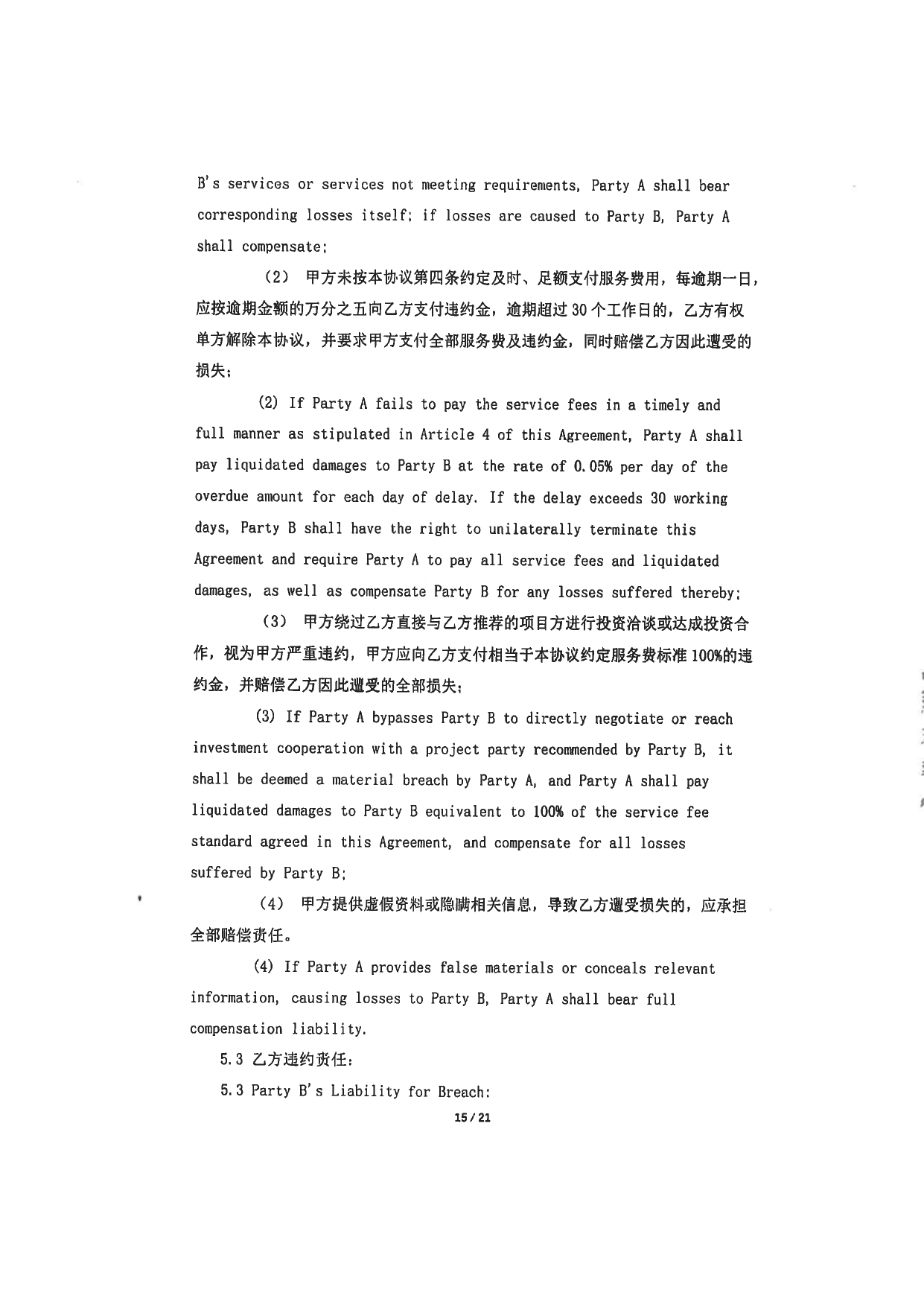
5.2 & fT: 5.2 Party /t’ s Liabi li ty for Breach: tl) â2txs&«Ji’xssSn&Js ifiRsHmHezasib4tsxHor in “ fi ni (1) I f Par ty ñ fa ils to speci fy inyes tinent requirements to Party B as agreed in this Agreement or foi 1s to promptly noti fy Party B in writing after changi ng investment requirements, causing delays in Party 5. 3 Party B' s Liabi 1 i ty for Breech: 15 / 21 B' s serv i cos or serv i ces not meet ing requ i cements, Party â shrill beer corresponding I osses i tsel f; i1 1osses ore coused to Party 0, Party â shall compensate: ‹2› &6ét’x¥ &ttaR , 0iAf4a8#B , ¥aM — B. & tRs«sstxu1aaLJA14afiA. D@ 30Tz1tBB, aJ6@ " , , - ƒ • (2) If Party ñ fai 1s to pay the service fees in a tinely and full manner as st i pulated in ârticle 4 of this Agreement, Party A shall pay 1 iqui dated damages to Party B at the rate of 0. 05'b per day of the overdue aliiount for each day of de lay. I I the delay exceeds 30 working days, Party B shall have the righ t to uni laterally terminate this Agreement and require Party â to pay all service fees and 1iquidated damages, as itell as compensate Party B for any losses suffered thereby: 3› TS??ñ:cfi&:b — 5z.ItE@Iñ9flSât?BP‹%Qéi&AB8â r, uk 69a1t1, TJ éL1Af1@fiT6x:x’?1aa£Sk I 00xBa (3) If Party A bypasses Party B to directly negotiate or reach investment cooperat i on ri th a project party recowended by Party B, i t shall be deemed a water ia1 breach by Party A, and Party A shall pay 1 iquidated damages to Party B equivalent to l00'$ of the service fee standard agreed i n this Agreement, and compensate for all losses suffered by Party B ; ‹4) &ofi«ztsHbis2 1fri8A‹a,s., es&siflfiñx&, dais ' (4) I f Party A prov i des false water ial s or conceals relevant informat i on, ecus i ng losses to Party B, Party A shall bear full conpensa I i on 1 ’LRbi I i ty. E5. 3 *0 J@:

› n n : (l) I f Party B fai 1s to perform serv i ce obl i grit i ons as agreed in thi s Agreement, fai 1s to actively source and screen projects meeting requ i resents for Party A, or if serv i ce qual i ty does not rleet the agreement, Party â has the right to requ ire Party B to rectify wi thin a specifitd period: if still not meeting requirements after rectification, Party A has the right to uni laterally teroinate this 6greelßent, aRd Party B shall refund all service fees paid by Party A (if any) and compensate for losses suffered by Party A ; ‹ 2 › LWR«ae iflfä . s .. lsazAU› : ‹o,e . Ri 8 a $ o, &B $ s xHsit&edRasafiRH&, ro atsaRH‹ . *xd, $ A&H ¥ sn» &ai’x . s ; Ls n $ AairBsT&Bi'xs 0 H 88 nflG« l 0 t&and . (2) If Party B provides false project informat ion, conceals zoterial adverse information, or inisleads Party â, causing Party A or Party C to make erroneous decisions or suffer losses, Party B shall bear full compensation liability; Party A has the right to unilaterally terminate th is Agreenent, and Party B shall sioul taneous ly pay 1 i quidated damages to Party â equ i vnlent to 100$ of the service fee standard agreed in th is Agreement ; ‹ 3 › L?i axeixI 8 fi&s&x’ rs›‹tsa . aeAilR/tTa‹Ls Rañ«, 9 s $ ofifitflx&, rJ islna&lai*a‹z, $ o&R ¥ WR» (3) I f Party B exceeds the entrus tment au thori ty to rlake commitments, sign documents, or engage in other non - compliant activities in Party A’ s name, caus ing losses to Party A, Party B shall bear full coinpensat i on 1iabi 1 i ty, and Party â has the ri ght to uni laterally terminate this Agreement ; 16 / 21 (4) If Party D arbi trar i ly sub - entrusts the entrustisent serv ices under thi s Agreement to o third party vi thout Party A’ s vri tten consent, Party â has the ri ght to uni laterally terminate this âgreeoent, and Party B shall compensate for losses suffered by Party â: engages i n acts harming the legi I iinate righ ts and interests of Part ies A 17 / 21 (5) If Party 0 v i olates conf i dentiali ty obli gations and discloses Party A's or Party C's Confidential Information, causing losses to Party A or Party C, Party B shal1 bear full conpensati on 1iabi li ty.

5.4 O0b?dñ{f: 5. 4 Party C' s Li abi 1i ty for Breach: (1) I f Party C fai 1s to cooperate wi th Parties A and B i n ful fi 11 ing obli gat ions as agreed in this Agreement, refuses or delays providing necessary support *ithout cause, causing losses to Parties A and B, Party C she11 bear corresponding coalpensati on 1 iabi1i ty: (2) Hoarxa«’xg, i8s$&B2fseiflo&aa‹»,a„ &R&K s«xH, ñ›#A»Is1.*aK. (2) I f Party C violates confidential ity ob1 i gations and discloses Confident ia1 I nformat ion of Part ies A and B or the project party, eaus ing losses to relevant parties, Party C shal1 bear full cozpensat i on 1iabi li ty: ' • (3) I f Party C v i ofates the prov is i ons of this Agreement and qnd B, Party C sha1 1 bear corresponding conpensa r1un 1.« 5.5 b!fi4f6› — fiâ?t€.

4fiS6D21i¥fiSQ#BBfxR¿yzB¿4:? 5. 5 Remedies for 8reach: Af ter a party' s breech, the non — breaching party shah l have the ri ght to require the brenchi ng party to rect i fy the breach vi thi n a speci I ied period ; the breaching party shall coup fete such reet i f i cat i on wi thi n the speci fied period: i f the breaching party fai 1s to rect i fy on t ine or the recti Hicat i on fai 1s to meet requ i reinents, the non - breachi ng party shall have the right to uni laterally termi nate this Agreement and requ ire the breaching party to bear full l iabi lity for breach. Article 6 Dispute Resolution 6 1 AN›’XM›T • BU, MRA9›'XN& • W&M T&ARAW NMN ( T 6. I The cone1usi on, performance, i nterpretat ion, and dispute resoluti on of this Agreement shall all be governed by the lays of the People' s Republ i c of China (excluding conf 1ict of lays rules) . 6. 2 H&H 'PSIR&H — U&Hi’X&X&1£NTi'X. *#ñ (BBiaUf1TIZ&H ‹e‹z&ñtxJ. alE6éaBJlse, 1f¥iMf¥13s Tz1sa. @¥iT6 6. 2 Any d i sputes or controvers ies arisi ng from or related to this Agreement (i ncl ud ing but not l iini ted to serv ice qual i ty, serv ice fee payment, 1iabi1 i ty for breach, con f i den t ial i ty obl igat ions, and re lated mat ters) , the three part ies shall I irst resolve through friendly negot rat i on i n accordance wi th the pri nci ples of good fni th, fairness, and just ice ; the negot iat ion period is 30 work i ng days ; i f negot iat ion 18/ 21 foils, any pntty 1ns the right to file 4 lawsuit with the people's court having jurisr!iction qt Party C’ s 1ocation.

6. z é:’xO&Jfiih1. Ps:x’9st›. g»sié@at?9aiysT8x/sly’6. T@a4i‘XX9IkBAA4#›i’Xâ1B1? ‹4??19@IfiB?tBtR9fi9zkBâA 6.3 During the dispute resolution period, except for disputed matters, all parties shall cont inue to perform other obligations under this Agreement and sholl not suspend or terminate performance of this Agreement due to disputes (except where the non - breaching party has the right to un i laterall y suspend or terminate performance based on breach circuits tances) . 6. 4 Li tigation fees, attorney fees, preservation fees, travel expenses, evaluation fees, and other related rights protection costs shall be borne by the losing party ; if both parties are at fault, they shall be borne in proportion to fault. Article 7 liiscel laneous ›. l 4•Si'x$ oen«aABlta«984PJisaaSz8sTB. 7. l Thi s Agreement shall take effect from the date vhen the legal representot i yes or au thori zed representatives of all three parties sign and affix their off ic ial seals. ›.2 &¡ii'X — zip, $. a. s - W4 - & — o, n&N¥e»BN. oHb , 7. 2 ”1his Agreement is made i n tri p1 i cote, ivi th Parties â, B, and C each hold i rig one copy, all hay ing equal legal effect, and each copy having equnl bind ing force. ›.s &ni’Xzs.sa, wB JSifi#A&if1fxfifi, t›R»i’X - s&Dfin i9 2i & l$&HGBA: lfXfii'X — 9&Ri'XU B & fi1f£D'i’xfiñ.

7. 3 hot ters not covered i n thi s Agreement may be separate ly negot inted by the three parties and a supplementnl agreement shall be si gned; the supplemental agreement shall have equnl l egal effect as this Agreement ; in case of incons is tency between the supplemental agreement and thi s Agreement, the supplemental agreement shall prevai 1. ›. 4 &s›'X its, 4N &lni4zG$Ei:, afisinFiiSn. $exs. 20 / 21 7. 4 After terininat ion of thi s Agreement, all parties shal1, in accordance vi th the principle of good faith, fulf i11 subsequent 1 i quidat ion, document handover, conf i dential i ty, and other obl igations ; Party C has the ri ght to supervise the ent ire process of document handover and I i qu i dat ion ; such ob1 igations shall not become inval i d due to terrninot ion of thi s Agreement. (End of )’ext) Party h (Seal) : Sh 2hubfñn I rids dbJ 1 Co. , Ltd. Legal Representat i ve tho Jded$ltepres tntive (signature) Date of Signing: ¥ear Month Oay LA (RB): SBI China Mega Asset Management Limited Party B (Seol) : SBI Ch inc Mega Ass t honagesient Liifli ted Legal itepresentative/Authorized Representative (Signature) : Dat:e of Signing: Year Month Day Party C (Seal) and 21 / 21 and Heavy Industry Co.

, Ltd. Lega1 Representat a } Α 8opresentatiYe (Signature): @@ B Kg: 2025 @ 12 @ 3LQ - Date of' S1gn1ng: Year Month Day
Exhibit 12.1
Certification by Principal Executive Officer
Pursuant to Section 302 of the Sarbanes-Oxley Act of 2002
I, Jie Liu, certify that:
| 1. | I have reviewed this annual report on Form 20-F of Hongli Group Inc.; |
| 2. | Based on my knowledge, this report does not contain any untrue statement of a material fact or omit to state a material fact necessary to make the statements made, in light of the circumstances under which such statements were made, not misleading with respect to the period covered by this report; |
| 3. | Based on my knowledge, the financial statements, and other financial information included in this report, fairly present in all material respects the financial condition, results of operations and cash flows of the company as of, and for, the periods presented in this report; |
| 4. | The company’s other certifying officer and I are responsible for establishing and maintaining disclosure controls and procedures (as defined in Exchange Act Rules 13a-15(e) and 15d-15(e)) and internal control over financial reporting (as defined in Exchange Act Rule 13a-15(f) and 15d-15(f)) for the company and have: |
| (a) | Designed such disclosure controls and procedures, or caused such disclosure controls and procedures to be designed under our supervision, to ensure that material information relating to the company, including its consolidated subsidiaries, is made known to us by others within those entities, particularly during the period in which this report is being prepared; |
| (b) | Designed such internal control over financial reporting, or caused such internal control over financial reporting to be designed under our supervision, to provide reasonable assurance regarding the reliability of financial reporting and the preparation of financial statements for external purposes in accordance with generally accepted accounting principles; |
| (c) | Evaluated the effectiveness of the company’s disclosure controls and procedures and presented in this report our conclusions about the effectiveness of the disclosure controls and procedures, as of the end of the period covered by this report based on such evaluation; and |
| (d) | Disclosed in this report any change in the company’s internal control over financial reporting that occurred during the period covered by the annual report that has materially affected, or is reasonably likely to materially affect, the company’s internal control over financial reporting; and |
| 5. | The company’s other certifying officer and I have disclosed, based on our most recent evaluation of internal control over financial reporting, to the company’s auditors and the audit committee of the company’s board of directors (or persons performing the equivalent functions): |
| (a) | All significant deficiencies and material weaknesses in the design or operation of internal control over financial reporting which are reasonably likely to adversely affect the company’s ability to record, process, summarize and report financial information; and |
| (b) | Any fraud, whether or not material, that involves management or other employees who have a significant role in the company’s internal control over financial reporting. |
| Hongli Group Inc. | ||
| May 13, 2026 | By: | /s/ Jie Liu |
| Name: | Jie Liu | |
| Title: | Chief Executive Officer | |
Exhibit 12.2
Certification by Principal Financial Officer
Pursuant to Section 302 of the Sarbanes-Oxley Act of 2002
I, Xiangmei Zeng, certify that:
| 1. | I have reviewed this annual report on Form 20-F of Hongli Group Inc.; |
| 2. | Based on my knowledge, this report does not contain any untrue statement of a material fact or omit to state a material fact necessary to make the statements made, in light of the circumstances under which such statements were made, not misleading with respect to the period covered by this report; |
| 3. | Based on my knowledge, the financial statements, and other financial information included in this report, fairly present in all material respects the financial condition, results of operations and cash flows of the company as of, and for, the periods presented in this report; |
| 4. | The company’s other certifying officer and I are responsible for establishing and maintaining disclosure controls and procedures (as defined in Exchange Act Rules 13a-15(e) and 15d-15(e)) and internal control over financial reporting (as defined in Exchange Act Rule 13a-15(f) and 15d-15(f)) for the company and have: |
| (a) | Designed such disclosure controls and procedures, or caused such disclosure controls and procedures to be designed under our supervision, to ensure that material information relating to the company, including its consolidated subsidiaries, is made known to us by others within those entities, particularly during the period in which this report is being prepared; |
| (b) | Designed such internal control over financial reporting, or caused such internal control over financial reporting to be designed under our supervision, to provide reasonable assurance regarding the reliability of financial reporting and the preparation of financial statements for external purposes in accordance with generally accepted accounting principles; |
| (c) | Evaluated the effectiveness of the company’s disclosure controls and procedures and presented in this report our conclusions about the effectiveness of the disclosure controls and procedures, as of the end of the period covered by this report based on such evaluation; and |
| (d) | Disclosed in this report any change in the company’s internal control over financial reporting that occurred during the period covered by the annual report that has materially affected, or is reasonably likely to materially affect, the company’s internal control over financial reporting; and |
| 5. | The company’s other certifying officer and I have disclosed, based on our most recent evaluation of internal control over financial reporting, to the company’s auditors and the audit committee of the company’s board of directors (or persons performing the equivalent functions): |
| (a) | All significant deficiencies and material weaknesses in the design or operation of internal control over financial reporting which are reasonably likely to adversely affect the company’s ability to record, process, summarize and report financial information; and |
| (b) | Any fraud, whether or not material, that involves management or other employees who have a significant role in the company’s internal control over financial reporting. |
| Hongli Group Inc. | ||
| May 13, 2026 | By: | /s/ Xiangmei Zeng |
| Name: | Xiangmei Zeng | |
| Title: | Chief Financial Officer | |
Exhibit 13.1
Certification by Principal Executive Officer
Pursuant to Section 906 of the Sarbanes-Oxley Act of 2002
In connection with the Annual Report of Hongli Group Inc. (the “Company”) on Form 20-F for the year ended December 31, 2025 as filed with the Securities and Exchange Commission on the date hereof (the “Report”), I, Jie Liu, Chief Executive Officer of the Company, certify, pursuant to 18 U.S.C. Section 1350, as adopted pursuant to Section 906 of the Sarbanes-Oxley Act of 2002, that to my knowledge:
| (1) | The Report fully complies with the requirements of Section 13(a) or 15(d) of the Securities Exchange Act of 1934; and |
| (2) | The information contained in the Report fairly presents, in all material respects, the financial condition and results of operations of the Company. |
May 13, 2026
| By: | /s/ Jie Liu | |
| Name: | Jie Liu | |
| Title: | Chief Executive Officer |
Exhibit 13.2
Certification by Principal Financial Officer
Pursuant to Section 906 of the Sarbanes-Oxley Act of 2002
In connection with the Annual Report of Hongli Group Inc. (the “Company”) on Form 20-F for the year ended December 31, 2025 as filed with the Securities and Exchange Commission on the date hereof (the “Report”), I, Xiangmei Zeng, Chief Financial Officer of the Company, certify, pursuant to 18 U.S.C. Section 1350, as adopted pursuant to Section 906 of the Sarbanes-Oxley Act of 2002, that to my knowledge:
| (1) | The Report fully complies with the requirements of Section 13(a) or 15(d) of the Securities Exchange Act of 1934; and |
| (2) | The information contained in the Report fairly presents, in all material respects, the financial condition and results of operations of the Company. |
May 13, 2026
| By: | /s/ Xiangmei Zeng | |
| Name: | Xiangmei Zeng | |
| Title: | Chief Financial Officer |
Exhibit 15.1
Consent of Ogier (Cayman) LLP
Consent Letter
May 13, 2026
| To: |
Hongli Group Inc. No. 777, Daiyi Road, Changle County, Weifang City, Shandong Province, China, 262400. |
Dear Sir/Madam,
We hereby consent to the references to our firm’s name in Hongli Group Inc.’s annual report on Form 20-F for the year ended December 31, 2025 (the “Annual Report”), which will be filed with the Securities and Exchange Commission (the “SEC”) on the date hereof. We also consent to the filing of this consent letter with the SEC as an exhibit to the Annual Report.
In giving such consent, we do not thereby admit that we come within the category of persons whose consent is required under Section 7 of the Securities Act of 1933, or under the Securities Exchange Act of 1934, in each case, as amended, or the regulations promulgated thereunder.
| Yours faithfully, | |
| /s/ Ogier (Cayman) LLP | |
| Consent of Ogier (Cayman) LLP |
Exhibit 15.2

Beijing Dacheng Law Offices, LLP (Shanghai)
Consent Letter
May 13, 2026
| To: | Hongli Group Inc. No. 777, Daiyi Road, Changle County, Weifang City, Shandong Province, China, 262400. |
Dear Sir/Madam,
We hereby consent to the references to our firm’s name in Hongli Group Inc.’s annual report on Form 20-F for the year ended December 31, 2025 (the “Annual Report”), which will be filed with the Securities and Exchange Commission (the “SEC”) on the date hereof. We also consent to the filing of this consent letter with the SEC as an exhibit to the Annual Report.
In giving such consent, we do not thereby admit that we come within the category of persons whose consent is required under Section 7 of the Securities Act of 1933, or under the Securities Exchange Act of 1934, in each case, as amended, or the regulations promulgated thereunder.
| Yours faithfully, | |
| /s/ Beijing Dacheng Law Offices, LLP (Shanghai) | |
| Beijing Dacheng Law Offices, LLP (Shanghai) |
Exhibit 15.3
CONSENT OF INDEPENDENT REGISTERED PUBLIC ACCOUNTING FIRM
We hereby consent to the incorporation by reference in the Registration Statement Amendment No.1 to on Form S-8 (File No. 333-278321) and Form F-3 (No. 333-289457) of Hongli Group Inc. and its subsidiaries (the “Company”) of our report dated May 13, 2026, relating to the consolidated balance sheets of Hongli Group Inc. and its subsidiaries (the “Company”) as of December 31, 2025 and 2024, and the related consolidated statements of operations and comprehensive income (loss), changes in shareholders’ equity, and cash flows for each of the years in the three-year period ended December 31, 2025 and the related notes, included in the Company’s Annual Report on Form 20-F.
We also consent to the reference to our firm under the heading “Experts” in such Registration Statement.
/s/ HTL International, LLC
Houston, Texas
May 13, 2026