 エドガーで原本を確認する
UNITED STATES
SECURITIES AND EXCHANGE COMMISSION
Washington, D.C. 20549
FORM 40-F
☐ REGISTRATION STATEMENT PURSUANT TO SECTION 12 OF THE SECURITIES EXCHANGE ACT OF 1934
OR
☒ ANNUAL REPORT PURSUANT TO SECTION 13(a) OR 15(d) OF THE SECURITIES EXCHANGE ACT OF 1934
For the fiscal year ended December 31, 2025
Commission file number: 001-32135
Seabridge Gold Inc.
(Exact name of Registrant as specified in its charter)
| Canada | 1040 | Not Applicable | ||
| (Province
or other jurisdiction of incorporation or organization) |
(Primary
Standard Industrial Classification Code Number) |
(I.R.S.
Employer Identification No.) |
106 Front Street East, Suite 400
Toronto, Ontario Canada M5A 1E1
(416) 367-9292
(Address and telephone number of Registrant’s principal executive offices)
Corporation Service Company
1180 Sixth Avenue
New York, New York 10036
(212) 299-5656
(Name, address and telephone number of agent for service in the United States)
Securities registered or to be registered pursuant to Section 12(b) of the Act:
| Title of each class | Trading Symbol(s) | Name of each exchange on which registered | ||
| Common Shares | SA | New York Stock Exchange |
Securities registered pursuant to Section 12(g) of the Act.
None
(Title of Class)
Securities for which there is a reporting obligation pursuant to Section 15(d) of the Act.
None
(Title of Class)
For annual reports, indicate by check mark the information filed with this form:
| ☒ Annual Information Form | ☒ Audited Annual Financial Statements |
Indicate the number of outstanding shares of the issuer’s classes of capital or common stock as of the close of the period covered by the annual report: 91,912,919 Common Shares (as at December 31, 2025).
Indicate by check mark whether the registrant (1) has filed all reports required to be filed by Section 13 or 15(d) of the Exchange Act during the preceding 12 months (or for such shorter period that the Registrant was required to file such reports) and (2) has been subject to such filing requirements for the past 90 days. Yes ☒ No ☐
Indicate by check mark whether the registrant has submitted electronically every Interactive Data File required to be submitted pursuant to Rule 405 of Regulation S-T (§232.405 of this chapter) during the preceding 12 months (or for such shorter period that the registrant was required to submit such files). Yes ☒ No ☐
Indicate by check mark whether the registrant is an emerging growth company as defined in Rule 12b-2 of the Exchange Act.
Emerging growth company ☐
If an emerging growth company that prepares its financial statements in accordance with U.S. GAAP, indicate by check mark if the registrant has elected not to use the extended transition period for complying with any new or revised financial accounting standards† provided pursuant to Section 13(a) of the Exchange Act. ☐
| † | The term “new or revised financial accounting standard” refers to any update issued by the Financial Accounting Standards Board to its Accounting Standards Codification after April 5, 2012. |
Indicate by check mark whether the registrant has filed a report on and attestation to its management’s assessment of the effectiveness of its internal control over financial reporting under Section 404(b) of the Sarbanes-Oxley Act (15 U.S.C. 7262(b)) by the registered public accounting firm that prepared or issued its audit report. ☒
If securities are registered pursuant to Section 12(b) of the Act, indicate by check mark whether the financial statements of the registrant included in the filing reflect the correction of an error to previously issued financial statements. ☐
Indicate by check mark whether any of those error corrections are restatements that required a recovery analysis of incentive-based compensation received by any of the registrant’s executive officers during the relevant recovery period pursuant to §240.10D-1(b). ☐
The annual report on Form 40-F shall be incorporated by reference into or as an exhibit to, as applicable, the Registrant’s Registration Statements under the Securities Act of 1933, as amended: Form F-10 (File No. 333-283616) and Form S-8 (File No. 333-211331).
EXPLANATORY NOTE
Seabridge Gold Inc. (the “Registrant” or “we” or “us”) is a Canadian issuer eligible to file its annual report pursuant to Section 13 of the Securities Exchange Act of 1934, as amended (the “Exchange Act”), on Form 40-F (“Form 40-F”) pursuant to the multi-jurisdictional disclosure system of the Exchange Act. We are a “foreign private issuer” as defined in Rule 3b-4 under the Exchange Act. Accordingly, our equity securities are exempt from Sections 14(a), 14(b), 14(c), 14(f) and 16 of the Exchange Act pursuant to Rule 3a12-3.
PRINCIPAL DOCUMENTS
The following documents have been filed as part of this Annual Report on Form 40-F and incorporated by reference herein:
A. Annual Information Form
For our Annual Information Form (the “AIF”) for the year ended December 31, 2025, see Exhibit 99.1 of this Annual Report on Form 40-F.
B. Audited Annual Financial Statements
For our audited annual financial statements (“Audited Financial Statements”), for the years ended December 31, 2025 and December 31, 2024, including the Report of Independent Registered Public Accounting Firm, see Exhibit 99.2 of this Form 40-F. The Audited Financial Statements are stated in Canadian Dollars (Cdn$) and are prepared in accordance with International Financial Reporting Standards (IFRS) as issued by the International Accounting Standards Board (IASB).
C. Management’s Discussion and Analysis
For our management’s discussion and analysis (the “MD&A”) for the year ended December 31, 2025, see Exhibit 99.3 of this Form 40-F.
FORWARD-LOOKING STATEMENTS
This Form 40-F and the exhibits attached hereto contain “forward-looking statements” within the meaning of Section 27A of the Securities Act of 1933, as amended (the “Securities Act”), and Section 21E of the Exchange Act, and forward-looking information within the meaning of Canadian securities laws concerning our projects, business approach and plans, including estimated production, capital, operating and cash flow estimates and other matters at our projects. Any statements that express or involve discussions with respect to predictions, expectations, beliefs, plans, projections, objectives, assumptions or future events or performance (often, but not always, using words or phrases such as “expects”, “anticipates”, “plans”, “projects”, “estimates”, “assumes”, “intends”, “strategy”, “goals”, “objectives” or variations thereof or stating that certain actions, events or results “may”, “could”, “would”, “might” or “will” be taken, occur or be achieved, or the negative of any of these terms and similar expressions) are not statements of historical fact and may be forward-looking statements and forward-looking information (collectively referred to in the following information simply as “forward-looking statements”). In addition, statements concerning mineral reserve and mineral resource estimates constitute forward-looking statements to the extent that they involve estimates of the mineralization expected to be encountered if a mineral property is developed and the economics of developing a property and producing minerals.
Forward-looking statements are necessarily based on estimates and assumptions made by us in light of our experience and perception of historical trends, current conditions and expected future developments. In making the forward-looking statements in this Form 40-F and the exhibits attached hereto, we have applied several material assumptions including, but not limited to, the assumption that: (i) any additional financing needed will be available on reasonable terms; (ii) the potential for production at our mineral projects will continue operationally, legally, economically and socially; (iii) market fundamentals will result in sustained demand and prices for gold and copper, and to a much lesser degree, silver and molybdenum; (iv) estimated resources at our projects have merit and there is continuity of mineralization as reflected in such estimates and (v) we will receive and maintain all required regulatory approvals required in respect of our projects.
Forward-looking statements are subject to a variety of known and unknown risks, uncertainties and other factors that could cause actual events or results to differ from those expressed or implied by the forward-looking statements, including, without limitation:
| ● | the Issuer’s history of net losses and negative cash flows from operations and expectation of future losses and negative cash flows from operations; |
| ● | although the Issuer has identified a preferred potential partnership candidate for the KSM Project, there is no assurance that terms of a partnership for advancing the KSM Project will be agreed; |
| ● | risks related to the Issuer’s ability to continue its exploration activities and future advancement activities, and to continue to maintain corporate office support of these activities, which are dependent on the Issuer’s ability to obtain suitable financing, enter into joint ventures, to sell property interests; |
| ● | the Issuer’s indebtedness requires quarterly interest payments and may require repayment in full, which may adversely affect its cash flow and ability to advance its business and necessitate dilutive financing or asset sales; |
| ● | risks related to fluctuations in the market price of gold, copper and other metals; |
| ● | uncertainty whether the reserves estimated on the Issuer’s mineral properties will be brought into production; |
| ● | risks related to unsettled First Nations rights and title and settled Treaty Nations’ rights and uncertainties relating to the process of making Canadian laws consistent with the United Nations Declaration on the Rights of Indigenous Peoples; |
| ● | risks related to obtaining and maintaining all necessary permits and governmental approvals, or extensions or renewals thereof, for exploration and advancement activities, including in respect of environmental regulation and the KSM Project’s environmental assessment certificate; |
| ● | risks associated with the use of information technology systems and cybersecurity; |
| ● | the Issuer is subject to substantial government regulatory and environmental requirements which could cause delays in advancing its projects or could result in a restriction or suspension of its operations;; |
| ● | the risk of having the “substantially started” determination for the KSM Project quashed and, if quashed, such determination not reconfirmed and the ultimate loss of the KSM Project environmental assessment certificate; | |
| ● | risks relating to the Issuer’s internal control over financial reporting being ineffective; |
| ● | uncertainties relating to the assumptions underlying the Issuer’s reserve and resource estimates; |
| ● | uncertainty of estimates of capital costs, operating costs, production and economic returns; |
| ● | risks relating to the commencement of site access and early site preparation construction activities at the KSM Project; |
| ● | risks related to commercially producing precious metals and copper from the Issuer’s mineral properties; |
| ● | risks related to fluctuations in foreign exchange rates; |
| ● | mining, exploration and advancement risks that could result in damage to mineral properties, plant and equipment, personal injury, environmental damage and delays in mining, which may be uninsurable or not insurable in adequate amounts; |
| ● |
risks related to the possibility of unregistered agreements, transfers, claims or other defects impacting title to the Issuer’s mineral properties; |
| ● | risks related to increases in demand for exploration, advancement and construction services and equipment, and related cost increases following metals price increases; |
| ● | successful completion of the proposed spin-out of the Courageous Lake Project on the terms proposed or not at all; |
| ● | increased competition in the mining industry; |
| ● | risks related to international trade disputes and the imposition of tariffs and the potential impacts it may have on the Company’s ability to raise funds and obtain supplies needed for work programs; |
| ● | regulatory initiatives and ongoing concerns regarding carbon emissions and the impacts of measures taken to induce or mandate lower carbon emissions on the ability to secure permits, finance projects and realize profitability at a project; |
| ● | the Issuer’s current and proposed operations are subject to risks relating to climate and climate change that may adversely impact its ability to conduct operations and raise capital, increase operating costs, interfere with materials and equipment supply, delay execution or reduce the profitability of a future mining operation; |
| ● | risks that regulatory measures directed at climate change issues adversely affect the Issuer’s business; |
| ● | the Issuer’s reliance on key personnel and the need to retain key executives and attract qualified personnel; |
| ● | the public’s views of the mining industry can present increased risks for permitting, financing and staffing; |
| ● | risks related to some of the Issuer’s directors’ and officers’ involvement with other natural resource companies; |
| ● | uncertainty surrounding an audit by the Canada Revenue Agency (“CRA”) of Canadian exploration expenses incurred by the Issuer during the 2014, 2015 and 2016 financial years which the Issuer has renounced to subscribers of flow-through share offerings and the CRA’s decision to reassess such subscribers; |
| ● | the risk of the CRA appealing the Issuer’s successful challenge to the reassessment by the CRA of the Issuer’s refund claim for the 2010 and 2011 financial years in respect of the British Columbia Mining Exploration Tax Credit and the decision being overturned; |
| ● | the risks associated with the volatility of the trading volume and price of the Issuer’s Common shares; |
| ● |
the return on an investment in the Issuer’s Common shares is limited to capital gains or losses since the Issuer does not pay dividends; |
| ● | the Issuer’s classification as a “passive foreign investment company” under the United States tax code; |
| ● | risks related to the pro-environmental groups anti-mining efforts, and sometimes focused efforts on specific projects impacting the Company’s share price. |
This list is not exhaustive of the factors that may affect any of our forward-looking statements. Forward-looking statements are statements about the future and are inherently uncertain, and actual achievements or other future events or conditions may differ materially from those reflected in the forward-looking statements due to a variety of risks, uncertainties and other factors, including, without limitation, those referred to in our AIF attached hereto as Exhibit 99.1 under the heading “Risk Factors” and elsewhere in the AIF, and in the documents incorporated by reference in this Form 40-F and the AIF. In addition, although we have attempted to identify important factors that could cause actual achievements, events or conditions to differ materially from those identified in the forward-looking statements, there may be other factors that cause achievements, events or conditions not to be as anticipated, estimated or intended. It is also noted that while we engage in exploration and development of our properties, we will not undertake production activities by ourselves.
These forward-looking statements are based on the beliefs, expectations and opinions of management on the date the statements are made and we do not assume any obligation to update forward-looking statements, except as required by applicable securities laws, if circumstances or management’s beliefs, expectations or opinions should change. For the reasons set forth above, persons should not place undue reliance on forward-looking statements.
CURRENCY
Unless otherwise indicated, all dollar amounts in this Form 40-F are in Canadian dollars.
NOTE TO UNITED STATES READERS - DIFFERENCES IN UNITED STATES AND CANADIAN REPORTING PRACTICES
We are permitted under the multi-jurisdictional disclosure system adopted by the United States Securities and Exchange Commission (the “SEC”), to prepare this Form 40-F in accordance with Canadian disclosure requirements, which differ from those of the SEC. We have prepared our financial statements, which are filed as Exhibit 99.2 to this Form 40-F, in accordance with International Financial Reporting Standards as issued by the International Accounting Standards Board, and they are not comparable with financial statements of U.S. and other companies prepared in accordance with U.S. generally accepted accounting principles.
RESOURCE AND RESERVE ESTIMATES
The Registrant’s AIF, attached as Exhibit 99.1 to this annual report on Form 40-F, and the MD&A, attached as Exhibit 99.3 to this annual report on Form 40-F, have been prepared in accordance with the requirements of the securities laws in effect in Canada, which differ from the requirements of United States securities laws. Mineral resource estimates included in this annual report on Form 40-F and in any document incorporated by reference herein or therein have been prepared in accordance with, and use terms that comply with, the reporting standards in accordance with Canadian National Instrument 43-101 - Standards of Disclosure for Mineral Projects (“NI 43-101”). NI 43-101 is a rule developed by the Canadian Securities Administrators that establishes standards for all public disclosure an issuer makes of scientific and technical information concerning mineral projects. In accordance with NI 43-101, the Registrant uses the terms mineral reserves and resources as they are defined in accordance with the CIM Definition Standards on mineral reserves and resources (the “CIM Definition Standards”) adopted by the Canadian Institute of Mining, Metallurgy and Petroleum.
For United States reporting purposes, the SEC has adopted amendments to its disclosure rules (the “SEC Modernization Rules”) to modernize the mining property disclosure requirements for issuers whose securities are registered with the SEC under the U.S. Securities Exchange Act of 1934, as amended (the “U.S. Exchange Act”). The SEC Modernization Rules more closely align the SEC’s disclosure requirements and policies for mining properties with current industry and global regulatory practices and standards, including NI 43-101, and replace the historical property disclosure requirements for mining registrants that were included in Industry Guide 7 under the U.S. Securities Act. As a foreign private issuer that is eligible to file reports with the SEC pursuant to the MJDS, the Registrant is not required to provide disclosure on its mineral properties under the SEC Modernization Rules and provides disclosure under NI 43-101 and the CIM Definition Standards. Accordingly, mineral reserve and mineral resource information contained or incorporated by reference herein may not be comparable to similar information disclosed by United States companies.
As a result of the adoption of the SEC Modernization Rules, the SEC recognizes estimates of “measured mineral resources”, “indicated mineral resources” and “inferred mineral resources.” In addition, the SEC has amended its definitions of “proven mineral reserves” and “probable mineral reserves” to be “substantially similar” to the corresponding CIM Definition Standards that are required under NI 43-101. While the above terms are “substantially similar” to CIM Definitions, there are differences in the definitions under the SEC Modernization Rules and the CIM Definition Standards. There is no assurance any mineral reserves or mineral resources that the Registrant may report as “proven mineral reserves”, “probable mineral reserves”, “measured mineral resources”, “indicated mineral resources” and “inferred mineral resources” under NI 43-101 would be the same had the Registrant prepared the reserve or resource estimates under the standards adopted under the SEC Modernization Rules.
Accordingly, information contained in this annual report on Form 40-F and the portions of documents incorporated by reference herein contain descriptions of the Registrant’s mineral deposits that may not be comparable to similar information made public by U.S. companies who prepare their disclosure in accordance with U.S. federal securities laws and the rules and regulations thereunder.
DISCLOSURE CONTROLS AND PROCEDURES
Evaluation of Disclosure Controls and Procedures
At the end of the period covered by this annual report on Form 40-F, an evaluation was carried out under the supervision of, and with the participation of our management, including the Chief Executive Officer (“CEO”) and the Chief Financial Officer (“CFO”), of the effectiveness of the design and operation of our disclosure controls and procedures (as defined in Rule 13a-15(e) and Rule 15d-15(e) under the Exchange Act). Based on that evaluation, the CEO and the CFO have concluded that as of the end of the period covered by this annual report, our disclosure controls and procedures were adequately designed and effective in ensuring that: (i) information required to be disclosed by us in reports that we file or submit to the SEC under the Exchange Act is recorded, processed, summarized and reported within the time periods specified in applicable SEC rules and forms and (ii) material information required to be disclosed in our reports filed under the Exchange Act is accumulated and communicated to our management, including the CEO and the CFO, as appropriate, to allow for accurate and timely decisions regarding required disclosure.
Management’s Annual Report on Internal Control over Financial Reporting
For management’s report on internal control over financial reporting, see “Internal Controls over Financial Reporting” in our MD&A attached as Exhibit 99.3 to this annual report on Form 40-F and incorporated by reference herein.
Attestation Report of the Independent Registered Public Accounting Firm
Our independent registered public accounting firm has issued an attestation report on our internal control over financial reporting as of December 31, 2025, which immediately precedes the audited consolidated financial statements included as part of Exhibit 99.2 to this annual report on Form 40-F and incorporated by reference herein.
Changes in Internal Controls over Financial Reporting
During the fiscal year ended December 31, 2025, no changes occurred in our internal control over financial reporting that have materially affected, or are reasonably likely to materially affect, our internal control over financial reporting.
Certifications
See Exhibits 31.1, 31.2, 32.1 and 32.2 to this Form 40-F.
CORPORATE GOVERNANCE
We are subject to a variety of corporate governance guidelines and requirements of the Toronto Stock Exchange, the New York Stock Exchange (the “NYSE”), the Canadian Securities Administrators and the SEC. We believe that we meet or exceed the applicable corporate governance requirements. According to the NYSE Rules, a listed company must adopt and disclose a set of corporate governance guidelines with respect to specified topics. Such guidelines are required to be posted on the registrant’s website. Although we are listed on the NYSE, we are not required to comply with all of that exchange’s corporate governance rules which are applicable to U.S. corporations. The significant ways in which the NYSE governance rules differ for us, as a foreign company, are a reduced quorum requirement for shareholder meetings, shareholder approval for issuance of common shares that could result in a 20% increase in the number of outstanding common shares and shareholder approval of certain compensation plans. The guidelines are available for viewing on our website at http://www.seabridgegold.com/company/governance and are available without charge in print to any shareholder who requests them. Requests for copies of the guidelines should be made to the Secretary of our company at 106 Front Street East, Suite 400, Toronto, Ontario, Canada M5A 1E1, Telephone (416) 367-9292.
We review our governance practices and monitor developments in Canada and the United States on an on-going basis to ensure we remain in compliance with applicable rules and standards. The Board is committed to sound corporate governance practices which are both in the interest of our shareholders and contribute to effective and efficient decision making.
AUDIT COMMITTEE
Audit Committee
The Board has a separately designated standing Audit Committee established in accordance with Section 3(a)(58)(A) of the Exchange Act. The members of our Audit Committee are identified under the heading “Audit Committee Information” in the AIF which is attached as Exhibit 99.1 to this annual report on Form 40-F and incorporated by reference herein. In the opinion of the Board, all members of the Audit Committee are financially literate and independent, as such terms are defined by the NYSE’s corporate governance listing standards applicable to us and as determined by Rule 10A-3 under the Exchange Act.
Audit Committee Financial Expert
The Board has determined that Ms. Julie Robertson, the Audit Committee Chair, and Ms. Carol Willson, another member of the Audit Committee, have the necessary qualifications to be designated as an “audit committee financial expert” within the meaning of applicable SEC Rules and each is an “independent director”, as defined pursuant to Item 407(d)(5) of SEC Regulation S-K and Section 303A.02 of the New York Stock Exchange Listed Company Manual.
Ms. Julie Robertson is a Chartered Public Accountant and brings extensive experience in various finance roles, including the development of capital projects finance framework. She has expertise in the areas of International Financial Reporting Standards, US Generally Accepted Accounting Principles, external reporting, internal control optimization and compliance, including SOX, risk assessment processes, capital project management, ESG reporting and cybersecurity. She is currently the Senior Vice President Finance of Kinross Gold Corporation, and was the former Chief Financial Officer of Marathon Gold Corp.
Ms. Carol Willson retired from EY in 2021 after a 28-year career where she was engagement partner for Internal Audit of clients which included multi-year internal audit outsourced projects and related internal audit transformations and reviews, fraud investigations, and in various assurance and advisory capacities including capital projects, ESG, finance function-related improvements, and cybersecurity. During Ms. Willson’s career as an experienced internal audit and risk professional, she was retained to lead risk, internal audit and SOX functions for a variety of public corporations including several major mining companies. She served for three years as the global head of internal audit and SOX for a large Canadian gold producer where her key audit areas included: supply chain, capital projects, procure to pay, ERP/cybersecurity, sustainability, budgeting & forecasting, fixed assets, and treasury. Ms. Willson had her own consulting business where she served as a senior risk advisor for clients from 2021 to 2024. She holds a Bachelor of Arts degree from the University of Western Ontario and an MBA-Accounting degree from the University of Toronto.
The SEC has indicated that the designation of an audit committee financial expert does not make that person an “expert” for any purpose, impose any duties, obligations, or liability on that person that are greater than those imposed on members of the audit committee and board of directors who do not carry this designation, or affect the duties, obligations, or liabilities of any other member of the audit committee or board of directors.
Audit Committee Charter
Our Audit Committee Charter is available on our website at www.seabridgegold.com, and is provided in Schedule A to the AIF, which is attached as Exhibit 99.1 to this annual report on Form 40-F and incorporated by reference herein. The Charter also is available in print to any shareholder that provides us with a written request. Requests for copies should be made to the Secretary of our company at 106 Front Street East, Suite 400, Toronto, Ontario, Canada M5A 1E1, Telephone (416) 367-9292.
PRINCIPAL
ACCOUNTING FEES AND SERVICES - INDEPENDENT REGISTERED PUBLIC
ACCOUNTING FIRM
Our independent registered public accounting firm is KPMG LLP, Toronto, ON, Canada, Auditor Firm ID: 85.
KPMG LLP acted as our independent registered public accounting firm for the fiscal years ended December 31, 2025 and 2024. For a description of the total amount billed by KPMG LLP to us for services performed in the last two fiscal years by category of service (audit fees, audit-related fees, tax fees and all other fees), see Item 9 “Audit Committee Information - External Auditor Service Fees (by Category)” in the AIF, which is attached as Exhibit 99.1 to this Form 40-F and incorporated by reference herein.
AUDIT COMMITTEE PRE-APPROVAL POLICIES AND PROCEDURES
For a description of our pre-approval policies and procedures related to the provision of non-audit services, see Item 9 “Audit Committee Information- Pre-Approval of Audit and Non-Audit Services Provided by Independent Auditors” in the AIF, which is attached as Exhibit 99.1 to this Form 40-F and incorporated by reference herein.
RECOVERY OF ERRONEOUSLY AWARDED COMPENSATION
The Registrant has adopted a compensation recovery policy (referred to as the “Incentive Compensation Clawback Policy”) as required by NYSE listing standards and pursuant to Rule 10D-1 of the Exchange Act. The Executive Compensation Clawback Policy is incorporated by reference as Exhibit 97.1 to this Form 40-F. At no time during or after the fiscal year ended December 31, 2025 (as of the date of this Annual Report), was the Registrant required to prepare an accounting restatement that required recovery of erroneously awarded compensation pursuant to the Incentive Compensation Clawback Policy and, as of December 31, 2025, there was no outstanding balance of erroneously awarded compensation to be recovered from the application of the Incentive Compensation Clawback Policy to a prior restatement.
OFF-BALANCE SHEET ARRANGEMENTS
The Registrant does not have any commitments or obligations, including contingent obligations, arising from arrangements with unconsolidated entities or persons (which are not otherwise discussed in the Registrant’s Management’s Discussion and Analysis for the fiscal year ended December 31, 2025, filed as Exhibit 99.3 to this annual report on Form 40-F), that have or are reasonably likely to have a material current or future effect on its financial condition, changes in financial condition, revenues or expenses, results of operations, liquidity, cash requirements or capital resources.
CODE OF BUSINESS CONDUCT AND ETHICS
We have adopted a Code of Business Conduct and Ethics (the “Code”) covering our executive officers and directors. The Code is available on our website at http://www.seabridgegold.com/company/governance and from our office at the address listed on the cover of this Form 40-F.
All amendments and all waivers of the Code to the officers covered by it will be posted on our website, furnished to the SEC as required, and provided to any shareholder who requests them. During the fiscal year ended December 31, 2025, we did not grant any waiver, including an implicit waiver, from a provision of the Code to any executive officer or director.
CONTRACTUAL OBLIGATIONS
The disclosure is included under the heading “Contractual Obligations” in our MD&A attached as Exhibit 99.3 to this annual report on Form 40-F and incorporated by reference herein. Amounts shown for mining leases include estimates of option payments, mineral lease payments, work commitments and tax levies that are required to maintain our interest in the mineral projects.
MINE SAFETY DISCLOSURE
Pursuant to Section 1503(a) of the Dodd-Frank Wall Street Reform and Consumer Protection Act of 2010, issuers that are operators, or that have a subsidiary that is an operator, of a coal or other mine in the United States are required to disclose in their periodic reports filed with the SEC information regarding specified health and safety violations, orders and citations, related assessments and legal actions, and mining-related fatalities under the regulation of the Federal Mine safety and Health Administration under the Federal Mine Safety and Health Act of 1977. During the fiscal year ended December 31, 2025, we were not an operator, of a coal or other mine in the United States.
TAX MATTERS
Purchasing, holding or disposing of securities of the Registrant may have tax consequences under the laws of the United States and Canada that are not described in this Annual Report on Form 40-F.
NOTICES PURSUANT TO REGULATION BTR
We did not send any notices required by Rule 104 of Regulation BTR during the fiscal year ended December 31, 2025 concerning any equity security subject to a blackout period under Rule 101 of Regulation BTR.
ADDITIONAL INFORMATION
Additional information relating to us, including the Audited Financial Statements, the MD&A and the AIF, can be found on SEDAR+ www.sedarplus.ca, on the SEC website at www.sec.gov, or on our website at www.seabridgegold.com. Shareholders may also contact the Assistant Corporate Secretary of our company by phone at (416) 367-9292 or by e-mail at info@seabridgegold.com to request copies of these documents and this annual report on Form 40-F.
DISCLOSURE REGARDING FOREIGN JURISDICTIONS THAT PREVENT INSPECTIONS
Not applicable.
DISCLOSURE PURSUANT TO SECTION 13(r) OF THE EXCHANGE ACT
In accordance with Section 13(r) of the Exchange Act, the Registrant is required to include certain disclosures in its periodic reports if it or any of its affiliates knowingly engaged in certain specified activities during the period covered by the report. Neither the Registrant nor its affiliates have knowingly engaged in any transaction or dealing reportable under Section 13(r) of the Exchange Act during the year ended December 31, 2025.
UNDERTAKING AND CONSENT TO SERVICE OF PROCESS
A. Undertaking
We undertake to make available, in person or by telephone, representatives to respond to inquiries made by the SEC staff, and to furnish promptly, when requested to do so by the SEC staff, information relating to: the securities registered pursuant to Form 40-F; the securities in relation to which the obligation to file an annual report on Form 40-F arises; or transactions in said securities.
B. Consent to Service of Process
We have previously filed with the SEC a written consent to service of process and power of attorney on Form F-X. Any change to the name or address of our agent for service shall be communicated promptly to the SEC by amendment to the Form F-X referencing our file number.
SIGNATURES
Pursuant to the requirements of the Exchange Act, the Registrant certifies that it meets all of the requirements for filing on Form 40-F and has duly caused this annual report to be signed on its behalf by the undersigned, thereto duly authorized.
| Seabridge Gold Inc. | ||
| By: | /s/ Rudi P. Fronk | |
| Rudi P. Fronk | ||
| Chairman and Chief Executive Officer | ||
Date: March 26, 2026
EXHIBITS
| Annual Information | ||
| 99.1 | Annual Information Form for the year ended December 31, 2025 | |
| 99.2 | Audited Financial Statements for the year ended December 31, 2025 | |
| 99.3 | Management’s Discussion and Analysis for the year ended December 31, 2025 | |
| 101 | Interactive Data File | |
| 104 | Cover Page Interactive Data File (formatted as Inline XBRL and contained in Exhibit 101). | |
| * | Previously Filed |
Exhibit 23.1
 |
KPMG LLP Bay Adelaide Centre 333 Bay Street Suite 4600 Toronto ON M5H 2S5 Canada |
Telephone (416) 777-8500 Fax (416) 777-8818 Internet www.kpmg.ca |
Consent of Independent Registered Public Accounting Firm
The Board of Directors of Seabridge Gold Inc.
We consent to the use of:
| ● | our report dated March 26, 2026 on the consolidated financial statements of Seabridge Gold Inc. (the “Entity”) which comprise the consolidated statements of financial position as of December 31, 2025 and 2024, the related consolidated statements of operations and comprehensive income (loss), changes in shareholders’ equity and cash flows for each of the years then ended, and the related notes (collectively the “consolidated financial statements”); and |
| ● | our report dated March 26, 2026 on the effectiveness of the Entity’s internal control over financial reporting as of December 31, 2025, |
each of which is included in the Annual Report on Form 40-F of the Entity for the fiscal year ended December 31, 2025.
We also consent to the incorporation by reference of such reports in the Registration Statement (No. 333-283616) on Form F-10, and the Registration Statement (No. 333-211331) on Form S-8 of the Entity.
/s/ KPMG LLP
Chartered Professional Accountants, Licensed Public Accountants
March 26, 2026
Toronto, Canada
Exhibit 23.2
Tetra Tech Canada Inc.
March 26, 2026
| To: | Seabridge Gold Inc. |
United States Securities and Exchange Commission
| Re: | Seabridge Gold Inc. (the “Company”) |
Consent of Expert
Ladies and Gentlemen:
Reference is made to the technical report titled “KSM (Kerr-Sulphurets-Mitchell) Prefeasibility Study and Preliminary Economic Assessment, NI 43-101 Technical Report” dated August 8, 2022 (the “Technical Report”) prepared for the Company.
In connection with the Company’s Annual Report on Form 40-F (the “40-F”) in respect of the financial year ended December 31, 2025, to be filed with the U.S. Securities and Exchange Commission (“SEC”) pursuant to the Securities Exchange Act of 1934, as amended, I, Hassan Ghaffari, P. Eng., on behalf of Tetra Tech Canada Inc. hereby:
| 1. | consent to the public filing of the Technical Report and the use of any extracts from or a summary of the Technical Report in the 40-F; |
| 2. | consent to the use of Tetra Tech Canada Inc.’s name and references to the Technical Report, or portions thereof, in the 40-F and to the inclusion or incorporation by reference of information derived from the Technical Report in the 40-F; |
| 3. | confirm that I have read the 40-F and that it fairly and accurately represents the information in the sections of the Technical Report for which I am responsible; and |
| 4. | confirm that I have read the 40-F and have no reason to believe that there are any misrepresentations in the information contained therein that are derived from the Technical Report or that are within my knowledge as a result of the services performed by Tetra Tech Canada Inc. in connection with the Technical Report. |
| Yours Truly, | |
| /s/ Hassan Ghaffari, P. Eng. | |
| Hassan Ghaffari, P. Eng. | |
| Director of Metallurgy | |
| Tetra Tech Canada Inc. |
Exhibit 23.3
Tetra Tech Inc.
March 26, 2026
| To: | Seabridge Gold Inc. |
United States Securities and Exchange Commission
| Re: | Seabridge Gold Inc. (the “Company”) |
Consent of Expert
Ladies and Gentlemen:
Reference is made to the technical report titled “KSM (Kerr-Sulphurets-Mitchell) Prefeasibility Study and Preliminary Economic Assessment, NI 43-101 Technical Report” dated August 8, 2022 (the “Technical Report”) prepared for the Company.
In connection with the Company’s Annual Report on Form 40-F (the “40-F”) in respect of the year ended December 31, 2025, to be filed with the U.S. Securities and Exchange Commission (“SEC”) pursuant to the Securities Exchange Act of 1934, as amended, I, Dr. Jianhui Huang P. Eng., on behalf of Tetra Tech Inc. hereby:
| 1. | consent to the public filing of the Technical Report and the use of any extracts from or a summary of the Technical Report in the 40-F; |
| 2. | consent to the use of Tetra Tech Inc.’s name and references to the Technical Report, or portions thereof, in the 40-F and to the inclusion or incorporation by reference of information derived from the Technical Report in the 40-F; |
| 3. | confirm that I have read the 40-F and that it fairly and accurately represents the information in the sections of the Technical Report for which I am responsible; and |
| 4. | confirm that I have read the 40-F and have no reason to believe that there are any misrepresentations in the information contained therein that are derived from the Technical Report or that are within my knowledge as a result of the services performed by Tetra Tech Inc. in connection with the Technical Report. |
| Yours Truly, | |
| /s/ Dr. Jianhui (John) Huang, P. Eng. | |
| Dr. Jianhui (John) Huang, P. Eng. | |
| Senior Metallurgist | |
| Tetra Tech Inc. |
Exhibit 23.4
March 26, 2026
| TO: | Seabridge Gold Inc. |
| United States Securities and Exchange Commission |
| Re: | Seabridge Gold Inc. (the “Company”) |
Consent of Expert
Ladies and Gentlemen:
Reference is made to:
| ● | the technical report titled “KSM (Kerr-Sulphurets-Mitchell) Prefeasibility Study and Preliminary Economic Assessment, NI 43-101 Technical Report” dated August 8, 2022 (the “Technical Report”) prepared for the Company; and |
| ● | the 2024 updated resource estimates for the Iron Cap and Kerr deposits at the KSM Project, effective January 10, 2024 (such disclosure collectively, the “Estimates”). |
In connection with the Company’s Annual Report on Form 40-F (the “40-F”) in respect of the financial year ended December 31, 2025, to be filed with the U.S. Securities and Exchange Commission (“SEC”) pursuant to the Securities Exchange Act of 1934, as amended, the undersigned hereby:
| 1. | consents to being named directly or indirectly in the Form 40-F; and |
| 2. | consents to: |
| (a) | the use of the content in the Technical Report that I am responsible for preparing; and |
| (b) | the inclusion of the Estimates in the 40-F; |
| Yours Truly, | |
| /s/ Henry Kim, P. Geo. | |
| Henry Kim, P. Geo. | |
| Principal Resource Geologist Wood Canada Limited |
Exhibit 23.5
March 26, 2026
| TO: | Seabridge Gold Inc. |
| United States Securities and Exchange Commission |
| Re: |
Seabridge Gold Inc. (the “Company”) Consent of Expert |
Ladies and Gentlemen:
Reference is made to the technical report titled “KSM (Kerr-Sulphurets-Mitchell) Prefeasibility Study and Preliminary Economic Assessment, NI 43-101 Technical Report” dated August 8, 2022 (the “Technical Report”) prepared for the Company.
In connection with the Company’s Annual Report on Form 40-F (the “40-F”) in respect of the financial year ended December 31, 2025, to be filed with the U.S. Securities and Exchange Commission (“SEC”) pursuant to the Securities Exchange Act of 1934, as amended, I, James H. Gray, P.Eng., on behalf of myself and Moose Mountain Technical Services, hereby:
| 1. | consent to the public filing of the Technical Report and the use of any extracts from or a summary of the Technical Report in the 40-F; |
| 2. | consent to the use of my name and Moose Mountain Technical Services’s name and references to the Technical Report, or portions thereof, in the 40-F and to the inclusion or incorporation by reference of information derived from the Technical Report in the 40-F; |
| 3. | confirm that I have read the 40-F and that it fairly and accurately represents the information in the sections of the Technical Report for which I am responsible; and |
| 4. | confirm that I have read the 40-F and have no reason to believe that there are any misrepresentations in the information contained therein that are derived from the Technical Report or that are within my knowledge as a result of the services performed by me in connection with the Technical Report. |
| Yours Truly | |
| /s/ James H. Gray, P. Eng. | |
| James H. Gray, P. Eng. | |
| Principal Mining Engineer | |
| Moose Mountain Technical Services |
Exhibit 23.6
March 26, 2026
| TO: | Seabridge Gold Inc. |
| United States Securities and Exchange Commission |
| Re: | Seabridge Gold Inc. (the “Company”) |
Ladies and Gentlemen:
Reference is made to the technical report titled “KSM (Kerr-Sulphurets-Mitchell) Prefeasibility Study and Preliminary Economic Assessment, NI 43-101 Technical Report” dated August 8, 2022 (the “Technical Report”) prepared for the Company.
In connection with the Company’s Annual Report on Form 40-F (the “40-F”) in respect of the financial year ended December 31, 2025, to be filed with the U.S. Securities and Exchange Commission (“SEC”) pursuant to the Securities Exchange Act of 1934, as amended, I, Neil Brazier, P.Eng., on behalf of myself and W.N. Brazier Associates Inc., hereby:
| 1. | consent to the public filing of the Technical Report and the use of any extracts from or a summary of the Technical Report in the 40-F; |
| 2. | consent to the use of my name and W.N. Brazier Associates lnc.’s name and references to the Technical Report, or portions thereof, in the 40-F and to the inclusion or incorporation by reference of information derived from the Technical Report in the 40-F; |
| 3. | confirm that I have read the 40-F and that it fairly and accurately represents the information in the sections of the Technical Report for which I am responsible; and |
| 4. | confirm that I have read the 40-F and have no reason to believe that there are any misrepresentations in the information contained therein that are derived from the Technical Report or that are within my knowledge as a result of the services performed by me in connection with the Technical Report. |
| Yours Truly, | |
| /s/ Neil Brazier, P. Eng. | |
| Neil Brazier, P. Eng. | |
| Principal | |
| W.N. Brazier Associates Inc. |
Exhibit 23.7
March 26, 2026
| TO: | Seabridge Gold Inc. |
United States Securities and Exchange Commission
| Re: | Seabridge Gold Inc. (the “Company”) |
Consent of Expert
Ladies and Gentlemen:
Reference is made to the technical report titled “KSM (Kerr-Sulphurets-Mitchell) Prefeasibility Study and Preliminary Economic Assessment, NI 43-101 Technical Report” dated August 8, 2022 (the “Technical Report”) prepared for the Company.
In connection with the Company’s Annual Report on Form 40-F (the “40-F”) in respect of the financial year ended December 31, 2025, to be filed with the U.S. Securities and Exchange Commission (“SEC”) pursuant to the Securities Exchange Act of 1934, as amended, I, Rolf Schmitt, M.Sc., P.Geo., on behalf of ERM Consultants Canada Ltd., hereby:
| 1. | consent to the public filing of the Report and the use of any extracts from or a summary of the Technical Report in the 40-F; |
| 2. | consent to the use of ERM Consultants Canada Ltd.’s name and references to the Technical Report, or portions thereof, in the 40-F and to the inclusion or incorporation by reference of information derived from the Technical Report in the 40-F; |
| 3. | confirm that I have read the 40-F and that it fairly and accurately represents the information in the sections of the Report for which I am responsible; and |
| 4. | confirm that I have read the 40-F and have no reason to believe that there are any misrepresentations in the information contained therein that are derived from the Technical Report or that are within my knowledge as a result of the services performed by ERM Consultants Canada Ltd. in connection with the Technical Report. |
| Yours Truly, | |
| /s/ Rolf Schmitt, P. Geo. | |
| Rolf Schmitt, P. Geo. | |
| Technical Director – Permitting | |
| ERM Consultants Canada Ltd. |
Exhibit 23.8
March 26, 2026
| TO: | Seabridge Gold Inc. |
| United States Securities and Exchange Commission |
| Re: | Seabridge Gold Inc. (the “Company”) |
| Consent of Expert |
Ladies and Gentlemen:
Reference is made to the technical report titled “KSM (Kerr-Sulphurets-Mitchell) Prefeasibility Study and Preliminary Economic Assessment, NI 43-101 Technical Report” dated August 8, 2022 (the “Technical Report”) prepared for the Company.
In connection with the Company’s Annual Report on Form 40-F (the “40-F”) in respect of the financial year ended December 31, 2025, to be filed with the U.S. Securities and Exchange Commission (“SEC”) pursuant to the Securities Exchange Act of 1934, as amended, I, David Willms, P. Eng., hereby:
| 1. | consent to the public filing of the Technical Report and the use of any extracts from or a summary of the Technical Report in the 40-F; |
| 2. | consent to the use of Klohn Crippen Berger Ltd.’s name and references to the Technical Report, or portions thereof, in the 40-F and to the inclusion or incorporation by reference of information derived from the Technical Report in the 40-F; |
| 3. | confirm that I have read the 40-F and that it fairly and accurately represents the information in the sections of the Technical Report for which I am responsible; and |
| 4. | confirm that I have read the 40-F and have no reason to believe that there are any misrepresentations in the information contained therein that are derived from the Technical Report or that are within my knowledge as a result of the services performed by Klohn Crippen Berger Ltd. in connection with the Technical Report. |
| Yours Truly, | |
| /s/ David Willms, P. Eng. | |
| David Willms, P. Eng. | |
| Senior Geotechnical Engineer | |
| Klohn Crippen Berger Ltd. |
Exhibit 23.9
BGC Engineering Inc.
March 26, 2026
| To: | Seabridge Gold Inc. |
| United States Securities and Exchange Commission |
| Re: | Seabridge Gold Inc. (the “Company”) |
| Consent of Expert |
Ladies and Gentlemen:
Reference is made to the technical report titled “KSM (Kerr-Sulphurets-Mitchell) Prefeasibility Study and Preliminary Economic Assessment, NI 43-101 Technical Report” dated August 8, 2022 (the “Technical Report”) prepared for the Company.
In connection with the Company’s Annual Report on Form 40-F (the “40-F”) in respect of the financial year ended December 31, 2025, to be filed with the U.S. Securities and Exchange Commission (“SEC”) pursuant to the Securities Exchange Act of 1934, as amended, I, Derek Kinakin, M.Sc., P.Geo., P.G., on behalf of myself and BGC Engineering Inc., hereby:
| 1. | consent to the public filing of the Technical Report and the use of any extracts from or a summary of the Technical Report in the 40-F; |
| 2. | consent to the use of my name and BGC Engineering Inc.’s name and references to the Technical Report, or portions thereof, in the 40-F and to the inclusion or incorporation by reference of information derived from the Technical Report in the 40-F; |
| 3. | confirm that I have read the 40-F and that it fairly and accurately represents the information in the sections of the Technical Report for which I am responsible; and |
| 4. | confirm that I have read the 40-F and have no reason to believe that there are any misrepresentations in the information contained therein that are derived from the Technical Report or that are within my knowledge as a result of the services performed by me in connection with the Technical Report. |
| Yours Truly, | |
| /s/ Derek Kinakin, M.Sc., P.Geo., P.G. | |
| Derek Kinakin, M.Sc., P.Geo., P.G. |
Exhibit 23.10

Consent of Ross D. Hammett
WSP Canada Inc.
Annual Report on Form 40-F
March 26, 2026
| To: | Seabridge Gold Inc. |
| United States Securities and Exchange Commission |
| Re: | Seabridge Gold Inc. (the “Company”) |
| Consent of Expert |
Reference is made to the technical report titled “KSM (Kerr-Sulphurets-Mitchell) Prefeasibility Study and Preliminary Economic Assessment, NI 43-101 Technical Report” dated August 8, 2022 (the “Technical Report”) prepared for the Company.
In connection with the Company’s Annual Report on Form 40-F (the “40-F”) in respect of the financial year ended December 31, 2025, to be filed with the U.S. Securities and Exchange Commission (“SEC”) pursuant to the Securities Exchange Act of 1934, as amended, I, Ross D. Hammett, Ph.D., P.Eng., hereby:
| 1. | consent to the quotation, inclusion or summary of those portions of the Technical Report prepared by me in the 40-F; |
| 2. | consent to the use of my name and references to my name in the 40-F, where used or referenced in the 40-F. |
in each case above, where used or incorporated by reference into the 40-F.
| Yours truly, | |
| /s/ Ross D. Hammett, Ph.D., P.Eng. | |
| Ross D. Hammett, Ph.D., P.Eng. | |
| WSP Canada Inc. |
Exhibit 31.1
CERTIFICATIONS PURSUANT TO SECTION 302
OF
THE SARBANES-OXLEY ACT OF 2002
I, Rudi P. Fronk, Chairman and CEO, certify that:
| 1. | I have reviewed this Annual Report on Form 40-F of Seabridge Gold Inc. (the “Issuer”): |
| 2. | Based on my knowledge, this annual report does not contain any untrue statement of a material fact or omit to state a material fact necessary to make the statements made, in light of the circumstances under which such statements were made, not misleading with respect to the period covered by this report; |
| 3. | Based on my knowledge, the financial statements, and other financial information included in this annual report, fairly present in all material respects the financial condition, results of operations and cash flows of the Issuer as of, and for, the periods presented in this report; |
| 4. | The Issuer’s other certifying officer(s) and I are responsible for establishing and maintaining disclosure controls and procedures (as defined in Exchange Act Rules 13a-15(e) and 15d-15(e)) and internal control over financial reporting (as defined in Exchange Act Rules 13a-15(f) and 15d-15(f)) for the Issuer and have: |
| a) | Designed such disclosure controls and procedures, or caused such disclosure controls and procedures to be designed under our supervision, to ensure that material information relating to the Issuer, including its consolidated subsidiaries, is made known to us by others within those entities, particularly during the period in which this annual report is being prepared; |
| b) | Designed such internal control over financial reporting, or caused such internal control over financial reporting to be designed under our supervision, to provide reasonable assurance regarding the reliability of financial reporting and the preparation of financial statements for external purposes in accordance with generally accepted accounting principles; |
| c) | Evaluated the effectiveness of the Issuer’s disclosure controls and procedures and presented in this annual report our conclusions about the effectiveness of the disclosure controls and procedures, as of the end of the period covered by this annual report based on such evaluation; and |
| d) | Disclosed in this annual report any change in the Issuer’s internal control over financial reporting that occurred during the period covered by the annual report that has materially affected, or is reasonably likely to materially affect, the Issuer’s internal control over financial reporting; and |
| 5. | The Issuer’s other certifying officer(s) and I have disclosed, based on our most recent evaluation of internal control over financial reporting, to the Issuer’s auditors and the audit committee of the Issuer’s board of directors (or persons performing the equivalent functions): |
| a) | All significant deficiencies and material weaknesses in the design or operation of internal control over financial reporting which are reasonably likely to adversely affect the Issuer’s ability to record, process, summarize and report financial information; and |
| b) | Any fraud, whether or not material, that involves management or other employees who have a significant role in the Issuer’s internal control over financial reporting. |
| Date: March 26, 2026 | By: | /s/ Rudi P. Fronk |
| Rudi P. Fronk | ||
| Chairman and CEO |
Exhibit 31.2
CERTIFICATIONS PURSUANT TO SECTION 302
OF
THE SARBANES-OXLEY ACT OF 2002
I, Christopher J. Reynolds, VP Finance and CFO, certify that:
| 1. | I have reviewed this Annual Report on Form 40-F of Seabridge Gold Inc. (the “Issuer”): |
| 2. | Based on my knowledge, this annual report does not contain any untrue statement of a material fact or omit to state a material fact necessary to make the statements made, in light of the circumstances under which such statements were made, not misleading with respect to the period covered by this report; |
| 3. | Based on my knowledge, the financial statements, and other financial information included in this annual report, fairly present in all material respects the financial condition, results of operations and cash flows of the Issuer as of, and for, the periods presented in this report; |
| 4. | The Issuer’s other certifying officer(s) and I are responsible for establishing and maintaining disclosure controls and procedures (as defined in Exchange Act Rules 13a-15(e) and 15d-15(e)) and internal control over financial reporting (as defined in Exchange Act Rules 13a-15(f) and 15d-15(f)) for the Issuer and have: |
| a) | Designed such disclosure controls and procedures, or caused such disclosure controls and procedures to be designed under our supervision, to ensure that material information relating to the Issuer, including its consolidated subsidiaries, is made known to us by others within those entities, particularly during the period in which this annual report is being prepared; |
| b) | Designed such internal control over financial reporting, or caused such internal control over financial reporting to be designed under our supervision, to provide reasonable assurance regarding the reliability of financial reporting and the preparation of financial statements for external purposes in accordance with generally accepted accounting principles; |
| c) | Evaluated the effectiveness of the Issuer’s disclosure controls and procedures and presented in this annual report our conclusions about the effectiveness of the disclosure controls and procedures, as of the end of the period covered by this annual report based on such evaluation; and |
| d) | Disclosed in this annual report any change in the Issuer’s internal control over financial reporting that occurred during the period covered by the annual report that has materially affected, or is reasonably likely to materially affect, the Issuer’s internal control over financial reporting; and |
| 5. | The Issuer’s other certifying officer(s) and I have disclosed, based on our most recent evaluation of internal control over financial reporting, to the Issuer’s auditors and the audit committee of the Issuer’s board of directors (or persons performing the equivalent functions): |
| a) | All significant deficiencies and material weaknesses in the design or operation of internal control over financial reporting which are reasonably likely to adversely affect the Issuer’s ability to record, process, summarize and report financial information; and |
| b) | Any fraud, whether or not material, that involves management or other employees who have a significant role in the Issuer’s internal control over financial reporting. |
| Date: March 26, 2026 | By: | /s/ Christopher J. Reynolds |
| Christopher J. Reynolds | ||
| VP Finance and CFO |
Exhibit 32.1
CERTIFICATION PURSUANT TO 18 U.S.C. §1350, AS ADOPTED PURSUANT TO
SECTION 906 OF THE SARBANES-OXLEY ACT OF 2002
In connection with this Annual Report of Seabridge Gold Inc. (the “Company”) on Form 40-F for the period ended December 31, 2025, as filed with the Securities and Exchange Commission on the date hereof (the “Annual Report”), I, Rudi P. Fronk, Chief Executive Officer of the Company, certify, pursuant to U.S.C. §1350, as adopted pursuant to Section 906 of the Sarbanes-Oxley Act of 2002, that:
| (1) | The Annual Report fully complies with the requirements of Section 13(a) or 15(d) of the Securities Exchange Act of 1934; and |
| (2) | The information contained in this Annual Report fairly presents, in all material respects, the financial condition and results of operations of the Company. |
| Date: March 26, 2026 | By: | /s/ Rudi P. Fronk |
| Rudi P. Fronk | ||
| Chief Executive Officer |
This certification accompanies the Annual Report pursuant to Section 906 of the Sarbanes-Oxley Act of 2002 and may not be used or relied upon for any other purpose including Section 18 of the Securities Exchange Act of 1934. A signed original of this written statement required by Section 906 has been provided to the Company and will be retained by the Company and furnished to the Securities and Exchange Commission or its staff upon request.
Exhibit 32.2
CERTIFICATION PURSUANT TO 18 U.S.C. §1350, AS ADOPTED PURSUANT TO
SECTION 906 OF THE SARBANES-OXLEY ACT OF 2002
In connection with this Annual Report of Seabridge Gold Inc. (the “Company”) on Form 40-F for the period ended December 31, 2025, as filed with the Securities and Exchange Commission on the date hereof (the “Annual Report”), I, Christopher J. Reynolds, Vice President Finance and Chief Financial Officer of the Company, certify, pursuant to U.S.C. §1350, as adopted pursuant to Section 906 of the Sarbanes-Oxley Act of 2002, that:
| (1) | The Annual Report fully complies with the requirements of Section 13(a) or 15(d) of the Securities Exchange Act of 1934; and |
| (2) | The information contained in this Annual Report fairly presents, in all material respects, the financial condition and results of operations of the Company. |
| Date: March 26, 2026 | By: | /s/ Christopher J. Reynolds |
| Christopher J. Reynolds | ||
| Vice President Finance and CFO |
This certification accompanies the Annual Report pursuant to Section 906 of the Sarbanes-Oxley Act of 2002 and may not be used or relied upon for any other purpose including Section 18 of the Securities Exchange Act of 1934. A signed original of this written statement required by Section 906 has been provided to the Company and will be retained by the Company and furnished to the Securities and Exchange Commission or its staff upon request.
Exhibit 99.1

ANNUAL
INFORMATION
FORM
FOR THE YEAR ENDED
DECEMBER 31, 2025
DATED: MARCH 26, 2026
TABLE OF CONTENTS
Contents
The information in this Annual Information Form (“AIF”) is presented as of December 31, 2025 unless specified otherwise.
All dollar amounts are expressed in Canadian dollars unless otherwise indicated. The Issuer’s quarterly and annual financial statements are presented in Canadian dollars.
In this AIF a combination of Imperial and metric measures are used with respect to the Issuer’s mineral properties. Conversion rates from Imperial measure to metric and from metric to Imperial are provided below:
| Imperial Measure = Metric Unit | Metric Measure = Imperial Unit | ||
| 2.47 acres | 1 hectare (h) | 0.4047 hectares | 1 acre |
| 3.28 feet | 1 meter (m) | 0.3048 meters | 1 foot |
| 0.62 miles | 1 kilometer (km) | 1.609 kilometers | 1 mile |
| 0.032 ounces (troy) (oz) | 1 gram (g) | 31.1035 grams | 1 ounce (troy) |
| 1.102 tons (short) | 1 tonne (t) | 0.907 tonnes | 1 ton |
| 0.029 ounces (troy)/ton | 1 gram/tonne (g/t) | 34.28 grams/tonne | 1 ounce (troy/ton) |
Abbreviations of unit measures are used in this AIF in addition to those in brackets in the table above as follows:
| Bt - Billion tonnes | Ga - Giga-annum | kWh - Kilowatt hours | Mlb - Million pounds |
| Mm³ - Million cubic meters | Moz - Million ounces | m/s - Meters per second | Mt - Million tonnes |
| MWh - Megawatt hours | ppm - Parts per million | tpd - tonnes per day | W/m²- Watt per square meter |
See “Glossary of Technical Terms” for a description of some important technical terms used in this AIF.
Cautionary Note Regarding Forward-Looking Statements
This AIF contains forward-looking statements within the meaning of the United States Private Securities Litigation Reform Act of 1995 and forward-looking information within the meaning of Canadian securities laws concerning future events or future performance with respect to the Issuer’s projects, business approach and plans, including production, capital, operating and cash flow estimates; business transactions such as the potential joint venture of the Issuer’s KSM Project or the spin-out of the Courageous Lake Project (each as defined herein) and the acquisition or disposition of interests in other mineral properties; requirements for additional capital; the estimation of mineral resources and reserves; and the timing of completion and success of exploration and advancement activities, community relations, required regulatory and third party consents, litigation, permitting and related programs in relation to the KSM Project, Iskut Project, Courageous Lake Project, Snowstorm Project or 3 Aces Project. Any statements that express or involve discussions with respect to predictions, expectations, beliefs, plans, projections, objectives or future events or performance (often, but not always, using words or phrases such as “expects”, “anticipates”, “believes”, “plans”, “projects”, “estimates”, “intends”, “strategy”, “goals”, “objectives” or variations thereof or stating that certain actions, events or results “may”, “could”, “would”, “might”, or “will” be taken, occur or be achieved, or statements of “potential” or something “possible”, or the negative of any of these terms and similar expressions) are not statements of historical fact and may be forward-looking statements and forward-looking information (collectively referred to in the following information simply as “forward-looking statements”). In addition, statements concerning mineral reserve and mineral resource estimates constitute forward-looking statements to the extent that they involve estimates of the mineralization expected to be encountered if a mineral property is developed and, in the case of reserves, the economics of a proposed mining operation.
Forward-looking statements are necessarily based on estimates and assumptions made by the Issuer in light of its experience and perception of historical trends, current conditions and expected future developments. In making the forward-looking statements in this AIF the Issuer has applied several material assumptions including, but not limited to, the assumption that: (1) market fundamentals will result in sustained demand and prices for gold and copper, and to a much lesser degree, silver and molybdenum; (2) the potential for production at its advanced mineral projects will continue operationally, legally and economically; (3) any additional financing needed will be available on reasonable terms; (4) estimated mineral reserves and mineral resources at the Issuer’s projects have merit and there is continuity of mineralization as reflected in such estimates; (5) the Issuer will receive and maintain all required regulatory approvals required in respect of its projects.
Forward-looking statements are subject to a variety of known and unknown risks, uncertainties and other factors that could cause actual events or results to differ from those expressed or implied by the forward-looking statements, including, without limitation:
| ● | the Issuer’s history of net losses and negative cash flows from operations and expectation of future losses and negative cash flows from operations; |
| ● | although the Issuer has identified a preferred potential partnership candidate for the KSM Project, there is no assurance that terms of a partnership for advancing the KSM Project will be agreed; |
| ● | risks related to the Issuer’s ability to continue its exploration activities and future advancement activities, and to continue to maintain corporate office support of these activities, which are dependent on the Issuer’s ability to obtain suitable financing, enter into joint ventures or sell property interests |
| ● | the Issuer’s indebtedness requires quarterly interest payments and may require repayment of the principal in full and a repayment premium, which may adversely affect its cash flow and ability to advance its business and necessitate dilutive financing or asset sales; |
| ● | changes in the market price of gold, copper and other metals, which in the past have fluctuated widely, affect the Issuer’s ability to finance its operations and the potential profitability of the Issuer’s projects; |
| ● | uncertainty whether the reserves at its projects can be brought into production; |
| ● | the uncertainty related to unsettled rights and title of Indigenous groups, as well as settled Treaty Nation’s rights, in British Columbia, the Yukon Territory and the Northwest Territories and uncertainties relating to the process of making Canadian laws consistent with the United Nations Declaration on the Rights of Indigenous Peoples |
| ● | risks related to obtaining and maintaining all necessary permits and governmental approvals, or extensions, amendments or renewals thereof, for exploration and advancement activities, including in respect of environmental regulation and the KSM Project’s environmental assessment certificate; |
| ● | risks associated with the use of information technology systems and cybersecurity; |
| ● | the Issuer is subject to substantial government regulatory and environmental requirements which could cause delays in advancing its projects or could result in a restriction or suspension of its operations; |
| ● | risks related to court challenges to the “substantially started” determination for the KSM Project; |
| ● | risks relating to the Issuer’s internal control over financial reporting being ineffective; |
| ● | figures for the Issuer’s resources, reserves and recoveries are estimates only and the Issuer’s properties may yield less mineral production or less profit than currently estimated; |
| ● | uncertainty of estimates of capital costs, operating costs, production and economic returns; |
| ● | risks relating to the construction and maintenance of initial infrastructure at the KSM Project by the Issuer; |
| ● | risks related to commercially producing precious metals and base metals from the Issuer’s mineral properties; |
| ● | risks related to fluctuations in foreign exchange rates; |
| ● | mining, exploration and advancement risks that could result in damage to mineral properties, plant and equipment, personal injury, environmental damage and delays in mining, which may be uninsurable or not insurable in adequate amounts; |
| ● | risks related to the possibility of unregistered agreements, transfers, claims or other defects impacting title to the Issuer’s mineral properties; |
| ● | risks related to increases in demand for exploration, advancement and construction services and equipment, and related cost increases following metals price increases; |
| ● | risks related to the successful completion of the proposed spin-out of the Courageous Lake Project on the terms proposed or not at all; |
| ● | increased competition in the mining industry; |
| ● | risks related to international trade disputes and the imposition of tariffs and the potential impacts it may have on the Issuer’s ability to raise funds and obtain supplies or, if available, the cost of supplies, needed for work programs; |
| ● | regulatory initiatives and ongoing concerns regarding carbon emissions and the impacts of measures taken to induce or mandate lower carbon emissions on the ability to secure permits, finance projects and realize profitability at a project; |
| ● | the Issuer’s current and proposed operations are subject to risks relating to climate change and nature loss that may adversely impact its ability to conduct operations increase its operating costs, interfere with materials and equipment supply, delay execution or reduce the profitability of a future mining operation; |
| ● | risks that changes to climate change or nature related regulatory regimes could adversely affect the Issuer’s business; |
| ● | the Issuer’s reliance on key personnel and the need to retain key executives and attract qualified personnel; |
| ● | the public’s views of the mining industry can present increased risks for permitting, financing and staffing; |
| ● | risks related to some of the Issuer’s directors’ and officers’ involvement with other natural resource companies; |
| ● | uncertainty surrounding an audit by the Canada Revenue Agency (“CRA”) of Canadian exploration expenses incurred by the Issuer during the 2014, 2015 and 2016 financial years which the Issuer has renounced to subscribers of flow-through share offerings and the CRA’s decision to reassess such subscribers; |
| ● | the risks associated with the volatility of the trading volume and price of the Issuer’s Common shares; |
| ● | the return on an investment in the Issuer’s Common shares is limited to capital gains or losses since the Issuer does not pay dividends; |
| ● | the Issuer’s reliance on equity financing creates the potential for dilution of the Issuer’s Common shares; |
| ● | the Issuer’s classification as a “passive foreign investment company” under the United States tax code; and |
| ● | risks related to the pro-environmental groups anti-mining efforts, and sometimes focused efforts on specific projects impacting the Issuer’s share price. |
This list is not exhaustive of the factors that may affect any of the Issuer’s forward-looking statements. Forward-looking statements are statements about the future and are inherently uncertain, and actual achievements of the Issuer or other future events or conditions may differ materially from those reflected in the forward-looking statements due to a variety of risks, uncertainties and other factors, including, without limitation, those referred to in this AIF under the heading “Risk Factors” and elsewhere in this AIF. In addition, although the Issuer has attempted to identify important factors that could cause actual achievements, events or conditions to differ materially from those identified in the forward-looking statements, there may be other factors that cause achievements, events or conditions not to be as anticipated, estimated or intended. Many of the foregoing factors are beyond the Issuer’s ability to control or predict. It is also noted that while Seabridge engages in exploration and advancement of its properties, including data collection and site work in preparation for feasibility study work or early construction work, it will not undertake production activities by itself.
These forward-looking statements are based on the beliefs, expectations and opinions of management on the date the statements are made and the Issuer does not assume any obligation to update forward-looking statements, except as required by applicable securities laws, if circumstances or management’s beliefs, expectations or opinions should change. For the reasons set forth above, investors should not place undue reliance on forward-looking statements.
Cautionary Note to United States Investors Regarding Resource Estimates
This AIF has been prepared in accordance with the requirements of the securities laws in effect in Canada, which differ from the requirements of United States securities laws. Mineral resource estimates included in this AIF and in any document incorporated by reference herein or therein have been prepared in accordance with, and use terms that comply with, the reporting standards in accordance with Canadian National Instrument 43-101 - Standards of Disclosure for Mineral Projects (“NI 43-101”). NI 43-101 is a rule developed by the Canadian Securities Administrators that establishes standards for all public disclosure an issuer makes of scientific and technical information concerning mineral projects. In accordance with NI 43-101, the Issuer uses the terms mineral reserves and resources as they are defined in accordance with the CIM Definition Standards on mineral reserves and resources (the “CIM Definition Standards”) adopted by the Canadian Institute of Mining, Metallurgy and Petroleum (“CIM”).
The U.S. Securities and Exchange Commission (the “SEC”) has adopted amendments to its disclosure rules to modernize the mineral property disclosure requirements for issuers whose securities are registered with the SEC under the Exchange Act. These amendments became effective February 25, 2019 (the “SEC Modernization Rules”) and have replaced the historical property disclosure requirements for mining registrants that were included in SEC Industry Guide 7. As a foreign private issuer that files its annual report on Form 40-F with the SEC pursuant to the multi-jurisdictional disclosure system (“MJDS”), the Issuer is not required to provide disclosure on its mineral properties under the SEC Modernization Rules and will continue to provide disclosure under NI 43-101 and the CIM Definition Standards. However, if the Issuer either ceases to be a “foreign private issuer” or ceases to be entitled to file reports under the MJDS, then the Issuer will be required to provide disclosure on its mineral properties under the SEC Modernization Rules.
Accordingly, United States investors are cautioned that the disclosure the Issuer provides on its mineral properties in this AIF and under its continuous disclosure obligations under the Exchange Act may be different from the disclosure that the Issuer would otherwise be required to provide as a U.S. domestic issuer or a non-MJDS foreign private issuer under the SEC Modernization Rules.
The SEC Modernization Rules include the adoption of terms describing mineral reserves and mineral resources that are substantially similar to the corresponding terms under the CIM Definition Standards. As a result of the adoption of the SEC Modernization Rules, the SEC will now recognize estimates of “measured mineral resources,” “indicated mineral resources” and “inferred mineral resources.” In addition, the SEC has amended its definitions of “proven mineral reserves” and “probable mineral reserves” to be substantially similar to the corresponding CIM Definition Standards.
United States investors are cautioned that while the above terms are substantially similar to CIM Definition Standards, there are differences in the definitions under the SEC Modernization Rules and the CIM Definition Standards. Accordingly, there is no assurance any mineral reserves or mineral resources that the Issuer may report as “proven reserves,” “probable reserves,” “measured mineral resources,” “indicated mineral resources” and “inferred mineral resources” under NI 43-101 would be the same had the Issuer prepared the reserve or resource estimates under the standards adopted under the SEC Modernization Rules.
United States investors are also cautioned that while the SEC will now recognize “measured mineral resources,” “indicated mineral resources” and “inferred mineral resources,” investors should not assume that any part or all of the mineralization in these categories will ever be converted into a higher category of mineral resources or into mineral reserves. Mineralization described using these terms has a greater amount of uncertainty as to their existence and feasibility than mineralization that has been characterized as reserves. Investors are cautioned not to assume that any “measured mineral resources,” “indicated mineral resources,” or “inferred mineral resources” that the Issuer reports are or will be economically or legally mineable.
Further, “inferred resources” have a greater amount of uncertainty as to their existence and as to whether they can be mined legally or economically. Therefore, United States investors are also cautioned not to assume that all or any part of the inferred resources exist. In accordance with Canadian rules, estimates of “inferred mineral resources” cannot form the basis of feasibility or other economic studies, except in limited circumstances where permitted under NI 43-101.
Accordingly, information contained in this AIF and the portions of documents incorporated by reference herein contain descriptions of the Issuer’s mineral deposits that may not be comparable to similar information made public by U.S. companies who prepare their disclosure in accordance with U.S. federal securities laws and the rules and regulations thereunder.
Seabridge Gold Inc.
ANNUAL INFORMATION FORM
Seabridge Gold Inc. (the “Issuer” or “Seabridge”) was incorporated under the Company Act (British Columbia) on September 14, 1979 under the name of Chopper Mines Ltd., which was subsequently changed to Dragoon Resources Ltd. on November 9, 1984, and then changed again to Seabridge Resources Inc. on May 20, 1998. On June 20, 2002, the Issuer changed its name to “Seabridge Gold Inc.” and on October 31, 2002, the Issuer was continued under the Canada Business Corporations Act.
The Issuer’s corporate offices are located at 106 Front Street East, 4th Floor, Toronto, Ontario, Canada M5A 1E1. The Issuer’s telephone number is (416) 367-9292. The Issuer’s common shares (“Common shares”) are currently listed for trading on the Toronto Stock Exchange (the “TSX”) under the symbol “SEA” and on the New York Stock Exchange (the “NYSE”) under the symbol “SA”. The Issuer’s registered office is located at 15th Floor, 1111 West Hastings Street, Vancouver, British Columbia, Canada V6E 2J3.
The Issuer presently has thirteen wholly-owned subsidiaries: KSM Mining ULC, Seabridge Gold (KSM) Inc., SnipGold Corp., Hattrick Resources Corp. and Tuksi Mining & Development Company Ltd. (“Tuksi”), each companies incorporated under the laws of British Columbia, Canada; Seabridge Gold (NWT) Inc., a company incorporated under the laws of the Northwest Territories; Seabridge Gold (Yukon) Inc., a company incorporated under the laws of Yukon; Seabridge Gold Corporation, Pacific Intermountain Gold, Corporation, 5555 Gold Inc. and 5555 Silver Inc., each Nevada corporations; Seabridge Gold (Michigan) Inc., a corporation incorporated under the laws of Michigan; and Snowstorm Exploration LLC, a Delaware limited liability corporation. The following diagram illustrates the inter-corporate relationship between the Issuer, its active subsidiaries and its projects as of December 31, 2025.

Notes:
| 1. | On December 16, 2025, the Issuer announced its intention to spin-out the Courageous Lake Project. |
| 2. | SnipGold Corporation holds the mineral claims included in the Iskut Project directly, however the Crown granted mineral claims are held through its subsidiary Tuksi Mining & Development Inc. |
| 3. | The Issuer has entered into an option agreement under which a 100% interest in the Quartz Mountain Project may be acquired by a third party. |
| 4. | The Issuer holds an option to acquire a 100% interest in the Michigan Property. |
ITEM 2: GENERAL DEVELOPMENT OF THE BUSINESS
Since 1999, Seabridge has taken steps to achieve its goal of providing strong returns to shareholders by maximizing leverage to the price of gold. The Issuer’s strategy to achieve this goal is to optimize gold ownership per Common share by increasing gold mineral resources more rapidly than shares outstanding. This ratio of gold ownership per Common share has provided a simple but effective measure for evaluating dollars spent on behalf of shareholders.
In 1999, management decided that Seabridge’s strategic focus would be on acquiring, exploring and advancing gold deposits. Seabridge determined it would not build or operate mines, but that it would look to partner or sell assets that were advancing toward production. In the Issuer’s view, building mines adds considerable technical and financial risks and requires a different set of skills and resources. Seabridge also decided it would prioritize exploration projects with known gold deposits with exploration upside to reduce risk in terms of trying to achieve a growing ratio of gold ownership per Common share. The Issuer therefore narrowed the activities it would undertake to the following three phases, which phases it planned to progress through in the order set forth below and in response to increases in the price of gold: (i) acquiring known gold deposits, (ii) expanding the deposits, and (iii) advancing its deposits towards a construction decision by defining the economic parameters of the deposits through engineering studies, upgrading mineral resources to reserves, securing permits for undertaking mining operations and building relationships with local communities and indigenous groups. The Issuer believed this was a relatively lower-risk and less capital-intensive strategy consistent with the goal of optimizing gold ownership per Common share. The Issuer continues to follow this strategy today, although, in respect of certain properties where it considered it was warranted, the Issuer has acquired properties without known gold deposits.
From 1999 to 2002, Seabridge acquired eight deposits with gold resources in North America, paying less than US$1.00 per ounce of resource (using aggregate ounces from all resource categories). Previous owners had spent an estimated US$300 million exploring and developing these deposits.
By 2002, with the gold price on the rise, the Issuer believed that it was becoming more expensive to acquire existing resources, and the cost-benefit equation tilted in favor of increasing gold ownership through exploration. Seabridge’s strategy entered its second phase, which was to expand the Issuer’s resource base by carefully targeted exploration.
By 2008, the gold price had risen sufficiently to make Seabridge think that a number of its projects might be economic. In response, Seabridge began work on the third phase of its strategy: defining the economics of its projects through engineering studies, upgrading resources to reserves, securing permits and building support for its projects in local communities. This effort focused on the KSM Project, which, during the exploration phase, had emerged as the Issuer’s most important asset. Work was also undertaken to advance the Issuer’s Courageous Lake Project. As it advanced its core KSM and Courageous Lake Projects, it also optioned and sold its non-core projects, including the Noche Buena, Red Mountain, Grassy Mountain, Quartz Mountain and Castle Blackrock Projects and used the proceeds to explore and advance its core Projects as part of its strategy for minimizing shareholder dilution. The Issuer has also continued exploration of the Projects and significantly expanded their mineral resources.
The price of gold hit a peak in 2012 and then declined for several years. When the Issuer believed it had declined sufficiently to make property acquisition attractive once again, it entered into another phase of property acquisition with the purchase of the Iskut Project in 2016, the Snowstorm Project in 2017, the Goldstorm Project in 2019, the 3 Aces Project in 2020 and the East Mitchell (formerly Snowfield) property in 2020. It remains interested in additional acquisitions when it identifies properties with potential that would be meaningful to the size of the Issuer and at an appealing price. In the course of searching for new properties, the Issuer has accepted that reasonably priced properties that satisfy its size objective may have limited, or no, mineral resources and now routinely considers acquisitions of properties with or without mineral resources. The Issuer intends to continue following its phased strategy with respect to newly acquired properties.
Even after it moved to the third phase, the Issuer has continued exploring the KSM and Courageous Lake Projects in conjunction with advancing them. These efforts have resulted in the significant expansion of its Kerr and Iron Cap deposits at the KSM Project and the discovery of additional mineralized zones at Courageous Lake. Its exploration programs proved highly successful, with measured and indicated gold resources now totaling 101.2 million ounces with an additional 81.8 million ounces of gold in the inferred resource category (see Mineral Resources Table on page 10) against a backdrop of only 107.4 million shares outstanding. With the KSM Project mineral resource sufficiently large to provide decades of production and the planned spin-out of the Courageous Lake Project, the Issuer has now shifted its exploration activities to its remaining projects.
From 2012 through 2022, most of the Issuer’s activities focused on expanding the mineral resource at and advancing its KSM Project, which is the Issuer’s most significant asset. The Issuer completed a succession of prefeasibility studies of its KSM Project in June, 2012, November, 2016, November 2020 and August 2022, each incorporating updated resource estimates at the KSM Project and presenting improvements to the KSM Project design and economics. As a result of its search for higher grade zones at the KSM Project from 2013 to 2020, the Issuer broadened the KSM Project’s economic profile. Before finding the higher-grade mineralized zones below the Kerr deposit and the Iron Cap deposit, the KSM Project was a gold project with a robust copper credit that would appeal primarily to gold miners as prospective partners. The KSM Project now has a much stronger copper profile which opens up the potential for a joint venture with a large base metal producer. The Issuer’s acquisition of the East Mitchell property, which lies adjacent to the Mitchell deposit at the KSM Project, has improved the KSM Project’s economic projections and provides the possibility of many years of open pit production before it might be necessary to build block caves for the Iron Cap and Kerr deposits.
The Issuer submitted its Environmental Impact Statement/Environmental Assessment Application (the “EA Application and EIS”) for its KSM Project in the first quarter of 2013, it was accepted for formal review by British Columbia in August, 2013 and it was approved by both the federal and provincial authorities in 2014 and in accordance with the requirements of the Nisga’a Final Agreement. In conjunction with advancing the EA Application and EIS, the Issuer worked to build its relationships with the Nisga’a Nation, the Tahltan Nation and other indigenous groups, including pursuing impacts and benefits agreements. In September, 2013, the Gitxsan Treaty Society, representing the Gitxsan Hereditary Chiefs, delivered a letter to regulators expressing its support of Seabridge Gold’s KSM Project. In June, 2014, the Issuer and the Nisga’a Nation entered into a Benefits Agreement. In June, 2014, the Issuer entered into an environmental agreement with the Gitanyow Hereditary Chiefs Office and the wilps represented by Gitanyow Hereditary Chiefs Office. In 2019, the Issuer entered into an impacts and benefits agreement with the Tahltan Nation.
In September, 2014, the Issuer received early-stage construction permits for its KSM Project from the Province of British Columbia. The permits issued include: (1) authority to construct and use roadways along Coulter Creek and Treaty Creek; (2) a licence of occupation authorizing the Issuer to occupy the area of the proposed Mitchell-Treaty tunnels connecting project facilities; (3) permits for constructing and operating numerous camps required to support constructions activities; and (4) permits authorizing early-stage construction activities at the mine site and tailings management facility.
Under the BC Environmental Assessment Act, a project’s Environmental Assessment Certificate expires if the project has not been “substantially started” by the deadline specified in its Environmental Assessment Certificate. The KSM Project’s Environmental Assessment Certificate (the “EAC”) was initially subject to expiry on July 29, 2019, but the expiry date has been extended twice, first to July 29, 2024 and then to July 29, 2026. In order to put the KSM Project on course for achieving a “substantially started” designation before July 29, 2026, the Issuer commenced early construction activities at the KSM Project in 2021. The focus of this work was on establishing site access and camps, building compensating fish habitat and site access to hydro power, all of which also reduce construction timelines and project risk. By the end of 2023 the Issuer had constructed the Bell-Irving River bridge, the first 17.7 km of the Treaty Creek Access Road (“TCAR”), the first 3.2 km of the Coulter Creek Access Road (“CCAR”), a 210-person camp near the beginning of the TCAR, and the Glacier Creek Fish Habitat offsetting ponds, had cleared and graded the camp site (Camp 9) in the Mitchell valley, had cleared the initial 17.5 km of the powerline route and constructed access and prepared the structure sites for the first 4.1 km of the transmission line route and carried out geotechnical drilling for the structures to km 17 of the 287 kV transmission line and cleared several other areas where mine infrastructure will be located. In addition, in 2023 British Columbia Hydro and Power Authority (“BC Hydro”) completed the earthworks and grading and began construction of the buildings for the Treaty Creek Terminal Substation (the “TCT”), which is required to enable the powerline for the KSM Project to draw power from the Northwest Transmission Line (the “NTL”).
In July, 2024, KSM Mining ULC (“KSMCo”), the wholly-owned subsidiary of the Issuer which owns the KSM Project, received a positive “substantially started” determination (the “SSD”) from the BC Environmental Assessment Office for the KSM Project. The significance of the SSD is that it makes the EAC no longer subject to expiry. Later in 2024, two petitions were filed in the British Columbia Supreme Court seeking orders quashing the SSD. The SSD is unaffected by the filing of the petitions and will remain in place if the BC Minister of Environment and Climate Change (the “Minister”) successfully defends the SSD.
Seabridge is seeking a joint venture or sale of its principal asset, the KSM Project, and announced in December 2025 that it is intending to spin-out to its shareholders its Courageous Lake Project into a separate publicly listed company. At the KSM Project in 2026, the Issuer is increasing the scope of its early construction activities and focusing on extending the TCAR and the CCAR, camp improvements, and engineering of infrastructure required prior to commencing construction of the MTT. Additional data collection work will also be undertaken to support preparation of a feasibility study. It is expected that BC Hydro will complete construction of the TCT in 2026. The Issuer will also be undertaking a drill program at the Iskut Project in 2026 following up on its successful drill programs in 2024 and 2025 in the Snip North area. The Issuer will also continue with the next year of its planned reclamation and closure plan for the Johnny Mountain Mine at the Iskut Project. The exploration group will also be working to compile data to prepare an independent technical report for the 3 Aces Project and will examine the stratigraphy and fluid flux at the Snowstorm Project
The continuing success of the Issuer is dependent on (1) its ability to continue to raise capital as needed, (2) strength in the price of gold and copper, (3) it securing a partner to advance the KSM Project or a sale of the KSM Project, (4) retention of the social license to operate its projects, (5) exploration success on projects, and/or (6) advancement of its projects through optimization work, success in regulatory reviews and in obtaining and retaining permits.
In May, 2023, the Issuer published its 2022 Sustainability Report as well as its inaugural Climate Strategy Report. The 2022 Sustainability Report highlighted the Issuer’s work in community development funding and engagement, its ongoing commitment to Indigenous partners and gender diversity at all levels of the organization, and its programs to support effective inclusion in the workplace, among other matters. The Climate Strategy Report represented the Issuer’s first expression of its understanding of the short-term and long-term climate risks facing its business and set forth its commitment to understanding and managing its climate risks and the carbon emissions tied to its business activities. The Climate Strategy Report aligned to TCFD and detailed the Issuer’s Scope 1, 2 and material components of its Scope 3 carbon emissions.
In June, 2023, KSMCo sold a US$150,000,000 secured note (the “2023 Note”) and Seabridge sold concurrently a Contingent Right, to Sprott Private Resource Streaming and Royalty (B) Corp. for US$150 million (approximately C$200 million at the exchange rate at the time). At maturity, the principal repayable under the 2023 Note will be used by Sprott to purchase a net smelter returns royalty on the KSM Project. The proceeds of this sale were used to fund the remainder of the works to advance the KSM Project towards the designation of “substantially started”. The terms of the agreements relating to this financing are described below under “General Description of Capital Structure - Secured Notes - The 2023 Note”.
In July, 2023, Tudor Gold Corp. (“Tudor”) submitted an application to two British Columbia government Ministries requesting the cancellation of two approvals in respect of the KSM Project: the Licence of Occupation (“LoO”), which entitles the Issuer to occupy and use a corridor of land through which the Issuer plans to construct its Mitchell Treaty Tunnels (the “MTT”); and the Mines Act Permit, which authorizes the Issuer, among other things, to build the MTT portals and the first 100m of the MTT beyond the portals. Approximately 12.5 km of the Issuer’s MTT would pass through mineral claims in which Tudor holds a 60% interest. Tudor’s application was unsuccessful, and both the LoO and the Mines Act Permit remain in effect. In its response to Tudor’s submission, the BC Ministry of Energy, Mines and Low Carbon Innovation referred to the conditional mineral reserve established for the MTT (the “KSM MTT Reserve”) and confirmed that the KSM MTT Reserve, which covers the area in which the Issuer plans to construct the MTT, prohibits the obstruction, endangerment, or interference, with the construction, operation and maintenance of the MTT by any free miner, including Tudor. The response also stated that: “In any decision on the MTT Area within Tudor’s mineral tenure, the Chief Permitting Officer would consider the potential impacts to Tudor and the limitations imposed on Tudor by the [KSM MTT Reserve].”
The 2023 drill program at the Iskut Project (1) targeted an increase in the Bronson Slope gold-copper resource, (2) searched for the intrusive source of the Bronson breccia pipe, and (3) investigated the Snip North target where historical drill data coincides with the structural trend identified at the property and where nearly all the significant mineral targets at the Iskut Project occur. The program at Snip North discovered a new gold-copper porphyry mineral system. Drilling at Bronson Slope confirmed the existence of a larger epithermal mineral deposit and enhanced the potential for a porphyry copper-gold occurrence at depth.
Drilling completed at the 3 Aces Project in 2023, around the historical Spades, Hearts, and Clubs zones, successfully confirmed the key parameters controlling gold deposition on the property and provided a clear set of directions for follow-up evaluation and resource delineation. At contacts between thick phyllite sequences and coarse interbedded sandstone and conglomerate, second generation folding (F2) has produced discrete dilation zones on F2 synforms and antiforms where continuous gold mineralization and locally high-grade intervals are found. The 2023 program completed 7,759 meters of core and reverse circulation drilling within the Central Core Area of the 3 Aces project.
In mid-January 2024, the Issuer applied to the BC Environmental Assessment Office to have the KSM Project declared to have been “substantially started”. On July 26, 2024, KSMCo received a positive “substantially started” determination (the “SSD”) from the BC Government for the KSM Project. This determination makes the EAC no longer subject to expiry.
In January, 2024, the Issuer also announced the results of an updated prefeasibility study (“PFS”) at the Courageous Lake Project, with a further preliminary economic assessment evaluating a potential expansion of the mine presented in the PFS. The new Courageous Lake PFS (the “2024 CL PFS”) shows a more sustainable and profitable mining operation than the previous PFS prepared in 2012, with reduced initial capital, lower strip ratio, higher grade and smaller mine footprint.
In February 2024 the Issuer announced a new mineral resource estimate for the Kerr and Iron Cap deposits at the KSM Project. The mineral resource estimates were prepared with the same metal prices as used in the 2022 estimate but the underground block cave constraining shapes now have a mining grade shut-off applied. The new mineral resource estimate increased inferred mineral resources at those deposits by 5.9 million ounces of gold and 3.3 billion pounds of copper and increased indicated mineral resources by 0.3 million ounces of gold and 0.2 billion pounds of copper (see “Description of the Issuer’s Business - KSM Project - Updated Kerr and Iron Cap Resource Estimates”).
The Issuer announced an updated mineral resource estimate for the Bronson Slope deposit at its Iskut Project in the second quarter of 2024. This mineral resource estimate incorporates drilling by previous operators and drilling by Seabridge since it purchased the project in 2016. At a NSR cut-off of $10, the inferred mineral resource estimate is 517MT at 0.33 g/t Au and 0.09% Cu containing 5.4 million ounces of gold, an increase of 3.3 million ounces, and 1,057 million pounds of copper.
Exploration at the Iskut Project in 2024 was directed at testing for source copper-gold porphyries for the intermediate sulfidation epithermal mineral systems at Snip North and Bronson Slope recognized in the 2023 program. The Issuer drilled over 23,000m focused on the Snip North and Bronson Slope targets. At Snip North, continuous gold and copper mineralization was discovered over a strike length of approximately 2,000m and a dip projection of at least 600m. At Snip North there are two distinct styles of mineralization represented: a high-temperature potassic Cu-Au domain interpreted as proximal to an intrusive source; and an Au-Ag domain indicative of a lower temperature intermediate sulphidation epithermal system.
Drilling at 3 Aces in 2024 was designed to expand upon the comprehensive exploration model confirmed from the previous season’s drill program. The core drilling in 2024 expanded known mineralized zones in the Central Core Area (CCA).
In September, 2024 the British Columbia government renewed the Issuer’s LoO for the MTT for a period of twenty years. The LoO provides KSMCo with the right to occupy the area in which it intends to construct the MTT. This new LoO replaces the original LoO for the MTT granted in 2014. The rights of Tudor and its joint venture partners to the area of the LoO that traverses 11 of their mineral claims are subject to the KSM MTT Reserve. The KSM MTT Reserve expressly limits the rights of the owners of these 11 mineral claims such that they may not “obstruct, endanger or interfere with, or allow any other person to obstruct, endanger or interfere with, the construction, operation or maintenance of” the MTT.
On November 22, 2024, Tsetsaut Skii km Lax Ha (“TSKLH”) filed a Petition (the “First Petition”) in the British Columbia Supreme Court seeking an order quashing the positive SSD by the Minister. TSKLH is an Indigenous group claiming an extensive traditional territory in northwest British Columbia, including the area of the KSM Project. On November 29, 2024, SkeenaWild Conservation Trust (“SCT”) and Southeast Alaska Indigenous Transboundary Commission (“SEITC”) filed a Petition (the “Second Petition”, and together with the First Petition, the “Petitions”) in the British Columbia Supreme Court seeking an order quashing the SSD. The EAC is unaffected by the filing of the Petitions and will remain in place if the Minister successfully defends the SSD.
The early construction activities at the KSM Project in 2024 included additional work by BC Hydro on the TCT, developing access roads, clearing trees, and stockpiling topsoil in preparation for construction of the Taft Creek fish habitat offsetting ponds, and cost reduction and water management measures for Camp 11 operations.
On January 24, 2025, the Issuer entered into a Controlled Equity OfferingSM Sales Agreement for the sale of up to US$100 million of Common shares through the lead agent, Cantor Fitzgerald & Co., and filed a Prospectus Supplement qualifying the same, thereby renewing the Issuer’s at-the-market offering facility. Sales under the Controlled Equity OfferingSM Sales Agreement have now been completed. The Issuer has found that the ATM offerings have enabled it to raise funds when needed at lower costs and with greater flexibility than more traditional financing methods. Sales of Common shares issued pursuant to the Issuer's ATM offerings only take place on the New York Stock Exchange.
On February 19, 2025, the Issuer completed the sale, under a bought deal underwriting, of 6,540,000 Common shares at the price of US$12.25 per share for aggregate gross proceeds of approximately US$80 million. The Issuer concurrently completed the sale, by way of private placement to a strategic investor, of 1,640,000 Common shares at the price of US$12.25 per share for gross proceeds of approximately US$20 million.
On April 23, 2025, the Issuer announced that Minister had filed its response to the Petitions challenging the positive SSD for the KSM Project in the British Columbia Supreme Court. On May 29, 2025, the Issuer announced that it had filed its own response to the Petitions, which the Issuer believes further strengthened and broadened the response filed by the Minister. In addition, the Issuer announced that SEITC, one of the two petitioners who brought the Second Petition, had withdrawn from the proceedings. The court hearing for the Petitions took place from September 22, 2025 to October 3, 2025 and the Issuer is currently waiting for the decision to be issued.
On June 26, 2025, Tudor filed a Notice of Appeal in the British Columbia Supreme Court against the Chief Gold Commissioner of British Columbia (the “CGC”) and Seabridge appealing a decision of the CGC rejecting an application brought by Tudor that Seabridge’s KSM MTT Reserve in respect of the MTT should not apply to Tudor or, in the alternative, that the KSM MTT Reserve be cancelled. On March 17, 2026 Tudor formally abandoned this appeal.
In a separate action, on September 22, 2025, Tudor filed a Notice of Civil Claim in the Supreme Court of British Columbia against the Province principally seeking a court declaration that the KSM MTT Reserve doesn’t apply to it, or that the KSM MTT Reserve and all other authorizations for activities on Tudor’s mineral claims through which the KSM MTT Reserve passes (the “Treaty Project Claims”) relating to the KSM Project exceed the Province’s authority, and in the alternative, for an award of compensation for expropriation or for damages for misrepresentation. The Issuer believes that the Province has acted within the law and that the various authorizations for the MTT are appropriate and valid.
On October 3, 2025, in a third separate action, Tudor filed a Petition in the British Columbia Supreme Court against the British Columbia Ministry of Water, Land and Resource Stewardship (“WLRS”) and the Issuer seeking judicial review of the September, 2024 determination by WLRS to grant the LoO to the Issuer across the Treaty Project Claims for the construction and operation of the MTT. The Issuer believes that WLRS acted appropriately in authorizing the Issuer to use Provincial land for the MTT.
During 2025, the Issuer completed an extensive field data collection program, including geotechnical drilling totaling approximately 8,500 meters of drilling across 117 drill holes to provide information to commence a feasibility study for the KSM Project. Construction also continued on the TCT, with the major milestones achieved in 2025 including completion of earthworks, concrete foundations, steel erection, and installation of transmission line structures connecting the TCT to the NWL. The Issuer also continued to advance its primary objective of entering into a joint venture arrangement with a major mining company that has the technical, financial and social wherewithal to build and operate the KSM Project. Although the Issuer is continuing its discussions with a preferred partnership candidate, it has not yet entered into any agreements with respect to the proposed joint venture.
At the Iskut Project, Seabridge completed 24,225 meters of diamond drilling in 2025, focused on following up the 2024 Snip North discovery and off-setting drill holes in a roughly 175-meter pattern. Drilling has defined a major porphyry system. Each of the holes drilled in 2025 intersected wide zones of mineralization. Snip North is now defined over a strike length of 2,100 meters, a dip projection of 600 meters and up to 700 meters in width. The limits of mineralization have not yet been defined, and the system remains open at depth to the west and north. Seabridge plans to issue a mineral resource estimate on Snip North in Q2 2026 and continue drilling in 2026 to define the limits of the system and target a potentially higher-grade intrusive porphyry source.
In Q4 2025, the Issuer announced its intention to spin-out its wholly-owned subsidiary, Seabridge Gold (NWT) Inc. (to be renamed “Valor Gold”) which owns 100% of the Courageous Lake Project. Following the spin-out, Valor Gold will be focused on advancing the Courageous Lake Project through exploration, engineering and permitting and Seabridge will continue to focus on the KSM Project and the Iskut Project, as well as its other exploration assets. It is contemplated that, pursuant to a court-approved plan of arrangement, Valor Gold common shares would be distributed to Seabridge shareholders, and an application will be made to list the Valor Gold common shares on the TSX and the OTCQB Venture Market (USA). Seabridge is planning to spin-out Valor Gold with $10 million in its treasury to fund anticipated work programs and general and administrative expenses. Completion of the transaction is expected to occur prior to the end of Q2 of 2026, subject to the satisfaction of the conditions of closing, which include receipt of Seabridge shareholder approval and a final court order approving the transaction.
The 2025 drill program at 3 Aces consisted of approximately 3,000 meters in 10 diamond drill holes. The 2025 program tested large step outs on known gold bearing structures across the central core area and the Sprogge target. The Issuer’s exploration team also completed a high-resolution magnetics-VLF survey, a base of till sampling program and regional prospecting work. Seabridge is now compiling all information available on 3 Aces to prepare an independent technical report for the project to help determine the most appropriate path forward for the project.
ITEM 3: DESCRIPTION OF THE ISSUER’S BUSINESS
The Issuer is in the business of acquiring, exploring and advancing gold prospective properties. It produces no minerals and generates no business revenues. The Issuer pursues a strategy that reduces its exposure to some of the largest risks of investing in gold exploration companies. Its goal is to provide strong returns to shareholders by maximizing leverage to the price of gold. Its strategy to achieve this goal is to grow gold ownership per Common share by increasing gold resources more rapidly than shares outstanding. It has limited itself to properties in the United States of America and Canada. Seabridge also decided it would not build or operate mines, but that it would partner or sell assets that were advancing toward production.
The Issuer owns 7 properties and holds an option to acquire 100% of an additional property and 4 of the 8 properties have gold mineral resources. The Issuer has one material property; the KSM Project. Today, the KSM Project hosts the largest publicly disclosed undeveloped gold mineral resource in the world1, with measured and indicated gold mineral resources totaling more than 88 million ounces. The Issuer’s exploration success at the KSM Project has also defined significant copper and silver mineral resources, with KSM containing 19.6 billion pounds of copper and 417.2 million ounces of silver in the measured and indicated mineral resource categories. The combined gold, copper and silver, mineral resources constitute a significant economic opportunity, and environmental approvals and certain permits are in place to advance early construction.
The Issuer holds a 100% interest in each of the properties it owns. The Quartz Mountain project is subject to an option agreement under which the optionee may acquire a 100% interest in such project. At the date of this AIF, the estimated gold mineral resources at the Issuer’s properties are set forth in the following table and are broken down by project and mineral resource category.
| 1 | Statement made comparing KSM’s size to other mineral deposits globally are made against, and based on, mineral resource and mineral reserve estimates disclosed by all publicly traded mining and exploration companies in North America, the United Kingdom, Australia, New Zealand and Singapore. |
Mineral Resources (Gold and Copper)
| Measured | Indicated | Inferred | ||||||||||||||||||||||||||||||||||||||||||||||||||||||||||||
| PROJECT | Cut-Off Grade (g/t) |
Tonnes (000’s) |
Gold Grade (g/t) |
Gold (million ozs) |
Copper Grade (%) |
Copper (million lbs) |
Tonnes (000’s) |
Gold Grade (g/t) |
Gold (million ozs) |
Copper Grade (%) |
Copper (million lbs) |
Tonnes (000’s) |
Gold Grade (g/t) |
Gold (million ozs) |
Copper Grade (%) |
Copper (million lbs) |
||||||||||||||||||||||||||||||||||||||||||||||
| KSM | ||||||||||||||||||||||||||||||||||||||||||||||||||||||||||||||
| Mitchell | See Note 1 | 692,000 | 0.68 | 15,1 | 0.19 | 2,876 | 1,667,000 | 0.48 | 25.9 | 0.14 | 5,120 | 1,283,000 | 0.29 | 11.8 | 0.14 | 3,832 | ||||||||||||||||||||||||||||||||||||||||||||||
| East Mitchell | See Note 1 | 1,013,000 | 0.65 | 21.1 | 0.11 | 2,514 | 746,000 | 0.42 | 10.0 | 0.08 | 1,390 | 281,000 | 0.37 | 3.3 | 0.07 | 403 | ||||||||||||||||||||||||||||||||||||||||||||||
| Iron Cap | See Note 1 | -- | -- | -- | -- | -- | 471,000 | 0.38 | 5.8 | 0.21 | 2,206 | 2,309,000 | 0.41 | 30.3 | 0.27 | 13,755 | ||||||||||||||||||||||||||||||||||||||||||||||
| Sulphurets | See Note 1 | -- | -- | -- | -- | -- | 446,000 | 0.55 | 7.9 | 0.21 | 2,064 | 223,000 | 0.44 | 3.2 | 0.13 | 639 | ||||||||||||||||||||||||||||||||||||||||||||||
| Kerr | See Note 1 | -- | -- | -- | -- | -- | 384,200 | 0.22 | 2.7 | 0.41 | 3,456 | 2,589,000 | 0.27 | 22.8 | 0.35 | 19,852 | ||||||||||||||||||||||||||||||||||||||||||||||
| KSM Total² | -- | 1,705,000 | 0.66 | 36.2 | 0.14 | 5,390 | 3,714,000 | 0.44 | 52.3 | 0.17 | 14,236 | 6,685,000 | 0.33 | 71.5 | 0.26 | 38,481 | ||||||||||||||||||||||||||||||||||||||||||||||
| Courageous Lake3: CL Deposit Walsh Lake | 0.8 0.8 |
6,007 -- |
2.84 -- |
0.548 -- |
-- -- |
-- -- |
139,167 -- |
2.34 -- |
10.4 -- |
-- -- |
-- -- |
40,603 4,134 |
2.52 4.18 |
3.3 0.6 |
-- -- |
-- -- |
||||||||||||||||||||||||||||||||||||||||||||||
| Quartz
Mountain4 |
0.34 | 3,480 | 0.98 | 0.1 | -- | -- | 54,330 | 0.91 | 1.6 | -- | -- | 44,800 | 0.72 | 1.0 | -- | -- | ||||||||||||||||||||||||||||||||||||||||||||||
| Iskut (Bronson Slope)5 | See Note 3 | -- | -- | -- | -- | -- | -- | -- | -- | -- | -- | 517,300 | 0.33 | 5.4 | 0.9 | 1,057 | ||||||||||||||||||||||||||||||||||||||||||||||
| Note: | The resource estimates have been prepared in accordance with the standards and guidance referenced in NI 43-101. See “Cautionary Note to United States Investors Regarding Resource Estimates” in the Preliminary Notes. |
| 1. | The cut-off grade for KSM is Cdn$10.75/t in net smelter return (NSR) for the Mitchell, East Mitchell and Sulphurets open pits and Cdn$9/t in NSR for the Kerr open pit. Total operating costs for the block cave shut-off for the Iron Cap and Kerr deposits are Cdn$16.5/t and Cdn$18/t, respectively. |
| 2. | The effective dates of the KSM and Courageous Lake resource estimates above are as follows: KSM (Mitchell and East Mitchell), March 31, 2022, KSM (Iron Cap and Kerr), January 10, 2024; KSM (Sulphurets), December 31, 2019; Courageous Lake (Courageous Lake and Walsh Lake), January 16, 2024. |
| 3. | On December 16, 2025, the Issuer announced its intention to spin-out the Courageous Lake Project. |
| 4. | Seabridge has entered into an option agreement under which third party may acquire a 100% interest in the Quartz Mountain project. The effective date of the resource estimate for the Quartz Mountain Project was in 2002. |
| 5. | The cut-off grade for the Iskut Project resource estimate at Bronson Slope is Cdn$10.00 in NSR and the effective date is June 25, 2024. |
The measured and indicated mineral resources at the KSM Project and Courageous Lake Project are inclusive of mineral reserves. Mineral resources which are not mineral reserves do not have demonstrated economic viability.
Sustainability (Environmental, Social, and Governance Matters)
The Issuer is committed to following strong Environmental, Social, Governance (“ESG”) practices, including climate-related practices and Diversity, Equity and Inclusion (“DEI”) initiatives, in a way that builds value for shareholders, stakeholders and partners. The Issuer is mindful of the impacts of its activities and decisions and strives to advance its projects and business responsibly.
In December 2021 the Issuer published its inaugural Sustainability Report detailing its approach, efforts and progress in respect of ESG matters. In May 2023, the Issuer released its 2022 Sustainability Report, which aligned with the reporting requirements of the Task Force on Climate-related Financial Disclosure (“TCFD”). In May 2024, the Issuer released its 2023 Sustainability Report, which also added alignment with the reporting requirements of the Taskforce on Nature-related Financial Disclosures (“TNFD”) and the Transition Plan Taskforce (“TPT”), in addition to those of the TCFD, in a commitment to taking an integrated approach to sustainability and reporting. In June 2025, the Issuer released its 2024 Sustainability Report, which further developed our alignment to the recommendations of the TCFD, TNFD and TPT, as well as advanced an enterprise-wide approach to risk management and strategy development. As the Issuer progresses on its sustainability journey, it acknowledges that gaps exist in meeting all TCFD and TNFD recommendations. The Issuer takes an iterative approach to its TCFD and TNFD reporting and commits to transparently reporting on the evolution and improvement of its climate and nature management approach and disclosure each year.
The Issuer has adopted numerous policies furthering different aspects of ESG, including: an Environmental Policy, a Sustainability Policy, a Health and Safety Policy, a Whistleblower Policy, a Diversity Policy, a Local Procurement Policy, a Community Sponsorship and Donation Policy, a Workplace Employment Policy, and a Respectful Workplace Policy and Program as well as multiple policies addressing matters of governance as set forth in the Issuer’s Management Proxy Circular.
Highlights of the Issuer’s ESG activities are set forth below and more detail is provided in its 2024 Sustainability Report, which is available under the “Sustainability” tab of the Issuer’s website (www.seabridgegold.com). The 2025 Sustainability Report, which will utilize integrated reporting, is expected to be released in May, 2026.
Environment
Through the implementation of responsible design, a design approach which places a greater emphasis on the protection of air, water quality, fish, wildlife and vegetation, the Issuer works to minimize the footprints and environmental impacts of its project designs in the context of its business. The Issuer performs ongoing evaluations of risks and opportunities associated with climate change and nature at the Board, executive management and operational level aligned to the TCFD and TNFD. The Issuer successfully captured and reported on its Scope 1 and 2 carbon emissions for the first time in respect of 2022. Since January 1, 2023, the Issuer has also implemented various measures to start collecting data for the purposes of being able to calculate Scope 3 emissions. Scope 3 emissions are not produced by the Issuer itself and are not the result of activities with assets owned or controlled by it, but are emissions by third parties whose business activity is either upstream or downstream within Seabridge’s value chain. The Issuer started its work on Scope 3 emissions by performing an analysis to identify purchased goods for which emissions can be calculated in the future. From its analysis, with respect to the Issuer’s contractors, only contractors that burn their own fuel fall within the remit of Scope 3. The Issuer’s Scope 3 emissions sources for the purposes of the Sustainability Report for 2023 included: commuting of both contractors and employees to the Issuer’s Project sites (KSM, Iskut, Snowstorm, 3 Aces and Courageous Lake), contracted waste management services, business travel inclusive of accommodation, and some transport and performance of the analysis of exploration laboratory samples. In 2024, emissions associated with working from home employees were allocated to Scope 3 (previously allocated to Scope 2) in alignment with the recommendations of the Greenhouse Gas Protocol.
Social Responsibility
The Issuer’s projects in Canada are located within or near the traditional territories of Indigenous groups (or First Nations). The Issuer’s approach to project planning emphasizes early, frequent, and transparent communication and providing timely responses to requests and queries. Through engagement and dialogue, the Issuer develops plans that consider and incorporate Indigenous feedback to address their needs and reasonable concerns. The Issuer maintains a focus on promoting employment and contracting opportunities for members of Indigenous groups. At the KSM Project, out of the aggregate spending on early construction works from 2021 to 2025 of $576.9 million, the Issuer spent $364.6 million, or 63% with businesses owned by, or in a business relationship with, Indigenous governments or members of Indigenous groups from the area around the Project. Its efforts include direct community outreach, participation in career fairs, providing bursaries and educational programs for building knowledge and career development, working with local Indigenous businesses and their partners, implementing commitments in Impact and Benefit Agreements with the Nisga’a Nation and the Tahltan Nation, and encouraging contractors to do the same.
The Issuer’s commitment to local employment and procurement is not just in relation to its KSM Project. In 2025, across all its significant locations of operation:
| ● | approximately $40.7 million was spent on local procurement |
| ● | 20.1% of the total procurement budget was spent on local suppliers. |
The Issuer has approximately 50 full-time, permanent employees. The Issuer’s efforts to support diversity and create a respectful work environment has also resulted in the women constituting 30% of its executive team and 51% of its workforce.
Governance
The Board is responsible for oversight and management of risks, including environmental (climate-change and nature-related) risks. In 2021, the Board established a Sustainability Committee and broadened the scopes of other Board Committees’ responsibilities to include relevant ESG and DEI matters. The Board and its Sustainability Committee are responsible for the Issuer’s environmental (climate-change and nature-related) risk management and strategy.
All members of the Sustainability Committee are directors. The Committee is currently led by the designated Chief Sustainability Officer, who oversees the performance of climate change commitments within the Issuer. Climate change is a standing agenda item for Sustainability Committee meetings, whereby concerns, data, targets, and strategy are discussed and reviewed. This is supplemented by work undertaken by the senior executive team. The outcomes of the Sustainability Committee’s work is reported to the Board of Directors at each meeting and an in-depth strategic review at the Board level occurs on an annual basis. In 2025, the Sustainability Committee’s governance process was reviewed and updated, and approved by the Sustainability Committee and the full Board.
The Issuer is committed to embedding ESG and climate-related risk into the performance evaluation and renumeration process. Each year, the Issuer establishes a set of objectives to be accomplished for the year. In 2025, 6 of the Issuer’s 16 objectives related to ESG and they had a collective weighting for incentive compensation of the Issuer’s officers of 15% and all of them were achieved. For 2025, these six objectives were:
| 1) | Achieve improvement in key Health and Safety indicators including a company-wide Total Reported Incident Frequency (“TRIF”) of less than or equal to 1.5 for 2025 (Weighting: 5%) |
| 2) | Continue mine closure activities at the former Johnny Mountain mine to the satisfaction of regulators. (Weighting: 2%) |
| 3) | Remain in compliance with permit conditions, reporting, regulatory inspections and technical requests for all projects. (Weighting: 2%) |
| 4) | Continue to strengthen our social license with Treaty and First Nations and local communities. (Weighting: 2%) |
| 5) | Continue to mature our risk management programs and systems by developing action plans that can decrease risk ratings for our more significant risks. (Weighting: 2%) |
| 6) | Continue to develop internal processes, technology, and controls to support compliance with Canadian Sustainability Standards Board guidelines through workshops, regulatory and reporting update sessions, and internal documentation. (Weighting: 2%) |
The Issuer began a formal risk management process several years ago, which was expanded in 2022 to include a review of climate related risks and in 2023 to include nature-related risks. In 2023 the Issuer’s executive and Board also undertook the first enterprise-level key risk review and further developed its risk management approach, including climate-change and nature-related risks. The Issuer will continue to advance its risk management process in future years.
The Issuer has adopted a Diversity Policy and has achieved its goals of having a minimum of 30% of its directors and 30% of its executive officers be women. Moreover, each of its Board and its executive team includes one person that is a member of a Canadian First Nation. In 2023, the Issuer adopted a Say-on-Pay Policy and its shareholders had the opportunity to vote on the Issuer’s compensation approach at its Annual General Meetings since 2023. The Issuer has also established policies to promote responsible executive behaviour, including a “Clawback” Policy, an Equity Ownership Policy, a Whistleblower Policy and a Code of Business Conduct and Ethics.
Overview
Location
The KSM Project is located within the coastal mountains of northwest British Columbia, with the deposits located approximately 21 kilometers south-southeast of the former Eskay Creek Mine and approximately 65 kilometers by air north-northwest of Stewart, British Columbia. (See Figure 1.) The provincial government has recognized the significance of historical mining activity in this area, which includes the past producing Eskay Creek, Snip, Granduc, and Premier mines. Currently, the Red Chris Mine and the Brucejack Mine are producing mining operations.
Access to the property is by helicopter from multiple locations, including from the KSM Project’s Camp 11 located just east of the Stewart Cassiar Highway and about 20 km south of the Bell 2 Crossing and Bell 2 Lodge. Mobilization of equipment and personnel into the mine side of the Project is also staged from laydown areas near the end of the private Eskay Creek Mine Road (about 25 km from the KSM Project) and other laydown areas well down the Iskut Valley Road.
Figure 1 - KSM Project Location Map

The proposed pit areas lie within the headwaters of the Mitchell and Sulphurets Creeks, which are tributaries of the Unuk River, and flow into the Pacific Ocean through Alaska. The proposed process plant and tailings management facility (“TMF”) will be located within the tributaries of Teigen and Treaty Creeks. Teigen and Treaty Creeks are tributaries of the Bell-Irving River, which is itself a major tributary of the Nass River. The Nass River flows to the Pacific Ocean entirely within Canada.
The Deposits
At the time the Issuer acquired the KSM Project in 2001, the project consisted of two distinct zones (Kerr and Sulphurets) which had been modeled separately by Placer Dome (CLA) Limited (“Placer Dome”). Subsequent drilling and engineering work by the Issuer has defined two new very large zones, the Mitchell Zone and the Iron Cap Zone, as well as dramatically expanded the mineralized zone beneath the Kerr zone.
From 2008 to 2012 Seabridge focused on further exploration and delineation of the four known deposits at the KSM Project. In 2012 Seabridge focused its exploration at the KSM Project on a search for higher temperature core zones that typically concentrate high-grade metals within very large porphyry systems such as KSM. Exploration since 2011 has resulted in the discovery of two core zones, Deep Kerr (a down dip continuation of Kerr deposit mineralization) and Iron Cap Lower Zone (a down dip continuation of Iron Cap deposit mineralization), an extension of the Mitchell zone and other promising core targets.
In 2020 the Issuer acquired the East Mitchell Property (formerly known as the Snowfield Property), a single mineral claim covering 1,267 Ha adjacent to the Mitchell deposit, from Pretium Resources Inc. for US$100 million, a 1.5% net smelter returns (“NSR”) royalty on East Mitchell Property production and a future contingent payment of US$20 million of which US$15 million can be credited against future royalty payments. The East Mitchell Property hosts a large gold/copper mineral resource and was acquired with a view to incorporating the resource into the Issuer’s KSM Project.
Regulatory Approvals
In July 2014, the Issuer’s provincial Environmental Assessment (“EA”) Application for the KSM Project under the British Columbia Environmental Assessment Act was approved. The Canadian Environmental Assessment Agency (CEAA) issued its Comprehensive Study Report in July 2014, as required by the Canadian Environmental Assessment Act, which concluded that the KSM Project would not have significant impacts to the environment. The EA Application and Environmental Impact Statement (“EIS”) review process involved U.S. Federal and Alaskan regulators throughout and the CEAA Study Report also concluded that the KSM Project would not have significant impacts to the environment situated downstream of the Alaska border. In December 2014 the Federal Minister of the Environment issued a positive project decision which endorsed the conclusions of the Comprehensive Study Report. Subsequently, the same Minister approved the Project in accordance with the requirements of the Nisga’a Final Agreement.
The provincial EA approval for the KSM Project was for an initial term of five years; it was extended for a further five-year term to July 29, 2024 and then for another two years in November, 2021 to July 29, 2026. If the BC Environmental Assessment Office declares a project to be “substantially started” then the project’s EAC is no longer subject to expiry. The federal EIS approval is for an indefinite term (as long as the Provincial EAC remains in effect). The Issuer believes that the EA Application and EIS materials and subsequent extension approvals demonstrate that the KSM Project, as designed, is and continues to be an environmentally responsible and generally a socially accepted project. The EAC approves the mine development plan set forth within the 2016 PFS Plan (defined below). Specific provincial environmental assessment amendments will be required to proceed with the mine development plan set forth in the 2022 KSM PFS and PEA Report (defined below).
In September 2014, the Issuer received early-stage construction permits for its KSM Project from the Province of British Columbia. The permits issued include: (1) authority to construct and use roadways along Coulter Creek and Treaty Creek; (2) the LoO; (3) permits for constructing and operating numerous camps required to support construction activities; and (4) permits authorizing early-stage construction activities at the mine site and tailings management facility. The LoO was originally granted for a period of 10 years, but was renewed in September, 2024 for a further period of 20 years.
The KSM Project received a license under the International Rivers Improvement Act (Canada) on October 21, 2016, authorizing the construction, operation and maintenance of the Water Storage Facility (WSF) and ancillary water works for the KSM Project within the Unuk River watershed in northwestern British Columbia.
In June 2017, the Issuer also announced it had been given a regulatory amendment to Schedule 2 of the Metal Mining Effluent Regulations under the Fisheries Act (Canada) which authorizes the use of North Treaty Creek for the discharge from the KSM Project’s tailings management facility, subject to strict bonding and fishery habitat offsets.
In addition, the Issuer received the authorization required under the Canada Navigable Waters Act for building the Bell-Irving River Bridge in November 2021 and from the Department of Fisheries and Oceans Canada for constructing the Taft, Glacier and Treaty fish habitat compensation ponds. This authorization expires in December, 2032.
In mid-January 2024, the Issuer applied to the BC Environmental Assessment Office to have the KSM Project declared to have been “substantially started”. In July 2024, KSMCo received a positive SSD from the BC Government. This designation makes the KSM Project’s EAC no longer subject to expiry. As discussed in the section of this AIF entitled “Legal Proceedings and Regulatory Actions”, two Petitions have been filed seeking to quash the SSD.
Land Status
The KSM Project comprises four discrete tenure blocks (see Figure 2, next page) and a group of placer claims. Tenure blocks of the KSM Project include mineral leases and both cell and legacy claims, all of which are owned by KSMCo. The tenure blocks are referred to as:
| (a) | the KSM tenures, which contain 22 mineral claims totaling 7,382.68 Ha and 2 mining leases of 11,247.00 Ha (the westernmost block in Figure 2); |
| (b) | the Seabee claims, which contain 53 mineral claims covering 18,674 Ha (the large block in the east of the KSM Project lying mainly to the west of Highway 37 in Figure 2); |
| (c) | the Tina claims, which are composed of 11 mineral claims covering 3,052.44 Ha (the block between the KSM tenures and the Seabee claims in Figure 2); and |
| (d) | the Treaty Creek Switching Station claims, which contain 2 claims totaling 160.25 Ha (the small block lying to the east of Highway 37 in Figure 2). |
The four claim blocks include 88 mineral claims (cell and legacy) and 2 mining leases with a combined area of 40,516 ha. The mineral resources are positioned within the KSM tenures and include the original claims purchased from Placer Dome, the BJ claims and the East Mitchell Property. The East Mitchell Property, which is included in the KSM tenures, lies immediately to the east of KSM mining leases. These tenures are shown in Figure 2 for clarity.
The Seabee and Tina claim blocks are located about 19 km northeast of the Kerr-Sulphurets-Mitchell-Iron Cap mineralized zones. These claim blocks are proposed for infrastructure siting. The Treaty Creek Switching Station claims, adjacent to the Northwest Transmission Line (“NTL”) and to the east of the Seabee claims, are being used for power infrastructure siting, specifically the Treaty Creek Terminal switching station (or TCT).
Figure 2 - KSM Project Claim Map

Placer claims only cover areas on part of the westernmost KSM tenures covering an area of 1,375 hectares. The Issuer’s placer claims lie along Sulphurets Creek and Mitchell Creek in areas where certain of the KSM Project’s proposed infrastructure will be located.
These claims are 100% owned by the Issuer through its wholly-owned subsidiary, KSMCo, subject to the various royalties described below.
Newmont Corporation retains a 1% net smelter returns (“NSR”) royalty on the original claims acquired by the Issuer from Placer Dome in 2001 that is capped at $4.5 million.
Under the Benefits Agreement (as defined herein) with the Nisga’a Nation and the Co-operation and Benefits Agreement (the “CBA”) with the Tahltan Nation, the Issuer has agreed to pay each Nation annual payments. The combined annual payments to these Nations are payable in two forms; payments that are a percentage of the tax payable (the “Mineral Tax”) under the Mineral Tax Act (British Columbia) (the “Mineral Tax Act”), which is a tax on net operating profit of the KSM Project, and payments that are based on net smelter returns of the KSM Project. The combined payments payable to both Nations are as follows:
| (a) | with respect to years 1-7 of mining operations, a 0.1% NSR royalty and either (i) 5% of the amount of Mineral Tax payable in respect of any Capital Recovery Year (defined below), or (ii) 11% of the amount of Mineral Tax payable in respect of any Post-Capital Recovery Year (defined below); |
| (b) | with respect to years 8-20 of mining operations, a 0.4% NSR royalty and either (i) 7.75% of the amount of Mineral Tax payable in respect of any Capital Recovery Year, or (ii) 13.75% of the amount of Mineral Tax payable in respect of any Post-Capital Recovery Year; and |
| (c) | with respect to period after 20 years of mining operations, a 0.5% NSR royalty and either (i) 7.75% of the amount of Mineral Tax payable in respect of any Capital Recovery Year, or (ii) 13.75% of the amount of Mineral Tax payable in respect of any Post-Capital Recovery Year. |
For the purposes of the description above, a “Capital Recovery Year” is a year in which the Issuer is able to apply sufficient amounts in the KSM Capital Account (as determined under the Mineral Tax Act) to fully offset operating profit, and a “Post-Capital Recovery Year” is a year in which the Issuer is unable to apply sufficient amounts in the KSM Capital Account (as determined under the Mineral Tax Act) to fully offset operating profit. The Nisga’a Nation has provided an irrevocable direction to the Issuer under which it directs the Issuer to pay the annual payments due to the Nisga’a Nation to Nass Valley Area Royalty Holdings Corp., which is a subsidiary of Nations Royalty Corp.
The Issuer has granted two options to a subsidiary of Royal Gold, Inc. under which such subsidiary can acquire a 1.25% NSR Royalty and a 0.75% NSR Royalty on gold and silver produced from the KSM Property for $100 million and $60 million, respectively, subject to certain conditions.
In 2022, KSMCo sold to Sprott Private Resource Streaming and Royalty (B) Corp. the US$225 million 2022 Note under which Sprott has agreed it will use all of the principal amount repaid on maturity of the 2022 Note to purchase a 60% gross silver royalty on the KSM Project (or, in certain circumstances, a 75% gross silver royalty on the KSM Project), subject to certain rights of Sprott to redeem the 2022 Note and be repaid the principal, and in some circumstances a premium, instead of purchasing the royalty. (For the terms of the 2022 Note and the silver royalty see “General Description of Capital Structure - Secured Notes - The 2022 Note”.)
In 2023, KSMCo sold to Sprott Private Resource Streaming and Royalty (B) Corp. the US$150 million 2023 Note under which Sprott has agreed it will use all of the principal amount repaid on maturity of such 2023 Note to purchase a 1% NSR royalty on the KSM Project (or, in certain circumstances, a 1.2%, a 1.25% or a 1.5% NSR royalty on the KSM Project), subject to certain rights of Sprott to redeem the 2023 Note and be repaid the principal, and in some circumstances a premium, instead of purchasing the NSR royalty. (For the terms of the 2023 Note and the NSR royalty see “General Description of Capital Structure - Secured Notes - The 2023 Note”.)
Pretium Exploration Inc. (a subsidiary of Newmont Corporation) holds a 1.5% net smelter returns royalty on the East Mitchell Property.
Two of the pre-converted claims (Xray 2 and Xray 6), the areas of which have now been converted into part of mining lease 1031440, and one pre-converted claim (Xray 8), the area of which is within mineral claim 509216 (the East Mitchell property), are also subject to an effective 1% NSR royalty capped at US$650,000. The Treaty Creek Switching Station Claims and certain fractional claims within the Seabee claims are subject to royalties, however none of the mineral resources at the KSM Project are located on the claims subject to these royalties and they are intended for infrastructure siting.
In addition, a sale of a 50% or greater interest in the original claims that were purchased in 2001 is subject to a right of first refusal held by Glencore Canada Corporation.
The KSM Project is located on Crown land (land owned by the Province of British Columbia); therefore, all surface and access rights are granted under, and subject to, the Land Act (British Columbia) and the Mineral Tenure Act (British Columbia). Approximately 12.5 km of the proposed 23 km MTT pass through Crown Land subject to mineral claims held by Tudor and Teuton Resources Corp. (the “Treaty Creek Claims”). The Issuer has been granted the LoO, a form of land use right that grants it rights to occupy the area through which the proposed MTT will pass. The Treaty Creek Claims are also subject to a conditional mineral reserve (the “KSM MTT Reserve”) that prohibits the holders of the Treaty Creek Claims from obstructing, endangering or interfering with the construction, operation or maintenance of the MTT. The effect of the KSM MTT Reserve is to place limitations on the rights attached to ownership of the Treaty Creek Claims. In the Issuer’s opinion, the rights of the holders of the Treaty Creek Claims are sufficiently addressed by the Issuer’s obligations, under the management plan associated with the LoO, to segregate and deliver to such holder all earth and rock material removed from the Treaty Creek Claims during construction of the MTT. As discussed in the section of this AIF entitled, “Legal Proceedings and Regulatory Actions”, Tudor currently has two separate, concurrent legal proceedings challenging the grant of, the application of, and demanding compensation for, the LOO and the KSM MTT Reserve and their impact on the Treaty Creek Claims.
The five gold-copper deposits, and the proposed waste rock storage areas, lie within the Unuk River drainage in the area covered by the Cassiar-Iskut-Stikine Land and Resource Management Plan approved by the British Columbia Government in 2000. A part of the proposed ore transport tunnel lies within the boundaries of the Nass South Sustainable Resource Management Plan that was completed in 2012. The proposed sites for the tailings management and plant facilities lie outside of the boundaries of any provincial land-use planning process.
Relationships with Indigenous Groups in KSM Region
The KSM Project site is located in a region historically used by several indigenous groups. Part of the KSM Project, including the proposed plant and TMF but excluding the mineral deposits and their immediately-related infrastructure, lies within the boundaries of the Nass Area, as defined in the Nisga’a Final Agreement. In this area, consultation, led by the federal and provincial governments, is required with the Nisga’a Lisims Government under the terms of the Nisga’a Final Agreement. Similarly, the Tahltan Nation has asserted rights and title over the area of the proposed plant and TMF but excluding the mineral deposits. Tsetsaut Skii km Lax Ha (“TSKLH”), an indigenous group asserting independent nation status as descendants of Tsetsaut people but which the Province of BC considers to have become part of the Gitxsan Nation (as opposed to being an independent nation on its own), assert aboriginal rights and title over the entire KSM Project footprint. Additionally, the Gitxsan Nation and the Gitanyow Huwilp (the collective houses of the Gitanyow Nation) may have some interests within the broader region potentially affected by the KSM Project, in particular downstream of the plant site and TMF. Accordingly, the Issuer has been directed to engage with the Tahltan Nation, the TSKLH, the Gitxsan Nation and the Gitanyow Nation on the basis of potential effects of the plant site and TMF and related downstream effects.
On June 16, 2014, the Issuer entered into a comprehensive Benefits Agreement with the Nisga’a Nation in respect of the KSM Project (the “Benefits Agreement”). The Benefits Agreement establishes a long-term co-operative relationship between Seabridge and the Nisga’a Nation under which the Nisga’a Nation will support development of the KSM Project, participate in economic benefits from the KSM Project and provide ongoing advice. Highlights of the Benefits Agreement include:
| ● | Nisga’a Nation agreement to provide letters in support of the KSM Project to British Columbian and Canadian regulators, as well as potential investors in Seabridge or the KSM Project. |
| ● | Financial payments upon the achievement of certain KSM Project milestones and annual production payments based on a percentage of net profits, with the percentage of net profits payable increasing when the KSM Project is not recovering capital costs, as determined under the terms of the Agreement. |
| ● | Strong commitments to education and training of Nisga’a citizens so that they will be better able to take advantage of the economic benefits the KSM Project offers. |
| ● | Mutual co-operation on completing the operational permitting processes for the KSM Project. |
| ● | A framework for the Nisga’a Nation and Seabridge to work together to achieve employment targets and to ensure Nisga’a businesses will have preferred access to certain contracting opportunities. |
| ● | Mutual co-operation on responding to social impacts which Nisga’a Villages may experience as a result of the KSM Project. |
The Benefits Agreement with the Nisga’a Nation will remain in effect throughout the life of the KSM Project and will apply to future partners in the KSM Project. This Benefits Agreement was signed on behalf of the Nisga’a Nation by the Nisga’a Lisims Government Executive.
In June 2014, the Issuer entered into an agreement with the Gitanyow Huwilp in respect of the KSM Project. Under the agreement, Seabridge agreed to provide funding for certain programs relating to wildlife, fish and water quality monitoring to address some of the concerns raised by the Gitanyow Huwilp, as well as for a committee to establish a means of maintaining communications about KSM Project related issues. This Agreement was signed by seven of the eight wilps of the Gitanyow Nation and by the Gitanyow Hereditary Chiefs Office.
Since September 2013, in connection with various permit applications, the Gitxsan Hereditary Chiefs Office have provided letters to British Columbia and federal regulators expressing support for the KSM Project.
The Issuer has engaged directly with the TSKLH with respect to the KSM Project and has made good faith efforts to establish a good relationship with the TSKLH. However, there is an ongoing disagreement between the government and the TSKLH regarding the extent to which the rights of their Tsetsaut ancestors are held by the people who identify themselves as the TSKLH, the extent of TSKLH historic territory and the strength of TSKLH claims and the claims of the Nisga’a Nation, Tahltan Nation, Gitxsan Nation and Gitanyow Nation to aboriginal rights and title within the territory claimed by the TSKLH. This has created a difficult environment in which to build a good relationship and progress on establishing a co-operative relationship with TSKLH has been challenging.
In July 2019, the Issuer entered into the CBA with the Tahltan Central Government, the Iskut band and the Tahltan Band in respect of the KSM Project. The CBA establishes a comprehensive framework for the parties to work together on the KSM Project, including detailed provisions on environmental management of the land, robust participation by the Tahltan Nation in the economic opportunities offered by the KSM Project and financial payments related to the performance of the KSM Project. It includes commitments to fund education of Tahltan members, commitments to work to achieve employment targets, processes for awarding contracts on a preferred basis to Tahltan businesses and a procedure for resolving disputes, including disputes on permitting issues. The CBA was approved in a vote of the Tahltan members by a majority 77.8%.
The Benefits Agreement with the Nisga’a Nation and the CBA with the Tahltan Nation will apply to future partners in the KSM Project.
The Issuer holds an annual environmental workshop with indigenous groups and regulators to review results of the previous year’s environmental and construction plans and to communicate planned work programs for the upcoming year. The Issuer holds monthly update meetings with representatives of each of the Nisga’a Nation, the Tahltan Nation and the TSKLH and meets with the Gitxsan Nation and the Gitanyow Nation on an as needed basis. The Issuer also observes a process of review of each permit application with indigenous groups, with an initial phase of review taking place before submission of the application to the regulatory authority and a second phase with the relevant regulator and indigenous groups after permit submission.
Recent developments, both politically and legally, at the federal level in Canada and in British Columbia, have advanced the recognition and substance of the rights of indigenous groups in British Columbia. The Supreme Court of Canada decision of June 26, 2014 in Tsilhqot’in Nation v. British Columbia declared aboriginal title for the first time in a certain area in Canada and outlined the rights associated with aboriginal title. In the Tsilhqot’in decision the court terminated privately owned logging licenses on land found to be title land. In 2019 the British Columbia government passed the Declaration of the Rights of Indigenous Peoples Act and in 2021 the government of Canada passed the United Nations Declaration of the Rights of Indigenous Peoples Act and in those Acts the respective governments affirmed the application of the United Nations Declaration on the Rights of Indigenous Peoples (“UNDRIP”) to their respective laws and committed to ensure that their laws would be consistent with UNDRIP. The British Columbia government has been advancing with expanded participation by indigenous groups in decisions on lands historically used by them and been entering into agreements with indigenous groups recognizing aboriginal title over large areas of land historically used by them, including privately owned land. On March 7, 2024 the BC government announced four Cabinet orders under the Environment and Land Use Act prohibiting placer and mineral claim staking on Banks Island and part of Vancouver Island, as well as restricting related mineral exploration activities. The BC Government indicated in a corresponding news release that it may amend the orders if affected parties could reach agreement with local indigenous groups. This is the first time any government has used this power to suspend previously issued permits, impose blanket restrictions on a resource development activity and stated it is open to relaxing the rules if affected parties can reach agreement with indigenous groups. While these orders apply only to the areas specified, in future the BC government may use its powers under the Environment and Land Use Act to suspend previously issued permits or any permit in the natural resource sector using this legislation to stop activities pending such agreements. These developments reflect that the governments and the courts are willing further reconciliation with Indigenous groups with the effect of limiting the scope, exercise or even the existence of privately held rights considered to be inconsistent with Indigenous rights.
The eastern side of the KSM Project is an area over which the federal and provincial governments consult with three indigenous groups, although the area in the vicinity has been used historically by the ancestors of the five groups named above at various times and to various extents. Accordingly, a clear understanding of how historic aboriginal rights and title should be recognized in the area is difficult to achieve. This also reduces the likelihood of a court recognizing aboriginal title in one specific group on the basis of the tests in the Tsilhqot’in Nation v. BC decision. The western side of the KSM Project is subject to a title claim by the TSLKH, although the Issuer is unaware of any compelling evidence of use of the area to support this claim. To date, the BC government has left intact regulatory decisions it has already made in respect of the KSM Project. Nonetheless, the Issuer requires more permits and renewals of certain authorizations and expects that the Indigenous groups with rights impacted by the KSM Project will have even more influence on decision-making in respect of these permits and renewals in the future. The Issuer has been advancing the KSM Project with the objective of respecting the historic relationships of each of these groups with the land and finding ways to have them participate in economic opportunities arising from the KSM Project, as appropriate.
Historic KSM Technical Studies
In June 2012, a Preliminary Feasibility Study for the KSM Project (the “2012 KSM PFS Report”) was completed. The mine development plan in the 2012 KSM PFS Report was the one approved in the EA Application and EIS review processes, with certain enhancements to the KSM Project infrastructure to improve environmental protection and various mitigation measures. After the date of the 2012 KSM PFS Report, Seabridge continued exploration activities at the KSM Project, which led to the discovery of the large higher-grade zones below the Kerr and Iron Cap deposits. In early 2016, the Issuer decided to update the 2012 KSM PFS Report to present the same development plan as in the 2012 KSM PFS Report at a pre-feasibility level using more current market values in the financial analysis but, in addition, incorporating into that development plan the infrastructure enhancements committed to in the EA Application and EIS processes and to incorporate other design improvements identified by the Issuer. Accordingly, the prefeasibility study level development plan (the “2016 PFS Plan”) did not include material from higher-grade discoveries at Kerr and Iron Cap after the 2012 KSM PFS. Given the positive impact the new higher grade material was expected to have on the KSM Project economics, the Issuer also decided to complete a study that would present an analysis of the integration of this additional material into the proposed KSM Project design as an alternative development plan (the “2016 PEA Plan”) at a preliminary economic assessment level and include the results in the new prefeasibility report. The report, which presents both the 2016 PFS Plan and the 2016 PEA Plan, (the “2016 KSM PFS/PEA Report”) was completed in November 2016, and has an effective date of October 6, 2016.
Subsequent to completing the 2016 KSM PFS/PEA Report, the Issuer completed additional drilling at its Kerr and Sulphurets deposits with great success. In November 2020, the Issuer announced the completion of a new technical report that presented a new resource estimate for the KSM Project which incorporated all drilling on the KSM Project to December 31, 2019.
The Current KSM PFS and PEA
The East Mitchell Property hosts a large gold/copper mineral resource and was acquired in December 2020, with a view to incorporating it into the Issuer’s KSM Project. After the acquisition of the East Mitchell Property, the Issuer completed a new PFS that evaluates the KSM Project using only open pit mining of the Mitchell, East Mitchell and Sulphurets deposits (the “2022 PFS”). The new report, entitled “KSM (Kerr-Sulphurets-Mitchell) Prefeasibility Study and Preliminary Economic Assessment, NI 43-101 Technical Report” has an effective date of August 8, 2022 (the “2022 KSM PFS and PEA Report”) and is available among Seabridge’s documents at www.sedarplus.ca and www.sec.gov/edgar. The 2022 KSM PFS and PEA Report also includes a Preliminary Economic Assessment (the “2022 PEA”) with a stand-alone mine plan that evaluates a potential future expansion of the KSM mine development set forth in the 2022 PFS to the Iron Cap and Kerr deposits after the 2022 PFS mine plan has been completed. None of the Mineral Resources incorporated into the 2022 PEA mine plan have been used in the 2022 PFS mine plan.
The 2022 KSM PFS and PEA Report incorporates the work of a number of industry-leading consulting firms. The principal consultants who contributed to the 2022 KSM PFS and PEA Report, and their Qualified Persons (as defined in NI 43-101) who prepared the 2022 KSM PFS and PEA Report are listed below along with their areas of responsibility:
| ● | Tetra Tech, under the direction of Hassan Ghaffari P.Eng. (surface infrastructure, capital estimate and financial analysis) and John Huang P.Eng. (metallurgical testing review, permanent water treatment, mineral process design and operating cost estimation for process, general and administrative (“G&A”) and site services, and overall report preparation) |
| ● | Wood Canada Limited, under the direction of Henry Kim P.Geo. (Mineral Resources) |
| ● | Moose Mountain Technical Services under the direction of Jim Gray P.Eng. (open pit Mineral Reserves, open pit mining operations, mine capital and mine operating costs, MTT and rail ore conveyance design, tunnel capital costs) |
| ● | W.N. Brazier Associates Inc. under the direction of W.N. Brazier P.Eng. (Electrical power supply, energy recovery plants) |
| ● | ERM (Environmental Resources Management) under the direction of Rolf Schmitt P.Geo. (environment and permitting) |
| ● | Klohn Crippen Berger Ltd. under the direction of David Willms P.Eng. (design of surface water diversions, diversion tunnels, tailings management facility, water storage dam and RSF and tunnel geotechnical) |
| ● | BGC Engineering Inc. under the direction of Derek Kinakin P.Geo., P.L.Eng., P.G. (rock mechanics, geohazards and mining pit slopes) |
| ● | WSP Golder, under the direction of Ross Hammett P.Eng. (block cave mining) |
The 2022 KSM PFS and PEA Report supersedes the previous reports and the following (to, but not including, “Updated Kerr and Iron Cap Resource Estimates”) summarizes the information set forth in the 2022 KSM PFS and PEA Report.
Accessibility, Climate, Local Resources, Physiography and Infrastructure
The Property lies within the rugged coastal mountains of northwestern BC, with elevations ranging from 520 m in Sulphurets Creek Valley, to over 2,300 m at the highest peaks. The climate is generally that of a temperate or northern coastal rainforest, with sub-arctic conditions at high elevations. The length of the snow-free season varies from about May through November at lower elevations, and from July through September at higher elevations.
Construction has commenced on the KSM Project’s 30 km long TCAR that will connect the KSM Process Tailings Management Area (“PTMA”) to Highway 37, and the initial segment of the 33 km long Coulter Creek access road (“CCAR”) that will connect the mine area to Highway 37 via the 59 km long Eskay Creek mine resource road.
The KSM Project will connect to BC Hydro’s existing Northwest Transmission Line at BC Hydro’s Treaty Creek Terminal Substation (“TCT”). This TCT, located adjacent to the NTL and Highway 37, 18 km south of Bell 2 Lodge. KSMCo has completed its design for a 30 km long 287 kV transmission line to interconnect the TCT and the KSM Project plant site.
There are multiple deep-water loading facilities for shipping bulk mineral concentrates located in the ice-free Port of Stewart, BC. Those port facilities are currently used by the Red Chris Mine. The nearest railway is the Canadian National Railroad (CNR) Yellowhead route, which is located approximately 220 km southeast of the KSM Project. This line runs east-west, and can deliver concentrate to deep water ports near Prince Rupert and Vancouver, BC.
Exploration History
There is evidence that prospectors were active in the area prior to 1935. The modern exploration history of the area began in the 1960’s, with brief programs conducted by Newmont Exploration of Canada Ltd., Granduc Mines Ltd., Phelps Dodge Corp., and the Meridian Syndicate. All of these programs were focused towards gold exploration. The Sulphurets Zone was first drilled by Granduc Mines in 1968; Kerr was first drilled by Brinco Ltd. in 1985; Mitchell Creek by Newhawk Gold Mines Ltd. in 1991; and Iron Cap by Esso Minerals in 1980. These companies and others undertook exploration during the 1980s and 1990s, with Placer Dome producing an initial resource estimate at Kerr in the mid-1990s.
There is no recorded mineral production, nor evidence of it, from the KSM Project. Immediately west of the KSM Project, small-scale placer gold mining has occurred in Sulphurets and Mitchell Creeks.
During 2003-2005, under its option to earn up to a 65% interest in the KSM Project from Seabridge, Falconbridge Ltd. (“Falconbridge”) conducted geophysics, surface mapping, surface sampling and completed approximately 4,100 m of drilling at the KSM Project.
Drilling
Since 2006, Seabridge has been conducting exploration and advancement activities at the KSM Project, including annual drilling campaigns. A total of 968 core holes for a total of 377,348 m were used in determining the mineral resource estimate for the KSM Project, including holes from previous operators. The majority of KSM Project drilling information to the end of 2021 was collected by Seabridge (67%). The remaining 33% of the drilling data were collected by Pretium and Silver Standard (24%), Placer Dome (5%) and Falconbridge/Noranda (about 1%), with the balance collected by five other companies (3%).
Figure 3 is a drill hole location map for the entire KSM Project district, showing all of the drilling data that were available to estimate Mineral Resources that are the subject of the 2022 KSM PFS (drilling through 2021). The drill holes are colour coded (blue represents non- Seabridge and red represents Seabridge drilling).
Drilling at the Kerr deposit has identified a mineralized area measuring roughly 2,400 m north-south by 800 m east-west, and about 2,200 m vertically. The drill hole spacing in the upper open pit resource area is approximately 50 m to 75 m. Drill hole spacing through the block cave resource, which has been classified as nearly all Inferred material, ranges between 100 m to 200 m.
Drilling at the Sulphurets deposit has identified a mineralized area measuring roughly 2,200 m northeast-southwest by 550 m northwest-southeast, and about 330 m vertically. The drill hole spacing in the open pit resource area ranges between 50 m to 75 m.
Drilling at the Mitchell deposit has identified a mineralized area measuring roughly 1,600 m east-west by 1,500 m down-dip, and 850 m thick. The drill hole spacing in the upper open pit resource area is approximately 75 m to 100 m. Drill hole spacing through the block cave resource, which has been classified predominantly as Inferred material, ranges between 100 m to 200 m.
Figure 3 - KSM Drill Hole Locations

Drilling at the Iron Cap deposit has identified a mineralized area measuring roughly 1,500 m northeast-southwest, by 1,500 m northwest-southeast, and about 850 m thick. The drill hole spacing in the upper block cave resource shapes ranges from 70 m to 75 m. Drill hole spacing through the lower block cave resource, which has been classified predominantly as Inferred material, ranges from 100 m to 200 m.
Geological Setting and Mineralization
The KSM Project lies within “Stikinia”, a long-lived volcanic island-arc terrane that extends over much of the Canadian Cordillera. It was accreted onto the Paleozoic basement of the North American continental margin in the Middle Jurassic. Early Jurassic sub-volcanic intrusive complexes in the Stikinia terrane host several large Cu-Au porphyry deposits including the KSM Project deposits.
The Kerr deposit is centered on a north-south trending, steep westerly dipping tabular intrusive complex with a strike extent of 2,400 m, a width of 800 m, and vertical extent of 2,200 m. Mineralization extends several tens of meters into the host sedimentary rocks. The Sulphurets deposit is composed of stacked thrust fault panels of Triassic and Jurassic volcano-sedimentary strata intruded by a number of dykes and stocks. It forms a lens dipping 30 degrees northwest extending 2,200 m horizontally, 550 m down dip, with a thickness of up to 330 m. The Mitchell Zone is underlain by intrusive, volcanic, and clastic rocks that are exposed in an erosional window below the shallow dipping Mitchell Thrust Fault (“MTF”). Mineralization is genetically and spatially related to the Early Jurassic Mitchell intrusive complex of diorite, monzodiorite, and granodiorite stocks and dykes. Mineralization also permeates into surrounding sedimentary and volcanic rocks, and in total extends 1,000 m east-west and 850 m north-south, with a vertical extent of 1,100 m. The Mitchell complex comprises three successive intrusive phases accompanied by the development of different hydrothermal assemblages, veining and mineralization. The East Mitchell deposit is the upper portion of the Mitchell deposit, displaced some 1.5 km to the southeast by the MTF during Cretaceous age compressive deformation that produced the regional Skeena Fold and Thrust belt. The Iron Cap deposit is also structurally above the MTF. It is a tabular body striking north-south and dipping 60 degrees to the west, extends 1,500 m along strike, 1,500 m down dip, and is 800 m in thickness.
The KSM Project deposits feature many characteristics typical of gold-enriched, diorite hosted calc-alkaline porphyry copper deposits, with gold, molybdenum, and silver at low concentrations, occurring as fine disseminations in quartz veinlet stockworks with accompanying pyrite, pervasively dispersed over hundreds of metres. All of the deposits are at least partially exposed at the surface, are largely unoxidized, and have had significant portions eroded away by glacial processes.
Sampling, Analysis and Data Verification
Seabridge has employed relatively consistent sampling methods over the years with minor modifications over the past five years regarding some assaying protocols. Initially, Seabridge used Eco Tech as their primary assay laboratory from 2006 to 2011. When Eco Tech was bought out by ALS Chemex, Seabridge continued to retain ALS Chemex as its primary assay laboratory since that time to the present. Over the years, Seabridge’s quality control protocols have included the submission of certified standard reference materials (“SRMs” or “standards”) blanks, and duplicate field samples. Typically, 5% to 10% of the assay pulps from the primary laboratory were submitted to a secondary accredited assay laboratory for check assay comparison purposes. More detail regarding these procedures is outlined in the 2022 KSM PFS and PEA Report.
Sample security, sample preparation, analytical procedures, and QA/QC protocols/results associated with Seabridge's 2006 to 2021 KSM Project drilling campaigns were considered adequate and consistent with standard industry practices and the assays are considered suitable to be used to estimate Mineral Resources.
Mineral Processing and Metallurgical Testing
Several wide-ranging metallurgical test programs have been carried out since 2007 to assess the metallurgical responses of the mineral samples from the KSM Project deposits, especially the samples from the Mitchell deposit.
The primary economic metals at the KSM Project are gold and copper. The primary copper bearing mineral is chalcopyrite. Gold and silver are associated primarily with chalcopyrite and pyrite. There is variability in the pyrite to chalcopyrite ratio between the deposits.
The test results indicate that the mineral samples from the KSM Project deposits are amenable to the proposed flowsheet including:
| ● | copper-gold-silver-molybdenum bulk rougher flotation followed by gold-silver bearing pyrite flotation; |
| ● | regrinding the bulk rougher concentrate followed by three stages of cleaner flotation to produce a copper-gold-silver-molybdenum bulk cleaner flotation concentrate; |
| ● | molybdenum separation of the bulk cleaner flotation concentrate to produce a molybdenum concentrate and a copper-gold concentrate containing associated silver; |
| ● | cyanide leaching of the gold- silver bearing pyrite flotation concentrate and the scavenger cleaner tailing to further recover gold and silver values as doré, the cyanide recovery circuit includes sulphidization, acidification, recycling, and thickening of precipitate (SART) and acidification, volatilization of hydrogen cyanide gas, and re-neutralization (AVR) processes to recover weak acid dissociable cyanide for reuse and dissolved copper for sale with copper concentrate; and |
| ● | the flotation tailing will be sent to the flotation tailing storage cells with the TMF; the leach residue will be destructed for residual cyanide prior to being sent to the lined CIL Residue Cell, supernatants from both the cells will be reclaimed separately to the process plant for reuse as process makeup water. |
Primary crushing is by gyratory crushers at the Mitchell ore processing complex (the “Mitchell OPC”). Coarse ore from the primary crushers is transported by train through the MTT to the processing facility in the PTMA. The MTT will also be used for electrical power transmission and the transport of personnel and supplies for mine area operations.
Coarse ore from the train is conveyed to two coarse ore stockpiles, followed by secondary cone crushing and tertiary crushing by high-pressure grinding roll (“HPGR”). Fine ore from the HPGR is fed to ball mills followed by copper-gold-silver-molybdenum bulk rougher flotation and pyrite flotation of copper rougher tailings. Bulk flotation concentrates are reground prior to cleaning flotation that produces bulk copper-gold-silver flotation concentrate and molybdenum concentrate products and a gold-silver bearing pyritic product for cyanide leaching. Final products include a copper-gold-silver concentrate, gold-silver doré, and a molybdenum concentrate.
Mineral Resources
The 2022 KSM PFS and PEA Report includes updated mineral resource estimates for the KSM Project. The four mineralized zones, Kerr, Sulphurets, Mitchell and East Mitchell, and Iron Cap, were modeled separately. As more understanding was gained after each annual drilling campaign, individual block models were created for each area. Grade interpolation parameters have also evolved over time, reflecting changes required for modeling deeper mineralization intersected below the Kerr and Iron Cap deposits. A variety of basic descriptive statistics and spatial analyses were completed for each area upon the completion of annual drilling campaigns. These investigations include the generation of grade distribution tables, grade histograms, cumulative probability plots, grade box plots, grade contact plots, down-hole variograms, and directional variograms. In addition, new drill hole results were typically compared against the previous grade model to assess model performance.
The Mineral Resources for the various KSM Project mineralized zones are constrained within conceptual open pit and block cave mining shapes to support reasonable prospects for eventual economic extraction as outlined in the CIM Definition Standards for Mineral Resources and Mineral Reserves (CIM, 2014). The conceptual open pit and underground mining shapes were generated for each resource area based on calculated block model NSR values. The NSR values were generated for each deposit. Moose Mountain Technical Services generated conceptual pits for the Kerr, Sulphurets, Mitchell and East Mitchell deposits using MineSight® software and Lerchs-Grossmann algorithms. WSP Golder developed conceptual block cave footprints for Kerr and Iron Cap using the block NSR values and Geovia’s PCBC™ Footprint Finder software. The footprint polygons were extruded vertically based on guidance from WSP Golder.
The following gold, copper, silver, and molybdenum metal prices were used for determining block NSR values, US$1,300/oz, US $3.00/lb, US $20.00/oz, and US $9.70/lb, respectively. Open pit and underground mining costs of Cdn$1.80 to 2.20/tonne and Cdn$6.00 to Cdn$7.00/tonne were used to establish conceptual open pit and underground resource shapes, respectively, along with a processing and G&A cost of Cdn$9.00/tonne for Kerr, Sulphurets and Iron Cap, and Cdn$10.75 to Cdn$11.20/tonne for Mitchell and East Mitchell.
The conceptual block cave footprints for Kerr and Iron Cap were extruded vertically up from the draw point extraction elevations to create 3D solids that were used for resource tabulation. Conceptual caves were clipped against surface topography (Iron Cap) or conceptual resource pit (Kerr). Mineral Resources are determined, at Cdn$10.75 to Cdn$11.25 and Cdn$16 NSR cutoffs for open-pit constrained and underground mining constrained Mineral Resources, respectively.
The table below summarizes the estimated Measured, Indicated, and Inferred Mineral Resources for the Mitchell, East Mitchell and Sulphurets zones2.
KSM Project Mineral Resources (Inclusive of Mineral Reserves)
Measured Resources
| Project | Cut
Off Grade (g/t) |
Tonnes
(000) |
Gold | Copper | Silver | Molybdenum | ||||
| Grade (g/t) |
Ounces (000) |
Grade (%) |
Pounds (millions) |
Grade (g/t) |
Ounces
(000) |
Grade (ppm) |
Pounds (millions) |
|||
| KSM: | NSR: | |||||||||
| Mitchell | $10.75 | 691,700 | 0.68 | 15,124 | 0.19 | 2,876 | 3.3 | 72,831 | 52 | 79 |
| East
Mitchell |
$11.25 |
1,012,800 |
0.65 |
21,098 |
0.11 |
2,514 |
1.8 |
59,233 |
89 |
198 |
| Total | 1,704,500 | 0.66 | 36,222 | 0.14 | 5,390 | 2.4 | 132,064 | 74 | 277 | |
Indicated Resources
| Project | Cut
Off Grade (g/t) |
Tonnes (000) |
Gold | Copper | Silver | Molybdenum | ||||
| Grade (g/t) |
Ounces (000) |
Grade
(%) |
Pounds (millions) |
Grade (g/t) |
Ounces
(000) |
Grade
(ppm) |
Pounds (millions) |
|||
| KSM: | $10.75-$11.25 NSR Pits |
|||||||||
| Mitchell | 1,667,000 | 0.48 | 25,935 | 0.14 | 5,120 | 2.8 | 149,160 | 66 | 241 | |
| East
Mitchell |
746,200 |
0.42 |
10,080 |
0.08 |
1,390 |
1.7 |
41,814 |
79 |
130 |
|
| Sulphurets | 446,000 | 0.55 | 7,887 | 0.21 | 2,064 | 1.0 | 14,339 | 53 | 52 | |
| Total | 2,859,208 | 0.48 | 43,903 | 0.14 | 8,574 | 2.2 | 205,313 | 67 | 423 | |
Measured plus Indicated Resources
| Project | Cut
Off Grade (g/t) |
Tonnes (000) |
Gold | Copper | Silver | Molybdenum | ||||
| Grade (g/t) |
Ounces (000) |
Grade (%) |
Pounds (millions) |
Grade (g/t) |
Ounces (000) |
Grade
(ppm) |
Pounds (millions) |
|||
| KSM: | $10.75-$11.25 NSR Pits |
|||||||||
| Mitchell | 2,358,700 | 0.54 | 41,059 | 0.15 | 7,996 | 2.9 | 221,991 | 62 | 320 | |
| East
Mitchell |
1,759,000 | 0.55 | 31,178 | 0.10 | 3,904 | 1.8 | 101,047 | 85 | 328 | |
| Sulphurets | 446,000 | 0.55 | 7,887 | 0.21 | 2,064 | 1.0 | 14,339 | 53 | 52 | |
| Total | 4,563,700 | 0.55 | 80,125 | 0.14 |
13,964 | 2.3 |
337,376 |
70 | 700 | |
| 2 | Updated resource estimates for the Kerr and Iron Cap deposits were completed in February, 2024. Due to the completion of updated resource estimates, the resource estimates for the Kerr and Iron Cap deposits set forth in the 2022 KSM PFS and PEA have been omitted from this Table. For the updated mineral resource estimates for the Kerr and Iron Cap deposits, see “Updated Kerr and Iron Cap Resource Estimates” below. The mineral resources within the 2022 PEA mine plans for Kerr and Iron Cap are subsets of, and consistent with, the updated mineral resources, and the mineral resources within the 2022 PEA mine plan are not impacted by the updated mineral resources. |
Inferred Resources
| Project | Cut
Off Grade (g/t) |
Tonnes (000) |
Gold | Copper | Silver | Molybdenum | ||||
| Grade (g/t) |
Ounces (000) |
Grade (%) |
Pounds (millions) |
Grade
(g/t) |
Ounces (000) |
Grade (ppm) |
Pounds (millions) |
|||
| KSM: | $10.75
|
|||||||||
| Mitchell | 1,282,600 | 0.29 | 11,819 | 0.14 | 3,832 | 2.5 | 102,228 | 47 | 133 | |
| East Mitchell | 281,100 | 0.37 | 3,372 | 0.07 | 403 | 2.3 | 21,112 | 61 | 38 | |
| Sulphurets | 223,000 | 0.44 | 3,155 | 0.13 | 639 | 1.3 | 9,320 | 30 | 15 | |
| Total | 1,786,744 |
0.32 | 18,346 | 0.12 |
4,874 | 2.3 | 132,661 |
47 | 186 | |
Note:
| 1. | The effective date for the Mineral Resource Estimate for Mitchell and East Mitchell is March 31, 2022. |
| 2. | The effective date for the Sulphurets Mineral Resource Estimate is December 31, 2019. |
| 3. | The Mineral Resource estimates have been reviewed and approved by Henry Kim P.Geo., an independent Qualified Person. Mr. Kim verified the databases supporting the mineral resource estimates and conducted a personal inspection of the property and reviewed drill core from a range of representative drill holes at site and at the core storage facilities in Stewart, BC with Seabridge geology staff. |
| 4. | Mineral Resources were prepared in accordance with CIM Definition Standards for Mineral Resources and Mineral Reserves (May 10, 2014) and CIM Estimation of Mineral Resources and Mineral Reserves Best Practice Guidelines (Nov 29, 2019). |
| 5. | Mineral Resources were constrained within minable shapes depending on their mining methods. |
| 6. | Mineral Resources are reported inclusive of those Mineral Resources that were converted to Mineral Reserves. Mineral Resources that are not Mineral Reserves do not have demonstrated economic viability. |
| 7. | Following metal prices were used to determine Mineral Resources: US$1300/oz Au, US$3/lb Cu, US$20/oz Ag, and US$ 9.7/lb Mo. |
| 8. | For other key assumption parameters, methods used for: Mitchell and East Mitchell, see 2022 KSM PFS and PEA Report. |
| 9. | Numbers may not add due to rounding. |
Note: United States investors are cautioned that the requirements and terminology of NI 43-101 may differ from the requirements of the SEC, including Regulation SK-1300. Accordingly, the Issuer’s disclosures regarding mineralization may not be comparable to similar information disclosed by companies subject to the SEC’s mining disclosure standards. Mineral Resources are reported inclusive of Mineral Reserves. Mineral Resources which are not Mineral Reserves do not have demonstrated economic viability. It is reasonably expected that the majority of Inferred Mineral Resources could be upgraded to Indicated Mineral Resources with continued exploration.
Mineral Reserves
Mineral Reserves for the 2022 PFS are based on open pit mining of the Mitchell, East Mitchell and Sulphurets deposits. Waste to ore cut-offs were determined using a NSR for each block in the model. NSR is calculated using prices and process recoveries for each metal accounting for all off-site losses, transportation, smelting and refining charges. Metal prices of US$1,300/oz gold, US$3.00/lb copper, US$20.00/oz silver and US$9.70/lb molybdenum and a foreign exchange rate of US$0.79 to Cdn$1.00 have been used in the NSR calculations.
Lerchs-Grossman (“LG”) pit shell optimizations were used to define open pit mine pit limits in the 2022 PFS. Production is limited by the permitted tailings volume of 2.29 Bt. Open pit designed phases use updated geotechnical studies based on most recent site investigation programs.
Mineral reserves have been estimated using the updated pit designs. The open pit minimum NSR cut-off grade is based on an estimated process operating cost of Cdn$11.00/t. Process operating costs include plant processing (including crushing/ore transport costs where applicable), G&A, surface service, tailing construction, and water treatment costs. A premium cut-off grade of Cdn$25.00/t is used until the end of Year 5 to maximize the net present value (NPV) and minimize the time to payback of initial capital.
The table below summarizes the estimated Proven and Probable Mineral Reserves for the KSM mineral deposits.
KSM Project Proven and Probable Mineral Reserves as of May 26, 2022
| Ore (Mt) |
Diluted Grades | Contained Metal | ||||||||
| Au (g/t) |
Cu (%) |
Ag (g/t) |
Mo (ppm) |
Au (Moz) |
Cu (Mlb) |
Ag (Moz) |
Mo (Mlb) |
|||
| Proven | Mitchell | 483 | 0.74 | 0.20 | 3.3 | 49 | 11.5 | 2,161 | 51 | 53 |
| East Mitchell | 814 | 0.69 | 0.11 | 1.8 | 91 | 18.1 | 2,043 | 47 | 163 | |
| Sulphurets | 0 | 0.00 | 0.00 | 0.0 | 0 | 0.0 | 0 | 0 | 0 | |
| Total Proven | 1,297 | 0.71 | 0.15 | 2.4 | 75 | 29.6 | 4,203 | 98 | 215 | |
| Probable | Mitchell | 452 | 0.59 | 0.15 | 2.5 | 74 | 8.6 | 1,458 | 36 | 74 |
| East Mitchell | 392 | 0.46 | 0.09 | 1.7 | 84 | 5.8 | 784 | 21 | 73 | |
| Sulphurets | 151 | 0.68 | 0.26 | 1.0 | 70 | 3.3 | 874 | 5 | 23 | |
| Total Probable | 995 | 0.55 | 0.14 | 1.9 | 77 | 17.7 | 3,116 | 62 | 170 | |
| Proven
+ Probable |
Mitchell | 935 | 0.67 | 0.18 | 2.9 | 61 | 20.1 | 3,619 | 87 | 126 |
| East Mitchell | 1,206 | 0.62 | 0.11 | 1.8 | 89 | 23.9 | 2,826 | 68 | 236 | |
| Sulphurets | 151 | 0.68 | 0.26 | 1.0 | 70 | 3.3 | 874 | 5 | 23 | |
| Total Proven + Probable | 2,292 | 0.64 | 0.14 | 2.2 | 76 | 47.3 | 7,320 | 160 | 385 | |
Notes:
| 1. | The Mineral Reserve estimates were reviewed by Jim Gray, P.Eng. (who is also the independent Qualified Person for these Mineral Reserve estimates), reported using the 2014 CIM Definition Standards and 2019 CIM Estimation of Mineral Resources and Mineral Reserves Best Practice Guidelines, and have an effective date of May 26, 2022. |
| 2. | Mineral Reserves are based on the 2022 PFS all open pit Life of Mine plan. |
| 3. | Mineral Reserves are mined tonnes and grade, the reference point is the mill feed at the primary crusher and includes consideration for operational modifying factors. |
| 4. | Mineral Reserves are reported at NSR cut-off grades that vary between of $11/t and $25/t using the following assumptions: metal prices of US$1300/oz Au, US$3.00/lb Cu, US$20/oz Ag, and US$ 9.70/lb Mo at a currency exchange rate of 0.79 US$ per CAD$; Copper concentrate terms are 96% payable Cu; 97.8% payable Au; 90% payable Ag, molybdenum concentrate terms are 99% payable. Offsite costs (smelting, refining, transport, and insurance) are C$281 per tonne of copper concentrate and C$5527 per tonne of molybdenum concentrate; doré terms are $2/oz offsite costs (refining, transport and insurance), 99.8% Au payable, and 90% Ag payable; metallurgical recovery projections vary depending on metallurgical domain and metal grades and are based on metallurgical test work. |
| 5. | The NSR cut-off grade is varied from Cdn$11/t to Cdn$25/t and covers the estimated process operating cost of $10/t for ore processing, G&A, surface service, tailings, and water treatment costs. |
| 6. | Mineral Reserves account for mining loss and dilution. |
| 7. | Mineral Reserves are a subset of the mineral resource. |
| 8. | Numbers have been rounded as required by reporting guidelines. |
Mine Production Plan (PFS)
The open pit only mine production plan starts in the higher grade Mitchell pit. Production from the high grade upper East Mitchell zone is introduced in Year 3. Waste mined from the Sulphurets, East Mitchell and Mitchell pit is placed in the Mitchell rock storage facility (“RSF”) until Mitchell pit is mined out by Year 25. Final waste from East Mitchell is backfilled into the mined out Mitchell pit from Year 25 onward along with some waste rehandled from the Mitchell RSF.
The updated mine plan reduces overall footprint by not using the McTagg RSF as required in the 2016 KSM PFS/PEA Report and by utilizing mined out pits for backfilling waste rock.
Autonomous mine operations where applicable and an integrated remote operations centre reduce on-site personnel.
Electrification of the haul truck fleet with trolley assist reduces carbon emissions and overall mine energy costs by replacing diesel with low-cost energy from electricity.
Mill feed ramps up to 130,000 tonnes per day by Year 2 followed by a 50% increase to 195,000 tonnes per day from Year 3 onwards. Average annual mill feed throughput for the 33 years of mine life is estimated at 69.5 million tonnes.
At the Mitchell deposit, a near-surface higher grade gold zone crops out allowing for gold production in the first seven years that is substantially above the mine life average. The mine plan is specifically designed for mining highest gold grade first to facilitate a quick capital investment payback. The KSM Project’s post-tax payback period is approximately 3.7 years for the Base Case or 11% of mine life. Metal production for the first seven years, compared to life of mine average production, is estimated as follows:
Average Annual Metal Production
| Years
1-7 Average |
Life
of Mine Average |
|
| Average Grades: | ||
| Gold (grams per tonne) | 0.89 | 0.64 |
| Copper (%) | 0.21 | 0.14 |
| Silver (grams per tonne) | 3.0 | 2.2 |
| Molybdenum (parts per million) | 52 | 76 |
| Annual Production: | ||
| Gold (ounces) | 1,413,000 | 1,027,000 |
| Copper (pounds) | 251 million | 178 million |
| Silver (ounces) | 3.8 million | 3.0 million |
| Molybdenum (pounds) | 2.1 million | 4.2 million |
Note: Annual production shows total metal contained in copper concentrate, doré, and molybdenum concentrate.
Infrastructure
Mitchell-Treaty Tunnels (MTT)
The MTT, two parallel 22 km tunnels, connects the mine site in the Mitchell Valley to the Processing Plant and Tailings Management Area in the North Treaty Valley. All mined ore from the Mitchell OPC will be transported to the Treaty OPC through the MTT, and personnel and freight will be transported between the PTMA and the Mine Site via the train system. The MTT also includes electric power cables to service the Mitchell mining area. The twinned tunnel configuration provides higher capacity with the haulage loop and rail cross-overs allow sections of the tunnel to be isolated for periodic tunnel maintenance.
Figure 4 – KSM Project Layout

Mine to Mill Ore Transport System
Ore will be crushed at the Mitchell OPC, loaded onto trains and transported to the Treaty coarse ore stockpile (COS) via the 22 km twin MTT. The trains are autonomous and controlled from a control centre at Treaty. The electric drives rely on regenerative braking which is input back into the grid.
The ore transport is configured to start operations at a nominal production rate of 130,000 tpd and ramps up to 195,000 tpd for the start of Year 3.
The train system will also handle personnel, freight, and fuel requirements between Treaty and Mitchell. The power cable for the mine will also be in the MTT.
Power Supply
Electric service for the KSM Project will be from BC Hydro's Northern Transmission Line (“NTL”) that was completed in 2014.
The 344 km long, 287 kV, NTL runs from the Skeena Substation on the BC Hydro 500 kV grid near Terrace, BC, to Cranberry Junction, from which point it roughly parallels BC Highway 37 to its terminus at Bob Quinn Lake. A 30 km long, 287 kV transmission extension from the NTL will be constructed, originating at the Treaty Creek Switching Station (BC Hydro designation TCT) and terminating at the Treaty processing plant. This spur line will parallel the Treaty Creek access road in a common corridor. Land tenure for the right-of-way has been obtained and construction of the TCT is currently underway. The Treaty Creek Switching Station on the NTL will be approximately 18 km south of Bell 2.
The Sept. 2018 System Impact Study (SIS) by BC Hydro provides for a site maximum demand of 245 MW based on 3 power supply queue positions, which were a result of two increases in the mine power supply based on two updates to the SIS, as the planned KSM Project size and load grew from the initial submission. As it stands, the KSM Project has 245 MW reserved for its use.
Tailings Management
The TMF would be constructed in three cells: the North and South cells for flotation tailing, and a lined cell for CIL tailing. The cells are confined between four dams (North, Splitter, Saddle, and Southeast dams) located within the Teigen-Treaty Creek cross-valley. In total, the TMF is designed to have a capacity of 2.3 Bt.
De-pyritized flotation tailing is to be stored in the North and South cells. The pyrite bearing CIL tailing is to be stored in a lined central cell.
The cyclone sand dams will be constructed over earth fill starter dams using the centerline construction method with compacted cyclone sand shells and low-permeability glacial till cores. The Saddle and Splitter dam cores incorporate geomembranes to limit seepage from the CIL residue tailings. The dams will be progressively raised over their operating life to an ultimate elevation of 1,068 m.
Seepage from the impoundment will be controlled with low-permeability zones in the tailings dams and dam foundation treatment. Seepage and runoff from the tailings dams will be collected downstream at seepage collection dams and pumped back to the TMF. The ponds behind the collection dams will also be used to settle solids eroded by runoff from the dam and fines from cyclone sand construction drain-down water.
Mine Site Water Management
The overall site water management strategy, including the discharge from the Water Storage Facility (“WSF”) via the High-density Sludge (“HDS”) water treatment plant (“WTP”) was the strategy that was reviewed and approved during the EA Application and EIS review process.
Two main diversion tunnel routes will be required to route non-contact water from the Mitchell and McTagg valleys around the mine site.
Lined surface diversion channels will be constructed progressively during operations, along the contact of the RSF and the hillside, to divert surface flows.
All contact water from the mine site areas (open pits, RSFs, roads, infrastructure) will be directed to the WSF, located in the lower Mitchell Creek area. The WSF will be formed with a 165 m high rock fill asphalt core dam built to full height by Year -1 and is sized to store annual freshet flows and volumes resulting from a 200-year wet year. The core zones of the WSF dam will be founded on competent sedimentary rock foundations. Seepage will be controlled by the asphalt core in the dam and the dam foundation will be grouted. A seepage collection pond will collect seepage water beyond the toe of the main dam and return it to the WSF.
Mine area contact water will be treated with a High Density Sludge (HDS) lime water treatment plant (“WTP”). A Selenium WTP will be constructed and operational by Year 5 to treat up to 500 L/s of seepage principally from the RSF and select point sources within Mitchell Valley with selenium loaded waters, compared to lower concentrations within the WSF. The HDS WTP and the WSF will be operational before mill start-up to allow pre-production activity in the Mitchell Valley and Mitchell pit area.
In addition to the MTT, two major water tunnels will be excavated during the construction period:
| ● | Mitchell Diversion Tunnel (MDT) |
| ● | McTagg Diversion Tunnel (MTDT) |
Additional tunnels will be constructed at various times during mine operations for diversion of contact water around mine facilities in Mitchell Valley or noncontact water around the east side of the TMF.
Access Roads
Current proposed permanent access roads include the existing 59 km long resource access route from Highway 37 to the former Eskay Creek Mine. The proposed 33 km long CCAR will commence near the southern limit of this existing road, and extend south then west to the proposed Mine Site.
The TCAR will leave Highway 37 approximately 19 km south of Bell 2, and head west. The TCAR network provides access to the Treaty OPC, the TMF, and the MTT Saddle Area. It will include a 30 km two-lane access route from Highway 37 to an intersection at approximately km 17 and continue up the Treaty River valley to the Saddle Area. The North Treaty Access Road branches off the TCAR at the km 17 intersection and leads to the Treaty OPC, TMF, and Treaty MTT portal.
Geohazards
Geohazard and risk assessments were completed for the proposed facilities within the KSM Project footprint. As expected for a mountainous, high-relief property site, snow avalanche and landslide hazards exist, with the potential to affect mine construction, operations, and closure. Mitigation strategies have been identified to reduce the high and very high-risk scenarios to a target residual risk not exceeding moderate. Further risk reduction will be achieved where practical and cost-efficient and as part of the detailed design of specific facilities.
Capital Cost Estimate (2022 PFS)
An initial capital of US$6.432 billion is estimated for the 2022 PFS. Initial capital includes all costs to build the facilities that mine, transport, and process ore to produce first concentrate and doré. All currencies are expressed in US dollars, unless otherwise stated. Costs have been converted using a fixed currency exchange rate of US$0.77 to Cdn$1.00. The expected accuracy range of the capital cost estimate is +25%/-10%.
A summary of the 2022 PFS initial and sustaining capital costs is shown in the Table below.
Capital Costs (US$ million)
| Initial | Sustaining | Total | |
| US$M | US$M | US$M | |
| Direct Costs | |||
| Mine | 1,420 | 1,766 | 3,187 |
| Process | 2,003 | 309 | 2,312 |
| Tailings Management Facility | 513 | 630 | 1,143 |
| Environmental | 15 | 8 | 23 |
| On-site Infrastructure | 39 | - | 39 |
| Off-site Infrastructure | 76 | 11 | 87 |
| Power Supply/Energy Recovery | 121 | 46 | 167 |
| Total Direct Capital | 4,188 | 2,770 | 6,958 |
| Indirect cost | 1,090 | 97 | 1,188 |
| Owner’s cost | 204 | - | 204 |
| Contingency | 949 | 343 | 1,293 |
| Total Capital | 6,432 | 3,210 | 9,642 |
This estimate was prepared with a base date of Q1/Q2 2022. The estimate does not include any escalation past this date. Budget quotations were obtained for major equipment; vendors provided equipment prices, delivery lead times, spare allowances, and freight costs to a designated marshalling yard in northern BC, with some exceptions for delivery points to different BC locales. The quotations used in this estimate were obtained in Q1/Q2 2022, and are budgetary and non-binding. For non-major equipment, costing is based on in-house data and quotes from previous studies. No cost escalation is included.
All equipment and material costs include Incoterms FCA. Other costs such as spares, taxes, duties, freight, and packaging are covered separately in the estimate as indirect costs.
Capital costs exclude reclamation and closure costs that are accounted for in the economic analysis.
Sustaining capital costs were also estimated leveraging the same basis of information applied to the initial capital estimate with respect to vendor quotations, labour, and material costs. The sustaining capital costs total US$3.210 billion and consist of:
| ● | open pit mine development, principally mobile fleet replacement |
| ● | process plant expansion |
| ● | TMF expansions, mainly comprising dam raises and CIL basin expansions |
| ● | indirect costs, including construction indirects, spares, freight, and logistics, EPCM, vendor assistance, and contingency. |
Operating Cost Estimate (2022 PFS)
Average mine, process and G&A operating costs over the project’s life (including waste mining and on-site power credits, excluding off-site shipping and smelting costs) are estimated at US$11.36 per tonne milled (before base metal credits). The cost estimates are based upon budget prices in Q1/Q2 2022 or data from the database of the consulting firms involved in the cost estimates. When required, certain costs in this report have been converted using a fixed currency exchange rate of Cdn$1.00 to US$0.77. The expected accuracy range of the operating cost estimate is +25%/-10%.
A breakdown of estimated unit operating costs is as follows:
LOM Average Unit Operating Costs (US$ Per Tonne Milled)
| Mining | 3.31 | |||
| Process | 6.31 | |||
| G&A + Site Services | 1.06 | |||
| Tailings Storage/Handling | 0.11 | |||
| Water Management/Treatment | 0.50 | |||
| Energy Recovery | -0.07 | |||
| Provincial Sales Tax | 0.13 | |||
| Total Operating Costs | 11.36 |
The mining operating costs are LOM average unit costs calculated by dividing the total LOM operating costs by LOM milled tonnages. The costs exclude mine pre-production costs.
The electric service to the KSM Project (including all terms and conditions such as rates and metering requirements, connection charges, and many aspects of the KSM-connecting transmission line) will be in accordance with the latest edition of BC Hydro Electric Tariffs, in particular:
| ● | Rate Schedule 1823 - Transmission Service - Stepped Rate |
| ● | Rate Schedule 1901 - Deferral Account Rate Rider |
| ● | BC Hydro Electric Tariff Supplement No. 5 (TS5) Agreement for Customers Taking Electricity under 1821 (1821 is now 1823) (TS5 is a template for the Electricity Supply Agreement with the format set as per the tariffs and is not subject to change) |
| ● | BC Hydro Electric TS6 Agreement for Transmission Service Customers (TS6 is a fill in the blanks template for the Facilities Agreement with the format set as per the tariffs and is not subject to change) |
| ● | BC Hydro Electric Tariff Supplement No. 74 (TS74) Customer Baseline Load Determination Guidelines. |
The cost of power for the KSM Project, delivered to the 25 kV bus bars of the Treaty ore processing complex, has been estimated as Cdn$0.0596 per kWh, based on rates effective in Q1 of 2022) including applicable taxes and energy cost savings due to BC Hydro’s Power Smart program. The KSM Project power cost includes the transmission line losses from the metering point at the Treaty Creek Switching Station, plus Substations No. 1 and No. 2 transformer losses and peaking power cost. The calculated power cost as estimated for the 2022 PFS is somewhat below regular rates due to a large reduction or elimination of costly Tier 2 energy in accordance with an efficient plant design as accepted by BC Hydro’s “Power Smart” program based on a study approved by BC Hydro.
Economic Evaluation (2022 PFS)
The economic evaluation was prepared on both a pre-tax financial and a post-tax financial model.
A Base Case economic evaluation for the 2022 PFS was prepared incorporating historical three-year trailing averages for gold, copper and silver metal prices of as of June 20, 2022. Molybdenum price is based on a study from near the time of the 2022 KSM PFS and PEA Report for a primary molybdenum project. Two alternate cases are also presented: (i) The Recent Spot Case incorporating spot prices at about the effective date of the 2022 KSM PFS and PEA Report for gold, copper, silver and the US$/Cdn$ exchange rate; and, (ii) The Alternate Case that incorporates lower metal prices than used in the Base Case to demonstrate the 2022 PFS’s sensitivity to lower metal prices. The pre-tax and post-tax estimated economic results in U.S. dollars for all three cases are shown in the Table below.
Projected Economic Results (US$)
| 2022
PFS Base Case |
2022
PFS Recent Spot Case |
2022
PFS Alternate Case |
||||||||
| Metal Prices: | ||||||||||
| Gold ($/ounce) | 1,742 | 1,850 | 1,500 | |||||||
| Copper ($/pound) | 3.53 | 4.25 | 3.00 | |||||||
| Silver ($/ounce) | 21.90 | 22.00 | 20.00 | |||||||
| Molybdenum ($/lb) | 18.00 | 18.00 | 18.00 | |||||||
| US$/Cdn$ Exchange Rate: | 0.77 | 0.77 | 0.77 | |||||||
| Cost Summary: | ||||||||||
| Operating Costs Per Ounce of Gold Produced (years 1 to 7) | $ | 35 | $ | -83 | $ | 118 | ||||
| Operating Costs Per Ounce of Gold Produced (life of mine) | $ | 275 | $ | 164 | $ | 351 | ||||
| Total Cost Per Ounce of Gold Produced (inclusive of all capital and closure) | $ | 601 | $ | 490 | $ | 677 | ||||
| Initial Capital (billions) | $ | 6.4 | $ | 6.4 | $ | 6.4 | ||||
| Sustaining Capital (billions) | $ | 3.2 | $ | 3.2 | $ | 3.2 | ||||
| Unit Operating Cost (US$/tonne) | $ | 11.36 | $ | 11.36 | $ | 11.36 | ||||
| Pre-Tax Results: | ||||||||||
| Net Cash Flow (billions) | $ | 38.6 | $ | 46.1 | $ | 27.9 | ||||
| NPV @ 5% Discount Rate (billions) | $ | 13.5 | $ | 16.4 | $ | 9.2 | ||||
| Internal Rate of Return | 20.1 | % | 22.4 | % | 16.5 | % | ||||
| Payback Period (years) | 3.4 | 3.1 | 4.1 | |||||||
| Post-Tax Results: | ||||||||||
| Net Cash Flow (billions) | $ | 23.9 | $ | 28.6 | $ | 17.1 | ||||
| NPV @ 5% Discount Rate (billions) | $ | 7.9 | $ | 9.8 | $ | 5.2 | ||||
| Internal Rate of Return | 16.1 | % | 18.0 | % | 13.1 | % | ||||
| Payback Period (years) | 3.7 | 3.4 | 4.3 | |||||||
Note:
| 1. | Operating and total cost per ounce of gold are after copper, silver and molybdenum credits. |
| 2. | Total cost per ounce includes all start-up capital, sustaining capital and reclamation/closure costs. |
| 3. | Results include consideration of Royalties and Impact Benefit Agreements. |
| 4. | The post-tax results include the BC Mineral Tax and provincial and federal corporate taxes. |
Sensitivity analyses were carried out on gold, copper, silver, and molybdenum metal prices, exchange rate, capital expenditure and operating costs. The analyses are presented in the 2022 KSM PFS and PEA Report graphically as financial outcomes in terms of pre-tax NPV, IRR and payback period. The KSM Project NPV is most sensitive to gold price and exchange rate followed by operating costs, copper price and capital costs. The IRR is most sensitive to exchange rate, capital costs and gold price followed by copper price and operating costs. In general, sensitivity to metal price is roughly equivalent to sensitivity to metal grade. Financial outcomes are relatively insensitive to silver and molybdenum prices.
Recommendations
2022 PFS Recommendations
It is recommended in the 2022 PFS and PEA Report that Seabridge focus on advancing development of the KSM Property as described in the 2022 PFS by completing the data collection required to conduct a Feasibility Study. The majority of the recommended Feasibility Study data collection is related to geotechnical site investigations for TMF, site infrastructure, mine water management tunnels, and the water storage dam.
2022 Preliminary Economic Assessment
The 2022 KSM PFS and PEA Report also includes a Preliminary Economic Assessment of a stand-alone mine plan and has been undertaken to evaluate a potential future expansion of the KSM mine to the Iron Cap and Kerr deposits after the 2022 PFS mine plan has been completed. The 2022 PEA is primarily an underground block cave mining operation supplemented with a small open pit and is planned to operate for 39 years with a peak mill feed production of 170,000 t/d, demonstrating that the KSM Project has multigenerational long-life mining project potential with flexibility to vary metal output. None of the Mineral Resources incorporated into the 2022 PEA mine plan have been used in the 2022 PFS mine plan.
The 2022 PEA starts with the development of an Iron Cap block cave mine supplemented with a small open pit at Kerr. Development of a Kerr block cave mine begins when Iron Cap development tapers off. Kerr block cave mill feed starts 6 years after the start of Iron Cap mill feed. Mill feed delivery to the process plant is ramped up to 170,000 tpd by Year 12 but after year 23 tapers down to around 80,000 tpd for the final 13 years. Over the entire 39-year mine life, mill feed will be delivered to a flotation concentration mill circuit. The flotation plant will produce a gold/copper/silver concentrate and separate molybdenum concentrate for transport by truck to a nearby seaport at Stewart, BC.
Mineral Resources (2022 PEA)
The 2022 PEA uses the mineral resource estimates for the Kerr and Iron Cap deposits set forth in the 2022 KSM PFS and PEA Report3. In addition, the mineral resources are constrained by conceptual mining shapes.
| 3 | Updated resource estimates for the Kerr and Iron Cap deposits were completed in February, 2024. Due to the completion of updated resource estimates, the resource estimates for the Kerr and Iron Cap deposits set forth in the 2022 KSM PFS and PEA have been omitted from this AIF. For the updated mineral resource estimates for the Kerr and Iron Cap deposits, see “Updated Kerr and Iron Cap Resource Estimates” below. The mineral resources within the 2022 PEA mine plans for Kerr and Iron Cap are subsets of, and consistent with, the updated mineral resources, and the mineral resources within the 2022 PEA mine plan are not impacted by the updated mineral resources. |
The 2022 PEA is preliminary in nature and includes Inferred Mineral Resources that are considered too speculative geologically to have the economic considerations applied to them that would enable them to be categorized as Mineral Reserves, and there is no certainty that the results of the 2022 PEA will be realized. Mineral Resources in the 2022 PEA mine plan are not Mineral Reserves and do not have demonstrated economic viability.
2022 PEA Mine Design (2022 PEA)
Kerr open pit has been designed to supplement block cave mill feed during the ramp up of the PEA block cave production.
Waste to mill feed cut-offs are determined using a NSR for each block in the model. The pit delineated resources for the 2022 PEA use an NSR cut-off of Cdn$10.75/t. NSR is calculated using prices and process recoveries for each metal accounting for all off-site losses, transportation, smelting and refining charges. Metal prices of US$1,200 per ounce gold, US$2.70 per pound copper, and US$17.50 per ounce silver and a foreign exchange rate of US$ 0.83 per Cdn$1.00 are used in the NSR calculations.
The underground block caving mine designs for Iron Cap and Kerr are based on modeling using GEOVIA’s Footprint Finder (FF) software. The ramp-up and maximum yearly mine production rates are established based on the rate at which the drawpoints are constructed and the assumptions are conservatively less than the demonstrated maximum industry rate and the initial and maximum production rates at which individual drawpoints can be mucked. The values chosen for these inputs are based on industry averages adjusted to suit the anticipated conditions.
The Iron Cap block cave mine includes an estimated development duration of 4 years, a production ramp-up period of 6 years, steady state production at 32.9 million tonnes per year for 17 years, and then a production ramp-down period of 6 years. The Iron Cap block cave is located adjacent to the MTT, the transportation conduit between mine and mill.
The Iron Cap mine is designed as a partially electrified mine with partial automation where battery electric vehicles replace diesel production loaders on the extraction level and trains replace trucks on the haulage level. The height of draw averages around 500m, ranging from 200m on the west limit that is developed early in the mine life to 750m on the east edge of the design that is developed late in the mine life.
The Kerr block cave has an estimated development duration of five years, a production ramp-up period of 5 years, and steady state production at 29.2 million tonnes per year for 20 total years with a seven year production dip to as low as 15.0 million tonnes during the transition from the first to second lift.
The Kerr block cave has been designed as a conventionally developed and operated block cave mine leaving additional upside for improvement by electrification.
The mining NSR shut-off is Cdn$20 per tonne for the Iron Cap block cave and Cdn$18 per tonne for the Kerr block cave. The mill feed contained in the mine plan for the 2022 PEA including dilution and mining losses are stated as follows.
Mill Feed from the PEA Mine Plan
| Zone | Mining Method | Classification | Tonnes (millions) | Average Grades | Contained Metal | ||||
|
Gold (g/t) |
Copper (%) |
Silver (g/t) |
Gold M oz’s |
Copper M lbs |
Silver M oz’s |
||||
| Iron Cap | Block Cave | M+I | 58 | 0.62 | 0.28 | 3.2 | 1.1 | 354 | 5.9 |
| Inferred | 685 | 0.58 | 0.36 | 3.0 | 12.7 | 5,424 | 65.4 | ||
| Kerr | Open Pit | M+I | 117 | 0.26 | 0.51 | 1.4 | 1.0 | 1,315 | 5 |
| Inferred | 7 | 0.74 | 0.09 | 1.5 | 0.2 | 14 | 0 | ||
| Block Cave | M+I | 48 | 0.25 | 0.53 | 1.3 | 0.4 | 557 | 2.0 | |
| Inferred | 777 | 0.31 | 0.49 | 1.7 | 7.8 | 8,339 | 43.6 | ||
| Total Mill Feed Mined | M+I | 223 | 0.35 | 0.45 | 1.8 | 2.5 | 2,226 | 13 | |
| Inferred | 1,469 | 0.44 | 0.43 | 2.3 | 20.7 | 13,777 | 109 | ||
Note: The 2022 PEA is preliminary in nature and includes Inferred Mineral Resources that are considered too speculative geologically to have the economic considerations applied to them that would enable them to be categorized as Mineral Reserves, and there is no certainty that the results of the 2022 PEA will be realized. Mineral Resources are not Mineral Reserves and do not have demonstrated economic viability.
Production (2022 PEA)
The 2022 PEA assumes that the 2022 PFS plan has been completed. Open pit mining equipment will be relocated to the Kerr deposit to begin prestripping while the Iron Cap block cave is being developed. Year 1 of the 2022 PEA mine life coincides with the first year of mill feed from the Iron Cap deposit. Mill feed from Kerr block cave begins in Year 7. The 2022 PEA production plan produces 14.3 billion pounds of copper, 14.3 million ounces of gold, 68.2 million ounces of silver, and 13.8 million pounds of molybdenum from 1.7 billion tonnes of mill feed over a 39 year mine life. The production schedule is shown in the graph below.
2022 PEA Mill Feed Production Schedule

Average annual production is summarized estimated as follows:
Average Annual Metal Production
| Life of Mine Average | ||||
| Average Grades: | ||||
| Gold (grams per tonne) | 0.43 | |||
| Copper (%) | 0.43 | |||
| Silver (grams per tonne) | 2.2 | |||
| Molybdenum (parts per million) | 24 | |||
| Average Annual Production: | ||||
| Gold (ounces) | 368,000 | |||
| Copper (pounds) | 366 million | |||
| Silver (ounces) | 1.8 million | |||
| Molybdenum (pounds) | 0.4 million | |||
Note: Annual production shows total metal contained in copper concentrate, doré, and molybdenum concentrate.
Cost allowances for tailings storage and management have been included in the 2022 PEA. Tailing management is envisioned as a combination of technically viable storage approaches that will be refined in future studies to comprise appropriate and responsible solutions depending on best selected locations and available technology.
Capital Costs (2022 PEA)
Initial capital cost for the 2022 PEA is estimated at US$1.5 billion with sustaining capital over the 39 year mine life estimated at US$12.8 billion dominated by block cave development capital. Initial capital includes all capital until the first year of mill feed (Year 1). Capital estimates are summarized as follows:
2022 PEA Capital Costs (US$ million)
| Initial | Sustaining | Total | ||||||||||
| US$M | US$M | US$M | ||||||||||
| Direct Costs | ||||||||||||
| Mine | 828 | 6,678 | 7,506 | |||||||||
| Process | 0 | 651 | 651 | |||||||||
| Tailings Management Facility | 74 | 664 | 738 | |||||||||
| On-site Infrastructure | 26 | 573 | 599 | |||||||||
| Power Supply/Energy Recovery | 0 | 112 | 112 | |||||||||
| Total Direct Capital | 927 | 8,678 | 9,606 | |||||||||
| Indirect cost | 253 | 1,249 | 1,502 | |||||||||
| Contingency | 320 | 2,824 | 3,145 | |||||||||
| Total Capital | 1,500 | 12,752 | 14,252 | |||||||||
Note: Numbers may not add due to rounding
Operating Costs (2022 PEA)
Average mine, process and G&A operating costs over the 2022 PEA’s life (including waste mining and on-site power credits, excluding off-site shipping and smelting costs) are estimated at US$11.98 per tonne milled (before base metal credits). A breakdown of estimated unit operating costs is as follows:
2022
PEA LOM Average Unit Operating Costs
(US$ Per Tonne Milled)
| Mining | 4.99 | |||
| Process | 4.31 | |||
| G&A + Site Services | 1.89 | |||
| Tailings Storage/Handling | 0.15 | |||
| Water Management/Treatment | 0.68 | |||
| Energy Recovery | -0.09 | |||
| Provincial Sales Tax | 0.05 | |||
| Total Operating Costs | 11.98 |
Economic Analysis (2022 PEA)
A Base Case economic evaluation using a discounted cash flow analysis was undertaken incorporating historical three-year trailing averages for gold, copper and silver metal prices of as of June 20, 2022. This approach is used because it is consistent with the 2022 PFS Base Case. Molybdenum price is based on a study from near the time of the 2022 KSM PFS and PEA Report for a primary molybdenum project. Two alternate cases are also presented: (i) an Alternate Case that incorporates lower metal prices than used in the Base Case to demonstrate the project’s sensitivity to lower prices; and, (ii) a Recent Spot Case incorporating recent spot prices for gold, copper, silver and the US$/Cdn$ exchange rate. The pre-tax and post-tax estimated economic results in U.S. dollars for all three are as follows:
2022 PEA Projected Economic Results (US$)
| 2022 PEA Base Case | 2022
PEA Alternate Case |
2022 PEA Recent Spot Case | ||||||||||
| Metal Prices: | ||||||||||||
| Gold ($/ounce) | 1,742 | 1,500 | 1,850 | |||||||||
| Copper ($/pound) | 3.53 | 3.00 | 4.25 | |||||||||
| Silver ($/ounce) | 21.90 | 20.00 | 22.00 | |||||||||
| Molybdenum ($/lb) |
18.00 |
18.00 |
18.00 |
|||||||||
| US$/Cdn$ Exchange Rate: | 0.77 | 0.77 | 0.77 | |||||||||
| Cost Summary: | ||||||||||||
| Operating Costs Per Pound of Copper Produced (life of mine) | $ | 0.38 | $ | 0.59 | $ | 0.32 | ||||||
| Total Cost Per Pound of Copper Produced (inclusive of all capital) | $ | 1.44 | $ | 1.64 | $ | 1.38 | ||||||
| Pre-Tax Results: | ||||||||||||
| Net Cash Flow (billions) | $ | 29.8 | $ | 19.4 | $ | 40.9 | ||||||
| NPV @ 5% Discount Rate (billions) | $ | 9.7 | $ | 5.8 | $ | 13.9 | ||||||
| Internal Rate of Return | 24.0 | % | 17.4 | % | 30.4 | % | ||||||
| Payback Period (years) | 4.7 | 7.5 | 3.9 | |||||||||
| Post-Tax Results: | ||||||||||||
| Net Cash Flow (billions) | $ | 18.5 | $ | 11.9 | $ | 25.6 | ||||||
| NPV @ 5% Discount Rate (billions) | $ | 5.8 | $ | 3.3 | $ | 8.4 | ||||||
| Internal Rate of Return | 18.9 | % | 13.5 | % | 24.0 | % | ||||||
| Payback Period (years) | 6.2 | 8.7 | 4.4 | |||||||||
Note:
| 1. | The 2022 PEA is preliminary in nature and includes Inferred Mineral Resources that are considered too speculative geologically to have the economic considerations applied to them that would enable them to be categorized as Mineral Reserves, and there is no certainty that the results of the 2022 PEA will be realized. Mineral Resources are not Mineral Reserves and do not have demonstrated economic viability. |
| 2. | Results include consideration of Royalties and Impact Benefit Agreements. |
| 3. | Operating and total cost per pound of copper produced are after gold, silver and molybdenum credits. |
| 4. | The post-tax results include the BC Mineral Tax and provincial and federal corporate taxes. |
| 5. | Cash flows are discounted to the start of the 2022 PEA development. |
| 6. | Payback years are measured from the first year of mill feed. |
The 2022 PEA financials are more sensitive to changes in copper price and exchange rate than changes in capital costs and operating costs.
Updated Kerr and Iron Cap Resource Estimates
The mineral resource estimates for the Kerr and Iron Cap deposits in the 2022 KSM PFS and PEA applied a grade cut-off. The Issuer gave further consideration to its approach to resource estimation for these deposits and decided it is appropriate to apply a mining grade shut-off in resource estimation. This is consistent with the unselective block cave mining method used in the 2022 PEA. When undertaking this new approach, the underground block cave constraining shapes for Kerr and Iron Cap were updated using the same metal prices used in determining the Mitchell and East Mitchell open pit constraining shapes in the 2022 KSM PFS and PEA (US$1,820/oz Au, US$4.20/lb Cu, US$28/oz Ag, and US$ 13.5/lb Mo at a currency exchange rate of 0.83 US$ per 1.00 Cdn$). Resource models supporting the updated Mineral Resource Estimates have not changed and they are the same models used in the previous resource statement in the 2022 KSM PFS and PEA.
The updated Mineral Resource Estimates for Kerr and Iron Cap, which have been verified and endorsed by Henry Kim P.Geo., an independent Qualified Person and Principal Resource Geologist with Wood Canada Limited, are as follows:
| Resource Category | Tonnes
(millions) |
Average Grades | Contained Metal | |||||||
Gold |
Copper
(%) |
Silver
(gpt) |
Moly
(ppm) |
Gold
ounces (millions) |
Copper
Pounds (millions) |
Silver
ounces (millions) |
Moly
pounds (millions) |
|||
| Kerr | Indicated Open Pit | 356.9 | 0.22 | 0.41 | 1.1 | 5 | 2.5 | 3,210 | 13.0 | 4 |
| Indicated Block Cave | 27.4 | 0.21 | 0.41 | 1.5 | 11 | 0.2 | 246 | 1.3 | 1 | |
| Indicated Total | 384.2 | 0.22 | 0.41 | 1.2 | 5 | 2.7 | 3,456 | 14.3 | 4 | |
| Inferred Open Pit | 75.7 | 0.27 | 0.22 | 1.2 | 5 | 0.7 | 360 | 3.0 | 1 | |
| Inferred Block Cave | 2,513.7 | 0.27 | 0.35 | 1.7 | 21 | 22.1 | 19,492 | 139.3 | 119 | |
| Inferred Total | 2,589.3 | 0.27 | 0.35 | 1.7 | 21 | 22.8 | 19,852 | 142.3 | 120 | |
| Iron
Cap |
Indicated Block Cave | 471.0 | 0.38 | 0.21 | 4.3 | 39 | 5.8 | 2,206 | 65.6 | 40 |
| Inferred Block Cave | 2,309.4 | 0.41 | 0.27 | 2.5 | 31 | 30.3 | 13,755 | 186.3 | 160 | |
Notes:
| 1. | The effective date for the Mineral Resource Estimate for Kerr and Iron Cap is January 10, 2024. |
| 2. | Mineral Resources are reported inclusive of Mineral Reserves. |
| 3. | Mineral Resources that are not Mineral Reserves do not have demonstrated economic viability. |
| 4. | Mineral Resources were prepared in accordance with CIM Definition Standards for Mineral Resources and Mineral Reserves (May 10, 2014) and CIM Estimation of Mineral Resources and Mineral Reserves Best Practice Guidelines (Nov 29, 2019). |
| 5. | Mineral Resources were constrained within mineable shapes depending on the assumed mining methods. |
| 6. | The Mineral Resource for Iron Cap deposit has been constrained by conceptual block cave shapes using the following assumptions: metal prices of US$1,820/oz Au, US$4.20/lb Cu, US$28/oz Ag, and US$13.5/lb Mo at a currency exchange rate of 0.83 US$ per 1.00 Cdn$; Mining cost of $5.64/t; $11/t process + G&A costs; Total operating cost used for the block cave shut-off was rounded to $16.5/t; Copper concentrate terms are 96% payable Cu; 97.8% payable Au; 90% payable Ag. Offsite costs (smelting, refining, transport, and insurance) are $281 per tonne of concentrate; doré terms are $2/oz Au offsite costs (refining, transport, and insurance), 99.8% Au payable, and 90% Ag payable; metallurgical recovery projections vary depending on metallurgical domain and metal grades and are based on metallurgical test work, average metallurgical recoveries are: 64% for gold, 87% for copper, 50% for silver and 27% for molybdenum. The block cave constraining shapes assume a maximum height of draw of 750m and minimum height of draw of 195m, and a minimum span dimension for each of the footprints of 200m. |
| 7. | The Mineral Resource for Kerr deposit has been constrained by a conceptual open pit and conceptual block cave shapes below the pit. |
| 8. | The Kerr pit constraining shape uses the following assumptions: metal prices US$1,300/oz Au, US$3.00/lb Cu, US$20/oz Ag, and US$9.7/lb Mo at a currency exchange rate of 0.79 US$ per 1.00 Cdn$; Mining cost of $1.8/t; $9/t process + G&A costs; Copper concentrate terms are 96% payable Cu; 97.8% payable Au; 90% payable Ag. Offsite costs (smelting, refining, transport, and insurance) are $281 per tonne of concentrate; doré terms are $2/oz Au offsite costs (refining, transport, and insurance), 99.8% Au payable, and 90% Ag payable; metallurgical recovery projections vary depending on metallurgical domain and metal grades and are based on metallurgical test work, average metallurgical recoveries are: 63% for gold, 83% for copper, 53% for silver and 7% for molybdenum. The Kerr constraining pit uses an assumed pit slope of 45 degrees. A mining restriction surface was used to limit the depth of the conceptual Kerr constraining pit in order to leave a reasonable quantity of potential underground material for the Kerr block cave resource constraining shape. The pit shell does not overlap with the block cave mining shape below the pit. |
| 9. | The Kerr block cave constraining shapes use the following assumptions: metal prices of US$1,820/oz Au, US$4.20/lb Cu, US$28/oz Ag, and US$ 13.5/lb Mo at a currency exchange rate of 0.83 US$ per 1.00 Cdn$; Mining cost of $6.82/t; $11/t process + G&A costs; Total operating cost used for the block cave shut-off was rounded to $18/t; Copper concentrate terms are 96% payable Cu; 97.8% payable Au; 90% payable Ag. Offsite costs (smelting, refining, transport, and insurance) are $281 per tonne of concentrate; doré terms are $2/oz Au offsite costs (refining, transport, and insurance), 99.8% Au payable, and 90% Ag payable; metallurgical recovery projections vary depending on metallurgical domain and metal grades and are based on metallurgical test work, average metallurgical recoveries are: 55% for gold, 88% for copper, 49% for silver and 17% for molybdenum. The block cave constraining shapes assume a maximum height of draw of 750m and minimum height of draw of 195m, and a minimum span dimension for each of the footprints of 200m. |
| 10. | All material within the block cave constraining shapes have been reported in the Mineral Resource statements using a shut-off approach as block caving is a non-selective mining method. |
| 11. | Net Smelter Return (NSR) cut-off is $9/t for the Kerr open pit using the following assumptions: metal prices of US$1,300/oz Au, US$3.00/lb Cu, US$20/oz Ag, and US$ 9.7/lb Mo at a currency exchange rate of 0.79 US$ per 1.00 Cdn$; Copper concentrate terms are 96% payable Cu; 97.8% payable Au; 90% payable Ag. Offsite costs (smelting, refining, transport, and insurance) are $281 per tonne of concentrate; doré terms are $2/oz Au offsite costs (refining, transport, and insurance), 99.8% Au payable, and 90% Ag payable; metallurgical recovery projections vary depending on metallurgical domain and metal grades and are based on metallurgical test work with average metallurgical recoveries of: 63% for gold, 83% for copper, 53% for silver and 7% for molybdenum. |
| 12. | “Moly” = “Molybdenum” |
| 13. | Numbers may not add due to rounding. |
| 14. | Unless noted otherwise, dollars reported herein are Canadian dollars. |
The resource restatements reflect gains from a consistent application of metal price parameters. Inferred mineral resources increased by 5.9 million ounces of gold, 3.3 billion pounds of copper, 55.4 million ounces of silver and 51 million pounds of molybdenum. Indicated mineral resources increased by 0.3 million ounces of gold, 0.2 billion pounds of copper, 3.5 million ounces of silver and 2 million pounds of molybdenum.
The mineral resources within the 2022 PEA mine plans for Kerr and Iron Cap are subsets of, and consistent with, the updated mineral resources, and the mineral resources within the 2022 PEA mine plan are not impacted by the updated underground block cave constraining shapes.
The changes to the Mineral Resources are not a result of any changes to the resource models, but rather using a shut-off grade strategy for the Kerr and Iron Cap underground resources and aligning the metal price assumptions for the constraining shapes with other deposits on the KSM Project. The increased mineral resources compared to the previous estimate would only be mined after the 33 years of mine life based on the open pit Mineral Reserves.
Early KSM Construction Works and The Substantially Started Decision
As a result of completing a considerable amount of early construction works at the KSM Project through to the end of 2023, in July 2024, KSMCo received a positive “substantially started” determination from the BC Government for the KSM Project. Two Petitions have been filed challenging this decision as discussed below under “Legal Proceedings and Regulatory Actions”.
In 2025 the Issuer reduced the pace of additional construction as it worked on attracting a major mining company to build and operate the KSM Project. In 2025 the Issuer completed a 117-drillhole geotechnical data collection program to collect data needed for the preparation of a KSM feasibility study and engaged with contractors to establish greater execution and cost certainty on work planned for 2026. BC Hydro advanced construction of the TCT in 2025 and by year-end the foundations were complete, steel erection was complete, the structures for interconnection of the TCT to the NTL were complete and work on interior equipment was underway.
The Issuer is also preparing for the initiation of a feasibility study in 2026 as discussions with its preferred partner advance. In 2026 construction at KSM will focus on advancing road construction towards the MTT portal locations and work will begin on clearing and construction of water management structures in the Saddle area in preparation for construction of infrastructure needed for building the MTT. BC Hydro is expected to complete construction of the TCT in 2026. The Issuer will also collect additional data needed for the KSM feasibility study and collect environmental baseline data to support future permit applications.
BC Hydro and TCT Construction
The Issuer entered into a Facilities Agreement with BC Hydro on February 28, 2022 under which BC Hydro will design and construct the TCT, which will permit the Issuer to draw hydro power for its KSM Project from the Northwest Transmission Line. Under the terms of the original Facilities Agreement, the Issuer agreed to pay BC Hydro for the work to be performed at an estimated cost of $77.1 - $98.1 million and the Issuer was required to pay $28.9 million by April 1, 2022, a further $43.7 million by January 10, 2023 and the remaining $10.6 million by December 31, 2023. In late 2023, BC Hydro advised the Issuer that it had incurred cost overruns and the expected cost for completion of the work would be significantly more than the original estimate. The parties have since discussed the costs and timing for completion of the balance of the work and the payment schedule. On March 21, 2024, and again on January 24, 2025, the Issuer and BC Hydro agreed to the terms of Facilities Agreement Amendment Agreements under which the Facilities Agreement was amended. Under the Facilities Agreement, as amended, (the “Amended Facilities Agreement”) amounts payable by KSMCo in respect of planning, design and construction costs of the TCT are $160.9 million, all of which has been paid to BC Hydro. Of the total amount to be paid, $74.7 million is paid as security for BC Hydro system reinforcement and, subject to certain conditions, can be offset against future power consumption. The Amended Facilities Agreement targets the last quarter of 2026 as the completion date for the construction of the TCT.
KSM (Final) Feasibility Study
As recommended in the 2022 KSM PFS and PEA, the Issuer has collected additional data required for a feasibility study in 2023, 2024 and 2025 and is planning to undertake further data collection required for a Feasibility Study on the KSM Project in 2026.
The Issuer is pursuing a joint venture of the KSM Project. Since it does not intend to build or operate the KSM Project and the KSM Project includes multiple deposits and provides a joint venture partner significant flexibility in the design of the KSM Project in accordance with its priorities and risk tolerance, the Issuer believes that it would be better for it to start into work on a feasibility study on the KSM Project with participation in the study’s preparation by a major mining company that wishes to become the operator and its joint venture partner for the construction and operation of the KSM Project. The feasibility study work might involve development of the KSM Project generally in accordance with the 2022 KSM PFS and PEA Report or take a different approach to development of the KSM Project. Therefore, the timing and cost for a joint venture partner to conclude a feasibility study is difficult to predict. The Issuer is in discussions with its preferred partner candidate and is optimistic that an agreement will be reached for the advancement of the KSM Project with the involvement of this preferred partner. In conjunction with these discussions the Issuer has begun preparing for the initiation of a feasibility study in 2026. The Issuer is planning to include this preferred partner in the feasibility study preparation process.
Independent Geotechnical Review Board
In January 2015, the Issuer established an Independent Geotechnical Review Board (“IGRB”) for the KSM Project to review and consider the KSM Project’s TMF and WSF with a focus on their structural stability and integrity. The IGRB is in place to provide independent, expert oversight, opinion and advice to Seabridge on the design, construction, operational management and ultimate closure of the TMF and WSF. The IGRB has unimpeded access to all technical data necessary to enable them to assess the KSM Project’s TMF and WSF on an ongoing basis to ensure that these structures meet internationally accepted standards and practices which effectively minimize risks to employees, lands and communities.
There are four core members of the IGRB and three support members whose expertise will be called upon as needed. The IGRB comprises the following leading experts in their fields:
| Name | Education and Experience | |
| Dr. Ian Hutchison (Chairman, Core Member) | Ph.D. in Civil Engineering and has over 50 years of experience in the planning design and construction of mining and heavy civil engineering facilities in North and South America and Southern Africa. | |
| Dr. Gabriel Fernandez (Core Member) | Civil Engineer, M.S. in Soil, Ph.D. in Geotechnical Engineering and has over 50 years of experience. | |
| Mr. Terry Eldridge (Core Member) | P.Eng., FEC and has over 40 years of experience in the investigation, design, construction and closure of mine waste management facilities. | |
| Mr. Anthony Rattue (Core Member) | P.Eng. and has over 50 years of experience in geotechnical engineering. | |
| Dr. Leslie Smith (Support Member) | Professor in the Department of Earth, Ocean and Atmospheric Sciences at the University of British Columbia, where he holds the Cominco Chair in Minerals and the Environment, and has 50 years of experience in hydrogeology in the topic areas of groundwater flow and contaminant transport, numerical modeling, groundwater – surface water interactions, and applications of hydrogeology in mining. | |
| Mr. Jim Obermeyer (Support Member) | M.S. in Civil Engineering with a specialty in Geotechnical Engineering, a licensed professional engineer in Colorado, Arizona, New Mexico, Montana and Wyoming, and has 50 years of experience in Civil and Geotechnical Engineering and managing and coordinating multidisciplinary projects. | |
| Dr. Jean Pierre Tournier (Support Member) | Ph.D. in Civil Engineering - Soil Mechanics and has 50 years of experience in the design and construction of hydroelectric developments. |
The initial IGRB review of Seabridge Gold’s TMF and WSF design was conducted between March 9 and 12, 2015 and was developed to answer five questions: (1) Are dams and structures located appropriately; (2) Are dam sections, materials, construction methods and sequencing appropriate for the site; (3) What are the greatest design, construction and operating risks; (4) Are the facilities designed to operate effectively, and: (5) Are the facilities designed to be safe? The Board concluded that it was satisfied with the project’s designs and responded favourably to all five questions, as highlighted in the Board’s first report which was released in April 2015. Additionally, the Board presented a series of recommendations for Seabridge to consider during the ongoing engineering design of TMF and WSF as advancement continues.
Since 2015 the IGRB has held 11 meetings, the most recent of which occurred on April 14 and April 15, 2025.. The next IGRB meeting is scheduled for the week of April 26, 2026.
All completed IGRB reports issued are posted to the Issuer’s KSM Project website.
Iskut Project
On June 21, 2016, the Issuer completed its acquisition of the outstanding shares of SnipGold Corp. (“SnipGold”) under a Plan of Arrangement.
SnipGold Corp. (formerly Skyline Gold Corporation) and its subsidiary Tuksi own the Iskut Project, a contiguous block of mineral tensures in the Golden Triangle Area of northwestern BC assembled by SnipGold in a series of transactions that began in 2005. The project is about 30 kilometers north from the KSM Project. The land package has undergone intermittent exploration with the majority of the historic work carried out in the late 1980s and early 1990s. This early work was undertaken by over 30 independent operators and their efforts highlighted numerous targets which saw little to no follow up work in the 20 years before the Issuer acquired the Iskut Project. SnipGold completed a resource estimate for the Bronson Slope Porphyry Deposit on the Iskut Project in 2010. The Iskut Project includes the Johnny Mountain Mine site, which is no longer operating and is being remediated by the Issuer for full mine closure.
The Iskut Project now consists of 75 mineral claims and 13 Crown granted mineral claims covering an area of 31,075 hectares. The Issuer (through SnipGold) owns a 100% interest in the mineral claims and, (through SnipGold and Tuksi), owns a 100% interest in the Crown granted mineral claims.
Exploration by the Issuer
The Issuer conducted a series of exploration programs in each of 2016 through 2020 focusing its work on the Quartz Rise lithocap. A lithocap is a clay-silica-rich alteration feature that is a product of magmatic-hydrothermal fluids escaping a porphyry mineralizing system. The earlier programs around the lithocap found extensive gold and copper anomalies within favorable thermally altered wall rock. Several intrusions have been identified as being associated with the lithocap and these features have been age dated to about 186 million years, slightly younger than the Issuer’s KSM Project’s deposits. As a result of this work, the Issuer believes it has identified a large intrusive system that is likely responsible for the Quartz Rise Lithocap and elevated gold and copper concentrations within a geological environment similar to Seabridge’s nearby KSM Project.
Follow-up drilling in 2020 tested geophysical anomalies below the Quartz Rise Lithocap and results were consistent with the alteration halo from a large porphyry system and included indications of higher-grade copper mineralization (0.62% copper over 31.8 m). Mineralized intervals of up to 158 meters grading 0.16 g/T gold and 0.16% copper were intersected, indicating that drilling was in the upper part of a gold-copper porphyry. The Issuer planned to test for a gold-copper porphyry mineral system below the depth of the encouraging intercepts in the 2020 program in a target area refined from the drill data and drawing on experience at KSM. However, the Issuer experienced difficult drilling conditions and decided to direct its efforts to other targets at the Iskut Project.
Regional geophysical surveys in 2020 and 2021 show a distinct regional trend that seems to be a primary control on the distribution of mineralized intrusive centers. All the prospective intrusive centers, including Quartz Rise, Bronson Slope and Snip North, fall along this regional trend and each surveyed intrusion on this trend has a coherent resistivity anomaly at depth like those recognized at the KSM Project.
In 2022, the Issuer decided to drill at Bronson Slope, which hosted the historical Iskut Project’s mineral resource. Core drilling in this program discovered an unusually large breccia pipe beneath the historic Bronson Slope skarn deposit. The extensive quartz-magnetite breccia pipe and stockwork zone, which has been identified as the source of the Bronson Slope deposit, holds broadly disseminated gold and copper mineralization from multiple hydrothermal eruptive events believed to originate from a major porphyry intrusive source.
Drilling in 2023 at Bronson Slope confirmed an extensive area of magmatic-hydrothermal alteration sourced from the high fluid flux of a porphyry mineral system that generated the large explosive breccia pipe and stockwork zone discovered in 2022. This drilling defined a broad intermediate sulfidation epithermal occurrence that expands the known Bronson Slope copper-gold deposit. Characteristic of this zone are broad intervals of sericite-pyrite-carbonate alteration associated with continuous low gold grades. Drilling also included some deeper holes to evaluate the source of the quartz-magnetite, which found narrow intervals of intrusive rocks within the breccia but a clear source of the quartz-magnetite feature was not identified.
In 2023, the Issuer also initiated its first drilling at the Snip North target. Shallow historical drill holes provided evidence of gold-copper mineralization which coincided with a strong positive magnetic anomaly surrounded by a low resistivity response seen in geophysical surveys. The drill program found well-preserved upper parts of a copper-gold porphyry that aligns with the regional trend. The last 3 holes drilled each returned widths of 200 plus meters of gold ranging from 0.48 g/t to 0.80 g/t.
In 2024, the Issuer drilled 23,281 meters at the Iskut Project, primarily focused on the Snip North and Bronson Slope targets. At Snip North, continuous mineralization is now recognized across a strike length of approximately 2,000 meters and a dip projection of at least 600 meters. Two distinct styles of mineralization are represented: a high-temperature potassic Cu-Au domain interpreted as proximal to an intrusive source; and an Au-Ag domain indicative of a lower temperature intermediate sulfidation epithermal system. At Bronson Slope, a causative source intrusion was tested but not encountered.
In 2025 the Issuer completed 23 drill holes at Snip North for a total of 22,498 meters and 1 drill hole on the Quartz Rise target of 1,357 meters. Drilling at Quartz Rise was unsuccessful at penetrating a regional fault zone and testing a magnetic anomaly believed to be an intrusion on the margin of the lithocap.
The goal at Snip North was to offset mineralization discovered in 2024 and test for the intrusion responsible for this mineral system. Drilling in 2025 was successful in confirming a minimum strike length of 2,000 meters, a width of about 700 meters and dip projection of 600 meters. Although several intervals of intrusive rock were penetrated in this program none can be confirmed as the principal source of mineralization. At this time, the limits of the Snip North mineral zones remain open and the source intrusion uncertain. Mineralization ages on molybdenite from Snip North are 195 to 196 million years, identical to dates from KSM. Significant drill results from 2025 include:
| Hole ID | Length (m) | From (m) |
To
(m) |
Interval (m) |
Au (g/t) |
Cu
% |
Ag (g/t) |
Mo
(ppm) |
|
| SN-25-25 | 817.7 | 62.5 | 791.6 | 729.1 | 0.48 | 0.16 | 1.2 | 108 | |
| including | 250.5 | 699.0 | 448.5 | 0.63 | 0.23 | 1.4 | 148 | ||
| including | 445.0 | 699.0 | 254.0 | 0.77 | 0.31 | 1.6 | 169 | ||
| SN-25-28 | 738.6 | 25.0 | 538.0 | 513.0 | 0.42 | 0.13 | 1.9 | 74 | |
| including | 28.4 | 96.5 | 68.5 | 0.75 | 0.14 | 5.0 | 49 | ||
| SN-25-30 | 1163 | 131.4 | 846.4 | 715.0 | 0.72 | 0.13 | 1.7 | 56 | |
| including | 243.0 | 803.0 | 560.0 | 0.87 | 0.16 | 1.8 | 66 | ||
| including | 390.0 | 494.3 | 104.3 | 1.55 | 0.25 | 4.5 | 16 | ||
| including | 564.4 | 622.0 | 57.6 | 2.62 | 0.40 | 3.0 | 235 | ||
| SN-25-35 | 1109.8 | 25.5 | 734.0 | 708.5 | 0.35 | 0.10 | 1.3 | 62 | |
| including | 315.0 | 592.5 | 277.5 | 0.48 | 0.17 | 1.8 | 98 | ||
| and | 822.0 | 908.0 | 86.0 | 0.11 | 0.12 | 0.7 | 131 | ||
| SN-25-42 | 1187 | 317.0 | 1036.0 | 719.0 | 0.6 | 0.06 | 1.5 | 9 | |
| including | 381.0 | 464.5 | 83.5 | 0.79 | 0.10 | 2.2 | 19 | ||
| including | 693.0 | 739.0 | 46.0 | 1.00 | 0.10 | 1.1 | 8 | ||
| including | 795.4 | 830.5 | 35.1 | 2.12 | 0.08 | 0.7 | 12 |
During 2026 the Issuer is again planning a significant exploration program on the Iskut property. Work plans are being developed for drilling to define the limits of Snip North and continue the search for a causative intrusion. Several significant controls and geological relationships have been recognized at Snip North that are believed to be applicable in and around other targets on the property. Iterations of the AI models built last year will be evaluated incorporating the new findings from Snip North. These efforts could lead to new concepts for drill testing at both Bronson Slope and Quartz Rise or other untested targets.
An ongoing and rigorous quality control/quality assurance protocol is employed in all Seabridge drilling campaigns, including the program at the Iskut Project. This program includes blank and reference standards. Cross-check analyses include metallic screen fire assay techniques and external laboratory analysis on at least 10% of the drill samples.
2024 Mineral Resource Estimate
In June 2024, the Issuer reported its first mineral resource estimate for the Bronson Slope deposit. The Issuer’s drilling has been focused on discovering the source of the gold and copper deposit at Bronson Slope. Results of this drilling enabled the preparation of a mineral resource estimate incorporating all of the Issuer’s drilling since 2016 along with drilling by previous operators. Assays from the drilling were subject to probability analysis and outliers were restricted by lithological units and composited to 10x10x10 meter blocks. Based on an analysis of variography the block grades were estimated by multi-pass ordinary kriging. The kriged block model was constrained within a conceptual open pit and classified by distance to drill hole data. At a NSR cutoff grade of $10, the inferred mineral resource at Bronson Slope is 517MT of 0.33 g/t Au, 0.09% Cu and 2.7 g/t Ag containing 5.4 million ounces of inferred Au, 1,057 pounds of Cu and 45 million ounces of Ag. Mineral Resources stated are contained within a conceptual pit shell developed using metal prices of US$4.00/lb Cu, US$1600/oz Au, US$20/oz Ag, and exchange rate of 0.79 US$ per 1.00 Cdn$, and variable metallurgical recoveries of Cu (35 to 96%), Au (20 to 88%), and Ag (15 to 72%) based on their grades and operating costs of $2.50/t mining and $10/t process and G&A. The assumed average pit slope angle is 45°.
2025 Mineral Resource Estimate
At year-end 2025, the Issuer initiated a maiden resource estimate for the Snip North deposit and intends to issue it in Q2 2026. Drilling programs by the Issuer at Snip North concentrated on delimiting the mineral system and discovering the source intrusion. Although these goals are yet to be achieved, the discipline of modeling and estimating resources was deemed important in better understanding how to best attain the goals and evaluate the value of continued work.
Remediation at Bronson Slope and Johnny Mountain Mine Site
When the Issuer acquired the Iskut Project in 2016, it included areas of historical mining activity, including the Johnny Mountain Mine, a former gold producer. In order to address legacy issues at the property, the Issuer implemented a robust environmental program. This program included a comprehensive site investigation and evaluation of best practices for future remediation on the property, drawing from: (1) the Seabridge environmental team’s experiences at the KSM Project and other North America sites; and (2) input from the local indigenous group, the Tahltan Nation, and BC regulatory officials. The Issuer’s multi-year remediation plan has been ongoing since 2017 and most of the work at the Johnny Mountain Mine site has been performed by local contractors, Tahltan employees and the Tahltan Nation Development Corporation.
The remediation work performed at the Johnny Mountain Mine site to date includes:
| ● | dismantling the abandoned fuel tank farm |
| ● | ongoing hydrocarbon remediation at and in the vicinity of the former fuel tank farm and in the vicinity of the mill building (2023 and 2024) |
| ● | removing hazardous materials from the mill building and sending it offsite to a licensed hazardous waste disposal facility |
| ● | demolishing the mill building and moving the components to the landfill |
| ● | landfill expansion and ongoing drainage management |
| ● | closing open vent raises and portals and cleaning up the site, generally |
| ● | conducting a dam safety review and implementing an aquatic affects monitoring program |
| ● | excavation and disposal of buried waste material discovered at unauthorized sites, either offsite at an approved facility or into the landfill for approved materials |
| ● | moving waste rock from portal pads to the tailings management facility to be stored underwater (over 90% complete) |
| ● | initiating placement of armouring around the inside of the Tailings Storage Facility (“TSF”) |
| ● | upgrading the spillway of the TSF |
| ● | initiating the 3:1 slope upgrades on the southwest section of the TSF |
| ● | conducting vegetation research trials |
On December 16, 2025, Seabridge announced its intention to spin-out the Courageous Lake Project by way of Plan of Arrangement. Under this transaction the shareholders of the Issuer would receive shares of the company which owns the Courageous Lake Project, which company will be concurrently seeking a listing on the TSX and the OTCQB Venture Market (USA). Senior executives of the company to be spun-out have been identified and completion of the spin-out is expected before the end of Q2 2026.
The Courageous Lake Project is a gold project located approximately 240 kilometers northeast of Yellowknife in the Northwest Territories, Canada. Seabridge has a 100% interest in the project, subject to a 2% NSR on certain portions of the property. The Project is in the Slave Structural Province within the Courageous Lake greenstone belt (“CLGB”), which is a steeply east dipping homocline sequence of metavolcanic and metasedimentary rocks of the Yellowknife Supergroup. Felsic volcanic rocks and their intrusive equivalents in the CLGB were derived from peraluminous, sub-alkaline magmas of calc-alkaline affinity. These felsic volcanic lithologies are the predominant host of the FAT deposit.
The property lies in a historic mining district and includes two past producing gold mines. Year-round access is available by air only, either by fixed wing aircraft to the airstrip at the former Salmita mine six kilometers to the south, or via float-equipped aircraft to several adjacent lakes. During mid-winter, access is available via a winter road which branches from the main Tibbitt to Contwoyto winter road.
The Issuer purchased the Courageous Lake project on July 31, 2002 from Newmont Canada Limited and Total Resources Canada Limited. It acquired 17 mining leases covering 18,178 acres. Seabridge has paid US$5.5 million for the Project and the mineral tenures are subject to a 2.0% NSR. Upon acquiring the Courageous Lake project, Seabridge assigned its right thereto to its wholly owned subsidiary, Seabridge Gold (NWT) Inc. (formerly, 5073 N.W.T. Ltd.). The obligations of Seabridge Gold (NWT) Inc. (“Seabridge NWT”) under the agreement, including the payment of the royalty, is secured by a debenture under which the vendors have been granted a security interest in the Courageous Lake property.
In 2004, Seabridge entered into an option to acquire an additional property (“Red 25”) in the area. Seabridge completed the payments required to acquire the property in 2017 and now holds title to Red 25. Subsequent to this acquisition, Seabridge staked contiguous open ground totaling an additional 49,133 acres in 42 mining claims of which a portion is subject to the terms of the purchase agreement with Newmont/Total, including the 2% royalty.
As of December 31, 2025, the Courageous Lake property is comprised of 85 Territorial mining leases and 4 Federal (AANDC) mining leases, having a combined area of 50,240 hectares. Seventeen of the mining leases were acquired from Newmont/Total as described above. The mining leases acquired from Newmont/Total are encumbered by two Royalty Agreements and two Debentures registered in favour of Newmont Canada Limited and Total, respectively. The royalties apply to a 2 km area of interest from and parallel to all exterior boundaries of the mining leases originally acquired from Newmont/Total.
Considerable exploration work was completed at the property before it was acquired by Seabridge in 2002. Seabridge completed additional extensive exploration and advancement on the property, which led to the preparation of a preliminary feasibility study in 2012. After the preparation of the pre-feasibility study, exploration activities on the property targeted new deposits along the CLGB. In March 2014, the Issuer announced a resource estimate for a newly discovered higher-grade deposit at Walsh Lake. After the announcement of the resource estimate in 2014 the Issuer only completed very limited exploration work on the Property from 2015 to 2017. However, in February 2018 a drill program targeted new deposits along the CLGB and identified two new targets for further drilling, Marsh Pond and Olsen. No further exploration work has been completed at the property.
In 2023, the Issuer decided to study a new approach to developing the Courageous Lake Project; an approach that looked for a smaller but more profitable mining operation. On January 16, 2024 the Issuer released the results of a new PFS for the Courageous Lake Project. The 2024 PFS all open pit mine plan shows a considerably more sustainable and profitable mining operation than its 2012 predecessor, with reduced initial capital, lower strip ratio, higher grade and smaller mine footprint. The 2024 PFS presents a development plan for the production of 2.5 million ounces of gold (from 33.9 Mt at 2.6 g/t in proven and probable reserves) over the 12.6 year life of mine with an annual average production of 201,000 ounces per year. The 2024 PFS plan estimates a 2.8 year payback of US$ 747 million initial capital with after tax IRR of 20.6% and NPV5% of US$523 million using an average gold price of US$1850/ounce. A stand-alone analysis of the potential expansion below the 2024 PFS mine plan was also announced as a PEA. None of the Mineral Resources used in the 2024 PEA mine plan have been used in the 2024 PFS.
The 2024 PFS mine plan uses an open pit truck and shovel operation. Mill feed would be processed onsite by crushing, grinding and flotation. Flotation concentrate would be pressure oxidized and cyanide leached to produce a gold doré. Waste rock would be directly hauled to a co-placement storage facility (CPSF) along with flotation tailings. Flotation tailings will be co-placed with waste rock while neutralized leach tailings will be placed in a separate facility. The 2024 PFS pit was restricted from mining below the base of the permafrost to minimize the ingress of saline groundwater.
The 2024 PEA presents a mine plan with production of 3.26 million ounces of payable gold (from 43.5 Mt at 2.62 g/t in Measured, Indicated and Inferred Resources) over the 15.9 year mining operation. The PEA is preliminary in nature and includes Inferred Mineral Resources that are considered too speculative geologically to have the economic considerations applied to them that would enable them to be categorized as Mineral Reserves, and there is no certainty that the results of the PEA will be realized. Mineral Resources in the PEA mine plan are not Mineral Reserves and do not have demonstrated economic viability.
On May 25, 2020, the Issuer acquired the 3 Aces Project in southeast Yukon for: (i) 300,000 Common shares of the Issuer; (ii) a potential additional payment of $1 million upon confirmation of a 3 Aces NI 43-101 compliant mineral resource of 2.5 million ounces of gold; and (iii) a further payment $1.25 million upon confirmation of an aggregate mineral resource of 5 million ounces of gold. The Issuer also granted the vendor a 0.5% NSR royalty.
3 Aces is a district scale, orogenic-gold project consisting of 1,536 claims covering approximately 31,400 ha located in a readily accessible part of southeastern Yukon. The target concept for this project is consistent with some of the biggest and richest gold deposits in the world, including the California Mother Lode Belt, Juneau Gold Belt, Murentau in Uzbekistan and Obuasi in Ghana. Historical work had identified a broad area of gold-in-soil extending more than 20 kilometers (12.4 miles) along strike and drilling in the Central Core Area has progressed to a point where, with additional exploration drilling, the property could potentially advance to an initial mineral resource with exceptional grade.
The Property is on the eastern margin of the Selwyn Basin, a thick package of sedimentary rocks extending across the Yukon and host to several enormous base metal deposits (Howard’s Pass District). Hyland Group host rocks, the basal unit of the Selwyn Basin, are interbedded clastic and carbonate sedimentary rocks exposed near a regional tectonic boundary. Polyphase fold and fault systems overprint the stratigraphy, creating ideal traps for gold-bearing fluids expressed as quartz veins. At 3 Aces, discrete quartz veins containing arsenopyrite-pyrrhotite-pyrite and free gold are found within a broad zone of gold-bearing iron carbonate-clay alteration envelopes which constrain this exploration target.
Past drilling has encountered a significant number of gold rich zones on the deformed stratigraphic/structural contacts at 3 Aces. By early 2019 the project had about 300 drill holes in it; 37% of these encountered +5.0 g/t gold intersections and 27% have returned +8.0g/t gold intervals. Many of these holes were close-space off-sets on high-grade veins that crop out, but all veins identified in the Central Core Area have yielded high grade intersections. Significant effort was expended by the previous owner to ensure that sampling of these high grade, nuggety intervals produced reliable and repeatable assay results. A sampling protocol is now in place to achieve reliable results.
The 2021 exploration program at 3 Aces commenced with line cutting to support a geophysical survey. A CSAMT geophysical survey program designed to aid in building a 3-D earth image was initiated. The geophysical results were integrated with historical drilling, which provided context to the high-grade gold zones identified on the property. A 3-D model was completed for the gold mineralization in the Central Core Area of the 3 Aces Project and plans were developed to test the model late in the 2021 season. Permitting delays resulted in the drilling program being deferred to 2022.
An exploration permit was finally granted on September 12, 2022 and the Issuer decided to initiate a reduced program involving testing the Issuer’s 3-dimensional model around the Hearts zone with the time remaining in the season. One drill hole pierced the Hearts Main Zone structure on the limb of a secondary anticline intersecting a broad zone of gold mineralization with a high-grade core and confirmed the predictions of the model. The assays from this hole were consistent with previous intersections. Another drill hole in the Hearts Main Zone was drilled down dip and confirmed continuity of the structure but as sheared intervals or splays. Two holes were drilled into the Hearts West Zone, which hosts a broad gold and arsenic in soil anomaly and extensive surface exposures as well as being deformed by secondary anticlines and synclines with thrust faults on the limbs of the folds. Both of the holes drilled into this target zone intersected low-grade mineralization in host rocks similar to those at the Hearts Main Zone.
The Issuer developed a comprehensive exploration model from its drill results and set out to test it in 2023. This model predicted high grade gold localized in the limbs of second-order folds (F2), preferentially at the contacts between thick phyllite sequences and coarse interbedded sandstones and conglomerates. Multiple F2 synforms and antiforms had been identified in the Central Core Area but have not been systematically evaluated. The results from drilling in 2023 successfully confirmed these key parameters controlling gold deposition on the property and provided a clear set of directions for follow-up evaluation and resource delineation.
Drilling at 3 Aces in 2024 focused on expanding resource potential in the Central Core Area and across the property. Prospective targets were developed where favorable stratigraphy intersected known mineralizing structures. In the Central Core Area, this model was tested down plunge of the Spades, Hearts, Clubs and Diamonds zones. Regional drill testing also targeted several gold in soil anomalies at Reef, Euchre and Sprogge, which are hypothesized to be analogous to the Central Core Area. Drilling at Reef and Euchre did not yield significant results. At Sprogge, stratigraphy was encountered that appears to be an extension of the Central Core Area system. The 2024 program completed 7,620 meters of drilling at 3 Aces.
The 2025 drill program at 3 Aces consisted of approximately 3,000 meters in 10 diamond drill holes. The 2025 program tested large step outs on known gold bearing structures across the central core area and the Sprogge target. The Issuer’s exploration team also completed a high-resolution magnetics-VLF survey, a base of till sampling program and regional prospecting work. Seabridge is now compiling all information available on 3 Aces to prepare an independent technical report for the project to help determine the most appropriate path forward for the project.
Snowstorm and Goldstorm Projects
The Snowstorm Project is strategically located at the projected intersection of three of the most important gold trends in Northern Nevada: the Carlin Trend, the Getchell Trend and the Northern Nevada Rift Zone (see Figure 5). The Snowstorm property consists of 977 mining claims covering more than 38 sq miles and 5,800 acres of fee lands. The Issuer also holds an extensive package of data generated by previous operators. Although potential targets are hidden under Tertiary cover, the historic data supports the project’s outstanding exploration potential. Snowstorm is contiguous and on strike with several large, successful gold producers including the Getchell/Turquoise Ridge and Twin Creeks Mines operated by Nevada Gold Mine Corp. (a joint venture between Barrick Gold and Newmont Mining) and Hecla Mining Company’s Midas and Holister operations.
The Issuer’s work before 2020 determined that the project, located 6 kilometers north of Twin Creeks and 15 kilometers northwest of Turquoise Ridge, has the permissive stratigraphic host rocks and structures found at these two successful gold mines. These carbonate rocks are intercalated with basaltic tuff and sills characteristic of Getchell-style deposits. Additional magnetotelluric (MT) surveys by the Issuer extended the most promising setting east into a previously unexplored area. Results from the MT survey improved the Issuer’s understanding of the fault patterns and regional deformation style at Snowstorm.
Figure 5 – Location of Snowstorm Project
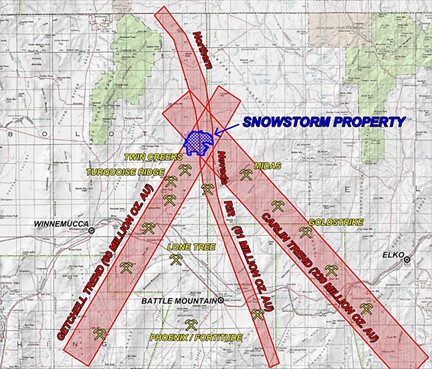
The 2020 program was designed to test MT structures in an unexplored area east of previous exploration drilling. The drilling was planned to deliver definitive data on whether the MT structures provided pathways for gold-bearing fluids. Two holes tested a shallow dipping geophysical target near multiple converging northeast and northwest trending fault zones. A third angled hole was designed to cross a northeast structure and test the same shallow dipping geophysical target. The fourth hole tested a large low resistivity anomaly, hanging wall to the shallow dipping geophysical response and into the core of an interpreted fold. Results from the four drill holes completed in 2020 provided positive outcomes in the Issuer’s search for gold-bearing fluid pathways. Two of the holes encountered intensely altered intermediate intrusive rocks sited at stratigraphic breaks. These intrusive rocks and wall rocks around the intrusions are sheared and contain abundant introduced silica with concentrations of gold, arsenic and silver. This drilling confirmed that discrete gold-bearing intervals are hosted within a similar structural setting and rocks as the Turquoise Ridge Mine.
The 2021 program was designed to off-set these previous intersections toward a structure with a topographic expression which is projected into the Paleozoic section using MT geophysical readings. The surface expression of this structure has produced a significant arsenic in soil anomaly. The initial test terminated above the target due to down hole conditions. The second hole reached the target and cut intervals of intermediate intrusive rocks between 1,301 and 1,358 meters. This interval returned gold and arsenic concentrations similar to results from the earlier drilling.
Work at Snowstorm in 2023 targeted drill testing north northeast trending structures identified in MT surveys. These features are analogous to mineralized structures in the operating mines of the area. Drilling was targeted at intersections of the structures and carbonate host rocks. Results showed significant off-set on the structures and the target stratigraphy was beyond the capabilities of the drilling equipment. Ongoing work is now focused on refining the Paleozoic stratigraphy and evaluating other geophysical surveys that can image the potential targets.
In 2024, the Issuer evaluated drill results to recommend future targeting strategies. A review of the stratigraphy indicates that structural displacement may have displaced prospective Comus formation at shallower depths than previously recognized. Several geophysical surveys have been evaluated with the goal of demonstrating folding and fluid flow within this stratigraphy.
In 2025, the Issuer conducted further evaluation of the potential for a Getchell style discovery at the Snowstorm Project by deploying AI technology and a three-dimensional ambient noise seismic tomography survey. This work yielded additional targets and 2026 work is focused on expanding the project data set with historic drill hole geochemistry and infrared survey data as a check on the potential of the AI generated targets.
The Goldstorm property consists of 134 mining claims and 1,160 leased acres (totaling approximately 3,900 acres or 15.9km2) located about 3km to the east of Seabridge’s Snowstorm Project. Goldstorm has had limited exploration to date. Previous operators identified a series of northwest trending veins that showed strong pathfinder geochemistry and highly anomalous gold results. A surface trench on one of these veins yielded 3.0 meters of 9.0 g/T gold and 44.0 g/T silver. Mountain View’s limited drill testing of this vein returned promising grades including an intersection of 2.0 meters assaying 5.50 g/T gold of which 1.0 meter graded 9.29 g/T gold and 73g/T silver.
In 2022, an initial surface exploration program was completed at Goldstorm. The program employed geological mapping, surface sampling and a short-wave infrared survey. This work provided context to previous drilling programs and identified untested structural controls with chemical and mineral characteristics indicative of Northen Nevada Rift epithermal mineral systems. No further exploration work has been completed at Goldstorm to date.
In this AIF, the following technical terms have the following meanings:
Alteration - Any change in the mineral composition of a rock brought about by physical or chemical means.
Anticline - Landform of folded strata that is convex upward and whose core contains the stratigraphically oldest rocks.
Antiform - Referring to an anticline, part of a folded sequence of rocks that have the form of an anticline
Breccia - A rock in which angular fragments are surrounded by a mass of fine-grained minerals.
Breccia Pipe - A breccia body, generally with an aspect ratio of a longer vertical dimension than the surface expression of the breccia.
Carbonate - Sediment formed by the organic or inorganic precipitation from aqueous solution of carbonates of calcium, magnesium, or iron; e.g., limestone and dolomite.
Chalcopyrite - A sulphite mineral of copper and iron.
Clastic - Fragments of minerals and rocks that have been moved individually from their places of origin.
Cut-off grade - The lowest grade of mineralized material that qualifies as reserve in a deposit, i.e.: contributing material of the lowest assay that is included in a reserve estimate.
Diatreme - A breccia filled body that formed by a gaseous explosive eruption.
Diorite - An intrusive igneous rock.
Dip - The angle that a structural surface, a bedding or fault plan, makes with the horizontal, measured perpendicular to the strike of the structure.
Disseminated - Where minerals occur as scattered particles in the rock.
Fault - A fracture or break in rock along which there has been movement.
Feasibility Study - A comprehensive technical and economic study of the selected development option for a mineral project that includes appropriately detailed assessments of applicable considerations used to convert Mineral Resources to Mineral Reserves together with any other relevant operational factors and detailed financial analysis that are necessary to demonstrate, at the time of reporting, that extraction is reasonably justified (economically mineable). The results of the study may reasonably serve as the basis for a final decision by a proponent or financial institution to proceed with, or finance, the development of the project.
Felsic - An adjective describing an igneous rock having mostly light-coloured minerals and rich in silica, potassium and sodium.
Fracture - A break or crack in rock.
Geochemistry - The study of the chemical properties of rocks.
Grade - The metal content of rock with precious metals. Grade can be expressed as troy ounces or grams per tonne of rock.
Greywacke - A dark grey, firmly indurated, course-grained sandstone that consists of poorly sorted, angular to subangular grains of quartz and feldspar, with a variety of dark rock and mineral fragments embedded.
Hydrothermal - The products or the actions of heated waters in a rock mass such as a mineral deposit precipitating from a hot solution.
Hydrothermal alteration - The process by which heated or superheated water/solutions alter the chemistry of the rocks they circulate through.
Igneous - A primary type of rock formed by the cooling of molten material.
Indicated Mineral Resource - That part of a Mineral Resource for which quantity, grade and quality, densities, shape and physical characteristics can be estimated with sufficient confidence to allow the application of Modifying Factors (the considerations used to convert Mineral Resources to Mineral Reserves) in sufficient detail to support mine planning and evaluation of the economic viability of the deposit. Geological evidence is derived from adequately detailed and reliable exploration, sampling and testing information and is sufficient to assume geological and grade or quality continuity between points of observation. An Indicated Mineral Resource has a lower level of confidence than that applying to a Measured Mineral Resource and may only be converted to a Probable Mineral Reserve.
Inferred Mineral Resource - That part of a Mineral Resource for which quantity and grade or quality are estimated on the basis of limited geological evidence and sampling. Geological evidence is sufficient to imply but not verify geological and grade or quality continuity. An Inferred Mineral Resource has a lower level of confidence than that applying to an Indicated Mineral Resource and must not be converted to a Mineral Reserve. It is reasonably expected that the majority of Inferred Mineral Resources could be upgraded to Indicated Mineral Resources with continued exploration.
Intrusion; intrusive - Molten rock that is intruded (injected) into spaces that are created by a combination of melting and displacement.
Lithocap - A surficial clay-silica-rich alteration feature formed as a product of hydrothermal fluids escaping at the top of an intrusion-related mineralizing system.
Measured Mineral Resource - That part of a Mineral Resource for which quantity, grade or quality, densities, shape, and physical characteristics are estimated with confidence sufficient to allow the application of Modifying Factors (the considerations used to convert Mineral Resources to Mineral Reserves) to support detailed mine planning and final evaluation of the economic viability of the deposit. Geological evidence is derived from detailed and reliable exploration, sampling and testing and is sufficient to confirm geological and grade or quality continuity between points of observation. A Measured Mineral Resource has a higher level of confidence than that applying to either an Indicated Mineral Resource or an Inferred Mineral Resource. It may be converted to a Proven Mineral Reserve or to a Probable Mineral Reserve.
Mineral - A naturally formed chemical element or compound having a definitive chemical composition and usually a characteristic crystal form.
Mineralization - A natural concentration in rocks or soil of one or more metalliferous minerals.
Net smelter return/NSR value - When used herein in reference to cutoff grades, NSR is calculated to determine the recoverable value of a mass of mineralized rock using prices and process recoveries for each metal accounting for all off-site losses, transportation, smelting and refining charges.
Net smelter return royalty/NSR royalty - A phrase used to describe a royalty payment made by a producer of metals based on gross metal production from the property, less deduction of certain limited costs including smelting, refining, transportation and insurance costs.
Orogenic-gold - Gold mineral system associated with a linear belt or region of folded and uplifted rocks.
Phenocryst - A term for large crystals or mineral grains floating in the matrix or groundmass of a porphyry.
Phyllite - Argillaceous rock metamorphosed to a state between slate and mica shist, metamorphosed mudstone.
Placer - A deposit of sand or gravel that contains particles of gold, ilmenite, gemstones, or other heavy minerals of value. The common types are stream gravels and beach sands.
Porphyritic - The texture of an igneous rock in which larger crystals (phenocrysts) are set in a finer-grained groundmass, which may be crystalline or glassy or both.
Porphyry - Any igneous rock in which relatively large crystals are set in a fine-grained matrix of rock.
Pre-Feasibility study or preliminary feasibility study - A comprehensive study of a range of options for the technical and economic viability of a mineral project that has advanced to a stage where a preferred mining method, in the case of underground mining, or the pit configuration, in the case of an open pit, is established and an effective method of mineral processing is determined. This study includes a financial analysis based on reasonable assumptions on the considerations used to convert Mineral Resources to Mineral Reserves and the evaluation of any other relevant factors which are sufficient for a qualified person acting reasonably, to determine if all or part of the Mineral Resource may be classified as a Mineral Reserve.
Preliminary economic assessment - A study, other than a pre-feasibility or feasibility study, that includes an economic analysis of the potential viability of mineral resources.
Pyrite - An iron sulphide mineral (FeS2), the most common naturally occurring sulphide mineral.
Quartz - Crystalline silica; often forming veins in fractures and faults within older rocks.
Reclamation - Restoration of mined land to original contour, use or condition.
Reserve or Mineral Reserve - The economically mineable part of a Measured Resource and/or Indicated Resource. It includes diluting materials and allowances for losses, which may occur when the material is mined or extracted and is defined by studies at Pre-Feasibility or Feasibility level, as appropriate that include application of the considerations used to convert Mineral Resources to Mineral Reserves. Such studies demonstrate that, at the time of reporting, extraction could reasonably be justified. The reference point at which Mineral Reserves are defined, usually the point where the ore is delivered to the processing plant, must be stated. It is important that, in all situations where the reference point is different, such as for a saleable product, a clarifying statement is included to ensure that the reader is fully informed as to what is being reported. The public disclosure of a Mineral Reserve must be demonstrated by a Pre-Feasibility Study or Feasibility Study.
Resource or Mineral Resource - A concentration or occurrence of solid material of economic interest in or on the Earth’s crust in such form, grade or quality and quantity that there are reasonable prospects for eventual economic extraction. The location, quantity, grade or quality, continuity and other geological characteristics of a Resource are known, estimated or interpreted from specific geological evidence and knowledge, including sampling.
Sedimentary - Formed by the deposition of sediment or pertaining to the process of sedimentation.
Sediments - Solid fragmental material that originates from weathering of rocks and is transported or deposited by air, water or ice, or that accumulates by other natural agents, such as chemical precipitation from solution or secretions by organisms, and that forms in layers of the Earth’s surface at ordinary temperatures in a loose, unconsolidated form; e.g., sand, gravel, silt, mud, alluvium.
Sericite - A fine-grained potassium mica found in various metamorphic rocks.
Shut-off - The NSR value at which the draw point is closed and is determined by the NSR value required to pay for mining, processing, and G&A costs.
Skarn - Ore deposit type associated with thermal metamorphism and characterized of Mg and Ca silicates with sulfide minerals.
Vein - A thin sheet-line, crosscutting body of hydrothermal mineralization, principally quartz.
Waste - Barren rock in a mine, or mineralized material that is too low in grade to be mined and milled at a profit.
Investing in the Common shares is speculative and involves a high degree of risk due to the nature of the Issuer’s business and the present stage of exploration and advancement of its mineral properties. The following risk factors, as well as risks currently unknown to the Issuer, could materially adversely affect the Issuer’s future business, operations and financial condition and could cause them to differ materially from the estimates described in forward-looking statements relating to the Issuer, or its business, property or financial results, each of which could cause investors to lose part or all of their investment. Before deciding to invest in any Common shares, investors should carefully consider the risks included herein.
Risks Related to the Issuer and its Industry
The Issuer has a history of net losses and negative cash flows from operations and expects losses and negative cash flows from operations to continue for the foreseeable future.
The Issuer has a history of net losses and negative cash flows from operations and the Issuer expects to incur net losses and negative cash flows from operations for the foreseeable future. As of December 31, 2025, the Issuer’s deficit totaled approximately $271 million. None of the Issuer’s properties has advanced to the commercial production stage and the Issuer has no history of earnings or positive cash flow from operations.
The Issuer expects to continue to incur net losses unless and until such time as one or more of its projects enters into commercial production and generates sufficient revenues to fund continuing operations or until such time as the Issuer is able to offset its expenses against the proceeds of sale of, or of retained royalties on, one or more of its projects or interests in its projects, if applicable. The development of one or more of the Issuer’s projects to achieve production will require the commitment of substantial financial resources. The amount and timing of expenditures in any year on any project will depend on a number of factors, including the availability of financing to fund expenditures, the progress of ongoing exploration and advancement, the results of consultant analysis and recommendations, and the execution of any sale or joint venture agreements with strategic partners, some of which are beyond the Issuer’s control. Therefore, the level of expenditures to be incurred in any year may differ significantly from the level of expenditures in the previous year. There is no assurance that the Issuer will be able to generate positive cash flows from operations in the future.
Although the Issuer has identified a preferred partnership candidate for the KSM Project, there is no assurance that terms of a partnership for advancing the KSM Project will be agreed.
The Issuer has identified a preferred partnership candidate for the KSM Project and is advancing discussions but, to date, has not been able to agree to the terms of a partnership with respect to the joint advancement of the KSM Project and there is no assurance that the Issuer will be successful in doing so. Given the limited number of mining companies with the resources to build and operate the KSM Project, if the Issuer is not successful in entering into an agreement with its preferred partnership candidate, there is no assurance that it will be able to locate another suitable partner within a suitable time period, or at all.
The Issuer’s ability to continue its exploration activities and any future advancement activities, and to maintain the corporate office support of these activities, will depend on its ability to obtain suitable financing, enter into joint ventures or sell property interests.
The Issuer estimates that it has financial resources to sustain corporate office operations, non-discretionary general and administrative costs and non-discretionary project costs, including contractual obligations, beyond the end of 2027. However, the Issuer has no ongoing source of revenue and requires capital to maintain title to and undertake exploration and advancement of the Issuer’s principal exploration properties and to cover ongoing corporate expenses. Accordingly, the maintenance of and ongoing exploration and advancement of the Issuer’s mineral properties is, therefore, dependent upon the Issuer’s ability to obtain financing through the sale of projects, sale of royalty or streaming interests, joint venturing of projects or equity or debt financing, including the sale of its shares over the NYSE under its “at-the-market” share offering. Such sources of financing may not be available on terms acceptable to the Issuer, or at all. Failure to obtain such financing may result in the delay or indefinite postponement of exploration and advancement work on the Issuer’s mineral properties, or the possible loss of such properties or expiry of permits relating to the development of them. Satisfying financing requirements through the sale of projects or interests in minerals produced from the projects, or the establishment of one or more joint ventures would reduce the Issuer’s gold ownership per share and have a corresponding negative impact on its ratio of ounces of gold per share.
The Issuer’s indebtedness requires quarterly interest payments and may require repayment in full, which may adversely affect its cash flow and ability to advance its business and necessitate dilutive financing or asset sales.
The Issuer has indebtedness arising from its sale of the US$225 million 2022 Note in March, 2022 and of the US$150 million 2023 Note in June, 2023. As a result of this indebtedness, the Issuer is required to make:
| ● | quarterly interest payments of approximately US$3.66 million to the holder of the 2022 Note: and |
| ● | quarterly interest payments of approximately US$2.44 million to the holder of the 2023 Note. |
The Issuer may issue Common shares or raise money in the capital markets to fund its debt service costs, both of which would be dilutive to shareholders.
Although the terms of the 2022 Note and the 2023 Note (together, the “Secured Notes”) are intended to result in all of the principal amount of the Secured Notes being used on maturity to purchase, by way of offset, royalties on metals produced from the KSM Project, in certain circumstances the holder of the Secured Notes may require the Issuer to repay the principal amount of each of the Secured Notes. One such circumstance is that, if project financing to develop, construct and place the KSM Project into commercial production (“Construction Financing”) is not in place by March 24, 2027, the holder can put the 2022 Note back to KSMCo for US$232.5 million plus accrued and unpaid interest and the holder can put the 2023 Note back to KSMCo for US$155 million plus accrued and unpaid interest (collectively, the “Financing Puts”). The other circumstance is if one of the Petitions is successful, the positive SSD is not reconfirmed and the EAC expires, the holder can put the 2022 Note back to KSMCo for US$247.5 million plus accrued and unpaid interest and the holder can put the 2023 back to KSMCo for US$165 million plus accrued and unpaid interest (collectively, the “EAC Puts”).
KSMCo has a limited right to make interest payments and to pay the amounts due on exercise of the Financing Puts or the EAC Puts (collectively, the “Puts”) by having the Issuer issue Common shares for such payments instead of paying with money. The limit on this right is that the Issuer may not pay in Common shares beyond the point at which the receiving person’s share ownership would exceed 9.9% of the outstanding Common shares. Therefore, the dollar amount KSMCo may be able to have the Issuer pay in Common shares will decrease as the Issuer’s market capitalization decreases and as the receiving person’s share ownership increases (and vice versa). To date the Issuer has been paying interest payments in Common shares with the result that, unless the person receiving the Common shares is selling them, the Common share ownership of the receiving person is increasing and the number of additional Common shares the Issuer may be able to issue to pay interest or amounts due on exercise of the Puts is decreasing. It is not possible to predict the amount of any payment due that KSMCo may be able to have the Issuer pay in Common shares but, on any given date, the amount cannot exceed 9.405% of the Issuer’s market capitalization (the number of outstanding Common shares multiplied by the share price) and will be less than that to the extent the person receiving the Common shares already owns Common shares. At the date of this AIF, 9.405% of the Issuer’s market capitalization is approximately $368 million.
Based on the Issuer’s estimates of the time it will take to complete the steps required to have Construction Financing in place, including completion of a full bankable feasibility study, the Issuer believes it is very likely that Construction Financing will not be in place by March 24, 2027. Should Construction Financing not be in place by March 24, 2027, the holder will be entitled to exercise the Financing Puts commencing on March 25, 2027. The Financing Puts expire once Construction Financing is in place. If the holder exercises the Financing Puts, the holder’s obligation and right to purchase the respective royalties under each Secured Note terminates. If the Financing Puts become exercisable, the holder is then faced with the decision of whether to:
| (a) | exercise the Financing Puts and demand payment of the respective amounts payable but lose its rights to acquire the Silver Royalty (defined below) and the Sprott NSR (defined below), or |
| (b) | to retain its rights to acquire the Silver Royalty (defined below) and the Sprott NSR (defined below). |
The risk of the holder exercising the Financing Puts is, therefore, likely to depend on the extent of the progress the Issuer has made towards getting the Construction Financing in place and the degree to which the prices of gold, copper and silver during the period the Financing Puts may be exercisable exceed the prices of those metals anticipated by the holder of the Secured Notes. Should the Financing Puts be exercised, the Issuer will have to raise the funds needed to repay these principal amounts and interest in capital markets but may also be able to satisfy a portion of the amounts due by issuing Common shares to the holder or by selling assets (including, depending on market conditions, selling a new royalty on the KSM Project). If the EAC Puts become exercisable the analysis of the decision facing the holder would be similar.
The Issuer’s indebtedness could have adverse consequences for the Issuer, including: limiting its ability to obtain additional financing for working capital, capital expenditures, exploration and development, debt service requirements, acquisitions and general corporate or other purposes; restricting the Issuer’s flexibility and discretion to operate its business; and having to raise capital to pay interest or principal at unattractive prices or in poor financial markets; limiting its ability to adjust to changing market conditions; placing the Issuer at a competitive disadvantage compared to competitors that have less debt or greater financial resources; making the Issuer vulnerable in a downturn in general economic conditions; and preventing the Issuer’s ability to make expenditures that are important to its growth and strategies.
The ability of the Issuer to meet its debt service requirements may depend on its ability to raise capital in financial markets or in other ways that it might not otherwise choose, such as reducing or delaying expenditures, selling assets, restructuring or refinancing indebtedness or seeking equity capital in poor market conditions. There can be no assurance that the Issuer will be able to raise funds sufficient to pay amounts when due or to fund any other liquidity needs. If the Issuer is unable to meet the obligations to pay interest or principal due, or fulfil its other obligations, under the Secured Notes, the holder of the Secured Notes may enforce its security for the Secured Notes. KSMCo’s obligations under the Secured Notes are secured by a charge over all of the assets of KSMCo and a limited recourse guarantee from the Issuer secured by a pledge of the shares of KSMCo. Enforcement could result in a loss or substantial reduction in the value of the KSM Project or the Issuer’s interest in the KSM Project, the principal asset of the Issuer, including under bankruptcy or receivership proceedings.
Changes in the market price of gold, copper and other metals, which in the past have fluctuated widely, affect the Issuer’s ability to finance its operations and the potential profitability of the Issuer’s projects.
The potential profitability of the Issuer’s projects depends, in large part, upon the market price of gold, copper and other metals and minerals to be produced. The market price of gold, copper and other metals is volatile and is impacted by numerous factors beyond the Issuer’s control, including:
| ● | expectations with respect to the rate of inflation; |
| ● | the relative strength of the U.S. dollar and certain other currencies; |
| ● | interest rates; |
| ● | global or regional political or economic conditions; |
| ● | supply and demand for jewelry and industrial products containing metals; |
| ● | faith in paper currencies, digital money and governments; |
| ● | costs of substitutes; |
| ● | changes in global or regional investment or consumption patterns; |
| ● | global production levels; |
| ● | speculative activities; and |
| ● | sales and purchases by central banks and other holders, speculators and producers of gold, copper and other metals in response to any of the above factors. |
There can be no assurance that the market price of gold, copper and other metals will remain at current levels or that such prices will improve. A decrease in the market price of gold and copper could adversely affect the Issuer’s ability to finance the exploration and advancement of the Issuer’s properties and to enter into joint ventures with strategic partners relating to the Issuer’s properties, which would have a material adverse effect on the Issuer’s financial condition and results of operations. As described above, the higher the prices of gold, copper and silver the less likely it is that the holder of the Secured Notes will exercise the Puts. There is no assurance that if commercial quantities of gold, copper and other metals are discovered on the Issuer’s properties, that a profitable market will exist or continue to exist for a production decision to be made or for the ultimate sale of the metals. As the Issuer has a high ratio of gold resources per Common share, fluctuations in gold prices have tended to have an even greater impact on the price of the Common shares.
The Issuer has reserves at its KSM Project but needs a joint venture partner to build and operate the KSM Project for it to be brought into production.
The Issuer does not intend to bring the KSM Project into production on its own and intends to either enter into a joint venture with an experienced operator to build and operate the Project or to sell the KSM Project. Given the size of the KSM Project and its estimated capital costs, there is a limited number of mining companies with the ability to raise the necessary capital to put the KSM Project into production and the expertise and personnel to construct and operate the KSM Project, which limits the options available to the Issuer for such a joint venture or sale. The success of any joint venture with a major mining company will be dependent on many factors, including the ability of the Issuer or its partner to attract new, capable personnel in significant numbers to advance the project, to smoothly transition the operation of the KSM Project to the new joint venture partner and to prepare a favourable feasibility study that estimates sufficient returns for the KSM Project to warrant the risks of construction and operations. Successfully achieving these is not assured. The transition to advancing the KSM Project with a JV partner will necessitate organizational change and there are challenges and risks associated with organizational change. If the Issuer is not able to successfully manage organizational change at the pace of its needs it could lead to operational inefficiencies, financial loss, litigation or employee burnout.
The commercial viability of the KSM Project is also dependent on a number of factors, including metal prices, government policy and regulation, environmental protection initiatives and relationships with Indigenous groups, which are beyond the control of the Issuer. There is no certainty that the reserves estimated at the KSM Project or the Courageous Lake Project will actually be mined or, if mined, processed and sold profitably. The Issuer has relied and will continue to rely upon consultants for advancement and operating expertise.
There is uncertainty related to unsettled rights and title of Indigenous groups, as well as settled Treaty Nation’s rights, in British Columbia, the Yukon Territory and the Northwest Territories and uncertainties relating to the process of making Canadian laws consistent with the United Nations Declaration on the Rights of Indigenous Peoples and this may create delays in project approval, interruptions in project progress and create uncertainty in respect of the Issuer’s rights.
The nature and extent of First Nations’ and Treaty Nations’ rights and title remains the subject of active debate, claims and litigation in Canada, including in British Columbia, the Yukon Territory and the Northwest Territories. In 2014, the Supreme Court of Canada recognized for the first time Aboriginal title of an Indigenous group to a specific area in British Columbia. The Provincial and federal governments are also making efforts to settle claims of Aboriginal title and rights being advanced by Indigenous groups. A recent decision of the British Columbia Supreme Court has created further uncertainty regarding privately-held rights to land that is also aboriginal title land that could have implications for outstanding privately-held mineral tenures on aboriginal title land. The likely consequence of these court decisions and government negotiations is greater involvement of, and authority for, Indigenous groups in the regulatory approval processes for exploration and mine operations and higher economic benefits payable to Indigenous groups in recognition of their rights in connection with such approvals. In some areas, it is likely to result in the loss of corporate permits and rights, or the outright ownership of resources and a joint regulatory control being established by governments and Indigenous groups.
Parts of the KSM Project lie within an area asserted to be the traditional territory of one Indigenous group and all of the KSM Project lies within an area asserted to be the traditional territory of another Indigenous group. No comprehensive treaty or land claims settlement has ever been concluded between these Indigenous groups and the relevant government(s) regarding these traditional territories. Part of the KSM Project lies within territory subject to settled treaty rights of the Nisga’a Nation. The Courageous Lake Project lies within the traditional territory of the Yellowknives Dene First Nation and no comprehensive treaty or land claims settlement has been concluded regarding this traditional territory. A part of the Courageous Lake Project lies within territory designated as a shared use area under the settled treaty rights of the Tlicho Nation. The 3 Aces Project lies within the traditional territory of the Kaska Nation, specifically the Liard and the Ross River Dene First Nations. There can be no guarantee that the unsettled nature of land claims, or uncertainties associated with settled claims, in British Columbia, the Yukon Territory and the Northwest Territories will not create risk for the Company’s title to mineral rights, delays in obtaining permits, in ultimate project approval or other unexpected interruptions in project progress, or result in additional costs to advance the Issuer’s projects.
Mine construction and commencement of mining activities is increasingly conditional on obtaining, or obtaining something close to, the support of the local Indigenous groups. Many companies have secured such support by committing to take measures to limit the adverse impact to, and ensure some of the economic benefits of the construction and mining activity will be received by, the local Indigenous groups. The Issuer has agreements of this sort with the Nisga’a Nation and the Tahltan Nation, as well as a much less comprehensive agreement with the Gitanyow Nation in respect of the KSM Project, each of which should reduce this risk. However, there can be no assurance that initial support, future on-going support, support for changes to approved development plans or other assurances can or will be secured from these or other groups at an acceptable cost or that the KSM Project or the Courageous Lake Project will proceed without such support.
In December 2019, the government of British Columbia passed Bill 41, the Declaration on Rights of Indigenous Peoples Act (“DRIPA”). DRIPA affirms the application of the United Nations Declaration on the Rights of Indigenous Peoples (“UNDRIP”) to the laws of British Columbia and commits the British Columbia government to a process of making the laws of British Columbia consistent with the UNDRIP. In June 2021, the government of Canada passed Bill C - 15, the United Nations Declaration on Rights of Indigenous Peoples Act (“Bill C - 15”). Bill C - 15 includes the same affirmation with respect to federal laws and the same commitment of the federal government in respect of federal laws. Article 32(2) of UNDRIP states that “Indigenous peoples have the right to determine and develop priorities and strategies for the development or use of their lands or territories and other resources” and requires government to consult and cooperate with indigenous peoples to obtain “their free and informed consent prior to the approval of any project affecting their lands or territories and other resources”.
In the December 5, 2025 decision in Gitxaala v. British Columbia (Chief Gold Commissioner), 2025 BCCA 430, the BC Court of Appeal decided that DRIPA incorporates UNDRIP into British Columbia law and that Indigenous groups can bring legal actions to strike down legislation inconsistent with UNDRIP. There is uncertainty regarding the details of how the laws of British Columbia and Canada will change or regarding any other consequences of the adoption of DRIPA and Bill C - 15. However, it will likely lead to a greater influence of relevant Indigenous peoples in permitting processes and decisions. It will also result in longer, more onerous and less certain permitting processes and outcomes of permitting processes, which could delay project advancement or lead to a greater number of projects not receiving required permits. Where a mine approval is sought on lands that are aboriginal title lands or are considered likely to be found to be aboriginal title lands, it may be necessary to obtain the consent of an Indigenous group to a mining project before construction can begin. It is also more likely that Indigenous groups challenge government decisions in respect of mining projects. In response to this decision the British Columbia government has expressed its intent to amend DRIPA to clarify that it does not incorporate UNDRIP into British Columbia law and to eliminate the ability of Indigenous groups from bringing legal actions to strike down legislation that is inconsistent with UNDRIP. Indigenous groups have expressed strong opposition to these changes and, if the government proceeds, it could result in protests at sites of mining projects and more strained relationships between Indigenous groups and project proponents.
One example of how these legal developments can impact mineral tenure holders is the measures taken by the British Columbia government after the 2023 lower court decision in the Gitxaala case. After the lower court decided the Mineral Tenure Act (BC) (“MTA”) was inconsistent with Article 32(2) of UNDRIP but gave the British Columbia government 18 months to amend the MTA to rectify the inconsistency, the British Columbia government made four Cabinet orders under the Environment and Land Use Act, which restricted previously authorized mineral exploration activities on Banks Island and parts of Vancouver Island (the territories of the Indigenous groups that brought the court case), although these orders indicated that the restrictions could be lifted once an agreement is made by the holders of the exploration rights with the local Indigenous groups. Although the Provincial government is indicating that it acted under special circumstances, there is a risk the same powers could be used in respect of other areas of BC where Indigenous groups have strong claims and oppose mineral exploration on their lands.
The Aboriginal land claims process in Canada has also recently resulted in some Indigenous groups taking greater roles in the administration of lands subject to the land claims. Indigenous groups may look to impose additional requirements over land they are involved in administering.
The Issuer requires further rights and permits in order to conduct current and anticipated future operations, and delays in obtaining or failure to obtain such rights and permits, or a failure to comply with the terms of any such permits that the Issuer has obtained, could adversely affect its business.
The Issuer’s current and anticipated future operations, including further exploration, development and commencement of production on its mineral properties, require approvals and permits from various governmental authorities. Obtaining or renewing governmental approvals and permits is a complex and time-consuming process. The duration and success of efforts to obtain and renew approvals and permits are contingent upon many variables not within the Issuer’s control. Shortages of personnel in various levels of government could result in delays or inefficiencies. Backlogs within permitting agencies, affected by the number of other large-scale projects currently in a more advanced stage of development, could slow down the review process and adversely affect the permitting timeline of the Issuer’s projects. Negative public and stakeholder opinions is another factor that could affect the permitting timeline and success rate. As well, the specific permitting requirements that will ultimately apply to any project are difficult to correctly assess at the exploration and development stage.
As discussed in a “Risk Factor” below, although the Issuer’s provincial EAC for its KSM Project is no longer subject to expiry, if at least one of the Petitions is successful and the SSD is quashed, the EAC for the KSM Project would again be subject to expiry and, if it expires, would result in the federal environmental assessment approval expiring as well.
Regulatory decisions authorizing actions that adversely impact or potentially adversely impact the right of Canada’s Indigenous peoples can only be made after a consultation process with the relevant Indigenous group. Under such consultation processes, Indigenous groups are contacted and their comments sought on such proposed authorizations. When Indigenous groups raise issues with proposed authorizations and permits, regulatory authorities seek to resolve them and may require the proponent to mitigate impacts or otherwise resolve the issues through modification of project design or compensation to Indigenous peoples for anticipated impacts. This consultation process can significantly slow the granting of regulatory approvals. Where firm Indigenous opposition is encountered and resolution in a manner acceptable to the Issuer is not possible, the regulatory process may stall or result in no authorization being granted. Accordingly, establishing positive relationships with Indigenous groups and ensuring they benefit from a company’s operations in their territory is very important to being able to secure regulatory approvals.
In addition, the Issuer’s future development plans may require it to obtain the necessary access rights from the private owners in order to complete the development of its projects.
Such future development plans may also require the resolution of competing third-party rights. For example, the design of the KSM Project includes building and operating the approximately 23 km MTT, of which approximately 12.5 km passes through mineral claims held by Tudor Gold Corp. and Teuton Resources Corp. (the “Treaty Creek Claims Holders”) The Issuer presently holds a Licence of Occupation covering the entire length of the MTT, which grants it rights to occupy the area through which the proposed MTT will pass. In the Issuer’s opinion, the Treaty Creek Claims Holders’ rights are addressed by the Issuer’s obligations under the management plan associated with the Licence of Occupation, to segregate and deliver to the Treaty Creek Claims Holders all earth and rock material removed from their claims during construction of the MTT.
The area of the MTT, including the area within the mineral claims of the Treaty Creek Claims Holders, is also subject to a conditional mineral reserve (the “KSM MTT Reserve”) that requires the Treaty Creek Claims Holders “not to obstruct, endanger, or interfere with, or allow any other person to obstruct, endanger or interfere with, the construction, operation or maintenance” of the MTT. The Issuer also holds a permit that authorizes it to construct the MTT portals and the first 100m of the MTT beyond the portals, including construction of the portal in the Saddle Area and the initial 100m from such portal on the mineral claims held by the Treaty Creek Claims Holders. The Issuer still requires authorization to construct the MTT beyond the initial 100m of the MTT beyond the portals and has submitted an application to obtain such authorization. The regulatory authority from which the Issuer must obtain authorization for construction of the remainder of the MTT has confirmed to the Issuer that it can authorize the construction and operation of the additional portions of the MTT not already authorized. However, it is not obligated to authorize such construction or operation. It also confirmed that when considering whether to authorize such activities it will consider both the impacts on the Treaty Creek Claims Holders and the limitations imposed on the Treaty Creek Claims Holders by the KSM MTT Reserve.
There can be no assurance that the Issuer will obtain the authorization for the construction of the additional portions of the MTT on terms acceptable to the Issuer. Further, Tudor Gold Corp. launched three legal actions (one of which has been abandoned) which include arguments that the KSM MTT Reserve should not apply to Tudor or exceeds provincial authority and seeking a judicial review of the LoO across the Treaty Project Claims issued to Seabridge for the construction and operation of the MTT. The Issuer intends to vigorously defend these claims. If Tudor Gold Corp. can demonstrate they have a commercially viable and environmentally acceptable project on their claims, management believes that the MTT route can be flexed at the appropriate time to accommodate the development and operation of a mining operation on their claims without significantly adversely affecting the operation of the KSM Project.
Permit terms and conditions can also impose restrictions on how the Issuer operates and may limit flexibility in the development of its mineral properties. Many of the Issuer’s permits are subject to renewal from time to time, and renewed permits may contain more restrictive conditions and more onerous bonding requirements than existing permits. Renewal of the Issuer’s existing permits or obtaining new permits may also be more difficult if the Issuer has not complied with its existing permits. Grants of permits, permit amendments and renewals may be subject to administrative and judicial challenges by interested parties, including Indigenous groups, which can delay or prevent receipt of needed authorizations. The EAC approves the mine development plan set forth within the 2016 PFS Plan (defined below) and provincial environmental assessment amendments will be required to proceed with the mine development plan set forth in the 2022 KSM PFS and PEA Report (defined below) and probably the mine development plan set forth in the feasibility study for the KSM Project making it subject to these processes. The permitting process can also vary by jurisdiction in terms of its complexity and likely outcomes. Accordingly, permits required for the Issuer’s operations may not be issued, maintained or renewed in a timely fashion or at all, may be issued or renewed upon conditions that restrict its ability to operate economically, or may be subsequently revoked.
There can be no assurance that all approvals, permits and rights that are required for its operations, including any for construction of mining infrastructure or the conduct of mining, will be obtainable or renewable on reasonable terms, or at all. Delays or a failure to obtain such required permits, or the expiry, revocation or failure to comply with the terms of any such permits that the Issuer has obtained, would adversely affect the Issuer’s business and result in the relevant project ceasing further advancement or operations.
The Issuer uses digital record keeping and utilizes the internet in its business activities which exposes it to cybersecurity risks.
The Issuer uses information technology systems and networks in its business, including maintaining digital records of its affairs, operating a web site and using other web-based services. The Issuer’s information systems, and those of its third-party service providers and vendors, are vulnerable to an increasing threat of continually evolving cybersecurity risks. Unauthorized parties may attempt to gain access to these systems or the Issuer’s information through fraud, deception or other malicious means targeting the Issuer or its third-party service providers or vendors.
The Issuer’s operations depend, in part, on how well the Issuer and its suppliers, protect networks, equipment, information technology (“IT”) systems and software against damage from a number of threats. The Issuer has entered into agreements with third parties for hardware, software, telecommunications, and other services in connection with its operations. The Issuer relies, in part, on SOC 2-Type II reports provided by certain suppliers as part of its vendor assurance processes and utilizes data centers designed to provide high levels of service availability in support of operational and service level requirements.
The failure of information systems or a component of information systems could, depending on the nature of any such failure, adversely impact the Issuer’s reputation and its ability to conduct operations.
Although the Issuer has not experienced any known material losses relating to cyber attacks or other data/information security breaches in the last three years, there can be no assurance that the Issuer will not incur such losses in the future. The Issuer’s risk and exposure to these matters cannot be fully mitigated because of, among other things, the evolving nature of these threats. As a result, cyber security and the continued development and enhancement of controls, processes, and practices designed to protect systems, computers, software, data, and networks from attack, damage, or unauthorized access remain a priority.
Any future significant compromise or breach of the Issuer’s data/information security, whether external or internal, or misuse of data or information, could result in additional significant costs, fines, and lawsuits, and damage to the Issuer’s reputation. In addition, as the regulatory environment related to data/information security, data collection and use, and privacy becomes increasingly rigorous, with new and constantly changing requirements applicable to the Issuer’s business, compliance with those requirements could also result in additional costs. As cyber threats continue to evolve, the Issuer may be required to expend additional resources to continue to modify or enhance protective measures or to investigate and remediate any security vulnerabilities.
The Issuer is subject to substantial government regulatory requirements, which could cause delays in advancing its projects, or a restriction or suspension of the Issuer’s operations.
The exploration and advancement activities of the Issuer and the potential for profitable operations of the Issuer’s mineral properties are affected to varying degrees by government regulations governing, among other things: the acquisition of land, royalties, taxes, financial disclosure, labour standards and practices, land use, water use, pollution control, toxic substances, environmental protection, measures to protect endangered species and critical habitats, consultation with Indigenous groups, greenhouse gas emissions (gross or net), the labour makeup of supply chains, health and safety and expropriation of property. Changes in these regulations or in their application are beyond the control of the Issuer and may adversely affect its operations, business and the potential of its projects. Failure to comply with applicable statutes and regulations may result in fines or penalties for non-compliance, an order to cease or curtail further exploration or advancement, or a reduction or elimination of the potential profitability of a project. The Issuer may be required to compensate those suffering loss or damage by reason of its exploration or development activities or operations. In addition, no assurance can be given that new rules and regulations will not be enacted that could limit or curtail operations or require the adoption of new technologies. This risk may increase following changes to government leadership or governing parties, or through increasing societal pressures.
The Issuer is subject to substantial environmental requirements which could cause a restriction or suspension of the Issuer’s operations. These requirements must be met for the Issuer to receive regulatory approvals for its operations.
In connection with its operations and properties, the Issuer is subject to extensive and changing environmental legislation, regulations and actions. The Issuer cannot predict what environmental legislation, regulations or policy will be enacted or adopted in the future or how current or future laws and regulations will be administered or interpreted. At the federal and provincial level, and increasingly with significant decision-making authority or influence by Indigenous governments, recent trends include, without limitation, an increasing number and complexity of laws and regulations relating to air, soil and water quality, mine reclamation, waste handling and disposal, tailings management, the protection of certain species and critical habitats, the preservation of certain lands, respect for Indigenous cultures, artifacts and knowledge, reduction of greenhouse gas emissions and preparing for greater climatic variability. The general trend in environmental legislation and regulation generally is toward stricter standards and more robust enforcement, and this trend is likely to continue in the future. Ongoing monitoring of operations is also common. If the Issuer’s operations result in negative effects upon the environment, government agencies will usually require the Issuer to provide remedial actions to correct the negative effects. Indigenous groups make high environmental performance a condition of their support for mining projects and failure to meet the expected standards can result in loss of reputation with Indigenous groups, remediation and greater scrutiny of ongoing operations and increased costs as well as potential liability. These laws and regulations may also limit or prohibit activities on certain lands lying within wetland areas, areas providing habitat for certain species or other protected areas. Compliance with more stringent laws and regulations, as well as the likelihood of more vigorous enforcement policies or stricter interpretation of existing laws, may necessitate significant capital outlays, which may adversely affect the Issuer’s results of operations and business, or may cause material changes or delays in the Issuer’s intended activities.
Depending upon the type and extent of its exploration, and the KSM Project’s early construction activities, the Issuer will be required to post reclamation bonds and/or assurances that the affected areas will be reclaimed. Currently, the Issuer has estimated $5.4 million as the present value of its reclamation liabilities for all of its properties, the majority of which represents the costs associated with reclamation of the Johnny Mountain Mine. As at December 31, 2025, the Issuer has deposited or otherwise posted acceptable security in the amount of $22.1 million for the benefit of the various government agencies until released or applied to reclamation costs. As the Issuer’s early construction and permitting activities advance, the amounts required to be deposited in reclamation bonds will increase. If the actual reclamation work requires funds in addition to those already deposited or posted, or if the governmental agencies increase their estimates of the cost of required reclamation work, the Issuer could be forced to pay more than what has been provided, which could have a material adverse effect on the Issuer’s financial position as3nd operations. In addition, unidentified environmental deficiencies may exist on properties of the Issuer. The discovery, and any required reclamation, of any significant additional environmental issues on one of the Issuer’s properties would likely have an adverse effect on the Issuer’s operations and financial position.
The Issuer’s KSM Project was determined to be “Substantially Started” by the BC Minister of Environment and Climate Change but that determination has been challenged
The Issuer has obtained federal and provincial environmental assessment approvals for its KSM Project. The federal approval has no time limit but the provincial approval (the EAC) expires on July 29, 2026 unless construction of the KSM Project has been “substantially started” by such date. The designation of “substantially started” results in the EAC no longer being subject to expiry. The extent of the work required to achieve this designation is not clearly defined and leaves a reasonable degree of discretion to the statutory decision-maker.
In response to its application for the designation of “substantially started” submitted on January 14, 2024, KSMCo received a positive “substantially started” determination from the BC Government for the KSM Project on July 26, 2024. This designation affirms the validity of the EAC for the life of the KSM Project.
On November 22, 2024, TSKLH filed the First Petition against the Province of British Columbia and relevant Ministries (collectively, the “Province”) seeking judicial review of the SSD by the Minister. On November 29, 2024, SCT and SEITC filed the Second Petition against the Minister and KSMCo also seeking an order quashing the SSD on the basis that the SSD was unreasonable. The two Petitions were heard together in one hearing between September 22 and October 3, 2025. For details about these legal proceedings, see “Legal Proceedings and Regulatory Actions, Challenges to MTT Authorizations and Mineral Reserve”.
For the Petitions to succeed on the basis that the SSD was unreasonable, the Petitioners have to establish that the Minister’s decision was unreasonable, not simply incorrect. The legislation leaves the Minister with a lot of discretion in making a “substantially started” determination, making the threshold of “unreasonable” even harder to meet.
The Issuer’s application for the “substantially started” designation set forth that KSMCo had completed or initiated construction of 94 of the 336 components of the KSM Project as described in its EAC and had spent $444 million on work in respect of such components. As part of the application review process, the Issuer also submitted letters from representatives of the three largest Indigenous peoples in the area of the KSM Project, the Nisga’a Lisims Government, the Tahltan Central Government and the Gitxsan Hereditary Chiefs Office, as well as the Village of Hazelton, the District of New Hazelton, the Town of Smithers, the District of Stewart, the City of Terrace and the Regional District of Kitimat-Stikine, all expressing strong support for a positive SSD. Clearly there is considerable evidence suggesting that the SSD was reasonable.
The SSD is unaffected by the Petitions and will remain in place if the Province successfully defends the SSD. Even if is the Petitioners are successful, a typical order in these circumstances would require the Province to return to its “substantially started” determination process, to expand consultation of TSKLH, to ensure procedural fairness or to reconsider the reasons for its determination, and then a fresh determination would be issued. There is a risk that, in a fresh determination, the Minister determines the KSM Project was not “substantially started”. If the SSD does not remain in place and is not reconfirmed or reissued, the EAC would not expire until July 29, 2026 and the Issuer could submit a new application for a “substantially started” determination and include in the application any additional work completed at the KSM Project not already considered in the initial application process. If the Issuer is unsuccessful in retaining or achieving its SSD by any of the processes described above as of July 29, 2026, the EAC would expire, the EAC Puts would become exercisable and advancement of the KSM Project would likely cease until a new environmental assessment approval was obtained.
Expiry of the KSM Project’s EAC will also result in the federal environmental assessment approval lapsing as well as the permits issued in reliance on the environmental assessment approvals. The environmental assessment legislation under which the KSM Project was approved has been replaced by new legislation with a more involved review process. Although the Issuer believes that the KSM Project has been responsibly designed and should satisfy the standards of current environmental laws, successfully obtaining a second environmental assessment certificate is not certain and would take several years.
The Issuer is expecting the court’s decision on the Petitions in the coming weeks.
If the Issuer fails to maintain an effective system of internal control over financial reporting in the future, it may not be able to accurately report its financial condition, results of operations, cash flows or prevent fraud.
The Issuer is subject to National Instrument 52-109 - Certification of Disclosure in Issuers’ Annual and Interim Filings of the Canadian Securities Administrators and Section 404 of the Sarbanes-Oxley Act (collectively the “ICOFR Requirements”) requiring that effective internal controls for financial reporting and disclosure controls and procedures be maintained. The Issuer is required to furnish a report by management on, among other things, the effectiveness of internal control over financial reporting. This report will include disclosure of any material weaknesses identified by management in our internal control over financial reporting. A material weakness is a deficiency, or combination of deficiencies, in internal control over financial reporting that results in more than a reasonable possibility that a material misstatement of annual or interim financial statements will not be prevented or detected on a timely basis. Any testing by the Issuer conducted in connection with the ICOFR Requirements, or any subsequent testing by our independent registered public accounting firm, may reveal deficiencies in our internal controls over financial reporting that are deemed to be material weaknesses or that may require prospective or retroactive changes to our financial statements or identify other areas for further attention or improvement. In addition, undetected material weaknesses in our internal controls over financial reporting could lead to restatements of our financial statements and require us to incur the expense of remediation. Failure to remedy any material weakness in our internal control over financial reporting, or to implement or maintain other effective control systems required of public companies, could also undermine investor confidence in the accuracy and completeness of our financial reports and adversely impact our share price and future access to the capital markets.
The figures for the Issuer’s resources, reserves and recoveries are estimates based on sample data, interpretation and assumptions and the properties may yield less mineral production or less profit under actual conditions than is currently estimated.
Unless otherwise indicated, resource figures presented in this AIF and in the Issuer’s other filings with securities regulatory authorities, press releases and other public statements that may be made from time to time are based upon small scale test results and estimates made by Issuer personnel and independent geologists. These estimates are imprecise and depend upon geologic interpretation and statistical inferences drawn from drilling and sampling analysis, which may prove to be inaccurate or unrepresentative. There can be no assurance that mineral resource or other mineralization figures will be accurate or that this mineralization could be mined or processed profitably.
Because the Issuer has not completed a feasibility study or commenced commercial production at any of its properties, resource estimates for the Issuer’s properties may require adjustments or downward revisions based upon further exploration or advancement work or actual production experience. In addition, the grade of ore ultimately mined, if any, may differ from that indicated by drilling results. There can be no assurance that recovery of minerals in small-scale tests will be duplicated in large-scale tests, under on-site conditions, or in production scale.
The resource and reserve estimates contained in this AIF have been determined based on assumed future prices, cut-off grades and capital and operating costs that may prove to be inaccurate. Substantial declines in market prices for gold and other metals or increases in costs may eliminate the potential profitability of the Issuer’s deposits, require increases in cut-off grades and result in reduced reported resources or reserves. The equipment, supplies and materials needed to construct the KSM Project infrastructure and conduct operations at the KSM Project have been subject to meaningful inflation since the 2022 PFS and will impact capital and operating costs and it is not clear if the increases in metals prices experienced over the same period will wholly offset such cost increases. Any material reductions in estimates of resources or reserves, or of the Issuer’s ability to extract these resources or reserves, could have a material adverse effect on the Issuer’s prospects and could restrict the Issuer’s ability to successfully implement its strategies for long-term growth.
Actual capital costs, operating costs, production and economic returns may differ significantly from those Seabridge has anticipated. There are no assurances future advancement activities by Seabridge, if any, will lead to a favourable feasibility study or profitable mining operations.
The Issuer has completed prefeasibility studies at each of its KSM Project and its Courageous Lake Project, but typically a company will not make a production decision until it has completed a feasibility study. Feasibility studies derive estimates of cash operating costs based upon, among other things:
| ● | anticipated tonnage, grades and metallurgical characteristics of the reserves to be mined and processed; |
| ● | anticipated recovery rates of gold and other metals from the reserves; |
| ● | cash operating costs of comparable facilities and equipment; and |
| ● | anticipated climatic conditions and environmental protection measures. |
Completing a feasibility study at each of these projects requires significant additional work and study in order to reduce the range of uncertainty associated with the study’s estimates and conclusions. Significant additional engineering design work has to be completed. Initial construction costs, cash operating costs, sustaining capital costs, production and economic returns, and other estimates contained in studies or estimates prepared by or for the Issuer in the future may differ significantly from those anticipated by the Issuer’s current studies and estimates and may even result in delays or cancellation of project advancement. There is no certainty that a feasibility study in respect of the KSM Project or the Courageous Lake Project will be completed or, if completed, that it will result in sufficiently favourable estimates of the economic viability of such projects to justify a construction decision. The Issuer has relied and will continue to rely upon consultants for advancement and operating expertise.
There can be no assurance that, if it starts production at one or more of its projects, the Issuer’s actual construction and operating costs will not be higher than currently anticipated. None of the Issuer’s mineral properties have an operating history upon which the Issuer can base estimates of future operating costs.
The Issuer has commenced construction of the initial infrastructure at the KSM Project and, therefore, will be subject to all of the risks and costs associated with construction and maintenance.
Development of the KSM Project requires the Issuer to achieve “substantially started” by July 29, 2026 by way of the construction of infrastructure, including access roads, bridges, site clearing and grading, camp facilities, fish habitat and powerlines. As a result, the Issuer has and will continue to be subject to all of the risks associated with the construction and maintenance of this infrastructure, including:
| ● | the timing and cost of the construction and maintenance of these facilities; |
| ● | the availability and cost of skilled labour, equipment and principal supplies needed for such activities at the times required; |
| ● | greater risks of workplace injuries and associated liabilities; |
| ● | the need to obtain necessary environmental and other governmental approvals and permits and the timing of the receipt of those approvals and permits; |
| ● | the need to meet the conditions of its permits and approvals, in particular the need to establish sufficient environmental controls in order to satisfy the environmental conditions required by its permits; |
| ● | the risk of unforeseen site conditions arising from limits in the data obtained in advance of the construction activity; |
| ● | the availability of funds to finance construction and maintenance activities and for reclamation bonding; |
| ● | potential opposition from non-governmental organizations, Indigenous groups, environmental groups, local groups or other stakeholders which may delay or prevent construction activities; and |
| ● | potential increases in construction and maintenance costs due to changes in the cost of labour, fuel, power, materials and supplies. |
The costs, timing and complexities of the construction and maintenance activities at the KSM Project may be greater than anticipated because the majority of such property interests are not located in developed areas, and, as a result, lack road access and power supply and other support infrastructure. Cost estimates may increase as more detailed engineering work is completed on proposed construction work. It is common in construction in remote areas to experience unexpected costs, problems and delays during construction. Management of contractors and their contracts has also significantly increased and insufficient oversight could lead to cost overruns, schedule delays and litigation.
The Issuer has no history of commercially producing precious or base metals from its mineral exploration properties and there can be no assurance that it will successfully establish mining operations or profitably produce precious metals.
The Issuer has no history of commercially producing precious metals from its current portfolio of mineral exploration properties and the Issuer has no ongoing mining operations. Mineral exploration and advancement involves a high degree of risk and few properties that are explored are ultimately developed into producing mines. The Issuer has not decided to construct a mine at any of its projects to date. The future advancement of properties estimated to be economically feasible will require obtaining permits and financing and the construction and operation of mines, processing plants and related infrastructure. Although the Issuer has disclosed that it will not undertake production activities by itself, it may be involved in construction and production at one or more of its properties if it enters into a joint venture or other arrangement with a third party regarding production. In addition, as part of continuing to advance its KSM Project pending completion of a sale or joint venture of the KSM Project, the Issuer undertook activities in 2021 -2025 associated with data collection for a feasibility study and initiated early construction activities to establish site access, camps and construction power supply.
Seabridge may be subject to all of the risks associated with establishing new mining operations and business enterprises, including:
| ● | timing and cost, which can be considerable, of the construction of mining and processing facilities; |
| ● | availability and costs of skilled labour and mining equipment; |
| ● | availability and cost of appropriate smelting and/or refining arrangements; |
| ● | need to obtain necessary environmental and other governmental approvals and permits, and the timing of those approvals and permits; |
| ● | the need to meet the conditions of its permits and approvals, in particular the need to establish sufficient environmental controls in order to satisfy the environmental conditions required by its permits; |
| ● | availability of funds to finance construction and advancement activities as well as reclamation bonding; |
| ● | management of a dramatically increased workforce and co-ordination of contractors; |
| ● | potential opposition from non-governmental organizations, environmental groups, Indigenous groups or local groups and third-party rights holders which may delay or prevent advancement activities; |
| ● | potential increases in construction and operating costs due to changes in the cost of labour, fuel, power, materials and supplies and foreign exchange rates; and |
| ● | greater exposure to climate-related risks associated with natural disasters such as wildfires, avalanches, mudslides and flooding. |
The costs, timing and complexities of mine construction and advancement are increased by the remote location of the Issuer’s mining properties. It is common in new mining operations to experience unexpected problems and delays during advancement, construction and mine start-up. In addition, delays in the commencement of mineral production often occur. Accordingly, there are no assurances that, if the Issuer decides to be involved in construction or mining activities, the Issuer will successfully establish mining operations or profitably produce precious or base metals at any of its properties.
The Issuer may be adversely affected by future fluctuations of foreign exchange rates.
The potential profitability of the Issuer is exposed to the financial risk related to the fluctuation of foreign exchange rates. The minerals that could be produced from the Issuer’s projects are priced in U.S. dollars but, since the Issuer’s principal projects are located in Canada, a significant percentage of its estimated expenditures will be in Canadian dollars. A significant change in the currency exchange rates between the Canadian dollar relative to the U.S. dollar will have an effect on the potential profitability of the Issuer’s projects and therefore its ability to continue to finance its operations. If the actual Canadian dollar to U.S. dollar exchange rate is less than or more than the exchange rate used in the preliminary feasibility studies summarized in this AIF, the profitability of the projects will be more than or less than that estimated (assuming the other assumptions are realized). Accordingly, the Issuer’s prospects may suffer due to adverse currency fluctuations.
The Issuer’s activities and proposed business are inherently dangerous and contain significant risks that could negatively impact the Issuer for which insurance may be unavailable, only partially available or only available at unacceptable cost.
The Issuer’s exploration and advancement of its mineral properties involves a number of risks and hazards. In addition, the business of mining is subject to various risks and hazards including:
| ● | environmental hazards; |
| ● | industrial accidents; |
| ● | metallurgical and other processing problems; |
| ● | unusual or unexpected rock formations; |
| ● | rock bursts; |
| ● | structural failures, cave-ins or slides; |
| ● | flooding; |
| ● | fires; |
| ● | earthquakes, avalanches or landslides; |
| ● | metals losses; and |
| ● | periodic interruptions due to inclement or hazardous weather conditions. |
These risks could result in damage to, or destruction of, mineral properties, plant and equipment, personal injury or death, environmental damage, delays in mining, monetary losses and possible legal liability.
The Issuer currently maintains insurance against risks relating to its exploration and advancement activities in an amount which it believes to be reasonable. If the Issuer commences mining activities with a partner, it will be subject to mining risks, including those listed above. The Issuer anticipates that it will obtain the insurance it believes is reasonable for any mining activities it undertakes; however, such insurance contains exclusions and limitations on coverage and insurance for all risks is not likely available or may only be available at an unacceptable cost. There can be no assurance that the insurance the Issuer desires will continue to be available, will be available at economically acceptable premiums or will be adequate to cover any resulting liability. The Issuer might also be subject to liability for environmental damage or other hazards which may be uninsurable or for which it may elect not to insure because of premium costs or commercial impracticality. The payment of such liabilities would reduce funds available for the acquisition of mineral properties or exploration and advancement and would have a negative effect on the Issuer’s ability to generate revenues, profits and cash flows.
Title to the Issuer’s mineral properties cannot be guaranteed and may be subject to prior unregistered agreements, transfers or claims and other defects.
The Issuer cannot guarantee that title to its properties will not be challenged. Title insurance is not available for mineral properties in Canada and the Issuer’s ability to ensure that it has obtained a secure claim to individual mineral properties or mining leases may be severely constrained. The Issuer’s mineral properties may be subject to prior unregistered agreements, transfers or claims, and title may be affected by, among other things, undetected defects. To date, the Issuer has only done a preliminary legal survey of the boundaries of its properties and has not obtained formal title reports on any of its properties and, therefore, in accordance with the laws of the jurisdictions in which these properties are situated, their existence and area could be in doubt. If title is challenged, the Issuer will have to defend its ownership through the courts. A successful challenge to the precise area and location of these claims could result in the Issuer being unable to operate on its properties or being unable to enforce its right with respect to its properties.
Periods of high metal prices encourage increased mining exploration, advancement and construction activity, which results in increased demand for, and cost of, exploration, advancement, construction and operating services and equipment.
During periods of relative strength of metal prices, as we saw over several years before 2013 and in 2025, increases in mining exploration, advancement and construction activities occur around the world, which results in increased demand for, and cost of, exploration, advancement, construction and operating personnel, services and equipment. While market conditions between 2013 and 2022 had a moderating effect on the costs of such services and equipment, increases in such costs have occurred with the recent increases in metal prices. In addition to forces in the metals markets, inflation has emerged in goods and labour costs from supply chain disruptions caused by the COVID-19 pandemic and more recently the measures being taken in response to the Russian invasion of Ukraine and conflicts in the Middle East and the duration of these impacts is uncertain. Increased demand for services and equipment could result in delays if services or equipment cannot be obtained by the Issuer in a timely manner due to inadequate availability and may cause scheduling difficulties due to the need to coordinate the availability of services or equipment, any of which could materially increase project exploration, advancement and/or construction costs. Persistent inflation will also increase operating costs and impact the cost of construction and the profitability of mining operations.
There is no assurance that the Issuer's proposed spin-out of the Courageous Lake Project will be completed on the terms proposed, or at all.
The Issuer's proposed spin-out of the Courageous Lake Project is subject to the satisfaction or waiver of a number of conditions, and it is possible that such conditions may prevent, delay or otherwise materially adversely affect the completion of the spin-out. These conditions include approvals and authorizations by holders of Seabridge Common shares, the Supreme Court of British Columbia, the TSX and the OTCQB Venture Market (USA). The Issuer cannot provide any assurance that all required consents and approvals will be obtained or that all closing conditions will be otherwise be satisfied. A failure to complete the spin-out would cause the holders of Seabridge Common shares not to realize the benefits that the Issuer expects to achieve if the spin-out is successfully completed.
Increased competition could adversely affect the Issuer’s ability to acquire suitable properties for mineral exploration and to attract skilled talent in the future.
The mining industry is intensely competitive. Significant competition exists for the acquisition of properties producing or capable of producing gold or other metals. The Issuer may be at a competitive disadvantage in acquiring additional mining properties because it must compete with other companies, many of which have greater financial resources, operational experience and technical capabilities than the Issuer. Competition for exploration properties is currently only moderate but, as metals prices have increased, competition has begun to intensify. Increased competition could adversely affect the Issuer’s ability to acquire suitable properties for mineral exploration in the future.
Significant competition also exists for skilled talent. The Issuer may be at a competitive disadvantage in attracting skilled talent because it must compete with other companies, many of which have long records of net cash flows and appear to offer more stable employment than the Issuer. Similarly, uncertainty about securing a joint venture partner to advance the KSM Project may make employment with the Issuer less appealing. The Issuer works to make its work environment appealing to potential employees.
International trade disputes, including the imposition of new tariffs, can have adverse consequences on the capital markets and global supply chains and could adversely impact the Issuer’s ability to raise funds and source the supplies the Issuer relies on to perform its planned work programs or, if available, the cost of such supplies could increase significantly, impairing the Issuer’s ability to complete work programs.
International trade policy of the United States of America has been using tariffs on imports as a tool, which has resulted in some retaliatory tariffs and realignment of supply chains. The impacts of tariffs and supply chain disruptions on the Issuer’s business are difficult to predict at this time. The Issuer does not export products to the USA and would not be directly impacted by the imposition of new tariffs on goods imported into the USA. However, the economic impact of tariffs or a broader trade war on the Canadian economy, the US economy and the global economy could negatively impact capital markets and the Issuer’s ability to raise funds to undertake its work programs. Adverse impacts on global supply chains could make supplies required by the Issuer for exploration programs or early construction work at the KSM Project harder to obtain or unavailable. Canadian tariffs or scarcity in the global supply chain would likely increase the cost of supplies required by the Issuer that are available, which could impair the Issuer’s ability to undertake all of the work it plans to perform. The Issuer has some flexibility to adjust the timing, scale of, or even cancel, many of its work programs in response to increasing costs or unavailability of supplies. The indirect effects of tariffs imposed by the USA or by both countries are difficult to assess, but the potential for tariffs creates some risk to the Issuer’s ability to fulfill some of its key objectives.
Future regulatory efforts and societal pressure to control and reduce carbon dioxide emissions and achieve net neutral status could increase costs such that proposed projects may no longer be sufficiently profitable to construct or are unprofitable.
Up to the beginning of 2025 there was increasing emphasis on carbon regulation and taxation. In British Columbia, the government has enacted a carbon tax with steadily increasing tax rates going forward. In Canada, the federal government has imposed an industrial carbon tax in provinces where no provincial carbon tax is in place. These taxes not only adversely impact the Issuer’s costs of operations but add costs all along its supply chain, with adverse impacts on costs of operations and an increased need to raise funds. Although it has recently abated, there has also been pressure on industry from investors to reduce carbon emissions and set goals to achieve net neutral carbon emissions over time in order to be seen as a preferred investment. Despite some relaxation of the measures that were implemented, attention to these issues could resume. If it does, the Issuer’s ability to secure regulatory approvals and financing may depend upon its carbon footprint and its costs of operations would be adversely impacted through taxation.
The Issuer has been revising its development plans, with co-operation from BC Hydro, in order to build and operate its KSM Project with as great a percentage of hydro-electric generated power as possible, in order to substantially reduce its carbon footprint.
Reporting requirements on companies in respect of carbon emissions and impacts on nature have continued to be consolidated so that disclosure becomes more reliable and comparable although the timing of their implementation is uncertain. It continues to be possible that new regulatory requirements will be adopted to limit these emissions or environmental impacts, which might have an adverse impact on the Issuer’s ability to carry on its business or require significant new capital investment and increase its costs of operations. The introduction and enforcement of any such requirements are beyond the Issuer’s control. The Issuer’s properties are located in remote areas, typically without proximate connection to electric power transmission lines, and technical solutions to meeting new and onerous regulatory requirements may not be feasible. Strict requirements on remote operations could severely impair the Issuer’s ability to carry on its business.
Other new regulatory measures or public/investor pressure aimed at the reduction of carbon emissions or more generally at reducing other impacts of exploration or mining activity on climate or nature, including mandating the use of new or costly technologies, at its projects could result in increased operating costs or ultimately in eliminating the viability of its operations. The Issuer has little or no ability to control the adoption of such measures or public expectations.
The Issuer’s current and proposed operations are subject to risks relating to climate change and nature loss which may adversely impact its ability to conduct operations and increase its operating costs and may delay execution or reduce the profitability of a future mining operation.
The potential impacts of climate change and nature changes on the Issuer’s operations are highly uncertain and are particular to the geographic areas in which its projects are located.
The Issuer’s projects are located in remote areas exposing it to the physical risks of climate change, including unexpected or extreme weather events or prolonged climatic conditions. Climate changes that could impact the Issuer’s business include changes in temperatures, rainfall or snowfall, glacier size, permafrost conditions, storm patterns and intensities, water management, wildfires, avalanches, landslides, and the presence of endangered species or invasive species. Most of its exploration projects are located in remote areas of northern Canada, with some of the exploration work at the Iskut and KSM Projects being conducted at high altitude and all of it by helicopter access only. The Issuer is very conscious of these heightened risks faced by its personnel in the field and all of these factors make the safety of the Issuer’s personnel paramount in its operations. Longer winters and deeper snowpacks can reduce the operating season for exploration and extreme weather can restrict access and the ability to operate during the exploration season. Hotter, drier weather can increase the risk of droughts and wildfires. This can impact the Issuer’s ability to conduct exploration work, access its projects, progress its objectives, and attract and retain personnel (that may be needed instead to address emergencies). All of these factors have elevated the ranking of climate related risks in the Issuer’s risk management efforts.
Global climatic conditions can also impact the availability of insurance which could have a negative effect on the Issuer’s financial condition and risk exposure.
The Issuer has taken into account the potential for weather events outside of recent historic ranges in the design of its proposed KSM Project. Design details of the KSM Project include dams with excess freeboard, onsite water management through tunnels and considerable redundancy in systems in order to be prepared for the detrimental effects of climate change. However, events or conditions could exceed the ability of the project designs to handle them and disrupt mining and transport operations, impact exploration and development plans, mineral processing and rehabilitation efforts, and could damage public infrastructure, project property or equipment, and increase health and safety risks on site. Emergency plans for managing extreme weather conditions may not be sufficient. Environmental damage caused by the insufficiency of the Issuer’s plans to manage these risks have the potential to damage the Issuer’s reputation within local communities, with regulators and among investors. Significant capital investment may also be required to address these occurrences and to adapt to changes in average operating conditions caused by these changes to the climate and nature and impact the viability of the Issuer’s business.
Extreme weather events locally and globally also have the potential to disrupt supply chains, resulting in uncertain lead times and difficulties in sourcing supplies, materials, equipment and personnel required to operate at projects. Although measures can be taken to prepare for such extreme events, the impacts of them on supply chains are difficult to predict and the measures taken could be inadequate and extended disruptions could have adverse effects on the Issuer’s operations and financial condition.
Changes in climate change or nature-related regulatory regimes could adversely affect the Issuer’s business
Increased governmental regulation, including monitoring and financial disclosure requirements, relating to climate change and nature may increase the cost and complexity of compliance and may result in fines or penalties for non-compliance. New legislation and increased regulation may also cause reduced availability or higher prices for goods and services, which could result in higher costs or supply chain disruptions. The Issuer monitors the evolving regulatory landscape and engages its local legal counsel to provide updates on regulatory developments. The Issuer is also working with external consultants towards implementing recommendations of the TCFD and TNFD to assess and disclose climate resilience and work toward implementing the Canadian Sustainability Standards Board reporting aligned with IFRS. The Issuer’s Senior Executives and Board each participates in an annual workshop focused on assessing longer term risks associated with climate change and regulatory initiatives directed at climate change and guides the group on developing plans for mitigating these risks. Even after completing this undertaking, the Issuer cannot be certain that it will have adequately assessed the risks of climate change or nature-related regulatory regimes on its business or that its efforts to mitigate these risks will be adequate or effective.
The Issuer has a dependence upon key management employees, the absence of which would have a negative effect on the Issuer’s operations.
The Issuer strongly depends on the business and technical expertise of its management and key personnel, in particular Rudi Fronk, Chair and Chief Executive Officer. There is little possibility that this dependence will decrease in the near term. The Issuer routinely engages in succession planning with respect to its senior officers with the aim of achieving orderly transition when key personnel depart. However, as a company with no revenue, the Issuer tries to balance succession needs with maintaining a lean executive team. If the Issuer’s operations expand, additional general management resources will be required. The Issuer may not be able to attract and retain additional qualified personnel and this would have a negative effect on the Issuer’s operations. The Issuer does not consistently enter into any formal services agreements between itself and its officers or directors. The Issuer does not carry any “key man” life insurance.
The public’s views of the mining industry can present increased risks for permitting, financing and staffing.
The public’s view of the mining industry can be indifferent or negative and the public’s views might be negatively influenced by the efforts of environmental groups or by the difficulty of meeting climate change-related expectations by an energy-intensive extractive industry with projects typically in remote locations. Negative public opinion towards mining projects results in greater challenges and delays in obtaining regulatory permits and authorizations, may increase the risk of legal actions, and may reduce the availability of investment capital for companies in the mining industry, including the Issuer. Negative public opinion towards the mining industry also can influence career selection and adversely impact the availability of qualified employees for the mining industry. The Issuer works at developing a positive image in the communities in which it operates in order to promote more favourable views of it as a company and the mining industry generally, including sourcing materials, employees and contractors locally, supporting local community initiatives and funding education for local citizens. See “Sustainability (Environmental, Social, and Governance Matters) - Social Responsibility”.
Certain of the Issuer’s directors and officers serve in similar positions with other natural resource companies, which may put them in conflict of interest positions from time to time.
Certain of the directors and officers of the Issuer are also directors, officers or shareholders of other natural resource or mining-related companies. Such associations may give rise to conflicts of interest from time to time. The directors of the Issuer are required by law to act honestly and in good faith with a view to the best interests of the Issuer and to disclose any interest that they may have in any project or opportunity of the Issuer. If a conflict of interest arises in a matter to be discussed at a meeting of the board of directors, any director in a conflict must disclose his interest and abstain from voting on such matter. In determining whether or not the Issuer will participate in any project or opportunity, the directors will primarily consider the degree of risk to which the Issuer may be exposed and its financial position at the time.
The Issuer has spent the proceeds of the issuance of flow-through shares on expenditures it believes to be Canadian exploration expenses (“CEE”) and renounced such expenditures to investors in flow-through shares, but the CRA has reduced the amounts of CEE renounced and reassessed investors. The Issuer is challenging the CRA’s conclusions but there is a risk the Issuer may not be successful in challenging the CRA’s decision, thus having an adverse impact on the Issuer’s balance sheet.
The Issuer has funded certain of its exploration activities, from time-to-time, with the proceeds of issuance of flow-through shares. The Issuer records and reports as CEE those expenditures which are required to determine “the existence, location, extent, or quality of a mineral resource” (applicable wording of the definition of CEE in the Income Tax Act), and renounces those amounts to investors to fulfill the Issuer’s commitments made at the time of the issuance of the flow-through shares. Whether certain expenditures qualify as CEE and are therefore eligible for renunciation by the Issuer was audited by the CRA for the three years ended December 31, 2016. The CRA reduced the amount of expenditures renounced as CEE by the Issuer in those years by approximately $19.1 million (the "2014-2016 Reassessments"). The Issuer believes the CRA’s interpretation of the applicable legislation is inconsistent with previous audits and unjustifiably narrows the scope of eligible CEE as defined in the applicable legislation and has appealed the 2014-2016 Reassessments.
The Issuer previously challenged CRA’s reduction of expenditures it incurred in 2010 and 2011 on the basis that such expenditures were valid CEE for the purposes of the BC Mineral Exploration Tax Credits ("BC METC"). The BC Supreme Court issued its decision (the “BC METC Decision”) in respect of the 2010 and 2011 expenditures on March 26, 2025 and allowed the Issuer’s appeal (with the exception of certain claimed expenses of an administrative nature). In its ruling the court concluded that almost all of the disallowed expenses are captured under the “quality” term of the definition of CEE and are therefore valid and, as a result, approximately $4.4 million was returned to the Issuer from the CRA. The Issuer is using the BC METC Decision to seek a reversal of CRA’s reduction of renounced CEE in respect of comparable expenditures at issue in the 2014-2016 Reassessments and is awaiting the CRA’s position in respect of the BC METC Decision.
The Issuer has been made aware that, as a result of the 2014-2016 Reassessments, the CRA has reassessed certain investors who subscribed for flow-through shares in 2013, 2014 and 2015 and may reassess other investors with reduced CEE deductions. Notice of objections to the Issuer’s and investors’ reassessments have and will be filed as received and will be appealed to the courts should the notices of objection be denied. The Issuer has indemnified the investors that subscribed for the flow-through shares and that have been reassessed by depositing the amount of their reassessments, including interest charges, into the accounts of the reassessed investors with the Receiver General in return for such investors’ agreement to object to their respective reassessments and to repay the Issuer any refund of the amount deposited on their behalf upon resolution of the Issuer’s appeal. To date, the Issuer has deposited $9.4 million with the Receiver General on behalf of such investors. It is possible that additional investors may be reassessed, but because three years have passed since the last reassessment, the likelihood has decreased significantly. The Issuer estimates the additional amount it may agree to deposit with the Receiver General on behalf of reassessed investors will not exceed $5.2 million (including potential interest charges of $2 million). If the BC METC Decision is applied to the 2014-2016 Reassessments the Issuer expects it will ultimately prevail on the merits and also lead to the reassessed investors succeeding with their objections. If the BC METC Decision is considered inapplicable to these expenditures and CRA's position substantially prevails, it would have an adverse impact on future earnings and financial resources of the Issuer.
Risks Related to the Common Shares
The market for the Common shares has been subject to volume and price volatility which could negatively affect a shareholder’s ability to buy or sell the Common shares.
The market for the Common shares may be highly volatile for reasons both related to the performance of the Issuer or events pertaining to the industry (i.e., mineral price fluctuation, high production costs) as well as factors unrelated to the Issuer or its industry. In particular, the price for gold, which was over US$1,900 per ounce in 2011, was below US$1,100 per ounce at the beginning of 2016, rose to over US$2,060 in August 2020 and again in March 2022, traded below $1,630 in October, 2022 and presently trades at over US$4,000/oz. In addition, market demand for products incorporating minerals fluctuates from one business cycle to the next, resulting in a change of demand for the relevant mineral and a corresponding change in the price for the mineral. The Common shares can be expected to be subject to volatility in both price and volume arising from market expectations, announcements and press releases regarding the Issuer’s business, and changes in estimates and evaluations by securities analysts or other events or factors. In some years the securities markets in the United States and Canada have experienced a high level of price and volume volatility, and the market price of securities of many companies, particularly small-capitalization companies such as the Issuer, have experienced wide fluctuations that have not necessarily been related to the operations, performances, underlying asset values or prospects of such companies. For these reasons, the Common shares can also be expected to be subject to volatility resulting from market forces over which the Issuer will have no control. Further, despite the existence of markets for trading the Common shares in Canada and the United States, shareholders of the Issuer may be unable to sell significant quantities of Common shares in the public trading markets without a significant reduction in the price of the shares.
The Common shares are publicly traded and are subject to various factors that have historically made the Common share price volatile.
The market price of the Common shares has been, and may continue to be, subject to large fluctuations, which may result in losses to investors. The market price of the Common shares may increase or decrease in response to a number of events and factors, including: the Issuer’s operating performance and the performance of competitors and other similar companies; volatility in metal prices; the public’s reaction to the Issuer’s press releases, material change reports, other public announcements and the Issuer’s filings with the various securities regulatory authorities; changes in recommendations or price targets by research analysts who track the Common shares or the shares of other companies in the resource sector; changes in general economic and/or political conditions; the number of Common shares to be publicly traded after an offering of Common shares; the arrival or departure of key personnel; acquisitions, strategic alliances or joint ventures involving the Issuer or its competitors; and the factors listed under the heading “Cautionary Statement Regarding Forward-Looking Information and Statements”. The Issuer has a high number of gold resource ounces per outstanding share relative to its competitors, which may lead to greater price fluctuations in the price of the Issuer’s Common shares relative to its competitors when the price of gold fluctuates.
The market price of the Common shares is affected by many other variables that are not directly related to the Issuer’s success and are, therefore, not within its control, including other developments that affect the market for all resource sector securities, the breadth of the public market for the Common shares and the attractiveness of alternative investments. The effect of these and other factors on the market price of the Common shares on the exchanges on which they trade has historically made the trading price of the Common shares volatile and suggests that the trading price of the Common shares will continue to be volatile in the future.
The Issuer has never declared or paid any dividends on the Common shares.
The Issuer has never declared or paid any dividends on the Common shares. The Issuer intends to retain earnings, if any, to finance the growth and advancement of the business and does not intend to pay cash dividends on the Common shares in the foreseeable future. Any return on an investment in the Common shares will come from the appreciation, if any, in their value. The payment of future cash dividends, if any, will be reviewed periodically by the Issuer’s Board of Directors and will depend upon, among other things, conditions then existing including earnings, financial conditions and capital requirements, restrictions in financing agreements, business opportunities and conditions, and other factors. See “Dividend Policy.”
Shareholders’ interest may be diluted in the future.
The Issuer requires additional funds for exploration and advancement programs or potential acquisitions. If it raises additional funding by issuing additional equity securities or other securities that are convertible into equity securities, such financings may substantially dilute the interests of existing or future shareholders. Sales or issuances of a substantial number of securities, or the perception that such sales could occur, may adversely affect the prevailing market price for the Common shares. With any additional sale or issuance of equity securities, investors will suffer dilution of their voting power and may experience dilution in ownership of the Issuer’s assets.
The Issuer believes it was a passive foreign investment company in 2025 which could have negative consequences for U.S. investors.
U.S. holders of our Common shares should be aware that we believe that for U.S. federal income tax purposes we were classified as a passive foreign investment company (“PFIC”) during the tax year ended December 31, 2025 and, based upon current business plans and financial expectations, we expect to be classified as a PFIC for the tax year ending December 31, 2026. Assuming the Issuer is a PFIC, then owners of the Common shares who are U.S. taxpayers generally will be required to treat any “excess distribution” received on their Common shares, or any gain realized upon a disposition of Common shares, as ordinary income and to pay an interest charge on a portion of such distribution or gain, unless the taxpayer makes a qualified electing fund (“QEF”) election or a mark-to-market election with respect to the Common shares. A U.S. taxpayer who makes a QEF election generally must report on a current basis its share of the Issuer’s net capital gain and ordinary earnings for any year in which the Issuer is classified as a PFIC, whether or not the Issuer distributes any amounts to its shareholders. U.S. investors should consult with their tax advisors for advice as to the U.S. tax consequences of an investment in the Common shares. For each tax year that we are a PFIC, we will make available the PFIC annual information statement as provided pursuant to Treasury Regulation Section 1.1295-1(g) on our website.
The Issuer operates in the mining industry, which tends to be opposed by pro-environmental groups and, with the increasing public concern about the environment, these groups may be able to negatively impact the investing public’s interest in owning mining industry stocks or investment in particular companies.
The Issuer is focused on the exploration and advancement of mineral properties and various environmental groups that seek to preserve nature and reduce carbon emissions typically oppose mining everywhere and often campaign aggressively against specific mining projects. The Issuer’s projects are located in areas where pro-environmental opposition to mining occurs. If the efforts of these groups are successful it could negatively impact share prices in the industry generally and, particularly if projects of the Issuer become the focus of an anti-mining campaign, it could negatively impact the Issuer’s share price.
The Issuer has not paid any dividends since incorporation. Payment of dividends in the future is dependent upon the earnings and financial condition of the Issuer and other factors which the directors may deem appropriate at the time. However, the Issuer is not limited in any way in its ability to pay dividends on its Common shares other than to comply with solvency tests that apply to it under its governing corporate legislation.
ITEM 6: GENERAL DESCRIPTION OF CAPITAL STRUCTURE
The Issuer is authorized to issue an unlimited number of Common shares without par value and an unlimited number of Preferred shares, issuable in series, of which at the date of this AIF, 107,373,183 Common shares were issued and outstanding and no Preferred shares were issued and outstanding.
The holders of the Common shares are entitled to receive notice of and to attend the vote at all meetings of the shareholders of the Issuer and each Common share confers the right to one vote in person or by proxy at all meetings of the shareholders of the Issuer. The holders of the Common shares, subject to the prior rights, if any, of the holders of any other class of shares of the Issuer, are entitled to receive such dividends in any financial year as the Board of Directors of the Issuer may by resolution determine. In the event of the liquidation, dissolution or winding-up of the Issuer, whether voluntary or involuntary, the holder of the Common shares are entitled to receive, subject to the prior rights, if any, of the holders of any other class of shares of the Issuer, the remaining property and assets of the Issuer.
The directors of the Issuer are authorized to create series of Preferred shares in such number and having such rights and restrictions with respect to dividends, rights of redemption, conversion or repurchase and voting rights as may be determined by the directors and shall have priority over the Common shares to the property and assets of the Issuer in the event of liquidation, dissolution or winding-up of the Issuer.
The 2022 Note
In March, 2022, KSMCo sold a US$225 million secured note (the “2022 Note”) and Seabridge sold concurrently a Contingent Right, to Sprott Private Resource Streaming and Royalty (B) Corp. (“Sprott”) for US$225 million (approximately C$285 million at the exchange rate at the time). Ontario Teachers Pension Plan was a significant investor in the 2022 Note through Sprott. Unless redeemed by Sprott at an earlier date under to the terms of the 2022 Note, upon repayment of the principal due under the 2022 Note at maturity Sprott is obligated to use the principal to purchase a 60% gross silver royalty (the “Silver Royalty”) on the KSM Project. The proceeds of sale of the 2022 Note were used by KSMCo to advance physical works at the KSM Project to achieve the KSM Project’s designation of “substantially started”.
The principal terms of the 2022 Note and gross silver royalty include:
| (a) | The 2022 Note matures on the date (the “Maturity Date”) that is the first to occur of: |
| (i) | commercial production being achieved at the KSM Project; and |
| (ii) | either March 24, 2032, or, if the environmental assessment certificate (“EAC”) expires and Sprott does not exercise its right to put the 2022 Note to KSMCo (described below), March 24, 2035. |
| (b) | Prior to the Maturity Date, the 2022 Note bears interest at 6.5% per annum, payable quarterly in arrears. KSMCo can elect to satisfy interest payments in cash or by having the Issuer issue Common shares of equivalent value under the Contingent Right. |
| (c) | KSMCo has the option to buy back 50% of the Silver Royalty, once purchased by Sprott, on or before 3 years after commercial production has been achieved, for an amount that provides Sprott a minimum guaranteed annualized return. |
| (d) | If project financing to develop, construct and place the KSM Project into commercial production is not in place by March 24, 2027, Sprott can put the 2022 Note back to KSMCo for US$232.5 million, with KSMCo able to pay such amount in cash or by having the Issuer issue Common shares under the Contingent Right, at KSMCo’s option. This put right expires once such project financing is in place. If Sprott exercises this put right, its right to purchase the Silver Royalty terminates. |
| (e) | If the KSM Project’s EAC expires at any time while the 2022 Note is outstanding, Sprott can put the 2022 Note back to KSMCo for US$247.5 million at any time over the following nine months, with KSMCo able to satisfy the put in cash or by having the Issuer issue common shares under the Contingent Right, at KSMCo’s option. If Sprott exercises this put right, Sprott’s right to purchase the Silver Royalty terminates. |
| (f) | If commercial production is not achieved at the KSM Project prior to March 24, 2032, the Silver Royalty payable to Sprott will increase to a 75% gross silver royalty (if the EAC expires during the term of the 2022 Note and the corresponding put right is not exercised, this increase in the royalty percentage will occur at March 24, 2035). |
| (g) | No amount payable may be paid in Common shares of the Issuer if, after the payment, Sprott would own more than 9.9% of the Issuer’s outstanding shares. |
| (h) | KSMCo’s obligations under the 2022 Note is secured by a charge over all of the assets of KSMCo and a limited recourse guarantee from the Issuer secured by a pledge of the shares of KSMCo. |
The 2023 Note
On June 29, 2023, KSMCo sold Sprott, a secured note (“2023 Note”) and the Issuer sold a Contingent Right to Sprott, for US$150 million. The 2023 Note is to be exchanged at maturity for a net smelter returns royalty on the KSM Project. The key terms of the 2023 Note include:
| (a) | When the 2023 Note matures, Sprott will use all of the principal amount repaid on maturity to purchase a 1% NSR, subject to adjustment of the amount as described below (the “Sprott NSR”). Maturity occurs upon the first to occur of: |
| (i) | commercial production being achieved at KSM; and |
| (ii) | either on March 24, 2032 or, if the EAC expires and the Investors do not exercise their right to put the 2023 Note to the Issuer, on March 24, 2035. |
| (b) | Prior to its maturity, the 2023 Note bears interest at 6.5% per annum, payable quarterly in arrears. However, payment of quarterly interest due on or before June 29, 2025 (the “Deferred Interest”) was deferred and the Deferred Interest plus interest accrued on it in the amount of US$21.5M (the “Interest Deferral Amount”) was paid on or about December 29, 2025 in 774,841 Seabridge common shares. Seabridge chose to pay the Interest Deferral Amount instead of electing to increase the size of the Sprott NSR to be sold to Sprott on the Maturity Date from a 1% NSR to a 1.2% NSR. |
| (c) | The Issuer can elect to satisfy quarterly interest payments due by paying them in cash or Seabridge Common shares. The requirement to make quarterly interest payments expires on the maturity date. |
| (d) | If commercial production is not achieved at the KSM Project prior to March 24, 2032, the size of the Sprott NSR to be sold to Sprott on the Maturity Date will increase to 1.25% (the “Production Delay Increase”). |
| (e) | The Issuer has the option to purchase the Sprott NSR amount down (after the Sprott NSR is sold to Sprott) to a 0.5% NSR (or to 0.625% if the Production Delay Increase occurred) on or before three years after commercial production has been achieved, for an amount that provides Sprott a minimum guaranteed annualized return. |
| (f) | If project financing to develop, construct and place KSM into commercial production is not in place by March 24, 2027, Sprott can put the 2023 Note back to the Issuer for US$155 million plus accrued and unpaid interest. This Sprott put right expires once such project financing is in place. If Sprott exercises this put right, Sprott’s right to purchase the Sprott NSR terminates. |
| (g) | If KSM’s EAC expires at anytime while the 2023 Note is outstanding, Sprott can put the 2023 Note back to the Issuer at any time over the following nine months for US$165 million plus accrued and unpaid interest. If Sprott exercises this put right, Sprott’s right to purchase the Sprott NSR terminates. |
| (h) | The Issuer can elect to satisfy payments due on Sprott’s exercise of either of its put rights in cash or by delivering common shares. |
| (i) | No amount payable shall be paid in common shares if, after the payment, Sprott would own more than 9.9% of the Issuer’s outstanding shares. |
| (j) | The Issuer’s obligations under the 2023 Note are secured by a charge over all of the assets of KSMCo and a limited recourse guarantee from the Issuer secured by a pledge of the shares of KSMCo. |
Each of the 2022 Note and the 2023 Note include a put right of Sprott that becomes exercisable upon expiry of the EAC. As long as the SSD remains in place, the EAC is no longer subject to expiry and therefore the Sprott put right will not become exercisable. However, if: (i) at least one of the Petitions is successful, (ii) the SSD is quashed, and (iii) the Minister responsible for making the SSD determination decides not to reconfirm the SSD, the EAC would once again be subject to expiry and Sprott’s put right relating to expiry of the EAC could once again become exercisable.
Based on the Issuer’s estimates of the time it will take to complete the steps required to have project financing in place, including completion of a full bankable feasibility study, the Issuer believes it is very likely that project financing will not be in place by March 24, 2027. Should project financing not be in place by March 24, 2027, the holder will be entitled to exercise the puts relating to project financing commencing on March 25, 2027. These put rights expire once project financing is in place.
If the holder exercises the puts relating to expiry of the EAC or project financing, the holder’s obligation and right to purchase the Silver Royalty or the Sprott NSR under the respective Secured Notes terminates.
The Issuer’s Common shares are listed for trading through the facilities of the TSX under the symbol “SEA”, and on the NYSE under the symbol “SA”. During the Issuer’s most recently completed financial year, the high and low trading prices and trading volume of the Issuer’s Common shares on the TSX and on the NYSE was as follows:
| 2025 | TSX | NYSE/AMEX | ||||
| Month | Volume | High (Cdn$) |
Low (Cdn$) |
Volume | High (US$) |
Low (US$) |
| January | 1,764,615 | 18.43 | 16.60 | 11,883,689 | 12.76 | 11.54 |
| February | 2,814,351 | 19.30 | 14.94 | 16,566,772 | 13.53 | 10.35 |
| March | 3,690,937 | 17.93 | 14.70 | 25,234,155 | 12.54 | 10.14 |
| April | 2,665,817 | 18.29 | 13.44 | 19,719,197 | 13.17 | 9.41 |
| May | 2,793,133 | 17.96 | 15.56 | 15,241,712 | 13.04 | 11.13 |
| June | 2,956,970 | 20.72 | 17.22 | 17,700,216 | 15.16 | 12.59 |
| July | 2,195,332 | 23.26 | 19.97 | 14,032,238 | 17.14 | 14.57 |
| August | 1,996,155 | 24.17 | 20.86 | 17,147,096 | 17.59 | 15.12 |
| September | 5,110,861 | 33.65 | 23.73 | 37,812,823 | 24.19 | 17.13 |
| October | 3,815,726 | 41.07 | 30.25 | 32,723,756 | 29.27 | 21.72 |
| November | 2,085,896 | 39.48 | 31.03 | 16,935,870 | 28.08 | 22.00 |
| December | 4,834,996 | 43.64 | 38.51 | 23,807,866 | 31.87 | 27.71 |
ITEM 8: DIRECTORS AND OFFICERS
The By-Laws of the Issuer provide for the election and retirement of directors. At each annual general meeting the directors are elected and hold office until the end of the following annual general meeting or until their successors are elected or appointed. Subject to meeting the qualification requirements, directors in office before a general meeting are eligible for re-election. The number of directors to be elected at any annual general meeting will be the number of directors then in office, unless the shareholders determine otherwise, subject to the Issuer’s Articles. The Issuer has a three-member Audit Committee, a three-member Human Resources and Compensation Committee, a four-member Corporate Governance and Nominating Committee, a five-member Sustainability Committee and a five-member Technical Committee.
The Issuer adopted a Diversity Policy in 2019 and formally recognized that diversity combined with experience and perspective can contribute insights and promote sensitivities useful to the Board’s deliberations and to the management of the Issuer’s operations. Since that date it has made consistent progress in building diversity in the Issuer, including amongst management. Of the 10 directors in office, 4 are women representing 40% of the directors and one is an indigenous Canadian representing 10% of the directors. Of the 10 executive officers of the Issuer, 3 are women representing 30% of the executive officers and one is an indigenous Canadian representing 10% of the executive officers. Of the 5 Board Committees, 3 are Chaired by women directors, 1 has 67% women members, two have 50% women members, one has 40% women members and one has no women members.
The names and municipalities of residence of the directors and officers of the Issuer, the positions held by them with the Issuer, their principal occupations for the past five years and their shareholdings in the Issuer as of March 15, 2026 are as follows:
Directors
|
Name, Municipality of Residence and Position |
Principal Occupation or employment and, if not a previously elected director, occupation during the past 5 years |
Previous Service as a Director | Number of Common shares beneficially owned, or controlled or directed, directly or indirectly(6) |
| Trace
Arlaud (3) (5) Frisco, Colorado, USA Director |
CEO of IMB Inc. since 2019, Project Director - Mass Mining, JDS Energy and Mining, 2017-2019, Regional Director, Mining (USA &. Western Canada) & Associate. Hatch Associate Inc 2010-2017. | Since June 2021 | 13,000 |
| Matthew
Coon Come(3)(4) Mistissini, Quebec, Canada Director |
Consultant/Negotiator, Former Grand Chief of the Crees of Northern Quebec and Board Member of the Grand Council of Crees and Cree Regional Authority, Former National Chief of the Assembly of First Nations (2000-03), formerly a director of Creeco, AirCreebec, Cree Regional Intercompany Enterprise Company and Cree Construction Company and Chairman of Cree Housing Corporation and James Bay Native Development Corporation | Since June 2023 | 0 |
|
Name, Municipality of Residence and Position |
Principal Occupation or employment and, if not a previously elected director, occupation during the past 5 years |
Previous Service as a Director | Number of Common shares beneficially owned, or controlled or directed, directly or indirectly(6) |
| Rudi
P. Fronk Denver, Colorado, USA Chairman and CEO, Director |
Chairman and CEO, Seabridge Gold Inc. | Since October 1999 | 1,247,771
directly 30,000 indirectly |
|
Colin Joudrie(4)(5) North
Vancouver, BC, Canada |
President and CEO, Selkirk Copper Mines Inc., August 2025 to present, Vice President, Business Development, Teck Resources Limited, 2012 to 2024 | Since June, 2025 | 12,500 |
| Melanie
Miller(4)(5) Crested Butte, Colorado, USA Director, Vice President, Chief Sustainability Officer |
Vice President, Chief Sustainability Officer, Seabridge, August 2022 to present, Director of Highland Copper, December 2021 to present | Since June, 2019 | 24,247 |
| Clem
Pelletier(2)(4)(5) North Vancouver, BC, Canada Director |
Retired, former Process Chemist/Metallurgist, founder and former CEO of Rescan Group Ltd. 1981 to September, 2012 | Since June, 2018, | 40,350 |
| Julie
Robertson(1) Mississauga, Ontario, Canada Director |
Senior Vice President Finance of Kinross Gold Corporation (gold mining company), 2024 to present, Chief Financial Officer of Marathon Gold Corp. 2022 to 2024, Vice President Finance and Capital Projects, Centerra Gold Corp. 2019 to 2022 | Since June, 2023 | 0 |
| John
Sabine(2)(3) Plympton-Wyoming, Ontario, Canada Lead Director |
Retired as Counsel to Bennett Jones LLP in August 2020; former Lead Director of Osisko Green Acquisitions Limited, non-executive chair of Anvil Mining Limited, Meridian Mining UK S, and North American Nickel Inc. | Since June, 2014 | 20,600
directly 34,400 indirectly |
| Gary
Sugar(1)(2) Toronto, Ontario, Canada Director |
Retired in 2011 as a Managing Director at RBC Capital Markets, former Director of Norzinc Ltd., former Director, Stillwater Mining Co., Osisko Mining Corp. and Romarco Minerals Inc. | Since May, 2016 | 31,500 |
| Carol
Willson(1)(3)(4) Thornbury, Ontario, Canada Director |
Retired, President, Willson Advisory Inc. (consulting risk services), 2021 to 2024, Engagement Partner (Internal Audit co-sourcing, Operational Risk/Enterprise Risk and Internal Controls Projects), Ernst & Young, 1993 to 2021 | Since June, 2022 | 12,500 |
| (1) | Member of the Audit Committee. |
| (2) | Member of the Human Resources and Compensation Committee. |
| (3) | Member of the Corporate Governance and Nominating Committee. |
| (4) | Member of the Sustainability Committee |
| (5) | Member of the Technical Committee. |
| (6) | Shares beneficially owned, directly or indirectly, or over which control or direction is exercise, as at March 15, 2026, based upon information furnished to the Corporation by individual directors. Unless otherwise indicated, such shares are held directly. |
Executive Officers (who are not also directors)
|
Name, Municipality of Residence and Position |
Principal Occupation or employment and, if not a previously elected director, occupation during the past 5 years |
Previous Service as a Director | Number of Common shares beneficially owned, or controlled or directed, directly or indirectly(1) |
| Ryan
Hoel Tucson, Arizona, USA President and Chief Operating Officer |
President and Chief Operating Officer, Seabridge, January 2024 to present, Senior Vice President, Chief Operating Officer, Seabridge, September 2021 to December 2023, Vice President, Project Development, South32, September 2018 to September 2021, | N/A | 98,973 |
| Tracey
Meintjes Oliver, BC, Canada Senior Vice President, Technical Services |
Senior Vice President, Technical Services, Seabridge, January 2024 to present, Vice President, Technical Studies, Seabridge, September 2021 to December, 2023, Director and Principal Consultant, Moose Mountain Technical Services to September 2021 | N/A | 4,223 |
| R.
Brent Murphy Lake George, N.B., Canada Senior Vice President, Environmental Affairs |
Senior Vice President, Environmental Affairs, Seabridge Gold since January 2020 | N/A | 81,316
directly 6,810 indirectly |
| C.
Bruce Scott West Vancouver, BC, Canada Senior Vice President, General Counsel and Corporate Secretary |
Senior Vice President, General Counsel and Corporate Secretary, Seabridge Gold since January 2023, Vice President, General Counsel and Corporate Secretary, Seabridge Gold from January 2019 to December 2022, | N/A | 90,865
directly 34,700 indirectly |
| William
E. Threlkeld Morrison, Colorado, USA Senior Vice President, Exploration |
Senior Vice President, Exploration, Seabridge Gold since 2001 | N/A | 434,075 |
| Elizabeth
Miller Smithers, BC, Canada Vice President, Environment and Social Responsibility |
Vice President, Environment and Social Responsibility, Seabridge Gold since January, 2020 | N/A | 32,969
directly 2,200 indirectly |
| Julie
Rachynski Kelowna, BC, Canada Vice President, Human Resources |
Vice President, Human Resources, Seabridge Gold since September 2021; VP Human Resources and HR and Community Manager, New Gold November 2017-August 2021 | N/A | 11,302
directly 1,350 indirectly |
| Christopher
J. Reynolds(2) Oakville, Ontario, Canada Vice President, Finance & CFO |
Vice President, Finance and Chief Financial Officer, Seabridge Gold since May 2011; Director of Paramount Gold Nevada Corp., since April 2015; Director of Mayfair Gold Corp., November, 2020 to June, 2024. | N/A | 171,858 |
|
Name, Municipality of Residence and Position |
Principal Occupation or employment and, if not a previously elected director, occupation during the past 5 years |
Previous Service as a Director | Number of Common shares beneficially owned, or controlled or directed, directly or indirectly(1) |
| Gregory
J. Martin(2) Vancouver, BC, Canada Incoming Chief Financial Officer |
Incoming Chief Financial Officer, Seabridge Gold, Director Galiano Gold, Inc. since 2022. Chief Executive Officer and Chief Financial Officer of Nevada Copper Corp 2022-2025, President GJM Management Consultants Inc. 2021-2022, Executive Vice President and Chief Financial Officer SSR Mining Inc. 2012-2021 | N/A | 0 |
| (1) | Shares beneficially owned, directly or indirectly, or over which control or direction is exercise, as at March 15, 2026, based upon information furnished to the Corporation by individual directors. Unless otherwise indicated, such shares are held directly. |
| (2) | Chris Reynolds is resigning his position as Vice President, Finance & CFO on March 31, 2026. Concurrently, Greg Martin will be appointed Chief Financial Officer. |
As of March 15, 2026, the directors and executive officers of the Issuer, as a group, hold 2,439,509 Common shares of the Issuer (excluding Common shares which may be acquired upon exercise of stock options and vesting of restricted share units held by them), representing 2.3% of the Issuer’s issued and outstanding shares.
The Issuer has adopted an Equity Ownership Policy under which its directors and executive officers are required to own, directly or indirectly, securities of the Issuer with a value that is a multiple of their annual retainer or salary. For the directors and the CEO, the multiple is 3, for the CFO and COO, the multiple is 2, for the Senior Vice Presidents the multiple is 1.5 and for Vice Presidents it is 1. In order to ensure that the Equity Ownership Policy has its desired effect, the Issuer has adopted an Anti-Hedging Policy that prohibits directors and the top executive officers from hedging the Issuer’s securities.
None of the Issuer’s directors or executive officers is, as at the date of this AIF, or has been, within ten years before the date of this AIF, a director, chief executive officer or chief financial officer of any company (including the Issuer) that:
| (a) | was subject to an Order (as defined below) that was issued while the director or executive officer was acting in the capacity as director, chief executive officer or chief financial officer; or |
| (b) | was subject to an Order that was issued after the director or executive officer ceased to be a director, chief executive officer or chief financial officer and which resulted from an event that occurred while that person was acting in the capacity as director, chief executive officer or chief financial officer. |
“Order” means a cease trade order, an order similar to a cease trade order, or an order that denied the relevant company access to any exemption under securities legislation and, in each case, that was in effect for a period of more than 30 consecutive days.
Other than as set forth below, none of the Issuer’s directors or executive officers or any shareholder holding a sufficient number of securities of the Issuer to affect materially the control of the Issuer:
| (a) | is, as at the date of this AIF or has been, within the ten years before the date of this AIF, a director or executive officer of any company, that while that person was acting in that capacity, or within a year of that person ceasing to act in that capacity, became bankrupt, made a proposal under any legislation relating to bankruptcy or insolvency or was subject to or instituted any proceedings, arrangements or compromise with creditors or had a receiver, receiver manager or trustee appointed to hold its assets; or |
| (b) | has, within the ten years before the date of this AIF, become bankrupt, made a proposal under any legislation relating to bankruptcy or insolvency, or become subject to or instituted any proceedings, arrangements or compromise with creditors, or had a receiver, receiver manager or trustee appointed to hold the assets of the director, officer or shareholder. |
Gedex Systems Inc. (“Gedex”), a Canadian private company of which Rudi P. Fronk was non-executive chairman, was subject to an application made by FCMI Parent Co. to commence proceedings under the Companies’ Creditors Arrangement Act (Canada) (the “CCAA”) in respect of Gedex, among others, pursuant to an Initial Order of the Ontario Superior Court of Justice (Commercial List) (the “Court”) dated August 12, 2019. The Court subsequently granted a CCAA Termination Order on December 5, 2019 pursuant to which the Court approved the termination of the CCAA proceedings effective at the date and time on which Zeifman Partners Inc, as monitor (the “Monitor”) filed a Discharge Certificate with the Court. On December 23, 2019, the Monitor filed the Discharge Certificate with the Court.
Mr. Greg Martin was an officer of Nevada Copper Corp. (“NCU”). In June 2024, NCU and its subsidiaries filed a voluntary petition for relief under Chapter 11 of the United States Bankruptcy Code in the District of Nevada, which was subsequently recognized in Canada under the Companies’ Creditors Arrangement Act (the “Proceedings”). The Proceedings were subsequently completed in May 2025. On August 20, 2024, the British Columbia Securities Commission issued a Failure-to-File Cease Trade Order in respect of NCU as NCU had not filed certain periodic disclosure documents required under applicable securities law related to the interim period ended June 30, 2024. These documents were not filed in light of the Proceedings. The Failure-to-File Cease Trade Order was revoked on February 2, 2026.
ITEM 9: AUDIT COMMITTEE INFORMATION
The Issuer’s audit committee has a charter (the “Audit Committee Charter”) in the form attached to this AIF as Schedule “A”.
Composition of the Audit Committee
The Audit Committee is made up of Julie Robertson, Gary Sugar and Carol Willson. Each of the members of the Issuer’s Audit Committee is independent and financially literate, as those terms are defined in National Instrument 52-110 Audit Committees.
Relevant Education and Experience
A description of the education and experience of each audit committee member that is relevant to the performance of his or her responsibilities as an audit committee member is set out below.
Julie Robertson (Audit Committee Chair)
Ms. Robertson is a Chartered Public Accountant and brings extensive experience in various finance roles within the mining sector, including expertise in the areas of International Financial Reporting Standards, US Generally Accepted Accounting Principles, external reporting, internal control optimization and compliance, including SOX, risk assessment processes, capital project management, ESG reporting and cybersecurity. She is the Senior Vice President Finance of Kinross Gold Corporation, previously the Chief Financial Officer of Marathon Gold Corp, the Vice President of Finance and Capital Projects at Centerra Gold, and the Vice President and Controller at Barrick Gold. She also holds a graduate diploma in Finance and Accounting from Wilfred Laurier University.
Gary Sugar
Mr. Sugar retired in 2011 from RBC Capital Markets after a distinguished 32-year career. He initially worked in the mining industry in exploration and corporate development for companies including Inco, Cominco, Rio Algom, and Imperial Oil (Exxon). Mr. Sugar joined a predecessor company to RBC Capital Markets in 1979. He specialized in the mining sector, particularly in equity and debt financings, mergers and acquisitions, and other advisory services for a wide range of Canadian and international mining companies. He was appointed a managing director in 1987, and led the mining practice for many years. Mr. Sugar was a director of Stillwater Mining Company until its acquisition by Sibanye Gold Limited in May, 2017, was a member of the Board of Directors of Osisko Mining Corporation from March 2012 until its acquisition in June, 2014, and also served on the Board of Directors of Romarco Minerals Inc. until its acquisition by OceanaGold on October 1, 2015. Mr. Sugar ceased to be a director of Norzinc Ltd. upon its acquisition by RCF VI CAD LLC in December, 2022. He holds a Bachelor of Science degree in Geology and an M.B.A. from the University of Toronto.
Carol Willson
Ms. Willson retired from EY in 2021 after a 28-year career where she was engagement partner for Internal Audit of clients which included multi-year internal audit outsourced projects and related internal audit transformations and reviews, fraud investigations, and in various assurance and advisory capacities including capital projects, ESG, finance function-related improvements, and cybersecurity. During Ms. Willson’s career as an experienced internal audit and risk professional, she was retained to lead risk, internal audit and SOX functions for a variety of public corporations including several major mining companies. She served for three years as the global head of internal audit and SOX for a large Canadian gold producer where her key audit areas included: supply chain, capital projects, procure to pay, ERP/cybersecurity, sustainability, budgeting & forecasting, fixed assets, and treasury. Ms Willson had her own consulting business where she served as a senior risk advisor for clients from 2021 to 2024. She holds a Batchelor of Arts degree from the University of Western Ontario and an MBA-Accounting degree from the University of Toronto.
External Auditor Services Fees (by Category)
The aggregate fees billed by the Issuer’s external auditors in the following categories for the 12 months ended December 31, 2025 and 2024 are as follows:
| 2025 | 2024 | |||||||
| Audit Fees | $ | 1,171,500 | $ | 1,231,514 | ||||
| Audit Related Fees | $ | 0 | $ | 0 | ||||
| Tax Fees | $ | 0 | $ | 0 | ||||
| All Other Fees | $ | 0 | $ | 0 | ||||
| Total | $ | 1,171,500 | $ | 1,231,514 | ||||
Pre-Approval of Audit and Non-Audit Services Provided by Independent Auditors
Pursuant to its responsibilities under the Audit Committee Charter, the Audit Committee has developed a practice under which audit and review services, specified audit-related services, certain permitted non-audit services and tax-related non-audit services are presented to the Audit Committee for pre-approval on an annual basis. Following the annual pre-approval, the Vice President, Finance and Chief Financial Officer of the Issuer oversees statutory audits and reviews and additional audit-related services and specified non-audit services, provided that the estimated fees for such services do not exceed specified dollar limits. Additional specified non-audit services that exceed the dollar limits and all additional non-audit services, including tax-related non-audit services, require the pre-approval of the Audit Committee.
ITEM 10: CONFLICTS OF INTEREST
Certain of the Issuer’s directors and officers serve or may agree to serve as directors or officers of other reporting companies or have significant shareholdings in other reporting companies and, to the extent that such other companies may pursue business objectives similar to those which the Issuer may pursue, the directors of the Issuer may have a conflict of interest respecting such pursuits. Under the corporate laws applicable to the Issuer, the directors of the Issuer are required to act honestly, in good faith and in the best interests of the Issuer and to disclose all conflicts to the directors so that appropriate procedures may be established for the circumstances, including abstaining from voting or the establishment of special committees.
ITEM 11: LEGAL PROCEEDINGS AND REGULATORY ACTIONS
Challenges to CRA Decisions Rejecting Claimed CEE
In 2010 and 2011, the Issuer spent $56 million on the KSM Project. The Issuer applied for a BC Mineral Exploration Tax Credit (“BCMETC”) refund with respect to $42 million of these costs that it considered Canadian Exploration Expenses (“CEE”) under the relevant legislation. The Issuer received $8.5 million in refunds based on its application. Of the $42 million of spending on CEE that generated the refunds, the CRA, upon completion of an audit, concluded that $15.8 million was not CEE and the Issuer received a notice of re-assessment demanding the Issuer return $3.1 million of the refunds. The Issuer believed the CRA’s interpretation of the applicable legislation unjustifiably narrowed the scope of eligible CEE, which is described in the applicable legislation as expenditures incurred for the purpose of determining “the existence, location, extent, or quality of a mineral resource”. The Issuer objected to the re-assessment and filed a Notice of Appeal with the Supreme Court in BC challenging the position of the CRA and remitted the funds to CRA required to appeal the decision. On March 26, 2025 the British Columbia Supreme Court released the BC METC Decision and allowed the Issuer’s appeal (with the exception of certain claimed expenses of an administrative nature). In its ruling the court concluded almost all of the disallowed expenses are captured under the “quality” term of the definition of CEE and are therefore the Issuer’s claim for the BC METC was valid in respect of almost all expenses. In October, 2025, the CRA refunded approximately $4.4 million to the Issuer representing the amount in dispute plus accrued interest.
In early 2019, the Issuer received a notice from CRA that, after completing its audit of the three years ended December 31, 2016, CRA was reducing the amount of expenditures the Issuer reported as CEE for such years. The Issuer has funded certain of its exploration activities, from time-to-time, with the proceeds of issuance of flow-through shares. With respect to funds it raises by the issue of flow-through shares, the Issuer records and reports the expenditures it believes to be CEE and is obligated to renounce CEE to purchasers of flow-through shares in the amount of their flow-through share subscriptions. The Issuer also must indemnify such purchasers for additional tax payable by them due to the CRA reducing CEE renounced to them. The CRA reduced the amount of expenditures renounced to such purchasers as CEE by the Issuer in the three years ended December 31, 2016 by approximately $19.1 million. The CRA’s decision resulted in a reassessment of the Issuer and of the purchasers whose CEE was reduced for the years in question. As with the matter described above relating to BCMETC, the CRA’s interpretation of the applicable legislation was inconsistent with previous audits and the Issuer believed it unjustifiably narrowed the scope of eligible CEE as defined in the applicable legislation.
The Issuer was contacted by investors who subscribed for flow-through shares in 2013, 2014 and 2015 that the CRA reassessed. Notice of objections to the Issuer’s and investors’ reassessments have been filed as received and will be appealed to the courts should the notices of objection be denied. The Issuer has indemnified the investors that subscribed for the flow-through shares and that have been reassessed by depositing the amount of their reassessments, including interest charges, into the accounts of the reassessed investors with the Receiver General in return for such investors agreement to object to their respective reassessments and to repay the Issuer any refund of the amount deposited on their behalf upon resolution of the Issuer’s appeal. The Issuer asked that the Notices of Objection of the Issuer and the reassessed purchasers be held in abeyance pending the BC METC Decision since the nature of the expenditures disallowed as CEE was essentially the same as the expenditures the CRA decided were not CEE in that case.
The BC METC Decision, released on March 26, 2025, allowed the Issuer’s appeal (with the exception of certain claimed expenses of an administrative nature). In its ruling the court concluded that almost all of the disallowed expenses are captured under the “quality” term of the definition of CEE and are therefore valid. On the basis of the BC METC Decision the Issuer is seeking a reversal of CRA’s reduction of renounced CEE and reassessment of itself and the reassessed purchasers of flow-through shares in respect of similar expenditures in the three years ended December 31, 2016.
If the BC METC Decision is applied to the CRA decision on the disallowance of these expenditures the Issuer expects that the Notices of Objection of the reassessments of these purchasers will prevail and the amounts the Issuer deposited with CRA will be repayable to the Issuer. To date, the Issuer has deposited $9.4 million with the Receiver General on behalf of such reassessed purchasers. It is possible that additional flow-through share purchasers may be reassessed, but given the passage of time the likelihood is very low. The Issuer estimates the additional amount CRA may demand on the reassessment of such potential additional investors will not exceed $5.2 million (including potential interest charges of $2 million).
Judicial Review of SSD
On November 22, 2024, TSKLH filed the First Petition against the Province seeking judicial review of the KSM Project’s positive SSD by the Minister. In the First Petition, TSKLH are seeking an order quashing the SSD on the basis that: (i) the Province failed to fulfill its duty to consult, (ii) the Province failed to discharge its duty of procedural fairness, and/or (iii) the SSD was unreasonable. On November 29, 2024, SCT and SEITC (who subsequently withdrew from the proceedings) filed the Second Petition against the Minister and KSMCo also seeking an order quashing the SSD on the basis that the SSD was unreasonable. SCT is challenging the SSD as a public interest advocate who claim no rights or property interests in the KSM Project area rather than as a private litigant.
The Second Petition was combined with the First Petition and heard together in a court hearing held from September 22, 2025 to October 3, 2025. A considerable amount of evidence demonstrating significant consultation of TSKLH by the Province was presented during the hearing. Similarly, strong submissions on the Province’s satisfaction of its duty of procedural fairness were made at the hearing.
For the hearing on both Petitions to succeed on the basis that the SSD was unreasonable, the Petitioners have to establish that the Minister’s decision was unreasonable, not simply incorrect. The legislation leaves the Minister with a lot of discretion in making a “substantially started” determination, making the threshold of “unreasonable” even harder to meet. The Issuer’s application for the “substantially started” designation set forth that KSMCo had completed or initiated construction of 94 of the 336 components of the KSM Project as described in its EAC and had spent $444 million on work in respect of such components. As part of the application review process, the Issuer also submitted letters from representatives of the three largest Indigenous peoples in the area of the KSM Project, the Nisga’a Lisims Government, the Tahltan Central Government and the Gitxsan Hereditary Chiefs Office, as well as the Village of Hazelton, the District of New Hazelton, the Town of Smithers, the District of Stewart, the City of Terrace and the Regional District of Kitimat-Stikine, all expressing strong support for a positive SSD. The Issuer is confident that there is ample evidence that the SSD was reasonable. The Issuer anticipates the court will issue a final decision on the Petitions in Q2 2026.
The SSD is unaffected by the Petitions and will remain in place if the Province successfully defends the SSD. Even if is the Petitioners are successful, a typical order in these circumstances would require the Province to return to its “substantially started” determination process, to expand consultation of TSKLH, to ensure procedural fairness or to reconsider the reasons for its determination, and then a fresh determination would be issued. There is a risk that, in a fresh determination, the Minister determines the KSM Project was not “substantially started”. If the SSD does not remain in place and is not reconfirmed or reissued, the EAC would not expire until July 29, 2026 and the Issuer could submit a new application for a “substantially started” determination and include in the application any additional work completed at the KSM Project not already considered in the initial application process. If the Issuer is unsuccessful in retaining or achieving its SSD by any of the processes described above as of July 29, 2026, the EAC would expire, the EAC Puts would become exercisable and advancement of the KSM Project would likely cease until a new environmental assessment approval was obtained.
Challenges to MTT Authorizations and KSM MTT Reserve
On July 14, 2025, the Issuer announced that Tudor had filed a Notice of Appeal in the British Columbia Supreme Court against the Chief Gold Commissioner of British Columbia (the "CGC") and Seabridge appealing a decision of the CGC rejecting an application brought by Tudor that the KSM MTT Reserve in respect of the MTT should not apply to Tudor or, in the alternative, that the KSM MTT Reserve be cancelled. On March 17, 2026, Tudor formally abandoned this appeal.
In a separate action, on September 22, 2025 Tudor filed a Notice of Civil Claim in the Supreme Court of British Columbia against the Province of British Columbia (the "Province") principally challenging the legal effect of the KSM MTT Reserve requiring Tudor not to "obstruct, endanger or interfere with, the construction, operation or maintenance of" the MTT. Tudor also alleged misrepresentation by the Province in respect of the Tudor's rights as a mineral claims holder, that the KSM MTT Reserve amounts to an expropriation by the Province of Tudor's mineral claims through which the KSM MTT Reserve passes (the "Treaty Project Claims") and that the Province does not have the authority to grant the Issuer rights to use areas within areas covered by the Treaty Project Claims. Tudor is principally seeking a court declaration that the KSM MTT Reserve doesn't apply to it, or that the KSM MTT Reserve and all other authorizations for activities on the Treaty Project Claims relating to the KSM Project exceed the Province's authority, and in the alternative, for an award of compensation for expropriation or for damages for misrepresentation The Issuer believes that the Province has acted within the law and that the various authorizations for the MTT are appropriate and valid. The Issuer is seeking to become a party to this court case in order to represent its interests in the matters before the court.
On October 3, 2025, in a third separate action, Tudor filed a Petition in the British Columbia Supreme Court against the British Columbia Ministry of Water, Land and Resource Stewardship ("WLRS") and the Issuer challenging the September, 2024 determination by WLRS to grant the LoO to the Issuer across the Treaty Project Claims for the construction and operation of the MTT. The LoO provides the Issuer with the right to occupy a narrow corridor in which it proposes to construct and operate the MTT. Approximately 12.5 km of the MTT route passes through the Treaty Project Claims. In its Petition, Tudor is seeking declarations that: (1) a Licence of Occupation cannot interfere with the rights of a mineral claims holder; (2) all provisions of the LoO that grant the Issuer rights across the Treaty Project Claims are severed from the LoO; and, (3) an order quashing WLRS's decision to grant the LoO. As a mineral claims holder, Tudor owns the rights to the minerals within the area of its mineral claims. However, the land that the Treaty Project Claims covers is owned by the Province. Accordingly, in its Petition, Tudor is essentially asserting that the Province can't authorize the construction of infrastructure through land owned by the Province if there is a mineral claim covering it, which the Issuer does not believe is correct. The Issuer believes that WLRS acted appropriately in authorizing the Issuer to use Provincial land for the MTT. The Issuer is hoping the hearing on this Petition will take place in the third or fourth quarters of 2026.
Other than the foregoing matters, the Issuer is not a party to, and its properties were not the subject of, any material legal proceedings during the financial year ended December 31, 2025 and it does not know of any such proceedings that are contemplated.
There are no: (a) penalties or sanctions imposed against the Issuer by a court relating to securities legislation or by a securities regulatory authority during the Issuer’s most recently completed financial year and up to the date of this AIF; (b) other penalties or sanctions imposed by a court or regulatory body against the Issuer that would likely be considered important to a reasonable investor in making an investment decision; or (c) settlement agreements the Issuer entered into with a court relating to securities legislation or with a securities regulatory authority during the Issuer’s most recently completed financial year and up to the date of this AIF.
ITEM 12: INFORMATION TECHNOLOGY AND CYBERSECURITY
The Issuer's operations depend upon the availability, capacity, reliability, and security of its information technology (IT) infrastructure, and its ability to expand and update this infrastructure as required, to support daily operations. Seabridge employs a dedicated Director of Information Technology, who is located at the Issuer’s office in Toronto, Canada. He reports to the Vice-President, Finance and Chief Financial Officer, who reports on IT matters to the Audit Committee of the Board of Directors quarterly.
Seabridge relies on various IT systems in all areas of its operations, including financial reporting, contract management, exploration and development data analysis and other operational activities, human resource management, regulatory compliance and communications with employees and third parties. These IT systems include internally managed infrastructure as well as third-party cloud platforms and software-as-a-service solutions and may be subject to disruptions arising from a variety of sources. As such, Seabridge conducts regular maintenance, updates and replacement of networks, equipment, IT systems and software, as well as pre-emptive work and redundancies to mitigate the likelihood or impact of failures. In addition, the Issuer’s IT systems and software are protected through multiple layers of security controls including endpoint protection, threat detection and response capabilities, perimeter firewalls, identity and access controls including multi-factor authentication, email security solutions, and monitoring tools. An independent IT vulnerability assessment was conducted in 2024 reporting on gaps and providing recommendations for improvement within the Issuer’s security protocols. The Issuer is currently undergoing an additional vulnerability assessment as part of its ongoing cybersecurity program. The Issuer also conducted a network penetration test by a third-party consultant in the third quarter of 2025. The Issuer conducts ongoing cybersecurity awareness training and simulated phishing exercises designed to help employees recognize potentially malicious emails or other communications that could lead to unauthorized access to the Issuer’s systems or data.
During the last three years, the Issuer has not experienced any material losses relating to cyber-attacks or other information security breaches.
ITEM 13: INTEREST OF MANAGEMENT AND OTHERS IN MATERIAL TRANSACTIONS
No director, executive officer or person or company that beneficially owns, or controls or directs, directly or indirectly, more than 10% of the Issuer’s outstanding Common shares, or any associate or affiliate of the foregoing, has had any material interest, direct or indirect, in any transaction within the three most recently completed financial years or during the current financial year prior to the date of this AIF that has materially affected or is reasonably expected to materially affect the Issuer.
ITEM 14: TRANSFER AGENTS AND REGISTRARS
The registrar and transfer agent for the Common shares is Computershare Investor Services Inc. at its principal office at 100 University Avenue, 9th floor, Toronto, Ontario, Canada M5J 2Y1 and co-transfer points at 510 Burrard Street, Vancouver, British Columbia, Canada V6C 3B9 and Computershare Trust Company, N.A., at 350 Indiana Street, Suite 800, Golden, Colorado, USA 80401.
The Issuer is not a party to a material contract that was not entered into in the ordinary course of its business, the particulars of which are not described elsewhere in this AIF, or that is otherwise required to be filed under section 12.2 of National Instrument 51-102 (“NI 51-102”) at the time this AIF is filed or would be required to be filed under section 12.2 of NI 51-102 at the time this AIF is filed but for the fact that it was previously filed .
None of Hassan Ghaffari, Dr. John Huang, Henry Kim, Jim Gray, W.N. Brazier, Rolf Schmitt, David Willms, Derek Kinakin, and Ross Hammett, each being persons who have been named as having prepared or participated in preparing reports relating to the Issuer’s KSM Project referred to in this AIF or otherwise filed under NI 51-102 by the Issuer during, or relating to, the Issuer’s most recently completed financial year or during the period thereafter to the date of this AIF, or any director, officer, employee or partner thereof, as applicable, holds, received or has received a direct or indirect interest in the property of the Issuer or of any associate or affiliate of the Issuer. To the Issuer’s knowledge, as at the dates of their respective reports, the aforementioned persons, and the directors, officers, employees and partners, as applicable, of each of the aforementioned companies and partnerships beneficially own, directly or indirectly, in total, less than one percent of the securities of the Issuer and none of them have received securities of the Issuer from the Issuer since such dates.
Neither the aforementioned persons, nor any director, officer, employee or partner, as applicable, of the aforementioned companies or partnerships, are currently expected to be elected, appointed or employed as a director, officer or employee of the Issuer or of any associate or affiliate of the Issuer.
The auditors of the Issuer are KPMG LLP of Toronto, Ontario, Canada. KPMG LLP have confirmed that they are independent with respect to the Issuer with the meaning of the relevant rules and related interpretations prescribed by the relevant professional bodies in Canada and any applicable legislation or regulations, and also that they are independent accountants with respect to the Issuer under all relevant US professional and regulatory standards.
ITEM 17: ADDITIONAL INFORMATION
Additional information relating to the Issuer may be found on SEDAR+ at www.sedarplus.ca. The information available at www.sedarplus.ca includes copies of the full text of all of the technical reports prepared for the Issuer in respect of the Issuer’s properties described herein.
Additional information, including directors’ and officers’ remuneration and indebtedness, principal holders of the Issuer’s securities, and securities authorized for issuance under equity compensation plans, where applicable, is contained in the Issuer’s Information Circular for its most recent annual general meeting of securityholders that involved the election of directors.
Additional financial information is provided in the Issuer’s consolidated financial statements and management’s discussion and analysis for the Issuer’s most recent completed financial year.
SCHEDULE A
AUDIT COMMITTEE CHARTER
The Audit Committee (“Committee”) is responsible to oversee the Corporation’s accounting and financial reporting processes on behalf of the Board of Directors (“Board”) to assist the directors of the Corporation in meeting their responsibilities with respect to financial reporting. The Committee has general responsibility for oversight of internal controls, risk management, complaints handling and information systems of the Corporation. The Committee will also monitor the independence and performance of the Corporation’s independent auditors.
Composition
The Committee shall comprise a minimum of three directors, each of whom shall be unrelated and independent as determined by the Board in accordance with the requirements of laws governing the Corporation including National Instrument 58-101 Disclosure of Corporate Governance Practices, as amended from time to time, the rules of the stock exchanges on which the shares of the Corporation are traded, the Canada Business Corporations Act, and applicable securities regulatory authorities.
The members of the Committee shall be appointed by the Board annually at the meeting following the annual general meeting of shareholders, or such other times as the Board may determine, to serve at the pleasure of the Board. The Board shall designate one member to serve as the chair of the Committee (“Chair”), failing which the members may designate a Chair by majority vote.
Meetings
The Committee shall meet at least quarterly, or more frequently as may be deemed appropriate, in the judgment of the Chair, in person or teleconference or videoconference, at such times and places as determined by the Chair. The Committee shall report regularly to the Board with respect to its activities.
Authority to Retain Advisors
In the course of its duties, the Committee shall have the sole authority, at the Corporation’s expense, to retain and terminate such advisors as it deems necessary, including the authority to approve the fees and terms of reference thereof.
Responsibilities
The following sets forth the duties and responsibilities of the Committee in carrying out its oversight function and as a guide to the Committee which may be revised by the Committee as appropriate in the circumstances and to the extent permitted by applicable law or stock exchange listing standards:
Financial Accounting and Reporting processes
| a) | to review with the independent auditors and with management, prior to making recommendations to the Board for its approval: |
| i) | interim and annual financial statements, including the notes thereto; |
| ii) | management’s discussion and analysis (“MD&A”) of operations accompanying or contained in the annual or quarterly interim reports and the consistency of the MD&A with the financial statements; |
| iii) | any expert report or opinion obtained by the Corporation in connection with the financial statements; and, |
| iv) | all prospectuses, offering circulars, and similar documents. |
| b) | to review and ensure that management has adequate procedures in place for the review of the Corporation’s public disclosure of financial information extracted or derived from the Corporation’s financial statements, management’s discussion and analysis and annual and interim press releases. |
| c) | to review significant estimates and judgements made by management in the preparation of the financial statements and the view of the independent auditors as to appropriateness of such judgements. |
| d) | to review management’s regulatory filings and decisions as they relate to the Corporation’s financial statements. |
Internal controls, risk management, complaints handling and information systems
| e) | to satisfy themselves from discussions with and/or reports from management and the independent auditors and internal auditors that the Corporation has designed, implemented, and maintains an effective system of internal controls. The responsibility of the Committee includes a review and discussion of the effectiveness of, or any deficiencies in, the design and operation of the Corporation’s internal controls. |
| f) | to review the appropriateness, effectiveness and compliance of the Corporation’s policies and business practices which impact on the financial integrity of the Corporation, including those relating to insurance, accounting, and financial controls such as financial risk management. |
| g) | to receive regular reports from management on the risks that the Corporation faces, and the status of action plans implemented by management to mitigate such risks. |
| h) | to review with management the Corporation’s privacy and cyber security risk exposure and the policies, procedures, and mitigation plans in place to protect the security and integrity of the Corporation’s information systems and data at least annually. |
| i) | to review and ensure that the Corporation has procedures in place for the receipt, retention, and treatment of complaints by the Corporation regarding accounting, internal accounting controls or auditing matters, as well as confidential, anonymous submission by employees of concerns regarding questionable accounting by the Corporation or audit matters. |
Independent auditors
| j) | to evaluate the performance of the independent auditors and recommend the appointment and termination of the independent auditors, |
| k) | to review the terms of the audit engagement and appropriateness of the proposed fee, |
| l) | to review through discussion of a formal document the plan for the annual audit with the independent auditors and management, |
| m) | to review all relationships between the independent auditors and the Corporation to assess the independent auditors’ independence, |
| n) | to review and pre-approve all audit and audit-related services and the fees and other compensation related thereto, and any non-audit services provided by the Corporation’s independent auditors and the fees and other compensation related thereto, |
| o) | to meet with the Corporation’s independent auditors to review audit, financial reporting, and other pertinent matters and to review their recommendations to management, |
| p) | to implement structures and procedures to ensure that the Committee meets the independent auditors on a regular basis in the absence of management. |
Exhibit 99.2
SEABRIDGE GOLD INC.
CONSOLIDATED
FINANCIAL STATEMENTS
FOR THE YEARS ENDED
DECEMBER 31, 2025 and 2024
Management’s Responsibility for Financial Statements
The accompanying consolidated financial statements have been prepared by management in accordance with International Financial Reporting Standards (IFRS) as issued by the International Accounting Standards Board. Financial statements include certain amounts based on estimates and judgments. When an alternative method exists under IFRS, management has chosen a policy it deems most appropriate in the circumstances in order to ensure that the consolidated financial statements are presented fairly, in all material respects, in accordance with IFRS.
The Company maintains adequate systems of internal controls. Such systems are designed to provide reasonable assurance that transactions are properly authorized and recorded, the Company’s assets are appropriately accounted for and adequately safeguarded and that the financial information is relevant and reliable.
The Board of Directors of the Company is responsible for ensuring that management fulfills its responsibilities for financial reporting and is ultimately responsible for reviewing and approving the consolidated financial statements and the accompanying management’s discussion and analysis. The Board of Directors carries out this responsibility principally through its Audit Committee.
The Audit Committee is appointed by the Board of Directors and all of its members are independent directors. The Audit Committee meets periodically with management and the external auditors to discuss internal controls, auditing matters and financial reporting issues, and to satisfy itself that each party is properly discharging its responsibilities. The Audit Committee also reviews the consolidated financial statements, management’s discussion and analysis, the external auditors’ reports, examines the fees and expenses for audit services, and considers the engagement or reappointment of the external auditors. The Audit Committee reports its findings to the Board of Directors for its consideration when approving the consolidated financial statements for issuance to the shareholders. KPMG LLP, the external auditors, have full and free access to the Audit Committee.
/s/ Rudi P. Fronk |
/s/ Christopher J. Reynolds | |
| Rudi P. Fronk | Christopher J. Reynolds | |
| Chairman & CEO | Vice President, Finance and Chief Financial Officer | |
| March 26, 2026 | March 26, 2026 |
Page
 |
KPMG LLP Bay Adelaide Centre 333 Bay Street Suite 4600 Toronto ON M5H 2S5 Canada |
Telephone (416) 777-8500 |
REPORT OF INDEPENDENT REGISTERED PUBLIC ACCOUNTING FIRM
To the Shareholders and Board of Directors of Seabridge Gold Inc.
Opinion on the Consolidated Financial Statements
We have audited the accompanying consolidated statements of financial position of Seabridge Gold Inc. (the Company) as of December 31, 2025 and 2024, the related consolidated statements of operations and comprehensive income (loss), changes in shareholders' equity, and cash flows for each of the years then ended, and the related notes (collectively, the consolidated financial statements). In our opinion, the consolidated financial statements present fairly, in all material respects, the financial position of the Company as of December 31, 2025 and 2024, and its financial performance and its cash flows for each of the years then ended, in conformity with International Financial Reporting Standards (IFRS) as issued by the International Accounting Standards Board (IASB).
We also have audited, in accordance with the standards of the Public Company Accounting Oversight Board (United States) (PCAOB), the Company's internal control over financial reporting as of December 31, 2025, based on criteria established in Internal Control – Integrated Framework (2013) issued by the Committee of Sponsoring Organizations of the Treadway Commission, and our report dated March 26, 2026 expressed an unqualified opinion on the effectiveness of the Company's internal control over financial reporting.
Basis for Opinion
These consolidated financial statements are the responsibility of the Company's management. Our responsibility is to express an opinion on these consolidated financial statements based on our audits. We are a public accounting firm registered with the PCAOB and are required to be independent with respect to the Company in accordance with the U.S. federal securities laws and the applicable rules and regulations of the Securities and Exchange Commission and the PCAOB.
We conducted our audits in accordance with the standards of the PCAOB. Those standards require that we plan and perform the audit to obtain reasonable assurance about whether the consolidated financial statements are free of material misstatement, whether due to error or fraud. Our audits included performing procedures to assess the risks of material misstatement of the consolidated financial statements, whether due to error or fraud, and performing procedures that respond to those risks. Such procedures included examining, on a test basis, evidence regarding the amounts and disclosures in the consolidated financial statements. Our audits also included evaluating the accounting principles used and significant estimates made by management, as well as evaluating the overall presentation of the consolidated financial statements. We believe that our audits provide a reasonable basis for our opinion.
Critical Audit Matter
The critical audit matter communicated below is a matter arising from the current period audit of the consolidated financial statements that was communicated or required to be communicated to the audit committee and that: (1) relates to accounts or disclosures that are material to the consolidated financial statements and (2) involved our especially challenging, subjective, or complex judgments. The communication of a critical audit matter does not alter in any way our opinion on the consolidated financial statements, taken as a whole, and we are not, by communicating the critical audit matter below, providing a separate opinion on the critical audit matter or on the accounts or disclosures to which it relates.
Page
Valuation of secured note liabilities
As discussed in Note 4(ii) to the consolidated financial statements, the Company measures the fair value of its secured note liabilities using a discounted cash flow model with a Monte Carlo simulation. Key assumptions into the models include future precious and base metals prices, discount rates, forecasted metals production, and probabilities of Environmental Assessment Certificate (“EAC”) expiry, achieving commercial production and securing project financing. Changes to these inputs and assumptions could have a significant impact on the measurement of the secured note liabilities. There is significant estimation uncertainty with respect to the application of the key assumptions in determining the fair value of the secured note liabilities. As discussed in Note 11 to the consolidated financial statements, the fair value of the Company’s 2022 secured note liability at December 31, 2025 was $334,330 thousand and the fair value of the Company’s 2023 secured note liability at December 31, 2025 was $264,187 thousand.
We identified the determination of the fair values of the secured note liabilities as a critical audit matter. Significant auditor judgment was required to assess the fair values of the secured note liabilities and to assess certain key assumptions of future metals prices, discount rates, and forecasted metals production used to determine the fair values.
The following are the primary procedures we performed to address this critical audit matter. We evaluated the design and tested the operating effectiveness of certain internal controls over the Company’s process to determine the fair values of the secured note liabilities. This included controls over the development and selection of the significant assumptions and the resulting fair value. We assessed forecasted metals production by comparing to the Company’s previously filed technical report and evaluating its relevance to the determination of the fair value of the secured note liabilities. We involved valuation professionals with specialized skills and knowledge who assisted in:
| ● | evaluating the estimated future metals prices by comparing against data obtained from third-party estimates and sources; |
| ● | evaluating the discount rates by comparing the Company’s assumption to information derived from publicly available third-party sources. |
/s/ KPMG LLP
Chartered Professional Accountants, Licensed Public Accountants
We have served as the Company’s auditor since 2002.
Toronto, Canada
March 26, 2026
Page
|
|
KPMG LLP Bay Adelaide Centre 333 Bay Street Suite 4600 Toronto ON M5H 2S5 Canada |
Telephone (416) 777-8500 |
REPORT OF INDEPENDENT REGISTERED PUBLIC ACCOUNTING FIRM
To the Shareholders and Board of Directors of Seabridge Gold Inc.
Opinion on Internal Control Over Financial Reporting
We have audited Seabridge Gold Inc.’s (the Company) internal control over financial reporting as of December 31, 2025, based on criteria established in Internal Control – Integrated Framework (2013) issued by the Committee of Sponsoring Organizations of the Treadway Commission. In our opinion, the Company maintained, in all material respects, effective internal control over financial reporting as of December 31, 2025, based on criteria established in Internal Control – Integrated Framework (2013) issued by the Committee of Sponsoring Organizations of the Treadway Commission.
We also have audited, in accordance with the standards of the Public Company Accounting Oversight Board (United States) (PCAOB), the consolidated statements of financial position of the Company as of December 31, 2025 and 2024, the related consolidated statements of operations and comprehensive income (loss), changes in shareholders' equity, and cash flows for each of the years then ended, and the related notes (collectively, the consolidated financial statements), and our report dated March 26, 2026 expressed an unqualified opinion on those consolidated financial statements.
Basis for Opinion
The Company's management is responsible for maintaining effective internal control over financial reporting and for its assessment of the effectiveness of internal control over financial reporting, appearing under the heading Internal Controls over Financial Reporting in Management’s Discussion and Analysis for the year ended December 31, 2025. Our responsibility is to express an opinion on the Company's internal control over financial reporting based on our audit. We are a public accounting firm registered with the PCAOB and are required to be independent with respect to the Company in accordance with the U.S. federal securities laws and the applicable rules and regulations of the Securities and Exchange Commission and the PCAOB.
We conducted our audit in accordance with the standards of the PCAOB. Those standards require that we plan and perform the audit to obtain reasonable assurance about whether effective internal control over financial reporting was maintained in all material respects. Our audit of internal control over financial reporting included obtaining an understanding of internal control over financial reporting, assessing the risk that a material weakness exists, and testing and evaluating the design and operating effectiveness of internal control based on the assessed risk. Our audit also included performing such other procedures as we considered necessary in the circumstances. We believe that our audit provides a reasonable basis for our opinion.
Page
Definition and Limitations of Internal Control Over Financial Reporting
A company’s internal control over financial reporting is a process designed to provide reasonable assurance regarding the reliability of financial reporting and the preparation of financial statements for external purposes in accordance with generally accepted accounting principles. A company’s internal control over financial reporting includes those policies and procedures that (1) pertain to the maintenance of records that, in reasonable detail, accurately and fairly reflect the transactions and dispositions of the assets of the company; (2) provide reasonable assurance that transactions are recorded as necessary to permit preparation of financial statements in accordance with generally accepted accounting principles, and that receipts and expenditures of the company are being made only in accordance with authorizations of management and directors of the company; and (3) provide reasonable assurance regarding prevention or timely detection of unauthorized acquisition, use, or disposition of the company’s assets that could have a material effect on the financial statements.
Because of its inherent limitations, internal control over financial reporting may not prevent or detect misstatements. Also, projections of any evaluation of effectiveness to future periods are subject to the risk that controls may become inadequate because of changes in conditions, or that the degree of compliance with the policies or procedures may deteriorate.
/s/ KPMG LLP
Chartered Professional Accountants, Licensed Public Accountants
Toronto, Canada
March 26, 2026
Page
SEABRIDGE GOLD INC.
Consolidated Statements of Financial Position
(Expressed in thousands of Canadian dollars)
| Notes | December 31, 2025 |
December 31, 2024 |
||||||||
| Assets | ||||||||||
| Current assets | ||||||||||
| Cash and cash equivalents | $ | 117,528 | $ | 49,815 | ||||||
| Amounts receivable and prepaid expenses | 5 | 4,482 | 2,928 | |||||||
| Investments in marketable securities | 6 | 8,750 | 5,403 | |||||||
| Assets held for distribution | 7 | 83,388 | - | |||||||
| 214,148 | 58,146 | |||||||||
| Non-current assets | ||||||||||
| Investment in associate | 6 | 1,074 | 913 | |||||||
| Other long-term assets and receivables | 8 | 170,454 | 119,947 | |||||||
| Mineral interests, property and equipment | 9 | 1,347,672 | 1,251,424 | |||||||
| Deferred income tax assets | 18 | 12,412 | - | |||||||
| Reclamation deposits | 11 | 22,089 | 22,307 | |||||||
| 1,553,701 | 1,394,591 | |||||||||
| Total assets | 1,767,849 | 1,452,737 | ||||||||
| Liabilities and shareholders’ equity | ||||||||||
| Current liabilities | ||||||||||
| Accounts payable and accrued liabilities | 10 | $ | 17,565 | $ | 11,281 | |||||
| Flow-through share premium | 13 | - | 6,940 | |||||||
| Lease obligations | 366 | 348 | ||||||||
| Provision for reclamation liabilities | 11 | 3,044 | 1,750 | |||||||
| Liabilities held for distribution | 7 | 19,908 | - | |||||||
| 40,883 | 20,319 | |||||||||
| Non-current liabilities | ||||||||||
| Secured note liabilities | 12 | 598,517 | 562,552 | |||||||
| Deferred income tax liabilities | 18 | - | 20,304 | |||||||
| Lease obligations | 1,073 | 1,002 | ||||||||
| Provision for reclamation liabilities | 11 | 2,405 | 5,542 | |||||||
| 601,995 | 589,400 | |||||||||
| Total liabilities | 642,878 | 609,719 | ||||||||
| Shareholders’ equity | 13 | 1,124,971 | 843,018 | |||||||
| Total liabilities and shareholders’ equity | $ | 1,767,849 | $ | 1,452,737 | ||||||
Subsequent events (Note 13 and 15), commitments and contingencies (Note 19)
The accompanying notes form an integral part of these consolidated financial statements.
These financial statements were approved by the Board of Directors and were signed on its behalf:
| /s/ Rudi P. Fronk | /s/ Julie L. Robertson | |
|
Rudi P. Fronk Director |
Julie L. Robertson Director |
Page
SEABRIDGE GOLD INC.
Consolidated Statements of Operations and Comprehensive Income (Loss)
(Expressed in thousands of Canadian dollars except common share and per common share amounts)
| Years ended December 31, | ||||||||||
| Notes | 2025 | 2024 | ||||||||
| Remeasurement of secured notes | 12 | $ | (86,610 | ) | $ | 36,916 | ||||
| Corporate and administrative expenses | 16 | (22,050 | ) | (21,181 | ) | |||||
| Foreign exchange gain (loss) | 25,134 | (44,610 | ) | |||||||
| Other income - flow-through shares | 13 | 14,400 | 6,903 | |||||||
| Interest income | 4,750 | 3,166 | ||||||||
| Finance costs and other | (706 | ) | (616 | ) | ||||||
| Environmental rehabilitation expense | 11 | - | (450 | ) | ||||||
| Loss before income taxes | (65,082 | ) | (19,872 | ) | ||||||
| Income tax recovery (expense) | 18 | 11,910 | (11,375 | ) | ||||||
| Net loss | $ | (53,172 | ) | $ | (31,247 | ) | ||||
| Other comprehensive income (loss) | ||||||||||
| Items that will not be reclassified to net income or loss | ||||||||||
| Remeasurement of secured notes | 12 | $ | 4,171 | $ | 34,199 | |||||
| Change in fair value of marketable securities | 3,347 | 1,653 | ||||||||
| Tax impact | 18 | (1,575 | ) | (9,455 | ) | |||||
| Total other comprehensive income | 5,943 | 26,397 | ||||||||
| Total comprehensive loss | $ | (47,229 | ) | $ | (4,850 | ) | ||||
| Weighted average number of common shares outstanding | ||||||||||
| Basic | 13 | 100,892,166 | 88,765,198 | |||||||
| Diluted | 13 | 100,892,166 | 88,765,198 | |||||||
| Loss per share | ||||||||||
| Basic | 13 | $ | (0.53 | ) | $ | (0.35 | ) | |||
| Diluted | 13 | $ | (0.53 | ) | $ | (0.35 | ) | |||
The accompanying notes form an integral part of these consolidated financial statements.
Page
SEABRIDGE GOLD INC.
Consolidated Statements of Changes in Shareholders’ Equity
(Expressed in thousands of Canadian dollars except number of shares)
|
Number of Shares |
Share Capital |
Stock-based Compensation Reserve |
Contributed Surplus |
Deficit |
Accumulated Other Comprehensive Income (loss) |
Total Equity |
||||||||||||||||||||||
| As at December 31, 2024 | 91,912,919 | $ | 1,051,755 | $ | 4,198 | $ | 39,484 | $ | (217,890 | ) | $ | (34,529 | ) | $ | 843,018 | |||||||||||||
| Share issuance: | ||||||||||||||||||||||||||||
| Bought deal and private placement, net of costs | 8,180,000 | 136,600 | - | - | - | - | 136,600 | |||||||||||||||||||||
| Private placement - flow-through financing | 1,380,000 | 29,026 | - | - | - | - | 29,026 | |||||||||||||||||||||
| Interest expense paid in shares | 1,882,893 | 56,786 | - | - | - | - | 56,786 | |||||||||||||||||||||
| At-The-Market offering | 3,106,106 | 102,863 | - | - | - | - | 102,863 | |||||||||||||||||||||
| RSUs/DSUs vested | 92,173 | 1,554 | (1,554 | ) | - | - | - | - | ||||||||||||||||||||
| Share issuance costs | - | (3,284 | ) | - | - | - | - | (3,284 | ) | |||||||||||||||||||
| Deferred tax on share issuance costs | - | 2,473 | - | - | - | - | 2,473 | |||||||||||||||||||||
| Stock-based compensation | - | - | 4,718 | - | - | - | 4,718 | |||||||||||||||||||||
| Other comprehensive income | - | - | - | - | - | 5,943 | 5,943 | |||||||||||||||||||||
| Net loss | - | - | - | - | (53,172 | ) | - | (53,172 | ) | |||||||||||||||||||
| As at December 31, 2025 | 106,554,091 | $ | 1,377,773 | $ | 7,362 | $ | 39,484 | $ | (271,062 | ) | $ | (28,586 | ) | $ | 1,124,971 | |||||||||||||
| As at December 31, 2023 | 86,108,019 | $ | 934,608 | $ | 3,400 | $ | 39,484 | $ | (186,643 | ) | $ | (60,926 | ) | $ | 729,923 | |||||||||||||
| Share issuance: | ||||||||||||||||||||||||||||
| At-The-Market offering | 3,645,859 | 77,482 | - | - | - | - | 77,482 | |||||||||||||||||||||
| Interest expense paid in shares | 1,101,403 | 20,030 | - | - | - | - | 20,030 | |||||||||||||||||||||
| Private placement | 851,000 | 17,193 | - | - | - | - | 17,193 | |||||||||||||||||||||
| Options exercised | 50,000 | 1,302 | (416 | ) | - | - | - | 886 | ||||||||||||||||||||
| RSUs vested | 151,638 | 2,466 | (2,466 | ) | - | - | - | - | ||||||||||||||||||||
| other | 5,000 | 105 | - | - | - | - | 105 | |||||||||||||||||||||
| Share issuance costs | - | (1,957 | ) | - | - | - | - | (1,957 | ) | |||||||||||||||||||
| Deferred tax on Share issuance costs | - | 526 | - | - | - | - | 526 | |||||||||||||||||||||
| Stock-based compensation | - | - | 3,680 | - | - | - | 3,680 | |||||||||||||||||||||
| Other comprehensive income | - | - | - | - | - | 26,397 | 26,397 | |||||||||||||||||||||
| Net loss | - | - | - | - | (31,247 | ) | - | (31,247 | ) | |||||||||||||||||||
| As at December 31, 2024 | 91,912,919 | $ | 1,051,755 | $ | 4,198 | $ | 39,484 | $ | (217,890 | ) | $ | (34,529 | ) | $ | 843,018 | |||||||||||||
The accompanying notes form an integral part of these consolidated financial statements.
Page
SEABRIDGE GOLD INC.
Consolidated Statements of Cash Flows
(Expressed in thousands of Canadian dollars)
| Years ended December 31, | ||||||||
| 2025 | 2024 | |||||||
| Operating Activities | ||||||||
| Net loss | $ | (53,172 | ) | $ | (31,247 | ) | ||
| Adjustment for non-cash items: | ||||||||
| Remeasurement (gain) loss on secured notes | 86,610 | (36,916 | ) | |||||
| Unrealized foreign exchange (gain) loss | (26,533 | ) | 46,427 | |||||
| Other income - flow-through shares | (14,400 | ) | (6,903 | ) | ||||
| Stock-based compensation | 4,718 | 3,680 | ||||||
| Income tax expense (recovery) | (11,910 | ) | 11,375 | |||||
| Other non-cash items | 1,827 | (398 | ) | |||||
| Adjustment for cash items: | ||||||||
| Environmental rehabilitation disbursements | (1,997 | ) | (843 | ) | ||||
| Changes in working capital items: | ||||||||
| Amounts receivable and prepaid expenses | (170 | ) | (32 | ) | ||||
| Accounts payable and accrued liabilities | (432 | ) | 637 | |||||
| Net cash used in operating activities | (15,459 | ) | (14,220 | ) | ||||
| Investing Activities | ||||||||
| Mineral interests, property and equipment | (136,972 | ) | (106,279 | ) | ||||
| Prepayment to BC Hydro | (54,373 | ) | (14,000 | ) | ||||
| Refund of tax deposit | 3,866 | - | ||||||
| Investment in associate | (684 | ) | - | |||||
| Redemption (investment) in reclamation deposits | 218 | (957 | ) | |||||
| Net cash used in investing activities | (187,945 | ) | (121,236 | ) | ||||
| Financing Activities | ||||||||
| Share issuance, net of costs | 272,666 | 101,018 | ||||||
| Exercise of options | - | 886 | ||||||
| Payment of lease liabilities | (477 | ) | (639 | ) | ||||
| Net cash from financing activities | 272,189 | 101,265 | ||||||
| Effects of exchange rate fluctuation on cash and cash equivalents | (1,072 | ) | 1,568 | |||||
| Net increase (decrease) in cash and cash equivalents during the year | 67,713 | (32,623 | ) | |||||
| Cash and cash equivalents, beginning of the year | 49,815 | 82,438 | ||||||
| Cash and cash equivalents, end of the year | $ | 117,528 | $ | 49,815 | ||||
The accompanying notes form an integral part of these consolidated financial statements.
Page
SEABRIDGE GOLD INC.
Notes to the Consolidated Financial Statements
For the years ended December 31, 2025 and 2024
| 1. | Reporting entity |
Seabridge Gold Inc. is comprised of Seabridge Gold Inc. (“Seabridge” or the “Company”) and its subsidiaries, KSM Mining ULC, Seabridge Gold (NWT) Inc., Seabridge Gold (Yukon) Inc., Seabridge Gold Corp., SnipGold Corp., and Snowstorm Exploration (LLC), and is a Company engaged in acquiring, exploring, and advancing mineral properties, with an emphasis on gold resources, located in Canada and the United States of America. The Company was incorporated under the laws of British Columbia, Canada on September 14, 1979 and continued under the laws of Canada on October 31, 2002. Its common shares are listed on the Toronto Stock Exchange trading under the symbol “SEA” and on the New York Stock Exchange under the symbol “SA”. The Company is domiciled in Canada and the address of its registered office is 10th Floor, 595 Howe Street, Vancouver, British Columbia, Canada V6C 2T5 and the address of its corporate office is 106 Front Street East, 4th Floor, Toronto, Ontario, Canada M5A 1E1.
In December 2025, the Company announced a plan to spin out its 100%-owned Courageous Lake Gold Project, located in the Northwest Territories of Canada and held through its wholly owned subsidiary, Seabridge Gold (NWT) Inc., into a separate publicly listed company, Valor Gold Corp., with shares to be distributed pro-rata to the Company’s shareholders. The Board has approved the transaction, and the transaction is expected to be completed within twelve months of the balance sheet date, subject to customary shareholder, court and regulatory approvals. As a result of this planned transaction, the assets associated with the Courageous Lake Project have been classified as Held for Distribution in accordance with IFRS 5, Non-current Assets Held for Sale and Discontinued Operations (Note 7).
| 2. | Basis of preparation |
| A. | Statement of compliance |
These consolidated financial statements have been prepared in accordance with International Financial Reporting Standards (“IFRS”) as issued by the International Accounting Standards Board (“IASB”). These financial statements were authorized for issuance by the Board of Directors of the Company on March 26, 2026.
| B. | Basis of consolidation |
| (i) | Subsidiaries |
Subsidiaries are entities over which the Company has control. Control over an entity exists when the Company is exposed or has rights to returns from its involvement with the entity and has the ability to affect those returns through its power over the entity. Subsidiaries are fully consolidated from the date on which control is transferred to the Company. They are deconsolidated from the date on which control ceases.
Business acquisitions are accounted for using the acquisition method whereby acquired assets and liabilities are recorded at fair value as of the date of acquisition with the excess of the purchase consideration over such fair value being recorded as goodwill and allocated to cash generating units. Non-controlling interest in an acquisition may be measured at either fair value or at the non-controlling interest’s proportionate share of the fair value of the acquiree’s net identifiable assets.
If the fair value of the net assets acquired exceeds the purchase consideration, the difference is recognized immediately as a gain in the consolidated statement of operations and comprehensive income (loss).
Page
Where a business combination is achieved in stages, previously held non-controlling equity interests in the acquiree are re-measured at acquisition-date fair value and any resulting gain or loss is recognized in the consolidated statement of operations and comprehensive income (loss) or other comprehensive income, as appropriate. Acquisition related costs are expensed during the period in which they are incurred, except for the cost of debt or equity instruments issued in relation to the acquisition which is included in the carrying amount of the related instrument. Certain fair values may be estimated at the acquisition date pending confirmation or completion of the valuation process. Where provisional values are used in accounting for a business combination, they may be adjusted retrospectively during the measurement period. However, the measurement period will not exceed one year from the acquisition date. In determining whether a particular set of activities and assets is a business, the Company assesses whether the set of assets and activities acquired includes, at a minimum, an input and substantive process and whether the acquired set has the ability to produce outputs.
The Company applies the definition of a business as outlined in IFRS 3 to determine whether a transaction or other event is a business combination. If the assets acquired are not a business, the Company accounts for the transaction or other event as an asset acquisition.
| (ii) | Associates |
An associate is an entity over which the Company has significant influence but not control nor joint control. Significant influence is presumed to exist where the Company has between 20% and 50% of the voting rights but can also arise where the Company has less than 20% if influence is exerted over policy decisions that affect the entity. The Company’s share of the net assets and net income or loss of associates is accounted for in the consolidated financial statements using the equity method of accounting.
| 3. | Summary of material accounting policies |
The material accounting policy information used in the preparation of these consolidated financial statements is described below.
| A. | Basis of measurement |
The consolidated financial statements have been prepared on the historical cost basis, except certain financial instruments described in note “M”, which are measured at fair value.
| B. | Translation of foreign currencies |
These consolidated financial statements are presented in Canadian dollars, which is the Company’s, and each of its subsidiaries’, functional currency.
Foreign currency transactions are translated into Canadian dollars using the exchange rates prevailing at the dates of the transactions or valuation where items are re-measured. Foreign exchange gains and losses resulting from the settlement of such transactions are recognized in the consolidated statement of operations and comprehensive income (loss).
Monetary assets and liabilities of the Company denominated in a foreign currency are translated into Canadian dollars at the rate of exchange at the statement of financial position date. Non-monetary assets and liabilities are translated at historical rates. Revenues and expenses are translated at average exchange rates prevailing during the period. Exchange gains and losses are included in the determination of profit or loss for the year.
| C. | Mineral interests, property and equipment |
| (i) | Mineral interests |
Mineral resource properties are carried at cost. The Company considers exploration and development costs and expenditures to have the characteristics of property and equipment and, as such, the Company capitalizes all exploration costs, which include acquisition costs, advance royalties, holding costs, field exploration and field supervisory costs and all costs associated with exploration and evaluation activities relating to specific properties as incurred, until those properties are determined to be economically viable for mineral production. General and administrative costs are only included in the measurement of exploration and evaluation costs where they are related directly to activities in a particular area of interest. The fair value of any recoveries from the disposition or optioning of a mineral property is credited to the carrying value of mineral properties.
Page
Once a project has been established as commercially viable and technically feasible, related development expenditures are capitalized. This includes costs incurred in preparing the site for mining operations. Capitalization ceases when the mine is capable of operating as intended by management.
The actual recoverable value of capitalized expenditures for mineral properties and deferred exploration costs will be contingent upon the discovery of economically viable reserves and the Company’s financial ability at that time to fully exploit these properties or determine a suitable plan of disposition.
When a decision is made to proceed with development in respect of a particular area of interest, the relevant exploration and evaluation asset is tested for impairment, reclassified to development properties, and then amortized over the life of the reserves associated with the area of interest once mining operations have commenced.
| (ii) | Construction in progress |
Construction in progress includes power infrastructure, camps, bridges, and roads related to early infrastructure development at the Company’s KSM Project (“KSM”). Costs are not depreciated until the underlying assets are ready for use as intended by management.
| (iii) | Equipment |
Equipment located at project site are earth moving equipment, vehicles and other equipment used in the early infrastructure development at KSM. To the extent that the Company utilizes its own equipment for the activities which are capitalized for the mineral properties or the construction in progress, the associated depreciation is capitalized to those assets.
| (iv) | Capitalized borrowing costs |
Borrowing costs are capitalized and allocated specifically to qualifying assets when funds have been borrowed, either to specifically finance a project or for general borrowings during the period of construction. Qualifying assets are assets that require a significant amount of time to get ready for their intended use, including projects that are in the development or construction stages. Capitalization of borrowing costs ceases when such assets are ready for their intended use.
| D. | Depreciation |
Effective from the point an asset is available for its intended use, the assets are depreciated using the straight-line method over the estimated economic life of the asset. Estimated useful lives normally vary from three to fifteen years for equipment to a maximum of forty years for buildings. During the development phase, depreciation expense related to the right of use assets and property and equipment is recapitalized to the construction in progress pool.
Residual values, useful lives and depreciation methods are reviewed periodically and adjusted if appropriate. The impact of changes to the estimated useful lives, depreciation method or residual values is accounted for prospectively.
| E. | Leasing arrangements |
Leases are recognized as a right-of-use (“ROU”) asset and a corresponding liability at the date at which the leased asset is available for use by the Company. Each lease payment is allocated between the liability and finance cost. The finance cost is charged to profit or loss over the lease period. The ROU asset is depreciated over the shorter of the asset’s useful life and the lease term on a straight-line basis. Payments associated with short-term leases and leases of low-value assets are recognized on a straight-line basis as an expense in profit or loss. Short-term leases are leases with a lease term of 12 months or less.
Page
| F. | Impairment of non-financial assets |
The carrying value of the Company’s mineral interests, property and equipment is assessed for indicators of impairment at each reporting date. Indicators may include the loss of the right to explore in the area; the Company deciding not to continue exploring or incur substantial additional expenditures on the project; or it is determined that the carrying amount of the project is unlikely to be recovered by its development or sale. If any indication of impairment exists, an estimate of the asset’s recoverable amount is calculated to determine the extent of the impairment loss, if any. The recoverable amount is determined as the higher of the fair value less costs of disposal for the asset and the asset’s value in use. In assessing value in use, the estimated future cash flows are discounted to their present value using a discount rate that reflects current market assessments of the time value of money and the risks specific to the asset for which the estimates of future cash flows have not been adjusted.
Impairment is determined on an asset by asset basis, whenever possible. If it is not possible to determine impairment on an individual asset basis, then impairment is considered on the basis of a cash generating unit (“CGU”). CGUs represent the lowest level for which there are separately identifiable cash inflows that are largely independent of the cash flows from other assets or other group of assets.
If the carrying amount of the asset exceeds its recoverable amount, the asset is impaired, and an impairment loss is charged immediately to comprehensive loss within the consolidated statements of operations and comprehensive income (loss) so as to reduce the carrying amount to its recoverable amount.
An assessment is made at each reporting date as to whether there is any indication that previously recognized impairment losses may no longer exist or may have decreased. If such indication exists, the Company makes an estimate of the recoverable amount.
A previously recognized impairment loss is reversed only if there has been a change in the estimates used to determine the asset’s recoverable amount since the last impairment loss was recognized. If this is the case, the carrying amount of the asset is increased to its recoverable amount. The increased amount cannot exceed the carrying amount that would have been determined had no impairment loss been recognized for the asset in prior years. Such reversal is recognized in the consolidated statements of operations and comprehensive income (loss).
| G. | Non-current assets held for distribution |
Assets and businesses are classified as held for distribution when the Company is committed to a plan to distribute the assets to shareholders, the assets are available for immediate distribution in their present condition, the distribution is highly probable, and the distribution is expected to be completed within twelve months.
Assets and disposal groups classified as held for distribution are measured at the lower of their carrying amount and fair value less costs to distribute. Upon classification as held for distribution, such assets are not depreciated or amortized.
Assets held for distribution are presented separately in the consolidated statement of financial position. When a disposal group represents a separate major line of business or geographical area of operations, the results of the disposal group are presented as discontinued operations in the consolidated statement of profit or loss and other comprehensive income. Assets and liabilities classified as held for distribution are presented separately as current items in the consolidated statement of financial position.
Subsequent expenditures directly attributable to assets classified as held for distribution continue to be recognized in accordance with the Company’s existing accounting policies, provided they meet the definition of an asset and are expected to be recovered through the distribution.
Page
| H. | Reclamation liabilities |
Provisions for environmental restoration are recognized when: (i) the Company has a present legal or constructive obligation as a result of past exploration, development or production events; (ii) it is probable that an outflow of resources will be required to settle the obligation; and (iii) the amount can be reliably estimated. Provisions do not include obligations which are expected to arise from future disturbance.
Provisions are measured at the present value of the expenditures expected to be required to settle the obligation incorporating risks specific to the obligation using a pre-tax rate that reflects current market assessments of the time value of money. When estimates of obligations are revised, the present value of the changes in obligations is recorded in the period by a change in the obligation amount and a corresponding adjustment to the carrying amount of the related property. For locations where mining activities have ceased, the changes to obligations are charged directly to the consolidated statements of operations and comprehensive income (loss).
The amortization or ‘unwinding’ of the discount applied in establishing the net present value of provisions due to the passage of time is charged to the consolidated statements of operations and comprehensive income (loss) in each accounting period.
The ultimate cost of environmental remediation is uncertain and cost estimates can vary in response to many factors including changes to the relevant legal requirements, the emergence of new restoration techniques or experience at other mine sites. The expected timing of expenditure can also change, for example in response to changes in ore reserves or production rates. As a result, there could be significant adjustments to the provisions for restoration and environmental cleanup, which would affect future financial results.
Funds on deposit with third parties provided as security for future reclamation costs are included in reclamation deposits on the statement of financial position.
| I. | Income taxes |
Income tax expense comprises current and deferred tax. Current and deferred tax are recognized in profit or loss except to the extent that it relates to a business combination or items recognized directly in equity. Current tax is the expected tax payable on the taxable income for the year, using tax rates enacted or substantively enacted at the reporting date, and any adjustment to tax payable in respect of previous years.
Deferred tax is recognized using the asset and liability method, providing for temporary differences between the carrying amounts of assets and liabilities for financial reporting purposes and the amounts used for taxation purposes.
Deferred tax is measured at the rates that are expected to be applied to temporary differences when they reverse, based on the laws that have been enacted or substantively enacted by the reporting date. Deferred tax is not recognized for the following temporary differences; the initial recognition of assets or liabilities in a transaction that is not a business combination and that affects neither accounting nor taxable profit or loss, and differences relating to investments in subsidiaries and jointly controlled entities to the extent that it is probable that they will not reverse in the foreseeable future where the timing of the reversal of the temporary differences can be controlled by the parent. In addition, deferred tax is not recognized for taxable temporary differences arising on the initial recognition of goodwill which is not deductible for tax purposes.
A deferred tax asset is recognized only to the extent that it is probable that future taxable profits will be available against which the asset can be utilized. Deferred tax assets are reviewed at each reporting date and are reduced to the extent that it is no longer probable that the related tax benefit will be realized.
The Company has certain non-monetary assets and liabilities for which the tax reporting currency is different from its functional currency. Any translation gains or losses on the remeasurement of these items at current exchange rates versus historic exchange rates that give rise to a temporary difference is recorded as a deferred tax asset or liability.
Page
| J. | Stock-based payments |
The Company’s stock-based compensation plans are comprised of the following:
| (i) | Restricted Share Units Plan: Restricted share units (“RSUs”) are equity-settled and can be subject to certain vesting requirements based on performance criteria over the vesting period established by the Company. RSUs are recorded at fair value as follows: The portion of the RSUs with market conditions are recorded at fair value based on the application of a Monte Carlo pricing model at the date of grant and the portion related to non-market conditions are recorded at the market value of the shares at the date of grant. The compensation expense is recognized over the vesting period based on the number of units estimated to vest. Management estimates the number of awards likely to vest on grant and at each reporting date up to the vesting date. The Company reviews estimated forfeitures of RSUs on an ongoing basis. |
| (ii) | Deferred Share Unit Plan: Deferred share units (“DSUs”) are, in the sole discretion of the Company, either equity or cash-settled, and are recorded at fair value based on the market value of the shares at the grant date. The compensation expense is recognized over the vesting period based on the number of units estimated to vest. |
Currently, DSUs are granted to the members of the Board of Directors, and RSUs are awarded to members of senior management and certain employees as a percentage of long-term incentive awards.
| K. | Flow-through shares |
The Company finances a portion of its exploration activities through the issuance of flow-through common shares. The tax deductibility of qualifying expenditures is transferred to the investor purchasing the shares. Consideration for the transferred deductibility of the qualifying expenditures is often paid through a premium price over the market price of the Company’s shares. The Company reports this premium as a liability on the statement of financial position and the balance is reported as share capital. At each reporting period, and as qualifying expenditures have been incurred, the liability is reduced on a proportionate basis and income is recognized in the consolidated statements of operations and comprehensive income (loss).
| L. | Net earnings (loss) per common share |
Basic earnings (loss) per common share is computed based on the weighted average number of common shares outstanding during the year. The Company uses the treasury stock method for calculating diluted earnings per share which assumes that stock options with an exercise price lower than the average quoted market price were exercised at the later of the beginning of the year, or time of issue RSUs. Stock options with an exercise price greater than the average quoted market price of the common shares are not included in the calculation of diluted earnings (loss) per share as the effect is anti-dilutive.
| M. | Financial instruments |
The Company recognizes financial assets and financial liabilities on the date the Company becomes a party to the contractual provisions of the instruments. A financial asset is derecognized either when the Company has transferred substantially all the risks and rewards of ownership of the financial asset or when cash flows expire. A financial liability is derecognized when the obligation specified in the contract is discharged, canceled or expired. Certain financial instruments are recorded at fair value in the consolidated statement of financial position.
Page
Non-derivative financial instruments
Non-derivative financial instruments are recognized initially at fair value plus attributable transaction costs, where applicable for financial instruments not classified as fair value through profit or loss (“FVTPL”). Subsequent to initial recognition, non-derivative financial instruments are classified and measured as described below.
Financial assets at amortized cost
Cash and cash equivalents, and other receivables are measured at amortized cost. Cash equivalents are short-term deposits with maturities of up to 90 days at the date of purchase.
Financial assets at fair value through other comprehensive income
The Company’s investments in equity marketable securities are designated as financial assets at fair value through other comprehensive income and are recorded at fair value on the trade date with directly attributable transaction costs included in the recorded amount. Subsequent changes in fair value are recognized in other comprehensive income (loss).
Non-derivative financial liabilities
Accounts payable and accrued liabilities are accounted for at amortized cost, using the effective interest method.
Secured note liabilities
The Company has elected to account for its secured note liabilities and all embedded derivatives as a single financial liability at fair value. The change in fair value of the secured note liabilities is recognized in profit or loss. The change in the fair value related to the Company’s own credit risk is recorded through other comprehensive income (loss).
The Company measures the fair value of its secured note liabilities using a discounted cash flow model with a Monte Carlo simulation. Key assumptions used in the models include future precious and base metals prices, discount rates, forecasted metals production, probabilities of the Environmental Assessment Certificate (“EAC”) expiring, the probabilities and timelines for securing project financing, and the timelines in achieving commercial production.
With respect to the put options (refer to note 12), the Company considers the likelihood of the options becoming exercisable in the future, based on a range of possible outcomes. In 2025, the Company determined that the probability of the EAC expiring was remote, and as such, no effect of the EAC puts was factored into the calculation of fair value as of December 31, 2025 (2024 - no effect). With respect to the project financing put options, in 2024, the Company has assessed that it is likely that the project financing put will be exercisable and has incorporated this assumption in the calculation of fair values as of December 31, 2025 and 2024.
| N. | Accounting pronouncements |
Change in material accounting policies
On August 15, 2023, the IASB issued amendments to IAS 21 to specify how to assess whether a currency is exchangeable and how to determine the exchange rate when it is not exchangeable. The amendments specify that a currency is exchangeable when it can be exchanged through market or exchange mechanisms that create enforceable rights and obligations without undue delay at the measurement date and the specified purpose. For non-exchangeable currencies, an entity is required to estimate the spot exchange rate as the rate that would have applied to an orderly exchange transaction between market participants at the measurement date under prevailing economic conditions. The amendments were effective on January 1, 2025. The Company applied the amendments to its consolidated financial statements for the annual reporting period beginning on January 1, 2025. The application of these amendments did not have an impact on the Company’s consolidated financial statements.
Page
Accounting pronouncements issued but not yet effective:
| (i) | On April 9, 2024, the IASB issued IFRS 18 “Presentation and Disclosure in the Financial Statements” (“IFRS 18”) replacing IAS 1. IFRS 18 introduces categories and defined subtotals in the statement of profit or loss, disclosures on management-defined performance measures, and requirements to improve the aggregation and disaggregation of information in the financial statements. As a result of IFRS 18, amendments to IAS 7 were also issued to require that entities use the operating profit subtotal as the starting point for the indirect method of reporting cash flows from operating activities and also to remove presentation alternatives for interest and dividends paid and received. Similarly, amendments to IAS 33 “Earnings per Share” were issued to permit disclosure of additional earnings per share figures using any other component of the statement of profit or loss, provided the numerator is a total or subtotal defined under IFRS 18. IFRS 18 is effective for annual reporting periods beginning on or after January 1, 2027, and is to be applied retrospectively, with early adoption permitted. The Company is currently assessing the impact of the standard on its financial statements. |
| (ii) | On May 30, 2024, the IASB issued narrow scope amendments to IFRS 9 “Financial Instruments” and IFRS 7. The amendments include the clarification of the date of initial recognition or derecognition of financial liabilities, including financial liabilities that are settled in cash using an electronic payment system. The amendments also introduce additional disclosure requirements to enhance transparency regarding investments in equity instruments designated at FVOCI and financial instruments with contingent features. The amendments are effective for annual periods beginning on or after January 1, 2026, with early adoption permitted and are not expected to have an impact on the Company’s financial statements. |
| 4. | Critical accounting judgments and estimation uncertainty |
The preparation of consolidated financial statements in accordance with IFRS requires management to make judgments, estimates and assumptions that affect the amounts reported in the consolidated financial statements and the application of the Company’s material accounting policies, which are described in Note 3. Management believes that the estimates used in the preparation of the consolidated financial statements are reasonable; however, actual results could differ from those estimates. The key areas of significant judgments, estimates and assumptions are discussed below.
| (i) | Critical accounting judgments |
The following is the critical judgment that the Company has made in the process of applying the Company’s accounting policies and that have the most significant effect on the amounts recognized in the consolidated financial statements (refer to appropriate accounting policies for details).
Impairment of mineral interests, property and equipment
Mineral interests are tested for impairment when events or changes in circumstances indicate that the carrying amount may not be recoverable. When an indication of impairment exists, and the carrying amount of the mineral interest exceeds its estimated recoverable amount, the carrying value is written down to the recoverable amount and the loss is recognized in the statement of operations and comprehensive income (loss). Judgment is required to determine whether there are indications that the carrying amount of an exploration project is unlikely to be recovered in full from the successful development or the sale of the project.
Page
| (ii) | Key sources of estimation uncertainty |
Mineral reserves and resources
Mineral reserves and resources have been estimated by qualified persons as defined in accordance with Canadian Securities Administrators’ National Instrument 43-101 Standards of Disclosure for Mineral Projects requirements. Mineral reserve and resource estimates include numerous uncertainties and depend heavily on geological interpretations and statistical inferences drawn from drilling and other data, and require estimates of the future price for the commodity and the future cost of operations. The mineral reserve and resource estimates are subject to uncertainty and actual results may vary from these estimates. Results from drilling, testing and production, as well as material changes in metal prices and operating costs subsequent to the date of an estimate, may justify revision of such estimate.
A number of accounting estimates, as described in the relevant accounting policy notes, are impacted by the mineral reserve and resource estimates:
| ● | Mineral properties and determination of technical feasibility and commercial viability. The application of the Company’s accounting policy for exploration and evaluation expenditures requires judgment in determining whether future economic benefits may be realized, which are based on assumptions about future events and circumstances |
| ● | Impairment analysis of non-financial assets |
| ● | Estimates of timing of cash outlays for asset retirement obligations, and |
| ● | The valuation of the secured note liabilities |
Mineral properties
The recoverability of the carrying value of mineral properties and associated deferred exploration expenses is based on market conditions for minerals, underlying mineral resources associated with the properties and future costs that may be required for ultimate realization through mining operations or by sale. The Company is in an industry that is dependent on a number of factors including environmental, legal and political risks, the existence of economically recoverable reserves, the ability of the Company and its subsidiaries to obtain necessary financing to complete the development, and future profitable production or the proceeds of disposition thereof.
Reclamation Liabilities
Provisions for reclamation require the use of estimates of the future costs the Company will incur to complete the reclamation and remediation work required to comply with existing laws and regulations at each project site, as well as the timing of the reclamation activities and estimated discount rate. The Company assesses and revises its reclamation provision on a periodic basis or when new material information becomes available. Adjustments to the estimated amount and timing of future reclamation cash flows are a normal occurrence in light of the significant judgments and estimates involved.
Actual costs incurred may differ from those amounts estimated. Changes in future costs could materially impact the estimate of reclamation provision. The provision represents management’s best estimate of the present value of the future reclamation and remediation costs based on environmental disturbances as at the reporting date. A change in any, or a combination of, the key assumptions used to determine the provisions, could have a material impact on the carrying value of the provisions.
Secured note liabilities
The Company measures the fair value of its secured note liabilities using a discounted cash flow model with a Monte Carlo simulation. Key assumptions into the models include future precious and base metals prices, discount rates, forecasted metals production, and probabilities of EAC expiry, achieving commercial production and securing project financing. Changes to these inputs and assumptions could have a significant impact on the measurement of the secured note liabilities. There is significant estimation uncertainty with respect to the application of the key assumptions in determining the fair value of the secured note liabilities. Refer to Note 12 for further information.
Page
| 5. | Amounts receivable and prepaid expenses |
| ($000s) | December 31, 2025 |
December 31, 2024 |
||||||
| HST | 2,709 | 1,312 | ||||||
| Prepaid expenses and other receivables | 1,773 | 1,616 | ||||||
| 4,482 | 2,928 | |||||||
| 6. | Investments |
| ($000s) | January 1, 2025 |
Fair value through other comprehensive income | Loss from investment in associate | Additions | December 31, 2025 |
|||||||||||||||
| Current assets: | ||||||||||||||||||||
| Investments in marketable securities | 5,403 | 3,347 | - | - | 8,750 | |||||||||||||||
| Non-current assets: | ||||||||||||||||||||
| Investment in associate | 913 | - | (523 | ) | 684 | 1,074 | ||||||||||||||
| ($000s) | January 1, 2024 |
Fair value through other comprehensive income | Loss of associate | Additions | December 31, 2024 |
|||||||||||||||
| Current assets: | ||||||||||||||||||||
| Investments in marketable securities | 3,750 | 1,653 | - | - | 5,403 | |||||||||||||||
| Non-current assets: | ||||||||||||||||||||
| Investment in associate | 1,247 | - | (334 | ) | - | 913 | ||||||||||||||
The Company holds a 4.60% (December 31, 2024 - 4.20%) interest in Paramount Gold Nevada Corp. (“Paramount”) which is classified as investment in associate and accounted for using the equity method on the basis that the Company has the ability to exert significant influence through its representation on Paramount’s board of directors.
In June 2025, the Company participated in a non-brokered registered direct offering and purchased 833,333 common shares of Paramount at US$0.60 per common share. During 2025, the Company recorded its proportionate share of Paramount’s net loss of $0.5 million (2024 - $0.3 million) within equity loss of associate on the consolidated statements of operations and comprehensive income (loss). As at December 31, 2025, the carrying value of the Company’s investment in Paramount was $1.1 million (December 31, 2024 - $0.9 million).
| 7. | Assets held for distribution |
In 2002, the Company purchased a 100% interest in the Courageous Lake gold project from Newmont Canada Limited and Total Resources (Canada) Limited. The Courageous Lake gold project consists of mining leases located in Northwest Territories of Canada.
In December 2025, the Company announced a plan to spin-out its Courageous Lake Gold Project into a separate publicly listed company, Valor Gold Corp. The assets and the liabilities associated with the project, consisting of mineral interests and deferred tax liabilities, have been classified as held for distribution.
Page
The assets and liabilities that are included in the held for distribution categories as at December 31, 2025 are summarized below:
| ($000s) | December 31, 2025 |
|||
| Assets held for distribution | ||||
| Mineral interests, property and equipment | 83,388 | |||
| Liabilities held for distribution | ||||
| Deferred income tax liabilities | (19,908 | ) | ||
| 63,480 | ||||
| 8. | Other long-term assets and receivables |
| ($000s) | December 31, 2025 |
December 31, 2024 |
||||||
| BC Hydro 1 | 161,093 | 106,720 | ||||||
| Canadian Exploration Expenses 2 | 9,361 | 9,361 | ||||||
| British Columbia Mineral Exploration Tax Credit 3 | - | 3,866 | ||||||
| 170,454 | 119,947 | |||||||
| 1. | In 2022, the Company entered into a Facilities Agreement with British Columbia Hydro and Power Authority (“BC Hydro”) covering the design and construction of facilities by BC Hydro to supply construction phase hydro-sourced electricity to KSM. Pursuant to signing the Facilities Agreement and subsequent amending agreements, as at December 31, 2025, the Company had made $161.1 million (2024 - $106.7 million) prepayments to BC Hydro, inclusive of $54.4 million paid in 2025 (paid in 2024 - $14.0 million). Of the $161.1 million, $86.2 million was the cost to complete the construction, and $74.7 million was prepayment for the system reinforcement that is required to make the power available. |
| 2. | In 2019 the Company received a notice from the CRA that it proposed to reduce the amount of expenditures reported as Canadian Exploration Expenses (“CEE”) for the three-year period ended December 31, 2016. The Company has funded certain of its exploration expenditures, from time-to-time, with the proceeds from the issuance of flow-through shares and renounced, to subscribers, the expenditures which it determined to be CEE. The notice disputes the eligibility of certain types of expenditures previously audited and approved as CEE by the CRA. The Company strongly disagreed with the notice and responded to the CRA auditors with additional information for their consideration. In 2020, the CRA auditors responded to the Company’s submission and, although accepting additional expenditures as CEE, reiterated that their position remains largely unchanged and subsequently issued reassessments to the Company reflecting the additional CEE expenditures accepted and $2.3 million of Part Xll.6 tax owing. The CRA has reassessed certain investors who subscribed for the flow-through shares, reducing CEE deductions. Notice of objections to the Company’s and investors’ reassessments have been filed for all those that have been received and will be appealed to the courts, should the notice of objections be denied. The Company has indemnified the investors that subscribed for the flow-through shares and that have been reassessed by depositing the amount of their reassessments, including interest charges, into the accounts of the reassessed investors with the Receiver General in return for such investors’ agreement to object to their respective reassessments and to repay the Company any refund of the amount deposited on their behalf upon resolution of the Company’s appeal. During 2021, 2022 and 2023, the Company deposited $9.4 million into the accounts of certain of these investors’ with the Receiver General. The deposits made have been recorded as long-term receivables on the statement of financial position as at December 31, 2025. The potential tax indemnification to the investors is estimated to be $10.8 million, plus $4.2 million potential interest. No provision has been recorded related to the tax, potential interest, nor the potential indemnity as the Company and its advisors do not consider it probable that there will ultimately be an amount payable. |
Page
| 3. | During 2016, upon the completion of an audit of the application by tax authorities of the British Columbia Mineral Exploration Tax Credit (“BCMETC”) program, the Company was reassessed $3.6 million, including accrued interest for expenditures that the tax authority has categorized as not qualifying for the BCMETC program. In 2017 the Company filed an objection to the reassessment with the appeals division of the tax authorities and paid one-half of the reassessed amount to the Receiver General. In 2019, the Company received a decision from the appeals division that the Company’s objection was denied, and the Company filed a Notice of Appeal with the British Columbia Supreme Court. The Company presented its case in the BC Supreme Court in September 2024 based on an agreed statement of facts between the two parties. By that time, the Company had paid $1.6 million to the Receiver General, and the Canada Revenue Agency (“CRA”) had withheld $2.3 million of HST credits due to the Company which would have fully covered the residual balance, including interest. As a result, the Company had originally recorded a long-term receivable of $3.9 million, including $0.3 million of additional interest charged after the reassessment. On March 26, 2025, a judgment was rendered substantially in favor of the Company supporting its position for the recoverability of the BCMETC receivable. The CRA was granted 30 days to appeal the ruling with the BC Supreme Court, but it did not proceed with an appeal. In October 2025, the Company received the full $3.9 million plus $0.5 million in additional interest, or $4.4 million in total. |
| 9. | Mineral Interests, Property and Equipment |
| ($000s) | Mineral interests | Construction in progress | Property & equipment | Right-of-use assets 1 | Total | |||||||||||||||
| Cost | ||||||||||||||||||||
| As at January 1, 2024 | 756,806 | 198,066 | 175,490 | 3,218 | 1,133,580 | |||||||||||||||
| Additions | 45,784 | 80,145 | - | 836 | 126,765 | |||||||||||||||
| Disposals 3 | - | - | - | (1,326 | ) | (1,326 | ) | |||||||||||||
| Transfers | - | (232 | ) | 232 | - | - | ||||||||||||||
| As at December 31, 2024 | 802,590 | 277,979 | 175,722 | 2,728 | 1,259,019 | |||||||||||||||
| Additions | 104,751 | 77,174 | 45 | 565 | 182,535 | |||||||||||||||
| Reclassification to assets held for distribution | (83,389 | ) | - | - | - | (83,389 | ) | |||||||||||||
| As at December 31, 2025 | 823,952 | 355,153 | 175,767 | 3,293 | 1,358,165 | |||||||||||||||
| Accumulated Depreciation | ||||||||||||||||||||
| As at January 1, 2024 | - | - | 3,587 | 1,529 | 5,116 | |||||||||||||||
| Depreciation expense 2 | - | - | 2,605 | 842 | 3,447 | |||||||||||||||
| Disposals 3 | - | - | - | (968 | ) | (968 | ) | |||||||||||||
| As at December 31, 2024 | - | - | 6,192 | 1,403 | 7,595 | |||||||||||||||
| Depreciation expense 2 | - | - | 2,475 | 423 | 2,898 | |||||||||||||||
| As at December 31, 2025 | - | - | 8,667 | 1,826 | 10,493 | |||||||||||||||
| Net Book Value | ||||||||||||||||||||
| As at December 31, 2024 | 802,590 | 277,979 | 169,530 | 1,325 | 1,251,424 | |||||||||||||||
| As at December 31, 2025 | 823,952 | 355,153 | 167,100 | 1,467 | 1,347,672 | |||||||||||||||
| 1. | Right-of-use assets consist of property and equipment related to assets leased and accounted for under IFRS 16 |
| 2. | Depreciation expense related to camps, equipment, and right-of-use assets associated with the KSM construction is capitalized to construction in progress |
| 3. | Disposals relate to equipment lease cancellations at KSM |
Page
Mineral interests, property and equipment additions by project are as follows.
| Balance at | Additions | Reclassification | Balance at | |||||||||||||||||||||||||||||
| ($000s) | January 1, 2025 |
Mineral interests |
Construction in progress |
Property & equipment |
Right-of-use assets |
Total Additions |
to assets held for distribution |
December 31, 2025 |
||||||||||||||||||||||||
| Additions | ||||||||||||||||||||||||||||||||
| KSM | 1,023,292 | 75,760 | 77,174 | 45 | 565 | 153,544 | - | 1,176,836 | ||||||||||||||||||||||||
| Courageous Lake | 82,609 | 780 | - | - | - | 780 | (83,389 | ) | - | |||||||||||||||||||||||
| Iskut | 81,140 | 19,861 | - | - | - | 19,861 | . | 101,001 | ||||||||||||||||||||||||
| Snowstorm | 40,538 | 1,517 | - | - | - | 1,517 | - | 42,055 | ||||||||||||||||||||||||
| 3 Aces | 30,058 | 6,735 | - | - | - | 6,735 | - | 36,793 | ||||||||||||||||||||||||
| Grassy Mountain | 771 | 98 | - | - | . | 98 | - | 869 | ||||||||||||||||||||||||
| Corporate | 611 | - | - | - | - | - | - | 611 | ||||||||||||||||||||||||
| Total | 1,259,019 | 104,751 | 77,174 | 45 | 565 | 182,535 | (83,389 | ) | 1,358,165 | |||||||||||||||||||||||
| Balance at | Additions | Balance at | ||||||||||||||||||||||||||
| ($000s) | January 1, 2024 |
Mineral interests | Construction in progress | Property & equipment |
Right-of-use assets | Total Additions | December 31, 2024 |
|||||||||||||||||||||
| Additions | ||||||||||||||||||||||||||||
| KSM | 928,412 | 15,225 | 80,145 | - | 836 | 96,206 | 1,024,618 | |||||||||||||||||||||
| Courageous Lake | 81,519 | 1,090 | - | - | - | 1,090 | 82,609 | |||||||||||||||||||||
| Iskut | 64,078 | 17,062 | - | - | - | 17,062 | 81,140 | |||||||||||||||||||||
| Snowstorm | 39,459 | 1,079 | - | - | - | 1,079 | 40,538 | |||||||||||||||||||||
| 3 Aces | 18,730 | 11,328 | - | - | - | 11,328 | 30,058 | |||||||||||||||||||||
| Grassy Mountain | 771 | - | - | - | - | - | 771 | |||||||||||||||||||||
| Corporate | 611 | - | - | - | - | - | 611 | |||||||||||||||||||||
| 1,133,580 | 45,784 | 80,145 | - | 836 | 126,765 | 1,260,345 | ||||||||||||||||||||||
| KSM transfers | - | - | (232 | ) | 232 | - | - | - | ||||||||||||||||||||
| KSM disposals | - | - | - | - | (1,326 | ) | (1,326 | ) | (1,326 | ) | ||||||||||||||||||
| Total | 1,133,580 | 45,784 | 79,913 | 232 | (490 | ) | 125,439 | 1,259,019 | ||||||||||||||||||||
Continued exploration of the Company’s mineral properties is subject to certain lease payments, project holding costs, rental fees and filing fees.
| a) | KSM |
In 2001, the Company purchased a 100% interest in contiguous claim blocks in the Skeena Mining Division, British Columbia. The vendor maintains a 1% net smelter royalty interest on the project, subject to maximum aggregate royalty payments of $4.5 million. The Company is obligated to purchase the net smelter royalty interest for the price of $4.5 million in the event that a positive feasibility study demonstrates a 10% or higher internal rate of return after tax and financing costs.
In 2011 and 2012, the Company completed agreements granting a third party an option to acquire a 2% net smelter royalty on all gold and silver production sales from KSM for a payment equal to the lesser of $160 million or US$200 million. The option is exercisable for a period of 60 days following the announcement of receipt of all material approvals and permits, full project financing and certain other conditions for KSM.
Page
In December 2020, the Company purchased the East Mitchell property from Pretium Resources Inc. The East Mitchell property, located in the same valley that hosts KSM’s Mitchell deposit, was purchased for $127.5 million in cash, a 1.5% net smelter royalty on East Mitchell property production, and a conditional payment of US$20 million, payable following the earlier of (i) commencement of commercial production from East Mitchell property, and (ii) announcement by the Company of a bankable feasibility study which includes production of reserves from the East Mitchell property. US$15 million of the conditional payment can be credited against future royalty payments.
Additions to construction in progress consisted of $38.0 million (2024 - $44.5 million) of KSM assets under construction costs, $36.8 million (2024 - $32.9 million) of capitalized borrowing costs related to the secured note liabilities interest expense, and $2.4 million (2024 - $2.6 million) of capitalized depreciation expense. In 2024, $0.2 million was transferred from construction in progress to property and equipment.
| b) | Iskut |
On June 21, 2016, the Company purchased 100% of the common shares of SnipGold Corp. which owns the Iskut Project, located in northwestern British Columbia.
| c) | Snowstorm |
In 2017, the Company purchased 100% of the common shares of Snowstorm Exploration LLC which owns the Snowstorm Project, located in northern Nevada. In connection with the acquisition, the Company has agreed to make a conditional cash payment of US$2.5 million, payable to Paulson Gold Holdings, LP, if exploration activities at the Snowstorm Project result in defining a minimum of five million ounces of gold resources compliant with National Instrument 43-101 and a further cash payment of US$5.0 million, to the same party, on the delineation of an additional five million ounces of gold resources.
| d) | 3 Aces |
In 2020, the Company acquired a 100% interest in the 3 Aces gold project in the Yukon, Canada from Golden Predator Mining Corp. through the issuance of 300,000 common shares valued at $6.6 million. Should the project attain certain milestones, including the confirmation of a National Instrument 43-101 compliant mineral resource of 2.5 million ounces of gold, the Company will pay an additional $1 million, and upon confirmation of an aggregate mineral resource of 5 million ounces of gold, the Company will pay an additional $1.25 million.
| e) | Grassy Mountain |
In 2013, the Company sold 100% of its interest in the Grassy Mountain Project with a net book value of $0.8 million retained within mineral properties, related to the option to either receive, at the discretion of the Company, a 10% net profits interest royalty or a $10 million cash payment. Settlement is due four months after the later of: the day that the Company receives a feasibility study on the project; and the day that the Company is notified that permitting and bonding for the mine is in place. The current owner of the Grassy Mountain Project is Paramount who completed a feasibility study in 2020. As of December 31, 2025, no amount has been paid or accrued in respect of this payment.
Page
| 10. | Accounts payable and accrued liabilities |
| ($000s) | December 31, 2025 |
December 31, 2024 |
||||||
| Trade payables | 13,048 | 7,609 | ||||||
| Non-trade payables and accrued liabilities | 4,518 | 3,671 | ||||||
| 17,565 | 11,281 | |||||||
| 11. | Provision for reclamation liabilities |
| ($000s) | December 31, 2025 |
December 31, 2024 |
||||||
| Beginning of the year | 7,292 | 7,435 | ||||||
| Disbursements | (1,997 | ) | (843 | ) | ||||
| Environmental rehabilitation expense | - | 450 | ||||||
| Accretion | 154 | 250 | ||||||
| End of the year | 5,449 | 7,292 | ||||||
| Provision for reclamation liabilities - current | 3,044 | 1,750 | ||||||
| Provision for reclamation liabilities - long-term | 2,405 | 5,542 | ||||||
| 5,449 | 7,292 | |||||||
The estimate of the provision for reclamation obligations costs is based on the discounted future cash flows of $5.4 million as at December 31, 2025 (December 31, 2024 - $7.3 million) and the expected timing of cash flow payments required to settle the obligations between 2026 and 2027. As at December 31, 2025, the undiscounted future cash outflows are estimated at $5.6 million (December 31, 2024 - $7.7 million) primarily over the next two years. The nominal discount rate used to calculate the present value of the reclamation obligations was 2.6% at December 31, 2025 (December 31, 2024 - 2.9%). For the year ended December 31, 2025, reclamation disbursements amounted to $2.0 million (2024 - $0.8 million).
In 2024, the Company updated the closure plan for the Johnny Mountain mine site and charged an additional $0.5 million of rehabilitation expenses to the consolidated statements of operations and comprehensive income (loss). Expenditures include the estimated costs for the closure of all adits and vent raises, removal of the mill and buildings, treatment of landfills and surface water management as well as ongoing logistics, freight and fuel costs.
As at December 31, 2025, the Company has placed a total of $22.1 million (December 31, 2024 - $22.3 million) on deposit with financial institutions or with government regulators that are pledged as security against reclamation liabilities. The deposits are recorded on the consolidated statements of financial position as reclamation deposits. As at December 31, 2025, and December 31, 2024, the Company had $10.0 million of uncollateralized surety bond, issued pursuant to arrangements with an insurance company, in support of environmental closure costs obligations related to KSM.
Page
| 12. | Secured Note liabilities |
| i. | 2022 Secured Note |
On February 25, 2022, the Company, through its wholly-owned subsidiary, KSM Mining ULC (“KSMCo”) signed a definitive agreement to sell a secured note (“2022 Secured Note”) that is to be exchanged at maturity for a silver royalty on its 100% owned KSM Project to institutional investors (“Investors”) for US$225 million. The transaction closed on March 24, 2022. The key terms of the 2022 Secured Note include:
| ● | When the 2022 Secured Note matures, the Investors will use all of the principal amount repaid on maturity to purchase a 60% gross silver royalty (the “Silver Royalty”). Maturity occurs upon the first to occur of: |
| a) | Commercial production being achieved at KSM; and |
| b) | Either on March 24, 2032, the 10-year anniversary, or if the Environmental Assessment Certificate (“EAC”) expires and the Investors do not exercise their right to put the 2022 Secured Note to the Company, on March 24, 2035, the 13-year anniversary of the issue date of the 2022 Secured Note. |
| ● | Prior to its maturity, the 2022 Secured Note bears interest at 6.5% per annum, payable quarterly in arrears. The Company can elect to satisfy interest payments in cash or by delivering common shares but subject to the limitation that no amount payable can be paid in common shares if, after the payment, any of the Investors would own more than 9.9% of the Company’s outstanding shares. |
| ● | The Company has the option to buyback 50% of the Silver Royalty, once exchanged, on or before 3 years after commercial production has been achieved, for an amount that provides the Investors a minimum guaranteed annualized return. |
| ● | If project financing to develop, construct and place KSM into commercial production is not in place by March 24, 2027, the Investors can put the 2022 Secured Note back to the Company for US$232.5 million, (“Silver Financing Put”) with the Company able to satisfy such amount in cash or by delivering common shares at its option subject to limitations noted above. This right expires once such project financing is in place. If the Investors exercise this put right, the Investors’ right to purchase the Silver Royalty terminates. |
| ● | If KSM’s EAC expires at any time while the 2022 Secured Note is outstanding, the Investors can put the 2022 Secured Note back to the Company for US$247.5 million at any time over the following nine months, with the Company able to satisfy such amount in cash or by delivering common shares at its option subject to limitations noted below. If the Investors exercise this put right, the Investors’ right to purchase the Silver Royalty terminates. |
| ● | If commercial production is not achieved at KSM prior to March 24, 2032, the Silver Royalty payable to the Investors will increase to a 75% gross silver royalty (if the EAC expires during the term of the 2022 Secured Note and the corresponding put right is not exercised by the Investors, this uplift will occur at the thirteenth anniversary from closing). As at December 31, 2025 and December 31, 2024, the fair value of the 2022 Secured Note was calculated based on a 75% gross silver royalty. |
| ● | The Company’s obligations under the 2022 Secured Note are secured by a charge over all of the assets of KSMCo and a limited recourse guarantee from the Company secured by a pledge of the shares of KSMCo. |
To satisfy the interest payment on the 2022 Secured Note, during 2025, the Company issued 898,989 common shares, in respect of the interest incurred during year ended December 31, 2025 (2024 - 1,101,403 common shares).
Page
A number of the above noted options within the agreement represent embedded derivatives. Management has elected to not separate these embedded derivatives from the underlying host secured note, and instead account for the entire secured note as a financial liability at fair value through profit or loss.
The 2022 Secured Note was recognized at its estimated fair value at initial recognition of $282.3 million (US$225 million) using a discounted cash flow model with a Monte Carlo simulation. This incorporated several scenarios and probabilities of the EAC expiring, achieving commercial production and securing project financing, silver prices forecast and the discount rates. As at December 31, 2025, the fair value of the 2022 Secured Note is determined based on the assumption that the EAC will not expire.
According to IFRS 13, the fair value of a financial liability with a demand feature must not be lower than the amount payable on demand, discounted from the earliest possible date that payment could be demanded. After evaluating the likelihood of various scenarios regarding the timeline for securing project financing, it was determined that, as at December 31, 2025 and 2024, the Silver Financing Put would become exercisable in 2027.
As at December 31, 2025, the fair value of the 2022 Secured Note exceeded the discounted value of the contractual cash flows related to the Silver Financing Put embedded within the note, leading the Company to record the higher amount. In contrast, as at December 31, 2024, the discounted value of the Silver Financing Put’s contractual cash flows was higher than the fair value of the 2022 Secured Note.
For the year ended December 31, 2025, the Company recognized a loss of $20.6 million (2024 - a loss of $19.4 million). The following key inputs and assumptions were used in the determination of fair value:
| Key inputs and assumptions | December 31, 2025 |
December 31, 2024 |
||||||
| Forecast silver production in thousands of ounces | 166,144 | 166,144 | ||||||
| Silver spot price on December 31, 2025, and December 31, 2024 1 | $ | 71.99 | $ | 28.91 | ||||
| Risk-free rate | 4.8 | % | 4.8 | % | ||||
| Credit spread | 4.6 | % | 4.8 | % | ||||
| Share price volatility | 60 | % | 60 | % | ||||
| Silver royalty discount factor | 14.5 | % | 11.6 | % | ||||
| 1. | The metal prices used in models are based on the quoted forward prices where available and adjusted for forward risk-free rates and cost of carry beyond quoted future forward prices. |
The carrying amount for the 2022 Secured Note is as follows:
| ($000s) | December 31, 2025 |
December 31, 2024 |
||||||
| Fair value beginning of the year | 313,766 | 294,363 | ||||||
| Change in fair value (gain) loss through profit and loss | 46,628 | (210 | ) | |||||
| Change in fair value (gain) loss through other comprehensive income (loss) | (10,905 | ) | (5,004 | ) | ||||
| Foreign currency translation (gain) loss | (15,159 | ) | 24,617 | |||||
| Total change in fair value | 20,564 | 19,403 | ||||||
| Fair value end of the year | 334,330 | 313,766 |
Page
Sensitivity Analysis:
For the fair value of the 2022 Secured Note, reasonably possible changes at the reporting date to one of the significant inputs, holding other inputs constant, would have the following effects:
Key Inputs |
Inter-relationship between significant inputs and fair value measurement |
Increase (decrease) (millions) |
||||
| Key observable inputs | The estimated fair value would increase (decrease) if: | |||||
| ● Silver price forward curve | ● Future silver prices were 10% higher | $ | 21.0 | |||
| ● Future silver prices were 10% lower | $ | (21.3 | ) | |||
| ● Discount rates | ● Discount rates were 1% higher | $ | (31.1 | ) | ||
| ● Discount rates were 1% lower | $ | 36.0 | ||||
| Key unobservable inputs | ||||||
| ● Forecasted silver production | ● Metal production indicated volumes were 10% higher | $ | 21.0 | |||
| ● Metal production indicated volumes were 10% lower | $ | (21.3 | ) | |||
| ii. | 2023 Secured Note |
On May 11, 2023, the Company announced that it, through its wholly-owned subsidiary, KSM Mining ULC (“KSMCo”), had agreed to the principal terms of a royalty agreement under which Sprott Resource Streaming and Royalty Corp. (“Sprott”) would pay KSMCo US$150 million and KSMCo would grant Sprott up to 1.2% net smelter royalty (“NSR”) on KSM. Thereafter, the Company and Sprott agreed to restructure the proposed transaction as the sale of a secured note and, on June 28, 2023, the Company and KSMCo, signed a definitive agreement to sell a secured note (“2023 Secured Note”) that is to be exchanged at maturity for a net smelter returns royalty (the “NSR”) on its 100% owned KSM to Sprott for US$150 million. The transaction closed on June 29, 2023. The key terms of the 2023 Secured Note include:
| ● | When the 2023 Secured Note matures, Sprott will use all of the principal amount repaid on maturity to purchase a 1% NSR, subject to adjustment of the amount as described below. Maturity occurs upon the first to occur of: |
| a) | Commercial production being achieved at KSM; and |
| b) | Either on March 24, 2032 or, if the Environmental Assessment Certificate (“EAC”) expires and the Investors do not exercise their right to put the 2023 Secured Note to the Company, on March 24, 2035. |
| ● | Prior to its maturity, the 2023 Secured Note bears interest at 6.5% per annum, payable quarterly in arrears. Under the terms of the agreement, payment of quarterly interest due on or before June 29, 2025 (the “Deferred Interest”) was deferred and the Deferred Interest plus interest accrued on it (the “Interest Deferral Amount”) was settled in shares on December 29, 2025. |
| ● | KSMCo had the option to pay the Interest Deferral Amount (US$21.5M) in cash or Seabridge common shares or KSMCo can elect to increase the size of the NSR to be sold to Sprott on the Maturity Date from a 1% NSR to a 1.2% NSR (the “Royalty Increase Election”). In December 2025, the Company paid the Interest Deferral Amount. |
| ● | The Company can elect to satisfy quarterly interest payments, by paying in cash or Seabridge common shares at its option subject to limitations noted below. The requirement to make quarterly interest payments expires on the maturity date. |
Page
| ● | If commercial production is not achieved at the KSM prior to March 24, 2032, the NSR to be sold to Sprott on the Maturity Date will increase to 1.25% if KSMCo paid the Interest Deferral Amount in cash or shares, or to 1.5% if KSMCo made the Royalty Increase Election (the applicable increase being the “Production Delay Increase”). In December 2025, the Company paid the Interest Deferral Amount and as at December 31, 2025, the fair value of the 2023 Secured Note was calculated based on a 1.25% NSR (2024 - 1.25% to 1.5%). |
| ● | The Company has the option to purchase the NSR amount down (after the NSR is sold to Sprott) to a 0.5% NSR (or to 0.625% if the Production Delay Increase occurred) on or before three years after commercial production has been achieved, for an amount that provides Sprott a minimum guaranteed annualized return. |
| ● | If project financing to develop, construct and place KSM into commercial production is not in place by March 24, 2027, Sprott can put the 2023 Secured Note back to the Company for US$155 million, (“NSR Financing Put”) plus accrued and unpaid interest. |
| ● | This Sprott put right expires once such project financing is in place. If Sprott exercises this put right, Sprott’s right to purchase the NSR terminates. |
| ● | If KSM’s EAC expires at anytime while the 2023 Secured Note is outstanding, Sprott can put the 2023 Secured Note back to the Company at any time over the following nine months for US$165 million plus accrued and unpaid interest. |
| ● | If Sprott exercises this put right, Sprott’s right to purchase the NSR terminates. |
| ● | The Company can elect to satisfy payments due on Sprott’s exercise of either of its put rights in cash or by delivering common shares at its options subject to limitations noted below. |
| ● | No amount payable shall be paid in common shares if, after the payment, Sprott would own more than 9.9% of the Company’s outstanding shares. |
| ● | The Company’s obligations under the 2023 Secured Note are secured by a charge over all of the assets of KSMCo and a limited recourse guarantee from the Company secured by a pledge of the shares of KSMCo. |
On December 29, 2025, the Company paid the Interest Deferral Amount by issuing 774,841 Seabridge common shares. Also, in respect of the interest incurred during the third and fourth quarter 2025, the Company issued 209,063 Seabridge common shares.
A number of the above noted options within the agreement represent embedded derivatives. Management has elected to not separate these embedded derivatives from the underlying host secured note, and instead account for the entire secured note as a financial liability at fair value through profit or loss.
The 2023 Secured Note was recognized at its estimated fair value at initial recognition of $198.8 million (US$150 million) using a discounted cash flow model with a Monte Carlo simulation. This incorporated several scenarios and probabilities of the EAC expiring, achieving commercial production and securing project financing, metal prices forecast and discount rates. As at December 31, 2025, the fair value of the 2023 Secured Note is determined based on the assumption that the EAC will not expire.
According to IFRS 13, the fair value of a financial liability with a demand feature must not be lower than the amount payable on demand, discounted from the earliest possible date that payment could be demanded. After evaluating the likelihood of various scenarios regarding the timeline for securing project financing, it was determined that, as at December 31, 2025 and 2024, the NRS Financing Put would become exercisable in 2027. As at December 31, 2025, and 2024, the fair value of the 2023 Secured Note exceeded the discounted value of the contractual cash flows related to the NSR Financing Put embedded within the note, leading the Company to record the higher amount.
Page
During the year ended December 31, 2025 and 2024, the fair value of the 2023 Secured Note increased, and the Company recognized a loss of $15.4 million (2024 - a gain of $30.7 million). The following key inputs and assumptions were used in the determination of fair value:
| Key inputs and assumptions | December 31, 2025 |
December 31, 2024 |
||||||
| Forecast NSR: | ||||||||
| Gold in thousands of ounces | 10,500 | 10,500 | ||||||
| Silver in thousands of ounces | 29,876 | 29,876 | ||||||
| Copper in millions of pounds | 19,322 | 19,322 | ||||||
| Molybdenum in millions of pounds | 152 | 152 | ||||||
| Metals spot prices on December 31, 2025, and December 31, 2024: 1 | ||||||||
| Gold per ounce | $ | 4,307.95 | $ | 2,617.20 | ||||
| Silver per ounce | $ | 71.99 | $ | 28.91 | ||||
| Copper per pound | $ | 5.63 | $ | 4.06 | ||||
| Molybdenum per pound | $ | 21.50 | $ | 21.37 | ||||
| Risk-free rate | 4.8 | % | 4.8 | % | ||||
| Credit spread | 4.6 | % | 4.8 | % | ||||
| Share price volatility | 60 | % | 60 | % | ||||
| NSR royalty discount factor | 14.5 | % | 11.6 | % | ||||
| 1. | The metal prices used in model are based on the quoted forward prices where available and adjusted for forward risk-free rates and cost of carry beyond quoted future forward prices. |
The carrying amount for the 2023 Secured Note is as follows:
| ($000s) | December 31, 2025 |
December 31, 2024 |
||||||
| Fair value beginning of the year | 248,786 | 279,525 | ||||||
| Change in fair value (gain) loss through profit and loss | 20,039 | (23,353 | ) | |||||
| Change in fair value (gain) loss through other comprehensive income (loss) | 6,734 | (29,195 | ) | |||||
| Foreign currency translation (gain) loss | (11,372 | ) | 21,809 | |||||
| Total change in fair value | 15,401 | (30,739 | ) | |||||
| Fair value end of the year | 264,187 | 248,786 | ||||||
Sensitivity Analysis:
For the fair value of the 2023 Secured Note, reasonably possible changes at the reporting date to one of the significant inputs, holding other inputs constant, would have the following effects:
| Key Inputs | Inter-relationship between significant inputs and fair value measurement |
Increase (decrease) (millions) |
||||
| Key observable inputs | The estimated fair value would increase (decrease) if: | |||||
| ● Metals price forward curve | ● Future metal prices were 10% higher | $ | 18.2 | |||
| ● Future metal prices were 10% lower | $ | (18.4 | ) | |||
| ● Discount rates | ● Discount rates were 1% higher | $ | (30.1 | ) | ||
| ● Discount rates were 1% lower | $ | 35.7 | ||||
| Key unobservable inputs | ||||||
| ● Forecasted metal production | ● Metal production indicated volumes were 10% higher | $ | 18.0 | |||
| ● Metal production indicated volumes were 10% lower | $ | (18.1 | ) | |||
Page
| 13. | Shareholders’ equity |
The Company is authorized to issue an unlimited number of preferred shares and common shares with no par value. No preferred shares have been issued or were outstanding at December 31, 2025 or December 31, 2024.
The Company manages its capital structure and makes adjustments to it, based on the funds available to the Company, in order to support the acquisition, exploration and development of mineral properties. The Board of Directors does not establish quantitative return on capital criteria for management, but rather relies on the expertise of the Company’s management to sustain future development of the business.
The properties in which the Company currently has an interest are in the pre-operating stage, as such the Company is dependent on external financing to fund its activities. In order to carry out the planned exploration and pay for administrative costs, the Company anticipates spending its existing working capital and raising additional amounts as needed.
Management reviews its capital management approach on an ongoing basis and believes that this approach, given the relative size of the Company, is reasonable. There were no changes in the Company’s approach to capital management during 2025. The Company considers its capital to be share capital, stock-based compensation, contributed surplus and deficit. The Company is not subject to externally imposed capital requirements.
| a) | Equity financings |
On September 18, 2025, the Company issued 180,000 flow-through common shares at $33.52 per common share for aggregate gross proceeds of $6.0 million. The Company committed to renounce its ability to deduct qualifying exploration expenditures for the equivalent value of the gross proceeds of the flow-through financing and transfer the deductibility to the purchasers of the flow-through shares. The effective date of the renouncement is December 31, 2025. At the time of issuance of the flow-through shares, $1.3 million premium was recognized as a liability on the consolidated statements of financial position. By December 31, 2025, the Company incurred $6.0 million of qualifying exploration expenditures and $1.3 million premium was recognized through other income on the consolidated statements of operations and comprehensive income (loss).
On June 19, 2025, the Company issued 1,200,000 flow-through common shares at $25.38 per common share for aggregate gross proceeds of $30.5 million. The Company committed to renounce its ability to deduct qualifying exploration expenditures for the equivalent value of the gross proceeds of the flow-through financing and transfer the deductibility to the purchasers of the flow-through shares. The effective date of the renouncement is December 31, 2025. At the time of issuance of the flow-through shares, $6.2 million premium was recognized as a liability on the consolidated statements of financial position. By December 31, 2025, $30.5 million of qualifying exploration expenditures, respectively, and $6.2 million premium was recognized through other income on the consolidated statements of operations and comprehensive income (loss).
On February 13, 2025, the Company entered into an agreement to sell, on a bought deal basis, 6,540,000 common shares of the Company, at US$12.25 per common share, for gross proceeds of US$80.1 million. The financing closed on February 19, 2025. Also on February 13, 2025, the Company entered into a private placement subscription agreement with a strategic investor to sell 1,640,000 common shares of the Company at US$12.25 per common share, for gross proceeds of US$20.1 million. The private placement closed concurrently with the bought deal. In aggregate, 8,180,000 common shares were issued, at a price of US$12.25 per common share, for gross proceeds of $142.5 million (US$100.2 million).
Page
During the first quarter of 2023, the Company entered into an agreement with two securities dealers, for an At-The-Market (“ATM”) offering program, entitling the Company, at its discretion, and from time to time, to sell up to US$100 million in value of common shares of the Company. This program was in effect until the Company’s US$750 million Shelf Registration Statement, that was due to expire in January 2025, was replaced with a new US$750 million Shelf Registration Statement, replacing the one due to expire. In the first quarter of 2025, a US$100 million prospectus supplement was filed and the Company entered into an agreement with two securities dealers for a new ATM offering program, entitling the Company, at its discretion, and from time to time, to sell up to US$100 million in value of common shares of the Company. This program can be in effect until the Company’s US$750 million Shelf Registration Statement expires in February 2027.
In 2025, the Company issued 3,106,106 shares, at an average selling price of $33.12 per share, for net proceeds of $100.8 million under the Company’s ATM. As at December 31, 2025, US$26.6 million was available under the ATM. Subsequent to the year end, the Company issued 759,222 shares, at an average selling price of $48.15 per share, for net proceeds of $35.8 million under the Company’s ATM. In 2024, the Company issued 3,645,859 shares, at an average selling price of $21.25 per share, for net proceeds of $75.9 million under the Company’s ATM.
On December 23, 2024, the Company issued 195,500 flow-through common shares at $25.67 per common share for aggregate gross proceeds of $5.0 million. The Company committed to renounce its ability to deduct qualifying exploration expenditures for the equivalent value of the gross proceeds of the flow-through financing and transfer the deductibility to the purchasers of the flow-through shares. The effective date of the renouncement was December 31, 2024. At the time of issuance of the flow-through shares, $1.7 million premium was recognized as a liability on the consolidated statements of financial position. During the year ended December 31, 2024, the Company incurred $0.2 million of qualifying exploration expenditures and $0.1 million of the premium was recognized through other income on the consolidated statements of operations and comprehensive income (loss). In 2025, the Company incurred $4.9 million of qualifying exploration expenditures and the remaining premium was recognized through other income on the consolidated statements of operations and comprehensive income (loss).
On June 5, 2024, the Company issued 575,000 flow-through common shares at $31.26 per common share for aggregate gross proceeds of $18.0 million. The Company committed to renounce its ability to deduct qualifying exploration expenditures for the equivalent value of the gross proceeds of the flow-through financing and transfer the deductibility to the purchasers of the flow-through shares. The effective date of the renouncement was December 31, 2024. At the time of issuance of the flow-through shares, $6.4 million premium was recognized as a liability on the consolidated statements of financial position. During the year ended December 31, 2024, the Company incurred $3.1 million of qualifying exploration expenditures and $1.1 million of the premium was recognized through other income on the consolidated statements of operations and comprehensive income (loss). In 2025, the Company incurred $14.9 million of qualifying exploration expenditures and the remaining $5.3 million premium was recognized through other income on the consolidated statements of operations and comprehensive income (loss).
In December 2023, the Company issued 875,150 flow-through common shares at $22.34 per common share for aggregate gross proceeds of $19.6 million. The Company committed to renounce its ability to deduct qualifying exploration expenditures for the equivalent value of the gross proceeds of the flow-through financing and transfer the deductibility to the purchasers of the flow-through shares. The effective date of the renouncement was December 31, 2023. At the time of issuance of the flow-through shares, $5.5 million premium was recognized as a liability on the consolidated statements of financial position. During the year ended December 31, 2024, the Company incurred $19.6 million of qualifying exploration expenditures and the $5.5 million of the premium was recognized through other income on the consolidated statements of operations and comprehensive income (loss).
| b) | Stock options and restricted share units |
The Company provides compensation to directors and employees in the form of stock options, RSUs and DSUs. Pursuant to the Share Option Plan, the Board of Directors has the authority to grant options, and to establish the exercise price and life of the option at the time each option is granted, at a price not less than the closing price of the common shares on the Toronto Stock Exchange on the date of the grant of such option and for a period not exceeding five years. All exercised options are settled in equity. Pursuant to the Company’s RSU and DSU Plan, the Board of Directors has the authority to grant RSUs and DSUs, and to establish terms including the vesting criteria and the life of the RSUs and the DSUs.
Page
In 2024, the Option Plan was cancelled, and the Company will only issue RSUs or DSUs in the future. During the third quarter of 2024, the remaining 50,000 outstanding stock options with an exercise price of $17.72 were exercised and were exchanged for common shares of the Company.
Stock option, RSU and DSU transactions were as follows:
| Options | RSUs and DSUs | Total | ||||||||||||||||||||||
| Number of Options |
Weighted Average Exercise Price ($) |
Amortized Value of options ($000s) |
Number of Units | Amortized Value ($000s) |
Stock-based Compensation ($000s) |
|||||||||||||||||||
| Outstanding January 1, 2025 | - | - | - | 837,301 | - | - | ||||||||||||||||||
| Granted RSUs and DSUs | - | - | - | 235,500 | 20 | 20 | ||||||||||||||||||
| Vested RSUs and DSUs | - | - | - | (92,173 | ) | - | - | |||||||||||||||||
| Expired/forfeited RSUs | - | - | - | (8,832 | ) | (53 | ) | (53 | ) | |||||||||||||||
| Amortized value of RSUs and DSUs | - | - | - | - | 4,751 | 4,751 | ||||||||||||||||||
| Outstanding at December 31, 2025 | - | - | - | 971,796 | 4,718 | 4,718 | ||||||||||||||||||
| Exercisable at December 31, 2025 | - | |||||||||||||||||||||||
| Options | RSUs and DSUs | Total | ||||||||||||||||||||||
| Number of Options | Weighted Average Exercise Price ($) |
Amortized Value of options ($000s) |
Number of RSUs | Amortized Value of ($000s) |
Stock-based Compensation ($000s) |
|||||||||||||||||||
| Outstanding January 1, 2024 | 50,000 | 17.72 | 416 | 697,726 | - | - | ||||||||||||||||||
| Granted RSUs and DSUs | - | - | - | 370,920 | 134 | 134 | ||||||||||||||||||
| Exercised option or vested RSU | (50,000 | ) | 17.72 | - | (151,638 | ) | - | - | ||||||||||||||||
| Expired/forfeited RSUs | - | - | - | (79,707 | ) | (84 | ) | (84 | ) | |||||||||||||||
| Amortized value of RSUs and DSUs | - | - | - | - | 3,630 | 3,630 | ||||||||||||||||||
| Outstanding at December 31, 2024 | - | - | - | 837,301 | 3,680 | 3,680 | ||||||||||||||||||
| Exercisable at December 31, 2024 | - | |||||||||||||||||||||||
In December 2025, 30,400 DSUs were granted to Board members, 155,800 RSUs were granted to senior management, and 39,300 RSUs were granted to other employees. The RSUs granted to senior management vest based on the achievement of specified corporate objectives, including a successful spin-out of Courageous Lake, completion of the KSM access roads, and the Company’s share price outperforming prescribed market benchmarks. The fair value of RSUs granted with vesting dependent on market conditions was valued using a Monte-Carlo simulation. The total fair value of the RSU and DSU grants, of $8.4 million, was estimated as at the grant date and will be amortized over the expected service period of the grants. The expected service period ranges from three months to five years from the date of the grant and is also dependent on the corporate objectives being met.
On December 5, 2025, 35,673 RSUs were vested, representing 1/3 of the RSUs granted to employees in 2022 and 2023 and 2024. In addition, 22,500 RSUs granted to directors in 2022 vested on the same date. Subsequent to year-end on January 5, 2026, the performance conditions were partially met and 59,870 RSUs granted to senior management vested, and 9,505 RSUs were cancelled, representing the portion related to performance conditions not being met.
Page
During the second quarter of 2025, two members of the Board of Directors retired and their RSUs and DSUs vested and were exchanged for 34,000 common shares of the Company. Also, during the second quarter of 2025, 10,000 DSUs were granted to a new Board member.
In December 2024, 54,500 DSUs were granted to Board members, 272,420 RSUs were granted to senior management, and 44,000 RSUs were granted to other employees of the Company. The vesting of the RSUs granted to senior management is dependent on certain corporate objectives including a positive construction decision at KSM, and the Company’s share price outperforming certain market benchmarks. The fair value of RSUs granted with vesting dependent on market conditions was valued using a Monte-Carlo simulation. The total fair value of the RSU and DSU grants, of $6.0 million, was estimated as at the grant date and will be amortized over the expected service period of the grants. The expected service period ranges from one year to five years from the date of the grant and is also dependent on the corporate objectives being met.
During the second quarter of 2024, the remaining 50,000 outstanding share options with an exercise price of $17.72 were exercised and were exchanged for common shares of the Company.
In December 2023, 379,300 RSUs were granted to the Board members, members of senior management, and to other employees of the Company. Of those, 277,500 was granted to senior management, with vesting dependent on certain corporate objectives including the completion of a bankable feasibility study at KSM, and the Company’s share price outperforming certain market benchmarks. The fair value of RSUs granted with vesting dependent on market conditions was valued using a Monte-Carlo simulation. The total fair value of the RSU grants, of $4.6 million, was estimated as at the grant date and will be amortized over the expected service period of the grants. The expected service period ranges from one year to three years from the date of the grant and is also dependent on the corporate objectives being met. Of the RSUs granted to senior management, 69,375 RSUs, with vesting dependent on market conditions, expired on December 31, 2024.
| c) | Basic and diluted net loss per common share |
Basic and diluted net loss attributable to common shareholders of the Company for the year ended December 31, 2025 was $53.2 million (2024 - $31.2 million).
Loss per share has been calculated using the weighted average number of common shares and common share equivalents issued and outstanding during the period. Stock options are reflected in diluted earnings per share by application of the treasury method. The following table details the weighted average number of outstanding common shares for the purpose of computing basic and diluted loss per common share for the following periods:
| (Number of common shares) | Years ended December 31, | |||||||
| 2025 | 2024 | |||||||
| Basic and diluted weighted average shares outstanding 1 | 100,892,166 | 88,765,198 | ||||||
| 1. | As at December 31, 2025, the impact of outstanding potentially dilutive instruments of 436,230 units (2024 - 332,113 units) is excluded from the diluted share calculation for loss per share amounts as they are antidilutive. |
Page
| 14. | Cash flow items |
Adjustment for other non-cash items within operating activities:
($000s) |
Notes | Years ended December 31, | ||||||||||
| 2025 | 2024 | |||||||||||
| Loss from investment in associate | 6 | 523 | 334 | |||||||||
| Environmental rehabilitation expense | - | 450 | ||||||||||
| Depreciation | 78 | 136 | ||||||||||
| Finance costs, net | 154 | 250 | ||||||||||
| Effects of exchange rate fluctuation on cash and cash equivalents | 1,072 | (1,568 | ) | |||||||||
| 1,827 | (398 | ) | ||||||||||
| 15. | Fair value of financial assets and liabilities |
Fair value is the price that would be received to sell an asset or paid to transfer a liability in an orderly transaction between market participants at the measurement date. The fair value hierarchy establishes three levels to classify the inputs to valuation techniques used to measure fair value.
Level 1: Inputs are quoted prices (unadjusted) in active markets for identical assets or liabilities.
Level 2: Inputs are quoted prices in markets that are not active, quoted prices for similar assets or liabilities in active markets, inputs other than quoted prices that are observable for the asset or liability (for example, interest rate and yield curves observable at commonly quoted intervals, forward pricing curves used to value currency and commodity contracts, volatility measurements used to value option contracts and observable credit default swap spreads to adjust for credit risk where appropriate), or inputs that are derived principally from or corroborated by observable market data or other means.
Level 3: Inputs are unobservable (supported by little or no market activity).
The fair value hierarchy gives the highest priority to Level 1 inputs and the lowest priority to Level 3 inputs.
The Company’s fair values of financial assets and liabilities were as follows:
| ($000s) | December 31, 2025 | |||||||||||||||||||
| Carrying Amount | Level 1 | Level 2 | Level 3 | Total Fair Value |
||||||||||||||||
| Assets | ||||||||||||||||||||
| Investment in marketable securities | 8,750 | 8,750 | - | - | 8,750 | |||||||||||||||
| Liabilities | ||||||||||||||||||||
| Secured note liabilities | 598,517 | - | - | 598,517 | 598,517 | |||||||||||||||
| ($000s) | December 31, 2024 | |||||||||||||||||||
| Carrying Amount | Level 1 | Level 2 | Level 3 | Total Fair Value |
||||||||||||||||
| Assets | ||||||||||||||||||||
| Investment in marketable securities | 5,403 | 5,403 | - | - | 5,403 | |||||||||||||||
| Liabilities | ||||||||||||||||||||
| Secured note liabilities | 562,552 | - | - | 562,552 | 562,552 | |||||||||||||||
Page
The carrying value of cash and cash equivalents, short-term deposits, amounts receivable and accounts payable and accrued liabilities approximate their fair values due to the short-term maturity of these financial assets and liabilities.
The Company’s financial risk exposures and the impact on the Company’s financial instruments are summarized below:
Credit Risk
The Company’s credit risk is primarily attributable to short-term deposits, and receivables included in amounts receivable and prepaid expenses. The Company has no significant concentration of credit risk arising from operations. The short-term deposits consist of Canadian Schedule I bank guaranteed notes, with terms up to one year but are cashable in whole or in part with interest at any time to maturity, for which management believes the risk of loss to be remote. Management believes that the risk of loss with respect to financial instruments included in amounts receivable and prepaid expenses to be remote.
Liquidity Risk
The Company’s ability to fund its operations and capital expenditures and other obligations as they become due is dependent upon market conditions. During the current year and subsequent to December 31, 2025 the Company has utilized all of the available shares under the ATM offering of US$100 million filed under a supplement to the base shelf prospectus in 2025.
The Company’s approach to managing liquidity risk is to ensure that it will have sufficient liquidity to meet liabilities when due. As at December 31, 2025, the Company had cash and cash equivalents of $117.5 million (December 31, 2024 - $49.8 million) for settlement of current financial liabilities of $21.0 million (December 31, 2024 - $13.4 million). Except for the secured note liabilities and the reclamation obligations, the Company’s financial liabilities primarily have contractual maturities of 30 days and are subject to normal trade terms.
The following table details the Company’s expected remaining contractual cash flow requirements for its financial liabilities on repayment or maturity periods. The amounts presented are based on the contractual undiscounted cash flows and may not agree with the carrying amounts in the Consolidated Statements of Financial Position.
| ($000s) | Less than 1 year | 1-3 years | 3-5 years | Greater than 5 years | Total | |||||||||||||||
| 2022 Secured Note including interest | 20,071 | 40,143 | 40,143 | 233,973 | 334,330 | |||||||||||||||
| 2023 Secured Note including interest | 13,381 | 26,762 | 26,762 | 197,283 | 264,188 | |||||||||||||||
| Lease obligation | 682 | 1,167 | 454 | 181 | 2,484 | |||||||||||||||
| 34,134 | 68,072 | 67,359 | 431,437 | 601,002 |
Page
With respect to the project financing put options (Note 12), as at December 31, 2025, the Company has assessed that the Silver and NSR Financing Puts (“Financing Puts”) are likely to be exercisable on March 24, 2027, at which time, the noteholders will be entitled to exercise the Financing Puts with a 60 business day notice period before settlement would be required. If the noteholders exercise the Financing Puts, the Company would be required to pay US$232.5 million, plus accrued and unpaid interest related to the 2022 Secured Note, and US$155 million plus accrued and unpaid interest related to the 2023 Secured Note. The Company has the option to make interest payments and to pay the amounts due on exercise of the Financing Puts or the EAC Puts (collectively, the “Puts”) by issuing common shares subject to the limit that a noteholder’s share ownership cannot exceed 9.9% of the outstanding common shares of the Company. Although there can be no certainty that the Company is able to settle any amount of the obligations that may become due on or after March 24, 2027 in common shares. Based on the Company’s current share price and the noteholders’ shareholdings as at December 31, 2025, management forecasts that it is likely that the Financing Puts liability can be fully settled through the issuance of common shares. However, there can be no assurance of this outcome, as it is dependent on the Company’s share price and the noteholders’ shareholdings at the date of settlement, which is expected to occur on or after March 24, 2027. However, if the Company is unable to settle all or a portion of the amounts payable in shares, the Company would be required to seek external sources of financing to fund any payments due, such as obtaining replacement royalty arrangements or raise capital, which would be subject to market conditions that are outside the Company’s control.
Market Risk
| (a) | Interest Rate Risk |
Interest rate risk is the risk that the future cash flows of a financial instrument or its fair value will fluctuate because of changes in market interest rates. The secured note liabilities (Note 12) bear interest at a fixed rate of 6.5% per annum. The Company’s current policy is to invest excess cash in Canadian bank guaranteed notes (short-term deposits). The short-term deposits can be cashed in at any time and can be reinvested if interest rates rise.
| (b) | Foreign Currency Risk |
The Company’s functional currency is the Canadian dollar and major purchases are transacted in Canadian and US dollars. The secure note liability and the related interest payments are denominated in US dollars. The Company has the option to pay the interest either in cash or in shares. The Company also funds certain operations, exploration and administrative expenses in the United States on a cash call basis using US dollar cash on hand or converted from its Canadian dollar cash. Management believes the foreign exchange risk derived from currency conversions is not significant to its operations and has not entered into any foreign exchange hedges. As at December 31, 2025, the Company had cash and cash equivalents, investment in associate, reclamation deposits, accounts payable and secured notes that are in US dollars.
| (c) | Investment Risk |
The Company has investments in other publicly listed exploration companies which are included in investments. These shares were received as option payments on certain exploration properties the Company owns or has sold. In addition, the Company holds $8.7 million in a gold exchange traded receipt that is recorded on the consolidated statements of financial position in investments. The risk on these investments is significant due to the nature of the investment but the amounts are not significant to the Company.
| 16. | Corporate and administrative expenses |
| ($000s) | Years ended December 31, | |||||||
| 2025 | 2024 | |||||||
| Employee compensation | 9,302 | 8,624 | ||||||
| Stock-based compensation | 4,718 | 3,680 | ||||||
| Professional fees | 3,325 | 4,324 | ||||||
| Other general and administrative | 4,705 | 4,553 | ||||||
| 22,050 | 21,181 | |||||||
Page
| 17. | Related party disclosures |
Compensation to key management personnel of the Company:
| ($000s) | 2025 | 2024 | ||||||
| Compensation of directors: | ||||||||
| Directors’ fees | 873 | 836 | ||||||
| Stock-based compensation | 1,001 | 573 | ||||||
| 1,874 | 1,409 | |||||||
| Compensation of key management personnel: | ||||||||
| Salaries and benefits and consulting fees | 8,748 | 8,701 | ||||||
| Stock-based compensation | 3,047 | 2,592 | ||||||
| 11,795 | 11,293 | |||||||
During year ended December 31, 2025 and 2024, there were no payments to related parties other than compensation paid to key management personnel. These transactions were in the normal course of operations and were measured at the exchange amount, which is the amount of consideration established and agreed to by the related parties.
| 18. | Income taxes |
| ($000s) | 2025 | 2024 | ||||||
| Deferred tax expense (recovery) | (11,910 | ) | 11,375 | |||||
| (11,910 | ) | 11,375 | ||||||
Tax expense (recovery) recognized in other comprehensive income or directly in equity
| ($000s) | 2025 | 2024 | ||||||
| Financing costs - Recognized in statement of equity | (2,473 | ) | (526 | ) | ||||
| Revaluation of the secured notes liabilities - Recognized in OCI | 1,125 | 9,233 | ||||||
| Unrealized gain or loss on marketable securities - Recognized in OCI | 450 | 222 | ||||||
| (898 | ) | 8,929 | ||||||
The income tax impact of the revaluation of the secured liabilities that was recorded through other comprehensive income (loss) during 2025, of $1.1 million, was recorded through other comprehensive income (loss).
Page
| (a) | Rate Reconciliation |
The provision for income taxes differs from the amount that would have resulted by applying the combined Canadian Federal and Provincial statutory income tax rates of 26.89% (2023 - 26.75%).
| ($000s) | 2025 | 2024 | ||||||
| Loss before income taxes | (65,082 | ) | (19,872 | ) | ||||
| Income tax calculated using statutory rates | (17,488 | ) | (5,343 | ) | ||||
| Non-deductible/(non-taxable) items | (6,120 | ) | 5,361 | |||||
| Difference in foreign tax rates | (30 | ) | 28 | |||||
| Movement in tax benefits not recognized | (3,407 | ) | 4,900 | |||||
| Renouncement of flow-through expenditures | 15,112 | 6,800 | ||||||
| Other | 22 | (371 | ) | |||||
| Income tax (recovery) expense | (11,910 | ) | 11,375 | |||||
| (b) | Deferred Income Tax |
The following table summarizes the significant components of deferred income tax assets and liabilities:
| ($000s) | December 31, 2025 |
December 31, 2024 |
||||||
| Deferred income tax assets: | ||||||||
| Property and equipment | 2,686 | 2,032 | ||||||
| Provision for reclamation liabilities | 870 | 1,368 | ||||||
| Financing costs | 3,258 | 1,858 | ||||||
| Non-capital loss carryforwards | 60,220 | 53,561 | ||||||
| Secured note liabilities | 23,092 | 834 | ||||||
| Restricted interest and financing expense | 13,347 | 5,423 | ||||||
| Deferred income tax liabilities: | ||||||||
| Mineral interests | (110,519 | ) | (85,380 | ) | ||||
| Marketable securities | (450 | ) | - | |||||
| Liabilities held for distribution | 19,908 | - | ||||||
| Net deferred income tax assets (liabilities) | 12,412 | (20,304 | ) | |||||
| (c) | Unrecognized Deferred Tax Assets |
The company has not recognized deferred income tax assets in respect of the following tax effected deductible temporary differences:
| ($000s) | December 31, 2025 |
December 31, 2024 |
||||||
| Loss carryforwards | 658 | 390 | ||||||
| Investment tax credits | 1,481 | 1,481 | ||||||
| Foreign tax credits | 268 | 268 | ||||||
| Mineral properties | 518 | 842 | ||||||
| Other | 4,307 | 7,855 | ||||||
Deferred tax has not been recognized on the deductible temporary difference of $0.9 million (2024 - $1.4 million) relating to investments in subsidiaries as these amounts will not be distributed in the foreseeable future.
The tax losses not recognized expire as per the amount and years noted below. The deductible temporary differences do not expire under the current tax legislation. Deferred tax assets have not been recognized in respect of these items because it is not probable that future taxable profit would be available against which the Company can utilize the benefits there from.
Page
| (d) | Income Tax Attributes |
As at December 31, 2025, the Company had the following income tax attributes to carry forward.
| ($000s) | Expiry date | |||||||
| Canadian non-capital losses | 223,921 | 2045 | ||||||
| Canadian capital losses | 2,574 | Indefinite | ||||||
| Canadian tax basis of mineral interest | 524,822 | Indefinite | ||||||
| US non-capital losses | 662 | 2045 | ||||||
| US tax basis of mineral interest | 31,161 | Indefinite | ||||||
| 19. | Commitments and contingencies |
| Payments due by years | ||||||||||||||||||||
| ($000s) | Total | 2026 | 2027-2028 | 2029-2030 | 2031-2032 | |||||||||||||||
| 2022 Secured Note - interest | 124,993 | 20,071 | 40,143 | 40,143 | 24,636 | |||||||||||||||
| 2023 Secured Note - interest | 83,329 | 13,381 | 26,762 | 26,762 | 16,424 | |||||||||||||||
| Capital expenditure commitments | 6,242 | 6,242 | - | - | - | |||||||||||||||
| Mineral interests | 7,441 | 865 | 1,723 | 1,723 | 3,130 | |||||||||||||||
| Lease obligation | 2,409 | 682 | 1,167 | 454 | 106 | |||||||||||||||
| 224,414 | 41,241 | 69,795 | 69,082 | 44,296 | ||||||||||||||||
Prior to maturity, the 2022 Secured Note and the 2023 Secured Note bear interest at 6.5% per annum, or US$14.6 million and US$9.8 million per annum, respectively. Interest is payable quarterly in arrears. The Company can elect to satisfy interest payments in cash or by delivering common shares.
| 20. | Segmented Information |
The Company operates in one reportable segment, being the acquisition, exploration and development of mineral properties. Substantially all of the Company’s exploration and evaluation assets are located in Canada. The Chief Operating Decision Marker of the company has been identified as the Chief Executive Officer, who makes strategic decisions and allocates resources to operating segments.
Page
Exhibit 99.3
SEABRIDGE GOLD INC.
MANAGEMENT’S DISCUSSION AND ANALYSIS
FOR THE YEAR ENDED
DECEMBER 31, 2025
| CONTENTS |
| COMPANY OVERVIEW | 2 |
| OPERATING AND FINANCIAL HIGHLIGHTS | 2 |
| SUSTAINABILITY | 3 |
| OUTLOOK | 5 |
| FINANCIAL RESULTS | 8 |
| FINANCIAL CONDITION REVIEW | 15 |
| KSM SITE INVESTIGATION AND EARLY WORKS | 18 |
| MINERAL INTERESTS | 19 |
| LIQUIDITY AND CAPITAL RESOURCES | 23 |
| COMMITMENTS AND CONTINGENCIES | 29 |
| OTHER CONTINGENCIES | 30 |
| CONTROLS AND PROCEDURES | 30 |
| SHARES ISSUED AND OUTSTANDING | 32 |
| RECENT ACCOUNTING PRONOUNCEMENTS | 32 |
| CRITICAL ACCOUNTING ESTIMATES | 32 |
| RISKS AND UNCERTAINTIES | 32 |
| CAUTIONARY STATEMENT ON FORWARD-LOOKING STATEMENTS | 32 |
Page
SEABRIDGE GOLD INC.
MANAGEMENT’S DISCUSSION AND ANALYSIS
The following is a discussion of the results of operations and financial condition of Seabridge Gold Inc. and its subsidiary companies for the years ended December 31, 2025 and 2024. This Management’s Discussion and Analysis (“MD&A”) is dated March 26, 2026 and should be read in conjunction with the audited consolidated financial statements for the years ended December 31, 2025 and 2024, the Company’s Annual Information Form filed on SEDAR+ at www.sedarplus.ca, and the Annual Report on Form 40-F filed on EDGAR at www.sec.gov/edgar.shtml. Other corporate documents are also available on SEDAR+ and EDGAR as well as the Company’s website www.seabridgegold.com. As the Company has no operating project at this time, its ability to carry out its business plan rests with its ability to sell projects or to secure equity or other financings. All amounts contained in this document are stated in Canadian dollars unless otherwise disclosed. Readers are cautioned that the following discussion contains forward-looking statements about expected future events, estimates, projections and financial and operating performance of the Company and actual events, outcomes or performance may differ from these statements. Please see the “Cautionary Statement on Forward-Looking Statements” included at the end of this discussion and consider the risk factors set forth in the Company’s Annual Information Form and Form 40-F.
The consolidated financial statements for the year ended December 31, 2025 and the comparative year ended December 31, 2024 have been prepared by the Company in accordance with International Financial Reporting Standards (“IFRS”) as issued by the International Accounting Standards Board.
COMPANY OVERVIEW
Seabridge Gold Inc. is a company engaged in acquiring, exploring, and advancing mineral properties, with an emphasis on gold resources, located in Canada and the United States of America. The Company’s objective is to provide its shareholders with exceptional leverage to a rising gold price and additional exposure to copper from significant copper resources it has acquired and discovered. The Company’s business focus is to increase its mineral resources in the ground, through exploration, but not to go into production on its own. The Company intends to sell projects or participate in joint ventures towards production with major mining companies. Since its inception in 1999, Seabridge has acquired interests in numerous advanced-stage gold projects situated in North America and its principal project is the KSM property located in British Columbia. The Company also holds a 100% interest in the Courageous Lake property located in the Northwest Territories, the Iskut Project in British Columbia, the 3 Aces Project in Yukon and the Snowstorm Project in Nevada. Although focused on gold exploration, the Company has made significant amounts of copper discoveries, in particular, at KSM and Iskut. Seabridge’s common shares trade in Canada on the Toronto Stock Exchange under the symbol “SEA” and in the United States on the New York Stock Exchange under the symbol “SA”.
OPERATING AND FINANCIAL HIGHLIGHTS
| ● | At Iskut, the Company completed 24,225 meters of diamond drilling in 2025, advancing the 2024 Snip North discovery with systematic 175-meter step-out drilling. |
| ● | In Q1 2025, the Company completed a bought deal offering generating US$80.1 million in gross proceeds. In addition, the company concurrently closed a private placement with a strategic investor, raising an additional US$20.1 million. |
| ● | In 2025 the Company raised $100.8 million as net proceeds from its ATM Program and $35.8 million subsequent to December 31, 2025. |
| ● | At KSM, completed an extensive field data collection program including the largest geotechnical drilling effort in the Company’s history, totaling approximately 8,500 meters of drilling across 117 drill holes, providing sufficient information to commence the project’s next major phase of a Feasibility Study. |
| ● | Also at KSM, met all regulatory requirements for the M-245 Joint Mines Act / Environmental Management Act amendment application, anticipated to be issued in the second quarter of 2026 and received the David Barr Award for excellence in mineral exploration health and safety in recognition of its leadership in fostering collaboration and emergency preparedness across British Columbia’s Golden Triangle region. |
Page
| ● | Announced spinning out its wholly owned subsidiary, Seabridge Gold (NWT) Inc. which owns 100% of the Courageous Lake Gold Project, located in Canada’s Northwest Territories, to Seabridge shareholders. |
FINANCIAL HIGHLIGHTS
| Years ended December 31, | ||||||||
| (in thousands of Canadian dollars, except share data) | 2025 | 2024 | ||||||
| Remeasurement gain (loss) on secured note liabilities through profit and loss | (86,610 | ) | 36,916 | |||||
| Remeasurement gain on secured note liabilities through other comprehensive income | 4,171 | 34,199 | ||||||
| Realized foreign exchange gain (loss) | (1,399 | ) | 1,817 | |||||
| Unrealized foreign exchange gain (loss) | 26,533 | (46,427 | ) | |||||
| Corporate and administrative expenses | (22,050 | ) | (21,181 | ) | ||||
| Income tax recovery (expense) | 11,910 | (11,375 | ) | |||||
| Cash used in operating activities | (15,459 | ) | (14,220 | ) | ||||
| Cash used in investing activities | (187,945 | ) | (121,236 | ) | ||||
| Cash from financing activities | 272,189 | 101,265 | ||||||
| Net Loss for the year | (53,172 | ) | (31,247 | ) | ||||
| Basic and diluted loss per share | (0.53 | ) | (0.35 | ) | ||||
| Weighted average outstanding shares (basic) (millions) | 100.9 | 88.8 | ||||||
| Consolidated Statements of Financial Position | Years ended December 31, | |||||||
| (In thousands of Canadian dollars) | 2025 | 2024 | ||||||
| Cash and cash equivalents | 117,528 | 49,815 | ||||||
| Mineral interests, property and equipment | 1,347,672 | 1,251,424 | ||||||
| Other long-term assets and receivables | 170,454 | 119,947 | ||||||
| Assets held for distribution | 83,388 | - | ||||||
| Secured note liabilities | 598,517 | 562,552 | ||||||
| Liabilities held for distribution | 19,908 | - | ||||||
| 1) | During the year ended December 31, 2025, cash used in investing activities included $137.0 million investment in mineral interests, property and equipment (2024 - $106.3 million), $54.4 million investment in other long-term assets and receivables (2024 - $14.0 million), $0.2 million redemption of security deposits (2024 - investment in reclamation deposit of $1.0 million), and $0.7 million investment in associate (2024 - nil). |
SUSTAINABILITY
Management and the Board of Directors consider more than just environmental, social and governance issues when considering Sustainability. The Company also takes into account diversity, equity, and inclusion (“DEI”) to form our overall approach to Sustainability. Thus, the Board of Directors and management have incorporated Sustainability into the Company’s goals, priorities, and strategies to operate safely, sustainably, and with high governance standards. The Board of Directors has established a Sustainability Committee and granted the Committee oversight responsibilities with respect to the Company’s Sustainability initiatives. This Committee reviews climate-and-nature-related risks and opportunities each time they meet and shares key discussion points with the full Board of Directors. The Company’s Sustainability strategy encompasses its Sustainability Policy, a strategic framework, and the Company’s Sustainability reporting practice. The Sustainability Policy guides the decisions and behaviors of the Company’s employees, contractors, and the Board of Directors. The policy also governs the strategic framework and Sustainability goals. The Company publishes its Sustainability Report annually, for the preceding year covering its performance on measures of Sustainability and approach to participating in the fight against climate change. As the Company operates in the natural resource extraction industry, the Company strives to achieve high operating standards, assessing and mitigating impacts on the physical environment and supporting the communities in which the Company operates.
Page
In June 2025, the Company published its 2024 Sustainability Report which covers many aspects of sustainability, from enhancing the benefits of our exploration activities to our Treaty and First Nation partners to supporting the social and economic needs essential to the well-being of our surrounding communities. The report provides insights into the sustainability challenges the Company faces and the measures we are taking to meet those challenges. The 2025 report is expected to be issued in the second quarter of 2026.
In our 2024 Sustainability Report, the Company highlights significant improvements on how Scope 1 and 2 greenhouse gas emissions are measured and disclosed. Challenges associated with Scope 3 emissions are also addressed. The report highlights contributions made to local communities and proactive initiatives in water management, reclamation, and invasive species control. A comprehensive understanding of the Company’s risk profile, which includes both climate and nature-related risks and opportunities is disclosed. The report outlines the emphasis the Company places on mental health and well-being and the commitment to ensure that these priorities are supported through training and accessible resources for all employees. Finally, the report reflects the meaningful relationships the Company is building with the communities in which we operate.
The report outlines the achievements that have been made to the end of 2024 in the realm of diversity and inclusion at the Board of Directors level and throughout the organization. At the board level, 36% of directors were women (now 40%), and 60% of the board committees are chaired by women, and on the Company’s executive team, female representation is at 30%. The safety culture has evolved significantly in the Company, and the report details the strong improvements in health and safety performance, including achieving one full year without a lost time incident.
The Sustainability Committee continued the work of assessing our climate and nature-related risks and opportunities. We continue to look for additional opportunities to decarbonize and optimize our project design.
The 2024 Sustainability Report includes Scope 1 and, 2, and certain Scope 3 emissions, compliant with the Task Force on Climate-Related Financial Disclosures and guidance from the Taskforce on Nature-related Financial Disclosures and subsequent to that report being issued, the Company made submissions for the Climate Disclosure Project scoring that will provide feedback to the Company of its disclosure and environmental performance. Although this reporting is in advance of mandatory reporting, the Company believes the time and resources required to develop the processes, that will be required to adhere to all mandatory requirements in the future is considerable but further believes the voluntary disclosures will aid in the evolution of its reporting.
Management attend workshops to identify, assess and develop plans for relevant climate-related risks and opportunities. The workshops also act to prioritize identified threats, risks and opportunities for the development of action plans and mitigation activities. Threats or risks are those associated with the transition to a low-carbon economy, and physical impact risks due to climate change. And finally, scenario analysis is used to assess potential risks and opportunities to the Company as a whole. The scenarios used by management are those developed by the Network for Greening the Financial System and entail evaluating physical and transition risks and impacts to the Company under three future climate change scenarios and three-time horizons. For each scenario and time frame the level of potential impact and the level of action needed to address the impact are assessed. The risks and opportunities used are common amongst all scenarios. Although potential impacts have been identified such as supply chain instability, increasing investor expectations, extreme weather events and metals price volatility, there are currently no near-term material climate-related risks or opportunities identified within all of these approaches and processes completed by the Company. All risks, uncertainties and opportunities related to sustainability are discussed in the Company’s annual Sustainability Report.
Page
In the twelve months ended December 31, 2025, and to the date of this report, the Company had no significant environmental and safety incidents or concerns that required reporting to government agencies or other regulators.
In addition to the Sustainability Policy, the Company has also implemented its Environmental Policy; Health and Safety Policy including a separate policy on discrimination, bullying, harassment, and violence; a Workplace Employment Policy; and its Diversity Policy. The Sustainability Reports, including climate strategy, and all of the Company’s policies related to ESG can be found on the Company’s website www.seabridgegold.com.
OUTLOOK
KSM Project
The Company continues its pursuit of a partnership agreement on the KSM Project with a suitable partner on terms advantageous to the Company since it does not intend to build or operate the project alone. The KSM Project includes multiple deposits and would provide a joint venture partner, or purchaser, flexibility in the design of the project. The 2022 KSM PFS includes recommendations on additional work that could be completed to advance the project, and during 2025, the Company completed some of those tasks.
The Company received its environmental approvals from the federal, provincial and Nisga’a Lisims governments in 2014, which allows for the mining and processing of 2.3 billion tonnes of ore from the KSM mineral deposits. With the receipt of KSM’s Substantially Started Designation (“SSD”) in July 2024 from the Province of British Columbia (“the Province”), these environmental assessment approvals are not subject to expiry, significantly reducing project risk. However, the SSD has been challenged, as discussed below. In addition to its environmental approvals, the Company currently holds significant federal and provincial permits related to the project, which allow for exploration, drilling activities, as well as early works programs, such as road and camp construction. Additional permits will still need to be obtained prior to the project going into full production. The design of the KSM Project as approved in our Environmental Assessment Certificate (“EAC”), includes the Mitchell Treaty Tunnels (“MTT”), two 23 km long parallel tunnels that connect the mine sites to the milling and processing area. The Company currently holds a number of authorizations required for the MTT, including a Mines Act permit M-245 (“M-245”) covering a small portion of the MTT construction and a Licence of Occupation (“LoO”) for the proposed MTT route. The Chief Gold Commissioner has also issued a Conditional Mineral Reserve (“CMR”) requiring the mineral tenure holders along the MTT route not to obstruct, endanger or interfere with construction, operation or maintenance of the MTT. These authorizations were granted by the appropriate government agencies originally in 2014, with the M-245 Permit issued in 2022 as a consolidation of the previous exploration permits and the LoO renewed in 2024 for 20 years. The LoO provides KSM the right to occupy the area in which it intends to construct and operate the MTT. Once the MTT is constructed, the LoO will be converted into a statutory right-of-way.
In 2025, the Company collected field data needed for a bankable feasibility study for KSM Project, carried out value engineering to improve the project design and costs, responded to data requests related to its joint venture process, and incurred other costs associated with ongoing activities. In the second quarter of 2025, the Company made the final prepayments due to BC Hydro under its agreement for the completion of the KSM switching station. The Company also continues to advance the permitting process for securing the provincial approval to construct the full length of the MTT.
The Company plans its work to advance the KSM Project on an annual basis; when the results of one year’s work have been received and analyzed, planning for the next year begins. When planning its programs, the Company considers the recommended work in the 2022 KSM PFS, available financing, the results of its advancement work, and work that may be better undertaken in collaboration with a joint venture partner, and prioritizes activities based on its strategic objectives. Budgets, plans and objectives for each year are announced early each year. The Company has only prepared preliminary estimates for the cost of additional work, which has been recommended in the PFS and that would see KSM through the next stages of development, and certain activities of the work require further engineering before reasonable cost estimates can be established. The work undertaken by the Company and a joint venture partner may require additional data collection, and a feasibility study, once completed, could conclude that development of the KSM Project should either proceed generally in accordance with the 2022 KSM PFS or follow an alternative development approach. The Company has begun preparing for the initiation of a full feasibility study for the KSM Project.
Page
In addition, completion of construction of the Treaty Creek switching station to enable a “green” power connection from the BC Hydro Northwest Transmission Line to KSM is planned for late 2026. The Company will also continue to take all necessary steps to oppose judicial proceedings initiated by third parties challenging its SSD and its authorizations and priority in use relating to the MTT.
On January 17, 2024, the Company filed its application for the SSD for KSM in preparation for the KSM SSD application. From late 2021 to the end of 2023, the Company completed infrastructure work including the construction of fish habitat offsetting ponds, powerline installations, road and bridge, and camp construction. In the current year, the Company continued early works activities, focusing on the continued construction of the power substation, the collection of field data and undertaking value engineering needed to support a KSM bankable feasibility study and responding to data requirements from the joint venture process.
On November 22, 2024, the Tsetsaut/Skii km Lax Ha (“TSKLH”) filed a petition against the Province seeking judicial review of the SSD by the Province for the KSM Project. TSKLH is seeking a declaration that the Province failed to fulfill its duty to consult TSKLH in respect of the SSD and an order quashing the SSD on the basis that the Province failed to fulfill its duty to consult, the Province failed to discharge its duty of procedural fairness and/or that the SSD was unreasonable. On November 29, 2024, the SkeenaWild Conservation Trust (“SCT”) and Southeast Alaska Indigenous Transboundary Commission (“SEITC”) filed a second petition against the Province and the KSM Mining ULC also seeking an order quashing the SSD on the basis that the SSD was unreasonable. The SEITC has since withdrawn from the proceedings.
The SSD is unaffected by the petitions and will remain in place if the Province successfully defends the SSD. If the petitioners are successful, a typical order in these circumstances would require a resumption of the “substantially started” determination process, either to expand consultation of TSKLH or reconsider the reasons for its determination or to otherwise change the reasons for the decision, and then a fresh determination would be issued (which may or may not reaffirm the SSD). If, after resumption or to otherwise change the reason for the decision of the “substantially started” determination process, the Province determines the KSM Project was not “substantially started”, the SSD would not remain in place and the EAC would not expire until July 29, 2026. In this instance, the Company could submit a new application for a “substantially started” determination and include in the application additional work completed at the KSM Project not already considered in the initial application process. The EAC would not expire within the review period of the second SSD application and would only expire if, after review of the second application, the Province determined that the KSM Project was not “substantially started”.
If the Company is unsuccessful in retaining or achieving its SSD by any of the processes described above, the EAC would expire. Based on the merits of the Company’s original application and the Province’s thorough review and consultation process, management considers that the probability of KSM Mining ULC not retaining the EAC is remote. Both petitions were heard together in the BC Supreme Court in late September and early October, 2025 due to the overlapping issues. A judgment or ruling is expected in Q2 2026.
The Board has approved a budget for 2026 activities estimated at $283.1 million contingent upon certain developments. The budget includes $194.6 million of discretionary work related to feasibility studies, site investigation and early works activities, $30.7 million of environmental and social spending and $57.3 million for technical and engineering and other non-discretionary work related to holding or property costs. The work would be funded with existing cash reserves, including $36 million raised subsequent to the year end from the Company’s At-The-Market offering (“ATM”), but the commencement of certain discretionary expenditures such as a Final Feasibility Study (estimated cost of $93 million) is contingent upon expected funding from a joint venture partner for KSM. The Board judged that negotiations with a prospective partner were sufficiently advanced that these discretionary expenditures could be included in the budget on a contingent basis.
Page
Iskut Project
The 2026 exploration plans for Iskut focus on completing a Cu-Au independent resource estimate, targeted for completion before the end of Q2 2026. Additionally, the Company will continue advancing exploration for additional copper-gold discoveries across the property.
At Snip North, the primary objective is to define the margins of the system and continue testing for the source intrusion. Drilling will follow the projected plunge to the north and northwest to expand the resource and upgrade portions of the mineral system to higher-confidence categories. The program will utilize three diamond drill rigs to complete approximately 15,000 meters of core drilling in 17 to 20 holes. The Company has identified a large, intense hydrothermal system that remains open to the west and northwest, which will be a key focus in 2026. As the source of the mineral system discovered in 2024 has not yet been identified, continued work is aimed at both defining a resource and vectoring toward the potential intrusive source. Defining resources at Snip North is also expected to generate geological insights applicable to other areas of the Iskut Property, where additional copper and gold (Cu-Au) porphyry discoveries may exist.
A second key objective at Iskut is to leverage geological insights gained from Snip North to identify another porphyry Cu-Au system. This work will include detailed surface geological mapping, sampling, and AI-assisted targeting. Up to 3,000 meters of drilling in two to three core holes may be undertaken to test priority targets.
The estimated exploration budget for 2026 is $18.4 million. The environmental work continues for the reclamation and closure plan at the Johnny Mountain mine. Along with other non-reclamation environmental work, project carrying costs, and payroll cost allocation, an additional $7.2 million is expected to be incurred for a total of $25.6 million planned to be spent in 2026.
3 Aces Project
The 2026 exploration objective for 3 Aces is to compile all data and complete an independent technical report as a basis of determining the most appropriate path forward for the project. The total budget for the 2026 program at 3 Aces is $1.8 million.
In 2024, at the 3 Aces Project, the Company undertook an exploration program on the 357 km2 project which included drill testing three priority resource expansion targets in the Central Core Area completing a surface evaluation of three regional targets, reverse circulation drilling of two priority regional targets and completing a regional exploration model, which led to prioritizing targets throughout the property for resource definition in 2025. The Company is pursuing an exploration model that predicts gold is localized in second-order folds along the contact of phyllite and sandstone. Geological observations so far have documented the regional continuity of these phyllite-sandstone contacts.
Snowstorm Project
The exploration objective at Snowstorm in 2026 is to continue the evaluation of a Getchell-style gold deposit and expand geological data to aid in the discovery of Getchell-style mineralization at Snowstorm.
In 2025, a $1.1 million program was conducted to confirm conditions related to existing land use permits for the Goldstorm target, and investigate a program to incorporate and deploy new technology for the discovery of mineralization at Snowstorm.
Courageous Lake Project
The 2026 plan for Courageous Lake is to unlock the value of the project for Seabridge shareholders by a spin-out transaction. The Company has formed a spin-out company (“Spinco”) to acquire and advance the Courageous Lake project and the Company will distribute the shares of Spinco to Seabridge shareholders under a plan of arrangement. The estimated total budget for 2026 is $0.7 million, excluding the costs associated with the spin-out transaction, estimated at an additional $6.2 million.
Page
Financing
The Company is actively exploring various funding alternatives to support its operations and achieve its objectives. On February 19, 2025, it completed a bought deal offering generating US$80.1 million in gross proceeds. In addition, the company concurrently closed a private placement with a strategic investor raising an additional US$20.1 million. In aggregate, 8,180,000 common shares were issued, at a price of US$12.25 per common share, for gross proceeds of $142.5 million (US$100.2 million). Subsequent to the year-end, the Company raised $35.8 million through the ATM facility.
Other financing options include issuing shares through a Prospectus Supplement to the existing Base Shelf Prospectus, selling or optioning the Company’s properties or a royalty or streaming interest in the Company’s properties, securing funding from a joint venture partner, and flow-through financing.
FINANCIAL RESULTS
| Years ended December 31, | ||||||||||||||||||||
| (in thousands of Canadian dollars) | 2025 | 2024 | 2023 | 2025 vs. 2024 | 2024 vs. 2023 | |||||||||||||||
| Remeasurement gain (loss) on secured note liabilities through profit and loss | (86,610 | ) | 36,916 | (29,690 | ) | (123,526 | ) | 66,606 | ||||||||||||
| Corporate and administrative expenses | (22,050 | ) | (21,181 | ) | (17,441 | ) | (869 | ) | (3,740 | ) | ||||||||||
| Foreign exchange gain (loss) | 25,134 | (44,610 | ) | 9,282 | 69,744 | (53,892 | ) | |||||||||||||
| Other income - flow-through shares | 14,400 | 6,903 | 4,183 | 7,497 | 2,720 | |||||||||||||||
| Finance income (loss) | 4,750 | 3,166 | (1,795 | ) | 1,584 | 4,961 | ||||||||||||||
| Finance costs and other | (706 | ) | (616 | ) | (2,500 | ) | (90 | ) | 1,884 | |||||||||||
| Environmental rehabilitation expenses | - | (450 | ) | - | 450 | (450 | ) | |||||||||||||
| Earnings (loss) before income taxes | (65,082 | ) | (19,872 | ) | (37,961 | ) | (45,210 | ) | 18,089 | |||||||||||
| Income tax recovery (expense) | 11,910 | (11,375 | ) | 8,695 | 23,285 | (20,070 | ) | |||||||||||||
| Net (loss) | (53,172 | ) | (31,247 | ) | (29,266 | ) | (21,925 | ) | (1,981 | ) | ||||||||||
2025 COMPARED TO 2024
During the year ended December 31, 2025, the Company recorded a net loss of $53.2 million, or $0.53 loss per share, on both a basic and diluted basis. During the comparative period of 2024, the Company recorded a net loss of $31.2 million, or $0.35 loss per share, on both a basic and diluted basis.
Re-measurement gain (loss) on secured note liabilities through profit and loss
The Company measures the fair value of its secured note liabilities using a discounted cash flow model with a Monte Carlo simulation. Key assumptions used in the models include future precious and base metals prices, discount rates, forecasted metals production, probabilities of the Environmental Assessment Certificate (“EAC”) expiring, the probabilities and timelines for securing project financing, and the timelines in achieving commercial production. With respect to the put options, the Company considers the likelihood of the options becoming exercisable in the future, based on a range of possible outcomes. In 2025 and 2024, the Company determined that the probability of the EAC expiring was remote, and as such, no effect of the EAC puts was factored into the calculation of fair value as of December 31, 2025 and 2024. With respect to the project financing put options, in 2024, the Company has assessed that it is likely that the project financing put will be exercisable and has incorporated this assumption in the calculation of fair value as of December 31, 2025 and 2024.
According to IFRS 13, the fair value of a financial liability with a demand feature must not be lower than the amount payable on demand, discounted from the earliest possible date that payment could be requested. As at December 31, 2025, the fair value of both secured notes exceeded the discounted value of their contractual cash flows related to the Financing Puts embedded within the notes, leading the Company to record the higher amount. During the year ended December 31, 2025, the loss recognized on the remeasurement of the Secured note liabilities was mainly the net result of losses due to higher metal prices, and change in the valuation date, partially offset by an increase in discount rates, and payment of interest.
Page
As at December 31, 2024, the fair value of 2023 Secured Notes exceeded the discounted value of its contractual cash flows related to the NSR Financing Put, leading the Company to record the higher amount. During the year ended December 31, 2024, the gain recognized on the remeasurement of the 2023 Secured Note liability was the net result of gains due to an increase in discount rates, re-estimating timelines for achieving key milestones and full development of the project to commercial production, and payment of interest, offset by higher metal prices, and change in the valuation date.
As at December 31, 2024, the discounted value of the contractual cash flows related to the Silver Financing Put exceeded the fair value of the 2022 Secured Note, leading the Company to record the higher amount.
Corporate and administrative expenses
Corporate and administrative expenses are outlined below:
| Years ended December 31, 2025 | 2025 vs 2024 | 2024 vs 2023 | ||||||||||||||||||||||||||
| (in thousands of Canadian dollars) | 2025 | 2024 | 2023 | $ Change | % change | $ Change | % Change | |||||||||||||||||||||
| Employee compensation | 9,302 | 8,624 | 7,165 | 678 | 8 | % | 1,459 | 20 | % | |||||||||||||||||||
| Stock-based compensation | 4,718 | 3,680 | 3,318 | 1,038 | 28 | % | 362 | 11 | % | |||||||||||||||||||
| Professional fees | 3,325 | 4,324 | 3,011 | (999 | ) | (23 | %) | 1,313 | 44 | % | ||||||||||||||||||
| Other general and administrative | 4,705 | 4,553 | 3,947 | 152 | 3 | % | 606 | 15 | % | |||||||||||||||||||
| 22,050 | 21,181 | 17,441 | 869 | 4 | % | 3,740 | 21 | % | ||||||||||||||||||||
Total corporate and administrative expenses for the year ended December 31, 2025, were $22.1 million compared to $21.2 million in the prior year. The increase was mainly due to higher cash compensation expenses, and higher stock-based compensation expenses, offset by lower professional fees. Higher cash compensation was mainly due to an increase in base salaries, and higher performance bonus payments. Professional fees decreased by $1.0 million mainly due to the lower legal costs. Higher legal costs in 2024 were due primarily to higher costs associated with the increased activities.
Page
Stock-based compensation expense related to restricted share units (“RSUs”) and deferred share units (“DSUs”) increased by $1.0 million in 2025 compared to the prior year. The increase was primarily attributed to the higher number of unvested RSUs and DSUs being amortized in the current period compared to the comparative period. As at December 31, 2025, 888,896 RSUs and 82,900 DSUs were outstanding compared to 782,801 RSUs and 54,500 outstanding on December 31, 2024. The Company’s stock-based compensation expenses and the RSUs and DSUs are illustrated in the following tables:
| (in thousands of Canadian dollars) | ||||||||||||||||||||||||||||
| RSUs granted | Number of RSUs | Grant date fair value | Forfeited/Expired | Expensed prior to 2024 | Expensed in 2024 | Expensed in 2025 | Balance to be expensed | |||||||||||||||||||||
| July 4, 2022 | 10,000 | 159 | - | 133 | 26 | - | - | |||||||||||||||||||||
| December 13, 2022 | 310,266 | 4,899 | 11 | 2,955 | 1,487 | 457 | - | |||||||||||||||||||||
| June 28, 2023 | 20,000 | 312 | - | 52 | 104 | 104 | 52 | |||||||||||||||||||||
| December 11, 2023 | 379,300 | 4,484 | 79 | 117 | 1,929 | 1,487 | 951 | |||||||||||||||||||||
| December 9, 2024 | 316,420 | 4,949 | 4 | - | 122 | 1,973 | 2,854 | |||||||||||||||||||||
| December 11, 2025 | 195,100 | 7,201 | - | - | - | 279 | 6,922 | |||||||||||||||||||||
| 94 | 3,257 | 3,668 | 4,300 | 10,779 | ||||||||||||||||||||||||
| (in thousands of Canadian dollars) | ||||||||||||||||||||||||
| DSUs granted | Number of DSUs | Grant date fair value | Expensed prior to 2024 | Expensed in 2024 | Expensed in 2025 | Balance to be expensed | ||||||||||||||||||
| December 9, 2024 | 54,500 | 1,031 | - | 12 | 385 | 634 | ||||||||||||||||||
| June 25, 2025 | 10,000 | 196 | - | - | 20 | 176 | ||||||||||||||||||
| December 11, 2025 | 30,400 | 1,218 | - | - | 13 | 1,205 | ||||||||||||||||||
| - | 12 | 418 | 2,015 | |||||||||||||||||||||
During the fourth quarter ended 2025, 30,400 DSUs were granted to Board members, 155,800 RSUs were granted to senior management, and 39,300 RSUs were granted to other employees. The RSUs granted to senior management vest based on the achievement of specified corporate objectives, including a successful spin-out of Courageous Lake, completion of the KSM access roads, and the Company’s share price outperforming prescribed market benchmarks. On December 5, 2025, 35,673 RSUs were vested, representing 1/3 of the RSUs granted to employees in 2022 and 2023 and 2024. In addition, 22,500 RSUs granted to directors in 2022 vested on the same date.
During the second quarter, 10,000 DSUs were granted to a new member of the Board of Directors. In addition, 12,000 DSUs and 22,000 RSUs vested upon the retirement of two Board members.
Subsequent to year-end, the performance conditions were partially met and 59,870 RSUs granted to senior management vested on January 5, 2026. 9,505 RSUs were cancelled, representing the portion related to performance conditions not being met.
During the fourth quarter of 2024, 54,500 DSUs were granted to Board members, 272,420 RSUs were granted to senior management, and 44,000 RSUs were granted to other employees of the Company. The vesting of the RSUs granted to senior management is dependent on certain corporate objectives including the completion of a bankable feasibility study at KSM, and the Company’s share price outperforming certain market benchmarks.
Page
During Q1 2024 and upon the Company submitting its formal application to BC regulators for the KSM Project to be designated as Substantially Started, 58,066 RSUs, granted in 2022, vested. During Q3 2024, upon the Company receiving its Substantially Started designation from the BC Government, 58,067 RSUs, granted in 2022, vested together with additional 5,000 RSUs granted to the director. In December 2024, 25,505 RSUs were vested, representing 1/3 of the RSUs granted to the non-exec employees in 2022 and 2023.
During the fourth quarter of 2023, 379,300 RSUs were issued, with 48,300 RSUs granted to Board members, 277,500 RSUs granted to executive members, and 53,500 RSUs granted to employees.
Foreign exchange
| Years ended December 31, | ||||||||||||||||||||
| (in thousands of Canadian dollars) | 2025 | 2024 | 2023 | 2025 vs. 2024 | 2024 vs. 2023 | |||||||||||||||
| Unrealized foreign exchange gain (loss) | 26,533 | (46,427 | ) | 9,150 | 72,960 | (55,577 | ) | |||||||||||||
| Realized foreign exchange gain (loss) | (1,399 | ) | 1,817 | 132 | (3,216 | ) | 1,685 | |||||||||||||
| Foreign exchange gain (loss) | 25,134 | (44,610 | ) | 9,282 | 69,744 | (53,892 | ) | |||||||||||||
Movements in foreign exchange are primarily due to the revaluation of monetary assets and liabilities as at the balance sheet date and the appreciation or depreciation of the Canadian dollar compared to the U.S. dollar in the period.
The secured note liabilities are denominated in U.S. dollars. The impact of foreign exchange rate fluctuations on the valuation of the secured note liabilities is recorded as foreign exchange gain (loss) through profit and loss. Remaining foreign exchange gains or losses are primarily related to the revaluation of cash and cash equivalents denominated in U.S. dollars. During the current year, appreciation of the Canadian dollar relative to the U.S. dollar resulted in a $26.5 million unrealized foreign exchange gain on the revaluation of the secured note liabilities and a $1.4 million realized foreign exchange loss on U.S. dollar-denominated cash and cash equivalents. In contrast, during 2024, depreciation of the Canadian dollar resulted in a $46.4 million unrealized foreign exchange loss on the revaluation of the secured note liabilities and a $1.8 million realized foreign exchange gain on U.S. dollar-denominated cash and cash equivalents.
Other income - flow-through shares
During the year ended December 31, 2025, the Company recognized $14.4 million of other income related to the flow-through share premium recorded on the financings completed in June 2024, December 2024, June 2025 and September 2025 (discussed below). During the year ended December 31, 2024, the Company recognized $6.9 million of other income related to the flow-through share premium recorded on the financing completed in December 2023, June 2024, and October 2024.
Interest income
Interest income recognized during the year ended December 31, 2025 amounted to $4.8 million, compared to interest income of $3.2 million for the same period in the prior year. The interest income resulted from interest earned on cash and cash equivalents in 2025 and 2024.
Finance costs and other
Finance costs and other amounted to $0.7 million for the year ended December 31, 2025, compared to $0.6 million in the comparative year.
Page
Income tax (expense) recovery
In 2025, the Company recognized income tax recovery of $11.9 million, primarily due to the deferred tax asset arising from the loss recognized on remeasurement of the fair value of the secured note liabilities and the impact of the losses in the year. However, the renunciation of flow-through share expenditures resulted in a tax expense, as the related exploration expenditures are not deductible for tax purposes by the Company. The non-deductibility of these expenditures created taxable income that cannot be offset by the exploration expenses. The income tax impact of the revaluation of the secured liabilities that was recorded through other comprehensive income (loss) during 2025, of $1.1 million, was also recorded through other comprehensive income (loss).
In 2024, the Company recognized income tax expense of $11.4 million, primarily due to the deferred tax liability arising from the gain recognized on remeasurement of the fair value of the secured note liabilities. The tax expense was also impacted by the non-deductibility of exploration expenditures renounced to investors under flow-through share agreements, which resulted in taxable income that could not be offset by those exploration expenditures. The income tax expense was partially offset by the impact of the losses in the year. The income tax impact of the revaluation of the secured liabilities that was recorded through other comprehensive income (loss) during 2024, of $9.2 million, was also recorded through other comprehensive income (loss).
2024 COMPARED TO 2023
During the year ended December 31, 2024, the Company recorded a net loss of $31.2 million, or $0.35 loss per share, on both a basic and diluted basis. During the comparative period of 2023, the Company recorded a net loss of $29.3 million, or $0.35 loss per share, on both a basic and diluted basis.
Re-measurement gain (loss) on secured note liabilities through profit and loss
During the year ended December 31, 2024, and the comparative year, a range of potential outcomes were considered for the probability of the EAC expiring and it was determined that probability of that outcome was remote, and the fair value of the secured note liabilities would not be impacted. Also, in 2024, an analysis of probabilities of potential outcomes for the timeline to secure project financing was considered and the impact was included in the fair value of the secured note liabilities (2023 - no impact). In 2024, a probability of potential outcomes for the timeline to achieve commercial projection was included in the fair value of the secured note liabilities and was based on cash flows over a period of 82 years ending in 2106 (2023 - ending in 2102).
During the year ended December 31, 2024, the gain recognized on the remeasurement of the 2023 Secured Note liability was the net result of gains due to an increase in discount rates, re-estimating timelines for achieving key milestones and full development of the project to commercial production, and payment of interest, offset by higher metal prices, and change in the valuation date. Based on an analysis of probabilities of potential outcomes for the timeline to secure project financing, it was concluded that the financing put (discussed below) for the 2022 Secured Note would become exercisable in 2027, therefore, as at December 31, 2024, the fair value of the 2022 Secured Note was recorded as the fair value of the Financing Put.
During the year ended December 31, 2023, the loss recognized on the remeasurement of secured note liabilities was the net result of losses due to an increase in metal price assumptions and the impact of a change in the valuation date, partially offset by the gain due to a decrease in discount rates, and payment of interest.
Corporate and administrative expenses
Total corporate and administrative expenses for the year ended December 31, 2024, were $21.2 million compared to $17.4 million in the prior year. The increase was mainly due to higher cash compensation expenses, higher professional fees, and higher stock-based compensation expenses. Higher cash compensation was mainly due to an increase in base salaries, higher performance bonus payments, and higher U.S. payroll due to increase in the U.S. dollar to Canadian dollar exchange rate. Professional fees increased by $1.3 million mainly due to the higher costs associated with external consulting, due diligence costs, and legal fees associated with the tax audits (refer to the Other Contingencies section for details).
Page
Stock-based compensation expense related to restricted share units (“RSUs”) and deferred share units (“DSUs”) increased by $0.4 million in 2024 compared to the prior year. The increase was primarily attributed to the higher number of unvested RSUs and DSUs being amortized in the current period compared to the comparative period. As of December 31, 2024, 782,801 RSUs and 54,500 DSUs were outstanding compared to 697,726 RSUs and nil DSUs outstanding on December 31, 2023.
During the fourth quarter of 2024, 54,500 DSUs were granted to Board members, 272,420 RSUs were granted to senior management, and 44,000 RSUs were granted to other employees of the Company. The vesting of the RSUs granted to senior management is dependent on certain corporate objectives, including the completion of a bankable feasibility study at KSM, and the Company’s share price outperforming certain market benchmarks.
During Q1 2024 and upon the Company submitting its formal application to BC regulators for the KSM Project to be designated as Substantially Started, 58,066 RSUs, granted in 2022, vested. During Q3 2024, upon the Company receiving its Substantially Started designation from the BC Government, 58,067 RSUs, granted in 2022, vested together with an additional 5,000 RSUs granted to the director. In December 2024, 25,505 RSUs were vested, representing 1/3 of the RSUs granted to the non-executive employees in 2022 and 2023.
During the fourth quarter of 2023, 379,300 RSUs were issued, with 48,300 RSUs granted to Board members, 277,500 RSUs granted to executive members, and 53,500 RSUs granted to employees. On December 11, 2023, 11,840 RSUs were vested, representing 1/3 of the RSUs granted to employees in 2022.
Foreign exchange
Movements in foreign exchange are primarily due to the revaluation of monetary assets and liabilities as at the balance sheet date and the appreciation or depreciation of the Canadian dollar compared to the U.S. dollar in the period.
The secured note liabilities are denominated in U.S. dollars. The impact of foreign exchange rate fluctuations on the valuation of the secured note liabilities is recorded as foreign exchange gain (loss) on the consolidated statements of operations and comprehensive income (loss). The remaining foreign exchange gains or losses are primarily related to the revaluation of cash and cash equivalents denominated in U.S. dollars. Appreciation of U.S. dollar relative to the Canadian dollar during the current year resulted in a foreign exchange loss on the revaluation of secured note liabilities, and conversely a foreign exchange gain on the revaluation cash and cash equivalents denominated in U.S. dollars.
Other income - flow-through shares
During the year ended December 31, 2024, the Company recognized $6.9 million of other income related to the flow-through share premium recorded on the financings completed in December 2023, June 2024, October 2024, and December 2024 (discussed below). During the comparative periods, the Company recognized $4.2 million of other income related to the flow-through share premium recorded on the financing completed in December 2022
Finance costs and other
Finance costs and other amounted to $0.6 million for the year ended December 31, 2024, compared to $2.5 million in the comparative year. Higher finance costs incurred in 2023 were primarily related to the 2023 Secured Note financing.
Income tax (expense) recovery
In 2024, the Company recognized income tax expense of $11.4 million, primarily due to the deferred tax liability arising from the gain recognized on remeasurement of the fair value of the secured note liabilities, and by income tax expense arising from the renouncement of expenditures related to the flow-through shares issued which are capitalized for accounting purposes. The income tax expense was partially offset by the impact of the losses in the year. The income tax impact of the revaluation of the secured liabilities that was recorded through other comprehensive income (loss) during 2024, of $9.2 million, was also recorded through other comprehensive income (loss).
Page
In 2023, the Company recognized income tax recovery of $8.7 million, primarily due to the deferred tax asset arising from the loss recognized on remeasurement of the fair value of the secured note liabilities, and the losses in the period. The income tax recovery was partially offset by income tax expense arising from the renouncement of expenditures related to the December 2022 flow-through shares issued which are capitalized for accounting purposes. The income tax impact of the revaluation of the secured liabilities that was recorded through other comprehensive income (loss) during 2023, of $22.8 million, was also recorded through other comprehensive income (loss).
QUARTERLY INFORMATION
Selected financial information for the last eight quarters ending December 31, 2025 is as follows:
| (in thousands of Canadian | 2025 | 2024 | ||||||||||||||||||||||||||||||
| dollars, except per share amounts) | Q4 | Q3 | Q2 | Q1 | Q4 | Q3 | Q2 | Q1 | ||||||||||||||||||||||||
| Revenue | - | - | - | - | - | - | - | - | ||||||||||||||||||||||||
| Earnings (loss) for the period | (43,782 | ) | (32,270 | ) | 12,329 | 10,551 | (40,764 | ) | (27,551 | ) | 45,241 | (8,173 | ) | |||||||||||||||||||
| Basic earnings (loss) per share | (0.42 | ) | (0.32 | ) | 0.12 | 0.11 | (0.45 | ) | (0.31 | ) | 0.51 | (0.09 | ) | |||||||||||||||||||
| Diluted earnings (loss) per share | (0.42 | ) | (0.32 | ) | 0.12 | 0.11 | (0.45 | ) | (0.31 | ) | 0.51 | (0.09 | ) | |||||||||||||||||||
Change in the fair value of the secured note liabilities is summarized in the following table:
| 2025 | 2024 | |||||||||||||||||||||||||||||||
| (in thousands of Canadian dollars) | Q4 | Q3 | Q2 | Q1 | Q4 | Q3 | Q2 | Q1 | ||||||||||||||||||||||||
| Change in fair value through profit or loss: | ||||||||||||||||||||||||||||||||
| Fair value remeasurement gain (loss) | (62,739 | ) | (20,033 | ) | (20,119 | ) | 16,281 | (3,804 | ) | (42,035 | ) | 68,115 | 14,640 | |||||||||||||||||||
| Unrealized foreign exchange gain (loss) | 8,590 | (13,141 | ) | 30,564 | 518 | (33,050 | ) | 5,972 | (5,997 | ) | (13,351 | ) | ||||||||||||||||||||
| Total change in fair value gain (loss) through profit or loss | (54,149 | ) | (33,174 | ) | 10,445 | 16,799 | (36,854 | ) | (36,063 | ) | 62,118 | 1,289 | ||||||||||||||||||||
| Change in fair value gain (loss) through other comprehensive income (loss) | 11,953 | 25,893 | (26,573 | ) | (7,102 | ) | (15,401 | ) | 15,521 | 55,430 | (21,351 | ) | ||||||||||||||||||||
| Capitalized deferred interest 1 | 29,585 | - | (3,374 | ) | (3,498 | ) | (3,406 | ) | (3,325 | ) | (3,335 | ) | (3,287 | ) | ||||||||||||||||||
| Total change in fair value | (12,611 | ) | (7,281 | ) | (19,502 | ) | 6,199 | (55,661 | ) | (23,867 | ) | 114,213 | (23,349 | ) | ||||||||||||||||||
| 1) | Deferred interest expense related to the 2023 Secured Note, which had been classified as capitalized borrowing costs, was settled through the issuance of shares in Q4 2025. |
Page
FINANCIAL CONDITION REVIEW
| (In thousands of Canadian dollars) | December 31, 2025 |
December 31, 2024 |
||||||
| Balance sheet information | ||||||||
| Cash and cash equivalents | 117,528 | 49,815 | ||||||
| Other current assets | 96,620 | 8,331 | ||||||
| Non-current assets | 1,553,701 | 1,394,591 | ||||||
| Total assets | 1,767,849 | 1,452,737 | ||||||
| Current liabilities | 40,883 | 20,319 | ||||||
| Non-current liabilities excluding secured note liabilities | 3,478 | 26,848 | ||||||
| Secured note liabilities | 598,517 | 562,552 | ||||||
| Total liabilities | 642,878 | 609,719 | ||||||
| Total equity | 1,124,971 | 843,018 | ||||||
| Total liabilities and equity | 1,767,849 | 1,452,737 | ||||||
Cash and cash equivalents
Cash and cash equivalents increased primarily due to the $142.5 million (US$100.2 million) financing completed in February 2025, the $30.5 million and $6.0 million flow-through private placements completed in June and September 2025, respectively, and the $100.8 million raised from ATM share issuance, offset by cash used in investing and operating activities during the period.
Other current assets
Other current assets primarily consist of $83.4 million of assets held for distribution related to Courageous Gold Project, which subject to shareholders’ approval will be spun out into a new company, Valor Gold Corp. In addition, other current assets include HST receivables, other receivables, prepaid expenses, and investments. Excluding the assets held for distribution, the remaining increase in other current assets in 2025 was mainly due to a $1.4 million increase in KSM HST receivables, and a $3.3 million increase due to fair value remeasurement of marketable securities.
Non-current assets
Non-current assets consist primarily of mineral interests, property and equipment, other long-term assets and receivables, reclamation deposits, and investment in associate. The increase relative to the prior period was primarily due to the Company’s investment in mineral interests, property, and equipment (discussed below under the Site Investigation and Early works and Mineral interests sections), and a $54.4 million deposit made with BC Hydro.
Current liabilities
Current liabilities primarily consist of $19.9 million of liabilities held for distribution, trade and other payables. The increase in current liabilities as at December 31, 2025, compared to December 31, 2024, excluding liabilities held for distribution, was mainly due to higher trade payables resulting from increased operating activities at KSM in 2025, as well as the reclassification of $1.3 million of reclamation obligations from long-term to short-term. This was largely offset by a decrease in the flow-through share premium of $6.9 million.
Non-current liabilities
Non-current liabilities excluding secured note liabilities consist primarily of provision for reclamation liabilities, and lease obligations. The decrease in non-current liabilities is due to a decrease in deferred income tax liability. During the year ended December 31, 2025, the Company recognized deferred income tax liability of nil (as at December 31, 2024 - $20.3 million) primarily due to the asset arising from the loss recognized on the remeasurement of the fair value of the secured note liabilities and a reclassification of deferred tax liabilities associated with the Courageous Lake Project spin-out from long-term to short-term as liabilities held for distribution.
Page
Secured notes liabilities
Secured notes liabilities consist of the U.S. dollar-denominated 2022 and 2023 secured notes. During the year ended December 31, 2025, the fair value of the secured note liabilities increased by $35.9 million, from $562.6 million on December 31, 2024 to $598.5 million on December 31, 2025. The increase in the fair value was primarily due to an increase in metal prices, and the impact of valuing the notes at reporting periods closer to maturity, partially offset by the impact of an increase in discount rates, the appreciation of the Canadian dollar compared to the U.S. dollar, and settlement of interest.
The change in the fair value of the secured note liabilities during the year ended December 31, 2025 and the prior-year period is summarized in the following table:
| Year ended December 31, | ||||||||||||
| (in thousands of Canadian dollars) | 2025 | 2024 | Change | |||||||||
| 2022 Secured Note: | ||||||||||||
| Remeasurement gain (loss) | (46,628 | ) | 210 | (46,838 | ) | |||||||
| Foreign Exchange gain (loss) | 15,159 | (24,617 | ) | 39,776 | ||||||||
| Total loss through profit or loss | (31,469 | ) | (24,407 | ) | (7,062 | ) | ||||||
| Gain through other comprehensive income (loss) | 10,905 | 5,004 | 5,901 | |||||||||
| (Increase) in fair value during the period | (20,564 | ) | (19,403 | ) | (1,161 | ) | ||||||
| 2023 Secured Note: | ||||||||||||
| Remeasurement gain (loss) | (20,040 | ) | 23,353 | (43,393 | ) | |||||||
| Foreign Exchange gain (loss) | 11,372 | (21,809 | ) | 33,181 | ||||||||
| Total gain (loss) through profit or loss | (8,668 | ) | 1,544 | (10,212 | ) | |||||||
| Gain (loss) through other comprehensive income (loss) | (6,734 | ) | 29,195 | (35,929 | ) | |||||||
| Decrease (increase) in fair value during the period | (15,402 | ) | 30,739 | (46,141 | ) | |||||||
| 2022 and 2023 Secured Notes: | ||||||||||||
| Remeasurement gain (loss) | (66,668 | ) | 23,563 | (90,231 | ) | |||||||
| Foreign Exchange gain (loss) | 26,531 | (46,426 | ) | 72,957 | ||||||||
| Total loss through profit (loss) | (40,137 | ) | (22,863 | ) | (17,274 | ) | ||||||
| Gain (loss) through other comprehensive income (loss) | 4,171 | 34,199 | (30,028 | ) | ||||||||
| Decrease (increase) in fair value during the period | (35,966 | ) | 11,336 | (47,302 | ) | |||||||
The company measures the fair value of its secured note liabilities using a discounted cash flow model with a Monte Carlo simulation. In 2025, the Company re-estimated the timelines for achieving key milestones for commercial production. Key assumptions in this model are summarized in the following tables:
Page
2022 Secured Note:
| Key inputs and assumptions | December 31, 2025 2 |
December 31, 2024 |
||||||
| Forecast silver production in thousands of ounces | 166,144 | 166,144 | ||||||
| Silver spot price on December 31, 2025, and December 31, 2024 1 | US$71.99 | US$28.91 | ||||||
| Risk-free rate | 4.8 | % | 4.8 | % | ||||
| Credit spread | 4.6 | % | 4.8 | % | ||||
| Share price volatility | 60 | % | 60 | % | ||||
| Silver royalty discount factor | 14.5 | % | 11.6 | % | ||||
| 1) | The metal prices used in models are based on the quoted forward prices where available and adjusted for forward risk-free rates and cost of carry beyond quoted future forward prices. |
| 2) | As at December 31, 2025, the fair value of the 2022 Secured Note was greater than the fair value of the Silver Financing Put embedded in the note. Therefore, the Company recorded the higher value, recognizing a $20.6 million loss and bringing the fair value of the 2022 Secured Note to $334.3 million. |
2023 Secured Note:
| Key inputs and assumptions | December 31, 2025 |
December 31, 2024 |
||||||
| Forecast NSR: | ||||||||
| Gold in thousands of ounces | 10,500 | 10,500 | ||||||
| Silver in thousands of ounces | 29,876 | 29,876 | ||||||
| Copper in millions of pounds | 19,322 | 19,322 | ||||||
| Molybdenum in millions of pounds | 152 | 152 | ||||||
| Metals spot prices on December 31, 2025, and December 31, 2024: 1 | ||||||||
| Gold per ounce | US$ | 4,307.95 | US$ | 2,617.20 | ||||
| Silver per ounce | US$ | 71.99 | US$ | 28.91 | ||||
| Copper per pound | US$ | 5.63 | US$ | 4.06 | ||||
| Molybdenum per pound | US$ | 21.50 | US$ | 21.37 | ||||
| Risk-free rate | 4.8 | % | 4.8 | % | ||||
| Credit spread | 4.6 | % | 4.8 | % | ||||
| Share price volatility | 60 | % | 60 | % | ||||
| NSR royalty discount factor | 14.5 | % | 11.6 | % | ||||
| 1) | The metal prices used in models are based on the quoted forward prices where available and adjusted for forward risk-free rates and cost of carry beyond quoted future forward prices. |
The fair value of the 2022 Secured Note and 2023 Secured Note were estimated using Level 3 inputs and is most sensitive to changes in discount rates, metal prices, and forecasted production.
The remeasurement of the secured note liabilities under IFRS leads to significant gains or losses over time due to changes in the input variables. However, these movements in fair value will have no impact on the actual outcome of the notes at maturity. Either the notes will be put back to the Company at the prescribed fixed price under the rights of the noteholders, or the notes will be exchanged for the prescribed royalty and NSR, at maturity.
KSM SITE INVESTIGATION AND EARLY WORKS
During the year ended December 31, 2025 the Company continued site investigation and early infrastructure development activities that focused on site power for construction and eventual production at KSM. In July 2024, the Company received its Substantially Started designation from the BC Government for its 100% owned KSM Project. This designation makes the EAC for the KSM Project no longer subject to expiry.
Page
Expenditures related to site investigation and early work programs, started in 2021 and continued through 2025, are illustrated below:
| (in thousands of Canadian dollars) | Capital expenditures | Prepayments to BC Hydro 1 | Capitalized borrowing costs 2 | Total | ||||||||||||
| Cost | ||||||||||||||||
| As at December 31, 2023 | 336,371 | 92,720 | 34,138 | 463,229 | ||||||||||||
| Additions | 44,715 | 14,000 | 32,855 | 91,570 | ||||||||||||
| As at December 31, 2024 | 381,086 | 106,720 | 66,993 | 554,799 | ||||||||||||
| Additions | 37,927 | 54,373 | 36,844 | 129,144 | ||||||||||||
| As at December 31, 2025 | 419,013 | 161,093 | 103,837 | 683,943 | ||||||||||||
| 1) | In 2022, the Company entered into a Facilities Agreement with British Columbia Hydro and Power Authority (“BC Hydro”) covering the design and construction of a switching station by BC Hydro to supply construction phase hydro-sourced electricity to the KSM Project. Pursuant to signing the Facilities Agreement and amendments thereto, as at December 31, 2025, the Company has completed all $161.1 million in contracted prepayments. During the year ended December 31, 2025, the Company made $54.4 million in prepayments to BC Hydro. Of the $161.1 million, $86.2 million was the cost to complete the construction, and $74.7 million was prepayment for the system reinforcement that is required to make the power available. |
| 2) | During 2025, the Company incurred $36.8 million (2024 - $32.9 million) of interest expense related to the secured note liabilities that are capitalized at KSM as borrowing costs. The 2024 capitalized costs were net of $0.5 million of interest income earned on temporary investments of the borrowed funds. |
During the year ended December 31, 2025, the Company incurred $37.9 million in capital expenditure, and $54.4 million in BC Hydro Facility Agreement prepayments.
Data Collection Program and Early Works
In 2025 KSM undertook a field investigation program in support of Value Engineering and the future Feasibility Study. The program involved extensive geotechnical drilling and seismic/electrical resistivity tests. Sufficient data was collected to expedite the next phase of project development. Supported by the drill program and field investigations, engineering continued on North Treaty Access Road (“NTAR”), Upper Treaty Creek Access Road (“UTCAR”) and Coulter Creek Access Road (“CCAR”). Execution planning continued to support road construction with Early Contractor Involvement (“ECI”) programs initiated on UTCAR and CCAR.
Grid Power Installation
In 2025, the Company continued its collaboration with BC Hydro for the construction of the Treaty Creek Terminal (“TCT”) station. Substantial progress was achieved, with all concrete placed, all yard steel erected, all major equipment placed, select indoor equipment pre-commissioned, and all transmission line structures erected to connect TCT to the regional grid. The Company has fulfilled all funding required pursuant to the 2022 Facilities Agreement and its amendments, with total payments to date of $161.1 million. The objective of the payments made to date is to have the TCT and the required system reinforcement work completed in 2026.
Site Operations
Through December 31, 2025, the Company continued to operate Camp 11 as the primary camp. In addition, and in support of the data collection program, the Company also operated Auxiliary Camp 11 and Sulphurets Camp. Personnel peaked at 266.
Erosion and Sediment Control work (“ESC”) continued at the Camp 9 location with the installation of a permanent water diversion feature and site grading. Camp 11 drainage was improved, and stockpiles were resloped in accordance with the engineer’s guidance.
Page
A revegetation and planting program was completed at the Glacier Creek Fish Habitat Offsetting Program in the third quarter of 2025. At the Taft Creek Fish Habitat Offsetting Program (“FHOP”), brush piles were burnt, and disturbed areas were reseeded. The Taft Creek FHOP is now ready for the next phases of construction.
Site clearing and grading were completed at Hodder camp for the construction of a helicopter operations area, which will serve as the base-of-operations for the 2026 Treaty site investigation program.
MINERAL INTERESTS
During 2025, the Company added an aggregate of $104.7 million (2024 - $45.8 million) of expenditures that were attributed to mineral interests. The breakdown of the mineral interest expenditures by a project is illustrated in the following table:
| Year ended December 31, 2025 |
Year ended December 31, 2024 |
|||||||||||||||
| (in thousands of Canadian dollars) | Amount | Percentage | Amount | Percentage | ||||||||||||
| KSM | 75,760 | 72.4 | % | 15,225 | 33.3 | % | ||||||||||
| Iskut | 19,861 | 19.0 | % | 17,062 | 37.2 | % | ||||||||||
| Snowstorm | 1,517 | 1.5 | % | 1,079 | 2.4 | % | ||||||||||
| 3 Aces | 6,735 | 6.3 | % | 11,328 | 24.7 | % | ||||||||||
| Courageous Lake | 780 | 0.8 | % | 1,090 | 2.4 | % | ||||||||||
| Total expenditures | 104,653 | 100 | % | 45,784 | 100 | % | ||||||||||
The mineral interests’ activities by project are further discussed below.
KSM Project
At KSM, the projected economic results of the 2022 PFS with alternate scenarios are illustrated below.
| Amounts expressed in U.S. dollars | 2022 PFS Base Case |
2022 PFS Recent Spot Case |
2022 PFS Alternate Case |
|||||||||
| Metal Prices: | ||||||||||||
| Gold ($/ounce) | 1,742 | 1,850 | 1,500 | |||||||||
| Copper ($/pound) | 3.53 | 4.25 | 3.00 | |||||||||
| Silver ($/ounce) | 21.90 | 22.00 | 20.00 | |||||||||
| Molybdenum ($/lb) | 18.00 | 18.00 | 18.00 | |||||||||
| US$/Cdn$ Exchange Rate: | 0.77 | 0.77 | 0.77 | |||||||||
| Cost Summary: | ||||||||||||
| Operating costs per ounce of gold produced (years 1 to 7) 1 | $ | 35 | -$83 | $ | 118 | |||||||
| Operating costs per ounce of gold produced (life of mine) 1 | $ | 275 | $ | 164 | $ | 351 | ||||||
| Total cost per ounce of gold produced (inclusive of all capital and closure) 1 | $ | 601 | $ | 490 | $ | 677 | ||||||
| Initial capital (billions) | $ | 6.4 | $ | 6.4 | $ | 6.4 | ||||||
| Sustaining capital (billions) | $ | 3.2 | $ | 3.2 | $ | 3.2 | ||||||
| Unit operating cost (US$/tonne) | $ | 11.36 | $ | 11.36 | $ | 11.36 | ||||||
| Pre-Tax Results: | ||||||||||||
| Net Cash Flow (billions) | $ | 38.6 | $ | 46.1 | $ | 27.9 | ||||||
| NPV @ 5% discount rate (billions) | $ | 13.5 | $ | 16.4 | $ | 9.2 | ||||||
| Internal rate of return | 20.1 | % | 22.4 | % | 16.5 | % | ||||||
| Payback period (years) | 3.4 | 3.1 | 4.1 | |||||||||
| Post-Tax Results: | ||||||||||||
| Net Cash Flow (billions) | $ | 23.9 | $ | 28.6 | $ | 17.1 | ||||||
| NPV @ 5% discount rate (billions) | $ | 7.9 | $ | 9.8 | $ | 5.2 | ||||||
| Internal rate of return | 16.1 | % | 18.0 | % | 13.1 | % | ||||||
| Payback period (years) | 3.7 | 3.4 | 4.3 | |||||||||
| 1) | On a by-product basis |
The results of the PEA announced in 2022 is a stand-alone mine plan that was undertaken to evaluate a potential future expansion of the KSM mine to the copper-rich Iron Cap and Kerr deposits after the PFS mine plan has been completed. The PEA is primarily an underground block cave mining operation supplemented with a small open pit and is planned to operate for 39 years with a peak mill feed production of 170,000 t/d. The PEA demonstrates that KSM is a potential multigenerational mining project with the flexibility to vary the metal output.
Page
In July 2023, the Company was informed that Tudor Gold Corp. (“Tudor”) requested the cancellation of a licence of occupation and Mines Act permit held by Seabridge’s subsidiary, KSM Mining ULC (“KSMCo”). Tudor claimed that the BC government did not have the authority to issue these and that they would destroy the value of Tudor’s claims. The permit authorizes activities, including activities on claims held by Tudor, along the route of tunnels connecting the east and west sides of the KSM Project, and the licence allows KSMCo to occupy the area of the tunnels for construction and operation. These authorizations were granted after a thorough regulatory process involving First Nations and the then owners of the mineral claims.
In September 2023, the Company submitted a dismissal request for Tudor’s application to the BC Ministry of Energy, Mines and Low Carbon Innovation (“EMLI”) and the Ministry of Forests. In October 2023, EMLI affirmed the province’s authority to grant the licence and permits. On November 17, 2023, the BC Ministry of Water, Land, and Resource Stewardship (“WLRS”) confirmed that the licence of occupation was in good standing and there is no justification for canceling it.
In early 2024, EMLI reconfirmed that a Conditional Mineral Reserve (“CMR”) first established in 2012 prohibits interference with the MTT by any free miner, including Tudor. In several letters to the Chief Gold Commissioner between December, 2024 and April, 2025, Tudor made multiple submissions asking the Chief Gold Commissioner (“CGC”) to decide whether the CMR applied to Tudor and to cancel the CMR. In May, 2025, the CGC determined that this was not a dispute over which she had jurisdiction, refused to cancel the CMR, and in the course of such determination, reiterated that the CMR applied to Tudor. On July 14, 2025, Tudor filed a Notice of Appeal in the British Columbia Supreme Court against the CGC and the Company, challenging the CGC’s decision, including seeking to omit the statement regarding the application of the CMR to Tudor. On March 17, 2026 Tudor abandoned its appeal.
On October 7, 2025 Tudor filed a notice of civil claim in the Supreme Court of British Columbia against the Province of British Columbia, principally challenging the legal effect of the CMR requiring Tudor not to obstruct, endanger or interfere with the construction, operation or maintenance of the MTT, but also alleging misrepresentation regarding the effect of the CMR, that the CMR amounted to expropriation of Tudor’s mineral claims, and that the regulatory authority did not have the authority to grant the CMR. Tudor subsequently filed a further petition against WLRS and the Company, seeking judicial review of the September 2024 WLRS decision to grant the renewed LoO in 2024 across portions of the Treaty Creek Property. There are many weaknesses in the allegations made by Tudor and the Company will continue to vigorously defend these challenges.
In order to achieve its objectives and milestones, the Company estimates annual costs for each of its mineral interests and tracks costs against those estimates for payroll, environmental and social, technical engineering, exploration, and other holding or property costs. The below information describes those planned and actual incurred costs for the year ended December 31, 2024.
At KSM, the Company’s 2025 actual and full-year planned expenditures related to the technical and engineering, and environmental and social programs are summarized in the following table:
| (in thousands of Canadian dollars) | Year ended December 31, 2025 |
Plan (full year) |
||||||
| Payroll | 3,367 | 2,604 | ||||||
| Technical, engineering, and fieldwork | 60,600 | 58,607 | ||||||
| Environmental and social | 11,459 | 8,042 | ||||||
| Other property or holding costs | 333 | 322 | ||||||
| Total | 75,759 | 69,575 | ||||||
In 2025, KSM completed a $60.6 million site investigation and drilling program to support value engineering reviews and gather data for the anticipated bankable feasibility study. The program included eight rigs drilling 8,547 meters at 117 helicopter-access-only locations, six helicopters logging approximately 5,400 flight hours, 49 seismic and electrical resistivity tests covering roughly 26,500 linear meters, hydrological well pump tests, and field mapping across the Treaty and Mitchell areas. Sufficient data was collected to expedite the next phase of the project, which is ongoing.
Supported by the drill program and field investigations, engineering work continued on the North Treaty Access Road (“NTAR”), Upper Treaty Creek Access Road (“UTCAR”), and Coulter Creek Access Road (“CCAR”). Execution planning also progressed to support road construction, with Early Contractor Involvement (“ECI”) programs initiated on UTCAR and CCAR. These programs pair construction contractors with design engineers to value-engineer the scope and optimize risk transfer. These efforts continued during the quarter and will culminate in awarding work contracts.
Page
The Site Investigation Program, which commenced in the second quarter of 2025, aimed to gather critical data required for the potential preparation of a bankable feasibility study. The scope included geotechnical and geochemical drilling, seismic and drone surveys, hydrological well pump tests, and field mapping on both the Treaty and Mitchell sides of the project. Key focus areas included the water storage dam, mine tunnel geotechnical analysis, pit slope design for the Mitchell and Sulphurets open pits, the tailings management facility, and civil geotechnical assessments at the Processing and Tailings Management Area (“PTMA”) and multiple sites across the Mitchell Valley. The program also evaluated engineering alternatives for key infrastructure components. Results of these programs are being compiled and prepared for inclusion in the future bankable feasibility study.
Expenditures in the environmental and social aspects pertain to conducting baseline studies for environmental monitoring at KSM and engaging with local communities, indigenous groups, provincial and federal regulators.
Iskut Project
At Iskut, the Company’s 2025 actual and full-year planned expenditures are summarized in the following table:
| ((in thousands of Canadian dollars) | Year ended December 31, 2025 |
Plan (full year) |
||||||
| Payroll | 2,763 | 2,854 | ||||||
| Exploration | 15,892 | 13,444 | ||||||
| Environmental and social | 3,129 | 2,506 | ||||||
| Other property or holding costs | 75 | 111 | ||||||
| Total | 21,859 | 18,915 | ||||||
Iskut field program was completed and results are being compiled to estimate an initial resource estimate for the Snip North target.
In 2025, the Company completed 24,225 meters of diamond drilling at the Iskut Project, confirming a major porphyry system at Snip North. Drilling intersected wide zones of gold and copper, including 820 meters grading 0.66 g/t Au and 0.14% Cu in hole SN-25-30. Snip North is now defined over a 2,100-meter strike, 600-meter dip projection, and up to 700 meters in width. The mineralization remains open at depth to the west and north, with a mineral resource estimate planned for Q2 of 2026.
The Company reported results from the first six holes of its summer drill program at the Snip North target, confirming a copper-gold porphyry deposit of notable size and consistency. Part of an 18,000-meter program aimed at expanding zones of potassic alteration and mineralization identified in 2024, each hole successfully extended the mineralized footprint and intersected wide intervals of porphyry-style mineralization with significant copper and gold grades. These results demonstrate strong potential for a maiden resource estimate for Snip North in Q2 2026.
In 2024, the Company completed over 23,000 meters of diamond drilling at Snip North and Bronson Slope, targeting copper-gold porphyry systems. Drilling at Snip North intersected broad zones of significant mineralization within a large potassic alteration system, indicating a nearby porphyry source. The 2025 program focused on Snip North. This program again used three helicopter-portable drill rigs with a projected budget of $15.8 million. Results thus far are following the mineralization discovered in 2024, with extensive magnetite-bearing potassic alteration expanding laterally and vertically from the 2024 drilling.
In addition to exploration work at Iskut, the Company continued its planned 2025 reclamation and closure activities at the Johnny Mountain mine site. During 2025, work included submittal of the 2024 Annual Reclamation Report. Reported within the provision for reclamation liabilities and in support of the reclamation and closure of the Johnny Mountain Mine, during the year ended December 31, 2025, the Company incurred $2.0 million of costs compared to the $0.8 million full-year plan in 2025.
Page
Snowstorm Project
At Snowstorm, the Company’s 2025 actual and full-year planned expenditures are summarized in the following table:
| (in thousands of Canadian dollars) | Year ended December 31, 2025 |
Plan (full year) |
||||||
| Payroll | 314 | 187 | ||||||
| Exploration | 732 | 1,117 | ||||||
| Environmental and social | 27 | 75 | ||||||
| Other property or holding costs | 444 | 462 | ||||||
| Total | 1,517 | 1,841 | ||||||
The 2024 exploration effort was dedicated to understanding the geology encountered in drilling and its relationship to prospective host gold mineralization. In 2025, an ambient noise seismic tomography survey was conducted to enhance other geophysical studies. The resulting data was used to develop a detailed subsurface structural model, which, combined with other geophysical products, was integrated into an AI system to generate new exploration targets. Access and permit conditions were reviewed for an initial drill program on the Goldstorm target.
3 Aces Project
At 3 Aces, the Company’s 2025 actual and full-year planned expenditures are summarized in the following table:
| (in thousands of Canadian dollars) | Year ended December 31, 2025 |
Plan (full year) |
||||||
| Payroll | 1,775 | 1,848 | ||||||
| Exploration | 4,151 | 4,311 | ||||||
| Environmental & technical services | 763 | 1,219 | ||||||
| Other property or holding costs | 45 | 45 | ||||||
| Total | 6,734 | 7,423 | ||||||
In 2025, Seabridge completed a 3,000-meter drill program at 3 Aces, comprising 10 diamond drill holes testing large step-outs on known gold-bearing structures in the central core area and the Sprogge target. The exploration team also conducted a high-resolution magnetics-VLF survey, a base-of-till sampling program, and regional prospecting. All data is being compiled to support an independent technical report to help determine the most appropriate path forward for the project.
In 2024, the Company completed a 7,600-meter drill program at 3 Aces, evaluated resource expansion potential at three targets in the Central Core Area, and completed an initial evaluation on three regional targets. An updated 3-dimensional model has been built that brings together results from the drilling and historical drill programs to indicate the likelihood of continuous mineralization between previously isolated historical deposits in the CCA. Additional costs per meter drilled in 2024 accounted for the main overrun in exploration expenditures in 2024. The 2023 drill program confirmed these extensions of historical discoveries, including localized high-grade zones, within the favorable parts of the regional fold architecture.
Page
Courageous Lake Project
At Courageous Lake, the Company’s 2025 actual and full-year planned expenditures are summarized in the following table:
| (in thousands of Canadian dollars) | Year ended December 31, 2025 |
Plan (full year) |
||||||
| Payroll | 502 | 360 | ||||||
| Environmental and social | 22 | 150 | ||||||
| Technical and engineering | 67 | 96 | ||||||
| Other property or holding costs | 189 | 176 | ||||||
| Total | 780 | 782 | ||||||
In December 2025, Seabridge announced plans to spin out its 100% owned Courageous Lake Gold Project in the Northwest Territories into a new TSX publicly listed company, Valor Gold, which will have its own dedicated management team and Board of Directors. The Courageous Lake spin-out is expected to be completed in June 2026. Spinning out Courageous Lake allows the market and the shareholders to determine its value, which the Company believes has been overshadowed by KSM.
In early 2024, the Company filed an updated Preliminary Feasibility Study the (“2024 CL PFS”) for Courageous Lake. The 2024 CL PFS all-open pit mine plan shows a considerably more sustainable and profitable mining operation than its 2012 predecessor, with reduced initial capital, lower strip ratio, higher grade, and smaller mine footprint. The 2024 CL PFS outlines the production of 2.5 million ounces of gold over the initial 12.6-year life of the mine. A stand-alone analysis of the potential expansion below the 2024 CL PFS mine plan was included as a Preliminary Economic Assessment (“2024 CL PEA”), forming a separate part of the 2024 CL PFS Report.
Significant changes from the 2012 PFS include:
| ● | A 73% increase in after-tax NPV of 5% to US$523 million from US$303 million in 2012 |
| ● | A 51% reduction in initial capital from US$1,522 million to US$747 million |
| ● | Increased after-tax IRR from 7.3% to 20.6% |
| ● | Reduced capital payback period from 11.2 years to 2.8 years |
| ● | Average gold reserve grade increased 18% from 2.2 g/t to 2.6 g/t |
| ● | Life of mine strip ratio reduced by 39% from 12.5 to 7.58 |
| ● | 38% increase in estimated measured and indicated gold resources from 8.0 million to 11.0 million ounces. |
The 2024 CL PFS and the 2024 CL PEA can be found on Company’s website www.seabridgegold.com.
LIQUIDITY AND CAPITAL RESOURCES
The Company’s working capital position at December 31, 2025, was $109.8 million compared to $37.8 million on December 31, 2024 (see table below). The increase was mainly due to the US$100.2 million cash proceeds from the private placement and bought deal financing completed in February 2025 (discussed below), $100.8 million raised through the ATM offering and the $30.5 and $6.0 million private placement flow-through financings completed in June 2025 and September 2025 respectively, partially offset by $54.4 million payment to BC Hydro for construction of the Treaty Creek switching station, and cash used in early works infrastructure and technical and site investigation work at KSM, environmental, and exploration projects, and corporate and administrative costs. The flow-through premium liability decreased from $6.9 million in December 31, 2024 to zero, indirectly improving the working capital. The Company’s ability to fund its operations and capital expenditures, and other obligations as they become due, is dependent upon market conditions.
Page
With respect to the project financing put options, as of December 31, 2025, the Company has assessed that the Silver and NSR Financing Puts (“Financing Puts”) are likely to be exercisable on March 24, 2027, at which time, the noteholders will be entitled to exercise the Financing Puts with a 60 business day notice period before settlement would be required. If the noteholders exercise the Financing Puts, the Company would be required to pay US$232.5 million, plus accrued and unpaid interest related to the 2022 Secured Note, and US$155 million plus accrued and unpaid interest related to the 2023 Secured Note. The Company has the option to make interest payments and to pay the amounts due on exercise of the Financing Puts or the EAC Puts (collectively, the “Puts”) by issuing common shares subject to the limit that a noteholder’s share ownership cannot exceed 9.9% of the outstanding common shares of the Company. Although there can be no certainty that the Company is able to settle any amount of the obligations that may become due on or after March 24, 2027 in common shares. Based on the Company’s current share price and the noteholders’ shareholdings as at December 31, 2025, management forecasts that it is likely that the Financing Puts liability can be fully settled through the issuance of common shares. However, there can be no assurance of this outcome, as it is dependent on the Company’s share price and the noteholders’ shareholdings at the date of settlement, which is expected to occur on or after March 24, 2027. However, if the Company is unable to settle all or a portion of the amounts payable in shares, the Company would be required to seek external sources of financing to fund any payments due, such as obtaining replacement royalty arrangements or raise capital, which would be subject to market conditions that are outside the Company’s control.
On September 18, 2025, the Company issued 180,000 flow-through common shares at $33.52 per common share for aggregate gross proceeds of $6.0 million. The Company committed to renounce its ability to deduct qualifying exploration expenditures for the equivalent value of the gross proceeds of the flow-through financing and transfer the deductibility to the purchasers of the flow-through shares. The effective date of the renouncement is December 31, 2025. At the time of issuance of the flow-through shares, a $1.3 million premium was recognized as a liability on the consolidated statements of financial position. During the year ended December 31, 2025, the Company incurred $6.0 million of qualifying exploration expenditures and $1.3 million of the premium was recognized through other income on the consolidated statements of operations and comprehensive income (loss).
On June 19, 2025, the Company issued 1,200,000 flow-through common shares at $25.38 per common share for aggregate gross proceeds of $30.5 million. The Company committed to renounce its ability to deduct qualifying exploration expenditures for the equivalent value of the gross proceeds of the flow-through financing and transfer the deductibility to the purchasers of the flow-through shares. The effective date of the renouncement is December 31, 2025. At the time of issuance of the flow-through shares, a $6.2 million premium was recognized as a liability on the consolidated statements of financial position. During 2025, the Company incurred $30.5 million of qualifying exploration expenditures and $6.2 million of the premium was recognized through other income on the consolidated statements of operations and comprehensive income (loss).
In February, 2025, the Company issued on a bought deal basis, 6,540,000 common shares of the Company, at US$12.25 per common share, for gross proceeds of US$80.1 million. The Company also entered into a private placement subscription agreement with a strategic investor to sell 1,640,000 common shares of the Company at US$12.25 per common share, for gross proceeds of US$20.1 million. The private placement closed concurrently with the bought deal. In aggregate, 8,180,000 common shares were issued at a price of US$12.25 per common share, for gross proceeds of US$100.2 million.
In the first quarter of 2025, the Company replaced its US$750 million base shelf prospectus and related registration statement, which was expiring in late January 2025, with a new US$750 million base shelf prospectus and registration statement that expires in February 2027. In January 2025, the Company renewed its ATM offering that allows for the issuance of up to an additional US$100 million of its common shares by way of sales over the New York Stock Exchange. The ATM continues in place until February 2027 (or until US$100 million in shares have been sold).
During 2025, the Company raised $100.8 million (in 2024 - $75.9 million) through the ATM offering. As the Company does not generate cash inflows from operations, it is dependent on external sources of financing to fund its exploration projects and ongoing activities. When and if required, the Company will seek additional sources of cash to cover its proposed exploration and development programs at its key projects, in the form of equity financing or from the sale of non-core assets or other interest in mineral properties.
Page
During the year ended December 31, 2025, $15.5 million cash was used in operating activities, including working capital adjustments, compared to $14.2 million cash used in the comparative period of 2024. The increase in cash used in operating activities was mainly due to changes in working capital, and higher administration costs offset by higher interest income. Operating activities in the near term are expected to remain stable or increase marginally, given the growth in projects and corporate activity in the Company.
| (in thousands of Canadian dollars) | December 31, 2025 |
December 31, 2024 |
||||||
| Assets | ||||||||
| Current assets | ||||||||
| Cash and cash equivalents | 117,528 | 49,815 | ||||||
| Amounts receivable and prepaid expenses | 4,482 | 2,928 | ||||||
| Investment in marketable securities | 8,750 | 5,403 | ||||||
| Total current assets | 130,760 | 58,146 | ||||||
| Liabilities and shareholders’ equity | ||||||||
| Current liabilities | ||||||||
| Accounts payable and accrued liabilities | 17,565 | 11,281 | ||||||
| Flow-through share premium | - | 6,940 | ||||||
| Lease obligations | 366 | 348 | ||||||
| Provision for reclamation liabilities | 3,044 | 1,750 | ||||||
| Total current liabilities | 20,975 | 20,319 | ||||||
| Working Capital (1) | 109,785 | 37,827 | ||||||
| (1) | This is a non-GAAP financial performance measure with no standard definition under IFRS. |
Other Financings
In 2025, the Company issued 3,106,106 shares, at an average selling price of $33.12 per share, for net proceeds of $100.8 million under the Company’s ATM. As at December 31, 2025, US$26.6 million was available under the ATM. Subsequent to the year- end, the Company issued 759,222 shares, at an average selling price of $48.15 per share, for net proceeds of $35.8 million under the Company’s ATM. In 2024, the Company issued 3,645,859 shares, at an average selling price of $21.25 per share, for net proceeds of $75.9 million under the Company’s ATM.
On June 5, 2024, the Company issued 575,000 flow-through common shares at $31.26 per common share for aggregate gross proceeds of $18.0 million. The Company committed to renounce its ability to deduct qualifying exploration expenditures for the equivalent value of the gross proceeds of the flow-through financing and transfer the deductibility to the purchasers of the flow-through shares. The effective date of the renouncement was December 31, 2024. At the time of issuance of the flow-through shares, a $6.4 million premium was recognized as a liability on the consolidated statements of financial position. During 2024, the Company incurred $3.1 million of qualifying exploration expenditures and $1.1 million of the premium was recognized through other income on the consolidated statements of operations and comprehensive income (loss). During 2025, the Company incurred an additional $14.9 million of qualifying exploration expenditures, and the remaining $5.3 million of the premium was recognized in other income on the consolidated statements of operations and comprehensive income (loss).
Page
On December 23, 2024, the Company issued 195,500 flow-through common shares at $25.67 per common share for aggregate gross proceeds of $5.0 million. The Company committed to renounce its ability to deduct qualifying exploration expenditures for the equivalent value of the gross proceeds of the flow-through financing and transfer the deductibility to the purchasers of the flow-through shares. The effective date of the renouncement was December 31, 2024. At the time of issuance of the flow-through shares, $1.7 million of the premium was recognized as a liability on the consolidated statements of financial position. During the year ended December 31, 2024, the Company incurred $0.2 million of qualifying exploration expenditures and $0.1 million of the premium was recognized through other income on the consolidated statements of operations and comprehensive income (loss). During 2025, the Company incurred $4.9 million of qualifying exploration expenditures and $1.7 million of the remaining premium was recognized through other income on the consolidated statements of operations and comprehensive income (loss).
The Company will continue its objective of advancing its major projects, KSM and further explore the Iskut, Snowstorm, and 3 Aces projects to either sell or enter into joint venture arrangements with major mining companies. The spin-out transaction for the Courageous Lake Project is expected to be completed in Q2 2026. The market for metals streams and royalty interests seems to be growing and the Company will determine the merits of disposing of options it holds on non-core net profits interests and net smelter returns. Financing future exploration and development may include the selling or entering into new streaming and royalty arrangements.
Secured Notes
On June 29, 2023, the Company, through its wholly-owned subsidiary, KSM Mining ULC (“KSMCo”) issued a secured note and royalty arrangement (collectively referred to as the “2023 Secured Note”) on the KSM Project with Sprott Private Resource Streaming and Royalty (B) Corp. (“Sprott”). The 2023 Secured Note has a principal amount of US$150 million, bears interest at 6.5% per annum and matures upon the earlier of commercial production and March 24, 2032 or March 24, 2035 if certain events occur, as described below. The arrangement includes conditions and multiple features that could alter the Company’s obligation to Sprott. The 2023 Secured Note includes options for Sprott to put the royalty back to the Company if KSM’s Environmental Assessment Certificate (the “EAC”) expires or if project financing for construction is not secured. Unless Sprott exercises its put rights at an earlier date, the 2023 Secured Note is to be exchanged at maturity for a net smelter returns royalty (the “NSR”) on all metals produced from the KSM Project and sold, in the range of 1% to 1.25%, to be paid in perpetuity. The Company has the option to buy back 50% of the NSR amount on or before three years after commercial production has been achieved, for an amount that provides Sprott a minimum guaranteed annualized return.
The key terms of the 2023 Secured Note include:
| ● | The 2023 Secured Note matures on the date (“Maturity Date”) that is earlier of: |
| a) | Commercial production being achieved at KSM; and |
| b) | Either March 24, 2032, or, if the EAC expires and Sprott does not exercise its right to put the 2023 Secured Note to the Company, March 24, 2035. |
| ● | On the Maturity Date, the NSR is issued and Sprott may satisfy its obligation to pay the NSR purchase price of US$150 million with cash or setting-off the amount against the note principal amount due. |
| ● | Prior to its maturity, the 2023 Secured Note bears interest at 6.5% per annum, payable quarterly in arrears. Payment of quarterly interest due from the closing date to June 29, 2025 was deferred (“Deferred Interest Payment”) and US$21.5 million was payable on or before December 29, 2025. The Company had the option to pay the deferred interest by way of cash, common shares, or increasing the NSR percentage from 1% to 1.2%. The Company can elect to satisfy quarterly interest payments in cash or by having Seabridge issue common shares, with a value equal to a 5% discount on the 5-day volume weighted average trading price (“VWAP”) of its shares. On December 29, 2025, the Company paid the Interest Deferral Amount by issuing 774,841 Seabridge common shares. Also, with respect to the interest incurred during the third and fourth quarters of 2025, the Company issued 209,063 Seabridge common shares. |
Page
| ● | If project financing to develop, construct and place the KSM Project into commercial production is not in place by March 24, 2027, Sprott can put the 2023 Secured Note back to the Company for US$155 million plus accrued and unpaid interest. |
As at December 31, 2025, the fair value of the 2023 Secured Note was calculated based on a 1.25% NSR (2024 - 1.25% to 1.5%).
| ● | If the KSM Project’s EAC expires at any time while the 2023 Secured Note is outstanding, Sprott can put the 2023 Secured Note back to the Company at any time over the following nine months for US$165 million plus accrued and unpaid interest. |
On July 26, 2024, KSM received the SSD from the BC government. This designation makes the EAC for the KSM Project no longer subject to expiry and virtually eliminates the possibility that the investors can put the secured note back to the Company for the EAC expiry. As mentioned above in the outlook for KSM, two petitions have been filed with the Province of BC challenging the SSD. However, based on the merits of the Company’s original application, and the Province’s thorough review and consultation process, and the court hearing, management considers that the probability of KSM Mining ULC not retaining or not re-obtaining the SSD is remote.
The Company’s obligations under the 2023 Secured Note are secured by a charge over all of the assets of KSMCo and a limited recourse guarantee from the Company secured by a pledge of the shares of KSMCo.
If Sprott exercises its put rights, its obligation to purchase (and KSMCo’s obligation to sell) the NSR terminates. The Company can elect to make payment in the form of Seabridge common shares instead of cash for the Project Financing Repayment Amount, and any interest payments, including the Deferred Interest Payment. No amount payable shall be paid in common shares if, after the payment, any of the Investors would own more than 9.9% of the Company’s outstanding shares.
If commercial production is not achieved at the KSM Project prior to March 24, 2032, the size of the NSR to be sold to Sprott on the Maturity Date will increase from 1% to 1.25%.
A number of the above-noted options within the agreement represent embedded derivatives. Management has elected not to separate these embedded derivatives from the underlying host secured note, and instead account for the entire secured note as a financial liability at fair value through profit or loss.
The 2023 Secured Note was recognized at its estimated fair value at initial recognition of $198.8 million (US$150 million) using a discounted cash flow model with a Monte Carlo simulation. This incorporated several scenarios and probabilities of the EAC expiring, achieving commercial production and securing project financing, metal prices forecasts and discount rates. As at December 31, 2025, the fair value of the 2023 Secured Note is determined based on the assumption that the EAC will not expire.
Page
In accordance with IFRS 13, the fair value of a financial liability with a demand feature cannot be less than the amount payable on the demand, discounted from the first date that the amount could be required to be paid. Based on the analysis of probabilities of potential outcomes for the timeline to secure project financing, it was concluded that as of December 31, 2025 and 2024, the NRS Financing Put would become exercisable in 2027. As at December 31, 2025, and 2024, the fair value of the 2023 Secured Note exceeded the discounted value of the contractual cash flows related to the NSR Financing Put embedded within the note, leading the Company to record the higher amount.
During the year ended December 31, 2025 the fair value of the 2023 Secure Note was greater than the fair value of the financing put embedded in the note and the Company recorded the higher value, recognizing a $15.4 million loss (year ended December 31, 2024 - $30.7 million gain) on the remeasurement.
As at December 31, 2025, management does not expect the EAC to expire, hence no impact on the fair value determination.
To satisfy the interest payment on the 2023 Secured Note, during the year ended December 31, 2025 the Company issued 983,904 common shares in respect of the interest accrued since issuance (year ended December 31, 2024 - 0 common shares).
On March 24, 2022, the Company entered into an agreement selling a secured note (“2022 Secured Note”) that is to be exchanged at maturity for a 60% gross silver royalty (the “Silver Royalty”) on the KSM Project to Sprott and Ontario Teachers’ Pension Plan (jointly, the “Investors”) for US$225 million. The proceeds of the financing were used to construct physical works at KSM and advance the project towards a designation of “substantially started”.
The key terms of the 2022 Secured Note include:
| ● | When the 2022 Secured Note matures, the Investors will use all of the principal amount repaid on maturity to purchase a 60% gross silver royalty (the “Silver Royalty”). Maturity occurs upon the first to occur of: |
| a) | Commercial production being achieved at KSM; and |
| b) | Either on March 24, 2032, or if the EAC expires and the Investors do not exercise their right to put the 2022 Secured Note to the Company, on March 24, 2035. |
| ● | Prior to its maturity, the 2022 Secured Note bears interest at 6.5% per annum, payable quarterly in arrears. The Company can elect to satisfy interest payments in cash or by delivering common shares. |
| ● | The Company has the option to buyback 50% of the Silver Royalty, once exchanged, on or before three years after commercial production has been achieved, for an amount that provides the Investors a minimum guaranteed annualized return. |
| ● | If project financing to develop, construct and place KSM into commercial production is not in place by March 24, 2027, the Investors can put the 2022 Secured Note back to the Company for US$232.5 million, with the Company able to satisfy such amount in cash or by delivering common shares at its option subject to limitations noted below. This right expires once such project financing is in place. If the Investors exercise this put right, the Investors’ obligation to purchase (and the Company’s obligation to sell) the Silver Royalty terminates. |
| ● | If KSM’s EAC expires at anytime while the 2022 Secured Note is outstanding, the Investors can put the 2022 Secured Note back to the Company for US$247.5 million at any time over the following nine months, with the Company able to satisfy such amount in cash or by delivering common shares at its option. If the Investors exercise this put right, the Investors’ obligation to purchase (and the Company’s obligation to sell) the Silver Royalty terminates. On July 26, 2024, KSM received the Substantially Started designation from the BC government. This designation makes the EAC for the KSM Project no longer subject to expiry and virtually eliminates the possibility that the Investors can put the secured note back to the Company for the EAC expiry. As mentioned above, two petitions have been filed with the Province of BC challenging the SSD. However, based on information available, management considers that the probability of KSM Mining ULC not retaining or not re-obtaining the SSD is remote. |
Page
| ● | If commercial production is not achieved at KSM prior to March 24, 2032, the Silver Royalty payable to the Investors will increase to a 75% gross silver royalty. As of December 31, 2025, the fair value of the 2022 Secured Note was calculated based on a 75% gross silver royalty (December 31, 2024 - 75%). |
| ● | No amount payable shall be paid in common shares if, after the payment, any of the Investors would own more than 9.9% of the Company’s outstanding shares. |
| ● | The Company’s obligations under the 2022 Secured Note are secured by a charge over all of the assets of KSMCo and a limited recourse guarantee from the Company secured by a pledge of the shares of KSMCo. |
During 2025, in accordance with IFRS 13, the fair value of a financial liability with a demand feature cannot be less than the amount payable on demand, discounted from the first date that the amount could be required to be paid. Based on an analysis of probabilities of potential outcomes for the timeline to secure project financing, it was concluded that the Financing Put for the 2022 Secured Note would become exercisable in 2027, therefore, as at December 31, 2025, the discounted value of the contractual cash flows of the silver financing put of the 2022 Secured Note was recorded as the fair value of the Financing Put, of $334.3 million, and the Company recorded a $20.6 million loss. As of December 31, 2025, management does not expect the EAC to expire, hence no impact on the fair value determination.
During the comparative year in 2024, the fair value of the 2022 Secured Note, using a discounted cash flow model with the Monte Carlo simulation increased, and the Company recorded a $19.4 million loss.
To satisfy the interest payment on the 2022 Secured Note, during the year ended December 31, 2025 the Company issued 898,989 common shares in respect of the interest incurred during the year (year ended December 31, 2024 - 1,101,403 common shares).
COMMITMENTS AND CONTINGENCIES
The Company has the following commitments as at December 31, 2025:
| Payments due by years | ||||||||||||||||||||
| (in thousands of Canadian dollars) | Total | 2026 | 2027-2028 | 2029-2030 | 2031-2032 | |||||||||||||||
| 2022 Secured Note - interest | 124,993 | 20,071 | 40,143 | 40,143 | 24,636 | |||||||||||||||
| 2023 Secured Note - interest | 83,329 | 13,381 | 26,762 | 26,762 | 16,424 | |||||||||||||||
| Capital expenditure commitments | 6,242 | 6,242 | - | - | - | |||||||||||||||
| Flow-through share expenditures | - | - | - | - | - | |||||||||||||||
| Mineral interests | 7,441 | 865 | 1,723 | 1,723 | 3,130 | |||||||||||||||
| Lease obligation | 2,409 | 682 | 1,167 | 454 | 106 | |||||||||||||||
| 224,414 | 41,241 | 69,795 | 69,082 | 44,296 | ||||||||||||||||
Prior to maturity, the 2022 Secured Note and the 2023 Secured Note bear interest at 6.5% per annum, or US$14.6 million and US$9.8 million per annum, respectively. Interest is payable quarterly in arrears. The Company can elect to satisfy interest payments in cash or by delivering common shares.
Page
OTHER CONTINGENCIES
During 2016, upon the completion of an audit by tax authorities of the British Columbia Mineral Exploration Tax Credit (“BCMETC”) program, the Company was reassessed $3.6 million, including accrued interest for expenditures that the tax authority had categorized as not qualifying for the BCMETC program. In 2017 the Company filed an objection to the reassessment with the appeals division of the tax authorities and paid one-half of the reassessed amount to the Receiver General. In 2019, the Company received a decision from the appeals division that the Company’s objection was denied, and the Company filed a Notice of Appeal with the British Columbia Supreme Court. The Company presented its case in the BC Supreme Court in September 2024. As at December 31, 2024, the Company had paid $1.6 million to the Receiver General, and the Canada Revenue Agency (“CRA”) had withheld $2.3 million of HST credits due to the Company that would fully cover the residual balance, including interest. As a result, the Company recorded a long-term receivable of $3.9 million, including $0.3 million of additional interest charged after the reassessment. On March 26, 2025, a judgment the (“BC METC Judgment”) was rendered substantially in the favor of the Company and confirmed that the Company’s expenditures did qualify for the BCMETC program. During the last quarter of 2025, the Company received the full $3.9 million plus $0.5 million in additional interest, or $4.4 million in total as a consequence of the court’s decision.
As previously disclosed in the Company’s prior years’ financial statements and in its consolidated financial statements for the year ended December 31, 2024, in 2019 the Company received a notice from the CRA that it proposed to reduce the amount of expenditures reported as Canadian Exploration Expenses (“CEE”) for the three years ended December 31, 2016. The Company has funded certain of its exploration expenditures, from time to time, with the proceeds from the issuance of flow-through shares and renounced, to flow-through share subscribers, the expenditures which it determined to be CEE. The relevant wording of the test for expenditures that qualify as CEE is the same as the relevant wording of the test for expenditures that qualify for the BCMETC program. The CRA notice rejected as CEE the same types of expenditures the CRA categorized as not qualifying for the BCMETC program in the case described above. The Company responded to the CRA auditors with additional information for their consideration. In 2020, the CRA auditors responded to the Company’s submission and, although accepting additional expenditures as CEE, reiterated that their position remains largely unchanged and subsequently issued reassessments to the Company reflecting the additional CEE expenditures accepted and $2.3 million of Part Xll.6 tax owing. The CRA has reassessed certain investors who subscribed for the flow-through shares, reducing CEE deductions. Notice of objections to the Company’s and investors’ reassessments have been filed for all those that have been received and will be appealed to the courts, should the notices of objections be denied. The Company has indemnified the investors that subscribed for the flow-through shares and that have been reassessed by depositing the amount of their reassessments, including interest charges, into the accounts of the reassessed investors with the Receiver General in return for such investors agreement to object to their respective reassessments and to repay the Company any refund of the amount deposited on their behalf upon resolution of the Company’s appeal. During 2021, 2022 and 2023, the Company deposited $9.4 million into the accounts of certain investors with the Receiver General. The deposits made have been recorded as long-term receivables on the statement of financial position as at December 31, 2025. The potential tax indemnification to the investors is estimated to be $10.8 million, plus $4.2 million in potential interest. If the reasoning of the BCMETC Judgment is applied to the expenditures claimed not to be eligible as CEE by the CRA, the notices of objection should be accepted and the reassessments of the Company and the investors should be reversed. No provision has been recorded related to the tax, potential interest, or the potential indemnity, as the Company and its advisors do not consider it probable that there will ultimately be an amount payable.
CONTROLS AND PROCEDURES
Internal Controls over Financial Reporting
The Company’s management under the supervision of the Chief Executive Officer and Chief Financial Officer are responsible for designing adequate internal controls over financial reporting or causing them to be designed under their supervision in order to provide reasonable assurance regarding the reliability of financial reporting and the preparation of financial statements for external purposes in accordance with IFRS. Management is responsible for establishing and maintaining adequate internal controls over financial reporting. Management evaluated the effectiveness of the Company’s internal controls over financial reporting as of December 31, 2025 based on criteria established in Internal Control - Integrated Framework (2013) issued by the Committee of Sponsoring Organizations of the Treadway Commission (“COSO”). Based on that evaluation of the internal controls at December 31, 2025, management has concluded that the Company’s internal controls and procedures are appropriately designed and operating effectively. The registered public accounting firm that audited the Company’s consolidated financial statements has issued its attestation report on management’s assessment of the effectiveness of internal control over financial reporting as of December 31, 2025.
Page
There was no change in the Company’s internal controls over financial reporting that occurred during the period beginning January 1, 2025, and ended on December 31, 2025 that has materially affected or is reasonably likely to materially affect the Company’s internal controls over financial reporting.
Disclosure Controls and Procedures and Internal Controls over Financial Reporting
Pursuant to regulations adopted by the U.S. Securities and Exchange Commission, under the U.S. Sarbanes-Oxley Act of 2002 and those of the Canadian Securities Administrators, management evaluates the effectiveness of the design and operation of the Company’s disclosure controls and procedures, and internal control over financial reporting. This evaluation is done under the supervision of, and with the participation of, the Chief Executive Officer and the Chief Financial Officer.
Disclosure controls and procedures have been designed and operated to ensure that information required to be disclosed by the Company is recorded, processed, summarized and reported within the time periods specified in the rules and forms. Disclosure controls and procedures include, without limitation, controls and procedures designed to ensure that information required to be disclosed by the Company is accumulated and communicated to management as appropriate, to allow timely decisions regarding required disclosure. The Company’s Chief Executive Officer and Chief Financial Officer have concluded, based on their evaluation of the design and operation of the disclosure controls and procedures as of December 31, 2025, that they are appropriately designed and effective.
Limitations of Controls and Procedures
The Company’s management, including the Chief Executive Officer and Chief Financial Officer, believes that any internal controls over financial reporting and disclosure controls and procedures, no matter how well designed, can have inherent limitations. Therefore, even those systems determined to be effective can provide only reasonable assurance that the objectives of the control system are met.
Changes to Internal Controls Over Financial Reporting
There was no change in the Company’s internal controls over financial reporting that occurred during the period beginning October 1, 2025, and ended on December 31, 2025 that has materially affected or is reasonably likely to materially affect, the Company’s internal controls over financial reporting.
Cybersecurity
The Company’s management is responsible for cybersecurity risks that face the Company, and the Board of Directors has granted the Audit Committee the authority to oversee management’s assessment of those risks and their prevention and mitigation approaches and to investigate any material breaches. To date, there have been no material breaches of security measures.
In December 2025, a vulnerability assessment was commenced on the Company’s IT systems including access management, device security, email and collaboration security, data protection, audit and logging practices, and other benchmark controls. The assessment is continuing through the second quarter of 2026. In 2025, two independent penetration tests were completed, and no security gaps were detected and the Company’s cybersecurity framework continued to evolve throughout 2025.
Page
SHARES ISSUED AND OUTSTANDING
On March 26, 2026, the issued and outstanding common shares of the Company totaled 107,373,183. In addition, there were 902,421 RSUs and DSUs outstanding. Assuming the conversion of all of the RSUs and DSUs, there would be 108,275,604 common shares issued and outstanding.
Related Party Transactions
During 2025 and 2024, there were no payments to related parties other than compensation paid to key management personnel. These transactions were in the normal course of operations and were measured at the exchange amount, which is the amount of consideration established and agreed to by the related parties.
RECENT ACCOUNTING PRONOUNCEMENTS
Refer to Note 3 in the Company’s audited consolidated financial statements for the year ended December 31, 2025.
CRITICAL ACCOUNTING ESTIMATES
Refer to Note 4 in the Company’s audited consolidated financial statements for the year ended December 31, 2025.
RISKS AND UNCERTAINTIES
The risks and uncertainties are discussed within the Company’s most recent Annual Information Form filed on SEDAR+ at www.sedarplus.com, and the Annual Report on Form 40-F filed on EDGAR at www.sec.gov/edgar.shtml.
CAUTIONARY STATEMENT ON FORWARD-LOOKING STATEMENTS
The consolidated financial statements and management’s discussion and analysis and any other materials included with them contain certain forward-looking statements within the meaning of the United States Private Securities Litigation Reform Act of 1995 and forward-looking information within the meaning of Canadian securities laws concerning future events or future performance relating but not limited to the Company’s expectations, intentions, estimates, plans and beliefs. Forward-looking information can often be identified by forward-looking words such as “anticipate”, “believe”, “expect”, “goal”, “objective”, “strategy”, “plan”, “intend”, “estimate”, “project”, “may” and “will” or similar words suggesting future outcomes, or other expectations, beliefs, estimates, plans, objectives, assessments, assumptions, intentions or statements about future events or performance. Forward-looking information may include reserve and resource estimates and expected changes to them, estimates of future production and related financial analysis, unit costs, costs of exploration programs or capital projects, timing of commencement or completion of operations, the realization of the Company’s plans, the completion of transaction, the achievement of various corporate objectives and their timing, the outcomes of court proceedings, the values of the Secured Notes and the assumptions underlying such values, and the performance of systems and procedures and is based on current expectations that involve several business risks and uncertainties. Forward-looking statements are necessarily based on estimates and assumptions made by the Company in light of its experience and perception of historical trends, current conditions and expected future developments, some of which may be inaccurate.
Forward-looking statements are subject to risks, uncertainties, and other factors that could cause actual results to differ materially from expected results. Factors that could cause actual results to differ materially from any forward-looking statement include, but are not limited to, the failure to raise the funds necessary to conduct its activities, to secure a joint venture partner to build or buy a project, to meet debt service obligations, or to determine estimated resources and reserves, the grade and recovery of ore which is mined varying from estimates, capital and operating costs varying significantly from estimates, the inability to maintain good relationships with Indigenous groups with rights over the areas of its projects, delays in obtaining or failures to obtain required governmental, environmental or other project approvals, a cybersecurity incident, adverse court rulings, climate and nature related risks to performance of work and maintenance of infrastructure, failure of personnel or contractors to perform within expected timelines and costs, inflation, changes in exchange rates, fluctuations in commodity prices, challenges to property title or access to properties, increased competition for properties, personnel or supplies, delays in the development of projects, unavailability of insurance and other factors identified in the Company’s other disclosure documents from time-to-time.
Shareholders are cautioned not to place undue reliance on forward-looking statements. By its nature, forward-looking information involves numerous assumptions, inherent risks and uncertainties, both general and specific, that contribute to the possibility that the predictions, forecasts, projections and various future events will not occur. The Company undertakes no obligation to update publicly or otherwise revise any forward-looking information, whether as a result of new information, future events, or other such factors which affect this information, except as required by law.
Page 32