 エドガーで原本を確認する
UNITED STATES
SECURITIES AND EXCHANGE COMMISSION
Washington, D.C. 20549
FORM 20-F
(Mark one)
☐ REGISTRATION STATEMENT PURSUANT TO SECTION 12(b) OR (g) OF THE SECURITIES EXCHANGE ACT OF 1934
OR
☒ ANNUAL REPORT PURSUANT TO SECTION 13 OR 15(d) OF THE SECURITIES EXCHANGE ACT OF 1934
For the fiscal year ended September 30, 2025.
OR
☐ TRANSITION REPORT PURSUANT TO SECTION 13 OR 15(d) OF THE SECURITIES EXCHANGE ACT OF 1934
OR
☐ SHELL COMPANY REPORT PURSUANT TO SECTION 13 OR 15(d) OF THE SECURITIES EXCHANGE ACT OF 1934
Date of event requiring this shell company report ____________
For the transition period from ____________to ____________
Commission file number 001-40280
EpicQuest Education Group International Limited
(Exact name of Registrant as specified in its charter)
British Virgin Islands
(Jurisdiction of incorporation or organization)
200 N. St. Clair St., Suite 100, Toledo OH, 43604
Telephone: +1(513)649-8350
(Address of principal executive offices)
Jianbo Zhang, CEO
200 N. St. Clair St., Suite 100, Toledo OH, 43604
Telephone: +1(513)649-8350
(Name, Telephone, E-mail and/or Facsimile Number and Address of Company Contact Person)
Securities registered or to be registered pursuant to Section 12(b) of the Act:
| Title of each class | Trading symbol(s) | Name of each exchange on which registered | ||
| Common Shares, $0.0016 par value per share | EEIQ | The Nasdaq Stock Market LLC |
Securities registered or to be registered pursuant to Section 12(g) of the Act: None.
Securities for which there is a reporting obligation pursuant to Section 15(d) of the Act: None.
On September 30, 2025, the issuer had 23,396,667 shares outstanding.
Indicate by check mark if the registrant is a well-known seasoned issuer, as defined in Rule 405 of the Securities Act.
Yes ☐ No ☒
If this report is an annual or transition report, indicate by check mark if the registrant is not required to file reports pursuant to Section 13 or 15(d) of the Securities Exchange Act of 1934.
Yes ☐ No ☒
Indicate by check mark whether the registrant (1) has filed all reports required to be filed by Section 13 or 15(d) of the Securities Exchange Act of 1934 during the preceding 12 months (or for such shorter period that the registrant was required to file such reports), and (2) has been subject to such filing requirements for the past 90 days.
Yes ☒ No ☐
Indicate by check mark whether the registrant has submitted electronically every Interactive Data File required to be submitted pursuant to Rule 405 of Regulation S-T (§ 232.405 of this chapter) during the preceding 12 months (or for such shorter period that the registrant was required to submit such files).
Yes ☒ No ☐
Indicate by check mark whether the registrant is a large accelerated filer, an accelerated filer, a non-accelerated filer or an emerging growth company. See definition of “large accelerated filer,” “accelerated filer,” and emerging growth company” in Rule 12b-2 of the Exchange Act.
| ☐ Large Accelerated filer | ☐ Accelerated filer | ☒ Non-accelerated filer |
Emerging growth company ☒
If an emerging growth company that prepares its financial statements in accordance with U.S. GAAP, indicate by check mark if the registrant has elected not to use the extended transition period for complying with any new or revised financial accounting standards provided pursuant to Section 13(a) of the Exchange Act. ☐
† The term “new or revised financial accounting standard” refers to any update issued by the Financial Accounting Standards Board to its Accounting Standards Codification after April 5, 2012.
Indicate by check mark whether the registrant has filed a report on and attestation to its management’s assessment of the effectiveness of its internal control over financial reporting under Section 404(b) of the Sarbanes-Oxley Act (15 U.S.C. 7262(b)) by the registered public accounting firm that prepared or issued its audit report. ☐
If securities are registered pursuant to Section 12(b) of the Act, indicate by check mark whether the financial statements of the registrant included in the filing reflect the correction of an error to previously issued financial statements. ☐
Indicate by check mark whether any of those error corrections are restatements that required a recovery analysis of incentive-based compensation received by any of the registrant’s executive officers during the relevant recovery period pursuant to §240.10D-1(b). ☐
Indicate by check mark which basis of accounting the registrant has used to prepare the financial statements included in this filing:
| ☒ US GAAP | ☐ International Financial Reporting Standards as issued by the International Accounting Standards Board | ☐ Other |
If “Other” has been checked in response to the previous question, indicate by check mark which financial statement item the registrant has elected to follow.
☐ Item 17 ☐ Item 18
If this is an annual report, indicate by check mark whether the registrant is a shell company (as defined in Rule 12b-2 of the Exchange Act).
Yes ☐ No ☒
TABLE OF CONTENTS
| Page | ||
| PART I | 1 | |
| ITEM 1. | IDENTITY OF DIRECTORS, SENIOR MANAGEMENT AND ADVISERS | 1 |
| ITEM 2. | OFFER STATISTICS AND EXPECTED TIMETABLE | 1 |
| ITEM 3. | KEY INFORMATION | 1 |
| ITEM 4. | INFORMATION ON THE COMPANY | 19 |
| ITEM 4A. | UNRESOLVED STAFF COMMENTS | 32 |
| ITEM 5. | OPERATING AND FINANCIAL REVIEW AND PROSPECTS | 32 |
| ITEM 6. | DIRECTORS, SENIOR MANAGEMENT AND EMPLOYEES | 41 |
| ITEM 7. | MAJOR SHAREHOLDERS AND RELATED PARTY TRANSACTIONS | 50 |
| ITEM 8. | FINANCIAL INFORMATION | 52 |
| ITEM 9. | THE OFFER AND LISTING | 53 |
| ITEM 10. | ADDITIONAL INFORMATION | 53 |
| ITEM 11. | QUANTITATIVE AND QUALITATIVE DISCLOSURE ABOUT MARKET RISK | 61 |
| ITEM 12. | DESCRIPTION OF SECURITIES OTHER THAN EQUITY SECURITIES | 61 |
| PART II | 62 | |
| ITEM 13. | DEFAULTS, DIVIDEND ARREARAGES AND DELINQUENCIES | 62 |
| ITEM 14. | MATERIAL MODIFICATIONS TO THE RIGHTS OF SECURITY HOLDERS AND USE OF PROCEEDS | 62 |
| ITEM 15. | CONTROLS AND PROCEDURES | 62 |
| ITEM 16. | RESERVED | 63 |
| ITEM 16A. | AUDIT COMMITTEE FINANCIAL EXPERT | 63 |
| ITEM 16B. | CODE OF ETHICS | 63 |
| ITEM 16C. | PRINCIPAL ACCOUNTANT FEES AND SERVICES | 63 |
| ITEM 16D. | EXEMPTIONS FROM THE LISTING STANDARDS FOR AUDIT COMMITTEES. | 63 |
| ITEM 16E. | PURCHASES OF EQUITY SECURITIES BY THE ISSUER AND AFFILIATED PURCHASERS | 63 |
| ITEM 16F. | CHANGES IN REGISTRANT’S CERTIFYING ACCOUNTANT | 63 |
| ITEM 16G. | CORPORATE GOVERNANCE | 64 |
| ITEM 16H | MINE SAFETY DISCLOSURE | 64 |
| ITEM 16I | DISCLOSURE REGARDING FOREIGN JURISDICTIONS THAT PREVENT INSPECTIONS. | 64 |
| PART III | 65 | |
| ITEM 17. | FINANCIAL STATEMENTS | 65 |
| ITEM 18. | FINANCIAL STATEMENTS | 65 |
| ITEM 19. | EXHIBITS | 65 |
CERTAIN INFORMATION
In this Annual Report on Form 20-F (the “Annual Report”), unless otherwise indicated, “we,” “us,” “our,” “EpicQuest Education,” “EpicQuest,” and “Company” refers to EpicQuest Education Group International Limited, a British Virgin Islands (“BVI”) company, and its subsidiaries, including Quest Holdings International LLC, an Ohio limited liability company (“QHI”); Quest International Education Center LLC, an Ohio limited liability company (“QIE”); Ameri-Can Education Group Corp., an Ohio corporation (“Ameri-Can”); Davis College Inc. (d.b.a. Davis University), an Ohio limited liability company (“Davis University,” “Davis,” or “DU”); Study Up Center LLC, an Ohio limited liability company (“SUPC”); Gilmore INV LLC, an Ohio limited liability company (“Gilmore”); SouthGilmore LLC, an Ohio limited liability company (“SouthGilmore”); DavisU Canada Inc., a Canadian company, d.b.a. EduGlobal College (“DC” or “EduGlobal College”); Highrim Holding International Limited, a Canadian company (“HHI”); and Skyward Holding International Limited, a Canadian company (“Skyward”).
Unless the context indicates otherwise, all references to “China” or “PRC” refer to the People’s Republic of China. All references to “provincial-level regions” or “regions” include provinces as well as autonomous regions and directly controlled municipalities in China, which have an administrative status equal to provinces, including Beijing.
All references to “Renminbi,” “RMB” or “yuan” are to the legal currency of the People’s Republic of China, and all references to “U.S. dollars,” “dollars,” “$” are to the legal currency of the United States. This Report contains translations of Renminbi amounts into U.S. dollars at specified rates solely for the convenience of the reader. We make no representation that the Renminbi or U.S. dollar amounts referred to in this Report could have been or could be converted into U.S. dollars or Renminbi, as the case may be, at any particular rate or at all. On September 30, 2025, the buying rate announced by the Federal Reserve Statistical Release was RMB 7.119 to $1.00.
FORWARD-LOOKING STATEMENTS
This Report contains “forward-looking statements” that represent our beliefs, projections and predictions about future events. All statements other than statements of historical fact are “forward-looking statements” including any projections of earnings, revenue or other financial items, any statements of the plans, strategies and objectives of management for future operations, any statements concerning proposed new projects or other developments, any statements regarding future economic conditions or performance, any statements of management’s beliefs, goals, strategies, intentions and objectives, and any statements of assumptions underlying any of the foregoing. Words such as “may”, “will”, “should”, “could”, “would”, “predicts”, “potential”, “continue”, “expects”, “anticipates”, “future”, “intends”, “plans”, “believes”, “estimates” and similar expressions, as well as statements in the future tense, identify forward-looking statements.
These statements are necessarily subjective and involve known and unknown risks, uncertainties and other important factors that could cause our actual results, performance or achievements, or industry results, to differ materially from any future results, performance or achievements described in or implied by such statements. Actual results may differ materially from expected results described in our forward-looking statements, including with respect to correct measurement and identification of factors affecting our business or the extent of their likely impact, the accuracy and completeness of the publicly available information with respect to the factors upon which our business strategy is based on the success of our business.
Forward-looking statements should not be read as a guarantee of future performance or results, and will not necessarily be accurate indications of whether, or the times by which, our performance or results may be achieved. Forward-looking statements are based on information available at the time those statements are made and management’s belief as of that time with respect to future events, and are subject to risks and uncertainties that could cause actual performance or results to differ materially from those expressed in or suggested by the forward-looking statements. Important factors that could cause such differences include, but are not limited to, those factors discussed under the headings “Risk Factors”, “Operating and Financial Review and Prospects,” “Information on the Company” and elsewhere in this Annual Report.
This Annual Report should be read in conjunction with our audited financial statements and the accompanying notes thereto, which are included in Item 18 of this Annual Report.
PART I
ITEM 1. IDENTITY OF DIRECTORS, SENIOR MANAGEMENT AND ADVISERS
Not required.
ITEM 2. OFFER STATISTICS AND EXPECTED TIMETABLE
Not required.
ITEM 3. KEY INFORMATION
A. [Reserved]
B. Capitalization and Indebtedness
Not required.
C. Reasons for the Offer and Use of Proceeds
Not required.
D. Risk factors
You should carefully consider the following risk factors, together with all of the other information included in this Annual Report.
Risks Related to Our Business
There is uncertainty regarding our ability to continue as a going concern.
As of September 30, 2025, we have incurred recurring net losses and negative cash flows from operations, which raise substantial doubt about our ability to continue as a going concern within one year after the date that the consolidated financial statements included in this Annual Report are issued. As of September 30, 2025, the Company had an accumulated deficit of $17,387,799, negative operating cash flow of $2,946,315.
While we believe that our plans to address these concerns are feasible, there is no assurance that our actions will be successful in mitigating the substantial doubt about the our ability to continue as a going concern. If we are unable to obtain sufficient financing or generate adequate cash flows from operations, we may be required to curtail or cease operations, seek protection under applicable bankruptcy laws, or pursue other strategic alternatives.
As a result of the foregoing, the report of our independent registered public accounting firm contains an explanatory paragraph relating to our ability to continue as a going concern. This uncertainty may materially and adversely affect the market price of our ordinary shares and our ability to raise new capital.
Although historically we have generated net income, we cannot assure you that we will continue on the profitability path going forward.
We have generated revenues of $8,939,989 and $8,153,546 and had net (loss) of $(2,526,613) and $(6,571,184) for the years ended September 30, 2025 and 2024, respectively. We expect that both our revenues and our operating expenses will increase as we expand our business. If we are not able to increase revenue and/or manage operating expenses in line with revenue forecasts, we may not be able to achieve profitability. Any significant failure to realize anticipated revenue growth from our new and existing lines of business and/or manage operating expenses in line with revenue forecasts, could result in continued operating losses. As such, we cannot assure you that we will maintain profitability.
If we are not able to continue to attract students to retain our services, our business and prospects will be materially and adversely affected.
The success of our business depends primarily on the number of student members enrolled. Therefore, our ability to continue to attract students is critical to the continued success and growth of our business. This in turn will depend on several factors, including our ability to develop new services and enhance existing ones to respond to changes in market trends and student demands, manage our growth while maintaining consistent and high education quality, broaden our relationships with strategic partners and market our services effectively to a broader base of prospective students. If we are unable to continue to attract students, our net revenues may decline, which may have a material adverse effect on our business, financial condition and results of operations.
Our results of operations may fluctuate significantly and may not fully reflect the underlying performance of our business.
Our results of operations, including our operating revenue, expenses and other key metrics, may vary significantly in the future and period-to-period comparisons of our operating results may not be meaningful. Accordingly, the results for any one quarter are not necessarily an indication of future performance. Our financial results may fluctuate due to a variety of factors, some of which are outside of our control and, as a result, may not fully reflect the underlying performance of our business. Fluctuation in our operating results may adversely affect the price of our common shares. Factors that may cause fluctuations in our quarterly results include:
| ● | our ability to attract new customers, maintain relationships with existing customers, and expand into new markets; | |
| ● | the amount and timing of operating expenses related to the maintenance and expansion of our business, operations and infrastructure; |
| ● | general economic, industry and market conditions in China; and | |
| ● | our emphasis on customer experience instead of near-term growth. |
If we fail to attract more students to participate in our activities, our operations and financial condition will be materially adversely affected.
The success of our business depends primarily on the number of students who participate each year. Therefore, our ability to continue to attract students is critical to our continued success and growth. We rely heavily on our relationships with provincial and local governments, schools, principals and teachers to promote and encourage participation in our programs to parents, teachers and students. We must create an innovative theme to attract the interest of the participants. In addition, parental support is critical for student participation. If we are unable to continue to attract parents and students to participate, not only will our revenues decline in this business line, but our brand will be harmed, which may have a material adverse effect on our business, financial condition and results of operations.
Parents’ and students’ interest in such travel and education abroad opportunities may be adversely affected by the COVID-19 pandemic and future pandemics. Our business, operations and financial performance have been, and may continue to be, affected by the macroeconomic impacts resulting from pandemics, and as a result, our revenue growth rate and expenses as a percentage of our revenues in future periods may differ significantly from our historical rates, and our future operating results may fall below expectations. The extent to which our business will continue to be affected will depend on a variety of factors, many of which are outside of our control, including the persistence of the pandemic, impacts on economic activity, and the possibility of recession or continued financial market instability. We currently believe that our financial resources will be adequate to sustain the Company’s operations through the outbreak. However, in the event that we do need to raise capital in the future, the outbreak-related instability in the securities markets could adversely affect our ability to raise additional capital.
China regulates education services extensively and we may be subject to government actions if our programs do not comply with PRC laws.
Violation of PRC laws, rules or regulations pertaining to education and related activities may result in penalties, including fines. We endeavor to comply with such requirements by requesting relevant documents from our program participants. However, we cannot assure you that violations or alleged violations of such requirements will not occur with respect to our operations. If the relevant PRC governmental agencies determine that our programs violate any applicable laws, rules or regulations, we could be subject to penalties. While we have and continue to engage in strategies to mitigate this risk by diversifying our marketing efforts and focusing on Southeast Asian markets, there is no assurance that such efforts will be successful in mitigating such risks faced by the Company.
Recent regulatory developments in China may subject us to additional regulatory review and disclosure requirement, or expose us to government interference, all of which could materially and adversely affect our business and the value of our securities.
We may need to adjust our business operations in the future to comply with PRC laws regulating our industry and our business operations. However, such efforts may not be completed in a liability-free manner or at all. We cannot guarantee that we will not be subject to PRC regulatory inspection and/or review relating to cybersecurity, especially when there remains significant uncertainty as to the scope and manner of the regulatory enforcement. If we become subject to regulatory inspection and/or review by PRC authorities, or are required by them to take any specific actions, it could cause disruptions to our operations, result in negative publicity regarding our company, and divert our managerial and financial resources. We may also be subject to fines or other penalties, which could materially and adversely affect our business, financial condition, and results of operations.
The Chinese government may intervene or influence the operations at any time or may exert more control over offerings conducted overseas and foreign investment in China-based issuers, which could result in a material change in the operations and/or the value of the securities we are registering for sale. Additionally, the PRC government has recently indicated an intent to exert more oversight over offerings that are conducted overseas and/or foreign investment in China-based issuers, which could significantly limit or completely hinder our ability to offer or continue to offer securities to investors and cause the value of such securities to significantly decline or be worthless.
Substantially all of our revenue is currently derived in China through Davis University and, historically, a portion of our operations have been conducted in China by QHI and Davis through their business partners in China, Renda Financial Education Technology Co., Ltd. and Wenfeng Shenghe Study Abroad Co. Ltd. Accordingly, our results of operations, financial condition and prospects are influenced by economic, political and legal developments in China, especially the government policies of PRC government. The PRC government has significant oversight and authority to exert influence on the ability of a China-based company to conduct the business. It regulates and may intervene or influence the operations at any time, which could result in a material adverse change in the operations and/or the value of the securities we are registering for sale. Implementation of any industry-wide regulations directly targeting our business operations could cause our securities to significantly decline in value or become worthless. Also, the PRC government has recently indicated an intent to exert more oversight over offerings that are conducted overseas and/or foreign investment in China-based issuers. Any such action could significantly limit or completely hinder our ability to offer or continue to offer securities to investors, and any uncertainties or negative publicity regarding such actions could also materially and adversely affect the business, prospects, financial condition, reputation, and the trading price of our common shares, which may cause our securities to significantly decline in value or be worthless. Therefore, investors in our company face potential uncertainty from the actions taken by the PRC government.
Moreover, the significant oversight of the PRC government could also be reflected from the uncertainties arising from the legal system in China. The laws and regulations of the PRC can change quickly without sufficient notice in advance, which makes it difficult for us to predict which kind of laws and regulations will come into force in the future and how it will influence our company and operations. Any actions by the Chinese government to exert more oversight and control over offerings that are conducted overseas and/or foreign investment in China-based issuers could significantly limit or completely hinder our ability to offer or continue to offer securities to investors and cause the value of such securities to significantly decline or become worthless.
The PRC government has significant influence over companies with operations in China by enforcing existing rules and regulation, adopting new ones, or changing relevant industrial policies in a manner that may materially increase our compliance cost, change relevant industry landscape or otherwise cause significant changes to our business operations in China, which could result in material and adverse changes in our operations and cause the value of our securities to significantly decline or be worthless.
Our customers have historically been located within China. The PRC government has significant influence over operations in China by any company by allocating resources, providing preferential treatment to particular industries or companies, or imposing industry-wide policies on certain industries. The PRC government may also amend or enforce existing rules and regulation, or adopt ones, which could materially increase our compliance cost, change the relevant industry landscape, or cause significant changes to our business operations in China. In addition, the PRC regulatory system is based in part on government policies and internal guidance, some of which are not published on a timely basis, or at all, and some of which may even have a retroactive effect. We may not be aware of all non-compliance incidents at all times, and we may face regulatory investigation, fines and other penalties as a consequence. As a result of the changes in the industrial policies of the PRC government, including the amendment to and/or enforcement of the related laws and regulations, companies with operations in China, including us, and the industries in which we operate, face significant compliance and operational risks and uncertainties. For example, on July 24, 2021, Chinese state media, including Xinhua News Agency and China Central Television, announced a broad set of reforms targeting private education companies providing after-school tutoring services and prohibiting foreign investments in institutions providing such after-school tutoring services. As a result, the market value of certain U.S. listed companies with China-based operations in the affected sectors declined substantially. As of the date of this Report, we are not aware of any similar regulations that may be adopted to significantly curtail our business operations in China. However, if such other adverse regulations or policies are adopted in China, our operations in China will be materially and adversely affected, which may significantly disrupt our operations and adversely affect our business.
We may be subject to anti-monopoly concerns as a result of our doing business in China.
Article 3 of Anti-Monopoly Law of the People’s Republic of China (the “Anti-Monopoly Law”) prohibits “monopolistic practices,” which include: a) the conclusion of monopoly agreements between operators; b) the abuse of dominant market position by operators; and c) concentration of undertakings which has or may have the effect of eliminating or restricting market competition. Also, according to Article 19 of the Anti-Monopoly Law, the operator(s) will be assumed to have a dominant market position if it has following situation: a) an operator has 50% or higher market share in a relevant market; b) two operators have 66% or higher market share in a relevant market; or c) three operators have 75% or higher market share in a relevant market. We do not believe we have engaged in any monopolistic practices in China, and that recent statements and regulatory actions by the Chinese government do not impact our ability to conduct business, accept foreign investments, or list on an U.S. or other foreign stock exchange. However, there can be no assurance that regulators in China will not promulgate new laws and regulations or adopt new series of regulatory actions which may require us to meet new requirements on the issues mentioned above.
Rules and regulations in China can change quickly with little advance notice, creating substantial uncertainty. Changes in the PRC legal system may adversely affect our business and operations.
Our customers have historically been located in the PRC and therefore we are subject to the laws and regulations of the PRC. The PRC legal system is based on the written statutes and involves a unified, multilevel legislative system. The National People’s Congress (the “NPC”) and its Standing Committee exercise the state power to make laws. The NPC enacts and amends basic laws pertaining to criminal offences, civil affairs, state organs and other matters. The Standing Committee enacts and amends all laws except for basic laws that should be enacted by the NPC. When the NPC is not in session, its Standing Committee may partially supplement and revise laws enacted by the NPC, provided that the changes do not contravene the laws’ basic principles. Generally, the PRC laws will go through specific legislative procedures before being promulgated. The legislative authority may propose a bill and then the bill shall be deliberated three times before being voted. However, administrative regulations are formulated by the State Council which reports them to the NPC. The administration regulations are often promulgated with little advance notice, which results in a lack of predictability, and substantial uncertainty. Moreover, the uncertainties may fundamentally impact the development of one or more specific industries and in extreme cases result in the termination of certain businesses. For example, the Opinions on Further Easing the Burden of Excessive Homework and After-School Tutoring for Students Undergoing Compulsory Education, known as “double reduction” education policy, was promulgated by General Office of the CPC Central Committee and General Office of the State Council on July 24, 2021. The “double reduction” education policy comes into effective immediately and has posed a significant impact on the education and training industries, as well as those China-based companies listed in the United States. The resulting unpredictable could materially and adversely affects the market value and the operation of the businesses affected.
Furthermore, the PRC administrative authorities and courts have the power to interpret and implement or enforce statutory rules and contractual terms at their reasonable discretion which makes the business environment much more complicated and unpredictable. It is difficult to predict the outcome of the administrative and court proceedings. The uncertainties may affect our assessments of the relevance of legal requirements, and our business decisions. Such uncertainties may result in substantial operating expenses and costs. Should there be any investigations, arbitrations or litigation with respect to our alleged non-compliance with statutory rules and contractual terms, the management team could be distracted from our primary business considerations, and therefore such a circumstance could materially and adversely affect our business and results of operations. We cannot predict future developments relating to the laws, regulations and rules in the PRC. We may be required to procure additional permits, authorizations and approvals for our operations, which we may not be able to obtain. Our failure to obtain such permits, authorizations and approvals may materially and adversely affect our business, financial condition and the results of operations.
Neither we, nor our subsidiaries, have received any permits, authorizations and approvals from any governmental agency, as we do not believe our operations require any such permissions or approvals. There can be no assurance, however, that regulators in China will not take a contrary view or will not subsequently require us to undergo the approval procedures and subject us to penalties for non-compliance. The foregoing statements are based on our management’s belief and we have determined not to seek an opinion of local counsel to verify our management’s belief. We made this decision based on the types of activities we conduct in China, which do not believe raises any issues under Chinese law. Notwithstanding the foregoing, we, our subsidiaries, and investors in our securities would be materially harmed if (i) we do not receive or maintain such permissions or approvals, (ii) we inadvertently conclude that such permissions or approvals are not required, or (iii) applicable laws, regulations, or interpretations change and we are required to obtain such permissions or approvals in the future.
To the extent cash in the business is in the PRC or a PRC entity, the funds may not be available to fund operations or for other use outside of the PRC due to interventions in or the imposition of restrictions and limitations on the ability of our Company, or our subsidiaries, by the PRC government to transfer cash.
The PRC government imposes controls on the convertibility of Renminbi into foreign currencies and, in certain cases, the remittance of currency out of the PRC. If, in the future, we maintain cash in the PRC, shortages in foreign currencies may restrict our ability to pay dividends or other payments, or otherwise satisfy any foreign currency denominated obligations, if any. Approval from appropriate government authorities is required if Renminbi is converted into foreign currency and remitted out of the PRC to pay capital expenses such as the repayment of loans denominated in foreign currencies. The PRC government may, at its discretion, impose restrictions on access to foreign currencies for current account transactions and if this occurs in the future, we may not be able to pay dividends in foreign currencies to our shareholders.
As a result of the above, to the extent cash in the business is in the PRC or a PRC entity, such funds or assets may not be available to fund operations or for other use outside of the PRC, due to interventions in or the imposition of restrictions and limitations on the ability of us, or our subsidiaries, by the government to the transfer of cash.
Changes in China’s economic, political or social conditions or government policies could have a material adverse effect on our business and operations.
Our business, financial condition, results of operations and prospects may be influenced to a significant degree by political, economic and social conditions in China generally and by continued economic growth in China as a whole. China’s economy differs from the economies of most developed countries in many respects, including the level of government involvement, level of development, growth rate, control of foreign exchange and allocation of resources. The PRC government has implemented measures since the late 1970’s emphasizing the utilization of market forces for economic reform, the reduction of state ownership of productive assets, and the establishment of improved corporate governance in business enterprises, which are generally viewed as a positive development for foreign business investment. In addition, the PRC government continues to play a significant role in regulating industry development by imposing industrial policies. The PRC government also exercises significant control over the PRC economic growth through allocating resources, controlling payments of foreign currency-denominated obligations, setting monetary policy, and providing preferential treatment to particular industries or companies. For example, as a result of China’s current nationwide anti-corruption campaign, public school spending has become strictly regulated. To comply with the expenditure control policies of the Chinese government, many public universities temporarily reduced their self-taught education spending in 2017. This caused the demand for our courses in 2017 to decrease. If our clients continue to reduce their demand for our services due to the policies of the Chinese government, this could adversely impact our business, financial condition and operating results.
While China’s economy has experienced significant growth over the past decades, growth has been uneven, both geographically and among various sectors of the economy, and the rate of growth has been slowing. Some of the governmental measures may benefit the overall Chinese economy but may have a negative effect on us. For example, our financial condition and results of operations may be adversely affected by government control over capital investments or changes in tax regulations. Any stimulus measures designed to boost the Chinese economy may contribute to higher inflation, which could adversely affect our results of operations and financial condition. For example, certain operating costs and expenses, such as employee compensation and office operating expenses, may increase as a result of higher inflation. In addition, the PRC government has implemented in the past certain measures to control the pace of economic growth. These measures may cause decreased economic activity, which in turn could lead to a reduction in demand for our services and consequently have a material adverse effect on our businesses, financial condition and results of operations.
Our business, financial condition and results of operations may be adversely affected by a downturn in the global or Chinese economy.
Because our student enrollment may depend on our students’ and potential students’ and their parents’ levels of disposable income, perceived job prospects and willingness to spend, our business and prospects may be affected by economic conditions in China or globally. The global financial markets experienced significant disruptions in 2008 and the United States, Europe and other economies went into recession; and since 2020 the world economy has been facing the challenges related to the global COVID-19 pandemic, including supply chain challenges and inflationary pressures. The recovery from the lows of 2008 and 2009 was uneven and is continuously facing new challenges, including the escalation of the European sovereign debt crisis since 2011 and the slowdown of the Chinese economy in 2012. In addition, the global recovery from the lows in 2020 and the COVID-19 pandemic remain slow and inconsistent. Economic conditions in China are sensitive to global economic conditions, as well as changes in domestic economic and political policies and the expected or perceived overall economic growth rate in China. A decline in the economic prospects in the mechanics and other industries could alter current or prospective students’ spending priorities and the recruiting demand from workers in these areas. We cannot assure you that education spending in general or with respect to our course offerings in particular will increase, or not decrease, from current levels. Therefore, a slowdown in China’s economy or the global economy may lead to a reduction in demand for mechanics or other training covered by our courses, which could materially and adversely affect our financial condition and results of operations.
The Company’s operations and performance depend significantly on global and regional economic and geopolitical conditions. Changes in U.S.-China trade policies, and a number of other economic and geopolitical factors both in China and abroad could have a material adverse effect on the Company’s business, financial condition, results of operations or cash flows. Such factors may include, without limitation:
| ● | instability in political or economic conditions, including but not limited to inflation, recession, foreign currency exchange restrictions and devaluations, restrictive governmental controls on transportation, visas issued to citizens of other countries, the movement and repatriation of earnings and capital, and actual or anticipated military or political conflicts, particularly in emerging markets; | |
| ● | intergovernmental conflicts or actions, including but not limited to armed conflict, trade wars, retaliatory tariffs, and acts of terrorism or war; and | |
| ● | interruptions to the Company’s business with its largest customers, distributors and suppliers resulting from but not limited to, strikes, financial instabilities, computer malfunctions or cybersecurity incidents, inventory excesses, natural disasters or other disasters such as fires, floods, earthquakes, hurricanes or explosions. |
We could be adversely affected by political tensions between the United States and China.
Political tensions between the United States and China have escalated due to, among other things, the COVID-19 outbreak, the PRC National People’s Congress’ passage of the Hong Kong National Security Law, sanctions imposed by the U.S. Department of Treasury on certain officials of the Hong Kong Special Administrative Region and the central government of the PRC, as well as the executive orders could have adverse effect on our operations. Rising political tensions could reduce levels of trade, investments, technological exchanges and other economic activities between the two major economies, which would have a material adverse effect on global economic conditions and the stability of global financial markets. Any of these factors could have a material adverse effect on our business, prospects, financial condition and results of operations. Furthermore, there have been recent media reports on deliberations within the U.S. government regarding potentially limiting or restricting China-based companies from accessing U.S. capital markets. If any such deliberations were to materialize, the resulting legislation may have a material and adverse impact on the stock performance of China-based issuers listed in the United States. We cannot assure you that, if the political tension between the United States and China intensifies and further regulations affecting our business are passed, our business will not be materially and adversely affected.
Our business is highly dependent on the ability of international students to obtain admission to, and maintain enrollment in, U.S. colleges and universities. This process is fundamentally reliant on the U.S. government’s immigration policies, including the issuance and maintenance of student visas, as well as the regulatory environment governing international student presence in the United States. Recent and ongoing changes in U.S. government rules and restrictions present significant risks that could materially and adversely affect our operations, financial condition, and results of operations.
The U.S. government has recently implemented, and may continue to implement, policies that increase scrutiny of international student visa applicants and holders. These include, but are not limited to: (i) suspension and delay of visa processing, (ii) expanded social media and background checks, and (iii) revocation of existing visas and SEVIS records.
Recent policy announcements have indicated a willingness to target students from specific countries, including China, or those studying in so-called “critical fields.” Such targeted restrictions may include aggressive revocation of visas, heightened vetting, or outright bans on enrollment for certain populations. These actions could significantly reduce the pool of eligible students and disrupt established partnerships with foreign institutions.
The U.S. government has also demonstrated a willingness to impose sanctions on specific universities, including revoking their ability to enroll international students or cutting federal research funding. Such actions may be based on alleged non-compliance with information requests, perceived ties to foreign governments, or other policy considerations. If universities lose their certification to host international students, our clients may be unable to enroll or continue their studies, and our company may lose key institutional partners.
The legal landscape for international students is currently in flux. This uncertainty complicates our ability to provide reliable guidance to students and institutions, increases the risk of non-compliance, and may expose our company to legal liability or reputational harm if students are unable to complete their studies as planned.
The evolving and often unpredictable nature of U.S. government rules and restrictions on international students presents significant risks to our business model. We may be unable to anticipate or mitigate the full impact of these changes, which could materially and adversely affect our ability to assist international students with enrollment in U.S. institutions, as well as our overall financial performance and strategic objectives. We continue to monitor regulatory developments closely and adapt our operations as necessary, but there can be no assurance that future changes will not have a material adverse effect on our company.
Some students may decide not to continue engaging our courses for a number of reasons, including a perceived lack of improvement in their performance in specific courses, a change in requirements or general dissatisfaction with our programs, which may adversely affect our business, financial condition, results of operations and reputation.
The success of our business depends in large part on our ability to retain our students by delivering a satisfactory learning experience and improving their performance. If students feel that we are not providing them the experience they are seeking, they may choose not to renew. Student satisfaction with our programs may decline for a number of reasons, many of which may not reflect the effectiveness and efficiency of our services. If students’ performances decline as a result of their own study habits, they may not refer other students to us, which could materially adversely affect our business.
Failure to protect the confidential information of our customers against security breaches could damage our reputation and brand and substantially harm our business and results of operations.
Maintaining security for the storage and transmission of confidential information on our system, such as student names, personal information and billing addresses, is essential to maintaining student confidence. We have adopted security policies and measures to protect our proprietary data and student information. However, advances in technology, the expertise of hackers, new discoveries in the field of cryptography or other events or developments could result in a compromise or breach of the technology that we use to protect confidential information. We may not be able to prevent third parties, especially hackers or other individuals or entities engaging in similar activities, from illegally obtaining such confidential or private information. Such individuals or entities obtaining our clients’ confidential or private information may further engage in various other illegal activities using such information. Any negative publicity regarding our safety or privacy protection mechanisms and policies, and any claims asserted against us or fines imposed upon us as a result of actual or perceived failures, could have a material and adverse effect on our public image, reputation, financial condition and results of operations.
If we fail to strengthen and protect our brands, our operations and the financial situation will be materially affected.
We believe that our brand is synonymous with achievement, creativity, self-esteem and accomplishment throughout the PRC. It is critical that we maintain and protect our brand and our image, as we continue to launch new programs, projects and acquire new businesses. As we launch new business lines, and seek to increase visibility in our current business lines, the use of several marketing tools, sponsorship and support from traditional advertisers, schools and government officials will be important to our success. A number of factors could prevent us from successfully promoting our brand, including student and parent dissatisfaction with our services, the failure of our marketing tools and strategies to attract new students. If we are unable to maintain and enhance the brand or utilize marketing tools in a cost-effective manner, our revenues and profitability may suffer. If we are unable to further enhance our brand recognition and increase awareness of our services, or if we incur excessive sales and marketing expenses, our business and results of operations may be materially and adversely affected.
We may not be able to implement our growth strategy and future plans successfully.
Our growth strategy includes increasing sales, leveraging our brand, and acquiring companies that have services, products or technologies that extend or complement our existing business. While we currently have not identified any specific target companies, the process to undertake a growth strategy like ours, is time-consuming and costly. We expect to expend significant resources and there is no guarantee that we will successfully execute our plans. Failure to manage expansion effectively may affect our success in executing our business plan and may adversely affect our business, financial condition and results of operations. We may not realize the anticipated benefits of any or all of our strategies, or may not realize them in the time frame expected. In addition, future acquisitions may require us to issue additional equity securities, spend our cash, or incur debt, and amortization expenses related to intangible assets or write-offs of goodwill, any of which could adversely affect our results of operations.
We face significant competition and if we fail to compete effectively, we may lose our market share and our profitability may be adversely affected.
The education sector in China is rapidly evolving, highly fragmented and competitive, and we expect competition in this sector to persist and intensify. We face competition and competition is particularly intense in some of the key geographic markets in which we operate. We also face competition from companies that focus on one area of our business and are able to devote all of their resources to that business line. These companies may be able to more quickly adapt to changing technology, student preferences and market conditions in these markets than we can. These companies may, therefore, have a competitive advantage over us with respect to these business areas. The increasing use of the Internet and advances in Internet and computer-related technologies are eliminating geographic and cost-entry barriers to providing educational services and products. As a result, many international companies that offer online test preparation and language training courses may decide to expand their presence in China or to try to penetrate the Chinese market. Many of these international companies have strong education brands, and students and parents in China may be attracted to the offerings based in the country that the student wishes to study in or in which the selected language is widely spoken. In addition, many Chinese and smaller companies are able to use the Internet to quickly and cost-effectively offer their services and products to a large number of students with less capital expenditure than previously required. Competition could result in loss of market share and revenues, lower profit margins and limit our future growth. A number of our current and potential future competitors may have greater financial and other resources than we have. In addition, many US universities and colleges marketing in China also represent our competition. These competitors may be able to devote greater resources than we can to the development, promotion and sale of their services and products, and respond more quickly than we can to changes in student needs, market needs or new technologies. As a result, our net revenues and profitability may decrease. We cannot assure you that we will be able to compete successfully against current or future competitors. If we are unable to maintain our competitive position or otherwise respond to competitive pressures effectively, we may lose our market share and our profitability may be materially adversely affected.
Our success depends, to a large extent, on the skill and experience of our management in the education business. If any member of our senior management leaves, or if we fail to recruit suitable replacements, our operation and financial situation will be adversely affected.
Our success depends in large part on the continued employment of our senior management and key personnel who can effectively identify, build and expand relationships that are critical for us, operate our business, as well as our ability to attract and retain skilled employees. Competition for highly skilled management, technical, research and development and other employees is intense in the education industry in the PRC and we may not be able to attract or retain highly qualified personnel in the future. If any of our employees leave, and we fail to effectively manage a transition to new personnel, or if we fail to attract and retain qualified and experienced professionals on acceptable terms, our business, financial conditions and results of operations could be adversely affected. Our success also depends on our having highly trained sales and marketing personnel to support and promote our current products as well as new service and product launches. We will need to continue to hire additional personnel as our business grows. A shortage in the number of people with these skills or our failure to attract them to our company could impede our ability to increase revenues from our existing products and services, ensure full compliance with applicable federal and state regulations, launch new product offerings and would have an adverse effect on our business and financial results.
We may not be able to adequately protect our intellectual property, which could cause us to be less competitive.
Our trademarks, trade names, and other intellectual property rights are important to our success. In connection with our business, we have registered one domain name in the PRC. We maintain confidentiality of applicant information by encrypting all such information and storing it on third-party servers, with controlled access to any such confidential information by our personnel. Unauthorized use of any of our intellectual property may adversely affect our business and reputation. We rely on trade secrets and confidentiality agreements with our employees, consultants and others to protect our intellectual property rights. Nevertheless, it may be possible for third parties to obtain and use our intellectual property without authorization, or use logos or trade names similar to ours. The unauthorized use of intellectual property is widespread in China, and enforcement of intellectual property rights by Chinese regulatory agencies is inconsistent. Moreover, litigation may be necessary in the future to enforce our intellectual property rights. Future litigation could result in substantial costs and diversion of our management’s attention and resources and could disrupt our business. If we are unable to enforce our intellectual property rights, it could have a material adverse effect on our financial condition and results of operations. Given the relative unpredictability of China’s legal system and potential difficulties enforcing a court judgment in China, we may be unable to halt the unauthorized use of our intellectual property through litigation. Failure to adequately protect our intellectual property could materially adversely affect our competitive position, our ability to attract students and our results of operations.
Our operations are subject to seasonality.
Our programs, which are our primary source of revenues, are seasonal. We tend to experience an increase in revenue from these lines in the second half of the year. As a result, we generally record higher revenue in the second half as compared to the first half of each calendar year. Any adverse change in the trends in spending patterns and other factors, conditions or events in the PRC, may affect our operational results.
We may need additional capital, and financing may not be available on terms acceptable to us, or at all.
Although our current cash and cash equivalents, anticipated cash flows from operating activities will be sufficient to meet our anticipated working capital requirements and capital expenditures in the common course of business for at least 12 months, there is a risk that we may need additional cash resources in the future to fund our growth plans or if we experience adverse changes in business conditions or other developments. We may also need additional cash resources in the future if we find and wish to pursue opportunities for new investments, acquisitions, capital expenditures or similar actions. If we determine that our cash requirements exceed the amount of cash and cash equivalents we have on hand at the time, we may seek to issue equity or debt securities or obtain credit facilities. We cannot assure you that financing will be available in amounts or on terms acceptable to us, if at all. The issuance and sale of additional equity would result in further dilution to our shareholders.
| ● | default and foreclosure on our assets if our operating revenue is insufficient to repay debt obligations; |
| ● | acceleration of obligations to repay the indebtedness (or other outstanding indebtedness), even if we make all principal and interest payments when due, if we breach any covenants that require the maintenance of certain financial ratios or reserves without a waiver or renegotiation of that covenant; | |
| ● | our inability to obtain necessary additional financing if the debt security contains covenants restricting our ability to obtain such financing while the debt security is outstanding; |
| ● | diverting a substantial portion of cash flow to pay principal and interest on such debt, which would reduce the funds available for expenses, capital expenditures, acquisitions and other general corporate purposes; and | |
| ● | creating potential limitations on our flexibility in planning for and reacting to changes in our business and in the industry in which we operate. |
The occurrence of any of these risks could adversely affect our operations or financial condition.
We are subject to changing laws, rules and regulations in the U.S. and other jurisdictions regarding regulatory matters, corporate governance and public disclosure that will increase both our costs and the risks associated with non-compliance.
We are subject to rules and regulations by various governing bodies, including, for example, the Securities and Exchange Commission, which are charged with the protection of investors and the oversight of companies whose securities are publicly traded, and to new and evolving regulatory measures under applicable law. Our efforts to comply with new and changing laws and regulations have resulted in and are likely to continue to result in increased general and administrative expenses and a diversion of management time and attention from revenue-generating activities to compliance activities. Moreover, because these laws, regulations and standards are subject to varying interpretations, their application in practice may evolve over time as new guidance becomes available. This evolution may result in continuing uncertainty regarding compliance matters and additional costs necessitated by ongoing revisions to our disclosure and governance practices. If we fail to address and comply with these regulations and any subsequent changes, we may be subject to penalty and our business may be harmed.
Our business is subject to risks related to lawsuits and other claims brought by our clients or business partners. If the outcomes of these proceedings are adverse to us, it could have a material adverse effect on our business, results of operations and financial condition.
We are subject to lawsuits and other claims in the common course of our business. We are currently not involved in any lawsuits with our customers. However, claims arising out of actual or alleged violations of law could be asserted against us by individuals, companies, governmental or other entities in civil, administrative or criminal investigations and proceedings. These claims could be asserted under a variety of laws and regulations, including but not limited to contract laws, consumer protection laws or regulations, intellectual property laws, environmental laws, and labor and employment laws. These actions could expose us to adverse publicity and to monetary damages, fines and penalties, as well as suspension or revocation of licenses or permits to conduct business. Even if we eventually prevail in these matters, we could incur significant legal fees or suffer reputational harm, which could have a material adverse effect on our business and results of operations as well as our future growth and prospects. While all of students enrolled in university academic programs are required to maintain health insurance coverage, we may be subject to claims by students and/or their parents if and to the extent they decide to assert claims against us relating to, among other things, their stay at our dorms and use of our catering services. If such claims are asserted and successfully litigated, our operations and financial condition may be materially affected by the adverse outcome of any such litigation.
Our management team members, individually and together, own a large percentage of our outstanding stock and could significantly influence the outcome of our corporate matters.
As of January 28, 2026, including common shares underlying stock options exercisable within 60 days of that date, Messrs. Zhang and Wu hold approximately 38.93% and 11.58% of our outstanding shares, respectively. As a result, together, and individually they will be able to exercise significant influence over all matters that require us to obtain shareholder approval, including the election of directors to our board and approval of significant corporate transactions that we may consider, such as a merger or other sale of our company or its assets. This concentration of ownership in our shares by such individual or their affiliates will limit the other shareholders’ ability to influence corporate matters and may have the effect of delaying or preventing a third party from acquiring control over us.
If we are unable to establish appropriate internal financial reporting controls and procedures, it could cause us to fail to meet our reporting obligations, result in the restatement of our financial statements, harm our operating results, subject us to regulatory scrutiny and sanction, cause investors to lose confidence in our reported financial information and have a negative effect on the market price of our common shares.
Effective internal controls are necessary for us to provide reliable financial reports and effectively prevent fraud. We maintain a system of internal control over financial reporting, which is defined as a process designed by, or under the supervision of, our principal executive officer and principal financial officer, or persons performing similar functions, and effected by our board of directors, management and other personnel, to provide reasonable assurance regarding the reliability of financial reporting and the preparation of financial statements for external purposes in accordance with U.S. GAAP.
As a public company, we have significant additional requirements for enhanced financial reporting and internal controls. We are required to document and test our internal control procedures in order to satisfy the requirements of Section 404 of the Sarbanes-Oxley Act of 2002. In addition, an independent registered public accounting firm will be required to attest to the effectiveness of our internal control over financial reporting beginning with our annual report on Form 20-F following the date on which we cease to qualify as an emerging growth company if we become an accelerated filer or large accelerated filer. The process of designing and implementing effective internal controls is a continuous effort that requires us to anticipate and react to changes in our business and the economic and regulatory environments and to expend significant resources to maintain a system of internal controls that is adequate to satisfy our reporting obligations as a public company.
If we are unable to maintain adequate internal controls or fail to correct deficiencies in our controls noted by our management or our independent registered public accounting firm, our business and operating results could be adversely affected, we could fail to meet our obligations to report our operating results accurately and completely.
We cannot assure you that we will not, in the future, identify areas requiring improvement in our internal control over financial reporting. We cannot assure you that the measures we will take to remediate any areas in need of improvement will be successful or that we will implement and maintain adequate controls over our financial processes and reporting in the future as we continue our growth. If we are unable to establish appropriate internal financial reporting controls and procedures, it could cause us to fail to meet our reporting obligations, result in the restatement of our financial statements, harm our operating results, subject us to regulatory scrutiny and sanction, cause investors to lose confidence in our reported financial information and have a material adverse effect on the market price of our common shares.
Lack of experience of our management team as officers of a publicly traded company may hinder our ability to comply with the Sarbanes-Oxley Act.
It may be time-consuming, difficult and costly for us to develop and implement the internal controls and reporting procedures required by the Sarbanes-Oxley Act. We need to hire additional financial reporting, internal controls and other finance staff or consultants in order to develop and implement appropriate internal controls and reporting procedures. If we are unable to comply with the Sarbanes-Oxley Act’s internal controls requirements, we may not be able to obtain the independent registered public accounting firm certifications that the Sarbanes-Oxley Act requires publicly traded companies to obtain.
The Company faces cybersecurity risks.
The Company’s information systems (including those of its subsidiaries and counterparties) are increasingly susceptible to the threat of continuously evolving cybersecurity risks. Unauthorized individuals may seek to gain access to these systems or information through fraudulent activities or other forms of deception. The Company’s operations rely, in part, on how effectively it and its counterparties safeguard networks, equipment, technology systems, and software from potential threats and damages. Failures in information systems or their components, depending on their nature and scope, could adversely impact the Company’s reputation, results of operations, and financial condition. There is no guarantee that the Company, its subsidiaries, or its counterparties will avoid such losses in the future. The Company’s exposure to these risks cannot be fully mitigated due to, among other factors, the dynamic and evolving nature of these threats. Consequently, the Company continues to prioritize the development and enhancement of controls, processes, and practices designed to protect systems, software, data, computers, and networks from unauthorized access, attacks, or damage. Despite these efforts, cybersecurity remains a critical area of focus.
Risks Related to Our Corporate Structure
We will likely not pay dividends in the foreseeable future.
Dividend policy is subject to the discretion of our Board of Directors and will depend on, among other things, our earnings, financial condition, capital requirements and other factors. There is no assurance that our Board of Directors will declare dividends even if we are profitable. Under BVI law, we may only pay dividends if we are solvent before and after the dividend payment in the sense that we will be able to satisfy our liabilities as they become due in the common course of business; and the value of assets of our Company will not be less than the sum of our total liabilities.
As the rights of shareholders under British Virgin Islands law differ from those under U.S. law, you may have fewer protections as a shareholder.
Our corporate affairs is governed by our memorandum and articles of association, the BVI Business Companies Act, 2004 (as amended), referred to below as the “BVI Act”, and the common law of the British Virgin Islands. The rights of shareholders to take legal action against our directors, actions by minority shareholders and the fiduciary responsibilities of our directors under British Virgin Islands law are governed by the BVI Act and the common law of the British Virgin Islands. The common law of the British Virgin Islands is derived in part from comparatively limited judicial precedent in the British Virgin Islands as well as from the common law of England and the wider Commonwealth, which has persuasive, but not binding, authority on a court in the British Virgin Islands. The rights of our shareholders and the fiduciary responsibilities of our directors under British Virgin Islands law are largely codified in the BVI Act, but are potentially not as clearly established as they would be under statutes or judicial precedents in some jurisdictions in the United States. In particular, the British Virgin Islands has a less developed body of securities laws as compared to the United States, and some states (such as Delaware) have more fully developed and judicially interpreted bodies of corporate law. As a result of all of the above, holders of our shares may have more difficulty in protecting their interests through actions against our management, directors or major shareholders than they would as shareholders of a U.S. company.
British Virgin Islands companies may not be able to initiate shareholder derivative actions, thereby depriving shareholders of the ability to protect their interests.
Shareholders of British Virgin Islands companies may not have standing to initiate a shareholder derivative action in a federal court of the United States Shareholders of a British Virgin Islands company could, however, bring a derivative action in the British Virgin Islands courts, and there is a clear statutory right to commence such derivative claims under Section 184C of the BVI Act. The circumstances in which any such action may be brought, and the procedures and defenses that may be available in respect to any such action, may result in the rights of shareholders of a British Virgin Islands company being more limited than those of shareholders of a company organized in the United States. Accordingly, shareholders may have fewer alternatives available to them if they believe that corporate wrongdoing has occurred. The British Virgin Islands courts are also unlikely to recognize or enforce against us judgments of courts in the United States based on certain liability provisions of U.S. securities law; and to impose liabilities against us, in original actions brought in the British Virgin Islands, based on certain liability provisions of U.S. securities laws that are penal in nature. There is no statutory recognition in the British Virgin Islands of judgments obtained in the United States, although the courts of the British Virgin Islands will generally recognize and enforce the non-penal judgment of a foreign court of competent jurisdiction without retrial on the merits. This means that even if shareholders were to sue us successfully, they may not be able to recover anything to make up for the losses suffered.
The laws of the British Virgin Islands may provide less protection for minority shareholders than those under U.S. law, so minority shareholders may have less recourse than they would under U.S. law if the shareholders are dissatisfied with the conduct of our affairs.
Under the laws of the British Virgin Islands, the rights of minority shareholders are protected by provisions of the BVI Act dealing with shareholder remedies and other remedies available under common law (in tort or contractual remedies). The principal protection under statutory law is that shareholders may bring an action to enforce the constitutional documents of the company (i.e. the memorandum and articles of association) as shareholders are entitled to have the affairs of the company conducted in accordance with the BVI Act and the memorandum and articles of association of the company. A shareholder may also bring an action under statute if he feels that the affairs of the company have been or will be carried out in a manner that is unfairly prejudicial or discriminating or oppressive to him. The BVI Act also provides for certain other protections for minority shareholders, including in respect of investigation of the company and inspection of the company books and records. There are also common law rights for the protection of shareholders that may be invoked, largely dependent on English common law, since the common law of the British Virgin Islands for business companies is limited.
Risks Related to Our Securities
Our common shares are listed on the Nasdaq Capital Market; if our financial condition deteriorates, we may not meet continued listing standards on the Nasdaq Capital Market.
The Nasdaq Capital Market also requires companies to fulfill specific requirements in order for their shares to continue to be listed. If our common shares are delisted from the Nasdaq Capital Market at some later date, our shareholders could find it difficult to sell our common shares. In addition, if our common shares are delisted from the Nasdaq Capital Market at some later date, we may apply to have our common shares quoted on the Bulletin Board or in the “pink sheets” maintained by the National Quotation Bureau, Inc. The Bulletin Board and the “pink sheets” are generally considered to be less efficient markets than the Nasdaq Capital Market. In addition, if our common shares are not so listed or are delisted at some later date, our common shares may be subject to the “penny stock” regulations. These rules impose additional sales practice requirements on broker-dealers that sell low-priced securities to persons other than established customers and institutional accredited investors and require the delivery of a disclosure schedule explaining the nature and risks of the penny stock market. As a result, the ability or willingness of broker-dealers to sell or make a market in our common shares might decline. If our common shares are delisted from the Nasdaq Capital Market at some later date or become subject to the penny stock regulations, it is likely that the price of our common shares would decline and that our shareholders would find it difficult to sell their shares.
We are currently not in compliance with the continued listing requirements of the Nasdaq Capital Market in order to maintain the listing of our common shares.
On March 7, 2025, the Company received a delinquency notification letter (the “Letter”) from the Listing Qualifications Department of The Nasdaq Stock Market LLC (“Nasdaq”) indicating that the Company was not currently in compliance with the minimum bid price requirement set forth in Nasdaq’s Listing Rules for continued listing on the Nasdaq Capital Market, as the closing bid price for the Company’s common shares listed on the Nasdaq Capital Market was below $1.00 per share for 30 consecutive business days. Nasdaq Listing Rule 5550(a)(2) requires listed securities to maintain a minimum bid price of $1.00 per share, and Nasdaq Listing Rule 5810(c)(3)(A) provides that a failure to meet the minimum bid price requirement exists if the deficiency continues for a period of 30 consecutive business days. The Letter provided that the Company had a period of 180 calendar days from the date of the Letter, or until September 1, 2025, to regain compliance with the minimum bid price requirement. On September 2, 2025, Nasdaq granted a 180-day extension, or until March 2, 2026, to regain compliance. As of the date this report, we were not in compliance with the listing rule and we will likely be required to effect a reverse share split of our common shares prior to the above date in order to regain compliance with the listing rule.
If we fail to satisfy any of Nasdaq’s continued listing requirements, Nasdaq may take steps to delist our common shares, which could have a materially adverse effect on our ability to raise additional funds as well as the price and liquidity of our common shares.
We could be delisted if it is determined that the Public Company Accounting Oversight Board is unable to inspect or investigate our auditor completely.
Our independent registered public accounting firm that issues the audit report included in this Report on Form 20-F, as an auditor of companies that are traded publicly in the United States and a firm registered with the Public Company Accounting Oversight Board, or the PCAOB, is required by the laws of the United States to undergo regular inspections by the PCAOB to assess its compliance with the laws of the United States and applicable professional standards. Our independent registered public accounting firm is currently subject to PCAOB inspections on a regular basis. However, if it is determined in the future that the PCAOB is unable to inspect or investigate our auditor completely, or if our future audit reports are prepared by auditors that are not completely inspected by the PCAOB, our common shares may be delisted or trading in our ordinary shares may be prohibited under the Holding Foreign Companies Accountable Act, or HFCAA.
The lack of PCAOB inspections of audit work in foreign countries prevents the PCAOB from regularly evaluating auditors’ audits and their quality control procedures. As a result, investors would be deprived of the benefits of PCAOB inspections. The Holding Foreign Companies Accountable Act (“HFCAA”) was enacted on December 18, 2020, to address concerns over lack of access to audit records of foreign companies. The HFCAA requires the SEC to prohibit trading of securities of any foreign issuer if the PCAOB is unable to inspect or investigate the company’s auditor for three consecutive years. This prohibition applies to both exchanges and over-the-counter markets. Beginning in 2021, foreign issuers may be designated as “Commission-Identified Issuers” if they retain such an auditor, and if identified for three consecutive years, may be subject to delisting. We could face such consequences if either we or our auditor are designated accordingly.
On December 16, 2021, the PCAOB issued a report relaying to the SEC its determinations that PCAOB was unable to inspect or investigate completely registered public accounting firms in mainland China and Hong Kong due to positions taken by Chinese authorities. Because our independent registered public accounting firm is based in the United States, it is not subject to the PCAOB’s December 16, 2021 determinations. On August 26, 2022, the PCAOB entered into a Statement of Protocol with the China Securities Regulatory Commission and the Ministry of Finance of the PRC, establishing arrangements for conducting inspections and investigations of relevant audit firms in both jurisdictions. This agreement marked a significant step toward resolving audit oversight issues and set forth the framework for cooperation, including the purpose, scope, and protection of certain data. On December 15, 2022, the PCAOB announced it had obtained full access to inspect and investigate registered public accounting firms in mainland China and Hong Kong, effectively reversing its prior determination. As a result of the PCAOB’s decision to vacate its previous determinations, there are currently no issuers at risk of trading prohibitions under the HFCAA unless the PCAOB issues a new determination. On December 29, 2022, the U.S. President signed into law the Accelerating Holding Foreign Companies Accountable Act (AHFCAA), which amended the HFCAA to reduce the number of “non-inspection years” from three to two. As a result, the SEC is now required to prohibit trading of an issuer’s securities on national securities exchanges and in the over-the-counter market if the issuer is identified as a Commission-Identified Issuer for two consecutive years, rather than three.
If, notwithstanding the foregoing, it is determined that the PCAOB is unable to inspect or investigate completely our auditor because of a position taken by an authority in a foreign jurisdiction, the trading in our common shares would be prohibited, and as a result, Nasdaq may determine to delist our common shares. Delisting of our common shares would force holders of our common shares to sell their shares. The market price of our common shares could be adversely affected as a result of anticipated negative impacts of these executive or legislative actions upon, as well as negative investor sentiment towards, companies with significant business in China that are listed in the United States, regardless of whether these executive or legislative actions are implemented and regardless of our actual operating performance.
As of the date hereof, our auditor, ZH CPA, LLC, is not among the auditor firms listed on the HFCAA determination list, which list notes all of the auditor firms that the PCAOB is not able to inspect. However, trading in our securities on any U.S. stock exchange or the U.S. over-the-counter market may be prohibited under the HFCAA if the PCAOB issues a new determination and it also determines that it cannot inspect the work papers prepared by our auditor and that as a result an exchange may determine to delist our securities.
The market price for our common shares may be volatile.
The trading prices of our common shares is volatile and could fluctuate widely due to factors beyond our control. This may happen because of broad market and industry factors, like the performance and fluctuation in the market prices or the underperformance or deteriorating financial results of internet or other companies based in China that have listed their securities in the United States in recent years. The securities of some of these companies have experienced significant volatility since their initial public offerings, including, in some cases, substantial decline in their trading prices. The trading performances of other Chinese companies’ securities after their offerings may affect the attitudes of investors toward Chinese companies listed in the United States, which consequently may impact the trading performance of our common shares, regardless of our actual operating performance. In addition, any negative news or perceptions about inadequate corporate governance practices or fraudulent accounting, corporate structure or other matters of other Chinese companies may also negatively affect the attitudes of investors towards Chinese companies in general, including us, regardless of whether we have conducted any inappropriate activities. In addition, securities markets may from time-to-time experience significant price and volume fluctuations that are not related to our operating performance, which may have a material adverse effect on the market price of our common shares. In addition to the above factors, the price and trading volume of our common shares may be highly volatile due to multiple factors, including the following:
| ● | regulatory developments affecting us, our users, or our industry; | |
| ● | regulatory uncertainties with regard to our variable interest entity arrangements; | |
|
|
||
| ● | announcements of studies and reports relating to our service offerings or those of our competitors; | |
| ● | actual or anticipated fluctuations in our quarterly results of operations and changes or revisions of our expected results; | |
| ● | changes in financial estimates by securities research analysts; | |
| ● | announcements by us or our competitors of new product and service offerings, acquisitions, strategic relationships, joint ventures or capital commitments; |
| ● | additions to or departures of our senior management; | |
| ● | detrimental negative publicity about us, our management or our industry; | |
| ● | fluctuations of exchange rates between the RMB and the U.S. dollar; | |
| ● | release or expiry of lock-up or other transfer restrictions on our outstanding common shares; and | |
| ● | sales or perceived potential sales of additional common shares. |
We are a “foreign private issuer,” and our disclosure obligations differ from those of U.S. domestic reporting companies. As a result, we may not provide you the same information as U.S. domestic reporting companies or we may provide information at different times, which may make it more difficult for you to evaluate our performance and prospects.
We are a foreign private issuer and, as a result, we are not subject to the same requirements as U.S. domestic issuers. Under the Exchange Act, we will be subject to reporting obligations that, to some extent, are more lenient and less frequent than those of U.S. domestic reporting companies. For example, we will not be required to issue quarterly reports or proxy statements. We will not be required to disclose detailed individual executive compensation information. Furthermore, our directors and executive officers will not be required to report equity holdings under Section 16 of the Exchange Act and will not be subject to the insider short-swing profit disclosure and recovery regime. As a foreign private issuer, we will also be exempt from the requirements of Regulation FD (Fair Disclosure) which, generally, are meant to ensure that select groups of investors are not privy to specific information about an issuer before other investors. However, we will still be subject to the anti-fraud and anti-manipulation rules of the SEC, such as Rule 10b-5 under the Exchange Act. While we may determine, on our own accord, to provide the results of our operations on a quarterly basis, and since many of the disclosure obligations imposed on us as a foreign private issuer differ from those imposed on U.S. domestic reporting companies, you should not expect to receive the same information about us and at the same time as the information provided by U.S. domestic reporting companies.
As the rights of shareholders under BVI law differ from those under U.S. law, you may have fewer protections as a shareholder.
Our corporate affairs are governed by our memorandum and articles of association, the BVI Business Companies Act, 2004, as amended (the “BVI Act”), and the common law of the BVI. The rights of shareholders to take legal action against our directors, actions by minority shareholders and the fiduciary responsibilities of our directors under BVI law are governed by the BVI Act and the common law of the BVI. The common law of the BVI is derived in part from comparatively limited judicial precedent in the British Virgin Islands as well as from the common law of England and the wider Commonwealth, which has persuasive, but not binding, authority on a court in the BVI. The rights of our shareholders and the fiduciary responsibilities of our directors under BVI law are largely codified in the BVI Act but are potentially not as clearly established as they would be under statutes or judicial precedents in some jurisdictions in the United States. In particular, the BVI has a less developed body of securities laws as compared to the United States, and some states (such as Delaware) have more fully developed and judicially interpreted bodies of corporate law. As a result of all of the above, holders of our common shares may have more difficulty in protecting their interests through actions against our management, directors or major shareholders than they would as shareholders of a U.S. company.
Shareholders of BVI companies may not have standing to initiate a shareholder derivative action in a federal court of the United States. Shareholders of a BVI company could, however, bring a derivative action in the BVI courts, and there is a clear statutory right to commence such derivative claims under Section 184C of the BVI Act. The circumstances in which any such action may be brought, and the procedures and defenses that may be available in respect to any such action, may result in the rights of shareholders of a BVI company being more limited than those of shareholders of a company organized in the United States. Accordingly, shareholders may have fewer alternatives available to them if they believe that corporate wrongdoing has occurred. The BVI courts are also unlikely to recognize or enforce against us judgments of courts in the United States based on certain liability provisions of U.S. securities law; and to impose liabilities against us, in original actions brought in the BVI, based on certain liability provisions of U.S. securities laws that are penal in nature. There is no statutory recognition in the BVI of judgments obtained in the United States, although the courts of the BVI will generally recognize and enforce the non-penal judgment of a foreign court of competent jurisdiction without retrial on the merits. The BVI Act offers some limited protection of minority shareholders. The principal protection under statutory law is that shareholders may apply to the BVI court for an order directing the company or its director(s) to comply with, or restraining the company or a director from engaging in conduct that contravenes, the BVI Act. Under the BVI Act, the minority shareholders have a statutory right to bring a derivative action in the name of and on behalf of the company in circumstances where a company has a cause of action against its directors. This remedy is available at the discretion of the BVI court. A shareholder may also bring an action against the company for breach of duty owed to him as a member. A shareholder who considers that the affairs of the company have been, are being or likely to be, conducted in a manner that is, or any act or acts of the company have been, or are, likely to be oppressive, unfairly discriminatory, or unfairly prejudicial to him in that capacity, may apply to the BVI court for an order to remedy the situation.
There are common law rights for the protection of shareholders that may be invoked, largely dependent on English company law. Under the general rule pursuant to English company law known as the rule in Foss v. Harbottle, a court will generally refuse to interfere with the management of a company at the insistence of a minority of its shareholders who express dissatisfaction with the conduct of the company’s affairs by the majority or the Board of Directors. However, every shareholder is entitled to have the affairs of the company conducted properly according to BVI law and the constituent documents of the company. As such, if those who control the company have persistently disregarded the requirements of company law, then the courts may grant relief. Generally, the areas in which the courts will intervene are the following: (1) an act complained of which is outside the scope of the authorized business or is illegal or not capable of ratification by the majority; (2) acts that constitute fraud on the minority where the wrongdoers control the company; (3) acts that infringe or are about to infringe on the personal rights of the shareholders, such as the right to vote; and (4) where the company has not complied with provisions requiring approval of a special or extraordinary majority of shareholders. This means that even if shareholders were to sue us successfully, they may not be able to recover anything to make up for the losses suffered.
Under the laws of the BVI, the rights of minority shareholders are protected by provisions of the BVI Act dealing with shareholder remedies and other remedies available under common law (in tort or contractual remedies). The principal protection under statutory law is that shareholders may bring an action to enforce the constitutional documents of the company (i.e. the Memorandum and Articles of Association) as shareholders are entitled to have the affairs of the company conducted in accordance with the BVI Act and the Memorandum and Articles of Association of the company. A shareholder may also bring an action under statute if he feels that the affairs of the company have been or will be carried out in a manner that is unfairly prejudicial or discriminating or oppressive to him. The BVI Act also provides for certain other protections for minority shareholders, including in respect of investigation of the company and inspection of the company books and records. There are also common law rights for the protection of shareholders that may be invoked, largely dependent on English common law, since the common law of the BVI for business companies is limited.
We may not be able to pay any dividends on our common shares in the future due to BVI law.
Under BVI law, we may only pay dividends to our shareholders if the value of our assets exceeds our liabilities and we are able to pay our debts as they become due. We cannot give any assurance that we will declare dividends of any amounts, at any rate or at all in the future. Future dividends, if any, will be at the discretion of our Board of Directors, and will depend upon our results of operations, cash flows, financial condition, payment to us of cash dividends by our subsidiaries, capital needs, future prospects and other factors that our directors may deem appropriate.
We may lose our foreign private issuer status in the future, which could result in significant additional costs and expenses.
The determination of our status as a foreign private issuer is made annually on the last business day of our most recently completed second fiscal quarter and, accordingly, the next determination will be made with respect to us on March 31, 2026. We would lose our foreign private issuer status if (1) a majority of our outstanding voting securities are directly or indirectly held of record by U.S. residents, and (2) a majority of our shareholders or a majority of our directors or management are U.S. citizens or residents, a majority of our assets are located in the United States, or our business is administered principally in the United States. If we were to lose our foreign private issuer status, the regulatory and compliance costs to us under U.S. securities laws as a U.S. domestic issuer may be significantly higher. We may also be required to modify certain of our policies to comply with corporate governance practices associated with U.S. domestic issuers, which would involve additional costs.
We may be exposed to risks relating to evaluations of controls required by Sarbanes-Oxley Act of 2002.
Our internal accounting controls may not meet all standards applicable to companies with publicly traded securities. If we fail to implement any required improvements to our disclosure controls and procedures, we may be obligated to report control deficiencies and, if required, our independent registered public accounting firm may not be able to certify the effectiveness of our internal controls over financial reporting. In either case, we could become subject to regulatory sanction or investigation. Further, these outcomes could damage investor confidence in the accuracy and reliability of our financial statements.
As an “emerging growth company” under the Jumpstart Our Business Startups Act, or JOBS Act, we are permitted to, and intend to, rely on exemptions from certain disclosure requirements.
As an “emerging growth company” under the JOBS Act, we are permitted to, and intend to, rely on exemptions from certain disclosure requirements. We are an emerging growth company until the earliest of:
| ● | the last day of the fiscal year during which we have total annual gross revenues of $1.235 billion or more; | |
| ● | the last day of the fiscal year following the fifth anniversary of our IPO; | |
| ● | the date on which we have, during the previous 3-year period, issued more than $1 billion in non-convertible debt; or | |
| ● | the date on which we are deemed a “large accelerated filer” as defined under the federal securities laws. |
For so long as we remain an emerging growth company, we may take advantage of certain exemptions from various reporting requirements that are applicable to public companies that are not “emerging growth companies” including, but not limited to, not being required to comply with the auditor attestation requirements of section 404 of the Sarbanes-Oxley Act for up to five fiscal years after the date of our IPO. We cannot predict if investors will find our common shares less attractive because we may rely on these exemptions. If some investors find our common shares less attractive as a result, there may be a less active trading market for our common shares and the trading price of our common shares may be more volatile. In addition, our costs of operating as a public company may increase when we cease to be an emerging growth company.
We may be classified as a passive foreign investment company, which could result in adverse U.S. federal income tax consequences to U.S. holders of our common shares.
We do not expect to be treated as a passive foreign investment company (“PFIC”) for U.S. federal income tax purposes for the current taxable year or in the foreseeable future. However, the application of the PFIC rules is subject to uncertainty in several respects, and we cannot assure you the U.S. Internal Revenue Service will not take a contrary position. Furthermore, this is a factual determination that must be made annually after the close of each taxable year. If we are a PFIC for any taxable year during which a U.S. holder holds our common shares, certain adverse U.S. federal income tax consequences could apply to such U.S. Holder.
If securities or industry analysts do not publish research or publish inaccurate or unfavorable research about our business, the market price for our common shares and trading volume could decline.
The trading market for our common shares will depend in part on the research and reports that securities or industry analysts publish about us or our business. If research analysts do not establish and maintain adequate research coverage or if one or more of the analysts who cover us downgrade our common shares or publish inaccurate or unfavorable research about our business, the market price for our common shares would likely decline. If one or more of these analysts cease coverage of our company or fail to publish reports on us regularly, we could lose visibility in the financial markets, which, in turn, could cause the market price or trading volume for our common shares to decline.
Our principal shareholders have substantial influence over our company. Their interests may not be aligned with the interests of our other shareholders, and they could prevent or cause a change of control or other transactions.
Our executive officers and directors, together with our existing shareholders, could have a significant influence in determining the outcome of any corporate transaction or other matter submitted to the shareholders for approval, including mergers, consolidations, the election of directors and other significant corporate actions. In cases where their interests are aligned and they vote together, these shareholders will also have the power to prevent or cause a change in control. Without the consent of some or all of these shareholders, we may be prevented from entering into transactions that could be beneficial to us or our minority shareholders. In addition, our directors and officers could violate their fiduciary duties by diverting business opportunities from us to themselves or others. The interests of our largest shareholders may differ from the interests of our other shareholders. The concentration in the ownership of our common shares may cause a material decline in the value of our common shares.
As a company incorporated in the British Virgin Islands, we are permitted to adopt certain home country practices in relation to corporate governance matters that differ significantly from Nasdaq corporate governance listing standards. These practices may afford less protection to shareholders than they would enjoy if we complied fully with Nasdaq corporate governance listing standards.
As a company incorporated in the BVI and listed on the Nasdaq Capital Market, we are subject to Nasdaq corporate governance listing standards. However, Nasdaq rules permit a foreign private issuer like us to follow the corporate governance practices of its home country. Certain corporate governance practices in the BVI, which is our home country, may differ significantly from Nasdaq corporate governance listing standards. Currently, we do not plan to rely on the home country practice with respect to our corporate governance, except that we have elected to be exempt from the requirement under Nasdaq Listing Rule 5635 to obtain shareholder approval for the issuance of 20% or more of our outstanding common shares. Nasdaq Listing Rule 5635 requires each issuer to obtain shareholder approval prior to certain dilutive events, including a transaction other than a public offering involving the sale of 20% or more of the issuer’s common shares outstanding prior to the transaction for less than the greater of book or market value of the stock. If we choose to follow any additional home country practices in the future, our shareholders may be afforded less protection than they otherwise would enjoy under Nasdaq corporate governance listing standards applicable to U.S. domestic issuers.
We are a foreign private issuer within the meaning of the rules under the Exchange Act, and as such we are exempt from certain provisions applicable to United States domestic public companies.
Because we are a foreign private issuer under the U.S. Securities Exchange Act of 1934, as amended (the “Exchange Act”), we are exempt from certain provisions of the securities rules and regulations in the United States that are applicable to U.S. domestic issuers, including:
| ● | the rules under the Exchange Act requiring the filing of quarterly reports on Form 10-Q or current reports on Form 8-K with the SEC; | |
| ● | the sections of the Exchange Act regulating the solicitation of proxies, consents, or authorizations in respect of a security registered under the Exchange Act; | |
| ● | the sections of the Exchange Act requiring insiders to file public reports of their stock ownership and trading activities and liability for insiders who profit from trades made in a short period of time; and | |
| ● | the selective disclosure rules by issuers of material non-public information under Regulation FD. |
We are required to file an annual report on Form 20-F within four months of the end of each fiscal year. In addition, we intend to publish our results on a quarterly basis through press releases, distributed pursuant to the rules and regulations of the Nasdaq Capital Market. Press releases relating to financial results and material events will also be furnished to the SEC on Form 6-K. However, the information we are required to file with or furnish to the SEC is less extensive and less timely compared to that required to be filed with the SEC by U.S. domestic issuers. As a result, you may not be afforded the same protections or information, which would be made available to you, were you investing in a U.S. domestic issuer.
ITEM 4. INFORMATION ON THE COMPANY
A. History and Development of the Company
EpicQuest Education Group International Limited (“EpicQuest” or the “Company”), formerly named Elite Education Group International Limited, is a holding company registered and incorporated in the British Virgin Islands (BVI) on December 13, 2017. The name change was effective on August 31, 2022.
As a wholly-owned subsidiary of EpicQuest, Quest Holding International LLC (QHI) was incorporated in 2012 in Ohio to facilitate study abroad and post-study services for Chinese students in the United States. Quest International Education Center LLC (QIE) was formed on January 13, 2017, in Ohio, and is a wholly-owned subsidiary of EpicQuest.
Highrim Holding International Limited (HHI) was formed in July of 2021 in Canada, and it is also a wholly-owned subsidiary of EpicQuest. It acquired 80% of the ownership of DavisU Canada Inc. (formerly known as Richmond Institute of Languages) (d.b.a. EduGlobal College) located in Vancouver, British Columbia, Canada in January 2022. Richmond Institute of Languages was renamed as DavisU Canada Inc. (DC), effective on August 13, 2025. DC is also referred to herein as EduGlobal College. As a wholly owned subsidiary of HHI, Study Up Center LLC (SUPC) was formed on April 27, 2022, in Ohio to coordinate and administer university and college student support services, provide academic guidance and advice for international students, and assist them in selecting and applying to educational institutions and completing the application process. As a wholly owned subsidiary of HHI, Skyward Holding International Limited (Skyward) was formed in June of 2023 in Canada. Skyward serves as the holding company of our Sri Lanka recruiting office, which opened on September of 2023, and focuses on recruiting students in Southeast Asia and the Middle East regions.
In March 2021, we completed our initial public offering in which we offered and sold an aggregate of 781,343 units, each unit consisting of one common share, one Series A warrant and one Series B warrant, at a public offering price of $8.00 per unit. The Series A warrants permit the holder to purchase one common share at an exercise price of $5.00 and expire after 5 years. The Series B warrants permit the holder to purchase one common share at an exercise price of $10.00 and expire after 5 years, and contain an exchange feature that will permit the holder to exchange the warrant into shares of common shares on a one-for-one basis any time commencing the earlier of 15 days from the warrant issuance date or the time when $10 million of volume is traded in the common shares if the volume weighted average price of common shares on any trading day on or after the date of issuance fails to exceed the exercise price of the Series B warrants.
On November 24, 2021, the Company entered into: (i) a stock purchase agreement with Ameri-Can Education Group Corp. (Ameri-Can), and the holders (the “Sellers”) of shares of capital stock of Ameri-Can (the “Stock Purchase Agreement”), and (ii) a subscription agreement with Ameri-Can (the “Subscription Agreement”). Pursuant to the Stock Purchase Agreement and Subscription Agreement, which were consummated on November 26, 2021, the Company acquired 70% of the equity of Ameri-Can and 77.78% of the voting equity of Ameri-Can for an aggregate purchase price of: (i) $1.25 million in cash and the issuance of 201,613 common shares of the Company (the “Purchaser Shares”) to the Sellers; and (ii) $2.5 million in cash to Ameri-Can. Of the remaining 30% of the equity of Ameri-Can not held by the Company, 10% is held by one Seller and represents non-voting and non-dilutable equity. Each Seller receiving Purchaser Shares agreed that for a period of six months from the closing date, such Seller’s Purchaser Shares may not be offered, pledged, sold, or otherwise transferred or disposed of, directly or indirectly. Prior to the expiration of the foregoing six-month period, each such Seller agreed to enter into a sales plan pursuant to Rule 10b5-1 of the Securities Exchange Act of 1934, as amended, to sell the Purchaser Shares at a price of not less than $6.20 (subject to adjustment for any share splits, share dividends, or similar events) per Purchaser Share. On the one-year anniversary of the closing date, the Company agreed to repurchase any Purchaser Shares not sold at a price of $6.20 (subject to adjustment for any share splits, share dividends, or similar events) per Purchaser Share. A share-repurchase agreement was signed on November 24, 2022, so the shares were bought back by EpicQuest at a price of $6.20.
Ameri-Can’s primary asset was convertible debt with Davis College, Inc., which operates Davis College (“Davis”) in Toledo, Ohio, pursuant to which Ameri-Can had the right to convert its convertible debt security into 100% of the shares of Davis College, Inc. Effective on December 1, 2022, the change of control was completed and the convertible debt was converted into 100% ownership of Davis College Inc. held by Ameri-Can. In November of 2023, the conversion of Davis College to Davis University was approved by regulatory authorities. This new designation reflects the breadth of Davis University’s academic programs including current and planned four-year degree programs which offer students a wide range of avenues to pursue different levels of education.
On January 15, 2022, EpicQuest’s wholly-owned subsidiary, HHI, entered into agreements with Canada EduGlobal Holdings Inc. (“EduGlobal Holdings”) and DavisU Canada Inc. (formerly known as Richmond Institute of Languages) (d.b.a. EduGlobal College), pursuant to which it acquired 80% of the issued and outstanding shares of EduGlobal College from EduGlobal Holdings. The initial purchase price for EduGlobal College was C$1.0 million (US$0.8 million), and the Company assumed up to C$200,000 (US$160,000) in certain liabilities of the college. In addition, the Company agreed to invest an additional C$3.0 million (US$2.4 million) over a two-year period in EduGlobal College to be used for the enhancement of its educational programs, increased student enrollment and general campus improvements. Further, on the three-year anniversary of the agreements, if EduGlobal College has not achieved certain financial and student enrollment metrics, the Company has the right to sell its 80% equity position back to EduGlobal Holdings for C$1.0 million (US$0.8 million) plus the sum of its investments in the college, up to an additional C$3.0 million (US$2.4 million). On March 31, 2023, pursuant to a purchase agreement by and between HHI, EduGlobal Holdings, EduGlobal College and Sylvester Chen, dated that same date, HHI acquired the remaining 20% of the issued and outstanding shares of EduGlobal College from EduGlobal Holdings for a purchase price of C$250,000 (US$187,505). As a result of acquiring the remaining 20% of the issued and outstanding shares of EduGlobal College, EduGlobal College is now 100% owned by HHI.
In November 2023, EpicQuest established a wholly owned subsidiary, Gilmore INV LLC (Gilmore), in Ohio, for the purposes of kinesiology and recreation education programs to be offered by both of EpicQuest’s owned and operated institutions, Davis University and EduGlobal College. Another entity SouthGilmore LLC (SouthGilmore) was also formed in 2023 to organize sports-related entertainment projects. SouthGilmore is 40% owned by Gilmore, with EpicQuest Education maintaining control of its Board of Directors and heading its management team.
Our capital expenditures amounted to approximately $292,842 and $40,343 for the years ended September 30, 2025 and September 30, 2024, respectively. The capital expenditures were primarily used for purchases of property and equipment and leasehold improvements.
On May 27, 2025, the Company consummated pursuant to a Securities Purchase Agreement (the “May Purchase Agreement”) an offering with certain accredited investors (the “May Investors”) for the sale by the Company of (i) 4,500,000 ordinary shares of the Company and (ii) warrants to purchase up to an aggregate of 13,500,000 ordinary shares (the “May Warrants”), in a private placement offering (the “May Private Placement”). The May Private Placement closed on May 27, 2025. The combined purchase price of one ordinary share and accompanying May Warrant was $0.40. Subject to certain ownership limitations, the May Warrants are exercisable upon issuance. Each May Warrant is exercisable into one ordinary share at a price per share of $0.48 (as adjusted from time to time in accordance with the terms thereof) and will expire on the first anniversary of the date of issuance. The gross proceeds to the Company from the May Private Placement was $1.8 million, before deducting offering expenses, and excluding the proceeds, if any, from the exercise of the May Warrants. The Company intends to use the net proceeds from this offering for general corporate purposes.
On August 25, 2025, the Company consummated pursuant to a Securities Purchase Agreement (the “August Purchase Agreement”) a registered direct offering with institutional investors for the purchase and sale of 5,068,494 ordinary shares (or pre-funded warrants in lieu thereof) at a purchase price of $0.73 per share (the “August Offering”). The gross proceeds from the August Offering were approximately $3.7 million before deducting placement agent fees and other offering expenses payable by the Company. The common shares (or pre-funded warrants in lieu thereof) were issued pursuant to an effective shelf registration statement on Form F-3 (File No. 333-264807) previously filed with the SEC and declared effective by the SEC on November 4, 2022.
In connection with August Offering, the Company entered into Placement Agency Agreement dated August 25, 2025, (the “Placement Agency Agreement”) with FT Global Capital, Inc., to act as exclusive placement agent in connection with the August Offering (the “Placement Agent”). The Company agreed to pay the Placement Agent a cash fee equal to 7.0% of the gross proceeds raised in the August Offering. The Placement Agent was also entitled to tail compensation for any financings consummated within the 12-month period following the termination of the Placement Agent Agreement to the extent that such financing is provided to the Company by investors that the Placement Agent had introduced to the Company. In addition, the Company agreed to issue to the Placement Agent warrants to purchase a number of Ordinary Shares equal to 5% of the aggregate number of Ordinary Shares sold in the Offering, at an exercise price equal to $0.73 per share (the “August Placement Agent Warrants”).
Pursuant to the May Purchase Agreement, the Company filed a resale registration statement (the “Resale Registration Statement”) with the Securities and Exchange Commission (the “Commission”) covering (a) all ordinary shares sold to May Investors and the common shares issuable upon exercise of the May Warrants, and (b) the common shares issuable upon exercise of the August Placement Agent Warrants. The Resale Registration Statement automatically became effective on November 23, 2025. The common shares, the May Warrants, the August Placement Agent Warrants, and the common shares issuable upon exercise of the May Warrants and the August Placement Agent Warrants were sold and issued without registration under the Securities Act of 1933, as amended (the “Securities Act”), in reliance on the exemptions provided by Section 4(a)(2) of the Securities Act as transactions not involving a public offering and Rule 506 of Regulation D or Regulation S promulgated under the Securities Act as sales to accredited investors.
On March 7, 2025, the Company received a delinquency notification letter (the “Letter”) from the Listing Qualifications Department of The Nasdaq Stock Market LLC (“Nasdaq”) indicating that the Company was not currently in compliance with the minimum bid price requirement set forth in Nasdaq’s Listing Rules for continued listing on the Nasdaq Capital Market, as the closing bid price for the Company’s common shares listed on the Nasdaq Capital Market was below $1.00 per share for 30 consecutive business days. Nasdaq Listing Rule 5550(a)(2) requires listed securities to maintain a minimum bid price of $1.00 per share, and Nasdaq Listing Rule 5810(c)(3)(A) provides that a failure to meet the minimum bid price requirement exists if the deficiency continues for a period of 30 consecutive business days. The Letter provided that the Company had a period of 180 calendar days from the date of the Letter, or until September 1, 2025, to regain compliance with the minimum bid price requirement. On September 2, 2025, Nasdaq granted a 180-day extension, or until March 2, 2026, to regain compliance. As of the date this report, we were not in compliance with the listing rule and we will likely be required to effect a reverse share split of our common shares prior to the above date in order to regain compliance with the listing rule. If we fail to satisfy any of Nasdaq’s continued listing requirements, Nasdaq may take steps to delist our common shares, which could have a materially adverse effect on our ability to raise additional funds as well as the price and liquidity of our common shares.
We are subject to the periodic reporting and other informational requirements of the Exchange Act as applicable to foreign private issuers. Under the Exchange Act, we are required to file reports and other information with the SEC. Specifically, we are required to file annually a Form 20-F within four months after the end of each fiscal year. Copies of reports and other information, when so filed with the SEC, can be inspected and copied at the public reference facilities maintained by the SEC at 100 F Street, N.E., Room 1580, Washington, D.C. 20549. You can request copies of these documents, upon payment of a duplicating fee, by writing to the SEC. The public may obtain information regarding the Washington, D.C. Public Reference Room by calling the Commission at 1-800-SEC-0330. SEC maintains a website (http://www.sec.gov), which contains reports, proxy and information statements, and other information regarding us that are filed electronically with the SEC.
B. Business Overview
Overview
EpicQuest Education Group International Limited (EpicQuest) is a holding company registered and incorporated in the British Virgin Islands (BVI) on December 13, 2017. As a wholly-owned subsidiary of EpicQuest, Quest Holding International LLC (QHI) was incorporated in 2012 in Ohio to facilitate study abroad and post-study services for Chinese students in the United States. Quest International Education Center LLC (QIE) was formed on January 13, 2017 in Ohio, and is a wholly-owned subsidiary of QHI. Gilmore INV LLC (Gilmore) was formed in November 2023 and is a wholly-owned subsidiary of EpicQuest. SouthGilmore LLC (SouthGilmore) is 40% owned by Gilmore, and was formed in November 2023 with EpicQuest maintaining control of SouthGilmore’s Board of Directors and heading its management team. Highrim Holding International Limited (HHI) was formed in July 2021 in Canada, and it is also a wholly-owned subsidiary of EpicQuest. Study Up Center LLC (SUPC) was formed in April 2022 in Ohio, and it is a wholly-owned subsidiary of HHI. Skyward International Holding Limited (Skyward) was formed in June 2023, and is a wholly-owned subsidiary of HHI. Skyward also serves as the holding company of the Company’s Sri Lanka recruiting office opened in September 2023.
We are not a Chinese operating company but a British Virgin Islands holding company with operations conducted by our subsidiaries. We do not utilize any variable interest entities.
Through Quest Holding International LLC (QHI), a wholly owned subsidiary of EpicQuest, we have agreements with the Regional Campuses of Miami University of Ohio, one of the oldest public universities in the country, to offer our services to Chinese students interested in studying in the United States. Located in southwestern Ohio and established in 1809, Miami University has 7 colleges, 5 different campuses, and the campus population of approximately 25,000. Known as a “public Ivy,” the university offers more than 120 undergraduate, 60 graduate and 13 Ph.D. degrees. Currently, our agreements with Miami University have extended to the Middletown and Hamilton campuses. After two years of online courses, our students returned to Ohio for in-person classes at the Miami University Regional Campuses starting in August 2022.
On May 24, 2023, QHI entered into a Memorandum of Agreement with Miami University (the “Miami Agreement”). The Miami Agreement sets forth the terms pursuant to which QHI is to recruit international students residing outside of the United States for admission to the Miami University English Language Center at the Miami University Regional Campuses. The Miami Agreement has a five-year term, as compared to the previous three-year term agreements with Miami University. The Miami Agreement was effective as of July 1, 2023, and will terminate in accordance with its terms on June 30, 2028.
As a key part of our strategic growth plan, we acquired a controlling stake in Ameri-Can Education Group Corp. (Ameri-Can), which, as of December 2022, owns Davis College (now Davis University), a two-year career-training college. It represents a key strategic growth initiative that expands our business model to being an operator of a college that provides career-training programs as well as a ‘transfer pathway’ to universities for students to pursue Bachelors’ degrees. We believe that Davis offers immediate synergies with our existing operations as well as significant long-term growth opportunities in the U.S., the foundation of our global expansion strategy. Davis has arrangements with 7 international universities to offer students a variety of pathways toward completing their Bachelor’s degrees. In recent months, Davis has established non-binding Memorandums of Understanding with several global institutions for collaborations involving academic and professional training programs.
In June of 2023, Davis College was approved by the Higher Learning Commission (HLC) to offer a four-year Bachelor of Science in Business degree. The HLC is an independent corporation and is one of seven regional accreditors in the U.S. that accredits degree-granting post-secondary educational institutions in order to help assure the quality of higher education. Effective November 18, 2023, the conversion of Davis College to Davis University was approved by regulatory authorities. This new designation reflects the breadth of Davis University’s academic programs including current and planned four-year degree programs which offer students a wide range of avenues to pursue different levels of education. In addition, on September 12, 2023, the HLC approved Davis for all of its education courses and programs that are offered online. HLC indicated that since Davis met the threshold requirement for online education, it does not need to seek further online education approvals from HLC.
As of September 30, 2025, Davis has enrolled 407 international students for the first academic quarter of 2025. This compares with 102 international students that were enrolled at Davis in this same academic quarter in 2023, and 220 international students that were enrolled in this same academic quarter in 2024. The substantial increase in international enrollment for the first academic quarter of 2025 includes 260 international students through agreements with Chongqing Technology and Business Institute, Guangdong Communications Polytechnic, and Shijiazhuang College of Applied Technology, as well as 147 international students through the Company’s foundational programs. On July 1, 2023, Davis entered into an agreement with Beijing New Oriental Vision Overseas Consulting Co., Ltd. (“New Oriental Consulting”) whereby New Oriental Consulting will act as a non-exclusive recruiting agent for Davis for a period of three years. New Oriental Consulting is the largest recruitment agent for students in China and recruits for colleges and universities in the U.S. and around the world.
On August 10, 2023, Davis entered into an agreement with Peking University School of Education (the “Peking University Agreement”) for a two-year continuing education and training program. During the first two years of this program, Davis students take course work on the main campus of Peking University; the remainder of the course work is to be taken at the Davis campus in Toledo, Ohio, leading to the attainment of degrees. The education program with Peking University, a preeminent university in China, began on September 1, 2023, with an enrollment to be capped at 50 Davis students. Peking University is regarded as one of the largest and highest ranked universities in China. In July 2024, the Peking University Agreement was renewed, and the cap of student enrollment in the program has been increased to 80 students. In addition, effective May 8, 2024, Davis entered an agreement with Shanghai Jiao Tong University to establish a foundational program on one of its main campuses, and started the first year of the program beginning in September 2024. Starting August 2025, Davis University’s foundational programs are at Shanghai Jiao Tong University and Chinese University of Hong Kong (Shenzhen Campus).
Starting July 2024, Davis expanded its campus to downtown Toledo in order to accommodate an expected growth in enrollment metrics attributable to its internationalization strategy. In addition, while an ongoing collaboration program with Chongqing Institute of Technology and Business for graphic design, which provides Davis students the opportunity to take coursework has entered into its third year, two similar programs have been formally approved and started their first cohorts in September 2025. These new programs are an Advertising and Art Design program with Shijiazhuang College of Applied Technology and a Modern Logistics Management program with Guangdong Communications Polytechnic.
Effective December 1, 2024, Davis University established a pathway for international students from five Southeast Asian and South American colleges and universities to complete associate and bachelor’s degrees in business at Davis University by entering into a Transfer Articulation Agreement with The Center of Advanced Studies (“CAS”), based in Tokyo, Japan. The Agreement between Davis and CAS establishes a transfer pathway by facilitating the transfer of credits for students from colleges and universities where CAS operates its International Studies Program to enroll in Davis’ associate and bachelor’s degree programs for business. Starting July 2025, Davis University started offering a Master Certificate Program, through DavisU Canada Inc. (d.b.a. EduGlobal College), which prepares students for getting ready for Master’s program(s) offered by Davis University or leading educational institutions in the world. In October 2025, the Davis-CAS agreement was updated to establish a transfer pathway for students to enter into Davis programs held at the CAS’ International Studies Program at the SISINTEL, S.A. Advanced University Program International Institute located in Cuenca and Guayaquil, Ecuador. On December 12, 2025, Davis University entered into non-binding Memorandum of Understanding (“MOU”) with The Lyceum Campus Private Limited (“Lyceum”) located in Sri Lanka to offer Davis’ Masters of Science in Management Program.
On January 15, 2022, EpicQuest’s wholly-owned subsidiary, HHI, entered into agreements with Canada EduGlobal Holdings Inc. (EduGlobal Holdings) and DavisU Canada Inc. (formerly known as Richmond Institute of Languages) (d.b.a. EduGlobal College) (DC), pursuant to which it acquired 80% of the issued and outstanding shares of EduGlobal College from EduGlobal Holdings. This acquisition provided us with an opportunity to further develop EduGlobal’s innovative educational programs of English proficiency training and academic programming that was student-centric and were among the highest in academic quality. On February 1, 2022, the Company announced that EduGlobal signed an Academic Articulation Agreement with Algoma University. The Agreement establishes a seamless pathway for EduGlobal students who have successfully completed its International Undergraduate Pathways Program and the English for Academic Purposes Program to complete baccalaureate degrees and graduate certificates at Algoma’s campuses in Brampton and Sault Ste. Marie. The Agreement is an important element of the Company’s strategic plan as EpicQuest is intent upon exploring additional opportunities to expand into the Canadian education market. On March 31, 2023, HHI acquired the 20% remaining equity of EduGlobal College from EduGlobal Holdings. The acquisition price of the remaining 20% of the equity in EduGlobal was C$250,000 (US$186,131). This acquisition of the 20% of the remaining equity in EduGlobal resulted in EduGlobal College being 100% owned by HHI. On March 28, 2024, two new cooperative (“co-op”) diploma programs at EduGlobal were approved by the Private Training Institutions Branch (“PTIB”) of British Columbia, which regulates private training institutions. The co-op programs entail students alternating between attending academic semesters at EduGlobal with working at paid, full-time jobs, and commenced for the Fall semester in September 2024. The two co-op programs are for a two-year Business Studies Diploma and a one-year Business Studies Certificate. Both programs require students to alternate semesters between attending academic semesters with placement at paid, full-time jobs. The two new programs add to the program that EduGlobal has been offering, and both programs are designed with international students in mind, featuring a blend of delivery methods to accommodate different time zones and learning preferences. This format supports EduGlobal’s strategy to make quality Canadian education accessible to students from around the world. Starting July 2025, EduGlobal operated the Master Certificate Program for Davis University. On August 13, 2025, Richmond Institute of Languages Inc. was renamed as DavisU Canada Inc.
As a wholly owned subsidiary of HHI, Skyward was formed in June of 2023 in Canada. Skyward serves as the holding company of our Sri Lanka recruiting office which opened in September of 2023 and focuses on the recruiting students in Southeast Asia and the Middle East regions.
In November 2023, EpicQuest established a wholly owned subsidiary, Gilmore INV LLC (Gilmore), in Ohio, for the purposes of organizing sport-related exhibition matches, and kinesiology and recreation education programs to be offered by both of EpicQuest’s owned and operated institutions, Davis University and EduGlobal College. Another entity SouthGilmore LLC (SouthGilmore) was formed in 2023 to organize sports-related entertainment projects such as exhibition matches. SouthGilmore is 40% owned by Gilmore, with EpicQuest Education maintaining control of its Board of Directors and heading its management team.
On November 23, 2023, SouthGilmore entered into a contract (the “AFA Agreement”) with the Argentine Football Association (the “AFA”) pursuant to which the parties agreed that the Argentina Men’s National Soccer Team to play two exhibition matches in China. The two international friendly matches were planned to take place between March 18-26, 2024 between the Argentine men’s national soccer team and similar opponents in China. Pursuant to the Agreement, SouthGilmore agreed to pay the AFA a total of $15.0 million, of which $7.5 million was paid in connection with the execution of the Agreement, and the remaining $7.5 million will be paid before the games are played. In addition, pursuant to the Agreement, SouthGilmore agreed to assume the costs and obligations related to stadium charges, security, ticketing and all other matters generally related to the organization of the games. The Company has agreed to fund 50% of the payments due from SouthGilmore to the AFA pursuant to the Agreement. In April 2024, the AFA confirmed to SouthGilmore that it was rescheduling the previously scheduled matches. In January 2026, AFA proposed to organize these two matches in the September 2026 and SouthGilmore is currently considering this proposal.
We entered into an agreement with The Education Group (London) Ltd whereby we agreed to recruit students from China for admission to the University of the West of Scotland. We also operated as a recruiting agent for admission to Coventry University for the 2021-2022 academic year.
QHI develops specific education goals and plans for each student enrolled in our program and provides a safe and structured environment and support services so that students can focus most of their attention on academic studies.
QHI’s mission is to provide our students with a reliable and comprehensive support system to fulfill their dreams of studying abroad. It strives to accomplish that by offering students and parents a one-stop destination for international study needs. QHI maintains an office in the United States and works with a business partner in the PRC. Our U.S. office is mainly responsible for providing study abroad and post-study services, which include, among others, student dormitory management, academic guidance, international student services, student catering services, student transfer application services, internship and employment guidance. QHI’s business partner in China is Renda Financial Education Technology Co., Ltd. (Renda), which is located in Beijing. Its main business includes development and cooperation of the Chinese study market, language testing, student application, visa service, pre-departure training, pick-up arrangements, or any other accommodation arrangements as may be required.
QHI focuses on all stages of the study abroad process and aims to provide the best services available to ensure that every student successfully completes the university application, and travel and settlement processes. It accomplishes this by offering a one-stop solution for these needs.
The PRC office coordinates the pre-attendance service needs of our customers while our United States office coordinates and provides the actual study abroad and post-study services.
Such pre-attendance services coordinated by our PRC office with no charge include information support and counseling services for students and parents. In addition, we provide the following services:
| ● | Language Test Training Counseling – we provide International English Proficiency Test (ITEP) counseling, registration, test placement and test scores for students with no or poor language skills; |
| ● | Admission application – our professional personnel reviews and provides feedback on student application materials; |
| ● | Visa Counseling – our personnel provide visa counseling and guidance services for the student applicants; |
| ● | Pre-departure guidance – we offer logistical and organizational support for the student applicants prior to their departure to the educational institutions; and |
| ● | Accommodation arrangements – we pick-up and drop-off the students at the point of arrival. |
The services after arrival include, among others:
| ● | Pick-up service – upon arrival, our U.S. office opens and maintains a 24-hour hotline to coordinate with Miami University for pick-up and ensures that each student arrives at and settles in dormitories safely; |
| ● | Welcome service – we coordinate with Miami University whose staff members offer a two-week orientation; |
| ● | Dormitory services – our dormitory administrators are on duty 24 hours per day and 7 days per week (these facilities are not owned, maintained, operated or are part of Miami University); |
| ● | Catering services – we maintain a Chinese restaurant consisting of Chinese chefs and culinary staff near student dormitories to offer several meals a day to our students; |
| ● | Academic guidance – with the help of professionally retained tutors, we offer academic guidance to help students choose and plan their career development; |
| ● | Internship services – we arrange for various types of internships and social practice activities throughout the academic calendar to help students with their future employment, educational and social prospects; we believe these services also help to develop their problem solving skills, workplace and emotional intelligence training; and |
| ● | Shuttle bus services – our staff offer shuttle bus services to cater to students’ needs. |
Industry and Market Background
With the development of the PRC international study market, the Chinese government and foreign universities have increasingly directed more attention to the PRC education market, with high school students and their parents being the primary target of such interest and becoming the main force in the international study market. Both students and their parents focus on locating high-quality, low risk ways of studying abroad to realize return on their educational investments. While many of our competitors offer quick preparation schemes, many students continue their language studies in foreign language schools for a few months before going abroad to begin their undergraduate studies. Similarly, many preparatory programs also promise that students will graduate after only three years abroad. These preparatory programs are situated in public universities, mainly in the form of one-year university preparatory courses, 2 + 2 year cooperation projects and 3 + 2 year undergraduate continuing courses. Consistent with industry demands, the study abroad project types have been changing continuously in the past 10 years, from 3 + 2 to 2 + 3, and then to the final year of university preparatory course. After substantial analysis of attendance and participation rates, it became apparent that the scale of one-year preparatory course in the market has been too small which made it difficult to recruit students. In fact, it appears that one-year preparatory courses available in the market have not delivered on cost saving promises; on the contrary, it prolonged the study abroad periods.
QHI signed a training agreement with universities in China starting at the end of 2018, and arranged all the 30-credit courses for study-abroad freshmen at the English Language Program of Miami University Regionals to be completed in China. With universities in China and professors from Miami University Regionals being brought together, students can experience being taught by foreign university professors at home and get course credits from Miami University Regionals, while attending intensive English courses. The cost of students studying at home is only one-third of the tuition fee of Miami University Regionals, so both the time and the cost of studying abroad are in line with the needs of parents and students.
Miami University of Ohio is a top 100 university in the U.S. which is very popular with Chinese students. However, many Chinese students do not have the chance to enter the university because of their poor language performance. Starting in 2015, QHI worked with Miami University to establish an English Language Center (ELC) on the Middletown campus. At the same time, QHI set up nearby dormitory areas and restaurants for ELC students (these facilities are not owned, maintained, operated or are part of Miami University). QHI is the only admission institution for students from China on the Miami University Middletown and Hamilton Campus. Since 2013, QHI has accumulated a significant number of market resources and enrollment channels.
Our Strategies
We strive to improve the quality of our academic and career-training offerings, provide our customers with the most suitable options to pursue their studies abroad, and ultimately to establish an internationally recognized education brand. We have designed our management systems to pursue and secure an enduring competitive advantage in the marketplace for education services by securing stable market positioning and marketing channels, and configuring a highly efficient sales system.
More importantly, a vital component of EpicQuest’s strategic growth plan is to become increasingly involved with international collaborations in order to leverage its distinct academic programming and unique culture of learning. The Company is intent upon offering enhanced globalized learning to its students as well as pathway programs to achieve advanced university degrees. A vital component of the Company’s growth plan is to build cross-border relationships and to make strategic acquisitions around the globe to establish EpicQuest as a truly international service provider of higher learning. In November 2022, the Company expanded its international growth strategy with its signing of a non-binding Memorandum of Understanding (“MOU”) with ICBT Campus of Sri Lanka (“ICBT”). The MOU articulates specific partnership programs and collaboration activities between Davis College and EduGlobal College, the Company’s two colleges in which it has controlling interests, and ICBT. With this MOU, EpicQuest is continuing to implement its strategic growth plan to enter international educational markets. We intend to develop numerous collaborative programs with renowned higher education institutions where we can achieve meaningful opportunities to enhance our students’ educational experience. During this time, we intend to open additional projects in new markets, including Vietnam, Hong Kong, and other countries and regions, mainly for self-built private international schools, including but not limited to the high school and colleges, and to establish cooperation with local well-known universities. On September 4, 2023, the Company opened a recruiting office in Sri Lanka to serve as its main hub to attract students from Southeast Asia and the Middle East for its owned and operated colleges, Davis University and EduGlobal College. In addition to the opening of the Sri Lanka recruiting office, EduGlobal College signed a non-exclusive MOU with Apex, a career college based in London, whose purpose is for Apex to use its best efforts to recruit qualified students in Sri Lanka for EduGlobal Colleges educational programs.
We have developed and intend to implement the following strategies to expand and grow the size of our Company:
Business Development Initiatives
| ● |
Miami University Regional Campuses. As of September 30, 2025, a total of 55 students who had been admitted to the English Language Program at the Miami University Regional Campuses paid full tuition fees. Also, as of January 28, 2026, a total of 3 students confirmed to join the English Language Program at the Miami University Regional Campuses. Given that China has taken steps to relax travel restrictions, we believe the number of students admitted to our program at the Miami University Regionals may increase back to levels similar to previous years.
Davis University. As a key part of our strategic growth plan, we acquired a controlling stake in Ameri-Can, which, as of December 2022, owned Davis College (now Davis University), a two-year career-training college. It represents a key strategic growth initiative that expands our business model to being an operator of a college that provides career-training programs as well as a ‘transfer pathway’ to universities for students to pursue Bachelors’ degrees. We believe that Davis offers immediate synergies with our existing operations as well as significant long-term growth opportunities in the U.S., the foundation of our global expansion strategy. As we engage in the administration of Davis and its curriculum, we plan to develop new educational programs at Davis to provide an optimal academic experience for our students. We believe that this will enable us to substantially heighten our recruitment efforts both domestically and internationally as we offer students a broader set of academic and career-training options that match their life goals. As a key element of our strategic growth plan, we will continue to target educational institutions that meet our acquisition criteria and that offer high potential synergies. We plan to prioritize domestic recruiting with an initial focus on Ohio and Michigan to substantially increase the student body at Davis which we believe has ample room for growth. We also envision the acquisition as an opportunity to implement innovative education programs that are both broad and flexible in order to provide an enriched experience for our students. We plan to recruit students from China and other Asian countries and deploy the academic model we established at the Miami University Regional Campuses where we provide English language support for our international students as well as dormitories and on-campus support. We believe that our entry into the career-oriented community college field will help us to recruit international students from China as well as to help us to enter the Southeast Asian markets. |
| In June of 2023, Davis College was approved by the Higher Learning Commission (HLC) to offer a four-year Bachelor of Science in Business degree. The HLC is an independent corporation and is one of seven regional accreditors in the U.S. that accredits degree-granting post-secondary educational institutions in order to help assure the quality of higher education. Effective November 18, 2023, the conversion of Davis College to Davis University was approved by regulatory authorities. This new designation reflects the breadth of Davis University’s academic programs including current and planned four-year degree programs which offer students a wide range of avenues to pursue different levels of education. In 2023, EpicQuest established a wholly owned subsidiary, Gilmore INV LLC (Gilmore), in Ohio, for the purposes of organizing sport-related exhibition matches, and kinesiology and recreation education programs to be offered by both of EpicQuest’s owned and operated institutions, Davis University and EduGlobal College. Another entity SouthGilmore LLC (SouthGilmore) was also formed in 2023 to organize sports-related entertainment projects. SouthGilmore is 40% owned by Gilmore, with EpicQuest Education maintaining control of its Board of Directors and heading its management team. Starting July 2025, Davis University starts offering a Master Certificate Program, through DavisU Canada Inc. (d.b.a. EduGlobal College), which prepares students for getting ready for Master’s program(s) offered by Davis University or leading educational institutions in the world. | ||
| ● | Canada Initiative. QHI has begun its exploration of the Canadian markets with the intent to replicate the Miami University (Regional model). On January 15, 2022, HHI entered into agreements with Canada EduGlobal Holdings Inc. (EduGlobal Holdings) and DavisU Canada Inc. (formerly known as Richmond Institute of Languages) (d.b.a. EduGlobal College), pursuant to which it acquired 80% of the issued and outstanding shares of EduGlobal College from EduGlobal Holdings in order to achieve geographical diversification. On March 31, 2023, HHI acquired the 20% remaining equity of EduGlobal College from EduGlobal Holdings, resulting in EduGlobal College being 100% owned by HHI. EduGlobal College has signed a Memorandum of Understanding and Articulation Agreement with Corpus Christi College, located in Vancouver, Canada, and an Articulation Agreement with Academy of Learning, which has learning campuses throughout Canada. The agreements provide for ongoing collaborations between EduGlobal College and the two institutions of higher learning. Starting July 2025, EduGlobal operates the Master Certificate Program for Davis University. On August 13, 2025, Richmond Institute of Languages Inc. was renamed as DavisU Canada Inc. |
| ● | UK University Collaborative Initiative. Starting in 2021, we also began working with two premier UK universities (University of the West of Scotland (UWS) and Coventry University (CU)). UWS has four campuses across the west and southwest of Scotland and one campus in Central London. UWS offers a range of career-focused undergraduate, postgraduate and research degree opportunities across its four academic schools that serve approximately 17,000 students from more than 70 countries. UWS is recognized as a top 600 university worldwide by Times Higher Education (2020 World University Rankings). CU has two principal campuses, one in the center of Coventry, England, where the majority of its operations are located, and one in Central London which focuses on business and management. CU also governs other higher education institutions, CU Coventry, CU Scarborough and CU London. CU has more than 29,000 undergraduate and 6,000 postgraduate students. CU is ranked first in the Midlands (Central England) among modern universities according to The 2021 Guardian University Guide. |
| ● | Developing Market Cooperation in Southeast Asia and other countries and regions: We intend to open additional projects in new markets, including Vietnam, Hong Kong, and other countries and regions, mainly for self-built private international schools, including but not limited to the high school and colleges, and to establish cooperation with local well-known universities. On September 4, 2023, the Company opened a recruiting office in Sri Lanka to serve as its main hub to attract students from Southeast Asia and the Middle East for its owned and operated colleges, Davis University and EduGlobal College. In addition to the opening of the Sri Lanka recruiting office, EduGlobal College signed a non-exclusive MOU with Apex, a career college based in London, whose purpose is for Apex to use its best efforts to recruit qualified students in Sri Lanka for EduGlobal Colleges educational programs. In October 2025, the Davis-CAS agreement was updated to establish a transfer pathway for students to enter into Davis programs held at the CAS’ International Studies Program at the SISINTEL, S.A. Advanced University Program International Institute located in Cuenca and Guayaquil, Ecuador. On December 12, 2025, Davis University entered into non-binding Memorandum of Understanding (“MOU”) with The Lyceum Campus Private Limited (“Lyceum”) located in Sri Lanka to offer Davis’ Masters of Science in Management Program. |
China Markets
| ● | Partnering with High Schools. Presently, we maintain business relationships with more than ten high schools in China and seek to expand that base. We believe the benefit of such relationships is in (i) students’ familiarity and comfort with our programs, and (ii) expansion of our brand and influence in the target demographic. |
| ● | Continuous Expansion of the Chinese International Student Service Center. Since 2015, QHI has established cooperative relationships with many Chinese International Student Service Centers. Currently, three universities have listed our program as their main study abroad recommendation. |
| ● | QHI University Cooperation Project. In order to provide higher quality study abroad programs, QHI has established cooperation projects with universities to allow Chinese students to obtain 1-2 years’ worth of college credits at North American colleges and universities. Presently, we maintain relationships with multiple such institutions and are looking to further expand. |
| ● | Domestic Preparatory Training. We believe that the vast majority of English language programs are in need of improvement. We believe, however, that this is one of the Company’s strengths and intend to open training facilities nationwide to combine English language programs with university credit hours, a cost saving measure for Chinese students who plan to study abroad. |
| ● | Additional Facilities. In response to China’s current policy designed to attract more students to study in China, QHI has planned to recruit students from the Belt and Road countries. |
Our Competitive Strengths
We believe that the following strengths differentiate us from our competitors and will continue contributing to our growth and success.
| ● | Comprehensive Service After Study. We believe that our post-study services are one of the most important reasons why agents and parents choose us. After students arrive in the United States, QHI provides comprehensive services for students, including pick-up services, student dormitory accommodation arrangements, safety guidance for freshmen, academic guidance, guidance for further education, legal aid and medical escort. To our knowledge, no other education group offers similar services. |
| ● | High Success Rate. Our track record shows that virtually all students, irrespective of their background or grades, can progress academically. We are so confident in the quality of our services that we offer an investment guarantee with respect to the progress and graduation of our students. | |
| ● | High Barrier to Entry: We believe that it is very difficult to replicate our business model due to the inherent challenges related to reaching recruiting agreements with universities in North America, especially those ranked as high as, or higher than, Miami University, the dormitories and catering services that we provide for students (these facilities are not owned, maintained, operated or are part of Miami University), and our relationships in China. We believe that these elements provide us with competitive advantages in the marketplace. |
Sales and Marketing
We recruit prospective students from various parts of China. Namely, our sales and marketing staff have operations in four large regions (North, South, East and West) that cover nearly the entire territory of the country, with North and West of the country being covered by the members of the sales team. During the years since our inception in 2012, the number of annual student applications and enrollments has increased dramatically. Our marketing strength lies in our flexibility since we can cooperate with all types of study abroad service providers and educational institutions, irrespective of their size, because all of them are tasked with providing prospective student referrals. Our marketing channels include:
| ● | Study Abroad Agencies. Currently, we have established cooperation with the five largest study abroad agencies in China. Among them, New Oriental Education, JJL Education and Shinway Education have signed a cooperation agreement of a gradient commission system starting from $4,000 per student with us. Our agreement with EIC Education has a $3,000 per student non-gradient commission system. |
| ● | B2B Study Abroad Companies. We have B2B arrangements with GEA, Puri, and H&B. Since a large portion of our current students come from small organizations and individual agents, we can integrate a comprehensive management system to more effectively manage the large number of agents before shifting entirely to B2B. |
| ● | International High School/Language Programs. In addition to presentations made by US university representatives, we incorporate summer camps, online courses, English placement tests, student leadership development programs, instructor visits and parental visiting groups to enhance prospective student interest. |
| ● | University Foundation Programs. These programs introduce new students to our services; we also administer admissions support, online courses, English placement test, application and visa support, seminars with lecturers, track records of previous enrollees and parent visiting groups on top of the standard demonstration classes to grow the number of recruits. On August 10, 2023, for instance, Davis entered into an agreement with Peking University School of Education for a two-year continuing education and training program. During the first two years of the program, Davis students take course work on the main campus of Peking University; the remainder of the course work is to be taken on Davis; campus in Toledo, Ohio, leading to the attainment of degrees. Starting August 2025, Davis University’s foundational programs are at Shanghai Jiao Tong University and Chinese University of Hong Kong (Shenzhen Campus). |
Presently, there are two teams of marketing department members who are responsible for different regions across China, with one person to specifically focus on building partnerships with Chinese vocational colleges. Our sales personnel mainly rely on on-site visits and training models to develop and maintain our customer base. We also believe that strengthening of online training programs in combination with streamlining the network of training models can effectively reduce the cost of travel. We intend to develop a virtual library of new media training resources segmented by various topics to simplify training and consulting time and improve efficiency. We also intend to implement training programs such as seminars on writing business English email, commercial business communications, PPT production, presentation skills and sales consulting skills to increase the sales capacity of all personnel.
Geographic Scope of Our Operations
During the fiscal year ended September 30, 2025, our study body consisted of both domestic and international students, while most of our customers were still Chinese residents. Furthermore, the Company is expanding to other international markets through Davis University and EduGlobal College, and believes that in the next fiscal year, more students from countries other than China will join our programs.
On July 24, 2021, a China government policy called “Opinions on Further Reducing the Burden of Homework and Extracurricular Training for Students in Compulsory Education.” This policy states that tutoring of core subjects, including Chinese, English and math, are not allowed on weekends or during the summer and winter months when school is out. In addition, Chinese education firms are no longer allowed to publicly list, raise foreign capital or be a for-profit company. Although we market our services to students in China, our business operations are primarily in the U.S. We do not engage in the after school tutoring in China.
As of September 30, 2025, the Company had 30 full-time and 15 part-time employees, of which 28 were located in the U.S., 13 were located in Canada, and 4 were located in China.
Neither we, nor our subsidiaries, are required to obtain any permission or approval from Chinese authorities to operate our business or to offer the securities being registered to foreign investors. In addition, neither we, nor our subsidiaries, have received any permissions from the China Securities Regulatory Commission (CSRC), Cyberspace Administration of China (CAC) or any other governmental agency, as we do not believe our operations require any such permissions or approvals. There can be no assurance, however, that regulators in China will not take a contrary view or will not subsequently require us to undergo the approval procedures and subject us to penalties for non-compliance. The foregoing statements are based on our management’s understanding and belief and we have determined not to seek an opinion of local counsel to verify such understanding and belief. We made this decision based on the types of activities we conduct in China, which do not believe raises any issues under Chinese law. Notwithstanding the foregoing, we, our subsidiaries, and investors in our securities would be materially harmed if (i) we do not receive or maintain such permissions or approvals, (ii) we inadvertently conclude that such permissions or approvals are not required, or (iii) applicable laws, regulations, or interpretations change and we are required to obtain such permissions or approvals in the future.
Most of our revenue is remitted to us in U.S. dollars, and all the bank accounts owned by us, other than those owned by DavisU Canada Inc. (formerly known as Richmond Institute of Languages) (DC) located in British Columbia, Canada, are located in Ohio. The rest of our revenue is remitted to DC in Canadian dollars, and the bank accounts owned by DC are located in British Columbia, Canada. There are no restrictions on our ability to transfer cash between us, our Ohio-based subsidiaries and our Canadian subsidiary, and investors. The typical structure of cash flows through our organization is as follows: (i) our subsidiaries, which conduct our operations, receive cash from our operations; and (ii) to the extent EpicQuest requires cash for its expenses, the subsidiaries satisfy such obligations through intercompany loans made to EpicQuest. QHI and Davis, which are our only subsidiaries that conduct any business in China, do so through their business partners in China, Renda Financial Education Technology Co., Ltd. and Wenfeng Shenghe Study Abroad Service Co. Ltd.
The Holding Foreign Companies Accountable Act
The Holding Foreign Companies Accountable Act (“HFCAA”) could subject us to a number of prohibitions, restrictions and potential delisting if either we or our auditor was designated as a “Commission-Identified Issuer” or an auditor listed on an HFCAA determination list, respectively. Pursuant to the HFCAA, on December 16, 2021, the U.S. Public Company Accounting Oversight Board (the “PCAOB”) issued a report relaying to the SEC its determinations that PCAOB was unable to completely inspect or investigate registered public accounting firms in mainland China and Hong Kong due to positions taken by Chinese authorities. On August 26, 2022, the PCAOB entered into a Statement of Protocol with the China Securities Regulatory Commission and the Ministry of Finance of the PRC, establishing arrangements for conducting inspections and investigations by both sides over relevant audit firms within the jurisdiction of both sides, including the audit firms based in mainland China and Hong Kong. This agreement marked significant step towards resolving the audit oversight issues and set forth the framework for cooperation, including the purpose, scope, and protection of certain data.
Our independent registered public accounting firm is based in the United States and not subject to such determinations announced by the PCAOB on December 16, 2021. On December 15, 2022, the PCAOB announced it had obtained full access to inspect and investigate registered public accounting firms in mainland China and Hong Kong, effectively reversing its prior determination.
As of the date hereof, our auditor, ZH CPA, LLC, is not among the auditor firms listed on the HFCAA determination list, which list notes all of the auditor firms that the PCAOB is not able to inspect. However, trading in our securities on any U.S. stock exchange or the U.S. over-the-counter market may be prohibited under the HFCAA if the PCAOB issues a new determination and it also determines that it cannot inspect the work papers prepared by our auditor and that as a result an exchange may determine to delist our securities. See “Risk Factors— We could be delisted if it is determined that the Public Company Accounting Oversight Board is unable to inspect or investigate our auditor completely” for more information.
Cash Flows through Our Organization; Dividends and Distributions
The typical structure of cash flows through our organization is as follows: (i) our subsidiaries, which conduct our operations, receive cash from our operations; (ii) to the extent EpicQuest requires cash for its expenses, the subsidiaries satisfy such obligations through intercompany loans made to EpicQuest.
Neither EpicQuest nor any subsidiary has paid any dividends or made any distributions to any other entity. In addition, neither EpicQuest nor any subsidiary has made any dividends or distributions made to U.S. investors.
As of the date of this annual report, none of our subsidiaries has declared or paid any dividends or made any distributions to EpicQuest, nor does any of them have intention to do so. As of the date of this annual report, EpicQuest has not declared any dividend and does not have a plan to declare a dividend to its shareholders.
To the extent cash in the business is in the PRC or a PRC entity, the funds may not be available to fund operations or for other use outside of the PRC due to interventions in or the imposition of restrictions and limitations by the PRC government on our ability or our subsidiaries’ ability to transfer cash.
We currently do not have cash management policies that dictate how funds are transferred between us, our subsidiaries or investors.
Competition
The competition for the North American educational market has intensified in recent years with more participants entering the market. Our competition generally includes:
| ● | Chinese recruiting offices of the top 100 ranked US universities. |
| ● | International education groups such as Shorelight, Study Group, INTO, ELS, ICM Manitoba International College and the like that provide language courses. |
| ● | Foreign universities wishing to establish partnerships with domestic institutions or to recruit from Chinese university level international classes. |
We have a university recruiting office, international education group, study-abroad consultants and a training institution in the U.S. which allows us to serve a multitude of functions throughout the supply chain. We believe we offer superior services during and after students’ studies abroad as compared with the services offered by individual study abroad agents. Similarly, we believe that our commission rates and guidance services set us apart from foreign university recruiting offices.
Student Facilities
| ● | Students who are currently taking in-person classes in the U.S. are residing in housing owned by the Company on Roosevelt Blvd. in Middletown, Ohio, as well as a rental property which was recently renovated in Hamilton, Ohio. The Company is seeking opportunities to (1) purchase/rent and renovate existing buildings in Hamilton, Ohio, and/or (2) build residential buildings in Hamilton Ohio, to provide close proximity to classes and libraries as well as the full range of campus activities. |
| ● | Restaurant: QHI has opened a full service cafeteria that serves authentic Chinese food, at least twice a day (breakfast and dinner), for students. It can accommodate up to 100 people at a time. The cafeteria area also features a gym and an entertainment area with a wide range of fitness equipment and recreational facilities. |
| ● | Shuttle Buses: We maintain business vehicles to support our operations and provide for student transportation needs. |
Properties
Our principal executive office is located 200 N. St. Clair St., Suite 100, Toledo, OH 43604. We do not own this property. In addition, the Company leases and operates offices in Toledo, OH for Davis University, and in Vancouver, British Columbia, Canada for EduGlobal College. It also rents and manages student dorms in Hamilton and Toledo, Ohio, and in Kelowna, British Columbia, Canada. We maintain insurance policies covering facilities for losses due to fire, earthquake, flood or any other disaster. We believe that the facilities that we currently rent are adequate to meet our needs for the foreseeable future, and we believe that we will be able to obtain adequate facilities, principally through leasing of additional properties, to accommodate our future expansion plans. The Company also maintains administrative offices in Beijing. The offices are rented for the Company by Renda Financial under the terms of an agreement between the Company and Renda.
C. Organizational Structure
The following chart illustrates EpicQuest Education’s organizational structure as of January 28, 2026:
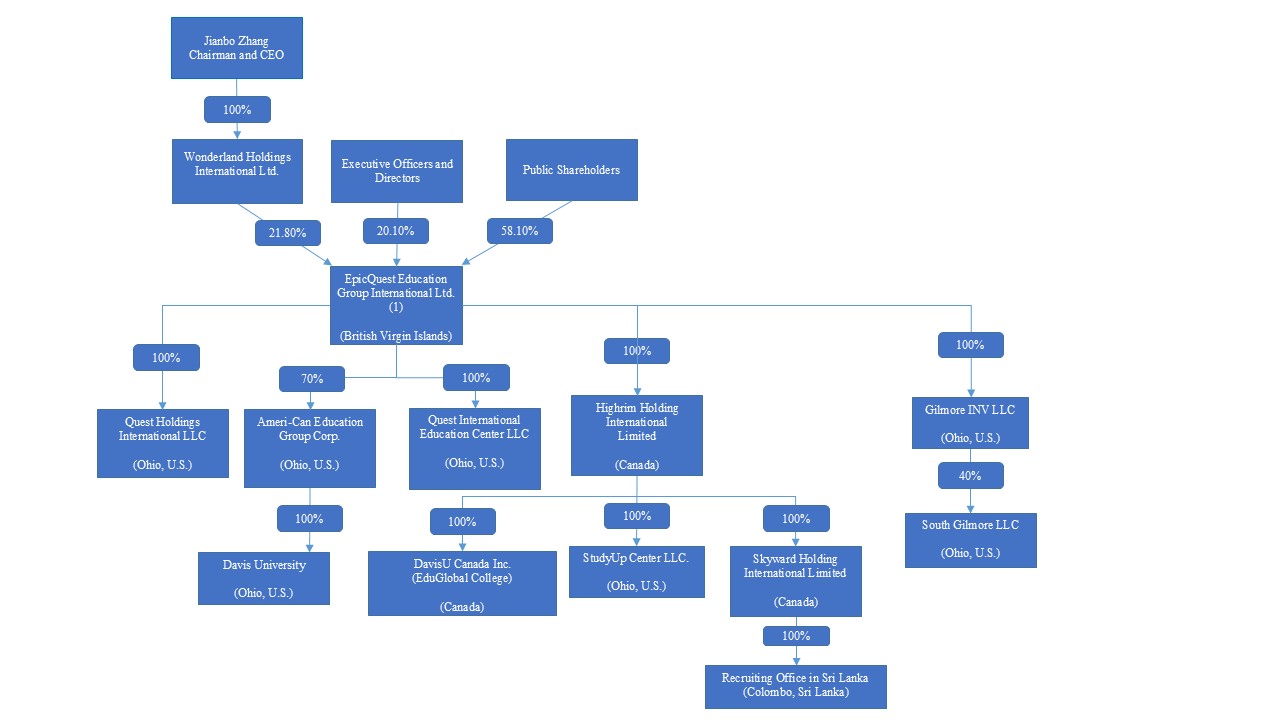
(1) Percentage ownership of the Company’s common shares is based on 23,671,667 common shares outstanding as of January 28, 2026. Stock options, warrants, or other securities that are exercisable or convertible into common shares are not included in these percentages. See “Item 7. Major Shareholders and Related Party Transactions” for a table setting forth certain information regarding beneficial ownership of our common shares by each person who is known by us to beneficially own more than 5% of our common shares, determined in accordance with the rules of the SEC. The SEC’s beneficial ownership rules generally attribute beneficial ownership of securities to persons who possess sole or shared voting power or investment power with respect to those securities and includes our common shares issuable pursuant to the exercise of stock options, warrants, or other securities that are immediately exercisable or convertible or exercisable or convertible within 60 days of January 28, 2026. The amounts in the chart above do not reflect common shares issuable pursuant to the exercise of stock options, warrants, or other securities that are immediately exercisable or convertible or exercisable or convertible within 60 days of January 28, 2026.
D. Property, plant and equipment
Our principal executive office is located 200 N. St. Clair St., Suite 100, Toledo, OH 43604. We do not own this property. In addition, the Company leases and operates offices in Toledo, OH for Davis University, and in Vancouver, British Columbia, Canada for EduGlobal College. It also rents and manages student dorms in Hamilton and Toledo, Ohio, and in Kelowna, British Columbia, Canada. We maintain insurance policies covering facilities for losses due to fire, earthquake, flood or any other disaster. We believe that the facilities that we currently rent are adequate to meet our needs for the foreseeable future, and we believe that we will be able to obtain adequate facilities, principally through leasing of additional properties, to accommodate our future expansion plans. The Company also maintains administrative offices in Beijing. The offices are rented for the Company by Renda Financial under the terms of an agreement between the Company and Renda.
ITEM 4A. UNRESOLVED STAFF COMMENTS
Not applicable.
ITEM 5. OPERATING AND FINANCIAL REVIEW AND PROSPECTS
Operating and Financial Review and Prospects
The following discussion and analysis of our financial condition and results of operations should be read in conjunction with our consolidated financial statements and related notes that appear in this annual report. In addition to historical consolidated financial information, the following discussion contains forward-looking statements that reflect our plans, estimates, and beliefs. Our actual results could differ materially from those discussed in the forward-looking statements. Factors that could cause or contribute to these differences include those discussed below and elsewhere in this annual report, particularly in “Risk Factors.”
A. Operating Results
We were founded in 2012. Our revenue is primarily derived from foreign language education, college-level education, and the education and professional training programs for the years ended September 30, 2025 and 2024.
Our revenue for the year ended September 30, 2025 increased by US$0.8 million as compared to that of the year ended September 30, 2024. The increase was mainly due to the net result of: i) a US$2.7 million increase in revenue from DU, mainly from professional education and professional training programs, driven by the launch of new programs and higher student enrollment in fiscal 2025, which resulted in increased revenue recognition; ii) a US$2.3 million decrease in revenue from QHI, primarily from English education programs, due to a significant decline in student enrollment during fiscal 2025; and iii) a US$0.4 million increase in revenue from newly launched college-level education programs. Our operating expenses decreased by US$2.6 million compared to fiscal 2024 primarily due to the decrease in stock-based compensation expenses and management fee. Our net loss for the year ended September 30, 2025 decreased by US$4.0 million as compared to that of the year ended September 30, 2024.
Our revenue for the year ended September 30, 2024 increased by US$2.4 million as compared to that of the year ended September 30, 2023. The increase was mainly due to: i) a US$0.6 million increase in revenue from our English education programs due to the launches of our programs in Canada in fiscal 2024, and ii) a US$1.8 million increase in revenue from professional training programs due to the inclusion of the full fiscal year’s revenue of our Davis University subsidiary acquired in December 2022 and also due to more training programs were implemented after our acquisition of Davis University. Our operating expenses increased by US$1.5 million compared to fiscal 2023 primarily due to the increase in our general administrative expenses and selling expenses. Our net loss for the year ended September 30, 2024 decreased by US$0.5 million as compared to that of the year ended September 30, 2023.
As of September 30, 2025, our cash was US$5.1 million, including restricted cash. This represents an increase of US$3.6 million from US$1.5 million as of September 30, 2024. The increase is mainly due to the private placements in fiscal 2025.
Results of Operations
Years Ended September 30, 2025, 2024 and 2023
| For The Year Ended |
For The Year Ended |
For The Year Ended |
||||||||||
| September 30, 2025 |
September 30, 2024 |
September 30, 2023 |
||||||||||
| Revenues | $ | 8,939,989 | $ | 8,153,546 | $ | 5,712,480 | ||||||
| Costs of services | 3,014,119 | 2,840,112 | 1,502,255 | |||||||||
| Gross profit | 5,925,870 | 5,313,434 | 4,210,225 | |||||||||
| Operating costs and expenses: | ||||||||||||
| Selling expenses | 1,366,760 | 1,537,006 | 1,018,894 | |||||||||
| General and administrative | 8,739,049 | 11,201,445 | 10,210,960 | |||||||||
| Total operating costs and expenses | 10,105,809 | 12,738,451 | 11,229,854 | |||||||||
| Income (loss) from operations | (4,179,939 | ) | (7,425,017 | ) | (7,019,629 | ) | ||||||
| Other (income) | (1,656,710 | ) | (518,007 | ) | (239,231 | ) | ||||||
| Income (loss) before provision for income taxes | (2,523,229 | ) | (6,907,010 | ) | (6,780,398 | ) | ||||||
| Income taxes expense (recovery) | 3,384 | (335,826 | ) | 289,464 | ||||||||
| Net loss | (2,526,613 | ) | (6,571,184 | ) | (7,069,862 | ) | ||||||
Revenue, costs of sales and gross profit margin
The following table sets forth the revenue, costs of sales and gross profit margin of the Company:
| For The Year Ended |
For The Year Ended |
For The Year Ended |
||||||||||
| September 30, 2025 |
September 30, 2024 |
September 30, 2023 |
||||||||||
| Revenues – QHI | $ | 2,232,978 | $ | 3,927,988 | $ | 3,946,380 | ||||||
| Revenues – DC | 356,623 | 607,697 | - | |||||||||
| Revenues – DU | 6,350,388 | 3,617,861 | 1,766,100 | |||||||||
| Costs of services – QHI | 440,622 | 997,763 | 837,055 | |||||||||
| Costs of service College – DC | 128,727 | 57,814 | - | |||||||||
| Costs of services – DU | 2,444,770 | 1,784,535 | 665,200 | |||||||||
| Gross profit | 5,925,870 | 5,313,434 | 4,210,225 | |||||||||
| Gross profit margin % | 66 | % | 65 | % | 74 | % | ||||||
Revenue
Our revenues increased by US$0.8 million or 9.6% in fiscal 2025 compared to fiscal 2024. These increases were mainly due to the net effect of: i) a US$2.7 million increase in revenue from DU, mainly from professional education and professional training programs, driven by the launch of new programs and higher student enrollment in fiscal 2025, which resulted in increased revenue recognition; ii) a US$2.3 million decrease in revenue from QHI, primarily from English education programs, due to a significant decline in student enrollment during fiscal 2025; and iii) a US$0.4 million increase in revenue from newly launched college-level education programs.
Our revenues increased by US$2.4 million or 42.7% in fiscal 2024 compared to fiscal 2023. These increases were mainly due to the net effect of: i) a US$0.6 million increase in revenue from our English education programs due to the launches of our programs in Canada in fiscal 2024, and ii) a US$1.8 million increase in revenue from professional training programs due to the inclusion of the full fiscal year’s revenue of our Davis University subsidiary acquired in December 2022 and also due to more training programs were implemented after our acquisition of Davis University.
Costs of services
Costs of services of QHI mainly related to the program fees that we paid to our partnered university which provides the Foreign language education program to our students. The program fees are based on semester terms and are generally fixed per student and per semester.
Costs of services of DC mainly related to instructor salaries, outsourcing fees for university application assistance, and rental expenses for student accommodation.
Costs of services of DU mainly related to tuition fees paid to partnership universities and salary expenses incurred for instructors and employees that are directly involved in assisting the provisions of the program services.
Our costs of sales in 2025 increased by US$0.2 million or 6.1% compared to fiscal 2024, which is due to the increase in our revenue in 2025.
Our costs of sales in 2024 increased by US$1.3 million or 89.1% compared to fiscal 2023, which is due to the increase in our revenue in 2024.
Gross margins
Our gross margin was stable from 2024 to 2025, slightly increased to 66% in 2025 from 65% in 2024 primarily due to the net effect of: i) our gross margin for foreign language education program for 2025 is 80% compared to 77% of 2024 due to decrease of cost for QHI, as no minimum guarantee fee pay to Miami University ; ii) our gross margin for education and professional training programs increased to 62% from 51% for 2024 as no minimum enrollment guarantee charged by Peking University ; and iii) 64% gross margin from new college-level education program.
Our gross margin in 2024 decreased to 65% from 74% of 2023 primarily due to the net effect of: i) our gross margin for English education program for 2024 is 77% compared to 79% of 2023 due to increase of recruitment fees; and ii) our gross margin for professional training programs decreased to 51% from 62% for 2023 due to the increase of cost of services. The increase in cost of services was primarily due to the increase in salaries and also the costs for the new professional training programs in 2024 were relatively higher than the professional training programs in 2023.
Operating expenses
Our operating expenses consist of selling and marketing expenses, and general and administrative expenses.
Selling expenses
| For The Year Ended |
For The Year Ended |
For The Year Ended |
||||||||||
| September 30, 2025 |
September 30, 2024 |
September 30, 2023 |
||||||||||
| Selling expenses | $ | 1,366,760 | $ | 1,537,006 | $ | 1,018,894 | ||||||
The Company’s selling expenses primarily relate to the student recruitment commission fees paid to agents who provided student recruitment services to the Company and expenses related to business development. The Company relies on agents to promote and recruit potential students to enroll in its foreign language education programs, college-level education programs, as well as academic and professional training programs. Total selling expenses decreased by US$0.2 million in 2025 compared to 2024, the decrease was due to commissions applying only to new enrollments, excluding continuing students and certain new non-agent revenue streams. The total selling expenses increased by US$0.5 million in 2024 compared to 2023, which is consistent with the increase in sales revenue in 2024.
General and administrative expenses
General and administrative expenses consist primarily of the following expenses:
| For the Year Ended September 30, 2025 |
For the Year Ended September 30, 2024 |
For the Year Ended September 30, 2023 |
||||||||||
| Bank charges | $ | 21,492 | $ | 17,855 | $ | 9,156 | ||||||
| Depreciation and amortization expenses | 409,899 | 425,782 | 407,384 | |||||||||
| Insurance | 85,112 | 133,035 | 64,393 | |||||||||
| Office expenses | 832,869 | 783,742 | 721,419 | |||||||||
| Professional | 1,481,382 | 1,160,520 | 1,581,541 | |||||||||
| Rental expenses | 1,357,224 | 938,340 | 694,067 | |||||||||
| Repairs and maintenance | 8,615 | 31,122 | 3,169 | |||||||||
| Salary and benefits | 1,705,201 | 2,163,224 | 2,246,993 | |||||||||
| Management service fee | 1,760,000 | 3,420,000 | 2,430,000 | |||||||||
| Stock-based compensation | 900,879 | 1,977,187 | 1,817,310 | |||||||||
| Sundry | 93,396 | 109,283 | 121,915 | |||||||||
| Tax and licenses | 3,167 | 29,500 | 34,362 | |||||||||
| Vehicle expenses | 12,294 | 17,965 | 35,296 | |||||||||
| Impairment | - | - | 14,019 | |||||||||
| Bad debt (recovery) | 67,519 | (6,110 | ) | 29,936 | ||||||||
| Total | 8,739,049 | 11,201,445 | 10,210,960 | |||||||||
Our general administrative (“G&A”) expenses are generally fixed. The significant decrease in 2025 is mainly due to a lower management fee charged by business partners and reduced stock-based compensation expenses caused by a decrease in the Company's stock price.
Our general administrative expenses decreased by $2.5 million in 2025 compared to 2024, mainly due to the decrease in stock-based compensation with an amount of US$1.1 million decrease in fiscal 2025, and decrease in management service fees with an amount of US$1.7 million decrease in fiscal 2025. The decrease in management fee was mainly due to: i) a US$1.1 million decrease in the management fee at QHI due to its decreased business activities as a result of the decrease student enrollment of our English education programs in Hamilton, Ohio; and ii) a US$0.6 million decrease in the management fee at Davis University due to decrease of management fee paid to the Company’s business partners.
Our general administrative expenses increased by $1.0 million in 2024 compared to 2023, mainly due to the increase in management service fees with an amount of US$1.0 million increase in fiscal 2024. The increase in management fee was mainly due to: i) a US$0.3 million increase in the management fee at DC due to its increased business activities as a result of the launches of our English education programs in Canada; and ii) a US$0.7 million increase in the management fee at Davis University due to its increased business activities as well as a result of more education and training programs were added in the year.
Other income
Other income of $1.7 million in fiscal 2025 is mainly related to: i) US$1.2 million gain on settlement of accounts payable, and ii) US$0.5 million gain from disposal of fixed assets. Other income of US$0.5 million in fiscal 2024 is mainly related to gain from disposal of fixed assets.
Income Tax
BVI
Under the current laws of the BVI, the Company is not subject to tax on income or capital gain. Additionally, upon payments of dividends to the shareholders, no BVI withholding tax will be imposed.
US
Under the current Ohio state and US federal income tax, the Company’s Ohio subsidiaries are subject to the Ohio state’s Commercial Activity Tax (“CAT”) and federal income tax. The Ohio CAT is a business tax levied based on the gross receipts from sales. The federal income tax is based on a flat rate of 21%.
Canada
Under the current Canadian income tax, the Company’s Canadian subsidiaries are subject to a combined provincial and federal corporate income tax rate of 27%.
The following table sets forth a breakdown of the income tax expense for the Company.
| For The Year Ended |
For The Year Ended |
For The Year Ended |
||||||||||
| September 30, 2025 |
September 30, 2024 |
September 30, 2023 |
||||||||||
| Income tax expenses (recovery) | $ | 3,384 | $ | (335,826 | ) | $ | 289,464 | |||||
The Company had an operating loss in 2024. The income tax recovery in 2024 is attributable to deferred income tax recovery, which is resulted from the decrease of deferred income tax liabilities related to depreciation intangible assets acquired from business combinations in previous periods. As depreciations were made in 2024 for the intangible assets, deferred income tax liabilities also decreased. The Company had an operating loss in 2025, except QIE, DU, and DC. The income tax expense in 2025 is related to income tax expenses on DU.
Net income (loss)
Net loss for the year ended September 30, 2025 was US$2.5 million, compared to the net loss of US$6.6 million for the year ended September 30, 2024, representing a decrease in net loss of US$4.1 million.
Net loss for the year ended September 30, 2024 was US$6.6 million, compared to the net loss of US$7.1 million for the year ended September 30, 2023, representing a decrease in net loss of US$0.5 million.
B. Liquidity and Capital Resources
Cash Flows and Working Capital
During the fiscal year ended September 30, 2025, we have financed our operations primarily though proceeds from public offerings and private placements of equity securities, and the incurrence of debt, including, i) net proceeds of US$1.8 million from May Private Placement, and ii) net proceeds of US$3.3 million from the August Offering. The proceeds were after deducting offering expenses. As of September 30, 2025, 2024 and 2023, we had US$4.8 million, US$1.2 million, and US$5.0 million, respectively, in cash, which primarily consists of cash deposited in banks.
The Company’s working capital requirements mainly comprise cost of foreign language education program fees, education and professional training program fees, college-level education program fees, student recruitment fees, office expenses, professional fees, rental expenses, and salary expenses. We expect that the Company’s capital requirements will be met by cash generated from its own operating activities and equity financing.
On May 27, 2025, the Company completed a unit offering private placement and issued 4,500,000 ordinary shares and May Warrants to purchase 13,500,000 ordinary shares at a combined purchase price of $0.40 per share and accompanying warrants for net proceeds of $1.8 million, after deducting offering expenses, and excluding the proceeds, if any, from the exercise of the May Warrants (the “May Private Placement”). The May Warrants are immediately exercisable at an exercise price of $0.48 per share, and expire one year after the issuance date.
On August 26, 2025, the Company completed a private placement and issued 5,068,494 ordinary share at a purchase price of $0.73 per share for net proceeds of $3.3 million after deducting placement agent fees and other offering expenses payable by the Company (the “August Offering”).
The Company’s consolidated financial statements have been prepared assuming that the Company will continue as a going concern. However, as of September 30, 2025, the Company has incurred recurring net losses and negative cash flows from operations, which raise substantial doubt about its ability to continue as a going concern within one year after the date that the consolidated financial statements are issued. As of September 30, 2025, the Company had an accumulated deficit of $17,387,799 and a negative cash flow from operating activities of $2,946,315.
Management has developed a plan to address these concerns, which includes the following actions:
| ● | Cost reduction initiatives: The Company plans to implement some cost-cutting measures, including reductions in discretionary spending. |
| ● | Equity financing: The Company is actively seeking additional equity financing to fund operations and meet its obligations. |
| ● | New university programs: The Company is exploring strategic partnerships with more universities to introduce more educational programs and increase sources of revenues. |
While management believes that these plans are feasible, there is no assurance that these actions will be successful in mitigating the substantial doubt about the Company’s ability to continue as a going concern. If the Company is unable to obtain sufficient financing or generate adequate cash flows from operations, it may be required to curtail or cease operations, seek protection under applicable bankruptcy laws, or pursue other strategic alternatives.
The Company’s consolidated financial statements do not include any adjustments that might result from the outcome of this uncertainty.
Cash Flow Summary
Years Ended September 30, 2025, 2024 and 2023
| For the year ended September 30, 2025 |
For the year ended September 30, 2024 |
For the year ended September 30, 2023 |
||||||||||
| Net cash provided by (used in) operating activities | (2,946,315 | ) | (9,481,722 | ) | (5,252,527 | ) | ||||||
| Net cash provided by (used in) investing activities | 1,455,286 | 716,772 | (877,635 | ) | ||||||||
| Net cash provided by (used in) financing activities | 5,109,251 | 4,947,683 | - | |||||||||
| Effect of exchange rate changes on cash | (13,742 | ) | 470 | (7,346 | ) | |||||||
| Net increase (decrease) in cash | 3,604,480 | (3,816,797 | ) | (6,137,508 | ) | |||||||
| Cash at beginning of period | 1,488,754 | 5,305,551 | 11,443,059 | |||||||||
| Cash at end of period | 5,093,234 | 1,488,754 | 5,305,551 | |||||||||
We had a balance of cash and cash equivalents of US$5.1 million (including restricted cash) as of September 30, 2025, a balance of US$1.5 million as of September 30, 2024, and a balance of US$5.3 million as of September 30, 2023.
Operating Activities:
September 30, 2024 vs. 2023
Net cash used in operating activities was US$9.5 million for the year ended September 30, 2024, compared to net cash used in operating activities of US$5.3 million for the year ended September 30, 2023, representing a US$4.2 million increase in the net cash outflow in operating activities. The increase in net cash outflow in operating activities was primarily due to the following:
| 1) | We had a net loss of US$6.6 million for the year ended September 30, 2024. For the year ended September 30, 2023, we had a net loss of US$7.1 million which led to a US$0.5 million decrease in net cash outflow in operating activities. |
| 2) | Change in prepaid expenses and long-term prepaids used US$6.5 million cash outflow for the year ended September 30, 2024. For the year ended September 30, 2023, change in prepaid expenses and long-term prepaids used US$1.3 million cash outflow, which led to a US$5.2 million increase in net cash outflow from operating activities. |
| 3) | Change in accounts receivable and other receivable used US$0.4 million net cash outflow for the year ended September 30, 2024. For the year ended September 30, 2023, change in accounts receivable and other receivable provided US$0.2 million cash inflow, which led to a US$0.6 million increase in net cash outflow from operating activities. |
| 4) | Change in accounts payable and accrued liabilities generated US$1.1 million net cash inflow for the year ended September 30, 2024. For the year ended September 30, 2023, change in accounts payable and accrued liabilities used net cash outflow of US$0.2 million, which led to a US$1.3 million increase in net cash inflow from operating activities. |
| 5) | Change in deferred revenue generated US$1.3 million net cash inflow for the year ended September 30, 2024. For the year ended September 30, 2023, change in deferred revenue provided net cash inflow of US$0.2 million, which led to a US$1.1 million increase in net cash inflow from operating activities. |
| 6) | Change in income tax receivable provided US$0.007 million net cash inflow for the year ended September 30, 2024. For the year ended September 30, 2023, the change was a net cash inflow of US$0.3 million, which led to a US$0.3 million decrease in net cash inflow from operating activities. |
| 7) | Change in non-cash items, including depreciation, goodwill impairment, accretion of lease expenses, gain/loss from disposal of fixed assets, deferred income taxes and stock-based compensation expenses, provided a total of US$1.6 million net cash inflow for the year ended September 30, 2024. For the year ended September 30, 2023, the change was a net cash inflow of US$2.8 million, which led to a US$1.2 million decrease in net cash inflow in operating activities. |
September 30, 2025 vs. 2024
Net cash used in operating activities was US$3.0 million for the year ended September 30, 2025, compared to net cash used in operating activities of US$9.5 million for the year ended September 30, 2024, representing a US$6.5 million decrease in the net cash outflow in operating activities. The decrease in net cash outflow in operating activities was primarily due to the following:
| 1) | We had a net loss of US$2.5 million for the year ended September 30, 2025. For the year ended September 30, 2024, we had a net loss of US$6.6 million which led to a US$4.1 million decrease in net cash outflow in operating activities. |
| 2) | Change in prepaid expenses and long-term prepaids generated US$0.6 million cash inflow for the year ended September 30, 2025. For the year ended September 30, 2024, change in prepaid expenses and long-term prepaids used US$6.5 million cash outflow, which led to a US$7.1 million decrease in net cash outflow from operating activities. |
| 3) | Change in accounts receivable and other receivable used US$2.0 million net cash outflow for the year ended September 30, 2025. For the year ended September 30, 2024, change in accounts receivable and other receivable provided US$0.4 million cash outflow, which led to a US$1.6 million increase in net cash outflow from operating activities. |
| 4) | Change in accounts payable and accrued liabilities used US$0.08 million net cash outflow for the year ended September 30, 2025. For the year ended September 30, 2024, change in accounts payable and accrued liabilities generated net cash inflow of US$1.1 million, which led to a US$1.2 million increase in net cash outflow from operating activities. |
| 5) | Change in deferred revenue generated US$0.7 million net cash inflow for the year ended September 30, 2025. For the year ended September 30, 2024, change in deferred revenue provided net cash inflow of US$1.3 million, which led to a US$0.6 million decrease in net cash inflow from operating activities. |
| 6) | Change in income tax receivable provided US$0.4 million net cash inflow for the year ended September 30, 2025. For the year ended September 30, 2024, the change was a net cash inflow of US$0.007 million, which led to a US$0.4 million increase in net cash inflow from operating activities. |
| 7) | Change in non-cash items, including depreciation, goodwill impairment, accretion of lease expenses, gain/loss from disposal of fixed assets, gain from settlement of student deposit refunds with Renda, deferred income taxes and stock-based compensation expenses, provided a total of US$0.2 million net cash outflow for the year ended September 30, 2025. For the year ended September 30, 2024, the change was a net cash inflow of US$1.6 million, which led to a US$1.8 million decrease in net cash inflow in operating activities. |
Investing Activities:
September 30, 2025, 2024 and 2023
Net cash used in investing activities was US$0.9 million for the year ended September 30, 2023. It was attributable to the net effects of: i) US$1.2 million used for share buyback; and ii) US$0.2 million used in acquisition of 20% share of a subsidiary; iii) net amount of US$0.6 million acquired from business and asset acquisitions; and iv) US$0.01 million used for purchase of property and equipment.
Net cash generated from investing activities was US$0.7 million for the year ended September 30, 2024. It was primarily attributable to the net result of: 1) US$0.8 million generated from sale of property and equipment and 2) purchase of property and equipment of US$0.04 million.
Net cash generated from investing activities was US$1.5 million for the year ended September 30, 2025. It was primarily attributable to the net result of: 1) US$1.7 million generated from sale of property and equipment and 2) purchase of property and equipment of US$0.3 million.
Financing Activities:
September 30, 2025, 2024 and 2023
For the year ended September 30, 2023, the Company did not have financing activities.
For the year ended September 30, 2024, the Company had net cash provided by financing activities of US$4.9 million, which was attributable to the net result of: 1) US$0.8 million from the January Private Placement; 2) US$0.4 million debt financing from a third party; and 3) collection of US$3.7 million equity investment from shareholders for the incorporation of a new subsidiary.
For the year ended September 30, 2025, the Company had net cash provided by financing activities of US$5.1 million, which was attributable to the net result of: 1) US$1.8 million from the May Private Placement; and 2) US$3.3 million from the August Offering.
Off-balance Sheet Arrangements
The Company had not entered into any off-balance sheet transactions or arrangements as at the latest practicable date.
C. Research and development, patents and licenses
As an education service provider, our business does not rely on research and development. Therefore, we have not incurred research and development expenses for the years ended September 30, 2025, 2024 and 2023.
D. Trend Information
Other than as disclosed elsewhere in this annual report, we are not aware of any trends, uncertainties, demands, commitments or events that are reasonably likely to have a material effect on our net revenues, income from continuing operations, profitability, liquidity or capital resources, or that would cause reported financial information not necessarily to be indicative of future operating results or financial condition or results of operations.
E. Critical Accounting Estimates
We prepared our consolidated financial statements in accordance with U.S. GAAP, which requires us to make judgments, estimates and assumptions that affect (i) the reported amounts of assets and liabilities, (ii) the reported amounts of revenues and expenses during each reporting period. We continually evaluate these estimates and assumptions based on historical experience, knowledge and assessment of current business and other conditions, expectations regarding the future based on available information and reasonable assumptions, which together form a basis for making judgments about matters not readily apparent from other sources.
The following discussion of critical accounting policies and estimates is intended to supplement the significant accounting policies presented in the notes to our consolidated financial statements included in “Item 18: Financial Statements” presented in this Form 20-F, which summarize the accounting policies and methods used in the preparation of those consolidated financial statements. The policies and the estimates discussed below are included here because they require more significant judgments and estimates in the preparation and presentation of our consolidated financial statements than other policies and estimates. Actual amounts could differ materially from those estimated by us at the time our consolidated financial statements are prepared.
Goodwill
Goodwill is not amortized, but it is tested annually for impairment as of September 30, or more frequently if events or changes in circumstances indicate that those assets might be impaired. Goodwill is tested for impairment at a reporting unit level, which is at the same level or one level below an operating segment. The reporting units that contain goodwill include Professional Training Program reporting unit and Other reporting unit.
We have the option of performing a qualitative assessment of a reporting unit to determine whether a quantitative impairment test is necessary. A qualitative assessment involves evaluating factors to determine the existence of events or circumstances that would indicate whether it is more likely than not that the fair value of the reporting unit to which goodwill belongs is less than its carrying amount. If the qualitative assessment indicates that the fair value of the reporting unit is more likely than not less than the carrying amount, then a quantitative impairment test would be performed.
If a quantitative impairment test is required, the process is to identify potential impairment by comparing the reporting unit’s fair value with its carrying amount. The reporting unit’s fair value is determined using various valuation methodologies including assets-based, income or market approaches. In determining the reporting unit’s fair value, management is required to make judgments and assumptions relating to future cash flows, growth rates and economic and market conditions.
Goodwill under Professional Training Program reporting unit
For the year ended September 30, 2025, we performed a quantitative assessment of the professional education and training program reporting unit and we concluded there were no indicators of impairment that existed.
Goodwill under Other reporting unit
For the year ended September 30, 2025, we performed a quantitative assessment of the goodwill from other reporting unit and we concluded there were no indicators of impairment that existed.
Indefinite-lived intangible assets
Indefinite-lived intangible assets are not amortized but instead tested annually for impairment as of September 30, and between annual tests if indicators of potential impairment exist. The Company has the option of performing a qualitative assessment to first determine whether the quantitative impairment test is necessary. This involves an assessment of qualitative factors to determine the existence of events or circumstances that would indicate whether it is more likely than not that the fair value of the indefinite-lived intangible asset is less than its carrying value. If the qualitative assessment indicates it is not more likely than not that the fair value is less than its carrying value, a quantitative impairment test is not required. Where a quantitative impairment test is required, the procedure is to compare the indefinite-lived intangible asset’s fair value with its carrying amount. An impairment loss is recognized as the difference between the indefinite-lived intangible asset’s carrying amount and its fair value.
Indefinite-lived intangible assets under Professional Training Program reporting unit
For the year ended September 30, 2025, we performed a qualitative assessment of the professional education and training program reporting unit and we concluded there were no indicators of impairment that existed.
ITEM 6. DIRECTORS, SENIOR MANAGEMENT AND EMPLOYEES
A. Directors and senior management
MANAGEMENT
The following table sets forth our executive officers and directors, their ages and the positions held by them:
| Name | Age* | Position | ||
| Jianbo Zhang | 61 | Chairman, Chief Executive Officer | ||
| Zhenyu Wu | 46 | Chief Financial Officer, Director | ||
| Yunxia Xu | 44 | Chief Operating Officer and Chief Marketing Officer | ||
| Jing Li | 44 | Chief Development Officer | ||
| Bo Yu | 51 | Chief Programs Officer | ||
| Craig Wilson(1‡)(2)(3)(4)** | 54 | Independent Director | ||
| G. Michael Pratt(1)(2‡)(3) | 75 | Independent Director | ||
| Xiaojun Cui(1)(2)(3‡) | 55 | Independent Director |
| * | As of January 28, 2026 |
| ** | Lead Independent Director |
| ‡ | Committee Chair |
| (1) | Audit Committee. |
| (2) | Compensation Committee. |
| (3) | Nominating Committee. |
| (4) | Audit Committee financial expert. |
Zhang Jianbo is the founding Chairman and Chief Executive Officer of the Company. From October 2012 to December 2017, he served as Chief Executive Officer of Quest Holding International. From December 2017 to present, he has held the offices of the Company’s CEO. Mr. Zhang holds an undergraduate degree in Finance from Renmin University of China (1987), where he also completed a Ph.D. Diploma Course in Finance, School of Finance (2013). He also completed an EMBA course at Singapore Tiandu Education Group (2003) and an MBA course at Coventry University, UK (1999), and holds a Master Diploma Course in Finance, School of Finance, Renmin University (1993). Zhang Jianbo holds a pivotal role in the Company’s founding and long-term vision.
Zhenyu Wu is the Company’s Chief Financial Officer and a Board member. From 2017 to 2024, Mr. Wu has been an Associate Dean Research and Graduate Research Programs and a Professor of Entrepreneurship and Finance, Asper School of Business, University of Manitoba. He was the Head, Department of Business Administration, at the same School of Business from 2015 to 2017. From 2011 to 2017, he was an Associate Professor at the I.H. School of Business, University of Manitoba, and he holds the position of Canada Research Chair (Tier II) in Entrepreneurship and Innovation from 2012 to 2021. Mr. Wu holds a Ph.D. in Finance (2007), an MBA degree in Finance (2012), and a Master’s Arts degree in Economics (2001), all from the University of Calgary, Calgary, Alberta, Canada. He also holds a B.A. degree in Economics from Nankai University, Tianjin, China (1999). Mr. Wu’s knowledge of the Company’s operations as well as his financial and accounting expertise are critical to the Company’s success.
Yunxia Xu is the Company’s Chief Operating Officer and Chief Marketing Officer. Since December 2017, she held the position of General Manager at EpicQuest Education Group International Limited. Prior to that, from September 2016 to December 2017, she held the position of General Manager at QHI responsible for coordination and management of the U.S. offices. From 2009 to August 2016, she was the Deputy General Manager at Beijing Renda Finance Education Technology Co., Ltd. She holds a Bachelor’s degree in English from Shandong Normal University (2003) and attended several MBA diploma courses at Renmin University (2008-2009) and Tsinghua University (2013-2015).
Jing Li is the Company’s Chief Development Officer. From March 2013 to present, she has held the offices of Managing Director at QHI, responsible for marketing and partnership development, and team management. She holds a Bachelor’s degree in Polymer Materials from Institute of Clothing Technology, Beijing, China (2000-2004) and a Master’s degree in Polymers and Surface Coatings Science and Technology from University of Leeds, UK (2005-2007).
Bo Yu is the Company’s Chief Programs Officer. Prior to joining the Company in 2018, he held multiple positions with Global IELTS, Beijing School of Shinyway Education, and Meten English. He obtained the Global Teacher Certificate - TEFL (Teaching English as a Foreign Language) from Trinity College, London, U.K. in 1999, and the Global Advanced English Trainer Certificate - LTCL in Sheffield, U.K. in 2000. He studied in the Master’s Degree in Education Program (TESOL MA) at Sheffield Harlem University, U.K. in 2001.
Craig Wilson is an independent director of the Company. He is currently a Professor of Finance at Edwards School of Business, University of Saskatchewan, having worked there since July 1, 2002. From July 1, 2018 to June 30, 2023, he held the position of the Head of Department of Finance & Management Science, Edwards School of Business, University of Saskatchewan. Mr. Wilson holds a PhD in Finance (University of Alberta, 2004) and a Bachelor of Commerce degree in Finance (University of Alberta, 1998) as well as a Bachelor of Science degree in Mathematics (University of Alberta, 1996). Mr. Wilson’s deep academic knowledge and expertise of finance and management sciences represent valuable skills on the Company’s Board.
G. Michael Pratt is an independent director of the Company. From July 2010 to June 2016, Mr. Pratt served as Dean of Regional Campuses and Associate Provost at Miami University of Ohio. Prior to that, from 2013 to 2016, he was Associate Provost, Dean of Regional Campuses, Professor of Anthropology (2010-2013). He holds a Ph.D. in Anthropology, Case Western Reserve University, Cleveland, Ohio (1981), a Master’s degree in Anthropology, Case Western Reserve University (1975) and an undergraduate degree in Anthropology, Miami University, Oxford, Ohio (1973). Mr. Pratt’s academic background and long-standing connections to our key partner, Miami University, represent an important contribution to the Board’s skillset.
Xiaojun Cui is an independent director of the Company and was appointed to the Board on October 19, 2023, to fill a vacancy created by the resignation of a prior director. Ms. Cui served as the Regional Manager for East Asia at Lancaster University since November 1, 2016, where her responsibilities included implementing international recruitment strategy, building international university partnerships and managing the recruitment agent network. She has degree in MSc Marketing from Edinburgh Napier University, where she worked, beginning in 2002 as the international Student Advisor, until leaving Napier in 2016 after serving as the International Partnership Manager for 9 years. Prior to working at Napier, Xiao worked at Dalian University of Foreign Languages as Project Manager, managing Study Abroad Language training Center. Ms. Cui possesses extensive knowledge and expertise in the Higher Education sectors of the UK and China.
None of the events listed in Item 401(f) of Regulation S-K has occurred during the past ten years that is material to the evaluation of the ability or integrity of any of our directors, director nominees or executive officers.
There are no family relationships among our directors or officers.
The business address of each party described above is c/o EpicQuest Education Group International Limited 200 N. St. Clair St., Suite 100, Toledo, OH 43604.
B. Compensation
Director Compensation
On October 19, 2023, the Board, upon the recommendation of the Compensation Committee, approved an updated director compensation plan for the Company’s non-employee directors (the “2023 Director Compensation Plan”) that replaced the Company’s 2021 Director Compensation Plan. The 2023 Director Compensation Plan provides for the following: (i) annual cash retention payment of $40,000; (ii) the Committee chair-Audit: additional $15,000; (iii) Committee chair-Compensation: additional $10,000; (iii) Committee chair-Nominating and Governance: additional $10,000; (iv) Committee member-Audit: additional $6,000; (v) Committee member-Compensation: additional $6,000; (vi) Committee member- Nominating and Governance: additional $6,000; (vii) each director received an annual grant of a ten-year option to purchase 45,000 common shares at an exercise price of the closing price of the common shares on the date of grant vesting in one year for existing non-employee Board members and in three years for initial Board members; and (viii) for the Lead Independent Director an annual grant of a ten-year option to purchase 15,000 common shares at an exercise price equal to the closing price of the common shares on the date of grant vesting in one year. This compensation package was reapproved by the Compensation Committee on August 6, 2025 for the 2024-25 fiscal year. On October 14, 2025, the Compensation Committee approved an updated director compensation plan for the Company’s non-employee directors (the “2025 Director Compensation Plan”) that replaced the Company’s 2023 Director Compensation Plan. The 2025 Director Compensation Plan provides for the following: (i) annual cash retention payment of $40,000; (ii) the Committee chair-Audit: additional $15,000; (iii) Committee chair-Compensation: additional $10,000; (iii) Committee chair-Nominating and Governance: additional $10,000; (iv) Committee member-Audit: additional $6,000; (v) Committee member-Compensation: additional $6,000; (vi) Committee member- Nominating and Governance: additional $6,000; (vii) each director received an annual grant of a ten-year option to purchase 112,500 common shares at an exercise price of the closing price of the common shares on the date of grant vesting in one year for existing non-employee Board members; and (viii) for the Lead Independent Director an annual grant of a ten-year option to purchase 37,500 common shares at an exercise price equal to the closing price of the common shares on the date of grant vesting in one year.
For the year ended September 30, 2025, the total compensation paid to the Company’s non-employee directors was as follows:
| Name(1) | Fees earned or paid in cash ($) |
Option Awards ($)(2)(3) |
Total ($) |
|||||||||
| Craig Wilson | $ | 67,000 | 29,000 | $ | 96,000 | |||||||
| G. Michael Pratt | $ | 62,000 | 21,500 | $ | 83,500 | |||||||
| Xiaojun Cui(4) | $ | 62,000 | 21,500 | $ | 83,500 | |||||||
| (1) | Compensation paid to Jianbo Zhang, our Chairman and Chief Executive Officer, and Zhenyu Wu, our Chief Financial Officer, for their service on the Board of Directors is set forth below under the section titled Executive Officer Compensation. |
| (2) | The amounts in the “Option Awards” columns represent the aggregate grant date fair values of the awards. The stock options issued to Craig Wilson and G. Michael Pratt were vesting for one year, and those issued to Xiaojun Cui were vesting for three years. |
| (3) | No stock awards were issued to the Company’s non-employee directors during the year ended September 30, 2025. Stock options granted for during the year ended September 30, 2025, to the Company’s non-employee directors were as follows: |
| Name | Number of Shares Underlying Options |
|||
| Craig Wilson | 60,000 | |||
| G. Michael Pratt | 45,000 | |||
| Xiaojun Cui | 45,000 | |||
| (4) | Xiaojun Cui was appointed to the Board on October 16, 2023. |
Retirement Benefits
The Company contributes to defined contribution retirement schemes which are available to all employees. Contributions to the schemes by the Company and employees are calculated as a percentage of employees’ basic salaries. The retirement benefit scheme cost charged to profit or loss represents contributions payable by the Company to the funds.
Recoupment Policy
We adopted the EpicQuest Education Group International Ltd. Dodd-Frank Restatement Recoupment Policy effective as of October 2, 2023. In the event that we are required to prepare a financial restatement, the Compensation Committee will recoup all erroneously awarded incentive-based compensation calculated on a pre-tax basis received after October 2, 2023, by a person (i) after beginning service as an executive officer, (ii) who served as an executive officer at any time during the performance period for that incentive-based compensation, and (iii) during the three completed fiscal years immediately preceding the date that the Company is required to prepare a restatement, and any transition period (that results from a change in the Company’s fiscal year) of less than nine months within or immediately following those three completed fiscal years. “Clawback” or recoupment policy in our executive compensation program contributes to creating and maintaining a culture that emphasizes integrity and accountability and reinforces the performance-based principles underlying our executive compensation program.
Officer Compensation; Employment Agreements and Arrangements
The total cash compensation paid by us or our significant subsidiaries during the years ended September 30, 2025 and September 30, 2024, to our officers for such persons’ services as officers (including contingent or deferred compensation accrued during the years ended September 30, 2025 and September 30, 2024, but not including any amounts paid to such persons for their services as directors), as well as equity-based compensation paid to our executive officers during the years ended September 30, 2025, and September 30, 2024, are described below.
Jianbo Zhang
On November 1, 2021, the Company entered into an amended and restated employment agreement, effective as of October 1, 2021, with Jianbo Zhang pursuant to which he agreed to serve as the Company’s Chief Executive Officer. For the fiscal year ended September 30, 2022, the agreement provided for an annual base salary of US$1.00 and the issuance of restricted stock units for 100,000 common shares vesting in four equal installments on the first calendar day of each full fiscal quarter. Effective for the fiscal year ended September 30, 2023, the foregoing compensation was increased to US$1.00 and the issuance of restricted stock units for 200,000 common shares vesting in four equal installments on the first calendar day of each full fiscal quarter. This compensation package was reapproved by the Compensation Committee on August 6, 2025 for the 2024-25 fiscal year.
Under the terms of the agreement, for the fiscal year ended September 30, 2022, Mr. Zhang was eligible to receive an annual bonus of restricted stock units for up to 50,000 common shares, in the determination of the Company’s Compensation Committee, if the Company’s sales revenue increased by 20% during the year ended September 30, 2022. This milestone was not achieved during the year ended September 30, 2022, and the shares were not issued. Effective for the fiscal year ended September 30, 2023, Mr. Zhang was eligible to receive an annual bonus of restricted stock units for up to 100,000 common shares, in the determination of the Company’s Compensation Committee, if the Company’s sales revenue increased by 20% during that fiscal year. This milestone was not achieved during the year ended September 30, 2023, and the shares were not issued. Effective for the fiscal year ended September 30, 2024, Mr. Zhang was eligible to receive an annual bonus of restricted stock units for up to 100,000 common shares, in the determination of the Company’s Compensation Committee, if the Company’s sales revenue increased by 20% during that fiscal year. This milestone was achieved during the year ended September 30, 2024, and the shares were issued.
Mr. Zhang is also entitled to reimbursement of reasonable expenses, vacation, sick leave, health and other benefits customary to agreements of this nature. On October 1, 2022, Mr. Zhang was also issued an option to purchase 50,000 common shares under the 2019 Equity Incentive Plan (the “2019 Plan”). The term of the agreement will expire on October 1, 2026, and will automatically extend for additional 12-month periods unless terminated by either party upon 90 days’ notice. If Mr. Zhang’s employment with the Company is terminated for any reason, the Company will pay to Mr. Zhang any unpaid portion of his salary through the date of his termination, and any unpaid bonus through the date of termination, as well as any unpaid or unused portions of his benefits under the agreement. If Mr. Zhang’s employment is terminated at the Company’s election without “cause” (as defined in the agreement), which requires 90 days’ advanced notice, or by Mr. Zhang for “good reason” (as defined in the agreement), he will be entitled to receive severance payments equal to 9 months’ of his base salary and a pro rata portion of his target annual bonus for the year when termination occurs. Mr. Zhang has agreed not to compete with the Company for 9 months after the termination of his employment; he also executed certain non-solicitation, confidentiality and other covenants customary for agreements of this nature.
In November 2021, for services Mr. Zhang was issued restricted stock units for 250,000 common shares vesting in five equal installments between October 1, 2021, and October 1, 2023, as well as an additional option to purchase 150,000 common shares under the 2019 Plan.
On December 30, 2022, for services Mr. Zhang was issued an option to purchase 50,000 common shares with an exercise price of $2.21 vesting in four equal installments on the first calendar day of each full fiscal quarter under the 2019 Plan.
2023 – 2024: On October 19, 2023, the Board, upon the recommendation of the Compensation Committee, approved the following compensation for Mr. Zhang: (i) base salary: $1.00; (ii) issuance of restricted stock units for 200,000 common shares vesting in four equal quarterly installments during the fiscal year ended September 30, 2024; (iii) issuance of an option to purchase 500,000 common shares at an exercise price of $1.16 per share (the closing price of the common shares on the date of grant) vesting in four annual installments; and (iv) issuance of restricted stock units for 100,000 common shares vesting if the Company’s sales revenue increases by 20% during the fiscal year ended September 30, 2024.
2024 – 2025: On August 6, 2025, the Compensation Committee approved an updated compensation package for Mr. Zhang for the 2024-25 fiscal year: (i) base salary: $1.00; (ii) issuance of restricted stock units for 200,000 common shares vesting in four equal quarterly installments during the fiscal year ended September 30, 2025; (iii) issuance of an option to purchase 500,000 common shares at an exercise price of $0.537 per share (the closing price of the common shares on the date of grant) fully vested with an expiration date of August 6, 2034; and (iv) issuance of restricted stock units for 100,000 common shares subject to approval of performance criteria to be determined in the discretion of the Compensation Committee.
2025 – 2026: On October 14, 2025, the Compensation Committee approved an updated compensation package for Mr. Zhang for the 2025-26 fiscal year: (i) base salary: $1.00; (ii) issuance of restricted stock units for 500,000 common shares vesting in four equal quarterly installments during the fiscal year ended September 30, 2026; (iii) issuance of an option to purchase 1,250,000 common shares at an exercise price of $0.448 per share (the closing price of the common shares on the date of grant) fully vested with an expiration date of October 14, 2035; and (iv) issuance of restricted stock units for 250,000 common shares subject to approval of performance criteria to be determined in the discretion of the Compensation Committee.
Zhenyu Wu
On November 1, 2021, the Company entered into an amended and restated employment agreement, effective as of October 1, 2021, with Zhenyu Wu pursuant to which he agreed to serve as the Company’s Chief Financial Officer. For the fiscal year ended September 30, 2022, the agreement provided for an annual base salary of US$1.00 and the issuance of restricted stock units for 80,000 common shares vesting in four equal installments on the first calendar day of each full fiscal quarter. Effective for the fiscal year ended September 30, 2023, the foregoing compensation was increased to US$1.00 and the issuance of restricted stock units for 160,000 common shares vesting in four equal installments on the first calendar day of each full fiscal quarter.
Under the terms of the agreement, for the fiscal year ended September 30, 2022, Mr. Wu was eligible to receive an annual bonus of restricted stock units for up to 40,000 common shares, in the determination of the Company’s Compensation Committee, if the Company’s sales revenue increased by 20% during the year ended September 30, 2022. This milestone was not achieved during the year ended September 30, 2022, and the shares were not issued. Effective for the fiscal year ended September 30, 2023, Mr. Wu will be eligible to receive an annual bonus of restricted stock units for up to 80,000 common shares, in the determination of the Company’s Compensation Committee, if the Company’s sales revenue increased by 20% during that fiscal year. This milestone was not achieved during the year ended September 30, 2023, and the shares were not issued. Effective for the fiscal year ended September 30, 2024, Mr. Wu was eligible to receive an annual bonus of restricted stock units for up to 80,000 common shares, in the determination of the Company’s Compensation Committee, if the Company’s sales revenue increased by 20% during that fiscal year. This milestone was achieved during the year ended September 30, 2024, and the shares were issued.
Mr. Wu is also entitled to reimbursement of reasonable expenses, vacation, sick leave, health and other benefits customary to agreements of this nature. On October 1, 2022, Mr. Wu was also issued an option to purchase 40,000 common shares under the 2019 Plan. The term of the agreement will expire on October 1, 2026, which term will automatically extend for additional 12-month periods unless terminated by either party upon 90 days’ notice. If Mr. Wu’s employment with the Company is terminated for any reason, the Company will pay to Mr. Wu any unpaid portion of his salary through the date of his termination, and any unpaid bonus through the date of termination, as well as any unpaid or unused portions of his benefits under the agreement. If his employment is terminated at the Company’s election without “cause” (as defined in the agreement), which requires 90 days’ advanced notice, or by him for “good reason” (as defined in the agreement), he will be entitled to receive severance payments equal to 9 months’ of his base salary and a pro rata portion of his target annual bonus for the year when termination occurs. Mr. Wu has agreed not to compete with the Company for 9 months after the termination of his employment; he also executed certain non-solicitation, confidentiality and other covenants customary for agreements of this nature.
In November 2021, for services Mr. Wu was issued restricted stock units for 150,000 common shares vesting in three equal installments on in the period between October 1, 2021, and October 1, 2022, as well as an additional option to purchase 125,000 common shares, under the 2019 Plan.
On December 30, 2022, for services Mr. Wu was issued an option to purchase 40,000 common shares with an exercise price of $2.21 vesting in four equal installments on the first calendar day of each full fiscal quarter under the 2019 Plan.
2023 – 2024: On October 19, 2023, the Board, upon the recommendation of the Compensation Committee, approved the following compensation for Mr. Wu: (i) base salary: $1.00; (ii) issuance of restricted stock units for 160,000 common shares vesting in four equal quarterly installments during the fiscal year ended September 30, 2024; (iii) issuance of an option to purchase 360,000 common shares at an exercise price of $1.16 per share (the closing price of the common shares on the date of grant) vesting in four annual installments; and (iv) issuance of restricted stock units for 80,000 common shares vesting if the Company’s sales revenue increases by 20% during the fiscal year ended September 30, 2024.
2024 – 2025: On August 6, 2025, the Compensation Committee approved an updated compensation package for Mr. Wu for the 2024-25 fiscal year: (i) base salary: $1.00; (ii) issuance of restricted stock units for 160,000 common shares vesting in four equal quarterly installments during the fiscal year ended September 30, 2025; (iii) issuance of an option to purchase 360,000 common shares at an exercise price of $0.537 per share (the closing price of the common shares on the date of grant) fully vested with an expiration date of August 6, 2034; and (iv) issuance of restricted stock units for 80,000 common shares subject to approval of performance criteria to be determined in the discretion of the Compensation Committee.
2025 – 2026: On October 14, 2025, the Compensation Committee approved an updated compensation package for Mr. Wu for the 2025-26 fiscal year: (i) base salary: $1.00; (ii) issuance of restricted stock units for 400,000 common shares vesting in four equal quarterly installments during the fiscal year ended September 30, 2026; (iii) issuance of an option to purchase 900,000 common shares at an exercise price of $0.448 per share (the closing price of the common shares on the date of grant) fully vested with an expiration date of October 14, 2035; and (iv) issuance of restricted stock units for 200,000 common shares subject to approval of performance criteria to be determined in the discretion of the Compensation Committee.
Yunxia Xu
On November 1, 2021, the Company entered into an amended and restated employment agreement, effective as of October 1, 2021, with Yunxia Xu pursuant to which she agreed to serve as the Company’s Chief Operating Officer and Chief Marketing Officer. The agreement provides for an annual base salary of US$50,000 payable in accordance with the Company’s common payroll practices. Under the terms of the agreement, Ms. Xu will be entitled to receive an annual cash bonus in the amount of up to US$20,000 if, in the determination of the Company’s Compensation Committee, the Company’s sales revenue increased by 20% during the year ended September 30, 2022. This milestone was not achieved during the year ended September 30, 2022, and the shares were not issued. Effective for the fiscal year ended September 30, 2023, Ms. Xu was eligible to receive an annual bonus of restricted stock units for up to 20,000 common shares, in the determination of the Company’s Compensation Committee, if the Company’s sales revenue increased by 20% during that fiscal year. This milestone was not achieved during the year ended September 30, 2023, and the shares were not issued.
Effective for the fiscal year ended September 30, 2024, Ms. Xu was eligible to receive an annual bonus of restricted stock units for up to 20,000 common shares, in the determination of the Company’s Compensation Committee, if the Company’s sales revenue increased by 20% during that fiscal year. This milestone was achieved during the year ended September 30, 2024, and the shares were issued.
She is also entitled to reimbursement of reasonable expenses, vacation, sick leave, health and other benefits customary to agreements of this nature. Under the terms of the agreement, commencing with the fiscal year ended September 30, 2022, Ms. Xu will be eligible to receive an annual bonus of restricted stock units for up to 60,000 common shares, in the determination of the Company’s Compensation Committee. The Company’s Compensation Committee determined to not issue these shares for the years ended September 30, 2022, and September 30, 2023. The term of the agreement will expire on October 1, 2026, which term will automatically extend for additional 12-month periods unless terminated by either party upon 90 days’ notice. If Ms. Xu’s employment with the Company is terminated for any reason, the Company will pay to Ms. Xu any unpaid portion of her salary through the date of her termination, and any unpaid bonus through the date of termination, as well as any unpaid or unused portions of her benefits under the agreement. If her employment is terminated at the Company’s election without “cause” (as defined in the agreement), which requires 30 days’ advanced notice, or by her for “good reason” (as defined in the agreement), she will be entitled to receive severance payments equal to 9 months’ of her base salary and a pro rata portion of her target annual bonus for the year when termination occurs. Ms. Xu has agreed not to compete with the Company for 9 months after the termination of her employment; she also executed certain non-solicitation, confidentiality and other covenants customary for agreements of this nature. In addition to entering into the employment agreement, for services Ms. Xu was issued 60,000 common shares, as well as restricted stock units for 80,000 common shares vesting in four equal installments in the period between October 1, 2021, and April 1, 2023, under the 2019 Plan.
2023 – 2024: On October 19, 2023, the Board, upon the recommendation of the Compensation Committee, approved the following compensation for Ms. Xu: (i) base salary: $50,000; (ii) issuance of restricted stock units for 60,000 common shares vesting in four equal quarterly installments during the fiscal year ended September 30, 2024; (iii) issuance of an option to purchase 20,000 common shares at an exercise price of $1.16 per share (the closing price of the common shares on the date of grant) vesting in four annual installments; and (iv) issuance of restricted stock units for 20,000 common shares vesting if the Company’s sales revenue increases by 20% during the fiscal year ended September 30, 2024.
2024 – 2025: On August 6, 2025, the Compensation Committee approved an updated compensation package for Ms. Xu for the 2024-25 fiscal year: (i) base salary: $50,000; (ii) issuance of restricted stock units for 60,000 common shares vesting in four equal quarterly installments during the fiscal year ended September 30, 2025; (iii) issuance of an option to purchase 20,000 common shares at an exercise price of $0.537 per share (the closing price of the common shares on the date of grant) fully vested with an expiration date of August 6, 2034; and (iv) issuance of restricted stock units for 20,000 common shares subject to approval of performance criteria to be determined in the discretion of the Compensation Committee.
2025 – 2026: On October 14, 2025, the Compensation Committee approved an updated compensation package for Ms. Xu for the 2025-26 fiscal year: (i) base salary: $50,000; (ii) issuance of restricted stock units for 150,000 common shares vesting in four equal quarterly installments during the fiscal year ended September 30, 2026; (iii) issuance of an option to purchase 50,000 common shares at an exercise price of $0.448 per share (the closing price of the common shares on the date of grant) fully vested with an expiration date of October 14, 2035; and (iv) issuance of restricted stock units for 50,000 common shares subject to approval of performance criteria to be determined in the discretion of the Compensation Committee.
Jing Li
On November 1, 2021, the Company entered into an amended and restated employment agreement, effective as of October 1, 2021, with Jing Li pursuant to which she agreed to serve as the Company’s Chief Development Officer. The agreement provides for an annual base salary of US$35,000 payable in accordance with the Company’s common payroll practices. Under the terms of the agreement, Ms. Li will be entitled to receive an annual cash bonus in the amount of up to US$15,000 if, in the determination of the Company’s Compensation Committee, the Company’s sales revenue increased by 20% during the year ended September 30, 2022. This milestone was not achieved during the year ended September 30, 2022, and the shares were not issued. She is also entitled to reimbursement of reasonable expenses, vacation, sick leave, health and other benefits customary to agreements of this nature. Under the terms of the agreement, commencing with the fiscal year ended September 30, 2022, Ms. Li will be eligible to receive an annual bonus of restricted stock units for up to 10,000 common shares, in the determination of the Company’s Compensation Committee. The Company’s Compensation Committee determined to not issue these shares for the years ended September 30, 2022, September 30, 2023, and September 30, 2024. The term of the agreement will expire on October 1, 2026, which term will automatically extend for additional 12-month periods unless terminated by either party upon 90 days’ notice. If Ms. Li’s employment with the Company is terminated for any reason, the Company will pay to Ms. Li any unpaid portion of her salary through the date of her termination, and any unpaid bonus through the date of termination, as well as any unpaid or unused portions of her benefits under the agreement. If her employment is terminated at the Company’s election without “cause” (as defined in the agreement), which requires 90 days’ advanced notice, or by her for “good reason” (as defined in the agreement), she will be entitled to receive severance payments equal to 9 months’ of her base salary and a pro rata portion of her target annual bonus for the year when termination occurs. Ms. Li has agreed not to compete with the Company’s for 9 months after the termination of her employment; she also executed certain non-solicitation, confidentiality and other covenants customary for agreements of this nature. In addition to entering into the employment agreement, for services Ms. Li was issued 5,000 common shares, as well as restricted stock units for 30,000 common shares vesting in three equal installments in the period between October 1, 2021, and October 1, 2022, under the 2019 Plan.
For the fiscal years ended September 30, 2023, 2024 and 2025, Ms. Li’s compensation remained unchanged from the terms described above. For the 2025-26 fiscal year, Ms. Li will be issued restricted stock units for 25,000 common shares vesting in four equal quarterly installments during the fiscal year ended September 30, 2026.
Bo Yu
On November 1, 2021, the Company entered into an amended and restated employment agreement, effective as of October 1, 2021, with Bo Yu pursuant to which he agreed to serve as the Company’s Chief Programs Officer. The agreement provides for an annual base salary of US$35,000 payable in accordance with the Company’s common payroll practices. Under the terms of the agreement, Mr. Yu will be entitled to receive an annual cash bonus in the amount of up to US$15,000 if, in the determination of the Company’s Compensation Committee, the Company’s sales revenue increased by 20% during the year ended September 30, 2022. This milestone was not achieved during the year ended September 30, 2022, and the shares were not issued. He is also entitled to reimbursement of reasonable expenses, vacation, sick leave, health and other benefits customary to agreements of this nature. Under the terms of the agreement, commencing with the fiscal year ended September 30, 2022, Mr. Yu will be eligible to receive an annual bonus of restricted stock units for up to 10,000 common shares, in the determination of the Company’s Compensation Committee. The Company’s Compensation Committee determined to not issue these shares for the years ended September 30, 2022, September 30, 2023, and September 30, 2024. The term of the agreement will expire on October 1, 2026, which term will automatically extend for additional 12-month periods unless terminated by either party upon 90 days’ notice. If Mr. Yu’s employment with the Company is terminated for any reason, the Company will pay to Mr. Yu any unpaid portion of his salary through the date of his termination, and any unpaid bonus through the date of termination, as well as any unpaid or unused portions of his benefits under the agreement. If his employment is terminated at the Company’s election without “cause” (as defined in the agreement), which requires 90 days’ advanced notice, or by him for “good reason” (as defined in the agreement), he will be entitled to receive severance payments equal to 9 months’ of his base salary and a pro rata portion of his target annual bonus for the year when termination occurs. Mr. Yu has agreed not to compete with the Company’s for 9 months after the termination of his employment; he also executed certain non-solicitation, confidentiality and other covenants customary for agreements of this nature. In addition to entering into the employment agreement, for services Mr. Yu was issued 40,000 common shares, as well as restricted stock units for 30,000 common shares vesting in three equal installments in the period between October 1, 2021, and October 1, 2022, under the 2019 Plan.
For the fiscal years ended September 30, 2023, 2024 and 2025, Mr. Yu’s compensation remained unchanged from the terms described above. For the 2025-26 fiscal year, Mr. Yu will be issued restricted stock units for 25,000 common shares vesting in four equal quarterly installments during the fiscal year ended September 30, 2026.
C. Board Practices
The term of each director is until their resignation or removal.
Currently, three standing committees have been established under the Board: the Audit Committee, the Compensation Committee and the Nominating Committee.
The Audit Committee is responsible for overseeing the accounting and financial reporting processes of our company and audits of the financial statements of our company, including the appointment, compensation and oversight of the work of our independent auditors. The Compensation Committee of the Board of directors reviews and makes recommendations to the Board regarding our compensation policies for our officers and all forms of compensation, and also administers our incentive compensation plans and equity-based plans (but our board retains the authority to interpret those plans). The Nominating Committee of the Board is responsible for the assessment of the performance of the Board, considering and making recommendations to the Board with respect to the nominations or elections of directors and other governance issues. The nominating committee considers diversity of opinion and experience when nominating directors.
The Board standing committee memberships are as follows:
| Audit Committee: | Craig Wilson‡*, G. Michael Pratt and Xiaojun Cui |
| Compensation Committee: | G. Michael Pratt‡, Craig Wilson and Xiaojun Cui |
| Nominating Committee: | Xiaojun Cui‡, G. Michael Pratt and Craig Wilson |
| * | Audit Committee Financial Expert |
| ‡ | Committee Chair |
Audit Committee
We have a separate-designed standing Audit Committee established in accordance with section 3(a)(58)(A) of the Securities Exchange Act of 1934, as amended (the “Exchange Act”). The Audit Committee operates under a written charter, which is available on our website at https://www.epicquesteducation.com/investor-relations/governance/governance-documents.html.
The Audit Committee’s responsibilities include the following functions:
| ● | appointing, compensating, retaining, evaluating, terminating, and overseeing our independent registered public accounting firm; |
| ● | discussing with our independent registered public accounting firm the independence of its members from its management; |
| ● | reviewing with our independent registered public accounting firm the scope and results of their audit; |
| ● | approving all audit and permissible non-audit services to be performed by our independent registered public accounting firm; |
| ● | overseeing the financial reporting process and discussing with management and our independent registered public accounting firm the interim and annual financial statements that we file with the SEC; |
| ● | reviewing and monitoring our accounting principles, accounting policies, financial and accounting controls, and compliance with legal and regulatory requirements; |
| ● | coordinating the oversight by our Board of our code of business conduct and our disclosure controls and procedures; |
| ● | establishing procedures for the confidential and or anonymous submission of concerns regarding accounting, internal controls or auditing matters; and |
| ● | reviewing and approving related-party transactions. |
Our Board has affirmatively determined that each of the members of the Audit Committee meets the definition of “independent director” for purposes of serving on an Audit Committee under Rule 10A-3 of the Exchange Act and NASDAQ rules. Our Audit Committee consists of Craig Wilson, G. Michael Pratt and Xiaojun Cui, with Mr. Wilson serving as chair of the Audit Committee. In addition, our Board has determined that Mr. Wilson qualifies as an “audit committee financial expert” as such term is currently defined in Item 407(d)(5) of Regulation S-K and meets the financial sophistication requirements of the NASDAQ rules.
Compensation Committee
The Compensation Committee operates under a written charter, which is available on our website at https://www.epicquesteducation.com/investor-relations/governance/governance-documents.html.
The Compensation Committee’s responsibilities include the following functions:
| ● | reviewing and approving, or recommending to the Board to approve the compensation of our CEO and other executive officers and directors; |
| ● | reviewing key employee compensation goals, policies, plans and programs; |
| ● | administering incentive and equity-based compensation; |
| ● | reviewing and approving employment agreements and other similar arrangements between us and our executive officers; and |
| ● | appointing and overseeing any compensation consultants or advisors. |
Our Compensation Committee consists of G. Michael Pratt, Craig Wilson and Xiaojun Cui, with Mr. Pratt serving as chair of the Compensation Committee. Our Board has affirmatively determined that each of the members of the Compensation Committee meets the definition of “independent director” for purposes of serving on Compensation Committee under NASDAQ rules.
During the year ended September 30, 2023, the Compensation Committee engaged Anderson Pay Advisors LLC (“Anderson”) to assist the Compensation Committee in its review of executive and director compensation practices, including the competitiveness of pay levels, executive compensation design and review and analysis of competitive data with respect to the Company’s peers in the industry. Anderson’s final report to the Compensation Committee was delivered on October 18, 2023. The Compensation Committee has the authority to engage and terminate the services of compensation consultants, including Anderson. The decision to engage Anderson was not made, or recommended, by the Company’s management. The Compensation Committee has determined that Anderson is independent and that the services performed by Anderson present any conflicts of interest.
Nominating Committee
The Nominating Committee operates under a written charter, which is available on our website at https://www.epicquesteducation.com/investor-relations/governance/governance-documents.html.
The Nominating Committee’s responsibilities include the following functions:
| ● | selecting or recommending for selection candidates for directorships; |
| ● | evaluating the independence of directors and director nominees; |
| ● | reviewing and making recommendations regarding the structure and composition of our board and the Board committees; |
| ● | developing and recommending to the Board corporate governance principles and practices; |
| ● | reviewing and monitoring the Company’s Code of Business Conduct and Ethics; and |
| ● | overseeing the evaluation of the Company’s management. |
Our Nominating Committee consists of consists of Xiaojun Cui, G. Michael Pratt and Craig Wilson, with Xiaojun Cui serving as chair of the Nominating Committee. Our Board has affirmatively determined that each of the members of the Nominating Committee meets the definition of “independent director” for purposes of serving on a Nominating Committee under NASDAQ rules.
Director Independence
The Board has determined that Craig Wilson, G. Michael Pratt and Xiaojun Cui are each an independent director as defined in Rule 5605(a)(2) of the Listing Rules of the NASDAQ Stock Market LLC. In making this determination, our Board considered the relationships that each of these non-employee directors has with us and all other facts and circumstances our Board deemed relevant in determining their independence. As required under applicable NASDAQ rules, we anticipate that our independent directors will meet on a regular basis as often as necessary to fulfill their responsibilities, including at least annually in executive session without the presence of non-independent directors and management.
D. Employees
As of September 30, 2025, the Company had 30 full-time and 15 part-time employees, of which 28 were located in the U.S., 13 were located in Canada, and 4 were located in China. There is no labor union for our employees. We believe our relations with our employees are good.
E. Share Ownership
See Item 7 below.
F. Disclosure of a registrant’s action to recover erroneously awarded compensation
The Company, during or after the last completed fiscal year, was not required to prepare an accounting restatement that required recovery of erroneously awarded compensation.
ITEM 7. MAJOR SHAREHOLDERS AND RELATED PARTY TRANSACTIONS
A. Major shareholders
The following table sets forth certain information regarding beneficial ownership of our common shares by each person who is known by us to beneficially own more than 5% of our common shares. The table also identifies the share ownership of each of our directors, each of our executive officers, and all directors and officers as a group. Except as otherwise indicated, the shareholders listed in the table have sole voting and investment powers with respect to the shares indicated. Our major shareholders do not have different voting rights than any other holder of our common shares.
Beneficial ownership is determined in accordance with the rules of the SEC, which generally attribute beneficial ownership of securities to persons who possess sole or shared voting power or investment power with respect to those securities and includes our common shares issuable pursuant to the exercise of stock options, warrants, or other securities that are immediately exercisable or convertible or exercisable or convertible within 60 days of January 28, 2026. Except as indicated by the footnotes below, we believe, based on the information furnished to us, that the persons and entities named in the table below have sole voting and investment power or the power to receive the economic benefit with respect to all common shares that they beneficially own, subject to applicable community property laws. None of the shareholders listed in the table are a broker-dealer or an affiliate of a broker dealer. With the exception of Mr. Pratt, none of the shareholders listed in the table are located in the United States and none of the common shares held by them are located in the United States. Applicable percentage ownership is based on 23,671,667 common shares outstanding as of January 28, 2026. Unless otherwise indicated, the address of each beneficial owner listed in the table below is to the Company c/o 200 N. St. Clair St., Toledo, OH 43604.
| Amount
of Beneficial Ownership(1) |
||||||||
| Name of Beneficial Owner(2) | Common shares | Percentage | ||||||
| Jianbo Zhang, CEO(3)(4) | 10,092,416 | 38.93 | % | |||||
| Zhenyu Wu, CFO(5) | 2,931,900 | 11.58 | % | |||||
| Yunxia Xu, COO & CMO(6) | 580,500 | 2.44 | % | |||||
| Jing Li, CDO(7) | 112,750 | * | ||||||
| Bo Yu, CPO(8) | 116,250 | * | ||||||
| Craig Wilson(9) | 90,966 | * | ||||||
| G. Michael Pratt(10) | 73,400 | * | ||||||
| Xiaojun Cui (11) | -- | * | ||||||
| All directors and executive officers as a group (8 persons)(12) | 13,998,182 | 50.44 | % | |||||
| 5% or greater beneficial owners as a group | ||||||||
| Wonderland Holdings International Limited(3) | 5,159,700 | 21.80 | % | |||||
| * | Less than 1%. |
| (1) | Beneficial ownership is determined in accordance with the rules of the SEC and includes voting or investment power with respect to the common shares or the power to receive the economic benefit of the common shares. |
| (2) | Unless otherwise indicated, the address of each beneficial owner listed in the table below is c/o EpicQuest Education Group International Limited, 200 N. St. Clair St., Suite 100. Toledo, OH, USA 43604. |
| (3) | Wonderland Holdings International Limited is a BVI incorporated entity with the mailing address of c/o No. 36, Daxing Hutong, Fongcheng District, Beijing City, PRC. As Jianbo Zhang is the sole shareholder and director of the entity, he is deemed the beneficial owner of the Company’s securities held by Wonderland Holdings International Limited. |
| (4) | Consists of 2,682,716 common shares directly held by Jianbo Zhang, and 2,250,000 common shares underlying stock options exercisable within 60 days of January 28, 2026, and 5,159,700 common shares directly held by Wonderland Holdings International Limited of which Mr. Zhang is deemed to be the beneficial owner. |
| (5) | Consists of 1,286,900 common shares directly held by Zhenyu Wu, and 1,645,000 common shares underlying stock options exercisable within 60 days of January 28, 2026. |
| (6) | Consists of 500,500 common shares directly held by Yunxia Xu, and 80,000 common shares underlying stock options exercisable within 60 days of January 28, 2026. |
| (7) | Consists of 112,750 common shares directly held by Jing Li. |
| (8) | Consists of 116,250 common shares directly held by Bo Yu. |
| (9) | Consists of 30,966 common shares directly held by Craig Wilson, and 60,000 common shares underlying stock options exercisable within 60 days of January 28, 2026. |
| (10) | Consists of 28,400 common shares directly held by G. Michael Pratt, and 45,000 common shares underlying stock options exercisable within 60 days of January 28, 2026. |
| (11) | Xiaojun Cui does not currently own any common shares of the Company. |
| (12) | Includes 5,159,700 common shares held by Wonderland Holdings International Limited described in footnote 3. |
As of January 28, 2026, there were 52 holders of record excluding the beneficial shareholders held through the intermediaries) entered in our share register, of which 5 holders were U.S. residents. The number of individual holders of record is based exclusively upon our share register and does not address whether a share or shares may be held by the holder of record on behalf of more than one person or institution who may be deemed to be the beneficial owner of a share or shares in our company.
All of the Company’s shareholders have the same voting rights.
B. Related Party Transactions
The following is a description of transactions since September 30, 2019, to which any of our related parties, had or will have a direct or indirect material interest.
| Name of related parties | Relationship with the Company | |
| Jianbo Zhang | Founder, CEO and ultimate controlling shareholder of the Company. |
Due to related party balance
The related party balances of $140,000 as of September 30, 2025, 2024, and 2023 relate to IPO costs paid by Jianbo Zhang on behalf of the Company. The related party balance is unsecured, non-interest bearing and due on demand.
C. Interests of Experts and Counsel
Not required.
ITEM 8. FINANCIAL INFORMATION
A. Consolidated Statements and Other Financial Information.
See Item 18 for our audited consolidated financial statements.
Legal Proceedings
From time to time in the ordinary course of our business, we may be involved in legal proceedings, the outcomes of which may not be determinable. The results of litigation are inherently unpredictable. Any claims against us, whether meritorious or not, could be time consuming, result in costly litigation, require significant amounts of management time and result in diversion of significant resources. We are not able to estimate an aggregate amount or range of reasonably possible losses for those legal matters for which losses are not probable and estimable, primarily for the following reasons: (i) many of the relevant legal proceedings are in preliminary stages, and until such proceedings develop further, there is often uncertainty regarding the relevant facts and circumstances at issue and potential liability; and (ii) many of these proceedings involve matters of which the outcomes are inherently difficult to predict. We have insurance policies covering potential losses where such coverage is cost effective.
Dividend Policy
The holders of our common shares are entitled to dividends out of funds legally available when and as declared by our board of directors. Our board of directors has never declared a dividend and does not anticipate declaring a dividend in the foreseeable future. Should we decide in the future to pay dividends, as a holding company, our ability to do so and meet other obligations depends upon the receipt of dividends or other payments from our operating subsidiary and other holdings and investments. In addition, our operating companies may, from time to time, be subject to restrictions on their ability to make distributions to us, including as a result of restrictive covenants in loan agreements, restrictions on the conversion of local currency into U.S. dollars or other hard currency and other regulatory restrictions. In the event of our liquidation, dissolution or winding up, holders of our common shares are entitled to receive, ratably, the net assets available to shareholders after payment of all creditors.
B. Significant Changes
Except as disclosed elsewhere in this Annual Report, we have not experienced any significant changes since the date of our audited consolidated financial statements included in this Annual Report.
ITEM 9. THE OFFER AND LISTING
A. Offer and Listing Details
Our common shares have been listed on the Nasdaq Capital Market since March 24, 2021, under the symbol “EEIQ.” As of the date of this annual report, no trading suspensions have occurred.
B. Plan of Distribution
Not Applicable.
C. Markets
See “Offer and Listing Details” above.”
D. Selling Shareholders
Not Applicable.
E. Dilution
Not Applicable.
F. Expenses of the Issue
Not Applicable.
ITEM 10. ADDITIONAL INFORMATION
A. Share Capital
Not Applicable.
B. Memorandum and Articles of Association
We are a BVI business company incorporated under the BVI Business Companies Act, 2004, with our registered office at Vistra Corporate Services Centre, Wickhams Cay II, Road Town, Tortola, VG1110, British Virgin Islands, and our registered agent is Vistra (BVI) Limited. The Registrar is the BVI Registrar of Corporate Affairs. Our Memorandum states that, subject to BVI law, the company has full capacity to carry on or undertake any business or activity and that, for purposes of section 9(4) of the BVI Act, there are no limitations on the business that the Company may carry on; these corporate objects and purposes are found in Clause 5 of the Memorandum. Our governing documents (Amended and Restated Memorandum and Articles of Association) have been filed or are to be filed with the BVI Registrar.
Directors
Our memorandum and articles of association require directors to disclose interests and expressly permit an interested director to vote on, be counted toward quorum for, and execute documents relating to a transaction in which the director is interested, subject to the BVI Act. The directors may, by resolution, fix directors’ emoluments (compensation), and our memorandum and articles of association do not require an independent quorum for such approval. The directors may by resolution exercise all Company powers to incur indebtedness, liabilities or obligations and to secure such indebtedness; these borrowing powers are adjustable by resolutions of directors from time to time. There is no retirement or non-retirement provision tied to any director age limit requirement in our memorandum and articles of association. A director is not required to hold any number of shares as a qualification to office.
Rights, Preferences and Restrictions Attaching to Shares
| ● | All issued common shares are fully paid and non-assessable. | |
| ● | Dividend rights, lapse timing, and beneficiary: Distributions (including dividends) may be authorized by the board if immediately after the distribution the value of the Company’s assets will exceed its liabilities and the Company will be able to pay its debts as they fall due. | |
| ● | Distributions may be in cash, shares, or property. Notice of any declared distribution will be given to each shareholder, and all distributions unclaimed for three years after being declared may be forfeited by resolution of directors for the benefit of the company; this constitutes the dividend entitlement lapse and identifies the beneficiary upon lapse. | |
| ● | Voting rights: Each ordinary share entitles the holder to one vote at a meeting of shareholders or on any shareholder resolution; our memorandum and articles of association also permit shareholder action by written consent (with notice to non-consenting holders if consent is not unanimous). Our memorandum and articles of association do not provide for cumulative voting; cumulative voting is not provided for under our BVI documents. | |
| ● | Rights to share in profits: The holders of common shares are entitled to dividends as may be declared by our board, subject to the BVI Act. | |
| ● | Rights to share in surplus on liquidation: Each ordinary share carries the right to an equal share in the distribution of the surplus assets upon liquidation. | |
| ● | Redemption provisions: We may issue shares subject to redemption and may purchase, redeem or otherwise acquire our own shares on terms determined by the directors, subject to BVI Act solvency and other applicable requirements. | |
| ● | Sinking fund provisions: Our Memorandum contemplates that any preferred shares may, if and when designated and issued, include a sinking fund on the terms set by the board; no sinking fund applies to ordinary shares under the current memorandum and articles of association. | |
| ● | Liability to further capital calls: Directors may make calls for unpaid amounts on shares not fully paid, with at least 14 days’ notice, and such shares may be forfeited for non-payment following the stated procedure. Fully paid shares are not subject to calls or forfeiture. | |
| ● | Anti-discrimination: There are no provisions in our Memorandum or memorandum and articles of association that discriminate against any existing or prospective holder by reason of owning a substantial number of shares. | |
| ● | Exhibit 2.5 (Description of Securities) to this Annual Report on form 20-F provides a detailed description of the rights, preferences and restrictions attaching to shares and is incorporated herein by reference. |
Changes to Shareholder Rights
If our shares are divided into different classes, the rights attached to any class may only be varied with the written consent of, or a resolution at a class meeting passed by, holders of not less than a majority (over 50%) of the issued shares of that class.
Meetings
Any director may convene shareholder meetings at such times, in such manner, and at places within or outside the BVI as considered necessary or desirable, with at least seven days’ written notice to shareholders entitled to vote and to the directors. Upon the written request of shareholders holding at least 30% of the voting rights for the matter requested, the directors must convene a shareholder meeting. A meeting called with deficient notice is valid if shareholders holding at least 90% of the total voting rights on all matters to be considered waive notice; presence at the meeting constitutes waiver for all shares held by that shareholder. A quorum for shareholder meetings is present if shareholders representing not less than 50 percent of the votes of the shares entitled to vote on Resolutions of Shareholders to be considered at the meeting. Shareholder action may also be taken by written consent by holders of a sufficient majority, with notice to non-consenting shareholders when consent is not unanimous.
Limitations On Rights to Own or Vote Securities
Certificates evidencing common shares are issued in registered form. The company is not authorized to issue bearer shares, convert registered shares to bearer shares or exchange registered shares for bearer shares. Non-resident or foreign shareholders may freely hold and vote their common shares. There are no limitations in our memorandum and articles of association on the rights of non-resident or foreign shareholders to hold or exercise voting rights.
Provisions Delaying, Deferring or Preventing Change in Control
Certain provisions of our memorandum and articles of association, together with available board actions under BVI law, may discourage, delay, or prevent a change in control of our company, although our directors may only exercise their powers in good faith and in the best interests of the company. Unlike Delaware General Corporation Law section 203, BVI law has no comparable “interested shareholder” business combination statute, and our memorandum and articles of association do not expressly include such a restriction.
Ownership-Threshold Disclosure Provisions
There are no provisions in our memorandum and articles of association governing an ownership threshold above which share ownership must be disclosed.
Significant Differences Between Governing Law and Host Country Law
The BVI Act and BVI company law differ in important respects from U.S. corporate law. Exhibit 2.5 (Description of Securities) to this Annual Report on form 20-F provides a comparative summary addressing, among other things, shareholder written consents, shareholder proposals and special meetings, cumulative voting, removal of directors, transactions with interested shareholders, mergers and similar arrangements, dissolution/winding up, and amendments to memorandum and articles of association.
Certain Changes in Capital
Our memorandum and articles of association authorize the board to issue additional shares from authorized but unissued shares, to the extent available, as the board determines, and provide procedures to increase, decrease, divide, or combine authorized and issued shares and to amend the memorandum and articles of association by shareholder resolution and, subject to specified exceptions, by directors’ resolution, effective upon registration of the amendment with the Registrar. Based on the attached memorandum and articles of association, there are no conditions governing changes in capital that are more stringent than those required by the BVI Act; where the documents reserve board authority (e.g., to issue additional shares) or permit amendments by directors in limited circumstances, those authorities align with BVI law and are subject to the Act’s constraints and filing requirements.
Transfer Of Shares; Calls and Forfeiture; Untraceable Shareholders
Subject to the memorandum and articles of association and applicable law, any shareholder may transfer common shares by a written instrument of transfer signed by the transferor and naming the transferee; the board may refuse or delay registration only in limited circumstances, including unpaid amounts on shares or as necessary or advisable to ensure compliance with applicable laws to the extent expressly permitted by the memorandum and articles of association and the BVI Act. Directors may make calls on unpaid amounts on shares, with at least 14 days’ notice, and shares may be forfeited for non-payment; fully paid shares are not subject to calls or forfeiture. Our memorandum and articles of association does not expressly provide for, or permit, the sale of shares of an untraceable shareholder. Unclaimed distributions after three years may be forfeited to the company as described above.
Liquidation
As permitted by BVI law and our memorandum and articles of association, the company may be voluntarily liquidated by shareholder resolution or, in certain circumstances, by director resolution where the solvency criteria are met. Each ordinary share is entitled to an equal share in the distribution of surplus assets on liquidation.
Stock Transfer Agent
VStock Transfer, LLC, 18 Lafayette Place, Woodmere, NY 11598, telephone (212) 828-8436, serves as our transfer agent.
C. Material Contracts
We have not entered into any material contracts other than in the ordinary course of business and other than those described in “Item 4. Information on the Company” or elsewhere in this annual report.
D. Exchange controls
Under British Virgin Islands law, there are currently no restrictions on the export or import of capital, including foreign exchange controls or restrictions that affect the remittance of dividends, interest or other payments to nonresident holders of our shares.
E. Taxation
The following summary of the material British Virgin Islands and U.S. tax consequences of an investment in our common shares is based upon laws and relevant interpretations thereof in effect as of the date hereof, all of which are subject to change, possibly with retroactive effect. This summary is not intended to be, nor should it be construed as, legal or tax advice and is not exhaustive of all possible tax considerations. This summary also does not deal with all possible tax consequences relating to an investment in our ordinary shares, such as the tax consequences under state, local, non-U.S., and non-British Virgin Islands tax laws. Investors should consult their own tax advisors with respect to the tax consequences of the acquisition, ownership, and disposition of our common shares.
British Virgin Islands Taxation
The company and all distributions, interest and other amounts paid by the company in respect of the common shares of the company to persons who are not resident in the British Virgin Islands are exempt from all provisions of the Income Tax Ordinance in the British Virgin Islands.
No estate, inheritance, succession or gift tax, rate, duty, levy or other charge is payable by persons who are not resident in the British Virgin Islands with respect to any common shares, debt obligations or other securities of the company.
All instruments relating to transactions in respect of the common shares, debt obligations or other securities of the company and all instruments relating to other transactions relating to the business of the company are exempt from payment of stamp duty in the British Virgin Islands provided that they do not relate to real estate in the British Virgin Islands.
There are currently no withholding taxes or exchange control regulations in the British Virgin Islands applicable to the company or its shareholders.
United States Federal Income Taxation
The following does not address the tax consequences to any particular investor or to persons in special tax situations such as:
| ● | banks; |
| ● | financial institutions; |
| ● | insurance companies; |
| ● | regulated investment companies; |
| ● | real estate investment trusts; | |
| ● | broker-dealers; |
| ● | persons that elect to mark their securities to market; |
| ● | U.S. expatriates or former long-term residents of the United States; | |
| ● | governments or agencies or instrumentalities thereof; |
| ● | tax-exempt entities; |
| ● | persons liable for alternative minimum tax; |
| ● | persons holding our common shares as part of a straddle, hedging, conversion or integrated transaction; |
| ● | persons that actually or constructively own 10% or more of our voting shares; |
| ● | persons who acquired our common shares pursuant to the exercise of any employee share option or otherwise as consideration; |
| ● | persons holding our common shares through partnerships or other pass-through entities; | |
| ● | beneficiaries of a trust holding our common shares; or | |
| ● | persons holding our common shares through a trust. |
The discussion below is addressed only to U.S. Holders that purchase common shares. Prospective purchasers are urged to consult their own tax advisors about the application of the U.S. Federal tax rules to their particular circumstances as well as the state, local, foreign and other tax consequences to them of the purchase, ownership and disposition of our common shares.
Material Tax Consequences Applicable to U.S. Holders of Our Shares
The following sets forth the material U.S. federal income tax consequences related to the ownership and disposition of our common shares. It is directed to U.S. Holders (as defined below) of our common shares and is based upon laws and relevant interpretations thereof in effect as of the date of this annual report, all of which are subject to change. This description does not deal with all possible tax consequences relating to ownership and disposition of our common shares or U.S. tax laws, other than the U.S. federal income tax laws, such as the tax consequences under non-U.S. tax laws, state, local, and other tax laws.
The following brief description applies only to U.S. Holders that hold our common shares as capital assets and that have the U.S. dollar as their functional currency. This brief description is based on the federal income tax laws of the United States in effect as of the date of this annual report and on U.S. Treasury regulations in effect or, in some cases, proposed, as of the date of this annual report, as well as judicial and administrative interpretations thereof available on or before such date. All of the foregoing authorities are subject to change, which change could apply retroactively and could affect the tax consequences described below.
The brief description below of the U.S. federal income tax consequences to “U.S. Holders” will apply to you if you are a beneficial owner of our common shares and you are, for U.S. federal income tax purposes,
| ● | an individual who is a citizen or resident of the United States; | |
| ● | a corporation (or other entity taxable as a corporation for U.S. federal income tax purposes) organized under the laws of the United States, any state thereof or the District of Columbia; | |
| ● | an estate whose income is subject to U.S. federal income taxation regardless of its source; or | |
| ● | a trust that (1) is subject to the primary supervision of a court within the United States and the control of one or more U.S. persons for all substantial decisions or (2) has a valid election in effect under applicable U.S. Treasury regulations to be treated as a U.S. person. |
Taxation of Dividends and Other Distributions on our Shares
Subject to the passive foreign investment company rules discussed below, the gross amount of distributions made by us to you with respect to the common shares (including the amount of any taxes withheld therefrom) will generally be includable in your gross income as dividend income on the date of receipt by you, but only to the extent that the distribution is paid out of our current or accumulated earnings and profits (as determined under U.S. federal income tax principles). With respect to corporate U.S. Holders, the dividends will not be eligible for the dividends-received deduction allowed to corporations in respect of dividends received from other U.S. corporations.
With respect to non-corporate U.S. Holders, including individual U.S. Holders, dividends will be taxed at the lower capital gains rate applicable to qualified dividend income, provided that (1) the common shares are readily tradable on an established securities market in the United States, or we are eligible for the benefits of an approved qualifying income tax treaty with the United States that includes an exchange of information program, (2) we are not a passive foreign investment company (as discussed below) for either our taxable year in which the dividend is paid or the preceding taxable year, and (3) certain holding period requirements are met. Because there is no income tax treaty between the United States and the British Virgin Islands, clause (1) above can be satisfied only if our common shares are readily tradable on an established securities market in the United States. Under U.S. Internal Revenue Service authority, common shares are considered for purpose of clause (1) above to be readily tradable on an established securities market in the United States if they are listed on The Nasdaq Capital Market. You are urged to consult your tax advisors regarding the availability of the lower rate for dividends paid with respect to our common shares, including the effects of any change in law after the date of this report. Dividends will constitute foreign source income for foreign tax credit limitation purposes. If the dividends are taxed as qualified dividend income (as discussed above), the amount of the dividend taken into account for purposes of calculating the foreign tax credit limitation will be limited to the gross amount of the dividend, multiplied by the reduced rate divided by the highest rate of tax normally applicable to dividends. The limitation on foreign taxes eligible for credit is calculated separately with respect to specific classes of income. For this purpose, dividends distributed by us with respect to our common shares will constitute “passive category income” but could, in the case of certain U.S. Holders, constitute “general category income.”
To the extent that the amount of the distribution exceeds our current and accumulated earnings and profits (as determined under U.S. federal income tax principles), it will be treated first as a tax-free return of your tax basis in your common shares, and to the extent the amount of the distribution exceeds your tax basis, the excess will be taxed as capital gain. We do not intend to calculate our earnings and profits under U.S. federal income tax principles. Therefore, a U.S. Holder should expect that a distribution will be treated as a dividend even if that distribution would otherwise be treated as a non-taxable return of capital or as capital gain under the rules described above.
Taxation of Dispositions of Shares
Subject to the passive foreign investment company rules discussed below, you will recognize taxable gain or loss on any sale, exchange or other taxable disposition of a share equal to the difference between the amount realized (in U.S. dollars) for the share and your tax basis (in U.S. dollars) in the common shares. The gain or loss will be capital gain or loss. If you are a non-corporate U.S. Holder, including an individual U.S. Holder, who has held the common shares for more than one year, you will be eligible for reduced tax rates applicable to long term capital gains. The deductibility of capital losses is subject to limitations. Any such gain or loss that you recognize will generally be treated as United States source income or loss for foreign tax credit limitation purposes.
Passive Foreign Investment Company
Based on our current and anticipated operations and the composition of our assets, we do not expect to be a passive foreign investment company, or PFIC, for U.S. federal income tax purposes for our current taxable year. Our actual PFIC status for the current taxable year will not be determinable until after the close of such taxable year and, accordingly, there is no guarantee that we will not be a PFIC for the current taxable year. PFIC status is a factual determination for each taxable year which cannot be made until the close of the taxable year. A non-U.S. corporation is considered a PFIC for any taxable year if either:
| ● | at least 75% of its gross income is passive income; or |
| ● | at least 50% of the value of its assets (based on an average of the quarterly values of the assets during a taxable year) is attributable to assets that produce or are held for the production of passive income (the “asset test”). |
Passive income generally includes dividends, interest, rents and royalties (other than rents or royalties derived from the active conduct of a trade or business), and gains from the disposition of passive assets.
We will be treated as owning our proportionate share of the assets and earning our proportionate share of the income of any other corporation in which we own, directly or indirectly, at least 25% (by value) of the stock. We must make a separate determination each year as to whether we are a PFIC, and there can be no assurance with respect to our status as a PFIC for our current taxable year or any future taxable year. As a result, our PFIC status may change. In particular, because the value of our assets for purposes of the asset test will generally be determined based on the market price of our common shares, our PFIC status will depend in large part on the market price of our common shares. Accordingly, fluctuations in the market price of the common shares may cause us to become a PFIC. In addition, the application of the PFIC rules is subject to uncertainty in several respects and the composition of our income and assets will be affected by how, and how quickly, we spend our liquid assets. We are under no obligation to take steps to reduce the risk of our being classified as a PFIC, and, as stated above, the determination of the value of our assets will depend upon material facts that may not be within our control. If we are a PFIC for any year during which you hold common shares, we will continue to be treated as a PFIC for all succeeding years during which you hold common shares. However, if we cease to be a PFIC, you may avoid some of the adverse effects of the PFIC regime by making a “deemed sale” election with respect to the common shares.
If we are a PFIC for any taxable year during which you hold common shares, you will be subject to special tax rules with respect to any “excess distribution” that you receive on the common shares and any gain you realize from a sale or other disposition (including a pledge) of the Equity Securities, unless, in the case of the common shares, you make a “mark-to-market” election as discussed below. Distributions you receive in a taxable year that are greater than 125% of the average annual distributions you received during the shorter of the three preceding taxable years or your holding period for the common shares will be treated as an excess distribution. Under these special tax rules:
| ● | the excess distribution or gain will be allocated ratably over your holding period for the common shares; |
| ● | the amount allocated to the current taxable year, and any taxable year prior to the first taxable year in which we were a PFIC, will be treated as ordinary income, and |
| ● | the amount allocated to each other year will be subject to the highest tax rate in effect for that year and the interest charge generally applicable to underpayments of tax will be imposed on the resulting tax attributable to each such year. |
The tax liability for amounts allocated to years prior to the year of disposition or “excess distribution” cannot be offset by any net operating losses for such years, and gains (but not losses) realized on the sale of the Equity Securities cannot be treated as capital, even if you hold the common shares as capital assets.
A U.S. Holder of “marketable stock” (as defined below) in a PFIC may make a mark-to-market election for such stock to elect out of the tax treatment discussed above. If you make a mark-to-market election for the common shares, you will include in income each year an amount equal to the excess, if any, of the fair market value of the common shares as of the close of your taxable year over your adjusted basis in such common shares. You are allowed a deduction for the excess, if any, of the adjusted basis of the common shares over their fair market value as of the close of the taxable year. However, deductions are allowable only to the extent of any net mark-to-market gains on the common shares included in your income for prior taxable years. Amounts included in your income under a mark-to-market election, as well as gain on the actual sale or other disposition of the common shares, are treated as ordinary income. Ordinary loss treatment also applies to the deductible portion of any mark-to-market loss on the common shares, as well as to any loss realized on the actual sale or disposition of the common shares, to the extent that the amount of such loss does not exceed the net mark-to-market gains previously included for such common shares. Your basis in the common shares will be adjusted to reflect any such income or loss amounts. If you make a valid mark-to-market election, the tax rules that apply to distributions by corporations which are not PFICs would apply to distributions by us, except that the lower applicable capital gains rate for qualified dividend income discussed above under “Taxation of Dividends and Other Distributions on our Shares” generally would not apply.
The mark-to-market election is available only for “marketable stock”, which is stock that is traded in other than de minimis quantities on at least 15 days during each calendar quarter (“regularly traded”) on a qualified exchange or other market (as defined in applicable U.S. Treasury regulations), including The Nasdaq Capital Market. If the common shares are regularly traded on The Nasdaq Capital Market and if you are a holder of common shares, the mark-to-market election would be available to you were we to be or become a PFIC.
Alternatively, a U.S. Holder of stock in a PFIC may make a “qualified electing fund” election with respect to such PFIC to elect out of the tax treatment discussed above. A U.S. Holder who makes a valid qualified electing fund election with respect to a PFIC will generally include in gross income for a taxable year such holder’s pro rata share of the corporation’s earnings and profits for the taxable year. However, the qualified electing fund election is available only if such PFIC provides such U.S. Holder with certain information regarding its earnings and profits as required under applicable U.S. Treasury regulations. We do not currently intend to prepare or provide the information that would enable you to make a qualified electing fund election. If you hold common shares in any year in which we are a PFIC, you will be required to file U.S. Internal Revenue Service Form 8621 in each such year and provide certain annual information regarding such common shares, including regarding distributions received on the common shares and any gain realized on the disposition of the common shares.
You are urged to consult your tax advisors regarding the application of the PFIC rules to your investment in our common shares and the elections discussed above.
Information Reporting and Backup Withholding
Dividend payments with respect to our common shares and proceeds from the sale, exchange or redemption of our common shares may be subject to information reporting to the U.S. Internal Revenue Service and possible U.S. backup withholding at a current rate of 24%. Backup withholding will not apply, however, to a U.S. Holder who furnishes a correct taxpayer identification number and makes any other required certification on U.S. Internal Revenue Service Form W-9 or who is otherwise exempt from backup withholding. U.S. Holders who are required to establish their exempt status generally must provide such certification on U.S. Internal Revenue Service Form W-9. U.S. Holders are urged to consult their tax advisors regarding the application of the U.S. information reporting and backup withholding rules.
Backup withholding is not an additional tax. Amounts withheld as backup withholding may be credited against your U.S. federal income tax liability, and you may obtain a refund of any excess amounts withheld under the backup withholding rules by filing the appropriate claim for refund with the U.S. Internal Revenue Service and furnishing any required information.
Under the Hiring Incentives to Restore Employment Act of 2010, certain U.S. Holders are required to report information relating to our common shares, subject to certain exceptions (including an exception for common shares held in accounts maintained by certain financial institutions), by attaching a complete U.S. Internal Revenue Service Form 8938, Statement of Specified Foreign Financial Assets, to their tax return for each year in which they hold common shares. U.S. Holders should consult their own tax advisors regarding the application of the U.S. information reporting and backup withholding rules.
F. Dividends and paying agents
Not required.
G. Statement by experts
Not required.
H. Documents on display
We previously filed with the SEC a registration statement on Form F-1 (Registration No. 333-251342), as amended, to register our common shares in relation to our initial public offering.
We are subject to the periodic reporting and other informational requirements of the Exchange Act as applicable to foreign private issuers. Under the Exchange Act, we are required to file reports and other information with the SEC. Specifically, we are required to file annually a Form 20-F within four months after the end of each fiscal year. Copies of reports and other information, when so filed with the SEC, can be inspected and copied at the public reference facilities maintained by the SEC at 100 F Street, N.E., Room 1580, Washington, D.C. 20549. You can request copies of these documents, upon payment of a duplicating fee, by writing to the SEC. The public may obtain information regarding the Washington, D.C. Public Reference Room by calling the Commission at 1-800-SEC-0330. The SEC also maintains a web site at www.sec.gov that contains reports, proxy and information statements, and other information regarding registrants that make electronic filings with the SEC using its EDGAR system. As a foreign private issuer, we are exempt from the rules of the Exchange Act prescribing the furnishing and content of quarterly reports and proxy statements, and our executive officers, directors and principal shareholders are exempt from the reporting and short-swing profit recovery provisions contained in Section 16 of the Exchange Act. In addition, we are not required under the Exchange Act to file periodic reports and financial statements with the SEC as frequently or as promptly as U.S. companies whose securities are registered under the Exchange Act.
I. Subsidiary Information
For a listing of our subsidiaries, see “Item 4. Information on the Company - C. Organizational Structure.”
J. Annual Report to Security Holders.
Not applicable.
ITEM 11. QUANTITATIVE AND QUALITATIVE DISCLOSURE ABOUT MARKET RISK
Foreign currency and foreign currency translation
The Company’s reporting currency is the United States dollar (“US$” or “$”). The US$ is the functional currency of the Company and all of its subsidiaries except DC, which has a functional currency of C$.
Transactions denominated in other than the functional currencies are re-measured into the functional currency of the entity at the exchange rates prevailing on the transaction dates. Monetary assets and liabilities denominated in currencies other than the applicable functional currencies are translated into the functional currency at the prevailing rates of exchange at the balance date. The resulting exchange differences are reported in the consolidated statements of operations and comprehensive income.
Certain risks and concentration
The Company’s financial instruments that potentially subject the Company to significant concentrations of credit risk consist primarily of cash and cash equivalents, and accounts receivable. As of September 30, 2025 and 2024, substantially all of the Company’s cash and cash equivalents were held in major financial institutions located in the U.S and Canada.
The Company does not have material trade receivable related to students as they are required to prepay service fees.
Therefore, there was no significant concentration risk for the Company as at September 30, 2025 and 2024.
ITEM 12. DESCRIPTION OF SECURITIES OTHER THAN EQUITY SECURITIES
Not required.
PART II
ITEM 13. DEFAULTS, DIVIDEND ARREARAGES AND DELINQUENCIES
There has been no default of any indebtedness nor is there any arrearage in the payment of dividends.
ITEM 14. MATERIAL MODIFICATIONS TO THE RIGHTS OF SECURITY HOLDERS AND USE OF PROCEEDS
See “Item 10. Additional Information” for a description of the rights of securities holders, which remain unchanged.
ITEM 15. CONTROLS AND PROCEDURES
Disclosure Controls and Procedures
Disclosure controls and procedures are controls and other procedures designed to ensure that information required to be disclosed in our reports filed or submitted under the Exchange Act is recorded, processed, summarized and reported within the time periods specified in the SEC’s rules and forms. Disclosure controls and procedures include, without limitation, controls and procedures designed to ensure that information required to be disclosed in our reports filed or submitted under the Exchange Act is accumulated and communicated to our Certifying Officer or persons performing similar functions, as appropriate, to allow timely decisions regarding required disclosure.
Under the supervision of our Chief Executive Officer and Chief Financial Officer (the “Certifying Officers”), the Company has evaluated the effectiveness of the design and operation of our disclosure controls and procedures as defined in Rules 13a-15(e) and 15d-15(e) under the Exchange Act. Based on the foregoing, our Certifying Officers concluded that our disclosure controls and procedures were not effective as of September 30, 2024, due to the material weakness in our internal control over financial reporting discussed below.
Management’s Annual Report on Internal Control over Financial Reporting
Our management is responsible for establishing and maintaining adequate internal control over financial reporting as defined in Rules 13a-15(f) and 15d-15(f) under the Securities and Exchange Act of 1934. Our internal control over financial reporting is a process designed by, or under the supervision of, our chief executive officer and chief financial officer and effected by our management and other personnel to provide reasonable assurance regarding the reliability of our financial reporting and the preparation of our financial statements for external reporting purposes in accordance with U.S. GAAP. Internal control over financial reporting includes policies and procedures that pertain to the maintenance of records that in reasonable detail accurately reflect the transactions and dispositions of our assets; provide reasonable assurance that transactions are recorded as necessary to permit preparation of our financial statements in accordance with generally accepted accounting principles, and that our receipts and expenditures are being made only in accordance with the authorization of our board of directors and management; and provide reasonable assurance regarding prevention or timely detection of unauthorized acquisition, use or disposition of our assets that could have a material effect on our financial statements.
The Company has identified the following material weaknesses, which are indicative of many small companies with small number of staff, as of September 30, 2025 (i) lack of proper risk assessment process; (ii) lack of proper review and analysis of non-routine transactions and (iii) lack of formal documentation in internal controls over financial reporting.
Because of inherent limitations, internal control over financial reporting may not prevent or detect misstatement. Also, projections of any evaluation of effectiveness to future periods are subject to the risk that controls may become inadequate because of changes in conditions, or that the degree of compliance with our policies and procedures may deteriorate.
Under the supervision and with the participation of our management, including our chief executive officer and chief financial officer, management conducted an evaluation of the effectiveness of our internal control over financial reporting as of September 30, 2025. In making this assessment, management used the criteria established in Internal Control — Integrated Framework issued by the Committee of Sponsoring Organizations of the Treadway Commission (COSO).
Because of the material weaknesses identified above, management has concluded that the Company did not maintain effective internal control over financial reporting as of September 30, 2025, based on the criteria established in “2013 Internal Control-Integrated Framework” issued by COSO.
Attestation Report of the Registered Public Accounting Firm
This annual report on Form 20-F does not include an attestation report of our registered public accounting firm due to rules of the SEC where domestic and foreign registrants that are non-accelerated filers, which we are, and “emerging growth companies” which we also are, are not required to provide the auditor attestation report.
Changes in Internal Control over Financial Reporting
There were no changes in our internal controls over financial reporting that occurred during the period covered by this annual report on Form 20-F that have materially affected, or are reasonably likely to materially affect, our internal control over financial reporting.
ITEM 16. RESERVED
ITEM 16A. AUDIT COMMITTEE FINANCIAL EXPERT.
Our Board of Directors has determined that Mr. Craig Wilson is an audit committee financial expert as that term is defined in Item 16A(b) of Form 20-F, and “independent” as that term is defined in the Nasdaq listing standards.
ITEM 16B. CODE OF ETHICS.
We have adopted a Code of Business Conduct and Ethics that applies to our directors, officers and employees, including our principal executive officer, principal financial officer, and principal accounting officer. A copy of the Code of Business Conduct and Ethics is available on our website, http://www.epicquesteducation.com. The information on our corporate website is not a part of this Annual Report.
ITEM 16C. PRINCIPAL ACCOUNTANT FEES AND SERVICES.
The following table represents the approximate aggregate fees for services rendered by ZH CPA, LLC for the periods indicated:
| September 30, 2025 |
September 30, 2024 |
|||||||
| Audit Fees | 230,000 | 230,000 | ||||||
| Audit Related Fees | 80,000 | 60,000 | ||||||
| Tax Fees | - | - | ||||||
| All Other Fees | - | 40,000 | ||||||
| Total Fees | 310,000 | 330,000 | ||||||
The policy of our audit committee is to pre-approve all audit and non-audit services provided by ZH CPA, LLC, our independent registered public accounting firm, including audit services, audit-related services, tax services and other services as described above.
ITEM 16D. EXEMPTIONS FROM THE LISTING STANDARDS FOR AUDIT COMMITTEES.
None.
ITEM 16E. PURCHASES OF EQUITY SECURITIES BY THE ISSUER AND AFFILIATED PURCHASERS.
None.
ITEM 16F. CHANGES IN REGISTRANT’S CERTIFYING ACCOUNTANT.
None.
ITEM 16G. CORPORATE GOVERNANCE
While the Company may be deemed a “controlled company” under the Nasdaq Marketplace Rules (specifically, as defined in Rule 5615(c)), the Company does not intend to avail itself of the corporate governance exemptions afforded to a controlled company under the Nasdaq Marketplace Rules.
As a British Virgin Islands exempted company listed on Nasdaq Stock Market, we are subject to the Nasdaq corporate governance listing standards. However, Nasdaq rules permit a foreign private issuer like us to follow the corporate governance practices of its home country. Certain corporate governance practices in the British Virgin, which is our home country, may differ significantly from the Nasdaq corporate governance listing standards. The paragraph below provides a summary of some of the significant ways in which our corporate governance practices differ from those followed by domestic companies under the listing standards of the Nasdaq.
Pursuant to the home country rule exemptions set forth under Nasdaq Listing Rule 5615, we have elected to be exempt from the requirement under Nasdaq Listing Rule 5635 to obtain shareholder approval for the issuance of 20% or more of our outstanding common shares. Nasdaq Listing Rule 5635 requires each issuer to obtain shareholder approval prior to certain dilutive events, including a transaction other than a public offering involving the sale of 20% or more of the issuer’s common shares outstanding prior to the transaction for less than the greater of book or market value of the stock. As a foreign private issuer, however, we may adopt the practices of our home country, the British Virgin Islands, which do not require shareholder approval for issuance of securities in connection with acquisitions.
Except for the foregoing, there are no material differences in the Company’s corporate governance practices from those of U.S. domestic companies under the listing standards of the Nasdaq.
ITEM 16H. MINE SAFETY DISCLOSURE
Not applicable.
ITEM 16I. DISCLOSURE REGARDING FOREIGN JURISDICTIONS THAT PREVENT INSPECTIONS.
Not applicable.
ITEM 16J. INSIDER TRADING POLICIES.
We have adopted securities trading policies and procedures governing the purchase, sale, and other dispositions of the Company’s securities by directors, senior management, and employees that are reasonably designed to promote compliance with applicable insider trading laws, rules and regulations, and any listing standards applicable to the Company.
ITEM 16K. CYBERSECURITY.
Through our subsidiaries, we provide comprehensive education solutions for domestic and international students interested in university and college degree programs in the United States, Canada, and the United Kingdom. However, we have not yet adopted formal company-wide cybersecurity risk management programs or formal processes for assessing cybersecurity risks that include all our subsidiaries. We understand the importance of managing material risks from cybersecurity threats and are committed, as part of our continuing growth, to implementing and maintaining an adequate information security program to manage such risks and safeguard our systems and data.
We currently manage our cybersecurity risks through a variety of practices that are applicable to users of our information technology and information assets. We and our subsidiaries use a combination of technology, policies, training, and monitoring to promote security awareness and prevent security incidents, but these practices and policies have not been implemented consistently or company-wide (i.e., across all entities falling within our corporate structure).
While certain of our subsidiaries have implemented more robust systems and practices specific to their industries, EpicQuest Education Group International Limited, at the parent level, has as of the date of this report managed cybersecurity risks by utilizing commercially available anti-virus software on company computers, utilizing cloud-based systems and software offered by major software and computer systems providers for Company records, and have engaged in-house information technology staff to manage and maintain the Company’s computer systems.
We believe that we have limited exposure to cyber threats other than emails and project data storage. Financial transactions are enabled through well-stablished financial institutions.
We have not, as of the date of this report, experienced a cybersecurity threat or incident in the last three years, that materially affected or is reasonably likely to affect our business, results of operations, or financial condition. However, there can be no guarantee that we will not experience such an incident in the future. Refer to our risk factor “The Company faces cybersecurity risks.” on page 11.
Our board of directors oversees cybersecurity risk as part of its role of overseeing enterprise-wide risk.
PART III
ITEM 17. FINANCIAL STATEMENTS
We have elected to provide financial statements pursuant to Item 18.
ITEM 18. FINANCIAL STATEMENTS
The financial statements are filed as part of this Annual Report beginning on page F-1.
ITEM 19. EXHIBITS
| * | Filed herewith. |
SIGNATURES
The Registrant hereby certifies that it meets all of the requirements for filing on Form 20-F and that it has duly caused and authorized the undersigned to sign this annual report on its behalf.
| EPICQUEST EDUCATION GROUP INTERNATIONAL LIMITED | |||
| January 28, 2026 | By: | /s/ Zhang Jianbo | |
| Name: | Zhang Jianbo | ||
| Title: | Chief Executive Officer (Principal Executive Officer) |
||
| EPICQUEST EDUCATION GROUP INTERNATIONAL LIMITED | |||
| January 28, 2026 | By: | /s/ Zhenyu Wu | |
| Name: | Zhenyu Wu | ||
| Title: | Chief Financial Officer (Principal Financial and Accounting Officer) |
||
EPICQUEST EDUCATION GROUP INTERNATIONAL LIMITED
INDEX TO CONSOLIDATED FINANCIAL STATEMENTS
F-
 |
 |
REPORT OF INDEPENDENT REGISTERED PUBLIC ACCOUNTING FIRM
To the Shareholders and Board of Directors of
EpicQuest Education Group International Limited
Opinion on the Consolidated Financial Statements
We have audited the accompanying consolidated balance sheets of EpicQuest Education Group International Limited and its subsidiaries (the “Company”) as of September 30, 2025 and 2024, and the related consolidated statements of operations and comprehensive loss, changes in shareholders’ equity, and cash flows for each of the three years in the period ended September 30, 2025, and the related notes (collectively referred to as the consolidated financial statements). In our opinion, the consolidated financial statements present fairly, in all material respects, the financial position of the Company as of September 30, 2025 and 2024, and the results of its operations and its cash flows for each of the three years in the period ended September 30, 2025, in conformity with accounting principles generally accepted in the United States of America.
The Company’s ability to Continue as a Going Concern
The accompanying consolidated financial statements have been prepared assuming that the Company will continue as a going concern. As discussed in Note 1 to the consolidated financial statements, the Company has incurred significant losses and negative cash flows from operating activities. These conditions raise substantial doubt about its ability to continue as a going concern. Management’s evaluation of the events and conditions and plans regarding these matters are also described in Note 1. The consolidated financial statements do not include any adjustments that might result from the outcome of this uncertainty.
Basis for Opinion
These consolidated financial statements are the responsibility of the Company’s management. Our responsibility is to express an opinion on the Company’s consolidated financial statements based on our audits. We are a public accounting firm registered with the PCAOB and are required to be independent with respect to the Company in accordance with the U.S. federal securities laws and the applicable rules and regulations of the Securities and Exchange Commission and the PCAOB.
We conducted our audits in accordance with the standards of the PCAOB. Those standards require that we plan and perform the audit to obtain reasonable assurance about whether the consolidated financial statements are free of material misstatement, whether due to error or fraud. The Company is not required to have, nor were we engaged to perform, an audit of its internal control over financial reporting. As part of our audits, we are required to obtain an understanding of internal control over financial reporting, but not for the purpose of expressing an opinion on the effectiveness of the Company’s internal control over financial reporting. Accordingly, we express no such opinion.
Our audits included performing procedures to assess the risks of material misstatement of the consolidated financial statements, whether due to error or fraud, and performing procedures that respond to those risks. Such procedures included examining, on a test basis, evidence regarding the amounts and disclosures in the consolidated financial statements. Our audits also included evaluating the accounting principles used and significant estimates made by management, as well as evaluating the overall presentation of the consolidated financial statements. We believe that our audits provide a reasonable basis for our opinion.
| /s/ ZH CPA, LLC |
| We have served as the Company’s auditor since 2018. |
| Denver, Colorado |
| January 28, 2026 |
999 18th Street, Suite 3000, Denver, CO, 80202 USA Phone: 1.303.386.7224 Fax: 1.303.386.7101 Email: admin@zhcpa.us
F-
EPICQUEST EDUCATION GROUP INTERNATIONAL LIMITED
CONSOLIDATED BALANCE SHEETS
AS OF SEPTEMBER 30, 2025 and 2024
(US$, except share data and per share data, or otherwise noted)
| September 30, 2025 |
September 30, 2024 |
|||||||
| US$ | US$ | |||||||
| Assets | ||||||||
| Current Assets | ||||||||
| Cash and cash equivalents | 4,754,522 | 1,150,042 | ||||||
| Restricted cash | 338,712 | 338,712 | ||||||
| Accounts receivable, net of credit loss allowance of $nil and $nil | 492,897 | 85,279 | ||||||
| Other receivable | 2,131,402 | 576,215 | ||||||
| Prepaid expenses | 590,443 | 1,202,991 | ||||||
| Other prepaid for events | 7,500,023 | |||||||
| Inventory | 46,381 | 48,470 | ||||||
| Income tax receivable | 450,000 | 889,766 | ||||||
| Total current assets | 16,304,380 | 4,291,475 | ||||||
| Non-current assets | ||||||||
| Property and equipment, net | 433,677 | 1,597,823 | ||||||
| Long-term prepaids | 7,500,023 | |||||||
| Intangible assets | 4,243,423 | 4,464,226 | ||||||
| Right-of-use assets | 2,141,754 | 2,785,008 | ||||||
| Goodwill | 2,652,772 | 2,652,772 | ||||||
| Total assets | 25,776,006 | 23,291,327 | ||||||
| LIABILITIES AND SHAREHOLDERS’ EQUITY | ||||||||
| Liabilities: | ||||||||
| Current liabilities | ||||||||
| Accounts payable and other liabilities | 1,952,161 | 3,233,471 | ||||||
| Loan payable | 409,956 | |||||||
| Income tax payable | 4,074 | 4,294 | ||||||
| Due to related party | 140,000 | 140,000 | ||||||
| Lease liabilities – current | 752,429 | 641,254 | ||||||
| Deferred revenue | 6,042,639 | 5,332,194 | ||||||
| Total current liabilities | 8,891,303 | 9,761,169 | ||||||
| Non-current liabilities | ||||||||
| Loan payable | 409,956 | |||||||
| Lease liabilities – non current | 1,582,108 | 2,181,769 | ||||||
| Deferred income tax liabilities | 472,942 | 470,468 | ||||||
| Total liabilities | 11,356,309 | 12,413,406 | ||||||
| Commitments and contingencies | ||||||||
| Shareholders’ equity | ||||||||
| Common shares, US$0.0015873 par value, 970,000,000 ordinary shares and 10,000,000 preferred shares authorized, 23,396,667 and 13,113,173 ordinary shares issued and outstanding as of September 30, 2025 and 2024, respectively | 37,137 | 20,814 | ||||||
| Additional paid-in capital | 26,207,879 | 20,142,071 | ||||||
| Deficit | (17,387,799 | ) | (14,958,678 | ) | ||||
| Accumulated other comprehensive loss | (49,545 | ) | (35,803 | ) | ||||
| Total shareholders’ equity | 8,807,672 | 5,168,404 | ||||||
| Non-controlling interests | 5,612,025 | 5,709,517 | ||||||
| Total liabilities and shareholders’ equity | 25,776,006 | 23,291,327 | ||||||
F-
EPICQUEST EDUCATION GROUP INTERNATIONAL LIMITED
CONSOLIDATED STATEMENTS OF OPERATIONS AND COMPREHENSIVE LOSS
FOR THE YEARS ENDED SEPTEMBER 30, 2025, 2024 AND 2023
(US$, except share data and per share data, or otherwise noted)
| September 30, 2025 |
September 30, 2024 |
September 30, 2023 |
||||||||||
| US$ | US$ | US$ | ||||||||||
| Revenues | 8,939,989 | 8,153,546 | 5,712,480 | |||||||||
| Costs of services | 3,014,119 | 2,840,112 | 1,502,255 | |||||||||
| Gross profit | 5,925,870 | 5,313,434 | 4,210,225 | |||||||||
| Operating costs and expenses: | ||||||||||||
| Selling expenses | 1,366,760 | 1,537,006 | 1,018,894 | |||||||||
| General and administrative | 8,739,049 | 11,201,445 | 10,210,960 | |||||||||
| Total operating costs and expenses | 10,105,809 | 12,738,451 | 11,229,854 | |||||||||
| Loss from operations | (4,179,939 | ) | (7,425,017 | ) | (7,019,629 | ) | ||||||
| Other (income) expenses: | ||||||||||||
| Other income | (1,619,373 | ) | (495,276 | ) | (186,137 | ) | ||||||
| Interest income | (37,337 | ) | (22,731 | ) | (53,089 | ) | ||||||
| Foreign exchange gain | (5 | ) | ||||||||||
| Total other (income) expenses | (1,656,710 | ) | (518,007 | ) | (239,231 | ) | ||||||
| Loss before provision for income taxes | (2,523,229 | ) | (6,907,010 | ) | (6,780,398 | ) | ||||||
| Current income tax expense | 910 | 18,186 | 11,590 | |||||||||
| Deferred income tax expense (recovery) | 2,474 | (354,012 | ) | 277,874 | ||||||||
| Income taxes expense (recovery) | 3,384 | (335,826 | ) | 289,464 | ||||||||
| Net loss | (2,526,613 | ) | (6,571,184 | ) | (7,069,862 | ) | ||||||
| Net loss attributable to non-controlling interest | (97,492 | ) | (581,061 | ) | (410,421 | ) | ||||||
| Net loss attributable to common stockholders | (2,429,121 | ) | (5,990,123 | ) | (6,659,441 | ) | ||||||
| Unrealized foreign currency translation adjustment | (13,742 | ) | 481 | (7,345 | ) | |||||||
| Comprehensive loss | (2,540,355 | ) | (6,570,703 | ) | (7,077,207 | ) | ||||||
| Basic & diluted net loss per share | (0.16 | ) | (0.47 | ) | (0.57 | ) | ||||||
| Weighted average number of ordinary shares-basic and diluted | 15,486,467 | 12,637,968 | 11,655,642 | |||||||||
F-
EPICQUEST EDUCATION GROUP INTERNATIONAL LIMITED
CONSOLIDATED STATEMENTS OF CHANGES IN SHAREHOLDERS’ EQUITY
FOR THE YEARS ENDED SEPTEMBER 30, 2025, 2024 AND 2023
(US$, except share data and per share data, or otherwise noted)
| Common shares |
Common shares amount |
Additional paid-in capital |
Retained earnings (deficit) |
Accumulated other comprehensive loss |
Non-controlling interests |
Total equity |
||||||||||||||||||||||
| Balance as of September 30, 2022 | 11,350,704 | 17,697 | 16,276,866 | (2,309,114 | ) | (28,939 | ) | 2,180,108 | 16,138,618 | |||||||||||||||||||
| Net loss | (6,659,441 | ) | (410,421 | ) | (7,069,862 | ) | ||||||||||||||||||||||
| Share buyback | (201,614 | ) | (7 | ) | (7 | ) | ||||||||||||||||||||||
| Share-based compensation – common shares | 849,083 | 1,348 | 1,794,831 | 1,796,179 | ||||||||||||||||||||||||
| Share-based compensation – stock options | - | 265,631 | 265,631 | |||||||||||||||||||||||||
| Acquisition of additional interest in subsidiary | - | (208,321 | ) | 20,817 | (187,504 | ) | ||||||||||||||||||||||
| Currency translation adjustment | - | (7,345 | ) | (7,345 | ) | |||||||||||||||||||||||
| Balance as of September 30, 2023 | 11,998,173 | 19,045 | 18,129,000 | (8,968,555 | ) | (36,284 | ) | 1,790,504 | 10,933,710 | |||||||||||||||||||
| Net loss | (5,990,123 | ) | (581,061 | ) | (6,571,184 | ) | ||||||||||||||||||||||
| Issuance of common stock for cash | 400,000 | 635 | 799,365 | 800,000 | ||||||||||||||||||||||||
| Share-based compensation – common shares | 715,000 | 1,134 | 833,265 | 834,399 | ||||||||||||||||||||||||
| Share-based compensation – stock options | 1,142,787 | 1,142,787 | ||||||||||||||||||||||||||
| Investment with 40% interest in SouthGilmore | (762,346 | ) | 4,500,074 | 3,737,728 | ||||||||||||||||||||||||
| Currency translation adjustment | 481 | 481 | ||||||||||||||||||||||||||
| Balance as of September 30, 2024 | 13,113,173 | 20,814 | 20,142,071 | (14,958,678 | ) | (35,803 | ) | 5,709,517 | 10,877,921 | |||||||||||||||||||
| Net loss | (2,429,121 | ) | (97,492 | ) | (2,526,613 | ) | ||||||||||||||||||||||
| Issuance of common stock for cash | 9,568,494 | 15,188 | 5,094,063 | 5,109,251 | ||||||||||||||||||||||||
| Share-based compensation – common shares | 715,000 | 1,135 | 523,145 | 524,280 | ||||||||||||||||||||||||
| Share-based compensation – stock options | 448,600 | 448,600 | ||||||||||||||||||||||||||
| Currency translation adjustment | (13,742 | ) | (13,742 | ) | ||||||||||||||||||||||||
| Balance as of September 30, 2025 | 23,396,667 | 37,137 | 26,207,879 | (17,387,799 | ) | (49,545 | ) | 5,612,025 | 14,419,697 | |||||||||||||||||||
The accompanying notes form an integral part of these consolidated financial statements.
F-
EPICQUEST EDUCATION GROUP INTERNATIONAL LIMITED
CONSOLIDATED STATEMENTS OF CASH FLOWS
FOR THE YEARS ENDED SEPTEMBER 30, 2025, 2024 AND 2023
(US$, except share data and per share data, or otherwise noted)
| September 30, | September 30, | September 30, | ||||||||||
| 2025 | 2024 | 2023 | ||||||||||
| US$ | US$ | US$ | ||||||||||
| Cash Flows from Operating Activities: | ||||||||||||
| Net loss | (2,526,613 | ) | (6,571,184 | ) | (7,069,862 | ) | ||||||
| Adjustments for items not affecting cash: | ||||||||||||
| Depreciation and amortization | 409,899 | 425,763 | 407,013 | |||||||||
| Share-based compensation | 972,879 | 1,977,187 | 2,061,810 | |||||||||
| Provision for accounts receivable | 67,519 | |||||||||||
| Net gain from disposal of fixed assets | (480,235 | ) | (477,115 | ) | ||||||||
| Impairment of goodwill | 14,038 | |||||||||||
| Gain from settlement of student deposit refunds with Renda | (1,200,000 | ) | ||||||||||
| Deferred income tax expense | 2,474 | (354,012 | ) | 277,874 | ||||||||
| Changes in operating assets and liabilities | ||||||||||||
| Accounts receivable and other receivable | (2,030,324 | ) | (414,866 | ) | 217,407 | |||||||
| Prepaid expenses | 612,548 | 1,020,250 | (1,323,593 | ) | ||||||||
| Long-term prepaids | - | (7,500,023 | ) | |||||||||
| Operating lease – lease liabilities and right of use assets | 154,768 | 25,064 | (45,022 | ) | ||||||||
| Inventory | 2,089 | (7,285 | ) | (21,170 | ) | |||||||
| Accounts payable & accrued liabilities | (81,310 | ) | 1,112,423 | (212,817 | ) | |||||||
| Deferred revenue | 710,445 | 1,274,677 | 233,493 | ) | ||||||||
| Income tax receivable | 439,546 | 7,399 | 254,342 | |||||||||
| Student deposits | (46,040 | ) | ||||||||||
| Net cash used in operating activities | (2,946,315 | ) | (9,481,722 | ) | (5,252,527 | ) | ||||||
| Cash Flows from Investing Activities: | ||||||||||||
| Purchase of property and equipment | (292,842 | ) | (40,343 | ) | (14,231 | ) | ||||||
| Share buyback | (1,250,007 | ) | ||||||||||
| Acquisition of additional interest in subsidiary | (187,505 | ) | ||||||||||
| Net cash acquired from business acquisitions | 574,108 | |||||||||||
| Proceeds from sale of fixed assets | 1,748,128 | 757,115 | ||||||||||
| Net cash provided from (used in) investing activities | 1,455,286 | 716,772 | (877,635 | ) | ||||||||
| Cash Flows from Financing Activities: | ||||||||||||
| Long term investment received for Gilmore | 3,737,727 | |||||||||||
| Share issuances, net of issuance costs | 5,109,251 | 800,000 | ||||||||||
| Proceeds borrowed from third party | 409,956 | |||||||||||
| Net cash provided from financing activities | 5,109,251 | 4,947,683 | ||||||||||
| Effect of exchange rate changes on cash and cash equivalents | (13,742 | ) | 470 | (7,346 | ) | |||||||
| Net increase/(decrease) in cash, cash equivalents | 3,604,480 | (3,816,797 | ) | (6,137,508 | ) | |||||||
| Cash and cash equivalents and restricted cash, beginning of year | 1,488,754 | 5,305,551 | 11,443,059 | |||||||||
| Cash and cash equivalents and restricted cash, end of year | 5,093,234 | 1,488,754 | 5,305,551 | |||||||||
| SUPPLEMENTAL DISCLOSURE OF CASH FLOWS INFORMATION: | ||||||||||||
| Interest paid | ||||||||||||
| Income taxes paid | 1,130 | 10,787 | 10,575 | |||||||||
| Non-cash investing activities – acquisition of operating lease right-of-used assets | 120,773 | 2,267,597 | 561,247 | |||||||||
| Non-cash investing activities – assumption of operating lease obligation | 120,759 | 2,238,099 | 572,564 | |||||||||
F-
EPICQUEST EDUCATION GROUP INTERNATIONAL LIMITED
NOTES TO CONSOLIDATED FINANCIAL STATEMENTS
1. Organization and principal activities and going concern
The Company was incorporated in the British Virgin Island (“BVI”) on December 13, 2017. The Company principally engages in the business of foreign language education and university education. The Company’s revenue is primarily derived from foreign education programs, university education programs and student accommodation services.
Liquidity and Capital Resources
The accompanying consolidated financial statements have been prepared assuming that the Company will continue as a going concern. However, as of September 30, 2025, the Company has incurred recurring net losses and negative cash flows from operations, which raise substantial doubt about its ability to continue as a going concern within one year after the date that the consolidated financial statements are issued. As of September 30, 2025, the Company had an accumulated deficit of $17,387,799 and a negative operating cash flow of $2,946,315.
Management has developed a plan to address these concerns, which includes the following actions:
| ● | Cost reduction initiatives: The Company plans to implement some cost-cutting measures, including reductions in discretionary spending. |
| ● | Equity financing: The Company is actively seeking additional equity financing to fund operations and meet its obligations. |
| ● | New university programs: The Company is exploring strategic partnerships with more universities to introduce more educational programs and increase sources of revenues. |
While management believes that these plans are feasible, there is no assurance that these actions will be successful in mitigating the substantial doubt about the Company’s ability to continue as a going concern. If the Company is unable to obtain sufficient financing or generate adequate cash flows from operations, it may be required to curtail or cease operations, seek protection under applicable bankruptcy laws, or pursue other strategic alternatives.
The consolidated financial statements do not include any adjustments that might result from the outcome of this uncertainty.
2. Summary of significant accounting policies
Basis of presentation
The consolidated financial statements of the Company are prepared in accordance with accounting principles generally accepted in the United States of America (“U.S. GAAP”).
Principal of consolidation
The consolidated financial statements include the financial statements of the Company and its subsidiaries as of September 30, 2025. All transactions and balances among the Company and its subsidiaries have been eliminated upon consolidation.
| Principal activities |
Percentage of ownership |
Date of incorporation |
Place of incorporation |
|||||||
| EpicQuest Education Group International Limited (the “Company” or “EpicQuest”) (formerly Elite Education International Co. Ltd.) | Investment holding | December 13, 2017 | BVI | |||||||
| Quest Holdings International LLC (“QHI”) | Foreign education programs and student dormitory services | 100 | % | December 19, 2012 | Ohio, US | |||||
| Quest International Education Center LLC (“QIE”) (formerly Miami International Education Center LLC) | Collection of tuition payments from oversea students | 100 | % | January 23, 2017 | Ohio, US | |||||
| Highrim Holding International Limited (“HHI”) | Investing holding | 100 | % | July 9, 2021 | BC, Canada | |||||
| Davisu Canada Inc. (“DC” or “EduGlobal College”) | Academic services for college and university applications | 100 | % | April 18, 2008 | BC, Canada | |||||
| Ameri-Can Education Group Corp. (“Ameri-Can”) | Education services | 70 | % | November 17, 2019 | Ohio, US | |||||
| Study Up Center, LLC (“SUPC”) | Student education assistance | 100 | % | April 27, 2022 | Ohio, US | |||||
| Davis University (“DU”) | Education services | 70 | % | Ohio, US | ||||||
| Skyward Holding International Limited (“Skyward”) | Investment holding | 100 | % | June 13, 2023 | MB, Canada | |||||
| Gilmore INV LLC (“Gilmore”) | Investment holding | 100 | % | November 17, 2023 | Ohio, US | |||||
| SouthGilmore LLC (“SouthGilmore”) | Sporting | 40 | % | November 20, 2023 | Ohio, US | |||||
F-
Use of estimates
The preparation of consolidated financial statements in accordance with U.S. GAAP requires management to make estimates and assumptions that affect the amounts reported and disclosed in the consolidated financial statements and accompanying notes. Actual amounts could differ from those estimates and differences could be material. Changes in estimates are recorded in the period they are identified.
Significant items subject to estimates include, the recoverable amounts of goodwill and indefinite-lived intangible assets, the useful lives of long-lived assets and finite-lived intangible assets and share-based compensation.
Foreign currency and foreign currency translation
The Company’s reporting currency is the United States dollar (“US$” or “$”). The US$ is the functional currency of the Company and its subsidiaries of QHI, QIE, HHI, Ameri-Can, SUPC, DU, Skyward, Gilmore and SouthGilmore. The Canadian dollar (“C$”) is the functional currency of the Company’s subsidiary of DC.
Transactions denominated in other than the functional currencies are re-measured into the functional currency of the entity at the exchange rates prevailing on the transaction dates. Monetary assets and liabilities denominated in currencies other than the applicable functional currencies are translated into the functional currency at the prevailing rates of exchange at the balance date. The resulting exchange differences are reported in the consolidated statements of operations and comprehensive loss.
The assets and liabilities of the Company’s subsidiary in the C$, which is DC, are translated at the exchange spot rate at the balance sheet date, stockholders’ equity is translated at the historical rates and the revenues and expenses are translated at the average exchange rates for the periods. The resulting translation adjustments are reported under other comprehensive income in the consolidated statements of operations and comprehensive loss in accordance with ASC 220. The following are the exchange rates that were used in translating DC’s financial statements into the consolidated financial statements:
| September 30, 2025 |
September 30, 2024 |
|||||||
| Year-end spot rate | US$1=C$ 1.3927 | US$1=C$ 1.3511 | ||||||
| Average rate | US$1=C$ 1.3985 | US$1=C$ 1.3606 | ||||||
Certain risks and concentration
The Company’s financial instruments that potentially subject the Company to significant concentrations of credit risk consist primarily of cash and cash equivalents, restricted cash, accounts receivable and other receivable. As of September 30, 2025 and 2024, substantially all of the Company’s cash and cash equivalents were held in major financial institutions located in the US and Canada.
The Company’s revenue is generated from various large number of individual students and does not have significant trades receivable related to students as they are required to prepay service fees. Therefore, there was no significant concentration risk and credit risk for the Company as at September 30, 2025 and 2024.
The trades receivable related to third party are primarily from the ASSA program. The outstanding balance were subsequently settled by the third party. The Company has a significant other receivable balance as the Company’s business partners in China, Beijing Renda Financial Education Technology Co., Ltd. and Wenfeng Shenghe Study Abroad Co. Ltd. collect some of the student tuition fees on behalf of DU and DC, and other receivable balance can be settled with the service charged by them. Therefore, there was no significant concentration risk and credit risk for the Company as at September 30, 2025.
The Company evaluates expected credit losses on accounts receivable in accordance with ASC Topic 326. During the year ended September 30, 2025, provision for expected credit loss of $67,519 was recognized and it was written off due to uncollectibility per management estimation. As of September 30, 2025 and 2024, expected credit losses were not material and no allowance for credit losses was recorded.
F-
Cash and cash equivalents
Cash and cash equivalents consist of petty cash on hand and cash held in banks, which are highly liquid and have original maturities of three months or less and are unrestricted as to withdrawal or use.
Restricted cash
Restricted cash represents cash held by the U.S. Department of Education on behalf of DU to satisfy the financial protection requirement in connection with DU’s change of ownership. The amount was determined at the time of the ownership change based on 25% of the Title IV Higher Education Act (“HEA”) program funds received by DU during its most recently completed fiscal year and has not been subsequently remeasured.
Revenue recognition
ASC 606 provides for a five-step model for recognizing revenue from contracts with customers. These five steps include:
| (i) | Identify the contract |
| (ii) | Identify performance obligations |
| (iii) | Determine transaction price |
| (iv) | Allocate transaction price |
| (v) | Recognize revenue |
Under ASC 606, revenue is recognized when the customer obtains control of a good or service. A customer obtains control of a good or service if it has the ability to direct the use of and obtain substantially all of the remaining benefits from that good or service. The Company’s revenue streams contain the following primary services and performance obligations offered through the subsidiaries of DC, QHI or DU:
Programs offered through DC
| ● | English education programs |
| ● | Master Certificate Programs |
| ● | Student accommodation and other related services |
| ● | Application service |
Programs offered through QHI
| ● | English education programs |
| ● | Student accommodation and other related services |
Programs offered through DU
| ● | University education programs |
| ● | Post-education training programs | |
| ● | Collaboration education services provided to non-U.S. colleges | |
| ● | Student accommodation and other related services | |
| ● | Professional career training programs |
F-
The Company’s primary revenue streams and their respective accounting treatments are as follows:
| i. | Tuition and Academic Programs |
The Company provides various academic instruction, university preparation, and career training services to students, including English education programs, Master certificate programs, university education programs, post-second training programs, and professional career training programs. Each enrollment agreement is accounted for as a single performance obligation to provide a series of distinct instructional services. As the students simultaneously receive and consume the benefits provided by the Company’s performance as the services are rendered, the Company recognizes revenue over time using the straight-line method over the duration of the academic. The Company has determined that it acts as the principal for all service performance obligations, as it controls the pricing of the specified services, manages the significant aspects of the service delivery process, and assumes the risks of loss related to service delivery and collection. Accordingly, revenue from these services is presented on a gross basis in the consolidated statements of operations and comprehensive loss.
| ii. | Collaborative Education Services |
The Company provides curriculum design, operational support, and instructional guidance to institutional partners. These services are accounted for as a single performance obligation satisfied over time during the period the collaborative support is rendered.
| iii. | Student Accommodation and other related Services |
Revenue from student accommodation and academic support is recognized over time as the students simultaneously receive and consume the benefits throughout the residency or service period. The Company identifies the provision of boarding facilities and related support as distinct performance obligations satisfied over the contracted period. The Company has determined that it acts as the principal for all service performance obligations, as it controls the pricing of the specified services, manages the significant aspects of the service delivery process, and assumes the risks of loss related to service delivery and collection. Accordingly, revenue from these services is presented on a gross basis in the consolidated statements of operations and comprehensive loss.
| iv. | Application and Advisory Services |
The Company provides specialized application services for students, including initial consulting, material preparation, and application submission. The Company identifies these services as a single performance obligation because the individual activities are highly interrelated and represent a combined output. The Company recognizes revenue over time as the benefits of the advisory services are simultaneously received and consumed by the student throughout the service lifecycle. Revenue is recognized over the estimated service period, typically one year, representing the typical application cycle from consultation to the completion of the application process.
Funds received from students prior to provision of our education services are recognized as deferred revenue. The deferred revenue is subsequently released into revenue once the registered semester starts and is released using straight-line method based on the semester period, which is generally three months. The release of the deferred revenue is to match the timing of the cost of our services, which is generally also based on the semester term or service period.
Costs of services
Costs of services for all our education programs are primarily comprised of the tuition fees paid to our partnered education institutions and salary expenses for our instructors and employees involved in the provisions of the services. These fees are charged into costs of services when such fees are incurred based on semester terms in direct relation to the education programs.
General and administrative expenses
General and administrative expenses primarily consist of depreciation expenses, office expenses, professional fees, office space rental expenses, repairs and maintenance, salary and benefits, management service fee, stock-based compensation, sundry costs, and vehicle expenses.
Selling expense
The Company’s selling expenses primarily relate to the student recruitment commission fees paid to agents who provided student recruitment services to the Company and expenses related to business development. The Company relies on agents to promote and recruit potential students to enroll in its foreign language education programs, as well as academic and professional training programs.
F-
Fair value measurement
Fair value is the price that would be received from selling an asset or paid to transfer a liability in an orderly transaction between market participants at the measurement date. When determining the fair value measurements for assets and liabilities required or permitted to be recorded at fair value, the Company considers the principal or most advantageous market in which it would transact and it considers assumptions that market participants would use when pricing the asset or liability.
The established fair value hierarchy requires an entity to maximize the use of observable inputs and minimize the use of unobservable inputs when measuring fair value. A financial instrument’s categorization within the fair value hierarchy is based upon the lowest level of input that is significant to the fair value measurement. The three levels of inputs that may be used to measure fair value as follows:
Level 1: Quoted prices (unadjusted) in active markets for identical assets or liabilities.
Level 2: Observable, market-based inputs, other than quoted prices, in active markets for identical assets or liabilities.
Level 3: Unobservable inputs to the valuation methodology that are significant to the measurement of the fair value of the assets or liabilities.
The Company’s financial instruments include cash and cash equivalents, restricted cash, accounts receivable, other receivable, accounts payable and accrued liabilities, due to related party, loan payable, income tax payable and lease liabilities. The carrying amounts of cash and cash equivalents, restricted cash, accounts receivable, other receivable, accounts payable and accrued liabilities, loan payable, income tax payable and due to related party approximate their fair values due to the short-term nature of these instruments. For lease liabilities, fair value approximates their carrying value at the year-end, as the interest rates used to discount the host contracts approximate market rates.
The Company did not have transfers of financial instruments between levels during any of the periods presented. The Company did not have any instruments that were measured at fair value on a recurring nor non-recurring basis as of September 30, 2025 and 2024.
Property and equipment
Property and equipment are recorded at cost, less accumulated, depreciation and impairment. Depreciation of property and equipment is calculated on a straight-line basis, after consideration of expected useful lives and estimated residual values. The estimated annual deprecation rates of these assets are generally as follows:
| Category | Depreciation years |
Estimated residual value | |||
| Buildings | 33 to 39 | $Nil | |||
| Machinery & equipment | 3 | $Nil | |||
| Vehicles | 5 | $Nil | |||
| Furniture and fixtures | 7 | $Nil | |||
| Software | 5 | $Nil | |||
| Leasehold improvement | Lesser of lease term or economic life | $Nil |
Expenditures for maintenance and repairs are expensed as incurred. Gains and losses on disposals are the differences between net sales proceeds and carrying amount of the relevant assets and are recognized in the consolidated statements of operations and comprehensive loss.
Intangible assets
Intangible assets are measured at cost less accumulated amortization and accumulated impairment losses. Cost includes all expenditures that are directly attributable to the acquisition or development of the asset, net of any amounts received in relation to those assets.
Amortization is recognized in net earnings on a straight-line basis over the estimated useful lives of intangible assets from the date that they are available for use. The estimated useful lives are:
| Asset | Basis | Rate / term | ||
| University relationship | Straight-line | 10 years | ||
| Education license/certificate | Straight-line | 5 years | ||
| In-process course curriculum | Straight-line | 5 years | ||
| Accreditations and licensing | n/a | Indefinite life | ||
| Accredited curriculum | Straight-line | 10 years | ||
| Articulation agreement | Straight-line | 5 years | ||
| Brand related assets | n/a | Indefinite life |
F-
Leases
The Company determines if an arrangement is a lease at inception. The Company may have lease agreements with lease and non-lease components, which are generally accounted for separately. Leases are classified as either operating leases or finance leases pursuant to ASC 842.
| i) | Operating leases |
Operating leases are recognized as right-of-use assets (“ROU”) in non-current assets and lease liabilities in non-current liabilities in the consolidated balance sheets if the initial lease term is greater than 12 months. For leases with an initial term of 12 months or less the Company recognizes those lease payments on a straight-line basis over the lease term.
ROU assets represent the right to use an underlying asset for the lease term and lease liabilities represent the obligation to make lease payments arising from the lease. Operating lease ROU assets and liabilities are recognized at commencement date based on the present value of lease payments over the lease term. As most of the Company’s leases do not provide an implicit rate, management uses the incremental borrowing rate based on the information available at commencement date in determining the present value of lease payments. Management uses the implicit rate when readily determinable. Lease expense for lease payments is recognized on a straight-line basis over the lease term and are included in general and administrative (“G&A”) expenses and cost of sales.
Impairment of long-lived and indefinite-lived assets
Long-lived assets, comprised of property and equipment, ROU assets, and intangible assets subject to amortization, are assessed for impairment whenever events or circumstances indicate that their carrying value may not be recoverable. For the purpose of impairment testing, long-lived assets are grouped and tested for recoverability at the lowest level that generates independent cash flows. An impairment loss is recognized when the carrying value of the assets or asset groups is greater than the future projected undiscounted cash flows. The impairment loss is calculated as the excess of the carrying value over the fair value of the asset or asset group. Fair value is based on valuation techniques or third party appraisals. Significant estimates and judgments are applied in determining these cash flows and fair values.
Indefinite-lived intangible assets are tested annually for impairment as of September 30, and between annual tests if indicators of potential impairment exist. The Company has the option of performing a qualitative assessment to first determine whether the quantitative impairment test is necessary. This involves an assessment of qualitative factors to determine the existence of events or circumstances that would indicate whether it is more likely than not that the fair value of the indefinite-lived intangible asset is less than its carrying value. If the qualitative assessment indicates it is not more likely than not that the fair value is less than its carrying value, a quantitative impairment test is not required. Where a quantitative impairment test is required, the procedure is to compare the indefinite-lived intangible asset’s fair value with its carrying amount. An impairment loss is recognized as the difference between the indefinite-lived intangible asset’s carrying amount and its fair value.
Under qualitative assessment, there were no impairment losses for the years ended September 30, 2025 and 2024.
Goodwill
Goodwill represents the excess of the purchase price of an acquired enterprise over the fair value assigned to the assets acquired and liabilities assumed in a business combination.
Goodwill is not amortized, but it is tested annually for impairment at the reporting unit level as of September 30, and between annual tests if indicators of potential impairment exist. The Company has the option of performing a qualitative assessment of a reporting unit to first determine whether the quantitative impairment test is necessary. This involves an assessment of qualitative factors to determine the existence of events or circumstances that would indicate whether it is more likely than not that the fair value of the reporting unit to which goodwill belongs is less than its carrying value. If the qualitative assessment indicates it is not more likely than not that the reporting unit’s fair value is less than its carrying value, a quantitative impairment test is not required.
If a quantitative impairment test is required, the procedure is to identify potential impairment by comparing the reporting unit’s fair value with its carrying amount, including goodwill. The reporting unit’s fair value is determined using various valuation approaches and techniques that involve assumptions based on what the Company believes a hypothetical marketplace participant would use in estimating fair value on the measurement date. An impairment loss is recognized as the difference between the reporting unit’s carrying amount and its fair value. If the difference between the reporting units carrying amount and fair value is greater than the amount of goodwill allocated to the reporting unit, the impairment loss is restricted by the amount of the goodwill allocated to the reporting unit.
As of September 30, 2025, the Company elected to perform a quantitative assessment for its goodwill under DC’s operation and concluded that there were no indicators of impairment. As of September 30, 2024, the Company elected to perform a quantitative assessment for its goodwill under DC’s operation and concluded that there were no indicators of impairment.
As of September 30, 2025, the Company performed a quantitative assessment of its goodwill under DU’s operation and concluded that there were no indicators of impairment. As of September 30, 2024, the Company performed a qualitative assessment of its goodwill under DU’s operation and concluded that there were no indicators of impairment.
F-
Taxation
Current income taxes are provided on the basis of net profit for financial reporting purposes, adjusted for income and expense items which are not assessable or deductible for income tax purposes, in accordance with the regulations of the relevant tax jurisdictions.
Deferred income taxes are recognized for temporary differences between the tax bases of assets and liabilities and their reported amounts in the consolidated financial statements, net operating loss carry forwards and credits. Deferred tax assets are reduced by a valuation allowance when, in the opinion of management, it is more likely than not that some portion or all of the deferred tax assets will not be realized. Current income taxes are provided in accordance with the laws of the relevant taxing authorities. Deferred tax assets and liabilities are measured using enacted rates expected to apply to taxable income in which temporary differences are expected to be reversed or settled. The effect on deferred tax assets and liabilities of changes in tax rates is recognized in the statement of operation and comprehensive income in the period of the enactment of the change.
The Company considers positive and negative evidence when determining whether a portion or all of its deferred tax assets will more likely than not be realized. This assessment considers, among other matters, the nature, frequency and severity of current and cumulative losses, forecasts of future profitability, the duration of statutory carry-forward periods, its experience with tax attributes expiring unused, and its tax planning strategies. The ultimate realization of deferred tax assets is dependent upon its ability to generate sufficient future taxable income within the carry-forward periods provided for in the tax law and during the periods in which the temporary differences become deductible. When assessing the realization of deferred tax assets, the Company has considered possible sources of taxable income including (i) future reversals of existing taxable temporary differences, (ii) future taxable income exclusive of reversing temporary differences and carry-forwards, (iii) future taxable income arising from implementing tax planning strategies, and (iv) specific known trend of profits expected to be reflected within the industry.
The Company recognizes a tax benefit associated with an uncertain tax position when, in its judgment, it is more likely than not that the position will be sustained upon examination by a taxing authority. For a tax position that meets the more-likely-than-not recognition threshold, the Company initially and subsequently measures the tax benefit as the largest amount that the Company judges to have a greater than 50% likelihood of being realized upon ultimate settlement with a taxing authority. The Company’s liability associated with unrecognized tax benefits is adjusted periodically due to changing circumstances, such as the progress of tax audits, case law developments and new or emerging legislation. Such adjustments are recognized entirely in the period in which they are identified. The Company’s effective tax rate includes the net impact of changes in the liability for unrecognized tax benefits and subsequent adjustments as considered appropriate by management. The Company classifies interest and penalties recognized on the liability for unrecognized tax benefits as income tax expense.
Earnings per share
Basic earnings per share is computed by dividing net income attributable to shareholders by the weighted average number of common shares outstanding during the period using the two-class method. Under the two-class method, net income is allocated between common shares and other participating securities based on their participating rights. Net loss is not allocated to other participating securities if based on their contractual terms they are not obligated to share in the losses. Diluted earnings per share is calculated by dividing net income attributable to common shareholders by the weighted average number of common and dilutive common equivalent shares outstanding during the period. Common equivalent shares are not included in the denominator of the diluted loss per share calculation when inclusion of such shares would be anti-dilutive.
Defined contribution plans
The Company contributes to defined contribution retirement schemes which are available to all employees. Contributions to the schemes by the Company and employees are calculated as a percentage of employees’ basic salaries. The retirement benefit scheme cost charged to profit or loss represents contributions payable by the Company to the funds.
Stock-Based Compensation
The Company measure stock-based awards at fair value on the date of the grant and expense the awards in Consolidated Statements of Operations and Comprehensive Loss over the requisite service period of employees or consultants. The fair value of stock options is determined using the Black-Scholes valuation model. The fair value of stock-based awards is determined using the share price of the Company at the date of grant. Stock-based compensation expense related to all stock-based awards, including stock option, is recognized over the requisite service period on a straight-line basis. The amount of stock-based compensation expense recognized at any date must at least equal the portion of the grant-date value of the award that is vested at that date. Forfeitures are accounted for as they occur.
F-
Recently adopted accounting standards
ASU 2021-08: In October 2021, the FASB issued ASU 2021-08 for Business Combinations (Topic 805): Accounting for Contract Assets and Contract Liabilities from Contracts with Customers. The update primarily addresses the accounting for contract assets and contract liabilities from revenue contracts with customers acquired in a business combination. The update requires that an acquirer recognize and measure contract assets and contract liabilities acquired in a business combination in accordance with ASC 606 - Revenue from Contracts with Customers, whereas prior to the adoption of the update, contract assets acquired and contract liabilities assumed in a business combination were recognized at fair value on the acquisition date. The amendments in this update are effective for fiscal years beginning after December 15, 2022, including interim periods within those fiscal years. Early adoption of the amendments is permitted, including adoption in an interim period. An entity that early adopts in an interim period should apply the amendments (1) retrospectively to all business combinations for which the acquisition date occurs on or after the beginning of the fiscal year that includes the interim period of early application and (2) prospectively to all business combinations that occur on or after the date of initial application. The Company adopted the new standards for fiscal year ended September 30, 2024. The adoption of the new standards did not have impact to the Company’s consolidated financial statements.
ASU 2023-07: In November 2023, the FASB issued ASU 2023-07 for Segment Reporting (Topic 280): The amendments in this Update improve reportable segment disclosure requirements, primarily through enhanced disclosures about significant segment expenses. The amendments in this Update:
| 1. | Require that a public entity disclose, on an annual and interim basis, significant segment expenses that are regularly provided to the chief operating decision maker (CODM) and included within each reported measure of segment profit or loss (collectively referred to as the “significant expense principle”). |
| 2. | Require that a public entity disclose, on an annual and interim basis, an amount for other segment items by reportable segment and a description of its composition. The other segment items category is the difference between segment revenue less the segment expenses disclosed under the significant expense principle and each reported measure of segment profit or loss. |
| 3. | Require that a public entity provide all annual disclosures about a reportable segment’s profit or loss and assets currently required by Topic 280 in interim periods. |
| 4. | Clarify that if the CODM uses more than one measure of a segment’s profit or loss in assessing segment performance and deciding how to allocate resources, a public entity may report one or more of those additional measures of segment profit. However, at least one of the reported segment profit or loss measures (or the single reported measure, if only one is disclosed) should be the measure that is most consistent with the measurement principles used in measuring the corresponding amounts in the public entity’s consolidated financial statements. In other words, in addition to the measure that is most consistent with the measurement principles under generally accepted accounting principles (GAAP), a public entity is not precluded from reporting additional measures of a segment’s profit or loss that are used by the CODM in assessing segment performance and deciding how to allocate resources. |
| 5. | Require that a public entity disclose the title and position of the CODM and an explanation of how the CODM uses the reported measure(s) of segment profit or loss in assessing segment performance and deciding how to allocate resources. |
| 6. | Require that a public entity that has a single reportable segment provide all the disclosures required by the amendments in this Update and all existing segment disclosures in Topic 280. |
The amendments in this ASU are effective for fiscal years beginning after December 15, 2023, and interim periods within fiscal years beginning after December 15, 2024. Early adoption is permitted. The Company adopted the new standards for the year ended September 30, 2025. The adoption of the new standards did not have impact to the Company’s consolidated financial statements
ASU 2024-02: In March 2024, the FASB issued ASU 2024-02, “Codification Improvements — Amendments to Remove References to the Concepts Statements.” This update contains amendments to the Codification that remove references to various FASB Concepts Statements. These changes remove references to various Concepts Statements, and the amendments apply to all reporting entities within the scope of the affected accounting guidance. The amendments in this Update are effective for public business entities for fiscal years beginning after December 15, 2024. Early application of the amendments in this Update is permitted for any fiscal year or interim period for which financial statements have not yet been issued (or made available for issuance) . The Company adopted this new standard during the year ended September 30, 2025. The adoption of this ASU did not have material impact on its consolidated financial statements.
Recently issued accounting standards
ASU 2023-09: In December 2023, the FASB issued ASU 2023-09, Income Taxes (Topic 740): Improvements to Income Tax Disclosures. The FASB is issuing amendments to enhance the transparency and decision usefulness of income tax disclosures. Investors currently rely on the rate reconciliation table and other disclosures, including total income taxes paid, to evaluate income tax risks and opportunities. While investors find these disclosures helpful, they suggested possible enhancements to better (1) understand an entity’s exposure to potential changes in jurisdictional tax legislation and the ensuing risks and opportunities, (2) assess income tax information that affects cash flow forecasts and capital allocation decisions, and (3) identify potential opportunities to increase future cash flows. The FASB decided that the amendments should be effective for public business entities for annual periods beginning after December 15, 2024. Early adoption is permitted. The Company is currently evaluating the impact of the adoption of this ASU on its consolidated financial statement disclosures.
F-
ASU 2024-03: In November 2024, the Financial Accounting Standards Board (“FASB”) issued Accounting Standards Update (“ASU”) No. 2024-03, Income Statement—Reporting Comprehensive Income—Expense Disaggregation Disclosures (Subtopic 220-40). This ASU requires public business entities to disclose, in the notes to the financial statements, disaggregated information about certain expense categories included within relevant income statement expense captions. The amendments do not change the recognition or measurement of expenses presented on the face of the income statement.
The ASU is effective for the Company for annual reporting periods beginning after December 15, 2026, and for interim reporting periods beginning after December 15, 2027. Early adoption is permitted. The Company is currently evaluating the impact of the adoption of this ASU on its consolidated financial statement disclosures.
ASU 2025-05: In July 2025, the FASB issued ASU 2025-05, Measurement of Credit Losses for Accounts Receivable and Contract Assets. This standard introduces a practical expedient that companies can choose to apply when determining allowances for credit losses. Specifically, it permits companies to assume that the current conditions as of the balance sheet remain unchanged throughout the remaining life of the asset. The amendment is effective for annual reporting periods beginning after December 15, 2025, and requires prospective application. The Company is currently evaluating the impact of the adoption of this ASU on its consolidated financial statement disclosures.
3. Other Receivable
Other receivable consist of the following:
| September 30, 2025 |
September 30, 2024 |
|||||||
| US$ | US$ | |||||||
| Refundable deposit for rent deposit | 106,134 | 102,945 | ||||||
| Receivable from business partners | 2,021,066 | 350,150 | ||||||
| Employee Retention Credit receivable | 75,948 | |||||||
| Other receivable | 4,202 | 47,172 | ||||||
| Total | 2,131,402 | 576,215 | ||||||
Receivable from the Company’s business partners in China, Beijing Renda Financial Education Technology Co., Ltd. and Wenfeng Shenghe Study Abroad Co. Ltd., represent the student tuition fee collected by them on behalf of DU and DC.
Other receivable represent the sales tax receivable.
The Company assesses expected credit losses on other receivables in accordance with ASC Topic 326. As of September 30, 2025 and 2024, management determined that expected credit losses were not material, and no allowance for credit losses was recorded.
4. Prepaid Expenses, Other prepaid for events and Long-term Prepaids
Prepaid expenses consist of the following:
| September 30, 2025 |
September 30, 2024 |
|||||||
| US$ | US$ | |||||||
| Prepaid fees to Renda | 81,359 | 73,429 | ||||||
| Prepaid fees to Beijing University Graduate School of Education | 670,820 | |||||||
| Prepaid insurance | 13,437 | 66,930 | ||||||
| Other prepaid expenses | 42,091 | 146,859 | ||||||
| Prepaid tuition fees to Shanghai Jiao Tong University | 144,131 | |||||||
| Prepaid fees to Guangzhou Zhonghong Hean | 67,215 | 100,822 | ||||||
| Prepaid to Jishi Holdings | 386,341 | |||||||
| Total | 590,443 | 1,202,991 | ||||||
Prepaid fees to Renda represent the fees that the Company prepaid to Beijing Renda Finance and Education Technology Co., Ltd (“Renda”) for services have yet to be provided by Renda. The prepaid fees will be recognized into general and administrative expense when such fees are incurred based on the actual costs incurred by Renda on behalf of the Company’s business partners in China, Beijing Renda Financial Education Technology Co., Ltd. and Wenfeng Shenghe Study Abroad Co. Ltd..
F-
Prepaid fees to Beijing University Graduate School of Education (“BUGSE”) represent tuition fees that the Company paid to BUGSE for services. During the fiscal year ended September 30, 2024, the Company has entered into a training agreement with BUGSE, pursuant to which BUGSE will provide some International Innovation Talent Training (“IIT”) courses to students of the Company. During the fiscal year ended September 30, 2025, the services have been provided by BUGSE.
Prepaid tuition fees to Shanghai Jiao Tong University represent the fees that the Company prepaid to Shanghai Jiao Tong University for services have yet to be provided. The prepaid fees will be recognized into costs of services when such fees are incurred based on the actual costs incurred by Shanghai Jiao Tong University.
Prepaid fees to Guangzhou Zhonghong Hean represent the fees that the Company prepaid to Guangzhou Zhonghong Hean for consulting and agency services have yet to be provided. The prepaid fees will be charged into expenses when Guangzhou Zhonghong Hean provided the consulting and agency services to the Company.
Prepaid fees to Jishi Holdings represent the fees that the Company prepaid to Jishi Holdings for services have yet to be provided. The prepaid fees will be charged into costs of services when such fees are incurred based on the actual costs incurred by Jishi Holdings.
Other prepaid for event consist of the following:
| September 30, 2025 |
September 30, 2024 |
|||||||
| US$ | US$ | |||||||
| Prepaid for soccer games | 7,500,023 | |||||||
Long-term Prepaids consist of the following:
| September 30, 2025 |
September 30, 2024 |
|||||||
| US$ | US$ | |||||||
| Prepaid for soccer games | 7,500,023 | |||||||
The prepaid for soccer games represents a service fee prepaid to Argentine Football Association (the “AFA”), On November 23, 2023, the Company’s subsidiary, SouthGilmore, entered into an agreement (the “Agreement”) with AFA, pursuant to which the parties agreed that hold certain international friendly matches between the Argentine men’s national soccer team and similar opponents in China or Asia. Pursuant to the Agreement, SouthGilmore agreed to pay the AFA a total of $15.0 million, of which $7.5 million was prepaid by the Company in November 2023 in connection with the execution of the Agreement. In addition, pursuant to the Agreement, SouthGilmore agreed to assume the costs and obligations related to stadium charges, security, ticketing and all other matters generally related to the organization of the games. The friendly matches have not been held yet due to the delays in finding the proper components and the proper venues. In April 2024, the AFA confirmed to SouthGilmore that it was rescheduling the previously scheduled matches. In January 2026, AFA proposed to organize these two matches in the September 2026 window and SouthGilmore is in consideration of agreeing on this proposal.
5. Property and Equipment, net
Property and equipment, net consist of the following:
| September 30, 2025 |
September 30, 2024 |
|||||||
| US$ | US$ | |||||||
| Land | 721,462 | |||||||
| Buildings | 849,961 | |||||||
| Machinery & equipment | 2,009,888 | 2,008,987 | ||||||
| Vehicles | 153,996 | 153,996 | ||||||
| Furniture and fixtures | 167,658 | 160,349 | ||||||
| Software | 870,728 | 870,728 | ||||||
| Leasehold improvement | 301,034 | 17,329 | ||||||
| Total | 3,503,304 | 4,782,812 | ||||||
| Less: Accumulated depreciation | $ | (3,069,627 | ) | $ | (3,184,989 | ) | ||
| Property and equipment, net | 433,677 | 1,597,823 | ||||||
F-
Depreciation expenses was recorded in general and administrative expense. The Company recorded depreciation expenses of US$189,096 and US$203,780 for the years ended September 30, 2025 and 2024, respectively.
On December 22, 2024, the Company completed the sale of a property (land and building) for gross proceeds of $1,700,000. After deducting settlement charges and transaction costs totaling $242,475, the Company received net cash proceeds of $1,457,525. The property had a carrying value of $825,764 (original cost of $1,075,741, net of accumulated depreciation of $249,977) at the date of sale. This transaction resulted in a recognized gain on disposal of $631,761.
On April 11, 2025, the Company completed the sale of a property (land and building) for gross proceeds of $325,000. After deducting settlement charges and transaction costs totaling $34,397, the Company received net cash proceeds of $290,603. The property had a carrying value of $442,129 (original cost of $495,682, net of accumulated depreciation of $53,553) at the date of sale. This transaction resulted in a recognized loss on disposal of $151,526
6. Intangible assets, net
Intangible assets, net consist of the following:
| September 30, 2025 |
September 30, 2024 |
|||||||
| US$ | US$ | |||||||
| University relationship | 377,587 | 377,587 | ||||||
| Education license/certificate | 28,240 | 28,240 | ||||||
| In-process course curriculum | 26,067 | 26,067 | ||||||
| Accreditations and licensing* | 2,202,793 | 2,202,793 | ||||||
| Accredited curriculum | 1,670,461 | 1,670,461 | ||||||
| Articulation agreement | 53,793 | 53,793 | ||||||
| Brand related assets* | 552,580 | 552,580 | ||||||
| Total | 4,911,521 | 4,911,521 | ||||||
| Less: Accumulated depreciation | (668,098 | ) | (447,295 | ) | ||||
| Intangible assets, net | 4,243,423 | 4,464,226 | ||||||
| * | (Indefinite-lived assets, not subject to amortization) |
Depreciation expenses was recorded in general and administrative expense. The Company recorded depreciation expenses of US$220,803 and US$222,003 for the years ended September 30, 2025 and 2024, respectively.
F-
7. Leases
The Company’s rights-of-use assets and lease liabilities recognized in the Consolidated Balances Sheets consist of the following:
| September 30, 2025 |
September 30, 2024 |
|||||||
| US$ | US$ | |||||||
| Rights-of-use assets – operating lease | 2,141,754 | 2,785,008 | ||||||
| Operating lease liabilities - current | 752,429 | 641,254 | ||||||
| Operating lease liabilities – non-current | 1,582,108 | 2,181,769 | ||||||
| 2,334,537 | 2,823,023 | |||||||
The component of lease expenses are as follows:
| September 30, 2025 |
September 30, 2024 |
|||||||
| US$ | US$ | |||||||
| Operating lease cost | 1,033,659 | 739,998 | ||||||
Other information about the Company’s leases is as follows:
| September 30, 2025 |
September 30, 2024 |
|||||||
| US$ | US$ | |||||||
| Weighted-average remaining lease term | 6.79 years | 6.68 years | ||||||
| Weighted average discount rate | 11.30 | % | 11.15 | % | ||||
The following is a maturity analysis of the annual undiscounted cash flows for lease liabilities as of September 30, 2025:
| Total | ||||
| US$ | ||||
| Years ending September 30, | ||||
| 2026 | 797,161 | |||
| 2027 | 271,921 | |||
| 2028 | 328,000 | |||
| 2029 | 337,720 | |||
| 2030 and beyond | 1,844,918 | |||
| Total minimum lease payment | 3,579,720 | |||
| Less: imputed interest | (1,245,183 | ) | ||
| Total lease liabilities | 2,334,537 | |||
| Less: current potion | 752,429 | |||
| Non-current portion | 1,582,108 | |||
F-
8. Accounts Payable and Accrued Liabilities
Accounts payable and accrued liabilities primarily consist of the following:
| September 30, 2025 |
September 30, 2024 |
|||||||
| US$ | US$ | |||||||
| Accounts payable | 1,102,241 | 1,206,940 | ||||||
| Student refundable deposits | 122,120 | 1,403,121 | ||||||
| Accrued commission expenses | 650,760 | 420,118 | ||||||
| Other payables | 77,040 | 203,292 | ||||||
| Total | 1,952,161 | 3,233,471 | ||||||
9. Deferred revenue
The movement of deferred revenue is as follows:
| September 30, 2025 |
September 30, 2024 |
|||||||
| US$ | US$ | |||||||
| Opening balance | 5,332,194 | 4,057,517 | ||||||
| Additional deferred revenue accrual | 5,991,194 | 5,302,014 | ||||||
| Revenue release from deferred revenue | (5,280,749 | ) | (4,027,337 | ) | ||||
| Ending Balance | 6,042,639 | 5,332,194 | ||||||
For the year ended September 30, 2025, $5,280,749 (2024: $4,027,337) revenue recognized in the current period was from prior period’s ending deferred revenue balance.
10. Loan payable
Loan payable of US$409,956 represented a loan advanced from a third-party. The loan bears an annual interest of 2%. The loan matured on November 15, 2024 and it has been extended to November 15, 2026.
11. Other income
Other income of US$1,656,710 in fiscal 2025 is mainly related to: i) US$1,200,000 gain on settlement of accounts payable, and ii) US$480,235 gain from disposal of fixed assets. Other income of US$518,007 in fiscal 2024 is mainly related to US$477,115 gain from disposal of fixed assets.
12. Income taxes
BVI
Under the current laws of the BVI, the Company is not subject to tax on income or capital gain. Additionally, upon payments of dividends to the shareholders, no BVI withholding tax will be imposed.
US
Under the current Ohio state and US federal income tax, the Company’s Ohio subsidiaries are subject to the Ohio state’s Commercial Activity Tax (“CAT”) and federal income tax. The Ohio CAT is a business tax levied based on the gross receipts from sales. The federal income tax is based on a flat rate of 21% for the calendar year of 2025 (2024: 21%).
F-
Canada
Under the current Canadian income tax, the Company’s Canadian subsidiaries are subject to a combined provincial and federal corporate income tax rate of 27%.
The Company’s provision for income taxes consists of the following:
| September 30, 2025 |
September 30, 2024 |
September 30, 2023 |
||||||||||
| US$ | US$ | US$ | ||||||||||
| Current | ||||||||||||
| Federal | ||||||||||||
| State | 910 | 18,186 | 11,590 | |||||||||
| Foreign | ||||||||||||
| Total current | 910 | 18,186 | 11,590 | |||||||||
| Deferred | ||||||||||||
| Federal | 5,054 | (351,360 | ) | 280,549 | ||||||||
| State | (2,580 | ) | (2,652 | ) | (2,675 | ) | ||||||
| Foreign | ||||||||||||
| Total deferred | 2,474 | (354,012 | ) | 277,874 | ||||||||
| Total income tax (recovery) | 3,384 | (335,826 | ) | 289,464 | ||||||||
Loss before provision for income taxes consists of the following:
| September 30, 2025 |
September 30, 2024 |
September 30, 2023 |
||||||||||
| US$ | US$ | US$ | ||||||||||
| US | 1,740,284 | 6,283,458 | 5,259,044 | |||||||||
| Foreign | 782,945 | 623,552 | 1,521,354 | |||||||||
| Loss before income taxes | 2,523,229 | 6,907,010 | 6,780,398 | |||||||||
Income taxes paid consists of the following:
| September 30, 2025 |
September 30, 2024 |
September 30, 2023 |
||||||||||
| US$ | US$ | US$ | ||||||||||
| Federal (national) | ||||||||||||
| State and local | 1,130 | 10,787 | 10,575 | |||||||||
| Foreign | ||||||||||||
| Income taxes paid | 1,130 | 10,787 | 10,575 | |||||||||
F-
Reconciliation of the differences between statutory tax rate and the effective tax rate
The Company operates in serval tax jurisdictions. Therefore, its income is subject to various rates of taxation. The income tax expense differs from the amount that would have resulted from applying the BVI statutory income tax rates to the Company’s pre-tax income as follows:
| September 30, 2025 |
September 30, 2024 |
September 30, 2023 |
||||||||||
| US$ | US$ | US$ | ||||||||||
| Income (loss) before income tax expenses | (2,523,229 | ) | (6,907,010 | ) | (6,780,398 | ) | ||||||
| BVI statutory income tax rate | % | % | % | |||||||||
| Income tax calculated at statutory rate | ||||||||||||
| (Increase) decrease in income tax expense resulting from: | ||||||||||||
| Rate differences in various jurisdictions | 910 | 18,186 | 11,590 | |||||||||
| Change in deferred income tax assets due to use of loss carryforward or valuation allowance | 2,474 | (354,012 | ) | 277,874 | ||||||||
| Income tax expense | 3,384 | (335,826 | ) | 289,464 | ||||||||
| Effective tax rate | (0.13 | )% | 4.86 | % | (4.27 | )% | ||||||
Income tax receivable balance as of September 30, 2025 and 2024 represent amounts the Company expects to receive due to the Company overpayments of income taxes for its previous fiscal years.
The tax effects of temporary differences that give rise to significant deferred tax assets and deferred tax liabilities were as follows:
| September 30, 2025 |
September 30, 2024 |
|||||||
| Deferred income tax assets | US$ | US$ | ||||||
| Net operating losses | 3,963,001 | 3,621,647 | ||||||
| Lease liabilities | 497,632 | 605,814 | ||||||
| Ending Balance | 4,460,633 | 4,227,461 | ||||||
| US$ | US$ | |||||||
| Deferred income tax liabilities | ||||||||
| Intangible assets | (907,139 | ) | (956,088 | ) | ||||
| Right-of-use assets | (457,168 | ) | (598,114 | ) | ||||
| Ending Balance | (1,364,307 | ) | (1,554,202 | ) | ||||
| Net deferred income tax assets (liabilities) before valuation allowance | 3,096,326 | 2,673,259 | ||||||
| Valuation allowance | (3,569,268 | ) | (3,143,727 | ) | ||||
| Net deferred income tax assets (liabilities) | (472,942 | ) | (470,468 | ) | ||||
As of September 30, 2025, the Company had $3,051,317 unrecognized net operation loss in US that can be carried forward indefinitely and had $911,684 unrecognized non-capital loss in Canada that can be carried forward for 20 years until 2044 to 2045.
Uncertain tax positions
The Company evaluates each uncertain tax position (including the potential application of interest and penalties) based on the technical merits, and measure the unrecognized benefits associated with the tax positions.
F-
13. Capital Stock
Common shares
During the year ended September 30, 2023, the Company issued 699,083 common shares to its directors, executives and employees for their services rendered to the Company. These common shares are based on certain vesting schedules (see “Share-based awards” below). An aggregate value of $1,654,942 related to the vested common shares was recognized in the year ended September 30, 2023.
During the year ended September 30, 2023, the Company issued 150,000 common shares for certain consulting services. The value of $244,500 of the common shares was recognized in the year ended September 30, 2023.
During the year ended September 30, 2023, the Seller of Ameri-Can exercised its redemption option and therefore the Company repurchased the 201,614 common shares that it previously issued for the acquisition of Ameri-Can. The Company paid cash consideration of $1,250,000 for the repurchase and the amount is debited from the share capital for the year ended September 30, 2023.
During the year ended September 30, 2024, the Company completed a unit offering private placement and issued 400,000 units with unit price of $2.00, raising total gross proceeds of $800,000. Each unit contains one share and one warrant. Each warrant is exercisable into one share at an exercise price of $2.00/share within 5 years from the issuance date.
During the year ended September 30, 2024, the Company issued 715,000 common shares to its directors, executives and employees for their services rendered to the Company. These common shares are based on certain vesting schedules (see “Share-based awards” below). An aggregate value of $834,399 related to the vested common shares was recognized in the year ended September 30, 2024.
During the year ended September 30, 2025, the Company completed a unit offering private placement and issued 4,500,000 ordinary shares and warrants to purchase 13,500,000 ordinary shares at a combined purchase price of $0.40 per share and accompanying warrants for gross proceeds of $1.8 million. The warrants are immediately exercisable at an exercise price of $0.48 per share, and expire one year after the issuance date.
During the year ended September 30, 2025, the Company completed a private placement and issued 5,068,494 ordinary shares at a purchase price of $0.73 per share for gross proceeds of $3.7 million.
During the year ended September 30, 2025, the Company issued 715,000 common shares to its directors, executives and employees and other third party for their services rendered to the Company. These common shares are based on certain vesting schedules (see “Share-based awards” below). An aggregate value of $524,280 related to the vested common shares was recognized in the year ended September 30, 2025.
Stock options
At September 30, 2024, the Company had one stock option plan, the 2019 Equity Incentive Plan (the “2019 Plan”).
During the year ended September 30, 2024, the Company granted 1,030,000 stock options, vesting in one-year or a three-year period, to certain officers and directors of the Company.
At September 30, 2025, the Company had one stock option plan, the 2019 Equity Incentive Plan (the “2019 Plan”).
During the year ended September 30, 2025, the Company granted 1,030,000 stock options, vesting in one-year or a three-year period, to certain officers and directors of the Company.
The fair values of these stock options were estimated at the dates of grant, which is August 6, 2025 for stock options granted in fiscal 2025 and October 19, 2023 for stock options granted in fiscal 2024, using the Black-Scholes Option Valuation Model, with the following weighted average assumptions:
| September 30, 2025 |
September 30, 2024 |
|||||||
| Stock price | $ | 0.54 | $ | 1.16 | ||||
| Exercise price | $ | 0.54 | $ | 1.16 | ||||
| Expected risk free interest rate | 3.77 | % | 4.75 | % | ||||
| Expected volatility | 136.90 | % | 166.40 | % | ||||
| Expected life in years | 5 | 5 | ||||||
| Expected dividend yield | nil | nil | ||||||
| Grant date fair value per option | $ | 0.48 | $ | 1.10 | ||||
F-
A continuity schedule of outstanding stock options at September 30, and the changes during the periods, is as follows:
| Number of Stock Options |
Weighted Average Exercise Price |
|||||||
| US$ | ||||||||
| Balance, September 30, 2023 | 455,000 | 3.73 | ||||||
| Granted | 1,030,000 | 1.16 | ||||||
| Exercised | ||||||||
| Forfeited | ||||||||
| Balance, September 30, 2024 | 1,485,000 | 1.95 | ||||||
| Granted | 1,030,000 | 0.54 | ||||||
| Exercised | ||||||||
| Forfeited | ||||||||
| Balance, September 30, 2025 | 2,515,000 | 1.37 | ||||||
A continuity schedule of outstanding unvested stock options at September 30, and the changes during the periods, is as follows:
| Number of Unvested Stock Options |
Weighted Average Grant Date Fair Value |
|||||||
| US$ | ||||||||
| Balance, September 30, 2023 | 22,500 | 2.11 | ||||||
| Granted | 1,030,000 | 1.10 | ||||||
| Vested | (775,000 | ) | 1.19 | |||||
| Forfeited | ||||||||
| Balance, September 30, 2024 | 277,500 | 1.10 | ||||||
| Granted | 1,030,000 | 0.48 | ||||||
| Vested | (1,161,250 | ) | 0.68 | |||||
| Forfeited | ||||||||
| Balance, September 30, 2025 | 146,250 | 0.61 | ||||||
At September 30, 2025, the aggregate intrinsic value of all outstanding stock options granted was estimated at $nil. At September 30, 2025, the unrecognized compensation cost related to unvested stock options was $78,260 expected to be recognized over 0.25 to 3 years.
A summary of stock options outstanding and exercisable at September 30, 2025:
| Exercisable | Weighted Average Exercise Price |
Weighted Average Remaining Contractual Life (Years) |
||||||||||
| US$ | ||||||||||||
| Grant date | ||||||||||||
| November 1, 2021 | 365,000 | 4.10 | 6.08 | |||||||||
| December 30, 2022 | 90,000 | 2.21 | 7.25 | |||||||||
| October 19, 2023 | 1,013,750 | 1.16 | 8.08 | |||||||||
| August 6, 2025 | 900,000 | 0.54 | 9.83 | |||||||||
F-
Share-based awards
| (a) | During the year ended September 30, 2022, the Company granted an aggregate of 875,000 share-based awards with a fair value of $4.10 per share, determined using the share price at the date of grant of November 1, 2021 to certain directors, officers and employees of the Company (the “November 1, 2021 Grant”). These share-based awards have a vesting period of ranging from 1 year to 2 years from the grant date in ranging from 3 equal instalments to 5 equal instalments in the vesting periods. During the year ended September 30, 2022, an aggregate of 640,000 shares were issued to these directors, officers and employees under the November 1, 2021 Grant. |
| (b) | During the year ended September 30, 2022, the Company approved the following share-based compensations to its directors (the “November 1, 2021 Director Grant”): (i) annually a number of restricted stock equal to $30,000 divided by the closing price of the Company’s common stock, under the Company’s 2019 Equity Incentive Plan on the date of the Company’s annual meeting of stockholders; (ii) Mr. Craig Wilson received a grant of shares equal to $27,000 (based on the Company’s common share price as of November 1, 2021) of which one-third of such shares were issued and the remaining two-thirds will be issued in equal instalments on April 1, 2022 and October 1, 2022; and iii) Ms. Cowan and Mr. Pratt each received a grant of shares equal to $22,500 (based on the Company’s common share price as of November 1, 2021) of which one-third of such shares were issued and the remaining two thirds will be issued in equal instalments on April 1, 2022 and October 1, 2022. As of September 30, 2022, an aggregate of 16,247 shares were issued to these directors. |
| (c) | During the year ended September 30, 2023, the Company issued 185,000 shares of the November 1, 2021 Grant (see (a) above) pursuant to its vesting schedule. |
| (d) | During the year ended September 30, 2023, the Company issued the remaining 71,519 shares of the November 1, 2021 Director Grant (see (b) above) pursuant to its vesting schedule. |
| (e) | During the year ended September 30, 2024, the Company issued the remaining 50,000 shares of the November 1, 2021 Grant (see (a) above) pursuant to its vesting schedule. |
| (f) | During the year ended September 30, 2023, the Company granted an aggregate of 360,000 share-based awards with a fair value of $2.21 per share, determined using the share price at the date of grant of December 31, 2022 to the Company’s Chief Executive Officer and Chief Financial Officer. These share-based awards vest in 4 equal instalments over each of the quarter end of the fiscal year. During the year ended September 30, 2023, an aggregate of 360,000 shares have already been issued to the Chief Executive Officer and Chief Financial Officer. |
| (g) | During the year ended September 30, 2023, the Company granted an aggregate of 80,000 share-based awards with a fair value of $1.63 per share, determined using the share price at the date of grant of February 7, 2023, to certain officers of the Company. These share-based awards vest in 4 equal instalments over each of the quarter end of the fiscal year. During the year ended September 30, 2023, all of the 80,000 shares have already been issued to these officers. |
| (h) | During the year ended September 30, 2023, the Company granted 300,000 share-based awards with a fair value of $1.63 per share, determined using the share price at the date of grant of February 7, 2023, to a consultant of the Company. These share-based awards vest according to the percentage of the consulting services rendered to the Company. As of September 30, 2023, only 50% of the services have been rendered to the Company. Therefore, only 150,000 shares have been issued to the consultant during the year ended September 30, 2023. |
| (i) | In addition, on February 7, 2023, the Company granted share-based awards with value equal to US$3,846 (RMB27,000) divided by the closing price of February 7, 2023 to an employee. Accordingly, 2,564 shares were issued to the employee during the year ended September 30, 2023. |
The total amount of stock-based compensation expenses in relation to awards (c) to (i) above is $1,796,179 for the year ended September 30, 2023.
| (j) | During the year ended September 30, 2024, the Company granted an aggregate of 440,000 share-based awards with a fair value of $1.16 per share, determined using the share price at the date of grant of October 19, 2023, to certain officers of the Company. These share-based awards vest in 4 equal instalments over each of the quarter end of the fiscal year. During the year ended September 30, 2024, all of the 440,000 shares have already been issued to these officers. |
| (k) | During the year ended September 30, 2024, the remaining 150,000 shares from note (h) above were granted to the consultant. |
| (l) |
During the year ended September 30, 2024, the Company granted 150,000 share-based awards with a fair value of $0.84 per share, determined using the share price at the date of grant of July 10,2024, to a consultant of the Company. These share-based awards vest according to the percentage of the consulting services rendered to the Company. As of September 30, 2024, 75,000 shares have already been issued to the consultant.
The total amount of stock-based compensation expenses in relation to awards (j) to (l) above is $834,400 for the year ended September 30, 2024. |
F-
| (m) | During the year ended September 30, 2025, the Company granted an aggregate of 440,000 share-based awards with a fair value of $0.54 per share, determined using the share price at the date of grant of August 6, 2025, to certain officers of the Company. These share-based awards vest in 4 equal instalments over each of the quarter end of the fiscal year. During the year ended September 30, 2025, all of the 440,000 shares have already been issued to these officers. | |
| (n) | During the year ended September 30, 2025, the Company granted an aggregate of 200,000 performance-based share (the “Performance Shares”) to Chief Executive Officer, Chief Financial Officer and Chief Operating Officer. The Performance Shares are subject to a one-year vesting provision whereby the total Performance Shares become exercisable at the end of September 30, 2024 if the Company’s sales increase achieved a targeted percentage determined by the Company. Since the Company has met the sales increase target for the year ended September 30, 2024, the share-based compensation expense in relation to the Performance Shares have been recognized during the year ended September 30, 2025. | |
| (o) | During the year ended September 30, 2025, the remaining 75,000 shares from note (l) above were issued to the consultant. |
A summary of stock-based compensation expense for the years ended September 30 2025, 2024 and 2023 is as follows:
| September 30, | September 30, | September 30, | ||||||||||
| 2025 | 2024 | 2023 | ||||||||||
| US$ | US$ | US$ | ||||||||||
| Common share awards | 524,280 | 834,399 | 1,796,179 | |||||||||
| Stock option awards | 448,599 | 1,142,787 | 265,631 | |||||||||
| Total | 972,879 | 1,977,186 | 2,061,810 | |||||||||
Warrants
The continuity of the Company’s warrants is as follows:
| Number of Warrants |
Weighted Average Exercise Price |
|||||||
| US$ | ||||||||
| Balance, September 30, 2023 | 1,562,686 | 7.50 | ||||||
| Granted | 400,000 | 2.00 | ||||||
| Exercised | ||||||||
| Forfeited | ||||||||
| Balance, September 30, 2024 | 1,962,686 | 6.38 | ||||||
| Granted | 13,753,425 | 0.48 | ||||||
| Exercised | ||||||||
| Forfeited | ||||||||
| Balance, September 30, 2025 | 15,716,111 | 1.22 | ||||||
On May 27, 2025, the Company completed a unit offering private placement and issued 4,500,000 ordinary shares and warrants to purchase 13,500,000 ordinary shares at a combined purchase price of $0.40 per share and accompanying warrants for gross proceeds of $1.8 million, before deducting offering expenses, and excluding the proceeds, if any, from the exercise of the May Warrants (the “May Private Placement” ). The warrants are immediately exercisable at an exercise price of $0.48 per share, and expire one year after the issuance date. The fair value of the warrants granted was $0.38 per warrant using the Black-Scholes model with the following assumptions: (i) grant date share price - $0.63 per share; (ii) risk free rate – 4.04%; (iii) expected life - 1 year; (iv) expected volatility – 143%; and (v) expected forfeiture and dividends – nil.
On August 26, 2025, the Company granted 253,425 warrants to a Placement agent at an exercise price of $0.73 per common share expiring on August 25, 2026. The warrants can be exercised immediately. The fair value of the warrants granted was $0.48 per warrant using the Black-Scholes model with the following assumptions: (i) grant date share price - $0.54 per share; (ii) risk free rate – 3.77%; (iii) expected life - 5 years; (iv) expected volatility – 136.90%; and (v) expected forfeiture and dividends – nil.
A summary of warrants outstanding and exercisable at September 30, 2025:
| Exercisable | Weighted Average Exercise Price |
Weighted Average Remaining Contractual Life (Years) |
||||||||||
| US$ | ||||||||||||
| Grant date | ||||||||||||
| March 29, 2021 | 1,562,686 | 7.50 | 0.49 | |||||||||
| January 8, 2024 | 400,000 | 2.00 | 3.27 | |||||||||
| May 27, 2025 | 13,500,000 | 0.48 | 0.65 | |||||||||
| August 26, 2025 | 253,425 | 0.73 | 4.90 | |||||||||
F-
Investment in subsidiary
On November 17, 2023, the Company incorporated a 100% owned subsidiary, Gilmore. Gilmore owns 40% of SouthGilmore, which was incorporated on November 20, 2023. The shareholders of SouthGilmore agreed to contribute a total investment of US$7,500,000 into the newly formed entity. The Company agreed to subscribe to 600 units of the total 1,500 units issued by SouthGilmore by contributing US$3,750,000 (actual contribution: US$3,762,395). The remaining 900 units will be subscribed by the other shareholders, who will contribute the remaining US$3,750,000 (actual contribution: US$3,737,727) into SouthGilmore.
SouthGilmore is a variable interest entity (“VIE”) to the Company since its holds 40% interest in the entity. The Company concluded that it has controlling financial interest in SouthGilmore since it has: i) the power to direct the activities of SouthGilmore and ii) the Company’s equity pickup of the financial results (losses or benefits) of SouthGilmore could potentially be significant to the Company. Therefore, the Company should consolidate SouthGilmore based on the VIE model.
Since the Company only owns 40% of the interest in SouthGilmore although it is required to contribute the same amount of investment as the other non-controlling shareholders (“NCI”), the Company ownership in the total US$7,500,000 is still based on the 40% ownership. Therefore, its US$3,750,000 investment was diluted by the NCI’s additional 10% more ownership. The dilution amount, calculated based on actual contributions from the Company and the NCI, is US$762,346. Since the dilution has not changed the Company’s control over SouthGilmore, the dilution amount is accounted for as an equity transaction between the Company, controlling shareholder, and the NCI.
14. Loss per share
Basic and diluted net loss per share for each of the years presented are calculated as follows:
| September 30, 2025 |
September 30, 2024 |
September 30, 2023 |
||||||||||
| US$ | US$ | US$ | ||||||||||
| Numerator: | ||||||||||||
| Net loss attributable to ordinary shareholders—basic and diluted | (2,429,121 | ) | (5,990,123 | ) | (6,659,441 | ) | ||||||
| Denominator: | ||||||||||||
| Weighted average number of ordinary shares outstanding—basic and diluted | 15,486,467 | 12,637,968 | 11,655,642 | |||||||||
| Loss per share attributable to ordinary shareholders —basic and diluted | (0.16 | ) | (0.47 | ) | (0.57 | ) | ||||||
15. Commitments and Contingencies
The Company had certain office leases in relation to its operations. These leases are classified as operating leases. Other than these operating leases and the common shares subject to redemption (note 13), the Company does not have significant commitments, long-term obligations, or guarantees as of September 30, 2025 and 2024.
Operating lease
The future aggregate minimum lease payments under the non-cancellable residential apartment building operating lease are as follows:
| 2026 | $ | 797,161 | ||
| 2027 | 271,921 | |||
| 2028 | 328,000 | |||
| 2029 | 337,720 | |||
| 2030 and thereafter | 1,844,918 | |||
| Total future minimum lease payments | $ | 3,579,720 | ||
| Less: imputed interest | (1,245,183 | ) | ||
| Total operating lease liability | $ | 2,334,537 | ||
| Less: operating lease liability - current | 752,429 | |||
| Total operating lease liability – non current | $ | 1,582,108 |
Contingencies
The Company is subject to legal proceedings and regulatory actions in the ordinary course of business. The results of such proceedings cannot be predicted with certainty, but the Company does not anticipate that the final outcome arising out of any such matter will have a material adverse effect on our consolidated business, financial position, cash flows or results of operations taken as a whole.
F-
16. Related Party Transactions and Balances
Related Parties
| Name of related parties | Relationship with the Company | |
| Jianbo Zhang | Founder and ultimate controlling shareholder, CEO |
Due to related party balance
The related party balances of $140,000 as of September 30, 2025 and 2024 relate to IPO costs paid by Jianbo Zhang on behalf of the Company. The related party balance is unsecured, non-interest bearing and due on demand.
17. Segment Reporting
The Company’s chief operating decision maker has been identified as the Chief Executive Officer who reviews consolidated results when making decisions about allocating resources and assessing performance of the Company. The Company uses the management approach to determine the operating segments. The management approach considers the internal organization and reporting used by the Company’s chief operating decision maker for making decisions, allocating resources and assessing performance. The chief operating decision maker uses revenue to assess segment profitability and allocate resources effectively. There are inter-segment revenue transactions including marketing service and management service. Reconciliation of total segment revenues to consolidated revenues excludes inter-segment revenue . The accounting policies of the segments are the same as those used by the Company.
During the year ended September 30, 2025, the Company operated in three primary reportable segments, representing its operating subsidiaries QHI, DC, and DU. Other business activities that are currently not classified as a reportable segment is combined in the category of “Other”, which includes the results of HHI, Skyward, Gilmore and SouthGilmore.
| QHI | DC | DU | Other | Total | ||||||||||||||||
| US$ | US$ | US$ | US$ | US$ | ||||||||||||||||
| Revenue | ||||||||||||||||||||
| Tuition and academic programs | 1,928,160 | 196,371 | 5,425,615 | 7,550,146 | ||||||||||||||||
| Collaborative education services | 818,665 | 818,665 | ||||||||||||||||||
| Student accommodation and other related services | 304,818 | 44,527 | 106,108 | 455,453 | ||||||||||||||||
| Application and advisory services | 115,725 | 115,725 | ||||||||||||||||||
| 2,232,978 | 356,623 | 6,350,388 | 8,939,989 | |||||||||||||||||
| Costs of services | 440,622 | 128,727 | 2,444,770 | 3,014,119 | ||||||||||||||||
| Selling expenses and general administrative | 4,191,445 | 648,466 | 3,242,236 | 640,884 | 8,723,031 | |||||||||||||||
| Segment loss (income) | 2,399,089 | 420,570 | (663,382 | ) | 640,884 | 2,797,161 | ||||||||||||||
| Depreciation expense | 409,899 | |||||||||||||||||||
| Stock-based compensation expense | 972,879 | |||||||||||||||||||
| Other income | (1,619,373 | ) | ||||||||||||||||||
| Interest income | (37,337 | ) | ||||||||||||||||||
| Foreign exchange gain | ||||||||||||||||||||
| Loss before income taxes | 2,523,229 | |||||||||||||||||||
| Income taxes (recovery) | 3,384 | |||||||||||||||||||
| Net loss | 2,526,613 | |||||||||||||||||||
| Segmented assets | 7,930,605 | 1,711,669 | 12,375,091 | 3,758,641 | 25,776,006 | |||||||||||||||
| Goodwill allocation | 840,855 | 1,811,917 | 2,652,772 | |||||||||||||||||
F-
During the year ended September 30, 2024, the Company operated in three primary reportable segments, representing its operating subsidiaries QHI, DC, and DU. Other business activities that are currently not classified as a reportable segment is combined in the category of “Other”, which includes the results of HHI, Skyward, Gilmore and SouthGilmore.
| QHI | DC | DU | Other | Total | ||||||||||||||||
| US$ | US$ | US$ | US$ | US$ | ||||||||||||||||
| Revenue | ||||||||||||||||||||
| Tuition and academic programs | 3,529,015 | 607,697 | 3,335,595 | 7,472,307 | ||||||||||||||||
| Collaborative education services | 174,655 | 174,655 | ||||||||||||||||||
| Student accommodation and other related services | 107,611 | 506,584 | ||||||||||||||||||
| Application and advisory services | 398,973 | |||||||||||||||||||
| 3,927,988 | 607,697 | 3,617,861 | 8,153,546 | |||||||||||||||||
| Costs of services | 997,763 | 57,814 | 1,784,535 | 2,840,112 | ||||||||||||||||
| Selling expenses and general administrative | 5,916,980 | 773,803 | 2,889,853 | 754,845 | 10,335,481 | |||||||||||||||
| Segment loss | 2,986,755 | 223,920 | 1,056,527 | 754,845 | 5,022,047 | |||||||||||||||
| Depreciation expense | 425,783 | |||||||||||||||||||
| Stock-based compensation expense | 1,977,187 | |||||||||||||||||||
| Other income | (495,276 | ) | ||||||||||||||||||
| Interest income | (22,731 | ) | ||||||||||||||||||
| Foreign exchange gain | ||||||||||||||||||||
| Loss before income taxes | 6,907,010 | |||||||||||||||||||
| Income taxes (recovery) | (335,826 | ) | ||||||||||||||||||
| Net loss | 6,571,184 | |||||||||||||||||||
| Segmented assets | 7,239,296 | 1,516,949 | 10,684,732 | 3,850,350 | 23,291,327 | |||||||||||||||
| Goodwill allocation | 840,855 | 1,811,917 | 2,652,772 | |||||||||||||||||
F-
During the year ended September 30, 2023, the Company operated in two primary reportable segments, representing its operating subsidiaries QHI and DU. Other business activities that are currently not classified as a reportable segment is combined in the category of “Other”, which includes the results of HHI, DC and Skyward.
| QHI | DU | Other | Total | |||||||||||||
| US$ | US$ | US$ | US$ | |||||||||||||
| Revenue | ||||||||||||||||
| Tuition and academic programs | 3,324,072 | 1,671,596 | 4,995,668 | |||||||||||||
| Collaborative education services | 94,504 | 94,504 | ||||||||||||||
| Student accommodation and other related services | 622,308 | 622,308 | ||||||||||||||
| 3,946,380 | 1,766,100 | 5,712,480 | ||||||||||||||
| Costs of services | 837,055 | 665,200 | 1,502,255 | |||||||||||||
| Selling expenses and general administrative | 5,242,103 | 2,053,130 | 1,465,798 | 8,761,031 | ||||||||||||
| Segment loss | 2,132,778 | 952,230 | 1,465,798 | 4,550,806 | ||||||||||||
| Depreciation expense | 407,013 | |||||||||||||||
| Stock-based compensation expense | 2,061,810 | |||||||||||||||
| Other income | (186,137 | ) | ||||||||||||||
| Interest income | (53,089 | ) | ||||||||||||||
| Foreign exchange gain | (5 | ) | ||||||||||||||
| Loss before income taxes | 6,780,398 | |||||||||||||||
| Income taxes | 289,464 | |||||||||||||||
| Net loss | 7,069,862 | |||||||||||||||
| Segmented assets | 8,414,389 | 8,540,087 | 2,254,660 | 19,209,136 | ||||||||||||
| Goodwill allocation | 1,811,917 | 840,849 | 2,652,766 | |||||||||||||
As at September 30, 2025, long-term assets located in the U.S. and Canada were $8,212,099 or 87%, and $1,259,527 or 13% of the Company’s total long-term assets.
As at September 30, 2024, long-term assets located in the U.S. and Canada were $17,586,497 or 93%, and $1,413,355 or 7% of the Company’s total long-term assets.
18. Subsequent Events
The Company has evaluated the impact of events that have occurred subsequent to September 30, 2025, through the date the consolidated financial statements were available to issue, and concluded that no subsequent events have occurred that would require recognition in the consolidated financial statements or disclosure in the notes to the consolidated financial statements.
F-29
Exhibit 2.5
Description of Rights of Each Class of Securities
Registered under Section 12 of the Securities Exchange Act of 1934, as Amended (the “Exchange Act”)
EpicQuest Education Group International Limited (“we,” “us,” “our,” “EpicQuest Education,” and “Company”) is authorized to issue a maximum of 980,000,000 shares divided into two classes: (i) 970,000,000 ordinary shares with a par value of US$0.0016 each (the “common shares”) and (ii) 10,000,000 preferred shares with a par value of US$0.0016 each (the “preferred shares”). Our common shares are the only shares registered under Section 12(b) of the Exchange Act are listed and traded on the Nasdaq Capital Market.
The following are summaries of the material provisions of our Amended and Restated Memorandum and Articles of Association (“Memorandum and Articles of Association”) as they relate to the common shares. For more complete information, you should read the entirety of our Memorandum and Articles of Association, which has been filed as an exhibit to our Report on Form 6-K filed with the U.S. Securities and Exchange Commission on October 9, 2025.
Description of Common Shares
Shares
All of our issued common shares are fully paid and non-assessable. Certificates evidencing the common shares are issued in registered form. Our shareholders who are non-residents of the British Virgin Islands may freely hold and vote their common shares.
Distributions
The holders of our common shares are entitled to such dividends as may be declared by our board of directors subject to the BVI Business Companies Act (as amended) (the “BVI Act”).
Voting rights
Any action required or permitted to be taken by the shareholders must be effected at a duly called meeting of the shareholders entitled to vote on such action or may be effected by a resolution in writing. At each meeting of shareholders, each shareholder who is present in person or by proxy (or, in the case of a shareholder being a corporation, by its duly authorized representative) will have one vote for each common share that such shareholder holds.
Election of directors
Delaware law permits cumulative voting for the election of directors only if expressly authorized in the certificate of incorporation. The laws of the British Virgin Islands, however, do not specifically prohibit or restrict the creation of cumulative voting rights for the election of our directors. Cumulative voting is not a concept that is accepted as a common practice in the British Virgin Islands, and we have made no provisions in our Memorandum and Articles of Association to allow cumulative voting for elections of directors.
Meetings
We must provide written notice of all meetings of shareholders, stating the time, date and place at least 7 days before the date of the proposed meeting to those persons whose names appear as shareholders in the register of members on the date of the notice and are entitled to vote at the meeting. Our board of directors shall call a meeting of shareholders upon the written request of shareholders holding at least 30% of our outstanding voting shares. In addition, our board of directors may call a meeting of shareholders on its own motion. A meeting of shareholders may be called on short notice if at least 90% of the common shares entitled to vote on the matters to be considered at the meeting have waived notice of the meeting, and presence at the meeting shall be deemed to constitute waiver for this purpose.
At any meeting of shareholders, a quorum will be present if there are shareholders present in person or by proxy representing not less than 50% of the issued common shares entitled to vote on the resolutions to be considered at the meeting. Such quorum may be represented by only a single shareholder or proxy. If no quorum is present within two hours of the start time of the meeting, the meeting shall be dissolved if it was requested by shareholders. In any other case, the meeting shall be adjourned to the next business day, and if shareholders representing not less than one-third of the votes of the common shares or each class of shares entitled to vote on the matters to be considered at the meeting are present within one hour of the start time of the adjourned meeting, a quorum will be present. If not, the meeting will be dissolved. No business may be transacted at any meeting of shareholders unless a quorum is present at the commencement of business. If present, the chair of our board of directors shall be the chair presiding at any meeting of the shareholders. If the chair of our board is not present then the shareholders present shall choose a shareholder to chair the meeting of the shareholders.
A corporation that is a shareholder shall be deemed for the purpose of our Memorandum and Articles of Association to be present in person if represented by its duly authorized representative. This duly authorized representative shall be entitled to exercise the same powers on behalf of the corporation which he represents as that corporation could exercise if it were our individual shareholder.
Protection of minority shareholders
The BVI Act offers some limited protection of minority shareholders. The principal protection under statutory law is that shareholders may apply to the BVI court for an order directing the company or its director(s) to comply with, or restraining the company or a director from engaging in conduct that contravenes, the BVI Act or the company’s Memorandum and Articles of Association. Under the BVI Act, the minority shareholders have a statutory right to bring a derivative action in the name of and on behalf of the company in circumstances where a company has a cause of action against its directors. This remedy is available at the discretion of the BVI court. A shareholder may also bring an action against the company for breach of duty owed to him as a member. A shareholder who considers that the affairs of the company have been, are being or likely to be, conducted in a manner that is, or any act or acts of the company have been, or are, likely to be oppressive, unfairly discriminatory, or unfairly prejudicial to him in that capacity, may apply to the BVI court for an order to remedy the situation.
There are common law rights for the protection of shareholders that may be invoked, largely dependent on English company law. Under the general rule pursuant to English company law known as the rule in Foss v. Harbottle, a court will generally refuse to interfere with the management of a company at the insistence of a minority of its shareholders who express dissatisfaction with the conduct of the company’s affairs by the majority or the Board of Directors. However, every shareholder is entitled to have the affairs of the company conducted properly according to BVI law and the constituent documents of the company. As such, if those who control the company have persistently disregarded the requirements of company law or the provisions of the company’s Memorandum and Articles of Association, then the courts may grant relief. Generally, the areas in which the courts will intervene are the following: (1) an act complained of which is outside the scope of the authorized business or is illegal or not capable of ratification by the majority; (2) acts that constitute fraud on the minority where the wrongdoers control the company; (3) acts that infringe or are about to infringe on the personal rights of the shareholders, such as the right to vote; and (4) where the company has not complied with provisions requiring approval of a special or extra common majority of shareholders.
Pre-emptive rights
There are no pre-emptive rights applicable to the issue by us of new common shares under either BVI law or our Memorandum and Articles of Association.
Transfer of common shares
Subject to the restrictions in our Memorandum and Articles of Association and applicable securities laws, any of our shareholders may transfer all or any of his or her common shares by written instrument of transfer signed by the transferor and containing the name and address of the transferee. Our board of directors may resolve by resolution to refuse or delay the registration of the transfer of any common share. If our board of directors resolves to refuse or delay any transfer, it shall specify the reasons for such refusal in the resolution. Our directors may not resolve or refuse or delay the transfer of a common share unless the person transferring the shares has failed to pay any amount due in respect of any of those shares.
Liquidation
As permitted by BVI law and our Memorandum and Articles of Association, the company may be voluntarily liquidated by a resolution of shareholders or, if permitted under section 199(2) of the BVI Act, by a resolution of directors if we have no liabilities or we are able to pay our debts as they fall due and the value of our assets equals or exceeds our liabilities by resolution of directors and resolution of shareholders.
Calls on common shares and forfeiture of common shares
Our board of directors may, on the terms established at the time of the issuance of such shares or as otherwise agreed, make calls upon shareholders for any amounts unpaid on their common shares in a notice served to such shareholders at least 14 days prior to the specified time of payment. The common shares that have been called upon and remain unpaid are subject to forfeiture. For the avoidance of doubt, if the issued common shares have been fully paid in accordance with the terms of its issuance and subscription, the directors shall not have the right to make calls on such fully paid common shares and such fully paid common shares shall not be subject to forfeiture.
Redemption of common shares
Subject to the provisions of the BVI Act, we may issue shares on terms that are subject to redemption, at our option or at the option of the holders, on such terms and in such manner as may be determined by our Memorandum and Articles of Association and subject to any applicable requirements imposed from time to time by, the BVI Act, the SEC, the NASDAQ Capital Market, or by any recognized stock exchange on which our securities are listed.
Modifications of rights
If at any time, the Company is authorized to issue more than one class of common shares, all or any of the rights attached to any class of shares may be amended only with the consent in writing of or by a resolution passed at a meeting of not less than 50% of the shares of the class to be affected.
Changes in the number of shares we are authorized to issue and those in issue
We may from time to time by resolution of our board of directors or by a resolution of shareholders:
| ● | amend our memorandum of association to increase or decrease the maximum number of shares we are authorized to issue; |
| ● | subject to our memorandum of association, divide our authorized and issued shares into a larger number of shares; and |
| ● | subject to our memorandum of association, combine our authorized and issued shares into a smaller number of shares. |
Untraceable shareholders
We are not entitled to sell the shares of a shareholder who is untraceable.
Inspection of books and records
Under BVI Law, holders of our common shares are entitled, upon giving written notice to us, to inspect (i) our Memorandum and Articles of Association, (ii) the register of members, (iii) the register of directors and (iv) minutes of meetings and resolutions of members, and to make copies and take extracts from the documents and records. However, our directors can refuse access if they are satisfied that to allow such access would be contrary to our interests.
Rights of non-resident or foreign shareholders
There are no limitations imposed by our Memorandum and Articles of Association on the rights of non-resident or foreign shareholders to hold or exercise voting rights on our shares. In addition, there are no provisions in our Memorandum and Articles of Association governing the ownership threshold above which shareholder ownership must be disclosed.
Issuance of additional common shares
Our Memorandum and Articles of Association authorizes our board of directors to issue additional common shares from authorized but unissued shares, to the extent available, from time to time as our board of directors shall determine.
Differences in Corporate Law
The BVI Act and the laws of the BVI affecting BVI companies like us and our shareholders differ from laws applicable to U.S. corporations and their shareholders. Set forth below is a summary of the significant differences between the provisions of the laws of the British Virgin Islands applicable to us and the laws applicable to companies incorporated in the United States and their shareholders.
Mergers and similar arrangements
The BVI Act provides for mergers as that expression is understood under United States corporate law. Under the BVI Act, two or more companies may either merge into one of such existing companies (the “surviving company”) or consolidate with both existing companies ceasing to exist and forming a new company (the “consolidated company”). The procedure for a merger or consolidation between the company and another company (which need not be a British Virgin Islands company, and which may be the company’s parent or subsidiary, but need not be) is set out in the BVI Act. The directors of the British Virgin Islands company or British Virgin Islands companies which are to merge or consolidate must approve a written plan of merger or consolidation which, with the exception of a merger between a parent company and its subsidiary, must also be approved by a resolution of a majority of the shareholders who are entitled to vote and actually vote at a quorate meeting of shareholders or by written resolution of the shareholders of the British Virgin Islands company or British Virgin Islands companies which are to merge. A foreign company which is able under the laws of its foreign jurisdiction to participate in the merger or consolidation is required by the BVI Act to comply with the laws of that foreign jurisdiction in relation to the merger or consolidation. The company must then execute articles of merger or consolidation, containing certain prescribed details. The plan and articles of merger or consolidation are then filed with the Registrar of Corporate Affairs in the British Virgin Islands. The Registrar then registers the articles of merger or consolidation and any amendment to the memorandum and articles of the surviving company in a merger or the Memorandum and Articles of Association of the new consolidated company in a consolidation and issue a certificate of merger or consolidation (which is conclusive evidence of compliance with all requirements of the BVI Act in respect of the merger or consolidation). The merger is effective on the date that the articles of merger are registered with the Registrar or on such subsequent date, not exceeding thirty days, as is stated in the articles of merger or consolidation.
As soon as a merger becomes effective: (a) the surviving company or consolidated company (so far as is consistent with its Memorandum and Articles of Association, as amended or established by the articles of merger or consolidation) has all rights, privileges, immunities, powers, objects and purposes of each of the constituent companies; (b) in the case of a merger, the Memorandum and Articles of Association of any surviving company are automatically amended to the extent, if any, that changes to its amended Memorandum and Articles of Association are contained in the articles of merger or, in the case of a consolidation, the Memorandum and Articles of Association filed with the articles of consolidation are the memorandum and articles of the consolidated company; (c) assets of every description, including choses-in-action and the business of each of the constituent companies, immediately vest in the surviving company or consolidated company; (d) the surviving company or consolidated company is liable for all claims, debts, liabilities and obligations of each of the constituent companies; (e) no conviction, judgment, ruling, order, claim, debt, liability or obligation due or to become due, and no cause existing, against a constituent company or against any member, director, officer or agent thereof, is released or impaired by the merger or consolidation; and (f) no proceedings, whether civil or criminal, pending at the time of a merger by or against a constituent company, or against any member, director, officer or agent thereof, are abated or discontinued by the merger or consolidation; but: (i) the proceedings may be enforced, prosecuted, settled or compromised by or against the surviving company or consolidated company or against the member, director, officer or agent thereof; as the case may be; or (ii) the surviving company or consolidated company may be substituted in the proceedings for a constituent company. The Registrar shall strike off the register of companies each constituent company that is not the surviving company in the case of a merger and all constituent companies in the case of a consolidation.
If the directors determine it to be in the best interests of the company, it is also possible for a merger to be approved as a Court approved plan of arrangement or scheme of arrangement in accordance with the BVI Act. However, we do not anticipate the use of such statutory provisions because we expect the required terms of the initial business combination will be capable of being achieved through other means, such as a merger or consolidation (as described above), a share exchange, asset acquisition or control, through contractual arrangements, of an operating business.
Shareholders’ suits
There are both statutory and common law remedies available to our shareholders as a matter of British Virgin Islands law. These are summarized below.
Prejudiced members
A shareholder who considers that the affairs of the company have been, are being, or are likely to be, conducted in a manner that is, or any act or acts of the company have been, or are, likely to be oppressive, unfairly discriminatory or unfairly prejudicial to him in that capacity, can apply to the court under Section 184I of the BVI Act, inter alia, for an order that his shares be acquired, that he be provided compensation, that the Court regulate the future conduct of the company, or that any decision of the company which contravenes the BVI Act or our Memorandum and Articles of Association be set aside. Section 184C of the BVI Act provides that a shareholder of a company may, with the leave of the Court, bring an action in the name of the company to redress any wrong done to it, i.e., derivate actions.
Just and equitable winding up
In addition to the statutory remedies outlined above, shareholders can also petition for the winding up of a company on the grounds that it is just and equitable for the court to so order. Save in exceptional circumstances, this remedy is only available where the company has been operated as a quasi-partnership and trust and confidence between the partners has broken down.
Indemnification of directors and executive officers and limitation of liability
BVI law does not limit the extent to which a company’s articles of association may provide for indemnification of officers and directors, except to the extent any provision providing indemnification may be held by the BVI courts to be contrary to public policy, such as to provide indemnification against civil fraud or the consequences of committing a crime. Under our Memorandum and Articles of Association, we indemnify against all expenses, including legal fees, and against all judgments, fines and amounts paid in settlement and reasonably incurred in connection with legal, administrative or investigative proceedings for any person who:
| ● | is or was a party or is threatened to be made a party to any threatened, pending or completed proceedings, whether civil, criminal, administrative or investigative, by reason of the fact that the person is or was our director; or |
| ● | is or was, at our request, serving as a director of, or in any other capacity is or was acting for, another body corporate or a partnership, joint venture, trust or other enterprise. |
These indemnities only apply if the person acted honestly and in good faith with a view to our best interests and, in the case of criminal proceedings, the person had no reasonable cause to believe that his conduct was unlawful.
This standard of conduct is generally the same as permitted under the Delaware General Corporation Law for a Delaware corporation. Insofar as indemnification for liabilities arising under the Securities Act may be permitted to our directors, officers or persons controlling us under the foregoing provisions, we have been advised that in the opinion of the SEC, such indemnification is against public policy as expressed in the Securities Act and is therefore unenforceable.
Anti-takeover provisions in our Memorandum and Articles of Association
Some provisions of our Memorandum and Articles of Association may discourage, delay or prevent a change in control of our company or management that shareholders may consider favorable. However, under BVI law, our directors may only exercise the rights and powers granted to them under our Memorandum and Articles of Association, as amended and restated from time to time, as they believe in good faith to be in the best interests of our company.
Directors’ fiduciary duties
Under Delaware corporate law, a director of a Delaware corporation has a fiduciary duty to the corporation and its shareholders. This duty has two components: the duty of care and the duty of loyalty. The duty of care requires that a director act in good faith, with the care that an ordinarily prudent person would exercise under similar circumstances. Under this duty, a director must inform himself of, and disclose to shareholders, all material information reasonably available regarding a significant transaction.
The duty of loyalty requires that a director act in a manner he reasonably believes to be in the best interests of the corporation. He must not use his corporate position for personal gain or advantage. This duty prohibits self-dealing by a director and mandates that the best interest of the corporation and its shareholders take precedence over any interest possessed by a director, officer or controlling shareholder and not shared by the shareholders generally. In general, actions of a director are presumed to have been made on an informed basis, in good faith and in the honest belief that the action taken was in the best interests of the corporation. However, this presumption may be rebutted by evidence of a breach of one of the fiduciary duties. Should such evidence be presented concerning a transaction by a director, a director must prove the procedural fairness of the transaction and that the transaction was of fair value to the corporation.
Under BVI law, our directors owe the company certain statutory and fiduciary duties including, among others, a duty to act honestly, in good faith, for a proper purpose and with a view to what the directors believe to be in the best interests of the company. Our directors are also required, when exercising powers or performing duties as a director, to exercise the care, diligence and skill that a reasonable director would exercise in comparable circumstances, taking into account without limitation, the nature of the company, the nature of the decision and the position of the director and the nature of the responsibilities undertaken. In the exercise of their powers, our directors must ensure neither they nor the company acts in a manner which contravenes the BVI Act or our Memorandum and Articles of Association, as amended and restated from time to time. However, in some instances what would otherwise be a breach of this duty can be forgiven and/or authorized in advance by the shareholders provided that there is full disclosure by the directors. This can be done by way of permission granted in our Memorandum and Articles of Association or alternatively by shareholder approval at general meetings.
Shareholder action by written consent
Under the Delaware General Corporation Law, a corporation may eliminate the right of shareholders to act by written consent by amendment to its certificate of incorporation. BVI law provides that shareholders may approve corporate matters by way of a written resolution without a meeting signed by or on behalf of shareholders sufficient to constitute the requisite majority of shareholders who would have been entitled to vote on such matter at a general meeting; provided that if the consent is less than unanimous, notice must be given to all non-consenting shareholders.
Shareholder proposals
Under the Delaware General Corporation Law, a shareholder has the right to put any proposal before the annual meeting of shareholders, provided it complies with the notice provisions in the governing documents. A special meeting may be called by the board of directors or any other person authorized to do so in the governing documents, but shareholders may be precluded from calling special meetings. BVI law and our Memorandum and Articles of Association allow our shareholders holding not less than 30% of the votes of the outstanding voting shares to requisition a shareholders’ meeting. We are not obliged by law to call shareholders’ annual general meetings, but our Memorandum and Articles of Association do permit the directors to call such a meeting. The location of any shareholders’ meeting can be determined by the board of directors and can be held anywhere in the world.
Cumulative voting
Under the Delaware General Corporation Law, cumulative voting for elections of directors is not permitted unless the corporation’s certificate of incorporation specifically provides for it. Cumulative voting potentially facilitates the representation of minority shareholders on a board of directors since it permits the minority shareholder to cast all the votes to which the shareholder is entitled on a single director, which increases the shareholder’s voting power with respect to electing such director. As permitted under BVI law, our Memorandum and Articles of Association do not provide for cumulative voting. As a result, our shareholders are not afforded any less protections or rights on this issue than shareholders of a Delaware corporation.
Removal of directors
Under the Delaware General Corporation Law, a director of a corporation with a classified board may be removed only for cause with the approval of a majority of the outstanding shares entitled to vote, unless the certificate of incorporation provides otherwise. Under our Memorandum and Articles of Association, directors can be removed from office, with or without cause, by a resolution of shareholders called for the purpose of removing the director or for purposes including the removal of the director or by written resolution passed by at least 75% of the votes of the shareholders of the Company. Directors can also be removed by a resolution of directors passed at a meeting of directors called for the purpose of removing the director or for purposes including the removal of the director.
Transactions with interested shareholders
The Delaware General Corporation Law contains a business combination statute applicable to Delaware public corporations whereby, unless the corporation has specifically elected not to be governed by such statute by amendment to its certificate of incorporation, it is prohibited from engaging in certain business combinations with an “interested shareholder” for three years following the date that such person becomes an interested shareholder. An interested shareholder generally is a person or group who or which owns or owned 15% or more of the target’s outstanding voting shares within the past three years. This has the effect of limiting the ability of a potential acquirer to make a two-tiered bid for the target in which all shareholders would not be treated equally. The statute does not apply if, among other things, prior to the date on which such shareholder becomes an interested shareholder, the board of directors approves either the business combination or the transaction which resulted in the person becoming an interested shareholder. This encourages any potential acquirer of a Delaware public corporation to negotiate the terms of any acquisition transaction with the target’s board of directors. BVI law has no comparable statute and our Memorandum and Articles of Association fails to expressly provide for the same protection afforded by the Delaware business combination statute.
Dissolution; Winding Up
Under the Delaware General Corporation Law, unless the board of directors approves the proposal to dissolve, dissolution must be approved by shareholders holding 100% of the total voting power of the corporation. Only if the dissolution is initiated by the board of directors may it be approved by a simple majority of the corporation’s outstanding shares. Delaware law allows a Delaware corporation to include in its certificate of incorporation a supermajority voting requirement in connection with dissolutions initiated by the board. Under the BVI Act and our Memorandum and Articles of Association, we may appoint a voluntary liquidator by a resolution of the shareholders.
Variation of rights of shares
Under the Delaware General Corporation Law, a corporation may vary the rights of a class of shares with the approval of a majority of the outstanding shares of such class, unless the certificate of incorporation provides otherwise. Under our Memorandum and Articles of Association, if at any time our shares are divided into different classes of shares, the rights attached to any class may only be varied, whether or not our company is in liquidation, with the consent in writing of or by a resolution passed at a meeting by a majority of the votes cast by those entitled to vote at a meeting of the holders of the issued shares in that class.
Amendment of governing documents
Under the Delaware General Corporation Law, a corporation’s governing documents may be amended with the approval of a majority of the outstanding shares entitled to vote, unless the certificate of incorporation provides otherwise. As permitted by BVI law, our Memorandum and Articles of Association may be amended by a resolution of shareholders and, subject to certain exceptions, by a resolution of directors. An amendment is effective from the date it is registered at the Registry of Corporate Affairs in the BVI.
Listing
Our ordinary shares are listed on the Nasdaq Capital Market under the symbol “EEIQ”
Transfer Agent and Registrar
VStock Transfer is our company’s stock transfer agent. VStock’s contact information is VStock Transfer, LLC, 18 Lafayette Place, Woodmere, NY 11598, tel. (212) 828-8436.
Description of Preferred Shares
The board of directors is empowered to designate and issue from time to time one or more classes or series of preferred shares and to fix and determine the rights, privileges, restrictions and conditions attaching to the preferred shares. No classes or series of preferred shares have been designated by the board of directors.
7
Exhibit 8.1
LIST OF SUBSIDIARIES OF THE REGISTRANT
| Name of the Entity | Jurisdiction | Ownership Interest | ||
| Quest Holdings International LLC | Ohio, US | 100% | ||
| Ameri-Can Education Group Corp. (“Ameri-Can”) | Ohio, US | 70% | ||
| Quest International Education Center LLC | Ohio, US | 100% | ||
| Highrim Holding International Limited (“Highrim”) | Canada | 100% | ||
| Gilmore INV LLC (“Gilmore”) | Ohio | 100% | ||
| DavisU Canada, Inc. | Canada | 100% owned by Highrim | ||
| Study Up Center LLC | Ohio, US | 100% owned by Highrim | ||
| Skyward Holding International Limited | Canada | 100% owned by Highrim | ||
| Liaison Office, Skyward Holding International Limited | Sri Lanka | 100% owned by Skyward Holding International Limited | ||
| Davis College, Inc. | Ohio | 100% owned by Ameri-Can | ||
| SouthGilmore LLC | Ohio | 40% owned by Gilmore |
Exhibit 12.1
Certification
Pursuant to Rule 13a-14(a) of the Exchange Act
I, Zhang Jianbo, certify that:
| 1. | I have reviewed this annual report on Form 20-F of EpicQuest Education Group International Limited; |
| 2. | Based on my knowledge, this report does not contain any untrue statement of a material fact or omit to state a material fact necessary to make the statements made, in light of the circumstances under which such statements were made, not misleading with respect to the period covered by this report; |
| 3. | Based on my knowledge, the financial statements, and other financial information included in this report, fairly present in all material respects the financial condition, results of operations and cash flows of the company as of, and for, the periods presented in this report; |
| 4. | The company’s other certifying officer(s) and I are responsible for establishing and maintaining disclosure controls and procedures (as defined in Exchange Act Rules 13a-15(e) and 15d-15(e)) and internal control over financial reporting (as defined in Exchange Act Rules 13a-15(f) and 15d-15(f)) for the company and have: |
| a. | Designed such disclosure controls and procedures, or caused such disclosure controls and procedures to be designed under our supervision, to ensure that material information relating to the company, including its consolidated subsidiaries, is made known to us by others within those entities, particularly during the period in which this report is being prepared; |
| b. | Designed such internal control over financial reporting, or caused such internal control over financial reporting to be designed under our supervision, to provide reasonable assurance regarding the reliability of financial reporting and the preparation of financial statements for external purposes in accordance with generally accepted accounting principles; |
| c. | Evaluated the effectiveness of the company’s disclosure controls and procedures and presented in this report our conclusions about the effectiveness of the disclosure controls and procedures, as of the end of the period covered by this report based on such evaluation; and |
| d. | Disclosed in this report any change in the company’s internal control over financial reporting that occurred during the period covered by the annual report that has materially affected, or is reasonably likely to materially affect, the company’s internal control over financial reporting; and |
| 5. | The company’s other certifying officer(s) and I have disclosed, based on our most recent evaluation of internal control over financial reporting, to the company’s auditors and the audit committee of the company’s board of directors (or persons performing the equivalent functions): |
| a. | All significant deficiencies and material weaknesses in the design or operation of internal control over financial reporting which are reasonably likely to adversely affect the company’s ability to record, process, summarize and report financial information; and |
| b. | Any fraud, whether or not material, that involves management or other employees who have a significant role in the company’s internal control over financial reporting. |
| Date: January 28, 2026 | By: | /s/ Zhang Jianbo | |
| Name: | Zhang Jianbo | ||
| Title: | Chief Executive Officer | ||
| (Principal Executive Officer) | |||
Exhibit 12.2
Certification
Pursuant to Rule 13a-14(a) of the Exchange Act
I, Zhenyu Wu, certify that:
| 1. | I have reviewed this annual report on Form 20-F of EpicQuest Education Group International Limited; |
| 2. | Based on my knowledge, this report does not contain any untrue statement of a material fact or omit to state a material fact necessary to make the statements made, in light of the circumstances under which such statements were made, not misleading with respect to the period covered by this report; |
| 3. | Based on my knowledge, the financial statements, and other financial information included in this report, fairly present in all material respects the financial condition, results of operations and cash flows of the company as of, and for, the periods presented in this report; |
| 4. | The company’s other certifying officer(s) and I are responsible for establishing and maintaining disclosure controls and procedures (as defined in Exchange Act Rules 13a-15(e) and 15d-15(e)) and internal control over financial reporting (as defined in Exchange Act Rules 13a-15(f) and 15d-15(f)) for the company and have: |
| a. | Designed such disclosure controls and procedures, or caused such disclosure controls and procedures to be designed under our supervision, to ensure that material information relating to the company, including its consolidated subsidiaries, is made known to us by others within those entities, particularly during the period in which this report is being prepared; |
| b. | Designed such internal control over financial reporting, or caused such internal control over financial reporting to be designed under our supervision, to provide reasonable assurance regarding the reliability of financial reporting and the preparation of financial statements for external purposes in accordance with generally accepted accounting principles; |
| c. | Evaluated the effectiveness of the company’s disclosure controls and procedures and presented in this report our conclusions about the effectiveness of the disclosure controls and procedures, as of the end of the period covered by this report based on such evaluation; and |
| d. | Disclosed in this report any change in the company’s internal control over financial reporting that occurred during the period covered by the annual report that has materially affected, or is reasonably likely to materially affect, the company’s internal control over financial reporting; and |
| 5. | The company’s other certifying officer(s) and I have disclosed, based on our most recent evaluation of internal control over financial reporting, to the company’s auditors and the audit committee of the company’s board of directors (or persons performing the equivalent functions): |
| a. | All significant deficiencies and material weaknesses in the design or operation of internal control over financial reporting which are reasonably likely to adversely affect the company’s ability to record, process, summarize and report financial information; and |
| b. | Any fraud, whether or not material, that involves management or other employees who have a significant role in the company’s internal control over financial reporting. |
| Date: January 28, 2026 | By: | /s/ Zhenyu Wu | |
| Name: | Zhenyu Wu | ||
| Title: | Chief Financial Officer | ||
| (Principal Financial and Accounting Officer) | |||
Exhibit 13.1
Certification
Pursuant to 18 U.S.C. Section 1350
Pursuant to U.S.C. Section 1350 of the Sarbanes-Oxley Act of 2002 (subsections (a) and (b) of Section 1350, Chapter 63 of Title 18, United States Code), each of the undersigned officers of EpicQuest Education Group International Limited (the “Company”), does hereby certify, to such officer’s knowledge, that the Annual Report on Form 20-F for the year ended September 30, 2025 of the Company fully complies with the requirements of Section 13(a) or 15(d) of the Securities Exchange Act of 1934 and information contained in the Form 20-F fairly presents, in all material respects, the financial condition and results of operations of the Company.
| EPICQUEST EDUCATION GROUP INTERNATIONAL LIMITED | |||
| January 28, 2026 | By: | /s/ Zhang Jianbo | |
| Name: | Zhang Jianbo | ||
| Title: | Chief Executive Officer | ||
| (Principal Executive Officer) | |||
| January 28, 2026 | By: | /s/ Zhenyu Wu | |
| Name: | Zhenyu Wu | ||
| Title: | Chief Financial Officer | ||
| (Principal Financial and Accounting Officer) | |||
Exhibit 15.1
 |
 |
CONSENT OF INDEPENDENT REGISTERED PUBLIC ACCOUNTING FIRM
To the Board of Directors and Stockholders of
EpicQuest Education Group International Limited:
We hereby consent to the incorporation by reference in Registration Statements on Form F-3 (File No.: 333-288399, 333-291201, and 333-277859) and Form S-8 (File No.: 333-258658 and 333-273948) of EpicQuest Education Group International Limited and Subsidiaries (the “Company”) of our report dated January 28, 2026, relating to our audits of the consolidated financial statements as of September 30, 2025, and 2024 and for each of the three years in the period ended September 30, 2025, which is in the Company’s Annual Report on Form 20-F for the year ended September 30, 2025. Our report includes an explanatory paragraph about the existence of substantial doubt concerning the Company’s ability to continue as a going concern.
We also consent to the reference to us under the heading “Experts” in such Registration Statements.
| /s/ ZH CPA, LLC | |
| Denver, Colorado | |
| January 28, 2026 |
999 18th Street, Suite 3000, Denver, CO, 80202 USA Phone: 1.303.386.7224 Fax: 1.303.386.7101 Email: admin@zhcpa.us