 エドガーで原本を確認する
UNITED STATES
SECURITIES AND EXCHANGE COMMISSION
Washington, D.C. 20549
FORM 20-F
☐ REGISTRATION STATEMENT PURSUANT TO SECTION 12(b) OR (g) OF THE SECURITIES EXCHANGE ACT OF 1934
OR
☒ ANNUAL REPORT PURSUANT TO SECTION 13 or 15(d) OF THE SECURITIES EXCHANGE ACT OF 1934
For the Fiscal year ended October 31, 2025
OR
☐ TRANSITIONAL REPORT PURSUANT TO SECTION 13 OR 15(d) OF THE SECURITIES EXCHANGE ACT OF 1934
OR
☐ SHELL COMPANY REPORT PURSUANT TO SECTION 13 OR 15(d) OF THE SECURITIES EXCHANGE ACT OF 1934
Date of event requiring this shell company report ________
For the transition period from __________ to __________
Commission file number 001-41573
High-Trend International Group
(formerly Caravelle International Group)
(Exact Name of registrant as specified in its charter)
Not Applicable
(Translation of Registrant’s name into English)
Cayman Islands
(Jurisdiction of incorporation or organization)
60 Paya Lebar Road
#06-17 Paya Lebar Square
Singapore 409051
(65) 8304 8372
(Address of principal executive offices)
Shixuan He, Chief Executive Officer
60 Paya Lebar Road
#06-17 Paya Lebar Square
Singapore 409051
(65) 8304 8372
Email: brucehe@htcoint.com
(Name, Telephone, E-mail and/or Facsimile number and Address of Company Contact Person)
Securities registered or to be registered pursuant to Section 12(b) of the Act:
| Title of each class | Trading Symbol(s) | Name of each exchange on which registered | ||
| Class A Ordinary Shares, $0.0025 par value per share | HTCO | Nasdaq Capital Market |
Securities registered or to be registered pursuant to Section 12(g) of the Act:
| None |
(Title of Class)
Securities for which there is a reporting obligation pursuant to Section 15(d) of the Act:
| None |
(Title of Class)
Indicate the number of outstanding shares of each of the issuer’s classes of capital or common stock as of the close of the period covered by the annual report: as of October 31, 2025, 6,632,441 Class A Ordinary Shares were issued and outstanding.
Indicate by check mark if the registrant is a well-known seasoned issuer, as defined in Rule 405 of the Securities Act Yes ☐ No ☒
If this report is an annual or transition report, indicate by check mark if the registrant is not required to file reports pursuant to Section 13 or 15(d) of the Securities Exchange Act of 1934. **Yes ☐ No ☒
If this report is an annual or transition report, indicate by check mark if the registrant is not required to file reports pursuant to Section 13 or 15(d) of the Securities Exchange Act of 1934. Yes ☐ No ☒
Indicate by check mark whether the registrant (1) has filed all reports required to be filed by Section 13 or 15(d) of the Securities Exchange Act of 1934 during the preceding 12 months (or for such shorter period that the registrant was required to file such reports), and (2) has been subject to such filing requirements for the past 90 days. **Yes ☐ No ☒
Indicate by check mark whether the registrant has submitted electronically every Interactive Data File required to be submitted pursuant to Rule 405 of Regulation S-T (§232.405 of this chapter) during the preceding 12 months (or for such shorter period that the registrant was required to submit such files). **Yes ☐ No ☒
Indicate by check mark whether the registrant is a large accelerated filer, an accelerated filer, a non-accelerated filer, or an emerging growth company. See definition of “large accelerated filer,” accelerated filer,” and “emerging growth company” in Rule 12b-2 of the Exchange Act.
| Large accelerated filer ☐ | Accelerated filer ☐ | Non-accelerated filer ☒ | Emerging growth company ☒ |
If an emerging growth company that prepares its financial statements in accordance with U.S. GAAP, indicate by check mark if the registrant has elected not to use the extended transition period for complying with any new or revised financial accounting standards † provided pursuant to Section 13(a) of the Exchange Act. ☐
† The term “new or revised financial accounting standard” refers to any update issued by the Financial Accounting Standards Board to its Accounting Standards Codification after April 5, 2012.
Indicate by check mark whether the registrant has filed a report on and attestation to its management’s assessment of the effectiveness of its internal control over financial reporting under Section 404(b) of the Sarbanes-Oxley Act (15 U.S.C. 7262(b)) by the registered public accounting firm that prepared or issued its audit report. **Yes ☐ No ☒
If securities are registered pursuant to Section 12(b) of the Act, indicate by check mark whether the financial statements of the registrant included in the filing reflect the correction of an error to previously issued financial statements. ☐
Indicate by check mark whether any of those error corrections are restatements that required a recovery analysis of incentive-based compensation received by any of the registrant’s executive officers during the relevant recovery period pursuant to §240.10D-1(b). ☐
Indicate by check mark which basis of accounting the registrant has used to prepare the financial statements included in this filing:
| U.S. GAAP ☒ | International Financial Reporting Standards as issued By the International Accounting Standards Board ☐ | Other ☐ |
If “Other” has been checked in response to the previous question, indicate by check mark which financial statement item the registrant has elected to follow.
Item 17 ☐ Item 18 ☐
If this is an annual report, indicate by check mark whether the registrant is a shell company (as defined in Rule 12b-2 of the Exchange Act).
Yes ☐ No ☒
Table of Contents
INTRODUCTION
We are an exempted company that was incorporated under the laws of the Cayman Islands on February 28, 2022, as a holding company. On January 31, 2025, our name change from Caravelle International Group to High-Trend International Group became effective and our Class A Ordinary Shares began to trade on the Nasdaq Capital Market under the symbol “HTCO” We are headquartered in Singapore and currently derive substantially all of our revenues from international shipping and logistics support services for customers in Asia, mostly in Singapore, Dubai, Korea, Japan, and India.
Our international shipping revenue derives mainly from transportation services under voyage contracts and to a lesser degree from vessels services for and on behalf of ship owners. Under a voyage contract, we are engaged to provide the transportation of cargo between specific ports for payment of an agreed-upon charge per ton of cargo. We charter vessels from various shipping companies and ship owners and primarily handle bulk cargo shipments of iron ore, manganese ore and grain from both sides of the Atlantic to East Asia. We also contract with various customers to carry out vessel services as agents for and on behalf of ship owners. These services include lease of vessels on behalf of the ship owners, and commercial management.
We previously planned to launch a business that would enable wood desiccation during the maritime shipping process, with full utilization of the shipping time, space, and the waste heat of exhaust gas from vessels. Despite its initial promise, the business faced significant delays due our inability to confirm that the business would be successful and a lack of funding. In 2024, our new management team decided to withdraw from this business. In 2025, we decided to investigate our entry into the business of providing carbon neutrality solutions for the shipping industry. To that end, we began to provide onboard carbon capture (“OCC”) consulting services in 2025, providing advisory support for clients with needs for full-vessel carbon capture or energy-saving retrofitting projects. Due to the uncertainty about the viability of this technology and the underdeveloped OCC technologies and their applications, we decided not to aggressively pursue this opportunity at this time.
On August 7, 2025, we effected a reverse stock split of our Class A Ordinary shares, par value $0.0001 (the “Reverse Stock Split”). Pursuant to the Reverse Stock Split, every twenty-five (25) Class A Ordinary shares issued on the effective date of the Reverse Stock Split was combined into one (1) share of Class A Ordinary share, par value $0.0025. All references to our ordinary shares in this Report have been restated to give effect to the Reverse Stock Split, as if the Reverse Stock Split had occurred by the relevant earlier date.
Our website is www.htcointl.com. The information on our website is not incorporated by reference into this annual report. As used in this annual report, the terms “we,” “us,” “our,” “High-Trend” and “the Company” refer to High-Trend International Group and its subsidiaries.
CAUTIONARY NOTE REGARDING FORWARD-LOOKING STATEMENTS
This Report contains forward-looking statements as defined in Section 27A of the Securities Act of 1933, as amended, and Section 21E of the Securities Exchange Act of 1934 (the “Exchange Act”) that involve significant risks and uncertainties. All statements other than statements of historical facts are forward-looking statements. These forward-looking statements include information about our possible or assumed future results of operations or our performance. Words such as “expects,” “intends,” “plans,” “believes,” “anticipates,” “estimates,” and variations of such words and similar expressions are intended to identify the forward-looking statements. The risk factors and cautionary language in this Report provide examples of risks, uncertainties and events that may cause actual results to differ materially from the expectations described in our forward-looking statements, including among other things, the items identified in “Item 3.D. — Risk Factors” section of this Report.
Readers are cautioned not to place undue reliance on these forward-looking statements, which speak only as of the date of this Report. Although we believe that the expectations reflected in such forward-looking statements are reasonable, there can be no assurance that such expectations will prove to be correct. These statements involve known and unknown risks and are based upon a number of assumptions and estimates which are inherently subject to significant uncertainties and contingencies, many of which are beyond our control. Actual results may differ materially from those expressed or implied by such forward-looking statements. We undertake no obligation to publicly update or revise any forward-looking statements contained in this Report, or the documents to which we refer readers in this Report, to reflect any change in our expectations with respect to such statements or any change in events, conditions or circumstances upon which any statement is based.
PART I
ITEM 1. IDENTITY OF DIRECTORS, SENIOR MANAGEMENT AND ADVISERS
A. Directors and Senior Management
Not applicable.
B. Advisors
Not applicable.
C. Auditors
Not applicable.
ITEM 2. OFFER STATISTICS AND EXPECTED TIMETABLE
Not applicable.
ITEM 3. KEY INFORMATION
A. Selected Financial Data
Not applicable.
B. Capitalization and indebtedness
Not applicable.
C. Reasons for the offer and use of proceeds
Not applicable.
D. Risk factors
Investing in our securities involves a high degree of risk. In addition to the other information contained in this Report, including the matters addressed under the headings “Cautionary Note Regarding Forward-Looking Statements,” “Item 5. Operating and Financial Review and Prospects”, and the consolidated financial statements and related notes contained herein, you should carefully consider the following risk factors presented in this Report. The risks associated with our company are discussed below, and many of these risks may have various ramifications. Therefore, the information below should be viewed as a starting point for understanding the significant risks relating to our company, and not as a limitation on the potential impact of the matters discussed. Our business, results of operations, financial condition and prospects could also be harmed by risks and uncertainties that are not presently known to us or that we currently believe are not material. If any of the risks actually occur, our business, results of operations, financial condition and prospects could be materially and adversely affected. Unless otherwise indicated, references to business being harmed in these risk factors include harm to our business, reputation, brand, financial condition, results of operations and future prospects.
Summary of Risk Factors
The following summary description sets forth an overview of the material risks we are exposed to in the normal course of our business activities. The summary does not purport to be complete and is qualified in its entirety by reference to the full risk factor discussion immediately following this summary description. We encourage you to read the full risk factor discussion carefully. The occurrence of one or more of the events or circumstances described in this section, alone or in combination with other events or circumstances, may have a material adverse effect on our business, cash flows, financial condition and results of operations.
Risks Related to Our International Shipping Business
| ● | We primarily charter vessels from Topsheen Shipping Limited, a company controlled by Mr. Dong Zhang, our former principal shareholder, Chief Shipping Officer and director. | |
|
|
● | The cyclical nature of the shipping industry could have an adverse effect on our business. |
| ● | If global economic conditions weaken, particularly in the Asia Pacific region, it could have a material adverse effect on our business, financial condition and results of operations. | |
| ● | We operate in a highly competitive international shipping industry and if we do not compete successfully with new entrants or established companies with greater resources, our shipping business growth and results of operations may be adversely affected. | |
| ● | Increases in marine fuel prices could increase our operating costs. | |
| ● | Increases in port fees and stevedoring expenses could increase our operating costs. | |
| ● | World events, including terrorist attacks and regional conflicts, could have a material adverse effect on our business, financial condition and results of operations. | |
| ● | Our vessels may call on ports located in countries that are subject to restrictions imposed by the United States, United Kingdom, United Nations or other governments. | |
| ● | We operate vessels worldwide and, as a result, our business has inherent operational risks, which may reduce our revenue or increase our expenses, and we may not be adequately covered by insurance. | |
| ● | Failure to comply with the U.S. Foreign Corrupt Practices Act and other anti-bribery legislation in other jurisdictions could result in fines, criminal penalties, contract terminations and an adverse effect on our business. | |
| ● | We need to maintain our relationships with local shipping agents, port and terminal operators. | |
| ● | Our employees may engage in misconduct or other improper activities, including noncompliance with regulatory standards and requirements, which could expose us to potentially significant legal liabilities, reputational harm and have a material adverse effect on our business, results of operations and financial condition. | |
| ● | Our shipping business depends on ongoing relationships with entities controlled by our former key executives, Dr. Guohua Zhang and Mr. Dong Zhang. | |
| ● | We may not obtain and maintain sufficient insurance coverage, which could expose us to significant costs and business disruption. | |
| ● | We may be subject to litigation that, if not resolved in our favor, could have a material adverse effect on its business, results of operations and financial condition. | |
| ● | Because we generate most of our revenues in United States dollars but incur a portion of our expenses in other currencies, exchange rate fluctuations could hurt the results of our operations. | |
| ● | Global inflationary pressures could negatively impact our results of operations and financial condition. | |
| ● | Security breaches and disruptions to our information technology infrastructure (cyber-security) could interfere with its operations and expose it to liability, which could have a material adverse effect on its business, financial condition, cash flows and results of operations. | |
| ● | The recent replacement of our management team may introduce uncertainties to our operations, strategies and future directions, and could materially affect our operating results and financial condition. |
Risks Relating to Our Company
| ● | Our new management team faces challenges and uncertainty has been introduced by the new management team’s strategic reassessment of our company’s overall business. | |
| ● | We have incurred losses in each of the last two years and we may not be able to achieve or maintain profitability in the future. | |
| ● | Our entry into the carbon neutral /carbon trading business may not succeed. | |
| ● | The ability of our subsidiaries and consolidated affiliated entities in Singapore and Samoa to distribute dividends may be subject to restrictions under Singapore and Samoa laws. | |
| ● | We may be classified as a Singapore tax resident., which could result in our being taxed. |
Risks Related to Our Class A Ordinary Shares
| ● | Our share price may be volatile and could decline substantially. | |
| ● | The Nasdaq Capital Market imposes listing standard on our Class A Ordinary Shares that we may not be able to fulfill in the future, thereby leading to a possible delisting of our Class A Ordinary Shares and there can be no assurance that we will be able to comply with the continued listing standards of Nasdaq. | |
| ● | The future sales of our Class A Ordinary Shares by our principal shareholders may adversely affect the market price of our Class A Ordinary Shares. | |
| ● | We may issue additional Class A Ordinary Shares or other equity or convertible debt securities without approval of our shareholders which would dilute existing ownership interests and may depress the market price of our Class A Ordinary Shares. | |
| ● | We may be treated as a passive foreign investment company. | |
| ● | Our dual class structure may adversely affect the trading market of our Class A Ordinary Shares. | |
| ● | We do not expect to pay dividends in the foreseeable future. | |
| ● | We are a foreign private issuer and as such we are exempt from certain provisions applicable to domestic public companies in the United States. | |
| ● | As an exempted company incorporated in the Cayman Islands, we are permitted to adopt certain home country practices in relation to corporate governance matters that differ significantly from Nasdaq corporate governance listing standards; these practices may afford less protection to shareholders than they would enjoy if we complied fully with the Nasdaq corporate governance listing standards. |
| ● | You may face difficulties in protecting your interests, and your ability to protect your rights through U.S. courts may be limited, because we are an exempted company incorporated under the laws of the Cayman Islands that conducts substantially all of our operations outside of the United States and a majority of our directors and executive officers reside outside of the United States. | |
| ● | As a public reporting company, we are subject to rules and regulations established from time to time by the SEC regarding our internal control over financial reporting. If we fail to establish and maintain effective internal control over financial reporting and disclosure controls and procedures, we may not be able to accurately report our financial results or report them in a timely manner . |
| ● | As a public reporting company, we are subject to rules and regulations established from time to time by the Securities and Exchange Commission (the “SEC”) regarding our internal control over financial reporting. If we fail to establish and maintain effective internal control over financial reporting and disclosure controls and procedures, we may not be able to accurately report our financial results or report them in a timely manner. | |
| ● | Anti-takeover provisions contained in our memorandum and articles of association, as well as provisions of Cayman law, could impair a takeover attempt. | |
| ● | We are an emerging growth company within the meaning of the Securities Act and may take advantage of certain reduced reporting requirement. |
Risks Related to Our Company
Our success depends on our new management team and uncertainty has been introduced by the new management team’s strategic reassessment of our overall business.
In fiscal 2024 and 2025, we experienced significant changes in the composition of our executive management and board of directors, with the resignation of the prior management team. The newly appointed management team, led by Christopher Nixon Cox, Chairman of the Board, Shixuan He, Chief Executive Officer, Zi Xia, Chief Financial Officer, along with our director, Jinyu Chang, and our independent directors, Xuanhua Xi, Christopher Renn, Jing Sang, and Brian B. Su, has limited experience working together as a cohesive unit. In addition, in 2024, Mr. Dong Zhang, our former Chief Shipping Officer and director resigned his positions with our company.
We depend to a large extent on the abilities of our current management team, with our continued reliance on Mr. Dong Zhang, who continues as a member of our management team and as a shareholder of Topsheen Shipping Limited, from whom we charter most of our vessels. Mr. Zhang’s deep experience and extensive relationships in the shipping industry continues to add value to our management team. The loss of services of our new management team or of Mr. Zhang for any reason may have a material adverse effect on our business and prospects. Additionally, potential conflicts of interest may arise due to the prior and current affiliations of Mr. Zhang with our company, which could further complicate these commercial relationships and impact our strategic objectives.
Our new management may make further adjustments to the team and reassess our short and long-term business portfolio and development strategies. These potential changes could lead to shifts in our company’s strategic direction, which may impact our operations, financial condition, and overall business performance. While these adjustments may introduce uncertainty that could affect our ability to achieve our business objectives.
We have incurred losses in each of the last two years and we may not be able to achieve or maintain profitability in the future.
For the fiscal years ended October 31, 2025 and 2024, we incurred net losses of $20,110,427 and $21,214,850, respectively, and as of October 31, 2025, we had an accumulated deficit $51,419,154. We cannot predict when we will return to profitable operations, if at all. If we are unable to generate sufficient revenue from our business and control our costs and expenses to achieve and maintain profitability, the value of your investment in our company could be negatively affected.
We may not succeed with our entry into the carbon neutrality solutions business.
In 2025 we entered into the carbon neutral /carbon trading business and have had limited operating experience with this business. No assurance can be given that we will be successful. In the future, we may seek to acquire or make strategic investments in complementary businesses, technologies, services or products, or enter into strategic partnerships or alliances with third parties in order to expand our business. Failure to manage and successfully integrate such acquisitions could materially harm our business and operating results. If we acquire other businesses, we may face difficulties, including:
| ● | Difficulties in integrating the operations, systems, technologies, products, and personnel of the acquired businesses or enterprises; |
| ● | Diversion of management’s attention from normal daily operations of the business and the challenges of managing larger and more widespread operations resulting from acquisitions; | |
| ● | Integrating financial forecasting and controls, procedures and reporting cycles; | |
| ● | Difficulties in entering markets in which we have no or limited direct prior experience and where competitors in such markets have stronger market positions; | |
| ● | Insufficient revenue to offset increased expenses associated with acquisitions; and | |
| ● | The potential loss of key employees, customers, distributors, vendors and other business partners of the companies we acquire following and continuing after announcement of acquisition plans. |
The ability of our subsidiaries and consolidated affiliated entities in Singapore and Samoa to distribute dividends may be subject to restrictions under Singapore and Samoa laws.
We are a holding company, and our principal subsidiaries are located in Singapore and Samoa. All or substantially all of our primary internal sources of funds to meet our cash needs is from dividends, if any, paid by our subsidiaries and consolidated affiliated entities. The distribution of dividends to us from the subsidiaries and consolidated affiliated entities in these markets as well as other markets where we operate is subject to restrictions imposed by the applicable laws and regulations in these markets, which may include foreign exchange controls.
For example, under Singapore law, dividends, whether in cash or in specie, can only be paid out of such Singapore subsidiary’s profits available for distribution. The availability of distributable profits is assessed on the basis of each Singapore subsidiary’s standalone unconsolidated accounts, which are based upon IFRS. There is no assurance that the Singapore subsidiaries will not incur losses, that they will become profitable, or that they will have sufficient distributable income that might be distributed to us as a dividend or other distribution in the foreseeable future. Therefore, the Singapore subsidiaries will be unable to pay dividends to us unless and until they have generated sufficient distributable reserves. Accordingly, it may not be legally permissible for the Singapore subsidiaries to pay dividends to us.
Notwithstanding that sufficient profits may be available for distribution, there are other conditions which may limit the Singapore subsidiaries’ ability to pay dividends. Any determination to pay dividends will be at the discretion of the Singapore subsidiary’s board of directors, which may exercise its discretion to retain such subsidiary’s future earnings for use in the development of such subsidiary’s business, in reducing its indebtedness or for general corporate purposes.
We may be classified as a Singapore tax resident, which could result in our being taxed.
We and our subsidiaries may be subject to tax in the jurisdictions in which we and they are organized or operate, reducing the amount of cash available for distribution. In computing our tax obligation in these jurisdictions, it is required to take various tax accounting and reporting positions on matters that are not entirely free from doubt and for which we have not received rulings from the governing authorities. We cannot be certain that upon review of these positions the applicable authorities will agree with our positions. A successful challenge by a tax authority could result in additional tax imposed on us or our subsidiaries, further reducing the cash available for distribution. In addition, changes in our operations or ownership could result in additional tax being imposed on us or our subsidiaries in jurisdictions in which we conduct operations
Risks Related to Our International Shipping Business
We primarily charter vessels from Topsheen Shipping Limited, a company controlled by Mr. Dong Zhang, our former principal shareholder, Chief Shipping Officer and director.
We charter vessels primarily from Topsheen Shipping Limited (‘Topsheen Ltd.”), a company controlled by Mr. Dong Zhang, our former principal shareholder, Chief Shipping Officer and director. If Topsheen Ltd. terminates its business relationship with us, we may be unable to secure adequate vessel replacements in a timely manner or may be required to pay a higher charter rate for comparable vessel replacements, which could have a material adverse effect on our business, financial condition and results of operations.
More generally, since Mr. Zhang was a related party of our company, the agreements previously negotiated between our company and the entities he controls may not have been negotiated at arm’s length. It is possible the agreements are more favorable to Mr. Zhang’s controlled entities than is industry standard, due to the possible conflicts of interest described above. On the other hand, it is also possible that the agreements are more favorable to us than is industry standard, in which event we may be unable to enter into agreements on similarly favorable terms with other vessel suppliers if Topsheen Ltd. terminates its relationship with our company or changes the agreement terms.
The financial performance of the shipping industry has been cyclical, with volatility in profitability and asset values.
Historically, the financial performance of the shipping industry has been cyclical, with volatility in profitability and asset values resulting from changes in the supply of, and demand for, international maritime shipping services. The level of shipping capacity is a function of the number and size of vessels in the world fleet, their deployment, the delivery of new vessels and the scrapping of older vessels. The demand for international maritime shipping services is influenced by, among other factors, global and regional economic conditions, currency exchange rates, the globalization of manufacturing, fluctuation in the levels of global and regional international trade, regulatory developments and changes in seaborne and other transportation patterns. Changes in the demand for international maritime shipping services are difficult to predict. Decreases in such demand and/or increases in international maritime shipping capacity could lead to significantly lower freight rates, reduced volume, or a combination of the two, which would have a material adverse effect on our business, financial condition and results of operations.
Our future profitability and growth depend on the demand for shipping vessels and global economic conditions, and the impact of consumer confidence and consumer spending on shipping volume and charter rates. Charter hire rates may experience volatility or increase, which would, in turn, adversely affect our profitability.
The ocean-going shipping industry is both cyclical and volatile in terms of charter hire rates and profitability. Charter rates are impacted by various factors, including supplies of vessels, the level of global trade, exports from one part of the world to the other parts, demand for the seaborne transportation cargoes, and shipping capacity. High demand for shipping capacity and lower supply of shipping capacity could result in higher charter rates, which may adversely affect our profitability. The factors affecting the supply and demand for shipping vessels are outside of our control, and the nature, timing and degree of changes in industry conditions are unpredictable. The Baltic Dry Index, or the BDI, an index of the daily average of charter rates for key routes published by the Baltic Exchange Limited, which has long been viewed as the main benchmark to monitor the movements of the vessel charter market and the performance of the entire shipping market, declined approximately 97.5% from its high of 11,793 in May 2008 to 290 on February 10, 2016, and has remained volatile since then. During the fiscal year ended October 31, 2025, the BDI continued to fluctuate, starting at approximately 1,378 on November 30, 2024, after peaking at 2,258 on July 24, 2025, reaching a low of 715 on January 30, 2025, and finally closing at 1,966 on October 31, 2025.
| ● | changes in global production of products transported by ships; |
| ● | the distance that cargo products are to be moved by sea; |
| ● | the globalization and deglobalization of manufacturing; |
| ● | global and regional economic and political conditions; |
| ● | developments and disruptions in international trade; |
| ● | changes in seaborne and other transportation patterns, including changes in the distances over which cargoes are transported and the speed of vessels; |
| ● | environmental and other regulatory developments; and |
| ● | currency exchange rates. |
Factors that influence the supply of shipping capacity include:
| ● | the number of new building deliveries; |
| ● | the scrapping rate of older shipping vessels; |
| ● | the price of steel and other raw materials; |
| ● | changes in environmental and other regulations that may limit the useful life of shipping vessels; and |
| ● | the number of shipping vessels that are out of service. |
An increase in trade protectionism globally, including the imposition of tariffs, could have a material adverse impact on our business and, in turn, could cause a material adverse impact on our business, financial condition and results of operation.
Our operations are exposed to the risk that increased trade protectionism globally, including the imposition of tariffs, could adversely affect our business. Governments may turn to tariffs and other trade barriers to protect or revive their domestic industries in the face of foreign imports, thereby depressing the demand for shipping. Restrictions on imports, including in the form of tariffs, could have a major impact on global trade and demand for shipping. Trade protectionism in the markets that we serve may cause an increase in the cost of exported goods, the length of time required to deliver goods and the risks associated with exporting goods and, as a result, a decline in the volume of exported goods and demand for shipping. The new President of the United States has repeatedly stated that he intends to impose tariffs on exports to the United States. The eventuality, timing and rates of potential tariffs are difficult to predict at this time. However, the economic impact of tariffs on goods that ship could negatively impact the volume of shipments which would have a material adverse effect on our business, operating results and financial condition.
We obtain revenues from the shipment of goods from Asia to various overseas export markets. Any reduction in or hindrance to the output of Asia-based exporters could have a material adverse effect on the growth rate of Asian-based exports and on our business.
If global economic conditions weaken, particularly in the Asia Pacific region, it could have a material adverse effect on our business, financial condition and results of operations.
Global economic conditions impact worldwide demand for various goods and, thus, the demand for shipping services. In particular, we anticipate a significant number of the port calls made by its vessels will continue to involve the loading or unloading of cargos in ports in the Asia Pacific region. As a result, negative changes in economic conditions in any Asia Pacific country can have a significant impact on the demand for international maritime shipping. However, if the pace of growth in the Asia Pacific declines in the future, this may have a negative impact on international maritime shipping demand and for our services.
We operate in a highly competitive international shipping industry and if we do not compete successfully with new entrants or established companies with greater resources, our shipping business and results of operations may be adversely affected.
The worldwide international maritime shipping business is highly competitive. Barriers to entry are relatively low for existing shipping companies wishing to enter, or expand their presence in, a new market or new trade lane. Carriers compete based on price, frequency of service, transit time, port coverage, service reliability, vessel availability, inland operations, quality of customer service, value added services and other customer requirements. There is strong competition in the international markets and trade lanes that we currently operate in and we expect that current competitive pressures within the international maritime shipping industry will continue.
Increases in marine fuel prices could increase our operating costs and adversely affect our business.
Since February 2022, crude oil prices have experienced significant volatility. The Russia-Ukraine conflict initially caused prices to surge, reaching a peak of over $120 per barrel by mid-2022 due to concerns over supply disruptions and sanctions imposed on Russia, one of the world’s largest oil exporters. These sanctions and trade restrictions have introduced significant uncertainty in global energy markets. However, oil prices have since fluctuated, experiencing periods of decline due to factors such as increased production from other sources, shifts in global demand, and concerns over a potential economic slowdown.
The cost of marine fuel is influenced by a variety of economic and political factors beyond our control, making it unpredictable and subject to fluctuation. These factors include geopolitical developments, the global supply of and demand for oil and gas, actions by the Organization of the Petroleum Exporting Countries (OPEC) and other oil-producing nations, as well as regional production patterns and environmental regulations. In the fiscal years ended October 31, 2025, 2024 and 2023, the cost of marine fuel accounted for approximately 23.8%, 28.4% and 28.5% of our total operating costs, respectively. A significant increase in fuel prices could materially affect our profitability, cash flows, and ability to pay dividends, as higher fuel costs would directly increase operational expenses. We must continue to monitor these market conditions closely and consider potential strategies to mitigate the impact of fuel price volatility on our operations and financial performance.
Increases in port fees and stevedoring expenses could increase our operating costs and adversely affect our business
Pursuant to the terminal port agreements we entered into with stevedoring companies, we are charged for the use of their labor and the stevedoring facilities. Any increase in such fees and expenses could adversely affect our business, results of operations and financial condition in the event that we are unable to increase freight rates or otherwise recover such increased fees and expenses from our customers.
World events, including terrorist attacks and regional conflict, could have a material adverse effect on our business, financial condition and results of operations.
Past terrorist attacks, as well as the threat of future terrorist attacks around the world, continue to cause uncertainty in the world’s financial markets and may affect our business, operating results and financial condition. Continuing conflicts and recent developments in Ukraine, Russia, Azerbaijan, North Korea, Myanmar, the Middle East, North Africa and the Gulf of Guinea, may lead to additional acts of terrorism and armed conflict around the world, which may contribute to further economic instability in the global financial markets. Recently, government leaders have declared that their countries may turn to trade barriers to protect or revive their domestic industries in the face of foreign imports. Conflicts in a country in which a material supplier or customer of ours is located could impact that supply to us or our ability to earn revenue from that customer. In the past, l conflicts have also resulted in attacks on vessels, mining of waterways and other efforts to disrupt international shipping. Restrictions on imports, including in the form of tariffs, have had and could have a major impact on global trade and demand for shipping. Any of these occurrences could have a material adverse effect on our business, financial condition and results of operations.
Our vessels may call on ports located in countries that are subject to restrictions imposed by the United States, United Kingdom, United Nations or other governments.
Although we do not expect that our vessels will call on ports located in countries subject to sanctions and embargoes imposed by the U.S. government and other authorities or countries identified by the U.S. government or other authorities as state sponsors of terrorism, from time to time on charterers’ instructions, our vessels may call on ports located in such countries in the future. The U.S. sanctions and embargo laws and regulations vary in their application, as they do not all apply to the same covered persons or proscribe the same activities, and such sanctions and embargo laws and regulations may be amended or strengthened over time. Although we believe that we are in compliance with all applicable sanction and embargo laws and regulations, and intends to maintain such compliance, there can be no assurance that it will be in compliance in the future, particularly as the scope of certain laws may be unclear and may be subject to changing interpretations. Any such violation could result in a severe adverse impact on our ability to access U.S. capital markets.
Failure to comply with the U.S. Foreign Corrupt Practices Act and other anti-bribery legislation in other jurisdictions could result in fines, criminal penalties, contract terminations and an adverse effect on our business.
We operate in a number of countries throughout the world, including countries known to have a reputation for corruption. Although we are committed to doing business in accordance with applicable anti-corruption laws, we. are subject to the risk that persons and entities employed or engaged by us or their agents may take actions that are determined to be in violation of such anti-corruption laws, including the U.S. Foreign Corrupt Practices Act of 1977, or the “FCPA.” Any such violation could result in substantial fines, sanctions, civil and/or criminal penalties, or curtailment of operations in certain jurisdictions, and might adversely affect our business, results of operations or financial condition. In addition, actual or alleged violations could damage our reputation and ability to do business. Furthermore, detecting, investigating, and resolving actual or alleged violations is expensive and can consume significant time and attention of our senior management.
We need to maintain our relationships with local shipping agents, and port and terminal operators.
Our shipping business is dependent upon our relationships with local shipping agents, and port and terminal operators operating in the ports where our customers ship and unload their products. We believe that these relationships will remain critical to our success in the future and the loss of one or more of which could materially and negatively impact our ability to retain and service our customers. We cannot be certain that we will be able to maintain and expand our existing relationships with local shipping agents and port and terminal operators, or enter into new relationships, or that new or renewed relationships will be available on commercially reasonable terms. If we are unable to maintain and expand our existing relationships, or enter into new relationships, we may lose customers or encounter delays in the ports in which we operate, which could have a material adverse effect on our business, financial condition and results of operations.
Our employees may engage in misconduct or other improper activities, either during or before their service for us, including noncompliance with regulatory standards and requirements, which could expose us to potentially significant legal liabilities, reputational harm and have a material adverse effect on our business, results of operations or financial condition.
We are exposed to the risk that our employees, business partners, suppliers or other parties we collaborate with may engage in misconduct or other illegal activity. Misconduct by these parties could include intentional, reckless or negligent conduct or other activities that violate laws and regulations, including production standards, fraud, abuse, data privacy and security laws, other similar laws or laws that require the true, complete and accurate reporting of financial information or data. It is not always possible to identify and deter misconduct by employees and other third parties, and the precautions we take to detect and prevent this activity may not be effective in controlling unknown or unmanaged risks or losses or in protecting it from governmental investigations or other actions or lawsuits stemming from a failure to be in compliance with such laws or regulations. If any such actions are instituted against us and it is not successful in defending itself or asserting its rights, those actions could have a material adverse effect on our business, results of operations or financial condition, including, without limitation, by way of imposition of significant civil, criminal and administrative penalties, damages, monetary fines, disgorgement, imprisonment and other sanctions, contractual damages, reputational harm, diminished profits and future earnings and curtailment of our operations.
We might not obtain and maintain sufficient insurance coverage, which could expose us to significant costs and business disruption.
Currently, we purchase Freight, Demurrage, and Defense Insurance for each shipment based on the estimated value of such shipment. This coverage is designed to provide compensation in the event that goods are lost or damaged during transit. However, there are also other risks which might not be covered by such insurance. Although we believe that we have the necessary insurance coverage, such insurance may not cover all potential legal expenses and compensation liabilities. For example, certain insurance policies may exclude losses caused by war, strikes, nuclear contamination, or intentional acts. As the shipping business faces increasing new risks (such as cybersecurity threats, stricter environmental regulations, and extreme weather events), insurance premiums may rise significantly. In addition, if a major accident or natural disaster occurs, leading to port closures or the inability of vessels to operate, business interruptions may occur for which we have no insurance, which in turn can affect our revenue and increase our expenses.
We may be subject to litigation that could have a material adverse effect on our business, financial condition and results of operations.
Although there is no pending litigation against us as of the date of this report, there can be no assurance that we will not be subject to any litigation, including, among other things, contract disputes, personal injury claims, employment matters, governmental claims for taxes or duties, and other litigation that arises in the ordinary course of its business. In the event that any litigation arises in the future, unfavorable outcomes of such litigation or the costs and time to resolve them could have a material adverse effect on our business, financial condition and results of operations.
The requirements of being a public company may strain our resources and divert management’s attention.
As a public company, we have incurred additional legal, accounting, insurance and other expenses. We are now subject to the reporting requirements of the Exchange Act, the Sarbanes-Oxley Act and applicable securities rules and regulations. These laws and regulations increase the scope, complexity and cost of corporate governance, reporting and disclosure practices over those of non-public or non-reporting companies. In order to maintain, appropriately document and, if required, improve our disclosure controls and procedures and internal control over financial reporting to meet the standards required by the Sarbanes-Oxley Act, additional resources and management oversight may be required. As a result, management’s attention may be diverted from other business concerns, which could harm our business and operating results. Additionally, any failure by us to file our periodic reports with the SEC in a timely manner could harm our reputation and cause our investors and potential investors to lose confidence in us, and restrict trading in, and reduce the market price of, our common stock, and potentially our ability to access the capital markets
Because we generate most of our revenues in United States dollars but incur a portion of our expenses in other currencies, exchange rate fluctuations could hurt the results of our operations.
We generate most of our revenues in United States dollars but incur some of our expenses in currencies other than United States dollars, mainly Euros and Singapore Dollars. This difference could lead to fluctuations in net income due to changes in the value of the United States dollar relative to the other currencies, in particular the Euro and Singapore Dollar. Expenses incurred in foreign currencies against which the United States dollar falls in value could increase, thereby decreasing our net income. We have not hedged our currency exposure.
Global inflationary pressures could negatively impact our results of operations and financial condition.
Over the last few years, worldwide economies have experienced inflationary pressures. Global inflationary pressures have also increased due to trading pattern disruptions attributable to the armed conflict in Ukraine. Supply chain and transportation problems, as well as added volatility and rising energy, food and commodity prices, are accelerating global price growth. In the event that inflation becomes a significant factor in the global economy generally and in the shipping industry more specifically, inflationary pressures would result in increased operating, voyage and administrative costs which could in turn negatively impact our operating results, and in particular, our financial condition. Although historically the ocean shipping industry has been able to largely offset the inflationary pressure by passing the costs of inflation onto its customers, the industry as a whole and we in particular may not be able to offset such costs sufficiently, in which case our results and financial condition would be negatively impacted.
Specifically, we face two types of possible inflationary pressures: general pressure from inflation-related economic slowdown and a specific pressure from inflation of the prices of fuel, port and stevedoring services. First, inflation could slow down the global economy and thus disrupt global trade and ocean shipping, and thus negatively impact our ocean shipping business. In particular, since different countries face different rates of inflation, the country facing relatively higher inflation rates, such as the United States, would likely reduce its imports which may not be completely offset by the increase in its exports, thus resulting in a net reduction of global trade. Second, the 2022 inflation episode that was triggered by the conflict in Ukraine and the resulting increase in fossil fuel prices, has significantly impacted the ocean shipping industry which relies on fossil fuel to power its ships. Although historically the ocean shipping industry has been able to largely offset the inflationary pressure by passing the costs of inflation onto its customers, the industry as a whole and our company in particular may not be able to offset such costs sufficiently, in which case our results and financial condition would be negatively impacted.
Security breaches and disruptions to our information technology infrastructure could interfere with our operations and expose us to liability, which could have a material adverse effect on our business, financial condition and results of operations.
In the ordinary course of business, we rely heavily on information technology networks and systems to process, transmit, and store information electronically, and to manage and support a variety of business processes and activities. Additionally, we collect and store certain data, including proprietary business information and customer and employee data, and may have access to other confidential information in the ordinary course of our business. Despite our cybersecurity measures (including monitoring of networks and systems, and maintenance of backup and protective systems) which are continuously reviewed and upgraded, our information technology networks and infrastructure may still be vulnerable to damage, disruptions, or shutdowns due to attacks by hackers or breaches, employee error or malfeasance, data leakage, power outages, computer viruses and malware, telecommunication or utility failures, systems failures, natural disasters, or other catastrophic events. Further, the risk of potential cyberattacks by state actors or others have been heightened in connection with the ongoing conflict between Russia and Ukraine and it is uncertain how this new risk landscape will impact our operations. When geopolitical conflicts develop, government systems as well as critical infrastructures such as financial services and utilities may be targeted by state-sponsored cyberattacks even if they are not directly involved in the conflict.
We have not experienced and defended against threats to our systems and security (such as phishing attempts) to date. However, we could incur significant costs in order to investigate and respond to future attacks, to respond to evolving regulatory oversight requirements, to upgrade our cybersecurity systems and controls, and to remediate security compromise or damage. In response to past threats and attacks, we have implemented further controls and planned for other preventative actions to further strengthen our systems against future attacks. We cannot assure that such measures will provide absolute security, that we will be able to react in a timely manner, or that our remediation efforts following past or future attacks will be successful. Consequently, our financial performance and results of operations would be materially adversely affected.
In the event of a breach resulting in loss of data, such as personally identifiable information or other such data protected by data privacy or other laws, we may be liable for damages, fines and penalties for such losses under applicable regulatory frameworks despite not handling the data. Furthermore, if a high-profile security breach or cyber-attack occurs with respect to another provider of mission-critical data center facilities, our customers and potential customers may lose trust in the security of these business models generally, which could harm our reputation and brand image as well as our ability to retain existing customers or attract new ones. We could incur significant costs in order to investigate and respond to future attacks, to respond to evolving regulatory oversight requirements, to upgrade our cybersecurity systems and controls, and to remediate security compromise or damage. In addition, the regulatory framework around data custody, data privacy and breaches varies by jurisdiction and is an evolving area of law. We cannot assure that we will be able to react in a timely manner in the future, or that our remediation efforts will be successful. Consequently, our financial performance and results of operations would be materially adversely affected. We may not be able to limit our liability or damages in the event of such a loss.
Risks Related to our Class A Ordinary Shares
Our share price may be volatile, and purchasers of our Class A Ordinary Shares could incur substantial losses.
Our share price has been extremely volatile in the past and may continue to be so in the future. Since our IPO of SPAC, our Class A Ordinary Shares has traded at prices ranging from $4.62 and $256.75. The stock market in general has experienced extreme volatility that has often been unrelated to the operating performance of particular companies. As a result of this volatility, investors may not be able to sell their Class A Ordinary Shares at or above the price paid for such shares. The market price for our Class A Ordinary Shares may be influenced by many factors, including, but not limited to:
| ● | actual or anticipated variations in our quarterly or annual financial results and prospects of our company or other companies in the same industry; |
| ● | changes in economic and financial market conditions; |
| ● | the inability to obtain or maintain the listing of our Class A Ordinary Shares on Nasdaq; |
| ● | changes in the market valuations of other companies in the same industry; |
| ● | announcements by us or our competitors of new services, expansions, investments, acquisitions, strategic partnerships or joint ventures; |
| ● | mergers or other business combinations involving us; |
| ● | additions and departures of key personnel and senior management; |
| ● | risks related to the growth of our business; |
| ● | the trading volume of our Class A Ordinary Shares in the public market; |
| ● | the release of lockup, escrow or other transfer restrictions on our outstanding equity securities or sales of additional equity securities; |
| ● | potential litigation or regulatory investigations; |
| ● | natural disasters, terrorist acts, acts of war or periods of civil unrest; |
| ● | the impact of epidemic and pandemic diseases, such as the COVID-19 pandemic, and governmental responses thereto, on the Company’s business, financial condition and results of operations; |
| ● | changes in general market, economic and political conditions in the United States and global economies or financial markets, including those resulting from natural disasters, terrorist attacks, acts of war and responses to such events; and |
| ● | the realization of some or all of the risks described in this section. |
In addition, the stock markets have experienced significant price and trading volume fluctuations from time to time, and the market prices of the equity securities of retailers have been extremely volatile and are sometimes subject to sharp price and trading volume changes. These broad market fluctuations may materially and adversely affect the market price of our Class A Ordinary Shares and could lead to class action law suits against our company.
The Nasdaq Capital Market imposes listing standards on our Class A Ordinary Shares that we may not be able to fulfill in the future, thereby leading to a possible delisting of our Class A Ordinary Shares.
As a listed Nasdaq Capital Market company, we are subject to various listing standards. There can be no assurance that we will be able to meet all of the criteria necessary for Nasdaq to allow our Class A Ordinary Shares to remain listed. On May 10, 2023, we received a notice from Nasdaq indicating that, due to not having timely filed our Annual Report on Form 20-F for the fiscal year ended October 31, 2022 (the “2022 Form 20-F”), we were not in compliance with Nasdaq Listing Rule 5250(c)(1), which requires the timely filing of all required periodic financial reports with the SEC. Pursuant to the Nasdaq Listing Rules, we had 60 calendar days from the date of the Nasdaq notice to submit a plan of compliance to Nasdaq. We timely submitted a plan of compliance and on July 17, 2023, we received a notice from Nasdaq granting us an exception to enable us to regain compliance with the Rule by filing the 2022 Form 20-F on or before August 28, 2023. We filed the 2022 Form 20-F on August 28, 2023 and regained compliance with Nasdaq Listing Rule 5250(c)(1)
On June 7, 2023, we received a notice from Nasdaq indicating the failure of our Class A Ordinary Shares to maintain a minimum bid price of $1.00 for over the previous 30 consecutive business days as required by Nasdaq Listing Rule 5550(a)(2) (the “Minimum Bid Requirement”) and granted us 180 calendar days to regain compliance with the Minimum Bid Requirement by October 22, 2023. On December 19, 2023, Nasdaq notified us that we had been granted an additional 180 calendar day period until June 3, 2024, to regain compliance with the Minimum Bid Requirement. On June 10, 2024, we received a determination letter from Nasdaq notifying us that for the 17 consecutive business days, from May 15, 2024, to June 7, 2024, the closing bid price of our Class A Ordinary Shares had been at $1.00 per share or greater and that we had regained compliance with the Minimum Bid Requirement.
On November 14, 2023, we received a notice from Nasdaq indicating that we failed to file our interim financial statements for the six-month period ended April 30, 2023, and that we no longer complied with Nasdaq’s Listing Rule 5250(c)(1) for continued listing. Pursuant to the Nasdaq Listing Rules, we had until January 16, 2024, to submit a plan to Nasdaq to regain compliance. We provided a plan to Nasdaq and on February 29, 2024, we issued a press release announcing our unaudited and unreviewed financial results for the six months ended April 30, 2023. On May 2, 2024, Nasdaq notified us that we had regained compliance.
On July 26, 2024, we received a deficiency letter from Nasdaq notifying us that, for the last 33 consecutive business days, the closing bid price for our Class A Ordinary Shares had been below the minimum $1.00 per share required for continued listing on The Nasdaq Capital Market pursuant to Minimum Bid Requirement. We were provided a compliance period of 180 calendar days, until January 22, 2025, to regain compliance. On November l4, 2024, Nasdaq provided confirmation that for the last 19 consecutive business days, from October 18, 2024 to November 13, 2024, the closing bid price of our Class A Ordinary Shares had been $1.00 per share or greater, and that we had regained compliance with Listing Rule 5550(a)(2).
On March 25, 2024, Nasdaq notified us of our failure to file our Annual Report on Form 20-F for the fiscal year ended October 31, 2023, and that we no longer complied with Nasdaq’s Listing Rule 5250(c)(1) for continued listing. Pursuant to the Nasdaq Listing Rules, we had 60 calendar days from the date of the Nasdaq notice to submit a plan of compliance to Nasdaq. We submitted a plan of compliance to Nasdaq on May 25, 2024 and Nasdaq subsequently determined to grant use an exception to file our Annual Report on Form 20-F for the fiscal year ended October 31, 2023, by September 10, 2024 (the “2023 Exception”), to enable us to regain compliance with Nasdaq Listing Rule 5250(c)(1). We filed Annual Report on Form 20-F for the fiscal year ended October 31, 2024 on September 9, 2024, On September 10, 2024, we received a formal notification from The Nasdaq Stock Market LLC confirming that, following the Company’s filing of its Form 20-F for the fiscal year ended October 31, 2023 on September 9, 2024, the Company had regained compliance with Nasdaq Listing Rule 5250(c)(1), which requires timely filing of all required periodic financial reports with the Securities and Exchange Commission. On July 27, 2025, we received a deficiency letter from Nasdaq notifying us that, for the last 30 consecutive business days, the closing bid price for our Class A Ordinary Shares had been below the minimum $1.00 per share required for continued listing on The Nasdaq Capital Market pursuant to Minimum Bid Requirement. We were provided a compliance period of 180 calendar days, until December 24, 2025, to regain compliance. On August 25, 2025, Nasdaq provided confirmation that for the last 10 consecutive business days, from August 8, 2025 to August 21, 2025, the closing bid price of our Class A Ordinary Shares had been $1.00 per share or greater, and that we had regained compliance with Listing Rule 5550(a)(2).
If our Class A Ordinary Shares are ultimately delisted from the Nasdaq Capital Market the Class A Ordinary Shares would likely then trade only in the over-the-counter market and the market liquidity of the Class A Ordinary Shares would be adversely affected and their market price could decrease. If the Class A Ordinary Shares were to trade on the over-the-counter market, selling the Class A Ordinary Shares could be more difficult because smaller quantities of shares would likely be bought and sold, transactions could be delayed, and we could face significant material adverse consequences, including: a limited availability of market quotations for our securities; reduced liquidity with respect to our securities; a determination that our Class A Ordinary Shares are a “penny stock,” which will require brokers trading in our securities to adhere to more stringent rules, possibly resulting in a reduced level of trading activity in the secondary trading market for our securities; a reduced amount of news and analyst coverage for our company; and a decreased ability to issue additional securities or obtain additional financing in the future. These factors could result in lower prices and larger spreads in the bid and ask prices for the Class A Ordinary Shares and would substantially impair our ability to raise additional funds and could result in a loss of investor interest and fewer development opportunities for us.
The future sales of our Class A Ordinary Shares by our principal shareholders may adversely affect the market price of our Ordinary Shares.
Sales of a substantial number of our Class A Ordinary Shares in the public market by our principal shareholders could occur at any time. If our principal shareholders sell, or the market perceives that they intend to sell, substantial amounts of our Class A Ordinary Shares in the public market, the market price of our Class A Ordinary Shares would likely decline.
We may issue additional Class A Ordinary Shares or other equity or convertible debt securities without approval of our shareholders which would dilute existing ownership interests and may depress the market price of our Class A Ordinary Shares.
We may issue additional Class A Ordinary Shares or other equity or convertible debt securities of equal or senior rank in the future without approval of our shareholders. Our issuance of additional Class A Ordinary Shares or other equity or convertible debt securities of equal or senior rank would have the following effects: (1) our existing shareholders’ proportionate ownership interest may decrease; (2) the amount of cash available per share, including for payment of dividends in the future, may decrease; (3) the relative voting power of each previously outstanding Class A Ordinary Share may be diminished; and (4) the market price of our Class A Ordinary Shares may decline.
We may be classified as a passive foreign investment company, or PFIC, which would subject our U.S. investors to adverse tax rules.
U.S. holders of our Class A Ordinary Shares may face income tax risks. Based on the composition of our income, assets (including the value of our goodwill, going-concern value or any other unbooked intangibles, which may be determined based on the price of the Class A Ordinary Shares, and operations, we believe we will not be classified as a passive foreign investment company, or PFIC, for the 2024 taxable year. However, because PFIC status is based on our income, assets and activities for the entire taxable year, it is not possible to determine whether we will be characterized as a PFIC for our current taxable year or future taxable years until after the close of the applicable taxable year. Moreover, we must determine our PFIC status annually based on tests that are factual in nature, and our status in the current year and future years will depend on our income, assets and activities in each of those years and, as a result, cannot be predicted with certainty as of the date hereof. Furthermore, fluctuations in the market price of our Common Shares may cause our classification as a PFIC for the current or future taxable years to change because the aggregate value of our assets for purposes of the asset test, including the value of our goodwill and unbooked intangibles, generally will be determined by reference to the market price of our shares from time to time (which may be volatile). The IRS or a court may disagree with our determinations, including the manner in which we determine the value of our assets and the percentage of our assets that are passive assets under the PFIC rules. Therefore, there can be no assurance that we will not be a PFIC for the current taxable year or for any future taxable year. Our treatment as a PFIC could result in a reduction in the after-tax return to U.S. Holders (as defined below under Item 10E. “Additional Information – Taxation”) of our Class A Ordinary Shares and would likely cause a reduction in the value of such shares. A foreign corporation will be treated as a PFIC for U.S. federal income tax purposes if either (1) at least 75% of its gross income for any taxable year consists of certain types of “passive income,” or (2) at least 50% of the average value of the corporation’s gross assets produce, or are held for the production of, such “passive income.” For purposes of these tests, “passive income” includes dividends, interest, gains from the sale or exchange of investment property, rents and royalties other than rents and royalties that are received from unrelated parties in connection with the active conduct of a trade or business. If we are treated as a PFIC, U.S. Holders of our Class A Ordinary Shares would be subject to a special adverse U.S. federal income tax regime with respect to the income derived by us, the distributions they receive from us, and the gain, if any, they derive from the sale or other disposition of their Class A Ordinary Shares. U.S. Holders should carefully read Item 10E. “Additional Information – Taxation” for a more complete discussion of the U.S. federal income tax risks related to owning and disposing of our Class A Ordinary Shares.
Our dual-class voting structure will limit your ability to influence corporate matters requiring shareholder approval, and could discourage others from pursuing any change of control transactions that holders of our Class A Ordinary Shares may view as beneficial.
Our authorized share capital is divided into Class A Ordinary Shares and Class B ordinary shares. Holders of Class A Ordinary Shares will be entitled to one (1) vote per share, while holders of Class B Ordinary Shares will be entitled to twenty (20) votes per share. Each Class B Ordinary Shares is convertible into one Class A Ordinary Shares at any time by the holder thereof, while Class A Ordinary Shares are not convertible into Class B Ordinary Shares under any circumstances. Holders of our Class A Ordinary Shares and Class B Ordinary Shares vote together as one class on all resolutions submitted to a vote of shareholders at any general meeting of the Company.
As of January 23, 2026, our Class B Ordinary Shares constitute approximately 1.35% of our total issued and outstanding share capital and approximately 21.54 % of the aggregate voting power of our total issued and outstanding share capital. As a result of the dual-class share structure and the concentration of ownership, holders of Class B Ordinary Shares will have control over corporate matters requiring shareholder approval, such as election of directors, amendment of constitutional documents including our memorandum and articles of association, and significant corporate transactions. Such holders may take actions that are not in the best interest of us or our other shareholders. This concentration of ownership may also discourage, delay or prevent a change in control of our company, which could have the effect of depriving our other shareholders of the opportunity to receive a premium for their shares as part of a sale of our company and may reduce the price of our Class A ordinary shares. This concentrated control will limit your ability to influence corporate matters and could discourage others from pursuing any potential merger, takeover or other change of control transactions that holders of Class A Ordinary Shares may view as beneficial.
Our dual-class structure may adversely affect the trading market for our Class A Ordinary Shares.
Certain shareholder advisory firms have announced changes to their eligibility criteria for inclusion of the securities of public companies on certain indices, including the S&P 500, that would exclude companies with multiple classes of shares and companies whose public shareholders hold no more than 5% of the total voting power from being added to such indices. In addition, several shareholder advisory firms have announced their opposition to the use of multiple class structures. As a result, our dual-class structure may prevent the inclusion of our Class A Ordinary Shares in such indices and may cause shareholder advisory firms to publish negative commentary about our corporate governance practices or otherwise seek to cause us to change our capital structure. Any such exclusion from stock indices could result in a less active trading market for our Class A Ordinary Shares. Any actions or publications by shareholder advisory firms critical of our corporate governance practices or capital structure could also adversely affect the value of our Class A Ordinary Shares.
We have not paid dividends in the past and do not expect to pay dividends in the foreseeable future.
We expect to retain most, if not all, of our available funds and any future earnings to fund the development and growth of our business. As a result, it is not expected that we will pay any cash dividends in the foreseeable future. Our board of directors will have discretion as to whether to distribute dividends. Even if the board of directors decides to declare and pay dividends, the timing, amount and form of future dividends, if any, will depend on the future results of operations and cash flow, capital requirements and surplus, the amount of distributions, if any, received from our subsidiaries, our financial condition, contractual restrictions and other factors deemed relevant by the board of directors. You should not rely on an investment in our company if you require dividend income from your investment.
We are a foreign private issuer within the meaning of the rules under the Exchange Act, and as such we are exempt from certain provisions applicable to domestic public companies in the United States.
As a foreign private issuer, we are exempt from certain provisions of the securities rules and regulations in the United States that are applicable to U.S. domestic issuers, including: (1) the rules under the Exchange Act requiring the filing of quarterly reports on Form 10-Q or current reports on Form 8-K with the SEC; (2) the sections of the Exchange Act regulating the solicitation of proxies, consents, or authorizations in respect of a security registered under the Exchange Act; and (3) the selective disclosure rules by issuers of material nonpublic information under Regulation FD.
We are required to file an annual report on Form 20-F within four months of the end of each fiscal year. However, the information we are required to file with or furnish to the SEC is less extensive and less timely compared to that required to be filed with the SEC by U.S. domestic issuers. Accordingly, you may receive less or different information about us than you would receive about a U.S. domestic public company.
We could lose our status as a foreign private issuer under current SEC rules and regulations if more than 50% of our outstanding voting securities become directly or indirectly held of record by U.S. holders and any one of the following is true: (1) the majority of our directors or executive officers are U.S. citizens or residents; (2) more than 50% of our assets are located in the United States; or (3) our business is administered principally in the United States. If we lose our status as a foreign private issuer in the future, we will no longer be exempt from the rules described above and, among other things, will be required to file periodic reports and annual and quarterly financial statements as if we were a company incorporated in the United States. If this were to happen, we would likely incur substantial costs in fulfilling these additional regulatory requirements and members of our management would likely have to divert time and resources from other responsibilities to ensuring these additional regulatory requirements are fulfilled.
As an company incorporated in the Cayman Islands, we are permitted to adopt certain home country practices in relation to corporate governance matters that differ significantly from Nasdaq corporate governance listing standards; these practices may afford less protection to shareholders than they would enjoy if we complied fully with Nasdaq corporate governance listing standards.
As a company incorporated in the Cayman Islands, Nasdaq market rules permit us to follow the corporate governance practices of our home country. Certain corporate governance practices in the Cayman Islands may differ significantly from Nasdaq corporate governance listing standards applicable to domestic U.S. companies. Among other things, we are not required to have: (1) a majority of independent board members; (2) a compensation committee consisting of independent directors; (3) a nominating committee consisting of independent directors; or (4) regularly scheduled executive sessions with only independent directors each year. If we rely on any of these exemptions, you may not be provided with the benefits of certain corporate governance requirements of The Nasdaq Capital Market. We may also follow the home country practice for certain other corporate governance practices which may differ from the requirements of The Nasdaq Capital Market. If we choose to follow the home country practice, our shareholders may be afforded fewer protection than they would otherwise enjoy under the Nasdaq Stock Market Rules applicable to U.S. domestic issuers.
As a public reporting company, we are subject to rules and regulations established from time to time by the SEC regarding our internal control over financial reporting. If we fail to establish and maintain effective internal control over financial reporting and disclosure controls and procedures, we may not be able to accurately report our financial results or report them in a timely manner.
We are a public reporting company subject to the rules and regulations established from time to time by the SEC and Nasdaq. These rules and regulations require, among other things, that we establish and periodically evaluate procedures with respect to our internal control over financial reporting. Reporting obligations as a public company may place a considerable strain on our financial and management systems, processes and controls, as well as on our personnel. In addition, as a public company, we are required to document and test our internal control over financial reporting pursuant to Section 404 of the Sarbanes-Oxley Act so that our management can certify as to the effectiveness of our internal control over financial reporting.
You may face difficulties in protecting your interests, and your ability to protect your rights through U.S. courts may be limited because we are an exempted company incorporated under the laws of the Cayman Islands and conduct substantially all of our operations outside of the United States and a majority of our directors and executive officers reside outside of the United States.
We are an exempted company incorporated under the laws of the Cayman Islands that conducts substantially all of its operations outside the United States and a majority of our directors and executive officers reside outside of the United States. While our Chairman, Christopher Nixon Cox, our director, Jinyu Chang, and independent director Christopher Renn and Brian B. Su are U.S. citizens, our CEO and director, Shixuan He, CFO and director, Zi Xia, and independent director Jing Sang, reside in mainland China and our independent director Xuanhua Xi resides in Hong Kong Due to the lack of reciprocity and treaties between the United States and some of these foreign jurisdictions, and cost and time constraints, it may be difficult for a shareholder to effect service of process within the United States upon these persons, or to enforce against us or them judgments obtained in United States courts, including judgments predicated upon the civil liability provisions of the securities laws of the United States or any state in the United States. Our corporate affairs are governed by our memorandum and articles of association, the Cayman Islands Companies Act (As Revised) and the common law of the Cayman Islands. The rights of shareholders to take action against the directors, actions by noncontrolling shareholders and the fiduciary responsibilities of our directors to our company under Cayman Islands law are to a large extent governed by the common law of the Cayman Islands. The common law of the Cayman Islands is derived in part from comparatively limited judicial precedent in the Cayman Islands as well as from English common law, which has persuasive, but not binding, authority on a court in the Cayman Islands. The rights of our shareholders and the fiduciary responsibilities of our directors under Cayman Islands law are not as clearly established as they would be under statutes or judicial precedent in some jurisdictions in the United States. In particular, the Cayman Islands has a less developed body of securities laws than the United States and provides significantly less protection to investors. In addition, some U.S. states, such as Delaware, have more fully developed and judicially interpreted bodies of corporate law than the Cayman Islands.
Although there is no statutory enforcement in the Cayman Islands of judgments obtained in the United States (and the Cayman Islands are not a party to any treaties for the reciprocal enforcement or recognition of such judgments), a judgment obtained in the United States will be recognized and enforced in the courts of the Cayman Islands at common law, without any re-examination of the merits of the underlying dispute, by an action commenced on the foreign judgment debt in the Grand Court of the Cayman Islands, provided such judgment (a) is given by a foreign court of competent jurisdiction; (b) imposes on the judgment debtor a liability to pay a liquidated sum for which the judgment has been given; (c) is final; (d) is not in respect of taxes, a fine or a penalty; and (e) was not obtained in a manner and is not of a kind the enforcement of which is contrary to natural justice or the public policy of the Cayman Islands. It may be difficult or impossible for you to bring an action against us or against these individuals in the Cayman Islands in the event that you believe that your rights have been infringed under the applicable securities laws or otherwise. Even if you are successful in bringing an action of this kind, the laws of the Cayman Islands may render you unable to enforce a judgment against our assets or the assets of our directors and officers.
Shareholders of Cayman Islands exempted companies such as our company have no general rights under Cayman Islands law to inspect corporate records and accounts or to obtain copies of lists of shareholders of these companies. Our directors have discretion under articles of association to determine whether or not, and under what conditions, our corporate records may be inspected by our shareholders but are not obliged to make them available to our shareholders. This may make it more difficult for you to obtain the information needed to establish any facts necessary for a shareholder motion or to solicit proxies from other shareholders in connection with a proxy contest.
As a result of the above, our public shareholders may have more difficulty in protecting their interests in the face of actions taken by management, members of the board of directors or controlling shareholders than they would as public shareholders of a U.S. company. Therefore, you may not be able to effectively enjoy the protection offered by the U.S. laws and regulations that intend to protect public investors.
Shareholders of Cayman Islands companies may not have standing to initiate a derivative action in a federal court of the United States. As a result, your ability to protect your interests if you are harmed in a manner that would otherwise enable you to sue in a United States federal court may be limited to direct shareholder lawsuits.
Anti-takeover provisions contained in our memorandum and articles of association, as well as provisions of Cayman law, could impair a takeover attempt.
Our memorandum and articles of association contain provisions to limit the ability of others to acquire control of our company. These provisions could have the effect of depriving our shareholders of an opportunity to sell their shares at a premium over prevailing market prices by discouraging third parties from seeking to obtain control of our company in a tender offer or similar transaction. For example, our board of directors has the authority, subject to any resolution of the shareholders to the contrary, to issue preferred shares in one or more classes or series and to fix their designations, powers, preferences, privileges, and relative participating, optional or special rights and the qualifications, limitations or restrictions, including dividend rights, conversion rights, voting rights, terms of redemption and liquidation preferences, any or all of which may be greater than the rights associated with our Ordinary Shares. Preferred shares could be issued quickly with terms calculated to delay or prevent a change in control of our company or make removal of management more difficult. If our board of directors decides to issue preferred shares or Class B Ordinary Shares, the price of our Class A Ordinary Shares may fall and the voting and other rights of our shareholders may be materially and adversely affected.
We are an emerging growth company within the meaning of the Securities Act and may take advantage of certain reduced reporting requirements.
As a company with less than US$1.235 billion in revenue for our last fiscal year, we qualify as an “emerging growth company” pursuant to the JOBS Act. Therefore, we may take advantage of specified reduced reporting and other requirements that are otherwise applicable generally to public companies. These provisions include exemption from the auditor attestation requirement under Section 404 of the Sarbanes-Oxley Act of 2002, or Section 404, in the assessment of the emerging growth company’s internal control over financial reporting and permission to delay adopting new or revised accounting standards until such time as those standards apply to private companies. As a result, if we elect not to comply with such reporting and other requirements, in particular the auditor attestation requirements, our investors may not have access to certain information they may deem important.
ITEM 4. INFORMATION ON THE COMPANY
A. History and Development of the Company
We are an exempted company incorporated under the laws of the Cayman Islands on February 28, 2022, as a holding company for the Caravelle Group Co. Ltd. (the “Caravelle Group”) and Pacifico Acquisition Corp (“Pacifico”) following the consummation of our SPAC transaction. We changed our name to High-Trend International Group in January 2025.
On April 5, 2022, Pacifico entered into that certain Agreement and Plan of Merger which was amended by the Amended and Restated Agreement and Plan of Merger dated August 15, 2022, by and among our company, Merger Sub 1, Merger Sub 2 and the Caravelle Group, pursuant to which (a) Merger Sub 1 merged with and into Caravelle Group, with the Caravelle Group as the surviving corporation and a direct wholly owned subsidiary of our company, and (b) following confirmation of the effectiveness of such merger, Merger Sub 2 merged with and into Pacifico, with Pacifico as the surviving corporation of the SPAC merger and a direct wholly owned subsidiary of our company. On December 16, 2022, we consummated the business combination with Pacifico and the Caravelle Group became a wholly owned subsidiary of our company.
As a result of the business combination, among other things, (i) all outstanding Ordinary Shares of Caravelle Group were cancelled in exchange for 2,000,000 Class A Ordinary Shares of our company, (ii) each outstanding Pacifico Unit was automatically detached, (iii) each unredeemed outstanding share of Pacifico Common Stock was cancelled in exchange for the right to receive one (1) Class A Ordinary Share of our company, (iv) every ten (10) outstanding Pacifico rights were contributed in exchange for one (1) Class A Ordinary Share of our company, and were cancelled and ceased to exist, and (v) each Pacifico unit purchase option was automatically cancelled in exchange for one (1) unit purchase option of our company.
We were determined to be the accounting acquirer given that the original shareholders of Caravelle Group effectively controlled the combined entity after the business combination. Pacifico was treated as the acquired company for financial reporting purposes. This determination was primarily based on the fact that subsequent to the business combination, Caravelle Group’s shareholders had a majority of the voting power of our company, the Caravelle Group comprised all of the ongoing operations of our company, its directors comprised a majority of the governing body of the combined company, and its senior management comprised all of the senior management of the combined company. Accordingly, for accounting purposes, the business combination was accounted for as a reverse recapitalization, which is equivalent to the issuance of shares by the Caravelle Group for the net assets of Pacifico, accompanied by a recapitalization. Caravelle Group was determined as the predecessor, and the historical financial statements of Caravelle Group became our historical financial statements, with retrospective adjustments to give effect of the reverse recapitalization. The share and per share data is retrospectively restated to give effect to the reverse recapitalization. The net assets of Pacifico were stated at historical costs. No goodwill or other intangible assets were recorded. Operations prior to the business combination were those of the Caravelle Group.
For the purpose of listing on the Nasdaq Capital market, a reorganization of our legal structure was completed on October 8, 2021. The reorganization involved the incorporation of the Caravelle Group’s wholly-owned subsidiary — SGEX and SGEX’s wholly-owned subsidiary — Singapore Garden Technology Pte. Ltd. (“Garden Technology”); and the transfer of all the shareholders’ equity interest in Topsheen Shipping Group Corporation (“Topsheen Samoa”) to SGEX on October 8, 2021.
On April 19, 2021, the Caravelle Group formed a wholly owned subsidiary SGEX Group Co., Ltd (“SGEX”) in the British Virgin Islands. On October 8, 2021, SGEX acquired a 90% interest in Topsheen Shipping Group Corporation (“TSGC”), a company incorporated in Samoa in 2012. In 2016, TSGC acquired a 51% ownership interest in Topsheen Shipping Singapore Pte. Ltd., a Singapore company that had been operating in the international shipping business since 2015 (“TSS”) and further increased its ownership interest to 61% in 2019. In March 2019, Topsheen Bulk Singapore Pte. Ltd, a Singapore company (“TBS,” and together with TSGC and TSS, the “Topsheen Companies”) was formed. In June 2019, TSS obtained 60% of TBS’s shares, and subsequently, in October 2021 purchased the remaining 40% interest from Keen Best Shipping Co., Limited, a company controlled by Mr. Dong Zhang, formerly a director and Chief Shipping Officer of our company.
While establishing a strong foothold in the international shipping services business, we previously intended to launch a carbon-neutral ocean technology (“CO-Tech”) business. As part of this plan, on June 12, 2020, Singapore Garden Technology Pte. Ltd. (“Singapore Garden”) was formed to operate the proposed CO-Tech business. In 2024, our new management team decided to withdraw from this business.
Since our businesses was effectively controlled by the same group of shareholders before and after the reorganization, the businesses were considered to be under common control. The above-mentioned transactions were accounted for as a recapitalization. The consolidation of the Caravelle Group and its subsidiaries was accounted for at historical cost.
On December 16, 2022, we became the ultimate corporate parent of the Caravelle Group, and our Ordinary Shares were listed on the Nasdaq Capital Market under the symbol “CACO.” Upon the name change of our company, our Class A Ordinary Shares began to trade under the symbol “HTCO.”
Prior to July 11, 2024, Dr. Guohua Zhang, our founder and then Chairman of the Board, and Chief Executive Officer and interim Chief Financial Officer, was the beneficial owner of 67.14% of our Class A Ordinary Shares. As such, Dr. Zhang was the ultimate controlling shareholder of our company. On July 11, 2024, Dr. Zhang transferred 800,000 Class A Ordinary Shares to High-Trend pursuant to a series of agreements between him, his affiliates and High-Trend. As a result, Dr. Zhang’s beneficial ownership interest was reduced to 31.29% and his beneficial interest is currently 11.55%. Dr. Zhang resigned as our Chief Executive Officer and Interim Chief Financial Officer effective July 8, 2024.
During July 2024, the prior executive management team of our company, including our then Chief Executive Officer, Interim Chief Financial Officer, Chief Shipping Officer, Chief Strategic Officer and all the directors of our company (except for Guohua Zhang) resigned and were replaced by a new executive management team and directors, including Hanxi Chang as the Chief Executive Officer, Zi Xia as the Chief Financial Officer and a director, Xuanhua Xi as an independent director and the chairman of the Audit Committee, and Christopher Renn, and Jing Sang as independent directors. During October 2024, Xuanhua Xi resigned as an independent director and the chairman of the Audit Committee, Jinyu Chang was elected as a director and Chairman of the Board, and Xin He was elected as an independent director and the chairman of our Audit Committee. Mr. Xin He resigned as an independent director and the chairman of our Audit Committee effective January 1, 2025, and effective January 15, 2025, Mr. Hanxi Chang resigned as our Chief Executive Officer. On January 4 ,2025, Mr. Shixuan He was elected as a director and as the Chief Executive Officer of our company effective January 15, 2025 and Ms. Xuanhua Xi was elected as a director and the chairman of our Audit Committee effective January 10, 2025.
Developments in Fiscal 2025
Annual General Meeting of Shareholders
At our Annual General Meeting of Shareholders held on January 3, 2025, our shareholders approved: (i) the proposal to change our company’s name from “Caravelle International Group” to “High-Trend International Group”; (ii) the re-designation and re-classification of our company’s 497,500,000 Ordinary Shares as Class A Ordinary Shares, and 2,500,000 unissued Ordinary Shares be re-designated and reclassified as Class B Ordinary Shares; (iii) the amendment and restatement of our company’s existing memorandum and articles of association to reflect the approval of the aforementioned two proposals; and (iv) the immediate removal of Mr. Guohua Zhang as a director of our company.
Effective January 31, 2025, Our Ordinary Shares began to trade on the Nasdaq Capital Market as the Class A Ordinary Shares of High-Trend International Group.
Private Placement Financing
On March 10, 2025, we closed a private placement with Speed Wealthy Ltd., a company owned by Mr. Dong Zhang, our co- founder. Speed Wealthy Ltd. purchased 67,985 Class A Ordinary Shares of our company in consideration for $4,452,999 ($65.50 per share, the average closing price of our Ordinary Shares for the preceding ten (10) consecutive trading days).
Management Changes
Effective March 13, 2025, Mr. Jinyu Chang resigned as the Chairman of the Board of Directors of the Company but continued to serve as a director of the Company. Also, effective March 13, 2025, Mr. Christopher Nixon Cox was elected to serve as a director and the Chairman of the Board of the Company. The Company also named Mr. Bo Cui as its new Chief Legal Officer. Effective June 3, 2025, Mr. Christopher Renn resigned as the chairman of the Compensation Committee of the Board of the Company, but remains an independent director of the Company. Effective the same date, Mr. Brian B. Su was elected to serve as an independent director and the Chairman of the Compensation Committee.
Warrant Purchase Agreement
On March 24, 2025, we closed a transaction pursuant to a warrant purchase agreement where we purchased 133,828 warrants, representing the right to purchase 133,828 Class A Ordinary Shares of our company, from our shareholder High-Trend Holdings USA LLC. As the consideration for the purchase, we issued 100,000 Class B Ordinary Shares of our company to High-Trend Holdings USA LLC. and amended certain terms of the remaining 737,579 warrants held by it with respect to (1) the adjustment of the number and purchase price of Class A Ordinary Shares issuable upon the exercise of the warrants in the event of a share combination and (2) cashless exercise.
Extraordinary General Meeting of Shareholders
On July 16, 2025, we held an Extraordinary General Meeting of Shareholders. At the meeting, our shareholders voted to approve (i) the proposal that every 25 issued and unissued class A Ordinary Shares of a par value of US$0.0001 each and every 25 issued and unissued class B Ordinary Shares of a par value of US$0.0001 each in our existing share capital be consolidated into 1 class A ordinary share of a par value of US$0.0025 and 1 class B ordinary share of a par value of US$0.0025, respectively; (ii) an increase in the authorized share capital of our company to US$1,250,000 divided into 489,900,000 class A Ordinary Shares of a par value of US$0.0025 each and 10,100,000 class B Ordinary Shares of a par value of US$0.0025 each; and (3) the approval and amendment of our memorandum and articles of association.
Reverse Stock Split
On August 7, 2025, our board of directors approved a reverse stock split of our Class A ordinary shares, a par value of US$0.0001 each, and our Class B ordinary shares, a par value of US$0.0001 each, at a ratio of 1-for-25, respectively. We undertook the reverse stock split with the objective of meeting the minimum $1.00 per share bid requirement for maintaining the listing of our Class A Ordinary Shares on The Nasdaq Capital Market. The reverse stock split was effective after the market closed on Thursday, August 7, 2025 and our Class A Ordinary Shares began trading on a split-adjusted basis on Friday, August 8, 2025.
As a result of the reverse stock split, every 25 Class A Ordinary Shares held were automatically combined into one Class A ordinary share, and every 25 Class B Ordinary Shares held were automatically combined into one Class B ordinary share.
Share Repurchase Program
On August 28, 2025, we announced the approval of a share repurchase program (“Share Repurchase Program”). The Share Repurchase Program authorizes us to repurchase up to $5.0 million of our Class A ordinary shares. Pursuant to the Share Repurchase Program, we may purchase shares from time to time at the discretion of management through open market purchases or block trades, as appropriate. The timing and actual number of shares repurchased will depend on a variety of factors including price, corporate and regulatory requirements, market conditions and other corporate liquidity requirements and priorities. Share repurchases may be executed through various means in compliance with Rule 10b-18 under the Securities Exchange Act of 1934, as amended. The Share Repurchase Program will expire on August 23, 2027. We expect to utilize our existing cash and operating cash flow to fund repurchases made under this program.
B. Business Overview
We are an international shipping company which has accounted for all our revenues to date. We previously planned to launch a business that would enable wood desiccation during the maritime shipping process, with full utilization of the shipping time, space, and the waste heat of exhaust gas from vessels. Despite its initial promise, the business faced significant delays due our inability to confirm that the business would be successful and a lack of funding. In 2024, our new management team decided to withdraw from this business. In 2025, we decided to investigate our entry into the business of providing carbon neutrality solutions for the shipping industry. To that end, we began to provide onboard carbon Capture (“OCC”) consulting services in 2025, providing advisory support for clients with needs for full-vessel carbon capture or energy-saving retrofitting projects. Due to the uncertainty about the viability of this technology and the underdeveloped OCC technologies and their applications, we decided not to aggressively pursue this opportunity at this time.
We are headquartered in Singapore and derive the majority of our revenue from providing shipping services to customers in Asia, principally in Singapore, Dubai, Korea, Japan, and India. In the fiscal years 2025 and 2024, we derived 79% and 74% of our revenues, respectively, from customers outside of China, and all of the cash transfer payments between our company and our customers were between banks based outside the PRC, including Hong Kong and Macau.
Industry Analysis
The global shipping industry experienced slowing growth and increased structural differentiation in 2024 and 2025. According to the “Review of Maritime Transport 2025” published by the United Nations Conference on Trade and Development (UNCTAD), global maritime trade volume reached approximately 12.78 billion tons in 2024, representing a year-over-year increase of 2.2%. However, amid prolonged geopolitical tensions, rising trade protectionism, and the reconfiguration of global shipping routes, UNCTAD projects that growth will decelerate significantly to approximately 0.5% in 2025, representing one of the lowest growth rates in recent years.
Our International Shipping Business
We currently derive substantially all of our revenue from our global international shipping and logistics support services, which generated revenues of $214,415,912 in the fiscal year ended October 31, 2025, an increase of 98.2% compared with our revenues of $108,176,683 in the fiscal year ended October 31, 2024. Our operations are conducted through our two majority owned subsidiaries, Topsheen Shipping Singapore Pte. Ltd. and Topsheen Bulk Singapore Pte. Ltd.
Vessel Chartering
Through the Topsheen Companies, we charter vessels from various shipping companies and ship owners, including from Topsheen Ltd, which provides the flexibility required by our diverse services. The long-term relationships between the Topsheen Companies and third party shipping companies and ship owners provide the certainty of vessel availability while reducing the risks and costs of charter rate fluctuations. We lease around 40 bulk vessels yearly from Topsheen Ltd to operate our shipping business. Payments for these vessels are based on a variety of factors such as use time, route or a specific term.
By chartering more than 50 vessels each year, including 40 vessels from Topsheen Ltd, we currently have an annual shipping capacity of approximately 3 million deadweight tons (DWT). Our regular routes cover over 50 countries and 100 ports in Africa, Asia and the Americas, including a route from East Asia to South America, covering the east coast of Central and South America, including most of Brazil’s major ports. We also handle bulk cargo shipments of iron ore, manganese ore and grain from both sides of the Atlantic to East Asia.
Types of Shipping Services
Our international shipping revenue derives mainly from transportation services under voyage contracts and to a lesser degree from vessels services for and on behalf of ship owners.
Under a voyage contract, we are engaged to provide the transportation of cargo between specific ports for payment of an agreed-upon charge per ton of cargo. Our voyage contracts generally do not permit cancellation. A voyage generally commences when a vessel is available for loading the cargo and ends upon the completion of the discharge of the cargo. The customers of voyage contracts receive and consume the benefits provided by our performance over the voyage period, when the cargo is transported from one location to another. We have a flexible freight shipping model, under which we may ship freight from one single large customer, or aggregate freight from multiple smaller customers during a voyage.
Additionally, we, through the Topsheen Companies, contract with various customers to carry out vessel services as agents for and on behalf of ship owners. These services include lease of vessels on behalf of the ship owners, and commercial management. As the operator of the vessels, we are committed to using our best efforts to provide the agreed upon vessel services as agents for and on behalf of the ship owners and to protect and promote the interest of the shipowners in all matters relating to the provision of the services. Most of the vessel service agreements span one year or less and are typically billed on a monthly basis.
Topsheen Ltd., as the broker, finds various vessels in the market and supplies most of the vessels we lease to operate our shipping business. We also maintain long-term cordial relationships with other ship owners. We typically enter into contracts through brokers on a twelve-month term to reduce the risk of charter rate fluctuations. Occasionally, we charter vessels in the spot market.
Competitive Advantages
We believe the following competitive strengths have contributed and will continue to contribute to our success:
| ● | Established Shipping Track Record in Key Geographic Markets. We have a solid presence in Asia. With our head office in Singapore, the largest hub of the international shipping business, we maintain a strong presence and local business relationships with critical suppliers and customers in geographic regions that have been key to shipping demand growth. |
| ● | Experienced management team. Our new management team has experience in large holding investment groups, internationally renowned shipping companies, leading international financial service institutions, top international consulting service agencies, and innovative green and low-carbon growth enterprises. The day-to-day operations of our shipping business are managed by the Topsheen Companies, whose management team members each has over 20 years of experience in international shipping. Mr. Dong Zhang, a veteran in the shipping industry, controls the Topsheen Companies. He is also a minority shareholder of Topsheen Shipping Group Corporation, which is 90% owned by us. Mr. Zhang’s deep experience and extensive relationships with ship owners, shippers, lenders, insurers, and other industry participants help ensure the smooth operation of our international shipping business. |
| ● | Large cargo contracts base and strong relationships with key counterparties. We have entered into significant voyage contracts and have also established strong long-term global relationships with shipping companies, trading houses and shipping brokers. These relationships have allowed us to able to match demands with supplies in a timely and efficient manner. |
Business Strategies
Our primary objectives are to profitably grow our business and to maintain and enhance our position as a successful operator of shipping vessels. The key elements of our strategy are:
| ● | Continue to expand routes across the globe. We plan to further expand our routes to better meet the needs of our clients and explore new business opportunities. We expect to continue to add additional routes and increase shipping volume in Southeast Asia, Africa, China and South America. We also plan to expand our routes to North America and Europe, the largest consumer markets, which are important geographical regions for the shipping industry. |
| ● | Expand our customer base for ship chartering. We expect to continue to seek growth opportunities in the shipping business. While we are maintaining good business relationships with a number of reputable ship owners from whom we charter vessels, we intend to establish additional business relationships with other ship owners and expand our business horizon. |
| ● | Continue to grow our client base. We intend to explore business opportunities in emerging markets, especially in Southeast Asia in the next few years. We may also consider diversifying ours bulk shipping categories, such as steel, to gain more clients. |
Management of Operations
Daily Operation Management
Daily operating decisions relating to the conduct of our shipping business, including managing our shipping voyages, are made by officers and employees of the Topsheen Companies under guidance and authority from our Board of Directors in accordance with its governance framework.
We rely on the shipowners and the vessel crews engaged by the shipowners to operate the chartered vessels, including technical support in fuel procurement, crewing, maintenance, repairs, dry dockings, maintaining required vetting approvals, and ensuring compliance with certifications from the classification societies and all other applicable regulatory requirements.
Customers
Our customer base is mainly located in Asia but diversified across different Asian countries, such as Singapore, Dubai, Korea, Japan, and India. In the fiscal years 2025, 2024 and 2023, we derived 79%, 74% and 68% of our revenues, respectively, from customers in Asia, not including China. For the fiscal year ended October 31, 2025, one customer accounted for approximately 15% of our total revenues. For the fiscal year ended October 31, 2024, no customer accounted for more than 10% of our total revenues. For the fiscal year ended October 31, 2023, one customer accounted for approximately 15% of our total revenues. As of October 31, 2025, two customers accounted for approximately 16% and 12% of our accounts receivable. As of October 31, 2024, two customers accounted for approximately 23% and 11% of our accounts receivable.
Suppliers
Topsheen Ltd. as our broker finds various vessels in the market and supplies most of the vessels that we use. Although Topsheen Ltd. supplies most of the ships for our shipping business, we also maintain long-term cordial relationships with other ship owners.
For the fiscal years ended October 31, 2025, 2024 and 2023, Topsheen Ltd. accounted for approximately 28%, 32% and 24% of our total purchases. As of October 31, 2025, three suppliers accounted for approximately 33%, 31% and 19% of our total accounts payable. As of October 31, 2024, two suppliers accounted for approximately 69% and 24% of our total accounts payable.
Marketing
Our marketing team is focused on serving participants in the Asian regional trade chain, including small and medium-sized importers and exporters, manufacturing enterprises (such as electronics and automotive parts manufacturers), bulk commodity traders (minerals, agricultural products), and overseas infrastructure project contractors. In terms of customer acquisition strategy, we attract customers through our regional route network optimization (such as dense coverage of China-Southeast Asia-West Africa routes), digital service platforms (online booking and real-time tracking), and customized logistics solutions (such as special cargo transportation, multimodal transport). At the same time, we rely on localized partner ecosystems (port agents, freight forwarding alliances) to penetrate niche markets. By offering cost effective services and rapid response capabilities, we believe that we occupy a differentiated position in the competitive Asian shipping market.
Competition
We compete with a large number of global and regional shipping companies to provide transport and vessel services to customers worldwide. In each of our key trade routes, we compete primarily with global shipping companies. The market is significantly concentrated with the top global carriers. In addition to the large global carriers, regional carriers typically offer services to a wider range of ports within a particular market as compared to global carriers. The shipping industry is highly competitive and competition may intensify even further, which could negatively affect our market position and financial performance.
Environmental and other regulations in the shipping industry
Government regulations and laws significantly affect the operation of our vessels. Our leased vessels are subject to international conventions and treaties, national, state and local laws and national and international regulations in force in the jurisdictions in which our vessels operate or are registered relating to the protection of the environment. Such requirements are subject to ongoing developments and amendments and relate to, among other things, the storage, handling, emission, transportation and discharge of hazardous and non-hazardous substances, such as sulfur oxides, nitrogen oxides and the use of low-sulfur fuel or shore power voltage, and the remediation of contamination and liability for damages to natural resources. These laws and regulations include OPA 90, CERCLA, the CWA, the U.S. Clean Air Act of 1970 (including its amendments of 1977 and 1990) (CAA), and regulations adopted by the International Maritime Organization (IMO), including the International Convention for Prevention of Pollution from Ships (MARPOL), and the International Convention for Safety of Life at Sea (the SOLAS Convention), as well as regulations enacted by the European Union and other international, national and local regulatory bodies. Compliance with such requirements, where applicable, entails significant expense, including vessel modifications and implementation of certain operating procedures. If such costs are not covered by our vessel owners’ insurance policies, we could be exposed to high costs in respect of environmental liability damages, administrative and civil penalties, criminal charges or sanctions, and could suffer substantive harm to our operations and goodwill to the extent that environmental damages are caused by the operation of our leased vessels. We believe that our vessels operate in accordance with procedures that are intended to ensure compliance with such requirements. We also insure our activities, where effective for us to do so, in order to insure our environmental risks.
We believe that the heightened level of environmental and quality concerns among insurance underwriters, regulators and charterers is leading to greater inspection and safety requirements for all vessels and may accelerate designating older vessels for sale throughout the cargo shipping industry. Increasing environmental concerns have created a demand for vessels that conform to the strictest environmental standards.
Finally, we are subject to laws, directives, decisions and orders in various countries around the world that prohibit or restrict trade with certain countries, individuals and entities.
Insurance
Currently, we purchase Freight, Demurrage, and Defense Insurance for each shipment based on the estimated value of such shipment. This coverage is designed to provide compensation in the event that goods are lost or damaged during transit. However, there are also other risks which might not be covered by such insurance. Although we believe that we have the necessary insurance coverage, such insurance may not cover all potential legal expenses and compensation liabilities. For example, certain insurance policies may exclude losses caused by war, strikes, nuclear contamination, or intentional acts. As the shipping business faces increasing new risks (such as cybersecurity threats, stricter environmental regulations, and extreme weather events), insurance premiums may rise significantly. In addition, if a major accident or natural disaster occurs, leading to port closures or the inability of vessels to operate, business interruptions may occur, for which we have no insurance, which in turn can affect our revenue and increase our expenses.
OCC Business
In 2025, we decided to investigate our entry into the business of providing carbon neutrality solutions for the shipping industry. To that end, we began to provide onboard carbon capture (“OCC”) consulting services in 2025, providing advisory support for clients with needs for full-vessel carbon capture or energy-saving retrofitting projects. Due to the uncertainty about the viability of this technology and the underdeveloped OCC technologies and their applications, we decided not to aggressively pursue this opportunity at this time.
Legal Proceedings
Although we are not currently involved in any legal proceeding, we may, from time to time, be involved in litigation and claims arising out of our operations in the normal course of business, and such litigation and claims could have a material effect on our business, financial position and results of operations. From time to time, we may face claims that fall outside the scope of our insurance coverage. In respect of such claims, we purchase Freight, Demurrage, and Defense Insurance (FD&D), which is discretionary coverage for the costs of defending or prosecuting such claims (for example, claims of a purely contractual nature, or collection of freight and demurrage). Those claims, even if covered by insurance and/or lacking merit, could result in the expenditure of significant financial and managerial resources.
C. Organizational structure
The following diagram depicts our current organizational structure and percentage ownership interest in our subsidiaries:
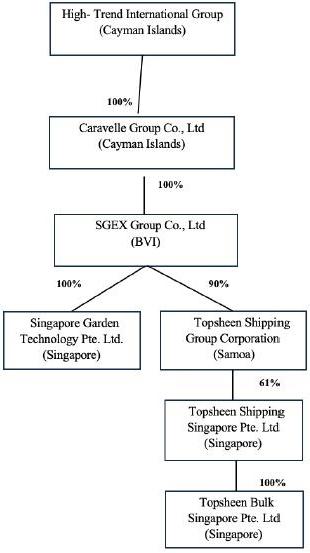
D. Property, Plants and Equipment
We lease our principal executive office, which is located on 60 Paya Lebar Road, #06-17 Paya Lebar Square, Singapore 409051, (65) 8304 8372, consisting of approximately 1,356 square feet. We recently renewed our lease which expires on March 14, 2027, pursuant to which the monthly rent is $6,686 (SGD8,700). We believe that our existing facilities are suitable and adequate to meet our current needs. If we need to add new facilities or expand existing facilities as we add employees, we believe that suitable additional space will be available to accommodate any such expansion of our operations.
ITEM 4A. UNRESOLVED STAFF COMMENTS
Not applicable.
Item 5. OPERATING AND FINANCIAL REVIEW AND PROSPECTS
You should read the following discussion and analysis of our financial condition and results of operations in conjunction with our consolidated financial statements and the related notes included elsewhere in this Report. This discussion contains forward-looking statements that involve risks and uncertainties. Our actual results and the timing of selected events could differ materially from those anticipated in these forward-looking statements as a result of various factors, including those set forth under “Risk Factors” and elsewhere in this Report.
A. Operating Results
Overview
We are an international provider of ocean transportation services. We are engaged in seaborne transportation services under voyage contracts as well as vessel services for and on behalf of ship owners. We conduct this business through the Topsheen Companies. For the fiscal years ended October 31, 2025, 2024 and 2023, our revenues were approximately $214.4 million, $108.2 million and $95.3 million, respectively and we incurred net losses of $20.1 million, $21.2 million and $15.8 million, respectively.
In 2025, we decided to investigate our entry into the business of providing carbon neutrality solutions for the shipping industry. To that end, we began to provide OCC consulting services in 2025, providing advisory support for clients with needs for full-vessel carbon capture or energy-saving retrofitting projects. For the fiscal year ended October 31, 2025, we generated approximately $0.4 million of revenue from providing OCC consulting services to customers. Due to the uncertainty about the viability of this technology and the underdeveloped OCC technologies and their applications, we decided not to aggressively pursue this opportunity at this time.
Recent Developments
Effective March 13, 2025, Mr. Jinyu Chang resigned as the chairman of our Board of Directors but continued to serve as a director of the Company. Also, effective March 13, 2025, Mr. Christopher Nixon Cox was elected to serve as a director and the Chairman of the Board of our company. We also named Mr. Bo Cui as its new Chief Legal Officer. Effective June 3, 2025, Mr. Christopher Renn resigned as the chairman of the Compensation Committee of our Board of Directors but remains an independent director. Effective the same date, Mr. Brian B. Su was elected to serve as an independent director and the Chairman of the Compensation Committee.
On July 16, 2025, an Extraordinary General Meeting of Shareholders was held where the shareholders voted to approve a twenty-five-for-one share consolidation.
Key Factors that Affect Operating Results
We primarily derive our revenues from voyage contracts and provide vessel services. We intend to enhance our freight transportation revenues and services and acquire new customers by increasing our market penetration with deeper market coverage and a broader geographical reach.
Quantitative and Qualitative Disclosures About Market Risk
Market risk represents the risk of changes in value of a financial instrument, derivative or non-derivative, caused by fluctuations in foreign exchange rates and interest rates. Changes in these factors could cause fluctuations in our results of operations and cash flows. We are exposed to the market risks described below.
Foreign Exchange Rate Risk
We generate all of our revenues in U.S. dollars but currently incur some of our costs and operating expenses (around 5% for the fiscal years ended October 31, 2025, 2024 and 2023) in currencies other than the U.S. dollar, primarily the Euro and Singapore Dollar. For accounting purposes, expenses incurred in Euros and Singapore Dollars are converted into U.S. dollars at the exchange rate prevailing on the date of each transaction. The amount and frequency of some of these expenses, such as vessel repairs, supplies and stores, may fluctuate from period to period. Depreciation in the value of the dollar relative to other currencies increases the dollar cost to us of paying such expenses. The portion of our expenses incurred in other currencies could increase in the future, which could expand our exposure to losses arising from currency fluctuations. Currently, we do not consider the risk from exchange rate fluctuations to be material for our results of operations and therefore, we are not engaged in derivative instruments to hedge part of those expenses.
Inflation risk
Our operations expose us to the effects of inflation. For the fiscal years ended October 31, 2025, we experienced increased average market prices for ship leases, oil and port charges. In the event that inflation becomes a more significant factor in the world economy, inflationary pressures could result in increased operating and financing costs. Although historically the ocean shipping industry has been able to largely offset the inflationary pressure by passing the costs of inflation onto its customers, the industry as a whole and we in particular may not be able to offset such costs sufficiently, in which case our cash flows and results would be negatively impacted.
Results of Operations
For the fiscal years ended October 31, 2025 and 2024
The following table summarizes the results of our operations for the fiscal years ended October 31, 2025 and 2024 and provides information regarding the dollar and percentage changes during such periods.
| For the Years Ended | ||||||||||||||||
| October 31, | % | |||||||||||||||
| 2025 | 2024 | Change | Change | |||||||||||||
| REVENUE: | ||||||||||||||||
| Ocean freight revenue | $ | 213,993,072 | $ | 105,387,225 | $ | 108,605,847 | 103.1 | % | ||||||||
| Vessel service revenue and others | 422,840 | 2,789,458 | (2,366,618 | ) | (84.8 | )% | ||||||||||
| Total revenue | 214,415,912 | 108,176,683 | 106,239,229 | 98.2 | % | |||||||||||
| COST OF REVENUE: | ||||||||||||||||
| Cost of revenues | 207,612,961 | 100,076,361 | 107,536,600 | 107.5 | % | |||||||||||
| GROSS PROFIT | 6,802,951 | 8,100,322 | (1,297,371 | ) | (16.0 | )% | ||||||||||
| OPERATING EXPENSES: | ||||||||||||||||
| Share-based compensation | 21,922,261 | 1,200,562 | 20,721,699 | 1,726.0 | % | |||||||||||
| General and administrative expenses | 4,792,925 | 4,595,206 | 197,719 | 4.3 | % | |||||||||||
| Total operating expenses | 26,715,186 | 5,795,768 | 20,919,418 | 360.9 | % | |||||||||||
| (LOSS) INCOME FROM OPERATIONS | (19,912,235 | ) | 2,304,554 | (22,216,789 | ) | (964.0 | )% | |||||||||
| OTHER INCOME (EXPENSE), NET | ||||||||||||||||
| Interest income | 60,833 | 3,444 | 57,389 | 1,666.3 | % | |||||||||||
| Interest expense | (45,935 | ) | (90,203 | ) | 44,268 | (49.1 | )% | |||||||||
| Change in fair value of convertible notes | - | (23,213,031 | ) | 23,213,031 | (100.0 | )% | ||||||||||
| Loss on settlement of convertible notes | - | (306,793 | ) | 306,793 | (100.0 | )% | ||||||||||
| Other income, net | (203,984 | ) | 91,318 | (295,302 | ) | (323.4 | )% | |||||||||
| Total other expense, net | (189,086 | ) | (23,515,265 | ) | 23,326,179 | (99.2 | )% | |||||||||
| LOSS BEFORE INCOME TAXES | (20,101,321 | ) | (21,210,711 | ) | 1,109,390 | (5.2 | )% | |||||||||
| PROVISION FOR INCOME TAXES | 9,106 | 4,139 | 4,967 | 120.0 | % | |||||||||||
| NET LOSS | $ | (20,110,427 | ) | $ | (21,214,850 | ) | $ | 1,104,423 | (5.2 | )% | ||||||
Revenues
For the fiscal year ended October 31, 2025, our total revenue was approximately $214.4 million compared to approximately $108.2 million for the fiscal year ended October 31, 2024. This represents a revenue increase of approximately $106.2 million, or 98.2%. The overall increase in revenue was primarily attributable to the Company’s entry into the coal transportation business, with routes covering key regions such as Australia to China, Indonesia to Southeast Asia and Vietnam, significantly expanding our dry bulk cargo transportation business. At the same time, the global demand for coal imports and exports surged, further driving business growth.
Revenue from ocean freight increased by approximately $108.6 million or 103.1%, from approximately $105.4 million in the fiscal year ended October 31, 2024 to approximately $214.4 million in the fiscal year ended October 31, 2025, due to increased ocean freight market demand. The total number of voyage days was 7,470 days for the fiscal year ended October 31, 2025, an increase of 3,974 days from 3,496 days for the fiscal year ended October 31, 2024. The average charge per day was approximately $28,645 per day for the fiscal year ended October 31, 2025, a decrease of approximately $1,499 from $30,144 per day for the fiscal year ended October 31, 2024 as the Baltic Dry Index (BDI) weakened compared to 2024.
Revenue from vessel services decreased from approximately $2.8 million in the fiscal year ended October 31, 2024, to $nil in the fiscal year ended October 31, 2025, as we determined to allocate our resources to our ocean freight business as market demand increased. We started to provide consulting services related to onboard carbon capture technologies in February 2025. Revenue from these consulting services was approximately $0.4 million during the fiscal year 2025.
Cost of Revenues
Our cost of revenues mainly consists of ship lease expenses, fuel expenses, port fees and other related costs. Such costs amounted to approximately $207.6 million for the fiscal year ended October 31, 2025, representing an increase of approximately $107.5 million, or 107.5%, compared to approximately $100.1 million for the fiscal year ended October 31, 2024 due to increased shipping volumes. This drove costs upward through several interconnected factors including, increased sailing days which led to substantially higher ship lease and fuel expenses. Furthermore, the heavier shipping traffic caused widespread port congestion, resulting in longer vessel docking and berthing times, which in turn caused port charges to rise accordingly. As a result, our ship lease expenses were approximately $96.8 million for the fiscal year ended October 31, 2025, representing an increase of approximately $52.1 million compared to approximately $44.7 million for the year ended October 31, 2024. Marine fuel expenses were approximately $49.3 million for the fiscal year ended October 31, 2025, representing an increase of approximately $20.9 million compared to approximately $28.4 million for the fiscal year ended October 31, 2024. Port fees were approximately $50.7 million for the fiscal year ended October 31, 2025, representing an increase of approximately $26.6 million compared to approximately $24.1 million for the fiscal year ended October 31, 2024.
Gross profit
Our gross profit amounted to approximately $6.8 million for the fiscal year ended October 31, 2025 compared to approximately $8.1 million for the fiscal year ended October 31, 2024. The gross margin as a percentage of overall revenue for the fiscal year ended October 31, 2025 and 2024, was 3.2% and 7.5%, respectively. The decrease in gross profit margin was mainly driven by higher costs, which outpaced the growth in revenues.
Operating Expenses
| For the Years Ended | ||||||||||||||||
| October 31, | % | |||||||||||||||
| 2025 | 2024 | Change | Change | |||||||||||||
| OPERATING EXPENSES: | ||||||||||||||||
| Share-based compensation | $ | 21,922,261 | $ | 1,200,562 | $ | 20,721,699 | 1,726.0 | % | ||||||||
| General and administrative | 4,792,925 | 4,595,206 | 197,719 | 4.3 | % | |||||||||||
| Total | $ | 26,715,186 | $ | 5,795,768 | $ | 20,919,418 | 360.9 | % | ||||||||
Our operating expenses consist of share-based compensation and general and administrative expenses. Operating expenses increased by approximately $20.9 million, or 360.9% from approximately $5.8 million for the fiscal year ended October 31, 2024 to approximately $26.7 million for the fiscal year ended October 31, 2025, mainly due to an increase of approximately $20.7 million in share-based compensation.
Share-based compensation consists of shares issued to certain executive office, directors, managers and consultants instead of cash salaries. In the fiscal year ended October 31, 2025, we issued an aggregate of 495,169 Class A Ordinary Shares and 500,000 options to purchase Class A Ordinary Shares to certain executive officers, directors, managers and consultant as compensation to replace their cash salaries and related compensations as well as to provide incentives for future business development. For the fiscal years ended October 31, 2025 and 2024, the Company recorded total share-based compensation expenses of approximately $21.9 million and $1.2 million included in the general and administrative expenses of our consolidated statement of operations, respectively. The $21.9 million of share-based compensation expenses for the fiscal year ended October 31, 2025, consisted of (i) approximately $1.5 million attributable to executive officers, (ii) approximately $0.7 million attributable to directors, (iii) approximately $11.8 million attributable to employees other than executive officers, and (iv) approximately $8.0 million attributable to consultants, including $3.3 million attributable to the vesting of 471,836 restricted ordinary shares issued to seven consultants in fiscal year 2024 for OCC business development and capital markets–related services, $3.8 million attributable to 500,000 stock options granted to two consultants for market development services related to the our ocean transportation business, and $0.9 million attributable to the issuance of an aggregate of 80,000 ordinary shares to four consultants for capital financing and related business development services.
General and administrative expenses primarily consisted of salary and compensation expenses related to our accounting, human resources and executive office personnel, and included rental, depreciation and amortization expenses, office overhead, professional service fees and travel and transportation costs. General and administrative expenses increased by approximately or 4.3% from approximately $4.6 million for the fiscal year ended October 31, 2024 to approximately $4.8 million for the fiscal year ended October 31, 2025, mainly due to an increase of approximately $0.2 million in consulting and professional service fee.
Other Expenses, net
Other expense, net primarily consists of interest expense, change in fair value of convertible notes, loss on settlement of convertible notes and other items. Other income, net was approximately $0.2 million for the fiscal year ended October 31, 2025, compared to other expense, net of approximately $23.5 million for the fiscal year ended October 31, 2024. The change was primarily attributable to a loss of $23.2 million from the change in fair value of convertible notes and $0.3 million from the loss on settlement of convertible notes during the fiscal year ended October 31, 2024. The Company elected the fair value option to account for its convertible notes. The fair value of the convertible notes is re-measured at each reporting period, and the change in fair value is recognized as either income or expense.
Provision for Income Taxes
Our provision for income taxes was $9,106 and $4,139 for the fiscal years ended October 31, 2025 and 2024, respectively. The Topsheen Companies are eligible for and participate under the Maritime Sector Incentive-Approved International Shipping Enterprise (MSI-AIS) award program in Singapore. We renewed for an additional 10 years in November 6, 2025, and commencing on 1 December 2025. All qualified shipping income derived from the shipping activity of Topsheen Companies is exempt from taxation for the duration of our subsidiaries MSI-AIS participation in this program.
Net Loss
As a result of the foregoing, our net loss amounted to approximately $20.1 million for the fiscal year ended October 31, 2025, compared to a net loss of approximately $21.2 million for the fiscal year ended October 31, 2024.
For the fiscal years ended October 31, 2024 and 2023
The following table summarizes the results of our operations for the fiscal years ended October 31, 2024 and 2023 and provides information regarding the dollar and percentage changes during such periods.
| For the Years Ended | ||||||||||||||||
| October 31, | % | |||||||||||||||
| 2024 | 2023 | Change | Change | |||||||||||||
| REVENUE: | ||||||||||||||||
| Ocean freight revenue | $ | 105,387,225 | $ | 94,523,562 | $ | 10,863,663 | 11.5 | % | ||||||||
| Vessel service revenue | 2,789,458 | 733,976 | 2,055,482 | 280.0 | % | |||||||||||
| Total revenue | 108,176,683 | 95,257,538 | 12,919,145 | 13.6 | % | |||||||||||
| COST OF REVENUE: | ||||||||||||||||
| Cost of revenues | 100,076,361 | 107,142,741 | (7,066,380 | ) | (6.6 | )% | ||||||||||
| GROSS PROFIT(LOSS) | 8,100,322 | (11,885,203 | ) | 19,985,525 | (168.2 | )% | ||||||||||
| OPERATING EXPENSES: | ||||||||||||||||
| Share-based compensation | 1,200,562 | - | 1,200,562 | 100.0 | % | |||||||||||
| General and administrative expenses | 4,595,206 | 3,742,728 | 852,478 | 22.8 | % | |||||||||||
| Total operating expenses | 5,795,768 | 3,742,728 | 2,053,040 | 54.9 | % | |||||||||||
| INCOME (LOSS) FROM OPERATIONS | 2,304,554 | (15,627,931 | ) | 17,932,485 | (114.7 | )% | ||||||||||
| OTHER INCOME (EXPENSE), NET | ||||||||||||||||
| Interest income | 3,444 | 7,738 | (4,294 | ) | (55.5 | )% | ||||||||||
| Interest expense | (90,203 | ) | (112,022 | ) | 21,819 | (19.5 | )% | |||||||||
| Change in fair value of convertible notes | (23,213,031 | ) | - | (23,213,031 | ) | (100.0 | )% | |||||||||
| Loss on settlement of convertible notes | (306,793 | ) | - | (306,793 | ) | (100.0 | )% | |||||||||
| Other income (expense), net | 91,318 | (42,947 | ) | 134,265 | (312.6 | )% | ||||||||||
| Total other expense, net | (23,515,265 | ) | (147,231 | ) | (23,368,034 | ) | 15,871.7 | % | ||||||||
| LOSS BEFORE INCOME TAXES | (21,210,711 | ) | (15,775,162 | ) | (5,435,549 | ) | 34.5 | % | ||||||||
| PROVISION FOR INCOME TAXES | 4,139 | 2,542 | 1,597 | 62.8 | % | |||||||||||
| NET LOSS | $ | (21,214,850 | ) | $ | (15,777,704 | ) | $ | (5,437,146 | ) | 34.5 | % | |||||
Revenues
For the fiscal year ended October 31, 2024, our total revenue was approximately $108.2 million, compared to approximately $95.3 million for the fiscal year ended October 31, 2023. This represents a revenue increase of approximately $12.9 million, or 13.6%. Revenue from ocean freight increased by approximately $10.9 million or 11.5%, from approximately $94.5 million in the fiscal year ended October 31, 2023 to approximately $105.4 million in the fiscal year ended October 31, 2024. This increase was primarily attributable to an increase in ocean freight prices during the fiscal year ended October 31, 2024. The total number of voyage days was 3,496 days for the fiscal year ended October 31, 2024, an increase of 44 days from 3,452 days for the fiscal year ended October 31, 2023. The average charge per day was approximately $30,144 per day for the fiscal year ended October 31, 2024, an increase of approximately $2,800 from $27,344 per day for the fiscal year ended October 31, 2023, which was due to increased shipping prices.
Revenue from vessel services increased by approximately $2.1 million or 280.0% from approximately $0.7 million in the fiscal year ended October 31, 2023, to approximately $2.8 million in the fiscal year ended October 31, 2024. The total number of voyage days was 759 days for the fiscal year ended October 31, 2024, a decrease of 307 days from 1,066 days for the fiscal year ended October 31, 2023. The average charge per day was $3,675 per day for the fiscal year ended October 31, 2024 compared to the average charge per day of $688 for the fiscal year ended October 31, 2023, due to increased freight revenue.
Cost of Revenues
Our cost of revenues mainly consists of ship lease expenses, fuel expenses, port fees and other related costs. Our costs amounted to approximately $100.1 million for the fiscal year ended October 31, 2024, representing a decrease of approximately $7.1 million, or 6.6%, compared to approximately $107.1 million for the fiscal year ended October 31, 2023, because the average Asian market prices for ship leases, fuel and port charges all decreased in the fiscal year ended October 31, 2024 as compared to the fiscal year ended October 31, 2023. As a result, our ship lease expenses were approximately $44.7 million for the fiscal year ended October 31, 2024, representing a decrease of approximately $1.1 million from approximately $45.8 million for the fiscal year ended October 31, 2023. Fuel expenses were approximately $28.4 million for the fiscal year ended October 31, 2024, representing a decrease of approximately $2.1 million from approximately $30.5 million for the fiscal year ended October 31, 2023. Port fees were approximately $24.1 million for the fiscal year ended October 31, 2024, representing a decrease of approximately $2.2 million from approximately $26.3 million for the fiscal year ended October 31, 2023.
Gross profit (loss)
| For the Years Ended October 31, | ||||||||||||||||
| 2024 | 2023 | |||||||||||||||
| GROSS PROFIT(LOSS) | Gross Profit |
Gross Margin |
Gross Loss |
Gross Margin |
||||||||||||
| Total gross profit (loss) | $ | 8,100,322 | 7.5 | % | $ | (11,885,203 | ) | (12.5 | )% | |||||||
Our gross profit amounted to approximately $8.1 million for the fiscal year ended October 31, 2024 compared to a gross loss of approximately $11.9 million for the fiscal year ended October 31, 2023. Our gross margin as a percentage of overall revenue for the fiscal year ended October 31, 2024 and 2023, was 7.5% and negative 12.5%, respectively. The increase in gross margin was primarily due to the significant increase in revenue and decrease in costs due to the market-wide decrease in vessel lease costs as a result of the BDI point (Baltic Dry Index point) decrease (which impacts vessel lease costs), as well as the decline in oil prices and port charges.
Operating Expenses
| For the Years Ended | ||||||||||||||||
| October 31, | % | |||||||||||||||
| 2024 | 2023 | Change | Change | |||||||||||||
| OPERATING EXPENSES: | ||||||||||||||||
| Share-based compensation | $ | 1,200,562 | $ | - | $ | 1,200,562 | 100.0 | % | ||||||||
| General and administrative | 4,595,206 | 3,742,728 | 852,478 | 22.8 | % | |||||||||||
| Total | $ | 5,795,768 | $ | 3,742,728 | $ | 2,053,040 | 54.9 | % | ||||||||
Our operating expenses consist of share-based compensation and general and administrative expenses. Operating expenses increased by approximately $2.1 million, or 54.9% from approximately $3.7 million for the fiscal year ended October 31, 2023 to approximately $5.8 million for the fiscal year ended October 31, 2024, mainly due to an increase of approximately $1.2 million in share-based compensation and an increase of approximately $0.9 million in general and administrative expenses.
Share-based compensation consists of shares issued to certain executive office, directors, managers and consultants instead of cash salaries. During the fiscal year ended October 31, 2024, we issued 460,000 Class A ordinary Shares to third party consultants for market development, assistance in entering the onboard carbon capture business and market branding and development. On March 10, 2024, we entered into a two-year consulting agreement with a third party for capital market financing and business development services. Pursuant to the agreement, we issued 60,000 Class A Ordinary Shares to the third party. The fair value of the 60,000 Class A Ordinary Shares was $800,100, based on our share price on date of grant. On April 24, 2024, we entered into a one-year consulting agreement with a third party for branding and marketing services. Pursuant to the agreement, we issued 60,000 Class A Ordinary Shares to the third party. The fair value of the 60,000 Class A Ordinary Shares was $1,537,500, based on our share price on the date of grant. On October 15, 2024, we entered into a one-year consulting agreement with a third party for business development services for our entry into the onboard carbon capture business. Pursuant to the agreement, we agreed to issue 60,000 Class A Ordinary Shares to the third party. The shares had a fair value of $799,500 based on our share price on the date of grant. On October 15, 2024, we entered into a three-year consulting agreement with a third party for business development services for our new onboard carbon capture business. Pursuant to the agreement, we agreed to issue 104,000 Class A Ordinary Shares to the third party. The shares had a fair value of $1,385,800, based on our share price on the date of grant. On October 15, 2024 we entered into a one-year consulting agreement with a third party for business development services in the PRC. Pursuant to the agreement, we paid a cash fee of $30,000 and issued 16,000 Class A Ordinary Shares to the third party. The fair value of the 16,000 Class A Ordinary Shares was $213,200, based on our share price on the date of grant. On October 21, 2024, we entered into a three-year consulting agreement with a third party for investor relations advisory services. Pursuant to the agreement, we agreed to issue 160,000 Class A Ordinary Shares to the third party. The shares had a fair value of $2,132,000, based on our share price on the date of grant. For the fiscal years ended October 31, 2024 and 2023, the Company recorded share-based compensation expenses of approximately $1.2 million and $nil, respectively.
General and administrative expenses primarily consisted of salary and compensation expenses related to our accounting, human resources and executive office personnel, and included rental, depreciation and amortization expenses, office overhead, professional service fees and travel and transportation costs. General and administrative expenses increased by approximately $0.9 million or 22.8% from approximately $3.7 million for the fiscal year ended October 31, 2023 to approximately $4.6 million for the fiscal year ended October 31, 2024, mainly due to an increase of approximately $0.5 million in brokerage fees, an increase of approximately $0.5 million in salary expenses due to an increase in the salaries paid to employees and an increase of approximately $0.1 million in consulting and professional service fee, offset by a decrease of approximately $0.4 million in D&O insurance covers directors and officers.
Other Expenses, net
Other expense, net primarily consists of interest expense, change in fair value of convertible notes, loss on settlement of convertible notes and other items. Other expense, net was approximately $23.5 million for the fiscal year ended October 31, 2024, representing an increase of approximately $23.4 million compared to $0.1 million for the fiscal year ended October 31, 2023. The increase was primarily attributable to a loss of $23.2 million from change in fair value of convertible notes and $0.3 million from the loss on settlement of convertible notes during the fiscal year ended October 31, 2024. The Company elected the fair value option to account for its convertible notes (excluding freestanding warrants if applicable). The fair value of the convertible notes is re-measured at each reporting period, and the change in fair value is recognized as either income or expense.
Provision for Income Taxes
Our provision for income taxes was $4,139 and $2,542 for the fiscal years ended October 31, 2024 and 2023, respectively. The Topsheen Companies are eligible for and participate under the Maritime Sector Incentive-Approved International Shipping Enterprise (MSI-AIS) award program in Singapore. All qualified shipping income derived from the shipping activity of Topsheen Companies is exempt from taxation for the duration of our subsidiaries MSI-AIS participation in this program.
Net Loss
As a result of the foregoing, our net loss amounted to approximately $21.2 million for the fiscal year ended October 31, 2024, compared to a net loss of approximately $15.8 million for the fiscal year ended October 31, 2023.
B. Liquidity and Capital Resources
We are a holding company with no material operations of our own. We conduct our operations primarily through our subsidiaries in Singapore. Our ability to pay dividends depends upon dividends paid by our subsidiaries in Singapore. These subsidiaries are permitted to pay dividends to only out of their retained earnings, if any, as determined in accordance with Singapore accounting standards and regulations. We would need to accrue and pay withholding taxes if we were to distribute funds from our subsidiaries in Singapore to us.
In assessing our liquidity, we monitor and analyze our cash on hand, ability to generate sufficient revenue sources in the future, and our operating and capital expenditure commitments. We have historically funded our working capital needs primarily from operations, bank loans, and advances from shareholders and intends to continue doing so in the near future to ensure sufficient working capital. As of October 31, 2025, we had cash of $10.1 million. Advances from customers included in current liabilities amounted to $7.4 million mainly representing the advances from customers that will be recognized as revenue in the next fiscal year when the services are provided. We intend to finance our future working capital requirements and capital expenditures from financing activities.
On March 10, 2025, we closed a private placement with Speed Wealthy Ltd (“Speed Wealthy”), a related party. We issued 67,985 Class A Ordinary Shares to Speed Wealthy at a price of $65.5 per share for consideration of approximately $4.5 million. We entered into an agreement with Speed Wealthy and Topsheen Shipping Limited on 2025, pursuant to which Speed Wealthy’s payment obligation for the shares issued in the above private placement was fully satisfied by extinguishing our debt obligations to Topsheen Shipping Limited.
The following summarizes the key components of our cash flows for the fiscal years ended October 31, 2025, 2024 and 2023.
| For the Year Ended October 31, 2025 |
For the Year Ended October 31, 2024 |
For the Year Ended October 31, 2023 |
||||||||||
| Net cash provided by (used in) operating activities | $ | 4,631,918 | $ | (3,328,206 | ) | $ | (17,773,998 | ) | ||||
| Net cash used in investing activities | (5,071 | ) | - | - | ||||||||
| Net cash (used in) provided by financing activities | (1,349,785 | ) | 7,971,203 | (1,578,365 | ) | |||||||
| Net increase (decrease) in cash and cash equivalents | $ | 3,277,062 | $ | 4,642,997 | (19,352,363 | ) | ||||||
Operating Activities
Net cash provided by operating activities was approximately $4.6 million for the fiscal year ended October 31, 2025. Cash used in operating activities for the fiscal year ended October 31, 2025 was mainly attributable to a net loss of approximately $20.1 million, adjusted for certain non-cash items primarily consisting of share-based compensation of approximately $21.9 million, and changes in certain working capital accounts that primarily consisting of cash provided by accrued expenses and other liabilities of approximately $3.4 million due to slow payments, cash provided by advances from customers of approximately $1.6 million, offset by accounts receivable of approximately $1.1 million and cash due from related parties of approximately $1.2 million.
Net cash used in operating activities was approximately $3.3 million for the fiscal year ended October 31, 2024. Cash used in operating activities for the fiscal year ended October 31, 2024 mainly consisted of a net loss of approximately $21.2 million, adjusted for certain non-cash items primarily consisting of fair value loss of approximately $23.2 million in the change in fair value of convertible notes issued in fiscal 2024, issuance of shares for services of approximately $1.2 million and loss on settlement of convertible notes of approximately $0.3 million, and changes in certain working capital accounts that primarily consisted of accounts receivable of approximately $6.6 million due to increased revenue, prepayment and other assets of approximately $4.5 million due to increased fuel and other costs, offset by cash provided by advances from customers of approximately $2.3 million, cash provided by accrued expenses and other liabilities of approximately $1.7 million due to longer credit terms with service providers and increased accounts payable of approximately $0.3 million.
Net cash used in operating activities was approximately $17.8 million for the fiscal year ended October 31, 2023. Cash used in operating activities mainly consisted of a net loss of approximately $15.8 million, changes in certain working capital accounts that primarily consisted of advances from customers of approximately $6.6 million, increased accrued expenses and other liabilities of approximately $3.1 million, a reduction in accounts receivable of approximately $3.0 million due to faster collection, prepayments and other assets of approximately $4.1 million offset by prepayments for fuel advances from related parties of approximately $1.1 million.
Investing Activities
Cash used by investing activities was approximately $0.01 million for the fiscal years ended October 31, 2025. Our expenditures or the fiscal years ended October 31, 2025 were for the purchase of office and electronic equipment. Cash used by investing activities was $nil for the fiscal years ended October 31, 2024 and 2023.
Financing Activities
Net cash used in financing activities was approximately $1.3 million for the fiscal year ended October 31, 2025, mainly consisting of repayment of advances made by related parties of approximately $1.1 million and repayment of long-term bank loans of approximately $1.5 million, offset by loans from related parties of approximately $0.9 million and cash received from warrants exercised of approximately $0.4 million.
Net cash provided by financing activities was approximately $8.0 million for the fiscal year ended October 31, 2024, mainly consisting of loans from related parties of approximately $10.7 million, proceeds from convertible notes of approximately $5.3 million, capital contributed by non-controlling shareholders of approximately $2.8 million, offset by repayment of related-party loans of approximately $8.5 million, repayment of convertible notes of approximately $1.4 million and repayment of long-term bank loans of approximately $0.9 million.
Net cash used in financing activities was approximately $1.6 million for the fiscal year ended October 31, 2023, mainly consisting of repayment of related parties’ loans of approximately $13.2 million, dividends paid to shareholders of our subsidiaries of approximately $0.9 million, and repayment of a long-term bank loan of approximately $0.8 million, offset by loan proceeds from related parties of approximately $13.4 million.
Capital Expenditures
We had capital expenditures of approximately $0.01 million, $nil and $nil for office and electronic equipment during the fiscal years ended October 31, 2025, 2024 and 2023, respectively.
Contractual Obligations
We have entered into non-cancellable operating lease agreements to rent our office space in Singapore. The lease agreement, which will expire on March 14, 2027.
The following table sets forth our contractual obligations and commercial commitments as of October 31, 2025:
| Payment Due by Period | ||||||||||||||||||||
| Total | Less than 1 Year |
1 – 3 Years | 3 – 5 Years | More than 5 Years |
||||||||||||||||
| Lease | $ | 104,129 | $ | 77,596 | $ | 26,533 | $ | - | $ | - | ||||||||||
| Total | $ | 104,129 | $ | 77,596 | $ | 26,533 | $ | - | $ | - | ||||||||||
Off-Balance Sheet Arrangements
There were no off-balance sheet arrangements for the fiscal years ended October 31, 2025, 2024 and 2023 that have, or that in the opinion of management are likely to have, a current or future material effect on our financial condition or results of operations.
C. Research and Development, Patents and Licenses, etc.
Not applicable
D. Trend Information
Other than as described elsewhere in this Report, we are not aware of any trends, uncertainties, demands, commitments or events that are reasonably likely to have a material adverse effect on our revenue, income from continuing operations, profitability, liquidity or capital resources, or that would cause our reported financial information to not necessarily be indicative of future operating results or financial condition.
E. Critical Accounting Estimates
We prepare our consolidated financial statements in conformity with U.S. GAAP. The preparation of these financial statements requires us to make estimates, judgments, and assumptions that can have a meaningful effect on the reporting of consolidated financial statements. We continually evaluate these estimates and assumptions based on the most recently available information, our own historical experience and various other assumptions that we believe to be reasonable under the circumstances. Since the use of estimates is an integral component of the financial reporting process, actual results could differ from our expectations as a result of changes in our estimates.
Critical accounting estimates are defined as those reflective of significant judgments, estimates and uncertainties, which may result in materially different results under different assumptions and conditions. The following descriptions of critical accounting estimates should be read in conjunction with our consolidated financial statements and accompanying notes and other disclosures included in this report.
When reading our consolidated financial statements, you should consider our selection of critical accounting policies, the judgment and other uncertainties affecting the application of such policies and the sensitivity of reported results to changes in conditions and assumptions. Our critical accounting policies and practices include revenue recognition. We believe the following accounting estimates involve the most significant judgments used in the preparation of our consolidated financial statements.
Accounting estimates used in revenue recognition
Under a voyage contract, we are engaged to provide the transportation of cargo between specific ports in return for an ocean freight payment of an agreed upon freight per ton of cargo. Our voyage contracts generally do not contain cancelable provisions. A voyage is deemed to commence when a vessel was available for loading and is deemed to end upon the completion of the discharge of the current cargo. For voyage contracts, the customer simultaneously receives and consumes the benefits provided by our performance over the voyage period because of the continuous service to the customer. Customers receive the benefit of our services as the goods are transported from one location to another. If we were unable to complete delivery to the final location, another entity would not need to reperform the transportation service already performed. As control transfers over time, we recognize revenue ratably from the port of loading to when the charterer’s cargo is discharged based on the relative transit time completed in each reporting period. For unfinished voyages, the related revenue is recognized based on the estimated transit time-based portion completed of each voyage at the reporting date. Estimated losses on voyages are provided for in full at the time such losses become evident. Voyage expenses and other ocean transportation operating costs are charged to operating costs as incurred.
Recent Accounting Pronouncements
A recitation of recent relevant accounting pronouncements is included in Note 2 “Summary of Significant Accounting Policies” of our Consolidated Financial Statements.
ITEM 6. DIRECTORS, SENIOR MANAGEMENT AND EMPLOYEES
A. Directors and Executive Officers
Our directors and executive officers are currently as follows:
| Name | Age | Position | ||
| Shixuan He | 51 | Director and Chief Executive Officer | ||
| Zi Xia | 47 | Chief Financial Officer and Director | ||
| Christopher Nixon Cox | 47 | Director and Chairman of the Board | ||
| Bo Cui | 43 | Chief Legal Officer | ||
| Shahryar Oveissi | 47 | Chief Capital Markets Officer | ||
| Jinyu Chang | 53 | Director | ||
| Xuanhua Xi | 54 | Independent Director | ||
| Christopher Renn | 54 | Independent Director | ||
| Jing Sang | 44 | Independent Director | ||
| Brian B. Su | 61 | Independent Director |
Shixuan He joined our company on January 4, 2025. Mr. He has served as the CEO of High-Trend Technology Co., Ltd., a company focusing on intelligent city system development, since April 2014. From January 2010 to March 2014, Mr. He served as the CEO of Tianjin Meijiang International Convention and Exhibition Center, a company focused on exhibition management and commercial venue operation. Mr. He obtained his bachelor’s degree in Automation from Dalian University of Technology in 1997.
Zi Xia has served as the Chief Financial Officer and a director of our company since July 8, 2024. Ms. Xia is the Founder of Aiken International Technology Co., Ltd., an international low-carbon industry accelerator, a position she has held since 2019. Prior to that, Ms. Xia co-founded Yike Talks, a podcast platform, in 2018, where she led the marketing and product development teams from February 2018 to February 2021. From February 2009 to February 2018, Ms. Xia worked at Willis Towers Watson, a global consulting and advisory company, where she served as a Partner in charge of the marketing business for the Greater China area. Ms. Xia obtained a Bachelor of Arts degree in Communications from the University of Colorado and a Master of Arts degree in Mass Communications from the University of Leicester.
Christopher Nixon Cox has served as Chairman of the Board of our company since March 13, 2025. Since December 2021, Mr. Cox has served as Chief Executive Officer of Lightswitch Capital, a private equity firm focused on funding breakthrough therapies for severe diseases and advancing green infrastructure in emerging markets. In addition, he has served as Chief Executive Officer of Argali Carbon Corporation, a carbon offset developer, since November 2022 and of BioSource Feed Corporation, a sustainable agriculture company, since October 2023. He has served as a member of the board of directors of Alto Neuroscience, Inc. (NYSE: ANRO) since April 2022. From December 2018 to March 2020, Mr. Cox served as Vice Chairman of Brightsphere, Inc., a publicly traded asset management company. Mr. Cox has also served as Managing Partner and co-founder of OC Global Partners LLC, a financial services firm, since October 2006. Earlier in his career, Mr. Cox was a corporate associate at Weil, Gotshal & Manges LLP from 2004 to 2006. Mr. Cox received a Juris Doctor degree from New York University School of Law, a certificate in Finance from New York University Stern School of Business, and a Bachelor of Arts degree in Politics from Princeton University.
Bo Cui has served as the Chief Legal Officer of our company since March 13, 2025. From May 2019 to June 2020, he served as Senior Vice President of Brightsphere Investment Group, a NYSE listed asset management company with $240billion of assets under management. From March 2023 to September 2024, he served as Vice President of US Operations of Atlas Technologies, a major blockchain infrastructure company. Since January 2022 he has served as Chief Operating Officer of Lightswitch Capital, a venture capital fund focused on biotechnologies. Mr. Cui is a licensed attorney in the State of New York and a registered patent practitioner with the United States Patent and Trademark Office. Mr. Cui received a Juris Doctor degree from Georgetown University Law Center and a Bachelor of Science degree in Mathematics and Computer Science from the University of Illinois.
Shahryar Oveissi joined our company as Chief Capital Markets Officer on January 9, 2026. Previously, he has served as a General Partner of 108Bio Capital from July 2025 until January 2026. He held the position of General Partner of Argali Climate Fund from January 2023 to June 2025, worked as a Director focusing on international business development and clinical trials at Diomics Corporation from October 2020 to July 2022, and served as a Partner of Rose Capital from December 2019 to August 2020. Mr. Oveissi holds a Bachelor of Science (B.S.) degree in Information Systems & International Business from the Stern School of Business at New York University.
Jinyu Chang joined our company on October 16, 2024. He is a Co-Founder of High Trend International, a holding company focused on the investment and development of projects involving municipal smart cities and smart street light points and has been managing the company since January 1, 2018. From January 1, 2011 to December 31, 2017, Mr. Chang served as the Chairman of the Board of High Trend Technology Co., Ltd., a company focused on the investment and development of smart city projects. Mr. Chang has a Bachelor’s degree in Administrative Management from Tianjin University of Finance and Economics.
Xuanhua Xi joined our company on January 10, 2025. Ms. Xi has served as the Chief Risk officer of DigiFT Technology Group, a Singapore-based on-chain capital market operation and service provider, since December 2024. She served as the Deputy Chief Executive Officer of Neutral Financial Holding Company Limited, a Hong Kong-based licensed financial service provider, from July 2024 to December 2024. Previously, she served as the Deputy Chief Executive Officer of BOCOM International Holdings Co., Ltd., a Hong Kong-based and listed financial service provider, from July 2017 to December 2023. She was also the General Manager of BOCOM International (Shanghai) Equity Investment Management Co., Ltd., an investment management company, from November 2020 to January 2022. From March 2015 to July 2017, she served as the General Manager of BOCOM International Securities Ltd., a company providing securities brokerage services. Ms. Xi obtained her Bachelor’s degree in Economics from Fudan University, China, and her Executive Master of Business Administration degree from Shanghai Jiao Tong University, China.
Christopher Renn has served as an independent director of our company since July 8, 2024. Mr. Renn has also been a director of Professional Diversity Network, Inc. (Nasdaq: IPDN), a global developer and operator of online and in-person networks providing networking, training, educational, and employment opportunities, since June 2022. Between May 2021 and June 2022, he was a director and senior vice president of the alternative assets division at Bluestone Capital, focusing on alternative assets including technology, infrastructure, energy, and real estate. From June 2018 to May 2021, Mr. Renn was a managing director at SIG, an international infrastructure finance company active in emerging markets infrastructure development through transportation, technology, renewable energy, and healthcare projects. From April 2017 to May 2018, he worked as a senior vice president at Great Bay, an energy-focused hedge fund. From June 2011 to March 2017, he was a senior vice president and investment manager at Urban Retail Properties, the commercial property arm of a NYSE-listed REIT. Mr. Renn obtained a Master’s degree in Architecture from the Illinois Institute of Technology. He also graduated from the Advanced Management Program at Harvard University.
Jing Sang has served as an independent director of our company since July 8, 2024. Ms. Sang is the Founder and Executive Director of China Council for an Energy Efficient Economy (CCEEE), an integrated platform to promote multilateral collaboration and communication in energy efficiency and low carbon policy, technology and financing. Prior to founding CCEEE in 2018 and since February 2017, Ms. Sang worked as a project manager in the Energy Foundation China (EFC) from February 2008 to February 2017 in industry energy efficiency. She also serves as Deputy Chairperson and Deputy Secretary-General of Energy Economy Committee, China Energy Research Society (CERS); Secretary-General of Green Industrial Parks Committee, China Association of Circular Economy (CECA); Secretary-General of Green & Low carbon Industrial Parks Committee, Chinese Society for Environmental Sciences (CSES). Ms. Sang holds a Master’s degree in Law (LLM) from China Foreign Affairs University and she is an Innovation Leading Engineering PhD candidate in Tsinghua University (China). She was a visiting scholar in Lawrence Berkeley National Laboratory (LBNL) from May 2015 to August 2015.
Brian B. Su is the founder and has served as the president of Artisan Business Group Inc., a U.S.-based consulting firm that supports companies and government entities with global expansion, regulatory navigation, and investment planning, since October 2011. From October 1998 to October 2011, he worked as a compliance specialist at the Illinois Department of Transportation. From March 1996 to October 1998, he served as a staff assistant to Illinois Governor Jim Edgar. From March 1987 to December 1989, he worked as an international business manager at the China National Nonferrous Metals Import and Export Corporation. Mr. Su holds a Bachelor of Arts degree in English Language and Literature from Guizhou University in China and a Master of Public Administration (MPA) from the University of Illinois at Springfield.
There are no family relations among any of our officers or directors. There are no other arrangements or understandings pursuant to which our directors are selected or nominated.
B. Compensation
For the fiscal year ended October 31, 2025, the Company paid $87,530 in cash compensation and $1,498,243 in share based compensation to our executive officers.
For the fiscal year ended October 31, 2025, the Company paid $ 87,530 in cash compensation and $670,096 in share based compensation to our directors.
2022 Incentive Plan
We adopted the 2022 Share Incentive Plan (the “2022 Plan”), which provides for the issuance of up to an aggregate of 133,981 of our Class A Ordinary Shares. The following is a summary of certain terms and conditions of the 2022 Plan. This summary is qualified in its entirety by reference to the 2022 Plan.
Summary of the 2022 Plan
Types of Awards. The 2022 Plan permits the awards of options, share appreciation rights, rights to dividends and dividend equivalent right, restricted shares and restricted share units and other rights or benefits under the 2022 Plan.
Plan Administration. The 2022 Plan shall be administrated by a committee formed in accordance with applicable stock exchange rules, unless otherwise determined by our Board of Directors.
Eligibility. Our employees and consultants are eligible to participate in the 2022 Plan. An employee or consultant who has been granted an award may, if he or she is otherwise eligible, be granted additional awards.
Designation of Award. Each award under the 2022 Plan is designated in an award agreement, which is a written agreement evidencing the grant of an award executed by the company and the grantee, including any amendments thereto.
Conditions of Award. Our Board of Directors or any entity appointed by the Board to administer the 2022 Plan shall determine the provisions, terms, and conditions of each award including, but not limited to, the award vesting schedule, repurchase provisions, rights of first refusal, forfeiture provisions, and form of payment upon settlement of the award.
Terms of Award. The term of each award is stated in the award agreement between the company and the grantee of such award.
Transfer Restrictions. Unless otherwise determined by the administrator of the 2022 Plan, no award and no right under any such award, shall be assignable, alienable, saleable or transferable by the employee otherwise than by will or by the laws of descent and distribution unless, if so determined by the administrator of the 2022 Plan, the employee may, in the manner established by such administrator, designate a beneficiary or beneficiaries to exercise the rights of the employee, and to receive any property distributable, with respect to any award upon the death of the employee.
Exercise of Award. Any award granted under the 2022 Plan is exercisable at such times and under such conditions as determined by the administrator under the terms of the 2022 Plan and specified in the award agreement. An award is deemed to be exercised when exercise notice has been given to the company in accordance with the terms of the award by the person entitled to exercise the award and full payment for the shares with respect to which the award is exercised.
Amendment, Suspension or Termination of the 2022 Plan. The administrator of the 2022 Plan may amend, alter, suspend, discontinue or terminate the 2022 Plan, or any award agreement hereunder or any portion hereof or thereof at any time; provided, however, that no such amendment, alteration, suspension, discontinuation or termination shall be made without (i) shareholder approval with such legally mandated threshold for a resolution of the shareholders if such approval is necessary to comply with any tax or regulatory requirement for which or with which the administrator of the 2022 Plan deems it necessary or desirable to qualify or (ii) shareholder approval with such threshold for a resolution of the shareholders in respect of such amendment, alteration, suspension, discontinuation or termination as provided in our Memorandum and Articles of Association for any amendment to the 2022 Plan that increases the total number of shares reserved for the purposes of the 2022 Plan, and (iii) with respect to any award agreement, the consent of the affected employee, if such action would materially and adversely affect the rights of such employee under any outstanding award.
On May 19, 2025, our Board of Directors approved an amendment to the 2022 Plan and authorized the management to implement an equity incentive plan under which the total number of Shares to be issued shall not exceed 20% of the company’s total outstanding share capital.
During the fiscal year ended October 31, 2025, we granted 500,000 options to purchase Class A Ordinary Shares that vested upon issuance with an exercise price of $0.01 per share to two consultants for their services in connection with the market development of our ocean transportation business. During the fiscal year ended October 31, 2025, all of the options were exercised. As of October 31, 2025, no options were outstanding.
For the fiscal years ended October 31, 2025, 2024 and 2023, we recorded $3,750,000, $nil and $nil in share-based compensation expenses related to vested options, respectively. As of October 31, 2025 and 2024, we had no unrecognized share-based compensation expense related to unvested options.
C. Board Practices
Overall responsibility for the oversight of the management of our company rests with our Board of Directors. Our Board of Directors currently consists of eight directors. The Board of Directors maintains four independent directors who are deemed to be independent under the definition of independence under Rule 5605(c)(2) of the Nasdaq Stock Market Rules. Our independent directors are Xuanhua Xi, Christopher Renn, Jing Sang and Brian B. Su.
There are no membership qualifications for directors. Further, there are no share ownership qualifications for directors unless so fixed by us in a general meeting. A director may vote with respect to any contract, proposed contract or arrangement in which he or she is materially interested provided (i) such director, if his or her interest in such contract or arrangement is material, has declared the nature of his or her interest at the earliest meeting of the board at which it is practicable for him or her to do so, either specifically or by way of a general notice, (ii) such director has not been disqualified by the chairman of the relevant board meeting, and (iii) if such contract or arrangement is a transaction with a related party, such transaction has been approved by the audit committee in accordance with the Nasdaq rules. There are no other arrangements or understandings pursuant to which our directors are appointed or nominated. We do not have any service contracts with our directors that provide for benefits upon termination of employment.
Our Board of Directors plays a significant role in our risk oversight. The Board of Directors makes all relevant company decisions. Under the laws of the Cayman Islands, our directors have a fiduciary duty to act honestly in good faith with a view to the company’s best interests. Our directors also have a duty to exercise the care, diligence and skill that a reasonably prudent person would exercise in comparable circumstances. In fulfilling their duty of care to us, our directors must ensure compliance with our memorandum and articles of association, as amended and restated from time to time. A shareholder has the right to seek damages if a duty owed by the directors is breached.
Our directors may be appointed by an ordinary resolution of our shareholders. In addition, our Board of Directors may, by the affirmative vote of a simple majority of the directors present and voting at a board meeting appoint any person as a director either to fill a casual vacancy on our Board or as an addition to the existing board. Unless otherwise determined by our company in general meeting, we shall have no less than three (3) directors. A director will cease to be a director automatically if the director (i) becomes bankrupt or makes any arrangement or composition with his creditors; (ii) dies or is found to be or becomes of unsound mind; (iii) resigns his office by notice in writing to our company; or (iv) is removed from office pursuant to any other provisions of our memorandum and articles of association.
Committees of the Board of Directors
We have three board committees: the audit committee, the nominating committee and the compensation committee. The composition of each committee is described below:
| ● | Audit Committee: Xuanhua Xi (Chairperson), Christopher Renn and Brian Su; |
| ● | Nominating Committee: Christopher Renn (Chairperson), Jing Sang and Brian Su; |
| ● | Compensation Committee: Brian B. Su (Chairperson), Jing Sang and Christopher Renn. |
Our audit committee, which is established in accordance with Section 3(a)(58)(A) of the Exchange Act, engages with our independent accountants, reviewing their independence and performance; reviews our accounting and financial reporting processes and the integrity of its financial statements; the audits of our financial statements and the appointment, compensation, qualifications, independence and performance of our independent auditors; our compliance with legal and regulatory requirements; and the performance of our internal control over financial reporting.
The nominating committee is responsible for overseeing the selection of persons to be nominated to serve on our Board. Specifically, the nominating committee makes recommendations to our Board regarding the size and composition of the Board, establishes procedures for the director nomination process and screens and recommends candidates for election to our Board. On an annual basis, the nominating committee recommends for approval by the Board certain desired qualifications and characteristics for board membership. Additionally, the nominating committee establishes and administers a periodic assessment procedure relating to the performance of our Board as a whole and its individual members. The nominating committee will consider a number of qualifications relating to management and leadership experience, background and integrity and professionalism in evaluating a person’s candidacy for membership on our Board. The nominating committee may require certain skills or attributes, such as financial or accounting experience, to meet specific board needs that arise from time to time and will also consider the overall experience and makeup of its members to obtain a broad and diverse mix of board members. The nominating committee does not distinguish among nominees recommended by shareholders and other persons.
The compensation committee reviews annually our corporate goals and objectives relevant to the officers’ compensation, evaluates the officers’ performance in light of such goals and objectives, determines and approves the officers’ compensation level based on this evaluation; makes recommendations to the Board regarding approval, disapproval, modification, or termination of existing or proposed employee benefit plans, makes recommendations to the Board with respect to employee compensation and administers our incentive-compensation plan. The compensation committee has the authority to delegate any of its responsibilities to subcommittees as it may deem appropriate in its sole discretion. Our Chief Executive Officer may not be present during voting or deliberations of the compensation committee with respect to his compensation. Our executive officers do not play a role in suggesting their own salaries. Neither the Board nor the compensation committee has engaged any compensation consultant who has a role in determining or recommending the amount or form of executive or director compensation.
D. Employees
As of October 31, 2025, we employed 18 full-time employees, of which 4 persons were engaged in management, 2 persons were engaged in administration, 4 persons were engaged in marketing and 6 persons were engaged in operations.
As of October 31, 2024, we employed 31 full-time employees, of which 7 persons were engaged in management, 6 persons were engaged in administration, 8 persons were engaged in marketing and 10 persons were engaged in operations.
As of October 31, 2023, we employed 31 full-time employees, of which 6 persons were engaged in management, 6 persons were engaged in administration, 8 persons were engaged in marketing and 11 persons were engaged in operations.
E. Share ownership
The following table set forth information regarding the beneficial ownership of our Class A Ordinary Shares as of January 16, 2026 by our officers, directors, and 5% or greater beneficial owners.
We have determined beneficial ownership in accordance with the rules of the SEC. These rules generally attribute beneficial ownership of securities to persons who possess sole or shared voting power or investment power with respect to those securities. Unless otherwise indicated, the person identified in this table has sole voting and investment power with respect to all shares shown as beneficially owned by him, subject to applicable community property laws.
| Class A Ordinary Shares |
Class B Ordinary Shares |
|||||||||||||||
| Name and Address of Beneficial Owner(1) | Number ** |
% ** |
Number *** |
% *** |
||||||||||||
| Executive Officers and Directors | ||||||||||||||||
| Christopher Nixon Cox | - | - | - | - | ||||||||||||
| Jinyu Chang(2) | 2,219,200 | 30.46 | 100,000 | 100 | ||||||||||||
| Shixuan He | - | - | ||||||||||||||
| Zi Xia | - | - | ||||||||||||||
| Bo Cui | - | - | ||||||||||||||
| Xuanhua Xi | - | - | ||||||||||||||
| Christopher Renn | * | * | ||||||||||||||
| Shahryar Oveissi | * | * | ||||||||||||||
| Jing Sang | * | * | ||||||||||||||
| Brian Bin Su | * | * | ||||||||||||||
| All Executive Officers and Directors as a group (9 persons) | 2,278,760 | 31.29 | 100,000 | 100 | ||||||||||||
| 5% Or Greater Holders | ||||||||||||||||
| High-Trend Holdings USA LLC (2) | 2,219,200 | 30.46 | ||||||||||||||
| STREETERVILLE CAPITAL LLC (3) | 652,883 | 8.96 | ||||||||||||||
| Guohua Zhang(4) | 558,891 | 7.67 | ||||||||||||||
| * | Less than 1%. |
| ** | For each person and group included in this column, percentage ownership is calculated by dividing the number of shares beneficially owned by such person or group by the number of Class A Ordinary Shares outstanding as of January 16, 2026. |
| *** | For each person and group included in this column, percentage ownership is calculated by dividing the number of shares beneficially owned by such person or group by the number of Class B Ordinary Shares outstanding as of January 16, 2026. |
| (1) | The address of our directors and executive officers is 60 Paya Lebar Road, #06-17 Paya Lebar Square, Singapore 409051. |
| (2) | Mr. Jinyu Chang, as the sole shareholder and manager of High-Trend Holdings USA LLC, exercises voting and dispositive control over the Class A Ordinary Shares registered in the name of High-Trend Holdings USA LLC in the amount set forth in the above table. The address of High-Trend Holdings USA LLC is 19 West 44th Street, Suite 1001, New York, NY 10036. |
| (3) | The address of STREETERVILLE CAPITAL LLC is 297 Auto Mall Drive #4, St. George, Utah 84770. John Fife is the president of Streeterville Capital and has voting and investment control of the shares beneficially owned by Streeterville Capital LLC. |
| (4) | Dr. Guohua Zhang, the former Chairman of the Board, CEO and interim CFO of our company, exercises exclusive voting and dispositive control over an aggregate of 558,891 Class A Ordinary Shares registered in the names of (i) Taiyuan Group Co., Ltd., a BVI business company, directly owning 378,891 Class A Ordinary Shares; and (ii) Galion-Group Co., Ltd., a BVI business company, directly owning 180,000 Class A Ordinary Shares. The address of Guohua Zhang is Jingpu 2, Jingxi Community, Hengdian Town, Dongyang City, Zhejiang, China. |
F. Disclosure of a Registrant’s Action to Recover Erroneously Awarded Compensation
We adopted a Clawback Policy in compliance with the SEC rules and Nasdaq listing standards to recover any excess incentive-based compensation from current and former executive officers after an accounting restatement. A copy of the Clawback Policy is filed as exhibit 97.1 to this Annual Report. No actions were taken in fiscal 2025 to recover erroneously awarded compensation.
ITEM 7. MAJOR SHAREHOLDERS AND RELATED PARTY TRANSACTIONS
A. Major Shareholders
Please refer to “Item 6. Directors, Senior Management and Employees-6.E. Share Ownership.”
B. Related party transactions
We record transactions with various related parties. These related party balances as of October 31, 2025, 2024 and 2023 and transactions for the fiscal years ended October 31, 2025, 2024 and 2023 are identified as follows:
| Name of Related Party | Relationship to the Group | |
| Dr. Guohua Zhang(1) | Former Chief Executive Officer and Chairman of the Board | |
| Mr. Jinyu Chang (2) | Controller of the Company, former Chairman of the Board | |
| Mr. Dong Zhang | 10% shareholder of Topsheen Samoa, 39% shareholder of Topsheen Shipping Singapore Pte. Ltd | |
| Mr. Hanxi Chang | Former Chief Executive Officer | |
| Shanghai Weisheng International Logistics Co., Ltd | Controlled by Shoucheng, Lei, director of Topsheen Shipping Singapore Pte. Ltd | |
| Topsheen Shipping Limited (“Topsheen Ltd.”) | Related to Mr. Dong Zhang | |
| Nanjing Derun Shipping Co., Ltd. | Controlled by Mr. Dong Zhang, former principal shareholder, Chief Shipping Officer and director | |
| Top Wisdom Shipping Management Co. Limited | Related to Mr. Dong Zhang | |
| Max Bright Marine Service Co. Ltd. | Related to Mr. Dong Zhang | |
| Top Legend Shipping Co. Limited | Related to Mr. Dong Zhang | |
| Top Creation International (HK) Limited | Related to Mr. Dong Zhang | |
| Top Moral Shipping Limited | Related to Mr. Dong Zhang | |
| New Galion Group (HK) Co. Ltd (“New Galion”) | Controlled by Dr. Guohua Zhang | |
| High-Trend Holdings USA LLC (“High-Trend”) | Controlled by Mr. Jinyu Chang, major shareholder of the Company | |
| Speed Wealthy Ltd. | Controlled by Mrs.Ran Li (Mrs. Li is Dong Zhang’s spouse) |
| (1) | Prior to July 11, 2024, Dr. Zhang was the ultimate controlling shareholder of our company, holding a 67.14% beneficial ownership interest. On July 11, 2024, Dr. Zhang and an affiliate transferred 800,000 Class A Ordinary Shares, representing 35.85% of our outstanding shares, to High-Trend. In connection with the transaction, Dr. Zhang resigned as our Chief Executive Officer and Interim Chief Financial Officer and ceased to serve as Chairman of the Board of Directors on October 16, 2024. Our shareholders voted to approve the removal of Dr. Zhang as a director of the Company on January 3, 2025. After the July 11, 2024 transaction, Mr. Chang as the sole shareholder and manager of High-Trend, became the ultimate controlling shareholder of our company. As of April 22, 2025, Dr. Zhang held less than a 10% beneficial ownership interest and ceased to be a related party. |
| (2) | Effective March 13, 2025, Mr. Chang resigned as the Chairman of our Board of Directors, but continued to serve as a director of the Company. Also, effective March 13, 2025, Mr. Christopher Nixon Cox was elected to serve as a director and the Chairman of our Board of Directors. |
(a) Due from related parties
Due from related parties consisted of the following:
| October 31, 2025 |
October 31, 2024 |
October 31, 2023 |
||||||||||
| High-Trend (1) | $ | - | 3,472 | - | ||||||||
| Topsheen Shipping Ltd.(2) | 1,062,196 | - | - | |||||||||
| Top Moral Shipping Limited(2) | 366,612 | |||||||||||
| Top Wisdom Shipping Management Co. Limited(3) | - | $ | - | 4,183 | ||||||||
| Total | $ | 1,428,808 | $ | 3,472 | $ | 4,183 | ||||||
| (1) | The balance mainly represents a one-time advance to cover emergency business costs to High-Trend as of October 31, 2024. |
| (2) | The balance mainly represents certain payments made for vessel leases, which were subsequently cancelled and was subject to refund as of October 31,2025. The balance was fully collected as of December 31, 2025. |
| (3) | The balance mainly represents prepayments in connection with shipping management services provided to us. The balance as of October 31, 2023 was utilized as of August 31, 2024. |
(b) Due to related parties
Due to related parties consisted of the following:
| October 31, 2025 |
October 31, 2024 |
October 31, 2023 |
||||||||||
| Topsheen Shipping Limited (1) | $ | – | $ | 4,540,347 | $ | 1,182,319 | ||||||
| Shanghai Weisheng International Logistics Co., Ltd. | 10,724 | 4,137 | 6,794 | |||||||||
| Nanjing Derun Shipping Co., Ltd. | – | 6,242 | – | |||||||||
| Beijing Hanpu Technology Co., Ltd.(2) | – | – | 579,147 | |||||||||
| Dr. Guohua Zhang(3) | – | 952,181 | 2,030,479 | |||||||||
| New Galion | – | – | 99,833 | |||||||||
| Jinyu Chang | 75,255 | |||||||||||
| High-Trend | 5,080 | – | – | |||||||||
| Total | $ | 91,059 | $ | 5,502,907 | $ | 3,898,572 | ||||||
| (1) | The balances mainly represented the working capital advances provided by Topsheen Shipping Limited and was extinguished pursuant to an agreement signed on March 10, 2025. (see below (d) Issuance of Ordinary Shares/warrants settlement to related parties) |
| (2) | On May 20, 2022, we entered into a vessel purchase agreement with Beijing Hanpu Technology Co., Ltd. to acquire a vessel for the purpose of testing and trial operation of our wood desiccation technology with the total purchase price of approximately $0.6 million. The vessel was delivered to us on June 6, 2022. In October 2024, Beijing Hanpu Technology Co., Ltd. repurchased the vessel at the original sales price. |
| (3) | As of October 31, 2025, 2024 and 2023, Dr. Guohua Zhang had advanced $nil, $952,181, and $2,030,479, to us to pay operating expenses, respectively. All these advances were non-interest bearing and due on demand. As of April 22, 2025, Dr. Zhang held less than a 10% beneficial ownership interest and ceased to be a related party. The balance of $952,181 was reclassified to accrued expenses and other liabilities. |
(c) Convertible note issuance to related party
On September 16, 2024, we closed the sale of a $3,548,000 senior unsecured convertible promissory note (the “September 2024 Note”) to High-Trend, which was converted into 1,419,200 Class A Ordinary Shares on September 23, 2024. In connection with the September 2024 Note, the Company also issued 961,807 warrants to High-Trend with an exercise price $4.15 per share for a term of five years.
| (d) | Issuance of Ordinary Shares /warrants settlement to related parties |
On March 10, 2025, we closed a private placement of 67,985 Class A Ordinary Shares at a price of $65.5 per share (aggregate consideration of $4,452,999) to Speed Wealthy. On the same date, we, Speed Wealthy and Topsheen Shipping Limited entered into an agreement, pursuant to which our issuance of the shares to Speed Wealthy served as satisfaction of our $4,452,999 debt obligation to Topsheen Shipping Limited.
On March 24, 2025, we exchanged 133,828 warrants held by High-Trend into 100,000 Class B Ordinary Shares. Immediately prior to transaction, the warrants were classified as equity. Based on the valuation report issued by an independent valuation firm, the fair value of the 100,000 Class B Ordinary Shares approximated the fair value of the 133,828 warrants immediately before the settlement, as a result, we determined that there was no gain or loss to be recognized for this transaction.
These transactions represent non-cash financing activities.
(e) Services provided by related parties*
| For the year ended October 31, |
For the year ended October 31, |
For the year ended October 31, |
||||||||||||
| 2025 | 2024 | 2023 | ||||||||||||
| Topsheen Ltd. | Vessel leasing | $ | 55,869,806 | $ | 32,074,722 | $ | 28,809,218 | |||||||
| Max Bright Marine Service Co. Ltd | Vessel leasing | 4,391,406 | 4,722,665 | 2,648,111 | ||||||||||
| Top Wisdom Shipping Management Co. Limited | Freight services | 35,304 | - | 64,967 | ||||||||||
| Top Creation International (HK) Limited | Vessel leasing | 4,986,161 | 3,223,900 | 1,856,363 | ||||||||||
| Nanjing Derun Shipping Co., Ltd. | Collection agent | 553,619 | 580,062 | 526,940 | ||||||||||
| Top Moral Shipping Limited | Vessel leasing | 3,965,931 | 3,594,467 | 8,567 | ||||||||||
| Top Legend Shipping Co. Limited | Vessel leasing | 4,398,896 | 3,797,942 | 3,176,917 | ||||||||||
| Total | $ | 74,201,123 | $ | 47,993,758 | $ | 37,091,083 | ||||||||
(f) Services provided to related parties
We provide transportation/freight services to related parties frequently throughout the year pursuant to one-off arrangements where we transport their goods on our vessels for a fee.
| For the year ended October 31, |
For the year ended October 31, |
For the year ended October31, |
||||||||||
| 2025 | 2024 | 2023 | ||||||||||
| Shanghai Weisheng International Logistics Co., Ltd | $ | 62,773 | $ | 249,753 | $ | 371,826 | ||||||
| Nanjing Derun Shipping Co., Ltd | - | 73,532 | - | |||||||||
| Topsheen Shipping Limited | - | - | 106,235 | |||||||||
| Total | $ | 62,773 | $ | 323,285 | $ | 478,061 | ||||||
(g) Loan guarantee provided by Mr. Dong Zhang
Mr. Dong provided a guarantee for the repayment of a long-term loan of $3,650,434 (or SGD 5,000,000) that was outstanding from April 9, 2020 to May 13, 2025.
(h) Strategic purchase contract with a related party
On April 20, 2022, we entered into a strategic purchase contract with New Galion, a related party controlled by Dr. Guohua Zhang. We agreed to purchase four sets of maritime carbon neutral intelligent control platform systems from New Galion for total consideration of approximately $16.2 million (HK Dollar 127.0 million) which was to be paid in four instalments with the first payment (30% of the consideration) payable on our acceptance of New Galion’s ship modification design report for the systems. New Galion agreed to deliver the first set of the systems before July 1, 2022 and deliver the rest of equipment according to an agreed upon shipment schedule. On June 20, 2022, we entered into a supplemental agreement with New Galion to defer the first delivery. New Galion did not deliver any systems. We did not make any payments to New Galion as it became apparent to us that their technologies would not meet our requirements. This agreement was mutually terminated on February 29, 2024.
In addition, for the year ended October 31, 2025, the Company also issued Class A Ordinary Shares as share based compensation to its director and executive officers and employees, among that, the Company issued in aggregated of 140,000 Class A Ordinary Shares to Mr. Dong Zhang for the purpose of providing incentives for future business development. The share awards vested in accordance with the terms of their service contracts, which generally up to 3 years. The total fair value of the share awards to Mr. Dong Zhang amounted to $10,700,000, determined based on the Company’s share price at grant dates and the Company recognized $8,448,548 in share-based compensation expenses for the year ended October 31, 2025. Furthermore, the Company issued 22,664 Class A Ordinary Shares to the former Chief Executive Officer for his past service. The fair value of the related share awards was $2,351,390, which was recognised as share-based compensation expenses for the year ended October 31, 2025 (Details refer to Note 12 Equity -Class A ordinary shares issued for share-based compensation).
C. Interests of Experts and Counsel
Not applicable.
ITEM 8. FINANCIAL INFORMATION
A. Consolidated Statements and Other Financial Information
See Item 18 of this Report.
B. Significant Changes
Not applicable.
ITEM 9. THE OFFER AND LISTING
A. Offer and Listing Details
Our Class A Ordinary Shares are listed on Nasdaq Capital Market under the symbol “HTCO”. Our symbol changed from CACO to HTCO on September 30, 2024.
B. Plan of Distribution
Not applicable.
C. Markets
Our Class A Ordinary Shares are listed on the Nasdaq Capital Market under the symbol “HTCO”.
D. Selling Shareholders
Not applicable.
E. Dilution
Not applicable.
F. Expenses of the Issue
Not applicable.
ITEM 10. ADDITIONAL INFORMATION
A. Share Capital
Not applicable.
B. Memorandum and Articles of Association
We are an exempted company incorporated under the laws of the Cayman Islands and our affairs are governed by our Amended and Restated Memorandum and Articles of Association, as amended and restated from time to time, and Companies Act (As Revised) of the Cayman Islands, which we refer to as the Companies Act below, and the common law of the Cayman Islands.
Registered Office and Objects
Our registered office in the Cayman Islands is the offices of Maples Corporate Services Limited, PO Box 309, Ugland House, Grand Cayman, KY1-1104, Cayman Islands, or at such other place within the Cayman Islands as the Directors may decide.
According to Clause 3 of our Amended and Restated Memorandum of Association, the objects for which we are established are unrestricted and we shall have full power and authority to carry out any object not prohibited by the Companies Act or as the same may be revised from time to time, or any other law of the Cayman Islands.
Board of Directors
See “Item 6. Directors, Senior Management and Employees.”
Please refer to Exhibit 2.2 for Items 10.B.3, B.4, B.6, B.7, B.8, B.9 and B.10.
C. Material Contracts
Other than in the ordinary course of business and those contracts described in “Item 4. Information on the Company,” “Item 7. Major Shareholders and Related Party Transactions—B. Related Party Transactions” or elsewhere in this Report, we have not entered into any material contract during the two years immediately preceding the date of this Report.
D. Exchange Controls and Other Limitations Affecting Security Holders
Under the laws of the Cayman Islands, there are currently no exchange control regulations or currency restrictions in the Cayman Islands.
E. Taxation
Material U.S. Federal Income Tax Considerations for U.S. Holders
The following is a discussion of certain material U.S. federal income tax considerations generally applicable to the acquisition, ownership, and disposition of Class A Ordinary Shares by a “U.S. Holder.” This discussion is based on provisions of the Code, the Treasury Regulations promulgated thereunder (whether final, temporary, or proposed), administrative rulings of the IRS, and judicial decisions, all as in effect on the date hereof, and all of which are subject to differing interpretations or change, possibly with retroactive effect. This discussion does not purport to be a complete analysis or listing of all potential U.S. federal income tax considerations that may apply to a holder as a result of the ownership and disposition of Class A Ordinary Shares. In addition, this discussion does not address all aspects of U.S. federal income taxation that may be relevant to particular holders nor does it take into account the individual facts and circumstances of any particular holder that may affect the U.S. federal income tax consequences to such holder, and accordingly, is not intended to be, and should not be construed as, tax advice. This discussion does not address the U.S. federal 3.8% Medicare tax imposed on certain net investment income or any aspects of U.S. federal taxation other than those pertaining to the income tax, nor does it address any tax consequences arising under any U.S. state and local, or non-U.S. tax laws. Holders should consult their own tax advisors regarding such tax consequences in light of their particular circumstances.
No ruling has been requested or will be obtained from the IRS regarding the U.S. federal income tax consequences of the Business Combination or any other related matter; thus, there can be no assurance that the IRS will not challenge the U.S. federal income tax treatment described below or that, if challenged, such treatment will be sustained by a court.
This summary is limited to considerations relevant to U.S. Holders that hold Class A Ordinary Shares, as “capital assets” within the meaning of section 1221 of the Code (generally, property held for investment). This discussion does not address all aspects of U.S. federal income taxation that may be important to holders in light of their individual circumstances, including holders subject to special treatment under the U.S. tax laws, such as, for example:
| ● | banks or other financial institutions, underwriters, or insurance companies; |
| ● | traders in securities who elect to apply a mark-to-market method of accounting; |
| ● | real estate investment trusts and regulated investment companies; |
| ● | tax-exempt organizations, qualified retirement plans, individual retirement accounts, or other tax-deferred accounts; |
| ● | expatriates or former long-term residents of the United States; |
| ● | subchapter S corporations, partnerships or other pass-through entities or investors in such entities; |
| ● | dealers or traders in securities, commodities or currencies; |
| ● | grantor trusts; |
| ● | persons subject to the alternative minimum tax; |
| ● | U.S. persons whose “functional currency” is not the U.S. dollar; |
| ● | persons who received Ordinary Shares through the issuance of restricted stock under an incentive plan or through a tax-qualified retirement plan or otherwise as compensation; |
| ● | holders holding Class A Ordinary Shares, as a position in a “straddle,” as part of a “synthetic security” or “hedge,” as part of a “conversion transaction,” or other integrated investment or risk reduction transaction. As used in this Report, the term “U.S. Holder” means a beneficial owner of Class A Ordinary Shares that is, for U.S. federal income tax purposes: |
| ● | an individual who is a citizen or resident of the United States; |
| ● | a corporation (or other entity that is classified as a corporation for U.S. federal income tax purposes) that is created or organized in or under the laws of the United States or any State thereof or the District of Columbia; |
| ● | an estate the income of which is subject to U.S. federal income tax regardless of its source; or |
| ● | a trust (i) if a court within the United States is able to exercise primary supervision over the administration of the trust and one or more U.S. persons have the authority to control all substantial decisions of the trust, or (ii) that has a valid election in effect under applicable Treasury Regulations to be treated as a U.S. person for U.S. federal income tax purposes. |
If a partnership, including for this purpose any entity or arrangement that is treated as a partnership for U.S. federal income tax purposes, holds Class A Ordinary Shares, the U.S. federal income tax treatment of a partner in such partnership will generally depend on the status of the partner and the activities of the partnership. A holder that is a partnership and the partners in such partnership should consult their own tax advisors with regard to the U.S. federal income tax consequences of the ownership and disposition of Class A Ordinary Shares received in the Business Combination.
Distributions on Ordinary Shares
Subject to the PFIC rules discussed below under “—Passive Foreign Investment Company Rules,” distributions on Ordinary Shares generally will be taxable as a dividend for U.S. federal income tax purposes to the extent paid from our current or accumulated earnings and profits, as determined under U.S. federal income tax principles. Such distributions in excess of our current and accumulated earnings and profits will constitute a return of capital that will be applied against and reduce (but not below zero) the applicable U.S. Holder’s adjusted tax basis in its Class A Ordinary Shares. Any remaining excess will be treated as gain realized on the sale or other taxable disposition of the Class A Ordinary Shares and will be treated as described below under “—Sale or Other Taxable Disposition of Class A Ordinary Shares.” The amount of any such distributions will include any amounts required to be withheld by us (or another applicable withholding agent) in respect of any non-U.S. taxes. Any such amount treated as a dividend will be treated as foreign-source dividend income. Any such dividends received by a corporate U.S. Holder generally will not qualify for the dividends-received deduction generally allowed to U.S. corporations in respect of dividends received from other U.S. corporations. With respect to non-corporate U.S. Holders, any such dividends generally will be taxed at currently preferential long-term capital gains rates only if (i) Class A Ordinary Shares are readily tradable on an established securities market in the United States or we are eligible for benefits under an applicable tax treaty with the United States, (ii) we are not treated as a PFIC with respect to the applicable U.S. Holder at the time the dividend was paid or in the preceding year, and (iii) certain holding period and other requirements are met. Any such dividends paid in a currency other than the U.S. dollar generally will be the U.S. dollar amount calculated by reference to the exchange rate in effect on the date of actual or constructive receipt, regardless of whether the payment is in fact converted into U.S. dollars at that time. A U.S. Holder may have foreign currency gain or loss if the dividend is converted into U.S. dollars after the date of actual or constructive receipt.
As noted above and subject to applicable limitations, taxing jurisdictions other than the United States may withhold taxes from distributions on Class A Ordinary Shares, and a U.S. Holder may be eligible for a reduced rate of withholding to the extent there is an applicable tax treaty between the applicable taxing jurisdiction and the United States and/or may be eligible for a foreign tax credit against the U.S. Holder’s U.S. federal income tax liability. Recently issued U.S. Treasury regulations, which apply to foreign taxes paid or accrued in taxable years beginning on or after December 28, 2021, may in some circumstances prohibit a U.S. Holder from claiming a foreign tax credit with respect to certain foreign taxes that are not creditable under applicable tax treaties. In lieu of claiming a foreign tax credit, a U.S. Holder may, at such U.S. Holder’s election, deduct foreign taxes in computing such U.S. Holder’s taxable income, subject to generally applicable limitations under U.S. tax law. An election to deduct foreign taxes in lieu of claiming a foreign tax credit applies to all foreign taxes paid or accrued in the taxable year in which such election is made. The foreign tax credit rules are complex, and U.S. Holders should consult their tax advisers regarding the application of such rules, including the creditability of foreign taxes, in their particular circumstances.
Sale or Other Taxable Disposition of Class A Ordinary Shares
Subject to the PFIC rules discussed below under “—Passive Foreign Investment Company Rules,” upon any sale or other taxable disposition of Class A Ordinary Shares, a U.S. Holder generally will recognize gain or loss in an amount equal to the difference, if any, between (i) the sum of (A) the amount of cash and (B) the fair market value of any other property received in such sale or disposition and (ii) the U.S. Holder’s adjusted tax basis in the Class A Ordinary Shares. Any such gain or loss generally will be capital gain or loss and will be long-term capital gain or loss if the U.S. Holder’s holding period for such Class A Ordinary Shares exceeds one year. Long-term capital gain recognized by non-corporate U.S. Holders generally will be taxed at currently preferential long-term capital gains rates. The deductibility of capital losses is subject to limitations. For foreign tax credit purposes, any such gain or loss generally will be treated as U.S. source gain or loss.
If the consideration received by a U.S. Holder upon a sale or other taxable disposition of Class A Ordinary Shares is not paid in U.S. dollars, the amount realized will be the U.S. dollar value of such payment calculated by reference to the exchange rate in effect on the date of such sale or disposition. A U.S. Holder may have foreign currency gain or loss to the extent of the difference, if any, between (i) the U.S. dollar value of such payment on the date of such sale or disposition and (ii) the U.S. dollar value of such payment calculated by reference to the exchange rate in effect on the date of settlement.
U.S. Holders should consult their tax advisors regarding the tax consequences of a sale or other taxable disposition of Class A Ordinary Shares, including the creditability of foreign taxes imposed on such sale or disposition by a taxing jurisdiction other than the United States, in their particular circumstances.
Passive Foreign Investment Company
Certain adverse U.S. federal income tax consequences could apply to a U.S. Holder if High -Trend or any of its subsidiaries is treated as a PFIC for any taxable year during which the U.S. Holder holds Class A Ordinary Shares. A non-U.S. corporation will be classified as a PFIC for any taxable year (a) if at least 75% of its gross income consists of passive income, such as dividends, interest, rents and royalties (except for rents and royalties earned in the active conduct of a trade or business), and gains on the disposition of property that produces such income, or (b) if at least 50% of the average value of its assets (determined on the basis of a quarterly average) is attributable to assets that produce, or are held for the production of, passive income (including for this purpose its pro rata share of the gross income and assets of any entity in which it is considered to own at least 25% of the interest, by value). For purposes of these rules, interest income earned by a corporation would be considered to be passive income and cash or cash equivalents held by a corporation would be considered to be a passive asset. Pursuant to a start-up exception, a corporation will not be a PFIC for the first taxable year the corporation has gross income (the “start-up year”), if (1) no predecessor of the foreign corporation was a PFIC; (2) the corporation satisfies the IRS that it will not be a PFIC for either of the first two taxable years following the start-up year; and (3) the corporation is not in fact a PFIC for either of those years.
Whether High-Trend or any of its subsidiaries is treated as a PFIC for U.S. federal income tax purposes is a factual determination that must be made annually at the close of each taxable year and, thus, is subject to significant uncertainty. Among other factors, fluctuations in the market price of the Class A Ordinary Shares and how, and how quickly, High-Trend uses liquid assets and cash may influence whether High-Trend or any of its subsidiaries is treated as PFIC. Accordingly, High-Trend is unable to determine whether it or any of its subsidiaries will be treated as a PFIC for the taxable year of the Business Combination or for future taxable years, and there can be no assurance that High-Trend or any of its subsidiaries will not be treated as a PFIC for any taxable year. In the event that High-Trend meets the PFIC income or asset test for the current taxable year ending October 31, 2025, the start-up exception discussed above may be available, but there can be no guarantee in this regard.
Although a PFIC determination is made annually, if High-Trend is treated as a PFIC, such determination will generally apply for subsequent years to a U.S. Holder who held (or was deemed to hold) Class A Ordinary Shares during any taxable year (or portion thereof) that it was a PFIC, whether or not High-Trend is a PFIC in those subsequent years (unless the holder makes a valid QEF election or mark-to-market election for such holder’s First PFIC Holding Year (defined below)).
If High-Trend is determined to be a PFIC for any taxable year (or portion thereof) that is included in the holding period of a U.S. Holder and the U.S. Holder did not make a timely and effective QEF election for High-Trend’s first taxable year as a PFIC in which the U.S. Holder held (or was deemed to hold) Class A Ordinary Shares (such taxable year as it relates to each U.S. Holder, the “First PFIC Holding Year”) or a “mark-to- market” election, each as described below, then such holder will generally be subject to special rules (the “Default PFIC Regime”) with respect to:
| ● | any gain recognized by the U.S. Holder on the sale, redemption or other disposition of its Class A Ordinary Shares; and |
| ● | any “excess distribution” made to the U.S. Holder (generally, any distributions to such U.S. Holder during a taxable year of the U.S. Holder that are greater than 125% of the average annual distributions received by such U.S. Holder in respect of Class A Ordinary Shares during the three preceding taxable years of such U.S. Holder or, if shorter, such U.S. Holder’s holding period for such securities). |
Under the Default PFIC Regime:
| ● | the U.S. Holder’s gain or excess distribution will be allocated ratably over the U.S. Holder’s holding period for its Class A Ordinary Shares (taking into account the relevant holding period of the Pacifico securities exchanged therefor); |
| ● | the amount of gain allocated to the U.S. Holder’s taxable year in which the U.S. Holder recognized the gain or received the excess distribution, or to the period in the U.S. Holder’s holding period before the first day of the first taxable year in which High-Trend is a PFIC, will be taxed as ordinary income; |
| ● | the amount of gain allocated to other taxable years (or portions thereof) of the U.S. Holder and included in such U.S. Holder’s holding period will be taxed at the highest marginal tax rate in effect for that year and applicable to the U.S. Holder; and |
| ● | an additional amount equal to the interest charge generally applicable to underpayments of tax will be imposed on the U.S. Holder in respect of the tax attributable to each such other taxable year of such U.S. Holder’s holding period. |
If High-Trend is determined to be a PFIC, a U.S. Holder may avoid the Default PFIC Regime with respect to its Class A Ordinary Shares by making a timely and effective “qualified electing fund” election under Section 1295 of the Code (a “QEF election”) for such holder’s First PFIC Holding Year. In order to comply with the requirements of a QEF election with respect to Ordinary Shares, a U.S. Holder must receive certain information from High-Trend . High-Trend does not intend to make such information available; therefore, it is anticipated that U.S. Holders will not be able to make a QEF election.
However, if a U.S. Holder, at the close of its taxable year, owns (or is deemed to own) shares in a PFIC that are treated as marketable shares, the U.S. Holder may make a mark-to-market election with respect to such shares for such taxable year. If the U.S. Holder makes a valid mark-to-market election for such holder’s First PFIC Holding Year, such holder will generally not be subject to the Default PFIC Regime in respect to its Ordinary Shares as long as such shares continue to be treated as marketable shares. Instead, in general, the U.S. Holder will include as ordinary income for each year that High-Trend is treated as a PFIC the excess, if any, of the fair market value of its Class A Ordinary Shares at the end of its taxable year over the adjusted basis in its shares. The U.S. Holder also will be allowed to take an ordinary loss in respect of the excess, if any, of the adjusted basis of its Ordinary Shares over the fair market value of its shares at the end of its taxable year (but only to the extent of the net amount of previously included income as a result of the mark-to-market election). The U.S. Holder’s basis in its Class A Ordinary Shares will be adjusted to reflect any such income or loss amounts, and any further gain recognized on a sale or other taxable disposition of the Ordinary Shares in a taxable year in which High-Trend is treated as a PFIC will be treated as ordinary income. Special tax rules may also apply if a U.S. Holder makes a mark-to-market election for a taxable year after such holder’s First PFIC Holding Year.
The mark-to-market election is available for stock that is regularly traded on a national securities exchange that is registered with the Securities and Exchange Commission, including Nasdaq. U.S. Holders should consult their own tax advisors regarding the availability and tax consequences of a mark-to-market election in respect to Ordinary Shares under their particular circumstances.
High-Trend is expected to be a holding company which conducts certain of its business activities through a foreign subsidiary. If High-Trend is a PFIC and, at any time, its foreign subsidiary is classified as a PFIC, U.S. Holders would generally be deemed to own a portion of the shares of such lower-tier PFIC, and generally could incur liability for the deferred tax and interest charge under the Default PFIC Regime described above if High-Trend receives a distribution from, or disposes of all or part of High-Trend’s interest in, the lower-tier PFIC or the U.S. Holders otherwise were deemed to have disposed of an interest in the lower-tier PFIC. A mark-to-market election generally would not be available with respect to such lower-tier PFIC. U.S. Holders are urged to consult their own tax advisors regarding the tax issues raised by lower-tier PFICs.
A U.S. Holder that owns (or is deemed to own) shares in a PFIC during any taxable year of the U.S. Holder, may have to file an IRS Form 8621 (whether or not a QEF or mark-to-market election is made) with such U.S. Holder’s U.S. federal income tax return and provide such other information as may be required by the U.S. Treasury Department. The rules dealing with PFICs are very complex and are affected by various factors in addition to those described above. Accordingly, U.S. Holders should consult their own tax advisors concerning the application of the PFIC rules to Class A Ordinary Shares under their particular circumstances.
Information Reporting and Backup Withholding
In general, information reporting requirements will apply to dividends received by U.S. Holders of Class A Ordinary Shares (including constructive dividends), and the proceeds received on the disposition of Class A Ordinary Shares effected within the United States (and, in certain cases, outside the United States), in each case, other than U.S. Holders that are exempt recipients (such as corporations). Backup withholding may apply to such amounts if the U.S. Holder fails to provide an accurate taxpayer identification number (generally on an IRS Form W-9 provided to the paying agent or the U.S. Holder’s broker) or is otherwise subject to backup withholding.
Certain U.S. Holders holding specified foreign financial assets with an aggregate value in excess of the applicable dollar threshold are required to report information to the IRS relating to Class A Ordinary Shares, subject to certain exceptions (including an exception for Class A Ordinary Shares held in accounts maintained by U.S. financial institutions), by attaching a complete IRS Form 8938, Statement of Specified Foreign Financial Assets, with their tax return, for each year in which they hold Class A Ordinary Shares. In addition to these requirements, U.S. Holders may be required to annually file FinCEN Report 114 (Report of Foreign Bank and Financial Accounts) with the U.S. Department of Treasury. U.S. Holders should consult their own tax advisors regarding information reporting requirements relating to their ownership of Class A Ordinary Shares.
Backup withholding is not an additional tax. Any amounts withheld under the backup withholding rules may be allowed as a refund or credit against a holder’s U.S. federal income tax liability, if any, provided the required information is timely furnished to the IRS. U.S. Holders should consult their tax advisors regarding the information reporting requirements and the application of the backup withholding rules in their particular circumstances.
THIS DISCUSSION IS FOR GENERAL INFORMATIONAL PURPOSES ONLY AND IS NOT TAX ADVICE. U.S. HOLDERS SHOULD CONSULT THEIR TAX ADVISORS REGARDING THE U.S. FEDERAL, STATE, AND LOCAL AND NON-U.S. INCOME AND NON-INCOME TAX CONSEQUENCES OF THE ACQUISITION, OWNERSHIP, AND DISPOSITION OF ORDINARY SHARES, INCLUDING THE IMPACT OF ANY POTENTIAL CHANGE IN LAW, IN THEIR PARTICULAR CIRCUMSTANCES.
THIS DISCUSSION DOES NOT PURPORT TO BE A COMPREHENSIVE ANALYSIS OR DESCRIPTION OF ALL POTENTIAL U.S. FEDERAL INCOME TAX CONSEQUENCES OF OWNING OR DISPOSING OF HIGH-TREND ORDINARY SHARES. STOCKHOLDERS SHOULD CONSULT WITH THEIR TAX ADVISORS REGARDING THE PARTICULAR TAX CONSEQUENCES TO THEM OF THE OWNERSHIP AND DISPOSITION OF HIGH-TREND CLASS A ORDINARY SHARES, INCLUDING THE APPLICABILITY AND EFFECTS OF U.S. FEDERAL, STATE, LOCAL, AND OTHER TAX LAWS.
Cayman Islands Taxation
The following summary contains a description of certain Cayman Islands income tax consequences of the acquisition, ownership and disposition of Class A Ordinary Shares, but it does not purport to be a comprehensive description of all the tax considerations that may be relevant to a decision to purchase Class A Ordinary Shares. The summary is based upon the tax laws of Cayman Islands and regulations thereunder as of the date hereof, which are subject to change. Prospective investors should consult their professional advisers on the possible tax consequences of buying, holding or selling any shares under the laws of their country of citizenship, residence or domicile.
Payments of dividends and capital in respect of our Class A Ordinary Shares will not be subject to taxation in the Cayman Islands and no withholding will be required on the payment of interest and principal or a dividend or capital to any holder of Class A Ordinary Shares, nor will gains derived from the disposal of the Class A Ordinary Shares be subject to Cayman Islands income or corporation tax. The Cayman Islands currently have no income, corporation or capital gains tax and no estate duty, inheritance tax or gift tax. No stamp duty is payable in respect of the issue of our Ordinary Shares or on an instrument of transfer in respect of our Class A Ordinary Shares. Cayman Islands stamp duty may be payable if the original instruments or documents are brought to or executed in the Cayman Islands.
F. Dividends and Paying Agents
Note applicable.
G. Statement by Experts
Not applicable.
H. Documents on Display
We are subject to certain of the informational filing requirements of the Exchange Act. Since we are a “foreign private issuer,” we are exempt from the rules and regulations under the Exchange Act prescribing the furnishing and content of proxy statements, and our officers, directors and principal shareholders are exempt from the reporting and “short-swing” profit recovery provisions contained in Section 16 of the Exchange Act, with respect to their purchase and sale of our shares. In addition, we are not required to file reports and financial statements with the SEC as frequently or as promptly as U.S. companies whose securities are registered under the Exchange Act. However, we are required to file with the SEC an Annual Report on Form 20-F containing financial statements audited by an independent accounting firm. We may, but are not required to furnish to the SEC, on Form 6-K, unaudited financial information after each of our first three fiscal quarters. We post our annual report on Form 20-F on our website promptly following the filing of our annual report with the SEC. The information on our website is not incorporated by reference into this annual report.
The SEC also maintains a website at http://www.sec.gov that contains reports and other information that we file with or furnish electronically with the SEC. The address of that website is www.sec.gov. We make our reports available on our internet website, free of charge, as soon as reasonably practicable after such material is electronically filed with the SEC.
I. Subsidiary Information
Not applicable.
ITEM 11. QUANTITATIVE AND QUALITATIVE DISCLOSURES ABOUT MARKET RISKS
Market risk represents the risk of changes in value of a financial instrument, derivative or non-derivative, caused by fluctuations in foreign exchange rates and interest rates. Changes in these factors could cause fluctuations in our results of operations and cash flows. We are exposed to the market risks described below.
A. Foreign Exchange Rate Risk
We generate all of our revenues in U.S. dollars but incur some of our costs and our operating expenses (around 5%, 5% and 5% for the fiscal years ended October 31, 2025, 2024 and 2023, respectively) in currencies other than the U.S. dollar, primarily the Euro and Singapore Dollar. For accounting purposes, expenses incurred in Euros and Singapore Dollars are converted into U.S. dollars at the exchange rate prevailing on the date of each transaction. The amount and frequency of some of these expenses, such as vessel repairs, supplies and stores, may fluctuate from period to period. Depreciation in the value of the dollar relative to other currencies increases the dollar cost to us of paying such expenses. The portion of our expenses incurred in other currencies could increase in the future, which could expand our exposure to losses arising from currency fluctuations. Currently, we do not consider the risk from exchange rate fluctuations to be material for our results of operations and therefore, we have not engaged in derivative instruments to hedge part of those expenses.
B. Inflation risk
Our operations expose us to the effects of inflation. In the event that inflation becomes a significant factor in the world economy, inflationary pressures could result in increased operating and financing costs. Although historically the ocean shipping industry has been able to largely offset the inflationary pressure by passing the costs of inflation onto its customers, the industry as a whole and we in particular may not be able to offset such costs sufficiently, in which case our cash flows and results would be negatively impacted.
ITEM 12. DESCRIPTION OF SECURITIES OTHER THAN EQUITY SECURITITES
Not applicable.
PART II
ITEM 13. DEFAULTS, DIVIDEND ARREARAGES AND DELINQUENCIES
None.
ITEM 14. MATERIAL MODIFICATIONS TO THE RIGHTS OF SECURITY HOLDERS AND USE OF PROCEEDS
Not applicable.
ITEM 15. CONTROLS AND PROCEDURES
Disclosure Controls and Procedures
Our management, under the supervision and with the participation of our Chief Executive Officer and Chief Financial Officer, carried out an evaluation of the effectiveness of our disclosure controls and procedures, which is defined in Rules 13a-15(e) of the Exchange Act, as of October 31, 2025.
Based upon that evaluation, our management has concluded that our disclosure controls and procedures were not effective in ensuring that the information required to be disclosed by us in the reports that we file or submit under the Exchange Act was recorded, processed, summarized and reported, within the time periods specified in the SEC’s rules and forms, and that the information required to be disclosed by us in the reports that we file or submit under the Exchange Act is accumulated and communicated to our management, including our Chief Executive Officer and Chief Financial Officer, to allow timely decisions regarding required disclosure.
Management’s Annual Report on Internal Control over Financial Reporting
Our management is responsible for establishing and maintaining adequate internal control over financial reporting, as such term is defined in Rule 13a-15(f) under the Exchange Act. Our management conducted an assessment of the effectiveness of our internal control over financial reporting as of October 31, 2025 based on the criteria set forth in Internal Control—Integrated Framework issued by the Committee of Sponsoring Organizations of the Treadway Commission. Based on that assessment, our management concluded that our internal control over financial reporting was not effective as of October 31, 2025 due to material weaknesses in our internal control over financial reporting.
As defined in Regulation 12b-2 under the Exchange Act, a “material weakness” is a deficiency, or combination of deficiencies, in internal control over financial reporting, such that there is a reasonable possibility that a material misstatement of our annual or interim consolidated financial statements will not be prevented or detected on a timely basis.
Attestation Report of Independent Registered Public Accounting Firm
This Annual Report does not include an attestation report of our independent registered public accounting firm regarding internal control over financial reporting due to an exemption for emerging growth companies provided in the JOBS Act.
Internal Control Over Financial Reporting
During the audit of our financial statements for the fiscal year ended October 31, 2025, certain material weaknesses were identified in the design and operating effectiveness of our internal control over financial reporting concerning in particular the control environment due to (i) a lack of sufficient financial reporting and accounting personnel with appropriate knowledge to design, implement and operate key controls over financial reporting process to address complex and emerging technical accounting issues and related disclosures in accordance with U.S. GAAP and SEC reporting and compliance requirements and (ii) a lack of a functional internal audit department or IT personnel that monitors the consistencies of the preventive internal control procedures and a lack of adequate policies and procedures in internal audit function to ensure that the Company’s policies and procedures have been carried out as planned and no risk assessment performed for the effectiveness of internal control over financial reporting, and (iii) failure to properly design and maintain effective IT general controls on the financial system, including the logical access controls on provision, termination, privileged access, password and user access period review, the control on change management, physical security on application servers, and cybersecurity of the IT environment.
We have instituted plans to remediate the material weaknesses, including implementation of appropriate processes with the objective of improving the effectiveness of controls over financial reporting, and we expect to invest more resources in our design and execution of our Sarbanes-Oxley Act compliance program, such as reassessing existing entity-level controls and, as necessary, implementing enhancements to such controls. We have hired accounting personnel familiar with U.S. GAAP and relevant IT person. In addition, we expect to take additional remedial measures, including (i) hiring external financial consultants with experience in U.S. GAAP and SEC reporting obligations; and (ii) implementing regular and continuous U.S. GAAP accounting and financial reporting training programs for our accounting and financial reporting personnel. We plan to continue implementing the following remedial initiatives including engaging more qualified accounting personnel and consultants with relevant U.S. GAAP and SEC reporting experience and qualification to strengthen the financial reporting and U.S. GAAP training and to set up a financial and system control framework. However, we cannot predict the success of such plan or the outcome of its assessment of these plans at this time.
Additionally, we cannot assure you that we have identified all, or that we will not in the future have additional, material weaknesses. As a company with less than US$1.235 billion in revenue for our last fiscal year, we qualify as an “emerging growth company” pursuant to the JOBS Act. An emerging growth company we may take advantage of specified reduced reporting and other requirements that are otherwise applicable generally to public companies. These provisions include exemption from the auditor attestation requirement under Section 404 of the Sarbanes-Oxley Act of 2002, in the assessment of the emerging growth company’s internal control over financial reporting.
Changes in Internal Control over Financial Reporting
Other than as described above, there were no changes in our internal controls over financial reporting that occurred during the period covered by this Report on Form 20-F that have materially affected, or are reasonably likely to materially affect, our internal control over financial reporting.
ITEM 16. RESERVED
Not required.
ITEM 16A. AUDIT COMMITTEE FINANCIAL EXPERT
Our board of directors has determined that Xuanhua Xi qualifies as an “audit committee financial expert” in accordance with applicable Nasdaq standards. Our board of directors has also determined that Xuanhua Xi and the other members of the Audit Committee are all “independent” in accordance with the applicable Nasdaq standards.
ITEM 16B. CODE OF ETHICS
We have adopted a Code of Ethics that applies to all our employees, officers, and directors. This includes our principal executive officer, principal financial officer, and principal accounting officer or controller, or persons performing similar functions. The Code of Business Conduct and Ethics is attached as Exhibit 14.1 to this annual report. A copy of the Code of Business Conduct and Ethics is also available on our website at www.htcointl.com. Additionally, the Company will provide to any person without charge, upon request, a copy of such code of ethics by email, fax or regular mail.
ITEM 16C. PRINCIPAL ACCOUNTANT FEES AND SERVICES
Audit Fees
Effective July 17, 2024, we dismissed Marcum Asia as our independent registered public accounting firm. This decision was approved by our audit committee on July 17, 2024. On July 18, 2024, we engaged WWC, P.C. (“WWC”) as our independent registered public accounting firm and auditor to audit our consolidated financial statements as of and for the fiscal year ending October 31, 2023 in accordance with the Securities Exchange Act of 1934, as amended. The engagement was approved by our audit committee on July 17, 2024.
The following table sets forth the aggregate fees by categories specified below in connection with certain professional services rendered by WWC for the periods indicated.
| For the Years Ended October 31, |
||||||||
| 2025 | 2024 | |||||||
| Audit fees(1) | $ | 180,000 | $ | 150,000 | ||||
| Audit related fees(2) | - | - | ||||||
| Tax and all other fees(3) | - | - | ||||||
| Total | $ | 180,000 | $ | 150,000 | ||||
| (1) | Audit fees relate to audit services provided for each of the years shown in the table, including fees associated with the annual audit, consultations on various accounting issues and audit services provided in connection with statutory or regulatory filings. |
| (2) | Tax fees relate to services performed regarding tax compliance. |
| (3) | Other fees are fees for professional services other than audit or tax related fees. |
Audit Committee Pre-Approval Policies
Our audit committee has adopted a policy and procedures for the pre-approval of audit and non-audit services rendered by our independent registered public accounting firm. Pre-approval of an audit or non-audit service may be given as a general pre-approval, as part of the audit committee’s approval of the scope of the engagement of our independent auditor, or on an individual basis. Any proposed services exceeding general pre-approved levels also require specific pre-approval by our audit committee. The policy prohibits retention of the independent registered public accounting firm to perform the prohibited non-audit functions defined in Section 201 of the Sarbanes-Oxley Act or the rules of the SEC and also requires the audit committee to consider whether proposed services are compatible with the independence of the registered public accountants.
ITEM 16D. EXEMPTIONS FROM THE LISTING STANDARDS FOR AUDIT COMMITTEES
Not applicable.
ITEM 16E. PURCHASES OF EQUITY SECURITIES BY THE ISSUER AND AFFILIATED PURCHASERS
On August 28, 2025, we announced the approval of a share repurchase program (“Share Repurchase Program”). The Share Repurchase Program authorizes us to repurchase up to $5.0 million of our Class A ordinary shares. The Share Repurchase Program will expire on August 23, 2027. Pursuant to the Share Repurchase Program, we may purchase shares from time to time at the discretion of management through open market purchases or block trades, as appropriate. The timing and actual number of shares repurchased will depend on a variety of factors including price, corporate and regulatory requirements, market conditions and other corporate liquidity requirements and priorities. Share repurchases may be executed through various means in compliance with Rule 10b-18 under the Securities Exchange Act of 1934, as amended. We expect to utilize its existing cash and operating cash flow to fund repurchases made under this program.
We made no repurchases of our securities during the period covered by this Report.
ITEM 16F. CHANGE IN REGISTRANT’S CERTIFYING ACCOUNTANT
Dismissal of Marcum Asia CPAs LLP (“Marcum Asia”)
Effective July 17, 2024, we dismissed Marcum Asia as our independent registered public accounting firm. The audit report of Marcum Asia on the consolidated financial statements of the Company as of October 31, 2022, and for the fiscal year ended October 31, 2022, did not contain an adverse opinion or a disclaimer of opinion and was not qualified or modified as to uncertainty, audit scope, or accounting principles.
During the most recent fiscal year and through the subsequent interim period preceding this change, there were no (i) disagreements between the Company and Marcum Asia on any matter of accounting principles or practices, financial statement disclosure, or auditing scope or procedure, any of which, if not resolved to Marcum Asia’s satisfaction, would have caused Marcum Asia to make reference to the matter in its audit report on the Company’s financial statements for such period, or (ii) “reportable events” as defined in Item 16F(a)(1)(v)(A)-(D) of Form 20-F, except for the material weaknesses related to the Company’s internal control over financial reporting. These material weaknesses included: (i) a lack of sufficient financial reporting and accounting personnel with appropriate knowledge to design, implement, and operate key controls over the financial reporting process to address complex and emerging technical accounting issues and related disclosures in accordance with U.S. GAAP and SEC reporting and compliance requirements; (ii) a lack of effective review by management during the year-end accounting close and reporting; (iii) the absence of a functional internal audit department, IT department, or personnel responsible for monitoring the consistency of preventive internal control procedures, as well as a lack of adequate policies and procedures in the internal audit function to ensure that the Company’s policies and procedures are executed as planned, with no risk assessment performed for the effectiveness of internal control over financial reporting; and (iv) a failure to properly design and maintain effective IT general controls on the financial system, including logical access controls on provisioning, termination, privileged access, password and user access period reviews, change management controls, physical security on application servers, and cybersecurity of the IT environment. There were no disputes, disagreements, or unresolved matters between the Company and Marcum Asia concerning the issues described herein that need to be brought to the attention of the Company’s shareholders and creditors. Furthermore, there are no matters regarding the change of the Company’s independent registered public accounting firm that need to be brought to the attention of the Company’s shareholders.
We provided Marcum Asia with a copy of this disclosure before filing it with the SEC and requested that Marcum Asia furnish us with a letter addressed to the SEC stating whether or not it agrees with the above statements and, if not, detailing the respects in which it does not agree. A copy of this letter can be found as Exhibit 16.2 to this Annual Report.
New Independent Registered Public Accounting Firm
On July 18, 2024, we engaged WWC, P.C. (“WWC”) as our independent registered public accounting firm and auditor to audit our consolidated financial statements for the fiscal year ending October 31, 2023. The engagement was approved by our audit committee on July 17, 2024.
ITEM 16G. CORPORATE GOVERNANCE
As a Cayman Islands exempted company listed on the Nasdaq Capital Market, we are subject to the Nasdaq corporate governance listing standards. However, Nasdaq Stock Market Rules permit a foreign private issuer like us to follow the corporate governance practices of its home country. Certain corporate governance practices in the Cayman Islands, which is our home country, may differ significantly from the Nasdaq Stock Market Rules. See the section entitled “Item 3. Key Information—D. Risk Factors—You may face difficulties in protecting your interests, and your ability to protect your rights through U.S. courts may be limited, because we are incorporated under the law of the Cayman Islands, we conduct a substantial portion of our operations and a majority of our directors and executive officers reside outside of the United States.”
While we voluntarily follow most Nasdaq corporate governance rules, we may choose to take advantage exemptions afforded to us. See the section entitled “Item 3. Key Information—D. Risk Factors—As an exempted company incorporated in the Cayman Islands, we are permitted to adopt certain home country practices in relation to corporate governance matters that differ significantly from Nasdaq corporate governance listing standards; these practices may afford less protection to holders of Ordinary Shares than they would enjoy if we complied fully with Nasdaq corporate governance listing standards.”
We have elected to follow home country practice in lieu the following requirements:
| ● | the requirement that a majority of the board of directors of a company listed on NASDAQ must be comprised of independent directors, as defined in Listing Rule 5605(a)(2), as set forth in Listing Rule 5605(b)(1); |
| ● | the requirement that the independent directors of a company listed on NASDAQ must hold regularly scheduled meetings at which only independent directors are present (executive sessions), as set forth in Listing Rule 5605(b)(2); |
| ● | the requirement that director nominees of a company listed on NASDAQ must be selected, or recommended for the board’s selection, either by independent directors constituting a majority of the board’s independent directors in a vote in which only independent directors participate, or by a nominations committee comprised solely of independent directors, as set forth in Listing Rule 5605(e)(1); |
| ● | the requirement that a company listed on NASDAQ must hold an annual meeting of shareholders no later than one year after the end of the company’s fiscal year-end, as set forth in Listing Rule 5620(a); |
| ● | the requirement that a company listed on NASDAQ must solicit proxies and provide proxy statements for all meetings of shareholders and provide copies of such proxy solicitation to NASDAQ, as set forth in Listing Rule 5620(b); |
| ● | the requirement that a company listed on NASDAQ must obtain shareholder approval prior to the issuance of securities in connection with the acquisition of the stock or assets of another company under the circumstances described in Listing Rule 5635(a), as set forth in Listing Rule 5635(a); |
| ● | the requirement that a company listed on NASDAQ must obtain shareholder approval prior to the issuance of securities when such issuance or potential issuance would result in a change of control of the company, as set forth in Listing Rule 5635(b); |
| ● | the requirement that a company listed on NASDAQ must obtain shareholder approval prior to the establishment or material amendment of a stock option or purchase plan or other equity compensation arrangement, as set forth in Listing Rule 5635(c); |
| ● | the requirement that a company listed on NASDAQ must obtain shareholder approval for a transaction involving the sale, issuance or potential issuance of common stock or securities convertible into or exercisable for common stock representing 20% or more of the common stock or voting power outstanding before the issuance at a price below the applicable Nasdaq pricing threshold, as set forth in Listing Rule 5635(d). |
Other than the home country practices described above, we are not aware of any significant differences between our corporate governance practices and those followed by U.S. domestic companies under Nasdaq Stock Market Rules.
ITEM 16H. MINE SAFETY DISCLOSURE
Not applicable.
ITEM 16I. DISCLOSURE REGARDING FOREIGN JURISDICTIONS THAT PREVENT INSPECTIONS
Not applicable.
ITEM 16J INSIDER TRADING POLICY
Our board of directors has adopted an insider trading policy, which governs the purchase, sale, and other dispositions of our securities by directors, senior management, and employees that are reasonably designed to promote compliance with applicable insider trading laws, rules, and regulations, and any listing standards applicable to us. A copy of the insider trading policy is included as Exhibit 19.1 to this annual report.
ITEM 16K. CYBERSECURITY
Risk Management and Strategy
We recognize the importance of safeguarding the security of our computer systems, software, networks, and other technology assets. We strive to manage cybersecurity risks and protect sensitive information through various means, such as technical safeguards, procedural requirements, close monitoring on our corporate network. We may engage assessors, consultants, auditors, or other third parties to enhance our cyber security risk management processes. Any cybersecurity incidents are closely monitored for their potential impact on our business strategy, operations, and financial condition.
Governance
Our Board oversees the Company’s cybersecurity risks management and receives and reviews management reports on material cybersecurity risks and issues on an as-needed basis. Our board of directors shall (i) maintain oversight of the disclosure related to cybersecurity matters in current reports or periodic reports of our company, (ii) review updates to the status of any material cybersecurity incidents or material risks from cybersecurity threats to our company, and the disclosure issues, if any, presented by our management on a quarterly basis, and (iii) review disclosure concerning cybersecurity matters in our annual report on Form 20-F presented by our management.
At the management level, our CEO, CFO and the principal officer of the departments in connection with cybersecurity-related matters are responsible for assessing, identifying and managing cybersecurity risks and monitoring the prevention, detection, mitigation, and remediation of cybersecurity incidents. Our CEO and CFO report to our board of directors timely updates to the status of any material cybersecurity incidents or material risks from cybersecurity threats to our company, and the disclosure issues, if any. If it is determined that any incident could potentially be a material cybersecurity event, our CEO and CFO will decide on relevant response measures and management shall promptly prepare disclosure material on the cybersecurity incident for review and approval by our board of directors before it is disseminated to the public.
PART III
ITEM 17. FINANCIAL STATEMENTS
We have elected to provide financial statements pursuant to Item 18.
ITEM 18. FINANCIAL STATEMENTS
Our audited consolidated financial statements are included at the end of this Report, beginning on page F-1.
ITEM 19. EXHIBITS
| * | Filed herewith. |
| ** | Furnished herewith. |
SIGNATURES
The registrant hereby certifies that it meets all of the requirements for filing on Form 20-F and that it has duly caused and authorized the undersigned to sign this Report on its behalf.
| HIGH-TREND INTERNATIONAL GROUP | |||
| By: | /s/ Shixuan He | ||
| Name: | Shixuan He | ||
| Title: | Chief Executive Officer | ||
| Date: January 23, 2026 | |||
HIGH-TREND INTERNATIONAL GROUP AND SUBSIDIARIES
INDEX TO CONSOLIDATED FINANCIAL STATEMENTS
F-

REPORT OF INDEPENDENT REGISTERED PUBLIC ACCOUNTING FIRM
To: Shareholders and Board of Directors of
High-Trend International Group
Opinion on the Financial Statements
We have audited the accompanying consolidated balance sheets of High-Trend International Group and subsidiaries (the “Company”) as of October 31, 2025 and 2024, and the related consolidated statements of operations, changes in shareholders’ equity(deficit), and cash flows for each of the years in the three-year period ended October 31, 2025, and the related notes (collectively referred to as the “consolidated financial statements”). In our opinion, the consolidated financial statements present fairly, in all material respects, the financial position of the Company as of October 31, 2025 and 2024, and the results of its operations and its cash flows for each of the years in the three-year period ended October 31, 2025, in conformity with accounting principles generally accepted in the United States of America.
Basis for Opinion
These consolidated financial statements are the responsibility of the Company’s management. Our responsibility is to express an opinion on the Company’s financial statements based on our audits. We are a public accounting firm registered with the Public Company Accounting Oversight Board (United States) (“PCAOB”) and are required to be independent with respect to the Company in accordance with the U.S. federal securities laws and the applicable rules and regulations of the Securities and Exchange Commission and the PCAOB.
We conducted our audits in accordance with the standards of the PCAOB. Those standards require that we plan and perform the audit to obtain reasonable assurance about whether the consolidated financial statements are free of material misstatement, whether due to error or fraud. The Company is not required to have, nor were we engaged to perform, audits of its internal control over financial reporting. As part of our audits, we are required to obtain an understanding of internal controls over financial reporting, but not for the purpose of expressing an opinion on the effectiveness of the Company’s internal controls over financial reporting. Accordingly, we express no such opinion.
Our audits included performing procedures to assess the risks of material misstatement of the consolidated financial statements, whether due to error or fraud, and performing procedures that respond to those risks. Such procedures included examining, on a test basis, evidence regarding the amounts and disclosures in the financial statements. Our audits also included evaluating the accounting principles used and significant estimates made by management, as well as evaluating the overall presentation of the consolidated financial statements. We believe that our audits provide a reasonable basis for our opinion.
/s/ WWC, P.C.
WWC, P.C.
Certified Public Accountants
PCAOB ID: 1171
San Mateo, California
January 23, 2026
We have served as the Company’s auditor since 2024.
F-
HIGH-TREND INTERNATIONAL GROUP AND SUBSIDIARIES
CONSOLIDATED BALANCE SHEETS
| As of October 31, |
||||||||
| 2025 | 2024 | |||||||
| ASSETS | ||||||||
| Current Assets: | ||||||||
| Cash and cash equivalents | $ | 10,140,032 | $ | 6,862,970 | ||||
| Accounts receivable | 8,651,612 | 7,582,530 | ||||||
| Prepayments, prepaid expenses and other current assets | 8,481,387 | 8,078,301 | ||||||
| Deferred compensation expense | 1,587,603 | 3,338,719 | ||||||
| Due from related parties | 1,428,808 | 3,472 | ||||||
| Total Current Assets | 30,289,442 | 25,865,992 | ||||||
| Property and equipment, net | 4,767 | 201 | ||||||
| Prepayments, prepaid expenses and other non-current assets | 830,389 | 869,779 | ||||||
| Deferred compensation expense- non-current | 1,130,476 | 2,447,180 | ||||||
| Operating lease right-of-use assets, net | 104,129 | 23,407 | ||||||
| Total Assets | $ | 32,359,203 | $ | 29,206,559 | ||||
| LIABILITIES AND EQUITY | ||||||||
| Current Liabilities: | ||||||||
| Current maturity of long-term bank loan | $ | $ | 580,076 | |||||
| Accounts payable | 1,106,686 | 731,042 | ||||||
| Advances from customers | 7,427,910 | 5,784,425 | ||||||
| Accrued expenses and other liabilities | 11,018,723 | 6,924,302 | ||||||
| Operating lease liability-current | 77,596 | 23,407 | ||||||
| Due to related parties | 91,059 | 5,502,907 | ||||||
| Taxes payable | 9,213 | 7,756 | ||||||
| Total Current Liabilities | 19,731,187 | 19,553,915 | ||||||
| Long-term bank loans | 916,923 | |||||||
| Operating lease liability-noncurrent | 26,533 | |||||||
| Deferred tax liability | 107 | |||||||
| Total Liabilities | 19,757,720 | 20,470,945 | ||||||
| COMMITMENTS AND CONTINGENCIES (Note 13) | ||||||||
| Equity: | ||||||||
| Class A Ordinary Shares, $0.0025 par value, 489,900,000 shares authorized, 6,632,441 and 4,715,419 shares issued and outstanding at October 31, 2025 and 2024, respectively * | 16,583 | 11,790 | ||||||
| Class B Ordinary Shares, $0.0025 par value, 10,100,000 shares authorized, 100,000 and nil shares issued and outstanding at October 31, 2025 and 2024, respectively * | 250 | |||||||
| Additional paid-in capital | 59,279,198 | 33,904,575 | ||||||
| Accumulated deficit | (51,419,154 | ) | (28,553,022 | ) | ||||
| Total Shareholders’ Equity | 7,876,877 | 5,363,343 | ||||||
| Non-controlling interest | 4,724,606 | 3,372,271 | ||||||
| Total Equity | 12,601,483 | 8,735,614 | ||||||
| Total Liabilities and Equity | $ | 32,359,203 | $ | 29,206,559 | ||||
| * | Retroactively restated for twenty-five-for-one share consolidation on July 16, 2025. Shares and per share data are presented on a retroactive basis to give effect to the reverse recapitalization |
The accompanying notes are an integral part of these consolidated financial statements.
F-
HIGH-TREND INTERNATIONAL GROUP AND SUBSIDIARIES
CONSOLIDATED STATEMENT OF OPERATIONS
| For the years ended October 31, | ||||||||||||
| 2025 | 2024 | 2023 | ||||||||||
| Revenue | ||||||||||||
| Ocean freight revenue | $ | 213,993,072 | $ | 105,387,225 | $ | 94,523,562 | ||||||
| Vessel service revenue and others | 422,840 | 2,789,458 | 733,976 | |||||||||
| Total revenue | 214,415,912 | 108,176,683 | 95,257,538 | |||||||||
| Cost of revenues | 207,612,961 | 100,076,361 | 107,142,741 | |||||||||
| Gross profit (loss) | 6,802,951 | 8,100,322 | (11,885,203 | ) | ||||||||
| Operating expenses: | ||||||||||||
| Share-based compensation | 21,922,261 | 1,200,562 | ||||||||||
| General and administrative expenses | 4,792,925 | 4,595,206 | 3,742,728 | |||||||||
| Total operating expenses | 26,715,186 | 5,795,768 | 3,742,728 | |||||||||
| (Loss) income from operations | (19,912,235 | ) | 2,304,554 | (15,627,931 | ) | |||||||
| Other income (expense) | ||||||||||||
| Interest income | 60,833 | 3,444 | 7,738 | |||||||||
| Interest expense | (45,935 | ) | (90,203 | ) | (112,022 | ) | ||||||
| Change in fair value of convertible notes | (23,213,031 | ) | ||||||||||
| Loss on settlement of convertible notes | (306,793 | ) | ||||||||||
| Other income (expense), net | (203,984 | ) | 91,318 | (42,947 | ) | |||||||
| Total other expense, net | (189,086 | ) | (23,515,265 | ) | (147,231 | ) | ||||||
| Loss before income taxes | (20,101,321 | ) | (21,210,711 | ) | (15,775,162 | ) | ||||||
| Provision for income taxes | 9,106 | 4,139 | 2,542 | |||||||||
| Net loss | (20,110,427 | ) | (21,214,850 | ) | (15,777,704 | ) | ||||||
| Less: Net income (loss) attributable to non-controlling interests | 1,352,335 | 2,382,846 | (6,445,680 | ) | ||||||||
| Net loss attributable to the Company | $ | (21,462,762 | ) | $ | (23,597,696 | ) | $ | (9,332,024 | ) | |||
| Loss per share attributable to the Company - Basic and diluted* | $ | (4.18 | ) | $ | (10.02 | ) | $ | (4.45 | ) | |||
| Weighted average shares outstanding - Basic and diluted* | 5,470,715 | 2,354,185 | 2,096,971 | |||||||||
| * | Retroactively restated for twenty-five-for-one share consolidation on July 16, 2025. |
The accompanying notes are an integral part of these consolidated financial statements.
F-
HIGH-TREND INTERNATIONAL GROUP AND SUBSIDIARIES
CONSOLIDATED STATEMENTS OF CHANGES IN EQUITY (DEFICIT)
FOR THE YEARS ENDED OCTOBER 31, 2025, 2024 AND 2023
| Ordinary Shares * | Additional Paid in |
Retained Earnings (Accumulated |
Non-controlling | |||||||||||||||||||||||||||||
| Class A | Amount | Class B | Amount | Capital | Deficits) | Interest | Total | |||||||||||||||||||||||||
| Balance at October 31, 2022 | 2,000,000 | $ | 5,000 | - | $ | $ | 152,550 | $ | 4,376,698 | $ | 5,490,105 | $ | 10,024,353 | |||||||||||||||||||
| Effect of reverse merger | 108,783 | 272 | - | (1,109,727 | ) | (1,109,455 | ) | |||||||||||||||||||||||||
| Conversion of promissory note settlement upon the reverse merger | 2,200 | 6 | - | 499,994 | 500,000 | |||||||||||||||||||||||||||
| Net loss for the year | (9,332,024 | ) | (6,445,680 | ) | (15,777,704 | ) | ||||||||||||||||||||||||||
| Subsidiaries’ dividends declared | - | - | (902,000 | ) | (902,000 | ) | ||||||||||||||||||||||||||
| Balance at October 31, 2023 | 2,110,983 | $ | 5,278 | $ | $ | (457,183 | ) | $ | (4,955,326 | ) | $ | (1,857,575 | ) | $ | (7,264,806 | ) | ||||||||||||||||
| Issuance of shares for services | 471,836 | 1,180 | - | 6,985,281 | 6,986,461 | |||||||||||||||||||||||||||
| Ordinary Shares issued for convertible notes settlement | 12,600 | $ | 32 | - | $ | $ | 149,421 | 149,453 | ||||||||||||||||||||||||
| Ordinary Shares issued for convertible notes conversion | 2,120,000 | 5,300 | - | 27,227,056 | 27,232,356 | |||||||||||||||||||||||||||
| Net (loss) income for the year | - | - | (23,597,696 | ) | 2,382,846 | (21,214,850 | ) | |||||||||||||||||||||||||
| Capital contribution made by shareholder | - | - | 2,847,000 | 2,847,000 | ||||||||||||||||||||||||||||
| Balance at October 31, 2024 | 4,715,419 | $ | 11,790 | - | $ | $ | 33,904,575 | $ | (28,553,022 | ) | $ | 3,372,271 | $ | 8,735,614 | ||||||||||||||||||
| Share-based compensation | 495,169 | 1,238 | - | 15,391,929 | 15,393,167 | |||||||||||||||||||||||||||
| Issuance of Class B shares for warrants settlement | 100,000 | 250 | (250 | ) | ||||||||||||||||||||||||||||
| Issuance of Class A shares for warrants exercise | 827,979 | 2,070 | - | 373,060 | 375,130 | |||||||||||||||||||||||||||
| Issuance shares for private placement | 67,985 | 170 | - | 4,452,829 | 4,452,999 | |||||||||||||||||||||||||||
| Option exercised | 500,000 | 1,250 | - | 3,753,750 | 3,755,000 | |||||||||||||||||||||||||||
| Warrants modification revaluation change | - | - | 1,403,370 | (1,403,370 | ) | |||||||||||||||||||||||||||
| Share allotment for share combination | 25,889 | 65 | - | (65 | ) | |||||||||||||||||||||||||||
| Net (loss) income for the year | - | - | (21,462,762 | ) | 1,352,335 | (20,110,427 | ) | |||||||||||||||||||||||||
| Balance as of October 31, 2025 | 6,632,441 | $ | 16,583 | 100,000 | $ | 250 | $ | 59,279,198 | $ | (51,419,154 | ) | $ | 4,724,606 | $ | 12,601,483 | |||||||||||||||||
| * | Retroactively restated for twenty-five-for-one share consolidation on July 16, 2025. |
The accompanying notes are an integral part of these consolidated financial statements.
F-
HIGH-TREND INTERNATIONAL GROUP AND SUBSIDIARIES
CONSOLIDATED STATEMENTS OF CASH FLOWS
| For the years ended October 31, | ||||||||||||
| 2025 | 2024 | 2023 | ||||||||||
| Cash flows from operating activities: | ||||||||||||
| Net loss | $ | (20,110,427 | ) | $ | (21,214,850 | ) | $ | (15,777,704 | ) | |||
| Adjustments to reconcile net loss to net cash provided by (used in) operating activities: | ||||||||||||
| Depreciation | 505 | 22,205 | 42,235 | |||||||||
| Deferred tax benefit | (107 | ) | (110 | ) | (1,076 | ) | ||||||
| Amortization of operating lease right-of-use assets | 72,453 | 84,221 | 43,517 | |||||||||
| Share-based compensation | 21,922,261 | 1,200,562 | ||||||||||
| Gain from disposal of testing vessel | (39,662 | ) | ||||||||||
| Change in fair value of convertible notes | 23,213,031 | |||||||||||
| Loss on settlement of convertible notes | 306,793 | |||||||||||
| Changes in operating assets and liabilities: | ||||||||||||
| Accounts receivable | (1,069,082 | ) | (6,598,746 | ) | 2,971,527 | |||||||
| Prepayments, prepaid expenses and other assets | (363,696 | ) | (4,491,777 | ) | 4,065,720 | |||||||
| Due from related parties | (1,199,087 | ) | 4,295 | 1,137,951 | ||||||||
| Accounts payable | 375,644 | 308,044 | (537,472 | ) | ||||||||
| Advances from customers | 1,643,485 | 2,321,012 | (6,603,865 | ) | ||||||||
| Accrued expenses and other liabilities | 1,684,729 | ) | ||||||||||
| Taxes payable | 1,457 | (48,405 | ) | (7,390 | ) | |||||||
| Operating leases liabilities | (72,453 | ) | (79,548 | ) | (48,190 | ) | ||||||
|
Net cash provided by (used in) operating activities |
4,631,918 | (3,328,206 | ) | (17,773,998 | ) | |||||||
| Cash flows from investing activities: | ||||||||||||
| Additions to property and equipment | (5,071 | ) | ||||||||||
| Net cash used in investing activities | (5,071 | ) | ||||||||||
| Cash flows from financing activities: | ||||||||||||
| Net cash acquired in the reverse recapitalization | 23 | |||||||||||
|
Repayment of loans to related parties |
(1,084,030 | ) | (8,507,613 | ) | (13,222,559 | ) | ||||||
| Loans from related parties | 851,114 | 10,687,510 | 13,378,750 | |||||||||
| Repayment of long-term bank loans | (1,496,999 | ) | (917,679 | ) | (832,579 | ) | ||||||
| Cash received from warrants exercised | 375,130 | |||||||||||
| Cash received from options exercised | 5,000 | |||||||||||
| Capital contributed by shareholders | 2,847,000 | |||||||||||
| Dividends to shareholders | (902,000 | ) | ||||||||||
| Proceeds from convertible notes | 5,307,000 | |||||||||||
| Repayment of convertible notes | (1,445,015 | ) | ||||||||||
| Net cash (used in) provided by financing activities | (1,349,785 | ) | 7,971,203 | (1,578,365 | ) | |||||||
| Net increase (decrease) in cash and cash equivalents | 3,277,062 | 4,642,997 | (19,352,363 | ) | ||||||||
| Cash and cash equivalents, beginning of year | 6,862,970 | 2,219,973 | 21,572,336 | |||||||||
| Cash and cash equivalents, end of year | $ | 10,140,032 | $ | 6,862,970 | $ | 2,219,973 | ||||||
| Supplemental disclosure information: | ||||||||||||
| Cash paid for income taxes | $ | 7,756 | $ | 52,654 | $ | 10,870 | ||||||
| Cash paid for interest | $ | 45,306 | $ | 90,191 | $ | 60,789 | ||||||
| SUPPLEMENTAL DISCLOSURES OF NON-CASH ACTIVITIES | ||||||||||||
| Operating lease right-of-use assets obtained in exchange for operating lease liabilities | $ | 153,175 | $ | 97,122 | $ | 252,339 | ||||||
| Ordinary Shares issued for deferred compensation expense | $ | (1,751,116 | ) | $ | 3,338,719 | $ | ||||||
| Ordinary Shares issued for deferred compensation expense– noncurrent portion | $ | (1,316,704 | ) | $ | 2,447,180 | $ | ||||||
| Ordinary Shares issued for settlement of convertible notes | $ | $ | 149,453 | $ | ||||||||
| Ordinary Shares issued for settlement of related party liabilities in a private placement | $ | 4,452,999 | $ | $ | ||||||||
| Ordinary Shares issued for settlement of accrued liabilities and other payable | $ | 288,726 | $ | $ | ||||||||
| Ordinary Shares issued for conversion of convertible notes | $ | $ | 27,232,356 | $ | ||||||||
| Disposal of testing vessel through settlement of liabilities | $ | $ | 579,147 | $ | ||||||||
| Conversion of rights to Ordinary Shares upon the reverse merger recapitalization | $ | $ | $ | 500,000 | ||||||||
The accompanying notes are an integral part of these consolidated financial statements.
F-
HIGH-TREND INTERNATIONAL GROUP AND SUBSIDIARIES
NOTES TO CONSOLIDATED FINANCIAL STATEMENTS
Note 1 — ORGANIZATION AND BUSINESS DESCRIPTION
High-Trend International Group (the “Company”), formerly known as Caravelle International Group, and its subsidiaries (together the “Group”) is an international operator of ocean transportation services. It is engaged in seaborne transportation services under voyage contracts as well as vessels services for and on behalf of ship owners. The Company, a Cayman Islands exempted company, was formed on February 28, 2022 to serve as a holding company. On January 3, 2025, the annual general meeting of shareholders approved the Company changed its name from “Caravelle International Group” to “High-Trend International Group”.
Reverse Recapitalization
On April 5, 2022, Pacifico Acquisition Corp. (“Pacifico”) entered into that certain Agreement and Plan of Merger which was amended by the Amended and Restated Agreement and Plan of Merger (the “SPAC Transaction”) dated August 15, 2022 (the “Merger Agreement”), by and among Caravelle Group Co., Ltd (“Caravelle Group”), Pacifico International Group, a Cayman Islands exempted company and a direct wholly-owned subsidiary of the Company (“Merger Sub 1”), Pacifico Merger Sub 2 Inc., a Delaware corporation and a direct wholly-owned subsidiary of the Company (“Merger Sub 2” and, together with the Company and Merger Sub 1, each, individually, an “Acquisition Entity” and, collectively, the “Acquisition Entities”), and Caravelle Group.
On December 16, 2022, the SPAC Transaction was completed and the Company became a publicly traded holding company listed on the Nasdaq Capital Market and Caravelle Group became a wholly owned subsidiary of the Company. The SPAC Transaction was completed through a two-step process as follows:
(Step 1) Merger Sub 1 merged with and into Caravelle Group (the “Initial Merger”), and Caravelle Group was the surviving corporation of the Initial Merger and a direct wholly owned subsidiary of the Company, and
(Step 2) following confirmation of the effectiveness of the Initial Merger, Merger Sub 2 merged with and into Pacifico (the “SPAC Merger” and together with the Initial Merger, the “Merger”), and Pacifico was the surviving corporation of the SPAC Merger and a direct wholly owned subsidiary of the Company (collectively, the “SPAC Transaction” or “reverse merger”).
As a result of the SPAC Transaction, among other things, (i) all outstanding Ordinary Shares of Caravelle Group were cancelled in exchange for 2,000,000 Ordinary Shares of the Company, (ii) each outstanding unit of Pacifico (the “Pacifico Unit”) was automatically detached, (iii) each unredeemed outstanding share of common stock of Pacifico (the “Pacifico Common Stock”) was cancelled in exchange for the right to receive one (1) Ordinary Share of the Company, (iv) every ten (10) outstanding rights of Pacifico (the “Pacifico Rights”) were contributed in exchange for one (1) one Ordinary Share of the Company, and were cancelled and ceased to exist, and (v) each unit purchase option of Pacifico (the “Pacifico UPO”) were automatically cancelled and ceased to exist in exchange for one (1) unit purchase option of the Company (the “UPO”).
Caravelle Group was determined to be the accounting acquirer given that the original shareholders of Caravelle Group effectively controlled the combined entity after the Transaction. Pacifico is treated as the acquired company for financial reporting purposes. This determination is primarily based on the fact that subsequent to the SPAC Transaction, the Caravelle Group’s shareholders held a majority of the voting power of the combined company, Caravelle Group’s business comprised all of the ongoing operations of the combined entity, Caravelle Group comprised a majority of the governing body of the combined company, and Caravelle Group’s senior management comprised all of the senior management of the combined company. Accordingly, for accounting purposes, the SPAC Transaction was accounted for as a reverse recapitalization, which is equivalent to the issuance of shares by the Company for the net assets of Pacifico, accompanied by a recapitalization. Caravelle Group was determined to be the predecessor, and the historical financial statements of Caravelle Group became the Company’s historical financial statements, with retrospective adjustments to give effect of the reverse recapitalization. The share and per share data is retrospectively restated to give effect to the reverse recapitalization. Net assets of Pacifico were stated at historical costs. No goodwill or other intangible assets were recorded. Operations prior to the SPAC Transaction were those of the Caravelle Group.
F-
HIGH-TREND INTERNATIONAL GROUP AND SUBSIDIARIES
NOTES TO CONSOLIDATED FINANCIAL STATEMENTS
Note 1 — ORGANIZATION AND BUSINESS DESCRIPTION (continued)
For the fiscal year ended October 31, 2025, the Company’s subsidiaries are as follows:
| Subsidiaries |
Date of Acquisition | Jurisdiction of Formation | Percentage of direct/indirect Economic Ownership | Principal Activities |
||||||
| Caravelle Group Co., Ltd (“Caravelle Group”) | April 1, 2021 | Cayman Islands | 100% | Investment Holding | ||||||
| SGEX Group Co., Ltd (“SGEX”) | April 19, 2021 | British Virgin Islands (“BVI”) | 100% | Investment Holding | ||||||
| Topsheen Shipping Group Corporation (“Topsheen Samoa”) | July 23, 2012 | Samoa | 90% | Transportation service | ||||||
| Topsheen Shipping Singapore Pte. Ltd (“Topsheen Shipping”) | October 30, 2015 | Singapore | 61% owned subsidiary of Topsheen Samoa | Transportation service | ||||||
| Topsheen Bulk Singapore Pte. Ltd (“Topsheen Bulk”) | March 16, 2019 | Singapore | 100% owned subsidiary of Topsheen Shipping | Transportation service | ||||||
| Singapore Garden Technology Pte. Ltd. (“Garden Technology”) | December 6, 2020 | Singapore | 100% | Transportation and heating business | ||||||
Basis of presentation
The accompanying consolidated financial statements have been prepared in accordance with accounting principles generally accepted in the United States of America (“U.S. GAAP”) and pursuant to the rules and regulations of the Securities Exchange Commission (“SEC”).
Principles of consolidation
The consolidated financial statements include the financial statements of the Company and its subsidiaries. All intercompany transactions and balances are eliminated upon consolidation.
A subsidiary is an entity in which the Company, directly or indirectly, controls more than one half of the voting power, has the power to appoint or remove the majority of the members of the board of directors, to cast a majority of votes at the meeting of the board of directors or to govern the financial and operating policies of the investee under a statute or agreement among the shareholders or equity holders.
Non-controlling interest represents the portion of the net assets of subsidiaries attributable to interests that are not owned by the Company. The non-controlling interest is presented in the consolidated balance sheets, separately from equity attributable to the shareholders of the Company. The operating results of the non-controlling interests is presented on the face of the consolidated statements of operations as an allocation of the total income for the year between non-controlling shareholders and the shareholders of the Group. As of October 31, 2025 and 2024, non-controlling interests represent non-controlling shareholders’ proportionate share of equity interests in Topsheen Shipping Group Corporation and Topsheen Shipping Singapore Pte. Ltd.
F-
HIGH-TREND INTERNATIONAL GROUP AND SUBSIDIARIES
NOTES TO CONSOLIDATED FINANCIAL STATEMENTS
Note 2 — SUMMARY OF SIGNIFICANT ACCOUNTING POLICIES
Reclassification
Certain amounts have been reclassified to improve the clarity and comparability of the financial statements. These reclassifications had no impact on previously reported total assets, liabilities, equity, net income (loss), or cash flows for any periods presented.
Foreign currency translation
The Group follows U.S. GAAP for both the translation and remeasurement of balance sheet and income statement items into U.S. Dollars. For those business units that operate in a local currency functional environment, all assets and liabilities are translated into U.S. Dollars using the exchange rates in effect at the end of the period; revenue and expenses are translated using average exchange rates in effect during each period. Resulting translation adjustments are reported as a separate component of accumulated comprehensive income (loss) in shareholders’ equity. For those business units that operate in a U.S. Dollar functional environment, foreign currency assets and liabilities are remeasured into U.S. Dollars using the exchange rates in effect at the end of the period except for nonmonetary assets and capital accounts, which are remeasured at historical exchange rates. Revenue and expenses are generally translated at monthly exchange rates which approximate average exchange rates in effect during each year, except for those expenses related to balance sheet amounts that are remeasured at historical exchange rates. For the years ended October 31, 2025, 2024 and 2023, all the Group’s functional currency is the U.S. Dollar.
Uses of estimates
In preparing the consolidated financial statements in conformity with U.S. GAAP, management makes estimates and assumptions that affect the reported amounts of assets and liabilities and disclosure of contingent assets and liabilities at the date of the financial statements and the reported amounts of revenues and expenses during the reporting period. These estimates are based on information as of the date of the consolidated financial statements Significant accounting estimates required to be made by management include, but are not limited to revenue recognition, the allowance for credit losses of accounts receivable, useful lives and assessment for impairment of long-lived assets, fair value of the convertible notes and warrants well as share-based compensation. Actual results could differ from those estimates.
Cash and cash equivalents
Cash and cash equivalents comprise cash at banks and on hand, which includes deposits with original maturities of three months or less with commercial banks.
Accounts receivable
Accounts receivable are recognized and carried at original invoiced amount less an estimated allowance for credit losses. On November 1, 2022, the Group adopted ASU 2016-13, “Financial Instruments — Credit Losses (Accounting Standards Codification (“ASC” Topic 326): Measurement on Credit Losses on Financial Instruments”, including certain subsequent amendments, transitional guidance and other interpretive guidance within ASU 2018-19, ASU 2019-04, ASU 2019-05, ASU 2019-11, ASU 2020-02 and ASU 2020-03 (collectively, including ASU 2016-13, “ASC 326”). ASC 326 introduces an approach based on expected losses to estimate the allowance for doubtful accounts, which replaces the previous incurred loss impairment model. The adoption of this guidance did not have a material impact on the Group’s consolidated financial statements. The Group’s estimation of allowance for credit losses considers factors such as historical credit loss experience, age of receivable balances, current market conditions, reasonable and supportable forecasts of future economic conditions, as well as an assessment of receivables due from specific identifiable counterparties to determine whether these receivables are considered at risk or uncollectible. The Group evaluates its accounts receivable for expected credit losses on a regular basis. The Group maintains an estimated allowance for credit losses to reduce its accounts receivable to the amount that it believes will be collected. The Group considers factors in assessing the collectability of its receivables, such as the age of the amounts due, the customer’s payment history, credit-worthiness and other specific circumstances related to the accounts. The Group adjusts the allowance percentage periodically when there are significant differences between estimated bad debts and actual bad debts. If there is strong evidence indicating that the accounts receivable is likely to be unrecoverable, the Group also makes specific allowance in the period in which a loss is determined to be probable. No credit losses were recorded for the years ended October 31, 2025 and 2024, respectively.
F-
HIGH-TREND INTERNATIONAL GROUP AND SUBSIDIARIES
NOTES TO CONSOLIDATED FINANCIAL STATEMENTS
Note 2 — SUMMARY OF SIGNIFICANT ACCOUNTING POLICIES (continued)
Prepayments, prepaid expenses and other assets
Prepayments, prepaid expenses and other assets primarily consist of prepayments for fuel and other costs, prepayments for keyman insurance, which are presented net of allowance for credit losses. These balances are unsecured and are reviewed periodically to determine whether their carrying value has become impaired.
Property and equipment, net
Property and equipment are recorded at cost less accumulated depreciation. Depreciation is provided in amounts sufficient to amortize the cost of the related assets over their useful lives using the straight-line method, as follows:
| Useful life | ||
| Transportation equipment | 5 years | |
| Office and electronic equipment | 3-5 years | |
| Leasehold improvements | Over the shorter of the lease term or estimated useful lives |
Expenditures for maintenance and repairs, which do not materially extend the useful lives of the assets, are charged to expense as incurred. Expenditures for major renewals and betterments which substantially extend the useful life of assets are capitalized. The cost and related accumulated depreciation of assets retired or sold are removed from the respective accounts, and any gain or loss is recognized in the consolidated statements of operations in other income (expenses), net.
Impairment of long-lived assets
The Group reviews long-lived assets for impairment whenever events or changes in circumstances indicate that the carrying amount of an asset may not be recoverable. If the estimated undiscounted cash flows from the use of the asset and its eventual disposition are below the asset’s carrying value, then the asset is deemed to be impaired and written down to its fair value. There were no impairments of these assets for the years ended and as of October 31, 2025 and 2024.
Fair value of financial instruments
ASC 825-10 requires certain disclosures regarding the fair value of financial instruments. Fair value is defined as the price that would be received to sell an asset or paid to transfer a liability in an orderly transaction between market participants at the measurement date. A three-level fair value hierarchy prioritizes the inputs used to measure fair value. The hierarchy requires entities to maximize the use of observable inputs and minimize the use of unobservable inputs. The three levels of inputs used to measure fair value are as follows:
| ● | Level 1 — inputs to the valuation methodology are quoted prices (unadjusted) for identical assets or liabilities in active markets. | |
| ● | Level 2 — inputs to the valuation methodology include quoted prices for similar assets and liabilities in active markets, quoted market prices for identical or similar assets in markets that are not active, inputs other than quoted prices that are observable and inputs derived from or corroborated by observable market data. | |
| ● | Level 3 — inputs to the valuation methodology are unobservable. |
The carrying amounts of financial assets and liabilities, such as cash and cash equivalents, prepayments, prepaid expenses and other current assets, accounts payables, balances with related parties, and other current liabilities, approximate their fair values because of the short-term maturity of these instruments. The carrying amounts of long-term loans approximate fair values as the related interest rates currently offered by financial institutions for similar debt instruments of comparable maturities.
F-
HIGH-TREND INTERNATIONAL GROUP AND SUBSIDIARIES
NOTES TO CONSOLIDATED FINANCIAL STATEMENTS
Note 2 — SUMMARY OF SIGNIFICANT ACCOUNTING POLICIES (continued)
Revenue recognition
The Group is an international operator of comprehensive ocean transportation services. On November 1, 2019, the Group adopted ASU 2014-09, Revenue from Contracts with Customers (Topic 606) and all subsequent ASUs that modified ASC 606 using the modified retrospective approach. The core principle of the guidance is that an entity should recognize revenue to depict the transfer of promised goods or services to customers in an amount that reflects the consideration to which the entity expects to be entitled in exchange for those goods or services. To achieve that core principle, the Group applies the following steps:
Step 1: Identify the contract(s) with a customer
Step 2: Identify the performance obligations in the contract
Step 3: Determine the transaction price
Step 4: Allocate the transaction price to the performance obligations in the contract
Step 5: Recognize revenue when (or as) the entity satisfies a performance obligation
The Group primarily derives its freight revenue from voyage contracts and provides vessel services.
In accordance with ASC 606, the Group evaluates whether our businesses themselves promise to transfer services to the customer (as the principal) or to arrange for services to be provided by another party (as the agent) using a control model. Based on the evaluation of the control model, the Group determined that the Group is the principal to the transaction for voyage contracts and the related revenue from voyage contracts is recognized on a gross basis based on the transfer of control to the customer. The Group’s vessel service contracts engage in certain transactions wherein the Group act as an agent of ship owners. Revenue from these transactions is recorded on a net basis. Net revenue includes billings to customers less third-party charges, including transportation or handling costs, fees, commissions and taxes and duties.
Revenue from voyage contracts
Under a voyage contract, the Group is engaged to provide the transportation of cargo between specific ports in return for an ocean freight payment at an agreed upon freight per ton of cargo. The Group’s voyage contracts generally do not contain cancellation provisions. A voyage is deemed to commence when a vessel is available for loading and is deemed to end upon the completion of the discharge of the cargo. For the voyage contracts, the customer simultaneously receives and consumes the benefits provided by the Group’s performance over the voyage period because of the continuous service to the customer. Customers receive the benefit of our services as the goods are transported from one location to another. If the Group is unable to complete delivery to the final location, another entity would not need to reperform the transportation service already performed. As control transfers over time, the Group recognizes revenue ratably from port of loading to when the charterer’s cargo is discharged based on the relative transit time completed in each reporting period. For the unfinished voyages, the Group estimates the percentage of completion based on voyage days completed and total estimated voyage days. Estimated losses on voyages are provided for in full at the time such losses become evident. Voyage expense and other ocean transportation operating costs are charged to operating costs as incurred.
F-
HIGH-TREND INTERNATIONAL GROUP AND SUBSIDIARIES
NOTES TO CONSOLIDATED FINANCIAL STATEMENTS
Note 2 — SUMMARY OF SIGNIFICANT ACCOUNTING POLICIES (continued)
Revenue from vessel services
The Group contracts with various customers to carry out vessel services for vessels as agents for and on behalf of ship owners. These services include lease of vessels on behalf of the ship owners and commercial management. As the operator of the vessels, the Group undertakes to use its best endeavors to provide the agreed vessel services as agents for and on behalf of the ship owners and to protect and promote the interest of the ship owners in all matters relating to the provision of services. Most of the vessel service agreements have a term of less than one year and are typically billed on a monthly basis. The vessel service revenue is recorded on a net basis. Net revenue includes billings to customers, net of voyage operating expenses incurred. The Group transfers control of the service to the customer and satisfies its performance obligation over the term of the contract, and therefore recognized revenue over the term of the contracts.
Revenue from others
In February 2025, the Group began to provide technology consulting services related to onboard carbon capture technologies. The majority of the technology consulting contracts have a short term of up to one year and are typically billed in advance. Technology consulting revenue is recognized at the point in time when the required technical or feasibility assessments are delivered to the customers for their intended use, as control is transferred so that the customer can direct the use and obtain the associated benefits and the Group has an enforceable right to payment of its fees.
Contract balances
Timing of revenue recognition may differ from the timing of invoicing to customers. Accounts receivable represents amounts invoiced and revenues recognized prior to invoicing when the Group has satisfied the Group’s performance obligation and has the unconditional rights to payment. Contract liabilities are reflected as advances from customers on the consolidated balance sheet. Contract liabilities relate to payments received in advance of completion of performance obligations under a contract. Contract liabilities are recognized as revenue upon the fulfillment of performance obligations. As of October 31, 2025 and 2024, the advances from customers amounted to $7,427,910 and $5,784,425, respectively. The entire contract liabilities of $5,784,425 as of October 31, 2024 has been recognized as revenue for the fiscal year ended October 31, 2025. The Company expects to recognize the entire contract liabilities as of October 31, 2025 as revenue within the next 12 months.
For the years ended October 31, 2025, 2024 and 2023, the disaggregation of revenue is as follows:
| For the year ended October 31, |
For the year ended October 31, |
For the year ended October 31, |
||||||||||
| 2025 | 2024 | 2023 | ||||||||||
| Ocean freight revenue | $ | 213,993,072 |
$ | 105,387,225 | $ | 94,523,562 | ||||||
| Vessel services revenue and others* | 422,840 | 2,789,458 | 733,976 | |||||||||
| Total | $ | 214,415,912 | $ | 108,176,683 | $ | 95,257,538 | ||||||
| * | For the years ended October 31, 2025, 2024 and 2023, these revenues included $422,840, $nil and $nil, respectively of revenue from consulting services provided to customers related to onboard carbon capture technologies. |
F-
HIGH-TREND INTERNATIONAL GROUP AND SUBSIDIARIES
NOTES TO CONSOLIDATED FINANCIAL STATEMENTS
Note 2 — SUMMARY OF SIGNIFICANT ACCOUNTING POLICIES (continued)
Voyage expenses
Voyage expenses include port and canal charges, bunker (fuel) expenses, charter cost and others cost directly associated with voyages. These amounts are recognized as cost of revenues over the voyage period.
Operating leases
The Group adopted Topic 842 on November 1, 2022 using the modified retrospective transition approach. The Group has lease contracts for shipping and office space under operating leases. The Group determines whether an arrangement constitutes a lease and records lease liabilities and right-of-use assets on its consolidated balance sheets at lease commencement. The Group measures its lease liabilities based on the present value of the total lease payments not yet paid discounted based on the more readily determinable of the rate implicit in the lease or its incremental borrowing rate, which is the estimated rate the Group would be required to pay for a collateralized borrowing equal to the total lease payments over the term of the lease. The Group estimates its incremental borrowing rate based on an analysis of weighted average interest rate. The Group measures right-of-use assets based on the corresponding lease liability adjusted for payments made to the lessor at or before the commencement date, and initial direct costs it incurs under the lease. The Group begins recognizing lease expense when the lessor makes the underlying asset available to the Group.
For leases with lease term less than one year (short-term leases), the Group records operating lease expense in its consolidated statements of operations on a straight-line basis over the lease term and records variable lease payments as incurred.
Government subsidies
The Group received government subsidies according to related policy from the Singapore government. The Group receives government subsidies that the Singaporean government has not specified its purpose for and are not tied to future trends or performance of the Group. Receipt of such subsidy income is not contingent upon any further actions or performance of the Group and the amounts do not have to be refunded under any circumstances. The unspecific purpose subsidies are recognized as other income (expenses), net upon receipt as further performance by the Group is not required. For the years ended October 31, 2025, 2024 and 2023, the government subsidies amounted to $4,896, $3,502 and $20,922, respectively.
Employee benefits
The full-time employees of the Company’s subsidiary are entitled to staff welfare benefits including medical care, unemployment insurance and pension benefits, which are government mandated defined contribution plans. These entities are required to accrue for these benefits based on certain percentages of the employees’ respective salaries, subject to certain ceilings, in accordance with the relevant regulations, and make cash contributions to the state-sponsored plans out of the amounts accrued. The total amounts for such employee benefits were $84,913, $50,842 and $54,551 for the years ended October 31, 2025, 2024 and 2023, respectively.
Income taxes
The Group accounts for current income taxes in accordance with the laws of the relevant tax authorities. Deferred income taxes are recognized when temporary differences exist between the tax bases of assets and liabilities and their reported amounts in the consolidated financial statements. Deferred tax assets and liabilities are measured using enacted tax rates expected to apply to taxable income in the years in which those temporary differences are expected to be recovered or settled. The effect on deferred tax assets and liabilities of a change in tax rates is recognized in income in the period including the enactment date. Valuation allowances are established, when necessary, to reduce deferred tax assets to the amount expected to be realized.
F-
HIGH-TREND INTERNATIONAL GROUP AND SUBSIDIARIES
NOTES TO CONSOLIDATED FINANCIAL STATEMENTS
Note 2 — SUMMARY OF SIGNIFICANT ACCOUNTING POLICIES (continued)
An uncertain tax position is recognized as a benefit only if it is “more likely than not” that the tax position would be sustained in a tax examination. The amount recognized is the largest amount of tax benefit that is greater than 50% likely of being realized on examination. For tax positions not meeting the “more likely than not” test, no tax benefit is recorded. Penalties and interest incurred related to underpayment of income tax are classified as income tax expense in the period incurred. No significant penalties or interest relating to income taxes were incurred for the years ended October 31, 2025, 2024 and 2023. All of the tax returns of the Company’s subsidiaries in Singapore remain subject to examination by the tax authorities for four years from the date of filing.
Loss per share
The Group computes earnings (loss) per share (“EPS”) in accordance with ASC 260, “Earnings per Share” (“ASC 260”). ASC 260 requires companies with complex capital structures to present basic and diluted EPS. Basic EPS is measured as net income divided by the weighted average common shares outstanding for the period. Diluted presents the dilutive effect on a per share basis of potential common shares (e.g., convertible securities, options and warrants) as if they had been converted at the beginning of the periods presented, or issuance date, if later. Potential Ordinary Shares that have an anti-dilutive effect (i.e., those that increase income per share or decrease loss per share) are excluded from the calculation of diluted EPS. For the years ended October 31, 2025, 2024 and 2023, there were no dilutive shares.
Related parties
Related parties, which can be a corporation or individual, are considered to be related if the Company has the ability, directly or indirectly, to control the other party or exercise significant influence over the other party in making financial and operating decisions. Companies are also considered to be related if they are subject to common control or common significant influence, such as a family member or relative, shareholder, or a related corporation.
Concentrations of risks
| a. | Significant customers |
For the fiscal year ended October 31, 2025, one customer accounted for approximately 15% of the Group’s total revenues. For the fiscal year ended October 31, 2024, no customer accounted for more than 10% of the Group’s total revenues. For the fiscal year ended October 31, 2023, one customer accounted for approximately 15% of the Group’s total revenues. As of October 31, 2025, two customers accounted for approximately 16% and 12% of the Group’s accounts receivable. As of October 31, 2024, two customers accounted for approximately 23% and 11% of the Group’s accounts receivable.
| b. | Significant suppliers |
For the years ended October 31, 2025, 2024 and 2023, one related party supplier accounted for approximately 28%, 32% and 24% of the Group’s total purchases, respectively. As of October 31, 2025, three suppliers accounted for approximately 33%, 31% and 19% of the Group’s total accounts payable. As of October 31, 2024, two suppliers accounted for approximately 69% and 24% of the Group’s total accounts payable.
| c. | Cash and cash equivalents |
The Group maintains cash and cash equivalents with various financial institutions in Singapore and management believes these financial institutions are high credit quality. As of October 31, 2025 and 2024, we held cash and cash equivalents of $9,723,474 and $5,754,599, respectively, at major financial institutions in Singapore where there is a 100,000 Singapore Dollar (approximately $76,852) deposit insurance limit for a legal entity’s aggregated balance at each bank. As of October 31, 2025 the total insured balance was approximately $123,348.
Recent accounting pronouncements
The Group considers the applicability and impact of all accounting standards updates (“ASUs”). Management periodically reviews new accounting standards that are issued.
In November 2023, the Financial Accounting Standards Board (“FASB”) issued ASU 2023-07, Improvements to Reportable Segment Disclosures (Topic 280). This ASU updates reportable segment disclosure requirements by requiring disclosures of significant reportable segment expenses that are regularly provided to the Chief Operating Decision Maker (“CODM”) and included within each reported measure of a segment’s profit or loss. This ASU also requires disclosure of the title and position of the individual identified as the CODM and an explanation of how the CODM uses the reported measures of a segment’s profit or loss in assessing segment performance and deciding how to allocate resources. The ASU is effective for annual periods beginning after December 15, 2024, and interim periods within fiscal years beginning after December 15, 2024. Early adoption is also permitted. This ASU will result in additional required disclosures where applicable. The Group does not expect the adoption of ASU-2023-07 will have a material effect on the consolidated financial statements.
F-
HIGH-TREND INTERNATIONAL GROUP AND SUBSIDIARIES
NOTES TO CONSOLIDATED FINANCIAL STATEMENTS
Note 2 — SUMMARY OF SIGNIFICANT ACCOUNTING POLICIES (continued)
In December 2023, the FASB issued ASU 2023-09, Improvements to Income Tax Disclosures (Topic 740). The ASU requires disaggregated information about a reporting entity’s effective tax rate reconciliation as well as additional information on income taxes paid. The ASU is effective on a prospective basis for annual periods beginning after December 15, 2025. Early adoption is also permitted for annual financial statements that have not yet been issued or made available for issuance. Once adopted, this ASU will result in additional disclosures.
In March 2024, the FASB issued ASU 2024-01, “Compensation - Stock Compensation (Topic 718) - Scope Application of Profits Interest and Similar Awards” (“ASU 2024-01”), which intends to improve clarity and operability without changing the existing guidance. ASU 2024-01 provides an illustrative example intended to demonstrate how entities that account for profits interest and similar awards would determine whether a profits interest award should be accounted for in accordance with Topic 718. Entities can apply the guidance either retrospectively to all prior periods presented in the financial statements or prospectively to profits interest and similar awards granted or modified on or after the date of adoption. ASU 2024-01 is effective for annual periods beginning after December 15, 2024, and interim periods within those annual periods. Early adoption is permitted for both interim and annual financial statements that have not yet been issued or made available for issuance. The Group does not expect the adoption of ASU-2023-07 will have a material effect on the consolidated financial statements.
In November 2024, the FASB issued ASU 2024-03, Income Statement — Reporting Comprehensive Income (Topic 220-40): Expense Disaggregation Disclosures (“ASU 2024-03”). This update requires, among other things, more detailed disclosure about types of expenses in commonly presented expense captions such as cost of sales and selling, general, and administrative expenses, and is intended to improve the disclosures about an entity’s expenses including purchases of inventory, employee compensation, depreciation and amortization. ASU 2024-03 is effective for fiscal years beginning after December 15, 2026, and interim periods within fiscal years beginning after December 15, 2027. The Group is currently evaluating the impact of adopting this guidance on its consolidated financial statements and related disclosures.
In January 2025, the FASB issued ASU 2025-01 Income Statement — Reporting Comprehensive Income — Expense Disaggregation Disclosures (Subtopic 220-40). The FASB issued ASU 2024-03 on November 4, 2024. ASU 2024-03 states that the amendments are effective for public business entities for annual reporting periods beginning after December 15, 2026, and interim reporting periods beginning after December 15, 2027. Following the issuance of ASU 2024-03, the FASB was asked to clarify the initial effective date for entities that do not have an annual reporting period that ends on December 31 (referred to as non-calendar year-end entities). Because of how the effective date guidance was written, a non-calendar year-end entity may have concluded that it would be required to initially adopt the disclosure requirements in ASU 2024-03 in an interim reporting period, rather than in an annual reporting period. he FASB’s intent in the basis for conclusions of ASU 2024-03 is clear that all public business entities should initially adopt the disclosure requirements in the first annual reporting period beginning after December 15, 2026, and interim reporting periods within annual reporting periods beginning after December 15, 2027. Management is currently evaluating this ASU to determine its impact on the Company’s disclosures.
In May 2025, the FASB issued ASU 2025-04, Compensation—Stock Compensation (Topic 718) and Revenue from Contracts with Customers (Topic 606). ASU 2025-04 revises the definition of the term performance condition for share-based consideration payable to a customer to incorporate conditions that are based on the volume or monetary amount of a customer’s purchases or potential purchases. ASU 2025-04 also eliminates the policy election to account for forfeitures as they occur for awards with service conditions. ASU 2025-04 also clarifies that ASC 606 variable consideration guidance does not apply to share-based payments to customers; instead, vesting probability should be assessed solely under ASC 718, Compensation—Stock Compensation. ASU 2025-04 is effective for the Company’s annual reporting periods beginning after December 15, 2026, and interim reporting periods within those annual reporting periods, with early adoption permitted. ASU 2025-04 may be applied on either a modified retrospective basis or on a retrospective basis. The Group is currently assessing the impact this standard will have on the Company’s Consolidated Financial Statements.
In July 2025, the FASB issued ASU 2025-05, Measurement of Credit Losses for Accounts Receivable and Contract Assets. ASU 2025-05 amends ASC 326, Financial Instruments—Credit Losses, and introduces a practical expedient available for all entities and an accounting policy election available for all entities, other than public business entities, that elect the practical expedient. These changes apply to the estimation of expected credit losses for current accounts receivable and current contract assets arising from transactions accounted for under ASC 606, Revenue Recognition. Under the practical expedient, entities may assume that current conditions as of the balance sheet date remain unchanged for the remaining life of the asset when developing reasonable and supportable forecasts. This simplifies the estimation process for short-term financial assets. ASU 2025-05 is effective for the Company’s annual reporting periods beginning after December 15, 2025, and interim reporting periods within those annual reporting periods, with early adoption permitted. ASU 2025-05 should be applied on a prospective basis. The Group is currently assessing the impact this standard will have on the Company’s Consolidated Financial Statements.
In December 2025, the Financial Accounting Standards Board (“FASB”) issued guidance to establish the accounting for a government grant received by a business entity. The amendment is effective for annual and interim periods beginning after December 15, 2028, though early adoption is permitted. The Company is currently evaluating the impact of this amendment on its Consolidated Financial Statements.
In September 2025, the FASB issued guidance to target improvements to the Accounting for Internal-Use Software, which simplifies the capitalization guidance by removing all references to software development project stages and clarifies the criteria to begin capitalizing cost. The amendment is effective for annual and interim periods beginning after December 15, 2027, though early adoption is permitted. The Group is currently evaluating the impact of this amendment on its Consolidated Financial Statements.
The Group does not believe other recently issued but not yet effective accounting standards, if currently adopted, would have a material effect on the Group’s consolidated balance sheets, statements of operations and statements of cash flows.
F-
HIGH-TREND INTERNATIONAL GROUP AND SUBSIDIARIES
NOTES TO CONSOLIDATED FINANCIAL STATEMENTS
Note 3 — ACCOUNTS RECEIVABLE
Accounts receivable consisted of the following:
| October 31, 2025 |
October 31, 2024 |
|||||||
| Accounts receivable | $ | 8,651,612 | $ | 7,582,530 | ||||
Note 4 — PREPAYMENTS AND OTHER ASSETS
Prepayments and other assets consisted of the following:
| October 31, 2025 |
October 31, 2024 |
|||||||
| Prepayments for fuel and other costs | $ | 8,125,053 | $ | 7,921,703 | ||||
| Prepaid keyman insurance* | 1,108,848 | 869,779 | ||||||
| Others | 77,875 | 156,598 | ||||||
| Total | $ | 9,311,776 | $ | 8,948,080 | ||||
| Including: | ||||||||
| Prepayments, prepaid expense and other current assets | $ | 8,481,387 | $ | 8,078,301 | ||||
| Prepayments, prepaid expenses and other non-current assets | $ | 830,389 | $ | 869,779 | ||||
| * | On February 14, 2020, the Company purchased a keyman insurance policy for its principal shareholder at a cost of $916,923. As of October 31, 2025, the surrender value was $822,228. On September 25, 2025, the Company purchased a new keyman insurance for its management at a cost of $367,729. As of October 31, 2025, the surrender value was $286,620. |
Note 5 — DEFERRED COMPENSATION EXPENSES
Deferred compensation expenses consisted of the following:
|
October 31, 2025 |
October 31, 2024 |
|||||||
| Deferred compensation expenses (1) | $ | 2,718,079 | $ | 5,785,899 | ||||
| Total | $ | 2,718,079 | $ | 5,785,899 | ||||
| Including: | ||||||||
| Deferred compensation expenses | $ | 1,587,603 | $ | 3,338,719 | ||||
| Deferred compensation expense -long term | $ | 1,130,476 | $ | 2,447,180 | ||||
| (1) | For the fiscal year ended October 31, 2025, the Company issued an aggregate of 80,000 Class A Ordinary Shares to consultants as compensation to replace their related cash compensation. Service terms generally range from several months to 3 years. As of October 31, 2025, the fair value of unamortized shares was $2,718,079, which was considered as the prepaid portion of share-based compensation. |
F-
HIGH-TREND INTERNATIONAL GROUP AND SUBSIDIARIES
NOTES TO CONSOLIDATED FINANCIAL STATEMENTS
Note 6 — PROPERTY AND EQUIPMENT, NET
Property and equipment, net consisted of the following:
| October 31, 2025 | October 31, 2024 | |||||||
| Transportation equipment | $ | 98,860 | $ | 98,860 | ||||
| Office and electronic equipment | 16,781 | 11,710 | ||||||
| Leasehold improvement | 54,387 | 54,387 | ||||||
| Subtotal | 170,028 | 164,957 | ||||||
| Less: accumulated depreciation | (165,261 | ) | (164,756 | ) | ||||
| Property and equipment, net | $ | 4,767 | $ | 201 | ||||
Depreciation expense for the years ended October 31, 2025, 2024 and 2023 amounted to $505, $22,205 and $42,235, respectively. In October 2024, the Group disposed of a testing vessel to a related party (See Note 10) and reported a gain of $39,662.
Note 7 — ACCRUED EXPENSES AND OTHER LIABILITIES
Accrued expenses and other liabilities consisted of the following:
| October 31, 2025 |
October 31, 2024 |
|||||||
| Accrued expenses (1) | $ | 9,245,092 | $ | 5,853,795 | ||||
| Board compensation payable | 75,000 | 363,726 | ||||||
| Due to a third-party (2) | 952,181 | |||||||
| Other payable | 746,450 | 706,781 | ||||||
| Accrued expenses and other liabilities | $ | 11,018,723 | $ | 6,924,302 | ||||
| (1) | The balance represented accrued contract expenses. |
| (2) | The balance was advanced by Dr. Guohua Zhang (former Chief Executive Officer and Chairman of the Board of the Company) before October 31, 2024 (Detail see Note 10). |
Note 8 — BANK LOANS
Bank loans consisted of the following loans:
| October 31, 2025 |
October 31, 2024 |
|||||||
| Loan from DBS Bank (due on May 13, 2025) (1) | $ | $ | 580,076 | |||||
| Revolving credit for keyman insurance (2) | 916,923 | |||||||
| Total | 1,496,999 | |||||||
| Less: current maturity of long-term bank loan | 580,076 | |||||||
| Long-term bank loans | $ | $ | 916,923 | |||||
| (1) | On April 9, 2020, the Group signed a loan agreement with DBS Bank Ltd. to obtain a five-year loan of $3,650,434 (or SGD 5,000,000). The loan bears a fixed interest rate of 3% per annum. The bank loan was guaranteed by Mr. Dong Zhang, a shareholder of the Company (Chief Shipping Officer of the Company until April 2, 2024 and a former director of the Company until July 9, 2024). The Group paid interest for the first twelve months and must pay monthly instalments comprising principal and interest thereafter. As of October 31, 2024, the balance was $580,076. The Group repaid the remaining balance in fiscal year 2025. |
| (2) | On February 14, 2020, the Group obtained a revolving credit facility I (RCF I) from DBS Bank Ltd. of $916,923 that was used to settle the premium of a keyman insurance policy for Mr. Dong Zhang. The weighted average effective interest rate is 4.3% for the fiscal year ended October 31, 2025. The revolving credit facility is secured by way of first legal assignment of all rights, title, interests and benefits under and arising out of the insurance policy including all proceeds payable under the insurance policy and all proceeds of any repayment or refund of premium by the insurer. The Group repaid this loan on August 1, 2025. |
Interest expense for the above-mentioned loans amounted to $45,935, $90,191 and $112,022 for the years ended October 31, 2025, 2024 and 2023, respectively. The weighted average effective interest rates were .9%, 4.6% and 3.9% for the years ended October 31, 2025, 2024 and 2023, respectively.
F-
HIGH-TREND INTERNATIONAL GROUP AND SUBSIDIARIES
NOTES TO CONSOLIDATED FINANCIAL STATEMENTS
Note 9 — LEASES
The Group has several operating leases for offices. The Group’s lease agreements do not contain any material residual value guarantees or material restrictive covenants.
Total lease expense for the years ended October 31, 2025, 2024 and 2023 amounted to $76,701, $96,687 and $92,312, respectively.
Supplemental balance sheet information related to operating leases was as follows:
| October 31, 2025 |
October 31, 2024 |
|||||||
| Right-of-use assets, net | $ | 104,129 | $ | 23,407 | ||||
| Operating lease liabilities - current | $ | 77,596 | $ | 23,407 | ||||
| Operating lease liabilities - non-current | 26,533 | |||||||
| Total operating lease liabilities | $ | 104,129 | $ | 23,407 | ||||
The weighted average remaining lease terms and discount rates for all of operating leases were as follows as of October 31, 2025:
| Remaining lease term and discount rate: | ||||
| Weighted average remaining lease term (years) | 1.3 years | |||
| Weighted average discount rate | 3.9 | % | ||
Maturities of lease liabilities as follow:
| Twelve months ending October 31, | Amount | |||
| 2026 | $ | 80,234 | ||
| 2027 | 26,745 | |||
| Total future minimum lease payments | 106,979 | |||
| Less: imputed interest | 2,850 | |||
| Present value of lease liabilities | $ | 104,129 | ||
F-
HIGH-TREND INTERNATIONAL GROUP AND SUBSIDIARIES
NOTES TO CONSOLIDATED FINANCIAL STATEMENTS
Note 10 — RELATED PARTY TRANSACTIONS
The Group records transactions with various related parties. These related party balances as of October 31, 2025 and 2024 and transactions for the years ended October 31, 2025, 2024 and 2023 are identified as follows:
Related parties with transactions and related party relationships
| Name of Related Party | Relationship to the Group | |
| Dr. Guohua Zhang(1) | Former Chief Executive Officer and Chairman of the Board | |
| Mr. Jinyu Chang (2) | Controller of the Company, former Chairman of the Board | |
| Mr. Dong Zhang | 10% shareholder of Topsheen Samoa, 39% shareholder of Topsheen Shipping | |
| Mr. Hanxi Chang | Former Chief Executive Officer | |
| Shanghai Weisheng International Logistics Co., Ltd | Controlled by Shoucheng, Lei, director of Topsheen Shipping | |
| Topsheen Shipping Limited (Topsheen Ltd.”) | Related to Mr. Dong Zhang | |
| Nanjing Derun Shipping Co., Ltd. | Controlled by Mr. Dong Zhang, former principal shareholder, Chief Shipping Officer and director | |
| Top Wisdom Shipping Management Co. Limited | Related to Mr. Dong Zhang | |
| Max Bright Marine Service Co. Ltd. | Related to Mr. Dong Zhang | |
| Top Legend Shipping Co. Limited | Related to Mr. Dong Zhang | |
| Top Creation International (HK) Limited | Related to Mr. Dong Zhang | |
| Top Moral Shipping Limited | Related to Mr. Dong Zhang | |
| New Galion Group (HK) Co. Ltd (“New Galion”) | Controlled by Dr. Guohua Zhang | |
| High-Trend Holdings USA LLC (“High-Trend”) | Controlled by Mr. Jinyu Chang, a major shareholder of the Company | |
| Speed Wealthy Ltd. | Controlled by Mrs.Ran Li (Mrs. Li is Dong Zhang’s spouse) |
| (1) | Prior to July 11, 2024, Dr. Guohua Zhang (“Dr. Zhang”) was the ultimate controlling shareholder of the Company, holding a 67.14% beneficial ownership interest. On July 11, 2024, Dr. Zhang and transferred 800,000 Class A Ordinary Shares, representing 35.85% of the Company’s outstanding shares, to High-Trend. In connection with the transaction, Dr. Zhang resigned as Chief Executive Officer and Interim Chief Financial Officer and ceased to serve as Chairman of the Board of Directors on October 16, 2024. The Company’s shareholders voted to approve the removal of Dr. Zhang as a director of the Company on January 3, 2025. After the July 11, 2024 transaction, Mr. Jinyu Chang (“Mr. Chang”) as the sole shareholder and manager of High-Trend, became the ultimate controlling shareholder of the Company. As of April 22, 2025, Dr. Zhang held less than a 10% beneficial ownership interest and ceased to be a related party. |
| (2) | Effective March 13, 2025, Mr. Chang resigned as the Chairman of our Board of Directors, but continued to serve as a director of the Company. Also, effective March 13, 2025, Mr. Christopher Nixon Cox was elected to serve as a director and the Chairman of our Board of Directors. |
| (a) | Due from related parties |
Due from related parties consisted of the following:
| October 31, 2025 |
October 31, 2024 |
|||||||
| Top Moral Shipping Limited (1) | $ | 366,612 | $ | |||||
| Topsheen Shipping Limited (1) | 1,062,196 | |||||||
| High-Trend (2) | 3,472 | |||||||
| Total | $ | 1,428,808 | $ | 3,472 | ||||
| (1) | The balance mainly represents certain payments made for vessel leases, which were subsequently cancelled and was subject to refund as of October 31,2025. The balance was fully collected as of December 31, 2025. |
| (2) | The balance mainly represents a one-time advance to cover emergency business costs to High-Trend as of October 31, 2024. |
F-
HIGH-TREND INTERNATIONAL GROUP AND SUBSIDIARIES
NOTES TO CONSOLIDATED FINANCIAL STATEMENTS
Note 10 — RELATED PARTY TRANSACTIONS (continued)
| (b) | Due to related parties |
Due to related parties consisted of the following:
|
October 31, 2025 |
October 31, 2024 |
|||||||
| Topsheen Shipping Limited (1) | $ | $ | 4,540,347 | |||||
| Shanghai Weisheng International Logistics Co., Ltd. | 10,724 | 4,137 | ||||||
| Nanjing Derun Shipping Co., Ltd. | 6,242 | |||||||
| Jinyu Chang | 75,255 | |||||||
| Dr. Guohua Zhang (2) | 952,181 | |||||||
| High-Trend | 5,080 | |||||||
| Total | $ | 91,059 | $ | 5,502,907 | ||||
| (1) | The balances mainly represented the working capital advances provided by Topsheen Shipping Limited and was extinguished pursuant to an agreement signed on March 10, 2025. (see below (d) Issuance of shares for private placement/warrants settlement to related parties). |
| (2) | As of October 31, 2024, Dr. Guohua Zhang advanced $952,181 to the Group to pay operating business expanses. All these advances are non-interest bearing and due on demand. As of April 22, 2025, Dr. Zhang held less than a 10% beneficial ownership interest and ceased to be a related party. The balance of $952,181 was reclassified to accrued expenses and other liabilities. |
| (c) | Issuance of a convertible note to a related party |
On September 16, 2024, the Company closed the sale of a $3,548,000 senior unsecured convertible promissory note (the “September 2024 Note”) to High-Trend, which was converted into 1,419,200 Class A Ordinary Shares on September 23, 2024. In connection with the September 2024 Note, the Company also issued 961,807 warrants to High-Trend with an exercise price $4.15 per share for a term of five years. All of the warrants were exercised. As of October 31, 2025, no warrants were outstanding.
| (d) | Issuance of shares for private placement/warrants settlement to related parties |
On March 10, 2025, the Company closed a private placement of 67,985 Class A Ordinary Shares at a price of $65.5 per share (aggregate consideration of $4,452,999) to Speed Wealthy. On the same date, the Company, Speed Wealthy and Topsheen Shipping Limited entered into an agreement, the Company’s issuance of shares to Speed Wealthy served as satisfaction of the Company’s $4,452,999 debt obligation to Topsheen Shipping Limited.
On March 24, 2025, the Company exchanged 133,828 warrants held by High-Trend into 100,000 Class B Ordinary Shares. Immediately prior to transaction, the warrants were classified as equity. Based on the valuation report issued by an independent valuation firm, the fair value of the 100,000 Class B Ordinary Shares approximated the fair value of the 133,828 warrants immediately before the settlement, as a result, the Company determined that there was no gain or loss to be recognized for this transaction.
These transactions represent non-cash financing activities.
| (e) | Services provided by related parties |
| For the year ended October 31, |
For the year ended October 31, |
For the year ended October 31, |
||||||||||||
| 2025 | 2024 | 2023 | ||||||||||||
| Topsheen Shipping Limited | Vessel leasing | $ | 55,869,806 | $ | 32,074,722 | $ | 28,809,218 | |||||||
| Max Bright Marine Service Co. Ltd | Vessel leasing | 4,391,406 | 4,722,665 | 2,648,111 | ||||||||||
| Top Wisdom Shipping Management Co. Limited | Freight services | 35,304 | - | 64,967 | ||||||||||
| Top Creation International (HK) Limited | Vessel leasing | 4,986,161 | 3,223,900 | 1,856,363 | ||||||||||
| Nanjing Derun Shipping Co., Ltd. | Collection agent | 553,619 | 580,062 | 526,940 | ||||||||||
| Top Moral Shipping Limited | Vessel leasing | 3,965,931 | 3,594,467 | 8,567 | ||||||||||
| Top Legend Shipping Co. Limited | Vessel leasing | 4,398,896 | 3,797,942 | 3,176,917 | ||||||||||
| Total | $ | 74,201,123 | $ | 47,993,758 | $ | 37,091,083 | ||||||||
F-
HIGH-TREND INTERNATIONAL GROUP AND SUBSIDIARIES
NOTES TO CONSOLIDATED FINANCIAL STATEMENTS
Note 10 — RELATED PARTY TRANSACTIONS (continued)
(f) Services provided to related parties
The Group provides transportation/freight services to related parties frequently throughout the year pursuant to one-off arrangements.
| For the year ended October 31, |
For the year ended October 31, |
For the year ended October 31, |
||||||||||
| 2025 | 2024 | 2023 | ||||||||||
| Shanghai Weisheng International Logistics Co., Ltd | $ | 62,773 | $ | 249,753 | $ | 371,826 | ||||||
| Nanjing Derun Shipping Co., Ltd | - | 73,532 | - | |||||||||
| Topsheen Shipping Limited | - | - | 106,235 | |||||||||
| Total | $ | 62,773 | $ | 323,285 | $ | 478,061 | ||||||
(g) Loan guarantee provided by a related party
Mr. Dong Zhang provided a guarantee for the repayment of the Group’s long-term loan from April 9, 2020 to May 13, 2025. (See Note 8)
(h) Strategic purchase contract with a related party
On April 20, 2022, the Company entered into a strategic purchase contract with New Galion Group (HK) CO LTD (“New Galion”), a related party controlled by Dr. Guohua Zhang. The Company agreed to purchase four sets of Maritime Carbon Neutral Intelligent Control Platform systems (the “Systems”) from New Galion for total consideration of approximately $16.2 million (HK Dollar 127.0 million) (the “Consideration”) which was to be paid in four instalments with the first payment (30% of the Consideration) payable on the Company’s acceptance of New Galion’s ship modification design report for the Systems. New Galion agreed to deliver the first set of the Systems before July 1, 2022 and deliver the rest of equipment according to Company’s shipment schedule. On June 20, 2022, the Company entered into a supplemental agreement with New Galion to defer the first delivery. The Company had the obligations to make prepayment under the agreement but did not made any payments to New Galion when it was apparent to us that their technologies would not meet our requirements. New Galion did not deliver any Systems. This agreement was mutually terminated on February 29, 2024.
In addition, for the year ended October 31, 2025, the Company also issued Class A Ordinary Shares as share based compensation to its director and executive officers and employees, among that, the Company issued in aggregated of 140,000 Class A Ordinary Shares to Mr. Dong Zhang for the purpose of providing incentives for future business development. The share awards vested in accordance with the terms of their service contracts, which generally up to 3 years. The total fair value of the share awards to Mr. Dong Zhang amounted to $10,700,000, determined based on the Company’s share price at grant dates and the Company recognized $8,448,548 in share-based compensation expenses for the year ended October 31, 2025. Furthermore, the Company issued 22,664 Class A Ordinary Shares to the former Chief Executive Officer for his past service. The fair value of the related share awards was $2,351,390, which was recognised as share-based compensation expenses for the year ended October 31, 2025 (Details refer to Note 12 Equity -Class A ordinary shares issued for share-based compensation).
F-
HIGH-TREND INTERNATIONAL GROUP AND SUBSIDIARIES
NOTES TO CONSOLIDATED FINANCIAL STATEMENTS
Note 11 — TAXES
| (a) | Corporate Income Taxes (“CIT”) |
Cayman
Caravelle is incorporated in the Cayman Islands as an offshore holding company and is not subject to tax on income or capital gain under the laws of the Cayman Islands.
BVI
SGEX is incorporated in the British Virgin Islands (“BVI”) as an offshore holding company and is not subject to tax on income or capital gain under the laws of BVI.
Samoa
Topsheen Shipping Group Corporation was incorporated in Samoa. There is no income tax for income sourced or earned outside Samoa. Accordingly, the Company’s consolidated financial statements do not present any income tax provisions related to Samoa tax as all income was earned outside of Samoa. If the Company had any income sourced in Samoa, it would be taxed at 27%.
Singapore
Under Singapore tax laws, subsidiaries in Singapore are subject to statutory income tax rate at 17.0% if revenue is generated in Singapore and there are no withholding taxes in Singapore on remittance of dividends.
Topsheen Companies participates under the Maritime Sector Incentive-Approved International Shipping Enterprise (MSI-AIS) award in Singapore. All qualified shipping income derived from the shipping activity of Topsheen Companies is exempt from taxation for the duration of MSI-AIS approval. The MSI-AIS approval was received in November 2015 for a period of ten years and extended for another ten years in November 2025. The impact of the tax exemption noted above decreased taxes by $nil for the years ended October 31, 2025, 2024 and 2023, respectively. The benefit of the tax exemption on net income (loss) per share (basic and diluted) were $nil per share for the years ended October 31, 2025, 2024 and 2023, respectively. As the Company’s revenue are 100% generated from exempt income, the Company’s net operating loss is not eligible to carried forward for further taxable profit offset. No deferred tax assets were recognized as of October 31, 2025 and 2024.
United States
Pursuant to the U.S. Internal Revenue Code (the “Code”), U.S.-source income from the international operation of ships is generally exempt from U.S. tax if the company operating the ships meets certain requirements. Among other things, in order to qualify for this exemption, the company operating the ships must be incorporated in a country which grants an equivalent exemption from income taxes to U.S. corporations.
| i) | The components of the Group’s income tax provision are as follows: |
| For the year ended October 31, |
For the year ended October 31, |
For the year ended October 31, |
||||||||||
| 2025 | 2024 | 2023 | ||||||||||
| Current | $ | 9,213 | $ | 4,249 | $ | 3,618 | ||||||
| Deferred | (107 | ) | (110 | ) | (1,076 | ) | ||||||
| Total | $ | 9,106 | $ | 4,139 | $ | 2,542 | ||||||
F-
HIGH-TREND INTERNATIONAL GROUP AND SUBSIDIARIES
NOTES TO CONSOLIDATED FINANCIAL STATEMENTS
Note 11 — TAXES (continued)
a) Corporate Income Taxes (“CIT”) (continued)
| ii) | The following table summarizes the Group’s deferred tax assets resulting from differences between financial accounting basis and tax basis of assets and liabilities: |
| October 31, 2025 |
October 31, 2024 |
|||||||
| Deferred tax liability: | ||||||||
| Depreciation for tangible assets | $ | $ | 107 | |||||
| Total | $ | $ | 107 | |||||
The Group’s loss before income taxes consisted of:
| For the year ended October 31, |
For the year ended October 31, |
For the year ended October 31, |
||||||||||
| 2025 | 2024 | 2023 | ||||||||||
| Non-Singapore | $ | (23,109,029 | ) | $ | (26,514,548 | ) | $ | (1,534,840 | ) | |||
| Singapore | 3,007,708 | 5,303,837 | (14,240,322 | ) | ||||||||
| Total | $ | (20,101,321 | ) | $ | (21,210,711 | ) | $ | (15,775,162 | ) | |||
The following table reconciles the Singapore statutory rates to the Group’s effective tax rate for the years ended October 31, 2025, 2024 and 2023.
| For the year ended October 31, |
For the year ended October 31, |
For the year ended October 31, |
||||||||||
| 2025 | 2024 | 2023 | ||||||||||
| Singapore Statutory income tax rate | 17.0 | % | 17.0 | % | 17.0 | % | ||||||
| Differential of local statutory tax rate | (19.5 | )% | (21.3 | )% | (2.2 | )% | ||||||
| Effect of preferential tax rate | 2.5 | % | 4.4 | % | (15.4 | )% | ||||||
| Non-taxable income | % | % | 0.8 | % | ||||||||
| Non-deductible items and others * | % | (0.2 | )% | (0.22 | )% | |||||||
| Effective tax rate | (0.0 | )% | (0.1 | )% | (0.02 | )% | ||||||
| * | Non-deductible items and others represent excess expenses and losses not deductible for Singapore tax purpose. |
| (b) | Taxes payable |
Taxes payable consist of the following:
| October 31, 2025 |
October 31, 2024 |
|||||||
| Income tax payable | $ | 9,213 | $ | 7,756 | ||||
| Total taxes payable | $ | 9,213 | $ | 7,756 | ||||
F-
HIGH-TREND INTERNATIONAL GROUP AND SUBSIDIARIES
NOTES TO CONSOLIDATED FINANCIAL STATEMENTS
Note 12 — EQUITY
Ordinary Shares
On January 3, 2025, at the Company’s Annual General Meeting of Shareholders, shareholders approved the proposed re-designation and re-classification of 497,500,000 Ordinary Shares of a par value of $0.0001 each in the capital of the Company (including all of the issued and outstanding shares) as 497,500,000 Class A Ordinary Shares, and a proposed re-designation and re-classification of 2,500,000 unissued Class A Ordinary Shares of a par value of $0.0001 each in the capital of the Company as 2,500,000 Class B Ordinary Shares, so that the authorized share capital of the Company is $50,000 divided into 497,500,000 Class A Ordinary Shares of a par value of $0.0001 each and 2,500,000 Class B Ordinary Shares of a par value of $0.0001 each. Class A Ordinary Shares and Class B Ordinary Shares have equal economic rights but unequal voting rights. Class A Ordinary Shares receive one vote each and Class B Ordinary Shares receive twenty votes each.
Each Class B Ordinary Share is convertible into one (1) Class A Ordinary Share at any time by the holder thereof. In no event may Class A Ordinary Shares be converted into Class B Ordinary Shares. Subject to the Amended and Restated Memorandum and Articles, upon any sale, transfer, assignment or disposition of any Class B Ordinary Shares by a holder thereof to any person which is not an affiliate of such holder, or upon a change of beneficial ownership of any Class B Ordinary Shares as a result of which any person who is not an affiliate of such holder becomes a beneficial owners of such Class B Ordinary Shares, such Class B Ordinary Shares will be automatically and immediately converted into an equal number of Class A Ordinary Shares.
On July 16, 2025, the Company effected a one-for-twenty-five share consolidation of its issued and outstanding Class A Ordinary Shares and Class B Ordinary Shares. As a result of the share consolidation, each 25 Ordinary Shares of a par value of $0.0001 were consolidated into one ordinary share with a par value of $0.0025. In connection with the share consolidation, the Company also approved an increase in its authorized share capital.
In August 2025, the Company issued 25,889 Class A Ordinary Shares for fractional shares in connection with the share consolidation reconciliation. No cash was paid in lieu of fractional shares. All historical share and per share amounts in these financial statements have been retroactively adjusted to reflect the share consolidation.
As of October 31, 2025, the Company had an aggregate of 6,732,441 Ordinary Shares issued and outstanding, consisting of 6,632,441 Class A Ordinary Shares and 100,000 Class B Ordinary Shares.
As of October 31, 2024, the Company had an aggregate of 4,715,419 ordinary shares issued and outstanding, consisting of 4,715,419 Class A Ordinary Shares and nil Class B Ordinary Shares.
Class A Ordinary Shares issued in a private placement
On March 10, 2025, the Company closed a private placement with Speed Wealthy Ltd, a related party of the Company. The Company issued 67,985 Class A Ordinary Shares of the Company at a price of $65.5 for consideration of $4,452,999. On March 10, 2025, Speed Wealthy Ltd. and Topsheen Shipping Limited, which companies are related to Mr. Dong Zhang, and our company entered into an agreement, pursuant to which Speed Wealthy Ltd.’s payment obligation for the shares issued in the above private placement was fully satisfied by extinguishing the Company’s debt obligations to Topsheen Shipping Limited.
Class A Ordinary Shares issued for settlement of convertible notes
On November 24, 2023, the Company entered into a convertible promissory note with an investor in the principal amount of $63,333 (the “2023 Note”), the Company issued 600 Class A Ordinary Shares to the noteholder on December 27, 2023. The fair value of the conversion note was assessed at $8,468 based on the Company’s stock price upon issuance.
In January 2024, the Company closed the first tranche of a senior secured convertible note financing with certain investors for the principal amount of $1.5 million (the “January 2024 Notes”), the Company issued 12,000 Clas A Ordinary Shares to the noteholders on August 14, 2024. The fair value of the conversion notes was assessed at $140,985 based on the Company’s stock price at the date of the agreement.
F-
HIGH-TREND INTERNATIONAL GROUP AND SUBSIDIARIES
NOTES TO CONSOLIDATED FINANCIAL STATEMENTS
Note 12 — EQUITY (continued)
Class A Ordinary Shares issued for conversion of convertible notes
On September 16, 2024, the Company closed a private placement financing of a senior unsecured convertible promissory note with High-Trend for the principal amount of $3,548,000 (the “September 2024 Note”), the Company issued 1,419,200 Class A Ordinary Shares to the noteholder on September 23, 2024. The fair value of the conversion note was assessed at $10,719,806 based on the Company’s stock price upon conversion.
On October 18, 2024, the Company closed a private placement financing of senior unsecured convertible note (the “October 2024 Notes”) with four investors with for the principal amount of $1,752,000, the Company issued 700,800 Class A Ordinary Shares to the noteholder on October 21, 2024. The fair value of the conversion note was assessed at $16,512,550 based on the Company’s stock price upon conversion.
Class B Ordinary Share issued for warrants settlement
On March 24, 2025, the Company settled 133,828 warrants held by High-Trend by issuance of 100,000 Class B Ordinary Shares to High-Trend. These Class B Ordinary Shares carry the same economic rights as Class A Ordinary Shares but have 20 voting rights per share. Based on the valuation report issued by an independent valuation firm, the fair value of the 100,000 Class B Ordinary Shares approximated the fair value of the 133,828 warrants immediately before the exchange, as a result, the Company determined that there was no gain or loss to be recognized for the above transaction. The fair values of the warrants and Class B Ordinary Shares were determined using a Binomial Option pricing model and Market Approach, which are classified as Level 3 measurement due to the use of significant unobservable inputs which are supported by little or no market activity and reflect the Company’s own assumptions in measuring fair value.
Class A Ordinary Shares issued for share-based compensation
Consultants
During the fiscal years ended October 31, 2025, 2024 and 2023, the Company issued an aggregate of 80,000, 471,836 and nil Class A Ordinary Shares to certain consultants as compensation to replace their related cash compensation. Service terms generally range from several months to 3 years. The total fair value of the share award amounted to $1,185,500, $6,986,461 and nil, determined based on the contracts date. For the fiscal year ended October 31, 2025, 2024 and 2023, the Company recorded $4,253,320, $1,200,562 and $nil in share-based compensation expenses of the Group’s consolidated statement of operations, respectively. As of October 31, 2025 and 2024, the unrecognized share-based compensation expense related to unamortized shares issued amounted to $2,718,079 and $5,785,899, which was considered as prepaid share-based compensation and recorded as a deferred compensation expense.
Executive officers, directors and employees
During the fiscal year ended October 31, 2025, the Company issued an aggregate of 415,169 Class A Ordinary Shares, consisting of 241,837 Class A Ordinary Shares issued to executive officers and directors and 173,332 Class A Ordinary Shares issued to the rest of employees, for the purpose of replacing their cash salaries and providing incentives for future business development. The share awards vested in accordance with the terms of their service contracts, which generally up to 3 years. The total fair value of the share awards amounted to $23,589,135, determined based on the Company’s share price at grant date. For the fiscal year ended October 31, 2025, the Company recorded $13,918,941 in share-based compensation expenses of the Group’s consolidated statement of operations, which consisted of share based compensation expense of $2,168,339 related to executive officers and directors and share based compensation expense of $11,750,602 related to certain employees. As of October 31, 2025, the unrecognized share-based compensation expense related to unvested shares issued amounted to $9,381,468.
Warrants
The Company issued 961,807 warrants in connection with the September 2024 Note financing. Based on the valuation report conducted by an independent valuation firm, no residual value was allocated to these freestanding warrants. The warrants have a term of five years with an exercise price $4.15 per share, subject to adjustment. The proceed from this financing was used for working capital purposes.
Warrants cashless exercise modification
On March 24, 2025, the Company entered into an amended warrant agreement with High-Trend. The amendment provides that if at any time after the issuance date: (1) the VWAP of the Class A Ordinary Shares on each of any given five (5) consecutive trading day period is less than $65.0, or (2) the ADTC (defined as the number of Class A Ordinary Shares that, on average, change hands during a single trading day, as reported by Bloomberg) on each of any given five (5) consecutive trading day period is less than 20,000, the holder shall have the right, at any time thereafter, at the holder’s sole option to effect a cashless exercise (a “Cashless Exercise”), in whole or in part, to elect to receive one Class B Ordinary Share for each warrant being exercised in such Cashless Exercise (the “Amended warrant term”). The provisions of the amended warrant was unanimously approved by the board of directors of the Company. The amendment warrant also provided for additional antidilution rights to the holder in the event of a share combination, but such provision was ultimately waived by the holder.
F-
HIGH-TREND INTERNATIONAL GROUP AND SUBSIDIARIES
NOTES TO CONSOLIDATED FINANCIAL STATEMENTS
Note 12 — EQUITY (continued)
The Company accounted for the amended warrant agreement in accordance with ASC815-40-35-17(d). The excess between the fair value of the modified warrants and the fair value of the warrants immediately before modification was $1,403,370, which amount was assessed by an independent valuation firm. The excess fair value was recognized as a deemed dividend to warrant holders, which is treated as a reduction of income available to common stockholders in basic earnings per share in accordance with ASC260-10-45-15. The fair values of the warrants immediately prior to the modification and after the modification were determined using the Binomial Option Pricing and Monte-Carol Simulation Models by an independent valuation firm. The fair value of warrants represented Level 3 measurement as the valuation was determined based on unobservable inputs which are supported by little or no market activity and reflect the Company’s own assumptions in measuring fair value.
During the fiscal year ended October 31, 2025, 827,979 warrants were exercised and 133,828 warrants were settled for 100,000 Class B Ordinary Shares of the Company.
A summary of warrants activity was as follows:
| Weighted average | ||||||||||||||||
| Number of | exercise price per share |
Weighted average life |
Expiration | |||||||||||||
| warrants | ($) | Years | dates | |||||||||||||
| Balance of warrants outstanding as of October 31, 2023 | ||||||||||||||||
| - September 2024 Warrants issued in connection with the September Note | 961,807 | 4.15 | 5.0 | September 15, 2029 | ||||||||||||
| Balance of warrants outstanding and exercisable as of October 31, 2024 | 961,807 | 4.15 | 4.9 | |||||||||||||
| Exercised | (961,807 | ) | - | - | ||||||||||||
| Balance of warrants outstanding and exercisable as of October 31, 2025 | - | - | - | - | ||||||||||||
2022 Incentive Plan
The Company adopted the 2022 Share Incentive Plan (the “2022 Plan”), which provides for the issuance of up to an aggregate of 133,981 of its Class A Ordinary Shares. The 2022 Plan permits the award of options, share appreciation rights, rights to dividends and dividend equivalent rights, restricted shares and restricted share units and other rights or benefits under the 2022 Plan. No awards were granted under the 2022 Plan as of October 31, 2024.
On May 19, 2025, the Board of the Company approved an amendment to the 2022 Plan and authorized the management to implement an equity incentive plan under which the total number of shares to be issued shall not exceed 20% of the Company’s total outstanding share capital. During the fiscal year ended October 31, 2025, the Company granted 500,000 options vesting upon issuance with an exercise price of $0.01 to two consultants for their market development services in connection with our ocean transportation business. During the fiscal year ended October 31, 2025, all of the 500,000 options were exercised.
For the fiscal year ended October 31, 2025, 2024 and 2023, the Company recorded $3,750,000, $nil and $nil in share-based compensation expenses related to vested options, respectively. As of October 31, 2025 and 2024, no unrecognized share-based compensation expense related to unvested options existed.
Share Repurchase Program
On August 28, 2025, the Board of Directors of the Company formally approved a share repurchase program. Under this program, the Company is authorized to repurchase up to $5.0 million of its Class A Ordinary Shares. The Share Repurchase Program is set to expire on August 23, 2027. As of October 31, 2025, no shares were repurchased.
Dividends
On December 30, 2022, the Group’s 61% owned subsidiary - Topsheen Shipping declared a dividend of $2,000,000, of which Topsheen Samoa received $1,220,000 and a non-controlling shareholder of Topsheen Shipping received $780,000. On January 31, 2023, Topsheen Samoa declared a dividend of $1,220,000, of which a non-controlling shareholder received $122,000.
For the fiscal year ended October 31, 2023, the Group declared and paid a total of $902,000 in dividends to non-controlling shareholders. The dividends paid by the Group’s subsidiaries were based on the related subsidiary’s historical performance and earnings at the time of the dividend declaration.
F-
HIGH-TREND INTERNATIONAL GROUP AND SUBSIDIARIES
NOTES TO CONSOLIDATED FINANCIAL STATEMENTS
Note 13 — COMMITMENTS AND CONTINGENCIES
Contingencies
The Group may be involved in various legal proceedings, claims and other disputes arising from the commercial operations, projects, employees and other matters which, in general, are subject to uncertainties and in which the outcomes are not predictable. The Group determines whether an estimated loss from a contingency should be accrued by assessing whether a loss is deemed probable and can be reasonably estimated. Although the Group can give no assurances about the resolution of pending claims, litigation or other disputes and the effect such outcomes may have on the Group, the Group believes that any ultimate liability resulting from the outcome of such proceedings, to the extent not otherwise provided or covered by insurance, will not have a material adverse effect on the Group’s consolidated financial position or results of operations or liquidity.
Commitments
The Group had various outstanding bank loans (details refer to Note 8) and non-cancellable operating lease agreements (See Note 9).
Note 14 — SUBSEQUENT EVENTS
On October 29, 2025, the Company entered into a securities purchase agreement (the “Securities Purchase Agreement”) with an accredited investor pursuant to which the Company agreed to issue and sell to the Investor debt convertible into shares of its Class A Ordinary Shares, in one or more pre-paid advance purchases (each, a “Pre-Paid Purchase” and collectively, the “Pre-Paid Purchases”) for an aggregate purchase price of up to $20,000,000. Each Pre-Paid Purchase accrues interest at the rate of 8% per annum. The Company also agreed to issue to the investor 22,883 Class A Ordinary Shares (the “Commitment Shares”) as consideration for the Investor’s commitment, and 630,000 Class A Ordinary Shares for $1,575 as pre-delivery shares (the “Pre-Delivery Shares”).
The Securities Purchase Agreement provides for an initial Pre-Paid Purchase (the “Initial Pre-Paid Purchase”) in the principal amount of up to $3,230,000 of debt with an original issue discount of $210,000 and the payment of transaction expenses of $20,000. The Company may also, at its sole and absolute discretion, at any time and from time to time during the Commitment Period, request additional Pre-Paid Purchases, subject to agreed upon maximum and minimum purchase amounts (all as defined in the Securities Purchase Agreement) from the Investor by providing a written notice of such request to the Investor.
Pursuant to the Securities Purchase Agreement, the Investor, at its sole discretion, has the right, but not the obligation, to convert the debt by delivering conversion notices to the Company. The number of Ordinary Shares issuable will be determined by dividing the applicable conversion amount by the purchase price, which equals 85% of the lowest daily volume weighted average price during the ten (10) trading days immediately prior to the purchase notice date, but not less than a stated floor price of $1.75. In no event may such issuances cause the investor to beneficially own more than 9.99% of the Company’s outstanding Ordinary Shares at any time. The investor has also committed to a “daily trading volume limit not exceeding 15 percent of total daily trading volume” for any subsequent share transactions related to this financing.
On November 1, 2025, the Company issued 652,883 Class A Ordinary shares as the Commitment Shares and Pre-Delivery Shares. On November 7, 2025, the Company closed the Initial Pre-Paid Purchase of $3,230,000., The net proceed from the Initial Pre-Paid Purchase was $3,000,000 (after deducting OID and other issuance costs).
The Company has assessed all events from October 31, 2025 through January 23, 2026, which is the date that these consolidated financial statements are available to be issued, unless as disclosed above, there are not any material subsequent events that require disclosure in these consolidated financial statements other than events detailed above.
F-
Exhibit 12.1
Certification by the Principal Executive Officer
Pursuant to Section 302 of the Sarbanes-Oxley Act of 2002
I, Shixuan He, certify that:
| 1. | have reviewed this annual report on Form 20-F of High-Trend International Group; |
| 2. | Based on my knowledge, this report does not contain any untrue statement of a material fact or omit to state a material fact necessary to make the statements made, in light of the circumstances under which such statements were made, not misleading with respect to the period covered by this report; |
| 3. | Based on my knowledge, the financial statements, and other financial information included in this report, fairly present in all material respects the financial condition, results of operations and cash flows of the company as of, and for, the periods presented in this report; |
| 4. | The company’s other certifying officer(s) and I are responsible for establishing and maintaining disclosure controls and procedures (as defined in Exchange Act Rules 13a-15(e) and 15d-15(e)) and internal control over financial reporting (as defined in Exchange Act Rules 13a-15(f) and 15d-15(f)) for the company and have: |
| (a) | Designed such disclosure controls and procedures, or caused such disclosure controls and procedures to be designed under our supervision, to ensure that material information relating to the company, including its consolidated subsidiaries, is made known to us by others within those entities, particularly during the period in which this report is being prepared; |
| (b) | Designed such internal control over financial reporting, or caused such internal control over financial reporting to be designed under our supervision, to provide reasonable assurance regarding the reliability of financial reporting and the preparation of financial statements for external purposes in accordance with generally accepted accounting principles; |
| (c) | Evaluated the effectiveness of the company’s disclosure controls and procedures and presented in this report our conclusions about the effectiveness of the disclosure controls and procedures, as of the end of the period covered by this report based on such evaluation; and |
| (d) | Disclosed in this report any change in the company’s internal control over financial reporting that occurred during the period covered by the annual report that has materially affected, or is reasonably likely to materially affect, the company’s internal control over financial reporting; and |
| 5. | The company’s other certifying officer(s) and I have disclosed, based on our most recent evaluation of internal control over financial reporting, to the company’s auditors and the audit committee of the company’s board of directors (or persons performing the equivalent functions): |
| (a) | All significant deficiencies and material weaknesses in the design or operation of internal control over financial reporting which are reasonably likely to adversely affect the company’s ability to record, process, summarize and report financial information; and |
| (b) | Any fraud, whether or not material, that involves management or other employees who have a significant role in the company’s internal control over financial reporting. |
Date: January 23, 2026
| By: | /s/ Shixuan He | |
| Name: | Shixuan He | |
| Title: | Chief Financial Officer |
Exhibit 12.2
Certification by the Principal Financial Officer
Pursuant to Section 302 of the Sarbanes-Oxley Act of 2002
I, Zi Xia, certify that:
| 1. | have reviewed this annual report on Form 20-F of High-Trend International Group; |
| 2. | Based on my knowledge, this report does not contain any untrue statement of a material fact or omit to state a material fact necessary to make the statements made, in light of the circumstances under which such statements were made, not misleading with respect to the period covered by this report; |
| 3. | Based on my knowledge, the financial statements, and other financial information included in this report, fairly present in all material respects the financial condition, results of operations and cash flows of the company as of, and for, the periods presented in this report; |
| 4. | The company’s other certifying officer(s) and I are responsible for establishing and maintaining disclosure controls and procedures (as defined in Exchange Act Rules 13a-15(e) and 15d-15(e)) and internal control over financial reporting (as defined in Exchange Act Rules 13a-15(f) and 15d-15(f)) for the company and have: |
| (a) | Designed such disclosure controls and procedures, or caused such disclosure controls and procedures to be designed under our supervision, to ensure that material information relating to the company, including its consolidated subsidiaries, is made known to us by others within those entities, particularly during the period in which this report is being prepared; |
| (b) | Designed such internal control over financial reporting, or caused such internal control over financial reporting to be designed under our supervision, to provide reasonable assurance regarding the reliability of financial reporting and the preparation of financial statements for external purposes in accordance with generally accepted accounting principles; |
| (c) | Evaluated the effectiveness of the company’s disclosure controls and procedures and presented in this report our conclusions about the effectiveness of the disclosure controls and procedures, as of the end of the period covered by this report based on such evaluation; and |
| (d) | Disclosed in this report any change in the company’s internal control over financial reporting that occurred during the period covered by the annual report that has materially affected, or is reasonably likely to materially affect, the company’s internal control over financial reporting; and |
| 5. | The company’s other certifying officer(s) and I have disclosed, based on our most recent evaluation of internal control over financial reporting, to the company’s auditors and the audit committee of the company’s board of directors (or persons performing the equivalent functions): |
| (a) | All significant deficiencies and material weaknesses in the design or operation of internal control over financial reporting which are reasonably likely to adversely affect the company’s ability to record, process, summarize and report financial information; and |
| (b) | Any fraud, whether or not material, that involves management or other employees who have a significant role in the company’s internal control over financial reporting. |
Date: January 23, 2026
| By: | /s/ Zi Xia | |
| Name: | Zi Xia | |
| Title: | Chief Financial Officer |
Exhibit 13.1
Certification by the Principal Executive Officer
Pursuant to Section 906 of the Sarbanes-Oxley Act of 2002
In connection with the Annual Report of High-Trend International Group (the “Company”) on Form 20-F for the year ended October 31, 2025 as filed with the Securities and Exchange Commission on the date hereof (the “Report”), I, Shixuan He, Chief Executive Officer of the Company, certify, pursuant to 18 U.S.C. Section 1350, as adopted pursuant to Section 906 of the Sarbanes-Oxley Act of 2002, that to my knowledge:
| (1) | The Report fully complies with the requirements of Section 13(a) or 15(d) of the Securities Exchange Act of 1934; and |
| (2) | The information contained in the Report fairly presents, in all material respects, the financial condition and results of operations of the Company. |
Date: January 23, 2026
| By: | /s/ Shixuan He | |
| Name: | Shixuan He | |
| Title: | Chief Financial Officer |
Exhibit 13.2
Certification by the Principal Financial Officer
Pursuant to Section 906 of the Sarbanes-Oxley Act of 2002
In connection with the Annual Report of High-Trend International Group (the “Company”) on Form 20-F for the year ended October 31, 2025 as filed with the Securities and Exchange Commission on the date hereof (the “Report”), I, Zi Xia, Chief Financial Officer of the Company, certify, pursuant to 18 U.S.C. Section 1350, as adopted pursuant to Section 906 of the Sarbanes-Oxley Act of 2002, that to my knowledge:
| (1) | The Report fully complies with the requirements of Section 13(a) or 15(d) of the Securities Exchange Act of 1934; and |
| (2) | The information contained in the Report fairly presents, in all material respects, the financial condition and results of operations of the Company. |
Date: January 23, 2026
| By: | /s/ Zi Xia | |
| Name: | Zi Xia | |
| Title: | Chief Financial Officer |