 エドガーで原本を確認する
UNITED STATES
SECURITIES AND EXCHANGE COMMISSION
Washington, D.C. 20549
FORM 20-F
(Mark One)
☐ REGISTRATION STATEMENT PURSUANT TO SECTION 12(b) OR (g) OF THE SECURITIES EXCHANGE ACT OF 1934
OR
☒ ANNUAL REPORT PURSUANT TO SECTION 13 OR 15(d) OF THE SECURITIES EXCHANGE ACT OF 1934
For the fiscal year ended June 30, 2025
OR
☐ TRANSITION REPORT PURSUANT TO SECTION 13 OR 15(d) OF THE SECURITIES EXCHANGE ACT OF 1934
For the transition period from ________________ to ________________
OR
☐ SHELL COMPANY REPORT PURSUANT TO SECTION 13 OR 15(d) OF THE SECURITIES EXCHANGE ACT OF 1934
Date of event requiring this shell company report: __________
Commission file number: 001-41586
Moolec Science SA
(Exact name of Registrant as specified in its charter)
The Cayman Islands
(Jurisdiction of incorporation)
c/o Ogier Global (Cayman) Limited,
89 Nexus Way, Camana Bay,
Grand Cayman KY1-9009
Cayman Islands
(Address of principal executive offices)
Valeria Falottico
Chief Financial Officer
Ocampo Bis 210, Rosario Sud, Santa Fe
2000, Argentina
ir@moolecscience.com
+54 341 486 1100
(Name, Telephone, E-mail and/or Facsimile number and Address of Company Contact Person)
Securities registered or to be registered pursuant to Section 12(b) of the Act:
| Title of Each Class | Trading Symbol | Name of each exchange on which registered | ||
| Ordinary Shares, with nominal value of US$0.10 per share | MLEC | Nasdaq Stock Market LLC | ||
| Warrants, exercisable for ordinary shares | MLECW | Nasdaq Stock Market LLC |
Securities registered or to be registered pursuant to Section 12(g) of the Act:
None
Securities for which there is a reporting obligation pursuant to Section 15(d) of the Act:
Ordinary Shares
Warrants
Indicate the number of outstanding shares of each of the issuer’s classes of capital stock or common stock as of the close of business covered by the annual report.
10,891,761 Ordinary Shares were issued and outstanding as of June 30, 2025.
Indicate by check mark if the registrant is a well-known seasoned issuer, as defined in Rule 405 of the Securities Act.
☐ Yes ☒ No
If this report is an annual or transition report, indicate by check mark if the registrant is not required to file reports pursuant to Section 13 or 15(d) of the Securities Exchange Act of 1934.
☐ Yes ☒ No
Indicate by check mark whether the registrant (1) has filed all reports required to be filed by Section 13 or 15(d) of the Securities Exchange Act of 1934 during the preceding 12 months (or for such shorter period that the registrant was required to file such reports), and (2) has been subject to such filing requirements for the past 90 days.
☐ Yes ☒ No
Indicate by check mark whether the registrant has submitted electronically every Interactive Data File required to be submitted pursuant to Rule 405 of Regulation S-T (§232.405 of this chapter) during the preceding 12 months (or for such shorter period that the registrant was required to submit such files).
☒ Yes ☐ No
Indicate by check mark whether the registrant is a large accelerated filer, an accelerated filer, a non-accelerated filer, or an emerging growth company. See definition of “large accelerated filer,” “accelerated filer,” and “emerging growth company” in Rule 12b-2 of the Exchange Act.
| Large accelerated filer ☐ | Accelerated filer ☐ | Non-accelerated filer ☒ | Emerging growth company ☒ |
If an emerging growth company that prepares its financial statements in accordance with U.S. GAAP, indicate by check mark if the registrant has elected not to use the extended transition period for complying with any new or revised financial accounting standards† provided pursuant to Section 13(a) of the Exchange Act. ☐
| † | The term “new or revised financial accounting standard” refers to any update issued by the Financial Accounting Standards Board to its Accounting Standards Codification after April 5, 2012. |
Indicate by check mark whether the registrant has filed a report on and attestation to its management’s assessment of the effectiveness of its internal control over financial reporting under Section 404(b) of the Sarbanes-Oxley Act (15 U.S.C. 7262(b)) by the registered public accounting firm that prepared or issued its audit report. ☐
If securities are registered pursuant to Section 12(b) of the Act, indicate by check mark whether the financial statements of the registrant included in the filing reflect the correction of an error to previously issued financial statements. ☐
Indicate by check mark whether any of those error corrections are restatements that required a recovery analysis of incentive-based compensation received by any of the registrant’s executive officers during the relevant recovery period pursuant to §240.10D-1(b). ☐
Indicate by check mark which basis of accounting the registrant has used to prepare the financial statements included in this filing:
| US GAAP ☐ | International Financial Reporting Standards as issued by the International Accounting Standards Board ☒ | Other ☐ |
If “Other” has been checked in response to the previous question indicate by check mark which financial statement item the registrant has elected to follow.
☐ Item 17 ☐ Item 18
If this is an annual report, indicate by check mark whether the registrant is a shell company (as defined in Rule 12b-2 of the Exchange Act).
☐ Yes ☒ No
Table of Contents
|
|
|
|
ABOUT THIS ANNUAL REPORT
Unless the context otherwise requires, “we,” “us,” “our,” “the Company,” “the Group,” “Moolec” and “Moolec Science” refers to Moolec Science SA and its subsidiaries.
SELECTED DEFINITIONS
The following terms used in this annual report are defined below, unless where context otherwise requires:
“Companies Act” means the Companies Act (Revised) of the Cayman Islands.
“Articles” means the memorandum and articles of association of Moolec, as amended and restated from time to time.
“BIOX” or “Bioceres” means Bioceres Crop Solutions Corp.
“Bioceres Group” means Bioceres Group Limited (formerly, Bioceres Group PLC) and its subsidiaries.
“Business Combination” means the business combination entered into by Moolec Science SA, Bioceres Group, Nutrecon LLC, Nordelis Ventures Corp., Union Group Ventures Limited and Gentle Technologies Corp. dated April 16, 2025.
“Bioceres Group Business Combination Agreement” or “Business Combination Agreement” means the business combination agreement dated April 16, 2025 entered into by Moolec Science SA, Bioceres Group, Nutrecon LLC, Nordelis Ventures Corp., Union Group Ventures Limited and Gentle Technologies Corp.
“Bioceres LLC” means Bioceres LLC (formerly, Bioceres Inc.)
“BIOX Soy Supply Agreement” means the HB4 soy supply agreement entered into by Moolec and BIOX on September 17, 2024.
“Board” or “Board of Directors” means the board of directors of Moolec.
“BSA” means Bioceres S.A.
“Business Combination Closing” or “Closing” means the consummation of the Business Combination pursuant to the Business Combination Agreement.
“Business Combination Closing Date” or “Closing Date” means June 16, 2025.
“Business Combination Proposal” means the proposal presented to the Company’s shareholders to approve the adoption of the Business Combination Agreement and the transactions contemplated thereby, including the Business Combination.
“Continental” means Continental Stock Transfer & Trust Company, transfer agent and warrant agent of Moolec.
“DGCL” means the Delaware General Corporation Law.
“Farmers” means Don Osvaldo SA; Los Chañares Agropecuaria SA; Agropecuaria Don Juan SA; Cintia SA; Daleril S.A.; Agrosudeste S.A; Marcelo Enrique Juan Tombetta; Ana Claudia Formica; Agustin Tombetta; and Francisco José Tombetta.
“FDA” means the U.S. Food and Drug Administration.
|
|
“Gentle Tech” means Gentle Technologies Corp. and its subsidiaries.
“GLA” means gamma-linoleic acid.
“GM” means genetically modified.
“GMOs” means genetically modified organisms.
“IFRS” means the International Financial Reporting Standards as issued by the International Accounting Standards Board (the “IASB”).
“Insud” means Invim Corporativo S.L.
“Insud Convertible Note” means the convertible note issued by us to Insud pursuant to the note purchase agreement dated October 15, 2023.
“InMet” means Ingeniería Metabólica S.A., where Bioceres Tech Services LLC, our wholly owned subsidiary, holds a 48% equity interest.
“LightJump” means LightJump Acquisition Corporation.
“Nasdaq” means Nasdaq Stock Market LLC.
“Nomura” means Nomura Securities International, Inc.
“Nomura Purchase Agreement” means the share purchase agreement, dated as of April 14, 2023, by and between Moolec and Nomura.
“Nomura Registration Rights Agreement” means the registration rights agreement, between Moolec and Nomura, dated as of April 14, 2023.
“Nordelis” means Nordelis Ventures Corp.
“Nutrecon” means Nutrecon LLC and its subsidiary.
“Ordinary Shares” means the ordinary shares of Moolec, US$0.10 par value per share of Moolec.
“Piggy SooyTM” means a brand registered by us, in the U.S. and Argentina.
“Secured Notes” means the Note Purchase Agreement dated 5 August 2022 (as amended, restated, supplemented and/or otherwise modified from time to time, the “Jasper NPA”) by and among, inter alios, the Bioceres Crop Solutions Corp and Jasper Lake Ventures One LLC, Redwood Enhanced Income Corp. and Liminality Partners LP; and (b) Note Purchase Agreement dated 5 August 2022 (as amended, restated, supplemented and/or otherwise modified from time to time, the “Solel NPA”) by and among, inter alios, Bioceres Crop Solutions Corp. and Solel-Bioceres SPV, L.P.
“Synbio” means Synbio Powerlabs OY
“Theo” means THEO I SCSp.
“UGVL” means Union Group Ventures Limited.
“USD” or “US$” means U.S. dollars.
“ValoraSoy” or “ValoraSoy Food Ingredients” means ValoraSoy S.A., a company incorporated in Argentina.
“ValoraSoy Acquisition” means our acquisition of ValoraSoy on April 24, 2023.
|
|
CAUTIONARY NOTE REGARDING FORWARD-LOOKING STATEMENTS
This annual report contains forward-looking statements within the meaning of the U.S. Private Securities Litigation Reform Act of 1995 that relate to our current expectations and views of future events, industry and financial trends affecting our business. We intend such forward-looking statements to be covered by the safe harbor provisions for forward-looking statements as contained in Section 27A of the Securities Act and Section 21E of the Exchange Act. Forward-looking statements include information concerning our possible or assumed future results of operations, including descriptions of our business strategy. In some cases, you can identify forward-looking statements by terminology such as “believe,” “may,” “might,” “will,” “consider,” “estimate,” “continue,” “anticipate,” “intend,” “target,” “project,” “contemplate,” “should,” “plan,” “expect,” “predict,” “potential,” or the negative of these terms or other similar terms or expressions. The statements we make regarding the following matters are forward-looking by their nature:
| ● | the impact of the ongoing conflict in Israel and Palestine, as well as in Ukraine, and any possible escalation of such conflicts or contagion to neighboring countries or regions; |
| ● | general economic, financial, business and political conditions in Latin America; |
| ● | our financial performance; |
| ● | our financial position, our need to raise additional capital and to obtain additional capital on acceptable terms, or at all, raises substantial doubt about our ability to continue as a going concern; |
| ● | our ability to maintain the listing of the Ordinary Shares or warrants on Nasdaq; |
| ● | changes in our strategy, future operations, financial position, estimated revenues and losses, projected costs, prospects and plans; |
| ● | our ability to develop and launch new products and services; |
| ● | our ability to successfully and efficiently integrate future expansion plans and opportunities; |
| ● | the availability of raw materials used in our products and our ability to source such raw materials; |
| ● | our ability to grow our business in a cost-effective manner; |
| ● | our product development timeline and expected research and development (“R&D”) activities; |
| ● | our ability to commercialize the products developed in our R&D center acquired through the ValoraSoy acquisition, as well as in our fermentation hub in Finland; |
| ● | our ability to achieve vertical integration across our business units following the consummation of the Business Combination; |
| ● | the implementation, market acceptance, and success of our business model; |
| ● | developments and projections relating to our competitors and the industry; |
| ● | our approach to and goals with respect to technology; |
| ● | our expectations regarding our ability to obtain and maintain intellectual property protection and to avoid infringing on the rights of others; |
|
|
| ● | the impact of any global viral pandemic on our business, including any potential monkeypox (“Mpox”) outbreak; |
| ● | changes in applicable laws or regulations; |
| ● | the outcome of any known and unknown litigation or regulatory proceedings; and |
| ● | various other factors, including without limitation those described under “Item 3. Key Information–D. Risk Factors.” |
The preceding list is not intended to be an exhaustive list of all of our forward-looking statements. The forward-looking statements are based on our beliefs, assumptions, and expectations of future performance, taking into account the information currently available to us. These statements are only predictions based upon our current expectations and projections about future events. There are important factors that could cause our actual results, levels of activity, performance or achievements to differ materially from the results, levels of activity, performance or achievements expressed or implied by the forward-looking statements.
You should not rely upon forward-looking statements as predictions of future events. Although we believe that the expectations reflected in the forward-looking statements are reasonable, we cannot guarantee that future results, levels of activity, performance and events and circumstances reflected in the forward-looking statements will be achieved or will occur. Except as required by law, we undertake no obligation to update publicly any forward-looking statements for any reason after the date of this report or to conform these statements to actual results or to changes in our expectations.
MARKET AND INDUSTRY DATA
This annual report on Form 20-F industry data, information and statistics regarding the markets in which we compete as well as our analysis of statistics, data and other information provided by third parties relating to markets, market sizes, market shares, market positions and other industry data pertaining to our business and markets (collectively, “Industry Analysis”). Such information is supplemented where necessary with our own internal estimates, taking into account publicly available information about other industry participants and our management judgment where information is not publicly available.
Industry publications, tailormade industry reports, research, studies and forecasts generally state that the information they contain has been obtained from sources believed to be reliable, but that the accuracy and completeness of such information is not guaranteed. Forecasts and other forward-looking information obtained from these sources are subject to the same qualifications and uncertainties as the other forward-looking statements in this annual report on Form 20-F. These forecasts and forward-looking information are subject to uncertainty and risk due to a variety of factors, including those described under “Risk Factors.” These and other factors could cause results to differ materially from those expressed in any forecasts or estimates.
TRADEMARKS, SERVICE MARKS AND TRADE NAMES
This annual report on Form 20-F contains references to our trademarks and to trademarks belonging to other entities. Solely for convenience, trademarks and trade names referred to in this annual report, including logos, artwork and other visual displays may appear without the ® or TM symbols, but such references are not intended to indicate, in any way, that their respective owners will not assert, to the fullest extent under applicable law, their rights thereto. We do not intend our use or display of other companies’ trade names or trademarks to imply a relationship with, or endorsement or sponsorship of us by, any other companies.
|
|
PART I
INTRODUCTORY NOTE AND PRESENTATION OF FINANCIAL AND OTHER INFORMATION
Introductory Note
The Bioceres Group Business Combination Agreement.
Before the end of the fiscal year, on June 16, 2025, the Company consummated a Business Combination. Prior to such consummation, a series of previous steps had taken place, as follows:
On May 14, 2025, Moolec Science (Luxembourg) made effective a reverse stock split of its Ordinary Shares (the “Reverse Stock Split”) on the consolidation ratio of ten-to-one (the “Consolidation Ratio”), pursuant to which holders of Ordinary Shares received one Ordinary Share for every ten Ordinary Shares held.
On May 22, 2025, the Company changed its jurisdiction by redomiciling Moolec Science (Luxembourg) from the Grand Duchy of Luxembourg to the Cayman Islands as Moolec Science (Cayman Islands) by way of continuation pursuant to Part XII of the Companies Act (Revised) of the Cayman Islands. On the Effective Date, all of the shares of Moolec Science (Luxembourg), par value US$0.10 per share by operation of law became shares of Moolec Science (Cayman Islands), par value $0.10 per share (the “Ordinary Shares”).
After completion of the Reverse Stock Split, all references to the Ordinary Shares, share data, per share data and related information have been adjusted for the Consolidation Ratio to reflect the Reverse Stock Split. The Reverse Stock Split has consolidated each ten of the Ordinary Shares into one Ordinary Share, with a new par value of US$0.10 per Ordinary Share. Upon completion of the Reverse Stock Split, no fractional Ordinary Shares were issued, and any fractional Ordinary Shares resulting from the Reverse Stock Split were rounded up to the nearest whole Ordinary Share. Except for the adjustments that resulted from the treatment of fractional shares, the Reverse Stock Split did not have any dilutive effect on the shareholders.
On June 16, 2025, following the consummation of the Business Combination, the Company initiated integration processes across organizational, operational, and IT functions to support competitiveness and long-term sustainability. In parallel, management continued to advance the ongoing operations, which remain crucial to maintaining business continuity and supporting the successful execution of the integration and growth strategy. The consolidated results as of and for the year ended June 30, 2025 (“FY2025”) reflect purchase accounting. The prior period as of and for the year ended June 30, 2024 (“FY2024”) and for the year ended June 30, 2023 reflects the Predecessor on a stand-alone basis and does not include any effects of the Business Combination. As a result, variances between FY2025 and FY2024 primarily reflect changes in scope and basis of presentation rather than purely period-over-period operating trends, and therefore the periods are not directly comparable. Effective as of the Closing (i.e., June 16, 2025), the Company accounted for the Business Combination under IFRS 3, Business Combinations, using the acquisition method of accounting and treating the transaction as a reverse acquisition. Under this approach, Bioceres Group (the legal absorbed entity) was considered the accounting acquirer, and Moolec Science SA (the legal acquirer) was considered the accounting acquiree, together with Gentle Tech and Nutrecon.
Going Concern
The Business Combination, initially announced on April 17, 2025, in which the Company, Bioceres Group (formerly, Bioceres Group PLC, one of the main shareholders of the Company), Gentle Tech and Nutrecon entered into the Bioceres Group Business Combination Agreement, pursuant to which several parties transferred their respective holdings in Bioceres Group, Nutrecon and Gentle Tech (together, the “Contributed Entities”) to the Company, in exchange of a combination of newly issued Company’s shares, and warrants, to the shareholders of the Contributed Entities. Following the closing, Moolec became the legal parent company of the combined group comprising Bioceres Group, Gentle Tech, and Nutrecon. The Business Combination was ratified by Moolec shareholders at the Extraordinary General Meeting (“EGM”) held on June 16, 2025, with 77% of the outstanding shares present at the meeting, and 98% of the votes cast were in favor of the transaction. From an accounting perspective and based on the guidance of IFRS 3, Bioceres Group Limited is deemed to be the accounting acquirer. The transaction was subsequently consummated on the same date, June 16, 2025.
|
|
On June 18, 2025, Bioceres Crop Solutions Corp. (BIOX), a public company controlled until that date by Bioceres Group Limited, entered into an amendment with the Secured Notes’ holders by which the holders of the Secured Notes waived the breach of covenants that led to the default of the debt (specifically, the breach of covenants related to the Consolidated Total Net Leverage Ratio (determined as the ratio of (a) Consolidated Total Net Debt as of the last day of such Test Period to (b) Consolidated EBITDA of the Issuer and its Subsidiaries for such Test Period) of 3.75x as of March 31, 2025), retrospectively modifying the required Consolidated Total Net Leverage Ratio to 5x Consolidated Total Net Leverage Ratio, and extended the maturity of the Secured Notes to August 31, 2027. In accordance with the terms of the amendments, effective June 24, 2025, Gloria Montaron Estrada, Enrique Lopez Lecube, and Keith McGovern were replaced in Bioceres Crop Solutions Corp.’s Board of Directors by Milen Marinov, Noah Kolatch and Scott Crocco, who were nominated by certain holders of the Secured Notes. Bioceres Crop Solutions Corp. agreed, for so long as the Secured Notes remain outstanding, to continue to nominate Messrs. Marinov, Kolatch and Crocco (or such other persons as may be nominated as their replacements) for additional terms as directors.
The effect of the changes in the terms of the Secured Notes of Bioceres Crop Solutions, resulted in the loss of de facto control of that subsidiary and consequently, its deconsolidation. The equity method was applied to account for the investment in such former subsidiary, as well as for other investments in joint ventures and associates (the “BIOX deconsolidation”). Even when there was a deconsolidation of the business, the Company will continue to be affected by BIOX business due to the HB4 royalty agreement. It is important to note that the effects of the loss of control in BIOX represents substantially all of the Company’s business.
As a result of the loss of control over BIOX, access to financing that Bioceres S.A., its wholly owned subsidiary Bioceres LLC, Bioceres Group Limited and Moolec Science SA had until then, was restricted or limited.
In June 2025, Bioceres S.A., one of the Argentine subsidiaries of Bioceres Group Limited, defaulted on a portion of its financial debt that was due that month. As a result, Bioceres S.A. had initiated a debt restructuring process for its financial debt for an aggregate amount of US$36.4 million.
In July 2025, Bioceres LLC, a wholly owned subsidiary of Bioceres S.A., received a notice of default on its financial debt in the amount of US$69.5 million. The creditor conducted a public auction for 3,062,500 pledged BIOX shares, pursuant to the New York Uniform Commercial Code. Management has responded to the creditor, reserving all rights, remedies, and defenses. As of June 30, 2025, the current debt amounts to US$58.0 million.
The defaults by Bioceres S.A. and Bioceres LLC do not have implications in other debts as there are no cross-default clauses on the remaining financial debt of the Group. There are no guarantees granted above Bioceres S.A. and Bioceres LLC.
As of June 30, 2025, the Group had a negative working capital amounting to US$204,860,444, and a shareholders’ deficit of US$82,873,602. Additionally, the Group reported recurring operating losses amounting to US$104,150,129.
The Company had the financial support of its main shareholders and considering the aforementioned events that derived in the loss of the financial support that was previously provided by Bioceres Group (and who is also no longer a shareholder of the Company), and, consequently, raise a material uncertainty which may cast significant doubt (or raise substantial doubt as contemplated by PCAOB standards) about the ability of Moolec Science SA to continue as a going concern, currently, the Group lacks sufficient financial resources to meet its obligations or fully implement its business plan. Without securing additional capital, the Group will not be able to sustain its operations.
The uncertainty surrounding the ability to secure additional funding and the potential for continued operational losses contribute to substantial doubt about the Group’s ability to continue as a going concern.
|
|
Management has plans to address the Group’s financial situation as follows:
Theo I SCSp
On November 28, 2025, subsequent to the reporting date, Theo I SCSp received a conditional payment order from district court of Luxembourg, and therefore the General Partners engaged Ogier (Luxembourg) SCS represented by its general partner Ogier Luxembourg (GP) S.à.r.l formally as their legal advisor to assist with Theo I SCSp’s declaration of bankruptcy before the Luxembourg District Court. The declaration of bankruptcy will declare Theo I SCSp bankrupt and appoint a receiver who will take control over the management of the company.
The loss of control constitutes the derecognition event under IFRS 10.25. Accordingly, the Group will derecognize the assets and liabilities of Theo I SCSp and will remeasure its retained interest at fair value in accordance with IFRS 9 at the date of the derecognition event. This will result in the recognition of an estimated gain of US$9.5 million in the consolidated statement of profit or loss as of the derecognition date.
The Group will continue to measure its retained interest in Theo at fair value through profit or loss until the liquidation process is formally completed.
Bioceres S.A. and Bioceres LLC
On December 16, 2025, subsequent to the reporting date, the Board of Directors of Bioceres S.A. formally approved the initiation of voluntary bankruptcy proceedings and instructed management to seek and appoint a trustee (“síndico”) to oversee the process. The commencement of the voluntary bankruptcy proceedings and the transfer of decision-making authority to the trustee will result in the Group losing control over Bioceres S.A. in accordance with the principles of IFRS 10 Consolidated Financial Statements. As Bioceres LLC is a wholly owned subsidiary of Bioceres S.A., the Group simultaneously will lose control over Bioceres LLC as well.
Under IFRS 10.25, the date on which control is lost constitutes the derecognition event. Accordingly, after December 16, 2025, the Group will derecognize the assets and liabilities of Bioceres S.A. and Bioceres LLC and will remeasure any retained interest at fair value in accordance with IFRS 9 Financial Instruments.
The resulting derecognition effects are expected to generate an approximate gain of US$91.0 million related to the loss of control of Bioceres S.A. and an additional approximate gain of US$5.3 million related to the loss of control of Bioceres LLC (including the loss of holding in BIOX, therefore it will no longer be an equity method associate). These amounts will be recognized in the consolidated statement of profit or loss as of the derecognition date.
The Group will continue to monitor the progress of the voluntary bankruptcy and liquidation proceedings and will update the accounting treatment as necessary in accordance with IFRS.
Management expects that certain shareholders and/or investors will continue or commence to provide new financing lines.
However, there is no assurance that investors and shareholders will continue to provide financing, or that the Group’s future operations will generate profitability. The uncertainty surrounding the ability to secure additional funding and the potential for continued operational losses contribute to raise a material uncertainty which may cast significant doubt (or raise substantial doubt as contemplated by PCAOB standards) about the Group’s ability to continue as a going concern.
The consolidated financial statements of Moolec Science SA do not include any adjustments that may be required to address the potential impacts on the recoverability and classification of assets or the amounts and classifications liabilities, should the Group be unable to continue as a going concern.
Accordingly, the financial statements of Moolec Science SA for periods prior to the Closing reflect the historical financial information of Bioceres Group. The financial information as of and for the year ended June 30, 2025 reflects the figures corresponding to Bioceres Group and incorporates the effects of applying the acquisition method to Moolec Science SA, Gentle Tech and Nutrecon, measured at fair value in accordance with IFRS 3.
|
|
PRESENTATION OF FINANCIAL AND OTHER INFORMATION
Moolec Science SA, which we refer to in this annual report as “Moolec” was initially incorporated on May 23, 2022, as a public limited liability company (société anonyme) governed by the laws of the Grand Duchy of Luxembourg. On May 22, 2025 (the “Effective Date”), the Company effected the Redomiciliation. See “Introductory Note—The Bioceres Group Business Combination Agreement.”
We present in this annual report the audited consolidated financial statements of Moolec as of June 30, 2025 and 2024 and for the years ended June 30, 2025, 2024 and 2023, which were prepared in accordance with IFRS, as issued by the IASB.
Effective as of the Closing (i.e., June 16, 2025), we accounted for the Business Combination under IFRS 3, Business Combinations, using the acquisition method of accounting and treating the transaction as a reverse acquisition. Under this approach, Bioceres Group (the legal subsidiary) was considered the accounting acquirer, and Moolec Science SA (the legal acquirer) was considered the accounting acquiree, together with Gentle Tech and Nutrecon.
Accordingly, the financial statements of Moolec Science SA for periods prior to the Closing reflect the historical financial information of Bioceres Group. The financial information as of and for the year ended June 30, 2025 reflects the figures corresponding to Bioceres Group and incorporates the effects of applying the acquisition method to Moolec Science SA, Gentle Tech and Nutrecon, measured at fair value in accordance with IFRS 3.
All references herein to “our financial statements,” “our audited consolidated financial information,” and “our audited consolidated financial statements” refer to the audited consolidated financial statements of Moolec included elsewhere in this annual report.
This financial information should be read in conjunction with “Item 5. Operating and Financial Review and Prospects” and our audited consolidated financial statements, including the notes thereto, included elsewhere in this annual report.
Our fiscal year ends on June 30th. References in this annual report to a fiscal year relate to our fiscal year ended June 30, 2025.
|
|
INDUSTRY AND MARKET DATA
This report includes industry and market data that we obtained from industry publications and research, surveys and studies conducted by third parties, as well as estimates by our management based on such data. All of this information involves a variety of assumptions, limitations, and methodologies and is inherently subject to uncertainties, and you are cautioned not to give undue weight to such industry and market data.
ITEM 1. IDENTITY OF DIRECTORS, SENIOR MANAGEMENT AND ADVISERS
A. Directors and Senior Management
Not applicable.
B. Advisors
Not applicable.
C. Auditors
Not applicable.
ITEM 2. OFFER STATISTICS AND EXPECTED TIMETABLE
A. Offer Statistics
Not applicable.
B. Method and Expected Timetable
Not applicable.
ITEM 3. KEY INFORMATION
A. [RESERVED]
B. Capitalization and Indebtedness
Not applicable.
C. Reasons for the Offer and Use of Proceeds
Not applicable.
D. Risk Factors
The following risk factors apply to our business and operations. The occurrence of one or more of the events or circumstances described in these risk factors, alone or in combination with other events or circumstances, may have a material adverse effect on our business, projections, cash flows, financial condition and results of operations. You should carefully consider the following risk factors in addition to the other information included in this report, including matters addressed in the section titled “Cautionary Note Regarding Forward-Looking statements.” We may face additional risks and uncertainties that are not presently known to us, or that we currently deem immaterial, which may also impair our business or financial condition. The following discussion should be read in conjunction with the financial statements included herein.
Summary Risk Factors
You should carefully consider all of the information in this annual report before making an investment in our ordinary shares. Below is a summary of the principal risks and uncertainties that we face, organized under relevant headings. These risks are discussed in greater detail below.
Risks Relating to Our Business and Operations
We are subject to the following risks in respect of our business and our strategy:
| ● | we may face difficulties implementing our inorganic growth strategy, including in respect of integrating the operations of the business we have acquired or expect to acquire in the future; |
|
|
| ● | integration with Bioceres Group, Nutrecon LLC, Nordelis, Union Group Ventures Limited, and Gentle Technologies Corp, may not be successful in achieving their intended benefits, cost savings and synergies and may disrupt current operations; |
| ● | our financial statements for the year ended June 30, 2025 state that there is substantial doubt about our ability to continue as a going concern; |
| ● | we are an early-stage, high-risk company with a history of losses and we may not achieve or maintain profitability; |
| ● | we have a limited operating history, which makes it difficult to evaluate our current business and prospects and may increase the risk of investment; |
| ● | price increases and shortages of raw materials could adversely affect our results of operations; |
| ● | our failure to accurately forecast and manage inventory could result in unexpected shortfalls or surpluses of products, which could harm our business; |
| ● | our future revenue depends on the success of our technologies and product developments, including our extrusion, fermentation, molecular farming and other technologies. We have limited data on the performance of such technologies to date, and our product development depends on assumptions that are inherently uncertain; |
| ● | we may face difficulty servicing our indebtedness, including the convertible notes issued to Insud, Farmers, and BIOX; |
| ● | conversion of the convertible notes, preference shares, and warrants would increase the number of ordinary shares and result in dilution to shareholders; |
| ● | our financial statements have been prepared assuming we will continue as a going concern, however, uncertainty surrounding the ability to secure additional funding and the potential for continued operational losses contribute to raise a material uncertainty which may cast significant doubt on the Group’s ability to continue as a going concern; |
| ● | defaults by BSA and Bioceres LLC, while not triggering cross-default clauses in the Group’s remaining financial debt, could affect our financial conditions; |
| ● | we will likely require additional financing to achieve our goals, and failure to obtain necessary capital when needed on acceptable terms, or at all, may force us to delay, limit, reduce or terminate our product manufacturing, development and other operations; |
| ● | our failure to successfully implement the restructuring process initiated following the business combination with Bioceres Group, among others, could materially and adversely impact the Company’s performance, operations and financial condition; |
| ● | we may face difficulties implementing our inorganic growth strategy, including identifying suitable targets and integrating acquired operations; |
| ● | we may acquire businesses, patents or products, or form strategic alliances, in the future, and we may not realize the benefits of such acquisitions or alliances; |
| ● | if we fail to effectively utilize or expand our manufacturing and production capacity, or commercialize or license our intellectual property, our business, results of operations and brand reputation could be harmed; |
| ● | we may face difficulties in collecting payments or royalties, which could have an adverse impact on our business; |
| ● | our HB4 technology business depends on the success of the exclusive license granted to BIOX; |
| ● | we operate in a privately owned facility conducting research with third parties under lease and service agreements with private companies and research universities; |
|
|
| ● | our current operations depend in part on third-party agreements for supplies required to develop and scale our production and increase our stock of seed, feedstock, biomass and other raw materials; |
| ● | reliance on third parties to grow our seeds could adversely affect our business; |
| ● | we are developing a customer base for our fermentation and molecular farming-derived products, and failure to expand that base could adversely affect our sales and profitability; |
| ● | we face significant competition, and many competitors have substantially greater financial, technical and other resources than we do; |
| ● | to compete effectively, we must introduce and improve existing and new products that achieve market acceptance and enhance the output of our technology; |
| ● | collaboration agreements we may seek to enter into with third parties may not be consummated or may not be successful; |
| ● | the successful commercialization of our products depends significantly on our ability to produce high-quality products cost-effectively at scale, accurately forecast the demand for them, and to obtain necessary regulatory approvals; |
| ● | our products require specific storage measures and have limited shelf life, which may not align with operational or market expectations; |
| ● | commercialization of our products may face challenges arising from public perceptions of plant and strain engineered products (GMOs) and from ethical, legal, environmental, health and social concerns; |
| ● | consumer habits and preferences for our products are difficult to predict and may change rapidly, and if we are unable to respond quickly to new trends, our business may be adversely affected; |
| ● | our business activities are concentrated in a limited number of locations, making us susceptible to disruptions caused by natural disasters, climatic variations, disease, pests, or vandalism; |
| ● | if our genetically engineered plants or strains fail to express or produce a sufficient yield of the targeted animal protein, ingredient or function, we may not be able to market our products in a timely manner or compete effectively; |
| ● | if we are unable to attract, train and retain employees, we may not be able to grow or operate successfully; |
| ● | food safety and food-borne illness incidents or advertising or product mislabeling may materially and adversely affect our business by exposing us to lawsuits, product recalls or regulatory enforcement actions, increasing our operating costs and reducing demand for our products; |
| ● | defective-products lawsuits determined adversely to us could result in substantial damages for which insurance coverage may not be available; |
| ● | limited brand awareness could affect our ability to sell products; |
| ● | failure to develop our technology, products or brand could adversely affect our prospects; |
| ● | reliance on information-technology systems exposes us to operational risks, and failures or cyber-attacks could impair our business; |
| ● | we are subject to anti-corruption and anti-money laundering laws, and non-compliance could result in civil or criminal liability; |
|
|
| ● | disruptions in the global economy, including high rates of inflation, the ongoing conflict in Israel and Palestine, the war in Ukraine, and the impact of pandemics, epidemics or disease outbreaks may adversely affect our business, results of operations and financial condition; |
| ● | Latin America has experienced, and may continue to experience, adverse economic or political conditions, including considerable economic uncertainty that may impact our business, results of operations and financial condition; and |
| ● | economic and political developments in Argentina, including regulations and restrictions, inflation and government controls may adversely affect the economy and our financial condition and results of operations. |
Risks Relating to Our Industries
We are subject to the following risks in respect of our industries:
| ● | the overall agricultural, nutraceutical and food ingredient industries are susceptible to commodity price changes, and we are exposed to market risks from changes in commodity prices; |
| ● | we are subject to industry-specific risks, which could adversely affect our operating results; |
| ● | climate change and adverse weather conditions may negatively affect our business and operations; and |
| ● | our crop productivity business is highly seasonal and affected by factors beyond our control, which may cause our sales and operating results to fluctuate significantly. |
Risks Related to Our Intellectual Property
We are subject to the following risks in respect of our intellectual property rights:
| ● | agreements with our collaborators and third parties may not adequately prevent disclosure of trade secrets, know-how and other proprietary information, which could lead to a loss of competitive advantage, and adversely affect our technology and business; |
| ● | we and our customers depend on patents, copyrights, trademarks, know-how, trade secrets, and other forms of intellectual property protections, but these protections may not be adequate; |
| ● | biotechnology patents and patent applications involve highly complex legal and factual questions, which, if determined adversely to us, could adversely affect our competitive position; |
| ● | we will not seek to protect our intellectual property rights in all jurisdictions throughout the world and we may not be able to adequately enforce our intellectual property rights even in the jurisdictions where we have sought protection; |
| ● | we may be unsuccessful in developing, licensing or acquiring intellectual property rights that may be required to develop and commercialize our future products; |
| ● | we or our customers may infringe intellectual property unknowingly and unintentionally affecting our reputation and our future plans for our products and competitiveness; |
| ● | potential litigation relating to third party intellectual property rights infringement could prevent us from using certain technologies and products; and |
| ● | requirements to pay royalties to employees who develop inventions commercialized by us may increase our operational costs. |
|
|
Risks Relating to Laws and Regulation
We are subject to the following risks in respect of the relevant laws and regulation:
| ● | the regulatory environment in the United States for our current and potential future products is evolving and may change in the future, adversely affecting the speed and cost to launch our potential future products; |
| ● | the regulatory environment outside the United States varies greatly from jurisdiction to jurisdiction and there is less certainty over how our products will be regulated; |
| ● | government policies and regulations, particularly those affecting the agricultural sector and related industries, could adversely affect our operations and profitability; |
| ● | we may use biological materials in our business and are subject to numerous environmental, health and safety laws and regulations. Compliance with such laws and regulations and any claims relating to improper handling, storage or disposal of these materials could be time consuming and costly; |
| ● | tax, legislative or regulatory initiatives, new interpretations or developments concerning existing tax laws, or challenges to our tax positions could adversely affect our results of operations and financial condition; |
| ● | we are subject to governmental export and import controls that could impair our ability to compete in international markets and subject us to liability if we are not in compliance with applicable laws; |
| ● | failure to comply with the U.S. Foreign Corrupt Practices Act, the U.K. Bribery Act 2010 and similar laws associated with our activities in other jurisdictions could subject us to penalties and other adverse consequences; |
| ● | the JOBS Act permits “emerging growth companies” like us to take advantage of certain exemptions from various reporting requirements applicable to other public companies that are not emerging growth companies; and |
| ● | we are an early-stage global company, operating in several jurisdictions and we may inadvertently omit any labor or civil registration law due to lack of qualified personnel. |
Risks Relating to the Company
We are subject to the following risks in respect of our operating as a public company:
| ● | we will incur increased costs as a result of operating as a public company whose shares are listed on the Nasdaq, and its management will devote substantial time to new compliance initiatives; |
| ● | our management has limited experience in operating a public company; |
| ● | as we became a publicly traded company by means of consummating a de SPAC business combination, as opposed to an underwritten initial public offering, the process did not use the services of one or more underwriters, which resulted in less diligence being conducted; and |
| ● | the resignation of Nomura as our exclusive financial advisor may indicate that it is unwilling to be associated with the disclosure in SEC filings and the underlying business analysis related to the de SPAC business combination. |
|
|
Additional Risks Relating to Our Securities
Our shareholders are subject to the following risks:
| ● | sales of a substantial number of our securities in the public market by our existing securityholders, including our major shareholders, management and Nomura (pursuant to the Nomura Purchase Agreement), could cause the price of our Ordinary Shares and warrants to decrease significantly; |
| ● | there can be no assurance that we will be able to comply with the continued listing standards of the Nasdaq Global Select Market, which may result in restrictions to our listing and trading volume; |
| ● | if our Ordinary Shares become subject to the penny stock rules, it may be more difficult to sell our Ordinary Shares; |
| ● | the price of our securities may be volatile, and their value may decline; |
| ● | our warrants are exercisable for our Ordinary Shares, which will increase the number of shares eligible for future resale in the public market and result in dilution to our shareholders; |
| ● | a market for our securities may not continue, which would adversely affect the liquidity and price of our Ordinary Shares and Warrants; |
| ● | if securities or industry analysts cease publishing research or reports about us, our business, or our market, or if they change their recommendations regarding Ordinary Shares adversely, then the price and trading volume of Ordinary Shares could decline; and |
| ● | we do not intend to pay dividends for the foreseeable future and, as a result, your ability to achieve a return on your investment will depend on appreciation in the price of our Ordinary Shares. |
Risks Relating to Investment in a Cayman Islands Company and Our Status as a Foreign Private Issuer
| ● | as a “foreign private issuer,” we are exempt from a number of U.S. securities laws and rules promulgated thereunder and will be permitted to publicly disclose less information than U.S. public companies must disclose. This may limit the information available to holders of the Ordinary Shares and may pose additional risks and less regulatory protection for our shareholders in comparison to domestic issuers; |
| ● | we may lose our foreign private issuer status in the future, which could result in significant additional costs and expenses, and this would subject us to GAAP reporting requirements which may be difficult for us to comply with; |
| ● | because we are incorporated under the laws of the Cayman Islands you may face difficulties in protecting your interests, and your ability to protect your rights through the U.S. Federal courts may be limited; and |
| ● | the rights of our shareholders may differ from the rights they would have as shareholders of a United States corporation, which could adversely impact trading in Ordinary Shares and our ability to conduct equity financings. |
Risks Relating to U.S. Tax
| ● | we believe we likely were a passive foreign investment company for U.S. federal income tax purposes for our taxable year ending June 30, 2025, and may be a PFIC for our current taxable year or future taxable years which could subject U.S. holders of the Ordinary Shares to adverse U.S. federal income tax consequences. |
|
|
Risks Related to Our Business and Operations
We may face difficulties implementing our inorganic growth strategy, including in respect of integrating the operations of the business we have acquired or expect to acquire in the future.
From time to time, we may acquire businesses, assets, or securities of companies that we believe will provide a strategic fit with our business, such as the Business Combination with Bioceres Group, Nutrecon LLC, Nordelis, Union Group Ventures Limited, and Gentle Technologies Corp, which closed on June 16, 2025. We integrate acquired businesses with our existing operations, our overall internal control over financial reporting processes, and our financial, operations, and information systems. If the financial performance of our business, as supplemented by the assets and businesses acquired, does not meet our expectations, our results of operations may fail to meet market expectations, and we may face difficulties servicing our debt obligations. We may not be able to effectively assimilate the business or product offerings of acquired companies into our business or within the anticipated costs or timeframes, retain key customers and suppliers or key employees of acquired businesses, or successfully implement our business plan for the combined business. In addition, our final determinations and appraisals of the estimated fair value of assets acquired and liabilities assumed in our acquisitions may vary materially from earlier estimates and we may fail to realize fully anticipated cost savings, growth opportunities or other potential synergies. We cannot assure that the fair value of acquired businesses or investments will meet prior expectations or will not decrease.
Integration with Bioceres Group, Nutrecon LLC, Nordelis, Union Group Ventures Limited, and Gentle Technologies Corp, may not be successful in achieving their intended benefits, cost savings and synergies and may disrupt current operations.
The integration process of any newly acquired company may be complex, costly and time-consuming. The potential difficulties of integrating the operations of an acquired business and realizing our expectations for an acquisition, include, among other things:
| ● | failure of the business to perform as planned following the acquisition or achieve anticipated revenue or profitability targets; |
| ● | delays, unexpected costs or difficulties in completing the integration of acquired companies or assets; |
| ● | higher than expected costs, lower than expected cost savings or synergies and/or a need to allocate resources to manage unexpected operating difficulties; |
| ● | difficulties assimilating the operations and personnel of acquired companies into our operations; |
| ● | diversion of the attention and resources of management or other disruptions to current operations; |
| ● | the impact on our or an acquired business’ internal controls and compliance with legal requirements |
| ● | ineffective or inadequate controls, procedures, or policies at the acquired company; |
| ● | multiple product lines or service offerings, as a result of our acquisitions, that are offered, priced, and supported differently; |
| ● | adverse effects on our existing business relationships with business partners and customers as a result of the acquisition; |
| ● | potential write-offs of acquired assets and potential financial and credit risks associated with acquired customers; |
| ● | inability to maintain relationships with key customers, suppliers, and partners of the acquired business; |
| ● | lack of experience in new markets, products, or technologies; |
| ● | diversion of management’s attention from other business concerns; |
| ● | use of resources that are needed in other parts of our business; |
| ● | retaining key customers, suppliers and key personnel; |
|
|
| ● | retaining and obtaining required regulatory approvals, licenses and permits; |
| ● | operating risks inherent in the acquired business and our business; |
| ● | lower than anticipated demand for product offerings by us or our licensees; and |
| ● | unanticipated issues, debt, expenses and liabilities, including those arising from existing contractual obligations or litigation matters. |
Our failure to successfully implement the restructuring process initiated following the Business Combination or to complete the integration of any acquired business and any adverse consequences associated with future acquisition activities, could have an adverse effect on our business, financial condition and operating results.
Completed acquisitions may result in additional goodwill and/or an increase in other intangible assets on our balance sheet. We are required annually, or as facts and circumstances exist, to assess goodwill and other intangible assets to determine if impairment has occurred. If the testing performed indicates that impairment has occurred, we are required to record a non-cash impairment charge for the difference between the carrying value of the goodwill or other intangible assets and the implied fair value of the goodwill or the fair value of other intangible assets in the period the determination is made. We cannot accurately predict the amount and timing of any potential future impairment of assets. Should the value of goodwill or other intangible assets become impaired, there could be a material adverse effect on our financial condition and results of operations.
Our financial statements for the year ended June 30, 2025 state that there is substantial doubt about our ability to continue as a “going concern”.
As of June 30, 2025, we had a working capital deficit of US$204.9 million. Our financial statements for the year ended June 30, 2025 state that there is substantial doubt about our ability to continue as a going concern. While management plans to continue to focus on improving operational efficiency and cost reductions to improve our working capital, there can be no assurances that such plans will be successful. If we are unable to continue as a going concern, we may be required to liquidate our assets and could receive less than their carrying value as reflected in our financial statements. As a result, investors may lose all or part of their investment.
We are an early-stage and high-risk company with a history of losses and we may not achieve or maintain profitability.
Our net losses for the year ended June 30, 2025, were US$154.6 million. As of June 30, 2025, we had an accumulated deficit of US$57.3 million. We will need to generate significant revenues to achieve profitability, and we may not be able to achieve and maintain profitability in the near future or at all. Our future success will depend, in part, on our ability to grow revenue associated with further R&D, production partnerships and direct sales to distributors and food producers. In addition, our growth prospects rely on the successful commercialization and monetization of the HB4 royalties and the fermentation production platform in Synbio, the latter acquired through the Business Combination. The net losses we incur may fluctuate significantly from year to year, such that a period-to-period comparison of the results of our operations may not be a good indication of our future performance. We cannot ensure that we will generate increased revenues, successfully commercialize products or generate revenue from licensing needed to attain a level of profitable operations, and therefore our business has an inherently high risk of failure. Based on our history of losses, we do not expect that we will be able to fund our longer-term capital and liquidity needs through our cash balances and operating cash flow alone. Our current source of capital comes mainly from the issuance of convertible notes to our affiliates and investors. To fund our longer-term capital and liquidity needs, we expect we will need to secure additional capital. Our business plan and financing needs are subject to change depending on, among other things, the success of our efforts to increase revenue and our efforts to continue to effectively manage expenses.
|
|
We have a limited operating history, which makes it difficult to evaluate our current business and prospects and may increase the risk of investment.
We are an early-stage food-technology company with a limited operating history that to date has been focused primarily on R&D, conducting scientific research to develop our products, field trials, pursuing initial commercialization efforts and building our management team in both molecular farming and fermentation technologies. Investment in food technology development is a highly speculative endeavor. It entails substantial upfront R&D investment and there is significant risk that we will not be able to insert the genes in a particular plant to express a desired trait, or, once modified, we will not be able to replicate that trait across entire crops in order to commercialize the product candidate. Our operations involve investments in fermentation processes that function as biological “factories” to produce target proteins, enzymes, and other biomolecules. However, there is a significant risk that we may not be able to identify, select, or develop the appropriate microbial or cellular systems required to obtain the desired products at a commercially viable yield, quality, or cost. The complexity of these biological processes may result in delays, increased development expenses, or the inability to achieve scalable production. Moreover, the regulatory pathway for our product candidates can be uncertain and could add significant additional cost and time to development and may ultimately be unsuccessful.
Our limited operating history may make it difficult to evaluate our current business and our prospects. We have encountered, and will continue to encounter, risks and difficulties frequently experienced by growing companies in rapidly developing and changing industries, including challenges in forecasting accuracy, determining appropriate investments of our limited resources, gaining market acceptance of the products made using our molecular farming technology, managing a complex regulatory landscape and developing new product candidates.
In respect to scientific research to develop our products, we may also face challenges in scaling our supply chain in a cost-effective manner, as we will likely rely on contracting with third parties to bring our products to market. In addition, there is limited crushing and processing capacity for our soybean-based and pea-based products which could restrict our ability to scale production of these products. We may be required to adjust our current operating model in order to efficiently scale our operations. We may not be able to fully implement or execute our business strategy or realize, in whole or in part within our expected time frames, the anticipated benefits of our growth strategies.
Potential adverse outcome from dispute with INVIM Corporativo S.L. could have a material adverse effect on our business, results of operations and reputation.
On October 2, 2025, we received a notice of alleged breach from INVIM Corporativo S.L. asserting that we failed to pay an assignment price of $13 million under an Assignment and Assumption Agreement dated May 27, 2025. We have rejected INVIM’s assertion and intend to vigorously defend our position that no amount is due and payable under the Agreement. Nevertheless, disputes and legal proceedings are inherently uncertain, and if INVIM were to initiate proceedings and ultimately prevail, we could be required to pay some or all of the claimed amount, as well as interest, fees, and costs, and we could be subject to other remedies. Any such adverse outcome, or the costs and distractions of defending against these claims, could have a material adverse effect on our business, financial condition and results of operation. In addition, the dispute could divert management attention, increase legal and advisory expenses, and create reputational risk. See Item 8 – Financial Information – “Notice of Alleged breach”.
Price increases and shortages of raw materials could adversely affect our results of operations.
Our results of operations may be affected by the availability and pricing of raw materials, principally materials needed in our crushing and ingredients development facility, such as soybean. Factors such as changes in the global or regional levels of supply and demand, weather conditions, seasonal fluctuations, shortages or interruptions, changes in global climates and government regulations could substantially impact the price of raw materials. These and other factors could also cause plant shutdowns, reductions in capacity, delays and increased costs with associated manufacturers. To the extent we are unable to pass on increases in raw materials and energy prices to our customers, a substantial increase in raw material prices or a continued interruption in supply could have a material adverse effect on our business, financial condition and results of operations.
|
|
Our failure to accurately forecast and manage inventory could result in unexpected shortfalls or surpluses of products, which could harm our business.
We are required to produce inventories of certain of our products (mainly seeds) and we monitor our inventory levels based on our own projections of future demand. Because of the significant time it takes to produce commercial quantities of seeds, production decisions must be made well in advance of sales. An inaccurate forecast of demand for any seed variety can result in the unavailability of seeds in high demand. Such unavailability may depress sales volumes and adversely affect customer relationships. Conversely, an inaccurate forecast could also result in an over-supply of seeds which may increase costs, adversely affect cash flow, reduce the quality of inventory and ultimately result in inventory write-offs, which could have a material adverse effect on our business, results of operations and financial condition.
Our future revenue depends on the success of our technologies portfolio and product developments, including our extrusion, fermentation, molecular farming and other technologies. We have limited data on the performance of such technologies to date, and our product development depends on assumptions that are are inherently uncertain.
Our technology portfolio includes GLASO, which is fully approved for cultivation and commercialization in the United States, HB4 technology, which is fully approved for cultivation and commercialization in the United States for soybeans and wheat, among other jurisdictions; Eternal precision fermentation technology; and SPC technology, which has approvals for cultivation and commercialization in other jurisdictions, mainly in Argentina. We have successfully achieved approval for cultivation in US territory for our Piggy Sooy™ and PEEA1 crops through Regulatory Status Review clearance from USDA-APHIS. While these technologies provide a diversified platform, certain of them remain in the early stages of development and commercialization, and there can be no assurance that they will achieve the expected market adoption or financial performance.
To date, we have limited data on the ability of our technologies, which consist of developing a nuclear stable transformation of a crop to express a nutritional oil or an animal protein, within the protein bodies of the seed in order to produce a product consisting not only of the target oil/protein but the plant oil/protein as well, towards which we have devoted substantial resources to date as well as to the development of fungi-based alternative proteins.
We may not be successful in developing our technologies and products in a manner sufficient to support our expected scale-ups and future growth, or at all. We expect that a substantial portion of our efforts and expenditures over the next few years will be devoted to the development of technologies and products designed to enable us to market industrial-scale manufacturing processes. We cannot guarantee that we will be successful in developing these technologies and products on the timeline we expect, or at all, and we may not be able to achieve our anticipated growth, revenues or profitability needed to continue our operations. If we are able to successfully develop our technologies and products, we cannot ensure that we will obtain regulatory approval or that, following approval, upon commercialization our technologies and products will achieve market acceptance. Any such delay or failure would materially and adversely affect our financial condition, results of operations and prospects. See “Item 4. Information on the Company—B. Business—Overview—Development Timeline and Process.”
We have a significant amount of indebtedness and may face difficulty servicing all of them, including the convertible notes issued to Insud, Farmers, and BIOX.
As of June 30, 2025, we had US$248.0 million of indebtedness, of which 92% is current. Our ability to make scheduled payments of the principal of, to pay interest on, or to refinance our indebtedness depends on our future performance, which is subject to many factors, including, economic, financial, competitive and other, beyond our control. We cannot assure you that our business will generate sufficient cash flow from operations, or that future borrowings will be available to us in an amount sufficient to enable us to pay our indebtedness or to fund our other liquidity needs.
We may elect to make in-kind interest payments under the notes issued to Insud through its affiliate INVIM Corporativo S.L., and issued to Farmers, and to BIOX, which will be capitalized. However, if we elect not to convert the Convertible Notes into ordinary shares at maturity, we will be required to pay the principal thereof in cash. Our ability to refinance the convertible notes will depend on the financial markets and our financial condition at such time. See “Item 5. Operating and Financial Review and Prospects—B. Liquidity and Capital Resources” and “Item 7. Major Shareholders and Related Party Transactions—B. Related Party Transactions—Convertible Note issued to Bioceres Crop Solutions Corp.”
Conversion of the convertible notes, preference shares and warrants that we have issued, and issuance of shares pursuant to our share option plan would increase the number of ordinary shares and result in a significant dilution to shareholders.
On October 15, 2023, we issued to Insud through its affiliate INVIM Corporativo S.L. an aggregate principal amount of US$10 million convertible notes (due 2026), pursuant to a note purchase agreement among us and Insud, which, in accordance with our ongoing restructuring process, is currently under review. In addition, on December 4, 2023, we issued to Farmers a convertible note (due 2026) in an aggregate principal amount of US$940,000, while on September 17, 2024, we issued to BIOX a convertible note (due 2027) in an aggregate principal amount of approximately US$6.6 million which, in accordance with our ongoing restructuring process, is currently under review.
|
|
On December 9, 2024, Bioceres Group issued to Agriculture Investment Group Corp preference shares that are convertible into Ordinary Shares of the Company in an aggregate principal amount of US$15 million. Such preference shares accrue a PIK amount of 9% per annum (the “PIK Amount”), which the holder (along with the base number of preference shares) has a right to convert into Ordinary Shares within two years of the Business Combination Closing.
On the Business Combination Closing Date, we issued to Nordelis 500,000 warrants to acquire Ordinary Shares of the Company, exercisable within three years of such date.
The convertible notes we have issued to Insud, BIOX, Farmers, alongside the preference shares issued to Agriculture Investment Group Corp, and the warrants issued to Nordelis may be converted into our ordinary shares. The issuance of a substantial number of additional ordinary shares upon conversion of the notes, warrants and preference shares that we have issued and expect to issue will result in a significant dilution to the then existing holders of our ordinary shares and will increase the number of ordinary shares in the public market. Sales of substantial numbers of such ordinary shares in the public market could adversely affect the market price of our ordinary shares.
Further, the issuance of Ordinary Shares pursuant to the Incentive Plan, approved by our Board of Directors on September 20, 2024, may further contribute to the dilution of the ownership held by our current shareholders, as the vested shares under the Incentive Plan can be substantially sold in the public market, and lead to an adverse effect on the market price of our Ordinary Shares.
Defaults by BSA and Bioceres LLC could materially adversely affect our financial conditions
In June 2025, Bioceres S.A., one of our Argentine subsidiaries, defaulted on a portion of its financial debt that was due that month. As a result, Bioceres S.A. has initiated a debt restructuring process for its financial debt, which amounts to US$36.4 million. In July 2025, Bioceres LLC, a wholly owned subsidiary of Bioceres S.A., received a notice of default on its financial debt in the amount of US$69.5 million. The creditor of Bioceres LLC conducted a public auction of 3,062,500 pledged BIOX shares pursuant to the New York Uniform Commercial Code and a sale on the open market of the 437,500-remaining pledged BIOX shares. As of the date of this report, the current debt amounts to US$58.0 million.
There are no cross-default clauses on the remaining financial debt of the Group. However, defaults by Bioceres S.A. and Bioceres LLC may materially and adversely affect the Group’s financial condition, ability to obtain credit, reputation or results of operations.
After June 30, 2025, the Company initiated voluntary bankruptcy proceedings in relation to Theo I SCSp, Bioceres S.A. and Bioceres LLC as follows:
Theo I SCSp
On November 28, 2025, subsequent to the reporting date, Theo I SCSp received a conditional payment order from district court of Luxembourg, and therefore the General Partners engaged Ogier (Luxembourg) SCS represented by its general partner Ogier Luxembourg (GP) S.à.r.l formally as their legal advisor to assist with Theo I SCSp’s declaration of bankruptcy before the Luxembourg District Court. The declaration of bankruptcy will declare Theo I SCSp bankrupt and appoint a receiver who will take control over the management of the company.
The loss of control constitutes the derecognition event under IFRS 10.25. This will result in the recognition of an estimated gain of US$9.5 million in the consolidated statement of profit or loss as of the derecognition date.
Bioceres S.A. and Bioceres LLC
On December 16, 2025, subsequent to the reporting date, the Board of Directors of Bioceres S.A. formally approved the initiation of voluntary bankruptcy proceedings and instructed management to seek and appoint a trustee (“síndico”) to oversee the process. The commencement of the voluntary bankruptcy proceedings and the transfer of decision-making authority to the trustee will result in the Group losing control over Bioceres S.A. in accordance with the principles of IFRS 10. As Bioceres LLC is a wholly owned subsidiary of Bioceres S.A., the Group simultaneously will lose control over Bioceres LLC as well.
The loss of control constitutes the derecognition event under IFRS 10.25. This will result in the recognition of an estimated gain of US$91.0 million and US$5.3 million in the consolidated statement of profit or loss as of the derecognition date, related to the loss of control of Bioceres S.A. and Bioceres LLC (including the loss of holding in BIOX, therefore it will no longer be an equity method associate)., respectively.
We will likely require additional financing to achieve our goals, and failure to obtain necessary capital when needed on acceptable terms, or at all, may force us to delay, limit, reduce or terminate our product manufacturing, development and other operations.
We believe that we will continue to expend substantial resources for the foreseeable future as we expand into additional markets we may choose to pursue. These expenditures are expected to include costs associated with R&D, the acquisition or expansion of manufacturing and supply capabilities, as well as the marketing and selling of new products. In addition, other unanticipated costs may arise.
Our operations may change because of factors that are currently unknown to us, and we may need to seek additional funds sooner than planned, including through public equity or debt financings or other sources, such as the issuance of convertible notes or strategic collaborations. Such financing may result in dilution to our existing shareholders, imposition of debt covenants and repayment obligations, or other restrictions that may adversely affect our business. In addition, we may seek additional capital due to favorable market conditions or strategic considerations even if we believe we have sufficient funds for our current or future operating plans.
|
|
Our future capital requirements depend on many factors, including:
| ● | the number and characteristics of any additional products or manufacturing processes we develop or acquire to serve new or existing markets; |
| ● | the expenses associated with our marketing initiatives; |
| ● | investment in manufacturing to expand manufacturing and production capacity; |
| ● | the costs required to fund domestic and international growth; |
| ● | the scope, progress, results and costs of researching and developing future products or improvements to existing products or manufacturing processes; |
| ● | any lawsuits related to our products or team that may be commenced against us; |
| ● | the expenses needed to attract and retain skilled personnel; |
| ● | the costs associated with being a public company; and |
| ● | the timing, receipt and number of sales of future products. |
Additional funds may not be available when we need them, on terms that are acceptable to us, or at all. If adequate funds are not available on a timely basis, we may be required to:
| ● | delay, limit, reduce or terminate our manufacturing, research and development activities or growth and expansion plans; and |
| ● | delay, limit, reduce or terminate the expansion of sales and marketing capabilities or other activities that may be necessary to generate revenue and increase profitability. |
We may face difficulties implementing our inorganic growth strategy, including identifying suitable targets and integrating acquired operations.
From time to time, we may acquire businesses, assets, or securities of companies that we believe will provide a strategic fit with our business, such as the ValoraSoy Acquisition. We integrate acquired businesses with our existing operations; our overall internal control over financial reporting processes; and our financial, operations, and information systems. If the financial performance of our business, as supplemented by the assets and businesses acquired, does not meet our expectations, our results of operations may fail to meet market expectations. We may not effectively assimilate the business or product offerings of acquired companies into our business or within the anticipated costs or timeframes. In addition, we may be unable to retain key customers and suppliers or key employees of acquired businesses or successfully implement our business plan for the combined business. Further, our final determinations and appraisals of the estimated fair value of assets acquired and liabilities assumed in our acquisitions may vary materially from earlier estimates and we may fail to realize fully anticipated cost savings, growth opportunities or other potential synergies. We cannot assure that the fair value of acquired businesses or investments will meet prior expectations or will not decrease.
We may acquire businesses, patents or products, or form strategic alliances, in the future, and we may not realize the benefits of such acquisitions or alliances.
We plan to selectively partner, in-license or acquire key enabling technologies, patents and businesses across our value chain that we believe will keep us on the cutting edge of our industry. We currently have GLA exclusive licensing agreement with Arcadia Biosciences, Inc. for the commercialization of GLA worldwide. However, we may not be able to identify additional suitable targets or make acquisitions under satisfactory conditions, in particular on satisfactory price conditions. In addition, we may be unable to obtain the financing for these acquisitions in the context of existing operations.
|
|
If we acquire businesses within promising markets or which hold promising technologies, we may not be able to realize the benefit of acquiring such businesses if we are unable to successfully integrate them with our existing operations and company culture. The integration process of any newly acquired company may be complex, costly and time-consuming, and our failure to successfully complete this process could have an adverse effect on our business, financial condition and operating results. The potential difficulties of integrating the operations of an acquired business and realizing our expectations for an acquisition, including the benefits that may be realized, include, among other things:
| ● | failure of the business to perform as planned following the acquisition or achieve anticipated revenue or profitability targets; |
| ● | delays, unexpected costs or difficulties in completing the integration of acquired companies or assets; |
| ● | higher than expected costs, lower than expected cost savings or synergies and/or a need to allocate resources to manage unexpected operating difficulties; |
| ● | difficulties assimilating the operations and personnel of acquired companies into our operations; |
| ● | diversion of the attention and resources of management or other disruptions to current operations; |
| ● | the impact on our or an acquired business’ internal controls and compliance with legal requirements; |
| ● | retaining key customers, suppliers and key personnel; |
| ● | retaining and obtaining required regulatory approvals, licenses and permits; |
| ● | operating risks inherent in the acquired business and our business; |
| ● | lower than anticipated demand for product offerings by us or our licensees; and |
| ● | unanticipated issues, expenses and liabilities. |
We may also encounter numerous difficulties in developing, manufacturing and marketing any new products resulting from a strategic alliance or acquisition that delay or prevent us from realizing their expected benefits or enhancing our business. We cannot assure that, following any such acquisition, we will achieve the expected synergies to justify the transaction, which could have a material adverse effect on our business, financial conditions, earnings and prospects.
If we fail to effectively utilize or expand our manufacturing and production capacity or the commercialization or license of our intellectual property, our business, results of operations and brand reputation could be harmed.
If we do not have sufficient capacity to meet our customers’ demands and to satisfy increased demand, we will need to expand our operations, supply, and manufacturing capabilities. However, there is risk in our ability to effectively scale production processes and effectively manage our supply chain requirements. As we continue to scale our production, we must accurately forecast demand for our products in order to ensure we have adequate available manufacturing capacity. We currently do not know what impact any current supply chain disruptions, including but not limited to labor shortages, consumer demand, challenges related to the war in Ukraine, challenges related to the conflict in Israel and Palestine, or export restrictions will have on our business. Our forecasts are based on multiple assumptions which may cause our estimates to be inaccurate and affect our ability to obtain adequate manufacturing capacity (whether our own manufacturing capacity or co-manufacturing capacity) in order to meet the demand for our products, which could prevent us from meeting increased customer demand and harm our brand and our business and in some cases may result in penalties we must pay customers or distributors if we are unable to fulfill orders placed by them in a timely manner or at all.
|
|
However, if we overestimate our demand and overbuild our capacity, we may have significantly underutilized assets and may experience reduced margins. If we do not accurately align our manufacturing capabilities with demand, if we experience disruptions or delays in our supply chain, or if we cannot obtain raw materials of sufficient quantity and quality at reasonable prices and in a timely manner, our business, financial condition and results of operations may be materially adversely affected.
We may face difficulties in collecting payments or royalties, which could have an adverse impact on our business.
Our customers, distributors and other counterparties may delay or fail to make payments owed to us under sales or service agreements, royalty agreements or licensing agreements. Counterparty non-payment or late payment may result from a variety of factors, including liquidity constraints among market participants, volatile commodity prices, crop failures or adverse weather events. Disputes regarding contract interpretation, performance, quality, or measurement can also delay or reduce our collections.
Any sustained inability to collect payments or royalties when due could materially adversely affect our liquidity and financial condition. We may also be required to modify contract terms or extend additional credit, and there can be no assurance that these measures will be successful or that we will recover amounts owed in full.
Our HB4 technology business depends on the success of the exclusive license granted to BIOX
BIOX may delay or fail to make payments owed to us under the HB4 exclusive license agreement. Counterparty non-payment or late payment may result from a variety of factors, including liquidity constraints among market participants, volatile commodity prices, crop failures or adverse weather events. Disputes regarding contract interpretation, performance, quality, or measurement can also delay or reduce our collections. Any sustained inability to collect payments or royalties when due could materially adversely affect our liquidity and financial condition. We may also be required to modify contract terms and or termination, and there can be no assurance that these measures will be successful or that we will recover amounts owed in full.
We operate in a privately owned facility conducting research with third-parties under lease and service agreements with private companies and research universities.
We conduct our research by means of lease and service agreements and contracts with universities and private companies. We cannot guarantee that these arrangements will be successful and yield the expected results, and that the engaged third parties will not make errors in their research activities or breach their obligations to us, which could result in substantial losses to us.
Our current operations depend in part on third-party agreements for supplies required to develop and scale our production and increase our stock of seed, feedstock, biomass and other raw materials.
Currently, our operations require an increase in the stock of our seeds and product development for our safflower platform, as well as R&D of soy and pea platforms since we have not yet reached the production stage. The seeds that we are developing in R&D stages are the primary raw materials necessary for the development of our portfolio.
In addition, our current operations require the use of chemical solvents, equipment, filters, and other research materials in order to increase our stock of viable seeds. The suppliers of these products manufacture their products at a limited number of facilities. A natural disaster, fire, power interruption, work stoppage or other calamity affecting any of these facilities, or any interruption in their operations, could adversely affect our ability to obtain required quantities of plant proteins in a timely manner, or at all, which could materially reduce our net product sales and have a material adverse effect on our business and financial condition.
Further, pursuant to the BIOX Soy Supply Agreement with Bioceres, we will pay a premium in respect of HB4® soy. We may not be able to translate this cost relating to higher raw materials into end products, which would adversely affect on our gross margins. Bioceres may be affected by negative weather factors that may impact their capacity to deliver soy to us. If Bioceres is unable to deliver soy to us pursuant to the BIOX Soy Supply Agreement, that could adversely affect on our cash position. See “Item 7. Major Shareholders and Related Party Transactions—B. Related Party Transactions—Convertible Note issued to Bioceres Crop Solutions Corp.”
|
|
Reliance on third parties to grow our seeds could adversely affect our business.
We rely on third-party parties to grow our seeds. If such third parties fail to meet our standards or contractual obligations, or if we are unable to continue to work with qualified partners on commercially acceptable terms, our business and results of operations could be materially adversely affected. In addition, potential disputes with or insolvencies or financial distress of our partners could disrupt our supply chain. If we are unable to successfully manage business risks arising from our reliance on third party growers or replace them in a timely manner and on terms satisfactory to us, our results of operations could be materially adversely affected.
We are developing a customer base for our fermentation and molecular farming-derived products, and our failure to expand that base could adversely affect our sales and profitability.
If customers do not perceive our product offerings to be of sufficient value, quality or innovation, or if we fail to offer innovative and relevant product offerings, and if we fail to develop a suitable pricing strategy, we may not be able to attract customers to purchase our products. We are focused on engineering plants to produce foreign molecules, such as oils or certain animal proteins. This is a technology that has not been widely introduced to the markets that we target and will require sufficient education to show the difference between our technology and other science-based food ingredients. In addition, our products could face difficulties in some jurisdictions due to regulatory requirements. If producers face challenges in adopting our products, if we are unable to adequately educate our customers and develop commercial relationships while emphasizing the difference in our technology, our sales and profitability may be adversely affected.
We face significant competition and many competitors have substantially greater financial, technical, and other resources than we do.
We face substantial competition in the development and commercialization of science-based food ingredients, including those derived from molecular farming, precision fermentation, and texturized plant-based protein technologies. Many of our competitors have significantly greater financial, technical, regulatory, and commercial resources than we do.
Our competitors include other molecular farming-focused companies (such as AlpineBio, Finally Foods, IngredientWerks Inc., Kyomei, Miruku Limited, Mooza Foods, NewMoo, PoLoPo Inc.), as well as companies active in the broader alternative protein and synthetic biology sectors (such as Impossible Foods Inc, Paleo and Ginko Bioworks, among others). Additionally, we compete with established ingredient suppliers such as Givaudan Group, International Flavors & Fragrances, DSM - Firmenich and Novonesis (Chr. Hansen).
These companies often have larger R&D teams, more advanced manufacturing capabilities, and extensive commercial and supply chain networks. As a result, we may not be able to match their development pace, scale of production, or pricing flexibility. Furthermore, ongoing technological advancements in areas such as genetic engineering and precision fermentation could render our products less competitive or obsolete.
Our ability to compete effectively depends, in part, on our success in controlling production costs, accelerating product development, improving supply chain efficiency, and driving customer adoption across our product portfolio – including our Valora line of soy and legume-based texturized proteins. Failure to achieve these objectives, or the emergence of superior technologies or business models by competitors, could adversely affect our business, operating results, and prospects.
To compete effectively, we must introduce and improve existing and new products that achieve market acceptance and enhance the output of our technology.
To compete effectively and generate revenue, we must successfully advance and commercialize products from our molecular farming, precision fermentation, and plant-based ingredient platforms. This requires us to improve existing products, introduce new ones from our development pipeline, and demonstrate the technical and economic feasibility of our technologies. Failure to anticipate or respond to technological advances, regulatory changes, consumer requirements, or shifts in consumer preferences could adversely affect our ability to generate revenue.
|
|
The development of ingredients and proteins using molecular farming and precision fermentation is inherently complex, costly, and time-consuming, often requiring multiple years of laboratory, greenhouse, and field trials. Significant investments and commitments - including R&D resources and potential licensing or milestone payments – are often required before knowing whether the product will achieve technical success, regulatory approval, or market acceptance.
Products under development face several risks, including:
| ● | Difficulty in scaling agricultural production due to climatic variability or cost overruns; |
| ● | Low farmer adoption of crops expressing target proteins; |
| ● | Field performance variability; |
| ● | Delays or denials in regulatory approvals in intended markets; |
| ● | Higher-than-expected processing or production costs; |
| ● | Rapid shift in consumer preference or regulatory environment affecting demand; |
| ● | Competition from products with superior taste, functionality, or cost; |
| ● | Challenges in achieving scalable and economical production; |
| ● | Inability to secure, maintain, or commercialize relevant intellectual property rights; |
| ● | Emergence of superior or equivalent technologies developed by third parties; and |
| ● | Exposure to nature or climate-related risks. |
Accordingly, if we experience any significant delays in the development or introduction of new products or if our new products do not achieve market acceptance, our business, operating results and financial conditions would be adversely affected. See “Item 4. Information on the Company—B. Business Overview—Development Timeline and Process.”
Collaboration agreements we may seek to enter into with third parties may not be accomplished or successful.
We may seek to enter into collaboration arrangements with third parties for the development or commercialization of our products, such as the Bunge Collaboration Agreement. We will face, to the extent that we decide to enter into collaboration arrangements, significant competition in seeking appropriate partners. Moreover, collaboration arrangements are complex and time-consuming to negotiate, document, implement, and maintain. Further, we cannot guarantee that such collaboration agreements will be renewed on commercially acceptable terms. We may not be successful in our efforts to establish and implement collaboration, or other alternative arrangements should we so choose to enter into such arrangements. The terms of any collaborations or other arrangements that we may establish may not be favorable to us. Any collaboration/marketing/wholesale/research agreements that we may enter into in the future may not be successful, which could adversely affect our ability to develop and commercialize our product candidates.
|
|
The successful commercialization of our products significantly depends mainly on our ability to produce high-quality products cost-effectively at scale, accurately forecast the demand for them, and to obtain the necessary regulatory approvals.
The production of commercial-scale quantities of seeds and products requires the multiplication of the plants or seeds through a succession of plantings and seed harvests. The cost-effective production of high-quality, high-volume quantities of any product candidates we successfully develop depends on our ability to scale our production processes to produce plants and seeds in enough quantity to meet demand. We cannot assure that our existing or future seed production techniques will enable us to meet our large-scale production goals cost-effectively. Even if we are successful in developing ways to minimize yield drag and enhance quality, we may not be able to do so cost-effectively or on a timely basis, which could adversely affect our ability to achieve profitability. If we are unable to maintain or enhance the quality of our plants and seeds as we increase our production capacity, including through the expected use of third parties to have access to industrial availability for processing and purification, we may experience reductions in customer or farmer demand, higher costs and increased inventory write-offs.
In addition, because of the length of time it takes to produce commercial quantities of marketable seeds, we will need to make seed production decisions well in advance of product sales. The process that we may use to produce oil and concentrate and isolate proteins is based on technologies currently being used in the industry. We have access to a pilot plant where the wet-concentration process for protein recovery is being validated. Our ability to accurately forecast supply can be adversely affected by several factors outside of our control, including unexpected challenges in the process, changes in market conditions, environmental factors, such as pests and diseases, and adverse weather conditions. A shortfall in the supply of our products may reduce product revenue, damage our reputation in the market, and adversely affect relationships. Any product surplus we have on hand may adversely affect cash flows, reduce the quality of our inventory, and ultimately result in write-offs of inventory. While we estimate that the potential size of our target markets for our products is significant, that estimate has not been independently verified and is based on certain assumptions that may not prove to be accurate. Our ability to accurately forecast demand is dependent on the timing of customer decisions, qualification cycles, and other factors outside of our control. As a result, these estimates could differ materially from actual market sizes, which could result in decreased demand for our products and therefore adversely impact our future business prospects, results of operation and financial condition.
Our products require specific storage measures and have a limited shelf life, which may not align with operational or market expectations.
Our products are subject to specific measures with regard to their maintenance in storage, particularly GLASO. The final product is stored in sealed plastic bags to prevent changes in moisture that can lead to the acceleration of oxidation, formation of lumps, and alterations of the characteristics of the product. Sealed bags also prevent the powder from any contact with insects or odors, and delay oxidation. The temperature should be kept below a specific temperature to prevent microbial growth and oxidation. Direct sunlight in the storage environment should be avoided. Brown paper bags with a plastic layer inside are advised since they prevent the isolates from light. A change in any of these conditions may affect the shelf life and the properties of the product significantly, which may consequently adversely affect our business. See “Item 4. Information on the Company—B. Business Overview – Moolec’s Platforms and Key Products.”
Commercialization of our products may face challenges from public perceptions of plant and strain engineered products (GMOs) and from ethical, legal, environmental, health and social concerns.
The successful commercialization of our products depends, in part, on public acceptance of molecular farming/bio-engineered, and/or molecular biology-derived products. The majority of our products are GMOs and negative social perception about GMOs, or our technology may adversely affect our business.
Consumers may not understand the nature of our technologies, which consist of the nuclear stable transformation of a crop or microorganism to express an oil or an animal protein within the protein bodies of the seed or microorganism for the product to consist in an ingredient containing not only the engineered protein but the plant or host protein as well. Consumers may also not understand the scientific distinction between our molecular farming products and other plant-based protein or science-based food ingredients products. As a result, they may transfer negative perceptions and attitudes regarding our products. A lack of understanding of our technologies may also make consumers more susceptible to the influence of negative information provided by opponents of biotechnology. Some opponents of biotechnology actively seek to raise public concern about genetic engineering or GMOs by claiming that plant or yeast products developed using biotechnology are unsafe for consumption or their use poses a risk of causing damage to the environment, or creates legal, social and ethical dilemmas. The commercial success of our products may be adversely affected by such claims, even if unsubstantiated. In addition, opponents of biotechnology have vandalized the farmers’ fields where biotech seeds were planted, and facilities used by biotechnology companies. Any such acts of vandalism targeting the fields of our farmers, our field-testing sites or our research, production or other facilities, could adversely affect our sales and our costs.
|
|
Negative public perception about molecular farming and GMO products in general can also affect the regulatory environment in the jurisdictions in which we target the sale of our products and the commercialization of our product candidates. Any increase in such negative perception or any restrictive government regulations in response thereto, could have a negative effect on our business and may delay or impair the sale of our products or the development or commercialization of our product candidates. Even in light of compliance with regulatory protocols or following receipt of confirmation of non-regulated status in a jurisdiction, public pressure may lead to increased regulation of products produced using biotechnology, further legislation regarding novel trait development technologies, or administrative litigation concerning prior regulatory determinations, each of which could adversely affect our ability to sell our product or commercialize our product candidates. In addition, labeling requirements could heighten public concerns and make consumers less likely to purchase food products containing plant bioengineered/molecular farming and fermented ingredients.
Market perception, habits and preferences for our products are difficult to predict and may adversely affect our business.
There are currently many competitors in the plant-based protein market. For our molecular farming products expressing animal proteins, we expect to be the first to produce and commercialize an ingredient containing both animal and plant proteins coming from a single source for the food market. There is a risk that our products will not be as in demand as more traditional plant-based proteins or lab grown meat. A change in preferences for our products could reduce our sales or our market share and could harm our business and financial condition.
Consumer habits and preferences for our products are difficult to predict and may change rapidly, and if we are unable to respond quickly to new trends, our business may be adversely affected.
Our business is focused on the development, manufacturing, marketing, and distribution of science-based food ingredients. Consumer demand could change based on a number of factors, including dietary habits and nutritional values, concerns regarding the health effects of ingredients, and shifts in preference for various product attributes. If consumer demand for our products decreases, our business and financial conditions would suffer. In addition, sales of science-based ingredients are subject to evolving consumer preferences to which we may not be able to accurately predict or respond. Consumer trends that we believe favor sales of our products could change based on a number of possible factors, including economic factors, social trends such as more sustainable and healthy approaches. Views towards healthy eating and plant-based products are trendy in nature, with constantly changing consumer perceptions; however, utilizing animal proteins within plants has not been introduced into the market.
Our success will depend, in part, on our ability to anticipate the tastes and dietary habits of consumers and other consumer trends and to offer products that appeal to their needs and preferences on a timely and affordable basis. A change in consumer discretionary spending, due to economic downturn or other reasons, may also adversely affect our sales and business, financial condition and results of operations. A significant shift in consumer demand away from our products could reduce sales or market share and the perception of our brand, which would harm our business and financial condition.
Our business activities are concentrated in a limited number of locations, making us susceptible to disruptions caused by natural disasters, climatic variations, disease, pests, or vandalism.
We conduct our activities in geographic regions that are subject to climate disasters or other natural disasters that could negatively affect our business and the development and increase of our operations. Natural disasters, such as hurricanes, droughts, fires, floods, tornados, earthquakes, diseases or pests, or intentional or negligent acts, including acts of vandalism, could damage or destroy our equipment, inventory, development projects, field trials or data, and could cause us to incur significant additional expenses to repair or replace the damaged physical facilities, which in the case of seed production may be the result of years of development work that is not easily or quickly reproduced, and increase the time required to development schedule for our pipeline of product candidates. If our early testing of pipeline products is unsuccessful, we may be unable to complete the development of product candidates on a timely basis or at all. Additionally, field trials, which may take years to be concluded, are costly, and any field trial failures that we may experience may not be covered by insurance and, therefore, could result in increased costs, which may adversely affect our business and results of operations.
|
|
In addition, we rely on early testing and research, including laboratory research, greenhouse activities, and field trials, to demonstrate the efficacy of product candidates that we develop and evaluate. Field trials allow us to test product candidates in the field as well as to increase seed production, and to measure performance across multiple geographies and conditions. Successful completion of early testing is critical to the success of our product development and scale-up efforts. Field trials for event selection and field trials for gathering regulatory information in 2024 occurred in three different locations in the United States. If our ongoing or future testing is unsuccessful or produces inconsistent results or unanticipated adverse effects on the agronomic performance of our crops, or if the testing does not produce reliable data, our product development efforts could be delayed, subject to additional regulatory review or abandoned entirely. Further, in order to support our commercialization efforts, it is necessary to collect data across multiple growing seasons and from different geographies. Even in cases where initial field trials are successful, we cannot be certain that additional field trials conducted on a greater number of acres or in different geographies will also be successful.
If our genetically engineered plants or strains fail to express or produce a sufficient yield of the targeted animal protein, ingredient or function, we may not be able to market our products in a timely manner or compete effectively.
We rely heavily on the research and development of our products. We are focused on engineering plants to produce foreign molecules within them, such as oils or certain animal proteins. This process requires significant research and testing in order to produce a sufficient amount of oil or animal protein in order to be commercially viable. If the tests of our products do not yield a sufficient amount of the oil or animal protein within the plant, we may be required to begin the research and development process anew for certain products or spend a significant amount of time and resources in order to achieve the targeted outcome.
Our research and testing to produce the expected result of oil or animal protein yields within our molecular farmed plants can also be affected by laboratory conditions, adverse climate conditions during planting and harvesting, or other conditions whereby the expected yield of oil or animal proteins within the plant are not what we would expect. Such conditions may delay our ability to take our products to market or require additional time within our research and development stage in order to prepare a viable product. Such delays may have an adverse effect on our business and operations.
If we are unable to attract, train and retain employees, we may not be able to grow or operate successfully.
Our success depends in part on our ability to attract, train and retain a sufficient number of employees who understand and appreciate our culture and business model, and can effectively represent our brand and establish credibility with potential business partners and customers. The ability, expertise, motivation, judgment and discretion of our employees, including our technical team, are key to the development of our business. In addition, our ability to manage our anticipated growth depends on our ability to recruit and retain qualified personnel prepared to face major challenges with regard to technology and innovation. Our ability to retain our employees is influenced by the economic environment and the fact that our operations are spread in different locations.
Food safety and food-borne illness incidents or advertising or product mislabeling may materially and adversely affect our business by exposing us to lawsuits, product recalls or regulatory enforcement actions, increasing our operating costs and reducing demand for our products.
Selling food for human consumption involves inherent legal and other risks, and there is increasing governmental scrutiny of and public awareness regarding food safety. Unexpected side effects, illness, injury or death related to allergens, food-borne illnesses or other food safety incidents caused by products we sell, or involving our suppliers, could result in the discontinuance of sales of these products or our relationships with such suppliers, or otherwise result in increased operating costs, regulatory enforcement actions or harm to our reputation. Shipment of adulterated or misbranded products, even if inadvertent, can result in criminal or civil liability. Such incidents could also expose us to product liability and negligence claims or other lawsuits, including consumer class action lawsuits. Any claims brought against us may exceed or be outside the scope of our future insurance policy coverage or limits. Any judgment against us that is more than our policy limits or not covered by our policies or not subject to insurance would have to be paid from our cash reserves, which would reduce our capital resources.
|
|
The occurrence of food-borne illnesses or other food safety incidents could also adversely affect the price and availability of affected ingredients, resulting in higher costs, disruptions in supply and a reduction in our sales. Furthermore, any instances of food contamination or regulatory noncompliance, whether or not caused by our actions, could compel us, our suppliers, our distributors or our customers, depending on the circumstances, to conduct a recall in accordance with FDA regulations, and comparable state laws. Food recalls could result in significant losses due to their costs, the destruction of product inventory, lost sales due to the unavailability of the product for a period of time and potential loss of existing distributors or customers and a potential material adverse effect on our ability to attract new customers due to negative consumer experiences or because of an adverse impact on our brand and reputation. The costs of a recall could exceed or be outside the scope of our future insurance policy coverage or limits.
In addition, food companies have been subject to targeted, large-scale tampering as well as to opportunistic, individual product tampering, and we, like any food company, could be a target for product tampering. Forms of tampering could include the introduction of foreign material, chemical contaminants, and pathological organisms into consumer products as well as product substitution. Recently issued FDA regulations will require companies like us to analyze, prepare and implement mitigation strategies specifically to address tampering designed to inflict widespread public health harm. If we do not adequately address the possibility, or any actual instance, of product tampering, we could face possible seizure or recall of our products and the imposition of civil or criminal sanctions, which could materially adversely affect our business, financial condition and operating results.
Defective products lawsuits determined adversely to us could result in substantial damages, for which insurance coverage may not be available.
We may be held liable if any product we develop, or any product that uses or incorporates any of our technologies, is found unsuitable during marketing, sale or consumption. For example, the detection of an unintended trait in a commercial seed variety, or the crops and products produced may result in governmental actions such as mandated crop destruction, product recalls or environmental cleanup or monitoring. The costs of implementing these remedies could exceed or be outside the scope of our existing or future insurance policies. Concerns about seed quality could also lead to additional regulations being imposed on our business, such as regulations related to testing procedures, mandatory governmental reviews of biotechnology advances, or additional regulations relating to the integrity of the food supply chain from the farm to the finished product.
Limited brand awareness could affect our ability to sell products.
We have not conducted a dedicated and significant marketing campaign to educate consumers on our brand and it still has limited awareness among the general public.
We will need to dedicate significant resources in order to effectively plan, coordinate, and execute a marketing campaign and to add additional sales and marketing staff. Substantial advertising and promotional expenditures may be required to improve our brand’s market position or to introduce new products to the market. However, an increase in our marketing and advertising efforts may not enhance our reputation or lead to an increase in brand awareness.
Further, we compete against other large, well-capitalized food and ingredients companies who have significantly more resources than we do. Therefore, we may have limited success, or none at all, in increasing awareness and reputation of our brand.
Failure to develop our technology, products and brand, could adversely affect our prospects.
We believe our future growth could be affected by the perception of our brand and its value. Maintaining, promoting and positioning our brand and its reputation will depend on, among other factors, the success of our science-based technology for the development of food ingredients, food safety, quality assurance, marketing efforts, and our ability to provide a consistent, high-quality customer experience. Any negative publicity, regardless of its accuracy, could adversely affect our business. Brand value is based on perceptions of subjective qualities, and any incident that erodes the loyalty of customers or suppliers, including adverse publicity, product recall or a governmental investigation or litigation, could significantly reduce the value of our brand and significantly damage our business, financial condition and results of operation.
|
|
Reliance on information-technology systems exposes us to operational risks, and failures or cyber-attacks could impair our business.
We are increasingly dependent upon third-party information technology systems to operate our business. These systems may contain confidential information (including personal data, trade secrets or other intellectual property, or proprietary business information). The nature of digital systems, both internally and externally, makes them potentially vulnerable to disruption or damage from human error and/or security breaches, which include, but are not limited to, ransomware, data theft, denial of service attacks, sabotage, industrial espionage, cyberattacks or cyber-intrusions and computer viruses. Further, the risk of a security breach or disruption, particularly through cyber-attacks or cyber-intrusion, including by computer hackers, foreign governments, and cyber terrorists, has generally increased as the number, intensity and sophistication of attempted attacks and intrusions from around the world have increased. This risk may be further enhanced as the techniques and tools used in cyber-attacks have evolved rapidly and now use advanced automation and artificial intelligence. Any of such events may be difficult to detect, and once detected, their impact may be difficult to assess and address. In addition, if any such event were to occur and cause interruptions in our operations, it could result in a material disruption of our product development programs. To the extent that any disruption or security breach was to result in a loss of or damage to our data or applications, or inappropriate disclosure of confidential or proprietary information, we could incur material legal claims and liability, damage to our reputation, the further development of our product candidates could be delayed, which could adversely affect our business, financial condition, and operating results, and could adversely affect our share price.
In addition, the information technology systems we use may be vulnerable to damage or interruption from circumstances beyond our control, including fire, natural disasters, power outages, systems failures, malware, and viruses. If we are unable to execute our disaster recovery plans or if our plans prove insufficient for a particular situation or take longer than expected to implement in a crisis situation, it could have a material adverse effect on our business, financial condition and results of operations, and our business interruption insurance may not adequately compensate us for losses that may occur.
We are also subject to numerous laws and regulations designed to protect personal data, such as the European national laws implementing the General Data Protection Regulation as well as the UK General Data Protection Regulation. These data protection laws introduced more stringent data protection requirements and significant potential fines, as well as increased our responsibility and potential liability in relation to personal data that we process. We have put mechanisms in place to ensure compliance with applicable data protection laws, but there can be no guarantee of their effectiveness.
We are subject to anti-corruption and anti-money laundering laws and non-compliance could result in civil or criminal liability.
We are subject to the U.S. Foreign Corrupt Practices Act of 1977, as amended, the U.S. domestic bribery statute contained in 18 U.S.C.§201, the U.S. Travel Act, the USA PATRIOT Act, Argentine Law No. 27,401, as amended, and possibly other anti-bribery and anti-money laundering laws in countries in which we conduct activities. Anti-corruption laws are interpreted broadly and prohibit us and our collaborators from authorizing, offering, or directly or indirectly providing improper payments or benefits to recipients in the public or private sector. We or our collaborators may have direct and indirect interactions with government agencies and state-affiliated entities and universities in the course of our business. We may also have certain matters come before public international organizations such as the United Nations. We use third-party collaborators, joint venture and strategic partners, law firms, and other representatives for regulatory compliance, patent registration, lobbying, deregulation advocacy, field testing, and other purposes in a variety of countries, including those that are known to present a high corruption risk such as India, China, and Latin American countries. We can be held liable for the corrupt or other illegal activities of these third-party collaborators, our employees, representatives, contractors, partners, and agents, even if we do not explicitly authorize such activities. In addition, although we have implemented policies and procedures to ensure compliance with anti-corruption and related laws, there can be no assurance that all of our employees, representatives, contractors, partners, or agents will always comply with these laws. Noncompliance with these laws could subject us to whistleblower complaints, investigations, sanctions, settlements, prosecution, other or injunctions, suspension and debarment from contracting with certain governments or other persons, the loss of export licenses, reputational harm, adverse media coverage, and other negative consequences. If any subpoenas or investigations are launched, or governmental or other sanctions are imposed, or if we do not prevail in any possible civil or criminal litigation, our business, results of operations, and financial conditions could be materially harmed. In addition, responding to any action will likely result in a materially significant diversion of management’s attention and resources and significant defense costs and other professional fees. Enforcement actions and sanctions could further harm our business, results of operations, and financial conditions.
|
|
Disruptions in the global economy, including high rates of inflation, the ongoing conflict in Israel and Palestine, the war in Ukraine and the impact of pandemics, epidemics or disease outbreaks may adversely affect our business, results of operations and financial condition.
The global economy has been adversely affected by a variety of factors such as global high rates of inflation, economic crises including recessions and uncertainty regarding protracted U.S. federal debt ceiling negotiations, actual or threatened war, terrorist activity, political unrest, civil strife, the spread or fear of spread of contagious diseases in locations where our products are sold, man-made or natural disasters, and other geopolitical uncertainty. These economic conditions can arise suddenly, and the full impact of such conditions can be difficult to predict. As a result, we may experience price volatility and increases and supply disruptions, among other consequences. In addition, geopolitical and domestic political developments, such as existing and potential trade wars and other events beyond our control, such as the ongoing conflict in Israel and Palestine, in addition to the Ukraine, and a possible escalation of such conflicts or contagion to neighboring regions, can increase levels of political and economic unpredictability globally and increase the volatility of global financial markets.
In addition, the outcome of the most recent U.S. presidential elections may continue to introduce significant uncertainties in the global economy. Political transitions following the elections, including changes in leadership and implementation of new policy agendas, may result in shifts in regulatory and fiscal policies, trade agreements, and other economic factors. The period following the election may also be characterized by volatility in financial markets, currency fluctuations, and broader economic instability as markets react to actual or anticipated policy changes. Any substantial changes in U.S. foreign or domestic policies, including modifications to trade agreements, tariffs, or international relations, may impact global economies, including the Argentine economy and contribute to economic uncertainty and volatility. These developments could negatively influence our financial results and future growth prospects.
Further, our Argentine operations could be affected by any general business restrictions imposed by the government due to its political and economic instability. These adverse and uncertain economic conditions may impact distributors, retailers, foodservice, and consumer demand for our products. In addition, our ability to manage normal commercial relationships with our suppliers, distributors, customers and consumers and creditors may suffer. Consumers may shift purchases to lower-priced or other perceived value offerings during economic downturns as a result of various factors, including job losses, inflation, higher taxes, reduced access to credit, change in federal economic policy and international trade disputes. A decrease in consumer discretionary spending may also result in consumers reducing the frequency and amount spent on plant-based food. Distributors and customers may become more conservative in response to these conditions and seek to reduce their inventories. Our results of operations depend upon, among other things, our ability to maintain and increase sales volume with our existing and future customers and our ability to attract new consumers, the financial condition of consumers and our ability to provide products that appeal to consumers at the right price. Decreases in demand for products without a corresponding decrease in costs would put downward pressure on margins and would adversely affect our financial results. Prolonged unfavorable economic conditions or uncertainty may adversely affect our sales and profitability and may result in consumers making changes to their discretionary spending behavior on a more long-lasting or even permanent basis.
Latin America has experienced, and may continue to experience, adverse economic or political conditions, including considerable economic uncertainty that may impact our business, financial condition and results of operations and financial conditions.
A major portion of our operations and/or development activities are based in Latin America. Accordingly, our financial condition and results of operations are substantially dependent on economic conditions in Latin America.
|
|
Latin American countries have historically experienced uneven periods of economic growth, recessions, periods of high inflation and economic instability. Recently, the economic growth rates of the economies of many Latin American countries have slowed and some have entered recessions. Additionally, economic and political developments in Latin America, including future economic changes or crises (such as inflation, currency devaluation or recession), government deadlock, political instability, civil strife, changes in laws and regulations, restrictions on the repatriation of dividends or profits, expropriation or nationalization of property, restrictions on currency convertibility, volatility of the foreign exchange market and exchange controls could impact our operations and/or the market value of the ordinary shares and have a material adverse effect on our business, financial condition and results of operations.
Further, in Argentina, the fluctuation in currency exchange rates, the gap between the official and alternative exchange rates, and high inflation, along with the measures attempting to control inflation adopted by the Argentine government, caused a deepening recession during the last years. While the large inflationary spike seen in 2023 has moderated under the current policy mix, inflation remained elevated in 2024 and into 2025 — and the exchange-rate environment has continued to be volatile: the gap between official and alternative rates narrowed from the very wide spreads of 2024 but has at times re-widened across 2025 depending on market conditions. Accordingly, the fluctuation of the peso, multi-rate exchange regime and high (albeit moderating) inflationary pressures continue to present material risks to operating results and financial condition, including increased input costs, constrained domestic demand, foreign-exchange exposures and higher rates of business failure among smaller counterparties.
On October 23, 2023, general presidential elections took place in Argentina. The former Minister of Economy with the political party Union por la Patria, Sergio Massa, obtained 36.68% of the votes, while the new coalition La Libertad Avanza, led by Javier Milei, and Juntos por el Cambio received 29.98% and 23.83% of the votes, respectively.
On November 19, 2023, the second round (ballotage) of the presidential elections in Argentina took place, in which the ruling party Unión por la Patria, with former Minister of Economy Sergio Massa as its candidate, obtained 44.30% of the votes, and, in contrast, the party La Libertad Avanza, led by Javier Milei, obtained a result of 55.65% of the votes. Hence, on December 10, 2023, Javier Milei took office as the new President of the Argentine Republic for the next four years.
On December 20, 2023, Emergency Decree 70/2023 entitled “Bases for the Reconstruction of the Argentine Economy” (“Decree 70/2023”) was published in the Official Gazette, repealing and amending several laws. The most relevant measures contained in the Decree 70/2023 include the declaration of public emergency in economic, financial, fiscal, administrative, social security, tariff, health and social matters until December 31, 2025, as well as measures ranging from the repeal of regulations on housing lease contracts, supply of basic necessities, commercialization of mass consumption products, to the modification of the corporate form of companies in which the State has a stake. Moreover, Decree 70/2023 contains a labor chapter with 44 sections by means of which changes in the labor regulations in force are ordered. With respect to the latter, different precautionary measures, contained in actions for injunctive relief, have recently been granted, temporarily suspending the application of the labor chapter of Decree 70/2023. All these precautionary measures, filed mainly by labor unions, have been appealed by the National Government of Javier Milei. Currently, it is not possible to confirm what the outcome of these measures filed against Decree 70/2023 will be. In addition, Decree 70/2023 is still subject to a subsequent legislative control established in section 99, paragraph 3, of the National Constitution and in Law 26,122. According to the provisions of the latter, Decree 70/2023 will remain in force until it is rejected by both Chambers of Congress. On March 14, 2024, after failing to comply with the deadlines stipulated by Law 26,122 for the Permanent Bicameral Commission to consider Decree 70/2023, the Senate of the Nation opened special sessions in which it voted for the rejection of Decree 70/2023. As of the date hereof, Decree 70/2023 continues to be subject to the legislative review procedure set forth in Section 99, paragraph 3, of the National Constitution and Law No. 26,122. While the Senate of the Nation voted for its rejection on March 14, 2024, the final legal status of Decree 70/2023 remains uncertain, as its effectiveness ultimately depends on the outcome of the legislative process as a whole. Accordingly, no assurance can be given as to whether Decree 70/2023 will remain in force, be partially invalidated, or be repealed in its entirety.
|
|
Furthermore, on December 27, 2023, the Administration of President Javier Milei submitted to Congress an extensive bill entitled “Law of Bases and Starting Points for the Freedom of Argentines” (the “Bases Law”). Among the many issues dealt with in the draft of the Bases Law is a broad declaration of emergency and the delegation of legislative powers to the executive branch. In addition, the draft of the Bases Law proposes a general program of deregulation of commerce, services and industry throughout the national territory, as well as the privatization of companies under State control, such as the national airlines (Aerolineas Argentinas), the national train company (Trenes Argentinos), the national postal service (Correo Argentino) and companies engaged in strategic services such as banking, energy, water, among others. After six months of legislative work, on June 27, 2024, the Chamber of Deputies of the National Congress approved the final text of the Bases Law, finally passing the Bases Law.
On the same date, the National Congress approved Law No. 2774 on tax measures, including moratorium and tax amnesty regimes and amendments to the Personal Assets Tax, Income Tax, and Special Regime for Small Taxpayers, among others (“Tax Package”). The aim of this bill is, among others, to achieve the voluntary payment of taxes by taxpayers and responsible parties, who, if they join the regime, will obtain different benefits according to the type of adhesion and the type of debt they have.
On July 8, 2024, the executive branch issued Decrees No. 592 and 593, whereby it enacted the Bases Law along with the Tax Package.
The executive branch issued Decree No. 608 and 695 on July 12, 2024, and August 5, 2024, respectively, regulating certain rules of the Tax Package and the following four chapters of Title II of the Base Law: (i) Administrative Reorganization; (ii) Privatizations; (iii) Administrative Procedure; and (iv) Public Employment. Finally, on August 12, 2024, the executive branch published Decree No. 713 in the Official Gazette through which it moved forward with the regulation of Section of the Bases Law related to contracts and transactional agreements (including concessions).
The social, political and economic impact of the reforms and measures announced by the Argentine government to date, the consequences of the Bases Law and the Tax Package and the impact of future reforms and measures that may be proposed remain uncertain. The ambitious deregulation plan intended to be implemented through Decree 70/2023 and the Bases Law could affect our business, results, and financial condition.
Argentina’s political landscape remains subject to uncertainty following the mid-term legislative elections held on October 27, 2025, in which the ruling party, La Libertad Avanza, obtained 40.84% of the national vote. While the electoral outcome strengthened the administration’s political standing, its ability to advance or sustain its economic, regulatory and fiscal agenda will continue to depend on the evolving composition and alliances within Congress, as no single party holds an absolute majority. As a result, key legislative initiatives—particularly those relating to structural reforms, fiscal consolidation, deregulation and modifications of the existing emergency decree framework—may still face negotiation delays, amendments or rejection. Any shifts in congressional support or policy direction could generate renewed regulatory uncertainty, affecting macroeconomic stability, inflation dynamics, market expectations, and the general business environment. Such developments could adversely impact our operations, financial conditions and results of operations.
In Brazil, the economy has experienced significant volatility in recent decades, characterized by periods of low or negative growth, high and variable levels of inflation and currency devaluation. Brazil’s GDP increased 1.8% in 2018 and 1.2% in 2019, followed by a decrease of 3.9% in 2020, and increases of 4.6% in 2021, 2.9% in 2022, 2.9% in 2023, presenting an increase of 3.7% as of the six-month period ended June 30, 2024. Historically, Brazil’s political situation has influenced the performance of the Brazilian economy, and political crisis have affected the confidence of investors and the general public. As a result, Brazil continues to face uncertainty related to the future developments in policies and whether and when such policies and regulations may be implemented.
If the Latin American governments do not adopt reforms required to address structural changes, then the current economic conditions may be worsened, which could have an adverse effect on our financial condition and results of operations.
|
|
Economic and political developments in Argentina, including regulations and restrictions, inflation and government controls may adversely affect the economy and our financial condition and results of operations.
In recent years, Argentina has confronted significant market volatility, including numerous periods of low growth or stagnation, inflationary pressures, including the depreciation of the Argentine Peso, evidenced by significantly higher fuel, energy, and food prices, among other factors. Further, the Argentine government increased its direct intervention in the economy, including through the implementation of regulation of market conditions, expropriations or nationalizations and price controls. Therefore, the inflation rate in Argentina and the government’s intervention in the economy may adversely affect our business.
According to data published by the Argentine National Institute of Statistics and Census (Instituto Nacional de Estadística y Censos) (“INDEC”), the Consumer Price Index (“CPI”) increased 27.9% accumulated as of November 2025, 118% in 2024, 211% in 2023, 94.8% in 2022 and 50.9% in 2021. Nevertheless, if inflation returns to the percentages reached on previous years or continue to rise towards a hyperinflation, Argentina’s economy will continue to be negatively impacted, and our results of operations could be materially adversely affected.
Following the October 2023 presidential and federal congressional elections, Javier Milei was elected President of Argentina, officially assuming office on December 10, 2023. Upon taking office, President Milei signed a decree to stabilize Argentina’s economy through spending cuts, devaluing the Argentine Peso and temporarily increasing import taxes and export taxes. In December 2023, he also tabled a bill to the Argentine National Congress that focused on mass privatization, deregulating certain sectors, and easing labor market rules. The economic reforms implemented when the government took office have already shown results, notwithstanding that uncertainty remains regarding the overall macro-economic performance, which may adversely affect the Argentine economy, stock market prices, and our business, financial condition, and operational results. No assurances can be made as to the policies that may be implemented by the new Argentine administration, or that political developments in Argentina, will not adversely affect the Argentine economy or our business, financial condition or results of operations.
The social, political and economic impact of the reforms and measures announced and implemented to the date of this annual report by the Argentine government, such as the ambitious deregulation plan implemented and continuing to be implemented through Decree 70/2023 and the Bases Law, the consequences of such law and the Tax Package and the impact of future reforms, measures and policies that may be proposed by the Milei administration remain uncertain, and could adversely affect the Argentine economy or our business, financial condition or results of operations.
Risks Related to Our Industries
The overall agricultural, nutraceutical and food ingredient industries are susceptible to commodity price changes, and we are exposed to market risks from changes in commodity prices.
Conditions in the United States agricultural industry and the Argentine agricultural industry significantly impact our operating results. Changes in the prices of commodities could result in higher overall costs along the agricultural and commercial supply chains, which may negatively affect our ability to commercialize our products. We are susceptible to changes in costs in the agricultural industry as a result of factors beyond our control, such as general economic conditions, seasonal fluctuations, weather conditions, demand, food safety concerns, product recalls and government regulations. As a result, we may not be able to anticipate or react to changing costs by adjusting our practices, which could cause our operating results to deteriorate.
We are subject to industry-specific risks, which could adversely affect our operating results.
We are subject to industry-specific risks which include, but are not limited to, product safety and quality, launch of new products by other industries that can replace the functionalities of our production; shifting consumer preferences, federal, state, and local regulations on manufacturing or labeling; socially acceptable and sustainable farming practices; environmental, health, and safety regulations; and customer product liability claims. The liability which could result from certain of these risks may not always be covered by, or could exceed the liability cap of, our insurance for product liability and food safety matters. In addition, we may be unable to procure insurance on commercially reasonable terms or may decide not to seek insurance for certain risks. Risks to our reputation may exist due to potential negative publicity caused by product liability, food safety, occupational health and safety, workforce diversity, and environmental matters.
|
|
Our products are used as ingredients in food production. We are subject to risks associated with economic, product quality, food safety, or other factors inherent to the food industry, which may adversely affect us. In addition, as we increase our investment in the flavors and ingredients businesses, we are exposed to increased risks related to rapidly changing consumer preferences and the impacts these changes could have on the success of certain of our customers.
Climate change and adverse weather conditions may negatively affect our business and operations.
The ability to grow our products may be negatively affected by adverse weather conditions, including windstorms, floods, drought and extreme temperature, which may be influenced and intensified by carbon dioxide and other greenhouse gases in the atmosphere. Unfavorable growing conditions and natural disasters can reduce both crop size and crop quality, and in extreme cases may cause us to lose entire harvests in some geographic areas. If such weather conditions and climate change negatively affects agricultural productivity, we may be subject to decreased availability or less favorable pricing for certain commodities that are necessary for our products, such as our soy and pea plants, among others. Due to climate change, we may also be subjected to decreased availability of water, deteriorated quality of water, or less favorable pricing for water, which could adversely impact manufacturing operations. In addition, the ability to grow our products may be negatively affected by adverse weather conditions, including windstorms, floods, drought, and extreme temperatures. Negative effects on agricultural productivity caused by climate change in the locations where we operate may lead to adverse long-term impacts on our business and results of operations.
Our crop productivity business is highly seasonal and affected by factors beyond our control, which may cause our sales and operating results to fluctuate significantly.
The sale of our products is dependent upon planting and harvest seasons and is expected to result in highly seasonal patterns and substantial fluctuations in quarterly sales and profitability. As we increase the variety of products sold within our current markets, and expand into new markets in different geographies, the seasonality of our business may change. Therefore, our business may be more seasonal or experience seasonality in different periods than anticipated.
Weather conditions and natural disasters, such as heavy rains, hail, floods, freezing conditions, windstorms, drought or fire, affect decisions by our distributors, direct customers and end users about the types and amounts of products to use and the timing of harvesting and planting. As a result, our operating results may vary substantially from year to year and quarter to quarter beyond the regular seasonal patterns’ predictions.
Other factors may also contribute to the unpredictability of our operating results, including the size and timing of significant distributor transactions, the delay or deferral of use of our commercial technology or products and the fiscal or quarterly budget cycles of our direct customers, distributors, licensees and end users. Customers may purchase large quantities of our products in a particular quarter to store and use over long periods of time or time their purchases to manage their inventories, which may cause significant fluctuations in our operating results for a particular quarter or year.
Risks Related to Our Intellectual Property
Agreements with our collaborators and third parties may not adequately prevent disclosure of trade secrets, know-how and other proprietary information, which could lead to a loss of competitive advantage, and adversely affect our technology and business.
We rely on a combination of intellectual property laws and agreements with our collaborators and third parties to protect and otherwise seek to control access to, and distribution of, our proprietary information. These measures may not be sufficient to prevent disclosure, infringement, or misappropriation of our confidential information. Our confidentiality and nondisclosure agreements or covenants may not be enforceable under applicable law and, even if they are enforceable, may be breached, and we may not have adequate remedies for such a breach that would effectively prevent the further dissemination of our confidential information. We also have limited control over the protection of trade secrets used by our collaborators and could lose future trade secret protection if any unauthorized disclosure of such information occurs. Enforcement of any claim that a party illegally disclosed confidential information or misappropriated by a trade secret is difficult, expensive, and time-consuming, and the outcome is unpredictable. In addition, others may independently discover our trade secrets and proprietary information, and in such cases, we may not be able to assert any trade secret rights against such parties. Laws regarding trade secret rights in certain markets where we operate may afford little or no protection of our trade secrets. If any of our trade secrets were to be disclosed to or independently developed by a competitor (for example, by reverse engineering), or if we otherwise were to lose protection for our trade secrets or proprietary know-how, the value of this information may be greatly reduced, and our business could be adversely impacted.
|
|
We and our customers depend on patents, copyrights, trademarks, know-how, trade secrets, and other forms of intellectual property protections, but these protections may not be adequate.
We rely on a combination of know-how, trade secrets, patents, copyrights, trademarks, and other intellectual property laws, nondisclosure and other contractual arrangements, and technical measures to protect many of our products, services and intangible assets. These rights are important to our ongoing operations. There can be no assurance that these protections will provide a unique or meaningful competitive advantage in our offerings or otherwise be commercially valuable. In addition, we may not be successful in obtaining additional intellectual property or enforcing our intellectual property rights against unauthorized users. Our exclusive rights under certain of our products and services are protected by patents, and when patents covering a product or service expire, loss of exclusivity may occur, which may force us to compete with third parties, thereby negatively affecting our revenue and profitability.
Our proprietary rights may be invalidated, circumvented, or challenged. We may in the future be subject to proceedings seeking to oppose or limit the scope of our patent applications or issued patents. In addition, in the future, we may need to take legal actions to enforce our intellectual property rights, to protect our trade secrets, or to determine the validity or scope of the proprietary rights of others. Legal proceedings are inherently uncertain, and the outcome of such proceedings may be unfavorable to us. Any legal action regardless of the outcome might result in substantial costs and diversion of resources and management attention. Although we use reasonable efforts to protect our proprietary and confidential information, there can be no assurance that our confidentiality and non-disclosure agreements will not be breached, our trade secrets will not otherwise become known by competitors, or that we will have adequate remedies in the event of unauthorized use or disclosure of proprietary information. Even if the validity and enforceability of our intellectual property is upheld, an adjudicator might construe our intellectual property not to cover the alleged infringement. In addition, intellectual property enforcement may be unavailable or practically ineffective in some countries. There can be no assurance that our competitors will not independently develop technologies that are substantially equivalent or superior to our technology or that third parties will not design around our intellectual property claims to produce competitive offerings. The use of our technology or similar technology by others could reduce or eliminate any competitive advantage we have developed, cause us to lose sales, or otherwise harm our business.
While we are not party to such suits at this time, we may become subject to such litigation in the future. Such cases could also adversely impact public perception and the demand for science-based food ingredients products, which could subsequently result in decreased demand for our products and materially adversely affect our business and operations.
We have patents granted and patent applications, as owner or as licensee, in the United States, China, India, Canada, Germany, Spain, France, United Kingdom, Brazil, Mexico, Australia, New Zealand, Japan, Hong Kong, Malaysia, and Argentina and trademarks and service marks in the United States, Europe, Canada, the United Kingdom and Argentina, some of which have been registered or issued, and also claim common law rights in various trademarks and service marks. There can be no assurance that third parties will not oppose our future applications to register intellectual property. It is possible that in some cases we may be unable to obtain the registrations for trademarks, service marks, and patents for which we have applied, and a failure to obtain trademark and patent registrations in the United States, the United Kingdom, the European Union, and Argentina or other countries could limit our ability to protect our trademarks and proprietary technologies and our marketing efforts in those jurisdictions.
License agreements with third parties limit our rights to use certain patents, software, and information technology systems and proprietary technologies owned by third parties, some of which are important to our business. Termination of these license agreements, for any reason, could result in the loss of our rights to this intellectual property, causing an adverse change in our operations or the inability to commercialize certain offerings.
|
|
Biotechnology patents and patent applications involve highly complex legal and factual questions, which, if determined adversely to us, could adversely affect our competitive position.
The patent positions of biotechnology companies and other actors in our fields of business can be highly uncertain and involve complex scientific, legal, and factual analyses. The interpretation and breadth of claims allowed in some patents covering biological compositions may be uncertain and difficult to determine and are often affected materially by the facts and circumstances that pertain to the patented compositions and the related patent claims. The issuance and scope of patents cannot be predicted with certainty. Patents, if issued, may be challenged, invalidated, narrowed, or circumvented. Challenges to our, or our licensors’ patents and patent applications, if successful, may result in the denial of our, or our licensors’ patent applications or the loss or reduction in their scope. In addition, defending against such challenges may be costly and involve the diversion of significant management time and our resources. Accordingly, rights under any of our patents may not provide us with enough protection against competitive products or processes and any loss, denial or reduction in scope of any of such patents and patent applications may have a material adverse effect on our business.
We will not seek to protect our intellectual property rights in all jurisdictions throughout the world and we may not be able to adequately enforce our intellectual property rights even in the jurisdictions where we have sought protection.
Our commercial success depends, in part, on our ability to recognize intellectual property rights and protect our trade secrets for the technologies that we develop and use. However, filing, prosecuting and defending patents in all countries and jurisdictions throughout the world would be prohibitively expensive. Patent prosecution must be sought on a country-by-country basis, which is an expensive and time-consuming process with uncertain outcomes. Our intellectual property rights in some countries outside the United States could be less extensive than those in the United States, assuming that rights are obtained in the United States. In addition, the laws of some foreign countries do not protect intellectual property rights to the same extent as federal and state laws in the United States. Consequently, we may not be able to prevent third parties from using our inventions in countries outside the United States, or from selling or importing products made using our inventions in and into the United States or other jurisdictions.
Competitors may use our technologies in jurisdictions where we or our licensors do not pursue and obtain patent protection. Further, competition may export products that would otherwise infringe upon our intellectual property rights to territories where we or our licensors have patent protection, but where the ability to enforce those patent rights is not as strong as in the United States. These products may compete with our products and our intellectual property rights, and such rights may not prevent such competition.
In addition, changes in, or different interpretations of, patent laws in the United States and other countries may permit others to use our discoveries or to develop and commercialize our technology and products without providing any notice or compensation to us or may limit the scope of patent protection that we or our licensors are able to obtain. The laws of certain countries do not protect intellectual property rights to the same extent as United States laws and those countries may lack adequate rules and procedures for defending our intellectual property rights.
Furthermore, proceedings to enforce our patent rights and other intellectual property rights around the world could result in substantial costs and divert our efforts and attention from other aspects of our business, could put our patents at risk of being invalidated or interpreted narrowly, could put our or our licensors’ patent applications at risk of not issuing and could provoke third parties to assert claims against us. We may not prevail in any lawsuits that we initiate, and the damages or other remedies awarded to us, if any, may not be commercially meaningful, while the damages and other remedies we may be ordered to pay such third parties may be significant. Accordingly, our efforts to enforce our intellectual property rights around the world may be inadequate to obtain a significant commercial advantage from the intellectual property that we develop or license.
In addition, there is a possibility that our technologies may be viewed by competitors as an infringement on their intellectual property rights, even in a case where we believe they do not. This may lead to litigation that could create a significant cost for us and adversely affect our business and operations as well as our public perception and goodwill.
|
|
We may be unsuccessful in developing, licensing or acquiring intellectual property rights that may be required to develop and commercialize our future products.
Our programs may involve additional product candidates that may require the use of intellectual property or proprietary rights held by third parties and the growth of our business may depend in part on our ability to acquire, license or use these intellectual property and proprietary rights.
However, we may be unable to acquire or license any third-party intellectual property or proprietary rights that may be key to development. Even if we can acquire or license such rights, we may be unable to do so on commercially reasonable terms. The licensing and acquisition of third-party intellectual property and proprietary rights is highly competitive, and several more established companies are also pursuing strategies to license or acquire third-party intellectual property and proprietary rights that we may consider attractive or necessary. These established companies may have a competitive advantage over us due to their size, capital resources and agricultural development and commercialization capabilities. We may also not be able to bypass or achieve “freedom to operate” status for the products in our pipeline to avoid liability to third parties.
In addition, companies that perceive us to be a competitor may be unwilling to assign or license intellectual property and proprietary rights to us. We also may be unable to license or acquire third-party intellectual property and proprietary rights on terms that would allow us to make an appropriate return on our investment or at all. If a program, product or product candidate requires us to acquire or license third-party intellectual property and proprietary rights or maintain our existing intellectual property and proprietary rights, and we are unable to do so, we may have to cease development of such program, product or product candidate, which could have a material adverse effect on our business.
We or our customers may infringe intellectual property unknowingly and unintentionally affect our reputation and our future plans for our products and competitiveness.
As the agricultural biotech industry continues to develop, we, our customers, collaborators or licensees may become party to, or be threatened with, litigation or other proceedings regarding intellectual property or proprietary rights in our technology and processes. Third parties may assert claims based on existing or future intellectual property rights and the outcome of any proceedings is subject to uncertainties that cannot be adequately quantified in advance. Any litigation proceedings could be costly and time consuming. A negative outcome from an intellectual property infringement suit could result in liability for monetary damages, require us to indemnify our licensees for damages arising from warranties we have made in respect of the intellectual property rights we have licensed, which claims might not be subject to a cap, or treble damages and attorneys’ fees if we are found to have willfully infringed a patent. There is also no guarantee that we, our customers, collaborators or licensees, would be able to obtain a license under such infringed intellectual property rights on commercially reasonable terms or at all. A finding of infringement could prevent us, our customers, collaborators or our licensees from developing, marketing or selling a product or force us to cease some or all of our business operations. Even if we are successful in these proceedings, we may incur substantial costs and the time and attention of our management and scientific personnel may be diverted as a result of these proceedings, which could have a material adverse effect on our operations. In some cases, our agreements with our collaborators or licensees might oblige us to pay for the enforcement of our licensed intellectual property rights, even though our collaborators or licensees may be responsible for commercializing the potentially infringing products. Claims that we have misappropriated the confidential information or trade secrets of third parties could similarly have a material adverse effect on our business.
If we or one of our collaborators or licensees are sued for infringing the intellectual property rights of a third party, such litigation could be costly and time consuming and could prevent us or our collaborators or licensees from developing or commercializing products that incorporate our technology.
Our ability to generate significant revenues from our products depends on our joint ventures’ and licensees’ ability to develop, market and sell products and utilize our proprietary technologies without infringing the intellectual property rights and other rights of any third parties.
|
|
As the agricultural biotech industry continues to develop, we, our collaborators or licensees may become party to, or threatened with, litigation or other adverse proceedings regarding intellectual property or proprietary rights in our technology, processes, developed seed traits or seed treatments. Third parties may assert claims based on existing or future intellectual property rights, and the outcome of any proceedings is subject to uncertainties that cannot be adequately quantified in advance. Any litigation proceedings could be costly and time consuming. A negative outcome from an intellectual property infringement suit could result in liability for monetary damages, require us to indemnify our licensees for damages arising from warranties we have made in respect of the intellectual property rights we have licensed, which claims might not be subject to a cap, or treble damages and attorneys’ fees if we are found to have willfully infringed a patent. There is also no guarantee that we, our collaborators or licensees, would be able to obtain a license under such infringed intellectual property rights on commercially reasonable terms or at all. A finding of infringement could prevent us, our collaborators or our licensees from developing, marketing or selling a product or force us to cease some or all of our business operations. Even if we are successful in these proceedings, we may incur substantial costs and the time and attention of our management and scientific personnel may be diverted as a result of these proceedings, which could have a material adverse effect on our operations. In some cases, our agreements with our collaborators or licensees might oblige us to pay for the enforcement of our licensed intellectual property rights, even though our collaborators or licensees may be responsible for commercializing the potentially infringing products. Claims that we have misappropriated the confidential information or trade secrets of third parties could similarly have a material adverse effect on our business.
Risks Relating to Laws and Regulation
The regulatory environment in the United States for our current and potential future products is evolving and may change in the future, adversely affecting the speed and cost to launch our potential future products.
Changes in applicable regulatory requirements could result in a substantial increase in the time and costs associated with developing our products and adversely affect our operating results. While the USDA and FDA currently have petition processes that we have initiated, these processes and the manner in which the USDA and FDA interpret their regulations may change in the future, adversely affecting the speed and cost with which we launch our potential future products. We cannot predict whether advocacy groups will challenge existing regulations and USDA or FDA determinations or whether the USDA or FDA will alter the manner in which it interprets its own regulations or institutes new regulations, or otherwise modify regulations in a way that will subject our products to more burdensome standards, thereby substantially increasing the time and costs associated with developing our product candidates. While we do not have any USDA-APHIS petitions pending, we may submit petitions in the future.
The regulatory environment outside the United States varies greatly from jurisdiction to jurisdiction and there is less certainty over how our products will be regulated.
The regulatory environment around genetic engineering of plants, particularly in our case which majorly includes the addition of animal-proteins without the use of animals, to create food ingredients is greatly uncertain outside of the United States and varies greatly from jurisdiction to jurisdiction. Each jurisdiction may have its own regulatory framework regarding genetically modified crops and foods, which may include restrictions and regulations on planting and growing genetically modified plants and in the consumption and labeling of genetically modified foods, and which may encapsulate our products. To the extent regulatory frameworks outside of the United States are not receptive to our genetic engineered technologies, this may limit our ability to expand into other global markets.
Complying with the regulatory requirements outside the United States will be costly and time-consuming, and there is no guarantee we will be able to commercialize our products in other jurisdictions apart from the United States and Argentina.
We cannot predict whether or when any jurisdiction will change its regulations with respect to our products. Advocacy groups have engaged in publicity campaigns and filed lawsuits in various countries against companies and regulatory agencies, seeking to halt regulatory approval or clearance activities or influence public opinion against GMO products. In addition, governmental reaction to negative publicity concerning our products could result in greater regulation of genetic research and derivative products or regulatory costs that render our products cost prohibitive.
The scale of the commodity food and agricultural industry may make it difficult to monitor and control the distribution of our products. As a result, our products may be sold inadvertently within jurisdictions where they are not approved for distribution. Such sales may lead to regulatory challenges or lawsuits against us, which could result in significant expenses and management attention.
|
|
Government policies and regulations, particularly those affecting the agricultural sector and related industries, could adversely affect our operations and profitability.
Agricultural production and trade flows are subject to government policies and regulations. Governmental policies and approvals of technologies affecting the agricultural industry, such as taxes, tariffs, duties, subsidies, incentives and import and export restrictions on agricultural commodities and commodity products can influence the planting of certain crops, the location and size of crop production, and the volume and types of imports and exports. In addition, as we grow our business, we may be required to secure additional permits and licenses. Finally, future government policies in the United States or in other countries may discourage our customers from using our products or encourage the use of products that are more advantageous to our competitors, which would put us at a commercial disadvantage and could adversely affect our future revenues and results of operations.
We may use biological materials in our business and are subject to numerous environmental, health and safety laws and regulations. Compliance with such laws and regulations and any claims relating to improper handling, storage or disposal of these materials could be time consuming and costly.
We are subject to numerous federal, state, local and foreign environmental, health and safety laws and regulations, including those governing laboratory procedures, the handling, use, storage, treatment, manufacture and disposal of hazardous materials and wastes, discharge of pollutants into the environment and human health and safety matters. Our R&D processes involve the controlled use of hazardous materials, including biological materials. We may be sued for any injury or contamination that results from our use or the use by third parties of these materials, or may otherwise be required to remediate such contamination, and our liability may exceed any insurance coverage and our total assets. Compliance with environmental, health and safety laws and regulations may be expensive and may impair our R&D efforts. If we fail to comply with these requirements, we could incur substantial costs and liabilities, including civil or criminal fines and penalties, clean-up costs or capital expenditures for control equipment or operational changes necessary to achieve and maintain compliance. In addition, we cannot predict the impact on our business of new or amended environmental, health and safety laws or regulations or any changes in the way existing and future laws and regulations are interpreted and enforced. These existing or future laws and regulations may impair our research, development or production efforts or result in increased expense of compliance.
Tax, legislative or regulatory initiatives, new interpretations or developments concerning existing tax laws, or challenges to our tax positions could adversely affect our results of operations and financial condition.
We currently have limited operations; however, we have relationships with multiple jurisdictions throughout the world including the United Kingdom, the Cayman Islands, the United States, Argentina and the Netherlands. As such, we are subject to the tax laws and regulations of various jurisdictions, including U.S. federal, state, and local governments and could be potentially subject to additional tax laws and regulations in additional jurisdictions. From time to time, various legislative initiatives may be proposed that could adversely affect our tax positions, and existing legislation, such as the 2017 U.S. Tax Cuts and Jobs Act, may be subject to additional regulatory changes or new interpretations. There can be no assurance that our effective tax rate or tax payments will not be adversely affected by these initiatives.
In addition, the tax laws of several of the countries in which we operate, including Argentine and U.S. federal, state and local tax laws and regulations, are extremely complex and subject to varying interpretations. It is possible that the outcomes from examinations or interpretations by taxing authorities or changes in laws, rules, regulations, or interpretations by taxing authorities could have a material adverse effect on our financial condition or results of operations.
We are subject to governmental export and import controls that could impair our ability to compete in international markets and subject us to liability if we are not in compliance with applicable laws.
Our products are subject to Export Control Laws and Import Control Laws and regulations of the jurisdictions in which we operate. Exports of our products must be made in compliance with these laws and regulations. If we fail to comply with these laws and regulations, we and certain of our employees could be subject to substantial civil or criminal penalties, including the possible loss of export or import privileges; fines, which may be imposed on us and responsible employees or managers; and, in extreme cases, the incarceration of responsible employees or managers.
|
|
In addition, changes in our products or changes in applicable export or import laws and regulations may create delays in the introduction, provision, or sale of our products in international markets, prevent customers from using our products or, in some cases, prevent the export or import of our products to certain countries, governments or persons altogether. Any limitation on our ability to export, provide, or sell our products could adversely affect our business, financial condition and results of operations.
Failure to comply with the U.S. Foreign Corrupt Practices Act, the U.K. Bribery Act 2010 and similar laws associated with our activities in other jurisdictions could subject us to penalties and other adverse consequences.
As we expect a substantial portion of our future revenue to come from jurisdictions other than the United States, we face significant risks if we fail to comply with the U.S. Foreign Corrupt Practices Act (“FCPA”), the U.K. Bribery Act 2010 (the “Bribery Act”) and other laws that prohibit improper payments or offers of payment to governments and their officials and political parties by us and other business entities for the purpose of obtaining or retaining business. In many countries, particularly in countries with developing economies, it may be a local custom that businesses operating in such countries engage in business practices that are prohibited by the FCPA, the Bribery Act or other laws and regulations. Although we have implemented company policy requiring employees and consultants to comply with the FCPA, the Bribery Act and similar laws, such policy may not be effective at preventing all potential FCPA, Bribery Act or other violations. In addition, we cannot guarantee the compliance by our partners, resellers, suppliers and agents with applicable laws, including the FCPA and the Bribery Act. Therefore, there can be no assurance that none of our employees or agents will take actions in violation of our policies or of applicable laws, for which we may be ultimately held responsible. Any violation of the FCPA or the Bribery Act and related policies could result in severe criminal or civil sanctions, which could have a material and adverse effect on our reputation, business, financial condition and results of operations.
The JOBS Act permits “emerging growth companies” like us to take advantage of certain exemptions from various reporting requirements applicable to other public companies that are not emerging growth companies.
We currently qualify as an “emerging growth company” as defined in Section 2(a)(19) of the Securities Act, as modified by the Jumpstart Our Business Startups Act of 2012, which we refer to as the “JOBS Act.” As such, we take advantage of certain exemptions from various reporting requirements applicable to other public companies that are not emerging growth companies for as long as we continue to be an emerging growth company, including the exemption from the auditor attestation requirements with respect to internal control over financial reporting under Section 404 of the Sarbanes-Oxley Act. As a result, our shareholders may not have access to certain information they deem important. We will cease to be an emerging growth company upon the earliest of:
| ● | the last day of the fiscal year during which we have total annual gross revenues of US$1,235,000,000 (as such amount is indexed for inflation every five years by the Securities and Exchange Commission (the “SEC”)) or more; |
| ● | the last day of our fiscal year following the fifth anniversary of the completion of our first sale of common equity securities pursuant to an effective registration statement under the Securities Act, which is currently expected to be June 30, 2026, unless we change our fiscal year; |
| ● | the date on which we have, during the previous three-year period, issued more than US$1,000,000,000 in non-convertible debt; or |
| ● | the date on which we are deemed to be a “large accelerated filer”, as defined in Rule 12b-2 of the Exchange Act, which would occur in future fiscal years if the market value of our ordinary shares and ADSs that are held by non-affiliates exceeds US$700,000,000 as of the last day of our most recently-completed second fiscal quarter. |
If we cease to be an “emerging growth company,” as such term is defined in the JOBS Act, our independent registered public accounting firm must attest to and report on the effectiveness of our internal control over financial reporting on an annual basis.
We cannot predict if investors will find Ordinary Shares less attractive because we rely on these exemptions. If some investors find Ordinary Shares less attractive as a result, there may be a less active trading market and share price for Ordinary Shares may be more volatile. When we no longer qualify as an emerging growth company, we may incur increased legal, accounting and compliance costs associated with Section 404 of the Sarbanes-Oxley Act.
|
|
We are an early-stage global company, operating in several jurisdictions and we may inadvertently omit any labor or civil registration law due to lack of qualified personnel.
As we are an early-stage developing company operating in several jurisdictions, we may have difficulties facing compliance, including with respect to labor and other regulatory matters in these jurisdictions, due to not having qualified personnel to address such issue.
Risks Relating to the Company
We will incur increased costs as a result of operating as a public company whose shares are listed on the Nasdaq, and our management will devote substantial time to new compliance initiatives.
We expect to incur significant legal, accounting and other expenses that we did not incur as a private company, and these expenses may increase even more after we are no longer an emerging growth company, as defined in Section 2(a) of the Securities Act. As a public company, we are subject to the reporting requirements of the Exchange Act, the Sarbanes-Oxley Act, the Dodd-Frank Wall Street Reform and Consumer Protection Act, as well as rules adopted, and to be adopted, by the SEC and Nasdaq. Our management and other personnel will need to devote a substantial amount of time to these compliance initiatives. Moreover, we expect these rules and regulations to substantially increase our legal and financial compliance costs and to make some activities more time consuming and costly. The increased costs may increase our net loss. For example, these rules and regulations could make it more difficult and more expensive for us to obtain director and officer liability insurance and as a result, we may be forced to accept reduced policy limits or incur substantially higher costs to maintain the same or similar coverage. We cannot predict or estimate the amount or timing of additional costs it may incur to respond to these requirements. The impact of these requirements could also make it more difficult for us to attract and retain qualified persons to serve on our Board or as executive officers. Furthermore, due to the increase in our shareholders’ base, costs related to shareholders’ communication will increase as a result of the listing of our shares on Nasdaq.
Our management has limited experience in operating a public company.
Our executive officers have limited experience in the management of a publicly traded company. Our management team may not successfully or effectively manage our transition to a public company that will be subject to significant regulatory oversight and reporting obligations under federal securities laws. Their limited experience in dealing with the increasingly complex laws pertaining to public companies could be a significant disadvantage in that it is likely that an increasing amount of their time may be devoted to these activities which will result in less time being devoted to our management and our growth. We may not have adequate personnel with the appropriate level of knowledge, experience, and training in the accounting policies, practices or internal controls over financial reporting required of public companies in the United States. The development and implementation of the standards and controls necessary for us to achieve the level of accounting standards required of a public company in the United States may require costs greater than expected. It is likely that we will be required to expand our employee base and hire additional employees to support our operations as a public company, which will increase our operating costs in future periods.
Because we became a public reporting company by means other than a traditional underwritten initial public offering, our shareholders may face additional risks and uncertainties.
Because we became a public reporting company by means of consummating a de SPAC business combination rather than by means of a traditional underwritten initial public offering, there was no independent third-party underwriter involved in the going public process of the combined company, and, accordingly, our shareholders did not have the benefit of an independent review and investigation of the type normally performed by an unaffiliated, independent underwriter in an initial public securities offering. Due diligence reviews typically include an independent investigation of the background of a company, any advisors of the company and their respective affiliates, review of the offering documents and independent analysis of the plan of business and any underlying financial assumptions. While private investors and management in our business combination undertook a certain level of due diligence, it was not necessarily the same level of due diligence undertaken by an underwriter in a traditional initial public offering and, therefore, there could be a heightened risk of an incorrect valuation of the business.
|
|
The resignation of Nomura as our exclusive financial advisor may indicate that it is unwilling to be associated with the disclosure in SEC filings and the underlying business analysis related to our initial business combination.
On June 29, 2022, Nomura resigned from its role as our exclusive financial advisor, effective as of April 27, 2022, and waived its entitlement to the payment of any fees or expense reimbursements. On March 30, 2022, prior to the resignation of Nomura, the SPAC Rule Proposals relating to, among other items, disclosures in SEC filings and the treatment of investment banks in connection with business combination transactions involving special purpose acquisition companies. The uncertainty related to the treatment of investment banks following the SPAC Rule Proposals was the reason Nomura gave for its resignation. Nomura did not have a role in the negotiation of any materials related to or arising out of our initial business combination and had no role in any subsequent preparation of the disclosure in SEC filings. Neither Moolec Science Ltd. nor LightJump (our predecessor entities) relied on Nomura in the preparation and analysis of materials related to the initial business combination.
We note that Nomura was provided with the disclosures in SEC filings pertaining to its roles and resignation, however we did not receive a response from Nomura whether they agree with either the risks or the conclusions stated therein that are associated with its role and resignation. While Nomura did not provide any additional detail in its resignation letters either to Moolec or to the SEC, such resignation may be an indication by Nomura that it does not want to be associated with the disclosure in SEC filings, including any discussion related to reasons for its withdrawal, or the underlying business analysis related to the initial business combination. Shareholders and investors should not place any reliance on the fact that Nomura has been previously involved with the Business Combination solely as it was engaged as the exclusive financial advisor to Moolec.
Additional Risks Relating to Our Securities
Sales of a substantial number of our securities in the public market by our existing securityholders, including management, could cause the price of our Ordinary Shares and warrants to decrease significantly.
Sales of a substantial number of Ordinary Shares in the public market by our existing securityholders, including management, or the perception that those sales might occur, could depress the market price of our Ordinary Shares and warrants and could impair our ability to raise capital through the sale of additional equity securities. We are unable to predict the effect that such sales may have on the prevailing market price of our Ordinary Shares and warrants.
There is substantial doubt about whether we will be able to comply with the continued listing standards of the Nasdaq Capital Market, which may result in restrictions to our listing and trading volume.
Our Ordinary Shares are currently listed on the Nasdaq Capital Market. Our continued eligibility for listing depends on our ability to satisfy the continued listing standards of Nasdaq. Those listing standards generally require that we have $500,000 of net income from continuing operations, or at least $2.5 million in stockholders’ equity or at least $35 million in market capitalization. In addition, we need to maintain an average stock price per share of at least $1.00 and a “public float” (equity held by non-affiliates) of at least $1 million. There is substantial doubt whether we will be able to company with these continued listing standards.
If Nasdaq delists our Ordinary Shares from trading on its exchange for failure to meet the listing standards, our shareholders could face significant material adverse consequences including:
| ● | a limited availability of market quotation for our Ordinary Shares; |
| ● | reduced liquidity and inability to sell our Ordinary Shares; |
| ● | a determination that our Ordinary Shares are a “penny stock” which will require brokers trading in our Ordinary Shares to adhere to more stringent rules and possibly result in a reduced level of trading activity in the secondary trading market for our Ordinary Shares; |
| ● | a limited amount of news and analyst coverage; and |
| ● | a decreased ability to issue additional Ordinary Shares or obtain additional financing in the future. |
|
|
The National Securities Markets Improvement Act of 1996, which is a federal statute, prevents or preempts the states from regulating the sale of certain securities, which are referred to as “covered securities”. Because our Ordinary Shares are listed on Nasdaq or another national securities exchange, they are covered securities. If our securities were no longer listed on Nasdaq, they would not be covered securities and we would be subject to regulation in each state in which we offer securities.
We may be automatically delisted from the Nasdaq Capital Market because our Ordinary Shares have been trading at less than $1.00 per share.
Companies listed on Nasdaq are subject to delisting for, among other things, failure to maintain a minimum closing bid price of $1.00 per share for 30 consecutive business days, pursuant to the NASDAQ Listing Rule 5450(a)(1).
On November 14, 2025, the Company received a determination letter (the “Nasdaq Determination Letter”) from the Nasdaq Stock Market LLC (“Nasdaq”) indicating that the closing bid price of the Company’s ordinary shares had been below the minimum $1.00 per share requirement for the last 30 consecutive business days, as set forth in Nasdaq Listing Rule 5550(a)(2), and informing the Company of their view that the Company would not be afforded an automatic 180-day period to regain compliance with such rule.
The Company has submitted a timely appeal to a Nasdaq Hearings Panel, through which it will request the granting of a 180- day period to submit and effect a compliance plan, which includes a potential implementation of a reverse stock split, if determined to be in the best interest of shareholders.
The submission of the appeal automatically stays the effect of the Nasdaq Determination Letter until the appeal has been considered, which took place on December 18, 2025. Accordingly, the Company’s ordinary shares will continue to trade on The Nasdaq Capital Market under the symbol “MLEC” without interruption pending the appeal decision.
On December 16, 2025, the shareholders held an extraordinary general meeting (“EGM”) and approved, among other matters, a reverse stock split on the basis of a ratio to be approved by the board of directors (the “Board”) that is no less than ten-to-one and no more than twenty five-to-one, to be determined by Board of Directors and to be effective on a date between December 17, 2025 and May 14, 2026, depending on whether our request for a 180 days extension period is granted. The reverse stock split will cause our ordinary share price to increase by a minimum of ten times on the date we file the amended and restated articles and memorandum of association (the “Articles”). The Board determined on December 19, 2025, the final reverse stock split ratio consolidation of fifteen-to-one, to be effective on or around January 5, 2026.
The Company intends to continue closely monitoring the closing bid price for its Ordinary Shares and remains committed to evaluating and executing all appropriate actions to cure the deficiency and regain compliance with Nasdaq Listing Rule 5550(a)(2). The receipt of the Nasdaq Determination Letter does not affect the Company’s business, operations or reporting requirements with the Securities and Exchange Commission.
|
|
On November 24, 2025, the Company received a letter (the “Letter”) from the Listing Qualifications Department of Nasdaq stating that the Company is not in compliance with Nasdaq Listing Rule 5250(c)(1) because it has not yet filed its Annual Report on Form 20-F for the year ended June 30, 2025 (the “Form 20-F”) with the Securities and Exchange Commission (the “SEC”).
As the Company stated in the form 12b-25 filed with the SEC on October 31, 2025, it was unable to file the Form 20-F in a timely manner due to complexities that arose immediately after the closing of the business combination in mid-June 2025, two weeks prior to Moolec’s fiscal year end of June 30. The business combination involves complex accounting, including the imposition of reverse acquisition accounting and valuation of acquired assets and liabilities.
The Company has requested a stay of suspension to the Nasdaq Hearings Panel, which automatically stayed the effect of the Letter until the panel hearing, which took place on December 18, 2025. Accordingly, the Company’s ordinary shares will continue to trade on The Nasdaq Capital Market under the symbol “MLEC” without interruption during the time period when the panel decision is pending.
However, we cannot ensure you that we will be able to comply with the minimum closing bid price requirements or other requirements for continued listing on the Nasdaq Capital Market in the future. Further, if our Ordinary Shares are delisted from Nasdaq, our securities would likely trade in the over-the-counter market.
If our securities were to trade on the over-the-counter market, selling our Ordinary Shares could be more difficult because smaller quantities of shares would likely be bought and sold, transactions could be delayed, and security analysts’ coverage of us may be reduced. In addition, in the event our Ordinary Shares are delisted, broker-dealers have certain regulatory burdens imposed upon them, which may discourage broker-dealers from effecting transactions in our Ordinary Shares, further limiting the liquidity of our Ordinary Shares. These factors could result in lower prices and larger spreads in the bid and ask prices for our Ordinary Shares. Such delisting from the Nasdaq and continued or further declines in our share price could also greatly impair our ability to raise additional necessary capital through equity or debt financing and could significantly increase the ownership dilution to shareholders caused by our issuing equity in financing or other transactions.
The price of our securities may be volatile, and their value may decline.
We cannot predict the prices at which our securities, which include our Ordinary Shares and warrants, will trade. The market price of our securities may fluctuate substantially and may be lower than the current market price. In addition, the trading price of our securities is likely to be volatile and could be subject to fluctuations in response to various factors, some of which are beyond our control. These fluctuations could cause you to lose all or part of your investment in our securities as you might be unable to sell your securities at or above the price you paid. Factors that could cause fluctuations in the trading price of our securities include the following:
| ● | actual or anticipated fluctuations in our financial condition or results of operations; |
| ● | variance in our financial performance from expectations of securities analysts; |
| ● | changes in the pricing of our solutions; |
| ● | changes in our projected operating and financial results; |
| ● | changes in laws or regulations applicable to our business; |
| ● | announcements by us or our competitors of significant business developments, acquisitions or new offerings; |
| ● | our involvement in litigation; |
|
|
| ● | conditions or developments affecting the science-based food ingredients industry; |
| ● | future sales of our securities by us or our shareholders, as well as the anticipation of lock-up releases; |
| ● | changes in senior management or key personnel; |
| ● | the trading volume of securities; |
| ● | changes in the anticipated future size and growth rate of our markets; |
| ● | sales and short-selling of our securities; |
| ● | publication of research reports or news stories about us, our competitors or our industry, or positive or negative recommendations or withdrawal of research coverage by securities analysts; |
| ● | general economic and market conditions; and |
| ● | other events or factors, including those resulting from war (including the ongoing conflict in Israel and Palestine and war between Russia and Ukraine), incidents of terrorism, global pandemics or responses to these events. |
Broad market and industry fluctuations, as well as general economic, political, regulatory and market conditions, may also adversely affect the market price of our securities. In addition, technology stocks have historically experienced high levels of volatility. In the past, companies who have experienced volatility in the market price of their securities have been subject to securities class action litigation. We may be the target of this type of litigation in the future, which could result in substantial expenses and divert our management’s attention.
Our warrants are exercisable for our Ordinary Shares, which will increase the number of shares eligible for future resale in the public market and result in dilution to our shareholders.
As of June 30, 2025, there were 1,698,987 warrants outstanding, 1,109,987 entitling the holder to purchase one Ordinary Share for every 10 warrants exercised at an exercise price of US$115.00 per share and 500,000 at an exercise price of US$20.00. To the extent such warrants are exercised, additional Ordinary Shares will be issued, which will result in dilution to the holders of our Ordinary Share and increase the number of shares eligible for resale in the public market. Sales of substantial numbers of such shares in the public market or the fact that such warrants may be exercised could adversely affect the market price of our Ordinary Shares.
Assuming the exercise of all outstanding warrants for cash, we would receive aggregate proceeds of approximately US$137,648,505. However, we will only receive such proceeds if all warrant holders fully exercise their warrants. The exercise price of our warrants is US$115.00 per share or US$20.00 per share, as applicable, subject to customary adjustments. We believe that the likelihood that warrant holders determine to exercise their warrants, and therefore the amount of cash proceeds that we would receive, is dependent upon the market price of our Ordinary Shares. If the market price for our Ordinary Shares is less than the exercise price of the warrants (on a per share basis), we believe that warrant holders will be very unlikely to exercise any of their warrants, and accordingly, we will not receive any such proceeds. There is no assurance that the warrants will be “in the money” prior to their expiration or that the warrant holders will exercise their warrants. As of December 26, 2025, the closing price of our Ordinary Shares was US$0.2403 per share. Warrant holders may exercise the warrants on a cashless basis at our option in accordance with the Warrant Amendment. To the extent that any warrants are exercised on a cashless basis, the amount of cash we would receive from the exercise of the warrants will decrease.
A market for our securities may not continue, which would adversely affect the liquidity and price of our Ordinary Shares and Warrants.
The price of our securities may fluctuate significantly due to the market’s reaction to general market and economic conditions. An active trading market for our securities may never develop or, if developed, it may not be sustained. In addition, the price of our securities can vary due to general economic conditions and forecasts, our general business condition and the release of our financial reports. Additionally, if our securities are delisted from, Nasdaq for any reason, and are quoted on the OTC Bulletin Board, an inter-dealer automated quotation system for equity securities that is not a national securities exchange, the liquidity and price of our securities may be more limited than if it were quoted or listed on Nasdaq or another national securities exchange. You may be unable to sell your securities unless a market can be established or sustained.
|
|
If securities or industry analysts cease publishing research or reports about us, our business, or our market, or if they change their recommendations regarding Ordinary Shares adversely, then the price and trading volume of Ordinary Shares could decline.
The trading market for the Ordinary Shares is influenced by the research and reports that industry or securities analysts may publish about us, our business, our market, or our competitors. There is currently one publication that covers us. However, if no securities or industry analysts further cover us, the price and trading volume of our ordinary shares would likely be adversely affected. If any of the analysts who cover us change their recommendation regarding our Ordinary Shares adversely, or provide more favorable relative recommendations about our competitors, the price of the Ordinary Shares would likely decline. If any analyst were to cease coverage of us or fail to regularly publish reports on us, we could lose visibility in the financial markets, which could cause Ordinary Share price or trading volume to decline.
We do not intend to pay dividends for the foreseeable future and, as a result, your ability to achieve a return on your investment will depend on appreciation in the price of our Ordinary Shares.
We do not intend to pay any cash dividends in the foreseeable future, and any determination to pay dividends in the future will be at the discretion of our board of directors. Accordingly, you may need to rely on sales of our Ordinary Shares after price appreciation, which may never occur, as the only way to realize any future gains on your investment.
Risks Relating to Investment in a Cayman Islands Company and Our Status as a Foreign Private Issuer
As a “foreign private issuer,” we are exempt from a number of U.S. securities laws and rules promulgated thereunder and will be permitted to publicly disclose less information than U.S. public companies must disclose. This may limit the information available to holders of the Ordinary Shares and may pose additional risks and less regulatory protection for our shareholders in comparison to domestic issuers.
We qualify as a “foreign private issuer,” as defined in the SEC’s rules and regulations, and, consequently, we are not subject to all of the disclosure requirements applicable to public companies organized within the United States. For example, we are exempt from certain rules under the Exchange Act that regulate disclosure obligations and procedural requirements related to the solicitation of proxies, consents or authorizations applicable to a security registered under the Exchange Act. In addition, our officers and directors are exempt from the reporting and “short-swing” profit recovery provisions of Section 16 of the Exchange Act and related rules with respect to their purchases and sales of our securities. For example, some of our key executives may sell a significant number of Ordinary Shares and such sales will not be required to be disclosed as promptly as public companies organized within the United States would have to disclose. Accordingly, once such sales are eventually disclosed, the price of Ordinary Shares may decline significantly. Moreover, we will not be required to file periodic reports and financial statements with the SEC as frequently or as promptly as U.S. public companies. We are also not subject to Regulation FD under the Exchange Act, which would prohibit us from selectively disclosing material nonpublic information to certain persons without concurrently making a widespread public disclosure of such information. Accordingly, there may be less publicly available information concerning us than there is for U.S. public companies.
As a “foreign private issuer,” we file an annual report on Form 20-F within four months of the close of each fiscal year ended June 30 and furnish reports on Form 6-K relating to certain material events promptly after we publicly announce these events. However, because of the above exemptions for foreign private issuers, which we intend to rely on, our shareholders will not be afforded the same information generally available to investors holding shares in public companies that are not foreign private issuers.
|
|
We may lose our foreign private issuer status in the future, which could result in significant additional costs and expenses. This would subject us to GAAP reporting requirements which may be difficult for us to comply with.
As a “foreign private issuer,” we are not required to comply with all of the periodic disclosure and current reporting requirements of the Exchange Act and related rules and regulations. Under those rules, the determination of foreign private issuer status is made annually on the last business day of an issuer’s most recently completed second fiscal quarter, and, accordingly, the next determination will be made with respect to us on December 31, 2025.
In the future, we could lose our foreign private issuer status if a majority of our Ordinary Shares are held by residents in the United States and we fail to meet any one of the additional “business contacts” requirements. Although we intend to follow certain practices that are consistent with U.S. regulatory provisions applicable to U.S. companies, our loss of foreign private issuer status would make such provisions mandatory. The regulatory and compliance costs to us under U.S. securities laws if we are deemed a U.S. domestic issuer may be significantly higher. If we are not a foreign private issuer, we will be required to file periodic reports and prospectuses on U.S. domestic issuer forms with the SEC, which are more detailed and extensive than the forms available to a foreign private issuer. For example, we would become subject to the Regulation FD, aimed at preventing issuers from making selective disclosures of material information. We also may be required to modify certain policies to comply with good governance practices associated with U.S. domestic issuers. Such conversion and modifications will involve additional costs.
In addition, we may lose our ability to rely upon exemptions from certain corporate governance requirements of Nasdaq that are available to foreign private issuers. For example, Nasdaq’s corporate governance rules require listed companies to have, among other things, a majority of independent board members and independent director oversight of executive compensation, nomination of directors, and corporate governance matters. As a “foreign private issuer”, we are permitted to follow home country practice in lieu of the above requirements. As long as we rely on the foreign private issuer exemption to certain of Nasdaq’s corporate governance standards, a majority of the directors on our Board are not required to be independent directors, our compensation committee is not required to be comprised entirely of independent directors, and we will not be required to have a nominating committee. Also, we would be required to change our basis of accounting from IFRS as issued by the IASB to GAAP, which may be difficult and costly for us to comply with. If we lose our foreign private issuer status and fail to comply with U.S. securities laws applicable to U.S. domestic issuers, we may have to de-list from Nasdaq and could be subject to investigation by the SEC, Nasdaq and other regulators, among other materially adverse consequences.
Because we are incorporated under the laws of the Cayman Islands, you may face difficulties in protecting your interests, and your ability to protect your rights through the U.S. Federal courts may be limited.
We are an exempted company incorporated under the laws of the Cayman Islands. As a result, it may be difficult for investors to effect service of process within the United States upon our directors or officers, or enforce judgements obtained in the United States courts against our directors or officers.
Our corporate affairs are governed by our Articles, the Companies Act (as the same may be supplemented or amended from time to time) and the common law of the Cayman Islands. We will also be subject to the federal securities laws of the United States. The rights of shareholders to take action against the directors, actions by minority shareholders and the fiduciary responsibilities of our directors to us under Cayman Islands law are to a large extent governed by the common law of the Cayman Islands. The common law of the Cayman Islands is derived in part from comparatively limited judicial precedent in the Cayman Islands as well as from English common law, the decisions of whose courts are of persuasive authority, but are not binding on a court in the Cayman Islands.
The rights of our shareholders and the fiduciary responsibilities of our directors under Cayman Islands law are different from what they would be under statutes or judicial precedent in some jurisdictions in the United States. In particular, the Cayman Islands has a different body of securities laws as compared to the United States, and certain states, such as Delaware, may have more fully developed and judicially interpreted bodies of corporate law. In addition, Cayman Islands companies may not have standing to initiate a shareholders derivative action in a Federal court of the United States.
Shareholders of Cayman Islands exempted companies have no general rights under Cayman Islands law to inspect corporate records or to obtain copies of the register of members of these companies. Our directors have discretion under our Articles to determine whether or not, and under what conditions, our corporate records may be inspected by our shareholders but are not obliged to make them available to our shareholders. This may make it more difficult for you to obtain the information needed to establish any facts necessary for a shareholder motion or to solicit proxies from other shareholders in connection with a proxy contest.
|
|
We have been advised by Ogier (Cayman) LLP, our Cayman Islands legal counsel, that the courts of the Cayman Islands are unlikely (i) to recognize or enforce against us judgments of courts of the United States predicated upon the civil liability provisions of the federal securities laws of the United States or any state; and (ii) in original actions brought in the Cayman Islands, to impose liabilities against us predicated upon the civil liability provisions of the federal securities laws of the United States or any state, so far as the liabilities imposed by those provisions are penal in nature. In those circumstances, although there is no statutory enforcement in the Cayman Islands of judgments obtained in the United States, the courts of the Cayman Islands will recognize and enforce a foreign money judgment of a foreign court of competent jurisdiction without retrial on the merits based on the principle that a judgment of a competent foreign court imposes upon the judgment debtor an obligation to pay the sum for which judgment has been given provided certain conditions are met. For a foreign judgment to be enforced in the Cayman Islands, such judgment must be final and conclusive and for a liquidated sum, and must not be in respect of taxes or a fine or penalty, inconsistent with a Cayman Islands judgment in respect of the same matter, impeachable on the grounds of fraud or obtained in a manner, or be of a kind the enforcement of which is, contrary to natural justice or the public policy of the Cayman Islands (awards of punitive or multiple damages may well be held to be contrary to public policy). A Cayman Islands Court may stay enforcement proceedings if concurrent proceedings are being brought elsewhere.
As a result of all of the above, our shareholders may have more difficulty in protecting their interests in the face of actions taken by management, members of the board of directors or controlling shareholders than they would as public shareholders of a United States company.
U.S. Tax Risk Factors
We believe we likely were a passive foreign investment company (“PFIC”) for U.S. federal income tax purposes for our taxable year ending June 30, 2025, and may be classified as a PFIC for our current taxable year or future taxable years which could subject U.S. holders of the Ordinary Shares to adverse U.S. federal income tax consequences.
A non-U.S. corporation will be a PFIC for U.S. federal income tax purposes in any taxable year in which, after taking into account the income and assets of the corporation and certain subsidiaries pursuant to applicable “look-through rules,” either (i) at least 75% of the corporation’s gross income is “passive income” or (ii) at least 50% of the value of the corporation’s assets (generally based on the quarterly average of the value of its assets during the taxable year) is attributable to assets, including cash, that produce passive income or are held for the production of passive income. Passive income generally includes dividends, interest, certain royalties and rents, annuities, net gains from the sale or exchange of property producing such income and net foreign currency gains.
Based on the composition of our income, we believe we likely were a PFIC for our taxable year ending June 30, 2025, and may be a PFIC for our current taxable year or future taxable years. However, since the tests for determining PFIC status are applied annually after the close of the taxable year, and it is difficult to predict accurately future income and assets relevant to this determination, there can be no assurance with respect to our PFIC status for our current taxable year or any future taxable year. Further, we provide no assurances that we will make a determination as to our PFIC status in respect of any taxable year. The fair market value of our assets is expected to depend, in part, upon (a) the market value of the Ordinary Shares, and (b) the composition of our assets and income. Because we may value our goodwill based on the market value of the Ordinary Shares, a decrease in the market value of the Ordinary Shares and/or an increase in cash or other passive assets would increase the relative percentage of our passive assets. The application of the PFIC rules is subject to uncertainty in several respects and, therefore, no assurances can be provided that the IRS will not assert that we are a PFIC with respect to any taxable year.
If we are a PFIC in any year during which a U.S. holder (as defined under “U.S. Federal Income Tax Considerations”) owns the Ordinary Shares, subject to the discussion below regarding the mark-to-market or qualified electing fund elections,, a U.S. holder generally will be subject to special rules with respect to (i) any “excess distribution” (generally, any distributions received by a U.S. holder on its Ordinary Shares in a taxable year that are greater than 125% of the average annual distributions received by the U.S. holder in the three preceding taxable years or, if shorter, the U.S. holder’s holding period for the Ordinary Shares) and (ii) any gain realized on the sale, exchange, redemption or other taxable disposition of Ordinary Shares. Under these rules (a) the excess distribution or gain will be allocated ratably over the U.S. holder’s holding period, (b) the amount allocated to the current taxable year and any taxable year prior to the first taxable year in which we became a PFIC will be taxed as ordinary income, and (c) the amount allocated to each of the other taxable years will be subject to tax at the highest rate of tax in effect for the applicable class of taxpayer for that year, and an interest charge for the deemed deferral benefit will be imposed with respect to the resulting tax attributable to each such other taxable year.
U.S. holders should consult their tax advisors regarding the likely application of the PFIC rules and the consequences to them, including potential reporting requirements, if we are a PFIC for any taxable year, and should read the discussion below under “U.S. Federal Income Tax Considerations––Passive Foreign Investment Company Rules.”
|
|
ITEM 4. INFORMATION ON THE COMPANY
A. History and Development of the Company
General Overview
Moolec is an integrated ingredient and food-tech platform built on two complementary engines for producing alternative proteins. On one front, the Company advances its molecular farming programs in crops such as soy and safflower to produce proteins and lipids with animal-like functionality and plant-based cost structures. On the other front, Moolec is developing a precision fermentation facility in Finland, under the SynBio Powerlabs brand, which will be dedicated to producing target proteins, enzymes, and other biomolecules using optimized microbial and cellular systems. Once operational, this facility will provide an industrial pathway to design, ferment, and scale alternative proteins while establishing commercial channels with leading food companies.
The combination of these two complementary approaches, farming and fermentation, enables the Company to accelerate time-to-market, diversify technology risks, and anchor production costs in agricultural scalability, without compromising product functionality or organoleptic properties.
The fermentation capabilities being developed in Finland expand Moolec’s scientific base, strengthening the Company’s original expertise in yeasts and microorganisms while enabling rapid iteration, precise specification, and controlled protein production. In parallel, Moolec’s Molecular Farming programs — Piggy Sooy (porcine proteins expressed in soybean) and GLASO (safflower-derived GLA oil) — continue to advance through agronomic, regulatory and scale-up stages. Both technological platforms converge under a single strategic thesis: to produce ingredients with animal-like quality and functionality through biological systems that combine scalability, affordability, and sustainability.
Our execution capacity is underpinned by Agrality, Moolec’s in-house service platform with operations in Argentina, Brazil, and the United States. Agrality provides field trials, regulatory testing, crop characterization, analytics and seed production, as well as comprehensive crop and field monitoring, a capability that is key to ensuring cost efficiency and operational precision. These integrated services enable us to design, test and iterate in real agricultural conditions while reducing friction in the data packages required for Piggy Sooy, GLASO, and our future molecular farming pipeline.
Complementing this, InMet contributes to a synthetic biology and small-scale fermentation platform that includes pilot-plant capabilities, protein engineering, metabolomics and synthetic strain optimization. InMet bridges the critical gap between discovery and industrial scale-up, allowing us to design, ferment and characterize molecules at pilot scale, de-risking processes prior to large-scale production and improving the cost and success profile of commercialization.
Our formal equity relationship with Bioceres Crop Solutions provides access not only to biological inputs that enhance productivity and plant health, but also to the HB4® climate-smart technology platform, which strengthens sustainability and crop yield under stress conditions. These assets directly support the scalability of our Molecular Farming programs in the field and help mitigate agronomic volatility.
A further dimension of sustainability is provided by Gentle Tech, which contributes agricultural-machinery innovations such as harvesting heads and prototypes that are lighter, consume less fuel, reduce soil compaction, and increase throughput and harvesting speed. These advances improve both the cost and environmental profile of our farming operations, extending our sustainability logic from laboratory and fermenter to the field and harvest.
In summary, Moolec operates an integrated platform encompassing R&D, manufacturing, and regulatory capabilities that span from molecular design to validation in both fermenter and field environments. Moolec’s multidisciplinary team includes PhDs, food scientists, agronomists and experienced industry professionals, with operations across the United States, Europe, and South America. On the commercial front, the Company is building channels for fermentation-derived ingredients with leading food industry partners in Europe, the United States, and Mexico, while advancing regulatory approvals and supply chain development for its Molecular Farming products.
|
|
Moolec’s ambition is to consolidate a portfolio of ingredients that combine animal-like functionality with plant-based cost structures, supported by proprietary intellectual property, industrial assets, and in-house execution capabilities.
For investors, this represents a platform with multiple value horizons: near-term revenues from services and fermentation contracts; mid-term opportunities from precision-fermented proteins; and long-term scalability from validated Molecular Farming traits and ingredients. This strategy is anchored in differentiated, hard-to-replicate assets, proprietary infrastructure spanning fermentation, pilot, and field scales, strong regulatory and IP capabilities, access to HB4® and other advanced biological inputs, and a continuous learning cycle that connects and enhances both our fermentation and farming operations.
Our History
Moolec was incorporated under the laws of the Grand Duchy of Luxembourg on May 23, 2022, as a public limited liability company (Société Anonyme) governed by the laws of the Grand Duchy of Luxembourg, having our registered office at 17, Boulevard F.W. Raiffeisen, L-2411 Luxembourg, Grand Duchy of Luxembourg and registered with the Luxembourg Trade and Companies’ Register (Registre de Commerce et des Sociétés, Luxembourg) under number B268440. Following the Redomiciliation, our address is at c/o Ogier Global (Cayman) -89 Nexus Way, Camana Bay, Grand Cayman KY1-9009. Our principal website address is www.moolecscience.com and our Investor Relations website address is ir.moolecscience.com. The SEC also maintains a website at http://www.sec.gov which contains reports and other information regarding registrants that file electronically with the SEC. We do not incorporate by reference the information contained on, or accessible through, our websites into this annual report on form 20-F, and you should not consider such information to be a part of this annual report.
On April 24, 2023, we completed the acquisition of ValoraSoy Food Ingredients from the sellers pursuant to a share purchase agreement. ValoraSoy Food Ingredients specializes in the production of textured soy proteins and has a long track record of providing high-quality products and customized solutions to clients in more than 15 countries across three continents. Its products are manufactured through various extrusion processes to obtain vegetable proteins with texture and fibrousness similar to those of meat, with applications in hamburgers, sausages, and other plant-based products. As a result of this acquisition, we acquired all of the issued and outstanding equity securities of ValoraSoy Food Ingredients, which became our wholly owned subsidiary, for total aggregate consideration of $2.6 million, payable in a combination of cash and equity.
On June 16, 2025, we completed the business combination with Bioceres Group Limited, Nutrecon LLC and Gentle Technologies Corp. pursuant to the terms of the Business Combination Agreement approved by our shareholders. Through this transaction, we acquired all the issued and outstanding equity interests of Bioceres Group and Nutrecon and 50% of Gentle Tech, integrating into our company mature agricultural biologicals and seed businesses, nutritional solutions, and emerging technology ventures. In consideration for the contributed entities, we issued approximately 6.2 million of our ordinary shares to the shareholders of Bioceres Group, 450,000 of our ordinary shares and 500,000 private warrants with an exercise price of US$20.00 per share to the shareholders of Nutrecon, and 132,750 to the shareholders of Gentle Tech. Also, Moolec Science SA committed to issue additional ordinary shares twelve months after the acquisition date, representing the 10% of the total shares to be issued (the “Holdback”), representing approximately 0.7 million of ordinary shares to the shareholders of Bioceres Group, 50,000 of ordinary shares to the shareholders of Nutrecon, and 14,750 ordinary shares to the shareholders of Gentle Tech. As a result of this combination, Bioceres Group, Nutrecon and Gentle Tech became subsidiaries of Moolec, and our company evolved into a diversified life sciences and food-tech platform. For more information see “—B. Business Overview—Significant Transactions—The Bioceres Group Business Combination Agreement.”
On June 18, 2025, Bioceres Crop Solutions Corp. (BIOX), a public company controlled until that date by Bioceres Group Limited, entered into an amendment with the Secured Notes’ holders by which the holders of the Secured Notes waived the breach of covenants that led to the default of the debt (specifically, the breach of covenants related to the Consolidated Total Net Leverage Ratio (determined as the ratio of (a) Consolidated Total Net Debt as of the last day of such Test Period to (b) Consolidated EBITDA of the Issuer and its Subsidiaries for such Test Period) of 3.75x as of March 31, 2025), retrospectively modifying the required Consolidated Total Net Leverage Ratio to 5x Consolidated Total Net Leverage Ratio, and extended the maturity of the Secured Notes to August 31, 2027. In accordance with the terms of the amendments, effective June 24, 2025, Gloria Montaron Estrada, Enrique Lopez Lecube, and Keith McGovern were replaced in Bioceres Crop Solutions Corp.’s Board of Directors by Milen Marinov, Noah Kolatch and Scott Crocco, who were nominated by certain holders of the Secured Notes. Bioceres Crop Solutions Corp. agreed, for so long as the Secured Notes remain outstanding, to continue to nominate Messrs. Marinov, Kolatch and Crocco (or such other persons as may be nominated as their replacements) for additional terms as directors.
The effect of the changes in the terms of the Secured Notes of Bioceres Crop Solutions, resulted in the loss of de facto control of that subsidiary and consequently, its deconsolidation. The equity method was applied to account for the investment in such former subsidiary, as well as for other investments in joint ventures and associates (the “BIOX deconsolidation”). Even when there was a deconsolidation of the business, the Company will continue to be affected by BIOX business due to the HB4 royalty agreement. It is important to note that the effects of the loss of control in BIOX represents substantially all of the Company’s business.
|
|
Recent developments
Support letter and working capital financing agreement
On December 17, 2025, the Company entered into a support letter with its principal shareholder, Union Group Ventures Limited, which has confirmed its intention to take all reasonable steps and to use commercially reasonable efforts to enable Moolec Science SA to continue its operations and to meet its liabilities incurred in the ordinary course of business as they become due for a period of twelve (12) months from the submission of this annual report on Form 20-F. In addition, in November 2025, the Company consummated a loan financing of US$2.5 million, primarily intended to support working capital and operational needs of Glaso, Synbio Powerlabs Oy, and ValoraSoy S.A.
GLASO (Plant-Engineered Safflower Platform) – AG Biomolecules LLC
On December 11, 2025, Moolec’s GLASO platform achieved a significant operational milestone with the successful completion of its U.S. GLASO safflower campaign, marking the Company’s first large-scale expansion of its plant-engineered molecular farming platform. This campaign demonstrates Moolec’s ability to execute at commercial scale, transitioning from prior development and smaller pilot cycles into a broader agronomic deployment using existing U.S. farming infrastructure.
Key achievements include:
1) Expanded Acreage and Yield Performance: The 2025 campaign covered approximately 1,100 acres across the United States, more than doubling prior acreage, and delivered an average yield of ~2,200 lb/acre, representing a 57% year-over-year increase compared to 2024. This performance materially exceeded internal forecasts and reinforces confidence in agronomic optimization and operational execution.
2) Large-Scale Value-Chain Validation: These results provide the first evidence that the GLASO platform can operate successfully at commercial-scale volumes while maintaining traceability, quality, and cost discipline. This operational validation supports continued scale-up planning and reinforces Moolec’s ability to manage complex field deployments and harvest logistics.
3) High-Growth Commercial Opportunity: The campaign has uncovered early demand from leading wellness and performance brands in the U.S. nutrition and supplements market, a segment characterized by robust growth, premium positioning, and stringent quality requirements. This interest positions GLASO for entry into high-value functional lipid markets, including high-concentration GLA softgel applications, which could unlock differentiated commercialization pathways and access established distribution channels.
4) Strategic Commercial Focus: Management continues to emphasize disciplined, execution-led platform scaling, aligning capital expenditure with demonstrated agronomic performance and market pull. The 2025 GLASO campaign represents a foundational step toward repeatable commercial-scale production, improved inventory availability for customers, and the potential for recurring revenue streams tied to high-value end markets.
Overall, GLASO’s 2025 U.S. campaign reinforces Moolec’s ability to transform scientific innovation into tangible, operational outcomes by testing and validating key assumptions related to acreage scalability, crop performance, supply chain execution, and commercial demand. This progress enhances Moolec’s operational credibility and supports improved oversight, financial controls, and execution discipline at the subsidiary level.
In parallel, Moolec’s next molecular farming technology, Piggy Sooy (porcine proteins expressed in soybean, technology patented in the United States), continues to advance through agronomic development, regulatory pathways, and scale-up. Together with GLASO, Piggy Sooy converges under a single strategic thesis: the production of ingredients with animal-like quality and functionality through biological systems that deliver scalability, affordability, and sustainability.
Synbio Powerlabs Oy (Precision Fermentation Platform)
Synbio Powerlabs has successfully completed the construction of a one-of-a-kind precision fermentation pilot facility in Finland, co-financed by the European Union and Business Finland, reflecting strong institutional validation and public-sector support. The multipurpose facility is now equipped with state-of-the-art bioreactor infrastructure spanning 50 L, 500 L, 10,000 L, and two 27,000 L units, enabling a unique, fully integrated scale-up pathway from laboratory to commercial volumes within a single site. The installation of this core equipment has recently been completed.
In parallel, Synbio Powerlabs has secured a binding commercial agreement with a cultivated meat company to scale its production process from 400 L to 10,000 L at the Synbio Powerlabs pilot facility. This engagement represents a significant operational milestone, positioning the facility as an enabling platform for advanced scale-up in high-value applications, including premium Wagyu and Angus cultivated meat markets. Management views this agreement as an important validation of the facility’s technical capabilities, execution readiness, and potential to support revenue-generating pilot-to-commercial transition activities, while maintaining disciplined cost controls and operational oversight.
|
|
ValoraSoy (Value-added Soy Ingredients Platform)
ValoraSoy operates as a commercially active subsidiary focused on the production and international commercialization of value-added, texturized soy ingredients for a broad range of food applications. The business maintains an established export footprint across multiple international markets and supplies differentiated solutions tailored to customer specifications, supported by an industrial-scale production platform. ValoraSoy’s operations generate recurring commercial activity and provide the Company with near-term operating revenues.
Under the Company’s renewed management framework, ValoraSoy is prioritizing operational discipline, cost optimization, and improved working-capital management, while continuing to leverage its existing manufacturing capabilities and customer relationships. In parallel, management is actively pursuing new market entry opportunities and customer expansion initiatives, with a focus on geographies and applications that align with the Company’s margin and risk objectives. Enhanced internal controls have been implemented around production planning, inventory management, and commercial contracting to ensure scalability is matched with financial oversight and transparency.
Agrality Inc. (Agricultural Biotechnology Platform)
Agrality operates as a strategic innovation and integration platform within Moolec’s portfolio, supported by its own operational and R&D facilities in the United States, Brazil, and Argentina. This geographic footprint provides Agrality with direct access to key agricultural regions, talent pools, and partner ecosystems, enabling hands-on development, testing, and validation of agricultural biotechnology initiatives across diverse regulatory and production environments.
As part of the Company’s broader integration and operational optimization strategy, Moolec has relocated its GLASO research and development platform to Agrality’s R&D headquarters in Lafayette, United States. This integration consolidates technical capabilities, infrastructure, and personnel within a single, established facility, strengthening cross-functional collaboration between molecular farming, agronomy, and downstream application teams.
The relocation has resulted in meaningful operational efficiencies, including reduced overhead, elimination of duplicative infrastructure, and improved coordination of research, regulatory, and commercial preparation activities. By leveraging Agrality’s existing facilities and operational backbone, management has enhanced execution speed while maintaining tighter control over costs, capital allocation, and project oversight. This integration supports a more disciplined operating model and reinforces the Company’s focus on efficiency, scalability, and internal control enhancement across its subsidiaries.
Our Strengths and Competitive Positioning
Environmental Advantages. We believe our platform offers measurable environmental benefits by shifting protein and lipid production away from resource-intensive animal systems toward biology-based processes that can be scaled either in controlled fermentation environments or through existing agricultural infrastructure. In Molecular Farming, the expression of functional proteins and oils directly in crops (e.g., Piggy Sooy in soybean and GLASO in safflower) has the potential to reduce greenhouse gas emissions, land use, and blue-water consumption compared to conventional animal supply chains, while mitigating downstream impacts associated with intensive livestock production. In precision fermentation, producing target proteins, enzymes and other biomolecules using optimized microbial and/or cellular systems enables high conversion efficiency, flexible geographic deployment, and tight control of inputs and utilities, collectively reducing waste and supporting the transition to cleaner energy sourcing over time.
A core element of the environmental profile is traceability-by-design. For field programs, we implement identity-preserved seed lots, to maintain chain-of-custody from seed increase through harvest and processing. For fermentation, the Finland facility (SynBio Powerlabs) will adopt a traceability-by-design approach, incorporating batch genealogy, electronic batch records, and analytical release criteria to link every production lot to its complete materials and utilities history. Together, these systems will enable cradle-to-gate life cycle assessments and support alignment with emerging deforestation-free and supply chain transparency frameworks across our target markets.
|
|
Our pipeline is designed to strengthen environmental performance at the product level. Through GLASO, we valorize safflower oil while utilizing its co-products —such as meal streams with established regulatory pathways— to improve overall material efficiency. Piggy Sooy aims to achieve animal-like functionality within a crop-based platform, which, if scaled, could replace part of the animal-derived inputs currently used in the food industry, thereby reducing land use and emission intensity per unit of functionality delivered. In fermentation, our programs leverage microbial and cellular systems, focusing on fungi-based proteins and complementary yeast platforms to produce high-purity, consistent outputs with minimal downstream losses. This approach improves yield efficiency and enables localized or regional production close to demand centers.
Through the recent Business Combination, we have incorporated several enablers that enhance our environmental performance. Access to HB4® climate-smart technologies and other biological inputs through our relationship with Bioceres Crop Solutions is designed to improve water-use efficiency and yield stability under stress, thereby reducing agronomic volatility and input intensity across our field programs. Gentle Tech’s lightweight harvesting heads and prototype machinery are engineered to lower fuel consumption, reduced soil compaction, and increase harvest throughput, improving both the energy and soil-health footprint of our Molecular Farming operations. At sub-industrial scale, InMet’s synthetic-biology and pilot-fermentation capabilities enable us to de-risk processes prior to full scale-up, minimizing failed large-batch runs and the associated waste.
Overall, by combining field-scale biology with controlled fermentation and embedding traceability across both systems, we aim to lower unit environmental intensity, minimize waste through co-product utilization and disciplined process design, and document outcomes with auditable data trails. This integrated configuration positions our portfolio to meet customer expectations for functionality and cost while supporting credible, data-driven sustainability claims.
Shift in Consumer Preferences. Consumers’ increasing focus on health, sustainability, ethical sourcing, animal welfare, and convenience is driving food producers and retailers to rethink portfolios traditionally dependent on animal-derived inputs. Our dual-engine platform – combining molecular farming in crops with precision fermentation in controlled facilities – is uniquely positioned to meet this transition, delivering animal-like functionality with plant-based efficiency, scalability, and full traceability. We plan to continue advancing our brand and product portfolio, while forging partnerships with food companies that seek credible, scalable, and cost-effective alternatives. Although consumer preferences differ across markets and price segments and may evolve over time, we believe this structural shift toward sustainable protein sources positions us favorably against conventional suppliers. See Item 4.B—Business Overview.
Industrial Shift. The food and feed industries are undergoing a global ingredient transition. We believe this shift is driven by six structural pillars: (i) supply-chain resilience, (ii) cost dynamics, (iii) compliance and responsible sourcing, (iv) operational complexity, (v) sustainability, and (vi) innovation.
| ● | Supply-chain resilience. Recent droughts, livestock disease outbreaks, trade frictions and geopolitical instability, —combined with growing demand for locally sourced food—, have revealed vulnerabilities in cross-border ingredient flows, leading to intermittent shortages of key animal-derived inputs (such as milk, pork and poultry). |
| ● | Cost dynamics. Price volatility and, in many cases, sustained cost inflation in animal-derived proteins and derivatives have prompted formulators to partially replace these inputs across multi-component products such as processed meats, cheese-containing items, baked goods, and prepared foods. |
| ● | Compliance and responsible sourcing. New regulations on due diligence, traceability and deforestation-free supply chains are increasing compliance costs and reducing tolerance for sourcing from constrained or high-risk categories. |
|
|
| ● | Operational complexity and food safety. Stricter regimes regarding cross-contamination and labeling claims (including organic, allergen-free, cruelty-free, and GMO-free) are encouraging manufacturers to adopt dedicated products lines and tighter raw-material segregation. |
| ● | Sustainability. Corporate decarbonization goals and biodiversity commitments are accelerating the search for lower impact ingredients that reduce land use, water consumption, and emissions per unit of functional output. |
| ● | Innovation. Growing demand for functional, scalable alternatives is expanding the role of plant-based, microbial, and cellular systems to address applications where traditional plant proteins have historically underperformed. |
We believe our dual-engine platform—molecular farming in crops and precision fermentation in controlled facilities—is designed to address these structural pillars by enabling localized or regionalized production, identity-preserved and traceable supply chains, and ingredient functionality with plant-based economics. Traceability is built into both systems: through georeferenced field lots and chain-of-custody protocols in farming, and batch genealogy with electronic batch records in fermentation.
In Molecular Farming, our programs, including Piggy Sooy and GLASO, aim to deliver animal-like performance while leveraging existing agricultural infrastructure. In precision fermentation, our Finnish facility focuses on fungi-based proteins with high specification control and flexible geographic siting.
Together with Agrality (field trials, regulatory testing, and crop characterization), InMet (synthetic biology and pilot-scale fermentation), and our relationship with Bioceres Crop Solutions (biological inputs and HB4® climate-smart technologies), we believe these capabilities will help mitigate—though not fully eliminate—risks related to supply availability, cost volatility, compliance, and operational constraints, while supporting our customers’ increasing demands for sustainability and innovation. See Item 3.D—Risk Factors.
Taste and Texture. Alternatives to animal-derived foods are steadily advancing toward parity with their conventional counterparts, supported by a growing base of consumers who actively choose plant-based products. To achieving a meaningful global impact on sustainability and health, however, broader adoption is needed. This requires appealing not only to committed vegans but also flexitarian and reducetarian consumers who seek familiar taste, texture and functionality.
We believe that success in this space depends on developing products that convincingly replicate the sensory and functional attributes of animal-based products while offering nutritional, cost, and environmental advantages. If these products can endure across one or two generations, a structural shift in food systems could begin—gradually transitioning towards ingredients that are less animal-like but superior in efficiency and sustainability.
Our approach, which includes expressing animal proteins in plants, aims to enhance the functionality of plant- and seed-based formulations that dominate the alternative protein sector. These animal-derived proteins confer key properties—such as texture, binding, and stability— that are difficult to replicate with conventional plant ingredients. Combined with advances in flavor development using plant and/or microbial systems, we believe this can move the industry closer the delivering taste and performance with traditional animal-based products.
We believe our products resonate with consumers who appreciate the traditional taste and texture of meat but share our values around sustainability and innovation. One of the main challenges for the science-based food ingredient industry has been replicating the sensory experience of meat – particularly its taste and texture. Through our technology, the key proteins responsible for these attributes are produced directly within the plants themselves. This unique approach positions us at an advantageous position when compared to competitors that rely on external formulations or processing methods to recreate meat-like qualities.
Nutritional Values. We are a mission-driven company, and nutritional value is central to our priorities. Increasingly, data highlights the link between diet, general health, and wellbeing. Many foods that are attractive in terms of taste, cost, or convenience may not contribute to a balanced diet and replacing them while still appealing to mainstream consumers remains a challenge.
|
|
Through molecular farming, we produce animal proteins directly in plants, maintaining the same amino acid sequences as those naturally consumed by humans throughout evolution. By incorporating these proteins in crops, we aim to enhance the overall nutritional profile of the products we develop.
For the health-conscious consumer, we believe this represents a strong competitive advantage. Our technology is designed to deliver the nutritional benefits of traditional meat, including specific animal proteins, without relying on less healthy ingredients typically used to recreate meat alternatives. As discussed above, currently consumers are more health conscious when making decisions related to their food; we are well positioned to capitalize on this growing trend.
Scalability and Low Costs. We aim to achieve scalable and competitive unit economics throughout two complementary production engines—molecular farming in crops and precision fermentation in controlled facilities—each designed to leverage existing infrastructure and minimize downstream complexity.
In molecular farming, the expression of functional proteins and lipids in soybean and safflower allows post-harvest operations to remain largely aligned with established oilseed workflows, reducing incremental capital and operating expenditures. Agrality supports seed multiplication and trialing across Argentina, Brazil, and the United States, accelerating time-to-scale, while ValoraSoy adds soy texturization and downstream processing to capture margin steps and improve conversion efficiency; co-product valorization (e.g., meal and oil fractions) further enhances overall material efficiency.
In precision fermentation, our Finland facility focuses on volumetric productivity, batch consistency, and specification control. This enables modular capacity expansion close to demand centers and progressive cost-of-goods improvements through strain and process optimization. InMet provides synthetic-biology and pilot-scale fermentation capabilities, bridging discovery and industrial scale to de-risk process development and reduce the cost of failures.
Taken together, precision fermentation offers a controllable cost base and rapid iteration, while molecular farming offers agriculture-scale volumes and plant-based economics. The combination diversifies cost drivers, expands supply optionality, and supports competitive pricing across applications in food, pet food, feed and dietary supplements. Although input, agricultural and energy costs may fluctuate, we believe that this dual-engine configuration, supported by Agrality’s scale-up services and ValoraSoy’s processing platform, positions us to achieve lower unit costs at scale compared to both conventional animal inputs and certain alternative protein technologies. See Item 3.D—Risk Factors and Item 5—Operating and Financial Review and prospects.
One of our lead products, Mycofood™ exemplifies Moolec’s approach in action. It is a scalable, 100% animal-free protein ingredient obtained through precision fermentation of fungal biomass. Designed to deliver a neutral taste and versatile texture, it can be seamlessly integrated into a wide range of food systems—from meat analogues to protein-enriched formulations—without altering flavor or mouthfeel. With a PDCAAS of 0.92, comparable to beef and soy, Mycofood™ provides complete nutritional quality while ensuring consistency and functionality. Produced under HACCP and GMP standards using traceable, non-GMO inputs, it offers a reliable, sustainable, and label-friendly alternative for manufacturers seeking high-performance proteins that meet growing consumer demand for taste, texture, and environmental responsibility.
Management team and Industry Expertise. We are led by an experienced management team with deep expertise in molecular farming, precision fermentation, crop science, and agri-food commercialization. Our leadership includes Ph.D. -level scientist and seasoned industry operators with multi-decade track records across the United States, Europe and Latin America. Following the Business Combination, we strengthened our capabilities in nutrition and synthetic biology (including pilot- and industrial-scale fermentation) and integrated in-house regulatory, intellectual property, and field-trial functions through Bioceres, Agrality and InMet. We believe this combination of scientific excellence and operational experience enables disciplined scale-up, credible customer engagement, and capital-efficient growth. See “Item 6. Directors, Senior Management and Employees”.
|
|
Industry Overview
The global food, feed, and ingredient industries are in a period of structural transformation shaped by economic, environmental, and technological forces. Growing consumer expectations around health, sustainability and transparency, alongside corporate and regulatory commitments to decarbonization and supply-chain resilience, are driving a shift toward new biological manufacturing models. These trends are accelerating demand for scalable alternatives to traditional animal-based inputs, opening new market segments for companies operating at the intersection of agricultural biotechnology, precision fermentation, and food-tech innovation. Within this evolving context, the competitive landscape is being redefined by platforms capable of delivering cost-effective, traceable, and functional ingredients that can be deployed across global value chains.
Market Dynamics and Demand Drivers
The global food and feed industries are undergoing a structural transition toward science-based proteins and lipids driven by sustained consumer interest in health, sustainability, animal welfare, and convenience, along with institutional priorities around cost efficiency, reliability, and traceability. What began as a niche movement has now evolved into mainstream and private-label adoption, where functionality, price and supply assurance are the key drivers of procurement decisions. While demand patterns have stabilized from the initial “hype” phase, structural tailwinds—including corporate decarbonization commitments, deforestation-free sourcing mandates, Scope 1–3 reporting, and nutritional reformulation initiatives—continue to reinforce long-term growth and integration of alternative and complementary ingredients across global value chains.
Supply, Geopolitics and Localized Production
Commodity and energy price volatility, climate events, livestock disease cycles, and geopolitical tensions have underscored the fragility of globalized supply chains. In response, the industry is showing growing interest in localized and regionalized production models, as well as flexible platforms capable of shifting between field-based and controlled-facility manufacturing. Customers are increasingly adopting multi-sourcing strategies, demanding auditable chain-of-custody systems, and seeking the ability to reposition production closer to demand centers to enhance supply resilience and reduce the risk of disruption. See Item 3.D—Risk Factors.
Regulatory and Traceability
Regulatory frameworks continue to evolve across jurisdictions. In the United States, pathways under USDA and FDA provide precedents for crop traits and feed/food uses; in the European Union and other markets, novel-food, traceability and deforestation-free rules are tightening, and acceptance of GMOs and gene editing varies by application. Across regions, identity preservation in agriculture and batch genealogy/electronic batch records in fermentation have become central to customers’ compliance programs and LCA / Scope 1–3 disclosures, reinforcing demand for platforms designed with traceability-by-design.
Technology Landscape
Two biological manufacturing modalities have become increasingly relevant: molecular farming, which leverages existing agricultural infrastructure to express functional proteins and oils in widely grown crops, aiming for plant-based cost structures and agriculture-scale volumes; and precision fermentation, which enables high-control, specification-tight production of proteins and functional molecules in industrial facilities that can be sited closer to demand, with modular capacity expansion. A complementary layer of CRO/CDMO-style services—including field trialing, regulatory analytics, seed increase and pilot/industrial fermentation—supports faster de-risking from discovery to scale-up and is increasingly procured by food, feed and ag-input companies seeking to externalize development steps. See Item 5—Operating and Financial Review and Prospects.
Addressable Markets (industry estimates)
| ● | Agricultural biotechnology solutions (North America): approximately US$20 billion in 2024, projected to exceed US$30 billion by 2030, reflecting continued investment in trait development, high GM adoption and demand for specialized CRO services (e.g., regulatory testing, GMO field trials, dossier preparation). |
|
|
| ● | Agricultural biotechnology solutions (South America): approximately US$8 billion in 2024, expected to reach approximately US$14–15 billion by 2030, with Brazil and Argentina as core growth markets given their global leadership in biotech crop production. |
| ● | Synthetic biology (global): approximately US$16.2 billion in 2024, projected to approximately US$42.1 billion by 2030 (CAGR approximately 17.3% of CAGR), spanning agriculture, food, healthcare and industrial biotech. |
| ● | Precision fermentation (global): approximately US$3.03 billion in 2024, projected to approximately US$57 billion by 2032 (approximately 44.3% of CAGR), driven by alternative proteins, enzymes, dairy substitutes and functional ingredients. |
| ● | Cultivated meat (global): approximately US$1.2 billion in 2025, projected to >US$10.7 billion by 2033 (approximately 16.5% of CAGR); relevant as a complementary demand vector for enabling inputs and processing know-how. |
| ● | Agricultural equipment (global): approximately US$193.5 billion in 2024, projected to approximately US$344.7 billion by 2032 (approximately 7.5% of CAGR), reflecting mechanization, precision farming and autonomous machinery trends which influence the sustainability and efficiency profile of field operations. |
These markets intersect across biotechnology services (e.g., field testing, breeding, seed production/processing, regulatory affairs), synthetic biology and fermentation (R&D, pilot and industrial scale), and sustainable equipment that improves energy use, soil impact and harvest throughput.
Capital Markets and Competitive Landscape
Financing conditions for alternative-protein and ag-biotech companies have been cyclical, favoring platforms that combine near-term revenue generation (including services), credible cost trajectories and disciplined scale-up. Competition includes incumbent animal-protein suppliers, plant-protein providers, fermentation-based entrants, emerging molecular-farming developers, and diversified ag-input companies. Differentiation increasingly depends on the ability to deliver functionality at target price, traceable supply, regulatory execution and scalable manufacturing across more than one biological route. See Item 3.D—Risk Factors.
Implications for Platform Strategy
Within this landscape, platforms that integrate field-scale biology and controlled fermentation—supported by CRO/CDMO-style capabilities and traceability-by-design—are positioned to offer customers supply optionality, cost resilience and auditable ESG data, which are becoming central to procurement decisions in food, feed and nutrition markets. This configuration aligns with the shift toward localized production, multi-sourcing and outcome-driven specifications that emphasize unit economics, reliability, and environmental performance over time.
Takeover Offers
We are not aware of any public takeover offers by third parties in respect of our securities, and we have not made any public takeover offers in respect of any other company’s securities, during the last or current financial year.
B. Business Overview
Significant Transactions
The Bioceres Group Business Combination.
Before the end of the fiscal year, on June 16, 2025, the Company consummated a business combination (the “Business Combination”). Prior to such consummation, a series of previous steps had taken place, as follows:
On May 14, 2025, Moolec Science (Luxembourg) made effective a reverse stock split of its Ordinary Shares (the “Reverse Stock Split”) on the consolidation ratio of ten-to-one (the “Consolidation Ratio”), pursuant to which holders of Ordinary Shares received one Ordinary Share for every ten Ordinary Shares held.
|
|
On May 22, 2025, the Company changed its jurisdiction by redomiciling Moolec Science (Luxembourg) from the Grand Duchy of Luxembourg to the Cayman Islands as Moolec Science (Cayman Islands) by way of continuation pursuant to Part XII of the Companies Act (Revised) of the Cayman Islands. On the Effective Date, all of the shares of Moolec Science (Luxembourg), par value $0.10 per share by operation of law became shares of Moolec Science (Cayman Islands), par value $0.10 per share (the “Ordinary Shares”).
After completion of the Reverse Stock Split, all references to the Ordinary Shares, share data, per share data and related information have been adjusted for the Consolidation Ratio to reflect the Reverse Stock Split. The Reverse Stock Split has consolidated each ten of the Ordinary Shares into one Ordinary Share, with a new par value of $0.10 per Ordinary Share. Upon completion of the Reverse Stock Split, no fractional Ordinary Shares were issued, and any fractional Ordinary Shares resulting from the Reverse Stock Split were rounded up to the nearest whole Ordinary Share. Except for the adjustments that resulted from the treatment of fractional shares, the Reverse Stock Split did not have any dilutive effect on the shareholders.
On June 16, 2025, following the consummation of the Business Combination, the Company initiated integration processes across organizational, operational, and IT functions to support competitiveness and long-term sustainability. In parallel, management continued to advance the ongoing operations, which remain crucial to maintaining business continuity and supporting the successful execution of the integration and growth strategy. The consolidated results as of and for the year ended June 30, 2025 (“FY2025”) reflect purchase accounting. The prior period as of and for the year ended June 30, 2024 (“FY2024”) and for the year ended June 30, 2023 reflects the Predecessor on a stand-alone basis and does not include any effects of the Business Combination. As a result, variances between FY2025 and FY2024 primarily reflect changes in scope and basis of presentation rather than purely period-over-period operating trends, and therefore the periods are not directly comparable. Effective as of the Closing (i.e., June 16, 2025), the Company accounted for the Business Combination under IFRS 3, Business Combinations, using the acquisition method of accounting and treating the transaction as a reverse acquisition. Under this approach, Bioceres Group (the legal subsidiary) was considered the accounting acquirer, and Moolec Science SA (the legal acquirer) was considered the accounting acquiree, together with Gentle Tech and Nutrecon.
Going Concern
The Business Combination, initially announced on April 17, 2025, in which the Company, Bioceres Group (formerly, Bioceres Group PLC, one of the main shareholders of the Company), Gentle Tech and Nutrecon entered into the Bioceres Group Business Combination Agreement, pursuant to which several parties transferred their respective holdings in Bioceres Group, Nutrecon and Gentle Tech (together, the “Contributed Entities”) to the Company, in exchange of a combination of newly issued Company’s shares, and warrants, to the shareholders of the Contributed Entities. Following the closing, Moolec became the legal parent company of the combined group comprising Bioceres Group, Gentle Tech, and Nutrecon. The Business Combination was ratified by Moolec shareholders at the Extraordinary General Meeting (“EGM”) held on June 16, 2025, with 77% of the outstanding shares present at the meeting, and 98% of the votes cast were in favor of the transaction. From an accounting perspective and based on the guidance of IFRS 3, Bioceres Group Limited is deemed to be the accounting acquirer. The transaction was subsequently consummated on the same date, June 16, 2025 (the “Closing”).
On June 18, 2025, Bioceres Crop Solutions Corp. (BIOX), a public company controlled until that date by Bioceres Group Limited, entered into an amendment with the Secured Notes’ holders by which the holders of the Secured Notes waived the breach of covenants that led to the default of the debt (specifically, the breach of covenants related to the Consolidated Total Net Leverage Ratio (determined as the ratio of (a) Consolidated Total Net Debt as of the last day of such Test Period to (b) Consolidated EBITDA of the Issuer and its Subsidiaries for such Test Period) of 3.75x as of March 31, 2025), retrospectively modifying the required Consolidated Total Net Leverage Ratio to 5x Consolidated Total Net Leverage Ratio, and extended the maturity of the Secured Notes to August 31, 2027. In accordance with the terms of the amendments, effective June 24, 2025, Gloria Montaron Estrada, Enrique Lopez Lecube, and Keith McGovern were replaced in Bioceres Crop Solutions Corp.’s Board of Directors by Milen Marinov, Noah Kolatch and Scott Crocco, who were nominated by certain holders of the Secured Notes. Bioceres Crop Solutions Corp. agreed, for so long as the Secured Notes remain outstanding, to continue to nominate Messrs. Marinov, Kolatch and Crocco (or such other persons as may be nominated as their replacements) for additional terms as directors.
|
|
The effect of the changes in the terms of the Secured Notes of Bioceres Crop Solutions, resulted in the loss of de facto control of that subsidiary and consequently, its deconsolidation. The equity method was applied to account for the investment in such former subsidiary, as well as for other investments in joint ventures and associates (the “BIOX deconsolidation”). Even when there was a deconsolidation of the business, the Company will continue to be affected by BIOX business due to the HB4 royalty agreement. It is important to note that the effects of the loss of control in BIOX represents substantially all of the Company’s business.
As a result of the loss of control over BIOX, access to financing that Bioceres S.A., its wholly owned subsidiary Bioceres LLC, Bioceres Group Limited and Moolec Science SA had until then, was restricted or limited.
In June 2025, Bioceres S.A., one of the Argentine subsidiaries of Bioceres Group Limited, defaulted on a portion of its financial debt that was due that month. As a result, Bioceres S.A. had initiated a debt restructuring process for its financial debt for an aggregate amount of US$36.4 million.
In July 2025, Bioceres LLC, a wholly owned subsidiary of Bioceres S.A., received a notice of default on its financial debt in the amount of US$69.5 million. The creditor conducted a public auction for 3,062,500 pledged BIOX shares, pursuant to the New York Uniform Commercial Code. Management has responded to the creditor, reserving all rights, remedies, and defenses. As of June 30, 2025, the current debt amounts to US$58.0 million.
The defaults by Bioceres S.A. and Bioceres LLC do not have implications in other debts as there are no cross-default clauses on the remaining financial debt of the Group. There are no guarantees granted above Bioceres S.A. and Bioceres LLC.
As of June 30, 2025, the Group had a negative working capital amounting to US$204,860,444, and a shareholders’ deficit of US$82,873,602. Additionally, the Group reported recurring operating losses amounting to US$104,150,129.
The Company had the financial support of its main shareholders and considering the aforementioned events that derived in the loss of the financial support that was previously provided by Bioceres Group (and who is also no longer a shareholder of the Company), and, consequently, raise a material uncertainty which may cast significant doubt (or raise substantial doubt as contemplated by PCAOB standards) about the ability of Moolec Science SA to continue as a going concern, currently, the Group lacks sufficient financial resources to meet its obligations or fully implement its business plan. Without securing additional capital, the Group will not be able to sustain its operations.
The uncertainty surrounding the ability to secure additional funding and the potential for continued operational losses contribute to substantial doubt about the Group’s ability to continue as a going concern.
Management has plans to address the Group’s financial situation as follows:
Theo I SCSp
On November 28, 2025, subsequent to the reporting date, Theo I SCSp received a conditional payment order from district court of Luxembourg, and therefore the General Partners engaged Ogier (Luxembourg) SCS represented by its general partner Ogier Luxembourg (GP) S.à.r.l formally as their legal advisor to assist with Theo I SCSp’s declaration of bankruptcy before the Luxembourg District Court. The declaration of bankruptcy will declare Theo I SCSp bankrupt and appoint a receiver who will take control over the management of the company.
The loss of control constitutes the derecognition event under IFRS 10.25. Accordingly, the Group will derecognize the assets and liabilities of Theo I SCSp and will remeasure its retained interest at fair value in accordance with IFRS 9 at the date of the derecognition event. This will result in the recognition of an estimated gain of US$9.5 million in the consolidated statement of profit or loss as of the derecognition date.
The Group will continue to measure its retained interest in Theo I SCSp at fair value through profit or loss until the liquidation process is formally completed.
|
|
Bioceres S.A. and Bioceres LLC
On December 16, 2025, subsequent to the reporting date, the Board of Directors of Bioceres S.A. formally approved the initiation of voluntary bankruptcy proceedings and instructed management to seek and appoint a trustee (“síndico”) to oversee the process. The commencement of the voluntary bankruptcy proceedings and the transfer of decision-making authority to the trustee will result in the Group losing control over Bioceres S.A. in accordance with the principles of IFRS 10 Consolidated Financial Statements. As Bioceres LLC is a wholly owned subsidiary of Bioceres S.A., the Group simultaneously will lose control over Bioceres LLC as well.
Under IFRS 10.25, the date on which control is lost constitutes the derecognition event. Accordingly, after December 16, 2025, the Group will derecognize the assets and liabilities of Bioceres S.A. and Bioceres LLC and will remeasure any retained interest at fair value in accordance with IFRS 9 Financial Instruments.
The resulting derecognition effects are expected to generate an approximate gain of US$91.0 million related to the loss of control of Bioceres S.A. and an additional approximate gain of US$5.3 million related to the loss of control of Bioceres LLC (including the loss of holding in BIOX, therefore it will no longer be an equity method associate). These amounts will be recognized in the consolidated statement of profit or loss as of the derecognition date.
The Group will continue to monitor the progress of the voluntary bankruptcy and liquidation proceedings and will update the accounting treatment as necessary in accordance with IFRS.
Management expects that certain shareholders and/or investors will continue or commence to provide new financing lines.
However, there is no assurance that investors and shareholders will continue to provide financing, or that the Group’s future operations will generate profitability. The uncertainty surrounding the ability to secure additional funding and the potential for continued operational losses contribute to raise a material uncertainty which may cast significant doubt (or raise substantial doubt as contemplated by PCAOB standards) about the Group’s ability to continue as a going concern.
The consolidated financial statements of Moolec Science SA do not include any adjustments that may be required to address the potential impacts on the recoverability and classification of assets or the amounts and classifications liabilities, should the Group be unable to continue as a going concern.
Accordingly, the financial statements of Moolec Science SA for periods prior to the Closing reflect the historical financial information of Bioceres Group. The financial information as of and for the year ended June 30, 2025 reflects the figures corresponding to Bioceres Group and incorporates the effects of applying the acquisition method to Moolec Science SA, Gentle Tech and Nutrecon, measured at fair value in accordance with IFRS 3.
Customers and Contracts
ValoraSoy’s commercial operations resulted in sales to more than 80 clients, including 25 customers located across 14 countries on three continents. During the fiscal year ended June 30, 2025, we sold approximately 8,113 tons of products, of which 63% corresponded to textured soy proteins, with the remainder consisting of soybean oil and other by-products. This volume represents a 5% year-over-year increase.
|
|
Offtake Agreement
On July 15, 2024, we entered into an offtake agreement (the “Offtake Agreement”) with a leading global consumer packaged goods and pet food company for the supply and use of our GLA Safflower Oil product (GLASO). The Offtake Agreement has a term of three years and sets forth the commercial conditions for the delivery of 50 tons of GLASO to the U.S. market in 2025. In connection with the Offtake Agreement, we have established partnerships with farmers for safflower cultivation and with an industrial partner for downstream processing, ensuring a controlled and traceable supply chain for GLASO.
Moolec’s Platforms and Key Products
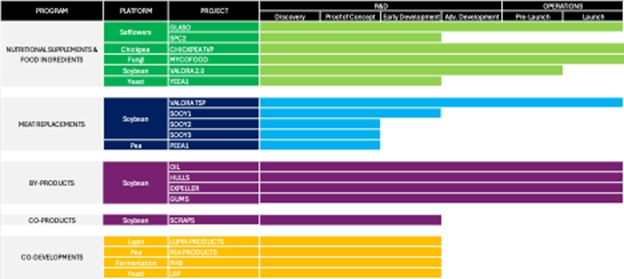
The table below outlines our product pipeline, which includes both commercialized and development-stage ingredients. Mycofood™ and ValoraSoy products are already available to food manufacturers as functional protein ingredients. GLASO, a safflower-derived oil rich in functional lipids, is currently incorporated into formulations for small-animal feed, extending its applicability beyond human food systems. Other programs remain under research and development and will progress through the discovery, transformation, development, and selection stages prior to full-scale production and commercialization.
This balanced mix of revenue-generating and pipeline-stage projects reflects our dual focus on near-term market presence and long-term innovation across Molecular Farming and precision fermentation platforms.
| PROGRAM | PLATFORM | PROJECT | DESCRIPTION | MARKET |
| NUTRITIONAL SUPPLEMENTS & FOOD INGREDIENTS | Safflowers | GLASO | Safflower oil with a high concentration of gamma-linolenic acid (GLA), representing up to 60% of the total oil content. The technology used enables a GLA concentration up to three times higher than other standard sources of GLA, such as borage oil and evening primrose oil, which typically contain 20–22% and 9–12% GLA, respectively. | This project targets the high-value specialty oils market, particularly segments focused on nutritional supplements, cosmetics, and functional foods. The product’s elevated gamma-linolenic acid (GLA) concentration positions it as an alternative to traditional sources such as borage and evening primrose oils, enabling potential differentiation through formulation efficiency and cost competitiveness. |
| SPC | Plant-based chymosin is a key enzyme used in the coagulation step of cheese production. Moolec’s technology enables the production of chymosin in safflower seeds, transforming this semi-arid crop into a scalable host system for the industrial manufacturing of enzymes. | This project targets the global market for dairy enzymes, particularly rennet substitutes used in cheese manufacturing. Producing chymosin through plant molecular farming offers a cost-efficient and sustainable alternative to traditional microbial or fermentation-based systems, expanding Moolec’s presence in the ingredient biotechnology segment and demonstrating the scalability of plant-based bioproduction platforms. |
|
|
| Chickpea |
CHICKPEA TVP |
A line of precooked chickpea-based proteins that provide a crunchy texture when dry and acts as a thickening agent when hydrated. These products are suitable for a wide range of applications, including bakery, plant-based, and nutritional formulations. | Chickpea TVP represents an alternative to soy- and pea-based textured vegetable proteins, which are widely used and established in the plant-protein segment. Its formulation supports clean-label positioning and broad application potential, offering a non-allergenic protein source suitable for brands seeking diversification within their ingredient portfolios. | |
| Fungi | MYCOFOOD | Mycofood™ is a fungal-based protein ingredient produced via bioreactor fermentation of fungal biomass. The product is available in wet form (approximately 28.5 % solids) or in dry form (approximately ~96 % solids). It offers a complete amino acid profile and a Protein Digestibility-Corrected Amino Acid Score (PDCAAS) of 0.92, which compares favorably to beef (0.91), soy (0.91), and wheat gluten. The ingredient exhibits a neutral taste and is designed for broad applicability in various food systems, from meat analogues to use as a protein additive in processed foods. | This project addresses the growing alternative protein market by offering a scalable fungal protein solution with competitive nutritional quality and organoleptic neutrality. Because it is 100 % animal-free, it caters to consumer segments and regulatory environments favoring sustainable, non-animal, and novel protein sources. The technology is positioned to serve food manufacturers seeking protein ingredients that integrate smoothly into existing formulations while meeting demands for sustainability, label-friendliness, and product innovation. | |
| Soybean | VALORA 2.0 | A development project focused on enhanced textured vegetable proteins (TVP) designed to deliver improved sensory characteristics, particularly in fibrous texture and chewiness, compared to conventional TVP. The products are produced from blends of raw materials such as soybean expeller-pressed flour combined with either isolated soy protein or vital wheat gluten, along with food-grade additives, under customized process and machining parameters. | VALORA 2.0 is positioned to address the increasing demand for next-generation textured proteins with enhanced sensory attributes, particularly related to fibrous texture and chewiness, supporting use in full meat-replacement applications. The product line is differentiated from standard textured soy proteins (TSP), which are commonly used as fillers. Strategically, VALORA 2.0 targets two main market segments: (i) meat processors seeking higher-quality extenders for hybrid formulations, and (ii) food manufacturers and plant-based brands requiring standalone protein bases for applications such as nuggets, pizza toppings, and taco fillings. | |
| Yeast | YEEA1 | Extract derived from a novel yeast biomass with defined functional and nutritional properties. This technology enables the replacement of certain animal-derived nutritional supplements, addressing markets with dietary, religious, or ethical restrictions. A secondary application is under evaluation, where the same extract is utilized as a base for savory flavor development. | This project targets the alternative ingredients segment within the nutritional and functional food markets. By providing a non-animal, fermentation-based source of bioactive compounds, the platform addresses the growing demand for ethical, sustainable, and label-friendly nutrition. The potential flavor-enhancing application also opens opportunities in the seasonings and savory product categories. |
| MEAT REPLACEMENTS |
Soybean | VALORA TSP | A line of soy-based textured proteins designed to replicate the texture and mouthfeel of different types of meat when hydrated. These products are primarily used as meat extenders in hybrid formulations. They are available in various formats, including chunks, flour, flakes, and granules, each developed to address specific functional properties and application requirements. | Strategically, the product line is positioned within the commodity segment of textured soy proteins, while differentiating itself through its range of formats and application adaptability. Soy remains the predominant raw material, accounting for the majority of global consumption of textured vegetable proteins (TVP). This positioning provides access to a large, established addressable market for VALORA TSP, with opportunities for incremental growth through customization and application-specific developments. |
| SOOY1 | Moolec Science’s patented soybean platform has been engineered to produce high levels of porcine myoglobin in soybean seeds, achieving expression levels exceeding 20% of total soluble protein. This technology enables the incorporation of functional soy-based protein ingredients to enhance organoleptic and nutritional properties in processed meat products, pet food, and animal feed applications, providing a more efficient and sustainable alternative to conventional animal protein production. | This project targets alternative protein and hybrid meat segments, where heme-containing proteins are key to replicating the color, flavor, and aroma of conventional meat. By producing porcine myoglobin directly in soybean seeds, the platform enables a scalable and cost-efficient supply of functional heme proteins for use in plant-based and blended meat formulations, as well as in pet food applications. The technology positions Moolec within the intersection of plant biotechnology and the cultured protein market, addressing growing demand for sustainable and functional ingredients. | ||
| SOOY2 | ||||
| SOOY3 |
|
|
| Pea | PEEA1 | Pea platform engineered to produce high levels of bovine myoglobin in pea seeds. This technology enhances the nutritional profile of the resulting protein ingredients by significantly increasing heme iron content, providing an alternative source of iron-rich proteins compared to conventional animal-derived sources. | This project addresses the growing demand for functional plant-based ingredients that deliver nutritional equivalence to animal proteins. By expressing bovine myoglobin in pea seeds, the platform targets hybrid and plant-based meat manufacturers seeking natural sources of heme iron to improve color, taste, and micronutrient content in their formulations. The technology also positions Moolec to participate in the expanding market for bioengineered proteins with enhanced nutritional functionality. |
| BY-PRODUCTS | Soybean | OIL | Expeller-pressed, degummed soybean oil intended for further refining, bleaching, and deodorizing (RBD) for use in food applications or biofuel production. |
Degummed soybean oil can be used in multiple applications. In its crude form, it provides an energy source for animal feed, supports fermentation processes in pharmaceutical and industrial uses, and serves as a feedstock for biofuel production. Once refined, it is used in food applications such as cooking oils, margarines, dressings, and baked goods.
Soybean hulls serve as a fiber source for animal feed and can also be used as a component in fermentation culture media, enabling potential synergies with fermentation manufacturers. Gums from the degumming process are used as a raw material for lecithin production, while expeller-pressed soybean meal, rich in protein and residual oil, is used in animal nutrition.
Collectively, these byproducts illustrate a circular production approach aimed at maximizing value extraction while minimizing waste. |
| HULLS | Soybean hulls are used as a fiber source for feed applications and are suitable for pelleting. Due to their low lignin, high cellulose, and moderate to high protein content, soybean hulls can also serve as a component in culture media formulations. | |||
| EXPELLER | Expeller-pressed soybean meal containing approximately 45% protein and 7% residual oil, suitable for use in feed formulations or as a raw material for value-added processing. Anti-nutritional factors are inactivated during the production process. | |||
| GUMS |
Byproduct of the soybean oil degumming process, consisting of hydrated phospholipids (approximately 26%) obtained from expeller-pressed soybean oil. It is used as a raw material for dry lecithin production.
|
| CO-PRODUCTS | Soybean | SCRAPS | Refers to the value-added products derived from soybean byproducts. Several processing routes are under development to enable applications across feed, food, and pharmaceutical sectors, utilizing soybean hulls, gums, and expeller meal as raw materials. | This project focuses on the development of processes to transform byproducts into functional ingredients for feed, food, and pharmaceutical applications, supporting circular valorization and the creation of additional value streams. |
| CO- DEVELOPMENTS |
Lupin |
LUPIN PRODUCTS |
Texturized lupine concentrate produced from lupine seeds or flour, processed to obtain a fibrous, meat-like texture. It is used as a plant-based ingredient for meat alternative formulations and as a functional component in snack and health-oriented food products. | LUPIN is a next-generation texturized lupine concentrate developed to meet the increasing demand for soy-free and allergen-friendly protein ingredients. Produced from lupine seeds or flour and processed to achieve a fibrous, meat-like texture, it is suitable for use in meat alternatives as well as in snack, bakery, and health-oriented food applications. The product is positioned to serve the growing market interest in high-protein, non-soy, and non-gluten options, supporting clean-label and specialized dietary formulations. |
| Pea |
PEA PRODUCTS |
Texturized pea concentrate produced from yellow peas or pea flour, processed to obtain a fibrous, meat-like texture. It has a high protein content, a neutral taste profile, and favorable water- and fat-binding properties. | PEA Texturized Concentrate is intended for plant-based meat manufacturers, hybrid meat producers, and food processors seeking a high-protein, neutral-tasting ingredient suitable for a wide range of applications. It can be used in plant-based and blended meat products, snacks, bakery items, and functional foods, supporting the development of clean-label and texturally consistent formulations. |
|
|
| Ferment. | PHB | Development of a biodegradable biopolymer based on polyhydroxybutyrate (PHB), produced through bacterial fermentation using glycerin and other agro-industrial byproducts as feedstocks. The process aims to obtain high-molecular-weight PHB suitable for the production of fully compostable materials. Optimization efforts focus on strain performance, fermentation efficiency, and downstream processing to ensure material quality and scalability. | This project targets the growing market for sustainable and compostable bioplastics, driven by regulatory and consumer pressure to reduce fossil-based plastic waste. By leveraging renewable feedstocks and circular-economy principles, the PHB platform positions Moolec within the bio-materials segment, enabling potential applications in packaging, coatings, and agricultural films while offering a lower-impact alternative to conventional plastics. | |
| Yeast | LIIP | Development of a recombinant yeast platform designed for the expression of industrial lipase enzymes intended for bakery applications. The project focuses on optimizing lipase production and secretion through yeast-based expression systems. This approach aims to deliver a scalable, cost-efficient alternative to conventional microbial or animal-derived enzyme production methods. | This project targets the global baking enzyme market, where lipases are widely used to enhance texture, shelf life, and processability of dough-based products. By using a yeast expression system, the platform offers potential advantages in production efficiency, regulatory acceptance, and sustainability. |
Development Timeline and Process
The projects in our product portfolio are currently at different stages of development. To bring these products to market, each must progress through multiple phases, from initial research to full commercialization. This process begins with research and development, where we identify proteins of interest from traditional animal foods and evaluate their ability to be efficiently and effectively expressed in plants, microorganisms, or cellular systems. Once target proteins are validated, we proceed to prototype development, followed by further testing and optimization to confirm that the prototype can be scaled efficiently under industrial conditions. The subsequent stages involve pilot and commercial-scale production, and ultimately, market launch and commercialization.
The main stages of products development can be summarized as follows:
| (i) | Discovery: The first stage involves the identification of hosts systems, candidate genes, metabolic pathways, or microorganisms with the potential to enhance desired characteristics or enable an agro-industrial biotech solution. Within our dual engine platform, discovery activities encompass both crop hosts (for molecular farming) and microbial and cellular systems (including bacteria, fungi, and yeasts for precision fermentation). This phase also integrates early traceability-by-design principles to ensure transparency and compliance throughout subsequent development stages. |
| (ii) | Proof of concept/Transformation: Once validated in model systems (in vitro or in vivo), promising candidates advance from discovery to the proof-of-concept stage. In this stage, targets constructs are introduced into the chosen host—crops in greenhouse conditions or microbes or cellular systems in small-scale bioreactors (lab scale). The objective is to confirm expression and performance within the targeted organism before progressing scale-up, field validation, or pilot fermentation. At this step, preliminary release specifications and data packages are typically defined to support subsequent regulatory and quality documentation. |
| (iii) |
Early development/Development: In this stage, efficacy field trials (for crops) and pilot-scale fermentation (for microbial and cellular systems) are expanded to assess expression levels, phenological traits, and performance across multiple geographies and growing cycles. Additional parameters are evaluated to optimize the technology and confirm its robustness under real-world conditions.
Agrality supports seed increase, multi-site trialing and crop characterization; Bioceres contributes regulatory analytics and intellectual property strategy; and InMet provides synthetic-biology and pilot-scale fermentation to bridge discovery and industrial scale.
The primary objective of this stage is to demonstrate technical feasibility by identifying the optimal candidate for scale-up – whether to expand seed stock and initiate regulatory field trials (for crops), or to study organisms’ behavior in production conditions and produce sufficient biomass for downstream prototyping and safety assessments (for microbial and cellular systems). |
|
|
| (iv) |
Advanced development/Selection: At this stage, extensive field evaluations (for genetically modified traits and other crop events) are conducted to fully demonstrate efficacy for the intended purpose. For GM traits, regulatory processes are initiated, including multi-site field trials designated to generate environmental, compositional, and food safety data required for submission and approval.
For microbial and cellular fermentation solutions, industrial-scale (SynBio Powerlabs) production runs are carried out to collect data supporting refined techno-economic assessments, process optimization, and the establishment of robust batch genealogy and quality controls for traceability and compliance.
The goal of this phase is to validate the technology under operational conditions and prepare comprehensive data packages to support regulatory, quality, and commercial readiness. |
| (v) |
Pre-launch/Scale-Up: This phase involves finalizing regulatory approvals and preparing product launch and commercialization. Key activities include seed multiplication, pre-commercial production, and product or solution testing with selected customers.
For fermentation solutions, accumulated safety and quality data are submitted to regulatory agencies, while SynBio Powerlabs and partner facilities plan capacity expansions, validate release specifications, and establish cost-of-good-sold (COGS) and supply parameters to ensure reliable and efficient market entry. |
| (vi) |
Product launch/Downstream: This final stage converts novel seeds or microbial/cellular biomass into finished business-to-business (B2B) ingredients through established downstream processing pathways. For crops, production leverages existing oilseed workflows, with ValoraSoy contributing soy texturization and downstream processing expertise. For microbial or cellular systems, the process validates fermentation, downstream, and purification schemes.
Across both production routes, full chain-of-custody (identity preservation for seed lots and detailed batch records for fermentation) ensures compliance with customer requirements for traceability and quality. |
Sales and Marketing
As our product and focus on molecular farming may not be familiar to many potential consumers, we will be required to educate potential customers and consumers about our products and brand, respond quickly to concerns and consult on food trends. As we develop and grow our brand, we expect to expand our sales and marketing team in the future by adding dedicated personnel to service new institutional and retail customers. In the future we may also add sales representatives to expand our sales efforts to the extent necessary.
Competition
We operate in a highly competitive and rapidly evolving landscape. For analytical purposes, we view competition across technology clusters; boundaries are fluid, and several companies may be potential partners, suppliers or customers in specific use cases.
| (i) | Molecular farming peers: Companies developing animal-like proteins or functional lipids in plants through molecular farming or related plant-expression systems. Examples include AlpineBio, Finally Foods, IngredientWerks Inc., Kyomei, Miruku Limited, Mooza Foods, NewMoo and PoLoPo Inc., among others. These companies pursue different host crops, molecular targets, and end-use applications, and compete primarily on expression levels, regulatory advancement, cost of goods, agronomic performance, supply-chain traceability and IP portfolios. |
| (ii) | Fungal and microbial alternative proteins (precision fermentation / mycoprotein): These are companies developing proteins, lipids, or other functional ingredients through microbial or cellular systems using precision fermentation or related biotechnological platforms. Illustrative examples include Marlow Foods (Quorn), ENOUGH (ABUNDA), The Better Meat Co. (Rhiza), Nature’s Fynd, Meati Foods y MycoTechnology, among others. These companies differ in host selection (yeasts, fungi, bacteria, or cell cultures), production scale, and target molecules, and compete on expression yields, scalability, and integration into established food manufacturing workflows. |
|
|
| (iii) | Traditional and diversified ingredient suppliers: Large flavor, fragrance, enzyme and ingredient companies and broader suppliers that address overlapping functionality spaces and may, in some cases, be prospective customers or channel partners. Examples include Givaudan Group, International Flavors & Fragrances, DSM-Firmenich and Novonesis (Chr. Hansen), among others. Competition in this cluster centers on breadth of portfolio, application support, global supply reliability, regulatory coverage and pricing. |
We compete primarily on our ability to deliver target functionality at competitive price points, with traceable supply chains and credible regulatory execution across multiple biological routes. We believe that our dual-engine platform— combining molecular farming in crops with precision fermentation in controlled environments— positions us to address customer requirements for performance, cost, reliability and compliance. Nevertheless, many of our competitors have greater financial and technical resources, longer operating histories, or broader commercial footprints, which could limit our ability to compete effectively in certain markets. See Item 3.D—Risk Factors.
Intellectual Property
Our business model is focused on R&D and the development of future IP and patents. Our IP strategy consists of conducting research and testing to rapidly acquire IP protection for all of our platforms.
The main jurisdictions in which we seek patent protection, among others, are the United States, Canada, Brazil, Argentina, Australia, India, China, Hong Kong, Japan, Malaysia, New Zealand, Mexico and countries in Europe.
To date, we have identified and sought patent protection in our capacity as either title holder or exclusive licensee for a diverse technology portfolio including food ingredients, nutritional supplements, meat replacements ingredients and biomass, seed traits, among others.
These technologies are currently protected through our 64 patents and 54 current patent applications as owner and or as exclusive licensee. In addition, the company possess 150 trademarks and 15 pending trademarks accounting 165 registers related to Moolec’s business technologies, including the trademarks:
 |
 , , |
 . . |
In July 2025, the USPTO issued a patent for the promising “Piggy Sooy” technology. The patent issued grants exclusivity over soybean plants and seed capable of producing 5-30% of total soluble protein (TSP) of as heme proteins and also covers food applications derived from soybean seed expressing high levels of heme proteins.
Moolec has also licensed the HB4® technology to Bioceres Crop Solutions Corp. The license includes the HB4® soy and HB4® wheat events, which are protected by patents filed in key agricultural markets such as the United States, Canada, Brazil, Argentina, Bolivia, Paraguay, Uruguay, Mexico, South Africa, Australia, India, China, Ukraine, Russia, and several European countries. HB4® is a proprietary biotechnology trait that enhances crop tolerance to abiotic stress, particularly drought, by modulating the expression of the HaHB4 transcription factor. This technology was developed through a long-standing collaboration between Bioceres and Argentina’s National Scientific and Technical Research Council (CONICET), combining public research excellence with private sector innovation. The HB4® soy and wheat patents are expected to expire in 2039 and 2040, respectively.
On March 28, 2025, Bioceres Crop Solutions Corp agreed to transfer all rights, licenses, and materials containing or pertaining to the soy ANF trait and pay US$750,000 to a Arcadia Biosciences Inc in exchange for (i) RG and OX Wheat Patents and RS exclusive rights; (ii) the cancellation of all royalty payments, which included 25% of the net wheat technology licensing revenues and 6% of the net HB4 soybean revenues up to US$10 million; and (iii) the release from any performance benchmark obligations related to the RG, OX, and RS varieties which amounted to US$8.1 million. Therefore, as of June 30, 2025, in Bioceres Crop Solutions Corp accounting records, payment related to the acquisition of Verdeca and other intangibles assets was cancelled.
Research and Development
Our R&D activities focus on the discovery, design, expression, and scale-up of proteins and functional lipids through two complementary routes: Molecular Farming in crops and precision fermentation in microorganisms (fungi and yeasts). Our workstreams encompass host and trait discovery, construct and strain engineering, greenhouse and multi-site field trials, pilot and industrial fermentations, downstream processing, and analytical validation, all executed within a stage-gated development framework and a traceability-by-design approach—featuring identity preservation for seed lines and batch genealogy with electronic batch records for fermentation.
|
|
We execute R&D through a combination of in-house capabilities and external collaborations. Internally:
| ● | Agrality supports seed multiplication, field trialing, and crop characterization across Argentina, Brazil, and the United States. |
| ● | InMet provides synthetic-biology, process-development, and pilot-scale fermentation capabilities bridging discovery and full-scale production. |
| ● | SynBio Powerlabs provides end-to-end support for fermentation operations across laboratory, pilot, and industrial scales and analytical and quality-control activities. |
| ● | Bioceres Crop Solutions contributes regulatory expertise and intellectual-property management. |
| ● | ValoraSoy brings soybean downstream-processing know-how and application-testing capabilities. |
Externally, we collaborate with universities, contract research organizations (CROs), and technology partners under service and research agreements to augment capacity in specialized assays—particularly for regulatory and safety studies. See Item 4.B—Business Overview; Item 5—Operating and Financial Review and Prospects (R&D expenses); and Item 3.D—Risk Factors.
Raw Materials and Material Sourcing
The process of scaling up our seed inventory and production is carried out in the United States and Argentina. We work with multiple growers in both countries to outsource production according to agronomic conditions and regional suitability. Currently, we maintain safflower production in American Falls, Idaho (USA).
The fungal biomass (Mycofood™) serves as a core raw material for fungi-based products. It is produced under HACCP and GMP standards through controlled fermentation processes using traceable, non-GMO ingredients to ensure transparency and quality throughout the value chain. This initiative provides sustainable and scalable sources of functional proteins and bio-based ingredients, fully aligned with our objectives of traceability, environmental performance, and circularity.
For ValoraSoy products, we utilize soy- and chickpea-based functional proteins specifically designed for human nutrition. These products are manufactured in state-of-the-art facilities strategically located within Argentina’s soybean corridor, leveraging advanced processing technologies to produce plant proteins that offer chewiness, texture, and fibrous structure comparable to meat.
Government Regulation
We are, and will be, subject to the laws and regulations in which we operate. This includes laws and regulations governing biotechnology and food companies related to the development, approval, manufacturing, import, export, marketing and sale of our products. See “Item 3. Key Information—D. Risk Factors—Risks Relating to Laws and Regulation”.
In order to manage the seasonability of our operations, we plan to produce our crops in both Argentina and the United States.
United States
Our principal market focus is the United States. In the U.S., the primary agencies responsible for the regulation of plant biotechnology products are the United States Department of Agriculture (USDA) – Animal and Plant Health Inspection Service (APHIS), which oversees environmental release, and the Food and Drug Administration (FDA), which regulates food and feed use.
We are subject to a range of federal, state and local laws and regulations administered by agencies such as the FDA, the Federal Trade Commission (FTC), the Environmental Protection Agency (EPA), the Occupational Safety and Health Administration (OSHA), and the USDA. These regulations cover various aspects of our operations, including future processing, packaging, distribution, marketing, labeling, quality assurance, safety, and transportation of our products, as well as occupational health and safety practices.
|
|
Facilities in the United States where our products are grown or produced may be required to register with the FDA and comply with applicable regulatory frameworks, including the Food Safety Modernization Act (FSMA). In addition, we will be subject to state and local food safety and labeling regulations in connection with the commercialization of our products. We are also subject to labor and employment laws, advertising and privacy regulations, workplace safety standards, and other laws governing business operations.
Consistent with this regulatory framework, several of our molecular farming products have already received favorable determinations from USDA-APHIS and the FDA.
On September 23, 2024, USDA-APHIS issued a Regulatory Status Review concluding that our PEEA1 pea meat replacement product poses no greater plant pest risk than non-genetically engineered pea plants under 7 CFR part 340, thereby exempting it from permits requirements for importation, interstate movement, and environmental release.
On April 19, 2024, USDA-APHIS APHIS issued a Regulatory Status Review concluding that our soybean Piggy Sooy™ presents no greater plant pest risk than conventional soybeans plants under 7 CFR part 340. As a result, we are no longer required to obtain USDA-APHIS permits for the importation, interstate movement, or environmental release of these genetically engineered soybean plants.
On March 31, 2023, USDA-APHIS issued a Regulatory Status Review with the conclusion that our GLA safflower plants pose no greater plant pest risk than non-genetically engineered safflower plants according to regulation 7 CFR part 340. Accordingly, we are no longer required to obtain USDA-APHIS permits for importation, interstate movement, and environmental release of GE plants. Our GLASO product derived from this crop already received FDA approvals for use as an ingredient in dietary supplements, nutritional beverages, medical foods, and pet food, as well as for the use of its seed meal in cattle and poultry feed.
Argentina
Approvals for the environmental release of genetically modified plants in Argentina are granted by the Secretariat of Agriculture, Livestock and Fisheries (SAGyP). These approvals are associated with risk evaluations performed by National Commission of Agricultural Biotechnology (CONABIA) and food/feed assessment by the National Food Safety and Quality Service (SENASA).
Currently we have permits from the SAGyP for importation, movement, and environmental release from some of our genetically modified plants. Our chymosin safflower has been fully approved by MAGP for release and production in Argentina and no further permits are required for its production and consumption. In addition, on September 2025, SENASA granted the approval for GLA safflower use for food and feed.
Finland
Under Finnish and EU regulatory frameworks, our operations in Finland are subject to oversight by the Finnish Food Authority (Ruokavirasto) and the Board for Gene Technology (GTLK), pursuant to the Gene Technology Act 377/1995 and the accompanying Government Decree on Gene Technology 928/2004.
As an EU Member State, Finland requires that any genetically modified organisms intended for environmental release or cultivation receive prior authorization pursuant to Directive 2001/18/EC and related EU regulation.
A precision-fermentation facility in Finland that utilizes contained microbial and cellular systems under controlled conditions, which fall within the regulated “contained use” classification, does not require the same environmental release authorizations as open-field genetically engineered crops.
By operating the Finnish facility under contained-use protocols and aligning with traceability and data-audit requirements, we remain in compliance with Finnish and EU biotechnology regulatory standards applicable to our Finland-based operations.
|
|
Other Regulatory Requirements
We are also subject to various federal, state, local, national, and transnational laws, regulations, and requirements in the jurisdictions in which we operate, relating not only to biotechnology and food and ingredient products but also to other areas of our operations. As we continue to grow, we may become subject to additional regulations and requirements in these jurisdictions relating, among other things, to safe working conditions, laboratory and distribution practices, and the transportation and disposal of hazardous or potentially hazardous substances. In addition, applicable import and export laws will require us to comply with certain standards governing the cross-border transit of finished goods and raw materials.
The costs associated with our continued compliance with these various federal, state, local, national, and transnational laws and regulations, or with any new requirements to which we may become subject, could be significant. Failure to comply with such legal obligations could have a material adverse effect on our results of operations and financial conditions.
Employees
As of June 30, 2025, we had 103 full-time and temporary employees located in Argentina, the United States, the Netherlands, Finland, and the United Kingdom. Our workforce includes 14 Ph.Ds. and other highly skilled scientists, biotechnologists, and engineers. Our work environment is technology-driven, reflecting our corporate purpose and innovation-focused culture. We have never experienced a labor-related work stoppage.
As of October 31, 2025, we had 72 employees, reflecting a decrease attributable to the reorganization process arising from the Business Combination.
Legal Proceedings
From time to time, we may become involved in legal proceedings arising in the ordinary course of our business. Except as described in Item 8. of this report, we are not currently involved in any legal proceedings that could reasonably be expected to have a material adverse effect on our business, results of operations, prospects or financial condition.
Notice of Alleged Breach
On October 2, 2025, the Company received a notice of alleged breach from INVIM Corporativo S.L., a private limited company incorporated under the laws of Spain (“INVIM”), regarding the alleged failure to pay the assignment price of US$13 million in connection with a certain Assignment and Assumption Agreement dated May 27, 2025 (the “Agreement”). The Agreement, in turn, references related instruments, including a Note Purchase Agreement and a Binding Contribution Memorandum of Understanding, both dated October 15, 2023.
In response, the Company rejected INVIM’s assertion that any payment is due or owing, on the grounds that, among other reasons, under the express terms of the Agreement and related transaction instruments, INVIM failed to satisfy certain conditions precedent, including the valid transfer of relevant securities and the execution of a required services agreement.
The Company intends to vigorously defend its position and enforce its rights under the Agreement, the related transaction instruments, and applicable law. While the Company believes that INVIM’s assertions are without merit, if INVIM were ultimately to prevail in any proceedings, such an adverse outcome could have a material adverse effect on the Company’s business, results of operations, financial condition, or liquidity.
|
|
C. Organizational Structure
The following diagram depicts our current organizational structure:

Notes:
| 1 | Includes 3,076,079 (5%) shares that Bioceres LLC has shareholder rights over pursuant to the Shareholders Agreement, dated as of March 5, 2019, by and between Bioceres LLC, Pedro Enrique Mac Mullen, Maria Marta Mac Mullen and International Property Services Corp. |
| 2 | For more information about BIOX subsidiaries, please refer to the latest 20-F filed by BIOX with the SEC. |
| 3 | The shareholding of Bioceres Group in THEO I is planned to be distributed (spin-off) to Bioceres Group shareholders within 12 months from the signing date of the Business Combination Agreement with Moolec Science. |
| 4. | For more information about Bioceres SA, Bioceres LLC and Theo I, please refer to ITEM 13. DEFAULTS,DIVIDEND ARREARAGES AND DELINQUENCIES |
The following table identifies our main subsidiaries as of the date of this report:
| Name | Jurisdiction of Incorporation |
Ownership Interest | Voting Interest | |||||||
| Moolec Science Ltd. | United Kingdom | 100 | % | 100 | % | |||||
| AG Biomolecules LLC | United States | 100 | % | 100 | % | |||||
| ValoraSoy S.A.1 | Argentina | 100 | % | 100 | % | |||||
| Nutrecon LLC | United States | 100 | % | 100 | % | |||||
| SynBio Powerlabs | Finland | 90 | % | 90 | % | |||||
| Gentle Tech | British Virgin Islands | 100 | % | 100 | % | |||||
| Gentle Farming | British Virgin Islands | 51 | % | 51 | % | |||||
| G-FAS | Argentina | 64 | % | 64 | % | |||||
| Bioceres S.A. | Argentina | 90 | % | 90 | % | |||||
| Bioceres Tech Services LLC | United States | 100 | % | 100 | % | |||||
| Bioceres LLC | United States | 100 | % | 100 | % | |||||
Notes:-
| 1 | Calculated considering the indirect interests held through Moolec Science Ltd |
D. Property, Plant and Equipment
Prior to the closing of the ValoraSoy Acquisition, our tangible assets primarily consisted of laboratory equipment and other R&D assets, while our principal assets were intangible, including intellectual property rights. Following the closing of such acquisition, we incorporated a soybean processing facility located in Argentina’s soybean corridor, designed to maximize raw-material origination, with an installed crushing capacity of approximately 10,000 tons of soybean per year. This facility specializes in the production of textured soy proteins, and provides industrial conditions for specification validation, application testing and downstream know-how that support our commercialization plans in multiple regions.
|
|
In April 2025 we announced the Business Combination with Bioceres Group Limited, Nutrecon LLC and Gentle Technologies Corp., and, upon closing, our base of property, plant and equipment expanded to include contributed and integrated assets across biotechnology services, field operations and controlled-facility manufacturing. These assets include (i) precision-fermentation infrastructure in Finland operated under the Synbio Powerlabs brand, supporting controlled production of fungi-based proteins and related analytical release activities; (ii) Agrality’s multi-geography execution footprint in Argentina, Brazil and the United States, comprising seed increase, nursery and multi-site field-trial capabilities, drying/conditioning and processing assets, and warehousing and distribution (including an estimated storage capacity of approximately 300,000 square feet and handling/shipping throughput of up to approximately 1.1 million units), which together enable identity-preserved logistics and regulatory trialing; and (iii) InMet’s synthetic-biology and pilot-scale fermentation facilities used for process development, low-scale/plant-pilot runs and metabolomics, bridging discovery and industrial scale-up. These facilities complement our existing downstream capacity at ValoraSoy and are intended to reduce scale-up risk and time-to-market across both molecular-farming and fermentation programs.
Future capital expenditures are expected to relate primarily to scale-up and debottlenecking of fermentation capacity, expansion and modernization of field and seed-processing assets, and incremental downstream capabilities for our molecular-farming and fermentation programs. See Item 4.C—Organizational Structure.
ITEM 4A. UNRESOLVED STAFF COMMENTS
None.
ITEM 5. OPERATING AND FINANCIAL REVIEW AND PROSPECTS
The following discussion and analysis provide information which our management believes is relevant to an assessment and understanding of our operating results and financial condition. This discussion and analysis should be read together with our audited consolidated financial statements and related notes that are included elsewhere in this annual report. In addition to historical financial information, this discussion and analysis contains forward-looking statements based upon current expectations that involve risks, uncertainties and assumptions. See the section entitled “Cautionary Note Regarding Forward-Looking Statements.” Actual results and timing of selected events may differ materially from those anticipated in these forward-looking statements as a result of various factors, including those set forth under “Item 3. Key Information—D. Risk Factors” or elsewhere in this annual report.
A. Operating Results
The Business Combination Agreement
Before the end of the fiscal year, on June 16, 2025, the Company consummated a business combination. Prior to that moment, a series of previous steps have taken place, as follows:
On May 14, 2025, Moolec Science (Luxembourg) made effective a reverse stock split of its Ordinary Shares (the “Reverse Stock Split”) on the consolidation ratio of ten-to-one (the “Consolidation Ratio”), pursuant to which holders of Ordinary Shares received one Ordinary Share for every ten Ordinary Shares held.
On May 22, 2025 (the “Effective Date”), the Company changed its jurisdiction by Moolec Science (Luxembourg) discontinuing from the Grand Duchy of Luxembourg and transferring by way of continuation to the Cayman Islands as Moolec Science (Cayman Islands) pursuant to Part XII of the Companies Act (Revised) of the Cayman Islands (the “Redomiciliation”). On the Effective Date, all of the shares of Moolec Science (Luxembourg), par value $0.10 per share by operation of law became shares of Moolec Science (Cayman Islands), par value $0.10 per share.
After completion of the Reverse Stock Split, all references to our Ordinary Shares, share data, per share data and related information have been adjusted for the Consolidation Ratio to reflect the Reverse Stock Split. The Reverse Stock Split has consolidated each ten of our Ordinary Shares into one Ordinary Share, with a new par value of $0.10 per Ordinary Share. Upon completion of the Reverse Stock Split, no fractional Ordinary Shares were issued, and any fractional Ordinary Shares resulting from the Reverse Stock Split were rounded up to the nearest whole Ordinary Share. Except for the adjustments that resulted from the treatment of fractional shares, the Reverse Stock Split did not have any dilutive effect on our shareholders.
|
|
The Business Combination, initially announced on April 17, 2025, in which the Company, Bioceres Group Limited (formerly, Bioceres Group PLC, one of the main shareholders of the Company), Gentle Technologies Corp (“Gentle Tech”) and Nutrecon LLC (“Nutrecon”) entered into the Business Combination Agreement, pursuant to which several parties transferred their respective holdings in Bioceres Group, Nutrecon and Gentle Tech (together, the “Contributed Entities”) to the Company, in exchange of a combination of newly issued Company’s shares, and warrants, to the shareholders of the Contributed Entities. Following the closing, Moolec became the legal parent company of the combined group comprising Bioceres Group, Gentle Tech, and Nutrecon. was ratified by Moolec shareholders at the Extraordinary General Meeting (“EGM”) held on June 16, 2025 with 77% of the outstanding shares present at the meeting, and 98% of the votes cast were in favor of the transaction. From an accounting perspective and based on the guidance of IFRS 3 Bioceres Group Limited is deemed to be the accounting acquirer. The transaction was subsequently consummated on the same date, June 16, 2025 (the “Closing”).
Through the consummation of the Business Combination, Moolec Science SA acquired all the issued and outstanding equity interests of Bioceres Group and Nutrecon and 50% of Gentle Tech, integrating mature agricultural biologicals and seed businesses, nutritional solutions, and emerging technology ventures. In consideration for the contributed entities, the Company issued approximately 6.2 million of ordinary shares to the shareholders of Bioceres Group, 450,000 of ordinary shares and 500,000 private warrants with an exercise price of US$20.00 per share to the shareholders of Nutrecon, and 132,750 ordinary shares to the shareholders of Gentle Tech. Also, Moolec Science SA committed to issue additional ordinary shares twelve months after the acquisition date, representing the 10% of the total shares to be issued (the “Holdback”), representing approximately 0.7 million of ordinary shares to the shareholders of Bioceres Group, 50,000 of ordinary shares to the shareholders of Nutrecon, and 14,750 ordinary shares to the shareholders of Gentle Tech.
On June 16, 2025, following the consummation of the Business Combination, the Company initiated integration processes across organizational, operational, and IT functions to support competitiveness and long-term sustainability. In parallel, management continued to advance the ongoing operations, which remain crucial to maintaining business continuity and supporting the successful execution of the integration and growth strategy. The consolidated results as of and for the year ended June 30, 2025 (“FY2025”) reflect purchase accounting. The prior periods as of and for the year ended June 30, 2024 (“FY2024”) and for the year ended June 30, 2023 reflects the Predecessor on a stand-alone basis and does not include any effects of the Business Combination. As a result, variances between FY2025 and FY2024 primarily reflect changes in scope and basis of presentation rather than purely period-over-period operating trends, and therefore the periods are not directly comparable. Effective as of the Closing (i.e., June 16, 2025), the Company accounted for the Business Combination under IFRS 3, Business Combinations, using the acquisition method of accounting and treating the transaction as a reverse acquisition. Under this approach, Bioceres Group (the legal subsidiary) was considered the accounting acquirer, and Moolec Science SA (the legal acquirer) was considered the accounting acquiree, together with Gentle Tech and Nutrecon.
Going concern
The Business Combination, initially announced on April 17, 2025, in which the Company, Bioceres Group (formerly, Bioceres Group PLC, one of the main shareholders of the Company), Gentle Tech and Nutrecon entered into the Bioceres Group Business Combination Agreement, pursuant to which several parties transferred their respective holdings in Bioceres Group, Nutrecon and Gentle Tech (together, the “Contributed Entities”) to the Company, in exchange of a combination of newly issued Company’s shares, and warrants, to the shareholders of the Contributed Entities. Following the closing, Moolec became the legal parent company of the combined group comprising Bioceres Group, Gentle Tech, and Nutrecon. The Business Combination was ratified by Moolec shareholders at the Extraordinary General Meeting (“EGM”) held on June 16, 2025, with 77% of the outstanding shares present at the meeting, and 98% of the votes cast were in favor of the transaction. From an accounting perspective and based on the guidance of IFRS 3, Bioceres Group Limited is deemed to be the accounting acquirer. The transaction was subsequently consummated on the same date, June 16, 2025.
On June 18, 2025, Bioceres Crop Solutions Corp. (BIOX), a public company controlled until that date by Bioceres Group Limited, entered into an amendment with the Secured Notes’ holders by which the holders of the Secured Notes waived the breach of covenants that led to the default of the debt (specifically, the breach of covenants related to the Consolidated Total Net Leverage Ratio (determined as the ratio of (a) Consolidated Total Net Debt as of the last day of such Test Period to (b) Consolidated EBITDA of the Issuer and its Subsidiaries for such Test Period) of 3.75x as of March 31, 2025), retrospectively modifying the required Consolidated Total Net Leverage Ratio to 5x Consolidated Total Net Leverage Ratio, and extended the maturity of the Secured Notes to August 31, 2027. In accordance with the terms of the amendments, effective June 24, 2025, Gloria Montaron Estrada, Enrique Lopez Lecube, and Keith McGovern were replaced in Bioceres Crop Solutions Corp.’s Board of Directors by Milen Marinov, Noah Kolatch and Scott Crocco, who were nominated by certain holders of the Secured Notes. Bioceres Crop Solutions Corp. agreed, for so long as the Secured Notes remain outstanding, to continue to nominate Messrs. Marinov, Kolatch and Crocco (or such other persons as may be nominated as their replacements) for additional terms as directors.
|
|
The effect of the changes in the terms of the Secured Notes of Bioceres Crop Solutions, resulted in the loss of de facto control of that subsidiary and consequently, its deconsolidation. The equity method was applied to account for the investment in such former subsidiary, as well as for other investments in joint ventures and associates (the “BIOX deconsolidation”). Even when there was a deconsolidation of the business, the Company will continue to be affected by BIOX business due to the HB4 royalty agreement. It is important to note that the effects of the loss of control in BIOX represents substantially all of the Company’s business.
As a result of the loss of control over BIOX, access to financing that Bioceres S.A., its wholly owned subsidiary Bioceres LLC, Bioceres Group Limited and Moolec Science SA had until then, was restricted or limited.
In June 2025, Bioceres S.A., one of the Argentine subsidiaries of Bioceres Group Limited, defaulted on a portion of its financial debt that was due that month. As a result, Bioceres S.A. had initiated a debt restructuring process for its financial debt for an aggregate amount of $36.4 million.
In July 2025, Bioceres LLC, a wholly owned subsidiary of Bioceres S.A., received a notice of default on its financial debt in the amount of $69.5 million. The creditor conducted a public auction for 3,062,500 pledged BIOX shares, pursuant to the New York Uniform Commercial Code. Management has responded to the creditor, reserving all rights, remedies, and defenses. As of June 30, 2025, the current debt amounts to US$58.0 million.
The defaults by Bioceres S.A. and Bioceres LLC do not have implications in other debts as there are no cross-default clauses on the remaining financial debt of the Group. There are no guarantees granted above Bioceres S.A. and Bioceres LLC.
As of June 30, 2025, the Group had a negative working capital amounting to US$204,860,444, and a shareholders’ deficit of US$82,873,602. Additionally, the Group reported recurring operating losses amounting to US$104,150,129.
The Company had the financial support of its main shareholders and considering the aforementioned events that derived in the loss of the financial support that was previously provided by Bioceres Group (and who is also no longer a shareholder of the Company), and, consequently, raise a material uncertainty which may cast significant doubt (or raise substantial doubt as contemplated by PCAOB standards) about the ability of Moolec Science SA to continue as a going concern, currently, the Group lacks sufficient financial resources to meet its obligations or fully implement its business plan. Without securing additional capital, the Group will not be able to sustain its operations.
The uncertainty surrounding the ability to secure additional funding and the potential for continued operational losses contribute to substantial doubt about the Group’s ability to continue as a going concern.
Management has plans to address the Group’s financial situation as follows:
Theo I SCSp
On November 28, 2025, subsequent to the reporting date, Theo I SCSp received a conditional payment order from district court of Luxembourg, and therefore the General Partners engaged Ogier (Luxembourg) SCS represented by its general partner Ogier Luxembourg (GP) S.à.r.l formally as their legal advisor to assist with Theo I SCSp’s declaration of bankruptcy before the Luxembourg District Court. The declaration of bankruptcy will declare Theo I SCSp bankrupt and appoint a receiver who will take control over the management of the company.
The loss of control constitutes the derecognition event under IFRS 10.25. Accordingly, the Group will derecognize the assets and liabilities of Theo I SCSp and will remeasure its retained interest at fair value in accordance with IFRS 9 at the date of the derecognition event. This will result in the recognition of an estimated gain of US$9.5 million in the consolidated statement of profit or loss as of the derecognition date.
The Group will continue to measure its retained interest in Theo I SCSp at fair value through profit or loss until the liquidation process is formally completed.
|
|
Bioceres S.A. and Bioceres LLC
On December 16, 2025, subsequent to the reporting date, the Board of Directors of Bioceres S.A. formally approved the initiation of voluntary bankruptcy proceedings and instructed management to seek and appoint a trustee (“síndico”) to oversee the process. The commencement of the voluntary bankruptcy proceedings and the transfer of decision-making authority to the trustee will result in the Group losing control over Bioceres S.A. in accordance with the principles of IFRS 10 Consolidated Financial Statements. As Bioceres LLC is a wholly owned subsidiary of Bioceres S.A., the Group simultaneously will lose control over Bioceres LLC as well.
Under IFRS 10.25, the date on which control is lost constitutes the derecognition event. Accordingly, after December 16, 2025, the Group will derecognize the assets and liabilities of Bioceres S.A. and Bioceres LLC and will remeasure any retained interest at fair value in accordance with IFRS 9 Financial Instruments.
The resulting derecognition effects are expected to generate an approximate gain of US$91.0 million related to the loss of control of Bioceres S.A. and an additional approximate gain of US$5.3 million related to the loss of control of Bioceres LLC (including the loss of holding in BIOX, therefore it will no longer be an equity method associate).These amounts will be recognized in the consolidated statement of profit or loss as of the derecognition date.
The Group will continue to monitor the progress of the voluntary bankruptcy and liquidation proceedings and will update the accounting treatment as necessary in accordance with IFRS.
Management expects that certain shareholders and/or investors will continue or commence to provide new financing lines.
However, there is no assurance that investors and shareholders will continue to provide financing, or that the Group’s future operations will generate profitability. The uncertainty surrounding the ability to secure additional funding and the potential for continued operational losses contribute to raise a material uncertainty which may cast significant doubt (or raise substantial doubt as contemplated by PCAOB standards) about the Group’s ability to continue as a going concern.
The consolidated financial statements of Moolec Science SA do not include any adjustments that may be required to address the potential impacts on the recoverability and classification of assets or the amounts and classifications liabilities, should the Group be unable to continue as a going concern.
Accordingly, the financial statements of Moolec Science SA for periods prior to the Closing reflect the historical financial information of Bioceres Group. The financial information as of and for the year ended June 30, 2025 reflects the figures corresponding to Bioceres Group and incorporates the effects of applying the acquisition method to Moolec Science SA, Gentle Tech and Nutrecon, measured at fair value in accordance with IFRS 3.
For a discussion of the factors that may affect our results of operations see “Item 3—Key Information—Risk Factors”.
Factors Affecting our Operating Results
BIOX deconsolidation
Our operating results going forward will be affected by the deconsolidation of BIOX following the loss of de facto control over that entity on June 18, 2025. As a result of this deconsolidation, the Group no longer consolidates BIOX’s assets, liabilities, revenues and expenses, and instead accounts for its investment in BIOX under the equity method. Accordingly, our operating results will reflect only our share of BIOX’s net results, rather than BIOX’s results on a consolidated basis, which may materially reduce reported revenues, operating income and other key performance indicators compared to prior periods. If the voluntary bankruptcy described above proceeds, BIOX will no longer be an equity method associate. For a detailed discussion of the events and circumstances that led to the loss of control over BIOX, see “Part I – Introductory note and presentation of financial and other information.”
Regulatory environment
Our operating results will vary depending on the speed at which we are able to obtain regulatory approvals for our products and the cost and expense associated with gaining such approvals. The degree of regulation to which we are subject varies by activity and country. Our ability to sell our technologies and products depends on obtaining and maintaining necessary authorizations, permits, and regulatory approvals in the markets in which we operate.
Product Development
Moolec has developed a range of functional proteins and lipids that are already available to food manufacturers and feed producers.
One of our lead products, Mycofood™, exemplifies our approach in action. It is a scalable, 100% animal-free protein ingredient produced through precision fermentation of fungal biomass. Designed to deliver a neutral taste and versatile texture, Mycofood™ can be seamlessly integrated into a wide range of food systems—from meat analogues to protein-enriched formulations—without altering flavor or mouthfeel.
ValoraSoy products primarily use soy-based functional proteins, supplemented with chickpea-based proteins, specifically designed for human nutrition. Produced in state-of-the-art facilities in Argentina’s soybean corridor, these plant proteins provide chewiness, texture, and fibrous structure comparable to meat, supporting clean-label and nutritionally rich applications.
GLASO, a safflower-derived oil rich in functional lipids, is currently being used in formulations for small-animal feed, demonstrating the versatility of our platform and its applicability beyond human food systems.
|
|
Other programs remain under research and development and will advance through discovery, transformation, development, and selection stages prior to full-scale production and commercialization. This mix of revenue-generating and pipeline projects reflects our dual focus on near-term market presence and long-term innovation across molecular farming and precision fermentation.
We have made significant progress in the research and development of our products, as well as in acquiring the necessary production facilities to scale-up production:
| ● | As a result of the Closing of the Business Combination in June 2025, we incorporated a pilot and industrial precision-fermentation facility under the SynBio Powerlabs brand, designed to produce target proteins, enzymes, and other biomolecules using optimized microbial and cellular systems – providing a controlled, scalable pathway from design through fermentation to commercial channels with food-industry partners. The site runs under the Finnish and EU “contained use” framework, overseen by the Finnish Food Authority (Ruokavirasto) and the Board for Gene Technology (GTLK), which enables compliant, controlled production without open-field authorizations, while aligning with traceability and data-audit requirements across our Finland-based operations. |
| ● | On September 2025, in Argentina, the National Service for Agri-Food Health and Quality (SENASA) granted feed and food approval for Moolec’s proprietary Safflower GLASO1 technology. |
| ● | On April 18, 2024, USDA-APHIS concluded its Regulatory Status Review for our genetically engineered soybean, Piggy Sooy™. The review determined that Piggy Sooy™, which accumulates animal meat protein, does not pose an increased plant pest risk compared to non-engineered soybeans. Consequently, Piggy Sooy™ is not subject to the APHIS regulation governing the movement of genetically engineered organisms (7 CFR part 340). This represents the first-ever USDA-APHIS approval for plant-grown animal proteins. See “Item 4. Information on the Company—B. Business Overview—Government Regulation.” |
| ● | On March 31, 2023, USDA-APHIS issued a Regulatory Status Review with the conclusion that our GLA safflower plants pose no greater plant pest risk than non-genetically engineered safflower plants according to regulation 7 CFR part 340. We also have FDA approval for use of the seed meal from GLA safflower plants in food for cattle and poultry. See “Item 4. Information on the Company—B. Business Overview—Government Regulation.” |
| ● | As a result of the closing of the ValoraSoy Food Ingredients Acquisition in April 2023, we acquired a soy processing plant in Argentina which specializes in the production of textured soy proteins. Its products are manufactured using various extrusion processes obtaining vegetable proteins with texture and fibrousness similar to those of meat, with various applications such as hamburgers, sausages, and other plant-based products. |
We are striving to successfully complete certain major research, development, and production activities in order to meet our expected production dates.
Our team of scientists, technicians and staff is committed to achieving the milestones to meet our current production and commercialization timelines to enable us to achieve our expected production dates. Achievement of these milestones are critical to our development timelines, though may be subject to unanticipated delays outside of our control such as the ability to obtain sufficient capital to support production.
Capital Requirements
As a result of the closing of the ValoraSoy Acquisition, we used to generate revenue from our operations from ValoraSoy’s pre-existing contracts. Starting in the fiscal year 2025, we initiated the commercialization of GLASO. However, until we can generate sufficient revenue, we are dependent on our ability to raise sufficient capital from third-party sources. After the Business Combination Closing, we incorporated other sources of revenues from operations of Bioceres Group and we expect to incorporate other sources from Nutrecon and its subsidiary. We expect to finance our future capital needs through private placements of our securities, public offerings of equity and/or equity-linked securities, debt financings, collaborations, and licensing arrangements.
|
|
Macroeconomic conditions in Argentina
We generate a significant portion of our revenue in Argentina, an emerging market. Therefore, our operating result and financial condition are directly impacted by macroeconomic and fiscal developments, including fluctuations in currency exchange rates, inflation and interest rate fluctuations, in Argentina. See “Item 3. Key Information—D. Risk Factors—Risks Relating to our Business and Operations—Economic and political developments in Argentina, including inflation and government controls may adversely affect the economy and our financial condition and results of operations.”
Operating Results
We have based the following discussion on our audited consolidated financial statements included elsewhere in this report. You should read it along with these financial statements, and it is qualified in its entirety by reference to them.
Comparison of the Year Ended June 30, 2025, and the Year Ended June 30, 2024
The following table sets forth our historical operating results for the periods indicated:
| Consolidated Statements of Comprehensive Loss | ||||||||||||||||
| For the year ended June 30, 2025 |
For the year ended June 30, 2024 |
Change | Variation | |||||||||||||
| (in United States Dollars) | (%) | |||||||||||||||
| Revenues from contracts with customers | 333,611,248 | 466,376,330 | (132,765,082 | ) | (28 | )% | ||||||||||
| Government grants | 3,412 | 197,519 | (194,107 | ) | (98 | )% | ||||||||||
| Initial recognition and changes in the fair value of biological assets at the point of harvest | 1,764,863 | (45,746 | ) | 1,810,609 | n.s. | |||||||||||
| Cost of sales | (203,424,872 | ) | (279,368,328 | ) | 75,943,456 | (27 | )% | |||||||||
| Changes in the net realizable value of agricultural products after harvest | (1,541,204 | ) | (2,385,069 | ) | 843,865 | (35 | )% | |||||||||
| Research and development expense | (15,138,510 | ) | (17,422,487 | ) | 2,283,977 | (13 | )% | |||||||||
| Selling, general and administrative expenses | (125,908,240 | ) | (126,340,822 | ) | 432,582 | - | ||||||||||
| Share of profit or loss of joint ventures and associates | (36,927,610 | ) | (21,023,150 | ) | (15,904,460 | ) | 76 | % | ||||||||
| Other income or expenses, net | (56,589,216 | ) | (703,265 | ) | (55,885,951 | ) | n.s. | |||||||||
| Operating profit | (104,150,129 | ) | 19,284,982 | (123,435,111 | ) | (640 | )% | |||||||||
| Financial costs | (41,809,445 | ) | (37,634,153 | ) | (4,175,292 | ) | 11 | % | ||||||||
| Other financial results | (24,043,905 | ) | (9,608,981 | ) | (14,434,924 | ) | 150 | % | ||||||||
| (Loss) Profit before income tax | (170,003,479 | ) | (27,958,152 | ) | (142,045,327 | ) | 508 | % | ||||||||
| Income tax | (6,636,121 | ) | (1,103,152 | ) | (5,532,969 | ) | 502 | % | ||||||||
| (Loss) Profit for the year | (176,639,600 | ) | (29,061,304 | ) | (147,578,296 | ) | 508 | % | ||||||||
| Basic and diluted (loss) / profit attributable to ordinary equity holders of the parent | (17.2461 | ) | (5.6146 | ) | (11.6315 | ) | 207 | % | ||||||||
Notes:
“n.s.”: not significant.
As a result of the deconsolidation of BIOX, the Company expects significant decreases in revenues from contracts with customers, cost of sales, selling, general and administrative expenses, share of profit or loss of joint ventures and associates in future periods, as BIOX’s results will no longer be consolidated. Other operating line items previously impacted by BIOX’s operations may also be affected. Following the deconsolidation, the Company will recognize only its share of BIOX’s net results under the equity method, which may impact the comparability of operating results across periods. See “Item 5. Operating and Financial Review and Prospects—A. Operating results—Factors affecting our operating results”
|
|
Revenues from contracts with customers and initial recognition and changes in the fair value of biological assets at the point of harvest
Total revenues and changes in the fair value of biological assets at the point of harvest are mainly derived from our former consolidated subsidiary Bioceres Crop Solutions Corp. (BIOX). Total revenue decreased by US$132.8 million, or 28%, totaling US$333.6 million for the year ended June 30, 2025, compared to our total revenue of US$466.4 million for the year ended June 30, 2024. Revenue was impacted mainly by severe challenges in Argentina, one of our key markets, during the year ended June 30, 2025, driven mainly by a combination of factors: (i) extraordinary prior-year sales linked to local currency devaluation, which led distribution channels to accumulate inventories beyond short-term needs; (ii) deteriorating on-farm economics; and (iii) constrained financing availability across the agricultural sector.
Crop Protection. Total revenue decreased by US$41.6 million, or 19%, to US$181.9 million for the year ended June 30, 2025, compared to our total revenue of US$223.5 million for the year ended June 30, 2024, primarily driven by reduced commercialization of third-party products in Argentina, which accounted for US$41.9 million of the total decrease. This trend aligns with our strategic shift toward prioritizing higher-margin proprietary technologies. Meanwhile, bioprotection products saw a US$5.8 million increase, which was nearly offset by a US$5.7 million decline in seed crop protection products.
Crop Nutrition. Total revenue decreased by US$55.3 million, or 38%, to US$89.5 million for the year ended June 30, 2025, compared to our total revenue of US$144.8 million for the year ended June 30, 2024. The decrease was primarily driven by a sharp contraction in micro-beaded fertilizer sales, attributed to reduced corn acreage in Argentina early in the year. This was further compounded by unfavorable farm economics and elevated channel inventories, which constrained purchasing behavior throughout the season and led to a 39% drop in sales volume. The expected reduction of US$15.7 million related to the Syngenta downpayment further weighed on comparisons.
Seed and Integrated Products. Total revenue decreased by US$32.7 million, or 34%, to US$63.7 million for the year ended June 30, 2025, compared to our total revenue of US$96.4 million for the year ended June 30, 2024. The decline reflects the ongoing transition of the HB4 business model toward strategic partnerships. Reduced volumes from the HB4 business accounted for US$31.7 million of total segment sales, highlighting the impact of this shift on overall performance.
Gross profit
Gross profit (defined as Revenues and changes in the fair value of biological assets at the point of harvest less cost of sales) are mainly derived from our former consolidated subsidiary Bioceres Crop Solutions Corp. (BIOX). Gross profit decreased by US$54.2 million, or 29%, to US$130.4 million for the year ended June 30, 2025, from US$184.6 million for the year ended June 30, 2024. The decrease was mainly driven by lower sales across all segments, including a US$15.7 million year-over-year reduction from the Syngenta agreement that carried a 100% gross margin in the year ended June 30, 2024. Even in this challenging context, gross profit performance broadly tracked sales, and the full-year gross margin held stable compared to the prior year. This reflects the relative resilience of the higher-margin proprietary products, where we retained market share and, in some international markets, achieved modest gains.
Crop Nutrition. The Syngenta license payment carries a 100% gross margin; therefore, the US$15.7 million decline had a direct and full impact on gross profit, reducing both the segment’s total gross profit and average gross margin compared to the prior year. Additionally, as described above, the segment was negatively affected by lower fertilizer volumes, which were the primary driver of the overall decline. Margin pressure was further intensified by pricing headwinds in biostimulants and, to a lesser extent, in micro-beaded fertilizers, resulting in segment margins declining from 53% to 48%.
Crop Protection. The decline in gross profit was consistent with lower sales, though less pronounced, resulting in an improved gross margin for the segment. This improvement was mainly driven by a reduction in the commercialization of low-margin third-party products, along with a more favorable product mix. Notably, bioprotection products contributed an additional US$1.6 million, and adjuvants saw a modest margin improvement, further supporting the overall margin expansion.
|
|
Seed and Integrated Products. The decrease in gross profit was consistent with the decline in sales and reflects the planned wind-down of the seed business. This transition is part of our strategic shift toward partnerships and trait development, while continuing to sell through existing grain and seed inventories.
Research and development expenses
Research and development expenses are mainly derived from our former consolidated subsidiary Bioceres Crop Solutions Corp. (BIOX). Research and development expenses, which include ongoing efforts to maintain and continuously update our existing product portfolio, decreased by US$2.3 million in the year ended June 30, 2025, compared US$17.4 million for the year ended June 30, 2024. The reduction reflects a refocusing of resources to prioritize initiatives that balance our long-term growth prospects with nearer-term profitability opportunities.
Selling, general and administrative expenses
Selling, general and administrative expenses decreased slightly by US$0.4 million, to US$125.9 million for the year ended June 30, 2025, from US$126.3 million for the year ended June 30, 2024. The figure reflects a US$6.4 million increase in impairment of receivables, mainly associated with non-recurring events in Bolivia and the HB4 business, and US$3.5 million in one-time workforce streamlining costs, which offset savings achieved through cost-control initiatives and lower variable costs resulting from reduced sales activity.
Share of profit or loss of joint ventures and associates
The result from our share in the profit of joint ventures and associates declined by US$15.9 million, from a loss of US$21.0 million in the fiscal year ended June 30, 2024, to a loss of US$36.9 million in the fiscal year ended June 30, 2025. Increase in loss of joint ventures and associates was primarily driven by a higher loss of our participation in Theo I SCSp for US$7.8 million and lower earnings from participation in Agrality and Synertech by US$4.1 million and US$2.9 million, respectively.
Other income or expense, net
Other income or expense, net increased by loss of US$55.9 million to US$56.6 million in the fiscal year ended June 30, 2025, from a loss of $0.7 million in the fiscal year ended June 30, 2024. The increase loss was mainly derived from higher expenses related to the recognition of financial guarantees of Theo I SCSp, one of our associates for US$61.7, and partially offset by the result of exchange of intangible assets amounting US$ 7.6 million and the recognition of US$1.5 million gain on purchase related to the Business Combination.
Other financial results
Other financial results are mainly derived from our former consolidated subsidiary Bioceres Crop Solutions Corp. (BIOX).
Income tax
Income tax increased to US$6.6 million for the year ended June 30, 2025, from US$1.1 million for the year ended June 30, 2024. The Company´s effective tax is 4.2% and 3.9% for the year ended June 30, 2025 and 2024. For the year ended June 2025, the effective tax is lower than statutory tax rate mainly due to derecognition of deferred tax assets (US$40.5 million) from Bioceres SA because it initiated voluntary bankruptcy, Share of profit or loss of subsidiaries, joint ventures and associates (US$8.2 million) and non-deductible expenses (US$4 million). For the year ended June 2024, the effective tax is lower than statutory tax rate mainly due to Share of profit or loss of subsidiaries, joint ventures and associates (US$5.1 million), non-deductible expenses (US$1.5 million), tax inflation adjustment (US$4.2 million) and result of inflation effect on monetary items (US$5.1 million).
|
|
Comparison of the Year Ended June 30, 2024, and the Year Ended June 30, 2023
The following table sets forth our historical operating results for the periods indicated:
| Consolidated Statements of Comprehensive Loss | ||||||||||||||||
| For the year ended June 30, 2024 |
For the year ended June 30, 2023 |
Change | Variation | |||||||||||||
| (in United States Dollars) | (%) | |||||||||||||||
| Revenues from contracts with customers | 466,376,330 | 420,867,429 | 45,508,901 | 11 | % | |||||||||||
| Government grants | 197,519 | 93,509 | 104,010 | 111 | % | |||||||||||
| Initial recognition and changes in the fair value of biological assets at the point of harvest | (45,746 | ) | 610,554 | (656,300 | ) | (107 | )% | |||||||||
| Cost of sales | (279,368,328 | ) | (235,464,072 | ) | (43,904,256 | ) | 19 | % | ||||||||
| Changes in the net realizable value of agricultural products after harvest | (2,385,069 | ) | (4,351,433 | ) | 1,966,364 | (45 | )% | |||||||||
| Research and development expense | (17,422,487 | ) | (15,943,987 | ) | (1,478,500 | ) | 9 | % | ||||||||
| Selling, general and administrative expenses | (126,340,822 | ) | (116,531,274 | ) | (9,809,548 | ) | 8 | % | ||||||||
| Share of profit or loss of joint ventures and associates | (21,023,150 | ) | 47,709,605 | (68,732,755 | ) | (144 | )% | |||||||||
| Other income or expenses, net | (703,265 | ) | 1,055,299 | (1,758,564 | ) | (167 | )% | |||||||||
| Operating profit | 19,284,982 | 98,045,630 | (78,760,648 | ) | (80 | )% | ||||||||||
| Financial costs | (37,634,153 | ) | (33,576,632 | ) | (4,057,521 | ) | 12 | % | ||||||||
| Other financial results | (9,608,981 | ) | (13,674,756 | ) | 4,065,775 | (30 | )% | |||||||||
| (Loss) Profit before income tax | (27,958,152 | ) | 50,794,242 | (78,752,394 | ) | (155 | )% | |||||||||
| Income tax | (1,103,152 | ) | 2,328,366 | (3,431,518 | ) | (147 | )% | |||||||||
| (Loss) Profit for the year | (29,061,304 | ) | 53,122,608 | (82,183,912 | ) | (155 | )% | |||||||||
| Basic and diluted (loss) / profit attributable to ordinary equity holders of the parent | (5.6146 | ) | 8.8034 | (14.4180 | ) | (164 | )% | |||||||||
Notes:-
“n.s.”: not significant.
Revenues from contracts with customers and initial recognition and changes in the fair value of biological assets at the point of harvest
Revenues and changes in the fair value of biological assets at the point of harvest are mainly derived from our former consolidated subsidiary Bioceres Crop Solutions Corp. (BIOX). Total revenue increased by US$45.5 million, or 11%, totaling US$466.4 million for the year ended June 30, 2024, compared to our total revenue of US$420.9 for the year ended June 30, 2023. Revenue from HB4 sales, adjuvants, and other crop protection products increased as a result of normalized weather conditions in the southern hemisphere and, to a lesser extent, an increase in bio stimulant sales in Europe.
Crop Protection. Total revenue increased by US$17.7 million, or 8.6%, to US$223.5 million for the year ended June 30, 2024, from US$205.8 million for the year ended June 30, 2023. This increase was due to a greater demand for crop protection products in key markets, such as Brazil and Argentina, as a result of heightened pest pressure - in this segment, adjuvants and seed protection products were the main growth drivers.
Crop Nutrition. Total revenue decreased by US$12.4 million, or 7.9%, to US$144.8 million for the year ended June 30, 2024, compared to US$157.3 million for the year ended June 30, 2023. The decrease was mainly due to a US$17.2 million decrease in the accrual of the Syngenta license payment in the amount of US$15.7 million in the year ended June 30, 2024, compared to US$32.9 million in the year ended June 30, 2023. In addition, softened micro-beaded fertilizers demand in the fourth quarter interrupted the momentum shown by this product category during the first half of the fiscal year, while bio stimulants were the best performers, increasing by more than 50%, mainly in Europe.
|
|
Seed and Integrated Products. Total revenue increased by US$39.5 million, or 69.3%, to US$96.4 million for the year ended June 30, 2024, compared to US$56.9 million for the year ended June 30, 2023, as a result of the largest year-on-year increase driven by HB4 sales.
Gross profit
Gross profit (defined as Revenues and changes in the fair value of biological assets at the point of harvest less cost of sales) are mainly derived from our former consolidated subsidiary Bioceres Crop Solutions Corp. (BIOX). Gross profit remained nearly flat compared to the year before, increasing by US$2.9 million, or 2%, to US$184.6 million for the year ended June 30, 2024, from US$181.7 million for the year ended June 30, 2023 primarily due to the lower contribution of the Syngenta compensatory payment.
Crop Nutrition. In addition, the Syngenta license payment entails a 100% gross margin, and the US$17.2 million decline translates directly into gross profit, lowering Crop Nutrition segment’s gross profit and average gross margin, compared to last year.
Crop Protection. Crop Protection saw gross margin improvement on top of top line growth, with margin expansions led by the bio protection portfolio as well as a more focused approach to third-party products’ commercialization.
Seed and Integrated Products. In Seed and Integrated Products, HB4 downstream sales — with a lower gross margin than upstream sales – were higher in the year ended June 2024, as a result of grain inventories being drawn down to minimize working capital requirements and to develop commercial channels for fully traced grain inventories. As a result, gross profit for Seed and Integrated Products grew less than sales. Overall gross margin decreased 381 bps to 40% for the year ended June 30, 2024, from 44% in the year ended June 30, 2023.
Research and development expenses
Research and development expenses are mainly derived from our former consolidated subsidiary Bioceres Crop Solutions Corp. (BIOX). Research and development expenses, which include ongoing efforts to maintain and continuously update BIOX existing product portfolio, remained nearly flat at 4% of revenue in the year ended June 30, 2024, compared to the year ended June 30, 2024, totaling US$17.4 million for the year ended June 30, 2024, compared to US$15.9 million for the year ended June 30, 2023.
Selling, general and administrative expenses
Selling, general and administrative expenses are mainly derived from our former consolidated subsidiary Bioceres Crop Solutions Corp. (BIOX). These expenses increased by US$9.8 million, or 8%, to US$126.3 million for the year ended June 30, 2024, from US$116.5 million for the year ended June 30, 2023. Total selling, general and administrative expenses as a percentage of revenues stood flat at 28% in the year ended June 30, 2023, compared to 28% in the year ended June 30, 2023.
Share of profit or loss of joint ventures and associates
The result from our share in the profit of joint ventures and associates declined by US$68.7 million, from an income of US$47.7 million in the fiscal year ended June 30, 2023, to a loss of US$21.0 million in the fiscal year ended June 30, 2024. This loss was primarily driven by a decline in our investments like Theo I SCSp.
Other financial results
Other financial results are mainly derived from our former consolidated subsidiary Bioceres Crop Solutions Corp. (BIOX).
Financial costs increased by US$4.1 million, or 12%, to US$37.6 million for the year ended June 30, 2024, from US$33.6 million for the year ended June 30, 2023, driven mainly by interest expenses.
|
|
Other financial results decreased by US$4.1 million to a loss of US$9.6 million for the year ended June 30, 2024, compared to a loss of US$13.7 million for the year ended June 30, 2023, mainly as a result of a gain in exchange differences in the amount of US$12.9 million and net gain of inflation effect on monetary items in the amount of US$1.3 million offset by changes in fair value of financial assets or liabilities and other financial results.
Income tax
Income tax changed to an expense of US$1.1 million for the year ended June 30, 2024, from a gain of US$2.3 million for the year ended June 30, 2023. The tax on the Group’s profit before tax differs from the theoretical amount that would arise using the weighted average tax rate applicable to profits of the consolidated entities due to share of profit or loss of subsidiaries, joint ventures and associates, share-based incentives charges, non-deductible expenses, tax inflation adjustment and result of inflation effect on monetary items, among other.
B. Liquidity and Capital Resources
Overview
Our principal source of liquidity has been through shareholders funding, which has historically been sufficient to meet our working capital and capital expenditure requirements. As of June 30, 2025, and June 30, 2024, we had cash and cash equivalents of US$0.8 million and US$53.0 million, respectively.
We will require additional cash resources in order to meet our expected operational and business needs for the next twelve months, which may include implementation of our strategies to expand our business, or other investments or acquisitions we may decide to pursue. If we determine that our cash requirements exceed the amount of cash and cash equivalents we have on hand at the time, we may seek to issue equity, debt or convertible securities or obtain credit facilities.
Going Concern
The Business Combination, initially announced on April 17, 2025, in which the Company, Bioceres Group (formerly, Bioceres Group PLC, one of the main shareholders of the Company), Gentle Tech and Nutrecon entered into the Bioceres Group Business Combination Agreement, pursuant to which several parties transferred their respective holdings in Bioceres Group, Nutrecon and Gentle Tech (together, the “Contributed Entities”) to the Company, in exchange of a combination of newly issued Company’s shares, and warrants, to the shareholders of the Contributed Entities. Following the closing, Moolec became the legal parent company of the combined group comprising Bioceres Group, Gentle Tech, and Nutrecon. The Business Combination was ratified by Moolec shareholders at the Extraordinary General Meeting (“EGM”) held on June 16, 2025, with 77% of the outstanding shares present at the meeting, and 98% of the votes cast were in favor of the transaction. From an accounting perspective and based on the guidance of IFRS 3, Bioceres Group Limited is deemed to be the accounting acquirer. The transaction was subsequently consummated on the same date, June 16, 2025 (the “Closing”).
On June 18, 2025, Bioceres Crop Solutions Corp. (BIOX), a public company controlled until that date by Bioceres Group Limited, entered into an amendment with the Secured Notes’ holders by which the holders of the Secured Notes waived the breach of covenants that led to the default of the debt (specifically, the breach of covenants related to the Consolidated Total Net Leverage Ratio (determined as the ratio of (a) Consolidated Total Net Debt as of the last day of such Test Period to (b) Consolidated EBITDA of the Issuer and its Subsidiaries for such Test Period) of 3.75x as of March 31, 2025), retrospectively modifying the required Consolidated Total Net Leverage Ratio to 5x Consolidated Total Net Leverage Ratio, and extended the maturity of the Secured Notes to August 31, 2027. In accordance with the terms of the amendments, effective June 24, 2025, Gloria Montaron Estrada, Enrique Lopez Lecube, and Keith McGovern were replaced in Bioceres Crop Solutions Corp.’s Board of Directors by Milen Marinov, Noah Kolatch and Scott Crocco, who were nominated by certain holders of the Secured Notes. Bioceres Crop Solutions Corp. agreed, for so long as the Secured Notes remain outstanding, to continue to nominate Messrs. Marinov, Kolatch and Crocco (or such other persons as may be nominated as their replacements) for additional terms as directors.
The effect of the changes in the terms of the Secured Notes of Bioceres Crop Solutions, resulted in the loss of de facto control of that subsidiary and consequently, its deconsolidation. The equity method was applied to account for the investment in such former subsidiary, as well as for other investments in joint ventures and associates (the “BIOX deconsolidation”). Even when there was a deconsolidation of the business, the Company will continue to be affected by BIOX business due to the HB4 royalty agreement. It is important to note that the effects of the loss of control in BIOX represents substantially all of the Company’s business.
|
|
As a result of the loss of control over BIOX, access to financing that Bioceres S.A., its wholly owned subsidiary Bioceres LLC, Bioceres Group Limited and Moolec Science SA had until then, was restricted or limited.
In June 2025, Bioceres S.A., one of the Argentine subsidiaries of Bioceres Group Limited, defaulted on a portion of its financial debt that was due that month. As a result, Bioceres S.A. had initiated a debt restructuring process for its financial debt for an aggregate amount of US$36.4 million.
In July 2025, Bioceres LLC, a wholly owned subsidiary of Bioceres S.A., received a notice of default on its financial debt in the amount of US$69.5 million. The creditor conducted a public auction for 3,062,500 pledged BIOX shares, pursuant to the New York Uniform Commercial Code. Management has responded to the creditor, reserving all rights, remedies, and defenses. As of June 30, 2025, the current debt amounts to US$58.0 million.
The defaults by Bioceres S.A. and Bioceres LLC do not have implications in other debts as there are no cross-default clauses on the remaining financial debt of the Group. There are no guarantees granted above Bioceres S.A. and Bioceres LLC.
As of June 30, 2025, the Group had a negative working capital amounting to US$204,860,444, and a shareholders’ deficit of US$82,873,602. Additionally, the Group reported recurring operating losses amounting to US$104,150,129.
The Company had the financial support of its main shareholders and considering the aforementioned events that derived in the loss of the financial support that was previously provided by Bioceres Group (and who is also no longer a shareholder of the Company), and, consequently, raise a material uncertainty which may cast significant doubt (or raise substantial doubt as contemplated by PCAOB standards) about the ability of Moolec Science SA to continue as a going concern, currently, the Group lacks sufficient financial resources to meet its obligations or fully implement its business plan. Without securing additional capital, the Group will not be able to sustain its operations.
The uncertainty surrounding the ability to secure additional funding and the potential for continued operational losses contribute to substantial doubt about the Group’s ability to continue as a going concern.
Management has plans to address the Group’s financial situation as follows:
Theo I SCSp
On November 28, 2025, subsequent to the reporting date, Theo I SCSp received a conditional payment order from district court of Luxembourg, and therefore the General Partners engaged Ogier (Luxembourg) SCS represented by its general partner Ogier Luxembourg (GP) S.à.r.l formally as their legal advisor to assist with Theo I SCSp’s declaration of bankruptcy before the Luxembourg District Court. The declaration of bankruptcy will declare Theo I SCSp bankrupt and appoint a receiver who will take control over the management of the company.
The loss of control constitutes the derecognition event under IFRS 10.25. Accordingly, the Group will derecognize the assets and liabilities of Theo I SCSp and will remeasure its retained interest at fair value in accordance with IFRS 9 at the date of the derecognition event. This will result in the recognition of an estimated gain of US$9.5 million in the consolidated statement of profit or loss as of the derecognition date.
The Group will continue to measure its retained interest in Theo I SCSp at fair value through profit or loss until the liquidation process is formally completed.
Bioceres S.A. and Bioceres LLC
On December 16, 2025, subsequent to the reporting date, the Board of Directors of Bioceres S.A. formally approved the initiation of voluntary bankruptcy proceedings and instructed management to seek and appoint a trustee (“síndico”) to oversee the process. The commencement of the voluntary bankruptcy proceedings and the transfer of decision-making authority to the trustee will result in the Group losing control over Bioceres S.A. in accordance with the principles of IFRS 10 Consolidated Financial Statements. As Bioceres LLC is a wholly owned subsidiary of Bioceres S.A., the Group simultaneously will lose control over Bioceres LLC as well.
|
|
Under IFRS 10.25, the date on which control is lost constitutes the derecognition event. Accordingly, after December 16, 2025, the Group will derecognize the assets and liabilities of Bioceres S.A. and Bioceres LLC and will remeasure any retained interest at fair value in accordance with IFRS 9 Financial Instruments.
The resulting derecognition effects are expected to generate an approximate gain of US$91.0 million related to the loss of control of Bioceres S.A. and an additional approximate gain of US$5.3 million related to the loss of control of Bioceres LLC (including the loss of holding in BIOX, therefore it will no longer be an equity method associate).
These amounts will be recognized in the consolidated statement of profit or loss as of the derecognition date.
The Group will continue to monitor the progress of the voluntary bankruptcy and liquidation proceedings and will update the accounting treatment as necessary in accordance with IFRS.
Management expects that certain shareholders and/or investors will continue or commence to provide new financing lines.
However, there is no assurance that investors and shareholders will continue to provide financing, or that the Group’s future operations will generate profitability. These factors may cast significant doubt (or raise substantial doubt as contemplated by PCAOB standards) about the Company’s ability to continue as a going concern. The Company does not have sufficient financial resources to repay its obligations, or make any payments in the form of dividends to its shareholders. Without additional capital, the Company will not be able to remain in business. However, our management plans to continue to focus on raising the funds necessary to fully implement our business plan. Management believes that certain shareholders and/or investors will continue to advance the capital required to meet its financial obligations. There is no assurance, however, that these investors and shareholders will continue to advance capital to the Company or that its business operations will be profitable. The possibility of failure in obtaining additional funding and the potential inability to achieve profitability raise substantial doubts about the Company’s ability to continue as a going concern.
A decline in the market price of our Ordinary Shares could adversely affect our ability to issue additional securities and our ability to raise additional capital on acceptable terms at a time that we deem appropriate or at all in the future. In addition, issuance and sale of additional equity would result in further dilution to our shareholders. The incurrence of indebtedness would result in increased fixed obligations and could result in operating covenants that would restrict our operations. We cannot assure you that financing will be available in amounts or on terms acceptable to us, if at all. See “Item 3. Key Information—D. Risk Factors—Risks Relating to the Company” and “Item 4. Information on the Company—A. History and Development of the Company—Recent Developments” for more details.
Consolidated Statements of Cash Flows
The table below illustrate our statement of cash flows for the periods indicated:
| For the year ended June 30, 2025 |
For the year ended June 30, 2024 |
For the year ended June 30, 2023 |
||||||||||
| (in United States Dollars) | ||||||||||||
| Net cash flows generated by / (used in) operating activities | 3,636,413 | 39,557,562 | (41,158,857 | ) | ||||||||
| Net cash generated from/(used in) investing activities | (35,987,608 | ) | (27,400,186 | ) | (25,589,907 | ) | ||||||
| Net cash generated from financing activities | (15,021,036 | ) | (1,492,443 | ) | 76,223,706 | |||||||
| Net increase in cash and cash equivalents | (47,372,231 | ) | 10,664,933 | 9,474,942 | ||||||||
| Inflation effects on cash and cash equivalents | (3,352 | ) | (189,309 | ) | (195,181 | ) | ||||||
| Cash and cash equivalents at the beginning of the year | 52,994,865 | 49,265,020 | 34,851,505 | |||||||||
| Effect of exchange rate changes and inflation on cash and equivalents | (4,851,363 | ) | (6,745,779 | ) | 5,133,754 | |||||||
| Cash and cash equivalents at end of the year | 767,919 | 52,994,865 | 49,265,020 | |||||||||
Net cash generated by / (used in) operating activities
Net cash generated by operating activities amounted to US$3.6 million for fiscal year ended June 30, 2025, despite a net loss of US$176.6 million for the period. The net loss was primarily adjusted for significant non-cash items, including financial results of US$65.9 million, share of profit of joint ventures and associates of US$36.9 million, depreciation and amortization of US$22.3 million, income tax expense of US$6.6 million, and share-based incentive compensation of US$4.4 million, partially offset by a gain from a bargain purchase of US$1.5 million and a gain on the sale of equipment and intangible assets of US$7.6 million.
|
|
In addition, working capital movements contributed positively to operating cash flows, mainly due to increases in inventories and biological assets of US$34.9 million, trade receivables of US$26.0 million, and other receivables of US$2.0 million, partially offset by decreases in trade and other payables of US$18.8 million, employee benefits and social security liabilities, and deferred revenue and advances from customers. As a result, the Company generated positive net cash flows from operating activities during the period.
Net cash generated by operating activities amounted to US$39.6 million for fiscal year ended June 30, 2024, despite a net loss of US$29.1 million for the period. The net loss was primarily adjusted for significant non-cash items, including financial results of US$47.2 million, share of profit of joint ventures and associates of US$21.0 million, depreciation and amortization of US$21.3 million, income tax expense of US$1.1 million, and share-based incentive compensation of US$14.2 million.
In addition, working capital movements contributed negatively to operating cash flows, mainly due to, decreases in trade receivables of US$41.3 million, and other receivables of US$6.3 million, deferred revenue and advances from customers of $21.1 million and decreases in employee benefits and social security liabilities of US$2.4 million, partially offset by increases in inventories and biological assets of US$15.3 million, trade and other payables of US$ 16.3million,. As a result, the Company generated positive net cash flows from operating activities during the period.
Net cash used in operating activities amounted to US$41.2 million for fiscal year ended June 30, 2023, despite a net profit of US$53.1 million for the period. The net loss was primarily adjusted for significant non-cash items, including depreciation and amortization of US$19.5 million and share-based incentive compensation of US$3.5 million, partially offset by income tax benefit of US$2.3 million, share of profit of joint ventures and associates of US$47.7 million and financial results of US$47.3 million.
In addition, working capital movements contributed positively to operating cash flows, mainly due to decreases in inventories and biological assets of US$8.6 million, trade receivables of US$14.2 million, and other receivables of US$36.7 million, increase in in trade and other payables of US$14.2 million partially offset by increases in employee benefits and social security liabilities and deferred revenue and advances from customers of US$21.0 million. As a result, the Company used net cash flows in operating activities during the period.
Net cash used in investing activities
Net cash used in investing activities amounted to US$36.0 million for the fiscal year ended June 30, 2025. Cash outflows were primarily related to the loss of controlling interest BIOX of US$32.7 million, capitalized development expenditures of US$8.6 million, purchases of property, plant and equipment of US$5.7 million, and investments in financial assets of US$11.4 million. These outflows were partially offset by proceeds from financial assets of US$21.7 million, net cash received from a business combination of US$0.6 million, and proceeds from the sale of property, plant and equipment of US$0.4 million.
Net cash used in investing activities amounted to US$27.4 million for the fiscal year ended June 30, 2024. Cash outflows were primarily related to investments in financial assets of US$65.6 million, capitalized development expenditures of US$11.9 million, purchases of property, plant and equipment of US$9.9 million and intangible assets for US$3.2 million. These outflows were partially offset by proceeds from financial assets of US$62.8 million.
Net cash used in investing activities amounted to US$25.6 million for the fiscal year ended June 30, 2023. Cash outflows were primarily related to capitalized development expenditures of US$10.7 million, purchases of property, plant and equipment of US$11.5 million and investments in financial assets of US$8.5 million. These outflows were partially offset by proceeds from net cash received from business combination of US$4.4 million, proceeds from financial assets of US$1.3 million and investment in joint ventures and associates of US$1.1 million.
Net cash generated by / (used in) financing activities
Net cash used in financing activities amounted to US$15.0 million for the fiscal year ended June 30, 2025. Cash inflows during the period were primarily derived from proceeds from borrowings of US$403.3 million, which were largely offset by repayments of borrowings and financed payments totaling US$380.0 million, interest payments of US$28.1 million, and payments related to lease liabilities of US$5.5 million. Additional cash outflows included other financial payments of US$3.7 million, the repurchase of the Company’s own shares of US$0.9 million, and cash dividends distributed to non-controlling interests of US$0.1 million. As a result of these movements, financing activities resulted in a net cash outflow for the fiscal year.
Net cash used in financing activities amounted to US$1.5 million for the fiscal year ended June 30, 2024. Cash inflows during the period were primarily derived from proceeds from borrowings of US$188.0 million, which were largely offset by repayments of borrowings and financed payments totaling US$145.0 million, interest payments of US$36.8 million, and payments related to lease liabilities of US$4.9 million. Additional cash outflows included other financial payments of US$1.9 million, the repurchase of the Company’s own shares of US$0.7 million, and cash dividends distributed to non-controlling interests of US$0.1 million. As a result of these movements, financing activities resulted in a net cash outflow for the fiscal year.
Net cash generated by financing activities amounted to US$76.2 million for the fiscal year ended June 30, 2023. Cash inflows during the period were primarily derived from proceeds from borrowings of US$150.6 million, which were partially offset by repayments of borrowings and financed payments totaling US$38.5 million, interest payments of US$25.6 million, and payments related to lease liabilities of US$3.9 million. Additional cash outflows included other financial payments of US$3.0 million, the repurchase of the Company’s own shares of US$3.0 million, and cash dividends distributed to non-controlling interests of US$0.5 million. As a result of these movements, financing activities resulted in a net cash inflow for the fiscal year.
Indebtedness
As of June 30, 2025 and 2024 our total outstanding indebtedness, were US$248.0 million and US$442.6 million, respectively.
As of June 30, 2025, our total outstanding borrowings were unsecured.
|
|
Consideration of payment of acquisitions
Business Combination
On June 16, 2025, we completed the Bioceres Group Business Combination. As a result of the transaction, Moolec Science SA (the legal acquirer) obtained all of the issued and outstanding equity of Bioceres Group, Nutrecon, and Gentle Tech through an equity-for-equity exchange. No cash consideration was paid in connection with this transaction.
ValoraSoy Acquisition
On April 24, 2023, we completed the acquisition of ValoraSoy from the sellers in accordance with the share purchase agreement. As a result of this acquisition, we acquired all of the issued and outstanding equity securities of ValoraSoy from the sellers, and ValoraSoy became our wholly owned subsidiary for total aggregate consideration of US$2.6 million, which we have paid for in a combination of cash and equity.
C. Research and Development, Patents and Licenses, etc.
For a discussion of our R&D policy, see “Item 4. Information on the Company—B. Business Overview—Research and Development”. For a discussion of patents and licenses, see “Item 4. Information on the Company—B. Business Overview—Intellectual Property.”
D. Trend Information
For a discussion of trend information, see “Item 5—A. Operating Results—Factors affecting our operating results.”
E. Critical Accounting Estimates
Our audited consolidated financial statements are prepared in conformity with IFRS, as issued by the IASB. In preparing our audited consolidated financial statements, we make judgments, estimates and assumptions about the application of our accounting policies which affect the reported amounts of assets, liabilities, revenue and expenses. Our critical accounting judgements and sources of estimation uncertainty are described in Note 2 and Note 4 to our audited consolidated financial statements, which are included elsewhere in this annual report.
ITEM 6. DIRECTORS, SENIOR MANAGEMENT AND EMPLOYEES
A. Directors and Senior Management
Directors
As of June 30, 2025, the following persons (with ages as of the date of this report) are members of our Board of Directors and senior management.
Our Executive Officers and Directors
| Name | Age | Position | |||
| Alejandro Antalich | 53 | Chief Executive Officer | |||
| Valeria Falottico | 43 | Chief Financial Officer | |||
| Paola Diaz | 49 | Chief Technology Officer | |||
| Gloria Montaron Estrada | 54 | Chairwoman and Executive Director | |||
| Aimar Dimo | 60 | Non Executive Director | |||
| Oscar Leon Bentancor | 66 | Non Executive Director | |||
| Diego Abelleyra Llodra | 55 | Non Executive Director | |||
| Romualdo Varela | 69 | Non Executive Director |
|
|
Biographical information for each member of our Board of Directors and senior management is set forth below.
Alejandro Antalich. Mr. Antalich serves as our Chief Executive Officer. Mr. Antalich is an experienced entrepreneur, investor, and executive with a proven history of building and guiding companies across the biotechnology, food technology, and pharmaceutical industries. He possesses extensive expertise in operations, manufacturing, product development, organizational restructuring, and the negotiation of strategic and high-value transactions. Mr. Antalich previously served as Chief Executive Officer of ICC Labs Inc. (TSXV), where he led the company to become the first publicly traded entity to sell cannabis to a federal government. He played a key role in structuring and executing the company’s successful exit, completed through its acquisition by Aurora Cannabis Inc. (TSX) in 2018 for approximately US$300 million, marking one of the most significant transactions in the regulated cannabis industry. With a focus on initiatives advancing alternative proteins, bio-based materials, and large-scale precision-fermentation infrastructure, as part of broader efforts to promote sustainable industrial transformation and organizational optimization, he also oversees the development of novel therapeutics and advanced drug-delivery systems targeting mental health and neurological disorders.
Valeria Falottico. Ms. Falottico serves as our Chief Financial Officer. Ms. Falottico joined Moolec Science SA in March 2023 where she held several key leadership roles in financial and compliance reporting. Prior to Moolec, she served in senior positions at NASDAQ trading public company dLocal and PayClip and earlier spent 17 years at PricewaterhouseCoopers in Argentina and Mexico, advising clients worldwide. She holds an Accounting degree and an MBA from IAE Business School. Ms. Falottico brings more than 20 years of experience in consulting, financial services, and capital markets across the U.S., Asia and Latin America. She has held senior leadership roles in multinational organizations, driving capital raising, IPOs, M&A, and other strategic transactions.
Paola Diaz. Dr. Diaz serves as our Chief Technology Officer as from December 29, 2025. Dr. Díaz Dellavalle holds a Ph.D. in Chemistry and Natural Molecules and brings more than 20 years of experience in the research, development, and management of biotechnology projects. She has specialized training in intellectual property and competitive intelligence, with deep expertise in patent strategy, technology transfer, and innovation management, particularly across the chemistry, life sciences, pharmaceutical, and biotechnology sectors. Prior to joining the Company, Dr. Díaz Dellavalle served as Chief Scientific Officer of two organizations: a Canadian life sciences company focused on innovation in mental health, and an alternative-protein biotechnology enterprise dedicated to developing sustainable food technologies. Throughout her career, she has led multidisciplinary scientific teams and managed non-clinical study programs and new-molecule development initiatives, contributing to the advancement of biotechnological innovation and translational research.
Gloria Montaron Estrada. Ms Montaron serves as Executive Director and as our Chairwoman from December 29, 2025. She has served as Legal Director and Chief Intellectual Property Officer of Bioceres Group Limited since April 2021. Prior to joining Bioceres, she worked for 16 years as an attorney at Marval, O’Farrell & Mairal in Buenos Aires, where she focused on intellectual property, corporate and banking matters. Ms. Montaron also serves as manager of Bioceres LLC (formerly Bioceres Inc.), Bioceres Tech Services LLC and Moolec Science Limited. She holds an LL.M. in Intellectual Property from the University of Palermo, Buenos Aires, and a Law degree from the University of Buenos Aires, and she became a registered Intellectual Property Agent in 2013. She is a member of the Bar Association of the City of Buenos Aires. She has successfully completed two of the three programs of the Harvard Business School Corporate Director Certificate: Making Corporate Boards More Effective and Audit Committees. An active international lecturer, Ms. Montaron frequently participates in law congresses and seminars in her field of expertise and teaches at several universities in the area of intellectual property. Under her leadership, Bioceres’ legal team received the “Deal of the Year – Private Equity” award in 2019. Ms. Montaron has been recognized in The Legal 500 GC Powerlist (Argentina) and included in the IAM Strategy 300: The World’s Leading IP Strategists. In 2025, she was selected as one of the 50 Women Leaders in Argentina by The London School of Economics and Political Science (LSE) and Santander Bank.
Oscar León Betancor. Mr. Betancor is a highly experienced Certified Public Accountant with a solid background in financial management, accounting, project finance and risk analysis, with large experience in agriculture, mining and hydropower industries. He has twenty-four years of experience as a CFO, financial controller and chief accountant for several Uruguayan, Canadian and American Companies. He has served as Chief Financial Officer of Biomind Labs Inc from July 2021 and Director at Union Group Ventures Limited from July 2020.
|
|
Aimar Dimo. Mr. Dimo is the vice chairman of Bioceres and the chairman of InMet. He has served as chairman of Kiñewen SA, an Argentine food producer and exporter, since it started in 2003. He has also served as the chairman of Santa Angelina SA, Produsem SA, and Agrodim SA. He is the vice chairman of Agro Matara SA and Kalpachay SA. He is also a full partner of Dimku SRL, an Argentine crop services company. Aimar has a degree in agronomy from the National University of Rosario.
Diego Abelleyra Llodra. Mr Llodra graduated from the University of Belgrano with a law degree in 1992 and completed a LLM with merit grade in Banking and Finance Law at the University of London, Queen Mary College in 1997. He is registered before the Solicitors Regulation Authority of England and Wales to practice as a foreign lawyer and is also a member of the Bar Association of the City of Buenos Aires.
Romualdo Varela. Mr. Varela is former CEO of Uruguay’s leading agribusiness company, overseeing operations across 181,000 hectares and managing diversified activities including soy, wheat, rice, dairy, cattle, sheep, logistics, and silo storage. Spent 11 years in South Africa as Managing Director and Country Manager for ZENDA Leather (formerly Curtiembre Branaa, now part of MARFRIG Group). An international executive with extensive experience in multinational environments, he is a results-driven, decisive leader and entrepreneur with strong expertise in launching new business ventures.
B. Compensation
Remuneration of Directors and Senior Management
The aggregate compensation, including benefits in kind, accrued or paid to our senior management with respect to the year ended June 30, 2025, for services in all capacities was US$0.9 million. In addition, in the year ended June 30, 2025, we granted our directors and senior management options to purchase 100,000 of our Ordinary Shares.
2024 Omnibus Equity Incentive Plan
On September 20, 2024, our Board of Directors approved the 2024 Omnibus Equity Incentive Plan (the “Incentive Plan”), to attract and retain the best available personnel, provide additional incentives to employees, directors and consultants and to promote the success of our business. Under the Incentive Plan, the maximum aggregate number of ordinary shares that may be issued pursuant to all awards is a number of Ordinary Shares equal to up to 13% of our issued and outstanding capital stock on a fully diluted basis. The Incentive Plan allows us to establish the terms and conditions of the equity awards granted thereunder. Previously, we had adopted the Moolec Limited Employee Share Plan as our share option plan, approved by our Board of Directors on December 20, 2023.
Option periods under the Incentive Plan shall not exceed ten years, unless the option period (other than in the case of an incentive share option) would expire at a time when trading in the Ordinary Shares is prohibited by our securities trading policy or a self-imposed “blackout period,” in which case options period shall be extended automatically until the 30th day following the expiration of such prohibition (so long as such extension shall not violate Section 409A of the Internal Revenue Code of 1986).
Amount set aside for pension, retirement or similar benefits
We have not set aside or accrued any amount to provide pension, retirement or similar benefits for the fiscal year ended June 30, 2025.
Director Compensation
Our Board of Directors has established a compensation program for non-executive directors, which consists of an annual retainer, board fees in accordance with their attendance at board meetings and committee fees for their service as members of a committee. We also reimburse our independent directors for reasonable out of pocket expenses incurred in connection with the performance of their duties as directors, including, without limitation, travel expenses in connection with their attendance in person at board and committee meetings.
|
|
C. Board Practices
Our Articles provide that the Board of Directors must comprise at least five members. Our board currently consists of five directors. Our Articles also provide that each director will have a mandate that does not exceed one year, but is eligible for re-appointment.
Our Board of Directors has established an audit committee, a compensation committee and a nominating committee, each of which operates pursuant to written charters adopted by our Board of Directors on December 28, 2022. The Board of Directors may also establish other committees from time to time to assist our Company and the Board. The composition and functioning of all of our committees comply with all applicable requirements of the Sarbanes-Oxley Act of 2002, Nasdaq and SEC rules and regulations, if applicable. Each committee’s written charter is available on our website at ir.moolecscience.com/corporate-governance. The reference to our website address does not constitute incorporation by reference of the information contained at or available through our website, and you should not consider it to be part of this annual report.
Audit Committee
As of the date of this report, our audit committee consists of Romualdo Varela, Aimar Dimo and Diego Abelleyra Llodra, with Romualdo Varela serving as the chair of the audit committee. Each of Romualdo Varela, Aimar Dimo and Diego Abelleyra Llodra meets the applicable audit committee independence standards. In addition, all of the audit committee members meet the requirements for financial literacy under applicable SEC and Nasdaq rules and at least one of the members qualifies as an “audit committee financial expert,” as such term is defined in Item 407(d) of Regulation S-K.
Our audit committee is responsible for, among other things:
| ● | appointing, compensating, retaining, evaluating, terminating and overseeing our independent registered public accounting firm; |
| ● | discussing with our independent registered public accounting firm their independence from management; |
| ● | reviewing, with our independent registered public accounting firm, the scope and results of their audit; |
| ● | approving all audit and permissible non-audit services to be performed by our independent registered public accounting firm; |
| ● | overseeing the financial reporting process and discussing with management and our independent registered public accounting firm the annual financial statements that we file with the SEC; |
| ● | overseeing our financial and accounting controls and compliance with legal and regulatory requirements; |
| ● | reviewing our policies on risk assessment and risk management; |
| ● | reviewing related person transactions; and |
| ● | establishing procedures for the confidential anonymous submission of concerns regarding questionable accounting, internal controls or auditing matters. |
Compensation Committee
As of the date of this report, our compensation committee consists of Gloria Montaron Estrada, Aimar Dimo and Romualdo Varela, serving Gloria Montaron Estrada as the chair of the compensation committee. The members of our compensation committee were designated by our Board of Directors on June 16, 2025, and each qualifies as an independent director according to the rules and regulations of the SEC and Nasdaq with respect to compensation committee membership, including the heightened independence standards for members of a compensation committee.
|
|
Our compensation committee is responsible for, among other things:
| ● | reviewing and approving the corporate goals and objectives, evaluating the performance of and reviewing and approving, (either alone or, if directed by the Board, in conjunction with a majority of the independent members of the Board) the compensation of our Chief Executive Officer; |
| ● | overseeing an evaluation of the performance of and reviewing and setting or making recommendations to our Board regarding the compensation of our other executive officers; |
| ● | reviewing and approving or making recommendations to our Board regarding our incentive compensation and equity-based plans, policies and programs; |
| ● | reviewing and approving all employment agreement and severance arrangements for our executive officers; |
| ● | making recommendations to our Board regarding the compensation of our directors; and |
| ● | retaining and overseeing any compensation consultants. |
Nominating Committee
Our nominating committee consists of Oscar Leon Bentancor, Gloria Montaron Estrada and Diego Abelleyra Llodra, serving Diego Abelleyra Llodra as the chair of the nominating committee. The members of our nominating committee were designated by our Board of Directors on June 16, 2025, and each qualifies as an independent director according to the rules and regulations of the SEC and Nasdaq with respect to nominating committee membership, including the heightened independence standards for members of a nominating committee.
Our nominating committee is responsible for, among other things:
| ● | identifying individuals qualified to become members of our Board, consistent with criteria approved by our Board; |
| ● | overseeing succession planning for our Chief Executive Officer and other executive officers; |
| ● | periodically reviewing our Board’ leadership structure and recommending any proposed changes to our Board; |
| ● | reviews developments in corporate governance practices; |
| ● | overseeing an annual evaluation of the effectiveness of our Board and its committees; and |
| ● | developing and recommending to our Board a set of corporate governance guidelines. |
Code of Ethics
Our Board of Directors adopted a Code of Ethics applicable to our directors, executive officers and team members and such Code of Ethics complies with the rules and regulations of Nasdaq and the SEC. The Code of Ethics is available on our Investor Relations website and has been signed by all of our directors, executive officers and team members.
|
|
D. Employees
The table below shows our employees by role and location, as of the dates indicated, and does not include employees of our research collaborators or joint venture partners.
| As of June 30, | ||||||||||||
| 2025 | 2024 | 2023 | ||||||||||
| Management and administrative | 52 | 14 | 11 | |||||||||
| Sales | 1 | 2 | 3 | |||||||||
| OPEX and downstream | 30 | 28 | 23 | |||||||||
| Research and development services | 20 | 8 | 8 | |||||||||
| Total | 103 | 52 | 45 | |||||||||
As of June 30, 2025 and June 30, 2024, 94% and 88%, respectively, of our total employees were located in Argentina, 3% and 6% were located in the United States, 1% and 2% in the United Kingdom and the remaining 2% and 4% were located in other countries.
As part of the Business Combination, our total employees decreased to 72 as of October 31, 2025.
E. Share Ownership
The following table sets forth information regarding the beneficial ownership of the Ordinary Shares as of June 30, 2025:
| ● | each person known to by us to be the beneficial owner of more than 5% of the Ordinary Shares; |
| ● | each of our directors and Executive Officers; and |
| ● | all of our directors and members of Executive Management as a group. |
Beneficial ownership is determined according to the rules of the SEC, which generally provide that a person has beneficial ownership of a security if he, she or it possesses sole or shared voting or investment power over that security, and includes shares underlying warrants and awards (including options) issuable in connection with our Incentive Plan, as applicable, that are currently exercisable or convertible or exercisable or convertible within 60 days. Ordinary Shares that may be acquired within 60 days of the date of this report pursuant to the exercise of warrants and awards (including options) issuable in connection with our Incentive Plan are deemed to be outstanding for the purpose of computing the percentage ownership of such holder but are not deemed to be outstanding for computing the percentage ownership of any other person or entity shown in the table.
Unless otherwise indicated, we believe that all persons named in the table below have sole voting and investment power with respect to the Ordinary Shares beneficially owned by them. They have the same voting rights as all other holders of ordinary shares.
| Beneficial owners | Number of shares | % owned |
||||||
| Gloria Montaron Estrada (1) | 28,639 | * | % | |||||
| Aimar Dimo (1) | 98,045 | * | % | |||||
| Diego Abelleyra Llodra (1) | - | - | % | |||||
| Oscar Leon Bentancor (1) | - | - | % | |||||
| Romualdo Varela (1) | - | - | % | |||||
| Valeria Falottico (1) | 13,355 | * | % | |||||
| Paola Diaz (1) | - | - | ||||||
| Alejandro Antalich (1) | - | - | % | |||||
| All directors and executive officers as a group (7 individuals) | 140,039 | % | ||||||
| Five Percent or More Holders | - | |||||||
| Union Group Ventures Limited (2) | 2,153,833 | 19.77 | % | |||||
Notes:-
| * | Less than 1%. |
| 1. | The business address of Ocampo 210bis, Rosario Argentina |
| 2. | Through Union Group Ventures Limited, Nordelis Ventures Corp. and Aversa Corp. |
|
|
For more information on our ordinary shares and share options owned by individual Directors see “Item 6. Directors, Senior Management and Employees—B. Compensation—Remuneration of Directors and Senior Management—2024 Omnibus Equity Incentive Plan.”
F. Disclosure of a Registrant’s Action to Recover Erroneously Awarded Compensation
Not applicable.
ITEM 7. MAJOR SHAREHOLDERS AND RELATED PARTY TRANSACTIONS
A. Major Shareholders
See “Item 6. Directors, Senior Management and Employees—E. Share Ownership.”
Changes in Ownership
See Introductory Note—The Bioceres Group Business Combination Agreement.”
Difference in Voting Rights
All of our Ordinary Shares have the same voting rights and no major shareholder has different voting rights.
Securities Held in the Host Country
As of June 30, 2025, 10,891,761 Ordinary Shares were issued and outstanding, of which 6,479,422 Ordinary Shares, or 59.489%, were held by one record holder in the United States, Cede & Co.
Arrangements for Change in Control
We are not aware of any arrangements that may, when in force, result in a change in control.
B. Related Party Transactions
Policy Concerning Related Party Transactions
Our Board of Directors has adopted a written policy, for the review of any transaction, arrangement or relationship in which it is a participant, if the amount involved exceeds US$120,000 and one of our executive officers, directors, director nominees or beneficial holders of more than 5% of our total equity (or their immediate family members), each of whom we refer to as a related person, has a direct or indirect material interest.
A copy of the related person transaction approval policy is available on our Investor Relations website.
|
|
Technology Access License Agreement with Bioceres Crop Solutions Corp.
On June 29, 2024, we entered into an exclusive technology access license agreement with Bioceres, pursuant to which Bioceres will grant us the right to use its HB4 technology for a period of 5 years in exchange for a license fee of US$1 million.
Furthermore, following the Closing of the Business Combination, new management has decided to early terminate the exclusive technology access license agreement. Consequently, effective September 5, 2025 the agreement was terminated.
Convertible Note issued to Bioceres Crop Solutions Corp.
We entered into a note purchase agreement (the “Note Purchase Agreement”) and a HB4® soy supply agreement (the “BIOX Soy Supply Agreement”) with BIOX. On September 17, 2024, we issued to Bioceres convertible notes in an aggregate principal amount equal to US$6.6 million, in relation to the value of the HB4 soy delivered by us (the “BIOX Convertible Notes”).
The BIOX Convertible Notes will mature 36 months after they are issued by us and will include a “payment-in-kind” feature. If the trading price of our ordinary shares exceeds the strike price of US$60.00 per ordinary share for 10 trading days, Bioceres has the option to exercise the early conversion option pursuant to which the principal amount outstanding under the notes may be converted into our ordinary shares at the strike price. At maturity, we have the option to convert the principal amount outstanding under the BIOX Convertible Notes into ordinary shares. In connection with Bioceres’ early conversion option and our optional conversion at maturity, we may deliver ordinary shares, cash, or a combination of cash and ordinary shares. Notwithstanding the foregoing, in accordance with the restructuring process, the new management is reviewing the supply agreement and the convertible note issued to BIOX.
Convertible Note issued to INVIM
On October 15, 2023, we entered into agreements with INVIM to issue a convertible note for an aggregate principal amount of approximately US$10 million (the “Invim Convertible Note”). The convertible note was issued against a cash payment of US$10 million. In connection with this, we entered into a binding contribution memorandum of understanding, pursuant to which Insud assumed a binding obligation to contribute to us certain rights under an industrial services agreement and its interest in Microo Foods Ingredients. See Item 8 – Financial Information – “Notice of Alleged breach”.
HB4 Technology
In 2003, Bioceres SA entered into an Hahb 4 research and development agreement with CONICET and the National University of the Litoral under which they became equal owners of the patents derived from their research activity regarding the Hahb 4 gene, which we refer to as the 2003 Hahb 4 patents. Under this agreement, that was subsequently amended in 2010, Bioceres SA financed the Hahb 4 research activities performed by CONICET and the National University of the Litoral in exchange for an exclusive license to commercially exploit their rights in the 2003 Hahb 4 patents. As of today, the 2003 Hahb 4 patents have expired except the US patent and the BR patent which will expire in 2030 and 2026, respectively.
In 2012, Bioceres SA into a separate agreement with CONICET and the National University of the Litoral for the ownership and licensing rights of additional patents for development of our modified HB4 gene trait, which we refer to as the 2012 HB4 patents. Pursuant to this agreement, that was subsequently amended in 2020, Bioceres Group owns 40% of the 2012 HB4 patents, and CONICET and the National University of the Litoral each own 30%. In addition, CONICET and the National University of the Litoral granted us an exclusive license to commercially exploit their respective rights in the 2012 HB4 patents. The license related to additional patents under the 2012 agreement will remain in force until the expiration of the last 2012 HB4 patent in 2033, unless terminated earlier in accordance with the terms of the agreement.
|
|
In 2019 and in 2020, Bioceres Group, through its subsidiary Bioceres LLC, filed the 2019 and 2020 HB4 soy and wheat events patents which will expire in 2039 and 2040, respectively. Bioceres Group owns 100% of the 2019-2020 HB4 soy and wheat events patents.
On March 4, 2022, Bioceres Group entered into an exclusive license agreement with BCS Holding Inc., a subsidiary of Bioceres Crop Solutions Corp. (BIOX), as amended, under which Bioceres Group granted BIOX the right to use the HB4 technology in the field of soy and wheat worldwide. In consideration of the exclusive license, BIOX is required to pay royalties.
Agrality S.A. Debt Restructuring
On August 14, 2025, Agrality S.A. (the “Borrower”) and Bioceres Tech Services LLC (the “Lender”) entered into a debt restructuring agreement for US$ 790,475.18, to be repaid in eight (8) installments between September 2025 and February 2026.
Rizobacter Argentina S.A. Loan Agreement
On August 14, 2019, Rizobacter Argentina S.A. (the “Borrower”) and Bioceres LLC (the “Lender”) entered into a Loan Agreement for a principal amount of US$ 2,089,297, which matured on June 30, 2025. As of today, remains an outstanding balance of US$134,715.
Office Services Agreement
Bioceres S.A. entered into Office Services Agreements with BIOX and Agrality S.A.
BIOX Term: Two-year term starting on July 1, 2024.
Agrality Term: One-year term starting on August 23, 2025.
BIOX and Agrality S.A. Compensation: In consideration for the services provided by Bioceres S.A. during the term, each company will pay a monthly fee.
Other Related Party Transactions
From time to time, we may be involved in other related party transactions with our directors, executive officers and shareholders. Omitted periods below signify that there were no transactions in such period or the value of such transaction was a de minimis amount.
Indemnification Agreement
In connection with the consummation of the business combination, we entered into indemnification agreements with each of our directors and executive officers. These agreements provide that the director or officer will be indemnified by us to the fullest extent permitted by law against liability and against all expenses reasonably incurred or paid by him or her in connection with any claim, action, suit or proceeding which he or she becomes involved as a party or otherwise by virtue of his or her being or having been such a director or officer of and against amounts paid or incurred by him or her in the resolution thereof. The agreements are subject to certain exceptions, including, among other exceptions, that no indemnification will be provided to any director or officer against any liability to us or our shareholders (i) by reason of actual fraud, dishonesty, actual fraudulent conduct, or gross negligence on the part of the director or officer; (ii) by reason of payment made under an insurance policy or any third party that has no recourse against the indemnitee director or officer; or (iii) if contrary to applicable law.
Holdback Provision under the Business Combination
At the closing of the Business Combination, Moolec withheld ten percent (10%) of the shares issued at closing to secure potential indemnification obligations, as agreed under the BCA (the “Holdback shares”).
On the first anniversary of the closing date, and subject to the terms and conditions of the BCA, Moolec shall issue and release the Holdback shares on a pro rata basis to Bioceres Group shareholders, Nordelis, and Union Group.
|
|
Preference shares
On December 9, 2024, Bioceres Group issued to Agriculture Investment Group Corp preference shares that are convertible into Ordinary Shares of the Company in an aggregate principal amount of US$15 million. Such preference shares accrue a PIK amount of 9% per annum (the “PIK Amount”), which the holder (along with the base number of preference shares) has a right to convert into Ordinary Shares within two years of the Business Combination Closing.
C. Interests of Experts and Counsel
Not applicable.
ITEM 8. FINANCIAL INFORMATION
A. Consolidated Statements and Other Financial Information
Financial Statements
Our financial statements are set forth under “Item 18. Financial Statements.”
Legal Proceedings
From time to time, we may become party to litigation or other legal proceedings that we consider to be a part of the ordinary course of our business. Other than as discussed below, we are not currently involved in any legal proceedings that could reasonably be expected to have a material adverse effect on our business, prospects, financial condition or results of operations, other than the proceeding described below.
Notice of Alleged breach
On October 2, 2025, the Company received a notice of alleged breach from INVIM Corporativo S.L., a private limited company incorporated under the laws of Spain (“INVIM”), regarding the alleged failure to pay the assignment price of US$13 million in connection with a certain Assignment and Assumption Agreement dated May 27, 2025 (the “Agreement”). The Agreement, in turn, references related instruments, including a Note Purchase Agreement and a Binding Contribution Memorandum of Understanding, both dated October 15, 2023.
In response, the Company rejected INVIM’s assertion that any payment is due or owing, on the grounds that, among other reasons, under the express terms of the Agreement and related transaction instruments, INVIM failed to satisfy certain conditions precedent, including the valid transfer of relevant securities and the execution of a required services agreement.
The Company intends to vigorously defend its position and enforce its rights under the Agreement, the related transaction instruments, and applicable law. While the Company believes that INVIM’s assertions are without merit, if INVIM were ultimately to prevail in any proceedings, such an adverse outcome could have a material adverse effect on the Company’s business, results of operations, financial condition, or liquidity.
Dividend Policy
We currently intend to retain any earnings for use in our business and do not intend, as of the date of this report, to pay cash dividends on our ordinary shares for the foreseeable future. Dividends, if any, on our outstanding ordinary shares will be proposed by our board of directors and subject to the approval of our shareholders. Even if our shareholders decide to distribute dividends, the form, frequency and amount of such dividends will depend upon our future operations and earnings, capital requirements and surplus, general financial condition, contractual restrictions and other factors that our board of directors and shareholders may deem relevant.
|
|
B. Significant Changes
No significant change has occurred other than as described in this annual report on Form 20-F since the date of our most recent audited consolidated financial statements.
ITEM 9. THE OFFER AND LISTING
A. Offer and Listing Details
Stock Exchange Listing
Our Ordinary Shares and warrant are traded on the NASDAQ under the symbol “MLEC” and “MLECW”, respectively.
B. Plan of Distribution
Not applicable.
C. Markets
The Nasdaq Global Select Market.
D. Selling Shareholders
Not applicable.
E. Dilution
Not applicable.
F. Expenses of the Issue
Not applicable.
ITEM 10. ADDITIONAL INFORMATION
A. Share Capital
As of June 30, 2025, there were 10,891,761 Ordinary Shares issued and outstanding, net of 12,282 of treasury shares. There were also 11,109,987 warrants outstanding, each entitling the holder to purchase one Ordinary Share for every 10 warrants exercised, at an exercise price of US$115.00 per share as a result of the RSS and 500,000 additional warrants at an exercise price of US$20. We are authorized to issue five hundred billion (500,000,000,000) Ordinary Shares, from which the shares already issued under the authorized capital shall be deducted.
B. Memorandum and Articles of Association
Registration Number
Our registration number with the Cayman Islands Registrar of Companies is OC-421988.
Objects
Our Articles state that the objects of the Company are unrestricted. Pursuant to section 7(4) of the Companies Act, the Company has full power and authority to carry out any object not prohibited by the laws of the Cayman Islands.
|
|
Directors
The Companies Act and our Articles allow directors to hold interests in transactions with the Company provided such interests are disclosed in accordance with our Articles. Directors are permitted to vote and be counted in the quorum on matters in which they are interested unless otherwise provided by our Articles. There is no mandatory retirement age for our directors, and our directors are not required to hold any of our shares in order to qualify as directors.
Ordinary shares
Under the Companies Act and our Articles, our Board has general and unconditional authority to allot, issue, grant options over or otherwise deal with any unissued Ordinary Shares to such persons, at such times and on such terms and conditions as they may determine. Shares may be issued with or without preferred, deferred or other special rights or restrictions, whether in respect of dividend, voting, return of capital or otherwise.
The Company may also issue rights, options, warrants or other convertible securities conferring the right upon the holders to subscribe for, purchase or receive Ordinary Shares or other securities of the Company at such times and on such terms as the directors may determine. The Company shall not issue bearer shares or warrants to bearers. Ordinary shares that the Company purchases, redeems or acquires may be held as treasury shares or cancelled, as determined by the directors.
Unless otherwise provided in the terms of issue, the rights attaching to a class of shares may only be varied with the consent in writing of holders of not less than two-thirds of the issued shares of that class or with the sanction of a special resolution passed at a separate meeting of the holders of that class.
Preferential Subscription Rights
Under Cayman Islands law and in accordance with our Articles, shareholders do not have statutory pre-emptive rights to subscribe for additional issues of shares. Our Articles grant our board of directors general and unconditional authority to issue, allot and dispose of shares, options, warrants, convertible securities or other rights to acquire shares in the Company on such terms and conditions as they may determine, without requirement to first offer such securities to existing shareholders.
Share Repurchases
Under Cayman Islands law and our Articles, the Company may issue shares that are redeemable or liable to be redeemed, at the option of the Company or the holder of such shares, on such terms and in such manner as determined by our Board prior to the issuance of such shares. In addition, the Company may repurchase or otherwise acquire any of its own shares of any class, including redeemable shares, on such terms and in such manner as determined by our Board at the time of such repurchase, subject to the provisions of the Companies Act.
The purchase or redemption price may be paid out of capital, out of profits or from the proceeds of a fresh issue of shares, in each case as permitted by the Companies Act. Upon redemption or repurchase, the relevant shares may, at the discretion of the board of directors, either be cancelled or held as treasury shares.
While held in treasury, such shares may not be voted or receive dividends or other distributions. Treasury shares may subsequently be cancelled, transferred or otherwise disposed of by the Company in accordance with Cayman Islands law and our Articles.
Voting and Appointment of Directors
Voting Power
Each Ordinary Share entitles the holder to one vote. Neither Cayman Islands law nor our Articles contain any restrictions on the voting of Ordinary Shares by non-Cayman Islands residents.
Pre-emptive or Other Rights
There are no sinking fund or redemption provisions applicable to our Ordinary Shares.
|
|
General Meetings
In accordance with our Articles, there is no statutory distinction between ordinary and extraordinary general meetings. Unless otherwise provided by our Articles, resolutions at a duly convened general meeting are adopted by a simple majority of votes cast by shareholders present in person or by proxy. Our Articles provide that the quorum for a general meeting, where the Company has more than one shareholder, is one or more shareholder’s holding shares that represent not less than half of the outstanding shares carrying the right to vote at such general meeting. If a quorum is not present within fifteen minutes of the time appointed for the meeting, or if at any time during the meeting it becomes inquorate, the meeting shall be: (i) cancelled, if was requisitioned by shareholders or (ii) adjourned, and at the adjourned meeting the shareholders present in person or by proxy shall constitute a quorum.
Annual General Meetings
Our Articles provide that the Company may, but shall not (unless required by the rules of the Nasdaq Global Market or any other applicable Designated Stock Exchange), be obligated to hold an annual general meeting, which, if held, shall be convened by our Board .
Extraordinary General Meetings
Under Cayman Islands law there is no statutory distinction between ordinary and extraordinary general meetings. However, certain matters must be approved by shareholders by way of a special resolution under our Articles and the Companies Act . A special resolution requires the approval of not less than two-thirds of the votes cast by shareholders who, being entitled to do so, vote in person or by proxy at a duly convened general meeting.
Matters requiring approval by special resolution include, among others: (i) amendments to our Articles ; (ii) a change of name or domicile; (iii) reduction of share capital; (iv) our voluntary liquidation or dissolution; and (v) such other matters as may be specified in the Companies Act or our Articles.
Rights of Non-Resident or Foreign Shareholders
There are no limitations imposed by our Articles on the rights of non-resident or foreign shareholders to hold or exercise voting rights on our shares. In addition, there are no provisions in our Articles governing the ownership threshold above which shareholder ownership must be disclosed, other than as may be required by applicable rules of the Nasdaq Global Market, the SEC or other relevant regulatory authorities.
C. Material Contracts
Agreements Relating to the Business Combination
Business Combination Agreement
The Business Combination Agreement (the “Business Combination” or the “BCA”) was initially announced on April 17, 2025, among the Company, Bioceres Group Limited (formerly Bioceres Group PLC and one of the main shareholders of the Company) (“Bioceres Group”), Gentle Technologies Corp (“Gentle Tech”), and Nutrecon LLC (“Nutrecon”). Under the BCA, several parties transferred their respective holdings in Bioceres Group, Nutrecon, and Gentle Tech (together, the “Contributed Entities”) to the Company in exchange for a combination of newly issued Company shares and warrants.
Following the closing, Moolec became the legal parent company of the combined group comprising the Contributed Entities. The transaction was ratified by Moolec shareholders at the Extraordinary General Meeting (“EGM”) held on June 16, 2025, with 77% of the outstanding shares present and 98% of the votes cast in favor of the transaction. From an accounting perspective, and based on the guidance of IFRS 3, Bioceres Group is deemed to be the accounting acquirer. The transaction was consummated on the same date, June 16, 2025. See Introductory Note—“The Bioceres Group Business Combination Agreement.”
|
|
D. Exchange Controls
There are no exchange control laws or currency regulations in The Cayman Islands that would set out restrictions on our activities.
E. Taxation
The following is a summary of the material Cayman Islands and U.S. tax consequences of acquiring, owning and disposing of securities.
Material Cayman Islands Tax Considerations
The following is a discussion on certain Cayman Islands income tax consequences of an investment in our securities. The discussion is a general summary of present law, which is subject to prospective and retroactive change. It is not intended as tax advice, does not consider any investor’s particular circumstances, and does not consider tax consequences other than those arising under Cayman Islands law.
Under Existing Cayman Islands Laws
The Cayman Islands currently levies no taxes on individuals or corporations based upon profits, income, gains, or appreciation and there is no taxation in the nature of inheritance tax, gift tax or estate duty. There are no other taxes likely to be material to us levied by the Government of the Cayman Islands except for stamp duties which may be applicable on instruments executed in, or, after execution, brought within the jurisdiction of the Cayman Islands. No stamp duty is payable in the Cayman Islands on the issue of shares by, or any transfers of shares of, Cayman Islands companies (except those which hold interests in land in the Cayman Islands). There are no exchange control regulations or currency restrictions in the Cayman Islands.
Payments of dividends and capital in respect of our securities will not be subject to taxation in the Cayman Islands and no withholding will be required on the payment of a dividend or capital to any holder of the securities, nor will gains derived from the disposal of the securities be subject to Cayman Islands income or corporate tax. No stamp duty is payable in respect of the issue of our securities. An instrument of transfer in respect of our securities is stampable if executed or brought into the Cayman Islands.
The Company has applied for, and received, an undertaking from the Financial Secretary of the Cayman Islands that, in accordance with section 6 of the Tax Concessions Act (As Revised) of the Cayman Islands, for a period of 20 years from the date of the undertaking, no law which is enacted in the Cayman Islands imposing any tax to be levied on profits, income, gains or appreciations shall apply to the Company or its operations and, in addition, that no tax to be levied on profits, income, gains or appreciations or which is in the nature of estate duty or inheritance tax shall be payable (i) on or in respect of the shares, debentures or other obligations of the Company or (ii) by way of the withholding in whole or in part of a payment of dividend or other distribution of income or capital by the Company to or its shareholders or a payment of principal or interest or other sums due under a debenture or other obligation of the Company
|
|
Material U.S. Federal Income Tax Considerations
General
The following is a summary of certain U.S. federal income tax consequences of the ownership and disposition of the Ordinary Shares by a U.S. holder (as defined below). This summary only applies to the Ordinary Shares held as capital assets within the meaning of Section 1221 of the Internal Revenue Code of 1986, as amended (the “Code”). The discussion below does not cover all aspects of U.S. federal income taxation that may be relevant to, or the actual tax effect that any of the matters described herein will have on, the ownership or disposition of the Ordinary Shares by particular investors (including consequences under the alternative minimum tax, Medicare tax on net investment income tax), and does not address state, local, non-U.S. or other tax laws (such as estate or gift tax laws). This summary also does not describe all of the tax consequences that may be relevant to holders that own (directly, indirectly or by attribution) 5% or more of the Ordinary Shares by vote or value, nor does this summary discuss all of the tax considerations that may be relevant to certain types of holders subject to special rules under the U.S. federal income tax laws, such as:
| ● | financial institutions or financial services entities; |
| ● | insurance companies; |
| ● | individual retirement accounts or other tax-deferred accounts; |
| ● | regulatory agencies or instrumentalities thereof; |
| ● | regulated investment companies and real estate investment trusts; |
| ● | grantor trusts; |
| ● | persons that have ceased to be U.S. citizens or lawful permanent residents of the United States; |
| ● | U.S. citizens or lawful permanent residents living abroad; |
| ● | persons that acquired the Ordinary Shares pursuant to an exercise of employee share options, in connection with employee share incentive plans or otherwise as compensation; |
| ● | dealers or traders subject to a mark-to-market method of tax accounting with respect to the Ordinary Shares; |
| ● | persons holding the Ordinary Shares as part of a “straddle,” constructive sale, hedging transactions, integrated transactions or similar transactions for U.S. federal income tax purposes; |
| ● | U.S. holders (as defined below) whose functional currency is not the U.S. dollar; |
| ● | holders that are controlled foreign corporations or passive foreign investment companies; or |
| ● | tax-exempt organizations. |
For purposes of this discussion, the term “U.S. holder” means a beneficial owner of Ordinary Shares that is, for U.S. federal income tax purposes:
| ● | an individual citizen or resident of the United States; |
| ● | a corporation created or organized in or under the laws of the United States, any state thereof or the District of Columbia; |
| ● | an estate the income of which is subject to U.S. federal income tax regardless of its source; or; |
| ● | a trust if (1) a U.S. court can exercise primary supervision over the trust’s administration, and one or more U.S. persons are authorized to control all substantial decisions of the trust; or (2) the trust has a valid election in effect under applicable Treasury regulations to be treated as a domestic trust for U.S. federal income tax purposes. |
The U.S. federal income tax treatment of a partner in an entity or arrangement classified as a partnership for U.S. federal income tax purposes that holds the Ordinary Shares will depend on the status of the partner and the activities of the partnership. Holders that are entities or arrangements classified as partnerships for U.S. federal income tax purposes should consult their tax advisors concerning the U.S. federal income tax consequences to them and their partners of the ownership and disposition of the Ordinary Shares by the partnership.
This discussion is based on the tax laws of the United States, including the Code, its legislative history, existing, proposed and temporary Treasury regulations thereunder, published administrative pronouncements and court decisions, all as of the date hereof and all subject to change at any time, possibly with retroactive effect. No rulings have been requested from the U.S. Internal Revenue Service (the “IRS”) and there can be no guarantee that the IRS would not challenge, possibly successfully, the treatment described below.
|
|
THE SUMMARY OF U.S. FEDERAL INCOME TAX CONSEQUENCES SET OUT BELOW IS FOR GENERAL INFORMATION ONLY. ALL HOLDERS SHOULD CONSULT THEIR TAX ADVISORS AS TO THE PARTICULAR TAX CONSEQUENCES TO THEM OF OWNING, AND DISPOSING OF THE ORDINARY SHARES, INCLUDING THE APPLICABILITY AND EFFECT OF STATE, LOCAL, NON-U.S. AND OTHER TAX LAWS AND POSSIBLE CHANGES IN TAX LAW.
U.S. Holders
Passive Foreign Investment Company Considerations
A non-U.S. corporation will be a passive foreign investment company (“PFIC”) for U.S. federal income tax purposes in any taxable year in which, after taking into account the income and assets of the corporation and certain subsidiaries pursuant to applicable “look-through rules,” either (i) at least 75% of the corporation’s gross income is “passive income” or (ii) at least 50% of the value of the corporation’s assets (generally based on the quarterly average of the value of its assets during the taxable year) is attributable to assets, including cash, that produce passive income or are held for the production of passive income. Passive income generally includes dividends, interest, certain royalties and rents, annuities, net gains from the sale or exchange of property producing such income and net foreign currency gains.
Based on the composition of our income, we believe we likely were a PFIC for our taxable year ending June 30, 2025, and may be a PFIC for our current taxable year or future taxable years. However, since the tests for determining PFIC status are applied annually after the close of the taxable year, and it is difficult to predict accurately future income and assets relevant to this determination, there can be no assurance with respect to our PFIC status for our current taxable year or any future taxable year. Further, we provide no assurances that we will make a determination as to our PFIC status in respect of any taxable year. The fair market value of our assets is expected to depend, in part, upon (a) the market value of the Ordinary Shares, and (b) the composition of our assets and income. Because we may value our goodwill based on the market value of the Ordinary Shares, a decrease in the market value of the Ordinary Shares and/or an increase in cash or other passive assets would increase the relative percentage of our passive assets. The application of the PFIC rules is subject to uncertainty in several respects and, therefore, no assurances can be provided that the IRS will not assert that we are a PFIC with respect to any taxable year.
If we are a PFIC in any year during which a U.S. holder owns the Ordinary Shares, subject to the discussion below regarding the mark-to-market or qualified electing fund (“QEF”) elections, a U.S. holder generally will be subject to special rules with respect to (i) any “excess distribution” (generally, any distributions received by a U.S. holder on its Ordinary Shares in a taxable year that are greater than 125% of the average annual distributions received by the U.S. holder in the three preceding taxable years or, if shorter, the U.S. holder’s holding period for the Ordinary Shares) and (ii) any gain realized on the sale, exchange, redemption or other taxable disposition of Ordinary Shares. Under these rules (a) the excess distribution or gain will be allocated ratably over the U.S. holder’s holding period, (b) the amount allocated to the current taxable year and any taxable year prior to the first taxable year in which we became a PFIC will be taxed as ordinary income, and (c) the amount allocated to each of the other taxable years will be subject to tax at the highest rate of tax in effect for the applicable class of taxpayer for that year, and an interest charge for the deemed deferral benefit will be imposed with respect to the resulting tax attributable to each such other taxable year.
If we are a PFIC for any taxable year, to the extent any of our subsidiaries are also PFICs, a U.S. holder generally will be deemed to own shares in such lower-tier PFICs that are directly or indirectly owned by us in the proportion which the value of the Ordinary Shares owned by such U.S. holder bears to the value of all of our equity interests, and such U.S. holder generally will be subject to the tax consequences described above (and the IRS Form 8621 reporting requirement described below) with respect to the shares of such lower-tier PFIC the U.S. holder is deemed to own. As a result, if we receive a distribution from any lower-tier PFIC or sell shares in a lower-tier PFIC, a U.S. holder generally will be subject to tax under the excess distribution rules described above in the same manner as if such U.S. holder had held a proportionate share of the lower-tier PFIC stock directly, even if such amounts are not distributed to the U.S. holder. However, if a U.S. holder is treated as receiving an excess distribution in respect of a lower-tier PFIC, such holder would increase its tax basis in the Ordinary Shares by the amount of such distribution. In addition, if we were to distribute such amount to the U.S. holder with respect to its Ordinary Shares, such U.S. holder would not include the distribution in income but would instead reduce its tax basis in the Ordinary Shares by the amount of the distribution. The application of the PFIC rules to indirect ownership of any lower-tier PFIC held by us is complex and uncertain, and U.S. holders should therefore consult their tax advisors regarding the application of such rules to their ownership of the Ordinary Shares.
|
|
A U.S. holder may be able to avoid the interest charge and the other adverse impacts of the PFIC rules described above by making a mark-to-market election with respect to the Ordinary Shares, provided that the Ordinary Shares are “marketable.” PFIC shares generally are marketable if: (i) they are “regularly traded” on a national securities exchange that is registered with the SEC or on the national market system established under Section 11A of the Exchange Act; or (ii) they are “regularly traded” on any exchange or market that the Treasury Department determines to have rules sufficient to ensure that the market price accurately represents the fair market value of the stock. It is expected that the Ordinary Shares, which are listed on the Nasdaq, will qualify as marketable shares for purposes of the PFIC rules, but there can be no assurance that the Ordinary Shares will be “regularly traded” for purposes of these rules. Pursuant to the mark-to-market election, a U.S. holder would include in each year as ordinary income the excess, if any, of the fair market value of the Ordinary Shares over their adjusted basis at the end of the taxable year. A U.S. holder may treat as ordinary loss any excess of the adjusted basis of the Ordinary Shares over their fair market value at the end of the year, but only to the extent of the net amount previously included in income as a result of the election in prior years. A U.S. holder’s adjusted tax basis in the PFIC shares will be increased to reflect any amounts included in income, and decreased to reflect any amounts deducted, as a result of a mark-to-market election. Any gain recognized on a sale, exchange, redemption or other taxable disposition of the Ordinary Shares will be treated as ordinary income and any loss will be treated as ordinary loss (but only to the extent of the net amount of income previously included as a result of a mark-to-market election), and thereafter, as capital loss. A mark-to-market election only applies for the taxable year in which the election was made, and for each subsequent taxable year, unless the PFIC shares cease to be marketable or the IRS consents to the revocation of the election. U.S. holders should also be aware that the Code and the Treasury regulations do not allow a mark-to-market election with respect to the stock of lower-tier PFICs that is non-marketable. There is also no provision in the Code, Treasury regulations or other published authority that specifically provides that a mark-to-market election with respect to the stock of a publicly-traded holding company (such as us) effectively exempts the stock of any lower-tier PFICs from the negative tax consequences arising from the general PFIC rules and, as a result, a mark-to-market election may not mitigate the adverse implications of the excess distribution regime with respect to an investment in the Ordinary Shares if we were a PFIC as a result of owning interests in PFIC subsidiaries. U.S. holders should consult their tax advisors to determine whether the mark-to-market tax election is available to them and the consequences resulting from such election.
In some cases, a shareholder of a PFIC may be subject to alternative treatment by making a QEF election to be taxed currently on its share of the PFIC’s undistributed income. To make a QEF election, we must provide U.S. holders with certain information compiled according to U.S. federal income tax principles. There is no assurance that we will provide such information. There is also no assurance that we will have timely knowledge of our status as a PFIC in the future or of the required information to be provided. In addition, if we hold an interest in a lower-tier PFIC (including, without limitation, in any PFIC subsidiaries), U.S. holders generally will be subject to the PFIC rules described above with respect to any such lower-tier PFICs. There can be no assurance that a portfolio company or subsidiary in which we hold an interest will not qualify as a PFIC, or that a PFIC in which we hold an interest will provide the information necessary for a QEF election to be made by a U.S. holder (in particular if we do not control that PFIC).
If we are a PFIC in any year with respect to which a U.S. holder holds the Ordinary Shares, we generally will continue to be treated as a PFIC with respect to such U.S. holder in all succeeding years during which the U.S. holder holds the Ordinary Shares (unless a purging election is made), regardless of whether we continue to meet the tests described above for treatment as a PFIC in such succeeding years. Under one form of purging election, a “deemed sale” election, a U.S. holder may be able to elect to be treated as having disposed of the Ordinary Shares at their fair market value as of the last day of the last taxable year in which we are a PFIC, triggering gain that would be subject to tax under the excess distribution regime discussed above but terminating treatment of the Ordinary Shares as stock of a PFIC with respect to such U.S. holder. As a result of the purging election, the U.S. holder would have a new basis and holding period in the Ordinary Shares for purposes of the PFIC rules. U.S. holders should discuss the potential availability of a deemed sale election and other purging elections with their tax advisors.
A U.S. holder that owns (or is deemed to own) shares in a PFIC during any taxable year generally is required to file an IRS Form 8621 (whether or not a QEF or mark-to-market election is or has been made) with such U.S. holder’s U.S. federal income tax return and provide such other information as may be required by the U.S. Treasury Department. Failure to file IRS Form 8621 for each applicable taxable year may result in substantial penalties and result in the U.S. holder’s taxable years being open to audit by the IRS until such Forms are properly filed.
U.S. holders should consult their tax advisors concerning our likely PFIC status and the consequences to them, including potential reporting requirements, if we are a PFIC for any taxable year.
|
|
Dividends
Subject to the PFIC rules discussed above under “—Passive Foreign Investment Company Considerations,” the gross amount of distributions of cash or other property paid by us on our Ordinary Shares out of current or accumulated earnings and profits (as determined for U.S. federal income tax purposes) generally will be taxable to a U.S. holder as dividend income, and will not be eligible for the dividends-received deduction allowed to corporations. Distributions in excess of current and accumulated earnings and profits will be treated as a nontaxable return of capital to the extent of the U.S. holder’s basis in the Ordinary Shares, and thereafter as capital gain. However, we cannot provide any assurance that we will maintain calculations of our earnings and profits in accordance with U.S. federal income tax accounting principles. U.S. holders should therefore assume that any distribution by us with respect to Ordinary Shares may be reported as ordinary dividend income. U.S. holders should consult their tax advisors with respect to the appropriate U.S. federal income tax treatment of any distribution received or treated as received from us. Dividends paid by us generally will be taxable to a non-corporate U.S. holder at the reduced rate normally applicable to long-term capital gains, provided that (i) the Ordinary Shares are readily tradable on an established securities market in the United States; (ii) certain holding period requirements are satisfied; and (3) we are not a PFIC for our taxable year during which the dividend is paid or the immediately preceding taxable year.
Sale, Exchange, Redemption or Other Taxable Disposition
Subject to the discussion above under “—Passive Foreign Investment Company Considerations,” a U.S. holder generally will recognize gain or loss on any sale, exchange, redemption or other taxable disposition of the Ordinary Shares in an amount equal to the difference between (i) the amount realized on the sale, exchange, redemption or other taxable disposition and (ii) such U.S. holder’s adjusted tax basis in the Ordinary Shares. Any gain or loss recognized by a U.S. holder on a sale, exchange, redemption or other taxable disposition of the Ordinary Shares generally will be capital gain or loss and will be long-term capital gain or loss if the U.S. holder’s holding period in such Ordinary Shares exceeds one year at the time of the sale, exchange, redemption or other taxable disposition. Preferential tax rates may apply to long-term capital gains of non-corporate U.S. holders (including individuals). The deductibility of capital losses is subject to limitations.
Foreign Financial Asset Reporting
U.S. taxpayers that own certain foreign financial assets, including equity of foreign entities, with an aggregate value in excess of US$50,000 at the end of the taxable year or US$75,000 at any time during the taxable year (or, for certain individuals living outside the United States and married individuals filing joint returns, certain higher thresholds) may be required to file an information report with respect to such assets with their tax returns. The Ordinary Shares are expected to constitute foreign financial assets subject to these requirements unless such Ordinary Shares are held in an account at a financial institution (in which case the account may be reportable if maintained by a foreign financial institution). U.S. holders should consult their tax advisors regarding the application of the rules relating to foreign financial asset reporting.
Backup Withholding and Information Reporting
Information reporting requirements may apply to payments of dividends on, and to the proceeds from the sale, exchange, redemption or other taxable disposition of the Ordinary Shares effected within the United States (and, in certain cases, outside the United States), in each case, other than U.S. holders that are exempt recipients (such as corporations).
|
|
Backup withholding may apply to such amounts if the U.S. holder fails to provide an accurate taxpayer identification number (generally on an IRS Form W-9 provided to the paying agent of the U.S. holder’s broker) or is otherwise subject to backup withholding.
Backup withholding is not an additional tax. Any amounts withheld under the backup withholding rules may be allowed as a refund or credit against a U.S. holder’s U.S. federal income tax liability, if any, provided the required information is timely furnished to the IRS. Holders should consult their tax advisors regarding these rules and any other reporting obligations that may apply to the ownership or disposition of the Ordinary Shares, including reporting obligations related to the holding of certain foreign financial assets.
F. Dividends and Paying Agents
Not applicable.
G. Statement by Experts
Not applicable.
H. Documents on Display
We are subject to the information requirements of the Exchange Act, except that as a foreign issuer, we will not be subject to the proxy rules or the short-swing profit disclosure rules of the Exchange Act. In accordance with these statutory requirements, we will file or furnish reports and other information with the SEC, which you may inspect and copy at the Public Reference Room at 100 F Street, N.E., Washington, D.C. 20549. Information on the operation of the Public Reference Room may be obtained by calling the SEC at 1-800-SEC-0330. In addition, the SEC maintains an Internet website that contains reports and other information about issuers, like us, that file electronically with the SEC. The address of that website is www.sec.gov. In addition, our security filings may be accessed at our website, http://www.moolecscience.com. Such filings and other information on our website are not incorporated by reference in this annual report on Form 20-F.
I. Subsidiary Information
Please refer to “Item 4. Information on the Company—C. Organizational Structure.”
J. Annual Report to Security Holders
If we are required to provide an annual report to security holders in response to the requirements of Form 6-K, we will submit the annual report to security holders in electronic format in accordance with the EDGAR Filer Manual.
ITEM 11. QUANTITATIVE AND QUALITATIVE DISCLOSURES ABOUT MARKET RISK
We are exposed to market risks in the ordinary course of our business. These risks primarily include credit risk, liquidity risk, market risk and fair value risk. For more information about market risks to which we are exposed, see Note 15 to our audited consolidated financial statements included elsewhere in this annual report.
ITEM 12. DESCRIPTION OF SECURITIES OTHER THAN EQUITY SECURITIES
A. Debt Securities
Not applicable.
B. Warrants and Rights
Not applicable.
C. Other Securities
Not applicable.
D. American Depositary Shares
Not applicable.
|
|
PART II
ITEM 13. DEFAULTS, DIVIDEND ARREARAGES AND DELINQUENCIES
A. Defaults
On August 11, 2025, the Company disclosed in a Form 6-K filed with the U.S. Securities and Exchange Commission (the “SEC”) that in June 2025, Bioceres S.A., one of the Argentine subsidiaries of Bioceres Group Limited, defaulted on a portion of its financial debt that was due that month. As a result, Bioceres S.A. had initiated a debt restructuring process for its financial debt for an aggregate amount of US$36.4 million.
In July 2025, Bioceres LLC, a wholly owned subsidiary of Bioceres S.A., received a notice of default on its financial debt in the amount of US$69.5 million. The creditor conducted a public auction for 3,062,500 pledged BIOX shares, pursuant to the New York Uniform Commercial Code. Management has responded to the creditor, reserving all rights, remedies, and defenses. As of June 30, 2025, the current debt amounts to US$58.0 million.
The defaults by Bioceres S.A. and Bioceres LLC do not have implications in other debts as there are no cross-default clauses on the remaining financial debt of the Group. There are no guarantees granted above Bioceres S.A. and Bioceres LLC.
As of June 30, 2025, the Group had a negative working capital amounting to US$204,860,444, and a shareholders’ deficit of US$82,873,602. Additionally, the Group reported recurring operating losses amounting to US$104,150,129.
The Company had the financial support of its main shareholders and considering the aforementioned events that derived in the loss of the financial support that was previously provided by Bioceres Group (and who is also no longer a shareholder of the Company), and, consequently, raise a material uncertainty which may cast significant doubt (or raise substantial doubt as contemplated by PCAOB standards) about the ability of Moolec Science SA to continue as a going concern, currently, the Group lacks sufficient financial resources to meet its obligations or fully implement its business plan. Without securing additional capital, the Group will not be able to sustain its operations.
The uncertainty surrounding the ability to secure additional funding and the potential for continued operational losses contribute to substantial doubt about the Group’s ability to continue as a going concern.
Management has plans to address the Group’s financial situation as follows:
Theo I SCSp
On November 28, 2025, subsequent to the reporting date, Theo I SCSp received a conditional payment order from district court of Luxembourg, and therefore the General Partners engaged Ogier (Luxembourg) SCS represented by its general partner Ogier Luxembourg (GP) S.à.r.l formally as their legal advisor to assist with Theo I SCSp’s declaration of bankruptcy before the Luxembourg District Court. The declaration of bankruptcy will declare Theo I SCSp bankrupt and appoint a receiver who will take control over the management of the company.
The loss of control constitutes the derecognition event under IFRS 10.25. Accordingly, the Group will derecognize the assets and liabilities of Theo I SCSp and will remeasure its retained interest at fair value in accordance with IFRS 9 at the date of the derecognition event. This will result in the recognition of an estimated gain of US$9.5 million in the consolidated statement of profit or loss as of the derecognition date.
The Group will continue to measure its retained interest in Theo at fair value through profit or loss until the liquidation process is formally completed.
Bioceres S.A. and Bioceres LLC
On December 16, 2025, subsequent to the reporting date, the Board of Directors of Bioceres S.A. formally approved the initiation of voluntary bankruptcy proceedings and instructed management to seek and appoint a trustee (“síndico”) to oversee the process. The commencement of the voluntary bankruptcy proceedings and the transfer of decision-making authority to the trustee will result in the Group losing control over Bioceres S.A. in accordance with the principles of IFRS 10 Consolidated Financial Statements. As Bioceres LLC is a wholly owned subsidiary of Bioceres S.A., the Group simultaneously will lose control over Bioceres LLC as well.
Under IFRS 10.25, the date on which control is lost constitutes the derecognition event. Accordingly, after December 16, 2025, the Group will derecognize the assets and liabilities of Bioceres S.A. and Bioceres LLC and will remeasure any retained interest at fair value in accordance with IFRS 9 Financial Instruments.
The resulting derecognition effects are expected to generate an approximate gain of US$91.0 million related to the loss of control of Bioceres S.A. and an additional approximate gain of US$5.3 million related to the loss of control of Bioceres LLC (including the loss of holding in BIOX, therefore it will no longer be an equity method associate). These amounts will be recognized in the consolidated statement of profit or loss as of the derecognition date.
The Group will continue to monitor the progress of the voluntary bankruptcy and liquidation proceedings and will update the accounting treatment as necessary in accordance with IFRS.
For further information, see the Company’s Form 6-K furnished to the SEC on August 11, 2025, which is incorporated herein by reference.
As of the date of this Annual Report, the default remains outstanding.
B. Arrears and Delinquencies
Not applicable.
|
|
ITEM 14. MATERIAL MODIFICATIONS TO THE RIGHTS OF SECURITY HOLDERS AND USE OF PROCEEDS
Not applicable.
ITEM 15. CONTROLS AND PROCEDURES
A. Disclosure Controls and Procedures
Under the supervision and with the participation of our management, including our chief executive officer and chief financial officer, we conducted an evaluation of the effectiveness of the design and operation of our disclosure controls and procedures, as defined in Rules 13a-15(e) and 15d-15(e) under the Exchange Act, as of June 30, 2025. Based on such evaluation, management concluded that the Company’s disclosure controls and procedures were not effective as of such date due to the material weakness described below under Item 15B.
There are inherent limitations to the effectiveness of any system of disclosure controls and procedures, including the possibility of human error and the circumvention or overriding of the controls and procedures. Accordingly, even effective disclosure controls and procedures can only provide reasonable assurance of achieving their control objectives.
B. Management’s Annual Report on Internal Control Over Financial Reporting
Management, under the supervision and with the participation of our Chief Executive Officer and Chief Financial Officer, is responsible for establishing and maintaining adequate internal control over financial reporting. Internal control over financial reporting is defined in Rule 13a-15(f) and 15d-15(f) under the Exchange Act as a process designed to provide reasonable assurance regarding the reliability of financial reporting and the preparation of financial statements for external purposes in accordance with IFRS as adopted by the IASB and includes those policies and procedures that:
| ● | pertain to the maintenance of records that in reasonable detail accurately and fairly reflect the transaction and dispositions of the assets of the company; |
| ● | provide reasonable assurance that transactions are recorded as necessary to permit preparation of financial statements in accordance with IFRS as adopted by the IASB, and that receipts and expenditures of the company are being made only in accordance with authorizations of management and directors of the company; and |
| ● | provide reasonable assurance regarding prevention or timely detection of unauthorized acquisition, use or disposition of the company’s assets that could have a material effect on the financial statements. |
Because of its inherent limitations, internal control over financial reporting may not prevent or detect misstatements. Also, projections of any evaluation of effectiveness to future periods are subject to the risk that controls may become inadequate because of changes in conditions, or that the degree of compliance with the policies or procedures may deteriorate.
Management assessed the effectiveness of our internal control over financial reporting (as defined in Rules 13(a)-13(f) and 15(d)-15(f) under the U.S. Securities Exchange Act of 1934) as of June 30, 2025. In making this assessment, it used the criteria established in Internal Control—Integrated Framework (2013) issued by the Committee of Sponsoring Organizations of the Treadway Commission (COSO).
Management has excluded Bioceres Group, Nutrecon and Gentle Tech from its assessment of internal control over financial reporting as of June 30, 2025, because they were acquired by the Company in June 16, 2025 close to the year ended June 30, 2025. Bioceres Group, Nutrecon and Gentle Tech are wholly-owned subsidiaries whose total assets and total revenues excluded from management’s assessment of internal control over financial reporting represent 100% and 71%, respectively, of the Company’s consolidated financial statement amounts as of and for the year ended June 30, 2025.
During the fiscal year ended June 30, 2025, management identified a material weakness in the Company’s internal control over financial reporting related to the accounting for business combinations, specifically the timely completion of the purchase price allocation (PPA) in connection with Business Combination.
The material weakness resulted from insufficient resources to gather and assess timely the necessary valuation information to complete the PPA within the SEC reporting deadline. Consequently, the Company was unable to finalize the allocation of the purchase price to the acquired identifiable assets and liabilities in accordance with IFRS 3 before the SEC reporting deadline.
|
|
Remediation Plan:
Management has initiated remediation actions to address this material weakness, which include:
| ● | Providing additional training to finance and accounting personnel regarding the requirements of IFRS 3 and internal control; and |
| ● | Strenghten the finance team by hiring professionals with expertise in complex accounting transactions, including business combinations and purchase price allocation under IFRS 3. |
C. Attestation Report of the Registered Public Accounting Firm
This report does not include an attestation report of internal controls from our independent registered public accounting firm due to our status as an emerging growth company under the JOBS Act.
D. Changes in Internal Control Over Financial Reporting
Other than the remediation activities described above, there were no changes in the Company’s internal control over financial reporting during the period covered by this Annual Report that have materially affected, or are reasonably likely to materially affect, the Company’s internal control over financial reporting.
ITEM 16. Reserved
A. Audit Committee Financial Expert
Our board of directors has determined that Romualdo Varela is an “audit committee financial expert” as defined by the SEC item 16A of Form 20-F. All members of the audit committee are independent directors as defined in the Nasdaq Global Select Market corporate governance standards and Rule 10A-3 under the Exchange Act.
B. Code of Ethics
We have adopted a Code of Ethics applicable to our directors, executive officers and employees and to all board members, employees and officers of our controlled companies. The Code of Ethics codifies the business and ethical principles that govern all aspects of our business. A copy of the Code of Ethics will be filed with the SEC and will be provided without charge upon written request to us in writing at compliance@moolecscience.com. We intend to disclose any amendments to or waivers of certain provisions of our Code of Ethics in a Current Report on Form 6-K (as required) or on our website.
C. Principal Accountant Fees and Services
Price Waterhouse & Co. S.R.L. (“PwC”) has acted as our principal accountants for the years ended June 30, 2025 and 2024. The following is a summary of fees paid or to be paid to PwC for services rendered for each of the last two fiscal years.
Audit Fees
Audit fees consist of fees billed for standard audit work that needs to be performed each year in order to issue opinions on our consolidated financial statements and for services that are normally provided by PwC in connection with regulatory filings. The aggregate fees billed by PwC for professional services rendered for the audit of our annual consolidated financial statements and review of the financial information included in our required filings with the SEC for the years ended June 30, 2025 and 2024 totaled US$0.4 million and US$0.4 million, respectively.
Audit-Related Fees
Audit-related fees billed consist of fees for services such as auditing of non-recurring transactions, consents and comfort letters and any other audit services required for SEC or other regulatory filings. The aggregate fees billed by PwC for professional services rendered for audit-related services for the year ended June 30, 2024 totaled US$0.2 million. PwC did not bill us for audit-related fees for the year ended June 30, 2025.
Tax Fees
Tax services relate to the aggregated fees for services on tax compliance. PwC did not bill us for tax fees for the years ended June 30, 2025 and 2024.
|
|
All Other Fees
We did not pay PwC for other services for the years ended June 30, 2025 and 2024.
Pre-approval Policies
Our audit committee approves all auditing services and permitted non-audit services performed for us by its independent auditor in advance of an engagement. All auditing services and permitted non-audit services (including the fees and terms thereof) to be performed for us by our independent auditor must be approved by the audit committee in advance, subject to the de minimis exceptions for non-audit services described in Section 10A(i)(1)(B) of the Exchange Act which are approved by the committee prior to the completion of the audit.
D. Exemptions from the Listing Standards for Audit Committees
No exemptions from the listing standards for our audit committee.
E. Purchases of Equity Securities by the Issuer and Affiliated Purchasers
In the year ended June 30, 2025, we did not purchase any of our Ordinary Shares. See “Item 10 Additional Information—B. Memorandum and Articles of Association—Share Repurchases.”
F. Change in Registrant’s Certifying Accountant
Not applicable.
G. Corporate Governance
See “—Item 6. Directors, Senior Management and Employees—C. Board Practices.”
H. Mine Safety Disclosure
Not applicable.
I. Disclosure Regarding Foreign Jurisdictions that Prevent Inspections
Not applicable.
J. Insider Trading Policies
Our Board of Directors has adopted insider trading policies and procedures governing the purchase, sale, and other dispositions of our securities by directors, senior management, and employees that are reasonably designed to promote compliance with applicable insider trading laws, rules and regulations, and any listing standards applicable to us. A copy of the Company’s insider trading policy is filed as Exhibit 11.1 to this report.
K. Cybersecurity
As of the date of this report we have not adopted a formal cybersecurity policy, and we have not invested in a comprehensive set of processes for managing cybersecurity risk due to our relatively small size and limited resources. However, we have taken certain preliminary steps to manage cybersecurity risks such as utilizing commercially available anti-virus software on company computers, utilizing cloud-based systems and software offered by major global software and computer systems providers for company records and documents.
As of the date of this report we do not believe, or are not aware, of any existing or previous cybersecurity incident that has materially affected or are reasonably likely to materially affect our business, strategy, operations, or financial condition. However, we may in the future be materially adversely affected by a cybersecurity incident, such as a computer system failure, a computer system security breach, and as a result may be subject to ransomware, phishing attacks, or other malicious intrusions.
Cybersecurity Risk Governance
Our Compliance Officer is responsible for assessing and managing material risks from cybersecurity threats. Our Compliance Officer oversees our efforts to monitor the prevention, detection, mitigation, and remediation of cybersecurity incidents.
Our Board of Directors has specific responsibility for overseeing cybersecurity risk management and evaluation and being informed on risks from cybersecurity threats. Our Compliance Officer reports to the Board of Directors on cybersecurity risk management matters as needed. Any material cybersecurity incidents would be reported to the Board of Directors by our Compliance Officer. In the case of a material cybersecurity incident, our board is responsible for ensuring that the proposed action and disclosure of the incident is adequate and that measures are put in place to prevent further incidents. See Item 3 – Risk Factors—“We rely on information technology systems, and any inadequacy, failure, interruption or security breaches of those systems may impair our ability to operate our business effectively” in this Form 20-F.
|
|
PART III
ITEM 17. FINANCIAL STATEMENTS
We have responded to Item 18 in lieu of this item.
ITEM 18. FINANCIAL STATEMENTS
Financial Statements are filed as part of this report, see page F-1.
|
|
ITEM 19. EXHIBITS
| * | Filed herewith. |
| ** | Previously filed. |
| # | Certain schedules, annexes and exhibits have been omitted pursuant to Item 601(b)(2) of Regulation S-K, but will be furnished supplementally to the SEC upon request. |
|
|
SIGNATURES
The registrant hereby certifies that it meets all of the requirements for filing on Form 20-F and that it has duly caused and authorized the undersigned to sign this registration statement on its behalf.
| Date: December 29, 2025 | MOOLEC SCIENCE SA | ||
| By: | /s/ Alejandro Antalich | ||
| Name: | Alejandro Antalich | ||
| Title: | Chief Executive Officer | ||
|
|
MOOLEC SCIENCE SA

MOOLEC SCIENCE SA
Consolidated financial statements as of
June 30, 2025 and 2024 and for the years
ended June 30, 2025, 2024 and 2023
MOOLEC SCIENCE SA
CONTENTS
| Consolidated financial statements as of June 30, 2025 and 2024 and for the years ended June 30, 2025, 2024 and 2023. | |
| Company information | |
| Report of Independent Registered Public Accounting Firm PCAOB ID: 1349 | F-2 |
| Consolidated statements of comprehensive income | F-4 |
| Consolidated statements of financial position | F-5 |
| Consolidated statements of changes in equity | F-7 |
| Consolidated statements of cash flows | F-10 |
| Notes to the consolidated financial statements | F-12 |
| F- |

Report of Independent Registered Public Accounting Firm
To the board of directors and shareholders of Moolec Science SA
Opinion on the Financial Statements
We have audited the accompanying consolidated statements of financial position of Moolec Science SA and its subsidiaries (the “Company”) as of June 30, 2025 and 2024, and the related consolidated statements of comprehensive income, of changes in shareholders’ deficit / equity and of cash flows for each of the three years in the period ended June 30, 2025, including the related notes (collectively referred to as the “consolidated financial statements”). In our opinion, the consolidated financial statements present fairly, in all material respects, the financial position of the Company as of June 30, 2025 and 2024, and the results of its operations and its cash flows for each of the three years in the period ended June 30, 2025 in conformity with IFRS Accounting Standards as issued by the International Accounting Standards Board.
Substantial Doubt about the Company’s Ability to Continue as a Going Concern
The accompanying consolidated financial statements have been prepared assuming that the Company will continue as a going concern. As discussed in Note 1.1 to the consolidated financial statements, due to the loss of financial support from former main shareholders and default events in certain subsidiaries, Moolec’s financial conditions deteriorated and its access to financing have been restricted or limited. These events or conditions raise substantial doubt on the Company’s ability to continue as a going concern. Management’s plans in regard to these matters are also described in Note 1.1. The consolidated financial statements do not include any adjustments that might result from the outcome of this uncertainty.
Basis for Opinion
These consolidated financial statements are the responsibility of the Company’s management. Our responsibility is to express an opinion on the Company’s consolidated financial statements based on our audits. We are a public accounting firm registered with the Public Company Accounting Oversight Board (United States) (PCAOB) and are required to be independent with respect to the Company in accordance with the U.S. federal securities laws and the applicable rules and regulations of the Securities and Exchange Commission and the PCAOB.
We conducted our audits of these consolidated financial statements in accordance with the standards of the PCAOB. Those standards require that we plan and perform the audits to obtain reasonable assurance about whether the consolidated financial statements are free of material misstatement, whether due to error or fraud. The Company is not required to have, nor were we engaged to perform, an audit of its internal control over financial reporting. As part of our audits we are required to obtain an understanding of internal control over financial reporting but not for the purpose of expressing an opinion on the effectiveness of the Company’s internal control over financial reporting. Accordingly, we express no such opinion.
| www.pwc.com.ar | Price Waterhouse & Co. S.R.L. |
| Bouchard 557, 8th floor | |
| C1106ABG - Autonomous City of Buenos Aires, Argentina | |
| T: +(54.11) 4850.0000 |
| F- |
Our audits included performing procedures to assess the risks of material misstatement of the consolidated financial statements, whether due to error or fraud, and performing procedures that respond to those risks. Such procedures included examining, on a test basis, evidence regarding the amounts and disclosures in the consolidated financial statements. Our audits also included evaluating the accounting principles used and significant estimates made by management, as well as evaluating the overall presentation of the consolidated financial statements. We believe that our audits provide a reasonable basis for our opinion.
/s/ Price Waterhouse & Co. S.R.L.
| /s/ Sebastian Azagra | |
| Sebastian Azagra | |
| Partner | |
| Rosario, Argentina | |
| December 29, 2025 |
We have served as the Company’s auditor since 2020.
| F- |
CONSOLIDATED SATEMENT OF COMPREHENSIVE INCOME
For the years ended June 30, 2025, 2024 and 2023
(Amounts in US$)
| Notes | 06/30/2025 | 06/30/2024 | 06/30/2023 | |||||||||||
| Revenues from contracts with customers | 8.1 | 333,611,248 | 466,376,330 | 420,867,429 | ||||||||||
| Government grants | 7.17 | 3,412 | 197,519 | 93,509 | ||||||||||
| Initial recognition and changes in the fair value of biological assets at the point of harvest | 1,764,863 | (45,746 | ) | 610,554 | ||||||||||
| Cost of sales | 8.2 | (203,424,872 | ) | (279,368,328 | ) | (235,464,072 | ) | |||||||
| Changes in the net realizable value of agricultural products after harvest | (1,541,204 | ) | (2,385,069 | ) | (4,351,433 | ) | ||||||||
| Research and development expenses | 8.3 | (15,138,510 | ) | (17,422,487 | ) | (15,943,987 | ) | |||||||
| Selling, general and administrative expenses | 8.4 | (125,908,240 | ) | (126,340,822 | ) | (116,531,274 | ) | |||||||
| Share of profit or loss of joint ventures and associates | 13 | (36,927,610 | ) | (21,023,150 | ) | 47,709,605 | ||||||||
| Other income or expenses, net | 8.6 | (56,589,216 | ) | (703,265 | ) | 1,055,299 | ||||||||
| Operating (loss) profit | (104,150,129 | ) | 19,284,982 | 98,045,630 | ||||||||||
| Financial cost | 8.5 | (41,809,445 | ) | (37,634,153 | ) | (33,576,632 | ) | |||||||
| Other financial results | 8.5 | (24,043,905 | ) | (9,608,981 | ) | (13,674,756 | ) | |||||||
| (Loss) Profit before income tax | (170,003,479 | ) | (27,958,152 | ) | 50,794,242 | |||||||||
| Income tax | 9 | (6,636,121 | ) | (1,103,152 | ) | 2,328,366 | ||||||||
| (Loss) Profit for the year | (176,639,600 | ) | (29,061,304 | ) | 53,122,608 | |||||||||
| Other comprehensive income | ||||||||||||||
| Items that may be subsequently reclassified to profit and loss | (3,680,709 | ) | (1,092,833 | ) | (911,896 | ) | ||||||||
| Foreign exchange differences on translation of foreign operations from joint ventures | (802,200 | ) | 977,482 | (46,541 | ) | |||||||||
| Foreign exchange differences on translation of foreign operations | (2,878,509 | ) | (2,070,315 | ) | (865,355 | ) | ||||||||
| Items that will not be subsequently reclassified to loss and profit | (1,467,349 | ) | ||||||||||||
| Revaluation of property, plant and equipment, net of tax, of joint ventures and associates | (184,630 | ) | ||||||||||||
| Revaluation of property, plant and equipment, net of tax | (1,282,719 | ) | ||||||||||||
| Total comprehensive (loss) profit | (180,320,309 | ) | (30,154,137 | ) | 50,743,363 | |||||||||
| (Loss) / profit for the year attributable to: | ||||||||||||||
| Equity holders of the parent | (111,460,708 | ) | (32,685,398 | ) | 40,435,923 | |||||||||
| Non-controlling interests | (65,178,892 | ) | 3,624,094 | 12,686,685 | ||||||||||
| (176,639,600 | ) | (29,061,304 | ) | 53,122,608 | ||||||||||
| (Loss) /Profit per share | ||||||||||||||
| Basic (loss) / profit attributable to ordinary equity holders of the parent | 10 | (17.2461 | ) | (5.6146 | ) | 8.8034 | ||||||||
| Diluted (loss) / profit attributable to ordinary equity holders of the parent | 10 | (17.2461 | ) | (5.6146 | ) | 8.8034 | ||||||||
| Total comprehensive (loss) / income attributable to: | ||||||||||||||
| Equity holders of the parent | (114,009,391 | ) | (32,875,350 | ) | 39,068,323 | |||||||||
| Non-controlling interests | (66,310,918 | ) | 2,721,213 | 11,675,040 | ||||||||||
| (180,320,309 | ) | (30,154,137 | ) | 50,743,363 | ||||||||||
The accompanying Notes are an integral part of these consolidated financial statements. Related parties balances and transactions are disclosed in Note 17.
| F- |
CONSOLIDATED STATEMENT OF FINANCIAL POSITION
As of June 30, 2025 and 2024
(Amounts in US$)
| Notes | 06/30/2025 | 06/30/2024 | ||||||||
| ASSETS | ||||||||||
| NON-CURRENT ASSETS | ||||||||||
| Other financial assets | 7.2 | 190,517 | ||||||||
| Other receivables | 7.4 | 664,493 | 27,887,034 | |||||||
| Recoverable income tax | 4.8 | 10,889 | ||||||||
| Deferred tax assets | 9 | 14,476,230 | ||||||||
| Investments in joint ventures and associates | 13 | 94,147,971 | 92,795,851 | |||||||
| Property, plant and equipment | 7.7 | 3,345,170 | 74,612,434 | |||||||
| Investment properties | 7.10 | 560,783 | ||||||||
| Intangible assets | 7.8 | 75,258,790 | 177,331,280 | |||||||
| Goodwill | 7.9 | 112,163,432 | ||||||||
| Right of use asset | 16 | 100,896 | 11,601,752 | |||||||
| Total non-current assets | 173,517,320 | 511,630,202 | ||||||||
| CURRENT ASSETS | ||||||||||
| Cash and cash equivalents | 7.1 | 767,919 | 52,994,865 | |||||||
| Other financial assets | 7.2 | 8,254,261 | 14,667,607 | |||||||
| Trade receivables | 7.3 | 6,085,400 | 209,007,195 | |||||||
| Other receivables | 7.4 | 13,849,164 | 34,657,383 | |||||||
| Recoverable income tax | 655,691 | |||||||||
| Inventories | 7.5 | 2,235,482 | 125,929,768 | |||||||
| Biological assets | 7.6 | 294,134 | ||||||||
| Total current assets | 31,192,226 | 438,206,643 | ||||||||
| Total assets | 204,709,546 | 949,836,845 | ||||||||
The accompanying Notes are an integral part of these Consolidated financial statements. Related parties balances and transactions are disclosed in Note 17.
| F- |
CONSOLIDATED STATEMENT OF FINANCIAL POSITION
As of June 30, 2025 and 2024
(Amounts in US$)
| Notes | 06/30/2025 | 06/30/2024 | ||||||||
| SHAREHOLDERS’ DEFICIT / EQUITY | ||||||||||
| Issued capital | 11 | 1,089,176 | 598,369 | |||||||
| Shared to be issued | 77,589 | |||||||||
| Shares premium | 39,668,135 | (5,516,907 | ) | |||||||
| Own shares held | (422,146 | ) | (444,473 | ) | ||||||
| Stock options and share based incentives | 7,271,881 | 6,222,175 | ||||||||
| Retained earnings / (deficit) | (110,317,946 | ) | 1,142,761 | |||||||
| Revaluation of property, plant and equipment reserve | (1,323,916 | ) | (1,323,916 | ) | ||||||
| Foreign currency translation reserve | (2,013,856 | ) | 534,827 | |||||||
| Shareholders’ deficit / Equity attributable to owners of the parent | (65,971,083 | ) | 1,212,836 | |||||||
| Non-controlling interest | (16,902,519 | ) | 248,788,534 | |||||||
| Total shareholders’ deficit / Equity | (82,873,602 | ) | 250,001,370 | |||||||
| LIABILITIES | ||||||||||
| NON-CURRENT LIABILITIES | ||||||||||
| Borrowings | 7.12 | 1,348,173 | 127,248,305 | |||||||
| Deferred revenue and advances from customers | 7.15 | 1,925,138 | ||||||||
| Government grants | 7.17 | 782 | ||||||||
| Joint ventures and associates | 13 | 296,455 | ||||||||
| Deferred tax liabilities | 9 | 15,767,275 | 34,500,445 | |||||||
| Provisions | 7.16 | 16,154,574 | 17,484,715 | |||||||
| Consideration for acquisition | 2,005,143 | |||||||||
| Convertible and non-convertible notes | 18,260,456 | 80,809,686 | ||||||||
| Lease liabilities | 16 | 8,161,359 | ||||||||
| Total non-current liabilities | 51,530,478 | 272,432,028 | ||||||||
| CURRENT LIABILITIES | ||||||||||
| Trade and other payables | 7.11 | 7,323,933 | 168,937,536 | |||||||
| Borrowings | 7.12 | 227,154,007 | 234,510,751 | |||||||
| Employee benefits and social security | 7.14 | 243,634 | 7,506,831 | |||||||
| Deferred revenue and advances from customers | 7.15 | 1,260 | 3,924,801 | |||||||
| Income tax payable | 4,825,271 | |||||||||
| Government grants | 7.17 | 1,280 | 3,655 | |||||||
| Warrant liabilities | 7.18 | 1,211,093 | ||||||||
| Consideration for acquisition | 4,571,824 | |||||||||
| Lease liabilities | 16 | 117,463 | 3,122,778 | |||||||
| Total current liabilities | 236,052,670 | 427,403,447 | ||||||||
| Total liabilities | 287,583,148 | 699,835,475 | ||||||||
| Total shareholders’ deficit / equity and liabilities | 204,709,546 | 949,836,845 | ||||||||
The accompanying Notes are an integral part of these Consolidated financial statements. Related parties balances and transactions are disclosed in Note 17.
| F- |
CONSOLIDATED STATEMENT OF CHANGES IN SHAREHOLDERS’ DEFICIT / EQUITY
For the years ended June 30, 2025, 2024 and 2023
(Amounts in US$)
| Attributable to the equity holders of the parent | ||||||||||||||||||||||||||||||||||||||||||||
| Issued capital |
Shares to be issued |
Own shares held |
Share premium |
Stock options and share based incentives |
Retained (deficit) earnings |
Foreign currency translation reserve |
Revaluation of PP&E and effect of tax rate change |
Attributable to the equity holders of the parent |
Non-controlling Interests |
Total
shareholders’ deficit / equity |
||||||||||||||||||||||||||||||||||
| 06/30/2024 | 598,369 | - | (444,473 | ) | (5,516,907 | ) | 6,222,175 | 1,142,761 | 534,827 | (1,323,916 | ) | 1,212,836 | 248,788,534 | 250,001,370 | ||||||||||||||||||||||||||||||
| Increase in capital | 111,345 | - | - | 346,160 | - | - | - | - | 457,505 | - | 457,505 | |||||||||||||||||||||||||||||||||
| Changes in ownership interests in subsidiaries | - | - | 22,327 | 11,791,403 | - | - | - | - | 11,813,730 | 11,416,836 | 23,230,566 | |||||||||||||||||||||||||||||||||
| Share-based incentives of subsidiaries | - | - | - | - | 1,049,706 | - | - | - | 1,049,706 | 3,326,658 | 4,376,364 | |||||||||||||||||||||||||||||||||
| Business combination | 379,462 | 77,589 | - | 33,047,480 | - | - | - | - | 33,504,531 | 6,316,790 | 39,821,321 | |||||||||||||||||||||||||||||||||
| BIOX deconsolidation | - | - | - | - | - | - | - | - | - | (220,368,368 | ) | (220,368,368 | ) | |||||||||||||||||||||||||||||||
| Distribution of dividends | - | - | - | - | - | - | - | - | - | (72,051 | ) | (72,051 | ) | |||||||||||||||||||||||||||||||
| Loss for the year | - | - | - | - | - | (111,460,708 | ) | - | - | (111,460,708 | ) | (65,178,892 | ) | (176,639,600 | ) | |||||||||||||||||||||||||||||
| Other comprehensive loss | - | - | - | - | - | - | (2,548,683 | ) | - | (2,548,683 | ) | (1,132,026 | ) | (3,680,709 | ) | |||||||||||||||||||||||||||||
| 06/30/2025 | 1,089,176 | 77,589 | (422,146 | ) | 39,668,136 | 7,271,881 | (110,317,947 | ) | (2,013,856 | ) | (1,323,916 | ) | (65,971,083 | ) | (16,902,519 | ) | (82,873,602 | ) | ||||||||||||||||||||||||||
The accompanying Notes are an integral part of these consolidated financial statements. Related parties balances and transactions are disclosed in Note 17.
| F- |
CONSOLIDATED STATEMENT OF CHANGES IN SHAREHOLDERS’ DEFICIT / EQUITY
For the years ended June 30, 2025, 2024 and 2023
(Amounts in US$)
| Attributable to the equity holders of the parent | ||||||||||||||||||||||||||||||||||||||||
| Issued capital |
Own shares held |
Share premium |
Stock options and share based incentives |
Retained (deficit) / earnings |
Foreign currency translation reserve |
Revaluation of PP&E and effect of tax rate change |
Attributable to the equity holders of the parent |
Non-controlling Interests |
Total equity |
|||||||||||||||||||||||||||||||
| 06/30/2023 | 530,170 | - | (12,021,426 | ) | 1,853,856 | 33,828,159 | 724,779 | (1,323,916 | ) | 23,591,622 | 234,978,480 | 258,570,102 | ||||||||||||||||||||||||||||
| Increase in capital | 68,199 | (7,319 | ) | 206,720 | - | - | - | - | 267,600 | - | 267,600 | |||||||||||||||||||||||||||||
| Changes in ownership interests in subsidiaries | - | (437,154 | ) | 6,297,799 | - | - | - | - | 5,860,645 | 557,267 | 6,417,912 | |||||||||||||||||||||||||||||
| Share-based incentives of subsidiaries | - | - | - | 4,368,319 | - | - | - | 4,368,319 | 9,592,291 | 13,960,610 | ||||||||||||||||||||||||||||||
| Business combination | - | - | - | - | - | - | - | - | 1,114,083 | 1,114,083 | ||||||||||||||||||||||||||||||
| Distribution of dividends | - | - | - | - | - | - | - | - | (174,800 | ) | (174,800 | ) | ||||||||||||||||||||||||||||
| (Loss) / Profit for the year | - | - | - | - | (32,685,398 | ) | - | - | (32,685,398 | ) | 3,624,094 | (29,061,304 | ) | |||||||||||||||||||||||||||
| Other comprehensive loss | - | - | - | - | - | (189,952 | ) | - | (189,952 | ) | (902,881 | ) | (1,092,833 | ) | ||||||||||||||||||||||||||
| 06/30/2024 | 598,369 | (444,473 | ) | (5,516,907 | ) | 6,222,175 | 1,142,761 | 534,827 | (1,323,916 | ) | 1,212,836 | 248,788,534 | 250,001,370 | |||||||||||||||||||||||||||
The accompanying Notes are an integral part of these consolidated financial statements. Related parties balances and transactions are disclosed in Note 17.
| F- |
CONSOLIDATED STATEMENT OF CHANGES IN SHAREHOLDERS’ DEFICIT / EQUITY
For the years ended June 30, 2025, 2024 and 2023
(Amounts in US$)
| Attributable to the equity holders of the parent | ||||||||||||||||||||||||||||||||||||
| Issued capital |
Share premium |
Stock options and share based incentives |
Retained (deficit) / earnings |
Foreign currency translation reserve |
Revaluation of PP&E and effect of tax rate change |
Attributable to the equity holders of the parent |
Non-controlling Interests |
Total
equity |
||||||||||||||||||||||||||||
| 06/30/2022 | 326,694 | (7,566,943 | ) | 777,376 | (6,607,764 | ) | 1,773,218 | (1,004,755 | ) | (12,302,174 | ) | 137,171,291 | 124,869,117 | |||||||||||||||||||||||
| Increase in capital | 203,476 | 555,760 | - | - | - | - | 759,236 | - | 759,236 | |||||||||||||||||||||||||||
| Changes in ownership interests in subsidiaries | - | (29,474,351 | ) | - | - | - | - | (29,474,351 | ) | (46,940,078 | ) | (76,414,429 | ) | |||||||||||||||||||||||
| Business combination | - | 24,464,108 | - | - | - | - | 24,464,108 | 130,515,236 | 154,979,344 | |||||||||||||||||||||||||||
| Share-based incentives of subsidiaries | - | - | 1,076,480 | - | - | - | 1,076,480 | 3,009,120 | 4,085,600 | |||||||||||||||||||||||||||
| Distribution of dividends | - | - | - | - | - | - | - | (452,129 | ) | (452,129 | ) | |||||||||||||||||||||||||
| Profit for the year | - | - | - | 40,435,923 | - | - | 40,435,923 | 12,686,685 | 53,122,608 | |||||||||||||||||||||||||||
| Other comprehensive loss | - | - | - | - | (1,048,439 | ) | (319,161 | ) | (1,367,600 | ) | (1,011,645 | ) | (2,379,245 | ) | ||||||||||||||||||||||
| 06/30/2023 | 530,170 | (12,021,426 | ) | 1,853,856 | 33,828,159 | 724,779 | (1,323,916 | ) | 23,591,622 | 234,978,480 | 258,570,102 | |||||||||||||||||||||||||
The accompanying Notes are an integral part of these consolidated financial statements. Related parties balances and transactions are disclosed in Note 17.
| F- |
CONSOLIDATED STATEMENT OF CASH FLOWS
For the years ended June 30, 2025 2024 and 2023
(Amounts in US$)
| Notes | 06/30/2025 | 06/30/2024 | 06/30/2023 | |||||||||||
| OPERATING ACTIVITIES | ||||||||||||||
| (Loss) / profit for the year | (176,639,600 | ) | (29,061,304 | ) | 53,122,608 | |||||||||
| Adjustments to reconcile (loss) / profit to net cash flows | ||||||||||||||
| Income tax | 9 | 6,636,121 | 1,103,152 | (2,328,366 | ) | |||||||||
| Depreciation of property, plant and equipment | 7.7 | 6,015,700 | 5,799,998 | 4,938,927 | ||||||||||
| Amortization of intangible assets | 7.8 | 11,201,048 | 12,113,223 | 11,004,584 | ||||||||||
| Depreciation of leased assets | 16 | 5,036,703 | 3,418,956 | 3,565,894 | ||||||||||
| Gain from a bargain purchase | 6 | (1,473,482 | ) | |||||||||||
| Remeasurement of previously held interest | 1,666,680 |
|||||||||||||
| Share-based incentive and stock options | 4,386,688 | 14,199,480 | 3,480,178 | |||||||||||
| Share of profit or loss of joint ventures and associates | 13 | 36,927,610 | 21,023,150 | (47,709,605 | ) | |||||||||
| Provisions for contingencies | 336,919 | 653,574 | 239,292 | |||||||||||
| Allowance for impairment of trade debtors | 7,123,716 | 753,428 | 1,327,385 | |||||||||||
| Allowance for obsolescence | 1,547,723 | 586,515 | 1,066,777 | |||||||||||
| Initial recognition and changes in the fair value of biological assets | (1,764,863 | ) | 45,746 | (610,554 | ) | |||||||||
| Changes in the net realizable value of agricultural products after harvest | 1,541,204 | 2,385,069 | 4,351,433 | |||||||||||
| Financial results | 65,853,350 | 47,243,134 | (47,251,388 | ) | ||||||||||
| Gain on sale of equipment and intangible assets | 8.6 | (7,649,848 | ) | (125,464 | ) | |||||||||
| Working capital adjustments | ||||||||||||||
| Trade receivables | 26,040,164 | (41,256,269 | ) | (14,179,711 | ) | |||||||||
| Other receivables | 2,039,034 | (6,338,099 | ) | (36,705,492 | ) | |||||||||
| Inventories and biological assets | 34,880,985 | 15,285,866 | (8,572,529 | ) | ||||||||||
| Trade and other payables | (18,847,998 | ) | 16,286,414 | 14,172,818 | ||||||||||
| Employee benefits and social security | (1,089,185 | ) | (2,413,413 | ) | 2,074,795 | |||||||||
| Government grants | (3,157 | ) | (188,518 | ) | (93,091 | ) | ||||||||
| Income tax paid | (853,299 | ) | (4,072,347 | ) | ||||||||||
| Deferred revenue and advances from customers | 7.15 | (129,099 | ) | (21,103,777 | ) | 21,019,535 | ||||||||
| Net cash flows generated by / (used in) operating activities | 3,636,413 | 39,557,562 | (41,158,857 | ) | ||||||||||
The accompanying Notes are an integral part of these consolidated financial statements. Related parties balances and transactions are disclosed in Note 17.
| F- |
CONSOLIDATED STATEMENT OF CASH FLOWS
For the years ended June 30, 2025, 2024 and 2023
(Amounts in US$)
| Notes | 06/30/2025 | 06/30/2024 | 06/30/2023 | |||||||||||
| INVESTMENT ACTIVITIES | ||||||||||||||
| Proceeds from sale of property, plant and equipment | 390,381 | 336,726 | 137,357 | |||||||||||
| Investment in joint ventures and associates | 13 | 1,085,676 | ||||||||||||
| Net cash received from business combination | 554,420 | 37,508 | 4,373,265 | |||||||||||
| Loss of controlling interest | (32,695,079 | ) | (18,097 | ) | (1,081,808 | ) | ||||||||
| Proceeds from financial assets | 21,731,347 | 62,836,432 | 1,316,980 | |||||||||||
| Investment in financial assets | (11,351,880 | ) | (65,567,062 | ) | (8,488,144 | ) | ||||||||
| Purchase of property, plant and equipment | 7.7 | (5,651,506 | ) | (9,936,611 | ) | (11,491,899 | ) | |||||||
| Capitalized development expenditures | 8.3 | (8,614,448 | ) | (11,855,766 | ) | (10,753,047 | ) | |||||||
| Purchase of intangible assets | 7.8 | (350,843 | ) | (3,233,316 | ) | (688,287 | ) | |||||||
| Net cash flows used in investing activities | (35,987,608 | ) | (27,400,186 | ) | (25,589,907 | ) | ||||||||
| FINANCING ACTIVITIES | ||||||||||||||
| Proceeds from borrowings | 403,333,190 | 187,994,310 | 150,631,747 | |||||||||||
| Repayment of borrowings and financed payments | (380,033,708 | ) | (145,044,508 | ) | (38,457,281 | ) | ||||||||
| Interest payments | (28,088,688 | ) | (36,803,697 | ) | (25,639,013 | ) | ||||||||
| Leased assets payments | 16 | (5,501,387 | ) | (4,879,108 | ) | (3,855,517 | ) | |||||||
| Cash dividend distributed by non-controlling interest | (72,051 | ) | (174,800 | ) | (452,129 | ) | ||||||||
| Other financial payments | (3,731,493 | ) | (1,850,252 | ) | (3,007,154 | ) | ||||||||
| Purchase of own shares | (926,899 | ) | (734,388 | ) | (2,996,947 | ) | ||||||||
| Net cash flows (used in) / generated by financing activities | (15,021,036 | ) | (1,492,443 | ) | 76,223,706 | |||||||||
| Net increase / (decrease) in cash and cash equivalents | (47,372,231 | ) | 10,664,933 | 9,474,942 | ||||||||||
| Inflation effects on cash and cash equivalents | (3,352 | ) | (189,309 | ) | (195,181 | ) | ||||||||
| Cash and cash equivalents as of beginning of the year | 7.1 | 52,994,865 | 49,265,020 | 34,851,505 | ||||||||||
| Effect of exchange rate changes on cash and equivalents | (4,851,363 | ) | (6,745,779 | ) | 5,133,754 | |||||||||
| Cash and cash equivalents as of the end of the year | 7.1 | 767,919 | 52,994,865 | 49,265,020 | ||||||||||
The accompanying Notes are an integral part of these consolidated financial statements. Related parties balances and transactions are disclosed in Note 17.
| F- |
MOOLEC SCIENCE SA
NOTES TO THE CONSOLIDATED FINANCIAL STATEMENTS
As of June 30, 2025 and 2024 and for the years ended June 30, 2025, 2024 and 2023
(Amounts in US$, except otherwise indicated)
Index
| F- |
MOOLEC SCIENCE SA
NOTES TO THE CONSOLIDATED FINANCIAL STATEMENTS
As of June 30, 2025 and 2024 and for the years ended June 30, 2025, 2024 and 2023
(Amounts in US$, except otherwise indicated)
| 1. | THE GROUP’S BUSINESS REORGANIZATION AND GENERAL INFORMATION |
Moolec Science SA (the “Company” or the “Group”) is an exempted company incorporated under the laws of the laws of the Cayman Islands.
The company was previously registered with the Luxembourg Trade and Companies’ Register (Registre de Commerce et des Sociétés, Luxembourg) under number B268440. On May 22, 2025 (the “Effective Date”), the Company changed its jurisdiction by redomiciling Moolec Science (Luxembourg) from the Grand Duchy of Luxembourg to the Cayman Islands as Moolec Science (Cayman Islands) by way of continuation pursuant to Part XII of the Companies Act (Revised) of the Cayman Islands (the “Redomiciliation”). Following the Redomiciliation, the Company’s address is at c/o Ogier Global (Cayman) -89 Nexus Way, Camana Bay, Grand Cayman KY1-9009.
The Bioceres Group Business Combination Agreement.
Before the end of the fiscal year, on June 16, 2025, the Company consummated a business combination (the “Business Combination”). Prior to such consummation, a series of previous steps had taken place, as follows:
On May 14, 2025, Moolec Science (Luxembourg) made effective a reverse stock split of its Ordinary Shares (the “Reverse Stock Split”) on the consolidation ratio of ten-to-one (the “Consolidation Ratio”), pursuant to which holders of Ordinary Shares received one Ordinary Share for every ten Ordinary Shares held.
On May 22, 2025, the Company changed its jurisdiction by redomiciling Moolec Science (Luxembourg) from the Grand Duchy of Luxembourg to the Cayman Islands as Moolec Science (Cayman Islands) by way of continuation pursuant to Part XII of the Companies Act (Revised) of the Cayman Islands. On the Effective Date, all of the shares of Moolec Science (Luxembourg), par value $0.10 per share by operation of law became shares of Moolec Science (Cayman Islands), par value $0.10 per share (the “Ordinary Shares”).
After completion of the Reverse Stock Split, all references to the Ordinary Shares, share data, per share data and related information have been adjusted for the Consolidation Ratio to reflect the Reverse Stock Split. The Reverse Stock Split has consolidated each ten of the Ordinary Shares into one Ordinary Share, with a new par value of $0.10 per Ordinary Share. Upon completion of the Reverse Stock Split, no fractional Ordinary Shares were issued, and any fractional Ordinary Shares resulting from the Reverse Stock Split were rounded up to the nearest whole Ordinary Share. Except for the adjustments that resulted from the treatment of fractional shares, the Reverse Stock Split did not have any dilutive effect on the shareholders.
Through the consummation of the Business Combination, Moolec Science SA acquired all the issued and outstanding equity interests of Bioceres Group and Nutrecon and 50% of Gentle Tech, integrating mature agricultural biologicals and seed businesses, nutritional solutions, and emerging technology ventures. In consideration for the contributed entities, the Company issued approximately 6.2 million of ordinary shares to the shareholders of Bioceres Group, 450,000 of ordinary shares and 500,000 private warrants with an exercise price of US$20.00 per share to the shareholders of Nutrecon, and 132,750 ordinary shares to the shareholders of Gentle Tech. Also, Moolec Science SA committed to issue additional ordinary shares twelve months after the acquisition date, representing the 10% of the total shares to be issued (the “Holdback”), representing approximately 0.7 million of ordinary shares to the shareholders of Bioceres Group, 50,000 of ordinary shares to the shareholders of Nutrecon, and 14,750 ordinary shares to the shareholders of Gentle Tech.
On June 16, 2025, following the consummation of the Business Combination, the Company initiated integration processes across organizational, operational, and IT functions to support competitiveness and long-term sustainability. In parallel, management continued to advance the ongoing operations, which remain crucial to maintaining business continuity and supporting the successful execution of the integration and growth strategy. The consolidated results as of and for the year ended June 30, 2025 (“FY2025”) reflect purchase accounting. The prior periods as of and for the year ended June 30, 2024 (“FY2024”) and for the year ended June 30, 2023 reflects the Predecessor on a stand-alone basis and does not include any effects of the Business Combination. As a result, variances between FY2025 and FY2024 primarily reflect changes in scope and basis of presentation rather than purely period-over-period operating trends, and therefore the periods are not directly comparable. Effective as of the Closing (i.e., June 16, 2025), the Company accounted for the Business Combination under IFRS 3, Business Combinations, using the acquisition method of accounting and treating the transaction as a reverse acquisition. Under this approach, Bioceres Group (the legal subsidiary) was considered the accounting acquirer, and Moolec Science SA (the legal acquirer) was considered the accounting acquiree, together with Gentle Tech and Nutrecon.
1.1 Going Concern
The Business Combination, initially announced on April 17, 2025, in which the Company, Bioceres Group (formerly, Bioceres Group PLC, one of the main shareholders of the Company), Gentle Tech and Nutrecon entered into the Bioceres Group Business Combination Agreement, pursuant to which several parties transferred their respective holdings in Bioceres Group, Nutrecon and Gentle Tech (together, the “Contributed Entities”) to the Company, in exchange of a combination of newly issued Company’s shares, and warrants, to the shareholders of the Contributed Entities. Following the closing, Moolec became the legal parent company of the combined group comprising Bioceres Group, Gentle Tech, and Nutrecon. The Business Combination was ratified by Moolec shareholders at the Extraordinary General Meeting (“EGM”) held on June 16, 2025, with 77% of the outstanding shares present at the meeting, and 98% of the votes cast were in favor of the transaction. From an accounting perspective and based on the guidance of IFRS 3, Bioceres Group Limited is deemed to be the accounting acquirer. The transaction was subsequently consummated on the same date, June 16, 2025 (the “Closing”).
| F- |
MOOLEC SCIENCE SA
NOTES TO THE CONSOLIDATED FINANCIAL STATEMENTS
As of June 30, 2025 and 2024 and for the years ended June 30, 2025, 2024 and 2023
(Amounts in US$, except otherwise indicated)
On June 18, 2025, Bioceres Crop Solutions Corp. (BIOX), a public company controlled until that date by Bioceres Group Limited, entered into an amendment with the Secured Notes’ holders by which the holders of the Secured Notes waived the breach of covenants that led to the default of the debt (specifically, the breach of covenants related to the Consolidated Total Net Leverage Ratio (determined as the ratio of (a) Consolidated Total Net Debt as of the last day of such Test Period to (b) Consolidated EBITDA of the Issuer and its Subsidiaries for such Test Period) of 3.75x as of March 31, 2025), retrospectively modifying the required Consolidated Total Net Leverage Ratio to 5x Consolidated Total Net Leverage Ratio, and extended the maturity of the Secured Notes to August 31, 2027. In accordance with the terms of the amendments, effective June 24, 2025, Gloria Montaron Estrada, Enrique Lopez Lecube, and Keith McGovern were replaced in Bioceres Crop Solutions Corp.’s Board of Directors by Milen Marinov, Noah Kolatch and Scott Crocco, who were nominated by certain holders of the Secured Notes. Bioceres Crop Solutions Corp. agreed, for so long as the Secured Notes remain outstanding, to continue to nominate Messrs. Marinov, Kolatch and Crocco (or such other persons as may be nominated as their replacements) for additional terms as directors.
The effect of the changes in the terms of the Secured Notes of Bioceres Crop Solutions, resulted in the loss of de facto control of that subsidiary and consequently, its deconsolidation. The equity method was applied to account for the investment in such former subsidiary, as well as for other investments in joint ventures and associates (the “BIOX deconsolidation”). Even when there was a deconsolidation of the business, the Company will continue to be affected by BIOX business due to the HB4 royalty agreement. It is important to note that the effects of the loss of control in BIOX represents substantially all of the Company’s business.
As a result of the loss of control over BIOX, access to financing that Bioceres S.A., its wholly owned subsidiary Bioceres LLC, Bioceres Group Limited and Moolec Science SA had until then, was restricted or limited.
In June 2025, Bioceres S.A., one of the Argentine subsidiaries of Bioceres Group Limited, defaulted on a portion of its financial debt that was due that month. As a result, Bioceres S.A. had initiated a debt restructuring process for its financial debt for an aggregate amount of $36.4 million.
In July 2025, Bioceres LLC, a wholly owned subsidiary of Bioceres S.A., received a notice of default on its financial debt in the amount of $69.5 million. The creditor conducted a public auction for 3,062,500 pledged BIOX shares, pursuant to the New York Uniform Commercial Code. Management has responded to the creditor, reserving all rights, remedies, and defenses. As of June 30, 2025, the current debt amounts to $58.0 million.
The defaults by Bioceres S.A. and Bioceres LLC do not have implications in other debts as there are no cross-default clauses on the remaining financial debt of the Group. There are no guarantees granted above Bioceres S.A. and Bioceres LLC.
As of June 30, 2025, the Group had a negative working capital amounting to $204,860,444, and a shareholders’ deficit of $82,873,602. Additionally, the Group reported recurring operating losses amounting to $104,150,129.
The Company had the financial support of its main shareholders and considering the aforementioned events that derived in the loss of the financial support that was previously provided by Bioceres Group (and who is also no longer a shareholder of the Company), and, consequently, raise a material uncertainty which may cast significant doubt (or raise substantial doubt as contemplated by PCAOB standards) about the ability of Moolec Science SA to continue as a going concern, currently, the Group lacks sufficient financial resources to meet its obligations or fully implement its business plan. Without securing additional capital, the Group will not be able to sustain its operations.
The uncertainty surrounding the ability to secure additional funding and the potential for continued operational losses contribute to substantial doubt about the Group’s ability to continue as a going concern.
| F- |
MOOLEC SCIENCE SA
NOTES TO THE CONSOLIDATED FINANCIAL STATEMENTS
As of June 30, 2025 and 2024 and for the years ended June 30, 2025, 2024 and 2023
(Amounts in US$, except otherwise indicated)
Management has plans to address the Group’s financial situation as follows:
Theo I SCSp
On November 28, 2025, subsequent to the reporting date, Theo I SCSp received a conditional payment order from district court of Luxembourg, and therefore the General Partners engaged Ogier (Luxembourg) SCS represented by its general partner Ogier Luxembourg (GP) S.à.r.l formally as their legal advisor to assist with Theo I SCSp’s declaration of bankruptcy before the Luxembourg District Court. The declaration of bankruptcy will declare Theo I SCSp bankrupt and appoint a receiver who will take control over the management of the company.
The loss of control constitutes the derecognition event under IFRS 10.25. Accordingly, the Group will derecognize the assets and liabilities of Theo I SCSp and will remeasure its retained interest at fair value in accordance with IFRS 9 at the date of the derecognition event. This will result in the recognition of an estimated gain of $9.5 million in the consolidated statement of profit or loss as of the derecognition date.
The Group will continue to measure its retained interest in Theo I SCSp at fair value through profit or loss until the liquidation process is formally completed.
Bioceres S.A. and Bioceres LLC
On December 16, 2025, subsequent to the reporting date, the Board of Directors of Bioceres S.A. formally approved the initiation of voluntary bankruptcy proceedings and instructed management to seek and appoint a trustee (“síndico”) to oversee the process. The commencement of the voluntary bankruptcy proceedings and the transfer of decision-making authority to the trustee will result in the Group losing control over Bioceres S.A. in accordance with the principles of IFRS 10 Consolidated Financial Statements. As Bioceres LLC is a wholly owned subsidiary of Bioceres S.A., the Group simultaneously will lose control over Bioceres LLC as well.
Under IFRS 10.25, the date on which control is lost constitutes the derecognition event. Accordingly, after December 16, 2025, the Group will derecognize the assets and liabilities of Bioceres S.A. and Bioceres LLC and will remeasure any retained interest at fair value in accordance with IFRS 9 Financial Instruments.
The resulting derecognition effects are expected to generate an approximate gain of $91.0 million related to the loss of control of Bioceres S.A. and an additional approximate gain of $5.3 million related to the loss of control of Bioceres LLC (including the loss of holding in BIOX, therefore it will no longer be an equity method associate). These amounts will be recognized in the consolidated statement of profit or loss as of the derecognition date.
The Group will continue to monitor the progress of the voluntary bankruptcy and liquidation proceedings and will update the accounting treatment as necessary in accordance with IFRS.
Management expects that certain shareholders and/or investors will continue or commence to provide new financing lines.
However, there is no assurance that investors and shareholders will continue to provide financing, or that the Group’s future operations will generate profitability. The uncertainty surrounding the ability to secure additional funding and the potential for continued operational losses contribute to raise a material uncertainty which may cast significant doubt (or raise substantial doubt as contemplated by PCAOB standards) about the Group’s ability to continue as a going concern.
The consolidated financial statements of Moolec Science SA do not include any adjustments that may be required to address the potential impacts on the recoverability and classification of assets or the amounts and classifications liabilities, should the Group be unable to continue as a going concern.
Accordingly, the financial statements of Moolec Science SA for periods prior to the Closing reflect the historical financial information of Bioceres Group. The financial information as of and for the year ended June 30, 2025 reflects the figures corresponding to Bioceres Group and incorporates the effects of applying the acquisition method to Moolec Science SA, Gentle Tech and Nutrecon, measured at fair value in accordance with IFRS 3.
| F- |
MOOLEC SCIENCE SA
NOTES TO THE CONSOLIDATED FINANCIAL STATEMENTS
As of June 30, 2025 and 2024 and for the years ended June 30, 2025, 2024 and 2023
(Amounts in US$, except otherwise indicated)
| 2. | ACCOUNTING STANDARDS AND BASIS OF PREPARATION |
Statement of compliance with IFRS as issued by IASB
These consolidated financial statements of the Group have been prepared in accordance with IFRS Accounting (“IFRS”) as issued by International Accounting Standard Board (“IASB”), and interpretations issued by the IFRS Interpretations Committee (IFRIC), following the accounting policies as set forth and summarized in Note 4 – “Summary of significant accounting policies”. All IFRS issued by the IASB, effective at the time of preparing these consolidated financial statements have been applied.
Authorization for the issue of the Consolidated financial statements
These consolidated financial statements of the Group as of June 30, 2025 and 2024 and for the years ended June 30, 2025, and 2024 have been authorized by the Board of Directors of Moolec Science SA on December 29, 2025.
Basis of measurement
The consolidated financial statements have been prepared on the historical cost basis, except for items that are required to be accounted for at fair value.
The significant accounting policies set out in Note 4 – Summary of significant accounting policies have been consistently applied in preparing these consolidated financial statements to all the periods presented, unless otherwise stated.
Due to the activities of the Group, costs and expenses presented in the statement of operations are classified according to their function. The statement of financial position has been prepared based on the nature of the transactions, distinguishing: (a) current assets from non-current assets, where current assets are assets that should be realized, sold or used during the normal operating cycle, or the assets owned with the aim of being sold in the short-term (within 12 months); (b) current liabilities from non-current liabilities, where current liabilities are liabilities that should be paid during the normal operating cycle or over the 12-month period subsequent to the reporting date.
All other assets and liabilities are classified as non-current. Current and deferred tax assets and liabilities (income tax credits / liabilities) are presented separately from each other and from other assets and liabilities, classified as current and non-current, respectively.
The consolidated financial statements of the Group have been prepared using:
Accrual basis of accounting:
Accrual basis of accounting (except for cash flows information). Under this basis of accounting, the effects of transactions and other events are recognized as they occur, even when there are no cash flows.
Functional currency and presentation currency
Functional currency
Items included in the financial statements of each of the Group’s entities are measured using the currency of the primary economic market in which the entity operates (i.e., “the functional currency”).
The Company and the main subsidiaries of the Group have United States Dollars as functional currency.
Macroeconomic context – in recent years Argentina’s macroeconomic scenario has featured a misalignment between inflation rates and the devaluation of the Argentine peso, which became more pronounced during the first half of the year ended June 30, 2022. Notwithstanding such misalignment, the Company’s Argentine subsidiaries have been able to continue pricing their products in U.S. dollars as the costs of products and services are set in U.S. dollars. This has also been achievable as the demand for the type of products the Company commercializes is relatively inelastic when compared to non-essential goods and services. Further, Argentina’s significant economic volatility has caused materials, and other costs of providing goods that the Company acquires from the Argentine domestic market, to become increasingly indexed to the U.S. dollar (i.e., denominated in Argentine Pesos but indexed to the U.S. dollar exchange rate).
| F- |
MOOLEC SCIENCE SA
NOTES TO THE CONSOLIDATED FINANCIAL STATEMENTS
As of June 30, 2025 and 2024 and for the years ended June 30, 2025, 2024 and 2023
(Amounts in US$, except otherwise indicated)
For the years ended June 30, 2025, 2024 and 2023, Argentinian subsidiaries, that have Argentine Pesos as functional currency, had applied IAS 29 “Financial reporting in hyperinflationary economies” which requires that the financial statements of an entity whose functional currency is the currency of a hyperinflationary economy, whether these are based on the historical cost method or the current cost method, be stated in terms of the measuring unit current at the closing date of the reporting period. For such purpose, the inflation produced since the acquisition date or the revaluation date, as applicable, must be computed in non-monetary items. The standard details a series of factors to be considered for concluding whether an economy is hyperinflationary, including, but not limited to, a cumulative inflation rate over a three-year period that approaches or exceeds 100%. Inflation accumulated in three years, as of June 30, 2018, was over 100%. It was for this reason that, in accordance with IAS 29, the Argentine economy had to be considered as hyperinflationary since July 1, 2018. Consequently, the Group has applied IAS 29 to these financial statements.
During an inflationary period, any entity that maintains an excess of monetary assets over monetary liabilities will lose purchasing power, and any entity that maintains an excess of monetary liabilities over monetary assets will gain purchasing power, provided that such items are not subject to an adjustment mechanism.
Briefly, the restatement mechanism of IAS 29 establishes that monetary assets and liabilities will not be restated because they are already expressed in a current unit of measurement at the end of the reporting period. Assets and liabilities subject to adjustments based on specific agreements, will be adjusted according to those agreements. Non-monetary items measured at their current values at the end of the reporting period, such as the net realizable value or others, do not need to be restated. The remaining non-monetary assets and liabilities will be restated according to a general price index. The loss or gain for the net monetary position will be included in the net result of the reporting period, revealing this information in a separate line item.
The inflation adjustment to the initial balances was calculated by means of a conversion factor derived from the Argentine price indexes published by the National Institute of Statistics.
The Argentine price index as of June 30, 2025, and 2024 was 8,855.5681 and 6,351.7145, respectively.
Presentation currency
The consolidated financial statements of the Group are presented in US dollars.
Foreign currency
Transactions entered into by Group entities in a currency other than their functional currency are recorded at the relevant exchange rates as of the date upon which such transactions occur. Foreign currency monetary assets and liabilities are translated at the prevailing exchanges rates as of the final day of each reporting period. Exchange differences arising on the retranslation of unsettled monetary assets and liabilities are recognized immediately in profit or loss, except for foreign currency borrowings qualifying as a hedge of a net investment in a foreign operation for which exchange differences are recognized in other comprehensive income and accumulated in the foreign exchange reserve along with the exchange differences arising on the retranslation of the foreign operation. Upon the disposal of a foreign operation, the cumulative exchange differences recognized in the foreign exchange reserve relating to such operation up to the date of disposal are transferred to the Consolidated statement of profit or loss and other comprehensive income as part of the profit or loss reorganized upon such disposal.
Business combination
On June 16, 2025, it was completed the business combination with Bioceres Group Limited, Nutrecon LLC and Gentle Technologies Corp. pursuant to the terms of the Business Combination Agreement approved by Moolec Science SA’s shareholders. Through this transaction, Moolec Science SA acquired all the issued and outstanding equity interests of Bioceres Group and Nutrecon and 50% of Gentle Tech, integrating mature agricultural biologicals and seed businesses, nutritional solutions, and emerging technology ventures. In consideration for the contributed entities, the Company issued approximately 6.2 million of ordinary shares to the shareholders of Bioceres Group, 450,000 of ordinary shares and 500,000 private warrants with an exercise price of US$20.00 per share to the shareholders of Nutrecon, and 132,750 ordinary shares to the shareholders of Gentle Tech. Also, Moolec Science SA committed to issue additional ordinary shares twelve months after the acquisition date, representing the 10% of the total shares to be issued (the “Holdback”), representing approximately 0.7 million of ordinary shares to the shareholders of Bioceres Group, 50,000 of ordinary shares to the shareholders of Nutrecon, and 14,750 ordinary shares to the shareholders of Gentle Tech. As a result of this combination, Bioceres Group, Nutrecon and Gentle Tech became subsidiaries of Moolec, and the Company evolved into a diversified life sciences and food-tech platform, as more fully described below in Note 1 – The Group’s business reorganization and general information - “The Bioceres Group Business Combination Agreement”. This business combination was accounted as reverse acquisition in accordance with IFRS 3 – Business Combinations.
| F- |
MOOLEC SCIENCE SA
NOTES TO THE CONSOLIDATED FINANCIAL STATEMENTS
As of June 30, 2025 and 2024 and for the years ended June 30, 2025, 2024 and 2023
(Amounts in US$, except otherwise indicated)
Subsidiaries
Where the Group holds a controlling interest in an entity, such entity is classified as a subsidiary. The Group exercises control over such an entity if all three of the following elements are present: (i) the Group has the power to direct or cause the direction of the management and policies of the entity; (ii) the Group is exposed to the variable returns of such entity; and (iii) the Group has power to affect the variability of such returns. Control is reassessed whenever facts and circumstances indicate that there may be a change in any of these elements of control.
De-facto control exists in situations where the Group has the practical ability to direct the relevant activities of an entity without holding the majority of the voting rights. In determining whether de facto control exists, the Group considers all relevant facts and circumstances, including:
| - | The relative share of the Group’s voting rights with respect both the size and dispersion of other parties who hold voting rights; |
| - | Substantive potential voting rights held by the Group and by other parties; |
| - | Other contractual arrangements; and |
| - | Historic patterns in voting attendance. |
The subsidiaries of the Group, all of which have been included in the consolidated financial statements of the Group, are as follows:
| Name | Principal activities | Country of incorporation and principal place of business |
Ref | % Equity interest 06/30/2025 |
% Equity interest 06/30/2024 |
|||||||||
| Moolec Science Limited | Investment in subsidiaries | United Kingdom | b) | 100 | % | |||||||||
| AG Biomolecules LLC | Production and commercialization of agricultural products | United States | b) | 100 | % | |||||||||
| ValoraSoy S.A. | Production and commercialization of agricultural products | Argentina | b) | 100 | % | |||||||||
| Nutrecon LLC | Investment in subsidiaries | United States | b) | 100 | % | |||||||||
| SynBio Powerlabs | Production and commercialization of fermentation products | Finland | d) | 90 | % | |||||||||
| Gentle Tech | Investment in subsidiaries | British Virgin Islands | a),b) | 100 | % | 50 | % | |||||||
| Gentle Farming | Investment in subsidiaries | British Virgin Islands | a),b) | 51 | % | 51 | % | |||||||
| G-FAS | Production and commercialization of sustainable agricultural equipment | Argentina | a),b) | 64 | % | 64 | % | |||||||
| Bioceres Group Limited | Investment in subsidiaries | United Kingdom | b) | 100 | % | 100 | % | |||||||
| Bioceres Crop Solutions (BIOX) | Research and development | United States | c) | 29.30 | % | 28.75 | % | |||||||
| Bioceres LLC | Investment in subsidiaries | United States | a) | 100 | % | 100 | % | |||||||
| Bioceres S.A. | Investment in subsidiaries | Argentina | a) | 89.93 | % | 79.72 | % | |||||||
| Bioceres Tech Services LLC | Investment in subsidiaries | United States | a) | 100 | % | 100 | % | |||||||
| F- |
MOOLEC SCIENCE SA
NOTES TO THE CONSOLIDATED FINANCIAL STATEMENTS
As of June 30, 2025 and 2024 and for the years ended June 30, 2025, 2024 and 2023
(Amounts in US$, except otherwise indicated)
a) Direct interests held by Bioceres Group Limited.
b) Direct interest held by Moolec Science SA.
c) Since 2023, the Group exercises “de facto control” over Bioceres Crop Solutions Corp, however, as stated in note Note 1 – The Group’s business reorganization and general information - “The Bioceres Group Business Combination Agreement”, Bioceres Group Limited lost the “de facto control” on June 24, 2025. The subsidiary was deconsolidated as of June 30, 2025, and the investment in it was measured using the equity method. The Group’s consolidated result includes the results of that entity up to the date of its deconsolidation. No results related to the loss of control have been recognized. Various notes to the financial statements show the effect it has had on consolidated assets and liabilities, business segments and CGUs.
d) Direct interest held by Nutrecon LLC.
Special purpose and structured entities (“SPE”)
A structured entity is an entity that has been designed so that voting or similar rights are not the dominant factor in deciding who controls the entity and the relevant activities are directed by means of contractual arrangements. In these cases, the Company considers the purpose and design of the SPE, including a consideration of the risks the SPE was expected to be exposed to, the risks it was designed to pass on to the parties involved with the SPE and whether the Company is exposed to some or all of those risks or potential returns. One then considers which activities have a significant impact on the SPE’s returns and determines which parties have an ability to direct each of those activities.
The Group controls an SPE when is exposed, or has rights, to variable returns from its involvement with the SPE and has the ability to affect those returns through its power over the SPE. Following the BIOX deconsolidation, the Group does not control any SPE.
| 3. | NEW STANDARDS, AMENDMENTS AND INTERPRETATIONS ISSUED BY THE IASB |
New standards and interpretations adopted by the Group
| a) | The following new standards became applicable for the current reporting period and adopted by the Group. |
| - | Amendments to IFRS 16 - Lease Liability in a Sale and Leaseback. |
| - | Amendments to IAS 1 – Non-current liabilities with covenants. |
| - | Amendment to IAS 7 and IFRS 7 - Supplier Financing. |
| - | Amendments to IAS 7 - Statement of Cash Flows & to IFRS 7- Financial Instruments: Disclosures. |
These new standards and amendments did not have any material impact on the Group.
| b) | The following new standards are not yet adopted by the Group. |
| - | IFRS 19 – Subsidiaries without Public Accountability. The standard is effective for annual periods beginning on or after January 1, 2027. |
| - | Amendments to IFRS 9 and IFRS 7 - Amendments to the Classification and Measurement of Financial Instruments. The amendments are effective for reporting periods beginning on or after January 1, 2026. |
| - | Amendments to IFRS 9 and IFRS 7 – Contracts Referencing Nature-dependent Electricity. The amendments are effective for annual periods beginning on or after January 1, 2026. |
| - | Annual Improvements to IFRS Accounting Standards—Volume 11. The amendments are effective for annual periods beginning on or after January 1, 2026. |
| F- |
MOOLEC SCIENCE SA
NOTES TO THE CONSOLIDATED FINANCIAL STATEMENTS
As of June 30, 2025 and 2024 and for the years ended June 30, 2025, 2024 and 2023
(Amounts in US$, except otherwise indicated)
| - | Amendments to IAS 21- The Effects of Changes in Foreign Exchange Rates titled Lack of Exchangeability. The amendments are effective for annual reporting periods beginning on or after January 1, 2025. |
These amendments are not expected to have material impact on the Group.
| - | IFRS 18 – Presentation and Disclosure in Financial Statements. This standard introduces new requirements for the presentation and disclosure of income and expenses in the statement of profit or loss, including the introduction of new defined subtotals such as Operating Profit and enhanced disaggregation requirements. The standard also includes additional guidance on aggregation principles and requires disclosures about management-defined performance measures (MPMs) used in public communications outside the financial statements. It is effective for annual periods beginning on or after January 1, 2027, with retrospective application in accordance with IAS 8, subject to specific transitional reliefs. |
The Group is analyzing the potential impact of this standard on our financial statements, which is expected to mainly affect the presentation and structure of the primary financial statements and related disclosures, but not the recognition or measurement of transactions.
| 4. | SUMMARY OF SIGNIFICANT ACCOUNTING POLICIES |
4.1. Cash and cash equivalents
For the purposes of the statements of financial position and statements of cash flows, cash and cash equivalents include cash on hand and in banks and short-term highly liquid investments. Investments can be readily convertible to known amounts of cash and they are subject to insignificant risk of changes in value. In the consolidated statements of financial position, bank overdrafts are included in borrowings within current liabilities.
4.2. Financial assets and liabilities
The Group measures its financial assets at initial recognition at fair value and subsequently at amortized cost using the effective interest method.
The Group has not irrevocably designated a financial asset as measured at fair value through profit or loss to eliminate or significantly reduce a measurement or recognition inconsistency.
Financial assets at fair value through profit or loss are measured at fair value through profit and loss due to the business model used in their negotiation and/or the contractual characteristics of their cash flows.
Estimates
The Group makes estimates of uncollectability of its recorded receivables. Management analyzes trade account receivables in accordance with conventional criteria, adjusting the amount through a charge of an allowance for bad debts upon recognition of the inability of third parties to afford their financial obligations to the Group. Management specifically analyzes the accounts receivable, the historical bad debts, solvency of customers, current economic trends and the changes to the payment conditions of customers to assess the adequate allowance for bad debts.
Offsetting of financial assets with financial liabilities
Financial assets and liabilities are offset and presented for their net amount in the statements of financial position only when the Group has the right, legally enforceable, to compensate the recognized amounts and has the intention to liquidate for the net amount or to settle the asset and cancel the liability simultaneously.
| F- |
MOOLEC SCIENCE SA
NOTES TO THE CONSOLIDATED FINANCIAL STATEMENTS
As of June 30, 2025 and 2024 and for the years ended June 30, 2025, 2024 and 2023
(Amounts in US$, except otherwise indicated)
4.3. Inventories
Inventories are recognized at cost initially and subsequently at the lower of cost and net realizable value. Cost comprises all costs of purchase and conversion as well as other costs incurred in bringing the inventories to their present location and condition.
Weighted average cost is used to determine the cost of ordinarily interchangeable items.
Estimates
The Group assesses the recoverability of inventories considering their sale price, whether the inventories are damaged and whether they have become obsolete in whole or in part.
Net realizable value is the sale price estimated to be attained in the ordinary course of business, less costs of completion and other selling expenses.
The Group sets up an allowance for obsolescence or slow-moving inventories in relation to finished and in-process products. The allowance for obsolescence or slow-moving inventories is recognized for finished products and in-process products based on an analysis by Management of the aging of inventory stocks.
4.4. Biological assets
Within current assets, growing crops are included as biological assets, from the moment of sowing until the moment of harvest (approximately 5 to 7 months depending on the crop). At harvest time the biological assets are transformed into agricultural products, including seed varieties for resale, and incorporated into the inventory.
Costs are capitalized as biological assets if, and only if, (a) it is probable that future economic benefits will flow to the entity, and (b) the cost can be measured reliably. The Group capitalizes costs such as: planting, harvesting, weeding, seedlings, irrigation, agrochemicals, fertilizers and a systematic allocation of fixed and variable production overheads that are directly attributable to the management of biological assets, among others.
Biological assets, both at initial recognition and at each subsequent reporting date, are measured at fair value less costs to sell, except where fair value cannot be reliably measured. Cost approximates fair value when little biological transformation has taken place since the costs were originally incurred or the impact of biological transformation on price is not expected to be material.
Gains and losses that arise from measuring biological assets at fair value less costs to sell and measuring agricultural produce at the point of harvest at fair value less costs to sell are recognized in the statement of income in the period in which they arise in the line item “Initial recognition and changes in fair value of biological assets”.
From the harvest time, agricultural products are valued at net realizable value because there is a market asset, and the risk of non-sale is non-significant.
Generally, the estimation of the fair value of biological assets is based on models or inputs that are not observable in the market and the use of unobservable inputs is significant to the overall valuation of the assets. Unobservable inputs are determined based on the best information available. Key assumptions include future market prices, estimated yields at the point of harvest, estimated production cycle, future cash flows, future costs of harvesting and other costs, and estimated discount rate.
Market prices are generally determined by reference to observable data in the principal market for the agricultural produce. Harvesting costs and other costs are estimated based on historical and statistical data. Yields are estimated based on several factors, including the location of the farmland and soil type, environmental conditions, infrastructure and other restrictions and growth at the time of measurement. Yields are subject to a high degree of uncertainty and may be affected by several factors out of the Group’s control including but not limited to extreme or unusual weather conditions, plagues and other crop diseases, among other factors.
| F- |
MOOLEC SCIENCE SA
NOTES TO THE CONSOLIDATED FINANCIAL STATEMENTS
As of June 30, 2025 and 2024 and for the years ended June 30, 2025, 2024 and 2023
(Amounts in US$, except otherwise indicated)
4.5. Basis of consolidation
Business combinations
General
The Group applies the acquisition method to account for business combinations. The acquisition cost is measured as the aggregate of the consideration transferred for the acquisition of a subsidiary, which is measured at fair value at the acquisition date, and the amount of any non-controlling interest in such subsidiary. The Group recognizes any non-controlling interest in a subsidiary at the non-controlling interest’s proportionate share of the recognized amounts of subsidiary’s identifiable net assets. The acquisition related costs are expensed as incurred.
Any contingent consideration to be transferred by the Group is recognized at fair value at the acquisition date. The contingent consideration is classified as an asset or liability that is a financial instrument under IFRS 9 is measured at fair value through profit or loss.
Goodwill is initially measured at cost, which is the excess of the aggregate of the consideration transferred and the amount of the non-controlling interest and any previous interest carried over the net identifiable assets acquired, and liabilities assumed.
After initial recognition, goodwill is measured at cost less any accumulated impairment losses. For impairment testing, goodwill acquired in a business combination is, as of the acquisition date, allocated to each of the cash-generating units of the Group that is expected to benefit from the synergies of the combination, without considering whether other assets or liabilities of the subsidiary are allocated to those units.
Any impairment in the carrying value is recognized in the consolidated statement of comprehensive income. In the case of acquisitions in stages, prior to the write-off of the previously held equity interest in the subsidiary, said interest is re-measured at fair value as of the date of acquisition of control over the subsidiary. The result of the re-measurement at fair value is recognized in profit or loss.
When a seller in a business combination has contractually agreed to indemnify the Group for the result of a contingency or uncertainty related to the entirety or a portion of an asset or liability, the Group recognizes an indemnification asset. The indemnification asset is measured on the same basis as the indemnification item. At the end of each period, the Group measures the indemnification assets recognized at the acquisition date on the same basis as the indemnified liability, subject to any contractual limitation on the amount and, for an indemnification asset that is not periodically measured at fair value, based on Management’s assessment of the recoverability of the indemnification asset. The Group derecognizes the indemnification asset when it collects or sells it, or when it loses the right over it.
Reverse acquisitions
In a reverse acquisition, the accounting acquirer usually issues no consideration for the acquiree. Instead, the accounting acquiree usually issues its equity shares to the owners of the accounting acquirer. Accordingly, the acquisition-date fair value of the consideration transferred by the accounting acquirer for its interest in the accounting acquiree is based on the number of equity interests the legal subsidiary would have had to issue to give the owners of the legal parent the same percentage equity interest in the combined entity that results from the reverse acquisition. The fair value of the number of equity interests calculated in that way can be u sed as the fair value of consideration transferred in exchange for the acquiree.
Consolidated financial statements prepared following a reverse acquisition are issued under the name of the legal parent (accounting acquiree) but described in the notes as a continuation of the financial statements of the legal subsidiary (accounting acquirer), with one adjustment, which is to adjust retroactively the accounting acquirer’s legal capital to reflect the legal capital of the accounting acquiree. That adjustment is required to reflect the capital of the legal parent (the accounting acquiree). Comparative information presented in those consolidated financial statements also is retroactively adjusted to reflect the legal capital of the legal parent (accounting acquiree).
Because the consolidated financial statements represent the continuation of the financial statements of the legal subsidiary except for its capital structure, the consolidated financial statements reflect:
| a. | the assets and liabilities of the legal subsidiary (the accounting acquirer) recognized and measured at their pre-combination carrying amounts. |
| b. | the assets and liabilities of the legal parent (the accounting acquiree) recognized and measured in accordance with IFRS 3. |
| c. | the retained earnings and other equity balances of the legal subsidiary (accounting acquirer) before the business combination. |
| F- |
MOOLEC SCIENCE SA
NOTES TO THE CONSOLIDATED FINANCIAL STATEMENTS
As of June 30, 2025 and 2024 and for the years ended June 30, 2025, 2024 and 2023
(Amounts in US$, except otherwise indicated)
| d. | the amount recognized as issued equity interests in the consolidated financial statements determined by adding the issued equity interest of the legal subsidiary (the accounting acquirer) outstanding immediately before the business combination to the fair value of the legal parent (accounting acquiree). However, the equity structure (ie. the number and type of equity interests issued) reflects the equity structure of the legal parent (the accounting acquiree), including the equity interests the legal parent issued to effect the combination. Accordingly, the equity structure of the legal subsidiary (the accounting acquirer) is restated using the exchange ratio established in the acquisition agreement to reflect the number of shares of the legal parent (the accounting acquiree) issued in the reverse acquisition. |
When a reverse acquisition occurs, in calculating the weighted average number of ordinary shares outstanding (the denominator of the earnings per share calculation) during the period in which the reverse acquisition occurs:
| a. | the number of ordinary shares outstanding from the beginning of that period to the acquisition date shall be computed on the basis of the weighted average number of ordinary shares of the legal acquiree (accounting acquirer) outstanding during the period multiplied by the exchange ratio established in the merger agreement; and |
| b. | the number of ordinary shares outstanding from the acquisition date to the end of that period shall be the actual number of ordinary shares of the legal acquirer (the accounting acquiree) outstanding during that period. |
The basic earnings per share for each comparative period before the acquisition date presented in the consolidated financial statements following a reverse acquisition shall be calculated by dividing:
| a. | the profit or loss of the legal acquiree attributable to ordinary shareholders in each of those periods by |
| b. | the legal acquiree’s historical weighted average number of ordinary shares outstanding multiplied by the exchange ratio established in the acquisition agreement. |
Subsidiaries
Subsidiaries are entities controlled by the Group. Information about Group accounting policy is included in Note 2 – “Accounting standards and Basis of Preparation”.
Non controlling interest
NCI are measured initially at their proportionate share of the acquiree’s identifiable net assets at the date of acquisition.
Change in ownership interest in subsidiaries without change of control
Transactions with non-controlling interest that do not result in a loss of control are accounted for as equity transactions - i.e., as transactions with the owners in their capacity as owners. The recorded value corresponds to the difference between the fair value of the consideration paid and/or received and the relevant share acquired and/or transferred of the carrying value of the net assets of the subsidiary.
Loss of control
When the Group loses control over a subsidiary, it derecognizes the assets and liabilities of the subsidiary, and any related NCI and other components of equity. Any resulting gain or loss is recognized in profit or loss.
| F- |
MOOLEC SCIENCE SA
NOTES TO THE CONSOLIDATED FINANCIAL STATEMENTS
As of June 30, 2025 and 2024 and for the years ended June 30, 2025, 2024 and 2023
(Amounts in US$, except otherwise indicated)
Investments for which the Group does not exercise control, but which are not accounted for under the equity method due to meeting the definition of a financial asset, are measured at fair value through profit or loss in accordance with IFRS 9 Financial Instruments.
When an investee (either a subsidiary or other investment) enters a liquidation process and the Group no longer retains the ability to direct its relevant activities—such as through the formal appointment of a liquidator by the investee’s Board of Directors—the Group concludes that control has been lost. In such cases, the date of the liquidator’s appointment is considered the derecognition event for purposes of IFRS 10.
Associate and joint arrangements
An associate is an entity over which the Group exerts significant influence. Significant influence is the power to participate in financial and operating policy decision-making at such entity, but it does not involve control or joint control over those policies.
The Group is a party to a joint arrangement when there is a contractual arrangement that confers joint control over the relevant activities of the arrangement to the Group and at least one other party. Joint control is assessed under the same principles as control over subsidiaries.
The Group classifies its interests in joint arrangements as either:
| - | Joint ventures: where the group has rights to only the net assets of the joint arrangement. |
| - | Joint operations: where the group has both the rights to the assets and obligations for the liabilities of the joint arrangement. |
In assessing the classification of interests in joint arrangements, the Group considers:
| - | The structure of the joint arrangement; |
| - | The legal form of joint arrangements structured through a separate vehicle; |
| - | The contractual terms of the joint arrangement agreement; and |
| - | Any other facts and circumstances (including any other contractual arrangements). |
The Group accounts for its interests in joint ventures and associates using the equity method, where the Group’s share of post-acquisition profits and losses and other comprehensive income is recognized in the Consolidated statement of profit and loss and other comprehensive income.
Losses in excess of the Group’s investment in the joint venture and associates are recognized only to the extent that the Group has incurred legal or constructive obligations or made payments on behalf of the joint venture.
Profits and losses arising on transactions between the Group and its joint ventures and associates are recognized only to the extent of unrelated investors’ interests in the joint venture and/or associates. The Group’s share in a joint venture and/or associates’ profits and losses resulting from a transaction is eliminated against the carrying amount of investment in the joint venture and/or associates through the line “share of profit (or loss) of joint ventures and associates” in the Consolidated statements of profit or loss and other comprehensive income.
Any premium paid for an investment in a joint venture and/or associates above the fair value of the Group’s share of the identifiable assets, liabilities and contingent liabilities acquired is capitalized and included in the carrying amount of the investment in the joint venture and/or associates. Where there is objective evidence that the investment in a joint venture and/or associates has been impaired, the carrying amount of the investment is tested for impairment in the same way as other non-financial assets.
When the Group loses significant influence in an associate or joint control over a joint venture, it measures and recognizes any investment held at fair value. Any difference between the carrying amount of the associate or joint venture when losing significant influence or joint control and the fair value of the held investment and sale revenue are recognized in profit or loss.
| F- |
MOOLEC SCIENCE SA
NOTES TO THE CONSOLIDATED FINANCIAL STATEMENTS
As of June 30, 2025 and 2024 and for the years ended June 30, 2025, 2024 and 2023
(Amounts in US$, except otherwise indicated)
The Group accounts for its interests in joint operations by recognizing its share of assets, liabilities, revenues and expenses in accordance with its contractually conferred rights and obligations.
For all joint arrangements structured in separate vehicles the Group must assess the substance of the joint arrangement in determining whether it is classified as a joint venture or joint operation. This assessment requires the Group to consider whether it has rights to the joint arrangement’s net assets (in which case it is classified as a joint venture), or rights to and obligations for specific assets, liabilities, expenses, and revenues (in which case it is classified as a joint operation).
Paragraph 18 of IAS 28 states when an investment in an associate or a joint venture is held by, or is held indirectly through, an entity that is a venture capital organization, or a mutual fund, unit trust and similar entities, the entity may elect to measure that investment al fair value through profit or loss in accordance with IFRS 9.
The Company has elected to measure the investment in associates held through Theo I SCSp at fair value through profit or loss in accordance with IFRS 9.
Estimates
There is uncertainty regarding Management’s estimates of the Group’s ability to recover the carrying amounts of the investments in joint ventures, since such estimates depend on the joint ventures’ ability to generate sufficient funds to complete the development projects, the future outcome of the project deregulation process and the amounts and timing of the cash flows from projects, among other future events.
Management assesses whether there are impairment indicators and, if any, it performs a recoverability analysis.
Management estimates of the recoverability of these investments represent the best estimate based on available evidence, the existing facts and circumstances, using reasonable and provable assumptions in the cash flow projections.
Therefore, the consolidated financial statements do not include adjustments that would be required if the Group were unable to recover the carrying amount of the above-mentioned assets by generating sufficient economic benefits in the future.
Transactions eliminated on consolidation
Intra-group balances and transactions, and any unrealized income and expenses (except for foreign currency transaction gains and losses) arising from intra-group transactions, are eliminated. Unrealized gains arising from transactions with equity-accounted investees are eliminated against the investment to the extent of the Group´s interest in the investee. Unrealized losses are eliminated in the same way as unrealized gains, but only to the extent that there is no evidence of impairment.
4.6. Impairment assessment of Goodwill and Intangible assets
Impairment tests on goodwill and intangible assets not yet available for use or with indefinite useful lives, are undertaken annually at the end of the reporting period. Other non-financial assets are subject to impairment tests whenever events or changes in circumstances indicate that their carrying amount may not be recoverable. Where the carrying value of an asset exceeds its recoverable amount (i.e. the higher of value in use and fair value less costs to sell), the asset is written down accordingly.
Where it is not possible to estimate the recoverable amount of an individual asset, the impairment test is carried out on the smallest group of assets to which it belongs for which there are separately identifiable cash flows (its Cash Generating Unit or CGU). Goodwill is allocated on initial recognition to each of the Group’s CGUs that are expected to benefit from a business combination that gives rise to the goodwill.
Impairment charges are included in profit or loss, except to the extent they reverse gains previously recognized in other comprehensive income. An impairment loss recognized for goodwill is not reversed.
| F- |
MOOLEC SCIENCE SA
NOTES TO THE CONSOLIDATED FINANCIAL STATEMENTS
As of June 30, 2025 and 2024 and for the years ended June 30, 2025, 2024 and 2023
(Amounts in US$, except otherwise indicated)
Estimates
Impairment testing of goodwill and intangible assets not yet available for use or with indefinite useful lives, requires the use of significant assumptions for the estimation of future cash flows and the determination of discount rates. The significant assumptions and the determination of discount rates for the impairment testing of goodwill are further explained in Note 7.9 - Goodwill.
4.7. Property, plant and equipment
Property, plant and equipment items are initially recognized at cost. In addition to the purchase price, cost also includes costs directly attributable to such property, plant and equipment items. There are no unavoidable costs with respect to dismantling and removing items. The cost of property, plant and equipment items acquired in a business combination is their fair value at the acquisition date.
Depreciation is calculated using the straight-line method to allocate the property, plant or equipment items’ cost or revalued amounts, net of their residual values, over their estimated useful lives or, in the case of leasehold improvements and certain leased plant and equipment, the shorter lease term as follows:
Research instruments: 3 to 10 years
Office equipment: 5 to 10 years
Vehicles: 5 years
Computer equipment and software: 3 years
Fixture and fittings: 10 years
Machinery and equipment: 5 to 10 years
Buildings: 50 years
Useful lives and depreciation methods are reviewed every year as required by IAS 16.
As a result of the business combination completed on June 16, 2025, and the BIOX deconsolidation, the structure, scale and operations of the Group changed significantly compared with the former reporting entity. The transaction resulted in a new combined entity whose asset base, operational model and strategic focus differ materially from those of the pre-combination entity.
Given these changes, management re-assessed the appropriateness of the accounting policy applied to property, plant and equipment. Prior to the business combination, the former entity measured certain classes of property, plant and equipment under the revaluation model. Following the acquisition, and considering the characteristics of the combined business, management determined that the cost model provides more reliable and relevant information for users of the financial statements.
Accordingly, beginning on June 16, 2025, the Group discontinued the revaluation model and now measures all property plant and equipment at cost less accumulated depreciation and impairment losses. The change has been accounted for prospectively in accordance with applicable IFRS requirements, as it results from management’s reassessment of the accounting policies of the newly formed reporting entity rather than from a voluntary change.
The carrying amounts of property, plant and equipment previously measured under the revaluation model became their deemed cost at the date the new policy was adopted. No restatement of comparative periods was required.
Prior to The Bioceres Group Business Combination Agreement and the BIOX deconsolidation, the assets under items Land and Buildings, were accounted for at fair value arising from the last revaluation performed, applying the revaluation model indicated by IAS 16. Starting with the fiscal year ended on June 30, 2024, the Group modified its Property, Plant, and Equipment valuation policy by changing the revaluation frequency for items classified under Buildings and Land. The revaluation must never exceed five years between each occurrence, in compliance with the maximum periods established by accounting standards, or whenever there are indications that the carrying amount differs significantly from the amount that could be determined using fair value at the end of the reporting year.
| F- |
MOOLEC SCIENCE SA
NOTES TO THE CONSOLIDATED FINANCIAL STATEMENTS
As of June 30, 2025 and 2024 and for the years ended June 30, 2025, 2024 and 2023
(Amounts in US$, except otherwise indicated)
To obtain fair values, the existence or not of an active market it was considered for the assets in their current status. For those assets for which an active market in their current status existed, the fair values were determined based on their market values. For the remaining cases, the market values of comparable new assets were analyzed, applying a discount based on the status and wear of each asset and considering the characteristics of each of the revalued assets (for example, improvements made, maintenance status, level of productivity, use, etc.
Estimates
The Group used to carry certain classes of property, plant and equipment under the revaluation model under IAS 16. The revaluation model requires that the Group carry property, plant and equipment at revalued amounts, being fair value at the date of revaluation less any subsequent accumulated depreciation and any subsequent accumulated impairment losses. IAS 16 requires that the Group carry out these revaluations with sufficient regularity so that the carrying amounts of its property, plant and equipment do not differ materially from that which would be determined using fair value at the end of a reporting period. The determination of fair value at the date of revaluation requires judgments, estimates and assumptions based on market conditions prevailing at the time of any such revaluation. Changes to any of the Group’s judgments, estimates or assumptions or to the market conditions subsequent to a revaluation will result in changes to the fair value of property, plant and equipment.
The Group used to prepare the corresponding revaluations on a regular basis taking into account the work of independent appraisers. The Group uses different valuation techniques depending on the class of property being valued. Generally, the Group determines the fair value of its industrial buildings and warehouses based on a depreciated replacement cost approach. The Group determines the fair value of its land based on active market prices adjusted, if necessary, for differences in the nature, location or condition of the specific asset. If this information is not available, the Group may use alternative valuation methods, such as recent prices in less active markets.
Property valuation is a significant area of estimation uncertainty. Fair values used to be prepared regularly by Management, taking into account independent valuations. The determination of fair value for the different classes of property, plant and equipment is sensitive to the selection of various significant assumptions and estimates. Changes in those significant assumptions and estimates could materially affect the determination of the revalued amounts of property, plant and equipment. The Group utilizes historical experience, market information and other internal information to determine and/or review the appropriate revalued amounts.
The following were the most significant assumptions used in the preparation of the revalued amounts for its classes of property, plant and equipment:
a) Land: The Group generally used to use the market price of a square meter of land for the same or similar location as the most significant assumption to determine the revalued amount. The Group typically used to use comparable land sales in the same location to assess appropriateness of the value of its land.
b) Industrial buildings and warehouses: The Group generally used to determine the construction cost of a new asset and then the Group adjusts it for normal wear and tear. Construction prices may include, but are not limited to, construction materials, labor costs, installation and assembly costs, site preparation, professional fees and applicable taxes. Construction costs may differ significantly from year to year and are subject to macroeconomic changes in the economy where the Group operates, such as the impact of inflation and foreign exchange rates. The construction cost of its industrial buildings and warehouses is determined on a US dollar per constructed square meter basis, while the construction cost of its mills, facilities and grain storage facilities is determined by reference to their total capacity measured in tons milled or stored, respectively. A 5% increase or decrease in the construction costs or the estimate of normal wear and tear relating to such assets could have an impact of $1.2 million on their revalued amounts.
| F- |
MOOLEC SCIENCE SA
NOTES TO THE CONSOLIDATED FINANCIAL STATEMENTS
As of June 30, 2025 and 2024 and for the years ended June 30, 2025, 2024 and 2023
(Amounts in US$, except otherwise indicated)
4.8. Leased assets
Leases are recognized as a right-of-use asset and corresponding liability at the date of which the leased asset is available for use by the Group. Each lease payment is allocated between the liability and finance cost. The finance cost is charged to profit or loss over the lease period so as to produce a constant periodic rate of interest on the remaining balance of the liability for each period. The right-of-use asset is depreciated over the shorter of the asset’s useful life and the lease term on a straight-line basis.
In determining the lease term, the Company considers all facts and circumstances that create an economic incentive to exercise an extension option or not exercise a termination option. Extension options (or periods after termination options) are only included in the lease term if the lease is reasonably certain to be extended (or not terminated).
Short term leases are recognized on a straight-line basis as an expense in the income statement.
At initial recognition, the right-of-use asset is measured considering the value of the initial measurement of the lease liability; any lease payments made at or before the commencement date, less any lease incentives; and any initial direct costs incurred by the lessee. After initial recognition, the right-of-use assets are measured at cost, less any accumulated depreciation and/or impairment losses, and adjusted for any re-measurement of the lease liability. Depreciation of the right-of-use asset is calculated using the straight-line method over the estimated duration of the lease contract.
The lease liability is initially measured at the present value of the lease payments that are not paid at such date, including variable lease payments that depend on an index or rate, initially measured using the index or rate as of the commencement date; amounts expected to be payable by the lessee under residual value guarantees; the exercise price of a purchase option if the lessee is reasonably certain to exercise that option; payments of penalties for terminating the lease, if the lease term reflects the lessee exercising an option to terminate the lease; and fixed payments, less any lease incentives receivable. After the commencement date, the Company measures the lease liability by increasing the carrying amount to reflect interest on the lease liability; reducing the carrying amount to reflect lease payments made; and re-measuring the carrying amount to reflect any reassessment or lease modifications.
The above-mentioned inputs for the valuation of the right of use assets and lease liabilities including the determination of the contracts within the scope of the standard, the contract term ant interest rate used in the discounted cash flow involved a management’s estimations.
4.9. Intangible assets
a) Externally acquired intangible assets
Externally acquired intangible assets are initially recognized at acquisition date fair value (which is considered as their cost). After initial recognition, those assets are measured at cost less accumulated amortization and accumulated impairment losses.
Intangible assets acquired from third parties have an estimated useful life as follows (in years):
Software: 3 years
Trademarks and patents: 5 years
Certification ISO Standards: 3 years
Useful lives and amortization methods are reviewed every year as required by IAS 38.
Estimates
To value acquired intangible assets, valuation techniques generally accepted in the market are applied, based mainly on the revenue approach (such as excess earnings, relief from royalty, and with or without), considering the characteristics of the assets to be valued and available information to estimate their acquisition date fair value. Application of these valuation techniques requires the use of several assumptions related to future cash flows and the discount rate.
| F- |
MOOLEC SCIENCE SA
NOTES TO THE CONSOLIDATED FINANCIAL STATEMENTS
As of June 30, 2025 and 2024 and for the years ended June 30, 2025, 2024 and 2023
(Amounts in US$, except otherwise indicated)
b) Internally generated intangible assets (development costs)
Expenditure on internally developed products is capitalized if it can be demonstrated that:
| - | It is technically feasible to develop the product for it to be sold; |
| - | Adequate resources are available to complete the development; |
| - | There is an intention to complete and sell the product; |
| - | The Group is able to sell the product; |
| - | Sale of the product will generate future economic benefits; and |
| - | Expenditure on the project can be measured reliably. |
Development expenditure not satisfying the above criteria and expenditure on the research phase of internal projects are recognized in the consolidated statement of profit or loss and other comprehensive income as incurred (Note 8.3 - R&D classified by nature).
Capitalized development costs are amortized using the straight-line method over the periods the Group expects to benefit from selling the products developed (Note 7.8 – Intangible assets).
Useful lives and amortization methods are reviewed every year as required by IAS 38.
The research and development process can be divided into several discrete steps or phases, which generally begin with discovery, validation and development and end with regulatory approval and commercial launch. The process for developing seed traits is relatively similar for both GM and non-GM traits. However, the two differ significantly in later phases of development. For example, obtaining regulatory approval for GM seeds is a far more comprehensive and lengthy process than for non-GM seeds. Although breeding programs and industrial biotechnology solutions may have shorter or simpler phases than those described below, the Group has used the industry consensus for seed-trait development phases to characterize its technology portfolios, which is generally divided into the following six phases:
i) Discovery: The first phase in the technology development process is the discovery or identification of candidate genes or genetic systems, metabolites, or microorganisms potentially capable of enhancing specified plant characteristics or enabling an agro-industrial biotech solution.
ii) Proof of concept: Upon successful validation of the technologies in model systems (in vitro or in vivo), promising technologies graduate from discovery and are advanced to the proof of concept phase. The goal of this phase is to validate a technology within the targeted organism before moving forward with technology escalation activities or extensive field validation.
iii) Early development: In this phase, field tests commenced in the proof of concept phase are expanded to evaluate various permutations of a technology in multiple geographies and growing cycles, as well as other characteristics in order to optimize the technology’s performance in the targeted organisms. The goal of the early development phase is to identify the best mode of use of a technology to define its performance concept.
iv) Advanced development and deregulation: In this phase, extensive field tests are used to demonstrate the effectiveness of the technology for its intended purpose. In the case of GM traits, the process of obtaining regulatory approvals from government authorities is also initiated during this phase, and tests are performed to evaluate the potential environmental impact of modified plants. For solutions involving microbial fermentation, industrial-scale runs are conducted.
v) Pre-launch: This phase involves finalizing the regulatory approval process and preparing for the launch and commercialization of the technology. The range of activities in this phase includes seed increases, pre-commercial production, and product and solution testing with selected customers. Usually, a more detailed marketing strategy and preparation of marketing materials occur during this phase.
| F- |
MOOLEC SCIENCE SA
NOTES TO THE CONSOLIDATED FINANCIAL STATEMENTS
As of June 30, 2025 and 2024 and for the years ended June 30, 2025, 2024 and 2023
(Amounts in US$, except otherwise indicated)
vi) Product launch: In general, this phase, which is the last milestone of the research and development process, is carried out by the Group, the joint ventures and/or the Group’s technology licensees. When technology is commercialized through the joint ventures or technology licensees, a successful product launch will trigger royalty payments to the Group, which are generally calculated as a percentage of the net sales realized by the technology and captured upon commercialization.
Demonstrability of technical feasibility generally occurs when the project reaches the “advanced development and deregulation” phase because at this stage success is considered to be probable.
c) Intangible assets acquired in a business combination
Intangible assets acquired in a business combination and recognized separately from goodwill are initially recognized at acquisition date fair value (which is considered as their cost). After initial recognition, those assets are measured at cost less accumulated amortization and accumulated impairment losses in the same manner as intangible assets acquired separately.
Intangible assets acquired in a business combination have an estimated useful life as follows (in years):
Product development: 20 – 25 years
Trademarks: 20 years
Customer loyalty: 14 - 26 years
Estimates
To value intangible assets acquired from a business combination, valuation techniques generally accepted in the market were applied, based mainly on the revenue approach (such as excess earnings, relief from royalty, and with or without), considering the characteristics of the assets to be valued and available information to estimate their acquisition date fair value. Application of these valuation techniques requires the use of several assumptions related to future cash flows and the discount rate.
4.10. Investment properties
Investment properties shall be measured initially at its cost. The cost of a purchased investment property comprises its purchase price and any directly attributable expenditure. Directly attributable expenditure includes, for example, professional fees for legal services, property transfer taxes and other transaction costs.
In the measurement after initial recognition, the Group has chosen the cost model for all investment properties.
4.11. Borrowings
The Group measures its borrowings at initial recognition at fair value and, subsequently, are measured at amortized cost using the effective interest rate method.
Borrowing costs, either generic or specific, attributable to the acquisition, construction or production of assets that necessarily take a substantial period of time to get ready for their intended use or sale (qualifying assets) are included in the cost of the assets until the moment that they are substantially ready for use or sale. Income earned on the temporary investments of funds generated in specific borrowings still pending use in the qualifying assets, are deducted from the total of financing costs potentially eligible for capitalization.
All other loan costs are recognized under financial costs, through profit and loss.
| F- |
MOOLEC SCIENCE SA
NOTES TO THE CONSOLIDATED FINANCIAL STATEMENTS
As of June 30, 2025 and 2024 and for the years ended June 30, 2025, 2024 and 2023
(Amounts in US$, except otherwise indicated)
4.12. Convertibles notes
Financial liabilities, like convertible notes that do not meet the “fixed for fixed” condition, are classified at their inception at fair value through profit or loss or at amortized cost, using the effective interest amortization method.
4.13. Employee benefits
Employee benefits are expected to be settled wholly within 12 months after the end of the reporting period and are presented as current liabilities.
The accounting policies related to incentive payments based on shares, if any, are detailed in Note 19 – Share-based payments.
4.14. Provisions
The Group has recognized provisions for liabilities of uncertain timing or amount. The provision is measured at the best estimate of the expenditure required to settle the obligation at the end of the reporting period, discounted at a pre-tax rate reflecting current market assessments of the time value of money and risks specific to the liability.
4.15. Warrant liabilities
As part of the business combination, the Group acquired public warrants and private warrants.
Public Warrants: These instruments are initially recognized at fair value on the date the derivative contract is entered into and are subsequently remeasured to fair value at the end of each reporting period. Gains and losses arising from changes in fair value are recognized in profit or loss.
These warrants are measured at Level 1 fair value, based on their quoted market price.
Private Warrants: These instruments are measured at fair value using valuation techniques, including the Black-Scholes model.
These warrants are classified as Level 3 fair value measurements, as they rely on significant unobservable inputs.
4.16. Revenue recognition
Revenue is recognized when control has been transferred to the buyer. Transfers of control vary depending on the individual terms of the sales contract. Revenues are recognized when control of the products has been transferred, which generally means that the products have been delivered to the customer and there is no unfulfilled obligation that could affect a customer’s acceptance of the products. Generally, acceptance occurs upon shipment or delivery but ultimately depends on the terms of the underlying contracts. The customer is then invoiced at the agreed-upon price with the usual payment terms for each geographical region. Those payment terms do not contain a significant financing component.
The timing of performance sometimes differs from the timing that the associated consideration is received from the customer, thus resulting in the recognition of a contract asset or contract liability. The Company recognizes a contract liability if the customer’s payment of consideration is received prior to completion of the related performance obligation.
As a part of the Company’s customary business practices, the Company offers a number of sales incentives to the customers, including volume discounts, retailer incentives, prepayment options and other product rebates. For all such contracts that include any variable consideration, the Company estimates the amount of variable consideration that should be included in the transaction price utilizing either the expected value method or the most likely amount method, depending on the nature of the variable consideration. Variable consideration is included in the transaction price if, in the judgment, it is probable that a significant future reversal of cumulative revenue under the contract will not occur. Although determining the transaction price for consideration requires significant judgment, the Company has meaningful historical experience with incentives provided to customers and estimate the expected consideration in view of historical patterns of incentive payouts. These estimates are reassessed each reporting period.
| F- |
MOOLEC SCIENCE SA
NOTES TO THE CONSOLIDATED FINANCIAL STATEMENTS
As of June 30, 2025 and 2024 and for the years ended June 30, 2025, 2024 and 2023
(Amounts in US$, except otherwise indicated)
The Company also offer an assurance warranty, which gives customers a refund or exchange right in the case the delivered product does not conform to specifications. Replacement products are accounted for under the warranty guidance if the customer exchanges one product for another of the same type, quality, and price. The Company has significant experience with historical return patterns and use this experience to include returns in the estimate of transaction price.
With respect to services, the Company mainly provides R&D and seed treatment services. Revenue associated with services is recognized by reference to the stage of completion of the transaction at the end of the reporting period. Each of the services to be provided has a detailed work plan in which all activities to be rendered are listed. The stage of completion for services is determined in accordance with the execution of the performed tasks listed in the respective work plan. The level of execution of such services is provided by the Company’s technical experts, who provide information relating to the transfer of goods or services. The Company has no material revenue for services that cannot be reliably estimated.
Revenue for usage-based royalties relating to licensed intellectual property rights is recognized at the later of when the performance obligation is satisfied and when a sale or use occurs.
Typically, the Company’s average payment terms range from 130 to 160 days at a consolidated level. Longer terms may be granted in limited circumstances; however, the effects of such sales are not material to the consolidated financial statements. Those payment terms do not contain a significant financing component.
4.17. Government grants
Government grants are recognized where there is reasonable assurance that the grant will be received and all attached conditions will be complied with. When the grant relates to an expense item, it is recognized as income on a systematic basis over the periods that the related costs, for which it is intended to compensate, are expensed. When the grant relates to an asset, it is recognized as income in equal amounts over the expected useful life of the related asset. Management elected this accounting policy because the Group determined it better shows the financial effect of government grants in the consolidated financial statements.
When the Group receives grants of non-monetary assets, the asset and the grant are recorded at nominal amounts and released to profit or loss over the expected useful life of the asset.
The difference between the money obtained under government loans at subsidized rates and the carrying amount of those loans is treated as a government grant, in accordance with IAS 20.
4.18. Income tax
Income tax expense comprises current and deferred tax. It is recognized in profit or loss except to the extent that it relates to a business combination, or items recognized directly in equity or in OCI.
The Group has determined that interest and penalties related to income taxes, including uncertain tax treatments, do not meet the definition of income taxes, and therefore accounted for them under IAS 37 Provisions, Contingent Liabilities and Contingent Assets.
The Group has determined that the global minimum top-up tax – which it is required to pay under Pillar Two legislation – is an income tax in the scope of IAS 12. Pillar Two legislation is not applicable to Moolec Science SA in accordance with current thresholds.
Current tax
Current tax comprises the expected tax payable or receivable on the taxable income or loss for the year and any adjustment to the tax payable or receivable in respect of previous years. The amount of current tax payable or receivable is the best estimate of the tax amount expected to be paid or received that reflects uncertainty related to income taxes, if any. It is measured using tax rates enacted or substantively enacted at the reporting date. Current tax also includes any tax arising from dividends.
Current tax assets and liabilities are offset only if certain criteria are met.
| F- |
MOOLEC SCIENCE SA
NOTES TO THE CONSOLIDATED FINANCIAL STATEMENTS
As of June 30, 2025 and 2024 and for the years ended June 30, 2025, 2024 and 2023
(Amounts in US$, except otherwise indicated)
Deferred tax
Deferred tax assets and liabilities are recognized where the carrying amount of an asset or liability in the Consolidated statement of financial position differs from its tax base, except for differences arising on:
| - | The initial recognition of goodwill; |
| - | The initial recognition of an asset or liability in a transaction which is not a business combination and at the time of the transaction affects neither accounting or taxable profit; and |
| - | Investments in subsidiaries and jointly controlled entities where the Group is able to control the timing of the reversal of the difference and it is probable that the difference will not reverse in the foreseeable future. |
Recognition of deferred tax assets is restricted to those instances where it is probable that taxable profit will be available against which the difference can be utilized.
The amount of the asset or liability is determined using tax rates that have been enacted or substantively enacted by the end of the reporting period and are expected to apply when the deferred tax liabilities / (assets) are settled / (recovered).
Deferred tax assets and liabilities are offset when the Group has a legally enforceable right to offset current tax assets and liabilities and the deferred tax assets and liabilities relate to taxes levied by the same tax authority on either:
| - | The same taxable entity within the Group, or |
| - | Different entities within the Group which intend either to settle current tax assets and liabilities on a net basis, or to realize the assets and settle the liabilities simultaneously, in each future period in which significant amounts of deferred tax assets or liabilities are expected to be settled or recovered. |
4.19. Share-based payments
Prior to the Business Combination and the BIOX deconsolidation, certain executives and directors of the Group were granted incentives in the form of shares and options to purchase shares as consideration for services.
The cost of these share-based transactions is determined based on their fair value at the date upon which such incentives are granted using a valuation model that is appropriate in the circumstances.
This cost is recognized as an expense together with an increase in equity throughout the period in which the service or performance conditions are satisfied (i.e., the vesting period). The accumulated expense recorded in connection with these transactions at the end of each year until the vesting date reflects the time elapsed between the vesting period and Management’s best estimate of the number of equity instruments that will vest. The charge to income/loss for the period represents the variation in the accumulated expense recorded between the beginning and the end of the year.
Non-market related service and performance conditions are not taken into account when determining the grant date fair value of the equity instruments, but the probability that the conditions are fulfilled is assessed as part of Management’s best estimate of the number of equity instruments that will vest. Market-related performance conditions are reflected in the grant date fair value. Any other conditions related to equity-settled share-based payment transactions but without a service requirement are considered as non-vesting conditions. Non-vesting conditions are reflected in the fair value of the equity instruments and are charged to income/loss immediately unless there are service and/or performance conditions as well.
| F- |
MOOLEC SCIENCE SA
NOTES TO THE CONSOLIDATED FINANCIAL STATEMENTS
As of June 30, 2025 and 2024 and for the years ended June 30, 2025, 2024 and 2023
(Amounts in US$, except otherwise indicated)
No amount is recognized for transactions that will not vest because non-market related performance conditions and/or service conditions were not satisfied. When transactions include market-related conditions or non-vesting conditions, the transactions are considered to be vested, irrespective of whether a market-related condition or the non-vesting condition is satisfied, provided that all the other performance and/or service conditions are met.
When the terms and conditions of an equity-settled share-based payment transaction are modified, the minimum expense recognized is the grant date fair value, unmodified, provided that the original terms have been complied with. An additional expense, measured at the date of modification, is recognized for any modification that increases the total fair value of the share-based payment transaction, or is otherwise beneficial to the employee.
When the transaction is settled by the Group or by the counterparty, any remainder of the fair value is charged to income immediately.
The dilutive effect of current options is considered in the calculation of the diluted earnings per share.
Estimates
The estimate of the fair value of equity-settled share-based payment transactions requires a determination to be made of the most adequate option pricing model to apply depending on the terms and conditions of the arrangement. This estimate also requires a determination of those factors most appropriate to the pricing model, including the expected life of the option and the expected volatility of the share price upon the basis of which assumptions are made. The Group measures the fair value of these transactions at the grant date applying the Black-Scholes formula adjusted to consider the possible dilutive effect of the future exercise of the share options granted on their estimated fair value at grant date, as established in paragraph B41 of IFRS 2. The assumptions used for the estimate of the fair value of these transactions are disclosed in Note 19 – Share-based payment and will not necessarily take place in the future.
As of June 30, 2025 no equity awards are outstanding.
5. CRITICAL ACCOUNTING JUDGMENTS AND ESTIMATES
The Group makes certain estimates and assumptions regarding the future. Estimates and judgments are continually evaluated based on historical experience and other factors, including expectations of future events that are believed to be reasonable under the circumstances. In the future, actual experience may differ from these estimates and assumptions. The estimates and assumptions that have a significant risk of causing a material adjustment to the carrying amounts of assets and liabilities within the next financial year are listed below.
Critical judgements
| - | De facto control over BIOX (Note 1 – The Group’s business reorganization and general information and Note 2 – Accounting standards an basis of presentation). |
Critical estimates
| - | Impairment of goodwill (Notes 4.6 – Impairment assessment of goodwill and intangibles). |
| - | Impairment testing of intangible assets not yet available for use or with indefinite useful lives. |
| - | Identification and fair value of identifiable intangible assets arising in acquisitions. |
| F- |
MOOLEC SCIENCE SA
NOTES TO THE CONSOLIDATED FINANCIAL STATEMENTS
As of June 30, 2025 and 2024 and for the years ended June 30, 2025, 2024 and 2023
(Amounts in US$, except otherwise indicated)
6. ACQUISITIONS AND OTHER SIGNIFICANT TRANSACTIONS
Bioceres Group, Nutrecon, Gentle Tech and Moolec Science business combination
As stated in Note 1 – The Group’s business reorganization and general information - “The Bioceres Group Business Combination Agreement”, on June 16, 2025, it was announced the closing of the Bioceres Group Business Combination.
The combined group now operates an integrated platform encompassing R&D, manufacturing, and regulatory capabilities that span from molecular design to validation in both fermenter and field environments. On one front, the Company advances its molecular farming programs in crops such as soy and safflower to produce proteins and lipids with animal-like functionality and plant-based cost structures. On the other front, Moolec is developing a precision fermentation facility in Finland, under the SynBio Powerlabs brand, which will be dedicated to producing target proteins, enzymes, and other biomolecules using optimized microbial and cellular systems. Once operational, this facility will provide an industrial pathway to design, ferment, and scale alternative proteins while establishing commercial channels with leading food companies.
The combination of these two complementary approaches, farming and fermentation, will enable the Company to accelerate time-to-market, diversify technology risks, and anchor production costs in agricultural scalability, without compromising product functionality or organoleptic properties.
The Business Combination under IFRS 3, Business Combinations, was accounted using the acquisition method of accounting and treating the transaction as a reverse acquisition. Under this approach, Bioceres Group (the legal subsidiary) was considered the accounting acquirer, and Moolec Science SA (the legal acquirer) was considered the accounting acquiree, together with Gentle Tech and Nutrecon.
As a result, the consolidated financial statements represent a continuation of the financial statements of Bioceres Group, the predecessor, with the net assets of Moolec Science SA, Gentle Tech and Nutrecon recognized at fair value on the acquisition date.
Because the transaction is accounted for as a reverse acquisition, the consideration transferred is based on the number of equity instruments that Bioceres Group would have had to issue to give the owners of Moolec Science SA, Nutrecon and Gentle Tech the same percentage ownership in the combined entity that results from the transaction. The fair value of the consideration amounted to $19,939,162.
Identifiable Assets Acquired and Liabilities Assumed (Accounting Acquirees):
Provisional Purchase Price Allocation:
The purchase price allocation (“PPA”) related to the business combinations have been determined on a provisional basis in accordance with IFRS 3.
| F- |
MOOLEC SCIENCE SA
NOTES TO THE CONSOLIDATED FINANCIAL STATEMENTS
As of June 30, 2025 and 2024 and for the years ended June 30, 2025, 2024 and 2023
(Amounts in US$, except otherwise indicated)
Under IFRS 3, the Company is permitted to adjust the provisional amounts recognized at the acquisition date during the measurement period, which may extend up to twelve months from the acquisition date, as new information becomes available regarding facts and circumstances that existed at that date. Consequently, the amounts disclosed in this note are subject to change.
Fair value of the consideration of payment
| Equity shares | 33,504,531 | |||
| Warrants | 1,030,000 | |||
| Total consideration | 34,534,531 |
The consideration of payment was measured at fair value, which was calculated as the sum of equity shares and warrants. The fair values of the warrants measured were based on Black & Scholes method and the equity shares measured was determined using the Moolec’s share quoted price at the transaction date.
Assets acquired, liabilities assumed, and non-controlling interest recognized
| Net assets incorporated | Total | |||
| Cash and cash equivalents | $ | 554,420 | ||
| Trade and other receivables | $ | 4,036,558 | ||
| Property, plant and equipment | $ | 3,319,313 | ||
| Intangible assets | $ | 74,841,933 | ||
| Right of use assets | $ | 100,896 | ||
| Inventories | $ | 2,235,482 | ||
| Borrowings / Financial debt | $ | (19,608,629 | ) | |
| Accounts payable | $ | (5,806,020 | ) | |
| Lease liabilities | $ | (117,463 | ) | |
| Warrant liabilities | $ | (181,093 | ) | |
| Deferred tax liabilities | $ | (15,767,275 | ) | |
| Total net assets identified | $ | 43,608,122 | ||
| Non-controlling interest | $ | 6,316,790 | ||
| Previously held interest - revalued at FV | $ | 1,283,319 | ||
| Gain on purchase | $ | 1,473,482 | ||
| Total consideration | $ | 34,534,531 | ||
Non-controlling interest (NCI) was measured at the present ownership instruments’ proportionate share in the recognized amounts of the acquiree’s identifiable net assets.
In one of the three acquired businesses, the Group held an equity interest in the acquiree prior to obtaining control. In accordance with IFRS 3, the previously held interest was remeasured at its acquisition-date fair value, and the resulting gain or loss was recognized in profit or loss. This remeasurement reflects the change in value of the Group’s existing investment up to the date control was obtained and forms part of the total consideration transferred for the business combination.
The fair value of the identifiable net assets exceeded the consideration transferred (including the fair value of the NCI). As required by IFRS 3, the resulting excess was recognized as a bargain purchase gain in profit or loss on the acquisition date. The bargain gain primarily reflects overperforming asset base identified during the purchase price allocation process. The bargain gain on purchase is recognized in the line item “Other income or expenses, net” in the Consolidated Statement of Comprehensive Income.
The amounts of revenue and net profit of the acquirees since the merger date included in the consolidated statement of comprehensive income for the year ended June 30, 2025, were immaterial considering that the acquisition date was very close to the end of the fiscal year.
Had the reverse acquisition been completed on July 1 2024, the pro forma revenue and net loss of the combined entity for the year ended June 30, 2025 as though the date for the merger had been as of the beginning of the reporting period amount to $339.8 million and $157.4 million, respectively.
| F- |
MOOLEC SCIENCE SA
NOTES TO THE CONSOLIDATED FINANCIAL STATEMENTS
As of June 30, 2025 and 2024 and for the years ended June 30, 2025, 2024 and 2023
(Amounts in US$, except otherwise indicated)
Natal Agro S.R.L.
On June 10, 2024, the former subsidiary, BIOX, acquired a controlling interest in Natal Agro S.R.L (“Natal”), an Argentine company that breeds and develops corn varieties. The interest acquired is represented by a total of 116,225 shares of AR$ 10 nominal value each, representing 51% of equity and voting interest.
The consideration for the acquisition was $0.22 million in cash and the commitment to carrying out, at BIOX’s own expense, the regulatory activities for HB4 corn to obtain authorization for its commercialization in Argentina, and the regulatory activities for HB4 corn in Brazil, once the commercialization strategy of HB4 corn in Brazil has been defined by the Company.
Fair value of the consideration of payment
| Cash payment | 215,415 | |||
| Regulatory activities | 727,985 | |||
| Total consideration | 943,400 |
The consideration of payment was measured at fair value, which was calculated as the sum of cash paid and the acquisition-date fair values of the regulatory services to be provided. The fair values measured were based on discounting future cash flow using market discount rates. The difference between fair value and nominal value of consideration will be recognized as finance cost over the period the consideration will be paid.
Assets acquired, liabilities assumed, and non-controlling interest recognized
| Cash and cash equivalents | 252,923 | |||
| Other financial assets | 73,950 | |||
| Trade receivables | 596,463 | |||
| Other receivables | 288,861 | |||
| Income and minimum presumed recoverable income taxes | 19,998 | |||
| Inventories | 4,031,412 | |||
| Property, plant and equipment | 816,576 | |||
| Intangible assets | 2,217,985 | |||
| Right of use asset | 168,988 | |||
| Trade and other payables | (2,302,332 | ) | ||
| Borrowings | (743,279 | ) | ||
| Employee benefits and social security | (23,346 | ) | ||
| Deferred revenue and advances from customers | (2,515 | ) | ||
| Provisions | (355,898 | ) | ||
| Lease liabilities | (168,988 | ) | ||
| Deferred tax liabilities | (996,824 | ) | ||
| Total net assets identified | 3,873,974 | |||
| Non-controlling interest | (1,898,247 | ) | ||
| Gain from a bargain purchase | (1,032,327 | ) | ||
| Total consideration | 943,400 |
The business combination was executed in a context of financial setbacks faced by the acquired company. To address these, in addition to the initial cash payment, BIOX has committed to providing a working capital loan of up to $3 million to help alleviate the financial strain.
| F- |
MOOLEC SCIENCE SA
NOTES TO THE CONSOLIDATED FINANCIAL STATEMENTS
As of June 30, 2025 and 2024 and for the years ended June 30, 2025, 2024 and 2023
(Amounts in US$, except otherwise indicated)
BIOX will also provide regulatory services related to its proprietary technologies, which will enable strategic business development for Natal and create a new product pipeline leveraging BIOX’ technology. Specifically, BIOX has agreed to grant Natal an exclusive license for certain technologies to be applied to corn, with Natal committing to pay 15% of the revenues generated from this technology.
7. INFORMATION ABOUT COMPONENTS OF CONSOLIDATED STATEMENTS OF FINANCIAL POSITION
7.1 Cash and cash equivalents
| 06/30/2025 | 06/30/2024 | |||||||
| Cash at bank and on hand | 767,919 | 27,210,070 | ||||||
| Mutual funds | 25,784,795 | |||||||
| 767,919 | 52,994,865 | |||||||
7.2 Other financial assets
| 06/30/2025 | 06/30/2024 | |||||||
| Current | ||||||||
| Investments at fair value | 19,722 | 2,191,286 | ||||||
| Mutual funds | 6,658,805 | |||||||
| Other investments | 8,234,539 | 5,817,516 | ||||||
| 8,254,261 | 14,667,607 | |||||||
| Non-current | ||||||||
| Mutual funds | 190,080 | |||||||
| Investments at fair value | 437 | |||||||
| 190,517 | ||||||||
The book value is reasonably approximate to the fair value given its short-term nature.
7.3 Trade receivables
| 06/30/2025 | 06/30/2024 | |||||||
| Current | ||||||||
| Trade debtors | 4,519,487 | 205,490,518 | ||||||
| Allowance for impairment of trade debtors (Note 7.16) | (7,050,280 | ) | ||||||
| Shareholders and other related parties (Note 17) | 37 | |||||||
| Allowance for credit notes to be issued | (2,905,624 | ) | ||||||
| Trade debtors - Joint ventures and associates (Note 13) | 1,565,913 | 2,176,622 | ||||||
| Deferred checks | 11,295,922 | |||||||
| 6,085,400 | 209,007,195 | |||||||
The book value is reasonably approximate to the fair value given its short-term nature.
As of June 30, 2025, there is no allowance for impairment of trade debtors, as the trade debtors mainly was acquired through the Business Combination Agreement consummated in June 16, 2025.
| F- |
MOOLEC SCIENCE SA
NOTES TO THE CONSOLIDATED FINANCIAL STATEMENTS
As of June 30, 2025 and 2024 and for the years ended June 30, 2025, 2024 and 2023
(Amounts in US$, except otherwise indicated)
7.4 Other receivables
| 06/30/2025 | 06/30/2024 | |||||||
| Current | ||||||||
| Taxes | 382,957 | 5,475,685 | ||||||
| Insurance to be accrued | 11,835 | 1,595,319 | ||||||
| Other receivables - Joint ventures and associates (Note 13) | 10,547,409 | 12,162,870 | ||||||
| Prepayments to suppliers | 114 | 7,236,905 | ||||||
| Shareholders and other related parties (Note 17) | 2,313,179 | 47,348 | ||||||
| Government grants receivable | 608 | |||||||
| Prepaid expenses and other receivables | 33,448 | 3,736,808 | ||||||
| Loans receivables | 1,800,572 | |||||||
| Miscellaneous | 560,222 | 2,601,268 | ||||||
| 13,849,164 | 34,657,383 | |||||||
| Non-current | ||||||||
| Taxes | 752,045 | |||||||
| Other receivables | 230,000 | |||||||
| Reimbursements over exports | 1,461,042 | |||||||
| Other receivables - Joint ventures and associates (Note 13) | 664,493 | 25,423,142 | ||||||
| Miscellaneous | 20,805 | |||||||
| 664,493 | 27,887,034 | |||||||
The book value of financial assets is reasonably approximate to the fair value given its short-term nature.
7.5 Inventories
| 06/30/2025 | 06/30/2024 | |||||||
| Seeds | 551,290 | 5,967,231 | ||||||
| Resale products | 53,788,333 | |||||||
| Manufactured products | 994,360 | 26,081,250 | ||||||
| Goods in transit | 5,618,540 | |||||||
| Supplies | 22,546,093 | |||||||
| Agricultural products | 689,832 | 15,015,884 | ||||||
| Allowance for obsolescence (Note 7.16) | (3,087,563 | ) | ||||||
| 2,235,482 | 125,929,768 | |||||||
| Net of agricultural products | 1,545,650 | 110,913,884 | ||||||
The roll-forward of allowance for obsolescence is in Note 7.16.
| F- |
MOOLEC SCIENCE SA
NOTES TO THE CONSOLIDATED FINANCIAL STATEMENTS
As of June 30, 2025 and 2024 and for the years ended June 30, 2025, 2024 and 2023
(Amounts in US$, except otherwise indicated)
7.6 Biological assets
Changes in Biological assets:
| Soybean | Corn | Wheat | Barley | Sunflower | Total | |||||||||||||||||||
| Beginning of the year | 220,682 | 73,452 | 294,134 | |||||||||||||||||||||
| Initial recognition and changes in the fair value of biological assets at the point of harvest | 593,001 | 435,725 | 579,313 | 158,080 | (1,256 | ) | 1,764,863 | |||||||||||||||||
| Costs incurred during the year | 1,959,381 | 1,814,249 | 444,303 | 162,342 | 55,063 | 4,435,338 | ||||||||||||||||||
| Decrease due to harvest/disposals | (1,275,688 | ) | (1,148,288 | ) | (1,244,298 | ) | (393,874 | ) | (53,807 | ) | (4,115,955 | ) | ||||||||||||
| Loss of control | (1,276,694 | ) | (1,101,686 | ) | (2,378,380 | ) | ||||||||||||||||||
| Year ended June 30, 2025 | ||||||||||||||||||||||||
| Soybean | Corn | Wheat | Barley | Sunflower | Total | |||||||||||||||||||
| Beginning of the year | 87,785 | 59,057 | 146,842 | |||||||||||||||||||||
| Initial recognition and changes in the fair value of biological assets at the point of harvest | (352,199 | ) | (32,674 | ) | 231,526 | 106,605 | 996 | (45,746 | ) | |||||||||||||||
| Costs incurred during the year | 1,423,732 | 792,235 | 220,679 | 73,452 | 137,680 | 2,647,778 | ||||||||||||||||||
| Decrease due to harvest/disposals | (1,071,533 | ) | (759,561 | ) | (319,308 | ) | (165,662 | ) | (138,676 | ) | (2,454,740 | ) | ||||||||||||
| Year ended June 30, 2024 | 220,682 | 73,452 | 294,134 | |||||||||||||||||||||
7.7 Property, plant and equipment
Property, plant and equipment as of June 30, 2025 and 2024, included the following:
| Class | Net carrying amount 06/30/2024 | Additions | Reclassification within PPE |
Disposals | Depreciation of the year | Foreign currency translation | Loss of control | Business combination | Net carrying amount 06/30/2025 |
|||||||||||||||||||||||||||
| Office equipment | 503,950 | 39,611 | (4,791 | ) | (82,495 | ) | 3,947 | (449,942 | ) | 10,280 | ||||||||||||||||||||||||||
| Vehicles | 2,192,627 | 35,915 | (17,239 | ) | (882,264 | ) | 1,023 | (1,330,062 | ) | |||||||||||||||||||||||||||
| Equipment and computer software | 528,816 | 75,297 | (323 | ) | (273,912 | ) | 16,012 | (331,763 | ) | 14,127 | ||||||||||||||||||||||||||
| Fixtures and fittings | 2,805,076 | 9,084 | 225,338 | (6,789 | ) | (860,822 | ) | 6,350 | (2,178,237 | ) | ||||||||||||||||||||||||||
| Machinery and equipment | 16,722,642 | 563,352 | 122,653 | (143,947 | ) | (2,895,031 | ) | 81,204 | (14,449,423 | ) | 1,450 | |||||||||||||||||||||||||
| Land and buildings | 39,745,067 | 348,085 | (1,021,176 | ) | 71,315 | (39,143,291 | ) | 982,939 | 982,939 | |||||||||||||||||||||||||||
| Buildings in progress | 12,114,256 | 5,264,663 | (696,076 | ) | 9,753 | (16,692,596 | ) | 2,336,374 | 2,336,374 | |||||||||||||||||||||||||||
| Total | 74,612,434 | 5,987,922 | (173,089 | ) | (6,015,700 | ) | 189,604 | (74,575,314 | ) | 3,319,313 | 3,345,170 | |||||||||||||||||||||||||
| F- |
MOOLEC SCIENCE SA
NOTES TO THE CONSOLIDATED FINANCIAL STATEMENTS
As of June 30, 2025 and 2024 and for the years ended June 30, 2025, 2024 and 2023
(Amounts in US$, except otherwise indicated)
| Class | Net carrying amount 06/30/2023 |
Additions | Reclassification from Investment properties | Disposals | Depreciation of the year | Foreign currency translation | Loss of control | Net carrying amount 06/30/2024 | ||||||||||||||||||||||||
| Research instruments | 66,131 | (66,131 | ) | |||||||||||||||||||||||||||||
| Office equipment | 360,575 | 238,679 | (81,507 | ) | (13,324 | ) | (473 | ) | 503,950 | |||||||||||||||||||||||
| Vehicles | 2,053,263 | 1,077,988 | (1,677 | ) | (908,040 | ) | (775 | ) | (28,132 | ) | 2,192,627 | |||||||||||||||||||||
| Equipment and computer software | 198,364 | 725,706 | (8,184 | ) | (354,379 | ) | (27,650 | ) | (5,041 | ) | 528,816 | |||||||||||||||||||||
| Fixtures and fittings | 2,925,032 | 731,699 | 6,295 | (812,810 | ) | (1,663 | ) | (43,477 | ) | 2,805,076 | ||||||||||||||||||||||
| Machinery and equipment | 14,586,768 | 5,460,655 | (154,492 | ) | (2,661,097 | ) | (409,769 | ) | (99,423 | ) | 16,722,642 | |||||||||||||||||||||
| Land and buildings | 36,211,957 | 1,835,054 | 3,222,044 | 53,217 | (982,165 | ) | (595,040 | ) | 39,745,067 | |||||||||||||||||||||||
| Buildings in progress | 11,757,249 | 683,406 | (106,421 | ) | (207,757 | ) | (12,221 | ) | 12,114,256 | |||||||||||||||||||||||
| Total | 68,159,339 | 10,753,187 | 3,222,044 | (211,262 | ) | (5,799,998 | ) | (1,255,978 | ) | (254,898 | ) | 74,612,434 | ||||||||||||||||||||
The depreciation charge is included in Notes 8.3 - R&D classified by nature and Note 8.4 – Expenses classified by nature and function. The Group has no commitments to purchase property, plant and equipment items.
Revaluation of property, plant and equipment
The Group used to frequently update their assessment of the fair value of its land and buildings taking into account the most recent independent valuations and market data. Last valuations were performed as of June 30, 2023. Management determined the property, plant and equipment’s value within a range of reasonable fair value estimates.
All resulting fair value estimates for properties are included in level 2 or 3 depending on the methodology used.
The following are the carrying amounts that would have been recognized if land and building were stated at cost.
| Value at cost | ||||
| Class of property | 06/30/2024 | |||
| Land and buildings | 27,876,636 | |||
| F- |
MOOLEC SCIENCE SA
NOTES TO THE CONSOLIDATED FINANCIAL STATEMENTS
As of June 30, 2025 and 2024 and for the years ended June 30, 2025, 2024 and 2023
(Amounts in US$, except otherwise indicated)
7.8 Intangible assets
Intangible assets as of June 30, 2025 and 2024 included the following:
| Class | Net carrying amount 06/30/2024 | Additions | Loss of control) (*) | Additions from business combinations (**) | Transfers/ Disposals | Amortization of the year | Foreign currency translation | Net carrying amount 06/30/2025 | ||||||||||||||||||||||||
| Seed and integrated products | ||||||||||||||||||||||||||||||||
| Alfalfa Genuity Har Xstra | 438,029 | (21,172 | ) | 416,857 | ||||||||||||||||||||||||||||
| HB4 soy and breeding program | 35,574,369 | 3,164,283 | (36,464,169 | ) | (2,274,483 | ) | ||||||||||||||||||||||||||
| Integrated seed products | 2,681,826 | (2,526,410 | ) | (194,339 | ) | 38,923 | ||||||||||||||||||||||||||
| Crop nutrition | ||||||||||||||||||||||||||||||||
| Microbiological products | 41,187,249 | 286,665 | (43,570,818 | ) | 3,605,198 | (1,511,420 | ) | 3,126 | ||||||||||||||||||||||||
| Microbiological products in progress | 10,452,861 | 5,163,500 | (11,909,700 | ) | (3,706,661 | ) | ||||||||||||||||||||||||||
| Other intangible assets | ||||||||||||||||||||||||||||||||
| Trademarks and patents | 51,316,860 | 158,557 | (47,394,664 | ) | (4,080,753 | ) | ||||||||||||||||||||||||||
| Trademarks and patents with indefinite useful life | 10,045,294 | (10,045,294 | ) | |||||||||||||||||||||||||||||
| Software | 1,119,494 | 16,222 | (605,341 | ) | 146,839 | (723,312 | ) | 46,098 | ||||||||||||||||||||||||
| Software in progress | 580,728 | 176,064 | (609,953 | ) | (146,839 | ) | ||||||||||||||||||||||||||
| Customer loyalty | 18,934,570 | (17,565,911 | ) | (1,368,659 | ) | |||||||||||||||||||||||||||
| RG/RS/OX Wheat | 5,000,000 | 6,528,899 | (10,480,817 | ) | (1,048,082 | ) | ||||||||||||||||||||||||||
| Sustainable agricultural equipment technology | 10,719,710 | 10,719,710 | ||||||||||||||||||||||||||||||
| Fungal Biomass | 10,775,940 | 10,775,940 | ||||||||||||||||||||||||||||||
| Piggysooy | 16,813,781 | 16,813,781 | ||||||||||||||||||||||||||||||
| Safflower GLA | 27,857,339 | 27,857,339 | ||||||||||||||||||||||||||||||
| Safflower Chimosin 2.0 | 2,600,554 | 2,600,554 | ||||||||||||||||||||||||||||||
| Other intangibles | 6,074,609 | 6,074,609 | ||||||||||||||||||||||||||||||
| Total | 177,331,280 | 15,494,190 | (181,173,077 | ) | 74,841,933 | (101,463 | ) | (11,201,048 | ) | 66,975 | 75,258,790 | |||||||||||||||||||||
| (*) | Correspond to the loss of control of BIOX. |
| (**) | Correspond to The Bioceres Group Business Combination Agreement. |
| Class | Net carrying amount 06/30/2023 | Additions | Additions from business combinations/ (loss of control)(*) | Transfers/ Disposals | Amortization of the year | Foreign currency translation | Net carrying amount 06/30/2024 | |||||||||||||||||||||
| Seed and integrated products | ||||||||||||||||||||||||||||
| Alfalfa Genuity Har Xstra | 419,061 | 18,968 | 438,029 | |||||||||||||||||||||||||
| Bacillus-PHAs | 1,089,536 | (1,089,536 | ) | |||||||||||||||||||||||||
| HB4 soy and breeding program | 31,679,114 | 5,987,247 | (2,091,992 | ) | 35,574,369 | |||||||||||||||||||||||
| Integrated seed products | 2,841,008 | (191,559 | ) | 32,377 | 2,681,826 | |||||||||||||||||||||||
| Crop nutrition | ||||||||||||||||||||||||||||
| Microbiological products | 37,295,460 | 7,610,115 | (3,718,326 | ) | 41,187,249 | |||||||||||||||||||||||
| Microbiological products in progress | 12,213,341 | 5,869,084 | (7,610,115 | ) | (19,449 | ) | 10,452,861 | |||||||||||||||||||||
| Other intangible assets | ||||||||||||||||||||||||||||
| Trademarks and patents | 51,933,444 | 44,073 | (670,514 | ) | 9,857 | 51,316,860 | ||||||||||||||||||||||
| Trademarks and patents with indefinite useful life | 7,827,309 | 2,217,985 | 10,045,294 | |||||||||||||||||||||||||
| Software | 1,638,752 | 585,313 | 276,128 | (1,369,379 | ) | (11,320 | ) | 1,119,494 | ||||||||||||||||||||
| Software in progress | 349,171 | 507,685 | (276,128 | ) | 580,728 | |||||||||||||||||||||||
| Customer loyalty | 23,006,023 | (4,071,453 | ) | 18,934,570 | ||||||||||||||||||||||||
| RG/RS/OX Wheat | 5,000,000 | 5,000,000 | ||||||||||||||||||||||||||
| Total | 175,292,219 | 12,993,402 | 1,128,449 | (12,113,223 | ) | 30,433 | 177,331,280 | |||||||||||||||||||||
| (*) | USD 1,089,768 correspond to the loss of control of Inmet S.A. |
| F- |
MOOLEC SCIENCE SA
NOTES TO THE CONSOLIDATED FINANCIAL STATEMENTS
As of June 30, 2025 and 2024 and for the years ended June 30, 2025, 2024 and 2023
(Amounts in US$, except otherwise indicated)
The amortization charge is included in Notes 8.3 - R&D classified by nature and Note 8.4 – Expenses classified by nature and function.
There are no intangibles assets whose use has been restricted or which have been delivered as a guarantee. The Group has not assumed any commitments to acquire new intangibles.
Estimates
There is an inherent material uncertainty related to management’s estimation of the ability of the Group to recover the carrying amounts of internally generated intangible assets, because it is dependent upon Group’s ability to raise sufficient funds to complete the projects development, the future outcome of the regulatory process, and the timing and amount of the future cash flows generated by the projects, among other future events.
Management’s estimations about the demonstrability of the recognition criteria for these assets and the subsequent recoverability represent the best estimate that can be made based on all the available evidence, existing facts and circumstances and using reasonable and supportable assumptions in cash flow projections. Therefore, the consolidated financial statements do not include any adjustments that would result if the Group were unable to recover the carrying amount of the above-mentioned assets through the generation of enough future economic benefits.
The Group is required to perform an annual impairment test for non-depreciating assets, either because they are not available for use, have indefinite useful lives, or for other intangible assets when events or changes in circumstances indicate that their carrying amount may not be recoverable. The recoverable amount is determined based on calculations of value in use. This method requires estimating future cash flows and determining a discount rate to calculate the present value of those cash flows.
Management has made the estimates considering the cash flow projections projected by the management. All key assumptions values reflect past experience or, if appropriate, are consistent with external sources of information.
| Key assumption | Management’s approach | |
| Discount rate | The discount rate applied was either 16.39% or 11.56%, depending on the target market.
The weighted average cost of capital (WACC) was estimated using the market capital structure plus 2% of risk premium which reflect the higher risk associated with intangible assets.
For the cost of equity, the discount rate is estimated based on the Capital Asset Pricing Model (CAPM). |
|
| Market share, product prices and royalties. | The projected revenue from the products and services of the CGUs has been estimated by the management based on market penetration data for comparable products and technologies and on future expectations of foreseen economic and market conditions.
The prices and royalties estimated in the revenue projections are based on current and projected market prices for the products and services of the CGUs. |
A projection horizon longer than five years was adopted, as the GGUs are linked to biological products that require extended development and regulatory approval timelines across multiple target countries. Due to the nature of these products and the maturity level of the markets involved, a longer time frame is essential to reasonably capture the expected cash flows and the time needed to reach commercial readiness and registration milestones. Projected range period used: 8-18 years.
Management estimates that any reasonably possible change in any of these key assumptions would not cause the aggregate carrying amount of the CGU to exceed its recoverable amount.
| F- |
MOOLEC SCIENCE SA
NOTES TO THE CONSOLIDATED FINANCIAL STATEMENTS
As of June 30, 2025 and 2024 and for the years ended June 30, 2025, 2024 and 2023
(Amounts in US$, except otherwise indicated)
7.9 Goodwill
| 06/30/2025 | 06/30/2024 | |||||||
| Rizobacter Argentina S.A. | 28,080,271 | |||||||
| Bioceres Crops S.A. | 7,523,322 | |||||||
| Insumos Agroquímicos S.A. | 470,090 | |||||||
| Pro Farm Group | 76,089,749 | |||||||
| 112,163,432 | ||||||||
The Group is required to test whether goodwill has suffered any impairment on an annual basis. The recoverable amount is determined based on value in use calculations. The use of this method requires the estimation of future cash flows and the determination of a discount rate in order to calculate the present value of the cash flows.
Prior to the BIOX deconsolidation, the CGUs were determined as follows:
Rizobacter CGU. This CGU is composed of all revenues collected through Rizobacter from the production and sale of proprietary and third-party products, both in the domestic and international markets. Additionally, Rizobacter generates revenue from the formulation, fragmentation and resale of third-party products.
Bioceres Crops CGU. This CGU is composed of the expected revenues from the commercialization of intensive R&D products that previously were allocated on the equity participation.
Insuagro CGU. This CGU is composed of all revenues collected through Insuagro from the production and sale of proprietary and third-party products, both in the domestic markets.
Pro Farm Group Inc CGU. This CGU is composed of all revenues collected through Pro Farm from the production and sale of proprietary and third-party products, both in the domestic and international markets.
Management has made the estimates considering the cash flow projections projected by the management and third-party valuation reports on the assets, intangible assets and liabilities assumed. The key assumptions utilized are the following:
| Key assumption | Management’s approach | |
| Discount rate | The discount rate used ranges was 14.11% for Rizobacter UGE and for Bioceres Crops UGE, and 9.28% for Pro Farm UGE due to the target market.
The weighted average cost of capital (“WACC”) rate has been estimated based on the market capital structure.
For the cost of equity, the discount rate is estimated based on the Capital Asset Pricing Model (CAPM). |
|
| Market share, product prices and royalties. | The projected revenue from the products and services of the CGUs has been estimated by the management based on market penetration data for comparable products and technologies and on future expectations of foreseen economic and market conditions.
The prices (Rizobacter CGU and Pro Farm CGU) and royalties (Bioceres Crops CGU) estimated in the revenue projections are based on current and projected market prices for the products and services of the CGUs. |
|
| Terminal value | Rizobacter CGU and Bioceres Crops CGU: The growth rate used to extrapolate the future cash flow projections to terminal period is 2%.
Pro Farm CGU: EBITDA multiple (10x) |
| F- |
MOOLEC SCIENCE SA
NOTES TO THE CONSOLIDATED FINANCIAL STATEMENTS
As of June 30, 2025 and 2024 and for the years ended June 30, 2025, 2024 and 2023
(Amounts in US$, except otherwise indicated)
7.10 Investment properties
| 06/30/2025 | 06/30/2024 | |||||||
| Investment properties | 560,783 | |||||||
| 560,783 | ||||||||
The decrease for the year is attributed to loss of control in BIOX.
The book value of the investment properties does not differ significantly from its fair value.
7.11 Trade and other payables
| 06/30/2025 | 06/30/2024 | |||||||
| Current | ||||||||
| Trade creditors | 6,490,684 | 108,922,112 | ||||||
| Shareholders and other related parties (Note 17) | 37,985 | |||||||
| Trade creditors - Joint ventures and associates (Note 13) | 620,034 | 52,778,206 | ||||||
| Taxes | 12,647 | 5,877,930 | ||||||
| Miscellaneous | 200,568 | 1,321,303 | ||||||
| 7,323,933 | 168,937,536 | |||||||
The book value of financial liabilities is reasonably approximate to the fair value given its short-term nature.
7.12 Borrowings
| 06/30/2025 | 06/30/2024 | |||||||
| Current | ||||||||
| Bank borrowings | 33,383 | 94,711,273 | ||||||
| Corporate bonds | 42,035,925 | |||||||
| Net loans payables- Joint ventures and associates (Note 13) | 10,303,098 | 1,860,058 | ||||||
| Convertible preference shares (Note 17) | 15,739,726 | |||||||
| Financial borrowings | 201,077,800 | 95,903,495 | ||||||
| 227,154,007 | 234,510,751 | |||||||
| Non-current | ||||||||
| Bank borrowings | 1,348,173 | 17,033,059 | ||||||
| Corporate bonds | 25,071,823 | |||||||
| Financial borrowings | 85,143,423 | |||||||
| 1,348,173 | 127,248,305 | |||||||
| F- |
MOOLEC SCIENCE SA
NOTES TO THE CONSOLIDATED FINANCIAL STATEMENTS
As of June 30, 2025 and 2024 and for the years ended June 30, 2025, 2024 and 2023
(Amounts in US$, except otherwise indicated)
Bioceres S.A. is the guarantor of the stock purchase agreement signed on October 28, 2022, between Theo I SCSp and DRACO I-LATAM SPC LTD, as well as the subsequent credit line agreement signed on December 11, 2023, which are included in the investment in Theo I SCSp, as indicated in Note 13 – Joint ventures and associates.
As a result of Theo I SCSp’s default in July 7, 2025, Bioceres S.A., a subsidiary of Bioceres Group, as guarantor, recognized the financial debt with DRACO I-LATAM SPC LTD as of June 30, 2025. The amount recognized of $61.7 million was determined as the difference between the estimated realizable value of Theo I SCSp’s assets and the settlement value of its liabilities. Theo I SCSp is an associate of Bioceres Group, a wholly owned subsidiary of the Company. As of June 30, 2024 and 2023, the fair value of Theo I SCSp’s assets exceeded the value of its liabilities. Accordingly, the value of the guarantee recognized by Bioceres S.A. as of June 30, 2024 and 2023 was zero. See note 8.6.
In December 2024, the Company issued 2,380,952 convertible preference shares for total proceeds of $15 million. These preference shares accrue a 9% per annum payment-in-kind (PIK) return and grant the holder specific conversion rights, including the option to convert into ordinary shares at predefined terms, mandatory conversion provisions, and redemption alternatives contingent on the occurrence of certain events. See Note 21 – Events occurring after the reporting period.
The carrying value of some borrowings as of June 30, 2025 and 2024, are measured at amortized cost differ from their fair value. The following fair values measured are based on discounted cash flows (Level 3) due to the use of unobservable inputs, including own credit risk.
As stated in Note 1 – The Group’s business reorganization and general information - “The Bioceres Group Business Combination Agreement”, in June 2025, Bioceres S.A., one of the Argentine subsidiaries of Bioceres Group Limited, defaulted on a portion of its financial debt that was due that month. The aggregate amount is $36.4 million.
In July 2025, Bioceres LLC, a wholly owned subsidiary of Bioceres S.A., received a notice of default on its financial debt in the amount of $69.5 million. The creditor conducted a public auction for 3,062,500 pledged BIOX shares, pursuant to the New York Uniform Commercial Code. Management has responded to the creditor, reserving all rights, remedies, and defenses. As of the date of this report, the current debt amounts to $58.0 million.
| 06/30/2025 | 06/30/2024 | |||||||||||||||
| Amortized Cost | Fair value | Amortized Cost | Fair value | |||||||||||||
| Current | ||||||||||||||||
| Bank borrowings | 33,383 | 33,383 | 94,711,273 | 93,301,194 | ||||||||||||
| Corporate bonds | 42,035,925 | 41,492,963 | ||||||||||||||
| Convertible preference shares | 15,739,726 | 14,179,927 | ||||||||||||||
| Financial borrowings | 211,380,898 | 205,082,929 | 95,903,495 | 95,480,681 | ||||||||||||
| Non current | ||||||||||||||||
| Bank borrowings | 1,348,173 | 1,348,173 | 17,033,059 | 12,206,794 | ||||||||||||
| Corporate bonds | 25,071,823 | 23,845,583 | ||||||||||||||
| Convertible notes | 18,260,456 | 18,260,456 | ||||||||||||||
| Financial borrowings | 85,143,423 | 81,120,125 | ||||||||||||||
7.13 Convertible notes
| Convertible notes | 06/30/2025 | 06/30/2024 | ||||||
| Non-current | ||||||||
| Convertible notes | 18,260,456 | 80,809,686 | ||||||
| 18,260,456 | 80,809,686 | |||||||
| F- |
MOOLEC SCIENCE SA
NOTES TO THE CONSOLIDATED FINANCIAL STATEMENTS
As of June 30, 2025 and 2024 and for the years ended June 30, 2025, 2024 and 2023
(Amounts in US$, except otherwise indicated)
Secured Guaranteed Notes
The Secured Guaranteed Notes due 2026 bore interest at 9.0% from the issue date through 24 months after the issue date, 13.0% from 25 through 36 months after the issue date, and 14.0% from 37 through 48 months after the issue date. Interest was payable semi-annually.
On June 18, 2025, BIOX entered into an amendment to the Secured Guaranteed Notes pursuant to which the aggregate principal amount increases from $26,437,485 to $29,081,233, with an annual interest rate of 19%, of which 14% is payable in cash and 5% in kind. BIOX is required to make scheduled amortization payments of $1,000,000 on the last business day of each calendar month and may only be repurchased in full. Had BIOX repurchased it on or before August 5, 2025, a 5% “Prepayment Premium” penalty would have applied. If the repurchase occurred after that date, the penalty increased to 10%. The Prepayment Premium also applied to payments made following acceleration.
The Secured Guaranteed Notes due 2026 had no conversion rights into BIOX ordinary shares.
Secured Convertible Guaranteed Notes
The Secured Guaranteed Convertible Notes were issued for a total principal amount of $55 million. The notes have a 4- year maturity and accrue interest at an annual interest rate of 9%, of which 5% is payable in cash and 4% in-kind. At any time up to maturity the note holders might opt to convert the outstanding principal amount into common shares of BIOX at a strike price of $18 per share. BIOX can repurchase the notes voluntarily 30 months after the issue date.
On June 18, 2025, BIOX entered into an amendment to the Secured Convertible Guaranteed Notes pursuant to which the aggregate principal amount increases from $61,652,927 to $67,868,227, and the maturity date is extended to August 31, 2027. The notes carry an annual interest rate of 15%, of which 5% is payable in cash and 10% in kind. Noteholders have now the option to convert the outstanding principal amount of their Convertible Notes into common shares of BIOX at a reduced strike price of $6 per share. If BIOX raises more than $10,000,000 in common equity, the strike price resets to the lesser of (1) the then-applicable strike price or (2) the price per share at which the new shares are issued (or the weighted average price per share, if issued at varying prices). BIOX may voluntarily repurchase the Convertible Notes; however, it must pay either a “Prepayment Premium Fee” or an “Equity Option Fee.” If the repurchase occurs on or before August 31, 2025, a 5% prepayment penalty applies. If the repurchase had occurred on or before August 31, 2025, a 5% prepayment penalty would have applied. If repurchased between September 1 and prior to October 1, 2025, the penalty would have increased to 7%. For repurchases on or after October 1, 2025, the applicable fee would be the full Equity Option Fee. Additionally, either the Prepayment Premium Fee or the Equity Option Fee will apply in the event of payments made following acceleration.
At inception, the fair value of the liability component of the Secured Convertible Guaranteed Notes was measured using a discount rate of 13.57%. Following the BIOX deconsolidation and as of June 30, 2025, the Secured Convertible Guaranteed Notes are not included within the line item “Convertible Notes” from the Statement of Financial Position.
As of June 30, 2025 a total of $4.8 million was accrued as a Prepayment Premium Fee. (Note 8.5).
Following the BIOX deconsolidation and as of June 30, 2025, the Secured Guaranteed Notes are not included within the line item “Convertible Notes” from the Statement of Financial Position
Convertible Notes
On October 15, 2023, Moolec Science has entered into an agreement to issue a convertible note due 2026 to Invim Corporativo S.L. As of June 30, 2025, the Company has received USD 10,000,000 related to such convertible note. Additionally, the Company signed additional convertible notes for USD 940,000 between October 2023 and June 30, 2024 with local farmers and jointly with the convertible note with Invim Corporativo S.L., are referred to as “the Notes”
The Notes have a term of three years with an early conversion option with a strike price of US $60.00 per share. If the early conversion option is exercised, Moolec Science will have the option to pay the outstanding amount at that date using shares, cash or a combination of both. Initial interest rate on the notes is of 5% per annum payable annually in cash in arrears on anniversary of the date of the notes and on the maturity date, however Moolec Science will have the option at each payment date to capitalize the interest accrued. After the remaining cash payment made during 2024 the interest rate was increased to 10% per annum. Lastly, as per the convertible note with Invim Corporativo S.L., after the in-kind contribution, when received, the interest rate will be calculated in accordance with a formula included in the agreement.
At maturity, Moolec Science will hold the option to deliver ordinary shares, cash, or a combination of cash and ordinary shares. See Note 21 - Events occurring after the reporting period – Notice of Alleged Breach.
| F- |
MOOLEC SCIENCE SA
NOTES TO THE CONSOLIDATED FINANCIAL STATEMENTS
As of June 30, 2025 and 2024 and for the years ended June 30, 2025, 2024 and 2023
(Amounts in US$, except otherwise indicated)
7.14 Employee benefits and social security
| 06/30/2025 | 06/30/2024 | |||||||
| Current | ||||||||
| Salaries, accrued incentives, vacations and social security | 202,014 | 7,280,129 | ||||||
| Key management personnel (Note 18) | 41,620 | 226,702 | ||||||
| 243,634 | 7,506,831 | |||||||
The book value is reasonably approximate to the fair value given its short-term nature.
7.15 Deferred revenue and advances from customers
| 06/30/2025 | 06/30/2024 | |||||||
| Current | ||||||||
| Advances from customers | 1,260 | 3,335,740 | ||||||
| Deferred revenue | 589,061 | |||||||
| 1,260 | 3,924,801 | |||||||
| Non current | ||||||||
| Advances from customers | 52,511 | |||||||
| Deferred revenue | 1,872,627 | |||||||
| 1,925,138 | ||||||||
7.16 Changes in allowances and provisions
| Item | 06/30/2024 | Additions |
Uses and reversals |
Currency conversion difference |
Loss of control |
06/30/2025 | ||||||||||||||||||
| DEDUCTED FROM ASSETS | ||||||||||||||||||||||||
| Allowance for impairment of trade debtors | 7,050,280 | 7,123,716 | (50,533 | ) | (14,123,463 | ) | - | |||||||||||||||||
| Allowance for obsolescence | 3,087,563 | 1,547,723 | (1,158,036 | ) | 29,204 | (3,506,454 | ) | - | ||||||||||||||||
| Total deducted from assets | 10,137,843 | 8,671,439 | (1,158,036 | ) | (21,329 | ) | (17,629,917 | ) | - | |||||||||||||||
| INCLUDED IN LIABILITIES | ||||||||||||||||||||||||
| Provisions for contingencies | 17,484,715 | 336,919 | (309,793 | ) | (89,694 | ) | (1,267,573 | ) | 16,154,574 | |||||||||||||||
| Total included in liabilities | 17,484,715 | 336,919 | (309,793 | ) | (89,694 | ) | (1,267,573 | ) | 16,154,574 | |||||||||||||||
| Total | 27,622,558 | 9,008,358 | (1,467,829 | ) | (111,023 | ) | (18,897,490 | ) | 16,154,574 | |||||||||||||||
| Item | 06/30/2023 | Additions | Additions from business combination |
Uses and reversals |
Currency conversion difference |
06/30/2024 | ||||||||||||||||||
| DEDUCTED FROM ASSETS | ||||||||||||||||||||||||
| Allowance for impairment of trade debtors | 7,425,604 | 753,428 | (777,558 | ) | (351,194 | ) | 7,050,280 | |||||||||||||||||
| Allowance for obsolescence | 2,492,499 | 586,515 | (69,582 | ) | 78,131 | 3,087,563 | ||||||||||||||||||
| Total deducted from assets | 9,918,103 | 1,339,943 | (847,140 | ) | (273,063 | ) | 10,137,843 | |||||||||||||||||
| INCLUDED IN LIABILITIES | ||||||||||||||||||||||||
| Provisions for contingencies | 16,901,773 | 653,574 | 355,898 | (393,073 | ) | (33,457 | ) | 17,484,715 | ||||||||||||||||
| Total included in liabilities | 16,901,773 | 653,574 | 355,898 | (393,073 | ) | (33,457 | ) | 17,484,715 | ||||||||||||||||
| Total | 26,819,876 | 1,993,517 | 355,898 | (1,240,213 | ) | (306,520 | ) | 27,622,558 | ||||||||||||||||
| F- |
MOOLEC SCIENCE SA
NOTES TO THE CONSOLIDATED FINANCIAL STATEMENTS
As of June 30, 2025 and 2024 and for the years ended June 30, 2025, 2024 and 2023
(Amounts in US$, except otherwise indicated)
| Provisions | 06/30/2025 | 06/30/2024 | ||||||
| Conditional payment Rizobacter SA | 15,916,116 | 15,916,116 | ||||||
| Provisions for contingencies | 238,458 | 1,568,599 | ||||||
| 16,154,574 | 17,484,715 | |||||||
The Group has recorded a provision for probable administrative, judicial and out-of-court proceedings that could arise in the ordinary course of business, based on a prudent criterion according to its professional advisors and on Management’s assessment of the best estimate of the amount of possible claims. These potential claims are not likely to have a material impact on the results of the Group’s operations, its cash flow or financial position.
Management considers that the objective evidence is not enough to determine the date of the eventual cash outflow due to a lack of experience in any similar cases. However, the provision was classified under current or non-current liabilities, applying the best prudent criterion based on Management’s estimates.
There are no expected reimbursements related to the provisions.
In order to assess the need for provisions and disclosures in its consolidated financial statements, Management considers the following factors: (i) nature of the claim and potential level of damages in the jurisdiction in which the claim has been brought; (ii) the progress of the eventual case; (iii) the opinions or views of tax and legal advisers; (iv) experience in similar cases; and (v) any decision of the Group’s management as to how it will respond to the eventual claim.
Conditional payment Rizobacter S.A.
The Group agreed with certain sellers of Rizobacter, a contingent payment of $17.3 million (current value of $15.9 million) conditional on obtaining a favorable resolution that totally rejects the claim of the plaintiff in the nullity trials, file “Harnan Miguel, Marcos and Martina c/ac Mullen Jorge and others s/ Annulment Action”, file No. 76,806 and in the injunction (“embargo”), file “Harnan Miguel, Marcos and Martina c/ Mac Mullen Jorge and others s/ Precautionary Measures”, file No. 76,745. In said cause, 44% of the capital of Rizobacter Argentina S.A. is seized and 30% of the dividends that the taxed shares produce.
If the injunction is lifted, the Group will be required to pay within 12 months of notification, a contingent purchase price of $17.3 million to certain selling shareholders of Rizobacter.
As of June 30, 2025 there is no allowance for obsolescence for inventories, as the inventory was acquired through the Business Combination Agreement consummated in June 16, 2025.
7.17 Government Grants
| 06/30/2025 | 06/30/2024 | |||||||
| At the beginning of the year | 4,437 | 349,998 | ||||||
| Loss of control (*) | (157,043 | ) | ||||||
| Currency conversion difference | 255 | 9,001 | ||||||
| Released to the statement of profit or loss | (3,412 | ) | (197,519 | ) | ||||
| At the end of the year | 1,280 | 4,437 | ||||||
| (*) | Correspond to the loss of control of Inmet S.A. in the year 2024 |
| F- |
MOOLEC SCIENCE SA
NOTES TO THE CONSOLIDATED FINANCIAL STATEMENTS
As of June 30, 2025 and 2024 and for the years ended June 30, 2025, 2024 and 2023
(Amounts in US$, except otherwise indicated)
7.18 Warrants
| 06/30/2025 | 06/30/2024 | |||||||
| At the beginning of the year | ||||||||
| Additions for the year | 1,030,000 |
|||||||
| Additions from business combination | 181,093 | |||||||
| At the end of the year | 1,211,093 | |||||||
| 8. | INFORMATION ABOUT COMPONENT OF CONSOLIDATED STATEMENTS OF COMPREHENSIVE INCOME |
8.1 Revenue from contracts with customers
| 06/30/2025 | 06/30/2024 | 06/30/2023 | ||||||||||
| Sale of goods and services | 317,924,355 | 444,149,141 | 385,976,753 | |||||||||
| Royalties | 1,414,864 | 986,602 | 1,247,567 | |||||||||
| Rendering of services with related parties | 841,205 | 952,742 | 739,651 | |||||||||
| Right of use licenses | 13,430,824 | 20,287,845 | 32,903,458 | |||||||||
| 333,611,248 | 466,376,330 | 420,867,429 | ||||||||||
Transactions of sales of goods and services with joint ventures and with shareholders and other related parties are reported in Note 17.
8.2 Cost of sales
| Item | 06/30/2025 | 06/30/2024 | 06/30/2023 | |||||||||
| Inventories as of the beginning of the year | 110,913,884 | 112,000,786 | 78,775,003 | |||||||||
| Loss of control | (82,999,205 | ) | ||||||||||
| Additions related to Business combination | 2,235,482 | 4,020,771 | 11,182,602 | |||||||||
| Purchases of the year | 149,950,181 | 249,648,267 | 233,465,488 | |||||||||
| Production costs (note 8.4) | 25,177,920 | 25,819,152 | 23,234,862 | |||||||||
| Foreign currency translation | 382,092 | (1,206,764 | ) | 806,903 | ||||||||
| Subtotal | 205,660,354 | 390,282,212 | 347,464,858 | |||||||||
| Inventories as of the end of the year | (2,235,482 | ) | (110,913,884 | ) | (112,000,786 | ) | ||||||
| Cost of sales | 203,424,872 | 279,368,328 | 235,464,072 | |||||||||
| F- |
MOOLEC SCIENCE SA
NOTES TO THE CONSOLIDATED FINANCIAL STATEMENTS
As of June 30, 2025 and 2024 and for the years ended June 30, 2025, 2024 and 2023
(Amounts in US$, except otherwise indicated)
8.3 R&D classified by nature
| Research and development expenses | ||||||||||||
| Item | 06/30/2025 | 06/30/2024 | 06/30/2023 | |||||||||
| Amortization of intangible assets | 5,079,839 | 5,923,389 | 4,804,768 | |||||||||
| Analysis and storage | 5,302 | 52,660 | ||||||||||
| Commissions and royalties | 14,179 | 16,257 | ||||||||||
| Import and export expenses | 855 | |||||||||||
| Depreciation of leased assets | 54,505 | 68,321 | ||||||||||
| Depreciation of property, plant and equipment | 767,731 | 618,627 | 637,734 | |||||||||
| Freight and haulage | 2,025 | 30,450 | 17,707 | |||||||||
| Employee benefits and social securities | 4,032,386 | 4,727,340 | 4,781,678 | |||||||||
| Insurance | 49,343 | 48,872 | 78,673 | |||||||||
| Energy and fuel | 5,576 | 8,101 | 111,481 | |||||||||
| Maintenance | 236,867 | 283,895 | 475,868 | |||||||||
| Supplies and materials | 2,731,604 | 2,361,380 | 3,078,403 | |||||||||
| Licenses & Patents | 516,591 | 67,188 | 181,264 | |||||||||
| Mobility and travel | 141,481 | 205,741 | 245,875 | |||||||||
| Publicity and advertising | 23,383 | |||||||||||
| Systems expenses | 40,286 | 29,026 | 31,410 | |||||||||
| Vehicles expenses | 16,858 | 30,883 | 8,252 | |||||||||
| Share-based incentives | 217,494 | 510,162 | 136,754 | |||||||||
| Surveillance expenses | 11,145 | |||||||||||
| Professional fees and outsourced services | 878,973 | 1,325,361 | 550,585 | |||||||||
| Professional fees related parties | 90,533 | 256,877 | 542,551 | |||||||||
| Office supplies | 261,263 | 696,760 | 111,618 | |||||||||
| Miscellaneous | 976 | 269,750 | 128 | |||||||||
| Total | 15,138,510 | 17,422,487 | 15,943,987 | |||||||||
| 06/30/2025 | 06/30/2024 | 06/30/2023 | ||||||||||
| R&D capitalized (Note 8.3) | 8,614,448 | 11,856,331 | 10,753,047 | |||||||||
| R&D profit and loss | 15,138,510 | 17,422,487 | 15,943,987 | |||||||||
| Total | 23,752,958 | 29,278,818 | 26,697,034 | |||||||||
| F- |
MOOLEC SCIENCE SA
NOTES TO THE CONSOLIDATED FINANCIAL STATEMENTS
As of June 30, 2025 and 2024 and for the years ended June 30, 2025, 2024 and 2023
(Amounts in US$, except otherwise indicated)
8.4 Expenses classified by nature and function
| Item | Production and services costs | Selling, general and administrative expenses |
Total 06/30/2025 |
|||||||||
| Amortization of intangible assets | 351,240 | 5,769,969 | 6,121,209 | |||||||||
| Analysis and storage | 14,744 | 14,744 | ||||||||||
| Commissions and royalties | 835,082 | 1,989,880 | 2,824,962 | |||||||||
| Import and export expenses | 826,942 | 826,942 | ||||||||||
| Depreciation of property, plant and equipment | 2,861,812 | 2,386,157 | 5,247,969 | |||||||||
| Impairment of receivables | 7,123,716 | 7,123,716 | ||||||||||
| Freight and haulage | 1,003,986 | 11,367,271 | 12,371,257 | |||||||||
| Employee benefits and social securities | 9,899,884 | 44,971,665 | 54,871,549 | |||||||||
| Taxes | 260,091 | 12,411,799 | 12,671,890 | |||||||||
| Maintenance | 2,414,461 | 2,216,680 | 4,631,141 | |||||||||
| Energy and fuel | 658,621 | 106,846 | 765,467 | |||||||||
| Supplies and materials | 586,696 | 2,678,691 | 3,265,387 | |||||||||
| Mobility and travel | 339,447 | 4,472,895 | 4,812,342 | |||||||||
| Allowance for obsolescence | 1,547,723 | 1,547,723 | ||||||||||
| Publicity and advertising | 4,556,518 | 4,556,518 | ||||||||||
| Systems expenses | 39,583 | 3,008,347 | 3,047,930 | |||||||||
| Share-based incentives for employees | 315,965 | 3,853,229 | 4,169,194 | |||||||||
| Surveillance expenses | 583,115 | 583,115 | ||||||||||
| Professional fees and outsourced services | 201,601 | 9,939,339 | 10,140,940 | |||||||||
| Professional fees related parties | 16,353 | 16,353 | ||||||||||
| Office supplies | 93,967 | 1,373,911 | 1,467,878 | |||||||||
| Insurance | 181,595 | 2,850,968 | 3,032,563 | |||||||||
| Depreciation of leased assets | 2,477,334 | 2,504,864 | 4,982,198 | |||||||||
| Contingencies | 84,567 | 252,352 | 336,919 | |||||||||
| Environmental Impact Treatment | 998,303 | 67,510 | 1,065,813 | |||||||||
| Licenses & Patents | 75 | 193,773 | 193,848 | |||||||||
| Miscellaneous | 25,887 | 370,706 | 396,593 | |||||||||
| Total | 25,177,920 | 125,908,240 | 151,086,160 | |||||||||
| F- |
MOOLEC SCIENCE SA
NOTES TO THE CONSOLIDATED FINANCIAL STATEMENTS
As of June 30, 2025 and 2024 and for the years ended June 30, 2025, 2024 and 2023
(Amounts in US$, except otherwise indicated)
| Item | Production and services costs | Selling, general and administrative expenses |
Total 06/30/2024 |
|||||||||
| Amortization of intangible assets | 239,545 | 5,950,289 | 6,189,834 | |||||||||
| Analysis and storage | 598 | 160,133 | 160,731 | |||||||||
| Commissions and royalties | 217,000 | 1,745,169 | 1,962,169 | |||||||||
| Import and export expenses | 147,392 | 734,026 | 881,418 | |||||||||
| Depreciation of property, plant and equipment | 3,018,014 | 2,163,357 | 5,181,371 | |||||||||
| Impairment of receivables | 753,428 | 753,428 | ||||||||||
| Freight and haulage | 927,910 | 11,831,209 | 12,759,119 | |||||||||
| Employee benefits and social securities | 11,162,207 | 38,799,972 | 49,962,179 | |||||||||
| Taxes | 285,791 | 14,442,557 | 14,728,348 | |||||||||
| Maintenance | 2,074,352 | 1,666,524 | 3,740,876 | |||||||||
| Energy and fuel | 997,066 | 514,422 | 1,511,488 | |||||||||
| Supplies and materials | 1,031,386 | 3,520,386 | 4,551,772 | |||||||||
| Mobility and travel | 202,810 | 5,317,138 | 5,519,948 | |||||||||
| Allowance for obsolescence | 581,804 | 4,711 | 586,515 | |||||||||
| Publicity and advertising | 233 | 5,065,506 | 5,065,739 | |||||||||
| Systems expenses | 35,526 | 3,857,779 | 3,893,305 | |||||||||
| Share-based incentives for employees | 1,111,919 | 12,577,399 | 13,689,318 | |||||||||
| Surveillance expenses | 368 | 468,090 | 468,458 | |||||||||
| Professional fees and outsourced services | 189,090 | 9,131,891 | 9,320,981 | |||||||||
| Professional fees related parties | 243,827 | 243,827 | ||||||||||
| Office supplies | 242,790 | 1,743,957 | 1,986,747 | |||||||||
| Insurance | 199,109 | 2,133,572 | 2,332,681 | |||||||||
| Depreciation of leased assets | 1,312,849 | 2,106,107 | 3,418,956 | |||||||||
| Contingencies | 66,682 | 586,892 | 653,574 | |||||||||
| Environmental Impact Treatment | 1,770,857 | 14,208 | 1,785,065 | |||||||||
| Miscellaneous | 3,854 | 808,273 | 812,127 | |||||||||
| Total | 25,819,152 | 126,340,822 | 152,159,974 | |||||||||
| F- |
MOOLEC SCIENCE SA
NOTES TO THE CONSOLIDATED FINANCIAL STATEMENTS
As of June 30, 2025 and 2024 and for the years ended June 30, 2025, 2024 and 2023
(Amounts in US$, except otherwise indicated)
| Item | Production and services costs | Selling, general and administrative expenses | Total 06/30/2023 |
|||||||||
| Amortization of intangible assets | 173,032 | 6,026,784 | 6,199,816 | |||||||||
| Analysis and storage | 4,496 | 700,671 | 705,167 | |||||||||
| Commissions and royalties | 127,771 | 1,396,750 | 1,524,521 | |||||||||
| Import and export expenses | 150,402 | 794,561 | 944,963 | |||||||||
| Depreciation of property, plant and equipment | 2,161,236 | 2,139,957 | 4,301,193 | |||||||||
| Impairment of receivables | 1,327,385 | 1,327,385 | ||||||||||
| Freight and haulage | 2,427,296 | 9,646,138 | 12,073,434 | |||||||||
| Employee benefits and social securities | 10,033,252 | 39,593,472 | 49,626,724 | |||||||||
| Taxes | 255,227 | 12,001,149 | 12,256,376 | |||||||||
| Maintenance | 1,157,887 | 956,916 | 2,114,803 | |||||||||
| Energy and fuel | 967,412 | 397,305 | 1,364,717 | |||||||||
| Supplies and materials | 1,075,909 | 1,048,056 | 2,123,965 | |||||||||
| Mobility and travel | 128,072 | 5,431,323 | 5,559,395 | |||||||||
| Allowance for obsolescence | 1,012,788 | 53,989 | 1,066,777 | |||||||||
| Publicity and advertising | 2,528 | 5,775,012 | 5,777,540 | |||||||||
| Systems expenses | 11,556 | 3,158,735 | 3,170,291 | |||||||||
| Share-based incentives for employees | 3,393,348 | 3,393,348 | ||||||||||
| Surveillance expenses | 105,988 | 392,631 | 498,619 | |||||||||
| Professional fees and outsourced services | 100,308 | 13,807,495 | 13,907,803 | |||||||||
| Professional fees related parties | 196,101 | 196,101 | ||||||||||
| Office supplies | 229,500 | 976,350 | 1,205,850 | |||||||||
| Insurance | 230,388 | 3,137,598 | 3,367,986 | |||||||||
| Licenses & Patents | 37,015 | 37,015 | ||||||||||
| Depreciation of leased assets | 468,524 | 3,029,049 | 3,497,573 | |||||||||
| Contingencies | 239,292 | 239,292 | ||||||||||
| Environmental Impact Treatment | 2,369,838 | 2,369,838 | ||||||||||
| Miscellaneous | 41,452 | 874,192 | 915,644 | |||||||||
| Total | 23,234,862 | 116,531,274 | 139,766,136 | |||||||||
| F- |
MOOLEC SCIENCE SA
NOTES TO THE CONSOLIDATED FINANCIAL STATEMENTS
As of June 30, 2025 and 2024 and for the years ended June 30, 2025, 2024 and 2023
(Amounts in US$, except otherwise indicated)
8.5 Finance results
| 06/30/2025 | 06/30/2024 | 06/30/2023 | ||||||||||
| Financial cost | ||||||||||||
| Interest expenses | (38,077,952 | ) | (35,783,901 | ) | (30,569,478 | ) | ||||||
| Financial commissions | (3,731,493 | ) | (1,850,252 | ) | (3,007,154 | ) | ||||||
| (41,809,445 | ) | (37,634,153 | ) | (33,576,632 | ) | |||||||
| Other financial results | ||||||||||||
| Exchange differences generated by assets | 2,183,367 | (7,519,875 | ) | (19,758,444 | ) | |||||||
| Exchange differences generated by liabilities | (14,647,580 | ) | (20,499,620 | ) | (3,886,408 | ) | ||||||
| Changes in fair value of financial assets or liabilities and other financial results | (15,603,088 | ) | (10,455,775 | ) | (341,341 | ) | ||||||
| Prepayment premium fee | (4,870,021 | ) | ||||||||||
| Net gain of inflation effect on monetary items | 7,949,231 | 28,730,804 | 10,311,437 | |||||||||
| Interest accrued with related parties | 944,186 | 135,485 | ||||||||||
| (24,043,905 | ) | (9,608,981 | ) | (13,674,756 | ) | |||||||
| Total net financial cost | (65,853,350 | ) | (47,243,134 | ) | (47,251,388 | ) | ||||||
8.6 Other income or expenses, net
| 06/30/2025 | 06/30/2024 | 06/30/2023 | ||||||||||
| Loss from subsidiary’s guarantee recognition (Note 7.12) | (61,681,998 | ) | ||||||||||
| Gain on bargain purchase | 1,473,482 | 1,032,327 | ||||||||||
| Remeasurement to fair value of pre-existing interest in an acquiree | (1,666,680 | ) | ||||||||||
| Net result from commercialization of agricultural products | (1,890,110 | ) | (3,560,703 | ) | 174,122 | |||||||
| Result of intangible assets (i) | 7,649,848 | - | - | |||||||||
| Others | (473,758 | ) | 1,825,111 | 881,177 | ||||||||
| (56,589,216 | ) | (703,265 | ) | 1,055,299 | ||||||||
(i) On March 28, 2025, BIOX, a former subsidiary, agreed to transfer all rights, licenses, and materials containing or pertaining to the Soy ANF trait and pay $750,000 to a Arcadia Biosciences Inc in exchange for (i) RG and OX Wheat Patents and RS exclusive rights; (ii) the cancellation of all Royalty Payments, which included 25% of the Net Wheat Technology Licensing Revenues and 6% of the Net HB4 Soybean Revenues up to $10 million; and (iii) the release from any Performance Benchmark Obligations related to the RG, OX, and RS Varieties which amounted to $8.1 million. This transaction resulted in the accounting of a gain from the exchange of intangible assets amounting to $7.5 million.
| F- |
MOOLEC SCIENCE SA
NOTES TO THE CONSOLIDATED FINANCIAL STATEMENTS
As of June 30, 2025 and 2024 and for the years ended June 30, 2025, 2024 and 2023
(Amounts in US$, except otherwise indicated)
| 9. | TAXATION |
The balances of deferred tax assets and liabilities are as follows:
| 06/30/2025 | 06/30/2024 | |||||||
| Deferred tax assets | ||||||||
| Tax Loss-Carry Forward | 26,988,067 | |||||||
| Others financial assets | 813,780 | |||||||
| Others | 2,516,719 | |||||||
| Royalties | 764,888 | |||||||
| Trade receivables | 532,106 | |||||||
| Allowances | 942,587 | |||||||
| Government grants | 15,090 | |||||||
| Total deferred tax assets | 32,573,237 | |||||||
| Deferred tax liabilities | ||||||||
| Intangible assets | (15,767,275 | ) | (28,444,095 | ) | ||||
| Property, plant and equipment depreciation | (14,608,912 | ) | ||||||
| Inventories | (8,041,220 | ) | ||||||
| Others financial assets | (464,404 | ) | ||||||
| Right-of-use leased asset | (190,088 | ) | ||||||
| Inflation tax adjustment | (302,456 | ) | ||||||
| Others | (546,277 | ) | ||||||
| Total deferred tax liabilities | (15,767,275 | ) | (52,597,452 | ) | ||||
| Net deferred tax | (15,767,275 | ) | (20,024,215 | ) | ||||
The roll forward of deferred tax assets and liabilities as of June 30, 2025 and 2024 are as follows:
| Balance 06/30/2024 | Business combination / (loss) of control | Income tax provision | Conversion difference | Balance 06/30/2025 | ||||||||||||||||
| Deferred tax assets | ||||||||||||||||||||
| Tax Loss-Carry Forward | 26,988,067 | (21,525,926 | ) | (5,579,828 | ) | 117,687 | ||||||||||||||
| Others financial assets | 813,780 | (475,554 | ) | (342,341 | ) | 4,115 | ||||||||||||||
| Trade receivables | 532,106 | (1,353,889 | ) | 822,145 | (362 | ) | ||||||||||||||
| Royalties | 764,888 | (744,388 | ) | (18,311 | ) | (2,189 | ) | |||||||||||||
| Allowances | 942,587 | (1,053,605 | ) | 98,032 | 12,986 | |||||||||||||||
| Government grants | 15,090 | (15,596 | ) | 506 | ||||||||||||||||
| Others | 2,516,719 | 227,950 | (2,744,669 | ) | ||||||||||||||||
| Total deferred tax assets | 32,573,237 | (24,925,412 | ) | (7,780,568 | ) | 132,743 | ||||||||||||||
| Deferred tax liabilities | ||||||||||||||||||||
| Intangible assets | (28,444,095 | ) | 12,428,299 | 214,190 | 34,331 | (15,767,275 | ) | |||||||||||||
| Property, plant and equipment depreciation | (14,608,912 | ) | 15,315,097 | (703,102 | ) | (3,083 | ) | |||||||||||||
| Inventories | (8,041,220 | ) | 6,611,790 | 1,429,430 | ||||||||||||||||
| Biological assets | 640,035 | (640,035 | ) | |||||||||||||||||
| Others financial assets | (464,404 | ) | 28,040 | 436,364 | ||||||||||||||||
| Right-of-use leased asset | (190,088 | ) | 180,967 | 10,505 | (1,384 | ) | ||||||||||||||
| Inflation tax adjustment | (302,456 | ) | 26,801 | 218,362 | 57,293 | |||||||||||||||
| Others | (546,277 | ) | 541,800 | 178,733 | (174,256 | ) | ||||||||||||||
| Total deferred tax liabilities | (52,597,452 | ) | 35,772,829 | 1,144,447 | (87,099 | ) | (15,767,275 | ) | ||||||||||||
| Net deferred tax | (20,024,215 | ) | 10,847,417 | (6,636,121 | ) | 45,644 | (15,767,275 | ) | ||||||||||||
| F- |
MOOLEC SCIENCE SA
NOTES TO THE CONSOLIDATED FINANCIAL STATEMENTS
As of June 30, 2025 and 2024 and for the years ended June 30, 2025, 2024 and 2023
(Amounts in US$, except otherwise indicated)
| Deferred tax assets | Balance 06/30/2023 | Business combination / (loss) of control | Income tax provision | Conversion difference | Charge to OCI | Balance 06/30/2024 | ||||||||||||||||||
| Tax Loss-Carry Forward | 21,215,789 | (62,585 | ) | 7,752,424 | (694,718 | ) | (1,222,843 | ) | 26,988,067 | |||||||||||||||
| Others financial assets | 1,336,260 | (2,299 | ) | (423,116 | ) | (97,065 | ) | 813,780 | ||||||||||||||||
| Trade receivables | 447,449 | 214,734 | (130,077 | ) | 532,106 | |||||||||||||||||||
| Royalties | 723,082 | 48,310 | (6,504 | ) | 764,888 | |||||||||||||||||||
| Allowances | 1,213,899 | (221,106 | ) | (50,206 | ) | 942,587 | ||||||||||||||||||
| Government grants | 93,996 | (39,261 | ) | (42,199 | ) | 2,554 | 15,090 | |||||||||||||||||
| Others | 3,402,846 | 765,384 | (1,651,511 | ) | 2,516,719 | |||||||||||||||||||
| Total deferred tax assets | 28,433,321 | 661,239 | 5,677,536 | (976,016 | ) | (1,222,843 | ) | 32,573,237 | ||||||||||||||||
| Deferred tax liabilities | ||||||||||||||||||||||||
| Intangible assets | (29,117,986 | ) | (301,659 | ) | 867,636 | 107,914 | (28,444,095 | ) | ||||||||||||||||
| Property, plant and equipment depreciation | (13,678,341 | ) | (174,228 | ) | (773,812 | ) | 17,469 | (14,608,912 | ) | |||||||||||||||
| Inventories | (6,461,576 | ) | (939,250 | ) | (640,394 | ) | (8,041,220 | ) | ||||||||||||||||
| Others financial assets | (2,154,504 | ) | 1,690,100 | (464,404 | ) | |||||||||||||||||||
| Right-of-use leased asset | (120,442 | ) | (115,495 | ) | 30,998 | 14,851 | (190,088 | ) | ||||||||||||||||
| Inflation tax adjustment | (1,131,895 | ) | 10,732 | 827,211 | (8,504 | ) | (302,456 | ) | ||||||||||||||||
| Others | (607,722 | ) | 111,773 | (50,328 | ) | (546,277 | ) | |||||||||||||||||
| Total deferred tax liabilities | (53,272,466 | ) | (1,519,900 | ) | 2,113,512 | 81,402 | (52,597,452 | ) | ||||||||||||||||
| Net deferred tax | (24,839,145 | ) | (858,661 | ) | 7,791,048 | (894,614 | ) | (1,222,843 | ) | (20,024,215 | ) | |||||||||||||
The tax on the Group’s profit before tax differs from the theoretical amount that would arise using the weighted average tax rate applicable to profits of the consolidated entities as follows:
| 06/30/2025 | 06/30/2024 | 06/30/2023 | ||||||||||
| (Loss) / earnings before income tax-rate | (170,003,479 | ) | (27,958,152 | ) | 50,794,242 | |||||||
| Income tax expense by applying tax rate in force in the respective countries | 45,342,071 | 7,224,973 | (7,628,367 | ) | ||||||||
| Share of profit or loss of subsidiaries, joint ventures and associates | (8,232,869 | ) | (5,141,460 | ) | 12,645,224 | |||||||
| Puttable instruments charge | (3,645 | ) | ||||||||||
| Stock options charge | (167,601 | ) | (1,366,999 | ) | (586,774 | ) | ||||||
| Derecognition of deferred tax assets (i) | (40,565,962 | ) | (94,189 | ) | 428,530 | |||||||
| Mutual funds adjustments | 18,471 | 27,560 | ||||||||||
| Non-deductible expenses | (4,027,734 | ) | (1,469,872 | ) | (373,655 | ) | ||||||
| Result of inflation effect on monetary items and other finance results | 335,680 | (5,113,890 | ) | (7,872,801 | ) | |||||||
| Tax inflation adjustment | 1,633,659 | 4,278,344 | 5,916,143 | |||||||||
| Rate change adjustment | 118,060 | (192,127 | ) | |||||||||
| Others | (971,836 | ) | 434,321 | (4,162 | ) | |||||||
| Income tax expenses | (6,636,121 | ) | (1,103,152 | ) | 2,328,366 | |||||||
| (i) | Mainly represent derecognition of deferred tax assets from Bioceres S.A. because it initiated the voluntary bankruptcy proceeding (Note 21). |
| 06/30/2025 | 06/30/2024 | 06/30/2023 | ||||||||||
| Current tax expense | (8,894,200 | ) | (1,311,506 | ) | ||||||||
| Deferred tax | (6,636,121 | ) | 7,791,048 | 3,639,872 | ||||||||
| (6,636,121 | ) | (1,103,152 | ) | 2,328,366 | ||||||||
| F- |
MOOLEC SCIENCE SA
NOTES TO THE CONSOLIDATED FINANCIAL STATEMENTS
As of June 30, 2025 and 2024 and for the years ended June 30, 2025, 2024 and 2023
(Amounts in US$, except otherwise indicated)
The income tax expense was calculated by applying the tax rate in force in the respective countries, as follows:
| Tax jurisdiction | Earnings before income tax-rate | Weight average applicable tax rate |
Income tax as of June 30, 2025 |
|||||||||
| Low or null taxation jurisdictions | (7,247,084 | ) | 0.0 | % | ||||||||
| Loss-making entities | (162,756,395 | ) | 27.9 | % | 45,342,071 | |||||||
| (170,003,479 | ) | 45,342,071 | ||||||||||
| Tax jurisdiction | Earnings before income tax-rate | Weight average applicable tax rate |
Income tax as of June 30, 2024 |
|||||||||
| Low or null taxation jurisdictions | 13,131,953 | 0.0 | % | |||||||||
| Profit-making entities | 32,251,706 | 32.2 | % | (10,370,389 | ) | |||||||
| Loss-making entities | (73,341,811 | ) | 24.0 | % | 17,595,362 | |||||||
| (27,958,152 | ) | 7,224,973 | ||||||||||
| Tax jurisdiction | Earnings before income tax-rate | Weight average applicable tax rate |
Income tax as of June 30, 2023 |
|||||||||
| Low or null taxation jurisdictions | 30,921,548 | 0.0 | % | |||||||||
| Profit-making entities | 73,999,737 | 21.5 | % | (15,899,829 | ) | |||||||
| Loss-making entities | (54,127,043 | ) | 15.3 | % | 8,271,462 | |||||||
| 50,794,242 | (7,628,367 | ) | ||||||||||
Estimates
There is an inherent material uncertainty related to management’s estimation of the ability of the Group to use the deferred tax assets (both carryforward of unused tax losses and deductible temporary differences) and the credit of minimum presumed income tax because their future utilization depends on the generation of enough future taxable income by the entities within the Group during the periods in which those temporary differences are deductible or when the unused tax losses can be used.
Based on the projections of future taxable income for the periods in which the deferred tax assets are deductible, the Group’s management estimates that it is not probable that the entities within the Group can utilize those deferred tax assets. Tax-loss Carry unrecognized as of June 30, 2025 amounting to $7.6 million.
10. EARNING PER SHARE
Basic and diluted EPS for the current period is based on the profit or loss of the accounting acquirer and the weighted average number of ordinary shares of the legal acquirer outstanding during the period (net of treasury shares). Comparative EPS has been retrospectively restated to reflect exchange ratio of the Business Combination Agreement and the Reverse Stock Split ratio.
As part of the consideration transferred in the reverse acquisition stated in Note 1 - The Group’s business reorganization and general information – “The Bioceres Group Business Combination Agreement”, the Company committed to issue the Holdback additional ordinary shares twelve months after the acquisition date. As this obligation is unconditional and forms part of the purchase consideration under IFRS 3, such shares are included in basic and diluted EPS from the acquisition date and retrospectively for all comparative periods, in accordance with IAS 33. The deferred issuance date does not affect their inclusion in the earnings per share calculation.
| F- |
MOOLEC SCIENCE SA
NOTES TO THE CONSOLIDATED FINANCIAL STATEMENTS
As of June 30, 2025 and 2024 and for the years ended June 30, 2025, 2024 and 2023
(Amounts in US$, except otherwise indicated)
The Group’s basic and diluted loss per ordinary share are the same because the Group has generated net loss to ordinary shareholders.
| 06/30/2025 | 06/30/2024 | 06/30/2023 | ||||||||||
| Numerator | ||||||||||||
| Loss/Profit for the year (basic EPS) | (111,460,708 | ) | (32,685,398 | ) | 40,435,923 | |||||||
| Loss/Profit for the year (diluted EPS) | (111,460,708 | ) | (32,685,398 | ) | 40,435,923 | |||||||
| Denominator | ||||||||||||
| Number of shares (basic EPS) | 6,462,960 | 5,821,519 | 4,593,222 | |||||||||
| Number of shares (diluted EPS) | 6,462,960 | 5,821,519 | 4,593,222 | |||||||||
| Basic (loss)/profit attributable to ordinary equity holders of the parent | $ | (17.2461 | ) | $ | (5.6146 | ) | $ | 8.8034 | ||||
| Diluted (loss)/profit attributable to ordinary equity holders of the parent | $ | (17.2461 | ) | $ | (5.6146 | ) | $ | 8.8034 | ||||
| 11. | INFORMATION ABOUT COMPONENTS OF EQUITY |
Capital issued
As described in Note 1 – The Group’s business reorganization and general information – “The Bioceres Group Business Combination Agreement” and in note 6 – Acquisitions and other significant transactions – “Bioceres Group, Nutrecon, Gentle Tech and Moolec Science business combination”, the Company completed a reverse acquisition on June 16, 2025, whereby Moolec Science SA (“the Legal Acquirer”) legally acquired Bioceres Group, Nutrecon and Gentle Tech (“the Legal Acquirees”). For accounting purposes, however, Bioceres Group was identified as the accounting acquirer in accordance with IFRS 3 Business Combinations. As a result, the consolidated financial statements represent a continuation of the financial statements of the accounting acquirer, except for the capital structure, which is that of the legal acquirer. Following the reverse acquisition, Share Capital reflects the share capital of Moolec Science SA, including the shares issued to the former shareholders of the accounting acquirer as consideration for the transaction.
The number of shares issued as of June 30, 2025, 2024 and 2023 is the following:
| Year ended | Class | Number of Shares |
Nominal Value | Subscribed capital | ||||||||||||||
| 06/30/2023 | Ordinary | 5,301,700 | $ | 0.10 | 5,301,700 | $ | 530,170 | |||||||||||
| 06/30/2024 | Ordinary | 5,983,687 | $ | 0.10 | 5,983,687 | $ | 598,369 | |||||||||||
| 06/30/2025 | Ordinary | 10,891,761 | $ | 0.10 | 10,891,761 | $ | 1,089,176 | |||||||||||
Holders of the ordinary shares are entitled to one vote for each ordinary share.
Reserves
Foreign currency translation reserve
The translation reserve comprises all foreign currency differences arising from the translation of the financial statements of foreign operations.
| F- |
MOOLEC SCIENCE SA
NOTES TO THE CONSOLIDATED FINANCIAL STATEMENTS
As of June 30, 2025 and 2024 and for the years ended June 30, 2025, 2024 and 2023
(Amounts in US$, except otherwise indicated)
Revaluation of PP&E and effect of tax rate change
The revaluation reserve relates to the revaluation of Land and buildings, prior to the BIOX deconsolidation, as mentioned in note 4.8 – Property, plant and equipment, net of income tax effect.
Own shares held
The reserve of the Company´s own shares held comprises the cost of the Company’s shares held by the Group. At June 30, 2025, the Group held 80,370 of the Company’s shares. (2024: 60,083).
Share premium
Share premium represents the excess of the consideration received over the par value of shares issued, net of directly attributable transaction costs, and is presented within equity in accordance with IAS 32.
Non-controlling interests
The subsidiaries whose non-controlling interest is significant as of June 30, 2025 and 2024 are:
| Name | 06/30/2025 | 06/30/2024 | ||||||
| Bioceres S.A. | 10.07 | % | 26.53 | % | ||||
| Bioceres Crop Solutions (*) | 72.67 | % | ||||||
Below is a detail of the summarized financial information of Bioceres S.A., prepared in accordance with IFRS, and modified due to fair value adjustments at the acquisition date and differences in accounting policies. The information is presented prior to eliminations between that subsidiary and other Group companies.
| (*) | Bioceres Crop Solutions ceased to be a subsidiary in June 24, 2025. |
Bioceres S.A.
Summary financial statements:
| 06/30/2025 | 06/30/2024 | |||||||
| Current assets | 19,390,689 | 37,499,373 | ||||||
| Non-current assets | (12,909,646 | ) | 78,742,912 | |||||
| Total assets | 6,481,043 | 116,242,285 | ||||||
| Current liabilities | 97,284,715 | 47,526,407 | ||||||
| Non-current liabilities | 238,458 | 14,689,742 | ||||||
| Total liabilities | 97,523,173 | 62,216,149 | ||||||
| Total equity | (91,042,130 | ) | 54,026,136 | |||||
| Total liabilities and equity | 6,481,043 | 116,242,285 | ||||||
| F- |
MOOLEC SCIENCE SA
NOTES TO THE CONSOLIDATED FINANCIAL STATEMENTS
As of June 30, 2025 and 2024 and for the years ended June 30, 2025, 2024 and 2023
(Amounts in US$, except otherwise indicated)
Summary statements of comprehensive income or loss
| 06/30/2025 | 06/30/2024 | 06/30/2023 | ||||||||||
| Revenues | 780,952 | 1,422,707 | 1,074,655 | |||||||||
| Government grants | 3,412 | 197,519 | 49,185 | |||||||||
| Gross margin | 784,364 | 1,620,226 | 1,123,840 | |||||||||
| Research and development expenses | (223,688 | ) | (239,446 | ) | (175,737 | ) | ||||||
| Selling, general and administrative expenses | (2,275,441 | ) | (3,248,643 | ) | (3,287,433 | ) | ||||||
| Share of profit or loss of subsidiaries | (33,367,101 | ) | (3,285,724 | ) | 5,287,879 | |||||||
| Share of profit or loss of joint ventures and associates | (285 | ) | (2,592 | ) | (3,917 | ) | ||||||
| Other income / (loss), net | (56,484,792 | ) | 11,126 | 249,372 | ||||||||
| Operating loss | (91,566,943 | ) | (5,145,053 | ) | 3,194,004 | |||||||
| Financial results | 2,891,781 | (1,128,752 | ) | (4,327,324 | ) | |||||||
| Loss before taxes | (88,675,162 | ) | (6,273,805 | ) | (1,133,320 | ) | ||||||
| Income tax (expense) / benefit | (1,653,797 | ) | 471,416 | (463,175 | ) | |||||||
| Result for the year | (90,328,959 | ) | (5,802,389 | ) | (1,596,495 | ) | ||||||
| Revaluation of property, plant and equipment, net of tax | (434,390 | ) | ||||||||||
| Foreign exchange differences on translation of foreign operations | (5,467,311 | ) | (3,865,328 | ) | (5,182,181 | ) | ||||||
| Total comprehensive result | (95,796,270 | ) | (9,667,717 | ) | (7,213,066 | ) | ||||||
Bioceres Crop Solutions
Summary financial statements:
| 06/30/2025 | 06/30/2024 | |||||||
| Current assets | 408,668,037 | |||||||
| Non-current assets | 441,960,310 | |||||||
| Total assets | 850,628,347 | |||||||
| Current liabilities | 329,505,846 | |||||||
| Non-current liabilities | 171,558,140 | |||||||
| Total liabilities | 501,063,986 | |||||||
| Total equity | 349,564,361 | |||||||
| Total liabilities and equity | 850,628,347 | |||||||
| F- |
MOOLEC SCIENCE SA
NOTES TO THE CONSOLIDATED FINANCIAL STATEMENTS
As of June 30, 2025 and 2024 and for the years ended June 30, 2025, 2024 and 2023
(Amounts in US$, except otherwise indicated)
Summary statements of comprehensive income or loss
| 06/30/2025 | 06/30/2024 | 06/30/2024 | ||||||||||
| Revenues | 333,343,987 | 464,828,548 | 419,446,439 | |||||||||
| Initial recognition and changes in the fair value of biological assets at the point of harvest | 1,764,863 | (45,746 | ) | 610,554 | ||||||||
| Cost of sales | (203,424,872 | ) | (278,221,812 | ) | (235,457,053 | ) | ||||||
| Changes in the net realizable value of agricultural products after harvest | (1,541,204 | ) | (2,385,069 | ) | (4,351,433 | ) | ||||||
| Research and development expenses | (14,914,822 | ) | (17,183,041 | ) | (15,345,315 | ) | ||||||
| Selling, general and administrative expenses | (123,113,572 | ) | (123,690,910 | ) | (113,002,747 | ) | ||||||
| Share of profit or loss of joint ventures and associates | (1,126,312 | ) | 4,049,508 | 1,198,628 | ||||||||
| Other income or expenses, net | 6,775,970 | (1,498,555 | ) | 1,084,892 | ||||||||
| Operating (loss) / profit | (2,235,962 | ) | 45,852,923 | 54,183,965 | ||||||||
| Financial results | (55,335,675 | ) | (34,785,325 | ) | (35,078,018 | ) | ||||||
| (Loss) / profit before taxes | (57,571,637 | ) | 11,067,598 | 19,105,947 | ||||||||
| Income tax | (1,273,616 | ) | (3,778,615 | ) | 1,068,652 | |||||||
| Result for the year | (58,845,253 | ) | 7,288,983 | 20,174,599 | ||||||||
| Foreign exchange differences on translation of foreign operations | (714,251 | ) | (787,354 | ) | 631,500 | |||||||
| Revaluation of property, plant and equipment, net of tax | (1,467,349 | ) | ||||||||||
| Total comprehensive result | (59,559,504 | ) | 6,501,629 | 19,338,750 | ||||||||
| 12. | CASH FLOW INFORMATION |
Significant non-cash transactions related to investing and financing activities are as follows:
| 06/30/2025 | 06/30/2024 | 06/30/2023 | ||||||||||
| Investment activities | ||||||||||||
| Net assets acquisition by business combination (Note 6) | 43,053,702 | 1,297,882 | 152,070,313 | |||||||||
| Investment in-kind in other related parties (Note 17) | 2,409,244 | 1,163,384 | ||||||||||
| Issuance of shares | 457,504 | 267,600 | 759,236 | |||||||||
| Own shares held | 22,327 | (437,154 | ) | |||||||||
| Exchange of intangible assets (Note 8.6) | 6,427,436 | |||||||||||
| Capitalization of interest on buildings in progress | 336,416 | 124,098 | 74,710 | |||||||||
| Right-of-use leased asset additions through an increase in lease liabilities (Note 16) | 9,569,819 | 2,585,223 | 3,154,950 | |||||||||
| Reclassification from Investment properties to property, plant and equipment | 3,589,749 | |||||||||||
| Sale of equity investee (Note 13) | (900,000 | ) | (133,079 | ) | ||||||||
| 59,867,204 | 5,346,893 | 160,679,263 | ||||||||||
| Financing activities | ||||||||||||
| Capitalization of convertible notes | 12,211,638 | |||||||||||
| Assignment of receivables with shareholders and other related parties | (7,886,442 | ) | ||||||||||
| Compensation payment financed by acquisition of intangible assets | (1,781,507 | ) | ||||||||||
| Acquisition of interest in subsidiaries by financed debts | 6,417,912 | 81,965,022 | ||||||||||
| (9,667,949 | ) | 6,417,912 | 94,176,660 | |||||||||
During the fiscal year ended on June 30, 2024, the Group has incorporated the assets and liabilities from Natal Agro S.R.L. mentioned in Note 6 – Acquisitions and other significant transactions.
| F- |
MOOLEC SCIENCE SA
NOTES TO THE CONSOLIDATED FINANCIAL STATEMENTS
As of June 30, 2025 and 2024 and for the years ended June 30, 2025, 2024 and 2023
(Amounts in US$, except otherwise indicated)
Disclosure of changes in liabilities arising from financing activities:
| Financing activities | Borrowings | Consideration for acquisition | Convertible notes | Total | ||||||||||||
| As of June 30 2022 | 211,426,056 | 12,326,110 | 12,559,071 | 236,311,237 | ||||||||||||
| Proceeds | 200,185,822 | 55,000,000 | 255,185,822 | |||||||||||||
| Payments | (35,308,664 | ) | (3,148,617 | ) | (38,457,281 | ) | ||||||||||
| Conversion of Convertible Notes | (9,109,516 | ) | (9,109,516 | ) | ||||||||||||
| Interest payment | (20,465,271 | ) | (5,173,742 | ) | (25,639,013 | ) | ||||||||||
| Exchange differences, currency translation differences and other financial results | (23,391,636 | ) | (4,617,570 | ) | 21,937,333 | (6,071,873 | ) | |||||||||
| As of June 30 2023 | 332,446,307 | 4,559,923 | 75,213,146 | 412,219,376 | ||||||||||||
| Proceeds | 187,994,310 | 187,994,310 | ||||||||||||||
| Payments | (142,866,725 | ) | (2,912,171 | ) | (145,778,896 | ) | ||||||||||
| Financing for assets acquisitions | 743,279 | 1,119,975 | 1,863,254 | |||||||||||||
| Interest payment | (32,631,369 | ) | (4,172,328 | ) | (36,803,697 | ) | ||||||||||
| Exchange differences, currency translation differences and other financial results | 16,073,254 | 3,809,240 | 9,768,868 | 29,651,362 | ||||||||||||
| As of June 30 2024 | 361,759,056 | 6,576,967 | 80,809,686 | 449,145,709 | ||||||||||||
| Proceeds | 403,333,190 | 403,333,190 | ||||||||||||||
| Payments | (376,998,320 | ) | (2,035,388 | ) | (1,000,000 | ) | (380,033,708 | ) | ||||||||
| Prepayment Premium Fee | 4,870,021 | 4,870,021 | ||||||||||||||
| Non-cash activities | (7,886,442 | ) | (1,781,507 | ) | (9,667,949 | ) | ||||||||||
| Interest payment | (21,772,862 | ) | (6,315,826 | ) | (28,088,688 | ) | ||||||||||
| Exchange differences, currency translation differences and other financial results | 26,645,537 | 138,825 | 23,906,564 | 50,690,926 | ||||||||||||
| Acquisition from business combination | 1,348,173 | 18,260,456 | 19,608,629 | |||||||||||||
| Decrease because of loss of control | (157,926,152 | ) | (2,898,897 | ) | (102,270,445 | ) | (263,095,494 | ) | ||||||||
| As of June 30 2025 | 228,502,180 | 18,260,456 | 246,762,636 | |||||||||||||
| F- |
MOOLEC SCIENCE SA
NOTES TO THE CONSOLIDATED FINANCIAL STATEMENTS
As of June 30, 2025 and 2024 and for the years ended June 30, 2025, 2024 and 2023
(Amounts in US$, except otherwise indicated)
| 13. | JOINT VENTURES AND ASSOCIATES |
| 06/30/2025 | 06/30/2024 | |||||||
| Assets | ||||||||
| Measured at equity value method | ||||||||
| Synertech Industrias S.A. | - | 39,749,850 | ||||||
| Bioceres Crops Solutions Corp | 77,741,970 | - | ||||||
| Agrality Argentina S.A. | 7,521,996 | 7,758,886 | ||||||
| Agrality US Inc. | 3,315,307 | 3,521,791 | ||||||
| Agrality Seeds Inc. | 5,496,286 | 4,812,389 | ||||||
| SW Semillas S.A. | 725 | 955 | ||||||
| Alfalfa Technologies S.R.L. | - | 36,503 | ||||||
| Inmet S.A | 71,687 | 379,876 | ||||||
| 94,147,971 | 56,260,250 | |||||||
| Measured at Fair value | ||||||||
| Theo I SCSp | - | 36,535,601 | ||||||
| - | 36,535,601 | |||||||
| 06/30/2025 | 06/30/2024 | |||||||
| Liabilities | ||||||||
| Measured at equity value method | ||||||||
| Trigall Genetics S.A. | 296,455 | |||||||
| 296,455 | ||||||||
Changes in joint ventures investments and affiliates:
| 06/30/2025 | 06/30/2024 | |||||||
| As of the beginning | 92,499,396 | 117,720,140 | ||||||
| Loss of control | (38,363,585 | ) | ||||||
| Changes in equity interest | 77,741,970 | 9,958 | ||||||
| Sale of equity investment | (900,000 | ) | ||||||
| Reclassification of Moolec Science S.A. | (2,560,472 | ) | ||||||
| Share-based incentives | 65,470 | |||||||
| Dividends distribution | (1,790,032 | ) | ||||||
| Foreign currency translation | (802,200 | ) | 977,482 | |||||
| Share of profit or loss measured at equity value method | (392,009 | ) | 7,747,312 | |||||
| Share of profit or loss measured at fair value | (36,535,601 | ) | (28,770,462 | ) | ||||
| As of the end of the year | 94,147,971 | 92,499,396 | ||||||
| F- |
MOOLEC SCIENCE SA
NOTES TO THE CONSOLIDATED FINANCIAL STATEMENTS
As of June 30, 2025 and 2024 and for the years ended June 30, 2025, 2024 and 2023
(Amounts in US$, except otherwise indicated)
Share of profit or loss of joint ventures and affiliates:
Profit and losses
| 06/30/2025 | 06/30/2024 | 06/30/2023 | ||||||||||
| Measured at equity value method | ||||||||||||
| Synertech Industrias S.A. | (415,089 | ) | 3,723,140 | 564,598 | ||||||||
| Agrality Argentina S.A. | 587,173 | 3,519,639 | 2,126,492 | |||||||||
| Agrality US Inc. | (206,484 | ) | (64,322 | ) | (2,940,435 | ) | ||||||
| Agrality Seeds Inc. | 683,897 | (124,468 | ) | 2,187,415 | ||||||||
| Indrasa Biotecnología S.A. | 62,613 | |||||||||||
| Moolec Science SA | (4,176,703 | ) | ||||||||||
| SW Semillas S.A. | (285 | ) | (2,592 | ) | (3,917 | ) | ||||||
| Trigall Genetics | (711,223 | ) | 326,368 | 103,703 | ||||||||
| Inmet S.A. | (329,998 | ) | 369,547 | |||||||||
| (392,009 | ) | 7,747,312 | (2,076,234 | ) | ||||||||
| Measured at Fair value | ||||||||||||
| Theo I SCSp | (36,535,601 | ) | (28,770,462 | ) | 49,785,839 | |||||||
| (36,535,601 | ) | (28,770,462 | ) | 49,785,839 | ||||||||
Bioceres Group Limited has elected to measure the investment in associates held through Theo I SCSp at fair value through profit or loss in accordance with IFRS 9.
There are no significant restrictions on the ability of the joint ventures and affiliates to transfer funds to the Group for cash dividends, or to repay loans or advances made by the Group, except for the legal obligation to establish a legal reserve for 5% of the profit for the year until reaching 20% of the capital for Argentinian entities.
Summarized financial information prepared in accordance with International Financial Reporting Standards (“IFRS”) in relation to the significant joint ventures is presented below:
| Name | Date | Current assets |
Non-current assets |
Current liabilities |
Non- current liabilities |
Equity | Sales | (Loss)/Profit of the year |
||||||||||||||||||||||
| Synertech | 06/30/2025 | - | - | - | - | - | ||||||||||||||||||||||||
| Industries | 06/30/2024 | 55,963,591 | 11,195,394 | 27,610,517 | 3,447,008 | 36,101,460 | 61,815,678 | 7,236,901 | ||||||||||||||||||||||
| S.A. | 06/30/2023 | 50,602,942 | 12,351,672 | 30,248,685 | 3,841,374 | 28,864,555 | 62,798,136 | 3,980,995 | ||||||||||||||||||||||
| 06/30/2025 | 10,733,702 | 17,174,010 | 9,749,928 | 8,155,954 | 10,001,830 | 27,931,724 | 1,409,802 | |||||||||||||||||||||||
| Agrality S.A. | 06/30/2024 | 22,098,808 | 20,002,212 | 22,984,897 | 8,640,513 | 10,475,610 | 22,757,410 | 3,935,787 | ||||||||||||||||||||||
| 06/30/2023 | 14,203,372 | 24,832,433 | 14,591,700 | 19,382,094 | 5,062,012 | 20,540,979 | 2,071,653 | |||||||||||||||||||||||
| Theo I SCSp | 06/30/2025 | - | 22,755,817 | 10,642,112 | 73,674,157 | (61,560,452 | ) | - | (99,549,928 | ) | ||||||||||||||||||||
| 06/30/2024 | - | 108,456,044 | 13,405,755 | 57,060,813 | 37,989,476 | - | (32,213,331 | ) | ||||||||||||||||||||||
| 06/30/2023 | - | 135,533,950 | 11,998,548 | 55,630,592 | 67,904,810 | - | (10,632,802 | ) | ||||||||||||||||||||||
| 14. | SEGMENT INFORMATION |
After the BIOX deconsolidation, that took place in June 24, 2025 the Group is organized under a single operating segment, which is “science-based food ingredients”. Operating segments are defined as components of an enterprise for which separate financial information is regularly evaluated by the chief operating decision maker, who in the Group’s case is the Executive Team, in deciding how to allocate resources and assess performance. The Executive Team is composed of the Chief Executive Officer (“CEO”), the Chief Financial Officer (“CFO”) and the Chief Technology Officer (“CTO”).
| F- |
MOOLEC SCIENCE SA
NOTES TO THE CONSOLIDATED FINANCIAL STATEMENTS
As of June 30, 2025 and 2024 and for the years ended June 30, 2025, 2024 and 2023
(Amounts in US$, except otherwise indicated)
Prior to the BIOX deconsolidation, the Executive Team evaluates the Group’s financial information and resources and assess the financial performance of these resources as follows:
Seed and integrated products
The seed and integrated products segment focuses mainly on the development and commercialization of seed technologies and products that increase yield per hectare, with a focus on the provision of seed technologies integrated with crop protection and crop nutrition products designed to control weeds, insects or diseases, to increase their quality characteristics, to improve nutritional value and other benefits. The segment focuses on the commercialization of integrated products that combine three complementary components biotechnological events, germplasm and seed treatments—in order to increase crop productivity and create value for customers. While each component can increase yield independently, through an integrated technology strategy the segment offers products that complement and integrate with each other to generate higher yields in crops.
Currently the segment generates revenue from ordinary activities through the sale of seeds, integrated product packs, royalties and licenses charged to third parties, among others.
Crop protection
The crop protection segment mainly includes the development, production and marketing of high-tech adjuvants and a full range of pest control molecules and biocontrol products. Adjuvants are used in mixtures to facilitate the application and effectiveness of active ingredients, such as insecticides, leading to better performance, reduced usage rates and lower residue levels Insecticides and fungicides are applied to control pests and significantly reduce disease during the germination period.
The segment currently generates revenue from ordinary activities through the sale of adjuvants, insecticides, fungicides, and baits, among others.
Crop nutrition
The crop nutrition segment focuses mainly on the development, production and commercialization of inoculants that allow the biological fixation of nitrogen in the crops, and of fertilizers including biofertilizers and microgranulated fertilizers that optimize the productivity and yield of the crops.
Currently the segment generates income from ordinary activities through the sale of inoculants, bio-inductors, biological fertilizers and microgranulated fertilizers, among others.
The measurement principles for the Group’s segment reporting structure are based on the IFRS principles adopted in the Consolidated financial statements. Revenue generated by products and services exchanged between segments and entities within the Group are calculated based on market prices.
Emerging solutions
The emerging solution segment is based on providing R&D services, biotechnology capabilities and specialised expertise to facilitate the integration of technologies and product development efforts within the Group, as well as R&D services to third parties.
| F- |
MOOLEC SCIENCE SA
NOTES TO THE CONSOLIDATED FINANCIAL STATEMENTS
As of June 30, 2025 and 2024 and for the years ended June 30, 2025, 2024 and 2023
(Amounts in US$, except otherwise indicated)
This segment includes revenue sources primarily related to agro-industrial biotechnology businesses, such as those generated by the production and commercialization of industrial enzymes and fermentation technology to convert sugars and oils into high-value molecules or compounds.
The measurement principles for the Group’s segment reporting structure are based on the IFRS principles adopted in the Consolidated financial statements. Revenue generated by products and services exchanged between segments and entities within the Group are calculated based on market prices.
The following tables present information with respect to the Group’s reporting segments:
|
Year ended June 30, 2025 |
Seed and integrated products | Crop protection | Crop nutrition | Emerging solutions | Consolidated | |||||||||||||||
| Revenues from contracts with customers | ||||||||||||||||||||
| Sale of goods and services | 60,535,026 | 181,908,584 | 76,054,689 | 267,261 | 318,765,560 | |||||||||||||||
| Royalties | 1,414,864 | 1,414,864 | ||||||||||||||||||
| Right of use licenses | 13,430,824 | 13,430,824 | ||||||||||||||||||
| Others | ||||||||||||||||||||
| Initial recognition and changes in the fair value of biological assets at the point of harvest | 1,764,863 | 1,764,863 | ||||||||||||||||||
| Government grants | 3,412 | 3,412 | ||||||||||||||||||
| Total revenues | 63,714,753 | 181,908,584 | 89,485,513 | 270,673 | 335,379,523 | |||||||||||||||
| Cost of sales | (44,727,989 | ) | (111,888,640 | ) | (46,808,243 | ) | (203,424,872 | ) | ||||||||||||
| Gross profit per segment | 18,986,764 | 70,019,944 | 42,677,270 | 270,673 | 131,954,651 | |||||||||||||||
| % Gross margin | 30 | % | 38 | % | 48 | % | 100 | % | 39 | % | ||||||||||
| Year ended June 30, 2024 | Seed and integrated products | Crop protection | Crop nutrition | Emerging solutions | Consolidated | |||||||||||||||
| Revenues from contracts with customers | ||||||||||||||||||||
| Sale of goods and services | 94,457,404 | 223,538,317 | 125,558,380 | 1,547,782 | 445,101,883 | |||||||||||||||
| Royalties | 986,602 | 986,602 | ||||||||||||||||||
| Right of use licenses | 1,000,000 | 19,287,845 | 20,287,845 | |||||||||||||||||
| Others | ||||||||||||||||||||
| Initial recognition and changes in the fair value of biological assets at the point of harvest | (45,746 | ) | (45,746 | ) | ||||||||||||||||
| Government grants | 197,519 | 197,519 | ||||||||||||||||||
| Total revenues | 96,398,260 | 223,538,317 | 144,846,225 | 1,745,301 | 466,528,103 | |||||||||||||||
| Cost of sales | (66,306,974 | ) | (143,807,301 | ) | (68,107,537 | ) | (1,146,516 | ) | (279,368,328 | ) | ||||||||||
| Gross profit per segment | 30,091,286 | 79,731,016 | 76,738,688 | 598,785 | 187,159,775 | |||||||||||||||
| % Gross margin | 31 | % | 36 | % | 53 | % | 34 | % | 40 | % | ||||||||||
| Year ended June 30, 2023 | Seed and integrated products | Crop protection | Crop nutrition | Emerging solutions | Consolidated | |||||||||||||||
| Revenues from contracts with customers | ||||||||||||||||||||
| Sale of goods and services | 55,360,397 | 205,685,451 | 157,153,024 | 1,420,990 | 419,619,862 | |||||||||||||||
| Royalties | 1,247,567 | 1,247,567 | ||||||||||||||||||
| Others | ||||||||||||||||||||
| Initial recognition and changes in the fair value of biological assets at the point of harvest | 319,428 | 153,460 | 137,666 | 610,554 | ||||||||||||||||
| Government grants | 93,509 | 93,509 | ||||||||||||||||||
| Total revenues | 56,927,392 | 205,838,911 | 157,290,690 | 1,514,499 | 421,571,492 | |||||||||||||||
| Cost of sales | (31,012,687 | ) | (137,529,299 | ) | (66,915,067 | ) | (7,019 | ) | (235,464,072 | ) | ||||||||||
| Gross profit per segment | 25,914,705 | 68,309,612 | 90,375,623 | 1,507,480 | 186,107,420 | |||||||||||||||
| % Gross margin | 46 | % | 33 | % | 57 | % | 100 | % | 44 | % | ||||||||||
| F- |
MOOLEC SCIENCE SA
NOTES TO THE CONSOLIDATED FINANCIAL STATEMENTS
As of June 30, 2025 and 2024 and for the years ended June 30, 2025, 2024 and 2023
(Amounts in US$, except otherwise indicated)
| 06/30/2025 | 06/30/2024 | 06/30/2023 | ||||||||||
| Revenue by similar group of products or services | ||||||||||||
| Seed and integrated products | 61,949,890 | 96,444,006 | 56,607,954 | |||||||||
| Seed Treatments Packs | 28,476,396 | 29,992,052 | 32,563,161 | |||||||||
| Seed & Royalties Payments & HB4 Program | 33,473,494 | 66,451,954 | 24,044,803 | |||||||||
| Crop protection | 181,908,584 | 223,538,317 | 205,685,451 | |||||||||
| Adjuvants | 56,028,937 | 56,634,128 | 52,825,245 | |||||||||
| Seed CP Products and Services | 28,890,840 | 34,877,911 | 26,080,587 | |||||||||
| Other CP Products and Services | 62,983,430 | 103,092,454 | 94,277,444 | |||||||||
| Bioprotection | 34,005,377 | 28,933,824 | 32,502,175 | |||||||||
| Crop nutrition | 89,485,513 | 144,846,225 | 157,153,024 | |||||||||
| Inoculants & Biofertilizers | 22,445,093 | 18,315,253 | 23,621,534 | |||||||||
| Micro-beaded Fertilizers | 56,461,771 | 91,786,942 | 90,827,714 | |||||||||
| Biostimulants | 10,578,649 | 15,456,185 | 9,800,318 | |||||||||
| Syngenta up-front fee | 19,287,845 | 32,903,458 | ||||||||||
| Emerging solutions | 270,673 | 1,745,301 | 1,514,499 | |||||||||
| Management expenses | 267,261 | 1,547,782 | 1,420,990 | |||||||||
| Government grants | 3,412 | 197,519 | 93,509 | |||||||||
| Total revenues | 333,614,660 | 466,573,849 | 420,960,938 | |||||||||
As of the current period, geographical information is reported by main countries and regions. LATAM refers to Latin America countries, excluding Argentina and Brazil which are reported separately. North America includes United States of America and Canada. The EMEA region covers Europe, the Middle East and Africa. The Group has recast the comparative figures accordingly.
Geographical information
| 06/30/2025 | 06/30/2024 | 06/30/2023 | ||||||||||
| Argentina | 231,823,079 | 348,366,339 | 289,346,766 | |||||||||
| Brazil | 17,673,809 | 24,175,116 | 23,690,028 | |||||||||
| LATAM | 23,900,621 | 21,952,339 | 21,044,547 | |||||||||
| North America | 30,107,865 | 27,543,558 | 30,768,912 | |||||||||
| EMEA | 7,920,550 | 21,320,535 | 22,014,855 | |||||||||
| Rest of the world | 22,188,736 | 23,215,962 | 34,095,830 | |||||||||
| Total revenues | 333,614,660 | 466,573,849 | 420,960,938 | |||||||||
| F- |
MOOLEC SCIENCE SA
NOTES TO THE CONSOLIDATED FINANCIAL STATEMENTS
As of June 30, 2025 and 2024 and for the years ended June 30, 2025, 2024 and 2023
(Amounts in US$, except otherwise indicated)
| 06/30/2025 | 06/30/2024 | |||||||
| Non-current assets | ||||||||
| Argentina | 12,493,920 | 139,722,896 | ||||||
| Brazil | 7,698,175 | |||||||
| LATAM | 1,162,654 | |||||||
| North America | 53,447,180 | 189,199,549 | ||||||
| EMEA | 12,662,860 | 44,141 | ||||||
| Rest of the world | 26,279,731 | |||||||
| Total | 78,603,960 | 364,107,146 | ||||||
| Property, plant and equipment | 3,345,170 | 74,612,434 | ||||||
| Intangible assets | 75,258,790 | 177,331,280 | ||||||
| Goodwill | 112,163,432 | |||||||
| Total reportable assets | 78,603,960 | 364,107,146 | ||||||
| Total non-reportable assets | 126,105,586 | 585,729,699 | ||||||
| Total assets | 204,709,546 | 949,836,845 | ||||||
Following the Business Combination and the BIOX deconsolidation, the Executive team will evaluate the Group’s financial information and resources and assess the financial performance of these resources on a consolidated basis on the basis of Net revenue/loss for the period.
| 15. | FINANCIAL INSTRUMENTS – RISK MANAGEMENT |
The Group is exposed to a variety of financial risks that arise from its activities and from its use of financial instruments. This Note provides information on the Group’s exposure to certain main risks, the Group’s objectives, policies and processes regarding the measurement and management of each risk.
The Group does not use derivative financial instruments to hedge any of the above risks.
General objectives, policies, and processes
The Board of Directors has overall responsibility for establishing and monitoring the Group’s risk management objectives and policies and, whilst retaining ultimate responsibility for them, it has delegated the function to design and operate processes that ensure the effective implementation of the objectives and policies to the management that periodically reports to the Board of Directors on the evolution of the risk management activities and results. The overall objective of the Board of Directors is to set policies that seek to reduce risk as much as possible without unduly affecting the Group’s competitiveness and flexibility.
The Group’s risk management policy is established to identify and analyze the risks facing the Group, to set appropriate risk limits and controls and to monitor risks and adherence to limits. The risks and methods for managing the risks are reviewed regularly in order to reflect changes in market conditions and the Group’s activities. The Group, through training and management standards and procedures, aims to develop a disciplined and constructive control environment in which all the employees understand their roles and obligations.
The Group seeks to use suitable means of financing to minimize the Group’s capital costs and to manage and control the Group’s financial risks effectively. There have been no substantive changes in the Group’s exposure to financial instrument risks, its objectives, policies and processes for managing those risks or the methods used to measure them from previous periods unless otherwise stated in this Note.
The Group adopted a code of ethics applicable to its principal executive, financial and accounting officers and all employees.
The principal risks and uncertainties facing the business, set out below, do not appear in any particular order of potential materiality or probability of occurrence.
| F- |
MOOLEC SCIENCE SA
NOTES TO THE CONSOLIDATED FINANCIAL STATEMENTS
As of June 30, 2025 and 2024 and for the years ended June 30, 2025, 2024 and 2023
(Amounts in US$, except otherwise indicated)
Credit risk
Credit risk is the risk of financial loss to the Group if a customer or counterparty fails to meet its contractual obligations, which derives mainly from trade and other receivables, as well as from cash and deposits in financial institutions.
The credit risk to which the Group is exposed is mainly defined in the Group’s accounts receivable followed by cash and cash equivalents, with the logical importance of being able to satisfy the Group’s needs in the short term.
Trade and other receivables
Credit risk is the risk of financial loss to the Group if a customer or counterparty fails to meet its contractual obligations and derives mainly from trade receivables and other receivables generated by services and product sales. The Group is also exposed to political and economic risk events, which may cause nonpayment of local and foreign currency obligations to the Group owed by customers, partners, contractors and suppliers.
The Group sells its products to a diverse base of customers. Customers include multi-national and local agricultural companies, distributors, and farmers who purchase the Group’s products. Type and class of customers may differ depending on the Group’s business segments.
The Group’s management determines concentrations of credit risk by periodically monitoring the credit worthiness rating of existing customers and through a monthly review of the trade receivables’ aging analysis. In monitoring the customers’ credit risk, customers are grouped according to their credit characteristics.
The Group’s policy is to manage credit exposure to counterparties through a process of credit rating. The Group performs credit evaluations of existing and new customers, and every new customer is examined thoroughly regarding the quality of its credit before offering the customer transaction terms. The examination made by the Group includes outside credit rating information, if available. Additionally, and even if there is no independent outside rating, the Group assesses the credit quality of the customer taking into account its financial position, past experience, bank references and other factors. A credit limit is prescribed for each customer. These limits are examined periodically. Customers that do not meet the Group’s criteria for credit quality may do business with the Group on a prepayment basis or by furnishing collateral satisfactory to the Group. The Group may still seek collateral and guarantees as it may consider appropriate regardless the credit profile of any customer.
Cash and deposits in banks
The Group is exposed to counterparty credit risk on cash and cash equivalent balances. The Group holds cash on deposit with a number of financial institutions. The Group manages its credit risk exposure by limiting individual deposits to clearly defined limits. The Group only deposits with high quality banks and financial institutions.
The maximum exposure to credit risk is represented by the carrying amount of cash and cash equivalents in the statement of financial position.
Liquidity risk
Liquidity risk is the risk that the Group will encounter difficulty in meeting its financial obligations when they come due.
The Group’s approach to managing its liquidity risk is to manage the profile of debt maturities and funding sources, maintaining sufficient cash, and ensuring the availability of funding from an adequate amount of credit facilities. The Group’s ability to fund its existing and prospective debt requirements is managed by maintaining diversified funding sources.
The cash flow forecast is determined at both an entity level and consolidated level. The forecasts are reviewed by the Board of Directors in advance, enabling the Group’s cash requirements to be anticipated. The Group examines the forecasts of its liquidity requirements in order to ascertain that there is sufficient cash for the operating needs, including the amounts required in order to settle financial liabilities.
| F- |
MOOLEC SCIENCE SA
NOTES TO THE CONSOLIDATED FINANCIAL STATEMENTS
As of June 30, 2025 and 2024 and for the years ended June 30, 2025, 2024 and 2023
(Amounts in US$, except otherwise indicated)
As explained in Note 1 – The Group’s business reorganization and general information, in the near term, management plans to continue to focus on raising the funds necessary to fully implement the Group’s business plan. Management believes that certain shareholders and/or investors will continue to advance the capital required to meet the Group’s financial obligations. There is no assurance, however, that these investors and shareholders will continue to advance capital to the Group or that the business operations will be profitable. The possibility of failure in obtaining additional funding and the potential inability to achieve profitability raise substantial doubts about the Group’s ability to continue as a going concern.
The following table sets out the contractual maturities of financial liabilities:
| As of June 30, 2025 | Up to 3 months |
3 to 12 months | Between one and three years | |||||||||
| Trade and other payables | 7,323,933 | |||||||||||
| Borrowings | 227,154,007 | 1,348,173 | ||||||||||
| Convertible notes | 18,260,456 | |||||||||||
| Lease liability | 117,463 | |||||||||||
| Total | 234,595,403 | 19,608,629 | ||||||||||
| As of June 30, 2024 | Up to 3 months |
3 to 12 months | Between one and three years | |||||||||
| Trade and other payables | 107,801,065 | 61,136,471 | ||||||||||
| Borrowings | 87,538,816 | 146,971,935 | 127,248,305 | |||||||||
| Consideration for acquisition of assets | 4,571,824 | 2,005,143 | ||||||||||
| Convertible notes | 80,809,686 | |||||||||||
| Lease liability | 738,561 | 2,384,217 | 8,161,359 | |||||||||
| Total | 196,078,442 | 215,064,447 | 218,224,493 | |||||||||
As of June 30, 2025 and 2024, the Group had no exposure to derivative liabilities.
Currency risk
Foreign currency risk is the risk that the fair value or future cash flows of a financial instrument will fluctuate because of changes in foreign exchange rate. Currency on foreign exchange risk arises when the Group enters into transactions denominated in a currency other than its functional currency.
Part of the Company’s business activities is conducted in Argentine pesos. However, some of the subsidiaries using the Argentine peso as their functional currency also have significant transactions denominated in U.S. dollars, mainly with respect to sales and financing activities.
The table below sets forth the net exposure to currency risk as of June 30, 2025:
| Net foreign currency position | 06/30/2025 | |||
| Amount expressed in US$ | (206,837,587 | ) | ||
| Other currencies | (49,304,636 | ) | ||
The main Argentinian subsidiaries of the Group have changed their functional currency from Argentine Pesos to US Dollar (Note 2 – Accounting standards and basis of preparation).
| F- |
MOOLEC SCIENCE SA
NOTES TO THE CONSOLIDATED FINANCIAL STATEMENTS
As of June 30, 2025 and 2024 and for the years ended June 30, 2025, 2024 and 2023
(Amounts in US$, except otherwise indicated)
Considering only this net currency exposure as of June 30, 2025, if an Argentine peso/US dollar revaluation or depreciation in relation to other foreign currencies with the remaining variables remaining constant, would have a positive or a negative impact on comprehensive income as a result of foreign exchange gains or losses. The Company estimates that a devaluation or an appreciation of the Argentine peso against the U.S. dollar of 20% during the year ended June 30, 2025, would have resulted in the following results:
| Estimated | ||||||||
| Exchange rate variation | (-) 20% | (+) 20% | ||||||
| Argentine peso amount expressed in US$ | (51,228,445 | ) | 51,228,445 | |||||
Interest rate risk
The Group’s financing costs may be affected by interest rate volatility. Borrowings under the Group’s interest rate management policy may be fixed or floating rate. The Group maintains adequate committed borrowing facilities and holds most of its financial assets primarily in cash or checks collected from customers that are readily convertible into known amounts of cash.
The Group’s interest rate risk arises from long-term borrowings. Borrowings issued at floating rates expose the Group to cash flow interest rate risk. Borrowings issued at fixed rates expose the Group to fair value interest rate risk. The Group has not entered into derivative contracts to hedge this exposure.
The Group does not use derivative financial instruments to hedge its interest rate risk exposure.
The Group’s debt composition is set out below.
| 06/30/2025 | 06/30/2024 | |||||||
| Carrying amount | ||||||||
| Fixed-rate instruments | ||||||||
| Current financial liabilities | 227,154,007 | 187,141,491 | ||||||
| Non-current financial liabilities | 19,608,629 | 193,681,929 | ||||||
| 246,762,636 | 380,823,420 | |||||||
| Variable-rate instruments | ||||||||
| Current financial liabilities | 47,369,260 | |||||||
| Non-current financial liabilities | 14,376,062 | |||||||
| 61,745,322 | ||||||||
The Group does not use derivative financial instruments to hedge its interest rate risk exposure.
Capital risk
The Group’s objectives when managing capital are to safeguard the Group’s ability to continue as a going concern, in order to provide returns for shareholders and benefits for other stakeholders, and to maintain an optimal capital structure to reduce the cost of capital.
The Group manages its capital structure and makes adjustments to it in the light of changes in economic conditions and the risk characteristics of the underlying assets. In order to maintain or adjust the capital structure, the Group may adjust the amount of any dividends it could pay to shareholders, return capital to shareholders, issue new shares, or sell assets to reduce debt.
Financial instruments by category
The following tables show additional information required under IFRS 7 on the financial assets and liabilities recorded as of June 30, 2025 and 2024.
| F- |
MOOLEC SCIENCE SA
NOTES TO THE CONSOLIDATED FINANCIAL STATEMENTS
As of June 30, 2025 and 2024 and for the years ended June 30, 2025, 2024 and 2023
(Amounts in US$, except otherwise indicated)
Financial assets by category
|
|
Amortized cost | Mandatorily measured at fair value through profit or loss | ||||||||||||||
| Financial asset | 06/30/2025 | 06/30/2024 | 06/30/2025 | 06/30/2024 | ||||||||||||
| Cash and cash equivalents | 767,919 | 27,210,070 | 56,284,573 | |||||||||||||
| Other financial assets | 8,234,539 | 19,722 | 14,858,124 | |||||||||||||
| Trade receivables | 6,085,400 | 209,007,195 | ||||||||||||||
| Other receivables (*) | 14,085,303 | 45,342,974 | ||||||||||||||
| Total | 29,173,161 | 281,560,239 | 19,722 | 21,142,697 | ||||||||||||
| (*) | Advances expenses and tax balances are not included. |
Financial liabilities by category
| Amortized cost | Mandatorily measured at fair value through profit or loss | |||||||||||||||
| Financial liability | 06/30/2025 | 06/30/2024 | 06/30/2025 | 06/30/2024 | ||||||||||||
| Trade and other payables | 7,323,933 | 156,947,744 | 11,989,792 | |||||||||||||
| Borrowings | 228,502,180 | 361,759,056 | ||||||||||||||
| Consideration for acquisition of assets | 3,852,853 | 2,724,114 | ||||||||||||||
| Convertible notes | 18,260,456 | 80,809,686 | ||||||||||||||
| Lease liability | 117,463 | 11,284,137 | ||||||||||||||
| Warrants | 1,211,093 | |||||||||||||||
| Total | 254,204,032 | 614,653,476 | 1,211,093 | 14,713,906 | ||||||||||||
Financial instruments measured at fair value
Measurement of fair values
A number of the Group’s accounting policies and disclosures require the measurement of fair values, for both financial and non-financial assets, and financial and non-financial liabilities.
The Group has an established control framework with respect to the measurement of fair values. This includes a valuation team that has overall responsibility for overseeing all significant fair value measurements, including Level 3 fair values, and reports directly to the chief financial officer.
The valuation team regularly reviews significant unobservable inputs and valuation adjustments. If third party information, such as broker quotes or pricing services, is used to measure fair values, then the valuation team assesses the evidence obtained from the third parties to support the conclusion that these valuations meet the requirements of the Accounting Standards, including the level in the fair value hierarchy in which the valuations should be classified.
Significant valuation issues are reported to the Group’s audit committee.
Fair value by hierarchy
According to the requirements of IFRS 7, the Group classifies each class of financial instrument valued at fair value into three levels, depending on the relevance of the judgment associated to the assumptions used for measuring the fair value.
Level 1 comprises financial assets and liabilities with fair values determined by reference to quoted prices (unadjusted) in active markets for identical assets or liabilities;
Level 2 comprises inputs other than quoted prices included within Level 1 that are observable for the asset or liability, either directly (i.e. as prices) or indirectly (i.e. derived from prices);
Level 3 comprises financial instruments with inputs for estimating fair value that are not based on observable market data.
| F- |
MOOLEC SCIENCE SA
NOTES TO THE CONSOLIDATED FINANCIAL STATEMENTS
As of June 30, 2025 and 2024 and for the years ended June 30, 2025, 2024 and 2023
(Amounts in US$, except otherwise indicated)
| Level 1 | Level 2 | Level 3 | ||||||||||
| Measurement at fair value at 06/30/2025 | ||||||||||||
| Financial assets at fair value | ||||||||||||
| Investments at fair value | 19,722 | - | - | |||||||||
| Financial liabilities valued at fair value | ||||||||||||
| Warrant liability | 181,093 | - | 1,030,000 | |||||||||
| Level 1 | Level 2 | Level 3 | ||||||||||
| Measurement at fair value at 06/30/2024 | ||||||||||||
| Financial assets at fair value | ||||||||||||
| Mutual funds | 12,943,378 | |||||||||||
| Moolec Science SA shares | 2,191,286 | |||||||||||
| Investments at fair value | 2,311,604 | |||||||||||
| US Treasury bills | 1,993,668 | |||||||||||
| Other investments | 1,702,761 | |||||||||||
| Financial liabilities valued at fair value | ||||||||||||
| Trade and other payables | 11,989,792 | |||||||||||
| Consideration for acquisition | 2,724,114 | |||||||||||
Estimation of fair value
The fair value of marketable securities, mutual funds and US Treasury Bills is calculated using the market approach using quoted prices in active markets for identical assets. The quoted marked price used for financial assets held by the Group is the current bid price. These instruments are included in level 1.
The Group’s financial liabilities, which were not traded in an active market, were determined using valuation techniques that maximize the use of available market information and thus rely as little as possible on specific estimates of the entity specific estimates. If all significant inputs required to fair value an instrument are observable, the instruments are included in level 2.
If one or more of the significant inputs is not based on observable market data, the instruments are included in level 3.
The Group’s policy is to recognize transfers between different categories of the fair value hierarchy at the time they occur or when there are changes in the circumstances that cause the transfer. There were no transfers between levels of the fair value hierarchy. There were no changes in economic or business circumstances affecting fair value.
Financial instruments not measured at fair value
The financial instruments not measured at fair value include cash and cash equivalents, trade accounts receivable, other accounts receivable, trade payables and other debts, borrowings, financed payments and convertible notes.
The carrying value of financial instruments not measured at fair value does not differ significantly from their fair value, except for borrowings (Note 7.12).
Management estimates that the carrying value of the financial instruments measured at amortized cost approximates their fair value.
| F- |
MOOLEC SCIENCE SA
NOTES TO THE CONSOLIDATED FINANCIAL STATEMENTS
As of June 30, 2025 and 2024 and for the years ended June 30, 2025, 2024 and 2023
(Amounts in US$, except otherwise indicated)
| 16. | LEASES |
The right-of-use asset was initially measured at the amount of the lease liability plus initial direct costs incurred, adjusted by pre-payments made in relation to the lease. The right-of-use asset was measured at cost less accumulated depreciation and accumulated impairment.
The lease liability was initially measured at the present value of the lease payments payable over the lease term, discounted at the rate implicit in the lease if it can be readily determined. If that rate cannot be readily determined, the Group uses its incremental borrowing rate.
The information about the right-of-use and liabilities related with lease assets is as follows:
| 06/30/2025 | 06/30/2024 | |||||||
| Right-of-use leased asset | ||||||||
| Book value at the beginning of the year | 20,979,597 | 21,163,192 | ||||||
| Additions of the year | 9,569,819 | 2,585,223 | ||||||
| Additions from business combination | 100,896 | 168,988 | ||||||
| Disposals | (680,110 | ) | (1,284,975 | ) | ||||
| Exchange differences | 273,529 | (1,652,831 | ) | |||||
| Loss of control | (30,142,835 | ) | ||||||
| Book value at the end of the year | 100,896 | 20,979,597 | ||||||
| 06/30/2025 | 06/30/2024 | |||||||
| Depreciation | ||||||||
| Book value at the beginning of the year/inception | 9,377,845 | 7,226,617 | ||||||
| Depreciation of the year | 5,036,703 | 3,418,956 | ||||||
| Disposals | (697,150 | ) | (1,092,167 | ) | ||||
| Exchange differences | 47,736 | (175,561 | ) | |||||
| Loss of control | (13,765,134 | ) | ||||||
| Accumulated depreciation at the end of the year | 9,377,845 | |||||||
| Total | 100,896 | 11,601,752 | ||||||
| F- |
MOOLEC SCIENCE SA
NOTES TO THE CONSOLIDATED FINANCIAL STATEMENTS
As of June 30, 2025 and 2024 and for the years ended June 30, 2025, 2024 and 2023
(Amounts in US$, except otherwise indicated)
| 06/30/2025 | 06/30/2024 | |||||||
| Lease Liabilities | ||||||||
| Book value at the beginning of the year/inception | 11,284,137 | 13,889,223 | ||||||
| Additions of the year | 9,569,819 | 2,585,223 | ||||||
| Additions from business combination | 117,463 | 168,988 | ||||||
| Interest expenses, exchange differences and inflation effects | 1,059,412 | (480,189 | ) | |||||
| Payments of the year | (5,501,387 | ) | (4,879,108 | ) | ||||
| Loss of control | (16,411,981 | ) | ||||||
| Total | 117,463 | 11,284,137 | ||||||
| 06/30/2025 | 06/30/2024 | |||||||
| Lease Liabilities | ||||||||
| Current | 117,463 | 3,122,778 | ||||||
| Non-current | 8,161,359 | |||||||
| 117,463 | 11,284,137 | |||||||
| 06/30/2025 | 06/30/2024 | |||||||
| Machinery and equipment | 3,655,741 | |||||||
| Vehicles | 1,272,071 | |||||||
| Equipment and computer software | 1,130,541 | |||||||
| Land and buildings | 100,896 | 14,921,244 | ||||||
| 100,896 | 20,979,597 | |||||||
| F- |
MOOLEC SCIENCE SA
NOTES TO THE CONSOLIDATED FINANCIAL STATEMENTS
As of June 30, 2025 and 2024 and for the years ended June 30, 2025, 2024 and 2023
(Amounts in US$, except otherwise indicated)
| 17. | SHAREHOLDERS AND OTHER RELATED PARTIES BALANCES AND TRANSACTIONS |
During the year ended June 30, 2025, the transactions between the Group and related parties, and the related balances owed by and to them for the year ended June 30, 2025, 2024 and 2023 are as follows:
| Value of transactions for the year ended | ||||||||||||||
| Party | Transaction type | 06/30/2025 | 06/30/2024 | 06/30/2023 | ||||||||||
| Sales of goods and services | 4,033,811 | 952,742 | 739,651 | |||||||||||
| Joint ventures and associates | Purchases of goods and services | (24,061,563 | ) | (500,704 | ) | (738,652 | ) | |||||||
| Net loans granted | 7,645,504 | 13,005,841 | 7,141,471 | |||||||||||
| Interest gain | 944,186 | 135,485 | 212,407 | |||||||||||
| Net loans received | (1,860,058 | ) | (1,854,680 | ) | ||||||||||
| Puttable instruments | 4,399,631 | |||||||||||||
| Net loans granted | 28,299 | 19,049 | ||||||||||||
| Preference shares | (15,000,000 | ) | ||||||||||||
| Interest expenses | (2,425,703 | ) | (956,873 | ) | ||||||||||
| Shareholders and other related parties | Own shares held by subsidiaries | (444,473 | ) | (133,079 | ) | |||||||||
| In-kind contributions | 4,343,549 | 2,409,244 | 1,163,384 | |||||||||||
| Sales of goods and services | 3,714,441 | 2,911,723 | 6,565,027 | |||||||||||
| Purchases of goods and services | (3,517,528 | ) | (1,998,349 | ) | (2,334,556 | ) | ||||||||
| Salaries, social security benefits and other benefits | (2,494,538 | ) | (2,496,073 | ) | (1,995,361 | ) | ||||||||
| Key management personnel | Sales and services | 367,928 | ||||||||||||
| Purchases of goods and services | (3,079,070 | ) | ||||||||||||
| Stock options-based incentives | (480,450 | ) | (8,181,849 | ) | (1,868,430 | ) | ||||||||
| Total | (27,583,730 | ) | 1,536,125 | 10,358,989 | ||||||||||
| Amounts receivable from related parties |
||||||||||
| Party | Transaction type | 06/30/2025 | 06/30/2024 | |||||||
| Joint ventures and associates | Trade debtors | 1,565,913 | 2,176,622 | |||||||
| Other receivables | 11,211,902 | 37,586,012 | ||||||||
| Shareholders and other related parties | Trade debtors | 37 | ||||||||
| Loans receivables | 2,295,774 | |||||||||
| Other receivables | 17,405 | 47,348 | ||||||||
| Total | 15,090,994 | 39,810,019 | ||||||||
| Amounts payable to related parties |
||||||||||
| Party | Transaction type | 06/30/2025 | 06/30/2024 | |||||||
| Joint ventures and associates | Trade creditors | (620,034 | ) | (52,778,206 | ) | |||||
| Convertible notes | (7,102,028 | ) | ||||||||
| Net loans payables | (10,303,098 | ) | (1,860,058 | ) | ||||||
| Shareholders and other related parties | Trade creditors | (37,985 | ) | |||||||
| Warrants | (1,030,000 | ) | ||||||||
| Preference shares | (15,739,726 | ) | ||||||||
| Key management personnel | Salaries, social security benefits and other benefits | (41,620 | ) | (226,702 | ) | |||||
| Total | (34,836,506 | ) | (54,902,951 | ) | ||||||
| F- |
MOOLEC SCIENCE SA
NOTES TO THE CONSOLIDATED FINANCIAL STATEMENTS
As of June 30, 2025 and 2024 and for the years ended June 30, 2025, 2024 and 2023
(Amounts in US$, except otherwise indicated)
| 18. | KEY MANAGEMENT PERSONNEL COMPENSATION |
Key management personnel are those persons having authority and responsibility for planning, directing and controlling the activities of the Group.
The compensation of directors and other members of key management personnel, including social contributions and other benefits, were as follows for the year ended June 30, 2025, 2024 and 2023.
| 06/30/2025 | 06/30/2024 | 06/30/2023 | ||||||||||
| Short-term employee benefits | 2,494,538 | 2,496,073 | 1,995,361 | |||||||||
| Share based payment | 480,450 | 8,181,849 | 1,868,430 | |||||||||
| 2,974,988 | 10,677,922 | 3,863,791 | ||||||||||
The Group entered into indemnification agreements with each of its directors and executive officers. These agreements generally provide that the relevant director or officer will be indemnified by the Group to the fullest extent permitted by law against liability and against all expenses reasonably incurred or paid by him or her in connection with any claim, action, suit or proceeding which he or she becomes involved as a party or otherwise by virtue of his or her being or having been such a director or officer of the Group and against amounts paid or incurred by him or her in the settlement thereof.
The agreements are subject to certain exceptions, including that no indemnification will be provided to any director or officer against any liability to the Group or its shareholder (i) by reason of intentional fraudulent conduct, dishonesty, willful misconduct, or gross negligence on the part of the director or officer; or (ii) by reason of payment made under an insurance policy or any third party that has no recourse against the indemnitee director or officer.
The compensation of key executives is determined by the Board of Directors of Moolec Science SA, Bioceres Group Limited, Bioceres S.A. and Bioceres Crop Solutions Corp., based on the performance of individuals and market trends.
Moolec Science SA currently does not pay any compensation to any of its executive board members.
| 19. | SHARE-BASED PAYMENT |
19.1 Bioceres S.A share based payments
Prior to the Business Combination and the BIOX deconsolidation, and in accordance with the compensation policy defined previously by the Bioceres Group Limited and its subsidiaries, certain directors of Bioceres S.A. had the option of choosing to collect the annual incentive in cash or in shares of BIOX. The incentive was for up to five times the monthly salary of each one and increases by $30,000 in the event that they choose to receive the incentive in the form of shares.
As of June 30, 2023 8,560 of Bioceres Crop Solutions Corp, were assigned to the beneficiaries, which were granted immediately in recognition of the professional performance demonstrated during the year.
| F- |
MOOLEC SCIENCE SA
NOTES TO THE CONSOLIDATED FINANCIAL STATEMENTS
As of June 30, 2025 and 2024 and for the years ended June 30, 2025, 2024 and 2023
(Amounts in US$, except otherwise indicated)
Additionally, in January 2024, in compliance with the resolution in Minute No. 256 of the Board Meeting held in December 2021, it was decided to grant the Bioceres 2021 Award. It consists of 10,000 shares of Bioceres Crops Solutions Corp for Dr. Lía Raquel Chan, a researcher at CONICET, in recognition of her leadership in the early development of HB4 technology.
After the latest grant in January 2024, no incentives were awarded. As of June 30, 2025 there is no outstanding annual incentive pending to be granted.
19.2 Bioceres Crop Solutions Corp share based payments
2023 Omnibus Equity Incentive Plan
On May 12, 2023, the board of directors of Bioceres Crop Solutions Corp approved the 2023 Omnibus Equity Incentive Plan to attract and retain the best available personnel, provide additional incentives to employees, directors and consultants and to promote the success of the Company’s business. In addition to introducing new incentive plans, it comprehensively amends and restates in entirety (i) the Employee Stock Purchase Plan, (ii) the Equity Compensation Plan, (iii) the Stand-Alone Stock Option Grant, and (iv) the Employee Stock Option Plan.
| - | Employee Stock Purchase Plan (“ESPP”): incentive plan for eligible employees with no stock compensation to purchase ordinary shares of BIOX up to a maximum of 15% percent of such employee’s monthly compensation. The number of ordinary shares subject to the ESPP shall be 200,000 ordinary shares. The purchase price will be equal to 85% of the lower of the closing price of BIOX’s ordinary shares on the first business day and the last business day of the relevant offering period. As of the date of these consolidated financial statements the ESSP is not yet implemented. |
| - | Equity Compensation Plan: annual incentive plan based on certain financial and operational targets defined by the Board of Directors upon approval of the annual budget. |
| - | Stand Alone Stock Option Grant: plan granted up to 1,200,000 underlying ordinary shares. The options have an exercise price of $4.55 and expire on October 31, 2029. Options can be exercised for a period of up to three years, with 1/3 vesting every 12 months, and on a cashless basis at their volume weighted average price (“VWAP”) of the ordinary shares during a twenty-day period to the date of exercise. |
| - | Employee Stock Option Plan: plan granted up to 100,000 underlying ordinary shares to certain key employees. The options have an exercise price of $5.55 and expire on October 23, 2030. Options can be exercised for a period of up to three years, with 1/3 vesting every 12 months, and on a cashless basis at their volume weighted average price (“VWAP”) of the ordinary shares during a twenty-day period to the date of exercise. |
| - | Past Share Option plan: immediately vested options with a strike price between $11.93 and $13.24. |
| - | Base Share Option plan: to vest and become exercisable in equal installments on June 30, 2023, June 30, 2024, and June 30, 2025, with a strike price between $10.47 and $10.79. |
| - | Performance Share Option plan: to vest and become exercisable if the Group’s fiscal year 2025 EBITDA reaches at least US$120 million, at 0% of the award, and linearly thereafter up to 100% of the awarded options when reaching at least US$150 million. These options have also a strike price of between $10.47 and $10.79. |
| F- |
MOOLEC SCIENCE SA
NOTES TO THE CONSOLIDATED FINANCIAL STATEMENTS
As of June 30, 2025 and 2024 and for the years ended June 30, 2025, 2024 and 2023
(Amounts in US$, except otherwise indicated)
The fair value of the stock options at the grant date was estimated using the “Black-Scholes” model, considering the terms and conditions under which the options on shares were granted and adjusted to consider the possible dilutive effect of the future exercise of options.
| Factor | Stand Alone Stock Option Grant | Employee Stock Option Plan | Past Share Option plan | Base Share Option plan | Performance Share Option plan | |||||||||||||||
| Weighted average fair value of shares | $ | 5.42 | $ | 13.98 | $ | 11.45 | $ | 10.80 | $ | 10.79 | ||||||||||
| Weighted average exercise price | $ | 4.55 | $ | 5.55 | $ | 12.48 | $ | 10.52 | $ | 10.52 | ||||||||||
| Weighted average expected volatility | 29.69 | % | 42.18 | % | 48.73 | % | 54.73 | % | 54.73 | % | ||||||||||
| Dividend rate | 0 | % | 0 | % | 0 | % | 0 | % | 0 | % | ||||||||||
| Weighted average risk-free interest rate | 1.66 | % | 1.17 | % | 4.40 | % | 4.47 | % | 4.47 | % | ||||||||||
| Weighted average expected life | 9.89 years | 9.22 years | 4.89 years | 2.97 year | 2.97 year | |||||||||||||||
| Weighted average fair value of stock options at measurement date | $ | 2.47 | $ | 10.10 | $ | 5.01 | $ | 4.46 | $ | 4.45 | ||||||||||
There are no market-related performance conditions or non-vesting conditions that should be considered for determining the fair value of options.
The Group estimated that nearly 100% of the share options will be exercised, based on historical trends of executive retention and option exercise behavior. This estimate is reviewed at the end of each annual or interim period.
2013 Stock Incentive Plan – Pro Farm Group
As part of the acquisition of Pro Farm Group, Bioceres Group Limited, through its former subsidiary, BIOX, have incorporated the outstanding “2013 Stock Incentive Plan” from Pro Farm Group. On the merger date the total equity awards outstanding was converted consistent with the terms of the merger agreement into an aggregate of 1,191,362 option and or restricted stock units which was fully registered with the Securities and Exchange Commission on July 26, 2022. All equity awards retained their original granted terms. BIOX has not granted any additional awards under this plan during the year.
Bioceres Crop Solutions’s fair value of the grants was estimated utilizing a Black Scholes option pricing model based on the following range of assumptions which have determined consistent with BIOX’s historical methodology for such assumptions:
| July
12, 2022 |
||||
| Exercise price | $ | 7.16 - 204.66 | ||
| Expected life (years) | 0.03 - 9.83 | |||
| Estimated volatility factor | 34.9% - 44.4 | % | ||
| Risk-free interest rate | 0.0 | % | ||
| Expected dividend yield | — | |||
The following table shows the evolution of stock option and weighted average exercise price for the years ended June 30, 2025, and 2024:
| 06/30/2025 | 06/30/2024 | |||||||||||||||
| Number of options | W.A. Exercise price | Number of options | W.A. Exercise price | |||||||||||||
| At the beginning of the year | 7,345,795 | 11.83 | 1,791,000 | 15.79 | ||||||||||||
| Granted during the year | 5,631,894 | 10.55 | ||||||||||||||
| Cancelled or expired during the year | (570 | ) | 10.07 | |||||||||||||
| Exercised during the year | (76,529 | ) | 10.73 | |||||||||||||
| Loss of control | (7,345,795 | ) | 11.83 | |||||||||||||
| Effective at the end of the year | 7,345,795 | 11.83 | ||||||||||||||
| F- |
MOOLEC SCIENCE SA
NOTES TO THE CONSOLIDATED FINANCIAL STATEMENTS
As of June 30, 2025 and 2024 and for the years ended June 30, 2025, 2024 and 2023
(Amounts in US$, except otherwise indicated)
| 20. | CONTINGENCIES, COMMITMENTS AND RESTRICTIONS ON THE DISTRIBUTION OF PROFITS |
Prior to the BIOX deconsolidation, the Group had secured guaranteed notes and the convertibles notes which are referenced in Note 7.13 – Convertible Notes. Such instruments were secured by substantially all of the assets located in the United States of Pro Farm Group, Inc. and its U.S. subsidiaries and are guaranteed by BCS Holding Inc., Bioceres Crops do Brasil Ltda., Bioceres Crops S.A., Bioceres Semillas S.A.U., Verdeca LLC, Rasa Holding LLC, Rizobacter Argentina S.A., Rizobacter del Paraguay S.A., Rizobacter do Brasil Ltda., Rizobacter South Africa, Rizobacter Uruguay, Rizobacter USA, LLC, Pro Farm Group, Inc., Pro Farm Michigan Manufacturing LLC, Pro Farm, Inc., Pro Farm Technologies Comércio de Insumo Agrícolas do Brasil Ltda., Glinatur S.A. and Pro Farm OU.
| 21. | EVENTS OCCURRING AFTER THE REPORTING PERIOD |
Management has considered subsequent events through the date these consolidated financial statements were issued.
Notice of Alleged breach
On October 2, 2025, the Company received a notice of alleged breach from INVIM Corporativo S.L., a private limited company incorporated under the laws of Spain (“INVIM”), regarding the alleged failure to pay the assignment price of $13 million in connection with a certain Assignment and Assumption Agreement dated May 27, 2025 (the “Agreement”). The Agreement, in turn, references related instruments, including a Note Purchase Agreement and a Binding Contribution Memorandum of Understanding, both dated October 15, 2023.
In response, the Company rejected INVIM’s assertion that any payment is due or owing, on the grounds that, among other reasons, under the express terms of the Agreement and related transaction instruments, INVIM failed to satisfy certain conditions precedent, including the valid transfer of relevant securities and the execution of a required services agreement.
The Company intends to vigorously defend its position and enforce its rights under the Agreement, the related transaction instruments, and applicable law. While the Company believes that INVIM’s assertions are without merit, if INVIM were ultimately to prevail in any proceedings, such an adverse outcome could have a material adverse effect on the Company’s business, results of operations, financial condition, or liquidity.
Bioceres S.A. and Bioceres LLC
As stated in Note 1 – The Group’s business reorganization and general information - “The Bioceres Group Business Combination Agreement”, in June 2025, Bioceres S.A., one of the Argentine subsidiaries of Bioceres Group Limited, defaulted on a portion of its financial debt that was due that month. As a result, Bioceres S.A. had initiated a debt restructuring process for its financial debt for an aggregate amount of $36.4 million.
In July 2025, Bioceres LLC, a wholly owned subsidiary of Bioceres S.A., received a notice of default on its financial debt in the amount of $69.5 million. The creditor conducted a public auction to wit 3,062,500 pledged BIOX shares, pursuant to the New York Uniform Commercial Code. Management has responded to said creditor, reserving all rights, remedies, and defenses.
The defaults by Bioceres S.A. and Bioceres LLC do not have implications in other debts as there are no cross-default clauses on the remaining financial debt of the Group. There are no guarantees granted above Bioceres S.A. and Bioceres LLC.
The Company had the financial support of its main shareholders and considering the aforementioned events that derived in the loss of the financial support that was previously provided by Bioceres Group (and who is also no longer a shareholder of the Company), and, consequently, raise a material uncertainty which may cast significant doubt (or raise substantial doubt as contemplated by PCAOB standards) about the ability of Moolec Science SA to continue as a going concern. The accompanying financial statements do not include any adjustments that might result from the outcome of this uncertainty. Currently, the Group lacks sufficient financial resources to meet its obligations or fully implement its business plan. Without securing additional capital, or achieving a successful financial restructuring process, the Group will not be able to sustain its operations. See below “Exercise of convertible preference shares” and “Summary of the liquidation and loss of control”.
| F- |
MOOLEC SCIENCE SA
NOTES TO THE CONSOLIDATED FINANCIAL STATEMENTS
As of June 30, 2025 and 2024 and for the years ended June 30, 2025, 2024 and 2023
(Amounts in US$, except otherwise indicated)
However, there is no assurance the Group’s future operations will generate profitability. The uncertainty surrounding the ability to secure additional funding and the potential for continued operational losses contribute to raise a material uncertainty which may cast significant doubt (or raise substantial doubt as contemplated by PCAOB standards) about the Group’s ability to continue as a going concern.
Exercise of convertible preference shares
In December 2024, Bioceres Group issued 2,380,952 convertible preference shares for total proceeds of $15 million. These preference shares accrue a 9% per annum payment-in-kind (PIK) return and grant the holder specific conversion rights, including the option to convert into ordinary shares or into Moolec Scicence shares if the business combination closed before September 12, 2025. Upon the consummation of the Business Combination, and subsequent to the reporting date, on December 10, 2025, the holder undertook to exercise the conversion of all or part of the subscription shares into a number of Moolec Science shares, at the Company’s request. If total convertible shares are exercised, it will result in the derecognition of a financial liability and an increase in equity of approximately $15 million plus the accumulated PIK up to the moment of exercise.
Financing proceeds
Subsequent to the closing date of the financial statements, on December 2, 2025, the Company successfully obtained and received financing proceeds for working capital purposes in the amount of $2.5 million.
Financial support
As of the date of issuance of these financial statements, the Company’s principal minority shareholder has committed to provide financial support to the Company for a period of twelve months.
Nasdaq delist letter received & 20-F delinquency letter
On November 14, 2025, the Company received a determination letter (the “Nasdaq Determination Letter”) from the Nasdaq Stock Market LLC (“Nasdaq”) indicating that the closing bid price of the Company’s ordinary shares had been below the minimum $1.00 per share requirement for the last 30 consecutive business days, as set forth in Nasdaq Listing Rule 5550(a)(2), and informing the Company of their view that the Company would not be afforded an automatic 180-day period to regain compliance with such rule.
The Company has submitted a timely appeal to a Nasdaq Hearings Panel, through which it will request the granting of a 180- day period to submit and effect a compliance plan, which includes a potential implementation of a reverse stock split, if determined to be in the best interest of shareholders.
The submission of the appeal automatically stays the effect of the Nasdaq Determination Letter until the appeal has been considered, which took place on December 18, 2025. Accordingly, the Company’s ordinary shares will continue to trade on The Nasdaq Capital Market under the symbol “MLEC” without interruption during the time period when the panel decision is pending.
The Company intends to continue closely monitoring the closing bid price for its ordinary shares and remains committed to evaluating and executing all appropriate actions to cure the deficiency and regain compliance with Nasdaq Listing Rule 5550(a)(2). The receipt of the Nasdaq Determination Letter does not affect the Company’s business, operations or reporting requirements with the Securities and Exchange Commission.
On November 24, 2025, the Company received a letter (the “Letter”) from the Listing Qualifications Department of Nasdaq stating that the Company is not in compliance with Nasdaq Listing Rule 5250(c)(1) because it has not yet filed its Annual Report on Form 20-F for the year ended June 30, 2025 (the “Form 20-F”) with the Securities and Exchange Commission (the “SEC”).
As the Company stated in the form 12b-25 filed with the SEC on October 31, 2025, it was unable to file the Form 20-F in a timely manner due to complexities that arose immediately after the closing of the business combination in mid-June 2025, two weeks prior to Moolec’s fiscal year end of June 30. The business combination involves complex accounting, including the imposition of reverse acquisition accounting and valuation of acquired assets and liabilities.
The Company has requested a stay of suspension to the Nasdaq Hearings Panel, which automatically stayed the effect of the Letter until the panel hearing, which took place on December 18, 2025. Accordingly, the Company’s ordinary shares will continue to trade on The Nasdaq Capital Market under the symbol “MLEC” without interruption during the time period when the panel decision is pending.
| F- |
MOOLEC SCIENCE SA
NOTES TO THE CONSOLIDATED FINANCIAL STATEMENTS
As of June 30, 2025 and 2024 and for the years ended June 30, 2025, 2024 and 2023
(Amounts in US$, except otherwise indicated)
Summary of the liquidation and loss of control
Theo I SCSp
On November 28, 2025, subsequent to the reporting date, Theo I SCSp received a conditional payment order from district court of Luxembourg, and therefore the General Partners engaged Ogier (Luxembourg) SCS represented by its general partner Ogier Luxembourg (GP) S.à.r.l formally as their legal advisor to assist with Theo I SCSp’s declaration of bankruptcy before the Luxembourg District Court. The declaration of bankruptcy will declare Theo I SCSp bankrupt and appoint a receiver who will take control over the management of the company.
The loss of control constitutes the derecognition event under IFRS 10.25. Accordingly, the Group will derecognize the assets and liabilities of Theo I SCSp and will remeasure its retained interest at fair value in accordance with IFRS 9 at the date of the derecognition event. This will result in the recognition of an estimated gain of $9.5 million in the consolidated statement of profit or loss as of the derecognition date.
The Group will continue to measure its retained interest in Theo I SCSp at fair value through profit or loss until the liquidation process is formally completed.
Bioceres S.A. and Bioceres LLC
On December 16, 2025, subsequent to the reporting date, the Board of Directors of Bioceres S.A. formally approved the initiation of voluntary bankruptcy proceedings and instructed management to seek and appoint a trustee (“síndico”) to oversee the process. The commencement of the voluntary bankruptcy proceedings and the transfer of decision-making authority to the trustee will result in the Group losing control over Bioceres S.A. in accordance with the principles of IFRS 10 Consolidated Financial Statements. As Bioceres LLC is a wholly owned subsidiary of Bioceres S.A., the Group simultaneously will lose control over Bioceres LLC as well.
Under IFRS 10.25, the date on which control is lost constitutes the derecognition event. Accordingly, after December 16, 2025, the Group will derecognize the assets and liabilities of Bioceres S.A. and Bioceres LLC and will remeasure any retained interest at fair value in accordance with IFRS 9 Financial Instruments.
The resulting derecognition effects are expected to generate an approximate gain of $91.0 million related to the loss of control of Bioceres S.A. and an additional approximate gain of $5.3 million related to the loss of control of Bioceres LLC (including the loss of holding in BIOX, therefore it will no longer be an equity method associate). These amounts will be recognized in the consolidated statement of profit or loss as of the derecognition date.
The Group will continue to monitor the progress of the voluntary bankruptcy and liquidation proceedings and will update the accounting treatment as necessary in accordance with IFRS.
| 22. | REVERSE STOCK SPLIT AFTER THE REPORTING PERIOD |
Subsequent to the period end, the Company’s shareholders approved a reverse stock split of the Company’s ordinary shares at a ratio to be determined by the Board of Directors.
On December 20, 2025, the Board of Directors approved a reverse stock split at a ratio of 15-for-1, which will be effective on or around January 5, 2026.
For purposes of comparability, earnings per share (“EPS”) information presented in this note has been retrospectively adjusted to reflect the reverse stock split, as if it had been effective for all periods presented. The reverse stock split did not impact the Company’s consolidated statements of operations, financial position or cash flows, other than the recast of the weighted average number of ordinary shares outstanding used in the calculation of basic and diluted EPS.
| 06/30/2025 | 06/30/2024 | 06/30/2023 | ||||||||||
| Numerator | ||||||||||||
| Loss/Profit for the year (basic EPS) | (111,460,708 | ) | (32,685,398 | ) | 40,435,923 | |||||||
| Loss/Profit for the year (diluted EPS) | (111,460,708 | ) | (32,685,398 | ) | 40,435,923 | |||||||
| Denominator | ||||||||||||
| Number of shares (basic EPS) | 430,864 | 388,101 | 306,215 | |||||||||
| Number of shares (diluted EPS) | 430,864 | 388,101 | 306,215 | |||||||||
| Basic (loss)/profit attributable to ordinary equity holders of the parent | $ | (258.6912 | ) | $ | (84.2188 | ) | $ | 132.0508 | ||||
| Diluted (loss)/profit attributable to ordinary equity holders of the parent | $ | (258.6912 | ) | $ | (84.2188 | ) | $ | 132.0508 | ||||
| F- |
Exhibit 1.1
Companies Act (Revised)
Company Limited by Shares
AMENDED AND RESTATED MEMORANDUM OF
ASSOCIATION
OF
MOOLEC SCIENCE SA
(Adopted by special resolution
passed on 16 December 2025 effective 5 January 2026)
Companies Act (Revised)
Company Limited by Shares
Amended and Restated Memorandum of Association
of
Moolec Science SA
(Adopted by special resolution passed on 16 December 2025 effective 5 January 2026)
| 1 | The name of the Company is Moolec Science SA. |
| 2 | The Company’s registered office will be situated at the office of Ogier Global (Cayman) Limited at 89 Nexus Way, Camana Bay, Grand Cayman KY1-9009, Cayman Islands or at such other place in the Cayman Islands as the directors may at any time decide. |
| 3 | The Company’s objects are unrestricted. As provided by section 7(4) of the Companies Act (Revised), the Company has full power and authority to carry out any object not prohibited by any law of the Cayman Islands. |
| 4 | The Company has unrestricted corporate capacity. Without limitation to the foregoing, as provided by section 27(2) of the Companies Act (Revised), the Company has and is capable of exercising all the functions of a natural person of full capacity irrespective of any question of corporate benefit. |
| 5 | Nothing in any of the preceding paragraphs permits the Company to carry on any of the following businesses without being duly licensed, namely: |
| (a) | the business of a bank or trust company without being licensed in that behalf under the Banks and Trust Companies Act (Revised); or |
| (b) | insurance business from within the Cayman Islands or the business of an insurance manager, agent, sub-agent or broker without being licensed in that behalf under the Insurance Act (Revised); or |
| (c) | the business of company management without being licensed in that behalf under the Companies Management Act (Revised). |
| 6 | Unless licensed to do so, the Company will not trade in the Cayman Islands with any person, firm or corporation except in furtherance of its business carried on outside the Cayman Islands. Despite this, the Company may effect and conclude contracts in the Cayman Islands and exercise in the Cayman Islands any of its powers necessary for the carrying on of its business outside the Cayman Islands. |
| 7 | The Company is a company limited by shares and accordingly the liability of each member is limited to the amount (if any) unpaid on that member’s shares. |
| 8 | The share capital of the Company is US$5,000,000,000 divided into 3,333,333 ordinary shares of par value US$1.50 each. However, subject to the Companies Act (Revised) and the Company’s articles of association, the Company has power to do any one or more of the following: |
| (a) | to redeem or repurchase any of its shares; and |
| (b) | to increase or reduce its capital; and |
| (c) | to issue any part of its capital (whether original, redeemed, increased or reduced): |
| (i) | with or without any preferential, deferred, qualified or special rights, privileges or conditions; or |
| (ii) | subject to any limitations or restrictions |
and unless the condition of issue expressly declares otherwise, every issue of shares (whether declared to be ordinary, preference or otherwise) is subject to this power; or
| (d) | to alter any of those rights, privileges, conditions, limitations or restrictions. |
| 9 | The Company has power to register by way of continuation as a body corporate limited by shares under the laws of any jurisdiction outside the Cayman Islands and to be deregistered in the Cayman Islands. |
Companies Act (Revised)
Company Limited By Shares
AMENDED AND
RESTATED ARTICLES OF ASSOCIATION
OF
MOOLEC SCIENCE SA
(Adopted by Special Resolution passed on 16 December 2025 effective 5 January 2026)

CONTENTS
| 1 | Definitions, interpretation and exclusion of Table A | 1 |
| Definitions | 1 | |
| Interpretation | 4 | |
| Exclusion of Table A Articles | 5 | |
| 2 | Shares | 5 |
| Power to issue Shares and options, with or without special rights | 5 | |
| Power to issue fractions of a Share | 5 | |
| Power to pay commissions and brokerage fees | 5 | |
| Trusts not recognised | 6 | |
| Security interests | 6 | |
| Power to vary class rights | 6 | |
| Effect of new Share issue on existing class rights | 7 | |
| No bearer Shares or warrants | 7 | |
| Treasury Shares | 7 | |
| Rights attaching to Treasury Shares and related matters | 7 | |
| Register of Members | 8 | |
| Annual Return | 8 | |
| 3 | Share certificates | 8 |
| Issue of share certificates | 8 | |
| Renewal of lost or damaged share certificates | 9 | |
| 4 | Lien on Shares | 9 |
| Nature and scope of lien | 9 | |
| Company may sell Shares to satisfy lien | 9 | |
| Authority to execute instrument of transfer | 10 | |
| Consequences of sale of Shares to satisfy lien | 10 | |
| Application of proceeds of sale | 10 | |
| 5 | Calls on Shares and forfeiture | 11 |
| Power to make calls and effect of calls | 11 | |
| Time when call made | 11 | |
| Liability of joint holders | 11 | |
| Interest on unpaid calls | 11 | |
| Deemed calls | 12 | |
| Power to accept early payment | 12 | |
| Power to make different arrangements at time of issue of Shares | 12 | |
| Notice of default | 12 | |
| Forfeiture or surrender of Shares | 12 | |
| Disposal of forfeited or surrendered Share and power to cancel forfeiture or surrender | 12 | |
| Effect of forfeiture or surrender on former Member | 13 | |
| Evidence of forfeiture or surrender | 13 | |
| Sale of forfeited or surrendered Shares | 14 | |
| 6 | Transfer of Shares | 14 |
| Form of transfer | 14 | |
| Power to refuse registration | 14 | |
| Notice of refusal to register | 14 | |
| Power to suspend registration | 14 | |
| Company may retain instrument of transfer | 15 | |
| 7 | Transmission of Shares | 15 |
| Persons entitled on death of a Member | 15 | |
| Registration of transfer of a Share following death or bankruptcy | 15 | |
| Indemnity | 16 | |
| Rights of person entitled to a Share following death or bankruptcy | 16 | |
| 8 | Alteration of capital | 16 |
| Increasing, consolidating, converting, dividing and cancelling share capital | 16 | |
| Dealing with fractions resulting from consolidation of Shares | 16 | |
| Reducing share capital | 17 | |
| 9 | Redemption and purchase of own Shares | 17 |
| Power to issue redeemable Shares and to purchase own Shares | 17 | |
| Power to pay for redemption or purchase in cash or in specie | 17 | |
| Effect of redemption or purchase of a Share | 18 | |
| 10 | Meetings of Members | 18 |
| Annual and extraordinary general meetings | 18 | |
| Power to call meetings | 18 | |
| Content of notice | 19 | |
| Period of notice | 20 | |
| Record date and persons entitled to receive notice | 20 | |
| Accidental omission to give notice or non-receipt of notice | 20 | |
| 11 | Proceedings at meetings of Members | 21 |
| Quorum | 21 | |
| Lack of quorum | 21 | |
| Chairman | 21 | |
| Right of a Director to attend and speak | 21 | |
| Accommodation of Members attending meeting virtually | 21 | |
| Security | 22 | |
| Adjournment, postponement and cancellation | 22 | |
| Method of voting | 22 | |
| Chairman’s casting vote | 23 | |
| Written resolutions | 23 | |
| Sole-Member Company | 23 | |
| 12 | Voting rights of Members | 24 |
| Right to vote | 24 | |
| Rights of joint holders | 24 | |
| Representation of corporate Members | 24 | |
| Member with mental disorder | 25 | |
| Objections to admissibility of votes | 25 | |
| Form of proxy | 25 | |
| How and when proxy is to be delivered | 26 | |
| Voting by proxy | 27 | |
| 13 | Number of Directors | 28 |
| 14 | Appointment, disqualification and removal of Directors | 28 |
| No age limit | 28 | |
| Corporate Directors | 28 | |
| No shareholding qualification | 28 | |
| Appointment of Directors | 28 | |
| Term of appointment | 28 | |
| Eligibility | 29 | |
| Removal of Directors | 29 | |
| Resignation of Directors | 29 | |
| Termination of the office of Director | 29 | |
| 15 | Alternate Directors | 30 |
| Appointment and removal | 30 | |
| Notices | 31 | |
| Rights of alternate Director | 31 | |
| Appointment ceases when the appointor ceases to be a Director | 31 | |
| Status of alternate Director | 31 | |
| Status of the Director making the appointment | 31 | |
| 16 | Powers of Directors | 32 |
| Powers of Directors | 32 | |
| Directors below the minimum number | 32 | |
| Appointments to office | 32 | |
| Provisions for employees | 33 | |
| Exercise of voting rights | 33 | |
| Remuneration | 33 | |
| Disclosure of information | 34 | |
| 17 | Delegation of powers | 34 |
| Power to delegate any of the Directors’ powers to a committee | 34 | |
| Local boards | 35 | |
| Power to appoint an agent of the Company | 35 | |
| Power to appoint an attorney or authorised signatory of the Company | 35 | |
| Borrowing Powers | 36 | |
| Corporate Governance | 36 | |
| 18 | Meetings of Directors | 36 |
| Regulation of Directors’ meetings | 36 | |
| Calling meetings | 36 | |
| Notice of meetings | 36 | |
| Use of technology | 36 | |
| Quorum | 37 | |
| Chairman or deputy to preside | 37 | |
| Voting | 37 | |
| Recording of dissent | 37 | |
| Written resolutions | 37 | |
| Validity of acts of Directors in spite of formal defect | 38 | |
| 19 | Permissible Directors’ interests and disclosure | 38 |
| Permissible interests subject to disclosure | 38 | |
| Notification of interests | 39 | |
| Voting where a Director is interested in a matter | 39 | |
| 20 | Minutes | 39 |
| 21 | Accounts and audit | 40 |
| Auditors | 40 | |
| 22 | Record dates | 40 |
| 23 | Dividends | 41 |
| Source of dividends | 41 | |
| Declaration of dividends by Members | 41 | |
| Payment of interim dividends and declaration of final dividends by Directors | 41 | |
| Apportionment of dividends | 42 | |
| Right of set off | 42 | |
| Power to pay other than in cash | 42 | |
| How payments may be made | 42 | |
| Dividends or other monies not to bear interest in absence of special rights | 43 | |
| Dividends unable to be paid or unclaimed | 43 | |
| 24 | Capitalisation of profits | 43 |
| Capitalisation of profits or of any share premium account or capital redemption reserve | 43 | |
| Applying an amount for the benefit of Members | 44 | |
| 25 | Share Premium Account | 44 |
| Directors to maintain share premium account | 44 | |
| Debits to share premium account | 44 | |
| 26 | Seal | 45 |
| Company seal | 45 | |
| Duplicate seal | 45 | |
| When and how seal is to be used | 45 | |
| If no seal is adopted or used | 45 | |
| Power to allow non-manual signatures and facsimile printing of seal | 45 | |
| Validity of execution | 45 | |
| 27 | Indemnity | 46 |
| Release | 46 | |
| Insurance | 47 | |
| 28 | Notices | 47 |
| Form of notices | 47 | |
| Electronic communications | 47 | |
| Persons entitled to notices | 48 | |
| Persons authorised to give notices | 49 | |
| Delivery of written notices | 49 | |
| Joint holders | 49 | |
| Signatures | 49 | |
| Giving notice to a deceased or bankrupt Member | 49 | |
| Date of giving notices | 50 | |
| Saving provision | 50 | |
| 29 | Authentication of Electronic Records | 50 |
| Application of Articles | 50 | |
| Authentication of documents sent by Members by Electronic means | 50 | |
| Authentication of document sent by the Secretary or Officers of the Company by Electronic means | 51 | |
| Manner of signing | 51 | |
| Saving provision | 51 | |
| 30 | Transfer by way of continuation | 52 |
| 31 | Winding up | 52 |
| Distribution of assets in specie | 52 | |
| No obligation to accept liability | 52 | |
| 32 | Amendment of Memorandum and Articles | 53 |
| Power to change name or amend Memorandum | 53 | |
| Power to amend these Articles | 53 | |
Companies Act (Revised)
Company Limited by Shares
Amended and Restated Articles of Association
of
Moolec Science SA
(Adopted by Special Resolution on 16 December 2025 effective 5 January 2026)
| 1 | Definitions, interpretation and exclusion of Table A |
Definitions
| 1.1 | In these Articles, the following definitions apply: |
Act means the Companies Act (Revised) of the Cayman Islands, including any statutory modification or re-enactment thereof for the time being in force;
ADS means an American depository share representing an Share;
Articles means, as appropriate:
| (a) | these articles of association as amended from time to time: or |
| (b) | two or more particular articles of these Articles; |
and Article refers to a particular article of these Articles;
Auditors means the auditor or auditors for the time being of the Company;
Board means the board of Directors from time to time;
Business Day means a day when banks in Grand Cayman, the Cayman Islands are open for the transaction of normal banking business and for the avoidance of doubt, shall not include a Saturday, Sunday or public holiday in the Cayman Islands;
Cayman Islands means the British Overseas Territory of the Cayman Islands;
Clear Days, in relation to a period of notice, means that period excluding:
| (a) | the day when the notice is given or deemed to be given; and |
| (b) | the day for which it is given or on which it is to take effect; |
Commission means Securities and Exchange Commission of the United States of America or other federal agency for the time being administering the U.S. Securities Act;
Company means the above-named company;
Default Rate means ten per cent per annum;
Designated Stock Exchanges means Nasdaq Global Market in the United States of America for so long as the Company’s Shares or ADSs are there listed and any other stock exchange on which the Company’s Shares or ADSs are listed for trading;
Designated Stock Exchange Rules means the relevant code, rules and regulations, as amended, from time to time, applicable as a result of the original and continued listing of any Shares or ADSs on the Designated Stock Exchanges;
Directors means the directors for the time being of the Company and the expression Director shall be construed accordingly;
Electronic has the meaning given to that term in the Electronic Transactions Act (Revised) of the Cayman Islands;
Electronic Record has the meaning given to that term in the Electronic Transactions Act (Revised) of the Cayman Islands;
Electronic Signature has the meaning given to that term in the Electronic Transactions Act (Revised) of the Cayman Islands;
Fully Paid Up means:
| (a) | in relation to a Share with par value, means that the par value for that Share and any premium payable in respect of the issue of that Share, has been fully paid or credited as paid in money or money’s worth; and |
| (b) | in relation to a Share without par value, means that the agreed issue price for that Share has been fully paid or credited as paid in money or money’s worth; |
General Meeting means a general meeting of the Company duly constituted in accordance with the Articles;
Independent Director means a Director who is an independent director as defined in the Designated Stock Exchange Rules as determined by the Board;
Member means any person or persons entered on the register of Members from time to time as the holder of a Share;
Memorandum means the memorandum of association of the Company as amended from time to time;
month means a calendar month;
Officer means a person appointed to hold an office in the Company including a Director, alternate Director or liquidator and excluding the Secretary;
Ordinary Resolution means a resolution of a General Meeting passed by a simple majority of votes cast by Members who (being entitled to do so) vote in person or by proxy at that meeting. The expression includes a unanimous written resolution;
Partly Paid Up means:
| (a) | in relation to a Share with par value, that the par value for that Share and any premium payable in respect of the issue of that Share, has not been fully paid or credited as paid in money or money’s worth; and |
| (b) | in relation to a Share without par value, means that the agreed issue price for that Share has not been fully paid or credited as paid in money or money’s worth; |
Register of Members means the register of Members maintained in accordance with the Act and includes (except where otherwise stated) any branch or duplicate register of Members;
SEC means the United States Securities and Exchange Commission;
Secretary means a person appointed to perform the duties of the secretary of the Company, including a joint, assistant or deputy secretary;
Share means a share in the capital of the Company and the expression:
| (a) | includes stock (except where a distinction between shares and stock is expressed or implied); and |
| (b) | where the context permits, also includes a fraction of a Share; |
Special Resolution means a resolution of a General Meeting or a resolution of a meeting of the holders of any class of Shares in a class meeting duly constituted in accordance with the Articles in each case passed by a majority of votes not less than two-thirds of votes cast by Members who (being entitled to do so) vote in person or by proxy at that meeting. The expression includes a written resolution passed in accordance with the Act;
Treasury Shares means Shares held in treasury pursuant to the Act and Article 2.14; and
U.S. Securities Act means the Securities Act of 1933 of the United States of America, as amended, or any similar federal statute and the rules and regulations of the Commission thereunder, all as the same shall be in effect at the time.
Interpretation
| 1.2 | In the interpretation of these Articles, the following provisions apply unless the context otherwise requires: |
| (a) | A reference in these Articles to a statute is a reference to a statute of the Cayman Islands as known by its short title, and includes: |
| (i) | any statutory modification, amendment or re-enactment; and |
| (ii) | any subordinate legislation or regulations issued under that statute. |
Without limitation to the preceding sentence, a reference to a revised Act of the Cayman Islands is taken to be a reference to the revision of that Act in force from time to time as amended from time to time.
| (b) | Headings are inserted for convenience only and do not affect the interpretation of these Articles, unless there is ambiguity. |
| (c) | Unless otherwise specified in these Articles, if a day on which any act, matter or thing is to be done under these Articles is not a Business Day, the act, matter or thing must be done on the next Business Day. |
| (d) | A word which denotes the singular also denotes the plural, a word which denotes the plural also denotes the singular, and a reference to any gender also denotes the other genders. |
| (e) | A reference to a person includes, as appropriate, a company, trust, partnership, joint venture, association, body corporate or government agency. |
| (f) | Where a word or phrase is given a defined meaning another part of speech or grammatical form in respect to that word or phrase has a corresponding meaning. |
| (g) | All references to time are to be calculated by reference to time in the place where the Company’s registered office is located. |
| (h) | The words written and in writing include all modes of representing or reproducing words in a visible form, but do not include an Electronic Record where the distinction between a document in writing and an Electronic Record is expressed or implied. |
| (i) | The words including, include and in particular or any similar expression are to be construed without limitation. |
| 1.3 | The headings in these Articles are intended for convenience only and shall not affect the interpretation of these Articles. |
Exclusion of Table A Articles
| 1.4 | The regulations contained in Table A in the First Schedule of the Act and any other regulations contained in any statute or subordinate legislation are expressly excluded and do not apply to the Company. |
| 2 | Shares |
Power to issue Shares and options, with or without special rights
| 2.1 | Subject to the provisions of the Act and these Articles about the redemption and purchase of the Shares, and, where applicable, the rules and regulations of the Designated Stock Exchange and/or the SEC the Directors have general and unconditional authority to allot (with or without confirming rights of renunciation), grant options over or otherwise deal with any unissued Shares to such persons, at such times and on such terms and conditions as they may decide. No Share may be issued at a discount except in accordance with the provisions of the Act. |
| 2.2 | Without limitation to the preceding Article, the Directors may so deal with the unissued Shares: |
| (a) | either at a premium or at par; or |
| (b) | with or without preferred, deferred or other special rights or restrictions, whether in regard to dividend, voting, return of capital or otherwise. |
| 2.3 | Without limitation to the two preceding Articles, the Directors may refuse to accept any application for Shares, and may accept any application in whole or in part, for any reason or for no reason. |
| 2.4 | The Company may issue rights, options, warrants or convertible securities or securities of similar nature conferring the right upon the holders thereof to subscribe for, purchase or receive any class of Shares or other securities in the Company at such times and on such terms and conditions as the Directors may decide. |
Power to issue fractions of a Share
| 2.5 | Subject to the Act, the Company may issue fractions of a Share of any class. A fraction of a Share shall be subject to and carry the corresponding fraction of liabilities (whether with respect to calls or otherwise), limitations, preferences, privileges, qualifications, restrictions, rights and other attributes of a Share of that class of Shares. |
Power to pay commissions and brokerage fees
| 2.6 | The Company may pay a commission to any person in consideration of that person: |
| (a) | subscribing or agreeing to subscribe, whether absolutely or conditionally; or |
| (b) | procuring or agreeing to procure subscriptions, whether absolute or conditional, |
for any Shares. That commission may be satisfied by the payment of cash or the allotment of Fully Paid Up or Partly Paid Up Shares or partly in one way and partly in another.
| 2.7 | The Company may employ a broker in the issue of its capital and pay him any proper commission or brokerage. |
Trusts not recognised
| 2.8 | Except as required by Law: |
| (a) | no person shall be recognised by the Company as holding any Share on any trust; and |
| (b) | no person other than the Member shall be recognised by the Company as having any right in a Share. |
Security interests
| 2.9 | Notwithstanding the preceding Article, the Company may (but shall not be obliged to) recognise a security interest of which it has actual notice over shares. The Company shall not be treated as having recognised any such security interest unless it has so agreed in writing with the secured party. |
Power to vary class rights
| 2.10 | If the share capital is divided into different classes of Shares then, unless the terms on which a class of Shares was issued state otherwise, the rights attaching to a class of Shares may only be varied if one of the following applies: |
| (a) | the Members holding not less than two-thirds of the issued Shares of that class consent in writing to the variation; or |
| (b) | the variation is made with the sanction of a Special Resolution passed at a separate general meeting of the Members holding the issued Shares of that class. |
| 2.11 | For the purpose of Article 2.10(b), all the provisions of these Articles relating to general meetings apply, mutatis mutandis, to every such separate meeting except that: |
| (a) | the necessary quorum shall be one or more persons holding, or representing by proxy, not less than one third of the issued Shares of the class; and |
| (b) | any Member holding issued Shares of the class, present in person or by proxy or, in the case of a corporate Member, by its duly authorised representative, may demand a poll. |
Effect of new Share issue on existing class rights
| 2.12 | Unless the terms on which a class of Shares was issued state otherwise, the rights conferred on the Member holding Shares of any class shall not be deemed to be varied by the creation or issue of further Shares ranking pari passu with the existing Shares of that class. |
No bearer Shares or warrants
| 2.13 | The Company shall not issue Shares or warrants to bearers. |
Treasury Shares
| 2.14 | Shares that the Company purchases, redeems or acquires by way of surrender in accordance with the Act shall be held as Treasury Shares and not treated as cancelled if: |
| (a) | the Directors so determine prior to the purchase, redemption or surrender of those shares; and |
| (b) | the relevant provisions of the Memorandum and Articles and the Act are otherwise complied with. |
Rights attaching to Treasury Shares and related matters
| 2.15 | No dividend may be declared or paid, and no other distribution (whether in cash or otherwise) of the Company’s assets (including any distribution of assets to Members on a winding up) may be made to the Company in respect of a Treasury Share. |
| 2.16 | The Company shall be entered in the register of Members as the holder of the Treasury Shares. However: |
| (a) | the Company shall not be treated as a Member for any purpose and shall not exercise any right in respect of the Treasury Shares, and any purported exercise of such a right shall be void; and |
| (b) | a Treasury Share shall not be voted, directly or indirectly, at any meeting of the Company and shall not be counted in determining the total number of issued shares at any given time, whether for the purposes of these Articles or the Act. |
| 2.17 | Nothing in Article 2.16 prevents an allotment of Shares as Fully Paid Up bonus shares in respect of a Treasury Share and Shares allotted as Fully Paid Up bonus shares in respect of a Treasury Share shall be treated as Treasury Shares. |
| 2.18 | Treasury Shares may be disposed of by the Company in accordance with the Act and otherwise on such terms and conditions as the Directors determine. |
Register of Members
| 2.19 | The Company shall maintain or cause to be maintained the Register of Members in accordance with the Act. |
| 2.20 | The Directors may determine that the Company shall maintain one or more branch registers of Members in accordance with the Act. The Directors may also determine which Register of Members shall constitute the principal register and which shall constitute the branch register or registers, and to vary such determination from time to time. |
| 2.21 | The title to Shares may be evidenced and transferred in accordance with the laws applicable to the rules and regulations of the Designated Stock Exchange and, for these purposes, the Register of Members may be maintained in accordance with Article 40B of the Act. |
Annual Return
| 2.22 | The Directors in each calendar year shall prepare or cause to be prepared an annual return and declaration setting forth the particulars required by the Act and shall deliver a copy thereof to the registrar of companies for the Cayman Islands. |
| 3 | Share certificates |
Issue of share certificates
| 3.1 | A Member shall only be entitled to a share certificate if the Directors resolve that share certificates shall be issued. Share certificates representing Shares, if any, shall be in such form as the Directors may determine. If the Directors resolve that share certificates shall be issued, upon being entered in the register of Members as the holder of a Share, the Directors may issue to any Member: |
| (a) | without payment, one certificate for all the Shares of each class held by that Member (and, upon transferring a part of the Member’s holding of Shares of any class, to a certificate for the balance of that holding); and |
| (b) | upon payment of such reasonable sum as the Directors may determine for every certificate after the first, several certificates each for one or more of that Member’s Shares. |
| 3.2 | Every certificate shall specify the number, class and distinguishing numbers (if any) of the Shares to which it relates and whether they are Fully Paid Up or Partly Paid Up. A certificate may be executed under seal or executed in such other manner as the Directors determine. |
| 3.3 | Every certificate shall bear legends required under the applicable laws, including the U.S. Securities Act. |
| 3.4 | The Company shall not be bound to issue more than one certificate for Shares held jointly by several persons and delivery of a certificate for a Share to one joint holder shall be a sufficient delivery to all of them. |
Renewal of lost or damaged share certificates
| 3.5 | If a share certificate is defaced, worn-out, lost or destroyed, it may be renewed on such terms (if any) as to: |
| (a) | evidence; |
| (b) | indemnity; |
| (c) | payment of the expenses reasonably incurred by the Company in investigating the evidence; and |
| (d) | payment of a reasonable fee, if any for issuing a replacement share certificate, |
as the Directors may determine, and (in the case of defacement or wearing-out) on delivery to the Company of the old certificate.
| 4 | Lien on Shares |
Nature and scope of lien
| 4.1 | The Company has a first and paramount lien on all Shares (whether Fully Paid Up or not) registered in the name of a Member (whether solely or jointly with others). The lien is for all monies payable to the Company by the Member or the Member’s estate: |
| (a) | either alone or jointly with any other person, whether or not that other person is a Member; and |
| (b) | whether or not those monies are presently payable. |
| 4.2 | At any time the Board may declare any Share to be wholly or partly exempt from the provisions of this Article. |
Company may sell Shares to satisfy lien
| 4.3 | The Company may sell any Shares over which it has a lien if all of the following conditions are met: |
| (a) | the sum in respect of which the lien exists is presently payable; |
| (b) | the Company gives notice to the Member holding the Share (or to the person entitled to it in consequence of the death or bankruptcy of that Member) demanding payment and stating that if the notice is not complied with the Shares may be sold; and |
| (c) | that sum is not paid within 14 Clear Days after that notice is deemed to be given under these Articles, |
and Shares to which this Article 4.3 applies shall be referred to as Lien Default Shares.
| 4.4 | The Lien Default Shares may be sold in such manner as the Board determines. |
| 4.5 | To the maximum extent permitted by law, the Directors shall incur no personal liability to the Member concerned in respect of the sale. |
Authority to execute instrument of transfer
| 4.6 | To give effect to a sale, the Directors may authorise any person to execute an instrument of transfer of the Lien Default Shares sold to, or in accordance with the directions of, the purchaser. |
| 4.7 | The title of the transferee of the Lien Default Shares shall not be affected by any irregularity or invalidity in the proceedings in respect of the sale. |
Consequences of sale of Shares to satisfy lien
| 4.8 | On a sale pursuant to the preceding Articles: |
| (a) | the name of the Member concerned shall be removed from the register of Members as the holder of those Lien Default Shares; and |
| (b) | that person shall deliver to the Company for cancellation the certificate (if any) for those Lien Default Shares. |
| 4.9 | Notwithstanding the provisions of Article 4.8, such person shall remain liable to the Company for all monies which, at the date of sale, were presently payable by him to the Company in respect of those Lien Default Shares. That person shall also be liable to pay interest on those monies from the date of sale until payment at the rate at which interest was payable before that sale or, failing that, at the Default Rate. The Board may waive payment wholly or in part or enforce payment without any allowance for the value of the Lien Default Shares at the time of sale or for any consideration received on their disposal. |
Application of proceeds of sale
| 4.10 | The net proceeds of the sale, after payment of the costs, shall be applied in payment of so much of the sum for which the lien exists as is presently payable. Any residue shall be paid to the person whose Lien Default Shares have been sold: |
| (a) | if no certificate for the Lien Default Shares was issued, at the date of the sale; or |
| (b) | if a certificate for the Lien Default Shares was issued, upon surrender to the Company of that certificate for cancellation |
but, in either case, subject to the Company retaining a like lien for all sums not presently payable as existed on the Lien Default Shares before the sale.
| 5 | Calls on Shares and forfeiture |
Power to make calls and effect of calls
| 5.1 | Subject to the terms of allotment, the Board may make calls on the Members in respect of any monies unpaid on their Shares including any premium. The call may provide for payment to be by instalments. Subject to receiving at least 14 Clear Days’ notice specifying when and where payment is to be made, each Member shall pay to the Company the amount called on his Shares as required by the notice. |
| 5.2 | Before receipt by the Company of any sum due under a call, that call may be revoked in whole or in part and payment of a call may be postponed in whole or in part. Where a call is to be paid in instalments, the Company may revoke the call in respect of all or any remaining instalments in whole or in part and may postpone payment of all or any of the remaining instalments in whole or in part. |
| 5.3 | A Member on whom a call is made shall remain liable for that call notwithstanding the subsequent transfer of the Shares in respect of which the call was made. He shall not be liable for calls made after he is no longer registered as Member in respect of those Shares. |
Time when call made
| 5.4 | A call shall be deemed to have been made at the time when the resolution of the Directors authorising the call was passed. |
Liability of joint holders
| 5.5 | Members registered as the joint holders of a Share shall be jointly and severally liable to pay all calls in respect of the Share. |
Interest on unpaid calls
| 5.6 | If a call remains unpaid after it has become due and payable the person from whom it is due and payable shall pay interest on the amount unpaid from the day it became due and payable until it is paid: |
| (a) | at the rate fixed by the terms of allotment of the Share or in the notice of the call; or |
| (b) | if no rate is fixed, at the Default Rate. |
The Directors may waive payment of the interest wholly or in part.
Deemed calls
| 5.7 | Any amount payable in respect of a Share, whether on allotment or on a fixed date or otherwise, shall be deemed to be payable as a call. If the amount is not paid when due the provisions of these Articles shall apply as if the amount had become due and payable by virtue of a call. |
Power to accept early payment
| 5.8 | The Company may accept from a Member the whole or a part of the amount remaining unpaid on Shares held by him although no part of that amount has been called up. |
Power to make different arrangements at time of issue of Shares
| 5.9 | Subject to the terms of allotment, the Directors may make arrangements on the issue of Shares to distinguish between Members in the amounts and times of payment of calls on their Shares. |
Notice of default
| 5.10 | If a call remains unpaid after it has become due and payable the Directors may give to the person from whom it is due not less than 14 Clear Days’ notice requiring payment of: |
| (a) | the amount unpaid; |
| (b) | any interest which may have accrued; |
| (c) | any expenses which have been incurred by the Company due to that person’s default. |
| 5.11 | The notice shall state the following: |
| (a) | the place where payment is to be made; and |
| (b) | a warning that if the notice is not complied with the Shares in respect of which the call is made will be liable to be forfeited. |
Forfeiture or surrender of Shares
| 5.12 | If the notice given pursuant to Article 5.10 is not complied with, the Directors may, before the payment required by the notice has been received, resolve that any Share the subject of that notice be forfeited. The forfeiture shall include all dividends or other monies payable in respect of the forfeited Share and not paid before the forfeiture. Despite the foregoing, the Board may determine that any Share the subject of that notice be accepted by the Company as surrendered by the Member holding that Share in lieu of forfeiture. |
Disposal of forfeited or surrendered Share and power to cancel forfeiture or surrender
| 5.13 | A forfeited or surrendered Share may be sold, re-allotted or otherwise disposed of on such terms and in such manner as the Board determine either to the former Member who held that Share or to any other person. The forfeiture or surrender may be cancelled on such terms as the Directors think fit at any time before a sale, re-allotment or other disposition. Where, for the purposes of its disposal, a forfeited or surrendered Share is to be transferred to any person, the Directors may authorise some person to execute an instrument of transfer of the Share to the transferee. |
Effect of forfeiture or surrender on former Member
| 5.14 | On forfeiture or surrender: |
| (a) | the name of the Member concerned shall be removed from the register of Members as the holder of those Shares and that person shall cease to be a Member in respect of those Shares; and |
| (b) | that person shall surrender to the Company for cancellation the certificate (if any) for the forfeited or surrendered Shares. |
| 5.15 | Despite the forfeiture or surrender of his Shares, that person shall remain liable to the Company for all monies which at the date of forfeiture or surrender were presently payable by him to the Company in respect of those Shares together with: |
| (a) | all expenses; and |
| (b) | interest from the date of forfeiture or surrender until payment: |
| (i) | at the rate of which interest was payable on those monies before forfeiture; or |
| (ii) | if no interest was so payable, at the Default Rate. |
The Directors, however, may waive payment wholly or in part.
Evidence of forfeiture or surrender
| 5.16 | A declaration, whether statutory or under oath, made by a Director or the Secretary shall be conclusive evidence of the following matters stated in it as against all persons claiming to be entitled to forfeited Shares: |
| (a) | that the person making the declaration is a Director or Secretary of the Company, and |
| (b) | that the particular Shares have been forfeited or surrendered on a particular date. |
Subject to the execution of an instrument of transfer, if necessary, the declaration shall constitute good title to the Shares.
Sale of forfeited or surrendered Shares
| 5.17 | Any person to whom the forfeited or surrendered Shares are disposed of shall not be bound to see to the application of the consideration, if any, of those Shares nor shall his title to the Shares be affected by any irregularity in, or invalidity of the proceedings in respect of, the forfeiture, surrender or disposal of those Shares. |
| 6 | Transfer of Shares |
Form of transfer
| 6.1 | Subject to the following Articles about the transfer of Shares, and provided that such transfer complies with applicable rules of the SEC, the Designated Stock Exchange and federal and state securities laws of the United States, a Member may transfer Shares to another person by completing an instrument of transfer in a common form or in a form prescribed by the Designated Stock Exchange or in any other form approved by the Directors, executed: |
| (a) | where the Shares are Fully Paid Up, by or on behalf of that Member; and |
| (b) | where the Shares are partly paid, by or on behalf of that Member and the transferee. |
| 6.2 | The transferor shall be deemed to remain the holder of a Share until the name of the transferee is entered into the Register of Members. |
Power to refuse registration
| 6.3 | The Directors may refuse to register any transfer of Shares at their discretion. |
| 6.4 | If the Shares in question were issued in conjunction with rights, options or warrants issued pursuant to Article 2.4 on terms that one cannot be transferred without the other, the Directors shall refuse to register the transfer of any such Share without evidence satisfactory to them of the like transfer of such option or warrant. |
Notice of refusal to register
| 6.5 | If the Directors refuse to register a transfer of any Shares, they shall within two months after the date on which the instrument of transfer was lodged with the Company send to each of the transferor and the transferee notice of the refusal. |
Power to suspend registration
| 6.6 | The Directors may suspend registration of the transfer of Shares at such times and for such periods, not exceeding 45 days in any calendar year, as they determine. |
Company may retain instrument of transfer
| 6.7 | The Company shall be entitled to retain any instrument of transfer which is registered; but an instrument of transfer which the Directors refuse to register shall be returned to the person lodging it when notice of the refusal is given. |
| 7 | Transmission of Shares |
Persons entitled on death of a Member
| 7.1 | If a Member dies, the only persons recognised by the Company as having any title to the deceased Members’ interest are the following: |
| (a) | where the deceased Member was a joint holder, the survivor or survivors; and |
| (b) | where the deceased Member was a sole holder, that Member’s personal representative or representatives. |
| 7.2 | Nothing in these Articles shall release the deceased Member’s estate from any liability in respect of any Share, whether the deceased was a sole holder or a joint holder. |
Registration of transfer of a Share following death or bankruptcy
| 7.3 | A person becoming entitled to a Share in consequence of the death or bankruptcy of a Member may elect to do either of the following: |
| (a) | to become the holder of the Share; or |
| (b) | to transfer the Share to another person. |
| 7.4 | That person must produce such evidence of his entitlement as the Directors may properly require. |
| 7.5 | If the person elects to become the holder of the Share, he must give notice to the Company to that effect. For the purposes of these Articles, that notice shall be treated as though it were an executed instrument of transfer. |
| 7.6 | If the person elects to transfer the Share to another person then: |
| (a) | if the Share is Fully Paid Up, the transferor must execute an instrument of transfer; and |
| (b) | if the Share is nil or Partly Paid Up, the transferor and the transferee must execute an instrument of transfer. |
| 7.7 | All the Articles relating to the transfer of Shares shall apply to the notice or, as appropriate, the instrument of transfer. |
Indemnity
| 7.8 | A person registered as a Member by reason of the death or bankruptcy of another Member shall indemnify the Company and the Directors against any loss or damage suffered by the Company or the Directors as a result of that registration. |
Rights of person entitled to a Share following death or bankruptcy
| 7.9 | A person becoming entitled to a Share by reason of the death or bankruptcy of a Member shall have the rights to which he would be entitled if he were registered as the holder of the Share. But, until he is registered as Member in respect of the Share, he shall not be entitled to attend or vote at any meeting of the Company or at any separate meeting of the holders of that class of Shares. |
| 8 | Alteration of capital |
Increasing, consolidating, converting, dividing and cancelling share capital
| 8.1 | To the fullest extent permitted by the Act, the Company may by Ordinary Resolution do any of the following and amend its Memorandum for that purpose: |
| (a) | increase its share capital by new Shares of the amount fixed by that Ordinary Resolution and with the attached rights, priorities and privileges set out in that Ordinary Resolution; |
| (b) | consolidate and divide all or any of its share capital into Shares of larger amount than its existing Shares; |
| (c) | convert all or any of its Paid Up Shares into stock, and reconvert that stock into Paid Up Shares of any denomination; |
| (d) | sub-divide its Shares or any of them into Shares of an amount smaller than that fixed by the Memorandum, so, however, that in the sub-division, the proportion between the amount paid and the amount, if any, unpaid on each reduced Share shall be the same as it was in case of the Share from which the reduced Share is derived; and |
| (e) | cancel Shares which, at the date of the passing of that Ordinary Resolution, have not been taken or agreed to be taken by any person, and diminish the amount of its share capital by the amount of the Shares so cancelled or, in the case of Shares without nominal par value, diminish the number of Shares into which its capital is divided. |
Dealing with fractions resulting from consolidation of Shares
| 8.2 | Whenever, as a result of a consolidation of Shares, any Members would become entitled to fractions of a Share the Directors may on behalf of those Members deal with the fractions as it thinks fit, including (without limitation): |
| (a) | sell the Shares representing the fractions for the best price reasonably obtainable to any person (including, subject to the provisions of the Act, the Company); and |
| (b) | distribute the net proceeds in due proportion among those Members. |
| 8.3 | For the purposes of Article 8.2, the Directors may authorise some person to execute an instrument of transfer of the Shares to, in accordance with the directions of, the purchaser. The transferee shall not be bound to see to the application of the purchase money nor shall the transferee’s title to the Shares be affected by any irregularity in, or invalidity of, the proceedings in respect of the sale. |
Reducing share capital
| 8.4 | Subject to the Act and to any rights for the time being conferred on the Members holding a particular class of Shares, the Company may, by Special Resolution, reduce its share capital in any way. |
| 9 | Redemption and purchase of own Shares |
Power to issue redeemable Shares and to purchase own Shares
| 9.1 | Subject to the Act, and, where applicable, the rules and regulations of the Designated Stock Exchange and/or the SEC, and to any rights for the time being conferred on the Members holding a particular class of Shares, the Company may by its Directors: |
| (a) | issue Shares that are to be redeemed or liable to be redeemed, at the option of the Company or the Member holding those redeemable Shares, on the terms and in the manner its Directors determine before the issue of those Shares; |
| (b) | with the consent by Special Resolution of the Members holding Shares of a particular class, vary the rights attaching to that class of Shares so as to provide that those Shares are to be redeemed or are liable to be redeemed at the option of the Company on the terms and in the manner which the Directors determine at the time of such variation; and |
| (c) | purchase all or any of its own Shares of any class including any redeemable Shares on the terms and in the manner which the Directors determine at the time of such purchase. |
The Company may make a payment in respect of the redemption or purchase of its own Shares in any manner authorised by the Act, including out of any combination of the following: capital, its profits and the proceeds of a fresh issue of Shares.
Power to pay for redemption or purchase in cash or in specie
| 9.2 | When making a payment in respect of the redemption or purchase of Shares, the Directors may make the payment in cash or in specie (or partly in one and partly in the other) if so authorised by the terms of the allotment of those Shares or by the terms applying to those Shares in accordance with Article 9.1, or otherwise by agreement with the Member holding those Shares. |
Effect of redemption or purchase of a Share
| 9.3 | Upon the date of redemption or purchase of a Share: |
| (a) | the Member holding that Share shall cease to be entitled to any rights in respect of the Share other than the right to receive: |
| (i) | the price for the Share; and |
| (ii) | any dividend declared in respect of the Share prior to the date of redemption or purchase; |
| (b) | the Member’s name shall be removed from the register of Members with respect to the Share; and |
| (c) | the Share shall be cancelled or held as a Treasury Share, as the Directors may determine. |
| 9.4 | For the purpose of Article 9.3, the date of redemption or purchase is the date when the Member’s name is removed from the register of Members with respect to the Shares the subject of the redemption or purchase. |
| 10 | Meetings of Members |
Annual and extraordinary general meetings
| 10.1 | The Company may, but shall not (unless required by the Designated Stock Exchange Rules) be obligated to, in each year hold a general meeting as an annual general meeting, which, if held, shall be convened by the Board, in accordance with these Articles. |
| 10.2 | All general meetings other than annual general meetings shall be called extraordinary general meetings. |
Power to call meetings
| 10.3 | The Directors may call a general meeting at any time. |
| 10.4 | If there are insufficient Directors to constitute a quorum and the remaining Directors are unable to agree on the appointment of additional Directors, the Directors must call a general meeting for the purpose of appointing additional Directors. |
| 10.5 | The Directors must also call a general meeting if requisitioned in the manner set out in the next two Articles. |
| 10.6 | The requisition must be in writing and given by one or more Members who together hold at least ten per cent of the rights to vote at such general meeting. |
| 10.7 | The requisition must also: |
| (a) | specify the purpose of the meeting; |
| (b) | be signed by or on behalf of each requisitioner (and for this purpose each joint holder shall be obliged to sign). The requisition may consist of several documents in like form signed by one or more of the requisitioners; and |
| (c) | be delivered in accordance with the notice provisions. |
| 10.8 | Should the Directors fail to call a general meeting within 21 Clear Days from the date of receipt of a requisition, the requisitioners or any of them may call a general meeting within three months after the end of that period. |
| 10.9 | Without limitation to the foregoing, if there are insufficient Directors to constitute a quorum and the remaining Directors are unable to agree on the appointment of additional Directors, any one or more Members who together hold at least five per cent of the rights to vote at a general meeting may call a general meeting for the purpose of considering the business specified in the notice of meeting which shall include as an item of business the appointment of additional Directors. |
| 10.10 | If the Members call a meeting under the above provisions, the Company shall reimburse their reasonable expenses. |
Content of notice
| 10.11 | Notice of a general meeting shall specify each of the following: |
| (a) | the date and the hour of the meeting; |
| (b) | whether the meeting will be held virtually, at a physical place or both; |
| (c) | if the meeting is to be held in any part at a physical place, the address of such place; |
| (d) | if the meeting is to be held in two or more places or in any part virtually, the technology that will be used to facilitate the meeting; |
| (e) | subject to paragraph (f) and the requirements of (to the extent applicable) the Designated Stock Exchange Rules, the general nature of the business to be transacted; and |
| (f) | if a resolution is proposed as a Special Resolution, the text of that resolution. |
| 10.12 | In each notice there shall appear with reasonable prominence the following statements: |
| (a) | that a Member who is entitled to attend and vote is entitled to appoint one or more proxies to attend and vote instead of that Member; and |
| (b) | that a proxyholder need not be a Member. |
Period of notice
| 10.13 | At least seven Clear Days’ notice of any general meeting must be given to Members. |
| 10.14 | Subject to the Act, a meeting may be convened on shorter notice, subject to the Act with the consent of the Member or Members who, individually or collectively, hold at least ninety per cent of the voting rights of all those who have a right to vote at that meeting. |
Record date and persons entitled to receive notice
| 10.15 | Subject to the provisions of these Articles and to any restrictions imposed on any Shares, the notice shall be given to the following people: |
| (a) | the Members |
| (b) | persons entitled to a Share in consequence of the death or bankruptcy of a Member; |
| (c) | the Directors; and |
| (d) | the Auditors. |
| 10.16 | The Board may determine that the Members entitled to receive notice of and vote at a meeting are those persons entered on the register of Members at the close of business on a day determined by the Board. |
Accidental omission to give notice or non-receipt of notice
| 10.17 | Proceedings at a meeting shall not be invalidated by the following: |
| (a) | an accidental failure to give notice of the meeting to any person entitled to notice; or |
| (b) | non-receipt of notice of the meeting by any person entitled to notice. |
| 10.18 | In addition, where a notice of meeting is published on a website proceedings at the meeting shall not be invalidated merely because it is accidentally published: |
| (a) | in a different place on the website; or |
| (b) | for part only of the period from the date of the notification until the conclusion of the meeting to which the notice relates. |
| 11 | Proceedings at meetings of Members |
Quorum
| 11.1 | Save as provided in the following Article, no business shall be transacted at any meeting unless a quorum is present in person or by proxy. A quorum is as follows: |
| (a) | if the Company has only one Member: that Member; |
| (b) | if the Company has more than one Member: one or more Members holding Shares that represent not less than half of the outstanding Shares carrying the right to vote at such general meeting. |
Lack of quorum
| 11.2 | If a quorum is not present within fifteen minutes of the time appointed for the meeting, or if at any time during the meeting it becomes inquorate, then the following provisions apply: |
| (a) | If the meeting was requisitioned by Members, it shall be cancelled. |
| (b) | In any other case, the meeting shall stand adjourned to the same time and manner (including whether the meeting will be held virtually, at a physical place or both) seven days hence, or to such other time or manner as is determined by the Directors. If a quorum is not present within fifteen minutes of the time appointed for the adjourned meeting, then the Members present in person or by proxy shall constitute a quorum. |
Chairman
| 11.3 | The chairman of a general meeting shall be the chairman of the Board or such other person as the Directors may determine. Absent any such person being present within fifteen minutes of the time appointed for the meeting, the Directors present shall elect one of their number to chair the meeting. |
| 11.4 | If no Director is present within fifteen minutes of the time appointed for the meeting, or if no Director is willing to act as chairman, the Members present in person or by proxy and entitled to vote shall choose one of their number to chair the meeting. |
Right of a Director to attend and speak
| 11.5 | Even if a Director is not a Member, he shall be entitled to attend and speak at any general meeting and at any separate meeting of Members holding a particular class of Shares. |
Accommodation of Members attending meeting virtually
| 11.6 | A Member entitled to receive notice and attend a meeting will be deemed to be in attendance at such meeting despite their attendance being virtual if adequate facilities are available to ensure that the Member is able to: |
| (a) | participate in the business for which the meeting has been convened; and |
| (b) | hear all that happens at the meeting. |
Security
| 11.7 | In addition to any measures which the Board may be required to take due to the location or venue of the meeting, the Board may make any arrangement and impose any restriction it considers appropriate and reasonable in the circumstances to ensure the security of a meeting including, without limitation, the searching of any person attending the meeting and the imposing of restrictions on the items of personal property that may be taken into the meeting place. The Board may refuse entry to, or eject from, a meeting a person who refuses to comply with any such arrangements or restrictions. |
Adjournment, postponement and cancellation
| 11.8 | A meeting may be: |
| (a) | postponed or cancelled prior to the meeting at the discretion of the Directors by written notice provided to all persons entitled to attend the meeting, unless the meeting was requisitioned by Members or otherwise called by Members pursuant to Article 10.8; or |
| (b) | adjourned, with or without an appointed date for resumption, at any time during the meeting at the discretion of the chairman with the consent of the Members constituting a quorum. |
| 11.9 | The chairman must adjourn a meeting if so directed by Members constituting a quorum at the meeting. |
| 11.10 | No business can be transacted at an adjourned meeting other than business which might properly have been transacted at the original meeting. |
| 11.11 | Should a meeting be adjourned or postponed for more than seven Clear Days, whether (in respect of a meeting that has been adjourned) because of a lack of quorum or otherwise, Members shall be given at least seven Clear Days’ notice of the adjourned or postponed meeting in accordance with Article 10.11. Otherwise it shall not be necessary to give any notice of the adjournment or postponement. |
Method of voting
| 11.12 | A resolution put to the vote of the meeting shall be decided on a poll. |
Chairman’s casting vote
| 11.13 | In the case of an equality of votes the chairman of the meeting at which the poll is demanded shall not be entitled to a second or casting vote. |
Written resolutions
| 11.14 | Members may pass a resolution in writing without holding a meeting if the following conditions are met: |
| (a) | all Members entitled to vote are given notice of the resolution as if the same were being proposed at a meeting of Members; |
| (b) | all Members entitled so to vote; |
| (i) | sign a document; or |
| (ii) | sign several documents in the like form each signed by one or more of those Members; and |
| (c) | the signed document or documents is or are delivered to the Company, including, if the Company so nominates, by delivery of an Electronic Record by Electronic means to the address specified for that purpose. |
| (d) | Such written resolution shall be as effective as if it had been passed at a meeting of the Members entitled to vote duly convened and held. |
| 11.15 | If a written resolution is described as a Special Resolution or as an Ordinary Resolution, it has effect accordingly. |
| 11.16 | The Directors may determine the manner in which written resolutions shall be put to Members. In particular, they may provide, in the form of any written resolution, for each Member to indicate, out of the number of votes the Member would have been entitled to cast at a meeting to consider the resolution, how many votes he wishes to cast in favour of the resolution and how many against the resolution or to be treated as abstentions. The result of any such written resolution shall be determined on the same basis as on a poll. |
Sole-Member Company
| 11.17 | If the Company has only one Member, and the Member records in writing his decision on a question, that record shall constitute both the passing of a resolution and the minute of it. |
| 12 | Voting rights of Members |
Right to vote
| 12.1 | Unless their Shares carry no right to vote, or unless a call or other amount presently payable has not been paid, all Members are entitled to vote at a general meeting, and all Members holding Shares of a particular class of Shares are entitled to vote at a meeting of the holders of that class of Shares. |
| 12.2 | Members may vote in person or by proxy. |
| 12.3 | On a poll a Member shall have one vote for each Share he holds, unless any Share carries special voting rights. For the avoidance of doubt, an individual who represents two or more Members, including a Member in that individual’s own right, that individual shall be entitled to a separate vote for each Member. |
| 12.4 | No Member is bound to vote on his Shares or any of them; nor is he bound to vote each of his Shares in the same way. |
Rights of joint holders
| 12.5 | If Shares are held jointly, only one of the joint holders may vote. If more than one of the joint holders tenders a vote, the vote of the holder whose name in respect of those Shares appears first in the register of Members shall be accepted to the exclusion of the votes of the other joint holder. |
Representation of corporate Members
| 12.6 | Save where otherwise provided, a corporate Member must act by a duly authorised representative. |
| 12.7 | A corporate Member wishing to act by a duly authorised representative must identify that person to the Company by notice in writing. |
| 12.8 | The authorisation may be for any period of time, and must be delivered to the Company before the commencement of the meeting at which it is first used. |
| 12.9 | The Directors of the Company may require the production of any evidence which they consider necessary to determine the validity of the notice. |
| 12.10 | Where a duly authorised representative is present at a meeting that Member is deemed to be present in person; and the acts of the duly authorised representative are personal acts of that Member. |
| 12.11 | A corporate Member may revoke the appointment of a duly authorised representative at any time by notice to the Company; but such revocation will not affect the validity of any acts carried out by the duly authorised representative before the Directors of the Company had actual notice of the revocation. |
Member with mental disorder
| 12.12 | A Member in respect of whom an order has been made by any court having jurisdiction (whether in the Cayman Islands or elsewhere) in matters concerning mental disorder may vote, by that Member’s receiver, curator bonis or other person authorised in that behalf appointed by that court. |
| 12.13 | For the purpose of the preceding Article, evidence to the satisfaction of the Directors of the authority of the person claiming to exercise the right to vote must be received on a Business Day not less than 24 hours before holding the relevant meeting, the postponed meeting or the adjourned meeting in any manner specified for the delivery of forms of appointment of a proxy, whether in writing or by Electronic means. In default, the right to vote shall not be exercisable. |
Objections to admissibility of votes
| 12.14 | An objection to the validity of a person’s vote may only be raised at the meeting or at the adjourned meeting at which the vote is sought to be tendered. Any objection duly made shall be referred to the chairman whose decision shall be final and conclusive. |
Form of proxy
| 12.15 | An instrument appointing a proxy shall be in any common form or in any other form approved by the Directors. |
| 12.16 | The instrument must be in writing and signed in one of the following ways: |
| (a) | by the Member; or |
| (b) | by the Member’s authorised attorney; or |
| (c) | if the Member is a corporation or other body corporate, under seal or signed by an authorised officer, secretary or attorney. |
If the Directors so resolve, the Company may accept an Electronic Record of that instrument delivered in the manner specified below and otherwise satisfying the Articles about authentication of Electronic Records.
| 12.17 | The Directors may require the production of any evidence which they consider necessary to determine the validity of any appointment of a proxy. |
| 12.18 | A Member may revoke the appointment of a proxy at any time by notice to the Company duly signed in accordance with Article 12.16. |
| 12.19 | No revocation by a Member of the appointment of a proxy made in accordance with Article 12.18 will affect the validity of any acts carried out by the relevant proxy before the Directors of the Company had actual notice of the revocation. |
How and when proxy is to be delivered
| 12.20 | Subject to the following Articles, the Directors may, in the notice convening any meeting or adjourned meeting, or in an instrument of proxy sent out by the Company, specify the manner by which the instrument appointing a proxy shall be deposited and the place and/or electronic address and the time (being not later than the time appointed for the commencement of the meeting or adjourned meeting to which the proxy relates) at which the instrument appointing a proxy shall be deposited. In the absence of any such direction from the Directors in the notice convening any meeting or adjourned meeting or in an instrument of proxy sent out by the Company, the form of appointment of a proxy and any authority under which it is signed (or a copy of the authority certified notarially or in any other way approved by the Directors) must be delivered so that it is received by the Company before the time for holding the meeting or adjourned meeting at which the person named in the form of appointment of proxy proposes to vote. They must be delivered in either of the following ways: |
| (a) | In the case of an instrument in writing, it must be left at or sent by post: |
| (i) | to the registered office of the Company; or |
| (ii) | to such other place within the Cayman Islands specified in the notice convening the meeting or in any form of appointment of proxy sent out by the Company in relation to the meeting. |
| (b) | If, pursuant to the notice provisions, a notice may be given to the Company in an Electronic Record, an Electronic Record of an appointment of a proxy must be sent to the address specified pursuant to those provisions unless another address for that purpose is specified: |
| (i) | in the notice convening the meeting; or |
| (ii) | in any form of appointment of a proxy sent out by the Company in relation to the meeting; or |
| (iii) | in any invitation to appoint a proxy issued by the Company in relation to the meeting. |
| (c) | Notwithstanding Article 12.20(a) and Article 12.20(b), the chairman of the Company may, in any event at his discretion, direct that an instrument of proxy shall be deemed to have been duly deposited. |
| 12.21 | Where a poll is taken: |
| (a) | if it is taken more than seven Clear Days after it is demanded, the form of appointment of a proxy and any accompanying authority (or an Electronic Record of the same) must be delivered in accordance with Article 12.20 before the time appointed for the taking of the poll; |
| (b) | if it is to be taken within seven Clear Days after it was demanded, the form of appointment of a proxy and any accompanying authority (or an Electronic Record of the same) must be delivered in accordance with Article 12.20 before the time appointed for the taking of the poll. |
| 12.22 | If the form of appointment of proxy is not delivered on time, it is invalid. |
| 12.23 | When two or more valid but differing appointments of proxy are delivered or received in respect of the same Share for use at the same meeting and in respect of the same matter, the one which is last validly delivered or received (regardless of its date or of the date of its execution) shall be treated as replacing and revoking the other or others as regards that Share. lf the Company is unable to determine which appointment was last validly delivered or received, none of them shall be treated as valid in respect of that Share. |
| 12.24 | The Board may at the expense of the Company send forms of appointment of proxy to the Members by post (that is to say, pre-paying and posting a letter), or by Electronic communication or otherwise (with or without provision for their return by pre-paid post) for use at any general meeting or at any separate meeting of the holders of any class of Shares, either blank or nominating as proxy in the alternative any one or more of the Directors or any other person. lf for the purpose of any meeting invitations to appoint as proxy a person or one of a number of persons specified in the invitations are issued at the Company’s expense, they shall be issued to all (and not to some only) of the Members entitled to be sent notice of the meeting and to vote at it. The accidental omission to send such a form of appointment or to give such an invitation to, or the non-receipt of such form of appointment by, any Member entitled to attend and vote at a meeting shall not invalidate the proceedings at that meeting |
Voting by proxy
| 12.25 | A proxy shall have the same voting rights at a meeting, postponed meeting or adjourned meeting as the Member would have had except to the extent that the instrument appointing him limits those rights. Notwithstanding the appointment of a proxy, a Member may attend and vote at a meeting, postponed meeting or adjourned meeting. If a Member votes on any resolution a vote by his proxy on the same resolution, unless in respect of different Shares, shall be invalid. |
| 12.26 | The instrument appointing a proxy to vote at a meeting shall be deemed also to confer authority to demand or join in demanding a poll and, for the purposes of Article 11.13, a demand by a person as proxy for a Member shall be the same as a demand by a Member. Such appointment shall not confer any further right to speak at the meeting, except with the permission of the chairman of the meeting. |
| 13 | Number of Directors |
| 13.1 | Subject to Article 13.2, there shall be a Board consisting of not less than five person provided however that the Company may by Ordinary Resolution increase or reduce the limits in the number of Directors. Unless fixed by Ordinary Resolution, the maximum number of Directors shall be unlimited. |
| 13.2 | If the Company only has one member, the Board may comprise of one (1) person only. |
| 14 | Appointment, disqualification and removal of Directors |
No age limit
| 14.1 | There is no age limit for Directors save that they must be at least eighteen years of age. |
Corporate Directors
| 14.2 | Unless prohibited by law, a body corporate may be a Director. If a body corporate is a Director, the Articles about representation of corporate Members at general meetings apply, mutatis mutandis, to the Articles about Directors’ meetings. |
No shareholding qualification
| 14.3 | Unless a shareholding qualification for Directors is fixed by Ordinary Resolution, no Director shall be required to own Shares as a condition of his appointment. |
Appointment of Directors
| 14.4 | A Director may be appointed by Ordinary Resolution or by the Directors. Any appointment may be to fill a vacancy or as an additional Director. |
| 14.5 | A remaining Director may appoint a Director even though there is not a quorum of Directors. |
| 14.6 | No appointment can cause the number of Directors to exceed the maximum (if one is set); and any such appointment shall be invalid. |
| 14.7 | For so long as Shares or ADSs are listed on a Designated Stock Exchange, the Directors shall include at least such number of Independent Directors as applicable law, rules or regulations or the Designated Stock Exchange Rules require as determined by the Board. |
Term of appointment
| 14.8 | Each Director appointed shall be appointed for a term expiring at the conclusion of the next-following annual general meeting of the Company (unless re-elected at such annual general meeting). |
Eligibility
| 14.9 | No person (other than a Director retiring in accordance with these Articles) shall be appointed or re-appointed a Director at any general meeting unless: |
| (a) | he is recommended by the Board; or |
| (b) | not less than seven nor more than 42 Clear Days before the date appointed for the meeting, a Member (other than the person to be proposed) entitled to vote at the meeting has given to the Company notice of his intention to propose a resolution for the appointment of that person, stating the particulars which would, if he were so appointed, be required to be included in the Company’s register of Directors and a notice executed by that person of his willingness to be appointed. |
Removal of Directors
| 14.10 | A Director may be removed by Ordinary Resolution. |
Resignation of Directors
| 14.11 | A Director may at any time resign office by giving to the Company notice in writing or, if permitted pursuant to the notice provisions, in an Electronic Record delivered in either case in accordance with those provisions. |
| 14.12 | Unless the notice specifies a different date, the Director shall be deemed to have resigned on the date that the notice is delivered to the Company. |
Termination of the office of Director
| 14.13 | A Director may retire from office as a Director by giving notice in writing to that effect to the Company at the registered office, which notice shall be effective upon such date as may be specified in the notice, failing which upon delivery to the registered office. |
| 14.14 | Without prejudice to the provisions in these Articles for retirement (by rotation or otherwise), a Director’s office shall be terminated forthwith if: |
| (a) | he is prohibited by the law of the Cayman Islands from acting as a Director; or |
| (b) | he is made bankrupt or makes an arrangement or composition with his creditors generally; or |
| (c) | he resigns his office by notice to the Company; or |
| (d) | he only held office as a Director for a fixed term and such term expires; or |
| (e) | in the opinion of a registered medical practitioner by whom he is being treated he becomes physically or mentally incapable of acting as a Director; or |
| (f) | he is given notice by the majority of the other Directors (not being less than two in number) to vacate office (without prejudice to any claim for damages for breach of any agreement relating to the provision of the services of such Director); or |
| (g) | he dies or he is made subject to any law relating to mental health or incompetence, whether by court order or otherwise; or |
| (h) | without the consent of the other Directors, he is absent from meetings of Directors for a continuous period of six months. |
| 15 | Alternate Directors |
Appointment and removal
| 15.1 | Any Director may appoint any other person, including another Director, to act in his place as an alternate Director. No appointment shall take effect until the Director has given notice of the appointment to the Board. |
| 15.2 | A Director may revoke his appointment of an alternate at any time. No revocation shall take effect until the Director has given notice of the revocation to the Board. |
| 15.3 | A notice of appointment or removal of an alternate Director shall be effective only if given to the Company by one or more of the following methods: |
| (a) | by notice in writing in accordance with the notice provisions contained in these Articles; |
| (b) | if the Company has a facsimile address for the time being, by sending by facsimile transmission to that facsimile address a facsimile copy or, otherwise, by sending by facsimile transmission to the facsimile address of the Company’s registered office a facsimile copy (in either case, the facsimile copy being deemed to be the notice unless Article 29.7 applies), in which event notice shall be taken to be given on the date of an error-free transmission report from the sender’s fax machine; |
| (c) | if the Company has an email address for the time being, by emailing to that email address a scanned copy of the notice as a PDF attachment or, otherwise, by emailing to the email address provided by the Company’s registered office a scanned copy of the notice as a PDF attachment (in either case, the PDF version being deemed to be the notice unless Article 29.7 applies), in which event notice shall be taken to be given on the date of receipt by the Company or the Company’s registered office (as appropriate) in readable form; or |
| (d) | if permitted pursuant to the notice provisions, in some other form of approved Electronic Record delivered in accordance with those provisions in writing. |
Notices
| 15.4 | All notices of meetings of Directors shall continue to be given to the appointing Director and not to the alternate. |
Rights of alternate Director
| 15.5 | An alternate Director shall be entitled to attend and vote at any Board meeting or meeting of a committee of the Directors at which the appointing Director is not personally present, and generally to perform all the functions of the appointing Director in his absence. An alternate Director, however, is not entitled to receive any remuneration from the Company for services rendered as an alternate Director. |
Appointment ceases when the appointor ceases to be a Director
| 15.6 | An alternate Director shall cease to be an alternate Director if: |
| (a) | the Director who appointed him ceases to be a Director; or |
| (b) | the Director who appointed him revokes his appointment by notice delivered to the Board or to the registered office of the Company or in any other manner approved by the Board; or |
| (c) | in any event happens in relation to him which, if he were a Director of the Company, would cause his office as Director to be vacated. |
Status of alternate Director
| 15.7 | An alternate Director shall carry out all functions of the Director who made the appointment. |
| 15.8 | Save where otherwise expressed, an alternate Director shall be treated as a Director under these Articles. |
| 15.9 | An alternate Director is not the agent of the Director appointing him. |
| 15.10 | An alternate Director is not entitled to any remuneration for acting as alternate Director. |
Status of the Director making the appointment
| 15.11 | A Director who has appointed an alternate is not thereby relieved from the duties which he owes the Company. |
| 16 | Powers of Directors |
Powers of Directors
| 16.1 | Subject to the provisions of the Act, the Memorandum and these Articles the business of the Company shall be managed by the Directors who may for that purpose exercise all the powers of the Company. |
| 16.2 | No prior act of the Directors shall be invalidated by any subsequent alteration of the Memorandum or these Articles. However, to the extent allowed by the Act, Members may, by Special Resolution, validate any prior or future act of the Directors which would otherwise be in breach of their duties. |
Directors below the minimum number
| 16.3 | lf the number of Directors is less than the minimum prescribed in accordance with these Articles, the remaining Director or Directors shall act only for the purposes of appointing an additional Director or Directors to make up such minimum or of convening a general meeting of the Company for the purpose of making such appointment. lf there are no Director or Directors able or willing to act, any two Members may summon a general meeting for the purpose of appointing Directors. Any additional Director so appointed shall hold office (subject to these Articles) only until the dissolution of the annual general meeting next following such appointment unless he is re-elected during such meeting. |
Appointments to office
| 16.4 | The Directors may appoint a Director: |
| (a) | as chairman of the Board; |
| (b) | as managing Director; |
| (c) | to any other executive office, |
for such period, and on such terms, including as to remuneration as they think fit.
| 16.5 | The appointee must consent in writing to holding that office. |
| 16.6 | Where a chairman is appointed he shall, unless unable to do so, preside at every meeting of Directors. |
| 16.7 | If there is no chairman, or if the chairman is unable to preside at a meeting, that meeting may select its own chairman; or the Directors may nominate one of their number to act in place of the chairman should he ever not be available. |
| 16.8 | Subject to the provisions of the Act, the Directors may also appoint and remove any person, who need not be a Director: |
| (a) | as Secretary; and |
| (b) | to any office that may be required |
for such period and on such terms, including as to remuneration, as they think fit. In the case of an Officer, that Officer may be given any title the Directors decide.
| 16.9 | The Secretary or Officer must consent in writing to holding that office. |
| 16.10 | A Director, Secretary or other Officer of the Company may not the hold the office, or perform the services, of auditor. |
Provisions for employees
| 16.11 | The Board may make provision for the benefit of any persons employed or formerly employed by the Company or any of its subsidiary undertakings (or any member of his family or any person who is dependent on him) in connection with the cessation or the transfer to any person of the whole or part of the undertaking of the Company or any of its subsidiary undertakings. |
Exercise of voting rights
| 16.12 | The Board may exercise the voting power conferred by the Shares in any body corporate held or owned by the Company in such manner in all respects as it thinks fit (including, without limitation, the exercise of that power in favour of any resolution appointing any Director as a Director of such body corporate, or voting or providing for the payment of remuneration to the Directors of such body corporate). |
Remuneration
| 16.13 | Every Director may be remunerated by the Company for the services he provides for the benefit of the Company, whether as Director, employee or otherwise, and shall be entitled to be paid for the expenses incurred in the Company’s business including attendance at Directors’ meetings. |
| 16.14 | Until otherwise determined by the Company by Ordinary Resolution, the Directors (other than alternate Directors) shall be entitled to such remuneration by way of fees for their services in the office of Director as the Directors may determine. |
| 16.15 | Remuneration may take any form and may include arrangements to pay pensions, health insurance, death or sickness benefits, whether to the Director or to any other person connected to or related to him. |
| 16.16 | Unless his fellow Directors determine otherwise, a Director is not accountable to the Company for remuneration or other benefits received from any other company which is in the same group as the Company or which has common shareholdings. |
Disclosure of information
| 16.17 | The Directors may release or disclose to a third party any information regarding the affairs of the Company, including any information contained in the register of Members relating to a Member, (and they may authorise any Director, Officer or other authorised agent of the Company to release or disclose to a third party any such information in his possession) if: |
| (a) | the Company or that person, as the case may be, is lawfully required to do so under the laws of any jurisdiction to which the Company is subject; or |
| (b) | such disclosure is in compliance with the Designated Stock Exchange Rules; or |
| (c) | such disclosure is in accordance with any contract entered into by the Company; or |
| (d) | the Directors are of the opinion such disclosure would assist or facilitate the Company’s operations. |
| 17 | Delegation of powers |
Power to delegate any of the Directors’ powers to a committee
| 17.1 | The Directors may delegate any of their powers to any committee consisting of one or more persons who need not be Members. Persons on the committee may include non-Directors so long as the majority of those persons are Directors. Any such committee shall be made up of such number of Independent Directors as required from time to time by the Designated Stock Exchange Rules or otherwise required by applicable law. |
| 17.2 | The delegation may be collateral with, or to the exclusion of, the Directors’ own powers. |
| 17.3 | The delegation may be on such terms as the Directors think fit, including provision for the committee itself to delegate to a sub-committee; save that any delegation must be capable of being revoked or altered by the Directors at will. |
| 17.4 | Unless otherwise permitted by the Directors, a committee must follow the procedures prescribed for the taking of decisions by Directors. |
| 17.5 | The Board shall establish an audit committee, a compensation committee and a nominating and corporate governance committee. Each of these committees shall be empowered to do all things necessary to exercise the rights of such committee set forth in these Articles. Each of the audit committee, compensation committee and nominating and corporate governance committee shall consist of at least three Directors (or such larger minimum number as may be required from time to time by the Designated Stock Exchange Rules). The majority of the committee members on each of the compensation committee and nominating and corporate governance committee shall be Independent Directors. The audit committee shall be made up of such number of Independent Directors as required from time to time by the Designated Stock Exchange Rules or otherwise required by applicable law. |
Local boards
| 17.6 | The Board may establish any local or divisional board or agency for managing any of the affairs of the Company whether in the Cayman Islands or elsewhere and may appoint any persons to be members of a local or divisional Board, or to be managers or agents, and may fix their remuneration. |
| 17.7 | The Board may delegate to any local or divisional board, manager or agent any of its powers and authorities (with power to sub-delegate) and may authorise the members of any local or divisional board or any of them to fill any vacancies and to act notwithstanding vacancies. |
| 17.8 | Any appointment or delegation under Article 17.6 and 17.7 may be made on such terms and subject to such conditions as the Board thinks fit and the Board may remove any person so appointed, and may revoke or vary any delegation. |
Power to appoint an agent of the Company
| 17.9 | The Directors may appoint any person, either generally or in respect of any specific matter, to be the agent of the Company with or without authority for that person to delegate all or any of that person’s powers. The Directors may make that appointment: |
| (a) | by causing the Company to enter into a power of attorney or agreement; or |
| (b) | in any other manner they determine. |
Power to appoint an attorney or authorised signatory of the Company
| 17.10 | The Directors may appoint any person, whether nominated directly or indirectly by the Directors, to be the attorney or the authorised signatory of the Company. The appointment may be: |
| (a) | for any purpose; |
| (b) | with the powers, authorities and discretions; |
| (c) | for the period; and |
| (d) | subject to such conditions, |
as they think fit. The powers, authorities and discretions, however, must not exceed those vested in, or exercisable, by the Directors under these Articles. The Directors may do so by power of attorney or any other manner they think fit.
| 17.11 | Any power of attorney or other appointment may contain such provision for the protection and convenience for persons dealing with the attorney or authorised signatory as the Directors think fit. Any power of attorney or other appointment may also authorise the attorney or authorised signatory to delegate all or any of the powers, authorities and discretions vested in that person. |
| 17.12 | The Board may remove any person appointed under Article 17.10 and may revoke or vary the delegation. |
Borrowing Powers
| 17.13 | The Directors may exercise all the powers of the Company to borrow money and to mortgage or charge its undertaking, property and assets both present and future and uncalled capital, or any part thereof, and to issue debentures and other securities, whether outright or as collateral security for any debt, liability or obligation of the Company or its parent undertaking (if any) or any subsidiary undertaking of the Company or of any third party. |
Corporate Governance
| 17.14 | The Board may, from time to time, and except as required by applicable law or the Designated Stock Exchange Rules, adopt, institute, amend, modify or revoke the corporate governance policies or initiatives of the Company, which shall be intended to set forth the guiding principles and policies of the Company and the Board on various corporate governance related matters as the Board shall determine by resolution from time to time. |
| 18 | Meetings of Directors |
Regulation of Directors’ meetings
| 18.1 | Subject to the provisions of these Articles, the Directors may regulate their proceedings as they think fit. |
Calling meetings
| 18.2 | Any Director may call a meeting of Directors at any time. The Secretary must call a meeting of the Directors if requested to do so by a Director. |
Notice of meetings
| 18.3 | Except in the case of urgency or with the consent of all those entitled to attend, at least 48 hours notice of a Board meeting must be given to all Director in writing or by Electronic communications at such address as he may from time to time specify for this purpose (or, if he does not specify an address, at his last known address). A Director may waive his right to receive notice of any meeting either prospectively or retrospectively. |
Use of technology
| 18.4 | A Director may participate in a meeting of Directors through the medium of conference telephone, video or any other form of communications equipment providing all persons participating in the meeting are able to hear and speak to each other throughout the meeting. |
| 18.5 | A Director participating in this way is deemed to be present in person at the meeting. |
Quorum
| 18.6 | Unless otherwise necessary to comply with the Designated Stock Exchange Rules, the quorum for the transaction of business at a meeting of Directors shall be at least half (1/2) of all Directors. |
Chairman or deputy to preside
| 18.7 | The Board may appoint a chairman and one or more deputy chairman or chairmen and may at any time revoke any such appointment. |
| 18.8 | The chairman, or failing him any deputy chairman (the longest in office taking precedence if more than one is present), shall preside at all Board meetings. If no chairman or deputy chairman has been appointed, or if he is not present within five minutes after the time fixed for holding the meeting, or is unwilling to act as chairman of the meeting, the Directors present shall choose one of their number to act as chairman of the meeting. |
Voting
| 18.9 | A question which arises at a Board meeting shall be decided by a majority of votes. If votes are equal the chairman shall not have a casting vote. |
Recording of dissent
| 18.10 | A Director present at a meeting of Directors shall be presumed to have assented to any action taken at that meeting unless: |
| (a) | his dissent is entered in the minutes of the meeting; or |
| (b) | he has filed with the meeting before it is concluded signed dissent from that action; or |
| (c) | he has forwarded to the Company as soon as practical following the conclusion of that meeting signed dissent. |
A Director who votes in favour of an action is not entitled to record his dissent to it.
Written resolutions
| 18.11 | The Directors may pass a resolution in writing without holding a meeting if all Directors sign a document or sign several documents in the like form each signed by one or more of those Directors. |
| 18.12 | A written resolution signed by a validly appointed alternate Director need not also be signed by the appointing Director. |
| 18.13 | A written resolution signed personally by the appointing Director need not also be signed by his alternate. |
| 18.14 | A resolution in writing passed pursuant to Article 18.11, Article 18.12 and/or Article 18.13 shall be as effective as if it had been passed at a meeting of the Directors duly convened and held; and it shall be treated as having been passed on the day and at the time that the last Director signs (and for the avoidance of doubt, such day may or may not be a Business Day). |
Validity of acts of Directors in spite of formal defect
| 18.15 | All acts done by a meeting of the Board, or of a committee of the Board, or by any person acting as a Director or an alternate Director, shall, notwithstanding that it is afterwards discovered that there was some defect in the appointment of any Director or alternate Director or member of the committee, or that any of them were disqualified or had vacated office or were not entitled to vote, be as valid as if every such person had been duly appointed and qualified and had continued to be a Director or alternate Director and had been entitled to vote. |
| 19 | Permissible Directors’ interests and disclosure |
Permissible interests subject to disclosure
| 19.1 | Save as expressly permitted by these Articles or as set out below, a Director may not have a direct or indirect interest or duty which conflicts or may possibly conflict with the interests of the Company. |
| 19.2 | If, notwithstanding the prohibition in the preceding Article, a Director discloses to their fellow Directors the nature and extent of any material interest or duty in accordance with the next Article, he may: |
| (a) | be a party to, or otherwise interested in, any transaction or arrangement with the Company or in which the Company is or may otherwise be interested; or |
| (b) | be interested in another body corporate promoted by the Company or in which the Company is otherwise interested. In particular, the Director may be a Director, secretary or officer of, or employed by, or be a party to any transaction or arrangement with, or otherwise interested in, that other body corporate. |
| 19.3 | Such disclosure may be made at a meeting of the board or otherwise (and, if otherwise, it must be made in writing). The Director must disclose the nature and extent of his direct or indirect interest in or duty in relation to a transaction or arrangement or series of transactions or arrangements with the Company or in which the Company has any material interest. |
| 19.4 | If a Director has made disclosure in accordance with the preceding Article, then they shall not, by reason only of their office, be accountable to the Company for any benefit that he derives from any such transaction or arrangement or from any such office or employment or from any interest in any such body corporate, and no such transaction or arrangement shall be liable to be avoided on the ground of any such interest or benefit. |
Notification of interests
| 19.5 | For the purposes of the preceding Articles: |
| (a) | a general notice that a Director gives to the other directors that he is to be regarded as having an interest of the nature and extent specified in the notice in any transaction or arrangement in which a specified person or class of persons is interested shall be deemed to be a disclosure that he has an interest in or duty in relation to any such transaction of the nature and extent so specified; and |
| (b) | an interest of which a director has no knowledge and of which it is unreasonable to expect him to have knowledge shall not be treated as an interest of his. |
| 19.6 | A Director shall not be treated as having an interest in a transaction or arrangement if he has no knowledge of that interest and it is unreasonable to expect the director to have that knowledge. |
Voting where a Director is interested in a matter
| 19.7 | A Director may vote at a meeting of directors on any resolution concerning a matter in which that Director has an interest or duty, whether directly or indirectly, so long as that director discloses any material interest pursuant to these Articles. The Director shall be counted towards a quorum of those present at the meeting. If the Director votes on the resolution, his vote shall be counted. |
| 19.8 | Where proposals are under consideration concerning the appointment of two or more Directors to offices or employment with the Company or any body corporate in which the Company is interested, the proposals may be divided and considered in relation to each Director separately and each of the directors concerned shall be entitled to vote and be counted in the quorum in respect of each resolution except that concerning his or her own appointment. |
| 20 | Minutes |
| 20.1 | The Company shall cause minutes to be made in books of: |
| (a) | all appointments of Officers and committees made by the Board and of any such Officer’s remuneration; and |
| (b) | the names of Directors present at every meeting of the Directors, a committee of the Board, the Company or the holders of any class of shares or debentures, and all orders, resolutions and proceedings of such meetings. |
| 20.2 | Any such minutes, if purporting to be signed by the chairman of the meeting at which the proceedings were held or by the chairman of the next succeeding meeting or the Secretary, shall be prima facie evidence of the matters stated in them. |
| 21 | Accounts and audit |
| 21.1 | The Directors must ensure that proper accounting and other records are kept, and that accounts and associated reports are distributed in accordance with the requirements of the Act. |
| 21.2 | The books of account shall be kept at the registered office of the Company and shall always be open to inspection by the Directors. No Member (other than a Director) shall have any right of inspecting any account or book or document of the Company except as conferred by the Act or as authorised by the Directors or by Ordinary Resolution. |
| 21.3 | Unless the Directors otherwise prescribe, the financial year of the Company shall end on 30 June in each year and begin on 1 July in each year. |
Auditors
| 21.4 | The Directors may appoint an Auditor of the Company who shall hold office on such terms as the Directors determine. |
| 21.5 | At any general meeting convened and held at any time in accordance with these Articles, the Members may, by Ordinary Resolution, remove the Auditor before the expiration of his term of office. If they do so, the Members shall, by Ordinary Resolution, at that meeting appoint another Auditor in his stead for the remainder of his term. |
| 21.6 | The Auditors shall examine such books, accounts and vouchers; as may be necessary for the performance of their duties. |
| 21.7 | The Auditors shall, if so requested by the Directors, make a report on the accounts of the Company during their tenure of office at the next annual general meeting following their appointment, and at any time during their term of office, upon request of the Directors or any general meeting of the Company. |
| 22 | Record dates |
| 22.1 | Except to the extent of any conflicting rights attached to Shares, the resolution declaring a dividend on Shares of any class, whether it be an Ordinary Resolution of the Members or a Director’s resolution, may specify that the dividend is payable or distributable to the persons registered as the holders of those Shares at the close of business on a particular date, notwithstanding that the date may be a date prior to that on which the resolution is passed. |
| 22.2 | If the resolution does so specify, the dividend shall be payable or distributable to the persons registered as the holders of those Shares at the close of business on the specified date in accordance with their respective holdings so registered, but without prejudice to the rights inter se in respect of the dividend of transferors and transferees of any of those Shares. |
| 22.3 | The provisions of this Article apply, mutatis mutandis, to bonuses, capitalisation issues, distributions of realised capital profits or offers or grants made by the Company to the Members. |
| 23 | Dividends |
Source of dividends
| 23.1 | Dividends may be declared and paid out of any funds of the Company lawfully available for distribution. |
| 23.2 | Subject to the requirements of the Act regarding the application of a company’s Share premium account and with the sanction of an Ordinary Resolution, dividends may also be declared and paid out of any share premium account. |
Declaration of dividends by Members
| 23.3 | Subject to the provisions of the Act, the Company may by Ordinary Resolution declare dividends in accordance with the respective rights of the Members but no dividend shall exceed the amount recommended by the Directors. |
Payment of interim dividends and declaration of final dividends by Directors
| 23.4 | The Directors may declare and pay interim dividends or recommend final dividends in accordance with the respective rights of the Members if it appears to them that they are justified by the financial position of the Company and that such dividends may lawfully be paid. |
| 23.5 | Subject to the provisions of the Act, in relation to the distinction between interim dividends and final dividends, the following applies: |
| (a) | Upon determination to pay a dividend or dividends described as interim by the Directors in the dividend resolution, no debt shall be created by the declaration until such time as payment is made. |
| (b) | Upon declaration of a dividend or dividends described as final by the Directors in the dividend resolution, a debt shall be created immediately following the declaration, the due date to be the date the dividend is stated to be payable in the resolution. |
If the resolution fails to specify whether a dividend is final or interim, it shall be assumed to be interim.
| 23.6 | In relation to Shares carrying differing rights to dividends or rights to dividends at a fixed rate, the following applies: |
| (a) | If the share capital is divided into different classes, the Directors may pay dividends on Shares which confer deferred or non-preferred rights with regard to dividends as well as on Shares which confer preferential rights with regard to dividends but no dividend shall be paid on Shares carrying deferred or non-preferred rights if, at the time of payment, any preferential dividend is in arrears. |
| (b) | The Directors may also pay, at intervals settled by them, any dividend payable at a fixed rate if it appears to them that there are sufficient funds of the Company lawfully available for distribution to justify the payment. |
| (c) | If the Directors act in good faith, they shall not incur any liability to the Members holding Shares conferring preferred rights for any loss those Members may suffer by the lawful payment of the dividend on any Shares having deferred or non-preferred rights. |
Apportionment of dividends
| 23.7 | Except as otherwise provided by the rights attached to Shares all dividends shall be declared and paid according to the amounts Paid Up on the Shares on which the dividend is paid. All dividends shall be apportioned and paid proportionately to the amount Paid Up on the Shares during the time or part of the time in respect of which the dividend is paid. But if a Share is issued on terms providing that it shall rank for dividend as from a particular date, that Share shall rank for dividend accordingly. |
Right of set off
| 23.8 | The Directors may deduct from a dividend or any other amount payable to a person in respect of a Share any amount due by that person to the Company on a call or otherwise in relation to a Share. |
Power to pay other than in cash
| 23.9 | If the Directors so determine, any resolution declaring a dividend may direct that it shall be satisfied wholly or partly by the distribution of assets. If a difficulty arises in relation to the distribution, the Directors may settle that difficulty in any way they consider appropriate. For example, they may do any one or more of the following: |
| (a) | issue fractional Shares; |
| (b) | fix the value of assets for distribution and make cash payments to some Members on the footing of the value so fixed in order to adjust the rights of Members; and |
| (c) | vest some assets in trustees. |
How payments may be made
| 23.10 | A dividend or other monies payable on or in respect of a Share may be paid in any of the following ways: |
| (a) | if the Member holding that Share or other person entitled to that Share nominates a bank account for that purpose - by wire transfer to that bank account; or |
| (b) | by cheque or warrant sent by post to the registered address of the Member holding that Share or other person entitled to that Share. |
| 23.11 | For the purposes of Article 23.10(a), the nomination may be in writing or in an Electronic Record and the bank account nominated may be the bank account of another person. For the purposes of Article 23.10(b), subject to any applicable law or regulation, the cheque or warrant shall be made to the order of the Member holding that Share or other person entitled to the Share or to his nominee, whether nominated in writing or in an Electronic Record, and payment of the cheque or warrant shall be a good discharge to the Company. |
| 23.12 | If two or more persons are registered as the holders of the Share or are jointly entitled to it by reason of the death or bankruptcy of the registered holder (Joint Holders), a dividend (or other amount) payable on or in respect of that Share may be paid as follows: |
| (a) | to the registered address of the Joint Holder of the Share who is named first on the register of Members or to the registered address of the deceased or bankrupt holder, as the case may be; or |
| (b) | to the address or bank account of another person nominated by the Joint Holders, whether that nomination is in writing or in an Electronic Record. |
| 23.13 | Any Joint Holder of a Share may give a valid receipt for a dividend (or other amount) payable in respect of that Share. |
Dividends or other monies not to bear interest in absence of special rights
| 23.14 | Unless provided for by the rights attached to a Share, no dividend or other monies payable by the Company in respect of a Share shall bear interest. |
Dividends unable to be paid or unclaimed
| 23.15 | If a dividend cannot be paid to a Member or remains unclaimed within six weeks after it was declared or both, the Directors may pay it into a separate account in the Company’s name. If a dividend is paid into a separate account, the Company shall not be constituted trustee in respect of that account and the dividend shall remain a debt due to the Member. |
| 23.16 | A dividend that remains unclaimed for a period of six years after it became due for payment shall be forfeited to, and shall cease to remain owing by, the Company. |
| 24 | Capitalisation of profits |
Capitalisation of profits or of any share premium account or capital redemption reserve
| 24.1 | The Directors may resolve to capitalise: |
| (a) | any part of the Company’s profits not required for paying any preferential dividend (whether or not those profits are available for distribution); or |
| (b) | any sum standing to the credit of the Company’s share premium account or capital redemption reserve, if any. |
| 24.2 | The amount resolved to be capitalised must be appropriated to the Members who would have been entitled to it had it been distributed by way of dividend and in the same proportions. The benefit to each Member so entitled must be given in either or both of the following ways:: |
| (a) | by paying up the amounts unpaid on that Member’s Shares; |
| (b) | by issuing Fully Paid Up Shares, debentures or other securities of the Company to that Member or as that Member directs. The Directors may resolve that any Shares issued to the Member in respect of Partly Paid Up Shares (Original Shares) rank for dividend only to the extent that the Original Shares rank for dividend while those Original Shares remain Partly Paid Up. |
Applying an amount for the benefit of Members
| 24.3 | The amount capitalised must be applied to the benefit of Members in the proportions to which the Members would have been entitled to dividends if the amount capitalised had been distributed as a dividend. |
| 24.4 | Subject to the Act, if a fraction of a Share, a debenture or other security is allocated to a Member, the Directors may issue a fractional certificate to that Member or pay him the cash equivalent of the fraction. |
| 25 | Share Premium Account |
Directors to maintain share premium account
| 25.1 | The Directors shall establish a share premium account in accordance with the Act. They shall carry to the credit of that account from time to time an amount equal to the amount or value of the premium paid on the issue of any Share or capital contributed or such other amounts required by the Act. |
Debits to share premium account
| 25.2 | The following amounts shall be debited to any share premium account: |
| (a) | on the redemption or purchase of a Share, the difference between the nominal value of that Share and the redemption or purchase price; and |
| (b) | any other amount paid out of a share premium account as permitted by the Act. |
| 25.3 | Notwithstanding the preceding Article, on the redemption or purchase of a Share, the Directors may pay the difference between the nominal value of that Share and the redemption purchase price out of the profits of the Company or, as permitted by the Act, out of capital. |
| 26 | Seal |
Company seal
| 26.1 | The Company may have a seal if the Directors so determine. |
Duplicate seal
| 26.2 | Subject to the provisions of the Act, the Company may also have a duplicate seal or seals for use in any place or places outside the Cayman Islands. Each duplicate seal shall be a facsimile of the original seal of the Company. However, if the Directors so determine, a duplicate seal shall have added on its face the name of the place where it is to be used. |
When and how seal is to be used
| 26.3 | A seal may only be used by the authority of the Directors. Unless the Directors otherwise determine, a document to which a seal is affixed must be signed in one of the following ways: |
| (a) | by a Director (or his alternate) and the Secretary; or |
| (b) | by a single Director (or his alternate). |
If no seal is adopted or used
| 26.4 | If the Directors do not adopt a seal, or a seal is not used, a document may be executed in the following manner: |
| (a) | by a Director (or his alternate) and the Secretary; or |
| (b) | by a single Director (or his alternate); or |
| (c) | in any other manner permitted by the Act. |
Power to allow non-manual signatures and facsimile printing of seal
| 26.5 | The Directors may determine that either or both of the following applies: |
| (a) | that the seal or a duplicate seal need not be affixed manually but may be affixed by some other method or system of reproduction; |
| (b) | that a signature required by these Articles need not be manual but may be a mechanical or Electronic Signature. |
Validity of execution
| 26.6 | If a document is duly executed and delivered by or on behalf of the Company, it shall not be regarded as invalid merely because, at the date of the delivery, the Secretary, or the Director, or other Officer or person who signed the document or affixed the seal for and on behalf of the Company ceased to be the Secretary or hold that office and authority on behalf of the Company. |
| 27 | Indemnity |
| 27.1 | To the extent permitted by law, the Company shall indemnify each existing or former Director (including alternate Director), Secretary and other Officer of the Company (including an investment adviser or an administrator or liquidator) and their personal representatives against: |
| (a) | all actions, proceedings, costs, charges, expenses, losses, damages or liabilities incurred or sustained by the existing or former Director (including alternate Director), Secretary or Officer in or about the conduct of the Company’s business or affairs or in the execution or discharge of the existing or former Director’s (including alternate Director’s), Secretary’s or Officer’s duties, powers, authorities or discretions; and |
| (b) | without limitation to paragraph (a), all costs, expenses, losses or liabilities incurred by the existing or former Director (including alternate Director), Secretary or Officer in defending (whether successfully or otherwise) any civil, criminal, administrative or investigative proceedings (whether threatened, pending or completed) concerning the Company or its affairs in any court or tribunal, whether in the Cayman Islands or elsewhere. |
No such existing or former Director (including alternate Director), Secretary or Officer, however, shall be indemnified (i) against any liability by reason of willful misfeasance, bad faith, gross negligence or reckless disregard of the duties involved in the conduct of his or her office, (ii) with respect to any matter as to which he or she shall have been finally adjudicated to have acted in bad faith and not in the interest of the Company or (iii) in the event of a settlement, unless the settlement has been approved by a court of competent jurisdiction or by the Board.
| 27.2 | To the extent permitted by Act, the Company may make a payment, or agree to make a payment, whether by way of advance, loan or otherwise, for any legal costs incurred by an existing or former Director (including alternate Director), Secretary or Officer of the Company in respect of any matter identified in Article 27.1 on condition that the Director (including alternate Director), Secretary or Officer must repay the amount paid by the Company to the extent that it is ultimately found not liable to indemnify the Director (including alternate Director), Secretary or that Officer for those legal costs. |
Release
| 27.3 | To the extent permitted by Act, the Company may by Special Resolution release any existing or former Director (including alternate Director), Secretary or other Officer of the Company from liability for any loss or damage or right to compensation which may arise out of or in connection with the execution or discharge of the duties, powers, authorities or discretions of his office; but there may be no release from liability arising out of or in connection with that person’s own dishonesty. |
Insurance
| 27.4 | To the extent permitted by Act, the Company may pay, or agree to pay, a premium in respect of a contract insuring each of the following persons against risks determined by the Directors, other than liability arising out of that person’s own dishonesty: |
| (a) | an existing or former Director (including alternate Director), Secretary or Officer or auditor of: |
| (i) | the Company; |
| (ii) | a company which is or was a subsidiary of the Company; |
| (iii) | a company in which the Company has or had an interest (whether direct or indirect); and |
| (b) | a trustee of an employee or retirement benefits scheme or other trust in which any of the persons referred to in paragraph (a) is or was interested. |
| 28 | Notices |
Form of notices
| 28.1 | Save where these Articles provide otherwise, and subject to the Designated Stock Exchange Rules, any notice to be given to or by any person pursuant to these Articles shall be: |
| (a) | in writing signed by or on behalf of the giver in the manner set out below for written notices; or |
| (b) | subject to the next Article, in an Electronic Record signed by or on behalf of the giver by Electronic Signature and authenticated in accordance with Articles about authentication of Electronic Records; or |
| (c) | where these Articles expressly permit, by the Company by means of a website. |
Electronic communications
| 28.2 | A notice may only be given to the Company in an Electronic Record if: |
| (a) | the Directors so resolve or otherwise accept the notice; or |
| (b) | any Director or Officer provides the giver of the notice an electronic address to which the notice may be sent and a notice is sent to that address within a reasonable period of time. |
| 28.3 | A notice may not be given by Electronic Record to a person other than the Company unless the recipient has provided the giver of the notice an electronic address to which notice may be sent. |
| 28.4 | Subject to the Act, the Designated Stock Exchange Rules and to any other rules which the Company is bound to follow, the Company may also send any notice or other document pursuant to these Articles to a Member by publishing that notice or other document on a website where: |
| (a) | the Company and the Member have agreed to his having access to the notice or document on a website (instead of it being sent to him); |
| (b) | the notice or document is one to which that agreement applies; |
| (c) | the Member is notified (in accordance with any requirements laid down by the Act and, in a manner for the time being agreed between him and the Company for the purpose) of: |
| (i) | the publication of the notice or document on a website; |
| (ii) | the address of that website; and |
| (iii) | the place on that website where the notice or document may be accessed, and how it may be accessed; and |
| (d) | the notice or document is published on that website throughout the publication period, provided that, if the notice or document is published on that website for a part, but not all of, the publication period, the notice or document shall be treated as being published throughout that period if the failure to publish that notice of document throughout that period is wholly attributable to circumstances which it would not be reasonable to have expected the Company to prevent or avoid. For the purposes of this Article 28.4 “publication period” means a period of not less than twenty-one days, beginning on the day on which the notification referred to in Article 28.4(c) is deemed sent. |
Persons entitled to notices
| 28.5 | Any notice or other document to be given to a Member may be given by reference to the register of Members as it stands at any time within the period of twenty-one days before the day that the notice is given or (where and as applicable) within any other period permitted by, or in accordance with the requirements of, (to the extent applicable) the Designated Stock Exchange Rules and/or the Designated Stock Exchanges. No change in the register of Members after that time shall invalidate the giving of such notice or document or require the Company to give such item to any other person. |
Persons authorised to give notices
| 28.6 | A notice by either the Company or a Member pursuant to these Articles may be given on behalf of the Company or a Member by a Director or company secretary of the Company or a Member. |
Delivery of written notices
| 28.7 | Save where these Articles provide otherwise, a notice in writing may be given personally to the recipient, or left at (as appropriate) the Member’s or Director’s registered address or the Company’s registered office, or posted to that registered address or registered office. |
Joint holders
| 28.8 | Where Members are joint holders of a Share, all notices shall be given to the Member whose name first appears in the register of Members. |
Signatures
| 28.9 | A written notice shall be signed when it is autographed by or on behalf of the giver, or is marked in such a way as to indicate its execution or adoption by the giver. |
| 28.10 | An Electronic Record may be signed by an Electronic Signature. |
Evidence of transmission
| 28.11 | A notice given by Electronic Record shall be deemed sent if an Electronic Record is kept demonstrating the time, date and content of the transmission, and if no notification of failure to transmit is received by the giver. |
| 28.12 | A notice given in writing shall be deemed sent if the giver can provide proof that the envelope containing the notice was properly addressed, pre-paid and posted, or that the written notice was otherwise properly transmitted to the recipient. |
| 28.13 | A Member present, either in person or by proxy, at any meeting of the Company or of the holders of any class of Shares shall be deemed to have received due notice of the meeting and, where requisite, of the purposes for which it was called. |
Giving notice to a deceased or bankrupt Member
| 28.14 | A notice may be given by the Company to the persons entitled to a Share in consequence of the death or bankruptcy of a Member by sending or delivering it, in any manner authorised by these Articles for the giving of notice to a Member, addressed to them by name, or by the title of representatives of the deceased, or trustee of the bankrupt or by any like description, at the address, if any, supplied for that purpose by the persons claiming to be so entitled. |
| 28.15 | Until such an address has been supplied, a notice may be given in any manner in which it might have been given if the death or bankruptcy had not occurred. |
Date of giving notices
| 28.16 | A notice is given on the date identified in the following table |
|
Method for giving notices |
When taken to be given |
| (A) Personally | At the time and date of delivery |
| (B) By leaving it at the Member’s registered address | At the time and date it was left |
| (C) By posting it by prepaid post to the street or postal address of that recipient | 48 hours after the date it was posted |
| (D) By Electronic Record (other than publication on a website), to recipient’s Electronic address | 48 hours after the date it was sent |
| (E) By publication on a website | 24 hours after the date on which the Member is deemed to have been notified of the publication of the notice or document on the website |
Saving provision
| 28.17 | None of the preceding notice provisions shall derogate from the Articles about the delivery of written resolutions of Directors and written resolutions of Members. |
| 29 | Authentication of Electronic Records |
Application of Articles
| 29.1 | Without limitation to any other provision of these Articles, any notice, written resolution or other document under these Articles that is sent by Electronic means by a Member, or by the Secretary, or by a Director or other Officer of the Company, shall be deemed to be authentic if either Article 29.2 or Article 29.4 applies. |
Authentication of documents sent by Members by Electronic means
| 29.2 | An Electronic Record of a notice, written resolution or other document sent by Electronic means by or on behalf of one or more Members shall be deemed to be authentic if the following conditions are satisfied: |
| (a) | the Member or each Member, as the case may be, signed the original document, and for this purpose Original Document includes several documents in like form signed by one or more of those Members; and |
| (b) | the Electronic Record of the Original Document was sent by Electronic means by, or at the direction of, that Member to an address specified in accordance with these Articles for the purpose for which it was sent; and |
| (c) | Article 29.7 does not apply. |
| 29.3 | For example, where a sole Member signs a resolution and sends the Electronic Record of the original resolution, or causes it to be sent, by facsimile transmission to the address in these Articles specified for that purpose, the facsimile copy shall be deemed to be the written resolution of that Member unless Article 28.7 applies. |
Authentication of document sent by the Secretary or Officers of the Company by Electronic means
| 29.4 | An Electronic Record of a notice, written resolution or other document sent by or on behalf of the Secretary or an Officer or Officers of the Company shall be deemed to be authentic if the following conditions are satisfied: |
| (a) | the Secretary or the Officer or each Officer, as the case may be, signed the original document, and for this purpose Original Document includes several documents in like form signed by the Secretary or one or more of those Officers; and |
| (b) | the Electronic Record of the Original Document was sent by Electronic means by, or at the direction of, the Secretary or that Officer to an address specified in accordance with these Articles for the purpose for which it was sent; and |
| (c) | Article 29.7 does not apply. |
This Article 29.4 applies whether the document is sent by or on behalf of the Secretary or Officer in his own right or as a representative of the Company.
| 29.5 | For example, where a sole Director signs a resolution and scans the resolution, or causes it to be scanned, as a PDF version which is attached to an email sent to the address in these Articles specified for that purpose, the PDF version shall be deemed to be the written resolution of that Director unless Article 29.7 applies. |
Manner of signing
| 29.6 | For the purposes of these Articles about the authentication of Electronic Records, a document will be taken to be signed if it is signed manually or in any other manner permitted by these Articles. |
Saving provision
| 29.7 | A notice, written resolution or other document under these Articles will not be deemed to be authentic if the recipient, acting reasonably: |
| (a) | believes that the signature of the signatory has been altered after the signatory had signed the original document; or |
| (b) | believes that the original document, or the Electronic Record of it, was altered, without the approval of the signatory, after the signatory signed the original document; or |
| (c) | otherwise doubts the authenticity of the Electronic Record of the document |
and the recipient promptly gives notice to the sender setting the grounds of its objection. If the recipient invokes this Article, the sender may seek to establish the authenticity of the Electronic Record in any way the sender thinks fit.
| 30 | Transfer by way of continuation |
| 30.1 | The Company may, by Special Resolution, resolve to be registered by way of continuation in a jurisdiction outside: |
| (a) | the Cayman Islands; or |
| (b) | such other jurisdiction in which it is, for the time being, incorporated, registered or existing. |
| 30.2 | To give effect to any resolution made pursuant to the preceding Article, the Directors may cause the following: |
| (a) | an application be made to the Registrar of Companies of the Cayman Islands to deregister the Company in the Cayman Islands or in the other jurisdiction in which it is for the time being incorporated, registered or existing; and |
| (b) | all such further steps as they consider appropriate to be taken to effect the transfer by way of continuation of the Company. |
| 31 | Winding up |
Distribution of assets in specie
| 31.1 | If the Company is wound up the Members may, subject to these Articles and any other sanction required by the Act, pass a Special Resolution allowing the liquidator to do either or both of the following: |
| (a) | to divide in specie among the Members the whole or any part of the assets of the Company and, for that purpose, to value any assets and to determine how the division shall be carried out as between the Members or different classes of Members; and/or |
| (b) | to vest the whole or any part of the assets in trustees for the benefit of Members and those liable to contribute to the winding up. |
No obligation to accept liability
| 31.2 | No Member shall be compelled to accept any assets if an obligation attaches to them. |
| 31.3 | The Directors are authorised to present a winding up petition. |
| 31.4 | The Directors have the authority to present a petition for the winding up of the Company to the Grand Court of the Cayman Islands on behalf of the Company without the sanction of a resolution passed at a general meeting. |
| 32 | Amendment of Memorandum and Articles |
Power to change name or amend Memorandum
| 32.1 | Subject to the Act, the Company may, by Special Resolution: |
| (a) | change its name; or |
| (b) | change the provisions of its Memorandum with respect to its objects, powers or any other matter specified in the Memorandum. |
Power to amend these Articles
| 32.2 | Subject to the Act and as provided in these Articles, the Company may, by Special Resolution, amend these Articles in whole or in part. |
Exhibit 11.1

INSIDER TRADING POLICY
(Last update: December, 2025)
PURPOSE
It is illegal for any employee, contractor, officer or director of Moolec Science SA (the “Company,” or “our”), a company incorporated in Cayman Islands, with registered office at 89 Nexus Way, Camana Bay, Grand Cayman KY1-9009, Cayman Islands to trade in the securities of the Company while in the possession of material nonpublic information about the Company. For that reason, there are some rules you’ll need to know and follow so that you don’t accidentally commit insider trading, which is both a civil wrong and a crime in the United States that carries serious legal penalties, including potentially millions of dollars in fines or jail time of up to 20 years. Insider trading can result in the termination of your employment with the Company.
Insider trading happens when someone with knowledge of material nonpublic information (“MNPI”) about the Company uses that MNPI, or tips off someone else to use the MNPI, to gain profits or avoid losses in the stock market. Because we are committed to upholding high standards of honest and ethical business conduct, we have adopted this Insider Trading Policy (this “Policy”) to take an active role in preventing insider trading violations.
If you are considering trading our Moolec securities, please keep these three key points in mind:
| 1. | Never buy or sell our Moolec securities based on MNPI. |
| 2. | Keep all MNPI confidential, including from your family and friends. |
| 3. | When in doubt about whether you have MNPI, ask before trading or transacting in any of our securities. |
We trust our employees, officers, directors, and contractors and write our policies with that trust in mind. You are responsible for understanding and following this Policy and for the consequences of any actions you may take. Our Chief Financial Officer will assist with implementing, interpreting and enforcing this Policy, pre-clearing trading activities of certain people and pre-approving any Rule 10b5-1 plans (plans that permit insiders to sell Company Moolec securities on a predetermined schedule that the insider doesn’t control, discussed more fully later in this Policy).
PERSONS COVERED BY THIS POLICY
This Policy applies to our employees, officers, directors and contractors, as well as to their immediate family members, people sharing their households, and anyone subject to their influence or control. It applies as well to entities such as venture capital funds, partnerships, trusts and corporations with which our employees and directors are associated or affiliated. We will refer to all these individuals and entities in this Policy collectively as “Insiders.”
Certain Insiders who have regular access to MNPI in the normal course of their job are known as our “Designated Insiders” and are listed on Exhibit A to this Policy. Designated Insiders also must get pre-approval of any trades in our Moolec securities. The list of Designated Insiders may be amended by our Chief Financial Officer without the approval of the board of directors of the Company (the “Board”).
If you are aware of MNPI when your employment or service relationship ends, you still may not trade our Moolec securities until that MNPI has become public or is no longer material.
WHAT THIS POLICY COVERS
The primary purpose of this Policy is to prevent people with MNPI from profiting from that MNPI before it is made publicly available, thus allowing all our shareholders to benefit from the information at the same time. More specifically, federal securities laws prohibit a person from using MNPI to make decisions about trading our Moolec securities, including tipping off someone else with that information so that they can trade our Moolec securities.
“Material Information” is information about the Company, positive or negative, that a reasonable shareholder would consider useful when buying or selling our Moolec securities. Some examples of MNPI include not-yet-announced financial or company performance information, significant regulatory communications, timing and achievement of significant goals, entry into a new commercial agreement or termination of an existing commercial agreement, mergers or acquisitions, development and launch of new products, significant cybersecurity incidents or data breaches, and changes in senior executive management or our Board.
“Nonpublic” means that the confidential information has not yet been shared broadly outside the company. Please remember that we may possess confidential information relating to or belonging to our clients, partners or other third parties, and that it is equally important that we treat this information with the same care with which we treat our own information. If you are not sure whether information is considered public, you should either consult with the Chief Financial Officer or assume that the information is nonpublic and treat it as confidential.
This Policy applies to all transactions involving our Moolec securities, including our ordinary Moolec securities, restricted ordinary Moolec securities and warrants and any other type of securities we may issue, such as convertible notes and exchange traded options or other derivative securities.
PROHIBITED ACTIVITIES
Insiders are prohibited from carrying out the following activities:
| ● | trading our Moolec securities while in possession of any MNPI; |
| ● | trading our Moolec securities outside of our Trading Window (as defined below) or during any Blackout Period (as defined below); |
| ● | making a gift, charitable contribution or other transfer without consideration of our Moolec securities during a period when you cannot trade; |
| ● | sharing MNPI with any outside person unless required by your job and such person is under a non-disclosure agreement previously approved by our legal department, or as authorized by our legal department; |
| ● | giving trading advice based on MNPI to anyone unless the advice is to tell someone not to trade our Moolec securities because the trade would violate this Policy or the law; |
| ● | engaging in transactions involving options or other derivative securities on our Moolec securities, such as puts and calls, whether on an exchange or in any other market unless you limit the transaction solely to exercising a compensatory equity grant issued by us; |
| ● | engaging in hedging or monetization transactions involving our Moolec securities, such as zero cost collars and forward sale contracts, or contributing our Moolec securities to exchange funds in a manner that could be interpreted as hedging in our Moolec securities; |
| ● | engaging in short sales of our Moolec securities, including short sales “against the box;” |
| ● | using or pledging our Moolec securities as collateral in a margin account or as collateral for a loan unless the pledge has been approved by the Legal Department at least two weeks prior to the proposed execution of documents for the pledge; |
| ● | distributing our Moolec securities to limited partners, general partners, or shareholders of any entity unless those limited partners, general partners or shareholders have agreed in writing to hold the Moolec securities until the next open Trading Window; and |
| ● | engaging in any of the above activities for Moolec securities you own in any other public company if you have MNPI about that company. |
EXCEPTIONS TO PROHIBITED ACTIVITIES
The trading restrictions of this Policy do not apply to exercising stock options granted under equity incentive plans adopted by the Company for cash or the delivery of previously owned Company Moolec securities.
WHEN TRADING IS ALLOWED
When you have access to MNPI, you need to take special care in planning when you might trade our Moolec securities. We’ve provided some guidelines below to help you plan your trading in a way that is consistent with this Policy and the law.
Six-Month Window and Blackout Periods
Six-Month Window. To comply with the U.S. federal securities regulations and this Policy, the Insiders may not buy or sell Moolec securities within a six-month window, except for the securities that may be granted under any stock incentive plans. If you buy Moolec securities, you must wait six (6) months before selling them. Likewise, if you sell Moolec securities, you must wait six months before buying more securities. The securities you buy do not have to be the same ones you sell: if you buy one group of securities, you must wait six months before selling that group or another group of securities. This waiting period prevents corporate insiders from making short-term profits at the Company’s expense.
If you violate this rule, then you have violated U.S. law and this Policy. As a result, you may face a lawsuit or government enforcement action,and will be subject to corporate disciplinary action and may be terminated. In addition, the Company can take the earnings you made on the trade. In taking these earnings, the Company can pair any purchase with any sale within the six-month window to maximize the amount it gets.
Blackout Period. Outside the six-month window, buying, selling, and shorting Moolec securities remains restricted for the Insiders, from seven days before the last calendar day of each quarter until the financial statements are publicly disclosed by the submission with the controlling authority, or by the issuance of a press release by the Company including the results of the financial statements, whatever occurs first. If you wish to trade Moolec securities within the six-month window or blackout period, you must first get permission from the Chief Financial Officer. If you are given permission, you must buy or sell the securities within 72 hours of getting permission.
Trading Permission for Insiders. Whether or not the six-month window or blackout period applies, if you are an Insiders want to buy or sell Moolec securities, you must first get permission from the Company’s Chief Financial Officer. This includes securities granted under any stock incentive plans. If you are given permission, you must buy or sell the securities within 72 hours of getting permission. Permission is not needed to buy or sell securities based on a Rule 10b5-1 plan (see below).
No trading during open windows while in the possession of MNPI. Even if you would allow you to trade Moolec securities is open, you still may not trade our Moolec securities if you possess MNPI at that time. An Insider who possesses MNPI during an open window may trade Moolec securities only after the close of trading on the next full trading day following our widespread public release of that MNPI.
Permitted Trades Under fi0b5-fi Plans
A 10b5-1 Plan is a plan written in advance that allows an Insider with MNPI to trade a predetermined number of Moolec securities at a predetermined time based on terms put in place before the Insider had any MNPI; these trades occur in accordance with the 10b5-1 Plan and without any action or influence by the Insider. We encourage all our Designated Insiders to establish a 10b5-1 Plan. If you are interested in setting up a 10b5-1 Plan, you should consult with our Legal Department and make sure that:
| ● | the 10b5-1 Plan complies with the requirements of Rule 10b5-1 under the Securities Exchange Act of 1934, as amended (the “Exchange Act”), and the Policy; |
| ● | you have certified to our Legal Department in writing, no earlier than two business days prior to the date that the 10b5-1 Plan is formally established, that (i) you do not know any MNPI, (ii) all trades to be made pursuant to the 10b5 1 Plan will be in accordance with the trading restrictions of Rule 144 of the Securities Act of 1933, as amended (the “Securities Act”), to the extent such restrictions are applicable, and (iii) the 10b5-1 Plan complies with the requirements of Rule 10b5-1 (this certification may be made by email to our Legal Department); |
| ● | the 10b5-1 Plan is approved in writing by our Legal Department at least 60 days in advance of the first trade under such plan; |
| ● | the 10b5-1 Plan is put in place during an open window and not during any regular quarterly or specially declared Blackout Period; and |
| ● | your first trade under the 10b5-1 Plan does not occur until the opening of the next open window following our Legal Department’s approval of the 10b5-1 Plan. |
Once you have an approved 10b5-1 Plan in place, you will need approval from our Legal Department if you want to make any changes to it. We may limit your ability to modify your 10b5-1 Plan because making frequent changes to a 10b5-1 Plan may give the appearance that you are trading on MNPI under the guise of that plan. Any changes to your 10b5-1 Plan will be subject to a “cooling off” period, meaning that the change will take effect no sooner than 60 days after it is made. The first trade under the modified 10b5-1 Plan must occur during an open window.
CONSEǪUENCES OF VIOLATING THIS POLICY
We may impose sanctions on anyone violating this Policy and may issue stop transfer orders to our transfer agent to forestall any attempted trades that would violate the Policy. Sanctions may include disciplinary action, including termination of your employment. Executive Officers and Designated Insiders may be required to certify compliance with this Policy on an annual basis. Notifications and approvals required under this Policy may be provided by email.
The trading prohibitions of this Policy are not the only stock-trading rules and regulations you need to follow. You should be aware of additional prohibitions and restrictions set by contract or by federal and state securities laws and regulations (e.g., contractual restrictions on the resale of securities, compliance with Rule 144 under the Securities Act and others). Any Insider who is uncertain whether other prohibitions or restrictions apply should ask our Legal Department.
REPORTING VIOLATIONS; ǪUESTIONS
Any Insider who violates this Policy or any federal or state laws governing insider trading or tipping, or who knows of any such violation by any other Insider, must report the violation immediately to our Legal Department.
Please direct all questions about this Policy to our Chief Financial Officer.
EXHIBIT A
Designated Insiders
| ● | Alejandro Antalich, CEO |
| ● | Valeria Falottico, CFO |
| ● | Paola Díaz, CTO |
| ● | Gloria Montaron Estrada, Executive Director |
| ● | Romualdo Varela, Director |
| ● | Diego Abelleyra Llodra, Director |
| ● | Aimar Dimo, Director |
| ● | Oscar León Betancor, Director |
Exhibit 12.1
CERTIFICATION PURSUANT TO RULES 13a-14(a) AND 15d-14(a)
UNDER THE SECURITIES EXCHANGE ACT OF 1934
AS ADOPTED PURSUANT TO SECTION 302 OF THE SARBANES-OXLEY ACT OF 2002
I, Alejandro Antalich, certify that:
| 1. | I have reviewed this annual report on Form 20-F of Moolec Science SA; |
| 2. | Based on my knowledge, this report does not contain any untrue statement of a material fact or omit to state a material fact necessary to make the statements made, in light of the circumstances under which such statements were made, not misleading with respect to the period covered by this report; |
| 3. | Based on my knowledge, the financial statements, and other financial information included in this report, fairly present in all material respects the financial condition, results of operations and cash flows of the company as of, and for, the periods presented in this report; |
| 4. | The company’s other certifying officer and I are responsible for establishing and maintaining disclosure controls and procedures (as defined in Exchange Act Rules 13a-15(e) and 15d-15(e)) and internal control over financial reporting (as defined in Exchange Act Rules 13a-15(f) and 15d-15(f)) for the company and have: |
| (a) | Designed such disclosure controls and procedures, or caused such disclosure controls and procedures to be designed under our supervision, to ensure that material information relating to the company, including its consolidated subsidiaries, is made known to us by others within those entities, particularly during the period in which this report is being prepared; |
| (b) | Designed such internal control over financial reporting, or caused such internal control over financial reporting to be designed under our supervision, to provide reasonable assurance regarding the reliability of financial reporting and the preparation of financial statements for external purposes in accordance with generally accepted accounting principles; |
| (c) | Evaluated the effectiveness of the company’s disclosure controls and procedures and presented in this report our conclusions about the effectiveness of the disclosure controls and procedures, as of the end of the period covered by this report based on such evaluation; and |
| (d) | Disclosed in this report any change in the company’s internal control over financial reporting that occurred during the period covered by the annual report that has materially affected, or is reasonably likely to materially affect, the company’s internal control over financial reporting; and |
| 5. | The company’s other certifying officer and I have disclosed, based on our most recent evaluation of internal control over financial reporting, to the company’s auditors and the audit committee of the company’s board of directors (or persons performing the equivalent functions): |
| (a) | All significant deficiencies and material weaknesses in the design or operation of internal control over financial reporting which are reasonably likely to adversely affect the company’s ability to record, process, summarize and report financial information; and |
| (b) | Any fraud, whether or not material, that involves management or other employees who have a significant role in the company’s internal control over financial reporting. |
[Signature page as follows]
| Date: December 29, 2025 | |
| /s/ Alejandro Antalich | |
| Alejandro Antalich, Chief Executive Officer |
Exhibit 12.2
CERTIFICATION PURSUANT TO RULES 13a-14(a) AND 15d-14(a)
UNDER THE SECURITIES EXCHANGE ACT OF 1934
AS ADOPTED PURSUANT TO SECTION 302 OF THE SARBANES-OXLEY ACT OF 2002
I, Valeria Falottico, certify that:
| 1. | I have reviewed this annual report on Form 20-F of Moolec Science SA; |
| 2. | Based on my knowledge, this report does not contain any untrue statement of a material fact or omit to state a material fact necessary to make the statements made, in light of the circumstances under which such statements were made, not misleading with respect to the period covered by this report; |
| 3. | Based on my knowledge, the financial statements, and other financial information included in this report, fairly present in all material respects the financial condition, results of operations and cash flows of the company as of, and for, the periods presented in this report; |
| 4. | The company’s other certifying officer and I are responsible for establishing and maintaining disclosure controls and procedures (as defined in Exchange Act Rules 13a-15(e) and 15d-15(e)) and internal control over financial reporting (as defined in Exchange Act Rules 13a-15(f) and 15d-15(f)) for the company and have: |
| (a) | Designed such disclosure controls and procedures, or caused such disclosure controls and procedures to be designed under our supervision, to ensure that material information relating to the company, including its consolidated subsidiaries, is made known to us by others within those entities, particularly during the period in which this report is being prepared; |
| (b) | Designed such internal control over financial reporting, or caused such internal control over financial reporting to be designed under our supervision, to provide reasonable assurance regarding the reliability of financial reporting and the preparation of financial statements for external purposes in accordance with generally accepted accounting principles; |
| (c) | Evaluated the effectiveness of the company’s disclosure controls and procedures and presented in this report our conclusions about the effectiveness of the disclosure controls and procedures, as of the end of the period covered by this report based on such evaluation; and |
| (d) | Disclosed in this report any change in the company’s internal control over financial reporting that occurred during the period covered by the annual report that has materially affected, or is reasonably likely to materially affect, the company’s internal control over financial reporting; and |
| 5. | The company’s other certifying officer and I have disclosed, based on our most recent evaluation of internal control over financial reporting, to the company’s auditors and the audit committee of the company’s board of directors (or persons performing the equivalent functions): |
| (a) | All significant deficiencies and material weaknesses in the design or operation of internal control over financial reporting which are reasonably likely to adversely affect the company’s ability to record, process, summarize and report financial information; and |
| (b) | Any fraud, whether or not material, that involves management or other employees who have a significant role in the company’s internal control over financial reporting. |
[Signature page as follows]
| Date: December 29, 2025 | |
| /s/ Valeria Falottico | |
| Valeria Falottico, Chief Financial Officer |
Exhibit 13.1
CERTIFICATION PURSUANT TO
18 U.S.C. SECTION 1350,
AS ADOPTED PURSUANT TO
SECTION 906 OF THE SARBANES-OXLEY ACT OF 2002
In connection with the Annual Report of Moolec Science SA (the “Company”) on Form 20-F for the year ended June 30, 2025, as filed with the Securities and Exchange Commission on the date hereof (the “Report”), the undersigned hereby certifies pursuant to 18 U.S.C. Section 1350, as adopted pursuant to Section 906 of the Sarbanes-Oxley Act of 2002, that to the best of our knowledge:
| 1) | The Report fully complies with the requirements of Section 13(a) or 15(d) of the Securities Exchange Act of 1934; and |
| 2) | The information contained in the Report fairly presents, in all material respects, the financial condition and results of operations of the Company. |
| Date: December 29, 2025 | ||
| By: | /s/ Alejandro Antalich | |
| Alejandro Antalich | ||
| Chief Executive Officer | ||
Exhibit 13.2
CERTIFICATION PURSUANT TO
18 U.S.C. SECTION 1350,
AS ADOPTED PURSUANT TO
SECTION 906 OF THE SARBANES-OXLEY ACT OF 2002
In connection with the Annual Report of Moolec Science SA (the “Company”) on Form 20-F for the year ended June 30, 2025, as filed with the Securities and Exchange Commission on the date hereof (the “Report”), the undersigned hereby certifies pursuant to 18 U.S.C. Section 1350, as adopted pursuant to Section 906 of the Sarbanes-Oxley Act of 2002, that to the best of our knowledge:
| 1) | The Report fully complies with the requirements of Section 13(a) or 15(d) of the Securities Exchange Act of 1934; and |
| 2) | The information contained in the Report fairly presents, in all material respects, the financial condition and results of operations of the Company. |
| Date: December 29, 2025 | ||
| By: | /s/ Valeria Falottico | |
| Valeria Falottico | ||
| Chief Financial Officer | ||
Exhibit 15.1
CONSENT OF INDEPENDENT REGISTERED PUBLIC ACCOUNTING FIRM
We hereby consent to the incorporation by reference in the Registration Statement on Form S-8 (No. 333-282263) of Moolec Science SA of our report dated December 29, 2025 relating to the consolidated financial statements, which appears in this Form 20-F.
/s/ Price Waterhouse & Co S.R.L.
/s/ Sebastian Azagra
Sebastian Azagra
Partner
Rosario, Argentina
December 29, 2025
Exhibit 15.2
CONSENT OF INDEPENDENT REGISTERED PUBLIC ACCOUNTING FIRM
We hereby consent to the incorporation by reference in the Registration Statement on Form S-8 (No. 333-282263) of Moolec Science SA of our report dated November 10, 2025 relating to the consolidated financial statements of Bioceres Crop Solutions Corp., which appears in this Form 20-F.
| /s/ Price Waterhouse & Co. S.R.L. | |
| /s/ Guillermo Miguel Bosio | |
| Guillermo Miguel Bosio | |
| Partner | |
| Rosario, Argentina | |
| December 29, 2025 |
Exhibit 97
NASDAQ EXECUTIVE REMUNERATION CLAWBACK POLICY
| 1 | PURPOSE |
| 1.1 | The purpose of this policy (this “Nasdaq Clawback Policy”) is to set out the basis for the mandatory recovery of erroneously awarded Incentive-Based Compensation (as defined below) from Executives (as defined below) of Moolec Science SA (the “Company”, together with its subsidiaries, the “Group”) in the event of a Restatement (as defined below). |
| 1.2 | The Board of Directors of the Company (the “Board”) has adopted this Nasdaq Clawback Policy in accordance with the requirements of Nasdaq Stock Market LLC (“Nasdaq”) Listing Rule 5608, which was mandated by Rule 10D-1 of themole Securities Exchange Act of 1934 (the “Exchange Act”). |
| 1.3 | This Nasdaq Clawback Policy may be amended from time to time by the Compensation Committee of the Board (the “Compensation Committee”) pursuant to any laws, regulations or rules of the US Securities and Exchange Commission, Nasdaq, any other stock exchange on which the Company’s securities are listed or other regulatory authority applicable to the Group or the Executive (“Applicable Law”). Applicable Law includes Section 304 of the US Sarbanes-Oxley Act of 2002. Executives will be notified of any significant amendments to this Nasdaq Clawback Policy and how such amendments may impact their remuneration. |
| 2 | APPLICABILITY |
| 2.1 | This Nasdaq Clawback Policy applies to any current and former executive officers, as the Company may determine from time to time in accordance with the definition of “executive officer” as defined in Nasdaq Listing Rule 5608(d) (each an “Executive”). Executives of the Company’s parent(s) or subsidiaries are deemed to be Executives of the Company if they perform such policy making functions for the Company. Individuals will be notified as soon as practicable after becoming or being determined to be an Executive. |
| 2.2 | Remuneration shall be subject to recovery pursuant to this Nasdaq Clawback Policy where: (i) the Compensation Committee determines that such remuneration constitutes Incentive-Based Compensation; and (ii) the remuneration was Received (as defined below) by an Executive: |
| 2.2.1 | after beginning their services as an Executive; |
| 2.2.2 | who served as an Executive at any time during the performance period for that Incentive-Based Compensation; |
| 2.2.3 | while the Company has a class of securities listed on Nasdaq, another national securities exchange or a national securities association in the United States; and |
| 2.2.4 | during the Recovery Period (as defined below); |
provided that this Nasdaq Clawback Policy shall only apply to Incentive-Based Compensation Received on or after October 2, 2023 (the “Effective Date”).
| 2.3 | For the avoidance of doubt, this Nasdaq Clawback Policy continues to apply to an Executive following any termination of their office or employment. |
| 2.4 | This Nasdaq Clawback Policy will be notified to Executives through any means determined by the Compensation Committee. |
| 3 | RECOVERY OF ERRONEOUSLY AWARDED INCENTIVE-BASED COMPENSATION |
| 3.1 | In the event that the Company is required to prepare an accounting restatement due to the material noncompliance of the Company with any financial reporting requirement under the securities laws (as used in Section 303A.14 of the NYSE Listed Company Manual) (a “Restatement”), including any required accounting restatement to correct an error in previously issued financial statements that is material to the previously issued financial statements, or that would result in a material misstatement if the error were corrected in the current period or left uncorrected in the current period,1 the Compensation Committee shall reasonably promptly recover the amount of Incentive-Based Compensation Received by an Executive in the Recovery Period that exceeds the amount of Incentive-Based Compensation that otherwise would have been Received by the Executive had such remuneration been determined based on the restated amounts, computed without regard to any taxes/duties/contributions/levies (“Taxes”) paid or payable (“Recoverable Amount”). The Recoverable Amount shall not exceed the differential between the amount of Incentive-Based Compensation paid to such Executive in connection with the Restatement and the amount of Incentive-Based Compensation that would have been paid to such Executive had the Restatement not occurred (in each case without regard to any Taxes paid or payable). Where Incentive-Based Compensation is based only in part on the achievement of a Financial Reporting Measure performance goal, the Compensation Committee shall first determine the portion of the original Incentive-Based Compensation based on or derived from the Financial Reporting Measure that was restated. The Compensation Committee shall then recalculate the affected portion based on the Financial Reporting Measure as restated, and recover the difference between the greater amount based on the original financial statements and the lesser amount that would have been received based on the restatement. In calculating the Recoverable Amount, the Compensation Committee may, at its sole and absolute discretion, consult with legal advisers and any experts it retains to assist in such calculations. |
| 3.2 | Whether a Restatement has occurred for the purposes of this Nasdaq Clawback Policy shall be confirmed by the Compensation Committee, which shall rely on any decision in this respect of the Audit Committee. |
| 3.3 | The Recovery Period shall mean the period of three full financial years of the Company preceding the Restatement Date (as defined below) and any transition period that results from a change in the Company’s financial year within or immediately following such period.2 |
| 3.4 | For Incentive-Based Compensation based on share price or total shareholder return, where the Recoverable Amount is not subject to mathematical recalculation directly from the information in the Restatement, the Recoverable Amount will be determined by the Compensation Committee based on the Compensation Committee’s reasonable estimate of the effect of the Restatement on the share price or total shareholder return upon which the Incentive-Based Compensation was received. The Company must maintain documentation of the determination of that reasonable estimate and provide such documentation to Nasdaq. |
| 3.5 | In the event that the Company is required to prepare a Restatement, the Compensation Committee shall: |
| 3.5.1 | determine the Recoverable Amount in accordance with Section 3.1 of this Nasdaq Clawback Policy; and |
| 3.5.2 | to the extent the Recoverable Amount has been Received by an Executive, instruct the Company to recover reasonably promptly the full Recoverable Amount in accordance with Section 3.6 of this Nasdaq Clawback Policy; or |
| 3.5.3 | to the extent the Recoverable Amount has not been Received, but is otherwise owed to an Executive, cancel the right of such Executive to receive the Recoverable Amount reasonably promptly. |
| 3.6 | To the extent permitted by Applicable Law, the Compensation Committee may seek to recoup Recoverable Amounts by all legal means available, including but not limited to, by requiring any affected Executive to repay such amount to the Company, by set-off, by reducing future remuneration of such affected Executive, or by such other means or combination of means as the Compensation Committee, in its sole and absolute discretion, determines to be appropriate. |
| 3.7 | Recoupment of the Recoverable Amount under this Nasdaq Clawback Policy will be initiated by the Company as soon as practicable following the written resolution of the Compensation Committee. |
| 3.8 | All amounts recoverable pursuant to this Nasdaq Clawback Policy shall be payable by the Executive to the Company (or as the Company directs) and shall be payable immediately on demand. |
| 3.9 | For purposes of this Nasdaq Clawback Policy: |
| 3.9.1 | “Incentive-Based Compensation” means any remuneration that is granted, earned, or vested/released based wholly or in part upon the attainment of a Financial Reporting Measure (as defined below). Incentive-Based Compensation is based in part upon the attainment of a Financial Reporting Measure if such compensation is subject to multiple conditions one or more, but not all, of which are Financial Reporting Measures. Examples of Incentive-Based Compensation include, but are not limited to: (i) non-equity incentive plan awards that are earned based wholly or in part on satisfying a Financial Reporting Measure performance goal; (ii) bonuses paid from a “bonus pool”, the size of which is determined based wholly or in part on satisfying a Financial Reporting Measure performance goal; (iii) other cash awards based wholly or in part on satisfying a Financial Reporting Measure performance goal; (iv) restricted shares, restricted share units, performance share units, stock options and stock appreciation rights that are granted or become vested/released based wholly or in part on satisfying a Financial Reporting Measure performance goal; and (v) proceeds received upon the sale of shares acquired through an incentive plan that were granted or vested/released based wholly or in part on satisfying a Financial Reporting Measure performance goal. |
| (i) | Incentive-Based Compensation includes any compensation that vests, accrues or is granted based in whole or variable remuneration structures operated by the Group from time to time under which awards are wholly or in part based upon the attainment of a Financial Reporting Measure. |
| (ii) | Examples of compensation that is not Incentive-Based Compensation for this purpose include, but are not limited to: (i) an Executive’s salary;3 (ii) bonuses paid solely at the discretion of the Compensation Committee or the Board that are not paid from a “bonus pool” that is determined by satisfying a Financial Reporting Measure performance goal; (iii) bonuses paid solely upon satisfying one or more subjective standards (e.g. demonstrated leadership) and/or completion of a specified employment period); (iv) non-equity incentive plan awards earned solely upon satisfying one or more strategic measures (e.g., consummating a merger or divestiture), or operational measures (e.g., completion of a project, increase in market share); and (v) equity awards for which the grant is not contingent upon achieving any Financial Reporting Measure performance goal and vesting/release is contingent solely upon completion of a specified employment period and/or attaining one or more nonfinancial reporting measures. |
| 3.9.2 | “Financial Reporting Measure” means any measure that is determined and presented in accordance with International Financial Reporting Standards as issued by the International Accounting Standards Board (“IFRS”) (or any other accounting principles used to prepare the Group’s financial statements from time to time), and any measure derived wholly or in part from such measure, including non-IFRS financial measures (as well as other measures, metrics and ratios that are non-IFRS measures). The term Financial Reporting Measure includes stock price and total shareholder return. Financial Reporting Measures may be presented outside the Company’s financial statements. |
| 3.9.3 | “Received”: Incentive-Based Compensation is deemed Received in the Company’s financial period during which the Financial Reporting Measure specified in the Incentive-Based Compensation award is attained, even if the payment or grant occurs after the end of the financial period in which the Financial Reporting Measure is attained. For the avoidance of doubt, an Executive receives the Incentive-Based Compensation even when the Executive has established only a contingent right to payment at that time. Ministerial acts or other conditions necessary to effect issuance or payment, such as calculating the amount earned or obtaining Compensation Committee approval of payment do not affect the determination of the date Received. In the case of awards subject to multiple conditions, not all conditions must be satisfied for the Incentive-Based Compensation to be deemed Received. The Compensation Committee shall have the discretion to determine when the Incentive-Based Compensation was Received, and such determination need not be uniform across the type of Incentive-Based Compensation or for all Executives. |
| 3.9.4 | “Restatement Date” means the date on which the Company is required to prepare a Restatement, which is the earlier to occur of: (i) the date on which the Board, or the Audit Committee concludes, or reasonably should have concluded, that the Company is required to prepare a Restatement; or (ii) the date a court, regulator or other legal authorised body directs the Company to prepare a Restatement. |
| 4 | IMPRACTICABILITY EXCEPTION TO RECOVERY OBLIGATION |
| 4.1 | The Company must recover the Recoverable Amount in compliance with this Nasdaq Clawback Policy except to the extent that the conditions set out in 4.2.1, 4.2.2 or 4.2.3 of this Nasdaq Clawback Policy are met and the Compensation Committee determines, in its sole and absolute discretion, that recovery would be impracticable. |
| 4.2 | The Compensation Committee may determine that a recovery is impracticable only if: |
| 4.2.1 | following a reasonable attempt to recover the Recoverable Amount, the Compensation Committee determines, in its sole discretion, that the direct expense that would need to be paid to a third party to assist in enforcing this Nasdaq Clawback Policy would exceed the Recoverable Amount. The Company must document such reasonable attempt(s) to recover and provide that documentation to Nasdaq; |
| 4.2.2 | recovery would violate a law of the Grand Duchy of Luxembourg (“Luxembourg”), where such law was adopted prior to November 28, 2022. Before concluding that it would be impracticable to recover any Recoverable Amount based on a violation of the law of Luxembourg, the Company must obtain an opinion of a law firm in Luxembourg, acceptable to Nasdaq that recovery would result in such a violation and provide such opinion to Nasdaq; or |
| 4.2.3 | if applicable, the Compensation Committee determines that recovery would likely cause an otherwise tax-qualified retirement plan, under which benefits are broadly available to employees of the Company, to fail to meet the requirements of 26 U.S.C. 401(a)(13) or 26 U.S.C. 411(a) and regulations thereunder. |
| 4.3 | In determining whether a recovery would be impracticable due to costs in accordance with 4.2.1 above, the only criteria that the Compensation Committee may consider is whether the direct costs, such as reasonable legal expense and consulting fees, amongst others, paid to a third party to assist in enforcing recovery would exceed the Recoverable Amount. Indirect costs, such as reputational concerns or the effect on hiring of new Executives, amongst others, may not be considered when determining whether recovery is impracticable. |
| 5 | INDEMNIFICATION AND INSURANCE |
| 5.1 | The Group is prohibited from insuring or indemnifying any Executive against the loss of erroneously awarded remuneration as set forth in this Nasdaq Clawback Policy. If an Executive purchases a third-party insurance policy to fund potential recovery obligations, the Company is prohibited from paying or reimbursing the Executive for premiums for such an insurance policy. |
| 6 | OTHER RECOVERY RIGHTS |
| 6.1 | Any right of recovery under this Nasdaq Clawback Policy applies in addition to (and without limiting) any other remedies and/or rights to reduce, cancel or recover any elements of remuneration (or similar) that may be available to any member of the Group pursuant to any remuneration policy (including any further malus and clawback policies) operated by any member of the Group, the terms of any incentive plans or awards operated by any member of the Group, any employment agreement, any other terms and conditions and/or Applicable Law applicable to any Executive, in each case from time to time in force, and/or pursuant to any other legal remedies available to any member of the Group. Recovery (or similar) may be applied pursuant to both this Nasdaq Clawback Policy and any such other policies, plans, awards, agreements, terms, conditions, Applicable Laws or similar in respect of the same award of remuneration, provided that there shall be no duplication of recovery. |
| 7 | DISCLOSURE |
| 7.1 | In the event of any Restatement, the Company shall disclose certain information in its annual report on Form 20-F, as required by Form 20-F. This information shall include, without limitation: |
| 7.1.1 | the date on which the Company was required to prepare the Restatement; |
| 7.1.2 | the aggregate Recoverable Amount (in US dollars), including an analysis of how the Recoverable Amount was calculated, or, if not determined, an explanation of the reasons; |
| 7.1.3 | any estimates used to determine the Recoverable Amount for Financial Reporting Measures related to share price or total shareholder return and an explanation of the methodology used for such estimates; |
| 7.1.4 | any required details of Recoverable Amounts that remain outstanding (on an aggregate, individual, group or other basis, as required) and for which recovery has been forgone due to impracticability and the reasons why, for the relevant annual report on Form 20-F and otherwise pursuant to the requirements of any other annual report or statement it is obligated to prepare and file under the Exchange Act. |
| 7.2 | This Nasdaq Clawback Policy shall be filed as an exhibit to the first annual report on Form 20-F that the Company is required to file under the Exchange Act after the adoption of this Nasdaq Clawback Policy. If this Nasdaq Clawback Policy is amended, the amended policy shall be filed as an exhibit to the first annual report on Form 20-F that the Company is required to file under the Exchange Act after such amendment. |
| 8 | ADMINISTRATION AND OPERATION |
| 8.1 | The Compensation Committee has the exclusive power and full and final authority to: (i) administer this Nasdaq Clawback Policy, including, without limitation, the right and power to interpret the provisions of this Nasdaq Clawback Policy; (ii) make all determinations deemed necessary or advisable in applying this Nasdaq Clawback Policy (which in every case shall be made at the Compensation Committee’s absolute discretion, without this being limited by references in certain clauses but not others to a discretion being absolute), including, without limitation, determinations as to: (a) what constitutes Incentive-Based Compensation, a Recoverable Amount or other remuneration; (b) that a Restatement has occurred (in reliance on any decision in this respect of the Audit Committee); and (c) whether a recovery is impracticable; and (iii) delegate any power or discretion under this Nasdaq Clawback Policy to such person or persons as it may determine (and in which case this Nasdaq Clawback Policy shall be applied accordingly). The Compensation Committee may delegate ministerial administrative duties with respect to this Nasdaq Clawback Policy to one or more officers or employees of the Company. |
| 8.2 | Any action, interpretation or determination taken or made by the Compensation Committee pursuant to this Nasdaq Clawback Policy will be final, conclusive and binding. |
| 8.3 | From and after the adoption of this Nasdaq Clawback Policy, each award agreement or other document setting forth the terms and conditions of any annual incentive or other performance-based award granted to an Executive shall include a provision incorporating the requirements of this Nasdaq Clawback Policy. |
| 9 | GENERAL |
| 9.1 | Any provision in this Nasdaq Clawback Policy can apply even if the Executive was not responsible for the Restatement in question or if it took place before the grant and/or vesting/release of any remuneration which is subject to recovery. |
| 9.2 | The means of recovery can be different for different Executives in relation to the same or different events depending on the particular facts and circumstances of the Executive and their compensation. |
| 9.3 | An Executive will not be entitled to any remuneration or compensation from the Group in respect of any application of this Nasdaq Clawback Policy. |
| 9.4 | The remedy specified in this Nasdaq Clawback Policy shall not be exclusive and shall be in addition to every other right or remedy at law or in equity that may be available to the Company or a member of the Group. |
| 9.5 | The terms of this Nasdaq Clawback Policy shall apply regardless of any agreement, undertaking or suggestion (or similar), whether or not contractual, that any remuneration shall not be subject to recovery. |
| 9.6 | The invalidity or unenforceability of any provision of this Nasdaq Clawback Policy shall not affect the validity or enforceability of any other provision. |
| 9.7 | New York law governs this Nasdaq Clawback Policy and its construction. The New York City courts have non-exclusive jurisdiction in respect of disputes arising under or in connection with this Nasdaq Clawback Policy. |
| 9.8 | References in this Nasdaq Clawback Policy to the phrase “including” (or similar) shall not limit or prejudice the generality of the following words (without this being limited by such references in some clauses but not others). |
6
Exhibit 99.1

BIOCERES CROP SOLUTIONS CORP.
Consolidated financial statements as of June 30, 2025 and 2024
and for the years ended June 30, 2025, 2024 and 2023.

INDEX
Consolidated financial statements as of June 30, 2025 and 2024 and for the years ended June 30, 2025, 2024 and 2023.
F-

Report of Independent Registered Public Accounting Firm
To the board of directors and shareholders of Bioceres Crop Solutions Corp.
Opinion on the Financial Statements
We have audited the accompanying consolidated statements of financial position of Bioceres Crop Solutions Corp. and its subsidiaries (the “Company”) as of June 30, 2025 and 2024, and the related consolidated statements of comprehensive income, of changes in equity and of cash flows for each of the three years in the period ended June 30, 2025, including the related notes (collectively referred to as the “consolidated financial statements”). In our opinion, the consolidated financial statements present fairly, in all material respects, the financial position of the Company as of June 30, 2025 and 2024, and the results of its operations and its cash flows for each of the three years in the period ended June 30, 2025 in conformity with International Financial Reporting Standards as issued by the International Accounting Standards Board.
Substantial Doubt about the Company’s Ability to Continue as a Going Concern
The accompanying consolidated financial statements have been prepared assuming that the Company will continue as a going concern. As discussed in Note 2 to the consolidated financial statements, the Company’s current economic and financial situation indicate the existence of material uncertainty that raise substantial doubt on the Company’s ability to continue as a going concern. Management’s plans in regard to these matters are also described in Note 2. The consolidated financial statements do not include any adjustments that might result from the outcome of this uncertainty.
Basis for Opinion
These consolidated financial statements are the responsibility of the Company’s management. Our responsibility is to express an opinion on the Company’s consolidated financial statements based on our audits. We are a public accounting firm registered with the Public Company Accounting Oversight Board (United States) (PCAOB) and are required to be independent with respect to the Company in accordance with the U.S. federal securities laws and the applicable rules and regulations of the Securities and Exchange Commission and the PCAOB.
We conducted our audits of these consolidated financial statements in accordance with the standards of the PCAOB. Those standards require that we plan and perform the audits to obtain reasonable assurance about whether the consolidated financial statements are free of material misstatement, whether due to error or fraud.
Our audits included performing procedures to assess the risks of material misstatement of the consolidated financial statements, whether due to error or fraud, and performing procedures that respond to those risks. Such procedures included examining, on a test basis, evidence regarding the amounts and disclosures in the consolidated financial statements. Our audits also included evaluating the accounting principles used and significant estimates made by management, as well as evaluating the overall presentation of the consolidated financial statements. We believe that our audits provide a reasonable basis for our opinion.
| Price Waterhouse & Co. S.R.L. | |
| Bouchard 557, piso 8° | |
| C1106ABG - Ciudad Autónoma de Buenos Aires, Argentina | |
| T: +(54.11) 4850.0000 |
www.pwc.com.ar
F-
Critical Audit Matters
The critical audit matter communicated below is a matter arising from the current period audit of the consolidated financial statements that was communicated or required to be communicated to the audit committee and that (i) relates to accounts or disclosures that are material to the consolidated financial statements and (ii) involved our especially challenging, subjective, or complex judgments. The communication of critical audit matters does not alter in any way our opinion on the consolidated financial statements, taken as a whole, and we are not, by communicating the critical audit matter below, providing a separate opinion on the critical audit matter or on the accounts or disclosures to which it relates.
Impairment Tests on Goodwill (Pro Farm Group, Inc., Rizobacter S.A. and Bioceres Crops S.A. Cash Generating Units), intangible assets not yet available for use, which have indefinite useful lives and intangible assets with definite useful lives for which events or changes in circumstances indicate that their carrying amount may not be recoverable. (Bioceres Crops S.A. Cash Generating Unit).
As described in Notes 4.6, 7.8 and 7.9 to the consolidated financial statements, the Company’s goodwill associated with the Pro Farm Group, Inc. Rizobacter S.A. and Bioceres Crop S.A. cash generating units (“CGU”), intangible assets not yet available for use, which have indefinite useful lives and intangible assets with definite useful lives for which events or changes in circumstances indicate that their carrying amount may not be recoverable (Bioceres Crops S.A. CGU) amounted to $76.1 million, $28.1 million, $7.5 million and $60.9 million, respectively, as of June 30, 2025. Impairment tests on goodwill and intangible assets not yet available for use or with indefinite useful lives are undertaken annually at the end of the reporting period or for other intangible assets when events or changes in circumstances indicate that their carrying amount may not be recoverable. Where the carrying value of an asset exceeds its recoverable amount (i.e. the higher of value in use and fair value less costs to sell), the asset is written down to its recoverable amount. In each case, management determined the recoverable amount based on value in use calculations prepared by management. The determination of the recoverable amount of the CGU’s, intangible assets not yet available for use, which have indefinite useful lives and intangible assets with definite useful lives for which events or changes in circumstances indicate that their carrying amount may not be recoverable (Bioceres Crops S.A. CGU) includes significant and numerous judgments and assumptions that are subject to various risks and uncertainties. The key assumptions used in management’s models consisted of (i) market shares (ii) product prices (iii) royalties (iv) terminal value (growth rates used to extrapolate the future cash flow projections to the terminal period or EBITDA multiple) and (v) discount rates.
F-
The principal considerations for our determination that performing procedures relating to impairment tests on goodwill (Pro Farm Group, Inc., Rizobacter S.A. and Bioceres Crops S.A. cash generating units), intangible assets not yet available for use, which have indefinite useful lives and intangible assets with definite useful lives for which events or changes in circumstances indicate that their carrying amount may not be recoverable (Bioceres Crops S.A. CGU) is a critical audit matter are (i) the significant judgment by management when developing the recoverable amount of the CGUs, intangible assets not yet available, which have indefinite useful lives and intangible assets with definite useful lives for which events or changes in circumstances indicate that their carrying amount may not be recoverable; (ii) a high degree of auditor judgment, subjectivity and effort in performing procedures and evaluating management’s significant assumptions used in the models related to the (i) market shares (ii) product prices, (iii) royalties (iv) terminal value (v) discount rates; and (vi) the audit effort involved the use of professionals with specialized skill and knowledge.
Addressing the matter involved performing procedures and evaluating audit evidence in connection with forming our overall opinion on the consolidated financial statements. These procedures included testing the effectiveness of controls relating to management’s impairment tests on goodwill (Pro Farm Group, Inc., Rizobacter S.A. and Bioceres Crops S.A. Cash Generating Units), intangible assets not yet available for use, which have indefinite useful lives and intangible assets with definite useful lives for which events or changes in circumstances indicate that their carrying amount may not be recoverable (Bioceres Crops S.A. CGU), including controls over the valuation of the CGUs, intangible assets not yet available for use, which have indefinite useful lives and intangible assets with definite useful lives for which events or changes in circumstances indicate that their carrying amount may not be recoverable (Bioceres Crops S.A. CGU). These procedures also included, among others (i) testing management’s process for developing the recoverable amounts of CGUs, intangible assets not yet available for use, which have indefinite useful lives and intangible assets with definite for which events or changes in circumstances indicate that their carrying amount may not be recoverable (Bioceres Crops S.A. CGU); (ii) evaluating the appropriateness of the models used; (iii) testing the completeness and accuracy of underlying data used in the models; (iv) evaluating the reasonableness of the significant assumptions used by management in the models related to market shares, product prices, royalties, terminal value and discount rates. Evaluating management’s assumptions used in the models related to market shares, product prices, royalties, terminal value and discount rates involved evaluating whether the assumptions used by management were reasonable considering (i) the current and past performance of the CGUs and the Company’s business; (ii) the consistency with external market and industry data; and (iii) whether these assumptions were consistent with evidence obtained in other areas of the audit. Professionals with specialized skill and knowledge were used to assist in the evaluation of the Company’s discounted cash flow model and the discount rate assumptions.
/s/ Price Waterhouse & Co. S.R.L.
| /s/ Guillermo Miguel Bosio | |
| Guillermo Miguel Bosio Partner Rosario, Argentina November 10, 2025 |
We have served as the Company’s auditor since 2018.
F-
CONSOLIDATED STATEMENTS OF FINANCIAL POSITION
As of June 30, 2025 and 2024
(Amounts in US$)
| Notes | 06/30/2025 | 06/30/2024 | ||||||||
| ASSETS | ||||||||||
| CURRENT ASSETS | ||||||||||
| Cash and cash equivalents | 7.1 | 32,695,079 | 44,473,270 | |||||||
| Other financial assets | 7.2 | 2,040,038 | 11,695,528 | |||||||
| Trade receivables | 7.3 | 165,859,933 | 207,320,974 | |||||||
| Other receivables | 7.4 | 15,861,981 | 18,298,672 | |||||||
| Recoverable income tax | 1,864,817 | 655,691 | ||||||||
| Inventories | 7.5 | 87,611,269 | 125,929,768 | |||||||
| Biological assets | 7.6 | 2,378,380 | 294,134 | |||||||
| Total current assets | 308,311,497 | 408,668,037 | ||||||||
| NON-CURRENT ASSETS | ||||||||||
| Other financial assets | 7.2 | 58 | 634,553 | |||||||
| Trade receivables | 7.3 | 2,506,834 | - | |||||||
| Other receivables | 7.4 | 23,660,530 | 17,957,121 | |||||||
| Recoverable income tax | 17,995 | 10,889 | ||||||||
| Deferred tax assets | 9 | 4,916,980 | 9,698,860 | |||||||
| Investments in joint ventures and associates | 13 | 39,371,264 | 39,786,353 | |||||||
| Investment properties | 7.10 | 570,324 | 560,783 | |||||||
| Property, plant and equipment | 7.7 | 74,575,386 | 74,573,278 | |||||||
| Intangible assets | 7.8 | 181,173,079 | 176,893,136 | |||||||
| Goodwill | 7.9 | 112,163,432 | 112,163,432 | |||||||
| Right of use asset | 16 | 16,377,701 | 11,601,752 | |||||||
| Total non-current assets | 455,333,583 | 443,880,157 | ||||||||
| Total assets | 763,645,080 | 852,548,194 | ||||||||
The accompanying Notes are an integral part of these Consolidated financial statements. Related parties’ balances and transactions are disclosed in Note 17.
F-
CONSOLIDATED STATEMENTS OF FINANCIAL POSITION
As of June 30, 2025 and 2024
(Amounts in US$)
| Notes | 06/30/2025 | 06/30/2024 | ||||||||
| LIABILITIES | ||||||||||
| CURRENT LIABILITIES | ||||||||||
| Trade and other payables | 7.11 | 96,432,604 | 168,732,469 | |||||||
| Borrowings | 7.12 | 119,728,126 | 136,747,198 | |||||||
| Employee benefits and social security | 7.14 | 6,174,012 | 7,340,958 | |||||||
| Deferred revenue and advances from customers | 7.15 | 4,282,668 | 3,923,140 | |||||||
| Income tax payable | 452,800 | 4,825,271 | ||||||||
| Consideration for acquisition | 1,761,274 | 4,617,281 | ||||||||
| Secured notes | 7.13 | 102,270,445 | - | |||||||
| Lease liabilities | 16 | 6,884,042 | 3,122,778 | |||||||
| Total current liabilities | 337,985,971 | 329,309,095 | ||||||||
| NON-CURRENT LIABILITIES | ||||||||||
| Trade and other payables | 7.11 | 48,481,726 | - | |||||||
| Borrowings | 7.12 | 38,198,026 | 42,104,882 | |||||||
| Deferred revenue and advances from customers | 7.15 | 1,436,912 | 1,925,138 | |||||||
| Joint ventures and associates | 13 | 1,007,678 | 296,455 | |||||||
| Deferred tax liabilities | 9 | 30,122,920 | 34,995,791 | |||||||
| Provisions | 7.16 | 1,267,572 | 1,255,702 | |||||||
| Consideration for acquisition | 397,774 | 2,309,234 | ||||||||
| Secured notes | 7.13 | - | 80,809,686 | |||||||
| Lease liabilities | 16 | 9,527,939 | 8,161,359 | |||||||
| Total non-current liabilities | 130,440,547 | 171,858,247 | ||||||||
| Total liabilities | 468,426,518 | 501,167,342 | ||||||||
| EQUITY | ||||||||||
| Equity attributable to owners of the parent | 265,444,568 | 315,041,257 | ||||||||
| Non-controlling interest | 29,773,994 | 36,339,595 | ||||||||
| Total equity | 295,218,562 | 351,380,852 | ||||||||
| Total equity and liabilities | 763,645,080 | 852,548,194 | ||||||||
The accompanying Notes are an integral part of these Consolidated financial statements. Related parties’ balances and transactions are disclosed in Note 17.
F-
CONSOLIDATED STATEMENTS OF COMPREHENSIVE INCOME
For the years ended June 30, 2025, 2024 and 2023
(Amounts in US$)
| Notes | 06/30/2025 | 06/30/2024 | 06/30/2023 | |||||||||||
| Revenues from contracts with customers | 8.1 | 333,343,987 | 464,828,548 | 419,446,439 | ||||||||||
| Initial recognition and changes in the fair value of biological assets at the point of harvest | 1,764,863 | (45,746 | ) | 610,554 | ||||||||||
| Cost of sales | 8.2 | (203,424,872 | ) | (278,221,812 | ) | (235,457,053 | ) | |||||||
| Changes in the net realizable value of agricultural products after harvest | (1,541,204 | ) | (2,385,069 | ) | (4,351,433 | ) | ||||||||
| Research and development expenses | 8.3 | (14,914,822 | ) | (17,183,041 | ) | (15,345,315 | ) | |||||||
| Selling, general and administrative expenses | 8.4 | (123,113,572 | ) | (123,690,910 | ) | (113,002,747 | ) | |||||||
| Share of profit or loss of joint ventures and associates | 13 | (1,126,312 | ) | 4,049,508 | 1,198,628 | |||||||||
| Other income or expenses, net | 8.5 | 6,775,970 | (1,498,555 | ) | 1,084,892 | |||||||||
| Operating (loss)/ profit | (2,235,962 | ) | 45,852,923 | 54,183,965 | ||||||||||
| Financial cost | 8.6 | (28,838,818 | ) | (26,871,698 | ) | (23,788,085 | ) | |||||||
| Other financial results | 8.6 | (26,496,857 | ) | (7,913,627 | ) | (11,289,933 | ) | |||||||
| (Loss)/ Profit before income tax | (57,571,637 | ) | 11,067,598 | 19,105,947 | ||||||||||
| Income tax | 9 | (1,273,616 | ) | (3,778,615 | ) | 1,068,652 | ||||||||
| (Loss)/ Profit for the year | (58,845,253 | ) | 7,288,983 | 20,174,599 | ||||||||||
| (Loss) / Profit for the year attributable to: | ||||||||||||||
| Equity holders of the parent | (55,416,054 | ) | 4,275,688 | 18,779,876 | ||||||||||
| Non-controlling interests | (3,429,199 | ) | 3,013,295 | 1,394,723 | ||||||||||
| (58,845,253 | ) | 7,288,983 | 20,174,599 | |||||||||||
| (Loss)/Profit per share | ||||||||||||||
| Basic loss attributable to ordinary equity holders of the parent | 10 | (0.8764 | ) | 0.0680 | 0.3022 | |||||||||
| Diluted loss attributable to ordinary equity holders of the parent | 10 | (0.8764 | ) | 0.0673 | 0.2972 | |||||||||
The accompanying Notes are an integral part of these consolidated financial statements. Related parties’ balances and transactions are disclosed in Note 17.
F-
CONSOLIDATED STATEMENTS OF COMPREHENSIVE INCOME
For the years ended June 30, 2025, 2024 and 2023
(Amounts in US$)
| 06/30/2025 | 06/30/2024 | 06/30/2023 | ||||||||||
| (Loss)/ Profit for the year | (58,845,253 | ) | 7,288,983 | 20,174,599 | ||||||||
| Other comprehensive (loss) | (714,251 | ) | (787,354 | ) | (835,849 | ) | ||||||
| Items that may be subsequently reclassified to (loss)/ profit | (714,251 | ) | (787,354 | ) | 631,500 | |||||||
| Foreign exchange differences on translation of foreign operations from joint ventures | - | (238 | ) | (46,901 | ) | |||||||
| Foreign exchange differences on translation of foreign operations | (714,251 | ) | (787,116 | ) | 678,401 | |||||||
| Items that will not be subsequently reclassified to loss and profit | - | - | (1,467,349 | ) | ||||||||
| Revaluation of property, plant and equipment, net of tax, of joint ventures and associates 1 | - | - | (184,630 | ) | ||||||||
| Revaluation of property, plant and equipment, net of tax 2 | - | - | (1,282,719 | ) | ||||||||
| Total comprehensive (loss)/ profit | (59,559,504 | ) | 6,501,629 | 19,338,750 | ||||||||
| Total comprehensive (loss)/ profit attributable to: | ||||||||||||
| Equity holders of the parent | (55,957,731 | ) | 3,787,500 | 17,924,877 | ||||||||
| Non-controlling interests | (3,601,773 | ) | 2,714,129 | 1,413,873 | ||||||||
| (59,559,504 | ) | 6,501,629 | 19,338,750 | |||||||||
| (1) | The tax effect of the revaluation of property, plant and equipment of joint ventures and associates was $99,415 for the year ended June 30, 2023. |
| (2) | The tax effect of the revaluation of property, plant and equipment was $ 703,087 for the year ended June 30,2023. |
The accompanying Notes are an integral part of these Consolidated financial statements. Related parties’ balances and transactions are disclosed in Note 17.
F-
CONSOLIDATED STATEMENTS OF CHANGES IN EQUITY
For the years ended June 30, 2025, 2024 and 2023
(Amounts in US$)
| Attributable to the equity holders of the parent | ||||||||||||||||||||||||||||||||||||||||||||||||||||
| Description | Issued capital | Share premium | Changes in non-controlling interests | Own shares trading premium | Stock options and share based incentives | Convertible instruments | Cost of own shares held | Retained deficit | Foreign currency translation reserve | Revaluation of PP&E and effect of tax rate change | Equity / (deficit) attributable to owners of the parent | Non-controlling Interests | Total equity | |||||||||||||||||||||||||||||||||||||||
| 06/30/2022 | 4,637 | 158,819,506 | (255,893 | ) | (916,202 | ) | 3,767,925 | 175,745 | (3,530,926 | ) | (32,682,893 | ) | 969,402 | 1,007,272 | 127,358,573 | 30,940,275 | 158,298,848 | |||||||||||||||||||||||||||||||||||
| Share-based incentives | 63 | 2,640,004 | - | 135,361 | 1,257,377 | - | - | - | - | - | 4,032,805 | - | 4,032,805 | |||||||||||||||||||||||||||||||||||||||
| Business combination | 1,640 | 153,357,564 | - | - | 1,620,140 | - | - | - | - | - | 154,979,344 | - | 154,979,344 | |||||||||||||||||||||||||||||||||||||||
| Capitalization of convertible notes | 153 | 12,211,485 | - | - | - | - | - | - | - | - | 12,211,638 | - | 12,211,638 | |||||||||||||||||||||||||||||||||||||||
| Purchase of own shares | - | - | - | - | - | - | (27,022,665 | ) | - | - | - | (27,022,665 | ) | - | (27,022,665 | ) | ||||||||||||||||||||||||||||||||||||
| Issuance of convertible notes | - | - | - | - | - | 9,109,516 | - | - | - | - | 9,109,516 | - | 9,109,516 | |||||||||||||||||||||||||||||||||||||||
| Distribution of dividends by subsidiary | - | - | - | - | - | - | - | - | - | - | - | (452,129 | ) | (452,129 | ) | |||||||||||||||||||||||||||||||||||||
| Profit for the year | - | - | - | - | - | - | - | 18,779,876 | - | - | 18,779,876 | 1,394,723 | 20,174,599 | |||||||||||||||||||||||||||||||||||||||
| Other comprehensive income or (loss) | - | - | - | - | - | - | - | - | 312,975 | (1,167,974 | ) | (854,999 | ) | 19,150 | (835,849 | ) | ||||||||||||||||||||||||||||||||||||
| 06/30/2023 | 6,493 | 327,028,559 | (255,893 | ) | (780,841 | ) | 6,645,442 | 9,285,261 | (30,553,591 | ) | (13,903,017 | ) | 1,282,377 | (160,702 | ) | 298,594,088 | 31,902,019 | 330,496,107 | ||||||||||||||||||||||||||||||||||
| Share-based incentives | 7 | 612,117 | - | - | 12,781,933 | - | - | - | - | - | 13,394,057 | - | 13,394,057 | |||||||||||||||||||||||||||||||||||||||
| Purchase of own shares | - | - | - | - | - | - | (734,388 | ) | - | - | - | (734,388 | ) | - | (734,388 | ) | ||||||||||||||||||||||||||||||||||||
| Business combination (Note 6) | - | - | - | - | - | - | - | - | - | - | - | 1,898,247 | 1,898,247 | |||||||||||||||||||||||||||||||||||||||
| Distribution of dividends by subsidiary | - | - | - | - | - | - | - | - | - | - | - | (174,800 | ) | (174,800 | ) | |||||||||||||||||||||||||||||||||||||
| Profit for the year | - | - | - | - | - | - | - | 4,275,688 | - | - | 4,275,688 | 3,013,295 | 7,288,983 | |||||||||||||||||||||||||||||||||||||||
| Other comprehensive loss | - | - | - | - | - | - | - | - | (488,188 | ) | - | (488,188 | ) | (299,166 | ) | (787,354 | ) | |||||||||||||||||||||||||||||||||||
| 06/30/2024 | 6,500 | 327,640,676 | (255,893 | ) | (780,841 | ) | 19,427,375 | 9,285,261 | (31,287,979 | ) | (9,627,329 | ) | 794,189 | (160,702 | ) | 315,041,257 | 36,339,595 | 351,380,852 | ||||||||||||||||||||||||||||||||||
| Share-based incentives | - | 2,359,832 | - | - | 2,036,332 | - | - | - | - | - | 4,396,164 | - | 4,396,164 | |||||||||||||||||||||||||||||||||||||||
| Purchase of own shares | - | - | - | - | - | - | (926,899 | ) | - | - | - | (926,899 | ) | - | (926,899 | ) | ||||||||||||||||||||||||||||||||||||
| Business combination (Note 2- Subsidiaries) | - | - | 2,891,777 | - | - | - | - | - | - | - | 2,891,777 | (2,891,777 | ) | - | ||||||||||||||||||||||||||||||||||||||
| Distribution of dividends by subsidiary | - | - | - | - | - | - | - | - | - | - | - | (72,051 | ) | (72,051 | ) | |||||||||||||||||||||||||||||||||||||
| Loss for the year | - | - | - | - | - | - | - | (55,416,054 | ) | - | - | (55,416,054 | ) | (3,429,199 | ) | (58,845,253 | ) | |||||||||||||||||||||||||||||||||||
| Other comprehensive loss | - | - | - | - | - | - | - | - | (541,677 | ) | - | (541,677 | ) | (172,574 | ) | (714,251 | ) | |||||||||||||||||||||||||||||||||||
| 06/30/2025 | 6,500 | 330,000,508 | 2,635,884 | (780,841 | ) | 21,463,707 | 9,285,261 | (32,214,878 | ) | (65,043,383 | ) | 252,512 | (160,702 | ) | 265,444,568 | 29,773,994 | 295,218,562 | |||||||||||||||||||||||||||||||||||
The accompanying Notes are an integral part of these consolidated financial statements. Related parties’ balances and transactions are disclosed in Note 17.
F-
CONSOLIDATED STATEMENTS OF CASH FLOWS
For the years ended June 30, 2025, 2024 and 2023
(Amounts in US$)
| Notes | 06/30/2025 | 06/30/2024 | 06/30/2023 | |||||||||||
| OPERATING ACTIVITIES | ||||||||||||||
| (Loss)/ Profit for the year | (58,845,253 | ) | 7,288,983 | 20,174,599 | ||||||||||
| Adjustments to reconcile profit to net cash flows | ||||||||||||||
| Income tax | 9 | 1,273,616 | 3,778,615 | (1,068,652 | ) | |||||||||
| Financial results | 55,335,675 | 34,785,325 | 35,078,018 | |||||||||||
| Depreciation of property, plant and equipment | 7.7 | 5,990,809 | 5,763,249 | 4,833,274 | ||||||||||
| Amortization of intangible assets | 7.8 | 11,154,731 | 12,113,107 | 10,991,433 | ||||||||||
| Depreciation of leased assets | 16 | 5,036,703 | 3,418,956 | 3,565,894 | ||||||||||
| Transactional expenses | 3,992,662 | 1,119,525 | 4,183,916 | |||||||||||
| Share-based incentive and stock options | 4,386,688 | 14,134,885 | 3,415,108 | |||||||||||
| Share of profit or loss of joint ventures and associates | 13 | 1,126,312 | (4,049,508 | ) | (1,198,628 | ) | ||||||||
| Loss of participation in joint ventures and associates | - | - | 133,079 | |||||||||||
| Gain from a bargain purchase | 8.5 | - | (1,032,327 | ) | - | |||||||||
| Provisions for contingencies | 335,773 | 367,126 | 221,008 | |||||||||||
| Allowance for impairment of trade debtors | 7,123,716 | 753,428 | 1,327,385 | |||||||||||
| Allowance for obsolescence | 1,547,723 | 586,515 | 1,066,777 | |||||||||||
| Initial recognition and changes in the fair value of biological assets | (1,764,863 | ) | 45,746 | (610,554 | ) | |||||||||
| Changes in the net realizable value of agricultural products after harvest | 1,541,204 | 2,385,069 | 4,351,433 | |||||||||||
| Gain on sale of equipment and intangible assets | (7,751,311 | ) | (125,464 | ) | (74,593 | ) | ||||||||
| Working capital adjustments | ||||||||||||||
| Trade receivables | 25,499,217 | (46,681,153 | ) | (56,867,123 | ) | |||||||||
| Other receivables | (916,362 | ) | (4,967,150 | ) | (11,475,717 | ) | ||||||||
| Income and minimum presumed income taxes | (6,997,089 | ) | 4,782,508 | (16,154,083 | ) | |||||||||
| Inventories and biological assets | 34,910,189 | 14,176,656 | (11,066,489 | ) | ||||||||||
| Trade and other payables | (32,039,367 | ) | 14,234,092 | (4,501,398 | ) | |||||||||
| Employee benefits and social security | (1,166,946 | ) | (2,289,095 | ) | 1,258,673 | |||||||||
| Deferred revenue and advances from customers | (128,698 | ) | (21,087,704 | ) | 13,322,769 | |||||||||
| Income taxes paid | - | (853,299 | ) | (4,072,347 | ) | |||||||||
| Interest collected | 120,568 | 2,747,398 | 5,378,413 | |||||||||||
| Inflation effects on working capital adjustments | 139,914 | 321,103 | 376,597 | |||||||||||
| Net cash flows generated by operating activities | 49,905,611 | 41,716,586 | 2,588,792 | |||||||||||
The accompanying Notes are an integral part of these consolidated financial statements. Related parties’ balances and transactions are disclosed in Note 17.
F-
CONSOLIDATED STATEMENTS OF CASH FLOWS
For the years ended June 30, 2025, 2024 and 2023
(Amounts in US$)
| Notes | 06/30/2025 | 06/30/2024 | 06/30/2023 | |||||||||||
| INVESTMENT ACTIVITIES | ||||||||||||||
| Proceeds from sale of property, plant and equipment | 390,381 | 336,726 | 137,357 | |||||||||||
| Net cash received from business combination | - | 37,508 | 4,373,265 | |||||||||||
| Proceeds from financial assets | 19,270,288 | 888,140 | 1,316,980 | |||||||||||
| Investment in financial assets | (11,182,107 | ) | (7,208,218 | ) | (8,990,083 | ) | ||||||||
| Purchase of property, plant and equipment | 7.7 | (5,642,162 | ) | (9,789,574 | ) | (11,360,469 | ) | |||||||
| Capitalized development expenditures | 7.8 | (8,614,448 | ) | (11,855,766 | ) | (10,753,047 | ) | |||||||
| Purchase of intangible assets | 7.8 | (350,843 | ) | (1,137,071 | ) | (449,673 | ) | |||||||
| Net cash flows used by investing activities | (6,128,891 | ) | (28,728,255 | ) | (25,725,670 | ) | ||||||||
| FINANCING ACTIVITIES | ||||||||||||||
| Proceeds from borrowings | 266,390,032 | 135,818,247 | 79,817,888 | |||||||||||
| Repayment of borrowings and financed payments | (288,454,302 | ) | (112,614,437 | ) | (16,744,956 | ) | ||||||||
| Interest payments | (18,932,563 | ) | (24,724,436 | ) | (18,046,961 | ) | ||||||||
| Other financial payments | (3,208,933 | ) | (2,746,945 | ) | (4,767,378 | ) | ||||||||
| Purchase of own shares | (926,899 | ) | (734,388 | ) | (2,996,947 | ) | ||||||||
| Leased assets payments | 16 | (5,501,387 | ) | (4,879,108 | ) | (3,855,517 | ) | |||||||
| Cash dividend distributed by subsidiary | (72,051 | ) | (174,800 | ) | (452,129 | ) | ||||||||
| Net cash flows (used by)/ generated by financing activities | (50,706,103 | ) | (10,055,867 | ) | 32,954,000 | |||||||||
| Net (decrease)/ increase in cash and cash equivalents | (6,929,383 | ) | 2,932,464 | 9,817,122 | ||||||||||
| Inflation effects on cash and cash equivalents | 2,557 | (31,918 | ) | (101,767 | ) | |||||||||
| Cash and cash equivalents as of beginning of the year | 7.1 | 44,473,270 | 48,129,194 | 33,475,266 | ||||||||||
| Effect of exchange rate changes on cash and equivalents | (4,851,365 | ) | (6,556,470 | ) | 4,938,573 | |||||||||
| Cash and cash equivalents as of the end of the year | 7.1 | 32,695,079 | 44,473,270 | 48,129,194 | ||||||||||
The accompanying Notes are an integral part of these Consolidated financial statements. Related parties’ balances and transactions are disclosed in Note 17.
F-
NOTES TO THE CONSOLIDATED FINANCIAL STATEMENTS
As of June 30, 2025 and 2024 and for the years ended June 30, 2025, 2024 and 2023
(Amounts in US$, except otherwise indicated)
Index
| 1. | General information. | |
| 2. | Accounting standards and basis of preparation. | |
| 3. | New standards, amendments and interpretations issued by the IASB. | |
| 4. | Summary of significant accounting policies. | |
| 5. | Critical accounting judgments and estimates. | |
| 6. | Acquisitions and other significant transactions. | |
| 7. | Information about components of consolidated statements of financial position. | |
| 8. | Information about components of consolidated statements of comprehensive income. | |
| 9. | Taxation. | |
| 10. | Earnings per share. | |
| 11. | Information about components of equity. | |
| 12. | Cash flow information. | |
| 13. | Joint ventures and associates. | |
| 14. | Segment information. | |
| 15. | Financial instruments – Risk management. | |
| 16. | Leases. | |
| 17. | Shareholders and other related parties’ balances and transactions. | |
| 18. | Key management personnel compensation. | |
| 19. | Share-based payments. | |
| 20. | Contingencies, commitments and restrictions on the distribution of profits. | |
| 21. | Events occurring after the reporting period. |
F-
NOTES TO THE CONSOLIDATED FINANCIAL STATEMENTS
As of June 30, 2025 and 2024 and for the years ended June 30, 2025, 2024 and 2023
(Amounts in US$, except otherwise indicated)
1. GENERAL INFORMATION
Bioceres Crop Solutions Corp. (NASDAQ:BIOX) is a leader in the development and commercialization of productivity solutions designed to regenerate agricultural ecosystems while making crops more resilient to climate change. To do this, Bioceres’ products create economic incentives for farmers and other stakeholders to adopt environmentally friendly production practices. Bioceres has a unique biotech platform with high impact, patented technologies for seeds and microbial ag inputs, as well as next generation crop nutrition and protection solutions.
Bioceres is a global company with an extensive geographic footprint. The Group’s agricultural inputs are marketed across more than 45 countries, primarily in South America, the United States and Europe.
Unless the context otherwise requires, “we”, “us”, “our”, “Bioceres”, “BIOX”, “the Group”, and “Bioceres Crop Solutions” will refer to Bioceres Crop Solutions Corp. and its subsidiaries.
2. ACCOUNTING STANDARDS AND BASIS OF PREPARATION
Statement of compliance with IFRS as issued by IASB
The consolidated financial statements of the Group have been prepared in accordance with International Financial Reporting Standards (“IFRS”) as issued by International Accounting Standard Board (“IASB”) following the accounting policies as set forth and summarized in Note 4. All IFRS issued by the IASB, effective at the time of preparing these consolidated financial statements have been applied.
Authorization for the issue of the consolidated financial statements
These consolidated financial statements of the Group as of June 30, 2025 and 2024 and for the years ended June 30, 2025, 2024 and 2023 have been authorized by the Board of Directors of Bioceres Crop Solutions on November 10, 2025.
Basis of measurement
The consolidated financial statements of the Group have been prepared using:
| ● | Accrual basis of accounting (except for cash flows information). Under this basis of accounting, the effects of transactions and other events are recognized as they occur, even when there are no cash flows. |
| ● | Going concern basis of accounting, considering the conclusion of the assessment made by the Group’s Management in accordance with the requirements of paragraph 25 of IAS 1, “Presentation of Financial Statements” as described below. |
During the current period, we experienced a setback due to challenges in the Argentine market—most notably, the deterioration in farmer economics driven by declining commodity prices and weak yield forecasts. These external pressures significantly impacted per-hectare income for Argentine farmers, leading to reduced investment in key inputs such as fertilizers and crop protection products.
This reduction in demand, combined with a well-supplied ag-inputs market resulting from aggressive purchasing in prior years, has led to increased price pressure and lower adoption of high-value technologies like ours.
F-
NOTES TO THE CONSOLIDATED FINANCIAL STATEMENTS
As of June 30, 2025 and 2024 and for the years ended June 30, 2025, 2024 and 2023
(Amounts in US$, except otherwise indicated)
Additionally, in June 2025, Bioceres S.A.—a wholly owned subsidiary of Bioceres Group Limited, formerly our ultimate controlling parent—defaulted on a portion of its financial debt. This created a context of uncertainty in our financial partnership with local banks in Argentina. As a result, by the end of August 2025, these banks suspended access to previously available credit lines, requiring us to rely on cash generated from operating activities to meet financial obligations. Moreover, due to the adverse market conditions described above, our performance metrics were negatively impacted, resulting in a breach of the ratio thresholds stipulated in the Secured Notes (see Note 7.13). As of the date of issuance of this financial statement, the Company has not received any acceleration notice. However, as of June 30, 2025, we were unable to demonstrate an unconditional right to defer settlement of the liability for at least twelve months. Accordingly, the liability was reclassified as current for this reporting period, and a total of $4.8 million was accrued as a Prepayment Premium Fee.
We are actively pursuing several alternatives to address this financial situation. Notably, we have made substantial progress in optimizing our working capital and realigning our cost structure to reflect current market conditions. While discussions remain open regarding a new long-term facility or assets disposal, we are also engaging with local Argentine banks to refinance current debt and restore confidence in our business. However, there is no guarantee that financing will become available on acceptable terms or at all.
It is important to highlight that, despite the adverse impact of financial difficulties faced by agricultural producers, we were able to maintain our market share in key product families and the outlook for upcoming campaigns remains positive in Argentina. This optimism is grounded in expectations of a more favorable macroeconomic environment in the country and the normalization of climatic conditions affecting the agricultural sector.
The generation of cash flows over the next twelve months depends on the success of these initiatives, which cannot be guaranteed as they rely on factors not entirely within the Group’s control. The uncertainty surrounding our ability to secure additional financing contributes to a material uncertainty that raise substantial doubt regarding the Group’s ability to continue as a going concern.
The accompanying consolidated financial statements do not include any adjustments that may be required to address potential impacts on the recoverability and classification of assets, or on the amounts and classifications of liabilities, should the Group be unable to continue as a going concern.
Functional currency and presentation currency
a) Functional currency
Items included in the financial statements of each of the Group’s entities are measured using the currency of the primary economic market in which the entity operates (i.e., “the functional currency”).
For the years ended June 30, 2022, our Argentine subsidiaries applied IAS 29 “Financial reporting in hyperinflationary economies,” which requires that the financial statements of an entity whose functional currency is the currency of a hyperinflationary economy be stated in terms of the measuring unit current at the closing date of the reporting period. For such purpose, the inflation produced since the acquisition date or the revaluation date, as applicable, must be computed for non-monetary items. The standard details a series of factors to be considered for concluding whether an economy is hyperinflationary, including, but not limited to, a cumulative inflation rate over a three-year period that approaches or exceeds 100%. As of June 30, 2018, the cumulative inflation in Argentina exceeded 100%. Therefore, as of July 1, 2018, the Argentine economy was considered hyperinflationary, in accordance with IAS 29.
During an inflationary period, any entity that maintains an excess of monetary assets over monetary liabilities will lose purchasing power, and any entity that maintains an excess of monetary liabilities over monetary assets will gain purchasing power, provided that such items are not subject to an adjustment mechanism.
In short, the restatement mechanism of IAS 29 establishes that monetary assets and liabilities will not be restated because they are already expressed in a current unit of measurement at the end of the reporting period. Assets and liabilities subject to adjustments based on specific agreements will be adjusted according to those agreements. Non-monetary items measured at their current values at the end of the reporting period, such as fair value or others, do not need to be restated. The remaining non-monetary assets and liabilities will be restated according to a general price index. The loss or gain for the net monetary position will be included in the net result of the reporting period, presented in a separate line item.
F-
NOTES TO THE CONSOLIDATED FINANCIAL STATEMENTS
As of June 30, 2025 and 2024 and for the years ended June 30, 2025, 2024 and 2023
(Amounts in US$, except otherwise indicated)
From July 1, 2022, our main Argentine subsidiaries changed their functional currency from the Argentine Peso to the U.S. dollar as a result of changes in events and conditions that are relevant to their business operations, which include a hyper inflationary macroeconomic context and the depreciation of the Argentine Peso, in addition to the effects on our business of certain business combination transactions, as discussed below.
Macroeconomic context – in recent years Argentina’s macroeconomic scenario has featured a misalignment between inflation rates and the devaluation of the Argentine peso, which became more pronounced during the first half of the year ended June 30, 2022. Notwithstanding such misalignment, our Argentine subsidiaries have been able to continue pricing their products in U.S. dollars as the costs of products and services are set in U.S. dollars. This has also been achievable as the demand for the type of products we commercialize is relatively inelastic when compared to non-essential goods and services. Further, Argentina’s significant economic volatility has caused materials, and other costs of providing goods that we acquire from the Argentine domestic market, to become increasingly indexed to the U.S. dollar (i.e., denominated in Argentine Pesos but indexed to the U.S. dollar exchange rate).
Business effects – following the merger with Pro Farm, which closed at the beginning of the fiscal year ended June 30, 2023, in addition to other business combination transactions, we established a global commercial strategy with a view to unifying pricing policies for the commercialization of our products.
In accordance with IAS 21, we have considered the following primary factors to determine the functional currency of our main Argentine subsidiaries: (i) the sales prices for goods and services, which are mainly influenced and determined by the U.S. dollar; and (ii) the increasing influence of transactions indexed to the U.S. dollar related to labor, materials, and other costs of providing goods.
Taking into account the analysis of the primary factors provided by IAS 21 in determining the functional currency of our main Argentine subsidiaries (in particular the increased influence of exchange rates on their costs of operations, which are indexed to the U.S. dollar), we identified that there is strong evidence that their functional currency had changed to the U.S. dollar.
As discussed above, we assessed primary indicators and determined that they were conclusive for the analyzed period; however, consideration was also given to secondary indicators. The result of such analysis also leads to the conclusion that the U.S. dollar is the relevant currency for cash generation from operating and financing activities of our main Argentine subsidiaries.
In accordance with IAS 21, the effects of the change in functional currency were recorded prospectively. Accordingly, from July 1, 2022, there are no longer significant effects of inflation adjustments in our financial statements.
b) Presentation currency
The consolidated financial statements of the Group are presented in US dollars.
c) Foreign currency
Transactions entered into by Group entities in a currency other than their functional currency are recorded at the relevant exchange rates as of the date upon which such transactions occur. Foreign currency monetary assets and liabilities are translated at the prevailing exchanges rates as of the final day of each reporting period. Exchange differences arising from the retranslation of unsettled monetary assets and liabilities are recognized immediately in profit or loss, except for foreign currency borrowings qualifying as a hedge of a net investment in a foreign operation for which exchange differences are recognized in other comprehensive income and accumulated in the foreign exchange reserve along with the exchange differences arising from the retranslation of the foreign operation. Upon the disposal of a foreign operation, the cumulative exchange differences recognized in the foreign exchange reserve relating to such operation up to the date of disposal are transferred to the consolidated statement of profit or loss and other comprehensive income as part of the gain or loss recognized upon such disposal.
Subsidiaries
Where the Group holds a controlling interest in an entity, such entity is classified as a subsidiary. The Group exercises control over such an entity if all three of the following elements are present: (i) the Group has the power to direct or cause the direction of the management and policies of the entity; (ii) the Group is exposed to the variable returns of such entity; and (iii) the Group has power to affect the variability of such returns. Control is reassessed whenever facts and circumstances indicate that there may be a change in any of these elements of control.
F-
NOTES TO THE CONSOLIDATED FINANCIAL STATEMENTS
As of June 30, 2025 and 2024 and for the years ended June 30, 2025, 2024 and 2023
(Amounts in US$, except otherwise indicated)
De-facto control exists in situations where the Group has the practical ability to direct the relevant activities of an entity without holding the majority of the voting rights. In determining whether de facto control exists, the Group considers all relevant facts and circumstances, including:
| - | The relative share of the Group’s voting rights with respect both the size and dispersion of other parties who hold voting rights; |
| - | Substantive potential voting rights held by the Group and by other parties; |
| - | Other contractual arrangements; and |
| - | Historic patterns in voting attendance. |
The subsidiaries of the Group, all of which have been included in the consolidated financial statements of the Group, are as follows:
The Group holds a majority share of the voting rights in all of its subsidiaries.
| % Equity interest | ||||||||||
| Name | Principal activities | Country | Ref | 06/30/2025 | 06/30/2024 | |||||
| RASA Holding, LLC | Holding company | USA | 100% | 100% | ||||||
| Rizobacter Argentina S.A. | Biological business | Argentina | 80% | 80% | ||||||
| Rizobacter do Brasil Ltda. | Biological business | Brazil | a | 80% | 80% | |||||
| Rizobacter del Paraguay S.A. | Biological business | Paraguay | a | 80% | 80% | |||||
| Rizobacter Uruguay | Biological business | Uruguay | a | 80% | 80% | |||||
| Rizobacter South Africa | Biological business | South Africa | a | 76% | 76% | |||||
| Comer. Agrop. Rizobacter de Bolivia S.A. | Biological business | Bolivia | a | 80% | 80% | |||||
| Rizobacter USA, LLC | Biological business | USA | a | 80% | 80% | |||||
| Rizobacter Colombia SAS | Biological business | Colombia | a | 80% | 80% | |||||
| Rizobacter France SAS | Biological business | France | a | 80% | 80% | |||||
| Bioceres Crops S.A. | Biological business | Argentina | 90% | 90% | ||||||
| BCS Holding Inc | Holding Company | USA | 100% | 100% | ||||||
| Bioceres Semillas S.A.U. | Production and commercialization of seeds | Argentina | a/b | 80% | 100% | |||||
| Verdeca LLC | Research and development | USA | 100% | 100% | ||||||
| Insumos Agroquímicos S.A. | Selling of agricultural inputs | Argentina | 61.32% | 61.32% | ||||||
| Bioceres Crops Do Brasil Ltda. | Production and commercialization of seeds | Brazil | 100% | 100% | ||||||
| Pro Farm Group Inc. | Biological business | USA | 100% | 100% | ||||||
| Pro Farm International, OÜ | Biological business | Finland | 100% | 100% | ||||||
| Pro Farm Michigan Manufacturing LLC | Biological business | USA | 100% | 100% | ||||||
| Pro Farm Russia, LLC | Biological business | Russia | 100% | 100% | ||||||
| Pro Farm Technologies Comércio de Insumo Agrícolas do Brasil Ltda | Biological business | Brazil | 99% | 99% | ||||||
| Pro Farm Technologies, OÜ | Biological business | Finland | 100% | 100% | ||||||
| Glinatur S.A. | Biological business | Uruguay | 100% | 100% | ||||||
| Pro Farm, Inc. | Biological business | USA | 100% | 100% | ||||||
| Rifarm Mexico S.R.L.de C.V. | Biological business | Mexico | 100% | - | ||||||
| Natal Agro S.R.L. | Development and breeding of seeds | Argentina | c | 51% | 51% | |||||
| a) | Indirect interests held through Rizobacter. The indirect equity interest participation included in this table was the 80% of the direct equity interest participation that Rizobacter owns in each entity. |
F-
NOTES TO THE CONSOLIDATED FINANCIAL STATEMENTS
As of June 30, 2025 and 2024 and for the years ended June 30, 2025, 2024 and 2023
(Amounts in US$, except otherwise indicated)
| b) | In June 2025, Rizobacter Argentina S.A. entered into a share purchase agreement with Bioceres Crop Solutions Corp., acquiring 100% of the share capital of Bioceres Semillas S.A.U. In line with the Group’s accounting policies, the transaction was accounted using the predecessor value method. |
| c) | On June 10, 2024 we acquired a controlling interest in Natal Agro S.R.L (“Natal”). See Note 6 |
Special purpose and structured entities (“SPE”)
A structured entity is an entity that has been designed so that voting or similar rights are not the dominant factor in deciding who controls the entity and the relevant activities are directed by means of contractual arrangements. In these cases, we consider the purpose and design of the SPE, including a consideration of the risks the SPE was expected to be exposed to, the risks it was designed to pass on to the parties involved with the SPE and whether we are exposed to some or all of those risks or potential returns. One then considers which activities have a significant impact on the SPE’s returns and determines which parties have an ability to direct each of those activities.
The Group controls an SPE when is exposed, or has rights, to variable returns from its involvement with the SPE and has the ability to affect those returns through its power over the SPE.
3. NEW STANDARDS, AMENDMENTS AND INTERPRETATIONS ISSUED BY THE IASB
a) The following new standards, amendments and interpretations became applicable for the current reporting period and adopted by the Group.
| - | Amendments to IFRS 16 - Lease Liability in a Sale and Leaseback. |
| - | Amendments to IAS1 - Non-current liabilities with covenants. |
| - | Amendments to IAS 7- Statement of Cash Flows & to IFRS 7- Financial Instruments: Disclosures. |
| - | Amendment to IAS 7 and IFRS 7 - Supplier Financing. |
These new standards and amendments did not have any material impact on the Group.
b) The following new standards are not yet adopted by the Group.
| - | Amendments to IAS 21- The Effects of Changes in Foreign Exchange Ratestitled Lack of Exchangeability. The amendments are effective for annual reporting periods beginning on or after 1 January 2025. |
| - | Amendment to IFRS 9 and IFRS 7 – Classification and measurement of financial instruments. The amendments are effective for annual periods beginning on or after January 1, 2026. |
| - | IFRS 19 - Subsidiaries without Public Accountability: Disclosures- The amendments are effective for annual periods beginning on or after January 1, 2027. |
F-
NOTES TO THE CONSOLIDATED FINANCIAL STATEMENTS
As of June 30, 2025 and 2024 and for the years ended June 30, 2025, 2024 and 2023
(Amounts in US$, except otherwise indicated)
| - | Annual Improvements to IFRS Accounting Standards—Volume 11. The amendments are effective for annual periods beginning on or after January 1, 2026. |
| - | Amendments to IFRS 9 and IFRS 7 – Contracts Referencing Nature-dependent Electricity. The amendments are effective for annual periods beginning on or after January 1, 2026. |
The above amendments are not expected to have material impact on the Group.
| - | IFRS 18 – Presentation and Disclosure in Financial Statements. This standard introduces new requirements for the presentation and disclosure of income and expenses in the statement of profit or loss, including the introduction of new defined subtotals such as Operating Profit and enhanced disaggregation requirements. The standard also includes additional guidance on aggregation principles and requires disclosures about management-defined performance measures (MPMs) used in public communications outside the financial statements. It is effective for annual periods beginning on or after January 1, 2027. |
The Group is analyzing the potential impact of this standard on our financial statements, which is expected to mainly affect the presentation and structure of the primary financial statements and related disclosures, but not the recognition or measurement of transactions.
4. SUMMARY OF SIGNIFICANT ACCOUNTING POLICIES
4.1. Cash and cash equivalents
For the purposes of the statements of financial position and statements of cash flows, cash and cash equivalents include cash on hand and in banks and short-term highly liquid investments. Investments can be readily convertible to known amounts of cash and they are subject to insignificant risk of changes in value. In the consolidated statements of financial position, bank overdrafts are included in borrowings within current liabilities.
4.2. Inventories
Inventories are recognized at cost initially and subsequently at the lower of cost and net realizable value. Cost comprises all costs of purchase and conversion as well as other costs incurred in bringing the inventories to their present location and condition.
Weighted average cost is used to determine the cost of ordinarily interchangeable items.
The Group assesses the recoverability of inventories considering their sale price, whether the inventories are damaged and whether they have become obsolete in whole or in part.
Net realizable value is the sale price estimated to be attained in the ordinary course of business, less costs of completion and other selling expenses.
The Group sets up an allowance for obsolescence or slow-moving inventories in relation to finished and in-process products. The allowance for obsolescence or slow-moving inventories is recognized for finished products and in-process products based on an analysis by Management of the aging of inventory stocks.
F-
NOTES TO THE CONSOLIDATED FINANCIAL STATEMENTS
As of June 30, 2025 and 2024 and for the years ended June 30, 2025, 2024 and 2023
(Amounts in US$, except otherwise indicated)
4.3. Biological assets
Within current assets, growing crops are included as biological assets from the moment of sowing until the moment of harvest (approximately 5 to 7 months depending on the crop). At harvest time the biological assets are transformed into agricultural products, including seed varieties for resale, and incorporated into the inventory.
Costs are capitalized as biological assets if, and only if, (a) it is probable that future economic benefits will flow to the entity, and (b) the cost can be measured reliably. The Group capitalizes costs such as: planting, harvesting, weeding, seedlings, irrigation, agrochemicals, fertilizers and a systematic allocation of fixed and variable production overheads that are directly attributable to the management of biological assets, among others.
Biological assets, both at initial recognition and at each subsequent reporting date, are measured at fair value less costs to sell, except where fair value cannot be reliably measured. Cost approximates fair value when little biological transformation has taken place since the costs were originally incurred or the impact of biological transformation on price is not expected to be material.
Gains and losses that arise from measuring biological assets at fair value less costs to sell and measuring agricultural produce at the point of harvest at fair value less costs to sell are recognized in the statement of income in the period in which they arise in the line item “Initial recognition and changes in fair value of biological assets”.
From the harvest time, agricultural products are valued at net realizable value because there is a market asset, and the risk of non-sale is non-significant.
Generally, the estimation of the fair value of biological assets is based on models or inputs that are not observable in the market and the use of unobservable inputs is significant to the overall valuation of the assets. Unobservable inputs are determined based on the best information available. Key assumptions include future market prices, estimated yields at the point of harvest, estimated production cycle, future cash flows, future costs of harvesting and other costs, and estimated discount rate.
Market prices are generally determined by reference to observable data in the principal market for the agricultural produce. Harvesting costs and other costs are estimated based on historical and statistical data. Yields are estimated based on several factors, including the location of the farmland and soil type, environmental conditions, infrastructure and other restrictions and growth at the time of measurement. Yields are subject to a high degree of uncertainty and may be affected by several factors out of the Group’s control including but not limited to extreme or unusual weather conditions, plagues and other crop diseases, among other factors.
4.4. Business combinations
The Group applies the acquisition method to account for business combinations. The acquisition cost is measured as the aggregate of the consideration transferred for the acquisition of a subsidiary, which is measured at fair value at the acquisition date, and the amount of any non-controlling interest in such subsidiary. The Group recognizes any non-controlling interest in a subsidiary at the non-controlling interest’s proportionate share of the recognized amounts of subsidiary’s identifiable net assets. The acquisition related costs are expensed as incurred.
Any contingent consideration to be transferred by the Group is recognized at fair value at the acquisition date. The contingent consideration is classified as an asset or liability that is a financial instrument under IFRS 9 is measured at fair value through profit or loss.
Goodwill is initially measured at cost, which is the excess of the aggregate of the consideration transferred and the amount of the non-controlling interest and any previous interest carried over the net identifiable assets acquired, and liabilities assumed.
After initial recognition, goodwill is measured at cost less any accumulated impairment losses. For impairment testing, goodwill acquired in a business combination is, as of the acquisition date, allocated to each of the cash-generating units of the Group that is expected to benefit from the synergies of the combination, without considering whether other assets or liabilities of the subsidiary are allocated to those units.
F-
NOTES TO THE CONSOLIDATED FINANCIAL STATEMENTS
As of June 30, 2025 and 2024 and for the years ended June 30, 2025, 2024 and 2023
(Amounts in US$, except otherwise indicated)
Any impairment in the carrying value is recognized in the consolidated statement of comprehensive income. In the case of acquisitions in stages, prior to the write-off of the previously held equity interest in the subsidiary, said interest is re-measured at fair value as of the date of acquisition of control over the subsidiary. The result of the re-measurement at fair value is recognized in profit or loss.
When a seller in a business combination has contractually agreed to indemnify the Group for the result of a contingency or uncertainty related to the entirety or a portion of an asset or liability, the Group recognizes an indemnification asset. The indemnification asset is measured on the same basis as the indemnification item. At the end of each period, the Group measures the indemnification assets recognized at the acquisition date on the same basis as the indemnified liability, subject to any contractual limitation on the amount and, for an indemnification asset that is not periodically measured at fair value, based on Management’s assessment of the recoverability of the indemnification asset. The Group derecognizes the indemnification asset when it collects or sells it, or when it loses the right over it.
4.5. Business combination under common control
Common control of business combination is excluded from the scope of IFRS 3. There is no other specific guidance on this topic elsewhere in IFRS. Therefore, management needs to use judgement to develop an accounting policy that provides relevant and reliable information in accordance with IAS 8. Management accounting police choice for business combination under common control is “Predecessor value method”. A Predecessor value method involves accounting for the assets and liabilities of the acquired business using existing carrying values. Differences between the carrying value and the amount payable should be accounted as an equity contribution.
Management’s accounting policy choice is to use a prospective presentation method.
4.6. Impairment of non-financial assets (excluding inventories and deferred tax assets)
Impairment tests on goodwill and intangible assets not yet available for use, or with indefinite useful lives, are undertaken annually at the end of the reporting period. Other non-financial assets are subject to impairment tests whenever events or changes in circumstances indicate that their carrying amount may not be recoverable. Where the carrying value of an asset exceeds its recoverable amount (i.e., the higher of value in use and fair value less costs to sell), the asset is written down accordingly.
Where it is not possible to estimate the recoverable amount of an individual asset, the impairment test is carried out on the smallest group of assets to which it belongs for which there are separately identifiable cash flows (its Cash Generating Unit or CGU). Goodwill is allocated on initial recognition to each of the Group’s CGUs that are expected to benefit from a business combination that gives rise to the goodwill.
Impairment charges are included in profit or loss, except to the extent they reverse gains previously recognized in other comprehensive income. An impairment loss recognized for goodwill is not reversed.
Impairment testing of goodwill and intangible assets not yet available for use, with indefinite useful lives or whenever events or changes in circumstances indicate that their carrying amount may not be recoverable, requires the use of significant assumptions for the estimation of future cash flows and the determination of discount rates. The significant assumptions and the determination of discount rates for the impairment testing of intangibles and goodwill are further explained in Notes 7.8 and 7.9.
F-
NOTES TO THE CONSOLIDATED FINANCIAL STATEMENTS
As of June 30, 2025 and 2024 and for the years ended June 30, 2025, 2024 and 2023
(Amounts in US$, except otherwise indicated)
4.7. Joint arrangements
An associate is an entity over which the Group exerts significant influence. Significant influence is the power to participate in financial and operating policy decision-making at such entity, but it does not involve control or joint control over those policies.
The Group is a party to a joint arrangement when there is a contractual arrangement that confers joint control over the relevant activities of the arrangement to the Group and at least one other party. Joint control is assessed under the same principles as control over subsidiaries.
The Group classifies its interests in joint arrangements as either:
| - | Joint ventures: where the group has rights to only the net assets of the joint arrangement. |
| - | Joint operations: where the group has both the rights to the assets and obligations for the liabilities of the joint arrangement. |
In assessing the classification of interests in joint arrangements, the Group considers:
| - | The structure of the joint arrangement; |
| - | The legal form of joint arrangements structured through a separate vehicle; |
| - | The contractual terms of the joint arrangement agreement; and |
| - | Any other facts and circumstances (including any other contractual arrangements). |
The Group accounts for its interests in joint ventures using the equity method, where the Group’s share of post-acquisition profits and losses and other comprehensive income is recognized in the Consolidated statement of profit and loss and other comprehensive income.
Losses in excess of the Group’s investment in the joint venture are recognized only to the extent that the Group has incurred legal or constructive obligations or made payments on behalf of the joint venture.
Profits and losses arising on transactions between the Group and its joint ventures are recognized only to the extent of unrelated investors’ interests in the joint venture. The Group’s share in a joint venture’s profits and losses resulting from a transaction is eliminated against the carrying amount of investment in the joint venture through the line “share of profit (or loss) of joint ventures” in the Consolidated statements of profit or loss and other comprehensive income.
Any premium paid for an investment in a joint venture above the fair value of the Group’s share of the identifiable assets, liabilities and contingent liabilities acquired is capitalized and included in the carrying amount of the investment in the joint venture. Where there is objective evidence that the investment in a joint venture has been impaired, the carrying amount of the investment is tested for impairment in the same way as other non-financial assets.
When the Group loses significant influence in an associate or joint control over a joint venture, it measures and recognizes any investment held at fair value. Any difference between the carrying amount of the associate or joint venture when losing significant influence or joint control and the fair value of the held investment and sale revenue are recognized in profit or loss.
The Group accounts for its interests in joint operations by recognizing its share of assets, liabilities, revenues and expenses in accordance with its contractually conferred rights and obligations.
For all joint arrangements structured in separate vehicles the Group must assess the substance of the joint arrangement in determining whether it is classified as a joint venture or joint operation. This assessment requires the Group to consider whether it has rights to the joint arrangement’s net assets (in which case it is classified as a joint venture), or rights to and obligations for specific assets, liabilities, expenses, and revenues (in which case it is classified as a joint operation).
There is uncertainty regarding Management’s estimates of the Group’s ability to recover the carrying amounts of the investments in joint ventures, since such estimates depend on the joint ventures’ ability to generate sufficient funds to complete the development projects, the future outcome of the project deregulation process and the amounts and timing of the cash flows from projects, among other future events.
F-
NOTES TO THE CONSOLIDATED FINANCIAL STATEMENTS
As of June 30, 2025 and 2024 and for the years ended June 30, 2025, 2024 and 2023
(Amounts in US$, except otherwise indicated)
Management assesses whether there are impairment indicators and, if any, it performs a recoverability analysis.
Management estimates of the recoverability of these investments represent the best estimate based on available evidence, the existing facts and circumstances, using reasonable and provable assumptions in the cash flow projections.
Therefore, the consolidated financial statements do not include adjustments that would be required if the Group were unable to recover the carrying amount of the above-mentioned assets by generating sufficient economic benefits in the future.
4.8. Property, plant and equipment
Property, plant and equipment items are initially recognized at cost. In addition to the purchase price, cost also includes costs directly attributable to such property, plant and equipment items. There are no unavoidable costs with respect to dismantling and removing items. The cost of property, plant and equipment items acquired in a business combination is their fair value at the acquisition date.
Depreciation is calculated using the straight-line method to allocate the property, plant or equipment items’ cost or revalued amounts, net of their residual values, over their estimated useful lives or, in the case of leasehold improvements and certain leased plant and equipment, the shorter lease term as follows:
Research instruments: 3 to 10 years
Office equipment: 5 to 10 years
Vehicles: 5 years
Computer equipment and software: 3 years
Fixture and fittings: 10 years
Machinery and equipment: 5 to 10 years
Buildings: 50 years
However, for certain assets whose use is directly linked to the level of production, depreciation is determined using the units-of-production method, so that the depreciation expense reflects the actual pattern of consumption of the asset’s future economic benefits.
Useful lives and depreciation methods are reviewed every year as required by IAS 16.
Assets under items Land and Buildings, are accounted for at fair value arising from the last revaluation performed, applying the revaluation model indicated by IAS 16.
Starting with the fiscal year ended on June 30, 2024, the Group modified its Property, Plant, and Equipment valuation policy by changing the revaluation frequency for items classified under Buildings and Land. The revaluation must never exceed five years between each occurrence, in compliance with the maximum periods established by accounting standards, or whenever there are indications that the carrying amount differs significantly from the amount that could be determined using fair value at the end of the reporting year.
To obtain fair values, the existence or not of an active market is considered for the assets in their current status. For those assets for which an active market in their current status exists, the fair values were determined based on their market values. For the remaining cases, the market values of comparable new assets are analyzed, applying a discount based on the status and wear of each asset and considering the characteristics of each of the revalued assets (for example, improvements made, maintenance status, level of productivity, use, etc.
F-
NOTES TO THE CONSOLIDATED FINANCIAL STATEMENTS
As of June 30, 2025 and 2024 and for the years ended June 30, 2025, 2024 and 2023
(Amounts in US$, except otherwise indicated)
The Group carries certain classes of property, plant and equipment under the revaluation model under IAS 16. The revaluation model requires that the Group carry property, plant and equipment at revalued amounts, being fair value at the date of revaluation less any subsequent accumulated depreciation and any subsequent accumulated impairment losses. IAS 16 requires that the Group carry out these revaluations with sufficient regularity so that the carrying amounts of its property, plant and equipment do not differ materially from that which would be determined using fair value at the end of a reporting period. The determination of fair value at the date of revaluation requires judgments, estimates and assumptions based on market conditions prevailing at the time of any such revaluation. Changes to any of the Group’s judgments, estimates or assumptions or to the market conditions subsequent to a revaluation will result in changes to the fair value of property, plant and equipment.
The Group prepares the corresponding revaluations on a regular basis taking into account the work of independent appraisers. The Group uses different valuation techniques depending on the class of property being valued. Generally, the Group determines the fair value of its industrial buildings and warehouses based on a depreciated replacement cost approach. The Group determines the fair value of its land based on active market prices adjusted, if necessary, for differences in the nature, location or condition of the specific asset. If this information is not available, the Group may use alternative valuation methods, such as recent prices in less active markets.
Property valuation is a significant area of estimation uncertainty. Fair values are prepared regularly by Management, taking into account independent valuations. The determination of fair value for the different classes of property, plant and equipment is sensitive to the selection of various significant assumptions and estimates. Changes in those significant assumptions and estimates could materially affect the determination of the revalued amounts of property, plant and equipment. The Group utilizes historical experience, market information and other internal information to determine and/or review the appropriate revalued amounts.
The following are the most significant assumptions used in the preparation of the revalued amounts for its classes of property, plant and equipment:
a) Land: The Group generally uses the market price of a square meter of land for the same or similar location as the most significant assumption to determine the revalued amount. The Group typically uses comparable land sales in the same location to assess appropriateness of the value of its land.
b) Industrial buildings and warehouses: The Group generally determines the construction cost of a new asset and then the Group adjusts it for normal wear and tear. Construction prices may include, but are not limited to, construction materials, labor costs, installation and assembly costs, site preparation, professional fees and applicable taxes. Construction costs may differ significantly from year to year and are subject to macroeconomic changes in the economy where the Group operates, such as the impact of inflation and foreign exchange rates. The construction cost of its industrial buildings and warehouses is determined on a US dollar per constructed square meter basis, while the construction cost of its mills, facilities and grain storage facilities is determined by reference to their total capacity measured in tons milled or stored, respectively. A 5% increase or decrease in the construction costs or the estimate of normal wear and tear relating to such assets could have an impact of $ 1.2 million on their revalued amounts.
Increases in the carrying amounts arising on revaluation of land and buildings are recognized, net of tax, in other comprehensive income and accumulated in reserves in shareholders’ equity. To the extent that the increase reverses a decrease previously recognized in profit or loss, the increase is first recognized in profit or loss. Decreases that reverse previous increases of the same asset are first recognized in other comprehensive income to the extent of the remaining surplus attributable to the asset; all other decreases are charged to profit or loss.
F-
NOTES TO THE CONSOLIDATED FINANCIAL STATEMENTS
As of June 30, 2025 and 2024 and for the years ended June 30, 2025, 2024 and 2023
(Amounts in US$, except otherwise indicated)
4.9. Leases
Leases are recognized as a right-of-use asset and corresponding liability at the date of which the leased asset is available for use by the Group. Each lease payment is allocated between the liability and finance cost. The finance cost is charged to profit or loss over the lease period so as to produce a constant periodic rate of interest on the remaining balance of the liability for each period. The right-of-use asset is depreciated over the shorter of the asset’s useful life and the lease term on a straight-line basis.
In determining the lease term, we consider all facts and circumstances that create an economic incentive to exercise an extension option, or not exercise a termination option. Extension options (or periods after termination options) are only included in the lease term if the lease is reasonably certain to be extended (or not terminated).
Short term leases are recognized on a straight-line basis as an expense in the income statement.
At initial recognition, the right-of-use asset is measured considering the value of the initial measurement of the lease liability; any lease payments made at or before the commencement date, less any lease incentives; and any initial direct costs incurred by the lessee. After initial recognition, the right-of-use assets are measured at cost, less any accumulated depreciation and/or impairment losses, and adjusted for any re-measurement of the lease liability. Depreciation of the right-of-use asset is calculated using the straight-line method over the estimated duration of the lease contract.
The lease liability is initially measured at the present value of the lease payments that are not paid at such date, including variable lease payments that depend on an index or rate, initially measured using the index or rate as of the commencement date; amounts expected to be payable by the lessee under residual value guarantees; the exercise price of a purchase option if the lessee is reasonably certain to exercise that option; payments of penalties for terminating the lease, if the lease term reflects the lessee exercising an option to terminate the lease; and fixed payments, less any lease incentives receivable. After the commencement date, we measure the lease liability by increasing the carrying amount to reflect interest on the lease liability; reducing the carrying amount to reflect lease payments made; and re-measuring the carrying amount to reflect any reassessment or lease modifications.
The above-mentioned inputs for the valuation of the right of use assets and lease liabilities including the determination of the contracts within the scope of the standard, the contract term ant interest rate used in the discounted cash flow involved a management’s estimations.
4.10. Intangible assets
a) Externally acquired intangible assets
Externally acquired intangible assets are initially recognized at acquisition date fair value (which is considered as their cost). After initial recognition, those assets are measured at cost less accumulated amortization and accumulated impairment losses.
Intangible assets acquired from third parties have an estimated useful life as follows (in years):
Software: 3 years
Trademarks and patents: 5 years
Certification ISO Standards: 3 years
Useful lives and amortization methods are reviewed every year as required by IAS 38.
To value acquired intangible assets, valuation techniques generally accepted in the market are applied, based mainly on the revenue approach (such as excess earnings, relief from royalty, and with or without), considering the characteristics of the assets to be valued and available information to estimate their acquisition date fair value. Application of these valuation techniques requires the use of several assumptions related to future cash flows and the discount rate.
F-
NOTES TO THE CONSOLIDATED FINANCIAL STATEMENTS
As of June 30, 2025 and 2024 and for the years ended June 30, 2025, 2024 and 2023
(Amounts in US$, except otherwise indicated)
b) Internally generated intangible assets (development costs)
Expenditure on internally developed products is capitalized if it can be demonstrated that:
| - | It is technically feasible to develop the product for it to be sold; |
| - | Adequate resources are available to complete the development; |
| - | There is an intention to complete and sell the product; |
| - | The Group is able to sell the product; |
| - | Sale of the product will generate future economic benefits; and |
| - | Expenditure on the project can be measured reliably. |
Development expenditure not satisfying the above criteria and expenditure on the research phase of internal projects are recognized in the consolidated statement of profit or loss and other comprehensive income as incurred.
Capitalized development costs are amortized using the straight-line method over the periods the Group expects to benefit from selling the products developed.
Useful lives and amortization methods are reviewed every year as required by IAS 38.
The research and development process can be divided into several discrete steps or phases, which generally begin with discovery, validation and development and end with regulatory approval and commercial launch. The process for developing seed traits is relatively similar for both GM and non-GM traits. However, the two differ significantly in later phases of development. For example, obtaining regulatory approval for GM seeds is a far more comprehensive and lengthy process than for non-GM seeds. Although breeding programs and industrial biotechnology solutions may have shorter or simpler phases than those described below, the Group has used the industry consensus for seed-trait development phases to characterize its technology portfolios, which is generally divided into the following six phases:
i) Discovery: The first phase in the technology development process is the discovery or identification of candidate genes or genetic systems, metabolites, or microorganisms potentially capable of enhancing specified plant characteristics or enabling an agro-industrial biotech solution.
ii) Proof of concept: Upon successful validation of the technologies in model systems (in vitro or in vivo), promising technologies graduate from discovery and are advanced to the proof-of-concept phase. The goal of this phase is to validate a technology within the targeted organism before moving forward with technology escalation activities or extensive field validation.
iii) Early development: In this phase, field tests commenced in the proof-of-concept phase are expanded to evaluate various permutations of a technology in multiple geographies and growing cycles, as well as other characteristics in order to optimize the technology’s performance in the targeted organisms. The goal of the early development phase is to identify the best mode of use of a technology to define its performance concept.
iv) Advanced development and deregulation: In this phase, extensive field tests are used to demonstrate the effectiveness of the technology for its intended purpose. In the case of GM traits, the process of obtaining regulatory approvals from government authorities is also initiated during this phase, and tests are performed to evaluate the potential environmental impact of modified plants. For solutions involving microbial fermentation, industrial-scale runs are conducted.
v) Pre-launch: This phase involves finalizing the regulatory approval process and preparing for the launch and commercialization of the technology. The range of activities in this phase includes seed increases, pre-commercial production, and product and solution testing with selected customers. Usually, a more detailed marketing strategy and preparation of marketing materials occur during this phase.
F-
NOTES TO THE CONSOLIDATED FINANCIAL STATEMENTS
As of June 30, 2025 and 2024 and for the years ended June 30, 2025, 2024 and 2023
(Amounts in US$, except otherwise indicated)
vi) Product launch: In general, this phase, which is the last milestone of the research and development process, is carried out by the Group, the joint ventures and/or the Group’s technology licensees. When technology is commercialized through the joint ventures or technology licensees, a successful product launch will trigger royalty payments to the Group, which are generally calculated as a percentage of the net sales realized by the technology and captured upon commercialization.
Demonstrability of technical feasibility generally occurs when the project reaches the “advanced development and deregulation” phase because at this stage success is considered to be probable.
c) Intangible assets acquired in a business combination
Intangible assets acquired in a business combination and recognized separately from goodwill are initially recognized at acquisition date fair value (which is considered as their cost). After initial recognition, those assets are measured at cost less accumulated amortization and accumulated impairment losses in the same manner as intangible assets acquired separately.
Intangible assets acquired in a business combination have an estimated useful life as follows (in years):
Product development: 5 - 15 years
Trademarks: 20 years
Customer loyalty: 14 - 26 years
To value intangible assets acquired from a business combination, valuation techniques generally accepted in the market were applied, based mainly on the revenue approach (such as excess earnings, relief from royalty, and with or without), considering the characteristics of the assets to be valued and available information to estimate their acquisition date fair value. Application of these valuation techniques requires the use of several assumptions related to future cash flows and the discount rate.
4.11. Investment properties
Investment properties shall be measured initially at its cost. The cost of a purchased investment property comprises its purchase price and any directly attributable expenditure. Directly attributable expenditure includes, for example, professional fees for legal services, property transfer taxes and other transaction costs.
In the measurement after initial recognition, the Group has chosen the cost model for all investment property.
4.12. Financial assets and liabilities
The Group measures its financial assets and liabilities at initial recognition at fair value and subsequently at amortized cost using the effective interest method.
The Group has not irrevocably designated a financial asset or liability as measured at fair value through profit or loss to eliminate or significantly reduce a measurement or recognition inconsistency.
Financial assets or liabilities at fair value through profit or loss are measured at fair value through profit and loss due to the business model used in their negotiation and/or the contractual characteristics of their cash flows.
The Group makes estimates of collectability of its recorded receivables. Management analyzes trade account receivables in accordance with conventional criteria, adjusting the amount through a charge of an allowance for bad debts upon recognition of the inability of third parties to afford their financial obligations to the Group. Management specifically analyzes the accounts receivable, the historical bad debts, solvency of customers, current economic trends and the changes to the payment conditions of customers to assess the adequate allowance for bad debts.
F-
NOTES TO THE CONSOLIDATED FINANCIAL STATEMENTS
As of June 30, 2025 and 2024 and for the years ended June 30, 2025, 2024 and 2023
(Amounts in US$, except otherwise indicated)
4.13. Borrowings
The Group measures its borrowings at initial recognition at fair value and, subsequently, are measured at amortized cost using the effective interest rate method.
Borrowing costs, either generic or specific, attributable to the acquisition, construction or production of assets that necessarily take a substantial period of time to get ready for their intended use or sale (qualifying assets) are included in the cost of the assets until the moment that they are substantially ready for use or sale. Income earned on the temporary investments of funds generated in specific borrowings still pending use in the qualifying assets, are deducted from the total of financing costs potentially eligible for capitalization.
All other loan costs are recognized under financial costs, through profit and loss.
4.14. Convertible notes
The convertible notes were classified as compound instruments, a non-derivative financial instrument that contains both a liability and an equity component. The equity component was measured as the residual amount that results from deducting the fair value of the liability component from the initial carrying amount of the instrument. The fair value of the consideration of the liability component was measured first at the fair value of a similar liability (including any embedded non-equity derivative features, such as an issuer’s call option to redeem the bond early) that does not have any associated equity conversion option.
The Group considers that if the instrument meets the ‘fixed for fixed’ condition, as the strike price is pre-determined at inception and only varies over time, and it is therefore classified as equity. As regards to the mandatory conversion feature, as it is a contingent settlement provision, the Group decided to measure the liability component at initial recognition, based on its best estimate of the present value of the redemption amount and allocated the residual to the equity component.
4.15. Employee benefits
Employee benefits are expected to be settled wholly within 12 months after the end of the reporting period and are presented as current liabilities.
The accounting policies related to incentive payments based on shares are detailed in Note 4.20.
4.16. Provisions
The Group has recognized provisions for liabilities of uncertain timing or amount. The provision is measured at the best estimate of the expenditure required to settle the obligation at the end of the reporting period, discounted at a pre-tax rate reflecting current market assessments of the time value of money and risks specific to the liability.
4.17. Change in ownership interest in subsidiaries without change of control
Transactions with non-controlling interest that do not result in a loss of control are accounted for as equity transactions - ie., as transactions with the owners in their capacity as owners. The recorded value corresponds to the difference between the fair value of the consideration paid and/or received and the relevant share acquired and/or transferred of the carrying value of the net assets of the subsidiary.
F-
NOTES TO THE CONSOLIDATED FINANCIAL STATEMENTS
As of June 30, 2025 and 2024 and for the years ended June 30, 2025, 2024 and 2023
(Amounts in US$, except otherwise indicated)
4.18. Revenue recognition
Revenue is recognized when control has been transferred to the buyer. Transfers of control vary depending on the individual terms of the sales contract. Revenues are recognized when control of the products has been transferred, which generally means that the products have been delivered to the customer and there is no unfulfilled obligation that could affect a customer’s acceptance of the products. Generally, acceptance occurs upon shipment or delivery, but ultimately depends on the terms of the underlying contracts. The customer is then invoiced at the agreed-upon price with the usual payment terms for each geographical region. Those payment terms do not contain a significant financing component.
The timing of performance sometimes differs from the timing that the associated consideration is received from the customer, thus resulting in the recognition of a contract asset or contract liability. We recognize a contract liability if the customer’s payment of consideration is received prior to completion of our related performance obligation.
As a part of our customary business practices, we offer a number of sales incentives to our customers, including volume discounts, retailer incentives, prepayment options and other product rebates. For all such contracts that include any variable consideration, we estimate the amount of variable consideration that should be included in the transaction price utilizing either the expected value method or the most likely amount method, depending on the nature of the variable consideration. Variable consideration is included in the transaction price if, in our judgment, it is probable that a significant future reversal of cumulative revenue under the contract will not occur. Although determining the transaction price for consideration requires significant judgment, we have meaningful historical experience with incentives provided to customers and estimate the expected consideration in view of historical patterns of incentive payouts. These estimates are reassessed each reporting period.
We also offer an assurance warranty, which gives customers a refund or exchange right in the case the delivered product does not conform to specifications. Replacement products are accounted for under the warranty guidance if the customer exchanges one product for another of the same type, quality, and price. We have significant experience with historical return patterns and use this experience to include returns in the estimate of transaction price.
With respect to services, we mainly provide R&D and seed treatment services. Revenue associated with services is recognized by reference to the stage of completion of the transaction at the end of the reporting period. Each of the services to be provided has a detailed work plan in which all activities to be rendered are listed. The stage of completion for services is determined in accordance with the execution of the performed tasks listed in the respective work plan. The level of execution of such services is provided by our technical experts, who provide information relating to the transfer of goods or services. We have no material revenue for services that cannot be reliably estimated.
Revenue for usage-based royalties relating to licensed intellectual property rights is recognized at the later of when the performance obligation is satisfied and when a sale or use occurs.
Typically, our average payment terms range from 130 to 160 days at a consolidated level. Longer terms may be granted in limited circumstances; however, the effects of such sales are not material to our consolidated financial statements. Those payment terms do not contain a significant financing component.
4.19. Current and deferred income tax
Deferred tax assets and liabilities are recognized where the carrying amount of an asset or liability in the Consolidated statement of financial position differs from its tax base, except for differences arising on:
| - | The initial recognition of goodwill; |
| - | The initial recognition of an asset or liability in a transaction which is not a business combination and at the time of the transaction affects neither accounting or taxable profit; and |
| - | Investments in subsidiaries and jointly controlled entities where the Group is able to control the timing of the reversal of the difference and it is probable that the difference will not reverse in the foreseeable future. |
F-
NOTES TO THE CONSOLIDATED FINANCIAL STATEMENTS
As of June 30, 2025 and 2024 and for the years ended June 30, 2025, 2024 and 2023
(Amounts in US$, except otherwise indicated)
Recognition of deferred tax assets is restricted to those instances where it is probable that taxable profit will be available against which the difference can be utilized.
The amount of the asset or liability is determined using tax rates that have been enacted or substantively enacted by the end of the reporting period and are expected to apply when the deferred tax liabilities / (assets) are settled / (recovered).
Deferred tax assets and liabilities are offset when the Group has a legally enforceable right to offset current tax assets and liabilities and the deferred tax assets and liabilities relate to taxes levied by the same tax authority on either:
| - | The same taxable entity within the Group, or |
| - | Different entities within the Group which intend either to settle current tax assets and liabilities on a net basis, or to realize the assets and settle the liabilities simultaneously, in each future period in which significant amounts of deferred tax assets or liabilities are expected to be settled or recovered. |
4.20. Share-based payments
Certain executives and directors of the Group were granted incentives in the form of shares and options to purchase Bioceres Crop Solutions shares as consideration for services.
The cost of these share-based transactions is determined based on their fair value at the date upon which such incentives are granted using a valuation model that is appropriate in the circumstances.
This cost is recognized as an expense together with an increase in equity throughout the period in which the service or performance conditions are satisfied (i.e., the vesting period). The accumulated expense recorded in connection with these transactions at the end of each year until the vesting date reflects the time elapsed between the vesting period and Management’s best estimate of the number of equity instruments that will vest. The charge to income/loss for the period represents the variation in the accumulated expense recorded between the beginning and the end of the year.
Non-market related service and performance conditions are not taken into account when determining the grant date fair value of the equity instruments, but the probability that the conditions are fulfilled is assessed as part of Management’s best estimate of the number of equity instruments that will vest. Market-related performance conditions are reflected in the grant date fair value. Any other conditions related to equity-settled share-based payment transactions but without a service requirement are considered as non-vesting conditions. Non-vesting conditions are reflected in the fair value of the equity instruments and are charged to income/loss immediately unless there are service and/or performance conditions as well.
No amount is recognized for transactions that will not vest because non-market related performance conditions and/or service conditions were not satisfied. When transactions include market-related conditions or non-vesting conditions, the transactions are considered to be vested, irrespective of whether a market-related condition or the non-vesting condition is satisfied, provided that all the other performance and/or service conditions are met.
When the terms and conditions of an equity-settled share-based payment transaction are modified, the minimum expense recognized is the grant date fair value, unmodified, provided that the original terms have been complied with. An additional expense, measured at the date of modification, is recognized for any modification that increases the total fair value of the share-based payment transaction, or is otherwise beneficial to the employee.
When the transaction is settled by the Bioceres Crop Solutions or by the counterparty, any remainder of the fair value is charged to income immediately.
F-
NOTES TO THE CONSOLIDATED FINANCIAL STATEMENTS
As of June 30, 2025 and 2024 and for the years ended June 30, 2025, 2024 and 2023
(Amounts in US$, except otherwise indicated)
The dilutive effect of current options is considered in the calculation of the diluted earnings per share.
The estimate of the fair value of equity-settled share-based payment transactions requires a determination to be made of the most adequate option pricing model to apply depending on the terms and conditions of the arrangement. This estimate also requires a determination of those factors most appropriate to the pricing model, including the expected life of the option and the expected volatility of the share price upon the basis of which hypotheses are made. The Group measures the fair value of these transactions at the grant date applying the Black-Scholes formula adjusted to consider the possible dilutive effect of the future exercise of the share options granted on their estimated fair value at grant date, as established in paragraph B41 of IFRS 2.
5. CRITICAL ACCOUNTING JUDGMENTS AND ESTIMATES
The Group makes certain estimates and assumptions regarding the future. Estimates and judgments are continually evaluated based on historical experience and other factors, including expectations of future events that are believed to be reasonable under the circumstances. In the future, actual experience may differ from these estimates and assumptions. The estimates and assumptions that have a significant risk of causing a material adjustment to the carrying amounts of assets and liabilities within the next financial year are listed below.
Critical estimates
| - | Impairment testing of intangible assets not yet available for use, with indefinite useful lives or whenever events or changes in circumstances indicate that their carrying amount may not be recoverable (Note 4.6). |
| - | Impairment of goodwill (Notes 4.6). |
| - | Identification and fair value of identifiable intangible assets arising in acquisitions (Note 4.10 c). |
6. ACQUISITIONS AND OTHER SIGNIFICANT TRANSACTIONS
Natal Agro S.R.L.
On June 10, 2024, we acquired a controlling interest in Natal Agro S.R.L (“Natal”), an Argentine company that breeds and develops corn varieties. The interest acquired is represented by a total of 116,225 shares of AR$ 10 nominal value each, representing 51% of equity and voting interest.
The consideration for the acquisition was $0.22 million in cash and the commitment to carrying out, at our own expense, the regulatory activities for HB4 corn to obtain authorization for its commercialization in Argentina, and the regulatory activities for HB4 corn in Brazil, once the commercialization strategy of HB4 corn in Brazil has been defined by the Company.
Fair value of the consideration of payment
| Cash payment | 215,415 | |||
| Regulatory activities | 727,985 | |||
| Total consideration | 943,400 |
The consideration of payment was measured at fair value, which was calculated as the sum of cash paid and the acquisition-date fair values of the regulatory services to be provided. The fair values measured were based on discounting future cash flow using market discount rates. The difference between fair value and nominal value of consideration will be recognized as finance cost over the period the consideration will be paid.
F-
NOTES TO THE CONSOLIDATED FINANCIAL STATEMENTS
As of June 30, 2025 and 2024 and for the years ended June 30, 2025, 2024 and 2023
(Amounts in US$, except otherwise indicated)
Assets acquired, liabilities assumed, and non-controlling interest recognized
| Cash and cash equivalents | 252,923 | |||
| Other financial assets | 73,950 | |||
| Trade receivables | 596,463 | |||
| Other receivables | 288,861 | |||
| Income and minimum presumed recoverable income taxes | 19,998 | |||
| Inventories | 4,031,412 | |||
| Property, plant and equipment | 816,576 | |||
| Intangible assets | 2,217,985 | |||
| Right of use asset | 168,988 | |||
| Trade and other payables | (2,302,332 | ) | ||
| Borrowings | (743,279 | ) | ||
| Employee benefits and social security | (23,346 | ) | ||
| Deferred revenue and advances from customers | (2,515 | ) | ||
| Provisions | (355,898 | ) | ||
| Lease liabilities | (168,988 | ) | ||
| Deferred tax liabilities | (996,824 | ) | ||
| Total net assets identified | 3,873,974 | |||
| Non-controlling interest | (1,898,247 | ) | ||
| Gain from a bargain purchase | (1,032,327 | ) | ||
| Total consideration | 943,400 |
The business combination was executed in a context of financial setbacks faced by the acquired company. To address these, in addition to the initial cash payment, Bioceres has committed to providing a working capital loan of up to $3 million to help alleviate the financial strain.
Bioceres will also provide regulatory services related to its proprietary technologies, which will enable strategic business development for Natal and create a new product pipeline leveraging Bioceres’ technology. Specifically, Bioceres has agreed to grant Natal an exclusive license for certain technologies to be applied to corn, with Natal committing to pay 15% of the revenues generated from this technology.
Since the issuance of the annual financial statements for the period ending June 30, 2024, we have revisited the fair value of the services we committed to providing in exchange for payment and have concluded in the identification and valuation of specific intangible assets.
As required by the standards, measurement period adjustments are incorporated into the business combination accounting. The effect of the adjustment corresponds to the identification of an intangible asset for an amount of $0.8 million (net of deferred income tax liability and non-controlling interest of $0.5 million and $0.8 million, respectively) and a change in the fair value of the consideration by $0.4 million, generating a bargain purchase gain of $1.0 million as opposed to the $0.2 million goodwill recognized as of June 30, 2024. Comparative prior period information in the financial statements has been updated to reflect these adjustments, as if the business combination had been fully accounted for on the acquisition date.
Non-controlling interest was measured at the present ownership instruments’ proportionate share in the recognized amounts of the acquiree’s identifiable net assets.
F-
NOTES TO THE CONSOLIDATED FINANCIAL STATEMENTS
As of June 30, 2025 and 2024 and for the years ended June 30, 2025, 2024 and 2023
(Amounts in US$, except otherwise indicated)
7. INFORMATION ABOUT COMPONENTS OF CONSOLIDATED STATEMENTS OF FINANCIAL POSITION
7.1. Cash and cash equivalents
| 06/30/2025 | 06/30/2024 | |||||||
| Cash at bank and on hand | 19,488,145 | 24,973,048 | ||||||
| Mutual funds | 13,206,934 | 19,500,222 | ||||||
| 32,695,079 | 44,473,270 | |||||||
7.2. Other financial assets
| 06/30/2025 | 06/30/2024 | |||||||
| Current | ||||||||
| US Treasury bills | - | 1,993,668 | ||||||
| Mutual funds | 144,606 | 6,658,805 | ||||||
| Shares of Moolec Science S.A. | 976,425 | 1,530,375 | ||||||
| Other investments | 919,007 | 1,512,680 | ||||||
| 2,040,038 | 11,695,528 | |||||||
| 06/30/2025 | 06/30/2024 | |||||||
| Non-current | ||||||||
| Shares of Bioceres Group PLC. | - | 444,473 | ||||||
| Other investments | 58 | 190,080 | ||||||
| 58 | 634,553 | |||||||
On June 16, 2025, Bioceres Group Limited (formerly Bioceres Group PLC), Moolec Science SA (“Moolec”), and other companies completed a Business Combination, resulting in an expanded corporate structure with Moolec as the parent company. As part of this transaction, the 57,600 shares we previously held in Bioceres Group PLC were converted into Moolec shares at a conversion ratio of 0.315, net of taxes.
Following the merger, Moolec—through its stake in Bioceres Group Limited—initially acquired approximately 35% of our shares. However, as of September 18, 2025, Bioceres Group Limited reported a reduced ownership interest of 14.9%.
7.3. Trade receivables
| 06/30/2025 | 06/30/2024 | |||||||
| Current | ||||||||
| Trade debtors | 171,840,254 | 205,057,590 | ||||||
| Allowance for impairment of trade debtors | (13,847,745 | ) | (7,050,280 | ) | ||||
| Shareholders and other related parties (Note 17) | 122 | 141,224 | ||||||
| Allowance for credit notes to be issued | (711,663 | ) | (2,905,624 | ) | ||||
| Trade debtors - Joint ventures and associates (Note 17) | 4,179 | 782,142 | ||||||
| Deferred checks | 8,574,786 | 11,295,922 | ||||||
| 165,859,933 | 207,320,974 | |||||||
| 06/30/2025 | 06/30/2024 | |||||||
| Non-current | ||||||||
| Trade debtors | 2,123,463 | - | ||||||
| Allowance for impairment of trade debtors | (275,718 | ) | ||||||
| Shareholders and other related parties (Note 17) | 249,579 | - | ||||||
| Trade debtors - Joint ventures and associates (Note 17) | 409,510 | - | ||||||
| 2,506,834 | - | |||||||
F-
NOTES TO THE CONSOLIDATED FINANCIAL STATEMENTS
As of June 30, 2025 and 2024 and for the years ended June 30, 2025, 2024 and 2023
(Amounts in US$, except otherwise indicated)
The book value is reasonably approximate to the fair value given its short-term nature.
Variations in the allowance for uncollectible trade receivables are reported in Note 7.17.
7.4. Other receivables
| 06/30/2025 | 06/30/2024 | |||||||
| Current | ||||||||
| Taxes | 8,884,305 | 5,019,659 | ||||||
| Shareholders and other related parties (Note 17) | 77,045 | - | ||||||
| Other receivables - Joint ventures and associates (Note 17) | 200,000 | 207,449 | ||||||
| Prepayments to suppliers | 5,834,158 | 10,242,075 | ||||||
| Prepaid expenses and other receivables | 251,590 | 1,594,152 | ||||||
| Miscellaneous | 614,883 | 1,235,337 | ||||||
| 15,861,981 | 18,298,672 | |||||||
| 06/30/2025 | 06/30/2024 | |||||||
| Non-current | ||||||||
| Taxes | 576,538 | 752,045 | ||||||
| Shareholders and other related parties (Note 17) | 2,698,047 | - | ||||||
| Other receivables - Joint ventures and associates (Note 17) | 18,947,793 | 15,495,543 | ||||||
| Reimbursements over exports | 1,204,269 | 1,461,038 | ||||||
| Loans receivables | 230,000 | 230,000 | ||||||
| Miscellaneous | 3,883 | 18,495 | ||||||
| 23,660,530 | 17,957,121 | |||||||
In June 2024, we supplied Moolec Science SA (“Moolec”) with an amount of HB4 soy equivalent to US$6.6 million, pursuant to a binding memorandum of understanding dated 15 October 2023. In September 2024, we subsequently entered into a HB4 Soy Supply Agreement and a note purchase agreement (the “Note Purchase Agreement”) with Moolec and Moolec issued convertibles notes to us in an aggregate principal amount of $6.6 million (the “Moolec Convertible Notes”).
The Moolec Convertible Notes will mature 36 months after and include a “payment-in-kind” feature. If the trading price of Moolec’s ordinary shares exceeds the strike price of $6.00 per ordinary share for 10 trading days, we have the option to exercise the early conversion option pursuant to which the principal amount outstanding under the Moolec Convertible Notes may be converted into ordinary shares of Moolec at the strike price. At maturity, Moolec has the option to convert the principal amount outstanding under the Moolec Convertible Notes into ordinary shares. In connection with our early conversion option and Moolec’s optional conversion at maturity, Moolec may deliver ordinary shares, cash, or a combination of cash and ordinary shares.
F-
NOTES TO THE CONSOLIDATED FINANCIAL STATEMENTS
As of June 30, 2025 and 2024 and for the years ended June 30, 2025, 2024 and 2023
(Amounts in US$, except otherwise indicated)
7.5. Inventories
| 06/30/2025 | 06/30/2024 | |||||||
| Seeds | 5,317,730 | 5,967,231 | ||||||
| Resale products | 42,228,777 | 53,788,333 | ||||||
| Manufactured products | 13,648,705 | 26,081,250 | ||||||
| Goods in transit | 6,024,201 | 5,618,540 | ||||||
| Supplies | 19,286,246 | 22,546,093 | ||||||
| Agricultural products | 4,612,064 | 15,015,884 | ||||||
| Allowance for obsolescence | (3,506,454 | ) | (3,087,563 | ) | ||||
| 87,611,269 | 125,929,768 | |||||||
| Net of agricultural products | 82,999,205 | 110,913,884 | ||||||
The roll-forward of allowance for obsolescence is in Note 7.17. Inventories recognized as an expense during the years ended June 30, 2025, 2024 and 2023 amounted to $1,548, $0,587 and $1.066 million, respectively. Those expenses were included in cost of sales.
7.6. Biological assets
Changes in Biological assets:
| Soybean | Corn | Wheat | Barley | Sunflower | Total | |||||||||||||||||||
| Beginning of the year | - | - | 220,682 | 73,452 | - | 294,134 | ||||||||||||||||||
| Initial recognition and changes in the fair value of biological assets at the point of harvest | 593,001 | 435,725 | 579,313 | 158,080 | (1,256 | ) | 1,764,863 | |||||||||||||||||
| Costs incurred during the year | 1,959,381 | 1,814,249 | 444,303 | 162,342 | 55,063 | 4,435,338 | ||||||||||||||||||
| Decrease due to harvest/disposals | (1,275,688 | ) | (1,148,288 | ) | (1,244,298 | ) | (393,874 | ) | (53,807 | ) | (4,115,955 | ) | ||||||||||||
| Year ended June 30, 2025 | 1,276,694 | 1,101,686 | - | - | - | 2,378,380 | ||||||||||||||||||
| Soybean | Corn | Wheat | Barley | Sunflower | Total | |||||||||||||||||||
| Beginning of the year | - | - | 87,785 | 59,057 | - | 146,842 | ||||||||||||||||||
| Initial recognition and changes in the fair value of biological assets at the point of harvest | (352,199 | ) | (32,674 | ) | 231,526 | 106,605 | 996 | (45,746 | ) | |||||||||||||||
| Costs incurred during the year | 1,423,732 | 792,235 | 220,679 | 73,452 | 137,680 | 2,647,778 | ||||||||||||||||||
| Decrease due to harvest/disposals | (1,071,533 | ) | (759,561 | ) | (319,308 | ) | (165,662 | ) | (138,676 | ) | (2,454,740 | ) | ||||||||||||
| Year ended June 30, 2024 | - | - | 220,682 | 73,452 | - | 294,134 | ||||||||||||||||||
F-
NOTES TO THE CONSOLIDATED FINANCIAL STATEMENTS
As of June 30, 2025 and 2024 and for the years ended June 30, 2025, 2024 and 2023
(Amounts in US$, except otherwise indicated)
7.7. Property, plant and equipment
Property, plant and equipment as of June 30, 2025 and 2024, included the following:
| Class | Net carrying amount 06/30/2024 | Additions | Transfers | Disposals | Depreciation of the year | Foreign currency translation | Net carrying amount 06/30/2025 | |||||||||||||||||||||
| Office equipment | 410,338 | 39,611 | - | (4,791 | ) | (78,901 | ) | 3,194 | 369,451 | |||||||||||||||||||
| Vehicles | 2,200,349 | 35,915 | - | (17,239 | ) | (882,264 | ) | 1,023 | 1,337,784 | |||||||||||||||||||
| Equipment and computer software | 507,469 | 65,953 | - | (323 | ) | (256,198 | ) | 14,862 | 331,763 | |||||||||||||||||||
| Fixtures and fittings | 2,786,470 | 9,084 | 225,338 | (6,789 | ) | (860,822 | ) | 6,350 | 2,159,631 | |||||||||||||||||||
| Machinery and equipment | 16,710,328 | 563,352 | 122,653 | (143,947 | ) | (2,891,448 | ) | 80,931 | 14,441,869 | |||||||||||||||||||
| Land and buildings | 39,677,902 | - | 348,085 | - | (1,021,176 | ) | 71,315 | 39,076,126 | ||||||||||||||||||||
| Buildings in progress | 12,280,422 | 5,264,663 | (696,076 | ) | - | - | 9,753 | 16,858,762 | ||||||||||||||||||||
| Total | 74,573,278 | 5,978,578 | - | (173,089 | ) | (5,990,809 | ) | 187,428 | 74,575,386 | |||||||||||||||||||
| Class | Net carrying amount 06/30/2023 | Additions | Additions from business combination | Reclassification from Investment properties | Disposals | Depreciation of the year | Foreign currency translation | Net carrying amount 06/30/2024 | ||||||||||||||||||||||||
| Office equipment | 263,892 | 235,900 | 2,242 | - | - | (77,639 | ) | (14,057 | ) | 410,338 | ||||||||||||||||||||||
| Vehicles | 2,032,853 | 904,798 | 173,190 | - | (1,677 | ) | (908,040 | ) | (775 | ) | 2,200,349 | |||||||||||||||||||||
| Equipment and computer software | 174,399 | 702,842 | 462 | - | (8,184 | ) | (333,521 | ) | (28,529 | ) | 507,469 | |||||||||||||||||||||
| Fixtures and fittings | 2,862,949 | 703,027 | 28,672 | - | 6,295 | (812,810 | ) | (1,663 | ) | 2,786,470 | ||||||||||||||||||||||
| Machinery and equipment | 14,463,756 | 5,459,571 | 1,084 | - | (154,492 | ) | (2,649,074 | ) | (410,517 | ) | 16,710,328 | |||||||||||||||||||||
| Land and buildings | 36,144,792 | 1,835,054 | - | 3,222,044 | 53,217 | (982,165 | ) | (595,040 | ) | 39,677,902 | ||||||||||||||||||||||
| Buildings in progress | 11,911,194 | 72,480 | 610,926 | - | (106,421 | ) | - | (207,757 | ) | 12,280,422 | ||||||||||||||||||||||
| Total | 67,853,835 | 9,913,672 | 816,576 | 3,222,044 | (211,262 | ) | (5,763,249 | ) | (1,258,338 | ) | 74,573,278 | |||||||||||||||||||||
The depreciation charge is included in Notes 8.3 and 8.4. The Group has no commitments to purchase property, plant and equipment items.
A detail of restricted assets is provided in Note 20.
Revaluation of property, plant and equipment
The Group updates frequently their assessment of the fair value of its land and buildings taking into account the most recent independent valuations and market data. Last valuations were performed as of June 30, 2023. Management determined the property, plant and equipment’s value within a range of reasonable fair value estimates.
All resulting fair value estimates for properties are included in level 2 or 3 depending on the methodology used.
The following are the carrying amounts that would have been recognized if land and building were stated at cost.
| Class of property | 06/30/2025 | 06/30/2024 | ||||||
| Land and buildings | 28,304,611 | 27,876,636 | ||||||
F-
NOTES TO THE CONSOLIDATED FINANCIAL STATEMENTS
As of June 30, 2025 and 2024 and for the years ended June 30, 2025, 2024 and 2023
(Amounts in US$, except otherwise indicated)
7.8. Intangible assets
Intangible assets as of June 30, 2025 and 2024 included the following:
| Class | Net carrying amount 06/30/2024 | Additions | Transfers/ Disposals |
Amortization of the year | Foreign currency translation | Net carrying amount 06/30/2025 | ||||||||||||||||||
| Seed and integrated products | ||||||||||||||||||||||||
| HB4 technology and breeding program (*) | 35,574,371 | 3,164,283 | - | (2,274,483 | ) | - | 36,464,171 | |||||||||||||||||
| Integrated seed products (*) | 2,681,826 | - | - | (194,339 | ) | 38,923 | 2,526,410 | |||||||||||||||||
| Crop nutrition | ||||||||||||||||||||||||
| Microbiological products | 41,187,249 | 286,665 | 3,605,198 | (1,511,420 | ) | 3,126 | 43,570,818 | |||||||||||||||||
| Microbiological products in progress | 10,452,861 | 5,163,500 | (3,706,661 | ) | - | - | 11,909,700 | |||||||||||||||||
| Other intangible assets | ||||||||||||||||||||||||
| Trademarks and patents | 48,028,369 | 158,557 | (122,305 | ) | (4,080,753 | ) | - | 43,983,868 | ||||||||||||||||
| Trademarks and patents with indefinite useful lives | 9,922,989 | - | 122,305 | - | - | 10,045,294 | ||||||||||||||||||
| Software | 1,827,983 | 16,222 | 146,839 | (676,995 | ) | (102 | ) | 1,313,947 | ||||||||||||||||
| Software in progress | 580,728 | 176,064 | (146,839 | ) | - | - | 609,953 | |||||||||||||||||
| Customer loyalty | 21,636,760 | - | - | (1,368,659 | ) | - | 20,268,101 | |||||||||||||||||
| RG/RS/OX Wheat in progress | 5,000,000 | 6,528,899 | - | (1,048,082 | ) | - | 10,480,817 | |||||||||||||||||
| Total | 176,893,136 | 15,494,190 | (101,463 | ) | (11,154,731 | ) | 41,947 | 181,173,079 | ||||||||||||||||
| (*) | Intangible assets with definite useful lives included in the Bioceres Crops CGU were tested for impairment following events or changes in circumstances indicating that their carrying amount may not be recoverable. The triggering event was a change in the business model for HB4, shifting toward expanding and reinforcing the standard licensing-based commercial model. The impairment test concluded that the estimated recoverable amount of the Bioceres Crops CGU exceeded its carrying amount. For further details, see Note 7.9. |
| Class | Net carrying amount 06/30/2023 | Additions | Additions from business combination | Transfers | Amortization of the year | Foreign currency translation | Net carrying amount 06/30/2024 | |||||||||||||||||||||
| Seed and integrated products | ||||||||||||||||||||||||||||
| HB4 technology and breeding program | 31,679,681 | 5,986,682 | - | - | (2,091,992 | ) | - | 35,574,371 | ||||||||||||||||||||
| Integrated seed products | 2,841,008 | - | - | - | (191,559 | ) | 32,377 | 2,681,826 | ||||||||||||||||||||
| Crop nutrition | ||||||||||||||||||||||||||||
| Microbiological products | 37,295,460 | - | - | 7,610,115 | (3,718,326 | ) | - | 41,187,249 | ||||||||||||||||||||
| Microbiological products in progress | 12,213,341 | 5,869,084 | - | (7,610,115 | ) | - | (19,449 | ) | 10,452,861 | |||||||||||||||||||
| Other intangible assets | ||||||||||||||||||||||||||||
| Trademarks and patents | 51,933,444 | 44,073 | 122,305 | - | (4,071,453 | ) | - | 48,028,369 | ||||||||||||||||||||
| Trademarks and patents with indefinite useful lives | 7,827,309 | - | 2,095,680 | - | - | - | 9,922,989 | |||||||||||||||||||||
| Software | 1,638,519 | 585,313 | - | 276,128 | (670,514 | ) | (1,463 | ) | 1,827,983 | |||||||||||||||||||
| Software in progress | 349,171 | 507,685 | - | (276,128 | ) | - | - | 580,728 | ||||||||||||||||||||
| Customer loyalty | 23,006,023 | - | - | - | (1,369,263 | ) | - | 21,636,760 | ||||||||||||||||||||
| RG/RS/OX Wheat in progress | 5,000,000 | - | - | - | - | - | 5,000,000 | |||||||||||||||||||||
| Total | 173,783,956 | 12,992,837 | 2,217,985 | - | (12,113,107 | ) | 11,465 | 176,893,136 | ||||||||||||||||||||
The amortization charge is included in Notes 8.3 and 8.4.
There are no intangibles assets whose use has been restricted or which have been delivered as a guarantee. The Group has not assumed any commitments to acquire new intangibles.
F-
NOTES TO THE CONSOLIDATED FINANCIAL STATEMENTS
As of June 30, 2025 and 2024 and for the years ended June 30, 2025, 2024 and 2023
(Amounts in US$, except otherwise indicated)
There is an inherent material uncertainty related to management’s estimation of the ability of the Group to recover the carrying amounts of internally generated intangible assets, because it is dependent upon Group`s ability to raise sufficient funds to complete the projects development, the future outcome of the regulatory process, and the timing and amount of the future cash flows generated by the projects, among other future events.
Management’s estimations about the demonstrability of the recognition criteria for these assets and the subsequent recoverability represent the best estimate that can be made based on all the available evidence, existing facts and circumstances and using reasonable and supportable assumptions in cash flow projections. Therefore, the Consolidated financial statements do not include any adjustments that would result if the Group were unable to recover the carrying amount of the above-mentioned assets through the generation of enough future economic benefits.
The Group is required to perform an annual impairment test for non-depreciating assets, either because they are not available for use, have indefinite useful lives, or for other intangible assets when events or changes in circumstances indicate that their carrying amount may not be recoverable. The recoverable amount is determined based on calculations of value in use. This method requires estimating future cash flows and determining a discount rate to calculate the present value of those cash flows.
Management has made the estimates considering the cash flow projections projected by the management. All key assumptions values reflect past experience or, if appropriate, are consistent with external sources of information.
| Key assumption | Management’s approach |
| Discount rate | The discount rate applied was either 16.39% or 11.56%, depending on the target market. The weighted average cost of capital (WACC) was estimated using the market capital structure plus 2% of risk premium which reflect the higher risk associated with intangible assets. For the cost of equity, the discount rate is estimated based on the Capital Asset Pricing Model (CAPM). |
| Market share, product prices and royalties. | The projected revenue from the products and services of the CGUs has been estimated by the management based on market penetration data for comparable products and technologies and on future expectations of foreseen economic and market conditions. The prices and royalties estimated in the revenue projections are based on current and projected market prices for the products and services of the CGUs. |
A projection horizon longer than five years was adopted, as the GGUs are linked to biological products that require extended development and regulatory approval timelines across multiple target countries. Due to the nature of these products and the maturity level of the markets involved, a longer time frame is essential to reasonably capture the expected cash flows and the time needed to reach commercial readiness and registration milestones. Projected range period used: 8-18 years.
Management estimates that any reasonably possible change in any of these key assumptions would not cause the aggregate carrying amount of the CGU to exceed its recoverable amount.
F-
NOTES TO THE CONSOLIDATED FINANCIAL STATEMENTS
As of June 30, 2025 and 2024 and for the years ended June 30, 2025, 2024 and 2023
(Amounts in US$, except otherwise indicated)
7.9. Goodwill
| 06/30/2025 | 06/30/2024 | |||||||
| Rizobacter Argentina S.A. | 28,080,271 | 28,080,271 | ||||||
| Bioceres Crops S.A. | 7,523,322 | 7,523,322 | ||||||
| Pro farm Group, Inc. | 76,089,749 | 76,089,749 | ||||||
| Insumos Agroquímicos S.A. | 470,090 | 470,090 | ||||||
| 112,163,432 | 112,163,432 | |||||||
The Group is required to test whether goodwill has suffered any impairment on an annual basis. The recoverable amount is determined based on value in use calculations. The use of this method requires the estimation of future cash flows and the determination of a discount rate in order to calculate the present value of the cash flows.
There is an inherent material uncertainty related to management’s estimation of the ability of the Group to recover the carrying amounts of goodwill, because it is dependent upon Group`s ability to raise sufficient funds to complete the projects development, the future outcome of the regulatory process, and the timing and amount of the future cash flows generated by the projects, among other future events.
Rizobacter CGU. This CGU is composed of all revenues collected through Rizobacter from the production and sale of proprietary and third-party products, both in the domestic and international markets. Additionally, Rizobacter generates revenue from the formulation, fragmentation and resale of third-party products.
Bioceres Crops CGU. This CGU is composed of the expected revenues from the commercialization of intensive R&D products associated to HB4.
Insuagro CGU. This CGU is composed of all revenues collected through Insuagro from the production and sale of proprietary and third-party products in the domestic markets.
Pro Farm CGU. This CGU is composed of all revenues collected through Pro Farm from the production and sale of proprietary and third-party products, both in the domestic and international markets.
Management has made the estimates considering the cash flow projections projected by the management and third-party valuation reports on the assets, intangible assets and liabilities assumed. All key assumptions values reflect past experience or, if appropriate, are consistent with external sources of information. The key assumptions utilized are the following:
| Key assumption | Management’s approach |
| Discount rate | The discount rate used ranges was 14.11 % for Rizobacter UGE and for Bioceres Crops UGE, and 9.28 % for Pro Farm UGE due to the target market. The weighted average cost of capital (“WACC”) rate has been estimated based on the market capital structure. For the cost of equity, the discount rate is estimated based on the Capital Asset Pricing Model (CAPM). |
| Market share, product prices and royalties. | The projected revenue from the products and services of the CGUs has been estimated by the management based on market penetration data for comparable products and technologies and on future expectations of foreseen economic and market conditions. The prices (Rizobacter CGU and Pro Farm CGU) and royalties (Bioceres Crops CGU) estimated in the revenue projections are based on current and projected market prices for the products and services of the CGUs. |
| Terminal value | Rizobacter CGU and Bioceres Crops CGU: The growth rate used to extrapolate the future cash flow projections to terminal period is 2%. Pro Farm CGU: EBITDA multiple (10x) |
F-
NOTES TO THE CONSOLIDATED FINANCIAL STATEMENTS
As of June 30, 2025 and 2024 and for the years ended June 30, 2025, 2024 and 2023
(Amounts in US$, except otherwise indicated)
The period used for projection was 5 years, except those GGUs that are linked to biological products that require extended development and regulatory approval timelines across multiple target countries. Due to the nature of these products and the maturity level of the markets involved, a longer time frame is essential to reasonably capture the expected cash flows and the time needed to reach commercial readiness and registration milestones. Projected range period used: 8-18 years.
Rizobacter CGU: If, as of June 30, 2025, the market share used in the value-in-use calculation for Rizobacter’s CGU had been 5% lower, the post-tax discount rate applied to the cash flow projections had been 2% higher, and the terminal growth rate had been 0.5% lower than management’s estimates, the Group would have been required to recognize an impairment loss of $24.7 million against the carrying amount of goodwill.
Bioceres Crops CGU: had the market share used in the value-in-use calculation as of June 30, 2025 been 5% lower, and the post-tax discount rate 2% higher than management’s estimates, the Group would have been required to recognize an impairment loss of $3.5 million against the carrying amount of goodwill.
Pro Farm CGU: If the market share used in the value-in-use calculation for Pro Farm’s CGU had been 5% lower, and the post-tax discount rate applied to the cash flow projections had been 1% higher than management’s estimates as of June 30, 2025, the Group would have recognized an impairment loss of $34.4 million against the carrying amount of goodwill.
7.10. Investment properties
| 06/30/2025 | 06/30/2024 | |||||||
| Investment properties | 570,324 | 560,783 | ||||||
| 570,324 | 560,783 | |||||||
The book value of the investment property does not differ significantly from its fair value.
F-
NOTES TO THE CONSOLIDATED FINANCIAL STATEMENTS
As of June 30, 2025 and 2024 and for the years ended June 30, 2025, 2024 and 2023
(Amounts in US$, except otherwise indicated)
7.11. Trade and other payables
| 06/30/2025 | 06/30/2024 | |||||||
| Trade creditors | 87,073,151 | 108,307,192 | ||||||
| Shareholders and other related parties (Note 17) | 286,172 | 37,985 | ||||||
| Trade creditors - Parent company (Note 17) | 878,874 | 729,171 | ||||||
| Trade creditors - Joint ventures and associates (Note 17) | 3,625,406 | 52,888,732 | ||||||
| Taxes | 3,283,856 | 5,647,550 | ||||||
| Miscellaneous | 1,285,145 | 1,121,839 | ||||||
| 96,432,604 | 168,732,469 | |||||||
| Non-current | ||||||||
| Trade creditors | 4,785,300 | - | ||||||
| Trade creditors - Joint ventures and associates (Note 17) | 43,696,426 | - | ||||||
| 48,481,726 | - | |||||||
The trade and other payables include debts with grain producers. These debts represent payment obligations contracted by purchase contracts, which give the producer the right to set the price at any time between the delivery date and a future date. Those debts that are not fixed at closing are valued at their fair value and debts with a price set by the producer at their amortized cost.
7.12. Borrowings
| 06/30/2025 | 06/30/2024 | |||||||
| Current | ||||||||
| Bank borrowings | 93,752,214 | 91,816,134 | ||||||
| Corporate bonds | 25,265,276 | 42,035,925 | ||||||
| Trust debt securities | 710,636 | 2,895,139 | ||||||
| 119,728,126 | 136,747,198 | |||||||
| Non-current | ||||||||
| Bank borrowings | 12,271,490 | 15,316,612 | ||||||
| Corporate bonds | 25,926,536 | 25,071,823 | ||||||
| Trust debt securities | - | 1,716,447 | ||||||
| 38,198,026 | 42,104,882 | |||||||
The Group has a pre-approved financing program authorized by the Argentine National Securities Commission (Comisión Nacional de Valores – CNV), which allows for the issuance of public corporate bonds for up to $200 million. As of June 30, 2025, the Group had utilized $51 million under this program, with $149 million remaining available for future use. The facility remains fully discretionary and may be utilized as needed by the Group.
In January 2025, we completed a $20 million financing agreement with Coöperatieve Rabobank U.A. (“Rabobank”) The capital will be repaid in seven semi-annual installments between June 15, 2026, and June 15, 2029. The annual interest rate is Term SOFR plus a margin ranging from 5.15% to 6.15%, with interest payable semi-annually at the end of each interest period.
As a result of market conditions described in Note 2, our performance indicators were affected, leading us to exceed the thresholds established in Rabobank’s agreement for both the Net Financial Debt to EBITDA ratio and the Current Liquidity ratio. However, on September 5, 2025, we reached a waiver and amendment agreement under which Rabobank agreed to waive the breach of these ratios for the fiscal year ended June 30, 2025. Nevertheless, since the waiver was granted after the closing date of these financial statements, we are unable to demonstrate, as of June 30, 2025, an unconditional right to defer settlement of the liability for at least twelve months. Accordingly, we have reclassified the loan as a current liability.
F-
NOTES TO THE CONSOLIDATED FINANCIAL STATEMENTS
As of June 30, 2025 and 2024 and for the years ended June 30, 2025, 2024 and 2023
(Amounts in US$, except otherwise indicated)
In addition to the waiver, the amendment sets forth the following key financial provisions that our subsidiary, Rizobacter, is required to comply with: (i) new progressive limits for the Net Financial Debt to EBITDA ratio, starting at 6.00x as of September 30, 2025, and gradually decreasing to 2.75x by September 30, 2027; (ii) a maximum gross financial debt cap, ranging between USD 105 million and USD 130 million on a quarterly basis; (iii) a restriction on granting new intercompany loans (financial or commercial) that exceed the amounts in effect at the time of signing the agreement, unless funds are provided by the parent company; and (iv) for the fiscal years ending in June 2026 and 2027, capital investments will be limited to maintenance purposes only.
The carrying value of some borrowings as of June 30, 2025 are measured at amortized cost differ from their fair value. The following fair values measured are based on discounted cash flows (Level 3) due to the use of unobservable inputs, including own credit risk.
| 06/30/2025 | 06/30/2024 | |||||||||||||||
| Amortized cost | Fair value | Amortized cost | Fair value | |||||||||||||
| Current | ||||||||||||||||
| Bank borrowings | 93,752,214 | 83,183,234 | 91,816,134 | 89,874,010 | ||||||||||||
| Corporate Bonds | 25,265,276 | 22,529,823 | 42,035,925 | 41,492,963 | ||||||||||||
| Non-current | ||||||||||||||||
| Bank borrowings | 12,271,490 | 9,402,501 | 15,316,612 | 14,850,783 | ||||||||||||
| Corporate Bonds | 25,926,536 | 18,732,545 | 25,071,823 | 23,845,583 | ||||||||||||
7.13. Secured Notes
Secured Guaranteed Notes
The Secured Guaranteed Notes due 2026 bore interest at 9.0% from the issue date through 24 months after the issue date, 13.0% from 25 through 36 months after the issue date, and 14.0% from 37 through 48 months after the issue date. Interest was payable semi-annually.
On June 18, 2025, we entered into an amendment to the Secured Guaranteed Notes pursuant to which the aggregate principal amount increases from $26,437,485 to $29,081,233, with an annual interest rate of 19%, of which 14% is payable in cash and 5% in kind. The Company is required to make scheduled amortization payments of $1,000,000 on the last business day of each calendar month and may only be repurchased in full. Had the Company repurchased it on or before August 5, 2025, a 5% “Prepayment Premium” penalty would have applied. If the repurchase occurred after that date, the penalty increased to 10%. The Prepayment Premium also applied to payments made following acceleration.
The Secured Guaranteed Notes due 2026 had no conversion rights into our ordinary shares.
The carrying value the Secured Guaranteed Notes as of June 30, 2025, are measured at amortized cost. Its fair value does not differ significantly from the carrying amount.
F-
NOTES TO THE CONSOLIDATED FINANCIAL STATEMENTS
As of June 30, 2025 and 2024 and for the years ended June 30, 2025, 2024 and 2023
(Amounts in US$, except otherwise indicated)
Secured Convertible Guaranteed Notes
The Secured Guaranteed Convertible Notes were issued for a total principal amount of $55 million. The notes had a 4-year maturity and accrued interest at an annual rate of 9%, of which 5% was payable in cash and 4% in-kind. Up to maturity, the note holders could opt to convert the outstanding principal amount into common shares of Bioceres at a strike price of $18 per share. The Company had the option to repurchase the notes voluntarily 30 months after the issue date.
On June 18, 2025, we entered into an amendment to the Secured Convertible Guaranteed Notes pursuant to which the aggregate principal amount increases from $61,652,927 to $67,868,227, and the maturity date is extended to August 31, 2027. The notes carry an annual interest rate of 15%, of which 5% is payable in cash and 10% in kind. Noteholders have now the option to convert the outstanding principal amount of their Convertible Notes into common shares of the Company at a reduced strike price of $6 per share. If the Company raises more than $10,000,000 in common equity, the strike price resets to the lesser of (1) the then-applicable strike price or (2) the price per share at which the new shares are issued (or the weighted average price per share, if issued at varying prices). The Company may voluntarily repurchase the Convertible Notes; however, it must pay either a “Prepayment Premium Fee” or an “Equity Option Fee.” If the repurchase occurs on or before August 31, 2025, a 5% prepayment penalty applies. If the repurchase had occurred on or before August 31, 2025, a 5% prepayment penalty would have applied. If repurchased between September 1 and prior to October 1, 2025, the penalty would have increased to 7%. For repurchases on or after October 1, 2025, the applicable fee would be the full Equity Option Fee. Additionally, either the Prepayment Premium Fee or the Equity Option Fee will apply in the event of payments made following acceleration.
In accordance with the terms of the amendments, certain members of the Board of Directors were nominated by the noteholders of the Secured Convertible Guaranteed Notes. For as long as the Notes remain outstanding, they will have the right to nominate members to the Board of Directors. Accordingly, as of June 30, 2025, the outstanding balance is reported as amounts payable to related parties (see Note 17). Subsequently, both directors nominated by the noteholders resigned from the Company’s Board in connection with the delivery of a reservation of rights letter sent by Jasper Lake through its legal counsel.
The carrying value the Secured Guaranteed Notes as of June 30, 2025, are measured at amortized cost. Its fair value does not differ significantly from the carrying amount.
Furthermore, the Group’s financial covenants in both Secured Notes are being amended to reset the Consolidated Total Net Leverage Ratio and Interest Coverage Ratio to the following:
Consolidated Total Net Leverage Ratio
Fiscal Quarters ended March 31, 2025 and June 30, 2025: 5.00x
Fiscal Quarters ended September 30, 2025 and December 31, 2025: 4.33x
Fiscal Quarters ended March 31, 2026 through the Maturity Date: 3.75x
Interest Coverage Ratio
Fiscal Quarter ended March 31, 2025 and June 30, 2025: 1.50x
Fiscal Quarters ended September 30, 2025 and December 31, 2025: 1.75x
Fiscal Quarters ended March 31, 2026 through the Maturity Date: 2.00x
Although the financial covenants of the Notes were amended to reflect the market conditions described in Note 2, as of the end of this fiscal year, the updated ratios in the amendment have been exceeded. This is mainly due to profitability falling short of expectations, as well as the recognition of exceptional charges arising in response to the aforementioned market conditions—such as employee severance payments, higher bad debt expenses and inventory obsolescence primary due to our shift in our seed business strategy, among others. As of the date of issuance of this financial statement, the Company has not received any acceleration notice. However, as of June 30, 2025, we were unable to demonstrate an unconditional right to defer settlement of the liability for at least twelve months. Accordingly, the liability was reclassified as current for this reporting period, and a total of $4.8 million was accrued as a Prepayment Premium Fee, see Note 8.6, as described above. Discussions with the holders of the Convertible Notes are ongoing, and the Company is actively evaluating potential solutions to address this matter.
F-
NOTES TO THE CONSOLIDATED FINANCIAL STATEMENTS
As of June 30, 2025 and 2024 and for the years ended June 30, 2025, 2024 and 2023
(Amounts in US$, except otherwise indicated)
7.14. Employee benefits and social security
| 06/30/2025 | 06/30/2024 | |||||||
| Salaries, accrued incentives, vacations and social security | 6,108,130 | 7,192,492 | ||||||
| Key management personnel (Note 17) | 65,882 | 148,466 | ||||||
| 6,174,012 | 7,340,958 | |||||||
7.15. Deferred revenue and advances from customers
| 06/30/2025 | 06/30/2024 | |||||||
| Current | ||||||||
| Advances from customers | 4,282,668 | 3,335,740 | ||||||
| Deferred revenue | - | 587,400 | ||||||
| 4,282,668 | 3,923,140 | |||||||
|
Non-current |
||||||||
| Advances from customers | - | 52,511 | ||||||
| Deferred revenue | 1,436,912 | 1,872,627 | ||||||
| 1,436,912 | 1,925,138 | |||||||
7.16. Provisions
| 06/30/2025 | 06/30/2024 | |||||||
| Provisions for contingencies | 1,267,572 | 1,255,702 | ||||||
| 1,267,572 | 1,255,702 | |||||||
The Group has recognized a provision for probable administrative, judicial, and out-of-court proceedings that may arise in the ordinary course of business. This provision is based on a prudent approach, informed by professional legal advice and Management’s best estimate of the amount of these claims. These claims are not expected to have a material impact on the Group’s operating results, cash flows, or financial position.
There are no expected reimbursements related to the provisions.
The roll forward of the provision is in Note 7.17.
In order to assess the need for provisions and disclosures in its consolidated financial statements, Management considers the following factors: (i) nature of the claim and potential level of damages in the jurisdiction in which the claim has been brought; (ii) the progress of the eventual case; (iii) the opinions or views of tax and legal advisers; (iv) experience in similar cases; and (v) any decision of the Group`s management as to how it will respond to the eventual claim.
Due to the lack of precedent in similar cases, Management believes there is insufficient objective evidence to reliably determine the timing of any potential cash outflows. Nevertheless, the provision has been classified under current or non-current liabilities, applying a prudent criterion based on Management’s judgment.
F-
NOTES TO THE CONSOLIDATED FINANCIAL STATEMENTS
As of June 30, 2025 and 2024 and for the years ended June 30, 2025, 2024 and 2023
(Amounts in US$, except otherwise indicated)
7.17. Changes in allowances and provisions
| Item | 06/30/2024 | Additions | Uses and reversals |
Currency conversion difference |
06/30/2025 | |||||||||||||||
| DEDUCTED FROM ASSETS | ||||||||||||||||||||
| Allowance for impairment of trade debtors | (7,050,280 | ) | (7,123,716 | ) | - | 50,533 | (14,123,463 | ) | ||||||||||||
| Allowance for obsolescence | (3,087,563 | ) | (1,547,723 | ) | 1,158,036 | (29,204 | ) | (3,506,454 | ) | |||||||||||
| Total deducted from assets | (10,137,843 | ) | (8,671,439 | ) | 1,158,036 | 21,329 | (17,629,917 | ) | ||||||||||||
| INCLUDED IN LIABILITIES | ||||||||||||||||||||
| Provisions for contingencies | (1,255,702 | ) | (335,773 | ) | 309,793 | 14,110 | (1,267,572 | ) | ||||||||||||
| Total included in liabilities | (1,255,702 | ) | (335,773 | ) | 309,793 | 14,110 | (1,267,572 | ) | ||||||||||||
| Total | (11,393,545 | ) | (9,007,212 | ) | 1,467,829 | 35,439 | (18,897,489 | ) | ||||||||||||
| Item | 06/30/2023 | Additions | Additions from business combination |
Uses and reversals |
Currency conversion difference |
06/30/2024 | ||||||||||||||||||
| DEDUCTED FROM ASSETS | ||||||||||||||||||||||||
| Allowance for impairment of trade debtors | (7,425,604 | ) | (753,428 | ) | - | 777,558 | 351,194 | (7,050,280 | ) | |||||||||||||||
| Allowance for obsolescence | (2,492,499 | ) | (586,515 | ) | - | 69,582 | (78,131 | ) | (3,087,563 | ) | ||||||||||||||
| Total deducted from assets | (9,918,103 | ) | (1,339,943 | ) | - | 847,140 | 273,063 | (10,137,843 | ) | |||||||||||||||
| INCLUDED IN LIABILITIES | ||||||||||||||||||||||||
| Provisions for contingencies | (891,769 | ) | (367,126 | ) | (355,898 | ) | 393,073 | (33,982 | ) | (1,255,702 | ) | |||||||||||||
| Total included in liabilities | (891,769 | ) | (367,126 | ) | (355,898 | ) | 393,073 | (33,982 | ) | (1,255,702 | ) | |||||||||||||
| Total | (10,809,872 | ) | (1,707,069 | ) | (355,898 | ) | 1,240,213 | 239,081 | (11,393,545 | ) | ||||||||||||||
F-
NOTES TO THE CONSOLIDATED FINANCIAL STATEMENTS
As of June 30, 2025 and 2024 and for the years ended June 30, 2025, 2024 and 2023
(Amounts in US$, except otherwise indicated)
8. INFORMATION ABOUT COMPONENTS OF CONSOLIDATED STATEMENTS OF COMPREHENSIVE INCOME
8.1. Revenue from contracts with customers
| 06/30/2025 | 06/30/2024 | 06/30/2023 | ||||||||||
| Sale of goods and services | 318,498,299 | 443,554,101 | 385,295,414 | |||||||||
| Royalties | 1,414,864 | 986,602 | 1,247,567 | |||||||||
| Right of use licenses | 13,430,824 | 20,287,845 | 32,903,458 | |||||||||
| 333,343,987 | 464,828,548 | 419,446,439 | ||||||||||
Transactions of sales of goods and services with joint ventures and with shareholders and other related parties are reported in Note 17.
8.2. Cost of sales
| Item | 06/30/2025 | 06/30/2024 | 06/30/2023 | |||||||||
| Inventories as of the beginning of the year | 110,913,884 | 111,990,145 | 78,759,610 | |||||||||
| Business combination | - | 4,031,412 | 11,182,602 | |||||||||
| Purchases of the year | 149,950,181 | 249,648,267 | 233,471,036 | |||||||||
| Production costs | 25,177,920 | 24,672,636 | 23,227,844 | |||||||||
| Foreign currency translation | 382,092 | (1,206,764 | ) | 806,106 | ||||||||
| Subtotal | 286,424,077 | 389,135,696 | 347,447,198 | |||||||||
| Inventories as of the end of the year (*) | (82,999,205 | ) | (110,913,884 | ) | (111,990,145 | ) | ||||||
| Cost of sales | 203,424,872 | 278,221,812 | 235,457,053 | |||||||||
| (*) | Net of agricultural products. |
F-
NOTES TO THE CONSOLIDATED FINANCIAL STATEMENTS
As of June 30, 2025 and 2024 and for the years ended June 30, 2025, 2024 and 2023
(Amounts in US$, except otherwise indicated)
8.3. R&D classified by nature
| Item | Research and development expenses 06/30/2025 | Research and development expenses 06/30/2024 | Research and development expenses 06/30/2023 | |||||||||
| Amortization of intangible assets | 5,079,962 | 5,923,389 | 4,804,768 | |||||||||
| Analysis and storage | - | 5,302 | 52,660 | |||||||||
| Commissions and royalties | 14,179 | - | 16,257 | |||||||||
| Import and export expenses | - | - | 855 | |||||||||
| Depreciation of property, plant and equipment | 767,731 | 618,627 | 577,785 | |||||||||
| Freight and haulage | 2,025 | 30,450 | 17,429 | |||||||||
| Employee benefits and social securities | 4,032,386 | 4,727,340 | 4,530,533 | |||||||||
| Maintenance | 253,581 | 314,721 | 452,449 | |||||||||
| Energy and fuel | 5,576 | 8,101 | 111,481 | |||||||||
| Supplies and materials | 2,589,371 | 2,256,748 | 2,924,994 | |||||||||
| Mobility and travel | 141,271 | 205,572 | 243,865 | |||||||||
| Share-based incentives | 217,494 | 510,162 | 136,754 | |||||||||
| Publicity and advertising | - | 23,383 | - | |||||||||
| Professional fees and outsourced services | 1,328,301 | 1,265,765 | 660,887 | |||||||||
| Professional fees related parties | 90,533 | 256,877 | 542,551 | |||||||||
| Office supplies | 247,425 | 688,969 | 93,623 | |||||||||
| Information technology expenses | 40,286 | 29,013 | 31,356 | |||||||||
| Insurance | 49,343 | 48,872 | 78,673 | |||||||||
| Depreciation of leased assets | 54,505 | - | 68,321 | |||||||||
| Miscellaneous | 853 | 269,750 | 74 | |||||||||
| Total | 14,914,822 | 17,183,041 | 15,345,315 | |||||||||
| 06/30/2025 | 06/30/2024 | 06/30/2023 | ||||||||||
| R&D capitalized (Note 7.8) | 8,614,448 | 11,855,766 | 10,753,047 | |||||||||
| R&D profit and loss | 14,914,822 | 17,183,041 | 15,345,315 | |||||||||
| Total | 23,529,270 | 29,038,807 | 26,098,362 | |||||||||
F-
NOTES TO THE CONSOLIDATED FINANCIAL STATEMENTS
As of June 30, 2025 and 2024 and for the years ended June 30, 2025, 2024 and 2023
(Amounts in US$, except otherwise indicated)
8.4. Expenses classified by nature and function
| Item | Production costs | Selling, general and administrative expenses | Total 06/30/2025 | |||||||||
| Amortization of intangible assets | 351,240 | 5,723,529 | 6,074,769 | |||||||||
| Analysis and storage | - | 14,744 | 14,744 | |||||||||
| Commissions and royalties | 835,082 | 1,989,880 | 2,824,962 | |||||||||
| Import and export expenses | - | 826,942 | 826,942 | |||||||||
| Depreciation of property, plant and equipment | 2,861,812 | 2,361,266 | 5,223,078 | |||||||||
| Depreciation of leased assets | 2,477,334 | 2,504,864 | 4,982,198 | |||||||||
| Impairment of receivables | - | 7,123,716 | 7,123,716 | |||||||||
| Freight and haulage | 1,003,986 | 11,367,204 | 12,371,190 | |||||||||
| Employee benefits and social securities | 9,899,884 | 43,439,612 | 53,339,496 | |||||||||
| Maintenance | 2,640,232 | 2,793,293 | 5,433,525 | |||||||||
| Energy and fuel | 658,621 | 106,846 | 765,467 | |||||||||
| Supplies and materials | 586,696 | 2,678,691 | 3,265,387 | |||||||||
| Mobility and travel | 113,676 | 3,775,315 | 3,888,991 | |||||||||
| Publicity and advertising | - | 4,509,183 | 4,509,183 | |||||||||
| Contingencies | 84,567 | 251,206 | 335,773 | |||||||||
| Share-based incentives | 315,965 | 3,853,229 | 4,169,194 | |||||||||
| Professional fees and outsourced services | 1,199,979 | 10,142,925 | 11,342,904 | |||||||||
| Professional fees related parties | - | 1,102 | 1,102 | |||||||||
| Office supplies and registrations fees | 93,967 | 1,232,477 | 1,326,444 | |||||||||
| Insurance | 181,595 | 2,846,208 | 3,027,803 | |||||||||
| Information technology expenses | 39,583 | 2,931,502 | 2,971,085 | |||||||||
| Obsolescence | 1,547,723 | - | 1,547,723 | |||||||||
| Taxes | 260,091 | 12,271,870 | 12,531,961 | |||||||||
| Miscellaneous | 25,887 | 367,968 | 393,855 | |||||||||
| Total | 25,177,920 | 123,113,572 | 148,291,492 | |||||||||
F-
NOTES TO THE CONSOLIDATED FINANCIAL STATEMENTS
As of June 30, 2025 and 2024 and for the years ended June 30, 2025, 2024 and 2023
(Amounts in US$, except otherwise indicated)
| Item | Production costs | Selling, general and administrative expenses | Total 06/30/2024 | |||||||||
| Amortization of intangible assets | 239,545 | 5,950,173 | 6,189,718 | |||||||||
| Analysis and storage | 598 | 160,133 | 160,731 | |||||||||
| Commissions and royalties | 217,000 | 1,745,169 | 1,962,169 | |||||||||
| Import and export expenses | 147,392 | 734,026 | 881,418 | |||||||||
| Depreciation of property, plant and equipment | 3,018,014 | 2,126,608 | 5,144,622 | |||||||||
| Depreciation of leased assets | 1,312,849 | 2,106,107 | 3,418,956 | |||||||||
| Impairment of receivables | - | 753,428 | 753,428 | |||||||||
| Freight and haulage | 927,910 | 11,831,050 | 12,758,960 | |||||||||
| Employee benefits and social securities | 10,015,691 | 38,253,407 | 48,269,098 | |||||||||
| Maintenance | 2,134,116 | 2,558,352 | 4,692,468 | |||||||||
| Energy and fuel | 997,066 | 514,422 | 1,511,488 | |||||||||
| Supplies and materials | 1,031,386 | 3,520,386 | 4,551,772 | |||||||||
| Mobility and travel | 143,046 | 4,250,764 | 4,393,810 | |||||||||
| Publicity and advertising | 233 | 4,985,955 | 4,986,188 | |||||||||
| Contingencies | 66,682 | 300,444 | 367,126 | |||||||||
| Share-based incentives | 1,111,919 | 12,512,804 | 13,624,723 | |||||||||
| Professional fees and outsourced services | 1,960,315 | 8,759,807 | 10,720,122 | |||||||||
| Professional fees related parties | - | 225,950 | 225,950 | |||||||||
| Office supplies and registrations fees | 242,790 | 1,601,554 | 1,844,344 | |||||||||
| Insurance | 199,109 | 2,117,158 | 2,316,267 | |||||||||
| Information technology expenses | 35,526 | 3,692,227 | 3,727,753 | |||||||||
| Obsolescence | 581,804 | 4,711 | 586,515 | |||||||||
| Taxes | 285,791 | 14,184,503 | 14,470,294 | |||||||||
| Miscellaneous | 3,854 | 801,772 | 805,626 | |||||||||
| Total | 24,672,636 | 123,690,910 | 148,363,546 | |||||||||
F-
NOTES TO THE CONSOLIDATED FINANCIAL STATEMENTS
As of June 30, 2025 and 2024 and for the years ended June 30, 2025, 2024 and 2023
(Amounts in US$, except otherwise indicated)
| Item | Production costs | Selling, general and administrative expenses | Total 06/30/2023 | |||||||||
| Amortization of intangible assets | 173,032 | 6,013,633 | 6,186,665 | |||||||||
| Analysis and storage | 4,496 | 700,671 | 705,167 | |||||||||
| Commissions and royalties | 127,771 | 1,396,750 | 1,524,521 | |||||||||
| Import and export expenses | 150,402 | 794,561 | 944,963 | |||||||||
| Depreciation of property, plant and equipment | 2,161,236 | 2,094,253 | 4,255,489 | |||||||||
| Depreciation of leased assets | 468,524 | 3,029,049 | 3,497,573 | |||||||||
| Impairment of receivables | - | 1,327,385 | 1,327,385 | |||||||||
| Freight and haulage | 2,427,296 | 9,645,962 | 12,073,258 | |||||||||
| Employee benefits and social securities | 9,973,301 | 38,030,033 | 48,003,334 | |||||||||
| Maintenance | 1,195,111 | 2,067,672 | 3,262,783 | |||||||||
| Energy and fuel | 967,412 | 397,305 | 1,364,717 | |||||||||
| Supplies and materials | 1,075,319 | 1,047,720 | 2,123,039 | |||||||||
| Mobility and travel | 90,848 | 4,140,153 | 4,231,001 | |||||||||
| Publicity and advertising | 2,528 | 5,668,569 | 5,671,097 | |||||||||
| Contingencies | - | 221,008 | 221,008 | |||||||||
| Share-based incentives | - | 3,278,354 | 3,278,354 | |||||||||
| Professional fees and outsourced services | 2,629,567 | 13,498,757 | 16,128,324 | |||||||||
| Professional fees related parties | - | 277,137 | 277,137 | |||||||||
| Office supplies and registrations fees | 229,500 | 833,430 | 1,062,930 | |||||||||
| Insurance | 230,388 | 3,006,387 | 3,236,775 | |||||||||
| Information technology expenses | 11,556 | 3,087,945 | 3,099,501 | |||||||||
| Obsolescence | 1,012,788 | 53,989 | 1,066,777 | |||||||||
| Taxes | 255,227 | 11,533,391 | 11,788,618 | |||||||||
| Miscellaneous | 41,542 | 858,633 | 900,175 | |||||||||
| Total | 23,227,844 | 113,002,747 | 136,230,591 | |||||||||
8.5. Other income or expenses, net
| 06/30/2025 | 06/30/2024 | 06/30/2023 | ||||||||||
| Net result from commercialization of agricultural products | (1,890,110 | ) | (3,560,703 | ) | 174,122 | |||||||
| Expenses recovery | 6,808 | 336,815 | 79,274 | |||||||||
| Result of intangible sales | 7,751,311 | - | - | |||||||||
| Gain from a bargain purchase (Note 6) | - | 1,032,327 | - | |||||||||
| Others | 907,961 | 693,006 | 831,496 | |||||||||
| 6,775,970 | (1,498,555 | ) | 1,084,892 | |||||||||
On March 28, 2025, we agree to transfer all rights, licenses, and materials containing or pertaining to the Soy ANF trait and pay $750,000 to a Arcadia Biosciences Inc in exchange for (i) RG and OX Wheat Patents and RS exclusive rights; (ii) the cancellation of all Royalty Payments, which included 25% of the Net Wheat Technology Licensing Revenues and 6% of the Net HB4 Soybean Revenues up to $10 million; and (iii) the release from any Performance Benchmark Obligations related to the RG, OX, and RS Varieties which amounted to $8.1 million. This transaction resulted in the accounting of a gain from the exchange of intangible assets amounting to $7.5 million.
F-
NOTES TO THE CONSOLIDATED FINANCIAL STATEMENTS
As of June 30, 2025 and 2024 and for the years ended June 30, 2025, 2024 and 2023
(Amounts in US$, except otherwise indicated)
8.6. Finance results
| 06/30/2025 | 06/30/2024 | 06/30/2023 | ||||||||||
| Financial costs | ||||||||||||
| Interest expenses with the Parent (Note 17) | - | (45,852 | ) | (462,575 | ) | |||||||
| Interest expenses | (25,629,885 | ) | (24,078,901 | ) | (20,767,168 | ) | ||||||
| Financial commissions | (3,208,933 | ) | (2,746,945 | ) | (2,558,342 | ) | ||||||
| (28,838,818 | ) | (26,871,698 | ) | (23,788,085 | ) | |||||||
| Other financial results | ||||||||||||
| Exchange differences generated by assets | (11,137,132 | ) | (15,750,105 | ) | (20,410,188 | ) | ||||||
| Exchange differences generated by liabilities | 4,083,222 | 19,166,100 | 10,890,789 | |||||||||
| Changes in fair value of financial assets or liabilities and other financial results | (14,982,282 | ) | (13,026,967 | ) | (2,209,036 | ) | ||||||
| Prepayment premium fee | (4,870,021 | ) | - | - | ||||||||
| Net gain of inflation effect on monetary items | 409,356 | 1,697,345 | 438,502 | |||||||||
| (26,496,857 | ) | (7,913,627 | ) | (11,289,933 | ) | |||||||
9. TAXATION
The balances of income tax and minimum presumed income tax recoverable and payable are as follows:
| 06/30/2025 | 06/30/2024 | |||||||
| Current assets | ||||||||
| Income tax | 1,864,817 | 655,691 | ||||||
| 1,864,817 | 655,691 | |||||||
| Non-current assets | ||||||||
| Income tax | 17,995 | 10,889 | ||||||
| 17,995 | 10,889 | |||||||
| 06/30/2025 | 06/30/2024 | |||||||
| Liabilities | ||||||||
| Income tax | 452,800 | 4,825,271 | ||||||
| 452,800 | 4,825,271 | |||||||
The roll forward of net deferred tax as of June 30, 2025 and 2024 is as follows:
| 06/30/2025 | 06/30/2024 | |||||||
| Beginning of the period deferred tax | (25,296,931 | ) | (28,472,383 | ) | ||||
| Additions for business combination | - | (996,824 | ) | |||||
| Charge for the period | 134,770 | 5,115,586 | ||||||
| Conversion difference | (43,779 | ) | (943,310 | ) | ||||
| Total net deferred tax | (25,205,940 | ) | (25,296,931 | ) | ||||
F-
NOTES TO THE CONSOLIDATED FINANCIAL STATEMENTS
As of June 30, 2025 and 2024 and for the years ended June 30, 2025, 2024 and 2023
(Amounts in US$, except otherwise indicated)
The roll forward of deferred tax assets and liabilities as of June 30, 2025 and 2024 are as follows:
| Balance 06/30/2024 |
Income tax provision |
Conversion difference |
Balance 30/06/2025 |
|||||||||||||
| Deferred tax assets | ||||||||||||||||
| Tax Loss-Carry Forward | 21,582,404 | 31,609 | (88,088 | ) | 21,525,925 | |||||||||||
| Changes in fair value of financial assets or liabilities | 875 | - | (211 | ) | 664 | |||||||||||
| Trade receivables | 437,352 | 572,129 | (362 | ) | 1,009,119 | |||||||||||
| Allowances | 447,526 | 463,297 | 6,729 | 917,552 | ||||||||||||
| Royalties | 764,891 | (18,311 | ) | (2,189 | ) | 744,391 | ||||||||||
| Others | 2,750,935 | (2,201,952 | ) | (63,039 | ) | 485,944 | ||||||||||
| Total deferred tax assets | 25,983,983 | (1,153,228 | ) | (147,160 | ) | 24,683,595 | ||||||||||
| Balance 06/30/2024 |
Income
tax provision |
Conversion difference |
Balance 30/06/2025 |
|||||||||||||
| Deferred tax liabilities | ||||||||||||||||
| Intangible assets | (28,312,803) | 62,914 | 41,870 | (28,208,019) | ||||||||||||
| Property, plant and equipment depreciation | (14,609,276 | ) | (703,042 | ) | (2,410 | ) | (15,314,728 | ) | ||||||||
| Inflation tax adjustment | (162,915 | ) | 70,804 | 65,303 | (26,808 | ) | ||||||||||
| Inventories | (7,560,403 | ) | 1,429,429 | - | (6,130,974 | ) | ||||||||||
| Others financial assets | (460,306 | ) | 436,364 | - | (23,942 | ) | ||||||||||
| Right-of-use leased asset | (190,086 | ) | 10,505 | (1,382 | ) | (180,963 | ) | |||||||||
| Others | 14,875 | (18,976 | ) | - | (4,101 | ) | ||||||||||
| Total deferred tax liabilities | (51,280,914 | ) | 1,287,998 | 103,381 | (49,889,535 | ) | ||||||||||
| Net deferred tax | (25,296,931 | ) | 134,770 | (43,779 | ) | (25,205,940 | ) | |||||||||
| Balance 06/30/2023 |
Additions for business combination |
Income tax provision |
Conversion difference |
Balance 30/06/2024 |
||||||||||||||||
| Deferred tax assets | ||||||||||||||||||||
| Tax Loss-Carry Forward | 16,701,783 | - | 5,655,758 | (775,137 | ) | 21,582,404 | ||||||||||||||
| Changes in fair value of financial assets or liabilities | 3,107 | - | - | (2,232 | ) | 875 | ||||||||||||||
| Trade receivables | 354,741 | - | 212,688 | (130,077 | ) | 437,352 | ||||||||||||||
| Allowances | 796,606 | - | (297,513 | ) | (51,567 | ) | 447,526 | |||||||||||||
| Royalties | 723,083 | - | 48,310 | (6,502 | ) | 764,891 | ||||||||||||||
| Others | 4,210,435 | 765,384 | (2,094,736 | ) | (130,148 | ) | 2,750,935 | |||||||||||||
| Total deferred tax assets | 22,789,755 | 765,384 | 3,524,507 | (1,095,663 | ) | 25,983,983 | ||||||||||||||
F-
NOTES TO THE CONSOLIDATED FINANCIAL STATEMENTS
As of June 30, 2025 and 2024 and for the years ended June 30, 2025, 2024 and 2023
(Amounts in US$, except otherwise indicated)
| Balance 06/30/2023 |
Additions for business combination |
Income tax provision |
Conversion difference |
Balance 30/06/2024 |
||||||||||||||||
| Deferred tax liabilities | ||||||||||||||||||||
| Intangible assets | (28,798,967 | ) | (495,346 | ) | 867,747 | 113,763 | (28,312,803 | ) | ||||||||||||
| Property, plant and equipment depreciation | (13,620,151 | ) | (211,136 | ) | (784,369 | ) | 6,380 | (14,609,276 | ) | |||||||||||
| Inflation tax adjustment | (566,759 | ) | - | 386,486 | 17,358 | (162,915 | ) | |||||||||||||
| Inventories | (5,979,778 | ) | (940,231 | ) | (640,394 | ) | - | (7,560,403 | ) | |||||||||||
| Others financial assets | (2,150,406 | ) | - | 1,690,100 | - | (460,306 | ) | |||||||||||||
| Right-of-use leased asset | (120,440 | ) | (115,495 | ) | 30,997 | 14,852 | (190,086 | ) | ||||||||||||
| Others | (25,637 | ) | - | 40,512 | - | 14,875 | ||||||||||||||
| Total deferred tax liabilities | (51,262,138 | ) | (1,762,208 | ) | 1,591,079 | 152,353 | (51,280,914 | ) | ||||||||||||
| Net deferred tax | (28,472,383 | ) | (996,824 | ) | 5,115,586 | (943,310 | ) | (25,296,931 | ) | |||||||||||
Principal statutory taxes rates in the countries where the Group operates for all of the years presented are:
| 06/30/2025 | 06/30/2024 | 06/30/2023 | ||||||||||
| Current tax expense | (1,408,386 | ) | (8,894,201 | ) | (1,311,505 | ) | ||||||
| Deferred tax | 134,770 | 5,115,586 | 2,380,157 | |||||||||
| Total | (1,273,616 | ) | (3,778,615 | ) | 1,068,652 | |||||||
The tax on the Group’s profit before tax differs from the theoretical amount that would arise using the weighted average tax rate applicable to profits of the consolidated entities as follows:
| 06/30/2025 | 06/30/2024 | 06/30/2023 | ||||||||||
| Earning before income tax-rate | (57,571,637 | ) | 11,067,598 | 19,105,947 | ||||||||
| Income tax expense by applying tax rate in force in the respective countries | 13,417,515 | (2,532,953 | ) | 1,331,544 | ||||||||
| Share of profit or loss of subsidiaries, joint ventures and associates | (294,638 | ) | 1,371,636 | 241,301 | ||||||||
| Stock options charge | (167,601 | ) | (1,351,831 | ) | (558,026 | ) | ||||||
| Non-deductible expenses | (4,027,734 | ) | (1,468,643 | ) | (371,316 | ) | ||||||
| Tax inflation adjustment | 3,211,529 | 8,788,533 | 7,920,895 | |||||||||
| Result of inflation effect on monetary items and other finance results | (1,391,617 | ) | (8,999,710 | ) | (8,120,822 | ) | ||||||
| Derecognition of tax loss carryforwards | (10,935,018 | ) | - | - | ||||||||
| Others | (1,086,052 | ) | 414,353 | 625,076 | ||||||||
| Income tax expenses | (1,273,616 | ) | (3,778,615 | ) | 1,068,652 | |||||||
Derecognition of tax loss carryforwards totaling $10.9 million across BCS Holding Inc. ($2.4M), RASA Holding LLC ($1.5M), Bioceres Crops S.A. ($0.4M), Bioceres Semillas ($4.5M), and Bioceres Crops do Brasil Ltda. ($2.2M), primarily due to a shift in the HB4 program’s business model affecting the allocation of taxable profits.
F-
NOTES TO THE CONSOLIDATED FINANCIAL STATEMENTS
As of June 30, 2025 and 2024 and for the years ended June 30, 2025, 2024 and 2023
(Amounts in US$, except otherwise indicated)
The income tax expense was calculated by applying the tax rate in force in the respective countries, as follows:
| June 30, 2025 | ||||||||||||
| Tax jurisdiction | Earnings before income tax-rate |
Weight average applicable tax rate |
Income tax | |||||||||
| Low or null taxation jurisdictions | (9,187,121 | ) | 0.0 | % | - | |||||||
| Profit-making entities | - | - | - | |||||||||
| Loss-making entities | (48,384,516 | ) | 27.8 | % | 13,417,515 | |||||||
| (57,571,637 | ) | 13,417,515 | ||||||||||
| June 30, 2024 | ||||||||||||
| Tax jurisdiction | Earnings before income tax-rate |
Weight average applicable tax rate |
Income tax | |||||||||
| Low or null taxation jurisdictions | 10,464,257 | 0.0 | % | - | ||||||||
| Profit-making entities | 30,435,214 | 34.7 | % | (10,560,379 | ) | |||||||
| Loss-making entities | (29,831,873 | ) | 26.9 | % | 8,027,426 | |||||||
| 11,067,598 | (2,532,953 | ) | ||||||||||
| June 30, 2023 | ||||||||||||
| Tax jurisdiction | Earnings before income tax-rate |
Weight average applicable tax rate |
Income tax | |||||||||
| Low or null taxation jurisdictions | 29,696,082 | 0.0 | % | - | ||||||||
| Profit-making entities | 10,484,562 | 34.1 | % | (3,577,918 | ) | |||||||
| Loss-making entities | (21,074,697 | ) | 23.3 | % | 4,909,462 | |||||||
| 19,105,947 | 1,331,544 | |||||||||||
The charge for income tax charged directly to profit or loss and the amount and expiry date of carry forward tax losses as of June 30, 2025 are as follows:
| Tax jurisdiction | Tax-Loss Carry forward |
Tax-Loss Carry forward applying tax rate in force in the respective countries |
Expiration | |||||||||
| United States of America | 69,459,595 | 14,586,515 | - | |||||||||
| Brazil | 13,624,448 | 4,632,313 | - | |||||||||
| Argentina | 213,252 | 53,313 | 2029 | |||||||||
| Argentina | 6,467,278 | 2,033,203 | 2030 | |||||||||
| France | 882,319 | 220,581 | - | |||||||||
| Total | 90,646,892 | 21,525,925 | ||||||||||
The amount of tax losses for the fiscal year ended on June 30, 2025 is an estimate of the amount to be presented in the tax return.
F-
NOTES TO THE CONSOLIDATED FINANCIAL STATEMENTS
As of June 30, 2025 and 2024 and for the years ended June 30, 2025, 2024 and 2023
(Amounts in US$, except otherwise indicated)
There is an inherent material uncertainty related to management’s estimation of the ability of the Group to use the deferred tax assets (both carryforward of unused tax losses and deductible temporary differences) and the credit of minimum presumed income tax because their future utilization depends on the generation of enough future taxable income by the entities within the Group during the periods in which those temporary differences are deductible or when the unused tax losses can be used.
Based on the projections of future taxable income for the periods in which the deferred tax assets are deductible, the Group’s management estimates that, except for the part of deferred tax asset that were unrecognized (tax loss carry forward for USD 10,9 million as of June 30, 2025), it is probable that the entities within the Group can utilize those deferred tax assets, which depends, among other factors, on the success of the current projects of agricultural biotechnology, the future market price of commodities and the market share of the entities within the Group.
The estimates of management about the demonstrability of the recognition criteria for these deferred tax assets and their subsequent recoverability represent the best estimate that can be made based on all the available evidence, existing facts and circumstances and the use of reasonable and supportable assumptions in the projections of future taxable income. Therefore, the Consolidated financial statements do not include adjustments that could result if the entities within the Group would not be able to recover the deferred tax assets through the generation of enough future taxable income.
10. EARNING PER SHARE
| 06/30/2025 | 06/30/2024 | 06/30/2023 | ||||||||||
| Numerator | ||||||||||||
| Profit/(Loss) for the year (basic EPS) | (55,416,054 | ) | 4,275,688 | 18,779,876 | ||||||||
| Profit/(Loss) for the year (diluted EPS) | (55,416,054 | ) | 4,275,688 | 18,779,876 | ||||||||
| Denominator | ||||||||||||
| Weighted average number of shares (basic EPS) | 63,228,240 | 62,840,129 | 62,146,082 | |||||||||
| Weighted average number of shares (diluted EPS) | 63,228,240 | 63,485,432 | 63,185,508 | |||||||||
| Basic profit/(loss) attributable to ordinary equity holders of the parent | (0.8764 | ) | 0.0680 | 0.3022 | ||||||||
| Diluted profit/(loss) attributable to ordinary equity holders of the parent | (0.8764 | ) | 0.0673 | 0.2972 | ||||||||
For the year ended June 30, 2025, diluted earnings per share have not been presented, as the Group reported a net loss and the inclusion of potential dilutive shares would have resulted in an anti-dilutive effect.
For the year ended June 30, 2024 and 2023, diluted earnings per share was calculated by adjusting the weighted average number of shares outstanding to assume conversion of all dilutive potential shares. The Group had two categories of dilutive potential shares, share-based incentives and convertible notes.
The stock options were included in the diluted EPS calculation for the year ended June 30, 2024 and 2023 only for the tranches in which the average market price of ordinary shares during the periods was higher than the assumed proceeds per option.
Convertible notes outstanding were not included in the diluted EPS calculations for the year ended June 30, 2024 and 2023 because the interest (net of tax and other changes in income or expense) per ordinary share obtainable on conversion exceeds basic earnings per share.
11. INFORMATION ABOUT COMPONENTS OF EQUITY
Capital issued
As of June 30, 2025, we had, (i) 100,000,000 ordinary shares ($0.0001 par value) authorized, (ii) 63,228,239 ordinary shares issued and outstanding, (iii) 1,000,000 preference shares ($0.0001 par value) authorized, (iv) no preference shares issued and outstanding, (v) 3,402,744 ordinary shares reserved for our equity compensation plans. Of the total issued shares, we have repurchased 2,402,692 shares of our own.
Holders of the ordinary shares are entitled to one vote for each ordinary share.
F-
NOTES TO THE CONSOLIDATED FINANCIAL STATEMENTS
As of June 30, 2025 and 2024 and for the years ended June 30, 2025, 2024 and 2023
(Amounts in US$, except otherwise indicated)
Convertible notes
Convertibles notes were classified as compound instruments, a non-derivative financial instrument that contains both a liability and an equity component. The equity consideration was included in the “Convertible instruments” column. See Note 7.13.
Non-controlling interests
The subsidiaries whose non-controlling interest is significant as of June 30, 2025 and 2024 is:
| Name | 06/30/2025 | 06/30/2024 | ||||||
| Rizobacter Argentina S.A. | 20 | % | 20 | % | ||||
| Insumos Agroquimicos S.A. | 38.68 | % | 38.68 | % | ||||
Below is a detail of the summarized financial information of Rizobacter and Insuagro, prepared in accordance with IFRS, and modified due to fair value adjustments at the acquisition date and differences in accounting policies. The information is presented prior to eliminations between that subsidiary and other Group companies.
Rizobacter
Summary financial statements:
| 06/30/2025 | 06/30/2024 | |||||||
| Current assets | 198,279,028 | 345,561,483 | ||||||
| Non-current assets | 197,805,099 | 98,157,355 | ||||||
| Total assets | 396,084,127 | 443,718,838 | ||||||
| Current liabilities | 182,516,237 | 258,332,709 | ||||||
| Non-current liabilities | 121,291,077 | 69,831,217 | ||||||
| Total liabilities | 303,807,314 | 328,163,926 | ||||||
| Equity attributable to controlling interest | 92,276,497 | 115,554,674 | ||||||
| Equity attributable to non-controlling interest | 316 | 238 | ||||||
| Total equity | 92,276,813 | 115,554,912 | ||||||
| Total liabilities and equity | 396,084,127 | 443,718,838 | ||||||
F-
NOTES TO THE CONSOLIDATED FINANCIAL STATEMENTS
As of June 30, 2025 and 2024 and for the years ended June 30, 2025, 2024 and 2023
(Amounts in US$, except otherwise indicated)
Summary statements of comprehensive income or loss
| 06/30/2025 | 06/30/2024 | 06/30/2023 | ||||||||||
| Revenues | 197,827,605 | 303,870,411 | 288,880,411 | |||||||||
| Initial recognition and changes in the fair value of biological assets at the point of harvest | 26,388 | (2,468,693 | ) | (3,199,885 | ) | |||||||
| Cost of sales | (123,358,412 | ) | (194,869,433 | ) | (178,970,954 | ) | ||||||
| Gross margin | 74,495,581 | 106,532,285 | 106,709,572 | |||||||||
| Research and development expenses | (3,123,919 | ) | (3,341,318 | ) | (3,851,144 | ) | ||||||
| Selling, general and administrative expenses | (64,711,783 | ) | (65,215,877 | ) | (68,580,834 | ) | ||||||
| Share of profit or loss of joint ventures and associates | (1,807,263 | ) | 716,168 | 222,364 | ||||||||
| Other income | (759,008 | ) | (947,068 | ) | 361,639 | |||||||
| Operating profit | 4,093,608 | 37,744,190 | 34,861,597 | |||||||||
| Financial results | (14,078,506 | ) | (14,275,961 | ) | (25,356,667 | ) | ||||||
| Profit before taxes | (9,984,898 | ) | 23,468,229 | 9,504,930 | ||||||||
| Income tax expense | 1,145,775 | (8,216,712 | ) | (3,064,006 | ) | |||||||
| Result for the year | (8,839,123 | ) | 15,251,517 | 6,440,924 | ||||||||
| Foreign exchange differences on translation of foreign operations | (517,387 | ) | (1,495,976 | ) | 1,075,805 | |||||||
| Revaluation of property, plant and equipment, net of tax | - | - | (1,435,739 | ) | ||||||||
| Total comprehensive result | (9,356,510 | ) | 13,755,541 | 6,080,990 | ||||||||
There were no dividends paid to Rizobacter non-controlling interest (NCI) in the years ended June 30, 2025, 2024 and 2023.
Insuagro
Summary financial statements:
| 06/30/2025 | 06/30/2024 | |||||||
| Current assets | 44,995,363 | 48,088,212 | ||||||
| Non-current assets | 4,982,874 | 5,253,148 | ||||||
| Total assets | 49,978,237 | 53,341,360 | ||||||
| Current liabilities | 43,934,269 | 45,049,873 | ||||||
| Non-current liabilities | 98,071 | 293,858 | ||||||
| Total liabilities | 44,032,340 | 45,343,731 | ||||||
| Total equity | 5,945,897 | 7,997,629 | ||||||
| Total liabilities and equity | 49,978,237 | 53,341,360 | ||||||
F-
NOTES TO THE CONSOLIDATED FINANCIAL STATEMENTS
As of June 30, 2025 and 2024 and for the years ended June 30, 2025, 2024 and 2023
(Amounts in US$, except otherwise indicated)
Summary statements of comprehensive income or loss
| 06/30/2025 | 06/30/2024 | 06/30/2023 | ||||||||||
| Revenues | 40,926,498 | 57,959,538 | 55,710,643 | |||||||||
| Cost of sales | (31,554,081 | ) | (44,575,216 | ) | (42,765,656 | ) | ||||||
| Gross margin | 9,372,417 | 13,384,322 | 12,944,987 | |||||||||
| Selling, general and administrative expenses | (9,517,827 | ) | (9,360,140 | ) | (7,931,425 | ) | ||||||
| Other income or expenses, net | 16,314 | (9,723 | ) | 9,833 | ||||||||
| Operating profit | (129,096 | ) | 4,014,459 | 5,023,395 | ||||||||
| Financial results | (3,055,433 | ) | (3,223,411 | ) | (2,403,656 | ) | ||||||
| Profit/(loss) before tax | (3,184,529 | ) | 791,048 | 2,619,739 | ||||||||
| Income tax | 1,319,072 | (85,586 | ) | (1,053,372 | ) | |||||||
| Profit/(loss) for the year | (1,865,457 | ) | 705,462 | 1,566,367 | ||||||||
| Exchange differences on translation of foreign operations | - | - | - | |||||||||
| Revaluation of property, plant and equipment, net of tax | - | - | (31,610 | ) | ||||||||
| Total comprehensive result | (1,865,457 | ) | 705,462 | 1,534,757 | ||||||||
12. CASH FLOW INFORMATION
Significant non-cash transactions related to investing and financing activities are as follows:
| 06/30/2025 | 06/30/2024 | 06/30/2023 | ||||||||||
| Investment activities | ||||||||||||
| Net assets acquisition by business combination | - | 905,892 | 152,070,313 | |||||||||
| Exchange of intangible assets | 6,528,899 | - | - | |||||||||
| Investment in-kind in other related parties (Note 17) | 4,343,549 | 2,409,244 | 1,163,384 | |||||||||
| Capitalization of interest on buildings in progress | 336,416 | 124,098 | 74,710 | |||||||||
| Reclasification from Investment properties to property, plant and equipment | - | - | 3,589,749 | |||||||||
| Sale of Moolec Science S.A. equity investment (Note 13) | - | (900,000 | ) | (133,079 | ) | |||||||
| 11,208,864 | 2,539,234 | 156,765,077 | ||||||||||
| 06/30/2025 | 06/30/2024 | 06/30/2023 | ||||||||||
| Financing activities | ||||||||||||
| Assignment of receivables with shareholders and other related parties | (7,886,442 | ) | - | - | ||||||||
| Compensation payment financed by acquisition of intangible assets | (1,781,507 | ) | - | - | ||||||||
| Capitalization of convertible notes | - | - | 12,211,638 | |||||||||
| Purchase of own shares | - | - | (24,025,718 | ) | ||||||||
| (9,667,949 | ) | - | (11,814,080 | ) | ||||||||
The Group has incorporated the assets and liabilities from Natal Agro S.R.L. mentioned in Note 6 and Pro Farm Group for year ended June 30, 2024 and 2023, respectively.
F-
NOTES TO THE CONSOLIDATED FINANCIAL STATEMENTS
As of June 30, 2025 and 2024 and for the years ended June 30, 2025, 2024 and 2023
(Amounts in US$, except otherwise indicated)
Disclosure of changes in liabilities arising from financing activities:
| Financing activities | ||||||||||||||||
| Borrowings | Consideration for acquisition | Convertible notes | Total | |||||||||||||
| As of June 30, 2022 | 145,478,637 | 12,902,790 | 12,559,071 | 170,940,498 | ||||||||||||
| Proceeds | 24,817,888 | - | 55,000,000 | 79,817,888 | ||||||||||||
| Payments | (13,596,339 | ) | (3,148,617 | ) | - | (16,744,956 | ) | |||||||||
| Interest payment | (12,873,219 | ) | - | (5,173,742 | ) | (18,046,961 | ) | |||||||||
| Conversion of convertible notes | - | - | (9,109,516 | ) | (9,109,516 | ) | ||||||||||
| Exchange differences, currency translation differences and other financial results | 24,483,638 | (4,760,917 | ) | 21,937,333 | 41,660,054 | |||||||||||
| As of June 30, 2023 | 168,310,605 | 4,993,256 | 75,213,146 | 248,517,007 | ||||||||||||
| Financing activities | ||||||||||||||||
| Borrowings | Consideration for acquisition | Convertible notes | Total | |||||||||||||
| As of June 30, 2023 | 168,310,605 | 4,993,256 | 75,213,146 | 248,517,007 | ||||||||||||
| Proceeds | 135,818,247 | - | - | 135,818,247 | ||||||||||||
| Payments | (109,702,266 | ) | (2,912,171 | ) | - | (112,614,437 | ) | |||||||||
| Financing for assets acquisitions | 743,279 | 727,985 | 1,471,264 | |||||||||||||
| Interest payment | (20,552,108 | ) | - | (4,172,328 | ) | (24,724,436 | ) | |||||||||
| Exchange differences, currency translation differences and other financial results | 4,234,323 | 4,117,445 | 9,768,868 | 18,120,636 | ||||||||||||
| As of June 30, 2024 | 178,852,080 | 6,926,515 | 80,809,686 | 266,588,281 | ||||||||||||
| Financing activities | ||||||||||||||||
| Borrowings | Consideration for acquisition | Convertible notes | Total | |||||||||||||
| As of June 30, 2024 | 178,852,080 | 6,926,515 | 80,809,686 | 266,588,281 | ||||||||||||
| Proceeds | 266,390,032 | - | - | 266,390,032 | ||||||||||||
| Payments | (285,418,914 | ) | (2,035,388 | ) | (1,000,000 | ) | (288,454,302 | ) | ||||||||
| Interest payment | (12,616,737 | ) | - | (6,315,826 | ) | (18,932,563 | ) | |||||||||
| Non-cash activities | (6,797,045 | ) | (2,870,904 | ) | - | (9,667,949 | ) | |||||||||
| Prepayment Premium Fee | - | - | 4,870,021 | 4,870,021 | ||||||||||||
| Exchange differences, currency translation differences and other financial results | 17,516,736 | 138,825 | 23,906,564 | 41,562,125 | ||||||||||||
| As of June 30, 2025 | 157,926,152 | 2,159,048 | 102,270,445 | 262,355,645 | ||||||||||||
F-
NOTES TO THE CONSOLIDATED FINANCIAL STATEMENTS
As of June 30, 2025 and 2024 and for the years ended June 30, 2025, 2024 and 2023
(Amounts in US$, except otherwise indicated)
13. JOINT VENTURES AND ASSOCIATES
| 06/30/2025 | 06/30/2024 | |||||||
| Assets | ||||||||
| Synertech Industrias S.A. | 39,334,762 | 39,749,851 | ||||||
| Alfalfa Technologies S.R.L. | 36,502 | 36,502 | ||||||
| 39,371,264 | 39,786,353 | |||||||
| 06/30/2025 | 06/30/2024 | |||||||
| Liabilities | ||||||||
| Trigall Genetics S.A.(i) | 1,007,678 | 296,455 | ||||||
| 1,007,678 | 296,455 | |||||||
(i) The investment in Trigall has a negative balance because the company intends to make additional contributions or cover the losses of the investment.
Changes in joint ventures investments and affiliates:
| 06/30/2025 | 06/30/2024 | |||||||
| As of the beginning of the year | 39,489,898 | 38,673,987 | ||||||
| Share-based incentives | - | 65,470 | ||||||
| Sale of equity investment - Moolec Science S.A. | - | (900,000 | ) | |||||
| Reclassification of Moolec Sciense S.A. | - | (2,398,829 | ) | |||||
| Foreign currency translation | - | (238 | ) | |||||
| Share of profit or loss | (1,126,312 | ) | 4,049,508 | |||||
| As of the end of the year | 38,363,586 | 39,489,898 | ||||||
Moolec Science S.A. ownership was reclassified as a marked-to-market asset (NASDAQ:MLEC). As of June 30, 2025, we own 155,364 ordinary shares, representing less than 5% of the company’s equity.
Share of profit or loss of joint ventures and affiliates:
| 06/30/2025 | 06/30/2024 | 06/30/2023 | ||||||||||
| Trigall Genetics S.A. | (711,223 | ) | 326,368 | 103,703 | ||||||||
| Synertech Industrias S.A. | (415,089 | ) | 3,723,140 | 564,598 | ||||||||
| Moolec Science S.A. | - | - | 467,714 | |||||||||
| Indrasa Biotecnología S.A. | - | - | 62,613 | |||||||||
| (1,126,312 | ) | 4,049,508 | 1,198,628 | |||||||||
There are no significant restrictions on the ability of the joint ventures and affiliates to transfer funds to the Group for cash dividends, or to repay loans or advances made by the Group, except for the Argentinian legal obligation to establish a legal reserve for 5% of the profit for the year until reaching 20% of the capital for Argentinian entities.
F-
NOTES TO THE CONSOLIDATED FINANCIAL STATEMENTS
As of June 30, 2025 and 2024 and for the years ended June 30, 2025, 2024 and 2023
(Amounts in US$, except otherwise indicated)
Summarized financial information prepared in accordance with International Financial Reporting Standards (“IFRS”) in relation to the joint ventures is presented below:
| Trigall Genetics | ||||||||
| Summarized balance sheet | 06/30/2025 | 06/30/2024 | ||||||
| Current assets | ||||||||
| Cash and cash equivalents | 331,201 | 450,687 | ||||||
| Other current assets | 5,278,565 | 6,429,065 | ||||||
| Total current assets | 5,609,766 | 6,879,752 | ||||||
| Non-current assets | ||||||||
| Intangible assets | 19,019,926 | 17,122,954 | ||||||
| Investments in joint ventures and associates | 3,935,124 | 3,623,325 | ||||||
| Total non-current assets | 22,955,050 | 20,746,279 | ||||||
| Current liabilities | ||||||||
| Other current liabilities | 1,677,894 | 1,832,719 | ||||||
| Total current liabilities | 1,677,894 | 1,832,719 | ||||||
| Non-current liabilities | ||||||||
| Financial liabilities | 24,363,613 | 22,318,949 | ||||||
| Other non- current liabilities | 1,229,668 | 653,604 | ||||||
| Total non-current liabilities | 25,593,281 | 22,972,553 | ||||||
| Net assets | 1,293,641 | 2,820,759 | ||||||
| Trigall Genetics | ||||||||||||
| Summarized balance sheet | 06/30/2025 | 06/30/2024 | 06/30/2023 | |||||||||
| Revenue | 1,910,914 | 2,525,061 | 2,010,229 | |||||||||
| Finance income | 19,011 | - | - | |||||||||
| Finance expense | (580,115 | ) | (24,435 | ) | (718,388 | ) | ||||||
| Depreciation and amortization | (507,860 | ) | (507,860 | ) | (507,860 | ) | ||||||
| Profit of the year | (61,964 | ) | 674,059 | 207,410 | ||||||||
| Other comprehensive income | - | - | (17,156 | ) | ||||||||
| Total comprehensive income | (61,964 | ) | 674,059 | 190,254 | ||||||||
| Synertech | ||||||||
| Summarized balance sheet | 06/30/2025 | 06/30/2024 | ||||||
| Current assets | ||||||||
| Cash and cash equivalents | 1,346,714 | 3,086 | ||||||
| Other current assets | 9,081,341 | 55,960,505 | ||||||
| Total current assets | 10,428,055 | 55,963,591 | ||||||
| Non-current assets | ||||||||
| Property, plan and equipment | 10,065,936 | 11,195,394 | ||||||
| Other non- current assets | 43,632,401 | - | ||||||
| Total non-current assets | 53,698,337 | 11,195,394 | ||||||
| Current liabilities | ||||||||
| Financial liabilities | 21,927,582 | 19,015,285 | ||||||
| Other current liabilities | 6,667,724 | 8,595,232 | ||||||
| Total current liabilities | 28,595,306 | 27,610,517 | ||||||
| Non-current liabilities | ||||||||
| Financial liabilities | - | - | ||||||
| Other non- current liabilities | 1,246,318 | 3,447,008 | ||||||
| Total non-current liabilities | 1,246,318 | 3,447,008 | ||||||
| Net assets | 34,284,768 | 36,101,460 | ||||||
F-
NOTES TO THE CONSOLIDATED FINANCIAL STATEMENTS
As of June 30, 2025 and 2024 and for the years ended June 30, 2025, 2024 and 2023
(Amounts in US$, except otherwise indicated)
| Synertech | ||||||||||||
| Summarized statements of comprehensive income | 06/30/2025 | 06/30/2024 | 06/30/2023 | |||||||||
| Revenue | 24,430,024 | 61,815,678 | 62,798,136 | |||||||||
| Finance income | (1,467,883 | ) | 5,608,329 | 633,741 | ||||||||
| Finance expense | (5,136,285 | ) | (7,385,027 | ) | (6,768,810 | ) | ||||||
| Depreciation and amortization | (1,543,069 | ) | (1,554,452 | ) | (2,032,809 | ) | ||||||
| (Loss)/Profit of the year | (1,816,693 | ) | 7,236,901 | 3,980,995 | ||||||||
| Other comprehensive (loss)/income | - | - | (369,259 | ) | ||||||||
| Total comprehensive (loss)/income | (1,816,693 | ) | 7,236,901 | 3,611,736 | ||||||||
14. SEGMENT INFORMATION
The Group is organized into three main operating segments:
Seed and integrated products
The seed and integrated products segment focuses mainly on the development and commercialization of seed technologies and products that increase yield per hectare, with a focus on the provision of seed technologies integrated with crop protection and crop nutrition products designed to control weeds, insects or diseases, to increase their quality characteristics, to improve nutritional value and other benefits. The segment focuses on the commercialization of integrated products that combine three complementary components biotechnological events, germplasm and seed treatments—in order to increase crop productivity and create value for customers. While each component can increase yield independently, through an integrated technology strategy the segment offers products that complement and integrate with each other to generate higher yields in crops.
Currently the segment generates revenue from ordinary activities through the sale of seeds, integrated product packs, royalties and licenses charged to third parties, among others.
Crop protection
The crop protection segment mainly includes the development, production and marketing of high-tech adjuvants and a full range of pest control molecules and biocontrol products. Adjuvants are used in mixtures to facilitate the application and effectiveness of active ingredients, such as insecticides, leading to better performance, reduced usage rates and lower residue levels Insecticides and fungicides are applied to control pests and significantly reduce disease during the germination period.
The segment currently generates revenue from ordinary activities through the sale of adjuvants, insecticides, fungicides and baits, among others.
F-
NOTES TO THE CONSOLIDATED FINANCIAL STATEMENTS
As of June 30, 2025 and 2024 and for the years ended June 30, 2025, 2024 and 2023
(Amounts in US$, except otherwise indicated)
Crop nutrition
The crop nutrition segment focuses mainly on the development, production and commercialization of inoculants that allow the biological fixation of nitrogen in the crops, and of fertilizers including biofertilizers and microgranulated fertilizers that optimize the productivity and yield of the crops.
Currently the segment generates income from ordinary activities through the sale of inoculants, bio-inductors, biological fertilizers and microgranulated fertilizers, among others.
The measurement principles for the Group’s segment reporting structure are based on the IFRS principles adopted in the Consolidated financial statements. Revenue generated by products and services exchanged between segments and entities within the Group are calculated based on market prices.
The following tables present information with respect to the Group´s reporting segments:
| Year ended June 30, 2025 | Seed and integrated products | Crop protection | Crop nutrition | Consolidated | ||||||||||||
| Revenues from contracts with customers | ||||||||||||||||
| Sale of goods and services | 60,535,026 | 181,908,584 | 76,054,689 | 318,498,299 | ||||||||||||
| Royalties | 1,414,864 | - | - | 1,414,864 | ||||||||||||
| Right of use licenses | - | - | 13,430,824 | 13,430,824 | ||||||||||||
| Others | ||||||||||||||||
| Initial recognition and changes in the fair value of biological assets at the point of harvest | 1,764,863 | - | - | 1,764,863 | ||||||||||||
| Total | 63,714,753 | 181,908,584 | 89,485,513 | 335,108,850 | ||||||||||||
| Cost of sales | (44,727,989 | ) | (111,888,640 | ) | (46,808,243 | ) | (203,424,872 | ) | ||||||||
| Gross profit per segment | 18,986,764 | 70,019,944 | 42,677,270 | 131,683,978 | ||||||||||||
| % Gross margin | 30 | % | 38 | % | 48 | % | 39 | % | ||||||||
| Year ended June 30, 2024 | Seed and integrated products | Crop protection | Crop nutrition | Consolidated | ||||||||||||
| Revenues from contracts with customers | ||||||||||||||||
| Sale of goods and services | 94,457,404 | 223,538,317 | 125,558,380 | 443,554,101 | ||||||||||||
| Royalties | 986,602 | - | - | 986,602 | ||||||||||||
| Right of use licenses | 1,000,000 | - | 19,287,845 | 20,287,845 | ||||||||||||
| Others | ||||||||||||||||
| Initial recognition and changes in the fair value of biological assets at the point of harvest | (45,746 | ) | - | - | (45,746 | ) | ||||||||||
| Total | 96,398,260 | 223,538,317 | 144,846,225 | 464,782,802 | ||||||||||||
| Cost of sales | (66,306,974 | ) | (143,807,301 | ) | (68,107,537 | ) | (278,221,812 | ) | ||||||||
| Gross profit per segment | 30,091,286 | 79,731,016 | 76,738,688 | 186,560,990 | ||||||||||||
| % Gross margin | 31 | % | 36 | % | 53 | % | 40 | % | ||||||||
F-
NOTES TO THE CONSOLIDATED FINANCIAL STATEMENTS
As of June 30, 2025 and 2024 and for the years ended June 30, 2025, 2024 and 2023
(Amounts in US$, except otherwise indicated)
| Year ended June 30, 2023 | Seed and integrated products | Crop protection | Crop nutrition | Consolidated | ||||||||||||
| Revenues from contracts with customers | ||||||||||||||||
| Sale of goods and services | 55,360,397 | 205,685,451 | 124,249,566 | 385,295,414 | ||||||||||||
| Royalties | 1,247,567 | - | - | 1,247,567 | ||||||||||||
| Right of use licenses | - | - | 32,903,458 | 32,903,458 | ||||||||||||
| Others | ||||||||||||||||
| Initial recognition and changes in the fair value of biological assets at the point of harvest | 319,428 | 153,460 | 137,666 | 610,554 | ||||||||||||
| Total | 56,927,392 | 205,838,911 | 157,290,690 | 420,056,993 | ||||||||||||
| Cost of sales | (31,012,687 | ) | (137,529,299 | ) | (66,915,067 | ) | (235,457,053 | ) | ||||||||
| Gross profit per segment | 25,914,705 | 68,309,612 | 90,375,623 | 184,599,940 | ||||||||||||
| % Gross margin | 46 | % | 33 | % | 57 | % | 44 | % | ||||||||
As of the current period, changes in the net realizable value of agricultural products after harvest have been excluded from segment information since those results depend on market fluctuations which are beyond the Group’s operating control. The Group has recast the comparative figures accordingly.
Revenue by similar group of products or services
| 06/30/2025 | 06/30/2024 | 06/30/2023 | ||||||||||
| Seed and integrated products | 61,949,890 | 96,444,006 | 56,607,964 | |||||||||
| Seed Treatments Packs | 28,476,396 | 30,037,798 | 32,469,652 | |||||||||
| Seeds & HB4 Program | 33,473,494 | 66,406,208 | 24,138,312 | |||||||||
| Crop protection | 181,908,584 | 223,538,317 | 205,685,451 | |||||||||
| Adjuvants | 56,028,937 | 56,634,128 | 52,978,705 | |||||||||
| Seed CP Products and Services | 28,890,840 | 34,877,911 | 26,080,587 | |||||||||
| Other CP Products and Services | 62,983,430 | 106,720,670 | 94,123,984 | |||||||||
| Bioprotection | 34,005,377 | 25,305,608 | 32,502,175 | |||||||||
| Crop nutrition | 89,485,513 | 144,846,225 | 157,153,024 | |||||||||
| Inoculants & Biofertilizers | 22,445,093 | 21,943,468 | 23,621,534 | |||||||||
| Micro-beaded Fertilizers | 56,461,771 | 88,158,727 | 90,827,714 | |||||||||
| Biostimulants | 10,578,649 | 19,084,400 | 9,800,318 | |||||||||
| Syngenta up-front fee | - | 15,659,630 | 32,903,458 | |||||||||
| Total revenues | 333,343,987 | 464,828,548 | 419,446,439 | |||||||||
F-
NOTES TO THE CONSOLIDATED FINANCIAL STATEMENTS
As of June 30, 2025 and 2024 and for the years ended June 30, 2025, 2024 and 2023
(Amounts in US$, except otherwise indicated)
Geographical information
| 06/30/2025 | 06/30/2024 | 06/30/2023 | ||||||||||
| Argentina | 231,552,406 | 346,794,376 | 288,228,267 | |||||||||
| Brazil | 17,673,809 | 24,175,116 | 23,690,028 | |||||||||
| LATAM | 23,900,621 | 21,952,339 | 21,044,547 | |||||||||
| North America | 30,107,865 | 27,370,220 | 30,372,912 | |||||||||
| EMEA | 7,920,550 | 21,320,535 | 22,014,855 | |||||||||
| ROW | 22,188,736 | 23,215,962 | 34,095,830 | |||||||||
| Total revenues | 333,343,987 | 464,828,548 | 419,446,439 | |||||||||
| Non-current assets | 06/30/2025 | 06/30/2024 | ||||||
| Argentina | 142,743,386 | 139,245,596 | ||||||
| Brazil | 7,448,724 | 7,698,175 | ||||||
| LATAM | 856,329 | 1,162,654 | ||||||
| North America | 185,817,356 | 189,199,549 | ||||||
| EMEA | 537,302 | 44,141 | ||||||
| ROW | 30,508,800 | 26,279,731 | ||||||
| Total non-current assets | 367,911,897 | 363,629,846 | ||||||
| Property, plant and equipment | 74,575,386 | 74,573,278 | ||||||
| Intangible assets | 181,173,079 | 176,893,136 | ||||||
| Goodwill | 112,163,432 | 112,163,432 | ||||||
| Total reportable assets | 367,911,897 | 363,629,846 | ||||||
| Total non-reportable assets | 395,733,183 | 488,918,348 | ||||||
| Total assets | 763,645,080 | 852,548,194 | ||||||
As of the current period, geographical information is reported by main countries and regions. LATAM refers to Latin America countries, excluding Argentina and Brazil which are reported separately. North America includes United States of America and Canada. The EMEA region covers Europe, the Middle East and Africa. The Group has recast the comparative figures accordingly.
15. FINANCIAL INSTRUMENTS – RISK MANAGEMENT
The Group is exposed to a variety of financial risks that arise from its activities and from its use of financial instruments. This Note provides information on the Group’s exposure to certain main risks, the Group’s objectives, policies and processes regarding the measurement and management of each risk.
The Group does not use derivative financial instruments to hedge any of the above risks.
General objectives, policies and processes
The Board of Directors has overall responsibility for establishing and monitoring the Group’s risk management objectives and policies and, whilst retaining ultimate responsibility for them, it has delegated the function to design and operate processes that ensure the effective implementation of the objectives and policies to the management that periodically reports to the Board of Directors on the evolution of the risk management activities and results. The overall objective of the Board of Directors is to set policies that seek to reduce risk as much as possible without unduly affecting the Group’s competitiveness and flexibility.
F-
NOTES TO THE CONSOLIDATED FINANCIAL STATEMENTS
As of June 30, 2025 and 2024 and for the years ended June 30, 2025, 2024 and 2023
(Amounts in US$, except otherwise indicated)
The Group’s risk management policy is established to identify and analyze the risks facing the Group, to set appropriate risk limits and controls and to monitor risks and adherence to limits. The risks and methods for managing the risks are reviewed regularly in order to reflect changes in market conditions and the Group’s activities. The Group, through training and management standards and procedures, aims to develop a disciplined and constructive control environment in which all the employees understand their roles and obligations.
The Group seeks to use suitable means of financing to minimize the Group’s capital costs and to manage and control the Group’s financial risks effectively. There have been no substantive changes in the Group’s exposure to financial instrument risks, its objectives, policies and processes for managing those risks or the methods used to measure them from previous periods unless otherwise stated in this Note.
The Group adopted a code of ethics applicable to its principal executive, financial and accounting officers and all employees.
The principal risks and uncertainties facing the business, set out below, do not appear in any particular order of potential materiality or probability of occurrence.
Credit risk
Credit risk is the risk of financial loss to the Group if a customer or counterparty fails to meet its contractual obligations, which derives mainly from trade and other receivables, as well as from cash and deposits in financial institutions.
The credit risk to which the Group is exposed is mainly defined in the Group’s accounts receivable followed by cash and cash equivalents, with the logical importance of being able to satisfy the Group’s needs in the short term.
Trade and other receivables
Credit risk is the risk of financial loss to the Group if a customer or counterparty fails to meet its contractual obligations and derives mainly from trade receivables and other receivables generated by services and product sales. The Group is also exposed to political and economic risk events, which may cause nonpayment of local and foreign currency obligations to the Group owed by customers, partners, contractors and suppliers.
The Group sells its products to a diverse base of customers. Customers include multi-national and local agricultural companies, distributors, and farmers who purchase the Group’s products. Type and class of customers may differ depending on the Group’s business segments.
The Group’s management determines concentrations of credit risk by periodically monitoring the credit worthiness rating of existing customers and through a monthly review of the trade receivables’ aging analysis. In monitoring the customers’ credit risk, customers are grouped according to their credit characteristics.
The Group’s policy is to manage credit exposure to counterparties through a process of credit rating. The Group performs credit evaluations of existing and new customers, and every new customer is examined thoroughly regarding the quality of its credit before offering the customer transaction terms. The examination made by the Group includes outside credit rating information, if available. Additionally, and even if there is no independent outside rating, the Group assesses the credit quality of the customer taking into account its financial position, past experience, bank references and other factors. A credit limit is prescribed for each customer. These limits are examined periodically. Customers that do not meet the Group’s criteria for credit quality may do business with the Group on a prepayment basis or by furnishing collateral satisfactory to the Group. The Group may still seek collateral and guarantees as it may consider appropriate regardless the credit profile of any customer.
F-
NOTES TO THE CONSOLIDATED FINANCIAL STATEMENTS
As of June 30, 2025 and 2024 and for the years ended June 30, 2025, 2024 and 2023
(Amounts in US$, except otherwise indicated)
To cover trade receivables, the Group has a credit insurance for main subsidiaries, which periodically analyzes its customer portfolio.
The financial statements contain specific provisions for doubtful debts, which properly reflect, in Management’s estimate, the loss embedded in debts, the collection of which is doubtful. The maximum exposure to credit risk is represented by the carrying amount of each financial asset in the statement of financial position after deducting any impairment allowance.
On that basis, the loss allowance as of June 30, 2025 was determined as follows:
| Gross carrying amount-trade receivables | Expected Loss rate | Loss allowance | ||||||||
| Current | 125,583,929 | 0.39% | 489,540 | |||||||
| More than 15 days past due | 10,142,922 | 0.03% | 3,206 | |||||||
| More than 30 days past due | 3,990,398 | 0.10% | 4,155 | |||||||
| More than 60 days past due | 1,581,056 | 1.01% | 16,047 | |||||||
| More than 90 days past due | 3,362,450 | 0.34% | 11,449 | |||||||
| More than 120 days past due | 722,431 | 0.04% | 302 | |||||||
| More than 180 days past due | 16,729,503 | 24.90% | 4,165,044 | |||||||
| More than 365 days past due | 11,851,028 | 79.60% | 9,433,720 | |||||||
| Total 06/30/2025 | 173,963,717 | 14,123,463 | ||||||||
Cash and deposits in banks
The Group is exposed to counterparty credit risk on cash and cash equivalent balances. The Group holds cash on deposit with a number of financial institutions. The Group manages its credit risk exposure by limiting individual deposits to clearly defined limits. The Group only deposits with high quality banks and financial institutions.
The maximum exposure to credit risk is represented by the carrying amount of cash and cash equivalents in the statement of financial position.
Liquidity risk
Liquidity risk is the risk that the Group will encounter difficulty in meeting its financial obligations when they come due.
The Group’s approach to managing its liquidity risk is to manage the profile of debt maturities and funding sources, maintaining sufficient cash, and ensuring the availability of funding from an adequate amount of committed credit facilities. The Group’s ability to fund its existing and prospective debt requirements is managed by maintaining diversified funding sources with adequate committed funding lines from high quality lenders.
The cash flow forecast is determined at both an entity level and consolidated level. The forecasts are reviewed by the Board of Directors in advance, enabling the Group’s cash requirements to be anticipated. The Group examines the forecasts of its liquidity requirements in order to ascertain that there is sufficient cash for the operating needs, including the amounts required in order to settle financial liabilities.
The generation of cash flows over the next twelve months depends on the success of the initiatives mentioned in Note 2, which cannot be guaranteed as they rely on factors not entirely within the Group’s control. The uncertainty surrounding our ability to secure additional financing contributes to a material uncertainty that raise substantial doubt regarding the Group’s ability to continue as a going concern.
F-
NOTES TO THE CONSOLIDATED FINANCIAL STATEMENTS
As of June 30, 2025 and 2024 and for the years ended June 30, 2025, 2024 and 2023
(Amounts in US$, except otherwise indicated)
The following table sets out the contractual maturities of financial liabilities:
| As of June 30, 2025 | Up to 3 months | 3 to 12 months | Between one and three years | |||||||||
| Trade and other payables | 35,989,362 | 60,443,242 | 48,481,726 | |||||||||
| Borrowings | 78,084,912 | 41,643,214 | 38,198,026 | |||||||||
| Convertible notes | 102,270,445 | - | - | |||||||||
| Leasing liabilities | 1,010,540 | 5,873,502 | 9,527,939 | |||||||||
| Consideration for acquisition | - | 1,761,274 | 397,774 | |||||||||
| Total | 217,355,259 | 109,721,232 | 96,605,465 | |||||||||
As a result of the market conditions described in Note 2, our performance metrics were impacted, leading us to classify a portion of the outstanding borrowings (see Note 7.12) and the full amount of the Secured Notes (see Note 7.13) as current liabilities since, as of June 30, 2025, we were unable to demonstrate an unconditional right to defer settlement of those liabilities for at least twelve months.
| As of June 30, 2024 | Up to 3 months | 3 to 12 months | Between one and three years | |||||||||
| Trade and other payables | 107,801,065 | 60,931,404 | - | |||||||||
| Borrowings | 73,706,045 | 63,041,153 | 42,104,882 | |||||||||
| Convertible notes | - | - | 80,809,686 | |||||||||
| Consideration for acquisition | - | 4,617,281 | 2,309,234 | |||||||||
| Leasing liabilities | 738,561 | 2,384,217 | 8,161,359 | |||||||||
| Total | 182,245,671 | 130,974,055 | 133,385,161 | |||||||||
As of June 30, 2025, and 2024 the Group had no exposure to derivative liabilities.
Currency risk
Foreign currency risk is the risk that the fair value or future cash flows of a financial instrument will fluctuate because of changes in foreign exchange rate. Currency on foreign exchange risk arises when the Group enters into transactions denominated in a currency other than its functional currency.
The table below sets forth our net exposure to currency risk as of June 30, 2025:
| Net foreign currency position | 06/30/2025 | |||
| Amount expressed in US$ | (3,805,325 | ) | ||
Considering only this net currency exposure as of June 30, 2025 if an US Dollar revaluation or depreciation in relation to other foreign currencies with the remaining variables remaining constant, would have a positive or a negative impact on comprehensive income as a result of foreign exchange gains or losses. We estimate that a devaluation or an appreciation of the US Dollar other currencies of 10% during the year ended June 30, 2025 would have resulted in a net pre-tax loss or gain of approximately $0.4 million.
F-
NOTES TO THE CONSOLIDATED FINANCIAL STATEMENTS
As of June 30, 2025 and 2024 and for the years ended June 30, 2025, 2024 and 2023
(Amounts in US$, except otherwise indicated)
Interest rate risk
The Group’s financing costs may be affected by interest rate volatility. Borrowings under the Group’s interest rate management policy may be fixed or floating rate. The Group maintains adequate committed borrowing facilities and holds most of its financial assets primarily in cash or checks collected from customers that are readily convertible into known amounts of cash.
The Group’s interest rate risk arises from long-term borrowings. Borrowings issued at floating rates expose the Group to cash flow interest rate risk. Borrowings issued at fixed rates expose the Group to fair value interest rate risk. The Group has not entered into derivative contracts to hedge this exposure.
The Group’s debt composition is set out below.
| 06/30/2025 | 06/30/2024 | |||||||
| Carrying amount | Carrying amount | |||||||
| Fixed-rate instruments | ||||||||
| Current financial liabilities | 211,497,698 | 142,986,250 | ||||||
| Non-current financial liabilities | 48,123,739 | 133,385,161 | ||||||
| Variable-rate instruments | ||||||||
| Current financial liabilities | 19,146,189 | 1,501,007 | ||||||
The Company does not use derivative financial instruments to hedge its interest rate risk exposure.
Capital risk
The Group’s objectives when managing capital are to safeguard the Group’s ability to continue as a going concern, in order to provide returns for shareholders and benefits for other stakeholders, and to maintain an optimal capital structure to reduce the cost of capital.
The Group manages its capital structure and makes adjustments to it in the light of changes in economic conditions and the risk characteristics of the underlying assets. In order to maintain or adjust the capital structure, the Group may adjust the amount of any dividends it could pay to shareholders, return capital to shareholders, issue new shares, or sell assets to reduce debt.
Financial instruments by category
The following tables show additional information required under IFRS 7 on the financial assets and liabilities recorded as of June 30, 2025, and 2024.
Financial assets by category
| Amortized cost | Mandatorily measured at fair value through profit or loss | |||||||||||||||
| Financial asset | 06/30/2025 | 06/30/2024 | 06/30/2025 | 06/30/2024 | ||||||||||||
| Cash and cash equivalents | 19,488,145 | 24,973,048 | 13,206,934 | 19,500,222 | ||||||||||||
| Other financial assets | 58 | 634,553 | 2,040,038 | 11,695,528 | ||||||||||||
| Trade receivables | 168,366,767 | 207,320,974 | - | - | ||||||||||||
| Other receivables (*) | 23,975,920 | 18,647,862 | - | - | ||||||||||||
| Total | 211,830,890 | 251,576,437 | 15,246,972 | 31,195,750 | ||||||||||||
(*) Advances expenses and tax balances are not included.
F-
NOTES TO THE CONSOLIDATED FINANCIAL STATEMENTS
As of June 30, 2025 and 2024 and for the years ended June 30, 2025, 2024 and 2023
(Amounts in US$, except otherwise indicated)
Financial liabilities by category
| Amortized cost | Mandatorily measured at fair value through profit or loss | |||||||||||||||
| Financial liability | 06/30/2025 | 06/30/2024 | 06/30/2025 | 06/30/2024 | ||||||||||||
| Trade and other payables | 141,779,322 | 156,742,677 | 3,135,008 | 11,989,792 | ||||||||||||
| Borrowings | 157,926,152 | 178,852,080 | - | - | ||||||||||||
| Secured notes | 102,270,445 | 80,809,686 | - | - | ||||||||||||
| Lease liability | 16,411,981 | 11,284,137 | - | - | ||||||||||||
| Consideration for acquisition | 1,075,234 | 4,202,401 | 1,083,814 | 2,724,114 | ||||||||||||
| Total | 419,463,134 | 431,890,981 | 4,218,822 | 14,713,906 | ||||||||||||
Financial instruments measured at fair value
Fair value by hierarchy
According to the requirements of IFRS 7, the Group classifies each class of financial instrument valued at fair value into three levels, depending on the relevance of the judgment associated to the assumptions used for measuring the fair value.
Level 1 comprises financial assets and liabilities with fair values determined by reference to quoted prices (unadjusted) in active markets for identical assets or liabilities.
Level 2 comprises inputs other than quoted prices included within Level 1 that are observable for the asset or liability, either directly (i.e. as prices) or indirectly (i.e. derived from prices).
Level 3 comprises financial instruments with inputs for estimating fair value that are not based on observable market data.
| Measurement at fair value at 06/30/2025 | Level 1 | Level 2 | Level 3 | |||||||||
| Financial assets at fair value | ||||||||||||
| Mutual funds | 144,606 | - | - | |||||||||
| Moolec Science S.A. shares | 976,425 | |||||||||||
| Other investments | 919,007 | - | - | |||||||||
| Other receivables - Joint ventures and associates | - | - | ||||||||||
| Financial liability at fair value | ||||||||||||
| Trade and other payables | - | 3,135,008 | - | |||||||||
| Consideration for acquisition | 1,083,814 | - | - | |||||||||
| Measurement at fair value at 06/30/2024 | Level 1 | Level 2 | Level 3 | |||||||||
| Financial assets at fair value | ||||||||||||
| Mutual funds | 6,658,805 | - | - | |||||||||
| US Treasury bills | 1,993,668 | |||||||||||
| Moolec Science S.A. shares | 1,530,375 | - | - | |||||||||
| Other investments | 1,512,680 | - | - | |||||||||
| Financial liability at fair value | ||||||||||||
| Trade and other payables | - | 11,989,792 | - | |||||||||
| Consideration for acquisition | 2,724,114 | - | - | |||||||||
F-
NOTES TO THE CONSOLIDATED FINANCIAL STATEMENTS
As of June 30, 2025 and 2024 and for the years ended June 30, 2025, 2024 and 2023
(Amounts in US$, except otherwise indicated)
Estimation of fair value
The fair value of marketable securities, mutual funds, shares and US Treasury Bills is calculated using the market approach using quoted prices in active markets for identical assets. The quoted marked price used for financial assets held by the Group is the current bid price. These instruments are included in level 1.
The Group’s financial liabilities, which were not traded in an active market, were determined using valuation techniques that maximize the use of available market information, and thus rely as little as possible on specific estimates of the entity specific estimates. If all significant inputs required to fair value an instrument are observable, the instruments are included in level 2.
If one or more of the significant inputs is not based on observable market data, the instruments are included in level 3.
The Group’s policy is to recognize transfers between different categories of the fair value hierarchy at the time they occur or when there are changes in the circumstances that cause the transfer. There were no transfers between levels of the fair value hierarchy. There were no changes in economic or business circumstances affecting fair value.
Financial instruments not measured at fair value
The financial instruments not measured at fair value include cash and cash equivalents, trade accounts receivable, other accounts receivable, trade payables and other debts, borrowings, financed payments and convertible notes.
The carrying value of financial instruments not measured at fair value does not differ significantly from their fair value, except for borrowings (Note 7.12).
Management estimates that the carrying value of the financial instruments measured at amortized cost approximates their fair value.
16. LEASES
The right-of-use asset was initially measured at the amount of the lease liability plus initial direct costs incurred, adjusted by pre-payments made in relation to the lease. The right-of-use asset was measured at cost less accumulated depreciation and accumulated impairment.
The lease liability was initially measured at the present value of the lease payments payable over the lease term, discounted at the rate implicit in the lease if it can be readily determined. If that rate cannot be readily determined, the Group uses its incremental borrowing rate.
The information about the right-of-use and liabilities related with lease assets is as follows:
| Right-of-use leased asset | 06/30/2025 | 06/30/2024 | ||||||
| Book value at the beginning of the year | 20,979,597 | 21,163,192 | ||||||
| Additions of the year | 9,569,819 | 2,585,223 | ||||||
| Additions from business combination | - | 168,988 | ||||||
| Disposals | (680,110 | ) | (1,284,975 | ) | ||||
| Exchange differences | 273,529 | (1,652,831 | ) | |||||
| Book value at the end of the year | 30,142,835 | 20,979,597 | ||||||
F-
NOTES TO THE CONSOLIDATED FINANCIAL STATEMENTS
As of June 30, 2025 and 2024 and for the years ended June 30, 2025, 2024 and 2023
(Amounts in US$, except otherwise indicated)
| Depreciation | 06/30/2025 | 06/30/2024 | ||||||
| Book value at the beginning of the year | 9,377,845 | 7,226,617 | ||||||
| Depreciation of the year | 5,036,703 | 3,418,956 | ||||||
| Disposals | (697,150 | ) | (1,092,167 | ) | ||||
| Exchange differences | 47,736 | (175,561 | ) | |||||
| Accumulated depreciation at the end of the year | 13,765,134 | 9,377,845 | ||||||
| Total | 16,377,701 | 11,601,752 | ||||||
| Lease liability | 06/30/2025 | 06/30/2024 | ||||||
| Book value at the beginning of the year | 11,284,137 | 13,889,223 | ||||||
| Additions of the year | 9,569,819 | 2,585,223 | ||||||
| Additions from business combination | - | 168,988 | ||||||
| Interest expenses, exchange differences and inflation effects | 1,059,412 | (480,189 | ) | |||||
| Payments of the year | (5,501,387 | ) | (4,879,108 | ) | ||||
| Total | 16,411,981 | 11,284,137 | ||||||
| Lease Liabilities | 06/30/2025 | 06/30/2024 | ||||||
| Non-current | 9,527,939 | 8,161,359 | ||||||
| Current | 6,884,042 | 3,122,778 | ||||||
| Total | 16,411,981 | 11,284,137 | ||||||
| 06/30/2025 | 06/30/2024 | |||||||
| Machinery and equipment | 3,655,741 | 3,655,741 | ||||||
| Vehicles | 1,214,933 | 1,272,071 | ||||||
| Equipment and computer software | 1,347,568 | 1,130,541 | ||||||
| Land and buildings | 23,924,593 | 14,921,244 | ||||||
| 30,142,835 | 20,979,597 | |||||||
The incremental borrowing rate used was 4.48 % in dollars and 18.55% in reais.
F-
NOTES TO THE CONSOLIDATED FINANCIAL STATEMENTS
As of June 30, 2025 and 2024 and for the years ended June 30, 2025, 2024 and 2023
(Amounts in US$, except otherwise indicated)
17. SHAREHOLDERS AND OTHER RELATED PARTIES BALANCES AND TRANSACTIONS
During the year ended June 30, 2025, 2024 and 2023, the transactions between the Group and related parties, are as follows:
| Value of transactions for the year ended | ||||||||||||||
| Party | Transaction type | 06/30/2025 | 06/30/2024 | 06/30/2023 | ||||||||||
| Joint ventures and associates | Sales and services | 4,874,027 | 32,036,547 | 27,945,312 | ||||||||||
| Joint ventures and associates | Purchases of goods and services | (24,076,814 | ) | (61,946,096 | ) | (60,847,857 | ) | |||||||
| Key management personnel | Salaries, social security benefits and other benefits | (2,656,077 | ) | (10,209,376 | ) | (5,002,881 | ) | |||||||
| Key management personnel | Sales and services | 367,928 | - | - | ||||||||||
| Key management personnel | Purchases of goods and services | (3,079,070 | ) | - | - | |||||||||
| Shareholders and other related parties | Sales of goods and services | 3,714,441 | 2,911,723 | 6,381,641 | ||||||||||
| Shareholders and other related parties | Purchases of goods and services | (3,517,528 | ) | (1,998,349 | ) | (2,249,940 | ) | |||||||
| Shareholders and other related parties | In-kind contributions | 4,343,549 | 2,409,244 | 1,163,384 | ||||||||||
| Shareholders and other related parties | Interest expenses | - | - | 5,753 | ||||||||||
| Parent company and related parties to Parent | Interest expenses | - | (45,852 | ) | (462,575 | ) | ||||||||
| Total | (20,029,544 | ) | (36,842,159 | ) | (33,067,163 | ) | ||||||||
The related balances owed by and to them as of June 30, 2025 and 2024 are as follows:
| Amounts receivable from related parties | ||||||||||
| Party | Transaction type | 06/30/2025 | 06/30/2024 | |||||||
| Shareholders and other related parties | Trade debtors | 249,701 | 141,224 | |||||||
| Shareholders and other related parties | Other receivables | 2,775,092 | - | |||||||
| Joint ventures and associates | Trade debtors | 413,689 | 782,142 | |||||||
| Joint ventures and associates | Other receivables | 19,147,793 | 15,702,992 | |||||||
| Total | 22,586,275 | 16,626,358 | ||||||||
| Amounts payable to related parties | ||||||||||
| Party | Transaction type | 06/30/2025 | 06/30/2024 | |||||||
| Shareholders and other related parties | Trade creditors | (878,874 | ) | (729,171 | ) | |||||
| Key management personnel | Salaries, social security benefits and other benefits | (65,882 | ) | (148,466 | ) | |||||
| Shareholders and other related parties | Trade and other payables | (286,172 | ) | (37,985 | ) | |||||
| Joint ventures and associates | Trade creditors | (47,321,832 | ) | (52,888,732 | ) | |||||
| Other related parties | Secured notes | (102,270,445 | ) | - | ||||||
| Total | (150,823,205 | ) | (53,804,354 | ) | ||||||
F-
NOTES TO THE CONSOLIDATED FINANCIAL STATEMENTS
As of June 30, 2025 and 2024 and for the years ended June 30, 2025, 2024 and 2023
(Amounts in US$, except otherwise indicated)
18. KEY MANAGEMENT PERSONNEL COMPENSATION
Key management personnel are those persons having authority and responsibility for planning, directing, and controlling the activities of the Group.
The compensation of directors and other members of key management personnel, including social contributions and other benefits, were as follows for the year ended June 30, 2025, 2024 and 2023.
| 06/30/2025 | 06/30/2024 | 06/30/2023 | ||||||||||
| Salaries, social security and other benefits | 2,175,627 | 2,092,122 | 1,587,773 | |||||||||
| Share-based incentives | 480,450 | 8,117,254 | 3,415,108 | |||||||||
| Total | 2,656,077 | 10,209,376 | 5,002,881 | |||||||||
The Company entered into indemnification agreements with each of its directors and executive officers. These agreements generally provide that the relevant director or officer will be indemnified by the Company to the fullest extent permitted by law against liability and against all expenses reasonably incurred or paid by him or her in connection with any claim, action, suit or proceeding which he or she becomes involved as a party or otherwise by virtue of his or her being or having been such a director or officer of the Company and against amounts paid or incurred by him or her in the settlement thereof.
The agreements are subject to certain exceptions, including that no indemnification will be provided to any director or officer against any liability to the Group or its shareholder (i) by reason of intentional fraudulent conduct, dishonesty, willful misconduct, or gross negligence on the part of the director or officer; or (ii) by reason of payment made under an insurance policy or any third party that has no recourse against the indemnitee director or officer.
The compensation of key executives is determined by the Compensation Committee based on the performance of individuals and market trends.
19. SHARE-BASED PAYMENT
2023 Omnibus Equity Incentive Plan
On May 12, 2023, the board of directors of the Company approved the 2023 Omnibus Equity Incentive Plan to attract and retain the best available personnel, provide additional incentives to employees, directors and consultants and to promote the success of our business. In addition to introducing new incentive plans, it comprehensively amends and restates in entirety (i) the Employee Stock Purchase Plan, (ii) the Equity Compensation Plan, (iii) the Stand-alone Stock Option Grant, and (iv) the Employee Stock Option Plan.
| - | Employee Stock Purchase Plan (“ESPP”): incentive plan for eligible employees with no stock compensation to purchase ordinary shares of the Company up to a maximum of 15% percent of such employee’s monthly compensation. The number of ordinary shares subject to the ESPP shall be 200,000 ordinary shares. The purchase price will be equal to 85% of the lower of the closing price of the Company’s ordinary shares on the first business day and the last business day of the relevant offering period. As of the date of these consolidated financial statements the ESSP is not yet implemented. |
| - | Equity Compensation Plan: annual incentive plan based on certain financial and operational targets defined by the Board of Directors upon approval of the annual budget. |
| - | Stand Alone Stock Option Grant: plan granted up to 1,200,000 underlying ordinary shares. The options have an exercise price of $4.55 and expire on October 31, 2029. Options can be exercised for a period of up to three years, with 1/3 vesting every 12 months, and on a cashless basis at their volume weighted average price (“VWAP”) of the ordinary shares during a twenty-day period to the date of exercise. |
F-
NOTES TO THE CONSOLIDATED FINANCIAL STATEMENTS
As of June 30, 2025 and 2024 and for the years ended June 30, 2025, 2024 and 2023
(Amounts in US$, except otherwise indicated)
| - | Employee Stock Option Plan: plan granted up to 100,000 underlying ordinary shares to certain key employees. The options have an exercise price of $5.55 and expire on October 23, 2030. Options can be exercised for a period of up to three years, with 1/3 vesting every 12 months, and on a cashless basis at their volume weighted average price (“VWAP”) of the ordinary shares during a twenty-day period to the date of exercise. |
| - | Past Share Option plan: immediately vested options with a strike price between $11.93 and $13.24. |
| - | Base Share Option plan: to vest and become exercisable in equal installments on June 30, 2023, June 30, 2024, and June 30, 2025, with a strike price between $10.47 and $10.79. |
| - | Performance Share Option plan: to vest and become exercisable if the Group’s fiscal year 2025 EBITDA reaches at least US$120 million, at 0% of the award, and linearly thereafter up to 100% of the awarded options when reaching at least US$150 million. These options have also a strike price of between $10.47 and $10.79. |
The fair value of the stock options at the grant date was estimated using the “Black-Scholes” model, considering the terms and conditions under which the options on shares were granted and adjusted to consider the possible dilutive effect of the future exercise of options.
| Factor | Stand Alone Stock Option Grant | Employee Stock Option Plan | Past Share Option plan | Base Share Option plan | Performance Share Option plan | |||||||||||||||
| Weighted average fair value of shares | $ | 5.42 | $ | 13.98 | $ | 11.45 | $ | 10.80 | $ | 10.79 | ||||||||||
| Weighted average exercise price | $ | 4.55 | $ | 5.55 | $ | 12.48 | $ | 10.52 | $ | 10.52 | ||||||||||
| Weighted average expected volatility | 29.69 | % | 42.18 | % | 48.73 | % | 54.73 | % | 54.73 | % | ||||||||||
| Dividend rate | 0 | % | 0 | % | 0 | % | 0 | % | 0 | % | ||||||||||
| Weighted average risk-free interest rate | 1.66 | % | 1.17 | % | 4.40 | % | 4.47 | % | 4.47 | % | ||||||||||
| Weighted average expected life | 9.89 years | 9.22 years | 4.89 years | 2.97 year | 2.97 year | |||||||||||||||
| Weighted average fair value of stock options at measurement date | $ | 2.47 | $ | 10.10 | $ | 5.01 | $ | 4.46 | $ | 4.45 | ||||||||||
There are no market-related performance conditions or non-vesting conditions that should be considered for determining the fair value of options.
The Group estimated that nearly 100% of the share options will be exercised, based on historical trends of executive retention and option exercise behavior. This estimate is reviewed at the end of each annual or interim period.
2013 Stock Incentive Plan
As part of the merger described in Note 6, we have assumed the outstanding “2013 Stock Incentive Plan” from Pro Farm Group. On the merger date the total equity awards outstanding was converted consistent with the terms of the merger agreement into an aggregate of 1,191,362 option and or restricted stock units which was fully registered with the Securities and Exchange Commission on July 26, 2022. All equity awards retained their original granted terms. The company has not granted any additional awards under this plan during the year.
F-
NOTES TO THE CONSOLIDATED FINANCIAL STATEMENTS
As of June 30, 2025 and 2024 and for the years ended June 30, 2025, 2024 and 2023
(Amounts in US$, except otherwise indicated)
The Company’s fair value of the grants was estimated utilizing a Black Scholes option pricing model based on the following range of assumptions which have determined consistent with the Company’s historical methodology for such assumptions:
| July 12, 2022 | ||
| Exercise price | $7.16 - 204.66 | |
| Expected life (years) | 0.03 - 9.83 | |
| Estimated volatility factor | 34.9% - 44.4% | |
| Risk-free interest rate | 0.0% | |
| Expected dividend yield | — |
The following table shows the evolution of stock option and weighted average exercise price for the years ended June 30, 2025 and 2024:
| 06/30/2025 | 06/30/2024 | |||||||||||||||
| Number of options | W.A. Exercise price | Number of options | W.A. Exercise price | |||||||||||||
| At the beginning of the year | 7,345,795 | 11.83 | 1,791,000 | 15.79 | ||||||||||||
| Granted during the year | - | - | 5,631,894 | 10.55 | ||||||||||||
| Cancelled or expired during the year | (221,444 | ) | 58.27 | (570 | ) | 10.07 | ||||||||||
| Forfeited during the year | (2,115,000 | ) | 10.52 | |||||||||||||
| Exercised during the year | - | - | (76,529 | ) | 10.73 | |||||||||||
| Effective at the end of the year | 5,009,351 | 10.14 | 7,345,795 | 11.83 | ||||||||||||
20. CONTINGENCIES, COMMITMENTS AND RESTRICTIONS ON THE DISTRIBUTION OF PROFITS
The secured notes referenced in Note 7.13 are secured by substantially all of the assets located in the United States of Pro Farm Group, Inc. and its U.S. subsidiaries and are guaranteed by BCS Holding Inc., Bioceres Crops do Brasil Ltda., Bioceres Crops S.A., Bioceres Semillas S.A.U., Verdeca LLC, Rasa Holding LLC, Rizobacter Argentina S.A., Rizobacter del Paraguay S.A., Rizobacter do Brasil Ltda., Rizobacter South Africa, Rizobacter Uruguay, Rizobacter USA, LLC, Pro Farm Group, Inc., Pro Farm Michigan Manufacturing LLC, Pro Farm, Inc., Pro Farm Technologies Comércio de Insumo Agrícolas do Brasil Ltda., Glinatur S.A. and Pro Farm OU.
21. EVENTS OCCURRING AFTER THE REPORTING PERIOD
Subsequent to June 30, 2025, there have been no other situations or circumstances that may require significant adjustments or further disclosure in these consolidated financial statements that were not mentioned above.
F-