 エドガーで原本を確認する
UNITED STATES
SECURITIES AND EXCHANGE COMMISSION
WASHINGTON, D.C. 20549
FORM 20-F
☐ REGISTRATION STATEMENT PURSUANT TO SECTION 12(b) OR (g) OF THE SECURITIES EXCHANGE ACT OF 1934
OR
☒ ANNUAL REPORT PURSUANT TO SECTION 13 OR 15(d) OF THE SECURITIES EXCHANGE ACT OF 1934
For the fiscal year ended June 30, 2025
OR
☐ TRANSITION REPORT PURSUANT TO SECTION 13 OR 15(d) OF THE SECURITIES EXCHANGE ACT OF 1934
OR
☐ SHELL COMPANY REPORT PURSUANT TO SECTION 13 OR 15(d) OF THE SECURITIES EXCHANGE ACT OF 1934
Date of event requiring this shell company report
For the transition period from ________ to ________
Commission file number: 001-42903
Republic Power Group Limited
(Exact name of Registrant as specified in its charter)
N/A
(Translation of Registrant’s name into English)
British Virgin Islands
(Jurisdiction of incorporation or organization)
#04-09 Techplace II,
5008 Ang Mo Kio Ave 5
Singapore 569874
(Address of principal executive offices)
Ziyang Long
Telephone: +65 6717 7722
Email: ziyang@republicpower.net
#04-09 Techplace II,
5008 Ang Mo Kio Ave 5
Singapore 569874
(Name, Telephone, E-mail and/or Facsimile number and Address of Company Contact Person)
Securities registered or to be registered pursuant to Section 12(b) of the Act.
| Title of each class | Trading Symbol(s) | Name of each exchange on which registered | ||
| Class A Ordinary shares, par value $0.000625 per share | RPGL | The Nasdaq Capital Market |
Securities registered or to be registered pursuant to Section 12(g) of the Act.
None
(Title of Class)
Securities for which there is a reporting obligation pursuant to Section 15(d) of the Act.
None
(Title of Class)
Indicate the number of outstanding shares of each of the issuer’s classes of capital or common stock as of the close of the period covered by the annual report.
As of June 30, 2025, the issuer had 16,000,000 Class A ordinary shares, par value $0.000625 per share, and 100,000 Class B ordinary shares, par value $0.000625 per share, issued and outstanding.
Indicate by check mark if the registrant is a well-known seasoned issuer, as defined in Rule 405 of the Securities Act.
Yes ☐ No ☒
If this report is an annual or transition report, indicate by check mark if the registrant is not required to file reports pursuant to Section 13 or 15(d) of the Securities Exchange Act of 1934.
Yes ☐ No ☒
Note - Checking the box above will not relieve any registrant required to file reports pursuant to Section 13 or 15(d) of the Securities Exchange Act of 1934 from their obligations under those Sections.
Indicate by check mark whether the registrant (1) has filed all reports required to be filed by Section 13 or 15(d) of the Securities Exchange Act of 1934 during the preceding 12 months (or for such shorter period that the registrant was required to file such reports), and (2) has been subject to such filing requirements for the past 90 days.
Yes ☐ No ☒
Indicate by check mark whether the registrant has submitted electronically every Interactive Data File required to be submitted pursuant to Rule 405 of Regulation S-T (§232.405 of this chapter) during the preceding 12 months (or for such shorter period that the registrant was required to submit such files).
Yes ☒ No ☐
Indicate by check mark whether the registrant is a large accelerated filer, an accelerated filer, a non-accelerated filer, or an emerging growth company. See definition of “large accelerated filer,” “accelerated filer,” and “emerging growth company” in Rule 12b-2 of the Exchange Act.
| Large accelerated filer | ☐ | Accelerated filer | ☐ | |
| Non-accelerated filer | ☒ | Emerging growth company | ☒ |
If an emerging growth company that prepares its financial statements in accordance with U.S. GAAP, indicate by check mark if the registrant has elected not to use the extended transition period for complying with any new or revised financial accounting standards provided pursuant to Section 13(a) of the Exchange Act. ☐
| * | The term “new or revised financial accounting standard” refers to any update issued by the Financial Accounting Standards Board to its Accounting Standards Codification after April 5, 2012. |
Indicate by check mark whether the registrant has filed a report on and attestation to its management’s assessment of the effectiveness of its internal control over financial reporting under Section 404(b) of the Sarbanes-Oxley Act (15 U.S.C. 7262(b)) by the registered public accounting firm that prepared or issued its audit report. ☐
If securities are registered pursuant to Section 12(b) of the Act, indicate by check mark whether the financial statements of the registrant included in the filing reflect the correction of an error to previously issued financial statements. ☐
Indicate by check mark whether any of those error corrections are restatements that required a recovery analysis of incentive-based compensation received by any of the registrant’s executive officers during the relevant recovery period pursuant to §240.10D-1(b). ☐
Indicate by check mark which basis of accounting the registrant has used to prepare the financial statements included in this filing:
| U.S. GAAP ☒ | International Financial Reporting Standards as issued by the International Accounting Standards Board ☐ | Other ☐ |
| * | If “Other” has been checked in response to the previous question, indicate by check mark which financial statement item the registrant has elected to follow. Item 17 ☐ Item 18 ☐ |
If this is an annual report, indicate by check mark whether the registrant is a shell company (as defined in Rule 12b-2 of the Exchange Act). Yes ☐ No ☒ In this annual report on Form 20-F, unless the context otherwise requires, references to:
TABLE OF CONTENTS
i
INTRODUCTION
| ● | “BVI Act” are to the BVI Business Companies Act (Revised Edition 2020) of the British Virgin Islands as the same may be amended or supplemented from time to time. | |
| ● | “Class A Ordinary Shares” are to the Class A ordinary shares of the Company, par value US$0.000625 per share; |
| ● | “Class B Ordinary Shares” are to the Class B ordinary shares of the Company, par value US$0.000625 per share; |
| ● | “RP” are to Republic Power Group Limited, a company limited by shares organized under the laws of the British Virgin Islands; |
| ● | “RP Singapore” are to Republic Power Pte. Ltd., a wholly owned subsidiary of Republic Power Group Limited and a private limited company incorporated under the laws of Singapore; |
| ● | “Selling Shareholders” are to collectively Mr. Sai Bin Loi, Mr. Hon Kei Yeung, Mr. Chun Yin Yu, Ms. Wai Shan Frances Waung, True Sage, and Breydales Limited; |
| ● | “SGD” are to the legal currency of Singapore; |
| ● | “U.S. dollars,” “$,” and “dollars” are to the legal currency of the United States; and |
| ● | “we,” “us,” or the “Company” are to one or more of RP and its subsidiary, RP Singapore, as the case may be. |
This annual report on Form 20-F includes our audited consolidated financial statements for the years ended June 30, 2025, 2024, and 2023. In this annual report, we refer to assets, obligations, commitments, and liabilities in our consolidated financial statements in United States dollars. These dollar references are based on the exchange rate of Singapore dollars to United States dollars, determined as of a specific date or for a specific period. Changes in the exchange rate will affect the amount of our obligations and the value of our assets in terms of United States dollars which may result in an increase or decrease in the amount of our obligations and the value of our assets.
ii
FORWARD-LOOKING STATEMENTS
This annual report contains forward-looking statements that reflect our current expectations and views of future events. The forward-looking statements are contained principally in “Item 3. Key Information-D. Risk Factors,” “Item 4. Information on the Company-B. Business Overview,” and “Item 5. Operating and Financial Review and Prospects.” These forward-looking statements are made under the “safe-harbor” provisions of the U.S. Private Securities Litigation Reform Act of 1995. Known and unknown risks, uncertainties and other factors, including those listed under “Item 3. Key Information-D. Risk Factors,” may cause our actual results, performance, or achievements to be materially different from those expressed or implied by the forward-looking statements.
The words “may,” “might,” “will,” “could,” “would,” “should,” “expect,” “intend,” “plan,” “goal,” “objective,” “anticipate,” “believe,” “estimate,” “predict,” “potential,” “continue” and “ongoing,” or the negative of these terms, similar expressions or other comparable terminology intended to identify statements about the future. We have based these forward-looking statements largely on our current expectations and projections about future events that we believe may affect our financial condition, results of operations, business strategy, and financial needs. These forward-looking statements include statements relating to:
| ● | our goals and growth strategies | |
| ● | our future business development, financial condition and results of operation; | |
| ● | our expectations regarding demand for and market acceptance of our services; | |
| ● | our expectations regarding our relationships with our investors and borrowers; | |
| ● | competition in our industry; | |
| ● | relevant government policies, laws and regulations relating to our industry; | |
| ● | continued market acceptance of our services and products; | |
| ● | protection of our intellectual property rights; | |
| ● | changes in the laws that affect our operations; | |
| ● | fluctuations in operating results; | |
| ● | inflation and fluctuations in foreign currency exchange rates; | |
| ● | dependence on our senior management and key employees; | |
| ● | our ability to continue to develop new technologies and/or upgrade our existing technologies; | |
| ● | our ability to obtain and maintain all necessary government certifications, approvals, and/or licenses to conduct our business; | |
| ● | the cost of complying with current and future governmental regulations and the impact of any changes in the regulations on our operations; | |
| ● | capabilities of our business operations; | |
| ● | changes in general economic, business and industry conditions; and | |
| ● | other risks and uncertainties indicated in this annual report, including those set forth in “Item 3. Key Information-D. Risk Factors.” |
These forward-looking statements involve various risks and uncertainties. Although we believe that our expectations expressed in these forward-looking statements are reasonable, our expectations may later be found to be incorrect. Our actual results could be materially different from our expectations. Important risks and factors that could cause our actual results to be materially different from our expectations are generally set forth in “Item 3. Key Information-D. Risk Factors,” “Item 4. Information on the Company-B. Business Overview,” “Item 5. Operating and Financial Review and Prospects,” and other sections in this annual report. You should read thoroughly this annual report and the documents that we refer to with the understanding that our actual future results may be materially different from and worse than what we expect. We qualify all of our forward-looking statements by these cautionary statements.
This annual report contains translations of certain Singapore dollar amounts into U.S. dollars at specified rates. Unless otherwise stated, the following exchange rates are used in this annual report:
| US$ Exchange rate | 2023 | 2024 | 2025 | |||||||||
| Year-end SGD:US$1 exchange rate | 1.3523 | 1.3552 | 1.2719 | |||||||||
| Average SGD:US$1 exchange rate | ||||||||||||
iii
Part I
Item 1. IDENTITY OF DIRECTORS, SENIOR MANAGEMENT AND ADVISERS
Not applicable.
Item 2. OFFER STATISTICS AND EXPECTED TIMETABLE
Not applicable.
Item 3. KEY INFORMATION
A. [Reserved]
B. Capitalization and indebtedness.
Not applicable.
C. Reasons for the offer and use of proceeds.
Not applicable.
D. Risk factors.
Our business is subject to a number of risks, including risks that may prevent us from achieving our business objectives or may materially and adversely affect our business, financial condition, results of operations, cash flows and prospects that you should consider before making a decision to invest in our Class A Ordinary Shares. These risks include, but are not limited to, the following:
Risks Related to Our Business and Industry
We have a limited operating history, making it difficult for you to evaluate our business and future prospects. If we are unable to manage our business and any fluctuations in our results of operation effectively, our business and growth prospects could be materially and adversely affected.
We began our operation of providing customized software solutions through our wholly owned subsidiary RP Singapore in 2019 and has since seen the growth of our business. Our revenues for the year ended June 30, 2025, 2024, and 2023 were SGD 3,010,817 (USD 2,367,181), SGD 685,820, and SGD 5,022,071. In the fiscal year 2024, we experienced a significant decrease (86.34%) in revenue compared to the fiscal year 2023. This decline was primarily attributable to the completion of several large-scale custom software development projects in prior years, without a corresponding pipeline of new projects in 2024. This was partially due to the reduced involvement of our former majority shareholder and chairman, Mr. Sai Bin Loi, who helped us secure high-value contracts in the years ended June 30, 2023. On December 12, 2024, we completed a shareholder restructuring as Mr. Sai Bin Loi stepped down due to his elder age and reduced ability to remain actively involved in our operations. During this transition period, our business development capabilities were materially reduced as management’s attention was diverted to managing the ownership transition and related restructuring activities and we were unable to secure software development contracts with comparable value, while some existing clients reduced their annual budgets. In addition, in early 2024, companies in Singapore exhibited reluctance to invest in customized software development for digitalization due to economic uncertainty, particularly among small and medium-sized enterprises (SMEs). This reluctance was influenced by factors like rising business costs, especially manpower and rental costs, and uncertainty in customer demand. While the overall economy improved by the end of 2024, we believe some businesses focused on fortifying themselves rather than pursuing immediate growth plans. However, in the year ended June 30,2025, we acquired new clients which contributed to a significant increase in our revenue compared to the year ended June 30, 2024, at 339.0%. These factors had a major impact on our revenue generation. Consequently, our past financial performance, particularly our revenues for fiscal years 2023 and 2024, may not be indicative of our future operating results or financial performance. We may not be able to achieve or sustain profitability or positive cash flow from operations in future periods. Our ability to generate revenue and achieve profitability will depend on numerous factors, many of which are beyond our control, including market acceptance of our services, our ability to develop new client relationships, competitive dynamics in our industry, and our new majority shareholder’s ability to provide the resources and support necessary to enhance our business development capabilities.
1
As a result, you should consider our prospects in light of the costs, uncertainties, delays, and difficulties frequently encountered by companies with limited operating histories in competitive markets.
We have an evolving business model with still untested growth initiatives.
We have an evolving business model and intend to implement new strategies to grow our business in the future. There can be no assurance that we will be successful in developing new product categories or in entering new specialty markets or in implementing any other growth strategies. Similarly, there can be no assurance that we already have or will be able to obtain or retain any employees, consultants or other resources with any specialized skills or relationships to successfully implement our strategies for our business in the future.
We are subject to risks associated with operating in the rapidly evolving Southeast Asia region, and we are therefore exposed to various risks inherent in operating and investing in the region.
Our operations in Southeast Asia are subject to various risks related to the economic, political and social conditions of the countries in which we operate, including risks related to the following:
| ● | inconsistent regulations, licensing and legal requirements may increase our cost of operations among the countries in Southeast Asia in which we operate; |
| ● | currencies may be devalued or may depreciate or currency restrictions or other restraints on transfer of funds may be imposed; |
| ● | the effects of inflation within Southeast Asia generally and/or within any specific country in which we operate in Southeast Asia; |
| ● | governments may impose new or more burdensome regulations, taxes or tariffs; |
| ● | political changes may lead to changes in the business environments in which we operate; |
| ● | economic downturns, political instability, civil disturbances, military conflict, terrorism and general security concerns in the countries in which either we or our clients operate may negatively affect our operations; |
| ● | enactment or any increase in the enforcement of regulations related to personal data protection in the areas in which we operate that may incur compliance costs; |
| ● | and natural disasters like volcano and earthquakes may impact our operational sites severely. |
Additionally, the laws in the countries in which we operate may change and their interpretation and enforcement may involve significant uncertainties that could limit the reliability of the legal protections available to us. We cannot predict the effects of future developments in the legal regimes in the countries in which we operate or in the jurisdictions where our clients are located, including Singapore and Hong Kong.
Our business is dependent on our ability to attract and retain highly skilled professionals.
Our business is people and skill-driven and, accordingly, our success depends on our ability to attract, develop, motivate, retain and effectively utilize highly skilled professionals in the field of software development in our offices in Singapore, among other places. We believe that there is significant competition for talented personnel with such skills in these geographic regions and that such competition is likely to continue for the foreseeable future. We compete for such talented personnel not only with other companies in our industry but also with companies in adjacent industries, such as financial services and technology generally.
2
Increased hiring and increasing worldwide competition for skilled personnel may lead to a shortage in the availability of suitable personnel in the locations where we operate and hire and, accordingly, we may not be able to retain or hire all of the personnel necessary to meet our ongoing and future business needs. In addition, any reductions in headcount for economic or business reasons, however temporary, could negatively affect our reputation as an employer and our ability to hire engineering personnel to meet our business requirements.
If we fail to attract and retain highly skilled engineering personnel, we may not have the necessary resources to properly staff projects, and the failure to successfully compete for such personnel could materially and adversely affect our ability to provide high quality services to our clients.
If we fail to attract and retain highly skill engineering personnel, more specifically in AI space given the recent emergence of AI technology, we may not be able to complete our Research and Development product, therefore causes delay or inability to offer new products and solutions to new customers.
These factors may, as a result, have a material adverse effect on our business, financial condition and results of operations.
Our ability to continue to develop and expand our service offerings to address emerging business demands and technological trends, including our ability to sell differentiated services, may impact our future growth. If we are not successful in meeting these business challenges, our business, financial condition and results of operations may be materially and adversely affected.
Our ability to implement solutions for our customers, incorporating new developments and improvements in software application and IOT technology that translate into productivity improvements for our customers, and our ability to develop software solutions and other new service offerings that meet current and prospective customers’ needs, as well as evolving industry standards, are critical to our success. The markets we serve are highly competitive and characterized by rapid technological change which has resulted in deflationary pressure in the price of services, which in turn can adversely impact our margins. Our competitors may develop solutions or services that make our offerings obsolete or may force us to decrease prices on our services, which can result in lower margins. Our ability to develop and implement up-to-date solutions utilizing new technologies that meet evolving customer needs in consulting, industry software and solutions, and application services markets, and in areas such as AI, in a timely or cost-effective manner, will impact our ability to retain and attract customers and our future revenue growth and earnings.
However, there can be no assurance that our existing and new service offerings can meet prospective customers’ needs and evolving industry standards. If we are unable to continue to execute our strategy and develop and expand our service offerings in a highly competitive and rapidly evolving environment, or if we are unable to commercialize such services and solutions and expand and scale them with sufficient speed and versatility, our growth, productivity objectives and profit margins could be adversely affected.
Software applications and IOT technological developments may materially affect the cost and use of these technology by our customers. Customers may delay spending under existing contracts and engagements and entering into new contracts while they evaluate new technologies. Such delays can negatively impact our results of operations if the pace and level of spending on new technologies by some of our customers is not sufficient to make up any shortfall from delays from other customers. Our growth strategy focuses on responding to these types of developments by driving innovation that will enable us to expand our services offering. If we do not sufficiently invest in new technology and adapt to industry developments, or evolve and expand our business at sufficient speed and scale, or if we do not make the right strategic investments to respond to these developments and successfully drive innovation, our business, financial condition and results of operations, as well as our services and solutions and our ability to develop and maintain a competitive advantage and to execute on our growth strategy could be adversely affected.
If we do not succeed in attracting new clients for our technology services and/or growing revenues from existing clients, we may not achieve our revenue growth goals.
We plan to significantly expand the number of clients we serve to diversify our client base and grow our revenues. As part of our growth strategy, we continue to invest in marketing and new business development opportunities. We are also developing a ERP products based on the core technologies and domain expertise we have accumulated from serving our clients over the years. The SaaS ERP products will have subscription-based pricing and shorter sales cycles. Currently, we are doing a pilot launch of the SaaS ERP products and expect to officially launch them in the third fiscal quarter of the fiscal year 2026, due to delays in testing and resolving technical bugs after our pilot launch. The addition of the SaaS ERP products will complement our current project-based customized ERP products and allow us to reach a broader customer base through a recurring revenue model.
3
While SaaS ERP product’s pricing is expected to be lower than that of our customized ERP products, the model enables us to reach a significantly broader customer base. The success of this new product will depend on our ability to rapidly acquire and retain a high volume of users to offset the lower per-customer revenue.
Additionally, we may enter into new market sectors where we have limited experience, which may require additional investments in marketing, sales capabilities, and product localization. Our ability to attract new clients and grow revenues from existing clients depends on multiple factors, including the quality and competitiveness of our services offerings, the effectiveness of our go-to-market strategy, and the strength of our competitors. If we are unable to successfully launch and scale our ERP SaaS product or expand into new customer segments, our future growth may be materially and adversely affected.
Our business is dependent on certain major clients and changes or difficulties in our relationships with our major clients may harm our business and financial results.
We had certain clients whose revenue individually represented 10% or more of our total revenue, or whose accounts receivable balances individually represented 10% or more of our total accounts receivable.
For the year ended June 30, 2025, four clients, Company A, Company B, Company C and Company D, accounted for 29.3%, 18.1%, 15.2% and 11.1%, of the Company’s total revenues, respectively. For the year ended June 30, 2024, one major client, Company H accounted for 79.3% of the Company’s total revenues. For the year ended June 30, 2023, one major client, Company L accounted for 13.3% of the Company’s total revenues. As of June 30, 2025, four clients, Company A and Company C, Company H and Company I. accounted for 31.9%, 16.6%, 12.9% and 11.2%, respectively, of the Company’s total accounts receivable. As of June 30, 2024, five major clients, Company H, Company I, Company L, Company M and Company N accounted for 22.2%, 12.2%, 10.8%, 10.4%, and 10.4%, respectively, of the Company’s total accounts receivable. As of June 30, 2023, three major clients, Company P, Company L and Company I. accounted for 16.5%, 13.6%, and 10.7%, respectively, of the Company’s total accounts receivable.
If we cannot maintain long-term relationships with the major client or replace the major clients from period to period with equivalent clients, the loss of such sales could have an adverse effect on our business, financial condition and results of operations. In addition, some of our clients are also concentrated in certain highly regulated industries like airports and cruise terminals, that are, or may be, increasingly subject to governmental regulation, sanctions and intervention. Increased regulation, changes in existing regulation or increased governmental intervention in the industries in which our clients operate may adversely affect the growth of their respective businesses and therefore negatively impact our revenues. Any economic or political event or regulatory developments or worsening economic conditions affecting our clients could cause a reduction of the ability of our clients to purchase our services, which may adversely affect our business, financial condition and results of operations.
Our business is dependent on our collaboration with our vendors and changes or difficulties in our relationships with our vendors may harm our business and financial results.
Our business is substantially dependent on our collaboration with our vendors. We consider major vendors in each period to be those that accounted for more than 10% of overall purchases, or whose accounts payable balances individually represented 10% or more of our total accounts payable in such period. Our major vendors include third-party software development service providers and hardware suppliers, both of which are essential to our operations, as not all of our software applications are developed in-house. We maintain close collaborative relationships with these vendors while implementing clear business process segregation to safeguard each party’s trade secrets and client relationships. If difficulties arise in our relationships with existing vendors or suppliers, we may be required to identify and engage alternative third parties. However, the time and effort involved in sourcing new vendors, establishing working relationships, and ensuring alignment with our operational standards may disrupt our business operations. Such disruptions could impact our ability to meet performance obligations to our customers and may adversely affect our financial results. As of June, 30, 2025, one vendor, Vendor J, accounted for 81.5% of the Company’s accounts payable. For the year ended June 30, 2025, three vendors, Vendor E, Vendor F and Vendor G, accounted for 42.7%, 36.2% and 16.7%, of the Company’s total purchases respectively. As of June 30, 2024, one major vendor, Vendor J accounted for 81.5% of the Company’s accounts payable. For the year ended June 30, 2024, two major vendors, Vendor K and Vendor Q, accounted for 66.4% and 32.4%, respectively, of the Company’s total purchases. For the year ended June 30, 2023, two major vendors, Vendor K and Vendor J accounted for 72.2% and 16.7%, respectively, of the Company’s accounts payable. For the year ended June 30, 2023, two major vendors, Vendor O and Vendor K, accounted for 48.4% and 20.3%, respectively, of the Company’s total purchases.
4
Our vendors may fail to meet timelines or contractual obligations, which may adversely affect our business. RP Singapore generally enters into agreements with them without imposing any contractual obligations requiring them to maintain their relationships with us beyond the contractual term. Although we believe that relationships with our existing vendors are strong, there is no guarantee for future cooperation and there is no assurance that RP Singapore can maintain stable and long-term business relationships with any vendors. If a significant number of the industry vendors terminate or do not renew their agreements with RP Singapore and it is not able to replace these business partners on commercially reasonable terms in a timely manner or at all, our business, results of operations and financial condition would be materially and adversely affected.
We are subject to privacy, data protection and information security laws in the jurisdictions in which we operate.
Generally, personal information which is captured, selected and analyzed by our software is stored in our client’s proprietary systems to which our employees have user access. Although we have employed measures to protect against unauthorized access of such personal, confidential and proprietary information, as the complexity of information infrastructure continues to grow, the potential risk of security breaches and cyber-attacks increases. Such breaches can lead to shutdowns or system interruptions, and potential unauthorized disclosure of sensitive or confidential information which may result in potentially costly litigation. If any person, including any of our employees, penetrates our network security or otherwise mismanages or misappropriates sensitive or confidential client or customer data, we could be subject to significant fines for violating privacy or data protection and consumer laws or lawsuits from our clients or their customers for breaching contractual confidentiality provisions which could result in negative publicity, legal liability, loss of clients and damage to our reputation. We may be liable for any misappropriation of customers’ personal information which could also harm our relationship with our clients, and/or cause us to suffer financial losses and/or reputational harm. We may also be liable for damages in the case of such a security or network breach that results in an unauthorized or impermissible disclosure of client or customer data and information.
Under data protection and personal information laws, we are typically required to manage, utilize and store sensitive or confidential client and customer data in connection with the services we provide. In Singapore, under the Personal Data Protection Act 2012, No. 26 of 2012 of Singapore, we are also required to, among others, notify individuals of: the purposes for the collection, use or disclosure of their personal data prior to such collection, use or disclosure and obtain the consent of individuals for any collection, use or disclosure of their personal data.
Furthermore, we are subject to local data protection laws, consumer laws and/or “do not call list” regulations in most of the countries in which we operate, all of which may require us to make additional expenditures to ensure compliance with these regulations or future additional regulations. We also believe that we will be subject to additional such laws and regulations in the future that may be stricter than those currently in force. Although we take extensive efforts to comply with such applicable laws and regulations, failure or perceived failure by us to comply with rapidly evolving privacy and security laws, policies (including our own policies, which we may update from time to time), legal obligations or industry standards may result in governmental enforcement actions, litigation, fines and penalties or adverse publicity, could require us or our clients to change our or their business practices and could cause our clients to lose trust in us.
5
We seek to implement measures to protect sensitive and confidential client and customer data in accordance with client contracts and data protection laws and consumer laws. If any person, including any of our employees, penetrates our network security or otherwise mismanages or misappropriates sensitive or confidential client or customer data, we could be subject to significant fines for violating privacy or data protection and consumer laws or lawsuits from our clients or their customers for breaching contractual confidentiality provisions which could result in negative publicity, legal liability, loss of clients and damage to our reputation. We may be liable for any misappropriation of customers’ personal information which could also harm our relationship with our clients, and/or cause us to suffer financial losses and/or reputational harm.
We may also be subject to laws and regulations that restrict the flow of personal data across countries; such laws may constrain our activities and have an adverse impact on our business. Laws and regulations that impact our business, and particularly laws, regulations and other measures governments may take based on privacy and data protection concerns, are increasing in complexity, change frequently and at times conflict among the various jurisdictions where we do business.
We may also be liable for damages in the case of such a security or network breach that results in an unauthorized or impermissible disclosure of client or customer data and information. Any of the foregoing could adversely affect our business, financial condition and results of operations.
Our inability to protect our systems and data from continually evolving cybersecurity risks or other technological risks could affect our reputation among our clients and their customers and may expose us to liability.
In conducting our business, we process, and transmit sensitive business information and personal information about our clients, their customers and other parties. We have certain responsibilities to card networks and their member financial institutions for any failure, including the failure of our associated third parties, to protect this information.
We may be a target of malicious third-party attempts to identify and exploit system vulnerabilities and penetrate or bypass our security measures in order to gain unauthorized access to our networks and systems or those of our associated third parties. A successful attempt could lead to the compromise of sensitive, business, personal or confidential information. As a result, we proactively employ multiple barriers and controls at different layers of our systems to defend our systems against intrusion and attack and to protect the data we collect. However, we cannot be certain that these measures will continue to successfully counter all current and emerging technology threats that are designed to breach our systems in order to gain access to confidential information. We also rely on third party vendors for aspects of our cybersecurity strategy, such as to conduct security reviews and penetration tests, and there can be no assurance that the tests conducted by these vendors, or measures we take in response to such tests, will be effective at identifying or preventing any cybersecurity threat.
Our computer systems and the computer systems of our clients could be in the future subject to breach, and our data protection measures may not prevent unauthorized access. The techniques used to obtain unauthorized access, disable or degrade service, or sabotage systems change frequently and are often difficult to detect. Threats to our systems and our associated third parties’ systems can derive from human error, fraud or malice on the part of employees or third parties or may result from accidental technological failure. Computer viruses and other malware can be distributed and could infiltrate our systems or those of our associated third parties. In addition, denial of service or other attacks could be launched against us for a variety of purposes, including to interfere with our services or create a diversion for other malicious activities. Our defensive measures may not prevent downtime, unauthorized access or use of sensitive data. Further, while we carefully select third parties with which we associate, we do not control their actions. Any problems experienced by these third parties, including those resulting from breakdowns or other disruptions in the services provided by such parties or cyber-attacks and security breaches, could adversely affect our ability to service our clients or their customers or otherwise conduct our business.
6
Furthermore, the costs of systems and procedures associated with any protective measures that we are required to take by our clients may increase and could adversely affect our ability to compete effectively. Any failure to adequately enforce or provide these protective measures could result in liability, protracted and costly litigation, governmental and card network intervention and fines and, with respect to misuse of our clients’ information, lost revenue and reputational harm.
Our investment costs incurred in developing our new SaaS ERP products and platforms may not yield the intended results and can adversely impact our results of operations.
We are developing standardized SaaS ERP products based on the core technologies and domain expertise we have accumulated from serving our clients over the years. The SaaS ERP products will have subscription-based pricing and shorter sales cycles. Currently, we are doing a pilot launch of the SaaS ERP products and expect to officially launch them in the third fiscal quarter of the fiscal year 2026, due to delays in testing and resolving technical bugs after our pilot launch. The addition of the SaaS ERP products will complement our current project-based customized ERP products and allow us to reach a broader customer base through a recurring revenue model.
However, there is no assurance that our investment in this new product will result in successful commercialization, broad customer adoption, or a positive return on investment. The success of this product depends on a variety of factors, including market demand, pricing competitiveness, user experience, integration capabilities, and our ability to effectively market and support the product. If we fail to achieve customer buy-in or deliver the expected product performance, our growth prospects, competitive positioning, and financial results may be materially and adversely affected.
Software failures, breakdowns in the operations of our servers and communications systems or the failure to implement system enhancements could harm our business.
Our success depends on the efficient and uninterrupted operation of our servers and communications systems. A failure of our network or data gathering procedures could impede services. While our operations have disaster recovery plans in place, they might not adequately protect us. Despite any precautions we take, damage from fire, floods, hurricanes, power loss, telecommunications failures, computer viruses, break-ins, and similar events at our computer facilities could result in interruptions in the flow of data to our servers and from our servers to our clients. In addition, any failure by our computer environment to provide our required data communications capacity could result in interruptions in our service. In the event of a server failure, we could be required to transfer our client data collection operations to an alternative provider of server hosting services. Such a transfer could result in delays in our ability to deliver our products and services to our clients.
Additionally, significant delays in the planned delivery of system enhancements, improvements and inadequate performance of the systems once they are completed could damage our reputation and harm our business. Long-term disruptions in the infrastructure caused by events such as natural disasters, the outbreak of war, the escalation of hostilities and acts of terrorism, particularly involving cities in which we have offices, could adversely affect our business, financial condition and results of operations. To the extent that we suffer loss or damage that is not covered by insurance or that exceeds our insurance coverage, or are required to pay higher insurance premiums, our business, financial condition and results of operations could be materially and adversely affected.
We use open-source software in providing services to our clients. There are risks associated with the use of open-source software that may have an adverse effect on our results of operations and financial condition.
We use open-source software in providing services to our clients. Further, some of our clients may also be using open-source software on which some of our products and services may need to operate. There are significant benefits and risks associated with open-source software. If a company were to buy a commercial closed source solution for enterprise use, there is an elaborate procedure followed for finalizing and purchasing a product. This includes requirement analysis, defining acceptance criteria, evaluating the product, security considerations, etc. An open-source product, however, might not undergo this kind of evaluation. This could pose business and security risks and lead to some unanticipated costs and may have an adverse effect on our results of operations and financial condition.
7
Some open-source licenses contain requirements that we make available source code for modifications or derivative works we create based upon the type of open source software we use or grant other licenses to our intellectual property. If we combine our software with open-source software in a certain manner, we could, under certain open source licenses, be required to release or license the source code of our software to the public. From time to time, we may be subject to claims asserting ownership of, or demanding release of, the source code, the open source software and/or derivative works that were developed using such software, requiring us to provide attributions of any open source software incorporated into our distributed software, or otherwise seeking to enforce the terms of the applicable open source license. These claims could also result in litigation, require us to purchase a costly license or require us to devote additional research and development resources to re-engineer our software or change our products or services, any of which may have an adverse effect on our results of operations and financial condition.
We use AI and may use new technologies in our products, and challenges with properly managing their use by us or third parties could result in reputational harm, competitive harm, and legal liability, and adversely affect our results of operations.
We have incorporated and may continue to incorporate AI solutions and other new technologies into our products, and these applications have become and may become important in our operations over time.
AI also presents emerging ethical and legal issues and our use of AI may result in brand or reputational harm, competitive harm, or legal liability. The rapid evolution of AI, including proposed and future regulation of AI, could significantly impact our business and will require significant resources to develop, test and maintain our products to help us implement AI ethically and in a compliant manner in order to minimize unintended, harmful impacts.
The AI technologies we are incorporating into certain of our products and processes may present business, legal, and reputational risks.
We use and may continue to expand our use of AI technologies into certain of our products and processes. The use of AI has recently become the source of significant media attention and political debate. The introduction of AI technologies, into new or existing offerings may result in new or expanded risks and liabilities, including due to enhanced governmental or regulatory scrutiny, litigation, compliance issues, ethical concerns, confidentiality or security risks, as well as other factors that could adversely affect our business, reputation, and financial results. For example, AI technologies can lead to unintended consequences, including generating content that appears correct but is factually inaccurate, misleading or otherwise flawed, or that results in unintended biases and discriminatory outcomes, which could harm our reputation and business and expose us to liability. We may also not identify inaccurate information, which may expose us to liability. Laws, regulations or industry standards that develop in response to the use of AI may be burdensome or may significantly restrict the deployment of AI, particularly generative AI technologies, in our products or processes.
We use AI technologies from third parties, which may include open-source software. If we are unable to maintain rights to use these AI technologies on commercially reasonable terms, we may be forced to acquire or develop alternate AI technologies, which may limit or delay our ability to provide competitive offerings and may increase our costs. These AI technologies also may incorporate data from third-party sources, which may expose us to risks associated with data rights and protection, and may also lead to the unintended consequences of using AI discussed above. The intellectual property ownership and license rights surrounding AI technologies as well as data protection laws related to the use and development of AI are currently not fully addressed by courts or regulators. The use or adoption of AI technologies into our products may result in exposure to claims by third parties of copyright infringement or other intellectual property misappropriation, which may require us to pay compensation or license fees to third parties. The evolving legal, regulatory and compliance framework for AI technologies may also impact our ability to protect our own data and intellectual property against infringement.
We do not currently maintain business insurance coverage, which exposes us to potential significant financial losses and operational disruptions.
We do not currently maintain any business insurance coverage. The lack of coverage exposes us to substantial financial risks, including professional liability from potential errors in our software development services, cyber security and data breach risks given our access to client systems and data, general business liability claims, key person risks related to loss of critical personnel, and property and equipment losses that could disrupt operations.
8
In the event any of these risks materialize, we would bear the full financial burden of defending against claims, paying settlements, and covering associated costs such as business interruption, data recovery, and asset replacement. Such expenses could be substantial and exceed our available cash resources, potentially requiring us to seek additional financing on unfavorable terms or threatening our ability to continue operations. Furthermore, our lack of insurance may limit our ability to secure new clients, particularly larger enterprises that typically require service providers to maintain adequate coverage, which could restrict our growth opportunities and competitive positioning.
We are exposed to foreign exchange risk arising from various currency exposures, primarily with respect to the Singapore Dollars and Indonesian Rupiah, and any volatility in these currencies could adversely affect our business, financial condition and results of operations.
For the years ended June 30, 2025, 2024, and 2023, our customers are mainly based in Hong Kong and Singapore, which exposes us to the effects of fluctuations in currency exchange rates. We earn revenue denominated in Singapore Dollars and US Dollars. Fluctuations in foreign currency exchange rates will affect our financial results, which we report in Singapore Dollars. Furthermore, fluctuations in currency exchange rates may also affect the comparability of our financial results from period to period, as we convert our subsidiaries’ statement of financial position into Singapore Dollars from foreign currencies at the period-end exchange rate, and income and cash flow statements at average exchange rates for the year. We cannot assure you that movements in foreign currency exchange rates will not have a material adverse effect on our results of operations in future periods.
Risks Related to Doing Business in Hong Kong and Southeast Asia
Uncertainties with respect to the legal system in certain markets in Southeast Asia could adversely affect us.
The interpretation and enforcement of laws and regulations involve uncertainties and inconsistencies. Since local administrative and court authorities and in certain cases, independent organizations, have significant discretion in interpreting and implementing statutory provisions and contractual terms, it may be difficult to evaluate the outcome of administrative and court proceedings and the level of legal protection we may enjoy in many of the localities in which we operate. Moreover, local courts may have broad discretion to reject enforcement of foreign awards. These uncertainties may affect our judgment on the relevance of legal requirements and our ability to enforce our contractual rights or tort claims. In addition, the regulatory uncertainties may be exploited through unmerited or frivolous legal actions or threats in attempts to extract payments or benefits from us.
It is possible that a number of laws and regulations may be adopted or construed to apply to us in Southeast Asia and elsewhere that could restrict our business segments. Scrutiny and regulation of the business segments in which we operate may further increase, and we may be required to devote additional legal and other resources to addressing these regulations. Changes in current laws or regulations or the imposition of new laws and regulations in Southeast Asia or elsewhere regarding our business segments may slow the growth of our business segments and adversely affect our business, financial condition, results of operations and prospects.
Developments in the social, political, regulatory and economic environment in the countries where we operate, may have a material and adverse impact on us.
Our business, prospects, financial condition and results of operations may be adversely affected by social, political, regulatory and economic developments in countries in which we operate. Such political and economic uncertainties include, but are not limited to, the risks of war, terrorism, nationalism, nullification of contract, changes in interest rates, imposition of capital controls and methods of taxation. We have considerable operations in Singapore, and negative developments in Singapore’s socio-political environment may adversely affect our business, financial condition, results of operations and prospects. Although the overall economic environment in Singapore and other countries where we operate appears to be positive, there can be no assurance that this will continue to prevail in the future.
9
It will be difficult to acquire jurisdiction and enforce liabilities against our officers, directors and assets outside the United States.
Substantially all of our assets are currently located outside of the United States. Additionally, except for one director nominee, the rest of our directors, director nominees, and officers reside outside of the United States, specifically in Singapore and Hong Kong. As a result, it may not be possible for United States investors to enforce their legal rights, to effect service of process upon our directors or officers or to enforce judgments of United States courts predicated upon civil liabilities and criminal penalties of our directors and officers under Federal securities laws. Moreover, we have been advised that Singapore does not have a treaty providing for the reciprocal recognition and enforcement of judgments of courts with the United States.
Natural events, wars, terrorist attacks and other acts of violence involving any of the countries in which we or our clients have operations could adversely affect our operations and client confidence.
Natural disaster events (such as volcanos, floods and earthquakes), terrorist attacks and other acts of violence or war may adversely disrupt our operations, lead to economic weakness in the countries in which they occur and affect worldwide financial markets, and could potentially lead to economic recession, which could have an adverse effect on our business, financial condition and results of operations. These events could adversely affect our clients’ levels of business activity and precipitate sudden significant changes in regional and global economic conditions and cycles. These events also pose significant risks to our people and to our business operations.
Risks Related to our Class A Ordinary Shares
Our dual class share structure with different voting rights will limit your ability to influence corporate matters and could discourage others from pursuing any change of control transactions that holders of our Class A Ordinary Shares may view as beneficial.
As of the date of this report, we have 17,250,000 Class A Ordinary Shares and 100,000 Class B Ordinary Shares issued and outstanding. In respect of matters requiring the votes of shareholders, holders of Class A Ordinary Shares will be entitled to one vote per share, while holders of Class B Ordinary Shares will be entitled to ten (10) votes per share. We will sell Class A Ordinary Shares in this offering. Our Class B Ordinary Shares are convertible at any time by the holder thereof into Class A Ordinary Shares on a one-for-one basis, while Class A Ordinary Shares are not convertible into Class B Ordinary Shares under any circumstances. Any future issuances of Class B Ordinary Shares may be dilutive to the voting power of holders of Class A Ordinary Shares. Any conversions of Class B Ordinary Shares into Class A Ordinary Shares may dilute the percentage ownership of the existing holders of Class A Ordinary Shares within their class of ordinary shares. Such conversions may increase the aggregate voting power of the existing holders of Class A Ordinary Shares. In the event that we have multiple holders of Class B Ordinary Shares in the future and certain of them convert their Class B Ordinary Shares into Class A Ordinary Shares, the remaining holders who retain their Class B Ordinary Shares may experience increases in their relative voting power.
As of the date of this report, Mr. Hao Feng Ng, our Chairman, beneficially owns 10,113,267 Class A Ordinary Shares and 100,000 Class B Ordinary Shares, representing 60.89% of our total voting power. This is due to the disparate voting powers associated with our dual class share structure. As a result of the dual class share structure and the concentration of ownership, Mr. Ng will be able to determine the outcome of matters requiring shareholder approval, including those to be determined either by an ordinary resolution or a special resolution, such as decisions regarding change of directors, mergers, change of control transactions and other significant corporate actions. He may take actions that are not in the best interest of us or our other shareholders. In addition, no shareholder holding less than one third of all votes attaching to our issued and outstanding shares entitled to vote at our general meetings can requisition an extraordinary general meeting. This concentration of ownership may discourage, delay or prevent a change in control of our company, which could have the effect of depriving our other shareholders of the opportunity to receive a premium for their shares as part of a sale of our company and may reduce the price of the Class A Ordinary Shares. This concentrated control will limit your ability to influence corporate matters and could discourage others from pursuing any potential merger, takeover or other change of control transactions that holders of Class A Ordinary Shares may view as beneficial.
10
Our dual class share structure with different voting rights may adversely affect the value and liquidity of the Class A Ordinary Shares.
We cannot predict whether our dual class share structure with different voting rights will result in a lower or more volatile market price of the Class A Ordinary Shares, in adverse publicity, or other adverse consequences. Certain index providers have announced restrictions on including companies with multiple class share structures in certain of their indices. Because of our dual class structure, we will likely be excluded from these indices and other stock indices that take similar actions. Given the sustained flow of investment funds into passive strategies that seek to track certain indices, exclusion from certain stock indices would likely preclude investment by many of these funds and could make the Class A Ordinary Shares less attractive to investors. In addition, several shareholder advisory firms have announced their opposition to the use of multiple class structure and our dual class structure may cause shareholder advisory firms to publish negative commentary about our corporate governance, in which case the market price and liquidity of the Class A Ordinary Shares could be adversely affected.
We do not intend to pay dividends for the foreseeable future.
We currently intend to retain any future earnings to finance the operation and expansion of our business, and we do not expect to declare or pay any dividends in the foreseeable future. As a result, you may only receive a return on your investment in our Class A Ordinary Shares if the market price of our Class A Ordinary Shares increases.
If securities or industry analysts do not publish research or reports about our business, or if they publish a negative report regarding our Class A Ordinary Shares, the price of our Class A Ordinary Shares and trading volume could decline.
The trading market for our Class A Ordinary Shares may depend in part on the research and reports that industry or securities analysts publish about us or our business. We do not have any control over these analysts. If one or more of the analysts who cover us downgrade us, the price of our Class A Ordinary Shares would likely decline. If one or more of these analysts cease coverage of our company or fail to regularly publish reports on us, we could lose visibility in the financial markets, which could cause the price of our Class A Ordinary Shares and the trading volume to decline.
The market price of our Class A Ordinary Shares may be volatile or may decline regardless of our operating performance, and you may not be able to resell your shares at or above the initial public offering price.
The market price of our Class A Ordinary Shares may fluctuate significantly in response to numerous factors, many of which are beyond our control, including:
| ● | actual or anticipated fluctuations in our revenue and other operating results; |
| ● | the financial projections we may provide to the public, any changes in these projections or our failure to meet these projections; |
| ● | actions of securities analysts who initiate or maintain coverage of us, changes in financial estimates by any securities analysts who follow our company, or our failure to meet these estimates or the expectations of investors; |
| ● | announcements by us or our competitors of significant products or features, technical innovations, acquisitions, strategic partnerships, joint ventures, or capital commitments; |
| ● | price and volume fluctuations in the overall stock market, including as a result of trends in the economy as a whole; |
| ● | lawsuits threatened or filed against us; and |
| ● | other events or factors, including those resulting from war or incidents of terrorism, or responses to these events. |
In addition, the stock markets have experienced extreme price and volume fluctuations that have affected and continue to affect the market prices of equity securities of many companies. Stock prices of many companies have fluctuated in a manner unrelated or disproportionate to the operating performance of those companies. In the past, shareholders have filed securities class action litigation following periods of market volatility. If we were to become involved in securities litigation, it could subject us to substantial costs, divert resources and the attention of management from our business, and adversely affect our business.
11
We qualify as an “emerging growth company” under the JOBS Act. As a result, we are subject to ongoing public reporting requirements that are less rigorous than Exchange Act rules for companies that are not emerging growth companies and our shareholders could receive less information than they might expect to receive from more mature public companies.
We qualify as an “emerging growth company” under the JOBS Act. As a result, we are permitted to, and intend to, rely on exemptions from certain disclosure requirements as well as certain reduced corporate governance and other regulatory restrictions. These provisions include exemption from the auditor attestation requirement under Section 404 of the Sarbanes-Oxley Act of 2002 in the assessment of the emerging growth company’s internal control over financial reporting. In addition, Section 107 of the JOBS Act also provides that an emerging growth company can take advantage of the extended transition period provided in Section 7(a)(2)(B) of the Securities Act for complying with new or revised accounting standards. In other words, an emerging growth company can delay the adoption of certain accounting standards until those standards would otherwise apply to private companies. We have elected to take advantage of the benefits of this extended transition period. Our financial statements may therefore not be comparable to those of companies that comply with such new or revised accounting standards.
We will remain an emerging growth company until the earliest of (i) the last day of the fiscal year during which we have total annual gross revenues of at least $1.235 billion; (ii) the last day of our fiscal year following the fifth anniversary of the completion of this offering; (iii) the date on which we have, during the preceding three year period, issued more than $1.0 billion in non-convertible debt; or (iv) the date on which we are deemed to be a “large accelerated filer” under the Exchange Act, which could occur if the market value of our ordinary shares that are held by non-affiliates exceeds $700 million as of the last business day of our most recently completed second fiscal quarter. Once we cease to be an emerging growth company, we will not be entitled to the exemptions provided in the JOBS Act discussed above.
Because we will be subject to ongoing public reporting requirements that are less rigorous than Exchange Act rules for companies that are not emerging growth companies, our shareholders could receive less information than they might expect to receive from more mature public companies. We cannot predict if investors will find our ordinary shares less attractive if we elect to rely on these exemptions, or if taking advantage of these exemptions would result in less active trading or more volatility in the price of our ordinary shares.
We expect to incur increased costs as a result of being a public company, particularly after we cease to qualify as an “emerging growth company.”
We are a public company and expect to incur significant legal, accounting and other expenses that we did not incur as a private company. The Sarbanes-Oxley Act of 2002, as well as rules subsequently implemented by the SEC and Nasdaq, impose various requirements on the corporate governance practices of public companies. As an “emerging growth company” pursuant to the JOBS Act, we may take advantage of specified reduced reporting and other requirements that are otherwise applicable generally to public companies. We expect these rules and regulations to increase our legal and financial compliance costs and to make some corporate activities more time-consuming and costly. After we are no longer an “emerging growth company,” we expect to incur significant additional expenses and devote substantial management effort toward ensuring compliance with increased disclosure requirements.
As a “controlled company,” we are exempt from certain Nasdaq corporate governance requirements, which may result in our independent directors not having as much influence as they would if we were not a controlled company. We may also choose to exempt our company from certain corporate governance requirements that could have an adverse effect on our public shareholders.
We are a “controlled company” as defined under the Nasdaq Capital Market Marketplace Rule 5615(c), because Mr. Ng, our Chairman, controls more than 50% of our then total voting power. True Sage, a BVI holding entity that is wholly owned by Mr. Ng, holds 10,113,267 Class A Ordinary Shares and 100,000 Class B Ordinary Shares, representing approximately 60.89% of our total voting power. As a result, for so long as we remain a controlled company as defined under those rules, we are exempt from, and our shareholders generally are not provided with the benefits of, some of the Nasdaq corporate governance requirements, including that:
| ● | a majority of the board of directors consist of independent directors, |
| ● | the compensation of our officers be determined or recommended to our board of directors by a compensation committee that is comprised solely of independent directors and |
| ● | that director nominees be selected or recommended to the board of directors by a majority of independent directors or a nominating committee comprised solely of independent directors. a majority of our board of directors must be independent directors; |
12
We intend to take advantage of corporate governance exemptions available to controlled companies. As a result, you may not have the same protection afforded to shareholders of companies that are subject to these corporate governance requirements.
Our board of directors may decline to register transfers of Class A Ordinary Shares in certain circumstances.
Except in connection with the settlement of trades or transactions entered into through the facilities of a stock exchange or automated quotation system on which our Class A Ordinary Shares are listed or traded from time to time, our board of directors may, in its sole discretion, decline to register any transfer of any ordinary share which is not fully paid up or on which we have a lien. Our directors may also decline to register any transfer of any share unless (i) the instrument of transfer is lodged with us, accompanied by the certificate for the shares to which it relates and such other evidence as our board of directors may reasonably require to show the right of the transferor to make the transfer; (ii) the instrument of transfer is in respect of only one class of shares; (iii) the instrument of transfer is properly stamped, if required; (iv) in the case of a transfer to joint holders, the number of joint holders to whom the share is to be transferred does not exceed four; (v) the shares conceded are free of any lien in favor of us; or (vi) a fee of such maximum sum as Nasdaq may determine to be payable, or such lesser sum as our board of directors may from time to time require, is paid to us in respect thereof.
If our directors refuse to register a transfer they shall, within one month after the date on which the instrument of transfer was lodged, send to each of the transferor and the transferee notice of such refusal. The registration of transfers may, on 14 days’ notice being given by advertisement in such one or more newspapers or by electronic means, be suspended and the register closed at such times and for such periods as our board of directors may from time to time determine, provided, however, that the registration of transfers shall not be suspended nor the register closed for more than 30 days in any year.
This, however, is unlikely to affect market transactions of the Class A Ordinary Shares purchased by investors in the public offering. Once the Class A Ordinary Shares have been listed, the legal title to such ordinary shares and the registration details of those Class A Ordinary Shares in the Company’s register of members will remain with DTC/Cede& Co. All market transactions with respect to those Class A Ordinary Shares will then be carried out without the need for any kind of registration by the directors, as the market transactions will all be conducted through the DTC systems.
The obligation to disclose information publicly may put us at a disadvantage to competitors that are private companies.
As a publicly listed company, we are required to file periodic reports with the U.S. Securities and Exchange Commission upon the occurrence of matters that are material to our company and shareholders. In some cases, we will need to disclose material agreements or results of financial operations that we would not be required to disclose if we were a private company. Our competitors may have access to this information, which would otherwise be confidential. This may give them advantages in competing with our company. Similarly, as a U.S.-listed public company, we will be governed by U.S. laws that our competitors, which are mostly private companies, are not required to follow. To the extent compliance with U.S. laws increases our expenses or decreases our competitiveness against such companies, our public listing could affect our results of operations.
If we fail to implement and maintain an effective system of internal controls, we may be unable to accurately or timely report our results of operations or prevent fraud.
We are a public company in the United States subject to the Sarbanes-Oxley Act of 2002. Section 404 of the Sarbanes-Oxley Act of 2002, or “Section 404”, requires that we include a report of management on our internal control over financial reporting in our annual report on Form 20-F beginning with our first required annual report for the prior fiscal year. In addition, if we cease to be an “emerging growth company” as such term is defined in the JOBS Act, our independent registered public accounting firm must attest to and report on the effectiveness of our internal control over financial reporting on an annual basis.
13
Our management may conclude that our internal control over financial reporting is not effective. Moreover, even if our management concludes that our internal control over financial reporting is effective, our independent registered public accounting firm, after conducting its own independent testing, may issue a report that is qualified if it is not satisfied with our internal controls or the level at which our controls are documented, designed, operated or reviewed, or if it interprets the relevant requirements differently from us. In addition, after we become a public company, our reporting obligations may place a burden on our management, operational and financial resources and systems for the foreseeable future. We may be unable to timely complete our evaluation testing and any required remediation.
In connection with the audits of our consolidated financial statements as of and for the years ended June 30, 2025, 2024 and 2023, we and our independent registered public accounting firm identified two material weaknesses in our internal control over financial reporting as well as other control deficiencies. As defined in standards established by the Public Company Accounting Oversight Board (United States), a “material weakness” is a deficiency, or a combination of deficiencies, in internal control over financial reporting, such that there is a reasonable possibility that a material misstatement of our annual or interim financial statements will not be prevented or detected on a timely basis. The material weakness identified related to (1) our lack of sufficient skilled personnel with U.S. GAAP knowledge and the SEC reporting knowledge for the purpose of financial reporting as well as the lack in formal accounting policies and procedures manual to ensure proper financial reporting in accordance with U.S. GAAP and SEC reporting requirements; and (2) our lack of an audit committee and internal audit function to establish formal risk assessment process and internal control framework.
We are subject to the reporting and internal control requirements under U.S. federal securities laws, including Section 404 of the Sarbanes-Oxley Act of 2002. As a newly public company, we plan to implement a formal internal control framework designed to improve the accuracy and reliability of our financial reporting.
As of the date of this report, we have taken the following remediate actions:
| ● | We have identified and appointed independent directors who serve on our audit committee |
| ● | We have hired a Chief Financial Officer with audit and corporate financial reporting experience. The CFO currently oversees our finance function and has commenced the drafting and documentation of internal control policies, control matrices, and process narratives. |
We have engaged an external consulting firm to assist with the assessment, design and implementation of internal control procedures and accounting policy alignment, including internal reporting and risk assessment protocols in compliance with the standards applicable to U.S. public companies.
We anticipate completing our internal control remediation plan by end of December 2025. This plan includes documentation and implementation of entity-level and transactional controls, internal training, and final integration of automated processes. To date, we have incurred SGD 37,000 (USD 29,090) related to the remediation efforts. We estimate that the total cost of implementing our internal control framework will be approximately USD 100,000, which covers consulting fees, software tools, and compliance-related activities.
We are a “foreign private issuer” and our disclosure obligations differ from those of U.S. domestic reporting companies. As a result, we may not provide you the same information as U.S. domestic reporting companies or we may provide information at different times, which may make it more difficult for you to evaluate our performance and prospects.
We are a foreign private issuer and, as a result, we are not subject to the same requirements as U.S. domestic issuers. Under the Exchange Act, we will be subject to reporting obligations that, to some extent, are more lenient and less frequent than those of U.S. domestic reporting companies. For example, we will not be required to issue quarterly reports or proxy statements. We will not be required to disclose detailed individual executive compensation information. Furthermore, our directors and executive officers will not be required to report equity holdings under Section 16 of the Exchange Act and will not be subject to the insider short-swing profit disclosure and recovery regime.
As a foreign private issuer, we will also be exempt from the requirements of Regulation FD (Fair Disclosure) which, generally, are meant to ensure that select groups of investors are not privy to specific information about an issuer before other investors. However, we are still subject to the anti-fraud and anti-manipulation rules of the SEC, such as Rule 10b-5 under the Exchange Act. Since many of the disclosure obligations imposed on us as a foreign private issuer differ from those imposed on U.S. domestic reporting companies, you should not expect to receive the same information about us and at the same time as the information provided by U.S. domestic reporting companies.
14
The requirements of being a public company may strain our resources and divert management’s attention.
As a public company, we are subject to the reporting requirements of the Securities Exchange Act of 1934, as amended, or the Exchange Act, the Sarbanes-Oxley Act, the Dodd-Frank Act, the listing requirements of the securities exchange on which we list, and other applicable securities rules and regulations. Despite recent reforms made possible by the JOBS Act, compliance with these rules and regulations will nonetheless increase our legal and financial compliance costs, make some activities more difficult, time-consuming or costly and increase demand on our systems and resources, particularly after we are no longer an “emerging growth company.” The Exchange Act requires, among other things, that we file annual, quarterly, and current reports with respect to our business and operating results.
As a result of disclosure of information in filings required of a public company, our business and financial condition are visible, which we believe may result in threatened or actual litigation, including by competitors and other third parties. If such claims are successful, our business and operating results could be harmed, and even if the claims do not result in litigation or are resolved in our favor, these claims, and the time and resources necessary to resolve them, could divert the resources of our management and adversely affect our business, brand and reputation and results of operations.
We also expect that being a public company and these new rules and regulations made it more expensive for us to obtain director and officer liability insurance, and we may be required to accept reduced coverage or incur substantially higher costs to obtain coverage. These factors could also make it more difficult for us to attract and retain qualified members of our board of directors, particularly to serve on our audit committee and compensation committee, and qualified executive officers.
You may face difficulties in protecting your interests, and your ability to protect your rights through U.S. courts may be limited, because we are incorporated under British Virgin Islands law.
The rights of shareholders to take action against the directors, actions by minority shareholders and the fiduciary duties of our directors to us under British Virgin Islands law are to a large extent governed by the common law of the British Virgin Islands. The common law of the British Virgin Islands is derived in part from comparatively limited judicial precedent in the British Virgin Islands as well as from the common law of England, the decisions of whose courts are of persuasive authority, but are not binding, on a court in the British Virgin Islands. The rights of our shareholders and the fiduciary duties of our directors under British Virgin Islands law are not as clearly established as they would be under statutes or judicial precedent in some jurisdictions in the United States. In particular, the British Virgin Islands has a less developed body of securities laws than the United States. Some U.S. states, such as Delaware, have more fully developed and judicially interpreted bodies of corporate law than the British Virgin Islands. In addition, British Virgin Islands companies may not have the standing to initiate a shareholder derivative action in a federal court of the United States.
Shareholders of British Virgin Islands business companies like us have no general rights under British Virgin Islands law to inspect corporate records or to obtain copies of lists of shareholders of these companies. Our directors have discretion under our current amended and restated memorandum and articles of association to determine whether or not, and under what conditions, our corporate records may be inspected by our shareholders, but are not obliged to make them available to our shareholders. This may make it more difficult for you to obtain the information needed to establish any facts necessary for a shareholder resolution or to solicit proxies from other shareholders in connection with a proxy contest.
As a result of all of the above, our public shareholders may have more difficulty in protecting their interests in the face of actions taken by management, members of the board of directors or controlling shareholders than they would as public shareholders of a company incorporated in the United States.
15
Item 4. INFORMATION ON THE COMPANY
A. History and Development of the Company
We are a holding company incorporated in the British Virgin Islands on November 17, 2021 under the BVI Act. We conduct all our operations through RP Singapore, which was incorporated on January 1, 2015 under the laws of Republic of Singapore. On November 17, 2021, we acquired all the equity interest of RP Singapore via a certain share exchange agreement with Mr. Sai Bin Loi, who was the then owner of 100% of the equity interest of RP Singapore.
Increase of Authorized Shares, Forward Split and Reserve Split
On April 21, 2022, our shareholders and the board approved the Company’s amended and restated memorandum and articles of association to effectuate an increase of the authorized shares of our Company to unlimited shares and a forward split of the then issued and outstanding shares at a ratio of 1:1,600. The increase of authorized shares and the forward split became effective on April 21, 2022. On August 29, 2023, we implemented a 1.5625 for 1 reverse share split of our Class A Ordinary Shares under British Virgin Islands Law. As a result of the reverse split, the total of 25,000,000 issued and outstanding ordinary shares prior to the reverse split was decreased back to a total of 16,000,000 issued and outstanding Class A Ordinary Shares of $0.000625 each. The reverse split maintained our existing shareholders’ percentage ownership interests in our Company.
On April 7, 2025, our authorized shares were amended to be an unlimited number of ordinary shares divided into two classes, consisting of (i) an unlimited number of Class A Ordinary Shares, par value $0.000625 each, and (ii) 50,000,000 Class B Ordinary Shares, par value $0.000625 each. Each Class A Ordinary Share is entitled to one (1) vote on any matter on which action of the shareholders of the Company is sought while each Class B Ordinary Share entitles the holder to ten (10) votes per Class B Ordinary Share. Holders of Class B Ordinary Shares will vote together with holders of Class A Ordinary Shares as one class. Class A Ordinary Shares are not convertible into Class B Ordinary Shares. Class B Ordinary Shares are convertible into Class A Ordinary Shares on a one-for-one basis. Holders of Class B Ordinary Shares are not entitled to receive dividends. On March 27, 2025, we issued 100,000 Class B Ordinary Shares to True Sage for cash at par.
On October 16, 2025, we have completed our Offering of 1,250,000 Ordinary Shares at a public offering price of US$4.00 per share and the Ordinary Shares began trading on the Nasdaq under the trading symbol “RPGL”.
Corporate Structure
The chart below illustrates our corporate structures and identifies our subsidiaries as of the date of this annual report:
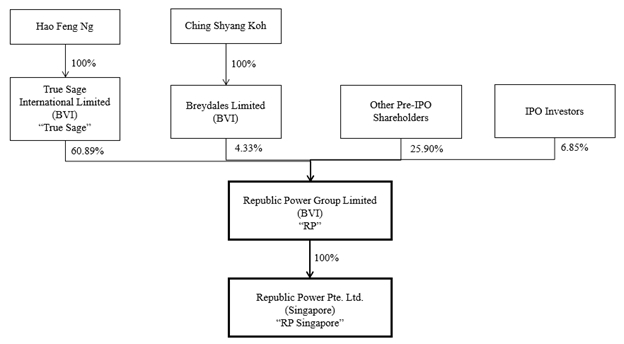
16
B. Business Overview
Our Business
We are a provider of customized ERP software solutions, consulting and technical support services, and peripheral hardware to large and SME clients and government agencies based in Singapore and Malaysia. We historically focused on delivering customized ERP systems for airports, cruise terminals, technology companies. Starting in the fiscal year 2024, we have expanded our client base to various industries, including trading, logistics, and property management. Our customized software provides general ERP functions including accounting, procurement, and workflow automation capabilities, real-time monitoring, efficient resources allocation, as well as specialized ERP functions including planning surveillance and threat detection.
We offer customized ERP related software and relevant consulting and technical support services and product sales, catered to each client’s specific needs. One of our key strengths is our ability to fulfill complex requirements by using artificial intelligence (“AI”) for prediction and applying algorithm, modules, and plugins to select and analyze operational data captured. We are uniquely positioned in the customization software sector with our ability to further deploy sensors, controls and other hardware and integrate the hardware to provide an Internet of Things (“IoT”) connectivity with an autonomous or semiautonomous outcome. Because our core algorithm and modules are pluggable, we are able to quickly develop software for clients in different industries and complete the customization in a much shorter period.
In addition, we are developing standardized software-as-a-service (“SaaS”) ERP products based on the core technologies and domain expertise we have accumulated from serving our clients over the years. The SaaS ERP products will have subscription-based pricing and shorter sales cycles. Currently, we are doing a pilot launch of the SaaS ERP products and expect to officially launch them in the third fiscal quarter of the fiscal year 2026. We believe the addition of the SaaS ERP products will complement our current project-based customized ERP products and allow us to reach a broader customer base through a recurring revenue model.
Our revenues have declined significantly in the most recent fiscal year, with total revenue for the year ended June 30, 2025 amounting to SGD 3,010,817 (USD 2,367,181), compared to SGD 685,820 in 2024 and SGD 5,022,071 in 2023. The increase in revenue in 2025 as compared to 2024 was primarily driven by our expansion into the Hong Kong market under the leadership of our new chairman, who leveraged our core technical capabilities to secure new customers in that region. The decline in revenue in 2024 was mainly due to the completion of several large-scale custom software development projects in prior years, without a comparable pipeline of new projects during that period. This was partially attributable to the reduced involvement of our former majority shareholder and chairman, Mr. Sai Bin Loi, who had previously played a significant role in securing high-value contracts for the year ended June 30, 2023.
On December 12, 2024, we completed a shareholder restructuring as Mr. Sai Bin Loi stepped down due to his elder age and reduced ability to remain actively involved in our operations. During this transition period, our business development capabilities were materially reduced as management’s attention was diverted to managing the ownership transition and related restructuring activities and we were unable to secure software development contracts with comparable value, while some existing clients reduced their annual budgets. In addition, in early 2024, companies in Singapore exhibited reluctance to invest in customized software development for digitalization due to economic uncertainty, particularly among small and medium-sized enterprises (SMEs). This reluctance was influenced by factors like rising business costs, especially manpower and rental costs, and uncertainty in customer demand. While the overall economy improved by the end of 2024, we believe some businesses focused on fortifying themselves rather than pursuing immediate growth plans.
17
We have customized a software for a cruise terminal client, using big data analytics technology and IoT applications, to enhance operational efficiency and elevate passenger experience within the bustling environment of cruise terminals. We leveraged the seamless integration of our software and IoT devices such as count sensors and CCTV cameras to enable real-time monitoring of passenger traffic flow. Our data analytics tools in the software system provided valuable information of the passenger demographics, including race and general age group, empowering our client to make informed predictions regarding passenger profiles and preferences. Through reliable prediction of passenger demographics and traffic flow patterns, our software solution facilitated strategic allocation of the ground staff resources, resulting in reduced wait times and enhanced service quality of the cruise ships.
We have also customized a sophisticated trolley management system for an airport client, utilizing advanced AI image recognition technology, which was developed based on open-source AI frameworks. Our system boasts the capability to accurately discern and quantify the trolleys at designated locations throughout the airport premises. Interfacing with real-time flight information systems, our software intelligently allocates luggage trolleys based on demand patterns associated with arriving and departing flights. Our software solution incorporated a notification system, empowering airport management with timely insights regarding trolley availability and distribution.
While our rely on open-source AI frameworks to develop our AI models, we specialize in adapting and refining these modules to meet the specific requirements of our clients. This tailored approach allows us to deliver solutions that are precisely aligned with the needs and objectives of each client. Furthermore, we prioritize the confidentiality and security of AI usage and data. All AI usage and data are securely stored within our clients’ databases designed to safeguard the integrity and privacy of their information.
Drawing from the experience and expert knowledge garnered through our custom projects, we are currently developing our proprietary AI algorithm for facility management. As of the date of this report, we are now undergoing the internal testing process for our proprietary AI algorithm. In addition, leveraging the same technological foundation, we have expanded our development efforts to build a broader, AI-enabled ERP application that serves a wider range of operational needs beyond the facility management sector. During this phase, our team remains focused on validating performance, refining functionalities, and ensuring that our AI-driven solutions are developed to be broadly applicable across different operational contexts.
Our Growth Strategies
We have developed and intend to implement the following strategies to expand and grow our business:
| ● | Solidify our industry position by gaining additional market share. By continuing to deliver high quality services and customized software solutions, we intend to pursue additional revenue opportunities from our existing clients. We will also continue to promote our comprehensive services and solutions to attract new clients in the same industries of our existing clients, so we can leverage our deep domain knowledge and expertise. Furthermore, we will continue to invest in a cloud-based IoT platform that improves our operational efficiencies and therefore benefits both our existing clients and new clients; |
| ● | Leverage domain expertise to expand into new industry segments. As we grow our industry and service area expertise and accumulate deep domain knowledge in the airport and cruise terminal industry verticals, we intend to leverage such experience and knowledge, and partner with top industry experts from other segments to extend our service offerings to the other verticals. In addition, we will continue to invest in R&D in certain targeted segments, including but not limited to the hospitality and medical technology industries, to develop applications to address the specific needs of those segments; |
| ● | Our existing solutions and expand our customer base. In addition to our project-based customized ERP products, we also are actively expanding our offerings to include subscription-based SaaS ERP to complement our current service portfolio and will allow us to target a broader customer base through a recurring revenue model. |
| ● | Attract, train, incentivize and retain talented professionals. We believe our success greatly depends on our ability to attract, train, incentivize and retain talented professionals. We will continue to build our professional talent pool through our TCP and TDP to ensure we can attract and retain professionals who have in-depth knowledge and understanding of the technologies we deploy and the industries in which we operate. We are discussing with local universities in Singapore to co-develop projects and engage talent internship with us. We will also sponsor competitions in the IT industry in Southeast Asia to promote our reputation among the young talents. We will also work with tertiary institutions to develop on campus hiring, bursary and scholarship programs; |
| ● | Drive efficiencies through ongoing improvements in operational excellence. We strive to gain significant operating efficiencies by leveraging historical and ongoing investments in infrastructure, research and development, and human capital. On an integrated approach level, we will institute certifications across all our process flow via ISO certification, and BizSafe certification, all of which help us build a structured workflow for our operation. We will continue to invest in our in-house tools to enhance our efficiencies in operations; and |
18
| ● | Capture new growth opportunities through strategic alliances and acquisitions. We will continue to pursue selective alliances and acquisitions in order to enhance our industry-specific technology and service delivery capabilities by building up acquisitions, collaborations and integrating targeted companies. We will continue to identify and assess opportunities to enhance our abilities to better serve our clients. We will focus on enhancing our technology capabilities, deepening our penetration into key clients, expanding our portfolio of service offerings and expanding our operations geographically in Southeast Asia. |
Our Competitive Strengths
The market for IT services is highly competitive and we expect competition to intensify. In Singapore, our major competitors in the system integrator space include ST Engineering and NCS which are both more established and larger than us.
However, we believe the following key strengths differentiate us from our competitors and will continue to contribute to our growth and success:
| ● | Our scalable technology. Our core algorithms, modules and plugins, which select and analyze operational data captured, are highly scalable across industries with minimal production cost. We customize the software solutions which contain our core algorithms, modules and plugins in accordance with the specific needs of each client. This cost-saving approach will help us to achieve higher operating margins as we increase the number of our clients; |
| ● | Our deep domain knowledge and specialization in selected industry verticals. We have deep domain knowledge and expertise in industry verticals including airports and cruise terminals. We leverage footprint and network of highly-talented IT professionals to provide comprehensive capabilities in software development services and consulting services. We believe that our robust emerging technology capabilities and solid track record of execution enable us to drive digital transformation for our clients; and |
| ● | Our comprehensive offering. We provide comprehensive service offerings including the DevOps IT solutions, sale of peripheral hardware, and consulting and technical support services as well as other services. As a result, we are able to generate revenue from a wide range of clientele. |
Our Services and Products
Software development and customization services and product sales
We develop customized software based on clients’ specific needs. Before we are engaged, we provide consultation to the clients to understand their needs and requirements and provide a preliminary proposal to address their needs. Once the proposals are accepted by our clients, we then design, develop, test and install the software for clients. The contract is typically project-based with a fixed price. Our form of software development service agreement will provide the scope of work and development timeline for each client’s project, as well as the milestones for payment. The duration of the development period is relatively short, usually less than one year.
We generally do not provide any post contract support or upgrade. However, to increase our competitiveness, we start to provide complementary support services for 12 months following completion of the project starting on September 1, 2025. The clients can request for ongoing maintenance, feature upgrade and system scaling at additional fees.
We offer project management in connection with our software products. Our project management services include consultation, design, development, and testing. We also sell equipment and related accessories to clients who acquired our customized software. Before the installation of the equipment, we deliver the equipment or instruct the supplier to deliver the hardware to the clients.
In addition, we are developing SaaS ERP products based on the core technologies and domain expertise we have accumulated from serving our clients over the years. The SaaS ERP products will have subscription-based pricing and shorter sales cycles. Currently, we are doing a pilot launch of the SaaS ERP products and expect to officially launch them in the first fiscal quarter of the fiscal year 2026. We believe the addition of the SaaS ERP products will complement our current project-based customized ERP products and allow us to reach a broader customer base through a recurring revenue model.
19
Consulting and technical support services
We provide training to the client’s personnel and technical support services to clients according to fixed-fee contracts in connection with software development with the client who acquired customized software from us. Usually the term of the contract is one year. We also provide stand-alone IT consulting services based on our expertise in these industry segments to some clients.
For the year ended June 30, 2025, our revenues were all generated from software development services, amounting SGD 3,010,817 (USD 2,367,181). For the year ended June 30, 2024, our revenues were all generated from software development services. For the year ended June 30, 2023, we derived revenues from three sources: (1) software development services, (2) consulting and technical support services, and (3) product sales.
Clients
Our clients include large corporations, SMEs based in Hong Kong and Southeast Asia. By serving both large corporations and small to medium enterprises, we are more aware of the issues faced during the different stages of company growth and better positioned to address a wide range of concerns.
Suppliers
Our suppliers generally can be divided into two categories: software development service providers and hardware suppliers.
To manage operational costs, since June 2024, we have outsourced a portion of our software development activities to third-party service providers, particularly following a recent shareholder restructuring that involved downsizing our in-house development team. While outsourcing remains a cost-efficient solution, we are committed to gradually rebuilding and investing in our internal development capabilities to support long-term growth and development. We typically enter into service agreements that are project based and with a fixed price. The agreements outline the scope of work, delivery schedules, payment terms, warranty and support, and the ownership of intellectual property developed under the agreements. These services are primarily provided in connection with the development of customized software solutions for our clients. The duration of the development period is relatively short, usually less than one year. Our service suppliers were not required to provide any post contract support or upgrade.
For hardware procurement, we do not generally enter into long-term agreements. Instead, we purchase the hardware from suppliers through individual purchase orders on an as-needed basis. These purchase orders set forth the product specifications, pricing, and delivery terms, but do not impose continuing obligations on the parties beyond each transaction.
Sales and Marketing
Generally, our customized software is sold to the clients, who may be project owners or the general contractors, via bidding. We provide a proposal to the project owners or the general contractors who then will decide whether to select us based on the quality and price of our proposal. We follow local government bidding announcements and participate in public bidding. Upon winning a contract through bidding, we enter into contracts with the project owner according to the corresponding bidding process. In some cases, we are also approached and engaged by the general contractors who win the bid and we, as subcontractors, assist the general contractor to develop and deliver the final products.
Currently, we have a cost-efficient referral system to market our services and solutions. Given the deep domain knowledge in each industry segment we serve, we are able to impress the clients and as such many of our clients are willing to introduce us to their industry peers. We intend to expand our business development team by hiring members with backgrounds or network specific to the industry in which our potential clients operate and thus may market our services and products to a more targeted audience. We plan to hire sales consultants in Malaysia in the future.
20
Research and Development
R&D is an integral part of our continued growth. In order to serve our clients’ needs better, we focus on exploring and studying emerging technologies and how to best integrate them into our existing and new solutions.
Currently, we are utilizing emerging technologies and tools to enhance our project delivery capability and efficiency. For instance, we applied the DevOps methodology and tools in our project delivery process and platform. This methodology has greatly enhanced development, operational efficiency and project quality. We are able to pinpoint the client’s issues and focus on capturing and analyzing data from clients quickly without having the need to set up expensive hardware leveraging on cloud native applications developed by us. The DevOps methodology has greatly improved our project delivery timeline and client satisfaction and the client is able to now walk through his data with us and be engaged with facts before embarking on customization. As a result, we have expanded our technological capabilities, improved efficiency of project delivery, and enhanced our solutions offerings, which drive new revenue opportunities and improve our core competencies.
Employees
To optimize operational efficiency and avoid redundancy, we align staffing levels with the specific requirements of each project. As of June 30, 2025, we employed 2 full-time staff. In the year ended 30 June, 2025, we executed development projects through subcontracting arrangements with third-party partners and freelancers, which enabled us to manage costs effectively and avoid long-term payroll commitments during the financial year. Following the completion of our initial public offering, and with improved cash flow liquidity, we have commenced a more structured and coordinated hiring plan to support our expanding operational and development needs.
None of our employees are represented by a labor union or collective bargaining agreements. We consider our employee relations to be good. We believe that attracting and retaining highly experienced associates and sales and marketing personnel is a key to our success. In addition, we believe that we maintain a good working relationship with our employees and we have not experienced any significant labor disputes or any difficulty in recruiting staff for our operations.
The following table sets forth the numbers of our employees categorized by function as of the date of this report:
| As of the date of this report |
||||
| Function: | ||||
| Finance | 2 | |||
| Technical Service | 2 | |||
| Sales Department | 2 | |||
| Research and Development | 1 | |||
| Operation and Maintenance | 1 | |||
| Total | 8 | |||
Intellectual Property
We rely on a combination of copyright, trade secret laws, confidentiality procedures and contractual provisions with our employees, contractors and others to protect our proprietary know-how. Our success depends in part upon our ability to obtain, maintain and enforce proprietary protection for our products, technology, and know-how, to operate without infringing the proprietary rights of others, and to prevent others from infringing our proprietary rights.
We intend to continue to assess regularly opportunities for seeking intellectual property protection for those aspects of our technology, designs and methodologies that we believe provide a meaningful competitive advantage. However, our ability to do so may be limited until such time as we are able to generate cash flow from operations or otherwise raise sufficient capital to continue to invest in our intellectual property. If we are unable to so invest in our intellectual property, our ability to protect it or prevent others from infringing on our proprietary rights may be impaired.
21
Data privacy/data protection
We are committed to protecting the clients’ data security during the course of development. Generally, our clients have their own IT infrastructure where data is hosted on their premises and therefore are not accessible to us without authorization.
We are subject to a number of foreign and domestic laws and regulations relating to data privacy and data protection in the jurisdictions in which we operate our business, including but not limited to the Personal Data Protection Act 2012 of Singapore (the “PDPA”), which generally requires organizations to give notice and obtain consents prior to collection, use or disclosure of personal data (being data, whether true or not, about an individual who can be identified from that data or from that data and other information to which organizations have or are likely to have access), and to provide individuals with the right to access and correct (any error or omission in) their own personal data. Organizations have mandatory obligations to assess if the data breaches they suffer are notifiable data breaches and are required to notify the Singapore Personal Data Protection Commission (“PDPC”) and the affected individuals where the data breach is of a certain severity (where the data breach results in, or is likely to result in significant harm to the affected individual, and/or is, or is likely to be of significant scale). The PDPA was last amended by the Personal Data Protection (Amendment) Act 2020 (the “Amendment Act”), which is only partially in force. As of the date of this prospectus, key portions of the Amendment Act not yet in force include a requirement for organizations to transfer personal data of an individual (that is held in electronic form) to a different organization where requested by the individual (generally referred to as “data portability”). Please see “Regulations” starting on page 22 of this report for more information.
Insurance
We currently do not have any business insurance, directors and officers’ liability insurance or group comprehensive life insurance for employees, property insurance, business interruption insurance, or general third-party liability insurance. See “Item 3. Key Information - 3.D. Risk Factors — Risks Related to Our Business and Industry — We do not currently maintain insurance coverage, which exposes us to potential significant financial losses and operational disruptions.”
Seasonality
We do not have a seasonal business cycle.
Legal Proceedings
From time to time, we are involved in litigation or other legal proceedings incidental to our business. We are not currently a party to any litigation the outcome of which, if determined adversely to us, would individually or in aggregate be reasonably expected to have a material adverse effect on our business, operating results, cash flows or financial condition.
Regulations
We currently operate our business in Singapore and Indonesia and plan to expand our business into other Southeast Asia countries. This section summarizes the principal laws related to our business and operations.
Singapore
The PDPA generally requires organizations to give notice and obtain consents prior to collection, use or disclosure of personal data (being data, whether true or not, about an individual who can be identified from that data or from that data and other information to which organizations have or are likely to have access), and to provide individuals with the right to access and correct (any error or omission in) their own personal data. Organizations have mandatory obligations to assess if the data breaches they suffer are notifiable data breaches, and are required to notify the PDPC and the affected individuals where the data breach is of a certain severity (where the data breach results in, or is likely to result in significant harm to the affected individual, and/or is, or is likely to be of significant scale). The PDPA also imposes various baseline obligations on organizations in connection with permitted uses of, accountability for, the protection of, the retention of, and overseas transfers of, personal data. In addition, the PDPA requires organizations to check “Do-Not-Call” registries prior to sending marketing messages (whether in sound, text, visual or other forms) addressed to Singapore telephone numbers (or other telephone numbers as may be prescribed), through voice calls, fax, text messages or other means.
22
The PDPA creates various offenses in connection with the improper use and/or disclosure of personal data, certain methods of collecting personal data and certain failures to comply with the requirements under the PDPA. These offences may be applicable to organizations, their officers and/or their employees. Offenders are liable on conviction to fines and/or imprisonment. The PDPA also creates a right of private action, pursuant to which the Singapore courts may, upon such persons’ application, grant damages, injunctions, declarations and such other relief the courts deem fit to persons who suffer loss or damages directly as a result of contraventions of certain requirements under the PDPA.
The PDPA was last amended by the Personal Data Protection (Amendment) Act 2020 (the “Amendment Act”), which is only partially in force as of the date of this report. Since October 1, 2022, the maximum financial penalty for the breaches of PDPA have been increased. The financial penalty cap which may be imposed on organizations for breaches under the PDPA has increased from the previously fixed SGD1 million, up to 10% of the organization’s annual turnover in Singapore for organizations with annual local turnover exceeding SGD10 million or in other cases, SGD1 million, whichever is higher. As of the date of this report, key portions of the Amendment Act which are not yet in force include a requirement for organizations to transfer personal data of an individual (that is held in electronic form) to a different organization where requested by the individual (generally referred to as “data portability”).
The Employment of Foreign Manpower Act 1990 provides that no person shall employ a foreign employee unless the foreign employee has a valid work pass. Work passes are issued by the Controller of Work Passes.
The Employment Act 1968 (the “Singapore EA”) prescribes certain minimum conditions of service that employers are required to provide to their employees, including (i) minimum days of statutory annual and sick leave; (ii) paid public holidays; (iii) statutory protection against wrongful dismissal; (iv) provision of key employment terms in writing; and (v) statutory maternity leave and childcare leave benefits. In addition, certain statutory protections relating to overtime and hours of work are prescribed under the Singapore EA, but only apply to limited categories of employees, such as (i) non-workman employee (other than a workman or a person employed in a managerial or an executive position) who receives a basic salary of up to SGD2,600 a month (excluding any other payment, supplement or allowance however described); and (ii) a workman employee (whose work involves mainly manual labour) who receives a basic salary of up to SGD4,500 a month.
Other employment-related benefits which are prescribed by law include (i) contributions to be made by an employer to the Central Provident Fund, under the Central Provident Fund Act 1953 in respect of each employee who is a citizen or permanent resident of Singapore; (ii) the provision of statutory maternity, paternity, childcare and adoption leave benefits (in each case subject to the fulfilment of certain eligibility criteria) under the Child Development Co-Savings Act 2001; (iii) statutory protections against dismissal on the grounds of age, and statutory requirements to offer re-employment to an employee who attains the prescribed minimum retirement age, under the Retirement and Re-employment Act 1993; and (iv) statutory requirements relating to work injury compensation, and workplace safety and health, under the Work Injury Compensation Act 2019 and the Workplace Safety and Health Act 2006, respectively.
British Virgin Islands
Regulations related to the British Virgin Islands Data Protection Act, 2021
The Data Protection Act, 2021 (the “BVI DPA”) came into force in the British Virgin Islands on 9 July 2021. The BVI DPA establishes a framework of rights and duties designed to safeguard individuals’ personal data, balanced against the need of public authorities, businesses and organizations to collect and use personal data for lawful purposes. The BVI DPA is centered around seven data protection principles (the General Principle, the Notice and Choice Principle, the Disclosure Principle, the Security Principle, the Retention Principle, the Data Protection Principle and the Access Principle) which require that:
| ● | personal data must not be processed without consent unless specific conditions are met and must not be transferred outside the British Virgin Islands, unless there is proof of adequate data protection safeguards or consent from the data subject; |
| ● | Where consent has been given to processing of personal data, the data subject may at any time withdraw his or her consent; |
23
| ● | a data controller must inform a data subject of specific matters, for instance the purposes for which it is being collected and further processed; |
| ● | personal data must not be disclosed for any purpose other than the purpose for which it was to be disclosed at the time of collection or a purpose directly related thereto or to any party other than a third party of a class previously notified to the data subject; |
| ● | a data controller shall, when processing personal data, take practical steps to protect personal data from loss, misuse, modification, unauthorized or accidental access or disclosure, alteration or destruction; |
| ● | personal data must not be kept for longer than is necessary for the purpose; |
| ● | personal data must be accurate, complete, not misleading and kept up to date; and |
| ● | a data subject must be given access to his or her own personal data and be able to correct that data where it is inaccurate, incomplete, misleading or not up to date, except where a request for such access or correction is refused under the BVI DPA. |
The BVI DPA imposes specific obligations on data controllers, including the duty to (i) apply the data protection principles; and (ii) respond in a timely fashion to requests from data subjects in relation to their personal data.
The Information Commissioner is the regulator responsible for the proper functioning and enforcement of the BVI DPA. Offences under the BVI DPA include,
| ● | processing sensitive personal data in contravention of the BVI DPA; |
| ● | willfully obstructing the Information Commissioner or an authorized officer in the conduct of his or her duties and functions; |
| ● | willfully disclosing personal information in contravention of the BVI DPA; and |
| ● | collecting, storing or disposing of personal information in a manner that contravenes the BVI DPA. Offences committed under the BVI DPA may result in fines (up to US$500,000 in certain cases) or imprisonment. Further, a data subject who suffers damage or distress as a result of their data being processed in contravention of the DPA may institute civil proceedings in the British Virgin Islands courts. |
There is no minimum statutorily prescribed wage in Singapore. Singapore employment law also does not prescribe any mandatory annual wage supplement, bonus payments or severance payments to be provided by an employer to its employees. Any such payment to be made to an employee (including as to frequency and amount) is at the discretion of the employer. An employer and its employee are generally free to agree on a notice period for termination of employment. If the employment contract does not provide for a notice period, the employer must adhere to the minimum notice periods stipulated in the Singapore EA. The Singapore EA confers a statutory right on either party to terminate the employment relationship immediately without waiting for the expiry of the notice period by paying salary in lieu of notice.
Indonesia
Data Privacy
Minister of Communication and Informatics’ (“MOCI”) Regulation No. 20 of 2016 regarding Personal Data Protection in Electronic Systems, dated November 7, 2016 (“MOCI Reg. 20/2016”), imposes certain requirements on electronic system providers to ensure the proper processing of personal data. As PT Grab Teknologi Indonesia and PT Kudo Teknologi Indonesia collects personal data of customers, partners and other third parties, these entities are also subject to MOCI Reg. 20/2016. These obligations include obtaining proper prior consent from the data subject before personal data is collected, processed, shared, accessed, disclosed, transferred or erased. In case of non-compliance with the foregoing obligations, MOCI may impose administrative sanctions, i.e., verbal warning, written warning, temporary suspension of business activities and/or announcement of noncompliance in the MOCI’s online website.
24
Under Government Regulation No. 71 of 2019 regarding the Organization of Electronic Systems and Transactions, dated October 10, 2019 (“GR 71/2019”), electronic system providers are required to notify the personal data owner of any breach involving such owner’s personal data. Failure to comply with the notification obligation under GR 71/2019 may subject the relevant electronic system provider to administrative sanctions in the form of written warnings, fines, temporary suspension of parts of or the entire components or services of an Electronic System, termination of access (such as access blocking, account closure, and/or content removal), and/or removal from the list of registered electronic system providers.
Regulations on Competition
Business competition and monopolistic practices in Indonesia are generally regulated under Law No. 5 of 1999 regarding Prohibition of Monopolistic Practices and Unfair Competition, dated March 5, 1999, as amended by the Omnibus Law (the “Competition Law as amended”). Pursuant to the Competition Law as amended, business actors in Indonesia are prohibited from, among other things, (i) entering into anti-competitive agreements or engaging in conduct that results in oligopoly and/or oligopsony, price-fixing and resale price maintenance, market allocations, boycotts, vertical integration or closed agreements; (ii) engaging in actions such as monopoly, monopsony or market control; and (iii) abusing dominant positions. There are two types of standards of proof recognized under the Competition Law, depending on the provision thereof, namely the “rule of reason” and “illegal per se.” The “rule of reason” requires the assessment of the anti-competitive effects of the business activity, while “illegal per se” provides that a violation exists insofar as all elements provided under the Competition Law are met.
The Business Competition Supervisory Commission (Komisi Pengawas Persaingan Usaha (“KPPU”)) has the authority to supervise the implementation of the Competition Law. The KPPU is an independent institution that reports to the President of the Republic of Indonesia. Further, transactions that meet certain thresholds set forth in the Competition Law and KPPU regulations must be reported post factum to the KPPU within 30 business days of the date the transaction is legally effective. The KPPU has the authority to substantively review whether the transaction is in violation of the Competition Law, which may then be subjected to certain structural and/or behavioral remedies.
Pursuant to the Competition Law, and as further elaborated by Government Regulation No. 44 of 2021 regarding Implementation of Prohibition of Monopolistic Practices and Unfair Competition, dated February 2, 2021, non-compliance with the Competition Law could subject the offending party to administrative sanctions imposed by the KPPU. These administrative sanctions are annulment of the relevant agreement, order of cessation of the prohibited action, unwinding of the relevant transaction, payment of compensation, and administrative fine. The administrative fine is a minimum of IDR1 billion (approximately $69,000) and a maximum of (i) 50% of the net profit received by the perpetrator in the relevant market during the period in which the non-compliance persists, (ii) 10% of the total sales in the relevant market during the period in which the non-compliance persists or (iii) IDR25 billion (approximately $1.7 million), which applies only for failure to report a notifiable transaction to the KPPU in a timely manner.
Malaysia
Regulation on Data Protection
Personal Data Protection Act 2010 of Malaysia (“Malaysia PDPA”)
The Malaysia PDPA governs the processing of personal data in commercial transactions in Malaysia.
The Malaysia PDPA enunciates 7 fundamental principles of data protection (the General Principle, the Notice and Choice Principle, the Disclosure Principle, the Security Principle, the Retention Principle, the Data Integrity Principle and the Access Principle) which data users are required to adhere to during the processing of personal data within Malaysia. The overarching principle in the Malaysia PDPA (as expounded under the General Principle) provides that a data user is prohibited from processing a data subject’s personal data without his/her consent, unless such processing is necessary for, among others, the performance of a contract to which the data subject is the party. Such principles are applicable to persons (i.e. data users) who engage in the processing of personal data, whether independently or jointly with others, and possess the authority to control or authorize the said processing.
25
Non-compliance by a data user of any of the fundamental principles constitutes an offense under the Malaysia PDPA and in the event of conviction, the data user is liable to a fine not exceeding RM 1,000,000 (approximately $220,000) or imprisonment for a term not exceeding three (3) years or both. Non-compliance of other provisions of the Malaysian PDPA may also lead to other financial penalties, imprisonment terms or both. The Malaysian Personal Data Protection Commissioner also has broad powers to order the data user to comply with the provisions of the Malaysia PDPA.
Transferring of personal data to places outside Malaysia
A data controller may transfer any personal data outside of Malaysia if (i) the destination has substantially similar data protection laws or adequate protection; or (ii) specific exceptions apply, including data subject consent, contractual necessity, legal proceedings, or where the data controller has taken all reasonable precautions.
Non-compliance with Section 129 of the Malaysia PDPA constitutes an offense. In the event of conviction, the data user may be subject to a fine not exceeding RM300,000 (approximately $65,000) or imprisonment for a period not exceeding two (2) years, or both.
General Code of Practice of Personal Data Protection (“Malaysia PDPA Code”)
The Malaysia PDPA Code sets out the best practices for a data user to assist the data user in meeting the requirements under the Malaysia PDPA when undertaking a commercial transaction.
Section 29 of the Malaysia PDPA provides that the Malaysia PDPA Code carries the force of law. Non-compliance of the Malaysia PDPA Code constitutes an offence and can lead up to a fine of up RM100,000 (approximately $22,000), imprisonment for a maximum term of 1 year, or both.
C. Organizational Structure
See “-A. History and Development of the Company.”
D. Property, Plants and Equipment
See “-B. Business Overview.”
Item 4A. UNRESOLVED STAFF COMMENTS
Not applicable.
Item 5. OPERATING AND FINANCIAL REVIEW AND PROSPECTS
You should read the following discussion and analysis of the Company’s financial condition and results of operations in conjunction with the Company’s consolidated financial statements and the related notes included elsewhere in this annual report. This discussion may contain forward-looking statements based upon current expectations that involve risks and uncertainties. The Company’s actual results may differ materially from those anticipated in these forward-looking statements as a result of various factors, including those set forth under “Item 3. Key Information - 3.D. Risk Factors” or in other parts of this annual report.
Overview
We are a provider of customized software solutions, consulting and technical support services, and peripheral hardware to large and small to medium corporate clients and government agencies, including airports, cruise terminals and technology, trading and logistic companies. Our operations are currently based in Singapore, and historically we have served clients in Singapore and Malaysia. In recent periods, we have expanded our client base to other markets in Southeast Asia and Hong Kong. Our customized software provides clients with real-time monitoring, efficient resources allocation, planning surveillance and threat detection. All of our clients are located in Southeast Asia and Hong Kong. We currently generate most of our revenues from software development services, which represented 100% of total revenue in the year ended June 30, 2025. For the year ended June 30, 2025, our revenue were SGD 3,010,817 (USD 2,367,181). The software development services represented 100.0%, 100.0% and 90.3% of total revenue in fiscal years ended June 30, 2025, 2024 and 2023, respectively. The consulting and technical support services represented 0%, 0% and 2.7% of our revenue in fiscal years ended June 30, 2025, 2024 and 2023, respectively. The sale of hardware represented 0%, 0% and 7.1% of our revenue in fiscal years ended June 30, 2025, 2024 and 2023, respectively. For the years ended June 30, 2025, 2024 and 2023, our revenues were SGD 3,010,817 (USD 2,367,181), SGD 685,820 and SGD 5,022,071, respectively.
In the fiscal year ended June 30, 2025, we significantly increased our software development contract portfolio, primarily by securing new projects with clients located in Hong Kong, while continuing to carry out our development and project management activities from Singapore. This geographic shift in our client base is an important driver of our recent revenue growth.
26
A. Operating Results
Results of Operations
Results of Operations for the Years Ended June 30, 2025 and 2024
Our consolidated results of operations for the years ended June 30, 2025 and 2024 are summarized below:
| For the Years Ended June 30, | ||||||||||||||||||||
| 2024 | 2025 | 2025 | Variance | Change | ||||||||||||||||
| SGD | SGD | USD | SGD | % | ||||||||||||||||
| Revenues | 685,820 | 3,010,817 | 2,367,181 | 2,324,997 | 339.0 | % | ||||||||||||||
| Cost of revenues | (253,193 | ) | (626,672 | ) | (492,706 | ) | (373,479 | ) | 147.5 | % | ||||||||||
| Gross profit | 432,627 | 2,384,145 | 1,874,475 | 1,951,518 | 451.1 | % | ||||||||||||||
| Selling and marketing expenses | — | (16,452 | ) | (12,935 | ) | (16,452 | ) | 100.0 | % | |||||||||||
| General and administrative expenses | (1,556,688 | ) | (778,801 | ) | (612,313 | ) | 777,887 | (50.0 | )% | |||||||||||
| Research and development expenses | (116,592 | ) | (1,120,000 | ) | (880,572 | ) | (1,003,408 | ) | 860.6 | % | ||||||||||
| Total Operating Expense | (1,673,280 | ) | (1,915,253 | ) | (1,505,820 | ) | (241,973 | ) | 14.5 | % | ||||||||||
| (Loss)/Income from operations | (1,240,653 | ) | 468,892 | 368,655 | 1,709,545 | (137.8 | )% | |||||||||||||
| Other expense, net | (176,527 | ) | (5,763 | ) | (4,531 | ) | 170,764 | (96.7 | )% | |||||||||||
| (Loss)/ Income before provision for income taxes | (1,417,180 | ) | 463,129 | 364,124 | 1,880,309 | (132.7 | )% | |||||||||||||
| Provision for income taxes | 3,622 | (102,588 | ) | (80,657 | ) | (106,210 | ) | (2,932.4 | )% | |||||||||||
| Net (Loss)/Income | (1,413,558 | ) | 360,541 | 283,467 | 1,774,099 | (125.5 | )% | |||||||||||||
Revenues
For the year ended June 30, 2025, our total revenue was SGD 3,010,817 (USD 2,367,181) as compared to SGD 685,820 for the year ended June 30, 2024. Our total revenue increased by SGD 2,324,997 (USD 1,827,972), or 339.0%. The overall increase in total revenue was primarily attributable to an increase of SGD 2,324,997 (USD 1,827,972), in revenue from software development services.
For the year ended June 30, 2025, our software development service revenue was SGD 3,010,817 (USD 2,367,181) as compared to SGD 685,820 for the year ended June 30, 2024. The increase in software development service revenue was SGD 2,324,997 or 339.0%. In 2025, we have significantly increased our software development contract portfolio by securing agreements with clients from Hong Kong, which is our new target market.
Cost of Revenues
Our cost of revenues increased by SGD 373,479 or 147.5% from SGD 253,193 for the year ended June 30, 2024 to SGD 626,672 (USD 492,706) for the year ended June 30, 2025. This increase is mainly attributed to an increase in revenue generated from software development service contracts secured by the Company.
Gross Profit
Our gross profit increased by SGD 1,951,518, from SGD 432,627 for the year ended June 30, 2024 to SGD 2,384,145 (USD 1,874,475) during the year ended June 30, 2025. The increase was attributed to an increase in new software development contracts secured during the year. In addition, the improvement in our gross profit margin was driven by enhanced economies of scale in our development operations. As our project volume increased, we were able to reuse previously developed modules across multiple customer projects, reducing the time and cost required for new development work. These efficiencies resulted in improved productivity and contributed to the overall increase in gross profit margin.
27
Our gross profit and gross profit margin from our major revenue streams are summarized as follows:
| For the Years ended June 30, | Variance | |||||||||||||||
| 2024 | 2025 | 2025 | Amount % | |||||||||||||
| SGD | SGD | USD | ||||||||||||||
| Software development service | ||||||||||||||||
| Gross profit | 432,627 | 2,384,145 | 1,874,475 | 1,951,518 | ||||||||||||
| Gross margin | 63.1 | % | 79.2 | % | 79.2 | % | 16.1 | % | ||||||||
| Total | ||||||||||||||||
Gross profit for software development services increased by SGD 1,951,518 or 16.1% from SGD 432,627 in the year ended June 30, 2024 to SGD 2,384,145 (USD 1,874,475) in the year ended June 30, 2025 mainly due to the increase in overall software development revenue. Gross profit margin for the years ended June 30, 2025 and 2024 was 79.2% and 63.1%, respectively. The increase in gross profit margin was primarily attributable to improved economies of scale in our software development activities. As we expanded our project base, we were able to leverage and reuse certain core modules and components rather than redeveloping them for each project, which resulted in greater cost efficiency and contributed to the higher margin.
Operating Expenses
For the year ended June 30, 2025, we incurred SGD 1,915,253 (USD 1,505,820) in operating expenses, representing a decrease of SGD 241,973 or 7.7%, from SGD 1,673,280 for the year ended June 30, 2024, primarily due to the maintaining of cost-cutting measures, such as keeping minimum permanent staff, leading to a significant decrease in general and administrative expenses.
Selling and marketing expenses primarily consisted of salary and compensation expenses relating to our sales and marketing personnel, and included other expenses relating to our sales and marketing activities. Selling and marketing expenses increased by SGD 16,452 or 100.0%, from nil for the year ended June 30, 2024 to SGD 16,452 (USD 12,935) for the year ended June 30, 2025. This increase was mainly attributable to the moderate expansion of our sales efforts as we entered new markets and engaged in activities aimed at acquiring new customers.
General and administrative expenses primarily consisted of salary and compensation expenses relating to our accounting, human resources and executive office personnel, and included rental expenses, depreciation expenses, office overhead, professional service fees and travel and transportation costs. General and administrative expenses decreased by SGD 777,887 or 50.0%, from SGD 1,556,688 for the year ended June 30, 2024 to SGD 777,801 (USD 612,313) for the year ended June 30, 2025. The decrease was mainly due to a decrease in professional service fee, salary and other office expense as cost-cutting measures have been in place. As a percentage of revenues, general and administrative expenses were 25.87% and 227.0% of our total revenue in the years ended June 30, 2025 and 2024, respectively. Driven by the implementation of cost-cutting measures, the company reduced the number of administrative staff, leading to lower overall staff salaries. Additionally, reductions in company welfare and spending ceilings for general administrative expenses contributed to the overall cost savings.
Research and development expenses primarily consisted of compensation and benefit expenses relating to our research and development personnel and other expenses relating to our research and development activities. Research and development expenses increase by SGD 1,003,408 from SGD 116,592 for the year ended June 30, 2024 to SGD 1,120,000 (USD 880,572) for the year ended June 30, 2025, representing 37.2% and 17.0% of our total revenues for the years ended June 30, 2025 and 2024, respectively. The increase is driven by the need to develop innovative software solutions that respond to the current macroeconomic environment, allowing us to address clients’ pain points and secure contracts. As advancements in AI technology continue at a rapid pace, we anticipate ongoing investment in research and development. Our ability to effectively leverage our R&D capabilities will play a crucial role in shaping our future operational results.
28
Other expenses, net
Other income (expense) primarily consists of interest income net of interest expense, the exchange gain and loss, and other income and expenses. Our net other expense was approximately SGD 5,763 (USD 4,531) in the year ended June 30, 2025, compared with a net other expense of approximately SGD 176,527 in the year ended June 30, 2024. Other expenses incurred for the year ended June 30, 2025 included an exchange loss in an amount of SGD 345 (USD 271), an interest expense in an amount of SGD 57,340 (USD 45,082), and offset by miscellaneous income in an amount of SGD 51,922 (USD 40,822). Other expenses incurred for the year ended June 30, 2024 included an exchange gain in an amount of SGD 1,535, a finance expense in an amount of SGD34,830, an interest expense in an amount of SGD 210,987, and offset by government grant and miscellaneous income in an amount of SGD 67,755.
Income(loss) before provision for income taxes
As a result of the foregoing, our income before provision for income/(loss) taxes increased by SGD 1,880,309, or 132.70%, from loss of SGD 1,417,180 for the fiscal year ended June 30, 2024 to a income of SGD 463,129 for the fiscal year ended June 30, 2025.
Provision for income taxes
Our income tax expenses increased by GD 106,210, or 3,2,932.4%, from a deferred tax benefit of SGD 3,622 for the year ended June 30, 2024 to income tax expense SGD 102,588 (USD 80,657) for the year ended June 30, 2025. Under the Inland Revenue Authority of Singapore (IRAS), RP Singapore is generally subject to income tax at a rate of 17%.
Net income
As a result of the foregoing, our net income increased by approximately 125.5% to a profit of SGD 360,541 (USD 283,467) in the fiscal year ended June 30, 2025 from a loss of SGD 1,413,558 for the fiscal year ended June 30, 2024.
Results of Operations for the Years Ended June 30, 2024 and 2023
Our consolidated results of operations for the years ended June 30, 2024 and 2023 are summarized below:
| For the Years Ended June 30, | ||||||||||||||||||||
| 2023 | 2024 | 2024 | Variance | Change | ||||||||||||||||
| SGD | SGD | USD | SGD | % | ||||||||||||||||
| Revenues | 5,022,071 | 685,820 | 506,066 | (4,336,251 | ) | (86.3 | )% | |||||||||||||
| Cost of revenues | (1,013,510 | ) | (253,193 | ) | (186,831 | ) | 760,317 | (75.0 | )% | |||||||||||
| Gross profit | 4,008,561 | 432,627 | 319,235 | (3,575,934 | ) | (89.2 | )% | |||||||||||||
| Selling and marketing expenses | (104,423 | ) | — | — | 104,423 | (100.0 | )% | |||||||||||||
| General and administrative expenses | (2,310,297 | ) | (1,556,688 | ) | (1,148,678 | ) | 753,609 | (32.6 | )% | |||||||||||
| Research and development expenses | (86,921 | ) | (116,592 | ) | (86,032 | ) | (29,671 | ) | 34.1 | % | ||||||||||
| Total Operating Expense | (2,501,641 | ) | (1,673,280 | ) | (1,234,710 | ) | 828,361 | (33.1 | )% | |||||||||||
| Income/(loss) from operations | 1,506,920 | (1,240,653 | ) | (915,475 | ) | (2,747,573 | ) | (182.3 | )% | |||||||||||
| Other expense, net | (91,124 | ) | (176,527 | ) | (130,259 | ) | (85,403 | ) | 93.7 | % | ||||||||||
| Income/(loss) before provision for income taxes | 1,415,796 | (1,417,180 | ) | (1,045,734 | ) | (2,832,976 | ) | (200.1 | )% | |||||||||||
| Provision for income taxes | (198,012 | ) | 3,622 | 2,673 | 201,634 | (101.8 | )% | |||||||||||||
| Net income/(Loss) | 1,217,784 | (1,413,558 | ) | (1,043,061 | ) | (2,631,342 | ) | (216.1 | )% | |||||||||||
29
Revenues
For the year ended June 30, 2024, our total revenue was SGD 685,820 (USD 506,066) as compared to SGD 5,022,071 for the year ended June 30, 2023. Our total revenue decreased by SGD 4,336,251 (USD 3,199,713), or 86.3%. The overall decrease in total revenue was primarily attributable to a decrease of SGD 3,846,751, SGD133,100 and SGD 356,400, in revenue from software development services, consulting and technical support services and product sales respectively.
For the year ended June 30, 2024, our software development service revenue was SGD 685,820 (USD 506,066) as compared to SGD 4,532,571 for the year ended June 30, 2023. The decrease in software development service revenue was SGD 3,846,751 or 84.9%. In 2023, we have significantly increased our software development contract portfolio by securing agreements with a more extensive array of clients. The decline in our software development service revenue was primarily attributable to the completion of several large-scale custom software development projects in prior years, without a corresponding pipeline of new projects in 2024. This was partially due to the reduced involvement of our former majority shareholder and chairman, Mr. Sai Bin Loi, who helped us secure high-value contracts in the year ended June 30, 2023. On December 12, 2024, we completed a shareholder restructuring as Mr. Sai Bin Loi stepped down due to his elder age and reduced ability to remain actively involved in our operations. During this transition period, our business development capabilities were materially reduced as management’s attention was diverted to managing the ownership transition and related restructuring activities and we were unable to secure software development contracts with comparable value, while some existing clients reduced their annual budgets. In addition, in early 2024, companies in Singapore exhibited reluctance to invest in customized software development for digitalization due to economic uncertainty, particularly among small and medium-sized enterprises (SMEs). This reluctance was influenced by factors like rising business costs, especially manpower and rental costs, and uncertainty in customer demand. While the overall economy improved by the end of 2024, we believe some businesses focused on fortifying themselves rather than pursuing immediate growth plans. These factors had a major impact on our revenue generation.
For the year ended June 30, 2024, we did not generate any consulting and technical support service revenue as compared to SGD 133,100 for the year ended June 30, 2023, representing a decrease of SGD 133,100 or 100.0%. We did not secure any consulting and technical support service contract in the year ended June 30, 2024. This is due to our existing clients requiring service in software development instead of consulting and technical support services. Nonetheless, we retain robust technical expertise in data analysis-related consulting and technical support. our intention is to persistently invest in long-term growth in this field, allowing us to offer more technical consulting services to our customers when opportunities arise.
For the year ended June 30, 2024, we did not generate any product sales revenue. For the year ended June 30, 2023, we generated SGD 356,400 in product sales revenue. The decrease in product sales revenue was mainly due to the fact that we did not deliver any customized hardware products to our clients, furthermore, we did not secure any product-related contract with our clients. In the fiscal year 2023, we have delivered customized hardware products to one of our clients. We will continue to monitor industry demands and assess the need for customized hardware products. With our retained expertise in customized hardware solutions and strong connections with hardware suppliers, we are well-positioned to respond quickly, and secure revenue contracts should the demand arise.
Cost of Revenues
Our cost of revenues decreased by SGD 760,317 or 75.0% from SGD 1,013,510 for the year ended June 30, 2023 to SGD 253,193 (USD 186,831) for the year ended June 30, 2024. This decrease is mainly attributed to a decrease in revenue generated from service contracts secured by the Company. In 2024, the Company has implemented cost cutting measures, including staff lay off, outsourcing software development work to external IT companies. In the year ended June 30, 2024, we did not incur any cost of revenue from consulting and technical support. This represented a reduction of SGD 131,400 (USD 96,960) or 100% from the year ended June 30, 2023. This was because Company focused its efforts on providing software development services.
Gross Profit
Our gross profit decreased by SGD 3,575,934, from SGD 4,008,561 for the year ended June 30, 2023 to SGD 432,627 (USD 319,235) during the year ended June 30, 2024. The decrease was attributed to a decline in new sales contracts secured during the year, as well as delays in ongoing projects, as clients adopted a wait-and-see approach amid economic uncertainty. The decrease in gross profit margin was primarily due to rising labor and material costs, driven by macroeconomic factors.
30
Our gross profit and gross profit margin from our major revenue streams are summarized as follows:
| For the Years ended June 30, | Variance | |||||||||||||||
| 2023 | 2024 | 2024 | Amount % | |||||||||||||
| SGD | SGD | USD | ||||||||||||||
| Software development service | ||||||||||||||||
| Gross profit | 3,813,111 | 432,627 | 319,235 | (3,380,484 | ) | |||||||||||
| Gross margin | 84.1 | % | 63.1 | % | 63.1 | % | (88.7 | )% | ||||||||
| Consulting and technical support services | ||||||||||||||||
| Gross profit | 1,700 | — | — | (1,700 | ) | |||||||||||
| Gross margin | 1.3 | % | — | % | — | (100 | )% | |||||||||
| Product sales | ||||||||||||||||
| Gross profit | 193,750 | — | — | (193,750 | ) | |||||||||||
| Gross margin | 54.4 | % | — | % | — | % | (100 | )% | ||||||||
| Total | ||||||||||||||||
| Gross profit | 4,008,561 | 432,627 | 319,235 | (3,575,934 | ) | |||||||||||
| Gross margin | 79.8 | % | 63.1 | % | 63.1 | % | (89.2 | )% | ||||||||
Gross profit for software development services decreased by SGD 3,380,484 or 88.7% from SGD 3,813,111 in the year ended June 30, 2023 to SGD 432,627 (USD 319,235) in the year ended June 30, 2024 mainly due to the decrease in overall software development revenue and increase in cost of revenue from software development revenue. Gross profit margin for the years ended June 30, 2024 and 2023 was 63.1% and 84.1%, respectively. The decrease in gross margin was primarily attributed to rising human capital costs and a decline in revenue from minimally customized and ready-to-sell software solutions. Additionally, sales contract revenue declined in the year ended June 30, 2024, as clients were reluctant to invest heavily in IT solutions due to uncertainty in the macroeconomic environment.
Gross profit for consulting and technical support services decreased by SGD 1,700 or 100% from SGD 1,700 in the year ended June 30, 2023 to nil in the year ended June 30, 2024, which was mainly because we have strategically shifted our focus to software development contracts that does not involve consulting and technical supports since the year ended June 30, 2023, therefore our revenue and gross profit for consulting and technical support have significantly reduced. Gross profit margin for the years ended June 30, 2024 and 2023 was nil and 1.3%, respectively.
Gross profit for product sales decreased by SGD 193,750 or 100% from SGD 193,750 in the year ended June 30, 2023 to nil in the year ended June 30, 2024, which was due to the fact that we have not completed any project of customized hardware products to our clients in fiscal year 2024. Clients adopted a wait-and-see approach amid economic uncertainty, reluctant to invest in asset-heavy solutions. As a result, gross profit margin for product sales for the year ended June 30, 2024 was nil, a decrease of 100% from 54.4% in the year ended June 30, 2023.
Operating Expenses
For the year ended June 30, 2024, we incurred SGD 1,673,280 (USD 1,234,710) in operating expenses, representing a decrease of SGD 828,361 or 33.1%, from SGD 2,501,641 for the year ended June 30, 2023, primarily due to the implementation of cost-cutting measures, such as staff layoffs, leading to a significant decrease in general and administrative expenses.
Selling and marketing expenses primarily consisted of salary and compensation expenses relating to our sales and marketing personnel, and included other expenses relating to our sales and marketing activities. Selling and marketing expenses decreased by SGD 104,423 or 100.0%, from SGD 104,423 for the year ended June 30, 2023 to nil for the year ended June 30, 2024. The decrease was mainly due to reduction of sales team as they did not meet the sales target set by the Company. At the same time, the Company underwent shareholder restructuring in the second half of the financial year, during which the hiring was frozen. Selling expenses accounted for nil and 2.1% of total revenue for the years ended June 30, 2024 and 2023, respectively.
31
General and administrative expenses primarily consisted of salary and compensation expenses relating to our accounting, human resources and executive office personnel, and included rental expenses, depreciation expenses, office overhead, professional service fees and travel and transportation costs. General and administrative expenses decreased by SGD 753,609 or 32.6%, from SGD 2,310,297 for the year ended June 30, 2023 to SGD 1,556,688 (USD 1,148,678) for the year ended June 30, 2024. The decrease was mainly due to a decrease in professional service fee, salary and other office expense as cost-cutting measures have been in place. As a percentage of revenues, general and administrative expenses were 227.0% and 46.0% of our total revenue in the years ended June 30, 2024 and 2023, respectively. Driven by the implementation of cost-cutting measures, the company reduced the number of administrative staff, leading to lower overall staff salaries. Additionally, reductions in company welfare and spending ceilings for general administrative expenses contributed to the overall cost savings.
Research and development expenses primarily consisted of compensation and benefit expenses relating to our research and development personnel and other expenses relating to our research and development activities. Research and development expenses increase by SGD 29,671 from SGD 86,921 for the year ended June 30, 2023 to SGD 116,592 (USD 86,032) for the year ended June 30, 2024, representing 17.0% and 1.7% of our total revenues for the years ended June 30, 2024 and 2023, respectively. The increase is driven by the need to develop innovative software solutions that respond to the current macroeconomic environment, allowing us to address clients’ pain points and secure contracts. As advancements in AI technology continue at a rapid pace, we anticipate ongoing investment in research and development. Our ability to effectively leverage our R&D capabilities will play a crucial role in shaping our future operational results.
Other expenses, net
Other income (expense) primarily consists of interest income net of interest expense, the exchange gain and loss, and other income and expenses. Our net other expense was approximately SGD 176,527 (USD 130,259) in the year ended June 30, 2024, compared with a net other expense of approximately SGD 91,124 in the year ended June 30, 2023. Other expenses incurred for the year ended June 30, 2024 included an exchange gain in an amount of SGD 1,535 (USD 1,133), a finance expense in an amount of SGD 34,830 (USD 25,701), an interest expense in an amount of SGD 210,987 (USD 155,687), and offset by government grant and miscellaneous income in an amount of SGD 67,755 (USD49,996). Other expenses incurred for the year ended June 30, 2023 included an exchange loss in an amount of SGD 4,080, a finance expense in an amount of SGD 72,591, an interest expense in an amount of SGD 103,814, and offset by government grant and miscellaneous income in an amount of SGD 89,361.
Income(loss) before provision for income taxes
As a result of the foregoing, our income before provision for income/(loss) taxes decreased by SGD 2,832,976, or 200.0%, from income of SGD 1,415,796 for the fiscal year ended June 30, 2023 to a loss of 1,417,180 for the fiscal year ended June 30, 2024.
Provision for income taxes
Our income tax expenses decreased by SGD 201,634, or 102.0%, from SGD 198,012 for the year ended June 30, 2023 to deferred income tax with 3,622 for the year ended June 30, 2024. Under the Inland Revenue Authority of Singapore (IRAS), RP Singapore is generally subject to income tax at a rate of 17%.
Net income
As a result of the foregoing, our net income decreased by approximately 216.1% to a loss of SGD 1,413,558 (USD 1,043,061) in the fiscal year ended June 30, 2024 from a profit of SGD 1,217,784 for the fiscal year ended June 30, 2023.
32
B. Liquidity and capital resources
Overview
The consolidated financial statements included in this prospectus have been prepared on a going concern basis, which assumes that the Company will be able to continue in operation for the foreseeable future and will be able to realize its assets and discharge its liabilities and commitments in the normal course of business. As of June 30, 2025, our total current assets were SGD 4,373,118 (USD 3,438,256), while total current liabilities amounted to SGD 3,704,464 (USD 2,912,543). The Company generate net profit for the year ended June 30, 2025, driven by increased revenue following the successful operational and strategic initiatives implemented under the direction of our new chairman. Our previous majority shareholder, Chairman, and Director, due to advanced age and inability to continue actively supporting the Company’s operations, sold his shares to our new majority shareholder, True Sage International Limited. Following this, Mr. Hao Feng Ng was appointed as the new Director and Chairman. As of June 30, 2024, our total current assets amounted to SGD 4,990,412, while total current liabilities stood at SGD 4,107,713. The Company experienced net losses in the fiscal year 2024, reflecting a decline in revenue due to macroeconomic conditions and shifts in client demand. Notwithstanding the improvement in fiscal year 2025, we remain focused on implementing a structured financial strategy to ensure continued operations.
Recent Shareholder Restructuring and Financial Support
The Company has recently undergone a shareholder restructuring, which was completed on December 12, 2024. The previous majority shareholder and chairman, Mr. Sai Bin Loi, who had previously provided financial support to the Company, has stepped down from his position of Chairman due to his elder age and inability to remain actively involved in operations. On December 12, 2024, pursuant to a share transfer agreement, as amended by a deed of variation dated January 8, 2025, Mr. Loi sold 10,449,167 ordinary shares of the Company to True Sage for a consideration of USD450,000. On January 11, 2025, True Sage sold 128,200 ordinary shares of the Company to Hon Kei Yeung, for a consideration of HKD 2,000,000 (approximately USD 257,000). On March 27, 2025, the Company issued 100,000 Class B Ordinary Shares to True Sage for cash at par. Following the above-mentioned restructuring, through True Sage, Mr. Ng became a controlling shareholder of the Company, who beneficially owns 10,320,967 Class A Ordinary Shares and 100,000 Class B Ordinary Shares, representing 66.59% of the total voting power as of the date of this prospectus.
This transition ensures the Company has the necessary resources to continue its business activities. Furthermore, following the restructuring, the Company has successfully secured new projects, which will contribute to revenue growth and enhance financial stability.
The new shareholder, True Sage, has committed to financially supporting the Company to meet both operational and financial obligations in a management comfort letter addressed to the independent auditor of the Company, in connection with the auditor’s assessment of the Company’s ability to continue as a going concern. The commitment includes:
| (i) | True Sage will provide continuous financial support to the Company to settle its outstanding debts, and it will not demand repayment from the Company until all the external financial obligations of the Company have been satisfied. |
| (ii) | True Sage has the ability and resources to provide financial support to the Company for operational needs. |
Current Financial Position
To reinforce our financial foundation and support uninterrupted operations for the next twelve months, the Company has implemented a three-pronged strategy focused on improving liquidity, financial discipline, and long-term sustainability.
33
Liquidity Strategy and Action Plans
To address liquidity concerns and demonstrate our financial viability, the Company is executing the following measures:
| 1. | Capital Raising Initiatives |
| ● | We successfully completed our initial public offering in October 2025, raising gross proceeds of USD 5 million. |
| ● | Other forms of fundraising or convertible debt instruments remain part of our contingency plans to ensure uninterrupted operations. |
| 2. | Revenue Expansion & Client Diversification |
| ● | The Company is leveraging its expertise in software development and consulting to secure long-term contracts with enterprise clients. |
| ● | We are developing a new subscription-based product, leveraging on the current generative AI product API and our in-house solutions, targeting the industries in which we have expertise. This will create more revenue streams for the Company. |
| ● | Following our shareholder restructuring, the Company has secured multiple new projects, ensuring a steady revenue stream. |
| 3. | Cost Optimization & Operational Efficiency |
| ● | We have initiated cost-reduction measures, including operational restructuring and strategic expense management, to improve cash flow. |
| ● | After implementing cost-cutting measures, our operating costs have been reduced to approximately SGD 25,000 (USD18,299) per month. |
| ● | We have relocated to a smaller office, with administrative staff working remotely to reduce overhead costs. |
| ● | Following our successful initial public offering, we have fully settled all bank liabilities, significantly reducing interest expenses and contributing to overall cost savings. |
| ● | Negotiation of vendor agreements to secure better payment terms and reduce capital expenditure requirements. |
| ● | Optimizing workforce allocation to enhance efficiency while lowering overhead costs. We have adopted a project-based payment model for our overseas developers, allowing us to better manage cash flow and allocate resources effectively. |
Based on our current financial strategy, we anticipate generating sufficient cash flow through:
| ● | Ongoing financing discussions to secure necessary working capital. |
| ● | Projected revenue growth driven by new contracts and expansion efforts. |
| ● | Reduction in operating expenses through cost restructuring. |
| ● | Continued collection of outstanding receivables and structured creditor payment plans to maintain liquidity. |
34
We believe that our existing cash and cash equivalents, cash raised from initial public offering, and expected cash flow from operations will be sufficient to meet our capital requirements for a minimum period of 12 months from the date of this prospectus. This assessment is based on our current financial projections, including revenue expectations, cost management strategies, and anticipated funding sources.
While we acknowledge that unforeseen circumstances or changes in market conditions could impact our liquidity, we remain committed to monitoring our financial health and will take necessary actions to secure additional financing if needed. In the event of unforeseen circumstances that disrupt the above-mentioned financial projection and strategies, the Company believes it possesses adequate capital resources to sustain planned operations for a minimum of 12 months from the date of this prospectus with the current available capital resources.
Cash Flows Analysis
For the Years Ended June 30, 2025, and 2024
The following table sets forth a summary of our cash flows for the periods indicated:
| For the years ended June 30 | ||||||||||||
| 2024 | 2025 | 2025 | ||||||||||
| SGD | SGD | USD | ||||||||||
| Net cash (used in)/provided by operating activities | (1,467,687 | ) | 1,353,893 | 1,064,465 | ||||||||
| Net cash provided by (used in) investing activities | — | (480,618 | ) | (377,874 | ) | |||||||
| Net cash provided by/ (used in) financing activities | 1,475,541 | (884,966 | ) | (695,783 | ) | |||||||
Cash used in operating activities:
For the year ended June 30, 2025, net cash provided by operating activities of SGD1,353,895(USD 1,064,466) primarily resulted from the net profit of SGD 360,541(USD 283,467) as adjusted for non-cash items and change in operating activities. Adjustments for non-cash items consisted of depreciation of property and equipment SGD 16,571 (USD 13,029), asset written off SGD 61,453 (USD 48,316), inventory provision SGD 54,986 (USD 43,231). Changes in operating assets and liabilities mainly included a decrease in accounts receivables SGD 74,228 (USD 58,360), a decrease in prepayment SGD2,648 (USD2,082), increase in other payables and accrued liabilities by SGD 239,083 (USD187,973) and an increase in tax payable SGD 70,642(USD 55,540).
For the year ended June 30, 2024, net cash used in operating activities of SGD 1,476,687 primarily resulted from the net loss of SGD 1,413,558 as adjusted for non-cash items and change in operating activities. Adjustments for non-cash items consisted of depreciation of property and equipment, SGD 42,700, allowance for credit losses, SGD 420,793, and provision for deferred tax asset SGD3,622. Changes in operating assets and liabilities mainly included a decrease in prepayment SGD 175 due to a small decrease in the prepaid rental, an increase in short term deposit SGD 1,866,250 due to deposit paid to supplier for revenue project purchase, a decrease in accounts payable SGD 111,871, a decrease in other payables and accrued liabilities SGD 351,780 and a decrease in taxes payable SGD 99,287. The net cash inflow was partially offset by an increase in accounts receivable of SGD 1,835,013 due to extended settlement from our clients; and a decrease in related party deposits SGD 80,000.
Cash provided by (used in) investing activities:
For the years ended June 30, 2025 and 2024, net cash used in investing activities are SGD 480,618 (USD 377,874) and nil, respectively. This was due to investment in intangible assets for the year ended June 30, 2025.
35
Cash provided by/(used in) financing activities:
For the year ended June 30, 2025, net used in financing activities, SGD 884,966 (USD 695,783) was comprised of proceeds from financial institute loans SGD218,422 (USD 171,729), proceed from related party SGD 1,432,688 (USD 1,126,416) and proceeds from director loan to the Company SGD 523,953 (USD 411,945), offset by repayment to financial institute loans SGD 907,627 (USD 713,599), repayment to related party SGD1,166,107 (USD 916,823), repayment to director loan SGD 871,873 (USD 685,489) and finance lease payments to our lessor SGD 52,344 (USD 41,154). There is an increase of deferred IPO cost of SGD 62,078 (USD 48,808).
For the year ended June 30, 2024, net cash provided by financing activities, SGD 1,475,541 (USD 1,088,799) was comprised of deferred IPO cost SGD 154,622 (USD 114,095), repayment to financial institutions SGD 256,228 (USD 189,070), repayment of finance lease SGD 7,452 (USD 5,499), repayment of amount due to director SGD 328,896 (USD 242,692). The cash outflow was offset by proceeds from financial institution SGD 1,616,985 (USD 1,193,171) and proceeds from director SGD 605,754 (USD 446,984).
The following table sets forth a summary of our working capital as of June 30, 2025 and June 30, 2024:
| As of June 30, |
As of June 30, | |||||||||||
| 2024 | 2025 | 2025 | ||||||||||
| SGD | SGD | USD | ||||||||||
| Current assets | 4,990,412 | 4,373,118 | 3,438,256 | |||||||||
| Current liabilities | 4,107,713 | 3,704,464 | 2,912,543 | |||||||||
| Working capital | 882,699 | 668,654 | 525,713 | |||||||||
Current assets as of June 30, 2025 was SGD 4,373,118(USD 3,438,256). Out of this balance, we had cash in an amount of SGD 137 (USD 108). The current asset balance also included the following: accounts receivable, net SGD 2,294,718 (USD 1,804,165) and short-term deposits SGD 2,078,263 (USD 1,633,983).
Current liabilities as of June 30, 2025 was SGD 3,704,464 (USD 2,912,543). This amount was composed of accounts payable SGD 28,816 (USD 22,656), other payables and accrued liabilities SGD 632,523 (USD 497,305), loan payable — financial institution loans SGD 993,695 (USD 781,268), amount due to director SGD 53,767(USD 42,273), amount due to shareholder SGD 266,500 (USD 209,529) and taxes payable SGD 1,729,163 (USD1,359,512).
Current assets as of June 30, 2024, was SGD 4,990,412(USD 3,682,417). Out of this balance, we had cash in an amount of SGD 11,828 (USD 8,728) of which approximately SGD 11,692 (USD 8,628) was denominated in Singapore Dollars, and SGD 136 (USD 100) denominated in United States Dollars. The current asset balance also included the following: accounts receivable, net SGD 2,619,144 (USD 1,932,662), prepayments SGD 2,648 (USD 1,954), short-term deposits SGD 2,301,806 (USD 1,698,499), and inventories SGD 54,986 (USD 40,574).
Current liabilities as of June 30, 2024 was SGD 4,107,713 (USD 3,031,076). This amount was composed of accounts payable SGD 28,816 (USD 21,264), loans payable to financial institution SGD 1,682,900 (USD 1,241,810), other payables and accrued liabilities SGD 328,033 (USD 242,055), finance lease obligation, current portion SGD 7,755 (USD 5,722), taxes payable, SGD 1,658,521 (USD 1,223,820), loans from director SGD 401,688 (USD 296,405).
Capital Expenditures
We have not made any capital expenditures for the year ended June 30, 2025 and 2024. We will continue to make capital expenditures when time is appropriate to meet the expected growth of our business.
36
Commitments and Contingencies
In the normal course of business, we are subject to loss contingencies, such as legal proceedings and claims arising out of our business, that cover a wide range of matters, including, among others, government investigations and tax matters. In accordance with ASC No. 450-20, “Loss Contingencies”, we will record accruals for such loss contingencies when it is probable that a liability has been incurred and the amount of loss can be reasonably estimated.
Contractual Obligations
As of June 30, 2025, the Company do not have contractual obligations commitment. As the Company has terminated the motor vehicle lease and did not renew the long-term office lease, therefore, the future minimum payment under certain of our contractual obligations is nil.
Off-Balance Sheet Arrangements
We have no off-balance sheet arrangements including arrangements that would affect our liquidity, capital resources, market risk support and credit risk support or other benefits.
Future Financings
We may issue new Class A Ordinary shares in order to fund our business growth. Issuances of additional shares will result in dilution to existing shareholders. There is no assurance that we will achieve sales of the equity securities or arrange for debt or other financing to fund our growth in case it is necessary, or if we are able to do so, there is no guarantee that existing shareholders will not be substantially diluted.
C. Research and Development, Patents and Licenses, etc.
See “Item 4. Information on the Company-B. Business Overview-Intellectual Property.”
D. Trend Information
Other than as disclosed in this annual report, we are not aware of any trends, uncertainties, demands, commitments or events for the current year that are reasonably likely to have a material effect on our net revenues, income, profitability, liquidity or capital reserves, or that caused the disclosed financial information to be not necessarily indicative of future operating results or financial conditions.
37
E. Critical Accounting Policies and Estimates
We prepare our consolidated financial statements in accordance with U.S. GAAP, which requires our management to make estimates that affect the reported amounts of assets, liabilities and disclosures of contingent assets and liabilities at the balance sheet dates, as well as the reported amounts of revenues and expenses during the reporting periods. To the extent that there are material differences between these estimates and actual results, our financial condition or results of operations would be affected. We base our estimates on our own historical experience and other assumptions that we believe are reasonable after taking account of our circumstances and expectations for the future based on available information. We evaluate these estimates on an ongoing basis.
Our expectations regarding the future are based on available information and assumptions that we believe to be reasonable, which together form our basis for making judgments about matters that are not readily apparent from other sources. Since the use of estimates is an integral component of the financial reporting process, our actual results could differ from those estimates. Some of our accounting policies require a higher degree of judgment than others in their application.
We consider an accounting estimate to be critical if: (i) the accounting estimate requires us to make assumptions about matters that were highly uncertain at the time the accounting estimate was made, and (ii) changes in the estimate that are reasonably likely to occur from period to period or use of different estimates that we reasonably could have used in the current period, would have a material impact on our financial condition or results of operations. When reading our consolidated financial statements, you should consider our selection of critical accounting policies, the judgment and other uncertainties affecting the application of such policies and the sensitivity of reported results to changes in conditions and assumptions.
When reading our consolidated financial statements, you should consider our selection of critical accounting policies, the judgment and other uncertainties affecting the application of such policies and the sensitivity of reported results to changes in conditions and assumptions. Our critical accounting policies and practices include the following: (i) revenue recognition; (ii) accounts receivable, net; and (iii) income taxes. See Note 2 - Summary of Significant Accounting Policies to our consolidated financial statements for the disclosure of these accounting policies. We believe the following accounting estimates involve the most significant judgments used in the preparation of our financial statements.
While management believes its judgments, estimates and assumptions are reasonable, they are based on information presently available and actual results may differ significantly from those estimates under different assumptions and conditions. We believe that the following critical accounting estimates involve the most significant judgments used in the preparation of our financial statements.
A list of recently issued accounting pronouncements that are relevant to us is included in note 2 to our consolidated financial statements included elsewhere in this annual report.
Other than as disclosed elsewhere in this annual report, we are not aware of any trends, uncertainties, demands, commitments, or events that are reasonably likely to have a material effect on our net revenue, income from continuing operations, profitability, liquidity, or capital resources, or that would cause reported financial information not necessarily to be indicative of future operating results or financial condition.
38
Item 6. DIRECTORS, SENIOR MANAGEMENT AND EMPLOYEES
A. Directors and Senior Management
The following individuals are members of the Board and executive management of the Registrant.
| Name | Age | Position(s) | ||
| Hao Feng Ng | 42 | Chairman of the Board and Director | ||
| Ziyang Long | 38 | Chief Executive Officer and Director | ||
| Chak Ming Wong | 37 | Chief Financial Officer | ||
| Jeffrey Stagg | 63 | Independent Director | ||
| Siu Wan Lo | 34 | Independent Director | ||
| Chun Yu Tso | 38 | Independent Director |
The following is a brief biography of each of our executive officers and directors.
Hao Feng Ng
Mr. Ng has served as a director and the Chairman of the Board of the Company since December 12, 2024. Mr. Ng was an IT manager of Hanson Motors Management Limited from 2021 to 2024, where he was responsible for the overall IT systems of the company including maintenance, sourcing software, and hardware solutions, along with negotiating terms and executing contracts with external vendors. Prior to that, Mr. Ng was a director at Black Wood Production from 2013 to 2024, where he was responsible for business development in marketing, advertising, and printing, including the identification and evaluation of business opportunities. Mr. Ng has acquired a professional vocation certificate in B.C.C in Computerized Pre-Pressed Techniques in 2001.
Ziyang Long
Mr. Long has served as the Chief Executive Officer (“CEO”) of the Company since December 2021 and became a director of our Company on December 12, 2024. From December 2021 to June 2022, Mr. Long also served as the interim Chief Financial Officer (“CFO”) of the Company. Mr. Long joined RP Singapore in September 2020 and has acted as the CEO of RP Singapore since then. He has extensive experiences in entrepreneur management, accounting, and financial reporting in different industries, including food and beverages, blockchain, and education technology. He has served as the finance manager of RP Singapore from September 2020 to present. Prior to that, he was the director and the owner of Accouncity Pte. Ltd., responsible for the operation and overseeing the outsourcing of the accounting and book-keeping business of such company. From 2018 to 2021, he served on the board of directors of FRV Solutions Pte. Ltd. Mr. Long obtained his bachelor’s degree of Science (Hon) in Accounting and Finance from London School of Economics and Political Science in 2013.
Chak Ming Wong
Mr. Wong was appointed as the Chief Financial Controller of our company on February 1, 2025. Mr. Wong is a member of the Hong Kong Institute of Certified Public Accountants. He has served as the finance manager at iDDY.AI since August 2016, leading the financial operation and risk management at this company. Prior to that, Mr. Wong worked at Sequoia Capital as the finance manager from May 2015 to August 2016, and at Wells Fargo Bank as finance manager from March 2012 to February 2015. He embarked on his professional journey as an auditor at KPMG Hong Kong, starting from February 2019 to January 2012. Mr. Wong’s career is distinguished by his adept skill in navigating the financial landscapes of diverse sectors, proving him to be a valuable leader in corporate finance. Mr. Wong earned his Bachelor of Business Administration with Honors in Accountancy from Hong Kong Polytechnic University in 2009. He also obtained his Master of Business Administration from the university of Hong Kong in 2016.
Jeffrey Stagg
Mr. Stagg has more than 20 years of experience in IT and telecommunication. Currently, Mr. Stagg servers as the CEO and president of S&S Equipment Holdings, Inc., a company engaged in the equipment, offshore and onshore Oil & Gas business, industrial marine, and Petroleum trading fields. Prior to that, he was a sales director at Hydrasat LLC, a firm that specializes in helping clients optimize their IT from April 2012 to July 2020. Mr. Stagg earned his bachelor’s degree of Science in Electrical Engineering from University of Louisiana.
Siu Wan Lo
Mr. Lo has vast experience in supervising dealings in securities, asset management and providing investment advice. Presently, Ms. Lo is a Responsible Officer at Sunhigh Financial Holdings Limited, where she is engaged in supervising and monitoring the dealings in securities, handling the subscription and redemption of assets and managing daily operations. Prior to that, Ms. Lo was a Responsible Officer (from August 2022 to March 2025) and Responsible Officer (from March 2019 to August 2022) at I Win Security Limited and Bluemount Securities Limited and Bluemount Asset Management Limited respectively, where she was responsible for supervising the dealings in securities, managing investment accounts, monitoring day-to-day trading activities, and offering investment advisory services. Ms. Lo was an Account Manager at Central Wealth Securities Investment Limited and Central Wealth Futures Limited from October 2016 to March 2019, where she was engaged in supervising investment accounts to ensure legal compliance, assisting the investigation of trading discrepancies and making margin calls. Ms. Lo obtained a Bachelor of Arts degree in Marketing and Public Relations from the Hong Kong Polytechnic University — School of Professional Education and Executive Development in 2012, and an associate degree in Marketing from the Hong Kong Polytechnic University — Hong Kong Community College in 2010.
39
Chun Yu Tso
Mr. Tso is a member of the Hong Kong Institute of Certified Public Accountants. He has acted as the finance manager of Hip Hing Loong Stage Engineering Co. Ltd since May 2016, overseeing the operation of the finance department. Prior to this, Mr. Tso worked as an auditor at KPMG Hong Kong for six years. He has extensive experience in financial accounting, auditing, taxation, company secretarial matter and corporate finance, especially in mergers, acquisitions and corporate restructuring. Mr. Tso earned his Bachelor of Business Administration with Honors in Accountancy from Hong Kong Polytechnic University in 2010.
Family relationships
None of the directors or executive officers has a family relationship as defined in Item 401 of Regulation S-K.
B. Compensation
Director and Executive Officer Compensation Table
The following table sets forth information regarding the compensation paid to our directors and our executive officers during the year ended June 30, 2025, 2024, and 2023.
| Compensation Paid | |||||||||||||||||||
| Name and Principal Position | Years ended June 30, |
Salary (US$) |
Bonus (US$) |
Other Compensation (US$) |
Total (US$) |
||||||||||||||
| Sai Bin Loi (Former Chairman and Director)* | 2025 | — | — | — | — | ||||||||||||||
| 2024 | — | 86,485 | 86,485 | ||||||||||||||||
| 2023 | 18,869 | 39,311 | 101,502 | 159,682 | |||||||||||||||
| Ziyang Long (CEO and Director) | 2025 | 9,435 | — | 18,869 | 28,304 | ||||||||||||||
| 2024 | — | 149,383 | 149,383 | ||||||||||||||||
| 2023 | 9,494 | 50,318 | 73,473 | 133,285 | |||||||||||||||
| Hao Feng Ng | 2025 | — | — | 9,789 | 9,789 | ||||||||||||||
| 2024 | — | — | — | — | |||||||||||||||
| 2023 | — | — | — | — | |||||||||||||||
| * | Mr. Sai Bin Loi has resigned from the position of director of Republic Power Pte Limited on October 28, 2025 |
C. Board Practices
Board of Directors
Our board of directors consists of 5 directors. A director is not required to hold any shares in our Company to qualify to serve as a director. The Corporate Governance Rules of the Nasdaq generally require that a majority of an issuer’s board of directors must consist of independent directors. Our board of directors has determined that each of Jeffrey Stagg, Siu Wan Lo and Chun Yu Tso, is an “independent director” as defined in the Nasdaq Listing Rules. Our board of directors is composed of a majority of independent directors.
Duties of directors
Under British Virgin Islands law, our directors owe fiduciary duties both at common law and under statute, including a statutory duty to act honestly, in good faith and with a view to our best interests. When exercising powers or performing duties as a director, our directors also have a duty to exercise the care, diligence and skills that a reasonable director would exercise in comparable circumstances, taking into account without limitation the nature of the company, the nature of the decision and the position of the director and the nature of the responsibilities undertaken by him. In exercising the powers of a director, the directors must exercise their powers for a proper purpose and shall not act or agree to the company acting in a manner that contravenes amended and restated our memorandum and articles of association or the BVI Act. See “Description of Share Capital — Differences in Corporate Law” for additional information on our directors’ fiduciary duties under British Virgin Islands law. In fulfilling their duty of care to us, our directors must ensure compliance with our amended and restated memorandum and articles of association. We have the right to seek damages if a duty owed by our directors is breached.
The functions and powers of our board of directors include, among others:
| ● | appointing officers and determining the term of office of the officers; |
| ● | authorizing the payment of donations to religious, charitable, public, or other bodies, clubs, funds, or associations as deemed advisable; |
| ● | exercising the borrowing powers of the company and mortgaging the property of the company; |
| ● | executing checks, promissory notes, and other negotiable instruments on behalf of the company; and |
| ● | maintaining a register of mortgages, charges, or other encumbrances of the company. |
40
Committees of the board of directors
We have established an audit committee, a compensation committee and a nominating and corporate governance committee under our Board of Directors. We adopted a charter for each of the three committees. Each committee’s members and functions are described below.
Audit Committee. Our audit committee consists of Mr. Jeffrey Stagg, Ms. Siu Wan Lo, and Mr. Chun Yu Tso. Mr. Chun Yu Tso is the chairman of our audit committee. We have determined that Mr. Jeffrey Stagg, Ms. Siu Wan Lo, and Mr. Chun Yu Tso qualify as independent directors as defined in Section 5605(a)(2) of the Nasdaq Listing Rules and Rule 10A-3 under the Securities Exchange Act. Our board also has determined that Chun Yu Tso qualifies as an audit committee financial expert within the meaning of the SEC rules or possesses financial sophistication within the meaning of the rules of Nasdaq. The audit committee oversees our accounting and financial reporting processes and the audits of the financial statements of our company. The audit committee is responsible for, among other things:
| ● | appointing the independent auditors and pre-approving all auditing and non-auditing services permitted to be performed by the independent auditors; |
| ● | reviewing with the independent auditors any audit problems or difficulties and management’s response; |
| ● | discussing the annual audited financial statements with management and the independent auditors; |
| ● | reviewing the adequacy and effectiveness of our accounting and internal control policies and procedures and any steps taken to monitor and control major financial risk exposures; |
| ● | reviewing and approving all proposed related party transactions; |
| ● | meeting separately and periodically with management and the independent auditors; and |
| ● | monitoring compliance with our code of business conduct and ethics, including reviewing the adequacy and effectiveness of our procedures to ensure proper compliance. |
Compensation Committee. Our compensation committee consists of Mr. Jeffrey Stagg, Ms. Siu Wan Lo, and Mr. Chun Yu Tso. Mr. Jeffrey Stagg is the chairman of our compensation committee. We have determined that Mr. Jeffrey Stagg, Ms. Siu Wan Lo, and Mr. Chun Yu Tso qualify as independent directors as defined in Section 5605(a)(2) of the Nasdaq Listing Rules and Rule 10A-3 under the Securities Exchange Act. The compensation committee will assist the board in reviewing and approving the compensation structure, including all forms of compensation, relating to our directors and executive officers. Our chief executive officer may not be present at any committee meeting during which his compensation is deliberated. The compensation committee is responsible for, among other things:
| ● | reviewing and recommending to the board with respect to the total compensation package for our most senior executive officers; |
| ● | approving and overseeing the total compensation package for our executives other than the most senior executive officers; |
| ● | reviewing and recommending to the board with respect to the compensation of our directors; |
| ● | reviewing periodically and approving any long-term incentive compensation or equity plans; |
| ● | selecting compensation consultants, legal counsel or other advisors after taking into consideration all factors relevant to that person’s independence from management; and |
| ● | reviewing programs or similar arrangements, annual bonuses, and employee pension and welfare benefit plans. |
41
Nominating and Corporate Governance Committee. Our nominating and corporate governance committee consists of Mr. Jeffrey Stagg, Ms. Siu Wan Lo, and Mr. Chun Yu Tso. Ms. Siu Wan Lo is the chairperson of our nominating and corporate governance committee. Mr. Jeffrey Stagg, Ms. Siu Wan Lo, and Mr. Chun Yu Tso qualify as independent directors as defined in Section 5605(a)(2) of the Nasdaq Listing Rules and Rule 10A-3 under the Securities Exchange Act. The nominating and corporate governance committee assists the board of directors in selecting individuals qualified to become our directors and in determining the composition of the board and its committees. The nominating and corporate governance committee is responsible for, among other things:
| ● | identifying and recommending nominees for election or re-election to our board of directors or for appointment to fill any vacancy; |
| ● | reviewing annually with our board of directors its current composition in light of the characteristics of independence, age, skills, experience and availability of service to us; |
| ● | identifying and recommending to our board the directors to serve as members of committees; |
| ● | advising the board periodically with respect to significant developments in the law and practice of corporate governance as well as our compliance with applicable laws and regulations, and making recommendations to our board of directors on all matters of corporate governance and on any corrective action to be taken; and |
| ● | monitoring compliance with our code of business conduct and ethics, including reviewing the adequacy and effectiveness of our procedures to ensure proper compliance. |
Code of Business Conduct and Ethics
We have adopted a code of business conduct and ethics, which is applicable to all of our directors, executive officers and employees and is publicly available. We post our code of business conduct and ethics publicly available on our website.
Employment Agreements and Director Agreements
We entered into an employment agreement with Mr. Ziyang Long, who acts as our CEO. Pursuant to such agreement, he shall receive a monthly base salary of SGD 1,400, and is also eligible for bonus, benefits and reasonable expenses reimbursement. Under the employment agreement, Mr. Long works as our CEO and the term is annual basis, which automatically renews for additional one-year terms unless either party provides a written notice one (1) month prior to the termination date, or otherwise proposes to renegotiate the terms of the employment with the other party within three (3) months prior to the expiration of the applicable term. We can also terminate the employment for cause, at any time, without notice or remuneration, for certain acts of the executive officer, such as conviction or plea of guilty to a felony or grossly negligent or dishonest acts to our detriment, or misconduct or a failure to perform agreed duties.
We entered into an employment agreement with Chak Ming Wong, who acts as our CFO. Pursuant to such agreement, he shall receive a monthly base salary of SGD 5,000, and is also eligible for bonus, benefits and reasonable expenses reimbursement. Under the employment agreement, Mr. Wong works as our CFO and the term is annual basis, which automatically renews for additional one-year terms unless either party provides a written notice one (1) month prior to the termination date, or otherwise proposes to renegotiate the terms of the employment with the other party within three (3) months prior to the expiration of the applicable term. We can also terminate the employment for cause, at any time, without notice or remuneration, for certain acts of the executive officer, such as conviction or plea of guilty to a felony or grossly negligent or dishonest acts to our detriment, or misconduct or a failure to perform agreed duties.
We also entered into director agreements with each of our independent directors which agreements set forth the terms and provisions of their engagement.
D. Employees
See “-B. Business Overview.”
42
E. Share Ownership
The following table sets forth information regarding the beneficial ownership of our Shares as of the date of this annual report by our officers, directors, and 5% or greater beneficial owners of Shares. There is no other person or group of affiliated persons known by us to beneficially own more than 5% of our Shares. Holders of our Shares are entitled to one (1) vote per share and vote on all matters submitted to a vote of our shareholders, except as may otherwise be required by law.
We have determined beneficial ownership in accordance with the rules of the SEC. These rules generally attribute beneficial ownership of securities to persons who possess sole or shared voting power or investment power with respect to those securities. The person is also deemed to be a beneficial owner of any security of which that person has a right to acquire beneficial ownership within 60 days. Unless otherwise indicated, the person identified in this table has sole voting and investment power with respect to all shares shown as beneficially owned by him, subject to applicable community property laws.
| Ordinary Shares Beneficially Owned as of June 30, 2025 |
||||||||||||
| Class A Ordinary Shares |
Class B Ordinary Shares |
Percentage of Votes Held |
||||||||||
| Directors and Executive Officers* | ||||||||||||
| Hao Feng Ng(1) | 10,113,267 | (2) | 100,000 | 60.89 | % | |||||||
| Ziyang Long | — | — | — | |||||||||
| Chak Ming Wong | — | — | — | |||||||||
| Jeffrey Stagg | — | — | — | |||||||||
| Siu Wan Lo | — | — | — | |||||||||
| Chun Yu Tso | — | — | — | |||||||||
| All directors and executive officers as a group: | 10,113,267 | 100,000 | 60.89 | % | ||||||||
| 5% Shareholders: | ||||||||||||
| True Sage(1) | 10,113,267 | (2) | 100,000 | 60.89 | % | |||||||
| Breydales Limited(3) | 790,000 | — | 4.33 | % | ||||||||
| * | Unless otherwise indicated, the business address of each of the individuals is #04-09 Techplace II, 5008 Ang Mo Kio Ave 5, Singapore 569874. |
| (1) | True Sage is a British Virgin Islands business company wholly owned by Mr. Hao Feng Ng, our Chairman. Its registered address is Vistra Corporate Services Centre, Wickhams Cay II, Road Town, Tortola, VG1110, British Virgin Islands. Its business address is Flat B, 2/F., Block 3 Provident Centre, 25 Wharf Road, North Point, Hong Kong. It holds 10,320,967 Class A Ordinary Shares and 100,000 Class B Ordinary Shares as of the date of this prospectus. Each Class B Ordinary Share is entitled to ten (10) votes on any matter on which action of the shareholders of the Company is sought. |
| (2) | True Sage will sell 207,700 Class A Ordinary Shares through the Underwriter pursuant to this prospectus. |
| (3) | These shares are held by Breydales Limited, a British Virgin Islands business company 100% owned by its sole shareholder, Ching Shyang Koh. Its registered office address is Vistra Corporate Services Centre, Wickhams Cay II, Road Town, Tortola, VG 1110, British Virgin Islands. |
F. Disclosure of a registrant’s action to recover erroneously awarded compensation.
N/A
43
Item 7. MAJOR SHAREHOLDERS AND RELATED PARTY TRANSACTIONS
A. Major Shareholders
See “Item 6. DIRECTORS, SENIOR MANAGEMENT AND EMPLOYEES-E. Share Ownership.”
B. Related Party Transactions
a. Long-term deposits — related party
On February 11, 2019, the Company entered into a service agreement with Ad Navitas Pte Ltd, which is owned by our former shareholder and sole director, Mr. Sai Bin Loi. Ad Navitas Pte Ltd will assist the Company to provide software development projects. Per terms set forth in the agreement, the Company is required to maintain a minimum security amount of SGD 1,000,000 to Ad Navitas Pte Ltd after signing the agreement. Long-term deposits — related party was SGD 920,000 (USD 723,327), SGD 920,000 and SGD 1,000,000 as of June 30, 2025, 2024 and 2023, respectively. The Company has made an expected credit loss provision of SGD 181,000 (USD 142,307) and SGD 80,000 in the years ended June 30, 2025 and 2024.
b. Deposit paid for acquisition of subsidiary — related party
On December 1, 2020, RP Singapore entered into an acquisition agreement with Consap Pte Ltd. (“Consap”), which a company is controlled by Chee Wai Chan, who was appointed as RP Singapore’s COO and director in February 2021, to acquire the 100% equity interest in Consap, a limited company incorporated in Singapore, for total cash consideration of USD 2,400,000 (equivalent to SGD 3,216,960).
The acquisition is not completed as of June 30, 2025 and the completion is contingent and subject to certain conditions, including target sales performance, set out in the acquisition agreement.
Deposit of USD 1,400,000 (equivalent to SGD 1,856,171) has been paid to Consap on June 30, 2021. The remaining of consideration of USD 1,000,000 will be paid by RP Singapore to Consap on June 30, 2023 if the conditions are met. Pursuant to the acquisition agreement, in case the aforesaid acquisition is not completed, the deposits would be fully refundable to RP Singapore. This agreement has been superseded by a new addendum mentioned below.
The acquisition had not been completed and the remaining consideration of USD 1,000,000 has not been paid by RP Singapore to Consap on June 30, 2024. The completion is contingent and subject to certain conditions, including target sales performance, set out in the acquisition agreement. The acquisition was conditional upon Consap entering into one or more definitive sales agreements, with clients approved by RP Singapore, for total contracts value of not less than USD 2,000,000 on or before November 30, 2025. In the event that Consap fails to secure enough sales agreements for a total contracts value of at least USD 2,000,000, Consap shall return USD 1,400,000 to RP Singapore within seven days from December 31, 2025.
On March 31, 2024, an addendum to the acquisition agreement has been signed. Pursuant to the addendum, Consap should enter into one or more definitive sales agreements with client approved by RP Singapore, for a total contract value of not less than USD2,000,000 on or before November 30, 2025. The expected completion date will be within 30 days from the date of fulfilment of the condition precedents or March 31, 2026, whichever is earlier, the remaining of consideration of USD 1,000,000 will be paid by RP Singapore to Consap on the completion date. In the event that Consap fails to secure enough sales agreement for a total contracts value of at least USD 2,000,000, Consap shall return USD 1,400,000 to RP Singapore within seven days from December 31, 2025. As of June 30, 2025, 2024 and 2023, deposit paid to a related party for acquisition of subsidiary amounted to SGD 1,856,171 (USD 1,459,369), SGD 1,856,171 and SGD 1,856,171, respectively.
44
c. Amount due to directors
Mr. Sai Bin Loi (“Mr. Loi”) and Mr. Chee Wai Chan was the directors of Republic Power Pte Limited.
The Company borrows from Mr. Loi, the Company’s major shareholder and Mr. Long, the Company’s Chief Executive Officer, for operation purpose. The loans are interest free, free of collateral and repayable upon demand.
| Name of Related Party | Relationship | Nature of Transactions |
June 30, 2024 |
June 30, 2025 |
June 30, 2025 |
||||||||||||
| SGD | SGD | USD | |||||||||||||||
| Mr. Sai Bin Loi | Mr. Loi was a shareholder and director of Republic Power Pte Limited | Loan | 77,624 | – | – | ||||||||||||
| Mr. Ziyang Long | Mr. Long is a director of Republic Power Pte Limited | Loan | 252,976 | 53,767 | 42,273 | ||||||||||||
| Mr. Chee Wai Chan | Mr. Chan was a director of Republic Power Pte Limited | Loan | 71,088 | – | – | ||||||||||||
| 401,688 | 53,767 | 42,273 | |||||||||||||||
Mr. Chee Wai Chan has resigned from the position of director of Republic Power Pte Limited and Chief Operating Officer on August 1, 2024.
Mr. Sai Bin Loi has resigned from the position of director of Republic Power Pte Limited on October 28, 2025.
Related party transactions
a. Revenue
On December 6, 2022, the Company entered into a service agreement with Republic SC Pte Ltd., to provide consulting services to Republic SC Pte Ltd. for a software development project. During the years ended June 30, 2025, 2024 and 2023, Republic SC Pte Ltd. paid to the Company in a consideration of nil, nil and SGD 5,500 respectively.
C. Interests of Experts and Counsel A. Consolidated Statements and Other Financial Information
Not applicable.
45
Item 8. FINANCIAL INFORMATION
We have appended the consolidated financial statements filed as part of this annual report. See “Item 18. Financial Statements.”
Legal Proceedings
See “Item 4. INFORMATION ON THE COMPANY-B. Business Overview-Legal Proceedings.”
Dividend Policy
We did not declare or pay any dividends for the years ended June 30, 2025, 2024 and 2023.
We intend to keep any future earnings to finance the expansion of our business, and we do not anticipate that any cash dividends will be paid in the foreseeable future.
Subject to the BVI Act and our amended and restated memorandum and articles of association, our board of directors may authorize and declare a dividend to shareholders at such time and of such an amount as they think fit if they are satisfied, on reasonable grounds, that immediately following the distribution the value of our assets will exceed our liabilities and we will be able to pay our debts as they become due. There is no further British Virgin Islands statutory restriction on the amount of funds which may be distributed by us by way of dividend.
When considering the distribution of a dividend in the future, our Board will take into account, among other things, the following factors when deciding whether to propose a dividend and in determining the dividend amount: (a) operating and financial results; (b) cash flow situation; (c) business conditions and strategies; (d) future operations and earnings; (e) taxation considerations; (f) interim dividend paid, if any; (g) capital requirement and expenditure plans; (h) interests of shareholders; (i) statutory and regulatory restrictions; (j) any restrictions on payment of dividends; and (k) any other factors that our Board may consider relevant. The payment of dividends, in certain circumstances, may also be subject to the approval of our shareholders, the BVI Act and our amended and restated memorandum and articles of Association as well as any other applicable laws. Currently, we do not have any predetermined dividend distribution ratio and we may not declare any dividends for the foreseeable future.
If we determine to pay dividends on any of our Class A Ordinary Shares in the future, as a holding company, we will be dependent on receipt of funds from our Singapore subsidiary, RP Singapore.
B. Significant Changes
Except as disclosed elsewhere in this annual report, we have not experienced any significant changes since the date of our audited consolidated financial statements included in this annual report.
46
Item 9. THE OFFER AND LISTING
A. Offer and Listing Details
Our ordinary shares have been listed on the Nasdaq Capital Market and commenced trading under the ticker symbol “RPGL” on October 14, 2025.
B. Plan of Distribution
Not applicable.
C. Markets
Our ordinary shares have been listed on the Nasdaq Capital Market and commenced trading under the ticker symbol “RPGL” on October 14, 2025.
D. Selling Shareholders
Not applicable.
E. Dilution
Not applicable.
F. Expenses of the Issue
Not applicable.
Item 10. ADDITIONAL INFORMATION
A. Share Capital
Not applicable.
B. Memorandum and Articles of Association
Our amended and restated memorandum and articles of association is incorporated into this annual report as Exhibit 1.1 hereto.
The following are summaries of material provisions of our amended and restated memorandum and articles of association and the BVI Act as they relate to the material terms of our Ordinary Shares.
Ordinary Shares
All of our issued and outstanding Class A Ordinary Shares are fully paid and non-assessable. Certificates evidencing the shares are issued in registered form. There are no limitations imposed by our amended and restated memorandum and articles of association on the rights of non-resident or foreign shareholders to hold or exercise voting rights on our shares. In addition, there are no provisions in our amended and restated memorandum and articles of association governing the ownership threshold above which shareholder ownership must be disclosed. Under the BVI Act, the Class A Ordinary Shares are deemed to be issued when the name of the shareholder is entered in our register of members. If (a) information that is required to be entered in the register of members is omitted from the register or is inaccurately entered in the register, or (b) there is unreasonable delay in entering information in the register, a shareholder of the company, or any person who is aggrieved by the omission, inaccuracy or delay, may apply to the British Virgin Islands Courts for an order that the register be rectified, and the court may either refuse the application or order the rectification of the register, and may direct the company to pay all costs of the application and any damages the applicant may have sustained.
Our Company is authorized to issue an unlimited number of ordinary shares, par value US$0.000625 per share. Subject to the provisions of the BVI Act and our amended and restated articles of association regarding redemption and purchase of the shares, the directors have general and unconditional authority to allot (with or without confirming rights of renunciation), grant options over or otherwise deal with any unissued shares to such persons, at such times and on such terms and conditions as they may decide. Such authority could be exercised by the directors to allot shares which carry rights and privileges that are preferential to the rights attaching to Class A Ordinary Shares. No share may be issued at a discount except in accordance with the provisions of the BVI Act. The directors may refuse to accept any application for shares and may accept any application in whole or in part, for any reason or for no reason.
47
Share Rights.
Our Class A Ordinary Shares and Class B Ordinary Shares rank pari passu with one another other than as set out below:
| (a) | As regards conversion, a holder of Class B Ordinary Shares shall have the conversion right in respect of each Class B Ordinary Share. For the avoidance of doubt, a holder of Class A Ordinary Shares shall have no rights to convert Class A Ordinary Shares into Class B Ordinary Shares under any circumstances. Each Class B Ordinary Share shall be converted at the option of the holder, at any time after issue and without the payment of any additional sum, into one fully paid Class A Ordinary Share. |
| (b) | As regards voting rights holders of Class A Ordinary Shares and Class B Ordinary Shares have the right to receive notice of, attend, speak and vote at general meetings of the Company. Holders of Class A Ordinary Shares and Class B Ordinary Shares shall, at all times (other than in respect of separate general meetings of the holders of a class or series of shares held in accordance with the Articles), vote together as one class on all matters submitted to a vote for members’ consent. Each Class A Ordinary Share shall be entitled to one (1) vote on all matters subject to the vote at general meetings of the Company, and each Class B Ordinary Share shall be entitled to ten (10) votes on all matters subject to the vote at general meetings of the Company. |
| (c) | As regards transfer upon any sale, transfer, assignment or disposition of Class B Ordinary Shares by a holder thereof to any person or entity which is not an Affiliate of such holder (as defined in the articles of association), such Class B Ordinary Shares validly transferred to the new holder shall be automatically and immediately be converted into an equal number of Class A Ordinary Shares. |
| (d) | As regards dividends each Class A Ordinary Share shall be entitled to such dividends as the Board may from time to time declare. The holders of Class B Ordinary Shares shall not be entitled to any dividends or distributions which may be declared by the Board from time to time. |
| (e) | In the event of a winding up or dissolution of the Company, whether voluntary or involuntary or for the purpose of a reorganization or otherwise or upon any distribution of capital, the Class A Ordinary Shares and the Class B Ordinary Shares shall be entitled to the surplus assets of the Company on a pari passu basis. |
We have applied to list the Class A Ordinary Shares on Nasdaq under the symbol “RPGL.”
Transfer Agent and Registrar
The transfer agent and registrar for the Class A Ordinary Shares is Transhare Corporation with offices located at Bayside Center 1, 17755 North US Highway 19, Suite No. 140, Clearwater, FL 33764.
Dividends
Shareholders holding Class A Ordinary Shares in the Company are entitled to receive such dividends as may be declared by our board of directors subject to the BVI Act and our amended and restated memorandum and articles of association. Class B Ordinary Shares shall not be entitled to any dividends or distributions which may be declared by the Board may from time to time.
Voting Rights
Subject to any rights or restrictions as to voting attached to any class of shares, unless any class of share carries special voting rights, on a poll, every shareholder who is present in person and every person representing a shareholder by proxy shall have one vote for each share of which he or the person represented by proxy is the holder. In addition, all shareholders holding shares of a particular class are entitled to vote at a meeting of the holders of that class of shares. Votes may be given either personally or by proxy.
48
Calls on Shares and Forfeiture
Subject to the terms of allotment, the directors may make calls on the shareholders in respect of any monies unpaid on their shares including any premium and each shareholder shall (subject to receiving at least 14 clear days’ notice specifying when and where payment is to be made), pay to us the amount called on his shares. Shareholders registered as the joint holders of a share shall be jointly and severally liable to pay all calls in respect of the share. If a call remains unpaid after it has become due and payable the person from whom it is due and payable shall pay interest on the amount unpaid from the day it became due and payable until it is paid at the rate fixed by the terms of allotment of the share or in the notice of the call or if no rate is fixed, at the rate of ten percent per annum. The directors may waive payment of the interest wholly or in part.
We have a first and paramount lien on all shares (whether fully paid up or not) registered in the name of a shareholder (whether solely or jointly with others). The lien is for all monies payable to us by the shareholder or the shareholder’s estate:
| (a) | either alone or jointly with any other person, whether or not that other person is a shareholder; and |
| (b) | whether or not those monies are presently payable. |
At any time, the directors may declare any share to be wholly or partly exempt from the lien on shares provisions of the articles.
We may sell in such manner as the directors may determine, any share on which the sum in respect of which the lien exists is presently payable, if due notice that such sum is payable has been given (as prescribed by the articles) and, within 14 days of the date on which the notice is deemed to be given under the articles, such notice has not been complied with.
Variation of Rights of Shares
Subject to the BVI Act, all or any of the special rights for the time being attached to the shares or any class of shares may, unless otherwise provided by the terms of issue of the shares of that class, be varied or modified with the sanction of a resolution passed at a separate general meeting of the holders of the shares of that class.
Unless the terms on which a class of shares was issued state otherwise, the rights conferred on the shareholder holding shares of any class shall not be deemed to be varied by the creation or issue of further shares ranking pari passu therewith.
Redemption and Purchase of Own Shares
Subject to the provisions of the BVI Act, we may issue shares on terms that are subject to redemption, at our option or at the option of the holders, on such terms and in such manner as may be determined by our amended and restated memorandum and articles of association and subject to any applicable requirements imposed from time to time by, the BVI Act, the SEC, or by any recognized stock exchange on which our securities are listed.
Inspection of Books and Records
Under the BVI Act, members of the general public, on payment of a nominal fee, can obtain copies of the public records of a company available at the office of the Registrar of Corporate Affairs which will include the company’s certificate of incorporation, its memorandum and articles of association (with any amendments) and records of license fees paid to date and will also disclose any articles of dissolution, articles of merger and a register of charges if the company has elected to file such a register.
General Meetings
Under our amended and restated memorandum and articles of association, a copy of the notice of any meeting of shareholders shall be given not less than 7 days before the date of the proposed meeting to those persons whose names appear as shareholders in the register of members on the date of the notice and are entitled to vote at the meeting. Our board of directors shall call a meeting of shareholders upon the written request of shareholders holding at least 30% of our outstanding voting shares. In addition, our board of directors may call a meeting of shareholders on its own motion. A meeting of shareholders may be called on short notice if at least 90% of the shares entitled to vote on the matters to be considered at the meeting have agreed to short notice of the meeting, or if all members holding shares entitled to vote on all or any matters to be considered at the meeting have waived notice and presence at the meeting shall be deemed to constitute waiver for this purpose.
49
At any meeting of shareholders, a quorum will be present if there are shareholders present in person or by proxy representing not less than 50 percent of the shares entitled to vote on the resolutions to be considered at the meeting. Such quorum may be represented by only a single shareholder or proxy. If no quorum is present within two hours of the start time of the meeting, the meeting shall be dissolved if it was requested by shareholders. In any other case, the meeting shall be adjourned to the next business day, and if shareholders representing not less than one-third of the votes of the common shares or each class of shares entitled to vote on the matters to be considered at the meeting are present within one hour of the start time of the adjourned meeting, a quorum will be present. If not, the meeting will be dissolved. No business may be transacted at any meeting of shareholders unless a quorum is present at the commencement of business. If present, the chair of our board of directors shall be the chair presiding at any meeting of the shareholders. If the chair of our board is not present then the members present shall choose a shareholder to act to chair the meeting of the shareholders. If the shareholders are unable to choose a chairman for any reason, then the person representing the greatest number of voting shares present in present of by proxy shall preside as chairman, failing which the oldest individual member or member representative shall take the chair.
A corporation that is a shareholder shall be deemed for the purpose of our amended and restated memorandum and articles of association to be present in person if represented by its duly authorized representative. This duly authorized representative shall be entitled to exercise the same powers on behalf of the corporation which he represents as that corporation could exercise if it were our individual shareholder.
Directors
There is nothing under British Virgin law which specifically prohibits or restricts the creation of cumulative voting rights for the election of our directors. Our amended and restated memorandum and articles of association do not provide for cumulative voting for elections of directors.
Liquidation Rights
As permitted by the BVI Act and our amended and restated memorandum and articles of association, we may be voluntarily liquidated under Part XII of the BVI Act by resolution of directors and resolution of shareholders if our assets exceed our liabilities and we are able to pay our debts as they fall due. We also may be wound up in circumstances where we are insolvent in accordance with the terms of the BVI Insolvency Act (Law Revision 2020).
If we wound up and the assets available for distribution among our shareholders are more than sufficient to repay all amounts paid to us on account of the issue of shares immediately prior to the winding up, the excess shall be distributable pari passu among those shareholders in proportion to the amount paid up immediately prior to the winding up on the shares held by them, respectively. If we are wound up and the assets available for distribution among the shareholders as such are insufficient to repay the whole of the amounts paid to us on account of the issue of shares, those assets shall be distributed so that, to the greatest extent possible, the losses shall be borne by the shareholders in proportion to the amounts paid up immediately prior to the winding up on the shares held by them, respectively. If we are wound up, the liquidator appointed by us may, in accordance with the BVI Act, divide among our shareholders in specie or kind the whole or any part of our assets (whether they shall consist of property of the same kind or not) and may, for such purpose, set such value as the liquidator deems fair upon any property to be divided and may determine how such division shall be carried out as between the shareholders or different classes of shareholders.
Differences in Corporate Law
The BVI Act and the laws of the British Virgin Islands affecting British Virgin Islands companies like us and our shareholders differ from laws applicable to U.S. corporations and their shareholders. Set forth below is a summary of the significant differences between the provisions of the laws of the British Virgin Islands applicable to us and the laws applicable to companies incorporated under the Delaware General Corporation Law in the United States and their shareholders.
50
Mergers and Similar Arrangements
Under the laws of the British Virgin Islands, two or more companies may merge or consolidate in accordance with Section 170 of the BVI Act. A merger means the merging of two or more constituent companies into one of the constituent companies (the “surviving company”) and a consolidation means the uniting of two or more constituent companies into a new company (the “consolidated company”). The procedure for a merger or consolidation between the company and another company (which need not be a British Virgin Islands company, and which may be the company’s parent or subsidiary, but need not be) is set out in the BVI Act. In order to merge or consolidate, the directors of each constituent company must approve a written plan of merger or consolidation, which with the exception of a merger between a parent company and its subsidiary, must also be approved by a resolution of a majority of the shareholders voting at a quorate meeting of shareholders or by written resolution of the shareholders of the British Virgin Islands company or British Virgin Islands companies which are to merge. While a director may vote on the plan of merger or consolidation, or any other matter, even if he has a financial interest in the plan, the interested director must disclose the interest to all other directors of the company promptly upon becoming aware of the fact that he is interested in a transaction entered into or to be entered into by the company. A transaction entered into by our company in respect of which a director is interested (including a merger or consolidation) is voidable by us unless the director’s interest was (a) disclosed to the board prior to the transaction or (b) the transaction is (i) between the director and the company and (ii) the transaction is in the ordinary course of the company’s business and on usual terms and conditions. Notwithstanding the above, a transaction entered into by the company is not voidable if the material facts of the interest are known to the shareholders and they approve or ratify it or the company received fair value for the transaction. In any event, all shareholders must be given a copy of the plan of merger or consolidation irrespective of whether they are entitled to vote at the meeting to approve the plan of merger or consolidation. A foreign company which is able under the laws of its foreign jurisdiction to participate in the merger or consolidation is required by the BVI Act to comply with the laws of that foreign jurisdiction in relation to the merger or consolidation. The shareholders of the constituent companies are not required to receive shares of the surviving or consolidated company but may receive debt obligations or other securities of the surviving or consolidated company, other assets, or a combination thereof. Further, some or all of the shares of a class or series may be converted into a kind of asset while the other shares of the same class or series may receive a different kind of asset. As such, not all the shares of a class or series must receive the same kind of consideration. After the plan of merger or consolidation has been approved by the directors and authorized, if required, by a resolution of the shareholders, articles of merger or consolidation are executed by each company and filed with the Registrar of Corporate Affairs in the British Virgin Islands. The merger is effective on the date that the articles of merger are registered with the Registrar or on such subsequent date, not exceeding thirty days, as is stated in the articles of merger or consolidation.
As soon as a merger becomes effective: (a) the surviving company or consolidated company (so far as is consistent with its memorandum and articles of association, as amended or established by the articles of merger or consolidation) has all rights, privileges, immunities, powers, objects and purposes of each of the constituent companies; (b) in the case of a merger, the memorandum and articles of association of any surviving company are automatically amended to the extent, if any, that changes to its memorandum and articles of association are contained in the articles of merger or, in the case of a consolidation, the memorandum and articles of association filed with the articles of consolidation are the memorandum and articles of the consolidated company; (c) assets of every description, including choses-in-action and the business of each of the constituent companies, immediately vest in the surviving company or consolidated company; (d) the surviving company or consolidated company is liable for all claims, debts, liabilities and obligations of each of the constituent companies; (e) no conviction, judgment, ruling, order, claim, debt, liability or obligation due or to become due, and no cause existing, against a constituent company or against any member, director, officer or agent thereof, is released or impaired by the merger or consolidation; and (f) no proceedings, whether civil or criminal, pending at the time of a merger by or against a constituent company, or against any member, director, officer or agent thereof, are abated or discontinued by the merger or consolidation; but: (i) the proceedings may be enforced, prosecuted, settled or compromised by or against the surviving company or consolidated company or against the member, director, officer or agent thereof; as the case may be; or (ii) the surviving company or consolidated company may be substituted in the proceedings for a constituent company. The Registrar of Corporate Affairs shall strike off the register of companies each constituent company that is not the surviving company in the case of a merger and all constituent companies in the case of a consolidation. If the directors determine it to be in the best interests of the company, it is also possible for a merger to be approved as a Court approved plan of arrangement or scheme of arrangement in accordance with the BVI Act.
51
A shareholder may dissent from (a) a merger if the company is a constituent company, unless the company is the surviving company and the member continues to hold the same or similar shares; (b) a consolidation if the company is a constituent company; (c) any sale, transfer, lease, exchange or other disposition of more than 50 per cent in value of the assets or business of the company if not made in the usual or regular course of the business carried on by the company but not including: (i) a disposition pursuant to an order of the court having jurisdiction in the matter, (ii) a disposition for money on terms requiring all or substantially all net proceeds to be distributed to the members in accordance with their respective interest within one year after the date of disposition, or (iii) a transfer pursuant to the power of the directors to transfer assets for the protection thereof; (d) a compulsory redemption of 10 per cent, or fewer of the issued shares of the company required by the holders of 90 percent, or more of the shares of the company pursuant to the terms of the BVI Act; and (e) a plan of arrangement, if permitted by the British Virgin Islands Court (each, an Action). A shareholder properly exercising his dissent rights is entitled to a cash payment equal to the fair value of his shares.
A shareholder dissenting from an Action must object in writing to the Action before the vote by the shareholders on the merger or consolidation, unless notice of the meeting was not given to the shareholder. If the merger or consolidation is approved by the shareholders, the company must give notice of this fact to each shareholder within 20 days who gave written objection. Such objection shall include a statement that the member proposes to demand payment for his or her shares if the Action is taken. These shareholders then have 20 days to give to the company their written election in the form specified by the BVI Act to dissent from the Action, provided that in the case of a merger, the 20 days starts when the plan of merger is delivered to the shareholder. Upon giving notice of his election to dissent, a shareholder ceases to have any shareholder rights except the right to be paid the fair value of his shares. As such, the merger or consolidation may proceed in the ordinary course notwithstanding his dissent. Within seven days of the later of the delivery of the notice of election to dissent and the effective date of the merger or consolidation, the company shall make a written offer to each dissenting shareholder to purchase his shares at a specified price per share that the company determines to be the fair value of the shares. The company and the shareholder then have 30 days to agree upon the price. If the company and a shareholder fail to agree on the price within the 30 days, then the company and the shareholder shall, within 20 days immediately following the expiration of the 30-day period, each designate an appraiser and these two appraisers shall designate a third appraiser. These three appraisers shall fix the fair value of the shares as of the close of business on the day prior to the shareholders’ approval of the transaction without taking into account any change in value as a result of the transaction.
Shareholders’ Suits
There are both statutory and common law remedies available to our shareholders as a matter of British Virgin Islands Law. These are summarized below:
Prejudiced Members
A shareholder who considers that the affairs of the company have been, are being, or are likely to be, conducted in a manner that is, or any act or acts of the company have been, or are, likely to be oppressive, unfairly discriminatory or unfairly prejudicial to him in that capacity, can apply to the court under Section 184I of the BVI Act, inter alia, for an order that his shares be acquired, that he be provided compensation, that the Court regulate the future conduct of the company, or that any decision of the company which contravenes the BVI Act or our amended and restated memorandum and articles of association be set aside.
Derivative Actions
Section 184C of the BVI Act provides that a shareholder of a company may, with the leave of the Court, bring an action in the name of the company in certain circumstances to redress any wrong done to it. Such actions are known as derivative actions. The British Virgin Islands Court may only grant permission to bring a derivative action where the following circumstances apply:
| ● | the company does not intend to bring, diligently continue or defend or discontinue proceedings; and |
| ● | it is in the interests of the company that the conduct of the proceedings not be left to the directors or to the determination of the shareholders as a whole. |
52
When considering whether to grant leave, the British Virgin Islands Court is also required to have regard to the following matters:
| ● | whether the shareholder is acting in good faith; |
| ● | whether a derivative action is in the company’s best interests, taking into account the directors’ views on commercial matters; |
| ● | whether the action is likely to proceed; |
| ● | the cost of the proceedings; and |
| ● | whether an alternative remedy is available. |
Just and Equitable Winding Up
In addition to the statutory remedies outlined above, shareholders can also petition the British Virgin Islands Court for the winding up of a company under the BVI Insolvency Act, (Law Revision 2020) for the appointment of a liquidator to liquidate the company and the court may appoint a liquidator for the company if it is of the opinion that it is just and equitable for the court to so order. Save in exceptional circumstances, this remedy is generally only available where the company has been operated as a quasi-partnership and trust and confidence between the partners has broken down.
Indemnification of Directors and Executive Officers and Limitation of Liability
Our amended and restated memorandum and articles of association provide that, subject to certain limitations, we indemnify against all expenses, including legal fees, and against all judgments, fines and amounts paid in settlement and reasonably incurred in connection with legal, administrative or investigative proceedings for any person who:
| ● | is or was a party or is threatened to be made a party to any threatened, pending or completed proceedings, whether civil, criminal, administrative or investigative, by reason of the fact that the person is or was our director; or |
| ● | is or was, at our request, serving as a director or officer of, or in any other capacity is or was acting for, another body corporate or a partnership, joint venture, trust or other enterprise. |
These indemnities only apply if the person acted honestly and in good faith with a view to our best interests and, in the case of criminal proceedings, the person had no reasonable cause to believe that his conduct was unlawful. The decision of the directors as to whether the person acted honestly and in good faith and with a view to the best interests of the company and as to whether the person had no reasonable cause to believe that his conduct was unlawful is, in the absence of fraud, sufficient for the purposes of the amended and restated memorandum and articles of association, unless a question of law is involved. The termination of any proceedings by any judgment, order, settlement, conviction or the entering of a nolle prosequi does not, by itself, create a presumption that the person did not act honestly and in good faith and with a view to the best interests of the company or that the person had reasonable cause to believe that his conduct was unlawful.
This standard of conduct is generally the same as permitted under the Delaware General Corporation Law for a Delaware corporation. Insofar as indemnification for liabilities arising under the Securities Act may be permitted to our directors, officers or persons controlling us under the foregoing provisions, we have been advised that in the opinion of the SEC, such indemnification is against public policy as expressed in the Securities Act and is therefore unenforceable.
Anti-Takeover Provisions in Our Amended and Restated Memorandum and Articles of Association
Some provisions of our articles of association may discourage, delay or prevent a change in control of our amended and restated company or management that shareholders may consider favorable. Under the BVI Act there are no provisions that specifically prevent the issuance of preferred shares or any such other “poison pill” measures. Our amended and restated memorandum and articles of association also do not contain any express prohibitions on the issuance of any preferred shares. Therefore, the directors without the approval of the holders of ordinary shares may issue preferred shares that have characteristics that may be deemed to be anti-takeover. Additionally, such a designation of shares may be used in connection with plans that are poison pill plans. However, under British Virgin Islands law, our directors in the exercise of their powers granted to them under our amended and restated memorandum and articles of association and performance of their duties, are required to act honestly and in good faith in what the director believes to be in the best interests of our company.
53
Directors’ Fiduciary Duties
Under Delaware corporate law, a director of a Delaware corporation has a fiduciary duty to the corporation and its shareholders. This duty has two components: the duty of care and the duty of loyalty. The duty of care requires that a director act in good faith, with the care that an ordinarily prudent person would exercise under similar circumstances. Under this duty, a director must inform himself of, and disclose to shareholders, all material information reasonably available regarding a significant transaction.
The duty of loyalty requires that a director act in a manner he reasonably believes to be in the best interests of the corporation. He must not use his corporate position for personal gain or advantage. This duty prohibits self-dealing by a director and mandates that the best interest of the corporation and its shareholders take precedence over any interest possessed by a director, officer or controlling shareholder and not shared by the shareholders generally. In general, actions of a director are presumed to have been made on an informed basis, in good faith and in the honest belief that the action taken was in the best interests of the corporation. However, this presumption may be rebutted by evidence of a breach of one of the fiduciary duties. Should such evidence be presented concerning a transaction by a director, a director must prove the procedural fairness of the transaction and that the transaction was of fair value to the corporation.
Under British Virgin Islands law, our directors owe fiduciary duties both at common law and under statute including, among others, a statutory duty to act honestly, in good faith, for a proper purpose and with a view to what the directors believe to be in the best interests of the company. Our directors are also required, when exercising powers or performing duties as a director, to exercise the care, diligence and skill that a reasonable director would exercise in comparable circumstances, taking into account without limitation, the nature of the company, the nature of the decision and the position of the director and the nature of the responsibilities undertaken. In the exercise of their powers, our directors must ensure neither they nor the company acts in a manner which contravenes the BVI Act or our amended and restated memorandum and articles of association. A shareholder has the right to seek damages for breaches of duties owed to us by our directors.
Pursuant to the BVI Act and our amended and restated memorandum and articles, a director of a company who has an interest in a transaction and who has declared such interest to the other directors, may:
| (a) | vote on a matter relating to the transaction; |
| (b) | attend a meeting of directors at which a matter relating to the transaction arises and be included among the directors present at the meeting for the purposes of a quorum; and |
| (c) | sign a document on behalf of the Company, or do any other thing in his capacity as a director, that relates to the transaction. |
In certain limited circumstances, a shareholder has the right to seek various remedies against the company in the event the directors are in breach of their duties under the BVI Act. Pursuant to Section 184B of the BVI Act, if a company or director of a company engages in, or proposes to engage in or has engaged in, conduct that contravenes the provisions of the BVI Act or the memorandum or articles of association of the company, the British Virgin Islands Court may, on application of a shareholder or director of the company, make an order directing the company or director to comply with, or restraining the company or director from engaging in conduct that contravenes the BVI Act or the memorandum or articles. Furthermore, pursuant to section 184I(1) of the BVI Act a shareholder of a company who considers that the affairs of the company have been, are being or likely to be, conducted in a manner that is, or any acts of the company have been, or are likely to be oppressive, unfairly discriminatory, or unfairly prejudicial to him in that capacity, may apply to the British Virgin Islands Court for an order which, inter alia, can require the company or any other person to pay compensation to the shareholders.
54
Shareholder Action by Written Consent
Under the Delaware General Corporation Law, a corporation may eliminate the right of shareholders to act by written consent by amendment to its certificate of incorporation. British Virgin Islands law provides that, subject to the memorandum and articles of association of a company, an action that may be taken by members of the company at a meeting may also be taken by a resolution of members consented to in writing.
Shareholder Proposals
Under the Delaware General Corporation Law, a shareholder has the right to put any proposal before the annual meeting of shareholders, provided it complies with the notice provisions in the governing documents. A special meeting may be called by the board of directors or any other person authorized to do so in the governing documents, but shareholders may be precluded from calling special meetings. British Virgin Islands law and our amended and restated memorandum and articles of association allow our shareholders holding 30% or more of the votes of the outstanding voting shares to requisition a shareholders’ meeting. There is no requirement under British Virgin Islands law to hold shareholders’ annual general meetings, but our amended and restated memorandum and articles of association do permit the directors to call such a meeting. The location of any shareholders’ meeting can be determined by the board of directors and can be held anywhere in the world.
Cumulative Voting
Under the Delaware General Corporation Law, cumulative voting for elections of directors is not permitted unless the corporation’s certificate of incorporation specifically provides for it. Cumulative voting potentially facilitates the representation of minority shareholders on a board of directors since it permits the minority shareholder to cast all the votes to which the shareholder is entitled on a single director, which increases the shareholder’s voting power with respect to electing such director. As permitted under the British Virgin Islands law, our amended and restated memorandum and articles do not provide for cumulative voting. As a result, our shareholders are not afforded any less protections or rights on this issue than shareholders of a Delaware corporation.
Removal of Directors
Under the Delaware General Corporation Law, a director of a corporation with a classified board may be removed only for cause with the approval of a majority of the outstanding shares entitled to vote, unless the certificate of incorporation provides otherwise. Under our amended and restated memorandum and articles of association, directors can be removed from office, with or without cause, by a resolution of shareholders. Directors can also be removed with cause by a resolution of directors passed at a meeting of directors called for the purpose of removing the director or for purposes including the removal of the director.
Transactions With Interested Shareholders
The Delaware General Corporation Law contains a business combination statute applicable to Delaware public corporations whereby, unless the corporation has specifically elected not to be governed by such statute by amendment to its certificate of incorporation, it is prohibited from engaging in certain business combinations with an “interested shareholder” for three years following the date that such person becomes an interested shareholder. An interested shareholder generally is a person or group who or which owns or owned 15% or more of the target’s outstanding voting shares within the past three years. This has the effect of limiting the ability of a potential acquirer to make a two-tiered bid for the target in which all shareholders would not be treated equally. The statute does not apply if, among other things, prior to the date on which such shareholder becomes an interested shareholder, the board of directors approves either the business combination or the transaction which resulted in the person becoming an interested shareholder. This encourages any potential acquirer of a Delaware public corporation to negotiate the terms of any acquisition transaction with the target’s board of directors. British Virgin Islands law has no comparable statute and our amended and restated memorandum and articles of association fails to expressly provide for the same protection afforded by the Delaware business combination statute.
55
Dissolution; Winding Up
Under the Delaware General Corporation Law, unless the board of directors approves the proposal to dissolve, dissolution must be approved by shareholders holding 100% of the total voting power of the corporation. Only if the dissolution is initiated by the board of directors may it be approved by a simple majority of the corporation’s outstanding shares. Delaware law allows a Delaware corporation to include in its certificate of incorporation a supermajority voting requirement in connection with dissolutions initiated by the board. Under the BVI Act and our amended and restated memorandum and articles of association, we may appoint a voluntary liquidator by a resolution of the shareholders or directors, provided that the directors have made a declaration of solvency that the company is able to discharge its debts as they fall due and that the value of the company’s assets exceed its liabilities.
Variation of Rights of Shares
Under the Delaware General Corporation Law, a corporation may vary the rights of a class of shares with the approval of a majority of the outstanding shares of such class, unless the certificate of incorporation provides otherwise. Under our amended and restated memorandum and articles of association, if at any time our shares are divided into different classes of shares, the rights attached to any class may only be varied, whether or not our company is in liquidation, with the consent in writing of or by a resolution passed at a meeting by not less than 50 percent of the votes cast by those entitled to vote at a meeting of the holders of the issued shares in that class. For these purposes the creation, designation or issue of shares with rights and privileges ranking pari passu to an existing class of shares is deemed not to be a variation of the rights of such existing class and may in accordance with our amended and restated memorandum and articles of association be affected by resolution of directors without shareholder approval.
Amendment of Governing Documents
Under the Delaware General Corporation Law, a corporation’s governing documents may be amended with the approval of a majority of the outstanding shares entitled to vote, unless the certificate of incorporation provides otherwise. As permitted by British Virgin Islands law, our amended and restated memorandum and articles of association may be amended by a resolution of shareholders and, subject to certain exceptions, by a resolution of directors. An amendment is effective from the date it is registered at the Registry of Corporate Affairs in the British Virgin Islands.
Anti-Money Laundering Laws
In order to comply with legislation or regulations aimed at the prevention of money laundering we are required to adopt and maintain anti-money laundering procedures, and may require subscribers to provide evidence to verify their identity. Where permitted, and subject to certain conditions, we also may delegate the maintenance of our anti-money laundering procedures (including the acquisition of due diligence information) to a suitable person.
We reserve the right to request such information as is necessary to verify the identity of a subscriber. In the event of delay or failure on the part of the subscriber in producing any information required for verification purposes, we may refuse to accept the application, in which case any funds received will be returned without interest to the account from which they were originally debited.
If any person resident in the British Virgin Islands knows or suspects that another person is engaged in money laundering or terrorist financing and the information for that knowledge or suspicion came to their attention in the course of their business the person will be required to report his belief or suspicion to the Financial Investigation Agency of the British Virgin Islands, pursuant to the Proceeds of Criminal Conduct Act (Law Revision 2020). Such a report shall not be treated as a breach of confidence or of any restriction upon the disclosure of information imposed by any enactment or otherwise.
C. Material Contracts
We have not entered into any material contracts other than in the ordinary course of business and other than those described in “Item 4. Information on the Company” or elsewhere in this annual report.
56
D. Exchange Controls
Under the British Virgin Islands law, there are currently no restrictions on the export or import of capital, including foreign exchange controls or restrictions that affect the remittance of dividends, interest or other payments to nonresident holders of our shares.
E. Taxation
British Virgin Islands Taxation
The British Virgin Islands currently levies no taxes on individuals or corporations based upon profits, income, gains or appreciation and there is no taxation in the nature of inheritance tax or estate duty. There are no other taxes likely to be material to the Company levied by the Government of the British Virgin Islands except for stamp duties which may be applicable on instruments executed in, or after execution brought within the jurisdiction of the British Virgin Islands. No stamp duty is payable in the British Virgin Islands on the issue of shares by, or any transfers of shares of, British Virgin Islands companies (except those which hold interests in land in the British Virgin Islands). The British Virgin Islands is not party to any double tax treaties that are applicable to any payments made to or by the Company. There are no exchange control regulations or currency restrictions in the British Virgin Islands.
Payments of dividends in respect of our Class A Ordinary Shares will not be subject to taxation in the British Virgin Islands and no withholding will be required on the payment of a dividend to any holder of our Class A Ordinary Shares, as the case may be, nor will gains derived from the disposal of our Class A Ordinary Shares be subject to British Virgin Islands income or corporation tax.
British Virgin Islands Economic Substance Legislation
The British Virgin Islands, together with several other non-European Union jurisdictions, introduced legislation aimed at addressing concerns raised by the Council of the European Union as to offshore structures engaged in certain activities which attract profits without real economic activity. On January 1, 2019, the Economic Substance (Companies and Limited Partnerships) Act, (Revised Edition 2020) as amended (the “ESA”) came into force in the British Virgin Islands introducing certain economic substance requirements for British Virgin Islands tax resident companies which are engaged in certain “relevant activities.” The Company is classed as a “pure” equity holding company under ESA. This classifications has little material impact on the Company or its operations.
Republic of Singapore Taxation
Dividends or Other Distributions with Respect to Class A Ordinary Shares
Under the one-tier corporate tax system which currently applies to all Singapore tax resident companies, tax on corporate profits is final, and dividends paid by a Singapore tax resident company will be income tax exempt in the hands of a shareholder, whether or not the shareholder is a company or an individual and whether or not the shareholder is a Singapore tax resident.
Capital Gains upon Distribution of Class A Ordinary Shares
Under current Singapore tax laws, there is no tax on capital gains. The determination of whether a gain or loss from disposal of equity investments in a company is income or capital in nature is based on consideration of the facts and circumstances of each case. The factors considered are drawn from established case law principles. Gains arising from the disposal of the Company’s Class A Ordinary Shares may be construed to be of an income nature and subject to Singapore income tax, if they arise from activities which the Inland Revenue Authority of Singapore regards as the carrying on of a trade or business in Singapore. However, under Singapore tax laws, any gains derived by a divesting company from its disposal of Class A Ordinary Shares in an investee company between June 1, 2012 and December 31, 2027 are generally not taxable if immediately prior to the date of the relevant disposal, the divesting company has held at least 20% of the Class A Ordinary Shares in the investee company for a continuous period of at least 24 months.
57
Goods and Services Tax
The issue or transfer of ownership of the Company’s Class A Ordinary Shares should be exempt from Singapore Goods and Services Tax. Hence, the holders would not incur any Goods and Services Tax on the subscription or subsequent transfer of the shares.
Stamp Duty
If the Company’s Class A Ordinary Shares evidenced in certificated forms are acquired in Singapore, stamp duty is payable on the instrument of their transfer at the rate of 0.2% of the consideration for or market value of the Company’s Class A Ordinary Shares, whichever is higher. Where an instrument of transfer is executed outside Singapore or no instrument of transfer is executed, no stamp duty is payable on the acquisition of the Company’s Class A Ordinary Shares. However, stamp duty may be payable if the instrument of transfer is executed outside Singapore and is received in Singapore. The stamp duty is borne by the purchaser unless there is an agreement to the contrary.
On the basis that any transfer instrument in respect of the Company’s shares traded on Nasdaq are executed outside Singapore through the Company’s transfer agent/transfer secretary and share registrar in the United States for registration in the Company’s branch registers of members maintained in the United States (without any transfer instrument being received in Singapore), no stamp duty should be payable in Singapore on such transfers.
Tax Treaties Regarding Withholding Taxes
There is no comprehensive avoidance of double taxation agreement between the United States and Singapore which applies to withholding taxes on dividends or capital gains.
Shareholders, whether or not domiciled in Singapore, should consult their own tax advisors regarding the Singapore tax consequences.
United States Federal Income Taxation
The following does not address the tax consequences to any particular investor or to persons in special tax situations such as:
| ● | banks; |
| ● | financial institutions; |
| ● | insurance companies; |
| ● | regulated investment companies; |
| ● | advertising investment trusts; |
| ● | broker-dealers; |
| ● | persons that elect to mark their securities to market; |
| ● | U.S. expatriates or former long-term residents of the U.S.; |
| ● | governments or agencies or instrumentalities thereof; |
| ● | tax-exempt entities; |
| ● | persons liable for alternative minimum tax; |
| ● | persons holding our Class A Ordinary Shares as part of a straddle, hedging, conversion or integrated transaction; |
| ● | persons that actually or constructively own 10% or more of our voting power or value (including by reason of owning our Class A Ordinary Shares); |
| ● | persons who acquired our Class A Ordinary Shares pursuant to the exercise of any employee share option or otherwise as compensation; |
58
| ● | persons holding our Class A Ordinary Shares through partnerships or other pass-through entities; |
| ● | beneficiaries of a Trust holding our Class A Ordinary Shares; or |
| ● | persons holding our Class A Ordinary Shares through a Trust. |
Prospective purchasers are urged to consult their own tax advisors about the application of the U.S. federal income tax rules to their particular circumstances as well as the state, local, foreign and other tax consequences to them of the purchase, ownership and disposition of our Class A Ordinary Shares.
Material Tax Consequences Applicable to U.S. Holders of Our Class A Ordinary Shares
The following sets forth the material U.S. federal income tax consequences related to the ownership and disposition of our Class A Ordinary Shares. It is directed to U.S. Holders (as defined below) of our Class A Ordinary Shares and is based upon laws and relevant interpretations thereof in effect as of the date of this prospectus, all of which are subject to change. This description does not deal with all possible tax consequences relating to ownership and disposition of our Class A Ordinary Shares or U.S. tax laws, other than the U.S. federal income tax laws, such as the tax consequences under non-U.S. tax laws, state, local and other tax laws.
The following brief description applies only to U.S. Holders (defined below) that hold Class A Ordinary Shares as capital assets and that have the U.S. dollar as their functional currency. This brief description is based on the federal income tax laws of the United States in effect as of the date of this prospectus and on U.S. Treasury regulations in effect or, in some cases, proposed, as of the date of this prospectus, as well as judicial and administrative interpretations thereof available on or before such date. All of the foregoing authorities are subject to change, which change could apply retroactively and could affect the tax consequences described below.
The brief description below of the U.S. federal income tax consequences to “U.S. Holders” will apply to you if you are a beneficial owner of ordinary share and you are, for U.S. federal income tax purposes,
| ● | an individual who is a citizen or resident of the United States; |
| ● | a corporation (or other entity taxable as a corporation for U.S. federal income tax purposes) organized under the laws of the United States, any state thereof or the District of Columbia; |
| ● | an estate whose income is subject to U.S. federal income taxation regardless of its source; or |
| ● | a trust that (1) is subject to the primary supervision of a court within the United States and the control of one or more U.S. persons for all substantial decisions or (2) has a valid election in effect under applicable U.S. Treasury regulations to be treated as a U.S. person. |
Taxation of Dividends and Other Distributions on our Class A Ordinary Shares
Subject to the PFIC (defined below) rules discussed below, the gross amount of distributions made by us to you with respect to the Class A Ordinary Shares (including the amount of any taxes withheld therefrom) will generally be includable in your gross income as dividend income on the date of receipt by you, but only to the extent that the distribution is paid out of our current or accumulated earnings and profits (as determined under U.S. federal income tax principles). With respect to corporate U.S. Holders, the dividends will not be eligible for the dividends-received deduction allowed to corporations in respect of dividends received from other U.S. corporations.
With respect to non-corporate U.S. Holders, including individual U.S. Holders, dividends will be taxed at the lower capital gains rate applicable to qualified dividend income, provided that (1) the Class A Ordinary Shares are readily tradable on an established securities market in the United States, or we are eligible for the benefits of an approved qualifying income tax treaty with the United States that includes an exchange of information program, (2) we are not a PFIC (defined below) for either our taxable year in which the dividend is paid or the preceding taxable year, and (3) certain holding period requirements are met. Because there is no income tax treaty between the United States and the British Virgin Islands, clause (1) above can be satisfied only if the Class A Ordinary Shares are readily tradable on an established securities market in the United States. Under U.S. Internal Revenue Service authority, Class A Ordinary Shares are considered for purpose of clause (1) above to be readily tradable on an established securities market in the United States if they are listed on Nasdaq. You are urged to consult your tax advisors regarding the availability of the lower rate for dividends paid with respect to our Class A Ordinary Shares, including the effects of any change in law after the date of this prospectus.
59
Dividends will constitute foreign source income for foreign tax credit limitation purposes. If the dividends are taxed as qualified dividend income (as discussed above), the amount of the dividend taken into account for purposes of calculating the foreign tax credit limitation will be limited to the gross amount of the dividend, multiplied by the reduced rate divided by the highest rate of tax normally applicable to dividends. The limitation on foreign taxes eligible for credit is calculated separately with respect to specific classes of income. For this purpose, dividends distributed by us with respect to our Class A Ordinary Shares will constitute “passive category income” but could, in the case of certain U.S. Holders, constitute “general category income.”
To the extent that the amount of the distribution exceeds our current and accumulated earnings and profits (as determined under U.S. federal income tax principles), it will be treated first as a tax-free return of your tax basis in your Class A Ordinary Shares, and to the extent the amount of the distribution exceeds your tax basis, the excess will be taxed as capital gain. We do not intend to calculate our earnings and profits under U.S. federal income tax principles. Therefore, a U.S. Holder should expect that a distribution will be treated as a dividend even if that distribution would otherwise be treated as a non-taxable return of capital or as capital gain under the rules described above.
Taxation of Dispositions of Class A Ordinary Shares
Subject to the passive foreign investment company rules discussed below, you will recognize taxable gain or loss on any sale, exchange or other taxable disposition of a share equal to the difference between the amount realized (in U.S. dollars) for the share and your tax basis (in U.S. dollars) in the Class A Ordinary Shares. The gain or loss will be capital gain or loss. If you are a non-corporate U.S. Holder, including an individual U.S. Holder, who has held the Class A Ordinary Shares for more than one year, you will generally be eligible for reduced tax rates. The deductibility of capital losses is subject to limitations. Any such gain or loss that you recognize will generally be treated as United States source income or loss for foreign tax credit limitation purposes which will generally limit the availability of foreign tax credits.
Passive Foreign Investment Company (“PFIC”)
We were not a passive foreign investment company, or PFIC, for U.S. federal income tax purposes for the taxable year ended June 30, 2024. Depending on the amount of cash we raise in this offering, together with any other assets held for the production of passive income, it is possible that, for our taxable year ending June 30, 2025 or for any subsequent year, more than 50% of our assets may be assets which produce passive income, in which case we would be deemed a PFIC, which could have adverse US federal income tax consequences for US taxpayers who are shareholders. We will make this determination following the end of any particular tax year. PFIC status is a factual determination for each taxable year which cannot be made until the close of the taxable year. A non-U.S. corporation is considered a PFIC, as defined in Section 1297(a) of the US Internal Revenue Code, for any taxable year if either:
| ● | at least 75% of its gross income for such taxable year is passive income; or |
| ● | at least 50% of the value of its assets (based on an average of the quarterly values of the assets during a taxable year) is attributable to assets that produce or are held for the production of passive income (the “asset test”). |
Passive income generally includes dividends, interest, rents and royalties (other than rents or royalties derived from the active conduct of a trade or business) and gains from the disposition of passive assets. We will be treated as owning our proportionate share of the assets and earning our proportionate share of the income of any other corporation in which we own, directly or indirectly, at least 25% (by value) of the stock. In determining the value and composition of our assets for purposes of the PFIC asset test, (1) the cash we raise in this offering will generally be considered to be held for the production of passive income and (2) the value of our assets must be determined based on the market value of our Class A Ordinary Shares from time to time, which could cause the value of our non-passive assets to be less than 50% of the value of all of our assets (including the cash raised in this offering) on any particular quarterly testing date for purposes of the asset test.
Based on our operations and the composition of our assets we do not expect to be treated as a PFIC under the current PFIC rules. However, we must make a separate determination each year as to whether we are a PFIC, and there can be no assurance with respect to our status as a PFIC for our current taxable year or any future taxable year. Depending on the amount of cash we raise in this offering, together with any other assets held for the production of passive income, it is possible that, for our current taxable year or for any subsequent taxable year, more than 50% of our assets may be assets held for the production of passive income. We will make this determination following the end of any particular tax year.
60
In addition, because the value of our assets for purposes of the asset test will generally be determined based on the market price of our Class A Ordinary Shares and because cash is generally considered to be an asset held for the production of passive income, our PFIC status will depend in large part on the market price of our Class A Ordinary Shares and the amount of cash we raise in this offering. Accordingly, fluctuations in the market price of the Class A Ordinary Shares may cause us to become a PFIC. In addition, the application of the PFIC rules is subject to uncertainty in several respects and the composition of our income and assets will be affected by how, and how quickly, we spend the cash we raise in this offering. We are under no obligation to take steps to reduce the risk of our being classified as a PFIC, and as stated above, the determination of the value of our assets will depend upon material facts (including the market price of our Class A Ordinary Shares from time to time and the amount of cash we raise in this offering) that may not be within our control. If we are a PFIC for any year during which you hold ordinary shares, we will continue to be treated as a PFIC for all succeeding years during which you hold Class A Ordinary Shares. However, if we cease to be a PFIC and you did not previously make a timely “mark-to-market” election as described below, you may avoid some of the adverse effects of the PFIC regime by making a “purging election” (as described below) with respect to the Class A Ordinary Shares.
If we are a PFIC for your taxable year(s) during which you hold Class A Ordinary Shares, you will be subject to special tax rules with respect to any “excess distribution” that you receive and any gain you realize from a sale or other disposition (including a pledge) of the Class A Ordinary Shares, unless you make a “mark-to-market” election as discussed below. Distributions you receive in a taxable year that are greater than 125% of the average annual distributions you received during the shorter of the three preceding taxable years or your holding period for the Class A Ordinary Shares will be treated as an excess distribution. Under these special tax rules:
| ● | the excess distribution or gain will be allocated ratably over your holding period for the Class A Ordinary Shares; |
| ● | the amount allocated to your current taxable year, and any amount allocated to any of your taxable year(s) prior to the first taxable year in which we were a PFIC, will be treated as ordinary income, and |
| ● | the amount allocated to each of your other taxable year(s) will be subject to the highest tax rate in effect for that year and the interest charge generally applicable to underpayments of tax will be imposed on the resulting tax attributable to each such year. |
The tax liability for amounts allocated to years prior to the year of disposition or “excess distribution” cannot be offset by any net operating losses for such years, and gains (but not losses) realized on the sale of the Class A Ordinary Shares cannot be treated as capital, even if you hold the Class A Ordinary Shares as capital assets.
A U.S. Holder of “marketable stock” (as defined below) in a PFIC may make a mark-to-market election under Section 1296 of the US Internal Revenue Code for such stock to elect out of the tax treatment discussed above. If you make a mark-to-market election for first taxable year which you hold (or are deemed to hold) ordinary shares and for which we are determined to be a PFIC, you will include in your income each year an amount equal to the excess, if any, of the fair market value of the Class A Ordinary Shares as of the close of such taxable year over your adjusted basis in such Class A Ordinary Shares, which excess will be treated as ordinary income and not capital gain. You are allowed an ordinary loss for the excess, if any, of the adjusted basis of the Class A Ordinary Shares over their fair market value as of the close of the taxable year. However, such ordinary loss is allowable only to the extent of any net mark-to-market gains on the Class A Ordinary Shares included in your income for prior taxable years. Amounts included in your income under a mark-to-market election, as well as gain on the actual sale or other disposition of the Class A Ordinary Shares, are treated as ordinary income. Ordinary loss treatment also applies to any loss realized on the actual sale or disposition of the Class A Ordinary Shares, to the extent that the amount of such loss does not exceed the net mark-to-market gains previously included for such Class A Ordinary Shares. Your basis in the Class A Ordinary Shares will be adjusted to reflect any such income or loss amounts. If you make a valid mark-to-market election, the tax rules that apply to distributions by corporations which are not PFICs would apply to distributions by us, except that the lower applicable capital gains rate for qualified dividend income discussed above under “— Taxation of Dividends and Other Distributions on our Class A Ordinary Shares” generally would not apply.
The mark-to-market election is available only for “marketable stock,” which is stock that is traded in other than de minimis quantities on at least 15 days during each calendar quarter (“regularly traded”) on a qualified exchange or other market (as defined in applicable U.S. Treasury regulations), including Nasdaq. If the Class A Ordinary Shares are regularly traded on Nasdaq and if you are a holder of Class A Ordinary Shares, the mark-to-market election would be available to you were we to be or become a PFIC.
Alternatively, a U.S. Holder of stock in a PFIC may make a “qualified electing fund” election under Section 1295(b) of the US Internal Revenue Code with respect to such PFIC to elect out of the tax treatment discussed above. A U.S. Holder who makes a valid qualified electing fund election with respect to a PFIC will generally include in gross income for a taxable year such holder’s pro rata share of the corporation’s earnings and profits for the taxable year. However, the qualified electing fund election is available only if such PFIC provides such U.S. Holder with certain information regarding its earnings and profits as required under applicable U.S. Treasury regulations. We do not currently intend to prepare or provide the information that would enable you to make a qualified electing fund election. If you hold ordinary shares in any taxable year in which we are a PFIC, you will be required to file U.S. Internal Revenue Service Form 8621 in each such year and provide certain annual information regarding such Ordinary Shares, including regarding distributions received on the Class A Ordinary Shares and any gain realized on the disposition of the Class A Ordinary Shares.
61
If you do not make a timely “mark-to-market” election (as described above), and if we were a PFIC at any time during the period you hold our Class A Ordinary Shares, then such Class A Ordinary Shares will continue to be treated as stock of a PFIC with respect to you even if we cease to be a PFIC in a future year, unless you make a “purging election” for the year we cease to be a PFIC. A “purging election” creates a deemed sale of such Class A Ordinary Shares at their fair market value on the last day of the last year in which we are treated as a PFIC. The gain recognized by the purging election will be subject to the special tax and interest charge rules treating the gain as an excess distribution, as described above. As a result of the purging election, you will have a new basis (equal to the fair market value of the Class A Ordinary Shares on the last day of the last year in which we are treated as a PFIC) and holding period (which new holding period will begin the day after such last day) in your Class A Ordinary Shares for tax purposes.
IRC Section 1014(a) provides for a step-up in basis to the fair market value for our Class A Ordinary Shares when inherited from a decedent that was previously a holder of our Class A Ordinary Shares. However, if we are determined to be a PFIC and a decedent that was a U.S. Holder did not make either a timely qualified electing fund election for our first taxable year as a PFIC in which the U.S. Holder held (or was deemed to hold) our Class A Ordinary Shares, or a mark-to-market election and ownership of those Class A Ordinary Shares are inherited, a special provision in IRC Section 1291(e) provides that the new U.S. Holder’s basis should be reduced by an amount equal to the Section 1014 basis minus the decedent’s adjusted basis just before death. As such if we are determined to be a PFIC at any time prior to a decedent’s passing, the PFIC rules will cause any new U.S. Holder that inherits our Class A Ordinary Shares from a U.S. Holder to not get a step-up in basis under Section 1014 and instead will receive a carryover basis in those Class A Ordinary Shares.
You are urged to consult your tax advisors regarding the application of the PFIC rules to your investment in our Class A Ordinary Shares and the elections discussed above.
Information Reporting and Backup Withholding
Dividend payments with respect to our Class A Ordinary Shares and proceeds from the sale, exchange or redemption of our Class A Ordinary Shares may be subject to information reporting to the U.S. Internal Revenue Service and possible U.S. backup withholding under Section 3406 of the US Internal Revenue Code with at a current flat rate of 24%. Backup withholding will not apply, however, to a U.S. Holder who furnishes a correct taxpayer identification number and makes any other required certification on U.S. Internal Revenue Service Form W-9 or who is otherwise exempt from backup withholding. U.S. Holders who are required to establish their exempt status generally must provide such certification on U.S. Internal Revenue Service Form W-9. U.S. Holders are urged to consult their tax advisors regarding the application of the U.S. information reporting and backup withholding rules.
Backup withholding is not an additional tax. Amounts withheld as backup withholding may be credited against your U.S. federal income tax liability, and you may obtain a refund of any excess amounts withheld under the backup withholding rules by filing the appropriate claim for refund with the U.S. Internal Revenue Service and furnishing any required information. We do not intend to withhold taxes for individual shareholders. However, transactions effected through certain brokers or other intermediaries may be subject to withholding taxes (including backup withholding), and such brokers or intermediaries may be required by law to withhold such taxes.
Under the Hiring Incentives to Restore Employment Act of 2010, certain U.S. Holders are required to report information relating to our Class A Ordinary Shares, subject to certain exceptions (including an exception for Class A Ordinary Shares held in accounts maintained by certain financial institutions), by attaching a complete Internal Revenue Service Form 8938, Statement of Specified Foreign Financial Assets, with their tax return for each year in which they hold Class A Ordinary Shares.
F. Dividends and Paying Agents
Not applicable.
G. Statement by Experts
Not applicable.
H. Documents on Display
We have previously filed with the SEC our Registration Statement on Form F-1, as amended (File Number: 333-288465).
We are subject to the periodic reporting and other informational requirements of the Exchange Act. Under the Exchange Act, we are required to file reports and other information with the SEC. Specifically, we are required to file annually a Form 20-F within four months after the end of each fiscal year. Copies of reports and other information, when so filed, may be inspected without charge and may be obtained at prescribed rates at the public reference facilities maintained by the SEC at Judiciary Plaza, 100 F Street, N.E., Washington, D.C. 20549. The public may obtain information regarding the Washington, D.C. Public Reference Room by calling the SEC at 1-800-SEC-0330. The SEC maintains a website at http://www.sec.gov that contains reports, proxy and information statements, and other information regarding registrants that make electronic filings with the SEC using its EDGAR system. As a foreign private issuer, we are exempt from the rules of the Exchange Act prescribing, among other things, the furnishing and content of proxy statements to shareholders, and our executive officers, directors and principal shareholders are exempt from the reporting and short-swing profit recovery provisions contained in Section 16 of the Exchange Act.
I. Subsidiary Information
For a listing of our subsidiaries, see “Item 4. INFORMATION ON THE COMPANY-A. History and Development of the Company.”
62
Item 11. QUANTITATIVE AND QUALITATIVE DISCLOSURES ABOUT MARKET RISK
Foreign Exchange Risk
Substantially all of our revenues and expenses are denominated in Singapore dollars. We have not used any derivative financial instruments to hedge exposure to such risk. Although in general our exposure to foreign exchange risks should be limited, the value of your investment in our Shares will be affected by the exchange rate between the U.S. dollar and Singapore dollar because a substantial all of our revenue and expenses are effectively denominated in Singapore dollar, while our Shares will be traded in U.S. dollars. We may seek to reduce the currency risk by entering into foreign currency instruments. We did not have any currency hedging instruments as of June 30, 2025, 2024 and 2023, however, our management monitors movements in exchange rates closely.
To the extent we need to convert U.S. dollars into Singapore dollars for our operations, appreciation of Singapore dollar against the U.S. dollar would reduce the amount in Singapore dollars we receive from the conversion. Conversely, if we decide to convert Singapore dollars into U.S. dollars for the purpose of making payments for dividends on our Shares, or for other business purposes, appreciation of the U.S. dollar against the Singapore dollar would reduce the U.S. dollar amounts available to us.
Concentration and credit risk
Financial instruments that potentially expose our Company to concentrations of credit risk consist primarily of accounts receivable. Our Company generally does not require collateral or other security from our customers. Our Company evaluates its collection experience and long outstanding balances to determine the need for an allowance for credit losses. Our Company conducts periodic reviews of the financial condition and payment practices of its customers to minimize collection risk on accounts receivable.
Interest Rate Risk
Fluctuations in market interest rates may negatively affect our Company’s financial condition and results of operations. Our Company may be exposed to floating interest rate risk on cash deposit and borrowings rate, and such risks due to changes in interest rates are not material. Our Company has not used any derivative financial instruments to manage our Company’s interest risk exposure.
Inflation Risk
To date, inflation in Singapore has not materially affected our results of operations. According to the Singapore Department of Statistics, the consumer price index in Singapore increased by 1.2%, 2.4% and 4.8% in 2025, 2024 and 2023, respectively. Although we have not been materially affected by inflation in the past, we may be affected if China or Hong Kong experiences higher rates of inflation in the future.
Item 12. DESCRIPTION OF SECURITIES OTHER THAN EQUITY SECURITIES Item 13.
A. Debt Securities
Not applicable.
B. Warrants and Rights
Not applicable.
C. Other Securities
Not applicable.
D. American Depositary Shares
Not applicable.
63
Part II
DEFAULTS, DIVIDEND ARREARAGES AND DELINQUENCIES
None.
Item 14. MATERIAL MODIFICATIONS TO THE RIGHTS OF SECURITY HOLDERS AND USE OF PROCEEDS
See “Item 10. ADDITIONAL INFORMATION” for a description of the rights of securities holders, which remain unchanged.
Use of Proceeds
Registration Statement on Form F-1, as amended (File Number 333-288465)
The following “Use of Proceeds” information relates to the registration statement on Form F-1, as amended (File Number 333-288465) for our initial public offering, which was declared effective by the SEC on September 30, 2025. On October 15, 2024, we completed our initial public offering in which we issued and sold an aggregate of 1,250,000 Shares, at a price of $4.00 per share, raising an aggregate total of $5,000,000, before deducting underwriting discounts and other offering expenses.
The net proceeds raised from the initial public offering were approximately US$3,184,516, after deducting underwriting discounts and all offering expenses paid or payable by us. As of the date of this annual report, we have used approximately US$ 2.6M from the net proceeds for funding working capital and other general corporate purposes. None of the expenses included payments to directors or officers of our Company or their associates, or persons owning more than 10% or more of our equity securities or our affiliates.
Save as disclosed in this annual report, none of the net proceeds from the initial public offering were paid, directly or indirectly, to any of our directors or officers or their associates, persons owning 10% or more of our equity securities or our affiliates.
Item 15. CONTROLS AND PROCEDURES
| (a) | Disclosure Controls and Procedures. |
Our management, with the participation of our Chief Executive Officer and Chief Financial Officer, has performed an evaluation of the effectiveness of our disclosure controls and procedures (as defined in Rule 13a-15(e) under the Exchange Act) as of the end of the period covered by this report, as required by Rule 13a-15(b) under the Exchange Act.
Based upon that evaluation, our management has concluded that, as of June 30, 2025, our disclosure controls and procedures were effective as our management has established sufficient financial reporting and accounting personnel with appropriate knowledge of the generally accepted accounting principles in the United States (“U.S. GAAP”) and SEC reporting requirements to properly address complex U.S. GAAP accounting issues and to prepare and review our consolidated financial statements and related disclosures to fulfill U.S. GAAP and SEC financial reporting requirements.
64
| (b) | Management’s annual report on internal control over financial reporting. |
This Annual Report does not include a report of management’s assessment regarding internal control over financial reporting due to a transition period established by rules of the SEC for newly public companies.
| (c) | Attestation report of the registered public accounting firm. |
This Annual Report does not include an attestation report of our registered public accounting firm regarding internal control over financial reporting. Management’s report was not subject to attestation by our registered public accounting firm pursuant to the rules of the SEC.
| (d) | Changes in internal control over financial reporting. |
Except for the matters described above, there have been no changes in our internal control over financial reporting (as defined in Rule 13a-15(f) of the Exchange Act) that occurred during the year ended December 31, 2024 that have materially affected, or are reasonably likely to materially affect, our internal controls over financial reporting.
Item 16. [RESERVED]
Item 16A. AUDIT COMMITTEE FINANCIAL EXPERT
Chun Yu Tso qualifies as an “audit committee financial expert” as defined in Item 16A of Form 20-F. Mr. Tso satisfies the “independence” requirements of Section 5605(a)(2) of the NASDAQ Listing Rules as well as the independence requirements of Rule 10A-3 under the Exchange Act.
Item 16B. CODE OF ETHICS
In connection with our IPO, we have adopted a code of business conduct and ethics, which is applicable to all of our directors, executive officers and employees and is publicly available on our website at https://republicpower.net/.
Item 16C. PRINCIPAL ACCOUNTANT FEES AND SERVICES
The following table sets forth the aggregate fees by categories specified below in connection with certain professional services rendered and billed by Onestop Assurance PAC, our independent registered public accounting firm for the periods indicated:
| For the Fiscal Years Ended June 30, | ||||||||||||
| 2025 | 2024 | 2023 | ||||||||||
| Audit fees(1) | USD | USD | USD | |||||||||
| - Annual audit fee | 138,000 | — | — | |||||||||
| - Interim audit Fee | 25,000 | — | ||||||||||
| - IPO audit fees(2) | 120,000 | 90,000 | ||||||||||
| Audit-Related fees | 6,900 | 7,250 | — | |||||||||
| All other fees(3) | — | — | — | |||||||||
| Total | 144,900 | 152,250 | 90,000 | |||||||||
| (1) | Audit fees include the aggregate fees billed for each of the fiscal years for professional services rendered by our independent registered public accounting firm for the audit of our annual financial statements and for the audits of our financial statements and review of the interim financial statements in connection with our initial public offering in 2025. |
65
| (2) | IPO audit fees cover the fiscal years ended June 30, 2023, 2024 and 2025 for the audits of our financial statements in connection with our initial public offering in 2025. |
| (3) | All other fees include the aggregate fees billed in each of the fiscal years for products and services provided by our independent registered public accounting firm, other than the services reported under audit fees, audit-related fees, and tax fees. |
The audit committee of our board of directors has established its pre-approval policies and procedures, pursuant to which the audit committee approved the foregoing audit provided by Onestop Assurance PAC, in the fiscal years as described above. Consistent with our audit committee’s responsibility for engaging our independent auditors, all audit and permitted non-audit services require pre-approval by the audit committee. The full audit committee approves proposed services and fee estimates for these services. One or more independent directors serving on the audit committee may be delegated by the full audit committee to pre-approve any audit and non-audit services. Any such delegation shall be presented to the full audit committee at its next scheduled meeting. Pursuant to these procedures, the audit committee approved the foregoing audit services provided by Onestop Assurance PAC.
Item 16D. EXEMPTIONS FROM THE LISTING STANDARDS FOR AUDIT COMMITTEES
Not applicable.
Item 16E. PURCHASES OF EQUITY SECURITIES BY THE ISSUER AND AFFILIATED PURCHASERS
None.
Item 16F. CHANGE IN REGISTRANT’S CERTIFYING ACCOUNTANT
Not applicable.
Item 16G. CORPORATE GOVERNANCE
As a British Virgin Islands exempted company that is listed on the Nasdaq Capital Market, we are subject to the Nasdaq corporate governance listing standards. Nasdaq rules, however, permit a foreign private issuer like us to follow the corporate governance practices of its home country. Certain corporate governance practices in the British Virgin Islands, which is our home country, may differ significantly from the Nasdaq corporate governance listing standards. Forbes Hare, our British Virgin Islands counsel, has provided a letter to the Nasdaq Stock Market certifying that under British Virgin Islands law, we are not required to comply with the following corporate governance practice:
| ● | Majority Independent Board – Rule 5605(b)(1). The majority of the Board of the Company may not be independent directors as defined in Rule 5605(a)(2). |
| ● | Audit Committee Composition - Rule 5605(c)(2)(A). The Audit Committee may not have three members, or one of the three members of the Audit Committee may not satisfy the independence requirement as defined under Rule 5605(a)(2). However, the Company will always have an audit committee that satisfies Rule 5605(c)(3) and ensure that such audit committee members meet the independence requirement in Rule 5605(c)(2) (A)(ii). |
| ● | Audit Committee Charter - Rule 5605(c)(1). The Company may revise the Audit Committee Charter in the future, which may not be in compliance with rule 5605(c)(1). |
| ● | Compensation Committee Charter - Rule 5605(d)(1). The Company may revise the Compensation Committee Charter in the future, which may not be in compliance with rule 5605(d)(1). |
66
| ● | Compensation Committee Composition – Rule 5605(d)(2). The Compensation Committee may not have three members, or one of the three members of the Audit Committee may not satisfy the independence requirement as defined under Rule 5605(a)(2). |
| ● | Executive Sessions - Rule 5605(b)(2). The Company’s independent directors may not have regularly scheduled meetings at which only independent directors are present. |
| ● | Independent Director Oversight of Director Nominations - Rule 5605(e)(1). The directors of the Company may not be selected, or recommended for the board of directors’ selection by either (A) independent directors constituting a majority of the board’s independent directors in a vote in which only independent directors participate, or (B) a nominations committee comprised solely of independent directors. |
| ● | Nominations Committee Charter or Board Resolution - Rule 5605(e)(2). The Company may not adopt a formal written charter or board resolution, as applicable, addressing the nominations process and such related matters as may be required under the federal securities laws. |
| ● | Shareholder Approval - Nasdaq Rule 5635. The Company will not seek shareholders’ approval of any issuance of securities in connection with a transaction, other than a public offering, where such transaction involves the issuance of 20% or more of our total outstanding Class A Ordinary Shares (or securities exercisable for our Class A Ordinary Shares) at a price less than the minimum price as defined in Nasdaq Rule 5635(d)(1)(A). The Company will not seek shareholders’ approval for the establishment of or material amendments to equity compensation plans. |
| ● | Voting Rights – Rule 5640. In the future, the Company may create a new class of security that votes at a higher rate than an existing class of securities or take any other action that has the effect of restricting or reducing the voting rights of an existing class of securities. |
If we choose to follow other home country practice in the future, our shareholders may be afforded less protection than they otherwise would under the Nasdaq corporate governance listing standards applicable to U.S. domestic issuers.
Item 16H. MINE SAFETY DISCLOSURE
Not applicable.
Item 16I. DISCLOSURE REGARDING FOREIGN JURISDICTIONS THAT PREVENT INSPECTIONS
Not applicable.
Item 16J. INSIDER TRADING POLICIES
Our insider trading policy was adopted by our Board on November 25, 2025, and is exhibited to this annual report.
67
Item 16K. CYBERSECURITY
Risk Management and Strategy
We identify and assess material risks from cybersecurity threats to our information systems and the information residing in our information systems by monitoring and evaluating our threat environment on an ongoing basis using various methods including, for example, using manual and automated tools, subscribing to reports and services that identify cybersecurity threats, analyzing reports of threats and threat actors, conducting scans of the threat environment, and conducting risk assessments.
We manage material risks from cybersecurity threats to our information systems and the information residing in our information systems through various processes and procedures, including, depending on the environment, risk assessment, incident detection and response, vulnerability management, disaster recovery and business continuity plans, internal controls within our accounting and financial reporting functions, encryption of data, network security controls, access controls, physical security, asset management, systems monitoring, and employee training. We engage third-party service providers to provide some of the resources used in our information systems and some third-party service providers have access to information residing in our information systems. With respect to such third parties, we seek to engage reliable, reputable service providers that maintain cybersecurity programs. Depending on the nature and extent of the services provided, the sensitivity and quantity of information processed, and the identity of the service provider, our processes may include conducting due diligence on the cybersecurity practices of such provider and contractually imposing cybersecurity related obligations on the provider.
We are not aware of any risks from cybersecurity threats, including as a result of any cybersecurity incidents, which have materially affected or are reasonably likely to materially affect our Group, including our business strategy, results of operations, or financial condition.
Cybersecurity Governance
Our Board of Directors holds oversight responsibility over the Company’s risk management and strategy, including material risks related to cybersecurity threats. This oversight is executed directly by our board of directors and through its committees. Our audit committee oversees the management of our Group’s major financial risk exposures, the steps management has taken to monitor and control such exposures, and the process by which risk assessment and management is undertaken and handled, which would include cybersecurity risks, in accordance with its charter. The audit committee holds regular meetings and receives periodic reports from management regarding risk management, including major financial risk exposures from cybersecurity threats or incidents.
Within management, the Company’s Chief Executive Officer is primarily responsible for assessing and managing our material risks from cybersecurity threats on a day-to-day basis and keep the senior executive officers informed on a regular basis of the identification, assessment, and management of cybersecurity risks and of any cybersecurity incidents. Such management personnel have prior experience and training in managing information systems and cybersecurity matters and participate in ongoing training programs.
As of the date hereof, the Company has not encountered cybersecurity incidents that the company believes to have been material to the Company taken as a whole.
68
Part III
Item 17. FINANCIAL STATEMENTS
We have elected to provide financial statements pursuant to Item 18.
Item 18. FINANCIAL STATEMENTS
The consolidated financial statements of the Company, and its operating entities are included at the end of this annual report.
Item 19. EXHIBITS
EXHIBIT INDEX
| * | Filed with this annual report on Form 20-F |
| ** | Furnished with this annual report on Form 20-F |
| ^ | Certain terms have been omitted pursuant to Item 601(b)(2)(ii) of Regulation S-K. The Registrant hereby undertakes to furnish copies of any of the terms upon request by the SEC. |
69
SIGNATURES
The registrant hereby certifies that it meets all of the requirements for filing on Form 20-F and that it has duly caused and authorized the undersigned to sign this annual report on its behalf.
| Republic Power Group Limited | ||
| By: | /s/ Ziyang Long | |
| Ziyang Long | ||
| Chief Executive Officer | ||
| (Principal Executive Officer) | ||
| Date: December 12, 2025 | ||
70
REPUBLIC POWER GROUP LIMITED
INDEX TO CONSOLIDATED FINANCIAL STATEMENTS
F-1
REPORT OF INDEPENDENT REGISTERED PUBLIC ACCOUNTING FIRM (PCAOB ID 6732)
To the shareholders and the board of directors of
Republic Power Group Limited.
Opinion on the Financial Statements
We have audited the accompanying consolidated balance sheets of Republic Power Group Limited and its subsidiaries (collectively, the “Company”) as of June 30, 2025 and 2024, the related consolidated statements of income, changes in shareholders’ equity, and cash flows for each of the three years in the period ended June 30, 2025, and the related notes (collectively referred to as the “financial statements”). In our opinion, the financial statements present fairly, in all material respects, the financial positions of the Company as of June 30, 2025 and 2024, and the results of its operations and its cash flows for each of the three years in the period ended June 30, 2025, in conformity with accounting principles generally accepted in the United States of America.
Basis for Opinion
These financial statements are the responsibility of the Company’s management. Our responsibility is to express an opinion on the Company’s financial statements based on our audit. We are a public accounting firm registered with the Public Company Accounting Oversight Board (United States) (“PCAOB”) and are required to be independent with respect to the Company in accordance with the U.S. federal securities laws and the applicable rules and regulations of the Securities and Exchange Commission and the PCAOB.
We conducted our audits in accordance with the standards of the PCAOB. Those standards require that we plan and perform the audits to obtain reasonable assurance about whether the financial statements are free of material misstatement, whether due to error or fraud. The Company is not required to have, nor were we engaged to perform, an audit of its internal control over financial reporting. As part of our audits, we are required to obtain an understanding of internal control over financial reporting but not for the purpose of expressing an opinion on the effectiveness of the Company’s internal control over financial reporting. Accordingly, we express no such opinion.
Our audits included performing procedures to assess the risks of material misstatement of the financial statements, whether due to error or fraud, and performing procedures that respond to those risks. Such procedures included examining, on a test basis, evidence regarding the amounts and disclosures in the financial statements. Our audits also included evaluating the accounting principles used and significant estimates made by management, as well as evaluating the overall presentation of the financial statements. We believe that our audits provide a reasonable basis for our opinion
/s/ Onestop Assurance PAC
We have served as the Company’s auditor since 2023.
PCAOB ID 6732
Singapore
December 12, 2025
F-2
REPUBLIC POWER GROUP LIMITED
CONSOLIDATED BALANCE SHEETS
| June 30, 2024 |
June 30 2025 |
June 30, 2025 |
||||||||||
| SGD | SGD | USD | ||||||||||
| ASSETS | ||||||||||||
| CURRENT ASSETS | ||||||||||||
| Cash | 11,828 | 137 | 108 | |||||||||
| Accounts receivable, net | 2,619,144 | 2,294,718 | 1,804,165 | |||||||||
| Inventories | 54,986 | – | – | |||||||||
| Prepayments | 2,648 | — | — | |||||||||
| Short-term deposits | 2,301,806 | 2,078,263 | 1,633,983 | |||||||||
| Total current assets | 4,990,412 | 4,373,118 | 3,438,256 | |||||||||
| NON CURRENT ASSETS | ||||||||||||
| Intangible assets | — | 480,618 | 377,874 | |||||||||
| Property and equipment, net | 78,687 | 663 | 521 | |||||||||
| 78,687 | 481,281 | 378,395 | ||||||||||
| OTHER ASSETS | ||||||||||||
| Deposit paid for acquisition of subsidiary – related party | 1,856,171 | 1,856,171 | 1,459,369 | |||||||||
| Deferred initial public offering (“IPO”) costs | 814,444 | 941,927 | 740,567 | |||||||||
| Long-term deposits – related party | 920,000 | 920,000 | 723,327 | |||||||||
| Total other assets | 3,590,615 | 3,718,098 | 2,923,263 | |||||||||
| Total assets | 8,659,714 | 8,572,497 | 6,739,914 | |||||||||
| LIABILITIES AND SHAREHOLDERS’ EQUITY | ||||||||||||
| CURRENT LIABILITIES | ||||||||||||
| Loan payable – Financial Institution | 1,682,900 | 993,695 | 781,268 | |||||||||
| Amount due to shareholder | — | 266,500 | 209,529 | |||||||||
| Amount due to directors | 401,688 | 53,767 | 42,273 | |||||||||
| Accounts payable | 28,816 | 28,816 | 22,656 | |||||||||
| Other payables and accrued liabilities | 328,033 | 632,523 | 497,305 | |||||||||
| Finance lease obligation, current portion | 7,755 | — | — | |||||||||
| Taxes payable | 1,658,521 | 1,729,163 | 1,359,512 | |||||||||
| Total current liabilities | 4,107,713 | 3,704,464 | 2,912,543 | |||||||||
| OTHER LIABILITIES | ||||||||||||
| Finance lease obligation, net of current portion | 44,589 | — | — | |||||||||
| Deferred tax liabilities, net | — | – | – | |||||||||
| Total other liabilities | 44,589 | – | – | |||||||||
| Total liabilities | 4,152,302 | 3,704,464 | 2,912,543 | |||||||||
| COMMITMENTS AND CONTINGENCIES (Note 12) | ||||||||||||
| SHAREHOLDERS’ EQUITY | ||||||||||||
| Class A ordinary shares, US$0.000625 par value, unlimited shares authorized, 16,000,000 shares issued and outstanding as of June 30, 2024 and 2025, Class B ordinary share, US$0.000625 par value, 100,000 issued and outstanding as of June 30, 2025 | 13,453 | 13,533 | 10,640 | |||||||||
| Additional paid-in capital | 986,547 | 986,547 | 775,648 | |||||||||
| Retained earnings | 3,507,412 | 3,867,953 | 3,041,083 | |||||||||
| Total shareholders’ equity | 4,507,412 | 4,868,033 | 3,827,371 | |||||||||
| Total liabilities and shareholders’ equity | 8,659,714 | 8,572,497 | 6,739,914 | |||||||||
The accompanying notes are an integral part of these consolidated financial statements.
F-3
REPUBLIC
POWER GROUP LIMITED
CONSOLIDATED STATEMENTS OF INCOME
| For the Years Ended June 30, | ||||||||||||||||
| 2023 | 2024 | 2025 | 2025 | |||||||||||||
| SGD | SGD | SGD | USD | |||||||||||||
| OPERATING REVENUES | ||||||||||||||||
| Software development service | 4,532,571 | 685,820 | 3,010,817 | 2,367,181 | ||||||||||||
| Consulting and technical support services | 133,100 | — | — | — | ||||||||||||
| Product sales | 356,400 | — | — | — | ||||||||||||
| Total operating revenues | 5,022,071 | 685,820 | 3,010,817 | 2,367,181 | ||||||||||||
| COST OF REVENUES | (1,013,510 | ) | (253,193 | ) | (626,672 | ) | (492,706 | ) | ||||||||
| GROSS PROFIT | 4,008,561 | 432,627 | 2,384,145 | 1,874,475 | ||||||||||||
| OPERATING EXPENSES | ||||||||||||||||
| Selling and marketing expenses | (104,423 | ) | — | (16,452 | ) | (12,935 | ) | |||||||||
| General and administrative expenses | (2,310,297 | ) | (1,556,688 | ) | (778,801 | ) | (612,313 | ) | ||||||||
| Research and development expenses | (86,921 | ) | (116,592 | ) | (1,120,000 | ) | (880,572 | ) | ||||||||
| Total operating expenses | (2,501,641 | ) | (1,673,280 | ) | (1,915,253 | ) | (1,505,820 | ) | ||||||||
| INCOME/(LOSS) FROM OPERATIONS | 1,506,920 | (1,240,653 | ) | 468,892 | 368,655 | |||||||||||
| OTHER INCOME (EXPENSE) | ||||||||||||||||
| Interest expense | (103,814 | ) | (210,987 | ) | (57,340 | ) | (45,082 | ) | ||||||||
| Finance expenses | (72,591 | ) | (34,830 | ) | — | — | ||||||||||
| Foreign exchange (loss)/income | (4,080 | ) | 1,535 | (345 | ) | (271 | ) | |||||||||
| Other income, net | 89,361 | 67,755 | 51,922 | 40,822 | ||||||||||||
| Total other expense, net | (91,124 | ) | (176,527 | ) | (5,763 | ) | (4,531 | ) | ||||||||
| INCOME/(LOSS) BEFORE INCOME TAXES | 1,415,796 | (1,417,180 | ) | 463,129 | 364,124 | |||||||||||
| (PROVISION FOR)/BENEFIT FROM INCOME TAX | ||||||||||||||||
| Current | (194,390 | ) | — | (102,588 | ) | (80,657 | ) | |||||||||
| Deferred | (3,622 | ) | 3,622 | – | – | |||||||||||
| Total (provision for)/benefit from income tax | (198,012 | ) | 3,622 | (102,588 | ) | (80,657 | ) | |||||||||
| NET INCOME (LOSS) | 1,217,784 | (1,413,558 | ) | 360,541 | 283,467 | |||||||||||
| WEIGHTED AVERAGE NUMBER OF ORDINARY SHARES | ||||||||||||||||
| Basic and diluted | 16,000,000 | 16,000,000 | 16,000,000 | 16,000,000 | ||||||||||||
| EARNINGS/(LOSS) PER SHARE | ||||||||||||||||
| Basic and diluted | 0.08 | (0.09 | ) | 0.02 | 0.02 | |||||||||||
The accompanying notes are an integral part of these consolidated financial statements.
F-4
REPUBLIC
POWER GROUP LIMITED
CONSOLIDATED STATEMENTS OF CHANGES IN SHAREHOLDERS’ EQUITY
| Ordinary shares | Additional paid-in |
Retained | ||||||||||||||||||||||
| Shares | Par Value | capital | earnings | Total | ||||||||||||||||||||
| Class A Ordinary | Class B Ordinary | SGD | SGD | SGD | SGD | |||||||||||||||||||
| BALANCE, July 1, 2022 | 16,000,000 | — | 13,453 | 986,547 | 3,703,186 | 4,703,186 | ||||||||||||||||||
| Net income | — | — | — | — | 1,217,784 | 1,217,784 | ||||||||||||||||||
| BALANCE, June 30, 2023 | 16,000,000 | — | 13,453 | 986,547 | 4,920,970 | 5,920,970 | ||||||||||||||||||
| Net loss | — | — | — | — | (1,413,558 | ) | (1,413,558 | ) | ||||||||||||||||
| BALANCE, June 30, 2024 | 16,000,000 | — | 13,453 | 986,547 | 3,507,412 | 4,507,412 | ||||||||||||||||||
| Net income | — | — | — | — | 360,541 | 360,541 | ||||||||||||||||||
| Issuance of shares | 100,000 | 80 | — | — | 80 | |||||||||||||||||||
| BALANCE, June 30, 2025 | 16,000,000 | 100,000 | 13,533 | 986,547 | 3,867,953 | 4,868,033 | ||||||||||||||||||
| USD | USD | USD | USD | |||||||||||||||||||||
| BALANCE, June 30, 2025 | 16,000,000 | 100,000 | 10,640 | 775,648 | 3,041,083 | 3,827,371 | ||||||||||||||||||
The accompanying notes are an integral part of these consolidated financial statements.
F-5
REPUBLIC
POWER GROUP LIMITED
CONSOLIDATED STATEMENTS OF CASH FLOWS
| For the Years Ended June 30, | ||||||||||||||||
| 2023 | 2024 | 2025 | 2025 | |||||||||||||
| SGD | SGD | SGD | USD | |||||||||||||
| CASH FLOWS FROM OPERATING ACTIVITIES: | ||||||||||||||||
| Net income/(loss) | 1,217,784 | (1,413,558 | ) | 360,541 | 283,467 | |||||||||||
| Adjustments to reconcile net income to net cash provided by operating activities: | ||||||||||||||||
| Depreciation of property and equipment | 48,725 | 42,700 | 16,571 | 13,029 | ||||||||||||
| Loss on disposal of property and equipment | — | — | 61,453 | 48,316 | ||||||||||||
| Allowance for credit losses | 24,723 | 420,793 | 250,198 | 196,712 | ||||||||||||
| Inventory written off | — | — | 54,986 | 43,231 | ||||||||||||
| Deferred tax provision | 3,622 | (3,622 | ) | – | -- | |||||||||||
| Change in operating assets and liabilities: | ||||||||||||||||
| Accounts receivables, net | (1,807,488 | ) | 1,835,013 | 74,228 | 58,360 | |||||||||||
| Prepayments | 10,677 | 175 | 2,648 | 2,082 | ||||||||||||
| Inventories | (54,986 | ) | — | — | — | |||||||||||
| Short-term deposits | (344,426 | ) | (1,866,250 | ) | 223,543 | 175,755 | ||||||||||
| Deposits – related party | — | 80,000 | — | — | ||||||||||||
| Other current assets | 6,483 | — | — | — | ||||||||||||
| Accounts payable | (79,249 | ) | (111,871 | ) | — | — | ||||||||||
| Other payables and accrued liabilities | 405,697 | (351,780 | ) | 239,083 | 187,973 | |||||||||||
| Taxes payable | 319,310 | (99,287 | ) | 70,642 | 55,540 | |||||||||||
| Net cash (used in)/provided by operating activities | (249,128 | ) | (1,467,687 | ) | 1,353,893 | 1,064,465 | ||||||||||
| CASH FLOWS FROM INVESTING ACTIVITIES: | ||||||||||||||||
| Additions to Intangible assets | — | — | (480,618 | ) | (377,874 | ) | ||||||||||
| Purchases of property and equipment | (6,802 | ) | — | — | — | |||||||||||
| Cash used in investing activities | (6,802 | ) | — | (480,618 | ) | (377,874 | ) | |||||||||
| CASH FLOWS FROM FINANCING ACTIVITIES: | ||||||||||||||||
| Deferred IPO costs | (16,220 | ) | (154,622 | ) | (62,078 | ) | (48,808 | ) | ||||||||
| Proceeds from financial institutions | 523,642 | 1,616,985 | 218,422 | 171,729 | ||||||||||||
| Proceeds from related party | 50,000 | — | 1,432,688 | 1,126,416 | ||||||||||||
| Proceeds from director | 184,831 | 605,754 | 523,953 | 411,945 | ||||||||||||
| Repayment to financial institutions | (323,500 | ) | (256,228 | ) | (907,627 | ) | (713,599 | ) | ||||||||
| Repayment to related party | (115,000 | ) | — | (1,166,107 | ) | (916,823 | ) | |||||||||
| Repayment of amount due to a director | (60,000 | ) | (328,896 | ) | (871,873 | ) | (685,489 | ) | ||||||||
| Repayment to finance lease | (7,160 | ) | (7,452 | ) | (52,344 | ) | (41,154 | ) | ||||||||
| Net cash provided by/(used in) financing activities | 236,593 | 1,475,541 | (884,966 | ) | (695,783 | ) | ||||||||||
| CHANGE IN CASH | (19,337 | ) | 7,854 | (11,691 | ) | (9,192 | ) | |||||||||
| CASH, beginning of the period | 23,311 | 3,974 | 11,828 | 9,300 | ||||||||||||
| CASH, end of the period | 3,974 | 11,828 | 137 | 108 | ||||||||||||
| SUPPLEMENTAL CASH FLOW INFORMATION: | ||||||||||||||||
| Cash paid for income tax | — | 100,000 | 4,000 | 3,145 | ||||||||||||
| Cash paid for interest expense | 103,981 | 75,676 | 57,340 | 45,082 | ||||||||||||
| SUPPLEMENTAL NON-CASH ITEMS INFORMATION: | ||||||||||||||||
|
Non-cash deferred IPO cost* |
— | — | 65,406 | 51,424 | ||||||||||||
| Issuance of Class B ordinary share** | — | — | 80 | 63 | ||||||||||||
| * | Non-cash deferred IPO costs of SGD 65,406 (USD 51,424) represent offering-related expenses that were accrued but not yet paid and therefore did not result in cash outflows during the period. |
| ** | Issuance of 100,000 Class B Ordinary Shares in exchange for the settlement of a payable to a shareholder amounting to SGD 80 (USD 63) was a non-cash financing transaction and is therefore excluded from the statements of cash flows. |
The accompanying notes are an integral part of these consolidated financial statements.
F-6
REPUBLIC
POWER GROUP LIMITED
NOTES TO CONSOLIDATED FINANCIAL STATEMENTS
Note 1 — Nature of business and organization
Republic Power Group Limited (the “Company” or “RP”) is a holding company incorporated on November 17, 2021 under the British Virgin Islands (“BVI”) law. The Company has no substantial operations other than holding all of the equity interest of Republic Power Pte. Ltd. (“RP Singapore”), a Singapore company incorporated on January 1, 2015. The Company, through RP Singapore, is a provider of customized software solutions and peripheral hardware to large and small to medium corporate clients and government agencies. The Company’s headquarter is located in Singapore. All of the Company’s business activities are carried out by RP Singapore.
On November 17, 2021, the Company completed a reorganization of RP Singapore under common control of its then existing shareholders, who collectively owned all of the equity interests of the Company prior to the reorganization. The Company and RP Singapore are under common control which results in the consolidation of RP Singapore at carrying value. The consolidated financial statements are prepared on the basis as if the reorganization became effective as of the beginning of the first period presented in the accompanying consolidated financial statements of the Company.
The consolidated financial statements reflect the activities of each of the following entities:
| Name | Background | Ownership | Principal activity | ||||
| Republic Power Group | ● | A BVI company | — | Investment holding | |||
| Limited | ● | Incorporated on | |||||
| November 17, 2021 | |||||||
| Republic Power Pte. Ltd | ● | A Singapore company | 100% owned by RP | Providing of software development and | |||
| ● | Incorporated on January 1, 2015 | technology services | |||||
Note 2 — Summary of significant accounting policies
Basis of presentation
The accompanying consolidated financial statements have been prepared in accordance with accounting principles generally accepted in the United States of America (“U.S. GAAP”) and applicable rules and regulations of the Securities and Exchange Commission (“SEC”).
Principles of consolidation
The consolidated financial statements include the financial statements of the Company and its subsidiaries. All inter-company transactions have been eliminated upon consolidation.
F-7
REPUBLIC POWER GROUP LIMITED
NOTES TO CONSOLIDATED FINANCIAL STATEMENTS
Note 2 — Summary of significant accounting policies (cont.)
Use of estimates and assumptions
The preparation of consolidated financial statements in conformity with U.S. GAAP requires management to make estimates and assumptions that affect the reported amounts of assets and liabilities and disclosures of contingent assets and liabilities as of the date of the consolidated financial statements and the reported amounts of revenues and expenses during the periods presented. Significant accounting estimates reflected in the Company’s consolidated financial statements include the useful lives of property and equipment, impairment of long-lived assets, and allowance for credit losses. Actual results could differ from these estimates.
Foreign currency transaction
The Company uses Singapore Dollars (“SGD”) as its reporting currency. The functional currency of the Company is United States Dollars (“USD”) and its subsidiary which is incorporated in Singapore is SGD, which is its respective local currency based on the criteria of ASC 830, “Foreign Currency Matters”.
Foreign currency transactions denominated in currencies other than the functional currency are translated into the functional currency using the exchange rates prevailing at the dates of the transactions. Monetary assets and liabilities denominated in foreign currencies are translated into the functional currency using the applicable exchange rates at the balance sheet dates. Net gains and losses resulting from foreign exchange transactions are included in exchange gains/(losses) on the consolidated statements of income.
Convenience translation
Translations of balances in the consolidated balance sheets, consolidated statements of income, consolidated statements of changes in shareholders’ equity and consolidated statements of cash flows from SGD into USD as of June 30, 2025 are solely for the convenience of the readers and are calculated at the rate of USD1.00=SGD1.2719, representing the exchange rate set forth in the H.10 statistical release of the Federal Reserve Board on June 30, 2025. No representation is made that the SGD amounts could have been, or could be, converted, realized or settled into USD at such rate, or at any other rate.
Cash
Cash primarily consists of bank deposits with original maturities of three months or less, which are unrestricted as to withdrawal and use. The Company maintains most of its bank accounts in Singapore.
Accounts receivable, net
Accounts receivable are recorded in accordance with ASC 310, “Receivables.” Accounts receivable are recorded at the invoiced amount and do not bear interest. The allowance for credit losses is the Company’s best estimate of the amount of probable credit losses in its existing accounts receivable and other receivables. The Company determines the allowance based on aging data, historical collection experience, customer specific facts and economic conditions. Account balances are charged off against the allowance after all means of collection have been exhausted and the potential for recovery is considered remote. The Company did not have any off-balance-sheet credit exposure relating to its customers, suppliers or others. As of June 30, 2025 and 2024, the Company recorded allowances for credit losses against its accounts receivable amounting to SGD 468,971 (USD 368,717) and SGD 445,516 respectively.
F-8
REPUBLIC POWER GROUP LIMITED
NOTES TO CONSOLIDATED FINANCIAL STATEMENTS
Note 2 — Summary of significant accounting policies (cont.)
Inventories
Inventories are comprised of finished goods and are stated at the lower of cost or net realizable value using the weighted average method. As of June 30, 2025 and 2024, the inventory amounted to nil and SGD 54,986 respectively. Management reviews inventories for obsolescence and cost in excess of net realizable value periodically when appropriate and records a reserve against the inventory when the carrying value exceeds net realizable value. As of June 30, 2025, management evaluated the inventory balance and determined that the entire amount was impaired, and accordingly, the inventory was written off. As of June 2024, the Company determined that no allowance was necessary.
Prepayments
Pursuant to ASC340-10, prepayments refer to payments made in advance to vendors or service providers for services that are yet to be rendered, including prepayment of rent for office accommodation. These amounts are refundable and bear no interest. As of June 30, 2025 and 2024, the prepaid expenses amounted to nil and SGD 2,648 respectively. Management reviews its prepayments on a regular basis to determine if the allowance is adequate and adjusts the allowance when necessary. The Company determined that no allowance was deemed necessary for years ended June 30, 2025, 2024 and 2023.
Short-term deposits and long-term deposits
Short-term deposits and long-term deposits are mainly for rent, utilities and money deposited with certain suppliers. These amounts are refundable and bear no interest. The short-term deposits usually have one year term and are refundable upon contract termination. The long-term deposits are refunded from suppliers when term and conditions set forth in the agreements have been satisfied. As of June 30, 2025 and 2024, the short-term deposits amounted to SGD 2,078,263 (USD 1,633,983) and SGD 2,301,806, respectively.
Intangible Assets
The Company’s intangible assets consist primarily of capitalized research and development (“R&D”) costs related to the ongoing development of its proprietary software and technology platforms. Costs incurred during the application development stage that meet the capitalization criteria under ASC 350-40 are capitalized, while costs incurred during the preliminary project and research stages are expensed as incurred in accordance with ASC 730. As the related R&D projects are still in progress and the software is not yet ready for its intended use, no amortization has been recorded for the periods presented. These assets will begin to be amortized on a straight-line basis over their estimated useful lives, generally 3 to 5 years, once the software is substantially complete and available for use. The Company evaluates its intangible assets for impairment whenever events or changes in circumstances indicate potential no recoverability. No impairment losses were recorded during the periods presented. As of June 30, 2025 and 2024, the intangible assets amounted to SGD 480,618 (USD377,874) and nil, respectively.
Deferred IPO costs
Pursuant to ASC 340-10-S99-1, IPO costs directly attributable to an offering of equity securities are deferred and would be charged against the gross proceeds of the offering as a reduction of additional paid-in capital. These costs include legal fees related to the registration drafting and counsel, accounting fees and consulting fees related to the registration preparation, the SEC filing and print related costs. As of June 30, 2025 and 2024, the accumulated deferred IPO cost was SGD 941,927 (USD740,567) and SGD814,444, respectively.
Other current assets, net
Other current assets, net, primarily consists of other receivables from third parties. These other receivables are unsecured and are reviewed periodically to determine whether their carrying value has become impaired.
F-9
REPUBLIC POWER GROUP LIMITED
NOTES TO CONSOLIDATED FINANCIAL STATEMENTS
Note 2 — Summary of significant accounting policies (cont.)
Property and equipment, net
Property and equipment are stated at cost less accumulated depreciation and impairment if applicable. Depreciation is computed using the straight-line method after consideration of the estimated useful lives. The estimated useful lives are as follows:
| Useful Life | ||||
| Office equipment | 3 years | |||
| Office furniture and fixtures | 3 years | |||
| Leasehold improvements | 5 years | |||
| Automobiles | 10 years |
The cost and related accumulated depreciation of assets sold or otherwise retired are eliminated from the accounts and any gain or loss is included in the consolidated statements of income. Expenditures for maintenance and repairs are charged to earnings as incurred, while additions, renewals and betterments, which are expected to extend the useful life of assets, are capitalized. The Company also re-evaluates the periods of depreciation to determine whether subsequent events and circumstances warrant revised estimates of useful lives.
Impairment for long-lived assets
Long-lived assets, including property and equipment and intangible assets with finite lives are reviewed for impairment whenever events or changes in circumstances (such as a significant adverse change to market conditions that will impact the future use of the assets) indicate that the carrying value of an asset may not be recoverable. The Company assesses the recoverability of the assets based on the undiscounted future cash flows the assets are expected to generate and recognizes an impairment loss when estimated undiscounted future cash flows expected to result from the use of the asset plus net proceeds expected from disposition of the asset, if any, are less than the carrying value of the asset. If an impairment is identified, the Company would reduce the carrying amount of the asset to its estimated fair value based on a discounted cash flows approach or, when available and appropriate, to comparable market values. As of June 30, 2025, the Company conducted a recoverability test and the total future projected cashflows from the asset group exceed or equal to the carrying amount of the assets group therefore no impairment of long-lived assets was recognized.
Fair value measurement
The accounting standard regarding fair value of financial instruments and related fair value measurements defines financial instruments and requires disclosure of the fair value of financial instruments held by the Company.
The accounting standards define fair value, establish a three-level valuation hierarchy for disclosures of fair value measurement and enhance disclosure requirements for fair value measures. The three levels are defined as follow:
| ● | Level 1 inputs to the valuation methodology are quoted prices (unadjusted) for identical assets or liabilities in active markets. |
| ● | Level 2 inputs to the valuation methodology include quoted prices for similar assets and liabilities in active markets, and inputs that are observable for the assets or liability, either directly or indirectly, for substantially the full term of the financial instruments. |
| ● | Level 3 inputs to the valuation methodology are unobservable and significant to the fair value. |
Financial instruments included in current assets and current liabilities are reported in the consolidated balance sheets at face value or cost, which approximate fair value because of the short period of time between the origination of such instruments and their expected realization and their current market rates of interest.
F-10
REPUBLIC POWER GROUP LIMITED
NOTES TO CONSOLIDATED FINANCIAL STATEMENTS
Note 2 — Summary of significant accounting policies (cont.)
Revenue recognition
Effective July 1, 2019, the Company adopted ASC Topic 606, Revenue from Contracts with Clients, which replaced ASC Topic 605, using the modified retrospective method of adoption. Results for reporting periods beginning after July 1, 2019 are presented under ASC Topic 606 while prior period amounts are not adjusted and continue to be presented under the Company’s historic accounting under ASC Topic 605. The Company’s accounting for revenue remains substantially unchanged. There were no cumulative effect adjustments for service contracts in place prior to July 1, 2019. The effect from the adoption of ASC Topic 606 was not material to the Company’s consolidated financial statements.
The five-step model defined by ASC Topic 606 requires the Company to (1) identify its contracts with clients, (2) identify its performance obligations under those contracts, (3) determine the transaction prices of those contracts, (4) allocate the transaction prices to its performance obligations in those contracts and (5) recognize revenue when each performance obligation under those contracts is satisfied. Revenue is recognized when promised goods or services are transferred to the client in an amount that reflects the consideration expected in exchange for those goods or services.
The Company applied practical expedient when sales taxes were collected from clients, meaning sales tax is recorded net of revenue, instead of cost of revenue, which are subsequently remitted to governmental authorities and are excluded from the transaction price. The Company does not offer rights of refund of previously paid or delivered amounts, rebates, rights of return or price protection. In all instances, the Company limits the amount of revenue recognized to the amounts for which it has the right to bill its’ clients.
The Company derives its revenues from three sources: (1) revenue from software development services, (2) revenue from consulting and technical support services, and (3) revenue from product sales. All of the Company’s contracts with clients do not contain cancelable and refund-type provisions.
The Company did not have consulting and technical support services and product sales for the years ended June 30, 2025 and 2024.
| (1) | Software development services |
The contract is typically fixed priced and does not provide any post contract client support or upgrades. The Company designs software based on clients’ specific needs which require the Company to perform services including design, development, and integration. These services also require significant customization. Upon delivery of the services, client acceptance is generally required. The Company assesses that software development services is considered as one performance obligation as the clients do not obtain benefit for each separate service. The duration of the development period is short, usually less than one year.
From September 01, 2024 onwards, in certain software development contract, we provide complementary support services for 12 months following completion of the project. However, any feature upgrade, system scaling and ongoing maintenance will require service fee from clients.
The Company’s software development service revenues is generated primarily from contracts with government or related agencies and state-owned enterprises. The contracts contain negotiated billing terms which generally include multiple payment phases throughout the contract term and a portion of contract amount usually is billed upon the completion of the related projects. Pursuant to the contract terms, the Company has enforceable right on payments for the work performed.
The Company’s revenue from software development contracts are generally recognized over time as the Company’s performance creates or enhances the project controlled by the clients and the control is transferred continuously to the Company’s clients. The Company uses an input method based on cost incurred as the Company believes that this method most accurately reflects the Company’s progress toward satisfaction of the performance obligation, which usually takes less than one year. Under this method, the Company could appropriately measure the fulfillment of a performance obligation. Assumptions, risks and uncertainties inherent in the estimates used to measure progress could affect the amount of revenues, receivables and deferred revenues at each reporting period. Certain contracts include milestone-based payment terms, and in some arrangements the achievement of defined milestones also represents a meaningful measure of progress toward completion. When the structure of the contract and the nature of the deliverables indicate that the milestone reflects value transferred to the customer, the Company recognizes revenue upon achievement of the milestone, as this output-based measure provides a more accurate depiction of progress for those contracts.
F-11
REPUBLIC POWER GROUP LIMITED
NOTES TO CONSOLIDATED FINANCIAL STATEMENTS
Note 2 — Summary of significant accounting policies (cont.)
Incurred costs include all direct material, labor and subcontract costs, and those indirect costs related to application development performance, such as indirect labor, supplies, and tools. Cost-based input method requires the Company to make estimates of revenues and costs to complete the service. In making such estimates, significant judgment is required to evaluate assumptions related to the costs to complete the application development, including materials, labor, and other system costs. The Company’s estimates are based upon the professional knowledge and experience of the Company’s engineers and project managers to assess the contract’s schedule, performance, and technical matters. The Company has adequate cost history and estimating experience, and with respect to which management believes it can reasonably estimate total development costs. If the estimated costs are greater than the related revenues, the Company recognizes the entire estimated loss in the period the loss becomes known and can be reasonably estimated. Changes in estimates for software development services include but are not limited to cost forecast changes and change orders. The cumulative effect of changes in estimates is recorded in the period in which the revisions to estimates are identified and the amounts can be reasonably estimated. To date, the Company has not incurred a material loss on any contracts. However, as a policy, provisions for estimated losses on such engagements will be made during the period in which a loss becomes probable and can be reasonably estimated. If contract modifications result in additional goods or services that are distinct from those transferred before the modification, they are accounted for prospectively as if the Company entered into a new contract. If the goods or services in the modification are not distinct from those in the original contract, sales and gross profit are adjusted using the cumulative catch-up method for revisions in estimated total contract costs and contract values.
In certain software development service arrangements, the Company sells equipment to be customized and integrated with the developed software. The Company assesses the customized equipment and service are interdependent and highly interrelated. In these cases, the Company controls the customized equipment before it is transferred to the clients. The Company has the right to direct the suppliers and control the goods or assets transferred to its clients. Thus, the Company considers it should recognize revenue as a principal in the gross amount of consideration to which it is entitled in exchange for the customized equipment delivered.
| (2) | Consulting and technical support services |
Revenue from consulting and technical support services is primarily comprised of fixed-fee contracts, which require the Company to provide professional consulting and technical support services over contract terms beginning on the commencement date of each contract, which is the date its service is made available to clients. Billings to the clients are generally on a monthly or quarterly basis over the contract term, which is typically 1 to 12 months. The consulting and technical support services contracts typically include a single performance obligation. The revenue from consulting and technical support services is recognized over the contract term as clients receive and consume benefits of such services as provided.
| (3) | Product sales |
The Company engages in sale of medical equipment, hardware and related accessories. The Company typically enters into contracts with its client where the rights of the parties, including payment terms, are identified and sales prices to the clients are fixed with no separate sales rebate, discount, or other incentive and no right of return exists on sales of inventory. The Company’s performance obligation is to deliver products according to contract specifications. The Company recognizes product revenue at a time when the control of products is transferred to clients.
Revenue includes reimbursements of travel and out-of-pocket expense, with equivalent amounts of expense recorded in cost of revenue.
Practical Expedient and Exemptions
The Company does not disclose the value of unsatisfied performance obligations within one year by applying the right to invoice practical expedient provided by ASC 606-10-55-18.
Cost of Revenue
Cost of revenue consists primarily of personnel costs (including salaries and benefits) for employees associated with technical support and subcontractors, professional services organizations, third party license fees, allocable overhead.
F-12
REPUBLIC POWER GROUP LIMITED
NOTES TO CONSOLIDATED FINANCIAL STATEMENTS
Note 2 — Summary of significant accounting policies (cont.)
Selling and marketing expenses
Selling and marketing expenses consist primarily of advertising and marketing research expenses. For the years ended June 30, 2025, 2024 and 2023, the Company’s selling and marketing expenses were SGD 16,452 (USD 12,935), nil and SGD 104,423, respectively.
General and administrative expenses
General and administrative expenses consist primarily of corporate expenses, operating expenses and employment expenses. For the years ended June 30, 2025, 2024 and 2023, the Company’s total general and administrative expenses were SGD 778,801(USD 612,313), SGD 1,556,688 and SGD 2,310,297 respectively. For the year ended June 30, 2025, corporate expenses amounted to SGD 391,848 (USD 308,080), operating expenses amounting to SGD 32,806 (USD 25,793) and employment expenses amounting to SGD 48,963 (USD 38,496) and other operating expenses SGD 305,184 (USD239,944). For the year ended June 30, 2024, corporate expenses amounted to SGD 123,170, operating expenses amounting to SGD 208,980, employment expenses amounting to SGD 647,295 and other operating expenses SGD 577,243. For the year ended June 30, 2023, corporate expenses amounted to SGD 778,312, operating expenses amounting to SGD 443,926, and employment expenses amounting to SGD 1,088,059.
Research and development
Research and development expenses include salaries and other compensation-related expenses for the Company’s research and product development personnel, outsourced subcontractors, and other costs incurred during the research and preliminary project stages. In accordance with ASC 730, costs related to research activities and costs that do not meet the capitalization criteria under ASC 350-40 are expensed as incurred.
Development costs that meet the capitalization requirements under ASC 350-40 are recorded as intangible assets and are not included in research and development expenses. For the years ended June 30, 2025, 2024 and 2023, the Company recorded research and development expenses of SGD 1,120,000 (USD 880,572) SGD 116,592 and SGD 86,921, respectively, representing costs that did not qualify for capitalization.
Leases
Effective July 1, 2019, the Company adopted ASU 2016-02, “Leases” (Topic 842), and elected the practical expedients that does not require the Company to reassess: (1) whether any expired or existing contracts are, or contain, leases, (2) lease classification for any expired or existing leases and (3) initial direct costs for any expired or existing leases. For lease terms of twelve months or fewer, a lessee is permitted to make an accounting policy election not to recognize lease assets and liabilities.
The Company determines if an arrangement is a lease at inception. Lease assets and liabilities are recognized at the present value of the future lease payments at the lease commencement date. The interest rate used to determine the present value of the future lease payments is the Company’s incremental borrowing rate based on the information available at the lease commencement date. The Company generally uses the base, non-cancelable lease term in calculating the right-of-use assets and lease liabilities.
The Company may recognize the lease payments in the consolidated statements of income on a straight-line basis over the lease terms and variable lease payments in the periods in which the obligations for those payments are incurred, if any. The lease payments under the lease arrangements are fixed.
The Company elected the package of practical expedients under the transition guidance which allows the Company to carryforward its historical lease classification, its assessment on whether a contract is or contains a lease and its initial direct costs for any lease that exists prior to adoption of the new standard.
The Company elected to apply the short-term lease exception for lease arrangements with a lease term of 12 months or less at commencement. Lease terms used to compute the present value of lease payments do not include any option to extend, renew or terminate the lease that the Company is not able to be reasonably certain to exercise upon the lease inception. Accordingly, operating lease right-of-use assets and liabilities do not include leases with a lease term of 12 months or less.
F-13
REPUBLIC POWER GROUP LIMITED
NOTES TO CONSOLIDATED FINANCIAL STATEMENTS
Note 2 — Summary of significant accounting policies (cont.)
The Company did not adopt the practical expedient that allows lessees to treat the lease and non-lease components of a lease as a single lease component. Non-lease components include payments for building management, utilities and property tax. It separates the non-lease components from the lease components to which they relate.
ROU lease assets are included in property and equipment, net.
Operating lease expense is recognized on a straight-line basis over the lease term. Upon completion of lease term, the Company does not have control of the renewal option on all leases as the lessor can terminate the renewal option with advance notice.
The Company evaluates the impairment of its ROU assets consistent with the approach applied for its other long-lived assets. The Company reviews the recoverability of its long-lived assets when events or changes in circumstances occur that indicate that the carrying value of the asset may not be recoverable. The assessment of possible impairment is based on its ability to recover the carrying value of the asset from the expected undiscounted future pre-tax cash flows of the related operations. The Company has elected to include the carrying amount of finance lease liabilities in any tested asset group and include the associated lease payments in the undiscounted future pre-tax cash flows. For the years ended June 30, 2025, 2024 and 2023, the Company did not have any impairment loss against its finance lease ROU assets.
Income taxes
Republic Power Group Limited is not subject to tax on income or capital gains under the current laws of the British Virgin Islands. In addition, upon payments of dividends by Republic Power Group Limited and the Company’s subsidiary in Singapore, Republic Power Pte. Ltd. to the Company’s shareholders, no British Virgin Islands withholding tax will be imposed.
The Company accounts for income tax in accordance with U.S. GAAP. Under the asset and liability method as required by this accounting standard, the recognition of deferred income tax liabilities and assets for the expected future tax consequences of temporary differences between the income tax basis and financial reporting basis of assets and liabilities. Provision for income taxes consists of taxes currently due plus deferred tax.
The charge for taxation is based on the results for the fiscal year as adjusted for items, which are non-assessable or disallowed. It is calculated using tax rates that have been enacted or substantively enacted by the balance sheet date.
Deferred tax is accounted for using the asset and liability method in respect of temporary differences arising from differences between the carrying amount of assets and liabilities in the consolidated financial statements and the corresponding tax basis used in the computation of assessable tax profit. In principle, deferred tax liabilities are recognized for all taxable temporary differences. Deferred tax assets are recognized to the extent that it is probable that taxable profit will be available against which deductible temporary differences can be utilized. Deferred tax is calculated using tax rates that are expected to apply to the period when the asset is realized or the liability is settled.
Deferred tax is charged or credited in the income statement, except when it is related to items credited or charged directly to equity, in which case the deferred tax is also dealt with in equity. Deferred tax assets are reduced by a valuation allowance when, in the opinion of management, it is more likely than not that some portion or all of the deferred tax assets will not be realized. Current income taxes are provided for in accordance with the laws of the relevant taxing authorities.
An uncertain tax position is recognized as a benefit only if it is “more likely than not” that the tax position would be sustained in a tax examination, with a tax examination being presumed to occur. The amount recognized is the largest amount of tax benefit that is greater than 50% likely of being realized on examination. For tax positions not meeting the “more likely than not” test, no tax benefit is recorded. No penalties and interest incurred related to underpayment of income tax are classified as income tax expense in the period incurred. The Company had no uncertain tax positions for the years ended June 30, 2025, 2024 and 2023. The Company does not expect that its assessment regarding unrecognized tax positions will materially change over the next 12 months.
F-14
REPUBLIC POWER GROUP LIMITED
NOTES TO CONSOLIDATED FINANCIAL STATEMENTS
Note 2 — Summary of significant accounting policies (cont.)
Earnings per share
Basic earnings per share is computed by dividing net income attributable to the holders of ordinary shares by the weighted average number of ordinary shares outstanding during the period presented. Diluted income per share is calculated by dividing net income attributable to the holders of ordinary shares as adjusted for the effect of dilutive ordinary share equivalents, if any, by the weighted average number of ordinary shares and dilutive ordinary share equivalents outstanding during the period. However, ordinary share equivalents are not included in the denominator of the diluted earnings per share calculation when inclusion of such shares would be anti-dilutive, such as in a period in which a net loss is recorded.
Employee benefit
| (1) | Defined contribution plan |
The Company participates in the national pension schemes as defined by the laws of Singapore’s jurisdictions in which it has operations. Contributions to defined contribution pension schemes are recognized as an expense in the period in which the related service is performed.
| (2) | Employees leave entitlement |
Employee entitlements to annual leave are recognized as a liability when they are accrued to the employees. The undiscounted liability for leave expected to be settled wholly before twelve months after the end of the reporting period is recognized for services rendered by employees up to the end of the reporting period.
Related parties
Parties, which can be a corporation or individual, are considered to be related if the Company has the ability, directly or indirectly, to control the other party or exercise significant influence over the other party in making financial and operating decisions. Companies are also considered to be related if they are subject to common control or common significant influence, such as a family member or relative, shareholder, or a related corporation.
Commitments and Contingencies
In the normal course of business, the Company is subject to contingencies, including legal proceedings and claims arising out of the business that relate to a wide range of matters, such as government investigations and tax matters. The Company recognizes a liability for such contingency if it determines it is probable that a loss has occurred and a reasonable estimate of the loss can be made. The Company may consider many factors in making these assessments including historical performance and the specific facts and circumstances of each matter.
Concentration of Risks
Concentration of credit risk
Financial instruments that potentially expose the Company to concentrations of credit risk consist primarily of cash and cash equivalents and account receivable. The Company places its cash with financial institutions with high-credit ratings and quality.
Accounts receivable primarily comprise of amounts receivable from the service clients. To reduce credit risk, the Company performs on-going credit evaluations of the financial condition of these service clients. The Company establishes an allowance for credit losses based upon estimates, factors surrounding the credit risk of specific service clients and other information.
F-15
REPUBLIC POWER GROUP LIMITED
NOTES TO CONSOLIDATED FINANCIAL STATEMENTS
Note 2 — Summary of significant accounting policies (cont.)
Concentration of clients
For the year ended June 30, 2025, four clients, Company A, Company B , Company C and Company D, accounted for 29.3% 18.1%, 15.2% and 11.1%, of the Company’s total revenues, respectively. For the year ended June 30, 2024, one major client, Company H accounted for 79.3% of the Company’s total revenues. For the year ended June 30, 2023, one major client, Company L accounted for 13.3% of the Company’s total revenues. As of June 30, 2025, four clients, Company A and Company C, Company H and Company I, accounted for 31.9%, 16.6%, 12.9% and 11.2%, respectively, of the Company’s total accounts receivable. As of June 30, 2024, five major clients, Company H, Company I, Company L, Company M and Company N accounted for 22.2%, 12.2%, 10.8%, 10.4%, and 10.4%, respectively, of the Company’s total accounts receivable. As of June 30, 2023, three major clients, Company P, Company L and Company I. accounted for 16.5%, 13.6%, and 10.7%, respectively, of the Company’s total accounts receivable.
Concentration of vendors
As of June 30, 2025, one vendor, Vendor J, accounted for 81.5% of the Company’s accounts payable. For the year ended June 30, 2025, three vendors, Vendor E, Vendor F and Vendor G, accounted for 42.7%, 36.2% and 16.7 of the Company’s total purchases. As of June 30, 2024, one major vendor, Vendor J accounted for 81.5% of the Company’s accounts payable. For the year ended June 30, 2024, two major vendors, Vendor K and Vendor Q, accounted for 66.4% and 32.4%, respectively, of the Company’s total purchases. For the year ended June 30, 2023, two major vendors, Vendor K and Vendor J accounted for 72.2% and 16.7%, respectively, of the Company’s accounts payable. For the year ended June 30, 2023, two major vendor, Vendor O. and Vendor K, accounted for 48.4% and 20.3%, respectively, of the Company’s total purchases.
Segment reporting
ASC 280, “Segment Reporting”, establishes standards for reporting information about operating segments on a basis consistent with the Company’s internal organizational structure as well as information about geographical areas, business segments and major clients in the consolidated financial statements for detailing the Company’s business segments. Based on the criteria established by ASC 280, the Company’s chief operating decision maker (“CODM”) has been identified as the Chief Executive Officer, who reviews consolidated results when making decisions about allocating resources and assessing performance of the Company. As a whole and hence, the Company has only one reportable segment. The Company does not distinguish between markets or segments for the purpose of internal reporting. As the Company’s long-lived assets are substantially located in Singapore, no geographical segments are presented.
Recently issued accounting pronouncements
From time to time, new accounting pronouncements are issued by the Financial Accounting Standard Board (“FASB”) or other standard setting bodies and adopted by the Company as of the specified effective date.
In March 2023, the FASB issued ASU No. 2023-01, Leases (Topic 842): Common Control Arrangements (“ASU 2023-01”) that is intended to improve the guidance for applying Topic 842 to arrangements between entities under common control. This ASU requires all entities (that is, including public companies) to amortize leasehold improvements associated with common control leases over the useful life to the common control group. The standard will be effective for fiscal years beginning after December 15, 2023, including interim periods within those fiscal years. Early adoption is permitted for both interim and annual financial statements that have not yet been made available for issuance. If an entity adopts the amendments in an interim period, it must adopt them as of the beginning of the fiscal year that includes that interim period. Management has evaluated and concluded no material impact of this to the financial statements.
F-16
REPUBLIC POWER GROUP LIMITED
NOTES TO CONSOLIDATED FINANCIAL STATEMENTS
Note 2 — Summary of significant accounting policies (cont.)
In October 2023, the FASB issued Accounting Standards Updates (“ASU”) No. 2023-06, Disclosure Improvements: Codification Amendments in Response to the SEC’s Disclosure Update and Simplification Initiative, which amends the disclosure or presentation requirements related to various subtopics in the FASB Accounting Standards Codification (the “Codification”). This update will improve disclosure and presentation requirements of a variety of topics and align the requirements in the FASB codification with the SEC’s regulations. The Company is currently evaluating the potential effect of this ASU on its consolidated financial statements but does not expect the impact to be material.
In November 2023, the FASB issued ASU No. 2023-07, Segment Reporting (Topic 280): Improvements to Reportable Segment Disclosures (“ASU 2023-07”). ASU 2023-07 expands disclosures about a public entity’s reportable segments and required more enhanced information about a reportable segment’s expenses, interim segment profit or loss, and how a public entity’s chief decision maker uses reported segment profit or loss information in assessing segment performance and allocating resources. ASU 2023-07 is effective for fiscal years beginning after December 15, 2023, including interim periods within those fiscal years. Management has evaluated and concluded no material impact of this to the financial statements.
In December 2023, the FASB issued ASU No. 2023-09, Income Taxes (Topic 720): Improvements to Income Tax Disclosures (“ASU 2023-09”), which prescribes standard categories for the components of the effective tax rate reconciliation and requires disclosure of additional information for reconciling items meeting certain quantitative thresholds, requires disclosure of disaggregated income taxes paid, and modifies certain other income tax-related disclosures. ASU 2023-09 is effective for annual periods beginning after December 15, 2024 and allows for adoption on a prospective basis, with a retrospective option. The Company is currently evaluating the potential impact of the adoption of ASU 2023-09 on its consolidated financial statements.
In March 2024, the FASB issued ASU No. 2024-02, which removes references to the Board’s concepts statements from the FASB Accounting Standards Codification (the “Codification” or ASC). The ASU is part of the Board’s standing project to make “Codification updates for technical corrections such as conforming amendments, clarifications to guidance, simplifications to wording or the structure of guidance, and other minor improvements.” The Company’s management does not believe the adoption of ASU 2024-02 will have a material impact on its consolidated financial statements and disclosures.
Except as mentioned above, there are no new recently issued accounting standards that will have a material impact on the Company’s consolidated financial statements. The Company does not believe other recently issued but not yet effective accounting standards, if currently adopted, would have a material effect on the Company’s consolidated financial statements.
F-17
REPUBLIC
POWER GROUP LIMITED
NOTES TO CONSOLIDATED FINANCIAL STATEMENTS
Note 3 — Revenues
Revenues are recognized when control of the promised services and deliverables are transferred to the Company’s clients in an amount that reflects the consideration to which the Company expects to be entitled to and receive in exchange for services and deliverables rendered.
The following table presents the Company’s revenues disaggregated by service lines for the years ended June 30, 2025, 2024 and 2023:
| For the years ended June 30, | ||||||||||||||||
| 2023 | 2024 | 2025 | ||||||||||||||
| SGD | SGD | SGD | USD | |||||||||||||
| Software development service | 4,532,571 | 685,820 | 3,010,817 | 2,367,181 | ||||||||||||
| Consulting and technical support services | 133,100 | — | — | — | ||||||||||||
| Product sales | 356,400 | — | — | — | ||||||||||||
| Total revenues | 5,022,071 | 685,820 | 3,010,817 | 2,367,181 | ||||||||||||
The following table presents the Company’s revenues disaggregated by the timing of revenue recognition for the years ended June 30, 2025, 2024 and 2023:
| For the years ended June 30, | ||||||||||||||||
| 2023 | 2024 | 2025 | ||||||||||||||
| SGD | SGD | SGD | USD | |||||||||||||
| Services and deliverables transferred at a point in time | 356,400 | — | — | — | ||||||||||||
| Services and deliverables transferred over time | 4,665,671 | 685,820 | 3,010,817 | 2,367,181 | ||||||||||||
| Total revenues | 5,022,071 | 685,820 | 3,010,817 | 2,367,181 | ||||||||||||
The Company elected to utilize practical expedients to exclude from this disclosure the remaining performance obligations that have an original expected duration of one year or less.
Note 4 — Accounts receivable, net
Accounts receivable, net consisted of the following:
| For the years ended June 30, | ||||||||||||
| 2024 | 2025 | |||||||||||
| SGD | SGD | USD | ||||||||||
| Accounts receivable | 3,064,660 | 2,763,689 | 2,172,882 | |||||||||
| Less: allowance for credit losses | (445,516 | ) | (468,971 | ) | (368,717 | ) | ||||||
| Accounts receivable, net | 2,619,144 | 2,294,718 | 1,804,165 | |||||||||
The following table summarizes the changes in allowance for credit losses:
| For the years ended June 30, | ||||||||||||
| 2024 | 2025 | |||||||||||
| SGD | SGD | USD | ||||||||||
| Beginning balance | 24,723 | 445,516 | 350,276 | |||||||||
| Addition | 420,793 | 23,455 | 18,441 | |||||||||
| Ending balance | 445,516 | 468,971 | 368,717 | |||||||||
F-18
REPUBLIC
POWER GROUP LIMITED
NOTES TO CONSOLIDATED FINANCIAL STATEMENTS
Note 5 — Prepayments
Prepayments consist of the following:
| For the years ended June 30, | ||||||||||||
| 2024 | 2025 | |||||||||||
| SGD | SGD | USD | ||||||||||
| Service prepayment | 2,648 | — | — | |||||||||
| Total prepayments | 2,648 | — | — | |||||||||
Note 6 — Property and equipment, net
Property and equipment consist of the following:
| June 30, 2024 |
June 30, 2025 |
June 30, 2025 |
||||||||||
| SGD | SGD | USD | ||||||||||
| Office equipment | 55,373 | 55,373 | 43,535 | |||||||||
| Office furniture and fixtures | 12,096 | 12,096 | 9,510 | |||||||||
| Leasehold improvements | 94,516 | 94,516 | 74,311 | |||||||||
| Automobiles | 79,905 | 79,905 | 62,823 | |||||||||
| Subtotal | 241,890 | 241,890 | 190,179 | |||||||||
| Less: asset written off | — | (186,517 | ) | (146,644 | ) | |||||||
| Less: accumulated depreciation | (163,203 | ) | (54,710 | ) | (43,014 | ) | ||||||
| Total | 78,687 | 663 | 521 | |||||||||
In the year ended June 30, 2025, the Company relocated its office premises. As part of this relocation, certain items of office equipment, furniture and fixtures, and leasehold improvements were determined to be unusable or not transferable to the new premises. Accordingly, the Company disposed of or wrote off property and equipment with a total carrying amount of SGD 186,517 (USD 146,644). The write-off resulted in a loss on disposal of SGD 61,453 (USD 48,316), which is included in other operating expenses and reflected in cash flows from operating activities. The decrease in accumulated depreciation during the year primarily reflects the derecognition of accumulated depreciation related to the assets disposed of. Depreciation expense for the years ended June 30, 2025, 2024 and 2023 amounted to SGD 16,571 (USD 13,028), SGD 42,700 and SGD 48,725, respectively.
No impairment loss had been recognized during the years ended June 30, 2025, 2024 and 2023, respectively.
Automobile under finance lease
On August 21, 2020, the Company entered into a finance lease agreement with a third party to lease an automobile for 120 months for SGD 79,905 (USD 62,823). The lease required monthly lease payments of SGD 809 from August 21, 2020 through July 20, 2030 and interest rate per annum of 4.00%. The Company placed this vehicle into service in August 2020; accordingly, it has been capitalized. The Company terminated the automobile lease in August 2024. As of June 30, 2025 and 2024, the accumulated depreciation of the automobile was nil and SGD 31,296, respectively.
Note 7 — Accounts payable, other payables and accrued liabilities
Accounts payable, other payables and accrued liabilities consist of the following:
| June 30, 2024 |
June 30, 2025 |
June 30, 2025 |
||||||||||
| SGD | SGD | USD | ||||||||||
| Accounts payables | 28,816 | 28,816 | 22,656 | |||||||||
| Salary payables | 75,404 | 92,518 | 72,740 | |||||||||
| Other payables | 185,202 | 71,088 | 55,891 | |||||||||
| Accrued expenses | 67,427 | 468,917 | 368,674 | |||||||||
| Total accounts payable, other payables and accrued liabilities | 356,849 | 661,339 | 519,961 | |||||||||
F-19
REPUBLIC
POWER GROUP LIMITED
NOTES TO CONSOLIDATED FINANCIAL STATEMENTS
Note 8 — Loans Payable — Financial Institution
On October 21, 2022, RP Singapore entered into a loan agreement with a financial institution to obtain a loan of SGD 40,000 (USD 31,449) for a term of 10 months and at a fixed annual interest rate of 1.88%. The loan was unsecured and guaranteed by a third party. This loan has been settled as of August 2023.
On November 2, 2022, RP Singapore entered into a short-term loan agreement with a financial institution to obtain a loan of SGD 20,000 (USD 15,725) for a term of ten months and at a fixed monthly interest rate of 3.00%. The bank loan was unsecured and guaranteed by a third party. This loan has been settled as of September 2023.
On November 14, 2022, RP Singapore entered into a short-term loan agreement with a financial institution to obtain a loan of SGD 40,000 (USD 31,449) for a term of ten months and at a fixed monthly interest rate of 5.00%. The bank loan was unsecured and guaranteed by a third party. This loan has been settled as of September 2023.
On March 3, 2023, RP Singapore entered into a short-term loan agreement with a financial institution to obtain a loan of SGD 25,000 (USD 19,656) for a term of six months and at a fixed monthly interest rate of 3.50%. The bank loan was unsecured and guaranteed by a third party. This loan has been settled as of September 2023.
On April 28, 2023, RP Singapore entered into a short-term loan agreement with a financial institution to obtain a loan of SGD 100,000 (USD 78,622) for a term of 20 bi-weekly installment and at a fixed bi-weekly interest rate of 1.75%. The bank loan was unsecured and guaranteed by a third party. This loan has been settled as of June 2025.
On April 8, 2024, RP Singapore entered into a short-term loan agreement with a financial institution to obtain a loan of SGD 80,000 (USD 62,898) for a term of one month and at a fixed monthly interest rate of 6.00%. The financial loan was unsecured and guaranteed by a third party. On June 12, 2024, after a repayment of SGD 10,000 (USD 7,862) towards the outstanding amount, the loan was re-structured to be a monthly repayment over a term of 8 months. As of June 30, 2025, the outstanding balance is SGD 30,261 (USD 23,792).
As of June 30, 2024, RP Singapore has utilized the overdraft credit line of SGD 173,809 from a banking institution. The overdraft credit line was unsecured and guaranteed by a third party with an annual interest rate of 7.25%.
As of June 30, 2025 RP Singapore has utilized the overdraft credit line of SGD 161,567 (USD127,028) from a banking institution. The overdraft credit line was unsecured and guaranteed by a third party with an annual interest rate of 7.25%.
Note 9 — Related party balances and transactions
Related party balances
a. Long-term deposits — related party
On February 11, 2019, the Company entered into a service agreement with Ad Navitas Pte Ltd, which is owned by our former shareholder and sole director, Mr. Sai Bin Loi. Ad Navitas Pte Ltd will assist the Company to provide software development projects. Per terms set forth in the agreement, the Company is required to maintain a minimum security amount of SGD 1,000,000 to Ad Navitas Pte Ltd after signing the agreement. Long-term deposits — related party was SGD 920,000 (USD 723,327), SGD 920,000 and SGD 1,000,000 as of June 30, 2025, 2024 and 2023, respectively. The Company has made an expected credit loss provision of SGD 181,000 (USD 142,307) and SGD 80,000 in the year ended June 30, 2025 and 2024.
F-20
REPUBLIC POWER GROUP LIMITED
NOTES TO CONSOLIDATED FINANCIAL STATEMENTS
Note 9 — Related party balances and transactions (cont.)
b. Deposit paid for acquisition of subsidiary — related party
On December 1, 2020, RP Singapore entered into an acquisition agreement with Consap Pte Ltd. (“Consap”), which a company is controlled by Chee Wai Chan, who was appointed as RP Singapore’s COO and director in February 2021, to acquire the 100% equity interest in Consap, a limited company incorporated in Singapore, for total cash consideration of USD 2,400,000 (equivalent to SGD 3,216,960).
The acquisition is not completed as of June 30, 2025 and the completion is contingent and subject to certain conditions, including target sales performance, set out in the acquisition agreement.
Deposit of USD 1,400,000 (equivalent to SGD 1,856,171) has been paid to Consap on June 30, 2021. The remaining of consideration of USD 1,000,000 will be paid by RP Singapore to Consap on June 30, 2023 if the conditions are met. Pursuant to the acquisition agreement, in case the aforesaid acquisition is not completed, the deposits would be fully refundable to RP Singapore. This agreement has been superseded by a new addendum mentioned below.
The acquisition had not been completed and the remaining consideration of USD 1,000,000 has not been paid by RP Singapore to Consap on June 30, 2024. The completion is contingent and subject to certain conditions, including target sales performance, set out in the acquisition agreement. The acquisition was conditional upon Consap entering into one or more definitive sales agreements, with clients approved by RP Singapore, for total contracts value of not less than USD 2,000,000 on or before November 30, 2025. In the event that Consap fails to secure enough sales agreements for a total contracts value of at least USD 2,000,000, Consap shall return USD 1,400,000 to RP Singapore within seven days from December 31, 2025.
On March 31, 2024, an addendum to the acquisition agreement has been signed. Pursuant to the addendum, Consap should enter into one or more definitive sales agreements with client approved by RP Singapore, for a total contract value of not less than USD2,000,000 on or before November 30, 2025. The expected completion date will be within 30 days from the date of fulfilment of the condition precedents or March 31, 2026, whichever is earlier, the remaining of consideration of USD 1,000,000 will be paid by RP Singapore to Consap on the completion date. In the event that Consap fails to secure enough sales agreement for a total contracts value of at least USD 2,000,000, Consap shall return USD 1,400,000 to RP Singapore within seven days from December 31, 2025. As of June 30, 2025, 2024 and 2023, deposit paid to a related party for acquisition of subsidiary amounted to SGD 1,856,171 (USD 1,459,369), SGD 1,856,171 and SGD 1,856,171, respectively.
F-21
REPUBLIC POWER GROUP LIMITED
NOTES TO CONSOLIDATED FINANCIAL STATEMENTS
Note 9 — Related party balances and transactions (cont.)
c. Amount due to directors
Mr. Sai Bin Loi (“Mr. Loi”) and Mr. Chee Wai Chan was the directors of Republic Power Pte Limited.
The Company borrows from Mr. Loi, the Company’s major shareholder and Mr. Long, the Company’s Chief Executive Officer, for operation purpose. The loans are interest free, free of collateral and repayable upon demand.
| Name of Related Party | Relationship | Nature of Transactions | June 30, 2024 | June 30, 2025 | June 30, 2025 | |||||||||||
| SGD | SGD | USD | ||||||||||||||
| Mr. Sai Bin Loi | Mr. Loi was a shareholder and director of Republic Power Pte Limited | Loan | 77,624 | – | – | |||||||||||
| Mr. Ziyang Long | Mr. Long is a director of Republic Power Pte Limited | Loan | 252,976 | 53,767 | 42,273 | |||||||||||
| Mr. Chee Wai Chan | Mr. Chan was a director of Republic Power Pte Limited | Loan | 71,088 | – | – | |||||||||||
| 401,688 | 53,767 | 42,273 | ||||||||||||||
Mr. Chee Wai Chan has resigned from the position of director of Republic Power Pte Limited and Chief Operating Officer on August 1, 2024.
Mr. Sai Bin Loi has resigned from the position of director of Republic Power Pte Limited on October 28, 2025.
Related party transactions
a. Revenue
On December 6, 2022, the Company entered into a service agreement with Republic SC Pte Ltd., to provide consulting services to Republic SC Pte Ltd. for a software development project. During the years ended June 30, 2025, 2024 and 2023, Republic SC Pte Ltd. paid to the Company in a consideration of nil, nil and SGD 5,500 respectively.
Income tax
British Virgin Islands
Republic Power Group Limited is incorporated in the British Virgin Islands and conducts all of the Company’s businesses through the Company’s subsidiary in Singapore, Republic Power Pte Limited. Under the current laws of the British Virgin Islands, Republic Power Group Limited is not subject to tax on income or capital gains. In addition, upon payments of dividends by Republic Power Group Limited and the Company’s subsidiary in Singapore, Republic Power Pte. Limited to the Company’s shareholders, no British Virgin Islands withholding tax will be imposed.
F-22
REPUBLIC
POWER GROUP LIMITED
NOTES TO CONSOLIDATED FINANCIAL STATEMENTS
Note 10 — Taxes
Singapore
Republic Power Pte Limited is incorporated in Singapore and is subject to Singapore Profits Tax on the taxable income as reported in its statutory financial statements adjusted in accordance with relevant Singapore tax laws. The applicable tax rate is 17% in Singapore, with 75% of the first SGD 10,000 (approximately USD 7,395) taxable income and 50% of the next SGD 190,000 (approximately USD 140,501) taxable income exempted from income tax.
Net operating loss will be carried forward indefinitely under Singapore profits tax regulation. As of June 30, 2025,, the Company did not generate net operating loss carry forward available to offset future taxable income. As of June 30, 2024, the Company is operating at a loss and it will be carried forward to offset future taxable income.
Significant components of the provision for income taxes are as follows:
| For the year ended June 30, 2023 |
For the year ended June 30, 2024 |
For the year ended June 30, 2025 |
For the year ended June 30, 2025 |
|||||||||||||
| SGD | SGD | SGD | USD | |||||||||||||
| Current income tax | 194,390 | — | 102,588 | 80,657 | ||||||||||||
| Deferred income tax | 3,622 | (3,622 | ) | – | – | |||||||||||
| Provision for/(benefit from) income tax | 198,012 | (3,622 | ) | 102,588 | 80,657 | |||||||||||
A reconciliation between the Company’s actual provision for income taxes and the provision at the Singapore statutory rate was as follows:
| For the years ended June 30, | ||||||||||||||||
| 2023 | 2024 | 2025 | ||||||||||||||
| SGD | SGD | SGD | USD | |||||||||||||
| Income/(loss) before income tax | 1,415,796 | (1,417,180 | ) | 463,129 | 364,124 | |||||||||||
| Singapore income tax rate | 17 | % | 17 | % | 17 | % | 17 | % | ||||||||
| Income tax expense computed at statutory rate | 240,685 | (240,920 | ) | 78,732 | 61,901 | |||||||||||
| Reconciling items: | ||||||||||||||||
| Non-deductible items in Singapore | 27,323 | 8,516 | 54,698 | 43,005 | ||||||||||||
| Non-taxable income | (2,283 | ) | — | (13,417 | ) | (10,549 | ) | |||||||||
| Utilization of previous unrecognized: Capital allowances | (6,223 | ) | — | — | ||||||||||||
| Tax credit* | (17,425 | ) | — | (17,425 | ) | (13,700 | ) | |||||||||
| Deferred tax asset not recognized in current year | — | 232,404 | – | – | ||||||||||||
| Overprovision in prior year | (47,687 | ) | (3,622 | ) | — | — | ||||||||||
| Deferred tax liability | 3,622 | — | – | |||||||||||||
| Total provision for/(benefit from) income tax | 198,012 | (3,622 | ) | 102,588 | 80,657 | |||||||||||
| Effective tax rate | 14.0 | % | (0.3 | )% | 14.0 | % | 14.0 | % | ||||||||
| * | A partial tax exemption is eligible for the first SGD 200,000 of chargeable income. Under this condition, 75% of the first SGD 10,000 of chargeable income is tax exempt and 50% of the next SGD 190,000 of chargeable income is tax exempt. |
F-23
REPUBLIC POWER GROUP LIMITED
NOTES TO CONSOLIDATED FINANCIAL STATEMENTS
Note 10 — Taxes (cont.)
Deferred tax
Significant components of deferred tax were as follows:
| As of June 30, | ||||||||||||||||
| 2023 | 2024 | 2025 | ||||||||||||||
| SGD | SGD | SGD | USD | |||||||||||||
| Deferred tax assets: | ||||||||||||||||
| Allowance for credit losses | 4,203 | 3,622 | – | – | ||||||||||||
| Total deferred tax assets | 4,203 | 3,622 | – | – | ||||||||||||
| Deferred tax liabilities: | ||||||||||||||||
| Difference in tax depreciation for tax purpose | (7,825 | ) | (3,622 | ) | – | – | ||||||||||
| Total deferred tax liabilities | (7,825 | ) | (3,622 | ) | – | – | ||||||||||
| Deferred tax liabilities, net | (3,622 | ) | — | – | – | |||||||||||
Uncertain tax positions
The Company evaluates each uncertain tax position (including the potential application of interest and penalties) based on the technical merits, and measures the unrecognized benefits associated with the tax positions. As of June 30, 2025, 2024 and 2023, the Company did not have any significant unrecognized uncertain tax positions. The Company did not incur any interest and penalties related to potential underpaid income tax expenses for the years ended June 30, 2025, 2024 and 2023 and also does not anticipate any significant increases or decreases in unrecognized tax benefits in the next 12 months from June 30, 2025.
Taxes payable consisted of the following:
| June 30, 2024 |
June 30, 2025 |
June 30, 2025 |
||||||||||
| SGD | SGD | USD | ||||||||||
| Income taxes payable | 1,658,521 | 1,729,163 | 1,359,512 | |||||||||
| Total | 1,658,521 | 1,729,163 | 1,359,512 | |||||||||
Note 11 — Equity
Ordinary shares
On November 17, 2021, 10,000 ordinary shares of the Company were issued to the participating shareholders in connection with the restructuring of the Company.
On April 21, 2022, the majority shareholders and the board of the Company approved, upon the consummation of the offering, to increase the authorized shares of the Company from 10,000 ordinary shares, par value $1.00 per share to unlimited ordinary shares, par value $0.000625 per share and effectuate a forward share split all issued and outstanding shares at a ratio of 1,600:1. On April 21, 2022, the majority shareholders and the board of the Company approved that the effective date of the increase of the authorized shares and effectuate share split shall be April 21, 2022, prior to the consummation of the offering. The Company completed this share split on April 21, 2022, resulting in the Company having a total of 16,000,000 ordinary shares outstanding, par value $0.000625 per share, and effected a forward share split of all issued and outstanding shares at a ratio of 1,600:1, effective immediately following the filing of the Amended and Restated Charter. The Company believed it is appropriate to reflect the above transactions on a retroactive basis similar to share split or dividend pursuant to ASC 260. All references made to share or per share amounts in the accompanying consolidated financial statements and applicable disclosures have been retroactively adjusted to reflect the 1,600 for 1 share split.
F-24
REPUBLIC POWER GROUP LIMITED
NOTES TO CONSOLIDATED FINANCIAL STATEMENTS
Note 11 — Equity (cont.)
On April 7, 2025, our authorized shares we amended to be an unlimited number of ordinary shares divided into two classes, consisting of (i) an unlimited number of Class A Ordinary Shares, par value $0.000625 each, and (ii) 50,000,000 Class B Ordinary Shares, par value $0.000625 each. Each Class A Ordinary Share is entitled to one (1) vote on any matter on which action of the shareholders of the Company is sought while each Class B Ordinary Share is entitled to ten (10) votes. Holders of Class B Ordinary Shares will vote together with holders of Class A Ordinary Shares as one class. Class A Ordinary Shares are not convertible into Class B Ordinary Shares. Class B Ordinary Shares are convertible into Class A Ordinary Shares as a one for one basis. Holders of Class B Ordinary Shares are not entitled to receive dividends.
Capital contributions
On March 27, 2025, we issued 100,000 Class B Ordinary Shares to True Sage for cash at par, with capital contribution of SGD 80 (USD 63).
There was no capital contributions during the year ended June 30, 2024.
Note 12 — Commitments and contingencies
The Company determines if a contract contains a lease at inception. US GAAP requires that the Company’s leases be evaluated and classified as operating or finance leases for financial reporting purposes. The classification evaluation begins at the commencement date and the lease term used in the evaluation includes the non-cancellable period for which the Company has the right to use the underlying asset, together with renewal option periods when the exercise of the renewal option is reasonably certain and failure to exercise such option which results in an economic penalty.
The Company has two property lease agreements with lease terms ranging for one year and ten years, respectively. The Company’s lease agreements do not contain any material residual value guarantees or material restrictive covenants. Upon adoption of ASU 2016-02, no right-of-use (“ROU”) assets nor lease liability was recorded for the lease with lease term of one year.
As of June 30, 2025 and 2024, the Company recognized ROU assets of nil and SGD 79,905 respectively, and a corresponding finance lease obligation in relation to a ten-year office lease. Lease expense is recorded on a straight-line basis over the lease term.
The office lease expired on July 31, 2024 and was not renewed. Upon expiry, the Company ceased using the leased premises and the related ROU asset and lease liability were derecognized in accordance with the applicable financial reporting standards. Thereafter, the Company transitioned to a co-working office space arrangement. As the co-working arrangement does not provide the Company with control over an identified asset and is cancellable without significant penalty, it does not meet the definition of a lease and no ROU asset or lease liability is recognized.
The Company terminated the automobile finance lease in August 2024.
For the years ended June 30, 2025, 2024 and 2023, rent expenses for the short-term lease amounted to approximately SGD 9,886 (USD 7,773), SGD 34,600 and SGD 31,080, respectively.
F-25
REPUBLIC POWER GROUP LIMITED
NOTES TO CONSOLIDATED FINANCIAL STATEMENTS
Note 12 — Commitments and contingencies (cont.)
Acquisition Commitments
On December 1, 2020, RP Singapore entered into an acquisition agreement with Consap Pte Ltd. (“Consap”), a company which is currently controlled by Chee Wai Chan, who was appointed as RP Singapore’s COO and director in February 2021, to acquire the 100% equity interest in Consap, a limited company incorporated in Singapore at a total cash consideration of USD 2,400,000 (equivalent to SGD 3,228,720). Pursuant to the agreement, RP Singapore is required to pay the consideration in cash with the amount of USD1,400,000 (equivalent to SGD1,856,171) due upon signing of the acquisition agreement. The remaining acquisition consideration in the amount of USD1,000,000 will be paid by RP Singapore to Consap on December 31, 2022 if conditions are met. The acquisition is conditional upon Consap entering into one or more definitive sales agreements, with clients approved by RP Singapore, for total contracts value of not less than USD2,000,000 on or before November 30, 2022. In the event that Consap fails to secure enough sales agreements for a total contracts value of at least USD2,000,000, Consap shall return USD1,400,000 to RP Singapore within seven days from March 31, 2023.
On March 31, 2024, an addendum to the acquisition agreement has been signed. Pursuant to the addendum, Consap should enter into one or more definitive sales agreements with client approved by RP Singapore, for a total contract value of not less than USD2,000,000 on or before November 30, 2025. The expected completion date will be within 30 days from the date of fulfilment of the condition precedents or March 31, 2026, whichever earlier, the remaining consideration of USD 1,000,000 will be paid by RP Singapore to Consap on the completion date. In the event that Consap fails to secure enough sales agreement for a total contracts value of at least USD 2,000,000, Consap shall return USD 1,400,000 to RP Singapore within seven days from December 31, 2025. As of June 30, 2025 and 2024, deposit paid to a related party for acquisition of subsidiary amounted to SGD 1,856,171 (USD 1,459,369) and SGD 1,856,171, respectively.
Note 13 — Subsequent events
Management evaluated subsequent events through December 12, 2025, the date the consolidated financial statements were issued, and concluded that no subsequent events occurred that require adjustment to the consolidated financial statements or additional disclosures in the accompanying notes, other than the following:
On October 15, 2025, the Company completed its initial public offering of 1,250,000 ordinary shares at a public offering price of $4.00 per share, for aggregate gross proceeds of approximately $5 million, prior to deducting underwriting discounts and other offering expenses. The shares began trading on the Nasdaq Capital Market on October 14, 2024, under the symbol “RPGL.”
F-26
Exhibit 1.2
BVI COMPANY NUMBER: 2082540
TERRITORY OF THE BRITISH VIRGIN ISLANDS
THE BVI BUSINESS COMPANIES ACT, 2004
MEMORANDUM AND ARTICLES
OF ASSOCIATION
OF
Republic Power Group Limited
A COMPANY LIMITED BY SHARES
Incorporated on the 17th day of November, 2021
Amended and Restated on 21 April 2022
Amended and Restated on 29 August 2023
Amended and Restated on 7 April 2025
Amended and Restated on 10 October 2025
INCORPORATED IN THE BRITISH VIRGIN ISLANDS
TERRITORY OF THE BRITISH VIRGIN ISLANDS
THE BVI BUSINESS COMPANIES ACT, 2004
MEMORANDUM OF ASSOCIATION
OF
Republic Power Group Limited
A COMPANY LIMITED BY SHARES
| 1. | DEFINITIONS AND INTERPRETATION |
| 1.1. | In this Memorandum of Association and the Articles of Association of the Company, if not inconsistent with the subject or context: |
“Act” means the BVI Business Companies Act, 2004 (No. 16 of 2004) and includes the regulations made under the Act;
“Articles” means the Articles of Association of the Company;
“Auditor” means the person for the time being performing the duties of auditor of the Company (if any
“Chairman of the Board” has the meaning specified in Regulation 12;
“Class A Share” means a Class A ordinary share of a par value of US$0.000625 in the Company;
“Class B Share” means a Class B ordinary share of a par value of US$0.000625 in the Company;
“Company” means the above named Company;
“Designated Stock Exchange” means any national securities exchange in the United States of America on which Public Shares of the Company may be listed for trading, including the NASDAQ Stock Market LLC, the NYSE MKT LLC or The New York Stock Exchange LLC;
“Distribution” in relation to a distribution by the Company to a Shareholder means the direct or indirect transfer of an asset, other than Shares, to or for the benefit of the Shareholder, or the incurring of a debt to or for the benefit of a Shareholder, in relation to Shares held by a Shareholder, and whether by means of the purchase of an asset, the purchase, redemption or other acquisition of Shares, a transfer of indebtedness or otherwise, and includes a dividend;
“FINRA” means the Financial Industry Regulatory Authority of the United States of America;
“IPO” means the Company’s initial public offering of securities;
“Memorandum” means this Memorandum of Association of the Company;
“Person” includes individuals, corporations, trusts, the estates of deceased individuals, partnerships and unincorporated associations of persons; “Prospectus” means the prospectus set out in the Registration Statement;
“Registrar” means the Registrar of Corporate Affairs appointed under section 229 of the Act;
“Registration Statement” means the Company’s registration statement on Form F-1 filed with the SEC in connection with the IPO
“Relevant System” means a system utilised for the purposes of holding and transferring shares of the Company
“Resolution of Directors” means either:
| (a) | a resolution approved at a duly convened and constituted meeting of directors of the Company by the affirmative vote of a majority of the directors present at the meeting who voted except that where a director is given more than one vote, he shall be counted by the number of votes he casts for the purpose of establishing a majority; or |
| (b) | a resolution consented to in writing or by telex, telegram, cable or other written electronic communication by a majority of the directors of the Company. A written resolution consented to in such manner may consist of several documents including written electronic communication, in like form each signed or assented to by one or more directors. |
“Resolution of Shareholders” means either:
| (a) | a resolution approved at a duly convened and constituted meeting of the Shareholders of the Company by the affirmative vote of a majority of in excess of 50 percent of the votes of the Shares entitled to vote thereon which were present at the meeting and were voted; or |
| (b) | a resolution consented to in writing by a majority of in excess of 50 percent of the votes of Shares entitled to vote thereon; |
“Seal” means any seal which has been duly adopted as the common seal of the Company;
“SEC” means the United States Securities and Exchange Commission;
“Securities” means Shares and debt obligations of every kind of the Company, and including without limitation options, warrants and rights to acquire Shares or debt obligations;
“Share” means a Class A Share or a Class B Share issued or to be issued by the Company;
“Shareholder” means a Person whose name is entered in the register of members as the holder of one or more Shares or fractional Shares;
“Treasury Share” means a Share that was previously issued but was repurchased, redeemed or otherwise acquired by the Company and not cancelled; and
“Written” or any term of like import includes information generated, sent, received or stored by electronic, electrical, digital, magnetic, optical, electromagnetic, biometric or photonic means, including electronic data interchange, electronic mail, telegram, telex or telecopy, and “in writing” shall be construed accordingly.
| 1.2. | In the Memorandum and the Articles, unless the context otherwise requires a reference to: |
| (a) | a “Regulation” is a reference to a regulation of the Articles; |
| (b) | a “Clause” is a reference to a clause of the Memorandum; |
| (c) | voting by Shareholders is a reference to the casting of the votes attached to the Shares held by the Shareholder voting; |
| (d) | the Act, the Memorandum or the Articles is a reference to the Act or those documents as amended or, in the case of the Act, any re-enactment thereof and any subsidiary legislation made thereunder; and |
| (e) | the singular includes the plural and vice versa. |
| 1.3. | Any words or expressions defined in the Act unless the context otherwise requires bear the same meaning in the Memorandum and the Articles unless otherwise defined herein. |
| 1.4. | Headings are inserted for convenience only and shall be disregarded in interpreting the Memorandum and the Articles. |
| 2. | NAME |
The name of the Company is Republic Power Group Limited.
| 3. | STATUS |
The Company is a company limited by Shares.
| 4. | REGISTERED OFFICE AND REGISTERED AGENT |
| 4.1. | The first registered office of the Company is at Vistra Corporate Services Centre, Wickhams Cay II, Road Town, Tortola, VG1110, British Virgin Islands, the office of the first registered agent. |
| 4.2. | The first registered agent of the Company is Vistra (BVI) Limited of Vistra Corporate Services Centre, Wickhams Cay II, Road Town, Tortola, VG1110, British Virgin Islands. |
| 4.3. | The Company may by Resolution of Shareholders or by Resolution of Directors change the location of its registered office or change its registered agent. |
| 4.4. | Any change of registered office or registered agent will take effect on the registration by the Registrar of a notice of the change filed by the existing registered agent or a legal practitioner in the British Virgin Islands acting on behalf of the Company. |
| 4.5. | The registered agent shall: |
| (a) | act on the instructions of the directors of the Company if those instructions are contained in a Resolution of Directors and a copy of the Resolution of Directors is made available to the registered agent; and |
| (b) | recognize and accept the appointment or removal of a director or directors by Shareholders. |
| 5. | CAPACITY AND POWERS |
| 5.1. | Subject to the Act and any other British Virgin Islands legislation, the Company has, irrespective of corporate benefit: |
| (a) | full capacity to carry on or undertake any business or activity, do any act or enter into any transaction; and |
| (b) | for the purposes of paragraph (a), full rights, powers and privileges. |
| 5.2. | For the purposes of section 9(4) of the Act, there are no limitations on the business that the Company may carry on. |
| 6. | NUMBER AND CLASSES OF SHARES |
| 6.1. | Shares in the company shall be issued in the currency of the United States of America. |
| 6.2. | The Company is authorised to issue an unlimited number of Shares divided into two classes each with a par value of US$0.000625 each as follows: |
| (a) | an unlimited number of Class A ordinary shares of par value $0.000625 each; and |
| (b) | 50,000,000 Class B ordinary shares par value $0.000625 each. |
| 6.3. | The Company may issue fractional Shares and a fractional Share shall have the corresponding fractional rights, obligations and liabilities of a whole Share of the same class or series of Shares. |
| 6.4. | Shares may be issued in one or more series of Shares as the directors may by Resolution of Directors determine from time to time. |
| 7. | RIGHTS OF SHARES |
| 7.1. | Each Class A Share confers upon the Shareholder: |
| (a) | the right to one vote at a meeting of the Shareholders or on any Resolution of Shareholders; |
| (b) | the right to an equal share in any dividend paid by the Company; and |
| (c) | the right to an equal share in the distribution of the surplus assets of the Company on its liquidation. |
| 7.2. | Each Class B Share confers upon the Shareholder: |
| (a) | the right to ten votes at a meeting of the Shareholders or on any Resolution of Shareholders; |
| (b) | no right to share in any dividend paid by the Company; |
| (c) | the right at any time and at the sole option of the Shareholder to convert any Class B Share into a Class A Share in accordance with the procedure set out in Regulations 3.4 to 3.7 of the Articles; and |
| (d) | the right to an equal share in the distribution of the surplus assets of the Company on its liquidation. |
| 7.3. | The Company may by Resolution of Directors redeem, purchase or otherwise acquire all or any of the Shares subject to Regulation 3 of the Articles. |
| 8. | VARIATION OF RIGHTS |
If at any time the Shares are divided into different classes, the rights attached to any class may only be varied, whether or not the Company is in liquidation, with the consent in writing of or by a resolution passed at a meeting by the holders of not less than 50 percent of the issued Shares in that class.
| 9. | RIGHTS NOT VARIED BY THE ISSUE OF SHARES PARI PASSU |
The rights conferred upon the holders of the Shares of any class shall not, unless otherwise expressly provided by the terms of issue of the Shares of that class, be deemed to be varied by the creation or issue of further Shares ranking pari passu therewith.
| 10. | REGISTERED SHARES |
| 10.1. | The Company shall issue registered Shares only. |
| 10.2. | The Company is not authorised to issue bearer Shares, convert registered Shares to bearer Shares or exchange registered Shares for bearer Shares. |
| 11. | TRANSFER OF SHARES |
| 11.1. | The Company shall, on receipt of an instrument of transfer or appropriate instruction from a Relevant System complying with Sub-Regulation 6 of the Articles, enter the name of the transferee of a Share in the register of members unless the directors resolve to refuse or delay the registration of the transfer for reasons that shall be specified in a Resolutionof Directors. |
| 11.2. | The directors may not resolve to refuse or delay the transfer of a Share unless the Shareholder has failed to pay an amount due in respect of the Share. |
| 12. | AMENDMENT OF THE MEMORANDUM AND THE ARTICLES |
| 12.1. | Subject to Clause 8, the Company may amend the Memorandum or the Articles by Resolution of Shareholders or by Resolution of Directors, save that no amendment may be made by Resolution of Directors: |
| (a) | to restrict the rights or powers of the Shareholders to amend the Memorandum or the Articles; |
| (b) | to change the percentage of Shareholders required to pass a Resolution of Shareholders to amend the Memorandum or the Articles; |
| (c) | in circumstances where the Memorandum or the Articles cannot be amended by the Shareholders; or |
| (d) | to Clauses 7, 8, 9 or this Clause 12. |
| 12.2. | Any amendment of the Memorandum or the Articles will take effect on the registration by the Registrar of a notice of amendment, or restated Memorandum and Articles, filed by the registered agent. |
We, Vistra (BVI) Limited of Vistra Corporate Services Centre, Wickhams Cay II, Road Town, Tortola, VG1110, British Virgin Islands for the purpose of incorporating a BVI Business Company under the laws of the British Virgin Islands hereby sign this Memorandum of Association the 17th day of November, 2021.
Incorporator
| /s/ Rexella D. Hodge | |
| (Sd.) Rexella D. Hodge |
Authorised Signatory
Vistra (BVI) Limited
TERRITORY OF THE BRITISH VIRGIN ISLANDS
THE BVI BUSINESS COMPANIES ACT, 2004
ARTICLES OF ASSOCIATION
OF
Republic Power Group Limited
A COMPANY LIMITED BY SHARES
| 1. | REGISTERED SHARES |
| 1.1. | Every Shareholder is entitled, on request to a certificate signed by a director or officer of the Company, or any other person authorised by Resolution of Directors, or under the Seal specifying the number of Shares held by him and the signature of the director, officer or authorised person and the Seal may be facsimiles. |
| 1.2. | Any Shareholder receiving a certificate shall indemnify and hold the Company and its directors and officers harmless from any loss or liability which it or they may incur by reason of any wrongful or fraudulent use or representation made by any person by virtue of the possession thereof. If a certificate for Shares is worn out or lost it may be renewed on production of the worn out certificate or on satisfactory proof of its loss together with such indemnity as may be required by Resolution of Directors. |
| 1.3. | If several Persons are registered as joint holders of any Shares, any one of such Persons may give an effectual receipt for any Distribution. |
| 2. | SHARES |
| 2.1. | Shares and other Securities may be issued at such times, to such Persons, for such consideration and on such terms as the directors may by Resolution of Directors determine. |
| 2.2. | Section 46 of the Act (Pre-emptive rights) does not apply to the Company. |
| 2.3. | A Share may be issued for consideration in any form or a combination of forms, including money, a promissory note, or other written obligation to contribute money or property, real property, personal property (including goodwill and know-how), services rendered or a contract for future services. |
| 2.4. | The consideration for a Share with par value shall not be less than the par value of the Share. If a Share with par value is issued for consideration less than the par value, the person to whom the Share is issued is liable to pay to the Company an amount equal to the difference between the issue price and the par value. |
| 2.5. | A bonus share issued by the Company shall be deemed to have been fully paid for on issue. |
| 2.6. | No Shares may be issued for a consideration, which is in whole or in part, other than money, unless a Resolution of Directors has been passed stating: |
| (a) | the amount to be credited for the issue of the Shares; and |
| (b) | that, in the opinion of the directors, the present cash value of the non-money consideration and money consideration, if any, is not less than the amount to be credited for the issue of the Shares. |
| 2.7. | The consideration paid for any Share, whether a par value Share or a no par value Share, shall not be treated as a liability or debt of the Company for the purposes of: |
| (a) | the solvency test in Regulations 3 and 18; and |
| (b) | sections 197 and 209 of the Act. |
| 2.8. | The Company shall keep a register (the “register of members”) containing: |
| (a) | the names and addresses of the Persons who hold Shares; |
| (b) | the number of each class and series of Shares held by each Shareholder; |
| (c) | the date on which the name of each Shareholder was entered in the register of members; and |
| (d) | the date on which any Person ceased to be a Shareholder. |
| 2.9. | The register of members may be in any such form as the directors may approve, but if it is in magnetic, electronic or other data storage form, the Company must be able to produce legible evidence of its contents. Until the directors otherwise determine, the magnetic, electronic or other data storage form shall be the original register of members. |
| 2.10. | A Share is deemed to be issued when the name of the Shareholder is entered in the register of members. |
| 3. | REDEMPTION OF SHARES AND TREASURY SHARES |
| 3.1. | The Company may purchase, redeem or otherwise acquire and hold its own Shares in such manner and upon such other terms as the directors may agree with the relevant Shareholder(s) save that the Company may not purchase, redeem or otherwise acquire its own Shares without the consent of Shareholders whose Shares are to be purchased, redeemed or otherwise acquired unless the Company is permitted by the Act or any other provision in the Memorandum or Articles to purchase, redeem or otherwise acquire the Shares without their consent. |
| 3.2. | The Company may acquire its own fully paid Share or Shares for no consideration by way of surrender of the Share or Shares to the Company by the Shareholder holding the Share or Shares. Any surrender of a Share or Shares under this Sub-Regulation 3.2 shall be in writing and signed by the Shareholder holding the Share or Shares. |
| 3.3. | The Company may only offer to purchase, redeem or otherwise acquire Shares if the Resolution of Directors authorising the purchase, redemption or other acquisition contains a statement that the directors are satisfied, on reasonable grounds, that immediately after the acquisition the value of the Company’s assets will exceed its liabilities and the Company will be able to pay its debts as they fall due. |
| 3.4. | A Shareholder holding Class B Ordinary Shares may at any time require the Company to convert all or a portion of the Class B Ordinary Shares held by that Shareholder for Class A Ordinary Shares on a one for one basis by giving the Company notice of such request not less than 21 days prior to the date on which such conversion is required to take place. The notice shall specify the number and series of Class B Ordinary Shares that the Shareholder wishes to convert and the date on which the Shareholder requires the conversion to occur and shall be accompanied by the relative share certificates, if any have been issued by the Company. The conversion shall be effected on the date specified in the notice by, at the absolute discretion of the directors, either: |
| (a) | conversion of the Class B Ordinary Shares into Class A Ordinary Shares; or |
| (b) | the redesignation of the Class B Ordinary Shares into Class A Ordinary Shares; or |
| (c) | redemption of the Class B Ordinary Shares and application of the proceeds of such redemption for the allotment of Class A Ordinary Shares. |
| 3.5. | In each case, the number of Class A Ordinary Shares to be issued shall be equal to the number of Class B Ordinary Shares on the relevant conversion date. |
| 3.6. | Each Shareholder authorises the Company to make such conversion on the basis set out in this Regulation and irrevocably appoints the Company as its agent for such purpose. |
| 3.7. | On conversion, exchange, redesignation or redemption of Class B Ordinary Shares into Class A Ordinary Shares the converted, exchanged, redesignated or redeemed Class B Ordinary Shares will not be available for reissue. |
| 3.8. | Sections 60 (Process for acquisition of own Shares), 61 (Offer to one or more shareholders) and 62 (Shares redeemed otherwise than at the option of company) of the Act shall not apply to the Company. |
| 3.9. | Shares that the Company purchases, redeems or otherwise acquires pursuant to this Regulation may be cancelled or held as Treasury Shares except to the extent that such Shares are in excess of 50 percent of the issued Shares in which case they shall be cancelled but they shall be available for reissue. |
| 3.10. | All rights and obligations attaching to a Treasury Share are suspended and shall not be exercised by the Company while it holds the Share as a Treasury Share. |
| 3.11. | Treasury Shares may be transferred by the Company on such terms and conditions (not otherwise inconsistent with the Memorandum and the Articles) as the Company may by Resolution of Directors determine. |
| 3.12. | Where Shares are held by another body corporate of which the Company holds, directly or indirectly, Shares having more than 50 percent of the votes in the election of directors of the other body corporate, all rights and obligations attaching to the Shares held by the other body corporate are suspended and shall not be exercised by the other body corporate. |
| 4. | MORTGAGES AND CHARGES OF SHARES |
| 4.1. | Shareholders may mortgage or charge their Shares. |
| 4.2. | There shall be entered in the register of members at the written request of the Shareholder: |
| (a) | a statement that the Shares held by him are mortgaged or charged; |
| (b) | the name of the mortgagee or chargee; and |
| (c) | the date on which the particulars specified in subparagraphs (a) and (b) are entered in the register of members. |
| 4.3. | Where particulars of a mortgage or charge are entered in the register of members, such particulars may be cancelled: |
| (a) | with the written consent of the named mortgagee or chargee or anyone authorised to act on his behalf; or |
| (b) | upon evidence satisfactory to the directors of the discharge of the liability secured by the mortgage or charge and the issue of such indemnities as the directors shall consider necessary or desirable. |
| 4.4. | Whilst particulars of a mortgage or charge over Shares are entered in the register of members pursuant to this Regulation: |
| (a) | no transfer of any Share the subject of those particulars shall be effected; |
| (b) | the Company may not purchase, redeem or otherwise acquire any such Share; and |
| (c) | no replacement certificate shall be issued in respect of such Shares, without the |
written consent of the named mortgagee or chargee.
| 5. | FORFEITURE |
| 5.1. | Shares that are not fully paid on issue are subject to the forfeiture provisions set forth in this Regulation. |
| 5.2. | A written notice of call specifying the date for payment to be made shall be served on the Shareholder who defaults in making payment in respect of the Shares. |
| 5.3. | The written notice of call referred to in Sub-Regulation 5.2 shall name a further date not earlier than the expiration of 14 days from the date of service of the notice on or before which the payment required by the notice is to be made and shall contain a statement that in the event of non-payment at or before the time named in the notice the Shares, or any of them, in respect of which payment is not made will be liable to be forfeited. |
| 5.4. | Where a written notice of call has been issued pursuant to Sub-Regulation 5.3 and the requirements of the notice have not been complied with, the directors may, at any time before tender of payment, forfeit and cancel the Shares to which the notice relates. |
| 5.5. | The Company is under no obligation to refund any moneys to a Shareholder whose Shares have been cancelled pursuant to Sub-Regulation 5.4 and that Shareholder shall be discharged from any further obligation to the Company. |
| 6. | TRANSFER OF SHARES |
| 6.1. | Subject to the Memorandum, Shares may be transferred by a written instrument of transfer (which complies with applicable rules of the SEC and federal and state securities laws of the United States) signed by the transferor and containing the name and address of the transferee, which shall be sent to the Company for registration. The instrument of transfer shall be in writing in the usual or common form or in a form prescribed by the Designated Stock Exchange or in any other form approved by the directors and shall be signed by the transferor and shall also be signed by the transferee if registration as a holder of the shares imposes a liability to the Company on the transferee and may be under hand or, if the transferor or transferee is a clearing house or its nominee(s), by hand or by machine imprinted signature or by such other manner of execution as the Directors may approve from time to time. |
| 6.2. | The transfer of a Share is effective when the name of the transferee is entered on the register of members. |
| 6.3. | If the directors of the Company are satisfied that an instrument of transfer relating to Shares has been signed but that the instrument has been lost or destroyed, they may resolve by Resolution of Directors: |
| (a) | to accept such evidence of the transfer of Shares as they consider appropriate; and |
| (b) | that the transferee’s name should be entered in the register of members notwithstanding the absence of the instrument of transfer. |
| 6.4. | Subject to the Memorandum, the personal representative of a deceased Shareholder may transfer a Share even though the personal representative is not a Shareholder at the time of the transfer. |
| 6.5. | Notwithstanding any other provisions of the Memorandum and Articles, shares in the Company may be transferred by means of a Relevant System and the operator of the Relevant System (and any other person necessary to ensure the Relevant System is effective to transfer shares) shall act as agent of the members for the purposes of the transfer of any shares transferred by means of the Relevant System. If the Shares in question were issued in conjunction with rights, options or warrants on terms that one cannot be transferred without the other, the directors shall refuse to register the transfer of any such share without evidence satisfactory to them of the like transfer of such option or warrant. |
| 7. | MEETINGS AND CONSENTS OF SHAREHOLDERS |
| 7.1. | Any director of the Company may convene meetings of the Shareholders at such times and in such manner and places within or outside the British Virgin Islands as the director considers necessary or desirable. |
| 7.2. | Upon the written request of Shareholders entitled to exercise 30 percent or more of the voting rights in respect of the matter for which the meeting is requested the directors shall convene a meeting of Shareholders. |
| 7.3. | The director convening a meeting shall give not less than 7 days’ notice of a meeting of Shareholders to: |
| (a) | those Shareholders whose names on the date the notice is given appear as Shareholders in the register of members and are entitled to vote at the meeting; and |
| (b) | the other directors. |
| 7.4. | The director convening a meeting of Shareholders may fix as the record date for determining those Shareholders that are entitled to vote at the meeting the date notice is given of the meeting, or such other date as may be specified in the notice, being a date not earlier than the date of the notice. |
| 7.5. | A meeting of Shareholders held in contravention of the requirement to give notice is valid if Shareholders holding at least 90 percent of the total voting rights on all the matters to be considered at the meeting have waived notice of the meeting and, for this purpose, the presence of a Shareholder at the meeting shall constitute waiver in relation to all the Shares which that Shareholder holds. |
| 7.6. | The inadvertent failure of a director who convenes a meeting to give notice of a meeting to a Shareholder or another director, or the fact that a Shareholder or another director has not received notice, does not invalidate the meeting. |
| 7.7. | A Shareholder may be represented at a meeting of Shareholders by a proxy who may speak and vote on behalf of the Shareholder. |
| 7.8. | The instrument appointing a proxy shall be produced at the place designated for the meeting before the time for holding the meeting at which the person named in such instrument proposes to vote. The notice of the meeting may specify an alternative or additional place or time at which the proxy shall be presented. |
| 7.9. | The instrument appointing a proxy shall be in substantially the following form or such other form as the chairman of the meeting shall accept as properly evidencing the wishes of the Shareholder appointing the proxy. |
[COMPANY NAME]
(the “Company”)
I/We, ……………………………, being a Shareholder of the Company APPOINT ………………………………… of........................................................or HEREBY failing him ………..……………… of ............................................... to be my/our proxy to vote for me/us at the meeting of Shareholders to be held on the …… day of …………..…………, 20…… and at any adjournment thereof.
(Any restrictions on voting to be inserted here.)
Signed this …… day of …………..…………, 20……
……………………………
Shareholder
| 7.10. | The following applies where Shares are jointly owned: |
| (a) | if two or more persons hold Shares jointly each of them may be present in person or by proxy ata meeting of Shareholders and may speak as a Shareholder; |
| (b) | if only one of the joint owners is present in person or by proxy he may vote on behalf of all joint owners; and |
| (c) | if two or more of the joint owners are present in person or by proxy they must vote as one. |
| 7.11. | A Shareholder shall be deemed to be present at a meeting of Shareholders if he participates by telephone or other electronic means and all Shareholders participating in the meeting are able to hear each other. |
| 7.12. | A meeting of Shareholders is duly constituted if, at the commencement of the meeting, there are present in person or by proxy not less than 50 percent of the votes of the Shares entitled to vote on Resolutions of Shareholders to be considered at the meeting. A quorum may comprise a single Shareholder or proxy and then such person may pass a Resolution of Shareholders and a certificate signed by such person accompanied where such person be a proxy by a copy of the proxy instrument shall constitute avalid Resolution of Shareholders. |
| 7.13. | If within two hours from the time appointed for the meeting a quorum is not present, the meeting, if convened upon the requisition of Shareholders, shall be dissolved; in any other case it shall stand adjourned to the next business day in the jurisdiction in which the meeting was to have been held at the same time and place or to such other time and place as the directors may determine, and if at the adjourned meeting there are present within one hour from the time appointed for the meeting in person or by proxy not less than one third of the votes of the Shares or each class or series of Shares entitled to vote on the matters to be considered by the meeting, those present shall constitute a quorum but otherwise the meeting shall be dissolved. |
| 7.14. | At every meeting of Shareholders, the Chairman of the Board shall preside as chairman of the meeting. If there is no Chairman of the Board or if the Chairman of the Board is not present at the meeting, the Shareholders present shall choose one of their number to be the chairman. If the Shareholders are unable to choose a chairman for any reason, then the person representing the greatest number of voting Shares present in person or by proxy at the meeting shall preside as chairman failing which the oldest individual Shareholder or representative of a Shareholder present shall take the chair. |
| 7.15. | The chairman may, with the consent of the meeting, adjourn any meeting from time to time, and from place to place, but no business shall be transacted at any adjourned meeting other than the business left unfinished at the meeting from which the adjournment took place. |
| 7.16. | At any meeting of the Shareholders the chairman is responsible for deciding in such manner as he considers appropriate whether any resolution proposed has been carried or not and the result of his decision shall be announced to the meeting and recorded in the minutes of the meeting. If the chairman has any doubt as to the outcome of the vote on a proposed resolution, he shall cause a poll to be taken of all votes cast upon such resolution. If the chairman fails to take a poll then any Shareholder present in person or by proxy who disputes the announcement by the chairman of the result of any vote may immediately following such announcement demand that a poll be taken and the chairman shall cause a poll to be taken. If a poll is taken at any meeting, the result shall be announced to the meeting and recorded in the minutes of the meeting. |
| 7.17. | Subject to the specific provisions contained in this Regulation for the appointment of representatives of Persons other than individuals the right of any individual to speak for or represent a Shareholder shall be determined by the law of the jurisdiction where, and by the documents by which, the Person is constituted or derives its existence. In case of doubt, the directors may in good faith seek legal advice from any qualified person and unless and until a court of competent jurisdiction shall otherwise rule, the directors may rely and act upon such advice without incurring any liability to any Shareholder or the Company. |
| 7.18. | Any Person other than an individual which is a Shareholder may by resolution of its directors or other governing body authorise such individual as it thinks fit to act as its representative at any meeting of Shareholders or of any class of Shareholders, and the individual so authorised shall be entitled to exercise the same rights on behalf of the Shareholder which he represents as that Shareholder could exercise if it were an individual. |
| 7.19. | The chairman of any meeting at which a vote is cast by proxy or on behalf of any Person other than an individual may call for a notarially certified copy of such proxy or authority which shall be produced within 7 days of being so requested or the votes cast by such proxy or on behalf of such Person shall be disregarded. |
| 7.20. | Directors of the Company may attend and speak at any meeting of Shareholders and at any separate meeting of the holders of any class or series of Shares. |
| 7.21. | An action that may be taken by the Shareholders at a meeting may also be taken by a resolution consented to in writing, without the need for any notice, but if any Resolution of Shareholders is adopted otherwise than by the unanimous written consent of all Shareholders, a copy of such resolution shall forthwith be sent to all Shareholders not consenting to such resolution. The consent may be in the form of counterparts, each counterpart being signed by one or more Shareholders. If the consent is in one or more counterparts, and the counterparts bear different dates, then the resolution shall take effect on the earliest date upon which Shareholders holding a sufficient number of votes of Shares to constitute a Resolution of Shareholders have consented to the resolution by signed counterparts. |
| 8. | DIRECTORS |
| 8.1. | The first directors of the Company shall be appointed by the first registered agent within 6 months of the date of incorporation of the Company; and thereafter, the directors shall be elected by Resolution of Shareholders or by Resolution of Directors. |
| 8.2. | No person shall be appointed as a director, alternate director, or nominated as a reserve director, of the Company unless he has consented in writing to be a director, alternate director or to be nominated as a reserve director respectively. |
| 8.3. | Subject to Sub-Regulation 8.1, the minimum number of directors shall be one and there shall be no maximum number. |
| 8.4. | Each director holds office for the term, if any, fixed by the Resolution of Shareholders or the Resolution of Directors appointing him, or until his earlier death, resignation or removal. If no term is fixed on the appointment of a director, the director serves indefinitely until his earlier death, resignation or removal. |
| 8.5. | A director may be removed from office, |
| (a) | with or without cause, by Resolution of Shareholders passed at a meeting of Shareholders called for the purposes of removing the director or for purposes including the removal of the director or by a written resolution passed by at least 75 percent of the votes of the Shareholders of the Company entitled to vote; or |
| (b) | with cause, by Resolution of Directors passed at a meeting of directors called for the purpose of removing the director or for purposes including the removal of the director. |
| 8.6. | A director may resign his office by giving written notice of his resignation to the Company and the resignation has effect from the date the notice is received by the Company or from such later date as may be specified in the notice. A director shall resign forthwith as a director if he is, or becomes, disqualified from acting as a director under the Act. |
| 8.7. | The directors may at any time appoint any person to be a director either to fill a vacancy or as an addition to the existing directors. Where the directors appoint a person as director to fill a vacancy, the term shall not exceed the term that remained when the person who has ceased to be a director ceased to hold office. |
| 8.8. | A vacancy in relation to directors occurs if a director dies or otherwise ceases to hold office prior to the expiration of his term of office. |
| 8.9. | Where the Company only has one Shareholder who is an individual and that Shareholder is also the sole director of the Company, the sole Shareholder/director may, by instrument in writing, nominate a person who is not disqualified from being a director of the Company as a reserve director of the Company to act in the place of the sole director in the event of his death. |
| 8.10. | The nomination of a person as a reserve director of the Company ceases to have effect if: |
| (a) | before the death of the sole Shareholder/director who nominated him, |
| (i) | he resigns as reserve director, or |
| (ii) | the sole Shareholder/director revokes the nomination in writing; or |
| (b) | the sole Shareholder/director who nominated him ceases to be able to be the sole Shareholder/director of the Company for any reason other than his death. |
| 8.11. | The Company shall keep a register of directors (the “register of directors”) containing: |
| (a) | in the case of an individual director, the particulars stated in section 118A(1)(a) of the Act; |
| (b) | in the case of a corporate director, the particulars stated in section 118A(1)(b) of the Act; and |
| (c) | such other information as may be prescribed by the Act. |
| 8.12. | The register of directors may be kept in any such form as the directors may approve, but if it is in magnetic, electronic or other data storage form, the Company must be able to produce legible evidence of its contents. Until a Resolution of Directors determining otherwise is passed, the magnetic, electronic or other data storage shall be the original register of directors. |
| 8.13. | The Company shall file for registration with the Registrar a copy of its register of directors (and any changes to the register of directors) in accordance with the provisions of the Act. |
| 8.14. | The directors may, by Resolution of Directors, fix the emoluments of directors with respect to services to be rendered in any capacity to the Company. |
| 8.15. | A director is not required to hold a Share as a qualification to office. |
| 8.16. | A director, by written instrument deposited at the registered office of the Company may from time to time appoint another director or another person who is not disqualified for appointment as a director under section 111 of the Act to be his alternate to: |
| (a) | exercise the appointing director’s powers; and |
| (b) | carry out the appointing director’s responsibilities, in relation to the taking of decisions by the directors in the absence of the appointing director. |
| 8.17. | No person shall be appointed as an alternate director unless he has consented in writing to be an alternate director. The appointment of an alternate director does not take effect until written notice of the appointment has been deposited at the registered office of the Company. |
| 8.18. | The appointing director may, at any time, terminate or vary the alternate’s appointment. The termination or variation of the appointment of an alternate director does not take effect until written notice of the termination or variation has been deposited at the registered office of the Company, save that if a director shall die or cease to hold the office of director, the appointment of his alternate shall thereupon cease and terminate immediately without the need of notice. |
| 8.19. | An alternate director has no power to appoint an alternate, whether of the appointing director or of the alternate director. |
| 8.20. | An alternate director has the same rights as the appointing director in relation to any directors’ meeting and any written resolution of directors circulated for written consent. Unless stated otherwise in the notice of the appointment of the alternate, or a notice of variation of the appointment, if undue delay or difficulty would be occasioned by giving notice to a director of a resolution of which his approval is sought in accordance with these Articles his alternate (if any) shall be entitled to signify approval of the same on behalf of that director. Any exercise by the alternate director of the appointing director’s powers in relation to the taking of decisions by the directors is as effective as if the powers were exercised by the appointing director. An alternate director does not act as an agent of or for the appointing director and is liable for his own acts and omissions as an alternate director. |
| 8.21. | The remuneration of an alternate director (if any) shall be payable out of the remuneration payable to the director appointing him (if any), as agreed between such alternate and the director appointing him. |
| 9. | POWERS OF DIRECTORS |
| 9.1. | The business and affairs of the Company shall be managed by, or under the direction or supervision of, the directors of the Company. The directors of the Company have all the powers necessary for managing, and for directing and supervising, the business and affairs of the Company. The directors may pay all expenses incurred preliminary to and in connection with the incorporation of the Company and may exercise all such powers of the Company as are not by the Act or by the Memorandum or the Articles required to be exercised by the Shareholders. |
| 9.2. | Each director shall exercise his powers for a proper purpose and shall not act or agree to the Company acting in a manner that contravenes the Memorandum, the Articles or the Act. Each director, in exercising his powers or performing his duties, shall act honestly and in good faith in what the director believes to be the best interests of the Company. |
| 9.3. | If the Company is the wholly owned subsidiary of a holding company, a director of the Company may, when exercising powers or performing duties as a director, act in a manner which he believes is in the best interests of the holding company even though it may not be in the best interests of the Company. |
| 9.4. | Any director which is a body corporate may appoint any individual as its duly authorised representative for the purpose of representing it at meetings of the directors, with respect to the signing of consents or otherwise. |
| 9.5. | The continuing directors may act notwithstanding any vacancy in their body. |
| 9.6. | The directors may by Resolution of Directors exercise all the powers of the Company to incur indebtedness, liabilities or obligations and to secure indebtedness, liabilities or obligations whether of the Company or of any third party. |
| 9.7. | All cheques, promissory notes, drafts, bills of exchange and other negotiable instruments and all receipts for moneys paid to the Company shall be signed, drawn, accepted, endorsed or otherwise executed, as the case may be, in such manner as shall from time to time be determined by Resolution of Directors. |
| 9.8. | For the purposes of Section 175 (Disposition of assets) of the Act, the directors may by Resolution of Directors determine that any sale, transfer, lease, exchange or other disposition is in the usual or regular course of the business carried on by the Company and such determination is, in the absence of fraud, conclusive. |
| 10. | PROCEEDINGS OF DIRECTORS |
| 10.1. | Any one director of the Company may call a meeting of the directors by sending a written notice to each other director. |
| 10.2. | The directors of the Company or any committee thereof may meet at such times and in such manner and places within or outside the British Virgin Islands as the directors may determine to be necessary or desirable. |
| 10.3. | A director is deemed to be present at a meeting of directors if he participates by telephone or other electronic means and all directors participating in the meeting are able to hear each other. |
| 10.4. | A director shall be given not less than 3 days’ notice of meetings of directors, but a meeting of directors held without 3 days’ notice having been given to all directors shall be valid if all the directors entitled to vote at the meeting who do not attend waive notice of the meeting, and for this purpose the presence of a director at a meeting shall constitute waiver by that director. The inadvertent failure to give notice of a meeting to a director, or the fact that a director has not received the notice, does not invalidate the meeting. |
| 10.5. | A meeting of directors is duly constituted for all purposes if at the commencement of the meeting there are present in person or by alternate not less than one-half of the total number of directors, unless there are only 2 directors in which case the quorum is 2. |
| 10.6. | If the Company has only one director the provisions herein contained for meetings of directors do not apply and such sole director has full power to represent and act for the Company in all matters as are not by the Act, the Memorandum or the Articles required to be exercised by the Shareholders. In lieu of minutes of a meeting the sole director shall record in writing and sign a note or memorandum of all matters requiring a Resolution of Directors. Such a note or memorandum constitutes sufficient evidence of such resolution for all purposes. |
| 10.7. | At meetings of directors at which the Chairman of the Board is present, he shall preside as chairman of the meeting. If there is no Chairman of the Board or if the Chairman of the Board is not present, the directors present shall choose one of their number to be chairman of the meeting. |
| 10.8. | An action that may be taken by the directors or a committee of directors at a meeting may also be taken by a Resolution of Directors or a resolution of a committee of directors consented to in writing or by telex, telegram, cable or other written electronic communication by a majority of the directors or by a majority of the members of the committee, as the case may be, without the need for any notice. A written resolution consented to in such manner may consist of several documents, including written electronic communication, in like form each signed or assented to by one or more directors. If the consent is in one or more counterparts, and the counterparts bear different dates, then the resolution shall take effect on the date upon which the last director has consented to the resolution by signed counterparts. |
| 11. | COMMITTEES |
| 11.1. | The directors may, by Resolution of Directors, designate one or more committees, each consisting of one or more directors, and delegate one or more of their powers, including the power to affix the Seal, to the committee. |
| 11.2. | The directors have no power to delegate to a committee of directors any of the following powers: |
| (a) | to amend the Memorandum or the Articles; |
| (b) | to designate committees of directors; |
| (c) | to delegate powers to a committee of directors; |
| (d) | to appoint or remove directors; |
| (e) | to appoint or remove an agent; |
| (f) | to approve a plan of merger, consolidation or arrangement; |
| (g) | to make a declaration of solvency or to approve a liquidation plan; or |
| (h) | to make a determination that immediately after a proposed Distribution the value of the Company’s assets will exceed its liabilities and the Company will be able to pay its debts as they fall due. |
| 11.3. | Sub-Regulation 11.2(b) and (c) do not prevent a committee of directors, where authorised by the Resolution of Directors appointing such committee or by a subsequent Resolution of Directors, from appointing a sub-committee and delegating powers exercisable by the committee to the sub-committee. |
| 11.4. | The meetings and proceedings of each committee of directors consisting of 2 or more directors shall be governed mutatis mutandis by the provisions of the Articles regulating the proceedings of directors so far as the same are not superseded by any provisions in the Resolution of Directors establishing the committee. |
| 11.5. | Where the directors delegate their powers to a committee of directors they remain responsible for the exercise of that power by the committee, unless they believed on reasonable grounds at all times before the exercise of the power that the committee would exercise the power in conformity with the duties imposed on directors of the Company under the Act. |
| 12. | OFFICERS AND AGENTS |
| 12.1. | The Company may by Resolution of Directors appoint officers of the Company at such times as may be considered necessary or expedient. Such officers may consist of a Chairman of the Board of Directors, a president and one or more vice-presidents, secretaries and treasurers and such other officers as may from time to time be considered necessary or expedient. Any number of offices may be held by the same person. |
| 12.2. | The officers shall perform such duties as are prescribed at the time of their appointment subject to any modification in such duties as may be prescribed thereafter by Resolution of Directors. In the absence of any specific prescription of duties it shall be the responsibility of the Chairman of the Board to preside at meetings of directors and Shareholders, the president to manage the day to day affairs of the Company, the vice-presidents to act in order of seniority in the absence of the president but otherwise to perform such duties as may be delegated to them by the president, the secretaries to maintain the register of members, minute books and records (other than financial records) of the Company and to ensure compliance with all procedural requirements imposed on the Company by applicable law, and the treasurer to be responsible for the financial affairs of the Company. |
| 12.3. | The emoluments of all officers shall be fixed by Resolution of Directors. |
| 12.4. | The officers of the Company shall hold office until their successors are duly appointed, but any officer elected or appointed by the directors may be removed at any time, with or without cause, by Resolution of Directors. Any vacancy occurring in any office of the Company may be filled by Resolution of Directors. |
| 12.5. | The directors may, by Resolution of Directors, appoint any person, including a person who is a director, to be an agent of the Company. |
| 12.6. | An agent of the Company shall have such powers and authority of the directors, including the power and authority to affix the Seal, as are set forth in the Articles or in the Resolution of Directors appointing the agent, except that no agent has any power or authority with respect to the following: |
| (a) | to amend the Memorandum or the Articles; |
| (b) | to change the registered office or agent; |
| (c) | to designate committees of directors; |
| (d) | to delegate powers to a committee of directors; |
| (e) | to appoint or remove directors; |
| (f) | to appoint or remove an agent; |
| (g) | to fix emoluments of directors; |
| (h) | to approve a plan of merger, consolidation or arrangement; |
| (i) | to make a declaration of solvency or to approve a liquidation plan; |
| (j) | to make a determination that immediately after a proposed Distribution the value of the Company’s assets will exceed its liabilities and the Company will be able to pay its debts as they fall due; or |
| (k) | to authorise the Company to continue as a company incorporated under the laws of a jurisdiction outside the British Virgin Islands. |
| 12.7. | The Resolution of Directors appointing an agent may authorise the agent to appoint one or more substitutes or delegates to exercise some or all of the powers conferred on the agent by the Company. |
| 12.8. | The directors may remove an agent appointed by the Company and may revoke or vary a power conferred on him. |
| 13. | CONFLICT OF INTERESTS |
| 13.1. | A director of the Company shall, forthwith after becoming aware of the fact that he is interested in a transaction entered into or to be entered into by the Company, disclose the interest to all other directors of the Company. |
| 13.2. | For the purposes of Sub-Regulation 13.1, a disclosure to all other directors to the effect that a director is a member, director or officer of another named entity or has a fiduciary relationship with respect to the entity or a named individual and is to be regarded as interested in any transaction which may, after the date of the entry into the transaction or disclosure of the interest, be entered into with that entity or individual, is a sufficient disclosure of interest in relation to that transaction. |
| 13.3. | A director of the Company who is interested in a transaction entered into or to be entered into by the Company may: |
| (a) | vote on a matter relating to the transaction; |
| (b) | attend a meeting of directors at which a matter relating to the transaction arises and be included among the directors present at the meeting for the purposes of a quorum; and |
| (c) | sign a document on behalf of the Company, or do any other thing in his capacity as a director, that relates to the transaction, |
and, subject to compliance with the Act shall not, by reason of his office be accountable to the Company for any benefit which he derives from such transaction and no such transaction shall be liableto be avoided on the grounds of any such interest or benefit.
| 14. | INDEMNIFICATION |
| 14.1. | Subject to the limitations hereinafter provided the Company shall indemnify against all expenses, including legal fees, and against all judgments, fines and amounts paid in settlement and reasonably incurred in connection with legal, administrative or investigative proceedings any person who: |
| (a) | is or was a party or is threatened to be made a party to any threatened, pending or completed proceedings, whether civil, criminal, administrative or investigative, by reason of the fact that the person is or was a director of the Company; or |
| (b) | is or was, at the request of the Company, serving as a director of, or in any other capacity is or was acting for, another body corporate or a partnership, joint venture, trust or other enterprise. |
| 14.2. | The indemnity in Sub-Regulation 14.1 only applies if the person acted honestly and in good faith with a view to the best interests of the Company and, in the case of criminal proceedings, the person had no reasonable cause to believe that their conduct was unlawful. |
| 14.3. | For the purposes of Sub-Regulation 14.2, a director acts in the best interests of the Company if he acts in the best interests of |
| (a) | the Company’s holding company; or |
| (b) | a Shareholder or Shareholders; |
in either case, in the circumstances specified in Sub-Regulation 9.3 or the Act, as the case may be.
| 14.4. | The decision of the directors as to whether the person acted honestly and in good faith and with a view to the best interests of the Company and as to whether the person had no reasonable cause to believe that his conduct was unlawful is, in the absence of fraud, sufficient for the purposes of the Articles, unless a question of law is involved. |
| 14.5. | The termination of any proceedings by any judgment, order, settlement, conviction or the entering of a nolle prosequi does not, by itself, create a presumption that the person did not act honestly and in good faith and with a view to the best interests of the Company or that the person had reasonable cause to believe that his conduct was unlawful. |
| 14.6. | Expenses, including legal fees, incurred by a director in defending any legal, administrative or investigative proceedings may be paid by the Company in advance of the final disposition of such proceedings upon receipt of an undertaking by or on behalf of the director to repay the amount if it shall ultimately be determined that the director is not entitled to be indemnified by the Company in accordance with Sub-Regulation 14.1. |
| 14.7. | Expenses, including legal fees, incurred by a former director in defending any legal, administrative or investigative proceedings may be paid by the Company in advance of the final disposition of such proceedings upon receipt of an undertaking by or on behalf of the former director to repay the amount if it shall ultimately be determined that the former director is not entitled to be indemnified by the Company in accordance with Sub-Regulation 14.1 and upon such terms and conditions, if any, as the Company deems appropriate. |
| 14.8. | The indemnification and advancement of expenses provided by, or granted pursuant to, this section is not exclusive of any other rights to which the person seeking indemnification or advancement of expenses may be entitled under any agreement, Resolution of Shareholders, resolution of disinterested directors or otherwise, both as acting in the person’s official capacity and as to acting in another capacity while serving as a director of the Company. |
| 14.9. | If a person referred to in Sub-Regulation 14.1 has been successful in defence of any proceedings referred to in Sub-Regulation 14.1, the person is entitled to be indemnified against all expenses, including legal fees, and against all judgments, fines and amounts paid in settlement and reasonably incurred by the person in connection with the proceedings. |
| 14.10. | The Company may purchase and maintain insurance in relation to any person who is or was a director, officer or liquidator of the Company, or who at the request of the Company is or was serving as a director, officer or liquidator of, or in any other capacity is or was acting for, another company or a partnership, joint venture, trust or other enterprise, against any liability asserted against the person and incurred by the person in that capacity, whether or not the Company has or would have had the power to indemnify the person against the liability as provided in the Articles. |
| 15. | RECORDS AND UNDERLYING DOCUMENTATION |
| 15.1. | The Company shall keep the following documents at the office of its registered agent: |
| (a) | the Memorandum and the Articles; |
| (b) | the register of members, or a copy of the register of members; |
| (c) | the register of directors, or a copy of the register of directors; and |
| (d) | copies of all notices and other documents filed by the Company with the Registrar of Corporate Affairs in the previous 10 years. |
| 15.2. | Until the directors determine otherwise by Resolution of Directors the Company shall keep the original register of members and original register of directors at the office of its registered agent. |
| 15.3. | If the Company maintains only a copy of the register of members or a copy of the register of directors at the office of its registered agent, it shall: |
| (a) | within 15 days of any change in either register, notify the registered agent in writing of the change; and |
| (b) | provide the registered agent with a written record of the physical address of the place or places at which the original register of members or the original register of directors is kept. |
| 15.4. | Where the original register of members or the original register of directors is maintained other than at the office of the registered agent, and the place at which the original records is changed, the Company shall provide the registered agent with the physical address of the new location of the records of the Company within 14 days of the change of location. |
| 15.5. | The Company shall keep the following records at the office of its registered agent or at such other place or places, within or outside the British Virgin Islands, as the directors may determine: |
| (a) | the records and underlying documentation of the Company; |
| (b) | minutes of meetings and Resolutions of Shareholders and classes of Shareholders; |
| (c) | minutes of meetings and Resolutions of Directors and committees of directors; and |
| (d) | an impression of the Seal. |
| 15.6. | The records and underlying documentation of the Company shall be in such form as: |
| (a) | are sufficient to show and explain the Company’s transactions; and |
| (b) | will, at any time, enable the financial position of the Company to be determined with reasonable accuracy. |
| 15.7. | The Company shall retain the records and underlying documentation for a period of at least five years from the date: |
| (a) | of completion of the transaction to which the records and underlying documentation relate; or |
| (b) | the Company terminates the business relationship to which the records and underlying documentation relate. |
| 15.8. | Where the records and underlying documentation of the Company are kept at a place or places other than at the office of its registered agent, the Company shall provide the registered agent with a written: |
| (a) | record of the physical address of the place at which the records and underlying documentation are kept; and |
| (b) | record of the name of the person who maintains and controls the Company’s records and underlying documentation. |
| 15.9. | Where the place or places at which the records and underlying documentation of the Company, or the name of the person who maintains and controls the Company’s records and underlying documentation, change, the Company shall, within 14 days of the change, provide its registered agent with: |
| (a) | the physical address of the new location of the records and underlying documentation; or |
| (b) | the name of the new person who maintains and controls the Company’s records and underlying documentation. |
| 15.10. | The Company shall provide its registered agent without delay any records and underlying documentation in respect of the Company that the registered agent requests pursuant to the Act. |
| 15.11. | The records and underlying documentation kept by the Company under this Regulation shall be in written form or either wholly or partly as electronic records complying with the requirements of the Electronic Transactions Act, 2001 (No. 5 of 2001) as from time to time amended or re-enacted. |
| 16. | REGISTER OF CHARGES |
| 16.1. | The Company shall maintain at the office of its registered agent a register of charges in which there shall be entered the following particulars regarding each mortgage, charge and other encumbrance created by the Company: |
| (a) | the date of creation of the charge; |
| (b) | a short description of the liability secured by the charge; |
| (c) | a short description of the property charged; |
| (d) | the name and address of the trustee for the security or, if there is no such trustee, the name and address of the chargee; |
| (e) | unless the charge is a security to bearer, the name and address of the holder of the charge; and |
| (f) | details of any prohibition or restriction contained in the instrument creating the charge on the power of the Company to create any future charge ranking in priority to or equally with the charge. |
| 16.2. | Where a change occurs in the relevant charges or in the details of the charges required to be recorded in the Company’s register of charges maintained in accordance with Sub-Regulation 16.1, the Company shall, within 14 days of the change occurring, transmit details of the change to the registered agent. |
| 17. | SEAL |
The Company shall have a Seal and may have more than one Seal and references herein to the Seal shall be references to every Seal which shall have been duly adopted by Resolution of Directors. The directors shall provide for the safe custody of the Seal and for an imprint thereof to be kept at the registered office. Except as otherwise expressly provided herein the Seal when affixed to any written instrument shall be witnessed and attested to by the signature of any one director or other person so authorised from time to time by Resolution of Directors. Such authorisation may be before or after the Seal is affixed, may be general or specific and may refer to any number of sealings. The directors may provide for a facsimile of the Seal and of the signature of any director or authorised person which may be reproduced by printing or other means on any instrument and it shall have the same force and validity as if the Seal had been affixed to such instrument and the same had been attested to as hereinbefore described.
| 18. | DISTRIBUTIONS |
| 18.1. | The directors of the Company may, by Resolution of Directors, authorise a Distribution at a time and of an amount they think fit if they are satisfied, on reasonable grounds, that, immediately after the Distribution, the value of the Company’s assets will exceed its liabilities and the Company will be able to pay its debts as they fall due. |
| 18.2. | Distributions may be paid in money, Shares, or other property. |
| 18.3. | Notice of any Distribution that may have been declared shall be given to each Shareholder as specified in Sub-Regulation 20.1 and all Distributions unclaimed for 3 years after having been declared may be forfeited by Resolution of Directors for the benefit of the Company. |
| 18.4. | No Distributions shall bear interest as against the Company and no Distribution shall be paid on Treasury Shares. |
| 19. | ACCOUNTS AND AUDIT |
| 19.1. | The Company shall keep records that are sufficient to show and explain the Company’s transactions and that will, at any time, enable the financial position of the Company to be determined with reasonable accuracy. |
| 19.2. | The Company may by Resolution of Shareholders call for the directors to prepare periodically and make available a profit and loss account and a balance sheet. The profit and loss account and balance sheet shall be drawn up so as to give respectively a true and fair view of the profit and loss of the Company for a financial period and a true and fair view of the assets and liabilities of the Company as at the end of a financial period. |
| 19.3. | The Company may by Resolution of Shareholders call for the accounts to be examined by auditors. |
| 19.4. | The first auditors shall be appointed by Resolution of Directors; subsequent auditors shall be appointed by Resolution of Shareholders or by Resolution of Directors. |
| 19.5. | The auditors may be Shareholders, but no director or other officer shall be eligible to be an auditor of the Company during their continuance in office. |
| 19.6. | The remuneration of the auditors of the Company may be fixed by Resolution of Directors. |
| 19.7. | The auditors shall examine each profit and loss account and balance sheet required to be laid before a meeting of the Shareholders or otherwise given to Shareholders and shall state in a written report whether or not: |
| (a) | in their opinion the profit and loss account and balance sheet give a true and fair view respectively of the profit and loss for the period covered by the accounts, and of the assets and liabilities of the Company at the end of that period; and |
| (b) | all the information and explanations required by the auditors have been obtained. |
| 19.8. | The report of the auditors shall be annexed to the accounts and shall be read at the meeting of Shareholders at which the accounts are laid before the Company or shall be otherwise given to the Shareholders. |
| 19.9. | Every auditor of the Company shall have a right of access at all times to the books of account and vouchers of the Company, and shall be entitled to require from the directors and officers of the Company such information and explanations as he thinks necessary for the performance of the duties of the auditors. |
| 19.10. | The auditors of the Company shall be entitled to receive notice of, and to attend any meetings of Shareholders at which the Company’s profit and loss account and balance sheet are to be presented. |
| 20. | NOTICES |
| 20.1. | Any notice, information or written statement to be given by the Company to Shareholders may be given by (a) personal service (b) through a Relevant System, where the notice or document relates to uncertificated shares; (c) where appropriate, by making it available on a website and notifying the member of its availability in accordance with this Regulation; (d) in accordance with the rules of a Designated Stock Exchange; (e) by any other means authorised in writing by the member or (f) by mail addressed to each Shareholder at the address shown in the registerof members. |
| 20.2. | Any summons, notice, order, document, process, information or written statement to be served on the Company may be served by leaving it, or by sending it by registered mail addressed to the Company, at its registered office, or by leaving it with, or by sending it by registered mail to, the registered agent of the Company. |
| 20.3. | Service of any summons, notice, order, document, process, information or written statement to be served on the Company may be proved by showing that the summons, notice, order, document, process, information or written statement was delivered to the registered office or the registered agentof the Company or that it was mailed in such time as to admit to its being delivered to the registered office or the registered agent of the Company in the normal course of delivery within the period prescribed for service and was correctly addressed and the postage was prepaid. |
| 21. | VOLUNTARY LIQUIDATION |
The Company may by Resolution of Shareholders or, subject to section 199(2) of the Act, by Resolution of Directors appoint a voluntary liquidator.
| 22. | CONTINUATION |
The Company may by Resolution of Shareholders or by a Resolution of Directors continue as a company incorporated under the laws of a jurisdiction outside the British Virgin Islands in the manner provided under those laws.
| 23. | UNTRACEABLE SHAREHOLDER |
The Company is entitled to sell any shares of a shareholder who is untraceable, as long as: (a) all checks, not being less than three in total number, for any sums payable in cash to the holder of such shares have remained uncashed for a period of 12 years; (b) the Company has not during that time or before the expiry of the three-month period referred to in (c) below received any indication of the existence of the shareholder or person entitled to such shares by death, bankruptcy or operation of law; and (c) upon expiration of the 12-year period, the Company caused an advertisement to be published in newspapers, giving notice of its intention to sell such shares, and a period of three months or such shorter period has elapsed since the date of such advertisement. The net proceeds of any such sale shall belong to the Company, and when the Company receives these net proceeds the Company shall become indebted to the former shareholder for an amount equal to such net proceeds.
To give effect to any sale of shares under this Article, the Board may authorise some person to transfer the shares in question and may enter the name of the transferee in respect of the transferred shares in the Register even if no share certificate has been lodged for such shares and may issue a new certificate to the transferee. An instrument of transfer executed by that person shall be as effective as if it had been executed by the holder of, or the person entitled by transmission to, the shares. The buyer shall not be bound to see to the application of the purchase monies, nor shall his title to the shares be affected by any irregularity or invalidity in the proceedings in reference to the sale.
The Company shall account to the member or other person entitled to the share for the net proceeds of a sale under this Regulation 23 by carrying all monies relating to such sale to a separate account. The Company shall be deemed to be a debtor to, and not a trustee for, such member or other person in respect of such monies. Monies carried to such separate account may either be employed in the business of the Company or invested in such investments as the Board may think fit. No interest shall be payable to such member or other person in respect of such monies and the Company does not have to account for any money earned on them
We, Vistra (BVI) Limited of Vistra Corporate Services Centre, Wickhams Cay II, Road Town, Tortola, VG1110, British Virgin Islands for the purpose of incorporating a BVI Business Company under the laws of the British Virgin Islands hereby sign these Articles of Association the 17th day of November, 2021.
Incorporator
| /s/ Rexella D. Hodge | |
| (Sd.) Rexella D. Hodge |
Authorised Signatory
Vistra (BVI) Limited
Exhibit 2.2
DESCRIPTION OF SECURITIES
We are a British Virgin Islands business company with limited liability and our affairs are governed by our Memorandum and Articles of Association, the BVI Act, the common law of the British Virgin Islands, our corporate government documents and the rules and regulations of the stock exchange on which our Class A Ordinary Shares are traded.
As of the date of this report, we are authorized to issue an unlimited number of shares with a par value of US$0.000625 each comprising of (a) an unlimited number of Class A Shares with a par value of US$0.000625 each, and (b) 50,000,000 Class B Ordinary Shares with a par value of US$0.000625 each. As of the date of this prospectus, 17,250,000 Class A Ordinary Shares and 100,000 Class B Ordinary Shares are issued and outstanding.
Ordinary Shares
All of our issued and outstanding Class A Ordinary Shares are fully paid and non-assessable. Certificates evidencing the shares are issued in registered form. There are no limitations imposed by our memorandum and articles of association on the rights of non-resident or foreign shareholders to hold or exercise voting rights on our shares. In addition, there are no provisions in our memorandum and articles of association governing the ownership threshold above which shareholder ownership must be disclosed. Under the BVI Act, the Class A Ordinary Shares are deemed to be issued when the name of the shareholder is entered in our register of members. If (a) information that is required to be entered in the register of members is omitted from the register or is inaccurately entered in the register, or (b) there is unreasonable delay in entering information in the register, a shareholder of the company, or any person who is aggrieved by the omission, inaccuracy or delay, may apply to the British Virgin Islands Courts for an order that the register be rectified, and the court may either refuse the application or order the rectification of the register, and may direct the company to pay all costs of the application and any damages the applicant may have sustained.
Our Company is authorized to issue unlimited ordinary shares, par value US$0.000625 per share. Subject to the provisions of the BVI Act and our articles regarding redemption and purchase of the shares, the directors have general and unconditional authority to allot (with or without confirming rights of renunciation), grant options over or otherwise deal with any unissued shares to such persons, at such times and on such terms and conditions as they may decide. Such authority could be exercised by the directors to allot shares which carry rights and privileges that are preferential to the rights attaching to Class A Ordinary Shares. No share may be issued at a discount except in accordance with the provisions of the BVI Act. The directors may refuse to accept any application for shares and may accept any application in whole or in part, for any reason or for no reason.
Share Rights.
Our Class A Ordinary Shares and Class B Ordinary Shares rank pari passu with one another other than as set out below:
| (a) | As regards conversion, a holder of Class B Ordinary Shares shall have the conversion right in respect of each Class B Ordinary Share. For the avoidance of doubt, a holder of Class A Ordinary Shares shall have no rights to convert Class A Ordinary Shares into Class B Ordinary Shares under any circumstances. Each Class B Ordinary Share shall be converted at the option of the holder, at any time after issue and without the payment of any additional sum, into one fully paid Class A Ordinary Share. |
| (b) | As regards voting rights holders of Class A Ordinary Shares and Class B Ordinary Shares have the right to receive notice of, attend, speak and vote at general meetings of the Company. Holders of Class A Ordinary Shares and Class B Ordinary Shares shall, at all times (other than in respect of separate general meetings of the holders of a class or series of shares held in accordance with the Articles), vote together as one class on all matters submitted to a vote for members’ consent. Each Class A Ordinary Share shall be entitled to one (1) vote on all matters subject to the vote at general meetings of the Company, and each Class B Ordinary Share shall be entitled to ten (10) votes on all matters subject to the vote at general meetings of the Company. |
| (c) | As regards transfer upon any sale, transfer, assignment or disposition of Class B Ordinary Shares by a holder thereof to any person or entity which is not an Affiliate of such holder (as defined in the articles of association), such Class B Ordinary Shares validly transferred to the new holder shall be automatically and immediately converted into an equal number of Class A Ordinary Shares. |
| (d) | As regards dividends each Class A Ordinary Share be entitled to such dividends as the Board may from time to time declare. Each Class B Ordinary Share shall not be entitled to any dividends or distributions be entitled to such dividends as the Board may from time to time declare. |
| (e) | In the event of a winding up or dissolution of the Company, whether voluntary or involuntary or for the purpose of a reorganization or otherwise or upon any distribution of capital, the Class A Ordinary Shares and the Class B Ordinary Shares shall be entitled to the surplus assets of the Company on a pari passu basis. |
Our Class A Ordinary Shares are listed on Nasdaq under the symbol “RPGL.”
Transfer Agent and Registrar
The transfer agent and registrar for the Class A Ordinary Shares is Transhare Corporation with offices located at Bayside Center 1, 17755 North US Highway 19, Suite No. 140, Clearwater, FL 33764.
Dividends
Shareholders holding Class A Ordinary Shares in the Company are entitled to receive such dividends as may be declared by our board of directors subject to the BVI Act and our memorandum and articles of association. Class B Ordinary Shares shall not be entitled to any dividends or distributions be entitled to such dividends as the Board may from time to time declare.
Voting Rights
Subject to any rights or restrictions as to voting attached to any shares, unless any share carries special voting rights. On a poll, every shareholder who is present in person and every person representing a shareholder by proxy shall have one vote for each share of which he or the person represented by proxy is the holder. In addition, all shareholders holding shares of a particular class are entitled to vote at a meeting of the holders of that class of shares. Votes may be given either personally or by proxy.
Calls on Shares and Forfeiture
Subject to the terms of allotment, the directors may make calls on the shareholders in respect of any monies unpaid on their shares including any premium and each shareholder shall (subject to receiving at least 14 clear days’ notice specifying when and where payment is to be made), pay to us the amount called on his shares. Shareholders registered as the joint holders of a share shall be jointly and severally liable to pay all calls in respect of the share. If a call remains unpaid after it has become due and payable the person from whom it is due and payable shall pay interest on the amount unpaid from the day it became due and payable until it is paid at the rate fixed by the terms of allotment of the share or in the notice of the call or if no rate is fixed, at the rate of ten percent per annum. The directors may waive payment of the interest wholly or in part.
We have a first and paramount lien on all shares (whether fully paid up or not) registered in the name of a shareholder (whether solely or jointly with others). The lien is for all monies payable to us by the shareholder or the shareholder’s estate:
| (a) | either alone or jointly with any other person, whether or not that other person is a shareholder; and |
| (b) | whether or not those monies are presently payable. |
At any time, the directors may declare any share to be wholly or partly exempt from the lien on shares provisions of the articles.
We may sell in such manner as the directors may determine, any share on which the sum in respect of which the lien exists is presently payable, if due notice that such sum is payable has been given (as prescribed by the articles) and, within 14 days of the date on which the notice is deemed to be given under the articles, such notice has not been complied with.
Variation of Rights of Shares
Subject to the BVI Act, all or any of the special rights for the time being attached to the shares or any class of shares may, unless otherwise provided by the terms of issue of the shares of that class, be varied or modified with the sanction of a special resolution passed at a separate general meeting of the holders of the shares of that class.
Unless the terms on which a class of shares was issued state otherwise, the rights conferred on the shareholder holding shares of any class shall not be deemed to be varied by the creation or issue of further shares ranking pari passu therewith.
Redemption and Purchase of Own Shares
Subject to the provisions of the BVI Act, we may issue shares on terms that are subject to redemption, at our option or at the option of the holders, on such terms and in such manner as may be determined by our memorandum and articles of association and subject to any applicable requirements imposed from time to time by, the BVI Act, the SEC, or by any recognized stock exchange on which our securities are listed.
Inspection of Books and Records
Under the BVI Act, members of the general public, on payment of a nominal fee, can obtain copies of the public records of a company available at the office of the Registrar of Corporate Affairs which will include the company’s certificate of incorporation, its memorandum and articles of association (with any amendments) and records of license fees paid to date and will also disclose any articles of dissolution, articles of merger and a register of charges if the company has elected to file such a register.
General Meetings
Under our memorandum and articles of association, a copy of the notice of any meeting of shareholders shall be given not less than 7 days before the date of the proposed meeting to those persons whose names appear as shareholders in the register of members on the date of the notice and are entitled to vote at the meeting. Our board of directors shall call a meeting of shareholders upon the written request of shareholders holding at least 30% of our outstanding voting shares. In addition, our board of directors may call a meeting of shareholders on its own motion. A meeting of shareholders may be called on short notice if at least 90% of the shares entitled to vote on the matters to be considered at the meeting have agreed to short notice of the meeting, or if all members holding shares entitled to vote on all or any matters to be considered at the meeting have waived notice and presence at the meeting shall be deemed to constitute waiver for this purpose.
At any meeting of shareholders, a quorum will be present if there are shareholders present in person or by proxy representing not less than 50 percent of the shares entitled to vote on the resolutions to be considered at the meeting. Such quorum may be represented by only a single shareholder or proxy. If no quorum is present within two hours of the start time of the meeting, the meeting shall be dissolved if it was requested by shareholders. In any other case, the meeting shall be adjourned to the next business day, and if shareholders representing not less than one-third of the votes of the common shares or each class of shares entitled to vote on the matters to be considered at the meeting are present within one hour of the start time of the adjourned meeting, a quorum will be present. If not, the meeting will be dissolved. No business may be transacted at any meeting of shareholders unless a quorum is present at the commencement of business. If present, the chair of our board of directors shall be the chair presiding at any meeting of the shareholders. If the chair of our board is not present then the members present shall choose a shareholder to act to chair the meeting of the shareholders. If the shareholders are unable to choose a chairman for any reason, then the person representing the greatest number of voting shares present in present of by proxy shall preside as chairman, failing which the oldest individual member or member representative shall take the chair.
A corporation that is a shareholder shall be deemed for the purpose of our memorandum and articles of association to be present in person if represented by its duly authorized representative. This duly authorized representative shall be entitled to exercise the same powers on behalf of the corporation which he represents as that corporation could exercise if it were our individual shareholder.
Directors
There is nothing under British Virgin law which specifically prohibits or restricts the creation of cumulative voting rights for the election of our directors. Our memorandum and articles of association do not provide for cumulative voting for elections of directors.
Liquidation Rights
As permitted by the BVI Act and our memorandum and articles of association, we may be voluntarily liquidated under Part XII of the BVI Act by resolution of directors and resolution of shareholders if our assets exceed our liabilities and we are able to pay our debts as they fall due. We also may be wound up in circumstances where we are insolvent in accordance with the terms of the BVI Insolvency Act (Law Revision 2020).
If we wound up and the assets available for distribution among our shareholders are more than sufficient to repay all amounts paid to us on account of the issue of shares immediately prior to the winding up, the excess shall be distributable pari passu among those shareholders in proportion to the amount paid up immediately prior to the winding up on the shares held by them, respectively. If we are wound up and the assets available for distribution among the shareholders as such are insufficient to repay the whole of the amounts paid to us on account of the issue of shares, those assets shall be distributed so that, to the greatest extent possible, the losses shall be borne by the shareholders in proportion to the amounts paid up immediately prior to the winding up on the shares held by them, respectively. If we are wound up, the liquidator appointed by us may, in accordance with the BVI Act, divide among our shareholders in specie or kind the whole or any part of our assets (whether they shall consist of property of the same kind or not) and may, for such purpose, set such value as the liquidator deems fair upon any property to be divided and may determine how such division shall be carried out as between the shareholders or different classes of shareholders.
Differences in Corporate Law
The BVI Act and the laws of the British Virgin Islands affecting British Virgin Islands companies like us and our shareholders differ from laws applicable to U.S. corporations and their shareholders. Set forth below is a summary of the significant differences between the provisions of the laws of the British Virgin Islands applicable to us and the laws applicable to companies incorporated under the Delaware General Corporation Law in the United States and their shareholders.
Mergers and Similar Arrangements
Under the laws of the British Virgin Islands, two or more companies may merge or consolidate in accordance with Section 170 of the BVI Act. A merger means the merging of two or more constituent companies into one of the constituent companies (the “surviving company”) and a consolidation means the uniting of two or more constituent companies into a new company (the “consolidated company”). The procedure for a merger or consolidation between the company and another company (which need not be a British Virgin Islands company, and which may be the company’s parent or subsidiary, but need not be) is set out in the BVI Act. In order to merge or consolidate, the directors of each constituent company must approve a written plan of merger or consolidation, which with the exception of a merger between a parent company and its subsidiary, must also be approved by a resolution of a majority of the shareholders voting at a quorate meeting of shareholders or by written resolution of the shareholders of the British Virgin Islands company or British Virgin Islands companies which are to merge. While a director may vote on the plan of merger or consolidation, or any other matter, even if he has a financial interest in the plan, the interested director must disclose the interest to all other directors of the company promptly upon becoming aware of the fact that he is interested in a transaction entered into or to be entered into by the company. A transaction entered into by our company in respect of which a director is interested (including a merger or consolidation) is voidable by us unless the director’s interest was (a) disclosed to the board prior to the transaction or (b) the transaction is (i) between the director and the company and (ii) the transaction is in the ordinary course of the company’s business and on usual terms and conditions. Notwithstanding the above, a transaction entered into by the company is not voidable if the material facts of the interest are known to the shareholders and they approve or ratify it or the company received fair value for the transaction. In any event, all shareholders must be given a copy of the plan of merger or consolidation irrespective of whether they are entitled to vote at the meeting to approve the plan of merger or consolidation. A foreign company which is able under the laws of its foreign jurisdiction to participate in the merger or consolidation is required by the BVI Act to comply with the laws of that foreign jurisdiction in relation to the merger or consolidation. The shareholders of the constituent companies are not required to receive shares of the surviving or consolidated company but may receive debt obligations or other securities of the surviving or consolidated company, other assets, or a combination thereof. Further, some or all of the shares of a class or series may be converted into a kind of asset while the other shares of the same class or series may receive a different kind of asset. As such, not all the shares of a class or series must receive the same kind of consideration. After the plan of merger or consolidation has been approved by the directors and authorized, if required, by a resolution of the shareholders, articles of merger or consolidation are executed by each company and filed with the Registrar of Corporate Affairs in the British Virgin Islands. The merger is effective on the date that the articles of merger are registered with the Registrar or on such subsequent date, not exceeding thirty days, as is stated in the articles of merger or consolidation.
As soon as a merger becomes effective: (a) the surviving company or consolidated company (so far as is consistent with its memorandum and articles of association, as amended or established by the articles of merger or consolidation) has all rights, privileges, immunities, powers, objects and purposes of each of the constituent companies; (b) in the case of a merger, the memorandum and articles of association of any surviving company are automatically amended to the extent, if any, that changes to its memorandum and articles of association are contained in the articles of merger or, in the case of a consolidation, the memorandum and articles of association filed with the articles of consolidation are the memorandum and articles of the consolidated company; (c) assets of every description, including choses-in-action and the business of each of the constituent companies, immediately vest in the surviving company or consolidated company; (d) the surviving company or consolidated company is liable for all claims, debts, liabilities and obligations of each of the constituent companies; (e) no conviction, judgment, ruling, order, claim, debt, liability or obligation due or to become due, and no cause existing, against a constituent company or against any member, director, officer or agent thereof, is released or impaired by the merger or consolidation; and (f) no proceedings, whether civil or criminal, pending at the time of a merger by or against a constituent company, or against any member, director, officer or agent thereof, are abated or discontinued by the merger or consolidation; but: (i) the proceedings may be enforced, prosecuted, settled or compromised by or against the surviving company or consolidated company or against the member, director, officer or agent thereof; as the case may be; or (ii) the surviving company or consolidated company may be substituted in the proceedings for a constituent company. The Registrar of Corporate Affairs shall strike off the register of companies each constituent company that is not the surviving company in the case of a merger and all constituent companies in the case of a consolidation. If the directors determine it to be in the best interests of the company, it is also possible for a merger to be approved as a Court approved plan of arrangement or scheme of arrangement in accordance with the BVI Act.
A shareholder may dissent from (a) a merger if the company is a constituent company, unless the company is the surviving company and the member continues to hold the same or similar shares; (b) a consolidation if the company is a constituent company; (c) any sale, transfer, lease, exchange or other disposition of more than 50 per cent in value of the assets or business of the company if not made in the usual or regular course of the business carried on by the company but not including: (i) a disposition pursuant to an order of the court having jurisdiction in the matter, (ii) a disposition for money on terms requiring all or substantially all net proceeds to be distributed to the members in accordance with their respective interest within one year after the date of disposition, or (iii) a transfer pursuant to the power of the directors to transfer assets for the protection thereof; (d) a compulsory redemption of 10 per cent, or fewer of the issued shares of the company required by the holders of 90 percent, or more of the shares of the company pursuant to the terms of the BVI Act; and (e) a plan of arrangement, if permitted by the British Virgin Islands Court (each, an Action). A shareholder properly exercising his dissent rights is entitled to a cash payment equal to the fair value of his shares.
A shareholder dissenting from an Action must object in writing to the Action before the vote by the shareholders on the merger or consolidation, unless notice of the meeting was not given to the shareholder. If the merger or consolidation is approved by the shareholders, the company must give notice of this fact to each shareholder within 20 days who gave written objection. Such objection shall include a statement that the member proposes to demand payment for his or her shares if the Action is taken. These shareholders then have 20 days to give to the company their written election in the form specified by the BVI Act to dissent from the Action, provided that in the case of a merger, the 20 days starts when the plan of merger is delivered to the shareholder. Upon giving notice of his election to dissent, a shareholder ceases to have any shareholder rights except the right to be paid the fair value of his shares. As such, the merger or consolidation may proceed in the ordinary course notwithstanding his dissent. Within seven days of the later of the delivery of the notice of election to dissent and the effective date of the merger or consolidation, the company shall make a written offer to each dissenting shareholder to purchase his shares at a specified price per share that the company determines to be the fair value of the shares. The company and the shareholder then have 30 days to agree upon the price. If the company and a shareholder fail to agree on the price within the 30 days, then the company and the shareholder shall, within 20 days immediately following the expiration of the 30-day period, each designate an appraiser and these two appraisers shall designate a third appraiser. These three appraisers shall fix the fair value of the shares as of the close of business on the day prior to the shareholders’ approval of the transaction without taking into account any change in value as a result of the transaction.
Shareholders’ Suits
There are both statutory and common law remedies available to our shareholders as a matter of British Virgin Islands Law. These are summarized below:
Prejudiced Members
A shareholder who considers that the affairs of the company have been, are being, or are likely to be, conducted in a manner that is, or any act or acts of the company have been, or are, likely to be oppressive, unfairly discriminatory or unfairly prejudicial to him in that capacity, can apply to the court under Section 184I of the BVI Act, inter alia, for an order that his shares be acquired, that he be provided compensation, that the Court regulate the future conduct of the company, or that any decision of the company which contravenes the BVI Act or our memorandum and articles of association be set aside.
Derivative Actions
Section 184C of the BVI Act provides that a shareholder of a company may, with the leave of the Court, bring an action in the name of the company in certain circumstances to redress any wrong done to it. Such actions are known as derivative actions. The British Virgin Islands Court may only grant permission to bring a derivative action where the following circumstances apply:
| ● | the company does not intend to bring, diligently continue or defend or discontinue proceedings; and |
| ● | it is in the interests of the company that the conduct of the proceedings not be left to the directors or to the determination of the shareholders as a whole. |
When considering whether to grant leave, the British Virgin Islands Court is also required to have regard to the following matters:
| ● | whether the shareholder is acting in good faith; |
| ● | whether a derivative action is in the company’s best interests, taking into account the directors’ views on commercial matters; |
| ● | whether the action is likely to proceed; |
| ● | the cost of the proceedings; and |
| ● | whether an alternative remedy is available. |
Just and Equitable Winding Up
In addition to the statutory remedies outlined above, shareholders can also petition the British Virgin Islands Court for the winding up of a company under the BVI Insolvency Act, 2003 (Law Revision 2020) for the appointment of a liquidator to liquidate the company and the court may appoint a liquidator for the company if it is of the opinion that it is just and equitable for the court to so order. Save in exceptional circumstances, this remedy is generally only available where the company has been operated as a quasi-partnership and trust and confidence between the partners has broken down.
Indemnification of Directors and Executive Officers and Limitation of Liability
Our memorandum and articles of association provide that, subject to certain limitations, we indemnify against all expenses, including legal fees, and against all judgments, fines and amounts paid in settlement and reasonably incurred in connection with legal, administrative or investigative proceedings for any person who:
| ● | is or was a party or is threatened to be made a party to any threatened, pending or completed proceedings, whether civil, criminal, administrative or investigative, by reason of the fact that the person is or was our director; or |
| ● | is or was, at our request, serving as a director or officer of, or in any other capacity is or was acting for, another body corporate or a partnership, joint venture, trust or other enterprise. |
These indemnities only apply if the person acted honestly and in good faith with a view to our best interests and, in the case of criminal proceedings, the person had no reasonable cause to believe that his conduct was unlawful. The decision of the directors as to whether the person acted honestly and in good faith and with a view to the best interests of the company and as to whether the person had no reasonable cause to believe that his conduct was unlawful is, in the absence of fraud, sufficient for the purposes of the memorandum and articles of association, unless a question of law is involved. The termination of any proceedings by any judgment, order, settlement, conviction or the entering of a nolle prosequi does not, by itself, create a presumption that the person did not act honestly and in good faith and with a view to the best interests of the company or that the person had reasonable cause to believe that his conduct was unlawful.
This standard of conduct is generally the same as permitted under the Delaware General Corporation Law for a Delaware corporation. Insofar as indemnification for liabilities arising under the Securities Act may be permitted to our directors, officers or persons controlling us under the foregoing provisions, we have been advised that in the opinion of the SEC, such indemnification is against public policy as expressed in the Securities Act and is therefore unenforceable.
Anti-Takeover Provisions in Our Memorandum and Articles of Association
Some provisions of our articles of association may discourage, delay or prevent a change in control of our company or management that shareholders may consider favorable. Under the BVI Act there are no provisions that specifically prevent the issuance of preferred shares or any such other “poison pill” measures. Our memorandum and articles of association also do not contain any express prohibitions on the issuance of any preferred shares. Therefore, the directors without the approval of the holders of ordinary shares may issue preferred shares that have characteristics that may be deemed to be anti-takeover. Additionally, such a designation of shares may be used in connection with plans that are poison pill plans. However, under British Virgin Islands law, our directors in the exercise of their powers granted to them under our memorandum and articles of association and performance of their duties, are required to act honestly and in good faith in what the director believes to be in the best interests of our company.
Directors’ Fiduciary Duties
Under Delaware corporate law, a director of a Delaware corporation has a fiduciary duty to the corporation and its shareholders. This duty has two components: the duty of care and the duty of loyalty. The duty of care requires that a director act in good faith, with the care that an ordinarily prudent person would exercise under similar circumstances. Under this duty, a director must inform himself of, and disclose to shareholders, all material information reasonably available regarding a significant transaction.
The duty of loyalty requires that a director act in a manner he reasonably believes to be in the best interests of the corporation. He must not use his corporate position for personal gain or advantage. This duty prohibits self-dealing by a director and mandates that the best interest of the corporation and its shareholders take precedence over any interest possessed by a director, officer or controlling shareholder and not shared by the shareholders generally. In general, actions of a director are presumed to have been made on an informed basis, in good faith and in the honest belief that the action taken was in the best interests of the corporation. However, this presumption may be rebutted by evidence of a breach of one of the fiduciary duties. Should such evidence be presented concerning a transaction by a director, a director must prove the procedural fairness of the transaction and that the transaction was of fair value to the corporation.
Under British Virgin Islands law, our directors owe fiduciary duties both at common law and under statute including, among others, a statutory duty to act honestly, in good faith, for a proper purpose and with a view to what the directors believe to be in the best interests of the company. Our directors are also required, when exercising powers or performing duties as a director, to exercise the care, diligence and skill that a reasonable director would exercise in comparable circumstances, taking into account without limitation, the nature of the company, the nature of the decision and the position of the director and the nature of the responsibilities undertaken. In the exercise of their powers, our directors must ensure neither they nor the company acts in a manner which contravenes the BVI Act or our memorandum and articles of association. A shareholder has the right to seek damages for breaches of duties owed to us by our directors.
Pursuant to the BVI Act and our memorandum and articles, a director of a company who has an interest in a transaction and who has declared such interest to the other directors, may:
| (a) | vote on a matter relating to the transaction; |
| (b) | attend a meeting of directors at which a matter relating to the transaction arises and be included among the directors present at the meeting for the purposes of a quorum; and |
| (c) | sign a document on behalf of the Company, or do any other thing in his capacity as a director, that relates to the transaction. |
In certain limited circumstances, a shareholder has the right to seek various remedies against the company in the event the directors are in breach of their duties under the BVI Act. Pursuant to Section 184B of the BVI Act, if a company or director of a company engages in, or proposes to engage in or has engaged in, conduct that contravenes the provisions of the BVI Act or the memorandum or articles of association of the company, the British Virgin Islands Court may, on application of a shareholder or director of the company, make an order directing the company or director to comply with, or restraining the company or director from engaging in conduct that contravenes the BVI Act or the memorandum or articles. Furthermore, pursuant to section 184I(1) of the BVI Act a shareholder of a company who considers that the affairs of the company have been, are being or likely to be, conducted in a manner that is, or any acts of the company have been, or are likely to be oppressive, unfairly discriminatory, or unfairly prejudicial to him in that capacity, may apply to the British Virgin Islands Court for an order which, inter alia, can require the company or any other person to pay compensation to the shareholders.
Shareholder Action by Written Consent
Under the Delaware General Corporation Law, a corporation may eliminate the right of shareholders to act by written consent by amendment to its certificate of incorporation. British Virgin Islands law provides that, subject to the memorandum and articles of association of a company, an action that may be taken by members of the company at a meeting may also be taken by a resolution of members consented to in writing.
Shareholder Proposals
Under the Delaware General Corporation Law, a shareholder has the right to put any proposal before the annual meeting of shareholders, provided it complies with the notice provisions in the governing documents. A special meeting may be called by the board of directors or any other person authorized to do so in the governing documents, but shareholders may be precluded from calling special meetings. British Virgin Islands law and our memorandum and articles of association allow our shareholders holding 30% or more of the votes of the outstanding voting shares to requisition a shareholders’ meeting. There is no requirement under British Virgin Islands law to hold shareholders’ annual general meetings, but our memorandum and articles of association do permit the directors to call such a meeting. The location of any shareholders’ meeting can be determined by the board of directors and can be held anywhere in the world.
Cumulative Voting
Under the Delaware General Corporation Law, cumulative voting for elections of directors is not permitted unless the corporation’s certificate of incorporation specifically provides for it. Cumulative voting potentially facilitates the representation of minority shareholders on a board of directors since it permits the minority shareholder to cast all the votes to which the shareholder is entitled on a single director, which increases the shareholder’s voting power with respect to electing such director. As permitted under the British Virgin Islands law, our memorandum and articles do not provide for cumulative voting. As a result, our shareholders are not afforded any less protections or rights on this issue than shareholders of a Delaware corporation.
Removal of Directors
Under the Delaware General Corporation Law, a director of a corporation with a classified board may be removed only for cause with the approval of a majority of the outstanding shares entitled to vote, unless the certificate of incorporation provides otherwise. Under our memorandum and articles of association, directors can be removed from office, with or without cause, by a resolution of shareholders. Directors can also be removed with cause by a resolution of directors passed at a meeting of directors called for the purpose of removing the director or for purposes including the removal of the director.
Transactions With Interested Shareholders
The Delaware General Corporation Law contains a business combination statute applicable to Delaware public corporations whereby, unless the corporation has specifically elected not to be governed by such statute by amendment to its certificate of incorporation, it is prohibited from engaging in certain business combinations with an “interested shareholder” for three years following the date that such person becomes an interested shareholder. An interested shareholder generally is a person or group who or which owns or owned 15% or more of the target’s outstanding voting shares within the past three years. This has the effect of limiting the ability of a potential acquirer to make a two-tiered bid for the target in which all shareholders would not be treated equally. The statute does not apply if, among other things, prior to the date on which such shareholder becomes an interested shareholder, the board of directors approves either the business combination or the transaction which resulted in the person becoming an interested shareholder. This encourages any potential acquirer of a Delaware public corporation to negotiate the terms of any acquisition transaction with the target’s board of directors. British Virgin Islands law has no comparable statute and our memorandum and articles of association fails to expressly provide for the same protection afforded by the Delaware business combination statute.
Dissolution; Winding Up
Under the Delaware General Corporation Law, unless the board of directors approves the proposal to dissolve, dissolution must be approved by shareholders holding 100% of the total voting power of the corporation. Only if the dissolution is initiated by the board of directors may it be approved by a simple majority of the corporation’s outstanding shares. Delaware law allows a Delaware corporation to include in its certificate of incorporation a supermajority voting requirement in connection with dissolutions initiated by the board. Under the BVI Act and our memorandum and articles of association, we may appoint a voluntary liquidator by a resolution of the shareholders or directors, provided that the directors have made a declaration of solvency that the company is able to discharge its debts as they fall due and that the value of the company’s assets exceed its liabilities.
Variation of Rights of Shares
Under the Delaware General Corporation Law, a corporation may vary the rights of a class of shares with the approval of a majority of the outstanding shares of such class, unless the certificate of incorporation provides otherwise. Under our memorandum and articles of association, if at any time our shares are divided into different classes of shares, the rights attached to any class may only be varied, whether or not our company is in liquidation, with the consent in writing of or by a resolution passed at a meeting by not less than 50 percent of the votes cast by those entitled to vote at a meeting of the holders of the issued shares in that class. For these purposes the creation, designation or issue of shares with rights and privileges ranking pari passu to an existing class of shares is deemed not to be a variation of the rights of such existing class and may in accordance with our memorandum and articles of association be affected by resolution of directors without shareholder approval.
Amendment of Governing Documents
Under the Delaware General Corporation Law, a corporation’s governing documents may be amended with the approval of a majority of the outstanding shares entitled to vote, unless the certificate of incorporation provides otherwise. As permitted by British Virgin Islands law, our memorandum and articles of association may be amended by a resolution of shareholders and, subject to certain exceptions, by a resolution of directors. An amendment is effective from the date it is registered at the Registry of Corporate Affairs in the British Virgin Islands.
Anti-Money Laundering Laws
In order to comply with legislation or regulations aimed at the prevention of money laundering we are required to adopt and maintain anti-money laundering procedures, and may require subscribers to provide evidence to verify their identity. Where permitted, and subject to certain conditions, we also may delegate the maintenance of our anti-money laundering procedures (including the acquisition of due diligence information) to a suitable person.
We reserve the right to request such information as is necessary to verify the identity of a subscriber. In the event of delay or failure on the part of the subscriber in producing any information required for verification purposes, we may refuse to accept the application, in which case any funds received will be returned without interest to the account from which they were originally debited.
If any person resident in the British Virgin Islands knows or suspects that another person is engaged in money laundering or terrorist financing and the information for that knowledge or suspicion came to their attention in the course of their business the person will be required to report his belief or suspicion to the Financial Investigation Agency of the British Virgin Islands, pursuant to the Proceeds of Criminal Conduct Act (Law Revision 2020). Such a report shall not be treated as a breach of confidence or of any restriction upon the disclosure of information imposed by any enactment or otherwise.
Exhibit 11.3
Insider Trading Compliance Manual
REPUBLIC POWER GROUP LIMITED
Adopted November 25, 2025
In order to take on an active role in the prevention of insider trading violations by its officers, directors, employees, consultants, advisors, and other related individuals, the Board of Directors (the “Board”) of Republic Power Group Limited, a British Virgin Islands company (the “Company”), has adopted the policies and procedures described in this Insider Trading Compliance Manual.
| I. | Adoption of Insider Trading Policy. |
Effective as of the date written above, the Company has adopted the Insider Trading Policy (the “Policy”), attached hereto as Exhibit A, which prohibits trading based on material, non-public information regarding the Company and its subsidiaries (“Inside Information”). The Policy covers all officers and directors of the Company and its subsidiaries, all other employees of the Company and its subsidiaries, all secretaries and assistants supporting such officers, directors, or employees and consultants or advisors to the Company or its subsidiaries who have or may have access to Inside Information and members of the immediate family or household of any such person. The Policy (and/or a summary thereof) is to be delivered to all new officers, directors, employees, consultants, advisors and related individuals who are within the categories of covered persons upon the commencement of their relationships with the Company, and is to be circulated to all covered personnel at least annually.
| II. | Designation of Certain Persons. |
A. Insiders Section 16 of the Securities Exchange Act of 1934, as amended (the “Exchange Act”), prohibits “short-swing” profits by all directors and executive officers of the Company, and any direct or indirect beneficial owner of 10% or more of any of the Company’s equity security of any class (collectively, the “Insiders”) and such Insiders, in addition to any beneficial owners of 5% or more of the Company’s registered securities of any class, are subject to the reporting and liability provisions of Section 13(d) of the Exchange Act and the rules and regulations promulgated thereunder (collectively, the “Section 13(d) Individuals”). Rule 3a12-3 under the Exchange Act exempts securities registered by a Foreign Private Issuer, or FPI from Section 16 of the Exchange Act. Accordingly, Section 13(d) Individuals of an FPI are not subject to the short-swing profit limits set forth in Section 16(b), nor are they required to comply with the Section 16(a) reporting requirements.
Under Sections 13(d) and 13(g) of the Exchange Act, and the U.S. Securities and Exchange Commission (“SEC”) related rules, subject to certain exemptions, any person who after acquiring, directly or indirectly the beneficial ownership of a certain class of equity securities, becomes, either directly or indirectly, the beneficial owner of more than 5% of such class must deliver a statement to the issuer of the security and to each exchange where the security is traded. Delivery to each exchange can be satisfied by making a filing on EDGAR (as defined below). In addition, Section 13(d) Individuals must file with the SEC a statement containing certain information, as well as any additional information that the SEC may deem necessary or appropriate in the public interest or for the protection of investors. Attached hereto as Exhibit B is a separate memorandum which discusses the relevant terms of Section 13.
B. Other Persons Subject to Policy. In addition, certain employees, consultants, and advisors of the Company as described in Section I above have, or are likely to have, from time to time access to Inside Information and together with the Insiders, are subject to the Policy.
| III. | Appointment of Chief Compliance Officer. |
The Company has appointed Chak Ming Wong as the Company’s Chief Compliance Officer (the “Compliance Officer”).
| IV. | Duties of the Compliance Officer. |
The Compliance Officer has been designated by the Board to handle any and all matters relating to the Company’s Insider Trading Compliance Program. Certain duties may be delegated to outside counsel with special expertise in securities issues and relevant law. The duties of the Compliance Officer shall include the following:
A. Pre-clearing all transactions involving the Company’s securities by the Insiders and those individuals having regular access to Inside Information, defined for these purposes to include all officers, directors, and employees of the Company and its subsidiaries and members of the immediate family or household of any such person, in order to determine compliance with the Policy, insider trading laws, Section 13 and Section 16 of the Exchange Act and Rule 144 promulgated under the Securities Act of 1933, as amended. Attached hereto as Exhibit C is a Pre-Clearance Checklist to assist the Compliance Officer in the performance of his or her duties hereunder.
B. Assisting in the preparation and filing of Section 13(d) reports for all Section 13(d) Individuals although the filings are their individual obligations.
C. Serving as the designated recipient at the Company of copies of reports filed with the SEC by Section 13(d) Individuals under Section 13(d) of the Exchange Act.
D. Performing periodic reviews of available materials, which may include Schedule 13D, Schedule 13G, Form 144, officers’ and directors’ questionnaires, as applicable, and reports received from the Company’s stock administrator and transfer agent, to determine trading activity by officers, directors and others who have, or may have, access to Inside Information.
E. Circulating the Policy (and/or a summary thereof) to all covered employees, including the Insiders, on an annual basis, and providing the Policy and other appropriate materials to new officers, directors and others who have, or may have, access to Inside Information.
F. Assisting the Board in implementing the Policy and Sections I and II of this memorandum.
G. Coordinating with Company counsel regarding all securities compliance matters.
H. Retaining copies of all appropriate securities reports, and maintaining records of his or her activities as Compliance Officer.
ACKNOWLEDGMENT
I hereby acknowledge that I have received a copy of Republic Power Group Limited’s Insider Trading Compliance Manual (the “Insider Trading Manual”). Further, I certify that I have reviewed the Insider Trading Manual, understand the policies and procedures contained therein and agree to be bound by and adhere to these policies and procedures.
| Dated: ____________________ | Name:________________________________ |
Exhibit A
REPUBLIC POWER GROUP LIMITED
INSIDER TRADING POLICY
and Guidelines with Respect to Certain Transactions in the Company’s Securities
SECTION I
APPLICABILITY OF POLICY
This Policy applies to all transactions in the Company’s securities, including ordinary shares, options and warrants to purchase ordinary shares, and any other securities the Company may issue from time to time, such as preferred shares, and convertible debentures, as well as derivative securities relating to the Company’s shares, whether issued by the Company, such as exchange-traded options. It applies to all officers and directors of the Company, all other employees of the Company and its subsidiaries, all secretaries and assistants supporting such directors, officers, and employees, and consultants or advisors to the Company or its subsidiaries who have or may have access to Material Non-public Information (as defined below) regarding the Company and members of the immediate family or household of any such person. This group of people is sometimes referred to in this Policy as “Insiders.” This Policy also applies to any person who receives Material Non-public Information from any Insider.
Any person who possesses Material Non-public Information regarding the Company is an Insider for so long as such information is not publicly known.
SECTION II
DEFINITION OF MATERIAL NON-PUBLIC INFORMATION
It is not possible to define all categories of material information. However, information should be regarded as “material” if there is a reasonable likelihood that it would be considered important to an investor in making an investment decision regarding the purchase or sale of the Company’s securities. Material information may be positive or negative. “Non-public Information” is information that has not been previously disclosed to the general public and is otherwise not available to the general public.
While it may be difficult to determine whether any particular information is material, there are various categories of information that are particularly sensitive and, as a general rule, should always be considered material. Examples of such information may include:
| ● | Financial results; |
| ● | Entry into a material agreement or discussions regarding entry into a material agreement; |
| ● | Projections of future earnings or losses; |
| ● | Major contract awards, cancellations or write-offs; |
| ● | Joint ventures or commercial ventures with third parties; |
| ● | News of a pending or proposed merger or acquisition; |
| ● | News of the disposition of material assets; |
| ● | Impending bankruptcy or financial liquidity problems; |
A-
| ● | Gain or loss of a significant line of credit; |
| ● | Significant breach of a material agreement; |
| ● | New business or services announcements of a significant nature; |
| ● | Share splits; |
| ● | New equity or debt offerings; |
| ● | Significant litigation exposure due to actual or threatened litigation; |
| ● | Changes in senior management or the Board; |
| ● | Capital investment plans; and |
| ● | Changes in dividend policy. |
All of the foregoing categories of information and any similar information should be considered “Material Non-public Information” for purposes of this Policy. If there are any questions regarding whether a particular item of information is Material Non-public Information, please consult the Compliance Officer or the Company’s legal counsel before taking any action with respect to such information.
SECTION III
CERTAIN EXCEPTIONS
For purposes of this Policy, the Company considers that the exercise of stock options under the Company’s stock option plan (but not the sale of any such shares) is exempt from this Policy, since the other party to the transaction involving only the Company itself and the price does not vary with the market but is fixed by the terms of the option agreement or the plan.
SECTION IV
STATEMENT OF POLICY
General Policy
It is the policy of the Company to prohibit the unauthorized disclosure of any non-public information acquired in the workplace and the misuse of Material Non-public Information in securities trading.
Specific Policies
1. Trading on Material Non-public Information. With certain exceptions, no officer or director of the Company, no employee of the Company or its subsidiaries and no consultant or advisor to the Company or any of its subsidiaries and no members of the immediate family or household of any such person, shall engage in any transaction involving a purchase or sale of the Company’s securities, including any offer to purchase or offer to sell, during any period commencing with the date that he or she possesses Material Non-public Information concerning the Company, and ending at the close of business on the second Trading Day (as defined below) following the date of public disclosure of that information, or at such time as such non-public information is no longer material. However, see “Permitted Trading Period” below for a full discussion of trading pursuant to a pre-established plan or by delegation.
A-
As used herein, the term “Trading Day” shall mean a day on which national stock exchanges are open for trading.
2. Tipping. No Insider shall disclose (“tip”) Material Non-public Information to any other person (including family members) where such information may be used by such person to his or her profit by trading in the securities of companies to which such information relates, nor shall such Insider or related person make recommendations or express opinions on the basis of Material Non-public Information as to trading in the Company’s securities.
Regulation FD (Fair Disclosure) (“Disclosure Regulation”) is an issuer disclosure rule implemented by the SEC that addresses selective disclosure. The Disclosure Regulation provides that when the Company, or person acting on its behalf, discloses Material Non-public Information to certain enumerated persons (in general, securities market professionals and holders of the Company’s securities who may well trade on the basis of the information), it must make public disclosure of that information. The timing of the required public disclosure depends on whether the selective disclosure was intentional or unintentional; for an intentional selective disclosure, the Company must make public disclosures simultaneously; for a non-intentional disclosure, the Company must make public disclosure promptly. Under the Disclosure Regulation, the required public disclosure may be made by filing or furnishing a Form 6-K, or by another method or combination of methods that is reasonably designed to effect broad, non-exclusionary distribution of the information to the public.
It is the Company’s policy that all communications with the press be handled through our investor/public relations department. Please refer all press, analyst or similar requests for information to the Company’s investor/public relations department and do not respond to any inquiries without prior authorization from an authorized representative of the investor/public relations department.
3. Confidentiality of Non-public Information. Non-public information relating to the Company is the property of the Company and the unauthorized disclosure of such information (including, without limitation, via email or by posting on Internet message boards or blogs, anonymously or otherwise) is strictly forbidden.
4. Duty to Report Inappropriate and Irregular Conduct. All employees, and particularly executives, managers and/or supervisors, have a responsibility for maintaining financial integrity within the Company, and being consistent with generally accepted accounting principles and both federal and state securities laws. Any employee who becomes aware of any incidents involving financial or accounting manipulation or irregularities, whether by witnessing the incident or being told of it, must report it to their immediate supervisor and to the chairman of the Company’s Audit Committee of the Board (or to the Chairman of the Board, if an Audit Committee has not been established). For a more complete understanding of this issue, employees should consult their employee manual and or seek the advice of the Company’s general counsel or outside counsel. Our outside securities counsel is Hunter Taubman Fischer & Li LLC, attention: Joan Wu, Esq. email jwu@htflawyers.com.
A-
SECTION V
POTENTIAL CRIMINAL AND CIVIL LIABILITY
AND/OR DISCIPLINARY ACTION
1. Liability for Insider Trading. Insiders may be subject to penalties of up to $5,000,000 and up to twenty (20) years in jail for engaging in transactions in the Company’s securities at a time when they possess Material Non-public Information regarding the Company, regardless of whether such transactions were profitable. In addition, the SEC has the authority to seek a civil monetary penalty of up to three times the amount of profit gained or loss avoided by illegal insider trading. “Profit gained” or “loss avoided” generally means the difference between the purchase or sale price of the Company’s shares and its value as measured by the trading price of the shares a reasonable period after public dissemination of the non-public information.
2. Liability for Tipping. Insiders may also be liable for improper transactions by any person (commonly referred to as a “tippee”) to whom they have disclosed Material Non-public Information regarding the Company or to whom they have made recommendations or expressed opinions on the basis of such information as to trading in the Company’s securities. The SEC has imposed large penalties even when the disclosing person did not profit from the trading. The SEC, the stock exchanges and the Financial Industry Regulatory Authority, Inc. use sophisticated electronic surveillance techniques to monitor all trades and uncover insider trading.
3. Possible Disciplinary Actions. Individuals subject to the Policy who violate this Policy shall also be subject to disciplinary action by the Company, which may include suspension, forfeiture of perquisites and ineligibility for future participation in the Company’s equity incentive plans and/or termination of employment.
SECTION VI
PERMITTED TRADING PERIOD
| 1. | Black-Out Period and Trading Window. |
To ensure compliance with this Policy and applicable federal and state securities laws, the Company requires that all officers, directors, employees, and all members of the immediate family or household of any such person refrain from conducting any transactions involving the purchase or sale of the Company’s securities, other than during the period in any half year commencing at the close of business on the second Trading Day following the date of public disclosure of the financial results for the prior interim period or fiscal year and ending on the twenty-fifth day of the sixth month of the half year (the “Trading Window”). Notwithstanding the foregoing, persons subject to this Policy may submit a request to the Company to purchase or sell the Company’s securities outside the Trading Window on the basis that they do not possess any Material Non-public Information. The Compliance Officer shall review all such requests and may grant such requests on a case-by-case basis if he or she determines that the person making such request does not possess any Material Non-public Information at that time.
If such public disclosure occurs on a Trading Day before the markets close, then such date of disclosure shall be considered the first Trading Day following such public disclosure. For example, if such public disclosure occurs at 1:00 p.m. EST on June 10, then June 10 shall be considered the first Trading Day following such disclosure.
A-
Please be advised that these guidelines are merely estimates. The actual trading window may be different because the Company’s interim report or annual report may be filed earlier or later. The filing date of an interim report or annual report may fall on a weekend or the Company may delay filing an annual report due to an extension. Please check with the Compliance Officer to confirm whether the trading window is open.
The safest period for trading in the Company’s securities, assuming the absence of Material Non-public Information, is generally the first ten Trading Days of the Trading Window. It is the Company’s policy that the period when the Trading Window is “closed” is a particularly sensitive period of time for transactions in the Company’s securities from the perspective of compliance with applicable securities laws. This is because the officers, directors and certain other employees are, as any half-year period progresses, increasingly likely to possess Material Non-public Information about the expected financial results for the period. The purpose of the Trading Window is to avoid any unlawful or improper transactions or even the appearance of any such transactions.
It should be noted that even during the Trading Window any person possessing Material Non-public Information concerning the Company shall not engage in any transactions involving the Company’s securities until such information has been known publicly for at least two Trading Days. The Company has adopted the policy of delaying trading for “at least two Trading Days” because the securities laws require that the public be informed effectively of previously undisclosed material information before Insiders trade in the Company’s shares. Public disclosure may occur through a widely disseminated press release or through filings, such as Form 6-K, with the SEC. Furthermore, in order for the public to be effectively informed, the public must be given time to evaluate the information disclosed by the Company. Although the amount of time necessary for the public to evaluate the information may vary depending on the complexity of the information, generally two Trading Days is sufficient.
From time to time, the Company may also require that directors, officers, selected employees, and others suspend trading because of developments known to the Company and not yet disclosed to the public. In such event, such persons may not engage in any transaction involving the purchase or sale of the Company’s securities during such period and may not disclose to others the fact of such suspension of trading.
Although the Company may from time to time require during a Trading Window that directors, officers, selected employees, and others suspend trading because of developments known to the Company and not yet disclosed to the public, each person is individually responsible at all times for compliance with the prohibitions against insider trading. Trading in the Company’s securities during the Trading Window should not be considered a “safe harbor,” and all directors, officers and other persons should use good judgment at all times.
Notwithstanding these general rules, Insiders may trade outside of the Trading Window provided that such trades are made pursuant to a pre-established plan or by delegation. These alternatives are discussed in the next section.
A-
| 2. | Trading According to a Pre-established Plan or by Delegation. |
Trading which is not “on the basis of” Material Non-public Information may not give rise to insider trading liability. The SEC has adopted Rule 10b5-1 under which insider trading liability can be avoided if Insiders follow very specific procedures. In general, such procedures involve trading according to pre-established instructions (a “Pre-established Trade”).
Pre-established Trades must:
(a) Be documented by a contract, written plan, or formal instruction which provides that the trade take place in the future. For example, an Insider can contract to sell his or her shares on a specific date, or simply delegate such decisions to an investment manager, 401(k) plan administrator or a similar third party. This documentation must be provided to the Compliance Officer;
(b) Include in its documentation the specific amount, price and timing of the trade, or the formula for determining the amount, price and timing. For example, the Insider can buy or sell shares in a specific amount and on a specific date each month, or according to a pre-established percentage (of the Insider’s salary, for example) each time that the share price falls or rises to pre-established levels. In the case where trading decisions have been delegated, the specific amount, price and timing need not be provided;
(c) Include additional representation in its documentation for Directors and Officers. If the person who entered into the pre-established contract, written plan, or formal instruction (discussed in Section VI.2(a) above) is a director or officer of the Company, such director or officer shall include a representation certifying that, on the date of adoption of the pre-established contract, plan, or instruction, (i) he or she is not aware of any material nonpublic information about the Company or its securities, and (ii) he or she is adopting the pre-established contract, plan, or instruction in good faith and not as part of a plan or scheme to evade prohibitions on inside trading;
(d) Be implemented at a time when the Insider does not possess Material Non-public Information and Upon the Expiration of a Cooling-Off Period. As a practical matter, this means that the Insider may set up Pre-established Trades, or delegate trading discretion, only during a “Trading Window” (discussed in Section VI.1 above); provided that (i) any director or officer of the Company may not conduct a Pre-established Trade until the expiration of a cooling-off period, consisting of the later of (A) 90 days after the adoption or modification of the pre-established contract, plan, or instruction, and (B) two business days following the disclosure of the Company’s financial results in a Form 20-F or Form 6-K (but, in any event, this required cooling period is subject to a maximum of 120 days after adoption of the pre-established contract, plan, or instruction), and (ii) any other persons, who are covered by the Policy (as discussed in Section I above) and are not directors or officers, may not conduct a Pre-established Trade until the expiration of a cooling-off period that is 30 days after the adoption of the pre-established contract, plan, or instruction; and,
(e) Remain beyond the scope of the Insider’s influence after implementation. In general, the Insider must allow the Pre-established Trade to be executed without changes to the accompanying instructions, and the Insider cannot later execute a hedge transaction that modifies the effect of the Pre-established Trade. An Insider wishing to change the amount, price or timing of a Pre-established Trade, or terminate a Pre-established Trade, can do so only during a “Trading Window” (discussed in Section 1, above). If the Insider has delegated decision-making authority to a third party, the Insider cannot subsequently influence the third party in any way and such third party must not possess material non-public information at the time of any of the trades.
A-
Prior to implementing a pre-established plan for trading, all officers and directors must receive the approval for such plan from the Compliance Officer. In addition, Insiders are generally prohibited from having more than one pre-established contract, plan, or instruction covering the same time period for open market purchase of sales of the Company’s securities, unless one of the exceptions under 17 C.F.R 240.10b5-1(c)(1)(ii)(D) is met. Furthermore, Insiders are prohibited from entering into more than one pre-established contract, plan, or instruction, which is designed to effect open-market purchase or sale of the Company’s securities as a single transaction, for any given 12-month period.
| 3. | Pre-Clearance of Trades. |
Even during a Trading Window, all officers, directors, employees, as well as members of the immediate family or household of such individuals, must comply with the Company’s “pre-clearance” process prior to trading in the Company’s securities, implementing a pre-established plan for trading, or delegating decision-making authority over the Insider’s trades. To do so, each officer and director must contact the Compliance Officer prior to initiating any of these actions. Trades executed pursuant to a properly implemented Pre-Established Trade approved by the Compliance Officer do not need to be pre-cleared. The Company may also find it necessary, from time to time, to require compliance with the pre-clearance process from certain individuals other than those mentioned above.
| 4. | Individual Responsibility. |
As Insiders, every person subject to this Policy has the individual responsibility to comply with this Policy against insider trading, regardless of whether the Company has established a Trading Window applicable to that Insider or any other Insiders of the Company. Each individual, and not necessarily the Company, is responsible for his or her own actions and will be individually responsible for the consequences of their actions. Therefore, appropriate judgment, diligence and caution should be exercised in connection with any trade in the Company’s securities. An Insider may, from time to time, have to forego a proposed transaction in the Company’s securities even if he or she planned to make the transaction before learning of the Material Non-public Information and even though the Insider believes he or she may suffer an economic loss or forego anticipated profit by waiting.
| 5. | Exceptions to the Policy. |
Any exceptions to this Policy may only be made by advance written approval of each of: (i) the CEO, (ii) the Compliance Officer and (iii) the Chairman of the Audit Committee of the Board (or the Chairman of the Board if an Audit Committee has not been established). Any such exceptions shall be immediately reported to the remaining members of the Board.
A-
SECTION VII
APPLICABILITY OF POLICY TO INSIDE INFORMATION
REGARDING OTHER COMPANIES
This Policy and the guidelines described herein also apply to Material Non-public Information relating to other companies, including the Company’s customers, vendors or suppliers or potential acquisition targets (“business partners”), when that information is obtained in the course of employment or performance of other services on behalf of the Company. Civil and criminal penalties, as well as the termination of employment, may result from trading on inside information regarding the Company’s business partners. All employees should treat Material Non-public Information about the Company’s business partners with the same care as is required with respect to the information relating directly to the Company.
SECTION VIII
PROHIBITION AGAINST BUYING AND SELLING
COMPANY ORDINARY SHARES WITHIN A SIX-MONTH PERIOD
Insiders
Generally, purchases and sales (or sales and purchases) of Company ordinary shares occurring within any six-month period in which a mathematical profit is realized result in illegal “short-swing profits”. The prohibition against short-swing profits is found in Section 16 of the Exchange Act. Section 16 was drafted as a prohibition against profitable “insider trading” in a company’s securities within any six-month period regardless of the presence or absence of Material Non-public Information that may affect the market price of those securities. Each executive officer, director and 10% or greater shareholder of the Company is subject to the prohibition against short-swing profits under Section 16. The measure of damages is the profit computed from any purchase and sale or any sale and purchase within the short-swing (i.e., six-month) period, without regard to any setoffs for losses, any first-in or first-out rules, or the identity of the ordinary shares. This approach sometimes has been called the “lowest price in, highest price out” rule and can result in a realization of “profits” for Section 16 purposes even when the Insider has suffered a net loss on his or her trades. Rule 3a12-3 under the Exchange Act exempts securities registered by an FPI from Section 16 of the Exchange Act. Accordingly, Section 13(d) Individuals of an FPI are not subject to the short-swing profit limits set forth in Section 16(b), nor are they required to comply with the Section 16(a) reporting requirements.
SECTION IX
INQUIRIES
Please direct your questions as to any of the matters discussed in this Policy to the Compliance Officer.
A-
Exhibit B
Section 13 Memorandum
To: All Officers, Directors and 5% or greater Shareholders (“Insider”)
Re: Overview of Section 13 under the Exchange Act of 1934, as amended
| A. | Introduction. |
This Memorandum provides an overview of Section 13 of the Exchange Act of 1934, as amended (the “Exchange Act”), and the related rules promulgated by the SEC.
Each executive officer, director and 5% or greater shareholder (commonly called an “Insider”) of Republic Power Group Limited (the “Company”) is personally responsible for complying with the provisions of Section 13, and failure by an Insider to comply strictly with his or her reporting requirements will result in an obligation by the Company to publicly disclose such failure. Moreover, Congress has granted the SEC authority to seek monetary court-imposed fines on Insiders who fail to timely comply with their reporting obligations.
Under Section 13 of the Exchange Act, reports made to the SEC are filed on Schedule 13D, Schedule 13G, Form 13F, and Form 13H. A securities firm (and, in some cases, its parent company or other control persons) generally will have a Section 13 reporting obligation if the firm directly or indirectly:
| ● | beneficially owns, in the aggregate, more than 5% of a class of the voting, equity securities (the “Section 13(d) Securities”): |
| ● | registered under Section 12 of the Exchange Act, |
| ● | issued by any closed-end investment company registered under the Investment Company Act of 1940, as amended (the “Investment Company Act”), or |
| ● | issued by any insurance company that would have been required to register its securities under Section 12 of the Exchange Act but for the exemption under Section 12(g)(2)(G) thereof (see Schedules 13D and 13G: Reporting Significant Acquisition and Ownership Positions below); |
| ● | manages discretionary accounts that, in the aggregate, hold equity securities trading on a national securities exchange with an aggregate fair market value of $100 million or more; or |
| ● | manages discretionary accounts that, in the aggregate, purchase or sell any NMS securities (generally exchange-listed equity securities and standardized options) in an aggregate amount equal to or greater than (i) 2 million shares or shares with a fair market value of over $20 million during a day, or (ii) 20 million shares or shares with a fair market value of over $200 million during a calendar month. |
B-
| B. | Reporting Requirements Under Section 13(d) and 13(g). |
1. General. Sections 13(d) and 13(g) of the Exchange Act require any person or group of persons1 who directly or indirectly acquires or has beneficial ownership2 of more than 5% of a class of an issuer’s Section 13(d) Securities (the “5% threshold”) to report such beneficial ownership on Schedule 13D or Schedule 13G, as appropriate. Both Schedule 13D and Schedule 13G require background information about the reporting persons and the Section 13(d) Securities listed on the schedule, including the name, address, and citizenship or place of organization of each reporting person, the amount of the securities beneficially owned and aggregate beneficial ownership percentage, and whether voting and investment power is held solely by the reporting persons or shared with others. Reporting persons that must report on Schedule 13D are also required to disclose a significant amount of additional information, including certain disciplinary events, the source and amount of funds or other consideration used to purchase the Section 13(d) Securities, the purpose of the acquisition, any plans to change or influence the control of the issuer, and a list of any transactions in the securities effected in the last 60 days. A reporting person may use the less burdensome Schedule 13G if it meets certain criteria described below.
In general, Schedule 13G is available to any reporting person that falls within one of the following three categories:
| ● | Exempt Investors. A reporting person is an “Exempt Investor” if the reporting person beneficially owns more than 5% of a class of an issuer’s Section 13(d) Securities at the end of a calendar quarter, but its acquisition of the securities is exempt under Section 13(d)(6) of the Exchange Act. For example, a person that acquired all of its Section 13(d) Securities prior to the issuer’s registration of such securities (or class of securities) under the Exchange Act, or acquired no more than 2% of the Section 13(d) Securities within a 12-month period, is considered to be an Exempt Investor and would be eligible to file reports on Schedule 13G. |
| ● | Qualified Institutions. Along with certain other institutions listed under the Exchange Act3, a reporting person that is a registered investment adviser or broker-dealer may file a Schedule 13G as a “Qualified Institution” if it (a) acquired its position in a class of an issuer’s Section 13(d) Securities in the ordinary course of its business, (b) did not acquire such securities with the purpose or effect of changing or influencing control of the issuer, nor in connection with any transaction with such purpose or effect (such purpose or effect, an “activist intent”), and (c) promptly notifies any discretionary account owner on whose behalf the firm holds more than 5% of the Section 13(d) Securities of such account owner’s potential reporting obligation. |
| 1 | A “group” is defined in Rule 13d-5 as “two or more persons [that] agree to act together for the purpose of acquiring, holding, voting or disposing of equity securities of an issuer.” See, for example, the persons described above in Reporting Obligations of “Control Persons”. An agreement to act together does not need to be in writing and may be inferred by the SEC or a court from the concerted actions or common objective of the group members. |
| 2 | Under Rule 13d-3, “beneficial ownership” of a security exists if a person, directly or indirectly, through any contract, arrangement, understanding, or relationship or otherwise, has or shares voting power and/or investment power over a security. “Voting power” means the power to vote or direct the voting of a security. “Investment power” means the power to dispose of or direct the disposition of a security. Under current SEC rules, a person holding securities-based swaps or other derivative contracts may be deemed to beneficially own the underlying securities if the swap or derivative contract provides the holder with voting or investment power over the underlying securities. Please contact us if you would like guidance regarding the application of Section 13 to securities-based swaps or other derivative contracts. |
| 3 | Under Rule 13d-1, a reporting person also qualifies as a Qualified Institution if it is a bank as defined in Section 3(a)(6) of the Exchange Act, an insurance company as defined in Section 3(a)(19) of the Exchange Act, an investment company registered under the Investment Company Act, or an employee benefit plan, savings association, or church plan. The term “Qualified Institution” also includes a non-U.S. institution that is the functional equivalent of any of the foregoing entities and the control persons and parent holding companies of an entity that qualifies as a Qualified Institution. |
B-
| ● | Passive Investors. A reporting person is a “Passive Investor” if it beneficially owns more than 5% but less than 20% of a class of an issuer’s Section 13(d) Securities and (a) the securities were not acquired or held with an activist intent, and (b) the securities were not acquired in connection with any transaction having an activist intent. There is no requirement that a Passive Investor limit its acquisition of Section 13(d) Securities to purchases made in the ordinary course of its business. In addition, a Passive Investor does not have an obligation to notify discretionary account owners on whose behalf the firm holds more than 5% of such Section 13(d) Securities of such account owner’s potential reporting obligation. |
2. Method of Filing.
(a) An Insider must file Section 13 schedules in electronic format via the Commission’s Electronic Data Gathering Analysis and Retrieval System (“EDGAR”) in accordance with EDGAR rules set forth in Regulation S-T.
(b) Filing Date. Schedules are deemed filed with the SEC or the applicable exchange on the date recognized by EDGAR. For Section 13 purposes, filings may be made up to 10 p.m. EST. In the event that a due date falls on a weekend or SEC holiday, the filing will be deemed timely filed if it is filed on EDGAR by the next business day after such weekend or holiday. An Insider must first obtain several different identification codes from the SEC before the filings can be submitted. In order to receive such filing codes, the Insider first submits a Form ID to the SEC. The Form ID must be signed, notarized, and submitted electronically through the SEC’s Filer Management website, which can be accessed at https://www.filermanagement.edgarfiling.sec.gov. The Insider is required to retain a manually signed hard copy of all EDGAR filings (and related documents like powers of attorney) in its records available for SEC inspection for a period of five years after the date of filing.
(c) Company. In addition, the rules under Section 13 require that a copy of the applicable filing be sent to the issuer of the security at its principal executive office by registered or certified mail. A copy of Schedules filed pursuant to §§ 240.13d-1(a) and 240.13d-2(a) shall also be sent to each national securities exchange where the security is traded.
(d) Securities to be Reported. A person who is subject to Section 13 must only report as beneficially owned those securities in which he or she has a pecuniary interest. See the discussion of “beneficial ownership” below at Section D.
3. Initial Report of Ownership – Schedule 13D or 13G. Under Section 13, Insiders are required to make an initial report on Schedule 13D or Schedule 13G to the SEC of their holdings of all equity securities of the corporation (whether or not such equity securities are registered under the Exchange Act). This would include all traditional types of securities, such as ordinary shares, preferred shares and junior shares, as well as all types of derivative securities, such as warrants to purchase shares, options to purchase shares, puts and calls. Even Insiders who do not beneficially own any equity securities of the Company must file a report to that effect.
(a) Initial Filing Deadline. An Insider who is not eligible to use Schedule 13G must file a Schedule 13D within five business days of such reporting person’s direct or indirect acquisition of beneficial ownership of more than 5% of a class of an issuer’s Section 13(d) Securities.
| ● | A reporting person that is an Exempt Investor is required to file its initial Schedule 13G within 45 days after the calendar quarter-end in which the person exceeds the 5% threshold. |
B-
| ● | A reporting person that is a Qualified Institution also is required to file its initial Schedule 13G within 45 days after the calendar quarter-end in which the person exceeds the 5% threshold. However, a Qualified Institution that acquires direct or indirect beneficial ownership of more than 10% of a class of an issuer’s Section 13(d) Securities must file an initial Schedule 13G within five business days after the first month in which the person exceeds the 10% threshold. |
| ● | A reporting person that is a Passive Investor must file its initial Schedule 13G within five business days of the date on which it exceeds the 5% threshold. |
(b) Switching from Schedule 13G to Schedule 13D. If an Insider that previously filed a Schedule 13G no longer satisfies the conditions to be an Exempt Investor, Qualified Institution, or Passive Investor, the person must switch to reporting its beneficial ownership of a class of an issuer’s Section 13(d) Securities on a Schedule 13D (assuming that the person continues to exceed the 5% threshold). This could occur in the case of (1) an Insider that changes from acquiring or holding Section 13(d) Securities for passive investment to acquiring or holding such securities with an activist intent, (2) an Insider that is a Qualified Institution that deregisters as an investment adviser pursuant to an exemption under the Investment Advisers Act of 1940, as amended, or applicable state law, or (3) an Insider that is a Passive Investor that acquires 20% or more of a class of an issuer’s Section 13(d) Securities. In each case, the Insider must file a Schedule 13D within five business days of the event that caused it to no longer satisfy the necessary conditions.
An Insider who is required to switch to reporting on a Schedule 13D will be subject to a “cooling off” period from the date of the event giving rise to a Schedule 13D obligation (such as the change to an activist intent or acquiring 20% of a class of an issuer’s Section 13(d) Securities) until 10 calendar days after the filing of Schedule 13D. During the “cooling off” period, the reporting person may not vote or direct the voting of the Section 13(d) Securities or acquire additional beneficial ownership of such securities. Consequently, a person should file a Schedule 13D as soon as possible once he is obligated to switch from a Schedule 13G to reduce the duration of the “cooling off” period.
The Insider will thereafter be subject to the Schedule 13D reporting requirements with respect to the Section 13(d) Securities until such time as the former Schedule 13G reporting person once again qualifies as a Qualified Institution or Passive Investor with respect to the Section 13(d) Securities or has reduced its beneficial ownership interest below the 5% threshold. However, only a reporting person that was originally eligible to file a Schedule 13G and was later required to file a Schedule 13D may switch to reporting on Schedule 13G.4
| 4 | See Question 103.07 (September 14, 2009), Regulation 13D-G C&DIs. |
B-
4. Changes in Ownership – Amendments to Schedule 13D or 13G.
Amendments to Schedule 13D. If there has been any material change to the information in a Schedule 13D previously filed by an Insider5, the person must file an amendment to such Schedule 13D within two business days. A material change includes, without limitation, a reporting person’s acquisition or disposition of 1% or more of a class of the issuer’s Section 13(d) Securities, including as a result of an issuer’s repurchase of its securities. An acquisition or disposition of less than 1% may be considered a material change depending on the circumstances. A disposition that reduces a reporting person’s beneficial ownership interest below the 5% threshold, but is less than a 1% reduction, is not necessarily a material change that triggers an amendment to Schedule 13D. However, an amendment in such a circumstance is recommended to eliminate the reporting person’s filing obligations if the reporting person does not in the near term again expect to increase its ownership above 5%.
Amendments to Schedule 13G.
| ● | Quarterly. If a reporting person previously filed a Schedule 13G and there has been any material change to the information reported in such Schedule 13G as of the end of a calendar quarter, then an amendment to such Schedule 13G must be filed within 45 days of the calendar quarter end. A reporting person is not required to make a quarterly amendment to Schedule 13G if there has been no change since the previously filed Schedule 13G or if the only change results from a change in the person’s ownership percentage as a result of a change in the aggregate number of Section 13(d) Securities outstanding (e.g., due to an issuer’s repurchase of its securities). |
| ● | Other than Quarterly (Qualified Institutions). A reporting person that previously filed a Schedule 13G as a Qualified Institution reporting beneficial ownership of less than 10% of a class of an issuer’s Section 13(d) Securities, must file an amendment to its Schedule 13G within five business days of the end of the first month such Qualified Institution is the direct or indirect beneficial owner of more than 10% of a class of the issuer’s Section 13(d) Securities. Thereafter, within five business days after the end of any month in which the person’s direct or indirect beneficial ownership of such securities increases or decreases by more than 5% of the class of securities (computed as of the end of the month), the person must file an amendment to Schedule 13G. |
| ● | Other than Quarterly (Passive Investors). A reporting person that previously filed a Schedule 13G as a Passive Investor must file an amendment within two business days after it directly or indirectly acquires more than 10% of a class of an issuer’s Section 13(d) Securities. Thereafter, the reporting person must file an amendment to Schedule 13G within two business days after its direct or indirect beneficial ownership of such securities increases or decreases by more than 5%. |
5. Reporting Identifying Information for Large Traders - Form 13H. Rule 13h-1 of the Exchange Act requires a Form 13H to be filed with the SEC by any individual or entity (each, a “Large Trader”) that, directly or indirectly, exercises investment discretion over one or more accounts and effects transactions in NMS Securities (as defined below) for those accounts through one or more registered broker-dealers that, in the aggregate, equal or exceed (a) 2 million shares or $20 million in fair market value during any calendar day, or (b) 20 million shares or $200 million in fair market value during any calendar month (each, an “identifying activity level”). Under Regulation NMS, an “NMS Security” is defined to include any U.S. exchange-listed equity securities and any standardized options, but does not include any exchange-listed debt securities, securities futures, or shares of open-end mutual funds that are not currently reported pursuant to an effective transaction reporting plan under the Exchange Act. A Large Trader must file an initial Form 13H promptly after effecting aggregate transactions equal to or greater than one of the identifying activity levels. The SEC has indicated that filing within 10 days will be deemed a prompt filing. Amendments to Form 13H must be filed within 45 days after the end of each full calendar year and then promptly following the end of a calendar quarter if any of the information on Form 13H becomes inaccurate.
| 5 | This includes a change in the previously reported ownership percentage of a reporting person even if such change results solely from an increase or decrease in the aggregate number of outstanding securities of the issuer. |
B-
Form 13H requires that a Large Trader, reporting for itself and for any affiliate that exercises investment discretion over NMS securities, list the broker-dealers at which the Large Trader and its affiliates have accounts and designate each broker-dealer as a “prime broker,” an “executing broker,” and/or a “clearing broker.” Form 13H filings with the SEC are confidential and exempt from disclosure under the United States Freedom of Information Act. The information is, however, subject to disclosure to Congress and other federal agencies and when ordered by a court. If a securities firm has multiple affiliates in its organization that qualify as Large Traders, Rule 13h-1 permits the Large Traders to delegate their reporting obligation to a control person that would file a consolidated Form 13H for all of the Large Traders it controls. Otherwise, each Large Trader in the organization will be required to file a separate Form 13H.
6. Reporting Obligations of Control Persons and Clients.
The Firm’s Obligations. As discussed above, a securities firm is deemed to be the beneficial owner of Section 13(d) Securities in all accounts over which it exercises voting and/or investment power. Therefore, a firm will be a reporting person if it directly or indirectly acquires or has beneficial ownership of more than 5% of a class of an issuer’s Section 13(d) Securities. Unless a securities firm has an activist intent with respect to the issuer of the Section 13(d) Securities, the firm generally will be able to report on Schedule 13G as either a Qualified Institution or as a Passive Investor.
Obligations of a Firm’s Control Persons. Any control person (as defined below) of a securities firm, by virtue of its ability to direct the voting and/or investment power exercised by the firm, may be considered an indirect beneficial owner of the Section 13(d) Securities. Consequently, the direct or indirect control persons of a securities firm may also be reporting persons with respect to a class of an issuer’s Section 13(d) Securities. The following persons are likely to be considered “control persons” of a firm:
| ● | any general partner, managing member, trustee, or controlling shareholder of the firm; and |
| ● | the direct or indirect parent company of the firm and any other person that indirectly controls the firm (e.g., a general partner, managing member, trustee, or controlling shareholder of the direct or indirect parent company). |
If a securities firm (or parent company) is directly or indirectly owned by two partners, members, trustees, or shareholders, generally each such partner, member, trustee, or shareholder is deemed to be a control person. For example, if a private fund that beneficially owns more than 5% of a class of an issuer’s Section 13(d) Securities is managed by a securities firm that is a limited partnership, the general partner of which is a limited liability company that in turn is owned in roughly equal proportions by two managing members, then each of the private fund, the securities firm, the firm’s general partner, and the two managing members of the general partner likely will have an independent Section 13 reporting obligation.
B-
Availability of Filing on Schedule 13G by Control Persons. Any direct and indirect control person of a securities firm may file a Schedule 13G as an Exempt Investor, a Qualified Institution or as a Passive Investor to the same extent as any other reporting person as described above. In order for a control person to file a Schedule 13G as a Qualified Institution, however, no more than 1% of a class of an issuer’s Section 13(d) Securities may be held (i) directly by the control person or (ii) directly or indirectly by any of its subsidiaries or affiliates that are not Qualified Institutions. For example, a direct or indirect control person of a securities firm will not qualify as a Qualified Institution if more than 1% of a class of an issuer’s Section 13(d) Securities is held by a private fund managed by the firm or other affiliate because a private fund is not among the institutions listed as a Qualified Institution under the Exchange Act.
A securities firm that has one of its control persons serving on an issuer’s board of directors may not be eligible to qualify as a Passive Investor with respect to such issuer. Even though the securities firm may not otherwise have an activist intent, the staff of the SEC has stated “the fact that officers and directors have the ability to directly or indirectly influence the management and policies of an issuer will generally render officers and directors unable to certify to the requirements” necessary to file as a Passive Investor.6
Obligations of a Firm’s Clients. If a client of a securities firm (including a private or registered fund or a separate account client) by itself beneficially owns more than 5% of a class of an issuer’s Section 13(d) Securities, the client has its own independent Section 13 reporting obligation.
Availability of Joint Filings by Reporting Persons. As discussed above, each reporting person has an independent reporting obligation under Section 13 of the Exchange Act. The direct and indirect beneficial owners of the same Section 13(d) Securities may satisfy their reporting obligations by making a joint Schedule 13D or Schedule 13G filing, provided that:
| ● | each reporting person is eligible to file on the Schedule used to make the Section 13 report (e.g., each person filing on a Schedule 13G is a Qualified Institution, Exempt Investor, or Passive Investor); |
| ● | each reporting person is responsible for the timely filing of the Schedule 13D or Schedule 13G and for the completeness and accuracy of its information in such filing7; and |
| 6 | See Question 103.04 (September 14, 2009), Exchange Act Sections 13(d) and 13(g) and Regulation 13D-G Beneficial Ownership Reporting Compliance and Disclosure Interpretations of the Division of Corporation Finance of the SEC (the “Regulation 13D-G C&DIs”). |
| 7 | If the reporting persons are eligible to file jointly on Schedule 13G under separate categories (e.g., a private fund as a Passive Investor and its control persons as Qualified Institutions), then the reporting persons must comply with the earliest filing deadlines applicable to the group in filing any joint Schedule 13G. |
B-
| ● | the Schedule 13D or Schedule 13G filed with the SEC (i) contains all of the required information with respect to each reporting person; (ii) is signed by each reporting person in his, her, or its individual capacity (including through a power of attorney); and (iii) has a joint filing agreement attached. |
C. Determining Beneficial Ownership.
In determining whether a securities firm has crossed the 5% threshold with respect to a class of an issuer’s Section 13(d) Securities8, it must include the positions held in any proprietary accounts and the positions held in all discretionary client accounts that it manages (including any private or registered funds, accounts managed by or for principals and employees, and accounts managed for no compensation), and positions held in any accounts managed by the firm’s control persons (which may include certain officers and directors) for themselves, their spouses, and dependent children (including IRA and most trust accounts).
1. Determining Who is a Five Percent Holder. Beneficial ownership in the Section 13 context is determined by reference to Rule 13d-3, which provides that a person is the beneficial owner of securities if that person has or shares voting or disposition power with respect to such securities, or can acquire such power within 60 days through the exercise or conversion of derivative securities.
2. Determining Beneficial Ownership for Reporting and Short-Swing Profit Liability. For all Section 13 purposes other than determining who is a five percent holder, beneficial ownership means a direct or indirect pecuniary interest in the subject securities through any contract, arrangement, understanding, relationship or otherwise. “Pecuniary interest” means the opportunity, directly or indirectly, to profit or share in any profit derived from a transaction in the subject securities. Discussed below are several of the situations that may give rise to an indirect pecuniary interest.
(a) Family Holdings. An Insider is deemed to have an indirect pecuniary interest in securities held by members of the Insider’s immediate family sharing the same household. Immediate family includes grandparents, parents (and step-parents), spouses, siblings, children (and step-children) and grandchildren, as well as parents-in-laws, siblings-in-laws, children-in-law and all adoptive relationships. An Insider may disclaim beneficial ownership of shares held by members of his or her immediate family, but the burden of proof will be on the Insider to uphold the lack of a pecuniary interest.
(b) Partnership Holdings. Beneficial ownership of a partnership’s securities is attributed to the general partner of a limited partnership in proportion of such person’s partnership interest. Such interest is measured by the greater of the general partner’s share of partnership profits or of the general partner’s capital account (including any limited partnership interest held by the general partner).
| 8 | In calculating the 5% test, a person is permitted to rely upon the issuer’s most recent interim or annual report for purposes of determining the amount of outstanding voting securities of the issuer, unless the person knows or has reason to believe that such information is inaccurate. |
B-
(c) Corporate Holdings. Beneficial ownership of securities held by a corporation will not be attributed to its shareholders who are not controlling shareholders and who do not have or share investment control over the corporation’s portfolio securities.
(d) Derivative Securities. Ownership of derivative securities (warrants, share appreciation rights, convertible securities, options and the like) is treated as indirect ownership of the underlying equity securities. Acquisition of derivative securities must be reported. If the derivative securities are acquired pursuant to an employee plan, the timing of such reporting depends upon the Rule 16b-3 status of the employee plan under which the grant was made.
D. Delinquent Filings.
1. Correcting Late Filings. In the case of an Insider that has failed to make required amendments to its Schedule 13D or Schedule 13G in a timely manner (i.e., any material changes), the Insider must immediately amend its schedule to disclose the required information. The SEC Staff has explained that, “[r]egardless of the approach taken, the security holder must ensure that the filings contain the information that it should have disclosed in each required amendment, including the dates and details of each event that necessitated a required amendment.” However, the SEC Staff has also affirmed that, irrespective of whether a security holder takes any of these actions, a security holder may still face liability under the federal securities laws for failing to promptly file a required amendment to a Schedule 13D or Schedule 13G.
2. Potential Liability. The SEC may bring an enforcement action, in the context of a Schedule 13D or Schedule 13G filing, for violations of Section 13(d), Section 13(g), Rule 10b-5 and Section 10(b), provided that the SEC specifically shows: (1) a material misrepresentation or omission made by the defendant; (2) scienter on the part of the defendant; and (3) a connection between a misrepresentation or omission and purchase or sale of a security regarding the Rule 10b-5 claim it brings. The SEC may seek civil remedies in the form of injunctive relief, a cease-and-desist order, monetary penalties, and other forms of equitable relief (e.g., disgorgement of profits). Under Section 32 of the Exchange Act, criminal sanctions may also extend to the willful violation of Section 13(d) and Section 13(g). The U.S. Department of Justice, which prosecutes criminal offenses under the Exchange Act, may seek numerous penalties against any person that violates the Exchange Act and any rules thereunder, including a monetary fine of up to $5,000,000, imprisonment for up to 20 years and/or disgorgement.
B-
Exhibit C
REPUBLIC POWER GROUP LIMITED
Insider Trading Compliance Program - Pre-Clearance Checklist
Individual Proposing to Trade:_________________________
Number of Shares covered by Proposed Trade:_________________________
Date:_________________________
| ☐ | Trading Window. Confirm that the trade will be made during the Company’s “trading window.” |
| ☐ | Section 13 Compliance. Confirm, if the individual is subject to Section 13, that the proposed trade will not give rise to any potential liability under Section 13 as a result of matched past (or intended future) transactions. Also, ensure that an amendment to Schedule 13D or 13G has been or will be completed and will be timely filed. |
| ☐ | Prohibited Trades. Confirm, if the individual is subject to Section 13, that the proposed transaction is not a “short sale,” put, call or other prohibited or strongly discouraged transaction. |
| ☐ | Rule 144 Compliance. Confirm that: |
| ☐ | Current public information requirement has been met; |
| ☐ | Shares are not restricted or, if restricted, the six-month holding period has been met; |
| ☐ | Volume limitations are not exceeded (confirm that the individual is not part of an aggregated group); |
| ☐ | The manner of sale requirements has been met; and |
| ☐ | The Notice of Form 144 Sale has been completed and filed. |
| ☐ | Rule 10b-5 Concerns. Confirm that (i) the individual has been reminded that trading is prohibited when in possession of any material information regarding the Company that has not been adequately disclosed to the public, and (ii) the Compliance Officer has discussed with the individual any information known to the individual or the Compliance Officer which might be considered material, so that the individual has made an informed judgment as to the presence of inside information. |
| Signature of Compliance Officer |
C-
Transactions Report
Officer or Director: _________________________________________________________________________________
I. TRANSACTIONS:
☐ No transactions. ☐ The transactions described below.
Owner of Record |
Transaction Date (1) |
Transaction Code (2) |
Security (Common, Preferred) |
Number of Securities Acquired |
Number of Securities Disposed of |
Purchase/ Sale Unit Price |
||||||
C-
| (1) | (a) | Brokerage transactions - trade date | (d) | Acquisitions under stock bonus plan date of grant | |
| (b) | Other purchases and sales date firm commitment is made | (e) | Conversion date of surrender of convertible security | ||
| (c) | Option and SAR exercises date of exercise | (f) | Gifts date on which gift is made | ||
| (2) | Transaction Codes: | ||||
| (P) | Pre-established Purchase or Sale | (Q) | Transfer pursuant to marital settlement | ||
| (N) | Purchase or Sale (not “Pre-established”) | (U) | Tender of shares | ||
| (G) | Gift | (W) | Acquisition or disposition of will | ||
| (M) | Option exercise (in the money option) | (J) | Other acquisition or disposition (specify) | ||
C-
| II. | SECURITIES OWNERSHIP FOLLOWING TRANSACTION |
| A. | Company Securities Directly or Indirectly Owned (other than stock options noted below): |
| Title of Security (e.g., Preferred, Common, etc.) | Number of Shares/Units |
Record Holder (if not Reporting Person) |
Relationship to Reporting Person |
|||
| B. | Stock Option Ownership: |
| Date of Grant | Number of Shares |
Exercise Price |
Vesting Dates |
Expiration Date |
Exercises to Date (Date, No. of Shares) | |||||
C-
Exhibit D
REPUBLIC POWER GROUP LIMITED
Transaction Reminder
| TO: | [Name of Officer or Director] |
FROM:
DATED:
| RE: | Amendment to Schedule 13D filing |
This is to remind you that if there is a change in your beneficial ownership of ordinary shares or other securities of Republic Power Group Limited (the “Company”), you must file an amendment to Schedule 13D with the Securities and Exchange Commission (the “SEC”) within 2-5 business days following the transaction.
Our records indicate that on __________ (specify date) you had the transactions in the Company’s securities indicated on the attached exhibit.
| 1. | Please advise us whether the information on the attached exhibit is correct: |
| ☐ | The information is complete and correct. |
| ☐ | This information is not complete and correct. I have marked the correct information on the attached exhibit. |
| 2. | Please advise us if we should assist you by preparing the amendment to Schedule 13D for your signature and filing it for you with the SEC based upon the information you provided to us, or if you will prepare and file the amendment to Schedule 13D yourself. (Please note that we have prepared and attached for your convenience an amendment to Schedule 13D reflecting the information we have, which (if it is complete and correct), you may sign and return in the envelope enclosed.) |
| ☐ | The Company should prepare and file the amendment to Schedule 13D on my behalf after receiving my signature on the form. |
| ☐ | I shall prepare and file the amendment to Schedule 13D myself. |
Signed
Dated
If you have any questions, contact Chak Ming Wong, the Company’s Compliance Officer.
I understand that my amendment to Schedule 13D must be filed as follows: (i) on EDGAR (the SEC Electronic Data-Gathering, Analysis and Retrieval system) and (ii) one copy with the Company’s Compliance Officer.
D-
Exhibit 12.1
CERTIFICATION OF PRINCIPAL EXECUTIVE OFFICER
PURSUANT TO EXCHANGE ACT RULE 13A-14(A)/15D-14(A)
AS ADOPTED PURSUANT TO SECTION 302
OF THE SARBANES-OXLEY ACT OF 2002
I, Ziyang Long, certify that:
| 1. | I have reviewed this annual report on Form 20-F of Republic Power Group Limited; |
| 2. | Based on my knowledge, this report does not contain any untrue statement of a material fact or omit to state a material fact necessary to make the statements made, in light of the circumstances under which such statements were made, not misleading with respect to the period covered by this report; |
| 3. | Based on my knowledge, the financial statements, and other financial information included in this report, fairly present in all material respects the financial condition, results of operations and cash flows of the registrant as of, and for, the periods presented in this report; |
| 4. | The registrant’s other certifying officer(s) and I are responsible for establishing and maintaining disclosure controls and procedures (as defined in Exchange Act Rules 13a-15(e) and 15d-15(e)) and internal control over financial reporting (as defined in Exchange Act Rules 13a-15(f) and 15d-15(f) for the company and have: |
| (a) | Designed such disclosure controls and procedures, or caused such disclosure controls and procedures to be designed under our supervision, to ensure that material information relating to the registrant, including its consolidated subsidiaries, is made known to us by others within those entities, particularly during the period in which this report is being prepared; |
| (b) | Designed such internal control over financial reporting, or caused such internal control over financial reporting to be designed under our supervision, to provide reasonable assurance regarding the reliability of financial reporting and the preparation of financial statements for external purposes in accordance with generally accepted accounting principles; |
| (c) | Evaluated the effectiveness of the registrant’s disclosure controls and procedures and presented in this report our conclusions about the effectiveness of the disclosure controls and procedures, as of the end of the period covered by this report based on such evaluation; and |
| (d) | Disclosed in this report any change in the registrant’s internal control over financial reporting that occurred during the period covered by the annual report that has materially affected, or is reasonably likely to materially affect, the registrant’s internal control over financial reporting; and |
| 5. | The registrant’s other certifying officer(s) and I have disclosed, based on our most recent evaluation of internal control over financial reporting, to the registrant’s auditors and the audit committee of the registrant’s board of directors (or persons performing the equivalent functions): |
| (a) | All significant deficiencies and material weaknesses in the design or operation of internal control over financial reporting which are reasonably likely to adversely affect the registrant’s ability to record, process, summarize and report financial information; and |
| (b) | Any fraud, whether or not material, that involves management or other employees who have a significant role in the registrant’s internal control over financial reporting. |
| Date: December 12, 2025 | /s/ Ziyang Long |
| Ziyang Long | |
| Chief Executive Officer | |
| (Principal Executive Officer) |
Exhibit 12.2
CERTIFICATION OF PRINCIPAL FINANCIAL OFFICER
PURSUANT TO EXCHANGE ACT RULE 13A-14(A)/15D-14(A)
AS ADOPTED PURSUANT TO SECTION 302
OF THE SARBANES-OXLEY ACT OF 2002
I, Chak Ming Wong, certify that:
| 1. | I have reviewed this annual report on Form 20-F of Republic Power Group Limited; |
| 2. | Based on my knowledge, this report does not contain any untrue statement of a material fact or omit to state a material fact necessary to make the statements made, in light of the circumstances under which such statements were made, not misleading with respect to the period covered by this report; |
| 3. | Based on my knowledge, the financial statements, and other financial information included in this report, fairly present in all material respects the financial condition, results of operations and cash flows of the registrant as of, and for, the periods presented in this report; |
| 4. | The registrant’s other certifying officer(s) and I are responsible for establishing and maintaining disclosure controls and procedures (as defined in Exchange Act Rules 13a-15(e) and 15d-15(e)) and internal control over financial reporting (as defined in Exchange Act Rules 13a-15(f) and 15d-15(f) for the company and have: |
| (a) | Designed such disclosure controls and procedures, or caused such disclosure controls and procedures to be designed under our supervision, to ensure that material information relating to the registrant, including its consolidated subsidiaries, is made known to us by others within those entities, particularly during the period in which this report is being prepared; |
| (b) | Designed such internal control over financial reporting, or caused such internal control over financial reporting to be designed under our supervision, to provide reasonable assurance regarding the reliability of financial reporting and the preparation of financial statements for external purposes in accordance with generally accepted accounting principles; |
| (c) | Evaluated the effectiveness of the registrant’s disclosure controls and procedures and presented in this report our conclusions about the effectiveness of the disclosure controls and procedures, as of the end of the period covered by this report based on such evaluation; and |
| (d) | Disclosed in this report any change in the registrant’s internal control over financial reporting that occurred during the period covered by the annual report that has materially affected, or is reasonably likely to materially affect, the registrant’s internal control over financial reporting; and |
| 5. | The registrant’s other certifying officer(s) and I have disclosed, based on our most recent evaluation of internal control over financial reporting, to the registrant’s auditors and the audit committee of the registrant’s board of directors (or persons performing the equivalent functions): |
| (a) | All significant deficiencies and material weaknesses in the design or operation of internal control over financial reporting which are reasonably likely to adversely affect the registrant’s ability to record, process, summarize and report financial information; and |
| (b) | Any fraud, whether or not material, that involves management or other employees who have a significant role in the registrant’s internal control over financial reporting. |
| Date: December 12, 2025 | /s/ Chak Ming Wong |
| Chak Ming Wong | |
| Chief Financial Officer | |
| (Principal Accounting Officer) |
Exhibit 13.1
CERTIFICATION OF THE PRINCIPAL EXECUTIVE OFFICER
AND PRINCIPAL FINANCIAL OFFICER
PURSUANT TO 18 U.S.C. SECTION 1350,
AS ADOPTED PURSUANT TO SECTION 906 OF
THE SARBANES-OXLEY ACT OF 2002
In connection with the Annual Report of Republic Power Group Limited (the “Registrant”) on Form 20-F for the year ended June 30, 2025, as filed with the U.S. Securities and Exchange Commission on the date hereof (the “Report”), the undersigned certifies pursuant to 18 U.S.C. 1350, as adopted pursuant to Section 906 of the Sarbanes-Oxley Act of 2002, that:
| 1. | The Report, fully complies with the requirements of Section 13(a) or Section 15(d) of the Securities Exchange Act of 1934, as amended; and |
| 2. | The information contained in the Report fairly presents, in all material respects, the financial condition and results of operations of the Registrant. |
| Date: December 12, 2025 | /s/ Ziyang Long |
| Ziyang Long | |
| Chief Executive Officer | |
| (Principal Executive Officer) |
| Date: December 12, 2025 | /s/ Chak Ming Wong |
| Chak Ming Wong | |
| Chief Financial Officer | |
| (Principal Financial Officer) |