 エドガーで原本を確認する
UNITED
STATES
SECURITIES AND EXCHANGE COMMISSION
WASHINGTON, DC 20549
FORM 6-K
REPORT
OF FOREIGN PRIVATE ISSUER
PURSUANT TO RULE 13a-16 OR 15d-16 OF THE
SECURITIES EXCHANGE ACT OF 1934
For the month of November 2025
Commission File Number: 001-40724
RIDGETECH,
INC.
(Translation of registrant’s name into English)
5th Floor, Building 6, No. 100, 18th Street, Baiyang Sub-district,
Qiantang
District, Hangzhou City, Zhejiang Province, People’s Republic of China, 310018
(Address of principal executive offices)
Indicate by check mark whether the registrant files or will file annual reports under cover of Form 20-F or Form 40-F:
Form 20-F ☒ Form 40-F ☐
Ridgetech, Inc., a Cayman Islands exempted company (the “Company”) furnishes under the cover of Form 6-K the following in connection with its annual general meeting of the shareholders:
| Exhibit No. | Description of Exhibit | |
| 99.1 | Proxy Statement for the Annual General Meeting of the Shareholders | |
| 99.2 | Form of Proxy Card* | |
| 99.3 | Form of Notice Regarding the Availability of Proxy Materials |
| * | Note to shareholders of the Company: The proxy card furnished hereto is a form for your reference only. You shall vote based on the proxy card you receive. |
SIGNATURES
Pursuant to the requirements of the Securities Exchange Act of 1934, the registrant has duly caused this report to be signed on its behalf by the undersigned, thereunto duly authorized.
| Date: November 12, 2025 | RIDGETECH, INC. | |
| By: | /s/ Ming Zhao | |
| Name: | Ming Zhao | |
| Title: | Interim Chief Executive Officer and Chief Financial Officer | |
Exhibit 99.1
RIDGETECH, INC.
5th Floor, Building 6, No. 100, 18th Street, Baiyang Sub-district
Qiantang District, Hangzhou City, Zhejiang Province, P. R. China, 310008
Telephone: +86-571-88219579
NOTICE OF ANNUAL GENERAL MEETING OF SHAREHOLDERS
TO BE HELD ON DECEMBER 12, 2025
(or any adjournment or postponement thereof)
TO THE SHAREHOLDERS OF RIDGETECH, INC.:
Notice is hereby given that an Annual General Meeting of the shareholders of Ridgetech, Inc., a Cayman Islands exempted company (the “Company”), will be held on December 12, 2025 at 9:00 p.m. E.T. (December 13, 2025 at 10:00 a.m., Beijing time) (the “Annual General Meeting”), at the Company’s principal executive offices located at 5th Floor, Building 6, No. 100, 18th Street, Baiyang Sub-district, Qiantang District, Hangzhou City, Zhejiang Province, P. R. China, 310008, and at any adjourned or postponement thereof. The Annual General Meeting is called for the following purposes:
| 1. | The Director Election Proposal — to approve by ordinary resolution the election of each of the following four directors to serve until the next annual meeting or until their successors are duly elected and qualified: |
Lingtao Kong
Caroline Wang
Jiangliang He
Genghua Gu
| 2. | The Independent Accountants Ratification Proposal — to ratify by ordinary resolution the appointment of YCM CPA, Inc. as the Company’s independent registered public accounting firm for the fiscal year ending March 31, 2026; |
| 3. | The Ordinary Share Consolidation Proposal — to approve by ordinary resolution our Board of Directors (the “Board”) to effect a consolidation (the “Consolidation of Ordinary Shares”) of the Company’s authorized and issued ordinary shares, at a ratio of up to one-for-two hundred (1:200) (the “Approved Consolidation Ratio”), on a date to be determined by the Board but no later than the next annual general meeting of the shareholders of the Company, with the exact ratio to be set at a whole number within this range, as determined by the Board in its sole discretion, such that the number of then authorized and issued ordinary shares of the Company is decreased by the Approved Consolidation Ratio, with the par value per ordinary share increased by the Approved Consolidation Ratio, and that the authorized share capital of the Company shall be altered from US$36,010,000 divided into (i) 36,000,000,000 ordinary shares of a par value of US$0.001 each and (ii) 10,000,000 preferred shares of a par value of US$0.001 each, to US$36,010,000 divided into (i) as low as 180,000,000 ordinary shares of a par value of up to US$0.20 each, and (ii) 10,000,000 preferred shares of a par value of US$0.001 each, to be implemented only if deemed necessary by the Board in its sole discretion to comply with Nasdaq Listing Rules (together, the “Ordinary Share Consolidation Proposal)”; |
| 4. | The Articles Restatement Proposal — to approve by special resolution, subject to the shareholder approval of the Ordinary Share Consolidation Proposal and the Board having effected the Consolidation of Ordinary Shares as authorized by the Ordinary Share Consolidation Proposal, that the Fifth Amended and Restated Memorandum and Articles of Association of the Company, a copy of which is attached to the accompanying proxy statement as Annex A, subject to adjustment solely in respect of the final Approved Consolidation Ratio, be adopted in substitution for, and to the exclusion of, the existing Fourth Amended and Restated Memorandum and Articles of Association of the Company (the “Articles Restatement Proposal”) to reflect the Consolidation of Ordinary Shares; |
| 5. | The Equity Incentive Plan Proposal — to approve by ordinary resolution the Fourth Amended and Restated 2010 Equity Incentive Plan, as attached to the accompanying proxy statement as Annex B; |
| 6. | to transact such other business as may properly come before the Annual General Meeting or any adjournment or postponement thereof. |
Each of these proposals is more fully described in the accompanying proxy statement.
The Board has fixed the close of business on October 29, 2025, as the record date for the determination of shareholders entitled to notice of and to vote at the Annual General Meeting or any adjourned or postponement thereof. We know that many of our shareholders will be unable to attend the Annual General Meeting. We are soliciting proxies so that each shareholder has an opportunity to vote on all matters that are scheduled to come before the shareholders at the Annual General Meeting. Whether or not you plan to attend, please take the time now to read the proxy statement and vote by telephone or via the Internet or, if you prefer, submit by mail a paper copy of your proxy or voter instructions card, so that your shares are represented at the meeting. You may also revoke your proxy or voter instructions before or at the Annual General Meeting. Regardless of the number of our shares you own, your presence in person or by proxy is important for quorum purposes and your vote is important for proper corporate actions.
| By Order of the Board of Directors, | |
| /s/ Ming Zhao | |
| Ming Zhao | |
| Interim Chief Executive Officer and Chief Financial Officer |
Hangzhou City, People’s Republic of China
November 12, 2025
IMPORTANT NOTICE REGARDING THE AVAILABILITY OF PROXY MATERIALS FOR THE SHAREHOLDERS MEETING TO BE HELD ON DECEMBER 12, 2025 — THE PROXY STATEMENT TO SHAREHOLDERS IS AVAILABLE AT WWW.IPROXYDIRECT.COM/RDGT AND THE COMPANY’S WEBSITE AT WWW.RIDGETCH.COM.
WHETHER OR NOT YOU EXPECT TO ATTEND THE ANNUAL GENERAL MEETING, WE URGE YOU TO VOTE. YOU MAY VOTE BY TELEPHONE OR VIA THE INTERNET. IF YOU RECEIVED A PAPER COPY OF THE PROXY CARD BY MAIL, YOU MAY ALSO MARK, SIGN, DATE AND RETURN THE PROXY CARD PROMPTLY IN THE ENCLOSED POSTAGE-PREPAID ENVELOPE.
RIDGETECH, INC.
5th Floor, Building 6, No. 100, 18th Street, Baiyang Sub-district
Qiantang District, Hangzhou City, Zhejiang Province, P. R. China, 310008
Telephone: +86-571-88219579
PROXY STATEMENT
ANNUAL GENERAL MEETING OF SHAREHOLDERS
TO BE HELD ON
December 12, 2025
(or any adjournment or postponement thereof)
GENERAL
The enclosed proxy is solicited on behalf of the Board of Directors (the “Board” or the “Board of Directors”) of Ridgetech, Inc., a Cayman Islands exempted company (the “Company,” “we,” “us,” or “our”), for use at the Annual General Meeting of shareholders to be held on December 12, 2025 at 9:00 p.m. E.T. (December 13, 2025 at 10:00 a.m., Beijing time)(the “Annual General Meeting”), or at any adjournment or postponement of the Annual General Meeting, for the purposes set forth in this proxy statement and in the accompanying Notice of Annual General Meeting of Shareholders. The Annual General Meeting will be held at the Company’s principal executive offices located at 5th Floor, Building 6, No. 100, 18th Street, Baiyang Sub-district, Qiantang District, Hangzhou City, Zhejiang Province, P. R. China, 310008.
A full set of proxy materials are made available to you by the Board on the Internet on or about November 12, 2025, at www.iproxydirect.com/RDGT, as indicated on the proxy card mailed to shareholders of record and beneficial holders, and also at the Company’s website at www.ridgetch.com. These proxy materials include: our proxy statement for (and notice of) the Annual General Meeting and a proxy card or a voting information card for the Annual General Meeting. Our shareholders are invited to attend the Annual General Meeting and are requested to vote on the proposals described in this proxy statement.
ABOUT THE MEETING
What is the purpose of this document?
This document serves as the Company’s proxy statement, which is being provided to Company shareholders of record at the close of business on October 29, 2025 (the “Record Date”) because the Company’s Board of Directors is soliciting their proxies to vote at the Annual General Meeting on the items of business outlined in the Notice of Annual General Meeting of Shareholders. We have included in this proxy statement important information about the Annual General Meeting. You should read this information carefully and in its entirety. The enclosed voting materials allow you to vote your shares without attending the Annual General Meeting.
Whether or not you plan to attend the Annual General Meeting, it is important that your shares be represented and voted at the Annual General Meeting. After reading this proxy statement, please promptly vote. Your shares cannot be voted unless you vote by Internet, telephone, fax or mail, vote as instructed by your broker, or vote your shares at the Annual General Meeting.
Who is entitled to vote at the Annual General Meeting?
Only shareholders of record at the close of business on the Record Date, October 29, 2025, are entitled to vote at the Annual General Meeting. If you were a shareholder of record on the Record Date, you will be entitled to vote all the shares that you held on the Record Date at the Annual General Meeting, or any postponement or adjournment of the Annual General Meeting.
Who can attend the Annual General Meeting?
Any person who was a shareholder of the Company on the Record Date may attend the meeting. If you own shares in street name, you should ask your broker or bank for a legal proxy to bring with you to the Annual General Meeting. If you do not receive the legal proxy in time, bring your most recent brokerage statement so that we can verify your ownership of our stock and admit you to the Annual General Meeting. You will not, however, be able to vote your shares at the Annual General Meeting without a legal proxy.
What am I voting on?
The Board, on behalf of the Company, is seeking your affirmative vote for the following proposals:
| 1. | The Director Election Proposal — to approve by ordinary resolution the election of each of the four directors to serve until the next annual meeting or until their successors are duly elected and qualified: |
Lingtao Kong
Caroline Wang
Jiangliang He
Genghua Gu;
| 2. | The Independent Accountants Ratification Proposal — to ratify by ordinary resolution the appointment of YCM CPA, Inc. as the Company’s independent registered public accounting firm for the fiscal year ending March 31, 2026; |
| 3. | The Ordinary Share Consolidation Proposal — to approve by ordinary resolution our Board of Directors’ (the “Board”) to effect a consolidation (the “Consolidation of Ordinary Shares”) of the Company’s authorized and issued ordinary shares, at a ratio of up to one-for-two hundred (1:200) (the “Approved Consolidation Ratio”), on a date to be determined by the Board but no later than the next annual general meeting of the shareholders of the Company, with the exact ratio to be set at a whole number within this range, as determined by the Board in its sole discretion, such that the number of then authorized and issued ordinary shares of the Company is decreased by the Approved Consolidation Ratio, with the par value per ordinary share increased by the Approved Consolidation Ratio, and that the authorized share capital of the Company shall be altered from US$36,010,000 divided into (i) 36,000,000,000 ordinary shares of a par value of US$0.001 each and (ii) 10,000,000 preferred shares of a par value of US$0.001 each, to US$36,010,000 divided into (i) as low as 180,000,000 ordinary shares of a par value of up to US$0.20 each, and (ii) 10,000,000 preferred shares of a par value of US$0.001 each, to be implemented only if deemed necessary by the Board in its sole discretion to comply with Nasdaq Listing Rules (together, the “Ordinary Share Consolidation Proposal”); |
| 4. | The Articles Restatement Proposal — to approve by special resolution, subject to the shareholder approval of the Ordinary Share Consolidation Proposal and the Board having effected the Consolidation of Ordinary Shares as authorized by the Ordinary Share Consolidation Proposal, that the Fifth Amended and Restated Memorandum and Articles of Association of the Company, a copy of which is attached to the accompanying proxy statement as Annex A, subject to adjustment solely in respect of the final Approved Consolidation Ratio, be adopted in substitution for, and to the exclusion of, the existing Fourth Amended and Restated Memorandum and Articles of Association of the Company (the “Articles Restatement Proposal”) to reflect the Consolidation of Ordinary Shares; |
| 5. | The Equity Incentive Plan Proposal — to approve by ordinary resolution the Fourth Amended and Restated 2010 Equity Incentive Plan, as attached to the proxy statement as Annex B; |
| 6. | to transact such other business as may properly come before the Annual General Meeting or any adjournment or postponement thereof. |
Will any other matters be voted on?
We do not know of any other matters that will be brought before the shareholders for a vote at the Annual General Meeting. If any other matter is properly brought before the meeting, your signed proxy card would authorize Mr. Ming Zhao to vote on such matters in his discretion.
Are the proposals conditioned on one another?
No, except that the Articles Restatement Proposal is conditioned upon the shareholder approval and implementation of the Ordinary Share Consolidation Proposal. The Articles Restatement Proposal will only be implemented if the Board effects the Consolidation of Ordinary Shares as authorized by the Ordinary Share Consolidation Proposal.
What are the reasons for proposing the Ordinary Share Consolidation Proposal and the Articles Restatement Proposal?
Our ordinary shares are currently listed on the Nasdaq Capital Market, or Nasdaq, and we must continue to satisfy Nasdaq’s ongoing listing requirements, including a minimum bid price requirement. The Board believes that obtaining shareholder authorization to implement a share consolidation, if necessary, to comply with Nasdaq’s continued listing rules is in the Company’s best interest, as it provides flexibility to take appropriate action to maintain its listing status. The Board believes that maintaining the Company’s Nasdaq listing enhances liquidity for shareholders, supports access to capital markets, improves the Company’s ability to attract institutional investors, and strengthens its overall market credibility. For a discussion of the potential impact of the Consolidation of Ordinary Shares, please see below under “Matters Submitted for Shareholder Approval — Proposal No. 3 — The Ordinary Share Consolidation Proposal.”
Accordingly, the Ordinary Share Consolidation Proposal seeks shareholder approval to authorize the Board to effect a consolidation of the Company’s authorized and issued ordinary shares, at a ratio of up to one-for-two hundred (1:200) (the “Approved Consolidation Ratio”), on a date to be determined by the Board but no later than the next annual general meeting of the shareholders of the Company, with the exact ratio to be set at a whole number within this range, as determined by the Board in its sole discretion, such that the number of then authorized and issued ordinary shares of the Company is decreased by the Approved Consolidation Ratio, with the par value per ordinary share increased by the Approved Consolidation Ratio, and that the authorized share capital of the Company shall be altered from US$36,010,000 divided into (i) 36,000,000,000 ordinary shares of a par value of US$0.001 each and (ii) 10,000,000 preferred shares of a par value of US$0.001 each, to US$36,010,000 divided into (i) as low as 180,000,000 ordinary shares of a par value of up to US$0.20 each, and (ii) 10,000,000 preferred shares of a par value of US$0.001 each, to be implemented only if deemed necessary by the Board in its sole discretion to comply with Nasdaq Listing Rules.
If the Ordinary Share Consolidation Proposal is implemented, the Board believes that to avoid confusion, it is advisable to amend and restate our memorandum and articles of association to reflect the changes resulting from these actions. Accordingly, the Articles Restatement Proposal seeks shareholder approval to approve, subject to the shareholder approval of the Ordinary Share Consolidation Proposal, and only if the Board has effected a Consolidation of Ordinary Shares as authorized by the Ordinary Share Consolidation Proposal, the adoption of one or more newly amended and restated memorandum and articles of association to reflect the Consolidation of Ordinary Shares.
How do I vote?
Shareholders of Record
If your shares are registered directly in your name with the Company’s transfer agent, Equiniti Trust Company LLC, then you are a shareholder of record.
If you are a shareholder of record, there are five ways to vote:
| 1. | Vote by Internet. You can vote via the Internet. The website address for Internet voting is provided on your proxy card. You will need to use the control number appearing on your proxy card to vote via the Internet. You can use the Internet to transmit your voting instructions up until 11:59 P.M. Eastern Time on December 11, 2025. Internet voting is available 24 hours a day. If you vote via the Internet, you do NOT need to vote by telephone or return a proxy card. |
| 2. | Vote by Telephone. You can also vote by telephone by calling the toll-free telephone number provided on your proxy card. You will need to use the control number appearing on your proxy card to vote by telephone. You may transmit your voting instructions from any touch-tone telephone up until 11:59 P.M. Eastern Time on December 11, 2025. Telephone voting is available 24 hours a day. If you vote by telephone, you do NOT need to vote over the Internet or return a proxy card. |
| 3. | Vote by Fax. You can also vote by fax by faxing to the fax number provided on your proxy card. You will need to use the control number appearing on your proxy card to vote by fax. You may transmit your voting instructions by fax up until 11:59 P.M. Eastern Time on December 11, 2025. Fax voting is available 24 hours a day. If you vote by fax, you do NOT need to vote over the Internet or return a proxy card. |
| 4. | Vote by Mail. If you received a printed copy of the proxy card, you can vote by marking, dating and signing it, and returning it in the postage-paid envelope provided. Please promptly mail your proxy card to ensure that it is received prior to the closing of the polls at the Annual General Meeting. |
| 5. | Vote in Person. You can vote in person at the Annual General Meeting. |
Street Name Holders
If your shares are held, not in your name, but rather in an account at a brokerage firm, bank, dealer or other similar organization, then you are the beneficial owner of shares held in “street name” and these proxy materials are being forwarded to you by that organization. The organization holding your account is considered to be the shareholder of record for purposes of voting at the Annual General Meeting. As a beneficial owner, you have the right to direct your broker or other agent regarding how to vote the shares in your account. You are also invited to attend the Annual General Meeting. However, since you are not the shareholder of record, you may not vote your shares in person at the Annual General Meeting unless you request and obtain a valid proxy from your broker or agent.
Regardless of how your shares are registered, if you complete and properly sign the proxy card and return it to the address indicated, it will be voted as you direct.
How many votes do I have?
On each matter to be voted upon, you will have one vote for each ordinary share of the Company that you owned on the Record Date.
How many votes can be cast by all shareholders?
The Company had 5,855,009 outstanding ordinary shares on the Record Date, and each of these shares is entitled to one vote.
How many votes must be present to hold the meeting?
The holders of not less than one-third in nominal value of the total issued voting shares in the Company on the Record Date must be present at the Annual General Meeting in person or by proxy in order to fulfill the quorum requirement necessary to hold the Annual General Meeting. As of the Record Date, there were 5,855,009 ordinary shares outstanding. This means at least 1,951,670 ordinary shares must be present in person or by proxy.
If you vote, your shares will be part of the quorum. Abstentions and broker non-votes will also be counted in determining the quorum. A broker non-vote occurs when a bank or broker holding shares in street name submits a proxy that states that the broker does not vote for some or all of the proposals because the broker has not received instructions from the beneficial owners on how to vote on the proposals and does not have discretionary authority to vote in the absence of instructions.
We urge you to vote by proxy even if you plan to attend the Annual General Meeting so that we will know as soon as possible that a quorum has been achieved.
What vote is required to approve each proposal?
The Director Election Proposal: The required vote to approve the election of each of Mr. Lingtao Kong, Ms. Caroline Wang, Mr. Jiangliang He, and Dr. Genghua Gu as a director of the Company to serve until the next annual meeting or until their successors are duly elected and qualified, is the affirmative vote of a simple majority of votes cast by such shareholders, as being entitled to do so, vote in person or, in the case of any shareholder being a corporation, by its duly authorised representative or, where proxies are allowed, by proxy at the Annual General Meeting.
Please note that brokers may no longer vote on the election of directors in the absence of specific client instructions.
The Independent Accountants Ratification Proposal: The required vote to ratify the appointment of YCM CPA, Inc. as the Company’s independent registered public accounting firm for the fiscal year ending March 31, 2026, is the affirmative vote of a simple majority of votes cast by such shareholders, as being entitled to do so, vote in person or, in the case of any shareholder being a corporation, by its duly authorised representative or, where proxies are allowed, by proxy at the Annual General Meeting.
The Ordinary Share Consolidation Proposal: The required vote to approve by ordinary resolution and authorize the Board to effect the Consolidation of Ordinary Shares is the affirmative vote of a simple majority of votes cast by such shareholders, as being entitled to do so, vote in person or, in the case of any shareholder being a corporation, by its duly authorised representative or, where proxies are allowed, by proxy at the Annual General Meeting.
The Articles Restatement Proposal: The required vote to approve by special resolution the Articles Restatement Proposal is the affirmative vote of not less than two-thirds of the votes cast by such shareholders, as being entitled to do so, vote in person or, in the case of any shareholders being a corporation, by its duly authorised representative or, where proxies are allowed, by proxy at the Annual General Meeting.
The Equity Incentive Plan Proposal: The required vote to approve the Fourth Amended and Restated 2010 Incentive Plan is the affirmative vote of a simple majority of votes cast by such shareholders, as being entitled to do so, vote in person or, in the case of any shareholder being a corporation, by its duly authorised representative or, where proxies are allowed, by proxy at the Annual General Meeting.
Can I change my vote?
Yes. You may change your vote by sending in a new proxy card with a later date, or, if you are a shareholder of record, sending written notice of revocation to the Company’s Secretary at the address on the cover of this proxy statement. Also, if you attend the Annual General Meeting and wish to vote in person, you may request that your previously submitted proxy not be used.
What happens if I sign and return the proxy card but do not indicate how to vote on an issue?
If you return a proxy card without indicating your vote, your shares will be voted as follows:
| ● | FOR approval of the election of each of the nominees for director named in this proxy statement. |
| ● | FOR ratification of the appointment of YCM CPA, Inc. as the Company’s independent registered public accounting firm for the fiscal year ending March 31, 2026. |
| ● | FOR authorization of the Board to effect the Consolidation of Ordinary Shares. |
| ● | FOR approval of the Articles Restatement Proposal. |
| ● | FOR approval of the Fourth Amended and Restated 2010 Incentive Plan. |
| ● | FOR approval to transact such other business as may properly come before the Annual General Meeting or any adjournment thereof. |
How can I find out the results of the voting at the Annual General Meeting?
Preliminary voting results will be announced at the Annual General Meeting. Final voting results will be published in a report on Form 6-K, which we will file with the U.S. Securities and Exchange Commission (the “SEC”) promptly after the Annual General Meeting.
Who pays the cost for soliciting proxies?
We will pay the cost for the solicitation of proxies by the Board of Directors. Our solicitation of proxies will be made primarily by mail. Proxies may also be solicited personally, by telephone, fax or e-mail by our officers, directors, and regular supervisory and executive employees, none of whom will receive any additional compensation for their services. We will also reimburse brokers, banks, custodians, other nominees and fiduciaries for forwarding these materials to beneficial holders to obtain the authorization for the execution of proxies.
How can I obtain additional information about the Company?
You can access our annual report for the year ended March 31, 2025 (the “Annual Report”) as filed on Form 20-F with the SEC on the SEC’s website at www.sec.gov, as well as under the SEC Filings section of our website at www.ridgetch.com. In addition, our reports of foreign private issuer on Form 6-K are available on the SEC’s website at www.sec.gov. Shareholders may download a copy of any of the foregoing documents without charge at www.ridgetch.com.
We are subject to the information reporting requirements of the Exchange Act of 1934, as amended (the “Exchange Act”) applicable to foreign private issuers. We fulfill these requirements by filing reports with the SEC. Our SEC filings are available to the public on the SEC’s website at www.sec.gov. As a foreign private issuer, we are exempt from the rules under the Exchange Act related to the furnishing and content of proxy statements. The circulation of this proxy statement should not be taken as an admission that we are subject to the proxy rules under the Exchange Act.
NO. 1 — THE DIRECTOR ELECTION PROPOSAL
Under the Company’s Fourth Amended and Restated Memorandum of Association and Articles of Association, the number of directors of the Company shall not be less than two. There shall be no maximum number of directors unless otherwise determined from time to time by the shareholders in general meeting. The Company may from time to time in general meeting by ordinary resolution increase or reduce the number of directors but so that the number of directors shall never be less than two. Vacancies on the Board may be filled by persons elected by the affirmative vote of a majority of the remaining directors. A director elected by the Board to fill a vacancy shall serve until the next annual meeting (or until such director’s earlier death, resignation, removal by an ordinary resolution or removal by a resolution of all the remaining Directors).
The directors of the Company do not have a definite term of office, and each director will serve until the next annual meeting and until the director’s successor is elected and qualified. The Nominating Committee of the Board, comprising of three independent directors, will consider director candidates recommended by shareholders. The Nominating Committee does not intend to alter the manner in which it evaluates candidates based on whether or not the candidate was recommended by a shareholder, except that the Nominating Committee may consider the size and duration of the shareholdings of the recommending shareholder in relation to the total outstanding shares of the Company, and the extent to which the recommending shareholder intends to continue holding its interest in the Company. To nominate a director, shareholders must submit such nomination in writing to our Secretary at 5th Floor, Building 6, No. 100, 18th Street, Baiyang Sub-district, Qiantang District, Hangzhou City, Zhejiang Province, P. R. China, 310008.
Currently, the Board consists of four directors. Four directors are to be elected to the Board at the Annual General Meeting. The Board has nominated Mr. Lingtao Kong, Ms. Caroline Wang, Mr. Jiangliang He, and Dr. Genghua Gu for re-election at the Annual General Meeting. All four nominees currently serve on the Board.
All of the Company’s directors are expected to attend the Annual General Meeting, unless unusual circumstances would prevent such attendance.
Vote Required and Board of Directors’ Recommendation
The affirmative vote of a simple majority of votes cast by such shareholders, as being entitled to do so, vote in person or, in the case of any shareholder being a corporation, by its duly authorised representative or, where proxies are allowed, by proxy at the Annual General Meeting will be required to approve each resolution approving the election of each director nominee under the Director Election Proposal.
The Board of Directors recommends a vote “FOR” the approval of the election of each director nominee at the Annual General Meeting.
INFORMATION ABOUT THE NOMINEES
| Name | Age(1) | Position | Served From | |||
| Lingtao Kong | 36 | Chairman of the Board, Director | February 28, 2025 | |||
| Caroline Wang(2)(3)(4) | 38 | Director | March 29, 2017 | |||
| Jiangliang He(2)(3)(4) | 62 | Director | September 4, 2018 | |||
| Genghua Gu(2)(3)(4) | 75 | Director | March 28, 2014 |
| (1) | As of the date of this proxy statement. |
| (2) | Member of the Audit Committee. |
| (3) | Member of the Compensation Committee. |
| (4) | Member of the Nominating Committee. |
Lingtao Kong, Chairman of the Board
Mr. Kong has served as Chairman and as a member of our Board of Directors since February 28, 2025 following the Company’s acquisition of Ridgeline International Limited (“Ridgeline”) and its subsidiary Allright (Hangzhou) Internet Technology Co. Ltd. (“Allright”). Since September 2014, Mr. Kong has been serving at the Hong Kong subsidiary of a large energy group, where he has successively held the position of Deputy Director in the Finance Department. His primary responsibilities include resource trading, overseas investment, and financing activities. Since the inception of Ridgeline in 2023, Mr. Kong has served as its sole director. After Ridgeline’s acquisition of Allright, he has been actively involved in Allright’s strategic planning and business development, either directly or through delegating responsibilities to Allright’s general manager. Beyond his experience in the energy industry, Mr. Kong has extensive expertise in wholesaling and e-commerce, particularly in cross-border e-commerce and the logistics industry. Additionally, since 2008, he has been a successful investor in the pharmaceutical sector and several reputable high-tech companies. Mr. Kong holds a Master of Science in Engineering Enterprise Management from the Hong Kong University of Science and Technology and a Bachelor of Commerce from the University of Alberta. He also holds the professional title of Intermediate Economist. The Board believes Mr. Kong should serve as a director given his extensive experience in the pharmaceutical and technology sectors, as well as his broad business and investment background, which provides valuable leadership and insight to the Board.
Caroline Wang, Independent Director
Ms. Wang has been a member of our Board since March 29, 2017. Since May 2017, Ms. Wang has been an investment manager with Zhejiang Provincial Financial Holdings Co., Ltd. From October 2015 to April 2017, Ms. Wang has been a project manager with JC Group, a comprehensive industrial financial group which serves the “city management”, performing internal audit and projects management for a variety of financial products. Prior to that, Ms. Wang served as an assistant CFO of Kandi Technologies Group, Inc. (NASDAQ:KNDI), a company engaged in the research, development, manufacturing, and sales of vehicle products. She was primarily responsible for the consolidation of financial reports and internal control audits. From 2012 to 2015, Ms. Wang was an audit department assistant manager with KPMG Huazhen LLP Hangzhou Branch, conducting financial reporting audits and internal control audits for listing companies, as well as providing audit service to pre-IPO companies. None of these companies is related to or affiliated with the registrant. Ms. Wang holds a master’s degree in public administration from London School of Economics and Political Science, and a bachelor’s degree in finance from Beijing Language and Culture University. The Board has determined that Ms. Wang has the qualifications to serve as a member of the Board given her extensive financial, accounting and auditing experiences, as well as her English and Chinese bilingual capabilities, which facilitates the Board’s supervision of management.
Jiangliang He, Independent Director
Mr. He has been a member of our Board since September 4, 2018. He has extensive experiences as an attorney. Mr. He has served as a partner in Dentons China, a large law firm with a presence in approximately 45 cities in China, since August 2008. From July 1997 to July 2008, he was a partner in the Zhejiang Jiuyao law firm. From July 1984 to June 1997, he was a professor at Hangzhou School of Law. Mr. He received his bachelor’s degree in law from Beijing University. The Board believes his knowledge and experiences in law helps the Board have a good corporate governance.
Genghua Gu, Independent Director
Dr. Gu is a retired physician, professor and published scientific researcher in the field of stomatology. From 2003 to 2013, Dr. Gu was a member of the Standing Committee of Zhejiang Province Political Consultative Conference. From 2000 to 2009, Dr. Gu was the Vice President of the Women’s Hospital of Zhejiang University’s School of Medicine (the “School of Medicine”), where, in addition to being a chief physician, professor and researcher, he was also in charge of logistics and financial managements as part of the hospital’s management. From 1998 to 2000, Dr. Gu was the Vice President of the Second Affiliate Hospital of the School of Medicine (the “Affiliate Hospital”), where, in addition to his medical, teaching and research duties, he was also in charge of the hospital’s logistics. From 1995 to 1998, Dr. Gu served as the Deputy Magistrate with the Shuichang County Government in Zhejiang Province, in charge of the county’s culture, education and hygiene programs. From 1988 to 1995, Dr. Gu was the Head of the Medical Department at the Affiliate Hospital and was involved in planning and management of the medical department. Dr. Gu served as an oral surgeon from 1977 to 1988 at the Affiliate Hospital. Dr. Gu graduated from Shanghai Jiaotong University’s School of Medicine, Department of Stomatology in 1977. The Board has determined that Dr. Gu should serve as a director given his extensive medical and scientific research experiences, as well as his government and hospital management and logistics experiences.
INFORMATION REGARDING THE BOARD OF DIRECTORS AND CORPORATE GOVERNANCE
Our Board currently consists of four members. Our Fourth Amended and Restated Memorandum of Association and Articles of Association provide that our directors will hold office until the annual meeting of shareholders or until their successors have been elected and qualified. Our Board is responsible for the business and affairs of the Company and considers various matters that require its approval.
Independence of the Board
We are required to comply with the Nasdaq listing standards, under which a majority of the members of a listed company’s board of directors must qualify as “independent,” as affirmatively determined by the board of directors. The Board consults with the Company’s counsel to ensure that the Board’s determination is consistent with relevant securities and other laws and regulations regarding the definition of “independent,” including those set forth in pertinent listing standards of the Nasdaq, as in effect from time to time.
Consistent with these considerations, after review of all relevant transactions or relationships between each director, or any of his or her family members, and the Company, our senior management and our independent registered public accounting firm, the Board has affirmatively determined that the following directors and nominees are independent directors within the meaning of the Nasdaq listing standards: Ms. Caroline Wang, Mr. Jiangliang He, and Dr. Genghua Gu are independent directors.
Code of Ethics and Business Conduct
The Company’s Code of Ethics, which applies to all officers, directors and employees, was adopted by the Board on March 15, 2010. The Code of Ethics was filed as Exhibit 14 to the Company’s predecessor’s Current Report on Form 8-K filed with the SEC on March 23, 2010, a copy of which is available on our website at www.ridgetch.com under the tabs “Investor” — “Corporate Governance” — “Governance Documents”.
Meetings of the Board
During the fiscal year ended March 31, 2025, the Board met twice and took action by unanimous written resolution three times.
Information regarding Committees of the Board
The Board has three committees: the Audit Committee, the Compensation Committee and the Nominating Committee. The following table provides membership and meeting information for these committees for the fiscal year ended March 31, 2025.
| Name | Audit | Compensation | Nominating | |||||||||
| Caroline Wang(2) | X(1) | X | X | |||||||||
| Jiangliang He | X | X(1) | X | |||||||||
| Genghua Gu | X | X | X(1) | |||||||||
| Total meetings in year ended March 31, 2025 | 1 | 1 | 1 | |||||||||
| Total actions by unanimous written consent in year ended March 31, 2025 | 1 | 0 | 0 | |||||||||
| (1) | Committee chairperson. |
| (2) | “Audit committee financial expert” within the meaning of Item 407(d)(5)(ii) and (iii) of Regulation S-K promulgated under the Exchange Act. Effective March 29, 2017, Caroline Wang was elected as a member of the Board and is qualified as audit committee financial expert within the meaning under Regulation S-K. |
Below is a description of each committee as it is presently constituted. The Board has determined that each current member of each committee meets the applicable SEC and Nasdaq rules and regulations regarding “independence” and that each member is free of any relationship that would impair his or her individual exercise of independent judgment with regard to the Company.
Audit Committee
The Audit Committee was established in accordance with Section 3(a)(58)(a) of the Exchange Act to oversee the Company’s corporate accounting and financial reporting processes and audits of its financial statements. The Audit Committee operates under a written charter, a copy of which is available on our website at www.ridgetch.com under the tabs “For Investor” — “Corporate Governance” — “Committee Charters”, and is composed of three (3) of our independent directors. Our Board of Directors has determined, based on information furnished by Ms. Caroline Wang and other available information, that she meets the requirements of an “audit committee financial expert” as that term is defined in the rules promulgated under the Securities Act and the Exchange Act, and has accordingly designated her as such. Our Board of Directors has also appointed her the chairperson of the committee.
The Audit Committee assists the Board oversight of (i) the integrity of the Company’s financial statements, (ii) the Company’s compliance with legal and regulatory requirements, (iii) the independent auditor’s qualifications and independence, and (iv) the performance of the Company’s internal audit function and independent auditor, and prepares the report that the SEC requires to be included in the Company’s annual proxy statement.
Report of the Audit Committee
The Audit Committee oversees the Company’s financial reporting process on behalf of the Board. The Audit Committee operates under a written charter approved by the Board. The charter provides, among other things, that the Audit Committee has full authority to engage the independent auditor. In discharging its oversight responsibilities regarding the audit process, the Audit Committee:
| ● | reviewed and discussed the audited financial statements with management; |
| ● | discussed with the independent auditors the matters required to be discussed by the statement on Auditing Standards No. 61, as amended (AICPA, Professional Standards, Vol. 1. AU section 380), as adopted by the Public Company Accounting Oversight Board in Rule 3200T; |
| ● | received the written disclosures and the letter from the independent auditors required by applicable requirements of the Public Company Accounting Oversight Board regarding the independent accountant’s communications with the Audit Committee concerning independence, and discussed with the independent accountant the independent accountant’s independence; and |
| ● | based on the review and discussions referred to above, recommended to the Board that the audited financial statements be included in the Company’s Annual Report on Form 20-F for the fiscal year ended March 31, 2025, as filed with the Securities and Exchange Commission. |
Respectfully submitted,
The Audit Committee of the Board
/s/ Caroline Wang, Chairperson of the Audit Committee
/s/ Jiangliang He, Member of the Audit Committee
/s/ Genghua Gu, Member of the Audit Committee
The foregoing Audit Committee Report does not constitute soliciting material or to be “filed” with the Commission or subject to Regulation 14A or 14C (17 CFR 240.14a-1 through 240.14b-2 or 240.14c-1 through 240.14c-101), other than as provided in Item 407 of Regulation S-K, or to the liabilities of section 18 of the Exchange Act (15 U.S.C. 78r) and shall not be deemed filed or incorporated by reference into any other filing of our company under the Securities Act or the Exchange Act, except to the extent we specifically incorporate this Audit Committee Report by reference therein.
Compensation Committee
Our Compensation Committee operates under a written charter, a copy of which is available on our website at www.ridgetch.com under the tabs “For Investor” — “Corporate Governance” — “Committee Charters”, and is made up of three (3) of our independent directors. Mr. Jiangliang He chairs our Compensation Committee, leading it to oversee and, as appropriate, make recommendations to the Board regarding the annual salaries and other compensation of our executive officers and our employees, and other employee policies. The committee also provides assistance and recommendations with respect to our compensation policies and practices.
Nominating Committee
Our Nominating Committee operates under a written charter, a copy of which is available on our website at www.ridgetch.com under the tabs “For Investor” — “Corporate Governance” — “Committee Charters”, and is made up of our three (3) independent directors. Dr. Genghua Gu is the chairperson of the committee. Our Nominating Committee assists the Board in the selection of director nominees, approves director nominations to be presented for shareholder approval at our annual general meeting, fills any vacancies on our Board of Directors, considers any nominations of director candidates validly made by shareholders, and reviews and considers developments in corporate governance practices.
Each of the four nominees for election as a director named in this proxy statement were unanimously recommended by the Nominating Committee for submission to the shareholders of the Company as the Board’s nominees.
Shareholder Communications with the Board
Due to the infrequency of communications from shareholders to the Board, our Board has not adopted a formal process by which shareholders may communicate with the Board. Nevertheless, shareholders or other interested parties may write to the Company’s Secretary at 5th Floor, Building 6, No. 100, 18th Street, Baiyang Sub-district, Qiantang District, Hangzhou City, Zhejiang Province, P. R. China, 310008, and should prominently indicate on the outside of the envelope that it is intended for the Board or for non-management directors, and the Company’s Secretary will forward the communications to all specified directors. If no director is specified, the communication will be forwarded to the entire Board.
The full text of the resolution to be voted upon at the Annual General Meeting in respect of the Director Election Proposal is as follows:
“RESOLVED, as an ordinary resolution, that the appointment of each of Mr. Lingtao Kong, Ms. Caroline Wang, Mr. Jiangliang He and Dr. Genghua Gu as a director of the Company to serve until the next annual meeting or until their successors are duly elected and qualified, be and hereby is approved, ratified and confirmed in all respects.”
NO. 2 — THE INDEPENDENT ACCOUNTANTS RATIFICATION PROPOSAL
The Audit Committee has selected YCM CPA, Inc. (“YCM”) as the Company’s independent registered public accountants for the fiscal year ending March 31, 2026, and has further directed that management submit the selection of independent auditors for ratification by the shareholders at this Annual General Meeting. The shareholders are being asked to ratify this appointment so that the Audit Committee will know the opinion of the shareholders. However, the Audit Committee has sole authority to appoint the independent registered public accounting firm.
Representatives of YCM are not expected to be present at the Annual General Meeting, either in person or by teleconference.
Vote Required and Board of Directors’ Recommendation
The affirmative vote of a simple majority of votes cast by such shareholders, as being entitled to do so, vote in person or, in the case of any shareholder being a corporation, by its duly authorised representative or, where proxies are allowed, by proxy at the Annual General Meeting will be required to pass the resolution to ratify the selection of YCM.
The Board of Directors recommends a vote “FOR” the ratification of the prior appointment of YCM as the Company’s independent registered public accounting firm.
Principal Accounting Fees and Services
Our current principal independent auditor is YCM whom we engaged on May 31, 2022. The following table shows the fees for audit and other services provided by YCM in relation to our 2025 and 2024 fiscal years:
| For the Fiscal Years ended March 31, |
||||||||
| 2025 | 2024 | |||||||
| Audit Fees(1) | $ | 335,000 | $ | 190,000 | ||||
| Audit-Related Fees(2) | — | — | ||||||
| Tax Fees(3) | — | — | ||||||
| All Other Fees(4) | ||||||||
| Total | $ | 335,000 | $ | 190,000 | ||||
| (1) | Audit Fees: This category includes the audit of our annual financial statements, review of financial statements included in our predecessor’s Quarterly Reports on Form 10-Q, and services that are normally provided by independent auditors in connection with statutory and regulatory filings or the engagement for fiscal years. This category also includes advice on audit and accounting matters that arose during, or as a result of, the audit or the review of interim financial statements. |
| (2) | Audit-Related Fees: This category consists of assurance and related services by our independent auditors that are reasonably related to the performance of the audit or review of our predecessor’s financial statements and are not reported above under “Audit Fees.” |
| (3) | Tax Fees: This category consists of professional services rendered by our independent auditors for tax compliance and tax advice. The services for the fees disclosed under this category include tax return preparation and technical tax advice. |
| (4) | All Other Fees: This category consists of fees for other miscellaneous items. |
Pre-Approval Policies and Procedures of the Audit Committee
The Audit Committee approves the engagement of our independent auditors and is also required to pre-approve all audit and non-audit expenses. Prior to engaging its accountants to perform particular services, the Audit Committee obtains an estimate for the service to be performed. All of the services described above were approved by the Audit Committee in accordance with its procedure.
The full text of the resolution to be voted upon at the Annual General Meeting in respect of the Independent Accountants Ratification Proposal is as follows:
“RESOLVED, as an ordinary resolution, that the ratification of the appointment of YCM CPA, Inc. as the Company’s independent registered public accounting firm for the fiscal year ending March 31, 2026, be and hereby is approved, ratified and confirmed in all respects.”
NO. 3 — THE ORDINARY SHARE CONSOLIDATION PROPOSAL
Purpose of the Consolidation of Ordinary Shares
Our ordinary shares are currently listed on the Nasdaq Capital Market, or Nasdaq, and we must continue to satisfy Nasdaq’s ongoing listing requirements, including a minimum bid price requirement. The Board believes that obtaining shareholder authorization to implement a share consolidation, if necessary, to comply with Nasdaq’s continued listing rules is in the Company’s best interest, as it provides flexibility to take appropriate action to maintain its listing status. The Board believes that maintaining the Company’s Nasdaq listing enhances liquidity for shareholders, supports access to capital markets, improves the Company’s ability to attract institutional investors, and strengthens its overall market credibility.
Based on these considerations, our Board has determined that it is in the best interests of the Company to effect a consolidation of the Company’s authorized, issued and outstanding ordinary shares (“Ordinary Shares”), each having a par value of US$0.001, by a ratio (the “Approved Consolidation Ratio”) of up to one-for-two hundred (1:200), such that the number of authorized, issued and outstanding ordinary shares is decreased by the Approved Consolidation Ratio, with the par value per Ordinary Share increased by the Approved Consolidation Ratio, with such Consolidation of Ordinary Shares to be effected, subject to obtaining the requisite shareholder approval, at such time and date no later than the next annual general meeting of shareholders, if at all, and the specific Approved Consolidation Ratio (subject to the above maximum), as determined by the Board in its discretion for the purpose of complying with Nasdaq Listing Rules (together, the “Ordinary Share Consolidation Proposal”).
As a result of the proposed Consolidation of Ordinary Shares and subject to adjustment pending the Board’s determination of the Approved Consolidation Ratio, and as required by Cayman Islands law, the authorized share capital of the Company would need to be altered from US$36,010,000 divided into (i) 36,000,000,000 Ordinary Shares of a par value of US$0.001 each and (ii) 10,000,000 preferred shares of a par value of US$0.001 each, to US$36,010,000 divided into (i) as low as 180,000,000 Ordinary Shares (for an Approved Consolidation Ratio of 1:200) of a par value of up to US$0.20 each (for an Approved Consolidation Ratio of 1:200) and (ii) 10,000,000 preferred shares of a par value of US$0.001 each.
Effects of the Consolidation of Ordinary Shares
If the Consolidation of Ordinary Shares is approved by our shareholders and implemented by the Board, the principal effect will be to proportionately decrease the number of authorized and issued ordinary shares based on the Approved Consolidation Ratio.
The Consolidation of Ordinary Shares will not affect the registration of our Ordinary Shares with the SEC or Nasdaq, where our Ordinary Shares are traded, although the shares will receive a new CUSIP number.
Proportionate voting rights and other rights of the holders of our Ordinary Shares will not be affected by the Consolidation of Ordinary Shares, other than as a result of the treatment of fractional shares as described below. For example, a holder of 2% of the voting power of the outstanding shares immediately prior to the effectiveness of the Consolidation of Ordinary Shares will generally continue to hold 2% of the voting power of the outstanding Ordinary Shares after the Consolidation of Ordinary Shares. The number of shareholders of record will not be affected by the Consolidation of Ordinary Shares, other than as a result of the treatment of fractional shares as described below. If approved and implemented, the Consolidation of Ordinary Shares may result in some shareholders owning “odd lots” of less than 100 shares. Odd lot shares may be more difficult to sell, and brokerage commissions and other costs of transactions in odd lots are generally somewhat higher than the costs of transactions in “round lots” of even multiples of 100 shares. The Board believes, however, that these potential effects are outweighed by the benefits to the Company of the Consolidation of Ordinary Shares.
The table below illustrates the number of ordinary shares authorized for issuance following the Consolidation of Ordinary Shares, the approximate number of ordinary shares that would remain outstanding following the Consolidation of Ordinary Shares, and the number of unreserved ordinary shares available for future issuance following the Consolidation of Ordinary Shares. The information in the following table is based on (1) 36,000,000,000 Ordinary Shares authorized, (2) 10,535,009 Ordinary Shares issued and outstanding, and (3) 996,000 Ordinary Shares reserved for future issuance, all as of the date of the proxy statement.
| Proposed Ratio | Number of Ordinary Shares Authorized |
Approximate Number of Ordinary Shares Issued and Outstanding |
Approximate Number of Unreserved Ordinary Shares Available for Future Issuance |
|||||||||
| 1-for-50(1) | 720,000,000 | 210,700 | 719,769,380 | |||||||||
| 1-for-100(1) | 360,000,000 | 105,350 | 359,884,690 | |||||||||
| 1-for-150(1) | 240,000,000 | 70,233 | 239,923,127 | |||||||||
| 1-for-200(1) | 180,000,000 | 52,675 | 179,942,345 | |||||||||
| (1) | All share numbers are rounded up to the nearest whole share but otherwise do not reflect the potential effect of rounding up for fractional shares that may result from the Consolidation of Ordinary Shares, which is subject to the Board’s discretion to instead pay cash in lieu of any fractional shares. |
The Company has authorized 10,000,000 preferred shares of a par value of US$0.001 each, of which no preferred shares are currently issued and outstanding. The Consolidation of Ordinary Shares will not affect the authorized number or par value of the preferred shares.
Implementation of the Consolidation of Ordinary Shares
Upon receipt of the approval of the shareholders of the Company of the Ordinary Share Consolidation Proposal, and if the Board determines to implement the Consolidation of Ordinary Shares including setting the Approved Consolidation Ratio for the Consolidation of Ordinary Shares, the Company proposes to adopt, subject to receipt of shareholder approval for the Articles Restatement Proposal, the Fifth Memorandum and Articles of Association of the Company, a copy of which is attached as Annex A to this proxy statement, subject to adjustment solely in respect of the final Approved Consolidation Ratio to reflect such alterations to the Company’s authorized share capital, to the exclusion of the existing Fourth Amended and Restated Memorandum and Articles of Association.
Vote Required and Board of Directors’ Recommendation
The affirmative vote of a simple majority of votes cast by such shareholders, as being entitled to do so, vote in person or, in the case of any shareholder being a corporation, by its duly authorised representative or, where proxies are allowed, by proxy at the Annual General Meeting will be required to pass the resolution approving this Ordinary Share Consolidation Proposal.
The Board of Directors recommends a vote “FOR” the approval of the consolidation of the Company’s authorized, issued and outstanding ordinary shares.
The full text of the resolution to be voted upon at the Annual General Meeting in respect of the Ordinary Share Consolidation Proposal is as follows:
“RESOLVED, as an ordinary resolution, that the authorization of the Board to effect a consolidation (the “Consolidation of Ordinary Shares”) of the Company’s authorized and issued ordinary shares, at a ratio of up to one-for-two hundred (1:200) (the “Approved Consolidation Ratio”), on a date to be determined by the Board but no later than the next annual general meeting of the shareholders of the Company, with the exact ratio to be set at a whole number within this range, as determined by the Board in its sole discretion, such that the number of then authorized and issued ordinary shares of the Company is decreased by the Approved Consolidation Ratio, with the par value per ordinary share increased by the Approved Consolidation Ratio, and that the authorized share capital of the Company shall be altered from US$36,010,000 divided into (i) 36,000,000,000 Ordinary Shares of a par value of US$0.001 each and (ii) 10,000,000 preferred shares of a par value of US$0.001 each, to US$36,010,000 divided into (i) as low as 180,000,000 Ordinary Shares of a par value of up to US$0.20 each and (ii) 10,000,000 preferred shares of a par value of US$0.001 each, to be implemented only if deemed necessary by the Board in its sole discretion to comply with Nasdaq Listing Rules, be and hereby is approved, ratified and confirmed in all respects.”
NO. 4 — THE ARTICLES RESTATEMENT PROPOSAL
Subject to the implementation of the Consolidation of Ordinary Shares, it is proposed that the Fourth Amended and Restated Memorandum and Articles of Association of the Company be amended and restated, including without limitation, by amending clause 8 of the Fourth Amended and Restated Memorandum of Association of the Company, to reflect the effect of the Consolidation of Ordinary Shares by recording the change to the authorized share capital of the Company, from US$36,010,000 divided into (i) 36,000,000,000 Ordinary Shares of a par value of US$0.001 each and (ii) 10,000,000 preferred shares of a par value of US$0.001 each to US$36,010,000 divided into (i) as low as 180,000,000 Ordinary Shares of a par value of US$0.20 each and (ii) 10,000,000 preferred shares of a par value of US$0.001 each, subject to adjustment solely in respect of the final Approved Consolidation Ratio.
A draft form of the Fifth Amended and Restated Memorandum and Articles of Association is attached to this notice as Annex A. The draft form of the Fifth Amended and Restated Memorandum and Articles of Association assumes that the shareholders have approved the Consolidation of Ordinary Shares Proposal and that the Board has implemented the Consolidation of Ordinary Shares at an Approved Consolidation Ratio of 1:200 and remains subject to shareholder approval of the Articles Restatement Proposal and the final Approved Consolidation Ratio to be determined by the Board (in its discretion).
Vote Required and Board of Directors’ Recommendation
The affirmative vote of not less than two-thirds of the votes cast by such shareholders, as being entitled to do so, vote in person or, in the case of any shareholders being a corporation, by its duly authorised representative or, where proxies are allowed, by proxy at the Annual General Meeting will be required to pass the resolution approving this Articles Restatement Proposal.
The Board of Directors recommends a vote “FOR” the approval of the Articles Restated Proposal.
The full text of the resolution to be voted upon at the Annual General Meeting in respect of the Articles Restated Proposal is as follows:
“RESOLVED, as a special resolution, subject to the shareholder approval of the Ordinary Share Consolidation Proposal and the Board having effected the Consolidation of Ordinary Shares as authorized by the Ordinary Share Consolidation Proposal, that the Fifth Amended and Restated Memorandum and Articles of Association of the Company, a copy of which is attached to the accompanying proxy statement as Annex A, subject to adjustment solely in respect of the final Approved Consolidation Ratio, be adopted in substitution for, and to the exclusion of, the existing Fourth Amended and Restated Memorandum and Articles of Association of the Company (the “Articles Restatement Proposal”) to reflect the Consolidation of Ordinary Shares.”
NO. 5 — THE EQUITY INCENTIVE PLAN PROPOSAL
Our Board, acting upon the recommendation of the Board’ Compensation Committee (the “Compensation Committee”), has approved the Fourth Amended and Restated 2010 Equity Incentive Plan (the “Amended Plan”) to increase the number of ordinary shares reserved under the Amended and Restated 2010 Equity incentive Plan. The Board recommends that the Amended Plan be approved and adopted by the Company’s shareholders and directs that such proposal be submitted at the Annual General Meeting.
As of the Record Date, we had issued shares of restricted stock or stock options to purchase ordinary shares of in an aggregate of approximately 150,027 shares and approximately 473,215 ordinary shares were available for issuance under the Third Amended and Restated 2010 Equity Incentive Plan (the “Existing Plan”).
Our Board of Directors has deemed it advisable and in the best interest of the Company to, subject to shareholder approval, approve and adopt the Amended Plan. The Board believes that increasing the share reserve under the Existing Plan is necessary to continue attracting, retaining, and incentivizing qualified directors, officers, and employees, and to align their interests more closely with those of the Company’s shareholders.
The following is a summary of the amendments to the Existing Plan. The summary below does not constitute the entire Plan, a copy of which is attached hereto as Annex B and is incorporated by reference herein.
Summary of Amendments
The Existing Plan currently reserves a total of 623,242 Ordinary Shares for issuance. Upon the recommendation of the Compensation Committee, the Board has determined that it is in the best interests of the Company to amend the Company’s Existing Plan to increase the number of Ordinary Shares that are reserved thereunder by 1,500,000 shares to a total of 2,123,242 shares (the “Increase of the Plan Shares”).
The Amended Plan includes the Increase of the Plan Shares, and the other updates to reflect current name of the Company and par value of our Ordinary Shares.
Vote Required and Board of Directors’ Recommendation
The affirmative vote of a simple majority of votes cast by such shareholders, as being entitled to do so, vote in person or, in the case of any shareholder being a corporation, by its duly authorised representative or, where proxies are allowed, by proxy at the Annual General Meeting will be required to pass the resolution approving this Equity Incentive Plan Proposal.
The Board of Directors recommends a vote “FOR” the approval of the Fourth Amended and Restated 2010 Incentive Plan.
The full text of the resolution to be voted upon at the Annual General Meeting in respect of the Equity Incentive Plan Proposal is as follows:
“RESOLVED, as an ordinary resolution, that the Fourth Amended and Restated 2010 Incentive Plan be and hereby is approved, ratified and confirmed in all respects.”
OTHER MATTERS
The Board and management do not know of any other matters that will be presented for consideration at the Annual General Meeting. If any other matters are properly brought before the Annual General Meeting, the persons appointed as proxies will vote on such matters in accordance with their best judgment.
| By Order of the Board of Directors | ||
| /s/ Ming Zhao | ||
| Name: | Ming Zhao | |
| Title: | Interim Chief Executive Officer and Chief Financial Officer | |
| November 12, 2025 | ||
Annex A
FIFTH AMENDED AND RESTATED
MEMORANDUM AND ARTICLES OF ASSOCIATION
OF
RIDGETECH, INC.
A-

The Companies Act (Revised)
Company Limited by Shares
THE FIFTH AMENDED AND RESTATED
MEMORANDUM AND ARTICLES OF ASSOCIATION
OF
RIDGETECH, INC.
(adopted by a Special Resolution of the Shareholders of the Company
passed on [●]2025 and effective [●] 2025)
Grand Cayman
Cayman Islands
conyers.com
A-
THE COMPANIES ACT (REVISED)
EXEMPTED COMPANY LIMITED BY SHARES
THE FIFTH AMENDED AND RESTATED
MEMORANDUM OF ASSOCIATION
OF
RIDGETECH,
INC.
(adopted by a Special Resolution of the Shareholders of the Company
passed
on [●] 2025 and effective [●])
| 1. | The name of the Company is Ridgetech, Inc. |
| 2. | The Registered Office of the Company shall be at the offices of Conyers Trust Company (Cayman) Limited at SIX, Cricket Square, P.O. Box 2681, Grand Cayman KY1-1111, Cayman Islands. |
| 3. | Subject to the following provisions of this Memorandum, the objects for which the Company is established are unrestricted. |
| 4. | Subject to the following provisions of this Memorandum, the Company shall have and be capable of exercising all the functions of a natural person of full capacity irrespective of any question of corporate benefit, as provided by Section 27(2) of the Companies Act. |
| 5. | Nothing in this Memorandum shall permit the Company to carry on a business for which a licence is required under the laws of the Cayman Islands unless duly licensed. |
| 6. | The Company shall not trade in the Cayman Islands with any person, firm or corporation except in furtherance of the business of the Company carried on outside the Cayman Islands; provided that nothing in this clause shall be construed as to prevent the Company effecting and concluding contracts in the Cayman Islands, and exercising in the Cayman Islands all of its powers necessary for the carrying on of its business outside the Cayman Islands. |
| 7. | The liability of each member is limited to the amount from time to time unpaid on such member’s shares. |
| 8. | The share capital of the Company is US$36,010,000 divided into (i) [180,000,000] Ordinary Shares of a par value of US$[0.20] each and (ii) 10,000,000 preferred shares of a par value of US$0.001 each, with the power for the Company, insofar as is permitted by law, to redeem or purchase any of its shares and to increase or reduce the said share capital subject to the provisions of the Companies Act (Revised) and the Articles of Association of the Company and to issue any part of its capital, whether original, redeemed or increased, with or without any preference, priority or special privilege or subject to any postponement of rights or to any conditions or restrictions; and so that, unless the conditions of issue shall otherwise expressly declare, every issue of shares, whether declared to be preference or otherwise, shall be subject to the power hereinbefore contained. |
| 9. | The Company may exercise the power contained in the Companies Act to deregister in the Cayman Islands and be registered by way of continuation in another jurisdiction. |
A-
THE COMPANIES ACT (REVISED)
EXEMPTED COMPANY LIMITED BY SHARES
THE FIFTH AMENDED AND RESTATED
ARTICLES OF ASSOCIATION
OF
RIDGETECH, INC.
(adopted by a Special Resolution of the Shareholders of the Company
passed on [●] 2025 and effective [●])
TABLE A
1. The regulations in Table A in the Schedule to the Companies Act (Revised) do not apply to the Company.
INTERPRETATION
2. (1) In these Articles, unless the context otherwise requires, the words standing in the first column of the following table shall bear the meaning set opposite them respectively in the second column.
| WORD | MEANING | ||
| “Audit Committee” | the audit committee of the Company formed by the Board pursuant to Article 100) hereof, or any successor audit committee. | ||
| “Auditor” | the independent auditor of the Company which shall be a firm of independent accountants. | ||
| “Articles” | these Articles in their present form or as supplemented or amended or substituted from time to time. | ||
| “Board” or “Directors” | the board of directors of the Company or the directors present at a meeting of directors of the Company at which a quorum is present. | ||
| “capital” | the share capital from time to time of the Company. | ||
| “clear days” | in relation to the period of a notice, that period excluding the day when the notice is given or deemed to be given and the day for which it is given or on which it is to take effect. | ||
| “clearing house” | a clearing house recognised by the laws of the jurisdiction in which the shares of the Company (or depositary receipts therefor) are listed or quoted on a stock exchange or interdealer quotation system in such jurisdiction. | ||
| “Company” | Ridgetech, Inc. |
A-
| “Compensation Committee” | the compensation committee of the Company formed by the Board pursuant to Article 100 hereof, or any successor audit committee. | ||
| “competent regulatory authority” | a competent regulatory authority in the territory where the shares of the Company (or depositary receipts therefor) are listed or quoted on a stock exchange or interdealer quotation system in such territory. | ||
| “debenture” and “debenture holder” | include debenture stock and debenture stockholder respectively. | ||
| “Designated Stock “Exchange” | the NASDAQ Stock Market. | ||
| “dollars” and “$" | dollars, the legal currency of the United States of America. | ||
| “Exchange Act” | the United States Securities Exchange Act of 1934, as amended. | ||
| “Electronic” | as that term defined in the Electronic Transactions Act (Revised). | ||
| “Electronic Record” | as that term defined in the Electronic Transactions Act (Revised). | ||
| “Electronic Signature” | as that term defined in the Electronic Transactions Act (Revised). | ||
| “financial year” | fiscal year of the Company ended March 31. | ||
| “FINRA” | Financial Industry Regulatory Authority in the United States. | ||
| “FINRA Rules” | the rules set forth by FINRA. | ||
| “head office” | such office of the Company as the Directors may from time to time determine to be the principal office of the Company. | ||
| “Law” | The Companies Act (As Revised) of the Cayman Islands. | ||
| “Member” | a duly registered holder from time to time of the shares in the capital of the Company, including any shareholders holding shares through brokers’ accounts and registered under CEDE & Co. | ||
| “month” | a calendar month. | ||
| “Nomination Committee” | the nomination committee of the Company formed by the Board pursuant to Article 100 hereof, or any successor audit committee. |
A-
| “Notice” | written notice unless otherwise specifically stated and as further defined in these Articles. | ||
| “Office” | the registered office of the Company for the time being. | ||
| “ordinary resolution” | a resolution shall be an ordinary resolution when it has been passed by a simple majority of votes cast by such Members as, being entitled so to do, vote in person or, in the case of any Member being a corporation, by its duly authorised representative or, where proxies are allowed, by proxy at a general meeting duly called and held in accordance with these Articles. | ||
| Ordinary Shares | an ordinary share of US$[0.20] par value in the capital of the Company having the rights attaching to it set out herein. | ||
| “paid up” | paid up or credited as paid up. | ||
| “preferred share” | any preferred share(s) issued as a separate class or in separate classes to the Ordinary Shares, the terms of which and the rights attaching thereto being at the absolute discretion of the Directors as they see fit. | ||
| “Register” | the principal register and where applicable, any branch register of Members of the Company to be maintained at such place within or outside the Cayman Islands as the Board shall determine from time to time. | ||
| “Registration Office” | in respect of any class of share capital such place as the Board may from time to time determine to keep a branch register of Members in respect of that class of share capital and where (except in cases where the Board otherwise directs) the transfers or other documents of title for such class of share capital are to be lodged for registration and are to be registered. | ||
| “SEC” | the United States Securities and Exchange Commission. | ||
| “Seal” | common seal or any one or more duplicate seals of the Company (including a securities seal) for use in the Cayman Islands or in any place outside the Cayman Islands. | ||
| “Secretary” | any person, firm or corporation appointed by the Board to perform any of the duties of secretary of the Company and includes any assistant, deputy, temporary or acting secretary. | ||
| “special resolution” | a resolution shall be a special resolution when it has been passed by a majority of not less than two-thirds of votes cast by such Members as, being entitled so to do, vote in person or, in the case of such Members as are corporations, by their respective duly authorised representative or, where proxies are allowed, by proxy at a general meeting duly called and held in accordance with these Articles. |
A-
| a special resolution shall be effective for any purpose for which an ordinary resolution is expressed to be required under any provision of these Articles or the Statutes. | |||
| “Statutes” | the Law and every other law of the Legislature of the Cayman Islands for the time being in force applying to or affecting the Company, its Memorandum of Association and/or these Articles. | ||
| “year” | a calendar year. |
| (2) | In these Articles, unless there is something within the subject or context inconsistent with such construction: |
| (a) | words importing the singular include the plural and vice versa; |
| (b) | words importing a gender include both gender and the neuter; |
| (c) | words importing persons include companies, associations and bodies of persons whether corporate or not; |
| (d) | the words: |
| (i) | “may” shall be construed as permissive; |
| (ii) | “shall” or “will” shall be construed as imperative; |
| (e) | expressions referring to writing shall, unless the contrary intention appears, be construed as including printing, lithography, photography and other modes of representing words or figures in a visible form, and including where the representation takes the form of electronic display, provided that both the mode of service of the relevant document or notice and the Member’s election comply with all applicable Statutes, rules and regulations; |
| (f) | references to any law, ordinance, statute or statutory provision shall be interpreted as relating to any statutory modification or re-enactment thereof for the time being in force; |
| (g) | save as aforesaid words and expressions defined in the Statutes shall bear the same meanings in these Articles if not inconsistent with the subject in the context; |
| (h) | references to a document being executed include references to it being executed under hand or under seal or by Electronic Signature or by any other method and references to a notice or document include a notice or document recorded or stored in any digital, electronic, electrical, magnetic or other retrievable form or medium and information in visible form whether having physical substance or not. |
A-
SHARE CAPITAL
3. (1) The share capital of the Company at the date on which these Articles come into effect shall be as set out in Clause 8 of the Memorandum of Association.
(2) Subject to the Law, the Company’s Memorandum and Articles of Association and, where applicable, the rules of the Designated Stock Exchange and/or any competent regulatory authority, the Company shall have the power to purchase or otherwise acquire its own shares and such power shall be exercisable by the Board in such manner, upon such terms and subject to such conditions as it in its absolute discretion thinks fit and any determination by the Board of the manner of purchase shall be deemed authorised by these Articles for purposes of the Law.
(3) No share shall be issued to bearer.
ALTERATION OF CAPITAL
4. The Company may from time to time by ordinary resolution in accordance with the Law alter the conditions of its Memorandum of Association to:
| (a) | increase its capital by such sum, to be divided into shares of such amounts, as the resolution shall prescribe; |
| (b) | consolidate and divide all or any of its capital into shares of larger amount than its existing shares; |
| (c) | without prejudice to the powers of the Board under Article 12, divide its shares into several classes and without prejudice to any special rights previously conferred on the holders of existing shares attach thereto respectively any preferential, deferred, qualified or special rights, privileges, conditions or such restrictions which in the absence of any such determination by the Company in general meeting, as the Directors may determine provided always that, for the avoidance of doubt, where a class of shares has been authorized by the Company no resolution of the Company in general meeting is required for the issuance of shares of that class and the Directors may issue shares of that class and determine such rights, privileges, conditions or restrictions attaching thereto as aforesaid, and further provided that where the Company issues shares which do not carry voting rights, the words “non-voting” shall appear in the designation of such shares and where the equity capital includes shares with different voting rights, the designation of each class of shares, other than those with the most favourable voting rights, must include the words “restricted voting” or “limited voting”; |
| (d) | sub-divide its shares, or any of them, into shares of smaller amount than is fixed by the Company’s Memorandum of Association (subject, nevertheless, to the Law), and may by such resolution determine that, as between the holders of the shares resulting from such sub-division, one or more of the shares may have any such preferred, deferred or other rights or be subject to any such restrictions as compared with the other or others as the Company has power to attach to unissued or new shares; and |
| (e) | cancel any shares which, at the date of the passing of the resolution, have not been taken, or agreed to be taken, by any person, and diminish the amount of its capital by the amount of the shares so cancelled or, in the case of shares, without par value, diminish the number of shares into which its capital is divided. |
A-
5. The Board may settle as it considers expedient any difficulty which arises in relation to any consolidation and division under the last preceding Article and in particular but without prejudice to the generality of the foregoing may issue certificates in respect of fractions of shares or arrange for the sale of the shares representing fractions and the distribution of the net proceeds of sale (after deduction of the expenses of such sale) in due proportion amongst the Members who would have been entitled to the fractions, and for this purpose the Board may authorise some person to transfer the shares representing fractions to their purchaser or resolve that such net proceeds be paid to the Company for the Company’s benefit. Such purchaser will not be bound to see to the application of the purchase money nor will his title to the shares be affected by any irregularity or invalidity in the proceedings relating to the sale.
6. The Company may from time to time by special resolution, subject to any confirmation or consent required by the Law, reduce its share capital or any capital redemption reserve or other undistributable reserve in any manner permitted by law.
7. Except so far as otherwise provided by the conditions of issue, or by these Articles, any capital raised by the creation of new shares shall be treated as if it formed part of the original capital of the Company, and such shares shall be subject to the provisions contained in these Articles. The Directors may pay, out of the capital or any other monies of the Company, all expenses incurred in or about the formation and establishment of the Company including the expenses of registration.
SHARE RIGHTS
8. Subject to the provisions of the Law, the rules of the Designated Stock Exchange and the Company’s Memorandum and Articles of Association and to any special rights conferred on the holders of any shares or class of shares, and without prejudice to Article 12 hereof, any share in the Company (whether forming part of the present capital or not) may be issued with or have attached thereto such rights or restrictions whether in regard to dividend, voting, return of capital or otherwise as the Board may determine, including without limitation on terms that they may be, or at the option of the Company or the holder are, liable to be redeemed on such terms and in such manner, including out of capital, as the Board may deem fit. The Board may make calls on the Members in respect of any monies unpaid on their shares including any premium and each Member shall (subject to receiving at least fourteen (14) clear days’ notice specifying when and where payment is to be made), pay to the Company the amount called on his shares. Members registered as the joint holders of a share shall be jointly and severally liable to pay all calls in respect of the share. If a call remains unpaid after it has become due and payable the person from whom it is due and payable shall pay interest on the amount unpaid from the day it became due and payable until it is paid at the rate fixed by the terms of allotment of the share or in the notice of the call or if no rate is fixed, at the rate of ten (10) percent per annum. The directors may, at their discretion, waive payment of the interest wholly or in part.
9. Subject to the Law, any preferred shares may be issued or converted into shares that, at a determinable date or at the option of the Company or the holder, are liable to be redeemed on such terms and in such manner as the Company before the issue or conversion may by ordinary resolution of the Members determine. Where the Company purchases for redemption a redeemable share, purchases not made through the market or by tender shall be limited to a maximum price as may from time to time be determined by the Board, either generally or with regard to specific purchases. If purchases are by tender, tenders shall comply with applicable laws.
A-
VARIATION OF RIGHTS
10. Subject to the Law and without prejudice to Article 8, all or any of the special rights for the time being attached to the shares or any class of shares may, unless otherwise provided by the terms of issue of the shares of that class, from time to time (whether or not the Company is being wound up) be varied, modified or abrogated with the sanction of a special resolution passed at a separate general meeting of the holders of the shares of that class. To every such separate general meeting all the provisions of these Articles relating to general meetings of the Company shall, mutatis mutandis, apply, but so that:
| (a) | the necessary quorum (whether at a separate general meeting or at its adjourned meeting) shall be a person or persons or (in the case of a Member being a corporation) its duly authorized representative together holding or representing by proxy not less than one-third in nominal value of the issued voting shares of that class; |
| (b) | every holder of shares of the class shall be entitled on a poll to one vote for every such share held by him; and |
| (c) | any holder of shares of the class present in person or by proxy or authorised representative may demand a poll. |
11. The special rights conferred upon the holders of any shares or class of shares shall not, unless otherwise expressly provided in the rights attaching to or the terms of issue of such shares, be deemed to be varied, modified or abrogated by the creation or issue of further shares ranking pari passu therewith.
SHARES
12. (1) Subject to the Law, these Articles and, where applicable, the rules of the Designated Stock Exchange and without prejudice to any special rights or restrictions for the time being attached to any shares or any class of shares, the unissued shares of the Company (whether forming part of the original or any increased capital) shall be at the disposal of the Board, which may offer, allot, grant options over or otherwise dispose of them to such persons, at such times and for such consideration and upon such terms and conditions as the Board may in its absolute discretion determine but so that no shares shall be issued at a discount, except in accordance with the provisions of Law. In particular and without prejudice to the generality of the foregoing, the Board is hereby empowered to authorize by resolution or resolutions from time to time the issuance of one or more classes or series of preferred shares and to fix the designations, powers, preferences and relative, participating, optional and other rights, if any, and the qualifications, limitations and restrictions thereof, if any, including, without limitation, the number of shares constituting each such class or series, dividend rights, conversion rights, redemption privileges, voting powers, full or limited or no voting powers, and liquidation preferences, and to increase or decrease the size of any such class or series (but not below the number of shares of any class or series of preferred shares then outstanding) to the extent permitted by Law. Without limiting the generality of the foregoing, the resolution or resolutions providing for the establishment of any class or series of preferred shares may, to the extent permitted by law, provide that such class or series shall be superior to, rank equally with or be junior to the preferred shares of any other class or series.
(2) Neither the Company nor the Board shall be obliged, when making or granting any allotment of, offer of, option over or disposal of shares, to make, or make available, any such allotment, offer, option or shares to Members or others with registered addresses in any particular territory or territories being a territory or territories where, in the absence of a registration statement or other special formalities, this would or might, in the opinion of the Board, be unlawful or impracticable. Members affected as a result of the foregoing sentence shall not be, or be deemed to be, a separate class of members for any purpose whatsoever.
A-
(3) The Board may issue options, warrants or convertible securities or securities of similar nature conferring the right upon the holders thereof to subscribe for, purchase or receive any class of shares or securities in the capital of the Company on such terms as it may from time to time determine.
13. The Company may in connection with the issue of any shares exercise all powers of paying commission and brokerage conferred or permitted by the Law. Subject to the Law, the commission may be satisfied by the payment of cash or by the allotment of fully or partly paid shares or partly in one and partly in the other.
14. Except as required by law, no person shall be recognised by the Company as holding any share upon any trust and the Company shall not be bound by or required in any way to recognise (even when having notice thereof) any equitable, contingent, future or partial interest in any share or any fractional part of a share or (except only as otherwise provided by these Articles or by law) any other rights in respect of any share except an absolute right to the entirety thereof in the registered holder.
15. Subject to the Law and these Articles, the Board may at any time after the allotment of shares but before any person has been entered in the Register as the holder, recognise a renunciation thereof by the allottee in favour of some other person and may accord to any allottee of a share a right to effect such renunciation upon and subject to such terms and conditions as the Board considers fit to impose.
SHARE CERTIFICATES
16. If shares are issued in the form of a physical share certificate, every share certificate shall be issued under the Seal or a facsimile thereof or with the Seal printed thereon and shall specify the number and class and distinguishing numbers (if any) of the shares to which it relates, and the amount paid up thereon and may otherwise be in such form as the Directors may from time to time determine. No certificate shall be issued representing shares of more than one class. The Board may by resolution determine, either generally or in any particular case or cases, that any signatures on any such certificates (or certificates in respect of other securities) need not be autographic but may be affixed to such certificates by some mechanical means or may be printed thereon. Alternatively, shares can be issued via book-entry form evidenced by a Statement of Account duly maintained and recorded by the Company’s transfer agent.
17. (1) In the case of a share held jointly by several persons, the Company shall not be bound to issue more than one certificate therefor and delivery of a certificate to one of several joint holders shall be sufficient delivery to all such holders.
(2) Where a share stands in the names of two or more persons, the person first named in the Register shall as regards service of notices and, subject to the provisions of these Articles, all or any other matters connected with the Company, except the transfer of the shares, be deemed the sole holder thereof.
18. Every person whose name is entered, upon an allotment of shares, as a Member in the Register shall be entitled, upon payment of such fee as the Directors may from time to time determine, to receive one certificate for all such shares of any one class or several certificates each for one or more of such shares of such class upon payment for every certificate of such fee as the Directors may from time to time determine.
A-
19. Where applicable, share certificates shall be issued within the relevant time limit as prescribed by the Law or as the Designated Stock Exchange may from time to time determine, whichever is the shorter, after allotment or, except in the case of a transfer which the Company is for the time being entitled to refuse to register and does not register, after lodgment of a transfer with the Company.
20. Upon every transfer of shares the certificate (if any) held by the transferor shall be given up to be cancelled, and shall forthwith be cancelled accordingly, and, subject to Article 18, a new certificate shall be issued to the transferee in respect of the shares transferred to him. If any of the shares included in the certificate so given up shall be retained by the transferor a new certificate for the balance shall be issued to him at the aforesaid fee payable by the transferor to the Company in respect thereof.
21. If a share certificate shall be damaged or defaced or alleged to have been lost, stolen or destroyed a new certificate representing the same shares may be issued to the relevant Member upon request and on payment of such fee as the Company may determine and, subject to compliance with such terms (if any) as to evidence and indemnity and to payment of the costs and reasonable out-of-pocket expenses of the Company in investigating such evidence and preparing such indemnity as the Board may think fit and, in case of damage or defacement, on delivery of the old certificate to the Company provided always that where share warrants have been issued, no new share warrant shall be issued to replace one that has been lost unless the Board has determined that the original has been destroyed.
REGISTER OF MEMBERS
22. (1) The Company shall keep in one or more books a Register of its Members and shall enter therein the following particulars, that is to say:
| (a) | the name and address of each Member, the number and class of shares held by him and the amount paid or agreed to be considered as paid on such shares; |
| (b) | the date on which each person was entered in the Register; and |
| (c) | the date on which any person ceased to be a Member. |
(2) The Company may keep an overseas or local or other branch register of Members resident in any place, and the Board may make and vary such regulations as it determines in respect of the keeping of any such register and maintaining a Registration Office in connection therewith.
23. The Register and branch register of Members, as the case may be, shall be open to inspection for such times and on such days as the Board shall determine by Members without charge or by any other person, upon a maximum payment of $2.50 or such other sum specified by the Board, at the Office or Registration Office or such other place at which the Register is kept in accordance with the Law. The Register including any overseas or local or other branch register of Members may, subject to compliance with any notice requirement of the Designated Stock Exchange, be closed at such times or for such periods not exceeding in the whole thirty (30) days in each year as the Board may determine and either generally or in respect of any class of shares.
A-
RECORD DATES
24. For the purpose of determining the Members entitled to notice of or to vote at any general meeting, or any adjournment thereof, or entitled to express consent to corporate action in writing without a meeting, or entitled to receive payment of any dividend or other distribution or allotment of any rights, or entitled to exercise any rights in respect of any change, conversion or exchange of shares or for the purpose of any other lawful action, the Board may fix, in advance, a date as the record date for any such determination of Members, which date shall not be more than sixty (60) days nor less than ten (10) days before the date of such meeting, nor more than sixty (60) days prior to any other such action.
If the Board does not fix a record date for any general meeting, the record date for determining the Members entitled to a notice of or to vote at such meeting shall be at the close of business on the day next preceding the day on which notice is given, or, if in accordance with these Articles notice is waived, at the close of business on the day next preceding the day on which the meeting is held. If corporate action without a general meeting is to be taken, the record date for determining the Members entitled to express consent to such corporate action in writing, when no prior action by the Board is necessary, shall be the first date on which a signed written consent setting forth the action taken or proposed to be taken is delivered to the Company by delivery to its head office. The record date for determining the Members for any other purpose shall be at the close of business on the day on which the Board adopts the resolution relating thereto.
A determination of the Members of record entitled to notice of or to vote at a meeting of the Members shall apply to any adjournment of the meeting; provided, however, that the Board may fix a new record date for the adjourned meeting.
TRANSFER OF SHARES
25. Subject to these Articles and the requirements of the Designated Stock Exchange, any Member may transfer all or any of his shares by an instrument of transfer in the usual or common form or in a form prescribed by the Designated Stock Exchange or in any other form approved by the Board and may be under hand or, if the transferor or transferee is a clearing house or a central depository house or its nominee(s), by hand or by machine imprinted signature or by Electronic Signature or by such other manner of execution as the Board may approve from time to time.
26. The instrument of transfer shall be executed by or on behalf of the transferor and the transferee provided that the Board may dispense with the execution of the instrument of transfer by the transferee in any case which it thinks fit in its discretion to do so. Without prejudice to the last preceding Article, the Board may also resolve, either generally or in any particular case, upon request by either the transferor or transferee, to accept mechanically executed transfers. The transferor shall be deemed to remain the holder of the share until the name of the transferee is entered in the Register in respect thereof. Nothing in these Articles shall preclude the Board from recognising a renunciation of the allotment or provisional allotment of any share by the allottee in favour of some other person.
27. (1) The Board may, in its absolute discretion, and without giving any reason therefor, refuse to register a transfer of any share made in accordance with Article 46 but only where such share is not a fully paid up share (and being transferred to a person of whom it does not approve), or any share issued under any share incentive scheme for employees or pursuant to any other agreement, contract or other such arrangement, upon which a restriction on transfer imposed thereby still subsists, and it may also, without prejudice to the foregoing generality, refuse to register a transfer of any share to more than four joint holders.
A-
(2) The Board in so far as permitted by any applicable law may, in its absolute discretion, at any time and from time to time transfer any share upon the Register to any branch register or any share on any branch register to the Register or any other branch register. In the event of any such transfer, the shareholder requesting such transfer shall bear the cost of effecting the transfer unless the Board otherwise determines.
(3) Unless the Board otherwise agrees (which agreement may be on such terms and subject to such conditions as the Board in its absolute discretion may from time to time determine, and which agreement the Board shall, without giving any reason therefore, be entitled in its absolute discretion to give or withhold), no shares upon the Register shall be transferred to any branch register nor shall shares on any branch register be transferred to the Register or any other branch register and all transfers and other documents of title shall be lodged for registration, and registered, in the case of any shares on a branch register, at the relevant Registration Office, and, in the case of any shares on the Register, at the Office or such other place at which the Register is kept in accordance with the Law.
28. Without limiting the generality of the last preceding Article, the Board may decline to recognise any instrument of transfer unless:-
| (a) | a fee of such maximum sum as the Designated Stock Exchange may determine to be payable or such lesser sum as the Board may from time to time require is paid to the Company in respect thereof; |
| (b) | the instrument of transfer is in respect of only one class of share; |
| (c) | the instrument of transfer is lodged at the Office or such other place at which the Register is kept in accordance with the Law or the Registration Office (as the case may be) accompanied by the relevant share certificate(s) and such other evidence as the Board may reasonably require to show the right of the transferor to make the transfer (and, if the instrument of transfer is executed by some other person on his behalf, the authority of that person so to do); |
| (d) | if applicable, the instrument of transfer is duly and properly stamped; and |
| (e) | the transfer is not to more than four joint holders; |
29. If the Board refuses to register a transfer of any share, it shall, within one month after the date on which the transfer was lodged with the Company, send to each of the transferor and transferee notice of the refusal.
30. The registration of transfers of shares or of any class of shares may, on fourteen (14) days’ calendar notice being given by advertisement in such one or more newspapers or by electronic means, be suspended and the register closed at such times and for such periods as the Board may from time to time determine, provided, however, that the registration of transfers shall not be suspended nor the register closed for more than thirty (30) calendar days in any year.
TRANSMISSION OF SHARES
31. If a Member dies, the survivor or survivors where the deceased was a joint holder, and his legal personal representatives where he was a sole or only surviving holder, will be the only persons recognised by the Company as having any title to his interest in the shares; but nothing in this Article will release the estate of a deceased Member (whether sole or joint) from any liability in respect of any share which had been solely or jointly held by him.
A-
32. Any person becoming entitled to a share in consequence of the death or bankruptcy or winding-up of a Member may, upon such evidence as to his title being produced as may be required by the Board, elect either to become the holder of the share or to have some person nominated by him registered as the transferee thereof. If he elects to become the holder he shall notify the Company in writing either at the Registration Office or Office, as the case may be, to that effect. If he elects to have another person registered he shall execute a transfer of the share in favour of that person. The provisions of these Articles relating to the transfer and registration of transfers of shares shall apply to such notice or transfer as aforesaid as if the death or bankruptcy of the Member had not occurred and the notice or transfer were a transfer signed by such Member.
33. A person becoming entitled to a share by reason of the death or bankruptcy or winding-up of a Member shall be entitled to the same dividends and other advantages to which he would be entitled if he were the registered holder of the share. However, the Board may, if it thinks fit, withhold the payment of any dividend payable or other advantages in respect of such share until such person shall become the registered holder of the share or shall have effectually transferred such share, but, subject to the requirements of Article 75(2) being met, such a person may vote at meetings.
UNTRACEABLE MEMBERS
34. (1) Without prejudice to the rights of the Company under paragraph (2) of this Article, the Company may cease sending cheques for dividend entitlements or dividend warrants by post if such cheques or warrants have been left uncashed on two consecutive occasions. However, the Company may exercise the power to cease sending cheques for dividend entitlements or dividend warrants after the first occasion on which such a cheque or warrant is returned undelivered.
(2) The Company shall have the power to sell, in such manner as the Board thinks fit, any shares of a Member who is untraceable, but no such sale shall be made unless:
| (a) | all cheques or warrants in respect of dividends of the shares in question, being not less than three in total number, for any sum payable in cash to the holder of such shares in respect of them sent during the relevant period in the manner authorised by the Articles have remained uncashed; |
| (b) | so far as it is aware at the end of the relevant period, the Company has not at any time during the relevant period received any indication of the existence of the Member who is the holder of such shares or of a person entitled to such shares by death, bankruptcy or operation of law; and |
| (c) | the Company, if so required by the rules governing the listing of shares on the Designated Stock Exchange, has given notice to, and caused advertisement in newspapers to be made in accordance with the requirements of, the Designated Stock Exchange of its intention to sell such shares in the manner required by the Designated Stock Exchange, and a period of three (3) months or such shorter period as may be allowed by the Designated Stock Exchange has elapsed since the date of such advertisement. |
For the purpose of the foregoing, the “relevant period” means the period commencing twelve (12) years before the date of publication of the advertisement referred to in paragraph (c) of this Article and ending at the expiry of the period referred to in that paragraph.
A-
(3) To give effect to any such sale the Board may authorise some person to transfer the said shares and an instrument of transfer signed or otherwise executed by or on behalf of such person shall be as effective as if it had been executed by the registered holder or the person entitled by transmission to such shares, and the purchaser shall not be bound to see to the application of the purchase money nor shall his title to the shares be affected by any irregularity or invalidity in the proceedings relating to the sale. The net proceeds of the sale will belong to the Company and upon receipt by the Company of such net proceeds it shall become indebted to the former Member for an amount equal to such net proceeds. No trust shall be created in respect of such debt and no interest shall be payable in respect of it and the Company shall not be required to account for any money earned from the net proceeds which may be employed in the business of the Company or as it thinks fit. Any sale under this Article shall be valid and effective notwithstanding that the Member holding the shares sold is dead, bankrupt or otherwise under any legal disability or incapacity.
GENERAL MEETINGS
35. An annual general meeting of the Company shall be held at any such time, place and with such regularity as may be determined by the Board.
36. Each general meeting, other than an annual general meeting, shall be called an extraordinary general meeting. Extraordinary general meetings may be held at such times and in any location in the world as may be determined by the Board. To the extent that Members hold in aggregate less than thirty percent (30%) of the outstanding voting shares in the Company, they cannot:
| (a) | Call general meetings or annual general meetings; and |
| (b) | Include matters for consideration at shareholder meetings. |
37. (1) Only a majority of the Board may call extraordinary general meetings, which extraordinary general meetings shall be held at such times and locations (as permitted hereby) as such person or persons shall determine.
(2) The Board shall, on the requisition of Members holding at the date of the deposit of the requisition not less than thirty percent (30%) of such of the paid-up share capital of the Company as at the date of the deposit carries the right to vote at general meetings, forthwith proceed to convene an extraordinary general meeting. To be effective the requisition shall state the objects of the meeting, shall be in writing, signed by the requisitionists, and shall be deposited at the registered office. The requisition may consist of several documents in like form each signed by one or more requisitionists.
(3) If the Board does not, within twenty-one days from the date of the requisition, duly proceed to call an extraordinary general meeting, the requisitionists, or any of them representing more than one half of the total voting rights of all of them, may themselves convene an extraordinary general meeting; but any meeting so called shall not be held more than ninety days after the requisition. An extraordinary general meeting called by requisitionists shall be called in the same manner, as nearly as possible, as that in which general meetings are to be called by the Board.
A-
NOTICE OF GENERAL MEETINGS
38. (1) Any general meeting (whether an annual general meeting or an extraordinary general meeting) may be called by not less than (i) ten (10) clear days’ Notice in the case of an annual general meeting or (ii) fourteen (14) clear days’ Notice in the case of an extraordinary general meeting, save that any such annual or extraordinary general meeting may be called by shorter notice, subject to the Law, if it is so agreed:
| (a) | in the case of a meeting called as an annual general meeting, by all the Members entitled to attend and vote thereat; and |
| (b) | in the case of any other meeting, by a majority in number of the Members having the right to attend and vote at the meeting, being a majority together holding not less than twenty five per cent. (25%) in nominal value of the issued shares giving that right. |
(2) The Notice shall specify the time and place of the meeting and, in the case of special business, the general nature of the business to be conducted and further, in the case of any matter for which approval by special resolution shall be required, the intention to propose such a special resolution. The Notice convening an annual general meeting shall specify the meeting as such. Notice of every general meeting shall be given to all Members other than to such Members as, under the provisions of these Articles or the terms of issue of the shares they hold, are not entitled to receive such notices from the Company, to all persons entitled to a share in consequence of the death or bankruptcy or winding-up of a Member and to each of the Directors and the Auditors.
(3) A Member may give notice to the Company of business proposed to be brought before an annual general meeting provided that such notice of proposal of business must be delivered to, or mailed and received at the principal executive offices of the Company not less than ninety (90) days and not more than one hundred and twenty (120) days prior to the one-year anniversary of the preceding year’s annual general meeting; provided, however, that if the date of the annual general meeting is more than thirty (30) days before or more than sixty (60) days after such anniversary date, such notice by the Member, to be timely, must be so delivered, or so mailed and received, not later than the ninetieth (90th) day prior to such annual general meeting or, if later, the tenth (10th) day following the day on which “public disclosure” of the date of such meeting was first made by the Company (such notice within such time periods, “Timely Notice"). In no event shall any adjournment or postponement of an annual general meeting, or the announcement thereof, commence a new time period (or extend any time period) for the giving of Timely Notice as described above. For purposes of these Articles, “public disclosure” shall mean disclosure in a press release reported by a national news service or in a document publicly filed by the Company with the SEC pursuant to Sections 13, 14 or 15(d) of the Exchange Act or publicly filed according to applicable law.
39. The accidental omission to give Notice of a meeting or (in cases where instruments of proxy are sent out with the Notice) to send such instrument of proxy to, or the non-receipt of such Notice or such instrument of proxy by, any person entitled to receive such Notice shall not invalidate any resolution passed or the proceedings at that meeting.
PROCEEDINGS AT GENERAL MEETINGS
40. (1) All business shall be deemed special that is transacted at an extraordinary general meeting, and also all business that is transacted at an annual general meeting, with the exception of:
| (a) | the declaration and sanctioning of dividends; |
| (b) | consideration and adoption of the accounts and balance sheet and the reports of the Directors and Auditors and other documents required to be annexed to the balance sheet; |
| (c) | the election of Directors; and |
| (d) | adoption of the Company’s equity incentive plan and its amendments. |
A-
(2) No business other than the appointment of a chairman of a meeting shall be transacted at any general meeting unless a quorum is present at the commencement of the business. At any general meeting of the Company, one (1) Member entitled to vote and present in person or by proxy or (in the case of a Member being a corporation) by its duly authorised representative representing not less than one-third in nominal value of the total issued voting shares in the Company throughout the meeting shall form a quorum for all purposes.
41. If within fifteen (15) minutes from the time appointed for the meeting a quorum is not present, the meeting, if convened upon the requisition of shareholders, shall be cancelled. In any other case it shall stand adjourned to the same time and place seven days or to such other time or place as is determined by the Directors. If at such adjourned meeting a quorum is not present within half an hour from the time appointed for holding the meeting, the meeting shall be dissolved. The Chairman may, with the consent of a meeting at which a quorum is present, adjourn the meeting. When a meeting is adjourned for seven (7) days or more, notice of the adjourned meeting shall be given in accordance with the articles.
42. The chairman of the Board shall preside as chairman at every general meeting. If at any meeting the chairman is not present within fifteen (15) minutes after the time appointed for holding the meeting, or is not willing to act as chairman, the Directors present shall choose one of their number to act, or if one Director only is present he shall preside as chairman if willing to act. If no Director is present, or if each of the Directors present declines to take the chair, or if the chairman chosen shall retire from the chair, the Members present in person or (in the case of a Member being a corporation) by its duly authorised representative or by proxy and entitled to vote shall elect one of their number to be chairman.
43. The chairman may adjourn the meeting from time to time and from place to place, but no business shall be transacted at any adjourned meeting other than the business which might lawfully have been transacted at the meeting had the adjournment not taken place. When a meeting is adjourned for fourteen (14) days or more, at least seven (7) clear days’ notice of the adjourned meeting shall be given specifying the time and place of the adjourned meeting but it shall not be necessary to specify in such notice the nature of the business to be transacted at the adjourned meeting and the general nature of the business to be transacted. Save as aforesaid, it shall be unnecessary to give notice of an adjournment.
44. If an amendment is proposed to any resolution under consideration but is in good faith ruled out of order by the chairman of the meeting, the proceedings on the substantive resolution shall not be invalidated by any error in such ruling. In the case of a resolution duly proposed as a special resolution, no amendment thereto (other than a mere clerical amendment to correct a patent error) may in any event be considered or voted upon.
VOTING
45. Subject to any special rights or restrictions as to voting for the time being attached to any shares by or in accordance with these Articles, at any general meeting on a show of hands every Member present in person (or being a corporation, is present by a duly authorised representative), or by proxy shall have one vote and on a poll every Member present in person or by proxy or, in the case of a Member being a corporation, by its duly authorised representative shall have one vote for every share of which he is the holder but so that no amount paid up or credited as paid up on a share in advance of calls or instalments is treated for the foregoing purposes as paid up on the share. Notwithstanding anything contained in these Articles, where more than one proxy is appointed by a Member which is a clearing house or a central depository house (or its nominee(s)), each such proxy shall have one vote on a show of hands. A resolution put to the vote of a meeting shall be decided on a show of hands unless (before or on the declaration of the result of the show of hands or on the withdrawal of any other demand for a poll) a poll is demanded:
| (a) | by the chairman of such meeting; or |
| (b) | by at least three Members present in person or (in the case of a Member being a corporation) by its duly authorised representative or by proxy for the time being entitled to vote at the meeting; or |
A-
| (c) | by a Member or Members present in person or (in the case of a Member being a corporation) by its duly authorised representative or by proxy and representing not less than one-tenth of the total voting rights of all Members having the right to vote at the meeting; or |
| (d) | by a Member or Members present in person or (in the case of a Member being a corporation) by its duly authorised representative or by proxy and holding shares in the Company conferring a right to vote at the meeting being shares on which an aggregate sum has been paid up equal to not less than one-tenth of the total sum paid up on all shares conferring that right; or |
| (e) | if required by the rules of the Designated Stock Exchange, by any Director or Directors who, individually or collectively, hold proxies in respect of shares representing five per cent. (5%) or more of the total voting rights at such meeting. |
A demand by a person as proxy for a Member or in the case of a Member being a corporation by its duly authorised representative shall be deemed to be the same as a demand by a Member.
46. Unless a poll is duly demanded and the demand is not withdrawn, a declaration by the chairman that a resolution has been carried, or carried unanimously, or by a particular majority, or not carried by a particular majority, or lost, and an entry to that effect made in the minute book of the Company, shall be conclusive evidence of the facts without proof of the number or proportion of the votes recorded for or against the resolution.
47. If a poll is duly demanded the result of the poll shall be deemed to be the resolution of the meeting at which the poll was demanded. There shall be no requirement for the chairman to disclose the voting figures on a poll.
48. A poll demanded on the election of a chairman, or on a question of adjournment, shall be taken forthwith. A poll demanded on any other question shall be taken in such manner (including the use of ballot or voting papers or tickets) and either forthwith or at such time (being not later than thirty (30) days after the date of the demand) and place as the chairman directs. It shall not be necessary (unless the chairman otherwise directs) for notice to be given of a poll not taken immediately.
49. The demand for a poll shall not prevent the continuance of a meeting or the transaction of any business other than the question on which the poll has been demanded, and, with the consent of the chairman, it may be withdrawn at any time before the close of the meeting or the taking of the poll, whichever is the earlier.
50. On a poll votes may be given either personally or by proxy.
51. A person entitled to more than one vote on a poll need not use all his votes or cast all the votes he uses in the same way.
A-
52. All questions submitted to a meeting shall be decided by a simple majority of votes except where a greater majority is required by these Articles or by the Law. In the case of an equality of votes, whether on a show of hands or on a poll, the chairman of such meeting shall be entitled to a second or casting vote in addition to any other vote he may have.
53. Where there are joint holders of any share any one of such joint holders may vote, either in person or by proxy, in respect of such share as if he were solely entitled thereto, but if more than one of such joint holders be present at any meeting the vote of the senior holder who tenders a vote, whether in person or by proxy, shall be accepted to the exclusion of the votes of the other joint holders, and for this purpose seniority shall be determined by the order in which the names stand in the Register in respect of the joint holding. Several executors or administrators of a deceased Member in whose name any share stands shall for the purposes of this Article be deemed joint holders thereof.
54. (1) A Member who is a patient for any purpose relating to mental health or in respect of whom an order has been made by any court having jurisdiction for the protection or management of the affairs of persons incapable of managing their own affairs may vote, whether on a show of hands or on a poll, by his receiver, committee, curator bonis or other person in the nature of a receiver, committee or curator bonis appointed by such court, and such receiver, committee, curator bonis or other person may vote on a poll by proxy, and may otherwise act and be treated as if he were the registered holder of such shares for the purposes of general meetings, provided that such evidence as the Board may require of the authority of the person claiming to vote shall have been deposited at the Office, head office or Registration Office, as appropriate, not less than forty-eight (48) hours before the time appointed for holding the meeting, or adjourned meeting or poll, as the case may be.
(2) Any person entitled under Article 53 to be registered as the holder of any shares may vote at any general meeting in respect thereof in the same manner as if he were the registered holder of such shares, provided that forty-eight (48) hours at least before the time of the holding of the meeting or adjourned meeting, as the case may be, at which he proposes to vote, he shall satisfy the Board of his entitlement to such shares, or the Board shall have previously admitted his right to vote at such meeting in respect thereof.
55. No Member shall, unless the Board otherwise determines, be entitled to attend and vote and to be reckoned in a quorum at any general meeting unless he is duly registered and all calls or other sums presently payable by him in respect of shares in the Company have been paid.
56. If:
| (a) | any objection shall be raised to the qualification of any voter; or |
| (b) | any votes have been counted which ought not to have been counted or which might have been rejected; or |
| (c) | any votes are not counted which ought to have been counted; |
the objection or error shall not vitiate the decision of the meeting or adjourned meeting on any resolution unless the same is raised or pointed out at the meeting or, as the case may be, the adjourned meeting at which the vote objected to is given or tendered or at which the error occurs. Any objection or error shall be referred to the chairman of the meeting and shall only vitiate the decision of the meeting on any resolution if the chairman decides that the same may have affected the decision of the meeting. The decision of the chairman on such matters shall be final and conclusive.
A-
PROXIES
57. Any Member entitled to attend and vote at a meeting of the Company shall be entitled to appoint another person as his proxy to attend and vote instead of him. A Member who is the holder of two or more shares may appoint more than one proxy to represent him and vote on his behalf at a general meeting of the Company or at a class meeting. A proxy need not be a Member. In addition, a proxy or proxies representing either a Member who is an individual or a Member which is a corporation shall be entitled to exercise the same powers on behalf of the Member which he or they represent as such Member could exercise.
58. The instrument appointing a proxy shall be in writing under the hand of the appointor or of his attorney duly authorised in writing or, if the appointor is a corporation, either under its seal or under the hand of an officer, attorney or other person authorised to sign the same. In the case of an instrument of proxy purporting to be signed on behalf of a corporation by an officer thereof it shall be assumed, unless the contrary appears, that such officer was duly authorised to sign such instrument of proxy on behalf of the corporation without further evidence of the facts.
59. The instrument appointing a proxy and (if required by the Board) the power of attorney or other authority (if any) under which it is signed, or a certified copy of such power or authority, shall be delivered to such place or one of such places (if any) as may be specified for that purpose in or by way of note to or in any document accompanying the notice convening the meeting (or, if no place is so specified at the Registration Office or the Office, as may be appropriate) not less than forty-eight (48) hours before the time appointed for holding the meeting or adjourned meeting at which the person named in the instrument proposes to vote or, in the case of a poll taken subsequently to the date of a meeting or adjourned meeting, not less than twenty-four (24) hours before the time appointed for the taking of the poll and in default the instrument of proxy shall not be treated as valid. No instrument appointing a proxy shall be valid after the expiration of twelve (12) months from the date named in it as the date of its execution, except at an adjourned meeting or on a poll demanded at a meeting or an adjourned meeting in cases where the meeting was originally held within twelve (12) months from such date. Delivery of an instrument appointing a proxy shall not preclude a Member from attending and voting in person at the meeting convened and in such event, the instrument appointing a proxy shall be deemed to be revoked.
60. Instruments of proxy shall be in any common form or in such other form as the Board may approve (provided that this shall not preclude the use of the two-way form) and the Board may, if it thinks fit, send out with the notice of any meeting forms of instrument of proxy for use at the meeting. The instrument of proxy shall be deemed to confer authority to demand or join in demanding a poll and to vote on any amendment of a resolution put to the meeting for which it is given as the proxy thinks fit. The instrument of proxy shall, unless the contrary is stated therein, be valid as well for any adjournment of the meeting as for the meeting to which it relates.
61. A vote given in accordance with the terms of an instrument of proxy shall be valid notwithstanding the previous death or insanity of the principal, or revocation of the instrument of proxy or of the authority under which it was executed, provided that no intimation in writing of such death, insanity or revocation shall have been received by the Company at the Office or the Registration Office (or such other place as may be specified for the delivery of instruments of proxy in the notice convening the meeting or other document sent therewith) two (2) hours at least before the commencement of the meeting or adjourned meeting, or the taking of the poll, at which the instrument of proxy is used.
A-
62. Anything which under these Articles a Member may do by proxy he may likewise do by his duly appointed attorney and the provisions of these Articles relating to proxies and instruments appointing proxies shall apply mutatis mutandis in relation to any such attorney and the instrument under which such attorney is appointed.
CORPORATIONS ACTING BY REPRESENTATIVES
63. (1) Any corporation which is a Member may by resolution of its directors or other governing body authorise such person as it thinks fit to act as its representative at any meeting of the Company or at any meeting of any class of Members. The person so authorised shall be entitled to exercise the same powers on behalf of such corporation as the corporation could exercise if it were an individual Member and such corporation shall for the purposes of these Articles be deemed to be present in person at any such meeting if a person so authorised is present thereat.
(2) If a clearing house (or its nominee(s)) or a central depository, being a corporation, is a Member, it may authorise such persons as it thinks fit to act as its representatives at any meeting of the Company or at any meeting of any class of Members provided that the authorisation shall specify the number and class of shares in respect of which each such representative is so authorised. Each person so authorised under the provisions of this Article shall be deemed to have been duly authorised without further evidence of the facts and be entitled to exercise the same rights and powers on behalf of the clearing house or central depository (or its nominee(s)) as if such person was the registered holder of the shares of the Company held by the clearing house or central depository (or its nominee(s)) including the right to vote individually on a show of hands.
(3) Any reference in these Articles to a duly authorised representative of a Member being a corporation shall mean a representative authorised under the provisions of this Article.
ACTION BY WRITTEN RESOLUTIONS OF MEMBERS
64. Members may pass a resolution in writing without holding a meeting if the following conditions are met:
(1) all Members entitled to vote are given notice of the resolution as if the same were being proposed at a meeting of Members;
(2) all Members entitled so to vote :
| (a) | sign a document; or |
| (b) | sign several documents in the like form each signed by one or more of those Members; and |
(3) the signed document or documents is or are delivered to the Company, including, if the Company so nominates, by delivery of an Electronic Record by Electronic means to the address specified for that purpose.
Such written resolution shall be as effective as if it had been passed at a meeting of the Members entitled to vote duly convened and held.
A-
BOARD OF DIRECTORS
65. (1) Unless otherwise determined by the Company in general meeting, the number of Directors shall not be less than two (2). There shall be no maximum number of Directors unless otherwise determined from time to time by the Members in general meeting. The Directors shall be elected or appointed in the first place by the subscribers to the Memorandum of Association or by a majority of them and thereafter in accordance with Article 65(3). At any one time, at least majority of the Board of Directors shall be Independent Directors.
(2) [INTENTIONALLY LEFT BLANK]
(3) Subject to the Articles and the Law, the Company may by ordinary resolution elect any person to be a Director either to fill a casual vacancy or as an addition to the existing Board. Any Director so appointed shall hold office until his death, resignation, removal by an ordinary resolution or removal by a resolution of all the remaining Directors.
(4) The Directors by the affirmative vote of a simple majority of the remaining Directors present and voting at a Board meeting, shall have the power from time to time and at any time to appoint any person as a Director to fill a casual vacancy on the Board or as an addition to the existing Board, whether or not that person has previously served on the Board, subject to these Articles, applicable law and the listing rules of the Designated Stock Exchange. Any Director so appointed shall hold office until death, resignation, removal by an ordinary resolution or removal by a resolution of all the remaining Directors.
(5) No Director shall be required to hold any shares of the Company by way of qualification and a Director who is not a Member shall be entitled to receive notice of and to attend and speak at any general meeting of the Company and of all classes of shares of the Company.
(6) Subject to any provision to the contrary in these Articles, a Director may be removed by way of an ordinary resolution of the Members at any time before the expiration of his period of office notwithstanding anything in these Articles or in any agreement between the Company and such Director (but without prejudice to any claim for damages under any such agreement).
(7) A vacancy on the Board created by the removal of a Director under the provisions of subparagraph (6) above may be filled by the election or appointment by ordinary resolution of the Members at the meeting at which such Director is removed or by the affirmative vote of a simple majority of the remaining Directors present and voting at a Board meeting.
(8) The Company may from time to time in general meeting by ordinary resolution increase or reduce the number of Directors but so that the number of Directors shall never be less than two (2).
(9) The Directors shall, as soon as may be after each appointment or election of Directors, elect amongst the Directors a chairman (the “Chairman”) and if more than one Director is proposed for this office, the election to such office shall take place in such manner as the Directors may determine.
A-
RETIREMENT OF DIRECTORS
66. (1) Notwithstanding any other provisions in the Articles, the Directors of each Class shall retire from office once they have come to terms, provided that notwithstanding anything herein, the chairman of the Board shall not, whilst holding such office, be subject to retirement or be taken into account in determining the number of Directors to retire.
(2) A retiring Director shall be eligible for re-election and shall continue to act as a Director throughout the meeting at which he retires. The Directors to retire shall include (so far as necessary to ascertain the number of directors to retire) any Director who wishes to retire and not to offer himself for re-election. Any further Directors so to retire shall be those of the other Directors subject to retirement who have been longest in office since their last re-election or appointment and so that as between persons who became or were last re-elected Directors on the same day those to retire shall (unless they otherwise agree among themselves) be determined by lot and, without limitation, the Directors to retire at the first annual general meeting shall be so determined.
67. No person other than a Director retiring at the meeting shall, unless recommended by the Directors for election, be eligible for election as a Director at any general meeting unless a Notice signed by a Member (other than the person to be proposed) duly qualified to attend and vote at the meeting for which such notice is given of his intention to propose such person for election and also a Notice signed by the person to be proposed of his willingness to be elected shall have been lodged at the head office or at the Registration Office provided that the minimum length of the period, during which such Notice(s) are given, shall be at least seven (7) days and that the period for lodgment of such Notice(s) shall commence no earlier than the day after the despatch of the notice of the general meeting appointed for such election and end no later than seven (7) days prior to the date of such general meeting.
DISQUALIFICATION OF DIRECTORS
68. The office of a Director shall be vacated if the Director:
(1) resigns his office by notice in writing delivered to the Company at the Office or tendered at a meeting of the Board;
| (2) | becomes of unsound mind or dies; |
(3) without special leave of absence from the Board, is absent from meetings of the Board for six consecutive months and the Board resolves that his office be vacated;
(4) becomes bankrupt or has a receiving order made against him or suspends payment or compounds with his creditors;
| (5) | is prohibited by law from being a Director; or |
(6) ceases to be a Director by virtue of any provision of the Statutes or is removed from office pursuant to these Articles.
A-
ALTERNATE DIRECTORS
69. Any Director may at any time by Notice delivered to the Office or head office or at a meeting of the Directors appoint any person (including another Director) to be his alternate Director. Any person so appointed shall have all the rights and powers of the Director or Directors for whom such person is appointed in the alternative provided that such person shall not be counted more than once in determining whether or not a quorum is present. An alternate Director may be removed at any time by the body which appointed him and, subject thereto, the office of alternate Director shall continue until the happening of any event which, if we were a Director, would cause him to vacate such office or if his appointer ceases for any reason to be a Director. Any appointment or removal of an alternate Director shall be effected by Notice signed by the appointor and delivered to the Office or head office or tendered at a meeting of the Board. An alternate Director may also be a Director in his own right and may act as alternate to more than one Director. An alternate Director shall, if his appointor so requests, be entitled to receive notices of meetings of the Board or of committees of the Board to the same extent as, but in lieu of, the Director appointing him and shall be entitled to such extent to attend and vote as a Director at any such meeting at which the Director appointing him is not personally present and generally at such meeting to exercise and discharge all the functions, powers and duties of his appointor as a Director and for the purposes of the proceedings at such meeting the provisions of these Articles shall apply as if he were a Director save that as an alternate for more than one Director his voting rights shall be cumulative.
70. An alternate Director shall only be a Director for the purposes of the Law and shall only be subject to the provisions of the Law insofar as they relate to the duties and obligations of a Director when performing the functions of the Director for whom he is appointed in the alternative and shall alone be responsible to the Company for his acts and defaults and shall not be deemed to be the agent of or for the Director appointing him. An alternate Director shall be entitled to contract and be interested in and benefit from contracts or arrangements or transactions and to be repaid expenses and to be indemnified by the Company to the same extent mutatis mutandis as if he were a Director but he shall not be entitled to receive from the Company any fee in his capacity as an alternate Director except only such part, if any, of the remuneration otherwise payable to his appointor as such appointor may by Notice to the Company from time to time direct.
71. Every person acting as an alternate Director shall have one vote for each Director for whom he acts as alternate (in addition to his own vote if he is also a Director). If his appointor is for the time being absent from the People’s Republic of China or otherwise not available or unable to act, the signature of an alternate Director to any resolution in writing of the Board or a committee of the Board of which his appointor is a member shall, unless the notice of his appointment provides to the contrary, be as effective as the signature of his appointor.
72. An alternate Director shall ipso facto cease to be an alternate Director if his appointor ceases for any reason to be a Director, however, such alternate Director or any other person may be re-appointed by the Directors to serve as an alternate Director PROVIDED always that, if at any meeting any Director retires but is re-elected at the same meeting, any appointment of such alternate Director pursuant to these Articles which was in force immediately before his retirement shall remain in force as though he had not retired.
DIRECTORS’ FEES AND EXPENSES
73. The Directors shall receive such remuneration as the Board may from time to time determine. Each Director shall be entitled to be repaid or prepaid all traveling, hotel and incidental expenses reasonably incurred or expected to be incurred by him in attending meetings of the Board or committees of the board or general meetings or separate meetings of any class of shares or of debenture of the Company or otherwise in connection with the discharge of his duties as a Director.
A-
74. Each Director shall be entitled to be repaid or prepaid all travelling, hotel and incidental expenses reasonably incurred or expected to be incurred by him in attending meetings of the Board or committees of the Board or general meetings or separate meetings of any class of shares or of debentures of the Company or otherwise in connection with the discharge of his duties as a Director.
75. Any Director who, by request, goes or resides abroad for any purpose of the Company or who performs services which in the opinion of the Board go beyond the ordinary duties of a Director may be paid such extra remuneration (whether by way of salary, commission, participation in profits or otherwise) as the Board may determine and such extra remuneration shall be in addition to or in substitution for any ordinary remuneration provided for by or pursuant to any other Article.
DIRECTORS’ INTERESTS
76. A Director may:
| (a) | hold any other office or place of profit with the Company (except that of Auditor) in conjunction with his office of Director for such period and upon such terms as the Board may determine. Any remuneration (whether by way of salary, commission, participation in profits or otherwise) paid to any Director in respect of any such other office or place of profit shall be in addition to any remuneration provided for by or pursuant to any other Article; |
| (b) | act by himself or his firm in a professional capacity for the Company (otherwise than as Auditor) and he or his firm may be remunerated for professional services as if he were not a Director; |
| (c) | continue to be or become a director, managing director, joint managing director, deputy managing director, executive director, manager or other officer or member of any other company promoted by the Company or in which the Company may be interested as a vendor, shareholder or otherwise and (unless otherwise agreed) no such Director shall be accountable for any remuneration, profits or other benefits received by him as a director, managing director, joint managing director, deputy managing director, executive director, manager or other officer or member of or from his interests in any such other company. Subject as otherwise provided by these Articles the Directors may exercise or cause to be exercised the voting powers conferred by the shares in any other company held or owned by the Company, or exercisable by them as Directors of such other company in such manner in all respects as they think fit (including the exercise thereof in favour of any resolution appointing themselves or any of them directors, managing directors, joint managing directors, deputy managing directors, executive directors, managers or other officers of such company) or voting or providing for the payment of remuneration to the director, managing director, joint managing director, deputy managing director, executive director, manager or other officers of such other company and any Director may vote in favour of the exercise of such voting rights in manner aforesaid notwithstanding that he may be, or about to be, appointed a director, managing director, joint managing director, deputy managing director, executive director, manager or other officer of such a company, and that as such he is or may become interested in the exercise of such voting rights in manner aforesaid. |
A-
Notwithstanding the foregoing, no “Independent Director” as defined in FINRA Rules or in Rule 10A-3 under the Exchange Act, and with respect of whom the Board has determined constitutes an “Independent Director” for purposes of compliance with applicable law or the Company’s listing requirements, shall without the consent of the Audit Committee take any of the foregoing actions or any other action that would reasonably be likely to affect such Director’s status as an “Independent Director” of the Company.
77. Subject to the Law and to these Articles, no Director or proposed or intending Director shall be disqualified by his office from contracting with the Company, either with regard to his tenure of any office or place of profit or as vendor, purchaser or in any other manner whatsoever, nor shall any such contract or any other contract or arrangement in which any Director is in any way interested be liable to be avoided, nor shall any Director so contracting or being so interested be liable to account to the Company or the Members for any remuneration, profit or other benefits realised by any such contract or arrangement by reason of such Director holding that office or of the fiduciary relationship thereby established provided that such Director shall disclose the nature of his interest in any contract or arrangement in which he is interested in accordance with Article 102 herein. Any such transaction that would reasonably be likely to affect a Director’s status as an “Independent Director”, or that would constitute a “related party transaction” as defined by Item 7.N of Form 20F promulgated by the SEC, shall require the approval of the Audit Committee.
78. A Director who to his knowledge is in any way, whether directly or indirectly, interested in a contract or arrangement or proposed contract or arrangement with the Company shall declare the nature of his interest at the meeting of the Board at which the question of entering into the contract or arrangement is first considered, if he knows his interest then exists, or in any other case at the first meeting of the Board after he knows that he is or has become so interested. For the purposes of this Article, a general Notice to the Board by a Director to the effect that:
| (a) | he is a member or officer of a specified company or firm and is to be regarded as interested in any contract or arrangement which may after the date of the Notice be made with that company or firm; or |
| (b) | he is to be regarded as interested in any contract or arrangement which may after the date of the Notice be made with a specified person who is connected with him; |
shall be deemed to be a sufficient declaration of interest under this Article in relation to any such contract or arrangement, provided that no such Notice shall be effective unless either it is given at a meeting of the Board or the Director takes reasonable steps to secure that it is brought up and read at the next Board meeting after it is given.
79. Following a declaration being made pursuant to the last preceding two Articles, subject to any separate requirement for Audit Committee approval under applicable law or the listing rules of the Company’s Designated Stock Exchange, and unless disqualified by the chairman of the relevant Board meeting, a Director may vote in respect of any contract or proposed contract or arrangement in which such Director is interested and may be counted in the quorum at such meeting.
A-
GENERAL POWERS OF THE DIRECTORS
80. (1) The business of the Company shall be managed and conducted by the Board, which may pay all expenses incurred in forming and registering the Company and may exercise all powers of the Company (whether relating to the management of the business of the Company or otherwise) which are not by the Statutes or by these Articles required to be exercised by the Company in general meeting, subject nevertheless to the provisions of the Statutes and of these Articles and to such regulations being not inconsistent with such provisions, as may be prescribed by the Company in general meeting, but no regulations made by the Company in general meeting shall invalidate any prior act of the Board which would have been valid if such regulations had not been made. The general powers given by this Article shall not be limited or restricted by any special authority or power given to the Board by any other Article.
(2) Any person contracting or dealing with the Company in the ordinary course of business shall be entitled to rely on any written or oral contract or agreement or deed, document or instrument entered into or executed as the case may be by any two of the Directors acting jointly on behalf of the Company and the same shall be deemed to be validly entered into or executed by the Company as the case may be and shall, subject to any rule of law, be binding on the Company.
(3) Without prejudice to the general powers conferred by these Articles it is hereby expressly declared that the Board shall have the following powers:
| (a) | to give to any person the right or option of requiring at a future date that an allotment shall be made to him of any share at par or at such premium as may be agreed; |
| (b) | to give to any Directors, officers or employees of the Company an interest in any particular business or transaction or participation in the profits thereof or in the general profits of the Company either in addition to or in substitution for a salary or other remuneration; and |
| (c) | to resolve that the Company be deregistered in the Cayman Islands and continued in a named jurisdiction outside the Cayman Islands subject to the provisions of the Law. |
81. Reserved.
82. The Board may by power of attorney appoint any company, firm or person or any fluctuating body of persons, whether nominated directly or indirectly by the Board, to be the attorney or attorneys of the Company for such purposes and with such powers, authorities and discretions (not exceeding those vested in or exercisable by the Board under these Articles) and for such period and subject to such conditions as it may think fit, and any such power of attorney may contain such provisions for the protection and convenience of persons dealing with any such attorney as the Board may think fit, and may also authorise any such attorney to sub-delegate all or any of the powers, authorities and discretions vested in him. Such attorney or attorneys may, if so authorised under the Seal of the Company, execute any deed or instrument under their personal seal with the same effect as the affixation of the Company’s Seal.
83. The Board may entrust to and confer upon a managing director, joint managing director, deputy managing director, an executive director or any Director any of the powers exercisable by it upon such terms and conditions and with such restrictions as it thinks fit, and either collaterally with, or to the exclusion of, its own powers, and may from time to time revoke or vary all or any of such powers but no person dealing in good faith and without notice of such revocation or variation shall be affected thereby.
A-
84. All cheques, promissory notes, drafts, bills of exchange and other instruments, whether negotiable or transferable or not, and all receipts for moneys paid to the Company shall be signed, drawn, accepted, endorsed or otherwise executed, as the case may be, in such manner as the Board shall from time to time by resolution determine. The Company’s banking accounts shall be kept with such banker or bankers as the Board shall from time to time determine.
85. (1) The Board may establish or concur or join with other companies (being subsidiary companies of the Company or companies with which it is associated in business) in establishing and making contributions out of the Company’s moneys to any schemes or funds for providing pensions, sickness or compassionate allowances, life assurance or other benefits for employees (which expression as used in this and the following paragraph shall include any Director or ex-Director who may hold or have held any executive office or any office of profit under the Company or any of its subsidiary companies) and ex-employees of the Company and their dependants or any class or classes of such person.
(2) The Board may pay, enter into agreements to pay or make grants of revocable or irrevocable pensions or other benefits to employees and ex-employees and their dependants, or to any of such persons, including pensions or benefits additional to those, if any, to which such employees or ex-employees or their dependants are or may become entitled under any such scheme or fund as mentioned in the last preceding paragraph. Any such pension or benefit may, as the Board considers desirable, be granted to an employee either before and in anticipation of or upon or at any time after his actual retirement, and may be subject or not subject to any terms or conditions as the Board may determine.
BORROWING POWERS
86. The Board may exercise all the powers of the Company to raise or borrow money and to mortgage or charge all or any part of the undertaking, property and assets (present and future) and uncalled capital of the Company and, subject to the Law, to issue debentures, bonds and other securities, whether outright or as collateral security for any debt, liability or obligation of the Company or of any third party.
87. Debentures, bonds and other securities may be made assignable free from any equities between the Company and the person to whom the same may be issued.
88. Any debentures, bonds or other securities may be issued at a discount (other than shares (with the exception of any share discount conducted in accordance with Law)), premium or otherwise and with any special privileges as to redemption, surrender, drawings, allotment of shares, attending and voting at general meetings of the Company, appointment of Directors and otherwise.
89. (1) Where any uncalled capital of the Company is charged, all persons taking any subsequent charge thereon shall take the same subject to such prior charge, and shall not be entitled, by notice to the Members or otherwise, to obtain priority over such prior charge.
(2) The Board shall cause a proper register to be kept, in accordance with the provisions of the Law, of all charges specifically affecting the property of the Company and of any series of debentures issued by the Company and shall duly comply with the requirements of the Law in regard to the registration of charges and debentures therein specified and otherwise.
A-
PROCEEDINGS OF THE DIRECTORS
90. The Board may meet for the despatch of business, adjourn and otherwise regulate its meetings as it considers appropriate. Questions arising at any meeting shall be determined by a majority of votes. In the case of any equality of votes the chairman of the meeting shall have an additional or casting vote.
91. A meeting of the Board may be convened by the Secretary on request of a Director or by any Director. The Secretary shall convene a meeting of the Board. Notice of a meeting of the Board shall be deemed to be duly given to a Director if it is given to such Director in writing or verbally (including in person or by telephone) or via electronic mail or by telephone or in such other manner as the Board may from time to time determine.
92. (1) The quorum necessary for the transaction of the business of the Board may be fixed by the Board and, unless so fixed at any other number, shall be two (2). An alternate Director shall be counted in a quorum in the case of the absence of a Director for whom he is the alternate provided that he shall not be counted more than once for the purpose of determining whether or not a quorum is present.
(2) Directors may participate in any meeting of the Board by means of a conference telephone or other communications equipment through which all persons participating in the meeting can communicate with each other simultaneously and instantaneously and, for the purpose of counting a quorum, such participation shall constitute presence at a meeting as if those participating were present in person.
(3) Any Director who ceases to be a Director at a Board meeting may continue to be present and to act as a Director and be counted in the quorum until the termination of such Board meeting if no other Director objects and if otherwise a quorum of Directors would not be present.
93. The continuing Directors or a sole continuing Director may act notwithstanding any vacancy in the Board but, if and so long as the number of Directors is reduced below the minimum number fixed by or in accordance with these Articles, the continuing Directors or Director, notwithstanding that the number of Directors is below the number fixed by or in accordance with these Articles as the quorum or that there is only one continuing Director, may act for the purpose of filling vacancies in the Board or of summoning general meetings of the Company but not for any other purpose.
94. The Chairman of the Board shall be the chairman of all meetings of the Board. If the Chairman of the Board is not present at any meeting within five (5) minutes after the time appointed for holding the same, the Directors present may choose one of their number to be chairman of the meeting.
95. A meeting of the Board at which a quorum is present shall be competent to exercise all the powers, authorities and discretions for the time being vested in or exercisable by the Board.
96. (1) The Board may delegate any of its powers, authorities and discretions to committees (including, without limitation, the Audit Committee), consisting of such Director or Directors and other persons as it thinks fit, and they may, from time to time, revoke such delegation or revoke the appointment of and discharge any such committees either wholly or in part, and either as to persons or purposes. Any committee so formed shall, in the exercise of the powers, authorities and discretions so delegated, conform to any regulations which may be imposed on it by the Board.
A-
(2) All acts done by any such committee in conformity with such regulations, and in fulfilment of the purposes for which it was appointed, but not otherwise, shall have like force and effect as if done by the Board, and the Board (or if the Board delegates such power, the committee) shall have power to remunerate the members of any such committee, and charge such remuneration to the current expenses of the Company.
97. The meetings and proceedings of any committee consisting of two or more members shall be governed by the provisions contained in these Articles for regulating the meetings and proceedings of the Board so far as the same are applicable and are not superseded by any regulations imposed by the Board under the last preceding Article, indicating, without limitation, any committee charter adopted by the Board for purposes or in respect of any such committee.
98. A resolution in writing signed by all the Directors except such as are temporarily unable to act through ill-health or disability shall (provided that such number is sufficient to constitute a quorum and further provided that a copy of such resolution has been given or the contents thereof communicated to all the Directors for the time being entitled to receive notices of Board meetings in the same manner as notices of meetings are required to be given by these Articles) be as valid and effectual as if a resolution had been passed at a meeting of the Board duly convened and held. Such resolution may be contained in one document or in several documents in like form each signed by one or more of the Directors and for this purpose a facsimile signature of a Director shall be treated as valid.
99. All acts bona fide done by the Board or by any committee or by any person acting as a Director or members of a committee, shall, notwithstanding that it is afterwards discovered that there was some defect in the appointment of any member of the Board or such committee or person acting as aforesaid or that they or any of them were disqualified or had vacated office, be as valid as if every such person had been duly appointed and was qualified and had continued to be a Director or member of such committee.
COMMITTEES
100. Without prejudice to the freedom of the Directors to establish any other committees, for so long as the shares of the Company (or depositary receipts therefor) are listed or quoted on the Designated Stock Exchange, the Board shall establish and maintain an Audit Committee, a Compensation Committee and a Nomination Committee as committees of the Board, the composition and responsibilities of which shall comply with the FINRA Rules, the rules and regulations of the SEC and the rules and regulations of the Designated Stock Exchange, as appropriate.
101. The Board shall adopt a formal written audit committee charter, a formal written compensation committee charter and a formal written Nomination Committee Charter and review and assess the adequacy of each formal written charter on an annual basis.
102. For so long as the shares of the Company (or depositary receipts therefor) are listed or quoted on the Designated Stock Exchange, the Company shall conduct an appropriate review of all related party transactions on an ongoing basis and shall utilize the Audit Committee for the review and approval of potential conflicts of interest. Specifically, the Audit Committee shall approve any transaction or transactions between the Company and any of the following parties: (i) any Member owning an interest in the voting power of the Company or any subsidiary of the Company that gives such Member significant influence over the Company or any subsidiary of the Company, (ii) any director or executive officer of the Company or any subsidiary of the Company and any relative of such director or executive officer, (iii) any person in which a substantial interest in the voting power of the Company is owned, directly or indirectly, by any person described in (i) or (ii) or over which such a person is able to exercise significant influence, and (iv) any affiliate (other than a subsidiary) of the Company.
A-
103. The Board may, from time to time, appoint such other committees as may be permitted by Law. Such other committees appointed by the Board shall consist of one (1) or more members of the Board and shall have such powers and perform such duties as may be provided in a resolution of the Board.
OFFICERS
104. (1) The officers of the Company shall consist of the chief executive officer, the chief financial officer, the Directors and Secretary, and such additional officers (who may or may not be Directors) as the Board may from time to time determine, all of whom shall be deemed to be officers for the purposes of the Law and these Articles.
(2) The officers shall receive such remuneration as the Directors may from time to time determine.
105. (1) The Secretary and additional officers, if any, shall be appointed by the Board and shall hold office on such terms and for such period as the Board may determine. If thought fit, two or more persons may be appointed as joint Secretaries. The Board may also appoint from time to time on such terms as it thinks fit one or more assistant or deputy Secretaries.
(2) The Secretary shall attend all meetings of the Members and shall keep correct minutes of such meetings and enter the same in the proper books provided for the purpose. He shall perform such other duties as are prescribed by the Law or these Articles or as may be prescribed by the Board.
106. The officers of the Company shall have such powers and perform such duties in the management, business and affairs of the Company as may be delegated to them by the Directors from time to time.
107. A provision of the Law or of these Articles requiring or authorising a thing to be done by or to a Director and the Secretary shall not be satisfied by its being done by or to the same person acting both as Director and as or in place of the Secretary.
REGISTER OF DIRECTORS AND OFFICERS
108. The Company shall cause to be kept in one or more books at its Office a Register of Directors and Officers in which there shall be entered the full names and addresses of the Directors and Officers and such other particulars as required by the Law or as the Directors may determine. The Company shall send to the Registrar of Companies in the Cayman Islands a copy of such register, and shall from time to time notify to the said Registrar of any change that takes place in relation to such Directors and Officers as required by the Law.
A-
MINUTES
109. (1) The Board shall cause minutes to be duly entered in books provided for the purpose:
| (a) | of all elections and appointments of officers; |
| (b) | of the names of the Directors present at each meeting of the Directors and of any committee of the Directors; |
| (c) | of all resolutions and proceedings of each general meeting of the Members, meetings of the Board and meetings of committees of the Board and where there are managers, of all proceedings of meetings of the managers. |
| (2) | Minutes shall be kept by the Secretary at the Office. |
SEAL
110. (1) The Company shall have one or more Seals, as the Board may determine. For the purpose of sealing documents creating or evidencing securities issued by the Company, the Company may have a securities seal which is a facsimile of the Seal of the Company with the addition of the word “Securities” on its face or in such other form as the Board may approve. The Board shall provide for the custody of each Seal and no Seal shall be used without the authority of the Board or of a committee of the Board authorised by the Board in that behalf. Subject as otherwise provided in these Articles, any instrument to which a Seal is affixed shall be signed autographically by one Director and the Secretary or by two Directors or by such other person (including a Director) or persons as the Board may appoint, either generally or in any particular case, save that as regards any certificates for shares or debentures or other securities of the Company the Board may by resolution determine that such signatures or either of them shall be dispensed with or affixed by some method or system of mechanical signature or by Electronic Signature. Every instrument executed in manner provided by this Article shall be deemed to be sealed and executed with the authority of the Board previously given.
(2) Where the Company has a Seal for use abroad, the Board may by writing under the Seal appoint any agent or committee abroad to be the duly authorised agent of the Company for the purpose of affixing and using such Seal and the Board may impose restrictions on the use thereof as may be thought fit. Wherever in these Articles reference is made to the Seal, the reference shall, when and so far as may be applicable, be deemed to include any such other Seal as aforesaid.
AUTHENTICATION OF DOCUMENTS
111. Any Director or the Secretary or any person appointed by the Board for the purpose may authenticate any documents affecting the constitution of the Company and any resolution passed by the Company or the Board or any committee, and any books, records, documents and accounts relating to the business of the Company, and to certify copies thereof or extracts therefrom as true copies or extracts, and if any books, records, documents or accounts are elsewhere than at the Office or the head office the local manager or other officer of the Company having the custody thereof shall be deemed to be a person so appointed by the Board. A document purporting to be a copy of a resolution, or an extract from the minutes of a meeting, of the Company or of the Board or any committee which is so certified shall be conclusive evidence in favour of all persons dealing with the Company upon the faith thereof that such resolution has been duly passed or, as the case may be, that such minutes or extract is a true and accurate record of proceedings at a duly constituted meeting.
A-
DESTRUCTION OF DOCUMENTS
112. (1) The Company shall be entitled to destroy the following documents at the following times:
| (a) | any share certificate which has been cancelled at any time after the expiry of one (1) year from the date of such cancellation; |
| (b) | any dividend mandate or any variation or cancellation thereof or any notification of change of name or address at any time after the expiry of two (2) years from the date such mandate variation cancellation or notification was recorded by the Company; |
| (c) | any instrument of transfer of shares which has been registered at any time after the expiry of seven (7) years from the date of registration; |
| (d) | any allotment letters after the expiry of seven (7) years from the date of issue thereof; and |
| (e) | copies of powers of attorney, grants of probate and letters of administration at any time after the expiry of seven (7) years after the account to which the relevant power of attorney, grant of probate or letters of administration related has been closed; |
and it shall conclusively be presumed in favour of the Company that every entry in the Register purporting to be made on the basis of any such documents so destroyed was duly and properly made and every share certificate so destroyed was a valid certificate duly and properly cancelled and that every instrument of transfer so destroyed was a valid and effective instrument duly and properly registered and that every other document destroyed hereunder was a valid and effective document in accordance with the recorded particulars thereof in the books or records of the Company. Provided always that: (1) the foregoing provisions of this Article shall apply only to the destruction of a document in good faith and without express notice to the Company that the preservation of such document was relevant to a claim; (2) nothing contained in this Article shall be construed as imposing upon the Company any liability in respect of the destruction of any such document earlier than as aforesaid or in any case where the conditions of proviso (1) above are not fulfilled; and (3) references in this Article to the destruction of any document include references to its disposal in any manner.
(2) Notwithstanding any provision contained in these Articles, the Directors may, if permitted by applicable law, authorise the destruction of documents set out in sub-paragraphs (a) to (e) of paragraph (1) of this Article and any other documents in relation to share registration which have been microfilmed or electronically stored by the Company or by the share registrar on its behalf provided always that this Article shall apply only to the destruction of a document in good faith and without express notice to the Company and its share registrar that the preservation of such document was relevant to a claim.
A-
DIVIDENDS AND OTHER PAYMENTS
113. Subject to the Law, the Company in general meeting or the Board may from time to time declare dividends in any currency to be paid to the Members but no dividend shall be declared in excess of the amount recommended by the Board.
114. Dividends may be declared and paid out of the profits of the Company, realised or unrealised, or from any reserve set aside from profits which the Directors determine is no longer needed. The Board may also declare and pay dividends out of share premium account or any other fund or account which can be authorised for this purpose in accordance with the Law.
115. Except in so far as the rights attaching to, or the terms of issue of, any share otherwise provide:
| (a) | all dividends shall be declared and paid according to the amounts paid up on the shares in respect of which the dividend is paid, but no amount paid up on a share in advance of calls shall be treated for the purposes of this Article as paid up on the share; and |
| (b) | all dividends shall be apportioned and paid pro rata according to the amounts paid up on the shares during any portion or portions of the period in respect of which the dividend is paid. |
116. The Board may from time to time pay to the Members such interim dividends as appear to the Board to be justified by the profits of the Company and in particular (but without prejudice to the generality of the foregoing) if at any time the share capital of the Company is divided into different classes, the Board may pay such interim dividends in respect of those shares in the capital of the Company which confer on the holders thereof deferred or non-preferential rights as well as in respect of those shares which confer on the holders thereof preferential rights with regard to dividend and provided that the Board acts bona fide the Board shall not incur any responsibility to the holders of shares conferring any preference for any damage that they may suffer by reason of the payment of an interim dividend on any shares having deferred or non-preferential rights and may also pay any fixed dividend which is payable on any shares of the Company half-yearly or on any other dates, whenever such profits, in the opinion of the Board, justifies such payment.
117. The Board may deduct from any dividend or other moneys payable to a Member by the Company on or in respect of any shares all sums of money (if any) presently payable by him to the Company on account of calls or otherwise.
118. No dividend or other moneys payable by the Company on or in respect of any share shall bear interest against the Company.
119. Any dividend, interest or other sum payable in cash to the holder of shares may be paid by cheque or warrant sent through the post addressed to the holder at his registered address or, in the case of joint holders, addressed to the holder whose name stands first in the Register in respect of the shares at his address as appearing in the Register or addressed to such person and at such address as the holder or joint holders may in writing direct. Every such cheque or warrant shall, unless the holder or joint holders otherwise direct, be made payable to the order of the holder or, in the case of joint holders, to the order of the holder whose name stands first on the Register in respect of such shares, and shall be sent at his or their risk and payment of the cheque or warrant by the bank on which it is drawn shall constitute a good discharge to the Company notwithstanding that it may subsequently appear that the same has been stolen or that any endorsement thereon has been forged. Any one of two or more joint holders may give effectual receipts for any dividends or other moneys payable or property distributable in respect of the shares held by such joint holders.
A-
120. All dividends or bonuses unclaimed for one (1) year after having been declared may be invested or otherwise made use of by the Board for the benefit of the Company until claimed. Any dividend or bonuses unclaimed after a period of six (6) years from the date of declaration shall be forfeited and shall revert to the Company. The payment by the Board of any unclaimed dividend or other sums payable on or in respect of a share into a separate account shall not constitute the Company a trustee in respect thereof.
If a Member fails to pay any call the Board may give to such Member not less than fourteen (14) clear days’ notice requiring payment and specifying the amount unpaid including any interest which may have accrued, any expenses which have been incurred by the Company due to that person’s default and the place where payment is to be made. The notice shall also contain a warning that if the notice is not complied with, the shares in respect of which the call is made will be liable to be forfeited. If such notice is not complied with, the Board may, before the payment required by the notice has been received, resolve that any share the subject of that notice be forfeited (which forfeiture shall include all dividends or other monies payable in respect of the forfeited share and not paid before such forfeiture).
A forfeited share may be sold, re-allotted or otherwise disposed of on such terms and in such manner as the directors determine and at any time before a sale, re-allotment or disposition the forfeiture may be cancelled on such terms as the directors think fit. A person whose shares have been forfeited shall cease to be a Member in respect of the forfeited shares, but shall, notwithstanding such forfeit, remain liable to pay to the Company all monies which at the date of forfeiture were payable to the Company in respect of the shares, together with all expenses and interest from the date of forfeiture or surrender until payment, but his liability shall cease if and when the Company receives payment in full of the unpaid amount.
A declaration, whether statutory or under oath, made by a Director or the Secretary shall be conclusive evidence that the person making the declaration is a Director or Secretary of the Company and that the particular shares have been forfeited or surrendered on a particular date.
Subject to the execution of an instrument of transfer, if necessary, the declaration shall constitute good title to the shares.
121. Whenever the Board or the Company in general meeting has resolved that a dividend be paid or declared, the Board may further resolve that such dividend be satisfied wholly or in part by the distribution of specific assets of any kind and in particular of paid up shares, debentures or warrants to subscribe securities of the Company or any other company, or in any one or more of such ways, and where any difficulty arises in regard to the distribution the Board may settle the same as it thinks expedient, and in particular may issue certificates in respect of fractions of shares, disregard fractional entitlements or round the same up or down, and may fix the value for distribution of such specific assets, or any part thereof, and may determine that cash payments shall be made to any Members upon the footing of the value so fixed in order to adjust the rights of all parties, and may vest any such specific assets in trustees as may seem expedient to the Board and may appoint any person to sign any requisite instruments of transfer and other documents on behalf of the persons entitled to the dividend, and such appointment shall be effective and binding on the Members. The Board may resolve that no such assets shall be made available to Members with registered addresses in any particular territory or territories where, in the absence of a registration statement or other special formalities, such distribution of assets would or might, in the opinion of the Board, be unlawful or impracticable and in such event the only entitlement of the Members aforesaid shall be to receive cash payments as aforesaid. Members affected as a result of the foregoing sentence shall not be or be deemed to be a separate class of Members for any purpose whatsoever.
A-
122. (1) Whenever the Board or the Company in general meeting has resolved that a dividend be paid or declared on any class of the share capital of the Company, the Board may further resolve either:
| (a) | that such dividend be satisfied wholly or in part in the form of an allotment of shares credited as fully paid up, provided that the Members entitled thereto will be entitled to elect to receive such dividend (or part thereof if the Board so determines) in cash in lieu of such allotment. In such case, the following provisions shall apply: |
| (i) | the basis of any such allotment shall be determined by the Board; |
| (ii) | the Board, after determining the basis of allotment, shall give not less than ten (10) days’ Notice to the holders of the relevant shares of the right of election accorded to them and shall send with such notice forms of election and specify the procedure to be followed and the place at which and the latest date and time by which duly completed forms of election must be lodged in order to be effective; |
| (iii) | the right of election may be exercised in respect of the whole or part of that portion of the dividend in respect of which the right of election has been accorded; and |
| (iv) | the dividend (or that part of the dividend to be satisfied by the allotment of shares as aforesaid) shall not be payable in cash on shares in respect whereof the cash election has not been duly exercised (“the non-elected shares”) and in satisfaction thereof shares of the relevant class shall be allotted credited as fully paid up to the holders of the non-elected shares on the basis of allotment determined as aforesaid and for such purpose the Board shall capitalise and apply out of any part of the undivided profits of the Company (including profits carried and standing to the credit of any reserves or other special account, share premium account or capital redemption reserve) as the Board may determine, such sum as may be required to pay up in full the appropriate number of shares of the relevant class for allotment and distribution to and amongst the holders of the non-elected shares on such basis; or |
| (b) | that the Members entitled to such dividend shall be entitled to elect to receive an allotment of shares credited as fully paid up in lieu of the whole or such part of the dividend as the Board may think fit. In such case, the following provisions shall apply: |
| (i) | the basis of any such allotment shall be determined by the Board; |
| (ii) | the Board, after determining the basis of allotment, shall give not less than ten (10) days’ Notice to the holders of the relevant shares of the right of election accorded to them and shall send with such notice forms of election and specify the procedure to be followed and the place at which and the latest date and time by which duly completed forms of election must be lodged in order to be effective; |
A-
| (iii) | the right of election may be exercised in respect of the whole or part of that portion of the dividend in respect of which the right of election has been accorded; and |
| (iv) | the dividend (or that part of the dividend in respect of which a right of election has been accorded) shall not be payable in cash on shares in respect whereof the share election has been duly exercised (“the elected shares”) and in lieu thereof shares of the relevant class shall be allotted credited as fully paid up to the holders of the elected shares on the basis of allotment determined as aforesaid and for such purpose the Board shall capitalise and apply out of any part of the undivided profits of the Company (including profits carried and standing to the credit of any reserves or other special account, share premium account or capital redemption reserve) as the Board may determine, such sum as may be required to pay up in full the appropriate number of shares of the relevant class for allotment and distribution to and amongst the holders of the elected shares on such basis. |
| (2) | (a) The shares allotted pursuant to the provisions of paragraph (1) of this Article shall rank pari passu in all respects with shares of the same class (if any) then in issue save only as regards participation in the relevant dividend or in any other distributions, bonuses or rights paid, made, declared or announced prior to or contemporaneously with the payment or declaration of the relevant dividend unless, contemporaneously with the announcement by the Board of their proposal to apply the provisions of sub-paragraph (a) or (b) of paragraph (2) of this Article in relation to the relevant dividend or contemporaneously with their announcement of the distribution, bonus or rights in question, the Board shall specify that the shares to be allotted pursuant to the provisions of paragraph (1) of this Article shall rank for participation in such distribution, bonus or rights. |
| (b) | The Board may do all acts and things considered necessary or expedient to give effect to any capitalisation pursuant to the provisions of paragraph (1) of this Article, with full power to the Board to make such provisions as it thinks fit in the case of shares becoming distributable in fractions (including provisions whereby, in whole or in part, fractional entitlements are aggregated and sold and the net proceeds distributed to those entitled, or are disregarded or rounded up or down or whereby the benefit of fractional entitlements accrues to the Company rather than to the Members concerned). The Board may authorise any person to enter into on behalf of all Members interested, an agreement with the Company providing for such capitalisation and matters incidental thereto and any agreement made pursuant to such authority shall be effective and binding on all concerned. |
A-
(3) The Company may upon the recommendation of the Board by ordinary resolution resolve in respect of any one particular dividend of the Company that notwithstanding the provisions of paragraph (1) of this Article a dividend may be satisfied wholly in the form of an allotment of shares credited as fully paid up without offering any right to shareholders to elect to receive such dividend in cash in lieu of such allotment.
(4) The Board may on any occasion determine that rights of election and the allotment of shares under paragraph (1) of this Article shall not be made available or made to any shareholders with registered addresses in any territory where, in the absence of a registration statement or other special formalities, the circulation of an offer of such rights of election or the allotment of shares would or might, in the opinion of the Board, be unlawful or impracticable, and in such event the provisions aforesaid shall be read and construed subject to such determination. Members affected as a result of the foregoing sentence shall not be or be deemed to be a separate class of Members for any purpose whatsoever.
(5) Any resolution declaring a dividend on shares of any class, whether a resolution of the Company in general meeting or a resolution of the Board, may specify that the same shall be payable or distributable to the persons registered as the holders of such shares at the close of business on a particular date, notwithstanding that it may be a date prior to that on which the resolution is passed, and thereupon the dividend shall be payable or distributable to them in accordance with their respective holdings so registered, but without prejudice to the rights inter se in respect of such dividend of transferors and transferees of any such shares. The provisions of this Article shall mutatis mutandis apply to bonuses, capitalisation issues, distributions of realised capital profits or offers or grants made by the Company to the Members.
RESERVES
123. (1) The Board shall establish an account to be called the share premium account and shall carry to the credit of such account from time to time a sum equal to the amount or value of the premium paid on the issue of any share in the Company. Unless otherwise provided by the provisions of these Articles, the Board may apply the share premium account in any manner permitted by the Law. The Company shall at all times comply with the provisions of the Law in relation to the share premium account.
(2) Before recommending any dividend, the Board may set aside out of the profits of the Company such sums as it determines as reserves which shall, at the discretion of the Board, be applicable for any purpose to which the profits of the Company may be properly applied and pending such application may, also at such discretion, either be employed in the business of the Company or be invested in such investments as the Board may from time to time think fit and so that it shall not be necessary to keep any investments constituting the reserve or reserves separate or distinct from any other investments of the Company. The Board may also without placing the same to reserve carry forward any profits which it may think prudent not to distribute.
A-
CAPITALISATION
124. The Company may, upon the recommendation of the Board, at any time and from time to time pass an ordinary resolution to the effect that it is desirable to capitalise all or any part of any amount for the time being standing to the credit of any reserve or fund (including a share premium account and capital redemption reserve and the profit and loss account) whether or not the same is available for distribution and accordingly that such amount be set free for distribution among the Members or any class of Members who would be entitled thereto if it were distributed by way of dividend and in the same proportions, on the footing that the same is not paid in cash but is applied either in or towards paying up the amounts for the time being unpaid on any shares in the Company held by such Members respectively or in paying up in full unissued shares, debentures or other obligations of the Company, to be allotted and distributed credited as fully paid up among such Members, or partly in one way and partly in the other, and the Board shall give effect to such resolution provided that, for the purposes of this Article, a share premium account and any capital redemption reserve or fund representing unrealised profits, may be applied only in paying up in full unissued shares of the Company to be allotted to such Members credited as fully paid.
125. The Board may settle, as it considers appropriate, any difficulty arising in regard to any distribution under the last preceding Article and in particular may issue certificates in respect of fractions of shares or authorise any person to sell and transfer any fractions or may resolve that the distribution should be as nearly as may be practicable in the correct proportion but not exactly so or may ignore fractions altogether, and may determine that cash payments shall be made to any Members in order to adjust the rights of all parties, as may seem expedient to the Board. The Board may appoint any person to sign on behalf of the persons entitled to participate in the distribution any contract necessary or desirable for giving effect thereto and such appointment shall be effective and binding upon the Members.
ACCOUNTING RECORDS
126. The Board shall cause true accounts to be kept of the sums of money received and expended by the Company, and the matters in respect of which such receipt and expenditure take place, and of the property, assets, credits and liabilities of the Company and of all other matters required by the Law or necessary to give a true and fair view of the Company’s affairs and to explain its transactions.
127. The accounting records shall be kept at the Office or, at such other place or places as the Board decides and shall always be open to inspection by the Directors. No Member (other than a Director) shall have any right of inspecting any accounting record or book or document of the Company except as conferred by law or authorised by the Board or the Company in general meeting.
128. Subject to Article 129, a printed copy of the Directors’ report, accompanied by the balance sheet and profit and loss account, including every document required by law to be annexed thereto, made up to the end of the applicable financial year and containing a summary of the assets and liabilities of the Company under convenient heads and a statement of income and expenditure, together with a copy of the Auditors’ report, shall be sent to each person entitled thereto at least ten (10) days before the date of the general meeting and laid before the Company at the annual general meeting held in accordance with Article 35 provided that this Article shall not require a copy of those documents to be sent to any person whose address the Company is not aware or to more than one of the joint holders of any shares or debentures.
129. Subject to due compliance with all applicable Statutes, rules and regulations, including, without limitation, the rules of the Designated Stock Exchange, and to obtaining all necessary consents, if any, required thereunder, the requirements of Article 128 shall be deemed satisfied in relation to any person by sending to the person in any manner not prohibited by the Statutes, summarised financial statements derived from the Company’s annual accounts and the directors’ report which shall be in the form and containing the information required by applicable laws and regulations, provided that any person who is otherwise entitled to the annual financial statements of the Company and the directors’ report thereon may, if he so requires by notice in writing served on the Company, demand that the Company sends to him, in addition to summarised financial statements, a complete printed copy of the Company’s annual financial statement and the directors’ report thereon.
A-
130. The requirement to send to a person referred to in Article 128 the documents referred to in that article or a summary financial report in accordance with Article 129 shall be deemed satisfied where, in accordance with all applicable Statutes, rules and regulations, including, without limitation, the rules of the Designated Stock Exchange, the Company publishes copies of the documents referred to in Article 128 and, if applicable, a summary financial report complying with Article 129, on the Company’s computer network or in any other permitted manner (including by sending any form of electronic communication), and that person has agreed or is deemed to have agreed to treat the publication or receipt of such documents in such manner as discharging the Company’s obligation to send to him a copy of such documents.
AUDIT
131. Subject to applicable law and rules of the Designated Stock Exchange:
(1) At the annual general meeting or at a subsequent extraordinary general meeting, the Members shall verify the appointment by the Audit Committee of an auditor to audit the accounts of the Company and such auditor shall hold office until the Audit Committee appoint another auditor. Such auditor may be a Member but no Director or officer or employee of the Company shall, during his continuance in office, be eligible to act as an auditor of the Company.
(2) The Audit Committee may appoint the Auditor. The Audit Committee may remove the Auditor at any time before the expiration of its term of engagement and the Audit Committee shall appoint another Auditor in its place for the remainder of its term.
132. Subject to the Law the accounts of the Company shall be audited at least once in every year.
133. The remuneration of the Auditor shall be fixed by the Audit Committee.
134. [INTENTIONALLY LEFT BLANK]
135. The Auditor shall at all reasonable times have access to all books kept by the Company and to all accounts and vouchers relating thereto; and he may call on the Directors or officers of the Company for any information in their possession relating to the books or affairs of the Company.
136. The statement of income and expenditure and the balance sheet provided for by these Articles shall be examined by the Auditor and compared by him with the books, accounts and vouchers relating thereto; and he shall make a written report thereon stating whether such statement and balance sheet are drawn up so as to present fairly the financial position of the Company and the results of its operations for the period under review and, in case information shall have been called for from Directors or officers of the Company, whether the same has been furnished and has been satisfactory. The financial statements of the Company shall be audited by the Auditor in accordance with generally accepted auditing standards. The Auditor shall make a written report thereon in accordance with generally accepted auditing standards and the report of the Auditor shall be submitted to the Members in general meeting. The generally accepted auditing standards referred to herein may be those of a country or jurisdiction other than the Cayman Islands. If so, the financial statements and the report of the Auditor should disclose this fact and name such country or jurisdiction.
A-
NOTICES
137. Any Notice or document, whether or not, to be given or issued under these Articles from the Company to a Member shall be in writing or by cable, telex or facsimile transmission message or other form of electronic transmission or communication and any such Notice and document may be served or delivered by the Company on or to any Member either personally or by sending it through the post in a prepaid envelope addressed to such Member at his registered address as appearing in the Register or at any other address supplied by him to the Company for the purpose or, as the case may be, by transmitting it to any such address or transmitting it to any telex or facsimile transmission number or electronic number or address or website supplied by him to the Company for the giving of Notice to him or which the person transmitting the notice reasonably and bona fide believes at the relevant time will result in the Notice being duly received by the Member or may also be served by advertisement in appropriate newspapers in accordance with the requirements of the Designated Stock Exchange or, to the extent permitted by the applicable laws, by placing it on the Company’s website and giving to the member a notice stating that the notice or other document is available there (a “notice of availability”). The notice of availability may be given to the Member by any of the means set out above. In the case of joint holders of a share all notices shall be given to that one of the joint holders whose name stands first in the Register and notice so given shall be deemed a sufficient service on or delivery to all the joint holders.
138. Any Notice or other document:
| (a) | if served or delivered by post, shall where appropriate be sent by airmail and shall be deemed to have been served or delivered on the day following that on which the envelope containing the same, properly prepaid and addressed, is put into the post; in proving such service or delivery it shall be sufficient to prove that the envelope or wrapper containing the notice or document was properly addressed and put into the post and a certificate in writing signed by the Secretary or other officer of the Company or other person appointed by the Board that the envelope or wrapper containing the Notice or other document was so addressed and put into the post shall be conclusive evidence thereof; |
| (b) | if sent by electronic communication, shall be deemed to be given immediately upon the time of the transmission on the day on which it is transmitted from the server of the Company or its agent. A Notice placed on the Company’s website is deemed given by the Company to a Member on the day following that on which a notice of availability is deemed served on the Member; |
| (c) | if served or delivered in any other manner contemplated by these Articles, shall be deemed to have been served or delivered at the time of personal service or delivery or, as the case may be, at the time of the relevant despatch or transmission; and in proving such service or delivery a certificate in writing signed by the Secretary or other officer of the Company or other person appointed by the Board as to the act and time of such service, delivery, despatch or transmission shall be conclusive evidence thereof; and |
| (d) | may be given to a Member in the English language or such other language as may be approved by the Directors, subject to due compliance with all applicable Statutes, rules and regulations. |
A-
139. (1) Any Notice or other document delivered or sent by post to or left at the registered address of any Member in pursuance of these Articles shall, notwithstanding that such Member is then dead or bankrupt or that any other event has occurred, and whether or not the Company has notice of the death or bankruptcy or other event, be deemed to have been duly served or delivered in respect of any share registered in the name of such Member as sole or joint holder unless his name shall, at the time of the service or delivery of the Notice or document, have been removed from the Register as the holder of the share, and such service or delivery shall for all purposes be deemed a sufficient service or delivery of such Notice or document on all persons interested (whether jointly with or as claiming through or under him) in the share.
(2) A Notice may be given by the Company to the person entitled to a share in consequence of the death, mental disorder or bankruptcy of a Member by sending it through the post in a prepaid letter, envelope or wrapper addressed to him by name, or by the title of representative of the deceased, or trustee of the bankrupt, or by any like description, at the address, if any, supplied for the purpose by the person claiming to be so entitled, or (until such an address has been so supplied) by giving the notice in any manner in which the same might have been given if the death, mental disorder or bankruptcy had not occurred.
(3) Any person who by operation of law, transfer or other means whatsoever shall become entitled to any share shall be bound by every Notice in respect of such share which prior to his name and address being entered on the Register shall have been duly given to the person from whom he derives his title to such share.
SIGNATURES
140. For the purposes of these Articles, a cable or telex or facsimile or electronic transmission message purporting to come from a holder of shares or, as the case may be, a Director, or, in the case of a corporation which is a holder of shares from a director or the secretary thereof or a duly appointed attorney or duly authorised representative thereof for it and on its behalf, shall in the absence of express evidence to the contrary available to the person relying thereon at the relevant time be deemed to be a document or instrument in writing signed by such holder or Director in the terms in which it is received.
WINDING UP
141. A resolution that the Company be wound up by the court or be wound up voluntarily shall be a special resolution.
142. (1) Subject to any special rights, privileges or restrictions as to the distribution of available surplus assets on liquidation for the time being attached to any class or classes of shares (i) if the Company shall be wound up and the assets available for distribution amongst the Members of the Company shall be more than sufficient to repay the whole of the capital paid up at the commencement of the winding up, the excess shall be distributed pari passu amongst such members in proportion to the amount paid up on the shares held by them respectively and (ii) if the Company shall be wound up and the assets available for distribution amongst the Members as such shall be insufficient to repay the whole of the paid-up capital such assets shall be distributed so that, a nearly as may be, the losses shall be borne by the Members in proportion to the capital paid up, or which ought to have been paid up, at the commencement of the winding up on the shares held by them respectively.
A-
(2) If the Company shall be wound up (whether the liquidation is voluntary or by the court) the liquidator may, with the authority of a special resolution and any other sanction required by the Law, divide among the Members in specie or kind the whole or any part of the assets of the Company and whether or not the assets shall consist of properties of one kind or shall consist of properties to be divided as aforesaid of different kinds, and may for such purpose set such value as he deems fair upon any one or more class or classes of property and may determine how such division shall be carried out as between the Members or different classes of Members. The liquidator may, with the like authority, vest any part of the assets in trustees upon such trusts for the benefit of the Members as the liquidator with the like authority shall think fit, and the liquidation of the Company may be closed and the Company dissolved, but so that no contributory shall be compelled to accept any shares or other property in respect of which there is a liability.
INDEMNITY
143. (1) The Directors, Secretary and other officers for the time being of the Company and the liquidator or trustees (if any) for the time being acting in relation to any of the affairs of the Company and everyone of them, and everyone of their heirs, executors and administrators, shall be indemnified and secured harmless out of the assets and profits of the Company from and against all actions, costs, charges, losses, damages and expenses which they or any of them, their or any of their heirs, executors or administrators, shall or may incur or sustain by or by reason of any act done, concurred in or omitted in or about the execution of their duty, or supposed duty, in their respective offices or trusts; and none of them shall be answerable for the acts, receipts, neglects or defaults of the other or others of them or for joining in any receipts for the sake of conformity, or for any bankers or other persons with whom any moneys or effects belonging to the Company shall or may be lodged or deposited for safe custody, or for insufficiency or deficiency of any security upon which any moneys of or belonging to the Company shall be placed out on or invested, or for any other loss, misfortune or damage which may happen in the execution of their respective offices or trusts, or in relation thereto; PROVIDED THAT this indemnity shall not extend to any matter in respect of any fraud or dishonesty which may attach to any of said persons.
(2) Each Member agrees to waive any claim or right of action he might have, whether individually or by or in the right of the Company, against any Director on account of any action taken by such Director, or the failure of such Director to take any action in the performance of his duties with or for the Company; PROVIDED THAT such waiver shall not extend to any matter in respect of any fraud or dishonesty which may attach to such Director.
AMENDMENT TO MEMORANDUM AND ARTICLES OF ASSOCIATION
AND NAME OF COMPANY
144. No Article shall be rescinded, altered or amended and no new Article shall be made until the same has been approved by a special resolution of the Members. A special resolution shall be required to alter the provisions of the Memorandum of Association or to change the name of the Company.
A-
INFORMATION
145. No Member shall be entitled to require discovery of or any information respecting any detail of the Company’s trading or any matter which is or may be in the nature of a trade secret or secret process which may relate to the conduct of the business of the Company and which in the opinion of the Directors it will be inexpedient in the interests of the members of the Company to communicate to the public.
MERGERS AND CONSOLIDATIONS
146. Subject to the Law and these Articles, the Company shall, with the approval of a special resolution, have the power to merge or consolidate with one or more constituent companies (as defined in the Law) upon such terms as the Directors may determine.
TRANSFERS BY WAY OF CONTINUATION
147. Subject to the Law and these Articles, the Company may by Special Resolution resolve to be registered by way of continuation in a jurisdiction outside the Islands or such other jurisdiction in which it is for the time being incorporated, registered or existing. In furtherance of a resolution adopted pursuant to this Article, the Directors may cause an application to be made to the Registrar of Companies to deregister the Company in the Islands or such other jurisdiction in which it is for the time being incorporated, registered or existing and may cause all such further steps as they consider appropriate to be taken to effect the transfer by way of continuation of the Company.
A-
Annex B
FOURTH AMENDED AND RESTATED
2010 EQUITY INCENTIVE PLAN
OF
RIDGETECH, INC.
B-
RIDGETECH, INC.
FOURTH AMENDED AND RESTATED
2010 EQUITY INCENTIVE PLAN
1. ESTABLISHMENT OF PLAN; DEFINITIONS
1.1 Purpose. The purpose of the Ridgetech, Inc. Fourth Amended and Restated 2010 Equity Incentive Plan is to encourage certain officers, employees, directors, and consultants of Ridgetech, Inc., a Cayman Islands exempted company (the “Company”), to acquire and hold shares in the Company as an added incentive to remain with the Company and increase their efforts in promoting the interests of the Company, and to enable the Company to attract and retain capable individuals.
1.2 Definitions. Unless the context clearly indicates otherwise, the following terms shall have the meanings set forth below:
1.2.1 “Award” shall mean, individually or collectively, a grant under this Plan of Stock Options or Stock Awards.
1.2.2 “Award Agreement” shall mean a written agreement containing the terms and conditions of an Award, not inconsistent with this Plan.
1.2.3 “Beneficiary” and “Beneficial Ownership” shall mean the person, persons, trust, or trusts that have been designated by a Grantee in his or her most recent written beneficiary designation filed with the Committee to receive the benefits specified under this Plan upon such Grantee’s death or to which Awards or other rights are transferred if and to the extent permitted under Section 7.2.4 hereof. If, upon a Grantee’s death, there is no designated Beneficiary or surviving designated Beneficiary, then the term Beneficiary shall mean the person, persons, trust, or trusts entitled by will or the laws of descent and distribution to receive such benefits.
1.2.4 “Beneficial Owner” shall have the meaning ascribed to such term in Rule 13d-3 under the Exchange Act and any successor to such Rule.
1.2.5 “Board” shall mean the board of directors of the Company.
1.2.6 “Change in Control” shall mean a Change in Control as defined in Section 7.1.1(b).
1.2.7 “Code” shall mean the Internal Revenue Code of 1986, as it may be amended from time to time.
1.2.8 “Committee” shall mean the Board or a committee of the Board appointed pursuant to Section 1.4 of this Plan.
1.2.9 “Ordinary Shares” shall mean the Company’s Ordinary Shares, par value $0.001 per share.
1.2.10 “Company” shall mean Ridgetech, Inc., a Cayman Islands exempted company.
1.2.11 “Consultants” shall mean individuals who provide services to the Company and any Subsidiary who are not also Employees or Directors and which services are not in connection with the offer or sale of securities in a capital-raising transaction and do not directly or indirectly promote or maintain a market for the Company’s securities.
1.2.12 Reserved.
1.2.13 “Designated Officer” shall mean any executive officer of the Company to whom duties and powers of the Board or Committee hereunder have been delegated pursuant to Section 1.4.3.
B-
1.2.14 “Directors” shall mean those members of the Board or the board of directors of any Subsidiary who are not also Employees.
1.2.15 “Disability” shall mean a medically determinable physical or mental condition that causes an Employee, Director, or Consultant to be unable to engage in any substantial gainful activity and that can be expected to result in death or to be of long-continued and indefinite duration.
1.2.16 “Effective Date” shall mean the effective date of this Plan, which shall be the Shareholder Approval Date.
1.2.17 “Employee” shall mean any common law employee, including Officers, of the Company or any Subsidiary as determined under the Code and the Treasury Regulations thereunder.
1.2.18 “Exchange Act” shall mean the Securities Exchange Act of 1934, as amended from time to time, or any successor act thereto.
1.2.19 “Fair Market Value” shall mean (i) if the Ordinary Shares are listed on a national securities exchange or the NASDAQ system, the mean between the highest and lowest sales prices for the Ordinary Shares on such date, or, if no such prices are reported for such day, then on the next preceding day on which there were reported prices; (ii) if the Ordinary Shares are not listed on a national securities exchange or the NASDAQ system, the mean between the bid and asked prices for the shares on such date, or if no such prices are reported for such day, then on the next preceding day on which there were reported prices; or (iii) as determined in good faith by the Board.
1.2.20 “Grantee” shall mean an Officer, Employee, Director, or Consultant granted an Award.
1.2.21 “Incentive Stock Option” shall mean a Stock Option that meets the requirements of Code Section 422 and is granted pursuant to the Incentive Stock Option provisions as set forth in Section 2.
1.2.22 “Incumbent Board” shall mean the Incumbent Board as defined in Section 7.1.1(b)(ii).
1.2.23 “Non-Statutory Stock Option” shall mean a Stock Option that does not meet the requirements of Code Section 422 and is granted pursuant to the Non-Statutory Stock Option provisions as set forth in Section 3.
1.2.24 “Officer” shall mean a person who is an officer of the Company or a Subsidiary within the meaning of Section 16 of the Exchange Act and the rules and regulations promulgated thereunder.
1.2.25 “Performance Award” shall mean an Award under Section 6 hereof.
1.2.26 “Performance Measure” shall mean one or more of the following criteria, or such other operating objectives, selected by the Committee to measure performance of the Company or any Subsidiary for a Performance Period, whether in absolute or relative terms: basic or diluted earnings per share of Stock; earnings per share of Ordinary Shares growth; revenue; operating income; net income (either before or after taxes); earnings and/or net income before interest and taxes; earnings and/or net income before interest, taxes, depreciation, and amortization; return on capital; return on equity; return on assets; net cash provided by operations; free cash flow; Ordinary Shares’ price; economic profit; economic value; total shareholder return; and gross margins and costs. Each such measure shall be determined in accordance with generally accepted accounting principles as consistently applied and, as determined by the independent accountants of the Company in the case of a Performance Award or as determined by the Committee for other Performance Awards, adjusted to omit the effects of extraordinary items, gain or loss on the disposal of a business segment, unusual or infrequently occurring events and transactions, and cumulative effects of changes in accounting principles.
1.2.27 “Performance Period” shall mean a period of not less than one (1) year over which the achievement of targets for Performance Measures is determined.
1.2.28 “Person” shall have the meaning ascribed to such term in Section 3(a)(9) of the Exchange Act and used in Sections 13(d) and 14(d) thereof, and shall include a “group” as defined in Section 13(d) thereof.
B-
1.2.29 “Plan” shall mean the Ridgetech, Inc. Fourth Amended and Restated 2010 Equity Incentive Plan as set forth herein and as amended from time to time.
1.2.30 “Related Entity” shall mean any Subsidiary, and any business, corporation, partnership, limited liability company, or other entity designated by the Board, in which the Company or a Subsidiary holds a substantial ownership interest, directly or indirectly.
1.2.31 “Restricted Stock” shall mean Ordinary Shares that are issued pursuant to the Restricted Stock provisions as set forth in Section 4.
1.2.32 “Restricted Stock Units” shall mean Ordinary Shares that are issued pursuant to the Restricted Stock Unit provisions as set forth in Section 5.
1.2.33 “Rule 16b-3” shall mean Rule 16b-3 promulgated under the Exchange Act or any successor thereto.
1.2.34 “Shareholder Approval Date” shall mean the date on which this Plan is approved by the shareholders of the Company eligible to vote in the election of directors, by a vote sufficient to meet the requirements of Code Section 422, Rule 16b-3 under the Exchange Act (if applicable), applicable requirements under the rules of any stock exchange or automated quotation system on which the Ordinary Shares may be listed on quoted, and other laws, regulations, and obligations of the Company applicable to this Plan.
1.2.35 “Stock Award” shall mean an award of Restricted Stock or Restricted Stock Units granted pursuant to this Plan.
1.2.36 “Stock Option” shall mean an option granted pursuant to this Plan to purchase shares of Ordinary Shares.
1.2.37 “Subsidiary” shall mean any corporation (other than the Company) in an unbroken chain of corporations beginning with and including the Company, if each of the corporations other than the last corporation in the unbroken chain owns stock possessing fifty percent (50%) or more of the total combined voting power of all classes of stock in one of the other corporations in such chain.
1.3 Shares of Ordinary Shares Subject to this Plan.
1.3.1 Subject to the provisions of Section 7.1, Ordinary Shares that may be issued pursuant to Stock Options and Stock Awards granted under this Plan shall not exceed Two million one hundred twenty-three thousand two hundred forty-two (2,123,242) shares in the aggregate. If a Stock Option shall expire and terminate for any reason, in whole or in part, without being exercised or, if Stock Awards are forfeited because the restrictions with respect to such Stock Awards shall not have been met or have lapsed, the number of shares of Ordinary Shares that are no longer outstanding as Stock Awards or subject to Stock Options may again become available for the grant of Stock Awards or Stock Options. There shall be no terms and conditions in a Stock Award or Stock Option that provide that the exercise of an Incentive Stock Option reduces the number of shares of Ordinary Shares for which an outstanding Non-Statutory Stock Option may be exercised; and there shall be no terms and conditions in a Stock Award or Stock Option that provide that the exercise of a Non-Statutory Stock Option reduces the number of shares of Ordinary Shares for which an outstanding Incentive Stock Option may be exercised.
1.4 Administration of this Plan.
1.4.1 The Plan shall be administered by the Board. In the alternative, the Board may delegate authority to a Committee to administer this Plan on behalf of the Board, subject to such terms and conditions as the Board may prescribe. Such Committee shall consist of not less than two (2) members of the Board each of whom is a “non-employee director” within the meaning of Rule 16b-3, or any successor rule of similar import. Once appointed, the Committee shall continue to serve until otherwise directed by the Board. From time to time, the Board may increase the size of the Committee and appoint additional members thereof, remove members (with or without cause) and appoint new members in substitution therefor, fill vacancies, however caused, and remove all members of the Committee and, thereafter, directly administer this Plan. In the event that the Board is the administrator of this Plan in lieu of a Committee, the term “Committee” as used herein shall be deemed to mean the Board.
B-
1.4.2 The Committee shall meet at such times and places and upon such notice as it may determine. A majority of the Committee shall constitute a quorum. Any acts by the Committee may be taken at any meeting at which a quorum is present and shall be by majority vote of those members entitled to vote. Additionally, any acts reduced to writing or approved in writing by all of the members of the Committee shall be valid acts of the Committee.
1.4.3 The Board may, in its sole discretion, divide the duties and powers of the Committee by establishing one or more secondary Committees to which certain duties and powers of the Board hereunder are delegated (each of which shall be regarded as a “Committee” under this Plan with respect to such duties and powers), or delegate all of its duties and powers hereunder to a single Committee. Additionally, if permitted by applicable law, the Board or Committee may delegate any or all of its duties and powers hereunder to a Designated Officer subject to such conditions and limitations as the Board or Committee shall prescribe. However, only the Committee described under Section 1.4.1 may designate and grant Awards to Grantees who are subject to Section 16 of the Exchange Act. The Committee shall also have the power to establish sub-plans (which may be included as appendices to this Plan or the respective Award Agreement), which may constitute separate programs, for the purpose of establishing programs that meet any special tax or regulatory requirements of jurisdictions other than the United States and its subdivisions. Any such interpretations, rules, administration and sub-plans shall be consistent with the basic purposes of this Plan.
1.4.4 Powers of the Committee. The Committee shall have all the powers vested in it by the terms of this Plan, such powers to include authority, in its sole and absolute discretion, to grant Awards under this Plan, prescribe Award Agreements and establish programs for granting Awards. The Committee shall have full power and authority to take all other actions necessary to carry out the purpose and intent of this Plan, including, but not limited to, the authority to:
(a) determine the Grantees to whom, and the time or times at which, Awards shall be granted;
(b) determine the types of Awards to be granted;
(c) determine the number of shares of Ordinary Shares and/or amount of cash to be covered by or used for reference purposes for each Award;
(d) impose such terms, limitations, vesting schedules, restrictions, and conditions upon any such Award as the Committee shall deem appropriate, including without limitation establishing, in its discretion, Performance Measures that must be satisfied before an Award vests and/or becomes payable, the term during which an Award is exercisable, the purchase price, if any, under an Award, and the period, if any, following a Grantee’s termination of employment or service with the Company or any Subsidiary during which the Award shall remain exercisable;
(e) modify, extend, or renew outstanding Awards, accept the surrender of outstanding Awards, and substitute new Awards, provided that no such action shall be taken with respect to any outstanding Award that would materially and adversely affect the Grantee without the Grantee’s consent, or constitute a repricing of stock options without the consent of the holders of the Company’s voting securities under Section 1.4.4(f) below;
(f) only with the approval of the holders of the voting securities of the Company to the extent that such approval is required by applicable law, regulation, or the rules of a national securities exchange or automated quotation system to which the Company is subject, reprice Incentive Stock Options and Non-Statutory Stock Options either by amendment to lower the exercise price or by accepting such stock options for cancellation and issuing replacement stock options with a lower exercise price or through any other mechanism;
(g) accelerate the time in which an Award may be exercised or in which an Award becomes payable and waive or accelerate the lapse, in whole or in part, of any restriction or condition with respect to an Award; (h) establish objectives and conditions, including targets for Performance Measures, if any, for earning Awards and determining whether Awards will be paid after the end of a Performance Period; and
B-
(i) permit the deferral of, or require a Grantee to defer such Grantee’s receipt of or the delivery of Stock and/or cash under an Award that would otherwise be due to such Grantee and establish rules and procedures for such payment deferrals, provided the requirements of Code Section 409A are met with respect to any such deferral.
The Committee shall have full power and authority to administer and interpret this Plan and to adopt such rules, regulations, agreements, guidelines, and instruments for the administration of this Plan as the Committee deems necessary, desirable or appropriate in accordance with the Articles of Association of the Company.
1.4.5 To the maximum extent permitted by law, no member of the Board or Committee or a Designated Officer shall be liable for any action taken or decision made in good faith relating to this Plan or any Award thereunder.
1.4.6 The members of the Board and Committee and any Designated Officer shall be indemnified by the Company in respect of all their activities under this Plan in accordance with the procedures and terms and conditions set forth in the Memorandum of Association and Articles of Association of the Company as in effect from time to time. The foregoing right of indemnification shall not be exclusive of any other rights of indemnification to which such persons may be entitled under the Company’s Memorandum of Association and Articles of Association, as a matter of law, or otherwise.
1.4.7 All actions taken and decisions and determinations made by the Committee or a Designated Officer on all matters relating to this Plan pursuant to the powers vested in it hereunder shall be in the Committee’s or Designated Officer’s sole and absolute discretion and shall be conclusive and binding on all parties concerned, including the Company, its shareholders, any Grantees, and any other Employee, and their respective successors in interest.
1.5 Amendment or Termination.
1.5.1 The Committee, without further approval of the Company’s shareholders, may amend or terminate this Plan or any portion thereof at any time, except that no amendment shall become effective without prior approval of the shareholders of the Company to increase the number of shares of Ordinary Shares subject to this Plan or if shareholder approval is necessary to comply with any tax or regulatory requirement or rule of any national securities exchange or national automated quotation system upon which the Ordinary Shares is listed or quoted (including for this purpose shareholder approval that is required for continued compliance with Rule 16b-3 or shareholder approval that is required to enable the Committee to grant Incentive Stock Options pursuant to this Plan).
1.5.2 The Committee shall be authorized to make minor or administrative amendments to this Plan as well as amendments to this Plan that may be dictated by the requirements of U.S. federal or state laws applicable to the Company or that may be authorized or made desirable by such laws. The Committee may amend any outstanding Award in any manner as provided in Section 1.4.4 and to the extent that the Committee would have had the authority to make such Award as so amended.
1.5.3 No amendment to this Plan or any Award may be made that would materially adversely affect any outstanding Award previously made under this Plan without the approval of the Grantee. Further, no amendment to this Plan or an Award shall be made that would cause any Award to fail to either comply with or meet an exception from Code Section 409A.
1.6 Effective Date and Duration of this Plan. This Plan has been effective since September 20, 2010. The Committee (and the Board), subject to the approval of the shareholders, has determined that this Plan shall terminate automatically on January 14, 2030, unless terminated earlier by the Board, except with respect to Awards then outstanding. The Board may terminate this Plan or any portion thereof at any time pursuant to Section 1.5 hereof, and no Awards may be granted under the Plan after it is terminated.
B-
2. INCENTIVE STOCK OPTION PROVISIONS
2.1 Granting of Incentive Stock Options.
2.1.1 Only Employees of the Company shall be eligible to receive Incentive Stock Options under this Plan. Officers, Directors, and Consultants of the Company who are not also Employees shall not be eligible to receive Incentive Stock Options.
2.1.2 The purchase price of each share of Ordinary Shares subject to an Incentive Stock Option shall not be less than 100% of the Fair Market Value of a share of the Ordinary Shares on the date the Incentive Stock Option is granted. If an Employee owns or is deemed to own (by reason of the attribution rules applicable under Section 424(d) of the Code) more than 10% of the combined voting power of all classes of stock of the Company (or any parent corporation or subsidiary corporation of the Company, as those terms are defined in Sections 424(e) and (f) of the Code, respectively) and an Incentive Stock Option is granted to such Employee, the exercise price of such Incentive Stock Option (to the extent required by the Code at the time of grant) shall be no less than 110% of the Fair Market Value of a Share on the date such Incentive Stock Option is granted.
2.1.3 No Incentive Stock Option shall be exercisable more than ten (10) years from the date the Incentive Stock Option was granted; provided however, that if a Grantee owns or is deemed to own (by reason of the attribution rules of Section 424(d) of the Code) more than 10% of the combined voting power of all classes of stock of the Company (or any parent corporation or subsidiary corporation of the Company, as those terms are defined in Sections 424(e) and (f) of the Code, respectively) and the Incentive Stock Option is granted to such Grantee, the term of the Incentive Stock Option shall be (to the extent required by the Code at the time of the grant) for no more than five (5) years from the date of grant.
2.1.4 The Committee shall determine and designate from time to time those Employees who are to be granted Incentive Stock Options and specify the number of shares subject to each Incentive Stock Option.
2.1.5 The Committee, in its sole discretion, shall determine whether any particular Incentive Stock Option shall become exercisable in one or more installments, specify the installment dates, and, within the limitations herein provided, determine the total period during which the Incentive Stock Option is exercisable. Further, the Committee may make such other provisions as may appear generally acceptable or desirable to the Committee or necessary to qualify its grants under the provisions of Section 422 of the Code.
2.1.6 The Committee may grant at any time new Incentive Stock Options to an Employee who has previously received Incentive Stock Options or other options whether such prior Incentive Stock Options or other options are still outstanding, have previously been exercised in whole or in part, or are cancelled in connection with the issuance of new Incentive Stock Options. The purchase price of the new Incentive Stock Options may be established by the Committee without regard to the existing Incentive Stock Options or other options.
2.1.7 Notwithstanding any other provisions hereof, the aggregate Fair Market Value (determined at the time the option is granted) of the Ordinary Shares with respect to which Incentive Stock Options are exercisable for the first time by the Employee during any calendar year (under all such plans of the Grantee’s employer corporation and its parent corporation or subsidiary corporation as those terms are defined in Sections 424(e) and (f) of the Code, respectively) shall not (to the extent required by the Code at the time of the grant) exceed One Hundred Thousand Dollars ($100,000). To the extent that such aggregate Fair Market Value shall exceed One Hundred Thousand Dollars ($100,000), or other applicable amount, such Stock Options to the extent of the Ordinary Shares in excess of such limit shall be treated as Non-Statutory Stock Options. In such case, the Company may designate the shares of Ordinary Shares that are to be treated as Stock acquired pursuant to the exercise of an Incentive Stock Option.
2.2 Exercise of Incentive Stock Options. The exercise price of an Incentive Stock Option shall be payable on exercise of the option (i) in cash or by check, bank draft, or postal or express money order, (ii) ) if provided in the written Award Agreement and permitted by applicable law, by the surrender of Ordinary Shares then owned by the Grantee, which Ordinary Shares such Grantee has held for at least six (6) months, (iii) the proceeds of a loan from an independent broker-dealer whereby the loan is secured by the option or the stock to be received upon exercise, or (iv) any combination of the foregoing; provided, that each such method and time for payment and each such borrowing and terms and conditions of repayment shall then be permitted by and be in compliance with applicable law. Shares of Ordinary Shares so surrendered in accordance with clause (ii) or (iv) shall be valued at the Fair Market Value thereof on the date of exercise, surrender of such Ordinary Shares to be evidenced by delivery of the certificate(s) representing such shares in such manner, and endorsed in such form, or accompanied by stock powers endorsed in such form, as the Committee may determine.
B-
2.3 Termination of Employment.
2.3.1 If a Grantee’s employment with the Company is terminated other than by Disability or death, the terms of any then outstanding Incentive Stock Option held by the Grantee shall extend for a period ending on the earlier of the date on which such Stock Option would otherwise expire or three (3) months after such termination of employment, and such Stock Option shall be exercisable to the extent it was exercisable as of such last date of employment.
2.3.2 If a Grantee’s employment with the Company is terminated by reason of Disability, the term of any then outstanding Incentive Stock Option held by the Grantee shall extend for a period ending on the earlier of the date on which such Stock Option would otherwise expire or twelve (12) months after such termination of employment, and such Stock Option shall be exercisable to the extent it was exercisable as of such last date of employment.
2.3.3 If a Grantee’s employment with the Company is terminated by reason of death, the representative of his estate or beneficiaries thereof to whom the Stock Option has been transferred shall have the right during the period ending on the earlier of the date on which such Stock Option would otherwise expire or twelve (12) months after such date of death, to exercise any then outstanding Incentive Stock Options in whole or in part. If a Grantee dies without having fully exercised any then outstanding Incentive Stock Options, the representative of his estate or beneficiaries thereof to whom the Stock Option has been transferred shall have the right to exercise such Stock Options in whole or in part.
3. NON-STATUTORY STOCK OPTION PROVISIONS
3.1 Granting of Stock Options.
3.1.1 Officers, Employees, Directors, and Consultants shall be eligible to receive Non-Statutory Stock Options under this Plan.
3.1.2 The Committee shall determine and designate from time to time those Officers, Employees, Directors, and Consultants who are to be granted Non-Statutory Stock Options and the amount subject to each Non-Statutory Stock Option.
3.1.3 The Committee may grant at any time new Non-Statutory Stock Options to an Employee, Director, or Consultant who has previously received Non-Statutory Stock Options or other Stock Options, whether such prior Non-Statutory Stock Options or other Stock Options are still outstanding, have previously been exercised in whole or in part, or are cancelled in connection with the issuance of new Non-Statutory Stock Options.
3.1.4 The Committee shall determine the purchase price of each share of Ordinary Shares subject to a Non-Statutory Stock Option. Such price shall not be less than 100% of the Fair Market Value of such Ordinary Shares on the date the Non-Statutory Stock Option is granted.
3.1.5 The Committee, in its sole discretion, shall determine whether any particular Non-Statutory Stock Option shall become exercisable in one or more installments, specify the installment dates, and, within the limitations herein provided, determine the total period during which the Non-Statutory Stock Option is exercisable. Further, the Committee may make such other provisions as may appear generally acceptable or desirable to the Committee, including the extension of a Non-Statutory Stock Option, provided that such extension does not extend the option beyond the period specified in Section 3.1.6 below.
B-
3.1.6 No Non-Statutory Stock Option shall be exercisable more than ten (10) years from the date such option is granted.
3.2 Exercise of Stock Options. The exercise price of a Non-Statutory Stock Option shall be payable on exercise of the Stock Option (i) in cash or by check, bank draft, or postal or express money order, (ii) if provided in the written Award Agreement and permitted by applicable law, by the surrender of Ordinary Shares then owned by the Grantee, which Ordinary Shares such Grantee has held for at least six (6) months, (iii) the proceeds of a loan from an independent broker-dealer whereby the loan is secured by the option or the stock to be received upon exercise, or (iv) any combination of the foregoing; provided, that each such method and time for payment and each such borrowing and terms and conditions of repayment shall then be permitted by and be in compliance with applicable law. Shares of Ordinary Shares so surrendered in accordance with clause (ii) or (iv) shall be valued at the Fair Market Value thereof on the date of exercise, surrender of such Ordinary Shares to be evidenced by delivery of the certificate(s) representing such shares in such manner, and endorsed in such form, or accompanied by stock powers endorsed in such form, as the Committee may determine.
3.3 Termination of Relationship.
3.3.1 If a Grantee’s employment with the Company is terminated, a Director Grantee ceases to be a Director, or a Consultant Grantee ceases to be a Consultant, other than by reason of Disability or death, the terms of any then outstanding Non-Statutory Stock Option held by the Grantee shall extend for a period ending on the earlier of the date established by the Committee at the time of grant or three (3) months after the Grantee’s last date of employment or cessation of being a Director or Consultant, and such Stock Option shall be exercisable to the extent it was exercisable as of the date of termination of employment or cessation of being a Director or Consultant.
3.3.2 If a Grantee’s employment is terminated by reason of Disability, a Director Grantee ceases to be a Director by reason of Disability or a Consultant Grantee ceases to be a Consultant by reason of Disability, the term of any then outstanding Non-Statutory Stock Option held by the Grantee shall extend for a period ending on the earlier of the date on which such Stock Option would otherwise expire or twelve (12) months after the Grantee’s last date of employment or cessation of being a Director or Consultant, and such Stock Option shall be exercisable to the extent it was exercisable as of such last date of employment or cessation of being a Director or Consultant.
3.3.3 If a Grantee’s employment is terminated by reason of death, a Director Grantee ceases to be a Director by reason of death or a Consultant Grantee ceases to be a Consultant by reason of death, the representative of his estate or beneficiaries thereof to whom the Stock Option has been transferred shall have the right during the period ending on the earlier of the date on which such Stock Option would otherwise expire or twelve (12) months following his death to exercise any then outstanding Non-Statutory Stock Options in whole or in part. If a Grantee dies without having fully exercised any then outstanding Non-Statutory Stock Options, the representative of his estate or beneficiaries thereof to whom the Stock Option has been transferred shall have the right to exercise such Stock Options in whole or in part.
4. RESTRICTED STOCK AWARDS
4.1 Grant of Restricted Stock.
4.1.1 Officers, Employees, Directors and Consultants shall be eligible to receive grants of Restricted Stock under this Plan.
4.1.2 The Committee shall determine and designate from time to time those Officers, Employees, Directors and Consultants who are to be granted Restricted Stock and the number of shares of Ordinary Shares subject to such Stock Award.
4.1.3 The Committee, in its sole discretion, shall make such terms and conditions applicable to the grant of Restricted Stock as may appear generally acceptable or desirable to the Committee.
B-
4.2 Termination of Relationship.
4.2.1 If a Grantee’s employment with the Company is terminated, a Director Grantee ceases to be a Director, or a Consultant Grantee ceases to be a Consultant, prior to the lapse of any restrictions applicable to the Restricted Stock, then such Ordinary Shares shall be forfeited and the Grantee shall return the certificates representing such Ordinary Shares to the Company.
4.2.2 If the restrictions applicable to a grant of Restricted Stock shall lapse, then the Grantee shall hold such Ordinary Shares free and clear of all such restrictions except as otherwise provided in this Plan.
5. RESTRICTED STOCK UNIT AWARDS
5.1 Grant of Restricted Stock Units.
5.1.1 Officers, Employees, Directors, and Consultants shall be eligible to receive grants of Restricted Stock Units under this Plan.
5.1.2 The Committee shall determine and designate from time to time those Officers, Employees, Directors and Consultants who are to be granted Restricted Stock Units and number of shares of Ordinary Shares subject to such Stock Award.
5.1.3 The Committee, in its sole discretion, shall make such terms and conditions applicable to the grant of Restricted Stock Units as may appear generally acceptable or desirable to the Committee.
5.2 Termination of Relationship.
5.2.1 If a Grantee’s employment with the Company is terminated, a Director Grantee ceases to be a Director, or a Consultant Grantee ceases to be a Consultant, prior to the lapse of any restrictions applicable to the Restricted Stock Units, then such Ordinary Shares shall be forfeited and the Grantee shall return the certificates representing such Ordinary Shares to the Company.
5.2.2 If the restrictions applicable to a grant of Restricted Stock Units shall lapse, then the Grantee shall hold such Ordinary Shares free and clear of all such restrictions except as otherwise provided in this Plan.
6. PERFORMANCE AWARDS
6.1 The Committee, in its discretion, may establish targets for Performance Measures for selected Grantees and authorize the granting, vesting, payment, and/or delivery of Performance Awards in the form of Incentive Stock Options, Non-Statutory Stock Options, Restricted Stock, and Restricted Stock Units to such Grantees upon achievement of such targets for Performance Measures during a Performance Period. The Committee, in its discretion, shall determine the Grantees eligible for Performance Awards, the targets for Performance Measures to be achieved during each Performance Period, and the type, amount, and terms and conditions of any Performance Awards. Performance Awards may be granted either alone or in addition to other Awards made under this Plan.
7. GENERAL PROVISIONS
7.1 Adjustment Provisions.
7.1.1 Change of Control.
(a) Effect of “Change in Control.” If and only to the extent provided in the Award Agreement, or to the extent otherwise determined by the Committee, upon the occurrence of a “Change in Control,” as defined in Section 7.1.1(b):
(i) The Committee shall take such action as it deems appropriate and equitable to effectuate the purposes of this Plan and to protect the grantees of Awards, which action may include, without limitation, any one or more of the following, provided such action is in compliance with Code Section 409A if applicable: (i) acceleration or change of the exercise and/or expiration dates of any Award to require that exercise be made, if at all, prior to the Change in Control; and (ii) cancellation of any Award upon payment to the holder in cash of the Fair Market Value of the Stock subject to such Award as of the date of (and, to the extent applicable, as established for purposes of) the Change in Control, less the aggregate exercise price, if any, of the Award.
B-
(ii) Notwithstanding the foregoing or any provision in any Award Agreement to the contrary, if in the event of a Change in Control, the successor company assumes or substitutes for a Stock Option or Stock Award, then each such outstanding Stock Option or Stock Award shall not be accelerated as described in Sections 7.1.1(a)(i). For the purposes of this Section 7.1.1(a)(ii), such Stock Option or Stock Award shall be considered assumed or substituted for if following the Change in Control the Award confers the right to purchase or receive, for each share of Ordinary Shares subject to the Stock Option or Stock Award immediately prior to the Change in Control, the consideration (whether stock, cash, or other securities or property) received in the transaction constituting a Change in Control by holders of Ordinary Shares for each share held on the effective date of such transaction (and if holders were offered a choice of consideration, the type of consideration chosen by the holders of a majority of the outstanding shares); provided, however, that if such consideration received in the transaction constituting a Change in Control is not solely Ordinary Shares of the successor company or its parent or subsidiary, the Committee may, with the consent of the successor company or its parent or subsidiary, provide that the consideration to be received upon the exercise or vesting of a Stock Option or Stock Award, for each share subject thereto, will be solely Ordinary Shares of the successor company or its parent or subsidiary substantially equal in fair market value to the per share consideration received by holders of Ordinary Shares in the transaction constituting a Change in Control. The determination of such substantial equality of value of consideration shall be made by the Committee in its sole discretion and its determination shall be conclusive and binding.
(b) Definition of “Change in Control”. Unless otherwise specified in an Award Agreement, a “Change in Control” shall mean the occurrence of any of the following:
(i) The acquisition by any Person of Beneficial Ownership (within the meaning of Rule 13d-3 promulgated under the Exchange Act) of more than fifty percent (50%) of either (A) the value of then outstanding equity securities of the Company (the “Outstanding Company Stock”) or (B) the combined voting power of the then outstanding voting securities of the Company entitled to vote generally in the election of directors (the “Outstanding Company Voting Securities”) (the foregoing Beneficial Ownership hereinafter being referred to as a “Controlling Interest”); provided, however, that for purposes of this Section 7.1.1, the following acquisitions shall not constitute or result in a Change in Control: (v) any acquisition directly from the Company; (w) any acquisition by the Company; (x) any acquisition by any Person that as of the Effective Date owns Beneficial Ownership of a Controlling Interest; (y) any acquisition by any employee benefit plan (or related trust) sponsored or maintained by the Company or any Related Entity; or (z) any acquisition by any entity pursuant to a transaction that complies with clauses (A), (B), and (C) of subsection 7.1.1(b)(iii) below; or
B-
(ii) During any period of two (2) consecutive years (not including any period prior to the Effective Date) individuals who constitute the Board on the Effective Date (the “Incumbent Board”) cease for any reason to constitute at least a majority of the Board; provided, however, that any individual becoming a director subsequent to the Effective Date whose election, or nomination for election by the Company’s shareholders, was approved by a vote of at least a majority of the directors then comprising the Incumbent Board shall be considered as though such individual were a member of the Incumbent Board, but excluding, for this purpose, any such individual whose initial assumption of office occurs as a result of an actual or threatened election contest with respect to the election or removal of directors or other actual or threatened solicitation of proxies or consents by or on behalf of a Person other than the Board; or (iii) Consummation of a reorganization, merger, statutory share exchange, or consolidation or similar transaction involving the Company or any of its Related Entities, a sale or other disposition of all or substantially all of the assets of the Company, or the acquisition of assets or equity of another entity by the Company or any of its Related Entities (each a “Business Combination”), in each case, unless, following such Business Combination, (A) all or substantially all of the individuals and entities who were the Beneficial Owners, respectively, of the Outstanding Company Stock and Outstanding Company Voting Securities immediately prior to such Business Combination beneficially own, directly or indirectly, more than fifty percent (50%) of the value of the then outstanding equity securities and the combined voting power of the then outstanding voting securities entitled to vote generally in the election of members of the board of directors (or comparable governing body of an entity that does not have such a board), as the case may be, of the entity resulting from such Business Combination (including, without limitation, an entity that as a result of such transaction owns the Company or all or substantially all of the Company’s assets either directly or through one or more subsidiaries) in substantially the same proportions as their ownership, immediately prior to such Business Combination of the Outstanding Company Stock and Outstanding Company Voting Securities, as the case may be, (B) no Person (excluding any employee benefit plan (or related trust) of the Company or such entity resulting from such Business Combination or any Person that as of the Effective Date owns Beneficial Ownership of a Controlling Interest) beneficially owns, directly or indirectly, fifty percent (50%) or more of the value of the then outstanding equity securities of the entity resulting from such Business Combination or the combined voting power of the then outstanding voting securities of such entity except to the extent that such ownership existed prior to the Business Combination, and (C) at least a majority of the members of the Board or other governing body of the entity resulting from such Business Combination were members of the Incumbent Board at the time of the execution of the initial agreement, or of the action of the Board, providing for such Business Combination; or
(iv) Approval by the shareholders of the Company of a complete liquidation or dissolution of the Company.
7.1.2 Adjustments to Awards. In the event that any extraordinary dividend or other distribution (whether in the form of cash, Ordinary Shares, or other property), recapitalization, forward or reverse split, reorganization, merger, consolidation, spin-off, combination, repurchase, share exchange, liquidation, dissolution or other similar corporate transaction or event affects the Ordinary Shares and/or such other securities of the Company or any other issuer such that a substitution, exchange, or adjustment is determined by the Committee to be appropriate, then the Committee shall, in such manner as it may deem equitable, substitute, exchange, or adjust any or all of (A) the number and kind of Shares that may be delivered in connection with Awards granted thereafter, (B) the number and kind of Shares by which annual per-person Award limitations are measured under this Plan’s provisions, (C) the number and kind of Shares subject to or deliverable in respect of outstanding Awards, (D) the exercise price, grant price or purchase price relating to any Award and/or make provision for payment of cash or other property in respect of any outstanding Award, and (E) any other aspect of any Award that the Committee determines to be appropriate.
7.1.3 Adjustments in Case of Certain Transactions. In the event of any merger, consolidation or other reorganization in which the Company does not survive, or in the event of any Change in Control, any outstanding Awards may be dealt with in accordance with any of the following approaches, as determined by the agreement effectuating the transaction or, if and to the extent not so determined, as determined by the Committee: (a) the continuation of the outstanding Awards by the Company, if the Company is a surviving entity, (b) the assumption or substitution for, as those terms are defined in Section 7.1.1(b)(iv), the outstanding Awards by the surviving entity or its parent or subsidiary, (c) full exercisability or vesting and accelerated expiration of the outstanding Awards, or (d) settlement of the value of the outstanding Awards in cash or cash equivalents or other property followed by cancellation of such Awards (which value, in the case of Stock Options, shall be measured by the amount, if any, by which the Fair Market Value of a share of Ordinary Shares exceeds the exercise or grant price of the Stock Option as of the effective date of the transaction). The Committee shall give written notice of any proposed transaction referred to in this Section 7.1.3 a reasonable period of time prior to the closing date for such transaction (which notice may be given either before or after the approval of such transaction), in order that Grantees may have a reasonable period of time prior to the closing date of such transaction within which to exercise any Awards that are then exercisable (including any Awards that may become exercisable upon the closing date of such transaction). A Grantee may condition his exercise of any Awards upon the consummation of the transaction.
7.1.4 Other Adjustments. The Committee (and the Board) is authorized to make adjustments in the terms and conditions of, and the criteria included in, Awards (including Performance Awards, or performance goals relating thereto) in recognition of unusual or nonrecurring events (including, without limitation, acquisitions and dispositions of businesses and assets) affecting the Company, any Related Entity or any business unit, or the financial statements of the Company or any Related Entity, or in response to changes in applicable laws, regulations, accounting principles, tax rates and regulations or business conditions or in view of the Committee’s assessment of the business strategy of the Company, any Related Entity or business unit thereof, performance of comparable organizations, economic and business conditions, personal performance of a Grantee, and any other circumstances deemed relevant.
B-
7.1.5 Fractional Shares. No adjustment or substitution provided for in this Section 7.1 shall require the Company to sell a fractional share, and the total substitution or adjustment with respect to each outstanding Stock Option shall be limited accordingly.
7.1.6 Adjustment Certificates. Upon any adjustment made pursuant to this Section 7.1 the Company will, upon request, deliver to the Grantee a certificate setting forth the exercise price thereafter in effect and the number and kind of shares or other securities thereafter purchasable on the exercise of such Stock Option.
7.2 General.
7.2.1 Each Stock Option and Stock Award shall be evidenced by an Award Agreement containing such terms and conditions, not inconsistent with this Plan, as the Committee shall approve.
7.2.2 The granting of a Stock Option or Stock Award in any year shall not give the Grantee any right to similar grants in future years or any right to be retained in the employ of the Company, and all Employees shall remain subject to discharge to the same extent as if this Plan were not in effect.
7.2.3 No Officer, Employee, Director, or Consultant and no beneficiary or other person claiming under or through him, shall have any right, title or interest by reason of any Stock Option or any Stock Award to any particular assets of the Company, or any shares of Ordinary Shares allocated or reserved for the purposes of this Plan or subject to any Stock Option or any Stock Award except as set forth herein. The Company shall not be required to establish any fund or make any other segregation of assets to assure the payment of any Stock Option or Stock Award.
7.2.4 Limits on Transferability.
(a) Except to the extent otherwise provided in the respective Award Agreement, no Award, other right, or interest granted under this Plan shall be pledged, hypothecated, or otherwise encumbered or subject to any lien, obligation, or liability of such Grantee to any party, or assigned or transferred by such Grantee otherwise than by will or the laws of descent and distribution or to a Beneficiary upon the death of a Grantee. Unless otherwise determined by the Committee in accordance with the provisions of the immediately preceding sentence, an Award may be exercised during the lifetime of the Grantee only by the Grantee or, during the period the Grantee is under a Disability, by the Grantee’s guardian or legal representative.
(b) Notwithstanding Section 7.2.4(a), an Award other than an Incentive Stock Option may, in the Committee’s sole discretion, be transferable by gift or domestic relations order to (i) the Grantee’s child, stepchild, grandchild, parent, stepparent, grandparent, spouse, former spouse, sibling, niece, nephew, mother-in-law, father-in-law, daughter-in-law, son-in-law, brother-in-law, or sister-in-law, including adoptive relationships (such persons, “Family Members”), (ii) a corporation, partnership, limited liability company, or other business entity whose only shareholders, partners, or members, as applicable are the Grantee and/or Family Members, or (iii) a trust in which the Grantee and/or Family Members have all of the beneficial interests, and subsequent to any such transfer any Award may be exercised by any such transferee, provided, however, no Award may be transferred for value (as defined in the General Instructions to Form S-8 Registration Statement).
(c) Notwithstanding Sections 7.2.4(a) and 7.2.4(b), an Award may be transferred pursuant to a domestic relations order that would satisfy Section 414(p)(1)(A) of the Code if such Section applied to an Award under this Plan, but only if the tax consequences flowing from the assignment or transfer are specified in said order, the order is accompanied by signed agreement by both or all parties to the domestic relations order, and, if requested by the Committee, an opinion is provided by qualified counsel for the Grantee that the order is enforceable by or against this Plan under applicable law, and said opinion further specifies the tax consequences flowing from the order and the appropriate tax reporting procedures for this Plan.
B-
7.2.5 Notwithstanding any other provision of this Plan or agreements made pursuant thereto, the Company’s obligation to issue or deliver any certificate or certificates for shares of Ordinary Shares under a Stock Option or Stock Award, and the transferability of Ordinary Shares acquired by exercise of a Stock Option or grant of a Stock Award, shall be subject to all of the following conditions:
(a) Any registration or other qualification of such shares under any state or federal law or regulation, or the maintaining in effect of any such registration or other qualification that the Board shall, in its absolute discretion upon the advice of counsel, deem necessary or advisable; and
(b) The obtaining of any other consent, approval, or permit from any state or federal governmental agency that the Board shall, in its absolute discretion upon the advice of counsel, determine to be necessary or advisable.
The Company may, to the extent deemed necessary or advisable by the Committee, postpone the issuance or delivery of Ordinary Shares or payment of other benefits under any Award until completion of such registration or qualification of such Ordinary Shares (including, but not limited to, the conditions described in Sections 7.2.5(a) and 7.2.5(b) above) or other required action under any federal or state law, rule or regulation, listing, or other required action with respect to any stock exchange or automated quotation system upon which the Shares or other Company securities are listed or quoted, or compliance with any other obligation of the Company, as the Committee, may consider appropriate, and may require any Grantee to make such representations, furnish such information and comply with or be subject to such other conditions as it may consider appropriate in connection with the issuance or delivery of Shares or payment of other benefits in compliance with applicable laws, rules, and regulations, listing requirements, or other obligations.
7.2.6 All payments to Grantees or to their legal representatives shall be subject to any applicable tax, community property, or other statutes or regulations of the United States or of any state or country having jurisdiction over such payments. The Grantee may be required to pay to the Company the amount of any withholding taxes that the Company is required to withhold with respect to a Stock Option or its exercise or a Stock Award. In the event that such payment is not made when due, the Company shall have the right to deduct, to the extent permitted by law, from any payment of any kind otherwise due to such person all or part of the amount required to be withheld.
7.2.7 In the case of a grant of a Stock Option or Stock Award to any Employee of a Subsidiary, the Company may, if the Committee so directs, issue or transfer the shares, if any, covered by the Stock Option or Stock Award to such Subsidiary, for such lawful consideration as the Committee may specify, upon the condition or understanding that such Subsidiary will transfer the shares to the Employee in accordance with the terms of the Stock Option or Stock Award specified by the Committee pursuant to the provisions of this Plan.
7.2.8 A Grantee entitled to Ordinary Shares as a result of the exercise of a Stock Option or grant of a Stock Award shall not be deemed for any purpose to be, or have rights as, a shareholder of the Company by virtue of such exercise, except to the extent that a stock certificate is issued therefor and then only from the date such certificate is issued. No adjustments shall be made for dividends or distributions or other rights for which the record date is prior to the date such stock certificate is issued. The Company shall issue any stock certificates required to be issued in connection with the exercise of a Stock Option with reasonable promptness after such exercise.
7.2.9 The grant or exercise of Stock Options granted under this Plan or the grant of a Stock Award under this Plan shall be subject to, and shall in all respects comply with, applicable law relating to such grant or exercise, or to the number of shares of Ordinary Shares that may be beneficially owned or held by any Grantee.
7.2.10 The Company intends that this Plan shall comply with the requirements of Rule 16b-3 (the “Rule”) under the Securities Exchange Act of 1934, as amended, during the term of this Plan. Should any additional provisions be necessary for this Plan to comply with the requirements of the Rule, the Board may amend this Plan to add to or modify the provisions of this Plan accordingly.
7.2.11 Code Section 409A.
(a) If any Award constitutes a “nonqualified deferred compensation plan” under Section 409A of the Code (a “Section 409A Plan”), then the Award shall be subject to the following additional requirements, if and to the extent required to comply with Section 409A of the Code:
(i) Payments under the Section 409A Plan may not be made earlier than (u) the Grantee’s separation from service, (v) the date the Grantee becomes disabled, (w) the Grantee’s death, (x) a specified time (or pursuant to a fixed schedule) specified in the Award Agreement at the date of the deferral of such compensation, (y) a change in the ownership or effective control of the corporation, or in the ownership of a substantial portion of the assets of the corporation, or (z) the occurrence of an unforeseeable emergency; (ii) The time or schedule for any payment of the deferred compensation may not be accelerated, except to the extent provided in applicable Treasury Regulations or other applicable guidance issued by the Internal Revenue Service;
B-
(iii) Any elections with respect to the deferral of such compensation or the time and form of distribution of such deferred compensation shall comply with the requirements of Section 409A(a)(4) of the Code; and
(iv) In the case of any Grantee who is specified employee, a distribution on account of a separation from service may not be made before the date that is six (6) months after the date of the Grantee’s separation from service (or, if earlier, the date of the Grantee’s death).
For purposes of the foregoing, the terms “separation from service”, “disabled,” and “specified employee”, all shall be defined in the same manner as those terms are defined for purposes of Section 409A of the Code, and the limitations set forth herein shall be applied in such manner (and only to the extent) as shall be necessary to comply with any requirements of Section 409A of the Code that are applicable to the Award.
(b) The Award Agreement for any Award that the Committee reasonably determines to constitute a Section 409A Plan, and the provisions of this Plan applicable to that Award, shall be construed in a manner consistent with the applicable requirements of Section 409A, and the Committee, in its sole discretion and without the consent of any Grantee, may amend any Award Agreement (and the provisions of this Plan applicable thereto) if and to the extent that the Committee determines that such amendment is necessary or appropriate to comply with the requirements of Section 409A of the Code. No Section 409A Plan shall be adjusted, modified, or substituted for, pursuant to any provision of this Plan, without the consent of the Grantee if any such adjustment, modification, or substitution would cause the Section 409A Plan to violate the requirements of Section 409A of the Code.
(c) The Company intends that this Plan shall comply with the requirements of Section 409A of the Code, to the extent applicable. Should any changes to this Plan be necessary for this Plan to comply with the requirements of Section 409A, the Board may amend this Plan to add to or modify the provisions of this Plan accordingly.
7.2.12 The validity, construction, and effect of this Plan, any rules and regulations under this Plan, and any Award Agreement shall be determined in accordance with the laws of the State of New York without giving effect to principles of conflict of laws, and applicable federal law. Unless otherwise provided in the Award Agreement, recipients of an Award under this Plan are deemed to submit to the exclusive jurisdiction and venue of the federal or state courts whose jurisdiction covers New York to resolve any and all issues that may arise out of or relate to this Plan or any related Award Agreement.
7.2.13 The Board shall have the authority to adopt such modifications, procedures, and subplans as may be necessary or desirable to comply with provisions of the laws of foreign countries in which the Company or its Related Entities may operate to assure the viability of the benefits from Awards granted to Grantees performing services in such countries and to meet the objectives of this Plan.
7.2.14 The Company will seek shareholder approval in the manner and to the degree required under applicable laws. If the Company fails to obtain any required shareholder approval of this Plan within twelve (12) months after the date this Plan is adopted by the Board, pursuant to Section 422 of the Code, any Option granted as an Incentive Stock Option at any time under this Plan will not qualify as an Incentive Stock Option within the meaning of the Code and will be deemed to be a Non-Statutory Stock Option.
B-
Exhibit 99.2

RIDGETECH INC THIS PROXY IS SOLICITED ON BEHALF OF THE BOARD OF DIRECTORS ANNUAL GENERAL MEETING OF SHAREHOLDERS – DECEMBER 12, 2025 AT 9:00 P.M. E.T. CONTROL ID: REQUEST ID: RIDGETECH The undersigned shareholder of Ridgetech Inc (the “Company”), hereby acknowledges receipt of the Notice of Annual General Meeting of Shareholders and Proxy Statement of the Company, each dated on or around November 10, 2025, and hereby appoints Ming Zhao (the “Proxy”), with full power of substitution and authority to act in the absence of the undersigned, as a proxy and attorney - in - fact, to cast all votes that the undersigned is entitled to cast at, and with all powers that the undersigned would possess if personally present at, the Extraordinary General Meeting of Shareholders of the Company, to be held on December 12, 2025 at 9:00 p.m. E.T. (December 13, 2025 at 10:00 a.m., Beijing time), at the Company’s principal executive offices located at 5th Floor, Building 6, No. 100, 18th Street, Baiyang Sub - district Qiantang District, Hangzhou City, Zhejiang Province, P. R. China, 310008, and at any postponement, postponements, adjournment or adjournments thereof, and to vote all shares of the Company that the undersigned would be entitled to vote if then and there personally present, on the matters set forth on the reverse side, and all such other business as may properly come before the meeting. I/we hereby revoke all proxies previously given . (CONTINUED AND TO BE SIGNED ON REVERSE SIDE.) VOTING INSTRUCTIONS If you vote by phone, fax or internet, please DO NOT mail your proxy card. MAIL: Please mark, sign, date, and return this Proxy Card promptly using the enclosed envelope. Complete the reverse portion of this Proxy Card and Fax to 202 - 521 - 3464. FAX: INTERNET: h t t p s : // w w w . i p ro x y d i r e c t. c o m / R D GT PHONE: 1 - 8 6 6 - 7 5 2 - V O T E ( 8 6 8 3 )
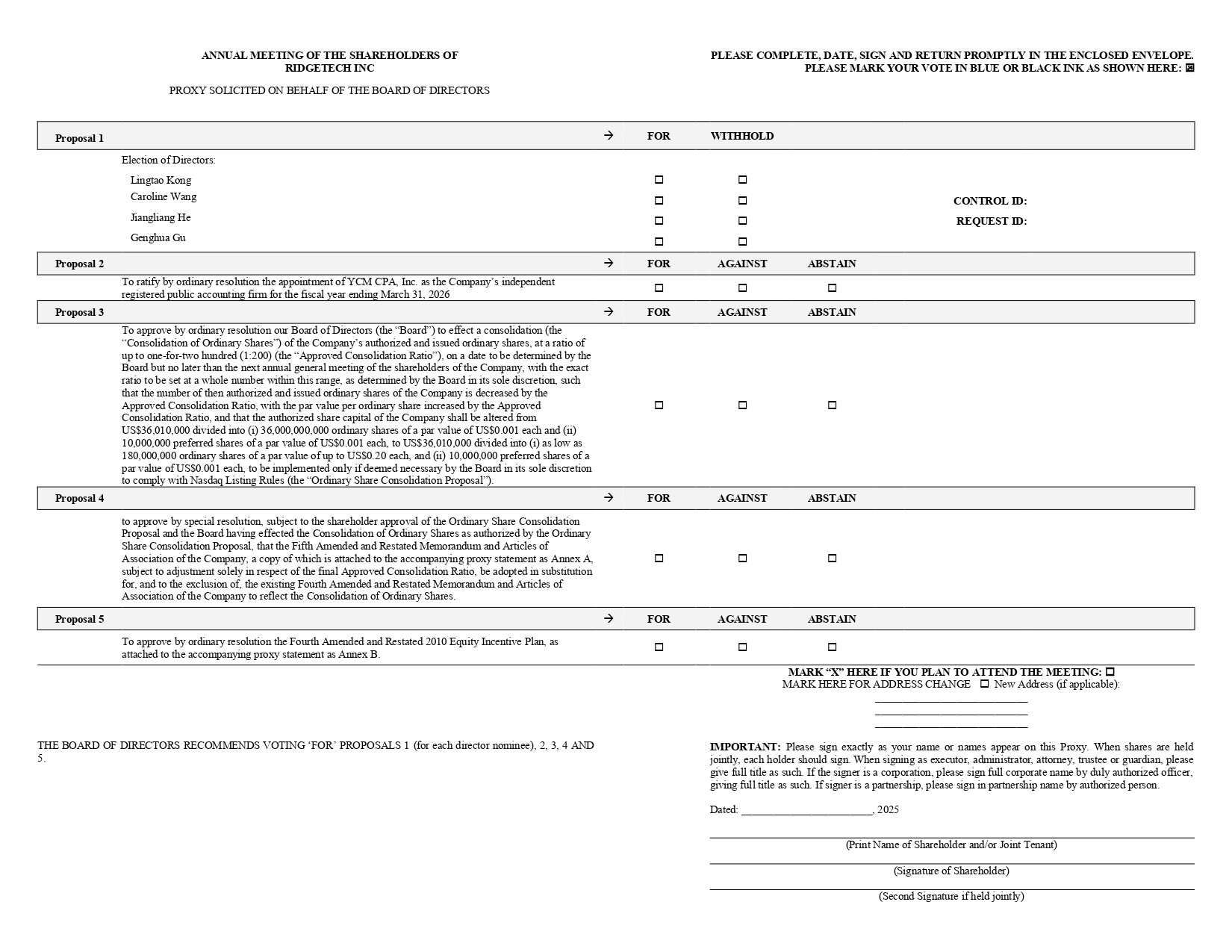
ANNUAL MEETING OF THE SHAREHOLDERS OF RIDGETECH INC PROXY SOLICITED ON BEHALF OF THE BOARD OF DIRECTORS PLEASE COMPLETE, DATE, SIGN AND RETURN PROMPTLY IN THE ENCLOSED ENVELOPE. PLEASE MARK YOUR VOTE IN BLUE OR BLACK INK AS SHOWN HERE: vb WITHHOLD FOR Proposal 1 CONTROL ID: REQUEST ID: Election of Directors: Lingtao Kong Caroline Wang Jiangliang He Genghua Gu ABSTAIN AGAINST FOR Proposal 2 To ratify by ordinary resolution the appointment of YCM CPA, Inc. as the Company’s independent registered public accounting firm for the fiscal year ending March 31, 2026 ABSTAIN AGAINST FOR Proposal 3 To approve by ordinary resolution our Board of Directors (the “Board”) to effect a consolidation (the “Consolidation of Ordinary Shares”) of the Company’s authorized and issued ordinary shares, at a ratio of up to one - for - two hundred (1:200) (the “Approved Consolidation Ratio”), on a date to be determined by the Board but no later than the next annual general meeting of the shareholders of the Company, with the exact ratio to be set at a whole number within this range, as determined by the Board in its sole discretion, such that the number of then authorized and issued ordinary shares of the Company is decreased by the Approved Consolidation Ratio, with the par value per ordinary share increased by the Approved Consolidation Ratio, and that the authorized share capital of the Company shall be altered from US$36,010,000 divided into (i) 36,000,000,000 ordinary shares of a par value of US$0.001 each and (ii) 10,000,000 preferred shares of a par value of US$0.001 each, to US$36,010,000 divided into (i) as low as 180,000,000 ordinary shares of a par value of up to US$0.20 each, and (ii) 10,000,000 preferred shares of a par value of US$0.001 each, to be implemented only if deemed necessary by the Board in its sole discretion to comply with Nasdaq Listing Rules. ABSTAIN AGAINST FOR Proposal 4 to approve by special resolution, subject to the shareholder approval of the Ordinary Share Consolidation Proposal and the Board having effected the Consolidation of Ordinary Shares as authorized by the Ordinary Share Consolidation Proposal, that the Fifth Amended and Restated Memorandum and Articles of Association of the Company, a copy of which is attached to the accompanying proxy statement as Annex A, subject to adjustment solely in respect of the final Approved Consolidation Ratio, be adopted in substitution for, and to the exclusion of, the existing Fourth Amended and Restated Memorandum and Articles of Association of the Company to reflect the Consolidation of Ordinary Shares. ABSTAIN AGAINST FOR Proposal 5 To approve by ordinary resolution the Fourth Amended and Restated 2010 Equity Incentive Plan, as attached to the accompanying proxy statement as Annex B. MARK “X” HERE IF YOU PLAN TO ATTEND THE MEETING: MARK HERE FOR ADDRESS CHANGE New Address (if applicable): THE BOARD OF DIRECTORS RECOMMENDS VOTING ‘FOR’ PROPOSALS 1, 2, 3, 4 AND 5. IMPORTANT : Please sign exactly as your name or names appear on this Proxy . When shares are held jointly, each holder should sign . When signing as executor, administrator, attorney, trustee or guardian, please give full title as such . If the signer is a corporation, please sign full corporate name by duly authorized officer, giving full title as such . If signer is a partnership, please sign in partnership name by authorized person . Dated: , 2025 (Print Name of Shareholder and/or Joint Tenant) (Signature of Shareholder) (Second Signature if held jointly)
Exhibit 99.3

CONTROL ID: REQUEST ID: RIDGETECH INC IMPORTANT NOTICE REGARDING THE AVAILABILITY OF PROXY MATERIALS FOR THE A NNUAL G ENERAL M EETING OF S HAREHOLDERS F RIDAY , D ECEMBER 12, 2025 DATE: 9:00 P . M . E.T. TIME: 5 TH F LOOR , B UILDING 6, N O . 100, 18 TH S TREET , B AIYANG S UB - DISTRICT Q IANTANG D ISTRICT , H ANGZHOU C ITY , Z HEJIANG P ROVINCE , P. R. C HINA , 310008 LOCATION: HOW TO REQUEST PAPER COPIES OF OUR MATERIALS EMAIL: PROXY - ID@ EQUINITI . COM NCLUDE YOUR C ONTROL ID IN YOUR EMAIL . INTERNET: HTTPS :// WWW . IPROXYDIRECT . COM / RDGT AND FOLLOW THE ON - SCREEN INSTRUCTIONS . I FAX: S END THIS CARD TO 202 - 521 - 3464 PHONE: C ALL TOLL FREE 1 - 866 - 752 - 8683 T HIS COMMUNICATION REPRESENTS A NOTICE TO ACCESS A MORE COMPLETE SET OF PROXY MATERIALS AVAILABLE TO YOU ON THE I NTERNET . W E ENCOURAGE YOU TO ACCESS AND REVIEW ALL OF THE IMPORTANT INFORMATION CONTAINED IN THE PROXY MATERIALS BEFORE VOTING . T HE PROXY STATEMENT IS AVAILABLE AT : HTTPS : // WWW . IPROXYDIRECT . COM / RDGT I F YOU WANT TO RECEIVE A PAPER COPY OF THE PROXY MATERIALS YOU MUST REQUEST ONE . T HERE IS NO CHARGE TO YOU FOR REQUESTING A COPY . T O FACILITATE TIMELY DELIVERY PLEASE MAKE THE REQUEST , AS INSTRUCTED ABOVE , BEFORE N OVEMBER 28, 2025. YOU MAY ENTER YOUR VOTING INSTRUCTIONS AT HTTPS :// WWW . IPROXYDIRECT . COM / RDGT UNTIL 11:59 PM EASTERN TIME D ECEMBER 11, 2025. T HE PURPOSES OF THIS MEETING ARE AS FOLLOWS : 1. TO APPROVE BY ORDINARY RESOLUTION THE ELECTION OF EACH OF THE FOLLOWING FOUR DIRECTORS TO SERVE UNTIL THE NEXT ANNUAL MEETING OR UNTIL THEIR SUCCESSORS ARE DULY ELECTED AND QUALIFIED : L INGTAO K ONG C AROLINE W ANG J IANGLIANG H E G ENGHUA G U ; 2. TO RATIFY BY ORDINARY RESOLUTION THE APPOINTMENT OF YCM CPA, I NC . AS THE C OMPANY ’ S INDEPENDENT REGISTERED PUBLIC ACCOUNTING FIRM FOR THE FISCAL YEAR ENDING M ARCH 31, 2026; 3. TO APPROVE BY ORDINARY RESOLUTION OUR B OARD OF D IRECTORS ( THE “B OARD ”) TO EFFECT A CONSOLIDATION ( THE “C ONSOLIDATION OF O RDINARY S HARES ”) OF THE C OMPANY ’ S AUTHORIZED AND ISSUED ORDINARY SHARES , AT A RATIO OF UP TO ONE - FOR - TWO HUNDRED (1:200) ( THE “A PPROVED C ONSOLIDATION R ATIO ”), ON A DATE TO BE DETERMINED BY THE B OARD BUT NO LATER THAN THE NEXT ANNUAL GENERAL MEETING OF THE SHAREHOLDERS OF THE C OMPANY , WITH THE EXACT RATIO TO BE SET AT A WHOLE NUMBER WITHIN THIS RANGE , AS DETERMINED BY THE B OARD IN ITS SOLE DISCRETION , SUCH THAT THE NUMBER OF THEN AUTHORIZED AND ISSUED ORDINARY SHARES OF THE C OMPANY IS DECREASED BY THE A PPROVED C ONSOLIDATION R ATIO , WITH THE PAR VALUE PER ORDINARY SHARE INCREASED BY THE A PPROVED C ONSOLIDATION R ATIO , AND THAT THE AUTHORIZED SHARE CAPITAL OF THE C OMPANY SHALL BE ALTERED FROM US$36,010,000 DIVIDED INTO ( I ) 36,000,000,000 ORDINARY SHARES OF A PAR VALUE OF US$0.001 EACH AND ( II ) 10,000,000 PREFERRED SHARES OF A PAR VALUE OF US$0.001 EACH , TO US$36,010,000 DIVIDED INTO ( I ) AS LOW AS 180,000,000 ORDINARY SHARES OF A PAR VALUE OF UP TO US$0.20 EACH , AND ( II ) 10,000,000 PREFERRED SHARES OF A PAR VALUE OF US$0.001 EACH , TO BE IMPLEMENTED ONLY IF DEEMED NECESSARY BY THE B OARD IN ITS SOLE DISCRETION TO COMPLY WITH N ASDAQ L ISTING R ULES ; 4. TO APPROVE BY SPECIAL RESOLUTION , SUBJECT TO THE SHAREHOLDER APPROVAL OF THE O RDINARY S HARE C ONSOLIDATION P ROPOSAL AND THE B OARD HAVING EFFECTED THE C ONSOLIDATION OF O RDINARY S HARES AS AUTHORIZED BY THE O RDINARY S HARE C ONSOLIDATION P ROPOSAL , THAT THE F IFTH A MENDED AND R ESTATED M EMORANDUM AND A RTICLES OF A SSOCIATION OF THE C OMPANY , A COPY OF WHICH IS ATTACHED TO THE ACCOMPANYING PROXY STATEMENT AS A NNEX A , SUBJECT TO ADJUSTMENT SOLELY IN RESPECT OF THE FINAL A PPROVED C ONSOLIDATION R ATIO , BE ADOPTED IN SUBSTITUTION FOR , AND TO THE EXCLUSION OF , THE EXISTING F OURTH A MENDED AND R ESTATED M EMORANDUM AND A RTICLES OF A SSOCIATION OF THE C OMPANY TO REFLECT THE C ONSOLIDATION OF O RDINARY S HARES ; 5. TO APPROVE BY ORDINARY RESOLUTION THE F OURTH A MENDED AND R ESTATED 2010 E QUITY I NCENTIVE P LAN , AS ATTACHED TO THE ACCOMPANYING PROXY STATEMENT AS A NNEX B ; 6. TO TRANSACT SUCH OTHER BUSINESS AS MAY PROPERLY COME BEFORE THE A NNUAL G ENERAL M EETING OR ANY ADJOURNMENT OR POSTPONEMENT THEREOF . YOU ARE RECEIVING THIS N OTICE THAT THE PROXY MATERIALS FOR THE A NNUAL G ENERAL M EETING ARE AVAILABLE ON THE I NTERNET . F OLLOW THE INSTRUCTIONS ABOVE TO VIEW THE MATERIALS AND VOTE OR REQUEST PRINTED COPIES . T HE BOARD OF DIRECTORS HAS FIXED THE CLOSE OF BUSINESS ON O CTOBER 29, 2025 AS THE RECORD DATE FOR THE DETERMINATION OF S HAREHOLDERS ENTITLED TO RECEIVE NOTICE OF THE A NNUAL G ENERAL M EETING AND TO VOTE THE SHARES OF OUR ORDINARY SHARES , PAR VALUE $.001 PER SHARE , THEY HELD ON THAT DATE AT THE MEETING OR ANY POSTPONEMENT OR ADJOURNMENT OF THE MEETING . T HE B OARD OF D IRECTORS RECOMMENDS THAT YOU VOTE ‘ FOR ’ ALL PROPOSALS ABOVE . P LEASE NOTE - T HIS IS NOT A P ROXY C ARD - YOU CANNOT VOTE BY RETURNING THIS CARD RIDGETECH INC C/O ISSUER DIRECT COMPLIANCE 1110 CENTRE POINT CURVE STE 101 MENDOTA HEIGHTS MN 55120 TIME SENSITIVE SHAREHOLDER INFORMATION ENCLOSED IMPORTANT SHAREHOLDER INFORMATION YOUR VOTE IS IMPORTANT FIRST - CLASS MAIL US POSTAGE PAID DURHAM NC PERMIT # 302
