 エドガーで原本を確認する
UNITED STATES
SECURITIES AND EXCHANGE COMMISSION
WASHINGTON, D.C. 20549
FORM 20-F
(Mark One)
☐ REGISTRATION STATEMENT PURSUANT TO SECTION 12(b) OR (g) OF THE SECURITIES EXCHANGE ACT OF 1934
OR
☒ ANNUAL REPORT PURSUANT TO SECTION 13 OR 15(d) OF THE SECURITIES EXCHANGE ACT OF 1934
For the fiscal year ended December 31, 2024
OR
☐ TRANSITION REPORT PURSUANT TO SECTION 13 OR 15(d) OF THE SECURITIES EXCHANGE ACT OF 1934
OR
☐ SHELL COMPANY REPORT PURSUANT TO SECTION 13 OR 15(d) OF THE SECURITIES EXCHANGE ACT OF 1934
Date of event requiring this shell company report _________________________
For the transition period from __________________ to_____________________________
Commission file number 001-42550
| Micropolis Holding Company |
| (Exact name of Registrant as specified in its charter) |
| N/A |
| (Translation of Registrant’s name into English) |
| Cayman Islands |
| (Jurisdiction of incorporation or organization) |
| Warehouse 1, Dar Alkhaleej Building |
| (Address of principal executive offices) |
| Fareed Aljawhari, Chief Executive Officer |
| (Name, Telephone, E-mail and/or Facsimile number and Address of Company Contact Person) |
Securities registered or to be registered pursuant to Section 12(b) of the Act:
| Title of each class to be so registered | Name of each exchange on which each class is to be registered | |
| Ordinary shares, par value US$0.0001 per share | NYSE American LLC |
Securities registered or to be registered pursuant to Section 12(g) of the Act:
| None |
| (Title of Class) |
Securities for which there is a reporting obligation pursuant to Section 15(d) of the Act:
| None |
| (Title of Class) |
Indicate the number of outstanding shares of each of the issuer’s classes of capital or common stock as of the close of the period covered by the annual report: 30,000,000 Ordinary Shares as of December 31, 2024.
Indicate by check mark if the registrant is a well-known seasoned issuer, as defined in Rule 405 of the Securities Act.
☐ Yes ☒ No
If this report is an annual or transition report, indicate by check mark if the registrant is not required to file reports pursuant to Section 13 or 15(d) of the Securities Exchange Act of 1934.
☐ Yes ☒ No
Note – Checking the box above will not relieve any registrant required to file reports pursuant to Section 13 or 15(d) of the Securities Exchange Act of 1934 from their obligations under those Sections.
Indicate by check mark whether the registrant (1) has filed all reports required to be filed by Section 13 or 15(d) of the Securities Exchange Act of 1934 during the preceding 12 months (or for such shorter period that the registrant was required to file such reports), and (2) has been subject to such filing requirements for the past 90 days.
☒ Yes ☐ No
Indicate by check mark whether the registrant has submitted electronically every Interactive Data File required to be submitted pursuant to Rule 405 of Regulation S-T (§232.405 of this chapter) during the preceding 12 months (or for such shorter period that the registrant was required to submit such files).
☒ Yes ☐ No
Indicate by check mark whether the registrant is a large accelerated filer, an accelerated filer, a non-accelerated filer, or an emerging growth company. See definition of “large accelerated filer, “accelerated filer,” and “emerging growth company” in Rule 12b-2 of the Exchange Act.
| Large accelerated filer ☐ | Non-accelerated filer ☒ | |
| Accelerated filer ☐ | Emerging growth company ☒ |
If an emerging growth company that prepares its financial statements in accordance with U.S. GAAP, indicate by check mark if the registrant has elected not to use the extended transition period for complying with any new or revised financial accounting standards† provided pursuant to Section 13(a) of the Exchange Act. ☐
| † | The term “new or revised financial accounting standard” refers to any update issued by the Financial Accounting Standards Board to its Accounting Standards Codification after April 5, 2012. |
Indicate by check mark whether the registrant has filed a report on and attestation to its management’s assessment of the effectiveness of its internal control over financial reporting under Section 404(b) of the Sarbanes-Oxley Act (15 U.S.C. 7262(b) by the registered public accounting firm that prepared or issued its audit report. ☐
If securities are registered pursuant to Section 12(b) of the Act, indicate by check mark whether the financial statements of the registrant included in the filing reflect the correction of an error to previously issued financial statements. ☐
Indicate by check mark whether any of those error corrections are restatements that required a recovery analysis of incentive- based compensation received by any of the registrant’s executive officers during the relevant recovery period pursuant to §240.10D-1(b). ☐
Indicate by check mark which basis of accounting the registrant has used to prepare the financial statements included in this filing:
| U.S. GAAP ☐ | International Financial Reporting Standards as issued by the International Accounting Standards Board ☒ | Other ☐
|
If “Other” has been checked in response to the previous question, indicate by check mark which financial statement item the registrant has elected to follow.
Item 17 ☐ Item 18 ☐
If this is an annual report, indicate by check mark whether the registrant is a shell company (as defined in Rule 12b-2 of the Exchange Act).
☐ Yes ☒ No
(APPLICABLE ONLY TO ISSUERS INVOLVED IN BANKRUPTCY PROCEEDINGS DURING THE PAST FIVE YEARS)
Indicate by check mark whether the registrant has filed all documents and reports required to be filed by Sections 12, 13 or 15(d) of the Securities Exchange Act of 1934 subsequent to the distribution of securities under a plan confirmed by a court.
☐ Yes ☐ No
TABLE OF CONTENTS
PART I
Item 1. Identity of Directors, Senior Management and Advisers
Not applicable.
Item 2. Offer Statistics and Expected Timetable
Not applicable.
Item 3. Key Information
3.A. [Reserved]
3.B. Capitalization and Indebtedness
Not applicable.
3.C. Reasons for the Offer and Use of Proceeds
Not applicable.
3.D. Risk Factors
Risks Related to Our Business
Our Group does not have a long operating history as an integrated group.
Our Company was incorporated as a holding company on February 23, 2023. While the businesses of our subsidiary have been in operation since 2014, we do not have a long history of running an integrated group with standardized policies and procedures and on which our past performance may be judged. Given our limited operating history and the rapidly evolving market in which we compete, we may encounter operational, financial and other difficulties as we establish and expand our operations, product and service developments, sales and marketing, technology, and general and administrative capabilities.
There is substantial doubt as to whether we will continue operations. If we discontinue operations, you could lose your investment.
We are a pre-revenue organization since most of our existing projects are collaborative in nature and we do not anticipate earning substantial revenues until such time as we enter into commercial production for our robotics, which is expected to be by the second quarter of 2025. We were founded in 2014 and have a minimal operating history upon which an evaluation of our future success or failure can be made. We have suffered recurring losses from operations and have a significant accumulated deficit. In addition, we continue to experience negative cash flows from operations. These factors raise substantial doubt about the Company’s ability to continue as a going concern and our auditors have issued a going concern opinion in their report included in this report.
We anticipate that we will incur increased expenses without realizing enough revenues. We therefore expect to incur losses in the foreseeable future. Our ability to achieve and maintain profitability and positive cash flow is dependent upon our ability to enter into commercial production for our robotics. We cannot guarantee that we will be successful in finding customers for our robotics and in generating revenues and profit in the future. Failure to generate revenues and profit will cause us to suspend or cease operations. If this happens, you could lose all or part of your investment.
Rapid advancements in robotics and AI technology can potentially outpace our current offerings. Failure to innovate could negatively affect our competitive edge.
The rapid pace of technological advancements in the robotics and AI industry presents a significant risk to the Company’s long-term success. As cutting-edge solutions emerge, there is a possibility that the Company’s current offerings may become outdated or less competitive. To mitigate this risk, the Company aims to allocate substantial resources to R&D, continuously monitor industry trends, and invest in exploring emerging technologies. Maintaining a culture of innovation and fostering collaborations with research institutions can help ensure the Company stays at the forefront of the evolving landscape. However, we cannot assure you that we will be able to continue to innovate, and failure to do so could negatively affect our competitive edge, lead to a loss in market share and adversely affect our business and financial results.
We operate in a regulatory environment that is subject to change, as governments adapt to the implications of robotics and AI. This can affect how we develop and implement our technologies, and non-compliance could lead to fines or reputational damage.
Operating in a dynamic regulatory environment exposes the company to compliance risks. Governments worldwide are grappling with the implications of robotics and AI, leading to evolving regulations and policies. Non-compliance with these changing rules could result in financial penalties and reputational damage. To address this risk, we aim to establish robust compliance procedures, closely monitor regulatory updates, and engage in constructive dialogues with regulatory authorities. All these efforts will lead to an increase in our cost of compliance and thus our operating cost, which may negatively affect our financial results.
We may continue to incur losses in the future.
For the years ended December 31, 2024 and 2023, we recorded net losses of $6.1 million and $3.2 million, respectively. We anticipate that our operating expenses, together with the increased general administrative expenses of a public company, will increase in the foreseeable future as we seek to maintain and continue to grow our business, attract potential customers, and further enhance our service offering. These efforts may prove more expensive than we currently anticipate, and we may not succeed in increasing our revenue sufficiently to offset these higher expenses. As a result of the foregoing and other factors, we may incur net losses in the future and may be unable to achieve or maintain sufficient cash flows or profitability on a quarterly or annual basis for the foreseeable future.
We must maintain sufficient funding for R&D, marketing, and other operational costs. Financial risk could arise from fluctuations in sales, increased costs, or economic downturns. Decisions to raise capital could affect existing shareholders, while opting for debt financing might increase our risk profile.
Our financial stability is subject to various factors that could impact our ability to meet operational expenses and invest in crucial areas like research and development. Fluctuations in sales due to changing market conditions or unforeseen events, increased costs, or economic downturns can strain our financial position. Moreover, increased costs, such as rising raw material prices or higher manufacturing expenses, could erode profit margins, potentially hindering the Company’s growth and expansion plans. Economic downturns can further exacerbate these challenges, constraining our ability to access capital and potentially leading to liquidity issues.
To maintain sufficient funding, we may seek diverse funding options, such as debt financing. Taking on debt could lead to an increase in our overall leverage, potentially resulting in higher interest payments and debt-related expenses. As a result, a significant portion of our earnings may be allocated to service our debt, limiting the funds available for dividend distributions or reinvestment in growth initiatives.
New competitors may enter the robotics industry with competing products and services, which could have a material and adverse effect on our business, results of operations and financial condition.
Our competitors could significantly impede our ability to expand our network and to reach consumers. Our competitors may also develop and market new technologies that render our existing or future products and services less competitive, unmarketable or obsolete. In addition, if competitors develop products or services with similar or superior functionality to our products and services, we may need to decrease the prices for our products and services to remain competitive or our products or services developed by us may be branded or generic, becoming obsolete before they are marketed or before we recover a significant portion of the development and commercialization expenses incurred with respect to these products. If we are unable to maintain our current pricing structure due to competitive pressures, our revenue may be reduced, and our operating results may be negatively affected. Some of our larger competitors may be better able to respond more quickly with new technologies and to undertake more extensive marketing or promotional campaigns. If we are unable to compete with these companies, the demand for our products and services could substantially decline.
Also, if any of our competitors were to merge or partner with another of our competitors, the change in the competitive landscape could materially and adversely affect our ability to compete effectively. Our competitors may also establish or strengthen cooperative relationships with our current or future suppliers, technology partners or other parties with whom we have relationships, thereby limiting our ability to develop, improve and promote our solutions. We may not be able to compete successfully against current or future competitors, and competitive pressures may materially and adversely affect our business, results of operations and financial condition.
Tariff wars and trade uncertainties could adversely affect our operations and financial performance.
Micropolis Holding Company, as a UAE-based robotics company, is exposed to risks arising from ongoing tariff wars and trade uncertainties that could materially impact our operations, financial condition, and results of operations. As of April 2025, tariff wars, particularly between the US and major trading partners, have escalated. On April 2, 2025, President Trump issued an Executive Order imposing a 10% customs duty on all goods imported into the US, effective April 5, 2025, with higher duties up to 50% on imports from specific countries. Tariffs on imported raw materials and components for our robotics, such as microchips, sensors, and mechanical parts, could increase costs for production. Tariffs on components from suppliers like China, subject to additional US tariffs, could disrupt supply chains, leading to delays in project completion and increased operational costs.
These higher costs may elevate production expenses, potentially reducing our profit margins. Furthermore, retaliatory tariffs or trade barriers imposed by other nations could limit our potential ability to compete effectively in key export markets, including the United States, leading to reduced sales volumes, pricing pressures, or the need to seek alternative markets, all of which could adversely affect our revenue and profitability. Additionally, trade-related volatility in commodity prices and foreign exchange rates, particularly affecting the UAE dirham, could complicate financial forecasting and lead to revenue instability. There can be no assurance that we can fully counteract the adverse effects of trade disruptions. The evolving nature of global tariff policies, including the potential for further escalation or broader economic downturns, could exacerbate these challenges and have a material adverse effect on our business, financial performance, and growth prospects.
We may not be able to conduct our marketing activities effectively, properly, or at reasonable costs, which will have an impact on our business operations.
We invest resources in a variety of different marketing and brand promotion efforts designed to enhance our brand recognition and increase sales of our services and products. For the years ended December 31, 2024 and 2023, our marketing and promotion expenses were approximately $204,682 and $3,904, respectively, representing approximately 3.5% and 0.1% of our total expense, respectively. We leveraged relationship with our partners like Dubai Police to increase our brand awareness and showcased our products in various events throughout the period. Also we have active presence on various social media including Instagram, Facebook, LinkedIn, and YouTube.
We may not allocate significant resources to traditional marketing activities due to our focus on B2B communication and our established customer base. However, we recognize the importance of promoting our product to the public to increase awareness about its usability, benefits, and positive impact on people’s lives. Our marketing efforts will aim to educate and inform the public about our technology, ensuring that potential customers understand how our products can simplify and enhance their daily lives. By strategically targeting our promotional activities, we can maximize the effectiveness of our marketing efforts while maintaining reasonable costs.
While we seek to structure our promotional campaigns in the manner that we believe is most likely to encourage people to use our products and services, we may fail to identify advertising opportunities that satisfy our anticipated return on advertising spend as we scale our investments in marketing, accurately predict consumers’ acquisitions, or fully understand or estimate the conditions and behaviors that drive consumers’ behaviors. If for any reason any of our advertising campaigns prove less successful than anticipated in attracting new consumers, we may not be able to recover our advertising expense, and our rate of consumers acquisition may fail to meet market expectations, either of which could have an adverse effect on our business. There can be no assurance that our advertising and other marketing efforts will result in increased sales of our services and products.
Our business will be subject to risks associated with relying on a limited number of customers and suppliers.
Our business will be subject to risks associated with relying on a limited number of customers and suppliers. As we are a pre-revenue company, we did not have any customers until January 2023. Moreover, we develop major components of our robotics in-house. However, since our business is collaboration-based and each of our robotics is customized to meet our partners’ needs, we expect to have a limited number of customers and suppliers in the future once we start to generate substantial revenue. Given that our business will depend on a few customers and suppliers, any changes in the relationships with these future customers and suppliers, such as the loss of a major client or reduced orders, could significantly impact our financial stability and growth prospects. Similarly, a disruption in the supply chain, such as a supplier failing to deliver crucial components on time or of the required quality, could hamper our production schedule and impact product quality. This dependence on a limited pool may also expose us to risks from changes in market conditions, such as price fluctuations or supply shortages. Although we plan to continuously work towards diversifying our customer base and supplier network, maintaining high-quality service and products, and developing strong relationships with multiple reliable suppliers, unforeseen disruptions can still occur, and our business operations and financial conditions may be adversely affected.
Misappropriation or infringement of our intellectual property and proprietary rights, enforcement actions to protect our intellectual property and claims from third parties relating to intellectual property could materially and adversely affect our business, results of operations and financial condition.
Litigation regarding intellectual property rights is common in the technology industries. We expect that robotics technologies and software products and services may be increasingly subject to third-party infringement claims as the number of competitors in our industry segment grows and the functionality of products in different industry segments overlaps. Our ability to compete depends upon our proprietary technology. While we rely on intellectual property laws, confidentiality agreements and technical measures to protect our proprietary rights, we believe that the technical and creative skills of our personnel, continued development of our proprietary systems and technology and brand name recognition are essential in establishing a leadership position and strengthening our brands. Despite our efforts to protect our proprietary rights, unauthorized parties may attempt to copy aspects of our services or to obtain and use information that we regard as proprietary. Policing unauthorized use of our proprietary rights is difficult and may be expensive. We can provide no assurance that the steps we take will prevent misappropriation of technology or that the agreements entered into for that purpose will be enforceable. Effective trademarks, service mark, patent, copyright and trade secret protection may not be available when we first introduce our products. In addition, if litigation becomes necessary to enforce or protect our intellectual property rights or to defend against claims of infringement or invalidity, such litigation, even if successful, could result in substantial costs and diversion of resources and management attention.
We also cannot provide any assurance that our products and services do not infringe on the intellectual property rights of third parties. Claims of infringement, even if unsuccessful, could result in substantial costs and diversion of resources and management attention. If unsuccessful, we may be subject to preliminary and permanent injunctive relief and monetary damages, which may be trebled in the case of willful infringements.
We do not exclusively own 100% of all intellectual property and technologies that we develop in the projects with our partners, which may adversely affect our ability to effectively utilize and monetize such intellectual property and technologies in our business operations.
One significant aspect of our business model involves partnering with various companies and government entities to develop customized robotics solutions for specific tasks. These collaborative projects often entail the joint development of intellectual property and related technologies. In certain cases, the collaboration agreements may stipulate that the ownership of such intellectual property and technologies will be shared between our partners and our Company. For example, in our partnership with Dubai Police for the development of self-driving cars, intellectual property used in the programs operating the self-driving cars is considered joint intellectual property; and in our partnership with QSS Robotics, QSS Robotics owns the intellectual property related to product design while we own patents or hardware design rights.
As a result of these arrangements, our Company does not exclusively own 100% of all intellectual property developed within such projects. This shared ownership of intellectual property and related technology could have implications on our ability to fully monetize or independently commercialize the developed intellectual property. It might also impact our control over the direction and application of the technology. Additionally, decisions regarding the use, licensing, or further development of these jointly owned intellectual property may require consensus with our partners, which could potentially lead to delays or differences in strategic priorities.
As a robotics company operating in a digital era, we face significant cybersecurity risks that could have adverse implications for our business, reputation and stakeholders.
Cybersecurity threats, such as data breaches, hacking attempts, and malware attacks, pose an imminent danger to the confidentiality, integrity and availability of our sensitive information and proprietary technologies. In particular, we have highlighted the following specific threats that may happen to us:
| ● | System intrusions: Although our operational and security systems operate behind our clients’ firewalls, they may still be exposed to potential cybersecurity threats. Intruders may seek to infiltrate these systems, disrupt operations, or access sensitive data. System vulnerabilities could be exploited if not adequately protected. |
| ● | Software vulnerabilities: Our integrated software in the robots and other products can also be a target for cyber threats. These threats can take many forms, from injecting malicious code to exploiting software vulnerabilities to disrupt robot functioning or compromise data integrity. |
| ● | Data privacy and protection: The data collected and processed by our products or software, whether personal or proprietary, is another potential cybersecurity risk. Unprotected or inadequately protected data can be a target for unauthorized access, misuse, or theft, leading to breaches of privacy and potential legal repercussions. |
| ● | Monitoring and control: Despite our robots’ fleets being monitored from an operations room 24/7, there is still a risk of undetected cyber threats. Sophisticated attackers could potentially bypass detection systems or operate in ways that appear normal to avoid raising alarms. |
| ● | Supply chain threats: Cybersecurity risks can also arise from the supply chain. If any of our suppliers or partners are compromised, it could potentially affect our systems or products. |
| ● | Advanced persistent threats: Given the critical nature of our operations, we could be targeted by advanced persistent threats. These are stealthy and continuous hacking processes orchestrated by individuals or groups targeting specific data or infrastructures. |
We employ a robust cybersecurity strategy that includes regular system updates and patches, stringent data protection protocols, sophisticated threat detection and response systems, and continuous cybersecurity awareness training for our employees. Our commitment to cybersecurity is unwavering, and we continually strive to stay ahead of potential threats to protect our operations, products, and the valuable data we handle. However, we cannot assure you that we can avert all cyber threats and a successful cyber-attack, or any other cyber security incident could result in the theft or unauthorized disclosure of our intellectual property, customer data, or confidential business information, which could disrupt our operations, and lead to financial losses, damage to our reputation and potential legal liabilities. The evolving nature of cyber threats poses an ongoing challenge to us. The emergence of new attack vectors and sophisticated hacking techniques demands continuous investment and training. Failure to keep up with these evolving threats expose us to greater risks.
We face the inherent risk of unproven market demand for our products and services.
As an early player in the robotics industry in the UAE, we face the inherent risk of unproven market demand for our products and services. The market for AMR solutions is relatively new and evolving, with limited historical data to accurately predict customer preferences and long-term adoption trends. The lack of a well-established market for AMR products in the UAE presents challenges in accurately assessing customer needs and preferences. The demand for AMR solutions may be influenced by factors such as the pace of technological advancements, customer awareness, regulatory developments, and economic conditions. A failure to accurately gauge market demand could lead to overproduction or misallocation of resources, resulting in potential financial losses and excess inventory.
As a robotics company, we are exposed to the risk of software malfunctions and design flaws in our AMR products.
Despite rigorous testing and quality assurance measures, the complexity of robotics software and the ever-evolving technology landscape can lead to unforeseen issues that may adversely impact our operations and reputation. Software malfunctions in AMR products could result in unexpected behavior, causing robots to deviate from intended paths, fail to perform critical tasks, or lead to collisions with objects or personnel. Such malfunctions may disrupt workflows, delay operations, and potentially lead to property damage or safety incidents. Any incident involving our robots could lead to reputational damage, customer dissatisfaction, and potential legal liabilities.
Design flaws in robotics software may lead to inefficiencies, suboptimal performance, or vulnerabilities that could be exploited by malicious actors. Security vulnerabilities in the software could expose sensitive customer data or proprietary information, leading to data breaches and potential regulatory non-compliance. A successful cyber-attack on our AMR products could compromise their functionalities and affect our customers’ trust in our technology. Furthermore, the introduction of new features or software updates may inadvertently introduce unforeseen issues or compatibility challenges with existing systems. Incompatibility or software conflicts could cause downtime, negatively impacting customer operations, and eroding trust in our products.
In the rapidly evolving robotics industry, unforeseen design flaws or software malfunctions may necessitate the recall or modification of our AMR products, leading to substantial financial and operational costs. Delays in addressing such issues could result in missed business opportunities, potential loss of market share, and decreased customer confidence.
We cannot assure you that we will be able to continue to successfully develop and launch new products, services or grow our complementary product or service offerings.
While our current focus is on developing two types of AMRs and the related software bundle to cater to specific customer needs, we cannot provide assurance that we will continue to successfully develop and launch new products.
Our future success will depend, in part, upon our ability to continue enhancing and improving the value of our products and services, with a focus on the development of electronic control units, mechanical systems, and autonomous driving systems for our AMRs. We believe that these advancements will further strengthen our offerings and contribute to our market competitiveness.
The development of our services and products is complex and costly, and we typically have several services and products development simultaneously. Given the complexity, we occasionally have experienced, and could experience in the future, delays in completing the development and introduction of new and enhanced services and products. Problems in the design or quality of our services or products may also have an adverse effect on our brand, business, financial condition, and operating results. Unanticipated problems in developing products and services could also divert substantial research and development resources, which may impair our ability to develop new services and products and enhancements of existing services and products and could substantially increase our costs. If we fail to continue to successfully launch new value-add products and services or to enter new, complementary markets successfully, or to do either of the foregoing in a cost-effective manner, our business, results of operations and financial condition may be materially and adversely affected.
Our business is dependent on keeping pace with advances in technology. If we are unable to keep pace with advances in technology, consumers may stop using our services and our revenues will decrease. If we are required to invest substantial amounts in technology, our business, results of operations and financial condition may be materially and adversely affected.
Our business relies on staying at the forefront of technological advancements. It is crucial for us to keep pace with these advances to maintain consumer trust in our products and services. Failure to do so may result in reduced consumer confidence, making it challenging to achieve our revenue projections, which could eventually lead to a decrease in our revenues. Furthermore, significant investments in technology may be necessary, and if such investments are required, they may have a material and adverse impact on our business, results of operations, and financial condition.
The robotics markets are characterized by rapid technological change, changes in user and customer requirements, frequent new service and product introductions embodying new technologies, including Level 4 autonomous system and advanced control units such as the EV main control unit that is built on an automotive grade microcontroller such as Nvidia AJX Orin, Infineon AURIX and STM ARM Cortex M7 alongside drive/steer/break-by-wire based platform, and the emergence of new industry standards and practices that could render our products, services, and technologies obsolete. These market characteristics are intensified by the emerging nature of the market and the fact that many companies are expected to introduce new Internet products and services in the near future. If we are unable to adapt to changing technologies, our business, results of operations and financial condition may be materially and adversely affected.
Recruiting and retaining talent in the highly specialized fields of AI and robotics is a challenge we face. The departure of key personnel could disrupt our operations and slow our pace of innovation.
Our success depends, in part, upon the continuing contributions of key employees, including our Chief Executive Officer Fareed Aljawhari, and our continuing ability to attract, develop, motivate and retain highly qualified and skilled personnel. The loss of the services of any of our key employees or the failure to attract or replace qualified personnel may have a material and adverse effect on our business.
The limited pool of experienced robotics and AI experts in the UAE can make it challenging to find suitable candidates with the required expertise to drive our research, development, and operational initiatives. Additionally, increased demand from various industries and emerging technology sectors may intensify the competition for qualified professionals, making talent acquisition a complex and resource-intensive process.
Retaining top talent is equally crucial, as our success heavily relies on the innovative contributions and knowledge of our skilled workforce. The talent retention risk is amplified by the emergence of international job opportunities and the potential for employees to seek higher compensation or career growth elsewhere. Losing key personnel may disrupt ongoing projects, slow down innovation, and negatively impact our competitive edge.
We may enter into strategic acquisitions, investments and partnerships which could pose various risks, increase our leverage, dilute existing shareholders and significantly impact our ability to expand our overall profitability.
We may enter into strategic acquisitions, investments, and partnerships; these carry inherent risks, including potential increased leverage and dilution of existing shareholders. Nevertheless, our steadfast commitment to maintaining profitability and sustaining a consistent growth trajectory guides our decision-making process in pursuing such opportunities.
Acquisitions involve inherent risks, such those relating to increased leverage and debt service requirements and post-acquisition integration challenges, which could have a material and adverse effect on our results of operations and/or cash flow and could strain our human resources. We may be unable to successfully implement effective cost controls or achieve expected synergies as a result of a future acquisition. Acquisitions may result in our assumption of unexpected liabilities and the diversion of management’s attention from the operation of our business. Acquisitions may also result in our having greater exposure to the industry risks of the businesses underlying the acquisition. Strategic investments and partnerships with other companies expose us to the risk that we may not be able to control the actions of our investees or partners, which could decrease the amount of benefits we realize from a particular relationship. We are also exposed to the risk that our partners in strategic investments and infrastructure may encounter financial difficulties that could lead to a disruption of investee or partnership activities, or an impairment of assets acquired, which could adversely affect future reported results of operations and shareholders’ equity. Acquisitions may subject us to new or different regulations or tax consequences which could have an adverse effect on our operations.
In addition, we may be unable to obtain the financing necessary to complete acquisitions on attractive terms or at all. If we raise additional funds through future issuances of equity or convertible debt securities, our existing shareholders could suffer significant dilution, and any new equity securities we issue could have rights, preferences and privileges superior to those of holders of our Ordinary Shares. Future equity financings would also decrease our earnings per share and the benefits derived by us from such new ventures or acquisitions might not outweigh or exceed their dilutive effect. Any additional debt financing we secure could involve restrictive covenants relating to our capital raising activities and other financial and operational matters, which may make it more difficult for us to obtain additional capital or to pursue business opportunities. Realization of any of the foregoing risks associated with future strategic acquisitions, investments and partnerships could materially and adversely affect our business, results of operations and financial condition.
Industry consolidation may give our competitors an advantage over us, which could result in a loss of customers and/or a reduction of our revenue.
Some of our competitors have made or may make acquisitions or enter into partnerships or other strategic relationships in order to offer more comprehensive services or achieve greater economies of scale. In addition, new entrants who are not currently considered competitors may enter our market through acquisitions, partnerships or strategic relationships. Many potential entrants may have competitive advantages over us, such as greater name recognition, longer operating histories, more varied services, and larger marketing budgets, as well as greater financial, technical, and other resources. Industry consolidation may result in practices that make it more difficult for us to compete effectively, including on the basis of price, sales and marketing programs, technology or services functionality. These pressures could result in a reduction in our revenue.
As an emerging industry, the potential risks of industry consolidation remain uncertain for our company in the long term. While some competitors may pursue acquisitions, partnerships, or strategic relationships to enhance their services and gain economies of scale, it is unclear if these actions will pose a significant threat to our customer base and revenue. Moreover, new entrants may enter the market through similar means, leveraging their advantages such as brand recognition, operating experience, diverse services, larger marketing budgets, and greater financial and technical resources. Industry consolidation could introduce competitive practices that hinder our ability to effectively compete in terms of pricing, sales and marketing programs, technology, and service functionality, potentially impacting our revenue. However, the full extent of these pressures is yet to be determined.
Negative publicity relating to our Group or our Directors, Executive Officers or Major Shareholders may materially and adversely affect our reputation and Share price.
Negative publicity or announcements relating to our Group or any of our Directors, Executive Officers or Major Shareholders, whether with or without merit, may materially and adversely affect the reputation and goodwill of our Group in our industry, consequently affecting our relationships with our customers and car dealers. In addition, such negative publicity may affect market perception of our Group and the performance of our Share price.
Negative publicity or announcements may include, among others, newspaper reports of accidents at our workplaces, unsuccessful attempts in joint ventures, acquisitions or take-overs, any involvement we may have in litigation or insolvency proceedings, and unfavorable or negative articles on any of our Directors, Executive Officers or Major Shareholders. Any claims and legal actions brought forward by our customers may also have a negative impact on our brand image. If our customers, suppliers, or subcontractors subsequently lose confidence in us, this could result in the termination of business relationships or fewer referrals or invitations to tender or quote for facilities services or other contracts. To this end, our business, financial condition, results of operations and prospects may be adversely impacted.
We may be exposed to liabilities under applicable anti-corruption laws and any determination that we violated these laws could have a materially adverse effect on our business.
We are subject to various anti-corruption laws, including the UAE Federal Law No. 3 of 1987 referred to as Civil Service Law, that prohibit companies and their agents from making improper payments or offers of payments for the purpose of obtaining or retaining business. We may conduct business in countries and regions that are generally recognized as potentially more corrupt business environments. Activities in these countries create the risk of unauthorized payments or offers of payments by one of our employees or agents that could be in violation of various anti-corruption laws. We cannot provide assurance that our internal controls and compliance systems will always protect us from acts committed by our employees or agents. If our employees or agents violate our policies or we fail to maintain adequate record keeping and internal accounting practices to accurately record our transactions, we may be subject to regulatory sanctions. Violations of the Article 236 bis of the Penal Code or other anti-corruption laws, or allegations of any such acts, could damage our reputation and subject us to civil or criminal investigations in the United States and in other jurisdictions. Those and any related shareholder lawsuits could lead to substantial civil and criminal, monetary and nonmonetary penalties and cause us to incur significant legal and investigatory fees which could adversely affect our business, combined financial condition and results of operations.
Operating in the field of robotics and AI, we face risks associated with potential governmental and regulatory scrutiny.
Operating in the field of robotics and AI, we face risks associated with potential governmental and regulatory scrutiny. As these technologies evolve, so do the regulations governing their use, especially in the realm of data privacy. As our solutions involve collecting, processing, and storing data, we are subject to stringent data protection laws. These laws vary by jurisdiction, and non-compliance could lead to significant financial penalties, reputational damage, and operational disruptions. Additionally, new legislation or changes in current laws could impose further restrictions or requirements on our operations. This evolving regulatory landscape necessitates constant vigilance to ensure we remain compliant. We have implemented rigorous data handling and privacy protocols, and we continually monitor regulatory changes. However, the complexities of global data privacy regulations and the rapid pace of change in AI technology may still present challenges.
We operate in jurisdictions such as the UAE and GCC and potentially Europe and the USA, each with its own unique data protection laws and regulations. These laws govern how we can collect, use, and share data for developing and training our AI algorithms. The risk lies in the potential for existing and future legislation to restrict our ability to gather the necessary data, thus impacting our product development and optimization. For instance, stringent data privacy laws could limit the scope of data collection or impose rigorous consent requirements, slowing down our AI training process. Additionally, cross-border data transfer rules may hinder our ability to share data across our operations in different regions. As our flagship products rely heavily on real-time data analysis, any such restrictions could affect their performance and effectiveness. We are actively implementing comprehensive data governance frameworks, and continuously monitoring legal changes in our operating jurisdictions. However, unpredictability in regulatory changes and variations in global data privacy regulations present ongoing challenges to our operations.
We face various environmental risks inherent in our operations and product development.
Critical environmental risks we face lie in resource consumption, waste generation and disposal during the manufacturing and utilization of robotics products. One significant risk lies in the consumption of natural resources during the manufacturing and use of robotics products. High demand for components and materials may lead to resource depletion, increasing costs and causing supply chain disruptions. The overutilization of resources could also lead to environmental degradation and contribute to broader sustainability challenges. Another critical environmental risk involves the generation and disposal of electronic waste (“E-Waste”) from outdated or malfunctioning robots. Inadequate disposal practices can result in environmental pollution, leading to potential health hazards and ecological harm. Mishandling E-Waste may attract regulatory scrutiny and legal penalties, in addition to harming our reputation and brand image. Managing the product lifecycle effectively is vital to minimize environmental harm. Improper disposal of end-of-life robots can lead to environmental pollution, contribute to electronic waste accumulation, and perpetuate resource inefficiency. Such negative impacts may attract public scrutiny and erode stakeholder trust, potentially affecting investor confidence and market perception.
Risks Related to Doing Business in Certain Countries and Regions
Investments in emerging markets are subject to greater risks than those in more developed markets.
You should also be aware that investments in emerging markets, such as the GCC region, are subject to greater risks than those in more developed markets, including risks such as:
| ● | political, social and economic instability; |
| ● | exposure to local economic and social conditions, including cultural and communication challenges; |
| ● | exposure to local political conditions, including political disputes, requirements to expend a portion of funds locally, and government-imposed industrial cooperation requirements, as well as increased risks of fraud and political corruption; |
| ● | exposure to potentially undeveloped legal systems which make it difficult to enforce contractual rights and to potentially adverse changes in laws and regulatory practices, including licensing, approvals, grants, adjudications, and concessions, among others; |
| ● | war, terrorism, rebellion, coup, revolution or similar events; |
| ● | drought, famine, epidemics, pandemics and other complications due to natural or manmade disasters; |
| ● | governments’ actions or interventions, including tariffs, protectionism, subsidies, various forms of exchange controls, expropriation of assets and cancellation of contractual rights; |
| ● | boycotts and embargoes that may be imposed by the international community on countries in which we offer our mobile applications; |
| ● | ambiguities, uncertainties and changes in taxation, licensing and other laws and regulations; |
| ● | arbitrary or inconsistent government action, including capricious application of tax laws and selective tax audits; |
| ● | controls on the repatriation of profits and/or dividends, including the imposition or increase of withholding and other taxes on remittances and other payments by foreign subsidiaries; |
| ● | difficulties and delays in obtaining new permits, licenses and consents for business operations or renewing existing ones; |
| ● | difficulties or an inability to obtain legal remedies in a timely manner; |
| ● | compliance with a variety of US and other foreign laws, including (i) compliance (historical and future) with the requirements of applicable anti-bribery laws, including the UK Bribery Act 2010 and the US Foreign Corrupt Practices Act of 1977; and (ii) compliance (historical and future) with sanctions and export control provisions (including the US Export Administration Regulations) in several jurisdictions, including the European Union, the United Kingdom and the United States; and |
| ● | potential lack of reliability as to title to real property in certain jurisdictions. |
Although the GCC region has enjoyed significant economic growth over the last several years, there can be no assurance that such growth will continue. Moreover, while certain governments’ policies have generally resulted in improved economic performance, there can be no assurance that such a level of performance can be sustained.
Accordingly, you should exercise particular care in evaluating the risks involved and must decide whether, in the light of those risks, your investment is appropriate. Generally, investment in emerging markets is only suitable for sophisticated investors who fully appreciate the significance of the risks involved.
Investing in GCC markets, particularly in the technology sector, carries certain risks that should be taken into consideration. Some of the key risks include:
| 1. | Regulatory Environment: The regulatory landscape in GCC countries may vary, and changes in regulations or government policies can impact the investment climate. It is essential to stay updated on regulations related to foreign investments, technology transfers, intellectual property rights, and data privacy. |
| 2. | Economic and Political Stability: GCC markets are subject to geopolitical tensions and economic fluctuations. Political instability, regional conflicts, or changes in government policies can affect the business environment and investor confidence, however its evident that the local governments policies are focusing on their economic growth and avoiding political conflicts. |
| 3. | Market Maturity: While GCC markets are rapidly growing, the technology sector may still be in its early stages of development. The level of market maturity, infrastructure, and adoption rates for certain technologies can vary across different countries within the GCC region. |
| 4. | Competitive Landscape: The tech industry in the GCC region is becoming increasingly competitive, with local and international players vying for market share. Understanding the competitive landscape and differentiating your offering is crucial to succeed in this dynamic market. |
| 5. | Talent Availability: Finding skilled and experienced talent, particularly in specialized tech fields, can be a challenge in certain GCC countries. Assessing the availability of qualified professionals and building a strong team is vital for the success of tech investments, however the GCC countries have succeeded for decades to attract talents and competencies by offering high wages and unique lifestyle as well as wellbeing and comfort of life. |
| 6. | Cultural Considerations: Cultural norms and business practices in the GCC region may differ from other markets. Adapting to local customs, building relationships, and understanding the local business culture can contribute to successful investments, however the government of UAE and recently Saudi Arabia are adopting more western related culture to make it easier for expats with western cultures to adapt with the local culture. |
The economies of a number of our markets in the GCC region are highly dependent upon the oil and gas industry.
The UAE’s economy as well as a number of other economies within the GCC region are highly dependent upon the oil and gas industry. Oil and gas prices fluctuate in response to changes in many factors, including, but not limited to:
| ● | economic and political developments in oil producing regions; |
| ● | global and regional supply and demand, and expectations regarding future supply and demand, for oil and gas products; |
| ● | the ability of members of OPEC and other crude oil producing nations to agree upon and maintain specified global production levels and prices; |
| ● | the impact of international environmental regulations designed to reduce carbon emissions; |
| ● | actions taken by major crude oil and gas producing or consuming countries; |
| ● | prices and availability of alternative fuels; |
| ● | global economic and political conditions; |
| ● | development of new technologies; and |
| ● | global weather and environmental conditions. |
Oil prices declined significantly beginning in June 2014, and although prices have recovered in 2018, they have remained volatile with periodic declines since October 2018, including during the first quarter of 2020. If oil prices decline again, this is likely to have an adverse effect on the GDP and other economic indicators of oil producing markets, such as the UAE and Saudi Arabia, and may also negatively impact consumer confidence and purchasing power, resulting in lower overall expenditure by mobile users, which could have a material adverse effect on our business, financial condition and results of operations.
Our business may be adversely affected by changes in government policies, laws and regulations in the UAE.
Our operating subsidiary in the UAE, Micropolis Dubai, functions as our primary business operation center and engages in sales, customer service and other business operations. As such, our business may be adversely affected by changes in government policies, laws and regulations in the UAE.
On January 16, 2023, the Ministry of Finance introduced a 9% federal corporate tax regime for the first time in the UAE to be applied on the adjusted accounting net profits of a business above AED 375,000, which came into effect on 1 June 2023. Micropolis Dubai is not currently subject to corporate income tax in the UAE as its net profits do not currently meet the AED 375,000 threshold.
Moreover, value added tax, or VAT, was introduced in the UAE on January 1, 2018, at a rate of 5%. The relevant legislation provides that electronic services that are automatically delivered over the Internet, over an electronic network or over an electronic marketplace are not subject to VAT in the UAE, if such electronic services are used or enjoyed outside of the UAE. The introduction of VAT in the UAE has not had a material impact on our business. However, any further change in VAT in the UAE could increase the costs for users to purchase our virtual currencies and may reduce user spending as a result, which could adversely affect our revenue.
In addition, the AED, which is the legal currency of the UAE, has been pegged to the US dollar at 3.6725 AEDs per U.S. dollar since November 1997. However, there can be no assurance that the AED will not be de-pegged in the future or that the existing peg will not be adjusted in a manner that negatively impacts the level of economic activities in the UAE or negatively impacts the attractiveness of the UAE as a tourist destination, both of which are important factors that drive the level of payments by users from the UAE. Any such de-pegging or adjustment could have a material adverse effect on our business, financial condition, and results of operations.
The economic, political, and social conditions in the GCC region, as well as government policies, laws, and regulations, could affect our business, financial condition, and results of operations.
We are headquartered in the UAE. The GCC region is our key market, and we must comply with the applicable laws and regulations in the jurisdictions of the GCC region. The regulatory bodies in the GCC region may not be as fully matured and as established as those of Western Europe and the United States. Existing laws and regulations may be applied inconsistently with anomalies in their interpretation or implementation. Inconsistent interpretation or implementation in relation to existing laws and regulations could restrict our ability to offer our mobile platform in the relevant jurisdictions, which could materially and adversely affect our business, financial condition, and results of operations.
Our failure to obtain, maintain or renew licenses, approvals, permits, registrations, or filings necessary to conduct our operations could have a material adverse impact on our business, financial condition, and results of operations.
Regulatory authorities in various jurisdictions oversee different aspects of our business operations. We are required to obtain a number of licenses, approvals, permits, registrations, and filings and are subject to certain reporting obligations required for maintaining our subsidiary and personnel in such jurisdictions. We cannot assure you that we have obtained all of these licenses, approvals, permits, registrations, and filings or will continue to maintain or renew all of them or that we have complied with these requirements in full. If we fail to obtain necessary authorizations, we may be subject to various penalties, such as confiscation of illegal revenues, fines and discontinuation or restriction of business operations, which may materially and adversely affect our business, financial condition, and results of operations. In addition, there can be no assurance that we will be able to maintain our existing licenses, approvals, registrations or permits in the relevant jurisdictions, renew any of them when their current term expires, or update existing licenses or obtain additional licenses, approvals, permits, registrations, or filings necessary for our business expansion from time to time. If we fail to do so, our business, financial conditions and operational results may be materially and adversely affected.
Risks Related to Our Ordinary Shares
An active trading market for our Ordinary Shares may not develop and could affect the trading price of our Ordinary Shares.
Prior to the IPO, there has been no public market for our Ordinary Shares. Although our Ordinary Shares are listed on the NYSE American, there can be no assurance that there will be an active, liquid public market for our Ordinary Shares. The lack of an active market may impair your ability to sell your Ordinary Shares at the time you wish to sell them or at a price that you consider reasonable. The lack of an active market may also reduce the fair market value of your Ordinary Shares. An inactive market may also impair our ability to raise capital to continue to fund operations by selling Ordinary Shares and may impair our ability to acquire other companies or technologies by using our Ordinary Shares as consideration.
Our share price may fluctuate significantly in the future, and you may lose all or part of your investment, and litigation may be brought against us.
There is no assurance that the market price for our Ordinary Shares will not decline. Investors may not be able to sell their Ordinary Shares at or above the price at which they purchased the Ordinary Shares. The prices at which our Ordinary Shares will trade in the future may fluctuate significantly and rapidly as a result of, among others, the following factors, some of which are beyond our control:
| ● | variation in our results of operations; |
| ● | perceived prospects and future plans for our business and the general outlook of our industry; |
| ● | changes in securities analysts’ estimates of our results of operations and recommendations; |
| ● | announcements by us of significant contracts, acquisitions, strategic alliances or joint ventures or capital commitments; |
| ● | the valuation of publicly traded companies that are engaged in business activities similar to ours; |
| ● | additions or departures of key personnel; |
| ● | fluctuations in stock market prices and volume; |
| ● | involvement in litigation; |
| ● | general economic and stock market conditions; and |
| ● | discrepancies between our actual operating results and those expected by investors and securities analysts. |
There is no guarantee that our Ordinary Shares will appreciate in value in the future or even maintain the price at which you purchased the Ordinary Shares. You may not realize a return on your investment in our Ordinary Shares and you may even lose your entire investment in our Ordinary Shares.
In addition, the stock markets have from time-to-time experienced significant price and volume fluctuations that have affected the market prices of securities. These fluctuations often have been unrelated or disproportionate to the operating performance of publicly traded companies. In the past, following periods of volatility in the market price of a particular company’s securities, an investor may lose all or part of his or her investment, and litigation has sometimes been brought against that company. If similar litigation is instituted against us, it could result in substantial costs and divert our senior management’s attention and resources from our core business.
Our Ordinary Shares may trade under $5.00 per share and thus would be known as “penny stock”. Trading in penny stocks has certain restrictions and these restrictions could negatively affect the price and liquidity of our Ordinary Shares.
Our Ordinary Shares may trade below $5.00 per share. As a result, our Ordinary Shares would be known as “penny stock,” which is subject to various regulations involving disclosures to be given to you prior to the purchase of any penny stock. The SEC has adopted regulations which generally define a “penny stock” to be any equity security that has a market price of less than $5.00 per share, subject to certain exceptions. Depending on market fluctuations, our Ordinary Shares could be considered to be “penny stock.” A penny stock is subject to rules that impose additional sales practice requirements on broker/dealers who sell these securities to persons other than accredited investors. For transactions covered by these rules, the broker/dealer must make a special suitability determination for the purchase of these securities. In addition, a broker/dealer must receive the purchaser’s written consent to the transaction prior to the purchase and must also provide certain written disclosures to the purchaser. Consequently, the “penny stock” rules may restrict the ability of broker/dealers to sell our Ordinary Shares and may negatively affect the ability of holders of our Ordinary Shares to resell them. These disclosures require you to acknowledge that you understand the risks associated with buying penny stocks and that you can absorb the loss of your entire investment. Penny stocks generally do not have a very high trading volume. Consequently, the price of the shares is often volatile, and you may not be able to buy or sell your shares when you want to.
We may require additional funding in the form of equity or debt for our future growth which will cause dilution in Shareholders’ equity interest.
We may pursue opportunities to grow our business through joint ventures, strategic alliances, acquisitions, or investment opportunities, following the Offering. However, there can be no assurance that we will be able to obtain additional funding on terms that are acceptable to us or at all. If we are unable to do so, our future plans and growth may be adversely affected.
An issue of Ordinary Shares or other securities to raise funds will dilute Shareholders’ equity interests and may, in the case of a rights issue, require additional investments by Shareholders. Further, the issue of Ordinary Shares below the then prevailing market price will also affect the value of the Ordinary Shares then held by investors.
Dilution in Shareholders’ equity interests may occur even if the issue of shares is at a premium to the market price. In addition, any additional debt funding may restrict our freedom to operate our business as it may have conditions that:
| ● | limit our ability to pay dividends or require us to seek consents for the payment of dividends; |
| ● | increase our vulnerability to general adverse economic and industry conditions; |
| ● | require us to dedicate a portion of our cash flow from operations to repayments of our debt, thereby reducing the availability of our cash flow for capital expenditures, working capital and other general corporate purposes; and |
| ● | limit our flexibility in planning for, or reacting to, changes in our business and our industry. |
The volatility or uncertainty of the credit markets could limit our ability to borrow funds or cause our borrowings to be more expensive in the future. As such, we may be forced to pay unattractive interest rates, thereby increasing our interest expense, decreasing our profitability, and reducing our financial flexibility if we take on additional debt financing.
Investors may not be able to participate in future issues or certain other equity issues of our Ordinary Shares.
In the event that we issue new Ordinary Shares, we will be under no obligation to offer those Ordinary Shares to our existing Shareholders at the time of issue, except where we elect to conduct a rights issue. However, in electing to conduct a rights issue or certain other equity issues, we will have the discretion and may also be subject to certain regulations as to the procedures to be followed in making such rights available to Shareholders or in disposing of such rights for the benefit of such Shareholders and making the net proceeds available to them.
Accordingly, certain Shareholders may be unable to participate in future equity offerings by us and may experience dilution in their shareholdings as a result.
We currently do not expect to pay dividends in the foreseeable future and you must rely on price appreciation of our Ordinary Shares for return on your investment.
Subject to the Cayman Islands laws and our Amended and Restated Memorandum and Articles, our Board of Directors has complete discretion as to whether to distribute dividends. In addition, our Shareholders may by ordinary resolution declare a dividend, but no dividend may exceed the amount recommended by our Directors. Under Cayman Islands law, a Cayman Islands company may pay a dividend out of either profit or share premium account, provided that in no circumstances may a dividend be paid if this would result in the company being unable to pay its debts as they fall due in the ordinary course of business. Even if our Board of Directors decides to declare and pay dividends, the timing, amount and form of future dividends, if any, will depend on our future results of operations and cash flow, our capital requirements and surplus, the amount of distributions, if any, received by us from the operating entities, our financial condition, contractual restrictions and other factors deemed relevant by our Board of Directors. Any of these factors could have a material adverse effect on our business, financial position, and results of operations, and hence there is no assurance that we will be able to pay dividends to our Shareholders after the completion of the Offering. Accordingly, the return on your investment in our Ordinary Shares will likely depend entirely upon any future price appreciation of our Ordinary Shares. There is no guarantee that our Ordinary Shares will appreciate in value in the future or even maintain the price at which you purchased the Ordinary Shares. You may not realize a return on your investment in our Ordinary Shares and you may even lose your entire investment in our Ordinary Shares. We currently intend to retain all available funds and any future earnings to fund the development and growth of our business and to repay indebtedness and, therefore, we do not anticipate paying any cash dividends in the foreseeable future. As a result, we do not expect to pay any dividends in the foreseeable future. Therefore, you should not rely on an investment in our Ordinary Shares as a source for any future dividend income.
If we fail to meet applicable listing requirements, NYSE American may delist our Ordinary Shares from trading, in which case the liquidity and market price of our Ordinary Shares could decline.
We cannot assure you that we will be able to meet the continued listing standards of NYSE American in the future. If we fail to comply with the applicable listing standards and NYSE American delists our Ordinary Shares, we and our Shareholders could face significant material adverse consequences, including:
| ● | a limited availability of market quotations for our Ordinary Shares; |
| ● | reduced liquidity for our Ordinary Shares; |
| ● | a determination that our Ordinary Shares are “penny stock,” which would require brokers trading in our Ordinary Shares to adhere to more stringent rules and possibly result in a reduced level of trading activity in the secondary trading market for our Ordinary Shares; |
| ● | a limited amount of news about us and analyst coverage of us; and |
| ● | a decreased ability for us to issue additional equity securities or obtain additional equity or debt financing in the future. |
The National Securities Markets Improvement Act of 1996, which is a federal statute, prevents or pre-empts the states from regulating the sale of certain securities, which are referred to as “covered securities.” Because our Ordinary Shares will be listed on NYSE American, such securities will be covered securities. Although the states are pre-empted from regulating the sale of our securities, the federal statute does allow the states to investigate companies if there is a suspicion of fraud, and, if there is a finding of fraudulent activity, then the states can regulate or bar the sale of covered securities in a particular case. Further, if we were no longer listed on NYSE American, our securities would not be covered securities, and we would be subject to regulations in each state in which we offer our securities.
We will incur significant expenses and devote other significant resources and management time as a result of being a public company, which may negatively impact our financial performance and could cause our results of operations and financial condition to suffer.
We will incur significant legal, accounting, insurance, and other expenses as a result of being a public company. Laws, regulations, and standards relating to corporate governance and public disclosure for public companies, including the Dodd-Frank Act of 2010, the Sarbanes-Oxley Act, regulations related thereto and the rules and regulations of the SEC and NYSE American, will significantly increase our costs as well as the time that must be devoted to compliance matters. We expect that compliance with these laws, rules, regulations, and standards will substantially increase our expenses, including our legal and accounting costs, and make some of our operating activities costlier and more time-consuming. These new public company obligations also will require attention from our senior management and could divert their attention away from the day-to-day management of our business. We also expect these laws, rules, regulations, and standards to make it more expensive for us to obtain director and officer liability insurance, and we may be required to accept reduced policy limits and coverage or incur substantially higher costs to obtain the same or similar coverage. As a result, it may be more difficult for us to attract and retain qualified people to serve on our Board of Directors or as officers. As a result of the foregoing, we expect a substantial increase in legal, accounting, insurance, and certain other expenses in the future, which will negatively impact our financial performance and could cause our results of operations and financial condition to suffer. Furthermore, if we are unable to satisfy our obligations as a public company, we could be subject to delisting of our Shares, fines, sanctions and other regulatory actions and potential civil litigation.
If we fail to maintain an effective system of disclosure controls and internal controls over financial reporting, our ability to produce accurate financial statements in time or comply with applicable regulations could be impaired.
The Sarbanes-Oxley Act requires, among other things, that we maintain effective internal disclosure controls and procedures over our financial reporting. We are continuing to develop and refine our disclosure controls and other procedures that are designed to ensure that information required to be disclosed by us in our reports that we will file with the SEC will be recorded, processed, summarized, and reported within the time periods and as otherwise specified in SEC rules, and that information required to be disclosed in reports under the Exchange Act is accumulated and communicated to our principal Executive Officers and financial officers. We are also continuing to improve our internal controls over financial reporting.
Ensuring that we have effective disclosure controls and procedures and internal controls over financial reporting in place so that we can produce accurate financial statements on a timely basis is a costly and time-consuming effort that will need to be re-evaluated frequently. Our internal control over financial reporting are a process designed to provide reasonable assurance regarding the reliability of financial reporting and the preparation of financial statements in accordance with IFRS. Beginning with our second annual report on Form 20-F after we become a company whose securities are publicly listed in the United States, we will be required, pursuant to Section 404 of the Sarbanes-Oxley Act, to make a formal assessment of the effectiveness of our internal controls over financial reporting, and once we cease to be an emerging growth company, we will be required to include an attestation report on internal controls over financial reporting issued by our Independent Registered Public Accounting Firm. During our evaluation of our internal controls, if we identify one or more material weaknesses in our internal controls over financial reporting, we will be unable to assert that our internal controls over financial reporting are effective. We cannot assure you that there will not be material weaknesses or significant deficiencies in our internal controls over financial reporting in the future. Any failure to maintain internal controls over financial reporting could severely inhibit our ability to accurately report our financial condition, or results of operations.
We are an emerging growth company within the meaning of the Securities Act and may take advantage of certain reduced reporting requirements.
We are an “emerging growth company,” as defined in the JOBS Act, and we may take advantage of certain exemptions from requirements applicable to other public companies that are not emerging growth companies, including, most significantly, not being required to comply with the auditor attestation requirements of Section 404 of the Sarbanes-Oxley Act for so long as we remain an emerging growth company. As a result, if we elect not to comply with such auditor attestation requirements, our investors may not have access to certain information they may deem important.
The JOBS Act also provides that an emerging growth company does not need to comply with any new or revised financial accounting standards until such a date that a private company is otherwise required to comply with such new or revised accounting standards. The extended transition period provision only applies to companies preparing financial statements under U.S. GAAP. Because we prepare our financial statements in accordance with IFRS, we are unable to take advantage of the aforementioned provision. As a result, we will adopt new or revised accounting standards on the relevant dates on which adoption of such standards is required or permitted by the International Accounting Standards Board.
We qualify as a foreign private issuer and, as a result, we are not subject to U.S. proxy rules and are subject to Exchange Act reporting obligations that permit less detailed and less frequent reporting than that of a U.S. domestic public company.
We report under the Exchange Act as a non-U.S. company with foreign private issuer status. Because we qualify as a foreign private issuer under the Exchange Act, we are exempt from certain provisions of the Exchange Act that are applicable to U.S. domestic public companies, including (i) the sections of the Exchange Act regulating the solicitation of proxies, consents or authorizations in respect of a security registered under the Exchange Act; (ii) the sections of the Exchange Act requiring insiders to file public reports of their stock ownership and trading activities and liability for insiders who profit from trades made in a short period of time; and (iii) the rules under the Exchange Act requiring the filing with the SEC of quarterly reports on Form 10-Q containing unaudited financial and other specified information, or current reports on Form 8-K upon the occurrence of specified significant events. In addition, our officers, Directors, and principal Shareholders are exempt from the reporting and “short-swing” profit recovery provisions of Section 16 of the Exchange Act and the rules thereunder. Therefore, our Shareholders may not know on a timely basis when our officers, directors and principal Shareholders purchase or sell our Ordinary Shares. In addition, foreign private issuers are not required to file their annual report on Form 20-F until one hundred twenty (120) days after the end of each fiscal year, while U.S. domestic issuers that are accelerated filers are required to file their annual report on Form 10-K within seventy-five (75) days after the end of each fiscal year. Foreign private issuers also are exempt from Regulation Fair Disclosure, aimed at preventing issuers from making selective disclosures of material information. As a result of the above, you may not have the same protections afforded to shareholders of companies that are not foreign private issuers.
If we lose our status as a foreign private issuer, we would be required to comply with the Exchange Act reporting and other requirements applicable to U.S. domestic issuers, which are more detailed and extensive than the requirements for foreign private issuers. We may also be required to make changes in our corporate governance practices in accordance with various SEC and NYSE American rules. The regulatory and compliance costs to us under U.S. securities laws if we are required to comply with the reporting requirements applicable to a U.S. domestic issuer may be significantly higher than the cost we would incur as a foreign private issuer. As a result, we expect that a loss of foreign private issuer status would increase our legal and financial compliance costs and would make some activities highly time-consuming and costly. We also expect that if we were required to comply with the rules and regulations applicable to U.S. domestic issuers, it would make it more difficult and expensive for us to obtain and maintain directors and officers’ liability insurance, and we may be required to accept reduced coverage or incur substantially higher costs to obtain coverage. These rules and regulations could also make it more difficult for us to attract and retain qualified members of our Board of Directors.
We may lose our foreign private issuer status in the future, which could result in significant additional costs and expenses.
As discussed above, we are a foreign private issuer, and therefore, we are not required to comply with all of the periodic disclosure and current reporting requirements of the Exchange Act. The determination of foreign private issuer status is made annually on the last business day of an issuer’s most recently completed second fiscal quarter. We would lose our foreign private issuer status if, for example, more than 50% of our Ordinary Shares are directly or indirectly held by residents of the United States and we fail to meet additional requirements necessary to maintain our foreign private issuer status. If we lose our foreign private issuer status on this date, we will be required to file with the SEC periodic reports and registration statements on U.S. domestic issuer forms, which are more detailed and extensive than the forms available to a foreign private issuer. We will also have to mandatorily comply with U.S. federal proxy requirements, and our officers, Directors and Major Shareholders will become subject to the short-swing profit disclosure and recovery provisions of Section 16 of the Exchange Act.
In addition, we will lose our ability to rely upon exemptions from certain corporate governance requirements under the NYSE American rules. As a U.S. listed public company that is not a foreign private issuer, we will incur significant additional legal, accounting, and other expenses that we will not incur as a foreign private issuer, and accounting, reporting, and other expenses in order to maintain a listing on a U.S. securities exchange.
As a company incorporated in the Cayman Islands, we are permitted to adopt certain home country practices in relation to corporate governance matters that differ significantly from the NYSE American listing standards. These practices may afford less protection to shareholders than they would enjoy if we complied fully with corporate governance listing standards.
As a foreign private issuer, we are entitled to rely on a provision in NYSE American’s corporate governance rules that allows us to follow Cayman Islands law for certain corporate governance matters. Certain corporate governance practices in the Cayman Islands may differ significantly from the corporate governance requirements applicable to U.S. companies listed on NYSE American, except for general fiduciary duties and duties of care, Cayman Islands law has no corporate governance regime which prescribes specific corporate governance standards.
Currently, we do not intend to rely on home country practice with respect to our corporate governance. However, if we choose to follow home country practice in the future, our shareholders may be afforded less protection than they otherwise would have under corporate governance listing standards applicable to U.S. domestic issuers
There can be no assurance that we will not be a passive foreign investment company, or PFIC, for U.S. federal income tax purposes for any taxable year, which could subject United States investors in the Ordinary Shares to significant adverse U.S. federal income tax consequences.
A non-U.S. corporation will be a PFIC for any taxable year if either (i) at least 75% of its gross income for such year consists of certain types of “passive” income; or (ii) at least 50% of the value of its assets (based on an average of the quarterly values of the assets) during such year is attributable to assets that produce passive income or are held for the production of passive income, or the asset test. Based on our current and expected income and assets (taking into account the expected cash proceeds and our anticipated market capitalization), we do not presently expect to be a PFIC for the current taxable year or the foreseeable future. However, no assurance can be given in this regard because the determination of whether we are or will become a PFIC is a fact-intensive inquiry made on an annual basis that depends, in part, upon the composition of our income and assets. In addition, there can be no assurance that the Internal Revenue Service, or IRS, will agree with our conclusion or that the IRS would not successfully challenge our position. Fluctuations in the market price of our Ordinary Shares may cause us to become a PFIC for the current or subsequent taxable years because the value of our assets for the purpose of the asset test may be determined by reference to the market price of our Ordinary Shares. The composition of our income and assets may also be affected by how, and how quickly, we use our liquid assets and the cash raised in the IPO. If we were to be or become a PFIC for any taxable year during which a U.S. Holder holds our Ordinary Shares, certain adverse U.S. federal income tax consequences could apply to such U.S. Holder. See “Taxation — Material Income Tax Considerations — Certain United States Federal Income Tax Considerations — Passive Foreign Investment Company Rules” for further information. We urge U.S. Holders to consult their own tax advisors regarding the possible application of the PFIC rules in light of their individual circumstances.
We have broad discretion in the use of the net proceeds from the IPO and may not use them effectively.
Our management will have broad discretion in the application of the net proceeds, including for any of the purposes described in the section entitled “Use of Proceeds” and in such order of priority as our management may determine in its discretion, and you will not have the opportunity as part of your investment decision to assess whether the net proceeds are being used appropriately. Because of the number and variability of factors that will determine our use of the net proceeds from the IPO, their ultimate use may vary substantially from their currently intended use. The failure by our management to apply these funds effectively could harm our business.
We may regularly encounter potential conflicts of interest, and our failure to identify and address such conflicts of interest could adversely affect our business.
We face the possibility of actual, potential, or perceived conflicts of interest in the ordinary course of our business operations. Conflicts of interest may exist between (i) our different businesses; (ii) us and our clients; (iii) our clients; (iv) us and our employees; (v) our clients and our employees, (vi) us and our Major Shareholders and their controlling entities, or (vii) our dealer-shareholders and our other shareholders. As we expand the scope of our business and our client base, it is critical for us to be able to timely address potential conflicts of interest, including situations where two or more interests within our businesses naturally exist but are in competition or conflict. We have put in place internal control and risk management procedures that are designed to identify and address conflicts of interest, including a procedure for presenting potential conflicts of interest to the audit committee of our Board of Directors. However, appropriately identifying and managing actual, potential, or perceived conflicts of interest is complex and difficult, and our reputation and our clients’ confidence in us could be damaged if we fail, or appear to fail, to deal appropriately with one or more actual, potential, or perceived conflicts of interest. It is possible that actual, potential, or perceived conflicts of interest could also give rise to client dissatisfaction, litigation, or regulatory enforcement actions. Regulatory scrutiny of, or litigation in connection with, conflicts of interest could have a material adverse effect on our reputation, which could materially and adversely affect our business in a number of ways, including a reluctance of some potential clients and counterparties to do business with us. Any of the foregoing could materially and adversely affect our reputation, business, financial condition, and results of operations.
A conflict of interest occurs when an individual’s private interest (or the interest of a member of his or her family or close friend(s) or business associate(s)) interferes, or even appears to interfere, with the interests of our company as a whole. A conflict of interest can arise when an employee, officer, or director (or a member of his or her family or a close friend(s) or business associate(s)) takes actions or has interests that may make it difficult to perform his or her work for our Company objectively and effectively. Conflicts of interest also arise when an employee, officer, or director (or a member of his or her family or close friend(s) or business associate(s)) receives improper personal benefits as a result of his or her position in our Company.
Directors and executive officers must seek determinations and prior authorizations or approvals of potential conflicts of interest exclusively from our audit committee. All other employees are required to approach our Chief Executive Officer or our Chief Financial Officer if they have any questions about reporting a suspected conflict of interest.
If securities or industry analysts do not publish research or reports about our business, or if they publish a negative report regarding our Ordinary Shares, the price of our Ordinary Shares and trading volume could decline.
The trading market for our Ordinary Shares may depend in part on the research and reports that industry or securities analysts publish about us or our business. We do not have any control over these analysts. If one or more of the analysts who cover us downgrade us, the price of our Ordinary Shares would likely decline. If one or more of these analysts cease coverage of our Company or fail to regularly publish reports on us, we could lose visibility in the financial markets, which could cause the price of our Ordinary Shares and the trading volume to decline.
Investors may have difficulty enforcing judgments against us, our directors and management.
The Company is incorporated under the laws of the Cayman Islands and a majority of our Directors and officers reside outside the United States. Moreover, many of these persons do not have significant assets in the United States. As a result, it may be difficult or impossible for you to bring an action against us or against these individuals in the United States in the event that you believe that your rights have been infringed under the United States federal securities laws or otherwise. Even if you are successful in bringing an action of this kind, the laws of the Cayman Islands may render you unable to enforce a judgment against our assets or the assets of our Directors and officers.
You may face difficulties in protecting your interests, and your ability to protect your rights through U.S. courts may be limited, because we are incorporated under Cayman Islands law.
We are an exempted company incorporated under the laws of the Cayman Islands. Our corporate affairs are governed by our memorandum and articles of association, the Cayman Islands Companies Act (Revised) (the “Companies Act”) and the common law of Cayman Islands. The rights of shareholders to take action against our directors, action by our minority shareholders and the fiduciary duties of our directors to us under Cayman Islands law are to a large extent governed by the common law of the Cayman Islands. The common law of the Cayman Islands is derived in part from comparatively limited judicial precedent in the Cayman Islands as well as from the common law of England, the decisions of whose courts are of persuasive authority, but are not binding, on a court in the Cayman Islands. The rights of our shareholders and the fiduciary duties of our directors under Cayman Islands law are not as clearly established as they would be under statutes or judicial precedents in some jurisdictions in the United States. In particular, the Cayman Islands has a less developed body of securities laws than the United States. Some U.S. states, such as Delaware, have more fully developed and judicially interpreted bodies of corporate law than the Cayman Islands. In addition, Cayman Islands companies may not have the standing to initiate a shareholder derivative action in a federal court of the United States.
Shareholders of Cayman Islands exempted companies like us have no general rights under Cayman Islands law to inspect corporate records (other than the memorandum and articles of association and any special resolutions passed by such companies, and the register of mortgages and charges of such companies) or to obtain copies of lists of shareholders of these companies. Our Directors have discretion under our Amended and Restated Memorandum and Articles to determine whether or not, and under what conditions, our corporate records may be inspected by our Shareholders, but are not obliged to make them available to our Shareholders. This may make it more difficult for you to obtain the information needed to establish any facts necessary for a shareholder motion or to solicit proxies from other shareholders in connection with a proxy contest.
Certain corporate governance practices in the Cayman Islands, which is our home country, differ significantly from requirements for companies incorporated in other jurisdictions such as the United States. Currently, we do not plan to rely on home country practice with respect to any corporate governance matter. However, if we choose to follow home country practice in the future, our shareholders may be afforded less protection than they otherwise would under rules and regulations applicable to U.S. domestic issuers.
As a result of all of the above, our public Shareholders may have more difficulty in protecting their interests in the face of actions taken by management, members of our Board or controlling shareholders than they would as public Shareholders of a company incorporated in the United States. For a discussion of significant differences between the provisions of the Companies Act and the laws applicable to companies incorporated in the United States and their shareholders, see “Description of Share Capital and Governing Documents — Differences in Corporate Law.”
Cayman Islands’ economic substance requirements may have an effect on our business and operations.
Pursuant to the International Tax Cooperation (Economic Substance) Act, 2018 of the Cayman Islands, or the ES Act, that came into force on January 1, 2019, a “relevant entity” conducting a “relevant entity” is required to satisfy the economic substance test set out in the ES Act. A “relevant entity” includes an exempted company incorporated in the Cayman Islands as is our Company. There are nine designated “relevant activities” under the ES Act, and for so long as our Company is carrying on activities which falls within any of the designated relevant activities, it shall comply with all applicable requirements under the ES Act. If the only business activity that the Company carries on is to hold equity participation in other entities and only earns dividends and capital gains, then based on the current interpretation of the ES Act, our Company is a “pure equity holding company” and will therefore only subject to the minimum substance requirements, which require us to (i) comply with the all applicable requirements under the Companies Act and (ii) have adequate human resources and adequate premises in the Cayman Islands for holding and managing equity participations in other entities. However, there can be no assurance that we will not be subject to more requirements under the ES Act. Uncertainties over the interpretation and implementation of the ES Act may have an adverse impact on our business and operations.
SPECIAL NOTE REGARDING FORWARD-LOOKING STATEMENTS
This annual report contains forward-looking statements that involve substantial risks and uncertainties. In some cases, you can identify forward-looking statements by the words “may,” “might,” “will,” “could,” “would,” “should,” “expect,” “intend,” “plan,” “goal,” “objective,” “anticipate,” “believe,” “estimate,” “predict,” “potential,” “continue” and “ongoing,” or the negative of these terms, or other comparable terminology intended to identify statements about the future. These statements involve known and unknown risks, uncertainties and other important factors that may cause our actual results, levels of activity, performance or achievements to be materially different from the information expressed or implied by these forward-looking statements. The forward-looking statements and opinions contained in this annual report are based upon information available to us as of the date of this annual report and, while we believe such information forms a reasonable basis for such statements, such information may be limited or incomplete, and our statements should not be read to indicate that we have conducted an exhaustive inquiry into, or review of, all potentially available relevant information. Forward-looking statements include statements about:
| ● | timing of the development of future business; |
| ● | capabilities of our business operations; |
| ● | expected future economic performance; |
| ● | competition in our market; |
| ● | continued market acceptance of our services and products; |
| ● | protection of our intellectual property rights; |
| ● | changes in the laws that affect our operations; |
| ● | inflation and fluctuations in foreign currency exchange rates; |
| ● | our ability to obtain and maintain all necessary government certifications, approvals, and/or licenses to conduct our business; |
| ● | continued development of a public trading market for our securities; |
| ● | the cost of complying with current and future governmental regulations and the impact of any changes in the regulations on our operations; |
| ● | managing our growth effectively; |
| ● | projections of revenue, earnings, capital structure and other financial items; |
| ● | fluctuations in operating results; |
| ● | dependence on our senior management and key employees; and |
| ● | other factors set forth under “Risk Factors.” |
You should refer to the section titled “Risk Factors” for a discussion of important factors that may cause our actual results to differ materially from those expressed or implied by our forward-looking statements. As a result of these factors, we cannot assure you that the forward-looking statements in this annual report will prove to be accurate. Furthermore, if our forward-looking statements prove to be inaccurate, the inaccuracy may be material. In light of the significant uncertainties in these forward-looking statements, you should not regard these statements as a representation or warranty by us or any other person that we will achieve our objectives and plans in any specified time frame, or at all. We undertake no obligation to publicly update any forward-looking statements, whether as a result of new information, future events or otherwise, except as required by law.
You should read this annual report and the documents that we reference in this annual report completely and with the understanding that our actual future results may be materially different from what we expect. We qualify all of our forward-looking statements by these cautionary statements.
Item 4. Information on the Company
4.A. History and Development of the Company
Corporate History
Our history spans several pivotal milestones, propelling the company to the forefront of software development and autonomous robotics. Since its establishment in 2014, we have been committed to delivering innovative solutions tailored to the needs of government entities and large real estate developers.
In 2014, Micropolis Dubai, a free zone company with limited liability organized pursuant to the laws of the Dubai Technology & Media Free Zone Private Companies Regulations 2003 under the laws of the Emirate of Dubai, emerged as a prominent software development company, focusing on leveraging cutting-edge graphic engines to create advanced software solutions. Its primary clientele included government entities and large real estate developers seeking to optimize their operations through technological advancements.
In 2018, Micropolis Dubai developed a groundbreaking software demo called Microspot for the Dubai Police. Microspot utilized a 3D environment technology for crime detection and identifying potential suspects. Such 3D environment technology is an intelligent digital model based on geometric and 3D scanned point cloud scenes, demographic, mobility, and other elements addresses the complexity of the monitored area, enabling Dubai Police operators to work in a systemic approach to collaborate around the common referential that allows them to simulate the evolutions of different areas in one platform.
Building upon the success of Microspot, we continued to pioneer advancements in the field of AMRs. In 2020, we achieved a significant milestone by successfully developing our first AMR. This accomplishment garnered attention and support from local investors, securing seed funding that facilitated further research and development.
In 2021, Mindrock Capital, a San Francisco-based investment firm, provided additional seed funding to us. This infusion of capital enabled Micropolis to accelerate its progress, leading to the creation of two remarkable AMR prototypes, named M1 and M2, respectively. These prototypes were specifically designed to function as unmanned police patrols, revolutionizing law enforcement practices.
During late 2022 to early 2023, the Company entered into two pivotal contracts.
The first contract involved a collaboration with QSS Robotics to develop customized AMR robots catering to the specific needs of the Saudi market. This partnership allowed the Company to expand its reach and further establish itself as a global leader in autonomous robotics.
Simultaneously, the Company secured another significant contract with the Dubai Police to advance the development of the M1 and M2 autonomous police patrols. This strategic partnership reaffirmed the Company’s commitment to creating state-of-the-art solutions for law enforcement agencies, enabling them to enhance public safety and security.
Operating on a business model that emphasizes collaboration and shared R&D, Micropolis strategically opts for client-specific funding as a means to avoid share dilution. We have formalized this approach through an investment agreement with Future General Trading to finance the final phase of our Dubai Police Autonomous Patrols project. As part of this agreement, Future General Trading will receive 25% of the sales margin in perpetuity. Additionally, they will hold a 50% ownership stake in the intellectual properties associated specifically with the electronic control units for this project, as well as a 25% ownership stake in Microspot.
On March 6, 2025, the Company entered into an underwriting agreement (the “Underwriting Agreement”) with Network1 Financial Securities, Inc. (the “Underwriter”), relating to the Company’s initial public offering (the “IPO”) of 3,875,000 ordinary shares, par value $0.0001 per share (the “Ordinary Shares”), for a price of $4 per share. The Company also granted the underwriters a 45-day option to purchase up to 581,250 additional Ordinary Shares on the same terms and conditions for the purpose of covering any over-allotments in connection with the IPO.
On March 10, 2025, the Company completed the IPO pursuant to its registration statement on Form F-1 (File No. 333-276231) (the “Registration Statement”), which was initially filed with the U.S. Securities and Exchange Commission (the “SEC”) on December 22, 2023, as amended, and declared effective by the SEC on March 6, 2025. 3,875,000 Ordinary Shares were sold at an offering price of $4 per share, generating gross proceeds of $15.5 million to the Company, before underwriting discounts and other offering expenses. The IPO was conducted on a firm commitment basis. The Ordinary Shares were approved for listing on NYSE American LLC and commenced trading under the ticker symbol “MCRP” on March 7, 2025. On March 10, 2025, the Company also issued warrants to the Underwriter and its designees, which are exercisable during the period commencing from March 10, 2025, and expiring five years from the commencement of sales of the Ordinary Shares in the IPO, entitling the holders of the warrants to purchase an aggregate of 232,500 Ordinary Shares at a per share price of $5 (the “Underwriter’s Warrants”).
4.B. Business Overview
Micropolis Digital Development FZ-LLC (“Micropolis Dubai”), our wholly-owned subsidiary, is a robotics manufacturer founded in 2014, based in the United Arab Emirates (“UAE”) with its headquarters located in Dubai Production City, Dubai, UAE. We specialize in developing autonomous mobile robots (“AMRs”) that utilize wheeled electric vehicle (“EV”) platforms and are equipped with autonomous driving capabilities.
As part of our product offerings, we integrate application-specific pods that serve as the primary purpose of a robot. These pods are designed to accommodate various functionalities, including surveillance cameras, road sweepers, logistics compartments, as well as collaborative robots (cobots) intended for direct human-robot interaction.
Collaboration-based Business Model
Our business is collaboration-based. In collaboration with our customers and partners, we are actively engaged in the development of cutting-edge technologies that aim to bring enhancements in security, logistics, and surveillance operation management. We have established a strong track record of successful partnerships with local governments and real estate developers. Our work with the Dubai Police is a prime example of this ongoing effort; they are playing an essential role in the creation of “Microspot,” which is an AI-powered security software we are currently developing. In particular, the Dubai Police have assembled a team to assist us in shaping the Microspot software, providing crucial insights into police operations and supplying dummy data for data science and machine learning. This partnership has not only facilitated us in navigating regulatory complexities but also provided invaluable support in testing and validating our products. Further, we have partnered with Dubai Police to develop self-driving security patrolling vehicles that enhance security surveillance operations, to help reduce crime through security deterrence.
We are also working closely with the Road and Transportation Authority in Dubai, UAE (“RTA”) through Dubai Police Innovation Lab. RTA is aiding us by designating the Jumeirah 1 area in Dubai as a safe testing environment for our autonomous driving system, which is still in development as of the date of this report. RTA is also supplying high-definition maps of the area and data that will be essential in shaping the autonomous driving system.
Furthermore, our ongoing partnership with The Sustainable City in Dubai is proving invaluable, as they provide us with both high-definition city mapping and a living lab within their residential community for testing and validation. This collaboration allows us to work within a real-life environment to iteratively refine our autonomous driving features.
Further, we have also worked with The Sustainable City in Dubai to develop autonomous community delivery robots that are able to autonomously deliver goods within their assigned territory, making urban and sub-urban logistics more cost effective and energy preserving.
Additionally, we have developed a surveillance robot for the ministry of interior in Saudi Arabia through our Saudi local partner Quality Support Solutions Limited (“QSS Robotics”), equipped with pan-tilt-zoom (“PTZ”) surveillance camera and a drone launcher.
Together, these strategic collaborations underscore our dedication to the continuous development and refinement of our technological offerings, recognizing that our products are works in progress, with exciting potential for future growth and innovation. We continually strive for innovation and excellence, aiming to provide our clients with cutting-edge solutions designed to drive growth, streamline processes, and meet the evolving demands of the modern world.
UAE-focused
We operate in the GCC region, with a focus on the UAE and Saudi Arabia. The robotics industry in the UAE and Saudi Arabia is rapidly growing, with governments committing significant resources to technological advancement. Furthermore, Dubai, a hub for technological innovation in the region, presents a unique opportunity for the Company. With a robust portfolio of AMRs and a strong track record of successful partnerships with local governments, the Company is poised to take advantage of the growing demand for innovative robotics solutions in the Middle East.
Our flagship products are customized AMRs that can operate without the need for human intervention. These robots can be used in a wide range of industries, including security, hospitality, real estate, retailing, city cleaning, and logistics. The robots can be equipped with advanced sensors, machine learning algorithms, and computer vision technology that enable them to navigate complex environments, avoid obstacles, and interact with humans.
Our Products and Services
We specialize in the development and integration of AMRs, operating software, and electronic control units and power storage units. Our extensive product offerings are organized into three main categories:
| A. | AMRs: Our AMRs are engineered with precision and tailored to meet diverse requirements. They are composed of two main parts: |
| 1. | Mobility Specific Platform: Available in two sizes — M01 and M02. |
| ● | M01: This EV robot, weighing 900KG, has the ability to traverse open streets at a limited speed of 47KM/h with up to 8 hours of continuous operation. Designed for tasks demanding heavy loads and long distances, it currently does not facilitate passenger transport. However, we foresee the opportunity to expand its functionality into a shuttle bus in the future. |
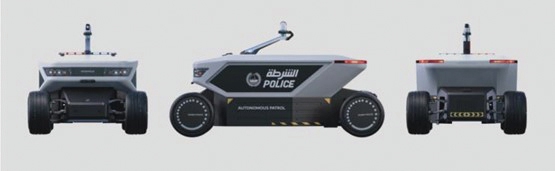
| ● | M02: Using a similar control and drive system to M01, weighing 350KG, it offers up to 8 hours of continuous operation. Scaled to the size of a golf cart, M02 is optimized for driving within gated communities and internal roads, making it ideal for surveillance, logistics, and community utility services. |
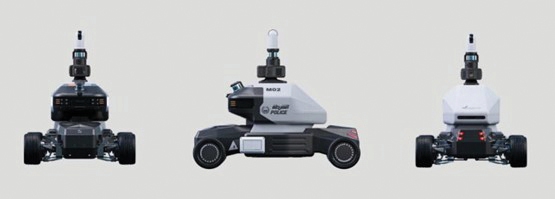
Both platforms are integrated with our proprietary electronic control units and power storage units.
| 2. | Application-Specific Pods: These customized components, mounted on the upper part of the robot, cater to various client needs, ranging from logistics compartments and drone launch pads to surveillance cameras or waste dump compartments. |
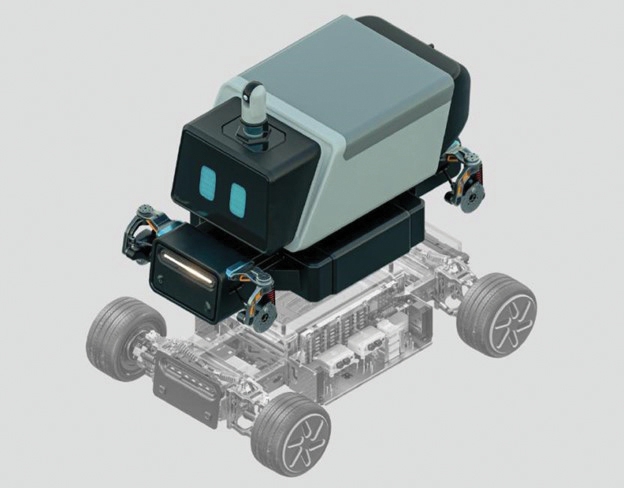
| B. | Operating Software: Our software suite is segmented into three distinct categories: |
| ● | Autonomous Driving Software: This Level 3 autonomous driving system (Conditional Driving Automation) allows users to manage fleets of AMRs from an operational room with real-time streaming service. Level 3 autonomous driving system refers to driving system that has “environmental detection” capabilities and can make informed decisions for themselves, such as accelerating past a slow-moving vehicle. Level 3 autonomous vehicles have a feature known as “Conditional Automation,” which allows the vehicle to manage all aspects of driving, including monitoring the environment. The human driver must still be present and capable of taking control through a tele driving system or remote control from an operation room, but is not required to pay attention at all times. The vehicle will handle situations by itself but will prompt the human driver to take over if it encounters a scenario it cannot navigate. Its development leverages a model-based methodology that encompasses sensing, perception, and decision-making, with features such as lane detection, path planning, obstacle avoidance, and sensor fusion. |
| ● | Fleet Mission Planner: This custom software aids operators in mission planning, path management, and performance monitoring. Its functionality extends to communication, real-time streaming, maintenance feedback, and software debugging. |
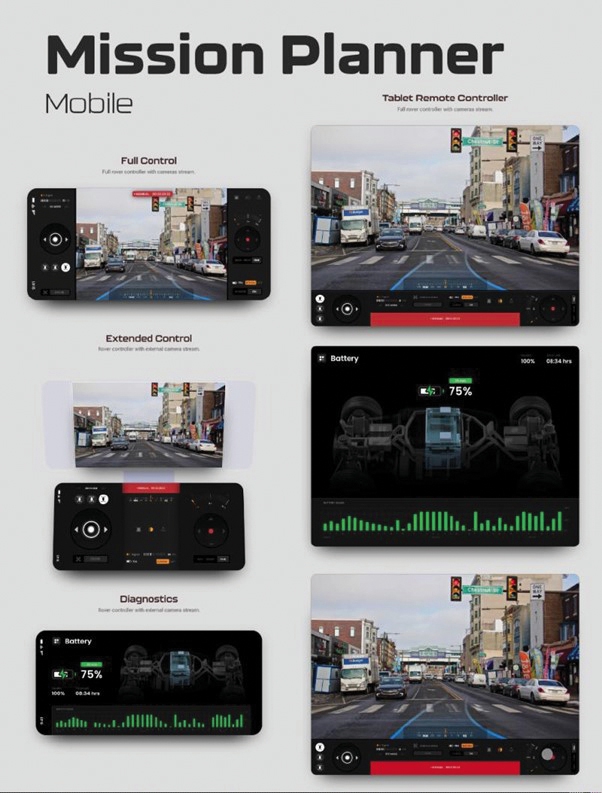
| ● | User Bespoke Software Development Service: We offer customized software solutions for customers, integrating additional robot functionalities with existing systems to ensure cost-effectiveness and seamless deployment. For example, Microspot is an AI-powered security system developed in collaboration with Dubai Police, encompassing facial recognition, behaviour analysis, automatic number-plate recognition, suspect matrix, and criminal logic, aimed at reducing crime and aiding in criminal investigations. We have entered into an investment agreement with Future General Trading FZE (“Future General Trading”) to complete Dubai Police Autonomous Patrols, a project collaborated between the Company and Future General Trading. In return for funding, Future General Trading will receive a portion of sales margins and ownership stakes in specific intellectual properties related to Dubai Police Autonomous Patrols project. Additionally, Dubai Police will own 100% of the design IP and 50% of the security software “Microspot.” |
| ● | Instead of raising capital by issuing more shares of the Company, which would dilute existing shareholders’ ownership stakes, Micropolis chooses to get funding directly from clients. This allows the company to keep its equity intact. For example, we have formalized this approach through an investment agreement with Future General Trading to finance the final phase of our Dubai Police Autonomous Patrols project. In return for their financial support, Future General Trading will get a continuous in perpetuity 25% share of the sales margin generated from this project. Additionally, Future General Trading will also own 50% of the intellectual property rights related to the electronic control units that are a part of this project. (The ownership of the intellectual properties associated with electronic control units does not include the company’s standard control units, which are owned 100% by the Company). Along with the stake in the electronic control units, Future General Trading will also own a 25% stake in Microspot, which is a software related to this specific project. |
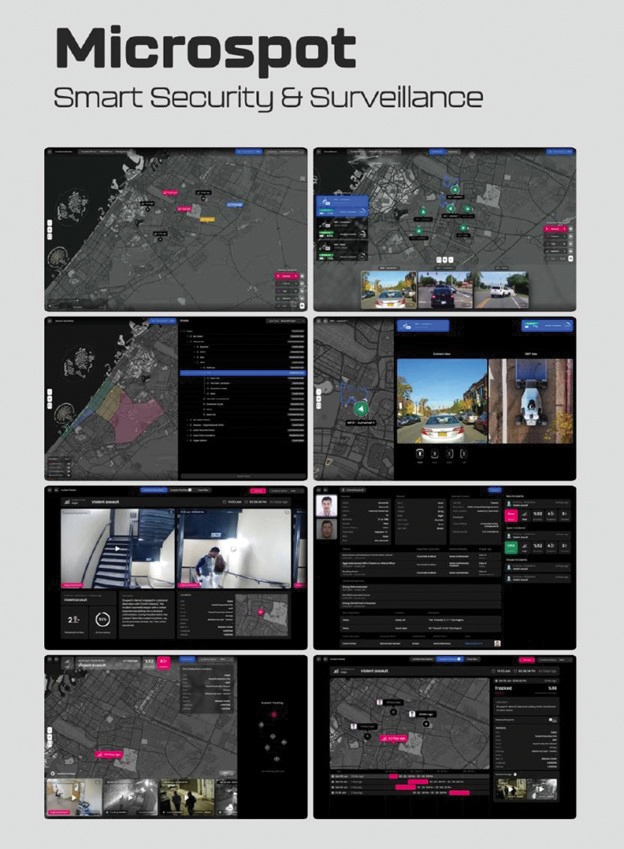
| C. | Electronic Control Units and Power Storage Units: Our in-house-developed control units and power storage solutions serve as the driving force behind our AMRs, providing energy-efficient and reliable performance. |
| 1. | The Micropolis Robotics Controller Unit (“MRCU”) is an innovative and advanced electronics board designed to serve as a centralized control unit for a wide range of robots, including AMRs and EVs. We designed the MRCU in response for the need for a comprehensive, high-performance, and reliable control system to govern various robotic applications efficiently. |
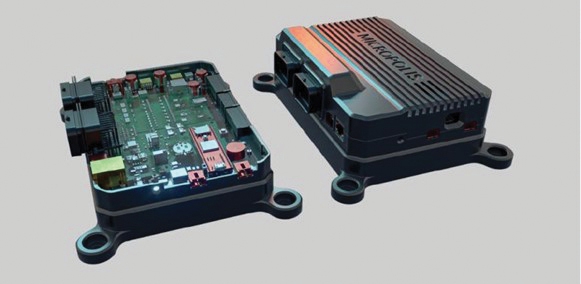
We believe the MRCU addresses the challenges faced in controlling robots by providing a single, highly capable board that integrates multiple components and technologies essential for robotics and automotive applications. It offers centralized control, simplifying the design and implementation of robotic systems, and streamlining the development process.
Key Advantages of the MRCU:
| a. | Comprehensive Robot Control: The MRCU integrates multiple functions necessary for controlling robots, including sensor management, motor control, actuators, communication interfaces, and power regulation. This consolidation streamlines the design and implementation process for robotic systems. |
| b. | High-Performance Microcontroller Setup: The MRCU features dual Cortex M7 and Cortex M4 microcontrollers, offering real-time capabilities and efficient processing. This enables precise and responsive control of robotic movements, essential for safety and accuracy. |
| c. | Cutting-Edge Component Selection: The MRCU incorporates modern integrated circuits (ICs) designed for automotive applications with functional safety classes. These components ensure reliable and robust operation, critical for industrial and automotive environments. |
| d. | Enhanced Wireless Security: The inclusion of UWB (Ultra-Wide Band) technology for wireless key communication provides secure and reliable access control for AMR robots, enhancing their overall security and preventing unauthorized access. |
| e. | Diverse Communication Interfaces: The MRCU supports multiple automotive Controller Area Network (CAN) Bus and Local Interconnect Network (LIN) Bus interfaces, enabling seamless communication with various components and devices within the robotic system. |
| f. | Sensor Integration: The board accommodates up to 18 pins for connecting Hall sensors or encoders, facilitating precise position sensing and feedback for motor control and navigation. |
| g. | Flexible Power Management: The MRCU incorporates five different types of buck and linear regulators to efficiently distribute power to the various components, minimizing power losses and optimizing energy consumption. |
| h. | Redundant Backup System: The MRCU features a backup system that automatically switches to backup mode in case of system faults or power failures, ensuring continuous operation and fault tolerance. |
| i. | Real-Time Operating System (RTOS): The board operates on an RTOS, providing outstanding capabilities for real-time applications like robotics, ensuring timely execution of critical tasks. |
| j. | High Current Motor Control: The MRCU includes four DC motor controllers with TLE9201SG, capable of controlling motors with 6A output current and voltage of 24V and 12V, suitable for driving powerful robotic motors. |
| k. | Extensive Connectivity: The MRCU incorporates built-in USB type-C Hub, CAN Bus, LIN Bus, I2C, UART, SPI, and GPIO interfaces, enhancing its compatibility with various peripherals and devices. |
| l. | Automotive-Grade Components: The MRCU utilizes automotive-grade connectors and high-current pins (up to 15 amps each), ensuring robustness and reliability in demanding industrial and automotive applications. |
| m. | Intelligent Battery Management: The MRCU includes a high-voltage comparator to monitor the battery state, enabling efficient battery management and control of the main relay. |
| n. | Open for Future Expansion: The MRCU is designed with configurability in mind, providing configuration pins for controlling four high-current BLDC motor controllers, allowing future expansion and adaptability to different robot configurations. |
| 2. | The Smart Power Distribution Unit (“SPDU”): designed to address the challenges present in battery-based systems, i.e. efficient energy utilization. |
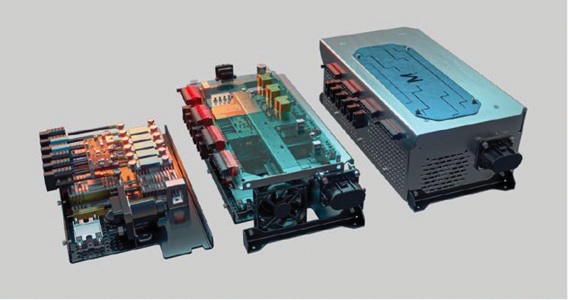
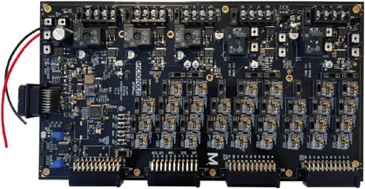
Ensuring prolonged device functionality. The primary features and advantages of our innovative SPDU are as follows:
| a. | DC/DC Management: The SPDU employs advanced DC/DC management techniques, enabling optimal conversion and distribution of power within the system. This results in enhanced energy efficiency and extended battery life. |
| b. | Smart Power Switching: Our invention incorporates intelligent power switching capabilities, allowing seamless transitions between power sources and devices. This ensures continuous operation and eliminates wasteful power usage. |
| c. | Loads Individual Monitoring (Voltage and Current): The SPDU is equipped with sophisticated monitoring mechanisms that oversee the voltage and current levels of individual loads. This enables real-time tracking and effective management of power consumption. |
| d. | Smart Cooling System (Air Flow/Liquid Coolant): To prevent overheating and maintain optimal operating temperatures, the SPDU is outfitted with a smart cooling system. This system utilizes both air flow and liquid coolant to efficiently dissipate heat from critical components. |
| e. | Standard Automotive Connection Interfaces (CAN/LIN) for Monitor and Control: The SPDU features standard automotive connection interfaces such as CAN and LIN. These interfaces facilitate seamless integration, monitoring, and control within automotive systems. |
| f. | Memories for Logging Data of Consumption: Built-in memories within the SPDU capture and store crucial data related to power consumption. This information can be utilized for performance analysis, system optimization, and diagnostics. |
| g. | Auxiliary Battery with UPS System: To ensure uninterrupted power supply, the SPDU incorporates an auxiliary battery equipped with an Uninterruptible Power Supply (UPS) system. This feature safeguards critical functions during power fluctuations or outages. |
| h. | Automotive Generic Fuses: The SPDU integrates automotive generic fuses, enhancing safety and protection against overcurrent conditions. These fuses prevent potential damage to the system and connected devices in case of losing control. |
Our Product Portfolio
Our product portfolio is focused on the collaborative development of innovative AMRs, specifically tailored to meet the unique needs within the security and community service sectors. Utilizing two distinct types of mobility-specific platforms, we are actively partnering with our customers to create three unique robot models. These ongoing collaborative projects underscore our commitment to working closely with customers to develop pioneering solutions designed to enhance community safety and service efficiency.
Base Technology — Wheeled EV Platforms
We developed wheeled EV platforms with autonomous driving capability, which we call our “Base Technology.” Our Base Technology is a revolutionary development in the field of EV robotics, providing a platform for autonomous driving that can be customized to meet specific operational needs. With the M01 and M02 platform types, the Company offers flexibility and agility in design, enabling it to provide automated solutions through AI engines, back-end applications, and user interfaces. We believe that the Base Technology has the potential to reduce operational costs and increase efficiency, making it an attractive option for a range of industries, from logistics to transportation. The Company’s ability to design and manufacture robotic functionality on top of the Base Technology for each operation is a unique selling point that sets it apart from competitors in the market.
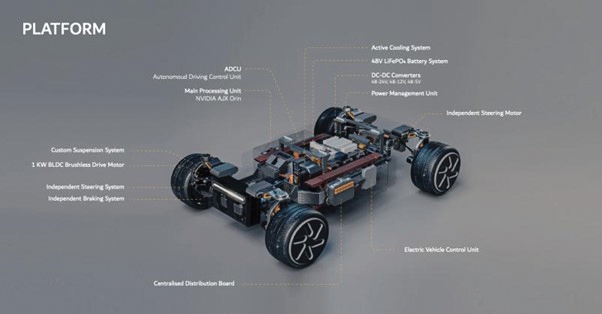
Furthermore, we believe that the Base Technology has the potential to revolutionize the way we think about transportation, providing a sustainable and cost-effective solution for urban mobility. With its autonomous driving capability, we believe the technology has the potential to reduce accidents caused by human error, lower carbon emissions, and improve traffic flow. As the world shifts towards a more sustainable future, the Company’s Base Technology is well-positioned to capitalize on this trend and become a key player in the future of mobility.
Self-driving Security Vehicles
The Company’s self-driving security vehicles are an innovative solution to the increasing problem of crime in urban areas. By partnering with Dubai Police, the Company has developed two different types of self-driving and self-controlled robotic security patrols that can be deployed in high-crime areas. We believe these patrols will provide a visible deterrent to criminals, increasing the efficiency of security monitoring operations and contributing to Dubai Police’s objective of reducing crime. The larger model, simulating the movement of SUVs, is designed for patrolling larger areas, while the smaller size vehicle can safely navigate residential and commercial complexes with narrow roads.


With the rise of smart cities and the increasing adoption of autonomous technology, the Company’s self-driving security vehicles are well-positioned to meet the needs of law enforcement agencies around the world. The vehicles’ ability to navigate complex urban environments and provide a visible security presence is an attractive proposition for cities looking to improve public safety. The Company’s partnership with Dubai Police is also a strong endorsement of its technology, providing a solid foundation for future growth and expansion into other markets.
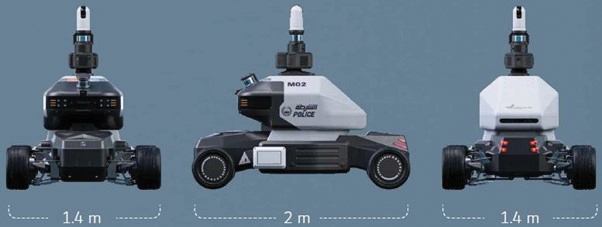
Community Delivery Robots — the Canari
The Company’s Canari autonomous delivery vehicle is a game-changing solution for urban and sub-urban logistics. Developed in partnership with The Sustainable City in Dubai, the Canari is able to autonomously deliver goods within its assigned territory, thereby reducing the cost of delivery and energy consumption. With the ability to carry residents’ orders/packages from the store to their houses, the Canari is set to revolutionize the way we think about last-mile delivery. Its advanced technology, including facial recognition cameras and app-based authorization, is designed to ensure secure and efficient delivery of goods.
We believe the Canari has the potential to disrupt the traditional delivery model, providing a cost-effective and sustainable solution for urban and sub-urban logistics. Its ability to operate autonomously, reduce traffic congestion, and lower carbon emissions makes it an attractive proposition for cities looking to improve the efficiency and sustainability of their logistics operations.
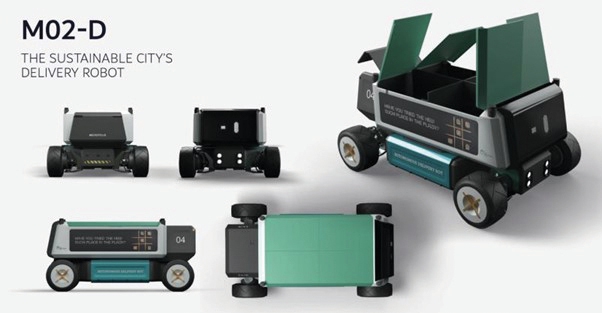
Remote Inspection System Robots
The Company’s remote inspection system robots are a groundbreaking solution to the logistical challenges faced by Dubai Customs. With the expectation to be able to reduce working hours and save on transportation and related logistical operations, the system is set to revolutionize the inspection process. The robot’s differential steering system, which is controlled remotely by customs inspectors from an operation room, is equipped with a PTZ FHD camera that can rise up to 3 meters above the ground level, a drone base for reaching higher shelves, a small X-Ray scanner, and a high-resolution screen with real-time live streaming.
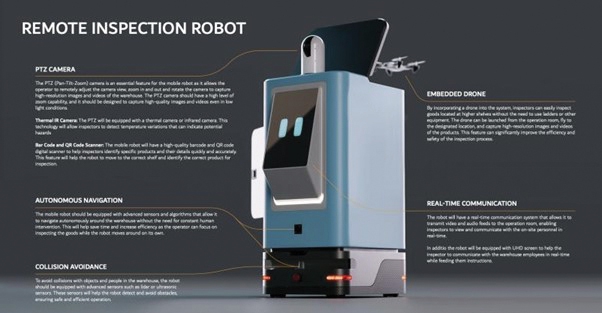
Our Competitive Strengths
We are pioneers in the realm of robotics and AI, revolutionizing industries with our innovative solutions. Our Company is driven by a relentless pursuit of excellence, specializing in the development of mobility-specific AMR platforms and application-specific robotic pods. What sets us apart is our exceptional ability to develop custom automotive-grade mechanical systems, electronic control systems, and power storage and electrical systems. With end-to-end control over the technology development process, we ensure unrivaled quality, reliability, and performance in every aspect of our solutions.
We believe our main competitive strengths are as follows:
In-house R&D and Prototyping Facilities. Our in-house R&D and prototyping facilities are critical for our autonomous robotics business. By having the ability to design and develop core products in-house, we can effectively control quality standards and customize our products to meet specific customer needs. Our facilities allow us to quickly respond to changing market demands in a rapidly evolving industry. We intend to continue to invest in R&D and prototyping to remain at the forefront of technological advancements in the field, allowing us to develop new products and be competitive.
Innovation and Customization. Our focus on innovation and customization is essential in the design and manufacturing of our autonomous robotics products. We understand that each customer has unique needs, and we work closely with our customers to develop customized solutions that meet those needs. By doing so, we differentiate ourselves from our competitors, providing a unique value proposition to customers. Our commitment to innovation also ensures that our products remain technologically advanced, making them more attractive to customers who require the latest technology to operate efficiently. As the industry evolves, our innovation and customization focus will be vital in maintaining our position as one of the key players in the field of autonomous robotics.
Working with Government entities. Our partnerships with government entities allow us to have access to the latest technologies and provide valuable insights into industry trends and customer needs. Working with government entities also enables us to understand their requirements, which we believe can help us secure contracts and partnerships in the public sector. Furthermore, by leveraging these partnerships, we can position ourselves as a trusted provider of innovative autonomous robotics solutions, which can help us win new business.
Mobility-Specific AMR Platforms. Our mobility-specific AMR platforms serve as the backbone of automation in various industries. These platforms are meticulously designed to optimize navigation, adaptability, and reliability in dynamic environments. Equipped with cutting-edge sensors, advanced mapping capabilities, and intelligent decision-making algorithms, our AMRs seamlessly integrate into existing workflows, enabling autonomous movement and efficient task execution.
Application-Specific Robotic Pods. We offer application-specific robotic pods customized to address specific industry needs for different industries. These pods can be customized to perform tasks such as material handling, warehouse logistics, order fulfillment, and assembly line automation. By leveraging our expertise and technologies, businesses can achieve unparalleled levels of precision, accuracy, and speed in their operations.
Bespoke Software Powered by AI. We go beyond hardware solutions by offering bespoke software that harnesses the power of artificial intelligence. Our AI-powered software enables seamless communication and coordination between our AMR platforms, robotic pods, and existing infrastructure. Through sophisticated algorithms, machine learning, and real-time data analysis, our software optimizes operational workflows, predicts maintenance needs, and enhances decision-making processes, ultimately driving efficiency and maximizing productivity.
Customization and Integration. We emphasize customization and integration in our services. Our team of experts works closely with customers to understand their specific needs and design solutions that seamlessly integrate with their operations. Whether it is adapting our AMRs to specific environments or developing custom software modules, we ensure a tailored solution that maximizes value and minimizes disruption.
Comprehensive Support and Services. We pride ourselves on providing end-to-end support and services to our clients. From the initial consultation and deployment to ongoing maintenance and updates, we are dedicated to ensuring a seamless experience. Our comprehensive services include installation assistance, training programs, technical support, and regular performance evaluations. We are committed to building long-term partnerships with our clients and supporting their growth and success.
Future-Proof Solutions. We aim to always be positioned at the forefront of research and development in robotics and AI, continuously exploring emerging technologies and industry trends. We are devoted to staying agile and adaptable, enabling us to provide future-proof solutions that can scale and evolve alongside our clients’ businesses. By partnering with us, clients gain access to the latest advancements in automation and AI, ensuring they stay ahead in a rapidly changing landscape.
Our Business Strategies and Future Plans
Our business strategies and future plans are as follows:
Increasing Market Share: To capture a larger market share, the Company intends to strategically target market segments that align with its capabilities r. The Company intends to focus on industrial automation, healthcare robotics, and consumer robotics, where it believes it has a competitive advantage. The Company plans to develop products that are tailored to these specific market segments, offering unique and differentiated solutions. The Company intends to invest in marketing and sales efforts to promote its products and build brand recognition in these markets.
Developing Sophisticated Product Roadmap: To develop a sophisticated product roadmap, the Company plans to conduct market research to understand the needs and preferences of its target market. Based on this research, the Company intends to then develop a product development plan that outlines the features, functionality, and design of its robotic solutions. The roadmap will be aligned with the Company’s mission, target market, and technological capabilities, ensuring that it can deliver high-quality products that meet the needs of its customers. The Company plans to also regularly update its roadmap to reflect changing market conditions and technological advancements.
Investing in Research and Development: To stay at the forefront of technological innovation and meet the evolving needs of its target market, the Company intends to invest in research and development. The Company plans to collaborate with universities, research institutions, or other companies to develop new technologies and applications. The Company intends to prioritize innovation in its internal R&D efforts, continually exploring new ideas and pushing the boundaries of what is possible in the robotics industry. By investing in R&D, the Company is striving to deliver cutting-edge solutions that meet the needs of its customers.
Building Partnerships and Alliances: To expand its market reach and leverage complementary strengths and expertise, the Company will form strategic partnerships and alliances with other organizations. The Company will identify partners that share its values and have complementary capabilities, such as government departments, suppliers, integrators, or distributors. These partnerships will enable the Company to reach new customers and markets, accelerate product development, and reduce costs through shared resources. The Company will prioritize building long-term relationships with its partners, based on mutual trust and respect.
Managing the Supply Chain: To ensure the timely and cost-effective delivery of its products and services, the Company will manage its supply chain effectively. This will involve strengthening in-house production, sourcing components from multiple suppliers to reduce reliance on any one supplier, managing inventory to ensure that it can meet customer demand without carrying excessive stock, and optimizing logistics and distribution to minimize shipping costs and delivery times. By managing its supply chain effectively, the Company can ensure that it is delivering high-quality products and services to its customers in a timely and cost-effective manner.
Maintaining a Strong Brand and Reputation: To maintain a strong brand and reputation, the Company will focus on providing high-quality products and services, excellent customer service and support, and effective communication with its customers and stakeholders. The Company will maintain a consistent and distinctive visual identity that reflects its values and mission. The Company will also regularly engage with its customers and stakeholders through social media, events, and other channels, building strong relationships and promoting brand loyalty. By maintaining a strong brand and reputation, the Company can differentiate itself from its competitors and build long-term customer loyalty.
Marketing and Public Relations: Currently our marketing efforts are only limited to publications on social networks and promotion through influencers, as we mainly leveraged relationships with our prominent partners like Dubai Police to increase our brand awareness and showcased our products in various events. Going forward, we intend to hire professional branding and marketing agency to articulate our brand narrative consistently on a global scale and penetrate broader market segments. We plan to allocate our marketing budget as follow: (a) 35% to marking our presence in both regional and international technology trade events, (b) 40% to crafting high-caliber content for social media and leading technology channels globally, including collaborations with influential tech personalities and the execution of regular social media campaigns to highlight the capabilities and applications of our M01 and M02 products, (c) 18% towards developing a robust PR strategy and calendar, aimed at showcasing our thought leadership, engaging with mainstream media, relevant tech blogs and news outlets, and (d) 7% for the development of targeted sales programs in collaboration with Dubai Police and QSS Robotics, focusing on specific customer segments and cover expenses related to sales kits, pilot projects, demos, and necessary travel expenses.
Our Major Customers
The Company is currently a somewhat pre-revenue organization since most of our existing projects with our customers are collaborative in nature and we do not anticipate earning substantial revenues until such time as we enter into commercial production of our robotics, which is expected to be by the second quarter of 2025. For the year ended December 31, 2023, we recorded a revenue of US$157,153 related to the project with QSS Robotics. For the year ended December 31, 2024, we recorded US$35,415 of revenue which includes revenue from the sale of scrap items.
We only started to produce our first robots in January 2023. As of the date of this report, we have achieved the milestone of producing 17 robots which are pre-ready for delivery and going through different testing and quality control. Each sale represents a collaborative development project, focused on addressing unique operational challenges or augmenting specific client functions.
Our Major Suppliers
| Percentage of total purchases (%) | ||||||||||
| Supplier | Product or service supplied | For the year ended December 31, 2024 |
For the year ended December 31, 2023 |
|||||||
| ATAD International General Trading | Machines and equipment | 0 | % | 2 | % | |||||
| Phillips Machine Tools India Pvt Ltd | Machines and equipments | 0 | % | 2 | % | |||||
| Creative Colors Design | Fit out Supplier | 0 | % | 27 | % | |||||
| L V L TECH GENERAL TRADING | Machines and equipment | 26 | % | 0 | % | |||||
| MAXPLUS Advertising LLC | Marketing & Advertising | 5 | % | 0 | % | |||||
| DMGE Exhibitions Organization | Marketing & Advertising | 6 | % | 0 | % | |||||
| TAAD LLP | Audit | 22 | % | 0 | % | |||||
| Others | Parts & Services Suppliers | 41 | % | 69 | % | |||||
| Totals | 100 | % | 100 | % | ||||||
Except for the service agreement we entered into with Siemens Industry Software SA (Pty) Ltd (“Siemens”) (the major terms of which are summarized below), we do not have supply contracts with our suppliers and would execute purchase orders from time to time on an as-needed basis. The purchase orders would typically state the component we are purchasing, the unit price and the total purchase price. We would pay in advance and the suppliers would deliver the components to us as soon as possible after execution of the purchase order, ranging from one working day to more than five weeks. Since our business is collaboration-based and each of our robotics is customized to meet our partners’ needs, we expect to have a limited number of suppliers in the future once we start to generate substantial revenue. Given that our business will depend on a few suppliers, any changes in the relationships with these future customers and suppliers, such as the loss of a major client or reduced orders, could significantly impact our financial stability and growth prospects. To the best of our Directors’ knowledge, we are not aware of any information or arrangement which would lead to a cessation or termination of our current relationship with any of our major suppliers.
We entered into a professional services agreement with Siemens, a global leader in engineering solutions and our largest supplier in May 2023 (the “Siemens Agreement”). The Siemens Agreement does not stipulate the quantity or types of deliverables but instead, Siemens would provide services and produce deliverables to us as stated in statements of work. Services provided by Siemens would be invoiced monthly and we are required to pay the fees within 30 days of the invoice. Siemens will own all intellectual property rights related to deliverables developed by Siemens whilst we will own all intellectual property rights related to deliverables to the extent that such deliverables consist of our pre-existing material. Moreover, we are granted a perpetual, royalty-free, non-transferrable and non-exclusive license to use the deliverables delivered to us by Siemens under the statements of work pursuant to the Siemens Agreement. Siemens has sole discretion regarding the assignment of its personnel and is responsible for all compensation and other employment benefits of such personnel; whilst we are responsible for making facility access, office space, and communication services available to Siemens if Siemens is required to perform the service at the our location, and for ensuring Siemens has the rights to use any third-party software or intellectual property made available to Siemens as necessary for the performance of the services. The Siemens Agreement does not stipulate a definite duration and will remain in effect until terminated by either party by providing a 30 days prior written notice to the other party. As at the date of this report, we had only one statement of work under the Siemens Agreement. Pursuant to such statement of work, Siemens will provide, among others, the following services to us in connection with the Autonomous Navigation Project the primary goal of which is to develop autonomous navigation software: providing a dedicated project engineer, implementing infrastructure needed to support the software development, performing survey to generate technical specifications, developing system documentation to enable the generation of system and software architecture, performing sensor coverage analysis, etc.
We prioritize sourcing common components and equipment such as sensors actuators, as well as certain computer parts for our products and research and development through suppliers like Nvidia and Siemens, who are known for their market leadership, reliability, and diverse product offerings. As we develop the majority of our components in-house, sourcing components from trusted suppliers helps us to mitigate the risks associated with over-reliance on external sources. We also ensure that our components are readily replaceable with alternative offerings from different suppliers to mitigate risks associated with over-reliance one external resources.
We are enrolled in the NVIDIA Inception Program, a free-to-enroll program that affords us and others enrolled in the program preferential access to crucial hardware components like Graphics Processing Units (GPUs) and NVIDIA AJX Orin processors. This allows us to be at the forefront of technological advancement, ensuring our AMRs are outfitted with the latest available processing capabilities.
Manufacturing our robots require hundreds of different components. Therefore, we procure such components from different suppliers on an as-needed basis by executing purchaser orders. Set forth below are examples of the components we need for our robots:
| ● | For our microcontroller needs, we source electronics components from STM and Infineon, both of which are well-established American companies with a significant presence in the global market. In our selection process, we prioritize microcontrollers that are not only industry-standard but also readily available in mass production. This approach mitigates the risks associated with supply chain disruptions and ensures the consistency of our end products. |
| ● | In regards to sensor technology, we have focused on sourcing components from market leaders like Velodyne and Ouster for the supply of our lidar systems. We focus on market leader suppliers in order to maintain a reliable and uninterrupted supply chain, safeguarding our ability to maintain production levels even in volatile market conditions. |
| ● | Regarding actuators and Brushless DC (BLDC) motors, we are confident in the availability and variety of these components, as they are conventional technologies with a saturated market. This abundance of options allows us to be selective, ensuring that we incorporate only the most reliable and efficient actuators and motors into our AMRs. |
Data Collection And Cybersecurity
We prioritize data collection and cybersecurity to drive innovation, enhance product development, and deliver reliable AMR solutions to our valued customers. Our commitment to responsible data practices is central to maintaining trust, ensuring privacy, and safeguarding sensitive information throughout our operations. We do not ngather any personal or corporate data related to identity. Instead, our focus is on processing information pertaining to street layouts and urban infrastructure. Our systems are deployed on our clients’ servers and operate behind their firewalls, maintaining the client’s industry standard of cybersecurity. While the clients retain ownership of this data, we are committed to its protection, working in partnership with our customers to uphold stringent cybersecurity development standards.
Data Collection for Product Development. In the process of developing our AMRs, we collect data to gain valuable insights into customer needs, industry trends, and operational requirements. We analyze anonymized and aggregated data from our robots’ performance, user interactions, and environmental conditions to refine our technologies and optimize their functionalities. By harnessing this data, we continuously improve the efficiency, safety, and adaptability of our robots to cater to diverse market demands.
Data-Driven Manufacturing Processes. Data collection plays a crucial role in our manufacturing processes, enabling us to maintain high-quality standards and optimize production efficiencies. We employ data analytics to monitor and analyze production data, ensuring that each robot meets stringent quality control criteria before deployment. This data-driven approach empowers us to detect and rectify potential manufacturing anomalies promptly, delivering reliable and high-performing robotics products to our customers.
Operational Data for Enhanced Performance. Once deployed, our AMRs generate operational data in real-time, providing valuable performance metrics and insights. We leverage this operational data to monitor the health of our robots, identify areas for improvement, and offer proactive support and maintenance services. The data allows us to respond swiftly to any technical challenges and optimize the performance of our robotics in diverse operational environments.
Cybersecurity Measures to Protect Data. We prioritize the security and privacy of all data collected during the development, manufacturing, and use of our robotics. We have implemented robust cybersecurity measures to safeguard against unauthorized access, data breaches, and potential threats. Our cybersecurity protocols are continuously monitored, updated, and audited to ensure compliance with industry best practices and evolving regulatory standards. For details of cybersecurity risks that we face, please see “Risk Factors — Risks Related to Our Business — As a robotics company operating in a digital era, we face significant cybersecurity risks that could have adverse implications for our business, reputation and stakeholders.”
Data Privacy and Compliance. Respecting data privacy is fundamental to our business ethos. We strictly adhere to data protection regulations and strive to ensure that data is collected and used ethically and transparently. Our customers’ personal data is treated with the utmost confidentiality, and we seek explicit consent for data collection, storage, and usage as required by applicable laws.
Research and Development
Our R&D expenditures for the two years ended December 31, 2023 and 2022 were relatively modest in terms of costs and amounted to US$330,907 and US$185,134 respectively. For the year ended December 31, 2024 the amount of US$531,754 in R&D was reported. The company primarily allocated resources towards our engineering teams for the development of mechanical designs, electrical and electronic units. The majority of these expenses were accounted for as part of our payroll.
Competition
The robotics industry in UAE and the GCC region is growing rapidly. The UAE government is investing heavily in the sector, and there are a number of startups and multinational companies that are developing and commercializing robotics solutions. The main areas of application for robotics in UAE and GCC include:
| ● | Logistics and transportation: Robots are being used to automate warehouse operations, deliver packages, and even drive taxis. |
| ● | Healthcare: Robots are being used to perform surgery, provide rehabilitation, and deliver medications. |
| ● | Education: Robots are being used to teach students, provide tutoring, and conduct research. |
| ● | Security and defense: Robots are being used to patrol borders, detect explosives, and fight fires. |
We believe competition in the robotics industry in UAE and the GCC region is currently mild as the industry is still at an early development stage. However, there are a number of companies that are well-positioned to succeed in this market, including established international robotics companies which wish to expand to the UAE and GCC region, as well as regional startups that are developing innovative robotics solutions. These regional startups are often supported by government initiatives, such as the Dubai Robotics and Automation Program.
In the rapidly advancing world of automation and robotics, the AMR industry is a burgeoning field, particularly within the UAE. Despite being in its early stages in the region, this industry has been attracting significant attention and experiencing substantial demand, fuelled by the UAE government’s encouragement and various market needs. As an early player in this industry, we acknowledge the formative nature of the competitive landscape. The UAE market, although still emerging, presents unique opportunities and challenges, offering an exciting frontier for businesses like ours.
Seasonality
Our operating results and operating cash flows historically have not been subject to seasonal variations.
Insurance
Currently we maintain health insurance plans for our employees. Our employee benefit insurance plans are reviewed annually to ensure that our Group has sufficient insurance coverage. Our Directors believe that we have adequate insurance coverage for the purposes of our business operations and we will procure the necessary additional insurance coverage for our business operations, properties, and assets as and when the need arises.
Intellectual Property
Our Group’s intellectual property rights are important to our business and as of the date of this report, the Group has submitted the application for registering the following trademarks:
| Trademark | Jurisdiction | Class(1)(2) | Trademark Number |
Application No. | ||||
| Micropolis Robotics | UAE | 12 | 404415 | MOE-TM-37-4189696- 20230816 | ||||
| MR-SPDU Max – Micropolis Robotics Power Distribution Unit MRCU | UAE | 9 | 404416 | MOE-TM-37-4194350- 20230820TBC | ||||
| MR-CU Robotic Control Unit SPDU-Max | UAE | 9 | 404417 | MOE-TM-37-4194359- 20230820TBC | ||||
| Microspot-ProtectEVCU – EV Control Unit | UAE | 9 | 404418 | MOE-TM-37-4194363- 20230820TBC | ||||
| MR-EVCUMR-PMU – Micropolis robotic Power Distribution Unit | UAE | 9 | 404419 | MOE-TM-37-4194385- 20230820TBC |
Notes:
| (1) | Class 9: Scientific, nautical, surveying, photographic, cinematographic, optical, weighing, measuring, signaling, checking (supervision), life-saving and teaching apparatus and instruments; apparatus and instruments for conducting, switching, transforming, accumulating, regulating or controlling electricity; apparatus for recording, transmission or reproduction of sound or images; magnetic data carriers, recording discs; compact discs; DVD’s and other digital recording media; mechanisms for coin-operated apparatus; cash registers, calculating machines, data processing equipment, computers; computer software; fire-extinguishing apparatus. |
| (2) | Class 12: Vehicles; apparatus for locomotion by land, air or water. |
Save as disclosed above, our Group does not own or use any other trademarks, patents or licenses that are material to our business or profitability.
Shared Ownership of Intellectual Property
Our Company’s business model centers on collaboration with different entities to develop customized robotics. These partnerships may result in the joint development of intellectual property and associated technologies in the future. All arrangement for shared ownership of IP have yet to occur. In several instances, our collaboration agreements may stipulate that ownership of these intellectual property and technologies is shared equally, typically under a 50-50 arrangement.
This shared ownership of intellectual property, while fostering innovation and diversification, does introduce potential risks. Our autonomy in commercialization strategies and decision-making pertaining to developed technology might be influenced by the consensus requirements of our partners.
We are committed to striking a balance between leveraging the advantages of collaboration while navigating the complexities of shared ownership. For details of such risk, please see “Risk Factors — We do not exclusively own 100% of all intellectual property and technologies that we develop in the projects with our partners, which may adversely affect our ability to effectively utilize and monetize such intellectual property and technologies in our business operations.”
Properties
Our principal executive office is located at Warehouse 1, Dar Alkhaleej Building,, Dubai Production City, Dubai, UAE. The lease of this space will terminate on February 28, 2027. We believe that our facilities are adequate to meet our needs for the immediate future, and that, should it be needed, suitable additional space will be available on commercially reasonable terms to accommodate any expansion of our operations. As at the date of this report, the Company has leased the following premises:
| Address | Purpose | Lease Period | ||
| Warehouse 1, Dar Alkhaleej Building, Dubai Production City, Dubai, UAE | Principal office and production | Until February 28, 2027 |
Legal Proceedings
From time to time, we may become involved in actions, claims, suits, and other legal proceedings arising in the ordinary course of its business, including assertions by third parties relating to intellectual property infringement, breaches of contract or warranties or employment-related matters. We are not currently a party to any actions, claims, suits or other legal proceedings the outcome of which management believes, if determined adversely to us, would individually or in the aggregate have a material adverse effect on our business, financial condition, and results of operations.
4.C. Organizational structure
The following diagram illustrates the organizational structure of the Group:
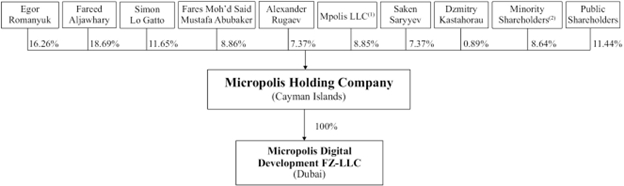
4.D. Property, plants and equipment
Our principal place of business is located at Warehouse 1, Dar Alkhaleej Building,, Dubai Production City, Dubai, UAE. The lease of this space will terminate on February 28, 2027. We believe that our facilities are adequate to meet our needs for the immediate future, and that, should it be needed, suitable additional space will be available on commercially reasonable terms to accommodate any expansion of our operations.
Item 4A. Unresolved Staff Comments
None.
Item 5. Operating and Financial Review and Prospects
The following discussion and analysis of our financial condition and results of operations should be read in conjunction with our consolidated financial statements and related notes included elsewhere in this annual report. This discussion and analysis and other parts of this annual report contain forward-looking statements based upon current beliefs, plans and expectations that involve risks, uncertainties and assumptions. Our actual results and the timing of selected events could differ materially from those anticipated in these forward-looking statements as a result of several factors, including those set forth under “Risk Factors” and elsewhere in this annual report. You should carefully read the “Risk Factors” section of this annual report to gain an understanding of the important factors that could cause actual results to differ materially from our forward-looking statements.
Overview
Micropolis Dubai, our wholly-owned subsidiary, is a robotics manufacturer founded in 2014, based in UAE with its headquarters located in Dubai Production City, Dubai, UAE. We specialize in developing AMRs that utilize wheeled EV platforms and are equipped with autonomous driving capabilities.
We have historically conducted our business through Micropolis Dubai. For purposes of this Offering, in February 2023, we incorporated Micropolis Cayman, an exempted company with limited liability under the laws of the Cayman Islands, as the listing vehicle for this Offering. In July 2023, Micropolis Cayman acquired 100 shares of Micropolis Dubai, representing 100% of the issued and outstanding share capital of Micropolis Dubai, from its five shareholders for an aggregate purchase price of AED100,000. As a result, Micropolis Dubai became a wholly-owned subsidiary of Micropolis Cayman. In March and September 2023, Micropolis Cayman issued an aggregate of 23,706,000 ordinary shares, representing 79.02% of its issued share capital, to the Former Shareholders and 6,294,000 ordinary shares, representing 20.98% of its issued share capital, to three new investors. From June to July 2024, a total of 1,024,000 ordinary shares were transferred from these shareholders to five additional investors. As of the date of this prospectus, the Former Shareholders own approximately 77.27% of Micropolis Cayman. For details, see “Corporate Structure and History.” The Company is currently a pre-revenue organization since most of our existing projects are collaborative in nature and we do not anticipate earning substantial revenues until such time as we enter into commercial production for our robotics, which is expected to be by the second quarter of 2025.
As part of our product offerings, we integrate application-specific pods that serve as the primary purpose of a robot. These pods are designed to accommodate various functionalities, including surveillance cameras, road sweepers, logistics compartments, as well as collaborative robots (cobots) intended for direct human-robot interaction.
On March 6, 2025, the Company entered into an underwriting agreement (the “Underwriting Agreement”) with Network1 Financial Securities, Inc. (the “Underwriter”), relating to the Company’s initial public offering (the “IPO”) of 3,875,000 ordinary shares, par value $0.0001 per share (the “Ordinary Shares”), for a price of $4 per share. The Company also granted the underwriters a 45-day option to purchase up to 581,250 additional Ordinary Shares on the same terms and conditions for the purpose of covering any over-allotments in connection with the IPO.
On March 10, 2025, the Company completed the IPO pursuant to its registration statement on Form F-1 (File No. 333-276231) (the “Registration Statement”), which was initially filed with the U.S. Securities and Exchange Commission (the “SEC”) on December 22, 2023, as amended, and declared effective by the SEC on March 6, 2025. 3,875,000 Ordinary Shares were sold at an offering price of $4 per share, generating gross proceeds of $15.5 million to the Company, before underwriting discounts and other offering expenses. The IPO was conducted on a firm commitment basis. The Ordinary Shares were approved for listing on NYSE American LLC and commenced trading under the ticker symbol “MCRP” on March 7, 2025. On March 10, 2025, the Company also issued warrants to the Underwriter and its designees, which are exercisable during the period commencing from March 10, 2025, and expiring five years from the commencement of sales of the Ordinary Shares in the IPO, entitling the holders of the warrants to purchase an aggregate of 232,500 Ordinary Shares at a per share price of $5 (the “Underwriter’s Warrants”).
Factors Affecting Our Results of Operations
The following are significant factors that could influence our operational results. Investors should consider these factors carefully, in addition to other information provided in this prospectus.
Technological Changes: The AMR industry is characterized by rapid technological advancements. Our ability to keep pace with these changes impacts our competitive position and profitability. As a company specializing in the development and integration of AMRs, operating software, and electronic control units and power storage units, the adoption rate of these technologies significantly influences our revenues and market share.
Competitive Landscape: We believe competition in the robotics industry in UAE and the GCC region is currently mild as the industry is still at an early development stage. However, there are a number of companies that are well-positioned to succeed in this market, including established international robotics companies which wish to expand to the UAE and GCC region, as well as regional startups that are developing innovative robotics solutions. These regional startups are often supported by government initiatives, such as the Dubai Robotics and Automation Program. Increased competition may lead to pricing pressures, reduced profit margins, and loss of market share.
Intellectual Property: Our success depends on our ability to protect our intellectual property related to AMRs, operating software, and electronic control units & power storage units.
Talent Retention: Our success is highly dependent on our ability to attract, retain, and motivate skilled personnel in the fields of robotics and software development.
Customer Concentration: Our business risks being significantly affected if a large portion of our revenue is concentrated with a few key customers.
Margin Pressure: Profitability, while always a goal, is subject to pressures and constraints. Our pricing strategies aim to strike a balance between competitiveness in the market and sustainable margins. This is further complicated by the necessity of offering volume discounts to our larger, cornerstone clients. Additionally, unexpected costs, such as those stemming from extended warranties or unforeseen product recalls, can exert further downward pressure on our margins.
Cash Flows and Capital Requirements: Our cash conversion cycle defines how efficiently we transform resource inputs into tangible cash flows. Our working capital ensures smooth day-to-day operations, from managing inventory to handling accounts receivable.
Strategic Partnerships: In our pursuit of growth and excellence, we might find synergy in collaboration. Strategic partnerships allow us to pool resources, expertise, and market reach, offering mutual benefits. However, these ventures come with their financial implications, from realizing synergies to managing integration costs.
5.A. Operating Results
Revenue
The following table shows revenue for the years ended December 31, 2024, 2023, and 2022:
| 2024 | 2024 | Change | 2023 | Change | 2022 | |||||||||||||||||||
| USD | AED | AED | AED | AED | AED | |||||||||||||||||||
| Revenue | 35,415 | 130,043 | -77 | % | 577,064 | - | % | - | ||||||||||||||||
We are a pre-revenue organization since most of our existing project with our customers are collaborative in nature and we do not anticipate earning substantial revenues until such time as we enter into commercial production of our robotics, which we expect to occur by the second quarter of 2025.
We have started to generate revenue in January 2023 from project with our Saudi Arabian client, QSS Robotics, while in the first half of the 2024 we didn’t have major project and sales deliverables. During 2022 we did not recognize any revenue.
Cost and Operating Expenses
The following table shows cost and operating expenses for the years ended December 31, 2024, 2023, and 2022:
| 2024 | 2024 | Change | 2023 | Change | 2022 | |||||||||||||||||||
| USD | AED | AED | AED | |||||||||||||||||||||
| Cost of revenue | 15,575 | 57,192 | -80 | % | 289,119 | - | % | - | ||||||||||||||||
| Cost of revenue as a percentage of revenue | 44 | % | 44 | % | 50 | % | 0 | % | ||||||||||||||||
| Research and development | 531,754 | 1,952,602 | 61 | % | 1,215,091 | -16 | % | 1,443,619 | ||||||||||||||||
| Administrative expenses | 5,012,077 | 18,404,350 | 66 | % | 11,087,540 | 14 | % | 9,732,985 | ||||||||||||||||
| Marketing expenses | 204,682 | 751,591 | 5144 | % | 14,333 | -83 | % | 85,751 | ||||||||||||||||
| Profit Distribution Expenses | 19,840 | 72,851 | - | % | - | - | % | - | ||||||||||||||||
| Total operating expenses | 5,783,928 | 21,238,586 | 12,606,083 | 11,262,355 | ||||||||||||||||||||
Cost of Revenue
Cost of revenue includes all costs directly attributable to the generation of revenue. Our cost of revenue as a percentage of sales dropped to 44% during 2024 as compared to 50% during 2023, primarily due to the fact that it was a different class of revenue, which is related to our 3D printing department, which by default the margins are lower vs our robotics product which was the case in 2023.
Administrative Expenses
Administrative expenses have increase in 2024 by +66% vs the previous year due to the growth of the company’s operations and IPO process. This includes mainly the increase cost in the manpower expenses, which increased by +74% vs last year due to increase in the software, electronics and production teams. As well as increase by +35% in professional fees due to the IPO process which consumed expenses throughout the year of 2024 for legal, consultant and audit fees.
Marketing Expenses
Marketing expenses increased as well substantially in 2024, by +5,144% due to active promotion of company’s products and technology in year 2024 vs almost no marketing campaigns in year 2023. Major marketing expenses were done in 2024 for World Police Summit and GITEX exhibition in Dubai. In year 2025 we continue spending more resources into exhibitions and PR campaigns in order to increase the visibility of the company and its products.
Profit Distribution Expenses
| December 31, 2024 |
December 31, 2023 |
December 31, 2022 |
||||||||||||||
| USD | AED | AED | AED | |||||||||||||
| Profit distribution expense | 19,840 | 72,851 | - | - | ||||||||||||
The Company has agreed with Future General Trading (FGT) to share 100% of the net profit from 3D printing sales. For the year ended December 31, 2024, total sales from 3D printing amounted to AED 130,043, with a cost of AED 57,192, resulting in a net profit of AED 72,851. As per the agreement, FGT is entitled to 100% of the net profit, and the profit share payable to FGT is AED 72,851, which is recognized as a liability as of December 31, 2024.
Other Income (Expense)
The following table shows other income and expenses for the years ended December 31, 2024, 2023, and 2022:
| 2024 | 2024 | Change | 2023 | Change | 2022 | |||||||||||||||||||
| USD | AED | AED | AED | |||||||||||||||||||||
| Other income | 5,621 | 20,640 | -90 | % | 203,808 | - | % | 28,617 | ||||||||||||||||
| Finance expense | (328,571 | ) | (1,206,514 | ) | 1816 | % | (62,969 | ) | -23 | % | (81,706 | ) | ||||||||||||
| (322,950 | ) | (1,185,874 | ) | 140,839 | (53,089 | ) | ||||||||||||||||||
Other Income
The other income for the period ended December 31, 2024, totals AED 20,640 ($5,621). This amount includes revenue from the sale of scrap items and cash back from a prepaid card. These revenues are classified separately to clarify the entity’s non-core income sources.
Other income for period ended December 31, 2023, amounts to AED 203,808. This income is primarily derived from room rental in our warehouse facilities. Additionally, this amount includes adjustments related to the Dubai Police invoice from 2020, which has been cleared against the provision for doubtful debts, as well as revenue from the sale of scrap items. These items are classified separately to provide clarity on the entity’s non-core revenue streams.
Other income for the year ended December 31, 2022, amounts to AED 28,617. This amount is derived from room rental in our warehouse facilities. This income is classified separately to provide clarity on the non-core revenue streams of the entity.
Finance Expense
| FINANCE EXPENSE | December 31, 2024 |
December 31, 2023 | December 31, 2022 | |||||||||||||
| USD | AED | AED | AED | |||||||||||||
| Imputed interest from due to related party | 315,913 | 1,160,034 | - | - | ||||||||||||
| Interest expense from lease | 12,658 | 46,480 | 62,969 | 81,706 | ||||||||||||
| 328,571 | 1,206,514 | 62,969 | 81,706 | |||||||||||||
Imputed interest from due to related party in 2024 resulted from the loan agreements the company obtained with Fareed Aljawhari. The actual loans are interest free loans and were fully paid back to Fareed from the IPO proceeds. Interest expense from lease are related to the office rent agreement (IFRS16) and are decreasing with every year due to contract maturity date.
5.B. Liquidity and Capital Resources
Liquidity risk is the risk that the Company may not have sufficient liquid funds to meet its liabilities as they fall due. Prudent liquidity risk management requires maintaining sufficient cash and the availability of funding to meet obligations when due. The Company limits its liquidity risk by ensuring funds from the shareholders and related parties are available, whenever they are required. In the short term, the Company anticipates that its cash requirements for day-to-day operations will be met by the proceeds from this offering and additional funding from existing shareholders as and when necessary. In the long term, the Company anticipates relying on its ability to generate cash from operations, particularly as we enter into commercial production of our robotics, which is expected to be by the second quarter of 2025.
Working Capital
The following table shows working capital as of December 31, 2024 and 2023:
| 2024 | 2024 | Change | 2023 | |||||||||||||
| USD | AED | AED | ||||||||||||||
| Current assets | 1,184,380 | 4,349,039 | 43 | % | 3,043,910 | |||||||||||
| Current liabilities | 6,898,823 | 25,332,476 | 234 | % | 7,586,664 | |||||||||||
| Working capital (deficiency) | (5,714,443 | ) | (20,983,437 | ) | 362 | % | (4,542,754 | ) | ||||||||
As of 2024, our working capital deficiency increased approximately AED16.4 million from 2023, primarily due to an increase of current liabilities of approximately AED17.7 million.
For 2024, our current liabilities increased primarily from an increase of AED16.2 million in amounts owing to related parties to AED21.2 million, from AED5.4M at 2023. Additionally for 2024, our trade and other payables increased AED2.0 million to AED3.2 million from AED1.2 million at 2023. For 2024 our current assets increased primarily from AED3.0 million to. AED4.3 million mainly due increase in advance payment to suppliers.
Cash Flows
The following table shows cash flows for the years ended December 31, 2024, 2023, and 2022:
| 2024 | 2024 | Change | 2023 | Change | 2022 | |||||||||||||||||||
| USD | AED | AED | AED | |||||||||||||||||||||
| Net cash flows used in operating activities | (3,656,207 | ) | (13,425,594 | ) | 410 | % | (2,634,954 | ) | -70 | % | (8,923,233 | ) | ||||||||||||
| Net cash flows used in investing activities | (478,382 | ) | (1,756,617 | ) | 350 | % | (389,930 | ) | -88 | % | (3,326,821 | ) | ||||||||||||
| Net cash flows generated from financing activities | 4,128,997 | 15,161,676 | 393 | % | 3,072,422 | -70 | % | 10,225,208 | ||||||||||||||||
| Net change in cash and cash equivalents | (5,592 | ) | (20,535 | ) | 47,537 | (2,024,846 | ) | |||||||||||||||||
Cash Flow from Operating Activities
We have not generated positive cash flows from operating activities for the years ended December 31, 2024, 2023 and 2023.
For the year ended 2024, we recognized a net loss of AED22.3 million, reduced by non-cash operating adjustments of AED3.6 million, and reduced by a net change in working capital of AED5.3 million.
For the year ended 2023, we recognized a net loss of AED11.9 million, reduced by non-cash operating adjustments of AED1.8 million, and reduced by a net change in working capital of AED7.4 million.
For the year ended 2022, we recognized a net loss of AED11.3 million, reduced by non-cash operating adjustments of AED1.6 million, and reduced by a net change in working capital of AED815,000.
Cash Flow from Investing Activities
For the year ended 2024, we acquired property and equipment for AED1.7 million and acquired intangible assets for AED48,000.
For the years ended 2024 and, we acquired property and equipment for AED390,000 and AED3.3 million, respectively.
Cash Flow from Financing Activities
For the year ended 2024, we borrowed from related parties AED17.8 million and repaid AED1.6 million and paid AED1.0 million in leases payments.
For the year ended 2023, we borrowed from related parties AED4.0 million and repaid AED33,000 and paid AED887,000 in leases payments.
Indebtedness
The following table sets out the indebtedness of the Company as at December 31, 2024, 2023, 2022 and as of the date of this prospectus:
| As of December 31, | As of April 30, |
|||||||||||||||
| 2022 | 2023 | 2024 | 2025 | |||||||||||||
| USD | USD | USD | USD | |||||||||||||
| Amounts due to Egor Romanyuk | 275,852 | 1,480,594 | 2,645,851 | - | ||||||||||||
| Amounts due to Fares Abu Baker | 40,850 | 40,850 | 40,850 | - | ||||||||||||
| Amounts due to Diamond Developers | 86,291 | 86,291 | 86,291 | - | ||||||||||||
| Amounts due to Fareed Aljawhari | — | — | 2,905,778 | 136,166 | ||||||||||||
| Amounts due to Rajesh Venkataraman | 233,063 | - | ||||||||||||||
| TOTAL | 402,993 | 1,697,735 | 5,911,833 | 136,166 | ||||||||||||
Capital Expenditures
For the year ended December 31, 2024 we recorded capital expenditure of AED1,708,901 ($465,387). Capital expenditures were higher in 2024 due to acquisition of the new machinery and equipment.
For the year ended December 31, 2023 we recorded capital expenditure of AED389,931 ($106,190). Capital expenditures were higher in 2022 due to our new office relocation in 2022. The new office location had to be refurbished inside and complemented with the new machinery and equipment.
For the year ended December 31, 2022, we recorded capital expenditure of AED3,348,914 ($912,014) which was spent on the new office relocation (interiors, IT equipment and furniture) and machinery purchased during that year.
5.C. Research and Development, Patent and Licenses, etc.
We did not conduct any research and development activities for the years ended December 31, 2024, 2023 and 2022.
5.D. Trend Information
Other than as disclosed elsewhere in this annual report, we are not aware of any trends, uncertainties, demands, commitments or events for the year ended December 31, 2024 that are reasonably likely to have a material effect on our total net revenues, income, profitability, liquidity or capital reserves, or that caused the disclosed financial information to be not necessarily indicative of future operating results or financial conditions.
5.E. Critical Accounting Estimates
We prepare our consolidated financial statements in accordance with IFRS accounting standards, which requires us to make judgments, estimates and assumptions that affect (i) the reported amounts of our assets and liabilities; (ii) the disclosure of our contingent assets and liabilities at the end of each reporting period; and (iii) the reported amounts of revenues and expenses during each reporting period. We continually evaluate these judgments, estimates and assumptions based on our own historical experience, knowledge and assessment of current business and other conditions and our expectations regarding the future based on available information, which together form our basis for making judgments about matters that are not readily apparent from other sources. Since the use of estimates is an integral component of the financial reporting process, our actual results could differ from those estimates. Some of our accounting policies require a higher degree of judgment than others in their application.
When reading our consolidated financial statements, you should consider our selection of critical accounting policies, the judgment and other uncertainties affecting the application of such policies and the sensitivity of reported results to changes in conditions and assumptions. Our critical accounting policies and practices include the following: (i) revenue recognition; (ii) operating leases; and (iii) accounts receivable, net. See Note 2—Summary of Significant Accounting Policies to our consolidated financial statements for the disclosure of these accounting policies. We believe the following accounting estimate involves the most significant judgments used in the preparation of our financial statements.
Expected credit loss allowance against trade receivables
An allowance against trade receivables is recognised as per IFRS 9 considering the pattern of receipts from, and the future financial outlook of, the concerned customer. In measuring the expected credit losses, the trade receivables have been assessed on a collective basis as they possess shared credit risk characteristics. They have been grouped based on the credit period and the days past due.
Allowance for related party balances
The Company reviews related party balances on a regular basis and considers the recoverability and impairment of such amounts and recognises an allowance as per IFRS 9 for such balances where the amount from related party is not recoverable. It is reviewed by the management on a regular basis.
Useful lives and residual values of property and equipment
The Company reviews the useful lives and residual values of property and equipment on a regular basis. Any changes in estimates may affect the carrying amounts of the respective items of property and equipment with a corresponding effect on the related depreciation charge.
Lease
The Company exercises judgment in determining the approximate lease term on a lease by lease basis. The Company considers all facts and circumstances that may create an economic incentive to exercise renewal options and also evaluated the economic incentive related to continuation of existing leaseholds. The Company is also required to estimate specific criteria in order to estimate the carrying amount of right-of-use assets and lease liabilities including the incremental borrowing rate and effective interest rate.
Item 6. Directors, Senior Management and Employees
6.A. Directors and Senior Management
The following table sets forth information regarding our Directors and Executive Officers as at the date of this report:
| Name | Age | Position | ||
| Marwan Al Sarkal | 45 | Chairman and Independent Director | ||
| Fareed Aljawhari | 45 | Chief Executive Officer and Director | ||
| Dzmitry Kastahorau | 34 | Chief Financial Officer | ||
| Saken Saryyev | 39 | Director | ||
| Peter Balint | 48 | Independent Director | ||
| Alun Richards | 69 | Independent Director |
The business and working experience and areas of responsibility of our Directors and Executive Officers are set out below:
Marwan Al Sarkal is our Chairman and an Independent Director since August 2023. Marwan Al Sarkal, a visionary leader, was appointed as CEO of Shurooq in 2009 until 2018 by His Highness Sheikh Dr. Sultan bin Muhammad Al Qasimi. Marwan played a pivotal role in diversifying markets and attracting investments in sectors such as tourism, healthcare, environmental, logistics, real estate, retail, and light manufacturing. Marwan served as the Executive Chairman of the Sharjah Investment and Development Authority (Shurooq) from 2018 to 2022. Marwan is a proud graduate of the Higher Colleges of Technology in the UAE in 2001, with a degree in Accounting and Business Administration. Marwan is actively involved in various enterprises and organizations, including serving as a board member of One World Impact Investment Holding Limited since 2023, Platinum High Integrity Technologies since 2022, Chapter 3 LLC since 2022, Ancova Capital Management since 2022, and Qatra Water Solution from 2018 to 2023. He also contributed his expertise to MABANEE Shurooq from 2018 to 2023 and Eagle Hills UAE from 2016 to 2023. Moreover, Marwan Al Sarkal is the founder of Al Mur Investment, established in 2017, further demonstrating his commitment to fostering economic growth and innovation in Sharjah and beyond
Fareed Aljawhari is the founder and our Chief Executive Officer and Director since August 2023. Mr. Aljawhari is a dedicated product designer and digital product developer based in Dubai. His professional journey has spanned over two decades, during which he has contributed to many digital transformation initiatives in the city. In these roles, he enjoyed the opportunity to collaborate with others on product development and system architecture and learned a great deal about digital strategy. In 2014, Mr. Aljawhari founded Micropolis Dubai, initially focusing on software development. As he continued to learn and grow alongside the company, Micropolis began to evolve and, by 2018, had transformed into a robotics and AI company. It was a challenging yet rewarding journey that he cherishes and that continues to teach him valuable lessons. Mr. Aljawhari has been fortunate to build connections with many government entities and leading companies in Dubai throughout his career. Each interaction and project has helped shape his understanding of the digital landscape and has further motivated him to keep learning and growing. He looks forward to continuing to contribute to Dubai’s tech ecosystem in the future. We believe that Mr. Aljawhari qualifies as a director because he is the founder of our Group and has extensive experience in the industry.
Dzmitry Kastahorau is our Chief Financial Officer since August 2023. Mr. Kastahorau is a well-established finance professional with an extensive international career in various industry-leading corporations. Holding a Master’s Degree in International Corporate Finance from EADA Business School in Barcelona (academic year 2013-2014), Mr. Kastahorau brings a wealth of academic and practical knowledge to his roles. His professional journey includes significant contributions as the Finance Director at Chalhoub Group (2018-2021), a luxury retail conglomerate, and PUIG Spain (2015-2018), a prestigious fashion and fragrance company. Mr. Kastahorau’s experience also spans the automotive industry, with a noteworthy tenure at Motherson Automotive in Germany (2014-2015). His diverse industry experience, coupled with his rigorous academic grounding, has given him a unique ability to navigate financial landscapes efficiently and strategically. His adaptability and leadership have proved instrumental in his roles, and his continued dedication to financial excellence serves as a strong foundation for his current and future endeavors.
Saken Sarryev is our director since August 2023. He is an experienced Asset Manager with a demonstrated history spanning over a decade in the financial services industry. Specializing in the management and advisory of collective investment funds, Saken has an extensive background in public equities, bonds, and insurance products. Graduating in 2008 with a bachelor’s degree in Information Technology from T. Ryskulov University in Kazakhstan, he laid the foundation for his career in the ever-evolving world of technology. Saken’s thirst for knowledge and ambition led him to further his education, and in 2019, he earned a bachelor’s degree in Finance from the Synergy Institute in Russia. This dual educational background equipped him with a unique skill set that blends technological acumen with financial expertise. Saken served as an executive at Freedom Finance JSC from 2017 to 2021. During this time, he focused on retail business development, contributing to the company’s growth and success. His dedication and innovative approach played a pivotal role in shaping Freedom Finance’s retail division. In addition to his executive roles, Saken Sarryev has also demonstrated his commitment to corporate governance by serving as a board member at both Freedom Finance and Micropolis. He held this position at Freedom Finance from 2017 to 2021, contributing his insights and expertise to the company’s strategic direction. In 2021, Saken Sarryev assumed the role of President at Micropolis Dubai, where he spearheads business development initiatives. Saken Sarryev’s diverse background, coupled with his leadership skills and dedication, makes him a driving force in the fields of technology, finance, and business development. His career is a testament to his passion for innovation and his ability to adapt and excel in dynamic and challenging environments.
Peter Balint is our independent director since August 2023. Peter Balint is a professional investor and operator with over two decades of experience in the banking and investment sectors. As a graduate of the University of Economics in Bratislava in 2001, Peter holds a master’s degree in Corporate Finance. Peter’s career has seen him excel in various treasury and alternative investment roles. His extensive track record showcases his commitment to excellence and strategic vision. Continuing his trajectory of success, Peter Balint assumed the role of CEO at Infinity Capital Strategies SK s.r.o. Consulting in January 2013, a position he continues to hold with dedication and expertise to this day. In July 2018, Peter took on the role of CEO at ICS Investment Management LLC, an esteemed investment company. From November 2019 to December 2021, Peter Balint served as the Investment Manager at Twin Capital S.r.o Family Office (CEE) Region, contributing his financial acumen to the family office’s portfolio during this period. In addition to his executive roles, Peter serves as a board member for various companies, further solidifying his presence in the financial sector. He has held positions as a board member at Alfa Solar Invest, EOOD since 2014, at Thompson Solar, a s. since 2015, and at ICS Investment Management LLC since 2018. Furthermore, Peter Balint has continued his board membership at Infinity Capital Strategies SK since 2013 and at Infinity Capital Strategies SPC since 2020. In 2023, he extended his influence to Linkfire A/S, where he assumed the role of board member and continues to contribute to the company’s achievements. With his extensive experience and proven track record in the financial industry, Peter Balint remains a formidable presence in the world of banking, investments, and financial consulting. His unwavering commitment to excellence and strategic vision have cemented his reputation as a leading figure in the field.
Alun Richards is our independent director since August 2023. Alun Richards has an illustrious career spanning over 30 years in the financial services and advisory sectors. Alun pursued higher education in the United Kingdom, where he earned a Bachelor of Science degree in Biochemistry in 1978 from University of Sussex. This academic achievement provided a solid foundation for his future endeavours in the world of science and technology. In July 2017, Alun Richards assumed the role of CEO at Safe Process FZ LLE, a position he continues to hold with dedication and visionary leadership. Alun’s commitment to excellence extends beyond his role at Safe Process. Since 2018, he has served as a board member at PEGG, contributing his expertise to the organization’s growth and strategic direction. In 2019, he joined the board of Rockland, further solidifying his presence in the business community. His contributions expanded in 2019 when Alun became a board member at Transskills, where his strategic insights have played a pivotal role in the company’s achievements. Building on his passion for fostering collaboration and innovation, Alun Richards assumed board positions at FABC, Verdi, and MEFW in 2022.
Family Relationship
There are no family relationships among our directors and executive officers.
6.B. Compensation
For the year ended December 31, 2022, the year ended December 31, 2023 and the year ended December 31, 2024, we paid an aggregate of approximately $212,230, $215,224 and $245,098, respectively, in cash and benefits in-kind granted to or accrued on behalf of all of our Directors for their services, in all capacities, and we did not pay any additional compensation to our Directors and members of senior management. We have not set aside or accrued any amount to provide pension, retirement or other similar benefits to our Executive Officers and Directors.
6.C. Board Practices
Corporate Governance Practices
Foreign Private Issuer
We report under the Exchange Act as a non-U.S. company with foreign private issuer status. Even after we no longer qualify as an emerging growth company, as long as we qualify as a foreign private issuer under the Exchange Act, we will be exempt from certain provisions of the Exchange Act that are applicable to U.S. domestic public companies, including:
| ● | the rules under the Exchange Act requiring domestic filers to issue financial statements prepared under U.S. GAAP; |
| ● | the sections of the Exchange Act regulating the solicitation of proxies, consents or authorizations in respect of a security registered under the Exchange Act; |
| ● | the sections of the Exchange Act requiring insiders to file public reports of their stock ownership and trading activities and liability for insiders who profit from trades made in a short period of time; and |
| ● | the rules under the Exchange Act requiring the filing with the Securities and Exchange Commission (the “SEC”) of quarterly reports on Form 10-Q containing unaudited financial and other specific information, or current reports on Form 8-K, upon the occurrence of specified significant events. |
Notwithstanding these exemptions, we will file with the SEC, within four months after the end of each fiscal year, or such applicable time as required by the SEC, an annual report on Form 20-F containing financial statements audited by an independent registered public accounting firm.
We may take advantage of these exemptions until such time as we are no longer a foreign private issuer. We would cease to be a foreign private issuer at such time as more than 50% of our outstanding voting securities are held by U.S. residents and any of the following three circumstances applies: (i) the majority of our Executive Officers or members of our Supervisory Board are U.S. citizens or residents, (ii) more than 50% of our assets are located in the United States, or (iii) our business is administered principally in the United States.
Both foreign private issuers and emerging growth companies are also exempt from certain more extensive executive compensation disclosure rules. Thus, even if we no longer qualify as an emerging growth company, but remain a foreign private issuer, we will continue to be exempt from the more extensive compensation disclosures required of companies that are neither an emerging growth company nor a foreign private issuer and will continue to be permitted to follow our home country practice on such matters.
Board of Directors
Our Board of Directors consists of five Directors. A Director is not required to hold any shares in our Company to qualify to serve as a director. The Corporate Governance Rules of the NYSE American generally require that a majority of an issuer’s board of directors must consist of independent directors. Our Board of Directors has determined that each of Marwan Al Sarkal, Alun Richards, and Peter Palint is an “independent director” as defined under the NYSE American rules. Our Board of Directors is composed of a majority of independent Directors.
Committees of the Board of Directors
We have established three committees under the board of directors: an audit committee, a compensation committee, and a nominating and corporate governance committee. We have adopted a charter for each of the three committees. Each committee’s members and functions are described below.
Audit Committee.
Our Audit Committee consists of our three independent Directors, and is chaired by Marwan Al Sarkal. We have determined that each member of our Audit Committee will satisfy the requirements of Section 303A of the Corporate Governance Rules of the NYSE American and meet the independence standards under Rule 10A-3 under the Securities Exchange Act of 1934, as amended. We have determined that Marwan Al Sarkal qualifies as an “audit committee financial expert.” The Audit Committee oversees our accounting and financial reporting processes and the audits of the financial statements of our Company. The Audit Committee is responsible for, among other things:
| ● | reviewing and recommending to our board for approval, the appointment, re-appointment, or removal of the independent auditor, after considering its annual performance evaluation of the independent auditor; |
| ● | approving the remuneration and terms of engagement of the independent auditor and pre-approving all auditing and non-auditing services permitted to be performed by our independent auditors at least annually; |
| ● | reviewing with the Independent Registered Public Accounting Firm any audit problems or difficulties and management’s response; |
| ● | discussing with our independent auditor, among other things, the audits of the financial statements, including whether any material information should be disclosed, issues regarding accounting and auditing principles and practices; |
| ● | reviewing and approving all proposed related party transactions, as defined in Item 404 of Regulation S-K under the Securities Act; |
| ● | discussing the annual audited financial statements with management and the Independent Registered Public Accounting Firm; |
| ● | reviewing the adequacy and effectiveness of our accounting and internal control policies and procedures and any special steps taken to monitor and control major financial risk exposures; |
| ● | approving annual audit plans, and undertaking an annual performance evaluation of the internal audit function; |
| ● | establishing and overseeing procedures for the handling of complaints and whistleblowing; and |
| ● | meeting separately and periodically with management and the Independent Registered Public Accounting Firm. |
Compensation Committee.
Our Compensation Committee consists of our three independent Directors, and is chaired by Peter Balint. We have determined that each member of our Compensation Committee will satisfy the “independence” requirements of Section 303A of the Corporate Governance Rules of the NYSE American. Our Compensation Committee assists the board in reviewing and approving the compensation structure, including all forms of compensation relating to our Directors and Executive Officers. Our Chief Executive Officer may not be present at any committee meeting during which their compensation is deliberated upon. Our Compensation Committee is responsible for, among other things:
| ● | overseeing the development and implementation of compensation programs in consultation with our management; |
| ● | at least annually, reviewing and approving, or recommending to the board for its approval, the compensation for our Executive Officers; |
| ● | at least annually, reviewing and recommending to the board for determination with respect to the compensation of our non-executive Directors; |
| ● | at least annually, reviewing periodically and approving any incentive compensation or equity plans, programs, or other similar arrangements; |
| ● | reviewing Executive Officer and director indemnification and insurance matters; and |
| ● | overseeing our regulatory compliance with respect to compensation matters, including our policies on restrictions on compensation plans and loans to Directors and Executive Officers. |
Nominating and Corporate Governance Committee.
Our Nominating and Corporate Governance Committee consists of our three independent Directors, and is chaired by Alun Richards. We have determined that each member of our Nominating and Corporate Governance Committee will satisfy the “independence” requirements of Section 303A of the Corporate Governance Rules of the NYSE American. The nominating and corporate governance committee assists the board in selecting individuals qualified to become our Directors and in determining the composition of the Board and its committees. The Nominating and Corporate Governance Committee is responsible for, among other things:
| ● | recommending nominees to the Board for election or re-election to the Board, or for appointment to fill any vacancy on the Board; |
| ● | reviewing annually with the Board the current composition of the Board with regards to characteristics such as independence, knowledge, skills, experience, expertise, diversity, and availability of service to us; |
| ● | developing and recommending to our Board such policies and procedures with respect to nomination or appointment of members of our Board and chairs and members of its committees or other corporate governance matters as may be required pursuant to any SEC or NYSE American rules, or otherwise considered desirable and appropriate; |
| ● | selecting and recommending to the Board the names of Directors to serve as members of the Audit Committee and the Compensation Committee, as well as of the Nominating and Corporate Governance Committee itself; and |
| ● | evaluating the performance and effectiveness of the Board as a whole. |
Duties of Directors
Under Cayman Islands law, our directors owe fiduciary duties to our company, including a duty of loyalty, a duty to act honestly, and a duty to act in good faith in what they consider to be in our best interests. Our Directors must also exercise their powers only for a proper purpose. Our Directors also have a duty to exercise the skills they actually possess and such care and diligence that a reasonably prudent person would exercise in comparable circumstances.
In fulfilling their duty of care to us, our Directors must ensure compliance with our memorandum and articles of association as may be amended from time to time. Our company has a right to seek damages against any director who breaches a duty owed to us.
The functions and powers of our Board of Directors include, among others:
| ● | convening shareholders’ annual and extraordinary general meetings and reporting its work to Shareholders at such meetings; |
| ● | declaring dividends and distributions; |
| ● | appointing officers and determining the term of office of the officers; and |
| ● | exercising the borrowing powers of our company and mortgaging the property of our company. |
Code of Business Conduct and Ethics
We have adopted a code of business conduct and ethics, which is applicable to all of our directors, executive officers and employees and is publicly available.
Terms of Directors and Officers
Our officers are elected by and serve at the discretion of the Board of Directors. Our Directors are not subject to a term of office and hold office until their resignation, death, or incapacity, or until their respective successors have been elected and qualified or until his or her office is otherwise vacated in accordance with our Amended and Restated Memorandum and Articles.
A director will also be removed from office automatically if, among other things, the director (i) becomes bankrupt or makes any arrangement or composition with his creditors, (ii) dies or is found to be or becomes of unsound mind, (iii) resigns his office by notice in writing, (iv) without special leave of absence from our board, is absent from meetings of our board for a continuous period of six months, or (v) is removed from office pursuant to any other provisions of our Amended and Restated Memorandum and Articles.
Employment Agreements, Director Agreements, and Indemnification Agreements
We have entered into employment agreements with each of our executive officers, pursuant to which such individuals will agree to serve as our executive officers from the closing date of the Company’s initial public offering and shall continue until the such individual’s successor is duly elected or appointed and qualified or until his/her earlier death, disqualification, resignation or removal from office, the Company’s then current memorandum and articles of association, as may be amended from time to time, or any applicable laws, rules, or regulations. We may terminate the employment for cause at any time for certain acts, such as conviction or plea of guilty to a felony or any crime involving moral turpitude, negligent or dishonest acts to our detriment, or misconduct or a failure to perform agreed duties. We may also terminate the employment without cause at any time upon 3 months’ advance written notice. Each executive officer may resign at any time upon 3 months’ advance written notice.
Each executive officer has agreed to hold, both during and after the termination or expiry of his employment agreement, in strict confidence and not to use, except as required in the performance of his duties in connection with the employment or pursuant to applicable law, any of our confidential or proprietary information or the confidential or proprietary information of any third party received by us and for which we have confidential obligations. Each executive officer has also agreed to disclose in confidence to us all inventions, designs and trade secrets which he conceives, develops, or reduces to practice during his employment with us and to assign all right, title, and interest in them to us, and assist us in obtaining and enforcing patents, copyrights and other legal rights for these inventions, designs and trade secrets.
In addition, each executive officer has agreed to be bound by non-competition and non-solicitation restrictions during the term of the employment and for one year following the last date of employment. Specifically, each executive officer has agreed not to: (i) engage or assist others in engaging in any business or enterprise that is competitive with our business, (ii) solicit, divert or take away the business of our clients, customers or business partners, or (iii) solicit, induce or attempt to induce any employee or independent contractor to terminate his or her employment or engagement with us. The employment agreements also contain other customary terms and provisions.
We have entered into director agreements with each of our directors which agreements set forth the terms and provisions of their engagement.
We have entered into indemnification agreements with each of our directors and executive officers. Under these agreements, we will agree to indemnify our directors and executive officers against certain liabilities and expenses incurred by such persons in connection with claims made by reason of their being a director or officer of our company.
Involvement in Certain Legal Proceedings
To the best of our knowledge, none of our directors or executive officers has, during the past 10 years, been involved in any legal proceedings described in subparagraph (f) of Item 401 of Regulation S-K.
Board diversity
We seek to achieve board diversity through the consideration of a number of factors when selecting the candidates to our Board, including but not limited to gender, skills, age, professional experience, knowledge, cultural, education background, ethnicity and length of service. The ultimate decision of the appointment will be based on merit and the contribution which the selected candidates will bring to our board.
Our directors have a balanced mix of knowledge and skills. We have three independent directors with different industry backgrounds, representing a majority of the members of our board. Our board is well balanced and diversified in alignment with the business development and strategy of the Company.
6.D. Employees
We have 69 full-time employees as of December 31, 2024. The following table sets forth the numbers of our full-time employees categorized by function as of December 31, 2024:
| As of December 31, 2024 | ||||||||
| Functions | Number | % of Total Employees |
||||||
| Management and administrative | 7 | 10 | % | |||||
| Sales and Marketing | 2 | 3 | % | |||||
| Software Development | 19 | 28 | % | |||||
| Electronics & Embedded Systems | 13 | 19 | % | |||||
| Mechanical Engineering | 9 | 13 | % | |||||
| Additive and Subtractive Manufacturing | 5 | 7 | % | |||||
| Assembly | 14 | 20 | % | |||||
| Total | 69 | 100.0 | % | |||||
Our success depends on our ability to attract, retain and motivate qualified employees that share our values. We place great emphasis on our corporate culture to ensure that we maintain consistently high standards where we operate. We believe that we maintain a good working relationship with our employees, and we have not experienced any significant labor disputes.
We enter into standard labor contracts and confidentiality agreements with our employees.
6.E. Share Ownership
The following table sets forth information regarding the beneficial ownership of our Shares as of the date of this report by our officers, directors, and 5% or greater beneficial owners of Shares. There is no other person or group of affiliated persons known by us to beneficially own more than 5% of our Shares.
We have determined beneficial ownership in accordance with the rules of the SEC. These rules generally attribute beneficial ownership of securities to persons who possess sole or shared voting power or investment power with respect to those securities. The person is also deemed to be a beneficial owner of any security of which that person has a right to acquire beneficial ownership within 60 days. Unless otherwise indicated, the person identified in this table has sole voting and investment power with respect to all shares shown as beneficially owned by him, subject to applicable community property laws.
| Shares Beneficially Owned(2) |
||||||||
| Name of Beneficial Owners(1) | Number | % | ||||||
| Directors and Executive Officers: | ||||||||
| Marwan Al Sarkal | — | — | ||||||
| Fareed Aljawhari | 6,329,666 | 18.14 | % | |||||
| Dzmitry Kastahorau | 300,000 | * | % | |||||
| Saken Saryyev | 2,497,000 | 7.16 | % | |||||
| Peter Balint | — | — | ||||||
| Alun Richards | — | — | ||||||
| All directors and executive officers as a group | 9,126,666 | 26.16 | % | |||||
| 5% shareholders: | ||||||||
| Egor Romanyuk | 5,509,001 | 15.79 | % | |||||
| Simon Lo Gatto | 3,945,000 | 11.31 | % | |||||
| Alexander Rugaev | 2,497,000 | 7.16 | % | |||||
| Mpolis LLC(3) | 2,997,000 | 8.59 | % | |||||
| Fares Moh’d Said Mustafa Abubaker | 2,999,999 | 8.60 | % | |||||
| * | Less than 1%. |
| (1) | Unless otherwise noted, the business address of each of the following entities or individuals is Warehouse 1, Dar Alkhaleej Building Dubai Production City, Dubai, UAE. |
| (2) | Applicable percentage of ownership is based on 34,888,447 Ordinary Shares outstanding as of the date of this report. |
| (3) | Mpolis LLC is managed by Mindrock LLC, a Delaware limited liablity company owned 60% by Pavel Cherkashin and 40% by Grigorii Trubkin. Therefore, by virtue of Pavel Cherkashin’s control over Mindrock LLC, Pavel Cherkashin is deemed to have voting and/or dispositive power over our Shares held by Mpolis LLC. |
Item 7. Major Shareholders and Related Party Transactions
7.A. Major Shareholders
Please refer to “Item 6. Directors, Senior Management and Employees—6.E. Share Ownership.”
7.B. Related Party Transactions
The following is a summary of transactions since 2022 to which we have been a party and in which any members of our Board of Directors, any Executive Officers, or Major Shareholders had, has or will have a direct or indirect material interest, other than compensation arrangements which are described under Item 6.B. Compensation:
Loan Arrangement with a Related Party
During the years ended December 31, 2022, 2023 and 2024 and up to the date of this report, certain related parties are as follows:
| Name of party | Relationship | |
| Egor Romanyuk | Majority Shareholder of the Company | |
| Diamond Developers | Company at which a previous major shareholder of Micropolis Dubai served as a chief executive officer | |
| Fares Abu Baker | Previously a major shareholder of Micropolis Dubai. | |
| Fareed Aljawhari | Director of the company and shareholder | |
| Rajesh Venkataraman | Shareholder of the Company |
During the years ended December 31, 2022, 2023 and 2024, certain related party transactions with related parties were as follows:
| For the year ended December 31, |
||||||||||||
| 2022 | 2023 | 2024 | ||||||||||
| USD | USD | USD | ||||||||||
| Financing activities: | ||||||||||||
| Loan from Egor Romanyuk to Micropolis | 275,852 | 1,480,594 | 1,165,258 | |||||||||
| Loan from Fareed Aljawhari to Micropolis | - | - | 3,011,009 | |||||||||
| Loan from Rajesh Venkataraman to Micropolis | - | - | 233,063 | |||||||||
As of December 31, 2022, 2023, 2024 and the date of this report, certain related party balance are as follows:
| As of December 31, | As of April 30, |
|||||||||||||||
| 2022 | 2023 | 2024 | 2025 | |||||||||||||
| USD | USD | USD | USD | |||||||||||||
| Amounts due to Egor Romanyuk | 275,852 | 1,480,594 | 2,645,851 | - | ||||||||||||
| Amounts due to Fares Abu Baker | 40,850 | 40,850 | 40,850 | - | ||||||||||||
| Amounts due to Diamond Developers | 86,291 | 86,291 | 86,291 | - | ||||||||||||
| Amounts due to Fareed Aljawhari | - | - | 2,905,778 | 136,166 | ||||||||||||
| Amounts due to Rajesh Venkataraman | 233,063 | - | ||||||||||||||
| TOTAL | 402,993 | 1,697,735 | 5,911,833 | 136,166 | ||||||||||||
| (1) | The loan due to Egor Romanyuk carries an interest rate of 20% per annum and will mature within one month after the IPO. |
| (2) | The loan due to Fares Abu Baker is interest-free and has no maturity date. Mr. Fares Abu Baker is no longer a related party in 2024 and 2023. |
| (3) | The loan due to Diamond Developers is interest-free and has no maturity date. Diamond Developers is no longer a related party in 2024 and 2023. |
| (4) | The loan due to Fareed Aljawhari is interest-free and will mature within one month after the IPO. |
| (5) | The loan due to Rajesh Venkataraman carries an interest rate of 10% per annum and will mature within three months after the IPO |
Policies and Procedures for Related Party Transactions
Our board of directors has created an audit committee which is tasked with review and approval of all related party transactions.
7.C. Interests of Experts and Counsel
Not applicable.
Item 8. Financial Information
8.A. Consolidated Statements and Other Financial Information
The financial statements as required under Item17. “Financial Statements” are attached hereto and found immediately following the text of this report.
Legal Proceedings and Compliance
We may from time to time be subject to various legal or administrative claims and proceedings arising in the ordinary course of our business. The Company is not and has not been a party to any litigation, arbitration or administrative proceedings that we believe would, individually or taken as a whole, have a material adverse effect on our business, financial condition or results of operations, and, insofar as we are aware, no such litigation, arbitration or administrative proceedings are pending, threatened, or contemplated.
Dividend Policy
We have no formal dividend policy. We currently intend to retain all available funds and any future earnings to fund the development and growth of our business and to repay any indebtedness and, therefore, we do not anticipate paying any cash dividends in the foreseeable future. Additionally, our ability to pay dividends on our Shares is limited by various factors such as our future financial performance and bank covenants. Any future determination to pay dividends will be at the discretion of our Board of Directors, subject to compliance with covenants in current and future agreements governing our and our subsidiaries’ indebtedness, and will depend on our results of operations, financial condition, capital requirements and other factors that our Board of Directors may deem relevant. Under Cayman Islands law, a Cayman Islands company may pay a dividend on its shares out of either profit or share premium, provided that in no circumstances may a dividend be paid if following such payment the company would be unable to pay its debts as they fall due in the ordinary course of business.
8.A. Significant Changes
We have not experienced any significant changes since the date of our audited consolidated financial statements included in this report.
Item 9. The Offer and Listing
A. Offering and Listing Details
Our Ordinary Shares are currently listed on the Nasdaq Capital Market under the symbol “MCRP.”
B. Plan of Distribution
Not applicable.
C. Markets
Please refer to Item 9.A. “Offer and Listing Details” above.
D. Selling Shareholders
Not applicable.
E. Dilution
Not applicable.
F. Expenses of the Issue
Not applicable.
Item 10. Additional Information
| 10.A. | Share Capital |
Not applicable.
10.B. Memorandum and Articles of Association
We are an exempted company with limited liability incorporated under the laws of the Cayman Islands and our affairs are governed by our memorandum and articles of association, as amended from time to time, the Companies Act, and the common law by the Cayman Islands.
Our authorized Share capital consists of 200,000,000 Shares of par value of US$0.0001 per Share, all of which are designated as ordinary shares of a par value of US$0.0001 each.
As of the date of this report, we had 34,888,447 Shares issued and outstanding after the IPO.
Ordinary Shares. All of our issued and outstanding Ordinary Shares are fully paid and non-assessable. Our Ordinary Shares are issued in registered form and are issued when registered in our register of members. Unless the Board of Directors determine otherwise, each holder of our Ordinary Shares will not receive a certificate in respect of such Ordinary Shares. We may not issue shares to bearer. Our Shareholders who are non-residents of the Cayman Islands may freely hold and vote their shares. Subject to the provisions of the Companies Act and our articles regarding redemption and purchase of the shares, the directors have general and unconditional authority to allot (with or without confirming rights of renunciation), grant options over or otherwise deal with any unissued shares to such persons, at such times and on such terms and conditions as they may decide. The directors may deal with unissued shares either at a premium or at par, or with or without preferred, deferred or other special rights or restrictions, whether in regard to dividend, voting, return of capital or otherwise. No share may be issued at a discount except in accordance with the provisions of the Companies Act. The directors may refuse to accept any application for shares and may accept any application in whole or in part, for any reason or for no reason.
Dividends. Subject to the provisions of the Companies Act and any rights attaching to any class or classes of shares under and in accordance with the articles: (i) the Directors may declare dividends or distributions out of our funds which are lawfully available for that purpose; and (ii) our Shareholders may, by ordinary resolution, declare dividends but no such dividend shall exceed the amount recommended by the Directors. Subject to the requirements of the Companies Act regarding the application of a company’s share premium account and with the sanction of an ordinary resolution, dividends may also be declared and paid out of any share premium account. The Directors when paying dividends to Shareholders may make such payment either in cash or in specie. Unless provided by the rights attached to a share, no dividend shall bear interest.
Voting Rights. Subject to any rights or restrictions as to voting attached to any shares, unless any share carries special voting rights, on a show of hands every Shareholder who is present in person and every person representing a Shareholder by proxy shall have one vote per Ordinary Share. On a poll, every Shareholder who is present in person and every person representing a Shareholder by proxy shall have one vote for each share of which he or the person represented by proxy is the holder. In addition, all Shareholders holding shares of a particular class are entitled to vote at a meeting of the holders of that class of shares. Votes may be given either personally or by proxy.
General Meetings of Shareholders. As a Cayman Islands exempted company, we are not obliged by the Companies Act to call shareholders’ annual general meetings. We may (but are not obliged to) in each year hold a general meeting as our annual general meeting. Any annual general meeting held shall be held at such time and place as may be determined by our Board of Directors. All general meetings other than annual general meetings shall be called extraordinary general meetings.
The directors may convene general meetings whenever they think fit. General meetings shall also be convened on the written requisition of one or more of the Shareholders entitled to attend and vote at our general meetings who (together) hold not less than ten percent of the rights to vote at such general meeting in accordance with the notice provisions in the articles, specifying the purpose of the meeting and signed by each of the Shareholders making the requisition. If the directors do not convene such meeting within 21 clear days’ from the date of receipt of the written requisition, those Shareholders who requested the meeting or any of them may convene the general meeting themselves within three months after the end of such period of 21 clear days in which case reasonable expenses incurred by them as a result of the directors failing to convene a meeting shall be reimbursed by us.
At least 7 clear days’ notice of an extraordinary general meeting and 21 clear days’ notice of an annual general meeting shall be given to Shareholders entitled to attend and vote at such meeting. The notice shall specify the place, the day and the hour of the meeting and the general nature of that business. In addition, if a resolution is proposed as a special resolution, the text of that resolution shall be given to all Shareholders. Notice of every general meeting shall also be given to the directors and our auditors.
Subject to the Companies Act and with the consent of the Shareholders who, individually or collectively, hold at least 90 percent of the voting rights of all those who have a right to vote at a general meeting, a general meeting may be convened on shorter notice.
A quorum shall consist of the presence (whether in person or represented by proxy) of one or more Shareholders holding shares that represent not less than one-third of the outstanding shares carrying the right to vote at such general meeting.
If, within 15 minutes from the time appointed for the general meeting, or at any time during the meeting, a quorum is not present, the meeting, if convened upon the requisition of Shareholders, shall be cancelled. In any other case it shall stand adjourned to the same time and place seven days or to such other time or place as is determined by the directors.
The chairman may, with the consent of a meeting at which a quorum is present, adjourn the meeting. When a meeting is adjourned for more than seven clear days, notice of the adjourned meeting shall be given in accordance with the articles.
At any general meeting a resolution put to the vote of the meeting shall be decided on a show of hands, unless a poll is (before, or on, the declaration of the result of the show of hands) demanded by the chairman of the meeting or by at least two Shareholders having the right to vote on the resolutions or one or more Shareholders present who together hold not less than ten percent of the voting rights of all those who are entitled to vote on the resolution. Unless a poll is so demanded, a declaration by the chairman as to the result of a resolution and an entry to that effect in the minutes of the meeting, shall be conclusive evidence of the outcome of a show of hands, without proof of the number or proportion of the votes recorded in favour of, or against, that resolution.
If a poll is duly demanded it shall be taken in such manner as the chairman directs and the result of the poll shall be deemed to be the resolution of the meeting at which the poll was demanded.
In the case of an equality of votes, whether on a show of hands or on a poll, the chairman of the meeting at which the show of hands takes place or at which the poll is demanded, shall not be entitled to a second or casting vote.
Directors. We may by ordinary resolution, from time to time, fix the maximum and minimum number of directors to be appointed. Under the articles, we are required to have a minimum of one director and the maximum number of Directors shall be unlimited. For as long as the Company’s shares are listed on a stock exchange, our Board of Directors shall include at least such number of independent directors as applicable law, rules or regulations or the relevant stock exchange require as determined by the Board.
A director may be appointed by ordinary resolution or by the directors. Any appointment may be to fill a vacancy or as an additional director.
Unless the remuneration of the directors is determined by the Shareholders by ordinary resolution, the directors shall be entitled to such remuneration as the directors may determine.
The shareholding qualification for directors may be fixed by our Shareholders by ordinary resolution and unless and until so fixed no share qualification shall be required.
A director may be removed by ordinary resolution. Transfer of Ordinary Shares. Subject to the restrictions set forth in the Amended and Restated Memorandum and Articles, any of our Shareholders may transfer all or any of his or her shares by completing an instrument of transfer in a common form or in a form prescribed by NYSE American or any other form approved by our board of directors, executed:
| ● | where the ordinary shares are fully paid, by or on behalf of that Shareholder; and |
| ● | where the ordinary shares are partly paid, by or on behalf of that Shareholder and the transferee. |
The transferor shall be deemed to remain the holder of an Ordinary Share until the name of the transferee is entered into our register of members.
Where the ordinary shares in question are not listed on or subject to the rules of the NYSE American, our Board of Directors may, in its absolute discretion, decline to register any transfer of any ordinary share that has not been fully paid up or on which we have a lien. Our Board of Directors may also decline to register any transfer of any ordinary share unless:
| ● | the instrument of transfer is lodged with us, accompanied by the certificate for the ordinary shares to which it relates and such other evidence as our Board of Directors may reasonably require to show the right of the transferor to make the transfer; |
| ● | the instrument of transfer is in respect of only one class of shares; |
| ● | the instrument of transfer is properly stamped, if required; |
| ● | the Ordinary Share transferred is fully paid and free of any lien in favour of us; |
| ● | in the case of a transfer to joint holders, the number of joint holders to whom the share is to be transferred does not exceed four; and |
| ● | a fee of such maximum sum as the NYSE American may determine to be payable or such lesser sum as our directors may from time to time require is paid to us in respect thereof. |
If our directors refuse to register a transfer they shall, within three months after the date on which the instrument of transfer was lodged, send to each of the transferor and the transferee notice of such refusal.
The registration of transfers may, on 14 days’ notice being given by advertisement in such one or more newspapers or by electronic means, be suspended and the register closed at such times and for such periods as our Board of Directors may from time to time determine; provided, however, that the registration of transfers shall not be suspended nor the register closed for more than 30 days in any year.
Calls on Shares and Forfeiture of Shares. Subject to the terms of allotment, the directors may make calls on the Shareholders in respect of any monies unpaid on their shares including any premium and each Shareholder shall (subject to receiving at least 14 clear days’ notice specifying when and where payment is to be made), pay to us the amount called on his shares. Shareholders registered as the joint holders of a share shall be jointly and severally liable to pay all calls in respect of the share. If a call remains unpaid after it has become due and payable the person from whom it is due and payable shall pay interest on the amount unpaid from the day it became due and payable until it is paid at the rate fixed by the terms of allotment of the share or in the notice of the call or if no rate is fixed, at the rate of ten percent per annum. The directors may waive payment of the interest wholly or in part. We have a first and paramount lien on all shares (whether fully paid up or not) registered in the name of a Shareholder (whether solely or jointly with others). The lien is for all monies payable to us by the Shareholder or the Shareholder’s estate: (i) either alone or jointly with any other person, whether or not that other person is a Shareholder; and (ii) whether or not those monies are presently payable. At any time, the directors may declare any share to be wholly or partly exempt from the lien on shares provisions of the articles. We may sell, in such manner as the directors may determine, any share on which the sum in respect of which the lien exists is presently payable, if due notice that such sum is payable has been given (as prescribed by the articles) and, within 14 clear days of the date on which the notice is deemed to be given under the articles, such notice has not been complied with.
Redemption, Repurchase, and Surrender of Shares. Subject to the Companies Act and any rights for the time being conferred on the Shareholders holding a particular class of shares, we may by action of our directors: (i) issue shares that are to be redeemed or liable to be redeemed, at our option or the Shareholder holding those redeemable shares, on the terms and in the manner our directors determine before the issue of those shares; (ii) with the consent by special resolution of the Shareholders holding shares of a particular class, vary the rights attaching to that class of shares so as to provide that those shares are to be redeemed or are liable to be redeemed at our option on the terms and in the manner which the directors determine at the time of such variation; and (iii) purchase all or any of our own shares of any class including any redeemable shares on the terms and in the manner which the directors determine at the time of such purchase. We may make a payment in respect of the redemption or purchase of its own shares in any manner authorized by the Companies Act, including out of any combination of capital, our profits, and the proceeds of a fresh issue of shares. When making a payment in respect of the redemption or purchase of shares, the directors may make the payment in cash or in specie (or partly in one and partly in the other) if so authorized by the terms of the allotment of those shares or by the terms applying to those shares, or otherwise by agreement with the Shareholder holding those shares.
Variations of Rights of Shares. If at any time our share capital is divided into different classes, the rights attached to any class (unless otherwise provided by the terms of issue of the shares of that class or series), may be varied with the consent in writing of the holders of not less than two-thirds of the issued shares of that class a resolution passed by a majority of not less than two-thirds of the holders of shares of the class present in person or by proxy at a separate general meeting of the holders of shares of that class. Unless the terms on which a class of shares was issued state otherwise, the rights conferred upon the holders of the shares of any class issued shall not, be deemed to be varied by the creation or issue of further shares ranking pari passu with such existing class of shares.
Inspection of Books and Records. Holders of our shares will have no general right under Cayman Islands law to inspect or obtain copies of our corporate records (except for the memorandum and articles of association of our company, any special resolutions passed by our company and the register of mortgages and charges of our company). However, we will provide our Shareholders with annual audited financial statements. See “Where You Can Find Additional Information.”
Anti-Takeover Provisions. Some provisions of our Amended and Restated Memorandum and Articles of Association may discourage, delay, or prevent a change of control of our company or management that Shareholders may consider favourable, including provisions that limit the ability of Shareholders to requisition and convene general meetings of Shareholders.
Exempted Company. We are incorporated as an exempted company with limited liability under the Companies Act (Revised) of the Cayman Islands, or the “Companies Act,” on February 23, 2023. A Cayman Islands exempted company:
| ● | is a company that conducts its business mainly outside the Cayman Islands; |
| ● | is not required to make its register of members open to inspection by Shareholders of that company; |
| ● | does not have to hold an annual general meeting; |
| ● | is prohibited from trading in the Cayman Islands with any person, firm or corporation except in furtherance of the business of the exempted company carried on outside the Cayman Islands (and for this purpose can effect and conclude contracts in the Cayman Islands and exercise in the Cayman Islands all of its powers necessary for the carrying on of its business outside the Cayman Islands); |
| ● | may not issue negotiable or bearer shares but may issue shares with no par value; |
| ● | may obtain an undertaking against the imposition of any future taxation; |
| ● | may register by way of continuation in another jurisdiction and be deregistered in the Cayman Islands; |
| ● | may register as an exempted limited duration company; and |
| ● | may register as a segregated portfolio company. |
“Limited liability” means that the liability of each shareholder is limited to the amount unpaid by the shareholder on the shares of the company (except in exceptional circumstances, such as involving fraud, the establishment of an agency relationship or an illegal or improper purpose or other circumstances in which a court may be prepared to pierce or lift the corporate veil).
10.C. Material Contracts
We have not entered into any material contracts other than (a) in the ordinary course of business, (b) those described in “Item 4. Information on the Company”, “Item 7. Major Shareholders and Related Party Transactions—7.B. Related Party Transactions,” or elsewhere in this annual report on Form 20-F, and (c) those filed as exhibits in the Registration Statement.
10.D. Exchange Controls
The Cayman Islands and the United Arab Emirates currently have no exchange control restrictions.
10.E. Taxation
The following are material tax considerations relevant to an investment in our Ordinary Shares. This discussion does not address all of the tax consequences that may be relevant in light of the investor’s particular circumstances. Potential investors should consult their tax advisers regarding UAE, U.S. federal, state and local, and non-U.S. tax consequences of owning and disposing of our Ordinary Shares in their particular circumstances.
Cayman Islands Taxation
The Cayman Islands currently levies no taxes on individuals or corporations based upon profits, income, gains, or appreciation, and there is no taxation in the nature of inheritance tax or estate duty. There are no other taxes likely to be material to us levied by the Government of the Cayman Islands except for stamp duties that may be applicable on instruments executed in, or, after execution, brought within the jurisdiction of the Cayman Islands. The Cayman Islands is a party to a double tax treaty entered with the United Kingdom in 2010 but is not otherwise party to any double-tax treaties that are applicable to any payments made to or by our company. There are no exchange control regulations or currency restrictions in the Cayman Islands.
Payments of dividends and capital in respect of our Ordinary Shares will not be subject to taxation in the Cayman Islands and no withholding will be required on the payment of a dividend or capital to any holder of our Ordinary Shares, as the case may be, nor will gains derived from the disposal of our Ordinary Shares be subject to Cayman Islands income or corporation tax.
The Cayman Islands enacted the International Tax Co-operation (Economic Substance) Act (2021 Revision) together with the Guidance Notes published by the Cayman Islands Tax Information Authority from time to time. The Company is required to comply with the economic substance requirements from July 1, 2019, and make an annual report in the Cayman Islands as to whether or not it is carrying on any relevant activities and if it is, it must satisfy an economic substance test.
Our company has been incorporated under the laws of the Cayman Islands as an exempted company with limited liability and, as such, has obtained an undertaking from the Governor in Cabinet of the Cayman Islands as to tax concessions under the Tax Concessions Act (Revised). In accordance with the provision of Section 6 of The Tax Concessions Act (Revised), the Governor in Cabinet undertakes with our company:
| ● | that no law that is hereafter enacted in the Cayman Islands imposing any tax to be levied on profits, income, gains, or appreciations shall apply to our company or its operations; and |
| ● | in addition, that no tax to be levied on profits, income, gains, or appreciations or which is in the nature of estate duty or inheritance tax shall be payable: |
| ● | on or in respect of the shares, debentures, or other obligations of our company; or |
| ● | by way of the withholding, in whole or part, of any relevant payment as defined in the Tax Concessions Act (Revised). |
These concessions shall be for a period of 20 years from October 9, 2023.
United Arab Emirates Taxation Considerations
It is the responsibility of all persons interested in purchasing Shares to inform themselves as to any tax consequences from their investing in the Company and the Company’s operations or management, as well as any foreign exchange or other fiscal or legal restrictions, which are relevant to their particular circumstances in connection with the acquisition, holding or disposition of the Shares. Investors should therefore seek their own separate tax advice in relation to their holding of Shares, we do not accept any responsibility for the taxation consequences of any investment by an investor.
On 16 January 2023, the Ministry of Finance introduced a 9% federal corporate tax regime for the first time in the UAE to be applied on the adjusted accounting net profits of a business above AED 375,000, which came into effect on 1 June 2023. Micropolis Dubai is not currently subject to corporate income tax in the UAE as its net profits do not currently meet the AED 375,000 threshold.
There are no transfer taxes in the UAE on the purchase of Shares. Accordingly, the purchase of Shares should not result in any UAE tax liabilities for shareholders who are individuals or corporations tax resident in the UAE.
Non-UAE tax residents, or dual tax residents, individuals, and corporations, may be subject to taxation in jurisdictions outside the UAE with respect to the ownership of, or income derived in connection with, the Shares based on local tax regulations.
Based on the current tax practice within the UAE outlined above, the purchase of Shares should not result in any UAE tax liabilities for shareholders who are individuals or corporations tax resident in the UAE, provided they are not subject to tax in the UAE by virtue of them being a foreign oil company or branch of a foreign bank. Non-UAE tax residents, or dual tax residents, individuals, and corporations, may be subject to taxation in jurisdictions outside the UAE with respect to the ownership of, or income derived in connection with, the Shares based on local tax regulations. Based on the same principles as outlined above, UAE resident shareholders who are not subject to tax in the UAE or jurisdictions outside the UAE (both corporate and individual), should not currently be taxed on the receipt of dividend income and gains on the future sale of the Shares. Shareholders who are subject to tax in the UAE by virtue of being a foreign oil company or branch of a foreign bank, or tax resident in jurisdictions outside the UAE, as well as shareholders tax resident in the UAE but also subject to tax in jurisdictions outside the UAE (both corporate and individual), should consult their own tax advisers as to the taxation of dividend income and gains on the future sale of the Shares under the relevant applicable local laws in those jurisdictions. There is currently no withholding tax in the UAE and as such, any dividend payments made by the Company should be made free of any UAE or Abu Dhabi withholding tax.
The UAE has adopted an excise tax, which was effective on 1 October 2017, and implemented a VAT, which was effective on 1 January 2018. On 27 August 2017, the VAT Law was published on the website of the Federal Tax Authority. The executive regulations of the VAT Law were issued on 28 November 2017 under Cabinet decision No. 52 of Federal Decree Law No. (8). The executive regulations provide more detail about products and services that are subject to VAT and which particular products are zero-rated or exempt. The executive regulations of the VAT Law outline the conditions and parameters of such VAT treatment. The GCC VAT Framework Agreement, which is a country level agreement between all the GCC States, sets out broad principles that should be followed by all the GCC countries in their VAT laws while providing individual member states some discretion to adopt a different VAT treatment in respect of certain matters. Each GCC country will enact its own domestic VAT legislation based on the underlying principles in this common framework.
Article 42 of the executive regulations outlines the scope of financial services classified as exempt and, on this basis, no VAT would be applied on any transfer of Shares. However, it should be noted that fees relating to the transfer of ownership of Shares would be standard rated at 5%.
Certain United States Federal Income Tax Considerations
The following discussion is a summary of U.S. federal income tax considerations generally applicable to U.S. Holders (as defined below) of the ownership and disposition of our Ordinary Shares. This summary applies only to U.S. Holders that hold our Ordinary Shares as capital assets (generally, property held for investment) and that have the U.S. dollar as their functional currency. This summary is based on U.S. tax laws in effect as of the date of this report, on U.S. Treasury regulations in effect or, in some cases, proposed as of the date of this report, and judicial and administrative interpretations thereof available on or before such date. All of the foregoing authorities are subject to change, which could apply retroactively and could affect the tax consequences described below. No ruling has been sought from the IRS with respect to any U.S. federal income tax considerations described below, and there can be no assurance that the IRS or a court will not take a contrary position. Moreover, this summary does not address the U.S. federal estate, gift, backup withholding, and alternative minimum tax considerations, or any state, local, and non-U.S. tax considerations, relating to the ownership and disposition of our Ordinary Shares. The following summary does not address all aspects of U.S. federal income taxation that may be important to particular investors in light of their individual circumstances or to persons in special tax situations such as:
| ● | financial institutions or financial services entities; |
| ● | underwriters; |
| ● | insurance companies; |
| ● | pension plans; |
| ● | cooperatives; |
| ● | regulated investment companies; |
| ● | real estate investment trusts; |
| ● | grantor trusts; |
| ● | broker-dealers; |
| ● | traders that elect to use a mark-to-market method of accounting; |
| ● | governments or agencies or instrumentalities thereof; |
| ● | certain former U.S. citizens or long-term residents; |
| ● | tax-exempt entities (including private foundations); |
| ● | persons liable for alternative minimum tax; |
| ● | persons holding stock as part of a straddle, hedging, conversion or other integrated transaction; |
| ● | persons whose functional currency is not the U.S. dollar; |
| ● | passive foreign investment companies; |
| ● | controlled foreign corporations; |
| ● | persons that actually or constructively own 5% or more of the total combined voting power of all classes of our voting stock; or |
| ● | partnerships or other entities taxable as partnerships for U.S. federal income tax purposes, or persons holding Ordinary Shares through such entities. |
PROSPECTIVE INVESTORS ARE URGED TO CONSULT THEIR OWN TAX ADVISORS REGARDING THE APPLICATION OF U.S. FEDERAL TAXATION TO THEIR PARTICULAR CIRCUMSTANCES, AND THE STATE, LOCAL, NON-U.S., OR OTHER TAX CONSEQUENCES OF THE OWNERSHIP AND DISPOSITION OF OUR ORDINARY SHARES.
For purposes of this discussion, a “U.S. Holder” is a beneficial owner of our Ordinary Shares that is, for U.S. federal income tax purposes:
| ● | an individual who is a citizen or resident of the United States; |
| ● | a corporation (or other entity taxable as a corporation for U.S. federal income tax purposes) created or organized in the United States or under the laws of the United States, any state thereof or the District of Columbia; |
| ● | an estate, the income of which is subject to U.S. federal income taxation regardless of its source; or |
| ● | a trust that (1) is subject to the primary supervision of a court within the United States and the control of one or more U.S. persons for all substantial decisions, or (2) has a valid election in effect under applicable U.S. Treasury regulations to be treated as a U.S. person. |
If a partnership (or other entity treated as a partnership for U.S. federal income tax purposes) is a beneficial owner of our Ordinary Shares, the tax treatment of a partner in the partnership will generally depend upon the status of the partner and the activities of the partnership. Partnerships holding our Ordinary Shares and their partners are urged to consult their tax advisors regarding an investment in our Ordinary Shares.
Taxation of Dividends and Other Distributions on Our Ordinary Shares
As discussed under “Dividend Policy” above, we do not anticipate that any dividends will be paid in the foreseeable future. Subject to the PFIC rules discussed below, a U.S. Holder generally will be required to include in gross income, in accordance with such U.S. Holder’s method of accounting for United States federal income tax purposes, as dividends the amount of any distribution paid on the Ordinary Shares to the extent the distribution is paid out of our current or accumulated earnings and profits (as determined under United States federal income tax principles). Such dividends paid by us will be taxable to a corporate U.S. Holder as dividend income and will not be eligible for the dividends-received deduction generally allowed to domestic corporations in respect of dividends received from other domestic corporations. Dividends received by certain non-corporate U.S. Holders (including individuals) may be “qualified dividend income,” which is taxed at the lower capital gains rate, provided that our Ordinary Shares are readily tradable on an established securities market in the United States and the U.S. Holder satisfies certain holding periods and other requirements. In this regard, shares generally are considered to be readily tradable on an established securities market in the United States if they are listed on NYSE American, as our Ordinary Shares are expected to be.
Distributions in excess of such earnings and profits generally will be applied against and reduce the U.S. Holder’s basis in its Ordinary Shares (but not below zero) and, to the extent in excess of such basis, will be treated as gain from the sale or exchange of such Ordinary Shares. In the event that we do not maintain calculations of our earnings and profits under United States federal income tax principles, a U.S. Holder should expect that all cash distributions will be reported as dividends for United States federal income tax purposes. U.S. Holders should consult their own tax advisors regarding the availability of the lower rate for any cash dividends paid with respect to our Ordinary Shares.
Dividends will generally be treated as income from foreign sources for U.S. foreign tax credit purposes and will generally constitute passive category income. Depending on the U.S. Holder’s individual facts and circumstances, a U.S. Holder may be eligible, subject to a number of complex limitations, to claim a foreign tax credit not in excess of any applicable treaty rate in respect of any foreign withholding taxes imposed on dividends received on our Shares. A U.S. Holder who does not elect to claim a foreign tax credit for foreign tax withheld may instead claim a deduction, for U.S. federal income tax purposes, in respect of such withholding, but only for a year in which such U.S. Holder elects to do so for all creditable foreign income taxes. The rules governing the foreign tax credit are complex and their outcome depends in large part on the U.S. Holder’s individual facts and circumstances. Accordingly, U.S. Holders are urged to consult their tax advisors regarding the availability of the foreign tax credit under their particular circumstances.
Taxation of Sale or Other Disposition of Ordinary Shares
Subject to the discussion below under “Passive Foreign Investment Company Rules,” a U.S. Holder will generally recognize capital gain or loss upon the sale or other disposition of Ordinary Shares in an amount equal to the difference between the amount realized upon the disposition and the U.S. Holder’s adjusted tax basis in such Ordinary Shares. Any capital gain or loss will be long term if the Ordinary Shares have been held for more than one year and will generally be U.S.-source gain or loss for U.S. foreign tax credit purposes. Long-term capital gains of non-corporate taxpayers are currently eligible for reduced rates of taxation. The deductibility of a capital loss may be subject to limitations. U.S. Holders are urged to consult their tax advisors regarding the tax consequences if a foreign tax is imposed on a disposition of our Ordinary Shares, including the availability of the foreign tax credit under their particular circumstances.
Passive Foreign Investment Company Rules
A non-U.S. corporation, such as our company, will be classified as a PFIC, for U.S. federal income tax purposes for any taxable year, if either (i) 75% or more of its gross income for such year consists of certain types of “passive” income or (ii) 50% or more of the value of its assets (determined on the basis of a quarterly average) during such year is attributable to assets that produce or are held for the production of passive income. For this purpose, cash and cash equivalents are categorized as passive assets and the company’s goodwill and other unbooked intangibles are taken into account as non-passive assets. Passive income generally includes, among other things, dividends, interest, rents, royalties, and gains from the disposition of passive assets. We will be treated as owning a proportionate share of the assets and earning a proportionate share of the income of any other corporation in which we own, directly or indirectly, more than 25% (by value) of the stock.
Based on the expected composition (and estimated values) of the assets and the nature of the income of us and our subsidiaries, we do not expect to be treated as a PFIC for the current taxable year. However, no assurance can be given as to whether we may be or may become a PFIC, as this is a factual determination made annually that will depend, in part, upon the composition of our income and assets. Furthermore, the composition of our income and assets may also be affected by how, and how quickly, we use our liquid assets and the cash raised in the IPO. Under circumstances where our revenue from activities that produce passive income significantly increase relative to our revenue from activities that produce non-passive income, or where we determine not to deploy significant amounts of cash for active purposes, our risk of becoming classified as a PFIC may substantially increase. In addition, because there are uncertainties in the application of the relevant rules, it is possible that the Internal Revenue Service may challenge our classification of certain income and assets as non-passive or our valuation of our tangible and intangible assets, each of which may result in our becoming a PFIC for the current or subsequent taxable years. If we were classified as a PFIC for any year during which a U.S. Holder held our Ordinary Shares, we generally would continue to be treated as a PFIC for all succeeding years during which such U.S. Holder held our Ordinary Shares even if we cease to be a PFIC in subsequent years, unless certain elections are made.
If we are classified as a PFIC for any taxable year during which a U.S. Holder holds our Ordinary Shares, and unless the U.S. Holder makes a mark-to-market election (as described below), the U.S. Holder will generally be subject to special tax rules that have a penalizing effect, regardless of whether we remain a PFIC, on (i) any excess distribution that we make to the U.S. Holder (which generally means any distribution paid during a taxable year to a U.S. Holder that is greater than 125 percent of the average annual distributions paid in the three preceding taxable years or, if shorter, the U.S. Holder’s holding period for the Ordinary Shares), and (ii) any gain realized on the sale or other disposition of Ordinary Shares. Under these rules,
| ● | the U.S. Holder’s gain or excess distribution will be allocated ratably over the U.S. Holder’s holding period for the Ordinary Shares; |
| ● | the amount allocated to the current taxable year and any taxable years in the U.S. Holder’s holding period prior to the first taxable year in which we are classified as a PFIC (each, a “pre-PFIC year”), will be taxable as ordinary income; |
| ● | the amount allocated to each prior taxable year, other than a pre-PFIC year, will be subject to tax at the highest tax rate in effect for individuals or corporations, as appropriate, for that year; and |
| ● | an additional tax equal to the interest charge generally applicable to underpayments of tax will be imposed in respect of the tax attributable to each prior taxable year, other than a pre-PFIC year, of the U.S. Holder. |
If we are treated as a PFIC for any taxable year during which a U.S. Holder holds our Ordinary Shares, or if any of our subsidiaries is also a PFIC, such U.S. Holder would be treated as owning a proportionate amount (by value) of the shares of any lower-tier PFICs for purposes of the application of these rules. U.S. Holders are urged to consult their tax advisors regarding the application of the PFIC rules to any of our subsidiaries.
As an alternative to the foregoing rules, a U.S. Holder of “marketable stock” in a PFIC may make a mark-to-market election with respect to such stock, provided that such stock is “regularly traded” within the meaning of applicable U.S. Treasury regulations. If our Ordinary Shares qualify as being regularly traded, and an election is made, the U.S. Holder will generally (i) include as ordinary income for each taxable year that we are a PFIC the excess, if any, of the fair market value of Ordinary Shares held at the end of the taxable year over the adjusted tax basis of such Ordinary Shares and (ii) deduct as an ordinary loss the excess, if any, of the adjusted tax basis of the Ordinary Shares over the fair market value of such Ordinary Shares held at the end of the taxable year, but such deduction will only be allowed to the extent of the amount previously included in income as a result of the mark-to-market election. The U.S. Holder’s adjusted tax basis in the Ordinary Shares would be adjusted to reflect any income or loss resulting from the mark-to-market election. If a U.S. Holder makes a mark-to-market election in respect of a corporation classified as a PFIC and such corporation ceases to be classified as a PFIC, the U.S. Holder will not be required to take into account the gain or loss described above during any period that such corporation is not classified as a PFIC. If a U.S. Holder makes a mark-to-market election, any gain such U.S. Holder recognizes upon the sale or other disposition of our Ordinary Shares in a year when we are a PFIC will be treated as ordinary income and any loss will be treated as ordinary loss, but such loss will only be treated as ordinary loss to the extent of the net amount previously included in income as a result of the mark-to-market election.
Because a mark-to-market election cannot be made for any lower-tier PFICs that we may own, a U.S. Holder may continue to be subject to the PFIC rules with respect to such U.S. Holder’s indirect interest in any investments held by us that are treated as an equity interest in a PFIC for U.S. federal income tax purposes.
Furthermore, as an alternative to the foregoing rules, a U.S. Holder that owns stock of a PFIC generally may make a “qualified electing fund” election regarding such corporation to elect out of the PFIC rules described above regarding excess distributions and recognized gains. However, we do not intend to provide information necessary for U.S. Holders to make qualified electing fund elections which, if available, would result in tax treatment different from the general tax treatment for PFICs described above.
If a U.S. Holder owns our Ordinary Shares during any taxable year that we are a PFIC, the U.S. Holder must generally file an annual Internal Revenue Service Form 8621 and provide such other information as may be required by the U.S. Treasury Department, whether or not a mark-to-market election is or has been made. If we are or become a PFIC, you should consult your tax advisor regarding any reporting requirements that may apply to you.
You should consult your tax advisors regarding how the PFIC rules apply to your investment in our Ordinary Shares.
Information Reporting and Backup Withholding
Certain U.S. Holders are required to report information to the Internal Revenue Service relating to an interest in “specified foreign financial assets,” including shares issued by a non-United States corporation, for any year in which the aggregate value of all specified foreign financial assets exceeds $50,000 (or a higher dollar amount prescribed by the Internal Revenue Service), subject to certain exceptions (including an exception for shares held in custodial accounts maintained with a U.S. financial institution). These rules also impose penalties if a U.S. Holder is required to submit such information to the Internal Revenue Service and fails to do so.
In addition, dividend payments with respect to our Ordinary Shares and proceeds from the sale, exchange or redemption of our Ordinary Shares may be subject to additional information reporting to the IRS and possible U.S. backup withholding. Backup withholding will not apply, however, to a U.S. Holder who furnishes a correct taxpayer identification number and makes any other required certification on IRS Form W-9 or who is otherwise exempt from backup withholding. U.S. Holders who are required to establish their exempt status generally must provide such certification on IRS Form W-9. U.S. Holders are urged to consult their tax advisors regarding the application of the U.S. information reporting and backup withholding rules.
Backup withholding is not an additional tax. Amounts withheld as backup withholding may be credited against your U.S. federal income tax liability, and you may obtain a refund of any excess amounts withheld under the backup withholding rules by filing the appropriate claim for refund with the IRS and furnishing any required information. We do not intend to withhold taxes for individual shareholders. However, transactions effected through certain brokers or other intermediaries may be subject to withholding taxes (including backup withholding), and such brokers or intermediaries may be required by law to withhold such taxes.
THE PRECEDING DISCUSSION OF U.S. FEDERAL TAX CONSIDERATIONS IS FOR GENERAL INFORMATION PURPOSES ONLY. IT IS NOT TAX ADVICE. EACH PROSPECTIVE INVESTOR SHOULD CONSULT ITS OWN TAX ADVISOR REGARDING THE PARTICULAR U.S. FEDERAL, STATE, LOCAL AND FOREIGN TAX CONSEQUENCES OF PURCHASING, HOLDING AND DISPOSING OF OUR ORDINARY SHARES, INCLUDING THE CONSEQUENCES OF ANY PROPOSED CHANGE IN APPLICABLE LAWS.
10.F. Dividends and Paying Agents
Not applicable.
10.G. Statements by Experts
Not applicable.
| 10.H. | Documents on Display |
We are subject to the periodic reporting and other informational requirements of the Exchange Act. Under the Exchange Act, we are required to file reports and other information with the SEC. Specifically, we are required to file annually a Form 20-F no later than four months after the close of each fiscal year. The SEC maintains a web site at www.sec.gov that contains reports, proxy and information statements, and other information regarding registrants that make electronic filings with the SEC using its EDGAR system. As a foreign private issuer, we are exempt from the rules under the Exchange Act prescribing the furnishing and content of quarterly reports and proxy statements, and officers, directors and principal shareholders are exempt from the reporting and short-swing profit recovery provisions contained in Section 16 of the Exchange Act.
10.I. Subsidiary Information
Please see Item 4.C. “Information on the Company – Organizational structure” above.
10.J. Annual Report to Security Holders
Not applicable.
Item 11. Quantitative and Qualitative Disclosures About Market Risk
Inflation Risk
Inflationary factors, such as increases in personnel and overhead costs, could impair our operating results. Although we do not believe that inflation has had a material impact on our financial position or results of operations to date, a high rate of inflation in the future may have an adverse effect on our ability to maintain current levels of gross margin and operating expenses as a percentage of sales revenue if the revenues do not increase with such increased costs.
Interest Rate Risk
We are exposed to cash flow interest rate risk in relation to bank loans, bank overdrafts and recourse receivables purchase facility with variable interest rates which is partially offset by bank balances held at variable rates. It is the Group’s policy to keep its borrowings at variable rates at a minimum so as to minimize the fair value interest rate risk.
Credit Risk
Credit risk is controlled by the application of credit approvals, limits, and monitoring procedures. We manage credit risk through regularly evaluating the collectability of financial assets, based on a combination of factors such as credit worthiness, past transaction history, current economic industry trends and changes in payment patterns. We identify credit risk collectively based on industry and customer type. In measuring the credit risk of our sales to our customers, we mainly reflect the “probability of default” by the customer on its contractual obligations and consider the current financial position of the customer and the current and likely future exposures to the customer.
Liquidity Risk
We are also exposed to liquidity risk, which is the risk that we will be unable to provide sufficient capital resources and liquidity to meet our commitments and business needs. Liquidity risk is controlled by the application of financial position analysis and monitoring procedures. To manage liquidity risk, the Group monitors and maintains a level of cash and cash equivalents deemed adequate by the management to finance the Group’s operations and mitigate the effects of fluctuations in cash flows.
Item 12. Description of Securities Other than Equity Securities
| 12.A. | Debt Securities |
Not applicable.
| 12.B. | Warrants and Rights |
Not applicable.
| 12.C. | Other Securities |
Not applicable.
12.D. American Depositary Shares
Not applicable.
PART II
Item 13. Defaults, Dividend Arrearages and Delinquencies
None.
Item 14. Material Modifications to the Rights of Security Holders and Use of Proceeds
See “Item 10. Additional Information” for a description of the rights of shareholders, which remain unchanged.
14.E. Use of Proceeds
On March 6, 2025, the Company entered into an underwriting agreement (the “Underwriting Agreement”) with Network1 Financial Securities, Inc. (the “Underwriter”), relating to the Company’s initial public offering (the “IPO”) of 3,875,000 ordinary shares, par value $0.0001 per share (the “Ordinary Shares”), for a price of $4 per share. The Company also granted the underwriters a 45-day option to purchase up to 581,250 additional Ordinary Shares on the same terms and conditions for the purpose of covering any over-allotments in connection with the IPO.
On March 10, 2025, the Company completed the IPO pursuant to its registration statement on Form F-1 (File No. 333-276231) (the “Registration Statement”), which was initially filed with the U.S. Securities and Exchange Commission (the “SEC”) on December 22, 2023, as amended, and declared effective by the SEC on March 6, 2025. 3,875,000 Ordinary Shares were sold at an offering price of $4 per share, generating gross proceeds of $15.5 million to the Company, before underwriting discounts and other offering expenses. The IPO was conducted on a firm commitment basis. The Ordinary Shares were approved for listing on NYSE American LLC and commenced trading under the ticker symbol “MCRP” on March 7, 2025. On March 10, 2025, the Company also issued warrants to the Underwriter and its designees, which are exercisable during the period commencing from March 10, 2025, and expiring five years from the commencement of sales of the Ordinary Shares in the IPO, entitling the holders of the warrants to purchase an aggregate of 232,500 Ordinary Shares at a per share price of $5 (the “Underwriter’s Warrants”).
For the period from March 6, 2025, the date that the Company’s Registration Statement on Form F-1 (File Number: 333-276231) relating to the IPO was declared effective by the SEC, to the date of this report, we used US$8.5M of the net proceeds received from the IPO for US$13.7M. There is no material change in the use of proceeds as described in the Registration Statement. We intend to use the remainder of the proceeds from the IPO for talent acquisition, marketing and public relations, acquisition of machinery and advanced equipment, R&D specific expenses, contracts & outsourcing, working capital and other general corporate purposes, and repayment of related party loans and third-party loans, as disclosed in our registration statements on Form F-1.
Item 15. Controls and Procedures
Disclosure Controls and Procedures
Our management, with the participation of our Chief Executive Officer and Chief Financial Officer, has performed an evaluation of the effectiveness of our disclosure controls and procedures (as defined in Rule 13a-15(e) under the Exchange Act) as of the end of the period covered by this annual report, as required by Rule 13a-15(b) under the Exchange Act. Based upon that evaluation, our management has concluded that, as of December 31, 2023 and December 31, 2024, our disclosure controls and procedures were effective in ensuring that the information required to be disclosed by us in the reports that we file or submit under the Exchange Act is recorded, processed, summarized and reported, within the time periods specified in the SEC’s rules and forms, and that the information required to be disclosed by us in the reports that we file or submit under the Exchange Act is accumulated and communicated to our management, including our Chief Executive Officer and Chief Financial Officer, as appropriate, to allow timely decisions regarding required disclosure.
Internal Control over Financial Reporting
The process of designing and implementing an effective financial reporting system is a continuous effort that requires us to anticipate and react to changes in our business and the economic and regulatory environments and to expend significant resources to maintain a financial reporting system that is adequate to satisfy our reporting obligation. See “Item 3. Key Information—3.D. Risk Factors—If we fail to maintain an effective system of disclosure controls and internal controls over financial reporting, our ability to timely produce accurate financial statements or comply with applicable regulations could be impaired.”
Management’s Annual Report on Internal Control over Financial Reporting
This annual report on Form 20-F does not include a report of management’s assessment regarding internal control over financial reporting due to a transition period established by rules of the SEC for newly public companies.
Attestation Report of the Registered Public Accounting Firm
Since we are an “emerging growth company” as defined under the JOBS Act, we are exempt from the requirement to comply with the auditor attestation requirements that our independent registered public accounting firm attest to and report on the effectiveness of our internal control structure and procedures for financial reporting.
Changes in Internal Control over Financial Reporting
There were no changes in our internal controls over financial reporting that occurred during the period covered by this annual report that have materially affected, or are reasonably likely to materially affect, our internal control over financial reporting.
Item 16. [Reserved]
Item 16A. Audit committee financial expert
Our board of directors has determined that Marwan Al Sarkal, an independent director and a member of our audit committee, qualifies as an “audit committee financial expert” within the meaning of the SEC rules and possesses financial sophistication within the meaning of the Nasdaq rules. Each member of our audit committee satisfies the requirements of Section 303A of the Corporate Governance Rules of the NYSE American and meet the independence standards under Rule 10A-3 under the Securities Exchange Act of 1934, as amended.
Item 16B. Code of Ethics
We have adopted a code of business conduct and ethics, which is applicable to all of our directors, executive officers and employees and is publicly available. There were no amendments to our code of business conduct and ethics during the fiscal year ended December 31, 2024. We did not grant any waivers to the provisions of our code of business conduct and ethics during the fiscal year ended December 31, 2024.
Item 16C. Principal Accountant Fees and Services
Auditor Fees
The following table sets forth the aggregate fees by categories specified below in connection with certain professional services rendered TAAD LLP & BFB Borgers CPA (former auditor), our independent registered public accounting firm, for the years indicated.
| 2023 | 2024 | |||||||
| USD | USD | |||||||
| (in thousands) | (in thousands) | |||||||
| Services | ||||||||
| Audit Fees(1) | 82,500 | 450,201 | ||||||
| Audit-Related Fees(2) | ||||||||
| Tax Fees(3) | ||||||||
| Other Fees(4) | ||||||||
| Total | 82,500 | 450,201 | ||||||
| (1) | Audit Fees. Audit fees mean the aggregate fees billed or to be billed in each of the fiscal years listed for professional services rendered by our auditor for the audit of our annual consolidated financial statements, review of the interim financial information and review of documents filed with the SEC In 2024, the company conducted a reaudit of its financial statements for the years ended 2022 and 2023 with TAAD LLP |
| (2) | Audit-related Fees. Audit-related fees mean the aggregate fees billed or to be billed in each of the fiscal years listed for the assurance and related services rendered by our auditor, which were not included under Audit Fees above. |
| (3) | Tax Fees. Tax fees mean the aggregate fees billed in each of the last two fiscal years for professional services rendered by our auditor for tax compliance, tax advice, and tax planning. |
| (4) | Other Fees. Other fees mean the aggregate fees incurred from professional services rendered by our auditor other than services included under Audit Fees, Audit-related Fees. |
The policy of our audit committee is to pre-approve all audit and non-audit services provided by our independent registered public accounting firm, including audit services, audit-related services, tax services and other services, as described above.
Item 16D. Exemptions from the Listing Standards for Audit Committees
None.
Item 16E. Purchases of Equity Securities by the Issuer and Affiliated Purchasers
None.
Item 16F. Change in Registrant’s Certifying Accountant
None.
Item 16G. Corporate Governance
As an exempted company incorporated in the Cayman Islands and listed on NYSE American, we are subject to corporate governance listing standards of NYSE American. However, NYSE American rules permit a foreign private issuer like us to follow the corporate governance practices of its home country. Certain corporate governance practices in the Cayman Islands, which is our home country, may differ significantly from the NYSE American corporate governance listing standards. We believe that our established practices in the area of corporate governance provide adequate protection to our shareholders. In this respect, we have voluntarily adopted a number of NYSE American practices applicable to U.S. companies, such as having a majority of independent directors, establishing a compensation committee and a nominating and corporate governance committee each composed of independent directors, and adopting corporate governance guidelines. The following is, among others, the significant ways in which our corporate governance practices differ from those followed by U.S. domestic companies listed on NYSE American, and which difference is permitted by NYSE American rules for “foreign private issuers” such as us: we are exempt from certain provisions of the Exchange Act that are applicable to U.S. domestic public companies, including (i) the sections of the Exchange Act regulating the solicitation of proxies, consents or authorizations in respect of a security registered under the Exchange Act; (ii) the sections of the Exchange Act requiring insiders to file public reports of their stock ownership and trading activities and liability for insiders who profit from trades made in a short period of time; and (iii) the rules under the Exchange Act requiring the filing with the SEC of quarterly reports on Form 10-Q containing unaudited financial and other specified information, or current reports on Form 8-K upon the occurrence of specified significant events. See “Item 3. Key Information—3.D. Risk Factors——We qualify as a foreign private issuer and, as a result, we are not subject to U.S. proxy rules and are subject to Exchange Act reporting obligations that permit less detailed and less frequent reporting than that of a U.S. domestic public company. “
Item 16H. Mine Safety Disclosure
Not applicable.
Item 16I. Disclosure Regarding Foreign Jurisdictions that Prevent Inspections
Not applicable.
Item 16J. Insider trading policies
We have adopted an insider trading policy and procedures applicable to all directors, executive officers and employees of us and our subsidiaries, and certain of their family members and controlled entities, and have implemented processes for us that we believe are reasonably designed to promote compliance with insider trading laws, rules and regulations, and the Nasdaq listing standards. Our insider trading policy prohibits insider trading when a person covered by the policy is aware of material nonpublic information and restricts trading in our securities during predetermined blackout periods, among other things. In addition, our insider trading policy requires pre-clearance of transactions in our securities. The foregoing summary of our insider trading policy and procedures does not purport to be complete and is qualified by reference insider trading policy which is filed as Exhibit 11.2 to this Annual Report.
Item 16K. Cybersecurity
We prioritize data collection and cybersecurity to drive innovation, enhance product development, and deliver reliable AMR solutions to our valued customers. Our commitment to responsible data practices is central to maintaining trust, ensuring privacy, and safeguarding sensitive information throughout our operations. We do not gather any personal or corporate data related to identity. Instead, our focus is on processing information pertaining to street layouts and urban infrastructure. Our systems are deployed on our clients’ servers and operate behind their firewalls, maintaining the client’s industry standard of cybersecurity. While the clients retain ownership of this data, we are committed to its protection, working in partnership with our customers to uphold stringent cybersecurity development standards.
For further details, refer to “Item 4. Information on the Company – 4.B. Business Overview – Data Collection And Cybersecurity” and “Item 3. Key Information—D. Risk Factors—Risks Relating to Our Business—As a robotics company operating in a digital era, we face significant cybersecurity risks that could have adverse implications for our business, reputation and stakeholders.”
Cybersecurity Governance
The Board of Directors has primary oversight responsibility for managing cybersecurity risks within the organization. At the management level, the Chief Executive Officer and the Chief Financial Officer are responsible for assessing and addressing material cybersecurity risks and incidents. They regularly engage with our IT service provider and business operations teams to review cybersecurity performance metrics, identify top risks, and evaluate the progress of cybersecurity programs and initiatives.
As of the date of this report, the Company has not encountered any cybersecurity incidents deemed material to the Company as a whole.
PART III
Item 17. Financial Statements
We have elected to provide financial statements pursuant to Item 18.
Item 18. Financial Statements
The consolidated financial statements are included at the end of the annual report.
Item 19. Exhibits
| * | Filed with this annual report on Form 20-F |
SIGNATURES
The registrant hereby certifies that it meets all of the requirements for filing on Form 20-F and that it has duly caused and authorized the undersigned to sign this Annual Report on Form 20-F on its behalf.
| Micropolis Holding Company | |
| /s/ Fareed Aljawhari | |
| Fareed Aljawhari | |
| Chief Executive Officer |
Date: May 7, 2025
INDEX TO CONSOLIDATED FINANCIAL STATEMENTS
F-
REPORT OF INDEPENDENT REGISTERED PUBLIC ACCOUNTING FIRM
To the shareholders and the board of directors of Micropolis Holding Company
Opinion on the Financial Statements
We have audited the accompanying consolidated balance sheets of Micropolis Holding Company (the “Company”), as of December 31, 2024 and 2023, the related consolidated statements of loss, comprehensive loss, changes in shareholders’ equity (deficit) and cash flows for each of the years in the three- year period ended December 31, 2024, and the related notes (collectively referred to as the “financial statements”). In our opinion, the consolidated financial statements present fairly, in all material respects, the financial position of the Company as of December 31, 2024 and 2023, and the results of its operations and its cash flows for each of the years in the three- year period ended December 31, 2024, in conformity with the International Financial Reporting Standards as issued by the International Accounting Standards Board.
Substantial Doubt about the Company’s Ability to Continue as a Going Concern
The accompanying financial statements have been prepared assuming that the Company will continue as a going concern. As discussed in Note 3 to the financial statements, the Company has suffered recurring losses from operations and has a significant accumulated deficit. In addition, the Company continues to experience negative cash flows from operations. These factors raise substantial doubt about the Company’s ability to continue as a going concern. Management’s plans in regard to these matters are also described in Note 3. The financial statements do not include any adjustments that might result from the outcome of this uncertainty.
Basis for Opinion
These financial statements are the responsibility of the Company’s management. Our responsibility is to express an opinion on the Company’s financial statements based on our audits. We are a public accounting firm registered with the Public Company Accounting Oversight Board (United States) (“PCAOB”) and are required to be independent with respect to the Company in accordance with the U.S. federal securities laws and the applicable rules and regulations of the Securities and Exchange Commission and the PCAOB.
We conducted our audits in accordance with the standards of the PCAOB. Those standards require that we plan and perform the audit to obtain reasonable assurance about whether the financial statements are free of material misstatement, whether due to error or fraud. The Company is not required to have, nor were we engaged to perform, an audit of its internal control over financial reporting. As part of our audit, we are required to obtain an understanding of internal control over financial reporting but not for the purpose of expressing an opinion on the effectiveness of the Company’s internal control over financial reporting. Accordingly, we express no such opinion.
Our audit included performing procedures to assess the risks of material misstatement of the financial statements, whether due to error or fraud, and performing procedures that respond to those risks. Such procedures included examining, on a test basis, evidence regarding the amounts and disclosures in the financial statements. Our audit also included evaluating the accounting principles used and significant estimates made by management, as well as evaluating the overall presentation of the financial statements. We believe that our audits provide a reasonable basis for our opinion.
/s/ TAAD LLP
We have served as the Company’s auditor since 2024.
Diamond Bar, California
Firm ID 5854
May 7, 2025
F-
MICROPOLIS HOLDING COMPANY
Balance Sheets
| Notes | December 31, 2024 |
December 31, 2023 |
||||||||||||
| USD | AED | AED | ||||||||||||
| ASSETS | ||||||||||||||
| Non-current assets | ||||||||||||||
| Property and equipment | 6 | 1,119,767 | 4,111,784 | 3,452,092 | ||||||||||
| Intangible assets | 7 | 10,236 | 37,585 | |||||||||||
| Right of use asset | 8 | 365,839 | 1,343,361 | 2,141,197 | ||||||||||
| 1,495,842 | 5,492,730 | 5,593,289 | ||||||||||||
| Current assets | ||||||||||||||
| Trade receivables | 9 | 12,868 | 47,250 | |||||||||||
| Other receivables | 10 | 237,495 | 872,080 | 669,139 | ||||||||||
| Advance Payment to Suppliers | 10 | 920,989 | 3,381,872 | 2,306,399 | ||||||||||
| Cash and cash equivalents | 11 | 13,028 | 47,837 | 68,372 | ||||||||||
| 1,184,380 | 4,349,039 | 3,043,910 | ||||||||||||
| TOTAL ASSETS | 2,680,222 | 9,841,769 | 8,637,199 | |||||||||||
| DEFICIT AND LIABILITIES | ||||||||||||||
| DEFICIT | ||||||||||||||
| Share capital | ||||||||||||||
| Ordinary stock, $0.0001 par value 30,000,000 shares, authorized shares 200,000,000 | 22 | 3,000 | 11,016 | 11,016 | ||||||||||
| Additional paid in capital | 5,135,195 | 18,856,437 | 17,309,994 | |||||||||||
| Accumulated losses | (13,508,432 | ) | (49,602,966 | ) | (27,308,549 | ) | ||||||||
| TOTAL DEFICIT | (8,370,237 | ) | (30,735,513 | ) | (9,987,539 | ) | ||||||||
| LIABILITIES | ||||||||||||||
| Non-current liabilities | ||||||||||||||
| Contract liabilities | 15 | 3,820,529 | 14,028,981 | 9,269,122 | ||||||||||
| Employees’ end-of-service benefits | 13 | 166,606 | 611,777 | 412,678 | ||||||||||
| Payable for shares | 12 | 27,233 | 100,000 | 100,000 | ||||||||||
| Lease liability | 16 | 137,268 | 504,048 | 1,256,274 | ||||||||||
| Total non-current liabilities | 4,151,636 | 15,244,806 | 11,038,074 | |||||||||||
| Current liabilities | ||||||||||||||
| Trade and other payables | 14 | 875,346 | 3,214,271 | 1,226,035 | ||||||||||
| Due to related parties | 12 | 5,784,692 | 21,241,387 | 5,436,740 | ||||||||||
| Lease liability | 16 | 238,785 | 876,818 | 923,889 | ||||||||||
| 6,898,823 | 25,332,476 | 7,586,664 | ||||||||||||
| Total liabilities | 11,050,459 | 40,577,282 | 18,624,738 | |||||||||||
| TOTAL DEFICIT AND LIABILITIES | 2,680,222 | 9,841,769 | 8,637,199 | |||||||||||
The accompanying notes are an integral part of these financial statements.
F-
MICROPOLIS HOLDING COMPANY
Statement of Comprehensive Loss
For the periods ended December 31, 2024, 2023 and 2022
| Notes | 2024 | 2023 | 2022 | |||||||||||||||||
| USD | AED | AED | AED | |||||||||||||||||
| Revenue | 17 | 35,415 | 130,043 | 577,064 | ||||||||||||||||
| Cost and operating expenses: | ||||||||||||||||||||
| Cost of revenue | 18 | (15,575 | ) | (57,192 | ) | (289,119 | ) | |||||||||||||
| Research and development | 18 | (531,754 | ) | (1,952,602 | ) | (1,215,091 | ) | (1,443,619 | ) | |||||||||||
| Administrative expenses | 18 | (5,012,077 | ) | (18,404,350 | ) | (11,087,540 | ) | (9,732,985 | ) | |||||||||||
| Marketing expenses | 18 | (204,682 | ) | (751,591 | ) | (14,333 | ) | (85,751 | ) | |||||||||||
| Profit distribution expenses | 18 | (19,840 | ) | (72,851 | ) | |||||||||||||||
| Operating loss | (5,748,513 | ) | (21,108,543 | ) | (12,029,019 | ) | (11,262,355 | ) | ||||||||||||
| Other income | 19 | 5,621 | 20,640 | 203,808 | 28,617 | |||||||||||||||
| Finance expense | 19 | (328,571 | ) | (1,206,514 | ) | (62,969 | ) | (81,706 | ) | |||||||||||
| Loss for the year | (6,071,463 | ) | (22,294,417 | ) | (11,888,180 | ) | (11,315,444 | ) | ||||||||||||
| Other comprehensive income | ||||||||||||||||||||
| Total comprehensive loss for the year | (6,071,463 | ) | (22,294,417 | ) | (11,888,180 | ) | (11,315,444 | ) | ||||||||||||
| Loss per share | (0.20 | ) | (0.74 | ) | (0.46 | ) | (0.48 | ) | ||||||||||||
| Weighted average number of ordinary shares outstanding - Basic and diluted | 30,000,000 | 30,000,000 | 25,585,578 | 23,706,000 | ||||||||||||||||
The accompanying notes are an integral part of these financial statements.
F-
MICROPOLIS HOLDING COMPANY
Statement of Changes In Equity (Deficit)
For the periods ended December 31, 2024, 2023, 2022
| Note | Number of ordinary shares outstanding |
Ordinary shares |
Additional paid in capital |
Accumulated deficit |
Total | |||||||||||||||||
| AED | AED | AED | AED | |||||||||||||||||||
| As at January 1, 2022 (AED) | 23,706,000 | 8,705 | 6,946,107 | (4,104,925 | ) | 2,849,887 | ||||||||||||||||
| Capital introduced during the year | 22 | - | 10,363,887 | 10,363,887 | ||||||||||||||||||
| Loss for the period | - | (11,315,444 | ) | (11,315,444 | ) | |||||||||||||||||
| As at December 31, 2022 (AED) | 23,706,000 | 8,705 | 17,309,994 | (15,420,369 | ) | 1,898,330 | ||||||||||||||||
| Ordinary shares issued for cash | 2 | 6,294,000 | 2,311 | 2,311 | ||||||||||||||||||
| Loss for the period | - | (11,888,180 | ) | (11,888,180 | ) | |||||||||||||||||
| As at December 31, 2023 (AED) | 30,000,000 | 11,016 | 17,309,994 | (27,308,549 | ) | (9,987,539 | ) | |||||||||||||||
| Fair value adjustment on origination of liability below market interest rates | 12 | - | 1,546,443 | 1,546,443 | ||||||||||||||||||
| Loss for the period | - | (22,294,417 | ) | (22,294,417 | ) | |||||||||||||||||
| As at December 31, 2024 (AED) | 30,000,000 | 11,016 | 18,856,437 | (49,602,966 | ) | (30,735,513 | ) | |||||||||||||||
| As at December 31, 2024 (USD) | 30,000,000 | 3,000 | 5,135,195 | (13,508,432 | ) | (8,370,237 | ) | |||||||||||||||
The accompanying notes are an integral part of these financial statements.
F-
MICROPOLIS HOLDING COMPANY
Statement of Cash Flows
For the periods ended December 31, 2024, 2023 and 2022
| Notes | 2024 | 2023 | 2022 | |||||||||||||||
| USD | AED | AED | AED | |||||||||||||||
| Cash flow from operating activities | ||||||||||||||||||
| Loss for the period | (6,071,463 | ) | (22,294,417 | ) | (11,888,180 | ) | (11,315,444 | ) | ||||||||||
| Adjustments for: | ||||||||||||||||||
| Depreciation of property and equipment | 6 | 285,732 | 1,049,209 | 727,181 | 494,912 | |||||||||||||
| Disposal loss of property plant and equipment | 1,381 | |||||||||||||||||
| Amortization of intangible assets | 7 | 2,759 | 10,131 | 294 | ||||||||||||||
| Depreciation of right-of-use asset | 8 | 267,276 | 981,439 | 845,064 | 817,062 | |||||||||||||
| Provision for employees’ end-of-service benefits | 13 | 96,901 | 355,819 | 189,040 | 81,706 | |||||||||||||
| Finance expense | 19 | 328,571 | 1,206,514 | 62,969 | 181,757 | |||||||||||||
| Operating loss before working capital changes | (5,090,224 | ) | (18,691,305 | ) | (10,063,926 | ) | (9,738,332 | ) | ||||||||||
| Changes in working capital | ||||||||||||||||||
| (Increase)/decrease in Trade receivables | 9 | (12,868 | ) | (47,250 | ) | |||||||||||||
| (Increase)/decrease in other receivables | 10 | (55,267 | ) | (202,941 | ) | 6,308 | 843,895 | |||||||||||
| Decrease/(increase) in advance payment to suppliers | 10 | (292,885 | ) | (1,075,473 | ) | (2,291,578 | ) | (14,821 | ) | |||||||||
| Increase/(decrease) in trade and other payables | 14 | 541,460 | 1,988,236 | 496,068 | 85,286 | |||||||||||||
| Increase/(decrease) in Contract liabilities | 15 | 1,296,257 | 4,759,859 | 9,269,122 | ||||||||||||||
| Employees’ end of service benefits paid | 13 | (42,680 | ) | (156,720 | ) | (50,948 | ) | (99,261 | ) | |||||||||
| Net cash flows used in operating activities | (3,656,207 | ) | (13,425,594 | ) | (2,634,954 | ) | (8,923,233 | ) | ||||||||||
| Cash flows from investing activities | ||||||||||||||||||
| Acquisition of property and equipment | 6 | (465,387 | ) | (1,708,901 | ) | (389,930 | ) | (3,348,914 | ) | |||||||||
| Acquisition of intangible assets | 7 | (12,995 | ) | (47,716 | ) | |||||||||||||
| Disposal of property and equipment | 22,093 | |||||||||||||||||
| Net cash flows used in investing activities | (478,382 | ) | (1,756,617 | ) | (389,930 | ) | (3,326,821 | ) | ||||||||||
| Cash flows from financing activities | ||||||||||||||||||
| Capital introduced during the year | 10,363,887 | |||||||||||||||||
| Ordinary shares issued for cash | 2 | 2,311 | ||||||||||||||||
| Decrease in due to related parties | 12 | (432,536 | ) | (1,588,271 | ) | (32,967 | ) | (884,063 | ) | |||||||||
| Increase in due to related parties | 12 | 4,841,865 | 17,779,327 | 3,989,918 | 1,605,214 | |||||||||||||
| Increase in short-term borrowings | 12 | 40,577 | 149,000 | |||||||||||||||
| Decrease in short-term borrowings | 12 | (40,577 | ) | (149,000 | ) | |||||||||||||
| Lease payments made during the period | 16 | (280,332 | ) | (1,029,380 | ) | (886,840 | ) | (859,830 | ) | |||||||||
| Net cash flows generated from financing activities | 4,128,997 | 15,161,676 | 3,072,422 | 10,225,208 | ||||||||||||||
| Net increase in cash and cash equivalents | (5,592 | ) | (20,535 | ) | 47,538 | (2,024,846 | ) | |||||||||||
| Cash and cash equivalents at the beginning of the period | 11 | 18,620 | 68,372 | 20,834 | 2,045,680 | |||||||||||||
| Cash and cash equivalents at the end of the period | 13,028 | 47,837 | 68,372 | 20,834 | ||||||||||||||
| Cash paid in interest expense | 19 | 12,658 | 46,480 | 62,969 | 81,706 | |||||||||||||
The accompanying notes are an integral part of these financial statements.
F-
MICROPOLIS HOLDING COMPANY
Notes to the Financial Statements
For the periods ended December 31, 2024, 2023 and 2022
1. LEGAL STATUS AND BUSINESS ACTIVITIES
When used in these notes, the terms “Micropolis Holding Company,” “Company,” “we,” “us,” and “our,” mean Micropolis Holding Company and its wholly-owned subsidiary included in our consolidated financial statements (“financial statements”).
Micropolis Holding Company ( “Micropolis Cayman”), was formed and registered in Ogier Global (Cayman) Limited, 89 Nexus Way, Camana Bay, Grand Cayman, KY1-9009, Cayman Islands under registration No. 397831 in February 2023. The registered office of the Company is at Ogier Global (Cayman) Limited, 89 Nexus Way, Camana Bay, Grand Cayman, KY1-9009, Cayman Islands. The management and control of the Company is vested with the board of Directors.
Micropolis Digital Development FZ-LLC (“Micropolis Dubai”), our wholly-owned subsidiary, is a robotics manufacturer founded in 2014, based in the United Arab Emirates (“UAE”) with its headquarters located in Dubai Production City, Dubai, UAE. We specialize in developing autonomous mobile robots (“AMRs”) that utilize wheeled electric vehicle (“EV”) platforms and are equipped with autonomous driving capabilities.
In July 2023, a common control transaction restructured Micropolis Dubai, such that the parent company changed to Micropolis Cayman. Refer to Note 2 — Common control transaction for more details.
The Company is currently a pre-revenue organization since most of our existing projects are collaborative in nature and we do not anticipate earning substantial revenues until such time as we enter into commercial production for our robotics, which is expected to be by the second quarter of 2025.
The consolidated financial statements include the accounts of the Company and its wholly-owned subsidiary, Micropolis Dubai. All intercompany balances and transactions are eliminated.
Nature of Operations
The Company specializes in the creation of Autonomous Mobile Robots, which are utilized as Autonomous Police Patrols Robots and other commercialized robotic applications. The Company is actively partnering with Dubai Police to develop these advanced robotic systems, including two types of autonomous mobile robots and an advanced security software named Microspot.
Business Strategy
The Company focuses on leveraging cutting-edge technology and strategic partnerships to create innovative robotic solutions aimed at enhancing security and operational efficiency in various environments. The successful development and deployment of these technologies are expected to position the Company as a leader in the autonomous robotics industry.
2. COMMON CONTROL TRANSACTION
Micropolis Cayman acquired 100 shares of Micropolis Dubai, UAE with registered office in Al Khaleej warehouse 1, Dubai Production City, IMPZ, Dubai, UAE., representing 100% of the issued and outstanding share capital of Micropolis Dubai, from its five shareholders (the “Former Shareholders”) for an aggregate purchase price of AED 100,000. As a result, Micropolis Dubai became a wholly-owned subsidiary of Micropolis Cayman (“Common Control Transfer”). The restructuring represented a common control transaction rather than a business combination under the guidance in IFRS 3, Business Combinations, because (1) the New Parent was a shell company that did not meet the definition of a business at the time of the transaction, (2) ultimate control of the Micropolis Cayman was the same before and after the transaction, and (3) control of the Micropolis Cayman was not transitory.
F-
There is currently no specific guidance on accounting for common control transactions under International Financial Reporting Standards issued by the International Accounting Standards Board (“IFRS”). In the absence of specific guidance in IFRS, the Company elected to apply guidance from other comprehensive general accepted accounting principles. The transaction did not result in a change in the reporting entity, as control was unchanged from the perspective of Micropolis Dubai. Micropolis Cayman was determined to be the reporting entity and, therefore, was deemed to be the receiving entity for accounting purposes. Since common control exists between the Company and Micropolis Dubai, the consolidated financial statements incorporate Micropolis Dubai’s financial results and financial information for all periods presented prior to July 2023.
In 2023, Micropolis Cayman issued an aggregate of 23,706,000 ordinary shares, representing 79% of its issued share capital, to the Former Shareholders of Micropolis Dubai and 6,294,000 ordinary shares, representing 21% of its issued share capital, to three new shareholders, at the par value of $0.0001 per share representing the amount of $629.40 (AED 2,311). The Company has restated the share capital to reflect the 23,706,000 ordinary shares as outstanding for all periods presented.
3. GOING CONCERN ASSUMPTION
The Company incurred a loss of AED 22,294,417 during the period ended December 31, 2024. Current liabilities exceeded current assets by AED 20,983,437 as at December 31, 2024. Notwithstanding these facts, the financial statements of the Company have been prepared on the going concern basis, as the Shareholder shall provide the necessary financial support to the Company to enable it to continue its operations and meets its obligations, as they fall due. The company will continue to be funded by existing shareholders in the form of loans and revenue. The company also is exploring other equity financing options in the private equity market.
4. SUMMARY OF MATERIAL ACCOUNTING POLICIES
A summary of the material accounting policies, is set out below:
Basis of preparation and consolidation
These consolidated financial statements, including comparatives, have been prepared in accordance with International Financial Reporting Standards (“IFRS”) as issued by the International Accounting Standards Board (“IASB”) and interpretations issued by the International Financial Reporting Interpretations Committee (“IFRIC”). Our year-end is December 31.
These consolidated financial statements include the accounts of the registrant, Micropolis Holding Company, and its wholly owned subsidiary, Micropolis Digital Development FZ-LLC. All intercompany transactions and balances have been eliminated.
These financial statements were authorized for issue by the Company’s board of directors on May 7, 2025.
Accounting convention
These financial statements have been prepared in accordance with the historical cost convention and the accruals basis.
Basis of Consolidation
These financial statements include the accounts of the registrant, Micropolis Holding Company, and its wholly owned subsidiary, Micropolis Digital Development FZ-LLC. All intercompany transactions and balances have been eliminated.
Functional and reporting currency
These financial statements are presented in United Arab Emirates dirham (AED), which is the Company’s functional and reporting currency.
F-
Convenience rate presentation — Unites States Dollars
Translations of balances in the consolidated balance sheets, consolidated statements of income and comprehensive income, consolidated statements of changes in shareholders’ equity (deficit) and consolidated statements of cash flows from AED into United States dollars (“US dollars”, “USD”, “$”) as of December 31, 2024 are solely for the convenience of the readers and are calculated at the rate of $1.00 = AED3.672 representing the exchange rate set forth on December 31, 2024. AED has been pegged to the US dollar at the rate of $1.00 to AED3.672 since 1997. No representation is made that the AED amounts could have been, or could be, converted, realized or settled into US dollar at such rate, or at any other rate.
Foreign currency transactions and translations
Foreign currency transactions are translated into AED using the exchange rate prevailing on the date of the transaction. Monetary assets and liabilities denominated in foreign currencies are translated into AED using the exchange rate prevailing on the reporting date. Gains and losses from foreign currency transactions are taken to the statement of comprehensive income.
Financial instruments
Financial assets and financial liabilities are recognised when the Company becomes a party to the contractual provisions of the financial instrument. Financial assets are derecognised when the contractual rights to the cash flows from the financial asset expire, or when the financial asset and substantially all the risks and rewards are transferred. A financial liability is derecognised when it is extinguished, discharged, cancelled or expires.
Except for those receivables that do not contain a significant financing component and are measured at the transaction price in accordance with IFRS 15, all financial assets are initially measured at fair value adjusted for transaction costs (where applicable).
Financial assets, other than those designated and effective as hedging instruments, are classified into the following categories:
| ● | amortised cost |
| ● | fair value through profit or loss (FVTPL) |
| ● | fair value through other comprehensive income (FVOCI). |
The above classification is determined by both:
| i. | the Company’s business model for managing the financial asset |
| ii. | the contractual cash flow characteristics of the financial asset. |
All income and expenses relating to financial assets are recognised in statement of comprehensive income and included as finance costs or interest income, except for allowance against trade receivables which is presented within general and administrative expenses.
Financial assets are measured at amortised cost if the assets meet the following conditions (and are not designated as FVTPL):
| ● | they are held within a business model whose objective is to hold the financial assets and collect its contractual cash flows; and |
| ● | the contractual terms of the financial assets give rise to cash flows that are solely payments of principal and interest on the principal amount outstanding. |
After initial recognition, these are measured at amortised cost using the effective interest method.
The Company’s cash and cash equivalents, trade receivables, other receivables (excluding prepaid expenses and advances), and due from related parties fall into this category of financial instruments.
F-
Cash and cash equivalents
Cash and cash equivalents comprise cash in hand, and balance with banks.
Trade receivables
Trade receivables are stated at original invoice amount less allowance as per the expected credit loss model. Bad debts are written off when there is no possibility of recovery.
The Company makes use of a simplified approach in accounting for trade receivables and records the loss allowance as lifetime expected credit losses. These are the expected shortfalls in contractual cash flows, considering the potential for default at any point during the life of the financial instrument. In calculating the allowance, the Company uses its historical experience, external indicators and forward-looking information to calculate the expected credit losses using a provision matrix.
The Company assesses impairment of trade receivables on a collective basis as they possess shared credit risk characteristics and they have been grouped based on the days past due.
Related party transactions and balances
The Company enters into transactions with parties that fall within the definition of a related party as contained in IFRS. Related parties comprise companies and entities under joint or common management, ownership or control, their partners and key management personnel.
Impairment of financial assets
IFRS 9’s impairment requirements use more forward-looking information to recognise expected credit losses — the expected credit loss (“ECL”) model. Instruments within the scope of the new requirements include financial assets measured at amortised cost. Recognition of credit losses is no longer dependent on the Company first identifying a credit loss event, instead the Company considers a broader range of information when assessing credit risk and measuring expected credit losses, including past events, current conditions, and reasonable and supportable forecasts that affect the expected collectability of the future cash flows of the instrument.
In applying this forward-looking approach, a distinction is made between:
| ● | Stage 1 covers the financial assets that have not deteriorated significantly in credit quality since initial recognition or that have low credit risk; |
| ● | Stage 2 covers the financial assets that have deteriorated significantly in credit quality since initial recognition and whose credit risk is not low; and |
| ● | Stage 3 covers the financial assets that have objective evidence of impairment at the reporting date. |
“12-month expected credit losses” are recognised for the first category while ‘lifetime expected credit losses’ are recognised for the second category. Measurement of the expected credit losses is determined by a probability-weighted estimate of credit losses over the expected life of the financial instrument.
Property and equipment
Property and equipment are stated at cost less accumulated depreciation and impairment losses, if any. Costs include expenditure that is directly attributable to the acquisition and bringing the asset to its working condition.
Subsequent costs are included in the asset’s carrying amount or recognised as a separate asset, as appropriate, only when it is probable that future economic benefits associated with the item will flow to the Company and the cost of the item can be measured reliably. When a part of an asset is replaced and the cost of the replaced asset is capitalized, the carrying amount of the replaced part is derecognised. All other repairs and maintenance are recognised in the statement of comprehensive income during the financial period in which they are incurred.
F-
Depreciation of assets is calculated using the straight-line method to allocate their cost over their estimated useful lives as follows:
| Assets | Years | |
| Office furniture | 3 | |
| Computers | 4 | |
| Office equipment | 5 | |
| Fit out and fixtures | 10 |
Depreciation is charged from the date the asset is available for use up to the date the asset is disposed of. Gains and losses and property and equipment are recognized as other income in the statement of comprehensive income in the period in which they occur.
Intangible assets
Intangible assets are stated at cost less accumulated amortisation and impairment losses. The amount paid for acquiring business premises is amortised using the straight-line method over its estimated useful life of 4 years.
Impairment of non-financial assets
The Company assesses at each reporting date whether there is any indication that an asset may be impaired based on IAS 36. If any such indication exists, or when annual impairment testing for an asset is required, the Company makes an estimate of the asset’s recoverable amount.
An asset’s recoverable amount is the higher of an asset or cash-generating unit’s fair value less costs to sell and its value in use and is determined for an individual asset, unless the asset does not generate cash inflows that are largely independent of those from other assets or groups of assets, in which case, the cash-generating unit to which the asset belongs is used. Where the carrying amount of an asset exceeds its recoverable amount, the asset is considered impaired and is written down to its recoverable amount.
Provisions
Provisions are recognised when the Company has a present legal or constructive obligation as a result of past events, it is probable that an outflow of resources embodying economic benefits will be required to settle the obligation, and a reliable estimate can be made of the amount of the obligation. Provisions are reviewed at each reporting date and adjusted to reflect the current best estimate.
Contingent liabilities
A contingent liability is disclosed when the Company has a possible obligation as a result of past events, the existence of which will be confirmed only by the occurrence or non-occurrence, of one or more uncertain future events, not wholly within the control of the Company; or when the Company has a present legal or constructive obligation, that arises from past events, but it is not probable that an outflow of resources embodying economic benefits will be required to settle the obligation, or the amount of the obligation cannot be measured with sufficient reliability.
Income taxes
Income tax expense comprises current and deferred tax. Deferred tax is recognized in the statements of income and comprehensive income except to the extent that they relate to items recognized directly in equity or in other comprehensive income or loss.
Current income tax is the expected tax payable or receivable in respect of the taxable income or loss for the period, using income tax rates enacted or substantively enacted at the reporting date, and any adjustments to tax payable in respect of previous periods.
F-
Deferred income taxes are calculated using the liability method on temporary differences between the carrying amounts of assets and liabilities and their related tax bases. However, deferred tax is not provided on the initial recognition of goodwill or on the initial recognition of an asset or liability unless the related transaction is a business acquisition or affects tax or accounting profit. The deferred tax assets and liabilities have been measured using substantively enacted tax rates that will be in effect when the amounts are expected to settle. Deferred tax assets are only recognized to the extent that it is probable that they will be able to be utilized against future taxable income. The assessment of the probability of future taxable income in which deferred tax assets can be utilized is based on the Company’s latest approved forecast, which is adjusted for significant non-taxable income and expenses and specific limits to the use of any unused tax loss or credit. If a positive forecast of taxable income indicates the probable use of a deferred tax asset, especially when it can be used without a time limit, that deferred tax asset is usually recognized in full. The recognition of deferred tax assets that are subject to economic limits or uncertainties are assessed individually by management based on the specific facts and circumstances.
Deferred tax assets and liabilities are offset only when the Company has a right and intention to offset current tax assets and liabilities from the same taxation authority. Changes in deferred tax assets or liabilities are recognized as a component of income or expense in the statements of income and comprehensive income, except where they relate to items that are recognized in other comprehensive income or loss or directly in equity.
The Corporate Tax Rate in Cayman Islands stands at 0%. Generally, UAE businesses will be subject to a 9% Corporate tax rate, however a rate of 0% will be applied to taxable income not exceeding AED 375,000 or to certain types of entities, as prescribed by way of a Cabinet Decision.
Employees’ end-of-service benefits
Provision is made for the end-of-service benefits due to employees in accordance with U.A.E Labour Law for their periods of service up to the reporting date. The provision for the end-of-service benefits is calculated annually based on their current basic remuneration.
Leases
At inception of a contract, the Company assesses whether a contract is, or contains a lease. A contract is, or contains, a lease if the contract conveys the right to control the use of an identified asset for a period of time in exchange for consideration.
The Company recognizes a right-of-use asset and a lease liability at the lease commencement date. The right-of-use asset is initially measured at cost, which comprises the initial amount of the lease liability adjusted for any lease payments made at or before the commencement date, plus any initial direct costs incurred and an estimate of costs to dismantle and remove the underlying asset or to restore the underlying asset or the site on which it is located, less any lease incentives received.
The right-of-use asset is subsequently depreciated under the straight-line method from the commencement date to the end of the lease term, unless the lease transfers ownership of the underlying asset to the Company by the end of the lease term or the cost of the right-of-use asset reflects that the Company will exercise a purchase option. In that case the right-of-use asset will be depreciated over the useful life of the underlying asset, which is determined on the same basis as those of property and equipment. In addition, the right-of-use asset is periodically reduced by impairment losses, if any, and adjusted for certain remeasurements of the lease liability.
The lease liability is initially measured at the present value of the lease payments that are not paid at the commencement date, discounted using the interest rate implicit in the lease or, if that rate cannot be readily determined, the Company’s incremental borrowing rate. Generally, the Company uses its incremental borrowing rate as the discount rate.
The Company determines its incremental borrowing rate by obtaining interest rates from various external financing sources and makes certain adjustments to reflect the terms of the lease and type of asset leased.
F-
Lease payments included in the measurement of the lease liability comprise the following:
| ● | fixed payments, including in-substance fixed payments; |
| ● | variable lease payments that depend on an index or a rate, initially measured using the index or rate as at the commencement date; |
| ● | amounts expected to be payable under a residual value guarantee; and |
| ● | the exercise price under a purchase option that the Company is reasonably certain to exercise, lease payments in an optional renewal policy if the Company is reasonably certain to exercise an extension option, and penalties for early termination of a lease unless the Company is reasonably certain not to terminate early. |
The lease liability is measured at amortized cost under the effective interest method. It is remeasured where there is a change in future lease payments arising from a change in an index or rate, if there is a change in the Company’s estimate of the amount expected to be payable under a residual value guarantee, if the Company changes its assessment of whether it will exercise a purchase, extension or termination option or if there is a revised-in-substance fixed lease payment.
When the lease liability is remeasured in this way, a corresponding adjustment is made to the carrying amount of the right-of-use asset, or is recorded in profit or loss if the carrying amount of the right-of-use asset has been reduced to nil.
Short-term leases and leases of low-value assets
The Company has elected not to recognize right-of-use assets and lease liabilities for leases of low-value assets and short-term leases. The Company recognizes the lease payments associated with these leases as an expense on a straight-line basis over the lease term.
Revenue recognition
Revenue is recognized at a point in time, when (or as) the Company satisfies performance obligations by providing the promised services to its customers.
To determine whether to recognise revenue, the Company follows a 5-step process:
| i. | Identifying the contract with a customer; | |
| ii. | Identifying the performance obligations; | |
| iii. | Determining the transaction price; | |
| iv. | Allocating the transaction price to the performance obligations; and | |
| v. | Recognising revenue when performance obligation(s) are satisfied |
Revenue is recognized when the company delivers products.
Related costs are expensed as incurred. These include materials, salaries, and wages that are directly associated with the delivery of the products.
Contract liability
Advance payments are recorded when payment receipt occurs prior to our products deliver; such advance payments are recognized as revenue in the period in which the products are provided.
F-
New account pronouncements
Adoption of new accounting policies
Classification of Liabilities as Current or Non-current (Amendments to IAS 1)
The amendments to IAS1 provide a more general approach to the classification of liabilities based on the contractual arrangements in place at the reporting date. These amendments are effective for reporting periods beginning on or after January 1, 2024. The adoption of these amendments did not have a material impact on the Company’s consolidated financial statements.
New Standards and amendments issued but not yet effective
Presentation and Disclosure in Financial Statements — IFRS 18
In April 2024, the IASB issued IFRS 18, which will replace IAS 1 - Presentation of Financial Statements. The standard aims to improve the manner in which companies communicate in their financial statements, with a focus on information about financial performance in the statement of profit or loss, specifically introducing additional defined subtotals, disclosures about management-defined performance measures and new principles for aggregation and disaggregation of information. IFRS 18 is accompanied by limited amendments to the requirements in IAS 7 Statement of Cash Flows. IFRS 18 is effective from 1 January 2027. Companies are permitted to apply IFRS 18 before that date. The Company is evaluating the impact of the above amendments on its consolidated financial statements.
5. USE OF JUDGMENTS, ESTIMATES, AND ASSUMPTIONS
The preparation of financial statements in conformity with IFRSs requires the use of certain critical accounting estimates. It also requires management to exercise its judgment in the process of applying the Company’s accounting policies. Estimates and judgments are continually evaluated and are based on historic experience, including expectations of future events that are believed to be reasonable under the circumstances. Revisions to accounting estimates are recognised in the year in which the estimate is revised if the revision affects only that year or in the year of the revision and future years if the revision affects both current and future years.
The areas involving a higher degree of judgment or complexity, or areas where assumptions and estimates are significant to the financial statements are as follows:
Expected credit loss allowance against trade receivables
An allowance against trade receivables is recognised as per IFRS 9 considering the pattern of receipts from, and the future financial outlook of, the concerned customer. In measuring the expected credit losses, the trade receivables have been assessed on a collective basis as they possess shared credit risk characteristics. They have been grouped based on the credit period and the days past due.
Allowance for related party balances
The Company reviews related party balances on a regular basis and considers the recoverability and impairment of such amounts and recognises an allowance as per IFRS 9 for such balances where the amount from related party is not recoverable. It is reviewed by the management on a regular basis.
Useful lives and residual values of property and equipment
The Company reviews the useful lives and residual values of property and equipment on a regular basis. Any changes in estimates may affect the carrying amounts of the respective items of property and equipment with a corresponding effect on the related depreciation charge.
Leases
The Company exercises judgment in determining the approximate lease term on a lease by lease basis. The Company considers all facts and circumstances that may create an economic incentive to exercise renewal options and also evaluated the economic incentive related to continuation of existing leaseholds. The Company is also required to estimate specific criteria in order to estimate the carrying amount of right-of-use assets and lease liabilities including the incremental borrowing rate and effective interest rate.
F-
6. PROPERTY AND EQUIPMENT
6.1 Cost
| Balance | Balance | ||||||||||||||
| as at | as at | ||||||||||||||
| December 31, 2023 |
Additions | Disposals/ transfers |
December 31, 2024 |
||||||||||||
| AED | AED | AED | AED | ||||||||||||
| Office furniture | 247,552 | 71,859 | 319,411 | ||||||||||||
| Computers | 484,466 | 230,878 | 715,344 | ||||||||||||
| Office equipment | 1,993,218 | 1,365,164 | 3,358,382 | ||||||||||||
| Fit out and fixtures | 2,285,372 | 41,000 | 2,326,372 | ||||||||||||
| Totals (AED) | 5,010,608 | 1,708,901 | 6,719,509 | ||||||||||||
| Totals (USD) | 1,364,545 | 465,387 | 1,829,932 | ||||||||||||
| Balance | Balance | ||||||||||||||
| as at | as at | ||||||||||||||
| January 1, 2023 |
Additions | Disposals/ transfers |
December 31, 2023 |
||||||||||||
| AED | AED | AED | AED | ||||||||||||
| Office furniture | 206,879 | 40,673 | 247,552 | ||||||||||||
| Computers | 484,466 | 484,466 | |||||||||||||
| Office equipment | 1,900,461 | 92,757 | 1,993,218 | ||||||||||||
| Fit out and fixtures | 2,028,872 | 256,500 | 2,285,372 | ||||||||||||
| Totals ( AED ) | 4,620,678 | 389,930 | 5,010,608 | ||||||||||||
6.2 Depreciation
| Balance | Balance | ||||||||||||||
| as at | as at | ||||||||||||||
| December 31, 2023 |
Additions | Disposals/ transfers |
December 31, 2024 |
||||||||||||
| AED | AED | AED | AED | ||||||||||||
| Office furniture | 151,838 | 81,131 | 232,969 | ||||||||||||
| Computers | 314,572 | 130,391 | 444,963 | ||||||||||||
| Office equipment | 723,925 | 605,140 | 1,329,065 | ||||||||||||
| Fit out and fixtures | 368,181 | 232,547 | 600,728 | ||||||||||||
| 1,558,516 | 1,049,209 | 2,607,725 | |||||||||||||
| Amount in USD | 424,432 | 285,732 | 710,165 | ||||||||||||
| Balance | Balance | ||||||||||||||
| as at | as at | ||||||||||||||
| January 1, 2023 |
Additions | Disposals/ transfers |
December 31, 2023 |
||||||||||||
| AED | AED | AED | AED | ||||||||||||
| Office furniture | 102,880 | 48,958 | 151,838 | ||||||||||||
| Computers | 234,969 | 79,603 | 314,572 | ||||||||||||
| Office equipment | 343,203 | 380,722 | 723,925 | ||||||||||||
| Fit out and fixtures | 150,283 | 217,898 | 368,181 | ||||||||||||
| 831,335 | 727,181 | 1,558,516 | |||||||||||||
F-
6.3 Net book value
| December 31, 2024 |
December 31, 2023 |
|||||||||||
| USD | AED | AED | ||||||||||
| Office furniture | 23,541 | 86,442 | 95,714 | |||||||||
| Computers | 73,633 | 270,381 | 169,894 | |||||||||
| Office equipment | 552,646 | 2,029,317 | 1,269,293 | |||||||||
| Fit out and fixtures | 469,947 | 1,725,644 | 1,917,191 | |||||||||
| 1,119,767 | 4,111,784 | 3,452,092 | ||||||||||
7. INTANGIBLE ASSETS
| December 31, 2024 |
December 31, 2023 |
|||||||||||
| USD | AED | AED | ||||||||||
| Balance at the beginning of the year | ||||||||||||
| Addition during the period | 12,995 | 47,716 | ||||||||||
| Disposals during the period | ||||||||||||
| Amortization for the period | (2,759 | ) | (10,131 | ) | ||||||||
| Balance at the end of the period | 10,236 | 37,585 | ||||||||||
8. RIGHT OF USE ASSET
| December 31, 2024 |
December 31, 2023 |
|||||||||||
| USD | AED | AED | ||||||||||
| Asset capitalized | ||||||||||||
| Balance at the beginning of the year | 1,097,724 | 4,030,844 | 3,871,968 | |||||||||
| Capitalized during the period | 50,001 | 183,603 | 158,876 | |||||||||
| 1,147,725 | 4,214,447 | 4,030,844 | ||||||||||
| Depreciation | ||||||||||||
| As at the beginning of the year | 514,610 | 1,889,647 | 1,044,583 | |||||||||
| Charge for the period | 267,276 | 981,439 | 845,064 | |||||||||
| 781,886 | 2,871,086 | 1,889,647 | ||||||||||
| Net book value | 365,839 | 1,343,361 | 2,141,197 | |||||||||
The following are the amounts recognized in the statement of comprehensive income.
| December 31, 2024 |
December 31, 2023 |
|||||||||||
| USD | AED | AED | ||||||||||
| Depreciation of the right of use assets | 267,276 | 981,439 | 845,064 | |||||||||
| Interest expenses on leased assets | 12,658 | 46,480 | 62,969 | |||||||||
| Total amount recognized in the statement of comprehensive income | 279,934 | 1,027,919 | 908,033 | |||||||||
8.1 The right of use asset had been capitalized with the incurred initial broker commission of AED 35,000 to obtain the lease agreement.
F-
9. TRADE RECEIVABLES
| December 31, 2024 |
December 31, 2023 |
|||||||||||
| USD | AED | AED | ||||||||||
| Trade receivables | 24,092 | 88,463 | 41,213 | |||||||||
| Less: expected credit losses allowance | (11,224 | ) | (41,213 | ) | (41,213 | ) | ||||||
| 12,868 | 47,250 | |||||||||||
9.1 Trade receivables are non-interest bearing and are generally on 90 days terms (refer to note 22) after which date trade receivables are considered to be past due. It is not the practice of the Company to obtain collateral over receivables.
9.2 As at December 31, 2024 and 2023, the ageing analysis of trade receivables was as follows:
| Total | Not past due | Past due | ||||||||||||||
| 0 – 90 days | 91 – 360 days | Over 360 days | ||||||||||||||
| December 31, 2024 (AED) | 88,463 | 47,250 | 41,213 | |||||||||||||
| December 31, 2024 (USD) | 24,092 | 12,868 | 11,224 | |||||||||||||
| December 31, 2023 (AED) | 41,213 | 41,213 | ||||||||||||||
9.3 Expected credit losses on trade receivables as per IFRS 9
The Company applies the IFRS 9 simplified model of recognizing lifetime expected credit losses for all trade receivables as these items do not have a significant financing component.
In measuring the expected credit losses, the trade receivables have been assessed on a collective basis as they possess shared credit risk characteristics. They have been grouped based on the credit year and the days past due.
The expected loss rates are based on the payment profile for sales over the past 12 months as well as the corresponding historical credit losses during that year. The historical rates are adjusted to reflect current and forward-looking macroeconomic factors affecting the customer’s ability to settle the amount outstanding.
Trade receivables are written off (i.e. derecognized) when there is no reasonable expectation of recovery. Failure to make payments within 90 days from the invoice date and failure to engage with the Company on alternative payment arrangement amongst others is considered indicators of no reasonable expectation of recovery.
On the above basis, the expected credit loss for trade receivables as at December 31, 2024 and 2023 was determined using the provision matrix as follows:
| Ageing analysis of trade receivables | Default rate % |
Trade receivables AED |
Provision as per IFRS 9 AED |
|||||||||
| As at December 31, 2024 | ||||||||||||
| 0-90 days | 0 | % | 47,250 | - | ||||||||
| Over 360 days | 100 | % | 41,213 | 41,213 | ||||||||
| Amount in AED | 88,463 | 41,213 | ||||||||||
| Amount in USD | 24,092 | 11,224 | ||||||||||
| As at December 31, 2023 | ||||||||||||
| Over 360 days | 100 | % | 41,213 | 41,213 | ||||||||
F-
9.4 The movement in allowance against trade receivables was as follows:
| December 31, 2024 |
December 31, 2023 |
||||||||||
| USD | AED | AED | |||||||||
| Balance at the beginning of the year | 11,224 | 41,213 | 41,213 | ||||||||
| Provision during the period | |||||||||||
| Balance at the end of the period | 11,224 | 41,213 | 41,213 | ||||||||
10. OTHER RECEIVABLES
| December 31, 2024 |
December 31, 2023 |
|||||||||||
| USD | AED | AED | ||||||||||
| Bank guarantee | 25,654 | 94,200 | 86,350 | |||||||||
| Prepayments * | 71,542 | 262,701 | 274,452 | |||||||||
| Other deposits | 78,111 | 286,823 | 143,301 | |||||||||
| VAT receivable | 59,032 | 216,766 | 105,806 | |||||||||
| Other | 3,156 | 11,590 | 59,230 | |||||||||
| 237,495 | 872,080 | 669,139 | ||||||||||
*Prepayments:
The Company has prepayments totaling AED 262,701 as of December 31, 2024, classified as follows:
| 1 – Prepaid Rent: | AED | 84,728 | ||
| 2 – Prepaid Medical Insurance: | AED | 32,939 | ||
| 3 – Prepaid Rent Services Charge: | AED | 95,107 | ||
| 5 – Prepaid Subscriptions: | AED | 49,927 |
The Company has prepayments totaling AED 274,452 as of December 31, 2023, classified as follows:
| 1 – Prepaid Rent: | AED | 16,890 | ||
| 2 – Prepaid Medical Insurance: | AED | 49,965 | ||
| 3 – Prepaid Rent Services Charge: | AED | 95,654 | ||
| 4 – Prepaid Equipment Rental: | AED | 111,943 |
10.1 Advance Payment to Suppliers
As of December 31, 2024, the Company has made advance payments totaling AED 3,381,872 ($920,989) to various suppliers for the procurement of machines, equipment, and related systems. The breakdown of these advance payments is as follows:
| 1. | DMG MORI Middle East FZE: AED 2,588,660 - Machines and Equipment Supplier |
| 2. | Creative Colors Design: AED 449,300— Fit out Supplier |
| 3. | Siemens: AED 241,098 — Autonomous Navigation System |
| 4. | Other Local Suppliers: AED 102,814 |
F-
As of December 31, 2023, the Company has made advance payments totaling AED 2,306,399 to various suppliers for the procurement of machines, equipment, and related systems. The breakdown of these advance payments is as follows:
| 1. | DMG MORI Middle East FZE: AED 870,722 — Machines and Equipment Supplier |
| 2. | L V L TECH GENERAL TRADING LLC: AED 704,145 — Machines and Equipment Supplier |
| 3. | Siemens: AED 241,098 — Autonomous Navigation System |
| 4. | Other Local Suppliers: AED 490,434 |
These advance payments are recorded as current assets in the financial statements and represent amounts paid in advance for goods and services to be received in the future.
11. CASH AND CASH EQUIVALENTS
| December 31, 2024 |
December 31, 2023 | |||||||||||
| USD | AED | AED | ||||||||||
| Cash in hand | 3,010 | 11,052 | 11,016 | |||||||||
| Cash at bank | 10,018 | 36,785 | 57,356 | |||||||||
| 13,028 | 47,837 | 68,372 | ||||||||||
12. RELATED PARTY TRANSACTIONS AND BALANCES
Balances with related parties during the period as follows.
| Name of party | Relationship | |
| Egor Romanyuk | Majority Shareholder of the Company | |
| Fareed Aljawhari | Director of the company and shareholder | |
| Rajesh Venkataraman | Shareholder of the Company |
12.1 Due to related parties
| December 31, 2024 |
December 31, 2023 | |||||||||||
| USD | AED | AED | ||||||||||
| Mr. Egor Romanyuk | 2,645,851 | 9,715,566 | 5,436,740 | |||||||||
| Mr. Fareed Aljawhary | 2,905,778 | 10,670,015 | ||||||||||
| Mr. Rajesh Venkataraman | 233,063 | 855,806 | ||||||||||
| 5,784,692 | 21,241,387 | 5,436,740 | ||||||||||
F-
Loan from Mr. Egor Romanyuk
During the year ended December 31, 2024 and 2023, the Company entered into the following related party transactions:
| December 31, 2024 | December 31, 2023 | |||||||||||||||||||||||||||
| Amount | Management | Total | Total | Management | Total | |||||||||||||||||||||||
| Date of Loan | (AED) | % (annual) | Fee (AED) | (AED) | (USD) | Fee (AED) | (AED) | |||||||||||||||||||||
| May 1, 2023 | 3,968,987 | 20 | % | 1,322,996 | 5,291,980 | 1,441,170 | 529,198 | 4,498,185 | ||||||||||||||||||||
| December 11, 2023 | 446,857 | 20 | % | 94,417 | 541,274 | 147,405 | 5,045 | 451,902 | ||||||||||||||||||||
| December 25, 2023 | 365,300 | 20 | % | 74,435 | 439,735 | 119,754 | 1,375 | 366,675 | ||||||||||||||||||||
| December 31, 2023 | 119,978 | 0 | % | 119,978 | 32,674 | 119,978 | ||||||||||||||||||||||
| May 18, 2024 | 175,025 | 20 | % | 35,005 | 210,030 | 57,198 | ||||||||||||||||||||||
| August 16, 2024 | 372,323 | 20 | % | 74,465 | 446,788 | 121,674 | ||||||||||||||||||||||
| September 30, 2024 | 219,527 | 20 | % | 43,905 | 263,432 | 71,741 | ||||||||||||||||||||||
| October 18, 2024 | 300,000 | 20 | % | 60,000 | 360,000 | 98,039 | ||||||||||||||||||||||
| October 28, 2024 | 150,000 | 20 | % | 30,000 | 180,000 | 49,020 | ||||||||||||||||||||||
| November 6, 2024 | 78,758 | 20 | % | 15,752 | 94,510 | 25,738 | ||||||||||||||||||||||
| November 8, 2024 | 78,758 | 20 | % | 15,752 | 94,510 | 25,738 | ||||||||||||||||||||||
| December 4, 2024 | 1,761,600 | 0 | % | 1,761,600 | 479,739 | |||||||||||||||||||||||
| Total | 8,037,113 | 1,766,727 | 9,803,837 | 2,669,890 | 535,618 | 5,436,740 | ||||||||||||||||||||||
| Repayments during the year | (88,271 | ) | (24,039 | ) | ||||||||||||||||||||||||
| Net Balance | 9,715,566 | 2,645,851 | 5,436,740 | |||||||||||||||||||||||||
These transactions are considered related party transactions and have been conducted on terms agreed upon between the parties involved. In connection with these loans, the Company will repay this amount within one month after IPO.
The Company reviewed and determined that imputed interest expense of Amount Due Without Fees (interest-free loan) is immaterial for the period ended December 31, 2024 and 2023.
Loan from Mr. Fareed Aljawhary
During the period ended December 31, 2024, the Company entered into the following related party transactions with Mr. Fareed Aljawhary:
| Balance at | ||||||||||||||||
| Principal | December 31, 2024 | |||||||||||||||
| Amount | Total | Total | ||||||||||||||
| Commission | (AED) | (AED) | (USD) | |||||||||||||
| January 31, 2024 | 0 | % | 2,000,000 | 475,201 | 129,412 | |||||||||||
| February 29, 2024 | 0 | % | 1,913,600 | 1,848,886 | 503,509 | |||||||||||
| March 31, 2024 | 0 | % | 1,180,000 | 1,140,095 | 310,483 | |||||||||||
| April 30, 2024 | 0 | % | 475,000 | 458,937 | 124,983 | |||||||||||
| May 31, 2024 | 0 | % | 2,500,000 | 2,415,455 | 657,804 | |||||||||||
| July 31, 2024 - 1 | 0 | % | 1,139,507 | 1,101,266 | 299,909 | |||||||||||
| July 31, 2024 - 2 | 0 | % | 146,120 | 141,216 | 38,458 | |||||||||||
| October 26, 2024 | 0 | % | 500,000 | 484,391 | 131,915 | |||||||||||
| November 22, 2024 | 0 | % | 793,797 | 762,984 | 207,784 | |||||||||||
| December 11, 2024 | 0 | % | 1,908,400 | 1,841,584 | 501,521 | |||||||||||
| 12,556,424 | 10,670,015 | 2,905,778 | ||||||||||||||
F-
The Company received a loan amounting to AED 12,556,424, repaid AED 1,500,000 and minus imputed interests of AED 386,409, the balance for the year ended December 31, 2024 amount to AED 10,670,015. This loan does not carry any associated management fee. In connection with these loans, the Company will repay this amount within one month after IPO. The initial fair value of loans received in 2024 was determined to be AED 7,145,140 (USD 1,945,844), which was determined using an estimated effective interest rate of 20% and estimated maturity date of March 11, 2025. The difference between the face value and the fair value of the loans received in 2024 of AED 1,546,443 ($421,145) has been recognized as additional paid in capital during the year ended December 31, 2024. Imputed interest expense of loans received in 2024 is AED 1,160,034 ($315,913) for the year ended December 31, 2024.
Loan from Mr. Rajesh Venkataraman
On October 25, 2024, the Company received a loan of AED 700,000 from Mr. Rajesh Venkataraman for operational purposes. The loan agreement specifies a monthly management fee of 10% on the principal amount. The loan, along with the accumulated management fee, is scheduled for repayment within three months after the IPO. As of December 31, 2024, the total outstanding amount, including the management fee, is AED 855,806.
12.2. Payable for shares
| December 31, 2024 |
December 31, 2023 | |||||||||||
| USD | AED | AED | ||||||||||
| Payable for ordinary share (note 2) | 27,233 | 100,000 | 100,000 | |||||||||
| 27,233 | 100,000 | 100,000 | ||||||||||
Micropolis Holding acquired 100 shares of Micropolis Dubai for a total consideration of AED 100,000. The transaction has been recorded as a payable in the financial statements, reflecting the obligation to settle the purchase price for the acquired shares.
13. EMPLOYEES’ END-OF-SERVICE BENEFITS
| December 31, 2024 |
December 31, 2023 | |||||||||||
| USD | AED | AED | ||||||||||
| Balance at the beginning of the year | 112,385 | 412,678 | 274,586 | |||||||||
| Add: provided for the period* | 96,901 | 355,819 | 189,040 | |||||||||
| Less: paid during the period | (42,680 | ) | (156,720 | ) | (50,948 | ) | ||||||
| Balance at the end of the period | 166,606 | 611,777 | 412,678 | |||||||||
| * | As per the court ruling on December 10, 2024, a payment of AED 142,326 was made to Arsalan Masood as part of his end of service benefits. This amount represents the actual expense recognized in accordance with the legal decision. The stated amount has already been deducted from the advance payment account. The remaining balance will be transferred to our bank by the court in 2025. |
F-
14. TRADE AND OTHER PAYABLES
| December 31, 2024 |
December 31, 2023 |
|||||||||||
| USD | AED | AED | ||||||||||
| Trade payables | 205,682 | 755,266 | 73,082 | |||||||||
| Staff payables | 467,592 | 1,716,998 | 588,756 | |||||||||
| Accrued Expenses | 23,037 | 84,591 | 32,528 | |||||||||
| PDC payables | 17,663 | 64,860 | 11,860 | |||||||||
| Payables to former related party | 127,141 | 466,861 | 466,861 | |||||||||
| Profit share payable ( FGT )* | 19,840 | 72,851 | ||||||||||
| Other payables** | 14,391 | 52,844 | 52,948 | |||||||||
| 875,346 | 3,214,271 | 1,226,035 | ||||||||||
| * | Profit Share Payable (FGT): The Company has agreed with Future General Trading (FGT) to share 100% of the net profit from 3D printing sales until the initial investment in the 3D printing machine has been fully recovered. Once the initial investment is fully recovered, the Company will switch to sharing 50% of the net profit with FGT.
For the year ending December 31, 2024, total sales from 3D printing amounted to AED 130,043, with a cost of AED 57,192, resulting in a net profit of AED 72,851. As per the agreement, the profit share payable to FGT is AED 72,851, which is recognized as a liability as of December 31, 2024. |
| ** | Payables to former related party represent amounts owing to the former controlling shareholder (and related corporation) of the Micropolis Dubai for operating expenses paid on behalf of Micropolis Dubai. The shareholder ceased being a controlling shareholder and related party, during the fiscal year ended 2021. The Company intends to repay amounts when funds are available. The amounts are due on demand, do not accrue interest, and are unsecured. |
15. CONTRACT LIABILITIES
| December 31, 2024 |
December 31, 2023 |
|||||||||||
| USD | AED | AED | ||||||||||
| Future General Trading LLC -Machinery Investment | 537,604 | 1,974,081 | 1,415,172 | |||||||||
| Future General Trading LLC -Autonomous Investment | 3,282,925 | 12,054,900 | 7,853,950 | |||||||||
| 3,820,529 | 14,028,981 | 9,269,122 | ||||||||||
Below we describe the two agreements in detail.
15.1 Future General Trading LLC — Autonomous Investment
This agreement is made effective as of April 26, 2023. The primary purpose of this investment financed by Future General Trading LLC, is to finance the development and production of Autonomous Police Patrols. These robots will be used as Autonomous Police Patrols and other commercial robotic applications, including crime detection and security software called Microspot. The Company will pay the investor, Future General Trading LLC, royalty of 25% of the total selling price of each unit sold until the investment amount is paid back, and thereafter 25% of the margin on each unit sold in perpetuity. The Company will receive the financial commitment as follows;
Total Agreed Investment Amount: $3.3 million (AED 12.1 million)
| ● | $500,000 (AED 1,836,000) in Month 1 |
| ● | $275,000 (AED 1,009,800) monthly from Month 2 to Month 9 |
| ● | $200,000 (AED 734,400) monthly from Month 10 to Month 12 |
December 31, 2024, the total amount received under this agreement was approximately AED 12.1 million.
All items will be delivered. The Company expects the delivery date in the second quarter of fiscal year-end 2025.
F-
15.2 Future General Trading LLC — Machinery Investment
This agreement is made effective as of November 18, 2023. The primary purpose of this investment is to fund the purchase and installation of a DMG Mori DMU 75 Monoblock CNC machine and a TPM 600P SLS 3D Printing machine, collectively referred to as “the Machines”. This is expected to significantly improve the production capabilities of Micropolis, for legal support, staffing, production, quality control and reporting.
The total agreed investment amount is $774,800 (AED 2.8 million). The Company and the investors also agreed to form subsequently a Special purpose vehicle (SPV), and investor will have 50% stake in that SPV. However, due to the delay in the project and the machine arrival, the SPV has not been formed yet. December 31, 2024, the total amount received under this agreement was approximately AED 2.0 million.
The Company received the TPM 600P SLS 3D Printing machine in March 2024. and the company received the DMU 75 Monoblock CNC machine in February 2025 and was put into operation the same month.
The table below summarizes the maturities of the Company’s contract liabilities at December 31, 2024 and 2023:
| Less than | One to two | |||||||||||
| December 31, 2024 | one year | year | Total | |||||||||
| AED | AED | AED | ||||||||||
| Contract liabilities in AED | 14,028,981 | 14,028,981 | ||||||||||
| Amount in USD | 3,820,529 | 3,820,529 | ||||||||||
| December 31, 2023 | Less than one year |
One to two year |
Total | |||||||||
| AED | AED | AED | ||||||||||
| Contract liabilities in AED | 9,269,122 | 9,269,122 | ||||||||||
16. LEASE LIABITITY
| LEASE LIABITITY | December 31, 2024 |
December 31, 2023 |
||||||||||
| USD | AED | AED | ||||||||||
| Payable after one year (within 2 years) | 137,268 | 504,048 | 1,256,274 | |||||||||
| Payable within one year | 238,785 | 876,818 | 923,889 | |||||||||
| 376,053 | 1,380,866 | 2,180,163 | ||||||||||
The movement in lease liability was as follows:
| December 31, 2024 |
December 31, 2023 |
|||||||||||
| USD | AED | AED | ||||||||||
| Balance at the beginning of the year | 593,726 | 2,180,163 | 2,845,158 | |||||||||
| Lease additions during the period | 50,001 | 183,603 | 158,876 | |||||||||
| Add: interest accretion | 12,658 | 46,480 | 62,969 | |||||||||
| Less: payments made during the period | (280,332 | ) | (1,029,380 | ) | (886,840 | ) | ||||||
| Balance at the end of the period | 376,053 | 1,380,866 | 2,180,163 | |||||||||
F-
Maturity analysis of the lease liability as at reporting date was as follows:
| Within | Within | |||||||||||
| December 31, 2024 | 1 year | 2 years | Total | |||||||||
| AED | AED | AED | ||||||||||
| Gross lease liabilities | 900,475 | 509,211 | 1,409,686 | |||||||||
| Less: Future interest | (23,657 | ) | (5,163 | ) | (28,820 | ) | ||||||
| Net lease liabilities | 876,818 | 504,048 | 1,380,866 | |||||||||
| Amount in USD | 238,785 | 137,268 | 376,053 | |||||||||
16.1 The Company has issued post dated cheques of AED 3,176,875 and AED 960,000 which were written in advance for the usage of warehouse premises and equipment for a lease period of 60 and 48 months respectively. As per IFRS 16 ‘Leases’ standard (Note 5) the present value of future cashflows (inclusive of VAT) had been discounted at the incremental borrowing rate of 2.5% for the calculation of right of use asset (Note 8) and the liabilities.
17. REVENUE
The Company recognized revenue of AED 130,043 (USD 35,415) from 3D printing sales for the year ended December 31, 2024. Revenue is recognized upon delivery of products, in accordance with the Company’s revenue recognition policy.
The Company recognized revenue of AED 577,064 from customer Quality Support Solutions Co. Ltd. for the supply of robotics for the year ended December 31, 2023. Revenue is recorded based on the milestone completed with the Company’s revenue recognition policy.
The Company did not recognize any revenue for the year ended December 31, 2022.
18 OPERATING EXPENSES
18.1 Cost of revenue
| December 31, 2024 |
December 31, 2023 |
December 31, 2022 |
||||||||||||
| USD | AED | AED | AED | |||||||||||
| Material consumed | 15,575 | 57,192 | 173,119 | |||||||||||
| Direct salaries and wages | 116,000 | |||||||||||||
| 15,575 | 57,192 | 289,119 | ||||||||||||
18.2 Administrative Expenses
| December 31, 2024 |
December 31, 2023 |
December 31, 2022 |
||||||||||||||
| USD | AED | AED | AED | |||||||||||||
| Employees benefit expenses | 2,945,582 | 10,816,177 | 6,201,252 | 6,941,885 | ||||||||||||
| Accommodation expenses | 97,682 | 358,690 | 153,093 | 162,833 | ||||||||||||
| Rent expenses (*) | 58,878 | 216,200 | 190,225 | 244,983 | ||||||||||||
| Depreciation of property plant and equipment (note 6) | 285,732 | 1,049,209 | 727,181 | 494,912 | ||||||||||||
| Depreciation of right of use asset (note 8) | 267,276 | 981,439 | 845,064 | 817,062 | ||||||||||||
| Utilities and office expenses | 118,071 | 433,557 | 254,235 | 151,707 | ||||||||||||
| Telephone expenses | 21,303 | 78,226 | 67,440 | 71,088 | ||||||||||||
| Government and license fee | 6,089 | 22,360 | 22,060 | 31,660 | ||||||||||||
| Transport expenses | 55,948 | 205,442 | 116,116 | 125,798 | ||||||||||||
| Repairs and maintenance | 20,164 | 74,042 | 79,122 | 30,038 | ||||||||||||
| Bank charges | 18,742 | 68,819 | 57,610 | 21,301 | ||||||||||||
| Professional fee | 603,584 | 2,216,361 | 1,643,733 | 295,888 | ||||||||||||
| IT expenses | 132,566 | 486,783 | 194,792 | 338,312 | ||||||||||||
| Amortization (note 7) | 2,759 | 10,131 | 294 | |||||||||||||
| Other expenses | 5,224 | |||||||||||||||
| Management Fees | 377,701 | 1,386,914 | 535,617 | |||||||||||||
| 5,012,077 | 18,404,350 | 11,087,540 | 9,732,985 | |||||||||||||
| (*) | The Company adopted IFRS 16 Leases with effect from January 1, 2019. There were no right of use assets and corresponding lease liability recognized as the lease considered as short-term lease. |
F-
18.3 Research and development cost
| December 31, 2024 |
December 31, 2023 |
December 31, 2022 |
||||||||||||||
| USD | AED | AED | AED | |||||||||||||
| Research and development cost | 531,754 | 1,952,602 | 1,215,091 | 1,443,619 | ||||||||||||
18.4 Profit Distribution Expense
| December 31, 2024 |
December 31, 2023 |
December 31, 2022 |
||||||||||||
| USD | AED | AED | AED | |||||||||||
| Profit distribution expense | 19,840 | 72,851 | - | |||||||||||
The Company has agreed with Future General Trading (FGT) to share 100% of the net profit from 3D printing sales. For the year ended December 31, 2024, total sales from 3D printing amounted to AED 130,043, with a cost of AED 57,192, resulting in a net profit of AED 72,851. As per the agreement, FGT is entitled to 100% of the net profit, and the profit share payable to FGT is AED 72,851, which is recognized as a liability as of December 31, 2024.
18.5 Marketing
| December 31, 2024 |
December 31, 2023 |
December 31, 2022 |
||||||||||||
| USD | AED | AED | AED | |||||||||||
| Marketing expenses | 204,682 | 751,591 | 14,333 | 85,751 | ||||||||||
19. OTHER INCOME AND FINANCE EXPENSE
19.1 Other Income
The other income for the period ended December 31, 2024, totals AED 20,640 ($5,621). This amount includes revenue from the sale of scrap items and cash back from a prepaid card. These revenues are classified separately to clarify the entity’s non-core income sources.
Other income for period ended December 31, 2023, amounts to AED 203,808. This income is primarily derived from room rental in our warehouse facilities. Additionally, this amount includes adjustments related to the Dubai Police invoice from 2020, which has been cleared against the provision for doubtful debts, as well as revenue from the sale of scrap items. These items are classified separately to provide clarity on the entity’s non-core revenue streams.
Other income for the year ended December 31, 2022, amounts to AED 28,617. This amount is derived from room rental in our warehouse facilities. This income is classified separately to provide clarity on the non-core revenue streams of the entity.
19.2 Finance expense
| FINANCE EXPENSE | December 31, 2024 |
December 31, 2023 |
December 31, 2022 |
|||||||||||
| USD | AED | AED | AED | |||||||||||
| Imputed interest from due to related party | 315,913 | 1,160,034 | ||||||||||||
| Interest expense from lease | 12,658 | 46,480 | 62,969 | 81,706 | ||||||||||
| 328,571 | 1,206,514 | 62,969 | 81,706 | |||||||||||
20. COMMITMENTS AND CONTINGENCIES
20.1 Capital expenditure commitments
The Company did not have capital expenditure commitments at the reporting date.
20.2 Operating expenditure commitments
The Company has committed rental expense of AED 216,200 ($58,878) as of December 31, 2024 (2023 — AED 190,225).
F-
20.3 Contingent liabilities
| December 31, 2024 |
December 31, 2023 |
|||||||||||
| USD | AED | AED | ||||||||||
| Labor guarantees | 34,041 | 125,000 | 125,000 | |||||||||
21. RISK MANAGEMENT
21.1 Credit risk
Credit risk is limited to the carrying values of financial assets in the statement of financial position, and is the risk that one party to a financial instrument will fail to discharge an obligation and cause the other party to incur a financial loss. The Company is exposed to credit risk on its bank balances and trade and other receivables as follows:
| December 31, 2024 |
December 31, 2023 | |||||||||||
| USD | AED | AED | ||||||||||
| Cash at bank (note 11) | 10,018 | 36,785 | 57,356 | |||||||||
| Trade receivables (note 9) | 24,092 | 88,463 | 41,213 | |||||||||
| Other receivables (excluding prepaid expenses and advances) (note 10) | 165,953 | 609,379 | 394,687 | |||||||||
| 200,063 | 734,627 | 493,256 | ||||||||||
The Company seeks to limit its credit risk with respect to banks by dealing with reputable banks only.
Due from related party and other receivables (excluding advances and prepaid expenses) relate to transactions arising in the normal course of business with minimal credit risk.
Credit risks related to trade receivables are managed subject to the Company’s policies, procedures and controls relating to customer credit risk management. Credit limits are established for all customers based on internal rating criteria and the credit quality of customers is assessed by management. Outstanding customer receivables are regularly monitored. The requirement for an impairment is analyzed at each reporting date on an individual basis for major customers. Additionally, minor receivables are grouped into homogenous groups and assessed for impairment collectively. The Company does not hold collateral as security.
21.2 Liquidity risk
Liquidity risk is the risk that the Company may not have sufficient liquid funds to meet its liabilities as they fall due. Prudent liquidity risk management requires maintaining sufficient cash and the availability of funding to meet obligations when due. The Company limits its liquidity risk by ensuring funds from the shareholder and related parties are available, as required.
The Company terms of contract require amounts to be paid within 90 days of the date of sale.
Trade payables are normally settled within 30 days of the date of purchase.
The table below summarizes the maturities of the Company financial liabilities at December 31, 2024 and 2023.
| Less than | More than | |||||||||||
| one year | one year (*) | Total | ||||||||||
| AED | AED | AED | ||||||||||
| December 31, 2024 | ||||||||||||
| Due to related parties (note 12) | 21,241,387 | 21,241,387 | ||||||||||
| Trade and other payables (note 14) | 3,214,271 | 3,214,271 | ||||||||||
| Lease liability (note 16) | 876,818 | 504,048 | 1,380,866 | |||||||||
| Amount in AED | 25,332,476 | 504,048 | 25,836,524 | |||||||||
| Amount in USD | 6,898,823 | 137,268 | 7,036,091 | |||||||||
| Less than | More than | |||||||||||
| one year | one year (*) | Total | ||||||||||
| AED | AED | AED | ||||||||||
| December 31, 2023 | ||||||||||||
| Due to related parties (note 12) | 5,436,740 | 5,436,740 | ||||||||||
| Trade and other payables (note 14) | 1,226,035 | 1,226,035 | ||||||||||
| Lease liability (note 16) | 923,889 | 1,256,274 | 2,180,163 | |||||||||
| Amount in AED | 7,586,664 | 1,256,274 | 8,842,938 | |||||||||
| (*) | There are no liabilities more than five years. |
F-
21.3 Foreign currency risk
Foreign currency risk is the risk that an adverse movement in currency exchange rates can affect the financial performance of the Company and can arise on financial instruments that are denominated in a currency other than the functional currency in which they are measured. Most of the Company’s transactions are carried out in AED, hence no material risk arises.
Translations of balances in the statement of financial position, the statement of comprehensive income and the statements of cash flows from AED into USD as of and for the period ended December 31, 2024 are solely for the convenience of the reader and were calculated at the rate of USD 1.00 to AED 3.672, representing the noon buying rate in the City of New York for cable transfers of AED as certified for customs purposes by the Federal Reserve Bank of New York on December 31, 2024. No representation is made that the AED amounts represent or could have been, or could be, converted, realized or settled into USD at that rate on December 31, 2024, or at any other rate.
22. ORDINARY SHARE
Micropolis holding was incorporated under the laws of Cayman Islands and is principally engaged in the development of advanced robotics and autonomous systems. The Company’s authorized capital amounts to 200,000,000 shares, with the current issued and paid-up capital being $3,000, divided into 30,000,000 shares of $0.0001 each.
In 2022, the Company had AED 10,363,887 worth of capital introduced during the year, all consisting of shareholders’ funds with main purpose to finance company’s daily operations.
23. EARNINGS PER SHARE
| December 31, 2024 |
December 31, 2023 | |||||||||||
| USD | AED | AED | ||||||||||
| Basic and Diluted |
Basic and Diluted |
Basic and Diluted |
||||||||||
| Earnings | ||||||||||||
| Losses attributable to Micropolis Shareowners | (6,071,463 | ) | (22,294,417 | ) | (11,888,180 | ) | ||||||
| Number of Shares | ||||||||||||
| Weighted average number of shares | 30,000,000 | 30,000,000 | 25,585,578 | |||||||||
| Earnings per Share | ||||||||||||
| Losses attributable to Micropolis Shareowners per share | (0.20 | ) | (0.74 | ) | (0.46 | ) | ||||||
24. EVENTS AFTER REPORTING DATE
The Company entered into loan agreements with Mr. Fareed Aljawhari. Below are the details of each Loan agreement entered in 2025:
| Details | Commission | Repayment Date |
Amount AED |
||||||||
| 1 | January 15, 2025 Fareed Aljawhari | 0 | % | within one month After IPO | 950,000 | ||||||
The company has repaid almost all of its related party loans from the IPO proceeds in March 2025. Total of AED 22.5M was repaid (AED 20.1M principle and AED 2.4M interests).
On March 6, 2025, the Company entered into an underwriting agreement (the “Underwriting Agreement”) with Network1 Financial Securities, Inc. (the “Underwriter”), relating to the Company’s initial public offering (the “IPO”) of 3,875,000 ordinary shares, par value $0.0001 per share (the “Ordinary Shares”), for a price of $4 per share. On March 10, 2025, the Company completed the IPO pursuant to its registration statement on Form F-1 (File No. 333-276231) (the “Registration Statement”), which was initially filed with the U.S. Securities and Exchange Commission (the “SEC”) on December 22, 2023, as amended, and declared effective by the SEC on March 6, 2025. 3,875,000 Ordinary Shares were sold at an offering price of $4 per share, generating gross proceeds of $15.5 million to the Company, before underwriting discounts and other offering expenses. The IPO was conducted on a firm commitment basis. The Ordinary Shares were approved for listing on NYSE American LLC and commenced trading under the ticker symbol “MCRP” on March 7, 2025. On March 10, 2025, the Company also issued warrants to the Underwriter and its designees, which are exercisable during the period commencing from March 10, 2025, and expiring five years from the commencement of sales of the Ordinary Shares in the IPO, entitling the holders of the warrants to purchase an aggregate of 232,500 Ordinary Shares at a per share price of $5 (the “Underwriter’s Warrants”).
On March 24, 2025 and April 14, 2025, respectively, the Company issued 131,748 ordinary shares to Olimp Projects LLC and 881,699 ordinary shares to Art Alexander Balikin pursuant to the exercise of certain warrant issued to Olimp Projects LLC by the Company on February 23, 2023 (the “Olimp Warrant”). Pursuant to the Olimp Warrant, the number of shares for which such warrant is exercisable shall represent 3% of the issued and outstanding ordinary shares of the Company. The Olimp Warrant became exercisable upon completion of the Company’s IPO. The exercise price of the Olimp Warrant was $0.01 per Ordinary Share.
F-
Exhibit 1.1
Companies Act (Revised)
Company Limited by Shares
Micropolis Holding Company
AMENDED AND RESTATED
MEMORANDUM OF ASSOCIATION
(conditionally adopted by special resolution passed on
12 February 2025 with effect from 6 March 2025)

 Filed: 07-Mar-2025 09:38 EST |
||
| www.verify.gov.ky File#: 397831 | Auth Code: D21325512549 |
Companies Act (Revised)
Company Limited by Shares
Amended and Restated Memorandum of Association
of
Micropolis Holding Company
(conditionally adopted by special resolution passed on 12 February 2025 with effect from 6 March 2025)
| 1 | The name of the Company is Micropolis Holding Company. |
| 2 | The Company's registered office will be situated at the office of Ogier Global (Cayman) Limited, 89 Nexus Way, Camana Bay, Grand Cayman, KY1-9009, Cayman Islands or at such other place in the Cayman Islands as the directors may at any time decide. |
| 3 | The Company's objects are unrestricted. As provided by section 7(4) of the Companies Act (Revised), the Company has full power and authority to carry out any object not prohibited by any law of the Cayman Islands. |
| 4 | The Company has unrestricted corporate capacity. Without limitation to the foregoing, as provided by section 27(2) of the Companies Act (Revised), the Company has and is capable of exercising all the functions of a natural person of full capacity irrespective of any question of corporate benefit. |
| 5 | Unless licensed to do so, the Company will not trade in the Cayman Islands with any person, firm or corporation except in furtherance of its business carried on outside the Cayman Islands. Despite this, the Company may effect and conclude contracts in the Cayman Islands and exercise in the Cayman Islands any of its powers necessary for the carrying on of its business outside the Cayman Islands. |
| 6 | The Company is a company limited by shares and accordingly the liability of each member is limited to the amount (if any) unpaid on that member's shares. |
|
Filed: 07-Mar-2025 09:38 EST |
||
| www.verify.gov.ky File#: 397831 | Auth Code: D21325512549 |
| 7 | The share capital of the Company is USD20,000 divided into 200,000,000 Ordinary shares of par value USD0.0001 each. However, subject to the Companies Act (Revised) and the Company's articles of association, the Company has power to do any one or more of the following: |
| (a) | to redeem or repurchase any of its shares; and |
| (b) | to increase or reduce its capital; and |
| (c) | to issue any part of its capital (whether original, redeemed, increased or reduced): |
| (i) | with or without any preferential, deferred, qualified or special rights, privileges or conditions; or |
| (ii) | subject to any limitations or restrictions |
and unless the condition of issue expressly declares otherwise, every issue of shares (whether declared to be ordinary, preference or otherwise) is subject to this power; or
| (d) | to alter any of those rights, privileges, conditions, limitations or restrictions. |
| 8 | The Company has power to register by way of continuation as a body corporate limited by shares under the laws of any jurisdiction outside the Cayman Islands and to be deregistered in the Cayman Islands. |
|
Filed: 07-Mar-2025 09:38 EST |
||
| www.verify.gov.ky File#: 397831 | Auth Code: D21325512549 |
Companies Act (Revised)
Company Limited by Shares
Micropolis Holding Company
AMENDED AND RESTATED
ARTICLES OF ASSOCIATION
(conditionally adopted by special resolution
12 February 2025 with effect from 6 March 2025)
|
Filed: 07-Mar-2025 09:38 EST |
||
| www.verify.gov.ky File#: 397831 | Auth Code: D21325512549 |
CONTENTS
| 1 | Definitions, interpretation and exclusion of Table A | 1 |
| Definitions | 1 | |
| Interpretation | 4 | |
| Exclusion of Table A Articles | 5 | |
| 2 | Shares | 6 |
| Power to issue Shares and options, with or without special rights | 6 | |
| Power to pay commissions and brokerage fees | 6 | |
| Trusts not recognised | 6 | |
| Security interests | 7 | |
| Power to vary class rights | 7 | |
| Effect of new Share issue on existing class rights | 7 | |
| No bearer Shares or warrants | 7 | |
| Treasury Shares | 8 | |
| Rights attaching to Treasury Shares and related matters | 8 | |
| Register of Members | 8 | |
| Annual Return | 9 | |
| 3 | Share certificates | 9 |
| Issue of share certificates | 9 | |
| Renewal of lost or damaged share certificates | 10 | |
| 4 | Lien on Shares | 10 |
| Nature and scope of lien | 10 | |
| Company may sell Shares to satisfy lien | 11 | |
| Authority to execute instrument of transfer | 11 | |
| Consequences of sale of Shares to satisfy lien | 11 | |
| Application of proceeds of sale | 12 | |
| 5 | Calls on Shares and forfeiture | 12 |
| Power to make calls and effect of calls | 12 | |
| Time when call made | 12 | |
| Liability of joint holders | 13 | |
| Interest on unpaid calls | 13 | |
| Deemed calls | 13 | |
| Power to accept early payment | 13 | |
| Power to make different arrangements at time of issue of Shares | 13 | |
| Notice of default | 13 | |
| Forfeiture or surrender of Shares | 14 | |
| Disposal of forfeited or surrendered Share and power to cancel forfeiture or surrender | 14 | |
|
|
Filed: 07-Mar-2025 09:38 EST |
|
| www.verify.gov.ky File#: 397831 | Auth Code: D21325512549 |
| Effect of forfeiture or surrender on former Member | 14 | |
| Evidence of forfeiture or surrender | 15 | |
| Sale of forfeited or surrendered Shares | 15 | |
| 6 | Transfer of Shares | 15 |
| Form of Transfer | 15 | |
| Power to refuse registration for Shares not listed on a Designated Stock Exchange | 16 | |
| Suspension of transfers | 16 | |
| Company may retain instrument of transfer | 16 | |
| Notice of refusal to register | 17 | |
| 7 | Transmission of Shares | 17 |
| Persons entitled on death of a Member | 17 | |
| Registration of transfer of a Share following death or bankruptcy | 17 | |
| Indemnity | 18 | |
| Rights of person entitled to a Share following death or bankruptcy | 18 | |
| 8 | Alteration of capital | 18 |
| Increasing, consolidating, converting, dividing and cancelling share capital | 18 | |
| Dealing with fractions resulting from consolidation of Shares | 19 | |
| Reducing share capital | 19 | |
| 9 | Redemption and purchase of own Shares | 19 |
| Power to issue redeemable Shares and to purchase own Shares | 19 | |
| Power to pay for redemption or purchase in cash or in specie | 20 | |
| Effect of redemption or purchase of a Share | 20 | |
| 10 | Meetings of Members | 21 |
| Annual and extraordinary general meetings | 21 | |
| Power to call meetings | 21 | |
| Content of notice | 22 | |
| Period of notice | 22 | |
| Persons entitled to receive notice | 23 | |
| Accidental omission to give notice or non-receipt of notice | 23 | |
| 11 | Proceedings at meetings of Members | 23 |
| Quorum | 23 | |
| Lack of quorum | 24 | |
| Chairman | 24 | |
| Right of a Director to attend and speak | 24 | |
| Accommodation of Members at meeting and Virtual Meeting | 25 | |
| Security | 25 | |
| Adjournment | 25 | |
|
|
Filed: 07-Mar-2025 09:38 EST |
|
| www.verify.gov.ky File#: 397831 | Auth Code: D21325512549 |
| Method of voting | 26 | |
| Outcome of vote by show of hands | 26 | |
| Withdrawal of demand for a poll | 26 | |
| Taking of a poll | 26 | |
| Chairman’s casting vote | 27 | |
| Written resolutions | 27 | |
| Sole-Member Company | 28 | |
| 12 | Voting rights of Members | 28 |
| Right to vote | 28 | |
| Rights of joint holders | 28 | |
| Representation of corporate Members | 28 | |
| Member with mental disorder | 29 | |
| Objections to admissibility of votes | 29 | |
| Form of proxy | 29 | |
| How and when proxy is to be delivered | 30 | |
| Voting by proxy | 32 | |
| 13 | Number of Directors | 32 |
| 14 | Appointment, disqualification and removal of Directors | 32 |
| First Directors | 32 | |
| No age limit | 33 | |
| Corporate Directors | 33 | |
| No shareholding qualification | 33 | |
| Appointment of Directors | 33 | |
| Board’s power to appoint Directors | 33 | |
| Removal of Directors | 33 | |
| Resignation of Directors | 34 | |
| Termination of the office of Director | 34 | |
| 15 | Alternate Directors | 35 |
| Appointment and removal | 35 | |
| Notices | 35 | |
| Rights of alternate Director | 36 | |
| Appointment ceases when the appointor ceases to be a Director | 36 | |
| Status of alternate Director | 36 | |
| Status of the Director making the appointment | 36 | |
| 16 | Powers of Directors | 37 |
| Powers of Directors | 37 | |
| Directors below the minimum number | 37 | |
| Appointments to office | 37 | |
|
|
Filed: 07-Mar-2025 09:38 EST |
|
| www.verify.gov.ky File#: 397831 | Auth Code: D21325512549 |
| Provisions for employees | 38 | |
| Exercise of voting rights | 38 | |
| Remuneration | 38 | |
| Disclosure of information | 39 | |
| 17 | Delegation of powers | 39 |
| Power to delegate any of the Directors’ powers to a committee | 39 | |
| Local boards | 40 | |
| Power to appoint an agent of the Company | 40 | |
| Power to appoint an attorney or authorised signatory of the Company | 41 | |
| Borrowing Powers | 41 | |
| Corporate Governance | 41 | |
| 18 | Meetings of Directors | 42 |
| Regulation of Directors’ meetings | 42 | |
| Calling meetings | 42 | |
| Notice of meetings | 42 | |
| Use of technology | 42 | |
| Quorum | 42 | |
| Chairman or deputy to preside | 42 | |
| Voting | 43 | |
| Recording of dissent | 43 | |
| Written resolutions | 43 | |
| Validity of acts of Directors in spite of formal defect | 44 | |
| 19 | Permissible Directors' interests and disclosure | 44 |
| 20 | Minutes | 45 |
| 21 | Accounts and audit | 45 |
| Auditors | 46 | |
| 22 | Record dates | 46 |
| 23 | Dividends | 47 |
| Source of dividends | 47 | |
| Declaration of dividends by Members | 47 | |
| Payment of interim dividends and declaration of final dividends by Directors | 47 | |
| Apportionment of dividends | 48 | |
| Right of set off | 48 | |
| Power to pay other than in cash | 48 | |
| How payments may be made | 49 | |
| Dividends or other monies not to bear interest in absence of special rights | 49 | |
| Dividends unable to be paid or unclaimed | 49 | |
|
|
Filed: 07-Mar-2025 09:38 EST |
|
| www.verify.gov.ky File#: 397831 | Auth Code: D21325512549 |
| 24 | Capitalisation of profits | 50 |
| Capitalisation of profits or of any share premium account or capital redemption reserve; | 50 | |
| Applying an amount for the benefit of Members | 50 | |
| 25 | Share Premium Account | 51 |
| Directors to maintain share premium account | 51 | |
| Debits to share premium account | 51 | |
| 26 | Seal | 51 |
| Company seal | 51 | |
| Duplicate seal | 51 | |
| When and how seal is to be used | 51 | |
| If no seal is adopted or used | 52 | |
| Power to allow non-manual signatures and facsimile printing of seal | 52 | |
| Validity of execution | 52 | |
| 27 | Indemnity | 52 |
| Release | 53 | |
| Insurance | 53 | |
| 28 | Notices | 54 |
| Form of notices | 54 | |
| Electronic communications | 54 | |
| Persons entitled to notices | 55 | |
| Persons authorised to give notices | 56 | |
| Delivery of written notices | 56 | |
| Joint holders | 56 | |
| Signatures | 56 | |
| Giving notice to a deceased or bankrupt Member | 56 | |
| Date of giving notices | 57 | |
| Saving provision | 57 | |
| 29 | Authentication of Electronic Records | 57 |
| Application of Articles | 57 | |
| Authentication of documents sent by Members by Electronic means | 58 | |
| Authentication of document sent by the Secretary or Officers of the Company by Electronic means | 58 | |
| Manner of signing | 59 | |
| Saving provision | 59 | |
| 59 | ||
| 30 | Transfer by way of continuation | 59 |
| 31 | Winding up | 60 |
| Distribution of assets in specie | 60 | |
| No obligation to accept liability | 60 | |
| 32 | Amendment of Memorandum and Articles | 60 |
| Power to change name or amend Memorandum | 60 | |
| Power to amend these Articles | 60 | |
|
|
Filed: 07-Mar-2025 09:38 EST |
|
| www.verify.gov.ky File#: 397831 | Auth Code: D21325512549 |
Companies Act (Revised)
Company Limited by Shares
Amended and Restated Articles of Association
of
Micropolis Holding Company
(conditionally adopted by special resolution passed on 12 February 2025 with effect from 6 March 2025)
| 1 | Definitions, interpretation and exclusion of Table A |
Definitions
| 1.1 | In these Articles, the following definitions apply: |
Act means the Companies Act (Revised) of the Cayman Islands, including any statutory modification or re-enactment thereof for the time being in force;
Articles means, as appropriate:
| (a) | these articles of association as amended from time to time: or |
| (b) | two or more particular articles of these Articles; |
and Article refers to a particular article of these Articles;
Auditors means the auditor or auditors for the time being of the Company;
Board means the board of Directors from time to time;
Business Day means a day when banks in Grand Cayman, the Cayman Islands are open for the transaction of normal banking business and for the avoidance of doubt, shall not include a Saturday, Sunday or public holiday in the Cayman Islands;
Cayman Islands means the British Overseas Territory of the Cayman Islands;
|
|
Filed: 07-Mar-2025 09:38 EST |
|
| www.verify.gov.ky File#: 397831 | Auth Code: D21325512549 |
Clear Days, in relation to a period of notice, means that period excluding:
| (a) | the day when the notice is given or deemed to be given; and |
| (b) | the day for which it is given or on which it is to take effect; |
Commission means Securities and Exchange Commission of the United States of America or other federal agency for the time being administering the U.S. Securities Act;
Company means the above-named company;
Default Rate means ten per cent per annum;
Designated Stock Exchanges means NASDAQ Capital Market in the United States of America for so long as the Company’s Shares are there listed and any other stock exchange on which the Company’s Shares are listed for trading;
Designated Stock Exchange Rules means the relevant code, rules and regulations, as amended, from time to time, applicable as a result of the original and continued listing of any Shares on the Designated Stock Exchanges;
Directors means the directors for the time being of the Company, and the expression Director shall be construed accordingly;
Electronic has the meaning given to that term in the Electronic Transactions Act (Revised) of the Cayman Islands;
Electronic Communication Facilities means video, video-conferencing, internet or online conferencing applications, telephone or tele-conferencing and/or any other video- communications, internet or online conferencing application or telecommunications facilities by means of which all persons participating in a meeting are capable of hearing and being heard by each other;
Electronic Record has the meaning given to that term in the Electronic Transactions Act (Revised) of the Cayman Islands;
Electronic Signature has the meaning given to that term in the Electronic Transactions Act (Revised) of the Cayman Islands;
Fully Paid Up means:
| (a) | in relation to a Share with par value, means that the par value for that Share and any premium payable in respect of the issue of that Share, has been fully paid or credited as paid in money or money’s worth; and |
|
|
Filed: 07-Mar-2025 09:38 EST |
|
| www.verify.gov.ky File#: 397831 | Auth Code: D21325512549 |
| (b) | in relation to a Share without par value, means that the agreed issue price for that Share has been fully paid or credited as paid in money or money’s worth; |
General Meeting means a general meeting of the Company duly constituted in accordance with the Articles;
Independent Director means a Director who is an independent director as defined in the Designated Stock Exchange Rules as determined by the Board;
Member means any person or persons entered on the register of Members from time to time as the holder of a Share;
Memorandum means the memorandum of association of the Company as amended from time to time;
month means a calendar month;
Officer means a person appointed to hold an office in the Company including a Director, alternate Director or liquidator and excluding the Secretary;
Ordinary Resolution means a resolution of a General Meeting passed by a simple majority of Members who (being entitled to do so) vote in person or by proxy at that meeting. The expression includes a unanimous written resolution;
Ordinary Share means an ordinary share in the capital of the Company;
Partly Paid Up means:
| (c) | in relation to a Share with par value, that the par value for that Share and any premium payable in respect of the issue of that Share, has not been fully paid or credited as paid in money or money’s worth; and |
| (d) | in relation to a Share without par value, means that the agreed issue price for that Share has not been fully paid or credited as paid in money or money’s worth; |
Secretary means a person appointed to perform the duties of the secretary of the Company, including a joint, assistant or deputy secretary;
Share means a share in the share capital of the Company and the expression:
| (e) | includes stock (except where a distinction between shares and stock is expressed or implied); and |
|
|
Filed: 07-Mar-2025 09:38 EST |
|
| www.verify.gov.ky File#: 397831 | Auth Code: D21325512549 |
| (f) | where the context permits, also includes a fraction of a Share; |
Special Resolution means a resolution of a General Meeting or a resolution of a meeting of the holders of any class of Shares in a class meeting duly constituted in accordance with the Articles in each case passed by a majority of not less than two-thirds of Members who (being entitled to do so) vote in person or by proxy at that meeting. The expression includes a unanimous written resolution;
Treasury Shares means Shares held in treasury pursuant to the Act and Article 2.12; and
U.S. Securities Act means the Securities Act of 1933 of the United States of America, as amended, or any similar federal statute and the rules and regulations of the Commission thereunder, all as the same shall be in effect at the time.
Virtual Meeting means any general meeting of the Members at which the Members (and any other permitted participants of such meeting, including without limitation the chairman of the meeting and any Directors) are permitted to attend and participate solely by means of Electronic Communication Facilities.
Interpretation
| 1.2 | In the interpretation of these Articles, the following provisions apply unless the context otherwise requires: |
| (a) | A reference in these Articles to a statute is a reference to a statute of the Cayman Islands as known by its short title, and includes: |
| (i) | any statutory modification, amendment or re-enactment; and |
| (ii) | any subordinate legislation or regulations issued under that statute. |
Without limitation to the preceding sentence, a reference to a revised Act of the Cayman Islands is taken to be a reference to the revision of that Act in force from time to time as amended from time to time.
| (b) | Headings are inserted for convenience only and do not affect the interpretation of these Articles, unless there is ambiguity. |
| (c) | If a day on which any act, matter or thing is to be done under these Articles is not a Business Day, the act, matter or thing must be done on the next Business Day. |
|
|
Filed: 07-Mar-2025 09:38 EST |
|
| www.verify.gov.ky File#: 397831 | Auth Code: D21325512549 |
| (d) | A word which denotes the singular also denotes the plural, a word which denotes the plural also denotes the singular, and a reference to any gender also denotes the other genders. |
| (e) | A reference to a person includes, as appropriate, a company, trust, partnership, joint venture, association, body corporate or government agency. |
| (f) | Where a word or phrase is given a defined meaning another part of speech or grammatical form in respect to that word or phrase has a corresponding meaning. |
| (g) | All references to time are to be calculated by reference to time in the place where the Company’s registered office is located. |
| (h) | The words written and in writing include all modes of representing or reproducing words in a visible form, but do not include an Electronic Record where the distinction between a document in writing and an Electronic Record is expressed or implied. |
| (i) | The words including, include and in particular or any similar expression are to be construed without limitation. |
| (j) | The term "present" means, in respect of any person attending a meeting, such person’s presence at a general meeting of Members (or any meeting of the holders of any class of Shares), which may be satisfied by means of such person or, if a corporation or other non-natural person, its duly authorized representative (or, in the case of any Member, a proxy which has been validly appointed by such Member in accordance with these Articles), being: (a) physically present at the meeting; or (b) in the case of any meeting at which Electronic Communication Facilities are permitted in accordance with these Articles, including any Virtual Meeting, connected by means of the use of such Electronic Communication Facilities. |
| 1.3 | The headings in these Articles are intended for convenience only and shall not affect the interpretation of these Articles. |
Exclusion of Table A Articles
| 1.4 | The regulations contained in Table A in the First Schedule of the Act and any other regulations contained in any statute or subordinate legislation are expressly excluded and do not apply to the Company. |
|
|
Filed: 07-Mar-2025 09:38 EST |
|
| www.verify.gov.ky File#: 397831 | Auth Code: D21325512549 |
| 2 | Shares |
Power to issue Shares and options, with or without special rights
| 2.1 | Subject to the provisions of the Act and these Articles about the redemption and purchase of the Shares, the Directors have general and unconditional authority to allot (with or without confirming rights of renunciation), grant options over or otherwise deal with any unissued Shares to such persons, at such times and on such terms and conditions as they may decide. No Share may be issued at a discount except in accordance with the provisions of the Act. |
| 2.2 | Without limitation to the preceding Article, the Directors may so deal with the unissued Shares: |
| (a) | either at a premium or at par; or |
| (b) | with or without preferred, deferred or other special rights or restrictions, whether in regard to dividend, voting, return of capital or otherwise. |
| 2.3 | Without limitation to the two preceding Articles, the Directors may refuse to accept any application for Shares, and may accept any application in whole or in part, for any reason or for no reason. |
Power to pay commissions and brokerage fees
| 2.4 | The Company may pay a commission to any person in consideration of that person: |
| (a) | subscribing or agreeing to subscribe, whether absolutely or conditionally; or |
| (b) | procuring or agreeing to procure subscriptions, whether absolute or conditional, |
for any Shares. That commission may be satisfied by the payment of cash or the allotment of Fully Paid Up or Partly Paid Up Shares or partly in one way and partly in another.
| 2.5 | The Company may employ a broker in the issue of its capital and pay him any proper commission or brokerage. |
Trusts not recognised
| 2.6 | Except as required by Law: |
| (a) | no person shall be recognised by the Company as holding any Share on any trust; and |
|
|
Filed: 07-Mar-2025 09:38 EST |
|
| www.verify.gov.ky File#: 397831 | Auth Code: D21325512549 |
| (b) | no person other than the Member shall be recognised by the Company as having any right in a Share. |
Security interests
| 2.7 | Notwithstanding the preceding Article, the Company may (but shall not be obliged to) recognise a security interest of which it has actual notice over shares. The Company shall not be treated as having recognised any such security interest unless it has so agreed in writing with the secured party. |
Power to vary class rights
| 2.8 | If the share capital is divided into different classes of Shares then, unless the terms on which a class of Shares was issued state otherwise, the rights attaching to a class of Shares may only be varied if one of the following applies: |
| (a) | the Members holding not less than two-thirds of the issued Shares of that class consent in writing to the variation; or |
| (b) | the variation is made with the sanction of a Special Resolution passed at a separate general meeting of the Members holding the issued Shares of that class. |
| 2.9 | For the purpose of Article 2.8(b), all the provisions of these Articles relating to general meetings apply, mutatis mutandis, to every such separate meeting except that: |
| (a) | the necessary quorum shall be one or more persons holding, or representing by proxy, not less than one third of the issued Shares of the class; and |
| (b) | any Member holding issued Shares of the class, present in person or by proxy or, in the case of a corporate Member, by its duly authorised representative, at the meeting may demand a poll. |
Effect of new Share issue on existing class rights
| 2.10 | Unless the terms on which a class of Shares was issued state otherwise, the rights conferred on the Member holding Shares of any class shall not be deemed to be varied by the creation or issue of further Shares ranking pari passu with the existing Shares of that class. |
No bearer Shares or warrants
| 2.11 | The Company shall not issue Shares or warrants to bearers. |
|
|
Filed: 07-Mar-2025 09:38 EST |
|
| www.verify.gov.ky File#: 397831 | Auth Code: D21325512549 |
Treasury Shares
| 2.12 | Shares that the Company purchases, redeems or acquires by way of surrender in accordance with the Act shall be held as Treasury Shares and not treated as cancelled if: |
| (a) | the Directors so determine prior to the purchase, redemption or surrender of those shares; and |
| (b) | the relevant provisions of the Memorandum and Articles and the Act are otherwise complied with. |
Rights attaching to Treasury Shares and related matters
| 2.13 | No dividend may be declared or paid, and no other distribution (whether in cash or otherwise) of the Company’s assets (including any distribution of assets to Members on a winding up) may be made to the Company in respect of a Treasury Share. |
| 2.14 | The Company shall be entered in the register of Members as the holder of the Treasury Shares. However: |
| (a) | the Company shall not be treated as a Member for any purpose and shall not exercise any right in respect of the Treasury Shares, and any purported exercise of such a right shall be void; and |
| (b) | a Treasury Share shall not be voted, directly or indirectly, at any meeting of the Company and shall not be counted in determining the total number of issued shares at any given time, whether for the purposes of these Articles or the Act. |
| 2.15 | Nothing in Article 2.14 prevents an allotment of Shares as Fully Paid Up bonus shares in respect of a Treasury Share and Shares allotted as Fully Paid Up bonus shares in respect of a Treasury Share shall be treated as Treasury Shares. |
| 2.16 | Treasury Shares may be disposed of by the Company in accordance with the Act and otherwise on such terms and conditions as the Directors determine. |
Register of Members
| 2.17 | The Directors shall keep or cause to be kept a register of Members as required by the Act and may cause the Company to maintain one or more branch registers as contemplated by the Act, provided that where the Company is maintaining one or more branch registers, the Directors shall ensure that a duplicate of each branch register is kept with the Company's principal |
register of Members and updated within such number of days of any amendment having been made to such branch register as may be required by the Act.
|
|
Filed: 07-Mar-2025 09:38 EST |
|
| www.verify.gov.ky File#: 397831 | Auth Code: D21325512549 |
| 2.18 | The title to Shares listed on a Designated Stock Exchange may be evidenced and transferred in accordance with the laws applicable to the rules and regulations of the Designated Stock Exchange and, for these purposes, the register of Members may be maintained in accordance with Article 40B of the Act. |
Annual Return
| 2.19 | The Directors in each calendar year shall prepare or cause to be prepared an annual return and declaration setting forth the particulars required by the Act and shall deliver a copy thereof to the registrar of companies for the Cayman Islands. |
| 3 | Share certificates |
Issue of share certificates
| 3.1 | A Member shall only be entitled to a share certificate if the Directors resolve that share certificates shall be issued. Share certificates representing Shares, if any, shall be in such form as the Directors may determine. If the Directors resolve that share certificates shall be issued, upon being entered in the register of Members as the holder of a Share, the Directors may issue to any Member: |
| (a) | without payment, one certificate for all the Shares of each class held by that Member (and, upon transferring a part of the Member’s holding of Shares of any class, to a certificate for the balance of that holding); and |
| (b) | upon payment of such reasonable sum as the Directors may determine for every certificate after the first, several certificates each for one or more of that Member’s Shares. |
| 3.2 | Every certificate shall specify the number, class and distinguishing numbers (if any) of the Shares to which it relates and whether they are Fully Paid Up or Partly Paid Up. A certificate may be executed under seal or executed in such other manner as the Directors determine. |
| 3.3 | Every certificate shall bear legends required under the applicable laws, including the U.S. Securities Act (to the extent applicable). |
|
|
Filed: 07-Mar-2025 09:38 EST |
|
| www.verify.gov.ky File#: 397831 | Auth Code: D21325512549 |
| 3.4 | The Company shall not be bound to issue more than one certificate for Shares held jointly by several persons and delivery of a certificate for a Share to one joint holder shall be a sufficient delivery to all of them. |
Renewal of lost or damaged share certificates
| 3.5 | If a share certificate is defaced, worn-out, lost or destroyed, it may be renewed on such terms (if any) as to: |
| (a) | evidence; |
| (b) | indemnity; |
| (c) | payment of the expenses reasonably incurred by the Company in investigating the evidence; and |
| (d) | payment of a reasonable fee, if any for issuing a replacement share certificate, |
as the Directors may determine, and (in the case of defacement or wearing-out) on delivery to the Company of the old certificate.
| 4 | Lien on Shares |
Nature and scope of lien
| 4.1 | The Company has a first and paramount lien on all Shares (whether Fully Paid Up or not) registered in the name of a Member (whether solely or jointly with others). The lien is for all monies payable to the Company by the Member or the Member’s estate: |
| (a) | either alone or jointly with any other person, whether or not that other person is a Member; and |
| (b) | whether or not those monies are presently payable. |
| 4.2 | At any time the Board may declare any Share to be wholly or partly exempt from the provisions of this Article. |
|
|
Filed: 07-Mar-2025 09:38 EST |
|
| www.verify.gov.ky File#: 397831 | Auth Code: D21325512549 |
Company may sell Shares to satisfy lien
| 4.3 | The Company may sell any Shares over which it has a lien if all of the following conditions are met: |
| (a) | the sum in respect of which the lien exists is presently payable; |
| (b) | the Company gives notice to the Member holding the Share (or to the person entitled to it in consequence of the death or bankruptcy of that Member) demanding payment and stating that if the notice is not complied with the Shares may be sold; and |
| (c) | that sum is not paid within fourteen Clear Days after that notice is deemed to be given under these Articles, |
and Shares to which this Article 4.3 applies shall be referred to as Lien Default Shares.
| 4.4 | The Lien Default Shares may be sold in such manner as the Board determines. |
| 4.5 | To the maximum extent permitted by law, the Directors shall incur no personal liability to the Member concerned in respect of the sale. |
Authority to execute instrument of transfer
| 4.6 | To give effect to a sale, the Directors may authorise any person to execute an instrument of transfer of the Lien Default Shares sold to, or in accordance with the directions of, the purchaser. |
| 4.7 | The title of the transferee of the Lien Default Shares shall not be affected by any irregularity or invalidity in the proceedings in respect of the sale. |
Consequences of sale of Shares to satisfy lien
| 4.8 | On a sale pursuant to the preceding Articles: |
| (a) | the name of the Member concerned shall be removed from the register of Members as the holder of those Lien Default Shares; and |
| (b) | that person shall deliver to the Company for cancellation the certificate (if any) for those Lien Default Shares. |
| 4.9 | Notwithstanding the provisions of Article 4.8, such person shall remain liable to the Company for all monies which, at the date of sale, were presently payable by him to the Company in respect of those Lien Default Shares. That person shall also be liable to pay interest on those monies from the date of sale until payment at the rate at which interest was payable before that sale or, failing that, at the Default Rate. The Board may waive payment wholly or in part or enforce payment without any allowance for the value of the Lien Default Shares at the time of sale or for any consideration received on their disposal. |
|
|
Filed: 07-Mar-2025 09:38 EST |
|
| www.verify.gov.ky File#: 397831 | Auth Code: D21325512549 |
Application of proceeds of sale
| 4.10 | The net proceeds of the sale, after payment of the costs, shall be applied in payment of so much of the sum for which the lien exists as is presently payable. Any residue shall be paid to the person whose Lien Default Shares have been sold: |
| (a) | if no certificate for the Lien Default Shares was issued, at the date of the sale; or |
| (b) | if a certificate for the Lien Default Shares was issued, upon surrender to the Company of that certificate for cancellation |
but, in either case, subject to the Company retaining a like lien for all sums not presently payable as existed on the Lien Default Shares before the sale.
| 5 | Calls on Shares and forfeiture |
Power to make calls and effect of calls
| 5.1 | Subject to the terms of allotment, the Board may make calls on the Members in respect of any monies unpaid on their Shares including any premium. The call may provide for payment to be by instalments. Subject to receiving at least 14 Clear Days' notice specifying when and where payment is to be made, each Member shall pay to the Company the amount called on his Shares as required by the notice. |
| 5.2 | Before receipt by the Company of any sum due under a call, that call may be revoked in whole or in part and payment of a call may be postponed in whole or in part. Where a call is to be paid in instalments, the Company may revoke the call in respect of all or any remaining instalments in whole or in part and may postpone payment of all or any of the remaining instalments in whole or in part. |
| 5.3 | A Member on whom a call is made shall remain liable for that call notwithstanding the subsequent transfer of the Shares in respect of which the call was made. He shall not be liable for calls made after he is no longer registered as Member in respect of those Shares. |
Time when call made
| 5.4 | A call shall be deemed to have been made at the time when the resolution of the Directors authorising the call was passed. |
|
|
Filed: 07-Mar-2025 09:38 EST |
|
| www.verify.gov.ky File#: 397831 | Auth Code: D21325512549 |
Liability of joint holders
| 5.5 | Members registered as the joint holders of a Share shall be jointly and severally liable to pay all calls in respect of the Share. |
Interest on unpaid calls
| 5.6 | If a call remains unpaid after it has become due and payable the person from whom it is due and payable shall pay interest on the amount unpaid from the day it became due and payable until it is paid: |
| (a) | at the rate fixed by the terms of allotment of the Share or in the notice of the call; or |
| (b) | if no rate is fixed, at the Default Rate. |
The Directors may waive payment of the interest wholly or in part.
Deemed calls
| 5.7 | Any amount payable in respect of a Share, whether on allotment or on a fixed date or otherwise, shall be deemed to be payable as a call. If the amount is not paid when due the provisions of these Articles shall apply as if the amount had become due and payable by virtue of a call. |
Power to accept early payment
| 5.8 | The Company may accept from a Member the whole or a part of the amount remaining unpaid on Shares held by him although no part of that amount has been called up. |
Power to make different arrangements at time of issue of Shares
| 5.9 | Subject to the terms of allotment, the Directors may make arrangements on the issue of Shares to distinguish between Members in the amounts and times of payment of calls on their Shares. |
Notice of default
| 5.10 | If a call remains unpaid after it has become due and payable the Directors may give to the person from whom it is due not less than 14 Clear Days' notice requiring payment of: |
| (a) | the amount unpaid; |
| (b) | any interest which may have accrued; |
| (c) | any expenses which have been incurred by the Company due to that person’s default. |
|
|
Filed: 07-Mar-2025 09:38 EST |
|
| www.verify.gov.ky File#: 397831 | Auth Code: D21325512549 |
| 5.11 | The notice shall state the following: |
| (a) | the place where payment is to be made; and |
| (b) | a warning that if the notice is not complied with the Shares in respect of which the call is made will be liable to be forfeited. |
Forfeiture or surrender of Shares
| 5.12 | If the notice given pursuant to Article 5.10 is not complied with, the Directors may, before the payment required by the notice has been received, resolve that any Share the subject of that notice be forfeited. The forfeiture shall include all dividends or other monies payable in respect of the forfeited Share and not paid before the forfeiture. Despite the foregoing, the Board may determine that any Share the subject of that notice be accepted by the Company as surrendered by the Member holding that Share in lieu of forfeiture. |
Disposal of forfeited or surrendered Share and power to cancel forfeiture or surrender
| 5.13 | A forfeited or surrendered Share may be sold, re-allotted or otherwise disposed of on such terms and in such manner as the Board determine either to the former Member who held that Share or to any other person. The forfeiture or surrender may be cancelled on such terms as the Directors think fit at any time before a sale, re-allotment or other disposition. Where, for the purposes of its disposal, a forfeited or surrendered Share is to be transferred to any person, the Directors may authorise some person to execute an instrument of transfer of the Share to the transferee. |
Effect of forfeiture or surrender on former Member
| 5.14 | On forfeiture or surrender: |
| (a) | the name of the Member concerned shall be removed from the register of Members as the holder of those Shares and that person shall cease to be a Member in respect of those Shares; and |
| (b) | that person shall surrender to the Company for cancellation the certificate (if any) for the forfeited or surrendered Shares. |
| 5.15 | Despite the forfeiture or surrender of his Shares, that person shall remain liable to the Company for all monies which at the date of forfeiture or surrender were presently payable by him to the Company in respect of those Shares together with: |
| (a) | all expenses; and |
|
|
Filed: 07-Mar-2025 09:38 EST |
|
| www.verify.gov.ky File#: 397831 | Auth Code: D21325512549 |
| (b) | interest from the date of forfeiture or surrender until payment: |
| (i) | at the rate of which interest was payable on those monies before forfeiture; or |
| (ii) | if no interest was so payable, at the Default Rate. |
The Directors, however, may waive payment wholly or in part.
Evidence of forfeiture or surrender
| 5.16 | A declaration, whether statutory or under oath, made by a Director or the Secretary shall be conclusive evidence of the following matters stated in it as against all persons claiming to be entitled to forfeited Shares: |
| (a) | that the person making the declaration is a Director or Secretary of the Company, and |
| (b) | that the particular Shares have been forfeited or surrendered on a particular date. |
Subject to the execution of an instrument of transfer, if necessary, the declaration shall constitute good title to the Shares.
Sale of forfeited or surrendered Shares
| 5.17 | Any person to whom the forfeited or surrendered Shares are disposed of shall not be bound to see to the application of the consideration, if any, of those Shares nor shall his title to the Shares be affected by any irregularity in, or invalidity of the proceedings in respect of, the forfeiture, surrender or disposal of those Shares. |
| 6 | Transfer of Shares |
Form of Transfer
| 6.1 | Subject to the following Articles about the transfer of Shares, and provided that such transfer complies with applicable rules of the Designated Stock Exchange, a Member may freely transfer Shares to another person by completing an instrument of transfer in a common form or in a form prescribed by the Designated Stock Exchange or in any other form approved by the directors, executed: |
| (a) | where the Shares are Fully Paid, by or on behalf of that Member; and |
| (b) | where the Shares are partly paid, by or on behalf of that Member and the transferee. |
|
|
Filed: 07-Mar-2025 09:38 EST |
|
| www.verify.gov.ky File#: 397831 | Auth Code: D21325512549 |
| 6.2 | The transferor shall be deemed to remain the holder of a Share until the name of the transferee is entered into the Register of Members. |
Power to refuse registration for Shares not listed on a Designated Stock Exchange
| 6.3 | Where the Shares in question are not listed on or subject to the rules of any Designated Stock Exchange, the Directors may in their absolute discretion decline to register any transfer of such Shares which are not Fully Paid Up or on which the Company has a lien. The Directors may also, but are not required to, decline to register any transfer of any such Share unless: |
| (a) | the instrument of transfer is lodged with the Company, accompanied by the certificate (if any) for the Shares to which it relates and such other evidence as the Board may reasonably require to show the right of the transferor to make the transfer; |
| (b) | the instrument of transfer is in respect of only one class of Shares; |
| (c) | the instrument of transfer is properly stamped, if required; |
| (d) | in the case of a transfer to joint holders, the number of joint holders to whom the Share is to be transferred does not exceed four; |
| (e) | the Shares transferred are Fully Paid Up and free of any lien in favour of the Company; and |
| (f) | any applicable fee of such maximum sum as the Designated Stock Exchanges may determine to be payable, or such lesser sum as the Board may from time to time require, related to the transfer is paid to the Company. |
Suspension of transfers
| 6.4 | The registration of transfers may, on 14 days’ notice being given by advertisement in such one or more newspapers or by electronic means, be suspended and the register of Members closed at such times and for such periods as the Directors may, in their absolute discretion, from time to time determine, provided always that such registration of transfer shall not be suspended nor the register of Members closed for more than 30 days in any year. |
Company may retain instrument of transfer
| 6.5 | All instruments of transfer that are registered shall be retained by the Company. |
|
|
Filed: 07-Mar-2025 09:38 EST |
|
| www.verify.gov.ky File#: 397831 | Auth Code: D21325512549 |
Notice of refusal to register
| 6.6 | If the Directors refuse to register a transfer of any Shares not listed on a Designated Stock Exchange, they shall within one month after the date on which the instrument of transfer was lodged with the Company send to each of the transferor and the transferee notice of the refusal. |
| 7 | Transmission of Shares |
Persons entitled on death of a Member
| 7.1 | If a Member dies, the only persons recognised by the Company as having any title to the deceased Members’ interest are the following: |
| (a) | where the deceased Member was a joint holder, the survivor or survivors; and |
| (b) | where the deceased Member was a sole holder, that Member’s personal representative or representatives. |
| 7.2 | Nothing in these Articles shall release the deceased Member’s estate from any liability in respect of any Share, whether the deceased was a sole holder or a joint holder. |
Registration of transfer of a Share following death or bankruptcy
| 7.3 | A person becoming entitled to a Share in consequence of the death or bankruptcy of a Member may elect to do either of the following: |
| (a) | to become the holder of the Share; or |
| (b) | to transfer the Share to another person. |
| 7.4 | That person must produce such evidence of his entitlement as the Directors may properly require. |
| 7.5 | If the person elects to become the holder of the Share, he must give notice to the Company to that effect. For the purposes of these Articles, that notice shall be treated as though it were an executed instrument of transfer. |
| 7.6 | If the person elects to transfer the Share to another person then: |
| (a) | if the Share is Fully Paid Up, the transferor must execute an instrument of transfer; and |
| (b) | if the Share is nil or Partly Paid Up, the transferor and the transferee must execute an instrument of transfer. |
|
|
Filed: 07-Mar-2025 09:38 EST |
|
| www.verify.gov.ky File#: 397831 | Auth Code: D21325512549 |
| 7.7 | All the Articles relating to the transfer of Shares shall apply to the notice or, as appropriate, the instrument of transfer. |
Indemnity
| 7.8 | A person registered as a Member by reason of the death or bankruptcy of another Member shall indemnify the Company and the Directors against any loss or damage suffered by the Company or the Directors as a result of that registration. |
Rights of person entitled to a Share following death or bankruptcy
| 7.9 | A person becoming entitled to a Share by reason of the death or bankruptcy of a Member shall have the rights to which he would be entitled if he were registered as the holder of the Share. But, until he is registered as Member in respect of the Share, he shall not be entitled to attend or vote at any meeting of the Company or at any separate meeting of the holders of that class of Shares. |
| 8 | Alteration of capital |
Increasing, consolidating, converting, dividing and cancelling share capital
| 8.1 | To the fullest extent permitted by the Act, the Company may by Ordinary Resolution do any of the following and amend its Memorandum for that purpose: |
| (a) | increase its share capital by new Shares of the amount fixed by that Ordinary Resolution and with the attached rights, priorities and privileges set out in that Ordinary Resolution; |
| (b) | consolidate and divide all or any of its share capital into Shares of larger amount than its existing Shares; |
| (c) | convert all or any of its Paid Up Shares into stock, and reconvert that stock into Paid Up Shares of any denomination; |
| (d) | sub-divide its Shares or any of them into Shares of an amount smaller than that fixed by the Memorandum, so, however, that in the sub-division, the proportion between the amount paid and the amount, if any, unpaid on each reduced Share shall be the same as it was in case of the Share from which the reduced Share is derived; and |
|
|
Filed: 07-Mar-2025 09:38 EST |
|
| www.verify.gov.ky File#: 397831 | Auth Code: D21325512549 |
| (e) | cancel Shares which, at the date of the passing of that Ordinary Resolution, have not been taken or agreed to be taken by any person, and diminish the amount of its share capital by the amount of the Shares so cancelled or, in the case of Shares without nominal par value, diminish the number of Shares into which its capital is divided. |
Dealing with fractions resulting from consolidation of Shares
| 8.2 | Whenever, as a result of a consolidation of Shares, any Members would become entitled to fractions of a Share the Directors may on behalf of those Members deal with the fractions as it thinks fit, including (without limitation): |
| (a) | sell the Shares representing the fractions for the best price reasonably obtainable to any person (including, subject to the provisions of the Act, the Company); and |
| (b) | distribute the net proceeds in due proportion among those Members. |
| 8.3 | For the purposes of Article 8.2, the Directors may authorise some person to execute an instrument of transfer of the Shares to, in accordance with the directions of, the purchaser. The transferee shall not be bound to see to the application of the purchase money nor shall the transferee’s title to the Shares be affected by any irregularity in, or invalidity of, the proceedings in respect of the sale. |
Reducing share capital
| 8.4 | Subject to the Act and to any rights for the time being conferred on the Members holding a particular class of Shares, the Company may, by Special Resolution, reduce its share capital in any way. |
| 9 | Redemption and purchase of own Shares |
Power to issue redeemable Shares and to purchase own Shares
| 9.1 | Subject to the Act and to any rights for the time being conferred on the Members holding a particular class of Shares, the Company may by its Directors: |
| (a) | issue Shares that are to be redeemed or liable to be redeemed, at the option of the Company or the Member holding those redeemable Shares, on the terms and in the manner its Directors determine before the issue of those Shares; |
| (b) | with the consent by Special Resolution of the Members holding Shares of a particular class, vary the rights attaching to that class of Shares so as to provide that those Shares are to be redeemed or are liable to be redeemed at the option of the Company on the terms and in the manner which the Directors determine at the time of such variation; and |
|
|
Filed: 07-Mar-2025 09:38 EST |
|
| www.verify.gov.ky File#: 397831 | Auth Code: D21325512549 |
| (c) | purchase all or any of its own Shares of any class including any redeemable Shares on the terms and in the manner which the Directors determine at the time of such purchase. |
The Company may make a payment in respect of the redemption or purchase of its own Shares in any manner authorised by the Act, including out of any combination of the following: capital, its profits and the proceeds of a fresh issue of Shares.
Power to pay for redemption or purchase in cash or in specie
| 9.2 | When making a payment in respect of the redemption or purchase of Shares, the Directors may make the payment in cash or in specie (or partly in one and partly in the other) if so authorised by the terms of the allotment of those Shares or by the terms applying to those Shares in accordance with Article 9.1, or otherwise by agreement with the Member holding those Shares. |
Effect of redemption or purchase of a Share
| 9.3 | Upon the date of redemption or purchase of a Share: |
| (a) | the Member holding that Share shall cease to be entitled to any rights in respect of the Share other than the right to receive: |
| (i) | the price for the Share; and |
| (ii) | any dividend declared in respect of the Share prior to the date of redemption or purchase; |
| (b) | the Member’s name shall be removed from the register of Members with respect to the Share; and |
| (c) | the Share shall be cancelled or held as a Treasury Share, as the Directors may determine. |
| 9.4 | For the purpose of Article 9.3, the date of redemption or purchase is the date when the Member's name is removed from the register of Members with respect to the Shares the subject of the redemption or purchase. |
|
|
Filed: 07-Mar-2025 09:38 EST |
|
| www.verify.gov.ky File#: 397831 | Auth Code: D21325512549 |
| 10 | Meetings of Members |
Annual and extraordinary general meetings
| 10.1 | The Company may, but shall not (unless required by the applicable Designated Stock Exchange Rules) be obligated to, in each year hold a general meeting as an annual general meeting, which, if held, shall be convened by the Board, in accordance with these Articles. |
| 10.2 | All general meetings other than annual general meetings shall be called extraordinary general meetings. |
Power to call meetings
| 10.3 | The Directors may call a general meeting at any time. |
| 10.4 | If there are insufficient Directors to constitute a quorum and the remaining Directors are unable to agree on the appointment of additional Directors, the Directors must call a general meeting for the purpose of appointing additional Directors. |
| 10.5 | The Directors must also call a general meeting if requisitioned in the manner set out in the next two Articles. |
| 10.6 | The requisition must be in writing and given by one or more Members who together hold at least ten (10) per cent of the rights to vote at such general meeting. |
| 10.7 | The requisition must also: |
| (a) | specify the purpose of the meeting. |
| (b) | be signed by or on behalf of each requisitioner (and for this purpose each joint holder shall be obliged to sign). The requisition may consist of several documents in like form signed by one or more of the requisitioners; and |
| (c) | be delivered in accordance with the notice provisions. |
| 10.8 | Should the Directors fail to call a general meeting within 21 Clear Days’ from the date of receipt of a requisition, the requisitioners or any of them may call a general meeting within three months after the end of that period. |
| 10.9 | Without limitation to the foregoing, if there are insufficient Directors to constitute a quorum and the remaining Directors are unable to agree on the appointment of additional Directors, any one or more Members who together hold at least ten per cent of the rights to vote at a general meeting may call a general meeting for the purpose of considering the business specified in the notice of meeting which shall include as an item of business the appointment of additional Directors. |
|
|
Filed: 07-Mar-2025 09:38 EST |
|
| www.verify.gov.ky File#: 397831 | Auth Code: D21325512549 |
| 10.10 | If the Members call a meeting under the above provisions, the Company shall reimburse their reasonable expenses. |
Content of notice
| 10.11 | Notice of a general meeting shall specify each of the following: |
| (a) | the place, the date and the hour of the meeting; |
| (b) | if the meeting is to be held in two or more places, or any meeting at which Electronic Communication Facilities will be utilized (including any Virtual Meeting), the Electronic Communication Facilities that will be used to facilitate the meeting, including the procedures to be followed by any Member or other participant of the meeting who wishes to utilise such Electronic Communication Facilities for the purposes of attending and participating in such meeting; |
| (c) | subject to paragraph (d) and (to the extent applicable) the requirements of the Designated Stock Exchange Rules, the general nature of the business to be transacted; and |
| (d) | if a resolution is proposed as a Special Resolution, the text of that resolution. |
| 10.12 | In each notice there shall appear with reasonable prominence the following statements: |
| (a) | that a Member who is entitled to attend and vote is entitled to appoint one or more proxies to attend and vote instead of that Member; and |
| (b) | that a proxyholder need not be a Member. |
Period of notice
| 10.13 | At least five Clear Days' notice of general meeting must be given to Members. |
| 10.14 | Subject to the Act, a meeting may be convened on shorter notice, subject to the Act with the consent of the Member or Members who, individually or collectively, hold at least ninety per cent of the voting rights of all those who have a right to vote at that meeting. |
|
|
Filed: 07-Mar-2025 09:38 EST |
|
| www.verify.gov.ky File#: 397831 | Auth Code: D21325512549 |
Persons entitled to receive notice
| 10.15 | Subject to the provisions of these Articles and to any restrictions imposed on any Shares, the notice shall be given to the following people: |
| (a) | the Members; |
| (b) | persons entitled to a Share in consequence of the death or bankruptcy of a Member; |
| (c) | the Directors; and |
| (d) | the Auditors (if appointed). |
| 10.16 | The Board may determine that the Members entitled to receive notice of a meeting are those persons entered on the register of Members at the close of business on a day determined by the Board. |
Accidental omission to give notice or non-receipt of notice
| 10.17 | Proceedings at a meeting shall not be invalidated by the following: |
| (a) | an accidental failure to give notice of the meeting to any person entitled to notice; or |
| (b) | non-receipt of notice of the meeting by any person entitled to notice. |
| 10.18 | In addition, where a notice of meeting is published on a website proceedings at the meeting shall not be invalidated merely because it is accidentally published: |
| (a) | in a different place on the website; or |
| (b) | for part only of the period from the date of the notification until the conclusion of the meeting to which the notice relates. |
| 11 | Proceedings at meetings of Members |
Quorum
| 11.1 | Save as provided in the following Article, no business shall be transacted at any meeting unless a quorum is present in person or by proxy at the meeting. A quorum is as follows: |
| (a) | if the Company has only one Member: that Member; |
|
|
Filed: 07-Mar-2025 09:38 EST |
|
| www.verify.gov.ky File#: 397831 | Auth Code: D21325512549 |
| (b) | if the Company has more than one Member: one or more Members holding Shares that represent not less than one-third of the outstanding Shares carrying the right to vote at such general meeting. |
Lack of quorum
| 11.2 | If a quorum is not present at the meeting within fifteen minutes of the time appointed for the meeting, or if at any time during the meeting it becomes inquorate, then the following provisions apply: |
| (a) | If the meeting was requisitioned by Members, it shall be cancelled. |
| (b) | In any other case, the meeting shall stand adjourned to the same time and place seven days hence, or to such other time or place as is determined by the Directors. If a quorum is not present at the meeting within fifteen minutes of the time appointed for the adjourned meeting, then the Members present in person or by proxy at the meeting shall constitute a quorum. |
Chairman
| 11.3 | The chairman of a general meeting (including any Virtual Meeting) shall be the chairman of the Board or such other Director as the Directors have nominated to chair Board meetings in the absence of the chairman of the Board. Absent any such person being present at the meeting within fifteen minutes of the time appointed for the meeting, the Directors present shall elect one of their number to chair the meeting. The chairman of the meeting shall be entitled to attend and participate at any such general meeting by means of Electronic Communication Facilities, and to act as the chairman of such general meeting, in which event the chairman of the meeting shall be deemed to be present at the meeting. |
| 11.4 | If no Director is present within fifteen minutes of the time appointed for the meeting, or if no Director is willing to act as chairman, the Members present in person or by proxy and entitled to vote shall choose one of their number to chair the meeting. |
Right of a Director to attend and speak
| 11.5 | Even if a Director is not a Member, he shall be entitled to attend and speak at any general meeting and at any separate meeting of Members holding a particular class of Shares. |
|
|
Filed: 07-Mar-2025 09:38 EST |
|
| www.verify.gov.ky File#: 397831 | Auth Code: D21325512549 |
Accommodation of Members at meeting and Virtual Meeting
| 11.6 | lf it appears to the chairman of the meeting that the meeting place specified in the notice convening the meeting is inadequate to accommodate all Members entitled and wishing to attend, the meeting will be duly constituted and its proceedings valid if the chairman is satisfied that adequate facilities are available to ensure that a Member who is unable to be accommodated is able (whether at the meeting place or elsewhere): |
| (a) | to participate in the business for which the meeting has been convened; |
| (b) | to hear and see all persons present who speak (whether by the use of microphones, loud-speakers, audio-visual communications equipment or otherwise); and |
| (c) | to be heard and seen by all other persons present in the same way. |
Without limiting the generality of the foregoing, the Directors may determine that any general meeting may be held as a Virtual Meeting.
Security
| 11.7 | In addition to any measures which the Board may be required to take due to the location or venue of the meeting, the Board may make any arrangement and impose any restriction it considers appropriate and reasonable in the circumstances to ensure the security of a meeting including, without limitation, the searching of any person attending the meeting and the imposing of restrictions on the items of personal property that may be taken into the meeting place. The Board may refuse entry to, or eject from, a meeting a person who refuses to comply with any such arrangements or restrictions. |
Adjournment
| 11.8 | The chairman may at any time adjourn a meeting with the consent of the Members constituting a quorum. The chairman must adjourn the meeting if so directed by the meeting. No business, however, can be transacted at an adjourned meeting other than business which might properly have been transacted at the original meeting. |
| 11.9 | Should a meeting be adjourned for more than 7 Clear Days, whether because of a lack of quorum or otherwise, Members shall be given at least seven Clear Days' notice of the date, time and place of the adjourned meeting and the general nature of the business to be transacted. Otherwise it shall not be necessary to give any notice of the adjournment. |
|
|
Filed: 07-Mar-2025 09:38 EST |
|
| www.verify.gov.ky File#: 397831 | Auth Code: D21325512549 |
Method of voting
| 11.10 | A resolution put to the vote of the meeting shall be decided on a show of hands unless before, or on, the declaration of the result of the show of hands, a poll is duly demanded. Subject to the Act, a poll may be demanded: |
| (a) | by the chairman of the meeting; |
| (b) | by at least two Members having the right to vote on the resolutions; or |
| (c) | by any Member or Members present who, individually or collectively, hold at least ten per cent of the voting rights of all those who have a right to vote on the resolution. |
Outcome of vote by show of hands
| 11.11 | Unless a poll is duly demanded, a declaration by the chairman as to the result of a resolution and an entry to that effect in the minutes of the meeting shall be conclusive evidence of the outcome of a show of hands without proof of the number or proportion of the votes recorded in favour of or against the resolution. |
Withdrawal of demand for a poll
| 11.12 | The demand for a poll may be withdrawn before the poll is taken, but only with the consent of the chairman. The chairman shall announce any such withdrawal to the meeting and, unless another person forthwith demands a poll, any earlier show of hands on that resolution shall be treated as the vote on that resolution; if there has been no earlier show of hands, then the resolution shall be put to the vote of the meeting. |
Taking of a poll
| 11.13 | A poll demanded on the question of adjournment shall be taken immediately. |
| 11.14 | A poll demanded on any other question shall be taken either immediately or at an adjourned meeting at such time and place as the chairman directs, not being more than thirty Clear Days after the poll was demanded. |
| 11.15 | The demand for a poll shall not prevent the meeting continuing to transact any business other than the question on which the poll was demanded. |
|
|
Filed: 07-Mar-2025 09:38 EST |
|
| www.verify.gov.ky File#: 397831 | Auth Code: D21325512549 |
| 11.16 | A poll shall be taken in such manner as the chairman directs. He may appoint scrutineers (who need not be Members) and fix a place and time for declaring the result of the poll. If, through the aid of technology, the meeting is held in more than place, the chairman may appoint scrutineers in more than place; but if he considers that the poll cannot be effectively monitored at that meeting, the chairman shall adjourn the holding of the poll to a date, place and time when that can occur. |
Chairman’s casting vote
| 11.17 | In the case of an equality of votes, whether on a show of hands or on a poll, the Chairman of the meeting at which the show of hands takes place or at which the poll is demanded shall not be entitled to a second or casting vote. |
Written resolutions
| 11.18 | Members may pass a resolution in writing without holding a meeting if the following conditions are met: |
| (a) | all Members entitled to vote are given notice of the resolution as if the same were being proposed at a meeting of Members; |
| (b) | all Members entitled so to vote: |
| (i) | sign a document; or |
| (ii) | sign several documents in the like form each signed by one or more of those Members; and |
| (c) | the signed document or documents is or are delivered to the Company, including, if the Company so nominates, by delivery of an Electronic Record by Electronic means to the address specified for that purpose. |
Such written resolution shall be as effective as if it had been passed at a meeting of the Members entitled to vote duly convened and held, is passed when all such Members have so signified their agreement to the resolution.
| 11.19 | If a written resolution is described as a Special Resolution or as an Ordinary Resolution, it has effect accordingly. |
| 11.20 | The Directors may determine the manner in which written resolutions shall be put to Members. In particular, they may provide, in the form of any written resolution, for each Member to indicate, out of the number of votes the Member would have been entitled to cast at a meeting to consider the resolution, how many votes he wishes to cast in favour of the resolution and how many against the resolution or to be treated as abstentions. The result of any such written resolution shall be determined on the same basis as on a poll. |
|
|
Filed: 07-Mar-2025 09:38 EST |
|
| www.verify.gov.ky File#: 397831 | Auth Code: D21325512549 |
Sole-Member Company
| 11.21 | If the Company has only one Member, and the Member records in writing his decision on a question, that record shall constitute both the passing of a resolution and the minute of it. |
| 12 | Voting rights of Members |
Right to vote
| 12.1 | Unless their Shares carry no right to vote, or unless a call or other amount presently payable has not been paid, all Members are entitled to vote at a general meeting, whether on a show of hands or on a poll, and all Members holding Shares of a particular class of Shares are entitled to vote at a meeting of the holders of that class of Shares. |
| 12.2 | Members may vote in person or by proxy. |
| 12.3 | On a show of hands, every Member shall have one vote. For the avoidance of doubt, an individual who represents two or more Members, including a Member in that individual’s own right, that individual shall be entitled to a separate vote for each Member. |
| 12.4 | On a poll a Member shall have one vote for each Share he holds, unless any Share carries special voting rights. |
| 12.5 | No Member is bound to vote on his Shares or any of them; nor is he bound to vote each of his Shares in the same way. |
Rights of joint holders
| 12.6 | If Shares are held jointly, only one of the joint holders may vote. If more than one of the joint holders tenders a vote, the vote of the holder whose name in respect of those Shares appears first in the register of Members shall be accepted to the exclusion of the votes of the other joint holder. |
Representation of corporate Members
| 12.7 | Save where otherwise provided, a corporate Member must act by a duly authorised representative. |
| 12.8 | A corporate Member wishing to act by a duly authorised representative must identify that person to the Company by notice in writing. |
|
|
Filed: 07-Mar-2025 09:38 EST |
|
| www.verify.gov.ky File#: 397831 | Auth Code: D21325512549 |
| 12.9 | The authorisation may be for any period of time, and must be delivered to the Company before the commencement of the meeting at which it is first used. |
| 12.10 | The Directors of the Company may require the production of any evidence which they consider necessary to determine the validity of the notice. |
| 12.11 | Where a duly authorised representative is present at a meeting that Member is deemed to be present in person; and the acts of the duly authorised representative are personal acts of that Member. |
| 12.12 | A corporate Member may revoke the appointment of a duly authorised representative at any time by notice to the Company; but such revocation will not affect the validity of any acts carried out by the duly authorised representative before the Directors of the Company had actual notice of the revocation. |
Member with mental disorder
| 12.13 | A Member in respect of whom an order has been made by any court having jurisdiction (whether in the Cayman Islands or elsewhere) in matters concerning mental disorder may vote, whether on a show of hands or on a poll, by that Member’s receiver, curator bonis or other person authorised in that behalf appointed by that court. |
| 12.14 | For the purpose of the preceding Article, evidence to the satisfaction of the Directors of the authority of the person claiming to exercise the right to vote must be received not less than 24 hours before holding the relevant meeting or the adjourned meeting in any manner specified for the delivery of forms of appointment of a proxy, whether in writing or by Electronic means. In default, the right to vote shall not be exercisable. |
Objections to admissibility of votes
| 12.15 | An objection to the validity of a person’s vote may only be raised at the meeting or at the adjourned meeting at which the vote is sought to be tendered. Any objection duly made shall be referred to the chairman whose decision shall be final and conclusive. |
Form of proxy
| 12.16 | An instrument appointing a proxy shall be in any common form or in any other form approved by the Directors. |
| 12.17 | The instrument must be in writing and signed in one of the following ways: |
| (a) | by the Member; or |
|
|
Filed: 07-Mar-2025 09:38 EST |
|
| www.verify.gov.ky File#: 397831 | Auth Code: D21325512549 |
| (b) | by the Member’s authorised attorney; or |
| (c) | if the Member is a corporation or other body corporate, under seal or signed by an authorised officer, secretary or attorney. |
If the Directors so resolve, the Company may accept an Electronic Record of that instrument delivered in the manner specified below and otherwise satisfying the Articles about authentication of Electronic Records.
| 12.18 | The Directors may require the production of any evidence which they consider necessary to determine the validity of any appointment of a proxy. |
| 12.19 | A Member may revoke the appointment of a proxy at any time by notice to the Company duly signed in accordance with Article 12.17. |
| 12.20 | No revocation by a Member of the appointment of a proxy made in accordance with Article 12.19 will affect the validity of any acts carried out by the relevant proxy before the Directors of the Company had actual notice of the revocation. |
How and when proxy is to be delivered
| 12.21 | Subject to the following Articles, the Directors may, in the notice convening any meeting or adjourned meeting, or in an instrument of proxy sent out by the Company, specify the manner by which the instrument appointing a proxy shall be deposited and the place and the time (being not later than the time appointed for the commencement of the meeting or adjourned meeting to which the proxy relates) at which the instrument appointing a proxy shall be deposited. In the absence of any such direction from the Directors in the notice convening any meeting or adjourned meeting or in an instrument of proxy sent out by the Company, the form of appointment of a proxy and any authority under which it is signed (or a copy of the authority certified notarially or in any other way approved by the Directors) must be delivered so that it is received by the Company before the time for holding the meeting or adjourned meeting at which the person named in the form of appointment of proxy proposes to vote. They must be delivered in either of the following ways: |
| (a) | In the case of an instrument in writing, it must be left at or sent by post: |
| (i) | to the registered office of the Company; or |
| (ii) | to such other place within the Cayman Islands specified in the notice convening the meeting or in any form of appointment of proxy sent out by the Company in relation to the meeting. |
|
|
Filed: 07-Mar-2025 09:38 EST |
|
| www.verify.gov.ky File#: 397831 | Auth Code: D21325512549 |
| (b) | If, pursuant to the notice provisions, a notice may be given to the Company in an Electronic Record, an Electronic Record of an appointment of a proxy must be sent to the address specified pursuant to those provisions unless another address for that purpose is specified: |
| (i) | in the notice convening the meeting; or |
| (ii) | in any form of appointment of a proxy sent out by the Company in relation to the meeting; or |
| (iii) | in any invitation to appoint a proxy issued by the Company in relation to the meeting. |
| (c) | Notwithstanding Article 12.21(a) and Article 12.21(b), the chairman of the Company may, in any event at his discretion, direct that an instrument of proxy shall be deemed to have been duly deposited. |
| 12.22 | Where a poll is taken: |
| (a) | if it is taken more than seven Clear Days after it is demanded, the form of appointment of a proxy and any accompanying authority (or an Electronic Record of the same) must be delivered in accordance with Article 12.21 before the time appointed for the taking of the poll; |
| (b) | if it to be taken within seven Clear Days after it was demanded, the form of appointment of a proxy and any accompanying authority (or an Electronic Record of the same) must be delivered in accordance with Article 12.21 before the time appointed for the taking of the poll. |
| 12.23 | If the form of appointment of proxy is not delivered on time, it is invalid. |
| 12.24 | When two or more valid but differing appointments of proxy are delivered or received in respect of the same Share for use at the same meeting and in respect of the same matter, the one which is last validly delivered or received (regardless of its date or of the date of its execution) shall be treated as replacing and revoking the other or others as regards that Share. lf the Company is unable to determine which appointment was last validly delivered or received, none of them shall be treated as valid in respect of that Share. |
|
|
Filed: 07-Mar-2025 09:38 EST |
|
| www.verify.gov.ky File#: 397831 | Auth Code: D21325512549 |
| 12.25 | The Board may at the expense of the Company send forms of appointment of proxy to the Members by post (that is to say, pre-paying and posting a letter), or by Electronic communication or otherwise (with or without provision for their return by pre-paid post) for use at any general meeting or at any separate meeting of the holders of any class of Shares, either blank or nominating as proxy in the alternative any one or more of the Directors or any other person. lf for the purpose of any meeting invitations to appoint as proxy a person or one of a number of persons specified in the invitations are issued at the Company’s expense, they shall be issued to all (and not to some only) of the Members entitled to be sent notice of the meeting and to vote at it. The accidental omission to send such a form of appointment or to give such an invitation to, or the non-receipt of such form of appointment by, any Member entitled to attend and vote at a meeting shall not invalidate the proceedings at that meeting |
Voting by proxy
| 12.26 | A proxy shall have the same voting rights at a meeting or adjourned meeting as the Member would have had except to the extent that the instrument appointing him limits those rights. Notwithstanding the appointment of a proxy, a Member may attend and vote at a meeting or adjourned meeting. If a Member votes on any resolution a vote by his proxy on the same resolution, unless in respect of different Shares, shall be invalid. |
| 12.27 | The instrument appointing a proxy to vote at a meeting shall be deemed also to confer authority to demand or join in demanding a poll and, for the purposes of Article 11.11, a demand by a person as proxy for a Member shall be the same as a demand by a Member. Such appointment shall not confer any further right to speak at the meeting, except with the permission of the chairman of the meeting. |
| 13 | Number of Directors |
| 13.1 | There shall be a Board consisting of not less than one person provided however that the Company may by Ordinary Resolution increase or reduce the limits in the number of Directors. Unless fixed by Ordinary Resolution, the maximum number of Directors shall be unlimited. |
| 13.2 | For so long as Shares are listed on a Designated Stock Exchange, the Directors shall include at least such number of Independent Directors as applicable law, rules or regulations or the Designated Stock Exchange Rules require as determined by the Board. |
| 14 | Appointment, disqualification and removal of Directors |
First Directors
| 14.1 | The first Directors shall be appointed in writing by the subscriber or subscribers to the Memorandum, or a majority of them. |
|
|
Filed: 07-Mar-2025 09:38 EST |
|
| www.verify.gov.ky File#: 397831 | Auth Code: D21325512549 |
No age limit
| 14.2 | There is no age limit for Directors save that they must be at least eighteen years of age. |
Corporate Directors
| 14.3 | Unless prohibited by law, a body corporate may be a Director. If a body corporate is a Director, the Articles about representation of corporate Members at general meetings apply, mutatis mutandis, to the Articles about Directors’ meetings. |
No shareholding qualification
| 14.4 | Unless a shareholding qualification for Directors is fixed by Ordinary Resolution, no Director shall be required to own Shares as a condition of his appointment. |
Appointment of Directors
| 14.5 | A Director may be appointed by Ordinary Resolution or by the Directors. Any appointment may be to fill a vacancy or as an additional Director. |
| 14.6 | A remaining Director may appoint a Director even though there is not a quorum of Directors. |
| 14.7 | No appointment can cause the number of Directors to exceed the maximum (if one is set); and any such appointment shall be invalid. |
Board’s power to appoint Directors
| 14.8 | Without prejudice to the Company’s power to appoint a person to be a Director pursuant to these Articles, the Board shall have power at any time to appoint any person who is willing to act as a Director, either to fill a vacancy or as an addition to the existing Board, subject to the total number of Directors not exceeding any maximum number fixed by or in accordance with these Articles. |
| 14.9 | Any Director so appointed shall, if still a Director, retire at the next annual general meeting after his appointment and be eligible to stand for election as a Director at such meeting. |
Removal of Directors
| 14.10 | A Director may be removed by Ordinary Resolution. |
|
|
Filed: 07-Mar-2025 09:38 EST |
|
| www.verify.gov.ky File#: 397831 | Auth Code: D21325512549 |
Resignation of Directors
| 14.11 | A Director may at any time resign office by giving to the Company notice in writing or, if permitted pursuant to the notice provisions, in an Electronic Record delivered in either case in accordance with those provisions. |
| 14.12 | Unless the notice specifies a different date, the Director shall be deemed to have resigned on the date that the notice is delivered to the Company. |
Termination of the office of Director
| 14.13 | A Director may retire from office as a Director by giving notice in writing to that effect to the Company at the registered office, which notice shall be effective upon such date as may be specified in the notice, failing which upon delivery to the registered office. |
| 14.14 | Without prejudice to the provisions in these Articles for retirement (by rotation or otherwise), a Director’s office shall be terminated forthwith if: |
| (a) | he is prohibited by the law of the Cayman Islands from acting as a Director; or |
| (b) | he is made bankrupt or makes an arrangement or composition with his creditors generally; or |
| (c) | he resigns his office by notice to the Company; or |
| (d) | he only held office as a Director for a fixed term and such term expires; or |
| (e) | in the opinion of a registered medical practitioner by whom he is being treated he becomes physically or mentally incapable of acting as a Director; or |
| (f) | he is given notice by the majority of the other Directors (not being less than two in number) to vacate office (without prejudice to any claim for damages for breach of any agreement relating to the provision of the services of such Director); or |
| (g) | he is made subject to any law relating to mental health or incompetence, whether by court order or otherwise; or |
| (h) | without the consent of the other Directors, he is absent from meetings of Directors for a continuous period of six months. |
|
|
Filed: 07-Mar-2025 09:38 EST |
|
| www.verify.gov.ky File#: 397831 | Auth Code: D21325512549 |
| 15 | Alternate Directors |
Appointment and removal
| 15.1 | Any Director may appoint any other person, including another Director, to act in his place as an alternate Director. No appointment shall take effect until the Director has given notice of the appointment to the Board. |
| 15.2 | A Director may revoke his appointment of an alternate at any time. No revocation shall take effect until the Director has given notice of the revocation to the Board. |
| 15.3 | A notice of appointment or removal of an alternate Director shall be effective only if given to the Company by one or more of the following methods: |
| (a) | by notice in writing in accordance with the notice provisions contained in these Articles; |
| (b) | if the Company has a facsimile address for the time being, by sending by facsimile transmission to that facsimile address a facsimile copy or, otherwise, by sending by facsimile transmission to the facsimile address of the Company's registered office a facsimile copy (in either case, the facsimile copy being deemed to be the notice unless Article 29.7 applies), in which event notice shall be taken to be given on the date of an error-free transmission report from the sender’s fax machine; |
| (c) | if the Company has an email address for the time being, by emailing to that email address a scanned copy of the notice as a PDF attachment or, otherwise, by emailing to the email address provided by the Company's registered office a scanned copy of the notice as a PDF attachment (in either case, the PDF version being deemed to be the notice unless Article 29.7 applies), in which event notice shall be taken to be given on the date of receipt by the Company or the Company's registered office (as appropriate) in readable form; or |
| (d) | if permitted pursuant to the notice provisions, in some other form of approved Electronic Record delivered in accordance with those provisions in writing. |
Notices
| 15.4 | All notices of meetings of Directors shall continue to be given to the appointing Director and not to the alternate. |
|
|
Filed: 07-Mar-2025 09:38 EST |
|
| www.verify.gov.ky File#: 397831 | Auth Code: D21325512549 |
Rights of alternate Director
| 15.5 | An alternate Director shall be entitled to attend and vote at any Board meeting or meeting of a committee of the Directors at which the appointing Director is not personally present, and generally to perform all the functions of the appointing Director in his absence. An alternate Director, however, is not entitled to receive any remuneration from the Company for services rendered as an alternate Director. |
Appointment ceases when the appointor ceases to be a Director
| 15.6 | An alternate Director shall cease to be an alternate Director if: |
| (a) | the Director who appointed him ceases to be a Director; or |
| (b) | the Director who appointed him revokes his appointment by notice delivered to the Board or to the registered office of the Company or in any other manner approved by the Board; or |
| (c) | in any event happens in relation to him which, if he were a Director of the Company, would cause his office as Director to be vacated. |
Status of alternate Director
| 15.7 | An alternate Director shall carry out all functions of the Director who made the appointment. |
| 15.8 | Save where otherwise expressed, an alternate Director shall be treated as a Director under these Articles. |
| 15.9 | An alternate Director is not the agent of the Director appointing him. |
| 15.10 | An alternate Director is not entitled to any remuneration for acting as alternate Director. |
Status of the Director making the appointment
| 15.11 | A Director who has appointed an alternate is not thereby relieved from the duties which he owes the Company. |
|
|
Filed: 07-Mar-2025 09:38 EST |
|
| www.verify.gov.ky File#: 397831 | Auth Code: D21325512549 |
| 16 | Powers of Directors |
Powers of Directors
| 16.1 | Subject to the provisions of the Act, the Memorandum and these Articles the business of the Company shall be managed by the Directors who may for that purpose exercise all the powers of the Company. |
| 16.2 | No prior act of the Directors shall be invalidated by any subsequent alteration of the Memorandum or these Articles. However, to the extent allowed by the Act, Members may, by Special Resolution, validate any prior or future act of the Directors which would otherwise be in breach of their duties. |
Directors below the minimum number
| 16.3 | lf the number of Directors is less than the minimum prescribed in accordance with these Articles, the remaining Director or Directors shall act only for the purposes of appointing an additional Director or Directors to make up such minimum or of convening a general meeting of the Company for the purpose of making such appointment. lf there are no Director or Directors able or willing to act, any two Members may summon a general meeting for the purpose of appointing Directors. Any additional Director so appointed shall hold office (subject to these Articles) only until the dissolution of the annual general meeting next following such appointment unless he is re-elected during such meeting. |
Appointments to office
| 16.4 | The Directors may appoint a Director: |
| (a) | as chairman of the Board; |
| (b) | as managing Director; |
| (c) | to any other executive office, |
for such period, and on such terms, including as to remuneration as they think fit.
| 16.5 | The appointee must consent in writing to holding that office. |
| 16.6 | Where a chairman is appointed he shall, unless unable to do so, preside at every meeting of Directors. |
|
|
Filed: 07-Mar-2025 09:38 EST |
|
| www.verify.gov.ky File#: 397831 | Auth Code: D21325512549 |
| 16.7 | If there is no chairman, or if the chairman is unable to preside at a meeting, that meeting may select its own chairman; or the Directors may nominate one of their number to act in place of the chairman should he ever not be available. |
| 16.8 | Subject to the provisions of the Act, the Directors may also appoint and remove any person, who need not be a Director: |
| (a) | as Secretary; and |
| (b) | to any office that may be required |
for such period and on such terms, including as to remuneration, as they think fit. In the case of an Officer, that Officer may be given any title the Directors decide.
| 16.9 | The Secretary or Officer must consent in writing to holding that office. |
| 16.10 | A Director, Secretary or other Officer of the Company may not the hold the office, or perform the services, of auditor. |
Provisions for employees
| 16.11 | The Board may make provision for the benefit of any persons employed or formerly employed by the Company or any of its subsidiary undertakings (or any member of his family or any person who is dependent on him) in connection with the cessation or the transfer to any person of the whole or part of the undertaking of the Company or any of its subsidiary undertakings. |
Exercise of voting rights
| 16.12 | The Board may exercise the voting power conferred by the Shares in any body corporate held or owned by the Company in such manner in all respects as it thinks fit (including, without limitation, the exercise of that power in favour of any resolution appointing any Director as a Director of such body corporate, or voting or providing for the payment of remuneration to the Directors of such body corporate). |
Remuneration
| 16.13 | Every Director may be remunerated by the Company for the services he provides for the benefit of the Company, whether as Director, employee or otherwise, and shall be entitled to be paid for the expenses incurred in the Company’s business including attendance at Directors’ meetings. |
|
|
Filed: 07-Mar-2025 09:38 EST |
|
| www.verify.gov.ky File#: 397831 | Auth Code: D21325512549 |
| 16.14 | Until otherwise determined by the Company by Ordinary Resolution, the Directors (other than alternate Directors) shall be entitled to such remuneration by way of fees for their services in the office of Director as the Directors may determine. |
| 16.15 | Remuneration may take any form and may include arrangements to pay pensions, health insurance, death or sickness benefits, whether to the Director or to any other person connected to or related to him. |
| 16.16 | Unless his fellow Directors determine otherwise, a Director is not accountable to the Company for remuneration or other benefits received from any other company which is in the same group as the Company or which has common shareholdings. |
Disclosure of information
| 16.17 | The Directors may release or disclose to a third party any information regarding the affairs of the Company, including any information contained in the register of Members relating to a Member, (and they may authorise any Director, Officer or other authorised agent of the Company to release or disclose to a third party any such information in his possession) if: |
| (a) | the Company or that person, as the case may be, is lawfully required to do so under the laws of any jurisdiction to which the Company is subject; or |
| (b) | such disclosure is in compliance with the Designated Stock Exchange Rules (to the extent applicable); or |
| (c) | such disclosure is in accordance with any contract entered into by the Company; or |
| (d) | the Directors are of the opinion such disclosure would assist or facilitate the Company’s operations. |
| 17 | Delegation of powers |
Power to delegate any of the Directors’ powers to a committee
| 17.1 | The Directors may delegate any of their powers to any committee consisting of one or more persons who need not be Members. Persons on the committee may include non-Directors so long as the majority of those persons are Directors. Any such committee shall be made up of such number of Independent Directors as required from time to time by the Designated Stock Exchange Rules or otherwise required by applicable law. |
| 17.2 | The delegation may be collateral with, or to the exclusion of, the Directors’ own powers. |
|
|
Filed: 07-Mar-2025 09:38 EST |
|
| www.verify.gov.ky File#: 397831 | Auth Code: D21325512549 |
| 17.3 | The delegation may be on such terms as the Directors think fit, including provision for the committee itself to delegate to a sub-committee; save that any delegation must be capable of being revoked or altered by the Directors at will. |
| 17.4 | Unless otherwise permitted by the Directors, a committee must follow the procedures prescribed for the taking of decisions by Directors. |
| 17.5 | The Board shall establish an audit committee, a compensation committee and a nominating and corporate governance committee. Each of these committees shall be empowered to do all things necessary to exercise the rights of such committee set forth in these Articles. Each of the audit committee, compensation committee and nominating and corporate governance committee shall consist of at least such number of Directors as may be required from time to time by the Designated Stock Exchange Rules). The majority of the committee members on each of the compensation committee and nominating and corporate governance committee shall be Independent Directors. The audit committee shall be made up of such number of Independent Directors as required from time to time by the Designated Stock Exchange Rules or otherwise required by applicable law. |
Local boards
| 17.6 | The Board may establish any local or divisional board or agency for managing any of the affairs of the Company whether in the Cayman Islands or elsewhere and may appoint any persons to be members of a local or divisional Board, or to be managers or agents, and may fix their remuneration. |
| 17.7 | The Board may delegate to any local or divisional board, manager or agent any of its powers and authorities (with power to sub-delegate) and may authorise the members of any local or divisional board or any of them to fill any vacancies and to act notwithstanding vacancies. |
| 17.8 | Any appointment or delegation under this Article 17.8 may be made on such terms and subject to such conditions as the Board thinks fit and the Board may remove any person so appointed, and may revoke or vary any delegation. |
Power to appoint an agent of the Company
| 17.9 | The Directors may appoint any person, either generally or in respect of any specific matter, to be the agent of the Company with or without authority for that person to delegate all or any of that person’s powers. The Directors may make that appointment: |
| (a) | by causing the Company to enter into a power of attorney or agreement; or |
| (b) | in any other manner they determine. |
|
|
Filed: 07-Mar-2025 09:38 EST |
|
| www.verify.gov.ky File#: 397831 | Auth Code: D21325512549 |
Power to appoint an attorney or authorised signatory of the Company
| 17.10 | The Directors may appoint any person, whether nominated directly or indirectly by the Directors, to be the attorney or the authorised signatory of the Company. The appointment may be: |
| (a) | for any purpose; |
| (b) | with the powers, authorities and discretions; |
| (c) | for the period; and |
| (d) | subject to such conditions |
as they think fit. The powers, authorities and discretions, however, must not exceed those vested in, or exercisable, by the Directors under these Articles. The Directors may do so by power of attorney or any other manner they think fit.
| 17.11 | Any power of attorney or other appointment may contain such provision for the protection and convenience for persons dealing with the attorney or authorised signatory as the Directors think fit. Any power of attorney or other appointment may also authorise the attorney or authorised signatory to delegate all or any of the powers, authorities and discretions vested in that person. |
| 17.12 | The Board may remove any person appointed under Article 17.10 and may revoke or vary the delegation. |
Borrowing Powers
| 17.13 | The Directors may exercise all the powers of the Company to borrow money and to mortgage or charge its undertaking, property and assets both present and future and uncalled capital, or any part thereof, and to issue debentures and other securities, whether outright or as collateral security for any debt, liability or obligation of the Company or its parent undertaking (if any) or any subsidiary undertaking of the Company or of any third party. |
Corporate Governance
| 17.14 | The Board may, from time to time, and except as required by applicable law or (to the extent applicable) the Designated Stock Exchange Rules, adopt, institute, amend, modify or revoke the corporate governance policies or initiatives of the Company, which shall be intended to set forth the guiding principles and policies of the Company and the Board on various corporate governance related matters as the Board shall determine by resolution from time to time. |
|
|
Filed: 07-Mar-2025 09:38 EST |
|
| www.verify.gov.ky File#: 397831 | Auth Code: D21325512549 |
| 18 | Meetings of Directors |
Regulation of Directors’ meetings
| 18.1 | Subject to the provisions of these Articles, the Directors may regulate their proceedings as they think fit. |
Calling meetings
| 18.2 | Any Director may call a meeting of Directors at any time. The Secretary must call a meeting of the Directors if requested to do so by a Director. |
Notice of meetings
| 18.3 | Notice of a Board meeting may be given to a Director personally or by word of mouth or given in writing or by Electronic communications at such address as he may from time to time specify for this purpose (or, if he does not specify an address, at his last known address). A Director may waive his right to receive notice of any meeting either prospectively or retrospectively. |
Use of technology
| 18.4 | A Director may participate in a meeting of Directors through the medium of conference telephone, video or any other form of communications equipment providing all persons participating in the meeting are able to hear and speak to each other throughout the meeting. |
| 18.5 | A Director participating in this way is deemed to be present in person at the meeting. |
Quorum
| 18.6 | The quorum for the transaction of business at a meeting of Directors shall be two unless the Directors fix some other number. |
Chairman or deputy to preside
| 18.7 | The Board may appoint a chairman and one or more deputy chairman or chairmen and may at any time revoke any such appointment. |
| 18.8 | The chairman, or failing him any deputy chairman (the longest in office taking precedence if more than one is present), shall preside at all Board meetings. If no chairman or deputy chairman has been appointed, or if he is not present within five minutes after the time fixed for holding the meeting, or is unwilling to act as chairman of the meeting, the Directors present shall choose one of their number to act as chairman of the meeting. |
|
|
Filed: 07-Mar-2025 09:38 EST |
|
| www.verify.gov.ky File#: 397831 | Auth Code: D21325512549 |
Voting
| 18.9 | A question which arises at a Board meeting shall be decided by a majority of votes. If votes are equal the chairman may, if he wishes, exercise a casting vote. |
Recording of dissent
| 18.10 | A Director present at a meeting of Directors shall be presumed to have assented to any action taken at that meeting unless: |
| (a) | his dissent is entered in the minutes of the meeting; or |
| (b) | he has filed with the meeting before it is concluded signed dissent from that action; or |
| (c) | he has forwarded to the Company as soon as practical following the conclusion of that meeting signed dissent. |
A Director who votes in favour of an action is not entitled to record his dissent to it.
Written resolutions
| 18.11 | The Directors may pass a resolution in writing without holding a meeting if all Directors sign a document or sign several documents in the like form each signed by one or more of those Directors. |
| 18.12 | A written resolution signed by a validly appointed alternate Director need not also be signed by the appointing Director. |
| 18.13 | A written resolution signed personally by the appointing Director need not also be signed by his alternate. |
| 18.14 | A resolution in writing passed pursuant to Article 18.11, Article 18.12 and/or Article 18.13 shall be as effective as if it had been passed at a meeting of the Directors duly convened and held; and it shall be treated as having been passed on the day and at the time that the last Director signs (and for the avoidance of doubt, such day may or may not be a Business Day). |
|
|
Filed: 07-Mar-2025 09:38 EST |
|
| www.verify.gov.ky File#: 397831 | Auth Code: D21325512549 |
Validity of acts of Directors in spite of formal defect
| 18.15 | All acts done by a meeting of the Board, or of a committee of the Board, or by any person acting as a Director or an alternate Director, shall, notwithstanding that it is afterwards discovered that there was some defect in the appointment of any Director or alternate Director or member of the committee, or that any of them were disqualified or had vacated office or were not entitled to vote, be as valid as if every such person had been duly appointed and qualified and had continued to be a Director or alternate Director and had been entitled to vote. |
| 19 | Permissible Directors' interests and disclosure |
| 19.1 | A Director shall not, as a Director, vote in respect of any contract, transaction, arrangement or proposal in which he has an interest which (together with any interest of any person connected with him) is a material interest (otherwise then by virtue of his interests, direct or indirect, in Shares or debentures or other securities of, or otherwise in or through, the Company) and if he shall do so his vote shall not be counted, nor in relation thereto shall he be counted in the quorum present at the meeting, but (in the absence of some other material interest than is mentioned below) none of these prohibitions shall apply to: |
| (a) | the giving of any security, guarantee or indemnity in respect of: |
| (i) | money lent or obligations incurred by him or by any other person for the benefit of the Company or any of its subsidiaries; or |
| (ii) | a debt or obligation of the Company or any of its subsidiaries for which the Director himself has assumed responsibility in whole or in part and whether alone or jointly with others under a guarantee or indemnity or by the giving of security; |
| (b) | where the Company or any of its subsidiaries is offering securities in which offer the Director is or may be entitled to participate as a holder of securities or in the underwriting or sub-underwriting of which the Director is to or may participate; |
| (c) | any contract, transaction, arrangement or proposal affecting any other body corporate in which he is interested, directly or indirectly and whether as an officer, shareholder, creditor or otherwise howsoever, provided that he (together with persons connected with him) does not to his knowledge hold an interest representing one per cent or more of any class of the equity share capital of such body corporate (or of any third body corporate through which his interest is derived) or of the voting rights available to members of the relevant body corporate (any such interest being deemed for the purposes of this Article 19.1 to be a material interest in all circumstances); |
|
|
Filed: 07-Mar-2025 09:38 EST |
|
| www.verify.gov.ky File#: 397831 | Auth Code: D21325512549 |
| (d) | any act or thing done or to be done in respect of any arrangement for the benefit of the employees of the Company or any of its subsidiaries under which he is not accorded as a Director any privilege or advantage not generally accorded to the employees to whom such arrangement relates; or |
| (e) | any matter connected with the purchase or maintenance for any Director of insurance against any liability or (to the extent permitted by the Act) indemnities in favour of Directors, the funding of expenditure by one or more Directors in defending proceedings against him or them or the doing of any thing to enable such Director or Directors to avoid incurring such expenditure. |
| 19.2 | A Director may, as a Director, vote (and be counted in the quorum) in respect of any contract, transaction, arrangement or proposal in which he has an interest which is not a material interest or which falls within Article 19.1. |
| 20 | Minutes |
| 20.1 | The Company shall cause minutes to be made in books of: |
| (a) | all appointments of Officers and committees made by the Board and of any such Officer’s remuneration; and |
| (b) | the names of Directors present at every meeting of the Directors, a committee of the Board, the Company or the holders of any class of shares or debentures, and all orders, resolutions and proceedings of such meetings. |
| 20.2 | Any such minutes, if purporting to be signed by the chairman of the meeting at which the proceedings were held or by the chairman of the next succeeding meeting or the Secretary, shall be prima facie evidence of the matters stated in them. |
| 21 | Accounts and audit |
| 21.1 | The Directors must ensure that proper accounting and other records are kept, and that accounts and associated reports are distributed in accordance with the requirements of the Act. |
| 21.2 | The books of account shall be kept at the registered office of the Company and shall always be open to inspection by the Directors. No Member (other than a Director) shall have any right of inspecting any account or book or document of the Company except as conferred by the Act or as authorised by the Directors or by Ordinary Resolution. |
|
|
Filed: 07-Mar-2025 09:38 EST |
|
| www.verify.gov.ky File#: 397831 | Auth Code: D21325512549 |
| 21.3 | Unless the Directors otherwise prescribe, the financial year of the Company shall end on 31 December in each year and begin on 1 January in each year. |
Auditors
| 21.4 | The Directors may appoint an Auditor of the Company who shall hold office on such terms as the Directors determine. |
| 21.5 | At any general meeting convened and held at any time in accordance with these Articles, the Members may, by Ordinary Resolution, remove the Auditor before the expiration of his term of office. If they do so, the Members shall, by Ordinary Resolution, at that meeting appoint another Auditor in his stead for the remainder of his term. |
| 21.6 | The Auditors shall examine such books, accounts and vouchers; as may be necessary for the performance of their duties. |
| 21.7 | The Auditors shall, if so requested by the Directors, make a report on the accounts of the Company during their tenure of office at the next annual general meeting following their appointment, and at any time during their term of office, upon request of the Directors or any general meeting of the Company. |
| 22 | Record dates |
| 22.1 | Except to the extent of any conflicting rights attached to Shares, the resolution declaring a dividend on Shares of any class, whether it be an Ordinary Resolution of the Members or a Director’s resolution, may specify that the dividend is payable or distributable to the persons registered as the holders of those Shares at the close of business on a particular date, notwithstanding that the date may be a date prior to that on which the resolution is passed. |
| 22.2 | If the resolution does so specify, the dividend shall be payable or distributable to the persons registered as the holders of those Shares at the close of business on the specified date in accordance with their respective holdings so registered, but without prejudice to the rights inter se in respect of the dividend of transferors and transferees of any of those Shares. |
| 22.3 | The provisions of this Article apply, mutatis mutandis, to bonuses, capitalisation issues, distributions of realised capital profits or offers or grants made by the Company to the Members. |
|
|
Filed: 07-Mar-2025 09:38 EST |
|
| www.verify.gov.ky File#: 397831 | Auth Code: D21325512549 |
| 23 | Dividends |
Source of dividends
| 23.1 | Dividends may be declared and paid out of any funds of the Company lawfully available for distribution. |
| 23.2 | Subject to the requirements of the Act regarding the application of a company’s Share premium account and with the sanction of an Ordinary Resolution, dividends may also be declared and paid out of any share premium account. |
Declaration of dividends by Members
| 23.3 | Subject to the provisions of the Act, the Company may by Ordinary Resolution declare dividends in accordance with the respective rights of the Members but no dividend shall exceed the amount recommended by the Directors. |
Payment of interim dividends and declaration of final dividends by Directors
| 23.4 | The Directors may declare and pay interim dividends or recommend final dividends in accordance with the respective rights of the Members if it appears to them that they are justified by the financial position of the Company and that such dividends may lawfully be paid. |
| 23.5 | Subject to the provisions of the Act, in relation to the distinction between interim dividends and final dividends, the following applies: |
| (a) | Upon determination to pay a dividend or dividends described as interim by the Directors in the dividend resolution, no debt shall be created by the declaration until such time as payment is made. |
| (b) | Upon declaration of a dividend or dividends described as final by the Directors in the dividend resolution, a debt shall be created immediately following the declaration, the due date to be the date the dividend is stated to be payable in the resolution. |
If the resolution fails to specify whether a dividend is final or interim, it shall be assumed to be interim.
| 23.6 | In relation to Shares carrying differing rights to dividends or rights to dividends at a fixed rate, the following applies: |
| (a) | If the share capital is divided into different classes, the Directors may pay dividends on Shares which confer deferred or non-preferred rights with regard to dividends as well as on Shares which confer preferential rights with regard to dividends but no dividend shall be paid on Shares carrying deferred or non-preferred rights if, at the time of payment, any preferential dividend is in arrears. |
|
|
Filed: 07-Mar-2025 09:38 EST |
|
| www.verify.gov.ky File#: 397831 | Auth Code: D21325512549 |
| (b) | The Directors may also pay, at intervals settled by them, any dividend payable at a fixed rate if it appears to them that there are sufficient funds of the Company lawfully available for distribution to justify the payment. |
| (c) | If the Directors act in good faith, they shall not incur any liability to the Members holding Shares conferring preferred rights for any loss those Members may suffer by the lawful payment of the dividend on any Shares having deferred or non-preferred rights. |
Apportionment of dividends
| 23.7 | Except as otherwise provided by the rights attached to Shares all dividends shall be declared and paid according to the amounts Paid Up on the Shares on which the dividend is paid. All dividends shall be apportioned and paid proportionately to the amount Paid Up on the Shares during the time or part of the time in respect of which the dividend is paid. But if a Share is issued on terms providing that it shall rank for dividend as from a particular date, that Share shall rank for dividend accordingly. |
Right of set off
| 23.8 | The Directors may deduct from a dividend or any other amount payable to a person in respect of a Share any amount due by that person to the Company on a call or otherwise in relation to a Share. |
Power to pay other than in cash
| 23.9 | If the Directors so determine, any resolution declaring a dividend may direct that it shall be satisfied wholly or partly by the distribution of assets. If a difficulty arises in relation to the distribution, the Directors may settle that difficulty in any way they consider appropriate. For example, they may do any one or more of the following: |
| (a) | issue fractional Shares; |
| (b) | fix the value of assets for distribution and make cash payments to some Members on the footing of the value so fixed in order to adjust the rights of Members; and |
| (c) | vest some assets in trustees. |
|
|
Filed: 07-Mar-2025 09:38 EST |
|
| www.verify.gov.ky File#: 397831 | Auth Code: D21325512549 |
How payments may be made
| 23.10 | A dividend or other monies payable on or in respect of a Share may be paid in any of the following ways: |
| (a) | if the Member holding that Share or other person entitled to that Share nominates a bank account for that purpose - by wire transfer to that bank account; or |
| (b) | by cheque or warrant sent by post to the registered address of the Member holding that Share or other person entitled to that Share. |
| 23.11 | For the purposes of Article 23.10(a), the nomination may be in writing or in an Electronic Record and the bank account nominated may be the bank account of another person. For the purposes of Article 23.10(b), subject to any applicable law or regulation, the cheque or warrant shall be made to the order of the Member holding that Share or other person entitled to the Share or to his nominee, whether nominated in writing or in an Electronic Record, and payment of the cheque or warrant shall be a good discharge to the Company. |
| 23.12 | If two or more persons are registered as the holders of the Share or are jointly entitled to it by reason of the death or bankruptcy of the registered holder (Joint Holders), a dividend (or other amount) payable on or in respect of that Share may be paid as follows: |
| (a) | to the registered address of the Joint Holder of the Share who is named first on the register of Members or to the registered address of the deceased or bankrupt holder, as the case may be; or |
| (b) | to the address or bank account of another person nominated by the Joint Holders, whether that nomination is in writing or in an Electronic Record. |
| 23.13 | Any Joint Holder of a Share may give a valid receipt for a dividend (or other amount) payable in respect of that Share. |
Dividends or other monies not to bear interest in absence of special rights
| 23.14 | Unless provided for by the rights attached to a Share, no dividend or other monies payable by the Company in respect of a Share shall bear interest. |
Dividends unable to be paid or unclaimed
| 23.15 | If a dividend cannot be paid to a Member or remains unclaimed within six weeks after it was declared or both, the Directors may pay it into a separate account in the Company’s name. If a dividend is paid into a separate account, the Company shall not be constituted trustee in respect of that account and the dividend shall remain a debt due to the Member. |
|
|
Filed: 07-Mar-2025 09:38 EST |
|
| www.verify.gov.ky File#: 397831 | Auth Code: D21325512549 |
| 23.16 | A dividend that remains unclaimed for a period of six years after it became due for payment shall be forfeited to, and shall cease to remain owing by, the Company. |
| 24 | Capitalisation of profits |
Capitalisation of profits or of any share premium account or capital redemption reserve;
| 24.1 | The Directors may resolve to capitalise: |
| (a) | any part of the Company’s profits not required for paying any preferential dividend (whether or not those profits are available for distribution); or |
| (b) | any sum standing to the credit of the Company's share premium account or capital redemption reserve, if any. |
| 24.2 | The amount resolved to be capitalised must be appropriated to the Members who would have been entitled to it had it been distributed by way of dividend and in the same proportions. The benefit to each Member so entitled must be given in either or both of the following ways:: |
| (a) | by paying up the amounts unpaid on that Member's Shares; |
| (b) | by issuing Fully Paid Up Shares, debentures or other securities of the Company to that Member or as that Member directs. The Directors may resolve that any Shares issued to the Member in respect of Partly Paid Up Shares (Original Shares) rank for dividend only to the extent that the Original Shares rank for dividend while those Original Shares remain Partly Paid Up. |
Applying an amount for the benefit of Members
| 24.3 | The amount capitalised must be applied to the benefit of Members in the proportions to which the Members would have been entitled to dividends if the amount capitalised had been distributed as a dividend. |
| 24.4 | Subject to the Act, if a fraction of a Share, a debenture or other security is allocated to a Member, the Directors may issue a fractional certificate to that Member or pay him the cash equivalent of the fraction. |
|
|
Filed: 07-Mar-2025 09:38 EST |
|
| www.verify.gov.ky File#: 397831 | Auth Code: D21325512549 |
| 25 | Share Premium Account |
Directors to maintain share premium account
| 25.1 | The Directors shall establish a share premium account in accordance with the Act. They shall carry to the credit of that account from time to time an amount equal to the amount or value of the premium paid on the issue of any Share or capital contributed or such other amounts required by the Act. |
Debits to share premium account
| 25.2 | The following amounts shall be debited to any share premium account: |
| (a) | on the redemption or purchase of a Share, the difference between the nominal value of that Share and the redemption or purchase price; and |
| (b) | any other amount paid out of a share premium account as permitted by the Act. |
| 25.3 | Notwithstanding the preceding Article, on the redemption or purchase of a Share, the Directors may pay the difference between the nominal value of that Share and the redemption purchase price out of the profits of the Company or, as permitted by the Act, out of capital. |
26 Seal Company seal
| 26.1 | The Company may have a seal if the Directors so determine. |
Duplicate seal
| 26.2 | Subject to the provisions of the Act, the Company may also have a duplicate seal or seals for use in any place or places outside the Cayman Islands. Each duplicate seal shall be a facsimile of the original seal of the Company. However, if the Directors so determine, a duplicate seal shall have added on its face the name of the place where it is to be used. |
When and how seal is to be used
| 26.3 | A seal may only be used by the authority of the Directors. Unless the Directors otherwise determine, a document to which a seal is affixed must be signed in one of the following ways: |
| (a) | by a Director (or his alternate) and the Secretary; or |
| (b) | by a single Director (or his alternate). |
|
|
Filed: 07-Mar-2025 09:38 EST |
|
| www.verify.gov.ky File#: 397831 | Auth Code: D21325512549 |
If no seal is adopted or used
| 26.4 | If the Directors do not adopt a seal, or a seal is not used, a document may be executed in the following manner: |
| (a) | by a Director (or his alternate) and the Secretary; or |
| (b) | by a single Director (or his alternate); or |
| (c) | in any other manner permitted by the Act. |
Power to allow non-manual signatures and facsimile printing of seal
| 26.5 | The Directors may determine that either or both of the following applies: |
| (a) | that the seal or a duplicate seal need not be affixed manually but may be affixed by some other method or system of reproduction; |
| (b) | that a signature required by these Articles need not be manual but may be a mechanical or Electronic Signature. |
Validity of execution
| 26.6 | If a document is duly executed and delivered by or on behalf of the Company, it shall not be regarded as invalid merely because, at the date of the delivery, the Secretary, or the Director, or other Officer or person who signed the document or affixed the seal for and on behalf of the Company ceased to be the Secretary or hold that office and authority on behalf of the Company. |
| 27 | Indemnity |
| 27.1 | To the extent permitted by law, the Company shall indemnify each existing or former Director (including alternate Director), Secretary and other Officer of the Company (including an investment adviser or an administrator or liquidator) and their personal representatives against: |
| (a) | all actions, proceedings, costs, charges, expenses, losses, damages or liabilities incurred or sustained by the existing or former Director (including alternate Director), Secretary or Officer in or about the conduct of the Company's business or affairs or in the execution or discharge of the existing or former Director's (including alternate Director's), Secretary’s or Officer’s duties, powers, authorities or discretions; and |
|
|
Filed: 07-Mar-2025 09:38 EST |
|
| www.verify.gov.ky File#: 397831 | Auth Code: D21325512549 |
| (b) | without limitation to paragraph (a), all costs, expenses, losses or liabilities incurred by the existing or former Director (including alternate Director), Secretary or Officer in defending (whether successfully or otherwise) any civil, criminal, administrative or investigative proceedings (whether threatened, pending or completed) concerning the Company or its affairs in any court or tribunal, whether in the Cayman Islands or elsewhere. |
No such existing or former Director (including alternate Director), Secretary or Officer, however, shall be indemnified in respect of any matter arising out of his own fraud, dishonesty or wilful default.
| 27.2 | To the extent permitted by Act, the Company may make a payment, or agree to make a payment, whether by way of advance, loan or otherwise, for any legal costs incurred by an existing or former Director (including alternate Director), Secretary or Officer of the Company in respect of any matter identified in Article 27.1 on condition that the Director (including alternate Director), Secretary or Officer must repay the amount paid by the Company to the extent that it is ultimately found not liable to indemnify the Director (including alternate Director), Secretary or that Officer for those legal costs. |
Release
| 27.3 | To the extent permitted by Act, the Company may by Special Resolution release any existing or former Director (including alternate Director), Secretary or other Officer of the Company from liability for any loss or damage or right to compensation which may arise out of or in connection with the execution or discharge of the duties, powers, authorities or discretions of his office; but there may be no release from liability arising out of or in connection with that person’s own dishonesty. |
Insurance
| 27.4 | To the extent permitted by Act, the Company may pay, or agree to pay, a premium in respect of a contract insuring each of the following persons against risks determined by the Directors, other than liability arising out of that person’s own dishonesty: |
| (a) | an existing or former Director (including alternate Director), Secretary or Officer or auditor of: |
| (i) | the Company; |
| (ii) | a company which is or was a subsidiary of the Company; |
|
|
Filed: 07-Mar-2025 09:38 EST |
|
| www.verify.gov.ky File#: 397831 | Auth Code: D21325512549 |
| (iii) | a company in which the Company has or had an interest (whether direct or indirect); and |
| (b) | a trustee of an employee or retirement benefits scheme or other trust in which any of the persons referred to in paragraph (a) is or was interested. |
| 28 | Notices |
Form of notices
| 28.1 | Save where these Articles provide otherwise, and subject to the Designated Stock Exchange Rules (to the extent applicable), any notice to be given to or by any person pursuant to these Articles shall be: |
| (a) | in writing signed by or on behalf of the giver in the manner set out below for written notices; or |
| (b) | subject to the next Article, in an Electronic Record signed by or on behalf of the giver by Electronic Signature and authenticated in accordance with Articles about authentication of Electronic Records; or |
| (c) | where these Articles expressly permit, by the Company by means of a website. |
Electronic communications
| 28.2 | A notice may only be given to the Company in an Electronic Record if: |
| (a) | the Directors so resolve; |
| (b) | the resolution states how an Electronic Record may be given and, if applicable, specifies an email address for the Company; and |
| (c) | the terms of that resolution are notified to the Members for the time being and, if applicable, to those Directors who were absent from the meeting at which the resolution was passed. |
If the resolution is revoked or varied, the revocation or variation shall only become effective when its terms have been similarly notified.
| 28.3 | A notice may not be given by Electronic Record to a person other than the Company unless the recipient has notified the giver of an Electronic address to which notice may be sent. |
|
|
Filed: 07-Mar-2025 09:38 EST |
|
| www.verify.gov.ky File#: 397831 | Auth Code: D21325512549 |
| 28.4 | Subject to the Act, (to the extent applicable) the Designated Stock Exchange Rules and to any other rules which the Company is bound to follow, the Company may also send any notice or other document pursuant to these Articles to a Member by publishing that notice or other document on a website where: |
| (a) | the Company and the Member have agreed to his having access to the notice or document on a website (instead of it being sent to him); |
| (b) | the notice or document is one to which that agreement applies; |
| (c) | the Member is notified (in accordance with any requirements laid down by the Act and, in a manner for the time being agreed between him and the Company for the purpose) of: |
| (i) | the publication of the notice or document on a website; |
| (ii) | the address of that website; and |
| (iii) | the place on that website where the notice or document may be accessed, and how it may be accessed; and |
| (d) | the notice or document is published on that website throughout the publication period, provided that, if the notice or document is published on that website for a part, but not all of, the publication period, the notice or document shall be treated as being published throughout that period if the failure to publish that notice of document throughout that period is wholly attributable to circumstances which it would not be reasonable to have expected the Company to prevent or avoid. For the purposes of this Article 28.4 "publication period" means a period of not less than twenty-one days, beginning on the day on which the notification referred to in Article 28.4(c) is deemed sent. |
Persons entitled to notices
| 28.5 | Any notice or other document to be given to a Member may be given by reference to the register of Members as it stands at any time within the period of twenty-one days before the day that the notice is given or (where and as applicable) within any other period permitted by, or in accordance with the requirements of, (to the extent applicable) the Designated Stock Exchange Rules and/or the Designated Stock Exchanges. No change in the register of Members after that time shall invalidate the giving of such notice or document or require the Company to give such item to any other person. |
|
|
Filed: 07-Mar-2025 09:38 EST |
|
| www.verify.gov.ky File#: 397831 | Auth Code: D21325512549 |
Persons authorised to give notices
| 28.6 | A notice by either the Company or a Member pursuant to these Articles may be given on behalf of the Company or a Member by a Director or company secretary of the Company or a Member. |
Delivery of written notices
| 28.7 | Save where these Articles provide otherwise, a notice in writing may be given personally to the recipient, or left at (as appropriate) the Member’s or Director’s registered address or the Company’s registered office, or posted to that registered address or registered office. |
Joint holders
| 28.8 | Where Members are joint holders of a Share, all notices shall be given to the Member whose name first appears in the register of Members. |
Signatures
| 28.9 | A written notice shall be signed when it is autographed by or on behalf of the giver, or is marked in such a way as to indicate its execution or adoption by the giver. |
| 28.10 | An Electronic Record may be signed by an Electronic Signature. |
Evidence of transmission
| 28.11 | A notice given by Electronic Record shall be deemed sent if an Electronic Record is kept demonstrating the time, date and content of the transmission, and if no notification of failure to transmit is received by the giver. |
| 28.12 | A notice given in writing shall be deemed sent if the giver can provide proof that the envelope containing the notice was properly addressed, pre-paid and posted, or that the written notice was otherwise properly transmitted to the recipient. |
| 28.13 | A Member present, either in person or by proxy, at any meeting of the Company or of the holders of any class of Shares shall be deemed to have received due notice of the meeting and, where requisite, of the purposes for which it was called. |
Giving notice to a deceased or bankrupt Member
| 28.14 | A notice may be given by the Company to the persons entitled to a Share in consequence of the death or bankruptcy of a Member by sending or delivering it, in any manner authorised by these Articles for the giving of notice to a Member, addressed to them by name, or by the title of representatives of the deceased, or trustee of the bankrupt or by any like description, at the address, if any, supplied for that purpose by the persons claiming to be so entitled. |
|
|
Filed: 07-Mar-2025 09:38 EST |
|
| www.verify.gov.ky File#: 397831 | Auth Code: D21325512549 |
| 28.15 | Until such an address has been supplied, a notice may be given in any manner in which it might have been given if the death or bankruptcy had not occurred. |
Date of giving notices
| 28.16 | A notice is given on the date identified in the following table |
| Method for giving notices | When taken to be given | |
| (A) Personally | At the time and date of delivery | |
| (B) By leaving it at the Member's registered address | At the time and date it was left | |
| (C) By posting it by prepaid post to the street or postal address of that recipient | 7 Clear Days after posting | |
| (D) By Electronic Record (other than publication on a website), to recipient's Electronic address | Within 24 hours after the date it was sent | |
| (E) By publication on a website | 24 hours after the date on which the Member is deemed to have been notified of the publication of the notice or document on the website |
Saving provision
| 28.17 | None of the preceding notice provisions shall derogate from the Articles about the delivery of written resolutions of Directors and written resolutions of Members. |
| 29 | Authentication of Electronic Records |
Application of Articles
| 29.1 | Without limitation to any other provision of these Articles, any notice, written resolution or other document under these Articles that is sent by Electronic means by a Member, or by the Secretary, or by a Director or other Officer of the Company, shall be deemed to be authentic if either Article 29.2 or Article 29.4 applies. |
|
|
Filed: 07-Mar-2025 09:38 EST |
|
| www.verify.gov.ky File#: 397831 | Auth Code: D21325512549 |
Authentication of documents sent by Members by Electronic means
| 29.2 | An Electronic Record of a notice, written resolution or other document sent by Electronic means by or on behalf of one or more Members shall be deemed to be authentic if the following conditions are satisfied: |
| (a) | the Member or each Member, as the case may be, signed the original document, and for this purpose Original Document includes several documents in like form signed by one or more of those Members; and |
| (b) | the Electronic Record of the Original Document was sent by Electronic means by, or at the direction of, that Member to an address specified in accordance with these Articles for the purpose for which it was sent; and |
| (c) | Article 29.7 does not apply. |
| 29.3 | For example, where a sole Member signs a resolution and sends the Electronic Record of the original resolution, or causes it to be sent, by facsimile transmission to the address in these Articles specified for that purpose, the facsimile copy shall be deemed to be the written resolution of that Member unless Article 28.7 applies. |
Authentication of document sent by the Secretary or Officers of the Company by Electronic means
| 29.4 | An Electronic Record of a notice, written resolution or other document sent by or on behalf of the Secretary or an Officer or Officers of the Company shall be deemed to be authentic if the following conditions are satisfied: |
| (a) | the Secretary or the Officer or each Officer, as the case may be, signed the original document, and for this purpose Original Document includes several documents in like form signed by the Secretary or one or more of those Officers; and |
| (b) | the Electronic Record of the Original Document was sent by Electronic means by, or at the direction of, the Secretary or that Officer to an address specified in accordance with these Articles for the purpose for which it was sent; and |
| (c) | Article 29.7 does not apply. |
This Article 29.4 applies whether the document is sent by or on behalf of the Secretary or Officer in his own right or as a representative of the Company.
|
|
Filed: 07-Mar-2025 09:38 EST |
|
| www.verify.gov.ky File#: 397831 | Auth Code: D21325512549 |
| 29.5 | For example, where a sole Director signs a resolution and scans the resolution, or causes it to be scanned, as a PDF version which is attached to an email sent to the address in these Articles specified for that purpose, the PDF version shall be deemed to be the written resolution of that Director unless Article 29.7 applies. |
Manner of signing
| 29.6 | For the purposes of these Articles about the authentication of Electronic Records, a document will be taken to be signed if it is signed manually or in any other manner permitted by these Articles. |
Saving provision
| 29.7 | A notice, written resolution or other document under these Articles will not be deemed to be authentic if the recipient, acting reasonably: |
| (a) | believes that the signature of the signatory has been altered after the signatory had signed the original document; or |
| (b) | believes that the original document, or the Electronic Record of it, was altered, without the approval of the signatory, after the signatory signed the original document; or |
| (c) | otherwise doubts the authenticity of the Electronic Record of the document |
and the recipient promptly gives notice to the sender setting the grounds of its objection. If the recipient invokes this Article, the sender may seek to establish the authenticity of the Electronic Record in any way the sender thinks fit.
| 30 | Transfer by way of continuation |
| 30.1 | The Company may, by Special Resolution, resolve to be registered by way of continuation in a jurisdiction outside: |
| (a) | the Cayman Islands; or |
| (b) | such other jurisdiction in which it is, for the time being, incorporated, registered or existing. |
|
|
Filed: 07-Mar-2025 09:38 EST |
|
| www.verify.gov.ky File#: 397831 | Auth Code: D21325512549 |
| 30.2 | To give effect to any resolution made pursuant to the preceding Article, the Directors may cause the following: |
| (a) | an application be made to the Registrar of Companies of the Cayman Islands to deregister the Company in the Cayman Islands or in the other jurisdiction in which it is for the time being incorporated, registered or existing; and |
| (b) | all such further steps as they consider appropriate to be taken to effect the transfer by way of continuation of the Company. |
| 31 | Winding up |
Distribution of assets in specie
| 31.1 | If the Company is wound up the Members may, subject to these Articles and any other sanction required by the Act, pass a Special Resolution allowing the liquidator to do either or both of the following: |
| (a) | to divide in specie among the Members the whole or any part of the assets of the Company and, for that purpose, to value any assets and to determine how the division shall be carried out as between the Members or different classes of Members; and/or |
| (b) | to vest the whole or any part of the assets in trustees for the benefit of Members and those liable to contribute to the winding up. |
No obligation to accept liability
| 31.2 | No Member shall be compelled to accept any assets if an obligation attaches to them. |
| 31.3 | The Directors are authorised to present a winding up petition |
| 31.4 | The Directors have the authority to present a petition for the winding up of the Company to the Grand Court of the Cayman Islands on behalf of the Company without the sanction of a resolution passed at a general meeting. |
| 32 | Amendment of Memorandum and Articles |
Power to change name or amend Memorandum
| 32.1 | Subject to the Act, the Company may, by Special Resolution: |
| (a) | change its name; or |
| (b) | change the provisions of its Memorandum with respect to its objects, powers or any other matter specified in the Memorandum. |
Power to amend these Articles
| 32.2 | Subject to the Act and as provided in these Articles, the Company may, by Special Resolution, amend these Articles in whole or in part. |
|
|
Filed: 07-Mar-2025 09:38 EST |
|
| www.verify.gov.ky File#: 397831 | Auth Code: D21325512549 |
Exhibit 2.3
DESCRIPTION OF MICROPOLIS HOLDING COMPANY’S SECURITIES
REGISTERED PURSUANT TO SECTION 12
OF THE SECURITIES EXCHANGE ACT OF 1934, AS AMENDED
The following description of the securities registered under Section 12 of the Securities Exchange Act of 1934, as amended, of Micropolis Holding Company (“Micropolis,” “we,” “us,” “our” or the “Company”) is a summary of the rights of our issued share capital and certain provisions of our memorandum and articles of association. This summary does not purport to be complete and is qualified in its entirety by the provisions of our memorandum and articles of association filed with the Securities and Exchange Commission, as well as to the applicable provisions of the corporate law of the Cayman Islands. Defined terms used but not defined herein have the meaning given to them in our Annual Report on Form 20-F to which this description is an exhibit.
We are an exempted company with limited liability incorporated under the laws of the Cayman Islands and our affairs are governed by our memorandum and articles of association, as amended from time to time, the Companies Act, and the common law by the Cayman Islands.
Our authorized Share capital consists of 200,000,000 shares of par value of US$0.0001 per share, all of which are designated as ordinary shares of a par value of US$0.0001 each (the “Shares”).
As of the date hereof, we had 34,888,447 Shares issued and outstanding. All of our Shares issued and outstanding are fully paid.
Warrants
On March 10, 2025, the Company issued warrants to Network 1 Financial Securities, Inc., the Underwriter to the Company’s IPO, which are exercisable during the period commencing from March 10, 2025, and expiring five years from the commencement of sales of the Ordinary Shares in the IPO, entitling the holders of the warrants to purchase an aggregate of 232,500 Ordinary Shares at a per share price of $5 (the “Underwriter’s Warrants”). The Underwriter’s Warrants and the Ordinary Shares underlying the Underwriter’s Warrants may not be sold, transferred, assigned, pledged or hypothecated, or be the subject of any hedging, short sale, derivative, put, or call transaction that would result in the effective economic disposition of the securities by any person for a period of 180 days beginning on the date of commencement of sales of the IPO (in accordance with FINRA Rule 5110), except that they may be assigned, in whole or in part, to any member participating in the offering and the officers or partners thereof, and that all securities so transferred remain subject to the lock-up restriction for the remainder of the time period. The Underwriter’s Warrants may be exercised as to all or a lesser number of Ordinary Shares and will provide for cashless exercise. The Underwriter’s Warrants contain a provision for one demand registration, at the expense of the Company, and one additional demand right at the expense of the holder of the Underwriter’s Warrants, in compliance with FINRA rule 5110(g)(8)(B). The demand registration rights may be exercised at any time following issuance of the warrants but no later than five years following the commencement of sales of the IPO in compliance with FINRA rule 5110(g)(8)(C). The Underwriter’s Warrants also contain unlimited “piggyback” registration rights at our expense. The piggyback registration rights may be exercised at any time following issuance of the warrants but no later than five years following commencement of sales of the IPO in compliance with FINRA rule 5110(g)(8)(D).
Our Amended and Restated Memorandum and Articles of Association
Our Shareholders adopted an amended and restated memorandum and articles of association, which became effective and replaced our current memorandum and articles of association in its entirety upon and with effect from March 6, 2025. The following are summaries of material provisions of the Amended and Restated Memorandum and Articles and of the Companies Act, insofar as they relate to the material terms of our shares.
Objects of Our Company. Under our Amended and Restated Memorandum and Articles, the objects of our company are unrestricted, and we have the full power and authority to carry out any object not prohibited by the law of the Cayman Islands.
Ordinary Shares. All of our issued and outstanding Ordinary Shares are fully paid and non-assessable. Our Ordinary Shares are issued in registered form and are issued when registered in our register of members. Unless the Board of Directors determine otherwise, each holder of our Ordinary Shares will not receive a certificate in respect of such Ordinary Shares. We may not issue shares to bearer. Our Shareholders who are non-residents of the Cayman Islands may freely hold and vote their shares. Subject to the provisions of the Companies Act and our articles regarding redemption and purchase of the shares, the directors have general and unconditional authority to allot (with or without confirming rights of renunciation), grant options over or otherwise deal with any unissued shares to such persons, at such times and on such terms and conditions as they may decide. The directors may deal with unissued shares either at a premium or at par, or with or without preferred, deferred or other special rights or restrictions, whether in regard to dividend, voting, return of capital or otherwise. No share may be issued at a discount except in accordance with the provisions of the Companies Act. The directors may refuse to accept any application for shares and may accept any application in whole or in part, for any reason or for no reason.
Dividends. Subject to the provisions of the Companies Act and any rights attaching to any class or classes of shares under and in accordance with the articles: (i) the Directors may declare dividends or distributions out of our funds which are lawfully available for that purpose; and (ii) our Shareholders may, by ordinary resolution, declare dividends but no such dividend shall exceed the amount recommended by the Directors. Subject to the requirements of the Companies Act regarding the application of a company’s share premium account and with the sanction of an ordinary resolution, dividends may also be declared and paid out of any share premium account. The Directors when paying dividends to Shareholders may make such payment either in cash or in specie. Unless provided by the rights attached to a share, no dividend shall bear interest.
Voting Rights. Subject to any rights or restrictions as to voting attached to any shares, unless any share carries special voting rights, on a show of hands every Shareholder who is present in person and every person representing a Shareholder by proxy shall have one vote per Ordinary Share. On a poll, every Shareholder who is present in person and every person representing a Shareholder by proxy shall have one vote for each share of which he or the person represented by proxy is the holder. In addition, all Shareholders holding shares of a particular class are entitled to vote at a meeting of the holders of that class of shares. Votes may be given either personally or by proxy.
General Meetings of Shareholders. As a Cayman Islands exempted company, we are not obliged by the Companies Act to call shareholders’ annual general meetings. We may (but are not obliged to) in each year hold a general meeting as our annual general meeting. Any annual general meeting held shall be held at such time and place as may be determined by our Board of Directors. All general meetings other than annual general meetings shall be called extraordinary general meetings. The directors may convene general meetings whenever they think fit. General meetings shall also be convened on the written requisition of one or more of the Shareholders entitled to attend and vote at our general meetings who (together) hold not less than ten percent of the rights to vote at such general meeting in accordance with the notice provisions in the articles, specifying the purpose of the meeting and signed by each of the Shareholders making the requisition. If the directors do not convene such meeting within 21 clear days’ from the date of receipt of the written requisition, those Shareholders who requested the meeting or any of them may convene the general meeting themselves within three months after the end of such period of 21 clear days in which case reasonable expenses incurred by them as a result of the directors failing to convene a meeting shall be reimbursed by us.
At least 7 clear days’ notice of an extraordinary general meeting and 21 clear days’ notice of an annual general meeting shall be given to Shareholders entitled to attend and vote at such meeting. The notice shall specify the place, the day and the hour of the meeting and the general nature of that business. In addition, if a resolution is proposed as a special resolution, the text of that resolution shall be given to all Shareholders. Notice of every general meeting shall also be given to the directors and our auditors.
Subject to the Companies Act and with the consent of the Shareholders who, individually or collectively, hold at least 90 percent of the voting rights of all those who have a right to vote at a general meeting, a general meeting may be convened on shorter notice.
A quorum shall consist of the presence (whether in person or represented by proxy) of one or more Shareholders holding shares that represent not less than one-third of the outstanding shares carrying the right to vote at such general meeting.
If, within 15 minutes from the time appointed for the general meeting, or at any time during the meeting, a quorum is not present, the meeting, if convened upon the requisition of Shareholders, shall be cancelled. In any other case it shall stand adjourned to the same time and place seven days or to such other time or place as is determined by the directors.
The chairman may, with the consent of a meeting at which a quorum is present, adjourn the meeting. When a meeting is adjourned for more than seven clear days, notice of the adjourned meeting shall be given in accordance with the articles.
At any general meeting a resolution put to the vote of the meeting shall be decided on a show of hands, unless a poll is (before, or on, the declaration of the result of the show of hands) demanded by the chairman of the meeting or by at least two Shareholders having the right to vote on the resolutions or one or more Shareholders present who together hold not less than ten percent of the voting rights of all those who are entitled to vote on the resolution. Unless a poll is so demanded, a declaration by the chairman as to the result of a resolution and an entry to that effect in the minutes of the meeting, shall be conclusive evidence of the outcome of a show of hands, without proof of the number or proportion of the votes recorded in favour of, or against, that resolution.
If a poll is duly demanded it shall be taken in such manner as the chairman directs and the result of the poll shall be deemed to be the resolution of the meeting at which the poll was demanded.
In the case of an equality of votes, whether on a show of hands or on a poll, the chairman of the meeting at which the show of hands takes place or at which the poll is demanded, shall not be entitled to a second or casting vote.
Directors. We may by ordinary resolution, from time to time, fix the maximum and minimum number of directors to be appointed. Under the articles, we are required to have a minimum of one director and the maximum number of Directors shall be unlimited. For as long as the Company’s shares are listed on a stock exchange, our Board of Directors shall include at least such number of independent directors as applicable law, rules or regulations or the relevant stock exchange require as determined by the Board.
A director may be appointed by ordinary resolution or by the directors. Any appointment may be to fill a vacancy or as an additional director.
Unless the remuneration of the directors is determined by the Shareholders by ordinary resolution, the directors shall be entitled to such remuneration as the directors may determine.
The shareholding qualification for directors may be fixed by our Shareholders by ordinary resolution and unless and until so fixed no share qualification shall be required.
A director may be removed by ordinary resolution.
Transfer of Ordinary Shares. Subject to the restrictions set forth in the Amended and Restated Memorandum and Articles, any of our Shareholders may transfer all or any of his or her shares by completing an instrument of transfer in a common form or in a form prescribed by NYSE American or any other form approved by our board of directors, executed:
| ● | where the ordinary shares are fully paid, by or on behalf of that Shareholder; and |
| ● | where the ordinary shares are partly paid, by or on behalf of that Shareholder and the transferee. |
The transferor shall be deemed to remain the holder of an Ordinary Share until the name of the transferee is entered into our register of members.
Where the ordinary shares in question are not listed on or subject to the rules of the NYSE American, our Board of Directors may, in its absolute discretion, decline to register any transfer of any ordinary share that has not been fully paid up or on which we have a lien. Our Board of Directors may also decline to register any transfer of any ordinary share unless:
| ● | the instrument of transfer is lodged with us, accompanied by the certificate for the ordinary shares to which it relates and such other evidence as our Board of Directors may reasonably require to show the right of the transferor to make the transfer; |
| ● | the instrument of transfer is in respect of only one class of shares; |
| ● | the instrument of transfer is properly stamped, if required; |
| ● | the Ordinary Share transferred is fully paid and free of any lien in favour of us; |
| ● | in the case of a transfer to joint holders, the number of joint holders to whom the share is to be transferred does not exceed four; and |
| ● | a fee of such maximum sum as the NYSE American may determine to be payable or such lesser sum as our directors may from time to time require is paid to us in respect thereof. |
If our directors refuse to register a transfer they shall, within three months after the date on which the instrument of transfer was lodged, send to each of the transferor and the transferee notice of such refusal.
The registration of transfers may, on 14 days’ notice being given by advertisement in such one or more newspapers or by electronic means, be suspended and the register closed at such times and for such periods as our Board of Directors may from time to time determine; provided, however, that the registration of transfers shall not be suspended nor the register closed for more than 30 days in any year.
Calls on Shares and Forfeiture of Shares. Subject to the terms of allotment, the directors may make calls on the Shareholders in respect of any monies unpaid on their shares including any premium and each Shareholder shall (subject to receiving at least 14 clear days’ notice specifying when and where payment is to be made), pay to us the amount called on his shares. Shareholders registered as the joint holders of a share shall be jointly and severally liable to pay all calls in respect of the share. If a call remains unpaid after it has become due and payable the person from whom it is due and payable shall pay interest on the amount unpaid from the day it became due and payable until it is paid at the rate fixed by the terms of allotment of the share or in the notice of the call or if no rate is fixed, at the rate of ten percent per annum. The directors may waive payment of the interest wholly or in part. We have a first and paramount lien on all shares (whether fully paid up or not) registered in the name of a Shareholder (whether solely or jointly with others). The lien is for all monies payable to us by the Shareholder or the Shareholder’s estate: (i) either alone or jointly with any other person, whether or not that other person is a Shareholder; and (ii) whether or not those monies are presently payable. At any time, the directors may declare any share to be wholly or partly exempt from the lien on shares provisions of the articles. We may sell, in such manner as the directors may determine, any share on which the sum in respect of which the lien exists is presently payable, if due notice that such sum is payable has been given (as prescribed by the articles) and, within 14 clear days of the date on which the notice is deemed to be given under the articles, such notice has not been complied with.
Redemption, Repurchase, and Surrender of Shares. Subject to the Companies Act and any rights for the time being conferred on the Shareholders holding a particular class of shares, we may by action of our directors: (i) issue shares that are to be redeemed or liable to be redeemed, at our option or the Shareholder holding those redeemable shares, on the terms and in the manner our directors determine before the issue of those shares; (ii) with the consent by special resolution of the Shareholders holding shares of a particular class, vary the rights attaching to that class of shares so as to provide that those shares are to be redeemed or are liable to be redeemed at our option on the terms and in the manner which the directors determine at the time of such variation; and (iii) purchase all or any of our own shares of any class including any redeemable shares on the terms and in the manner which the directors determine at the time of such purchase. We may make a payment in respect of the redemption or purchase of its own shares in any manner authorized by the Companies Act, including out of any combination of capital, our profits, and the proceeds of a fresh issue of shares. When making a payment in respect of the redemption or purchase of shares, the directors may make the payment in cash or in specie (or partly in one and partly in the other) if so authorized by the terms of the allotment of those shares or by the terms applying to those shares, or otherwise by agreement with the Shareholder holding those shares.
Variations of Rights of Shares. If at any time our share capital is divided into different classes, the rights attached to any class (unless otherwise provided by the terms of issue of the shares of that class or series), may be varied with the consent in writing of the holders of not less than two-thirds of the issued shares of that class a resolution passed by a majority of not less than two-thirds of the holders of shares of the class present in person or by proxy at a separate general meeting of the holders of shares of that class. Unless the terms on which a class of shares was issued state otherwise, the rights conferred upon the holders of the shares of any class issued shall not, be deemed to be varied by the creation or issue of further shares ranking pari passu with such existing class of shares.
Inspection of Books and Records. Holders of our shares will have no general right under Cayman Islands law to inspect or obtain copies of our corporate records (except for the memorandum and articles of association of our company, any special resolutions passed by our company and the register of mortgages and charges of our company). However, we will provide our Shareholders with annual audited financial statements. See “Where You Can Find Additional Information.”
Anti-Takeover Provisions. Some provisions of our Amended and Restated Memorandum and Articles of Association may discourage, delay, or prevent a change of control of our company or management that Shareholders may consider favourable, including provisions that limit the ability of Shareholders to requisition and convene general meetings of Shareholders.
Exempted Company. We are incorporated as an exempted company with limited liability under the Companies Act (Revised) of the Cayman Islands, or the “Companies Act,” on February 23, 2023. A Cayman Islands exempted company:
| ● | is a company that conducts its business mainly outside the Cayman Islands; |
| ● | is not required to make its register of members open to inspection by Shareholders of that company; |
| ● | does not have to hold an annual general meeting; |
| ● | is prohibited from trading in the Cayman Islands with any person, firm or corporation except in furtherance of the business of the exempted company carried on outside the Cayman Islands (and for this purpose can effect and conclude contracts in the Cayman Islands and exercise in the Cayman Islands all of its powers necessary for the carrying on of its business outside the Cayman Islands); |
| ● | may not issue negotiable or bearer shares but may issue shares with no par value; |
| ● | may obtain an undertaking against the imposition of any future taxation; |
| ● | may register by way of continuation in another jurisdiction and be deregistered in the Cayman Islands; |
| ● | may register as an exempted limited duration company; and |
| ● | may register as a segregated portfolio company. |
“Limited liability” means that the liability of each shareholder is limited to the amount unpaid by the shareholder on the shares of the company (except in exceptional circumstances, such as involving fraud, the establishment of an agency relationship or an illegal or improper purpose or other circumstances in which a court may be prepared to pierce or lift the corporate veil).
Differences in Corporate Law
The Companies Act is derived, to a large extent, after the older Companies Acts of England and Wales but does not follow recent United Kingdom statutory enactments and, accordingly, there are significant differences between the Companies Act and the current Companies Act of UK. In addition, the Companies Act differs from laws applicable to U.S. corporations and their shareholders. Set forth below is a summary of certain significant differences between the provisions of the Companies Act applicable to us and the laws applicable to companies incorporated in the United States and their shareholders.
Mergers and Similar Arrangements. The Companies Act permits mergers and consolidations between Cayman Islands companies and between Cayman Islands companies and non-Cayman Islands companies provided that the laws of the foreign jurisdiction permit such merger or consolidation. For these purposes, (i) “merger” means the merging of two or more constituent companies and the vesting of their undertaking, property, and liabilities in one of such companies as the surviving company, and (ii) a “consolidation” means the combination of two or more constituent companies into a new consolidated company and the vesting of the undertaking, property, and liabilities of such companies to the consolidated company. In order to effect such a merger or consolidation, the directors of each constituent company must approve a written plan of merger or consolidation, which must then be authorized by (a) a special resolution of the shareholders of each constituent company, and (b) such other authorization, if any, as may be specified in such constituent company’s articles of association. The plan must be filed with the Registrar of Companies of the Cayman Islands together with a declaration as to the solvency of the consolidated or surviving company, a list of the assets and liabilities of each constituent company, and an undertaking that a copy of the certificate of merger or consolidation will be given to the shareholders and creditors of each constituent company and that notification of the merger or consolidation will be published in the Cayman Islands Gazette. Court approval is not required for a merger or consolidation that is affected in compliance with these statutory procedures.
A merger between a Cayman parent company and its Cayman subsidiary or subsidiaries does not require authorization by a resolution of shareholders. For this purpose, a subsidiary is a company of which at least 90% of the issued shares entitled to vote are owned by the parent company.
The consent of each holder of a fixed or floating security interest over a constituent company is required unless this requirement is waived by a court in the Cayman Islands.
Except in certain limited circumstances, a dissenting shareholder of a Cayman Islands constituent company is entitled to payment of the fair value of his or her shares upon dissenting from a merger or consolidation. The exercise of such dissenter rights will preclude the exercise by the dissenting shareholder of any other rights to which he or she might otherwise be entitled by virtue of holding shares, except for the right to seek relief on the grounds that the merger or consolidation is void or unlawful.
In addition, there are statutory provisions that facilitate the reconstruction and amalgamation of companies, provided that the arrangement is approved by seventy-five percent (75%) in value of the shareholders or class of shareholders or creditors, as the case may be, that are present and voting either in person or by proxy at a meeting, or meetings, convened for that purpose. The convening of the meetings and subsequently the arrangement must be sanctioned by the Grand Court of the Cayman Islands. While a dissenting shareholder has the right to express to the court the view that the transaction ought not to be approved, the court can be expected to approve the arrangement if it determines that:
| ● | the statutory provisions as to the required majority vote have been met; |
| ● | the shareholders have been fairly represented at the meeting in question and the statutory majority are acting bona fide without coercion of the minority to promote interests adverse to those of the class; |
| ● | the arrangement is such that may be reasonably approved by an intelligent and honest person of that class acting in respect of his or her interest; and |
| ● | the arrangement is not one that would more properly be sanctioned under some other provision of the Companies Act. |
When a takeover offer is made and accepted by holders of 90% of the shares affected within four months the offeror may, within a two-month period commencing on the expiration of such four-month period, require the holders of the remaining shares to transfer such shares on the terms of the offer. An objection can be made to the Grand Court of the Cayman Islands, but this is unlikely to succeed in the case of an offer which has been so approved unless there is evidence of fraud, bad faith, or collusion.
If an arrangement and reconstruction is thus approved, or if a takeover offer is made and accepted, a dissenting shareholder would have no rights comparable to appraisal rights, which would otherwise ordinarily be available to dissenting shareholders of Delaware corporations, providing rights to receive payment in cash for the judicially determined value of the shares.
Shareholders’ Suits. In principle, we will normally be the proper plaintiff to sue for a wrong done to us as a company, and as a general rule, a derivative action may not be brought by a minority shareholder. However, based on English law authorities, which would in all likelihood be of persuasive authority in the Cayman Islands, the Cayman Islands court can be expected to follow and apply the common law principles (namely the rule in Foss v. Harbottle and the exceptions thereto) so that a non-controlling shareholder may be permitted to commence a class action against or derivative actions in the name of the company to challenge:
| ● | an act which is illegally or ultra vires with respect to the company and is therefore incapable of ratification by the shareholders; |
| ● | an act which, although not ultra vires, requires authorization by a qualified (or special) majority (that is, more than a simple majority) that has not been obtained; and |
| ● | an act which constitutes a “fraud on the minority” where the wrongdoers are themselves in control of the company. |
Indemnification of Directors and Executive Officers and Limitation of Liability. The Cayman Islands law does not limit the extent to which a company’s articles of association may provide for indemnification of officers and directors, except to the extent any such provision may be held by the Cayman Islands courts to be contrary to public policy, such as to provide indemnification against civil fraud or the consequences of committing a crime, or against the indemnified person’s own fraud or dishonesty. Our Amended and Restated Articles provide to the extent permitted by Cayman Islands law, we shall indemnify each existing or former secretary, director (including alternate director), and any of our other officers (including an investment adviser or an administrator or liquidator) and their personal representatives against: (a) all actions, proceedings, costs, charges, expenses, losses, damages or liabilities incurred or sustained by the existing or former director (including alternate director), secretary or officer in or about the conduct of our business or affairs or in the execution or discharge of the existing or former director (including alternate director), secretary’s or officer’s duties, powers, authorities or discretions; and (b) without limitation to paragraph (a) above, all costs, expenses, losses or liabilities incurred by the existing or former director (including alternate director), secretary or officer in defending (whether successfully or otherwise) any civil, criminal, administrative or investigative proceedings (whether threatened, pending or completed) concerning us or our affairs in any court or tribunal, whether in the Cayman Islands or elsewhere. No such existing or former director (including alternate director), secretary or officer, however, shall be indemnified in respect of any matter arising out of his own dishonesty. To the extent permitted by law, we may make a payment, or agree to make a payment, whether by way of advance, loan or otherwise, for any legal costs incurred by an existing or former director (including alternate director), secretary or any of our officers in respect of any matter identified in above on condition that the director (including alternate director), secretary or officer must repay the amount paid by us to the extent that it is ultimately found not liable to indemnify the director (including alternate director), the secretary or that officer for those legal costs. This standard of conduct is generally the same as permitted under the Delaware General Corporation Law for a Delaware corporation.
Insofar as indemnification for liabilities arising under the Securities Act may be permitted to our directors, officers, or persons controlling us under the foregoing provisions, we have been informed that in the opinion of the SEC, such indemnification is against public policy as expressed in the Securities Act and is therefore unenforceable.
Directors’ Fiduciary Duties. Under Delaware corporate law, a director of a Delaware corporation has a fiduciary duty to the corporation and its shareholders. This duty has two components: the duty of care and the duty of loyalty. The duty of care requires that a director act in good faith, with the care that an ordinarily prudent person would exercise under similar circumstances. Under this duty, a director must inform himself or herself of, and disclose to shareholders, all material information reasonably available regarding a significant transaction. The duty of loyalty requires that a director acts in a manner he or she reasonably believes to be in the best interests of the corporation. He or she must not use his or her corporate position for personal gain or advantage. This duty prohibits self-dealing by a director and mandates that the best interest of the corporation and its shareholders take precedence over any interest possessed by a director, officer, or controlling shareholder and not shared by the shareholders generally. In general, actions of a director are presumed to have been made on an informed basis, in good faith, and in the honest belief that the action taken was in the best interests of the corporation. However, this presumption may be rebutted by evidence of a breach of one of the fiduciary duties. Should such evidence be presented concerning a transaction by a director, the director must prove the procedural fairness of the transaction and that the transaction was of fair value to the corporation.
As a matter of Cayman Islands law, a director owes three types of duties to the company: (i) statutory duties, (ii) fiduciary duties, and (iii) common law duties. The Companies Act imposes a number of statutory duties on a director. A Cayman Islands director’s fiduciary duties are not codified, however the courts of the Cayman Islands have held that a director owes the following fiduciary duties (a) a duty to act in what the director bona fide considers to be in the best interests of the company, (b) a duty to exercise their powers for the purposes they were conferred, (c) a duty to avoid fettering his or her discretion in the future and (d) a duty to avoid conflicts of interest and of duty. The common law duties owed by a director are those to act with skill, care and diligence that may reasonably be expected of a person carrying out the same functions as are carried out by that director in relation to the company and, also, to act with the skill, care and diligence in keeping with a standard of care commensurate with any particular skill they have which enables them to meet a higher standard than a director without those skills. In fulfilling their duty of care to us, our directors must ensure compliance with our amended articles of association, as amended, and restated from time to time. We have the right to seek damages where certain duties owed by any of our directors are breached.
Shareholder Action by Written Resolution. Under the Delaware General Corporation Law, a corporation may eliminate the right of shareholders to act by written consent by amendment to its certificate of incorporation. The Companies Act allows a special resolution to be passed in writing if signed by all the voting shareholders (if authorized by the memorandum and articles of association).
Shareholder Proposals. Under the Delaware General Corporation Law, a shareholder has the right to put any proposal before the annual meeting of shareholders, provided it complies with the notice provisions in the governing documents. A special meeting may be called by the board of directors, or any other person authorized to do so in the governing documents, but shareholders may be precluded from calling special meetings.
The Companies Act provides shareholders with only limited rights to requisition a general meeting, and it does not provide shareholders with any right to put any proposal before a general meeting. However, these rights may be provided in a company’s articles of association.
Cumulative Voting. Under the Delaware General Corporation Law, cumulative voting for elections of directors is not permitted unless the corporation’s certificate of incorporation specifically provides for it. Cumulative voting potentially facilitates the representation of minority shareholders on a board of directors since it permits the minority shareholder to cast all the votes to which the shareholder is entitled for a single director, which increases the shareholder’s voting power with respect to electing such director. There are no prohibitions in relation to cumulative voting under the laws of the Cayman Islands, but our Amended and Restated Memorandum and Articles do not provide for cumulative voting. As a result, our shareholders are not afforded any less protections or rights on this issue than shareholders of a Delaware corporation.
Removal of Directors. Under the Delaware General Corporation Law, a director of a corporation with a classified board may be removed only for cause with the approval of a majority of the outstanding shares entitled to vote, unless the certificate of incorporation provides otherwise. Under our Amended and Restated Memorandum and Articles, directors may be removed with or without cause, by an ordinary resolution of our shareholders. In addition, a director’s office shall be vacated automatically if the director (i) becomes bankrupt or makes any arrangement or composition with his creditors; (ii) is found to be or becomes of unsound mind or dies; (iii) resigns his or her office by notice in writing to the company; (iv) without special leave of absence from our board, is absent from meetings of our board for a continuous period of six months, or (v) is removed from office pursuant to any other provisions of our Amended and Restated Memorandum and Articles.
Transactions with Interested Shareholders. The Delaware General Corporation Law contains a business combination statute applicable to Delaware corporations whereby, unless the corporation has specifically elected not to be governed by such statute by amendment to its certificate of incorporation, it is prohibited from engaging in certain business combinations with an “interested shareholder” for three years following the date that such person becomes an interested shareholder. An interested shareholder generally is a person or a group who or which owns or owned 15% or more of the target’s outstanding voting share within the past three years. This has the effect of limiting the ability of a potential acquirer to make a two-tiered bid for the target in which all shareholders would not be treated equally. The statute does not apply if, among other things, prior to the date on which such shareholder becomes an interested shareholder, the board of directors approves either the business combination or the transaction that resulted in the person becoming an interested shareholder. This encourages any potential acquirer of a Delaware corporation to negotiate the terms of any acquisition transaction with the target’s board of directors.
Cayman Islands law has no comparable statute. As a result, we cannot avail ourselves of the types of protections afforded by the Delaware business combination statute. However, although Cayman Islands law does not regulate transactions between a company and its significant shareholders, it does provide that such transactions must be entered into bona fide in the best interests of the company and not with the effect of constituting a fraud on the minority shareholders.
Dissolution; Winding up. Under the Delaware General Corporation Law, unless the board of directors approves the proposal to dissolve, dissolution must be approved by shareholders holding 100% of the total voting power of the corporation. Only if the dissolution is initiated by the board of directors may it be approved by a simple majority of the corporation’s outstanding shares. Delaware law allows a Delaware corporation to include in its certificate of incorporation a supermajority voting requirement in connection with dissolutions initiated by the board.
Under the Companies Act, a company may be wound up by an order of the courts of the Cayman Islands, by a special resolution of its members, or, if the company is unable to pay its debts as they fall due, by an ordinary resolution of its members. The court has authority to order winding up in a number of specified circumstances including where it is, in the opinion of the court, just and equitable to do so. Under the Companies Act and our Amended and Restated Memorandum and Articles, our company may be dissolved, liquidated, or wound up by a special resolution of our shareholders.
Variation of Rights of Shares. Under the Delaware General Corporation Law, a corporation may vary the rights of a class of shares with the approval of a majority of the outstanding shares of such class, unless the certificate of incorporation provides otherwise. Under the Companies Act and our Amended and Restated Memorandum and Articles, if our share capital is divided into more than one class of shares, we may vary the rights attached to any class with the written consent of the holders of not less than two-thirds of the issued shares of that class, or with the sanction of a resolution passed by a majority of not less than two-thirds of the holders of shares of the class present in person or by proxy at a separate general meeting of the holders of the shares of that class.
Amendment of Governing Documents. Under the Delaware General Corporation Law, a corporation’s governing documents may be amended with the approval of a majority of the outstanding shares entitled to vote, unless the certificate of incorporation provides otherwise. Under the Companies Act and our Amended and Restated Memorandum and Articles, our memorandum and articles of association may only be amended by a special resolution of our shareholders.
Rights of Non-resident or Foreign Shareholders. There are no limitations imposed by our Amended and Restated Memorandum and Articles on the rights of non-resident or foreign shareholders to hold or exercise voting rights on our shares. In addition, there are no provisions in our Amended and Restated Memorandum and Articles governing the ownership threshold above which shareholder ownership must be disclosed.
Anti-money Laundering — Cayman Islands
In order to comply with legislation or regulations aimed at the prevention of money laundering, we are required to adopt and maintain anti-money laundering procedures and may require subscribers to provide evidence to verify their identity and source of funds. Where permitted, and subject to certain conditions, we may also delegate the maintenance of our anti-money laundering procedures (including the acquisition of due diligence information) to a suitable person.
We reserve the right to request such information as is necessary to verify the identity of a subscriber. In some cases, the directors may be satisfied that no further information is required since an exemption applies under the Anti-Money Laundering Regulations (Revised) of the Cayman Islands, as amended and revised from time to time (the “Regulations”). Depending on the circumstances of each application, a detailed verification of identity might not be required where:
| ● | the subscriber makes the payment for their investment from an account held in the subscriber’s name at a recognized financial institution; or |
| ● | the subscriber is regulated by a recognized regulatory authority and is based or incorporated in, or formed under the law of, a recognized jurisdiction; or |
| ● | the application is made through an intermediary which is regulated by a recognized regulatory authority and is based in or incorporated in, or formed under the law of a recognized jurisdiction and an assurance is provided in relation to the procedures undertaken on the underlying investors. |
For the purposes of these exceptions, recognition of a financial institution, regulatory authority, or jurisdiction will be determined in accordance with the Regulations by reference to those jurisdictions recognized by the Cayman Islands Monetary Authority as having equivalent anti-money laundering regulations.
In the event of delay or failure on the part of the subscriber in producing any information required for verification purposes, we may refuse to accept the application, in which case any funds received will be returned without interest to the account from which they were originally debited.
We also reserve the right to refuse to make any redemption payment to a shareholder if our directors or officers suspect or are advised that the payment of redemption proceeds to such Shareholder might result in a breach of applicable anti-money laundering or other laws or regulations by any person in any relevant jurisdiction, or if such refusal is considered necessary or appropriate to ensure our compliance with any such laws or regulations in any applicable jurisdiction.
If any person resident in the Cayman Islands knows or suspects or has reason for knowing or suspecting that another person is engaged in criminal conduct or is involved with terrorism or terrorist property and the information for that knowledge or suspicion came to their attention in the course of their business in the regulated sector, or other trade, profession, business or employment, the person will be required to report such knowledge or suspicion to (i) a nominated officer (appointed in accordance with the Proceeds of Crime Act (Revised) of the Cayman Islands) or the Financial Reporting Authority of the Cayman Islands, pursuant to the Proceeds of Crime Act (Revised), if the disclosure relates to criminal conduct or money laundering or (ii) to a police constable or a nominated officer (pursuant to the Terrorism Act (Revised) of the Cayman Islands) or the Financial Reporting Authority, pursuant to the Terrorism Act (Revised), if the disclosure relates to involvement with terrorism or terrorist financing and terrorist property. Such a report shall not be treated as a breach of confidence or of any restriction upon the disclosure of information imposed by any enactment or otherwise.
Data Protection in the Cayman Islands — Privacy Notice
This privacy notice explains the manner in which we collect, process, and maintain personal data about our investors pursuant to the Data Protection Act (Revised) of the Cayman Islands, as amended from time to time and any regulations, codes of practice, or orders promulgated pursuant thereto (the “DPA”).
We are committed to processing personal data in accordance with the DPA. In our use of personal data, we will be characterized under the DPA as a “data controller,” whilst certain of our service providers, affiliates, and delegates may act as “data processors” under the DPA. These service providers may process personal information for their own lawful purposes in connection with services provided to us.
By virtue of your investment in our Company, we and certain of our service providers may collect, record, store, transfer, and otherwise process personal data by which individuals may be directly or indirectly identified.
Your personal data will be processed fairly and for lawful purposes, including (a) where the processing is necessary for us to perform a contract to which you are a party or for taking pre-contractual steps at your request, (b) where the processing is necessary for compliance with any legal, tax, or regulatory obligation to which we are subject, or (c) where the processing is for the purposes of legitimate interests pursued by us or by a service provider to whom the data are disclosed. As a data controller, we will only use your personal data for the purposes for which we collected it. If we need to use your personal data for an unrelated purpose, we will contact you.
We anticipate that we will share your personal data with our service providers for the purposes set out in this privacy notice. We may also share relevant personal data where it is lawful to do so and necessary to comply with our contractual obligations or your instructions or where it is necessary or desirable to do so in connection with any regulatory reporting obligations. In exceptional circumstances, we will share your personal data with regulatory, prosecuting, and other governmental agencies or departments, and parties to litigation (whether pending or threatened), in any country or territory including to any other person where we have a public or legal duty to do so (e.g. to assist with detecting and preventing fraud, tax evasion, and financial crime or compliance with a court order).
Your personal data shall not be held by our Company for longer than necessary with regard to the purposes of the data processing.
We will not sell your personal data. Any transfer of personal data outside of the Cayman Islands shall be in accordance with the requirements of the DPA. Where necessary, we will ensure that separate and appropriate legal agreements are put in place with the recipient of that data.
We will only transfer personal data in accordance with the requirements of the DPA and will apply appropriate technical and organizational information security measures designed to protect against unauthorized or unlawful processing of the personal data and against the accidental loss, destruction, or damage to the personal data.
If you are a natural person, this will affect you directly. If you are a corporate investor (including, for these purposes, legal arrangements such as trusts or exempted limited partnerships) that provides us with personal data on individuals connected to you for any reason in relation to your investment into our Company, this will be relevant for those individuals and you should inform such individuals of the content.
You have certain rights under the DPA, including (a) the right to be informed as to how we collect and use your personal data (and this privacy notice fulfils our obligation in this respect), (b) the right to obtain a copy of your personal data, (c) the right to require us to stop direct marketing, (d) the right to have inaccurate or incomplete personal data corrected, (e) the right to withdraw your consent and require us to stop processing or restrict the processing, or not begin the processing of your personal data, (f) the right to be notified of a data breach (unless the breach is unlikely to be prejudicial), (g) the right to obtain information as to any countries or territories outside the Cayman Islands to which we, whether directly or indirectly, transfer, intend to transfer, or wish to transfer your personal data, general measures we take to ensure the security of personal data, and any information available to us as to the source of your personal data, (h) the right to complain to the Office of the Ombudsman of the Cayman Islands, and (i) the right to require us to delete your personal data in some limited circumstances.
If you consider that your personal data has not been handled correctly, or you are not satisfied with our responses to any requests you have made regarding the use of your personal data, you have the right to complain to the Cayman Islands’ Ombudsman. The Ombudsman can be contacted by calling +1 (345) 946-6283 or by email at info@ombudsman.ky.
Legislation of the Cayman Islands
The Cayman Islands, together with several other non-European Union jurisdictions, have recently introduced legislation aimed at addressing concerns raised by the Council of the European Union as to offshore structures engaged in certain activities which attract profits without real economic activity. With effect from January 1, 2019, the International Tax Co-operation (Economic Substance) Act (Revised) came into force in the Cayman Islands introducing certain economic substance requirements for in-scope Cayman Islands entities which are engaged in certain “relevant activities,” which in the case of exempted companies incorporated before January 1, 2019, applies in respect of financial years commencing July 1, 2019, onwards. However, it is anticipated that our Company may remain out of scope of the legislation or else be subject to more limited substance requirements.
13
Exhibit 12.1
Certification of the Principal Executive Officer
Pursuant to Section 302 of the Sarbanes-Oxley Act of 2002
I, Fareed Aljawhari, certify that:
| 1. | I have reviewed this annual report on Form 20-F of Micropolis Holding Company (the “Company”); |
| 2. | Based on my knowledge, this report does not contain any untrue statement of a material fact or omit to state a material fact necessary to make the statements made, in light of the circumstances under which such statements were made, not misleading with respect to the period covered by this report; |
| 3. | Based on my knowledge, the financial statements, and other financial information included in this report, fairly present in all material respects the financial condition, results of operations and cash flows of the company as of, and for, the periods presented in this report; |
| 4. | The Company’s other certifying officer(s) and I are responsible for establishing and maintaining disclosure controls and procedures (as defined in Exchange Act Rules 13a-15(e) and 15d-15(e)) and internal control over financial reporting (as defined in Exchange Act Rules 13a-15(f) and 15d-15(O)) for the Company and have: |
| (a) | Designed such disclosure controls and procedures, or caused such disclosure controls and procedures to be designed under our supervision, to ensure that material information relating to the Company, including its consolidated subsidiaries, is made known to us by others within those entities, particularly during the period in which this report is being prepared; |
| (b) | Designed such internal controls over financial reporting, or caused such internal control over financial reporting to be designed under our supervision, to provide reasonable assurance regarding the reliability of financial reporting and the preparation of financial statements for external purposes in accordance with generally accepted accounting principles; |
| (c) | Evaluated the effectiveness of the Company’s disclosure controls and procedures and presented in this report our conclusions about the effectiveness of the disclosure controls and procedures, as of the end of the period covered by this report based on such evaluation; and |
| (d) | Disclosed in this report any change in the Company’s internal control over financial reporting that occurred during the period covered by the annual report that has materially affected, or is reasonably likely to materially affect, the company’s internal control over financial reporting; and |
| 5. | The Company’s other certifying officer(s) and I have disclosed, based on our most recent evaluation of internal control over financial reporting, to the Company’s auditors and the audit committee of the Company’s board of directors (or persons performing the equivalent functions): |
| (a) | All significant deficiencies and material weaknesses in the design or operation of internal control over financial reporting which are reasonably likely to adversely affect the Company’s ability to record, process, summarize and report financial information; and |
| (b) | Any fraud, whether or not material, that involves management or other employees who have a significant role in the Company’s internal control over financial reporting. |
| Date: May 7, 2025 | /s/ Fareed Aljawhari | |
| Name: | Fareed Aljawhari | |
| Title: | Chief Executive Officer (Principal Executive Officer) |
|
Exhibit 12.2
Certification of the Principal Financial Officer
Pursuant to Section 302 of the Sarbanes-Oxley Act of 2002
I, Dzmitry Kastahorau, certify that:
| 1. | I have reviewed this annual report on Form 20-F of Micropolis Holding Company (the “Company”); |
| 2. | Based on my knowledge, this report does not contain any untrue statement of a material fact or omit to state a material fact necessary to make the statements made, in light of the circumstances under which such statements were made, not misleading with respect to the period covered by this report; |
| 3. | Based on my knowledge, the financial statements, and other financial information included in this report, fairly present in all material respects the financial condition, results of operations and cash flows of the company as of, and for, the periods presented in this report; |
| 4. | The Company’s other certifying officer(s) and I are responsible for establishing and maintaining disclosure controls and procedures (as defined in Exchange Act Rules 13a-15(e) and 15d-15(e)) and internal control over financial reporting (as defined in Exchange Act Rules 13a-15(f) and 15d-15(O)) for the Company and have: |
| (a) | Designed such disclosure controls and procedures, or caused such disclosure controls and procedures to be designed under our supervision, to ensure that material information relating to the Company, including its consolidated subsidiaries, is made known to us by others within those entities, particularly during the period in which this report is being prepared; |
| (b) | Designed such internal controls over financial reporting, or caused such internal control over financial reporting to be designed under our supervision, to provide reasonable assurance regarding the reliability of financial reporting and the preparation of financial statements for external purposes in accordance with generally accepted accounting principles; |
| (c) | Evaluated the effectiveness of the Company’s disclosure controls and procedures and presented in this report our conclusions about the effectiveness of the disclosure controls and procedures, as of the end of the period covered by this report based on such evaluation; and |
| (d) | Disclosed in this report any change in the Company’s internal control over financial reporting that occurred during the period covered by the annual report that has materially affected, or is reasonably likely to materially affect, the company’s internal control over financial reporting; and |
| 5. | The Company’s other certifying officer(s) and I have disclosed, based on our most recent evaluation of internal control over financial reporting, to the Company’s auditors and the audit committee of the Company’s board of directors (or persons performing the equivalent functions): |
| (a) | All significant deficiencies and material weaknesses in the design or operation of internal control over financial reporting which are reasonably likely to adversely affect the Company’s ability to record, process, summarize and report financial information; and |
| (b) | Any fraud, whether or not material, that involves management or other employees who have a significant role in the Company’s internal control over financial reporting. |
| Date: May 7, 2025 | /s/ Dzmitry Kastahorau | |
| Name: | Dzmitry Kastahorau | |
| Title: | Chief Financial Officer (Principal Financial Officer) |
|
Exhibit 13.1
Certification by the Principal Executive Officer
Pursuant to Section 906 of the Sarbanes-Oxley Act of 2002
In connection with the Annual Report on Form 20-F of Micropolis Holding Company (the “Company”) for the year ended December 31, 2024, as filed with the United States Securities and Exchange Commission on the date hereof (the “Report”), the undersigned, Fareed Aljawhari, as Chief Executive Officer of the Company, hereby certifies, pursuant to 18 U.S.C. Section 1350, as adopted pursuant to Section 906 of the Sarbanes-Oxley Act of 2002, that to the best of his knowledge:
| 1. | The Report fully complies with the requirements of Section 13(a) or 15(d) of the Securities Exchange Act of 1934; and |
| 2. | The information contained in the Report fairly presents, in all material respects, the financial condition and results of operations of the Company. |
Date: May 7, 2025
| /s/ Fareed Aljawhari | ||
| Name: | Fareed Aljawhari | |
| Title: | Chief Executive Officer | |
| (Principal Executive Officer) | ||
Exhibit 13.2
Certification by the Principal Financial Officer
Pursuant to Section 906 of the Sarbanes-Oxley Act of 2002
In connection with the Annual Report on Form 20-F of Micropolis Holding Company (the “Company”) for the year ended December 31, 2024, as filed with the United States Securities and Exchange Commission on the date hereof (the “Report”), the undersigned, Dzmitry Kastahorau, as Chief Financial Officer of the Company, hereby certifies, pursuant to 18 U.S.C. Section 1350, as adopted pursuant to Section 906 of the Sarbanes-Oxley Act of 2002, that to the best of his knowledge:
| 1. | The Report fully complies with the requirements of Section 13(a) or 15(d) of the Securities Exchange Act of 1934; and |
| 2. | The information contained in the Report fairly presents, in all material respects, the financial condition and results of operations of the Company. |
Date: May 7, 2025
| /s/ Dzmitry Kastahorau | ||
| Name: | Dzmitry Kastahorau | |
| Title: | Chief Financial Officer | |
| (Principal Financial Officer) | ||
Exhibit 97
MICROPOLIS HOLDING COMPANY (the “Company”)
CLAWBACK POLICY
Introduction
The Board of Directors of the Company (the “Board”) believes that it is in the best interests of the Company and its shareholders to create and maintain a culture that emphasizes integrity and accountability and that reinforces the Company’s pay-for-performance compensation philosophy. The Board has therefore adopted this policy which provides for the recoupment of certain executive compensation in the event of an accounting restatement resulting from material noncompliance with financial reporting requirements under the federal securities laws (the “Policy”). This Policy is designed to comply with Section 10D of the Securities Exchange Act of 1934 (the “Exchange Act”).
Administration
This Policy shall be administered by the Board or, if so designated by the Board, the Compensation Committee, in which case references herein to the Board shall be deemed references to the Compensation Committee. Any determinations made by the Board shall be final and binding on all affected individuals.
Covered Executives
This Policy applies to the Company’s current and former executive officers, as determined by the Board in accordance with Section 10D of the Exchange Act and the listing standards of the national securities exchange on which the Company’s securities are listed, and such other senior executives and employees who may from time to time be deemed subject to the Policy by the Board (“Covered Executives”).
Recoupment; Accounting Restatement
In the event the Company is required to prepare an accounting restatement of its financial statements due to the Company’s material noncompliance with any financial reporting requirement under the securities laws, the Board will require reimbursement or forfeiture of any excess Incentive Compensation received by any Covered Executive during the three completed fiscal years immediately preceding the date on which the Company is required to prepare an accounting restatement.
Incentive Compensation
For purposes of this Policy, Incentive Compensation means any of the following; provided that, such compensation is granted, earned, or vested based wholly or in part on the attainment of a financial reporting measure:
| ● | Annual bonuses and other short- and long-term cash incentives. |
| ● | Stock options. |
| ● | Stock appreciation rights. |
| ● | Restricted stock. |
| ● | Restricted stock units. |
| ● | Performance shares. |
| ● | Performance units. |
Financial reporting measures include, without limitation:
| ● | Company stock price. |
| ● | Total shareholder return. |
| ● | Revenues. |
| ● | Net income. |
| ● | Earnings before interest, taxes, depreciation, and amortization (EBITDA). |
| ● | Funds from operations. |
| ● | Liquidity measures such as working capital or operating cash flow. |
| ● | Return measures such as return on invested capital or return on assets. |
| ● | Earnings measures such as earnings per share. |
Excess Incentive Compensation: Amount Subject to Recovery
The amount to be recovered will be the excess of the Incentive Compensation paid to the Covered Executive based on the erroneous data over the Incentive Compensation that would have been paid to the Covered Executive had it been based on the restated results, as determined by the Board.
If the Board cannot determine the amount of excess Incentive Compensation received by the Covered Executive directly from the information in the accounting restatement, then it will make its determination based on a reasonable estimate of the effect of the accounting restatement.
Method of Recoupment
The Board will determine, in its sole discretion, the method for recouping Incentive Compensation hereunder which may include, without limitation:
| (a) | requiring reimbursement of cash Incentive Compensation previously paid; |
| (b) | seeking recovery of any gain realized on the vesting, exercise, settlement, sale, transfer, or other disposition of any equity-based awards; |
| (c) | offsetting the recouped amount from any compensation otherwise owed by the Company to the Covered Executive; |
| (d) | cancelling outstanding vested or unvested equity awards; and/or |
| (e) | taking any other remedial and recovery action permitted by law, as determined by the Board. |
No Indemnification
The Company shall not indemnify any Covered Executives against the loss of any incorrectly awarded Incentive Compensation.
Interpretation
The Board is authorized to interpret and construe this Policy and to make all determinations necessary, appropriate, or advisable for the administration of this Policy. It is intended that this Policy be interpreted in a manner that is consistent with the requirements of Section 10D of the Exchange Act and any applicable rules or standards adopted by the Securities and Exchange Commission or any national securities exchange on which the Company’s securities are listed.
Effective Date
This Policy shall be effective as of the date it is adopted by the Board (the “Effective Date”) and shall apply to Incentive Compensation that is approved, awarded or granted to Covered Executives on or after that date.
Amendment; Termination
The Board may amend this Policy from time to time in its discretion and shall amend this Policy as it deems necessary to reflect final regulations adopted by the Securities and Exchange Commission under Section 10D of the Exchange Act and to comply with any rules or standards adopted by a national securities exchange on which the Company’s securities are listed. The Board may terminate this Policy at any time.
Other Recoupment Rights
The Board intends that this Policy will be applied to the fullest extent of the law. The Board may require that any employment agreement, equity award agreement, or similar agreement entered into on or after the Effective Date shall, as a condition to the grant of any benefit thereunder, require a Covered Executive to agree to abide by the terms of this Policy. Any right of recoupment under this Policy is in addition to, and not in lieu of, any other remedies or rights of recoupment that may be available to the Company pursuant to the terms of any similar policy in any employment agreement, equity award agreement, or similar agreement and any other legal remedies available to the Company.
Impracticability
The Board shall recover any excess Incentive Compensation in accordance with this Policy unless such recovery would be impracticable, as determined by the Board in accordance with Rule 10D-1 of the Exchange Act and the listing standards of the national securities exchange on which the Company’s securities are listed.
Successors
This Policy shall be binding and enforceable against all Covered Executives and their beneficiaries, heirs, executors, administrators or other legal representatives.
3