 エドガーで原本を確認する
UNITED STATES
SECURITIES AND EXCHANGE COMMISSION
WASHINGTON, D.C. 20549
FORM 20-F
☐ REGISTRATION STATEMENT PURSUANT TO SECTION 12(b) OR (g) OF THE SECURITIES EXCHANGE ACT OF 1934
OR
☒ ANNUAL REPORT PURSUANT TO SECTION 13 OR 15(d) OF THE SECURITIES EXCHANGE ACT OF 1934
For the fiscal year ended December 31, 2024
OR
☐ TRANSITION REPORT PURSUANT TO SECTION 13 OR 15(d) OF THE SECURITIES EXCHANGE ACT OF 1934
OR
☐ SHELL COMPANY REPORT PURSUANT TO SECTION 13 OR 15(d) OF THE SECURITIES EXCHANGE ACT OF 1934
Date of event requiring this shell company report
For the transition period from to
Commission file number: 001-42379
Founder Group Limited
(Exact name of Registrant as specified in its charter)
N/A
(Translation of Registrant’s name into English)
British Virgin Islands
(Jurisdiction of incorporation or organization)
No.17, Jalan Astana 1D, Bandar Bukit Raja, 41050 Klang,
Selangor Darul Ehsan, Malaysia
(Address of principal executive offices)
Lee Seng Chi, Chief Executive Officer
Telephone: +60 3-3358 5638
Email: ericlee@founderenergy.com.my
At the address of the Company set forth above
(Name, Telephone, E-mail and/or Facsimile number and Address of Company Contact Person)
Securities registered or to be registered pursuant to Section 12(b) of the Act.
| Title of each class | Trading Symbol(s) | Name of each exchange on which registered | ||
| Ordinary Shares | FGL | The Nasdaq Stock Market LLC |
Securities registered or to be registered pursuant to Section 12(g) of the Act.
None
(Title of Class)
Securities for which there is a reporting obligation pursuant to Section 15(d) of the Act.
None
(Title of Class)
Indicate the number of outstanding shares of each of the issuer’s classes of capital or common stock as of the close of the period covered by the annual report.
An aggregate of 17,665,289 ordinary shares, no par value, were issued and outstanding as of December 31, 2024.
Indicate by check mark if the registrant is a well-known seasoned issuer, as defined in Rule 405 of the Securities Act.
Yes ☐ No ☒
If this report is an annual or transition report, indicate by check mark if the registrant is not required to file reports pursuant to Section 13 or 15(d) of the Securities Exchange Act of 1934.
Yes ☐ No ☒
Indicate by check mark whether the registrant (1) has filed all reports required to be filed by Section 13 or 15(d) of the Securities Exchange Act of 1934 during the preceding 12 months (or for such shorter period that the registrant was required to file such reports), and (2) has been subject to such filing requirements for the past 90 days.
Yes ☒ No ☐
Indicate by check mark whether the registrant has submitted electronically every Interactive Data File required to be submitted pursuant to Rule 405 of Regulation S-T (§232.405 of this chapter) during the preceding 12 months (or for such shorter period that the registrant was required to submit such files).
Yes ☒ No ☐
Indicate by check mark whether the registrant is a large-accelerated filer, an accelerated filer, a non-accelerated filer, or an emerging growth company. See definition of “large-accelerated filer,” “accelerated filer,” and “emerging growth company” in Rule 12b-2 of the Exchange Act.
| Large-accelerated filer | ☐ | Accelerated filer | ☐ |
| Non-accelerated filer | ☒ | Emerging growth company | ☒ |
If an emerging growth company that prepares its financial statements in accordance with U.S. GAAP, indicate by check mark if the registrant has elected not to use the extended transition period for complying with any new or revised financial accounting standards provided pursuant to Section 13(a) of the Exchange Act. ☐
Indicate by check mark whether the registrant has filed a report on and attestation to its management’s assessment of the effectiveness of its internal control over financial reporting under Section 404(b) of the Sarbanes-Oxley Act (15 U.S.C. 7262(b)) by the registered public accounting firm that prepared or issued its audit report. ☐
If securities are registered pursuant to Section 12(b) of the Act, indicate by check mark whether the financial statements of the registrant included in the filing reflect the correction of an error to previously issued financial statements. ☐
Indicate by check mark whether any of those error corrections are restatements that required a recovery analysis of incentive-based compensation received by any of the registrant’s executive officers during the relevant recovery period pursuant to §240.10D 1(b). ☐
Indicate by check mark which basis of accounting the registrant has used to prepare the financial statements included in this filing:
| U.S. GAAP ☐ | International Financial Reporting Standards as issued by the International Accounting Standards Board ☒ | Other ☐ |
| * | If “Other” has been checked in response to the previous question, indicate by check mark which financial statement item the registrant has elected to follow. Item 17 ☐ Item 18 ☐ |
If this is an annual report, indicate by check mark whether the registrant is a shell company (as defined in Rule 12b-2 of the Exchange Act). Yes ☐ No ☒ In this annual report on Form 20-F, unless the context otherwise requires, references to:
TABLE OF CONTENTS
INTRODUCTION
| ● | “BVI” are to the British Virgin Islands; |
| ● | “BVI Act” are to the BVI Business Companies Act, 2020 (Revised Edition); |
| ● | “C&I” are to Commercial and Industrial; |
| ● | “EPCC” are to engineering, procurement, construction and commissioning; |
| ● | “Founder Assets” are to Founder Assets Sdn. Bhd., a private company limited by shares incorporated and registered under the laws of Malaysia, which is a wholly owned subsidiary of Founder Energy (Malaysia) (defined below) with registration number 202201035065 (1480762-M); |
| ● | “Founder Assets (Thailand)” are to Founder Assets (Thailand) Company Limited, a private company limited by shares incorporated and registered under the laws of Thailand, which is a 99.99%-owned subsidiary of Founder Group (defined below) with registration number 0105568010250; |
| ● | “Founder Energy (Malaysia)” are to Founder Energy Sdn. Bhd., a private company limited by shares incorporated and registered under the laws of Malaysia, which is a wholly owned subsidiary of Founder Group (defined below) with registration number 202101013707 (1414006-X); |
| ● | “Founder Energy (Singapore)” are to Founder Energy (Singapore) Pte. Ltd., a private company limited by shares incorporated under the laws of Singapore, which is a wholly owned subsidiary of Founder Energy (Malaysia); |
| ● | “Founder Group” are to Founder Group Limited, a BVI business company limited by shares incorporated and registered under the laws of the BVI with company number 2124362; |
| ● | “Founder Solar Solution” are to Founder Solar Solution Sdn. Bhd., a private company limited by shares incorporated and registered under the laws of Malaysia, which is a wholly owned subsidiary of Founder Energy (Malaysia) with registration number 202501005545 (1606959-T); |
| ● | “Insolvency Act” are to the BVI Insolvency Act, 2020 (Revised Edition); |
| ● | “M&A” are to the Memorandum and Articles of Association of Founder Group (as amended and/or amended and restated (as applicable) from time to time); |
| ● | “MYR” or “RM” are to the Malaysian ringgit, the legal currency of Malaysia; |
| ● | “MWac” are to megawatt of alternating current, a unit of electrical power measurement that represents the capacity of a power generation facility to produce electricity at a given moment; |
| ● | “Nasdaq” are to the Nasdaq Stock Market LLC; |
| ● | “Ordinary Shares” are to ordinary shares of Founder Group, no par value; |
| ● | “PV” are to photovoltaic; |
| ● | “SEC” are to the U.S. Securities and Exchange Commission; |
| ● | “U.S. dollars”, “$”, “USD” and “dollars” are to the legal currency of the United States; and |
| ● | “we,” “us,” “our,” “our Company,” or the “Company” are to Founder Group and its subsidiaries on a consolidated basis. |
This annual report on Form 20-F includes our audited consolidated financial statements for the fiscal years ended December 31, 2024, 2023, and 2022. In this annual report, we refer to assets, obligations, commitments, and liabilities in our consolidated financial statements in U.S. dollars. Certain dollar references are based on the exchange rate of Malaysian Ringgit (MYR) to U.S. dollars, determined as of a specific date or for a specific period. Changes in the exchange rate will affect the amount of our obligations and the value of our assets in terms of U.S. dollars which may result in an increase or decrease in the amount of our obligations (expressed in dollars) and the value of our assets, including accounts receivable (expressed in dollars).
This annual report contains translations of certain Malaysian Ringgit (MYR) into U.S. dollars at specified rates. Unless otherwise stated, the following exchange rates are used in this annual report:
| December 31, | ||||||
| US$ Exchange Rate | 2024 | 2023 | 2022 | |||
| At the end of the year – MYR | MYR4.4755 to $1.00 | MYR4.5915 to $1.00 | MYR4.4130 to $1.00 | |||
| Average rate for the year – MYR | MYR4.5712 to $1.00 | MYR4.5653 to $1.00 | MYR3.2740 to $1.00 | |||
Part I
Item 1. IDENTITY OF DIRECTORS, SENIOR MANAGEMENT AND ADVISERS
Not Applicable.
Item 2. OFFER STATISTICS AND EXPECTED TIMETABLE
Not Applicable.
Item 3. KEY INFORMATION
A. [Reserved]
B. Capitalization and Indebtedness
Not applicable.
C. Reasons for the Offer and Use of Proceeds
Not applicable.
D. Risk Factors
Risks Related to Our Business and Industry
Our limited operating history in a rapidly evolving industry makes it difficult to accurately forecast our future operating results and evaluate our business prospects.
We commenced operations through our subsidiary Founder Energy (Malaysia) in April 2021 and have a limited operating history. Members of our management team have been working together only for a short period of time and may still be in the process of exploring approaches to running our Company and reaching consensus among themselves, which may affect the efficiency and results of our operation. Due to our limited operating history, our historical growth rate may not be indicative of our future performance. Our future performance may be more susceptible to certain risks than a company with a longer operating history in the same or a different industry. Many of the factors discussed below could adversely affect our business and prospects and future performance, including:
| ● | our ability to maintain, expand, and further develop our relationships with our clients to meet their increasing demand; |
| ● | the continued growth and development of the solar energy industry; |
| ● | our ability to keep up with the technological developments or new business models of the rapidly evolving solar energy industry; |
| ● | our ability to attract and retain qualified and skilled employees; |
| ● | our ability to effectively manage our growth; and |
| ● | our ability to compete effectively with our competitors in the solar energy industry. |
We may not be successful in addressing the risks and uncertainties listed above, among others, which may materially and adversely affect our business, results of operations, financial condition, and future prospects.
Our business is project based and we may not be able to continuously secure large-scale solar projects to support our high growth in revenue and profit.
For the fiscal years ended December 31, 2022, 2023, and 2024, our revenue generated from large-scale solar projects services was RM51,761,466, RM131,988,574 (approximately US$28,746,286), and RM68,864,991 (approximately US$15,387,105), respectively, accounting for 82%, 89%, and 76% of our total revenue, respectively. For the fiscal years ended December 31, 2022, 2023, and 2024, our total revenue was RM63,509,466, RM148,053,973 (approximately US$32,245,230), and RM90,344,588 (approximately US$20,186,479), respectively, representing a growth rate of 133% from fiscal year 2022 to fiscal year 2023, and a negative growth rate of 39% from fiscal year 2023 to fiscal year 2024. For the same fiscal years, our net income was RM3,943,506, RM7,147,068 (approximately US$1,556,586), and net loss of RM5,150,005 (approximately US$1,150,711), respectively, representing a growth rate of 81% from fiscal year 2022 to fiscal year 2023, and a negative growth rate of 172% from fiscal year 2023 to fiscal year 2024. The nature of our EPCC services is project based. The project-based nature of our business brings with it a risk of not being able to consistently secure large-scale solar projects, which could impact our ability to support revenue and profit growth. Large-scale solar projects typically have lengthy development cycles, averaging between 13 to 19 months, which introduces uncertainty into our project pipeline and financial projections.
The extended duration of large-scale solar projects poses several challenges. The lengthy development phase increases the time between securing a project and generating revenue from it. This time gap can strain cash flow and working capital, potentially affecting our ability to meet financial obligations and invest in future projects. The prolonged timeline also increases exposure to market fluctuations, regulatory changes, and other external factors that may impact project viability and profitability. In addition, the process of securing large-scale solar projects is typically competitive and subject to various factors beyond our control, such as government policies, incentives, and market dynamics. If we experience delays or face challenges in securing large-scale projects, it may materially and adversely affect our business, results of operations, financial condition, and future prospects.
If our subsidiary Founder Energy (Malaysia) fails to comply with the Construction Industry Development Board Malaysia Act 1994 (“CIDBA 1994”), its business operations could be materially and adversely affected.
The CIDBA 1994 regulates the establishment of Malaysian Construction Industry Development Board (“CIDB”) and provides for its function in relation to the construction industry and all matters connected therewith throughout Malaysia. Under CIDBA 1994, contractors are mandated to register with CIDB and possess a valid certificate of registration to undertake construction works. Additionally, Section 34(1) of the CIDBA 1994 requires contractors to declare and submit awarded construction contracts to CIDB.
As of the date of this annual report, our subsidiary, Founder Energy (Malaysia) holds a valid Grade G7 certificate of registration issued under CIDBA 1994. However, Founder Energy (Malaysia) breached Section 34(1) of the CIDBA 1994 by failing to declare and submit 31 contracts to CIDB. Among these contracts, 12 were awarded to Founder Energy (Malaysia) as the main contractor, with six contracts exceeding RM500,000 in value, while the remaining 19 were awarded to Founder Energy (Malaysia) as a sub-contractor. Founder Energy (Malaysia) potentially faces a fine of up to RM1,550,000.
As a result of the breach, Founder Energy (Malaysia) may be subject to fines or penalties or its certificate of registration may be subject to suspension or revocation, which could result in a material adverse impact on our operations. Although Founder Energy (Malaysia) has rectified this non-compliance by promptly declaring and submitting these contracts with CIDB, Founder Energy (Malaysia) is still subject to risk of fines and/or regulatory actions from the CIDB. As of the date of this annual report, Founder Energy (Malaysia) has not been fined or issued with any notice of non-compliance from CIDB or any other relevant authorities. See “Item 4. Information on the Company—B. Business Overview—Regulations—Regulations Relating to Our EPCC Services in Malaysia—Construction Industry Development Board Malaysia Act 1994.”
If our subsidiary Founder Assets fails to secure approval from the Energy Commission of Malaysia, its business operations could be materially and adversely affected.
In February 2023, our subsidiary, Founder Assets, entered into a deed of novation with two Malaysian entities, party A and party B, and maintain a solar PV system, while party B agrees to purchase power generated from the system for a 20-year term. See “Item 4. Information on the Company—B. Business Overview—Our Growth Strategies—Expand Our Investment in Renewable Energy Assets, Such as Solar PV Systems.” To carry out this project, Founder Assets successfully applied for and were granted a License for Public Installation by the Energy Commission of Malaysia. This license authorizes the use, operation, and maintenance of a solar PV system for the supply of electricity to party B under the PPA. However, this license imposes restrictions on changes in shareholders and the shareholding structure of Founder Assets. As of the date of this annual report, the project has been fully completed and is operating in compliance with all applicable laws; and Founder Assets is actively in the process of seeking written approval from the Energy Commission of Malaysia concerning changes in shareholding structure resulting from Founder Group’s initial public offering (the “IPO”). Even though failure to secure such approval will not materially affect our financial conditions, we may face the risk of having our License for Public Installation suspended or revoked by the Energy Commission of Malaysia., leading to adverse effects on Founder Assets’ business operations. However, as of the date of this annual report, we have confirmed that we have not received any notice of suspension or revocation that would render the license invalid.
We face risks associated with concentration of revenue from a few large clients. Any interruption in operations in such major clients may have an adverse effect on our business, financial condition, and results of operations.
In fiscal year 2024, we derived a significant portion of our revenue from two customers, JS Solar Sdn. Bhd. and Samaiden Sdn. Bhd., which contributed 23.25% and 11.55% of our total revenue, respectively. In fiscal year 2023, we derived a significant portion of our revenue from three customers, Atlantic Blue Sdn Bhd., Samaiden Sdn Bhd. and Customer S, which contributed 29.87%, 15.60%, and 10.60% of our total revenue, respectively. Similarly, in fiscal year 2022, we derived a significant portion of our revenue from two customers, Atlantic Blue Sdn. Bhd. and Savelite Engineering Sdn. Bhd., which contributed 39.67% and 10.79% of our total revenue, respectively.
We are not dependent on the above-mentioned customers for our business continuity as our contracts with them are on project basis and we have been able to secure projects from different customers over the last three fiscal years. As of the date of this annual report, we have three on-going large-scale solar projects and five on-going C&I projects. See “Item 4. Information on the Company—B. Business Overview—Our Solar Projects.” However, the substantial contribution of revenue from specific customers indicates that our financial performance is heavily reliant on their project requirements and timelines. If there are delays, cancellations, or reduced project activity from these customers, our revenue stream could be significantly impacted.
We are exposed to risks related to concentration of suppliers as we rely on a few major suppliers, and such concentration may have a material adverse effect on our business and results of operations.
In fiscal years 2022, 2023, and 2024, a significant portion of our purchase was from Xiamen Solar First Energy Technology Co. Ltd., representing 47.11%, 29.72%, and 14.88% of our total purchase in fiscal years 2022, 2023, and 2024, respectively. In June 2021, by way of a deed of novation, we entered into a distributorship agreement with Xiamen Solar First Energy Technology Co. Ltd. and became its exclusive distributor of solar mounting systems in Malaysia. The distributorship agreement was effective until January 1, 2025. We did not renew the distributorship agreement; however we are still able to make purchases from Xiamen Solar First Energy Technology Co. Ltd., on an as needed basis. If Xiamen Solar First Energy Technology Co. Ltd. would cease allowing us to make purchases, it would materially and adversely affect our results of operations and we may not be able to find a different supplier on commercially reasonable terms or on a timely basis. As of the date of this annual report, all of the solar mounting systems that we sourced have been purchased from Xiamen Solar First Energy Technology Co. Ltd. and its affiliate Solar First Energy Technology Co. Ltd. For other types of equipment and materials, we source and purchase from third-party suppliers on the market.
Due to the concentration of our purchases in a few suppliers, any interruption of the operations of our suppliers, any failure of our suppliers to accommodate our growing business scale, any termination or suspension of our supply arrangements, any change in cooperation terms, or the deterioration of cooperative relationships with these suppliers may materially and adversely affect our results of operations. We cannot assure you that we would be able to find replacement suppliers on commercially reasonable terms or on a timely basis.
We depend on our subcontractors to perform part of our services.
We depend on our subcontractors to perform the physical construction and installation works, including civil works, building works, mechanical works and electrical works. Subcontractors’ costs accounted for approximately 37.00%, 85.75%, and 53.88% of our total cost of sales in fiscal years 2022, 2023, and 2024, respectively. As such, we are subject to risks associated with non-performance, late performance or poor performance by our subcontractors. If our subcontractors fail to meet customer expectations or deliver subpar works, our reputation in the solar energy industry may be damaged. In addition, in the event that our subcontractors cause damage to property, fail to meet safety standards, or violate regulations, we could potentially be exposed to legal and financial liabilities. While we may attempt to seek damages from the relevant subcontractors, we may, from time to time, be required to compensate our clients prior to receiving the said damages from the relevant contractors. In the event that we are unable to seek damages from the relevant subcontractors or the amount of the claims cannot be recovered in full or at all from the subcontractors, we may be required to bear some or all the costs of the claims, which may in turn adversely affect our profitability and financial performance.
We may face unanticipated increases in project costs.
We estimate our project costs at the time of bidding or negotiating for projects. The contract value is priced based on our cost estimates and project scheduling that are derived from assumptions such as prices of solar PV equipment, which are quoted to us or transacted in USD as well as costs and availability of labor and prices of the relevant machineries and equipment. Our cash flows and profit margin from the projects are therefore dependent upon our ability to accurately estimate these costs and timeline. Such costs and timeline may be affected by a variety of factors, such as depreciation of MYR against USD, slower than anticipated progress, conditions at project sites differing materially from what was anticipated at the time we bid for the contract, higher costs of equipment, material and labor, and delay in material deliveries and project financing closure.
In such events, we may incur cost overruns which will affect our cash flows and financial performance. These variations in costs may cause actual gross profit for a project to differ from those originally estimated. As a result, certain projects could have lower margins than anticipated, or incur losses if actual costs for the projects exceed their estimates.
Our business and financial performance are affected by project execution.
We have to adhere to certain agreed milestone for the completion of our projects. We are subject to the risk of claims and/or penalties pertaining to liquidated damages and pre-set penalties for late completion as stipulated in contracts for large-scale solar projects and C&I solar projects. These penalties, if imposed, may have an adverse effect on our financial performance. Incidents which may affect our project execution include delay in delivery of materials, workplace hazards, damage to equipment and materials, weather conditions and major pandemic outbreaks. As of the date of this annual report, we have not experienced any penalty. Nevertheless, there is no assurance that we would not experience penalties pertaining to delays in completion of projects in the future.
We depend on the retention and procurement of certain approvals, registrations, permits and licenses.
In order to operate our business, we are required to obtain and hold valid approvals, permits and licenses such as registrations with the Sustainable Energy Development Authority (“SEDA”) of Malaysia, Energy Commission of Malaysia (“ST”) and the Malaysia Construction Industry Development Board (“CIDB”). Please see “Item 4. Information on the Company—B. Business Overview—Approvals, Permits and Licenses.” We must comply with the restrictions and conditions imposed by the relevant authorities in order to maintain the validity of such approvals, permits and licenses. Our approvals, permits and licenses may be suspended or cancelled if we fail to comply with the applicable requirements or any conditions of the approvals, permits and licenses. Delay or refusal may also occur when renewing such approvals, permits or licenses upon their expiration. Failure to keep or renew the required approvals, permits or licenses could result in suspension or restriction of our business operations. We will not be able to participate in tenders for contracts or carry out our role as the EPCC contractor, which will adversely affect our business and financial performance.
Furthermore, we also plan to venture into hydropower and biogas plant development projects in Southeast Asia countries. We plan to kickstart these initiatives in the second quarter of 2025. Please see “Item 4. Information on the Company—B. Business Overview—Our Growth Strategies—Offer EPCC Services to Other Types of Renewable Energy, Such as Hydropower and Biogas”. The implementation of this business plan is subject to us securing the licenses and/or permits in the relevant countries. In the event that we are unable to meet these regulatory requirements, we may not be able to implement this part of our business strategies and plan, which may affect our future business and financial performance.
Our business is subject to inherent risks in the solar energy industry.
Our business is subject to inherent risks within the solar energy industry. The solar energy industry is influenced by various factors, such as government policies, regulations, subsidies, and incentives. Changes in these factors can lead to market uncertainty and affect the demand for solar PV systems. For example, reductions in government incentives or changes in energy policies can impact the profitability of solar projects. In addition, the cost of solar PV components, such as PV modules, inverters, and installation materials, can be subject to volatility. Fluctuations in raw material prices, supply chain disruptions, and changes in manufacturing capacities can impact the overall cost of solar PV systems. These cost fluctuations can affect project economics and profitability. Furthermore, solar PV systems depend on sunlight to generate electricity. Variations in weather patterns, including cloud cover, shading, and seasonal changes, can affect the energy output of solar installations. Locations with less predictable or insufficient sunlight may have lower energy production, potentially impacting the financial viability of solar projects.
The factors discussed above, which include changes to market conditions or situations, may affect the financial attractiveness of solar PV projects, which in turn may adversely affect our business and financial performance.
Technological improvements in power generation may result in more cost efficient and environmentally friendly methods of power generation compared to using solar PV systems.
There are other environmentally friendly methods of power generation besides solar energy, including using various sources of primary energy, such as wind, waves and current, solar thermal energy and geothermal energy. Currently, Malaysia’s renewable energy capacity stands at 25%, approaching the national target of achieving 31% share of renewables in the overall installed capacity mix by 2025.1 This capacity is primarily attributed to solar and hydro energy. However, improvement in technologies for other methods of power generation may make them more competitive compared to using solar PV panels. As such, in the event that other methods of power generation are preferred compared to using solar PV panels, it may negatively affect our business and financial performance.
The industry in which we operate is highly competitive, and we may not be able to compete successfully against existing or new competitors, which could reduce our market share and adversely affect our competitive position, financial performance and results of operations.
The solar energy industry in Malaysia is highly-competitive and rapidly evolving, with many new companies joining the competition in recent years and a few leading companies. Competition is expected to increase significantly in the future.
Our competitors may operate with different business models, have different cost structures, and may ultimately prove to be more successful or more adaptable to new regulatory, technological, and other developments. They may in the future achieve greater market acceptance and recognition and gain a greater market share. It is also possible that potential competitors may emerge and acquire a significant market share. If existing or potential competitors develop or offer services that provide significant performance, price, creative optimization, or other advantages over those offered by us, our business, results of operations, and financial condition would be negatively affected. Our existing and potential competitors may enjoy competitive advantages over us, such as longer operating history, greater brand recognition, more competitive pricing, and significantly greater financial, technical, and marketing resources.
If we fail to compete successfully, we are at risk of losing clients, which could result in an adverse impact on our financial performance and business prospects. We cannot assure you that our strategies will remain competitive or that they will continue to be successful in the future. Increasing competition may result in pricing pressure and loss of our market share, either of which could have a material adverse effect on our financial condition and results of operations.
| 1 | Malaysian Investment Development Authority (MIDA) (March 20, 2023) “Malaysia Current Renewable Energy Capacity Level is at 25%”, Malaysia |
https://www.mida.gov.my/mida-news/malaysias-current-renewable-energy-capacity-level-is-at-25-says-nik-nazmi/#:~:text=Malaysia’s%20current%20renewable%20energy%20(RE,Minister%20Nik%20Nazmi%20Nik%20Ahmad
Our business is subject to risks related to political, social and economic events in Malaysia.
Our business is subject to prevailing political, social and economic conditions in Malaysia. Any adverse developments in the above conditions may harm our financial position and business prospects. The risks include, among others, political instability due to changes in political leadership, economic downturn, risk of war or civil disturbances, declaration of a state emergency, changes in Malaysia government policies, introduction of new regulations, import and export restrictions, duties and tariffs. The occurrence of these events in Malaysia could adversely affect our business sentiment and consumer confidence, leading to reduced business and consumer spending and investment. This, in turn, may cause our existing and prospective customers to delay, reduce, or abandon their plans to engage our services. As such, there can be no assurance that political, social and economic events in Malaysia and other countries, which are beyond our control, would not materially affect our business operations and financial performance.
We are subject to the risk of claims against system performance warranty and defect liability.
We are exposed to the risk of system performance warranty claims after acceptance of our subcontract works as we provide performance warranty for the large-scale solar projects and C&I projects, in the form of achieving a minimum performance ratio during the defect liability period, which is typically 24 months. See “Item 4. Information on the Company—B. Business Overview—Our Services—Process Flow—Post-completion—Warranties and Defect Liabilities.” We are also exposed to the risk of defect liability claims for our large-scale solar projects and C&I projects. Claims against our failure to meet minimum performance ratio or defect liability claims, may have an impact on our financial performance.
If we fail to manage our growth or execute our strategies and future plans effectively, we may not be able to take advantage of market opportunities or meet the demand of our customers.
Our business has grown substantially since our inception, and we expect it to continue to grow in terms of the scale and diversity of operations. For example, we plan to expand our EPCC services to encompass other types of renewable energy, namely hydropower and biogas. See “Item 4. Information on the Company—B. Business Overview—Our Growth Strategies—Offer EPCC Services to Other Types of Renewable Energy, Such as Hydropower and Biogas”. This expansion increases the complexity of our operations and may cause strain on our managerial, operational, and financial resources. We must hire experienced professionals with expertise in hydropower and biogas, or provide training and development opportunities to existing staff members. If our new hires perform poorly or if we are unsuccessful in hiring, training, managing, and integrating qualified employees, our business, financial condition, and results of operations may be materially harmed.
Our future results of operations also depend largely on our ability to execute our future plans successfully. In particular, our continued growth may subject us to the following additional challenges and constraints:
| ● | we face challenges in recruiting, training, and retaining highly skilled personnel, including areas of sales and marketing, design and technical, optimization skills, and information technology for our growing operations; |
| ● | the execution of our future plan will be subject to the availability of funds to support the relevant capital investment and expenditures; and |
| ● | the successful execution of our strategies is subject to factors beyond our control, such as general market conditions, economic, and political development in Malaysia and globally. |
All of these endeavors involve risks and will require significant management, financial, and human resources. We cannot assure you that we will be able to effectively manage our growth or to implement our strategies successfully. Besides, there is no assurance that the investment to be made by our Company as contemplated under our future plans will be successful and generate the expected return. If we are not able to manage our growth or execute our strategies effectively, or at all, our business, results of operations, and prospects may be materially and adversely affected.
The COVID-19 pandemic has affected, and could continue to affect, the global economy as a whole and the markets in which we operate.
The COVID-19 pandemic resulted in the implementation of significant governmental measures, including lockdowns, closures, quarantines, and travel bans, intended to control the spread of the virus. Specifically, in response to the COVID-19 pandemic and its spread, the Malaysian government implemented intermittent lockdowns in various stages such as (i) imposing full movement control orders (“MCOs”), under which, quarantines, travel restrictions, and the temporary closure of stores and facilities in Malaysia were made mandatory; (ii) easing MCOs to a Conditional Movement Control Order (“CMCO”) under which most business sectors were allowed to operate under strict rules and Standard Operating Procedures mandated by the government of Malaysia; and (iii) further easing the CMCO to Recovery Movement Control Order. On January 12, 2021, due to a resurgence of COVID-19 cases, the Malaysian government declared a state of emergency nationwide to combat COVID-19. On March 5, 2021, lockdowns in most parts of the country were eased to a CMCO, however, COVID-19 cases in the country continued to rise. On May 12, 2021, the Malaysian government re-imposed a full lockdown order nationwide until October 11, 2021.
The impact of COVID-19 on our business and operations for the past three fiscal years has been minimal. As an essential service provider in Malaysia, our industry was permitted to continue operating during the pandemic lockdown period. Therefore, our business operations have not been significantly affected since our incorporation in 2021. Even after the COVID-19 pandemic has subsided, we may continue to experience an adverse impact to our business as a result of the COVID-19 pandemic’s global economic impact, including any economic recession that has occurred or may occur in the future that will have an impact in the growth of the solar energy industry.
Our business is geographically concentrated, which subjects us to greater risks from changes in local or regional conditions.
All of our current operations are located in Malaysia. Due to this geographic concentration, our financial condition and operating results are subject to greater risks from changes in general economic and other conditions in Malaysia, than the operations of more geographically diversified competitors. These risks include:
| ● | changes in economic conditions and unemployment rates; |
| ● | changes in laws and regulations; |
| ● | changes in the competitive environment; and |
| ● | adverse weather conditions and natural disasters. |
As a result of the geographic concentration of our business, we face a greater risk of a negative impact on our business, financial condition, results of operations, and prospects in the event that Malaysia is more severely impacted by any such adverse condition, as compared to other countries.
We may be unsuccessful in expanding and operating our business internationally, which could adversely affect our results of operations.
We plan to expand our business in other countries in Southeast Asia for the next two years, such as Vietnam and the Philippines. We plan to establish our presence in Vietnam and the Philippines in the second quarter of 2025. For details, see “Item 4. Information on the Company—B. Business Overview—Our Growth Strategies—Expand Our Business from Malaysia to Other Countries in the Southeast Asia region.” The entry and operation of our business in these markets could cause us to be subject to unexpected, uncontrollable, and rapidly changing events and circumstances outside Malaysia. As we grow our international operations in the future, we may need to recruit and hire new product development, sales, marketing, and support personnel in the countries in which we will launch our services or otherwise have a significant presence. Entry into new international markets typically requires the establishment of new marketing channels. Our ability to continue to expand into international markets involves various risks, including the possibility that our expectations regarding the level of returns we will achieve on such expansion will not be achieved in the near future, or ever, and that competing in markets with which we are unfamiliar may be more difficult than anticipated. If we are less successful than we expect in a new market, we may not be able to realize an adequate return on our initial investment and our operating results could suffer.
Our international operations may also fail due to other risks inherent in foreign operations, including:
| ● | varied, unfamiliar, unclear, and changing legal and regulatory restrictions, including different legal and regulatory standards applicable to solar energy industry; |
| ● | compliance with multiple and potentially conflicting regulations in other countries in Southeast Asia; |
| ● | difficulties in staffing and managing foreign operations; |
| ● | longer collection cycles; |
| ● | proper compliance with local tax laws, which can be complex and may result in unintended adverse tax consequences; |
| ● | localized spread of infection resulting from the COVID-19 pandemic, including any economic downturns and other adverse impacts; |
| ● | difficulties in enforcing agreements through foreign legal systems; |
| ● | fluctuations in currency exchange rates that may affect service demand and may adversely affect the profitability in MYR of services provided by us in foreign markets where payment for our services is made in the local currency; |
| ● | changes in general economic, health, and political conditions in countries where our services are provided; |
| ● | disruptions caused by acts of war; |
| ● | potential labor strike, lockouts, work slowdowns, and work stoppages; and |
| ● | different consumer preferences and requirements in specific international markets. |
Our current and any future international expansion plans will require management attention and resources and may be unsuccessful. We may find it impossible or prohibitively expensive to continue expanding internationally or we may be unsuccessful in our attempt to do so, and our results of operations could be adversely impacted.
Third parties may claim that we infringe their proprietary intellectual property rights, which could cause us to incur significant legal expenses and prevent us from promoting our services.
We cannot be certain that our operations or any aspects of our business do not or will not infringe upon or otherwise violate trademarks, patents, copyrights, know-how, or other intellectual property rights held by third parties. We may be from time to time in the future subject to legal proceedings and claims relating to infringement of the intellectual property rights of others. We may be subject to allegations that we have infringed on the trademarks, copyrights, patents, and other intellectual property rights of third parties, including our competitors, or that we are involved in unfair trade practices. In addition, there may be third-party trademarks, patents, copyrights, know-how, or other intellectual property rights that are infringed by our products, services, or other aspects of our business without our awareness. Holders of such intellectual property rights may seek to enforce such intellectual property rights against us in various jurisdictions.
If any third-party infringement claims are brought against us, we may be forced to divert management’s time and attention and other resources from our business and operations to defend against these claims, regardless of their merits. Additionally, the application and interpretation of intellectual property right laws and the procedures and standards for granting trademarks, patents, copyrights, know-how, or other intellectual property rights are evolving and may be uncertain, and we cannot assure you that courts or regulatory authorities would agree with our analysis. Such claims, even if they do not result in liability, may harm our reputation. If we were found to have violated the intellectual property rights of others, we may be subject to liability for our infringement activities or may be prohibited from using such intellectual property, and we may incur licensing fees or be forced to develop alternatives of our own. As a result, our business and financial performance may be materially and adversely affected.
If we fail to attract, recruit, or retain our key personnel, including our executive officers, senior management, and key employees, our ongoing operations and growth could be affected.
Our success also depends, to a large extent, on the efforts of our key personnel, including our executive officers, senior management, and other key employees who have valuable experience, knowledge, and connection in the solar energy industry. Mr. Lee Seng Chi, our Director and Chief Executive Officer, has over 11 years of experience in the solar industry and held senior leadership positions in multiple engineering companies before founding Founder Energy in 2021. There is no assurance that these key personnel will not terminate their employment with us. We do not carry key person insurance on any of our senior management team. The loss of any of our key personnel could be detrimental to our ongoing operations. Our success will also depend on our ability to attract and retain qualified personnel to manage our existing operations as well as our future growth. We may not be able to successfully attract, recruit, or retain key personnel, and this could adversely impact our growth.
Future acquisitions may have an adverse effect on our ability to manage our business.
We may acquire businesses, technologies, services, or products that are complementary to our solar PV installation business. Future acquisitions may expose us to potential risks, including risks associated with the integration of new operations, services, and personnel, unforeseen or hidden liabilities, the diversion of resources from our existing business and technology, our potential inability to generate sufficient revenue to offset new costs, the expenses of acquisitions, or the potential loss of or harm to relationships with both employees and customers resulting from our integration of new businesses.
Any of the potential risks listed above could have a material adverse effect on our ability to manage our business, revenue, and net income. We may need to raise additional debt funding or sell additional equity securities to make such acquisitions. The raising of additional debt funding by our Company, if required, would result in increased debt service obligations and could result in additional operating and financing covenants, or liens on their assets, that would restrict their operations. The sale of additional equity securities could result in additional dilution to our shareholders.
We may from time to time be subject to claims, controversies, lawsuits, and legal proceedings, which could adversely affect our business, prospects, results of operations, and financial condition.
We may from time to time become subject to or involved in various claims, controversies, lawsuits, and legal proceedings. However, claims and threats of lawsuits are subject to inherent uncertainties, and we are uncertain whether any of these claims would develop into a lawsuit. Lawsuits, or any type of legal proceeding, may cause our Company to incur defense costs, utilize a significant portion of our resources, and divert management’s time and attention from our day-to-day operations, any of which could harm our business. Any settlements or judgments against our Company could have a material adverse impact on our financial condition, results of operations, and cash flows. In addition, negative publicity regarding claims or judgments made against our Company may damage our reputation and may result in a material adverse impact on us.
We may be the subject of allegations, harassment, or other detrimental conduct by third parties, which could harm our reputation and cause us to lose market share.
We may be subject to allegations by third parties or purported former employees, negative Internet postings, and other adverse public exposure on our business, operations, and staff compensation. We may also become the target of harassment or other detrimental conduct by third parties or disgruntled former or current employees. Such conduct may include complaints, anonymous, or otherwise, to regulatory agencies, media, or other organizations. We may be subject to government or regulatory investigation or other proceedings as a result of such third-party conduct and may be required to spend significant time and incur substantial costs to address such third-party conduct, and there is no assurance that we will be able to conclusively refute each of the allegations within a reasonable period of time, or at all. Additionally, allegations, directly or indirectly against our Company, may be posted on the Internet, including social media platforms, by anyone on an anonymous basis. Any negative publicity about our Company or our management can be quickly and widely disseminated. Social media platforms and devices immediately publish the content of their users’ posts, often without filters or checks on the accuracy of the content posted. The information posted may be inaccurate and adverse to our Company, and it may harm our reputation, business, or prospects. The harm may be immediate without affording us an opportunity for redress or correction. Our reputation may be negatively affected as a result of the public dissemination of negative and potentially false information about our business and operations, which in turn may cause us to lose market share, We believe we maintain insurance coverage that is customary for businesses of our size and type.
Our current insurance policies may not provide adequate levels of coverage against all claims, and we may incur losses that are not covered by our insurance.
However, we may be unable to insure against certain types of losses or claims, or the cost of such insurance may be prohibitive. Uninsured losses or claims, if they occur, could have a material adverse effect on our reputation, business, results of operations, financial condition, or prospects.
Our large-scale solar projects are dependent on our relationship with the project awarders.
For the majority of our large-scale solar projects, we usually act as the contractor to the project awarders. Project awarders are service providers or main contractors who secure solar project bids from project owners and then subcontract the work to subcontractors. In the event that a solar project owner decides to terminate its contract with the project awarder, who has subcontracted work to us, it may lead to the termination of our contract with the project awarder. Such terminations may arise due to various factors, including changes in project priorities, financial constraints, or unforeseen circumstances, and could have a material adverse effect on our financial condition, results of operations, and overall business prospects.
Additionally, there is a risk of contract termination for convenience by the project awarders or the project awarders omitting or terminating any part of the contract works. The termination of our contract or the omission of specific contract works by the main contractor could result in financial consequences, potential project delays, and adverse impacts on our business performance. Further, any disruption in our relationship with project awarders, including but not limited to disputes, financial instability, or changes in strategic direction, may impact our ability to secure contracts and perform EPCC services.
We are subject to work variations due to changes in laws and regulations in Malaysia.
Our operations in Malaysia are subject to the regulatory environment. The regulatory landscape in Malaysia is subject to change. Alterations in laws, regulations, or government policies can impact various aspects of our projects, including licensing requirements, environmental standards, safety protocols, and other compliance measures. Such changes may necessitate modifications to ongoing projects, potentially leading to delays, increased costs, or adjustments in project scope.
In addition, our contractual agreements are often structured based on existing legal frameworks. Changes in laws may trigger variations in contract terms, specifications, or requirements, potentially leading to negotiations with project owners, subcontractors, or other stakeholders. Such variations could have financial implications and may require us to adapt our project execution strategies.
We are subject to risks associated with loan and financing arrangements.
In the ordinary course of our business, we enter into loan and financing agreements with financial institutions to support our operational and growth initiatives. These arrangements are crucial for maintaining liquidity and funding our activities; however, they expose the Company to several significant risks, including interest rate fluctuations, covenant compliance requirements, liquidity constraints, refinancing uncertainties, credit rating vulnerabilities, regulatory and legal risks, foreign exchange exposures, and ownership transfer of receivables in the event of default. The occurrence of such risks could result in such agreements being terminated or becoming less favorable to the Company, which could have a material adverse effect on our financial condition, or prospect.
Risks Related to Our Ordinary Shares and the Trading Market
Share ownership remains concentrated in the hands of our largest shareholder Reservoir Link Energy Bhd. and management, who are able to exercise a direct or indirect controlling influence on us.
Our director Lee Seng Chi, our Chief Financial Officer See Sian Seong and our largest shareholder, Reservoir Link Energy Bhd., together beneficially own approximately 65.10% of our total issued and outstanding Ordinary Shares as of the date of this annual report. Reservoir Link Energy Bhd. is controlled by its board of directors. As a result, these shareholders, acting together, have significant influence over all matters that require approval by our shareholders, including the appointment and removal of directors and approval of certain significant corporate transactions. Corporate action might be taken even if other shareholders oppose them. This concentration of ownership might also have the effect of delaying or preventing a change of control of our Company that other shareholders may view as beneficial.
If we fail to implement and maintain an effective system of internal controls or fail to remediate the material weaknesses in our internal control over financial reporting that have been identified, we may fail to meet our reporting obligations or be unable to accurately report our results of operations or prevent fraud, and investor confidence and the market price of our Ordinary Shares may be materially and adversely affected.
We are subject to reporting obligations under U.S. securities laws. The SEC adopted rules pursuant to Section 404 of the Sarbanes-Oxley Act of 2002 requiring every public company to include a management report on such company’s internal control over financial reporting in its annual report, which contains management’s assessment of the effectiveness of its internal control over financial reporting. In addition, if we cease to be an “emerging growth company” as such term is defined in the JOBS Act, our independent registered public accounting firm must attest to and report on the effectiveness of our internal control over financial reporting on an annual basis. Our management may conclude that our internal control over financial reporting is not effective. Moreover, even if our management concludes that our internal control over financial reporting is effective, our independent registered public accounting firm, after conducting its own independent testing, may issue a report that is qualified if it is not satisfied with our internal controls or the level at which our controls are documented, designed, operated, or reviewed, or if it interprets the relevant requirements differently from us. In addition, after we become a public company, our reporting obligations may place a significant strain on our management, operational, and financial resources and systems for the foreseeable future. We may be unable to complete our evaluation testing and any required remediation in a timely manner.
In preparing our consolidated financial statements as of and for the fiscal years ended December 31, 2022, 2023, and 2024, we and our independent registered public accounting firm have identified material weaknesses in our internal control over financial reporting, as defined in the standards established by the Public Company Accounting Oversight Board, and other control deficiencies. The material weaknesses identified included a lack of accounting staff and resources with appropriate knowledge of International Financial Reporting Standards and SEC reporting and compliance requirement and deficiency of internal journal entries procedure. Following the identification of the material weaknesses and control deficiencies, we plan to continue to take remedial measures: such as (i) implementing regular and continuous International Financial Reporting Standards accounting and financial reporting training programs for our accounting and financial reporting personnel; and (ii) engaging an external consulting firm to assist us with assessment of Sarbanes-Oxley compliance requirements and improvement of overall internal control. However, the implementation of these measures may not fully address the material weaknesses in our internal control over financial reporting. Our failure to correct the material weaknesses or our failure to discover and address any other material weaknesses or control deficiencies could result in inaccuracies in our financial statements and could also impair our ability to comply with applicable financial reporting requirements and related regulatory filings on a timely basis. As a result, our business, financial condition, results of operations and prospects, and the trading price of our Ordinary Shares, may be materially and adversely affected. Moreover, ineffective internal control over financial reporting significantly hinders our ability to prevent fraud.
We have incurred substantial increased costs as a result of being a public company.
As a public company, we have incurred significant legal, accounting, and other expenses that we did not incur as a private company prior to our IPO. The Sarbanes-Oxley Act of 2002, as well as rules subsequently implemented by the SEC and Nasdaq, impose various requirements on the corporate governance practices of public companies. Compliance with these rules and regulations have increased our legal and financial compliance costs and made some corporate activities more time-consuming and costlier. We have incurred additional costs in obtaining director and officer liability insurance. In addition, we have incurred additional costs associated with our public company reporting requirements. It may also be more difficult for us to find qualified persons to serve on our board of directors or as executive officers.
Substantial future sales of our Ordinary Shares or the anticipation of future sales of our Ordinary Shares in the public market could cause the price of our Ordinary Shares to decline.
Sales of substantial amounts of our Ordinary Shares in the public market, or the perception that these sales could occur, could cause the market price of our Ordinary Shares to decline. An aggregate of 19,415,289 Ordinary Shares are issued and outstanding as of the date of this annual report and 3,700,382 are freely tradable. The remaining Ordinary Shares are “restricted securities” as defined in Rule 144. These Ordinary Shares may be sold without registration under the Securities Act to the extent permitted by Rule 144 or other exemptions under the Securities Act. Sales of these shares into the market could cause the market price of our Ordinary Shares to decline.
We do not intend to pay dividends for the foreseeable future.
We currently intend to retain any future earnings to finance the operation and expansion of our business, and we do not expect to declare or pay any dividends in the foreseeable future. As a result, you may only receive a return on your investment in our Ordinary Shares if the market price of our Ordinary Shares increases.
If securities or industry analysts do not publish research or reports about our business, or if they publish a negative report regarding our Ordinary Shares, the price of our Ordinary Shares and trading volume could decline.
Any trading market for our Ordinary Shares may depend in part on the research and reports that industry or securities analysts publish about us or our business. We do not have any control over these analysts. If one or more of the analysts who cover us downgrade us, the price of our Ordinary Shares would likely decline. If one or more of these analysts cease coverage of our Company or fail to regularly publish reports on us, we could lose visibility in the financial markets, which could cause the price of our Ordinary Shares and the trading volume to decline.
The market price of our Ordinary Shares may be volatile or may decline regardless of our operating performance.
The market price of our Ordinary Shares may fluctuate significantly in response to numerous factors, many of which are beyond our control, including:
| ● | actual or anticipated fluctuations in our revenue and other operating results; |
| ● | the financial projections we may provide to the public, any changes in these projections or our failure to meet these projections; |
| ● | actions of securities analysts who initiate or maintain coverage of us, changes in financial estimates by any securities analysts who follow our Company, or our failure to meet these estimates or the expectations of investors; |
| ● | announcements by us or our competitors of significant products or features, technical innovations, acquisitions, strategic partnerships, joint ventures, or capital commitments; |
| ● | price and volume fluctuations in the overall stock market, including as a result of trends in the economy as a whole; |
| ● | lawsuits threatened or filed against us; and |
| ● | other events or factors, including those resulting from war or incidents of terrorism, or responses to these events. |
In addition, the stock markets have experienced extreme price and volume fluctuations that have affected and continue to affect the market prices of equity securities of many companies. Stock prices of many companies have fluctuated in a manner unrelated or disproportionate to the operating performance of those companies. In the past, shareholders have filed securities class action litigation following periods of market volatility. If we were to become involved in securities litigation, it could subject us to substantial costs, divert resources and the attention of management from our business, and adversely affect our business.
If we cease to qualify as a foreign private issuer, we would be required to comply fully with the reporting requirements of the Exchange Act applicable to U.S. domestic issuers, and we would incur significant additional legal, accounting and other expenses that we would not incur as a foreign private issuer.
As a foreign private issuer, we are exempt from the rules under the Exchange Act prescribing the furnishing and content of proxy statements, and our officers, directors and principal shareholders are exempt from the reporting and short-swing profit recovery provisions contained in Section 16 of the Exchange Act. In addition, we are not required under the Exchange Act to file periodic reports and financial statements with the SEC as frequently or as promptly as United States domestic issuers, and we are not required to disclose in our periodic reports all of the information that United States domestic issuers are required to disclose. While we currently are a foreign private issuer, we may cease to qualify as a foreign private issuer in the future, in which case we would incur significant additional expenses that could have a material adverse effect on our results of operations.
Because we are a foreign private issuer and are exempt from certain corporate governance standards established by the national securities exchanges that are applicable to U.S. issuers, you have less protection than you would have if we were a domestic issuer.
As a business company limited by shares incorporated under the laws of the British Virgin Islands, we are subject to the Nasdaq corporate governance listing standards. However, Nasdaq rules permit a foreign private issuer like us to follow the corporate governance practices of its home country. Certain corporate governance practices in the British Virgin Islands, which is our home country, may differ significantly from the Nasdaq corporate governance listing standards. We have relied on and plan to rely on home country practice with respect to our corporate governance. Specifically, we have elected to be exempt from the requirements under Nasdaq Listing Rule 5635 to obtain shareholder approval for (i) the issuance 20% or more of our outstanding Ordinary Shares or voting power in a private offering, (ii) the issuance of securities pursuant to a stock option or purchase plan to be established or materially amended or other equity compensation arrangement made or materially amended, (iii) the issuance of securities when the issuance or potential issuance will result in a change of control of our Company, and (iv) certain acquisitions in connection with the acquisition of the stock or assets of another company. As a result, our shareholders may be afforded less protection than they otherwise would enjoy under the Nasdaq corporate governance listing standards applicable to U.S. domestic issuers.
If we cannot continue to satisfy the listing requirements and other rules of the Nasdaq Capital Market, our securities may be delisted, which could negatively impact the price of our securities and your ability to sell them.
Our securities are listed on the Nasdaq Capital Market. We cannot assure you that our securities will continue to be listed on the Nasdaq Capital Market. In order to maintain our listing on the Nasdaq Capital Market, we are required to comply with certain rules of the Nasdaq Capital Market, including those regarding minimum stockholders’ equity, minimum share price, minimum market value of publicly held shares, and various additional requirements. Even if we currently meet the listing requirements and other applicable rules of the Nasdaq Capital Market, we may not be able to continue to satisfy these requirements and applicable rules. If we are unable to satisfy the Nasdaq Capital Market criteria for maintaining our listing, our securities could be subject to delisting.
If the Nasdaq Capital Market subsequently delists our securities from trading, we could face significant consequences, including:
| ● | a limited availability for market quotations for our securities; |
| ● | reduced liquidity with respect to our securities; |
| ● | a determination that our Ordinary Shares are a “penny stock,” which will require brokers trading in our Ordinary Shares to adhere to more stringent rules and possibly result in a reduced level of trading activity in the secondary trading market for our Ordinary Shares; |
| ● | limited amount of news and analyst coverage; and |
| ● | a decreased ability to issue additional securities or obtain additional financing in the future. |
Anti-takeover provisions in our M&A may discourage, delay, or prevent a change in control.
Some provisions of our M&A may discourage, delay or prevent a change in control of our Company or management that shareholders may consider favorable, including, among other things, the following:
| ● | provisions that authorize our board of directors to issue shares with preferred, deferred or other special rights or restrictions without any further vote or action by our shareholders; and |
| ● | provisions that restrict the ability of our shareholders to call shareholder meetings. |
Additionally, under the laws of the BVI, our directors may only exercise the rights and powers granted to them under our M&A for what they believe in good faith to be in the best interests of our Company and for a proper purpose.
The exclusive jurisdiction provision in our M&A may limit our shareholders’ ability to obtain a favorable judicial forum for disputes with us or our directors, officers, or employees.
Our M&A provide that, to the fullest extent permitted by applicable law, unless our board of directors consents in writing to the selection of an alternative forum, the courts of the BVI shall have exclusive jurisdiction to hear and determine:
| ● | (i) any dispute, suit, action, proceedings, controversy, or claim of any kind arising out of or in connection with our M&A, including, without limitation, claims for set-off and counterclaims and any dispute, suit, action, proceedings, controversy, or claim of any kind arising out of or in connection with: (x) the creation, validity, effect, interpretation, performance, or non-performance of, or the legal relationships established by, our M&A; or (y) any non-contractual obligations arising out of or in connection with our M&A; or |
| ● | (ii) any dispute, suit, action (including, without limitation, any derivative action or proceeding brought on behalf or in our name or any application for permissions to bring a derivative action), proceedings, controversy, or claim of any kind relating or connected to us, our board of directors, officers, management, or shareholders arising out of or in connection with the BVI Act, the Insolvency Act, any other statute, rule, or common law of the BVI affecting any relationship between us, our shareholders, and/or our directors and officers (or any of them) or any rights and duties established thereby (including, without limitation, Division 3 of Part VI and Part XI of the BVI Act and section 162(1)(b) of the Insolvency Act, and fiduciary or other duties owed by any director, officer, or shareholder of the Company to the Company or the Company’s shareholders). |
To the fullest extent permitted by applicable laws, unless our board of directors consents in writing to the selection of an alternative forum, the federal district courts of the United States of America shall be the exclusive forum for the resolution of any complaint asserting a cause of action arising under the Securities Act or the Exchange Act. Notwithstanding the foregoing, we note that holders of our Ordinary Shares cannot waive compliance with the federal securities laws and the rules and regulations thereunder. Section 27 of the Exchange Act creates exclusive federal jurisdiction over all suits brought to enforce any duty or liability created by the Exchange Act or the rules and regulations thereunder, and Section 22 of the Securities Act creates concurrent jurisdiction for federal and state courts over all suits brought to enforce any duty or liability created by the Securities Act or the rules and regulations thereunder. As a result, the exclusive jurisdiction provision will not preclude or contract the scope of exclusive federal or concurrent jurisdiction for actions brought under the Securities Act or the Exchange Act, or the respective rules and regulations promulgated thereunder.
Although we believe this provision benefits us by providing consistency in the application of BVI law in the types of lawsuits to which it applies, the provision may impose additional litigation costs on shareholders in pursuing such claims, particularly if the shareholders do not reside in or near the BVI. Additionally, the provision may limit our shareholders’ ability to bring a claim in a judicial forum that they find favorable for disputes with us or our directors, officers, or employees, which may discourage the filing of such lawsuits. The courts of the BVI may also reach different judgment or results than would other courts, including courts where a shareholder considering an action may be located or would otherwise choose to bring the action, and such judgments may be more or less favorable to us than our shareholders. Alternatively, if a court were to find the exclusive jurisdiction provision contained in our M&A to be inapplicable or unenforceable in an action, we may incur additional costs associated with resolving such action in other jurisdictions, which could adversely affect our business and financial condition.
Our board of directors may decline to register transfers of Ordinary Shares in certain circumstances.
Our board of directors may, in its sole discretion, decline to register any transfer of any Ordinary Share which is not fully paid up or on which we have a lien. Our directors may also decline to register any transfer of any Ordinary Share unless (i) the instrument of transfer is lodged with us, accompanied by the certificate for the shares to which it relates and such other evidence as our board of directors may reasonably require to show the right of the transferor to make the transfer; (ii) the instrument of transfer is in respect of only one class of shares; (iii) in the case of a transfer to joint holders, the number of joint holders to whom the share is to be transferred does not exceed four; (iv) the shares transferred are free of any lien in favor of us; or (vi) a fee of such maximum sum as the Nasdaq Capital Market may determine to be payable, or such lesser sum as our board of directors may from time to time require, is paid to us in respect thereof. Ordinary Shares listed on the Nasdaq Capital Market, at our directors’ discretion, may be transferred without the need for a written instrument of transfer if the transfer is carried out in accordance with the laws, rules, procedures and other requirements applicable to shares listed on Nasdaq (including, but not limited to, the applicable Nasdaq listing rules). The transfer of a share is only effective once the name of the transferee is entered in the register of shareholders.
If our directors refuse to register a transfer they shall, within three months after the date on which the instrument of transfer was lodged, send to each of the transferor and the transferee notice of such refusal. The registration of transfers may, on fourteen (14) days’ notice being given by advertisement in one or more newspapers or by electronic means, be suspended and the register closed at such times and for such periods as our board of directors may from time to time determine, provided, however, that the registration of transfers shall not be suspended nor the register closed for more than thirty (30) days in any year.
This, however, is unlikely to affect market transactions of the Ordinary Shares purchased by investors in the public market. Our Ordinary Shares are listed on the Nasdaq Capital Market, and the legal title to such Ordinary Shares and the registration details of those Ordinary Shares in the Company’s register of members remain with the Depository Trust Company. All market transactions with respect to those Ordinary Shares are carried out without the need for any kind of registration by the directors, as the market transactions are all conducted through the Depository Trust Company systems.
Because we are an “emerging growth company,” we may not be subject to requirements that other public companies are subject to, which could affect investor confidence in us and our Ordinary Shares.
For as long as we remain an “emerging growth company,” as defined in the JOBS Act, we will elect to take advantage of certain exemptions from various reporting requirements that are applicable to other public companies that are not “emerging growth companies,” including not being required to comply with the auditor attestation requirements of Section 404 of the Sarbanes-Oxley Act, reduced disclosure obligations regarding executive compensation in our periodic reports and proxy statements, and exemptions from the requirements of shareholder approval of any golden parachute payments not previously approved. Because of these lessened regulatory requirements, our shareholders would be left without information or rights available to shareholders of more mature companies. If some investors find our Ordinary Shares less attractive as a result, there may be a less active trading market for our Ordinary Shares and our share price may be more volatile.
You may have difficulty enforcing judgments against us.
We are incorporated under the laws of the BVI as a business company limited by shares. Currently, all of our operations are conducted in Malaysia, and almost all of our assets are and will be located outside of the United States. In addition, almost all of our officers and directors are nationals and residents of a country other than the United States, and almost all of their assets are located outside the United States. As a result, it may be difficult or impossible for you to bring an action against us or against these individuals in the United States in the event that you believe we have violated your rights, either under United States federal or state securities laws or otherwise, or if you have a claim against us. Even if you are successful in bringing an action of this kind, the laws of the BVI and of Malaysia may not allow you to enforce a judgment against our assets or the assets of our directors and officers.
The laws of the BVI may not provide our shareholders with benefits comparable to those provided to shareholders of corporations incorporated in the United States.
Our corporate affairs are governed by our M&A, by the BVI Act and the common law of the BVI. The rights of shareholders to take action against our directors, actions by minority shareholders and the fiduciary responsibilities of our directors to us under BVI law are to a large extent governed by the common law of the BVI. The common law in the BVI is derived in part from comparatively limited judicial precedent in the BVI and from English common law. For example, under the rule established in the English case known as Foss v. Harbottle, a court will generally refuse to interfere with the management of a company at the insistence of a minority of its shareholders who express dissatisfaction with the conduct of the company’s affairs by the majority or the board of directors subject to a number of limited exceptions. Decisions of the Privy Council (which is the final Court of Appeal for British overseas territories such as the BVI) are binding on a court in the BVI. Decisions of the English courts, and particularly the Supreme Court and the Court of Appeal are generally of persuasive authority but are not binding in the courts of the BVI. Decisions of courts in other Commonwealth jurisdictions are similarly of persuasive but not binding authority. The rights of our shareholders and the fiduciary responsibilities of our directors under BVI law are not as clearly established as they would be under statutes or judicial precedents in the United States. In particular, the BVI has a less developed body of securities laws relative to the United States. Therefore, our public shareholders may have more difficulty protecting their interests in the face of actions by our management, directors or controlling shareholders than would shareholders of a corporation incorporated in a jurisdiction in the United States.
You may be unable to present proposals before annual general meetings or extraordinary general meetings not called by shareholders.
The BVI law provides shareholders with only limited rights to requisition a general meeting, and does not provide shareholders with any right to put any proposal before a general meeting. These rights, however, may be provided in a company’s M&A. Our M&A allow our shareholders holding shares which carry in aggregate not less than one-third of all votes attaching to all of our issued and outstanding shares, to requisition a general meeting of our shareholders, in which case our chairman or a majority of our directors are obliged to call such meeting. Advance notice of at least seven calendar days is required for the convening of any general meeting of our shareholders. A quorum required for a meeting of shareholders consists of at least one shareholder, present in person or by proxy, holding shares which carry in aggregate not less than one-third of all votes attaching to all of our shares in issue and entitled to vote at such meeting. Unless our directors decide otherwise by a resolution of directors, a shareholder may not attend or vote (in person or by proxy) at any meeting of shareholders (or class of shareholders), or sign or consent to any written resolution of shareholders (or class of shareholders), in respect of any share held by the shareholder unless all calls and other sums currently payable by the shareholder to the Company in respect of the share have been paid in full.
Recently introduced economic substance legislation of the BVI may adversely impact us or our operations.
The BVI, together with several other non-European Union jurisdictions, have recently introduced legislation aimed at addressing concerns raised by the Council of the European Union (the “EU”) as to offshore structures engaged in certain activities which attract profits without real economic activity. With effect from January 1, 2019, the Economic Substance (Companies and Limited Partnerships) Act, 2018 (the “Substance Law”) came into force in the BVI introducing certain economic substance requirements for BVI “relevant entities” which are engaged in certain banking, insurance, fund management, financing and leasing, headquarters, shipping, holding company, intellectual property or distribution and service center business (being “relevant activities”) and are in receipt of gross income arising from relevant activities in any relevant financial period. In the case of business companies incorporated before January 1, 2019, the economic substance requirements apply for financial years commencing June 30, 2019.
The economic substance requirements that are imposed include that in-scope companies be directed and managed in the BVI, have core income generating activities in the BVI, and have an adequate level of employees, expenditures, and premises in the BVI. Business companies that carry on holding company business (which means it only holds equity participations in other entities and only earns dividends and capital gains) will be subject to reduced substance requirements.
Based on the Substance Law and announced guidance currently issued, we are currently subject to limited substance requirements applicable to a pure equity holding company. At present, we are only required to confirm we comply with the BVI Act and that we have adequate premises and employees in the BVI for passively holding or actively managing the equity participation, but to the extent we are required to increase our substance in the BVI due to any regulatory change, it could result in additional costs. Although it is presently anticipated that the Substance Law (including the ongoing EU review of the BVI’ implementation of such law), will have minimal material impact on us or our operations, as the legislation and guidance are new and remain subject to further clarification, adjustment, interpretation, and the EU review, it is not currently possible to ascertain the precise impact of these developments on us, for example, whether we could also be treated as carrying out “headquarter business” in the BVI (despite our headquarters physically being in Malaysia). It is therefore possible that we may be subject to additional requirements under the Substance Law in the future. Should that occur, it is our intention to seek appropriate advice and take appropriate steps to ensure that we (to the extent we fall within the scope of the Substance Law) are fully compliant.
If we are classified as a passive foreign investment company (PFIC), United States taxpayers who own our Ordinary Shares may have adverse United States federal income tax consequences.
A non-U.S. corporation such as ourselves will be classified as a passive foreign investment company, which is known as a PFIC, for any taxable year if, for such year, either
| ● | At least 75% of our gross income for the year is passive income; or |
| ● | The average percentage of our assets (determined at the end of each quarter) during the taxable year which produce passive income or which are held for the production of passive income is at least 50%. |
Passive income generally includes dividends, interest, rents and royalties (other than rents or royalties derived from the active conduct of a trade or business), and gains from the disposition of passive assets.
If we are determined to be a PFIC for any taxable year (or portion thereof) that is included in the holding period of a U.S. taxpayer who holds our Ordinary Shares, the U.S. taxpayer may be subject to increased U.S. federal income tax liability and may be subject to additional reporting requirements.
For the 2024 taxable year, we were not a PFIC. Depending on the amount of assets held for the production of passive income, it is possible that, for our future taxable years, more than 50% of our assets may be assets which produce passive income, in which case we would be deemed a PFIC, which could have adverse US federal income tax consequences for US taxpayers who are shareholders. We will make this determination following the end of any particular tax year.
For a more detailed discussion of the application of the PFIC rules to us and the consequences to U.S. taxpayers if we were or are determined to be a PFIC, see “Item 10. Additional Information—E. Taxation—United States Federal Income Taxation—Passive Foreign Investment Company (“PFIC”) Consequences.”
Item 4. INFORMATION ON THE COMPANY
A. History and Development of the Company
Corporate History and Structure
Founder Energy (Malaysia) was established on April 13, 2021, as a private company limited by shares organized under the laws of Malaysia. Founder Energy (Malaysia) holds 100% of the equity interests in the following entities: (i) Founder Assets, which was established in Malaysia on September 21, 2022, as a wholly owned subsidiary of Founder Energy (Malaysia); (ii) Founder Energy (Singapore), which was established in Singapore on May 27, 2022, as a wholly owned subsidiary of Founder Energy (Malaysia); and (iii) Founder Solar Solution, which was established in Malaysia on February 10, 2025, as a wholly owned subsidiary of Founder Energy (Malaysia). On February 24, 2023, Founder Assets issued 999,900 ordinary shares at RM1 per share to Founder Energy (Malaysia), for a total consideration of RM999,900, after which Founder Energy (Malaysia) holds 1,000,000 shares of Founder Assets in total, as its sole shareholder. Subsequently on January 21, 2025, Founder Assets issued 1,000,00 ordinary shares at RM1 per share to Founder Energy (Malaysia), for a total consideration of RM1,000,000, after which Founder Energy (Malaysia) holds 2,000,000 shares of Founder Assets in total, as its sole shareholder.
Founder Assets (Thailand) was established on January 14, 2025, as a private company limited by shares organized under the laws of Thailand, which is a 99.99%-owned subsidiary of Founder Group.
In connection with the IPO, we undertook a reorganization of our corporate structure (the “Reorganization”) in the following steps:
| ● | on May 18, 2023, we incorporated Founder Group as a BVI business company limited by shares incorporated and registered under the laws of the BVI; and |
| ● | on June 14, 2023, Founder Group acquired 100% of the equity interests in Founder Energy (Malaysia) from its original shareholders*. Consequently, Founder Group, through a restructuring which is accounted for as a reorganization of entities under common control, became the ultimate holding company of all other entities mentioned above. |
| * | Founder Energy (Malaysia) was established on April 13, 2021, with Lee Seng Chi being the sole shareholder. On September 8, 2021, Lee Seng Chi transferred 663,000 shares, representing 51% of the equity interests in Founder Energy (Malaysia), to Reservoir Link Energy Bhd. On June 14, 2023, Founder Group acquired 100% of the equity interests in Founder Energy (Malaysia) from its then shareholders, Lee Seng Chi (49% shareholder) and Reservoir Link Energy Bhd. (51% shareholder). |
Completion of the IPO
On October 24, 2024, we closed our IPO of 1,218,750 Ordinary Shares at a public offering price of $4.00 per share. Gross proceeds of our IPO totaled $4.875 million, before deducting underwriting discounts and other related expenses. The Company received net proceeds of approximately $1.539 million. The Ordinary Shares were previously approved for listing on the Nasdaq Capital Market and commenced trading under the ticker symbol “FGL” on October 23, 2024.
On October 30, 2024, US Tiger Securities, Inc., the representative of the underwriters for the IPO, partially exercised its over-allotment option to purchase an additional 2,813 Ordinary Shares at a purchase price of $4.00 per share, for net proceeds of $10,351.84, after deducting underwriting discounts and other related expenses. The closing of the sale of the over-allotment option shares took place on October 31, 2024.
The following chart illustrates our corporate structure as of the date of this annual report.
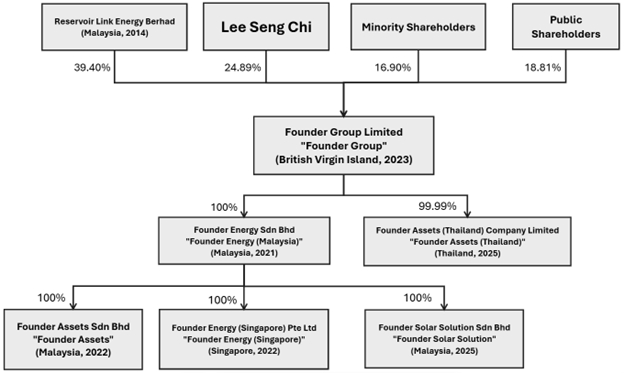
| * | Reservoir Link Energy Bhd. is ultimately controlled by its board of directors. See Note 2 under “Item 4. Information on the Company—E. Share Ownership.” |
Corporate Information
Our principal executive office is located at No. 17, Jalan Astana 1D, Bandar Bukit Raja, 41050 Klang, Selangor Darul Ehsan, Malaysia, and our phone number is +603-3358 5638. Our registered office in the BVI is located at Vistra Corporate Services Centre, Wickhams Cay II, Road Town, Tortola, VG1110, BVI. We maintain a corporate website at https://www.founderenergy.com.my. The information contained in, or accessible from, our website or any other website does not constitute a part of this annual report. Our agent for service of process in the United States is Cogency Global Inc.
B. Business Overview
Overview
We are a dedicated solar solutions provider in Malaysia, offering end-to-end services for commercial and industrial sectors, as well as large-scale solar power projects, encompassing project design, engineering, and comprehensive project management. Our primary focus is on two key segments: large-scale solar projects and commercial and industrial (C&I) solar projects.
Large-scale solar projects are utility scale solar PV power plants with installed generating capacity of 1 MWac or more. Large-scale solar projects are ground mounted and are designed to supply power to the power grid. For the majority of our large-scale solar projects, we usually act as the contractor to the project awarder, who is the main contractor for a solar project. As an EPCC provider, we assume most of the responsibility for the entire project lifecycle, from design and engineering to material procurement, construction, installation, integration, and commissioning. After the acceptance of our projects by our clients, we provide performance warranty during the defect liability period, which is typically 24 months. See “Item 4. Information on the Company—B. Business Overview—Our Services—Project Flow—Post-completion—Warranties and defect liabilities.” Our goal is to ensure seamless project execution, adhering to the highest industry standards and delivering optimal performance and reliability. For the fiscal years ended December 31, 2024, 2023, and 2022, our revenue generated from large-scale solar projects was RM68,864,991 (approximately US$15,387,105), RM131,988,574 (approximately US$28,746,286), and RM51,761,466, respectively, accounting for approximately 76%, 89%, and 82% of our total revenue for the respective years.
C&I projects are smaller scale solar projects where the solar PV systems are installed on rooftops and are designed to generate electricity for commercial and industrial properties for their own consumption, such as factories, warehouses and commercial stores. For C&I projects, we usually sign a service contract with the project owner and act as the main contractor. As the main contractor, we engage in comprehensive services encompassing project design, engineering, equipment procurement, construction, and commissioning. The C&I projects also come with a 24 month defect liability period and we provide performance warranty during this period. We ensure that our C&I projects are customized to meet the unique energy needs of each customer, providing them with efficient and sustainable solar solutions. For the fiscal years ended December 31, 2024, 2023, and 2022, our revenue generated from C&I projects was RM21,479,597 (approximately US$4,799,374), RM16,065,399 (approximately US$3,498,944), and RM11,748,000, respectively, accounting for approximately 24%, 11%, and 18% of our total revenue for the respective years.
Additionally, we offer operation and maintenance (“O&M”) services to our clients to ensure that the power plant and the solar PV system operate safely and continuously at its optimum capacity and historically have derived little revenue from these services.
In the fiscal years ended December 31, 2024, 2023, and 2022, our revenue reached RM90,344,588 (approximately US$20,186,479), RM148,053,973 (approximately US$32,245,230), and RM63,509,466, respectively, resulting in a negative growth rate of 39% from fiscal year 2023 to fiscal year 2024, and a growth rate of 133% from fiscal year 2022 to fiscal year 2023. In the same fiscal years, our net loss was RM5,150,005 (approximately US$ 1,150,711), net income of RM7,147,068 (approximately US$1,556,586), and RM3,943,506, respectively, resulting in a negative growth rate of 172% from fiscal year 2023 to fiscal year 2024, and 81% from fiscal year 2022 to fiscal year 2023.
Our Competitive Strengths
We believe the following competitive strengths are essential for our success and differentiate us from our competitors:
Excellent Track Records and Reputation
We are a dedicated solar solutions provider in Malaysia, offering end-to-end services for commercial and industrial sectors, as well as large-scale solar power projects, encompassing project design, engineering, and comprehensive project management. Since 2021, we have successfully delivered over 400Megawatt peak (MWp) solar power plants in Malaysia and have generated total revenue of approximately RM417 million (approximately US$93 million) as of December 2024. Thorough market diligence and strong relationships with suppliers, subcontractors, and financial institutions enable us to identify and pursue opportunities efficiently. Our internal processes, including supply chain management, project control, risk management, and quality monitoring, ensure seamless project execution. Our established networks and in-house engineering team provide us with a competitive edge, allowing us to secure bids and earn repeat orders.
We place great importance on our track record and market reputation, as they serve as strong indicators of our capabilities. We take pride in completing projects on time, with no claims of late completion as of the date of this annual report. Furthermore, we believe in the strong performance of our solar PV systems and power plants as we have not received any customers claims for the fiscal years ended December 31, 2022, 2023, and 2024, up to the date of this annual report. This underscores our commitment to delivering high-quality services and maintaining a strong market presence in the solar industry.
Proven Financial Performance
We have demonstrated proven financial performance and our revenue has grown from approximately RM63,509,466 in fiscal year 2022 to approximately RM148,053,973 (approximately US$32,245,230) in fiscal year 2023, representing an increase by 133%, and decreased from approximately RM148,053,973 (approximately US$32,245,230) in fiscal year 2023 to approximately RM90,344,588 (approximately US$20,186,479) in fiscal year 2024, representing a decrease by 39%. The loss was primarily due to a delay in the implementation of large-scale solar projects in 2024; however, most of these projects have resumed in 2025. The Company has maintained overhead costs to capitalize on future opportunities. Our net income has grown from approximately RM3,943,506 in fiscal year 2022 to approximately RM7,147,068 (approximately US$1,556,586) in fiscal year 2023, representing an increase by 81%, and decreased from approximately RM7,147,068 (approximately US$1,556,586) in fiscal year 2023 to net loss of approximately RM5,150,005 (approximately US$1,150,711) in fiscal year 2024, representing a decrease by 172%. We believe our strong growth and financial performance are attributed to our focus on risk management and reliance on clearly defined internal processes to manage our business. Furthermore, we have the ability to provide our customers with an extended credit term of up to 90 days, surpassing the typical 7-day offering by other solar industry providers.
A Dedicated Design and Engineering Team
Our operations are supported by a design and engineering team composed of six employees that is responsible for designing innovative and cost-effective solutions with an aim to increase the performance ratio of solar power projects. Our design and engineering team is engaged on our projects from the pre-bid stage through commissioning. At the pre-bid stage, our design and engineering team evaluate and provide innovative design solutions for each potential solar power project. Once we win the bid, they work with our project execution team to implement the designs and overcome challenges through design solutions. We believe that our design and engineering solutions, coupled with robust quality compliance checks and compliance tests on solar equipment, have helped us achieve contractually agreed performance ratio for the solar power projects we construct. In addition, our engineering team consists of engineers from multiple disciplines, including civil, mechanical and electrical, and is able to provide holistic solutions to our customers. This sets us apart from competitors who often specialize in a single engineering discipline.
An Experienced Management Team
Our management team, comprising our directors and executive officers, has played a very important role in promoting our growth in the past years and is expected to continue to do so in the future. We are led by a management team with extensive experience in the solar industry, deep understanding of project management and a proven track record of performance. Mr. Lee Seng Chi, our Director and Chief Executive Officer, has over 11 years of experience in the solar industry and held senior leadership positions in multiple engineering companies before he founded Founder Energy in 2021. Benefitting from the extensive experience of the management team, their strong relationships with our customers, and their strategy to focus on key markets for opportunities, we have been able to expand our market shares in Malaysia.
Our Growth Strategies
We intend to develop our business and strengthen brand loyalty by implementing the following strategies:
Expand Our Workforce.
As a solar facility installation company, we recognize the increasing demand for solar projects in the coming years. To effectively cope with this anticipated growth, one of our key strategies is to expand our workforce. To address increased demand, we plan to augment our workforce by recruiting skilled professionals with expertise in solar installation, project management, engineering, and maintenance. By expanding our team, we ensure that we have the necessary human capital to handle multiple projects simultaneously, maintain high-quality standards, and meet project deadlines efficiently. Additionally, we prioritize ongoing training and development programs to enhance the skills and knowledge of our existing workforce, ensuring they stay up-to-date with the latest advancements in solar technology and industry best practices.
In addition to internal resources, we also seek to establish strategic partnerships and collaborations with reputable contractors in the solar industry. By leveraging these external contractors, we can effectively scale our operations and meet the increased demand for solar projects. These partnerships enable us to access additional specialized expertise, equipment, and manpower when required, allowing us to take on larger and more complex projects with confidence.
Expand Our Investment in Renewable Energy Assets, Such as Solar PV Systems.
We believe expanding our investment in renewable energy assets, such as solar PV systems, will enable us to generate consistent recurring income for our Company. By investing in renewable energy assets, we diversify our revenue streams and reduce reliance solely on project-based installations. These assets provide a stable source of income through long-term power purchase agreements or feed-in tariffs, ensuring a predictable cash flow for our Company. Expanding our investment in renewable energy assets also aligns with our commitment to sustainability and the transition towards clean energy sources. By increasing our ownership of renewable energy projects, we contribute to the growth of the renewable energy sector and support the global shift towards a greener future.
Furthermore, investing in renewable energy assets allows us to leverage our industry expertise and capitalize on our knowledge of solar facility installation. We can apply our experience in selecting, developing, and managing these assets efficiently, maximizing their performance and profitability. In February 2023, our subsidiary Founder Assets entered into a deed of novation with another two Malaysian entities, party A and party B, whereby Founder Assets accepted the novation of all of party A’s rights, interests, obligations and liabilities under a power purchase agreement between party A and party B (the “PPA”). Under the PPA, party A agreed to develop, design, install, construct, own, operate and maintain a solar PV and party B agreed to purchase power generated from that solar PV system, for a term of 20 years. As of the date of this annual report, the project has been fully completed and is operating in compliance with all applicable laws. This marks a significant and pivotal step in our strategy to invest in renewable energy assets. However, as of the date of this annual report, Founder Assets has not yet received approval from the Energy Commission of Malaysia, and the Company is actively in the process of seeking written approval from the Energy Commission of Malaysia concerning changes in shareholding structure resulting from Founder Group’s IPO. See “Item 3. Key Information—D. Risk Factors—Risks Related to Our Business and Industry—If our subsidiary Founder Assets fails to secure approval from the Energy Commission of Malaysia, its business operations could be materially and adversely affected.”
Expand Our Business from Malaysia to Other Countries in the Southeast Asia region.
We recognize the significant untapped potential for solar energy in the Southeast Asia. Our strategy entails expanding our business presence in the region, with a specific focus on countries such as Vietnam and the Philippines. We plan to establish our presence in the Vietnam and the Philippines markets in the second quarter of 2025. We firmly believe that the market opportunity for large-scale solar, commercial and industrial (C&I), and residential solar services remains substantially untapped in Southeast Asia. To capitalize on this potential, we plan to strengthen our existing client relationships while actively seeking out new clients to accelerate our growth trajectory. Given the increasing demand for renewable energy and the supportive regulatory policies promoting solar energy as a cost-effective alternative to traditional electric utilities, we are strategically positioned to enter new markets in the near future. Singapore, Indonesia, and the Philippines are particularly attractive due to their high demand for sustainable energy solutions and conducive business environments.
By expanding our geographical footprint in Southeast Asia, we aim to seize the abundant growth opportunities in solar installation and contribute to the region’s renewable energy transition. Through our expertise, quality services, and strong client relationships, we believe we are well-positioned to establish ourselves as a trusted and reliable provider of solar solutions in these expanding markets.
Offer EPCC Services to Other Types of Renewable Energy, Such as Hydropower and Biogas.
Expanding our EPCC services to encompass other types of renewable energy, namely hydropower and biogas, is a strategic progression that capitalizes on our established expertise and solid reputation in the solar industry. Hydropower is a renewable energy method that generates electricity by harnessing the kinetic energy of flowing water through dams or rivers. Biogas, on the other hand, is produced by the anaerobic decomposition of organic matter, like agricultural waste or sewage, and can be used as a clean fuel. As the global movement towards sustainable energy gains momentum, we are determined to seize opportunities and further enhance our position in the renewable energy sector.
In line with this vision, we plan to venture into the hydroelectric power sector, which involves designing and constructing facilities that generate electricity from the power of moving water. Additionally, we plan to expand into the biogas sector, focusing on the utilization of agricultural waste to generate electricity through the harvesting of biogas. By diversifying our offerings, we intend to tap into new avenues of growth and extend our reach within the renewable energy landscape. We plan to kickstart these initiatives in the second quarter of 2025, showcasing our commitment to meeting the evolving needs of the renewable energy market. This strategic expansion aligns with our mission to contribute to the global transition towards clean and sustainable energy sources. We are excited to embark on these ventures, leveraging our existing strengths and fostering innovation in renewable energy construction to drive further success and make a positive impact on the future of energy.
Our Business Model
We currently generate revenue from the following principal sources:
| ● | Large-scale Solar Project Services.We generate a significant portion of our revenue by providing comprehensive EPCC services for large-scale solar projects. These projects involve utility-scale solar PV power plants with an installed generating capacity of at least 1 MWac. The electricity generated from these projects is supplied to the power grid and sold to local utility company. |
| ● | C&I Project Services. We also generate revenue by offering EPCC services for C&I solar projects. These projects involve smaller power generating facilities. The electricity generated from C&I projects primarily serves the customers’ own consumption, with any surplus supplied to the power grid. Typically, these solar systems are installed on the rooftops of commercial and industrial buildings. We provide end-to-end solutions for C&I projects, catering to the specific requirements of our customers in this sector. |
The following table presents our revenue and gross profit for the fiscal years ended December 31, 2022, 2023, and 2024. See also “Item 5. Operating and Financial Review and Prospects—A. Operating Results.”
| Revenue | ||||||||||||||||
| Fiscal Years Ended December 31, | ||||||||||||||||
| 2022 | 2023 | 2024 | 2024 | |||||||||||||
| RM | RM | RM | USD | |||||||||||||
| Large-scale Solar Project Services | RM | 51,761,466 | RM | 131,988,574 | RM | 68,864,991 | $ | 15,387,105 | ||||||||
| C&I Project Services | RM | 11,748,000 | RM | 16,065,399 | RM | 21,479,597 | $ | 4,799,374 | ||||||||
| Total | RM | 63,509,466 | RM | 148,053,973 | RM | 90,344,588 | $ | 20,186,479 | ||||||||
| Gross Profit | ||||||||||||||||
| Fiscal Years Ended December 31, | ||||||||||||||||
| 2022 | 2023 | 2024 | 2024 | |||||||||||||
| Large-scale Solar Project Services | RM | 6,385,519 | RM | 15,823,226 | RM | 3,455,338 | $ | 772,057 | ||||||||
| C&I Project Services | RM | 2,298,847 | RM | 2,029,721 | RM | 2,787,132 | $ | 622,753 | ||||||||
| Total | RM | 8,684,366 | RM | 17,852,947 | RM | 6,242,470 | $ | 1,394,810 | ||||||||
Our Services
Overview
We are principally engaged in providing EPCC services for large-scale solar projects and C&I projects. Both large-scale solar projects and the C&I projects are connected to the power grid.
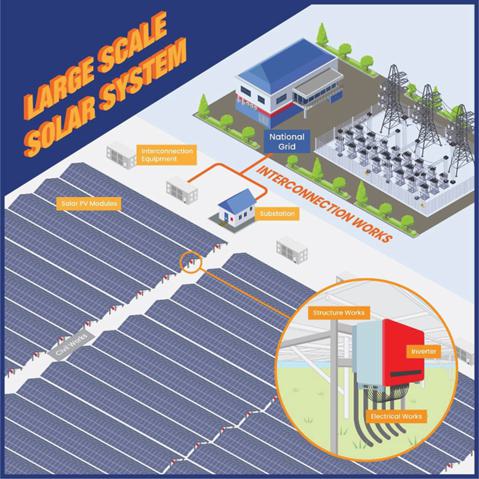
A Typical Large-Scale Solar System
As a provider of EPCC services for large-scale solar projects and C&I projects, our scope of work mainly comprises the following:
| ● | Engineering and design, from initial conceptualization up to detailed system design. This includes designing the solar PV array and balance of system, including inverters, transformers and interconnection to the power grid where relevant; |
| ● | Procurement of all construction materials and equipment for the solar PV facilities, including solar PV modules and balance of systems; |
| ● | Construction, including civil, structural, mechanical and electrical works, installation and integration of equipment, and interconnection to the power grid, if required by the clients; and |
| ● | Commissioning, including testing of individual equipment and systems, and testing of the newly installed solar PV facilities. |
For a detailed discussion on the scope of work of our EPCC services, please refer to “—Project Flow” below.
Process Flow
The general process flow of our large-scale solar projects and C&I projects is depicted in the diagram below:
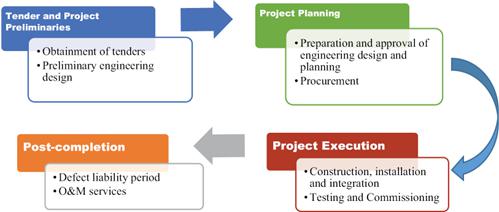
Tender and Project Preliminaries
Most of our projects are obtained through a competitive tendering process. Once we receive a tender from clients, we promptly initiate site visits to assess the actual site conditions and determine the most suitable installation methods. We then diligently prepare and present our clients with preliminary engineering designs, encompassing detailed engineering drawings, project schedules, and competitive tender prices.
Project Planning
Upon securing a letter of award or contract and taking possession of the site, we will conduct site survey and commence detailed engineering design and project planning to ensure we meet the project milestones that are stipulated in the letter of award or the contract.
Simultaneously, we proactively engage with local authorities to secure the required licenses and permits essential for the construction work. Additionally, we ensure the procurement of necessary insurance coverage, including Contractor All-risk insurance for all of our projects, and Comprehensive General Liability and Workmen Compensation insurance, if so required, to mitigate potential risks during project execution.
Engineering design and planning
In the engineering design and planning phase, we typically expand our preliminary engineering design to provide a detailed design together with construction drawings and specifications and method of statements, which outlines the step-by-step procedures and methodology to be followed for executing the solar project. The construction drawings cover the following aspects:
| ● | Detailed layout of solar PV module configuration into array including string and module grouping, orientation and inclination of solar PV modules, row spacing, cabling and wiring, sizing of nominal power ratio, as well as inverter and grid interconnection design. For example, the mounting system is key in optimizing the orientation of the solar PV modules as it affects the energy yield generated by placing the solar PV modules to obtain the optimum amount of sunlight throughout the year. |
| ● | Direct current (“DC”) system design takes into consideration the selection and sizing of equipment such as connectors, combiner boxes, distribution boards, as well as the lengths and sizes of cables. |
| ● | Alternating current (“AC”) system design takes into consideration the inverters output to the interconnection and metering point. This also includes selection of transformers, interconnection schematic designs, and lengths and sizes of cables. |
As for large-scale solar projects, we also undertake project planning and scheduling taking into consideration the following aspects:
| ● | Infrastructure planning which covers access roads and internal pathways, boundary of the plant, levelling and grading, storm water drainage, water supply and storage system, cabling routes and location of substation, and others including security and surveillance systems, and firefighting system. |
| ● | Structural and civil engineering relating to foundation design for mounting system, construction of structures to house inverters, transformers and related electrical equipment, and control room. |
Procurement
Once the detailed engineering design and specifications are completed, we commence procurement of all required equipment as well as construction materials from third-party suppliers. We are responsible for procuring the following equipment:
| ● | Solar PV modules; and |
| ● | Balance of system such as mounting systems, inverters, transformers, switchgears, electrical distribution, protection and control devices, cables, SCADA system and interconnection equipment. (SCADA system refers to supervisory control and data acquisition, a centralized computer system that obtains real time information on the operations of plant, systems and equipment for the purpose of monitoring and controlling the operations.) |
For large-scale solar projects, our clients can choose to source and procure the equipment and construction materials by themselves, while for C&I projects, we are usually responsible for all the equipment and materials. We will ensure that the key equipment and products pass the factory acceptance test at the manufacturer’s facilities before they are delivered to our project sites. In addition, at this stage, we will also select and engage subcontractors to carry out the physical construction and installation works. For a single large-scale solar project, we usually engage several subcontractors, whereas a C&I project usually just requires one or two subcontractors.
Project execution
The project execution phase mainly involves construction, installation and integration works, testing and commissioning.
Construction, installation and integration
The physical construction and installation works are carried out by subcontractors that we have selected. We are mainly involved in project management, site supervision, quality and safety assurance and monitoring the construction, installation and integration process for large-scale solar projects and C&I projects where applicable. This is to ensure that work carried out by subcontractors are in line with our design and technical specifications as well as project timeline and meet the relevant standards and regulatory compliance. In this respect, we outsource the following subcontracted works:
| ● | Earthwork, Civil and structural works on the site for large-scale solar projects including site preparation such as levelling and soil compaction, construction of access roads and pathways, drainage system, cable ducts and trenches, and perimeter fencing, as well as piling and foundation works for the mounting system; |
| ● | Building works for large-scale solar projects including construction of control rooms and other structures to house or support the inverters and transformer; |
| ● | Mechanical works including construction of mounting system and assembly of metal-based support structure; and |
| ● | Electrical and communication works including: |
| ● | Solar PV module assembly and connection to balance of system including SCADA system; |
| ● | DC and AC cabling; |
| ● | Installation of earthing and lightning protection systems; |
| ● | Installation of inverters and related electrical equipment such as distribution control and protection systems; |
| ● | Installation of security and monitoring systems; and |
| ● | Installation of communication systems for internal and remote control and monitoring systems. |
As for the interconnection to the nearest power grid substation for large-scale solar projects, we engage subcontractors to perform the physical construction of the substation and installation including laying of cables. This will be based on our design and technical specifications. To interconnect to the power grid substation, we commonly have to procure and install switchgears and transformers, SCADA system, grid interface devices, and low/medium voltage power cables. During this process, we, together with project awarders, will liaise directly with TNB to ensure that the interconnection facilities meet the requirements of the grid connection point.
Testing and commissioning
System checking and inspection: Upon the completion of installation and integration of solar PV modules and balance of system, we will facilitate system checking and inspection on the installation against the as-built documents, as well as inspection and testing of the solar PV modules and the balance of system such as functional tests of inverters.
Testing and commissioning: Upon the completion of system checking and inspection, we will commence system testing and commissioning for the initial operation date which is the date where electricity output is first generated and derived from the facility to the power grid, followed by verification for commercial operation date (“COD”).
As part of our testing and commissioning process, we carry out various tests in compliance with the following:
| ● | “Procedure for Testing and Commissioning of Grid Connected Photovoltaic System in Malaysia” by Sustainable Energy Development Authority Malaysia; and |
| ● | Testing and commissioning work as set out under the “Guidelines on Large Scale solar Photovoltaic Plant for Connection to Electricity Networks” by the Energy Commission Malaysia. |
For C&I projects, the testing results will be submitted to the local authority for verification, approval and issuance of solar system generating license.
For large-scale solar projects, we also liaise directly with relevant parties to notify them and TNB that the interconnection facilities are ready to be commissioned. Prior to that, our technical team will prepare the submission papers and furnish the relevant documentation to TNB.
Finally, we will make arrangement with an approved independent engineer by the Energy Commission of Malaysia together with our customer or plant owner, the Energy Commission Malaysia and TNB to witness the connection of solar PV power plant to the power grid. Some of the tests to be performed are as follows:
| ● | Inspection of the solar PV modules and inverters; |
| ● | Acceptance testing of the entire solar PV installation; |
| ● | Performance ratio test; and |
| ● | Power quality measurements to be captured at the connection point to ascertain the power quality before and after the commissioning. |
Upon completion of testing and commissioning, we will prepare the relevant final testing reports to the Energy Commission of Malaysia and TNB for the confirmation of COD. We will then handover the site to our customer.
Post-completion
Warranties and defect liabilities
After the acceptance of our projects by our clients, the following types of warranties are offered:
| ● | Performance warranty on the large-scale solar projects and C&I projects. |
We provide performance warranty for the large-scale solar projects and C&I projects which is specified in the form of minimum performance ratio that can be achieved as stipulated in our EPCC contract during the defect liability period, which is typically 24 months. The performance ratio is a measurement of the efficiency of a solar PV system or power plant, indicated by the ratio of the actual solar PV energy output as compared to the theoretical output.
| ● | Performance warranty of solar PV modules. |
The solar PV module performance warranty is provided by the manufacturer of the solar PV modules.
| ● | Product warranty of certain main components. |
The product warranty of various main components of the solar PV facilities are provided by their respective manufacturers.
In addition, there is a defect liability period, which is typically 24 months after the acceptance of our EPCC works for solar systems and power plants, and we are responsible to make good and rectify any defects for our EPCC works during this period.
O&M services
In addition to the 24-month defect liability period, we also offer our clients operation and maintenance (“O&M”) services. We will enter into a separate O&M service agreement with our clients who opt for this additional service and the contract term is usually 1 year or more. The function of O&M services is to ensure that the power plant and the solar PV system operate safely and continuously at its optimum capacity. Part of our O&M activities include providing performance monitoring and evaluation of the solar PV power plant. We use a SCADA system to enable remote real time monitoring as well as collect operational and performance data. Optimization checks are also performed by comparing operational data collected against the theoretical performance of the installation as stated in the detailed design layout.
In order to minimize downtime or operational inefficiencies of a solar PV system or solar PV power plant due to equipment failure, we will carry out preventive maintenance as well as corrective maintenance. Preventive maintenance is scheduled maintenance that is carried out at pre-determined intervals to prevent system faults and equipment failures from occurring. Corrective maintenance is unscheduled maintenance that is carried out when there is an equipment or system failure. When such an event occurs, our technical team will identify and locate the cause of the failure and rectify the problem to bring the equipment or system back to normal operating conditions.
Our Solar Projects
Completed solar projects
For the fiscal years ended December 31, 2022, 2023, and 2024, our material completed solar projects are as follows:
| Large-Scale Solar Projects | ||||||||||||||
| Project # |
Customer Name/Type |
Type of Facility |
Scope of Work | Location | Capacity (MWac) |
Contract (MYR |
Start Date/ Completion Date |
|||||||
| 1 | Customer A | Ground-mounted | Engineering, Construction and Commissioning | Perak, Malaysia | 10.95 | 14.90 | 03/11/2022 05/30/2023 | |||||||
| 2 | Customer B | Ground- mounted | Supply of PV Mounting Structure | Terengganu, Malaysia | 100.00 | 20.50 | 05/12/2021 12/07/2021 | |||||||
| 3 | Customer A | Ground- mounted | Supply of PV Mounting Structure | Kedah, Malaysia | 20.76 | 5.30 | 05/24/2022 09/30/2022 | |||||||
| 4 | Customer C | Ground- mounted | PV structure and module installation | Pinang, Malaysia | 10.00 | 1.00 | 06/15/2022 04/10/2023 | |||||||
| 5 | Customer D | Ground- mounted | Piling, Mechanical & Photovoltaic Installation Works | Perak, Malaysia | 100.00 | 2.77 | 04/14/2021 12/11/2022 | |||||||
| 6 | Customer A | Ground- mounted | Engineering, Procurement, Construction and Commissioning | Selangor, Malaysia | 13.00 | 10.18 | 08/24/2022 11/14/2023 | |||||||
| 7 | Customer G | Ground- mounted | Engineering, Construction and Commissioning | Perak, Malaysia | 25.00 | 16.75 | 09/06/2022 08/25/2023 | |||||||
| 8 | Customer F | Ground- mounted | Engineering, Procurement, Construction and Commissioning | Perak, Malaysia | 15.00 | 4.00 | 10/25/2022 03/31/2024 | |||||||
| 9 | Customer F | Ground- mounted | Engineering, Procurement, Construction and Commissioning | Perak, Malaysia | 10.00 | 3.82 | 12/16/2022 03/31/2024 | |||||||
| 10 | Customer H | Ground- mounted | Civil works | Perlis, Malaysia | 50.00 | 4.00 | 03/30/2023 03/31/2024 | |||||||
| 11 | Customer B | Ground- mounted | Installation, testing and commissioning of PV modules, inverters, DC cables and associated works | Terengganu, Malaysia | 100.00 | 8.46 | 09/13/2021 06/30/2024 | |||||||
| 12 | Customer D | Ground- mounted | Civil works and Structure, Mechanical and Electrical works | Kedah, Malaysia | 50.00 | 21.00 | 08/08/2023 09/25/2024 | |||||||
|
C&I Projects |
||||||||||||||
| Project # |
Customer Name/Type |
Type of Facility |
Scope of Work | Location | Capacity (MWac) |
Contract Value (MYR Million) |
Start Date/ Completion Date |
|||||||
| 1 | Customer E | Rooftop | Engineering, Procurement, Construction and Commissioning | Pinang, Malaysia |
1.50 | 5.13 | 10/31/2022 05/10/2023 | |||||||
| 2 | Customer I | Rooftop | Engineering, Procurement, Construction and Commissioning | Selangor, Malaysia |
2.65 | 0.35 | 05/20/2021 10/28/2021 | |||||||
On-going solar projects
As of the date of this annual report, our material on-going solar projects are as follows:
| Large-Scale Solar Projects | ||||||||||||||
| Project # |
Customer Name/Type |
Type of Facility |
Scope of Work | Location | Capacity (MWac) |
Contract Value (MYR million) |
Start Date/ Expected Completion Date |
|||||||
| 1 | Customer J | Ground- mounted |
Engineering, Procurement, Construction and Commissioning | Selangor, Malaysia | 10.88 | 20.00 | 06/21/2024 06/30/2025 | |||||||
| 2 | Customer J | Ground- mounted |
Civil works and Structure, DC and AC and associated works |
Selangor, Malaysia | 9.99 | 20.00 | 01/02/2025 06/30/2025 | |||||||
| 3 | Customer K | Ground- mounted |
DC Works | Selangor, Malaysia | 11.8 | 4.40 |
10/15/2024 07/31/2025 |
|||||||
|
C&I Projects |
||||||||||||||
| Project # |
Customer Name/Type |
Type of Facility |
Scope of Work | Location | Capacity (MWac) |
Contract Value (MYR million) |
Start Date/ Expected Completion Date |
|||||||
| 1 | Customer E | Rooftop | Engineering, Procurement, Construction and Commissioning | Kedah, Malaysia | 2.26 | 9.25 |
09/02/2024 03/01/2025 |
|||||||
| 2 | Customer L | Rooftop | Engineering, Procurement, Construction and Commissioning | Melaka, Malaysia | 4.98 | 16.56 |
01/03/2025 10/02/2025 |
|||||||
| 3 | Customer L | Rooftop | Engineering, Procurement, Construction and Commissioning | Selangor, Malaysia | 3.28 | 11.60 |
01/03/2025 10/02/2025 |
|||||||
| 4 | Customer M | Rooftop | Supply, Deliver, Install, Testing and Commissioning | Perak & Kelantan & Johor, Malaysia | 0.34 | 1.20 |
04/04/2024 05/14/2025 |
|||||||
| 5 | Customer L | Rooftop | Engineering, Procurement, Construction and Commissioning | Selangor, Malaysia | 0.80 | 2.81 |
01/03/2025 07/02/2025 |
|||||||
Quality Control
Quality control is a paramount aspect of our operations as a solar PV facilities EPCC service provider. We recognize the significance of ensuring high-quality standards in both the equipment and materials we procure from suppliers, as well as the overall project execution, particularly for the work outsourced to external parties. To achieve this, we have established a comprehensive quality control framework.
Our approach to quality control encompasses two primary aspects. Firstly, we place great emphasis on the selection and procurement of equipment and materials from trusted suppliers. We thoroughly evaluate suppliers based on their track record, reputation, and adherence to quality standards. By partnering with reliable suppliers, we can ensure that the components used in our projects meet stringent quality requirements, contributing to the long-term performance and durability of the solar PV facilities.
Secondly, we implement rigorous project quality control measures to maintain high standards throughout the execution phase. We have developed a robust project quality plan that outlines our quality management system and processes. This plan includes comprehensive management procedures and forms, as well as project-specific procedures and plans tailored to each individual project.
Our quality control framework is designed to ensure adherence to industry best practices, regulatory requirements, and customer specifications. It encompasses various stages of the project lifecycle, including design, procurement, construction, installation, and commissioning. Through meticulous inspections, regular audits, and adherence to strict quality guidelines, we strive to deliver projects that meet or exceed the expectations of our clients.
Our Customers
Our customer base consists primarily of two types: project owners and project awarders. Project owners include developers or owners of utility-scale solar PV power plants for large-scale solar projects, or owners of solar system for C&I projects. On the other hand, project awarders are service providers or main contractors who secure solar project bids from project owners and then subcontract the work to subcontractors. In the case of C&I projects, the majority of our customers are project owners, while for large-scale solar projects, the majority of our customers are project awarders. For the fiscal years ended December 31, 2022, 2023, and 2024, revenue generated from servicing project owners was RM14,450,456, RM7,687,059 (approximately US$1,674,193), and RM13,128,870 (approximately US$2,933,498), respectively, accounting for 23%, 5%, and 15% of our total revenue, respectively. For the fiscal years ended December 31, 2022, 2023, and 2024, revenue generated from servicing project awarders was RM49,059,010, RM140,366,913 (approximately US$30,571,036), and RM77,215,718 (approximately US$17,252,981), respectively, accounting for 77%, 95%, and 85% of our total revenue.
Below is a list of the major customers and the percentages each of them individually accounted for our annual total revenue, during the fiscal years ended December 31, 2022, 2023, and 2024.
| For fiscal year 2022 | ||||
| Customer Name | Main Types of Services Provided | % of Total Revenue | ||
| Customer I | Supply of mounting structure and construction services | 39.67% | ||
| Customer II | Construction services | 10.79% | ||
| Customer III | Supply of mounting structure and construction services | 9.52% | ||
| For fiscal year 2023 | ||||
| Customer Name | Main Types of Services Provided | % of Total Revenue | ||
| Customer I | Supply of mounting structure and construction services | 29.88% | ||
| Customer III | Supply of mounting structure and construction services | 15.61% | ||
| Customer IV | Supply of mounting structure and construction services | 10.60% | ||
|
For fiscal year 2024 |
||||
| Customer Name | Main Types of Services Provided | % of Total Revenue | ||
| Customer V | Construction services | 23.25% | ||
| Customer III | Supply of mounting structure and construction services | 11.55% | ||
| Customer VI | Supply of mounting structure and construction services | 9.56% | ||
For fiscal year 2024, we derived a significant portion of our revenue from Customer V, which contributed 23.25% of our total revenue. That was mainly because in fiscal year 2024, we secured a large-scale solar project of 50MWac from Customer V. For fiscal year 2023, we derived a significant portion of our revenue from Customer I, which contributed 29.88% of our total revenue. That was mainly because in fiscal year 2023, we secured several large-scale solar project totaling 112.0 MWac from Customer I. Similarly, for fiscal year 2022, we derived a significant portion of our revenue from Customer I, which contributed 39.67% of our total revenue. That was mainly because in fiscal year 2022, we secured a large-scale solar project of 44.7 MWac from Customer I.
In general, we are not dependent on any customers for business given the unlikelihood of our customers undertaking solar PV projects on a recurring basis. Therefore, our EPCC services for large-scale solar projects and C&I projects would not be required repeatedly. Please see “Item 3. Key Information—D. Risk Factors—Risks Related to Our Business and Industry—We face risks associated with concentration of revenue from a few large clients. Any interruption in operations in such major clients may have an adverse effect on our business, financial condition, and results of operations.”
Our Suppliers
Our supplier network comprises two primary types: equipment suppliers and subcontractors. In solar projects where we assume responsibility for procuring all project materials and equipment, we source and acquire these items from trusted suppliers. Our equipment suppliers are manufacturers of solar components, including but not limited to solar panels, mounting systems and cables. Additionally, we collaborate with subcontractors for the construction and installation aspects of a solar PV project. These subcontractors possess the expertise and experience needed to carry out the construction and installation work. Maintaining strong relationships with both equipment suppliers and subcontractors is vital to our operations. We carefully select our suppliers based on their track record, product quality, and adherence to industry standards. Likewise, we engage subcontractors who demonstrate a proven ability to deliver projects on time and to specifications.
Below is a list of the major suppliers and the percentages each of them individually accounted for our annual total purchase, during the fiscal years ended December 31, 2022, 2023, and 2024.
| For fiscal year 2022 | ||||
| Supplier Name | Main Types of Services Provided | % of Total Purchase | ||
| Solar First Energy Technology Co. Ltd. | Mounting structure | 29.51% | ||
| Xiamen Solar First Energy Technology Co. Ltd. | Mounting structure | 17.60% | ||
| Supplier C | Subcontracting works | 10.12% | ||
|
For fiscal year 2023 |
||||
| Supplier Name | Types of Products/Services Provided | % of Total Purchase | ||
| Solar First Energy Technology Co. Ltd. | Mounting structure | 16.00% | ||
| Xiamen Solar First Energy Technology Co. Ltd. | Mounting structure | 13.72% | ||
|
For fiscal year 2024 |
||||
| Supplier Name | Types of Products/Services Provided | % of Total Purchase | ||
| Solar First Energy Technology Co. Ltd. | Mounting structure | 14.88% | ||
In fiscal years 2022 and 2023, a significant portion of our purchase was from Xiamen Solar First Energy Technology Co. Ltd., representing 17.60% and 13.72% of our total purchase for fiscal years 2022 and 2023, respectively. In June 2021, by way of a deed of novation, we entered into a distributorship agreement with Xiamen Solar First Energy Technology Co. Ltd. and became its exclusive distributor of solar mounting systems in Malaysia. The distributorship agreement was effective until January 1, 2025. We did not renew the distributorship agreement; however we are still able to make purchases from Xiamen Solar First Energy Technology Co. Ltd. on an as needed basis. As of the date of this annual report, all of the mounting systems that we sourced have been purchased from Xiamen Solar First Energy Technology Co. Ltd and its affiliate Solar First Energy Technology Co. Ltd. For other types of equipment and materials, we source and purchase from third-party suppliers on the market. Please see “Item 3. Key Information—D. Risk Factors—Risks Related to Our Business and Industry—We are exposed to risks related to concentration of suppliers as we rely on a few major suppliers, and it may have a material adverse effect on our business and results of operations.”
Sales and Marketing
As of the date of this annual report, our sales and marketing team is comprised of three sales managers and two business development managers, who report directly to our CEO. Our sales and marketing department is primarily responsible for increasing our market share through acquiring new customers and businesses as well as furthering existing customer relationships through better service support and the provision of after-sales services to our customers. We are also able to generate sales leads through referrals from customers, suppliers and business associates.
We believe that maintaining good relationships with our existing customers will allow us to market our services to meet their evolving demands. We carry out the following marketing activities to acquire new customers and to promote our services to existing customers:
Participating in Exhibitions
As part of our marketing strategy, we actively participate in relevant exhibitions held annually in Malaysia and China, such as International Greentech & Eco Products Exhibition and Conference Malaysia (IGEM)) and Metaltech. IGEM is the leading trade events for green technologies and eco solutions in Asia. Through attending the exhibition, we have developed business contacts which have enabled us to expand our customer base and grow our business. We have also been able to create a more prominent profile, identify potential customers and keep ourselves updated on the industry trends through these exhibitions.
Approaching project awarders and project owners
Our marketing approach also involves targeted outreach to project awarders, complemented by effective follow-up through emails and phone calls. In Malaysia, many project awarders are listed companies that frequently announce tenders through public announcements. Therefore, it is crucial for us to devise a well-defined strategy for approaching and nurturing relationships with these organizations. By emulating this approach, we have been successfully securing a number of contracts and projects.
Currently, we have also implemented a targeted approach that involves directly reaching out to project owners by participating in their tenders. This strategy allows us to demonstrate our expertise, build trust, and establish a solid foundation for a fruitful business relationship. Our targeted approach ensures that we connect directly with the decision-makers, maximizing our chances of securing new contracts and projects. We continuously refine and adapt our marketing strategy to stay competitive and meet the evolving needs of the industry.
Networking with key stakeholders for business opportunities
In our marketing strategy, we actively engage in networking with industry stakeholders, such as financial institutions and suppliers to boost business opportunities. Financial institutions, as providers of corporate financing, possess valuable insights into potential clients who may benefit from our services. By cultivating relationships with these institutions, we gain access to a network of potential clients and valuable referrals. Similarly, suppliers within our industry often have firsthand knowledge of ongoing projects and the organizations involved. Through strategic networking with suppliers, we tap into their insights and leverage their connections to identify potential clients who may require our expertise. By fostering mutually beneficial relationships with suppliers, we create opportunities for collaboration and referrals that can lead to new business ventures. By leveraging these connections, we approach potential clients with precision, fostering long-term business growth.
Moving forward, we plan to launch series of new marketing activities to expand our brand awareness. We will establish a robust social media presence to engage with our targeted clients effectively. Additionally, we will seek partnership with external organizations, such as equipment manufacturers, to leverage their reach and promote our brand to a wider audience.
Approvals, Permits and Licenses
In Malaysia, we must obtain several approvals, permits and licenses to operate within the framework set by the Sustainable Energy Development Authority (“SEDA”) Malaysia, Energy Commission of Malaysia (“ST”), and Malaysia Construction Industry Development Board (“CIDB”). We will also be subject to approvals, permits or licenses requirements in Singapore, Indonesia and the Philippines, if we expand our business into those markets in the future. As of the date of this annual report, we have obtained the following licenses and permits:
| Subsidiary | License/Permit | Issuing Entity | Valid Through | |||
| Founder Energy (Malaysia) | Registration of photovoltaic service provider | SEDA | December 31, 2025 | |||
| Founder Energy (Malaysia) | Registration of Contractor for Grade G7 | CIDB | September 27, 2025 | |||
| Founder Energy (Malaysia) | Registration of Electrical Contractor | ST | July 3, 2025 | |||
| Founder Assets | Registered Solar Photovoltaic Investor under NEM Program | SEDA | December 31, 2025 | |||
| Founder Assets* | License for Public Installation under Energy Commission of Malaysia | ST | September 15, 2033 |
| * | This license imposes restriction on changes in shareholders and shareholding structure of the licensee (Founder Assets). Founder Assets is in the process of seeking written approval from the Energy Commission of Malaysia, regarding the shareholding structure change as a result of Founder Group’s IPO. See “Item 3. Key Information—D. Risk Factors—Risks Related to Our Business and Industry—If our subsidiary Founder Assets fails to secure approval from the Energy Commission of Malaysia, its business operations could be materially and adversely affected.” |
We plan to renew the above permits or licenses before expiration.
Competition
The solar energy industry in Southeast Asia is highly competitive and rapidly evolving, with many new companies joining the competition in recent years and few leading companies. We, as an EPCC service provider for solar facilities, face direct competition from other EPCC providers, as well as from traditional energy firms and companies offering alternative energy solutions. To effectively compete in this landscape, several crucial factors come into play. These include delivering high-quality projects, providing exceptional customer experiences, ensuring the retention of skilled professionals, adapting to evolving technology and customer preferences, and establishing a strong brand presence. While we believe our company is well-positioned to thrive based on these factors, we acknowledge that certain competitors may possess longer operating histories, greater financial and technical resources, or stronger brand recognition. These factors could present challenges and affect our market share and overall competitive position. For a discussion of competition-related risks, please see “Item 3. Key Information—D. Risk Factors—Risks Related to Our Business and Industry—The markets in which we operate are highly competitive, and we may not be able to compete successfully against existing or new competitors, which could reduce our market share and adversely affect our competitive position and financial performance.”
Intellectual Property and Technology
As of the date of this annual report, we do not have any registered trademarks, patents or copyrights. We have one domain name in Malaysia: founderenergy.com.my, which was registered on May 21, 2021.
We do not employ any special technologies in our business operations. However, we utilize software tools for our solar construction business, including PVsyst, HelioScope and AutoCAD. These tools help us optimize design, analyze system performance, and create accurate construction plans, enhancing efficiency and precision in our operations.
Employees
As of December 31, 2024, 2023 and 2022, we had 82, 45, and 29 full-time employees, respectively. The following table sets forth the number of our full-time employees as of December 31, 2024:
| Function: | Number | |||
| Management | 2 | |||
| Sales and Marketing | 8 | |||
| Technical | 63 | |||
| Finance and Accounting | 5 | |||
| General and Administration | 4 | |||
| Total | 82 | |||
We enter into employment contracts with a confidentiality clause with our full-time employees.
We believe that we maintain a good working relationship with our employees, and we have not experienced material labor disputes in the past. None of our employees are represented by labor unions.
Facilities
Our principal executive office is located at No.17, Jalan Astana 1D, Bandar Bukit Raja, 41050 Klang, Selangor Darul Ehsan, Malaysia, with a lease term from August 1, 2024 to July 31, 2026 and a monthly rent of MYR26,000, pursuant to a tenancy agreement we entered into with the landlord, who is our Director and CEO Mr. Lee Seng Chi. We plan to renew this lease before expiration.
We also lease part of a warehouse from an independent third party to store our inventory, which is located at Lot 15156, Jalan Sg Tengkorak Kg Hamid Tuah, Telok Gong, 42000, Pelabuhan Klang, Selangor Darul Ehsan, Malaysia. The occupied area varies on a monthly basis depending on our operational demand and the rental rate is RM1.60 per month per square foot occupied. We did not enter into a lease agreement with the landlord and the lease is renewed on a monthly basis.
We believe that the office and the warehouse that we currently lease are adequate to meet our needs for the foreseeable future.
Insurance
To mitigate risks across different aspects of our operations and to ensure comprehensive coverage, we maintain various insurance policies and we believe the insurance coverage we maintain is in line with industry norms. As of the date of this annual report, we maintain the following insurance policies:
| ● | A business property insurance with an effective date from March 12, 2025 to March 11, 2026, which covers the loss or damage of our physical property, including furniture, fixtures, office equipment, tools and other items of value. |
| ● | An equipment insurance with an effective date from February 25, 2025 to February 24, 2026, which provides protection for our equipment; |
| ● | A group hospital & surgical insurance with an effective date from October 20, 2024 to October 19, 2025, which provides medical protection for our employees; |
| ● | A group personal accident insurance with an effective date from September 23, 2024 to September 22, 2025, which provides protection for our employees; and |
| ● | Directors and officers liability insurance for our directors and senior management. |
In addition, under our contracts with project awarders, we are required to obtain certain necessary insurance coverage, including Contractor All-risk insurance for all of our projects, and Comprehensive General Liability and Workmen Compensation insurance, if so required, to mitigate potential risks during project execution.
Seasonality
We do not experience any material seasonality in our business as the demand for our services are not subject to seasonal fluctuations.
Regulations
Regulations Relating to Our EPCC Services in Malaysia
Renewable Energy Act 2011
The Renewable Energy Act 2011 (“REA 2011”) provides for most matters relating to the generation of renewable energy in Malaysia, including specifying (i) the criteria and process for obtaining a feed-in approval and implementation of a special tariff system, (ii) the technical and operational requirements of renewable energy projects and (iii) the qualifying criteria for renewable energy sources. The Sustainable Energy Development Authority (“SEDA”) is tasked with overseeing matters relating to renewable energy falling within the scope of the REA 2011.
Pursuant to Rule 23 and Schedule 5 of Renewable Energy (Technical and Operational Requirements) Rules 2011 (“RETOR Rules 2011”), a person who carries out the works in connection with PV installations under the Feed-In Tariff programme should possess the requisite qualifications, such as having a certificate of competency issued by the Energy Commission under the Electricity Supply Act 1990, being registered with the Board of Engineers Malaysia as a professional electrical engineer, having certificate of training on solar PV systems issued by SEDA and/or in the event such person carries out solar PV system design work, having certificate in solar PV system design from any institution that is recognised by SEDA. Any person who commits an offence under the RETOR Rules 2011 shall, on conviction, be liable to a fine not exceeding RM300,000 or to imprisonment for a term not exceeding 3 years, or both. If a body corporate commits an offence, the person who at the time of the offence was a director, chief executive officer, chief operating officer, manager, secretary or other similar officer of the body corporate or one purporting to act in any such capacity or was responsible for the management of any of the affairs of the company or was assisting in such management, may be charged severally or jointly in the same proceedings as the company, and if the company is found guilty, the said person shall be deemed guilty of that offence unless he proves that the offence was committed without his knowledge, consent or connivance and that all reasonable precautions and due diligence were exercised to prevent the offence.
The Energy Commission had also issued the Guidelines on Solar Photovoltaic Installation on Net Energy Metering (“NEM”) Scheme under the Electricity Supply Act 1990 for the implementation of the solar PV installation on the NEM program (“NEM Guidelines”). The NEM Guidelines set out, amongst others, the design criteria and requirements, types of installation, capacity limit and application process of solar PV installations under NEM programmes.
As of the date of this annual report, Founder Energy (Malaysia) is certified by SEDA as a PV service provider to participate in any programme under the REA 2011 and Founder Assets is certified by SEDA as a solar PV investor under NEM Program.
As of the date of this annual report, we are in compliance with all material aspects of the REA 2011 and all rules and regulations made thereunder for the conduct and performance of our business operations.
Electricity Supply Act 1990
The Electricity Supply Act 1990 (“ESA 1990”) which applies throughout Malaysia, regulates the electricity supply industry, the supply of electricity at reasonable prices, the licensing of any electrical installation, the control of any electrical installation, plant and equipment with respect to matters relating to the safety of persons and the efficient use of electricity and for purposes connected therewith.
Pursuant to Section 9 of the ESA 1990, subject to exemptions prescribed, no person other than a supply authority shall use, work or operate or permit to be used, worked or operated any installation or supply to any other person electricity from any installation, except under and in accordance with the terms and conditions of a license granted by the Energy Commission which expressly authorising the supply or use. Any person who supplies electricity from an installation to or for the use of any person without a license shall be guilty of an offence and shall, on conviction, be liable to a fine not exceeding RM100,000 and to a further fine not exceeding RM1,000 for every day or part of a day during which the offence continues after conviction. Where an offence is committed by a body corporate, any person who at the time of the commission of the offence was a director, chief executive officer, chief operating officer, manager, secretary or other similar officer of the body corporate or was purporting to act in such capacity or was in any manner or to any extent responsible for the management of any of the affairs of the body corporate or was assisting in such management may be charged severally or jointly in the same proceedings with the body corporate and if the body corporate is found guilty of the offence, shall be deemed to be guilty of that offence unless having regard to the nature of his functions in that capacity and to all circumstances, he proves that the offence was committed without his knowledge, consent or connivance; and that he had taken all reasonable precautions and exercised due diligence to prevent the commission of the offence.
Further, Regulation 75 of the Electricity Regulations 1994 states that no person shall perform or carry out any electrical work unless he holds a valid certificate of registration as an electrical contractor issued under the Electricity Regulations 1994. An electrical contractor can be classified into 4 classes, Class A, B, C and D, each permitted to undertake electrical work of certain value and is further required to keep in employment a certain number of wiremen of certain qualification, depending on the classification of its registration. The Electricity Regulations 1994 also provides that the wireman shall possess a valid certificate of competency appropriate to such classes, with restrictions, if any, issued to him by the Energy Commission.
Generally, unless otherwise specified in the Electricity Regulations 1994, a person who contravenes or fails to comply with any of the provisions of the Electricity Regulations 1994 shall be guilty of an offence and shall on conviction, be liable to a fine not exceeding RM5,000 or to imprisonment for a term not exceeding 1 year or both.
As of the date of this annual report, our subsidiary, Founder Energy (Malaysia) is registered with the Energy Commission under the Electricity Regulations 1994 to carry out electrical work business as an Electrical Contractor (Class A).
Construction Industry Development Board Malaysia Act 1994
The Construction Industry Development Board Malaysia Act 1994 (“CIDBA 1994”) regulates the establishment of Malaysian Construction Industry Development Board (“CIDB”) and provides for its function in relation to the construction industry and all matters connected therewith throughout Malaysia.
Pursuant to the CIDBA 1994, “contractor” is defined as a person who carries out or completes or undertakes to carry out or complete any construction works, whereas “construction works” for the purpose of CIDB shall mean the construction, extension, installation, repair, maintenance, renewal, removal, renovation, alteration, dismantling or demolition of, inter alia, any electrical or mechanical works, and includes the procurement of construction materials, equipment or workers, necessarily required for any such work.
The CIDBA 1994 prescribes that a contractor must register with the CIDB and hold a valid certificate of registration issued by the CIDB under the CIDBA 1994 in order to carry out or complete, undertake to carry out or complete any construction works or hold himself as a contractor. Any person who contravenes this shall, on conviction, be liable to a fine of not less than RM10,000 but not more than RM100,000. The CIDBA 1994 further provides that where an offence against the CIDBA 1994 has been committed by a body corporate, any person who at the time of committing the offence is a director, manager, secretary or other similar officer of the body corporate, or was purporting to act in such capacity, or is in any manner or to any extent responsible for its management may be charged severally or jointly in the same proceedings and where the body corporate, is found guilty of the offence, shall be deemed to be guilty of that offence unless, having regard to the nature of his functions in that capacity and to all the circumstances, he proves that the offence was committed without his knowledge, consent or connivance and that he took all reasonable precautions and had exercised due diligence to prevent the commission of the offence.
Section 34(1) of the CIDBA 1994 also prescribes that every contractor is required to declare and submit to the CIDB any contract which he has been awarded on any construction works. A contractor who contravenes this provision shall be guilty of an offence and shall, on conviction, be liable to a fine not exceeding RM50,000. Pursuant to Section 34(2) of the CIDBA 1994, for every contract, whether stamped or not, having a contract sum of above RM500,000, the contractor shall be liable to pay to CIDB a levy at the current rate of 0.25 per centum of the contract sum. The levy shall be settled by the main contractor who had made the declaration for the entire value of the project. Where a contractor fails to pay any levy due within the prescribed period by CIDB, the contractor shall, on conviction, be liable to a fine not exceeding RM50,000 or 4 times the amount of the levy payable, whichever is higher.
As of the date of this annual report, our subsidiary, Founder Energy (Malaysia) holds a valid Grade G7 certificate of registration issued under CIDBA 1994.
Founder Energy (Malaysia) breached Section 34(1) of the CIDBA 1994 by failing to declare and submit 31 contracts to CIDB. Among these contracts, 12 were awarded to Founder Energy (Malaysia) as the main contractor, with six contracts exceeding RM500,000 in value, while the remaining 19 were awarded to Founder Energy (Malaysia) as a sub-contractor. Founder Energy (Malaysia) potentially faces a fine of up to RM1,550,000.
As a result of the breach, Founder Energy (Malaysia) may be subject to fines or penalties or its certificate of registration may be subject to suspension or revocation, which could result in a material adverse impact on our operations. Founder Energy (Malaysia) has rectified this non-compliance by promptly declaring and submitting these contracts with CIDB. As at the date of this annual report, Founder Energy (Malaysia) has not been fined or issued with any notice of non-compliance from CIDB or any other relevant authorities.
Local Government Act 1976
The Local Government Act 1976 (“LGA 1976”) provides a local authority with the power to grant a license or permit for any trade, occupation or premises. Such license may be subject to such conditions and restrictions as the local authority may think fit.
Our subsidiaries carry out their business from a premise located in Klang, Selangor Malaysia and thus shall be subject to Trade, Business and Industrial Licensing Bylaw (Klang Municipal Council) 2007 (“Klang Bylaws 2007”). The Klang Bylaws 2007 is promulgated under the LGA 1976 and governs the licenses related to the trading or business and industrial matters within Klang municipality.
The Klang Bylaws 2007 provides that no person shall operate any activity of trade, business and industry or use any place or premise in the local area of Klang municipality for any activity of trade, business and industry without a license issued by Klang Municipal Council. Any person who does not comply with provisions under Klang Bylaws 2007 shall be guilty of an offence and upon a conviction shall be liable to a fine not exceeding RM2,000 or to imprisonment for a term not exceeding one year or both or where there is a continuing offence, to a fine not exceeding RM200 for each day the offence continues after conviction.
As of the date of this annual report, our Malaysian subsidiaries, Founder Energy (Malaysia) and Founder Assets have submitted its application for the business premises license from Klang Municipality Council but the applications are still pending processing by the Klang Municipality Council. As at the date of this annual report, Founder Energy (Malaysia) and Founder Assets have not been fined or issued with any compound for non-compliance from the Klang Municipality Council.
Regulations Relating to Environment and Safety
Occupational Safety and Health Act 1994
The Occupational Safety and Health Act 1994 (“OSHA 1994”) is the governing law regulating the standards for safety, health and welfare of persons at work. The OSHA 1994 is enforced by the Department of Occupational Safety and Health, Malaysia (“DOSH”), which is under the purview of the Ministry of Human Resources, Malaysia and applies only to those industries listed in the First Schedule of the OSHA 1994, which include the construction industry.
Section 15 of the OSHA 1994 states that it shall be the duty of every employer to ensure, so far as is practicable, the safety, health and welfare at work of all his employees, in particular:
| (a) | the provision and maintenance of plant and systems of work that are, so far as is practicable, safe and without risks to health; |
| (b) | the making of arrangements for ensuring, so far as is practicable, safety and absence of risks to health in connection with the use or operation, handling, storage and transport of plant and substances; |
| (c) | the provision of such information, instruction, training and supervision as is necessary to ensure, so far as is practicable, the safety and health at work of his employees; |
| (d) | so far as is practicable, as regards any place of work under the control of the employer, the maintenance of it in a condition that is safe and without risks to health and the provision and maintenance of the means of access to and egress from it that are safe and without such risks; |
| (e) | the provision and maintenance of a working environment for his employees that is, so far as is practicable, safe, without risks to health, and adequate as regards facilities for their welfare at work; and |
| (f) | the development and implementation of procedures for the dealing with emergencies that may arise while his employees are at work. |
Non-compliance of section 15 of the OSHA 1994 will result in an offence and on conviction, the employer is liable to a fine not exceeding RM500,000 or to imprisonment for a term not exceeding two years or to both, pursuant to section 19 of the OSHA 1994. Where a body corporate contravenes any provisions of the OSHA 1994 or any regulations made thereunder, every person, who at the time of the commission of the offence is a director, manager, secretary or other like officer of the body corporate shall be deemed to have contravened the provision and may be charged jointly in the same proceedings with the body corporate or severally, and every such director, manager, secretary or other like officer of the body corporate shall be deemed to be guilty of the offence, as set out in section 52 of the OSHA 1994.
As of the date of this annual report, our Malaysian subsidiaries, Founder Energy (Malaysia) and Founder Assets are in compliance with the OSHA 1994 and all regulations made thereunder.
Solid Waste and Public Cleansing Management Act 2007
The Solid Waste and Public Cleansing Management Act 2007 (“SWPCM 2007”) regulates the management of controlled solid waste and public cleansing for the purpose of maintaining proper sanitation. The SWPCM 2007 provides for solid waste management services which includes the separation, storage, collection, transportation, transfer, processing, recycling, treatment and disposal of controlled solid waste. One of the categories of controlled solid waste under the SWPCM 2007 is construction solid waste.
Construction solid waste is defined under SWPCM 2007 as any solid waste generated from any construction or demolition activity, including improvement, preparatory, repair or alteration works. Pursuant to Solid Waste and Public Cleansing Management (Scheme for Construction Solid Waste) Regulations 2018, the duties of construction solid waste generators or persons in possession of construction solid waste shall include separating the waste according to its types, ensuring proper storage of the waste, making available receptacles for the waste, ensuring that the waste is collected by a licensed collector and keeping a record of the collection services. Any person who contravenes any of the aforementioned duties commits an offence and shall, on conviction, be liable to a fine not exceeding RM10,000.00.
Our Malaysian subsidiaries have taken steps to ensure compliance with the provisions of SWPCM 2007 and all regulations made thereunder.
Regulations Relating to Employment Matters
Employment Act 1955
The Employment Act 1955 (“EA 1955”) is the primary legislation on labour matters and provides for minimum work requirements and benefits of employment, such as maximum working hours, overtime entitlement, leave entitlement, maternity protection, sexual harassment protection and termination benefits. The 1955 Act is applicable only in Peninsular Malaysia and Federal Territory of Labuan, to all employees who have entered into a contract of service. However, employees earning more than RM4,000 a month shall be excluded from provisions under the EA 1955 relating to working on a rest day, overtime payments, statutory entitlement to shift allowances, working on a public holiday and statutory entitlement to termination and lay-off benefits.
It is stated under the EA 1955 that in the event of inconsistency between the terms contained in the employment contract and the provisions prescribed under the EA 1955, the more favourable term shall be enjoyed by the employee. Nevertheless, an employee aggrieved by the inconsistency may lodge a complaint of non-compliance of the standards under the EA 1955 to the Director General of Labour.
Any person who commits an offence under or contravenes any provision of the EA 1955 or any regulations, order or other subsidiary legislation whatsoever made thereunder, in respect of which no penalty is provided, shall be punishable to a fine not exceeding RM50,000 upon conviction. Where an offence has been committed by a body corporate, any person who is a director, manager, or other similar officer of the body corporate at the time of the commission of the offence shall be deemed to have committed the offence and may be charged jointly or severally in the same proceedings as the body corporate.
Industrial Relations Act 1967
Industrial Relations Act 1967 (“IRA 1967”) seeks to promote and maintain industrial harmony and provides for the regulation of the relations between employers and workmen and their trade unions and the prevention and settlement of any differences or disputes arising from their relationship and generally to deal with trade disputes. Matters relating to trade disputes, including constructive dismissal and retrenchment may be referred by the Minister of Human Resources to the Industrial Court. Under the IRA 1967, an employer may not terminate the employment of an employee without just cause and excuse, regardless of the express provisions in the terms of employment. In the event that a workman considers that he has been dismissed without just cause or excuse by his employer with notice, the workmen may file a representation at any time during the period of such notice but not later than sixty days from the expiry thereof.
Employees’ Provident Fund Act 1991
The Employees’ Provident Fund Act 1991 (“EPFA 1991”) imposes the statutory obligations on employers and employees to make contribution towards the Employees Provident Fund, which is essentially a fund established as a scheme of savings for employees’ retirement and the management of savings for retirement purposes. Pursuant to section 43(1) of the EPFA 1991, it is compulsory for employees and their employers to make monthly contributions on the amount of wages at the rate respectively set out in the Third Schedule of the EPFA. Any employer who fails to pay the necessary contributions to the account of the individual employee shall be liable to imprisonment for a term not exceeding 3 years or to a fine not exceeding RM10,000 or to both.
As of the date of this annual report, we have made the required contributions towards the Employees Provident Fund and we are in compliance with the EPFA 1991 and all regulations made thereunder.
Employees’ Social Security Act 1969
The Employees Social Security Act 1969 (“ESSA 1969”) was implemented to provide protection for employees and their dependents against economic and social distress in the event of invalidity, disablement or employment injury.
The schemes of social security under the 1969 Act are administered by Social Security Organization (“SOCSO”) and are financed by compulsory contributions made by the employers and the employees. All employees, in industries to which the SOCSO Act applies are required to be insured. It is the obligation of the employer to pay the contribution (both the employer’s contribution and the employee’s contribution) to SOCSO at the rates set out in Third Schedule of ESSA 1969.
Pursuant to ESSA 1969, any person being an employer who fails to pay any contributions which he is liable under the ESSA 1969 to pay in respect of or on behalf of any employee shall be punishable with imprisonment for a term which may extend to 2 years, or with fine not exceeding RM10,000, or with both.
As of the date of this annual report, we have made the required contributions under the ESSA 1969 and we are in compliance with the ESSA 1969 and all regulations made thereunder.
Employment Insurance System Act 2017
The Employment Insurance System Act 2017 (“EISA 2017”) provides for the establishment of an employment insurance system (“EIS”) administered by SOCSO to provide certain benefits and a re-employment placement program for insured persons in the event of loss of employment which will promote active labour market policies.
All employees in the industries to which the EISA 2017 applies shall be registered and insured by the employers. Under the EISA 2017, both employers and employees (from 18 to 59 years of age) are required to contribute to the EIS with the rates, subject to the revision by the Minister, as specified in the Second Schedule based on the amount of the monthly wages of the employee. Employees who have attained the age of 60, or employees who have attained the age of 57 and have never made contributions under the EISA 2017 before attaining the age of 57, are exempted from this protection plan.
An insured person who considers that he has lost his employment shall submit an application to claim for benefits up to 6 months to SOCSO within 60 days from the date he considers that he has lost his employment. After considering if the contributions qualifying conditions are fulfilled (the fulfillment of which depends on the number of past claims and contributions made preceding to the loss of employment) in respect of a claim for benefits by an insured person, SOCSO may approve or reject the claim for benefits.
Minimum Wages Order 2024
Pursuant to the Minimum Wages Order 2024, with effect from February 1, 2025, the minimum wage for employees shall be RM1,700 a month for employers who have 5 employees or more and those employers categorized as conducting professional activities regardless of the number of employees they have. From August 1, 2025, the minimum wage for employees shall be RM1,700 a month regardless of the number of employees. Under the National Wages Consultative Council Act 2011, failure to comply with the minimum wage requirement may result in a fine of not more than RM10,000 imposed on the employer for each employee. If an employer is a body corporate, any person who at the time of the commission of the offence was a director, manager, secretary or other similar officer of the body corporate may be charged severally or jointly in the same proceedings with the body corporate and if the body corporate is found to have committed the offence, shall be deemed to have committed that offence unless, having regard to the nature of his functions in that capacity and to all circumstances, he proves that the offence was committed without his knowledge, consent or connivance; and that he had taken all reasonable precautions and exercised due diligence to prevent the commission of the offence.
The Malaysian court may also order the employer to pay each employee the difference between statutory minimum wages and the employee’s basic wages paid by the employer to the employee, including outstanding differences.
Regulations Relating to Foreign Exchange Rules
Financial Services Act 2013
The exchange control regime in Malaysia is regulated by the Financial Services Act 2013 (“FSA 2013”). The FSA 2013 has prescribed a list of transactions that are prohibited without approval from Bank Negara Malaysia (the Central Bank of Malaysia) (“BNM”) and it regulates the domestic and international transactions involving residents and non-residents of Malaysia. The requirements, restrictions, and conditions of approval in respect of the prohibited transactions and directions of BNM are further set forth in the Foreign Exchange Policy Notices issued by BNM (the “FEP Notices”).
Under the FSA 2013 and the FPE Notices, all payments made between the residents of Malaysia must be paid in Malaysian ringgit, subject to limited exceptions and approval under the FEP Notices, whereas payment made between resident and non-resident of Malaysia may be made either (i) in Malaysian ringgit, if for the prescribed purposes (for, among others, any purpose between immediate family members, income earned or expenses incurred in Malaysia or settlement of trade in goods or services in Malaysia), or (ii) in foreign currency (except for the currency of Israel), if for any purpose subject to certain prohibition under the FEP Notices. On the other hand, non-residents are allowed to make or receive payment in foreign currency (except for the currency of Israel) in Malaysia for any purpose. Non-residents are also allowed to repatriate divestment proceeds, profits, dividends or any income arising from any investments in Malaysia, provided that the repatriation is made in foreign currency (except for the currency of Israel) and in accordance with the FEP Notices. Any person who fails to comply with any direction of BNM commits an offence and shall, on conviction, be liable to imprisonment for a term not exceeding 10 years or to a fine not exceeding RM50,000,000 or to both.
Unless otherwise restricted by contractual undertakings and subject to applicable laws, our Malaysian subsidiaries are at liberty to distribute dividends to us in foreign currency without having to seek prior approval from BNM.
C. Organizational Structure
See “—A. History and Development of the Company.”
D. Property, Plants and Equipment The following discussion of our financial condition and results of operations is based upon and should be read in conjunction with our consolidated financial statements and their related notes included in this annual report.
See “—B. Business Overview—Facilities.”
Item 4A. UNRESOLVED STAFF COMMENTS
Not applicable.
Item 5. OPERATING AND FINANCIAL REVIEW AND PROSPECTS
This annual report contains forward-looking statements. In evaluating our business, you should carefully consider the information provided under the caption “Item 3. Key Information—D. Risk Factors” in this annual report. We caution you that our businesses and financial performance are subject to substantial risks and uncertainties.
A. Operating Results
Comparison of Results of Operations for the Fiscal Years Ended December 31, 2023 and 2024
Revenue
| As of December 31, 2023 |
As of December 31, 2024 |
As of December 31, 2024 |
Variance | |||||||||||||||||||||||||
| RM | % of total revenue |
RM | % of total revenue |
USD | RM | % | ||||||||||||||||||||||
| Large-scale solar projects | 131,988,574 | 89 | % | 68,864,991 | 76 | % | 15,387,105 | (63,123,583 | ) | (48 | )% | |||||||||||||||||
| Commercial and Industrial projects | 16,065,399 | 11 | % | 21,479,597 | 24 | % | 4,799,374 | 5,414,198 | 34 | % | ||||||||||||||||||
| 148,053,973 | 100 | % | 90,344,588 | 100 | % | 20,186,479 | (57,709,385 | ) | (39 | )% | ||||||||||||||||||
Revenue for the year ended December 31, 2024 was RM90,344,588 (USD20,186,479) representing a decrease of 39% from RM148,053,973 for the fiscal year ended December 31, 2023. The decrease in revenue was mainly driven by lower contribution from large-scale solar projects. The delay in the commencement of large-scale contracts secured during the financial year contributed to the revenue decrease. However, construction for these projects have commenced in year 2025.
Our revenue generated from large-scale solar projects decreased by RM63,123,583 or approximately 48% from RM131,988,574 for the fiscal year ended 2023 to RM68,864,991 (USD15,387,105) for the fiscal year 2024. The decrease was due to the completion of several large-scale solar projects secured in the previous fiscal year. Additionally, delays in the commencement of newly secured large-scale solar projects in fiscal year 2024 further contributed to the decrease.
Our revenue generated from commercial and industrial projects increased by RM5,414,198, or approximately 34% from RM16,065,399 to RM21,479,597 (USD4,799,374) for the fiscal year 2024. The increase was due to securing several rooftop solar projects and increase in number of on-going projects during the fiscal year.
Cost of Sales
| As of December 31, 2023 |
As of December 31, 2024 |
As of December 31, 2024 |
Variance | |||||||||||||||||
| RM | RM | USD | RM | % | ||||||||||||||||
| Material Cost | 54,245,611 | 27,348,569 | 6,110,729 | (26,897,042 | ) | (50 | )% | |||||||||||||
| Construction Cost | 65,513,217 | 47,319,827 | 10,573,081 | (18,193,390 | ) | (28 | )% | |||||||||||||
| Staff Cost | 3,620,080 | 4,482,351 | 1,001,531 | 862,271 | 24 | % | ||||||||||||||
| Logistic Cost | 1,287,926 | 1,382,209 | 308,839 | 94,283 | 7 | % | ||||||||||||||
| Tools & Machinery | 498,672 | 242,645 | 54,216 | (256,027 | ) | (51 | )% | |||||||||||||
| Miscellaneous | 5,014,568 | 2,910,139 | 650,238 | (2,104,429 | ) | (42 | )% | |||||||||||||
| Depreciation | 20,952 | 416,378 | 93,035 | 395,426 | 1887 | % | ||||||||||||||
| Total cost of sale | 130,201,026 | 84,102,118 | 18,791,669 | (46,098,908 | ) | (35 | )% | |||||||||||||
Cost of sales represents our cost incurred in constructing projects, purchasing materials, specific staff costs and other project-related costs incurred for identifiable projects.
The decrease in cost of sales aligned with the overall decrease in revenue, primarily due to the completion of large-scale solar projects from the previous fiscal year and delays in the commencement of newly secured large-scale solar projects. This decrease reflects lower project execution activities during the year, resulting in a decrease in most costs. While staff costs and depreciation increased to maintain the workforce and acquiring assets in anticipation of resumed construction in year 2025.
The material cost for the fiscal year ended December 31, 2024 was RM27,348,569 (USD6,110,729), representing a decrease of 50%, from RM54,245,611 for the fiscal year ended December 31, 2023. The decrease was consistent with the decrease in our revenue mainly due to the decrease in sales of goods and lesser active large-scale solar project, leading to reduced procurement of solar panels, mounting structures and other key materials.
The construction cost for the fiscal year ended December 31, 2024 was RM47,319,827 (USD10,573,081), representing a decrease of 28%, from RM65,513,217 for the fiscal year ended December 31,2023. The decrease was in line with the decrease in our revenue from executing large-sized contracts, resulted in lower subcontractor costs incurred.
The staff costs for the fiscal year ended December 31, 2024 was RM4,482,351 (USD1,001,531), representing an increase of 24%, from RM3,620,080 for the fiscal year ended December 31, 2023. The increase was due to the expansion of our operation team to execute large-scale projects secured in the previous fiscal year and during the year, aligned with an increase in our number of full-time employees.
The logistic costs for the fiscal year ended December 31, 2024 was RM1,382,209 (USD308,839), representing an increase of 7%, from RM1,287,926 for fiscal year ended December 31, 2023. The increase was due to the higher rental expenses for company vehicles used for site travel and increased warehouse storage costs to maintain a high inventory level for upcoming projects.
The tools and machinery for fiscal year ended December 31, 2024 was RM242,645 (USD54,216), representing a decrease of 51%, from RM498,672 for the fiscal year ended December 2023. The decrease was due to a decrease in upkeep of machinery, small tools and hardware as most of the large-scale projects were completed during the financial year.
The miscellaneous for fiscal year ended December 31, 2024 was RM2,910,139 (USD650,238), representing a decrease of 42%, from RM5,014,568 for the fiscal year ended December 2023. The decrease was due to a decrease in rental of heavy machinery and equipment as most of the large-scale projects were completed during the financial year.
The depreciation for fiscal year ended December 31, 2024 was RM416,378 (USD93,035), representing a significant increase of 1887%, from RM20,952 for the fiscal year ended December 2023. The increase was due to Founder Assets invested in rooftop solar assets and the successful commissioning of these long-term solar assets, which commenced power generation during the financial year.
Selling and Administrative Expenses
| As of December 31, 2023 |
As of December 31, 2024 |
As of December 31, 2024 |
Variance | |||||||||||||||||
| RM | RM | USD | RM | % | ||||||||||||||||
| Audit fees | 75,140 | 731,900 | 163,535 | 656,760 | 874 | |||||||||||||||
| Stamp duty | 180,914 | 85,838 | 19,180 | (95,076 | ) | (53 | ) | |||||||||||||
| Bank charges | 43,846 | 25,999 | 5,809 | (17,847 | ) | (41 | ) | |||||||||||||
| Insurance premiums | 155,238 | 362,328 | 80,958 | 207,090 | 133 | |||||||||||||||
| Information and Communication Technology subscription | 84,300 | 105,798 | 23,639 | 21,498 | 26 | |||||||||||||||
| Management fees | 102,109 | 111,836 | 24,988 | 9,727 | 10 | |||||||||||||||
| Loss on foreign exchange | 360,799 | 1,312,086 | 293,171 | 951,287 | 264 | |||||||||||||||
| Depreciation | 302,231 | 355,596 | 79,455 | 53,365 | 18 | |||||||||||||||
| Directors’ fee, salaries and other related expenses | 608,991 | 1,051,266 | 234,894 | 442,275 | 73 | |||||||||||||||
| Employee benefits expenses | 2,624,668 | 3,511,965 | 784,709 | 887,297 | 34 | |||||||||||||||
| Impairment losses on contract assets | 296,776 | 2,372,132 | 530,026 | 2,075,356 | 699 | |||||||||||||||
| Impairment losses on trade receivables | — | 552,875 | 123,534 | 552,875 | 100 | |||||||||||||||
| Other expenses | 1,863,635 | 1,270,582 | 283,896 | (593,053 | ) | (32 | ) | |||||||||||||
| 6,698,647 | 11,850,201 | 2,647,794 | 5,151,554 | 77 | ||||||||||||||||
Selling and administrative expenses mainly comprise of employee benefits expenses, directors’ fee, impairment losses on trade receivables and contract assets, loss on foreign exchange, consultancy fees, legal and professional fees and audit fees and other administrative expenses. The selling and administrative expenses increased significantly by 5,151,554 (USD1,151,057), or approximately 77%, from RM6,698,647 in fiscal year 2023 to RM11,850,201 (USD2,647,794) in fiscal year 2024. The increase was mainly attributable to the following reasons:
Insurance premiums paid for fiscal year ended December 31, 2024 was RM362,328 (USD80,958), representing an increase of 133% from RM155,238 in fiscal year ended December 31, 2023. The increase in insurance premiums was mainly due to the increase in headcounts and assets under insured.
ICT subscription paid for fiscal year ended December 31, 2024 was RM105,798 (USD23,639), representing increase of 26% from RM84,300 for fiscal year ended December 31, 2023. The increase in ICT subscription was due to the more subscription on accounting and project-related software, as well as computer software during the year.
Management fees paid for fiscal year ended December 31, 2024 was RM111,836 (USD24,988), representing an increase of 10%, from RM102,109 in fiscal year ended December 31, 2023. The slight increase in management fees was due to the annual revision of management fees by our holding company.
Loss on foreign exchange incurred for fiscal year ended December 31, 2024 was RM1,312,086 (USD293,171), representing an increase of 264%, from RM360,799 in fiscal year ended December 31, 2023. The significant increase in both realized and unrealized loss of foreign exchange was due to ongoing weakening of RM against foreign currencies, particularly the USD and CNY, impacting both trade and non-trade transactions.
Depreciation of plant and equipment and right-of-use assets incurred for fiscal year ended December 31, 2024 was RM355,596 (USD79,455), representing an increase of 18%, from RM302,231 in fiscal year ended December 31, 2023. The increase was primarily attributable to the acquisition of additional fixed assets, including office renovation for our newly leased office and motor vehicle.
Impairment losses on contract assets incurred for fiscal year ended December 31, 2024 was RM2,372,132 (USD530,026), representing an increase of 699%, from RM296,776 in fiscal year ended December 31, 2023. The significant increase in impairment losses on contract assets was due to the provision made for a large-scale solar project. The Company is having ongoing negotiation with the customer to conclude the final billing for this project.
Impairment losses on trade receivables incurred for fiscal year ended December 31, 2024 was RM552,875 (USD123,534). The increase in impairment losses on trade receivables mainly due to the provision made for a receivable for a specific project.
Other selling and administrative expenses mainly consist of legal and professional fees, back-charged expenses from customer, project tender fees, entertainment expenses, office expenses and travelling expenses. The legal and professional fees mainly comprise of one-off expenses related to the IPO exercise, including but not limited to legal and consultancy fees, accountants’ fees, investor relations consultant’s fees and other associated costs.
Employee Benefits Expenses
| For the year ended December 31, 2023 |
For the year ended December 31, 2024 |
For the year ended December 31, 2024 |
Variance | |||||||||||||||||
| RM | RM | USD | RM | % | ||||||||||||||||
| Directors’ fees | — | 212,633 | 47,510 | 212,633 | 100 | |||||||||||||||
| Directors’ salaries | 427,875 | 556,692 | 124,387 | 128,817 | 30 | |||||||||||||||
| Admin salaries | 1,837,873 | 2,261,769 | 505,367 | 423,896 | 23 | |||||||||||||||
| Technical staff salaries | 2,462,096 | 3,036,224 | 678,410 | 574,128 | 23 | |||||||||||||||
| Total | 4,727,844 | 6,067,318 | 1,355,674 | 1,339,474 | 28 | |||||||||||||||
| For the year ended December 31, 2023 |
For the year ended December 31, 2024 |
For the year ended December 31, 2024 |
Variance | |||||||||||||||||
| RM | RM | USD | RM | % | ||||||||||||||||
| Director related expenses | 181,116 | 281,941 | 62,997 | 100,825 | 56 | |||||||||||||||
| Admin related expenses | 786,795 | 1,250,196 | 279,342 | 463,401 | 59 | |||||||||||||||
| Technical staff related expenses | 1,182,943 | 1,449,449 | 323,863 | 266,506 | 23 | |||||||||||||||
| Total | 2,150,854 | 2,981,586 | 666,202 | 830,732 | 39 | |||||||||||||||
Our employee benefit expenses for fiscal year ended December 31, 2024 were RM7,997,638 (USD1,786,982), representing an increase of 28%, from RM6,269,707 for the fiscal year ended December 2023. The increase was due to the increase in number of staff employed in fiscal year ended December 31, 2024 of 82 from 45 for fiscal year ended December 31, 2023 to support the company’s business expansion.
Directors’ fees, salaries and director related expenses paid for fiscal year ended December 31, 2024 was RM1,051,266 (USD234,894), representing an increase of 73%, from RM608,991 in fiscal year ended December 31, 2023. The significant increase was mainly due to the increased in the number of Directors appointed to ensure compliance with regulatory requirements following the IPO exercise. Furthermore, Directors’ salaries have been revised during the financial year to account for the Directors’ increased responsibilities and duties.
Other Income
| As of December 31, 2023 |
As of December 31, 2024 |
As of December 31, 2024 |
Variance | |||||||||||||||||
| RM | RM | USD | RM | % | ||||||||||||||||
| Interest income | 47,255 | 102,605 | 22,926 | 55,350 | 117 | |||||||||||||||
| Realized gain on foreign exchange | 5,421 | 862,011 | 192,607 | 856,590 | 15801 | |||||||||||||||
| Unrealized gain on foreign exchange | (15,417 | ) | 242,589 | 54,204 | 258,006 | (1674 | ) | |||||||||||||
| Discount received | 4,860 | — | — | (4,860 | ) | (100 | ) | |||||||||||||
| Income from secondment of staff | 93,310 | 86,864 | 19,409 | (6,446 | ) | (7 | ) | |||||||||||||
| Income from tender preparation | — | 73,254 | 16,367 | 73,254 | 100 | |||||||||||||||
| Back-charged costs to subcontractors | — | 642,638 | 143,590 | 642,638 | 100 | |||||||||||||||
| Others | 4,991 | 13,918 | 3,110 | 8927 | 179 | |||||||||||||||
| 140,420 | 2,023,879 | 452,213 | 1,883,459 | 1341 | ||||||||||||||||
Other income mainly derived from income from realized and unrealized gain on foreign exchange, back-charged costs to subcontractors, secondment of staff and interest income.
In the fiscal year 2023, our other income primarily consists of interest income and income from secondment of staff. The interest income derived from fixed deposits placed with financial institutions and the income from secondment of staff related to the monthly reimbursement of employee’s salary seconded to our largest shareholder, Reservoir Link Energy Bhd.
In the fiscal year 2024, our other income primarily consists of realized and unrealized gain on foreign exchange, interest income and income from secondment of staff. The realized and unrealized gains on foreign exchange were a result of the MYR appreciating against the Chinese Renminbi and United States Dollar from the invoice date to the year’s end on December 31, 2024. The cost back-charged to subcontractors include project-related costs necessary for the execution of works under their respective scopes. The interest income was earned from fixed deposits placed with financial institutions and the income from secondment of staff is similar with the reimbursement charged in the fiscal year 2023.
Finance Cost
Finance cost is mainly derived from interest expenses charged by financial institutions on working capital financing under banking facilities and interest expenses charged by our holding company for advances.
Interest expenses for the fiscal year ended December 31, 2024 were RM2,066,597 (USD461,758), representing an increase of 38%, from RM1,501,573 in the fiscal year ended December 31, 2023. The increase in interest expenses was due to the increase in utilization of term loan and trade financing from financial institutions and advances received from our holding company to cater for the increase in working capital requirement as a result of our business expansion.
Income Tax
Our current taxation decreased from RM2,646,079 for the fiscal year ended December 31, 2023 to income tax benefit of RM500,444 (USD111,818) for the fiscal year ended December 31, 2024 due to a decrease of 119% in taxable income, as the company incurred a loss during the financial year. For the subsidiaries that are incorporated in Malaysia, they are governed by the income tax laws of Malaysia. The income tax provision in respect of operations in Malaysia is calculated at the applicable tax rates of 24% (2023: 24%) on the taxable income for the fiscal year ended December 31, 2024.
Segment Operation
The group reporting is organized and managed in two major business units. All of our revenue is derived from one segment country which is in Malaysia.
The reportable segments are summarized as follows:
| i) | Large-scale solar — Large-scale solar projects are utility scale solar PV power plants with installed generating capacity of 1 MWac or more. Large-scale solar projects are ground mounted and are designed to supply power to the power grid. For the majority of our large-scale solar projects, we usually act as the contractor to the project awarder, who is the main contractor for a solar project. |
| ii) | Commercial & Industrial — C&I projects are smaller scale solar projects where the solar PV systems are installed on rooftops and are designed to generate electricity for commercial and industrial properties for their own consumption, such as factories, warehouses and commercial stores. For C&I projects, we usually sign a service contract with the project owner and act as the main contractor. |
Revenue from contract services primarily involved in project execution, including construction, installation and integration works, testing and commissioning of our solar projects. Revenue from sales of goods involved in supply and selling of solar mounting structure and its accessories. Consequently, both segments contribute to revenue from contract services and sales of goods, as reflected in the financial statements and related notes included elsewhere in this annual report.
| As of December 31, 2023 |
As of December 31, 2024 |
As of December 31, 2024 |
||||||||||
| By Business Unit | RM | RM | Convenience Translation USD |
|||||||||
| Revenue | ||||||||||||
| Large Scale Solar Contract Services | 100,377,899 | 50,641,696 | 11,315,315 | |||||||||
| Commercial & Industrial Contract Services | 12,289,223 | 17,091,509 | 3,818,905 | |||||||||
| Large Scale Solar Sales of Goods | 31,610,675 | 18,223,295 | 4,071,790 | |||||||||
| Commercial & Industrial Sales of Goods | 3,776,176 | 4,388,088 | 980,469 | |||||||||
| Total revenue | 148,053,973 | 90,344,588 | 20,186,479 | |||||||||
| Cost of Sales | ||||||||||||
| Large Scale Solar Contract Services | (87,239,254 | ) | (48,888,238 | ) | (10,923,525 | ) | ||||||
| Commercial & Industrial Contract Services | (10,880,570 | ) | (14,634,333 | ) | (3,269,877 | ) | ||||||
| Large Scale Solar Sales of Goods | (28,926,094 | ) | (16,521,415 | ) | (3,691,523 | ) | ||||||
| Commercial & Industrial Sales of Goods | (3,155,108 | ) | (4,058,132 | ) | (906,744 | ) | ||||||
| Total cost of sales | (130,201,026 | ) | (84,102,118 | ) | (18,791,669 | ) | ||||||
| Large Scale Solar Gross profit | 15,823,226 | 3,455,338 | 772,057 | |||||||||
| Commercial & Industrial Gross profit | 2,029,721 | 2,787,132 | 622,753 | |||||||||
| Total gross profit | 17,852,947 | 6,242,470 | 1,394,810 | |||||||||
| Selling and administrative expenses | (6,596,538 | ) | (11,734,782 | ) | (2,622,005 | ) | ||||||
| Selling and administrative expenses to related parties | (102,109 | ) | (115,419 | ) | (25,789 | ) | ||||||
| Income from operations before income tax | 11,154,300 | (5,607,731 | ) | (1,252,984 | ) | |||||||
| As of December 31, 2023 |
As of December 31, 2024 |
As of December 31, 2024 |
Variance | |||||||||||||||||
| Total assets | RM | RM | Convenience Translation USD |
RM | % | |||||||||||||||
| Large Scale Solar segment | 60,580,358 | 49,139,582 | 10,979,685 | (11,440,776 | ) | (19 | ) | |||||||||||||
| Commercial & Industrial segment | 12,553,577 | 33,956,854 | 7,587,277 | 21,403,277 | 170 | |||||||||||||||
| Total of reportable segments | 73,133,935 | 83,096,436 | 18,566,962 | 9,962,501 | 14 | |||||||||||||||
| Corporate and other | 10,739,584 | 31,195,694 | 6,970,326 | 20,456,110 | 190 | |||||||||||||||
| Consolidated total assets | 83,873,519 | 114,292,130 | 25,537,288 | 30,418,611 | 36 | |||||||||||||||
| As of December 31, 2023 |
As of December 31, 2024 |
As of December 31, 2024 |
Variance | |||||||||||||||||
| Total liabilities | RM | RM | Convenience Translation USD |
RM | % | |||||||||||||||
| Large Scale Solar segment | 33,875,532 | 21,362,655 | 4,773,245 | (12,512,877 | ) | (37 | ) | |||||||||||||
| Commercial & Industrial segment | 4,543,341 | 29,714,895 | 6,639,458 | 25,171,554 | 554 | |||||||||||||||
| Total of reportable segments | 38,418,873 | 51,077,550 | 11,412,703 | 12,658,677 | 33 | |||||||||||||||
| Corporate and other | 30,664,984 | 46,093,102 | 10,298,984 | 15,428,118 | 50 | |||||||||||||||
| Consolidated total liabilities | 69,083,857 | 97,170,652 | 21,711,687 | 28,086,795 | 41 | |||||||||||||||
Revenue reported above represents revenue generated from external customers. There were no inter-segment sales in the fiscal year ended December 31, 2023 and 2024. Cost of sales reported above represents direct cost related to each business unit and indirect cost that can’t be segregated into each respective business unit was presented under selling and administrative expenses.
Our gross profit from large scale solar projects decreased by RM12,367,888 or approximately 78% from RM15,823,226 for the fiscal year ended 2023 to RM3,455,338 (USD772,057) for the fiscal year 2024. The significant decrease was due to the completion of several large-scale solar projects secured in the previous fiscal year with lower profit margins. The lower margins were a result of lower project execution activities during the year. Despite the slowdown, the Company has continued to maintain its overhead costs in anticipation of increased construction activities expected to resume in year 2025, following delays in the implementation of large-scale solar projects in year 2024.
Our gross profit from commercial and industrial projects experienced an increase by RM757,411 or approximately 37% from RM2,029,721 to RM2,787,132 (USD622,753) for the fiscal year 2024. The increase was due to securing and execution new rooftop solar projects and increase in number of on-going projects throughout the fiscal year. The profit margin remained consistent as compared to the previous fiscal year.
The total assets for our large-scale solar segment decreased by RM11,440,776 or approximately 19% from RM60,580,358 for the fiscal year ended 2023 to RM49,139,582 (USD10,979,685) for the fiscal year 2024. The decrease was mainly due to a decrease in such segment’s contract assets which is in line with the decrease in revenue for our large-scale solar segment.
The total assets for our commercial and industrial segment increased significantly by RM21,403,277 or approximately 170% from RM12,553,577 for the fiscal year ended 2023 to RM33,956,854 (USD7,587,277) for the fiscal year 2024. The significant increase was mainly due to an increase in such segment’s plant and equipment due to the expansion of asset development. The increase was attributed to the acquisition of multiple rooftop solar assets with the successful commissioning of these long-term solar assets.
The total assets for our corporate and other segment increased by RM20,456,110 or approximately 190% from RM10,739,584 for the fiscal year ended 2023 to RM31,195,694 (USD6,970,326) for the fiscal year 2024. The increase was due to an increase in cash and bank balances from the proceeds of initial public offering.
The total liabilities for our large-scale solar segment decreased by RM12,512,877 or approximately 37% from RM33,875,532 for the fiscal year ended 2023 to RM21,362,655 (USD4,773,245) for the fiscal year 2024. The decrease was mainly due to a decrease in such segment’s trade payables which is in line with the decrease in cost of sales for our large-scale solar segment.
The total liabilities for our commercial and industrial segment increased drastically by RM25,171,554 or approximately 554% from RM4,543,341 for the fiscal year ended 2023 to RM29,714,895 (USD6,639,458) for the fiscal year ended 2024. The increase was due to the increase in other payables, mainly attributable to the unpaid purchase consideration for the acquisition of rooftop solar assets.
The total liabilities for our corporate and other segment increased by RM15,428,118 or approximately 50% from RM30,664,984 for the fiscal year ended 2023 to RM46,093,102 (USD10,298,984) for the fiscal year 2024. The increase was mainly due to an increase in bank and other borrowings as a result of utilization of working capital financing from financial institutions. Additionally, there was an increase in other payables due to the unpaid consultancy fees relating to the IPO exercise.
Comparison of Results of Operations for the Fiscal Years Ended December 31, 2022 and 2023
Revenue
| As of December 31, 2022 |
As of December 31, 2023 |
As of December 31, 2023 |
Variance | |||||||||||||||||||||||||
| RM | % of total revenue |
RM | % of total revenue |
USD | RM | % | ||||||||||||||||||||||
| Large-scale solar projects | 51,761,466 | 82 | % | 131,988,574 | 89 | % | 28,746,287 | 80,227,108 | 155 | % | ||||||||||||||||||
| Commercial and Industrial projects | 11,748,000 | 18 | % | 16,065,399 | 11 | % | 3,498,944 | 4,317,399 | 37 | % | ||||||||||||||||||
| 63,509,466 | 100 | % | 148,053,973 | 100 | % | 32,245,231 | 84,544,507 | 133 | % | |||||||||||||||||||
Revenue for the year ended December 31, 2023 was RM148,053,973 (USD32,245,231) representing an increase of 133% from RM63,509,466 for the fiscal year ended December 31, 2022. The increase in revenue was due to execution of projects secured in the previous year in addition to larger scale contracts secured during the financial year.
Our revenue generated from large-scale solar projects increased by RM80,227,108 or approximately 155% from RM51,761,466 for the fiscal year ended 2022 to RM131,988,574 (USD28,746,287) for the fiscal year 2023. The increase was due to securing larger scale projects as compared to the previous fiscal year.
Our revenue generated from commercial and industrial projects increased by RM4,317,399, or approximately 37% from RM11,748,000 to RM16,065,399 (USD3,498,944) for the fiscal year 2023. The increase was due to securing several rooftop projects during the fiscal year.
Cost of Sales
| As of December 31, 2022 |
As of December 31, 2023 |
As of December 31, 2023 |
Variance | |||||||||||||||||
| RM | RM | USD | RM | % | ||||||||||||||||
| Material Cost | 31,235,746 | 54,245,611 | 11,814,355 | 23,009,865 | 74 | |||||||||||||||
| Construction Cost | 18,418,808 | 65,513,217 | 14,268,369 | 47,094,409 | 256 | |||||||||||||||
| Staff Cost | 2,167,536 | 3,620,080 | 788,431 | 1,452,544 | 67 | |||||||||||||||
| Logistic Cost | 918,430 | 1,287,926 | 280,502 | 369,496 | 40 | |||||||||||||||
| Tools & Machinery | 142,452 | 498,672 | 108,608 | 356,220 | 250 | |||||||||||||||
| Miscellaneous | 1,667,629 | 5,014,568 | 1,092,142 | 3,346,939 | 201 | |||||||||||||||
| Depreciation | 274,499 | 20,952 | 4,563 | (253,547 | ) | (92 | ) | |||||||||||||
| Total cost of sale | 54,825,100 | 130,201,026 | 28,356,970 | 75,375,926 | 137 | |||||||||||||||
Cost of sales represents our cost incurred in constructing projects, purchasing materials and specific staff cost incurred for identifiable projects.
The material cost for the fiscal year ended December 31, 2023 was RM54,245,611 (USD11,814,355), representing an increase of 74%, from RM31,235,746 for the fiscal year ended December 31, 2022. The increase was consistent with the increase in our revenue as a result of securing larger size contracts.
The construction cost for the fiscal year ended December 31, 2023 was RM65,513,217 (USD14,268,369), representing an increase of 256% from RM18,418,808 for the fiscal year ended December 31,2022. The increase is in line with the increase in our revenue from executing large-sized contracts.
The staff costs for the fiscal year ended December 31, 2023 was RM3,620,080 (USD788,431), representing an increase of 67% from RM2,167,536 for the fiscal year ended December 31, 2022. The increase was due to the expansion of our operation team to execute larger scale projects secured during the year.
The logistic costs for the fiscal year ended December 31, 2023 was RM1,287,926 (USD280,502), representing an increase of 40%, from RM918,430 for fiscal year ended December 31, 2022. The increase was due to the higher volume of shipping activities due to the increase in capacity of projects.
The tools and machinery for fiscal year ended December 31, 2023 was RM498,672 (USD108,608), representing an increase of 250%, from RM142,452 for the fiscal year ended December 2022. The increase was due to an increase in rental of machinery to cope with requirements for larger size projects.
Selling and Administrative
| As of December 31, 2022 |
As of December 31, 2023 |
As of December 31, 2023 |
Variance | |||||||||||||||||
| RM | RM | USD | RM | % | ||||||||||||||||
| Legal and Professional fees | 117,676 | 1,185,352 | 258,162 | 1,067,676 | 907 | |||||||||||||||
| Stamp duty | 131,819 | 180,914 | 39,402 | 49,095 | 37 | |||||||||||||||
| Insurance premiums | 60,634 | 155,238 | 33,810 | 94,604 | 156 | |||||||||||||||
| Bank charges | 147,490 | 43,846 | 9,549 | (103,644 | ) | (70 | ) | |||||||||||||
| ICT subscription | 111,111 | 84,300 | 18,360 | (26,811 | ) | (24 | ) | |||||||||||||
| Management fees | 98,757 | 102,109 | 22,239 | 3,352 | 3 | |||||||||||||||
| Loss on foreign exchange | 126,581 | 360,799 | 78,580 | 234,218 | 185 | |||||||||||||||
| Directors’ fee | 527,742 | 608,991 | 132,635 | 81,249 | 15 | |||||||||||||||
Selling and administrative expenses mainly comprise of legal and professional fees, stamp duty, insurances, bank charges, ICT subscription, management fees, loss on foreign exchange and directors’ fee.
The professional fees for fiscal year ended December 31, 2023 was RM1,185,352 (USD258,162), representing an increase of 907%, from RM117,676 for fiscal year ended December 31, 2022, which increase mainly due to professional fees paid for IPO exercise.
Stamp duty paid for fiscal year ended December 31, 2023 was RM180,914 (USD39,402), representing an increase of 37% from RM131,819 in fiscal year ended December 31, 2022. The increase in stamp duty paid during the year was due to additional bank financing secured during the year.
Insurance premiums paid for fiscal year ended December 31, 2023 was RM155,238 (USD33,810), representing an increase of 156% from RM60,634 in fiscal year ended December 31, 2022. The increase in insurance premiums mainly due to increase in headcounts and assets under insured.
Bank charges paid for fiscal year ended December 31, 2023 was RM43,846 (USD9,549), representing decrease of 70% from RM147,490 in fiscal year ended December 31, 2022. The decrease in bank charges due to no similar issuance of bank guarantee during the financial year.
ICT subscription paid for fiscal year ended December 31, 2023 was RM84,300 (USD18,360), representing decrease of 24% from RM111,111 for fiscal year ended December 31, 2022. The decrease in ICT subscription due to lesser subscription on ad-hoc software during the year.
Management fees paid for fiscal year ended December 31, 2023 was RM102,109 (USD22,239), representing an increase of 3%, from RM98,757 in fiscal year ended December 31, 2022. The slight increase in management fees was due to the annual revision of management fees by our holding company.
Loss on foreign exchange incurred for fiscal year ended December 31, 2023 was RM360,799 (USD78,580), representing an increase of 185%, from RM126,581 in fiscal year ended December 31, 2022. The increase in loss of foreign exchange was due to ongoing weakening of RM against foreign currency such as USD and CNY.
Directors’ fees paid for fiscal year ended December 31, 2023 was RM608,991 (USD132,635), representing an increase of 15%, from RM527,742 in fiscal year ended December 31, 2022. The increase was mainly due to salary revision granted during the financial year.
| For the year ended December 31, 2022 |
For the year ended December 31, 2023 |
For the year ended December 31, 2023 |
Variance | |||||||||||||||||
| RM | RM | USD | RM | % | ||||||||||||||||
| Director salaries | 378,000 | 427,875 | 93,189 | 49,875 | 13 | |||||||||||||||
| Admin salaries | 1,299,412 | 1,837,873 | 400,277 | 538,461 | 41 | |||||||||||||||
| Technical staff salaries | 213,130 | 2,462,096 | 536,229 | 2,248,966 | 1055 | |||||||||||||||
| Total | 1,890,542 | 4,727,844 | 1,029,695 | 2,837,302 | 150 | |||||||||||||||
| For the year ended December 31, 2022 |
For the year ended December 31, 2023 |
For the year ended December 31, 2023 |
Variance | |||||||||||||||||
| RM | RM | USD | RM | % | ||||||||||||||||
| Director related expenses | 149,742 | 181,116 | 39,446 | 31,374 | 21 | |||||||||||||||
| Admin related expenses | 390,268 | 786,795 | 171,359 | 396,527 | 102 | |||||||||||||||
| Technical staff related expenses | 1,954,406 | 1,182,943 | 257,638 | (771,463 | ) | (39 | ) | |||||||||||||
| Total | 2,494,416 | 2,150,854 | 468,443 | (343,562 | ) | (14 | ) | |||||||||||||
Our employee benefit expense for fiscal year ended December 31, 2023 was RM6,878,698 (USD1,498,138), representing an increase of 57%, from RM4,384,958 for the fiscal year ended December 2022. The increase was due to the increase in staff employed in fiscal year ended December 31, 2023 of 45 from 29 for fiscal year ended December 31, 2022.
Other Income
| As of December 31, 2022 |
As of December 31, 2023 |
As of December 31, 2023 |
Variance | |||||||||||||||||
| RM | RM | USD | RM | % | ||||||||||||||||
| Interest income | 1,341 | 47,255 | 10,292 | 45,914 | 3,424 | |||||||||||||||
| Realized gain on foreign exchange | 72,859 | 5,421 | 1,181 | (67,438 | ) | (93 | ) | |||||||||||||
| Unrealized gain on foreign exchange | 67,736 | (15,417 | ) | (3,358 | ) | (83,153 | ) | (123 | ) | |||||||||||
| Discount received | 1,700 | 4,860 | 1,059 | 3,160 | 186 | |||||||||||||||
| Gain from secondment of staff | 110,524 | 93,310 | 20,388 | (17,214 | ) | (16 | ) | |||||||||||||
| Others | — | 4,991 | 1,087 | 4,991 | 100 | |||||||||||||||
| 254,160 | 140,420 | 30,584 | (113,740 | ) | (45 | ) | ||||||||||||||
Other income mainly derived from gain from secondment of staff, interest income, realized and unrealized gain on foreign exchange.
In the fiscal year 2022, our other income primarily consisted of 2 significant components: unrealized gains on foreign exchange and gains from the secondment of staff. The unrealized gains on foreign exchange were a result of the MYR appreciating against the Chinese Renminbi by no more than 5% during the period spanning from the invoice date to the year’s end on December 31, 2022. The gain from secondment of staff is reimbursement of employee’s salary seconded to our largest shareholder, Reservoir Link Energy Bhd.
In the fiscal year 2023, our other income primarily consists of interest income and gain from secondment of staff. The interest income derived from fixed deposits placed with financial institutions and the gain from secondment of staff is similar with the reimbursement charged in fiscal year ended December 31, 2022.
Finance Cost
Finance cost is mainly derived from interest expenses charged by financial institution and interest expenses charged by our holding company for advances.
Interest expenses for the fiscal year ended December 31, 2023 were RM1,501,573 (USD327,033), representing an increase of 356%, from RM329,336 in the fiscal year ended December 31, 2022. The increase in interest expenses was due to the increase in utilization of working capital financing from financial institutions and advances received from our holding company to cater for the increase in working capital requirement as a result of our business expansion.
Income Tax
Our current taxation increased from RM1,247,733 for the fiscal year ended December 31, 2022 to RM2,646,079 (USD576,299) for the fiscal year ended December 31, 2023 due to an increase of 112% in taxable income during the year.
Segment Operation
The group reporting is organized and managed in two major business units. All of our revenue is derived from one segment country which is in Malaysia.
The reportable segments are summarized as follows:
| i) | Large-scale solar — Large-scale solar projects are utility scale solar PV power plants with installed generating capacity of 1 MWac or more. Large-scale solar projects are ground mounted and are designed to supply power to the power grid. For the majority of our large-scale solar projects, we usually act as the contractor to the project awarder, who is the main contractor for a solar project. |
| ii) | Commercial & Industrial — C&I projects are smaller scale solar projects where the solar PV systems are installed on rooftops and are designed to generate electricity for commercial and industrial properties for their own consumption, such as factories, warehouses and commercial stores. For C&I projects, we usually sign a service contract with the project owner and act as the main contractor. |
Revenue from contract services primarily involved in project execution, including construction, installation and integration works, testing and commissioning of our solar projects. Revenue from sales of goods involved in supply and selling of solar mounting structure and its accessories. Consequently, both segments contribute to revenue from contract services and sales of goods, as reflected in the financial statements and related notes included elsewhere in this annual report.
| As of December 31, 2022 |
As of December 31, 2023 |
As of December 31, 2023 |
||||||||||
| By Business Unit | RM | RM | Convenience Translation USD |
|||||||||
| Revenue | ||||||||||||
| Large Scale Solar Contract Services | 32,657,036 | 100,377,899 | 21,861,680 | |||||||||
| Commercial & Industrial Contract Services | 6,490,282 | 12,289,223 | 2,676,516 | |||||||||
| Large Scale Solar Sales of Goods | 19,104,430 | 31,610,675 | 6,884,607 | |||||||||
| Commercial & Industrial Sales of Goods | 5,257,718 | 3,776,176 | 822,428 | |||||||||
| Total revenue | 63,509,466 | 148,053,973 | 32,245,231 | |||||||||
| Cost of Sales | ||||||||||||
| Large Scale Solar Contract Services | (27,734,735 | ) | (87,239,254 | ) | (19,000,165 | ) | ||||||
| Commercial & Industrial Contract Services | (4,566,630 | ) | (10,880,570 | ) | (2,369,720 | ) | ||||||
| Large Scale Solar Sales of Goods | (17,641,212 | ) | (28,926,094 | ) | (6,299,922 | ) | ||||||
| Commercial & Industrial Sales of Goods | (4,882,523 | ) | (3,155,108 | ) | (687,163 | ) | ||||||
| Total cost of sales | (54,825,100 | ) | (130,201,026 | ) | (28,356,970 | ) | ||||||
| Large Scale Solar Gross profit | 6,385,519 | 15,823,226 | 3,446,200 | |||||||||
| Commercial & Industrial Gross profit | 2,298,847 | 2,029,721 | 442,061 | |||||||||
| Total gross profit | 8,684,366 | 17,852,947 | 3,888,261 | |||||||||
| Selling and administrative expenses | (3,244,159 | ) | (6,596,538 | ) | (1,436,685 | ) | ||||||
| Selling and administrative expenses to related parties | (173,792 | ) | (102,109 | ) | (22,239 | ) | ||||||
| Income from operations before income tax | 5,266,415 | 11,154,300 | 2,429,337 | |||||||||
| As of December 31, 2022 |
As of December 31, 2023 |
As of December 31, 2023 |
Variance | |||||||||||||||||
| Total assets | RM | RM | Convenience Translation USD |
RM | % | |||||||||||||||
| Large Scale Solar segment | 20,133,617 | 60,580,358 | 13,194,023 | 40,446,741 | 201 | |||||||||||||||
| Commercial & Industrial segment | 3,717,891 | 12,553,577 | 2,734,091 | 8,835,686 | 238 | |||||||||||||||
| Total of reportable segments | 23,851,508 | 73,133,935 | 15,928,114 | 49,282,427 | 207 | |||||||||||||||
| Corporate and other | 10,504,811 | 10,739,584 | 2,339,015 | 234,773 | 2 | |||||||||||||||
| Consolidated total assets | 34,356,319 | 83,873,519 | 18,267,129 | 49,517,200 | 144 | |||||||||||||||
| As of December 31, 2022 |
As of December 31, 2023 |
As of December 31, 2023 |
Variance | |||||||||||||||||
| Total liabilities | RM | RM | Convenience Translation USD |
RM | % | |||||||||||||||
| Large Scale Solar segment | 14,122,911 | 33,875,532 | 7,377,880 | 19,752,621 | 140 | |||||||||||||||
| Commercial & Industrial segment | 5,274,767 | 4,543,341 | 989,511 | (731,426 | ) | (14 | ) | |||||||||||||
| Total of reportable segments | 19,397,678 | 38,418,873 | 8,367,391 | 19,021,195 | 98 | |||||||||||||||
| Corporate and other | 7,320,208 | 30,664,984 | 6,678,642 | 23,344,776 | 319 | |||||||||||||||
| Consolidated total liabilities | 26,717,886 | 69,083,857 | 15,046,033 | 42,365,971 | 159 | |||||||||||||||
Revenue reported above represents revenue generated from external customers. There were no inter-segment sales in the fiscal year ended December 31, 2022 and 2023. Cost of sales reported above represents direct cost related to each business unit and indirect cost that can’t be segregated into each respective business unit was presented under selling and administrative expenses.
Our gross profit from large scale solar projects increased by RM9,437,707 or approximately 148% from RM6,385,519 for the fiscal year ended 2022 to RM15,823,226 (USD3,446,200) for the fiscal year 2023. The increase was due to the securing of larger scale projects as compared to the previous fiscal year.
Our gross profit from commercial and industrial projects experienced a slight decrease by RM269,126 or approximately 12% from RM2,298,847 to RM2,029,721 (USD442,061) for the fiscal year 2023. The decrease was due to new projects secured during the year contributed lower margin as compared to fiscal year 2022 as a result of an increase in material cost.
The total assets for our large-scale solar segment increased by RM40,446,741 or approximately 201% from RM20,133,617 for the fiscal year ended 2022 to RM60,580,358 (USD13,194,023) for the fiscal year 2023. The increase was mainly due to an increase in such segment’s contract assets and trade receivables which is in line with the increase in revenue for our large-scale solar segment.
The total assets for our commercial and industrial segment increased by RM8,835,686 or approximately 238% from RM3,717,891 for the fiscal year ended 2022 to RM12,553,577 (USD2,734,091) for the fiscal year 2023. The increase was mainly due to an increase in such segment’s trade receivables, contract assets and amount owing from related parties which is in line with the increase in revenue for our commercial and industrial segment.
The total assets for our corporate and other segment increased by RM234,773 or approximately 2% from RM10,504,811 for the fiscal year ended 2022 to RM10,739,584 (USD2,339,015) for the fiscal year 2023. The slight increase was due to movement of cash and bank balances and other receivables and prepayment.
The total liabilities for our large-scale solar segment increased by RM19,752,621 or approximately 140% from RM14,122,911 for the fiscal year ended 2022 to RM33,875,532 (USD7,377,880) for the fiscal year 2023. The increase was mainly due to an increase in such segment’s trade payables which is in line with the increase in cost of sales for our large-scale solar segment.
The total liabilities for our commercial and industrial segment decreased by RM731,426 or approximately 14% from RM5,274,767 for the fiscal year ended 2022 to RM4,543,341 (USD989,511) for the fiscal year ended 2023. The decrease was due to reduction in trade payables as a result of repayment during the year.
The total liabilities for our corporate and other segment increased by RM23,344,776 or approximately 319% from RM7,320,208 for the fiscal year ended 2022 to RM30,664,984 (USD6,678,642) for the fiscal year 2023. The increase was mainly due to an increase in bank borrowings as a result of utilization of working capital financing from financial institutions.
Discussion on Certain Key Items on the Consolidated Statement of Financial Position
| Note | 2023 | 2024 | 2024 | |||||||||||||
| RM | RM | USD | ||||||||||||||
| ASSETS | ||||||||||||||||
| Non-current assets | ||||||||||||||||
| Plant and equipment | 6 | 1,661,549 | 26,582,995 | 5,939,671 | ||||||||||||
| Right-of-use assets | 7 | 213,761 | 739,244 | 165,176 | ||||||||||||
| Trade receivables | 9 | 2,665,887 | 2,478,739 | 553,846 | ||||||||||||
| Deferred tax asset | 19 | 74,000 | 74,000 | 16,534 | ||||||||||||
| Total non-current assets | 4,615,197 | 29,874,978 | 6,675,227 | |||||||||||||
| Current assets | ||||||||||||||||
| Contract assets | 8 | 50,993,047 | 32,547,589 | 7,272,392 | ||||||||||||
| Trade receivables | 9 | 13,235,993 | 18,794,355 | 4,199,387 | ||||||||||||
| Inventories | 10 | 1,863,933 | 3,049,405 | 681,355 | ||||||||||||
| Other receivables and prepayment | 12 | 4,358,044 | 12,944,794 | 2,892,368 | ||||||||||||
| Amount due from related parties | 11 | 3,207,158 | 2,420,493 | 540,382 | ||||||||||||
| Cash and bank balances | 5,600,147 | 13,901,973 | 3,106,239 | |||||||||||||
| Income tax receivable | 19 | — | 758,543 | 169,488 | ||||||||||||
| Total current assets | 79,258,322 | 84,417,152 | 18,862,061 | |||||||||||||
| Total assets | 83,873,519 | 114,292,130 | 25,537,288 | |||||||||||||
| LIABILITIES AND EQUITY | ||||||||||||||||
| Current liabilities | ||||||||||||||||
| Trade payables | 9 | 38,418,873 | 27,396,814 | 6,121,509 | ||||||||||||
| Other payables and accrued liabilities | 12 | 1,266,140 | 31,816,499 | 7,109,038 | ||||||||||||
| Bank and other borrowings | 13 | 23,897,880 | 32,940,381 | 7,360,157 | ||||||||||||
| Lease liabilities | 7 | 141,816 | 276,524 | 61,786 | ||||||||||||
| Amount due to related parties | 11 | 2,759,913 | 2,168,066 | 484,430 | ||||||||||||
| Income tax payable | 19 | 1,714,168 | 1,597 | 357 | ||||||||||||
| Total current liabilities | 68,198,790 | 94,599,881 | 21,137,277 | |||||||||||||
| Non-current liabilities | ||||||||||||||||
| Lease liabilities | 7 | 73,831 | 471,295 | 105,306 | ||||||||||||
| Bank and other borrowings | 13 | 811,236 | 2,099,476 | 469,104 | ||||||||||||
| Total non-current labilities | 885,067 | 2,570,771 | 574,410 | |||||||||||||
| Total liabilities | 69,083,857 | 97,170,652 | 21,711,687 | |||||||||||||
| Capital and reserves | ||||||||||||||||
| Share capital | 14 | 69,284 | 7,425,257 | 1,659,090 | ||||||||||||
| Reserves | 15 | 1,704,989 | 1,704,989 | 380,961 | ||||||||||||
| Retained earnings | 13,009,029 | 7,859,024 | 1,756,010 | |||||||||||||
| Other comprehensive income | 6,360 | 132,208 | 29,540 | |||||||||||||
| Total equity | 14,789,662 | 17,121,478 | 3,825,601 | |||||||||||||
| Total liabilities and equity | 83,873,519 | 114,292,130 | 25,537,288 | |||||||||||||
Contract Assets and Contract Liabilities
| As of December 31, 2023 |
As of December 31, 2024 |
As of December 31, 2024 |
||||||||||
| RM | RM | USD | ||||||||||
| Contract Assets | ||||||||||||
| Contract cost | 128,952,000 | 189,071,858 | 42,245,974 | |||||||||
| Contract margin | 22,018,596 | 24,840,605 | 5,550,353 | |||||||||
| Contract revenue recognized | 150,970,596 | 213,912,463 | 47,796,327 | |||||||||
| Less: Bill to trade receivables | (100,687,277 | ) | (180,008,528 | ) | (40,220,875 | ) | ||||||
| Contract assets carried forward | 50,283,319 | 33,903,935 | 7,575,452 | |||||||||
| Contract cost assets | 959,005 | — | — | |||||||||
| Less: Provision for impairment loss | (296,776 | ) | (2,668,908 | ) | (596,337 | ) | ||||||
| Add: Accrued revenue | 47,499 | 1,312,562 | 293,277 | |||||||||
| Balance carried forward | 50,993,047 | 32,547,589 | 7,272,392 | |||||||||
| Increase/(Decrease) in contract assets | 32,709,220 | (18,445,458 | ) | (4,121,429 | ) | |||||||
| Increase in provision for impairment loss | (296,776 | ) | (2,372,132 | ) | (530,026 | ) | ||||||
| Contract Liabilities | ||||||||||||
| Balance brought forward | 806,058 | — | — | |||||||||
| Add: Deposits and prepayment from customer | (800,058 | ) | — | — | ||||||||
| Adjustment for unrealized foreign exchange movement | 12,070 | — | — | |||||||||
| Adjustment to other payables | (18,070 | ) | — | — | ||||||||
| Balance carries forward | — | — | — | |||||||||
| Decrease in contract liabilities | (806,058 | ) | — | — | ||||||||
The contract assets primarily relate to our right to consideration for work completed on contracts but not yet billed as at the reporting date. The amount will be transferred to trade receivables when our Company issues billings in the manner as established in the contracts with customers.
The contract assets increased to RM32,547,589 (USD7,272,392) as of December 31, 2024, representing decrease of 36% from RM50,993,047 in fiscal year ended December 31, 2023, which is aligns with the decrease in our revenue and number of ongoing large-scale solar projects undertaken during the fiscal year.
Trade and Other Receivables
| As of December 31, 2023 |
As of December 31, 2024 |
As of December 31, 2024 |
||||||||||
| RM | RM | USD | ||||||||||
| Trade receivables | ||||||||||||
| Non-Current | ||||||||||||
| Project retention receivables | 2,665,887 | 2,478,739 | 553,846 | |||||||||
| Current | ||||||||||||
| Trade receivables | 12,156,133 | 16,195,071 | 3,618,606 | |||||||||
| Project retention receivables | 698,429 | 1,168,425 | 261,071 | |||||||||
| Accrued liquidated ascertained damages to sub-Contractors | 408,980 | 2,011,284 | 449,399 | |||||||||
| Less: Provision for expected credit loss | (27,549 | ) | (580,425 | ) | (129,689 | ) | ||||||
| Total current trade receivables | 13,235,993 | 18,794,355 | 4,199,387 | |||||||||
| Total trade receivables | 15,901,880 | 21,273,094 | 4,753,233 | |||||||||
| Increase in total trade receivables | 11,922,137 |
5,371,214 | 1,200,137 | |||||||||
| Increase in provision for expected credit loss | — | 552,876 | 123,534 | |||||||||
| Other receivables | ||||||||||||
| Project deposits | 252,490 | 323,067 | 72,186 | |||||||||
| Prepayment to supplier | 1,843,652 | 10,925,338 | 2,441,144 | |||||||||
| Other receivables | 813,020 | 240,666 | 53,774 | |||||||||
| Other deposits and prepayment | 1,448,882 | 1,455,723 | 325,264 | |||||||||
| Total other receivables | 4,358,044 | 12,944,794 | 2,892,368 | |||||||||
Our dealing with customers is either on cash or credit terms. The customers that deal with our Company on credit terms are generally granted credit terms of 30 days to 90 days. Other credit terms may be negotiated with customers on a case-by-case basis.
The trade receivables increased from RM15,901,880 as of December 31, 2023 to RM21,273,094 (USD4,753,233) as of December 31, 2024 representing 34% increase despite a decrease in overall revenue, primarily due to billings for a large project that were issued toward the end of the financial year.
The other receivables increased significantly from RM4,358,044 as of December 31, 2023 to RM12,944,794 (USD2,892,368) as of December 31, 2024 representing 197% increase, mainly due to the increase in prepayment made to suppliers as down payments for sub-contractor works and material purchases to support newly secured large-scale solar projects execution.
Trade and Other Payables
| As of December 31, 2023 |
As of December 31, 2024 |
As of December 31, 2024 |
||||||||||
| RM | RM | USD | ||||||||||
Trade payables |
||||||||||||
| Trade payables | 37,268,115 | 25,204,848 | 5,631,739 | |||||||||
| Project retention payable | 1,150,758 | 2,191,966 | 489,770 | |||||||||
| Total trade payables | 38,418,873 | 27,396,814 | 6,121,509 | |||||||||
| Increase/(Decrease) in total trade payables | 19,827,253 | (11,022,059 | ) | (2,462,755 | ) | |||||||
| Other payables | ||||||||||||
| Accrued staff cost | 349,035 | 683,062 | 152,623 | |||||||||
| Other payables and accrued expenses | 782,911 | 30,314,506 | 6,773,434 | |||||||||
| Prepayment from customer | 134,194 | 818,931 | 182,981 | |||||||||
| Total other payables | 1,266,140 | 31,816,499 | 7,109,038 | |||||||||
Our dealing with suppliers is either on cash or credit terms. The suppliers that deal with our Company on credit terms generally grant credit terms of 7 days to 90 days. Other credit terms may be negotiated with suppliers on a case-by-case basis.
The trade payables decreased from RM38,418,873 as of December 31, 2023 to RM27,396,814 (USD6,121,509) as of December 31, 2024, representing a decrease of 29%, which is in line with the decrease in cost of sales, where the value of ongoing project is lower than ongoing project in fiscal year ended December 31, 2023.
The other payables increased significantly from RM1,266,140 as of December 31, 2023 to RM31,816,499 (USD7,109,038) as of December 31, 2024, representing an increase of 2413% due to the unpaid balance of the purchase consideration for the acquisition of rooftop solar assets, which remained outstanding at the end of the financial year.
Bank Borrowings
| Capacity | As of December 31, 2023 |
As of December 31, 2024 |
As of December 31, 2024 |
|||||||||||||
| RM | RM | RM | USD | |||||||||||||
| Line of Credit | ||||||||||||||||
| Ambank Islamic Bank – Domestic Recourse Factoring, at Base Financing Rate – 1% | 10,000,000 | 1,324,110 | 3,692,949 | 825,148 | ||||||||||||
| Ambank Islamic Bank – Invoice Financing, at Base Financing Rate | 20,000,000 | 6,935,623 | 19,502,322 | 4,357,574 | ||||||||||||
| Ambank Islamic Bank – Accepted Bills, at Islamic Interbank Discounting Rate + 1.50% | 10,200,000 | 5,243,619 | 436,269 | 97,479 | ||||||||||||
| Ambank Islamic Bank – Invoice Financing, at Base Financing Rate | — | 4,413,485 | — | — | ||||||||||||
| CIMB Islamic Bank – Accepted Bills, at Accepted Bills + 1.50% | 8,000,000 | 3,371,782 | — | — | ||||||||||||
| CIMB Islamic Bank – Invoice Financing, at Cost of Funds + 1.5% | — | 1,421,601 | 6,257,673 | 1,398,206 | ||||||||||||
| CIMB Islamic Bank - Overdraft, at Base Financing Rate +0.5% | 500,000 | — | 460,338 | 102,857 | ||||||||||||
| Maybank Islamic Bank - Invoice Financing, at Cost of Funds + 1.5% | 5,000,000 | — | 1,363,007 | 304,549 | ||||||||||||
| Maybank Islamic Bank - Overdraft, at Base Financing Rate +1.0% | 1,000,000 | — | 1,005,262 | 224,614 | ||||||||||||
| Sunway SCF Sdn Bhd. – Invoice Factoring | — | 1,056,440 | — | — | ||||||||||||
| Ambank Islamic Bank – Term Financing, at Base Financing Rate – 1% | 1,000,000 | 942,456 | 862,876 | 192,800 | ||||||||||||
| Ambank Islamic Bank – Term Financing, at Base Financing Rate – 1.75% | 9,700,000 | — | 1,209,161 | 270,175 | ||||||||||||
| 65,400,000 | 24,709,116 | 34,789,857 | 7,773,402 | |||||||||||||
| Hire purchase payable | — | 250,000 | 55,859 | |||||||||||||
| Total bank borrowings | 24,709,116 | 35,039,857 | 7,829,261 | |||||||||||||
Our bank borrowings increased from RM24,709,116 as of December 31 2023 to RM35,039,857 (USD7,829,261) as of December 31, 2024, representing an increase of 42%. The increase in bank borrowings were due to additional trade financing utilized for working capital purpose to support our ongoing projects and utilization of term loan for financing of investment of solar assets.
B. Liquidity and Capital Resources
Our business requires substantial capital to fund:
| ● | Current operating costs; |
| ● | Potential investment in new renewable energy assets and other new acquisition; |
| ● | Unforeseen events; and |
| ● | Other business expenses. |
We expect to satisfy our capital requirements through a combination of cash on hand, cash flow from operations, borrowings under existing and anticipated future financing arrangements and the issuance of additional equity securities as appropriate and given market conditions. We expect that these sources of funds will be adequate to provide for our short-term and long-term liquidity and capital needs. However, we are subject to business and operational risks that could adversely affect our cash flow. A material decrease in our cash flows would likely produce a corresponding adverse effect on our borrowing capacity.
As a normal part of our business, depending on market conditions, we will from time to time consider opportunities to repay, redeem, repurchase or refinance our indebtedness. In addition, changes in our operating plans, including lower than anticipated revenues, increased expenses, capital expenditures, acquisitions or other events may cause us to seek additional debt or equity financing in future periods, which may not be available on acceptable terms or at all. Debt financing, if available, could impose additional cash payment obligations, additional covenants and operating restrictions. In addition, any of the items discussed in detail under “Item D. Risk Factors” may also significantly impact our liquidity, financial condition and ability to raise additional financing in future periods.
Financing Arrangements
As of December 31, 2024, our Company had obtained revolving credit facilities of RM65.4 million from financial institutions including invoice financing, accepted bill, cash line, term loan, bank guarantee and others that can be utilized for short term working capital needs.
| As of December 31, 2023 |
As of December 31, 2024 |
As of December 31, 2024 |
||||||||||
| RM | RM | USD | ||||||||||
| Maturities | ||||||||||||
| Maturity within 1 year | 23,897,880 | 32,940,381 | 7,360,157 | |||||||||
As of December 31, 2024, we utilized a term loan of RM1.02 million, which carries a 12-year repayment term, to finance an investment of solar asset. Apart from the term loan utilized for financing of investment of solar assets and term loan acquired for purchasing keyman insurance for two of our directors, which carries a 10- year repayment term, all other financing facilities secured by our Company have a repayment term of less than 1 year.
We secured a factoring facility of RM10.0 million from AmBank Islamic Bank to finance up to 80% of invoices/certified progress claims under the approved projects of the Company. Further, from the same bank, we secured a facility of up to RM32.1 million where up to RM1.0 million is for the purchase of keyman insurance for our directors and up to RM32.2 million is for the purchase of goods and services in relation to ordinary course of business operations.
Other than Ambank Islamic Bank, we secured a facility of up to RM8.5 million from CIMB Bank Berhad for the purchase of goods and services in relation to the ordinary course of business operations. We also secured a banking facility of up to RM6 million from Maybank Islamic Berhad for working capital requirements and to finance purchases of goods and services related to the business operations. Besides, we secured term financing facilities of up to RM31.7 million to with AmBank Islamic Bank to finance rooftop solar assets.
Cash Flows Analysis
Cash Flows for the Fiscal Years ended December 31, 2023 and 2024
| For the fiscal years ended December 31, | ||||||||||||
| 2023 | 2024 | 2024 | ||||||||||
| RM | RM | USD | ||||||||||
| Net cash used in operating activities | (17,184,339 | ) | (6,127,677 | ) | (1,369,162 | ) | ||||||
| Net cash used in investing activities | (4,286,759 | ) | (5,378,735 | ) | (1,201,817 | ) | ||||||
| Net cash provided by financing activities | 15,959,960 | 13,918,726 | 3,109,983 | |||||||||
| Net (decrease)/increase in cash and cash equivalents | (5,511,138 | ) | 2,412,314 | 539,004 | ||||||||
| Effect of exchange rate changes | 787 | 205,192 | 45,848 | |||||||||
| Cash and cash equivalent at beginning of year | 7,455,953 | 1,945,602 | 434,723 | |||||||||
| Cash and cash equivalent at end of year | 1,945,602 | 4,563,108 | 1,019,575 | |||||||||
Operating activities
Net cash used in operating activities in fiscal year 2023 was RM17,184,339, which mainly consists of net profit before income tax for the year of RM9,793,147 and changes in working capital of RM25,100,879. The changes in working capital were due to an increase in contract assets of RM33,005,996, an increase in trade receivables by RM11,922,137 and these are compensated with the increase in trade payables of RM19,827,253.
Net cash used in operating activities in fiscal year 2024 was RM6,127,677, which mainly consists of net loss before income tax for the year of RM5,650,449 and changes in working capital of RM9,459,573. Adjustments for non-cash primarily included impairment loss on contract assets at RM2,372,132, impairment loss on trade receivables at RM552,876 and depreciation of plant equipment and right-of-use assets at RM771,976. The changes in working capital were due to a decrease in contract assets of RM16,073,326 and these are mitigated against the increase in trade and other receivables of RM14,510,840 and a decrease in trade payables of RM11,022,059.
Investing activities
Net cash used in investing activities in fiscal year 2023 and 2024 was RM4,286,759 and RM5,378,735 respectively, which were mainly for the purpose of investment in solar asset plants and purchases of office renovation of RM338,207 and RM652,153 respectively and placement of fixed deposit with licensed banks of RM4,218,720.
Financing activities
Net cash generated from financing activities in fiscal year 2023 was RM15,959,960, which was mainly contributed by drawdown of bank borrowings of RM20,327,604 for financing of our ongoing projects and increase amount due from related parties.
Net cash generated from financing activities in fiscal year 2024 was RM13,918,726, which was mainly contributed by proceeds from issuance of shares from initial public offering at RM7,355,973, drawdown of bank borrowings of RM8,615,141 for the purpose of financing our ongoing projects.
As of fiscal year ended December 31, 2024, we had RM13,901,973 (USD3,106,239) in cash and bank balances, out of which RM12,358,214 (USD 2,761,304) was held in MYR and the rest was held in USD and SGD. Our cash and bank balances consist of bank balances of RM5,915,194 fixed deposit of RM7,873,265 and cash on hand of RM113,514.
Cash Flows for the Fiscal Years Ended December 31, 2022 and 2023
| For the fiscal years ended December 31, | ||||||||||||
| 2022 | 2023 | 2023 | ||||||||||
| RM | RM | USD | ||||||||||
| Net cash used in operating activities | (2,527,333 | ) | (17,184,339 | ) | (3,742,642 | ) | ||||||
| Net cash used in investing activities | (937,660 | ) | (4,286,759 | ) | (933,629 | ) | ||||||
| Net cash provided by financing activities | 9,524,217 | 15,959,960 | 3,475,979 | |||||||||
| Net increase/(decrease) in cash and cash equivalents | 6,059,224 | (5,511,138 | ) | (1,200,292 | ) | |||||||
| Effect of exchange rate changes | 106,930 | 787 | 171 | |||||||||
| Cash and cash equivalent at beginning of year | 1,289,799 | 7,455,953 | 1,623,860 | |||||||||
| Cash and cash equivalent at end of year | 7,455,953 | 1,945,602 | 423,739 | |||||||||
Operating activities
Net cash used in operating activities in fiscal year 2022 was RM2,527,333, which mainly consists of net profit before income tax for the year of RM5,191,239 and changes in working capital of RM6,470,839. The changes in working capital were due to an increase in inventories by RM963,151, an increase in contract assets by RM15,543,055, an increase in trade receivables by RM3,342,902 and these are compensated with the increase of trade payables of RM13,428,639.
Net cash used in operating activities in fiscal year 2023 was RM17,184,339, which mainly consists of net profit before income tax for the year of RM9,793,147 and changes in working capital of RM24,591,131. The changes in working capital were due to an increase in contract assets of RM33,005,996, an increase in trade receivables by RM11,922,137 and these are compensated with the increase of trade payables of RM19,827,253.
Investing activities
Net cash used in investing activities in fiscal year 2022 and 2023 was RM937,660 and RM4,286,759 (USD933,629) respectively, which were mainly for the purpose of investment in solar asset plant and purchases of new plant and machinery and office equipment.
Financing activities
Net cash generated from financing activities in fiscal year 2022 was RM9,524,217, which was mainly contributed by drawdown of bank borrowings of RM4,381,512 and advances received from related parties of RM5,563,408 for the purpose of financing our ongoing projects.
Net cash generated from financing activities in fiscal year 2023 was RM15,959,960, which was mainly contributed by drawdown of bank borrowings of RM20,327,604 for financing of our ongoing projects and increase amount due from related parties.
Off-balance Sheet Arrangements
We do not have any off-balance sheet arrangements as of December 31, 2024, 2023, and 2022.
Capital Expenditures, Divestments
Historically, our capital expenditures mainly focused on purchase of equipment, motor vehicles and office equipment for business use. For fiscal year ended December 31, 2022, we purchased a total of RM161,867 of equipment, motor vehicles and office equipment. For fiscal year ended December 31, 2023, we purchased a total of RM1,455,262 of plant and equipment which mainly consist of RM1,320,000 of solar assets. For fiscal year ended December 31, 2024, we purchased a total of RM25,535,714 of plant and equipment which mainly consist of RM23,931,179 of solar assets, RM1,082,273 of office renovation and RM289,800 of motor vehicle.
In year 2023, we entered into a Power Purchase Agreement by way of novation, to build a solar system which will cost us approximately RM1.32 million (approximately USD0.28 million) as part of our business expansion to become asset owner of renewable energy asset. In year 2024, we entered into Project Acquisition Agreements and Power Purchase Agreements to develop and purchase 12 solar systems which cost us approximately RM23,968,681 (approximately USD5,355,531) as part of our strategy to expand our solar assets ownership portfolio, strengthening our recurring income stream. See “Item 4. Information on the Company—B. Business Overview—Our Growth Strategies—Expand Our Investment in Renewable Energy Assets, Such as Solar PV Systems.” We have continued our focus to expand our renewable energy asset portfolio. We do not expect to have sufficient amounts of cash on hand to fund the development of all these projects. We will need to finance a portion of these acquisitions by raising equity or incurring debt. We believe that we will have the access to capital to pursue these opportunities. However, we are subject to business, financial, operational and other risks that could adversely affect our cash flows, result of operations, financial condition and ability to raise capital. A material decrease in our cash flows, deterioration in our financial condition or downturn in the financing and capital markets would likely to have an adverse effect on our ability to make such investments.
C. Research and Development, Patents and Licenses, etc.
See “Item 4. Information on the Company—B. Business Overview—Intellectual Property.”
D. Trend Information
Other than as disclosed elsewhere in this annual report, we are not aware of any trends, uncertainties, demands, commitments, or events that are reasonably likely to have a material effect on our net revenue, income from continuing operations, profitability, liquidity, or capital resources, or that would cause reported financial information not necessarily to be indicative of future operating results or financial condition.
E. Critical Accounting Estimates
Critical accounting, judgments and key sources of estimation uncertainty
Management believes that there are no key assumptions made concerning the future, and other key sources of estimation uncertainty at the reporting date, that have a significant risk of causing a material adjustment to the carrying amounts of the assets and liabilities within the next financial year other than as disclosed below:
Impairment of Trade Receivables and Contract Assets
The Company uses the simplified approach to estimate a lifetime expected credit loss allowance for all trade receivables and contract assets and there have been no material changes in the underlying assumption. The contract assets are grouped with trade receivables for impairment assessment because they have substantially the same risk characteristics as the trade receivables for the same types of contracts. The Company develops the expected loss rates based on the payment profiles of past sales and the corresponding historical credit losses, and adjusts for qualitative and quantitative reasonable and supportable forward-looking information. If the expectation is different from the estimation, such difference is measured at the present value of all cash shortfalls (i.e., the difference between the cash flows due to us in accordance with the contract and the cashflows that we expect to receive) that will impact the carrying value of trade receivables and contract assets.
Based on the above approach, RM27,549 of expected credit loss allowance for trade receivables has been recorded in the fiscal year ended December 31, 2022. There is expected credit loss allowance of RM296,776 for contract assets has been recorded in the fiscal year ended December 31, 2023. RM552,876 and RM2,372,132 of expected credit loss allowance for trade receivables and contract assets respectively have been recorded in the fiscal year ended December 31, 2024. There are no trade receivables and contract assets written off during the fiscal years ended December 31, 2022, 2023, and 2024. Based on the assessment conducted at reporting date, there are no material evidence that the estimate is reasonably likely to change in the foreseeable future.
Contract Revenue Recognition
The Company enters into contracts with customers to provide construction services related to renewable energy sectors. Revenue from providing such services is recognized over time measure via input method, determined based on the proportion of costs incurred for work performed to date over the estimated total costs. The estimated total costs derived based on bill of quantities issued by customer and costing information gathered via request for quotations. Transaction price is computed based on the price specified in the contract and adjusted for any variable consideration such as incentives and penalties.
Based on the above approach, the contract revenue recognized in the fiscal years ended December 31, 2022, 2023, and 2024 is RM39,147,318, RM112,667,122, and RM67,733,205 respectively. Based on assessment conducted at reporting date, there are no material evidence that the estimate is reasonable likely to change in the foreseeable future.
Item 6. DIRECTORS, SENIOR MANAGEMENT AND EMPLOYEES
A. Directors and Senior Management
| Name | Age | Position(s) | ||
| Lee Seng Chi | 41 | Chief Executive Officer, Director, and Chairman of the Board of Directors | ||
| See Sian Seong | 33 | Chief Financial Officer | ||
| Thien Chiet Chai | 57 | Non-executive Director | ||
| Marco Baccanello | 62 | Independent Director | ||
| Sin Siew Kuen | 72 | Independent Director | ||
| Baharin Bin Din | 61 | Independent Director |
The following is a brief biography of each of our executive officers and directors:
Mr. Lee Seng Chi has served as the Chief Executive Officer of Founder Group since July 1, 2023, and Director and Chairman of the Board of Directors of Founder Group since June 1, 2023. Mr. Lee founded our subsidiary Founder Energy (Malaysia) in 2021 and acted as its Executive Director since inception. Mr. Lee began his career in the engineering and solar industry in 2006 and has held senior leadership positions in multiple engineering companies. Prior to the establishment of Founder Energy (Malaysia), Mr. Lee acted as the Chief Executive Officer for Solar Bina Engineering Sdn. Bhd. (“Solar Bina”), a solar photovoltaic construction company based in Malaysia, from 2015 to 2021. Prior to joining Solar Bina, Mr. Lee held several positions in Micron (M) Sdn. Bhd. (“Micron”), a Malaysian industrial machinery company, from 2010 to 2013. Mr. Lee began his career in Micron as Senior Sales & Marketing Engineer where he was responsible for the Philippines expansion, and subsequently being promoted as Operation Manager for both the Philippines and Malaysia solar market expansion. Previously, Mr. Lee started his engineering career with a semiconductor company, Texas Instruments Malaysia Sdn. Bhd. as Product Test Engineer and Senior Engineer, from 2006 to 2010. Mr. Lee obtained his bachelor’s degree in Engineering in Electronic from Multimedia University, Malaysia. Mr. Lee Seng Chi is qualified as a director of our Company due to his extensive experience in the engineering and solar industry, including senior leadership positions and founding our operating subsidiary Founder Energy (Malaysia).
Mr. See Sian Seong has served as the Chief Financial Officer of Founder Group since July 1, 2023. Mr. See has worked for our subsidiary Founder Energy (Malaysia) since 2021 as the Head of Finance. Prior to that, Mr. See served as the Vice President of Finance for Mattan Engineering Sdn. Bhd. (“Mattan”), a Malaysian company specialized in renewable energy. Mr. See has held positions of increasing responsibility since joining Mattan in 2016, where he first started in Mattan as the Financial Controller. Prior to joining Mattan, Mr. See was an Audit Executive at BDO PLT from 2011 to 2016. Mr. See holds the Professional Certification from the Institute Charted Accountant England and Wales, ICAEW from Sunway University, Malaysia.
Mr. Thien Chiet Chai has served as the Non-executive Director of Founder Group since June 1, 2023. Mr. Thien has worked for our subsidiary Founder Energy (Malaysia) since 2021 as the director. Mr. Thien has also served as the executive director of Reservoir Link Energy Bhd. (“RL”), a Malaysian public-listed oil & gas (O&G) and renewable energy company, since 2018. Mr. Thien gained extensive experience in managing O&G and renewable energy business. During his tenure in RL, Mr. Thien is responsible for developing values by implementing strategies for businesses and expansion. Prior to joining RL, Mr. Thien held the position as the Country Manager for Southeast Asia in Halliburton Energy Services (M) Sdn. Bhd. Mr. Thien gains his Diploma in Business and Management from SEGI College, Malaysia and holds a master’s degree in Business Administration from the University of the Sunshine Coast, Australia. Mr. Thien Chiet Chai is qualified as a director of our Company due to his extensive experience in managing oil & gas and renewable energy businesses, including his role as executive director of a public-listed renewable energy company, and his educational background in business and management.
Mr. Marco Baccanello has served as an independent director of Founder Group since September 30, 2024. Mr. Baccanello is an experienced corporate finance executive with expertise in advising companies operating in a broad range of industries, particularly within the technology space, in early to late-stage financings, growth strategy and strategic disposals, restructurings and acquisitions. In addition, he has experience in the preparation of the listing and IPO documents for companies on NASDAQ and international exchanges, with an emphasis on funding requirements and regulatory filings. Mr. Baccanello has also developed acquisition and marketing strategies for multiple digital opportunities, focusing on content published to app stores, including rapidly growing digital businesses in the technology and gaming space. From 2016 to present, Mr. Baccanello has been a member of the Corporate Development team where he leads and manages business plan developments. Prior to that role, he was the Chief Financial Officer of PlayJam from 2010 to 2016, where he planned, implemented and managed all the finance activities, including business planning, budgeting, forecasting and negotiations. Mr. Baccanello’s experience as a former chartered accountant at PricewaterhouseCoopers and director of a private equity firm, specifically his expertise in managing growth businesses within the services, media and technology industries, make him a qualified director to serve on our Board. Mr. Baccanello earned a Bachelor’s degree in Economics at the University of Southampton.
Ms. Sin Siew Kuen has served as an independent director of Founder Group since September 30, 2024. Ms. Sin is an experienced lawyer with over 40 years of legal experience involved in advising conveyancing, corporate, insurance and family laws related matters in Malaysia. Ms. Sin began her legal career in various legal firms and founded Messrs. Sin & Associates in 1988. In addition, Ms. Sin served as the President of the Homebuyers Tribunal established by the Malaysian Ministry of Housing & Developer from 2005 until 2014, dealing with housebuyers against developers claims for late delivery and defective workmanship. Ms. Sin also acts as a member of the Conveyancing Practice Committee for the Malaysian Bar Council for over a decade. Ms. Sin obtained her law degree at the National University of Singapore in 1976 and was admitted as an Advocate & Solicitor in the Malaysian Bar in 1976, and the Supreme Court of Singapore in 1991. She is also an Associate of the UK Chartered Insurance Institute and the Malaysian Insurance Institute.
Mr. Baharin Bin Din has served as an independent director of Founder Group since September 30, 2024. Mr. Baharin held several positions with Tenaga Nasional Berhad (“TNB”), Malaysia’s largest utility company, from January 2012 to February 2024, including Vice President of Distribution from January 2012 to July 2018, Chief Distribution Network Officer from August 2018 to February 2021, and Chief Executive Officer from March 2021 to February 2024. Prior to his role at TNB, Mr. Baharin was the Managing Director at Sabah Electricity Sdn. Bhd. from March 2007 to November 2011, where he was responsible for overall business and technical performance of the company. Since March 2024, he has served as an independent non-executive chairman of MN Holding Berhad, a Malaysian public listed infrastructure utilities company. From January 1988 to December 1989, Mr. Baharin served as the Director of the Electrical Inspectorate Department in Sabah at the Ministry of Energy, Telecommunications & Post, Malaysia, and continued in the same role at the Ministry in Pahang from January 1990 to August 1990. Additionally, from October 2018 to March 2020, he served as an Adjunct Professor at University Tenaga Nasional in Malaysia. Mr. Baharin is a certified Professional Engineer, accredited by the Board of Engineers Malaysia in 1993, a certified Competent Engineer, awarded by the Energy Commission Malaysia in 1996, and a certified Service Engineer, also awarded by the Energy Commission Malaysia in 2000. Additionally, he has been a member of the Institution of Engineers Malaysia since 1991. Mr. Baharin earned a Bachelor’s degree in Electrical Engineering at Syracuse University, New York, USA in 1985, and a Master’s degree in Business Administration at University Tenaga Nasional in 2005.
Family Relationships
None of our directors or executive officers has a family relationship as defined in Item 401 of Regulation S-K.
B. Compensation
For the fiscal year ended December 31, 2024, we paid an aggregate of RM1,051,266 (approximately US$234,893) as compensation to our executive officers and directors. None of our non-employee directors have any service contracts with us that provide for benefits upon termination of appointment. We have not set aside or accrued any amount to provide pension, retirement, or other similar benefits to our directors and executive officers. Our Malaysian subsidiaries are required by law to make contributions equal to certain percentages of each employee’s salary for his or her statutory benefits. As of the date of this annual report, our Malaysian subsidiaries have made the required contributions for the employee’s statutory benefits and are in compliance with relevant laws and regulations.
Insider Participation Concerning Executive Compensation
Our board of directors made all determinations regarding executive officer compensation from the inception of the Company until the establishment of our Compensation Committee. Since the establishment of our Compensation Committee, our Compensation Committee has been making determinations regarding executive officer compensation.
C. Board Practices
Board of Directors
Our board of directors consists of five directors. Our board of directors has determined that our three independent directors, Marco Baccanello, Sin Siew Kuan and Baharin Bin Din satisfy the “independence” requirements of the Nasdaq corporate governance rules.
Duties of Directors
Under BVI law, our directors owe fiduciary duties both at common law and under statute, including a statutory duty to act honestly, in good faith and with a view to our best interests. When exercising powers or performing duties as a director, our directors also have a duty to exercise the care, diligence and skills that a reasonable director would exercise in comparable circumstances, taking into account without limitation the nature of the company, the nature of the decision and the position of the director and the nature of the responsibilities undertaken by him. In exercising the powers of a director, the directors must exercise their powers for a proper purpose and shall not act or agree to the company acting in a manner that contravenes our M&A or the BVI Act. In fulfilling their duty of care to us, our directors must ensure compliance with our M&A. We have the right to seek damages if a duty owed by our directors is breached.
The functions and powers of our board of directors include, among others:
| ● | appointing officers and determining the term of office of the officers; |
| ● | exercising the borrowing powers of the company and mortgaging the property of the company; |
| ● | maintaining or registering a register of mortgages, charges, or other encumbrances of the company; |
| ● | authorizing the payment of donations to religious, charitable, public, or other bodies, clubs, funds, or associations as deemed advisable; and |
| ● | executing checks, promissory notes, and other negotiable instruments on behalf of the company. |
A director must immediately disclose the interest to all other directors after becoming aware of the fact that they are interested in a transaction entered into or to be entered into by the Company. Subject to compliance with the BVI Act, a director shall not, by reason of that director’s office, be accountable to the Company for any remuneration, profit or other benefit derived, or resulting, from derived from such transaction and no such transaction shall be liable to be avoided on the grounds that a director has an interest in it or derives any remuneration, profit or other benefit from it.
A disclosure is only made when it is brought to the attention of every director. The disclosure by a director that they are a member, director, officer or trustee of another named entity or other individual, or has a fiduciary relationship with respect to the entity or individual, and is to be regarded as interested in any transaction which may, after the date of the entry or disclosure of interest, be entered into with the Company or that director, is a sufficient disclosure of interest in relation to that transaction.
Terms of Directors and Executive Officers
Each of our directors generally holds office for an initial term of one year, subject to the termination and resignation clause in the director offer letter, or until a successor has been duly elected and qualified. All of our executive officers are appointed by and serve at the discretion of our board of directors.
A director ceases to hold office if (i) the director’s term of office expires and the director is not re-elected or reappointed, (ii) the director resigns by written notice to the Company, (iii) the director dies or enters into bankruptcy, liquidation or any similar procedure, (iv) the director becomes of unsound mind or is mentally or physically incapable of acting as a director, (v) the director is prohibited or disqualified by law from being a director, (vi) the director becomes bankrupt or insolvent or makes any arrangement or composition with the director’s creditors generally or (vii) the director is removed from office by a resolution of shareholders or resolution of directors (and, for this purpose, section 114 (Removal of directors) of the BVI Act does not apply to the Company).
Where a director resigns, the resignation takes effect upon the time specified in the written notice of resignation to the Company, or if no time is specified, upon receipt of the notice of resignation by the Company.
Qualification
There is currently no shareholding qualification for directors, although a shareholding qualification for directors may be fixed by our shareholders by ordinary resolution.
Employment Agreements and Indemnification Agreements
We have entered into employment agreements with each of our executive officers. Pursuant to employment agreements, we agree to employ each of our executive officers for an indefinite period of time, until we or our executive officer terminates the employment by giving six (6)-month prior written notice or six (6)-month salary in lieu of the notice. Each executive officer agrees to hold, both during and after the employment agreement expires, in strict confidence and not to use or disclose to any person, corporation or other entity without written consent, any confidential information.
We have also entered into indemnification agreements with each of our directors and executive officers. Under these agreements, we agree to indemnify our directors and executive officers against certain liabilities and expenses incurred by such persons in connection with claims made by reason of their being a director or officer of our company.
Committees of the Board of Directors
Subject to the Company’s M&A and the BVI Act, our directors may by a resolution of directors appoint any person to hold any office with the Company (including chairperson of directors, chief executive officer, vice president, secretary and treasurer) on any terms, and for any period, they think fit. A person may hold more than one office at the same time, delegate any of their powers to any committee, consisting of one or more directors on any terms they think fit and/or appoint any person (including a director) to be an agent of the Company and delegate their powers to that agent on any terms they think fit.
The directors cannot delegate to a committee the power to (i) amend the M&A of the Company, (ii) designate committees of directors other than a sub-committee of it, (iii) delegate powers to a committee of directors other than a sub-committee of it, (iv) appoint or remove a director or agent, (v) approve a plan of merger, consolidation or arrangement or (vi) make a declaration of solvency or approve a liquidation plan.
We have established three committees under the board of directors: an audit committee, a compensation committee, and a nominating and corporate governance committee. Our independent directors serve on each of the committees. We have adopted a charter for each of the three committees. Each committee’s members and functions are described below.
Audit Committee. Our audit committee consists of our three independent directors, Marco Baccanello, Sin Siew Kuen and Baharin Bin Din. Marco Baccanello is the chairperson of our audit committee. We have determined that each of our independent directors also satisfy the “independence” requirements of Rule 10A-3 under the Securities Exchange Act. Our board also has determined that Marco Baccanello qualifies as an audit committee financial expert within the meaning of the SEC rules or possesses financial sophistication within the meaning of the Nasdaq listing rules. The audit committee oversees our accounting and financial reporting processes and the audits of the financial statements of our company. The audit committee is responsible for, among other things:
| ● | appointing the independent auditors and pre-approving all auditing and non-auditing services permitted to be performed by the independent auditors; |
| ● | reviewing with the independent auditors any audit problems or difficulties and management’s response; |
| ● | discussing the annual audited financial statements with management and the independent auditors; |
| ● | reviewing the adequacy and effectiveness of our accounting and internal control policies and procedures and any steps taken to monitor and control major financial risk exposures; |
| ● | reviewing and approving all proposed related party transactions; |
| ● | meeting separately and periodically with management and the independent auditors; and |
| ● | monitoring compliance with our code of business conduct and ethics, including reviewing the adequacy and effectiveness of our procedures to ensure proper compliance. |
Compensation Committee. Our compensation committee consists of our three independent directors, Marco Baccanello, Sin Siew Kuen and Baharin Bin Din. Sin Siew Kuen is be the chairperson of our compensation committee. The compensation committee assists the board in reviewing and approving the compensation structure, including all forms of compensation, relating to our directors and executive officers. Our chief executive officer may not be present at any committee meeting during which his compensation is deliberated. The compensation committee is responsible for, among other things:
| ● | reviewing and approving the total compensation package for our most senior executive officers; |
| ● | approving and overseeing the total compensation package for our executives other than the most senior executive officers; |
| ● | reviewing and recommending to the board with respect to the compensation of our directors; |
| ● | reviewing periodically and approving any long-term incentive compensation or equity plans; |
| ● | selecting compensation consultants, legal counsel or other advisors after taking into consideration all factors relevant to that person’s independence from management; and |
| ● | reviewing programs or similar arrangements, annual bonuses, employee pension and welfare benefit plans. |
Nominating and Corporate Governance Committee. Our nominating and corporate governance committee consists of our three independent directors, Marco Baccanello, Sin Siew Kuen and Baharin Bin Din. Baharin Bin Din is the chairperson of our nominating and corporate governance committee. The nominating and corporate governance committee assists the board of directors in selecting individuals qualified to become our directors and in determining the composition of the board and its committees. The nominating and corporate governance committee is responsible for, among other things:
| ● | identifying and recommending nominees for appointment or re-appointment to our board of directors or for appointment to fill any vacancy; |
| ● | reviewing annually with our board of directors its current composition in light of the characteristics of independence, age, skills, experience and availability of service to us; |
| ● | identifying and recommending to our board the directors to serve as members of committees; |
| ● | advising the board, periodically, with respect to significant developments in the law and practice of corporate governance, as well as our compliance with applicable laws and regulations, and making recommendations to our board of directors on all matters of corporate governance and on any corrective action to be taken; and |
| ● | monitoring compliance with our code of business conduct and ethics, including reviewing the adequacy and effectiveness of our procedures to ensure proper compliance. |
D. Employees
See “Item 4. Information on the Company—B. Business Overview—Employees.”
E. Share Ownership
The following table sets forth information with respect to the beneficial ownership, within the meaning of Rule 13d-3 under the Exchange Act, of our Ordinary Shares as of the date of this annual report:
| ● | each of our directors and executive officers; and |
| ● | each person known to us to own beneficially more than 5% of our Ordinary Shares. |
Beneficial ownership includes voting or investment power with respect to the securities. Except as indicated below, and subject to applicable community property laws, the persons named in the table have sole voting and investment power with respect to all Ordinary Shares shown as beneficially owned by them. Percentage of beneficial ownership of each listed person is based on 19,415,289 Ordinary Shares outstanding as of the date of this annual report.
Information with respect to beneficial ownership has been furnished by each director, officer, or beneficial owner of 5% or more of our Ordinary Shares. Beneficial ownership is determined in accordance with the rules of the SEC and generally requires that any such person have voting or investment power with respect to securities. In computing the number of Ordinary Shares beneficially owned by a person listed below and the percentage ownership of such person, Ordinary Shares underlying options, warrants, or convertible securities, including preferred shares, held by each such person that are exercisable or convertible within 60 days of the date of this annual report are deemed outstanding, but are not deemed outstanding for computing the percentage ownership of any other person.
| Ordinary Shares | ||||||||
| Beneficially Owned | ||||||||
| Number | Percent | |||||||
| Directors and Executive Officers(1): | ||||||||
| Lee Seng Chi | 4,832,954 | 24.89 | % | |||||
| See Sian Seong | 157,000 | 0.81 | % | |||||
| Thien Chiet Chai(3) | — | — | ||||||
| Marco Baccanello | — | — | ||||||
| Sin Siew Kuen | — | — | ||||||
| Baharin Bin Din | — | — | ||||||
| All directors and executive officers as a group (six individuals) | 4,989,954 | 25.70 | % | |||||
| 5% Shareholders: | ||||||||
| Reservoir Link Energy Bhd.(2) | 7,650,000 | 39.40 | % | |||||
| Lee Seng Chi | 4,832,954 | 24.89 | % | |||||
| Avondale Capital, LLC(4) | 1,750,000 | 9.01 | % | |||||
Notes:
| (1) | Unless otherwise indicated, the business address of each of the individuals is No.17, Jalan Astana 1D, Bandar Bukit Raja, 41050 Klang, Selangor Darul Ehsan, Malaysia. |
| (2) | Reservoir Link Energy Bhd. is listed on the Main Market of Bursa Malaysia, the stock exchange in Malaysia. The business address of Reservoir Link Energy Bhd. is E-33-01, Menara SUEZCAP 2, KL Gateway, No. 2, Jalan Kerinchi, Gerbang Kerinchi Lestari, 59200 Kuala Lumpur, Malaysia. As of the date of this annual report, 58.40% equity interests of Reservoir Link Energy Bhd. was held by public, 13.39% of its equity interests was held by Reservoir Link Holdings Sdn Bhd., and 10.53% of its equity interests was held by Thien Chiet Chai. In addition, Thien Chiet Chai holds 43.75% equity interests in Reservoir Link Holdings Sdn Bhd. as of the date of this annual report. Thien Chiet Chai also serves as a director at Reservoir Link Energy Bhd. and Reservoir Link Holdings Sdn Bhd. The chart below indicates the ownership interests among Founder Group Limited, Reservoir Link Energy Bhd., Reservoir Link Holdings Sdn Bhd. and Thien Chiet Chai, as of the date of this annual report. Each of Reservoir Link Energy Bhd. and Reservoir Link Holdings Sdn Bhd. is ultimately controlled by its respective board of directors. As of the date of this annual report, the board of directors of Reservoir Link Energy Bhd. is comprised of six directors, including Thien Chiet Chai, Dato’ Wan Hassan Bin Mohd Jamil, Siti Zurina Binti Sabarudin, Datuk Tai Hee, Ahmad Rizal Bin Abdul Rahman and Elain Binti Lockman; the board of directors of Reservoir Link Holdings Sdn. Bhd. is comprised of three directors, including Thien Chiet Chai, Dato’ Wan Hassan Bin Mohd Jamil and Mad Haimi Bin Abu Hassan. Except for Thien Chiet Chai, who is a non-executive director at our Company and a director of one of our subsidiaries, and Dato’ Wan Hassan Bin Mohd Jamil, who is a director of one of our subsidiaries, none of the individuals mentioned above are related parties to the Company. |
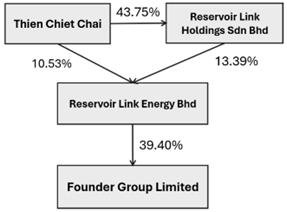
| (3) | As of the date of this annual report, 58.40% of the equity interests of Reservoir Link Energy Bhd. were held by public shareholders, 13.39% of its equity interests were held by Reservoir Link Holdings Sdn Bhd., and 10.53% of its equity interests were held by Thien Chiet Chai. In addition, Thien Chiet Chai holds 43.75% of the equity interests of Reservoir Link Holdings Sdn Bhd. as of the date of this annual report, respectively. Thien Chiet Chai also serves as a director of Reservoir Link Energy Bhd. and Reservoir Link Holdings Sdn Bhd. However, Thien Chiet Chai does not hold a controlling interest in Reservoir Link Energy Bhd. and Reservoir Link Holdings Sdn Bhd., and therefore, he is not considered holding any equity interests in Founder Group Limited. |
| (4) | Represents 1,750,000 ordinary shares held by Avondale Capital, LLC, with a business address at 303 E Wacker Drive Suite 1040, Chicago, IL 60601. |
As of the date of this annual report, approximately 18.81% of our issued and outstanding Ordinary Shares are held in the United States by one record holder (Cede and Company, as nominee for beneficial shareholders). We are not aware of any arrangement that may, at a subsequent date, result in a change of control of our Company.
F. Disclosure of a Registrant’s Action to Recover Erroneously Awarded Compensation
Not applicable.
Item 7. MAJOR SHAREHOLDERS AND RELATED PARTY TRANSACTIONS
A. Major Shareholders
See “Item 6. Directors, Senior Management and Employees—E. Share Ownership.”
B. Related Party Transactions
Employment Agreements
See “Item 6. Directors, Senior Management and Employees—C. Board Practices—Employment Agreements and Indemnification Agreements.”
Material Transactions with Related Parties
| Name of Related Party | Relationship to Us | |
| Solar Bina Engineering Sdn. Bhd. | An entity controlled by our Chief Executive Officer and Director Mr. Lee Seng Chi | |
| Reservoir Link Energy Bhd. | Our largest shareholder | |
| Reservoir Link Sdn. Bhd. | An entity controlled by Reservoir Link Energy Bhd. | |
| Reservoir Link Renewable Sdn. Bhd. | An entity controlled by Reservoir Link Energy Bhd. | |
| RL Sigma Engineering Sdn. Bhd. | An entity controlled by Reservoir Link Energy Bhd. | |
| Lee Seng Chi | Our Chief Executive Officer and Director | |
| RL Sunseap Energy Sdn. Bhd. | Related company with Reservoir Link Energy Bhd. |
We carried out the following significant transactions with the related parties during the fiscal year 2022, fiscal year 2023, fiscal year 2024 and up to the date of this annual report:
| Fiscal year 2022 |
Fiscal year 2023 |
Fiscal year 2024 |
Fiscal year 2024 |
January 1, 2025 up to date of annual report |
||||||||||||||||
| RM | RM | RM | USD | RM | ||||||||||||||||
| Transactions with related companies Solar Bina Engineering Sdn. Bhd. | ||||||||||||||||||||
| Purchases | 826 | — | — |
— |
— | |||||||||||||||
| Sales of renewable energy products and services | (4,411,489 | ) | (1,697,072 | ) | (73,938 | ) | (16,521 | ) | — | |||||||||||
| Advances | — | — | 400,000 | 89,375 | — | |||||||||||||||
| Recharge of expenses | — | — | 2,356 | 526 | — | |||||||||||||||
| Reservoir Link Energy Bhd. | ||||||||||||||||||||
| Advances | 2,000,000 | — | 2,000,000 | 446,877 | — | |||||||||||||||
| Recharge of expenses | (71,352 | ) | (93,310 | ) | (86,864 | ) | (19,409 | ) | 185,519 | |||||||||||
| Interest charged | 105,060 | 185,515 | 177,174 | 39,588 | 20,186 | |||||||||||||||
| Management fee | 98,757 | 102,109 | 113,063 | 25,263 | 11,234 | |||||||||||||||
| Sales of renewable energy products and services | — | — | (138,170 | ) | (30,873 | ) | — | |||||||||||||
| Reservoir Link Sdn. Bhd. | ||||||||||||||||||||
Interest charged |
77,473 | 132,817 | (26,583 | ) | (5,940 | ) | — | |||||||||||||
| Recharge of expenses | 75,035 |
— | — | — | — | |||||||||||||||
| Lee Seng Chi | ||||||||||||||||||||
| Rental expense | 102,000 | 126,000 | 217,500 | 48,598 | 78,000 | |||||||||||||||
| RL Sunseap Energy Sdn. Bhd. | ||||||||||||||||||||
| Sales of renewable energy products and services | (4,050,456 | ) | (2,033,049 | ) | (2,629,089 | ) | (587,440 | ) | (1,931,416 | ) | ||||||||||
| Reservoir Link Renewable Sdn Bhd. | ||||||||||||||||||||
| Sales of renewable energy products and services | — | (1,040,060 | ) | (3,053,327 | ) | (682,231 | ) | (1,696,157 | ) | |||||||||||
| Purchases | — | — | 2,667 | 596 | — | |||||||||||||||
| Recharge of expenses | — | — | — | — | 1,051 | |||||||||||||||
The related party transactions mainly derived from the sales of renewable energy products and services, recharge of expenses, interest charged for advances and management fees.
In fiscal year 2021, significant related party transaction with Solar Bina Engineering Sdn. Bhd. was due to contract secured via Solar Bina Engineering Sdn. Bhd. for supply of mounting structure, where the customer is unable to novate the contract from Solar Bina Engineering Sdn. Bhd. to our Company.
In fiscal year 2022, 2023 and 2024, recharge of expenses, interest charged and management fees charged by Reservoir Link Energy Bhd. and Reservoir Link Sdn. Bhd. represent expenses paid on behalf of the Company and interest charged for funds advanced to the Company.
In fiscal year 2024, the Company was appointed as contractor by Reservoir Link Energy Bhd. for the sales of renewable energy products and services.
In fiscal year 2022, 2023 and 2024, the Company was appointed as contractor by RL Sunseap Energy Sdn. Bhd. for the sales of renewable energy products and services.
In fiscal year 2023 and 2024, the Company was appointed as contractor by Reservoir Link Renewable Sdn. Bhd. for the sales of renewable energy products and services.
C. Interests of Experts and Counsel
Not applicable.
Item 8. FINANCIAL INFORMATION
A. Consolidated Statements and Other Financial Information
We have appended consolidated financial statements filed as part of this annual report. See “Item 18. Financial Statements.”
Legal Proceedings
From time to time, we may become a party to various legal or administrative proceedings arising in the ordinary course of our business, including actions with respect to intellectual property infringement, violation of third-party licenses or other rights, breach of contract, and labor and employment claims. We are currently not a party to, and we are not aware of any threat of, any legal or administrative proceedings that, in the opinion of our management, are likely to have any material and adverse effect on our business, financial condition, cash flow, or results of operations.
Dividend Policy
Since our inception, we have not declared or paid cash dividends on our Ordinary Shares. Any decision to pay dividends in the future will be subject to a number of factors, including our financial condition, results of operations, the level of our retained earnings, capital demands, general business conditions, and other factors our board of directors may deem relevant. We currently intend to retain most, if not all, of our available funds and any future earnings to fund the operation, development, and growth of our business, and, as a result, we do not expect to pay any dividends in the foreseeable future. Consequently, we cannot give any assurance that any dividends may be declared and paid in the future.
Subject to the BVI Act and our M&A, our board of directors may authorize and declare a dividend to shareholders at such time and of such an amount as they think appropriate if they are satisfied, on reasonable grounds, that immediately following the dividend payment the value of our assets will exceed our liabilities and we will be able to pay our debts as they become due (the “Solvency Test”). There is no further BVI statutory restriction on the amount of funds which may be distributed by us by dividends.
If, after a dividend is authorized (but before it is paid), our board of directors cease to be satisfied (on reasonable grounds) that the Company will be able to satisfy the Solvency Test after the dividend is paid, then such dividend is deemed not to have been authorized. The directors must notify each shareholder of any dividend authorized by them and no interest accrues on any dividend. If a shareholder fails to claim any dividend for three years after the date on which it was authorized by the directors, the directors may decide by a resolution of directors that the dividend is forfeited for the benefit of the Company.
If we determine to pay dividends on any of our Ordinary Shares in the future, as a holding company, we will be dependent on receipt of funds from our Malaysia subsidiary, Founder Energy (Malaysia). Under the Malaysian Companies Act 2016, dividends must be paid out of profit and no dividend shall be paid out if the payment will cause the company to be insolvent. The company, each officer and any other person or individual who contravene this provision commits an offence and shall, on conviction, be liable to imprisonment for a term not exceeding five years or to a fine not exceeding MYR3,000,000.00 or to both. For the purpose of determining whether a Malaysian company satisfies the solvency test, a company is regarded as solvent if it is able to pay its debts as and when the debts become due within 12 months immediately after the distribution is made.
Additionally, in the event that Founder Energy (Malaysia) or its subsidiaries incur debt on their own behalf in the future, the instruments governing the debt may restrict any such entity’s ability to pay dividends or make other distributions to us.
Cash dividends, if any, on our Ordinary Shares will be paid in U.S. dollars. Malaysia is under a single-tier tax system. Dividends are exempt from income tax in the hands of shareholders pursuant to Paragraph 12B, Schedule 6 of the Income Tax Act 1967. However, Malaysia has introduced a new 2% tax on dividend income derived by individual shareholders, whether resident or non-resident exceeding RM100,000, effective January 1, 2025. Our Malaysia subsidiary, Founder Energy (Malaysia), is not required to deduct tax from dividends paid to its shareholder, Founder Group, and no tax credits will be available for offsetting against the recipient’s tax liability. Further, Malaysia does not impose any withholding tax (i.e., 0%) on dividends paid by Malaysian companies to non-residents. Hence, Founder Energy (Malaysia) is not required to withhold any sum from its dividends for withholding tax purposes. See “Item 10. Additional Information—E. Taxation—Malaysian Enterprise Taxation.”
B. Significant Changes
Except as disclosed elsewhere in this annual report, we have not experienced any significant changes since the date of our audited consolidated financial statements included in this annual report.
Item 9. THE OFFER AND LISTING
A. Offer and Listing Details.
Our Ordinary Shares have been listed on the Nasdaq Capital Market since October 23, 2024 under the symbol “FGL.”
B. Plan of Distribution
Not applicable.
C. Markets
Our Ordinary Shares have been listed on the Nasdaq Capital Market since October 23, 2024 under the symbol “FGL.”
D. Selling Shareholders
Not applicable.
E. Dilution
Not applicable.
F. Expenses of the Issue B. Memorandum and Articles of Association
Not applicable.
Item 10. ADDITIONAL INFORMATION
A. Share Capital
Not applicable.
We incorporate by reference into this annual report the description of our M&A, Exhibit 3.1, and the description of differences in corporate laws contained in our registration statement on Form F-1 (File No. 333-281167), as amended, initially filed with the SEC on August 1, 2024.
C. Material Contracts
We have not entered into any material contracts other than in the ordinary course of business and other than those described in “Item 4. Information on the Company” or elsewhere in this annual report.
D. Exchange Controls
There are no exchange control regulations or currency restrictions in the BVI. The BVI Act and the Company’s M&A govern the distribution of dividends and ensure that such dividends, interest or other payment can be made to non-resident holders.
E. Taxation
Malaysian Enterprise Taxation
The following brief description of Malaysian enterprise income taxation is designed to highlight the enterprise-level taxation on our earnings, which will affect the amount of dividends, if any, we are ultimately able to pay to our shareholders. See “Item 8. Financial Information—A. Consolidated Statements and Other Financial Information—Dividend Policy.”
Income Tax in Malaysia
The principal legislation that governs a person’s income tax in Malaysia is the Income Tax Act 1967 (the “ITA”). The regulatory body implementing and enforcing the ITA is the Inland Revenue Board of Malaysia (“IRB”). Pursuant to Section 3 of the ITA, income tax shall be charged for each year of assessment (“YA”) upon the income of any person accruing in or derived from Malaysia or received in Malaysia from outside Malaysia.
Pursuant to Section 8 of the ITA, a company is a tax resident in Malaysia if its management and control are exercised in Malaysia. Management and control are normally considered to be exercised at the place where the directors’ meetings concerning management and control of the company are held. The income tax rate payable by a resident company differs depending on the amount of the company’s paid-up capital, nationality of shareholder and its annual gross income in relation to the particular YA. The corporate income tax rates are as illustrated below:
| Types of Company | Chargeable income |
Tax rate YA 2024 | |||||
| Resident company (other than company described below) | 24 | % | |||||
| Resident company: | |||||||
| ● | with paid-up capital of 2.5 million Malaysian ringgit (MYR) or less, and gross income from business of not more than MYR 50 million | On the first RM150,000 | 15 | % | |||
| ● | that does not control, directly or indirectly, another company that has paid-up capital of more than MYR 2.5 million | On the next RM450,000 | 17 | % | |||
| ● | is not controlled, directly or indirectly, by another company that has paid-up capital of more than MYR 2.5 million, and | In excess of 600,000 | 24 | % | |||
| ● | with no more than 20% of its paid-up capital being owned, directly or indirectly, by a foreign company or non-Malaysian citizen (with effect from year of assessment 2024) | ||||||
| Non-resident company | 24 | % | |||||
Pursuant to the ITA, a non-resident company — namely, a company whose management and control are not exercised in Malaysia and thus does not fall under the ambit of Section 8 of the ITA — is subject to the following tax rates:
| Types of Income | Rate (%) | |||
| Business income | 24 | |||
| Royalties derived from Malaysia | 10 | |||
| Rental of moveable properties | 10 | |||
| Advice, assistance, or services rendered in Malaysia | 10 | |||
| Interest | 15 | * | ||
| Dividends | Exempt | |||
| Other income | 10 | |||
Note: Where the recipient is resident in a country that has a double tax agreement with Malaysia, the tax rates for the specific sources of income (except for business income) may be reduced.
| * | Interest paid to a non-resident by a bank or a finance company in Malaysia is exempt from tax. |
Foreign-Sourced Income
Malaysia adopts a territorial principle of taxation, under which only income accruing in or derived from or received in Malaysia from outside Malaysia is subject to income tax in Malaysia pursuant to Section 3 of the ITA. Previously, “income received in Malaysia from outside Malaysia” or “foreign-sourced income” (“FSI”) received by Malaysian taxpayers is not taxable due to the availability of tax exemption under Paragraph 28, Schedule 6 of the ITA (“Para 28”). This exemption is applicable to any person other than a resident company carrying on the business of banking, insurance, or sea or air transport, in respect of income derived from sources outside Malaysia and received in Malaysia, pursuant to Para 28. On October 29, 2021, however, the Malaysian government announced via the Budget 2022 that the exemption under Para 28 will no longer be applicable to tax residents, effective from January 1, 2022. Therefore, income tax will be imposed on resident persons in Malaysia on income derived from foreign sources and received in Malaysia with effect from January 1, 2022. Such income will be treated equally vis-à-vis income accruing in or derived from Malaysia and taxable under Section 3 of the ITA.
In summary, the tax treatments for the income of a person in Malaysia are depicted as follows:
| Income Derived From | Income Received In | Prior to January 1, 2022 |
Effective from January 1, 2022 |
|||
| Malaysia | Malaysia | Taxable | Taxable | |||
| Malaysia | Malaysia from outside Malaysia | Taxable | Taxable | |||
| Overseas | Malaysia from outside Malaysia | Tax Exempted | Taxable | |||
| Overseas | Overseas | Tax Exempted | Tax Exempted |
On November 16, 2021, the IRB announced the Special Income Remittance Program (“SIRP”) for Malaysian tax residents whose income is derived from foreign sources and received in Malaysia. The implementation of taxation on FSI is staggered into the following two timelines, depending on the timing of remittance of FSI into Malaysia: (i) during the period from January 1 to June 30, 2022 (six months) (the “SIRP Period”), FSI remitted shall be taxed at a fixed rate of 3% on the gross amount of income remitted. FSI remitted under the SIRP will be accepted in good faith by the IRB as the IRB will not conduct an audit or investigation on the taxpayer. In addition, the IRB will not impose any penalty on FSI remitted during the SIRP Period. On or after July 1, 2022, FSI remitted shall be taxed in accordance to the formula, at the prevailing tax rate applicable to tax residents on the statutory income, namely, gross FSI less expenses attributable to the FSI.
Notwithstanding the implementation of taxation on FSI, the Malaysian Ministry of Finance announced on December 30, 2021 that exemption from income tax would be available for a period of five years on certain categories of FSI received by Malaysian tax residents, when certain qualifying conditions are met. Specifically, (i) for individuals excluding those carrying on business in Malaysia through a partnership, all categories of FSI are exempted; and (ii) for companies and limited liability partnerships, foreign-sourced dividend income is exempted provided the global minimum tax of 15% has been levied on the dividend income paid from the source country or comply with the economic substance requirements. To legislate the above, the following Orders were gazetted on July 19, 2022 and are effective from January 1, 2022 to December 31, 2026. This exemption from income tax has been extended for another 10 years i.e. to December 31, 2036 pursuant to P.U. (A) 451/2024.
Profit Distribution and Withholding Tax
We are a holding company incorporated as a business company in the BVI and we gain substantial income by way of dividends to be paid to us from Founder Energy (Malaysia), our direct subsidiary company in Malaysia.
Malaysia is under the single-tier tax system, under which income tax imposed on a company’s chargeable income is a final tax, and dividends distributed are exempt from tax in the hands of the shareholders pursuant to Section 108 of the ITA. As such, companies are not required to deduct tax from dividends paid to shareholders, and no tax credits will be available to offset against the recipient’s tax liability. Corporate shareholders receiving exempt single-tier dividends can, in turn, distribute such dividends to their own shareholders, who are also exempt on such receipts. However, effective January 1, 2025, Malaysia has introduced a new 2% tax on dividend income derived by individual shareholders, whether resident or non-resident exceeding RM100,000. In addition, while Malaysia imposes withholding tax on certain payments, such as interest, royalties, contract payments, and special classes of income, Malaysia does not do so on dividends in addition to tax on the profits out of which the dividends are declared. Such position aligns with the double taxation agreements (“DTAs”) concluded by Malaysia with an extensive number of countries, including the United States. Pursuant to the DTAs, no withholding tax will be imposed on dividends paid by Malaysian companies to non-residents.
In view of the above, we believe that dividends which will be paid to us from our direct subsidiary in Malaysia will not be subject to any withholding tax.
BVI Taxation
A holder of shares in a BVI company who is not a resident of the BVI is not required to pay tax in the BVI on (i) dividends paid with respect to the shares, or (ii) any gains realized during that year on sale or disposal of such shares, provided the BVI company does not have a direct or indirect interest in any land in the BVI. The laws of the BVI does not impose a withholding tax on dividends paid by a company incorporated or re-registered under the Companies Act.
There are no capital gains, gift or inheritance taxes levied by the BVI government on companies incorporated or re-registered under the Companies Act. In addition, shares of companies incorporated or re-registered under the Companies Act are not subject to transfer taxes, stamp duties or similar charges, provided the company does not have a direct or indirect interest in any land in the BVI.
Under the current laws of BVI, our Company is not subject to tax on income or capital gains.
United States Federal Income Taxation
WE URGE POTENTIAL PURCHASERS OF OUR ORDINARY SHARES TO CONSULT THEIR OWN TAX ADVISORS CONCERNING THE U.S. FEDERAL, STATE, LOCAL, AND NON-U.S. TAX CONSEQUENCES OF PURCHASING, OWNING, AND DISPOSING OF OUR ORDINARY SHARES.
The following does not address the tax consequences to any particular investor or to persons in special tax situations such as:
| ● | banks; |
| ● | financial institutions; |
| ● | insurance companies; |
| ● | regulated investment companies; |
| ● | real estate investment trusts; |
| ● | broker-dealers; |
| ● | persons that elect to mark their securities to market; |
| ● | U.S. expatriates or former long-term residents of the U.S.; |
| ● | governments or agencies or instrumentalities thereof; |
| ● | tax-exempt entities; |
| ● | persons liable for alternative minimum tax; |
| ● | persons holding our Ordinary Shares as part of a straddle, hedging, conversion or integrated transaction; |
| ● | persons that actually or constructively own 10% or more of our voting power or value (including by reason of owning our Ordinary Shares); |
| ● | persons who acquired our Ordinary Shares pursuant to the exercise of any employee share option or otherwise as compensation; |
| ● | persons holding our Ordinary Shares through partnerships or other pass-through entities; |
| ● | beneficiaries of a Trust holding our Ordinary Shares; or |
| ● | persons holding our Ordinary Shares through a trust. |
The brief discussion set forth below is addressed only to U.S. Holders (as defined below) that purchase Ordinary Shares of the Company. Prospective purchasers are urged to consult their own tax advisors about the application of the U.S. federal income tax rules to their particular circumstances as well as the state, local, foreign and other tax consequences to them of the purchase, ownership and disposition of our Ordinary Shares.
Material Tax Consequences Applicable to U.S. Holders of Our Ordinary Shares
The following brief summary sets forth the material U.S. federal income tax consequences related to the ownership and disposition of our Ordinary Shares. It is directed to U.S. Holders of our Ordinary Shares and is based upon laws and relevant interpretations thereof in effect as of the date of this annual report, all of which are subject to change. This brief summary does not deal with all possible tax consequences relating to ownership and disposition of our Ordinary Shares or U.S. tax laws, other than the U.S. federal income tax laws, such as the tax consequences under non-U.S. tax laws, state, local and other tax laws.
The following brief description applies only to U.S. Holders that hold Ordinary Shares as capital assets and that have the U.S. dollar as their functional currency. This brief description is based on the federal income tax laws of the United States in effect as of the date of this annual report and on U.S. Treasury regulations in effect or, in some cases, proposed, as of the date of this annual report, as well as judicial and administrative interpretations thereof available on or before such date. All of the foregoing authorities are subject to change, which change could apply retroactively and could affect the tax consequences described below.
The brief description below of the U.S. federal income tax consequences to “U.S. Holders” will apply to you if you are a beneficial owner of Ordinary Shares and you are, for U.S. federal income tax purposes,
| ● | an individual who is a citizen or resident of the United States; |
| ● | a corporation (or other entity taxable as a corporation for U.S. federal income tax purposes) organized under the laws of the United States, any state thereof or the District of Columbia; |
| ● | an estate whose income is subject to U.S. federal income taxation regardless of its source; or |
| ● | a trust that (1) is subject to the primary supervision of a court within the United States and the control of one or more U.S. persons for all substantial decisions or (2) has a valid election in effect under applicable U.S. Treasury regulations to be treated as a U.S. person. |
If a partnership (or other entities treated as a partnership for United States federal income tax purposes) is a beneficial owner of our Ordinary Shares, the tax treatment of a partner in the partnership will depend upon the status of the partner and the activities of the partnership. Partnerships and partners of a partnership holding our Ordinary Shares are urged to consult their tax advisors regarding an investment in our Ordinary Shares.
Taxation of Dividends and Other Distributions on our Ordinary Shares
Subject to the passive foreign investment company (PFIC) rules discussed below, the gross amount of distributions made by us to you with respect to the Ordinary Shares (including the amount of any taxes withheld therefrom) will generally be includable in your gross income as dividend income on the date of receipt by you, but only to the extent that the distribution is paid out of our current or accumulated earnings and profits (as determined under U.S. federal income tax principles). With respect to corporate U.S. Holders, the dividends will not be eligible for the dividends-received deduction allowed to corporations in respect of dividends received from other U.S. corporations.
With respect to non-corporate U.S. Holders, including individual U.S. Holders, dividends will be taxed at the lower capital gains rate applicable to qualified dividend income, provided that (1) the Ordinary Shares are readily tradable on an established securities market in the United States, or we are eligible for the benefits of an approved qualifying income tax treaty with the United States that includes an exchange of information program, (2) we are not a PFIC (defined below) for either our taxable year in which the dividend is paid or any preceding taxable year, and (3) certain holding period requirements are met. Because there is not an income tax treaty between the United States and Malaysia, clause (1) above can be satisfied only if the Ordinary Shares are readily tradable on an established securities market in the United States. Under U.S. Internal Revenue Service authority, Ordinary Shares are considered for purpose of clause (1) above to be readily tradable on an established securities market in the United States if they are listed on certain exchanges, which presently include the Nasdaq Stock Market. Our Ordinary Shares are listed on the Nasdaq Capital Market under the symbol “FGL.” You are urged to consult your tax advisors regarding the availability of the lower rate for dividends paid with respect to our Ordinary Shares, including the effects of any change in law after the date of this annual report. For the fiscal year ended December 31, 2024, we did not declare or pay cash dividends on our Ordinary Shares.
Dividends will constitute foreign source income for foreign tax credit limitation purposes. If the dividends are taxed as qualified dividend income (as discussed above), the amount of the dividend taken into account for purposes of calculating the foreign tax credit limitation will be limited to the gross amount of the dividend, multiplied by the reduced rate divided by the highest rate of tax normally applicable to dividends. The limitation on foreign taxes eligible for credit is calculated separately with respect to specific classes of income. For this purpose, dividends distributed by us with respect to our Ordinary Shares will constitute “passive category income” but could, in the case of certain U.S. Holders, constitute “general category income.”
To the extent that the amount of the distribution exceeds our current and accumulated earnings and profits (as determined under U.S. federal income tax principles), it will be treated first as a tax-free return of your tax basis in your Ordinary Shares, and to the extent the amount of the distribution exceeds your tax basis, the excess will be taxed as capital gain. We do not intend to calculate our earnings and profits under U.S. federal income tax principles. Therefore, a U.S. Holder should expect that a distribution will be treated as a dividend even if that distribution would otherwise be treated as a non-taxable return of capital or as capital gain under the rules described above. Since our inception, we have not declared or paid cash dividends on our Ordinary Shares, and we do not expect to pay any dividends in the foreseeable future.
Taxation of Dispositions of Ordinary Shares
Subject to the passive foreign investment company rules discussed below, you will recognize taxable gain or loss on any sale, exchange or other taxable disposition of a share equal to the difference between the amount realized (in U.S. dollars) for the share and your tax basis (in U.S. dollars) in the Ordinary Shares. The gain or loss will be capital gain or loss. If you are a non-corporate U.S. Holder, including an individual U.S. Holder, who has held the Ordinary Shares for more than one year, you will generally be eligible for reduced tax rates. The deductibility of capital losses is subject to limitations. Any such gain or loss that you recognize will generally be treated as United States source income or loss for foreign tax credit limitation purposes which will generally limit the availability of foreign tax credits.
Passive Foreign Investment Company (“PFIC”) Consequences
A non-U.S. corporation is considered a PFIC, as defined in Section 1297(a) of the US Internal Revenue Code, for any taxable year if either:
| ● | at least 75% of its gross income for such taxable year is passive income; or |
| ● | at least 50% of the value of its assets (based on an average of the quarterly values of the assets during a taxable year) is attributable to assets that produce or are held for the production of passive income (the “asset test”). |
Passive income generally includes dividends, interest, rents and royalties (other than rents or royalties derived from the active conduct of a trade or business) and gains from the disposition of passive assets. We will be treated as owning our proportionate share of the assets and earning our proportionate share of the income of any other corporation in which we own, directly or indirectly, at least 25% (by value) of the stock. In determining the value and composition of our assets for purposes of the PFIC asset test, (1) the cash we raise in our offering will generally be considered to be held for the production of passive income and (2) the value of our assets must be determined based on the market value of our Ordinary Shares from time to time, which could cause the value of our non-passive assets to be less than 50% of the value of all of our assets on any particular quarterly testing date for purposes of the asset test.
Based on our operations and the composition of our assets we do not expect to be treated as a PFIC under the current PFIC rules. We must make a separate determination each year as to whether we are a PFIC. For the 2024 taxable year, we do not believe we were a PFIC. However, there can be no assurance with respect to our status as a PFIC for any future taxable years. Depending on the amount of assets held for the production of passive income, it is possible that, for any subsequent taxable year, more than 50% of our assets may be assets held for the production of passive income. We will make this determination following the end of any particular tax year. In addition, because the value of our assets for purposes of the asset test will generally be determined based on the market price of our Ordinary Shares and because cash is generally considered to be an asset held for the production of passive income, our PFIC status will depend in large part on the market price of our Ordinary Shares. Accordingly, fluctuations in the market price of the Ordinary Shares may cause us to become a PFIC. In addition, the application of the PFIC rules is subject to uncertainty in several respects and the composition of our income and assets will be affected by how, and how quickly, we spend our liquid assets. We are under no obligation to take steps to reduce the risk of our being classified as a PFIC, and as stated above, the determination of the value of our assets will depend upon material facts (including the market price of our Ordinary Shares from time to time) that may not be within our control. If we are a PFIC for any year during which you hold Ordinary Shares, we will continue to be treated as a PFIC for all succeeding years during which you hold Ordinary Shares. If we cease to be a PFIC and you did not previously make a timely “mark-to-market” election as described below, you may avoid some of the adverse effects of the PFIC regime by making a “purging election” (as described below) with respect to the Ordinary Shares.
If we are a PFIC for your taxable year(s) during which you hold Ordinary Shares, you will be subject to special tax rules with respect to any “excess distribution” that you receive and any gain you realize from a sale or other disposition (including a pledge) of the Ordinary Shares, unless you make a “mark-to-market” election as discussed below. Distributions you receive in a taxable year that are greater than 125% of the average annual distributions you received during the shorter of the three preceding taxable years or your holding period for the Ordinary Shares will be treated as an excess distribution. Under these special tax rules:
| ● | the excess distribution or gain will be allocated ratably over your holding period for the Ordinary Shares; |
| ● | the amount allocated to your current taxable year, and any amount allocated to any of your taxable year(s) prior to the first taxable year in which we were a PFIC, will be treated as ordinary income, and |
| ● | the amount allocated to each of your other taxable year(s) will be subject to the highest tax rate in effect for that year and the interest charge generally applicable to underpayments of tax will be imposed on the resulting tax attributable to each such year. |
The tax liability for amounts allocated to years prior to the year of disposition or “excess distribution” cannot be offset by any net operating losses for such years, and gains (but not losses) realized on the sale of the Ordinary Shares cannot be treated as capital, even if you hold the Ordinary Shares as capital assets.
A U.S. Holder of “marketable stock” (as defined below) in a PFIC may make a mark-to-market election under Section 1296 of the US Internal Revenue Code for such stock to elect out of the tax treatment discussed above. If you make a mark-to-market election for first taxable year which you hold (or are deemed to hold) Ordinary Shares and for which we are determined to be a PFIC, you will include in your income each year an amount equal to the excess, if any, of the fair market value of the Ordinary Shares as of the close of such taxable year over your adjusted basis in such Ordinary Shares, which excess will be treated as ordinary income and not capital gain. You are allowed an ordinary loss for the excess, if any, of the adjusted basis of the Ordinary Shares over their fair market value as of the close of the taxable year. Such ordinary loss, however, is allowable only to the extent of any net mark-to-market gains on the Ordinary Shares included in your income for prior taxable years. Amounts included in your income under a mark-to-market election, as well as gain on the actual sale or other disposition of the Ordinary Shares, are treated as ordinary income. Ordinary loss treatment also applies to any loss realized on the actual sale or disposition of the Ordinary Shares, to the extent that the amount of such loss does not exceed the net mark-to-market gains previously included for such Ordinary Shares. Your basis in the Ordinary Shares will be adjusted to reflect any such income or loss amounts. If you make a valid mark-to-market election, the tax rules that apply to distributions by corporations which are not PFICs would apply to distributions by us, except that the lower applicable capital gains rate for qualified dividend income discussed above under “—Taxation of Dividends and Other Distributions on our Ordinary Shares” generally would not apply.
The mark-to-market election is available only for “marketable stock”, which is stock that is traded in other than de minimis quantities on at least 15 days during each calendar quarter (“regularly traded”) on a qualified exchange or other market (as defined in applicable U.S. Treasury regulations), including the Nasdaq Capital Market. The Ordinary Shares are regularly traded on the Nasdaq Capital Market and if you are a holder of our Ordinary Shares, the mark-to-market election would be available to you were we to be or become a PFIC.
Alternatively, a U.S. Holder of stock in a PFIC may make a “qualified electing fund” election under Section 1295(b) of the US Internal Revenue Code with respect to such PFIC to elect out of the tax treatment discussed above. A U.S. Holder who makes a valid qualified electing fund election with respect to a PFIC will generally include in gross income for a taxable year such holder’s pro rata share of the corporation’s earnings and profits for the taxable year. The qualified electing fund election, however, is available only if such PFIC provides such U.S. Holder with certain information regarding its earnings and profits as required under applicable U.S. Treasury regulations. We do not currently intend to prepare or provide the information that would enable you to make a qualified electing fund election. If you hold Ordinary Shares in any taxable year in which we are a PFIC, you will be required to file U.S. Internal Revenue Service Form 8621 in each such year and provide certain annual information regarding such Ordinary Shares, including regarding distributions received on the Ordinary Shares and any gain realized on the disposition of the Ordinary Shares.
If you do not make a timely “mark-to-market” election (as described above), and if we were a PFIC at any time during the period you hold our Ordinary Shares, then such Ordinary Shares will continue to be treated as stock of a PFIC with respect to you even if we cease to be a PFIC in a future year, unless you make a “purging election” for the year we cease to be a PFIC. A “purging election” creates a deemed sale of such Ordinary Shares at their fair market value on the last day of the last year in which we are treated as a PFIC. The gain recognized by the purging election will be subject to the special tax and interest charge rules treating the gain as an excess distribution, as described above. As a result of the purging election, you will have a new basis (equal to the fair market value of the Ordinary Shares on the last day of the last year in which we are treated as a PFIC) and holding period (which new holding period will begin the day after such last day) in your Ordinary Shares for tax purposes.
IRC Section 1014(a) provides for a step-up in basis to the fair market value for our Ordinary Shares when inherited from a decedent that was previously a holder of our Ordinary Shares. However, if we are determined to be a PFIC and a decedent that was a U.S. Holder did not make either a timely qualified electing fund election for our first taxable year as a PFIC in which the U.S. Holder held (or was deemed to hold) our Ordinary Shares, or a mark-to-market election and ownership of those Ordinary Shares are inherited, a special provision in IRC Section 1291(e) provides that the new U.S. Holder’s basis should be reduced by an amount equal to the Section 1014 basis minus the decedent’s adjusted basis just before death. As such if we are determined to be a PFIC at any time prior to a decedent’s passing, the PFIC rules will cause any new U.S. Holder that inherits our Ordinary Shares from a U.S. Holder to not get a step-up in basis under Section 1014 and instead will receive a carryover basis in those Ordinary Shares.
You are urged to consult your tax advisors regarding the application of the PFIC rules to your investment in our Ordinary Shares and the elections discussed above.
Information Reporting and Backup Withholding
Dividend payments with respect to our Ordinary Shares and proceeds from the sale, exchange or redemption of our Ordinary Shares may be subject to information reporting to the U.S. Internal Revenue Service and possible U.S. backup withholding under Section 3406 of the US Internal Revenue Code with at a current flat rate of 24%. Backup withholding will not apply, however, to a U.S. Holder who furnishes a correct taxpayer identification number and makes any other required certification on U.S. Internal Revenue Service Form W-9 or who is otherwise exempt from backup withholding. U.S. Holders who are required to establish their exempt status generally must provide such certification on U.S. Internal Revenue Service Form W-9. U.S. Holders are urged to consult their tax advisors regarding the application of the U.S. information reporting and backup withholding rules.
Backup withholding is not an additional tax. Amounts withheld as backup withholding may be credited against your U.S. federal income tax liability, and you may obtain a refund of any excess amounts withheld under the backup withholding rules by filing the appropriate claim for refund with the U.S. Internal Revenue Service and furnishing any required information. We do not intend to withhold taxes for individual shareholders. Transactions effected through certain brokers or other intermediaries, however, may be subject to withholding taxes (including backup withholding), and such brokers or intermediaries may be required by law to withhold such taxes.
Under the Hiring Incentives to Restore Employment Act of 2010, certain U.S. Holders are required to report information relating to our Ordinary Shares, subject to certain exceptions (including an exception for Ordinary Shares held in accounts maintained by certain financial institutions), by attaching a complete Internal Revenue Service Form 8938, Statement of Specified Foreign Financial Assets, with their tax return for each year in which they hold Ordinary Shares.
F. Dividends and Paying Agents
Not applicable.
G. Statement by Experts
Not applicable.
H. Documents on Display
We have previously filed with the SEC our registration statements on Form F-1 (File No. 333-281167), as amended.
We are subject to the periodic reporting and other informational requirements of the Exchange Act. Under the Exchange Act, we are required to file reports and other information with the SEC. Specifically, we are required to file annually a Form 20-F within four months after the end of each fiscal year. The SEC maintains a website at http://www.sec.gov that contains reports, proxy and information statements, and other information regarding registrants that make electronic filings with the SEC using its EDGAR system. As a foreign private issuer, we are exempt from the rules of the Exchange Act prescribing, among other things, the furnishing and content of proxy statements to shareholders, and our executive officers, directors and principal shareholders are exempt from the reporting and short-swing profit recovery provisions contained in Section 16 of the Exchange Act.
I. Subsidiary Information
For a listing of our subsidiaries, see “Item 4. Information on the Company—A. History and Development of the Company.”
J. Annual Report to Security Holders
No applicable.
Item 11. QUANTITATIVE AND QUALITATIVE DISCLOSURES ABOUT MARKET RISK
We are exposed to market risk (including foreign currency risk, interest rate risk, and equity price risk), credit risk, and liquidity risk in the ordinary course of business. Our overall financial risk management policy focuses on the unpredictability of financial markets and seeks to minimize potential adverse effects on our financial performance.
Foreign Currency Risk
We are exposed to foreign currency risk with transactions and balances that are denominated in currencies other than our functional currency. The currencies giving rise to this risk are primarily Chinese Renminbi (“RMB”) and United States Dollar (“USD”). Foreign currency risk is monitored closely on an on-going basis to ensure that the net exposure is at an acceptable level.
Our exposure to foreign currency risk based on the carrying amounts of the financial instruments at the end of the reporting period is summarized below.
| Assets | Liabilities | |||||||||||||||
| 2023 | 2024 | 2023 | 2024 | |||||||||||||
| RM | RM | RM | RM | |||||||||||||
| United States Dollar | 2,276 | 1,136,521 | (3,638,622 | ) | — | |||||||||||
| Chinese Renminbi | 2,279 | 2,194 | (14,140,316 | ) | (7,075,765 | ) | ||||||||||
Foreign Currency Risk Sensitivity Analysis
The following table details the sensitivity analysis to a 10% change in the foreign currencies at the end of the reporting period, with all other variables held constant.
| For the fiscal years ended December 31, |
||||||||
| 2023 | 2024 | |||||||
| RM | RM | |||||||
| United States Dollar | (276,362 | ) | 86,376 | |||||
| Chinese Renminbi | (1,074,491 | ) | (537,591 | ) | ||||
Interest Rate Risk
We are exposed to interest rate risk as we have bank loans which are interest bearing. We currently do not have an interest rate hedging policy.
Interest Rate Sensitivity Analysis
The sensitivity analysis below has been determined based on the exposure to interest rate for non-derivative instruments at the end of the reporting period. A 50 basis point increase or decrease is used when reporting interest rate risk internally to key management personnel and represents management’s assessment of the reasonably possible change in interest rates.
If interest rates on loans had been 50 basis points higher/lower and all other variables were held constant, our profit for fiscal year 2024 would decrease/increase by approximately RM93,895 (2023: RM132,201).
Liquidity Risk
Liquidity risk arises mainly due to general funding and business activities. We practice prudent risk management by maintaining sufficient cash balances and the availability of funding through certain committed credit facilities.
Maturity Analysis
The following table sets out the maturity profile of the financial liabilities at the end of the reporting period based on contractual undiscounted cash flows (including interest payments computed using contractual rates or, if floating, based on the rates at the end of the reporting period.)
| The Company | Weighted Average Effective Interest Rate |
Carrying Amount |
Contractual Undiscounted Cash Flows |
Within 1 Year |
1 – 5 Years | Over 5 Years |
||||||||||||||||||
| % | RM | RM | RM | RM | RM | |||||||||||||||||||
| 2024 | ||||||||||||||||||||||||
| Non-derivative Financial Liabilities | ||||||||||||||||||||||||
| Bank borrowings | 4.95% - 5.70 | % | 35,039,857 | 35,668,434 | 33,045,385 | 1,289,377 | 1,333,672 | |||||||||||||||||
| Lease liabilities | 5.70 | % | 747,819 | 806,000 | 312,000 | 494,000 | — | |||||||||||||||||
| Trade payables | — | 27,396,814 | 27,396,814 | 27,396,814 | — | — | ||||||||||||||||||
| Other payables and accruals | — | 31,816,499 | 31,816,499 | 31,816,499 | — | — | ||||||||||||||||||
| Amount due to related parties | 8.20 | % | 2,168,066 | 2,292,276 | 2,292,276 | — | — | |||||||||||||||||
| 97,169,055 | 97,980,023 | 94,862,974 | 1,783,377 | 1,333,672 | ||||||||||||||||||||
| 2023 | ||||||||||||||||||||||||
| Non-derivative Financial Liabilities | ||||||||||||||||||||||||
| Bank borrowings | 5.70 | % | 24,709,116 | 25,014,970 | 23,898,060 | 525,600 | 591,310 | |||||||||||||||||
| Lease liabilities | 5.40 | % | 215,647 | 215,647 | 215,647 | — | — | |||||||||||||||||
| Trade payables | — | 38,418,873 | 38,418,873 | 38,418,873 | — | — | ||||||||||||||||||
| Other payables and accruals | — | 1,266,140 | 1,266,140 | 1,266,140 | — | — | ||||||||||||||||||
| Amount due to related parties | 8.20 | % | 2,759,913 | 2,962,824 | 2,962,824 | — | — | |||||||||||||||||
| 67,369,689 | 67,878,454 | 66,761,544 | 525,600 | 591,310 | ||||||||||||||||||||
Capital Risk Management
We manage our capital to ensure that entities within our Company will be able to maintain an optimal capital structure so as to support our businesses and maximize shareholders’ value. To achieve this objective, we may make adjustments to the capital structure in view of changes in economic conditions, such as adjusting the amount of dividend payment, returning of capital to shareholders or issuing new shares.
We manage our capital based on debt-to-equity ratio that complies with debt covenants and regulatory, if any. The debt-to-equity ratio is calculated as net debt divided by total equity. We include within net debt, loans, and borrowings from financial institutions. Capital includes equity attributable to the owners of the parent and non-controlling interest. The debt-to-equity ratio of our Company at the end of the reporting period was as follows:
| As at December 31, 2023 |
As at December 31, 2024 |
As at December 31, 2024 |
||||||||||
| RM | RM | USD | ||||||||||
| Total debts | 24,709,116 | 35,039,857 | 7,829,261 | |||||||||
| Total equity | 14,789,662 | 17,121,478 | 3,825,601 | |||||||||
| Debt-to-equity ratio | 1.67 | 2.05 | 2.05 | |||||||||
We complied with the capital requirements imposed by financial institutions for the financial year ended December 31, 2022, 2023, and 2024.
Our overall strategy remains unchanged from the previous year.
Item 12. DESCRIPTION OF SECURITIES OTHER THAN EQUITY SECURITIES
A. Debt Securities
Not applicable.
B. Warrants and Rights
Not applicable.
C. Other Securities
Not applicable.
D. American Depositary Shares
Not applicable.
Part II
Item 13. DEFAULTS, DIVIDEND ARREARAGES AND DELINQUENCIES
None.
Item 14. MATERIAL MODIFICATIONS TO THE RIGHTS OF SECURITY HOLDERS AND USE OF PROCEEDS
See “Item 10. Additional Information” for a description of the rights of securities holders, which remain unchanged.
Use of Proceeds
Registration Statement on Form F-1, as amended (File Number 333- 281167)
The following “Use of Proceeds” information relates to the registration statement on Form F-1, as amended (File Number 333-281167) for our IPO, which was declared effective by the SEC on September 30, 2024. In October 2024, we completed our IPO and issued and sold an aggregate of 1,218,750 Ordinary Shares, at a price of $4.00 per share for gross proceeds of $4.875 million, before deducting underwriting discounts and other related expenses. The Company received net proceeds of approximately $1.539 million. US Tiger Securities, Inc. was the representative of the underwriters of our IPO. On October 30, 2024, US Tiger Securities, Inc. partially exercised its over-allotment option to purchase an additional 2,813 Ordinary Shares at a purchase price of $4.00 per share, for net proceeds of $10,351.84, after deducting underwriting discounts and other related expenses. The closing of the sales of the over-allotment option shares took place on October 31, 2024.
We incurred approximately $3,337,379 in expenses in connection with our IPO, which included approximately $342,038 in underwriting discounts, approximately $48,862 in expenses paid to or for underwriters, and approximately $2,946,479 in other expenses. None of the transaction expenses included payments to directors or officers of our Company or their associates, persons owning more than 10% or more of our equity securities, or our affiliates. None of the net proceeds we received from the IPO were paid, directly or indirectly, to any of our directors or officers or their associates, persons owning 10% or more of our equity securities, or our affiliates.
We received net proceeds of approximately $1,548,873 million after the deduction of approximately $3,337,379 million of offering costs. As of the date of this annual report, we have used $30,983 towards our expansion into other countries in Southeast Asia, with the remaining funds used for general working capital. We intend to use the remaining proceeds from our IPO in the manner disclosed in our registration statement on Form F-1, as amended (File Number 333-281167).
Item 15. CONTROLS AND PROCEDURES
Disclosure Controls and Procedures
Under the supervision and with the participation of our management, including our Chief Executive Officer and Chief Financial Officer, we carried out an evaluation of the effectiveness of our disclosure controls and procedures, which is defined in Rules 13a-15(e) of the Exchange Act, as of December 31, 2024. Based on that evaluation, our Chief Executive Officer and Chief Financial Officer concluded that our disclosure controls and procedures as of December 31, 2024 were ineffective.
Our conclusion is based on the fact that we lack accounting staff and resources with appropriate knowledge of International Financial Reporting Standards and SEC reporting and compliance requirement and deficiency of internal journal entries procedure. Our management is currently in the process of evaluating the steps necessary to remediate the ineffectiveness, such as (i) implementing regular and continuous International Financial Reporting Standards accounting and financial reporting training programs for our accounting and financial reporting personnel; and (ii) engaging an external consulting firm to assist us with assessment of Sarbanes-Oxley compliance requirements and improvement of overall internal control.
Management’s Annual Report on Internal Control over Financial Reporting
This annual report on Form 20-F does not include a report of management’s assessment regarding internal control over financial reporting or an attestation report of our registered public accounting firm, as permitted by the transition period established by rules of the SEC for newly public companies.
Attestation Report of the Registered Public Accounting Firm
This annual report on Form 20-F does not include an attestation report of our registered public accounting firm regarding internal control over financial reporting. Management’s report was not subject to attestation by our registered public accounting firm pursuant to rules of the SEC where domestic and foreign registrants that are non-accelerated filers, which we are, and “emerging growth companies,” which we also are, are not required to provide the auditor attestation report.
Changes in Internal Control over Financial Reporting
There were no changes in our internal controls over financial reporting that occurred during the period covered by this annual report on Form 20-F that have materially affected, or are reasonably likely to materially affect, our internal control over financial reporting.
Item 16. [RESERVED]
Item 16A. AUDIT COMMITTEE FINANCIAL EXPERT
Mr. Marco Baccanello qualifies as an “audit committee financial expert” as defined in Item 16A of Form 20-F. Mr. Marco Baccanello satisfies the “independence” requirements of Section 5605(a)(2) of the NASDAQ Listing Rules as well as the independence requirements of Rule 10A-3 under the Exchange Act.
Item 16B. CODE OF ETHICS
Our board of directors has adopted a code of business conduct and ethics, which is applicable to all of our directors, officers, and employees. Our code of business conduct and ethics is publicly available on our website.
Item 16C. PRINCIPAL ACCOUNTANT FEES AND SERVICES
The following table sets forth the aggregate fees by categories specified below in connection with certain professional services rendered and billed by JP Centurion & Partners PLT, our independent registered public accounting firm for the periods indicated.
| For the Years Ended December 31, | ||||||||
| 2024 | 2023 | |||||||
| Audit fees(1) | $ | 136,000 | $ | — | ||||
| Audit-related fees(2) | $ | — | $ | — | ||||
| Tax fees(3) | $ | — | $ | — | ||||
| All other fees | $ | — | $ | — | ||||
| Total | $ | 136,000 | $ | — | ||||
| (1) | Audit fees include the aggregate fees billed for each of the fiscal years for professional services rendered by our independent registered public accounting firm for the audit of our annual financial statements or for the audits of our financial statements and review of the interim financial statements in connection with our IPO in 2024. |
| (2) | Audit-related fees include the aggregate fees billed for related services by our principal accountant that are reasonably related to the performance of the audit or review of our financial statements and are not reported under audit fees. |
| (3) | Tax fees represent the aggregated fees billed for professional services rendered by our independent registered public accounting firm for tax compliance, tax advice, and tax planning. |
Item 16D. EXEMPTIONS FROM THE LISTING STANDARDS FOR AUDIT COMMITTEES
Not applicable.
Item 16E. PURCHASES OF EQUITY SECURITIES BY THE ISSUER AND AFFILIATED PURCHASERS
None.
Item 16F. CHANGE IN REGISTRANT’S CERTIFYING ACCOUNTANT
None.
Item 16G. CORPORATE GOVERNANCE
As a BVI company listed on Nasdaq, we are subject to the Nasdaq corporate governance listing standards. However, the Nasdaq Stock Market listing rules permit a foreign private issuer like us to follow the corporate governance practices of its home country. Other than as described in this section, our corporate governance practices do not differ from those followed by domestic companies listed on the Nasdaq Capital Market.
Nasdaq Stock Market listing rule 5635 generally provides that shareholder approval is required for U.S. domestic companies listed on the Nasdaq Capital Market prior to issuance (or potential issuance) of securities (i) issuances in connection with the acquisition of the stock or assets of another company if upon issuance the issued shares will equal to 20% or more of the number of shares or voting power outstanding prior to the issuance, or if certain specified persons have a 5% or greater interest in the assets or company to be acquired (Rule 5635(a)); (ii) issuances or potential issuances that will result in a change of control (Rule 5635(b)); (iii) issuances in connection with equity compensation arrangements (Rule 5635(c)); and (iv) 20% or greater issuances in transactions other than public offerings, as defined in the Nasdaq rules (Rule 5635(d)).
Notwithstanding this general requirement, Nasdaq Stock Market listing rule 5615(a)(3)(A) permits foreign private issuers to follow their home country practice rather than these shareholder approval requirements. The BVI does not require shareholder approval prior to any of the foregoing types of issuances. Our Company, therefore, is not required to obtain such shareholder approval prior to entering into a transaction with the potential to issue securities as described above. Our board of directors has elected to follow our home country rules as to such issuances and will not be required to seek shareholder approval prior to entering into such a transaction.
Item 16H. MINE SAFETY DISCLOSURE
Not applicable.
Item 16I. DISCLOSURE REGARDING FOREIGN JURISDICTIONS THAT PREVENT INSPECTIONS
Not applicable.
Item 16J. INSIDER TRADING POLICIES
Our board of directors has adopted insider trading policies and procedures governing the purchase, sale, and other dispositions of our securities by directors, senior management, and employees that are reasonably designed to promote compliance with applicable insider trading laws, rules, and regulations, and any listing standards applicable to us.
Item 16K. CYBERSECURITY
We have established cybersecurity risk management to identify, assess, and mitigate cybersecurity risks alongside other business risks. The process is in alignment with our strategic objectives and risk appetite. We may engage assessors, consultants, auditors, or other third parties to enhance our cyber security risk management processes. Any cybersecurity incidents are closely monitored for their potential impact on our business strategy, operations, and financial condition. As of the date of this annual report, we have not experienced any cybersecurity incidents that have materially affected or are reasonably likely to materially affect us, including our business strategy, results of operations, or financial condition. We continuously adapt our business strategy to enhance resilience, strengthen defenses and ensure the sustainability of our operations.
Part III
Item 17. FINANCIAL STATEMENTS
We have elected to provide financial statements pursuant to Item 18.
Item 18. FINANCIAL STATEMENTS
The consolidated financial statements of Founder Group Limited, and its operating entities are included at the end of this annual report.
Item 19. EXHIBITS
EXHIBIT INDEX
| * | Filed with this annual report on Form 20-F |
| ** | Furnished with this annual report on Form 20-F |
SIGNATURES
The registrant hereby certifies that it meets all of the requirements for filing on Form 20-F and that it has duly caused and authorized the undersigned to sign this annual report on its behalf.
| Founder Group Limited | ||
| By: | /s/ Lee Seng Chi | |
| Lee Seng Chi | ||
| Chief Executive Officer, Director, and Chairman of the Board of Directors | ||
| (Principal Executive Officer) | ||
| Date: April 25, 2025 | ||
FOUNDER GROUP LIMITED
INDEX TO CONSOLIDATED FINANCIAL STATEMENTS
TABLE OF CONTENTS
F-
REPORT OF INDEPENDENT REGISTERED PUBLIC ACCOUNTING FIRM
The Board of Directors and Stockholders of
Founder Group Limited
No.17, Jalan Astana 1D,
Bandar Bukit Raja,
40150 Klang, Selangor Darul Ehsan,
Malaysia.
Opinion on the Financial Statements
We have audited the accompanying consolidated statement of financial position of Founder Group Limited and its subsidiaries (collectively referred to as the “Company”) as of December 31, 2024 and 2023 and the related consolidated statement of profit or loss and other comprehensive income/(loss), consolidated statement of changes in equity, and consolidated statement of cash flows for the year ended December 31, 2024 and 2023, and the related notes (collectively referred to as the “consolidated financial statements”). In our opinion, the financial statements present fairly, in all material respects, the financial position of the Company as of December 31, 2024 and 2023, and the results of its operations and its cash flows for the year ended December 31, 2024 and 2023, in conformity with International Financial Reporting Standards (“IFRS”) as issued by the International Accounting Standards Board (“IASB”).
Going Concern
The accompanying financial statements have been prepared assuming that the Company will continue as a going concern. As discussed in Note 2 to the financial statements, for the years ended December 31, 2024, the Company incurred a net loss of $1,150,711 and as of December 31, 2024 the current liabilities of the Company exceeded its current assets by $2,275,216. These condition raises substantial doubt about the Company’s ability to continue as a going concern. Management’s plans in regard to these matters are also described in Note 2. The financial statements do not include any adjustments that might result from the outcome of this uncertainty.
Basis for Opinion
These financial statements are the responsibility of the Company’s management. Our responsibility is to express an opinion on the Company’s financial statements based on our audits. We are a public accounting firm registered with the Public Company Accounting Oversight Board (United States) (“PCAOB”) and are required to be independent with respect to the Company in accordance with the U.S. federal securities laws and the applicable rules and regulations of the Securities and Exchange Commission and the PCAOB.
We conducted our audits in accordance with the standards of the PCAOB. Those standards require that we plan and perform the audit to obtain reasonable assurance about whether the financial statements are free of material misstatement, whether due to error or fraud. The Company is not required to have, nor were we engaged to perform, an audit of its internal control over financial reporting. As part of our audits we are required to obtain an understanding of internal control over financial reporting but not for the purpose of expressing an opinion on the effectiveness of the Company’s internal control over financial reporting. Accordingly, we express no such opinion.
Our audits included performing procedures to assess the risks of material misstatement of the financial statements, whether due to error or fraud, and performing procedures that respond to those risks. Such procedures included examining, on a test basis, evidence regarding the amounts and disclosures in the financial statements. Our audits also included evaluating the accounting principles used and significant estimates made by management, as well as evaluating the overall presentation of the financial statements. We believe that our audits provide a reasonable basis for our opinion.
F-
Critical Audit Matters
The critical audit matters communicated below are matters arising from current year audit of the financial statements that were communicated or required to be communicated to the audit committee and that: (1) relate to accounts or disclosures that are material to the financial statements and (2) involved our especially challenging, subjective, or complex judgements. The communication of critical audit matters does not alter in any way our opinion on the financial statements, taken as a whole, and we are not, by communicating the critical audit matters below, providing separate opinions on the critical audit matters or on the accounts or disclosure to which they relate.
Revenue and cost recognition on the service revenue
The Company engages in the business of provision and implementation of solar photovoltaic projects. The Company recognizes service revenue and cost as performance obligations satisfied over time using stage of completion method, based on reference to the Company’s progress towards completion and based on the proportion of cost incurred to date to the estimated total costs.
The recognition of revenue and cost relating to the service revenue is therefore dependent on the Company’s estimate and judgement exercised to determine the estimated total costs. There is a risk that the actual costs are different to those estimated, resulting in percentage of completion computed not reflecting the actual progress of the project.
Therefore, revenue and cost recognition of the service revenue is identified as critical audit matter due to the judgement involved to determine the stage of completion. A change in the estimates will affect the amount of revenue and cost recognized by the Company.
Our audit procedures in this area among others to test the revenue and cost recognition included the following:
| a) | Obtained an understanding of the processes and internal controls over the accuracy and timing of revenue recognized in the financial statements, including controls performed by management in estimating the total project costs, profit margin and progress of projects; |
| b) | Identified the performance obligations within in contractual agreements; |
| c) | Evaluated the assumptions applied in estimating the total project costs for each project phase by examining documentary evidence such as letters of award issued to contractors to support the budgeted gross project; |
| d) | Agreed samples of project costs incurred during the year to suppliers’ invoices or claims; and |
| e) | Recomputed the percentage of completion, the project revenue and cost recognized during the year. |
Recoverability and impairment of financial assets
The Company’s trade receivables amounted to USD3,618,606 and USD2,647,529 as at December 31, 2024 and 2023, respectively.
We focus and assess the recoverability of the financial assets involved judgements and estimation uncertainty in analyzing historical trend of payment, indicators of expected credit losses (ECL) and customer payment terms. Auditing financial assets is an essential component of the financial audit process.
Our audit procedures in this area among others to test the valuation of financial assets included the following:
| a) | Obtained debtor confirmation requests to the Company’s customers to confirm the balances of their outstanding receivables; |
| b) | Reviewed ageing analysis of receivables and testing the reliability thereof; |
| c) | Reviewed subsequent collections for major trade receivables and overdue amount; |
| d) | Assessed the appropriateness of the basis of default rate Management used in providing ECL; and |
| e) | Inquired management regarding the action plans to recover overdue amounts. |
 | |
| JP CENTURION & PARTNERS PLT | |
| We have served as the Company’s auditor since 2023. | |
| Kuala Lumpur, Malaysia | |
| April 25, 2025 |
PCAOB ID: 6723
F-
FOUNDER GROUP LIMITED AND ITS SUBSIDIARIES
CONSOLIDATED STATEMENT OF FINANCIAL POSITION
AS OF DECEMBER 31, 2023 AND 2024
| Note | 2023 | 2024 | 2024 | |||||||||||
| RM | RM | USD | ||||||||||||
| ASSETS | ||||||||||||||
| Non-current assets | ||||||||||||||
| Plant and equipment | 6 | 1,661,549 | 26,582,995 | 5,939,671 | ||||||||||
| Right-of-use assets | 7 | 213,761 | 739,244 | 165,176 | ||||||||||
| Trade receivables | 9 | 2,665,887 | 2,478,739 | 553,846 | ||||||||||
| Deferred tax asset | 19 | 74,000 | 74,000 | 16,534 | ||||||||||
| Total non-current assets | 4,615,197 | 29,874,978 | 6,675,227 | |||||||||||
| Current assets | ||||||||||||||
| Contract assets | 8 | 50,993,047 | 32,547,589 | 7,272,392 | ||||||||||
| Trade receivables | 9 | 13,235,993 | 18,794,355 | 4,199,387 | ||||||||||
| Inventories | 10 | 1,863,933 | 3,049,405 | 681,355 | ||||||||||
| Other receivables and prepayment | 12 | 4,358,044 | 12,944,794 | 2,892,368 | ||||||||||
| Amount due from related parties | 11 | 3,207,158 | 2,420,493 | 540,832 | ||||||||||
| Cash and bank balances | 5,600,147 | 13,901,973 | 3,106,239 | |||||||||||
| Income tax receivable | 19 | 758,543 | 169,488 | |||||||||||
| Total current assets | 79,258,322 | 84,417,152 | 18,862,061 | |||||||||||
| Total assets | 83,873,519 | 114,292,130 | 25,537,288 | |||||||||||
| LIABILITIES AND EQUITY | ||||||||||||||
| Current liabilities | ||||||||||||||
| Trade payables | 9 | 38,418,873 | 27,396,814 | 6,121,509 | ||||||||||
| Other payables and accrued liabilities | 12 | 1,266,140 | 31,816,499 | 7,109,038 | ||||||||||
| Bank and other borrowings | 13 | 23,897,880 | 32,940,381 | 7,360,157 | ||||||||||
| Lease liabilities | 7 | 141,816 | 276,524 | 61,786 | ||||||||||
| Amount due to related parties | 11 | 2,759,913 | 2,168,066 | 484,430 | ||||||||||
| Income tax payable | 19 | 1,714,168 | 1,597 | 357 | ||||||||||
| Total current liabilities | 68,198,790 | 94,599,881 | 21,137,277 | |||||||||||
| Non-current liabilities | ||||||||||||||
| Lease liabilities | 7 | 73,831 | 471,295 | 105,306 | ||||||||||
| Bank and other borrowings | 13 | 811,236 | 2,099,476 | 469,104 | ||||||||||
| Total non-current labilities | 885,067 | 2,570,771 | 574,410 | |||||||||||
| Total liabilities | 69,083,857 | 97,170,652 | 21,711,687 | |||||||||||
| Capital and reserves | ||||||||||||||
| Share capital | 14 | 69,284 | 7,425,257 | 1,659,090 | ||||||||||
| Reserves | 15 | 1,704,989 | 1,704,989 | 380,961 | ||||||||||
| Retained earnings | 13,009,029 | 7,859,024 | 1,756,010 | |||||||||||
| Other comprehensive income | 6,360 | 132,208 | 29,540 | |||||||||||
| Total equity | 14,789,662 | 17,121,478 | 3,825,601 | |||||||||||
| Total liabilities and equity | 83,873,519 | 114,292,130 | 25,537,288 | |||||||||||
The accompanying notes are an integral part of these consolidated financial statements.
F-
FOUNDER GROUP LIMITED AND ITS SUBSIDIARIES
CONSOLIDATED STATEMENT OF PROFIT OR LOSS AND OTHER COMPREHENSIVE INCOME/(LOSS)
FOR THE YEARS ENDED DECEMBER 31, 2022, 2023 AND 2024
| Note | 2022 | 2023 | 2024 | 2024 | ||||||||||||||
| RM | RM | RM | USD | |||||||||||||||
| Revenue from contract services | 30,686,871 | 107,896,941 | 61,838,681 | 13,817,155 | ||||||||||||||
| Revenue from sales of goods | 24,360,650 | 35,386,851 | 22,611,383 | 5,052,259 | ||||||||||||||
| Revenue from contract services – related parties | 8,460,447 | 4,770,181 | 5,894,524 | 1,317,065 | ||||||||||||||
| Revenue from sales of goods – related parties | 1,498 | |||||||||||||||||
| Total Revenue | 16 | 63,509,466 | 148,053,973 | 90,344,588 | 20,186,479 | |||||||||||||
| Cost of sales from contract services | (32,301,365 | ) | (98,119,824 | ) | (63,519,904 | ) | (14,192,806 | ) | ||||||||||
| Cost of sales from sales of goods | (22,522,909 | ) | (32,081,202 | ) | (20,579,547 | ) | (4,598,267 | ) | ||||||||||
| Cost of sales for contract services – related parties | (2,667 | ) | (596 | ) | ||||||||||||||
| Cost of sales from sales of goods – related parties | (826 | ) | ||||||||||||||||
| Total Cost of sales | 17 | (54,825,100 | ) | (130,201,026 | ) | (84,102,118 | ) | (18,791,669 | ) | |||||||||
| Gross profit | 8,684,366 | 17,852,947 | 6,242,470 | 1,394,810 | ||||||||||||||
| Selling and administrative | (3,244,159 | ) | (6,596,538 | ) | (11,734,782 | ) | (2,622,005 | ) | ||||||||||
| Selling and administrative to related parties | (173,792 | ) | (102,109 | ) | (115,419 | ) | (25,789 | ) | ||||||||||
| Income/(loss) from operation before income tax | 5,266,415 | 11,154,300 | (5,607,731 | ) | (1,252,984 | ) | ||||||||||||
| Other income | 182,808 | 47,110 | 1,937,015 | 432,804 | ||||||||||||||
| Other income from related parties | 71,352 | 93,310 | 86,864 | 19,409 | ||||||||||||||
| Finance cost | (146,803 | ) | (1,183,241 | ) | (1,916,006 | ) | (428,110 | ) | ||||||||||
| Finance cost – related party | (182,533 | ) | (318,332 | ) | (150,591 | ) | (33,648 | ) | ||||||||||
| Profit/(loss) before income tax | 5,191,239 | 9,793,147 | (5,650,449 | ) | (1,262,529 | ) | ||||||||||||
| Income tax (expense)/benefit | 19 | (1,247,733 | ) | (2,646,079 | ) | 500,444 | 111,818 | |||||||||||
| Net profit/(loss) for the year | 3,943,506 | 7,147,068 | (5,150,005 | ) | (1,150,711 | ) | ||||||||||||
| Other comprehensive income | 6,360 | 125,848 | 28,119 | |||||||||||||||
| Total comprehensive income/(loss) for the year | 3,943,506 | 7,153,428 | (5,024,157 | ) | (1,122,592 | ) | ||||||||||||
| Profit/(loss) attributable to: | ||||||||||||||||||
| Equity owners of the Company | 3,943,506 | 7,153,428 | (5,024,157 | ) | (1,122,592 | ) | ||||||||||||
| Non-controlling interests | ||||||||||||||||||
| Total | 3,943,506 | 7,153,428 | (5,024,157 | ) | (1,122,592 | ) | ||||||||||||
| Basic and Diluted Net Income/(loss) per Share | 0.25 | 0.46 | (0.28 | ) | (0.06 | ) | ||||||||||||
| Weighted Average Number of Common Shares Outstanding – Basic and Diluted | 15,700,000 | 15,700,000 | 17,665,289 | 17,665,289 | ||||||||||||||
The accompanying notes are an integral part of these consolidated financial statements.
F-
FOUNDER GROUP LIMITED AND ITS SUBSIDIARIES
CONSOLIDATED STATEMENT OF CHANGES IN EQUITY
FOR THE YEARS ENDED DECEMBER 31, 2022, 2023 AND 2024
| Number of outstanding shares |
Share capital |
Reserves | Retained earnings |
Other comprehensive income |
Total Shareholders’ equity |
|||||||||||||||||||
| RM | RM | RM | RM | RM | ||||||||||||||||||||
| Balance at December 31, 2021 | 15,700,000 | 69,284 | 1,704,989 | 1,918,455 | 3,692,728 | |||||||||||||||||||
| Foreign exchange reserve | — | 2,199 | 2,199 | |||||||||||||||||||||
| Net profit for the year | — | 3,943,506 | 3,943,506 | |||||||||||||||||||||
| Balance at December 31, 2022 | 15,700,000 | 69,284 | 1,707,188 | 5,861,961 | 7,638,433 | |||||||||||||||||||
| Other comprehensive income | — | 6,360 | 6,360 | |||||||||||||||||||||
| Foreign exchange reserve | — | (2,199 | ) | (2,199 | ) | |||||||||||||||||||
| Net profit for the year | — | 7,147,068 | 7,147,068 | |||||||||||||||||||||
| Balance at December 31, 2023 | 15,700,000 | 69,284 | 1,704,989 | 13,009,029 | 6,360 | 14,789,662 | ||||||||||||||||||
| Issuance of share capital | 1,965,289 | 25,551,812 | 25,551,812 | |||||||||||||||||||||
| Transaction costs of share issue | — | (18,195,839 | ) | (18,195,839 | ) | |||||||||||||||||||
| Other comprehensive income | — | 125,848 | 125,848 | |||||||||||||||||||||
| Net loss for the year | — | (5,150,005 | ) | (5,150,005 | ) | |||||||||||||||||||
| Balance at December 31, 2024 | 17,665,289 | 7,425,257 | 1,704,989 | 7,859,024 | 132,208 | 17,121,478 | ||||||||||||||||||
| Share capital |
Reserves | Retained earnings |
Other comprehensive income |
Total Shareholders’ equity |
||||||||||||||||
| USD | USD | USD | USD | USD | ||||||||||||||||
| Balance at December 31, 2022 | 15,700 | 386,854 | 1,353,011 | (24,672 | ) | 1,730,893 | ||||||||||||||
| Balance at December 31, 2023 | 15,700 | 386,375 | 2,909,598 | (90,577 | ) | 3,221,096 | ||||||||||||||
| Balance at December 31, 2024 | 1,659,090 | 380,961 | 1,756,010 | 29,540 | 3,825,601 | |||||||||||||||
The accompanying notes are an integral part of these consolidated financial statements.
F-
FOUNDER GROUP LIMITED AND ITS SUBSIDIARIES
CONSOLIDATED STATEMENT OF CASH FLOWS
FOR THE YEARS ENDED DECEMBER 31, 2022, 2023 AND 2024
| 2022 | 2023 | 2024 | 2024 | |||||||||||||
| RM | RM | RM | USD | |||||||||||||
| CASH FLOWS FROM OPERATING ACTIVITIES: | ||||||||||||||||
| Net profit/(loss) before income tax for the year | 5,191,239 | 9,793,147 | (5,650,449 | ) | (1,262,529 | ) | ||||||||||
| Adjustments to reconcile net profit/(loss) to net cash (used in)/provided by operating activities: | ||||||||||||||||
| Extinguishment of right-of-use asset and lease liabilities | (4,692 | ) | (3,189 | ) | (713 | ) | ||||||||||
| Allowance for expected credit losses on trade receivables | 27,549 | 552,876 | 123,534 | |||||||||||||
| Impairment loss on contract asset | 296,776 | 2,372,132 | 530,026 | |||||||||||||
| Depreciation of plant and equipment | 321,257 | 204,739 | 581,489 | 129,927 | ||||||||||||
| Amortization of right-of-use assets | 94,382 | 118,444 | 190,487 | 42,562 | ||||||||||||
| Plant and equipment written off | 32,779 | 7,324 | ||||||||||||||
| Imputed interest of lease liabilities | 10,633 | 9,066 | 24,391 | 5,450 | ||||||||||||
| Interest income | (47,255 | ) | (102,605 | ) | (22,926 | ) | ||||||||||
| Finance cost | 318,703 | 1,492,507 | 2,042,206 | 456,308 | ||||||||||||
| Unrealized foreign exchange (gains)/losses | (123,733 | ) | 3,375 | (79,344 | ) | (17,729 | ) | |||||||||
| Operating profit/(loss) before changes in working capital | 5,840,030 | 11,866,107 | (39,227 | ) | (8,766 | ) | ||||||||||
| Changes in operating assets and liabilities: | ||||||||||||||||
| Contract assets | (15,543,055 | ) | (33,005,996 | ) | 16,073,326 | 3,591,403 | ||||||||||
| Trade receivables | (3,342,902 | ) | (11,922,137 | ) | (5,924,090 | ) | (1,323,671 | ) | ||||||||
| Inventories | (963,151 | ) | (275,996 | ) | (1,185,472 | ) | (264,880 | ) | ||||||||
| Other receivables and prepayment | (1,547,919 | ) | (2,675,098 | ) | (8,586,750 | ) | (1,918,612 | ) | ||||||||
| Contract liabilities | 600,058 | (806,058 | ) | |||||||||||||
| Trade payables | 13,428,639 | 19,827,253 | (11,022,059 | ) | (2,462,755 | ) | ||||||||||
| Other payables and accrued liabilities | 200,967 | 1,046,105 | 6,527,265 | 1,458,443 | ||||||||||||
| Cash flows used in operations | (1,327,333 | ) | (15,945,820 | ) | (4,157,007 | ) | (928,838 | ) | ||||||||
| Income tax paid | (1,200,000 | ) | (1,238,519 | ) | (1,970,670 | ) | (440,324 | ) | ||||||||
| Net cash used in operating activities | (2,527,333 | ) | (17,184,339 | ) | (6,127,677 | ) | (1,369,162 | ) | ||||||||
| Investing activities | ||||||||||||||||
| Interest income | 47,255 | 102,605 | 22,926 | |||||||||||||
| Purchase of plant and equipment | (161,867 | ) | (1,455,262 | ) | (1,262,620 | ) | (282,118 | ) | ||||||||
| Deposit pledged with licensed banks | (775,793 | ) | (2,878,752 | ) | (4,218,720 | ) | (942,625 | ) | ||||||||
| Net cash used in investing activities | (937,660 | ) | (4,286,759 | ) | (5,378,735 | ) | (1,201,817 | ) | ||||||||
| Financing activities | ||||||||||||||||
| Proceeds from issuance of shares | 7,355,973 | 1,643,609 | ||||||||||||||
| Interest paid | (318,703 | ) | (1,492,507 | ) | (2,042,206 | ) | (456,308 | ) | ||||||||
| Repayment of lease liabilities | (102,000 | ) | (126,000 | ) | (205,000 | ) | (45,805 | ) | ||||||||
| Amount due from/(to) related parties | 5,563,408 | (2,749,137 | ) | 194,818 | 43,530 | |||||||||||
| Proceeds from bank borrowings | 4,381,512 | 20,327,604 | 8,615,141 | 1,924,957 | ||||||||||||
| Net cash provided by financing activities | 9,524,217 | 15,959,960 | 13,918,726 | 3,109,983 | ||||||||||||
| Net increase/(decrease) in cash and cash equivalents | 6,059,224 |
(5,511,138 |
) | 2,412,314 |
539,004 |
|||||||||||
| Effect of exchange rate changes | 106,930 | 787 | 205,192 | 45,848 | ||||||||||||
| Cash and cash equivalents at beginning of year | 1,289,799 | 7,455,953 | 1,945,602 | 434,723 | ||||||||||||
| Cash and cash equivalents at end of year | 7,455,953 | 1,945,602 | 4,563,108 | 1,019,575 | ||||||||||||
The accompanying notes are an integral part of these consolidated financial statements.
F-
For the purpose of the statement of cash flows, cash and cash equivalents comprise the following as at the end of each reporting period:
| 2022 | 2023 | 2024 | 2024 | |||||||||||||
| RM | RM | RM | USD | |||||||||||||
| Cash and bank balances | 7,455,953 | 1,945,602 | 6,028,708 | 1,347,047 | ||||||||||||
| Deposits with licensed banks | 775,793 | 3,654,545 | 7,873,265 | 1,759,192 | ||||||||||||
| As per statement of financial position | 8,231,746 | 5,600,147 | 13,901,973 | 3,106,239 | ||||||||||||
| Less: | ||||||||||||||||
| Bank overdraft (Note 13) | (1,465,600 | ) | (327,472 | ) | ||||||||||||
| Deposit pledged with licensed banks | (775,793 | ) | (3,654,545 | ) | (7,873,265 | ) | (1,759,192 | ) | ||||||||
| As per statement of cash flows | 7,455,953 | 1,945,602 | 4,563,108 | 1,019,575 | ||||||||||||
Liabilities arising from financing activities
Reconciliation between the opening and closing balances in the statement of financial position for liabilities arising from financing activities of the Company is as follows
| At beginning of year | Cash flows | Non cash flows | At end of year | |||||||||||||
| RM | RM | RM | RM | |||||||||||||
| 2024 | ||||||||||||||||
| Hire purchase payable | 250,000 | 250,000 | ||||||||||||||
| Term loan | 942,456 | 1,129,582 | 2,072,038 | |||||||||||||
| Trade financing | 23,766,660 | 7,485,559 | 31,252,219 | |||||||||||||
| 24,709,116 | 8,615,141 | 250,000 | 33,574,257 | |||||||||||||
| Lease liability | 215,647 | (205,000 | ) | 737,172 | 747,819 | |||||||||||
| At beginning of year | Cash flows | Non cash flows | At end of year | |||||||||||||
| USD | USD | USD | USD | |||||||||||||
| 2024 | ||||||||||||||||
| Hire purchase payable | 55,859 | 55,859 | ||||||||||||||
| Term loan | 210,581 | 252,393 | 462,974 | |||||||||||||
| Trade financing | 5,310,392 | 1,672,564 | 6,982,956 | |||||||||||||
| 5,520,973 | 1,924,957 | 55,859 | 7,501,789 | |||||||||||||
| Lease liability | 48,184 | (45,805 | ) | 164,713 | 167,092 | |||||||||||
| At beginning of year | Cash flows | Non cash flows | At end of year | |||||||||||||
| RM | RM | RM | RM | |||||||||||||
| 2023 | ||||||||||||||||
| Term loan | 942,456 | 942,456 | ||||||||||||||
| Trade financing | 4,381,512 | 19,385,148 | 23,766,660 | |||||||||||||
| 4,381,512 | 20,327,604 | 24,709,116 | ||||||||||||||
| Lease liability | 146,640 | (126,000 | ) | 195,007 | 215,647 | |||||||||||
| 2022 | ||||||||||||||||
| Trade financing | 4,381,512 | 4,381,512 | ||||||||||||||
| Lease liability | 238,007 | (102,000 | ) | 10,633 | 146,640 | |||||||||||
F-
FOUNDER GROUP LIMITED AND ITS SUBSIDIARIES
NOTES TO CONSOLIDATED FINANCIAL STATEMENTS
| 1 | ORGANIZATION AND PRINCIPAL ACTIVITIES |
Founder Group Limited (the “Company”) was incorporated in the British Virgin Islands on May 18, 2023 with registered office at Vistra Corporate Services Centre, Wickhams Cay II, Road Town, Tortola, VG1110, British Virgin Islands while principal place of business of the Company at No. 17, Jalan Astana 1D, Bandar Bukit Raja 41050 Klang, Selangor, Malaysia.
The group structure which represents the operating subsidiaries and dormant companies as of the reporting date is as follow:
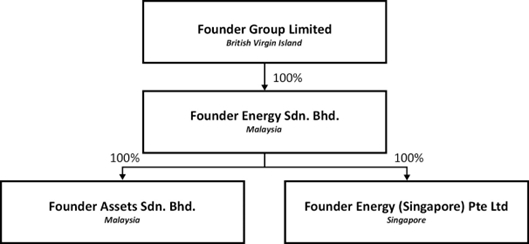
Details of the Company and its subsidiaries (collectively, the “Group”) are shown in the table below:
| Percentage of effective ownership | ||||||||||||||
| December 31, | ||||||||||||||
| Name | Date of incorporation |
2024 | 2023 | Place of incorporation |
Principal activities |
|||||||||
| % | % | |||||||||||||
| Founder Group Limited | May 18, 2023 | British Virgin Islands | Holding company | |||||||||||
| Founder Energy Sdn. Bhd. | April 13, 2021 | 100 | 100 | Malaysia | Business of renewable energy activities and related business and activities of holding companies | |||||||||
| Founder Energy (Singapore) Pte Ltd | May 27, 2022 | 100 | 100 | Singapore | Dormant | |||||||||
| Founder Assets Sdn. Bhd. | September 21, 2022 | 100 | 100 | Malaysia | Business in the investment of renewable energy project. | |||||||||
The Company provides engineering, procurement, construction and commissioning (“EPCC”) services for solar photovoltaic (“PV”) facilities in Malaysia primarily through Founder Energy Sdn. Bhd.
F-
FOUNDER GROUP LIMITED AND ITS SUBSIDIARIES
NOTES TO CONSOLIDATED FINANCIAL STATEMENTS
| 1 | ORGANIZATION AND PRINCIPAL ACTIVITIES (cont.) |
On May 27, 2022, the Company incorporate Founder Energy (Singapore) Pte Ltd with domicile in Singapore for future business expansion purpose in Singapore.
On September 21, 2022, the Company incorporate Founder Assets Sdn. Bhd. with domicile in Malaysia to carry out business in the investment of renewable energy project.
On May 18, 2023, Reservoir Energy Link Berhad and Mr. Lee Seng Chi incorporate Founder Group Limited with 51% and 49% equity interest, respectively.
On June 14, 2023, Founder Group Limited acquire 100% equity interest of Founder Energy Sdn. Bhd. from Reservoir Energy Link Berhad and Mr. Lee Seng Chi.
| 2 | MATERIAL ACCOUNTING POLICIES INFORMATION |
BASIS OF PREPARATION
The audited consolidated financial statements have been prepared in accordance with the historical cost basis, except as disclosed in the accounting policies below, and are drawn up in accordance with the provisions of the International Financial Reporting Standards (“IFRSs”) as issued by the International Accounting Standards Board (“IASB”).
Historical cost is generally based on the fair value of the consideration given in exchange for goods and services.
GOING CONCERN
During the current financial year, the Group reported a net loss of RM 5,150,005 (USD 1,150,711) and as of December 31, 2024, the current liabilities of the Group exceeded its current assets by RM 10,182,729 (USD 2,275,216).
The Directors are of the opinion that the Group will have sufficient cash flows for the next twelve months from the date of the financial statements to meet their cash flows requirement and there is no material uncertainty on the ability of the Group to continue as a going concern. Historical results of the treasury management show that the Group has not defaulted on any obligations due or payable to financial institutions or creditors. With continuous actions taken by management to reduce costs, optimize the Group’s cash flows and liquidity as well as the Group’s existing lenders continuing to provide financial support by making available the existing and remaining unutilized borrowing facility to the Group, the Directors believe it is appropriate to prepare the financial statements of the Group on a going concern basis.
ADOPTION OF NEW AND REVISED STANDARDS
At the date of authorization of those financial statements, our Company has not adopted the new and revised IFRS Accounting Standards and amendments to IFRS Accounting Standards that have been issued but are not yet effective to them. We do not anticipate that the adoption of these new and revised IFRS Accounting Standards pronouncements in future periods will have a material impact on our financial statements in the period of their initial adoption.
NEW AND REVISED IFRS IN ISSUE BUT NOT YET EFFECTIVE
The Group has not applied in advance the following accounting standards and/or interpretations (including the consequential amendments, if any) that have been issued by the International Accounting Standards Board (IASB) but are not yet effective for the current financial period:
| IFRSs and/or IC Interpretations (Including The Consequential Amendments) | Effective Date | |
| IFRS 19 Subsidiaries without Public Accountability: Disclosures | 1 January 2027 | |
| IFRS 18 Presentation and Disclosure in Financial Statements | 1 January 2027 | |
| Annual Improvements of IFRS Accounting Standards – Volume 11 | 1 January 2026 | |
| Amendments to IFRS 9 and IFRS 7 Amendments to the Classification and Measurement of Financial Instruments | 1 January 2026 | |
| Amendment to IAS 21 Lack of Exchangeability | 1 January 2025 | |
| Amendments to IFRS 10 and IFRS 28: Sale or Contribution of Assets between an Investor and its Associate or Joint Venture | Deferred |
F-
FOUNDER GROUP LIMITED AND ITS SUBSIDIARIES
NOTES TO CONSOLIDATED FINANCIAL STATEMENTS
| 2 | MATERIAL ACCOUNTING POLICIES INFORMATION (cont.) |
RECENTLY ADOPTED IFRS
The Group has adopted the following accounting standards and/or interpretations (including the consequential amendments, if any) that have been issued by the International Accounting Standards Board (IASB) for the current financial period:
| IFRSs and/or IC Interpretations (Including The Consequential Amendments) | Effective Date | |
| Amendment to IAS 1 Non-current Liabilities with Covenants | 1 January 2024 | |
| Amendments to IAS 1 Classification of liabilities as Current or Non-current | 1 January 2024 | |
| Amendments to IAS 7 and IFRS 7 Supplier Finance Arrangements | 1 January 2024 | |
| Amendment to IFRS 16 Lease Liability in a Sale and Leaseback | 1 January 2024 |
BASIS OF CONSOLIDATION
The acquisition of entities, businesses or assets under common control are accounted for in accordance with merger accounting.
The combined financial statements incorporate the financial statements of the combined entities or businesses in which the common control combination occurs as if they had been combined from the date when the combining entities or businesses first came under the control of the controlling party.
The combined financial statements have prepared using uniform accounting policies for like transactions and other events in similar circumstances.
All intra-group balances, transactions, income and expenses are eliminated in full on combination and the combined financial statements reflect external transactions only.
The net assets of the combined entities or businesses are combined using the existing carrying amounts from the controlling party’s perspective. No amount is recognized in respect of goodwill or excess of the acquirer’s interest in the net fair value of acquiree’s identifiable assets, liabilities and contingent liabilities over the acquisition cost at the time of common control combination. All differences between the cost of acquisition (fair value of consideration paid) and the amounts at which the assets and liabilities are recorded, arising from common control combination, have been recognized directly in equity as part of the capital reserve.
The combined statements of profit or loss and other comprehensive income include the results of each of the combining entities or businesses from the earliest date presented or since the date when the combined entities or businesses first came under the common control, where this is a shorter period, regardless of the date of the common control combination.
CONVENIENCE TRANSLATION
Translations of amounts in the audited consolidated statement of financial position, audited consolidated statement of profit or loss and other comprehensive income and audited consolidated statement of cash flows from RM into USD as of and for the year ended December 31, 2024 are solely for the convenience of the reader. Unless otherwise noted, all translations from RM into USD for the fiscal year ended December 31, 2024 were calculated at the evening middle rate of USD 1 = 4.47550, as published by Bank Negara Malaysia, or an average rate of USD 1 = 4.57115.
F-
FOUNDER GROUP LIMITED AND ITS SUBSIDIARIES
NOTES TO CONSOLIDATED FINANCIAL STATEMENTS
| 2 | MATERIAL ACCOUNTING POLICIES INFORMATION (cont.) |
FINANCIAL ASSETS
Classification and measurement
The Group classifies its financial assets at fair value through other comprehensive income, fair value through profit and loss and amortized cost.
The classification depends on the Group’s business model for managing the financial assets as well as the contractual terms of the cash flows of the financial assets.
| 1. | Financial assets at FVTPL are initially recorded at fair value and transaction costs are expensed in the statement of income and comprehensive income. Realized and unrealized gains and income arising from changes in the fair value of the financial asset held at FVTPL are included in the statement of income and comprehensive income in the period in which they arise. The Company has classified cash as FVTPL. |
| 2. | Financial assets at FVTOCI are initially recognized at fair value plus transaction costs. Subsequently they are measured at fair value, with gains and losses arising from changes in fair value recognized in other comprehensive income. There is no subsequent reclassification of fair value gains and losses to profit or loss following the derecognition of the investment. There are no financial assets classified as FVTOCI. |
| 3. | Financial assets at amortized cost are initially recognized at fair value, net of transaction costs, and subsequently carried at amortized cost less any impairment. They are classified as current assets or non- current assets based on their maturity date. The Company has classified trade receivables, contract assets, other receivables and amounts due from related parties at amortized cost. |
Impairment
The Company assesses at end of each reporting period whether there is objective evidence that a financial asset or group of financial assets is impaired.
The Company recognizes expected credit losses (“ECL”) for accounts receivable based on the simplified approach. The simplified approach to the recognition of expected losses does not require the Company to track the changes in credit risk; rather, the Company recognizes a loss allowance based on lifetime expected credit losses at each reporting date from the date of the account receivable.
The Company measures expected credit loss by considering the risk of default over the contract period and incorporates forward-looking information into its measurement. ECLs are a probability-weighted estimate of credit losses.
ECLs are measured as the difference in the present value of the contractual cash flows that are due to the Company under the contract, and the cash flows that the Company expects to receive. The Company assesses all information available, including past due status, and forward looking macro-economic factors in the measurement of the ECLs associated with its assets carried at amortized cost.
The maximum period considered when estimating ECLs is the maximum contractual period over which the Company is exposed to credit risk.
FINANCIAL LIABILITIES
Financial liabilities are classified as either financial liabilities at FVTPL or at amortized cost. The Company determines the classification of its financial liabilities at initial recognition.
Financial liabilities are classified as measured at amortized cost, net of transaction costs unless classified as FVTPL. The Company’s trade payables, other payables and accrued liabilities, amounts due to related parties, lease liabilities and bank loans are classified as measured at amortized cost.
F-
FOUNDER GROUP LIMITED AND ITS SUBSIDIARIES
NOTES TO CONSOLIDATED FINANCIAL STATEMENTS
| 2 | MATERIAL ACCOUNTING POLICIES INFORMATION (cont.) |
PLANT AND EQUIPMENT
Plant and equipment is recognized and subsequently measured at cost less accumulated depreciation and any accumulated impairment losses, if any. When components of property and equipment have different useful lives they are accounted for separately. Depreciation is provided at rates which are calculated to write off the assets over their estimated useful lives as follows:
| Computer and Software | 4 years straight line | |
| Motor Vehicles | 5 years straight line | |
| Office Equipment | 4 years straight line | |
| Equipment and Tools | 5 years straight line | |
| Signboard | 4 years straight line | |
| Solar Asset Plant | 10 - 21 years straight line | |
| Office Renovation | 5 years straight line | |
| Plant and Machinery | 5 years straight line | |
| Forklift | 5 years straight line | |
| Right-Of-Use Assets | Over term of lease |
Assets under construction are not depreciated as these assets are not available for use.
Plant or equipment is derecognized upon disposal or when no future economic benefits are expected from its use. Any gain or loss arising from derecognition of the asset, being the difference between the net disposal proceeds and the carrying amount, is recognized in profit or loss. The revaluation reserve included in equity is transferred directly to retained profits on retirement or disposal of the asset.
INVENTORIES
Inventories are stated at the lower of cost and net realizable value. Cost is determined based on weighted average method and comprises the purchase price and incidentals incurred in bringing the inventories to their present location and condition.
Net realizable value represents the estimated selling price less the estimated costs of completion and the estimated costs necessary to make the sale.
IMPAIRMENT OF NON-FINANCIAL ASSETS
Impairment of assets are reviewed at the end of each reporting period for impairment when there is an indication that the assets might be impaired. Impairment is measured by comparing the carrying values of the assets with their recoverable amounts. When the carrying amount of an asset exceeds its recoverable amount, the asset is written down to its recoverable amount and an impairment loss shall be recognized. The recoverable amount of an asset is the higher of the asset’s fair value less costs to sell and its value in use, which is measured by reference to discounted future cash flows using a pre-tax discount rate that reflects current market assessments of the time value of money and the risks specific to the asset. An impairment loss is recognized in profit or loss.
When there is a change in the estimates used to determine the recoverable amount, a subsequent increase in the recoverable amount of an asset is treated as a reversal of the previous impairment loss and is recognized to the extent of the carrying amount of the asset that would have been determined (net of amortization and depreciation) had no impairment loss been recognized. The reversal is recognized in profit or loss immediately.
CONTRACT ASSETS AND LIABILITIES
Contract assets includes unbilled amounts resulting from performance obligation satisfied measured under input method. Contract assets are subsequently transferred to trade receivable upon satisfaction of billing milestone base on contract and entitlement to pay becomes unconditional. A contract asset is subject to impairment requirement of IFRS 9.
Contract liabilities include advance payments from customers that performance obligation yet to satisfied. A contract liabilities is stated at cost and represents the obligation of the Group to transfer goods or services to a customer for which consideration has been received (or the amount is due) from the customers.
F-
FOUNDER GROUP LIMITED AND ITS SUBSIDIARIES
NOTES TO CONSOLIDATED FINANCIAL STATEMENTS
| 2 | MATERIAL ACCOUNTING POLICIES INFORMATION (cont.) |
LEASES
The Group assesses whether a contract is or contains a lease, at inception of the contract. The Group recognizes a right-of-use asset and corresponding lease liability with respect to all lease arrangements in which it is the lessee, except for low-value assets and short-term leases with 12 months or less. For these leases, the Group recognizes the lease payments as an operating expense on a straight-line method over the term of the lease unless another systematic basis is more representative of the time pattern in which economic benefits from the leased assets are consumed.
The Group recognizes a right-of-use asset and a lease liability at the lease commencement date. The right-of-use assets and the associated lease liabilities are presented as a separate line item in the statement of financial position.
The right-of-use asset is initially measured at cost. Cost includes the initial amount of the corresponding lease liability adjusted for any lease payments made at or before the commencement date, plus any initial direct costs incurred, less any incentives received.
The right-of-use asset is subsequently measured at cost less accumulated depreciation and any impairment losses, and adjustment for any remeasurement of the lease liability. The depreciation starts from the commencement date of the lease. If the lease transfers ownership of the underlying asset to the Group or the cost of the right-of-use asset reflects that the Group expects to exercise a purchase option, the related right-of-use asset is depreciated over the useful life of the underlying asset. Otherwise, the Group depreciates the right-of-use asset to the earlier of the end of the useful life of the right-of-use asset or the end of the lease term. The estimated useful lives of the right-of-use assets are determined on the same basis as those property, plant and equipment.
The lease liability is initially measured at the present value of the lease payments that are not paid at the commencement date, discounted by using the rate implicit in the lease. If this rate cannot be readily determined, the Group uses its incremental borrowing rate.
The lease liability is subsequently measured at amortised cost using the effective interest method. It is remeasured when there is a change in the future lease payments (other than lease modification that is not accounted for as a separate lease) with the corresponding adjustment is made to the carrying amount of the right-of-use asset, or is recognized in profit or loss if the carrying amount has been reduced to zero.
PROVISIONS
Provisions are recognized when the Group has a present obligation (legal or constructive) as a result of past events, when it is probable that an outflow of resources embodying economic benefits will be required to settle the obligation, and when a reliable estimate of the amount can be made. Provisions are reviewed at the end of each reporting period and adjusted to reflect the current best estimate. Where the effect of the time value of money is material, the provision is the present value of the estimated expenditure required to settle the obligation. The discount rate shall be a pre-tax rate that reflects current market assessments of the time value of money and the risks specific to the liability. The unwinding of the discount is recognized as interest expense in profit or loss.
REVENUE RECOGNITION
The Group accounts for its revenue under IFRS 15 Revenue from Contracts with Customers. (“IFRS 15”) The five-step model defined by IFRS 15 requires the Company to:
| (1) | identify its contracts with customers; |
| (2) | identify its performance obligations under those contracts; |
| (3) | determine the transaction prices of those contracts; |
| (4) | allocate the transaction prices to its performance obligations in those contracts; and |
| (5) | recognise revenue when each performance obligation under those contracts is satisfied. Revenue recognized when promised goods and services are transferred to the client in an amount that reflects the consideration expected in exchange for those services. |
F-
FOUNDER GROUP LIMITED AND ITS SUBSIDIARIES
NOTES TO CONSOLIDATED FINANCIAL STATEMENTS
| 2 | MATERIAL ACCOUNTING POLICIES INFORMATION (cont.) |
REVENUE RECOGNITION (cont.)
Revenues are recognized when persuasive evidence of an arrangement exists, service has occurred, and all performance obligations have been performed pursuant to the terms of the agreement, the sales price is fixed oi determinable and collectability is reasonably assured. Our revenue agreements generally do not include a right of return in relation to the delivered goods or services. Depending on the terms of the agreement and the laws that apply to the agreement, control of the services may be transferred over time or at a point in time. Control of the services is transferred over time if our performance:
| - | provides all of the benefits received and consumed simultaneously by the client; |
| - | creates and enhances an asset that the client controls as the Group performs; or |
| - | does not create an asset with an alternative use to the Group and the Group has an enforceable right to payment for performance complete to date. |
The Group recognises revenue from the following major sources:
| (i) | Large-scale solar projects (“LSS”) |
LSS are utility scale solar PV power plants with installed generating capacity of 1 MWac or more. Large-scale solar projects are ground mounted and are designed to supply power to the power grid. For the majority of our large-scale solar projects, we usually act as the contractor to the project awarder, who is the main contractor for a solar project. As an EPCC provider, we assume most of the responsibility for the entire project lifecycle, from design and engineering to material procurement, construction, installation, integration, and commissioning.
| (ii) | Commercial and industrial (“C&I”) solar projects |
C&I projects are smaller scale solar projects where the solar PV systems are installed on rooftops and are designed to generate electricity for commercial and industrial properties for their own consumption, such as factories, warehouses and commercial stores. For C&I projects, we usually sign a service contract with the project owner and act as the main contractor. As the main contractor, we engage in comprehensive services encompassing project design, engineering, equipment procurement, construction, and commissioning.
Rendering of Services
Revenue from providing product and services related to renewable energy services industry is recognized over time in the year in which the services are rendered using input method, determined based on the proportion of costs incurred for work performed to date over the estimated total costs. Transaction price is computed based on the price specified in the contract and adjusted for any variable consideration such as incentives and penalties.
A receivable is recognized when the services are rendered as this is the point over time that the consideration is unconditional because only the passage of time is required before the payment is due. If the services rendered exceed the payment received, a contract asset is recognized. If the payments exceed the services rendered, a contract liability is recognized.
Billings are made with a credit term of 30 days to 90 days, which is consistent with market practice, therefore, no element of financing is deemed present. The Company become entitled to invoice customers for construction of solar PV power plants and systems based on achieving a series of performance-related milestones.
Defect liability period and performance warranty are usually 24 months from the date of Certificate of Practical Completion as provided in the contracts with customers.
F-
FOUNDER GROUP LIMITED AND ITS SUBSIDIARIES
NOTES TO CONSOLIDATED FINANCIAL STATEMENTS
| 2 | MATERIAL ACCOUNTING POLICIES INFORMATION (cont.) |
REVENUE RECOGNITION (cont.)
Sale of Goods
Revenue is recognized at a point in time when the goods have been delivered to the customer and upon its acceptance, and it is probable that the Group will collect the considerations to which it would be entitled to in exchange for the goods sold. Billings are made with a credit term of 30 days to 90 days, which is consistent with market practice, therefore, no element of financing is deemed present.
The Company generally provides standard warranties to its customers, from date of delivery cost or satisfactory completion of the project. There is no warranty claim historically.
CASH AND CASH EQUIVALENTS
Cash and cash equivalents comprise cash in hand, bank balances, fixed deposits, demand deposits, and short-term, highly liquid investments that are readily convertible to known amounts of cash and which are subject to an insignificant risk of changes in value with original maturity periods of three months or less. For the purpose of the statement of cash flows, cash and cash equivalents are presented net of bank overdrafts.
SHARE CAPITAL
Ordinary shares are classified as equity. Incremental costs directly attributable to the issuance of new ordinary shares are deducted against the share capital account.
INCOME TAX
Current tax assets and liabilities are the expected amount of income tax recoverable or payable to the taxation authorities, measured using tax rates and tax laws that have been enacted or substantively enacted at the end of the reporting period and are recognized in profit or loss except to the extent that the tax relates to items recognized outside profit or loss (either in other comprehensive income or directly in equity).
Deferred taxes are recognized using the liability method for temporary differences other than those that arise from the initial recognition of an asset or liability in a transaction which is not a business combination and at the time of the transaction, affects neither accounting profit nor taxable profit.
Deferred tax assets and liabilities are measured at the tax rates that are expected to apply in the period when the asset is realized or the liability is settled, based on the period.
Deferred tax assets are recognized for all deductible temporary differences, unused tax losses and unused tax credits to the extent that it is probable that future taxable profits will be available against which the deductible temporary differences, unused tax losses and unused tax credits can be utilised. The carrying amounts of deferred tax assets are reviewed at the end of each reporting period and reduced to the extent that it is no longer probable that the related tax benefits will be realized.
Current and deferred tax items are recognized in correlation to the underlying transactions either in profit or loss, other comprehensive income or directly in equity.
Current tax assets and liabilities or deferred tax assets and liabilities are offset when there is a legally enforceable right to set off current tax assets against current tax liabilities and when the deferred taxes relate to the same taxable entity (or on different tax entities but they intend to settle current tax assets and liabilities on a net basis) and the same taxation authority.
F-
FOUNDER GROUP LIMITED AND ITS SUBSIDIARIES
NOTES TO CONSOLIDATED FINANCIAL STATEMENTS
| 2 | MATERIAL ACCOUNTING POLICIES INFORMATION (cont.) |
FOREIGN CURRENCY TRANSACTIONS
The functional currency used by the Company is the Malaysia Ringgit. Consequently, operations in currencies other than the Malaysia Ringgit are considered to be denominated in foreign currency and are recorded at the exchange rates in force on the dates of the operations.
At year-end, monetary assets and liabilities denominated in foreign currency are converted by applying the exchange rate on the balance sheet date. The profits or losses revealed are charged directly to the profit and loss account for the year in which they occur. Non-monetary items in foreign currency measured in terms of historical cost are converted at the exchange rate on the date of the transaction.
The exchange differences of the monetary items that arise both when liquidating them and when converting them at the closing exchange rate, are recognized in the results of the year, except those that are part of the investment of a business abroad, which are recognized directly in equity net of taxes until the time of its disposal.
EARNINGS PER SHARE
Basic income per share is calculated by dividing the income attributable to ordinary shareholders by the weighted average number of ordinary shares outstanding in the period. For all periods presented, the income attributable to ordinary shareholders equals the reported income attributable to owners of the Company.
Diluted income per share is calculated by the treasury stock method. Under the treasury stock method, the weighted average number of ordinary shares outstanding for the calculation of diluted income per share assumes that the proceeds to be received on the exercise of dilutive share options and warrants are used to repurchase ordinary shares at the average market price during the period.
The Company has no potentially dilutive securities, such as options or warrants, currently issued and outstanding, as of December 31, 2024 and 2023.
| 3 | CRITICAL ACCOUNTING JUDGEMENTS AND KEY SOURCES OF ESTIMATION UNCERTAINTY |
Management believes that there are no key assumptions made concerning the future, and other key sources of estimation uncertainty at the reporting date, that have a significant risk of causing a material adjustment to the carrying amounts of the assets and liabilities within the next financial year other than as disclosed below:-
Impairment of Trade Receivables and Contract Assets
The Group uses the simplified approach to estimate a lifetime expected credit loss allowance for all trade receivables and contract assets. The contract assets are grouped with trade receivables for impairment assessment because they have substantially the same risk characteristics as the trade receivables for the same types of contracts. The Group develops the expected loss rates based on the payment profiles of past sales and the corresponding historical credit losses, and adjusts for qualitative and quantitative reasonable and supportable forward-looking information. If the expectation is different from the estimation, such difference will impact the carrying value of trade receivables and contract assets.
Contract Revenue Recognition
Revenue from providing product and services related to renewable energy services industry is recognized over time measure via input method, determined based on the proportion of costs incurred for work performed to date over the estimated total costs. Transaction price is computed based on the price specified in the contract and adjusted for any variable consideration such as incentives and penalties. The Group applied judgement and assumptions significantly affects the determination of the amount and the timing of revenue recognized from contract with customers for commercial & industrial and large scale solar. The Group measures the performance of service work done by comparing the actual costs incurred with the estimated total costs required to complete the services. Significant judgements are required to estimate the total contract costs to complete. In making these estimate, management relied on estimates and also on past experience of completed projects. A change in estimate will directly affect the revenue to be recognized.
F-
FOUNDER GROUP LIMITED AND ITS SUBSIDIARIES
NOTES TO CONSOLIDATED FINANCIAL STATEMENTS
| 4 | ACQUISITION OF FOUNDER ENERGY SDN. BHD. AT DISCOUNT UNDER COMMON CONTROL |
On June 14, 2023, Founder Group Limited acquired 100% equity interests of Founder Energy Sdn. Bhd. from Reservoir Energy Link Berhad and Mr. Lee Seng Chi under common control. The Company accounted the transaction as following:
| RM | Convenience Translation USD |
|||||||
| Obligation assumed by the Company | 4 | 1 | ||||||
| Book value of Share Capital of Founder Energy Sdn. Bhd. | (1,300,000 | ) | (294,583 | ) | ||||
| Bargain purchase accounted as merger reserve in equity | 1,299,996 | 294,582 | ||||||
| 5 | ACQUISITION OF ASSETS AND BUSINESS FROM SOLAR BINA ENGINEERING SDN. BHD. AT DISCOUNT UNDER COMMON CONTROL |
On July 31, 2021, Founder Energy Sdn. Bhd. entered into a Business and Asset Transfer Agreement with Solar Bina Engineering Sdn. Bhd., a common control entity owned and controlled by Mr. Lee Seng Chi, acquiring a variety of fixed assets and inventory at the net asset value as define in aforementioned agreement.
In addition to assets, Founder Energy Sdn. Bhd. acquired renewable energy, mounting structure system, building structural design and installation, solar system installation services and project management business from Solar Bina Engineering Sdn. Bhd.
The net asset value of transferred inventory and other assets by Solar Bina Engineering Sdn Bhd. as of January 1, 2021 amounted to RM 1,375,507, whereas the net asset value of inventory and other assets as of July 31, 2021 amounted to RM 1,020,236, which is also the amount of consideration stipulated in said agreement. As such, the Company accounted for the bargain purchase, as other reserve in equity amounting to RM 355,271.
Business transferred from Solar Bina Engineering Sdn Bhd., resulted in a loss of RM 49,722, which Founder Energy Sdn Bhd. acquired without consideration. As such, the Company accounted for the bargain purchase, as other reserve in equity amounting to RM 49,722.
The consideration, amounting to RM 1,020,236, was made in cash, with payment being completed by Founder Energy Sdn. Bhd. to Solar Bina Engineering Sdn. Bhd. in the year 2021.
The Company account the acquisition of assets and business under common control similarly to business combination under common control, measured at book value of transferring entity tabled as following:
| RM | Convenience Translation USD |
|||||||
| Acquisition of assets from Solar Bina Engineering Sdn. Bhd. | ||||||||
| Computer and Software | 44,171 | 10,009 | ||||||
| Motor Vehicle | 14,746 | 3,342 | ||||||
| Office Equipment | 30,800 | 6,979 | ||||||
| Mould | 8,502 | 1,927 | ||||||
| Plant and Machinery | 691,187 | 156,625 | ||||||
| Forklift | 45,800 | 10,378 | ||||||
| Inventory | 540,301 | 122,434 | ||||||
| Total fixed assets acquired from Solar Bina Engineering Sdn. Bhd. | 1,375,507 | 311,694 | ||||||
| Consideration transferred by Founder Energy Sdn. Bhd. | (1,020,236 | ) | (231,189 | ) | ||||
| Bargain purchase accounted as other reserve in equity | 355,271 | 80,505 | ||||||
| Acquisition of business from Solar Bina Engineering Sdn. Bhd. | ||||||||
| Sales | 20,268 | 4,593 | ||||||
| Staff Costs | (69,990 | ) | (15,860 | ) | ||||
| Net loss absorbed by Solar Bina Engineering Sdn. Bhd. accounted as other reserve in equity | (49,722 | ) | (11,267 | ) | ||||
F-
FOUNDER GROUP LIMITED AND ITS SUBSIDIARIES
NOTES TO CONSOLIDATED FINANCIAL STATEMENTS
| 6 | PLANT AND EQUIPMENT |
| At cost | Balance as at 1.1.2024 |
Addition | Written off | Balance as at 31.12.2024 |
||||||||||||
| 31 December 2024 | RM | RM | RM | RM | ||||||||||||
| Computer and Software | 223,714 | 30,500 | 254,214 | |||||||||||||
| Motor Vehicle | 79,747 | 289,800 | 369,547 | |||||||||||||
| Office Equipment | 39,318 | 4,240 | (3,930 | ) | 39,628 | |||||||||||
| Equipment and Tools | 33,389 | 26,000 | 59,389 | |||||||||||||
| Signboard | 7,180 | (7,180 | ) | |||||||||||||
| Office Renovation | 41,500 | 1,082,273 | (41,500 | ) | 1,082,273 | |||||||||||
| Solar Asset Under Construction | 470,396 | 470,396 | ||||||||||||||
| Plant and Machinery & Solar Asset Plant | 2,025,568 | 23,460,785 | 25,486,353 | |||||||||||||
| Forklift | 45,800 | 45,800 | ||||||||||||||
| Capital Work-in-progress | 171,720 | 171,720 | ||||||||||||||
| 2,496,216 | 25,535,714 | (52,610 | ) | 27,979,320 | ||||||||||||
| Accumulated depreciation | Balance as at 1.1.2024 |
Depreciation charge during the year | Written off | Balance as at 31.12.2024 |
||||||||||||
| 31 December 2024 | RM | RM | RM | RM | ||||||||||||
| Computer and Software | 83,649 | 65,256 | 148,905 | |||||||||||||
| Motor Vehicle | 30,063 | 19,678 | 49,741 | |||||||||||||
| Office Equipment | 21,329 | 10,402 | (852 | ) | 30,879 | |||||||||||
| Equipment and Tools | 12,204 | 10,044 | 22,248 | |||||||||||||
| Signboard | 3,291 | 898 | (4,189 | ) | ||||||||||||
| Office Renovation | 9,604 | 106,605 | (14,790 | ) | 101,419 | |||||||||||
| Plant and Machinery & Solar Asset Plant | 649,337 | 360,807 | 1,010,144 | |||||||||||||
| Forklift | 25,190 | 7,799 | 32,989 | |||||||||||||
| 834,667 | 581,489 | (19,831 | ) | 1,396,325 | ||||||||||||
| At cost | Balance as at 1.1.2023 |
Addition | Balance as at 31.12.2023 |
|||||||||
| 31 December 2023 | RM | RM | RM | |||||||||
| Computer and Software | 148,264 | 75,450 | 223,714 | |||||||||
| Motor Vehicle | 79,747 | 79,747 | ||||||||||
| Office Equipment | 35,388 | 3,930 | 39,318 | |||||||||
| Equipment and Tools | 33,389 | 33,389 | ||||||||||
| Signboard | 7,180 | 7,180 | ||||||||||
| Office Renovation | - | 41,500 | 41,500 | |||||||||
| Plant and Machinery & Solar Asset Plant | 691,186 | 1,334,382 | 2,025,568 | |||||||||
| Forklift | 45,800 | 45,800 | ||||||||||
| 1,040,954 | 1,455,262 | 2,496,216 | ||||||||||
F-
FOUNDER GROUP LIMITED AND ITS SUBSIDIARIES
NOTES TO CONSOLIDATED FINANCIAL STATEMENTS
| 6 | PLANT AND EQUIPMENT (cont.) |
| Accumulated depreciation | Balance as at 1.1.2023 |
Depreciation charge during the year | Balance as at 31.12.2023 |
|||||||||
| 31 December 2023 | RM | RM | RM | |||||||||
| Computer and Software | 43,520 | 40,129 | 83,649 | |||||||||
| Motor Vehicle | 13,903 | 16,160 | 30,063 | |||||||||
| Office Equipment | 13,353 | 7,976 | 21,329 | |||||||||
| Equipment and Tools | 5,526 | 6,678 | 12,204 | |||||||||
| Signboard | 1,496 | 1,795 | 3,291 | |||||||||
| Office Renovation | 9,604 | 9,604 | ||||||||||
| Plant and Machinery & Solar Asset Plant | 536,100 | 113,237 | 649,337 | |||||||||
| Forklift | 16,030 | 9,160 | 25,190 | |||||||||
| 629,928 | 204,739 | 834,667 | ||||||||||
| As of December 31, 2023 |
As of December 31, 2024 |
As of December 31, 2024 |
||||||||||
| Carrying amounts | RM | RM | Convenience Translation USD |
|||||||||
| Computer and Software | 140,065 | 105,309 | 23,530 | |||||||||
| Motor Vehicle | 49,684 | 319,806 | 71,457 | |||||||||
| Office Equipment | 17,989 | 8,749 | 1,955 | |||||||||
| Equipment and Tools | 21,185 | 37,141 | 8,299 | |||||||||
| Signboard | 3,889 | |||||||||||
| Office Renovation | 31,896 | 980,854 | 219,161 | |||||||||
| Solar Asset Under Construction | 470,396 | 105,105 | ||||||||||
| Plant and Machinery & Solar Asset Plant | 1,376,231 | 24,476,209 | 5,468,933 | |||||||||
| Forklift | 20,610 | 12,811 | 2,862 | |||||||||
| Capital Work-in-progress | 171,720 | 38,369 | ||||||||||
| 1,661,549 | 26,582,995 | 5,939,671 | ||||||||||
| As of December 31, 2023 |
As of December 31, 2024 |
As of December 31, 2024 |
||||||||||
| RM | RM | Convenience Translation USD |
||||||||||
| Depreciation expenses, class under cost of sale | 20,952 | 416,378 | 93,035 | |||||||||
| Depreciation expenses, class separately from cost of sale | 183,787 | 165,111 | 36,892 | |||||||||
| Total depreciation expenses | 204,739 | 581,489 | 129,927 | |||||||||
F-
FOUNDER GROUP LIMITED AND ITS SUBSIDIARIES
NOTES TO CONSOLIDATED FINANCIAL STATEMENTS
| 6 | PLANT AND EQUIPMENT (cont.) |
During the financial year, the Group made the following cash payments to purchase plant and equipment.
| As of December 31, 2023 |
As of December 31, 2024 |
As of December 31, 2024 |
||||||||||
| RM | RM | Convenience Translation USD |
||||||||||
| Purchase of plant and equipment | 1,455,262 | 25,535,714 | 5,705,667 | |||||||||
| Financed by hire purchase arrangements | (250,000 | ) | (55,859 | ) | ||||||||
| Other payables | (24,023,094 | ) | (5,367,690 | ) | ||||||||
| Cash payments on purchase of plant and equipment | 1,455,262 | 1,262,620 | 282,118 | |||||||||
The carrying amount of the plant and equipment of the Group under hire purchase arrangements at the end of the reporting period are as follows:
| As of December 31, 2023 |
As of December 31, 2024 |
As of December 31, 2024 |
||||||||||
| RM | RM | Convenience Translation USD |
||||||||||
| Motor vehicle | 284,970 | 63,673 | ||||||||||
F-
FOUNDER GROUP LIMITED AND ITS SUBSIDIARIES
NOTES TO CONSOLIDATED FINANCIAL STATEMENTS
| 7 | RIGHT-OF-USE ASSETS AND LEASE LIABILITIES |
| As of December 31, 2023 |
As of December 31, 2024 |
As of December 31, 2024 |
||||||||||
| RM | RM | Convenience Translation USD |
||||||||||
| Right-Of-Use Assets | ||||||||||||
| Balance brought forward | 141,572 | 213,761 | 47,763 | |||||||||
| Less: Amortization | (118,444 | ) | (190,487 | ) | (42,562 | ) | ||||||
| Termination of right-of-use asset | (94,381 | ) | (142,507 | ) | (31,842 | ) | ||||||
| Add: New lease recognized | 285,014 | 858,477 | 191,817 | |||||||||
| Balance carried forward | 213,761 | 739,244 | 165,176 | |||||||||
| Lease Liabilities | ||||||||||||
| Balance brought forward | 146,640 | 215,647 | 48,184 | |||||||||
| Add: Imputed interest | 9,066 | 24,391 | 5,450 | |||||||||
| Less: Principal repayment | (126,000 | ) | (205,000 | ) | (45,805 | ) | ||||||
| Termination of lease liability | (99,073 | ) | (145,696 | ) | (32,554 | ) | ||||||
| Add: New lease recognized | 285,014 | 858,477 | 191,817 | |||||||||
| Balance carried forward | 215,647 | 747,819 | 167,092 | |||||||||
| Lease liability current portion | 141,816 | 276,524 | 61,786 | |||||||||
| Lease liability non-current portion | 73,831 | 471,295 | 105,306 | |||||||||
| The followings are the amounts recognized in profit or loss: | ||||||||||||
| Depreciation charges of right-of-use assets | 118,444 | 190,487 | 42,562 | |||||||||
| Interest expense on lease liabilities | 9,066 | 24,391 | 5,450 | |||||||||
| Extinguishment of right-of-use asset and liabilities | (4,692 | ) | (3,189 | ) | (713 | ) | ||||||
| Expense relating to short-term leases and leases of low-value assets | 295 | 12,500 | 2,793 | |||||||||
| Total | 123,113 | 224,189 | 50,092 | |||||||||
| As of December 31, 2024 |
As of December 31, 2024 |
|||||||
| RM | Convenience Translation USD |
|||||||
| Maturities of Lease | ||||||||
| Year ending December 31, 2025 | 276,524 | 61,786 | ||||||
| Year ending December 31, 2026 | 292,705 | 65,402 | ||||||
| Year ending December 31, 2027 | 178,590 | 39,904 | ||||||
| Total | 747,819 | 167,092 | ||||||
On July 1, 2024, Founder Energy Sdn. Bhd. had entered into a Tenancy Agreement with Mr. Lee Seng Chi pertaining to the rental of our principal office for two years with option to renew for additional year with monthly rental amounted RM 26,000 (2023: RM 12,500).
The extension options for lease of office premise has been included in lease liabilities. Subsequent renewal is negotiated with Mr. Lee Seng Chi to align with the Group’s business needs.
F-
FOUNDER GROUP LIMITED AND ITS SUBSIDIARIES
NOTES TO CONSOLIDATED FINANCIAL STATEMENTS
| 8 | CONTRACT ASSETS AND CONTRACT LIABILITIES |
| As of December 31, 2023 |
As of December 31, 2024 |
As of December 31, 2024 |
||||||||||
| RM | RM | Convenience Translation USD |
||||||||||
| Contract Assets | ||||||||||||
| Contract cost | 128,952,000 | 189,071,858 | 42,245,974 | |||||||||
| Contract margin | 22,018,596 | 24,840,605 | 5,550,353 | |||||||||
| Contract revenue recognized | 150,970,596 | 213,912,463 | 47,796,327 | |||||||||
| Less: Bill to trade receivables | (100,687,277 | ) | (180,008,528 | ) | (40,220,875 | ) | ||||||
| Contract assets carried forward | 50,283,319 | 33,903,935 | 7,575,452 | |||||||||
| Contract cost assets | 959,005 | |||||||||||
| Less: Provision for impairment loss | (296,776 | ) | (2,668,908 | ) | (596,337 | ) | ||||||
| Add: Accrued revenue | 47,499 | 1,312,562 | 293,277 | |||||||||
| Balance carried forward | 50,993,047 | 32,547,589 | 7,272,392 | |||||||||
| (Increase)/Decrease in contract assets | (32,709,220 | ) | 18,445,458 | 4,121,429 | ||||||||
| Increase in provision for impairment loss | (296,776 | ) | (2,372,132 | ) | (530,026 | ) | ||||||
| Contract Liabilities | ||||||||||||
| Balance brought forward | 806,058 | |||||||||||
| Add: Deposits and prepayment from customer | (800,058 | ) | ||||||||||
| Adjustment for unrealized foreign exchange movement | 12,070 | |||||||||||
| Adjustment to other payables | (18,070 | ) | ||||||||||
| Balance carries forward | ||||||||||||
| (Decrease)/Increase in contract liabilities | (806,058 | ) | ||||||||||
Significant decrease in contract assets for the year ended December 31, 2024 primarily due to a decrease in unbilled revenue related to the satisfaction of performance obligation in excess of amounts billed to customers.
F-
FOUNDER GROUP LIMITED AND ITS SUBSIDIARIES
NOTES TO CONSOLIDATED FINANCIAL STATEMENTS
| 9 | TRADE RECEIVABLES AND TRADE PAYABLES |
| As of December 31, 2023 |
As of December 31, 2024 |
As of December 31, 2024 |
||||||||||
| RM | RM | Convenience Translation USD |
||||||||||
| Non-Current | ||||||||||||
| Project retention receivables | 2,665,887 | 2,478,739 | 553,846 | |||||||||
| Current | ||||||||||||
| Trade receivables | 12,156,133 | 16,195,071 | 3,618,606 | |||||||||
| Project retention receivables | 698,429 | 1,168,425 | 261,071 | |||||||||
| Accrued liquidated ascertained damages to Sub-contractors | 408,980 | 2,011,284 | 449,399 | |||||||||
| Less: Provision for expected credit loss | (27,549 | ) | (580,425 | ) | (129,689 | ) | ||||||
| Total current trade receivables | 13,235,993 | 18,794,355 | 4,199,387 | |||||||||
| Total trade receivables | 15,901,880 | 21,273,094 | 4,753,233 | |||||||||
| Increase in provision for expected credit loss | 552,876 | 123,534 | ||||||||||
| Increase in total trade receivables | 11,922,137 | 5,371,214 | 1,200,137 | |||||||||
Trade receivables are non-interest bearing and generally have 30 to 90 days (2023: 30 to 90 days) payment terms. Other credit terms may be negotiated with customers on a case-by-case basis. Due to their comparatively short maturities, the carrying value of trade receivables approximate their fair value.
The aging of the Group’s net trade receivables is as follows:
| Gross | Impaired | Total | ||||||||||||||
| RM | RM | RM | Convenience Translation USD |
|||||||||||||
| 2024 | ||||||||||||||||
| Current | 9,400,268 | (6,577 | ) | 9,393,691 | 2,098,915 | |||||||||||
| Past due | ||||||||||||||||
| 1 – 30 days | 2,660,393 | (4,058 | ) | 2,656,335 | 593,528 | |||||||||||
| 31 – 60 days | 1,144,998 | (4,373 | ) | 1,140,625 | 254,860 | |||||||||||
| 61 – 90 days | 958,805 | (3,522 | ) | 955,283 | 213,447 | |||||||||||
| More than 90 days | 2,030,607 | (561,895 | ) | 1,468,712 | 328,167 | |||||||||||
| 6,794,803 | (573,848 | ) | 6,220,955 | 1,390,002 | ||||||||||||
| 16,195,071 | (580,425 | ) | 15,614,646 | 3,488,917 | ||||||||||||
| Gross | Impaired | Total | ||||||||||||||
| RM | RM | RM | Convenience Translation USD |
|||||||||||||
| 2023 | ||||||||||||||||
| Current | 5,719,798 | 5,719,798 | 1,245,736 | |||||||||||||
| Past due | ||||||||||||||||
| 1 – 30 days | 3,541,179 | 3,541,179 | 771,247 | |||||||||||||
| 31 – 60 days | 497,090 | 497,090 | 108,263 | |||||||||||||
| 61 – 90 days | 576,296 | 576,296 | 125,513 | |||||||||||||
| More than 90 days | 1,821,770 | (27,549 | ) | 1,794,221 | 390,770 | |||||||||||
| 6,436,335 | (27,549 | ) | 6,408,786 | 1,395,793 | ||||||||||||
| 12,156,133 | (27,549 | ) | 12,128,584 | 2,641,529 | ||||||||||||
F-
FOUNDER GROUP LIMITED AND ITS SUBSIDIARIES
NOTES TO CONSOLIDATED FINANCIAL STATEMENTS
| 9 | TRADE RECEIVABLES AND TRADE PAYABLES (cont.) |
The movements in the Group’s allowance for expected credit losses are as follows:
| ECL – not credit impaired | ECL – credit impaired | Total | ||||||||||||||
| RM | RM | RM | Convenience Translation USD |
|||||||||||||
| Trade receivables | ||||||||||||||||
| Balance as at 1 January 2024 | 27,549 | 27,549 | 6,156 | |||||||||||||
| Charge for the year | 95,976 | 484,449 | 580,425 | 129,689 | ||||||||||||
| Reversal during the year | (27,549 | ) | (27,549 | ) | (6,156 | ) | ||||||||||
| Balance as at 31 January 2024 | 95,976 | 484,449 | 580,425 | 129,689 | ||||||||||||
| Balance as at 1 January 2023 | 27,549 | 27,549 | 6,000 | |||||||||||||
| Charge for the year | ||||||||||||||||
| Balance as at 31 January 2023 | 27,549 | 27,549 | 6,000 | |||||||||||||
| As of December 31, 2023 |
As of December 31, 2024 |
As of December 31, 2024 |
||||||||||
| RM | RM | Convenience Translation USD |
||||||||||
| Trade payables | 37,268,115 | 25,204,848 | 5,631,739 | |||||||||
| Project retention payable | 1,150,758 | 2,191,966 | 489,770 | |||||||||
| Total trade payables | 38,418,873 | 27,396,814 | 6,121,509 | |||||||||
| Increase/(Decrease) in total trade payables | 19,827,253 | (11,022,059 | ) | (2,462,755 | ) | |||||||
Included in trade payables is related party balance amounting to RM 2,667 (USD 596) (2023: nil).
Trade payables are non-interest bearing and generally on cash basis or credit terms of 7 days to 90 days (2023: 7 to 90 days). Other credit terms may be negotiated with suppliers on a case-by-case basis.
| 10 | INVENTORIES |
| As of December 31, 2023 |
As of December 31, 2024 |
As of December 31, 2024 |
||||||||||
| RM | RM | Convenience Translation USD |
||||||||||
| Inventories | 1,863,933 | 3,049,405 | 681,355 | |||||||||
The amount of inventories recognized as an expense in cost of sales of the Group was RM 84,102,118 (USD 18,791,669) (December 31, 2023: RM 130,201,026).
F-
FOUNDER GROUP LIMITED AND ITS SUBSIDIARIES
NOTES TO CONSOLIDATED FINANCIAL STATEMENTS
| 11 | AMOUNT DUE FROM/(TO) RELATED PARTIES |
| As of December 31, 2023 |
As of December 31, 2024 |
As of December 31, 2024 |
||||||||||
| RM | RM | Convenience Translation USD |
||||||||||
| Trade | ||||||||||||
| Amount due from Solar Bina Engineering Sdn. Bhd. | 1,119,848 | 24,727 | 5,525 | |||||||||
| Amount due from RL Sunseap Energy Sdn. Bhd. | 256,256 | 1,387,771 | 310,082 | |||||||||
| Amount due from Reservoir Link Renewable Sdn. Bhd. | 1,699,923 | 390,000 | 87,141 | |||||||||
| 3,076,027 | 1,802,498 | 402,748 | ||||||||||
| Non-trade | ||||||||||||
| Amount due from Solar Bina Engineering Sdn. Bhd. | 400,000 | 89,375 | ||||||||||
| Amount due from Reservoir Link Energy Bhd. | 131,131 | 217,995 | 48,709 | |||||||||
| 131,131 | 617,995 | 138,084 | ||||||||||
| Amount due from related parties | 3,207,158 | 2,420,493 | 540,832 | |||||||||
| Non-trade | ||||||||||||
| Amount due to Reservoir Link Energy Bhd. | 2,474,525 | 1,514,762 | 338,456 | |||||||||
| Amount due to Reservoir Link Sdn. Bhd. | 285,388 | 258,804 | 57,827 | |||||||||
| Amount due to Mr. Lee Seng Chi | 394,500 | 88,147 | ||||||||||
| Amount due to related parties | 2,759,913 | 2,168,066 | 484,430 | |||||||||
Both amount due to and from related parties on an on-demand basis. Other than amount due to and from related parties that is trade nature, amount due to and from related parties subject to interest rate of BLR + 1.5% per annum.
Material Transactions with Related Parties
| Name of Related Party | Relationship to Us | |
| Solar Bina Engineering Sdn. Bhd. | An entity controlled by our Chief Executive Officer and Director Mr. Lee Seng Chi | |
| Reservoir Link Energy Bhd. | Our largest shareholder | |
| Reservoir Link Sdn. Bhd. | An entity controlled by Reservoir Link Energy Bhd. | |
| Reservoir Link Renewable Sdn. Bhd. | An entity controlled by Reservoir Link Energy Bhd. | |
| Lee Seng Chi | Our Chief Executive Officer and Director | |
| RL Sunseap Energy Sdn. Bhd. | Related company with Reservoir Link Energy Bhd. |
F-
FOUNDER GROUP LIMITED AND ITS SUBSIDIARIES
NOTES TO CONSOLIDATED FINANCIAL STATEMENTS
| 11 | AMOUNT DUE FROM/(TO) RELATED PARTIES (cont.) |
| As of December 31, 2022 |
As of December 31, 2023 |
As of December 31, 2024 |
As of December 31, 2024 |
|||||||||||||
| RM | RM | RM | Convenience Translation USD |
|||||||||||||
| Revenue from Solar Bina Engineering Sdn. Bhd. | 4,411,489 | 1,697,072 | 73,938 | 16,521 | ||||||||||||
| Revenue from Reservoir Link Energy Bhd. | 138,170 | 30,873 | ||||||||||||||
| Revenue from RL Sunseap Energy Sdn. Bhd. | 4,050,456 | 2,033,049 | 2,629,089 | 587,440 | ||||||||||||
| Revenue from Reservoir Link Renewable Sdn. Bhd. | 1,040,060 | 3,053,327 | 682,231 | |||||||||||||
| Total revenue from related parties | 8,461,945 | 4,770,181 | 5,894,524 | 1,317,065 | ||||||||||||
| Purchases from Reservoir Link Renewable Sdn. Bhd. | 2,667 | 596 | ||||||||||||||
| Purchases from Solar Bina Engineering Sdn. Bhd. | 826 | |||||||||||||||
| 826 | 2,667 | 596 | ||||||||||||||
| Expenses charged to Reservoir Link Energy Bhd. | 71,352 | 93,310 | 86,864 | 19,409 | ||||||||||||
| Expenses charged by Reservoir Link Energy Bhd. | 98,757 | 102,109 | 113,063 | 25,263 | ||||||||||||
| Expenses charged by Reservoir Link Sdn. Bhd. | 75,035 | |||||||||||||||
| Expenses charged by Solar Bina Engineering Sdn. Bhd. | 2,356 | 526 | ||||||||||||||
| Expenses charged by related parties | 173,792 | 102,109 | 115,419 | 25,789 | ||||||||||||
| Rental payment to Mr. Lee Seng Chi | 102,000 | 126,000 | 217,500 | 48,598 | ||||||||||||
| Finance cost charged by Reservoir Link Energy Bhd. | 105,060 | 185,515 | 177,174 | 39,588 | ||||||||||||
| Finance cost charged by Reservoir Link Sdn. Bhd. | 77,473 | 132,817 | (26,583 | ) | (5,940 | ) | ||||||||||
| Finance cost charged by related parties | 182,533 | 318,332 | 150,591 | 33,648 | ||||||||||||
| Advances from Reservoir Link Energy Bhd. | 2,000,000 | 2,000,000 | 446,877 | |||||||||||||
| Advances from Solar Bina Engineering Sdn. Bhd. | 400,000 | 89,375 | ||||||||||||||
| 2,000,000 | 2,400,000 | 536,252 | ||||||||||||||
The related party transactions mainly derived from the sales of renewable energy services, recharge of expenses, rental expenses, interest expenses on advances and management fees.
The recharge of expenses, interest expenses and management fees charged by Reservoir Link Energy Bhd. and Reservoir Link Sdn. Bhd. represent expenses paid on behalf of the Group and interest expense on funds advanced to the Group.
In the fiscal year 2023, the significant related party transaction with Solar Bina Engineering Sdn. Bhd. was due to a contract secured through Solar Bina Engineering Sdn. Bhd. for the supply of mounting structure, where the customer was unable to novate the contract from Solar Bina Engineering Sdn. Bhd. to the Group.
For the fiscal year 2024, the significant related party transactions with RL Sunseap Energy Sdn. Bhd. and Reservoir Link Renewable Sdn. Bhd. resulted from several contracts secured through solar investors, RL Sunseap Energy Sdn. Bhd. and Reservoir Link Renewable Sdn. Bhd.. The Group was appointed as the contractor to provide engineering, procurement, construction and commissioning works for rooftop solar photovoltaic facilities.
F-
FOUNDER GROUP LIMITED AND ITS SUBSIDIARIES
NOTES TO CONSOLIDATED FINANCIAL STATEMENTS
| 12 | OTHER RECEIVABLES AND PREPAYMENT AND OTHER PAYABLES AND ACCRUED LIABILITIES |
| As of December 31, 2023 |
As of December 31, 2024 |
As of December 31, 2024 |
||||||||||
| RM | RM | Convenience Translation USD |
||||||||||
| Other Receivables | ||||||||||||
| Project deposits | 252,490 | 323,067 | 72,186 | |||||||||
| Prepayment to supplier | 1,843,652 | 10,925,338 | 2,441,144 | |||||||||
| Other receivables | 813,020 | 240,666 | 53,774 | |||||||||
| Other deposits and prepayment | 1,448,882 | 1,455,723 | 325,264 | |||||||||
| 4,358,044 | 12,944,794 | 2,892,368 | ||||||||||
| As of December 31, 2023 |
As of December 31, 2024 |
As of December 31, 2024 |
||||||||||
| RM | RM | Convenience Translation USD |
||||||||||
| Other Payables | ||||||||||||
| Accrued staff cost | 349,035 | 683,062 | 152,623 | |||||||||
| Other payables and accrued expenses | 782,911 | 30,314,506 | 6,773,434 | |||||||||
| Prepayment from customer | 134,194 | 818,931 | 182,981 | |||||||||
| 1,266,140 | 31,816,499 | 7,109,038 | ||||||||||
| 13 | BORROWINGS |
| Note | As of December 31, 2023 |
As of December 31, 2024 |
As of December 31, 2024 |
|||||||||||
| RM | RM | Convenience Translation USD |
||||||||||||
| Non-current liabilities | ||||||||||||||
| Hire purchase payable | 171,382 | 38,293 | ||||||||||||
| Term loan | 811,236 | 1,928,094 | 430,811 | |||||||||||
| 811,236 | 2,099,476 | 469,104 | ||||||||||||
| Current liabilities | ||||||||||||||
| Bank overdraft | 1,465,600 | 327,472 | ||||||||||||
| Hire purchase payable | 78,618 | 17,566 | ||||||||||||
| Term loan | 131,220 | 143,944 | 32,163 | |||||||||||
| Trade financing | 23,766,660 | 31,252,219 | 6,982,956 | |||||||||||
| 23,897,880 | 32,940,381 | 7,360,157 | ||||||||||||
| Total borrowings | ||||||||||||||
| Bank overdraft | (a) | 1,465,600 | 327,472 | |||||||||||
| Hire purchase payable | (b) | 250,000 | 55,859 | |||||||||||
| Term loan | (a) | 942,456 | 2,072,038 | 462,974 | ||||||||||
| Trade financing | (a) | 23,766,660 | 31,252,219 | 6,982,956 | ||||||||||
| 24,709,116 | 35,039,857 | 7,829,261 | ||||||||||||
F-
FOUNDER GROUP LIMITED AND ITS SUBSIDIARIES
NOTES TO CONSOLIDATED FINANCIAL STATEMENTS
| 13 | BORROWINGS (cont.) |
(a) The following table sets out the carrying amount of the borrowings:
| Capacity | As of December 31, 2023 |
As of December 31, 2024 |
As of December 31, 2024 |
|||||||||||||
| RM | RM | RM | Convenience Translation USD |
|||||||||||||
| Line of Credit | ||||||||||||||||
| Ambank Islamic Bank – Domestic Recourse Factoring, at Base Financing Rate – 1% | 10,000,000 | 1,324,110 | 3,692,949 | 825,148 | ||||||||||||
| Ambank Islamic Bank – Invoice Financing, at Base Financing Rate | 20,000,000 | 6,935,623 | 19,502,322 | 4,357,574 | ||||||||||||
| Ambank Islamic Bank – Accepted Bills, at Islamic Interbank Discounting Rate + 1.50% | 10,200,000 | 5,243,619 | 436,269 | 97,479 | ||||||||||||
| Ambank Islamic Bank – Invoice Financing, at Base Financing Rate | 4,413,485 | |||||||||||||||
| CIMB Islamic Bank – Accepted Bills, at Accepted Bills + 1.50% | 8,000,000 | 3,371,782 | ||||||||||||||
| CIMB Islamic Bank – Invoice Financing, at Cost of Funds + 1.5% | 1,421,601 | 6,257,673 | 1,398,206 | |||||||||||||
| CIMB Islamic Bank - Overdraft, at Base Financing Rate +0.5% | 500,000 | 460,338 | 102,857 | |||||||||||||
| Maybank Islamic Bank - Invoice Financing, at Cost of Funds + 1.5% | 5,000,000 | 1,363,007 | 304,549 | |||||||||||||
| Maybank Islamic Bank - Overdraft, at Base Financing Rate +1.0% | 1,000,000 | 1,005,262 | 224,614 | |||||||||||||
| Sunway SCF Sdn Bhd. – Invoice Factoring | 1,056,440 | |||||||||||||||
| Ambank Islamic Bank – Term Financing, at Base Financing Rate – 1% | 1,000,000 | 942,456 | 862,876 | 192,800 | ||||||||||||
| Ambank Islamic Bank – Term Financing, at Base Financing Rate – 1.75% | 9,700,000 | 1,209,161 | 270,175 | |||||||||||||
| 65,400,000 | 24,709,116 | 34,789,857 | 7,773,402 | |||||||||||||
F-
FOUNDER GROUP LIMITED AND ITS SUBSIDIARIES
NOTES TO CONSOLIDATED FINANCIAL STATEMENTS
| 13 | BORROWINGS (cont.) |
The Group entered into banking facilities with Ambank Islamic Bank and is secured by:
| a) | Corporate guarantee from Reservoir Link Energy Bhd; |
| b) | Fixed deposits pledged by Founder Energy Sdn. Bhd. and Founder Assets Sdn. Bhd.; |
| c) | First legal charge over the escrow account, debt reserve account and sinking fund account; and |
| d) | Insurance policy for the Directors of the Group. |
The Group entered into a banking facility with Maybank Islamic Bank and is secured by:
| a) | Corporate guarantee from Reservoir Link Energy Bhd; and |
| b) | Fixed deposits pledged by Founder Energy Sdn. Bhd.. |
The Group entered into a banking facility with CIMB Islamic Bank and is secured by:
| a) | Corporate guarantee from Reservoir Link Energy Bhd; |
| b) | Fixed deposits pledged by Founder Energy Sdn. Bhd.; and |
| c) | Sinking fund account. |
(b) Hire purchase payable
| As of December 31, 2024 |
As of December 31, 2024 |
|||||||
| RM | Convenience Translation USD |
|||||||
| Minimum hire purchase payment | ||||||||
| Not later than one (1) year | 90,612 | 20,246 | ||||||
| Later than one (1) year and not later than five (5) years | 181,213 | 40,490 | ||||||
| 271,825 | 60,736 | |||||||
| Less: Future interest charges | (21,825 | ) | (4,877 | ) | ||||
| Present value of hire purchase payment | 250,000 | 55,859 | ||||||
| Repayable as follows: | ||||||||
| Non-current liabilities | 171,382 | 38,293 | ||||||
| Current liabilities | 78,618 | 17,566 | ||||||
| 250,000 | 55,859 | |||||||
The hire purchase payable of the Group bears interest of 2.91% per annum and is secured by the Group’s motor vehicle under hire purchase arrangement.
F-
FOUNDER GROUP LIMITED AND ITS SUBSIDIARIES
NOTES TO CONSOLIDATED FINANCIAL STATEMENTS
| 13 | BORROWINGS (cont.) |
(c) The following table sets out the remaining maturities of the borrowings:
Twelve months ending December 31,
| 2023 RM |
2024 RM |
Convenience Translation USD |
||||||||||
| Maturities | ||||||||||||
| Within 1 year | 23,897,880 | 32,940,381 | 7,360,157 | |||||||||
| 1 - 2 years | 80,369 | 257,262 | 57,481 | |||||||||
| 2 - 5 years | 265,773 | 673,262 | 150,434 | |||||||||
| More than 5 years | 465,094 | 1,168,952 | 261,189 | |||||||||
| Total | 24,709,116 | 35,039,857 | 7,829,261 | |||||||||
The interest rate profile of the Group’s interest-bearing financial instruments based on their carrying amount as at the end of the reporting period are as follows based on their carrying amount as at the end of the reporting period are as follows:
| As of December 31, 2023 |
As of December 31, 2024 |
As of December 31, 2024 |
||||||||||
| RM | RM | Convenience Translation USD |
||||||||||
| Fixed rate instrument | ||||||||||||
| Hire Purchase | 250,000 | 55,859 | ||||||||||
| Floating rate instrument | ||||||||||||
| Bank borrowings | 24,709,116 | 34,789,857 | 7,773,402 | |||||||||
| Total | 24,709,116 | 35,039,857 | 7,829,261 | |||||||||
Sensitivity analysis for variable rate instruments
Sensitivity analysis of interest rate for the floating rate instruments at the end of each reporting period, assuming all other variables remain constant, is as follows:
| As of December 31, 2023 |
As of December 31, 2024 |
As of December 31, 2024 |
||||||||||
| Effects of 50 basis point changes | RM | RM | Convenience Translation USD |
|||||||||
| Floating rate instrument | ||||||||||||
| Bank borrowings | 93,895 | 132,201 | 29,539 | |||||||||
Sensitivity analysis for fixed rate instruments at the end of each reporting period is not presented as fixed rate instruments are not affected by changes in interest rates.
F-
FOUNDER GROUP LIMITED AND ITS SUBSIDIARIES
NOTES TO CONSOLIDATED FINANCIAL STATEMENTS
| 14 | SHARE CAPITAL |
| As of December 31, 2023 |
As of December 31, 2024 |
As of December 31, 2023 |
As of December 31, 2024 |
As of December 31, 2024 |
||||||||||||||||
| Paid up capital: | Number of ordinary shares | Number of ordinary shares | RM | RM | Convenience Translation USD |
|||||||||||||||
| At beginning of year | 15,700,000 | 15,700,000 | 69,284 | 69,284 | 15,481 | |||||||||||||||
| Issuance of share capital (1) | 1,218,750 | 21,208,687 | 4,738,842 | |||||||||||||||||
| Issuance of share capital (2) | 2,813 | 49,301 | 11,016 | |||||||||||||||||
| Transaction costs of share issue | (18,195,839 | ) | (4,065,655 | ) | ||||||||||||||||
| Issuance of share capital (3) | 743,726 | 4,293,824 | 959,406 | |||||||||||||||||
| At end of year | 15,700,000 | 17,665,289 | 69,284 | 7,425,257 | 1,659,090 | |||||||||||||||
As of December 31, 2023, the Company has authorized 15,700,000 ordinary shares at USD 0.001. The paid up ordinary shares has no par value and carry one vote per share and carry a right to dividends as and when declared by the Company.
On October 23, 2024, the Company’s ordinary shares commenced trading on the Nasdaq Capital Market under the Symbol “FGL”. The Company raised USD 4,886,252 in gross proceeds from its initial public offering and underwriters’ partial exercise of the over-allotment option, before deducting underwriting discounts and other related expenses. The Company received net proceeds of USD 1,548,873 after the deduction of USD 3,337,379 of offering costs.
| (1) | On October 24, 2024, 1,218,750 ordinary shares were issued in our initial public offering at USD 4.00 per ordinary share, before deduction the discounts and expenses. |
| (2) | On October 31, 2024, 2,813 ordinary shares were issued in our underwriters’ partial exercise of the over-allotment option, at USD 4.00 per ordinary share, before deduction the discounts and expenses. |
| (3) | On December 31, 2024, 743,726 ordinary shares were issued to CNP Equity Limited pursuant to the exercise of warrant as consideration for certain professional consulting service relating to the initial offering rendered to the Company. |
F-
FOUNDER GROUP LIMITED AND ITS SUBSIDIARIES
NOTES TO CONSOLIDATED FINANCIAL STATEMENTS
| 15 | RESERVES |
| As of December 31, 2023 |
As of December 31, 2024 |
As of December 31, 2024 |
||||||||||
| RM | RM | Convenience Translation USD |
||||||||||
| Bargain purchases from acquisition of Founder Energy Sdn. Bhd. under common control accounted as merger reserve | 1,299,996 | 1,299,996 | 290,470 | |||||||||
| Bargain purchase from acquisition of plant, equipment and inventory from Solar Bina Engineering Sdn. Bhd. under common control accounted as other reserve | 355,271 | 355,271 | 79,381 | |||||||||
| Bargain purchase from acquisition of business from Solar Bina Engineering Sdn. Bhd. under common control accounted as other reserve | 49,722 | 49,722 | 11,110 | |||||||||
| 1,704,989 | 1,704,989 | 380,961 | ||||||||||
| 16 | REVENUE |
| As of December 31, 2022 |
As of December 31, 2023 |
As of December 31, 2024 |
As of December 31, 2024 |
|||||||||||||
| RM | RM | RM | Convenience Translation USD |
|||||||||||||
| Revenue from contract services | 30,686,871 | 107,896,941 | 61,838,681 | 13,817,155 | ||||||||||||
| Revenue from sales of goods | 24,360,650 | 35,386,851 | 22,611,383 | 5,052,259 | ||||||||||||
| Revenue from contract services – related party | 8,460,447 | 4,770,181 | 5,894,524 | 1,317,065 | ||||||||||||
| Revenue from sales of goods – related party | 1,498 | |||||||||||||||
| 63,509,466 | 148,053,973 | 90,344,588 | 20,186,479 | |||||||||||||
| Timing of revenue recognition: | ||||||||||||||||
| Point in time | 24,362,148 | 35,386,851 | 22,611,383 | 5,052,259 | ||||||||||||
| Over time | 39,147,318 | 112,667,122 | 67,733,205 | 15,134,220 | ||||||||||||
| 63,509,466 | 148,053,973 | 90,344,588 | 20,186,479 | |||||||||||||
| Unsatisfied performance obligation | 32,053,105 | 22,396,400 | 14,606,212 | 3,263,593 | ||||||||||||
Revenue from contract services primarily involved in project execution, including construction, installation and integration works, testing and commissioning of our solar projects. Revenue from sales of goods involved in supply and selling of solar mounting structure and its accessories.
Unsatisfied performance obligation was duly satisfied and recognized as revenue within 12 months after the reporting year end, respectively. Revenue from contract services primarily involved in project execution, including construction, installation and integration works, testing and commissioning of our solar projects. Revenue from sales of goods involved in supply and selling of parts and accessories.
F-
FOUNDER GROUP LIMITED AND ITS SUBSIDIARIES
NOTES TO CONSOLIDATED FINANCIAL STATEMENTS
| 17 | COST OF SALE |
| As of December 31, 2022 |
As of December 31, 2023 |
As of December 31, 2024 |
As of December 31, 2024 |
|||||||||||||
| RM | RM | RM | Convenience Translation USD |
|||||||||||||
| Material Cost | 31,235,746 | 54,245,611 | 27,348,569 | 6,110,729 | ||||||||||||
| Construction Cost | 18,418,808 | 65,513,217 | 47,319,827 | 10,573,081 | ||||||||||||
| Staff Cost | 2,167,536 | 3,620,080 | 4,482,351 | 1,001,531 | ||||||||||||
| Logistic Cost | 918,430 | 1,287,926 | 1,382,209 | 308,839 | ||||||||||||
| Tools & Machinery | 142,452 | 498,672 | 242,645 | 54,216 | ||||||||||||
| Miscellaneous | 1,667,629 | 5,014,568 | 2,910,139 | 650,238 | ||||||||||||
| Depreciation | 274,499 | 20,952 | 416,378 | 93,035 | ||||||||||||
| Total cost of sale | 54,825,100 | 130,201,026 | 84,102,118 | 18,791,669 | ||||||||||||
The cost of sale incurred pertaining to revenue derived from related party is amounting to RM 4,973,983 (USD 1,111,380) (December 31, 2023: RM 3,921,036).
Included in Cost of Sale of the Group is liquidated ascertained damages charged to subcontractors amounting to RM 959,666 (USD 214,426) (December 31, 2023: RM 408,980).
| 18 | EMPLOYEES SALARY AND RELATED COSTS |
| As of December 31, 2022 |
As of December 31, 2023 |
As of December 31, 2024 |
As of December 31, 2024 |
|||||||||||||
| RM | RM | RM | Convenience Translation USD |
|||||||||||||
| Director fees | 212,633 | 47,510 | ||||||||||||||
| Director salaries | 378,000 | 427,875 | 556,692 | 124,387 | ||||||||||||
| Admin salaries | 1,299,412 | 1,837,873 | 2,261,769 | 505,367 | ||||||||||||
| Technical staff salaries | 213,130 | 2,462,096 | 3,036,224 | 678,410 | ||||||||||||
| Total | 1,890,542 | 4,727,844 | 6,067,318 | 1,355,674 | ||||||||||||
| As of December 31, 2022 |
As of December 31, 2023 |
As of December 31, 2024 |
As of December 31, 2024 |
|||||||||||||
| RM | RM | RM | Convenience Translation USD |
|||||||||||||
| Director related expenses | 149,742 | 181,116 | 281,941 | 62,997 | ||||||||||||
| Admin related expenses | 390,268 | 786,795 | 1,250,196 | 279,342 | ||||||||||||
| Technical staff related expenses | 1,954,406 | 1,182,943 | 1,449,449 | 323,863 | ||||||||||||
| Total | 2,494,416 | 2,150,854 | 2,981,586 | 666,202 | ||||||||||||
F-
FOUNDER GROUP LIMITED AND ITS SUBSIDIARIES
NOTES TO CONSOLIDATED FINANCIAL STATEMENTS
| 19 | INCOME TAX (EXPENSE)/BENEFIT |
| As of December 31, 2022 |
As of December 31, 2023 |
As of December 31, 2024 |
As of December 31, 2024 |
|||||||||||||
| RM | RM | RM | Convenience Translation USD |
|||||||||||||
| Tx expenses/(benefits) recognized in profit or loss | ||||||||||||||||
| Current income tax | ||||||||||||||||
| Current financial year | 1,247,733 | 2,795,394 | (500,444 | ) | (111,818 | ) | ||||||||||
| Deferred taxation | ||||||||||||||||
| Current financial year | (149,315 | ) | ||||||||||||||
| Total income tax expenses/(benefits) recognized in profit or loss | 1,247,733 | 2,646,079 | (500,444 | ) | (111,818 | ) | ||||||||||
British Virgin Islands
The Company is incorporated in the British Virgin Islands and is not subject to tax on income or capital gains under current British Virgin Islands law.
Malaysia
Founder Energy Sdn. Bhd. and Founder Assets Sdn. Bhd. are subject to Malaysia Corporate Tax on the taxable income as reported in its statutory financial statements adjusted in accordance with relevant Malaysia tax laws. The standard corporate income tax rate in Malaysia is calculated at 24% of the estimated assessable profits for the financial year.
The unutilized tax losses can be carried forward for a maximum period of ten consecutive years to offset future taxable income.
Singapore
Founder Energy (Singapore) Pte Ltd is subject to Singapore Corporate Tax on the taxable income as reported in its statutory financial statements adjusted in accordance with relevant Singapore tax laws. The standard corporate income tax rate in Singapore is 17%.
F-
FOUNDER GROUP LIMITED AND ITS SUBSIDIARIES
NOTES TO CONSOLIDATED FINANCIAL STATEMENTS
| 19 | INCOME TAX (EXPENSE)/BENEFIT (cont.) |
The numerical reconciliations between the tax expense and the product of accounting (loss)/profit multiplied by the applicable tax rates of the Group are as follows:
| As of December 31, 2022 |
As of December 31, 2023 |
As of December 31, 2024 |
As of December 31, 2024 |
|||||||||||||
| RM | RM | RM | Convenience Translation USD |
|||||||||||||
| Net income/(loss) before taxes | 5,191,239 | 9,793,147 | (5,650,449 | ) | (1,262,529 | ) | ||||||||||
| Tax at the Malaysian statutory tax rate of 24% | 1,245,898 | 2,350,355 | (1,356,108 | ) | (303,007 | ) | ||||||||||
| Tax effects in respect of: | ||||||||||||||||
| Different tax rate in other country | (1,685 | ) | 9,214 | 410,650 | 91,755 | |||||||||||
| Deferred tax assets not recognized and, origination and reversal of temporary differences | — | — | 428,883 | 95,829 | ||||||||||||
| Non-deductible expenses | 145,456 | 299,729 | 86,008 | 19,217 | ||||||||||||
| Non-taxable income | (141,936 | ) | (13,219 | ) | (69,877 | ) | (15,612 | ) | ||||||||
| Tax expenses/(benefits) | 1,247,733 | 2,646,079 | (500,444 | ) | (111,818 | ) | ||||||||||
The Group has unutilized tax losses of RM 1,781,621 (USD 398,083), Nil and Nil and unabsorbed capital allowances of RM 5,393 (USD 1,205), Nil and Nil as of December 31, 2024, 2023 and 2022 available for offset against future taxable profits, respectively. As of December 31, 2024, the unutilized tax losses mainly can be carried forward up to 10 years. No deferred tax asset has been recognized in respect of the following significant net tax benefits due to the unpredictability of future profit streams.
The deferred tax assets are made up of the following:
| As of December 31, 2023 |
As of December 31, 2024 |
As of December 31, 2024 |
||||||||||
| RM | RM | Convenience Translation USD |
||||||||||
| At beginning of year | (75,315 | ) | 74,000 | 16,534 | ||||||||
| Recognised in profit or loss | 149,315 | |||||||||||
| At end of year | 74,000 | 74,000 | 16,534 | |||||||||
F-
FOUNDER GROUP LIMITED AND ITS SUBSIDIARIES
NOTES TO CONSOLIDATED FINANCIAL STATEMENTS
| 19 | INCOME TAX (EXPENSE)/BENEFIT (cont.) |
Presented after appropriate offsetting as follows:
| As of December 31, 2023 |
As of December 31, 2024 |
As of December 31, 2024 |
||||||||||
| RM | RM | Convenience Translation USD |
||||||||||
| Deferred tax assets | 149,315 | 74,000 | 16,534 | |||||||||
| Deferred tax liabilities | (75,315 | ) | ||||||||||
| 74,000 | 74,000 | 16,534 | ||||||||||
The deferred tax assets as at the end of the reporting period are made up of the temporary differences arising from:
| As of December 31, 2023 |
As of December 31, 2024 |
As of December 31, 2024 |
||||||||||
| RM | RM | Convenience Translation USD |
||||||||||
| Deferred tax assets | ||||||||||||
| Provisions and others | 707,852 | 707,852 | 158,162 | |||||||||
| Deferred tax liabilities | ||||||||||||
| Plant and equipment | (295,010 | ) | (295,010 | ) | (65,917 | ) | ||||||
| Other temporary differences | (104,509 | ) | (104,509 | ) | (23,351 | ) | ||||||
| Presented after appropriate offsetting | 308,333 | 308,333 | 68,894 | |||||||||
| At 24% | 74,000 | 74,000 | 16,534 | |||||||||
F-
FOUNDER GROUP LIMITED
AND ITS SUBSIDIARIES
NOTES TO CONSOLIDATED FINANCIAL STATEMENTS
| 20 | FINANCIAL INSTRUMENTS AND RISK MANAGEMENT |
| As of December 31, 2023 |
As of December 31, 2024 |
As of December 31, 2024 |
||||||||||
| RM | RM | Convenience Translation USD |
||||||||||
| Financial assets at amortized cost | ||||||||||||
| Trade receivables | 15,901,880 | 21,273,094 | 4,753,233 | |||||||||
| Other receivables | 1,589,120 | 930,245 | 207,853 | |||||||||
| Amount due from related parties | 3,207,158 | 2,420,493 | 540,832 | |||||||||
| Cash and bank balances | 5,600,147 | 13,901,973 | 3,106,239 | |||||||||
| 26,298,305 | 38,525,805 | 8,608,157 | ||||||||||
| Financial liabilities at amortized cost | ||||||||||||
| Trade payables | (38,418,873 | ) | (27,396,814 | ) | (6,121,509 | ) | ||||||
| Other payables and accrued liabilities | (1,266,140 | ) | (31,816,499 | ) | (7,109,038 | ) | ||||||
| Bank and other borrowings | (24,709,116 | ) | (35,039,857 | ) | (7,829,261 | ) | ||||||
| Amount due to related parties | (2,759,913 | ) | (2,168,066 | ) | (484,430 | ) | ||||||
| (67,154,042 | ) | (96,421,236 | ) | (21,544,238 | ) | |||||||
Foreign Currency Risk
We are exposed to foreign currency risk with transactions and balances that are denominated in currencies other than our functional currency. The currencies giving rise to this risk are primarily Chinese Yuan Renminbi (“CNY”) and United States Dollar (“USD”). Foreign currency risk is monitored closely on an on-going basis to ensure that the net exposure is at an acceptable level.
Sensitivity analysis for foreign currency risk
We are exposed to foreign currency risk with transactions and balances that are denominated in currencies other than the respective functional currencies of Group entities. The currencies giving rise to this risk are primarily Chinese Yuan Renminbi (“CNY”) and United States Dollar (“USD”). Foreign currency risk is monitored closely on an on-going basis to ensure that the net exposure is at an acceptable level.
Our exposure to foreign currency risk based on the carrying amounts of the financial instruments at the end of the reporting period is summarized below.
| CNY | USD | |||||||
| As at December 31, 2024 | RM | RM | ||||||
| Financial assets in foreign currencies | ||||||||
| Cash and bank balances | 2,194 | 1,136,521 | ||||||
| Financial liabilities in foreign currencies | ||||||||
| Trade payables | (7,075,765 | ) | ||||||
| CNY | USD | |||||||
| As at December 31, 2023 | RM | RM | ||||||
| Financial assets in foreign currencies | ||||||||
| Cash and bank balances | 2,279 | 2,276 | ||||||
| Financial liabilities in foreign currencies | ||||||||
| Trade payables | (14,140,316 | ) | (3,638,622 | ) | ||||
F-
FOUNDER GROUP LIMITED AND ITS SUBSIDIARIES
NOTES TO CONSOLIDATED FINANCIAL STATEMENTS
| 20 | FINANCIAL INSTRUMENTS AND RISK MANAGEMENT (cont.) |
The following table details the sensitivity analysis to a 10% change in the foreign currencies at the end of the reporting period, with all other variables held constant.
| As of December 31, |
||||||||
| 2023 | 2024 | |||||||
| RM | RM | |||||||
| United States Dollar | (276,362 | ) | 86,376 | |||||
| Chinese Yuan Renminbi | (1,074,491 | ) | (537,591 | ) | ||||
Interest Rate Risk
We are exposed to interest rate risk as we have bank loans which are interest bearing. The interest rates and terms of repayment of the loans are disclosed in Note 13 to the financial statements. We currently do not have an interest rate hedging policy.
Liquidity Risk
Liquidity risk arises mainly due to general funding and business activities. We practice prudent risk management by maintaining sufficient cash balances and the availability of funding through certain committed credit facilities.
The table below summarises the maturity profile of the Company’s financial liabilities as at the end of the reporting period and are based on undiscounted contractual payments:
| Carrying amount | Contractual cash flows | Within 1 year | More than 1 year and less than 2 years | More than 5 years | ||||||||||||||||
| RM | RM | RM | RM | RM | ||||||||||||||||
| 31 December 2024 | ||||||||||||||||||||
| Trade payables | 27,396,814 | 27,396,814 | 27,396,814 | |||||||||||||||||
| Other payables and accrued liabilities | 31,816,499 | 31,816,499 | 31,816,499 | |||||||||||||||||
| Bank and other borrowings | 35,039,857 | 35,668,434 | 33,045,385 | 1,289,377 | 1,333,672 | |||||||||||||||
| Lease liabilities | 747,819 | 806,000 | 312,000 | 494,000 | ||||||||||||||||
| Amount due to related parties | 2,168,066 | 2,292,276 | 2,292,276 | |||||||||||||||||
| 97,169,055 | 97,980,023 | 94,862,974 | 1,783,377 | 1,333,672 | ||||||||||||||||
| Carrying amount | Contractual cash flows | Within 1 year | More than 1 year and less than 2 years | More than 5 years | ||||||||||||||||
| USD | USD | USD | USD | USD | ||||||||||||||||
| 31 December 2024 | ||||||||||||||||||||
| Trade payables | 6,121,509 | 6,121,509 | 6,121,509 | |||||||||||||||||
| Other payables and accrued liabilities | 7,109,038 | 7,109,038 | 7,109,038 | |||||||||||||||||
| Bank and other borrowings | 7,829,261 | 7,969,709 | 7,383,619 | 288,096 | 297,994 | |||||||||||||||
| Lease liabilities | 167,092 | 180,091 | 69,713 | 110,378 | ||||||||||||||||
| Amount due to related parties | 484,430 | 512,183 | 512,183 | |||||||||||||||||
| 21,711,330 | 21,892,530 | 21,196,062 | 398,474 | 297,994 | ||||||||||||||||
| Carrying amount | Contractual cash flows | Within 1 year | More than 1 year and less than 2 years | More than 5 years | ||||||||||||||||
| RM | RM | RM | RM | RM | ||||||||||||||||
| 31 December 2023 | ||||||||||||||||||||
| Trade payables | 38,418,873 | 38,418,873 | 38,418,873 | |||||||||||||||||
| Other payables and accrued liabilities | 1,266,140 | 1,266,140 | 1,266,140 | |||||||||||||||||
| Bank and other borrowings | 24,709,116 | 25,014,970 | 23,898,060 | 525,600 | 591,310 | |||||||||||||||
| Lease liabilities | 215,647 | 215,647 | 215,647 | |||||||||||||||||
| Amount due to related parties | 2,759,913 | 2,962,824 | 2,962,824 | |||||||||||||||||
| 67,369,689 | 67,878,454 | 66,761,544 | 525,600 | 591,310 | ||||||||||||||||
F-
FOUNDER GROUP LIMITED AND ITS SUBSIDIARIES
NOTES TO CONSOLIDATED FINANCIAL STATEMENTS
| 20 | FINANCIAL INSTRUMENTS AND RISK MANAGEMENT (cont.) |
Capital Risk Management
We manage our capital to ensure that entities within our Company will be able to maintain an optimal capital structure so as to support our businesses and maximize shareholders value. To achieve this objective, we may make adjustments to the capital structure in view of changes in economic conditions, such as adjusting the amount of dividend payment, returning of capital to shareholders or issuing new shares.
We manage our capital based on debt-to-equity ratio that complies with debt covenants and regulatory, if any. The debt-to-equity ratio is calculated as net debt divided by total equity. We include within net debt, loans, and borrowings from financial institutions. Capital includes equity attributable to the owners of the parent and non-controlling interest.
| 21 | CONCENTRATION OF RISK |
Customer Concentration
For the year ended December 31, 2024, the Company generated total revenue of RM 90,344,588, of which two customers accounted for more than 10% of the Company’s total revenue.
For the year ended December 31, 2023, the Company generated total revenue of RM 148,053,973, of which three customers accounted for more than 10% of the Company’s total revenue.
For the year ended December 31, 2022, the Company generated total revenue of RM 63,509,466, of which two customers accounted for more than 10% of the Company’s total revenue.
| For the years ended December 31 | ||||||||||||||||||||||||||||
| 2022 | 2023 | 2024 | 2022 | 2023 | 2024 | |||||||||||||||||||||||
| Revenues | Percentage of revenues | |||||||||||||||||||||||||||
| RM | RM | RM | USD | % | % | % | ||||||||||||||||||||||
| Customer A | N/A* | N/A* | 21,007,350 | 4,693,856 | N/A* | N/A* | 23.25 | |||||||||||||||||||||
| Customer B | 6,852,979 | 23,099,977 | 10,435,837 | 2,331,770 | 10.79 | 15.60 | 11.55 | |||||||||||||||||||||
| Customer C | 25,191,877 | 44,226,069 | N/A* | N/A* | 39.67 | 29.87 | N/A* | |||||||||||||||||||||
| Customer D | N/A* | 15,687,320 | N/A* | N/A* | N/A* | 10.60 | N/A* | |||||||||||||||||||||
| Others | 31,464,610 | 65,040,607 | 58,901,401 | 13,160,853 | 49.54 | 43.93 | 65.20 | |||||||||||||||||||||
| Total | 63,509,466 | 148,053,973 | 90,344,588 | 20,186,479 | 100.00 | 100.00 | 100.00 | |||||||||||||||||||||
F-
FOUNDER GROUP LIMITED AND ITS SUBSIDIARIES
NOTES TO CONSOLIDATED FINANCIAL STATEMENTS
| 21 | CONCENTRATION OF RISK (cont.) |
The following table sets forth a summary of customers who represent 10% or more of the Group’s total accounts receivable:
| For the years ended December 31 | ||||||||||||||||||||
| 2023 | 2024 | 2023 | 2024 | |||||||||||||||||
| Receivables | Percentage of receivables | |||||||||||||||||||
| RM | RM | USD | % | % | ||||||||||||||||
| Customer A | N/A^ | 7,736,776 | 1,728,696 | N/A^ | 36.37 | |||||||||||||||
| Customer B | 2,590,320 | 5,366,239 | 1,199,026 | 16.29 | 25.23 | |||||||||||||||
| Customer C | 4,209,590 | N/A^ | N/A^ | 26.47 | N/A^ | |||||||||||||||
| Customer D | 2,347,367 | N/A^ | N/A^ | 14.76 | N/A^ | |||||||||||||||
| Customer E | 3,322,607 | N/A^ | N/A^ | 20.89 | N/A^ | |||||||||||||||
| Others | 3,431,996 | 8,170,079 | 1,825,511 | 21.59 | 38.40 | |||||||||||||||
| Total | 15,901,880 | 21,273,094 | 4,753,233 | 100.00 | 100.00 | |||||||||||||||
| * | Revenue from relevant customer was less than 10% of the Group’s total revenue for the respective year. |
| ^ | Receivables was less than 10% of the Groups total accounts receivables for the respective year. |
Vendor Concentration
For the year ended December 31, 2024, the Company incurred cost of sale of RM 84,102,118, of which one vendor accounted for more than 10% of the Company’s total cost of sale.
For the year ended December 31, 2023, the Company incurred cost of sale of RM 130,201,026, of which two vendors accounted for more than 10% of the Company’s total cost of sale.
For the year ended December 31, 2022, the Company incurred cost of sale of RM 54,825,100, of which three vendors accounted for more than 10% of the Company’s total cost of sale.
F-
FOUNDER GROUP LIMITED AND ITS SUBSIDIARIES
NOTES TO CONSOLIDATED FINANCIAL STATEMENTS
| 21 | CONCENTRATION OF RISK (cont.) |
| For the years ended December 31 | ||||||||||||||||||||||||||||
| 2022 | 2023 | 2024 | 2022 | 2023 | 2024 | |||||||||||||||||||||||
| Cost of sale | Percentage of cost of sale | |||||||||||||||||||||||||||
| RM | RM | RM | USD | % | % | % | ||||||||||||||||||||||
| Vendor A | 16,097,566 | 20,826,560 | 12,445,870 | 2,780,889 | 29.36 | 16.00 | 14.80 | |||||||||||||||||||||
| Vendor B | 9,600,766 | 17,867,185 | N/A* | N/A* | 17.51 | 13.72 | N/A* | |||||||||||||||||||||
| Vendor C | 5,519,852 | N/A* | N/A* | N/A* | 10.07 | N/A* | N/A* | |||||||||||||||||||||
| Others | 23,606,916 | 91,507,281 | 71,656,248 | 16,010,780 | 43.06 | 70.28 | 85.20 | |||||||||||||||||||||
| Total | 54,825,100 | 130,201,026 | 84,102,118 | 18,791,669 | 100.00 | 100.00 | 100.00 | |||||||||||||||||||||
The following table sets forth a summary of vendors who represent 10% or more of the Group’s total accounts payable:
| For the years ended December 31 | ||||||||||||||||||||
| 2023 | 2024 | 2023 | 2024 | |||||||||||||||||
| Payables | Percentage of payables | |||||||||||||||||||
| RM | RM | USD | % | % | ||||||||||||||||
| Vendor A | 7,580,160 | 7,011,530 | 1,566,648 | 19.73 | 25.59 | |||||||||||||||
| Vendor B | 10,198,777 | N/A^ | N/A^ | 26.55 | N/A^ | |||||||||||||||
| Vendor D | 6,582,074 | N/A^ | N/A^ | 17.13 | N/A^ | |||||||||||||||
| Vendor E | 4,464,585 | N/A^ | N/A^ | 11.62 | N/A^ | |||||||||||||||
| Others | 9,593,277 | 20,385,284 | 4,554,861 | 24.97 | 74.41 | |||||||||||||||
| Total | 38,418,873 | 27,396,814 | 6,121,509 | 100.00 | 100.00 | |||||||||||||||
| * | Purchases from relevant vendor was less than 10% of the Group’s total cost of sale for the respective year. |
| ^ | Payables was less than 10% of the Groups total accounts payables for the respective year. |
| 22 | SEGMENT REPORTING |
The group reporting is organized and managed in two major business units. All of our revenue is derived from one segment country which is in Malaysia.
The reportable segments are summarized as follows:
| i) | Large-scale solar — Large-scale solar projects are utility scale solar PV power plants with installed generating capacity of 1 MWac or more. Large-scale solar projects are ground mounted and are designed to supply power to the power grid. For the majority of our large-scale solar projects, we usually act as the contractor to the project awarder, who is the main contractor for a solar project. |
| ii) | Commercial & Industrial — C&I projects are smaller scale solar projects where the solar PV systems are installed on rooftops and are designed to generate electricity for commercial and industrial properties for their own consumption, such as factories, warehouses and commercial stores. For C&I projects, we usually sign a service contract with the project owner and act as the main contractor. |
Revenue from contract services primarily involved project execution, including construction, installation and integration works, testing and commissioning of our solar projects. Revenue from sales of goods involved supply and selling of solar mounting structures and accessories. Consequently, both segments contribute to revenue from contract services and sales of goods, as reflected in our disclosed financial reports.
F-
FOUNDER GROUP LIMITED AND ITS SUBSIDIARIES
NOTES TO CONSOLIDATED FINANCIAL STATEMENTS
| 22 | SEGMENT REPORTING (cont.) |
| As of December 31, 2022 |
As of December 31, 2023 |
As of December 31, 2024 |
As of December 31, 2024 |
|||||||||||||
| By Business Unit | RM | RM | RM | Convenience Translation USD |
||||||||||||
| Revenue | ||||||||||||||||
| Large Scale Solar Contract Services | 32,657,036 | 100,377,899 | 50,641,696 | 11,315,315 | ||||||||||||
| Commercial & Industrial Contract Services | 6,490,282 | 12,289,223 | 17,091,509 | 3,818,905 | ||||||||||||
| Large Scale Solar Sales of Goods | 19,104,430 | 31,610,675 | 18,223,295 | 4,071,790 | ||||||||||||
| Commercial & Industrial Sales of Goods | 5,257,718 | 3,776,176 | 4,388,088 | 980,469 | ||||||||||||
| Total revenue | 63,509,466 | 148,053,973 | 90,344,588 | 20,186,479 | ||||||||||||
| Cost of Sales | ||||||||||||||||
| Large Scale Solar Contract Services | (27,734,735 | ) | (87,239,254 | ) | (48,888,238 | ) | (10,923,525 | ) | ||||||||
| Commercial & Industrial Contract Services | (4,566,630 | ) | (10,880,570 | ) | (14,634,333 | ) | (3,269,877 | ) | ||||||||
| Large Scale Solar Sales of Goods | (17,641,212 | ) | (28,926,094 | ) | (16,521,415 | ) | (3,691,523 | ) | ||||||||
| Commercial & Industrial Sales of Goods | (4,882,523 | ) | (3,155,108 | ) | (4,058,132 | ) | (906,744 | ) | ||||||||
| Total cost of sales | (54,825,100 | ) | (130,201,026 | ) | (84,102,118 | ) | (18,791,669 | ) | ||||||||
| Large Scale Solar Gross profit | 6,385,519 | 15,823,226 | 3,455,338 | 772,057 | ||||||||||||
| Commercial & Industrial Gross profit | 2,298,847 | 2,029,721 | 2,787,132 | 622,753 | ||||||||||||
| Total gross profit | 8,684,366 | 17,852,947 | 6,242,470 | 1,394,810 | ||||||||||||
| Selling and administrative expenses | (3,244,159 | ) | (6,596,538 | ) | (11,734,782 | ) | (2,622,005 | ) | ||||||||
| Selling and administrative expenses to related parties | (173,792 | ) | (102,109 | ) | (115,419 | ) | (25,789 | ) | ||||||||
| Income/(Loss) from operations before income tax | 5,266,415 | 11,154,300 | (5,607,731 | ) | (1,252,984 | ) | ||||||||||
| As of December 31, 2022 |
As of December 31, 2023 |
As of December 31, 2024 |
As of December 31, 2024 |
|||||||||||||
| Total assets | RM | RM | RM | Convenience Translation USD |
||||||||||||
| Large Scale Solar segment | 20,133,617 | 60,580,358 | 49,139,582 | 10,979,685 | ||||||||||||
| Commercial & Industrial segment | 3,717,891 | 12,553,577 | 33,956,854 | 7,587,277 | ||||||||||||
| Total of reportable segments | 23,851,508 | 73,133,935 | 83,096,436 | 18,566,962 | ||||||||||||
| Corporate and other | 10,504,811 | 10,739,584 | 31,195,694 | 6,970,326 | ||||||||||||
| Consolidated total assets | 34,356,319 | 83,873,519 | 114,292,130 | 25,537,288 | ||||||||||||
| Total liabilities | RM | RM | RM | Convenience Translation USD |
||||||||||||
| Large Scale Solar segment | 14,122,911 | 33,875,532 | 21,362,655 | 4,773,245 | ||||||||||||
| Commercial & Industrial segment | 5,274,767 | 4,543,341 | 29,714,895 | 6,639,458 | ||||||||||||
| Total of reportable segments | 19,397,678 | 38,418,873 | 51,077,550 | 11,412,703 | ||||||||||||
| Corporate and other | 7,320,208 | 30,664,984 | 46,093,102 | 10,298,984 | ||||||||||||
| Consolidated total liabilities | 26,717,886 | 69,083,857 | 97,170,652 | 21,711,687 | ||||||||||||
F-
FOUNDER GROUP LIMITED AND ITS SUBSIDIARIES
NOTES TO CONSOLIDATED FINANCIAL STATEMENTS
| 23 | COMMITMENTS AND CONTINGENCIES |
Operating lease commitments
For the details on future minimum lease payments under the non-cancelable operating leases as of December 31, 2024, please refer to Note 7 to the Consolidated Financial Statements.
Capital commitments
Capital expenditure as at the end of the reporting period is as follows:
| As of December 31, 2023 |
As of December 31, 2024 |
As of December 31, 2024 |
||||||||||
| RM | RM | Convenience Translation USD |
||||||||||
| Not later than one year | ||||||||||||
| Capital expenditure: | ||||||||||||
| Plant and equipment | 7,103,190 | 1,587,128 | ||||||||||
| 24 | COMPARATIVE FIGURES |
Certain figures relating to previous year have been reclassified to conform with current year presentation.
| 25 | SUBSEQUENT EVENTS |
The Group evaluated all events and transactions that occurred after December 31, 2024 up through the date of report, which is the date that these consolidated financial statements are available for distribution. Other than the events disclosed below:
| (a) | On January 14, 2025, the Group incorporated a subsidiary, namely Founder Assets (Thailand) Company Limited, a company incorporated in Thailand. |
| (b) | On January 21, 2025, the Group subscribed for an additional 1,000,000 ordinary shares in Founder Assets Sdn. Bhd. for a total consideration of RM 1,000,000. |
| (c) | On February 10, 2025, the Group incorporated a subsidiary, namely Founder Solar Solution Sdn. Bhd., a company incorporated in Malaysia. |
F-44
Exhibit 2.2
Description of Rights of Each Class of Securities
Registered under Section 12 of the Securities Exchange Act of 1934, as Amended (the “Exchange Act”)
Ordinary shares with no par value per share (“Ordinary Shares”), of Founder Group Limited (“we,” “our,” “our company,” or “us”) are listed and traded on the Nasdaq Capital Market, and in connection with this listing (but not for trading), its Ordinary Shares are registered under Section 12(b) of the Exchange Act. This exhibit contains a description of the rights of the holders of Ordinary Shares.
Description of Ordinary Shares
The following is a summary of material provisions of our memorandum and articles of association (as amended and / or amended and restated (as applicable) from time to time) (the M&A) as well as the BVI Business Companies Act, 2020 (Revised Edition) (the “BVI Act”) insofar as they relate to the material terms of our Ordinary Shares. Notwithstanding this, because it is a summary, it may not contain all the information that you may otherwise deem important. For more complete information, you should read the entirety of our M&A, which have been filed with the U.S. Securities and Exchange Commission (the “SEC”) as exhibits to our Registration Statement on Form F-1 (File No. 333-281167), initially filed with the U.S. Securities and Exchange Commission on August 1, 2024.
Type and Class of Securities (Item 9.A.5 of Form 20-F)
Each Ordinary Share has no par value per share. The number of Ordinary Shares that have been issued as of the last day of the financial year ended December 31, 2024 is provided on the cover of the annual report on Form 20-F filed on [*], 2025 (the “2024 Form 20-F”). Our Ordinary Shares may be held in either certificated or uncertificated form.
Preemptive Rights (Item 9.A.3 of Form 20-F)
The holders of our Ordinary Shares do not have pre-emptive rights under the BVI Act or pursuant to our M&A.
Limitations or Qualifications (Item 9.A.6 of Form 20-F)
Each Ordinary Share entitles the holder thereof to one vote on all matters subject to the vote at general meetings of our company.
Rights of Other Types of Securities (Item 9.A.7 of Form 20-F)
Not applicable.
Rights of Ordinary Shares (Item 10.B.3 of Form 20-F)
Ordinary Shares
We are authorized to issue an unlimited number of no par value Ordinary Shares. All of our issued and outstanding Ordinary Shares are fully paid and non-assessable. Our Ordinary Shares are issued in registered form and are issued when registered in our register of members. We are not authorized to issue bearer shares, convert registered Ordinary Shares to bearer shares or exchange registered Ordinary Shares for bearer shares . Our shareholders who are non-residents of the British Virgin Islands (the “BVI”) may freely hold and vote their shares.
Dividends
Subject to the BVI Act and our M&A, our board of directors may authorize and declare a dividend to shareholders at such time and of such an amount as they think appropriate if they are satisfied, on reasonable grounds, that immediately following the dividend payment the value of our assets will exceed our liabilities and we will be able to pay our debts as they become due (the “Solvency Test”). There is no further BVI statutory restriction on the amount of funds which may be distributed by us by dividends.
If, after a dividend is authorized (but before it is paid), our board of directors cease to be satisfied (on reasonable grounds) that the Company will be able to satisfy the Solvency Test after the dividend is paid, then such dividend is deemed not to have been authorized. The directors must notify each shareholder of any dividend authorized by them and no interest accrues on any dividend. If a shareholder fails to claim any dividend for three years after the date on which it was authorized by the directors, the directors may decide by a resolution of directors that the dividend is forfeited for the benefit of the Company.
Voting Rights
Any action required or permitted to be taken by the shareholders must be effected at a duly called meeting of the shareholders entitled to vote on such action or may be effected by a resolution of members in writing, each in accordance with the M&A. At each meeting of shareholders, each shareholder who is present in person or by proxy (or, in the case of a shareholder being a corporation, by its duly authorized representative) will have one vote for each share that such shareholder holds. Where two or more persons are registered as the holders of an Ordinary Share, unless another joint holder is nominated by a written notice signed by all of the joint holders for any of these purposes, only the senior joint holder is entitled to attend and vote (whether in person or by proxy) at any meeting of shareholders, or sign or consent to any written resolution of shareholders, in respect of the share.
There is nothing under BVI law which specifically prohibits or restrict the creation of cumulative voting rights for the election of our directors. Our M&A do not provide for cumulative voting for elections of directors.
Meetings of Shareholders
Under our M&A, a copy of the notice of any meeting of shareholders shall be given not less than seven days before the date of the proposed meeting to those persons whose names appear as shareholders in the register of members on the date of the notice and are entitled to vote at the meeting and our directors. Our board of directors may call a meeting of shareholders upon the written request of shareholders holding at least one-third of our issued voting shares. In addition, our board of directors may call a meeting of shareholders on its own motion. A meeting of shareholders may be called on short notice if at least two-third of the shares entitled to vote on the matters to be considered at the meeting have agreed to short notice of the meeting, or if all members holding shares entitled to vote on all or any matters to be considered at the meeting have waived notice and presence at the meeting shall be deemed to constitute waiver for this purpose.
At any meeting of shareholders, a quorum will be present if there are shareholders present in person or by proxy representing more than one-half of the issued shares entitled to vote on the resolutions to be considered at the meeting. Such quorum may be represented by only a single shareholder or proxy. If no quorum is present within two hours of the start time of the meeting, the meeting shall be dissolved if it was requested by shareholders. In any other case, the meeting shall be adjourned to the next business day, and if shareholders representing not less than one-third of the votes of the Ordinary Shares or each class of shares entitled to vote on the matters to be considered at the meeting are present within two hours of the start time of the adjourned meeting, a quorum will be present. If not, the meeting will be dissolved. No business may be transacted at any meeting of shareholders unless a quorum is present at the commencement of business. If present, the chairperson of our board of directors shall be the chairperson presiding at any meeting of the shareholders. If the chairperson of our board is not present, or there is no such chairperson, then the members present shall choose a shareholder to act to chairperson the meeting of the shareholders. If the shareholders are unable to choose a chairperson for any reason, then the person representing the greatest number of voting shares present in present of by proxy shall preside as chairperson, failing which the oldest individual member or member representative shall take the chair.
A corporation that is a shareholder shall be deemed for the purpose of our M&A to be present in person if represented by its duly authorized representative who has been authorized to do so by resolutions of its directors or other governing body. This duly authorized representative shall be entitled to exercise the same powers on behalf of the corporation which he represents as that corporation could exercise if it were our individual shareholder.
Transfer of Ordinary Shares
Subject to the restrictions in our M&A and applicable securities laws, any of our shareholders may transfer all or any of his or her Ordinary Shares by written instrument of transfer signed by the transferor and containing the name and address of the transferee or without the need for a written instrument of transfer if the transfer is carried out in accordance with applicable exchange rules or requirements of the Nasdaq Capital Market or by any recognized stock exchange on which our securities are listed. Our board of directors may not resolve to refuse or delay the transfer of any Ordinary Share unless the shareholder has failed to pay an amount due in respect of it.
Liquidation
As permitted by the BVI Act and our M&A, we may be voluntarily liquidated under Part XII of the BVI Act by resolution of directors and resolution of shareholders if our assets exceed our liabilities and we are able to pay our debts as they fall due. We also may be wound up in circumstances where we are insolvent in accordance with the terms of the BVI Insolvency Act, 2003 (as amended).
If we are wound up and the assets available for distribution among our shareholders are more than sufficient to repay all amounts paid to us on account of the issue of shares immediately prior to the winding up, the excess shall be distributable pari passu among those shareholders in proportion to the amount paid up immediately prior to the winding up on the shares held by them, respectively. If we are wound up and the assets available for distribution among the shareholders as such are insufficient to repay the whole of the amounts paid to us on account of the issue of shares, those assets shall be distributed so that, to the greatest extent possible, the losses shall be borne by the shareholders in proportion to the amounts paid up immediately prior to the winding up on the shares held by them, respectively. If we are wound up, the liquidator appointed by us may, in accordance with the BVI Act, divide among our shareholders in specie or kind the whole or any part of our assets (whether they shall consist of property of the same kind or not) and may, for such purpose, set such value as the liquidator deems fair upon any property to be divided and may determine how such division shall be carried out as between the shareholders or different classes of shareholders.
Calls on Shares and Forfeiture of Shares
Our board of directors may, on the terms established at the time of the issuance of such shares or as otherwise agreed, make calls upon shareholders for any amounts unpaid on their shares in a notice served to such shareholders at least 14 days prior to the specified time of payment. The shares that have been called upon and remain unpaid are subject to forfeiture.
Redemption, Repurchase and Surrender of Shares
Subject to the provisions of the BVI Act, we may issue shares on terms that are subject to redemption, at our option or at the option of the holders, on such terms and in such manner as may be determined by our M&A and subject to any applicable requirements imposed from time to time by, the BVI Act, the SEC, or by any recognized stock exchange on which our securities are listed.
Issuance of Additional Shares
Our M&A authorizes our board of directors to issue additional shares from authorized but unissued shares, to the extent available, from time to time as our board of directors shall determine.
Inspection of Books and Records
Under the BVI Act, members of the general public, on payment of a nominal fee, can obtain copies of the public records of a company available at the office of the Registrar of Corporate Affairs which will include the company’s certificate of incorporation, its M&A and records of license fees paid to date and will also disclose any articles of dissolution, articles of merger and a register of charges if the company has elected to file such a register.
Our members are also entitled, upon giving written notice to us, to inspect (i) our M&A, (ii) the register of members, (iii) the register of directors, and (iv) minutes of meetings and resolutions of members and of those classes of members of which that member is a member, and to make copies and take extracts from the documents and records referred to in (i) to (iv) above. However, our directors may, if they are satisfied that it would be contrary to the company’s interests to allow a member to inspect any document, or part of a document specified in (ii) to (iv) above, refuse to permit the member to inspect the document or limit the inspection of the document, including limiting the making of copies or the taking of extracts or records. Where a company fails or refuses to permit a member to inspect a document or permits a member to inspect a document subject to limitations, that member may apply to the BVI court for an order that he should be permitted to inspect the document or to inspect the document without limitation.
Requirements to Change the Rights of Holders of Ordinary Shares (Item 10.B.4 of Form 20-F)
Variations of Rights of Shares
All or any of the rights attached to any class of shares may, subject to the provisions of the BVI Act, be varied only with the consent in writing of, or pursuant to a resolution passed at a meeting by the holders of more than 50% of the issued shares of that class, or approved by the holders of more than 50% of the issued shares of that class by written resolution of the shareholders.
Limitations on the Rights to Own Ordinary Shares (Item 10.B.6 of Form 20-F)
There are no limitations under the BVI Act or imposed by our M&A on the rights of non-resident or foreign shareholders to hold or exercise voting rights on our shares.
Provisions Affecting Any Change of Control (Item 10.B.7 of Form 20-F)
Anti-Takeover Provisions
Some provisions of our articles of association may discourage, delay or prevent a change in control of our Company or management that shareholders may consider favorable. Under the BVI Act there are no provisions, which specifically prevent the issuance of preferred shares or any such other “poison pill” measures. Our M&A also do not contain any express prohibitions on the issuance of any preferred shares. Therefore, the directors without the approval of the holders of ordinary shares may issue preferred shares that have characteristics that may be deemed to be anti-takeover. Additionally, such a designation of shares may be used in connection with plans that are poison pill plans. However, under BVI law, our directors in the exercise of their powers granted to them under our M&A and performance of their duties, are required to act honestly and in good faith in what the director believes to be in the best interests of our Company.
Ownership Threshold (Item 10.B.8 of Form 20-F)
There are no provisions in our M&A governing the ownership threshold above which shareholder ownership must be disclosed.
Differences Between the Law of Different Jurisdictions (Item 10.B.9 of Form 20-F)
The BVI Act and the laws of the BVI affecting BVI companies like us and our shareholders differ from laws applicable to U.S. corporations and their shareholders. Set forth below is a summary of the significant differences between the provisions of the laws of the BVI applicable to us and the laws applicable to companies incorporated under the Delaware General Corporation Law (the “DGCL”) in the United States and their shareholders.
Mergers and Similar Arrangements
Under the laws of the BVI, two or more BVI companies may merge or consolidate in accordance with section 170 of the BVI Act. A merger means the merging of two or more constituent companies into one of the constituent companies and a consolidation means the consolidating of two or more constituent companies into a new company. In order to merge or consolidate, then (among other things) the directors of each constituent company must approve a written plan of merger or consolidation, which must be authorized by a resolution of shareholders.
While a director may vote on the plan of merger or consolidation even if that director has an interest in the merger or consolidation, the director must disclose the interest to all other directors of the company promptly upon becoming aware of the fact that the director is interested in the merger or consolidation.
A transaction entered into by our Company in respect of which a director is interested (including a merger or consolidation) is voidable by us unless the director’s interest was (a) disclosed to the board prior to the transaction or (b) the transaction is (i) between the director and the Company and (ii) the transaction is in the ordinary course of the Company’s business and on usual terms and conditions.
Notwithstanding the above, a transaction entered into by the Company is not voidable if the material facts of the interest are known to the shareholders and they approve or ratify it or the Company received fair value for the transaction.
Shareholders not otherwise entitled to vote on the merger or consolidation may still acquire the right to vote if the plan of merger or consolidation contains any provision which, if proposed as an amendment to the M&A, would entitle them to vote as a class or series on the proposed amendment. In any event, all shareholders must be given a copy of the plan of merger or consolidation irrespective of whether they are entitled to vote at the meeting held to approve the plan of merger or consolidation.
The shareholders of the constituent companies are not required to receive shares of the surviving or consolidated company but may receive debt obligations or other securities of the surviving or consolidated company, other assets, or a combination thereof. Further, some or all of the shares of a class or series may be converted into a kind of asset while the other shares of the same class or series may receive a different kind of asset. As such, not all the shares of a class or series must receive the same kind of consideration.
After the plan of merger or consolidation has been approved by the directors and authorized by a resolution of the shareholders, articles of merger or consolidation are executed by each company and filed with the Registrar of Corporate Affairs in the BVI.
A shareholder may dissent from a mandatory redemption of his shares, an arrangement (if permitted by the court), a merger (unless the shareholder was a shareholder of the surviving company prior to the merger and continues to hold the same or similar shares after the merger) or a consolidation. A shareholder properly exercising his dissent rights is entitled to a cash payment equal to the fair value of his shares.
A shareholder dissenting from a merger or consolidation must object in writing to the merger or consolidation before the vote by the shareholders on the merger or consolidation, unless notice of the meeting was not given to the shareholder. If the merger or consolidation is approved by the shareholders, the company must give notice of this fact to each shareholder who gave written objection within 20 days. These shareholders then have 20 days to give to the company their written election in the form specified by the BVI Act to dissent from the merger or consolidation, provided that in the case of a merger, the 20 days starts when the plan of merger is delivered to the shareholder.
Upon giving notice of his election to dissent, a shareholder ceases to have any of the rights of a shareholder except the right to be paid the fair value of his shares. As such, the merger or consolidation may proceed in the ordinary course notwithstanding his dissent.
Within seven days of the later of the delivery of the notice of election to dissent and the effective date of the merger or consolidation, the surviving or consolidated company must make a written offer to each dissenting shareholder to purchase his shares at a specified price per share that the company determines to be the fair value of the shares. The company and the shareholder then have 30 days to agree upon the price. If the company and a shareholder fail to agree on the price within the 30 days, then the company and the shareholder shall, within 20 days immediately following the expiration of the 30-day period, each designate an appraiser and these two appraisers shall designate a third appraiser. These three appraisers shall fix the fair value of the shares as of the close of business on the day prior to the shareholders’ approval of the transaction without taking into account any change in value as a result of the transaction.
Under Delaware law, each corporation’s board of directors must approve a merger agreement. The merger agreement must state, among other terms, the terms of the merger and method of carrying out the merger. This agreement must then be approved by the majority vote of the outstanding shares entitled to vote at an annual or special meeting of each corporation, and no class vote is required unless provided in the certificate of incorporation. Delaware permits an agreement of merger to contain a provision allowing the agreement to be terminated by the board of directors of either corporation, notwithstanding approval of the agreement by the stockholders or shareholders of all or any of the corporations (1) at any time prior to the filing of the agreement with the Secretary of State or (2) after filing if the agreement contains a post-filing effective time and an appropriate filing is made with the Secretary of State to terminate the agreement before the effective time. In lieu of filing an agreement of merger, the surviving corporation may file a certificate of merger, executed in accordance with Section 103 of the DGCL. The surviving corporation is also permitted to amend and restate its certification of incorporation in its entirety. The agreement of merger may also provide that it may be amended by the board of directors of either corporation prior to the time that the agreement filed with the Secretary of State becomes effective, even after approval by stockholders or shareholders, so long as any amendment made after such approval does not adversely affect the rights of the stockholders or shareholders of either corporation and does not change any term in the certificate of incorporation of the surviving corporation. If the agreement is amended after filing but before becoming effective, an appropriate amendment must be filed with the Secretary of State. If the surviving corporation is not a Delaware corporation, it must consent to service of process for enforcement of any obligation of the corporation arising as a result of the merger; such obligations include any suit by a stockholder of the disappearing Delaware corporation to enforce appraisal rights under Delaware law.
If a proposed merger or consolidation for which appraisal rights are provided is to be submitted for approval at a shareholder meeting, the subject company must give notice of the availability of appraisal rights to its shareholders at least 20 days prior to the meeting.
A dissenting shareholder who desires to exercise appraisal rights must (a) not vote in favor of the merger or consolidation; and (b) continuously hold the shares of record from the date of making the demand through the effective date of the applicable merger or consolidation. Further, the dissenting shareholder must deliver a written demand for appraisal to the company before the vote is taken. The Delaware Court of Chancery will determine the fair value of the shares exclusive of any element of value arising from the accomplishment or expectation of the merger, together with interest, if any, to be paid upon the amount determined to be the fair value. In determining such fair value, the court will take into account “all relevant factors.” Unless the Delaware Court of Chancery in its discretion determines otherwise, interest from the effective date of the merger through the date of payment of the judgment will be compounded quarterly and accrue at 5% over the Federal Reserve discount rate.
Shareholders’ Suits
There are both statutory and common law remedies available to our shareholders as a matter of BVI Law. These are summarized below:
Prejudiced Members
A shareholder who considers that the affairs of the company have been, are being, or are likely to be, conducted in a manner that is, or any act or acts of the company have been, or are, likely to be oppressive, unfairly discriminatory or unfairly prejudicial to the shareholder in that capacity, can apply to the BVI High Court under Section 184I of the BVI Act for an order requiring the company or any other person to acquire the shareholder’s shares or pay compensation to the shareholder, regulating the future conduct of the company’s affairs, amending the M&A of the company, appointing a receiver or liquidator of the company, rectifying the records of the company, or that any decision or action of the company which contravenes the BVI Act or the company’s memorandum or articles of association be set aside.
Just and Equitable Winding Up
In addition to the statutory remedies outlined above, shareholders can also petition the BVI Court for the winding up of a company under the Insolvency Act for the appointment of a liquidator to liquidate the company and the court may appoint a liquidator for the company if it is of the opinion that it is just and equitable for the court to so order. Save in exceptional circumstances, this remedy is generally only available where the company has been operated as a quasi-partnership and trust and confidence between the partners has broken down.
Indemnification of Directors and Executive Officers and Limitation of Liability
BVI law does not limit the extent to which a company’s articles of association may provide for indemnification of officers and directors, except to the extent any indemnification provision may be held by the BVI Courts to be contrary to public policy or in breach of the BVI Act, for example, a provision for indemnification against civil fraud or the consequences of committing a crime.
Under the Company’s articles of association, subject to the BVI Act, the Company must indemnify any person who (i) is or was a party, or is threatened to be made a party, to any threatened, pending or completed proceedings, whether civil, criminal, administrative or investigative, by reason of the fact that the person is or was a director or officer of the Company or (ii) is or was, at the request of the Company, serving as a director or officer of, or in any other capacity is or was acting for, another body corporate or a partnership, joint venture, trust or other enterprise, against any expenses, judgments, fines or amounts paid in settlement and reasonably incurred in connection with any legal, administrative or investigative proceedings. In relation to the above, the Company may pay on behalf of the person or lend funds to the person to enable the person to pay, any expenses incurred, or to be incurred, by the person in defending any legal, administrative or investigative proceedings.
Under the BVI Act, to be entitled to this indemnification, such person must have acted honestly and in good faith with a view to the best interests of our Company and, in the case of criminal proceedings, they must have no reasonable cause to believe their conduct with was unlawful. This standard of conduct is generally the same as permitted under the DGCL for a Delaware corporation.
Insofar as indemnification for liabilities arising under the Securities Act may be permitted to our directors, officers or persons controlling us under the foregoing provisions, we have been advised that in the opinion of the SEC, such indemnification is against public policy as expressed in the Securities Act and is therefore unenforceable.
Anti-Takeover Provisions in Our M&A
Some provisions of our articles of association may discourage, delay or prevent a change in control of our Company or management that shareholders may consider favorable. Under the BVI Act there are no provisions, which specifically prevent the issuance of preferred shares or any such other “poison pill” measures. Our M&A also do not contain any express prohibitions on the issuance of any preferred shares. Therefore, the directors without the approval of the holders of ordinary shares may issue preferred shares that have characteristics that may be deemed to be anti-takeover. Additionally, such a designation of shares may be used in connection with plans that are poison pill plans. However, under BVI law, our directors in the exercise of their powers granted to them under our M&A and performance of their duties, are required to act honestly and in good faith in what the director believes to be in the best interests of our Company.
Directors’ Fiduciary Duties
Under Delaware corporate law, a director of a Delaware corporation has a fiduciary duty to the corporation and its shareholders. This duty has two components: the duty of care and the duty of loyalty. The duty of care requires that a director act in good faith, with the care that an ordinarily prudent person would exercise under similar circumstances.
Under this duty, a director must inform himself of, and disclose to shareholders, all material information reasonably available regarding a significant transaction.
The duty of loyalty requires that a director act in a manner he reasonably believes to be in the best interests of the corporation. He must not use his corporate position for personal gain or advantage. This duty prohibits self-dealing by a director and mandates that the best interest of the corporation and its shareholders take precedence over any interest possessed by a director, officer or controlling shareholder and not shared by the shareholders generally. In general, actions of a director are presumed to have been made on an informed basis, in good faith and in the honest belief that the action taken was in the best interests of the corporation. However, this presumption may be rebutted by evidence of a breach of one of the fiduciary duties. Should such evidence be presented concerning a transaction by a director, a director must prove the procedural fairness of the transaction and that the transaction was of fair value to the corporation.
Under BVI law, our directors owe fiduciary duties both at common law and under statute including, among others, a statutory duty to act honestly, in good faith, for a proper purpose and with a view to what the directors believe to be in the best interests of the company. Our directors are also required, when exercising powers or performing duties as a director, to exercise the care, diligence and skill that a reasonable director would exercise in comparable circumstances, taking into account without limitation, the nature of the company, the nature of the decision and the position of the director and the nature of the responsibilities undertaken. In the exercise of their powers, our directors must ensure neither they nor the company acts in a manner which contravenes the BVI Act or our memorandum and articles of association. A shareholder has the right to seek damages for breaches of duties owed to us by our directors.
Pursuant to the BVI Act and our M&A, a director of a company who has an interest in a transaction and who has declared such interest to the other directors, may:
| ● | (a) vote on a matter relating to the transaction; |
| ● | (b) attend a meeting of directors at which a matter relating to the transaction arises and be included among the directors present at the meeting for the purposes of a quorum; and; |
| ● | (c) sign a document on behalf of the Company, or do any other thing in his capacity as a director, that relates to the transaction. |
In certain limited circumstances, a shareholder has the right to seek various remedies against the company in the event the directors are in breach of their duties under the BVI Act. Pursuant to Section 184B of the BVI Act, if a company or director of a company engages in, or proposes to engage in or has engaged in, conduct that contravenes the provisions of the BVI Act or the M&Aof the company, the BVI Court may, on application of a shareholder or director of the company, make an order directing the company or director to comply with, or restraining the company or director from engaging in conduct that contravenes the BVI Act or the memorandum or articles. Furthermore, pursuant to section 184I(1) of the BVI Act a shareholder of a company who considers that the affairs of the company have been, are being or likely to be, conducted in a manner that is, or any acts of the company have been, or are likely to be oppressive, unfairly discriminatory, or unfairly prejudicial to him in that capacity, may apply to the BVI Court for an order which, inter alia, can require the company or any other person to pay compensation to the shareholders.
Shareholder Action by Written Consent
Under the Delaware General Corporation Law, a corporation may eliminate the right of shareholders to act by written consent by amendment to its certificate of incorporation. BVI law provides that, subject to the memorandum and articles of association of a company, an action that may be taken by members of the company at a meeting may also be taken by a resolution of members consented to in writing.
Shareholder Proposals
Under the Delaware General Corporation Law, a shareholder has the right to put any proposal before the annual meeting of shareholders, provided it complies with the notice provisions in the governing documents. A special meeting may be called by the board of directors or any other person authorized to do so in the governing documents, but shareholders may be precluded from calling special meetings. BVI law and our M&Aallow our shareholders holding 30% or more of the votes of the issued and outstanding voting shares to requisition a shareholders’ meeting. There is no requirement under BVI law to hold shareholders’ annual general meetings, but our M&Ado permit the directors to call such a meeting. The location of any shareholders’ meeting can be determined by the board of directors and can be held anywhere in the world.
Cumulative Voting
Under the Delaware General Corporation Law, cumulative voting for elections of directors is not permitted unless the corporation’s certificate of incorporation specifically provides for it. Cumulative voting potentially facilitates the representation of minority shareholders on a board of directors since it permits the minority shareholder to cast all the votes to which the shareholder is entitled on a single director, which increases the shareholder’s voting power with respect to electing such director. As permitted under the BVI law, our M&Ado not provide for cumulative voting. As a result, our shareholders are not afforded any less protections or rights on this issue than shareholders of a Delaware corporation.
Removal of Directors
Under the Delaware General Corporation Law, a director of a corporation with a classified board may be removed only for cause with the approval of a majority of the outstanding shares entitled to vote, unless the certificate of incorporation provides otherwise. Under our M&A, directors can be removed from office, with or without cause, by a resolution of shareholders. Directors can also be removed by a resolution of directors passed at a meeting of directors called for the purpose of removing the director or for purposes including the removal of the director.
Transactions With Interested Shareholders
The DGCL contains a business combination statute applicable to Delaware public corporations whereby, unless the corporation has specifically elected not to be governed by such statute by amendment to its certificate of incorporation, it is prohibited from engaging in certain business combinations with an “interested shareholder” for three years following the date that such person becomes an interested shareholder. An interested shareholder generally is a person or group who or which owns or owned 15% or more of the target’s outstanding voting shares within the past three years. This has the effect of limiting the ability of a potential acquirer to make a two-tiered bid for the target in which all shareholders would not be treated equally. The statute does not apply if, among other things, prior to the date on which such shareholder becomes an interested shareholder, the board of directors approves either the business combination or the transaction which resulted in the person becoming an interested shareholder. This encourages any potential acquirer of a Delaware public corporation to negotiate the terms of any acquisition transaction with the target’s board of directors. BVI law has no comparable statute and our M&Afails to expressly provide for the same protection afforded by the Delaware business combination statute.
Dissolution; Winding Up
Under the Delaware General Corporation Law, unless the board of directors approves the proposal to dissolve, dissolution must be approved by shareholders holding 100% of the total voting power of the corporation. Only if the dissolution is initiated by the board of directors may it be approved by a simple majority of the corporation’s outstanding shares. Delaware law allows a Delaware corporation to include in its certificate of incorporation a supermajority voting requirement in connection with dissolutions initiated by the board. Under the BVI Act and our M&A, we may appoint a voluntary liquidator by a resolution of the shareholders or directors, provided that the directors have made a declaration of solvency that the company is able to discharge its debts as they fall due and that the value of the company’s assets exceed its liabilities.
Variation of Rights of Shares
Under the Delaware General Corporation Law, a corporation may vary the rights of a class of shares with the approval of a majority of the outstanding shares of such class, unless the certificate of incorporation provides otherwise. Under our M&A, if at any time our shares are divided into different classes of shares, the rights attached to any class may only be varied, whether or not our Company is in liquidation, with the consent in writing of or by a resolution passed at a meeting by a majority of the votes cast by those entitled to vote at a meeting of the holders of the issued shares in that class. For these purposes the creation, designation or issue of preferred shares with rights and privileges ranking in priority to an existing class of shares is deemed not to be a variation of the rights of such existing class and may in accordance with our M&Abe effected by resolution of directors without shareholder approval.
Amendment of Governing Documents
Under the Delaware General Corporation Law, a corporation’s governing documents may be amended with the approval of a majority of the outstanding shares entitled to vote, unless the certificate of incorporation provides otherwise. As permitted by BVI law, our M&Amay be amended by a resolution of shareholders and, subject to certain exceptions, by a resolution of directors. An amendment is effective from the date it is registered at the Registry of Corporate Affairs in the BVI.
Anti-Money Laundering Laws
In order to comply with legislation or regulations aimed at the prevention of money laundering we are required to adopt and maintain anti-money laundering procedures, and may require subscribers to provide evidence to verify their identity. Where permitted, and subject to certain conditions, we also may delegate the maintenance of our anti-money laundering procedures (including the acquisition of due diligence information) to a suitable person.
We reserve the right to request such information as is necessary to verify the identity of a subscriber. In the event of delay or failure on the part of the subscriber in producing any information required for verification purposes, we may refuse to accept the application, in which case any funds received will be returned without interest to the account from which they were originally debited.
If any person resident in the BVI knows or suspects that another person is engaged in money laundering or terrorist financing and the information for that knowledge or suspicion came to their attention in the course of their business the person will be required to report his belief or suspicion to the Financial Investigation Agency of the BVI, pursuant to the Proceeds of Criminal Conduct Act, 1997 (as amended). Such a report shall not be treated as a breach of confidence or of any restriction upon the disclosure of information imposed by any enactment or otherwise.
Changes in Capital (Item 10.B.10 of Form 20-F)
Subject to the BVI Act and our M&A, we may from time to time by resolution of our board of directors or resolution of members (as may be appropriate):
| ● | amend our memorandum to increase or decrease the maximum number of Ordinary Shares we are authorized to issue; |
| ● | divide our authorized and issued Ordinary Shares into a larger number of Ordinary Shares; |
| ● | combine our authorized and issued Ordinary Shares into a smaller number of Ordinary Shares; and |
| ● | create new classes of shares with preference to be determined by resolution of the board of directors to amend the M&Ato create new classes of shares with such preferences at the time of authorization. |
Debt Securities (Item 12.A of Form 20-F)
Not applicable.
Warrants and Rights (Item 12.B of Form 20-F)
Not applicable.
Other Securities (Item 12.C of Form 20-F)
Not applicable.
Description of American Depositary Shares (Items 12.D.1 and 12.D.2 of Form 20-F)
Not applicable.
10
Exhibit 4.6
************************************************************************************************
TENANCY AGREEMENT
************************************************************************************************
BETWEEN
LEE SENG CHI
( NRIC: [*] )
(LANDLORD)
AND
FOUNDER ENERGY SDN BHD
( CO REG: 1414006-X )
(TENANT)
************************************************************************************************
DEMISED PREMISES: No.17, Jalan Astana 1D,
Bandar Bukit Raja, 41050 Klang, Selangor Darul Ehsan.
THIS AGREEMENT is made the day and year stated in Section 1 of the First Schedule hereto between the party whose name and description are stated in Section 2 of the First Schedule hereto (hereinafter called the “Landlord”) of the one part and the party whose name and description are stated in Section 3 of the First Schedule hereto (hereinafter called the “Tenant”) of the other part.
WHEREAS :
| 1. | The Landlord is the registered/beneficial proprietor of the property more particularly referred to and described in Section 4 of the First Schedule hereto (hereinafter referred to as the Said Premises). |
| 2. | The Landlord hereby lets and the Tenant hereby takes a tenancy of the Demised Premises on an “as is where is” basis upon the terms and subject to the conditions herein contained. |
NOW IT IS HEREBY AGREED AS FOLLOWS :-
| 1. | Subject to the terms and conditions herein contained the Landlord hereby grants and the Tenant hereby accepts a tenancy of the Demised Premises for the term, commencing from the date and terminating on the date stated in Section 5(a), (b) and (c) respectively of the First Schedule hereto. |
| 2. | The monthly rental stipulated in Section 6 (a) of the First Schedule hereto shall be due and payable in advance in the manner and at the time stipulated in Section 6 (b) respectively of the First Schedule hereto. |
| 3. | The Tenant shall upon execution of this Agreement and prior to the occupation of the Demised Premises pay the Landlord the deposit stipulated in Section 7 of the First Schedule hereto (receipt whereof the Landlord hereby acknowledges) as security for the due observance and performance by the Tenant of all his duties and obligations hereunder and on its part to be performed and fulfilled. The said deposits shall be maintained at this figure during the term of this tenancy and the Tenant shall not be entitled to utilize the said deposit to off-set any rental due under this Agreement and the same shall be returned to the Tenant free of interest within thirty (30) days upon expiry or sooner determination of the term hereby created less any sums as may then be due to the Landlord for damage caused to the Demised Premises by the Tenant (damage due to normal wear and tear excepted). |
| 4. | If applicable, the Tenant shall upon execution of this Agreement and prior to the occupation of the Demised Premises pay the Landlord the water and electricity deposits stipulated in Section 8 of the First Schedule hereto (collectively as the Utility Deposits). The Tenant shall not be entitled to utilize the said deposit to off-set any rental due under this Agreement and the same shall be refunded to the Tenant free of interest within thirty (30) days upon expiry or sooner determination of the term hereby created less such sum or sums as may then be due and outstanding. For the purposes of determining the current deposits, it is hereby agreed that photocopy of the requisite receipt notice or other written communication from the relevant Authority shall be conclusive. |
| Landlord | Tenant | |
| 5. | THE TENANT HEREBY COVENANTS WITH THE LANDLORD as follows:- |
| 5.1 | To promptly and punctually pay the Monthly Rental at the time and in the manner stipulated in Section 6 (b) of the First Schedule. |
| 5.2 | To pay all charges due and incurred in respect of, electricity, water, sewerage, telephone, gas and all other utilities supplied to the Demised Premises and to indemnify the Landlord from any liabilities imposed, made or instituted by any governmental authorities or utilities providers as a result of any failure or delay on the part of the Tenant to comply with the requirement of this clause. |
| 5.3 | To keep the entire interior of the Demised Premises including fixtures, fittings and furniture (if any) and the doors, windows, floors, ceilings, walls, locks, electrical wiring, power and light fittings, cables, pipes, ducts and vents in good and tenantable condition and repair (fair wear and tear only excepted) and to replace or repair any of the aforesaid items and any part of the Demised Premises and the Landlord’s fixtures and fittings which shall be damaged at the Tenant’s own costs and expenses. |
| 5.4 | Not to make or permit to be made any alterations in or additions to the Demised Premises or the Landlord’s fixtures, fittings, decorations, locks or bolts on the entrance doors to the premises therein without having first obtained the written consent of the Landlord thereof and in the event of such consent being given to carry out at the Tenant’s own expense such alterations with such materials and such manner and at such times as shall be designated by the Landlord and upon the determination of the term hereby created, if required by the Landlord, to restore the Demised Premises to its original state and condition at the expense of the Tenant. |
| 5.5 | To permit the Landlord and his duly authorized representatives upon giving previous reasonable notice in writing and at all reasonable times to enter upon and examine the condition of the Demised Premises, whereupon such inspection, the Landlord shall be entitled to serve the Tenant a notice in writing specifying therein any repairs necessary to be carried out and requiring the Tenant to forthwith execute the same and if the Tenant shall not within fourteen (14) days after service of such notice proceed diligently with the execution of such repairs or works then the Landlord with or without workmen and others shall be entitled but not obligated to enter upon the Demised Premises and execute such repairs and the Tenant agrees that the costs and expenses thereof shall be a debt due from the Tenant to the Landlord and shall be forthwith recoverable by action. |
| 5.6 | To use the Demised Premises only for the purpose stipulated in the Section 10 of the First Schedule hereto and not to use or permit or suffer the use thereof for any other purpose Save and Except for the specific purpose herein stated and further not to do or permit or suffer anything to be done in or about the Demised Premises or any part thereof which may become a nuisance or cause damage or inconvenience to the Landlord or the Tenant or occupiers of neighbouring premises. |
| Landlord | Tenant | |
| 5.7 | Not to assign, sublet, or part with the actual or legal possession or the use of the Demised Premises for any term whatsoever without first obtaining the previous consent in writing of the Landlord. |
| 5.8 | Not to do or permit to be done on the Demised Premises anything which may or will infringe any of the laws, by-laws or regulation made by the Government or any competent authority affecting the Demised Premises or whereby the policy or policies of insurance against loss or damage by fire may become void or voidable or whereby the rates of premium payable thereon may be increased to repay the Landlord all sums paid by way of increased premium. |
| 5.9 | Not to erect or display any exterior advertisement signboard before obtaining the license from the relevant authorities. |
| 5.10 | To remove the signboard displaying outside the demised premises within fourteen (14) days upon determination of the said Tenancy Agreement, failing which the Landlord shall remove the said signboard and all expenses incurred shall be borne by the Tenant. |
| 5.12 | On determination of the term hereby created to clear up any rubbish and peaceably and quietly deliver up to the Landlord vacant possession of the Demised Premises in good, clean and proper state of tenantable repair condition. The Tenant may remove all fixtures, fittings or other installations belonging to the Tenant but shall make good any damage caused to the Demised Premises or any part thereof by the installation or removal of such fixtures, fittings or installations. |
| 5.13 | Not to store or bring, burn or put up upon the Demised Premises incense, joss sticks, alter, oil lamps, weapons, arms ammunitions or unlawful goods, gunpowder, saltpeter, kerosene and/or any other explosive or combustible substances whatsoever and/or any items which are banned in Malaysia. |
| 5.14 | During the two (2) months immediately preceding the termination of the tenancy unless the Tenant shall have given notice of his intention to renew the tenancy as hereinafter provided, to permit intending and prospective Tenants or others with written authority from the Landlord upon giving prior reasonable notice at reasonable times of the day to enter and view the Demised Premises for the purpose of letting the same. |
| 5.15 | To keep in good clean tenantable repair and condition all the drains and pipes in the Demised Premises and to pay to the Landlord on demand all costs incurred by the Landlord in cleansing and clearing any of the drains pipes sanitary or water apparatus blocking or stoppage owing to careless or negligent use thereof by the Tenant or his employees, servants, workmen, licensees, customers or any persons authorized by him. |
| 5.16 | To replace all broken or damaged windows, doors and fixtures of and in the Demised Premises whether the same be broken or damaged due to the negligence or default of the Tenant. |
| 5.17 | At all times to control the sound or noise level created from the activities at the Demised Premises so as not to create any disturbances or inconvenience to any of the other tenants, occupiers or owners. |
| 5.18 | To take out in its name with a firm of insurers, a policy or policies of insurance against damage or loss by fire or other risks to the Tenant’s equipment and fixtures and fittings in the Demised Premises beneficially owned by the Tenant to its full insurable value. The Landlord shall not be responsible for any damage or loss under all circumstances. |
| Landlord | Tenant | |
| 5.19 | To pay any charges imposed by law or statutory requirement now or in future relating to or in respect of the rental including levies or government sales and service taxes. |
| 5.20 | To obtain all necessary licences, permits and approvals required in connection with the Tenant’s use of the Demised Premises. |
| 6. | THE LANDLORD HEREBY COVENANTS WITH THE TENANT as follows:- |
| 6.1 | To pay the quit rent, assessment, service charges and other outgoings relating to the Demised Premises other than those herein agreed to be paid by the Tenant. |
| 6.2 | At all times through the period of this Agreement to keep the Demised Premises except the furniture, fixtures therein belonging to the Tenant insured against loss or damage by fire or tempest and in case of destruction by fire or tempest to replace or reinstate the same as speedily as possible. |
| 6.3 | To maintain and keep the main structure of the Demised Premises that is the roof, main walls and timbers, drains and water pipes in good and tenantable repair condition throughout the term hereby created except as regards damage to the premises caused by or resulting from any act of default or negligence of the Tenant or his servants and except as hereinbefore covenanted to be done by the Tenant, then the Tenant shall carry out such repairs at their own cost and expenses. |
| 6.4 | Upon the Tenant paying the rent hereby reserved and observing and performing the covenants, obligations and stipulations herein on his part contained, to allow the Tenant to peaceably hold and enjoy the Said Premises without interruption from the Landlord or any persons rightfully claiming through under or in trust for him. |
| 6.5 | The Landlord shall be at the liberty to sell the Demised Premises any time during the subsistence of this tenancy. Any such sale shall be subjected to this agreement and the Landlord is to ensure that the new Landlord shall honour and be bound by this agreement. |
| 7. | PROVIDED ALWAYS AND IT IS HEREBY EXPRESSLY AGREED BETWEEN BOTH PARTIES as follows:- |
| 7.1 | If at any time the rent or any part thereof (whether formally demanded or not) shall remain unpaid or unsatisfied for seven (7) days after becoming payable or if any of the Tenant’s covenant shall not be performed or observed or if the Tenant shall suffer execution on the Said Premises or if the Tenant shall become a bankrupt or being a company or corporation shall go into liquidation otherwise than for the purpose of amalgamation or reconstruction or if the Tenant for the time being shall enter into any composition with the Tenant’s creditors or suffer any distress or execution to be levied on the Tenant’s goods then and in any of those events it shall be lawful for the Landlord or any persons authorized by the Landlord in that behalf at any time thereafter to re-enter upon the Said Premises or any part thereof in the name of the whole and thereupon this tenancy shall absolutely determine but without prejudice to any right of action or remedy of the Landlord in respect of any breach of the Tenant’s covenants herein contained. |
| Landlord | Tenant | |
| 7.2 | The Landlord shall under no circumstances be liable for loss of or damage to the goods whether due to fire, theft, burglary or otherwise being stored within the Said Premises, unless due to the fault of the Landlord. In the event, if the Said Premises or any part thereof shall be damaged by fire or other causes and becomes unfit for occupation and use then the Landlord shall not be bound or compelled to rebuild or reinstate the same unless the Landlord in his discretion thinks fit. |
| a) | In the event of the Landlord deciding to rebuild and reinstate the Demised Premises and the Tenant deciding to continue with this Tenancy (provided the money payable under any policy of insurance effected by the Landlord shall not have become irrecoverable through any act or default of the Tenant) then the rent hereby reserved or a fair and just proportion thereof according to the nature and extent of the damage sustained shall be suspended and cease to be payable until the Demised Premises shall have been again rendered fit for occupation and use. |
| b) | In the event of the Landlord not deciding to rebuild and reinstate the Demised Premises or the Tenant not deciding to continue with this Tenancy then the rent thereby reserved shall cease and determine from the date of the happening of such destruction or damage as aforesaid and the Tenant will peaceably surrender, vacate, leave and yield up to the Landlord possession of so much of the Demised Premises as shall not have been destroyed. The Landlord shall forthwith refund fully the Security Deposit stated in Section 7 of the First Schedule. |
| c) | Wherein the Said Premises shall not be rendered and reinstated and made ready and fit for occupation within a period of two (2) months from the date of happening of any such event the Tenant shall be at liberty to give the Landlord one (1) calendar month notice in writing determining the Tenancy hereby created and thereupon this Tenancy shall absolutely determine and the Security Deposit paid by the Tenant hereunder shall be refunded to the Tenant forthwith but without prejudice to the right of action of the Landlord in respect of any antecedent breach of any covenant or condition herein contained |
For the avoidance of doubt, in the event that:
| (i) | such destruction or damage shall have been caused by or is attributable to any act, omission and/or negligence of the Tenant or the Tenant’s employees, agents, servants; or |
| (ii) | if any insurance monies payable with respect to such destruction or damage shall be rendered irrevocable by reason of any act, omission and/or negligence of the Tenant or the Tenant’s employees, agents, servants, |
then the Tenant shall not be entitled to exercise any of the rights or remedies provided in Clause 7.2(a), (b) and (c) above and the Tenant shall be liable to pay the rental as set out in Section 6(a) of the First Schedule without any deduction and abatement.
| Landlord | Tenant | |
| 7.3 | In the event the Tenant shall be desirous of taking a tenancy of the Said Premises for a further term, the Tenant shall give the Landlord two (2) months’ written notice of the same. Provided always that the terms and conditions of this Agreement shall have been duly observed and performed by the Tenant, the Landlord shall grant the Tenant a further term of tenancy as is specified in Section 9 of the First Schedule hereto upon the same terms and conditions (save and except for this clause) and at a rental to be agreed upon. |
| 7.4 | There shall be no termination of the tenancy whatsoever during the Tenancy period as stated in section 5 of the First Schedule by either party. In case of breach, the Security Deposits specified in Section 7 of the First Schedule hereto shall be forfeited, by the Landlord, if the Tenant committed the breach. Likewise, the Landlord to rebate the Tenant the same exact amount, if the Landlord committed the breach, without interest. |
However, if the rent or any part thereof shall be in arrears for the period of seven (7) days next after the same become due and payable (whether formally demanded for or not) or any covenant on the Tenant’s part herein contained shall not be performed or observed or if the Tenant shall have a receiving order made against him or shall have made any assignment for the benefit of his creditors or entered into any Agreement or made any arrangements with his creditor by composition or otherwise or suffered any distress or attachment or execution to be levied against his goods or if the Tenant for the time being shall be a company and shall go into liquidation whether compulsory or otherwise except for the purpose of reconstruction or amalgamation then and in any such cases the Landlord shall be entitled to take possession of the Said Premises at any time thereof in the name of the whole and thereupon (excluding the Tenant’s personal possession and property) this Tenancy Agreement shall cease but without prejudice to the rights of action of the Landlord in respect of any antecedent breach of the conditions on the part of the Tenant herein contained. The Landlord has the rights to impose an interest rate of 8% per annum calculated on a daily basis from the date of the arrears of the rental which remain unpaid until full settlement of the same.
| Landlord | Tenant | |
| 7.5 | Any additional deposit required by Tenaga Nasional Berhad or the Air Selangor or Indah Water Konsortium from time to time during the continuance of this Agreement shall forthwith be paid by the Tenant. |
| 7.6 | All costs and incidentals to the preparation and completion of this Agreement including stamp duty shall be borne by the Tenant and each party shall bear their own solicitor’s fees. |
| 7.7 | Any notice in writing under the terms and conditions of this Agreement to be sent to either party hereto on the other shall be by prepaid registered post and shall be deemed to be sufficiently served at the time when the ordinary course of post would have been delivered. |
| 7.8 | The Landlord shall not be liable for any damage, expense, loss or liability suffered or incurred by the Tenant or any other person, or any property or the effects or business of the Tenant, in respect of the operation or the failure of the electricity or water supply or any other public utility services, facilities or other machinery provided by the Landlord or enjoyed by the Tenant in relation to the premises. |
| 7.9 | THE SECOND SCHEDULE: The parties hereto expressly covenant and agree with each other that in addition to the terms and conditions herein appearing the Tenancy hereby is further subject to the Special Condition as set out in the Second Schedule of this Agreement. |
Knowledge or acquiescence by the Landlord of any breach of any of the terms and conditions herein contained shall not operate as or deemed to be waiver of such breach of any of the terms and conditions and any consent or permission by the Landlord shall not be effective or be relied upon by the Tenant unless the consent or permission is reduced in writing and signed by the Landlord.
| 7.10 | Time whenever mentioned herein shall be of the essence of contract. |
| 8 | In this Agreement : |
| 8.1 | The terms “Landlord” and “Tenant” shall include their heirs, personal representatives and successors in title. |
| 8.2 | Words importing the masculine gender only shall include feminine and neuter genders and vice versa. |
| 8.3 | Words importing the singular number only shall include the plural and vice versa. |
| Landlord | Tenant | |
IN WITNESS WHEREOF the parties hereto have hereunder set their hands the day and year specified in Section 1 of the First Schedule hereto.
| SIGNED BY THE SAID LANDLORD | ||
| LEE SENG CHI | ||
| (NRIC : [*]) | ) | |
| ) | ||
| By: | /s/ LEE SENG CHI | |
| In the presence of : NURATIKA KAMARUDIN | ||
| ) | ||
| (NRIC No : [*] | ) | |
| By: | /s/ NURATIKA KAMARUDIN | |
| SIGNED BY THE SAID TENANT | ||
| FOUNDER ENERGY SDN BHD | ) | |
| CO No : 1414006- X | ) | |
| By: | /s/ LEE SENG CHI | |
| In the presence of : NURATIKA KAMARUDIN | ||
| ) | ||
| (NRIC No : [*] | ) | |
| By: | /s/ NURATIKA KAMARUDIN | |
| Landlord | Tenant | |
THE FIRST SCHEDULE
(Which is to be taken, read and construed as an essential part of this Agreement)
|
SECT NO |
ITEMS |
PARTICULARS |
|
1.
|
Date of Agreement
|
This 01 day of JULY 2024 |
|
2. |
Description of Landlord
|
LEE SENG CHI NRIC : [*] [*] Contact : [*]
|
|
3.
|
Description of Tenant
|
FOUNDER ENERGY SDN BHD Co. No.: 1414006 - X NO.17, JALAN ASTANA 1D, BANDAR BUKIT RAJA, 41050 KLANG, SELANGOR DARUL EHSAN. Contact : [*]
|
|
4.
|
Description of Demised Premises
|
A 1 ½ Storey Detached Factory known as ; NO.17, JALAN ASTANA 1D, BANDAR BUKIT RAJA, 41050 KLANG, SELANGOR DARUL EHSAN.
|
|
5 a.
5 b.
5 c.
|
Term
Commencing
Term of Terminating |
2 Years
1st AUGUST 2024
31st JULY 2026 |
|
6 a.
6 b.
|
Monthly Rental
Due On
Account Details |
Ringgit Malaysia Twenty Six Thousand (RM26,000.00) only.
Due and payable on or before the 7th day of each month,
Directly into Landlord’s account as per below Name : LEE SENG CHI Bank : MAYBANK Account No. : [*]
*Rental pay after 7th day each month will subject to a 8% per annum penalty interest.
|
|
7. |
Security Deposits (2 months rental)
|
Two (2) months rental Ringgit Malaysia Seventeen Thousand (RM52,000.00) only.
(Security deposits shall be forfeited if termination is served within the first two (02) years)
*The deposit paid shall be adjusted accordingly upon the increased of the rental rate during the renewal year of tenancy.
|
| Landlord | Tenant | |
|
8. |
Utility Deposits
|
NIL. Tenant to apply own electricity and water account meter with TNB & SYABAS.
*Sewerage charges (IWK) to be borne by tenant.
|
|
9.
|
Option To Renew |
Option to renew for a further one (1) year term at a new rental rate to be based on the prevailing market rate mutually agreed by Parties herein. Any increase or decrease in the rental shall be a maximum of ten (10) percent of the current rental.
|
|
10.
|
Use of the Demised Premises
|
For manufacturing solar systems office and store Usage only. |
|
11. |
Termination of Clause
|
Should the TENANT desire to terminate the Tenancy, the TENANT may only do so after the determined date. The TENANT shall then give at least TWO (2) month’s notice in advance in respect of such termination or TWO (2) month’s in lieu thereof.
|
| Landlord | Tenant | |
THE SECOND SCHEDULE
(which is to be taken, read and construed as an essential and integral part of this Agreement)
| 1. | The TENANT shall have the right and privilege at its option to extend the duration of this Agreement for ONE (1) Year (Optional) to a new rent to be agreed upon by negotiation according to the increment of not exceeding 10% of the rental or according to market value, whichever is higher. |
| 2. | The LANDLORD shall hand the keys to the Demised Premises over to the TENANT upon execution of this Agreement and upon receipt of full Security Deposits; |
| 3. | The Tenant shall bear all the incidental costs in respect of this Agreement and the stamp duty payable thereon; |
| 4. | Notwithstanding Section 5 and Clause 1 of the First and Second Schedule respectively if upon the expiry of the ONE (1) year tenancy or the extended period, the LANDLORD reserves the right not to grant further extension then in such a case the Tenancy herein shall lapse upon the maturity of the tenancy period and the Tenancy shall peacefully yield up the said Demised Premises; |
| 5. | Notwithstanding the above, if as a result of introduction of any new laws, by-laws, rules or regulations or the amendments to the laws, by-laws, rules or regulations now existing in respect of the Tenancy, the Tenant shall be required and become liable to pay any new or additional tax, levy, charges or imposition or shall be required to incur additional costs as a result of any such new laws, by-laws, rules or regulations, such payment shall be a condition precedent for the due and proper observance and performance by the Tenant of its obligations and liabilities hereunder; |
| 6. | The TENANT shall not to make any alterations in or additions to the Demised Premises without the written consent of the Landlord first had and obtained and in conformity with all relevant laws, by-laws and regulations and any direction plans and specifications approved by the Landlord granting such written consent. The Tenant shall be solely liable for all cost and expenses incurred for such alterations or additions and upon determination of this tenancy, if so requested by the Landlord, the Tenant shall restore the Demised Premises to their original state and condition at the expense of the Tenant. |
| 7. | The TENANT shall peaceably deliver the DEMISED PREMISES and all additions thereto and all fittings and fixtures to original condition (as agreed upon by Tenant; if deemed necessary by the LANDLORD) therein to the LANDLORD immediately at the EXPIRY DATE or sooner termination of this TENANCY in good state of repair as the same as at the date of this AGREEMENT (reasonable wear and tear excepted) with all locks and keys complete. |
| Landlord | Tenant | |
12
Exhibit 8.1
Founder Group Limited
Subsidiaries of the Registrant
| Subsidiary | Place of Incorporation | |
| Founder Energy Sdn. Bhd. | Malaysia | |
| Founder Assets Sdn. Bhd. | Malaysia | |
| Founder Energy (Singapore) Pte. Ltd. | Singapore | |
| Founder Solar Solution Sdn. Bhd. | Malaysia | |
| Founder Assets (Thailand) Company Limited | Thailand |
Exhibit 11.2
Insider Trading Policy
FOUNDER GROUP LIMITED
Adopted August 1, 2024
In order to take on an active role in the prevention of insider trading violations by its officers, directors, employees, consultants, advisors, and other related individuals, the Board of Directors (the “Board”) of Founder Group Limited, a British Virgin Islands business company limited by shares (the “Company”) has adopted the policies and procedures described in this Insider Trading Compliance Manual.
I. Adoption of Insider Trading Policy.
Effective as of the date written above, the Company has adopted the Insider Trading Policy (the “Policy”), which prohibits trading based on material, non-public information regarding the Company and its subsidiaries (“Inside Information”). The Policy covers all officers and directors of the Company and its subsidiaries, all other employees of the Company and its subsidiaries, all secretaries and assistants supporting such officers, directors, or employees and consultants or advisors to the Company or its subsidiaries who have or may have access to Inside Information and members of the immediate family or household of any such person. The Policy (and/or a summary thereof) is to be delivered to all new officers, directors, employees, consultants, advisors and related individuals who are within the categories of covered persons upon the commencement of their relationships with the Company, and is to be circulated to all covered personnel at least annually.
II. Designation of Certain Persons.
A. Insiders. Section 16 of the Securities Exchange Act of 1934, as amended (the “Exchange Act”), prohibits “short-swing” profits by all directors and executive officers of the Company, and any direct or indirect beneficial owner of 10% or more of any of the Company’s equity security of any class (collectively, the “Insiders”) and such Insiders, in addition to any beneficial owners of 5% or more of the Company’s registered securities of any class, are subject to the reporting and liability provisions of Section 13(d) of the Exchange Act and the rules and regulations promulgated thereunder (collectively, the “Section 13(d) Individuals”). Rule 3a12-3 under the Exchange Act exempts securities registered by a Foreign Private Issuer, or FPI from Section 16 of the Exchange Act. Accordingly, Section 13(d) Individuals of an FPI are not subject to the short-swing profit limits set forth in Section 16(b), nor are they required to comply with the Section 16(a) reporting requirements.
Under Sections 13(d) and 13(g) of the Exchange Act, and the U.S. Securities and Exchange Commission (“SEC”) related rules, subject to certain exemptions, any person who after acquiring, directly or indirectly the beneficial ownership of a certain class of equity securities, becomes, either directly or indirectly, the beneficial owner of more than 5% of such class must deliver a statement to the issuer of the security and to each exchange where the security is traded. Delivery to each exchange can be satisfied by making a filing on EDGAR (as defined below). In addition, Section 13(d) Individuals must file with the SEC a statement containing certain information, as well as any additional information that the SEC may deem necessary or appropriate in the public interest or for the protection of investors. Attached hereto as Exhibit A is a separate memorandum which discusses the relevant terms of Section 13.
B. Other Persons Subject to Policy. In addition, certain employees, consultants, and advisors of the Company as described in Section I above have, or are likely to have, from time to time access to Inside Information and together with the Insiders, are subject to the Policy.
III. Appointment of Chief Compliance Officer.
The Company has appointed Lee Seng Chi as the Company’s Chief Compliance Officer (the “Compliance Officer”).
IV. Duties of the Compliance Officer.
The Compliance Officer has been designated by the Board to handle any and all matters relating to the Company’s Insider Trading Compliance Program. Certain duties may be delegated to outside counsel with special expertise in securities issues and relevant law. The duties of the Compliance Officer shall include the following:
A. Pre-clearing all transactions involving the Company’s securities by the Insiders and those individuals having regular access to Inside Information, defined for these purposes to include all officers, directors, and employees of the Company and its subsidiaries and members of the immediate family or household of any such person, in order to determine compliance with the Policy, insider trading laws, Section 13 and Section 16 of the Exchange Act and Rule 144 promulgated under the Securities Act of 1933, as amended. Attached hereto as Exhibit C is a Pre-Clearance Checklist to assist the Compliance Officer in the performance of his or her duties hereunder.
B. Assisting in the preparation and filing of Section 13(d) reports for all Section 13(d) Individuals although the filings are their individual obligations.
C. Serving as the designated recipient at the Company of copies of reports filed with the SEC by Section 13(d) Individuals under Section 13(d) of the Exchange Act.
D. Performing periodic reviews of available materials, which may include Schedule 13D, Schedule 13G, Form 144, officers’ and directors’ questionnaires, as applicable, and reports received from the Company’s stock administrator and transfer agent, to determine trading activity by officers, directors and others who have, or may have, access to Inside Information.
E. Circulating the Policy (and/or a summary thereof) to all covered employees, including the Insiders, on an annual basis, and providing the Policy and other appropriate materials to new officers, directors and others who have, or may have, access to Inside Information.
F. Assisting the Board in implementing the Policy and Sections I and II of this memorandum.
G. Coordinating with Company counsel regarding all securities compliance matters.
H. Retaining copies of all appropriate securities reports, and maintaining records of his or her activities as Compliance Officer.
ACKNOWLEDGMENT
I hereby acknowledge that I have received a copy of Founder Group Limited’s Insider Trading Compliance Manual (the “Insider Trading Manual”). Further, I certify that I have reviewed the Insider Trading Manual, understand the policies and procedures contained therein and agree to be bound by and adhere to these policies and procedures.
| Dated: | Name: |
FOUNDER GROUP LIMITED
INSIDER TRADING POLICY
and Guidelines with Respect to Certain Transactions in the Company’s Securities
SECTION I
APPLICABILITY OF POLICY
This Policy applies to all transactions in the Company’s securities, including ordinary shares, options and warrants to purchase ordinary shares, and any other securities the Company may issue from time to time, such as preferred shares, and convertible debentures, as well as derivative securities relating to the Company’s shares, whether issued by the Company, such as exchange-traded options. It applies to all officers and directors of the Company, all other employees of the Company and its subsidiaries, all secretaries and assistants supporting such directors, officers, and employees, and consultants or advisors to the Company or its subsidiaries who have or may have access to Material Non-public Information (as defined below) regarding the Company and members of the immediate family or household of any such person. This group of people is sometimes referred to in this Policy as “Insiders.” This Policy also applies to any person who receives Material Non-public Information from any Insider.
Any person who possesses Material Non-public Information regarding the Company is an Insider for so long as such information is not publicly known.
SECTION II
DEFINITION OF MATERIAL NON-PUBLIC INFORMATION
It is not possible to define all categories of material information. However, information should be regarded as “material” if there is a reasonable likelihood that it would be considered important to an investor in making an investment decision regarding the purchase or sale of the Company’s securities. Material information may be positive or negative. “Non-public Information” is information that has not been previously disclosed to the general public and is otherwise not available to the general public.
While it may be difficult to determine whether any particular information is material, there are various categories of information that are particularly sensitive and, as a general rule, should always be considered material. Examples of such information may include:
| ● | Financial results; | |
| ● | Entry into a material agreement or discussions regarding entry into a material agreement; | |
| ● | Projections of future earnings or losses; | |
| ● | Major contract awards, cancellations or write-offs; | |
| ● | Joint ventures or commercial ventures with third parties; | |
| ● | News of a pending or proposed merger or acquisition; | |
| ● | News of the disposition of material assets; | |
| ● | Impending bankruptcy or financial liquidity problems; |
| ● | Gain or loss of a significant line of credit; |
| ● | Significant breach of a material agreement; |
| ● | New business or services announcements of a significant nature; |
| ● | Stock splits; |
| ● | New equity or debt offerings; |
| ● | Significant litigation exposure due to actual or threatened litigation; |
| ● | Changes in senior management or the Board; |
| ● | Capital investment plans; and |
| ● | Changes in dividend policy. |
All of the foregoing categories of information and any similar information should be considered “Material Non-public Information” for purposes of this Policy. If there are any questions regarding whether a particular item of information is Material Non-public Information, please consult the Compliance Officer or the Company’s legal counsel before taking any action with respect to such information.
SECTION III
CERTAIN EXCEPTIONS
For purposes of this Policy, the Company considers that the exercise of stock options under the Company’s stock option plan (but not the sale of any such shares) is exempt from this Policy, since the other party to the transaction involving only the Company itself and the price does not vary with the market but is fixed by the terms of the option agreement or the plan.
SECTION IV
STATEMENT OF POLICY
General Policy
It is the policy of the Company to prohibit the unauthorized disclosure of any non-public information acquired in the workplace and the misuse of Material Non-public Information in securities trading.
Specific Policies
1. Trading on Material Non-public Information. With certain exceptions, no officer or director of the Company, no employee of the Company or its subsidiaries and no consultant or advisor to the Company or any of its subsidiaries and no members of the immediate family or household of any such person, shall engage in any transaction involving a purchase or sale of the Company’s securities, including any offer to purchase or offer to sell, during any period commencing with the date that he or she possesses Material Non-public Information concerning the Company, and ending at the close of business on the second Trading Day (as defined below) following the date of public disclosure of that information, or at such time as such non-public information is no longer material. However, see “Permitted Trading Period” below for a full discussion of trading pursuant to a pre-established plan or by delegation.
As used herein, the term “Trading Day” shall mean a day on which national stock exchanges are open for trading.
2. Tipping. No Insider shall disclose (“tip”) Material Non-public Information to any other person (including family members) where such information may be used by such person to his or her profit by trading in the securities of companies to which such information relates, nor shall such Insider or related person make recommendations or express opinions on the basis of Material Non-public Information as to trading in the Company’s securities.
Regulation FD (Fair Disclosure) (“Disclosure Regulation”) is an issuer disclosure rule implemented by the SEC that addresses selective disclosure. The Disclosure Regulation provides that when the Company, or person acting on its behalf, discloses Material Non-public Information to certain enumerated persons (in general, securities market professionals and holders of the Company’s securities who may well trade on the basis of the information), it must make public disclosure of that information. The timing of the required public disclosure depends on whether the selective disclosure was intentional or unintentional; for an intentional selective disclosure, the Company must make public disclosures simultaneously; for a non-intentional disclosure, the Company must make public disclosure promptly. Under the Disclosure Regulation, the required public disclosure may be made by filing or furnishing a Form 6-K, or by another method or combination of methods that is reasonably designed to effect broad, non-exclusionary distribution of the information to the public.
It is the Company’s policy that all communications with the press be handled through our Directors or investor/public relations firm. Please refer all press, analyst or similar requests for information to the Company’s Directors and do not respond to any inquiries without prior authorization from the Company’s Directors. If any of the Company’s Directors is unavailable, the Company’s Chief Financial Officer will fill this role.
3. Confidentiality of Non-public Information. Non-public information relating to the Company is the property of the Company and the unauthorized disclosure of such information (including, without limitation, via email or by posting on Internet message boards or blogs, anonymously or otherwise) is strictly forbidden.
4. Duty to Report Inappropriate and Irregular Conduct. All employees, and particularly executives, managers and/or supervisors, have a responsibility for maintaining financial integrity within the Company, and being consistent with generally accepted accounting principles and both federal and state securities laws. Any employee who becomes aware of any incidents involving financial or accounting manipulation or irregularities, whether by witnessing the incident or being told of it, must report it to their immediate supervisor and to the Chairperson of the Company’s Audit Committee of the Board (or to the Chairwoman of the Board, if an Audit Committee has not been established). For a more complete understanding of this issue, employees should consult their employee manual and or seek the advice of the Company’s general counsel or outside counsel. Our outside securities counsel is Hunter Taubman Fischer & Li LLC, attention: Ying Li, Esq. at (212) 530-2206, email yli@htflawyers.com.
SECTION V
POTENTIAL CRIMINAL AND CIVIL LIABILITY
AND/OR DISCIPLINARY ACTION
1. Liability for Insider Trading. Insiders may be subject to penalties of up to $1,000,000 and up to ten (10) years in jail for engaging in transactions in the Company’s securities at a time when they possess Material Non-public Information regarding the Company, regardless of whether such transactions were profitable. In addition, the SEC has the authority to seek a civil monetary penalty of up to three times the amount of profit gained or loss avoided by illegal insider trading. “Profit gained” or “loss avoided” generally means the difference between the purchase or sale price of the Company’s shares and its value as measured by the trading price of the shares a reasonable period after public dissemination of the non-public information.
2. Liability for Tipping. Insiders may also be liable for improper transactions by any person (commonly referred to as a “tippee”) to whom they have disclosed Material Non-public Information regarding the Company or to whom they have made recommendations or expressed opinions on the basis of such information as to trading in the Company’s securities. The SEC has imposed large penalties even when the disclosing person did not profit from the trading. The SEC, the stock exchanges and the Financial Industry Regulatory Authority, Inc. use sophisticated electronic surveillance techniques to monitor all trades and uncover insider trading.
3. Possible Disciplinary Actions. Individuals subject to the Policy who violate this Policy shall also be subject to disciplinary action by the Company, which may include suspension, forfeiture of perquisites and ineligibility for future participation in the Company’s equity incentive plans and/or termination of employment.
SECTION VI
PERMITTED TRADING PERIOD
1. Black-Out Period and Trading Window.
To ensure compliance with this Policy and applicable federal and state securities laws, the Company requires that all officers, directors, employees, and all members of the immediate family or household of any such person refrain from conducting any transactions involving the purchase or sale of the Company’s securities, other than during the period in any fiscal quarter commencing at the close of business on the second Trading Day following the date of public disclosure of the financial results for the prior fiscal quarter or year and ending on the twenty-fifth day of the third month of the fiscal quarter (the “Trading Window”). Notwithstanding the foregoing, persons subject to this Policy may submit a request to the Company to purchase or sell the Company’s securities outside the Trading Window on the basis that they do not possess any Material Non-public Information. The Compliance Officer shall review all such requests and may grant such requests on a case-by-case basis if he or she determines that the person making such request does not possess any Material Non-public Information at that time.
If such public disclosure occurs on a Trading Day before the markets close, then such date of disclosure shall be considered the first Trading Day following such public disclosure. For example, if such public disclosure occurs at 1:00 p.m. EST on June 10, then June 10 shall be considered the first Trading Day following such disclosure.
Please be advised that these guidelines are merely estimates. The actual trading window may be different because the Company’s quarterly report may be filed earlier or later. The filing date of a quarterly report may fall on a weekend or the Company may delay filing a quarterly report due to an extension. Please check with the Compliance Officer to confirm whether the trading window is open.
The safest period for trading in the Company’s securities, assuming the absence of Material Non-public Information, is generally the first ten Trading Days of the Trading Window. It is the Company’s policy that the period when the Trading Window is “closed” is a particularly sensitive period of time for transactions in the Company’s securities from the perspective of compliance with applicable securities laws. This is because the officers, directors and certain other employees are, as any quarter progresses, increasingly likely to possess Material Non-public Information about the expected financial results for the quarter. The purpose of the Trading Window is to avoid any unlawful or improper transactions or even the appearance of any such transactions.
It should be noted that even during the Trading Window any person possessing Material Non-public Information concerning the Company shall not engage in any transactions involving the Company’s securities until such information has been known publicly for at least two Trading Days. The Company has adopted the policy of delaying trading for “at least two Trading Days” because the securities laws require that the public be informed effectively of previously undisclosed material information before Insiders trade in the Company’s shares. Public disclosure may occur through a widely disseminated press release or through filings, such as Form 6-K, with the SEC. Furthermore, in order for the public to be effectively informed, the public must be given time to evaluate the information disclosed by the Company. Although the amount of time necessary for the public to evaluate the information may vary depending on the complexity of the information, generally two Trading Days is sufficient.
From time to time, the Company may also require that directors, officers, selected employees, and others suspend trading because of developments known to the Company and not yet disclosed to the public. In such event, such persons may not engage in any transaction involving the purchase or sale of the Company’s securities during such period and may not disclose to others the fact of such suspension of trading.
Although the Company may from time to time require during a Trading Window that directors, officers, selected employees, and others suspend trading because of developments known to the Company and not yet disclosed to the public, each person is individually responsible at all times for compliance with the prohibitions against insider trading. Trading in the Company’s securities during the Trading Window should not be considered a “safe harbor,” and all directors, officers and other persons should use good judgment at all times.
Notwithstanding these general rules, Insiders may trade outside of the Trading Window provided that such trades are made pursuant to a pre-established plan or by delegation. These alternatives are discussed in the next section.
2. Trading According to a Pre-established Plan or by Delegation.
Trading which is not “on the basis of” Material Non-public Information may not give rise to insider trading liability. The SEC has adopted Rule 10b5-1 under which insider trading liability can be avoided if Insiders follow very specific procedures. In general, such procedures involve trading according to pre-established instructions (a “Pre-established Trade”).
Pre-established Trades must:
(a) Be documented by a contract, written plan, or formal instruction which provides that the trade take place in the future. For example, an Insider can contract to sell his or her shares on a specific date, or simply delegate such decisions to an investment manager, 401(k) plan administrator or a similar third party. This documentation must be provided to the Compliance Officer;
(b) Include in its documentation the specific amount, price and timing of the trade, or the formula for determining the amount, price and timing. For example, the Insider can buy or sell shares in a specific amount and on a specific date each month, or according to a pre-established percentage (of the Insider’s salary, for example) each time that the share price falls or rises to pre-established levels. In the case where trading decisions have been delegated, the specific amount, price and timing need not be provided;
(c) Be implemented at a time when the Insider does not possess Material Non-public Information. As a practical matter, this means that the Insider may set up Pre-established Trades, or delegate trading discretion, only during a “Trading Window” (discussed in Section 1, above); and,
(d) Remain beyond the scope of the Insider’s influence after implementation. In general, the Insider must allow the Pre-established Trade to be executed without changes to the accompanying instructions, and the Insider cannot later execute a hedge transaction that modifies the effect of the Pre-established Trade. An Insider wishing to change the amount, price or timing of a Pre-established Trade, or terminate a Pre-established Trade, can do so only during a “Trading Window” (discussed in Section 1, above). If the Insider has delegated decision-making authority to a third party, the Insider cannot subsequently influence the third party in any way and such third party must not possess material non-public information at the time of any of the trades.
Prior to implementing a pre-established plan for trading, all officers and directors must receive the approval for such plan from the Compliance Officer.
3. Pre-Clearance of Trades.
Even during a Trading Window, all officers, directors, employees, as well as members of the immediate family or household of such individuals, must comply with the Company’s “pre-clearance” process prior to trading in the Company’s securities, implementing a pre-established plan for trading, or delegating decision-making authority over the Insider’s trades. To do so, each officer and director must contact the Compliance Officer prior to initiating any of these actions. Trades executed pursuant to a properly implemented Pre-Established Trade approved by the Compliance Officer do not need to be pre-cleared. The Company may also find it necessary, from time to time, to require compliance with the pre-clearance process from certain individuals other than those mentioned above.
4. Individual Responsibility.
As Insiders, every person subject to this Policy has the individual responsibility to comply with this Policy against insider trading, regardless of whether the Company has established a Trading Window applicable to that Insider or any other Insiders of the Company. Each individual, and not necessarily the Company, is responsible for his or her own actions and will be individually responsible for the consequences of their actions. Therefore, appropriate judgment, diligence and caution should be exercised in connection with any trade in the Company’s securities. An Insider may, from time to time, have to forego a proposed transaction in the Company’s securities even if he or she planned to make the transaction before learning of the Material Non-public Information and even though the Insider believes he or she may suffer an economic loss or forego anticipated profit by waiting.
5. Exceptions to the Policy.
Any exceptions to this Policy may only be made by advance written approval of each of: (i) the Directors, (ii) the Compliance Officer and (iii) the Chairperson of the Audit Committee of the Board (or the Chairperson of the Board if an Audit Committee has not been established). Any such exceptions shall be immediately reported to the remaining members of the Board.
SECTION VII
APPLICABILITY OF POLICY TO INSIDE INFORMATION
REGARDING OTHER COMPANIES
This Policy and the guidelines described herein also apply to Material Non-public Information relating to other companies, including the Company’s customers, vendors or suppliers or potential acquisition targets (“business partners”), when that information is obtained in the course of employment or performance of other services on behalf of the Company. Civil and criminal penalties, as well as the termination of employment, may result from trading on inside information regarding the Company’s business partners. All employees should treat Material Non-public Information about the Company’s business partners with the same care as is required with respect to the information relating directly to the Company.
SECTION VIII
PROHIBITION AGAINST BUYING AND SELLING
COMPANY ORDINARY SHARES WITHIN A SIX-MONTH PERIOD
Generally, purchases and sales (or sales and purchases) of Company ordinary shares occurring within any six-month period in which a mathematical profit is realized result in illegal “short-swing profits”. The prohibition against short-swing profits is found in Section 16 of the Exchange Act. Section 16 was drafted as a rather arbitrary prohibition against profitable “insider trading” in a company’s securities within any six-month period regardless of the presence or absence of Material Non-public Information that may affect the market price of those securities. Each executive officer, director and 10% or greater shareholder of the Company is subject to the prohibition against short-swing profits under Section 16. The measure of damages is the profit computed from any purchase and sale or any sale and purchase within the short-swing (i.e., six-month) period, without regard to any setoffs for losses, any first-in or first-out rules, or the identity of the ordinary shares. This approach sometimes has been called the “lowest price in, highest price out” rule and can result in a realization of “profits” for Section 16 purposes even when the Insider has suffered a net loss on his or her trades. Rule 3a12-3 under the Exchange Act exempts securities registered by an FPI from Section 16 of the Exchange Act. Accordingly, Section 13(d) Individuals of an FPI are not subject to the short-swing profit limits set forth in Section 16(b), nor are they required to comply with the Section 16(a) reporting requirements.
SECTION IX
INQUIRIES
Please direct your questions as to any of the matters discussed in this Policy to the Compliance Officer.
Exhibit A
Section 13 Memorandum
| To: | All Officers, Directors and 5% or greater Shareholders |
| Re: | Overview of Section 13 Under the Exchange Act of 1934, as amended |
A. Introduction.
This Memorandum provides an overview of Section 13 of the Exchange Act of 1934, as amended (the “Exchange Act”), and the related rules promulgated by the SEC.
Each executive officer, director and 5% or greater shareholder (commonly called a “Section 13(d) Individual”) of Founder Group Limited (the “Company”) is personally responsible for complying with the provisions of Section 13, and failure by a Section 13(d) Individual to comply strictly with his or her reporting requirements will result in an obligation by the Company to publicly disclose such failure. Moreover, Congress has granted the SEC authority to seek monetary court-imposed fines on Section 13(d) Individuals who fail to timely comply with their reporting obligations.
Under Section 13 of the Exchange Act, reports made to the SEC are filed on Schedule 13D, Schedule 13G, Form 13F, and Form 13H. A securities firm (and, in some cases, its parent company or other control persons) generally will have a Section 13 reporting obligation if the firm directly or indirectly:
| ● | beneficially owns, in the aggregate, more than 5% of a class of the voting, equity securities (the “Section 13(d) Securities”): |
| ● | registered under Section 12 of the Exchange Act, |
| ● | issued by any closed-end investment company registered under the Investment Company Act of 1940, as amended (the “Investment Company Act”), or |
| ● | issued by any insurance company that would have been required to register its securities under Section 12 of the Exchange Act but for the exemption under Section 12(g)(2)(G) thereof (see Schedules 13D and 13G: Reporting Significant Acquisition and Ownership Positions below); |
| ● | manages discretionary accounts that, in the aggregate, hold equity securities trading on a national securities exchange with an aggregate fair market value of $100 million or more; or |
| ● | manages discretionary accounts that, in the aggregate, purchase or sell any NMS securities (generally exchange-listed equity securities and standardized options) in an aggregate amount equal to or greater than (i) 2 million shares or shares with a fair market value of over $20 million during a day, or (ii) 20 million shares or shares with a fair market value of over $200 million during a calendar month. |
A-
B. Reporting Requirements Under Section 13(d) and 13(g).
1. General. Sections 13(d) and 13(g) of the Exchange Act require any person or group of persons1 who directly or indirectly acquires or has beneficial ownership2 of more than 5% of a class of an issuer’s Section 13(d) Securities (the “5% threshold”) to report such beneficial ownership on Schedule 13D or Schedule 13G, as appropriate. Both Schedule 13D and Schedule 13G require background information about the reporting persons and the Section 13(d) Securities listed on the schedule, including the name, address, and citizenship or place of organization of each reporting person, the amount of the securities beneficially owned and aggregate beneficial ownership percentage, and whether voting and investment power is held solely by the reporting persons or shared with others. Reporting persons that must report on Schedule 13D are also required to disclose a significant amount of additional information, including certain disciplinary events, the source and amount of funds or other consideration used to purchase the Section 13(d) Securities, the purpose of the acquisition, any plans to change or influence the control of the issuer, and a list of any transactions in the securities effected in the last 60 days. A reporting person may use the less burdensome Schedule 13G if it meets certain criteria described below.
In general, Schedule 13G is available to any reporting person that falls within one of the following three categories:
| ● | Exempt Investors. A reporting person is an “Exempt Investor” if the reporting person beneficially owns more than 5% of a class of an issuer’s Section 13(d) Securities at the end of a calendar year, but its acquisition of the securities is exempt under Section 13(d)(6) of the Exchange Act. For example, a person that acquired all of its Section 13(d) Securities prior to the issuer’s registration of such securities (or class of securities) under the Exchange Act, or acquired no more than 2% of the Section 13(d) Securities within a 12-month period, is considered to be an Exempt Investor and would be eligible to file reports on Schedule 13G. |
| ● | Qualified Institutions. Along with certain other institutions listed under the Exchange Act3, a reporting person that is a registered investment adviser or broker-dealer may file a Schedule 13G as a “Qualified Institution” if it (a) acquired its position in a class of an issuer’s Section 13(d) Securities in the ordinary course of its business, (b) did not acquire such securities with the purpose or effect of changing or influencing control of the issuer, nor in connection with any transaction with such purpose or effect (such purpose or effect, an “activist intent”), and (c) promptly notifies any discretionary account owner on whose behalf the firm holds more than 5% of the Section 13(d) Securities of such account owner’s potential reporting obligation. |
| 1 | A “group” is defined in Rule 13d-5 as “two or more persons [that] agree to act together for the purpose of acquiring, holding, voting or disposing of equity securities of an issuer.” See, for example, the persons described above in Reporting Obligations of “Control Persons”. An agreement to act together does not need to be in writing and may be inferred by the SEC or a court from the concerted actions or common objective of the group members. |
| 2 | Under Rule 13d-3, “beneficial ownership” of a security exists if a person, directly or indirectly, through any contract, arrangement, understanding, or relationship or otherwise, has or shares voting power and/or investment power over a security. “Voting power” means the power to vote or direct the voting of a security. “Investment power” means the power to dispose of or direct the disposition of a security. Under current SEC rules, a person holding securities-based swaps or other derivative contracts may be deemed to beneficially own the underlying securities if the swap or derivative contract provides the holder with voting or investment power over the underlying securities. Please contact us if you would like guidance regarding the application of Section 13 to securities-based swaps or other derivative contracts. |
| 3 | Under Rule 13d-1, a reporting person also qualifies as a Qualified Institution if it is a bank as defined in Section 3(a)(6) of the Exchange Act, an insurance company as defined in Section 3(a)(19) of the Exchange Act, an investment company registered under the Investment Company Act, or an employee benefit plan, savings association, or church plan. The term “Qualified Institution” also includes a non-U.S. institution that is the functional equivalent of any of the foregoing entities and the control persons and parent holding companies of an entity that qualifies as a Qualified Institution. |
A-
| ● | Passive Investors. A reporting person is a “Passive Investor” if it beneficially owns more than 5% but less than 20% of a class of an issuer’s Section 13(d) Securities and (a) the securities were not acquired or held with an activist intent, and (b) the securities were not acquired in connection with any transaction having an activist intent. There is no requirement that a Passive Investor limit its acquisition of Section 13(d) Securities to purchases made in the ordinary course of its business. In addition, a Passive Investor does not have an obligation to notify discretionary account owners on whose behalf the firm holds more than 5% of such Section 13(d) Securities of such account owner’s potential reporting obligation. |
2. Method of Filing.
(a) A Section 13(d) Individual must file Section 13 schedules in electronic format via the Commission’s Electronic Data Gathering Analysis and Retrieval System (“EDGAR”) in accordance with EDGAR rules set forth in Regulation S-T.
(b) Filing Date. Schedules are deemed filed with the SEC or the applicable exchange on the date recognized by EDGAR. For Section 13 purposes, filings may be made up to 10 p.m. EST. In the event that a due date falls on a weekend or SEC holiday, the filing will be deemed timely filed if it is filed on EDGAR by the next business day after such weekend or holiday. A Section 13(d) Individual must first obtain several different identification codes from the SEC before the filings can be submitted. In order to receive such filing codes, the Section 13(d) Individual first submits a Form ID to the SEC. The Form ID must be signed, notarized, and submitted electronically through the SEC’s Filer Management website, which can be accessed at https://www.filermanagement.edgarfiling.sec.gov. The Section 13(d) Individual is required to retain a manually signed hard copy of all EDGAR filings (and related documents, such as powers of attorney) in its records available for SEC inspection for a period of five years after the date of filing.
(c) Company. In addition, the rules under Section 13 require that a copy of the applicable filing be sent to the issuer of the security at its principal executive office by registered or certified mail. A copy of Schedules filed pursuant to §§ 240.13d-1(a) and 240.13d-2(a) shall also be sent to each national securities exchange where the security is traded.
(d) Securities to be Reported. A person who is subject to Section 13 must only report as beneficially owned those securities in which he or she has a pecuniary interest. See the discussion of “beneficial ownership” below at Section D.
3. Initial Report of Ownership – Schedule 13D or 13G. Under Section 13, Section 13(d) Individuals are required to make an initial report on Schedule 13D or Schedule 13G to the SEC of their holdings of all equity securities of the corporation (whether or not such equity securities are registered under the Exchange Act). This would include all traditional types of securities, such as common stock, preferred stock and junior stock, as well as all types of derivative securities, such as warrants to purchase stock, options to purchase stock, puts and calls. Even Section 13(d) Individuals who do not beneficially own any equity securities of the Company must file a report to that effect.
A-
(a) Initial Filing Deadline. A Section 13(d) Individual who is not eligible to use Schedule 13G must file a Schedule 13D within 10 days of such reporting person’s direct or indirect acquisition of beneficial ownership of more than 5% of a class of an issuer’s Section 13(d) Securities.
| ● | A reporting person that is an Exempt Investor is required to file its initial Schedule 13G within 45 days of the end of the calendar year in which the person exceeds the 5% threshold. |
| ● | A reporting person that is a Qualified Institution also is required to file its initial Schedule 13G within 45 days of the end of the calendar year in which the person exceeds the 5% threshold. Since the 5% threshold for a Qualified Institution is calculated as of the end of a calendar year, a Qualified Institution that acquires directly or indirectly more than 5% of a class of an issuer’s Section 13(d) Securities during a calendar year, but as of December 31 has reduced its interest below the 5% threshold, will not be required to file an initial Schedule 13G. However, a Qualified Institution that acquires direct or indirect beneficial ownership of more than 10% of a class of an issuer’s Section 13(d) Securities prior to the end of a calendar year must file an initial Schedule 13G within 10 days after the first month in which the person exceeds the 10% threshold. |
| ● | A reporting person that is a Passive Investor must file its initial Schedule 13G within 10 days of the date on which it exceeds the 5% threshold. |
(b) Switching from Schedule 13G to Schedule 13D. If a Section 13(d) Individual that previously filed a Schedule 13G no longer satisfies the conditions to be an Exempt Investor, Qualified Institution, or Passive Investor, the person must switch to reporting its beneficial ownership of a class of an issuer’s Section 13(d) Securities on a Schedule 13D (assuming that the person continues to exceed the 5% threshold). This could occur in the case of (1) a Section 13(d) Individual that changes from acquiring or holding Section 13(d) Securities for passive investment to acquiring or holding such securities with an activist intent, (2) a Section 13(d) Individual that is a Qualified Institution that deregisters as an investment adviser pursuant to an exemption under the Investment Advisers Act of 1940, as amended, or applicable state law, or (3) a Section 13(d) Individual that is a Passive Investor that acquires 20% or more of a class of an issuer’s Section 13(d) Securities. In each case, the Section 13(d) Individual must file a Schedule 13D within 10 days of the event that caused it to no longer satisfy the necessary conditions (except that, if a former Qualified Institution is able to qualify as a Passive Investor, such person may simply amend its Schedule 13G within 10 days to switch its status).
A Section 13(d) Individual who is required to switch to reporting on a Schedule 13D will be subject to a “cooling off” period from the date of the event giving rise to a Schedule 13D obligation (such as the change to an activist intent or acquiring 20% of a class of an issuer’s Section 13(d) Securities) until 10 calendar days after the filing of Schedule 13D. During the “cooling off” period, the reporting person may not vote or direct the voting of the Section 13(d) Securities or acquire additional beneficial ownership of such securities. Consequently, a person should file a Schedule 13D as soon as possible once he is obligated to switch from a Schedule 13G to reduce the duration of the “cooling off” period.
The Section 13(d) Individual will thereafter be subject to the Schedule 13D reporting requirements with respect to the Section 13(d) Securities until such time as the former Schedule 13G reporting person once again qualifies as a Qualified Institution or Passive Investor with respect to the Section 13(d) Securities or has reduced its beneficial ownership interest below the 5% threshold. However, only a reporting person that was originally eligible to file a Schedule 13G and was later required to file a Schedule 13D may switch to reporting on Schedule 13G.4
| 4 | See Question 103.07 (September 14, 2009), Regulation 13D-G C&DIs. |
A-
4. Changes in Ownership – Amendments to Schedule 13D or 13G.
Amendments to Schedule 13D. If there has been any material change to the information in a Schedule 13D previously filed by a Section 13(d) Individual5, the person must promptly file an amendment to such Schedule 13D. A material change includes, without limitation, a reporting person’s acquisition or disposition of 1% or more of a class of the issuer’s Section 13(d) Securities, including as a result of an issuer’s repurchase of its securities. An acquisition or disposition of less than 1% may be considered a material change, depending on the circumstances. A disposition that reduces a reporting person’s beneficial ownership interest below the 5% threshold, but is less than a 1% reduction, is not necessarily a material change that triggers an amendment to Schedule 13D. However, an amendment in such a circumstance is recommended to eliminate the reporting person’s filing obligations if the reporting person does not in the near term again expect to increase its ownership above 5%. “Promptly” is generally considered to be within 2 to 5 calendar days of the material change, depending on the facts and circumstances.
Amendments to Schedule 13G.
| ● | Annual. If a reporting person previously filed a Schedule 13G and there has been any change to the information reported in such Schedule 13G as of the end of a calendar year, then an amendment to such Schedule 13G must be filed within 45 days of the calendar year end. A reporting person is not required to make an annual amendment to Schedule 13G if there has been no change since the previously filed Schedule 13G or if the only change results from a change in the person’s ownership percentage as a result of a change in the aggregate number of Section 13(d) Securities outstanding (e.g., due to an issuer’s repurchase of its securities). |
| ● | Other than Annual (Qualified Institutions). A reporting person that previously filed a Schedule 13G as a Qualified Institution reporting beneficial ownership of less than 10% of a class of an issuer’s Section 13(d) Securities, must file an amendment to its Schedule 13G within 10 days of the end of the first month such Qualified Institution is the direct or indirect beneficial owner of more than 10% of a class of the issuer’s Section 13(d) Securities. Thereafter, within 10 days after the end of any month in which the person’s direct or indirect beneficial ownership of such securities increases or decreases by more than 5% of the class of securities (computed as of the end of the month), the person must file an amendment to Schedule 13G. |
| ● | Other than Annual (Passive Investors). A reporting person that previously filed a Schedule 13G as a Passive Investor must promptly file an amendment any time it directly or indirectly acquires more than 10% of a class of an issuer’s Section 13(d) Securities. Thereafter, the reporting person must file an amendment to Schedule 13G promptly after its direct or indirect beneficial ownership of such securities increases or decreases by more than 5%. |
| 5 | This includes a change in the previously reported ownership percentage of a reporting person even if such change results solely from an increase or decrease in the aggregate number of outstanding securities of the issuer. |
A-
5. Reporting Identifying Information for Large Traders - Form 13H. Rule 13h-1 of the Exchange Act requires a Form 13H to be filed with the SEC by any individual or entity (each, a “Large Trader”) that, directly or indirectly, exercises investment discretion over one or more accounts and effects transactions in NMS Securities (as defined below) for those accounts through one or more registered broker-dealers that, in the aggregate, equal or exceed (a) 2 million shares or $20 million in fair market value during any calendar day, or (b) 20 million shares or $200 million in fair market value during any calendar month (each, an “identifying activity level”). Under Regulation NMS, an “NMS Security” is defined to include any U.S. exchange-listed equity securities and any standardized options, but does not include any exchange-listed debt securities, securities futures, or shares of open-end mutual funds that are not currently reported pursuant to an effective transaction reporting plan under the Exchange Act. A Large Trader must file an initial Form 13H promptly after effecting aggregate transactions equal to or greater than one of the identifying activity levels. The SEC has indicated that filing within 10 days will be deemed a prompt filing. Amendments to Form 13H must be filed within 45 days after the end of each full calendar year and then promptly following the end of a calendar quarter if any of the information on Form 13H becomes inaccurate.
Form 13H requires that a Large Trader, reporting for itself and for any affiliate that exercises investment discretion over NMS securities, list the broker-dealers at which the Large Trader and its affiliates have accounts and designate each broker-dealer as a “prime broker,” an “executing broker,” and/or a “clearing broker.” Form 13H filings with the SEC are confidential and exempt from disclosure under the United States Freedom of Information Act. The information is, however, subject to disclosure to Congress and other federal agencies and when ordered by a court. If a securities firm has multiple affiliates in its organization that qualify as Large Traders, Rule 13h-1 permits the Large Traders to delegate their reporting obligation to a control person that would file a consolidated Form 13H for all of the Large Traders it controls. Otherwise, each Large Trader in the organization will be required to file a separate Form 13H.
6. Reporting Obligations of Control Persons and Clients.
The Firm’s Obligations. As discussed above, a securities firm is deemed to be the beneficial owner of Section 13(d) Securities in all accounts over which it exercises voting and/or investment power. Therefore, a firm will be a reporting person if it directly or indirectly acquires or has beneficial ownership of more than 5% of a class of an issuer’s Section 13(d) Securities. Unless a securities firm has an activist intent with respect to the issuer of the Section 13(d) Securities, the firm generally will be able to report on Schedule 13G as either a Qualified Institution or as a Passive Investor.
Obligations of a Firm’s Control Persons. Any control person (as defined below) of a securities firm, by virtue of its ability to direct the voting and/or investment power exercised by the firm, may be considered an indirect beneficial owner of the Section 13(d) Securities. Consequently, the direct or indirect control persons of a securities firm may also be reporting persons with respect to a class of an issuer’s Section 13(d) Securities. The following persons are likely to be considered “control persons” of a firm:
| ● | any general partner, managing member, trustee, or controlling shareholder of the firm; and |
| ● | the direct or indirect parent company of the firm and any other person that indirectly controls the firm (e.g., a general partner, managing member, trustee, or controlling shareholder of the direct or indirect parent company). |
If a securities firm (or parent company) is directly or indirectly owned by two partners, members, trustees, or shareholders, generally each such partner, member, trustee, or shareholder is deemed to be a control person. For example, if a private fund that beneficially owns more than 5% of a class of an issuer’s Section 13(d) Securities is managed by a securities firm that is a limited partnership, the general partner of which is a limited liability company that in turn is owned in roughly equal proportions by two managing members, then each of the private fund, the securities firm, the firm’s general partner, and the two managing members of the general partner likely will have an independent Section 13 reporting obligation.
A-
Availability of Filing on Schedule 13G by Control Persons. Any direct and indirect control person of a securities firm may file a Schedule 13G as an Exempt Investor, a Qualified Institution or as a Passive Investor to the same extent as any other reporting person as described above. In order for a control person to file a Schedule 13G as a Qualified Institution, however, no more than 1% of a class of an issuer’s Section 13(d) Securities may be held (i) directly by the control person or (ii) directly or indirectly by any of its subsidiaries or affiliates that are not Qualified Institutions. For example, a direct or indirect control person of a securities firm will not qualify as a Qualified Institution if more than 1% of a class of an issuer’s Section 13(d) Securities is held by a private fund managed by the firm or other affiliate because a private fund is not among the institutions listed as a Qualified Institution under the Exchange Act.
A securities firm that has one of its control persons serving on an issuer’s board of directors may not be eligible to qualify as a Passive Investor with respect to such issuer. Even though the securities firm may not otherwise have an activist intent, the staff of the SEC has stated “the fact that officers and directors have the ability to directly or indirectly influence the management and policies of an issuer will generally render officers and directors unable to certify to the requirements” necessary to file as a Passive Investor.6
Obligations of a Firm’s Clients. If a client of a securities firm (including a private or registered fund or a separate account client) by itself beneficially owns more than 5% of a class of an issuer’s Section 13(d) Securities, the client has its own independent Section 13 reporting obligation.
Availability of Joint Filings by Reporting Persons. As discussed above, each reporting person has an independent reporting obligation under Section 13 of the Exchange Act. The direct and indirect beneficial owners of the same Section 13(d) Securities may satisfy their reporting obligations by making a joint Schedule 13D or Schedule 13G filing, provided that:
| ● | each reporting person is eligible to file on the Schedule used to make the Section 13 report (e.g., each person filing on a Schedule 13G is a Qualified Institution, Exempt Investor, or Passive Investor); |
| ● | each reporting person is responsible for the timely filing of the Schedule 13D or Schedule 13G and for the completeness and accuracy of its information in such filing7; and |
| ● | the Schedule 13D or Schedule 13G filed with the SEC (i) contains all of the required information with respect to each reporting person; (ii) is signed by each reporting person in his, her, or its individual capacity (including through a power of attorney); and (iii) has a joint filing agreement attached. |
| 6 | See Question 103.04 (September 14, 2009), Exchange Act Sections 13(d) and 13(g) and Regulation 13D-G Beneficial Ownership Reporting Compliance and Disclosure Interpretations of the Division of Corporation Finance of the SEC (the “Regulation 13D-G C&DIs”). |
| 7 | If the reporting persons are eligible to file jointly on Schedule 13G under separate categories (e.g., a private fund as a Passive Investor and its control persons as Qualified Institutions), then the reporting persons must comply with the earliest filing deadlines applicable to the group in filing any joint Schedule 13G. In the example above, the reporting persons would be required to file a Schedule 13G initially within 10 days of exceeding the 5% threshold and thereafter promptly upon any transaction triggering an amendment (i.e., the filing deadlines applicable to a Passive Investor) and not the later deadlines applicable to a Qualified Institution. |
A-
C. Determining Beneficial Ownership.
In determining whether a securities firm has crossed the 5% threshold with respect to a class of an issuer’s Section 13(d) Securities8, it must include the positions held in any proprietary accounts and the positions held in all discretionary client accounts that it manages (including any private or registered funds, accounts managed by or for principals and employees, and accounts managed for no compensation), and positions held in any accounts managed by the firm’s control persons (which may include certain officers and directors) for themselves, their spouses, and dependent children (including IRA and most trust accounts).
1. Determining Who is a Five Percent Holder. Beneficial ownership in the Section 13 context is determined by reference to Rule 13d-3, which provides that a person is the beneficial owner of securities if that person has or shares voting or disposition power with respect to such securities, or can acquire such power within 60 days through the exercise or conversion of derivative securities.
2. Determining Beneficial Ownership for Reporting and Short-Swing Profit Liability. For all Section 13 purposes other than determining who is a five percent holder, beneficial ownership means a direct or indirect pecuniary interest in the subject securities through any contract, arrangement, understanding, relationship or otherwise. “Pecuniary interest” means the opportunity, directly or indirectly, to profit or share in any profit derived from a transaction in the subject securities. Discussed below are several of the situations that may give rise to an indirect pecuniary interest.
(a) Family Holdings. A Section 13(d) Individual is deemed to have an indirect pecuniary interest in securities held by members of the Section 13(d) Individual’s immediate family sharing the same household. Immediate family includes grandparents, parents (and step-parents), spouses, siblings, children (and step-children) and grandchildren, as well as parents-in-laws, siblings-in-laws, children-in-law and all adoptive relationships. Section 13(d) Individual may disclaim beneficial ownership of shares held by members of his or her immediate family, but the burden of proof will be on the Section 13(d) Individual to uphold the lack of a pecuniary interest.
(b) Partnership Holdings. Beneficial ownership of a partnership’s securities is attributed to the general partner of a limited partnership in proportion of such person’s partnership interest. Such interest is measured by the greater of the general partner’s share of partnership profits or of the general partner’s capital account (including any limited partnership interest held by the general partner).
(c) Corporate Holdings. Beneficial ownership of securities held by a corporation will not be attributed to its shareholders who are not controlling shareholders and who do not have or share investment control over the corporation’s portfolio securities.
(d) Derivative Securities. Ownership of derivative securities (warrants, stock appreciation rights, convertible securities, options and the like) is treated as indirect ownership of the underlying equity securities. Acquisition of derivative securities must be reported. If the derivative securities are acquired pursuant to an employee plan, the timing of such reporting depends upon the Rule 16b-3 status of the employee plan under which the grant was made.
| 8 | In calculating the 5% test, a person is permitted to rely upon the issuer’s most recent quarterly or annual report for purposes of determining the amount of outstanding voting securities of the issuer, unless the person knows or has reason to believe that such information is inaccurate. |
A-
D. Delinquent Filings.
1. Correcting Late Filings. In the case of a Section 13(d) Individual that has failed to make required amendments to its Schedule 13D or Schedule 13G in a timely manner (i.e., any material changes), the Section 13(d) Individual must immediately amend its schedule to disclose the required information. The SEC Staff has explained that, “[r]egardless of the approach taken, the security holder must ensure that the filings contain the information that it should have disclosed in each required amendment, including the dates and details of each event that necessitated a required amendment.” However, the SEC Staff has also affirmed that, irrespective of whether a security holder takes any of these actions, a security holder may still face liability under the federal securities laws for failing to promptly file a required amendment to a Schedule 13D or Schedule 13G.
2. Potential Liability. The SEC may bring an enforcement action, in the context of a Schedule 13D or Schedule 13G filing, for violations of Section 13(d), Section 13(g), Rule 10b-5 and Section 10(b), provided that the SEC specifically shows: (1) a material misrepresentation or omission made by the defendant; (2) scienter on the part of the defendant; and (3) a connection between a misrepresentation or omission and purchase or sale of a security regarding the Rule 10b-5 claim it brings. The SEC may seek civil remedies in the form of injunctive relief, a cease and desist order, monetary penalties, and other forms of equitable relief (e.g., disgorgement of profits). Under Section 32 of the Exchange Act, criminal sanctions may also extend to the willful violation of Section 13(d) and Section 13(g). The U.S. Department of Justice, which prosecutes criminal offenses under the Exchange Act, may seek numerous penalties against any person that violates the Exchange Act and any rules thereunder, including a monetary fine of up to $5,000,000, imprisonment for up to 20 years and/or disgorgement.
A-
Exhibit B
Founder Group Limited
Insider Trading Compliance Program - Pre-Clearance Checklist
Individual Proposing to Trade:_________________________
Number of Shares covered by Proposed Trade:_________________________
Date:_________________________
| ☐ | Trading Window. Confirm that the trade will be made during the Company’s “trading window.” |
| ☐ | Section 13 Compliance. Confirm, if the individual is subject to Section 13, that the proposed trade will not give rise to any potential liability under Section 13 as a result of matched past (or intended future) transactions. Also, ensure that an amendment to Schedule 13D or 13G has been or will be completed and will be timely filed. |
| ☐ | Prohibited Trades. Confirm, if the individual is subject to Section 13, that the proposed transaction is not a “short sale,” put, call or other prohibited or strongly discouraged transaction. |
| ☐ | Rule 144 Compliance. Confirm that: |
| ☐ | Current public information requirement has been met; |
| ☐ | Shares are not restricted or, if restricted, the six-month holding period has been met; |
| ☐ | Volume limitations are not exceeded (confirm that the individual is not part of an aggregated group); |
| ☐ | The manner of sale requirements has been met; and |
| ☐ | The Notice of Form 144 Sale has been completed and filed. |
| ☐ | Rule 10b-5 Concerns. Confirm that (i) the individual has been reminded that trading is prohibited when in possession of any material information regarding the Company that has not been adequately disclosed to the public, and (ii) the Compliance Officer has discussed with the individual any information known to the individual or the Compliance Officer which might be considered material, so that the individual has made an informed judgment as to the presence of inside information. |
| Signature of Compliance Officer |
B-
Transactions Report
Officer or Director: ________________________________________________________________________________
| I. | TRANSACTIONS: |
| ☐ No transactions. | ☐ The transactions described below. | |||||||||||
| Owner of Record |
Transaction Date (1) |
Transaction Code (2) |
Security (Common, Preferred) |
Number of Securities Acquired |
Number of Securities Disposed of |
Purchase/ Sale Unit Price |
||||||
|
(1) (a) Brokerage transactions - trade date (b) Other purchases and sales - date firm commitment is made (c) Option and SAR exercises - date of exercise |
(d) Acquisitions under stock bonus plan - date of grant (e) Conversion - date of surrender of convertible security (f) Gifts - date on which gift is made |
|
|
(2) Transaction Codes: (P) Pre-established Purchase or Sale (N) Purchase or Sale (not “Pre-established”) (G) Gift (M) Option exercise (in-the-money option) |
(Q) Transfer pursuant to marital settlement (U) Tender of shares (W) Acquisition or disposition of will (J) Other acquisition or disposition (specify) |
B-
| II. | SECURITIES OWNERSHIP FOLLOWING TRANSACTION |
A. Company Securities Directly or Indirectly Owned (other than stock options noted below):
| Title of Security (e.g., Preferred, Common, etc.) |
Number
of Shares/Units |
Record Holder
(if not Reporting Person) |
Relationship
to Reporting Person |
|||
B. Stock Option Ownership:
| Date of Grant |
Number of Shares |
Exercise
Price |
Vesting
Dates |
Expiration
Date |
Exercises
to Date (Date, No. of Shares) |
|||||
B-
Exhibit C
Founder Group Limited
Transaction Reminder
| TO: | [Name of Officer or Director] |
FROM:
DATED:
| RE: | Amendment to Schedule 13D filing |
This is to remind you that if there is a change in your beneficial ownership of ordinary shares or other securities of Founder Group Limited (the “Company”), you must file an amendment to Schedule 13D with the Securities and Exchange Commission (the “SEC”) within 2-5 business days following the transaction.
Our records indicate that on __________ (specify date) you had the transactions in the Company’s securities indicated on the attached exhibit.
| 1. | Please advise us whether the information on the attached exhibit is correct: |
| ☐ | The information is complete and correct. |
| ☐ | This information is not complete and correct. I have marked the correct information on the attached exhibit. |
| 2. | Please advise us if we should assist you by preparing the amendment to Schedule 13D for your signature and filing it for you with the SEC based upon the information you provided to us, or if you will prepare and file the amendment to Schedule 13D yourself. (Please note that we have prepared and attached for your convenience an amendment to Schedule 13D reflecting the information we have, which (if it is complete and correct), you may sign and return in the envelope enclosed.) |
| ☐ | The Company should prepare and file the amendment to Schedule 13D on my behalf after receiving my signature on the form. |
| ☐ | I shall prepare and file the amendment to Schedule 13D myself. |
I understand that my amendment to Schedule 13D must be filed as follows: (i) on EDGAR (the SEC Electronic Data-Gathering, Analysis and Retrieval system) and (ii) one copy with the Company’s Compliance Officer.
| Signed: | ||
| Dated: |
If you have any questions, contact Lee Seng Chi, the Company’s Compliance Officer.
C-
Exhibit 12.1
CERTIFICATION OF THE CHIEF EXECUTIVE OFFICER PURSUANT TO SECTION 302 OF THE SARBANES-OXLEY ACT OF 2002
I, Lee Seng Chi, certify that:
1. I have reviewed this annual report on Form 20-F of Founder Group Limited (the “Company”);
2. Based on my knowledge, this report does not contain any untrue statement of a material fact or omit to state a material fact necessary to make the statements made, in light of the circumstances under which such statements were made, not misleading with respect to the period covered by this report;
3. Based on my knowledge, the financial statements, and other financial information included in this report, fairly present in all material respects the financial condition, results of operations, and cash flows of the Company as of, and for, the periods presented in this report;
4. The Company’s other certifying officer and I are responsible for establishing and maintaining disclosure controls and procedures (as defined in Exchange Act Rules 13a-15(e) and 15d-15(e)) and internal control over financial reporting (as defined in Exchange Act Rules 13a-15(f) and 15d-15(f)) for the Company and have:
(a) Designed such disclosure controls and procedures, or caused such disclosure controls and procedures to be designed under our supervision, to ensure that material information relating to the Company, including its consolidated subsidiaries, is made known to us by others within those entities, particularly during the period in which this report is being prepared;
(b) Designed such internal control over financial reporting, or caused such internal control over financial reporting to be designed under our supervision, to provide reasonable assurance regarding the reliability of financial reporting and the preparation of financial statements for external purposes in accordance with generally accepted accounting principles;
(c) Evaluated the effectiveness of the Company’s disclosure controls and procedures and presented in this report our conclusions about the effectiveness of the disclosure controls and procedures, as of the end of the period covered by this report based on such evaluation; and
(d) Disclosed in this report any change in the Company’s internal control over financial reporting that occurred during the period covered by the annual report that has materially affected, or is reasonably likely to materially affect, the Company’s internal control over financial reporting; and
5. The Company’s other certifying officer and I have disclosed, based on our most recent evaluation of internal control over financial reporting, to the Company’s auditors and the audit committee of the Company’s board of directors (or persons performing the equivalent functions):
(a) All significant deficiencies and material weaknesses in the design or operation of internal control over financial reporting which are reasonably likely to adversely affect the Company’s ability to record, process, summarize and report financial information; and
(b) Any fraud, whether or not material, that involves management or other employees who have a significant role in the Company’s internal control over financial reporting.
Date: April 25, 2025
| By: | /s/ Lee Seng Chi | |
| Name: | Lee Seng Chi | |
| Title: | Chief Executive Officer (Principal Executive Officer) |
Exhibit 12.2
CERTIFICATION OF THE CHIEF FINANCIAL OFFICER PURSUANT TO SECTION 302 OF THE SARBANES-OXLEY ACT OF 2002
I, See Sian Seong, certify that:
1. I have reviewed this annual report on Form 20-F of Founder Group Limited (the “Company”);
2. Based on my knowledge, this report does not contain any untrue statement of a material fact or omit to state a material fact necessary to make the statements made, in light of the circumstances under which such statements were made, not misleading with respect to the period covered by this report;
3. Based on my knowledge, the financial statements, and other financial information included in this report, fairly present in all material respects the financial condition, results of operations, and cash flows of the Company as of, and for, the periods presented in this report;
4. The Company’s other certifying officer and I are responsible for establishing and maintaining disclosure controls and procedures (as defined in Exchange Act Rules 13a-15(e) and 15d-15(e)) and internal control over financial reporting (as defined in Exchange Act Rules 13a-15(f) and 15d-15(f)) for the Company and have:
(a) Designed such disclosure controls and procedures, or caused such disclosure controls and procedures to be designed under our supervision, to ensure that material information relating to the Company, including its consolidated subsidiaries, is made known to us by others within those entities, particularly during the period in which this report is being prepared;
(b) Designed such internal control over financial reporting, or caused such internal control over financial reporting to be designed under our supervision, to provide reasonable assurance regarding the reliability of financial reporting and the preparation of financial statements for external purposes in accordance with generally accepted accounting principles;
(c) Evaluated the effectiveness of the Company’s disclosure controls and procedures and presented in this report our conclusions about the effectiveness of the disclosure controls and procedures, as of the end of the period covered by this report based on such evaluation; and
(d) Disclosed in this report any change in the Company’s internal control over financial reporting that occurred during the period covered by the annual report that has materially affected, or is reasonably likely to materially affect, the Company’s internal control over financial reporting; and
5. The Company’s other certifying officer and I have disclosed, based on our most recent evaluation of internal control over financial reporting, to the Company’s auditors and the audit committee of the Company’s board of directors (or persons performing the equivalent function):
(a) All significant deficiencies and material weaknesses in the design or operation of internal control over financial reporting which are reasonably likely to adversely affect the Company’s ability to record, process, summarize and report financial information; and
(b) Any fraud, whether or not material, that involves management or other employees who have a significant role in the Company’s internal control over financial reporting.
Date: April 25, 2025
| By: | /s/ See Sian Seong | |
| Name: | See Sian Seong | |
| Title: | Chief Financial Officer (Principal Financial Officer) |
Exhibit 13.1
CERTIFICATION OF THE CHIEF EXECUTIVE OFFICER PURSUANT TO SECTION 906 OF THE SARBANES-OXLEY ACT OF 2002
In connection with the Annual Report of Founder Group Limited (the “Company”) on Form 20-F for the year ended December 31, 2024, as filed with the Securities and Exchange Commission on the date hereof (the “Report”), I, Lee Seng Chi, Chief Executive Officer (Principal Executive Officer) of the Company, certify, pursuant to 18 U.S.C. Section 1350, as adopted pursuant to Section 906 of the Sarbanes-Oxley Act of 2002, that to my knowledge:
(1) The Report fully complies with the requirements of Section 13(a) or 15(d) of the Securities Exchange Act of 1934; and
(2) The information contained in the Report fairly presents, in all material respects, the financial condition and results of operations of the Company.
Date: April 25, 2025
| By: | /s/ Lee Seng Chi | |
| Name: | Lee Seng Chi | |
| Title: | Chief Executive Officer (Principal Executive Officer) |
Exhibit 13.2
CERTIFICATION OF THE CHIEF FINANCIAL OFFICER PURSUANT TO SECTION 906 OF THE SARBANES-OXLEY ACT OF 2002
In connection with the Annual Report of Founder Group Limited (the “Company”) on Form 20-F for the year ended December 31, 2024, as filed with the Securities and Exchange Commission on the date hereof (the “Report”), I, See Sian Seong, Chief Financial Officer (Principal Financial Officer) of the Company, certify, pursuant to 18 U.S.C. Section 1350, as adopted pursuant to Section 906 of the Sarbanes-Oxley Act of 2002, that to my knowledge:
(1) The Report fully complies with the requirements of Section 13(a) or 15(d) of the Securities Exchange Act of 1934; and
(2) The information contained in the Report fairly presents, in all material respects, the financial condition and results of operations of the Company.
Date: April 25, 2025
| By: | /s/ See Sian Seong | |
| Name: | See Sian Seong | |
| Title: | Chief Financial Officer (Principal Financial Officer) |
Exhibit 15.1

Consent of Independent Registered Public Accounting Firm
We hereby consent to the incorporation of our report dated April 25, 2025 in the Registration Statement on Form 20-F, with respect to the consolidated statement of financial position of Founder Group Limited and its subsidiaries (collectively referred to as the “Company”) as of December 31, 2024 and 2023 and the related consolidated statements of profit or loss and other comprehensive income/(loss), consolidated statement of changes in equity, and consolidated statement of cash flows for the year ended December 31, 2024 and 2023, and the related notes included herein.
/s/ JP Centurion & Partners PLT
JP Centurion & Partners PLT (PCAOB: 6723)
Kuala Lumpur, Malaysia
April 25, 2025
Exhibit 97.1
FOUNDER GROUP LIMITED
COMPENSATION RECOVERY POLICY
Effective August 1, 2024
In accordance with Section 10D of the Securities Exchange Act of 1934, as amended (the “Exchange Act”), Exchange Act Rule 10D-1, and the listing standards of the national securities exchange (the “Exchange”) on which the securities of Founder Group Limited (the “Company”) are listed, the Company’s Board of Directors (the “Board”) has adopted this Compensation Recovery Policy (the “Policy”).
Capitalized terms used in the Policy are defined in Section I below. The application of the Policy to Executive Officers is not discretionary, except to the limited extent provided in Section G below, and applies without regard to whether an Executive Officer was at fault.
A. Persons Covered by the Policy
The Policy is binding and enforceable against all Executive Officers. Each Executive Officer will be required to sign and return to the Company an acknowledgement that such Executive Officer will be bound by the terms and comply with the Policy. The failure to obtain such acknowledgement will have no impact on the applicability or enforceability of the Policy.
B. Administration of the Policy
The Compensation Committee of the Board (the “Committee”) has full-delegated authority to administer the Policy. The Committee is authorized to interpret and construe the Policy and to make all determinations necessary, appropriate, or advisable for the administration of the Policy. In addition, if determined in the discretion of the Board, the Policy may be administered by the independent members of the Board or another committee of the Board made up of independent members of the Board, in which case all references to the Committee will be deemed to refer to such independent members of the Board or such other Board committee. All determinations of the Committee will be final and binding and will be given the maximum deference permitted by law.
C. Accounting Restatements Requiring Application of the Policy
If the Company is required to prepare an accounting restatement due to the material noncompliance of the Company with any financial reporting requirement under the securities laws, including any required accounting restatement to correct an error in previously issued financial statements that is material to the previously issued financial statements, or that would result in a material misstatement if the error were corrected in the current period or left uncorrected in the current period (an “Accounting Restatement”), then the Committee must determine the excess compensation, if any, that must be recovered (the “Excess Compensation”). The Company’s obligation to recover Excess Compensation is not dependent on if or when the restated financial statements are filed.
D. Compensation Covered by the Policy
The Policy applies to all Incentive-Based Compensation Received by an Executive Officer:
| (a) | after beginning service as an Executive Officer; |
| (b) | who served as an Executive Officer at any time during the performance period for that Incentive-Based Compensation; |
| (c) | while the Company has a class of securities listed on the Exchange; |
| (d) | during the three completed fiscal years immediately preceding the Accounting Restatement Determination Date. In addition to these last three completed fiscal years, the Policy must apply to any transition period (that results from a change in the Company’s fiscal year) within or immediately following those three completed fiscal years. However, a transition period between the last day of the Company’s previous fiscal year end and the first day of the Company’s new fiscal year that comprises a period of nine to 12 months would be deemed a completed fiscal year; and |
| (e) | on or after October 2, 2023. |
E. Excess Compensation Subject to Recovery of the Policy
Excess Compensation is the amount of Incentive-Based Compensation Received that exceeds the amount of Incentive-Based Compensation that otherwise would have been Received had such Incentive-Based Compensation been determined based on the restated amounts (this is referred to in the listings standards as “erroneously awarded incentive-based compensation”) and must be computed without regard to any taxes paid.
To determine the amount of Excess Compensation for Incentive-Based Compensation based on stock price or total shareholder return, where it is not subject to mathematical recalculation directly from the information in an Accounting Restatement, the amount must be based on a reasonable estimate of the effect of the Accounting Restatement on the stock price or total shareholder return upon which the Incentive-Based Compensation was Received and the Company must maintain documentation of the determination of that reasonable estimate and provide the documentation to the Exchange.
F. Repayment of Excess Compensation
The Company must recover Excess Compensation reasonably promptly and Executive Officers are required to repay Excess Compensation to the Company. Subject to applicable law, the Company may recover Excess Compensation by requiring the Executive Officer to repay such amount to the Company by direct payment to the Company or such other means or combination of means as the Committee determines to be appropriate (these determinations do not need to be identical as to each Executive Officer). These means may include:
| (a) | requiring reimbursement of cash Incentive-Based Compensation previously paid; |
| (b) | seeking recovery of any gain realized on the vesting, exercise, settlement, sale, transfer, or other disposition of any equity-based awards; |
| (c) | offsetting the amount to be recovered from any unpaid or future compensation to be paid by the Company or any affiliate of the Company to the Executive Officer; |
| (d) | cancelling outstanding vested or unvested equity awards; and/or |
| (e) | taking any other remedial and recovery action permitted by law, as determined by the Committee. |
The repayment of Excess Compensation must be made by an Executive Officer notwithstanding any Executive Officer’s belief (whether or not legitimate) that the Excess Compensation had been previously earned under applicable law and therefore is not subject to recovery.
In addition to its rights to recovery under the Policy, the Company or any affiliate of the Company may take any legal actions it determines appropriate to enforce an Executive Officer’s obligations to the Company or its affiliate or to discipline an Executive Officer, including (without limitation) termination of employment, institution of civil proceedings, reporting of misconduct to appropriate governmental authorities, reduction of future compensation opportunities, or change in role. The decision to take any actions described in the preceding sentence will not be subject to the approval of the Committee and can be made by the Board, any committee of the Board, or any duly authorized officer of the Company or of any applicable affiliate of the Company.
G. Limited Exceptions to the Policy
The Company must recover Excess Compensation in accordance with the Policy except to the limited extent that any of the conditions set forth below are met, and the Committee determines that recovery of the Excess Compensation would be impracticable:
| (a) | The direct expense paid to a third party to assist in enforcing the Policy would exceed the amount to be recovered. Before reaching this conclusion, the Company must make a reasonable attempt to recover the Excess Compensation, document the reasonable attempt(s) taken to so recover, and provide that documentation to the Exchange; |
| (b) | Recovery would violate home country law where that law was adopted prior to November 28, 2022. Before reaching this conclusion, the Company must obtain an opinion of home country counsel, acceptable to the Exchange, that recovery would result in such a violation, and must provide such opinion to the Exchange; or |
| (c) | Recovery would likely cause an otherwise tax-qualified retirement plan, under which benefits are broadly available to employees of the Company, to fail to meet the legal requirements as such. |
H. Other Important Information in the Policy
Notwithstanding the terms of any of the Company’s organizational documents (including, but not limited to, the Company’s bylaws), any corporate policy or any contract (including, but not limited to, any indemnification agreement), neither the Company nor any affiliate of the Company will indemnify or provide advancement for any Executive Officer against any loss of Excess Compensation, or any claims relating to the Company’s enforcement of its rights under the Policy. Neither the Company nor any affiliate of the Company will pay for or reimburse insurance premiums for an insurance policy that covers potential recovery obligations. In the event that pursuant to the Policy the Company is required to recover Excess Compensation from an Executive Officer who is no longer an employee, the Company will be entitled to seek recovery in order to comply with applicable law, regardless of the terms of any release of claims or separation agreement such individual may have signed. Neither the Company nor any affiliate of the Company will enter into any agreement that exempts any Incentive-Based Compensation that is granted, paid, or awarded to an Executive Officer from the application of the Policy or that waives the Company’s right to recovery of any Excess Compensation, and the Policy shall supersede any such agreement (whether entered into before, on, or after the adoption of the Policy).
The Committee or Board may review and modify the Policy from time to time.
If any provision of the Policy or the application of any such provision to any Executive Officer is adjudicated to be invalid, illegal, or unenforceable in any respect, such invalidity, illegality, or unenforceability will not affect any other provisions of the Policy or the application of such provision to another Executive Officer, and the invalid, illegal or unenforceable provisions will be deemed amended to the minimum extent necessary to render any such provision or application enforceable.
The Policy will terminate and no longer be enforceable when the Company ceases to be a listed issuer within the meaning of Section 10D of the Exchange Act.
I. Definitions
“Accounting Restatement Determination Date” means the earlier to occur of: (a) the date the Board, a committee of the Board, or one or more of the officers of the Company authorized to take such action if Board action is not required, concludes, or reasonably should have concluded, that the Company is required to prepare an Accounting Restatement; and (b) the date a court, regulator, or other legally authorized body directs the Company to prepare an Accounting Restatement.
“Executive Officer” means each individual who is or was ever designated as an “officer” by the Board in accordance with Exchange Act Rule 16a-1(f).
“Financial Reporting Measures” means measures that are determined and presented in accordance with the accounting principles used in preparing the Company’s financial statements, and any measures that are derived wholly or in part from such measures. Stock price and total shareholder return are also Financial Reporting Measures. A Financial Reporting Measure need not be presented within the financial statements or included in a filing with the Securities and Exchange Commission.
“Incentive-Based Compensation” means any compensation that is granted, earned, or vested based wholly or in part upon the attainment of a Financial Reporting Measure (for the avoidance of doubt, no compensation that is potentially subject to recovery under the Policy will be earned until the Company’s right to recover under the Policy has lapsed) and excludes the following: salaries, bonuses paid solely at the discretion of the Committee or Board that are not paid from a bonus pool that is determined by satisfying a Financial Reporting Measure, bonuses paid solely upon satisfying one or more subjective standards and/or completion of a specified employment period, non-equity incentive plan awards earned solely upon satisfying one or more strategic measures or operational measures, and equity awards for which the grant is not contingent upon achieving any Financial Reporting Measure performance goal and vesting is contingent solely upon completion of a specified employment period (e.g., time-based vesting equity awards) and/or attaining one or more non-Financial Reporting Measures.
“Received” means, with respect to any Incentive-based Compensation, actual or deemed receipt, and Incentive-Based Compensation is “Received” under the Policy in the Company’s fiscal period during which the Financial Reporting Measure specified in the Incentive-Based Compensation award is attained, even if the payment or grant of the Incentive-Based Compensation occurs after the end of that period. For the avoidance of doubt, the Policy does not apply to Incentive-Based Compensation for which the Financial Reporting Measure is attained prior to October 2, 2023.
ACKNOWLEDGEMENT
I acknowledge that I have received and read the Compensation Recovery Policy (the “Policy”) of Founder Group Limited (the “Company”).
I understand and acknowledge that the Policy applies to me, and all of my beneficiaries, heirs, executors, administrators, or other legal representatives and that the Company’s right to recovery in order to comply with applicable law will apply, regardless of the terms of any release of claims or separation agreement I have signed or will sign in the future.
I agree to be bound by and to comply with the Policy and understand that determinations of the Committee (as such term is used in the Policy) will be final and binding and will be given the maximum deference permitted by law.
I understand and agree that my current indemnification rights, whether in an individual agreement or the Company’s organizational documents, exclude the right to be indemnified for amounts required to be recovered under the Policy.
I understand that my failure to comply in all respects with the Policy is a basis for termination of my employment with the Company and any affiliate of the Company, as well as any other appropriate discipline.
I understand that neither the Policy, nor the application of the Policy to me, gives rise to a resignation for good reason (or similar concept) by me under any applicable employment agreement or arrangement.
I acknowledge that if I have questions concerning the meaning or application of the Policy, it is my responsibility to seek guidance from the Company’s legal department or my own personal advisers.
I acknowledge that neither this Acknowledgement nor the Policy is meant to constitute an employment contract.
Please review, sign, and return this form to the Company.
| [*], 2024 | |
| (print name and title) | |
| (signature) |