 エドガーで原本を確認する
UNITED STATES
SECURITIES AND EXCHANGE COMMISSION
WASHINGTON, DC 20549
FORM 20-F
☐ REGISTRATION STATEMENT PURSUANT TO SECTION 12(b) OR (g) OF THE SECURITIES EXCHANGE ACT OF 1934
OR
☒ ANNUAL REPORT PURSUANT TO SECTION 13 OR 15(d) OF THE SECURITIES EXCHANGE ACT OF 1934
For the fiscal year ended December 31, 2024
OR
☐ TRANSITION REPORT PURSUANT TO SECTION 13 OR 15(d) OF THE SECURITIES EXCHANGE ACT OF 1934
OR
☐ SHELL COMPANY REPORT PURSUANT TO SECTION 13 OR 15(d) OF THE SECURITIES EXCHANGE ACT OF 1934
Date of event requiring this shell company report ____________
For the transition period from ____________ to ____________
Commission File No.: 001-42124
Gauzy Ltd.
(Exact name of registrant as specified in its charter)
Translation of registrant’s name into English: Not applicable
| State of Israel |
14 Hathiya Street, Tel Aviv 6816914, Israel |
|
| (Jurisdiction of incorporation or organization) | (Address of principal executive offices) |
Eyal Peso
Chief Executive Officer and Chairman
14 Hathiya Street, Tel Aviv 6816914, Israel
Tel: +972-72-250-0385
Email: eyal@gauzy.com
(Name, Telephone, E-mail and/or Facsimile number and Address of Company Contact Person)
Securities registered or to be registered pursuant to Section 12(b) of the Act:
| Title of each class to be registered | Trading Symbol(s) | Name of each exchange on which each class is to be registered | ||
| Ordinary Shares, no par value per share | GAUZ | The Nasdaq Stock Market LLC |
Securities registered or to be registered pursuant to Section 12(g) of the Act: None
Securities for which there is a reporting obligation pursuant to Section 15(d) of the Act: None Number of outstanding shares of each of the issuer’s classes of capital or common stock as of December 31, 2024: 18,720,287 ordinary shares.
Indicate by check mark if the registrant is a well-known seasoned issuer, as defined in Rule 405 of the Securities Act. Yes ☐ No ☒
If this report is an annual or transition report, indicate by check mark if the registrant is not required to file reports pursuant to Section 13 or 15(d) of the Exchange Act of 1934. Yes ☐ No ☒
Indicate by check mark whether the registrant (1) has filed all reports required to be filed by Section 13 or 15(d) of the Exchange Act during the preceding 12 months (or for such shorter period that the registrant was required to file such reports), and (2) has been subject to such filing requirements for the past 90 days. Yes ☒ No ☐
Indicate by check mark whether the registrant has submitted electronically every Interactive Data File required to be submitted pursuant to Rule 405 of Regulation S-T during the preceding 12 months. Yes ☒ No ☐
Indicate by check mark whether the registrant is a large accelerated filer, an accelerated filer, a non-accelerated filer, or an emerging growth company.
| Large accelerated filer ☐ | Accelerated filer ☒ | Non-accelerated filer ☐ |
| Emerging Growth Company ☒ |
If an emerging growth company that prepares its financial statements in accordance with U.S. GAAP, indicate by check mark if the registrant has elected not to use the extended transition period for complying with any new or revised financial accounting standards provided pursuant to Section 7(a)(2)(B) of the Securities Act. ☐
| † | The term “new or revised financial accounting standard” refers to any update issued by the Financial Accounting Standards Board to its Accounting Standards Codification after April 5, 2012. |
Indicate by check mark whether the registrant has filed a report on and attestation to its management’s assessment of the effectiveness of its internal control over financial reporting under Section 404(b) of the Sarbanes Oxley Act (15 U.S.C. 7262(b)) by the registered public accounting firm that prepared or issued its audit report. ☐
If securities are registered pursuant to Section 12(b) of the Act, indicate by check mark whether the financial statements of the registrant included in the filing reflect the correction of an error to previously issued financial statements. ☐
Indicate by check mark whether any of those error corrections are restatements that required a recovery analysis of incentive based compensation received by any of the registrant’s executive officers during the relevant recovery period pursuant to §240.10D-1(b). ☐
Indicate by check mark which basis of accounting the registrant has used to prepare the financial statements included in this filing.
| U.S. GAAP ☒ | International Financial Reporting Standards as issued by the International Accounting Standards Board ☐ | Other ☐ |
If “Other” has been checked in response to the previous question, indicate by check mark which financial statement item the registrant has elected to follow. ☐ Item 17 ☐ Item 18
If this is an annual report, indicate by check mark whether the registrant is a shell company. Yes ☐ No ☒
TABLE OF CONTENTS
INTRODUCTION
Unless otherwise indicated or the context otherwise requires, all references in this annual report on Form 20-F, or this Annual Report, to the terms “Gauzy,” “the Company,” “our,” “us,” and “we” refer to Gauzy Ltd. and its subsidiaries. All references to “ordinary shares” are to our ordinary shares, no par value per share.
PRESENTATION OF FINANCIAL INFORMATION
Our financial statements were prepared in accordance with generally accepted accounting principles in the United States, or U.S. GAAP. We present our consolidated financial statements in U.S. dollars. Our fiscal year ends on December 31 of each year. Certain figures included in this Annual Report have been subject to rounding adjustments. Accordingly, figures shown as totals in certain tables may not be an arithmetic aggregation of the figures that precede them.
The terms “shekel,” “Israeli shekel” and “NIS” refer to New Israeli Shekels, the lawful currency of the State of Israel, the terms “dollar,” “U.S. dollar,” “USD” or “$” refer to United States dollars, the lawful currency of the United States of America, and the terms “Euro” or “€” refer to the Euro, the lawful currency of the European Union member states. For the purposes of the presentation of financial data, all conversions from NIS or Euro to U.S. dollars were made at the then current exchange rate. The U.S. dollar amounts presented in this Annual Report should not be construed as representing amounts that are receivable or payable in dollars or convertible into dollars, unless otherwise indicated.
Unless otherwise indicated, or the context otherwise requires, references in this Annual Report to financial and operational data for a particular year refer to the fiscal year of the Company ended December 31 of that year.
NON-GAAP FINANCIAL MEASURES AND KEY BUSINESS METRICS
We present our results of operations in a way that we believe will be the most meaningful and useful to investors, analysts, rating agencies and others who use our financial information to evaluate our performance. Some of our financial measures are not prepared in accordance with generally accepted accounting principles, or non-GAAP, under Securities and Exchange Commission, or the SEC, rules and regulations. For example, in this Annual Report, we present revenue backlog, EBITDA, Adjusted EBITDA, Adjusted EBITDA Margin, Free Cash Flow and Adjusted Net Loss, all of which are non-GAAP financial measures as defined in Item 10(e) of SEC Regulation S-K. Revenue backlog, EBITDA, Adjusted EBITDA, Adjusted EBITDA Margin, Free Cash Flow and Adjusted Net Loss are non-GAAP financial measures, are presented for supplemental informational purposes only, and are not intended to be substitutes for any GAAP financial measures, including revenue or net income (loss), and, as calculated, may not be comparable to companies in other industries or within the same industry with similarly titled measures of performance. In addition, these non-GAAP measures should not be construed as an inference that our future results will be unaffected by unusual or non-recurring items. Therefore, these non-GAAP financial measures should be considered in addition to, not as a substitute for, or in isolation from, measures prepared in accordance with U.S. GAAP. Where appropriate, reconciliations of our non-GAAP financial measure to the most comparable U.S. GAAP figures are included. For further discussion, see “Item 5 — Operating and Financial Review and Prospects — Management’s Discussion and Analysis of Financial Condition and Results of Operations — Key Business Metrics and Non-GAAP Financial Measures.”
TRADEMARKS
“LCG®,” “GAUZY,” “SMART-VISION,” and “VISION SYSTEMS” are trademarks of ours that we use in this Annual Report. This Annual Report also includes trademarks, tradenames and service marks that are the property of other organizations. Solely for convenience, our trademarks and tradenames referred to in this Annual Report appear without the ® or ™ symbols, but those references are not intended to indicate, in any way, that we will not assert, to the fullest extent under applicable law, our rights, or the right of the applicable licensor to our trademark and tradenames.
MARKET, INDUSTRY AND OTHER DATA
This Annual Report contains estimates, projections and other information concerning our industry, our business, and the markets for our products. Information that is based on estimates, forecasts, projections, market research or similar methodologies is inherently subject to uncertainties, and actual events or circumstances may differ materially from events and circumstances that are assumed in this information. Unless otherwise expressly stated, we obtained this industry, business, market and other data from our own internal estimates and research as well as from reports, research surveys, studies and similar data prepared by market research firms and other third parties, industry and general publications, government data and similar sources. While we believe our internal company research as to such matters is reliable and the market definitions are appropriate, neither such research nor these definitions have been verified by any independent source.
In addition, assumptions and estimates of our and our industry’s future performance are necessarily subject to a high degree of uncertainty and risk due to a variety of factors, including those described in “Risk Factors.” These and other factors could cause our future performance to differ materially from our assumptions and estimates. See “Special Note Regarding Forward-Looking Statements.”
EMERGING GROWTH COMPANY STATUS
We qualify as an “emerging growth company,” as defined in the U.S. Jumpstart Our Business Startups Act of 2012, or JOBS Act, and we may take advantage of certain exemptions, including exemptions from various reporting requirements that are otherwise applicable to public traded entities that do not qualify as emerging growth companies. These exemptions include:
| ● | not being required to comply with the auditor attestation requirements of Section 404 of the Sarbanes-Oxley Act of 2002, or the Sarbanes-Oxley Act; and |
| ● | not being required to comply with any requirement that may be adopted by the Public Company Accounting Oversight Board, or PCAOB, regarding mandatory audit firm rotation or a supplement to the auditor’s report providing additional information about the audit and the financial statements (i.e., an auditor discussion and analysis). |
Section 107 of the JOBS Act also provides that an emerging growth company can take advantage of the extended transition period provided in Section 13(a) of the Securities Exchange Act of 1934, as amended, or the Exchange Act, for complying with new or revised accounting standards. This means that an emerging growth company can delay the adoption of certain accounting standards until those standards would otherwise apply to private companies. We have elected to take advantage of the extended transition period to comply with new or revised accounting standards and to adopt certain of the reduced disclosure requirements available to emerging growth companies. As a result of the accounting standards election, we will not be subject to the same implementation timing for new or revised accounting standards as other public companies that are not emerging growth companies which may make comparison of our financial statements to those of other public companies more difficult. In addition, the information that we provide in this Annual Report may be different than the information you may receive from other public companies in which you hold equity interests.
We will remain an emerging growth company until the earliest of: (i) the last day of the first fiscal year in which our annual gross revenues exceed $1.235 billion; (ii) the last day of the fiscal year following the fifth anniversary of the date of our initial public offering (i.e., December 31, 2029); (iii) the date that we become a “large accelerated filer” as defined in Rule 12b-2 under the Exchange Act, which would occur if the aggregate worldwide market value of our ordinary shares, including ordinary shares represented by warrants, held by non-affiliates is at least $700 million as of the last business day of our most recently completed second fiscal quarter; or (iv) the date on which we have issued more than $1.0 billion in non-convertible debt securities during any three-year period.
SPECIAL NOTE REGARDING FORWARD-LOOKING STATEMENTS
Certain information included or incorporated by reference in this Annual Report may be deemed to be “forward-looking statements” within the meaning of the Private Securities Litigation Reform Act of 1995 and other securities laws. Any statements contained herein that are not statements of historical facts may be deemed to be forward-looking statements. In some cases, you can identify forward-looking statements by terminology such as “aim,” “anticipate,” “assume,” “believe,” “contemplate,” “continue,” “could,” “due,” “estimate,” “expect,” “goal,” “intend,” “may,” “objective,” “plan,” “potential,” “positioned,” “predict,” “seek,” “should,” “target,” “will,” “would,” and other similar expressions that are predictions of or indicate future events and future trends, or the negative of these terms or other comparable terminology. These forward-looking statements include, but are not limited to, statements about:
| ● | our ability to scale up upon our operations, including market acceptance of our light and vision control products; |
| ● | the amount and timing of future sales; |
| ● | our ability to meet technical and quality specifications; |
| ● | our ability to accurately estimate the future supply and demand for our light and vision control products and changes to various factors in our supply chain; |
| ● | the market for adoption of light and vision control technologies; |
| ● | existing regulations and regulatory developments in the United States and other jurisdictions; |
| ● | our plans and ability to obtain or protect intellectual property rights, including extensions of patent terms where available and our ability to avoid infringing the intellectual property rights of others; |
| ● | the need to hire additional personnel and our ability to attract and retain such personnel; |
| ● | our estimates regarding expenses, future revenue, capital requirements and needs for additional financing; |
| ● | our dependence on third parties; |
| ● | our financial performance; |
| ● | the growth of regulatory requirements and incentives; |
| ● | risks related to product liability claims or product recalls; |
| ● | the overall global economic environment; |
| ● | the impact of competition and new technologies; |
| ● | our plans to continue to invest in research and develop technology for new products; |
| ● | our plans to potentially acquire complementary businesses; |
| ● | the impact of any resurgence of COVID-19 or any of its variants or any other pandemic on our business and on the business of our customers; |
| ● | security, political and economic instability in the Middle East that could harm our business, including due to the current security situation in Israel; |
| ● | the increased expenses associated with us being a public company; and |
| ● | those factors referred to in “Item 3.D. — Risk Factors,” “Item 4. — Information on the Company,” and “Item 5. — Operating and Financial Review and Prospects”, as well as in this Annual Report generally. |
Forward-looking statements are based on our management’s current expectations, estimates, forecasts and projections about our business and the industry in which we operate and our management’s beliefs and assumptions, and are not guarantees of future performance or development and involve known and unknown risks, uncertainties and other factors that are in some cases beyond our control. As a result, any or all of our forward-looking statements in this Annual Report may turn out to be inaccurate. Important factors that may cause actual results to differ materially from current expectations include, among other things, those listed under “Item 3.D. — Risk Factors” and elsewhere in this Annual Report. Potential investors are urged to consider these factors carefully in evaluating the forward-looking statements. You should read this Annual Report and the documents that we reference in this Annual Report and have filed as exhibits to this Annual Report completely and with the understanding that our actual future results may be materially different from what we expect.
Forward-looking statements included in this Annual Report speak only as of the date of this Annual Report. Although we believe that the expectations reflected in the forward-looking statements are reasonable, we cannot guarantee that future results, levels of activity, performance and events and circumstances reflected in the forward-looking statements will be achieved or will occur. Except as required by law, we assume no obligation to update or revise these forward-looking statements for any reason, even if new information becomes available in the future. You should, however, review the factors and risks we describe in the reports we will file from time to time with the SEC after the date of this Annual Report. We qualify all of our forward-looking statements by these cautionary statements.
PART I
ITEM 1. IDENTITY OF DIRECTORS, SENIOR MANAGEMENT AND ADVISERS
Not applicable.
ITEM 2. OFFER STATISTICS AND EXPECTED TIMETABLE
Not applicable.
ITEM 3. KEY INFORMATION
A. [Reserved]
B. Capitalization and Indebtedness
Not applicable.
C. Reasons for the Offer and Use of Proceeds
Not applicable.
D. Risk Factors
You should carefully consider the risks described below, together with all of the other information in this Annual Report. The risks and uncertainties described below are those material risk factors, currently known and specific to us, that we believe are relevant to an investment in our securities. Additional risks and uncertainties not currently known to us or that we now deem immaterial may also harm us. If any of these risks materialize our business, results of operations or financial condition could suffer, and the price of our ordinary shares could decline substantially.
Summary Risk Factors
| ● | we invest significant effort and capital seeking validation of our light and vision control products with original equipment manufacturers, or OEMs, and Tier 1 suppliers, mainly in the aeronautics and automobile markets, and there can be no assurance that we will win production models, which could adversely affect our future business, results of operations and financial condition; |
| ● | failure to make competitive technological advances will put us at a disadvantage and may lead to a negative operational and financial outcome; |
| ● | we are an early growth-stage company with a history of losses and we expect to incur significant expenses and losses for at least the near and medium term; |
| ● | our operating results and financial condition have fluctuated in the past and may fluctuate in the future; |
| ● | we are exposed to high repair and replacement costs; |
| ● | we may not be able to accurately estimate the future supply and demand for our light and vision control products, which could result in a variety of inefficiencies in our business and hinder our ability to generate revenue. If we fail to accurately predict our manufacturing requirements, we could incur additional costs or experience delays; |
| ● | the estimates and forecasts of market opportunity and market growth we provide may prove to be inaccurate, and we cannot assure you our business will grow at similar rates, or at all; |
| ● | we may be unable to adequately control the capital expenditures and costs associated with our business and operations; |
| ● | we may need to raise additional capital before we can expect to become profitable from sales of our light and vision control products. This additional capital may not be available on acceptable terms, or at all. Failure to obtain this necessary capital when needed may force us to delay, limit or terminate our product development efforts or other operations; |
| ● | shortages in supply, price increases or deviations in the quality of the raw materials used to manufacture our products could adversely affect our sales and operating results; |
| ● | our business, financial condition and results of operations could be adversely affected by disruptions in the global economy; |
| ● | we are subject to, and must remain in compliance with, numerous laws and governmental regulations across various countries concerning the manufacturing, use, distribution and sale of our light and vision control products. Some of our customers also require that we comply with other unique requirements relating to these matters; |
| ● | if we are unable to obtain, maintain and protect effective intellectual property rights for our products throughout the world, we may not be able to compete effectively in our markets; |
| ● | the market price of our ordinary shares may be volatile or may decline steeply or suddenly regardless of our operating performance, and we may not be able to meet investor or analyst expectations. You may not be able to resell your ordinary shares at or above the price you paid for them and may lose all or part of your investment; |
| ● | our indebtedness could adversely affect our ability to raise additional capital to fund operations, limit our ability to react to changes in the economy or our industry and prevent us from meeting our financial obligations; |
| ● | our directors, officers and holders of 10% or more of our outstanding ordinary shares beneficially own approximately 21.66% of our outstanding ordinary shares. They will therefore be able to exert significant influence over matters submitted to our shareholders for approval; |
| ● | we have limited experience as a publicly traded company in the United States; |
| ● | if we fail to maintain proper and effective internal controls over financial reporting, our ability to produce accurate and timely financial statements could be impaired and investors’ views of us could be harmed; and |
| ● | conditions in Israel could materially and adversely affect our business. |
Risks Related to Our Business and Industry
We invest significant effort and capital seeking validation of our light and vision control products with OEMs and Tier 1 suppliers, mainly in the aeronautics and automobile markets, and there can be no assurance that we will win production models, which could adversely affect our future business, results of operations and financial condition.
Our light and vision control products are technologically complex, incorporate many technological innovations, and are subject to rigorous testing and certification. We invest significant effort and capital with OEMs, and Tier 1 suppliers to seek validation of our light and vision control products in the end products manufactured by OEMs, such as vehicles, trains, commercial jets and helicopters, which we refer to as a “design win.” The development cycles of our light and vision control products with new OEMs and Tier 1 supplier customers are approximately one to four years following a design win, based on our past experience with customers. These development cycles result in our investing of resources prior to realizing any revenues.
The OEM acquires our products either directly from us or through a Tier 1 supplier, which integrates our light and vision control products into a complete product that it manufactures. These OEMs and suppliers undertake extensive testing or qualification processes prior to placing orders for large quantities of our light and vision control products because such products will function as part of a larger system or product and must meet specifications that we do not control or dictate. As such, the OEM and Tier 1 supplier customers generally must make significant commitments of resources to test and validate our products before including them in any particular end product. We could expend our resources without success and if we do not achieve a design win with respect to a particular end product, we may not have an opportunity to supply our products to the OEM or Tier 1 supplier for that end product for a period of many years. After a design win, it is typically quite difficult for a product or technology that did not receive the design win to displace the winner until the OEM or Tier 1 supplier issues a new request for quote, or RFQ, because it is very unlikely that an OEM or Tier 1 supplier will change complex technology. In addition, the company with the winning design may have an advantage with the OEM or Tier 1 supplier going forward because of the established relationship between the winning firm and such OEM or Tier 1 supplier, which could make it more difficult for such company’s competitors to win the designs for other production models. If we fail to win a significant number of OEM design competitions in the future, our business, results of operations and financial condition would be adversely affected.
Further, we are subject to the risk that an OEM or supplier customer cancels or postpones implementation of our technologies, as well as that we will not be able to implement our technologies successfully. Further, our sales could be less than forecast if the end product is unsuccessful, including reasons unrelated to our technologies. Long development cycles and product cancellations or postponements may materially adversely affect our business, results of operations and financial condition.
Failure to make competitive technological advances will put us at a disadvantage and may lead to a negative operational and financial outcome.
Continuing technological changes in the market for our light and vision control products could make our products less competitive or obsolete, either generally or for particular applications. Our future success will depend upon our ability to develop and introduce a variety of new capabilities and enhancements to our existing product and service offerings, as well as introduce a variety of new product offerings, to address the changing needs of the markets in which we offer products. Delays in introducing new light and vision control products and enhancements, the failure to choose correctly among technical alternatives or the failure to offer innovative product or enhancements at competitive prices may cause existing and potential customers to purchase our competitors’ products. If we are unable to devote adequate resources to develop new products or cannot otherwise successfully develop new products or enhancements that meet customer requirements on a timely basis, our products may no longer be as marketable as compared to competitors and we could lose a substantial portion of our market share in those products, resulting in a potential decline in our revenue and greater operating losses.
In addition, research and development activities are inherently uncertain, and as such, we might encounter practical difficulties in commercializing our research and development results, which could result in excessive research and development expenses or delays. If we are unable to keep up with technological developments in the industry and anticipate market trends, or if new technologies render our technologies or solutions obsolete, customers may no longer be attracted to our products. As a result, our business, results of operations and financial condition would be materially and adversely affected.
We are an early growth stage company with a history of losses and we expect to incur significant expenses and losses for at least the near and medium term.
We have incurred net losses since our inception in 2009. We have incurred an accumulated deficit of approximately $225.0 million as of December 31, 2024. For the years ended December 31, 2024 and 2023, we had net losses of $53.2 million and $79.3 million, respectively.
We have devoted substantially all of our financial resources to develop our light and vision control technologies. We have financed our operations primarily through the issuance of equity and debt securities as well as loans. We may not be profitable for at least the near and medium term as we invest in our business, build capacity and ramp up operations, and we cannot assure you that we will ever achieve or be able to maintain profitability in the future. Failure to become profitable could materially and adversely affect the value of your investment. The amount of our future net losses will depend, in part, on the rate of penetration in the markets we are targeting, the rate of our future expenditures and our continued ability to obtain funding through the issuance of our securities, strategic collaborations or grants. We anticipate that our expenses will increase substantially if and as we:
| ● | continue the development of our products for a wider portfolio of products; |
| ● | establish a sales, marketing, distribution and technical support infrastructure to support the ramp up of our operations; |
| ● | seek to identify, assess, acquire, license, and/or develop other light and vision control technologies and products and subsequent generations of our current product line; |
| ● | seek to maintain, protect, and expand our intellectual property portfolio; |
| ● | seek to attract and retain skilled personnel; and |
| ● | create additional infrastructure to support our operations as a public company and our product development. |
Our operating results and financial condition have fluctuated in the past and may fluctuate in the future.
Even if we are successful in expanding the adoption of our light and vision control products, our operating results and financial condition may fluctuate from quarter to quarter and year to year and are likely to continue to vary due to several factors, many of which are not and will not be within our control. If our operating results do not meet the guidance that we may provide to the marketplace or the expectations of securities analysts or investors, the market price of the ordinary shares will likely decline. Additionally, it is and may be difficult for us to project our operating results on both a quarterly and annual basis due to several factors, many of which are not and will not be within our control. Fluctuations in our operating results and financial condition may be due to several factors, including those listed below and those identified throughout this “Item 3.D. — Risk Factors” section:
| ● | the degree of market penetration of our light and vision control products and services; |
| ● | the mix of products and services that we sell during any period; |
| ● | long sale cycles; |
| ● | changes in the amount that we spend to develop, acquire or license new products, technologies or businesses; |
| ● | changes in the amounts that we spend to promote our products and services; |
| ● | changes in the cost of satisfying our warranty obligations and servicing our installed base of systems; |
| ● | delays between our expenditures to develop and market new or enhanced products and the generation of sales from those products; |
| ● | development of new competitive products and services by others; |
| ● | difficulty in predicting sales patterns and reorder rates that may result from a multi-tier distribution strategy associated with new product categories; |
| ● | litigation or threats of litigation, including intellectual property claims by third parties; |
| ● | changes in accounting rules and tax laws; |
| ● | changes in regulations and standards; |
| ● | the geographic distribution of our sales; |
| ● | our responses to price competition; |
| ● | general economic and industry conditions that affect end-user demand and end-user levels of product design and manufacturing; |
| ● | changes in interest rates that affect returns on our cash balances and short-term investments; |
| ● | changes in foreign currency exchange rates that affect the value of our net assets, future revenues, and expenditures from and/or relating to our activities carried out in those currencies; and |
| ● | the level of research and development activities by us. |
Due to all of the foregoing factors, and the other risks discussed herein, you should not rely on quarter-to-quarter or year-to-year comparisons of our operating results as an indicator of our future performance.
We are exposed to high repair and replacement costs.
We are responsible for repair and replacement costs of defective products we supply to our customers. Certain of our products, such as building facades and glass panoramic rooftops of passenger cars, typically have a higher unit and labor service cost in the event of replacement. Our OEM customers as well as government regulators have the ability to initiate recalls of safety products, which also place us at risk for the administrative costs of the recall, even in situations where we dispute the need for a recall or the responsibility for any alleged defect. An increase in the number of repair and replacement claims could lead to higher self-insured retentions and reduced insurance coverage limits. The obligation to repair or replace defective or alleged defective products could have a material adverse effect on our operations and profitability. To the extent such obligation arises as a result of a product recall, we may face reputational damage, and the combination of administrative and product replacement costs could have a material adverse effect on our profitability. See also “Item 3.D. — Risk Factors — Risks Related to Regulations — Our business could be adversely affected if we fail to maintain product quality and product performance at an acceptable cost or if we incur significant losses, increased costs or harm to our reputation or brand as a result of product liability claims or product recalls.”
We may not be able to accurately estimate the future supply and demand for our light and vision control products, which could result in a variety of inefficiencies in our business and hinder our ability to generate revenue. If we fail to accurately predict our manufacturing requirements, we could incur additional costs or experience delays.
It is difficult to predict our future revenue and appropriately budget for our expenses, and we may have limited insight into trends that may emerge and affect our business. We anticipate being required to provide forecasts of our demand to our current and future suppliers prior to the scheduled delivery of products to potential customers. If we overestimate our requirements, our suppliers may have excess inventory, which indirectly would increase our costs. If we underestimate our requirements, our suppliers may have inadequate inventory, which could interrupt manufacturing of our products and result in delays in shipments and revenue. In addition, lead times for materials and components that our suppliers order may vary significantly and depend on factors such as the specific supplier, contract terms and demand for each component at a given time. If we fail to order sufficient quantities of product components in a timely manner, the delivery of our products to our potential customers could be delayed, which would harm our business, financial condition and operating results.
Our estimates and forecasts of market opportunity and market growth may prove to be inaccurate, and we cannot assure you our business will grow at similar rates, or at all.
The estimates and forecasts of market size and opportunity and of market growth are subject to significant uncertainty and are based on assumptions and estimates that may not prove to be accurate. The estimates and forecasts of the size of the markets that we may be able to address and the growth in these markets are subject to many assumptions and may prove to be inaccurate. Further, we may not be able to address fully the markets that we believe we can address, and we cannot be sure that these markets will grow at historical rates or the rates we expect for the future. Even if we are able to address the markets that we believe represent our market opportunity and even if these markets experience the growth we expect, we may not grow our business at similar rates, or at all. Our growth is subject to many factors, including our success in implementing our business strategy, which is subject to many risks and uncertainties. Accordingly, the estimates and forecasts of market size and opportunity and of market growth may not be indicative of our future growth.
We may be unable to adequately control the capital expenditures and costs associated with our business and operations.
We have required significant capital to develop and grow our brand and suite of products. We expect to make additional capital expenditures and incur substantial costs in connection therewith, which could include, but is not limited to, costs associated with scaling up our operations as we grow, costs associated with identifying and committing resources to investigate new areas of demand, costs associated with research and development, and costs associated with being a public company in the United States. Our ability to become profitable in the future will not only depend on our ability to expand our market penetration in the markets we are targeting but also to control our capital expenditures and costs. As we expand our product offering and customer base, we will need to manage costs effectively to sell those products at our expected margins. If we are unable to cost efficiently design, manufacture, market, sell and distribute and service our light and vision control products, our business prospects, our financial condition, results of operations, and cash flows would be materially adversely affected.
We may need to raise additional capital before we can expect to become profitable from sales of our light and vision control products. This additional capital may not be available on acceptable terms, or at all. Failure to obtain this necessary capital when needed may force us to delay, limit or terminate our product development efforts or other operations.
Based on our current business plan, we believe our current cash and cash equivalents and anticipated cash flow from operations, will be sufficient to meet our anticipated cash requirements over at least the next 12 months from the date of this Annual Report. We may need to raise additional capital before we can expect to become profitable from sales of our light and vision control products and may raise additional capital to expand our business, to pursue strategic investments, to take advantage of financing opportunities or for other reasons. In addition, our operating plans may change as a result of many factors that may currently be unknown to us, and we may need to seek additional funds sooner than planned. Any additional fundraising efforts may divert our management from their day-to-day activities, which may adversely affect our ability to develop and commercialize our products. In addition, we cannot guarantee that future financing will be available in sufficient amounts or on terms acceptable to us, if at all. Moreover, the terms of any financing may adversely affect the holdings or the rights of our shareholders and the issuance of additional securities, whether equity or debt, by us, or the possibility of such issuance, may cause the market price of our ordinary shares to decline. The incurrence of further indebtedness could result in increased fixed payment obligations, and we may be required to agree to additional restrictive covenants, such as limitations on our ability to incur additional debt, limitations on our ability to acquire, sell or license intellectual property rights and other operating restrictions that could adversely impact our ability to conduct our business. We could also be required to seek funds through arrangements with collaborative partners or otherwise at an earlier stage than otherwise would be desirable, and we may be required to relinquish rights to some of our technologies or products or otherwise agree to terms unfavorable to us, any of which may have a material adverse effect on our business, operating results and prospects. Even if we believe that we have sufficient funds for our current or future operating plans, we may seek additional capital if market conditions are favorable or if we have specific strategic considerations. If we are unable to obtain funding on a timely basis, we may be required to significantly curtail, delay or discontinue one or more of our research or development programs or the commercialization of our products or be unable to expand our operations or otherwise capitalize on our business opportunities, as desired, which could materially adversely affect our business, financial condition and results of operations.
Our indebtedness could adversely affect our ability to raise additional capital to fund operations, limit our ability to react to changes in the economy or our industry and prevent us from meeting our financial obligations.
In November 2023, we entered into a note purchase agreement pursuant to which a credit facility was extended to Vision Lite in an aggregate principal amount of $60.0 million that may be utilized and drawn down by way of issuance and sale of senior secured notes by the issuer to the note purchaser. As of the date of this Annual Report, $25.0 million of the commitment has been utilized and drawn down and which has subsequently been repaid in full. Such amounts, once repaid, cannot be re-utilized. See “Item 5.E — Management’s Discussion and Analysis of Financial Condition and Results of Operations — Liquidity and Capital Resources — Indebtedness — November 2023 Note Purchase Agreement” for more information.
In addition, the note purchase agreement contains restrictive covenants that limit our ability to engage in activities that may be in our long-term best interest. For example, under the note purchase agreement, we are required to maintain an unrestricted cash balance of at least $1.5 million, and are subject to limitations on incurrence of additional financial indebtedness and granting of liens, subject to certain customary exceptions, as well as other operating restrictions that could adversely impact our ability to conduct our business. Our failure to comply with those covenants could result in an event of default which, if not cured or waived, could result in the acceleration of the note purchase agreement, which would have a material adverse effect on our business, financial condition and results of operations. See “Item 5.E —Management’s Discussion and Analysis of Financial Condition and Results of Operations — Liquidity and Capital Resources — Indebtedness — November 2023 Note Purchase Agreement” for more information.
In January 2024, we entered into a note purchase agreement pursuant to which the note purchasers thereunder extended financing to Vision Lite in the principal amount of $23.5 million that was utilized and drawn down by way of issuance and sale of senior secured notes by Vision Lite to the note purchasers. In addition, in January 2024, we amended the note purchase agreement pursuant to which the note purchasers made available to us an additional commitment in the principal amount of up to $2.5 million that may be utilized and drawn down by way of issuance and sale of additional senior secured notes by Vision Lite to the note purchasers. In April 2024, the $2.5 million additional commitment was utilized by way of issuance and sale of additional senior secured notes by Vision Lite to the note purchasers. See “Item 5.E — Management’s Discussion and Analysis of Financial Condition and Results of Operations — Liquidity and Capital Resources — Indebtedness — OIC 2024 Note Purchase Agreement” for more information.
If we cannot generate sufficient cash flow from operations to service our debt, we may need to further refinance our debt, dispose of assets or issue equity to obtain necessary funds. We do not know whether we will be able to do any of this on a timely basis, on terms satisfactory to us, or at all. Our indebtedness could have material consequences, including:
| ● | making it more difficult for us to satisfy our obligations with respect to other debt we have or may incur in the future; |
| ● | limiting our ability to obtain additional financing to fund future working capital, capital expenditures, acquisitions or other general corporate requirements; |
| ● | requiring us to dedicate a substantial portion of our cash flows to debt service payments instead of other purposes, thereby reducing the amount of cash flows available for working capital, capital expenditures, acquisitions and other general corporate purposes; |
| ● | increasing our vulnerability to general adverse economic and industry conditions; |
| ● | limiting our flexibility in planning for and reacting to changes in the industry in which we compete; |
| ● | placing us at a disadvantage compared to other, less leveraged competitors; and |
| ● | increasing our cost of borrowing. |
Shortages in supply, price increases or deviations in the quality of the raw materials used to manufacture our products could adversely affect our sales and operating results.
Our contracts with key suppliers are typically short term in nature, with terms generally ranging from several months to years. While we do not rely on any single supplier for the majority of our raw materials, we do obtain certain raw materials from a single or limited number of suppliers. If one or more suppliers were unable to satisfy our requirements for particular raw materials, we believe alternative sources of supply would be available. However, we could experience a disruption to our operations as alternative suppliers are identified and qualified and new supply arrangements are entered into, especially with respect to our light and vision control products, and we cannot be sure we will be able to identify alternative sources of supply rapidly, without incurring significant costs or at all. In addition, in some of our markets, such as aeronautics, materials and suppliers are preapproved by our clients, which may make it more difficult and costly to identify alternative sources of supplies.
In the event of an industry-wide general shortage of our raw materials, a shortage affecting or causing a discontinuation in providing any such raw materials by one or more of our suppliers or a supplier’s declaration of force majeure, we may not be able to arrange for alternative sources of such materials on a timely basis or on equally favorable terms. As we increase our use of such materials and introduce new materials into our manufacturing processes, we may be unable to obtain adequate quantities of such new raw materials in a timely manner. Any such shortage may materially adversely affect our production process as well as our competitive position as compared to companies that are able to source their raw materials more reliably or at lower cost.
In addition, significant increases in the cost of the raw materials used to manufacture our products could adversely affect our operating results. The cost of some of the raw materials we use in the manufacture of our products is subject to significant price volatility. Additionally, increased costs in energy could result in higher transportation, freight and other operating costs. We have not entered into hedges of our raw material costs, and our supply contracts with our major vendors do not contain obligations to sell raw materials to us at a fixed price. Accordingly, we are exposed to the risk of increases in the market prices of raw materials used in the manufacture of our products.
Our results of operations have been affected in the past by changes in the cost of resins, and we expect that our results of operations in the future will continue to be affected by changes in resin costs. In the event of an increase in the cost of resins or other raw materials, we may not be able to recover the increases through corresponding increases in the prices of our products. Even if we are able to increase prices over time, we may not be able to increase prices as rapidly as the increase in our costs. If we are unable to increase our prices or experience a delay in our ability to increase our prices or to recover such increases in our costs, our gross profit will suffer. In addition, increases in the price of our products to compensate for increased costs of raw materials may reduce demand for our products and adversely affect our competitive position as compared to products made of other materials, such as wood and metal, that are not affected by changes in the price of resins and some of the other raw materials that we use in the manufacture of our products.
We are dependent upon the ability of our suppliers to consistently provide raw materials that meet our specifications, quality standards and other applicable criteria. Our suppliers’ failure to provide raw materials that meet such criteria could adversely affect production schedules and our product quality, which in turn could materially adversely affect our business, financial condition and results of operations.
Any significant disruption to our production lines or the failure of our facilities to operate according to our expectations could have a material adverse effect on our results of operations.
With respect to the manufacturing of our liquid crystal, or LC, suspended particle device, or SPD, and composite, we rely on production lines in our five main facilities. We currently manufacture our light and vision control products at four different sites, which include our facilities in Israel, Germany, France, and Florida, and we generally do not have redundant production capabilities that would enable us to shift production of a particular product rapidly to another facility in the event of a loss of one of or a portion of one of our manufacturing facilities. A catastrophic loss of the use of one or more of our manufacturing facilities due to pandemics, accident, fire, explosion, labor issues, tornado, other weather conditions, natural disasters, condemnation, cancellation or non-renewals of leases, terrorist attacks or other acts of violence or war or otherwise could have a material adverse effect on our production capabilities. Any stoppages, malfunction, or destruction of our operational lines could adversely affect our ability to meet customer demand or manufacture our products. In addition, we may experience delays in realizing our cost targets in the event that there is an increase in the costs of maintenance of the equipment, machinery and facility used in production. Operational problems with our manufacturing equipment could result in the personal injury to or death of workers, the loss of production equipment, damage to manufacturing facilities, monetary losses, delays and unanticipated fluctuations in production. Although safety incidents have not materially impacted our operations or financial conditions to date, such safety incidents, which we have experienced from time to time, could damage machinery or products, slow or stop production, or harm employees and may also lead to potential claims. In addition, operational problems may result in environmental damage, administrative fines, increased insurance costs and potential legal liabilities. All of these operational problems could have a material adverse effect on our business, results of operations, cash flows, financial condition or prospects.
Our insurance coverage may be inadequate to protect against the potential hazards incident to our business.
We maintain property, product liability, and casualty insurance coverage, but such insurance may not provide adequate coverage against potential claims, including losses resulting from interruptions in our production capability, product liability claims relating to the products we manufacture or claims relating to safety incidents. Consistent with market conditions in the insurance industry, premiums and deductibles for some of our insurance policies have been increasing and may, in the future, increase substantially. In some instances, some types of insurance may become available only for reduced amounts of coverage, if at all. In addition, our insurers could deny coverage for claims. If we were to incur a significant liability for which we were not fully insured or that our insurers disputed, our business, financial condition or results of operations could be materially adversely affected.
While providing certain enhancements to safety features and other advanced benefits, our cameras in advanced driver assistance systems, or ADAS, have inherent limitations and may suffer from technical failures.
While we believe that combining cameras with video displays provides a more robust product by addressing all driving conditions in a single solution that can be controlled by the vehicles’ cameras, when used as the primary rear vision delivery mechanism, this product has some inherent limitations such as: (i) the inherent likelihood of electrical failure, (ii) cameras being blocked or obstructed by surrounding objects as well as camera angle limitations and (iii) depth perception limitations. Operational problems with our ADAS system could result in the personal injury to or death of a driver, which in turn could have a material adverse effect on our business, results of operations, cash flows, financial condition or prospects.
Our future growth and success is highly dependent upon large-scale adoption of our light and vision control products in the markets we compete.
While we have established ourselves as a leading light and vision control technologies company in the markets that we compete, namely the automotive, transportation, architecture and aeronautic markets, our future growth depends upon large-scale adoption of our light and vision control products. Although we anticipate continued market penetration for our light and vision control products, there is no guarantee of such future demand, or that our products will remain competitive in the market. If the market for our light and vision control products does not develop as we expect, or develops more slowly than we expect, or if demand for our products decreases in our markets, our business, prospects, financial condition and operating results could be harmed. The market for our products could be affected by numerous factors, such as:
| ● | perceptions about our light and vision control products’ features, quality, safety, performance and cost; |
| ● | competition, including from other types of light and vision control technologies; |
| ● | the cost premium of light and vision control technologies; |
| ● | government regulations and economic incentives; and |
| ● | our ability to scale up our operations to meet anticipated demand. |
We rely on complex machinery for our operations.
We rely heavily on complex machinery for our operations and the production of our products, which may occasionally suffer unexpected malfunctions and require repairs and spare parts to resume operations. The spare parts required in repairing may not be available when needed. Unexpected malfunctions of our production equipment may significantly affect intended operational efficiency. In addition, the operational performance and costs associated with this equipment can be difficult to predict and may be influenced by factors outside of our control, such as, but not limited to, raw material cost increases of materials used in the manufacturing of our machinery components and/or failure by suppliers to deliver necessary machinery components in a timely manner and at prices and volumes acceptable to us, which could have a material adverse effect on our operational performance, cash flows, financial condition or prospects.
If our OEM customers are unable to maintain and increase consumer acceptance of ADAS technologies, our business, results of operations and financial condition would be adversely affected.
Our future operating results will depend on the ability of OEMs to maintain and increase consumer acceptance of ADAS, generally, and of our camera-based technologies, specifically. There is no assurance that OEMs can achieve these objectives. Market acceptance of ADAS and our camera-based technology depends upon many factors, including regulatory requirements, evolving safety standards, cost and driver preferences. Market acceptance of our products also depends on the ability of market participants, including us, to resolve technical challenges for increasingly complex ADAS in a timely and cost-effective manner. Consumers will also need to be made aware of the advantages of our camera-based ADAS compared to competing technologies. If consumer acceptance of ADAS technologies in the OEM market does not increase, sales may be adversely affected and we could experience a decline in revenue.
We face competition and our failure to compete successfully in product development may have an adverse effect on our business, financial condition and results of operations.
Our industry is competitive and most of our product lines compete against products manufactured by competitors. We encounter competition from numerous and varied competitors in all areas of our business. Further, our products compete not only with similar products manufactured by our competitors, but also against a variety of other alternatives provided by our competitors. Industry consolidation may result in larger, more homogeneous, and potentially stronger competitors in the markets in which we compete.
We compete primarily on the basis of product range, product features, industry certifications, reliability, brand, reputation, and service and support. We believe we have a competitive advantage as the sole company developing and marketing multiple smart glass technologies, providing the most comprehensive solutions as well as superior products for light and vision control systems across a broad range of markets, applications and geographies. However, we expect our competitors to continue to develop and introduce new products and to enhance their existing products, which could cause a decline in market acceptance of our products. Our competitors may also improve their manufacturing processes or expand their manufacturing capacity, which could make it more difficult or expensive for us to compete successfully. In addition, our competitors could enter into exclusive arrangements with our existing or potential customers or suppliers, which could limit our ability, or make it significantly more expensive, to acquire necessary raw materials or to generate sales.
Some of our competitors may have greater financial, technical, and marketing resources than we do and may be able to devote greater resources to promoting and selling their products. Unlike many of our competitors who specialize in a single or limited number of product lines, we have a portfolio of product lines and must allocate resources across those businesses. As a result, we may invest less in certain areas of our business than our competitors invest in competing businesses, and our competitors may therefore have greater financial, technical, and marketing resources available to them with respect to those businesses.
Some of our competitors may also incur fewer expenses than we do in creating, marketing, and selling certain products and may face fewer risks in introducing new products to the market. This circumstance results from the nature of our business model, which is based on providing innovative and high-quality light and vision control products and therefore may require that we spend a proportionately greater amount on research and development than some of our competitors. If our pricing and other factors are not sufficiently competitive, or if there is an adverse reaction to our product decisions, we may lose market share in certain areas, which could adversely affect our business, financial condition, and results of operations.
Additionally, our competitors could benefit from favorable tax regimes or governmental grants and subsidies. Certain of our competitors in various countries in which we do business, including China, may be owned by or affiliated with members of local governments and political entities. These competitors may receive special treatment with respect to regulatory compliance and product registration, while certain of our products, including those based on new technologies, may be delayed or even prevented from entering into the local market. Further, because many of our competitors are small divisions of large, international businesses, these competitors may have access to greater resources than we do and may therefore be better able to withstand a change in conditions within our industry and throughout the economy as a whole.
Acquisitions or joint ventures we have completed or that we may pursue in the future may be unsuccessful and could require significant management attention, disrupt our business, dilute shareholder value, and adversely affect our results of operations.
We have previously and may in the future, as part of our business strategy, acquire businesses that complement or expand our existing business as part of our ongoing growth strategy. We cannot assure you that we will be able to consummate any such acquisitions or joint ventures or that any future acquisitions or joint ventures will be able to be consummated at acceptable prices and on acceptable terms.
Integrating any strategic transactions into our existing business may create unforeseen operating difficulties and costs, which may be further exacerbated by several factors and events beyond our control. For example, in January 2022, we completed the acquisition of Vision Lite and its related subsidiaries. This acquisition included, among other things, the integration of new employees, additional production facilities and lines, new customers, and new technology research and development across different geographies. In addition, in September 2023, we acquired Resonac Corporation’s (formerly Hitachi Chemical), or Resonac, full SPD intellectual property portfolio, which included obtaining and learning the know-how with respect to Resonac’s technical and business information related to such acquired patents. During our business harmonization efforts, we have encountered the expected challenges of combining distinct business practices and processes.
Any future acquisitions or joint ventures we pursue may involve a number of risks, including some or all of the following:
| ● | difficulty in identifying acceptable acquisition candidates; |
| ● | the inability to consummate acquisitions or joint ventures on favorable terms, if at all, and to obtain adequate financing, which financing may not be available to us at times, in amounts or on terms acceptable to us, if at all; |
| ● | the diversion of management’s attention from our core businesses; |
| ● | the disruption of our ongoing business; |
| ● | entry into markets in which we have limited or no experience; |
| ● | the inability to integrate our acquisitions or enter into joint ventures without substantial costs, delays or other problems; |
| ● | if a future acquisition is completed, we may not ultimately strengthen our competitive position or achieve our goals and business strategy; |
| ● | we may be subject to claims or liabilities assumed from an acquired company, product, or technology; |
| ● | unexpected liabilities for which we may not be adequately indemnified; |
| ● | inability to enforce indemnification and non-compete agreements; |
| ● | failing to successfully incorporate acquired product lines or brands into our business; |
| ● | the failure of the acquired business or joint venture to perform as well as anticipated; |
| ● | the failure to realize expected synergies and cost savings; |
| ● | any acquisitions we complete could be viewed negatively by our customers, investors, and securities analysts, and could lead to the loss of key employees or customers of the acquired business or of our own; |
| ● | increasing demands on our operational systems and the potential inability to implement adequate internal controls covering an acquired business or joint venture; |
| ● | any requirement that we make divestitures of operations or property in order to comply with applicable antitrust laws; |
| ● | possible adverse effects on our reported operating results, particularly during the first several reporting periods after the acquisition is completed; and |
| ● | impairment of goodwill relating to an acquired business, which could reduce reported income. |
Any of these risks could have a material adverse effect on our business, financial condition or results of operations. In addition, acquisitions or joint ventures could result in significant increases in our outstanding indebtedness and debt service requirements or could involve the issuance of securities that would be dilutive to existing shareholders. Incurring additional debt to fund an acquisition may result in higher debt service and a requirement to comply with additional financial and other covenants, including potential restrictions on future acquisitions and distributions. Funding an acquisition with our existing cash would reduce our liquidity. The terms of our existing and future debt agreements and our market capitalization may limit the size and/or number of acquisitions we can pursue or our ability to enter into a joint venture.
Our inability to retain members of our senior management could impair the future success of the Company.
Our future success depends substantially on the continued services of our executive officers and certain other key employees, including, but not limited to, Eyal Peso, our Chief Executive Officer, Adrian Lofer, our Chief Technology Officer, and Meir Peleg, our Chief Financial Officer. If one or more of our executive officers were unable or unwilling to continue in their present positions, we might not be able to replace them easily or at all. In addition, if any of our executive officers joins a competitor or forms a competing company, we may lose experience, know-how, key professionals and staff members as well as business partners. These executive officers could develop light and vision control technologies that could compete with and take customers and market share away from us. Should we lose the services of any member of our senior management team or key personnel, replacing such personnel could involve a prolonged search and divert management time and attention and we may not be able to locate and hire a qualified replacement. We do not carry key-man insurance to mitigate the financial effect of losing the services of any member of our management team.
If we fail to scale our business operations or otherwise manage our future growth effectively as we attempt to grow our company, we may not be able to produce, market, service and sell our light and vision control products successfully.
We intend to expand our operations significantly, which will require hiring, retaining and training new personnel, controlling expenses, expanding existing production facilities and establishing new facilities, and implementing administrative infrastructure, systems, and processes. Our future operating results depend to a large extent on our ability to manage this expansion and growth successfully. Failure to expand operational and financial systems in a timely or efficient manner may result in operating inefficiencies, which could increase costs and expenses to a greater extent than we anticipate and may also prevent us from successfully executing our business plan. We may not be able to offset the costs of operation expansion by leveraging the economies of scale from our growth in negotiations with our suppliers and contract manufacturers. Additionally, if we increase our operating expenses in anticipation of the growth of our business and this growth falls short of our expectations, our financial results will be materially adversely impacted.
If our business grows, we will have to manage additional product design projects, materials procurement processes, and sales and marketing efforts for an increasing number of products, as well as expand the number and scope of our relationships with suppliers, distributors and end customers. If we fail to manage these additional responsibilities and relationships successfully, we may incur significant costs, which may materially adversely impact our operating results. Additionally, in our efforts to be first to market with new products with innovative functionality and features, we may devote research and development resources to products and product features for which a market does not develop quickly, or at all. If we are not able to predict market trends accurately, we may not benefit from such research and development activities, and our results of operations may suffer.
As our future development and commercialization plans and strategies develop, we expect to need additional managerial, operational, sales, marketing, financial and legal personnel. Our management may need to divert a disproportionate amount of its attention away from our day-to-day activities and devote a substantial amount of time to manage these growth activities. In particular, a period of significant growth in the number of personnel could place a strain upon our management systems and resources. We may not be able to effectively manage the expansion of our operations, which may result in weaknesses in our infrastructure, operational mistakes, loss of business opportunities, failure to deliver or timely deliver our products to customers, loss of employees and reduced productivity among remaining employees. Our expected growth could require significant capital expenditures and may divert financial resources from other projects, such as the development of additional new products.
Our future will depend in part on the ability of our officers and other key employees to implement and improve financial and management controls, reporting systems and procedures on a timely basis and to expand, train, motivate and manage our workforce. Our current and planned personnel, systems, procedures and controls may be inadequate to support our future operations. If our management is unable to effectively manage our growth, our expenses may increase more than expected, our ability to generate and/or grow revenue could be reduced, and we may not be able to implement our business strategy.
Furthermore, we have no experience to date in high-volume manufacturing of our products and we cannot assure that we will be able to develop efficient, automated, low-cost manufacturing capabilities and processes, and reliable sources of component supply, that will enable us to meet the quality, price, engineering, design and production standards, as well as the production volumes, required to successfully market our light and vision control products as our operations expand. Any failure to effectively manage our growth could materially and adversely affect our business, prospects, financial condition, results of operations, and cash flows.
The loss of certain customers could adversely affect our overall sales and profitability.
The loss of several of our most significant customers could have a material adverse effect on our business, financial condition, and results of operations for the affected earnings periods. For the year ended December 31, 2024, our top ten customers represented approximately 51.4% of our revenue, although no single customer represented more than 9.3% of our revenue. Loss of any such customer or any disruption in our relationship with such customers, could result in a reduction of revenue generated by such customers. If we are unable to replace revenue generated by one or more of our major customers, our revenue may significantly decrease which would have a material adverse effect on our business, financial condition, and results of operations.
Increases in labor costs, potential labor disputes and work stoppages or an inability to hire skilled manufacturing, sales and other personnel could adversely affect our business.
An increase in labor costs, work stoppages or disruptions at our facilities or those of our suppliers, or other labor disruptions, could materially adversely affect our manufacturing capabilities and/or increase our expenses. In addition, in locations where our employees are not represented by a union, our labor force may become subject to labor union organizing efforts, which could cause us to incur additional labor costs and increase the related risks that we now face.
In France, where our employees are generally represented by a union, although we believe that our relations with the labor union are good, no assurances can be made that we will not experience conflicts with the labor union, other groups representing employees, or our employees in general, especially in the context of any future negotiations with the labor union. We can also make no assurance that future negotiations with the labor union will not result in a significant increase in our cost of labor.
We may suffer a significant loss resulting from fraud, bribery, corruption, other illegal acts, inadequate or failed internal processes or systems, or from external events.
We may suffer a significant loss resulting from fraud, bribery, corruption, other illegal acts, inadequate or failed internal processes or systems, or from external events, such as the occurrence of disasters or security threats affecting our ability to operate. We operate in different markets and rely on our employees to follow our policies and processes as well as applicable laws in their activities. Risk of illegal acts or failed systems is managed through our infrastructure, controls, systems and people, complemented by central groups focusing on enterprise-wide management of specific operational risks such as fraud, trading, outsourcing and business disruption, as well as personnel and systems risks. Specific programs, policies, standards and methodologies have been developed to support the management of these risks. These risks can result in direct or indirect financial loss, reputational impact or regulatory censure.
Our business, financial condition and results of operations could be adversely affected by disruptions in the global economy caused by the ongoing conflict between Russia and Ukraine.
The global economy has been negatively impacted by the military conflict between Russia and Ukraine. Furthermore, governments in the United States, United Kingdom, European Union and Australia, among others, have each imposed export controls on certain products and/or financial and economic sanctions relating to Russia, including on certain industry sectors and parties in Russia. Although we have no operations in Russia or Ukraine, we believe some shortages in materials, increased costs for raw material and other supply chain issues are at least partially attributable to the negative impact of the Russia-Ukraine military conflict on the global economy. Further escalation of geopolitical tensions related to the military conflict, including increased trade barriers or restrictions on global trade, could result in, among other things, cyberattacks, additional supply disruptions, lower consumer demand and changes to foreign exchange rates and financial markets, any of which may adversely affect our business and supply chain. In addition, the effects of the ongoing conflict could heighten many of our known risks described herein under “Item 3.D. — Risk Factors”.
Our international operations will expose us to additional market and operational risks, and failure to manage these risks may adversely affect our business and operating results.
We expect to continue to derive a substantial percentage of our sales from international markets. Accordingly, we face significant operational risks from doing business internationally, including:
| ● | fluctuations in foreign currency exchange rates; |
| ● | potentially longer sales and payment cycles; |
| ● | potentially greater difficulties in collecting accounts receivable; |
| ● | potentially adverse tax consequences; |
| ● | reduced protection of intellectual property rights in certain countries, particularly in Asia and South America; |
| ● | difficulties in staffing and managing foreign operations, including cultural differences between countries and language barriers; |
| ● | laws and business practices favoring local competition; |
| ● | costs and difficulties of customizing products for foreign countries; |
| ● | compliance with a wide variety of complex foreign laws, treaties and regulations; |
| ● | a worldwide health crisis, which may cause us, third-party vendors and manufacturers and/or customers to temporarily suspend our or their respective operations in the affected city or country; |
| ● | tariffs, trade barriers and other regulatory or contractual limitations on our ability to sell or develop our products in certain foreign markets; and |
| ● | being subject to the laws, regulations and the court systems of many jurisdictions. |
Further, international trade conflicts could have negative consequences on the demand for our products and services outside Israel. Other risks of doing business internationally include political and economic instability in the countries of our customers and suppliers, changes in diplomatic and trade relationships and increasing instances of terrorism worldwide. Some of these risks may be affected by Israel’s overall security and political situation. See “Item 3.D. — Risk Factors — Risks Related to Our Incorporation, Location and Operations in Israel” for further information.
Our failure to manage the market and operational risks associated with our international operations effectively could limit the future growth of our business and materially adversely affect our results of operations.
Adverse conditions in the automotive, transportation, architecture and aeronautics markets or the global economy more generally could have adverse effects on our results of operations.
While we make strategic planning decisions based on the assumption that the automotive, transportation, architecture and aeronautics markets that we are targeting will grow, our business is dependent, in large part on, and directly affected by, business cycles and other factors affecting the global automotive, transportation, architecture and aeronautics markets and the global economy generally. Automotive, transportation and aeronautics production and construction are highly cyclical and depend on general economic conditions and other factors, including consumer spending and preferences, changes in interest rates and credit availability, consumer confidence, fuel costs, fuel availability, environmental impact, governmental incentives and regulatory requirements, and political volatility, especially in energy-producing countries and growth markets. In addition, production and sales can be affected by our OEM and Tier 1 customers’ ability to continue operating in response to challenging economic conditions and in response to labor relations issues, regulatory requirements, trade agreements and other factors. For example, the volume of automotive production in North America, Europe and the rest of the world has fluctuated due to fluctuations in gas and oil prices, government regulation related to fuel emissions, and tariffs related to automotive materials and parts, among other things, sometimes significantly, from year to year, and we expect such fluctuations to give rise to fluctuations in the demand for our products. Any significant adverse change in any of these factors may result in a reduction in sales of our light and vision control products and could have a material adverse effect on our business, results of operations and financial condition.
General macro-economic conditions, such as a rise in interest rates, inflation in the cost of goods and services including labor, a recession or an economic slowdown in the United States or internationally, including as a result of continuing uncertainty from the ongoing Russia-Ukraine military conflict or ongoing conflicts in the Middle East, could adversely affect demand for our light and vision products and make it difficult to accurately forecast and plan our future business activities.
Global markets have recently been experiencing volatility and disruption due to interest rate and inflation increases as well as the continued escalation of geopolitical tensions. Although our business has not yet been materially negatively impacted by such inflationary pressures, we cannot be certain that neither we nor our customers will be materially impacted by continued pressures. We may find that we need to give higher than normal raises to employees, start new employees at higher wage and/or benefit rates, but not be able to price the higher costs through to customers. In addition, further increases in interest rates would require us to comply with more onerous covenants under our debt facilities, which could further restrict our operations and impact directly our operating income. If we cannot make scheduled payments on our indebtedness, we will be in default and, as a result, our debt holders could declare all outstanding principal and interest to be due and payable, and we could be forced into bankruptcy or liquidation.
If our estimates, judgments or assumptions relating to our critical accounting policies prove to be incorrect or financial reporting standards or interpretations change, our results of operations could be adversely affected.
The preparation of financial statements in conformity with U.S. GAAP requires our management to make estimates, judgments and assumptions that affect the amounts reported and disclosed in our consolidated financial statements and accompanying notes. We base our estimates and assumptions on historical experience and on various other assumptions that we believe to be reasonable under the circumstances. The results of these estimates form the basis for making judgments about the carrying values of certain assets, liabilities and equity, and the amount of revenue and expenses that are not readily apparent from other sources. Significant assumptions and estimates used in preparing our consolidated financial statements and accompanying notes include those related to the fair value of financial instruments and share-based compensation. Our results of operations may be adversely affected if our assumptions change or if actual circumstances differ from those in our assumptions, which could cause our results of operations to fall below the expectations of industry or financial analysts, which may result in a decline in the trading price of our ordinary shares.
Additionally, as a result of new financial reporting standards, or changes and challenges to existing financial reporting standards or their interpretation, we might be required to change our accounting policies, alter our operational policies or implement new or enhance existing systems so that they reflect new or amended financial reporting standards, or we may be required to restate our published financial statements. Such changes or challenges to existing standards or in their interpretation may have an adverse effect on our reputation, business, financial condition, and results of operations.
We may be required to record an impairment charge on our accounts receivable if we are unable to collect the outstanding balances from our customers.
We frequently sell products to customers on credit. We estimate the collectability of our accounts receivable based on our analysis of the accounts receivable, historical bad debts, customer creditworthiness, and current economic trends. We continuously monitor collections from our customers and maintain adequate impairment allowance for doubtful accounts. However, if the bad debts significantly exceed our impairment allowance, we may be required to record an impairment charge and our business, financial condition, and results of operations could be materially adversely affected.
Our business, operating results and growth rates may be adversely affected by current or future unfavorable economic and market conditions and adverse developments with respect to financial institutions and associated liquidity risk.
Our business depends on the economic health of the global economies. If the conditions in the global economies remain uncertain or continue to be volatile, or if they deteriorate, including as a result of the impact of military conflict, such as the war between Russia and Ukraine, ongoing conflict in the Middle East, terrorism or other geopolitical events, our business, operating results and financial condition may be materially adversely affected. Economic weakness, inflation and increases in interest rates, limited availability of credit, liquidity shortages and constrained capital spending have at times in the past resulted, and may in the future result, in challenging and delayed sales cycles, slower adoption of new technologies and increased price competition, and could negatively affect our ability to forecast future periods, which could result in an inability to satisfy demand for our products and a loss of market share.
In addition, increases in inflation raise our costs for commodities, labor, materials and services and other costs required to grow and operate our business, and failure to secure these on reasonable terms may adversely impact our financial condition. Additionally, increases in inflation, geopolitical developments and global supply chain disruptions, have caused, and may in the future cause, global economic uncertainty and uncertainty about the interest rate environment, which may make it more difficult, costly or dilutive for us to secure additional financing. A failure to adequately respond to these risks could have a material adverse impact on our financial condition, results of operations or cash flows.
There can be no assurance that future credit and financial market instability and a deterioration in confidence in economic conditions will not occur. Our general business strategy may be adversely affected by any such economic downturn, liquidity shortages, volatile business environment or continued unpredictable and unstable market conditions. If the current equity and credit markets deteriorate, or if adverse developments are experienced by financial institutions, it may cause short-term liquidity risk and also make any necessary debt or equity financing more difficult, more costly, more onerous with respect to financial and operating covenants and more dilutive. Failure to secure any necessary financing in a timely manner and on favorable terms could have a material adverse effect on our growth strategy, financial performance and price of our ordinary shares and could require us to alter our operating plans. In addition, there is a risk that one or more of our service providers, financial institutions, manufacturers, suppliers and other partners may be adversely affected by the foregoing risks, which could directly affect our ability to attain our operating goals on schedule and on budget.
Scrutiny of sustainability and environmental, social, and governance, or ESG, initiatives could increase our costs or otherwise adversely impact our business.
Public companies have recently faced scrutiny related to ESG practices and disclosures from certain investors, capital providers, shareholder advocacy groups, other market participants and other stakeholder groups. Such scrutiny may result in increased costs, enhanced compliance or disclosure obligations, or other adverse impacts on our business, financial condition or results of operations. If our ESG practices and reporting do not meet investor or other stakeholder expectations, we may be subject to investor or regulator engagement regarding such matters. Our failure to comply with any applicable ESG rules or regulations could lead to penalties and adversely impact our reputation, access to capital and employee retention. Such ESG matters may also impact our third-party contract manufacturers and other third parties on which we rely, which may augment or cause additional impacts on our business, financial condition, or results of operations.
Risks Related to Regulations
Our business could be adversely affected if we fail to maintain product quality and product performance at an acceptable cost or if we incur significant losses, increased costs or harm to our reputation or brand as a result of product liability claims or product recalls.
In order to maintain and increase our net sales and reach and sustain profitable operations we must produce high-quality products on a large-scale basis at acceptable manufacturing costs and yields. If we are unable to maintain the quality and performance of our light and vision control products at acceptable costs, our brand, the market acceptance of our products and our results of operations would suffer. As we regularly modify our product lines and introduce changes to our manufacturing processes or incorporate new raw materials, we may encounter unanticipated issues with product quality or production delays. Regulatory, safety, or reliability developments, many of which are outside of our control, could also cause delays or otherwise impair commercial adoption, which will adversely affect our growth. While we engage in product testing in an effort to identify and address any product quality issues before we introduce products to market, unanticipated product quality or performance issues may be identified after a product has been introduced and sold.
In addition, we face the risk of exposure to product liability or other claims, including class action lawsuits, in the event our products are, or are alleged to be, defective or have resulted in harm to persons or to property. We may in the future incur significant liabilities if product liability lawsuits against us are successful. We may also have to recall and/or replace defective or alleged defective products, which would also result in adverse publicity and loss of sales, and would result in us incurring costs connected with the recall, which could be material. Any losses not covered by insurance could have a material adverse effect on our business, financial condition and results of operations. Real or perceived quality issues, including those arising in connection with product liability lawsuits, warranty claims or recalls, could also result in adverse publicity, which could harm our brand and reputation and cause our sales to decline rapidly. In addition, any such issues may be seized on by competitors in efforts to increase their market share.
We are subject to, and must remain in compliance with, numerous laws and governmental regulations across various countries concerning the manufacturing, use, distribution and sale of our light and vision control products. Some of our customers also require that we comply with other unique requirements relating to these matters.
We manufacture and sell light and vision control products that contain electronic components, and such components may contain materials that are subject to government regulation in both the locations where we develop, manufacture and assemble our products, as well as the locations where we sell our products. Among other things, certain applicable laws and regulations require or may in the future require the submission of annual reports to certain governmental agencies certifying that such products comply with applicable performance standards, the maintenance of manufacturing, testing, and distribution records, and the reporting of certain product defects to such regulatory agency or consumers. If we or our products fail to comply with applicable regulations, we and/or our products could be subjected to a variety of enforcement actions or sanctions, such as product recalls, repairs or replacements, warning letters, untitled letters, safety alerts, injunctions, import alerts, administrative product detentions or seizures, or civil penalties. The occurrence of any of the foregoing could harm our business, results of operations, and financial condition.
Since we operate on a global basis, we must continually monitor applicable laws and regulations, and engage in an ongoing compliance process to ensure that we and our suppliers are in compliance with all existing laws and regulations. If there is an unanticipated or onerous new legislation or regulation that significantly impacts our use of various components or requires more expensive components, such legislation or regulation could materially adversely affect our business, results of operations and financial condition.
Since certain of our light and vision control products are used in ADAS, they are subject to complicated and rapidly evolving laws and regulatory schemes that vary from jurisdiction to jurisdiction at the state, federal and international levels, including requirements related to safety, data privacy and security, and product liability, among other areas. These are rapidly evolving areas in which new or changed requirements could impose limitations on the use of our products. If we fail to adhere to these new laws and regulations or fail to continually monitor emerging developments, we may be subject to litigation, loss of customers or negative publicity and our business, results of operations and financial condition could be adversely affected. We are unable to predict how any future changes will impact us and if such impacts will be material to our business.
In addition, some of our customers may require that we comply with unique requirements specific to their operations. For example, U.S. Federal Aviation Administration requirements for certain airplane models, national and local safety regulations applicable to our ADAS products and other CE certification and UL certification requirements applicable to certain of our electronic products in various jurisdictions across the globe.
Our business may be adversely affected by changes in automotive and aeronautic safety regulations or concerns that drive further regulation of the automobile and aeronautic safety market.
Government vehicle safety regulations are an important factor for our business. Historically, these regulations have imposed ever-more stringent safety regulations for vehicles. These safety regulations often require, or customers demand, that vehicles have more safety features and more advanced safety products.
While we believe increasing automotive and aeronautic safety standards will present a market opportunity for our light and vision control products, government safety regulations are subject to change based on a number of factors that are not within our control, including new scientific or technological data, adverse publicity regarding industry recalls and safety risks, accidents involving our products, domestic and foreign political developments or considerations, and litigation relating to our products and our competitors’ products. Changes in government regulations, as well as changes or evolution in court doctrines in interpreting those regulations, especially in the automotive and aeronautic industries, could adversely affect our business. If government priorities shift and we are unable to adapt to changing regulations or to court interpretations of those regulations, our business may be materially and adversely affected.
Federal and local regulators impose more stringent compliance and reporting requirements in response to product recalls and safety issues in the automotive and aeronautic industry. As the vehicles and airplanes that carry our products go into production, we may become subject to stringent requirements, including a duty to report, subject to strict timing requirements, safety defects with our products. Such rules and regulations may impose potentially significant civil penalties for violations including the failure to comply with such reporting actions. If we cannot rapidly address any safety concerns or defects with our products, our business, results of operations and financial condition may be adversely affected.
For example, the U.S. Department of Transportation has issued regulations that require manufacturers of certain autonomous vehicles to provide documentation covering specific topics to regulators, such as how automated systems detect objects on the road, how information is displayed to drivers, what cybersecurity measures are in place and the methods used to test the design and validation of autonomous driving systems. As cars that carry our sensors go into production, the obligations of complying with safety regulations could increase and it could require increased resources and adversely affect our business.
We are subject to requirements relating to environmental and safety regulations and environmental remediation matters which could adversely affect our business, results of operation and reputation.
We are subject to international, foreign, federal, state and local environmental laws and regulations governing, among other things, the emission or discharge of materials into the environment, the use, storage, treatment, disposal and management of solid and hazardous waste, the remediation of releases of hazardous materials into the environment and the protection of the health and safety of our employees and end users of our products. Our suppliers are also subject to applicable international, foreign, federal, state and local environmental laws and regulations governing the same, and our suppliers’ use of hazardous materials or any noncompliance with applicable regulations may adversely impact their operations and the supply of products and raw materials required for our operations. While we adapt our manufacturing and distribution processes to conform and comply with the environmental control standards of the applicable regulatory authorities, we cannot completely eliminate the risk of non-compliance or accidental contamination or injury from hazardous or regulated materials, including injury of our employees, individuals who handle our products, or others who claim to have been exposed to our products, nor can we completely eliminate the unanticipated interruption or suspension of operations at our facilities due to such events. In the event of non-compliance, contamination or injury due to a violation of applicable environmental laws and regulations, regulatory authorities may impose significant damages or fines, and such assessed damages or fines could have an adverse effect on our financial performance and results of operations. There are capital, operating and other costs associated with compliance with these environmental laws and regulations.
In addition, environmental laws and regulations are expected to become more stringent in the future, and changes in, or new interpretations of, existing environmental laws and regulations may result in a material increase in the costs of compliance or require us to manufacture with alternative technologies and materials. Such changes in law could impose new obligations with respect to any potential health hazards. Non-compliance with such regulations may include litigation, regulation, fines, increased insurance premiums, mandates to temporarily halt production, workers’ compensation claims, or other actions that impact our reputation, business, financial condition and results of operations.
Our business may be adversely affected by the impacts of climate change.
National and international efforts to respond to global climate change have increased in recent years. Although, our business does not directly emit significant quantities of carbon dioxide or other greenhouse gasses, efforts to reduce greenhouse gas emissions could negatively affect our business by increasing the costs goods and services used in our operations, including electricity, raw materials and transportation. In addition, the physical impacts of climate change may adversely affect our business and operations both physically and financially. The effects of climate change may intensify both the frequency and severity of natural events such as major storms, flooding, droughts, shifts in weather patterns and wildfires. To the extent temperatures continue to rise globally or are otherwise unabated, the negative impacts of these significant climate events will likely increase and may result in disruptions to our supply chain and damage to our physical facilities and operations (or those of our suppliers), all of which could adversely affect our business and our financial performance. Any such impacts resulting from climate change are likely to occur over a sustained period of time and are therefore difficult to quantify with any degree of specificity.
We operate in international markets and are subject to the United States Foreign Corrupt Practices Act, or the FCPA, as well anti-corruption laws and regulations of other countries, in addition to laws and regulations relating to export controls and economic sanctions. Violations of these laws and regulations could have a material adverse effect on our business, financial condition and results of operations.
We are subject to the U.S. Foreign Corrupt Practices Act of 1977 (as amended), or FCPA, Chapter 9 (sub-chapter 5) of the Israeli Penal Law, 5737-1977, and other anti-bribery laws in countries in which we conduct activities, collectively, Anti-Corruption Laws. These laws generally prohibit companies and their employees, officers and directors, as well as any and third-party intermediaries acting on their behalf, from corruptly promising, authorizing, offering, or providing, directly or indirectly, improper payments or anything of value to foreign government officials, political parties, and private-sector recipients for the purpose of improperly influencing a government official or securing any improper advantage to obtain or retain business. In addition, U.S. public companies are required to maintain records that accurately and fairly represent their transactions and have an adequate system of internal accounting controls.
Our business operations also must be conducted in compliance with applicable export control and financial and economic sanctions laws and regulations, collectively, Trade Controls, including rules administered by the United States Department of the Treasury’s Office of Foreign Assets Control, the United States Department of State, the United States Department of Commerce, the relevant ministries or authorities of the government of Israel, His Majesty’s Treasury of the United Kingdom, the European Union (and its member states), the United Nations Security Council and other relevant authorities.
We are subject to a number of laws and regulations relating to the prevention of financial crime, including restrictions imposed by the FCPA, as well as economic sanctions and trade control laws administered by the U.S. Department of the Treasury's Office of Foreign Assets Control, or OFAC, the U.S. Department of Commerce, and the U.S. Department of State, and anti-money laundering laws, including the Corporate Transparency Act (together with its implementing regulations, the CTA). The FCPA is intended to prohibit bribery of foreign governments and their officials and political parties and requires public companies in the United States to keep books and records that accurately and fairly reflect those companies' transactions. The CTA is an anti-money laundering law that went into effect January 1, 2024, and requires entities formed or registered to do business in the U.S. that do not qualify for an exemption to disclose beneficial ownership information regarding natural persons who are its “beneficial owners”, which includes 25% or greater beneficial owners, certain senior officers, and other individuals who otherwise exercise “substantial control” over the reporting company-to the U.S. Department of the Treasury's Financial Crimes Enforcement Network, or FinCEN. However, due to various ongoing litigation efforts challenging the constitutionality of the CTA, legislation passed by the U.S. house of representatives seeking to extend the CTA’s reporting deadlines, and FinCEN’s recently-stated intent to assess “options to modify further deadlines or reporting requirements,” as-of the date of this report, the go-forward enforceability of the CTA and scope of the CTA’s reporting requirements are somewhat unclear.
We cannot provide assurances that our internal Code of Ethics will always protect us from liability for acts committed by employees, agents or business partners of ours (or of businesses we acquire or partner with) that would violate Anti-Corruption Laws or Trade Controls, including the laws governing payments to government officials, bribery, fraud, kickbacks and other related laws. Any such improper actions or allegations of such acts could subject us to significant sanctions, including civil or criminal fines and penalties, disgorgement of profits, injunctions and debarment from government contracts, as well as related shareholder lawsuits and other remedial measures, all of which could disrupt our business and adversely affect our reputation, and our business, financial condition and results of operations. Additionally, we engage third-party representatives to interact with potential customers, which may create risks under Anti-Corruption Laws and Trade Controls.
We are subject to laws and regulations concerning data privacy and security which are continually evolving and could adversely affect our business, financial condition, results of operation and reputation.
As part of our normal business activities, we collect, use, store, share, transmit, and process personal information. As such, we are subject to various federal, state, local, and international laws, regulations, and industry standards. The regulatory environment surrounding information security and privacy is increasingly demanding, with frequent imposition of new and changing requirements that are subject to differing interpretations. In the United States, there are numerous federal and state data privacy and security laws, rules, and regulations governing the collection, use, storage, sharing, transmission, and other processing of personal information, including federal and state data privacy laws, data breach notification laws, and consumer protection laws. For example, the Federal Trade Commission, or FTC, and many state attorneys general are interpreting federal and state consumer protection laws to impose standards for the online collection, use, dissemination, and security of data. Such standards require us to publish statements that describe how we handle personal data and choices individuals may have about the way we handle their personal data. If such information that we publish is considered untrue or inaccurate, we may be subject to government claims of unfair or deceptive trade practices, which could lead to significant liabilities and consequences. Moreover, according to the FTC, violating consumers’ privacy rights or failing to take appropriate steps to keep consumers’ personal data secure may constitute unfair acts or practices in or affecting commerce in violation of Section 5(a) of the Federal Trade Commission Act. State consumer protection laws provide similar causes of action for unfair or deceptive practices. Some states, such as California, Massachusetts, and New York have passed specific laws mandating reasonable security measures for the handling of consumer data.
Many state legislatures have also adopted legislation that regulates how businesses operate, including measures relating to privacy, data security, and data breaches. Such legislation includes the California Consumer Privacy Act as amended by the California Privacy Rights Act, or the CCPA, which imposes obligations on covered businesses, relating to the processing of personal information and grants rights to California residents, such as the right to access, correct and delete their personal information, opt out of certain sharing and sales of their personal information and receive detailed information about how their personal information is used and shared. The CCPA prohibits discrimination against individuals who exercise their privacy rights, and provides for civil penalties for violations enforceable by the California Attorney General as well as a private right of action for certain data breaches that result in the loss of personal information. This private right of action is expected to increase the likelihood of, and risks associated with, data breach litigation.
The enactment of the CCPA has prompted a wave of similar legislative developments in other states, such as Colorado, Connecticut, Delaware, Indiana, Iowa, Montana, Oregon, Tennessee, Texas, Utah and Virginia. Many other states are currently reviewing or proposing the need for greater regulation of the collection, sharing, use and other processing of personal information and there remains interest at the federal level as well, reflecting a trend toward more stringent privacy legislation in the United States. As a result, additional investment in compliance may be required. While we have a privacy program in place that we are continuing to strengthen, we have not yet conducted a formal assessment as to whether we are subject to these state data privacy laws and regulations and therefore may not be in compliance.
We are also subject to the European Union General Data Protection Regulation 2016/679 and applicable national supplementing laws, collectively, the EU GDPR. We may also be subject to the United Kingdom General Data Protection Regulation and Data Protection Act 2018, collectively, the UK GDPR, and we have not yet conducted an assessment as to whether we are subject to such laws and therefore, if applicable, we will not be in compliance with the UK GDPR. The EU GDPR and UK GDPR, together referred to as the GDPR, impose comprehensive data privacy compliance obligations in relation to our collection, processing, sharing, disclosure, transfer and other use of data relating to an identifiable living individual or “personal data,” including a principal of accountability and the obligation to demonstrate compliance through policies, procedures, training and audit.
We are in the process of strengthening and documenting our data privacy compliance program and therefore we and our subsidiaries may not be in compliance with all data governance and other requirements under applicable data privacy and data security laws, regulations, policies and legal obligations, including GDPR and applicable Israeli privacy and data security law requirements. The EU GDPR and UK GDPR regulate cross-border transfers of personal data out of the EEA and the United Kingdom. Case law from the Court of Justice of the European Union, or the CJEU, states that reliance on the standard contractual clauses — a standard form of contract approved by the European Commission as an adequate personal data transfer mechanism — alone may not necessarily be sufficient in all circumstances and that transfers must be assessed on a case-by-case basis. On October 7, 2022, President Biden signed an Executive Order on ‘Enhancing Safeguards for United States Intelligence Activities’ that introduced new redress mechanisms and binding safeguards to address the concerns raised by the CJEU in relation to data transfers from the EEA to the United States, forming the basis for the new EU-US Data Privacy Framework, or the DPF, as released on December 13, 2022. The European Commission adopted its Adequacy Decision in relation to the DPF on July 10, 2023, rendering the DPF effective as an EU GDPR transfer mechanism to U.S. entities self-certified under the DPF. On October 12, 2023, the UK Extension to the DPF came into effect (as approved by the UK Government), as a UK GDPR data transfer mechanism to U.S. entities self-certified under the UK Extension to the DPF. We currently do not have any safeguards in place to transfer personal information outside the European Economic Area, or EEA, and the United Kingdom, including to the United States, with respect to both intragroup and third-party transfers. As the enforcement landscape further develops, and supervisory authorities issue further guidance on international data transfers, we could suffer additional costs, complaints and/or regulatory investigations or fines. We may have to stop using certain tools and vendors and make other operational changes; we will have to implement EU standard contractual clauses (and the UK data transfer equivalent, if applicable) for existing intragroup, customer and vendor arrangements; and/or it could otherwise affect the manner in which we provide our services, and could adversely affect our business, operations and financial condition.
Failure to comply with the GDPR could result in penalties for noncompliance. Since we are subject to the supervision of relevant data protection authorities under the EU GDPR and we may also be subject to the supervision of the data protection authority under the UK GDPR, we could be fined under each of those regimes independently in respect of the same breach. Penalties for certain breaches are up to the greater of EUR 20 million/GBP 17.5 million or 4% of our global annual turnover. In addition to fines, a breach of the GDPR may result in regulatory investigations, reputational damage, orders to cease/change our data processing activities, enforcement notices, assessment notices (for a compulsory audit) and/or civil claims (including class actions). Failure to comply with certain provision of the Israeli privacy and data security law requirements may carry civil, administrative, and criminal sanctions. Furthermore, breaches discovered by the Israeli Privacy Protection Authority’s Inspection Unit may be published on the Israeli Privacy Protection Authority’s website and may result in negative publicity.
We are also subject to evolving EU and UK privacy laws on cookies, tracking technologies and e-marketing. Recent European court and regulator decisions are driving increased attention to cookies and tracking technologies. If the trend of increasing enforcement by regulators of the strict approach to opt-in consent for all but essential use cases continues, as seen in recent guidance and decisions, this could lead to substantial costs, require significant systems changes, limit the effectiveness of our marketing activities, divert the attention of our technology personnel, adversely affect our margins, and subject us to additional liabilities. In light of the complex and evolving nature of European Union, EU Member State and UK privacy laws on cookies and tracking technologies, there can be no assurances that we will be successful in our efforts to comply with such laws; violations of such laws could result in regulatory investigations, fines, orders to cease/change our use of such technologies, as well as civil claims including class actions, and reputational damage.
In China, we are also subject to various aspects of the country’s onerous data compliance regime, which can include the Cybersecurity Law, the Data Security Law and the Personal Information Protection Law, or PIPL. In addition, the relevant government authorities of China promulgated several regulations or released a number of draft regulations for public comments that are designed to provide further implemental guidance in accordance with these laws. We cannot predict what impact the new laws and regulations or the increased costs of compliance, if any, will have on our operations in China, in particular the Data Security Law or PIPL, due to their recent enactment and the limited guidance available. It is also generally unclear how the laws will be interpreted and enforced in practice by the relevant government authorities as these laws are drafted broadly and, thus, leave great discretion to the relevant government authorities to exercise.
Our subsidiary, Safety Tech SAS, also relies on machine learning, artificial intelligence and automated decision making to improve its services and tailor its interactions with customers. However, in recent years, use of these methods has come under increased regulatory scrutiny.
New laws, guidance and/or decisions in this area could provide a new regulatory framework that will evidence a necessity to adjust and may limit Safety Tech SAS’s ability to use its existing artificial intelligence models and require us to make changes to its operations that may decrease its operational efficiency, result in an increase to operating costs and/or hinder its ability to improve its services.
In Europe, on April 21, 2021, the European Commission proposed a regulation seeking to establish a comprehensive, risk-based governance framework for artificial intelligence in the EU market, the EU AI Act, which was politically agreed in December 2023. It is intended to apply to companies that develop, use and/or provide artificial intelligence in the EU and includes requirements around transparency, conformity assessments and monitoring, risk assessments, human oversight, security and accuracy, and introduces significant fines for noncompliance. There are also specific rules on the use of automated decision making under the GDPR that “provide the data subject the right not to be subject to a decision based solely on automated processing, including profiling, which produces legal effects concerning him or her or similarly significantly affects him or her.”
Additionally, the existence of automated decision making must be disclosed to the data subject with a meaningful explanation of the logic used in such decision making in certain circumstances, and safeguards must be implemented to safeguard individual rights, including the right to obtain human intervention and to contest any decision.
In the United States, an executive order was issued in October 2023 on the Safe, Secure and Trustworthy Development and Use of AI, emphasizing the need for transparency, accountability and fairness in the development and use of AI. The order seeks to balance fostering innovation with addressing risks associated with AI by providing eight guiding principles and priorities, such as ensuring that consumers are protected from fraud, discrimination and privacy risks related to AI. The order also calls for future regulations from various agencies, such as the FTC (to ensure fair competition and reduce consumer harm) and, in alignment with the order, other agencies have issued guidance, such as the Swiss Federal Act on Collective Investment Schemes, or CISA. Legislation has also been promulgated on the state level. For example, the California Privacy Protection Agency is currently in the process of finalizing regulations under the CCPA regarding the use of automated decision making. Any failure or perceived failure by us to comply with laws, regulations, policies or regulatory guidance relating to privacy or data security may result in governmental investigations and enforcement actions, litigation, fines and penalties or adverse publicity, and could cause our customers and consumers to lose trust in us, which could have an adverse effect on our reputation and business.
We and our third-party vendors face cybersecurity risks and may incur increasing costs in an effort to mitigate those risks, and if we fail to prevent data security breaches, there may be damage to our reputation, material financial penalties, and legal liability, which would materially adversely affect our business, results of operations, and financial condition.
We rely on systems and websites, including some that are managed by third parties, that allow for the storage and transmission of proprietary or confidential information regarding our customers, employees and others, including personal information. We face numerous and evolving cybersecurity risks that threaten the confidentiality, integrity and availability of our systems and confidential information, including malicious code embedded in open-source software, or misconfigurations, “bugs” or other vulnerabilities in commercial software that is integrated into our (or our suppliers’ or service providers’) IT systems, products or services. The risk of a data security breach or a disruption has generally increased in number, intensity and sophistication. Techniques used to compromise or sabotage systems change frequently, may originate from less regulated and remote areas of the world and be difficult to detect and generally are not recognized until launched against a target. As a result, we may be vulnerable to, and unable to anticipate or detect, data security breaches and data loss. In addition, data security breaches can also occur as a result of a breach by us or our employees or by persons with whom we have commercial relationships that result in the unauthorized release of personal or confidential information.
We have implemented various controls, systems and processes intended to secure our systems and the information on it. However, we cannot guarantee that these measures will be effective or that attempted security breaches or disruptions would not be successful or damaging. For example, these security measures could be, and have been, compromised as a result of a security breach by an unauthorized person, employee error, malfeasance, faulty password management or other irregularity and result in persons obtaining unauthorized access to our systems. Even if the vulnerabilities that may lead to the foregoing are identified, we may be unable to adequately investigate or remediate due to attackers using tools and techniques that are designed to circumvent controls, avoid detection and remove or obfuscate forensic evidence. A breach or circumvention of our systems or the systems of third parties, including by ransomware, social engineering, phishing or other attacks, could result in disruptions to our business operations; unauthorized access to (or the loss of company access to) competitively sensitive, confidential, personal or other critical data or systems; loss of customers; financial losses; regulatory investigations, enforcement actions and fines; litigation and misuse or corruption of critical data, personal data and proprietary information, any of which could be material.
As have many companies, we have in the past, and may continue to be, impacted by breaches in our data security. These can vary in scope and intent from motivated driven attacks to malicious attacks intended to disrupt our key operations. For example, on January 17, 2021, our subsidiary Vision Systems Corporate SAS detected a ransomware attack and unauthorized access to its information technology systems. It was determined that the unauthorized third party potentially gained access to certain personal data. While we could not confirm that data was not exfiltrated, there is currently no indication of any exfiltration or misuse of any information following the attack. Certain steps have been taken to remediate the attack, including a review of our data security program and the implementation of new safeguards. In addition, we provided notice to the French data protection authority and law enforcement authorities. Even though we determined that the ransomware attack had no material impact on our business, any breach of our network or vendor systems may result in the loss or misuse of confidential business and financial data or misappropriation of personal information, which could require us to expend substantial additional resources and have a material adverse effect on our business, including unwanted media attention, damage to our reputation, litigation, disputes, orders, providing required breach notifications to affected parties, regulators or those we are contractually obligated to notify, diverting resources from other projects, regulatory action or significant legal and remediation expenses, including fines, indemnity obligations, damages for contract breach, penalties for violations of applicable laws and regulations and significant increases in compliance costs. We could also experience delays or interruptions in our ability to function in the normal course of business. Any of the foregoing could have a material adverse effect on our business, financial condition, results of operations and prospects. This event or similar events in the future could expose us to a disruption to our business or challenges relating to our daily operations that could inhibit sales.
In addition to our own databases, we use third-party service providers to store, process and transmit confidential, personal or sensitive information on our behalf. A data security breach could occur in the future either at their location or within their systems that could affect our personal or confidential information. Similar security risks exist with respect to our third-party vendors that we rely on for aspects of our IT support services, pickup and delivery services, and administrative functions, including the systems owned, operated or controlled by other unaffiliated operators to the extent we rely on such other systems to deliver services to our customers. Our ability to monitor our third-party service providers’ data security is limited. As a result, we are subject to the risk that cyber-attacks on, or other security incidents affecting, our third-party service providers may adversely affect our business, even if an attack or breach does not directly impact our systems. It is also possible that security breaches sustained by, or other security incidents affecting, our competitors could result in negative publicity for our entire industry that indirectly harms our reputation and diminishes demand for our products and services. Practices regarding the collection, use, storage, transmission and security of personal information have recently come under increased public scrutiny. Any failure or perceived failure by us to prevent information security breaches or to comply with privacy policies or privacy-related legal obligations could cause our customers to lose trust in us and our services. Any perception that the confidentiality or privacy of information is unsafe or vulnerable when using our services, could damage our reputation and substantially harm our business, financial condition and results of operations.
The secure processing, storage, maintenance and transmission of critical customer and business information are vital to our operations and our business strategy. Although we devote resources to protecting such information and take what we believe to be reasonable measures, including a formal and dedicated IT department and limiting the amount of any data we store, to protect sensitive information from compromises such as unauthorized access, disclosure, or modification or lack of availability, our information technology and infrastructure may still be vulnerable to attacks by hackers or viruses or breached due to employee error, malfeasance or other disruptions.
Our ability to use our net operating loss carryforwards and certain other tax attributes is limited.
As of December 31, 2024, we had estimated net operating loss carryforwards for Israeli income tax purposes of $116.5 million available to offset future taxable income. Any available net operating loss carryforwards would have value only to the extent there is income in the future against which such net operating loss carryforwards may be offset. In addition, limitations imposed by applicable law on our ability to utilize net operating loss carryforwards could cause income taxes to be paid earlier than would be paid if such limitations were not in effect, thereby reducing or eliminating the benefit of such net operating loss carryforwards.
In addition, under Sections 382 and 383 of the Internal Revenue Code of 1986, as amended, or the Code, if a corporation undergoes an “ownership change,” generally defined as a greater than 50% change (by value) in its equity ownership over a three-year period, the corporation’s ability to use its pre-change net operating loss carryforwards and other pre-change tax attributes, such as research tax credits, to offset its post-change income may be limited. In addition, we may experience ownership changes in the future as a result of subsequent shifts in our share ownership. As a result, if we earn net taxable income, our ability to use our pre-change net operating loss carry-forwards and other tax attributes to offset U.S. federal taxable income may be subject to limitations, which could potentially result in increased future tax liability to us.
We are subject to tax laws, tariffs and potential tax audits in multiple jurisdictions that could affect our financial results.
We are subject to tax laws, tariffs and potential tax audits in multiple jurisdictions. The application and interpretation of these laws in different jurisdictions affect our international operations in complex ways and are subject to change, and some changes may be retroactively applied. Our tax liabilities in the different countries where we operate depend, in part, on transfer pricing and administrative charges among our subsidiaries and us. These arrangements require us to make judgments with which tax authorities may disagree, potentially resulting in the assessment of material additional taxes, penalties, interest or other charges to resolve these issues.
The combination of the above factors may lead to an increased likelihood of tax audits with respect, among other things, to: (i) tax residence, (ii) trade or business activities and/or permanent establishment status in various jurisdictions, (iii) transfer pricing, (iv) controlled foreign corporation legislation, (v) taxation of dividends and capital gains derived upon interests held in companies located in low-tax jurisdictions, (vi) withholding tax application on cross-border payments, and (vii) anti-hybrid mismatches. In any such case, depending on the specific circumstances, tax audits and/or legal proceedings with the tax authorities could result in tax liabilities and fines and penalties of significant amounts, which could be in excess of the amounts we provide for in our financial statements for tax liabilities.
Transactions that we have structured in light of current tax rules could have material and adverse consequences for us if tax rules change or if tax authorities apply or interpret the rules differently than we do. Changes in tax laws, their application and interpretation or imposition of any new or increased tariffs, duties and taxes could increase our tax burden and materially and adversely affect our financial condition and results of operations. Such factors could also cause us to expend significant time and resources and/or cause investors to lose confidence in our reported financial information.
The enactment of legislation implementing changes in taxation of international business activities, the adoption of other corporate tax reform policies or changes in tax legislation or policies could impact our future financial position and results of operations.
Corporate tax reform, tackling base-erosion efforts, and tax transparency continue to be high priorities in many tax jurisdictions where we have business operations. As a result, policies regarding corporate income and other taxes in numerous jurisdictions are under heightened scrutiny, and tax reform legislation is being proposed or enacted in a number of jurisdictions.
In 2015, the OECD released various reports under its Base Erosion and Profit Shifting, or BEPS, action plan to reform international tax systems and prevent tax avoidance and aggressive tax planning. These actions aim to standardize and modernize global corporate tax policy, including cross-border taxes, transfer-pricing documentation rules, and nexus-based tax incentive practices which in part are focused on challenges arising from the digitalization of the economy. The reports have a very broad scope, including, but not limited to, neutralizing the effects of hybrid mismatch arrangements, limiting base erosion involving interest deductions and other financial payments, countering harmful tax practices, preventing the granting of treaty benefits in inappropriate circumstances, and imposing mandatory disclosure rules. It is the responsibility of OECD members to consider how the BEPS recommendations should be reflected in their national legislation. Many countries are beginning to implement legislation and other guidance to align their international tax rules with the OECD’s BEPS recommendations — for example, by signing the Multilateral Convention to Implement Tax Treaty Related Measures to Prevent BEPS, or the MLI, which currently has been signed by over 100 jurisdictions, including Israel, which signed the MLI on June 7, 2017. On September 13, 2018, Israel submitted the ratification documents for the agreement, and the agreement entered into effect in Israel on January 1, 2019. The MLI implements some of the measures that the BEPS initiative proposes to be transposed into existing treaties of participating states. Such measures include the inclusion in tax treaties of one, or both, of a “limitation-on-benefit,” or LOB, rule and a “principle purposes test,” or PPT, rule. The application of the LOB rule or the PPT rule could deny the availability of tax treaty benefits (such as a reduced rate of withholding tax) under tax treaties. In January 2019, the OECD announced further work in continuation of the BEPS project, focusing on two “pillars.” On October 8, 2021, 136 countries approved a statement known as the OECD BEPS Inclusive Framework, which builds upon the OECD’s continuation of the BEPS project. The first pillar is focused on the allocation of taxing rights between countries for in-scope large multinational enterprises (with revenue in excess of €20 billion and profitability of at least 10%) that sell goods and services into countries with little or no local physical presence. The second pillar is focused on ensuring large multinational enterprises (“MNEs”) pay a minimum level of tax on the income arising in each jurisdiction where they operate. Taxpayers in scope (MNEs with global revenue of at least €750 million in at least two out of the four previous years) should calculate their effective tax rate according to the relevant rules in each jurisdiction, which are essentially based on the OECD model rules, with respect to the second pillar. According to the model rules provisions for relevant jurisdictions, taxpayers should pay top-up tax on the difference between their effective tax rate per jurisdiction and a 15% minimum tax rate. Temporary relief from the scope of the second pillar effective tax rate calculations is available for jurisdictions in which the applicable MNE operates, if it can be demonstrated that the specific jurisdiction satisfies one of three “safe harbor tests” during a “transitional period” from 2024 to 2026. Israel is one of the 136 countries that has agreed in principle to the adoption of the global minimum tax rate. Numerous countries have enacted legislation to implement the second pillar rules, effective beginning January 1, 2024, or are expected to enact similar legislation. Tax and compliance costs are expected to be increased by the adoption of the second pillar rules in these countries.
Although many of the BEPS measures have already been implemented or are currently being implemented globally, it is still difficult in some cases to assess to what extent these changes our tax liabilities in the jurisdictions in which we conduct our business or to what extent they may impact the way in which we conduct our business or our effective tax rate due to the unpredictability and interdependency of these potential changes. Such legislative initiatives may materially and adversely affect our plans to expand internationally and may negatively impact our financial condition, tax liability, and results of operations, and could increase our administrative expenses.
We may have exposure to additional tax liabilities.
As an international vendor, we are subject to income taxes and non-income-based taxes. Although we believe that our tax filing positions are reasonable and comply with applicable law, we regularly review our tax filing positions, especially in light of tax law or business practice changes, and we may change our positions or determine that previous positions should be amended, either of which could result in additional tax liabilities. Significant judgment is required to evaluate applicable tax obligations. In many cases, the ultimate tax determination is uncertain because it is not clear how new and existing statutes might apply to our business, and as a result, amounts recorded may be subject to adjustments by the relevant tax authorities. The final determination of tax audits or tax disputes may be different from what is reflected in our historical income tax provisions and accruals. If current or future audits find that additional taxes are due, we may be subject to incremental tax liabilities, possibly including interest and penalties, which could have a material adverse effect on our results of operations, financial condition and cash flows.
In general, governments are increasingly focused on ways to increase tax revenues, which has contributed to an increase in audit activity, more aggressive positions taken by tax authorities, more time and difficulty to resolve any audits or disputes and an increase in new tax legislation. Any such additional taxes or other assessments may be in excess of our current tax provisions or may require us to modify our business practices in order to reduce our exposure to additional taxes going forward, any of which could have a material adverse effect on our business, results of operations and financial condition.
We are also subject to other non-income-based taxes, such as value-added, payroll, sales, use, excise and goods and services taxes. From time to time, we may be under audit or investigation by tax authorities or involved in legal proceedings related to these non-income-based taxes or we may revise or amend our tax positions, which may result in additional non-income-based tax liabilities.
Risks Related to Our Intellectual Property
If we are unable to obtain, maintain and protect effective intellectual property rights for our products, we may not be able to compete effectively in our markets.
Historically, we have relied on patents, trade secret protection and confidentiality agreements to protect the intellectual property related to our technologies and products. Our success depends in large part on our ability to obtain and maintain patent and other intellectual property protection in the United States and in other countries with respect to our proprietary technologies and products.
We have sought to protect our proprietary position by filing patent applications in Israel, the United States and in other countries, with respect to our novel technologies and products, which are important to our business. Patent prosecution is expensive and time consuming, and we may not be able to file and prosecute all necessary or desirable patent applications at a reasonable cost or in a timely manner. It is also possible that we will fail to identify patentable aspects of our research and development output before it is too late to obtain patent protection.
Our patent portfolio consists of an aggregate of 146 patents and 16 patent applications, as described in “Item 4B. — Business Overview — Intellectual Property.” We cannot offer any assurances about which, if any, patent applications will issue, the breadth of any such patent or whether any issued patents will be found invalid and unenforceable or will be threatened by third parties. Any successful opposition to these patents or any other patents owned by or licensed to us after patent issuance could deprive us of rights necessary for the successful commercialization of any new products that we may develop.
Further, there is no assurance that all potentially relevant prior art relating to our patent applications has been found, which can invalidate a patent or prevent a patent from issuing from a pending patent application. Even if patents do successfully issue, and even if such patents cover our products, third parties may challenge their validity, enforceability, or scope, which may result in such patents being narrowed, found unenforceable or invalidated. Furthermore, even if they are unchallenged, our patent applications and any future patents may not adequately protect our intellectual property, provide exclusivity for our new products, or prevent others from designing around our claims. Any of these outcomes could impair our ability to prevent competition from third parties, which may have an adverse impact on our business.
If we cannot obtain and maintain effective patent rights for our products, we may not be able to compete effectively, and our business and results of operations would be harmed.
Intellectual property rights of third parties could adversely affect our ability to commercialize our products, and we might be required to litigate or obtain licenses from third parties in order to develop or market our products. Such litigation or licenses could be costly or not available on commercially reasonable terms.
It is inherently difficult to conclusively assess our freedom to operate without infringing on third-party rights. Our competitive position may be adversely affected if existing patents or patents resulting from patent applications issued to third parties or other third-party intellectual property rights are held to cover our products or elements thereof, or our manufacturing or uses relevant to our development plans. In such cases, we may not be in a position to develop or commercialize products or our products unless we successfully pursue litigation to nullify or invalidate the third-party intellectual property right concerned or enter into a license agreement with the intellectual property right holder, if available on commercially reasonable terms. There may also be pending patent applications that if they result in issued patents, could be alleged to be infringed by our new products. If such an infringement claim should be brought and be successful, we may be required to pay substantial damages, be forced to abandon our new products or seek a license from any patent holders. No assurances can be given that a license will be available on commercially reasonable terms, if at all.
It is also possible that we have failed to identify relevant third-party patents or applications. For example, U.S. patent applications filed before November 29, 2000 and certain U.S. patent applications filed after that date that will not be filed outside the United States remain confidential until patents issue. Patent applications in the United States and in most of the other countries are published approximately 18 months after the earliest filing for which priority is claimed, with such earliest filing date being commonly referred to as the priority date. Therefore, patent applications covering our new products or platform technologies could have been filed by others without our knowledge. Additionally, pending patent applications which have been published can, subject to certain limitations, be later amended in a manner that could cover our platform technologies, our new products or the use of our new products. Third-party intellectual property right holders may also actively bring infringement claims against us. We cannot guarantee that we will be able to successfully settle or otherwise resolve such infringement claims. If we are unable to successfully settle future claims on terms acceptable to us, we may be required to engage in or continue costly, unpredictable and time-consuming litigation and may be prevented from or experience substantial delays in pursuing the development of and/or marketing our new products. If we fail in any such dispute, in addition to being forced to pay damages, we may be temporarily or permanently prohibited from commercializing our new products that are held to be infringing. We might, if possible, also be forced to redesign our new products so that we no longer infringe the third party’s intellectual property rights. Any of these events, even if we were ultimately to prevail, could require us to divert substantial financial and management resources that we would otherwise be able to devote to our business.
Patent policy and rule changes could increase the uncertainties and costs surrounding the prosecution of our patent applications and the enforcement or defense of any issued patents.
Changes in either the patent laws or interpretation of the patent laws in the United States and other countries may diminish the value of any patents that may issue from our patent applications or narrow the scope of our patent protection. The laws of foreign countries may not protect our rights to the same extent as the laws of the United States. Publications of discoveries in scientific literature often lag behind actual discoveries, and patent applications in the United States and other jurisdictions are typically not published until 18 months after filing, or in some cases not at all. We therefore cannot be certain that we were the first to file the invention claimed in our owned and licensed patent or pending applications, or that we or our licensor were the first to file for patent protection of such inventions. Assuming all other requirements for patentability are met, in the United States prior to March 15, 2013, the first to make the claimed invention without undue delay in filing is entitled to the patent, while outside the United States, the first to file a patent application is entitled to the patent. Since March 15, 2013, the United States has moved to a first to file system. Changes to the way patent applications will be prosecuted could increase the uncertainties and costs surrounding the prosecution of our patent applications and the enforcement or defense of any issued patents, all of which could have a material adverse effect on our business and financial condition.
We may be involved in lawsuits to protect or enforce our intellectual property, which could be expensive, time consuming, and unsuccessful.
Competitors may infringe our intellectual property. If we were to initiate legal proceedings against a third party to enforce a patent covering one of our products, the defendant could counterclaim that the patent covering our products is invalid and/or unenforceable. In patent litigation in the United States, defendant counterclaims alleging invalidity and/or unenforceability are commonplace. Grounds for a validity challenge could be an alleged failure to meet any of several statutory requirements, including lack of novelty, obviousness, or non-enablement. Grounds for an unenforceability assertion could be an allegation that someone connected with prosecution of the patent withheld relevant information from the United States Patent and Trademark Office, or USPTO, or made a misleading statement, during prosecution. The validity of U.S. patents may also be challenged in post-grant proceedings before the USPTO. The outcome following legal assertions of invalidity and unenforceability is unpredictable.
Derivation proceedings initiated by third parties or brought by us may be necessary to determine the priority of inventions and/or their scope with respect to our patent or patent applications or those of our licensors. An unfavorable outcome could require us to cease using the related technology or to attempt to license rights to it from the prevailing party. Our business could be harmed if the prevailing party does not offer us a license on commercially reasonable terms. Our defense of litigation or interference proceedings may fail and, even if successful, may result in substantial costs and distract our management and other employees. In addition, the uncertainties associated with litigation could have a material adverse effect on our ability to raise the funds necessary to continue our research programs, license necessary technology from third parties, or enter into development partnerships that would help us bring our new products to market.
Furthermore, because of the substantial amount of discovery required in connection with intellectual property litigation, there is a risk that some of our confidential information could be compromised by disclosure during this type of litigation. There could also be public announcements of the results of hearings, motions, or other interim proceedings or developments. If securities analysts or investors perceive these results to be negative, it could have a material adverse effect on the price of our ordinary shares.
We may be subject to claims challenging the inventorship of our intellectual property.
We may be subject to claims that former employees, collaborators or other third parties have an interest in, or right to compensation, with respect to our current patent and patent applications, future patents or other intellectual property as an inventor or co-inventor. For example, we may have inventorship disputes arise from conflicting obligations of consultants or others who are involved in developing our products. Litigation may be necessary to defend against these and other claims challenging inventorship or claiming the right to compensation. If we fail in defending any such claims, in addition to paying monetary damages, we may lose valuable intellectual property rights, such as exclusive ownership of, or right to use, valuable intellectual property. Such an outcome could have a material adverse effect on our business. Even if we are successful in defending against such claims, litigation could result in substantial costs and be a distraction to management and other employees.
We may not be able to protect our intellectual property rights throughout the world.
Filing, prosecuting, and defending patents on products, as well as monitoring their infringement in all countries throughout the world would be prohibitively expensive, and our intellectual property rights in some countries can be less extensive than those in the United States. In addition, the laws of some foreign countries do not protect intellectual property rights to the same extent as federal and state laws in the United States.
A substantial part of the commercial success of the Company will depend on its ability to maintain, establish and protect its intellectual property assets, maintain trade secret protection, register copyrights and trademarks, and operate without infringing the proprietary rights of third parties. Our patent portfolio consists of an aggregate of 146 patents and 16 patent applications, as described in “Item 4B. — Business Overview — Intellectual Property.” There can be no assurance that any of our currently pending or future patent applications will result in issued patents and we cannot predict how long it will take for such patent applications to issue as patents. There is a further risk that the claims of each patent application, as filed, may change in scope during examination by the patent offices. Further, if and where a patent is granted, there can be no guarantee that such patent will be valid or enforceable or that the patent will be granted in other jurisdictions.
Competitors may use our technologies in jurisdictions where we have not obtained patent protection to develop their own products and may also export otherwise infringing products to territories where we have patent protection, but enforcement is not as strong as that in the United States. These products may compete with our products. Future patents or other intellectual property rights may not be effective or sufficient to prevent them from competing.
Our success depends, at least in part, on our ability to protect our core technologies and intellectual property. Failure to adequately protect our technologies and intellectual property could result in competitors offering similar products, potentially resulting in the loss of some of our competitive advantage and a decrease in revenue which would adversely affect our business, prospects, financial condition and operating results. Patent, trademark, and trade secret laws vary significantly throughout the world. Some foreign countries do not protect intellectual property rights to the same extent as do the laws of the United States or the State of Israel. Further, some license provisions protecting against unauthorized use, copying, transfer and disclosure of our offerings may be unenforceable under the laws of certain jurisdictions and foreign countries. Policing the unauthorized use of our intellectual property in foreign jurisdictions may be difficult or impossible. Therefore, our intellectual property rights may not be as strong or as easily enforced outside of the United States or Israel. Changes in the law or adverse court rulings may also negatively affect our ability to prevent others from using our technology.
Many companies have encountered significant problems in protecting and defending intellectual property rights in foreign jurisdictions. The legal systems of certain countries, particularly certain developing countries, do not favor the enforcement of patents, trade secrets, and other intellectual property protection, which could make it difficult for us to stop the marketing of competing products in violation of our proprietary rights generally. Proceedings to enforce our patent rights in foreign jurisdictions, whether or not successful, could result in substantial costs and divert our efforts and attention from other aspects of our business, could put our future patents at risk of being invalidated or interpreted narrowly and our patent applications at risk of not issuing and could provoke third parties to assert claims against us. We may not prevail in any lawsuits that we initiate, and the damages or other remedies awarded, if any, may not be commercially meaningful. Accordingly, our efforts to monitor and enforce our intellectual property rights around the world may be inadequate to obtain a significant commercial advantage from the intellectual property that we develop or license. We use machine learning, artificial intelligence and automated decision making in our research and development process. These machine learning, artificial intelligence and automated decision making technologies may not be accurate and we may not be able to protect our intellectual property rights related to products or services created by or based exclusively on machine learning, artificial intelligence and automated decision making.
In addition, Safety Tech SAS uses machine learning, artificial intelligence, and automated decision making technologies, including artificial intelligence and machine learning algorithms licensed from a third party in a part of its business solutions, and is making significant investments to continuously improve the use of such technologies. There are significant risks involved in developing, maintaining and deploying machine learning, artificial intelligence and automated decision making technologies and there can be no assurance that the usage of such technologies will always enhance our products or services or be cost effective and more generally beneficial to our business, including our efficiency or profitability. In particular, if these artificial intelligence or machine learning models or automated decision making technologies are incorrectly designed or implemented; trained or reliant on incomplete, inadequate, inaccurate, biased or otherwise poor quality data or on data to which we do not have sufficient rights; and/or are adversely impacted by unforeseen defects, technical challenges, cyber security threats or material performance issues, the performance of our products, services, and business, as well as our reputation and the reputations of our customers, could suffer or we could incur liability through the violation of laws or contracts to which we are a party or civil claims. Further, our ability to continue to develop or use such models or technologies may be dependent on access to specific third-party software and infrastructure, such as processing hardware or third-party artificial intelligence models, and we cannot control the availability or pricing of such third-party software and infrastructure. In addition, market acceptance and consumer perceptions of artificial intelligence and machine learning technologies is uncertain at this point.
A number of aspects of intellectual property protection in the field of artificial intelligence and machine learning are currently under development, and there is uncertainty and ongoing litigation in different jurisdictions as to the degree and extent of protection warranted for artificial intelligence and machine learning systems and relevant system input and outputs. If we fail to obtain protection for the intellectual property rights concerning our automated decision making, artificial intelligence and machine learning technologies, or later have our intellectual property rights invalidated or otherwise diminished, our competitors may be able to take advantage of our research and development efforts to develop competing products.
We rely on licenses to use the intellectual property rights of third parties. If we fail to comply with our obligations in our intellectual property licenses with third parties, we could lose rights that are important to our business.
We rely, and expect to continue to rely, on certain intellectual property that is licensed from third-party licensors, including licenses to artificial intelligence and machine learning algorithms. Such licensors may be infringing upon the intellectual property rights of others or may not have sufficient rights to the licensed technology in all jurisdictions in which we may operate. Disputes with licensors over uses or terms could result in the payment of additional royalties or penalties by us, cancellation or non-renewal of the underlying license or litigation. In the event that we cannot renew and/or expand existing licenses, we may be required to discontinue or limit our use of the operations, products, or offerings that include or incorporate the licensed intellectual property or technology. Any such discontinuation or limitation could have a material and adverse impact on our business, financial condition and results of operation.
In 2017, we obtained a license from Research Frontiers, Inc., or RFI, for intellectual property relating to Light Valves, Light Valve Film and SPD Emulsions. This license from RFI imposes on us certain development, commercialization and royalty obligations, and other restrictions on our ability to exploit the technology covered by such license. Vision Systems also holds a license from RFI which imposes commercialization and royalty obligations and other restrictions. See “Item 4B. — Business Overview — Intellectual Property — Licenses with Research Frontiers, Inc.” If either of these license agreements is terminated, our ability to manufacture and sell products utilizing the technology licensed from RFI could be significantly adversely affected, which could have a material and adverse impact on our business, financial condition and results of operation.
We are currently subject to litigation regarding Research Frontiers, Inc.’s payment of royalties related to patented technologies we license from them, which could be expensive and could divert management attention.
Global Glass Technologies Inc., or GGT, has brought suit against RFI related to the patented technologies we license from RFI. We are currently a party to this litigation. In October 2020, GGT filed a lawsuit in the U.S. District Court — Middle District of Florida against us, our subsidiary Vision Systems and RFI, alleging breach of contract, inducement of patent infringement, and patent infringement related to the patented technologies we license from RFI. The only claim relevant to us is the patent infringement claim. GGT seeks declaratory relief, injunctive relief and damages for royalty payments. We are currently a party to this litigation, and we do not collect royalties on these licenses. On November 30, 2021, our motion to dismiss GGT’s first amended complaint was granted with leave for plaintiffs to amend. On September 27, 2022, our motion to dismiss GGT’s second amended complaint was denied. On October 18, 2023, the inducement of patent infringement and patent infringement claims were dismissed without prejudice for 30 days during which time GGT was permitted to find replacement counsel. GGT was advised by the court that if it did not find a replacement counsel within such 30-day period that such patent infringement claim would be dismissed with prejudice. On November 16, 2023, GGT filed a motion asking for a 60-day extension of time to find counsel. We responded to such motion on November 29, 2023, and the court granted that motion, giving GGT until December 21, 2023 to secure and retain counsel. On December 21, 2023, GGT notified the court that it had reengaged one of its previous counsel. On February 20, 2024, we filed our motion seeking recovery of our attorney fees as a sanction against the plaintiff and its lawyers for bringing this lawsuit. On February 21, 2024, the court entered its order granting RFI motion for summary judgment, and granting RFI and our motion to sanction plaintiff for filing a frivolous lawsuit. We are currently waiting for a ruling on our motion for attorney fees. Litigation of this type could result in substantial costs and diversion of management’s attention and resources, which could seriously hurt our business. Any adverse determination in litigation could also subject us to significant liabilities.
Risks Related to the Ownership of Our Ordinary Shares
The market price of our ordinary shares may be volatile or may decline steeply or suddenly regardless of our operating performance, and we may not be able to meet investor or analyst expectations.
The market price of our ordinary shares may fluctuate or decline significantly in response to numerous factors, many of which are beyond our control, including:
| ● | actual or anticipated fluctuations in our revenues or other operating results; |
| ● | variations between our actual operating results and the expectations of securities analysts, investors and the financial community; |
| ● | any forward-looking financial or operating information we may provide to the public or securities analysts, any changes in this information or our failure to meet expectations based on this information; |
| ● | actions of securities analysts who initiate or maintain coverage of us, changes in financial estimates by any securities analysts who follow us or our failure to meet these estimates or the expectations of investors; |
| ● | additional ordinary shares being sold into the market by us or our shareholders, or the anticipation of such sales; |
| ● | announcements by us or our competitors of significant products or features, innovations, acquisitions, strategic partnerships, joint ventures, capital commitments, divestitures or other dispositions; |
| ● | loss of relationships with significant distributors, dealers or other customers; |
| ● | changes in operating performance and stock market valuations of companies in our industry, including our competitors; |
| ● | difficulties in integrating any new acquisitions we may make; |
| ● | loss of services from members of management or employees or difficulty in recruiting additional employees; |
| ● | worsening of global economic conditions and reduction in demand for our products; |
| ● | price and volume fluctuations in the overall stock market, including as a result of general economic trends; |
| ● | lawsuits threatened or filed against us, or events that negatively impact our reputation; |
| ● | the impact of any pandemic on us and the national and global economies; and |
| ● | developments in new legislation and pending lawsuits or regulatory actions, including interim or final rulings by judicial or regulatory bodies. |
In addition, extreme price and volume fluctuations in the stock markets have affected and continue to affect the stock prices of many companies. Often, their share prices have fluctuated in ways unrelated or disproportionate to their operating performance.
Raising additional capital would cause dilution to our existing shareholders and may affect the rights of existing shareholders.
We may seek additional capital through a combination of private and public equity offerings, debt financings and collaborations and strategic and licensing arrangements. To the extent that we raise additional capital through the issuance of equity or convertible debt securities, your ownership interest will be diluted, and the terms may include liquidation or other preferences that adversely affect your rights as a holder of our ordinary shares.
We may not be able to generate sufficient cash to service all of our indebtedness and may be forced to take other actions to satisfy our obligations under our indebtedness, which may not be successful.
Our ability to make scheduled payments on or refinance our debt obligations depends on our financial condition and operating performance, which are subject to prevailing economic and competitive conditions and to financial, business, legislative, regulatory and other factors, some of which are beyond our control. We cannot be sure that our business will generate sufficient cash flows from operating activities, or that future borrowings will be available, to permit us to pay the principal, premium, if any, and interest on our indebtedness.
If our cash flows and capital resources are insufficient to fund our debt service obligations, we could face substantial liquidity problems and could be forced to reduce or delay investments and capital expenditures or to dispose of material assets or operations, seek additional debt or equity capital or restructure or refinance our indebtedness. We may not be able to effect any such alternative measures, if necessary, on commercially reasonable terms or at all and, even if successful, those alternative actions may not allow us to meet our scheduled debt service obligations. Agreements that govern our credit facilities and other debt instruments restrict our ability to dispose of assets and use the proceeds from those dispositions to be used to repay other indebtedness when it becomes due and also restrict our ability to raise debt. We may not be able to consummate those dispositions or to obtain proceeds in an amount sufficient to meet any debt service obligations then due.
Our inability to generate sufficient cash flows to satisfy our debt obligations, or to refinance our indebtedness on commercially reasonable terms or at all, would have a material adverse effect on our financial condition and results of operations. If we cannot make scheduled payments on our debt, we will be in default, and the lenders under our credit facilities could terminate their commitments to loan money, the lenders could foreclose against the assets securing their borrowings and we could be forced into bankruptcy or liquidation. Any of these events could result in you losing all or a portion of your investment in our ordinary shares.
Despite our current level of indebtedness, we and our subsidiaries may still be able to incur substantially more debt. This could further exacerbate the risks to our financial condition described herein.
We and our subsidiaries may be able to incur significant additional indebtedness in the future. Although agreements that govern our credit facilities and other debt instruments contain restrictions on the incurrence of additional indebtedness, these restrictions are subject to a number of qualifications and exceptions, and the additional indebtedness incurred in compliance with these restrictions could be substantial. These restrictions also will not prevent us from incurring obligations that do not constitute indebtedness.
Our directors, officers and holders of 10% or more of our outstanding ordinary shares beneficially own over 21.66% of our outstanding ordinary shares. They will therefore be able to exert significant influence over matters submitted to our shareholders for approval.
As of March 1, 2025, our directors, officers and holders of 10% or more of our outstanding ordinary shares beneficially own approximately 21.66% of our ordinary shares. This significant concentration of share ownership may adversely affect the trading price of our ordinary shares because investors often perceive disadvantages in owning shares in companies with significant shareholders. As a result, these shareholders, if they acted together, could significantly influence matters that require approval by our shareholders, including the election and dismissal of directors, certain related-party transactions, including the terms of compensation of our directors and chief executive officer, certain significant corporate transactions and amendments to our amended and restated articles of association, or the Amended Articles. This concentration of ownership might also have the effect of delaying or preventing a change of control of us that other shareholders may view as beneficial. The interests of these shareholders may not always coincide with our interests or the interests of other shareholders.
We have never paid, and we currently do not intend to pay dividends.
We have never declared or paid any dividends on our ordinary shares. We currently intend to retain any future earnings to finance operations and to expand our business and, therefore, do not expect to pay any dividends in the foreseeable future. Consequently, capital appreciation, if any, of our ordinary shares will be investors’ sole source of gain for the foreseeable future. Any future determination as to the payment of dividends will be at the discretion of the Board and will depend on a number of factors, among other things, our financial condition, results of operations, current and anticipated cash needs and availability and other factors that the Board may consider to be relevant. Our ability to declare and pay dividends may also be limited by covenants of existing and any future outstanding indebtedness we incur. In addition, the Israeli Companies Law, 5759-1999, or the Companies Law, imposes restrictions on our ability to declare and pay dividends. Generally, payment of dividends is subject to Israeli withholding taxes. See “Item 10.E — Additional Information — Taxation — Material Israeli Tax Considerations and Government Programs” for additional information.
If securities or industry analysts do not publish or cease publishing research or reports about us, our business or our market, or if they adversely change their recommendations or publish negative reports regarding our business or ordinary shares, our ordinary shares price and trading volume could decline.
The trading market for our ordinary shares will be influenced by the research and reports that industry or securities analysts may publish about us, our business, our market or our competitors. We do not have any control over these analysts and we cannot provide any assurance that analysts will cover us or provide favorable coverage. If any of the analysts who may cover us adversely change their recommendation regarding our ordinary shares, or provide more favorable relative recommendations about our competitors, our ordinary shares price would likely decline. If any analyst who may cover us were to cease coverage of our company or fail to regularly publish reports on us, we could lose visibility in the financial markets, which in turn could cause our ordinary shares price or trading volume to decline.
We will incur significant increased costs as a result of operating as a public company, and our management will be required to devote substantial time to new compliance initiatives.
Following our initial public offering in June 2024, as a public company whose ordinary shares are listed in the United States, we incur significant legal, accounting and other expenses that we did not incur as a private company. We are subject to the reporting requirements of the Securities Exchange Act of 1934, as amended, the other rules and regulations of the Securities and Exchange Commission, or SEC, and the rules and regulations of the Nasdaq Stock Market, or Nasdaq, and provisions of the Companies Law that apply to public companies such as us. The expenses that are required in order to be a public company are material, and compliance with the various reporting and other requirements applicable to public companies require considerable time and attention of management. For example, the Sarbanes-Oxley Act and the rules of the SEC and Nasdaq have imposed various requirements on public companies, including requiring establishment and maintenance of effective disclosure and financial controls. Our management and other personnel need to devote a substantial amount of time to these compliance initiatives. These rules and regulations will continue to increase our legal and financial compliance costs and will make some activities more time-consuming and costly. For example, we expect these rules and regulations to make it more difficult and more expensive for us to obtain director and officer liability insurance, and we may be required to accept reduced policy limits on coverage or incur substantial costs to maintain the same or similar coverage. The impact of these events could also make it more difficult for us to attract and retain qualified personnel to serve on our Board, our Board committees, or as executive officers.
The Sarbanes-Oxley Act requires, among other things, that we maintain effective internal control over financial reporting and disclosure controls and procedures. In particular, we must perform system and process evaluation and testing of our internal control over financial reporting to allow management to report on the effectiveness of our internal control over financial reporting, as required by Section 404 of the Sarbanes-Oxley Act, beginning as early as our annual report on Form 20-F for the fiscal year ended December 31, 2025. In addition, we are required to have our independent registered public accounting firm attest to the effectiveness of our internal control over financial reporting beginning with our annual report on Form 20-F following the date on which we are no longer an emerging growth company (unless we meet the requirements of a non-accelerated filer). Our compliance with Section 404 of the Sarbanes-Oxley Act will require that we incur substantial accounting expense and expend significant management efforts. While we have appointed an internal auditor, we will need to hire additional accounting and financial staff with appropriate public company experience and technical accounting knowledge. If we are not able to comply with the requirements of Section 404 of the Sarbanes-Oxley Act in a timely manner, the market price of our shares could decline and we could be subject to sanctions or investigations by Nasdaq, the SEC or other regulatory authorities, which would require additional financial and management resources.
Our ability to successfully implement our business plan and comply with Section 404 of the Sarbanes-Oxley Act requires us to be able to prepare timely and accurate financial statements. We expect that we will need to continue to improve existing, and implement new operational and financial systems, procedures and controls to manage our business effectively. Any delay in the implementation of, or disruption in the transition to, new or enhanced systems, procedures or controls, may cause our operations to suffer and we may be unable to conclude that our internal control over financial reporting is effective and to obtain an unqualified report on internal controls from our auditors as required under Section 404 of the Sarbanes-Oxley Act. This, in turn, could have an adverse impact on trading prices for our ordinary shares and could adversely affect our ability to access the capital markets.
If we fail to maintain proper and effective internal controls over financial reporting, our ability to produce accurate and timely financial statements could be impaired and investors’ views of us could be harmed.
Section 404(a) of the Sarbanes-Oxley Act requires that, beginning with our second annual report after the completion of our initial public offering, our management assess and report annually on the effectiveness of our internal controls over financial reporting and identify any material weaknesses in our internal controls over financial reporting. Although Section 404(b) of the Sarbanes-Oxley Act requires our independent registered public accounting firm to issue an annual report that addresses the effectiveness of our internal controls over financial reporting, we have opted to rely on the exemptions provided in the JOBS Act, and consequently will not be required to comply with SEC rules that implement Section 404(b) of the Sarbanes-Oxley Act until such time as we are no longer an emerging growth company.
Our first Section 404(a) assessment will take place beginning with our second annual report after the completion of our initial public offering. The presence of material weaknesses could result in financial statement errors which, in turn, could lead to errors in our financial reports and/or delays in our financial reporting, which could require us to restate our operating results. We might not identify one or more material weaknesses in our internal controls in connection with evaluating our compliance with Section 404(a) of the Sarbanes-Oxley Act. In order to maintain and improve the effectiveness of our disclosure controls and procedures and internal controls over financial reporting, we will need to expend significant resources and provide significant management oversight. Implementing any appropriate changes to our internal controls may require specific compliance training of our directors and employees, entail substantial costs in order to modify our existing accounting systems, take a significant period of time to complete and divert management’s attention from other business concerns. These changes may not, however, be effective in maintaining the adequacy of our internal controls.
If we are unable to conclude that we have effective internal controls over financial reporting, investors may lose confidence in our operating results, the price of our ordinary shares could decline and we may be subject to litigation or regulatory enforcement actions. In addition, if we are unable to meet the requirements of Section 404 of the Sarbanes-Oxley Act, our ordinary shares may not be able to remain listed on Nasdaq.
The JOBS Act allows us to postpone the date by which we must comply with some of the laws and regulations intended to protect investors and to reduce the amount of information we provide in our reports filed with the SEC, which could undermine investor confidence in our company and adversely affect the market price of our ordinary shares.
For so long as we remain an emerging growth company as defined in the JOBS Act, we intend to take advantage of certain exemptions from various requirements that are applicable to public companies that are not emerging growth companies including:
| ● | the provisions of the Sarbanes-Oxley Act requiring that our independent registered public accounting firm provide an attestation report on the effectiveness of our internal control over financial reporting; |
| ● | Section 107 of the JOBS Act, which provides that an emerging growth company can take advantage of the extended transition period provided in Section 7(a)(2)(B) of the Securities Act of 1933, as amended, or the Securities Act, for complying with new or revised accounting standards. This means that an emerging growth company can delay the adoption of certain accounting standards until those standards would otherwise apply to private companies. We have elected to delay such adoption of certain new or revised accounting standards. As a result of this adoption, our financial statements may not be comparable to companies that comply with the public company effective date; and |
| ● | any rules that may be adopted by the PCAOB requiring mandatory audit firm rotation or a supplement to the auditor’s report on the financial statements. |
We intend to take advantage of these exemptions until we are no longer an emerging growth company. We will remain an emerging growth company until the earliest of: (i) the last day of the first fiscal year in which our annual gross revenues exceed $1.235 billion; (ii) the last day of the fiscal year following the fifth anniversary of the date of our initial public offering (i.e., December 31, 2029); (iii) the date that we become a “large accelerated filer” as defined in Rule 12b-2 under the Exchange Act, which would occur if the aggregate worldwide market value of our ordinary shares, including ordinary shares represented by warrants, held by non-affiliates is at least $700 million as of the last business day of our most recently completed second fiscal quarter; or (iv) the date on which we have issued more than $1.0 billion in non-convertible debt securities during any three-year period.
We cannot predict if investors will find our ordinary shares less attractive because we may rely on these exemptions. If some investors find our ordinary shares less attractive as a result, there may be a less active trading market for our ordinary shares, and our market prices may be more volatile and may decline.
As a “foreign private issuer,” we are permitted to and follow certain home country corporate governance practices instead of otherwise applicable SEC and Nasdaq requirements, which may result in less protection than is accorded to investors under rules applicable to domestic U.S. issuers. We may lose our foreign private issuer status in the future, which could result in significant additional cost and expense.
Our status as a foreign private issuer also exempts us from compliance with certain SEC laws and regulations and certain Nasdaq regulations, including the proxy rules, the short-swing profits recapture rules, and certain governance requirements such as independent director oversight of the nomination of directors and executive compensation. In addition, we are not required, under the Exchange Act, to file current reports and financial statements with the SEC as frequently or as promptly as U.S. domestic issuers whose securities are registered under the Exchange Act and we are generally exempt from filing quarterly reports with the SEC. Also, although regulations promulgated under the Companies Law require us to disclose the annual compensation of our five most highly compensated office holders (within the meaning of the Companies Law)on an individual basis, this disclosure is not as extensive as that required of a U.S. domestic issuer. Furthermore, as a foreign private issuer, we are also not subject to the requirements of Regulation FD (Fair Disclosure) promulgated under the Exchange Act.
These exemptions and leniencies will reduce the frequency and scope of information and protections to which you are entitled as an investor.
The determination of foreign private issuer status is made annually on the last business day of an issuer’s most recently completed second fiscal quarter and, accordingly, the next determination will be made with respect to us on June 30, 2025. In the future, we would lose our foreign private issuer status if a majority of our shareholders, directors or management are U.S. citizens or residents and we fail to meet additional requirements necessary to avoid loss of foreign private issuer status. Although we have elected to comply with certain U.S. regulatory provisions, our loss of foreign private issuer status would make such provisions mandatory. Additionally, as a result of changes in U.S. regulations or other legislation, certain exemptions may become unavailable to foreign private issuers. The regulatory and compliance costs to us under U.S. securities laws as a U.S. domestic issuer may be significantly higher. If we are not a foreign private issuer, we will be required to file periodic reports and registration statements on U.S. domestic issuer forms with the SEC, which are more detailed and extensive than the forms available to a foreign private issuer. We will also have to mandatorily comply with U.S. federal proxy requirements, and our officers, directors, and principal shareholders will become subject to the short-swing profit disclosure and recovery provisions of Section 16 of the Exchange Act. We may also be required to modify certain of our policies to comply with good governance practices associated with U.S. domestic issuers. Such conversion and modifications will involve additional costs. In addition, we may lose our ability to rely upon exemptions from certain corporate governance requirements on U.S. stock exchanges that are available to foreign private issuers.
There can be no assurance that we will not be classified as a “passive foreign investment company,” or PFIC, for U.S. federal income tax purposes in the current taxable year or may become one in any subsequent taxable year. There generally would be negative tax consequences for U.S. taxpayers that are holders of our ordinary shares if we are or were to become a PFIC.
We would be classified as a passive foreign investment company, or PFIC, for any taxable year if, after the application of certain look-through rules, either: (i) 75% or more of our gross income for such year is “passive income” (as defined in the relevant provisions of the Code), or (ii) 50% or more of the value of our assets (generally determined on the basis of a quarterly average) during such year is attributable to assets that produce or are held for the production of passive income. For these purposes, cash and other assets readily convertible into cash or that do or could generate passive income are categorized as passive assets, and the value of goodwill and other unbooked intangible assets is generally taken into account. Passive income generally includes, among other things, rents, dividends, interest, royalties, gains from the disposition of passive assets and gains from commodities and securities transactions. For purposes of this test, we will be treated as owning a proportionate share of the assets and earning a proportionate share of the income of any other corporation of which we own, directly or indirectly, at least 25% (by value) of the stock. Based on our market capitalization and the composition of our income, assets and operations, we believe that we were not a PFIC for the year ended December 31, 2024 and we do not expect to be a PFIC for United States federal income tax purposes for the current taxable year or in the foreseeable future.. However, this is a factual determination that must be made annually after the close of each taxable year. Moreover, the value of our assets for purposes of the PFIC determination may be determined by reference to the public price of our ordinary shares, which could fluctuate significantly. In addition, it is possible that the Internal Revenue Service may take a contrary position with respect to our determination in any particular year, and therefore, there can be no assurance that we will not be classified as a PFIC in the current taxable year or in the future. Certain adverse consequences of PFIC status may be alleviated if a U.S. Holder (as defined below) makes a “mark to market” election or an election to treat us as a qualified electing fund, or QEF. These elections would result in an alternative treatment (such as mark-to-market treatment) of our ordinary shares. It is not expected that a U.S. Holder will be able to make a QEF election because we do not intend to provide U.S. Holders with the information necessary to make a QEF election. Certain adverse U.S. federal income tax consequences could apply to a U.S. Holder (as defined in “Certain Material U.S. Federal Income Tax Considerations”) if we are treated as a PFIC for any taxable year during which such U.S. Holder holds our ordinary shares. There is no assurance, however, that we will have timely knowledge of our status as a PFIC, or that the information that we provide will be adequate to allow U.S. Investors to make a QEF election. U.S. Holders should consult their tax advisors about the potential application of the PFIC rules to their investment in our ordinary shares. For further discussion, see “Item 10.E—Additional Information—Taxation—Certain Material U.S. Federal Income Tax Considerations—Passive Foreign Investment Companies.”
If a U.S. person is treated as owning at least 10% of the ordinary shares, such holder may be subject to adverse U.S. federal income tax consequences.
If a United States person is treated as owning (directly, indirectly, or constructively) at least 10% of the value or voting power of our ordinary shares, such person may be treated as a “United States shareholder” with respect to each controlled foreign corporation, or CFC, in our group (if any). Because our group includes a U.S. subsidiary, certain of our non-U.S. subsidiaries will be treated as CFCs (regardless of whether or not we are treated as a CFC). A United States shareholder of a CFC may be required to report annually and include in its U.S. taxable income its pro rata share of “Subpart F income,” “global intangible low-taxed income,” and investments in U.S. property by CFCs, regardless of whether we make any distributions. An individual that is a United States shareholder with respect to a CFC generally would not be allowed certain tax deductions or foreign tax credits that would be allowed to a United States shareholder that is a U.S. corporation. Failure to comply with these reporting obligations may subject a United States shareholder to significant monetary penalties and may prevent the statute of limitations with respect to such shareholder’s U.S. federal income tax return for the year for which reporting was due from starting. We cannot provide any assurances that we will assist investors in determining whether we are or any of our non-U.S. subsidiaries is treated as CFC or whether any investor is treated as a United States shareholder with respect to any such CFC or furnish to any United States shareholders information that may be necessary to comply with the aforementioned reporting and tax paying obligations. The United States Internal Revenue Service has provided limited guidance on situations in which investors may rely on publicly available information to comply with their reporting and tax paying obligations with respect to foreign-controlled CFCs. A United States investor should consult its advisors regarding the potential application of these rules to an investment in our ordinary shares.
We may be subject to securities litigation, which is expensive and could divert management attention.
In the past, companies that have experienced volatility in the market price of their stock have been subject to securities class action litigation. In addition, the stock markets have experienced considerable price and volume fluctuations. Broad market and industry factors may materially harm the market price of our ordinary shares, regardless of our operating performance. In the past, following periods of volatility in the market price of a company’s securities, securities class action litigation has often been instituted against that company. We may be the target of this type of litigation in the future. Litigation of this type could result in substantial costs and diversion of management’s attention and resources, which could seriously hurt our business. Any adverse determination in litigation could also subject us to significant liabilities.
Our Amended Articles provide that unless we consent to an alternate forum, the federal district courts of the United States shall be the exclusive forum of resolution of any claims arising under the Securities Act.
The Amended Articles provide that, unless we consent in writing to the selection of an alternative forum, the federal district courts of the United States shall be the exclusive forum for the resolution of any claims arising under the Securities Act, or Federal Forum Provision. We believe this Federal Forum Provision benefits us by providing increased consistency in the application of U.S. federal securities laws in the types of lawsuits to which they apply. While the Federal Forum Provision does not restrict the ability of our shareholders to bring claims under the Securities Act, nor does it affect the remedies available thereunder if such claims are successful, we recognize that it may limit shareholders’ ability to bring a claim in the judicial forum that they find favorable for disputes with us or our directors, officers or other employees and may increase costs associated with such lawsuits which may discourage the filing of such lawsuits against us, our directors, officers and employees. Our shareholders will not be deemed to have waived our compliance with U.S. federal securities laws and the rules and regulations thereunder as a result of the Federal Forum Provision. Further, the enforceability of similar forum provisions (including exclusive federal forum provisions for actions, suits, or proceedings asserting a cause of action arising under the Securities Act) in other companies’ organizational documents and similar agreements has been challenged in legal proceedings, and there is uncertainty as to whether courts would enforce the Federal Forum Provision in the Amended Articles. In the event a court finds the Federal Forum Provision contained in the Amended Articles to be unenforceable or inapplicable in an action, we may incur additional costs associated with resolving such action in other jurisdictions, which could harm our business and financial condition. The Federal Forum Provision in the Amended Articles would not apply to suits brought to enforce a duty or liability created by the Exchange Act or any other claim for which the U.S. federal courts have exclusive jurisdiction.
Risks Related to Our Incorporation, Location and Operations in Israel
Conditions in Israel could materially and adversely affect our business.
Our headquarters, research and development and other significant operations are located in Israel and many of our employees, including a majority of our management members and a number of our key employees, operate from our offices that are located in Tel Aviv, Israel. In addition, a number of our directors and officers are residents of Israel. Accordingly, political, economic, and military conditions in Israel and the surrounding region may directly affect our business and operations. Armed conflicts, hostilities or political instability in the region may negatively affect business conditions and could harm our business and results of operations.
Since the establishment of the State of Israel in 1948, a number of armed conflicts have occurred between Israel and its neighboring countries and terrorist organizations active in the region, including Hamas (an Islamist militia and political group in the Gaza Strip) and Hezbollah (an Islamist militia and political group in Lebanon). Any hostilities involving Israel or the interruption or curtailment of trade between Israel and its trading partners could adversely affect our business, financial condition and results of operations.
In October 2023, Hamas terrorists infiltrated Israel’s southern border from the Gaza Strip and conducted a series of attacks on civilian and military targets. Hamas also launched extensive rocket attacks on the Israeli population and industrial centers located along Israel’s border with the Gaza Strip and in other areas within the State of Israel. These attacks resulted in thousands of deaths and injuries, and, in addition, Hamas kidnapped many Israeli civilians and soldiers. Following the attack, Israel’s security cabinet declared war against Hamas and commenced a military campaign against Hamas in parallel to Hamas’ continued rocket and other terror attacks. On January 19, 2025, a temporary ceasefire went into effect between Israel and Hamas, the result of which is uncertain.
In addition, since the commencement of these events, there have been continued hostilities along Israel’s northern border with Lebanon (with the Hezbollah terror organization) and on other fronts from various extremist groups in region, such as the Houthis in Yemen and various rebel militia groups in Syria and Iraq. In October 2024, Israel began limited ground operations against Hezbollah in Lebanon, and in November 2024, a ceasefire was brokered between Israel and Hezbollah. It is possible that hostilities with Hezbollah in Lebanon will escalate, and that other terrorist organizations, including Palestinian military organizations in the West Bank as well as other hostile countries will join the hostilities. In addition, Iran launched direct attacks on Israel involving hundreds of drones and missiles and has threatened to continue to attack Israel and is widely believed to be developing nuclear weapons. Iran is also believed to have a strong influence among extremist groups in the region, such as Hamas in Gaza, Hezbollah in Lebanon, the Houthi movement in Yemen and various rebel militia groups in Syria and Iraq. These situations may potentially escalate in the future to more violent events which may affect Israel and us. Additionally, Yemeni rebel group, the Houthis, launched series of attacks on global shipping routes in the Red Sea, causing disruptions of supply chain. Such clashes may escalate in the future into a greater regional conflict.
Many Israeli citizens are obligated to perform annual military reserve duty for periods ranging from several days to several weeks until they reach the age of 40 (or older, for reservists who are military officers or who have certain occupations) and, in the event of a military conflict, may be called to active duty. In connection with the Israeli security cabinet’s declaration of war against Hamas and possible hostilities with other organizations, the Israeli military called up several hundred thousand of its reserves for active service. As of March 1, 2025, one of our employees in Israel is serving in active duty, and is not an executive or performs critical or exclusive functions. Additional employees, including a member of management, may be called up for service in the current or any future military conflict. Although to date our operations have not been disrupted by such call-ups, we cannot assure that this will be the case in the future. Such disruption could materially adversely affect our business, financial condition and results of operations.
Our executive offices are located in Tel Aviv, Israel, which, although not near Israel’s northern or southern borders where the main hostilities are currently taking place, has been subject to rocket attacks. While the majority of our management team is located in Israel, only approximately 22% of our employees are located and reside in Israel and only 25% of our production lines are located in Israel. Those productions lines are located in Tel Aviv, which is one of our five global production facilities, and is where we primarily produce SPD nanoparticles and PDLC. To help mitigate the effects of the war on our Israeli operations, we have taken several measures, such as shelter-in-place and work-from-home measures. Such measures and government-imposed restrictions on movement and travel and other precautions taken to address the ongoing conflict may temporarily disrupt our management and employees’ ability to effectively perform their daily tasks.
None of our production lines or capabilities have been impacted since the war broke out on October 7, 2023. We cannot currently predict the intensity or duration of Israel’s war against Hamas, nor can we predict how future developments in this war will ultimately affect our business, operations and financial condition or Israel’s economy in general. If the ceasefires declared collapse or a new war commences or hostilities expand to other fronts, our operations may be adversely affected.
Our commercial insurance does not cover losses that may occur as a result of events associated with war and terrorism. Although the Israeli government currently covers certain damages that are caused by terrorist attacks or acts of war, we cannot assure you that this government coverage will be maintained or that it will sufficiently cover our potential damages. Any losses or damages incurred by us could have a material adverse effect on our business, financial condition and results of operations.
Further, Israel and Israeli companies have been, from time to time, subjected to economic boycotts. Several countries still restrict business with Israel and with Israeli companies. These restrictive laws and policies may have an adverse impact on our financial condition, results of operations or the expansion of our business. A campaign of boycotts, divestment and sanctions has been undertaken against Israel, which could also adversely impact our business.
Provisions of Israeli law and the Amended Articles may delay, prevent or otherwise impede a merger with, or an acquisition of, our company, which could prevent a change of control, even when the terms of such a transaction are favorable to us and our shareholders.
Provisions of Israeli law and the Amended Articles could have the effect of delaying or preventing a change in control in us and may make it more difficult for a third party to acquire us or our shareholders to elect individuals to the Board, even if doing so would be considered to be beneficial by some of our shareholders, and may limit the price that investors may be willing to pay in the future for our ordinary shares. Among other things:
| ● | the Companies Law regulates the methods and processes by which mergers may be consummated and requires tender offers to be effected for acquisitions of shares above specified thresholds in a company; |
| ● | the Companies Law requires special approvals for certain transactions involving directors, officers or significant shareholders and regulates other matters that may be relevant to these types of transactions; |
| ● | the Companies Law does not provide for shareholder action by written consent for public companies, thereby requiring all shareholder actions to be taken at a general meeting of shareholders; |
| ● | the Amended Articles require a vote of the holders of at least 55% of the total voting power of our shareholders to remove any of our directors; |
| ● | the Amended Articles divide the Board into three classes, each of which is elected once every three years; |
| ● | an amendment to the Amended Articles generally requires a vote of the holders of a majority of our outstanding ordinary shares entitled to vote and which are present and voting on the matter at a general meeting of shareholders (referred to as simple majority); however, the amendment of a limited number of provisions, such as (i) the provisions empowering the Board to determine the size of the Board, (ii) the provisions setting forth the procedures and the requirements that must be met in order for a shareholder proposal to be included on the agenda for a general meeting of our shareholders, (iii) the provisions relating to the election and removal of members of the Board and empowering the Board to fill director vacancies; and (iv) the provisions dividing our directors into three classes, requires a vote of the holders of 55% of the total voting power of our shareholders; and |
| ● | the Amended Articles provide that director vacancies may be filled by the Board. |
Further, Israeli tax considerations may make potential transactions undesirable to us or to some of our shareholders whose country of residence does not have a tax treaty with Israel granting tax relief to such shareholders from Israeli tax. For example, Israeli tax law does not recognize tax-free share exchanges to the same extent as U.S. tax law. With respect to mergers, Israeli tax law allows for tax deferral in certain circumstances but makes the deferral contingent on the fulfilment of numerous conditions, including a holding period of two years from the date of the transaction during which certain sales and dispositions of shares of the participating companies are restricted. Moreover, with respect to certain share swap transactions, the tax deferral is limited in time, and when such time expires, the tax becomes payable even if the shares have not been disposed.
In addition, we are subject to the Encouragement of Research, Development and Technological Innovation in the Industry Law, 5744-1984, and the regulations, guidelines, rules, procedures, and benefit tracks thereunder, or, collectively, the Innovation Law, due to our receipt of grants from the Israel Innovation Authority, or the IIA. Under the Innovation Law, a recipient of IIA grants, such as us, must generally report to the IIA changes in the holdings of our company, and to the extent such change results in any non-Israeli citizen or resident becoming an “interested party,” as defined in the Israeli Securities Law, 5728-1968, or the Israeli Securities Law, which includes, among other things, owning 5% or more of our ordinary shares, such non-Israeli citizen or resident is required to execute an undertaking in favor of the IIA, in a form prescribed by the IIA.
It may be difficult to enforce a judgment of a U.S. court against us and our officers and directors in Israel or the United States, to assert U.S. securities laws claims in Israel or to serve process on our officers and directors.
We are incorporated in Israel. Most of our executive officers and directors reside outside of the United States, and most of our assets and most of the assets of these persons are located outside of the United States. Therefore, a judgment obtained against us, or any of these persons, including a judgment based on the civil liability provisions of the U.S. federal securities laws, may not be collectible within the United States and may not necessarily be enforced by an Israeli court. It also may be difficult to affect service of process on these persons in the United States or to assert U.S. securities law claims in original actions instituted in Israel. Additionally, it may be difficult for an investor, or any other person or entity, to initiate an action with respect to U.S. securities laws in Israel. Israeli courts may refuse to hear a claim based on an alleged violation of U.S. securities laws reasoning that Israel is not the most appropriate forum in which to bring such a claim. In addition, even if an Israeli court agrees to hear a claim, it may determine that Israeli law and not U.S. law is applicable to the claim. If U.S. law is found to be applicable, the content of applicable U.S. law must be proven as a fact by expert witnesses, which can be a time consuming and costly process. Certain matters of procedure will also be governed by Israeli law. There is little binding case law in Israel that addresses the matters described above. Additionally, Israeli courts might not enforce judgments rendered outside Israel, which may make it difficult to collect on judgments rendered against us or our non-U.S. officers and directors.
Your rights and responsibilities as a shareholder will be governed by Israeli law, which differs in some material respects from the rights and responsibilities of shareholders of U.S. companies.
The rights and responsibilities of the holders of our ordinary shares are governed by our Amended Articles and by Israeli law. These rights and responsibilities differ in some material respects from the rights and responsibilities of shareholders in typical U.S. corporations. In particular, pursuant to the Companies Law, each shareholder of an Israeli company has to act in good faith and in a customary manner in exercising his, her or its rights and fulfilling his, her or its obligations toward the company and the other shareholders and to refrain from abusing his, her or its power in the company, including, among other things, in voting at a general meeting of shareholders on amendments to a company’s articles of association, increases in a company’s authorized share capital, mergers and certain transactions requiring shareholders’ approval under the Companies Law, as well as a general duty to refrain from discriminating against other shareholders. In addition, a controlling shareholder of an Israeli company or a shareholder who knows that it possesses the power to determine the outcome of a shareholder vote or who has the power to appoint or prevent the appointment of a director or officer in the company or has other powers over the company has a duty of fairness toward the company. However, Israeli law does not define the substance of this duty of fairness, and there is little case law available to assist in understanding the implications of these provisions that govern shareholder behavior.
The tax benefits that may be available to us require us to continue to meet various conditions and may be terminated or reduced in the future, which could increase our costs and taxes.
We believe that we may be eligible for certain tax benefits provided to a “Preferred Technological Enterprise” under the Israeli Law for the Encouragement of Capital Investments, 5719-1959, or the Investment Law. In order to be eligible for the tax benefits provided to a “Preferred Technological Enterprise,” we must continue to meet certain conditions stipulated in the Investment Law and its regulations, as amended. If these tax benefits are reduced, cancelled, or discontinued, or if we fail to meet certain conditions, our Israeli taxable income from the Preferred Technological Enterprise would be subject to regular Israeli corporate tax rates. The standard corporate tax rate for Israeli companies is currently 23%. Additionally, if we increase our activities outside of Israel through acquisitions, for example, our expanded activities might not be eligible for inclusion in future Israeli tax benefit programs. See “Item 10.E — Additional Information — Taxation — Material Israeli Tax Considerations and Government Programs” for more information.
We may become subject to claims for remuneration or royalties for assigned service invention rights by our employees, which could result in litigation and adversely affect our business.
A significant portion of our intellectual property has been developed by our employees in the course of their employment for us. Under the Israeli Patents Law, 5727-1967, or the Patents Law, inventions conceived by an employee in the course of his or her employment with a company are regarded as “service inventions,” which belong to the employer, absent an agreement between the employee and employer giving the employee service invention rights. The Patents Law also provides that if there is no agreement between an employer and an employee determining whether the employee is entitled to receive remuneration for service inventions and on what terms, the Israeli Compensation and Royalties Committee, or the Committee, a body constituted under the Patents Law, has the authority to determine whether the employee is entitled to remuneration for his or her inventions and the scope of such remuneration. Case law clarifies that the right to receive consideration for “service inventions” can be waived by the employee. The Committee will examine, on a case-by-case basis, the general contractual framework between the parties, using interpretation rules of general Israeli contract law. Further, the Committee has not yet determined one specific formula for calculating this remuneration, but rather uses the criteria specified in the Patents Law. Although we generally enter into agreements with our employees pursuant to which such individuals assign to us all rights to any inventions created during and as a result of their employment with us and waive their right to remuneration for service inventions, we may face claims demanding remuneration in consideration for assigned inventions. As a consequence of such claims, we could be required to pay additional remuneration or royalties to our current and/or former employees, or be forced to litigate such claims, which could negatively affect our business.
We have received Israeli government grants for certain research and development activities. The terms of these grants may require us to satisfy specified conditions in order to develop and transfer technologies supported by such grants outside of Israel. In addition, in some circumstances, we may be required to pay certain redemption fees in addition to repaying the grants.
Our research and development efforts were financed, in part, through royalty-bearing and non-royalty-bearing grants from the IIA. As of December 31, 2024, we received IIA royalty-bearing grants totaling approximately $1.3 million of which approximately $0.1 million of such amount has been repaid. In addition, as of December 31, 2024, we received IIA non-royalty-bearing grants totaling approximately $1.1 million.
We are committed to pay royalties to the IIA at a rate of approximately 1.0% to 3.5% on sales proceeds from our products (and related know-how and services) that were developed, in whole or in part, using the IIA royalty-bearing grants we received under IIA programs, up to the total amount of royalty-bearing grants received, linked to the U.S. dollar and bearing annual interest at rates prescribed by the IIA’s rules and guidelines.
We may in the future apply to receive additional grants from the IIA. However, we cannot predict whether we will be entitled to any future grants, or the amounts of such grants.
In general, the Innovation Law requires, among other things, that the products developed as part of the programs under which the grants were given be manufactured in Israel and restricts the ability to transfer know-how funded by the IIA outside of Israel. A transfer for the purpose of the Innovation Law is generally interpreted very broadly and includes, among other things, any sale of the IIA-funded know-how, any license to develop the IIA-funded know-how or the products resulting from such IIA-funded know-how or any other transaction, which, in essence, constitutes a transfer of IIA-funded know-how. The transfer of IIA-funded know-how outside of Israel requires prior approval and may be subject to payment of a redemption fee to the IIA, calculated in accordance with a formula provided under the Innovation Law (which is subject to a cap of six times the total amount of the IIA grants received, plus interest). These restrictions may impair our ability to sell, license or otherwise transfer IIA-funded know-how outside of Israel.
In general, manufacturing products developed with IIA-funded know-how outside of Israel also requires prior approval from the IIA. Even if we do receive approval to manufacture products developed with IIA-funded know-how outside of Israel, such transfer of manufacturing capacity outside of Israel may be subject to an increase in the amount of royalties payable, depending on the manufacturing volume that is performed outside of Israel, and to an increase in the rate of royalties. This restriction may impair our ability to outsource manufacturing or engage in our own manufacturing operations for those products or technologies.
The restrictions under the Innovation Law (including with respect to the restriction of the transfer of IIA-funded know-how and manufacturing outside of Israel) continue to apply even after payment of the full amount of royalties payable in respect of grants. However, upon payment of the redemption fee on a transfer of IIA-funded know-how outside Israel, the obligations towards the IIA (including the obligation to pay royalties) and restrictions under the Innovation Law cease to apply.
We cannot be certain that any approval of the IIA will be obtained on terms that are acceptable to us, or at all. We may not receive the required approvals should we wish to transfer IIA-funded know-how and/or manufacture products developed with IIA-funded know-how outside of Israel in the future. Furthermore, in the event that we undertake a transaction involving the transfer to a non-Israeli entity of IIA-funded know-how pursuant to a merger or similar transaction, the consideration available to our shareholders may be reduced by the amounts we are required to pay to the IIA. If we fail to satisfy the conditions of the Innovation Law, we may be required to refund the amounts of the grants previously received, together with interest and penalties, and may become subject to criminal charges.
Subject to prior approval of the IIA, we may transfer the IIA-funded know-how to another Israeli company. If the IIA-funded know-how is transferred to another Israeli entity, the transfer would still require IIA approval but will not be subject to the payment of the redemption fee (however, there may be an obligation to pay royalties to the IIA from the income of such sale transaction as part of the royalty payment obligation). In such case, the acquiring company would have to assume all of the applicable restrictions and obligations towards the IIA (including the restrictions on the transfer of know-how and manufacturing outside of Israel) as a condition to the IIA’s approval.
The Amended Articles provide that, unless we consent otherwise, the competent courts of Tel Aviv, Israel shall be the exclusive forum for substantially all disputes between us and our shareholders under the Companies Law and the Israeli Securities Law, which could limit our shareholders’ ability to bring claims and proceedings against, as well as obtain a favorable judicial forum for disputes with, us and our directors, officers and other employees.
The Amended Articles provide that, unless we consent in writing to the selection of an alternative forum, the competent courts of Tel Aviv, Israel shall be the exclusive forum for (i) any derivative action or proceeding brought on our behalf, (ii) any action asserting a claim of breach of fiduciary duties owed by any of our directors, officers or other employees to us or our shareholders, or (iii) any action asserting a claim arising pursuant to any provision of the Companies Law or the Israeli Securities Law. This exclusive forum provision is intended to apply to claims arising under Israeli law and would not apply to claims brought pursuant to the Securities Act or the Exchange Act or any other claim for which U.S. federal courts would have exclusive jurisdiction. Such exclusive forum provision in the Amended Articles will not relieve us of our duties to comply with U.S. federal securities laws and the rules and regulations thereunder, and shareholders will not be deemed to have waived our compliance with these laws, rules and regulations. This exclusive forum provision may limit a shareholder’s ability to bring a claim in a judicial forum of its choosing for disputes with us or our directors, officers or other employees, which may discourage lawsuits against us and our directors, officers and other employees.
ITEM 4. INFORMATION ON THE COMPANY
A. History and Development of the Company
We are a fully-integrated light and vision control company, transforming the way we experience our everyday environments. Our cutting-edge nanotechnology and electronics capabilities in light control, and our mechatronics and image analysis technologies in vision control, are revolutionizing mobility and architectural end-markets. We have established distinct leadership positions across these large and high-growth markets, where our technologies are replacing traditional mechanical products, such as shades, blinds and mirrors, with advanced and sustainable solutions offering superior functionality. Our key products include suspended particle device, or SPD, and liquid crystal, or LC, materials for smart glass applications, and AI-powered advanced driver assistance systems, or ADAS, solutions including camera monitoring systems, or CMS. We have established serial production capabilities, either directly or through sub-contracts, with leading aerospace, automotive and architecture companies including Boeing, Honda, Mercedes, Ford, Ferrari, MSC and Yutong. We benefit from both secular and regulatory tailwinds that are driving the rapid adoption of light and vision control technologies. In addition to our core markets, we believe that our products may have a multitude of tangible applications in other areas such as railway, maritime, specialty vehicle, private security and consumer appliances.
Our legal and commercial name is Gauzy Ltd. We were incorporated under the laws of the State of Israel on October 26, 2009. Our principal executive offices are located at 14 Hathiya Street, Tel Aviv 6816914, Israel. Our telephone number in Israel is +972-72-250-0385. Our website address is www.gauzy.com. Information contained on or accessible through our website is not a part of this Annual Report, and the inclusion of our website address herein is an inactive textual reference only. Gauzy USA, Inc., serves as our authorized representative in the United States for certain limited matters. Gauzy USA, Inc’s address is 840 F Avenue, Suite 104, Plano, TX 75074.
On February 7, 2021, we entered into a share purchase agreement, or the Vision Lite SPA, with the shareholders, or the Sellers, of Vision Lite SAS, a French société par actions simplifiée, or Vision Lite, as amended on July 27, 2021, January 16, 2022 and March 28, 2022, for the acquisition of Vision Lite, or the Business Combination. The Business Combination closed on January 26, 2022 and we became the sole shareholder of Vision Lite.
The SEC maintains an internet site that contains reports, proxy and information statements and other information regarding issuers that file electronically with the SEC at http://sec.gov. We use our website (https://www.gauzy.com/), LinkedIn (https://www.linkedin.com/company/gauzyltd), Facebook (https://www.facebook.com/GauzyLTD), YouTube (https://www.youtube.com/channel/UC0itHds1xz1FR5bDJIqOANA), Instagram (https://www.instagram.com/gauzy_ltd), TikTok (https://www.tiktok.com/@gauzyltd) and X (https://x.com/gauzycorp) as channels of distribution of Company information. The information we post through these channels may be deemed material. Accordingly, investors should monitor our website and these channels, in addition to following our press releases, SEC filings and public conference calls and webcasts. The contents of our website and these channels are not, however, a part of this Annual Report.
We are an emerging growth company, as defined in Section 2(a) of the Securities Act, as implemented under the JOBS Act. As such, we are eligible to, and intend to, take advantage of certain exemptions from reporting requirements that generally apply to public companies, including the auditor attestation requirements with respect to internal control over financial reporting under Section 404 of the Sarbanes-Oxley Act, compliance with new standards adopted by the PCAOB which may require mandatory audit firm rotation or auditor discussion and analysis, exemption from say on pay, say on frequency, and say on golden parachute voting requirements, and reduced disclosure obligations regarding executive compensation in our periodic reports and proxy statements. We will remain an emerging growth company until the earliest of: (i) the last day of the first fiscal year in which our annual gross revenues exceed $1.235 billion; (ii) the last day of the fiscal year following the fifth anniversary of the date of our initial public offering (i.e., December 31, 2029); (iii) the date that we become a “large accelerated filer” as defined in Rule 12b-2 under the Exchange Act, which would occur if the aggregate worldwide market value of our ordinary shares, including ordinary shares represented by warrants, held by non-affiliates is at least $700 million as of the last business day of our most recently completed second fiscal quarter; or (iv) the date on which we have issued more than $1.0 billion in non-convertible debt securities during any three-year period.
We report under the Exchange Act as a non-U.S. company with foreign private issuer status. Even after we no longer qualify as an emerging growth company, as long as we continue to qualify as a foreign private issuer under the Exchange Act, we will be exempt from certain provisions of the Exchange Act that are applicable to U.S. domestic public companies, including:
| ● | the sections of the Exchange Act regulating the solicitation of proxies, consents or authorizations with respect to a security registered under the Exchange Act; |
| ● | the sections of the Exchange Act requiring insiders to file public reports of their share ownership and trading activities and liability for insiders who profit from trades made in a short period of time; and |
| ● | the rules under the Exchange Act requiring the filing with the SEC of quarterly reports on Form 10-Q containing unaudited financial statements and other specified information, and current reports on Form 8-K upon the occurrence of specified significant events. |
We are required to file an annual report on Form 20-F within four months of the end of each fiscal year. In addition, we intend to publish our financial results on a quarterly basis through press releases, distributed pursuant to the rules and regulations of the Nasdaq. Press releases relating to financial results and material events will also be furnished to the SEC on Form 6-K. However, the information we are required to file with or furnish to the SEC will be less extensive and less timely compared to that required to be filed with the SEC by U.S. domestic issuers. As a result, you may not be afforded the same protections or information, which would be made available to you, were you investing in a U.S. domestic issuer.
We may take advantage of these exemptions until such time as we are no longer a foreign private issuer. We would cease to be a foreign private issuer at such time as more than 50% of our outstanding voting securities are held by U.S. residents and any of the following three circumstances applies: (i) the majority of our executive officers or directors are U.S. citizens or residents; (ii) more than 50% of our assets are located in the United States; or (iii) our business is administered principally in the United States.
Both foreign private issuers and emerging growth companies are also exempt from certain more stringent executive compensation disclosure rules. Thus, even if we no longer qualify as an emerging growth company, but remain a foreign private issuer, we will continue to be exempt from the more stringent compensation disclosures required of companies that are neither an emerging growth company nor a foreign private issuer.
B. Business Overview
Our Company
We are a fully-integrated light and vision control company, transforming the way we experience our everyday environments. Our cutting-edge nanotechnology and electronics capabilities in light control, and our mechatronics and image analysis technologies in vision control, are revolutionizing mobility and architectural end-markets. We have established distinct leadership positions across these large and high-growth markets, where our technologies are replacing traditional mechanical products, such as shades, blinds and mirrors, with advanced and sustainable solutions offering superior functionality. Our key products include suspended particle device, or SPD, and liquid crystal, or LC, materials for smart glass applications, and AI-powered advanced driver assistance systems, or ADAS, solutions including camera monitoring systems, or CMS. We have established serial production capabilities, either directly or through sub-contracts, with leading aerospace, automotive and architecture companies including Boeing, Honda, Mercedes, Ford, Ferrari, MSC and Yutong. We benefit from both secular and regulatory tailwinds that are driving the rapid adoption of light and vision control technologies. In addition to our core markets, we believe that our products may have a multitude of tangible applications in other areas such as railway, maritime, specialty vehicle, private security and consumer appliances.
We aim to deliver a full suite of proprietary technologies that offer superior performance attributes by leveraging our differentiated technical capabilities and market insights, a competitive advantage we maintain through our core research and development and innovation organization. We have a comprehensive product offering with multiple complementary light and vision control technologies, enabling us to provide a full range of solutions for light and vision control across diverse markets, applications and geographies. Our vertically integrated in-house production capabilities enable us to offer our products at various stages in the supply chain based on the specific business needs of our customers. For example, we have the capability to simultaneously sell films to glass fabricators, prefabricated stacks to Tier 1 glass manufacturers and, in certain instances, full window systems to original equipment manufacturers, or OEMs.

In light control, our product offerings include smart glass and films that switch from transparent to opaque, controllable dimmable shading, and transparent displays for digital signage and communication. Our light control products allow the user to regulate privacy, solar heat gain, and UV protection. In vision control, we are a leading Tier 1 supplier of ADAS solutions for trucks, buses and coaches, designed to create a safer and more comfortable driving experience. Our unique ADAS offerings remove the need for side- and rear-view mirrors, instead providing the driver with a real-time video display and alerts to reduce blind spots and potential driving hazards.
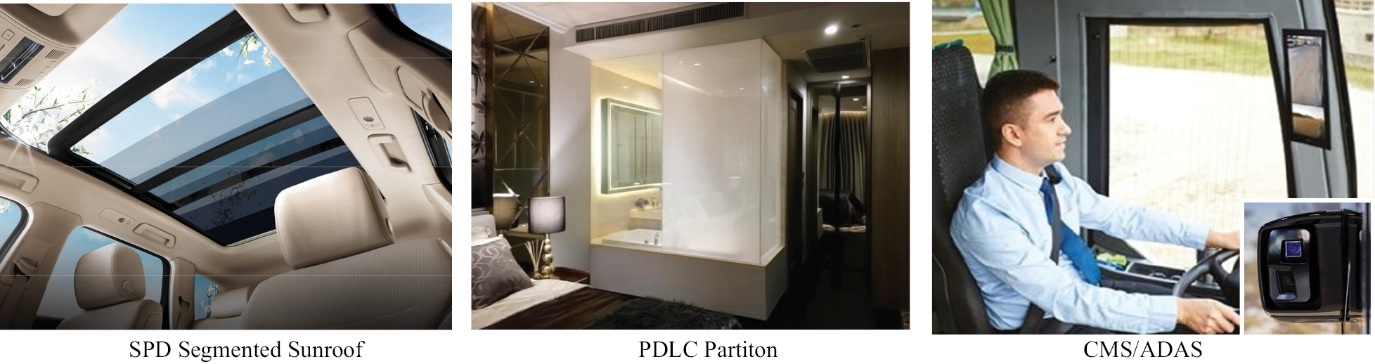
We enjoy close, collaborative relationships with many OEMs, Tier 1 suppliers, film processors and glass fabricators who rely on our technologies. During the product development process, we customize our solutions to ensure they meet our customers’ requirements and are ultimately certified for production. In aerospace, we are a leading Tier 1 supplier for the commercial airline, business jet and helicopter segments, providing full -stack smart glass products and advanced shading solutions directly to our customers. We hold a leading market position in cockpit shading systems for commercial airliners and business jets. We are in serial production for cabin shades, either directly or through sub-contracts, with seven business jet OEMs, including Embraer, HondaJet, Bombardier, Gulfstream, Daher and Beechcraft. Furthermore, we have successfully leveraged the technology and mechatronics expertise we have developed as a Tier 1 aerospace supplier to provide additional differentiated products and services to the automotive and architecture markets.
In the automotive and architectural markets, we are a leading Tier 2 supplier of light control technologies. Our unique business model enables automotive and architectural glass fabricators globally to manufacture smart glass that is integrated with our films and electronics. In the automotive segment, OEMs incorporate our technology in glass rooftops, side windows and windshields to replace conventional mechanical sun visors and shades. In the architectural market, we serve all major segments including commercial, retail, residential, healthcare and hospitality for both interior and exterior applications. In the commercial vehicle segment, we are a Tier 1 supplier and one of the market leaders in vision control technologies, including CMS and ADAS systems for the truck, bus and coach market.
We are strategically located in close proximity to our customers. This geographic competitive advantage deepens local customer relationships, enhances commercial innovation, optimizes customer support, shortens supply chains and enables us to deliver our technologies quickly and efficiently around the world. As a result, the typical customer contract length is 15 to over 30 years for customers in our aeronautics segment, approximately eight years for customers in our automotive segment and five to ten years for customers in our safety tech segment. We operate production facilities in Israel, France, Germany and the United States, with sales, marketing and fulfilment centers in 15 locations throughout the globe. We sell our products in over 60 countries through both direct fulfilment and a network of over 100 expertly trained and certified distribution channels.

We serve a broad range of end-markets and geographies, enabling us to benefit from a diversified base of revenues. In 2024, we generated approximately 28.3% of our revenues in the United States, 29.0% in Europe (excluding France), 25.6% in France, 1.3% in Israel, and 11.8% in Asia, with the remaining 4.0% generated in other countries across the world. In the same period, we generated approximately 40.0% of our revenues in the aerospace market, 44.1% in safety tech and commercial vehicle market, 12.7% in the architectural market and 3.2% in the automotive market. We also enjoy a diverse customer base, with no single customer representing more than 9.3% of our revenue for the year ended December 31, 2024.
Industry Overview and Market Potential
We operate in the light and vision control markets, and the history of our company’s involvement in these markets is linked by a common focus on controlling user interaction and experience with everyday environments, specifically within mobility and architectural applications. As an example, our dimmable smart glass technologies are used to control both the amount and type of light passing through automotive rooftops. This enables an enhanced and customized mobility experience for both drivers and passengers. Similarly, our innovative CMS technology builds on our foundation of advanced mirror expertise, a form of light control, and enables a safer and more comfortable driver experience.
Light Control
Advanced light control technologies are transforming many industries, including architectural and mobility markets, by replacing traditional mechanical products such as standard glass windows and sun visors with smart glass solutions. These technologies create countless user benefits, including a reduction in carbon emissions and improved public safety. By actively controlling the light that is transmitted through a transparent substrate, such as glass, light control technologies allow for traditionally passive materials dynamic and multi-purpose functionality. By allowing a surface to appear transparent, translucent or opaque on-command, light control technologies balance the benefits of natural light with the need for privacy and energy efficiency. Light control technologies can be integrated into windows, partitions and other transparent surfaces in a wide range of end-market applications.
The market potential for integrated advanced light control products continues to grow as more material applications develop. According to a recent research report conducted by Frost and Sullivan, the global smart glass market size is expected to reach $124 billion by 2028 and to grow at a CAGR of 22.8% from 2023 to 2028, driven primarily by the architecture and mobility markets.
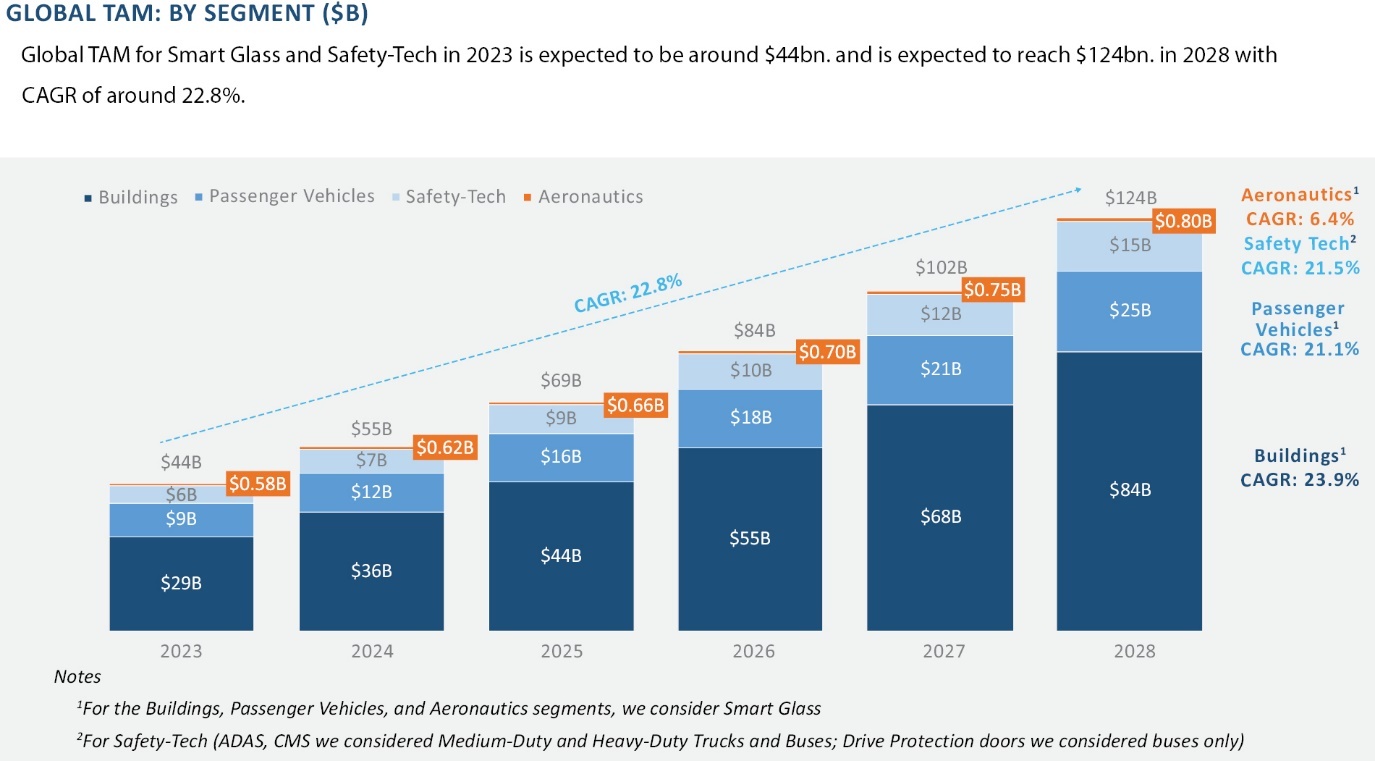
Architectural applications are poised to represent a significant growth opportunity as light control technologies are increasingly integrated into new building construction in windows, skylights and partitions. Approximately 80% of flat glass produced globally has been historically used in building and construction applications. Adoption of smart glass in architectural applications is expected to be driven by the need for on-demand privacy and solar heat control in both new buildings and retrofits within the residential and commercial segments.
In the automotive market, we expect to continue to benefit from the increasing adoption of light control technologies in applications such as glass rooftops, side windows and windshields. In windshields for example, our technologies replace sun visors and can enhance the performance of head-up-displays, or HUDs, by controlling contrast in varying lighting conditions. We are well-established in this space and are working with many traditional and emerging OEMs and Tier 1 suppliers to incorporate our light control technologies into their products. For example, many electric vehicles on the market today feature glass panoramic rooftops without mechanical shading in order to increase head room, as the vehicles’ batteries typically occupy additional space underneath the passenger compartment. Our technologies are being embedded in these rooftops by various OEMs as a preferred solution to control light and heat, also helping to save energy and extend the driving range per charge.
From a policy perspective, both the United States and the European Union are working to promote the development of environmentally sustainable technologies. For example, in August 2022, the U.S. Federal Government passed the Inflation Reduction Act of 2022, which includes provisions from the Dynamic Glass Act that extend meaningful investment tax credits to electrically-controlled variable tint materials. The passing of these provisions is expected to further accelerate the adoption of light control technologies within architectural markets. Following the passing of the Dynamic Glass Act, the American Clean Power Association released a report stating that, as of July 31, 2023, $270 billion in capital investment had been announced for utility-scale clean energy projects and manufacturing facilities, which is equivalent to eight years’ worth of American clean energy investment, surpassing total investment into U.S. clean power projects commissioned between 2015 and 2022.
In the European Union, at least 30% of the NextGenerationEU Recovery Plan, which was added to the European Union’s 2021-2027 long-term budget, has been earmarked for tackling climate change and supporting environmentally-friendly projects. In 2020, the European Commission also established a framework for the European Green Deal such that the European Commission has set out to make Europe climate-neutral by 2050, which also sets the intermediate target of reducing net greenhouse gas emissions by at least 55% by 2030, compared to 1990 levels. Additionally, in October 2023, the Council of the European Union adopted the new Renewable Energy Directive to raise the share of renewable energy in the EU’s overall energy consumption to 42.5% by 2030 with an additional 2.5% indicative top-up to allow the target of 45% to be achieved.
Advanced light control technologies can generally be classified into two basic types: (1) “passive” technologies, where the change in glass transparency is a reaction to ambient conditions such as heat or light in the surrounding environment, and (2) “active” technologies, which are controlled by the user when an electrical current is applied.
The two main types of passive light control technologies are photochromic and thermochromic. They are primarily based on thin film dyes whose molecular structure changes in response to a change in the level of UV radiation or heat, causing the glass to block the passage of light. Photochromic technologies are primarily used in eyeglasses and are not considered to have broader commercial applications for smart glass solutions due to their slow response time and poor functionality at the high and low ends of the temperature range. Photochromic glass also performs poorly in vehicles or other enclosed settings where existing glass blocks incoming UV light, which is required for photochromic glass to operate.
Thermochromic technologies on the other hand, have been adapted for smart glass solutions and there are a number of companies that currently offer thermochromic “smart” glass products. Thermochromic glass reacts to heat from direct sunlight, thus the more intense the sunlight, the darker the glass becomes. When the UV rays from the sun hits the surface of thermochromic glass, it is able to partially block both UV and infrared light, and depending on the position of the sun, the glass self-tints to block excessive heat when the sun is hottest (i.e., at its highest position in the sky). The main limitation of thermochromic glass is that it cannot be actively controlled and has a relatively slow response time that is directly proportional to the increase or decrease in sun or heat.
Since passive technologies cannot be controlled by the user, their application in a “smart” setting is limited. Active light control technologies, on the other hand, enable user control over the state of the glass. This control can be achieved manually or automatically via control panels, mobile phones, tablets and other smart devices and systems.
The three main types of active light control technologies, which we are most focused on, are LC technologies, SPD technologies and electrochromic technologies.
Liquid Crystal (LC) Technologies
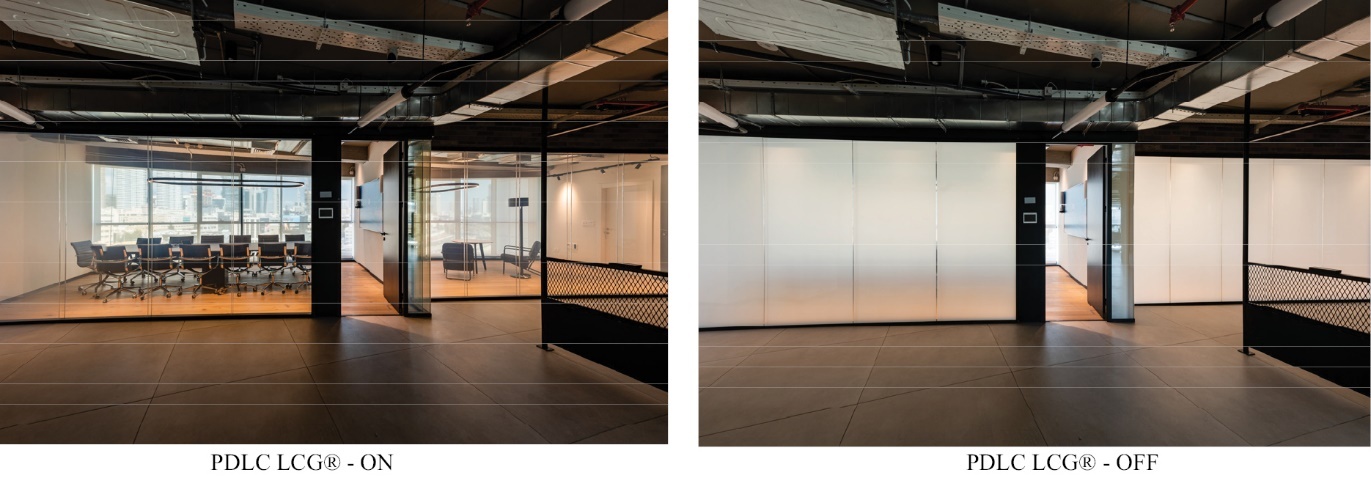
LC technologies, including polymer dispersed liquid crystal, or PDLC, sematic liquid crystal and cholesteric liquid crystal, are activated when an electrical current is applied to the material. This current causes the normally randomly aligned liquid crystal molecules to become oriented in such a way as to disperse light or allow light to pass through, thereby causing the material to change from opaque to transparent. This technology requires a constant power supply to maintain a transparent state. When in a powered state, the material is clear, allowing for full transparency; when unpowered, the material is completely opaque. Liquid crystal technologies in light control applications are commonly used when there is a need to control visible light for privacy, necessitating a fast response time. LC technologies can also enable glass to change the apparent color of light for an aesthetically-customizable environment.
Suspended Particle Device (SPD) Technologies
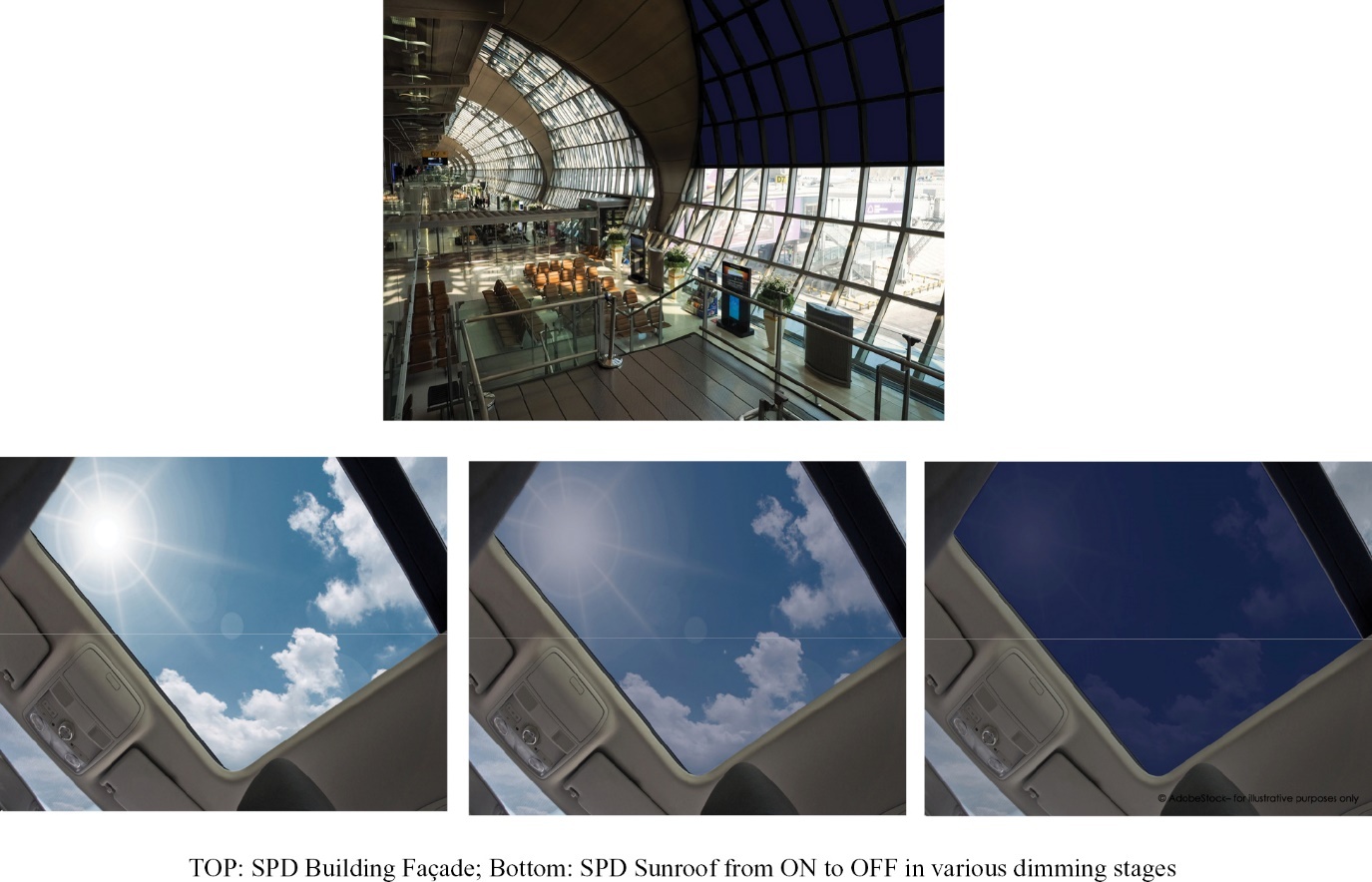
SPD is an active light control technology in which an electromagnetic field is applied to the material in order to effect a change from opaque to transparent by realigning nanoparticles contained within a transparent medium. SPD regulates the amount of light and glare passing through a transparent aperture. The level of tint is adjustable and the SPD itself has a very wide dynamic range (i.e., SPD can block up to 99% of the total light transmission in an ‘off’ state). A continuous electrical current is required in order to maintain a desired transparency. SPD can be applied on a variety of surfaces including glass and other substrates such as polycarbonate. It is particularly suited in applications where there is a need for gradual light control, near to total black out shading and fail-to-dark functionality.
Electrochromic (EC) Technologies
Electrochromic, or EC, technology is an active light control technology that consists of a flat glass coat that includes multiple layers of metal oxide. The coated glass is fabricated into an insulated glass unit, or IGU, which can be tinted or cleared through the application of an electrical current. EC is used in flat glass applications, such as aircraft windows and commercial buildings.
Vision Control
Advanced vision control technologies, such ADAS, including CMS, are revolutionizing the commercial vehicle market by optimizing visibility to enhance the driver experience and improve safety. By monitoring and analyzing the spaces around trucks, buses and coaches, advanced vision control technologies eliminate blind spots and glare to offer a wider field of vision than a traditional side-view and rear-view mirror system and provide clearer images of external conditions. When advanced vision control technologies are installed as original equipment or retrofitted onto existing commercial vehicles, potential driving hazards, accidents and injuries are reduced by creating a safer environment for both the operator and other road users.
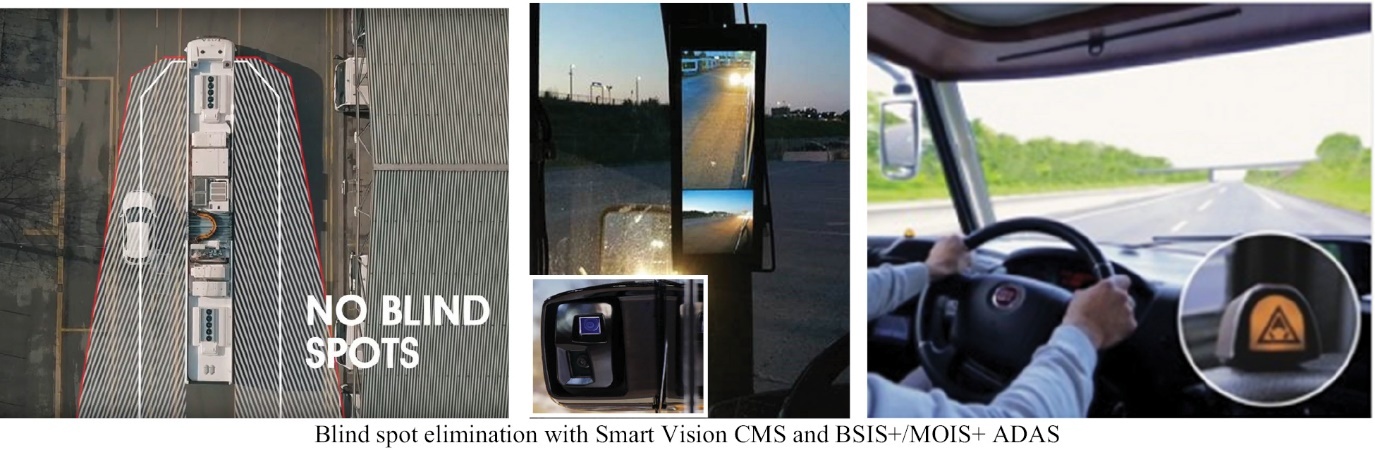
Current trends in the commercial and public transportation markets increasingly favor the adoption of advanced safety features and driver assistance technologies. This trend is being supported by operators’ desire to reduce costs and improve the driver experience, as well as the accelerating adoption of regulatory frameworks to enhance public safety in the European Union and United States. The growing trend of electrification of commercial vehicles is also increasing the demand for compact camera-based vision systems. Due to the increased cost of a commercial electric vehicle, operators have a strong incentive to utilize camera-based vision systems and other driver assistance technologies to protect their fleets, reduce vehicle downtime and improve safety.
The push for safer commercial transportation is driving manufacturers to integrate new, advanced technologies into their vehicle development pipelines in order to deliver improved safety features that are only possible with CMS and ADAS technologies. For instance, the European Union is mandating new regulations that require buses, coaches and trucks to incorporate ADAS technologies and warning systems to help prevent collisions with pedestrians, cyclists and other vulnerable road users, or VRUs. According to a recent research report conducted by Frost and Sullivan, the global safety tech market, including ADAS and CMS for trucks and buses and driver protection doors for buses, is expected to reach $15 billion by 2028 and to grow at a CAGR of 21.5% from 2023 to 2028.

Our technologies aim to deliver important environmental and social benefits to our customers and are well-aligned with industry trends. Our products eliminate the need for mechanical mirrors and deliver critical financial benefits. For example, CMS technologies have been shown to reduce the maintenance and downtime costs related to bus accidents by 40% over an 18-month period, and can deliver improvements in fuel economy of up to 4%, as traditional wing mirrors add to aerodynamic drag. As such, operators’ investments in advanced CMS systems typically carry a rapid payback period of two to three years while reducing total cost of ownership.
We believe that replacing traditional side-view mirrors with smart, adaptive cameras is a trend that will accelerate in the future. In December 2021, the City of London made the decision to aim to retrofit a majority of its public transportation fleet with CMS technologies, and in January 2025, we announced as a result of our strategic partnership with Journeo plc, a pioneering technology group providing solutions to the transport community and one of the largest integrators of our ADAS solution, London’s bus fleet of 8,500 commercial buses is on track to be equipped with our Smart-Vision system through retrofit and new vehicle installations. Gauzy’s share of the ADAS market in London was approximately 30% in 2024, and this technology is now operational on over 2,500 public buses throughout the city. This growing partnership with Journeo will allow us to penetrate other European countries in Norway, Iceland, Sweden and Denmark where Journeo already operates, and benefit from Journeo’s planned expansion in the region as we anticipate a substantial number of the new buses in Europe will utilize ADAS technologies in the future. In addition, in October 2024, we announced that our ADAS system was installed to fully replace traditional side mirrors on Capital District Transportation Authority, or the CDTA, of New York’s public buses, signifying the next phase of CDTA’s multi-year phase-in program designed to improve road safety. Additionally, in 2022, Mercedes adopted CMS technologies in their Actros model vehicle, which further supports our belief that CMS technologies will be rapidly adopted in the majority of new trucks and buses as well as retrofits in the coming years.
In addition to the OEM market for CMS and ADAS technologies, we see significant opportunity in retrofitting existing truck and bus fleets to address an increased focus on safety from operators and regulators. For example, in September 2022, we were sub-contracted to provide one of our customers with our ADAS technology pursuant to their contract with the city of Lyon, France, which is aiming to retrofit the city’s bus fleet of approximately 900 buses with ADAS technologies to promote public safety. Similarly, in July 2023, we were chosen by a city in Australia to retrofit its full fleet of approximately 1,000 public buses with our ADAS technologies. These are strong indications of broader market adoption of CMS and ADAS solutions and opportunities to retrofit the installed base of existing truck and bus fleets.
Key End-Markets
We work closely with customers and industry partners to develop and commercialize integrated light and vision control technologies, and establishing strategic partnerships and customer relationships is key to our business model. We believe these partnerships will help accelerate our research and development efforts to bring cutting-edge technology to the forefront of our markets.
Automotive
As advances in automotive technology offerings continue as part of the adoption of electric vehicles, the integration of light and vision control technologies is a natural next step in the evolution of the automobile. As an example, the implementation of ADAS technologies in cars is expected to be quickly adopted. In 2020, ADAS technologies were only installed in approximately 10% of the estimated 1.05 billion cars in use around the world, but this is predicted to increase to 30% in 2025 and 50% in 2030. We will continue to benefit from the increasing adoption of light control technologies in applications such as glass rooftops, side windows and windshields. Our technologies are enabling the replacement of traditional mechanical products, such as shades, blinds and mirrors, with advanced and sustainable solutions offering superior functionality. The continuing trend toward incorporating panoramic glass panels and sunroofs in passenger cars is expected to drive smart glass demand in the automotive industry as these sought-after features become increasingly technologically feasible. Since the batteries for electric vehicles are typically placed under the floor in the center of the car, glass panoramic sunroofs are becoming an industry standard as a solution to save head room as the glass panels installed on roofs are thinner than traditional automobile roofs. Utilizing smart glass in these glass panoramic sunroofs also allows for the control of the amount of heat, light and glare.
Commercial Vehicles
In the commercial vehicle market, OEMs are developing trucks and buses replacing traditional side-view mirrors with fully-integrated CMS technology that can analyze road conditions in real time and alert the driver of hazards to better protect VRUs. Meanwhile, light control technologies will allow operators the ability to provide passengers with controllable ambience settings on bus or train rides.
Aerospace
In aerospace, we expect key OEMs to devote a significant amount of resources and capital over the next decade to updating their fleets’ interiors with cabin shading technologies as a key differentiator in the marketplace. Here, we are leveraging our expertise in cockpit applications to expand our strong and growing market presence in the cabin light management market. We are also a leading provider of dimmable solutions and glazing options to commercial and private jet and helicopter OEMs. As one of the companies currently manufacturing dimmable solutions and solar protection for helicopters, we expect to expand our market share in this segment with our customizable light control solutions.

Architecture — Exterior Applications
According to the U.S. Department of Energy, in 2021, building use in the residential and commercial sectors accounted for 39% of total U.S. energy consumption and 75% of total U.S. electricity use, most of which is being used to maintain the building’s interior conditions. Integrating light control technologies into a building will help reduce energy use associated with lighting, heating and cooling by about 20%. By 2050, it is anticipated that the adoption of smart glass can eliminate 2.19 gigatons of CO2, resulting in $321.5 billion in savings.
Architecture — Interior Spaces
In addition to lowering a building’s carbon footprint, smart glass is a sophisticated interior design element that has a number of innovative functions. Coupling light control technologies with the benefits of using glass partitions balances the need for privacy with the desire to enhance and efficiently sanitize interior spaces. As an engineering solution, the use of glass as an interior partition maximizes space as glass partitions are generally thinner than standard drywall partitions, allowing architects and interior designers to fully utilize the potential of interior settings.
In certain public spaces, such as hospitals and hotels, the adoption of light control technologies in glass partitions is driven by the trend of replacing traditional blinds, shades and curtains, which are difficult to clean and can be hotbeds for contamination. The COVID-19 pandemic has reinforced the need to be able to quickly sanitize individual usage rooms while maintaining user privacy. As an added benefit, the use of glass partitions in these settings is environmentally friendly by reducing the use of linen. The application of light control technologies in glass partitions in these public settings can also upgrade the user experience. For example, a smart glass partition can automatically provide for privacy when a bathroom light is turned on.
Our Light and Vision Control Products
LCG® Products
Our LCG® technologies include a variety of PDLC and SPD films, which are laminated into, or retrofitted onto, glass or other transparent materials by our trusted partners worldwide. LCG® Film is defined as a smart glass interlayer with SPD or PDLC technology coated between two pieces of PET sheets with conductive coating. We are a Tier 2 supplier of PDLC and SPD films which are available as rolls, cut-to-fit sheets or in a prelaminated stack to best accommodate a partner’s process. We provide SPD or PDLC turn-key smart glass as a Tier 1 supplier in the aeronautics industry, and select opportunities in railway, marine and agricultural/construction vehicles.

A roll is defined as a continuous film wrapped on a core in varying lengths and widths depending on product type. These varying widths, including 1.3, 1.5 and 1.8 meters wide, are designed to optimize a partner’s yield, reducing wasted material and increasing bottom line. A cut-to-fit sheet is a PDLC or SPD film that is cut to a custom size and comes either with or without applied busbars according to a customer’s unique specifications. A prelaminated stack is a PDLC or SPD film that is encapsulated in an adhesive interlayer with complete electric preparation for a fully lamination-ready product without pre- or post-process requirements. Turn-key smart glass is a complete window or partition with laminated PDLC or SPD technology that simply requires installation.

Both PDLC and SPD films are available with invisible laser-etched patterning which creates segments in films for zoned light control. Patterning capabilities include linear, curved or free-formed shapes and designs for a highly customized smart glass solution. Each technology is compatible with various glass types, coatings, lamination stacks and IGU systems to satisfy specific customer and industry requirements. Films are able to be cut into unique shapes and specially thermoformed to address 3D/multi-axis curved and bent glass.

All of our PDLC and SPD products are operated by our patented controllers which are able to provide increased optical, mechanical and electrical performance. Controllers include our Mini, Flex and MultiPlex controllers which each power glass in different sizes, multi-segments and with different functions, including on/off, dimming and fading.

PDLC Products
Our liquid crystal products allow glass to switch from opaque to controlled levels of transparent in less than 0.1 seconds. Our wide range of indoor-and-outdoor grade liquid crystal LCG® technologies support spaces with glass-centric designs, such as providing instant transparency for visibility and an open atmosphere or privacy, high definition transparent display when paired with projection or solar IR reflection to assist with temperature control when our Solar Performance PDLC (SP-LCG®) is selected.
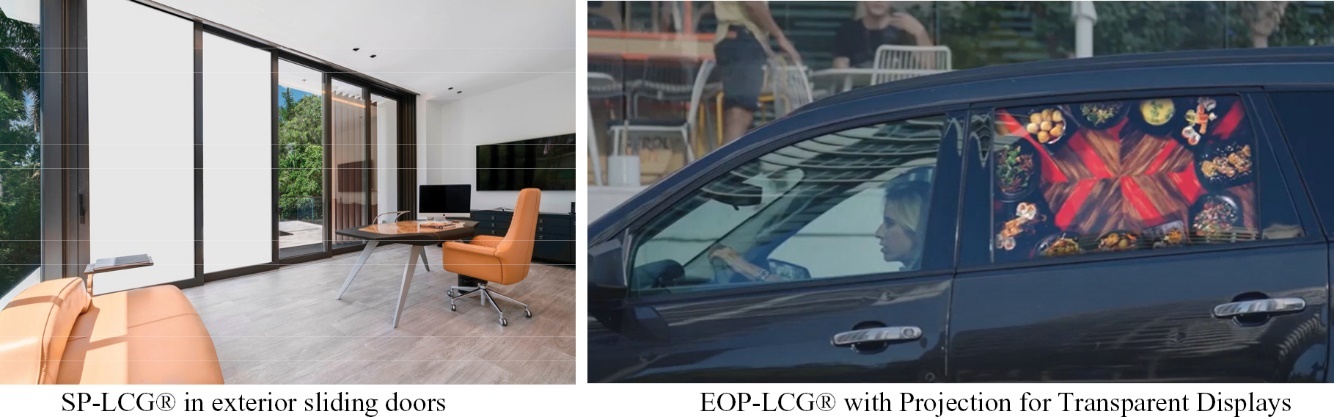
We have two types of PDLC technologies that allow glass professionals to create LCG® smart glass for end customers: films for lamination by glass fabricators and adhesive films that are retrofitted onto existing glass by film installers. Different product lines are available in white or grey.
PDLC Lamination Films
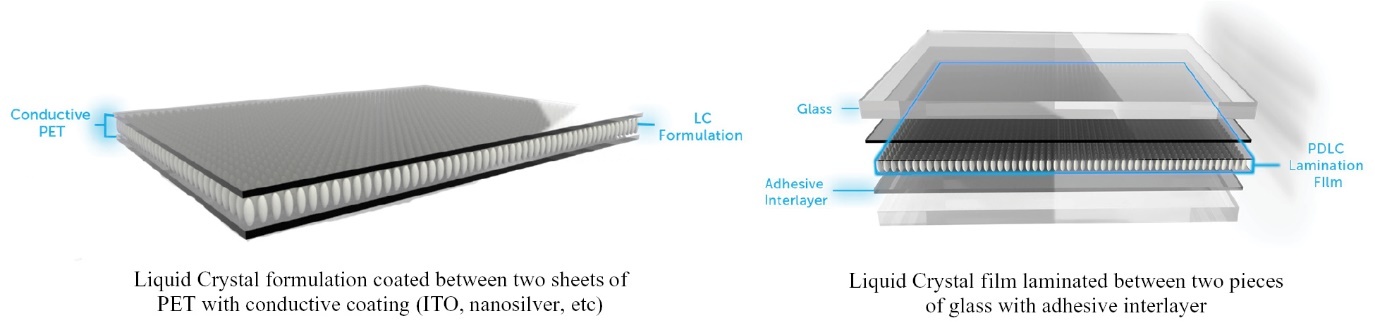
High Performance (HP-LCG®) films are designed to be used in interior architectural applications and are defined by our high optical, mechanical and electrical performance. HP-LCG® has low haze when operated at low voltage for reduced energy consumption supporting smart homes/buildings models.
ExtraClear Performance (EP-LCG®) PDLC films are fully optimized for visual performance with over 90% light transmission, making this our highest clarity film when turned on. With a unique composition, off-axis haze is reduced, making this product an ideal solution for tight corridors.
Solar Performance (SP-LCG®) blocks Solar IR light that creates heat, which makes spaces cooler, reduces HVAC requirements for increased energy efficiency and sustainability while supporting greater thermal comfort for occupants. SP-LCG® likewise mitigates glare while keeping interiors bright and ambient for visual comfort and continuous access to natural light for a greater sense of wellbeing. SP-LCG® has EOP-LCG® properties in addition to solar reflection capabilities.
Extended Outdoor Performance (EOP-LCG®) is suitable for use in extreme temperature conditions (ranging from -20°C to +90°C). EOP-LCG® offers extended durability in harsher weather conditions like humidity and prolonged light exposure, which makes it ideal for exterior glazing in automotive and architecture, and interior applications in built spaces such as saunas and refrigerators. This product is recommended when solar reflection is not required.
PDLC Adhesive Films

Adhesive LCG (A-LCG®) PDLC films are applied to existing glass, allowing any glass to instantly be converted into smart glass. Adhesive smart films support on-demand transparency, privacy and transparent displays when paired with projection. By retrofitting a project with A-LCG®, the function of glass is extended from the moment installation is complete, creating a spatial transformation.
Adhesive ExtraClear Performance (AEP-LCG®) PDLC films are fully optimized for visual performance with over 90% light transmission, which makes this our highest clarity film when turned on. With a unique composition, off-axis haze is reduced, making this product an ideal solution for tight corridors.
Adhesive Solar Performance (ASP-LCG®) PDLC films are ideal for improved thermal and visual comfort while also reducing HVAC cooling costs and direct glare that disrupts occupant wellbeing. By combining the ability to block IR with on-demand privacy and transparency, ASP-LCG® offers technologically advanced and sustainable projects an easy solution without necessitating a full window replacement. ASP-LCG® is optimized to perform in wide temperature ranges (-20°C to +90°C) and is most commonly specified for facades, skylights and atriums.
SPD Products
Our SPD-LCG® products block up to 99% of visible light, allowing any glass to dim instantly for dynamic shading with a view. Switching transparency in up to four seconds homogenously in all glass sizes makes this the fastest smart glass technology for shading available today. Our SPD technology is available as a film for lamination by licensed and certified partners. SPD-LCG® Smart Glass is created when SPD emulsions are coated between conductive interlayers to create films which are then laminated between two pieces of glass or polycarbonate with adhesive interlayers. SPD-LCG® can be comprised of multiple types of glass and lamination configurations and can be implemented into IGUs to best fit a customer’s needs. For example, in 2021, we partnered with LG Display to develop projection smart windows that provide on-road messaging for alerts, location-based advertising and passenger entertainment.

Our SPD films, which are available in architectural widths and are automotive grade, are optimized to maintain performance and durability in facades and transportation vehicles across all market segments. This technology is powered by our patented SPD controllers, which supply controlled voltage to determine the amount of visible light transmittance in on, off or when dimmed to a precise opacity level.
SPD Lamination Films

SPD-LCG® films are our flagship SPD technology, and the same product line currently used by industry-leading brands in the automotive, aviation, marine and railway industries. SPD-LCG® offers top optical, mechanical and electrical performance, fast switching times and precise dimming control for up to 99% light blocking.
SPD-Light is a variation of our SPD-LCG® that offers 60 – 70% light transmission instead of 50% and is ideal for products and projects where higher transparency and lower opacity are needed.
SPD-Black is currently in development by us and provides the next generation of SPD-LCG®, which expects the same trusted performance as our SPD-LCG® but with a black tint for additional color variations to meet differentiating customers’ requirements.
Combination PDLC and SPD Products

Our PDLC and SPD films can be laminated together into a single glass panel for a dual smart glass solution that provides all-in-one glazing to control daylight, glare and privacy, and can also be used in interior/exterior visible transparent displays when paired with projection. The two technologies can be independently controlled allowing users a completely customized experience. When the two films are laminated together, it creates a black-out solution. We are a Tier 1 supplier of laminated dual technology as a smart glass panel to the aeronautic, railway and marine industries for both new planes, trains and boats, as well as retrofits.
Acti-Vision is a product line offered as a turn-key transparent display which utilizes a combination of PDLC and SPD paired with protection to create transparent displays. When SPD and PDLC are both turned off, digital content is visible from the interior. When PDLC is turned on but SPD is off, digital content is visible from the exterior.
This complete transparent display partition or window includes a projector and a content management software and interface. This can be used to enhance the passenger experience with infotainment, or as a means for additional revenue streams when used as ad space.
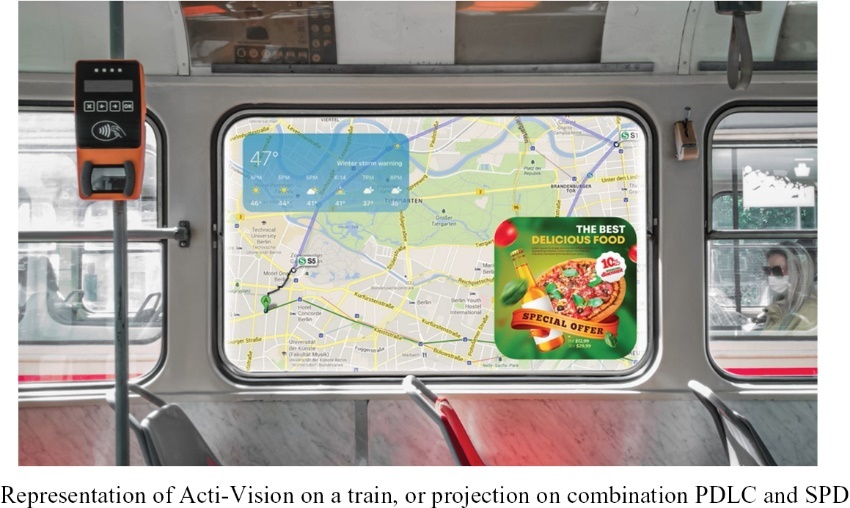
Our Controllers
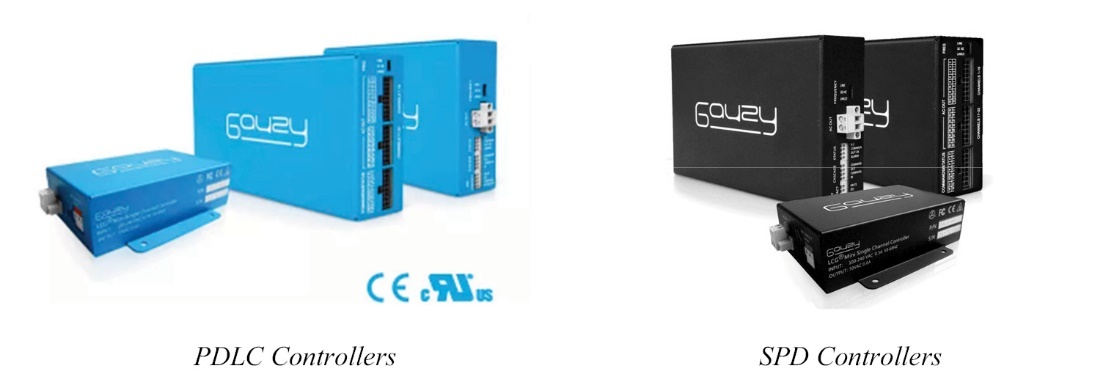
Our Mini, FLEX and MultiPlex patented controllers that drive our PDLC and SPD films each offer a unique set of features best suited for varying glass sizes, input channels and user preferences, and also allow films to reach maximum optical and electrical performance. As the only smart glass controller in the market, our hardware employs square wave signals, which allows films to stay on 24-hours a day with no burn-in effects, for reduced mean time between failure, or MTBF. Controllers also act as a protector of film from power surges ensuring longevity.
To best suit customers’ control preferences for privacy, ambiance and shading, Gauzy LCG® products can be operated via different control methods, including wall mounted touch panels, radio frequency remotes or synced with automation applications. Each control method is paired with our patented controller, allowing on/off or dimming functionality of single or multiple smart glass panels and/or segments (patterned LCG®).
Smart Glass Quality Verification Tools for Glass Fabricators
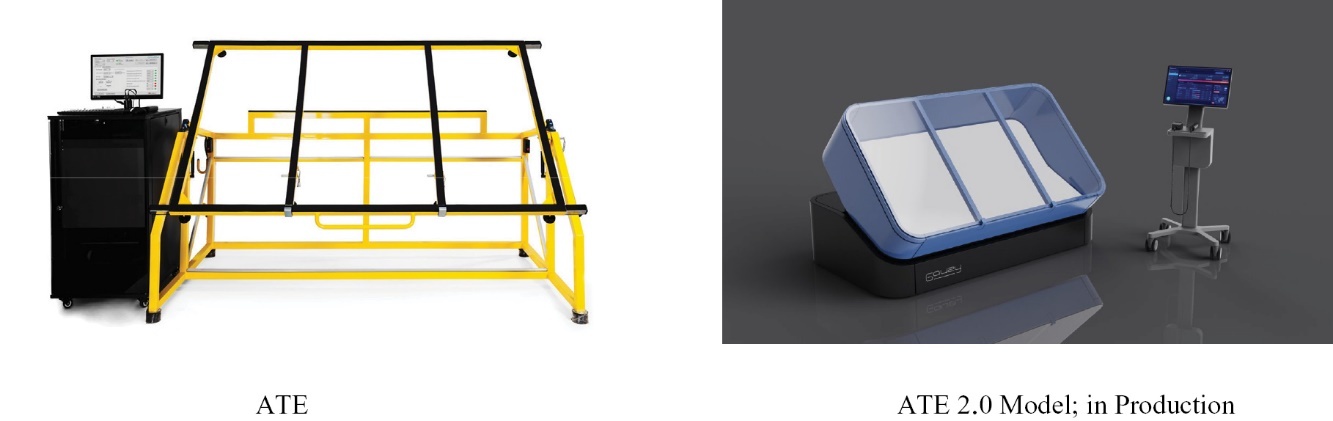
Our innovative, patented ATE (automatic testing equipment), which is part of our unique go-to-market strategy, allows for quality verification of optical, mechanical and electrical properties before and after lamination of SPD and PDLC films by our partners in the glass industry, which allows them to produce their own smart glass products. The ATE, which is patent protected in multiple jurisdictions, is comprised of an ergonomic industrial station on wheels with special backlighting for visual inspection and multiple viewing angles of films and glass panels. Our software generates testing results for a set of defined parameters which are displayed on a movable touch screen and can be stored on the device or exported to a customer or us for review. The ATE is a part of our training and certification programs for glass fabricators, and ensures that lamination is done with confidence and quality for customer satisfaction and reduced material waste. This enables our glass fabricator partners to test their products for all optical, electrical, and mechanical parameters, ensuring an on-spec delivery.
Other Light Control Products

In addition to our smart glass technology products, we also offer certain manual and mechanical light control products directed towards the high-end private aerospace market. Our Comfort-Shade is a motorized shade that features substantial customization options for our customers. From an aesthetics perspective, Comfort-Shade can be personalized to match the interior design of an aircraft and can enhance the cabin fit and finish to provide our customers with a competitive differentiation. Comfort-Shade offers a number of different configurations, synchronizations and materials. Through its integrated electronics system, the Comfort-Shade assists aircraft crews through preventative maintenance and diagnosis assistance, allows for software upgrades without dismantling the shade and offers remote monitoring and maintenance. The quick, silent and smooth motion of the Comfort-Shade provides superior optical performance and is scratch resistant. The Comfort-Shade is easy to install in both new aircrafts and retrofitted on existing aircrafts. It may also be paired with mood lighting for enhanced ambiance and passenger experience contributing to a sense of comfort and wellbeing.
Vision Control Products
As an existing player already operating within the commercial vehicle manufacturing supply chain, we have developed industry-leading products to modernize the transportation industry with ADAS, CMS, and integrated light and vision control technologies. Our technologies support a safer driving experience for operators of long-body on-road vehicles such as buses, trucks and coaches. With the elimination of blind spots, preemptive warning messages and products that make public operators secure, driver confidence is increased, which contributes to safer roads for all users.
After 20 years of developing side-view mirrors for buses and trucks, we have developed solutions to replace traditional side-view mirrors with fully-integrated CMS. In the CMS technology environment today, we are a Tier 1 supplier and one of the market leaders in the bus and coach market due to the leading optical quality of our Smart Vision products.
Smart-Vision Camera Monitoring System
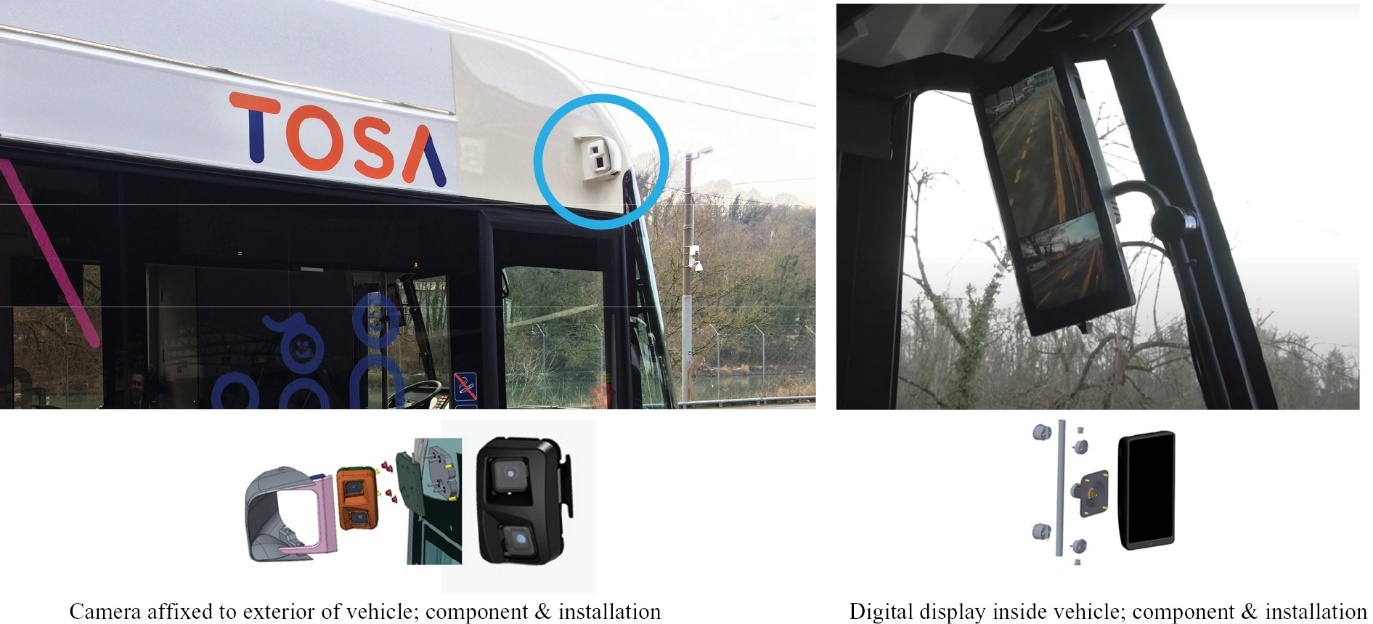
Smart-Vision Camera Monitoring System, or Smart-Vision CMS, replaces traditional side-view mirrors on a truck or bus with a superior, high-definition camera that connects to an interior display within the vehicle to improve driving safety through the elimination of blind spots. Our Smart-Vision CMS is also designed to optimize driver visibility by automatically adjusting the interior display depending on the varying light conditions such as the brightness in a tunnel, darkness at night or in rainy weather conditions. We believe these features are differentiated and superior as compared to other CMS products. Additionally, unlike traditional mirrors, the cameras are not affected by the glare of the sun or other light sources that can impair a driver’s vision and lead to accidents.
Customers of CMS technologies generally see returns on investments by lowering maintenance costs and maximizing vehicle availability due to a reduction in accidents, as well as offering greater fuel efficiency by improving the aerodynamics of the vehicle due to the removal the traditional side-view mirrors. As designed, our Smart-Vision CMS, which is currently used by 18 bus OEMs and installed on over 5,000 vehicles, can be easily installed by our professionals on new vehicles, or can be retrofitted onto existing trucks or busses.
Our production lines and production processes in our Tel Aviv, Israel and Texas facilities have an IATF 16949:2016 certification of the International Automotive Task Force, or the IATF. The IATF aligns automotive quality management systems throughout the world and provides guidance and tools for companies and organizations who want to ensure that their products consistently meet customer requirements and that quality and customer satisfaction are consistently improved. The certification defines the quality system requirements for the design, development, manufacturing, installation and servicing of automotive-related products. We have received the IATF 16949:2016 certification for our design and manufacturing of nano technologies and advanced materials.
Driver Assistance Systems

Blind-Spot Information System and Moving-Off Information System
Focused on addressing blind spots by utilizing our leading image analysis capabilities to identify pedestrians, bicyclists and other vehicles in real time, our driver assistance systems, Blind-Spot Information System (BSIS+) and Moving-Off Information System (MOIS+) technologies, send critical alerts to drivers that protect VRUs. These products can be fully integrated into our Smart-Vision CMS, adding an additional component that supports safer operation, or can act as a standalone system for a consumer’s vehicle. Both systems are CCTV compliant.
BSIS+ technology, utilizing a high dynamic range sensor, identifies and alerts the driver to the presence of a VRU so that a driver can stop the vehicle before life-threatening impact. Similarly, MOIS+ alerts the driver to the presence of a nearby VRU who could be in front of the vehicle, but hidden from the driver’s view. Our driver assistance systems provide a large detection area, with the exterior camera able to detect an area 4.25 meters wide and 37 meters long from the body of the vehicle. Additionally, the driver assistance systems’ image analysis detection system is able to recognize VRUs and notify the driver via an internal display.
Additional Views
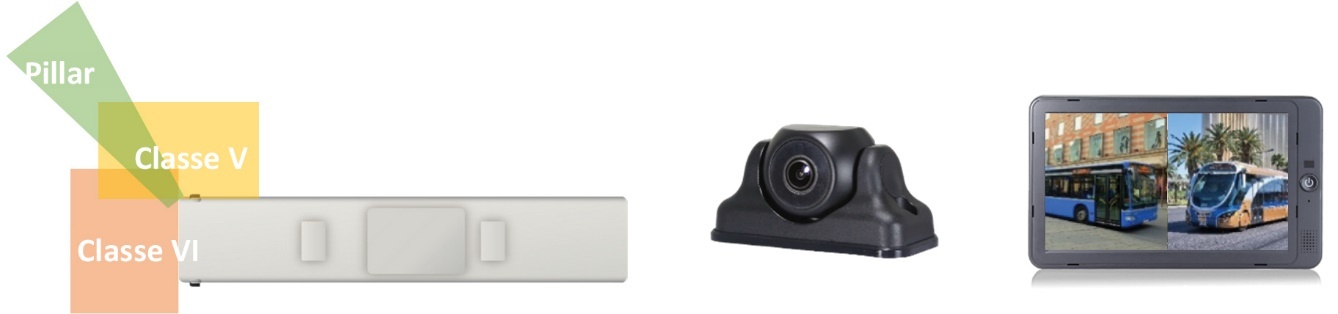
Our Additional Views vision control system provides better visibility around a vehicle by offering blind-spot elimination, more security and high image quality. When installed on a bus, Additional Views offers a wide dynamic range that shows accurate image details in areas of contrasting light intensity and reduces image noise and natural colors. Additional Views features a screen divided into two views to show both sides of a bus and comes with a sunshield to help reduce glare while the driver is operating the bus.
Other Commercial Vehicle Products
Currently, we manufacturer a durable, customizable Driver Protection Door that is designed to offer the driver of a bus or commercial vehicle with enhanced safety measures by providing either a complete or partial door between the driver and the passengers on the commercial vehicle. Our Driver Protection Door has been installed on over 9,000 buses in the European Union, ensuring drivers are safe and protected from public passengers.
Additionally, our Opti-Shade is designed for the interiors of buses to provide passengers with shade protection and offer bus operators a high-quality, durable and low-maintenance shading system.
Research and Development
We devote substantial resources to research and development with the objective of developing new products and technologies, adding new features to existing products and reducing unit costs of our products. Our development strategy is to identify features and products for material, hardware and software that enhance and improve the performance of our solutions for our customers. We measure the effectiveness of our research and development by metrics, including product unit cost, efficiency, reliability, optical performance, customer adoption and customer surveys.
We have a strong research and development team with wide-ranging experience in material science, nanotechnology, electronics, mechatronics, image analysis and software engineering. As of March 1, 2025, our research and development organization had a headcount of 144 people. Our research and development expense totaled $17.6 million and $16.0 million for the years ended December 31, 2024 and 2023, respectively.
Product Roadmap
Our products reflect the innovation focus and capabilities of our technology departments. Our product roadmap is divided into four main categories: LC technologies, SPD technologies, electrochromic technologies, and other electronics and ADAS.
LC Technologies
We intend to continue to develop our PDLC and LC product portfolios to extend temperature ranges, improve optical ranges and enhance durability and reliability in order to be relevant for more applications, in more end-markets, in different geographies and for different regulations. As an example, we are developing an IR active control LC product that will be able to tune only the IR light through a transparent aperture such as a glass window. This will enable a world of new applications in buildings and vehicles and will allow for better energy management and significant cost reductions.
SPD Technologies
We are constantly working to enhance our SPD product offering with better optical performance, better cost performance and to maintain a growing SPD offering. One example is our Black SPD program, which revolutionizes the basic nano particle to be black-oriented and UV stable as a direct outcome of our customers’ demand for future utilization in the full range of passenger car glass.
EC Technologies
As part of our effort to extend light control technologies to the full range of possible applications and to provide our customers throughout our end-markets with a one-stop shop, we are working to develop a new ground-breaking EC technology from the very basic chemistry to allow for it to be also deployed on flexible substrates such as PET ITO. Our hardware employs unique proprietary signals, which allows films to stay on 24 hours a day with no burn-in effects, for reduced MTBF. Having the option to offer EC (blue, black) on film applications will ensure that our glass customer global network will have all three viable and commercial light control technologies at hand from us and allow them to be the most competitive in their own end-markets everywhere.
Electronics
The ability to efficiently drive and control our materials is expected to further accelerate the growth of the global light control market. We believe that, by optimizing optical performance and localizing product requirements to meet standards everywhere, we can extend our product reach to a greater addressable market. We are developing the electronics for the full extent of our product offering, enjoying a system optimized approach which is unique in our market. From a nano particle to the end film material, including the electronic drive control, we can provide our customers with the best performing products.
ADAS
We are developing cutting-edge ADAS vision control systems for commercial vehicles to answer the growing demand in regulation and features. We are currently developing next generation ADAS products for buses and trucks that will incorporate advanced driver monitoring system features, night-time vision perfection, BSIS requirements and many more confidential and proprietary features required by our customers. As a system integrator, we also develop the flexibility to add more functionality as add-ons if OEM’s or operators require. We constantly develop our systems to improve vehicle operator response times and reduce system costs to broaden our addressable markets.
Sales & Marketing
Our strategy has been to focus on the following four main end-markets where there is a growing need for our light and vision control technologies: aerospace, automotive, ADAS for commercial vehicles and architecture, including architectural applications in the residential, commercial, healthcare, hospitality and retail segments. Today, our products have been installed in more than 60 countries, including the United States, Canada, Mexico, Germany, Spain, France, Belgium, the Netherlands, Italy, the United Kingdom, Israel, Brazil, China, India, Thailand, Singapore, Australia and South Africa.
In the aerospace market, we work directly with OEMs, designers, completion centers and now increasingly, with the airlines directly. For our cockpit shading offering, we have key long-term relationships with leading OEMs and work closely with them to develop customized solutions. For our cabin shading management offering, we work with OEMs as well as designers and completion centers through the development of customized products that require integration with the completion center process. We also sell to airlines directly for retrofit opportunities, who increasingly have the optionality and decision-making power for the desired cabin shading management solution. The initial request for information from the customer through the selection process can typically take six to twelve months with an additional six months until the start of production, focused on engineering design, testing, certification and documentation, based on our past experience with customers.
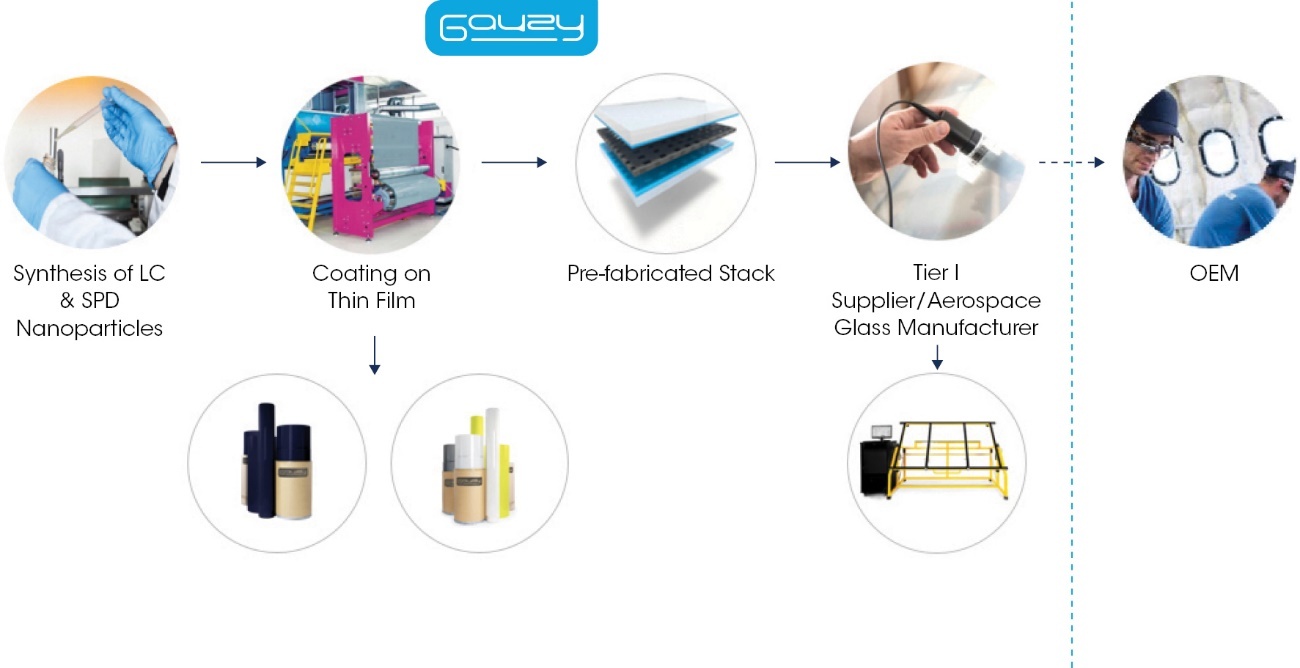
In the automotive market, we sell directly to Tier 1 suppliers, but work closely with OEMs throughout the process. The selling cycle for automotive can typically take one to four years from proof of concept through qualification and serial production, based on our past experience with customers. During that time, we work closely with both the OEM and Tier 1 suppliers to customize our technologies for their needs. We leverage our relationships with OEMs to develop new cutting-edge products and technologies. Tier 1 suppliers range from glass manufacturers such as AGC and NSG, and system integrators such as Webasto, Valeo and BOS.

In the commercial vehicles sector, we are a leading Tier 1 supplier of CMS and ADAS solutions for trucks, buses and coaches and work directly with OEMs and fleet operators in the aftermarket. Our sales and marketing organization covers the complete chain of stakeholders. Within trucks, while our selling efforts are focused directly on OEMs, we enhance our marketing offering by working with fleets, driver training organizations and driver unions to gain critical insight into end-user needs which we leverage for the development of new innovative technologies.
We also engage with local regulatory bodies to create awareness and accelerate adoption. Within bus and coach, we primarily work directly with fleet operators who are focused on reducing accidents and maintenance costs. We also work with integrators on retrofit opportunities which we consider a significant opportunity for the business, and are increasingly working with OEMs directly to have full coverage of their needs and demands.
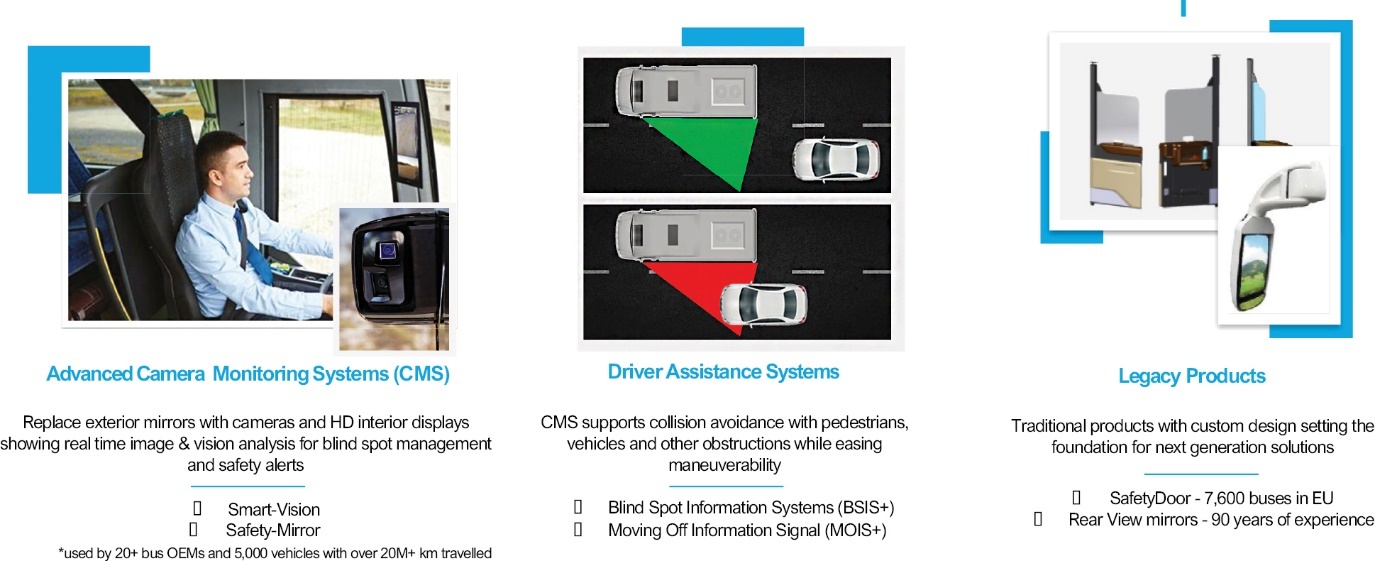
In the architecture market, we work closely with more than 107 glass fabricators in over 39 countries and train and certify them to integrate our technologies into their glass production lines, following a qualification and certification process. We enable the glass industry worldwide to produce their own smart glass locally that is embedded with our products. Our goal is to grow this network to over 250 fabricators worldwide over time. Our close relationships allow us to train and certify local glass fabricators in manufacturing glass with our technology. This certification process also allows us to provide a standard service warranty to our end customers, with the option to extend such warranty at a fee, assuring quality control of process and end product. This way, we are able to leverage our existing relationships with local glass fabricators to generate business by marketing our smart glass products up the value chain to end users such as architects, construction companies and designers. This allows us to become familiar with local developers and manufacturers in every country, and every city. We are able to elevate these local relationships to sell our products both for new buildings and to retrofit existing ones. In those cases where we have sold our smart glass portfolio to a new customer, we can connect the customer with a local glass fabricator whom we have trained and certified for local supply, installation and service.
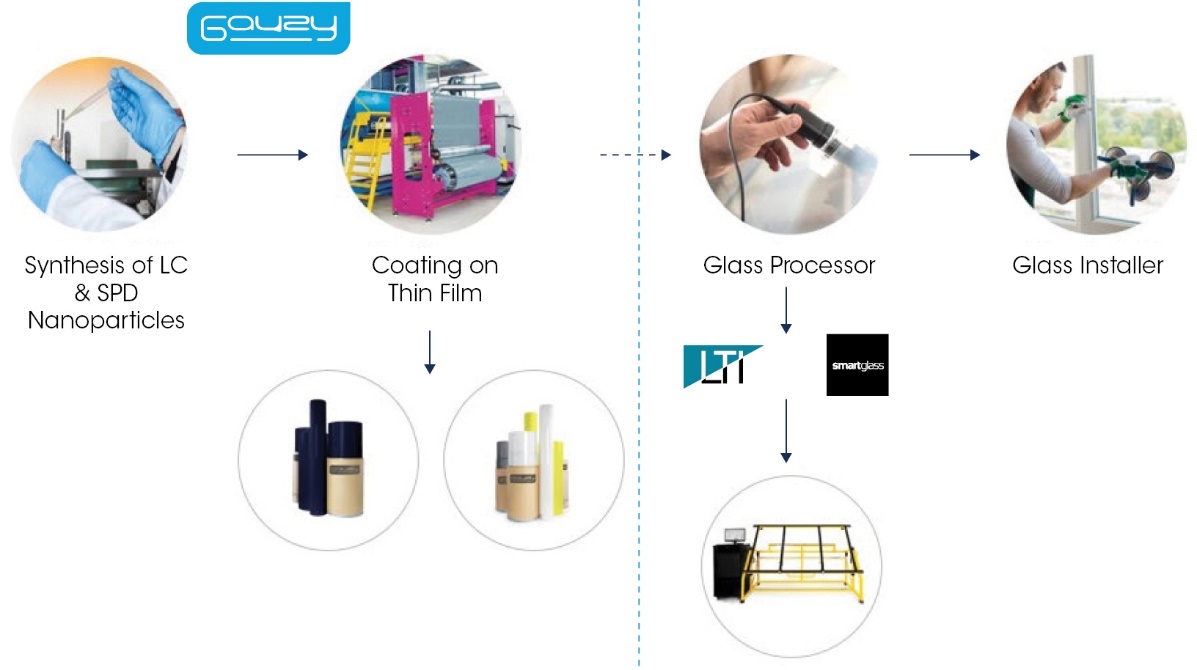
Additionally, we have a number of programs focused on educating installers and other industry professionals about our technology, and we use a combination of road shows, webinars and partner trainings to show them how best to design, sell and implement our technology in their projects.
Our sales strategy and the entrepreneurial culture of our company have allowed us to react quickly to trends in the countries in which we sell our products. For example, in response to the spike in production demand in the U.S. aerospace industry in 2021, we allocated resources and opened a dedicated production site and fulfilment center in Melbourne, Florida. For the year ended December 31, 2024, approximately 28.3% of our revenues were from the United States compared to approximately 22.5% for the year ended December 31, 2023.
Competition
Light Control
Light control technologies are transforming many industries, including the architectural and mobility markets. Our business is characterized by rapid changes as well as new and disruptive technologies. The market for light control solutions is a relatively new market with increasing competition for similar solutions. However, we believe that our solutions have technical superiority such as best-in-class optical performance, widest optical range, color control, segmentation, variety and more. We believe that our business model has an advantage over competitors who are manufacturing smart glass themselves and competing with glass fabricators, while also dealing with supply chain issues and local market customization challenges. The shipping and replacement costs for damaged products alone can deeply undercut their profitability. Our strategy enables our glass fabricator customers to manufacture smart glass themselves by efficiently providing them with the films, electronics and manufacturing expertise on a global and accelerated basis relative to some of our peers. We are also differentiated from our peers in that we serve multiple end-markets and regions, whereas many of them have a much narrower focus.
Our light control technologies and products compete principally with products from electrochromic glass manufacturers such as View Inc. and Sage (owned by Saint-Gobain Glass) as well as a select group of chemicals suppliers who range from large traditional companies such as Merck and Gentex to a few small suppliers primarily located in Asia. Several new entrants to the market, including a few low-cost manufacturers from Asia, have also announced plans to develop or have already shipped products. We believe that our light control products and unique business model offers significant technology and cost advantages that reflect a competitive differentiation over other technologies and competitors. In the SPD segment in particular, we believe we are the only licensed vendor in the world following our recent acquisition of all of Resonac’s (formerly Hitachi Chemical) full SPD intellectual property portfolio, which included obtaining and learning the know-how with respect to Resonac’s technical and business information related to such acquired patents.
Vision Control
Advanced vision control technologies, such as ADAS and CMS, are revolutionizing the commercial vehicle market. For our vision control solutions, we believe that our main competitors today are Orlaco (owned by Stonebridge Inc.) and Mekra (a joint venture with Bosch GmbH). We have a limited number of competitors of scale given the high technological barriers to entry. In the near future, innovation and advancement in vision control technologies is expected to dramatically increase. Our current product offerings and research and development capabilities have uniquely placed us to be at the forefront of this technological innovation.
Intellectual Property
Intellectual property is an important aspect of our business and we seek protection for our intellectual property rights as appropriate. To establish and protect our proprietary rights, we rely on a combination of patent, copyright, trade secret and trademark laws, know-how and continuing innovation, and contractual restrictions such as confidentiality agreements, licenses, and intellectual property assignment agreements. We strive to protect the proprietary technologies that we believe are important to our business, including seeking and maintaining patent protection intended to cover our products.
As of March 1, 2025, our exclusively-owned patent portfolio included 146 issued patents, of which 21 are U.S. patents and 125 are foreign patents. In addition, as of March 1, 2025, we had a total of 16 pending patent applications, of which 4 are U.S. patent applications and 12 are foreign patent applications. The claims of these owned patents and patent applications are directed toward various aspects of our family of products, method of their manufacturing and research programs.
We initially submit applications to the USPTO as provisional patent applications. Then, typically we continue by filing non-provisional patent applications under the Patent Cooperation Treaty, or the PCT, which is an international patent law treaty that provides a unified procedure for filing a single initial patent application to later seek patent protection for an invention in any number of the member states of the PCT. Although a PCT application does not itself issue as a patent, it acts as a placeholder allowing the applicant to seek protection in any of the member states through national-phase applications.
We have trademark rights in our name, logo and other brand elements, including trademark registrations for select marks in the United States and other jurisdictions around the world, including “LCG®,” “GAUZY LCG®,” “GAUZY®,” “GAUZY® (Chinese alphabet),” “NOCTIS,” “NUANCE,” “SMART-VISION,” and “VISION SYSTEMS.”
We pursue the registration of domain names for websites that we use and that we consider material to the marketing of our products, including the gauzy.com domain.
We generally seek to enter into confidentiality agreements and proprietary rights agreements with our employees and consultants and to control access to, and distribution of, our proprietary information. However, we cannot guarantee that all applicable parties have executed such agreements. Such agreements can also be breached, and we may not have adequate remedies for any such breach.
Intellectual property laws, procedures, and restrictions provide only limited protection, and any of our intellectual property rights may be challenged, invalidated, circumvented, infringed, misappropriated, or otherwise violated. Furthermore, the laws of certain countries do not protect intellectual property and proprietary rights to the same extent as the laws of the United States, and we therefore may be unable to protect our proprietary technology in certain jurisdictions.
Despite our efforts to protect our proprietary rights, unauthorized parties may attempt to copy or obtain and use our technology to develop products and services with the same functionality as our products. Policing unauthorized use of our technology is difficult. Our competitors could also independently develop technologies like ours, and our intellectual property rights may not be broad enough for us to prevent competitors from selling products and services incorporating those technologies. For more information regarding the risks relating to intellectual property, see “Risk Factors — Risks Related to our Intellectual Property.”
Licenses with Research Frontiers, Inc.
Gauzy/RFI License Agreement
In September 2017, we entered a license agreement with RFI for certain technologies regarding the use of information and patents relating to its Light Valve Film, SPD Emulsions and Light Valve technology, or the Gauzy/RFI License Agreement.
Pursuant to the Gauzy/RFI License Agreement, we were granted (i) a non-exclusive, royalty-free license to use, make, lease, sell, or otherwise dispose of SPD Emulsions and Light Valve Film manufactured by us solely to Authorized Users (as defined below) as permitted under the Gauzy/RFI License Agreement and (ii) a non-exclusive, worldwide, royalty-bearing license to use, make, lease, sell, or otherwise dispose of architectural window products incorporating a Light Valve device.
Authorized Users, as defined in the Gauzy/RFI License Agreement, include RFI and a list of entities to which RFI has granted licenses of RFI’s intellectual property in their respective territories and fields of use. Unless otherwise agreed by RFI, RFI has the sole discretion to amend the list of Authorized Users upon delivery of notice to us, which effectively restricts the scope of our potential commercial clients for SPD Emulsions and Light Valve Film.
Under the terms of the Gauzy/RFI License Agreement, we are required to pay an annual minimum royalty of $20,000 to RFI. Additionally, we are required to sell and deliver SPD Emulsions to RFI at our direct cost, without mark-up or overhead, and to sell and deliver to RFI Light Valve Film or components thereof at our lowest price given to a third party. RFI may re-sell any such products to third parties, for research and development, proof of concept or other purposes, at a price equal to the purchase price paid by RFI to us for such products (i.e., with no additional markup), plus shipping, overhead, administrative and related costs.
RFI may terminate the Gauzy/RFI License Agreement upon 30 days’ notice due to our breach or non-payment. In the event that we have ceased general operations or ceased work relating to SPD film, RFI’s right to terminate the Gauzy/RFI License Agreement for convenience will be reinstated as of December 31, 2023, upon 30 days’ notice.
Vision System/RFI License Agreement
In January 2010, Vision Systems entered into a license agreement with RFI for certain technologies regarding the use of information and patents relating to its Light Valve technology, or the VS/RFI License Agreement. Pursuant to the VS/RFI License Agreement, as subsequently amended, Vision Systems was granted a non-exclusive, worldwide, royalty-bearing license to use, make, lease, sell, or otherwise dispose of window products incorporating Light Valve used in aircrafts, marine vehicles, non-military transportation vehicles and architecture.
Under the terms of the VS/RFI License Agreement, Vision Systems is obligated to pay RFI 15% of the net selling price of products it sells. The royalty payment is subject to reductions due to reduced price or return of products but shall be no less than $150,000 for each license year beginning in 2015. In addition, RFI may terminate the VS/RFI License Agreement (x) upon delivery of 60 to 90 days’ notice, or at least one years’ notice if Vision Systems is producing and selling the licensed products in accordance with the agreement, or (y) upon 30 days’ notice due to Vision System’s breach, non-payment, repeated providing of inaccurate reports or cessation of general operations or of work related to the licensed products.
Board Appointment to Research Frontiers, Inc.
On June 4, 2023, Eyal Peso, our Co-Founder and Chief Executive Officer, was appointed to RFI’s board of directors.
Resonac Patent Assignment and Know-How Disclosure Agreement
On February 28, 2023, we entered into a patent assignment and know-how disclosure agreement, or the REC Agreement, with Resonac. Pursuant to the REC Agreement, we acquired Resonac’s full SPD intellectual property portfolio, consisting of 68 SPD film patents, and obtained knowhow of Resonac’s technical and business information related to SPD film for a total consideration of $4.5 million.
Government Regulation and Compliance
We are subject to a variety of laws, regulations and licensing requirements of federal, state and local authorities. We are also required to obtain various licenses and permits from state and local authorities in connection with the operation of our businesses, including but not limited to: licensing, permitting and inspection requirements applicable to glaziers, electricians and engineers; building codes; and permitting and inspection requirements applicable to construction projects.
Our sales and marketing practices are regulated by federal, state and local agencies. These laws and regulations typically place restrictions on the manner in which products and services can be advertised and sold, and provide consumers with certain rescission rights.
Our operations include the use, handling, storage, transportation, generation and disposal of hazardous materials. We are subject to various federal, state, local and foreign laws and regulations relating to the protection of the environment, including those governing the discharge of pollutants into the air and water, the use, management and disposal of hazardous materials and wastes and occupational health and safety. We may become subject to litigation regarding environmental compliance and could incur in the future substantial costs, fines and civil or criminal sanctions and costs arising from regulatory proceedings, third-party property damage or personal injury claims, as a result of violations of or liabilities under environmental laws or non-compliance with environmental permits required at our facilities.
Our facilities are also subject to Process Safety Management requirements (including the requirement under U.S. Occupational Safety and Health Administration regulations), which are designed to prevent or minimize the consequences of catastrophic releases of toxic, reactive, flammable or explosive chemicals. We believe that we are in substantial compliance with all applicable laws and regulations relating to worker health and safety.
Our ADAS technologies may be subject to future regulatory requirements. While there are currently no U.S. federal regulations specifically pertaining to self-driving equipment, the U.S. National Highway Traffic Safety Administration has published recommended guidelines on driver assistance technologies and retains the authority to investigate and/or take action on the safety of any vehicle, equipment or features operating on public roads.
The manufacturing of aerospace components is a highly regulated industry. The safety factors necessary for glass components are significantly higher than for other materials used in aircraft construction due to the loss of strength with duration of load, the variability in strength inherent in glass, and the thickness tolerances and high notch sensitivity. As such, we continually work with our OEMs to ensure we are compliant with manufacturing guidelines in the aerospace market.
We are also subject to federal, state and foreign laws regarding data privacy, data security and the protection of data that we collect, process, share, disclose, transfer and otherwise use, some of which contains personal information about identifiable individuals including, but not limited to, our customers, employees, partners and vendors such as contact details, payment card information and other personal identification information. We are therefore subject to U.S. laws (federal, state, local) and international laws and regulations, including in the European Economic Area, or EEA, and the United Kingdom, regarding data privacy, data security and our use of such data.
Certain state data protection, privacy, consumer protection, content regulation and other laws and regulations may be more restrictive than federal laws. There are also a number of legislative proposals pending before the U.S. Congress and various state legislative bodies concerning data protection that could affect us.
We are also subject to the European Union General Data Protection Regulation 2016/679 and applicable national supplementing laws, or collectively, the EU GDPR. We may also be subject to the GDPR. The GDPR imposes comprehensive data privacy compliance obligations in relation to our collection, processing, sharing, disclosure, transfer and other use of data relating to an identifiable living individual or “personal data,” including a principal of accountability and the obligation to demonstrate compliance through policies, procedures, training and audit.
The GDPR regulates cross-border transfers of personal data out of the EEA and the United Kingdom. Case law from the CJEU states that reliance on the standard contractual clauses — a standard form of contract approved by the European Commission as an adequate personal data transfer mechanism — alone may not necessarily be sufficient in all circumstances and that transfers must be assessed on a case-by-case basis. On October 7, 2022, President Biden signed an Executive Order on ‘Enhancing Safeguards for United States Intelligence Activities’ which introduced new redress mechanisms and binding safeguards to address the concerns raised by the CJEU in relation to data transfers from the EEA to the United States and which formed the basis of the new EU-US Data Privacy Framework, or DPF, as released on December 13, 2022. The European Commission adopted its Adequacy Decision in relation to the DPF on July 10, 2023, rendering the DPF effective as an EU GDPR transfer mechanism to U.S. entities self-certified under the DPF. On October 12, 2023, the UK Extension to the DPF came into effect (as approved by the UK Government), as a UK GDPR data transfer mechanism to U.S. entities self-certified under the UK Extension to the DPF.
Since we are under the supervision of relevant data protection authorities in the EEA and we may also be subject to the supervision of the data protection authority in the United Kingdom, we may be fined under both the EU GDPR and UK GDPR for the same breach. Penalties for certain breaches are up to the greater of EUR 20 million/GBP 17.5 million or 4% of our global annual turnover. In addition to fines, a breach of the GDPR may result in regulatory investigations, reputational damage, orders to cease or change our data processing activities, enforcement notices, assessment notices for a compulsory audit and/or civil claims (including class actions).
We have taken some steps to comply with certain applicable laws, policies, legal obligations relating to data privacy, data protection and data security, however, we may not be in full compliance with all such requirements. It is also possible that the obligations imposed on us by applicable data privacy laws and regulations may be interpreted and applied in a manner that is inconsistent from one jurisdiction to another and may conflict with other rules or our practices in other jurisdictions.
Dynamic Glass Act
The Dynamic Glass Act of 2021, or the Dynamic Glass Act, is a clean energy bill that was introduced in the U.S. Congress on March 17, 2021. The bill amends the Internal Revenue Code of 1986 to ensure that electrochromic glass qualifies as an energy property for the energy tax credit. The Dynamic Glass Act defines “electrochromic glass” as glass that uses electricity to change its light transmittance properties to heat or cool a structure. On August 16, 2022, the Inflation Reduction Act of 2022 was signed into law, including the energy tax credit provisions from the Dynamic Glass Act. Following the enactment, if certain project criteria are met, these new energy properties are eligible for a thirty percent (30%) federal tax credit on construction projects that begin before 2024.
European Union Renewable Energy Initiatives
In 2020, the European Commission also established a framework for the European Green Deal such that the European Commission has set out to make Europe climate-neutral by 2050, which also sets the intermediate target of reducing net greenhouse gas emissions by at least 55% by 2030, compared to 1990 levels. Under the European Green Deal, renewable energy is a pillar of the clean energy transition.
Additionally, in October 2023, the Council of the European Union adopted the new Renewable Energy Directive to raise the share of renewable energy in the EU’s overall energy consumption to 42.5% by 2030 with an additional 2.5% indicative top-up to allow the target of 45% to be achieved. Since the introduction of the Renewable Energy Directive (2009/28/EC), the share of renewable energy sources in EU energy consumption has increased from 12.5% in 2010 to 21.8% in 2021.
Human Capital Resources
Our key human capital management objectives are to attract, retain and develop the highest quality talent throughout our company. To support these objectives, we strive to provide our employees good working conditions and competitive pay, as well as a wide range of benefits programs to eligible employees. We continuously evaluate our benefits programs and policies to meet present and future employee needs and desires. These programs and policies are intended to ensure the well-being of our employees. Programs and policies applicable to our employees generally include, but are not limited to, benefits programs, equity compensation plans, flexible work schedules, diversity and inclusion initiatives, professional development opportunities, paid time-off policies and recognition and rewards programs.
At Gauzy, culture is not just an incidental by-product of working together, it’s our way of life. We believe in integrity, inclusion, diversity, and fairness, as shown by the employee initiatives that we encourage and enforce:
| ● | respectful communication and cooperation between all employees; |
| ● | teamwork and employee participation, encouraging the representation of all groups and employee perspectives; |
| ● | work/life balance through flexible work schedules to accommodate employees’ varying needs; and |
| ● | employer and employee contributions to our communities to promote a greater understanding and respect for diversity. |
As of March 1, 2025, we have 13 senior management positions, which includes our Chief Executive Officer and those who report to our Chief Executive Officer, which consists of six reporting managers to the CEO from affiliates of Gauzy Ltd. and six reporting managers to the CEO from Gauzy Ltd., all of whom are engaged on a full-time basis. As of March 1, 2025, we had 708 employees in full-or part-time capacities. Our employees are located in Israel, France, the United States, Germany, China, Colombia, Spain, the Netherlands, Poland, Singapore, South Korea, the UAE and Canada.
None of Gauzy Ltd.’s employees are represented by labor unions or covered by collective bargaining agreements. Approximately 42% of Vision Systems employees participate in local union elections and 100% are covered by collective bargaining agreements. We believe that we maintain good relations with all our employees, but we do have an anonymous reporting system setup for employees to confidentially report concerns.
All of our employment agreements include customary provisions with respect to non-competition, assignment to us of intellectual property rights developed in the course of employment and confidentiality. Our consulting agreements with our representatives and our partners include provisions with respect to assignment to us of intellectual property rights developed in the course of their engagement as well as confidentiality. The enforceability of such provisions may be limited under applicable law.
Legal Proceedings
In September 2017, we entered into a license agreement with RFI for certain technologies regarding the use of information and patents relating to its Light Valve Film, SPD Emulsions and Light Valve technology. See “Item 4.B. — Business Overview — Intellectual Property — Gauzy/RFI License Agreement.” In October 2020, GGT filed a lawsuit in the U.S. District Court — Middle District of Florida against us, our subsidiary Vision Systems and RFI, alleging breach of contract, inducement of patent infringement, and patent infringement related to the patented technologies we license from RFI. The only claim relevant to us is the patent infringement claim. GGT seeks declaratory relief, injunctive relief and damages for royalty payments. We are currently a party to this litigation, and we do not collect royalties on these licenses. On November 30, 2021, our motion to dismiss GGT’s first amended complaint was granted with leave for plaintiffs to amend. On September 27, 2022, our motion to dismiss GGT’s second amended complaint was denied. On October 18, 2023, the inducement of patent infringement and patent infringement claims were dismissed without prejudice for 30 days during which time GGT was permitted to find replacement counsel. GGT was advised by the court that if it did not find a replacement counsel within such 30-day period that such patent infringement claim would be dismissed with prejudice. On November 16, 2023, GGT filed a motion asking for a 60-day extension of time to find counsel. We responded to such motion on November 29, 2023, and the court granted that motion, giving GGT until December 21, 2023 to secure and retain counsel. On December 21, 2023, GGT notified the court that it had reengaged one of its previous counsel. On February 20, 2024, we filed our motion seeking recovery of our attorney fees as a sanction against the plaintiff and its lawyers for bringing this lawsuit. On February 21, 2024, the court entered its order granting RFI motion for summary judgment, and granting RFI and our motion to sanction plaintiff for filing a frivolous lawsuit. We are currently waiting for a ruling on our motion for attorney fees.
Except as disclosed above, we have not been, and are not currently, a party to any material or pending litigation or regulatory proceedings that could have a material adverse effect on our business, operating results, financial condition or cash flows. From time to time, we may be involved in legal or regulatory proceedings arising in the ordinary course of our business.
C. Organizational Structure
We currently have five wholly-owned subsidiaries: Gauzy USA, Inc., which is incorporated in the State of Delaware; Gauzy GmbH, which is incorporated in Germany; Vision Lite SAS, which is incorporated in France; Gauzy Trading (Shanghai) Co., Ltd., which is incorporated in China; and Gauzy Ltd. Korea, which is incorporated in the Republic of Korea. Our subsidiary Vision Lite SAS currently wholly owns Vision Systems Corporate SAS, which is incorporated in France and has five wholly-owned subsidiaries: Vision Systems SAS, which is incorporated in France; Vision Systems North America, Inc., which is incorporated in Florida; Visi SYS Asia Pte Ltd., which is incorporated in Singapore; Vision Systems Middle East DWC LLC, which is incorporated in Dubai; and Safety Tech SAS, which is incorporated in France. Safety Tech SAS wholly owns Vision Systems Canada, which is incorporated in Canada.
The following diagram depicts our corporate structure, including ownership and voting control of each entity:

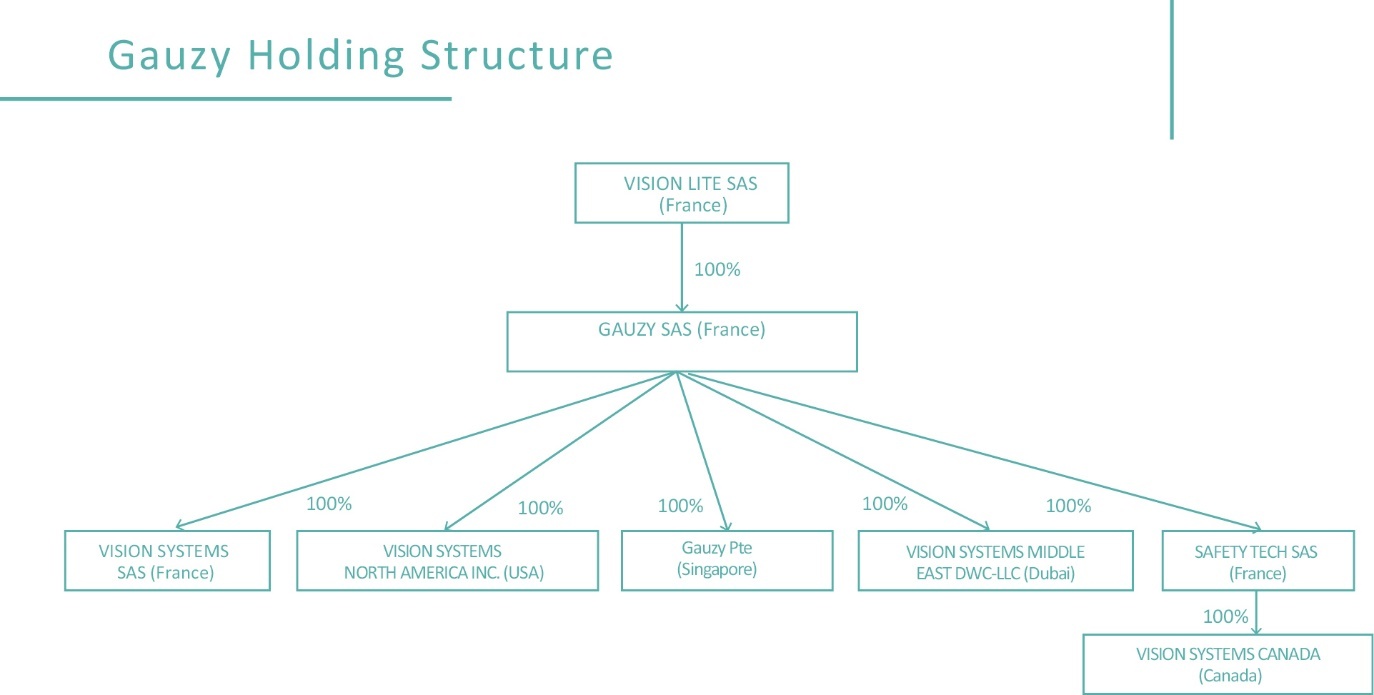
D. Property, Plant and Equipment
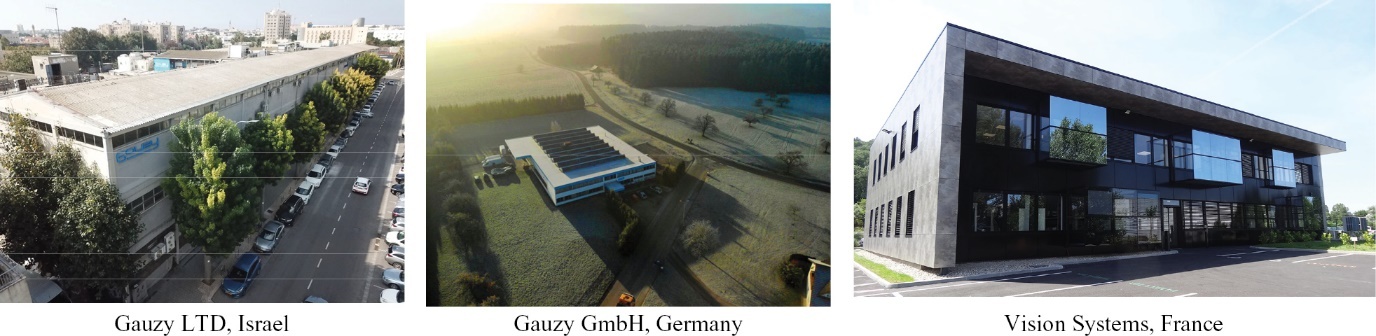
We are headquartered in Tel Aviv, Israel, where we occupy two sites, of approximately 3,178 square meters (or approximately 34,207 square feet) of total space, which operate as both office space as well as a manufacturing, research and development facility. We lease our headquarters under agreements with three separate lessors. The lease agreements with two of the lessors are set to expire in October 2025 and December 2025 and the agreements with the third lessor is set to expire in August and October 2027. We lease an additional 15 office spaces around the world, including in the United States, Germany, France, China, Dubai, Singapore, South Korea and Canada. In addition, we have four manufacturing sites, which are located in Israel, Germany, France and the United States.
In 2022, we expanded our state-of-the-art LC material synthesis facility in Tel Aviv, Israel, which we estimate can now produce LC films for approximately 180,000 square meters of material annually, and we currently have plans to build a new line in this facility. Additionally, we believe our custom 11,000 square meter production facility, strategically located near Stuttgart, Germany, is capable of producing SPD film for approximately 600,000 square meters of material annually for the automotive and architecture industries. We currently estimate that we utilize approximately 25% of our PDLC production capacity in our Tel Aviv facility and approximately five to ten percent of our SPD production capacity in our Stuttgart facility, leaving ample room to grow production with minimal additional capital investment. In addition, our ADAS capabilities are supported by our facility in Lyon, France, which we estimate has a current annual production capacity of approximately 10,000 CMS units, and we plan to expand our annual production capacity in that facility to approximately 100,000 – 125,000 CMS units. We also leverage our 11,000 square meter fulfillment center in Melbourne, Florida as a final assembly site for our aeronautics products.
We further intend to expand our global facilities or add new office space as we add employees and enter new geographic markets, and we believe that suitable additional or alternative space will be available as needed to accommodate any such growth.
ITEM 4A. UNRESOLVED STAFF COMMENTS
Not applicable.
ITEM 5. OPERATING AND FINANCIAL REVIEW AND PROSPECTS
MANAGEMENT’S DISCUSSION AND ANALYSIS
OF
FINANCIAL CONDITION AND RESULTS OF OPERATIONS
The following discussion and analysis of our financial condition and results of operations should be read in conjunction with our financial statements and the related notes included elsewhere in this Annual Report. The discussion below contains forward-looking statements that are based upon our current expectations and are subject to uncertainty and changes in circumstances. Actual results may differ materially from these expectations due to inaccurate assumptions and known or unknown risks and uncertainties, including those identified in “Cautionary Note Regarding Forward-Looking Statements” and under “Risk Factors” elsewhere in the Annual Report. Our discussion and analysis for the two years ended December 31, 2023 can be found in our prospectus dated June 5, 2024, filed with the SEC on June 7, 2024 (Registration No. 333-278675).
Overview
We are a fully-integrated light and vision control company, transforming the way we experience our everyday environments. Our cutting-edge nanotechnology and electronics capabilities in light control, and our mechatronics and image analysis technologies in vision control, are revolutionizing mobility and architectural end-markets. We have established distinct leadership positions across these large and high-growth markets, where our technologies are replacing traditional mechanical products, such as shades, blinds and mirrors, with advanced and sustainable solutions offering superior functionality. Our key products include suspended particle device, or SPD, and liquid crystal, or LC, materials for smart glass applications, and AI-powered advanced driver assistance systems, or ADAS, solutions including camera monitoring systems, or CMS. We have established serial production capabilities, either directly or through sub-contracts, with leading aerospace, automotive and architecture companies including Boeing, Honda, Mercedes, Ford, Ferrari, MSC and Yutong. We benefit from both secular and regulatory tailwinds that are driving the rapid adoption of light and vision control technologies. In addition to our core markets, we believe that our products may have a multitude of tangible applications in other areas such as railway, maritime, specialty vehicle, private security and consumer appliances.
We aim to deliver a full suite of proprietary technologies that offer superior performance attributes by leveraging our differentiated technical capabilities and market insights, a competitive advantage we maintain through our core research and development and innovation organization. We have a comprehensive product offering with multiple complementary light and vision control technologies, enabling us to provide a full range of solutions for light and vision control across diverse markets, applications and geographies. Our vertically integrated in-house production capabilities enable us to offer our products at various stages in the supply chain based on the specific business needs of our customers. For example, we have the capability to simultaneously sell films to glass fabricators, prefabricated stacks to Tier 1 glass manufacturers and, in certain instances, full window systems to OEMs.
In light control, our product offerings include smart glass and films that switch from transparent to opaque, controllable dimmable shading, and transparent displays for digital signage and communication. Our light control products allow the user to regulate privacy, solar heat gain, and UV protection. In vision control, we are a leading Tier 1 supplier of ADAS for trucks, buses and coaches, designed to create a safer and more comfortable driving experience while reducing accidents. Our unique ADAS offerings remove the need for side- and rear-view mirrors, instead providing the driver with a real-time video display and alerts to reduce blind spots and potential driving hazards.
We enjoy close, collaborative relationships with many OEMs, Tier 1 suppliers, film processors and glass fabricators who rely on our technologies. During the product development process, we customize our solutions to ensure they meet our customers’ requirements and are ultimately certified for production. In aerospace, we are a leading Tier 1 supplier for the commercial airline, business jet and helicopter segments, providing full -stack smart glass products and advanced shading solutions directly to our customers. We hold a leading market position in cockpit shading systems for commercial airliners and business jets. We are in serial production for cabin shades, either directly or through sub-contracts, with seven business jet OEMs, including Embraer, HondaJet, Bombardier, Gulfstream, Daher and Beechcraft. Furthermore, we have successfully leveraged the technology and mechatronics expertise we have developed as a Tier 1 aerospace supplier to provide additional differentiated products and services to the automotive and architecture markets.
In the automotive and architectural markets, we are a leading Tier 2 supplier of light control technologies. Our unique business model enables automotive and architectural glass fabricators globally to manufacture smart glass that is integrated with our films and electronics. In the automotive segment, OEMs incorporate our technology in glass rooftops, side windows and windshields to replace conventional mechanical sun visors and shades. In the architectural market, we serve all major segments including commercial, retail, residential, healthcare and hospitality for both interior and exterior applications. In the commercial vehicle segment, we are a Tier 1 supplier and one of the market leaders in vision control technologies, including CMS and ADAS systems for the truck, bus and coach market.
We are strategically located in close proximity to our customers. This geographic competitive advantage deepens local customer relationships, enhances commercial innovation, optimizes customer support, shortens supply chains and enables us to deliver our technologies quickly and efficiently around the world. As a result, the typical customer contract length is 15 to over 30 years for customers in our aeronautics segment, approximately eight years for customers in our automotive segment and five to ten years for customers in our safety tech segment. We operate production facilities in Israel, France, Germany and the United States, with sales, marketing and fulfilment centers in 15 locations throughout the globe. We sell our products in over 60 countries through both direct fulfilment and a network of over 100 expertly trained and certified distribution channels.
We serve a broad range of end-markets and geographies, enabling us to benefit from a diversified base of revenues. In 2024, we generated approximately 28.3% of our revenue in the United States, 29.0% in Europe (excluding France), 25.6% in France, 1.3% in Israel, and 11.8% in Asia, with the remaining 4.0% generated in other countries across the world. In the same period, we generated approximately 40.0% of our revenue in the aerospace market, 44.1% in safety tech and commercial vehicle market 12.7% in the architectural market and 3.2% in the automotive market. We also enjoy a diverse customer base, with no single customer representing more than 9.3% of our revenue for the year ended December 31, 2024.
For more information regarding our business and operations, see “Item 4. Information on the Company”.
Business Combination
On January 26, 2022, the Business Combination closed and we became the sole shareholder of Vision Lite. The consideration for the Business Combination consisted of $23.7 million (€21.0 million) in cash, the repayment of Vision Lite’s loans in an amount of approximately $12.9 million (€11.4 million) and contingent consideration of up to $5.6 million (€5.0 million), contingent on the future revenues of Vision Lite. The Vision Lite SPA also contained certain earn out provisions which required us to pay certain amounts to the Sellers upon the occurrence of certain events, such as meeting annual revenue targets. We paid a total of $4.64 million in earn out payments to the Sellers pursuant to the earn out provisions, which was paid in full by July 2024.
Key Factors Affecting Our Performance
Driving customer adoption. The adoption of light and vision control technologies is still in its early stages with significant runway for further penetration, and as a market leader, we believe that are well positioned to capitalize on the accelerating demand and market adoption by leveraging our best-in-class technologies and recent capacity expansions.
Acquiring new customers. We are a key partner to our large and diversified customer base consisting of glass fabricators, film processors, automobile and aircraft OEMs, airlines and municipalities, among others. As part of our unique business model, we enable the glass industry to manufacture its own smart glass by providing fabricators with materials and technologies to manufacture locally. We manage a large network of glass fabricators worldwide, allowing us to support and grow with our end customers on a global basis and we intend to expand our network to capture further demand and market share over time. We plan to continue to sign new partnerships and win contracts with OEMs and suppliers as they expand their own product lines across the mobility and architecture markets and look for innovative technologies to differentiate their products. While we plan to build on our leadership in CMS technologies for the truck, bus and coach market, we are also focused on expanding our ADAS offering for commercial vehicles and believe we have a substantial opportunity with those customers given our ability to adapt our technologies to cater to the additional complexity that such vehicles require. Moreover, we plan to build on our dominant position amongst aircraft OEMs and completion centers to grow our network of airline customers, given the increasing flexibility of airlines to exert more influence on cabin design decision-making.
Expanding our product portfolio and markets. We embrace an entrepreneurial, R&D-centric mindset supported by our well-invested manufacturing platform and dedicated team with significant expertise in material science, mechatronics, image analysis and advanced manufacturing. We will continue to leverage these resources and capitalize on market and customer insights to expand our use cases through new innovative products and value-added features to drive growth. In particular, we emphasize engineering for tomorrow and believe that anticipating customer needs and preferences is an integral part of customer adoption. As a result, our business and engineering personnel become closely acquainted, and develop deep relationships, with our customers. These close customer relationships enable us to identify and forecast the needs of our customers and draw upon our intellectual property portfolio and expertise in technology research and development to create new products and successfully position our portfolio within the ever-changing business environment.
Leveraging our manufacturing and operational capabilities. In recent years, we have made strategic investments to expand our manufacturing capabilities. We operate as a one-stop shop and are deeply involved across our products’ value chain, spanning across product development and nanoparticle synthesis through lamination and processing, enabling us to more effectively realize opportunities to reduce production costs and react faster to fluctuations in market demand. We believe there is an opportunity for significant margin expansion as we continue to scale our business and benefit from increased capacity utilization and fixed operating leverage. We also expect to benefit from improved purchasing power for our raw materials and components and continued manufacturing efficiencies and productivity initiatives driven by our research and development efforts both on the material science and engineering sides. As an example, we have successfully reduced LC film thickness from 25 microns to 20 microns enabling an approximately 20% reduction in material cost for select products and have also successfully doubled our LC line running speed. We have identified and have begun to implement additional projects that we expect will provide incremental net manufacturing productivity and improved margins in the coming years.
Acquisitions. We believe we are well-positioned as an acquirer of choice due to our global presence, industry-recognized leadership in innovation, diverse manufacturing network and highly entrepreneurial, multi-cultural team with significant engineering and material science expertise. As a public company, we expect to have the added flexibility of financing future acquisitions through our public currency in addition to other funding sources. We have a proven track record with our successful acquisition and integration of Vision Lite in January 2022 and intend to target opportunities that strengthen our market position, expand our product portfolio, enhance our technologies and extend our manufacturing capabilities, including through vertical integration. In September 2023, we completed an acquisition of Resonac’s full SPD intellectual property portfolio and business, which included obtaining and learning the know-how with respect to Resonac’s technical and business information related to such acquired patents, another testament to our acquisition sourcing and execution capabilities.
Geopolitical Environment. In October 2023, Hamas terrorists infiltrated Israel’s southern border from the Gaza Strip and conducted a series of attacks on civilian and military targets. Following the attack, Israel’s security cabinet declared war against Hamas and commenced a military campaign against Hamas. In addition, since the commencement of these events, there have been continued hostilities along Israel’s northern border with Lebanon (with the Hezbollah terror organization), Israel’s southern border with the Gaza Strip (with the Hamas terrorist organization) and on other fronts from various extremist groups in region, such as the Houthis in Yemen and various rebel militia groups in Syria and Iraq. Further, in April 2024 and October 2024, Iran launched a series of drone and missile strikes against Israel. In November 2024, a ceasefire was brokered between Israel and Hezbollah, and on January 19, 2025, a temporary ceasefire went into effect between Israel and Hamas, the results of which are uncertain. To date our operations and financial results have not been materially affected. If the ceasefires declared collapse or a new war commences or hostilities expand to other fronts, our operations may be adversely affected. We expect that the current conflict in the Gaza Strip, Lebanon and the security situation in Israel will not have a material impact on our business results in the short term. However, since this is an event beyond our control, its continuation or cessation may affect our expectations. We continue to monitor our ongoing activities and will need to make any needed adjustments to ensure continuity of our business, while supporting the safety and well-being of our employees.
Economic conditions and resulting business trends. Our results of operations are impacted by the relative strength of the overall economy and its effect on business investment, unemployment, consumer spending behavior, and business and consumer demand. Our customers’ underlying business activities are also linked to the macroeconomic and geopolitical environment. Global supply chain disruptions and high energy prices are expected to continue in 2025. In addition, terrorism or other geopolitical events may increase the likelihood of supply chain interruptions and may impair our ability to compete in current or future markets, or otherwise subject us to potential material liability. While we do not believe that our business segments, products, lines of service, projects or operations have been materially impacted by the global supply chain disruptions, we cannot guarantee that we will not be materially impacted by the economic uncertainty and volatility in the markets in the future. We cannot quantify such impact to our business at this moment, as we are an early growth stage company and have not yet commenced the mass production and sale of products. To mitigate supply chain risks we may face in the future, we aim to focus on Tier 1 suppliers located in close proximity to our production facilities and will seek to negotiate contracts with our suppliers that lock in price and delivery commitments. Since we are strategically located in close proximity to our customers, we have a geographic competitive advantage that deepens local customer relationships, enhances commercial innovation, optimizes customer support, shortens supply chains and enables us to deliver our technologies quickly and efficiently around the world.
Impact of supply chain disruptions on business operations. In connection with the ongoing global supply chain disruption, we continue to work with our suppliers on (i) mitigating the effects of recent procurement shortages, (ii) negating the impacts on supply chain disruption on costs and (iii) effectively scheduling for key product developments. Mitigation steps undertaken by us include design modifications that utilize parts and materials that are more readily available and the expansion of our supply chain to form a wider procurement network to source products in short supply. To date, these mitigation steps have been successful at reducing the impact of supply chain disruptions while also maintaining our commitment to product quality and performance reliability. To date, no new material risks have emerged as a result of these mitigation steps. We anticipate these supply chain challenges will continue to exist over the near term and plan to continually employ mitigation strategies to reduce the impact on future product deliveries.
A. Operating Results
Components of Operating Results
The period-to-period comparisons of our results of operations have been prepared using the historical periods included in our consolidated financial statements. The following discussion should be read in conjunction with the consolidated financial statements and related notes included elsewhere in this Annual Report.
Revenues
We primarily derive revenue mainly from the sale of cockpit and cabin shading in our aeronautics segment, the sale of ADAS technology and driver safety doors in our safety tech segment, and the sale of SPD and LC films for smart glass applications in our architecture and automotive segments.
We expect revenue to increase over time as we expand our customer base. We expect that our revenue will fluctuate from period to period due to new product offerings, varying branding and sales activities, entrance into new end-markets and market segments and evolving policies and regulations in the United States and Europe.
Cost of revenues
Cost of revenues mainly consists of raw materials used in the production line for our products, shipping and handling costs, salary of headcount related to production, employee-related expenses and overhead expenses of internal assembly line and service costs. Cost of revenues also consists of royalties to the Israel Innovation Authority, or the IIA.
Research and development expenses
Research and development expenses include costs directly attributable to the conduct of research and development programs, including employee-related expenses, such as salaries and share-based compensation, lab expenses, consumable equipment and consulting fees, and intellectual property expenses, such as patent application and maintenance expenses. We received royalty-bearing grants, which represents participation of the IIA in approved programs for research and development. These grants are recognized as a reduction of research and development expenses as the related costs are incurred.
Research credit tax granted by the French Government is recognized when the tax credit becomes receivable, provided there is reasonable assurance that Vision Lite will comply with the conditions attributed to this credit and there is reasonable assurance the credit will be received. The tax credit is deducted from research and development expenses as the applicable costs are incurred.
We expect to continue to invest in research and development to enhance our solutions and offerings to our customers, including hiring additional employees and continuing research and development projects. As a result, we expect that our research and development expenses will continue to increase in absolute dollars in future periods and vary from period to period as a percentage of revenue.
General and administrative expenses
General and administrative expenses consist primarily of personnel costs, including share-based compensation related to directors and employees, facility costs, office space rental costs, external professional service costs, including legal, accounting, audit, finance, business development, investor relations, and human resource services, and other consulting fees.
We expect that our general and administrative expenses will continue to increase in absolute dollars in future periods, primarily due to increased headcount to support anticipated growth in the business and due to incremental costs associated with operating as a public company, including costs to comply with the rules and regulations applicable to companies listed on a securities exchange and costs related to compliance and reporting obligations pursuant to the rules and regulations of the SEC and Nasdaq listing standards, public relations, insurance and professional services.
Sales and marketing expenses
Sales and marketing expenses include employee-related expenses, such as salaries and share-based compensation, expenses relating to outsourced and contracted services, such as subcontractor, advertising and exhibition expenses, public relations and websites costs.
We expect our sales and marketing expenses to increase in absolute dollars as we expand our commercial sales, marketing and business development teams, increase our presence globally; and increase marketing activities to drive awareness and adoption of our products. While these expenses may vary from period to period as a percentage of revenue, we expect these expenses to increase as a percentage of sales in the short term as we continue to grow our commercial organization to drive anticipated growth in the business.
Financial expenses
The finance expenses consisted primarily of change in fair value of investments, warrants and financial liabilities measured at fair value, interest expenses on loans and exchange rate differences expenses.
Income Taxes
Income taxes primarily consist of income taxes from our subsidiaries in Germany, the United States and China.
Basis of Presentation
We currently conduct our business and report our financial results through four operating segments: aeronautics, architecture, automotive and safety tech.
Results of Operations
The period-to-period comparisons of our results of operations have been prepared using the historical periods included in our consolidated financial statements. The following discussion should be read in conjunction with the consolidated financial statements and related notes included elsewhere in this document. We have derived this data from our consolidated financial statements included elsewhere in this Annual Report.
Year Ended December 31, 2024 Compared to Year Ended December 31, 2023
| Year Ended December 31, |
||||||||
| (in thousands of USD, except share and per share data) | 2024 | 2023 | ||||||
| Revenues | $ | 103,527 | $ | 77,980 | ||||
| Cost of revenues (exclusive of depreciation and amortization) | 71,718 | 55,992 | ||||||
| Depreciation and amortization | 2,068 | 2,047 | ||||||
| Total cost of revenues | 73,786 | 58,039 | ||||||
| Gross profit | 29,741 | 19,941 | ||||||
| Gross profit margin | 29 | % | 26 | % | ||||
| Operating expenses: | ||||||||
| Research and development expenses (exclusive of depreciation and amortization reflected below) | $ | 17,590 | $ | 16,035 | ||||
| General and administrative expenses (exclusive of depreciation and amortization reflected below) | 22,194 | 16,187 | ||||||
| Sales and marketing expenses (exclusive of depreciation and amortization reflected below) | 16,134 | 15,302 | ||||||
| Depreciation and amortization | 4,608 | 3,664 | ||||||
| Other expenses (income) | (23 | ) | 747 | |||||
| Operating loss | 30,762 | 31,994 | ||||||
| Financial expenses, net | 22,314 | 47,122 | ||||||
| Other expenses (income) | 44 | (32 | ) | |||||
| Loss before income tax | 53,120 | 79,084 | ||||||
| Income tax | 62 | 183 | ||||||
| Net Loss | $ | 53,182 | $ | 79,267 | ||||
Revenues
Revenues increased by approximately $25.5 million, or 32.8%, to $103.5 million for the year ended December 31, 2024, compared to $78.0 million for the year ended December 31, 2023. The significant increase resulted mainly from an increase of $7.6 million in the aeronautics segment, $15.9 million in the safety-tech segment and $1.5 million in the automotive segment. The increase is due to an increase in volume of sales from existing and new customer accounts.
Revenues by Operating Segment
Aeronautics
Revenues in our aeronautics segment increased by approximately $7.6 million, or 22.3%, to $41.4 million for the year ended December 31, 2024, compared to $33.8 million for the year ended December 31, 2023. The increase resulted mainly from the strong demand in several family products, which led to increased sales.
Architecture
Revenues in our architecture segment increased by approximately $0.6 million, or 4.4%, to $13.2 million for the year ended December 31, 2024, compared to $12.6 million for the year ended December 31, 2023. The increase resulted mainly from the timing of deliveries.
Automotive
Revenues in our automotive segment increased by approximately $1.5 million, or 81.6%, to $3.3 million for the year ended December 31, 2024, compared to $1.8 million for the year ended December 31, 2023. The increase resulted mainly from full year serial production compared to six months of serial production in 2023.
Safety-Tech
Revenues in our safety-tech segment increased by approximately $15.9 million, or 53.7%, to $45.6 million for the year ended December 31, 2024, compared to $29.7 million for the year ended December 31, 2023. The increase resulted mainly from strong demand across the segment’s product lines, which led to increased sales.
Cost of revenues
Cost of revenues increased by approximately $15.8 million, or 27.1%, to $73.8 million for the year ended December 31, 2024, compared to $58.0 million for the year ended December 31, 2023. The increase resulted mainly from an increase of $10.7 million in materials costs consistent with higher revenues, an increase of $4.8 million in payroll and related expenses, including share-based compensation, primarily due to an increase in salaries and an increase in the number of operational and production employees to support the increased revenues.
Gross Profit and Gross Profit Margin
Gross profit increased by approximately $9.8 million, or 49.1%, to $29.7 million for the year ended December 31, 2024, compared to $19.9 million for the year ended December 31, 2023. The increase resulted mainly from the increase in revenue year-on-year.
Gross profit margin represents our gross profit as a percentage of our revenue. Gross profit margin increased by approximately 3.0% to 29.0% for the year ended December 31, 2024, compared to 26.0% for the year ended December 31, 2023. The increase in gross margin was primarily the result of higher revenues as a result of a fixed cost base.
For the year ended December 31, 2024, our gross profit margin was 42.4%, 33.5%, (18.2%) and 18.4% in our aeronautics, architecture, automotive and safety tech segments, respectively. For the year ended December 31, 2023, our gross profit margin was 34.2%, 31.2%, (7.2%) and 15.4% in our aeronautics, architecture, automotive and safety tech segments, respectively.
Research and development expenses
Research and development expenses increased by approximately $1.6 million, or 9.7%, to $17.6 million for the year ended December 31, 2024, compared to $16.0 million for the year ended December 31, 2023. The increase resulted mainly from an increase in payroll and related expenses, including share-based compensation, in the amount of $2.2 million, primarily due to an increase in the number of research and development employees, offset by a decrease in subcontractor expenses in the amount of $0.2 million and a decrease in material costs in the amount of $0.3 million.
General and administrative expenses
General and administrative expenses increased by approximately $6.0 million or 37.1%, to $22.2 million for the year ended December 31, 2024, compared to approximately $16.2 million for the year ended December 31, 2023. The increase resulted mainly from an increase in payroll and related expenses, including share-based compensation, in the amount of $5.1 million and an increase in directors’ insurance and compensation expenses in the amount of $0.9 million.
Sales and marketing expenses
Sale and marketing expenses increased by approximately $0.8 million, or 5.4%, to $16.1 million for the year ended December 31, 2024, compared to $15.3 million for the year ended December 31, 2023. The increase resulted mainly from an increase in payroll and related expenses, including share-based compensation, in the amount of $2.1 million, offset by a decrease of $0.9 million in subcontractors services costs.
Other expenses
Other expenses totaled $0.02 million for the year ended December 31, 2024, compared to $0.7 million for the year ended December 31, 2023, and reflects changes in fair value of contingent consideration, resulting from the Vision Lite acquisition.
Financial expenses, net
Financial expenses, net decreased by approximately $24.8 million, or (52.6)%, to $22.3 million for the year ended December 31, 2024, compared to $47.1 million for the year ended December 31, 2023. This decrease was mainly due to a decrease of $22.0 million in the fair value of warrants and financial liabilities measured at fair value, a decrease of $2.9 million in valuation of investments related to RFI shares, and a decrease of $1.97 million in interest expense on loans, convertible loans and long-term debt, offset by an increase of $3.1 million in foreign exchange loss, net expenses.
Net loss
Net loss decreased by approximately $26.1 million, or (32.9)%, to $53.2 million for the year ended December 31, 2024, compared to $79.3 million for the year ended December 31, 2023. The decrease was mainly due to an increase in revenues and a decrease in finance expenses, offset by an increase in our costs of revenues and operating expenses, including, research and development expenses, sales and marketing expenses and general and administrative expenses.
Key Business Metrics and Non-GAAP Financial Measures
We monitor the key business metrics set forth below to help us evaluate growth trends, establish budgets, measure the effectiveness of our sales and marketing efforts, and assess operational efficiencies. Our key business metrics are revenue backlog, EBITDA, Adjusted EBITDA, Adjusted EBITDA Margin, Free Cash Flow and Adjusted Net Loss. Increases or decreases in our key performance metrics may not correspond with increases or decreases in our revenue.
Revenue Backlog
| Year Ended December 31, |
||||||||
| (in thousands of USD) | 2024 | 2023 | ||||||
| Revenue backlog | $ | 30,716 | 32,694 | |||||
Revenue backlog is a key business metric that we define as booked orders based on purchase orders or hard commitments (having a duration of less than one year) that have not been shipped yet or have been shipped but not yet recognized as revenue. We consider revenue backlog to be a useful metric for management and investors, because it is not affected by accounting standards, and, while its evaluated independently of our deferred revenue pursuant to our revenue recognition policy, it can be an important indicator of our expected recognized revenue for the periods following the measurement date. Our revenue backlog as of December 31, 2024 was approximately $30.7 million, compared to revenue backlog of approximately $32.7 million as of December 31, 2023. The decrease was primarily attributable to an increase in sales in 2024 in our aeronautics and safety tech business units compared to 2023.
EBITDA
| Year Ended December 31, |
||||||||
| (in thousands of USD) | 2024 | 2023 | ||||||
| Net Loss | $ | 53,182 | $ | 79,267 | ||||
| EBITDA | $ | (24,130 | ) | (26,251 | ) | |||
| Adjusted EBITDA | $ | (14,249 | ) | (20,697 | ) | |||
| Adjusted EBITDA Margin | (13.8 | )% | (26.5 | )% | ||||
EBITDA is a non-GAAP financial metric that we define as our net loss, the most directly comparable financial measure based on GAAP, excluding net financial expense, tax expense and depreciation and amortization.
Our net loss was $53.2 million and $79.3 million for the years ended December 31, 2024 and 2023, respectively. Our EBITDA was approximately $(24.1) million and $(26.3) million for the years ended December 31, 2024 and 2023, respectively. This was primarily driven by operating expenses, including our share-based compensation, research and development expenses, general and administrative expenses and sales and marketing expenses.
Adjusted EBITDA, Adjusted EBITDA Margin and Net Loss Margin
Adjusted EBITDA is a non-GAAP financial metric that we define as EBITDA (as defined above) excluding acquisition-related costs, one-time expenses and equity-based compensation expenses.
Our Adjusted EBITDA improved from $(20.7) million for the year ended December 31, 2023 to $(14.2) million for the year ended December 31, 2024. This improvement was primarily driven by an increase in gross profit partially offset by an increase in operating expenses, research and development expenses, general and administrative expenses and sales and marketing expenses.
We define Adjusted EBITDA Margin as Adjusted EBITDA (as defined above) for the period divided by revenue for the same period. We consider Net Loss divided by revenue as the most directly comparable U.S. GAAP measure to Adjusted EBITDA Margin. We defined Net Loss Margin as our Net Loss divided by revenue.
Our Net Loss Margin improved from (102.0%) for the year ended December 31, 2023 to (51.0%) for the year ended December 31, 2024. Our Adjusted EBITDA Margin improved from (26.5%) for the year ended December 31, 2023 to (13.8%) for the year ended December 31, 2024. The improvement was primarily driven by increase in revenue year-on-year.
Free Cash Flow
| Year Ended December 31, |
||||||||
| (in thousands of USD) | 2024 | 2023 | ||||||
| Net cash in operating activities | $ | (31,905 | ) | (31,115 | ) | |||
| Free Cash Flow | $ | (43,521 | ) | (41,544 | ) | |||
Free Cash Flow is a non-GAAP financial metric that we define as net cash used in operating activities, the most directly comparable financial measure based on U.S. GAAP, less capital expenditures.
Our Free Cash Flow decreased from $(41.5) million for the year ended December 31, 2023 to $(43.5) million for the year ended December 31, 2024. This decrease was primarily driven by increase of cash used in operating activities in the amount of $(0.8) million and additional capex investments in the amount of $(1.2) million.
The following table reconciles Net Loss to EBITDA and Adjusted EBITDA, Net Loss Margin to Adjusted EBITDA Margin and Free Cash Flow to net cash used in operating activities, the most directly comparable GAAP measures:
| Year Ended December 31, |
||||||||
| (in thousands of USD) | 2024 | 2023 | ||||||
| Net Loss | $ | (53,182 | ) | (79,267 | ) | |||
| Income tax expense (income) | $ | 62 | 183 | |||||
| Financial (income) expenses, net | $ | 22,314 | 47,122 | |||||
| Depreciation and amortization | $ | 6,676 | 5,711 | |||||
| EBITDA | $ | (24,130 | ) | (26,251 | ) | |||
| Acquisition related costs and debt raising costs | $ | 2,796 | 2,006 | |||||
| Non-cash fair value adjustments(1) | $ | (23 | ) | 747 | ||||
| Equity-based compensation expense | $ | 6,607 | 2,567 | |||||
| One-time expense (income) | $ | 143 | - | |||||
| Doubtful debt expenses(2) | $ | 358 | 234 | |||||
| Adjusted EBITDA | $ | (14,249 | ) | (20,697 | ) | |||
| Net Loss Margin | (51 | )% | (102 | )% | ||||
| Adjusted EBITDA Margin | (13.8 | )% | (26.5 | )% | ||||
| Net cash used in operating activities | $ | (31,905 | ) | (31,115 | ) | |||
| Capital expenditures | $ | (11,616 | ) | (10,429 | ) | |||
| Free Cash Flow | $ | (43,521 | ) | (41,544 | ) | |||
| (1) | One-time expenses (income). |
| (2) | Doubtful debt expenses related to accounts receivable that we do not expect to collect; such amounts are not included in our net trade receivables. |
| (4) | Capital expenditures mainly include expenditures related to leasehold improvements, production line and laboratory equipment, prototypes and intellectual property. See “Item 5.B—Operating and Financial Review and Prospects— Liquidity and Capital Resources — Capital Expenditures” below for more information. |
The following table shows our capital expenditures for each of the periods presented:
| Year Ended December 31, |
||||||||
| (in thousands of USD) | 2024 | 2023 | ||||||
| Capital Expenditures | $ | (11,616 | ) | (10,429 | ) | |||
Adjusted Net Loss
Adjusted Net Loss is a non-GAAP financial metric that we define as Net Loss, adjusting for certain financial expenses, the amortization of intangible assets, certain acquisition and debt raising related costs, non-cash fair value adjustments and expenses related to equity-based compensation and doubtful debts.
The following table reconciles Net Loss to Adjusted Net Loss, the most directly comparable GAAP measure:
| Year Ended December 31, |
||||||||
| (in thousands of USD) | 2024 | 2023 | ||||||
| Net Loss | $ | (53,182 | ) | $ | (79,267 | ) | ||
| Other financial (income) expenses, net(1) | $ | 10,795 | $ | 33,629 | ||||
| Amortization of intangible assets(2) | $ | 3,246 | $ | 3,320 | ||||
| Acquisition related costs and debt raising costs | $ | 2,796 | $ | 2,006 | ||||
| Non-cash fair value adjustments(3) | $ | (23 | ) | $ | 747 | |||
| One-time expense (income) | $ | 143 | $ | - | ||||
| Equity-based compensation expense | $ | 6,607 | $ | 2,567 | ||||
| Doubtful debt expenses(4) | $ | 358 | $ | 234 | ||||
| Adjusted Net Loss | $ | (29,260 | ) | $ | (36,764 | ) | ||
| (1) | Expenses related mainly to the valuation of financial instruments, convertible loans, note purchase agreements and investments. |
| (2) | Intangible assets resulted from the acquisition of Vision Lite. |
| (3) | One-time expenses (income). |
| (4) | Doubtful debt expenses related to accounts receivable that we do not expect to collect; such amounts are not included in our net trade receivables. |
Our Adjusted Net Loss decreased from $(36.8) million for the year ended December 31, 2023 to $(29.2) million for the year ended December 31, 2024. This decrease was primarily driven by an increase in gross profit and a decrease in interest expenses, offset partially by increase of operating expenses.
We believe that these non-GAAP financial measures are useful in evaluating our business as a way of assisting an investor in evaluating future cash flows of the business.
B. Liquidity and Capital Resources
Overview
Our capital requirements will depend on many factors, including sales volume, the timing and extent of spending to expand our production capabilities, support research and development efforts, investments in information technology systems, the expansion of sales and marketing activities, increased costs as we continue to hire additional personnel, and market adoption of new and enhanced products and features. For the years ended December 31, 2023 and 2024, we had a net loss of $79.3 million and $53.2 million, respectively.
To date, our principal sources of liquidity have been proceeds from our private offerings of our convertible securities, proceeds from the issuance of SAFEs, proceeds from loans and credit facilities and proceeds from our initial public offering in June 2024.
Based on our current business plan, we believe our current cash and cash equivalents, anticipated cash flow from operations and credit facilities, will be sufficient to meet our anticipated cash requirements over at least the next 12 months. We may need to raise additional capital before we can expect to become profitable from sales of our light and vision control products and may raise additional capital to expand our business, to pursue strategic investments, to take advantage of financing opportunities or for other reasons.
We are currently finalizing a debt financing arrangement with an Israeli commercial bank for $10 million. We expect to enter into definitive agreements with the bank in the first half of 2025. However, there can be no assurance that definitive agreements will be entered into.
If we are required to raise additional funds by issuing equity securities, dilution of shareholders may result. Any debt or equity securities issued may also have rights, preferences, and privileges senior to those of holders of our ordinary shares. The terms of debt securities or borrowings could impose significant restrictions on our operations. The credit market and financial services industry have in the past, and may in the future, experience periods of uncertainty that could impact the availability and cost of equity and debt financing.
We have lease obligations and other contractual obligations and commitments as part of our ordinary course of business. See “Note 9: Operating Leases” to our consolidated financial statements for information about our lease obligations. We did not have during the periods presented, and we do not currently have, any off-balance sheet arrangements involving commitments or obligations, including contingent obligations, arising from arrangements with unconsolidated entities or persons that have or are reasonably likely to have a material current or future effect on our financial condition, results of operations, liquidity, cash requirements or capital resources.
Capital Expenditures
For the years ended December 31, 2024 and 2023, we made capital expenditures of $11.6 million and $10.4 million, respectively. These capital expenditures mainly include expenditures related to leasehold improvements, demonstrations and intellectual property.
Government Grants
Our research and development efforts were financed, in part, through royalty-bearing and non-royalty-bearing grants from the IIA. As of December 31, 2024, we received IIA royalty-bearing grants totaling approximately $1.3 million of which approximately $0.1 million of such amount has been repaid. In addition, as of December 31, 2024, we received IIA non-royalty-bearing grants totaling approximately $1.1 million.
We are committed to pay royalties to the IIA at a rate of approximately 1.0% to 3.5% on sales proceeds from our products (and know-how and related services) that were developed, in whole or in part, using the IIA royalty-bearing grants we received under IIA programs up to the total amount of royalty-bearing grants received, linked to the U.S. dollar and bearing annual interest at rates prescribed by the IIA’s rules and guidelines.
We may in the future apply to receive additional grants from the IIA. However, we cannot predict whether we will be entitled to any future grants, or the amounts of any such grants.
Under the Innovation Law, research and development programs that meet specified criteria and are approved by a committee of the IIA are eligible for grants. A company that receives a royalty-bearing grant from the IIA is typically required to pay royalties to the IIA on income generated from products incorporating IIA-funded know-how (including income derived from services associated with such products and from IIA-funded know-how), up to 100% of the U.S. dollar-linked royalty-bearing grant amount plus interest.
The obligation to pay royalties is contingent on actual income generated from such products and services. In the absence of such income, no payment of royalties is required.
In general, the Innovation Law requires that the products developed as part of the programs under which the grants were given be manufactured in Israel, unless prior approval is attained from the IIA (such approval is not required for the transfer of a portion of the manufacturing capacity which does not exceed, in the aggregate, 10% of the manufacturing (in which case only notification is required, however, the IIA has a right to deny such transfer within 30 days following the receipt of such notice)). In general, the transfer of manufacturing capacity outside of Israel may be subject to an increase in the amount of royalties payable (depending on the manufacturing volume to be performed outside Israel) and to an increase in the rate of royalties.
The Innovation Law also restricts the ability to transfer IIA-funded know outside of Israel. A transfer for the purpose of the Innovation Law is generally interpreted very broadly and includes, among other things, any sale of the IIA-funded know-how, any license to develop the IIA-funded know-how or the products resulting from such IIA-funded know-how or any other transaction, which, in essence, constitutes a transfer of IIA-funded know-how. This limitation does not restrict the export of products that incorporate IIA-funded know-how. A transfer of IIA-funded know-how outside of Israel requires prior approval and may be subject to payment of a redemption fee to the IIA, calculated in accordance with a formula provided under the Innovation Law. The redemption fee is subject to a cap of six times the total amount of the IIA grants, plus interest.
Subject to prior approval of the IIA, we may transfer the IIA-funded know-how to another Israeli company. If the IIA-funded know-how is transferred to another Israeli entity, the transfer would still require IIA approval but will not be subject to the payment of the redemption fee (however, there may be an obligation to pay royalties to the IIA from the income of such sale transaction as part of the royalty payment obligation). In such case, the acquiring company would have to assume all of the applicable restrictions and obligations towards the IIA (including the restrictions on the transfer of know-how and manufacturing outside of Israel) as a condition to the IIA’s approval.
The restrictions under the Innovation Law, including restrictions on the transfer of IIA-funded know-how and manufacturing outside of Israel, continue to apply even after the payment of the full amount of royalties in respect of grants. However, upon payment of the redemption fee on a transfer of IIA-funded know-how outside Israel, the obligations towards the IIA (including the obligation to pay royalties) and restrictions under the Innovation Law cease to apply.
We cannot be certain that any approval of the IIA will be obtained on terms that are acceptable to us, or at all. We may not receive the required approvals should we wish to transfer IIA-funded know-how and/or manufacture products developed with IIA-funded know-how outside of Israel in the future. Furthermore, in the event that we undertake a transaction involving the transfer to a non-Israeli entity of IIA-funded know-how pursuant to a merger or similar transaction, the consideration available to our shareholders may be reduced by the amounts we are required to pay to the IIA. If we fail to satisfy the conditions of the Innovation Law, we may be required to refund the amounts of the grants previously received, together with interest and penalties, and may become subject to criminal charges.
Indebtedness
Israeli Bank Loans
During 2020, we entered into a loan agreement with an Israeli bank in the amount of $0.5 million, or the 2020 Loan. The annual interest rate was Libor + 10.5% and the loan was to be repaid in 30 monthly payments beginning in March 2021. As part of the terms of the loan, we issued to the bank warrants to purchase 4,180 series C preferred shares at an exercise price of $14.35 per share and exercisable for eight years commencing from the date of the loan.
On October 19, 2021, we entered into an additional loan facility agreement with an Israeli bank, pursuant to which we borrowed an aggregate loan amount of $3 million, which bore interest at a rate of 4.2% per annum, or the 2021 Loan. As part of the terms of the 2021 Loan, we issued to the bank warrants to purchase up to 5,791 shares of the most senior class of our shares existing as of a date determined pursuant to the terms thereof (i.e., our series D preferred shares), at an exercise price of $31.08 per share and exercisable for eight years commencing from the date of the loan.
In January 2022, the bank loans were repaid in full following the signing of the Facility Agreement described below. Following the signing of the Facility Agreement, inter alia, the commitments under the Company’s loans with the Israeli bank in an amount of $3.7 million were repaid except for: (i) the three outstanding warrants issued to the bank, one of which was exercised on a cashless basis in April 2024 pursuant to which we issued 16,350 preferred A-3 shares, which converted into 16,350 ordinary shares in connection with our initial public offering in June 2024; (ii) a loan agreement dated May 13, 2020, pursuant to which the Company borrowed an aggregate loan amount of NIS 2.1 million; (iii) a pledge dated January 23, 2018 registered on February 2, 2018 and a pledge dated May 13, 2020 registered on June 8, 2020, and (iv) a fee to be paid to the bank in case of an exit event. As of December 31, 2024, warrants to purchase 9,971 ordinary shares that were issued to the Israeli bank were outstanding.
Convertible Loan Agreements
During the first quarter of 2020, we entered into convertible loan agreements, or the 2020 Convertible Loan Agreements, with three lenders, or the CLA Lenders, pursuant to which the CLA Lenders agreed to loan us a sum of $2.55 million, or the Loan Amount. The 2020 Convertible Loan Agreements were issued with accompanying warrants to purchase series C shares and bear 10% annual interest and matured on July 31, 2021. If the Loan Amount is repaid or converted prior to the maturity date, the interest will be calculated as of the maturity date and not the actual repayment or conversion date. During January 2021, one of the CLA Lenders converted its 2020 Convertible Loan Agreement into 15,008 series C preferred shares, for an amount of $230,000 including accrued interest. As a result of the 2020 Convertible Loan Agreement having converted into series C preferred shares in January 2021, such CLA Lender’s warrants expired according to their terms.
During March 2020, we entered into an additional convertible loan agreement, or the Subsequent 2020 Convertible Loan Agreement, with a lender (pursuant to which the lender agreed to loan us a sum of $3 million). The Subsequent 2020 Convertible Loan Agreement was issued with warrants to purchase preferred C shares and bore 8% annual interest with a maturity date of March 25, 2022. In September 2020, as a result of a Qualified Financing, the lender converted the Subsequent Loan Amount into 217,025 series C preferred shares, out of which 205,539 series C preferred shares were issued in September 2020 and 11,487 Series C preferred shares, were issued in April 2021. As a result of the Subsequent 2020 Convertible Loan Agreement having converted into series C preferred shares in September 2020, its warrants expired according to their terms.
In October 2021, we entered into an amendment to the 2020 Convertible Loan Agreements whereby the two remaining CLA Lenders under such 2020 Convertible Loan Agreements agreed to amend the 2020 Convertible Loan Agreements such that: (i) the maturity date was extended to July 31, 2022, (ii) the interest on the loan should be accrued and be compounded on a quarterly basis commencing August 1, 2021, (iii) repayment of the loan shall only occur upon 60 days’ prior written notice by the Company to the CLA Lenders, (iv) to the extent we are unable to repay the loan by the amended maturity date, the CLA Lenders shall agree to a further extension, and (v) the amendment shall take effect from July 15, 2021.
In January 2022, the two remaining CLA Lenders agreed with the lenders under the Facility Agreement that the rights of the CLA Lenders are subordinated in favor of the lenders under the Facility Agreement, including not having any rights to receive or to demand any amounts payable to them under the 2020 Convertible Loan Agreements (other than conversion into shares) until the obligations under the Facility Agreement have been discharged in full.
In July 2022, the 2020 Convertible Loan Agreement and the accompanying warrants were further amended in order to extend the term of the underlying loan, or the July 2022 CLA Amendment. Under the July 2022 CLA Amendment, the final date for repayment was amended and extended for an additional 12 months to July 31, 2023. In addition, as of August 1, 2022, the interest was amended to reflect a net interest rate of twelve percent (12%) per annum, compounded on a quarterly basis, which shall be due and payable upon either repayment or conversion of the loan in accordance with the terms of the 2020 Convertible Loan Agreement, by way of the conversion of the interest into our series C preferred shares at a price per share equal to $10.72, or repayment of the interest, as shall be determined by the CLA Lenders. The July 2022 CLA Amendment further provided a mandatory conversion of the Loan Amount into our series C preferred shares immediately prior, and subject to, the closing of an IPO or SPAC Transaction (as defined in our amended and restated articles of association immediately in effect prior to our initial public offering). Under the July 2022 CLA Amendment, the exercise period under the accompanying warrants was amended to a period commencing on the date of the July 2022 CLA Amendment and ending on the earlier of (i) the second anniversary of the repayment of the Loan Amount or the conversion thereof in accordance with the terms of the 2020 Convertible Loan Agreement (whichever occurs first); and (ii) immediately prior to, and subject to the closing of, an IPO or a SPAC Transaction (as defined in our amended and restated articles of association immediately in effect prior to our initial public offering). In connection with the July 2022 CLA Amendment, each CLA Lender received additional warrants to purchase our series D preferred shares in an amount equal to eighteen percent (18%) of the total outstanding amount under the 2020 Convertible Loan Agreement as of July 31, 2022, equal to an aggregate of 17,102 series D preferred shares, exercisable at a price per share equal to $31.08. These additional warrants expired unexercised upon the closing of our initial public offering in June 2024.
Upon the consummation of our initial public offering, the remaining balance of the 2020 Convertible Loan Agreements (including the accrued interest) converted into 322,476 ordinary shares based upon the initial public offering price of $17.00 and we issued an additional 8,087 ordinary shares following the cashless exercise of warrants to purchase series C preferred shares.
In March 2023, we entered into an additional convertible loan agreement, or the 2023 Convertible Loan Agreement, with several lenders pursuant to which the lenders loaned us a sum of $38.9 million. The 2023 Convertible Loan Agreement was issued with warrants to purchase shares of the most senior class of our shares existing immediately prior to the exercise of such warrant and bear 12% annual interest, which shall be due and payable upon repayment or upon the conversion of the lender’s loan amount into a number of shares, or the 2023 CLA Shares, upon the occurrence of the following events: (i) an IPO (as defined in the 2023 Convertible Loan Agreement), (ii) a Deemed Liquidation (as defined in the 2023 Convertible Loan Agreement), (iii) a Qualified Financing (as defined in the 2023 Convertible Loan Agreement), (iv) an optional conversion, including in the event of a repayment of the loan amount, at the lender’s election or (v) at the lender’s election if not earlier converted prior to the third anniversary of the disbursement date of the loan proceeds with respect to such lender. The 2023 CLA Shares shall be a newly created series of our preferred equity having such rights and privileges as our then most recently authorized series of preferred equity with the additional rights as set forth in the 2023 Convertible Loan Agreement. As of December 31, 2024, warrants to purchase 1,863,029 ordinary shares that were issued in connection with the 2023 Convertible Loan Agreement were outstanding.
In July 2023, we entered into a further amendment to the outstanding 2020 Convertible Loan Agreements and the accompanying warrants, which we refer to as the CLA Amendment, such that: (i) as of August 1, 2023, the interest was amended to reflect a net interest rate of 12% per annum, compounded on a yearly basis, with the total interest not being less than 24%, and (ii) the loan under the 2020 Convertible Loan Agreements is subject to a mandatory conversion into our most senior class of security, upon and subject to, the closing of an IPO or SPAC Transaction (as defined in our amended and restated articles of association immediately in effect prior to our initial public offering). Upon the consummation of our initial public offering in June 2024, we issued 3,769,855 ordinary shares upon the conversion of the principal and interest of the 2023 Convertible Loan Agreement, based upon the initial public offering price of $17.00 per share.
In March 2024, we entered into an amendment to the 2023 Convertible Loan Agreement pursuant to which the maximum loan amount was raised to $40,000,000 and the Board was given authority under certain circumstances to determine that certain lenders qualify as Significant Lenders and/or Overallotment Lenders (as such terms are defined in the 2023 Convertible Loan Agreement and the warrants issued thereunder).
Upon consummation of our initial public offering, the remaining balance of the 2023 Convertible Loan Agreement (including the accrued interest) converted into 3,769,854 ordinary shares based upon the initial public offering price of $17.00.
OIC 2024 Note Purchase Agreement
In January 2024, we entered into a note purchase agreement, or the 2024 Note Purchase Agreement, with Vision Lite, as the issuer, Gauzy Ltd., Gauzy USA, Inc. and Gauzy GmbH, as the guarantors and OIC Growth Fund I, L.P., OIC Growth Fund I PV, L.P., OIC Growth Fund I AUS, L.P. and OIC Growth Fund I GPFA, L.P., as purchasers, or the 2024 Note Purchasers, and OIC Investment Agent, LLC as administrative agent and collateral agent.
Under the 2024 Note Purchase Agreement, the 2024 Note Purchasers extended financing to Vision Lite in the principal amount of $23.5 million, which was utilized and drawn down in full by way of issuance and sale of senior secured notes, or the 2024 Notes, by Vision Lite to the 2024 Note Purchasers. In connection with the closing of the 2024 Note Purchase Agreement, we repaid the amounts owed under the Facility Agreement, other than with respect to certain amounts under the “phantom warrant.” See “Liquidity and Capital Resources — Indebtedness — Credit Facility” below for additional information. In addition, in January 2024, we amended the 2024 Note Purchase Agreement, or the 2024 NPA Amendment, pursuant to which the 2024 Note Purchasers made available to us an additional commitment in the principal amount of up to $2.5 million that may be utilized and drawn down by way of issuance and sale of additional senior secured notes by Vision Lite to the 2024 Note Purchasers. In April 2024, the $2.5 million additional commitment under the 2024 Note Purchase Agreement (as amended by the 2024 NPA Amendment) was utilized by way of issuance and sale of additional 2024 Notes.
In addition, under the 2024 Note Purchase Agreement, the 2024 Note Purchasers extended a commitment to purchase additional notes in an amount of up to $15.0 million (which commitment was reduced in full on a dollar-for-dollar basis by amounts invested by the 2024 Note Purchasers in our initial public offering in June 2024).
The 2024 Notes bear annual interest, payable quarterly, and are due on November 8, 2028, provided that 2024 Notes may be subject to partial prepayment following the date the annual financial statements of the Company are due to be delivered in accordance with the 2024 Note Purchase Agreement, in an amount equal to 25% of the excess cash flow calculated in accordance with the terms of the 2024 Note Purchase Agreement. Subject to certain conditions specified therein, the 2024 Notes may be voluntarily prepaid at any time.
Amounts owing under the 2024 Note Purchase Agreement, including the principal, interest and fees payable on any issued 2024 Notes, are secured by first-ranking liens on our and certain of our subsidiaries’ assets.
In connection with the 2024 Note Purchase Agreement and the 2024 NPA Amendment, we issued to the 2024 Note Purchasers warrants, or the 2024 Note Purchaser Warrants, to purchase up to 682,282 series D-5 preferred shares of the Company with an exercise price of $15.61 per share. Following the closing of our initial public offering in June 2024, the 2024 Note Purchaser Warrants were exercisable into ordinary shares of the Company. The 2024 Note Purchaser Warrants are exercisable until November 8, 2028. In addition, in connection with our initial public offering in June 2024, the number of our ordinary shares purchasable under the 2024 Note Purchaser Warrants increased by 137,040. In March 2025, the 2024 Note Purchaser Warrants were replaced and we issued an amended and restated warrant to the 2024 Note Purchasers, or the A&R 2024 Note Purchaser Warrant. The A&R Note Purchaser Warrant is exercisable for up to 863,486 of our ordinary shares at an exercise price of $15.61 per share and may be exercised until November 8, 2028.
November 2023 Note Purchase Agreement
In November 2023, we entered into a note purchase agreement, or the Note Purchase Agreement, with Vision Lite, as the issuer, Gauzy Ltd., Gauzy USA Inc. and Gauzy GmbH, as the guarantors and Chutzpah Holdings Ltd., or the 2023 Note Purchaser, as purchaser, administrative agent and collateral agent. Under the Note Purchase Agreement, the 2023 Note Purchaser extended a credit facility to Vision Lite in an aggregate principal amount of $60.0 million, or the Commitment, that may be utilized and drawn down by way of issuance and sale of senior secured notes, or the 2023 Notes, by an issuer to the Note Purchaser. As of the date of this Annual Report, Vision Lite is the sole issuer, although Vision Lite may designate additional issuers pursuant to the Note Purchase Agreement. As of the date of this Annual Report, $25.0 million of the Commitment has been utilized and drawn down and which has subsequently been repaid in full. Such amounts, once repaid, cannot be re-utilized.
The principal amount of 2023 Notes issued to the 2023 Note Purchaser under the Note Purchase Agreement bore interest of 16.0% per annum, or the Interest Rate. In addition, a commitment fee of 5.0% per annum was payable by the 2023 Notes issuer (or issuers in the event that we designate additional issuers pursuant to the Note Purchase Agreement) on the unutilized amount of the Commitment.
Upon repayment or prepayment of any 2023 Notes, the issuer of such 2023 Notes was required to pay the Note Purchaser an exit fee equal to (A) the product of (i) the principal amount of the 2023 Notes being repaid or prepaid, multiplied by (ii) 4.0%, plus (B) an amount equal to the Interest Rate accruing on the amount calculated under (A) during a period from and including the date on which such 2023 Notes were issued and settled to but excluding the date of repayment or prepayment thereof. In addition, the 2023 Note Purchaser is entitled, upon the final repayment or prepayment of the 2023 Notes (including following acceleration of the amounts outstanding under the 2023 Notes and repayment by way of conversion), to payment of a make-whole amount equal to the positive difference (if any) of (i) the product of (A) the aggregate principal amount of the 2023 Notes multiplied by (B) the Minimum Return less (ii) the sum of (A) the aggregate principal amount of the 2023 Notes plus (B) the aggregate amount of interest on such prepaid principal amount paid or to be paid in cash or in kind to the 2023 Note Purchaser on the aggregate principal amount of the 2023 Notes on or prior to the date of such repayment or prepayment, plus (C) the amount of commitment fees paid or to be paid in cash to the 2023 Note Purchaser on or prior to the date of such repayment or prepayment, plus (D) the amount of Exit Fee paid or to be paid in cash to the 2023 Note Purchaser on or prior to the date of such repayment or prepayment. For the purposes hereof, (i) Minimum Return means an amount (if any) necessary for the 2023 Note Purchasers to achieve a 1.50 to 1.00 return on the aggregate original principal amount of all 2023 Notes issued and (ii) Exit Fee means (A) the product of (i) the principal amount of the 2023 Notes being repaid or prepaid, multiplied by (ii) four percent, plus (B) an amount equal to the interest rate accruing on the amount calculated under (A) during a period from and including the closing date on which such 2023 Notes were issued to but excluding the date of repayment or prepayment thereof. On July 1, 2024, we repaid the 2023 Notes in full, in the amount of $38.6 million.
The amounts owing under the Note Purchase Agreement, including the principal, interest and fees payable on any issued 2023 Notes, are secured by liens on the assets of Vision Lite, including a pledge of 100% of the equity interests in Gauzy SAS, and liens on all of our assets (including intellectual property), including a pledge of 100% of the equity interests in Vision Lite, Gauzy USA Inc. and Gauzy GmbH, which liens are second ranking and subject to the first ranking liens granted to the 2024 Note Purchasers and the obligations under the Note Purchase Agreement shall be junior and subordinated to the obligations under the 2024 Note Purchase Agreement.
In connection with the Note Purchase Agreement, we entered into (i) a debenture pursuant to which we granted, as security for amounts owing by us under the Note Purchase Agreement and any guarantee, a second ranking floating charge, over all of our rights and property currently existing and/or to be existing in the future and a second ranking fixed charge, over, inter alia, our authorized share capital and our reputation, rights under a certain shareholder loan agreement between us and Vision Lite, our fixed assets, our intellectual property, and shares held by us in certain subsidiaries; (ii) pledge agreements, pursuant to which we granted the 2023 Note Purchaser a second ranking pledge and security interest over the shares we hold in Vision Lite and over receivables owed to us by Vision Lite; and (iii) a pledge agreement, pursuant to which we granted to the 2023 Note Purchaser a second ranking pledge and security interest over the shares we hold in Gauzy GmbH. The security that we and Vision Lite granted to the 2023 Note Purchaser under the debenture and the various pledge agreements was junior and subordinate to the security that we and Vision Lite granted to the lenders under the Facility Agreement.
In connection with the Note Purchase Agreement, we issued (i) warrants to purchase up to 686,400 series D-5 preferred shares, or the D-5 Warrants, and (ii) warrants to purchase up to 274,559 series D-6 preferred shares, or the D-6 Warrants. The D-5 Warrants and the D-6 Warrants are exercisable until November 8, 2028. The D-5 Warrants and the D-6 Warrants are exercisable into ordinary shares (and the number of ordinary shares of the Company into which the D-5 Warrants and D-6 Warrants are exercisable, respectively, is the number of ordinary shares into which such Preferred D-5 shares and Preferred D-6 shares, respectively, would have converted had they been converted prior to our initial public offering). The D-5 Warrants and the D-6 Warrants vest on a daily basis, such that each day from the date of their issuance the number of shares that may be purchased thereunder equals the product of (i) the maximum number of shares exercisable under the applicable warrant and (ii) a fraction, the numerator of which is the aggregate principal amount of the 2023 Notes issued to the 2023 Note Purchaser pursuant to the Note Purchase Agreement, and the denominator of which is $60,000,000. The D-5 Warrants are exercisable at a price per share equal to $15.61. The D-6 Warrants are exercisable at a price per share equal to the D-5 Exercise Price multiplied by 1.2, or $18.73.
Under the Note Purchase Agreement, we and our subsidiaries are subject to various negative and affirmative covenants, which include, among others, the following: (i) limitations on incurrence of additional financial indebtedness and granting of liens (subject to certain permitted incurrences of indebtedness); (ii) limitations on investments in, and formation or acquisition of, additional entities or joint ventures; (iii) limitations on the conduct of any material activities other than those related to the development, manufacture and marketing of light and vision control technologies or incidental thereto; (iv) we are required to maintain at all times a cash balance of at least $1.5 million; and (v) additional limitations on payments to shareholders of dividends or any indebtedness, and other limitations on change in control as specified in the Note Purchase Agreement. In addition, the Note Purchase Agreement contains events of default customary in such transactions, including non-payment, breach of covenants, breach of representations, bankruptcy, insolvency proceedings and creditors’ process, or occurrence of a material adverse event. In some events, default is subject to grace or cure periods prescribed by the Note Purchase Agreement.
Credit Facility
On January 19, 2022, we entered into a facility agreement with certain credit funds for a loan facility in the aggregate amount of up to $30.0 million, or the Facility and the Facility Agreement, respectively. Subsequent to entering into the Facility Agreement, on January 26, 2022, we drew down an amount of $20 million, or the First Loan, which was used to repay our bank loans with an Israeli bank, and towards the acquisition of Vision Lite.
The Facility Agreement was amended by a First Amendment on April 25, 2022, under which Vision Lite acceded to the Facility Agreement as an additional borrower, and assumed 25% of the first loan ($5 million) and 25% of the unutilized amount of the Facility ($2.5 million), against repayment of a corresponding amount owed by it to us under inter-company loans. The Facility was thereafter fully utilized on April 25, 2022 by the drawdown of loans by each of the Company and Vision Lite (aggregated into a loan in an amount of $22.5 million (75%) owed by us, and a loan in an amount of $7.5 million owed by Vision Lite (25%)), or the Facility Loans.
The credit funds also received a “phantom warrant” under the terms of the Facility Agreement which entitled them to a cash payment (allocated proportionately among the Company (75%) and Vision Lite (25%)) equal, in the aggregate, to the higher of (i) $3 million, or the Cash Payment; or (ii) the difference between the price per share (PPS) of a series D preferred share in an “Exit Event” (based on our valuation, as reflected in the terms of the Exit Event as defined below), and the preferred D shares PPS of $31.08, multiplied by 172,624 series D preferred shares (or such number of ordinary shares into which such shares shall have been converted, on or prior to such Exit Event, in accordance with their terms).
On July 3, 2023, we entered into a waiver and amendment agreement to the Facility Agreement, or the Waiver and Amendment Agreement, pursuant to which our repayment obligations were amended such that the repayment date for certain principal amounts occurring on June 30, 2023 in accordance with the Facility Agreement were to be postponed and repaid on September 30, 2023, or the Postponed Amounts, with the interest payments continuing to be repaid in accordance with the original payment schedule on the original repayment date pursuant to the Facility Agreement. The Postponed Amounts bear an additional interest at a rate of 2% per annum until repayment, which were due on September 30, 2023. Pursuant to the Waiver and Amendment Agreement, commencing July 1, 2023, the interest rate of the Facility Loans was increased at a rate of 1% per annum. Under the Waiver and Amendment Agreement, the credit funds were granted a right, upon full repayment of the Facility Loans, to demand payment of up to 50% of the “phantom warrant.” Under the Waiver and Amendment Agreement, were undertook to deliver to the credit funds, no later than July 31, 2023, commitments of investors to invest $10.0 million in the Company no later than September 30, 2023.
On October 5, 2023, we entered into another waiver and amendment agreement with respect to the Facility Agreement, under which it was agreed that our payment obligations under the Facility Agreement due on or prior to September 30, 2023 may be postponed until November 2, 2023, in consideration for payment of a waiver fee in a total amount of $1.5 million. We paid the waiver fee on November 11, 2023 along with the amount that was initially due on November 2, 2023.
On January 29, 2024, the parties to the Facility Agreement entered into a payoff and full satisfaction of secured obligations letter, or the Payoff Letter. Under the terms of the Payoff Letter, all amounts payable to the credit funds have been repaid to the credit funds, other than 50% of the “phantom warrant,” which remains payable pursuant to the provisions of the Facility Agreement. Upon the consummation of our initial public offering in June 2024, the parties to the Facility Agreement, were entitled to receive, at their election, either $1.5 million or 88,253 ordinary shares, based upon an initial public offering price of $17.00 per share. In July 2024, the parties to the Facility Agreement elected to receive $1.5 million, which, when paid in full, will satisfy the remaining 50% of the “phantom warrant.” In August 2024 and November 2024, we paid $0.75 million and $0.56 million, respectively, of the “phantom warrant” and the remaining balance of $0.19 million was paid in January 2025.
Paycheck Protection Program Loan
In May 2020, we entered into a bank loan in the amount of $0.5 million under an Israeli government established state-guaranteed loan plan for the financial support of businesses following the outbreak of the COVID-19 pandemic. The loan has a maturity date of May 20, 2025 and bears annual interest of prime plus 1.5% that is payable by us beginning from the second year of the loan, which has commenced prior to the date of this Annual Report.
Completion of our Initial Public Offering
On June 7, 2024, we closed our initial public offering of 4,411,765 ordinary shares at a public offering price of $17.00 per ordinary share, for aggregate gross proceeds of $75,000,000, prior to deducting underwriting discounts and other offering expenses.
Our ordinary shares began trading on the Nasdaq Global Market under the ticker symbol “GAUZ” on June 6, 2024.
Cash Flows
Year Ended December 31, 2024 Compared to Year Ended December 31, 2023
The table below shows a summary of our cash flows for the periods indicated:
| Year Ended December 31, |
||||||||
| 2024 | 2023 | |||||||
| (in thousands of USD) | (USD) | |||||||
| Cash and cash equivalents and restricted cash at beginning of the period | 4,705 | 4,696 | ||||||
| Net cash used in operating activities | (31,905 | ) | (31,115 | ) | ||||
| Net cash used in investing activities | (11,455 | ) | (10,623 | ) | ||||
| Net cash provided by financing activities | 44,567 | 41,689 | ||||||
| Net increase in cash and cash equivalents and restricted cash | 1,207 | (49 | ) | |||||
| Translation adjustments on cash and cash equivalents and restricted cash | (178 | ) | 58 | |||||
| Cash at the end of the period | 5,734 | 4,705 | ||||||
Net cash used in operating activities
Net cash used in operating activities increased by approximately $0.8 million, or 2.5%, to approximately $31.9 million for the year ended December 31, 2024, compared to approximately $31.1 million for the year ended December 31, 2023. The increase resulted mainly from a decrease of $26.1 million in net loss, offset by a decrease of $26.3 million in non-cash financial expenses and valuation of marketable shares. An additional increase resulted from an increase of $4.0 million in share-based compensation and an increase of $1.3 million in deferred revenues and trade receivable, offset by an increase in payment of earn-out and earn-out revaluation in the amount of $3.4 million, a decrease of $1.6 million in trade payable and accrued expenses and a decrease of $1.1 million in inventory.
Net cash used in investing activities
Net cash used in investing activities increased by $0.8 million or 7.8%, to approximately $11.4 million for the year ended December 31, 2024, compared to $10.6 million for the year ended December 31, 2023. This increase was mainly due to purchases of property, plant and equipment in the amount of $5.7 million, offset by a decrease of $4.5 million from the purchase of IP related to the REC Agreement with Resonac.
Net cash provided by financing activities
Net cash provided by financing activities increased by $2.9 million, or 6.9%, to approximately $44.6 million for the year ended December 31, 2024, compared to $41.7 million for the year ended December 31, 2023. This increase was mainly due to the receipt of proceeds from our initial public offering in June 2024, net of offering costs, in the amount of $66.3 million and an increase in proceeds from long-term debt measured under the fair value option in the amount of $9.4 million and an increase in changes in factoring loans in the amount of $1.7 million, offset by an increase in payments of long-term debt measured under the fair value option in the amount of $54.3 million, a decrease in proceeds from issuance of convertible loans in the amount of $15.5 million, an increase in settlement of phantom warrants in the amount of $2.8 million, and a decrease in proceeds from the issuance of redeemable convertible preferred shares in the amount of $1.3 million.
C. Research and development, patents and licenses, etc.
For a description of our research and development programs and the amounts that we have incurred over the last two years pursuant to those programs, please see “Item 5. Operating and Financial Review and Prospects- A. Operating Results-Research and Development Expenses” and “Item 5. Operating and Financial Review and Prospects- A. Operating Results- Year ended December 31, 2024, Compared to Year ended December 31, 2023- Research and Development Expenses.”
D. Trend Information
Other than as disclosed in “Item 5. Operating and Financial Review and Prospects—Components of Operating Results” and elsewhere in this Annual Report, we are not aware of any trends, uncertainties, demands, commitments or events for the period from January 1, 2024 to December 31, 2024 that are reasonably likely to have a material effect on our total revenues, income, profitability, liquidity or capital resources, or that caused the disclosed financial information to be not necessarily indicative of future operating results or financial condition.
E. Critical Accounting Estimates
We prepare our consolidated financial statements in accordance with U.S. GAAP. The preparation of these consolidated financial statements requires us to make estimates, assumptions and judgments that can significantly impact the amounts we report as assets, liabilities, revenue, costs and expenses and the related disclosures. We base our estimates on historical experience and other assumptions that we believe are reasonable under the circumstances. Our actual results could differ significantly from these estimates under different assumptions and conditions.
While our significant accounting policies are described in more detail in the notes to our audited consolidated financial statements appearing elsewhere in this Annual Report, we believe the following accounting policies used in the preparation of our audited consolidated financial statements require the most significant judgments and estimates. Please see Note 2 to our consolidated financial statements appearing elsewhere in this Annual Report for additional information.
Share-Based Compensation
We recognize the cost of share-based awards granted to employees and directors based on the estimated grant-date fair value of the awards. We elected to recognize share-based compensation costs on a straight-line method for awards. Forfeitures are accounted for as they occur. The fair value of each option award is estimated on the grant date using the Black-Scholes option pricing model. The application of the Black-Scholes model utilizes significant assumptions, including the underlying share price (see the section titled “Convertible Instruments” below) and volatility. Significant judgment is required in determining the expected volatility of our ordinary shares. Due to the limited history of trading of our ordinary shares, we determined expected volatility based on a peer group of publicly traded companies. Increases (decreases) in the assumptions result in a directionally similar impact to the fair value of the option award.
Derivative Warrant Liabilities
The Company analyses warrants issued to determine whether they meet the classification as liabilities or equity under US GAAP. Derivative warrant liabilities are adjusted to reflect fair value at each reporting period, with any increase or decrease in the fair value recorded as finance expenses (income) in the statement of comprehensive loss. The Company uses a fair valuation specialist to estimate the value of these instruments using numerous iterations using the Black–Scholes option price model.
The key assumptions used in the models are the expected future volatility in the price of the Company's shares, the expected life of the warrants and the probability of a future down-round adjustment event.
Goodwill Impairment
We perform an impairment test annually and whenever events or changes in circumstances indicate that the carrying amount of a reporting unit may not be recoverable. When tested for impairment, we estimate the fair values of our reporting units using a discounted cash flow model which utilizes Level 3 unobservable inputs. Key estimates include revenue growth rates and operating margins, terminal growth rates and discount rates. The discount rate used is based on the WACC, adjusted for the relevant risk associated with the country- and business-specific characteristics of each reporting unit. See note 2e to our consolidated financial statements included elsewhere in this Annual Report for further details on the goodwill impairment test in the year ended December 31, 2024.
ITEM 6. DIRECTORS, SENIOR MANAGEMENT AND EMPLOYEES
A. Directors and Senior Management
Executive Officers and Directors
The following table sets forth information regarding our executive officers and directors, including their ages as of the date of this Annual Report:
| Name | Age | Position | ||
| Eyal Peso | 45 | Chief Executive Officer, Chairman of the Board of Directors, Class III Director | ||
| Adrian Lofer | 50 | Chief Technology Officer | ||
| Meir Peleg | 49 | Chief Financial Officer | ||
| Dudi Baruch | 44 | Chief Operations Officer | ||
| Brittany Kleiman Swisa | 38 | Chief Marketing Officer | ||
| Hadas Talmi Mahler | 42 | Chief Human Resources Officer | ||
| Michael Donnelly(1)(2)(3) | 44 | Class II Director | ||
| Gal Gitter | 42 | Class I Director | ||
| Alexander Babitsky(1)(3) | 50 | Class I Director | ||
| Danny Allouche(1)(3) | 50 | Class III Director | ||
| Ezriel Jesse Klein(1)(2)(3) | 52 | Class II Director | ||
| Lilach Payorski(2)(3) | 51 | Class II Director |
| (1) | Member of the compensation committee. |
| (2) | Member of the audit committee. |
| (3) | Independent director (as defined under Nasdaq Stock Market Listing Rules). |
Eyal Peso, Chief Executive Officer, Chairman of the Board of Directors, Class III Director
Eyal Peso is our co-founder and has served as Chairman of the Board and Chief Executive Officer since 2009. Mr. Peso is an experienced entrepreneur with a strong track record in building a technology company from early to growth stages, covering all aspects from innovation and research and development management, funding and finance, sales and marketing, and global multidiscipline operations. Prior to founding Gauzy, Mr. Peso was a business manager at Alvarion Technologies Ltd. (NASDAQ: ALVR) (acquired by SuperCom Ltd. in 2016), a leading telecom company. Mr. Peso holds a B.Sc in Electrical and Electronic Engineering and a Master’s degree in Business Administration, both from Tel Aviv University in Israel. Mr. Peso brings to our executive management and board of directors demonstrated senior leadership skills, years of experience in the High tech and electronics industries, and historical knowledge of our Company from the time of its founding.
Adrian Lofer, Chief Technology Officer
Adrian Lofer has served as our Chief Technology Officer since he cofounded our Company in October 2009. Mr. Lofer brings more than two decades of experience in research and development, and system engineering of multidisciplinary applications. Mr. Lofer heads our research and development and technological innovation, including hardware development, IP development and management, and technological strategic partnerships. In addition, Mr. Lofer manages our global quality management activities and our compliance with industry regulatory requirements. Mr. Lofer also oversees our global services and customer support. Prior to cofounding Gauzy, between 2007 and 2012, Mr. Lofer served as a lead research and development engineer at Alvarion Technologies Ltd. (NASDAQ: ALVR) (acquired by SuperCom Ltd. in 2016), a leading telecom company. Prior to that, between 2000 and 2007, Mr. Lofer served as a lead research and development engineer at NICE Systems Ltd. (NASDAQ: NICE), a contact center software and recorded data security company. Mr. Lofer holds a Bachelor of Science degree in Electrical and Electronics Engineering and a Master’s degree in Business Administration, both from Tel Aviv University.
Meir Peleg, Chief Financial Officer
Meir Peleg has served as our Chief Financial Officer since September 2017. Prior to joining us, between 2014 and 2017, Mr. Peleg served as Chief Financial Officer at F.B.M. Composite Materials Ltd., a leading composite parts manufacturer for the aircraft industry. Prior to that, between 2011 and 2014, Mr. Peleg served as Chief Financial Officer at Techsign Advanced Signs Systems Ltd., a developer and manufacturer of wayfinding signage systems (Vista Systems). Prior to that, between 2005 and 2011, Mr. Peleg served as a Supervisor at PricewaterhouseCoopers, a global professional services, accounting, and consulting firm. Mr. Peleg holds a Bachelor of Science degree in Economics and Computer Science, an accounting studies certificate, and a Master’s degree in Business Administration, all from Bar-Ilan University.
Dudi Baruch, Chief Operations Officer
Dudi Baruch has served as our Chief Operations Officer since October 2020. Mr. Baruch leads our operations, including supply chain, and engineering and production lines worldwide. Prior to joining us, between 2010 and 2020, Mr. Baruch served as a site manager at Alpha Bio Tec. (acquired by Danaher Corp. (NYSE: DHR) in 2014), a global provider of dental products and biomaterials. Prior to that, between 2008 and 2010, Mr. Baruch served as a supply chain manager at Omrix Biopharmaceuticals Ltd. (acquired by Johnson and Johnson (NYSE: JNJ) in 2008), a global provider of human plasma-based products. Mr. Baruch holds a Bachelor of Science degree in Industrial Engineering from the Technion — Israel Institute of Technology, and a Master’s degree in Business Administration from Ben Gurion University.
Brittany Kleiman Swisa, Chief Marketing Officer
Brittany Kleiman Swisa has served as our Chief Marketing Officer since January 2024, where she is responsible for our global marketing efforts. Prior to her appointment as our Chief Marketing Officer, Mrs. Kleiman Swisa served as our Global Vice President of Marketing and in various management roles within our marketing function from December 2016 to December 2023. Mrs. Kleiman Swisa brings over 15 years of experience in strategic marketing, product development & positioning, branding, public relations, and digital marketing. Prior to working at Gauzy with a focus on material science technologies, she worked in diverse industries including life-science technologies, real estate development & acquisitions, and in the nonprofit sector. She holds a Bachelor’s Degree in Communications from the University of Colorado, and a Masters Degree in Business Management for Technology Companies from New York University.
Hadas Talmi Mahler, Chief Human Resources Officer
Hadas Talmi Mahler has served as our Chief Human Resources Officer since January 2024, where she is responsible for our global human resources function. Prior to her appointment as our Chief Human Resources Officer, Mrs. Talmi Mahler served as our Executive Vice President of HR from January 2023 to December 2023, our Vice President of HR from January 2020 to December 2022 and in various other roles within our human resources function from June 2016 to December 2019. Mrs. Talmi Mahler is responsible for leading talent acquisition management, employee relations, performance management, compensation and benefits methodology, training and development and the HR information systems. Before joining Gauzy, Mrs. Talmi Mahler served as an HR Manager at PricewaterhouseCoopers, a global firm for professional services, accounting and consulting. Prior to that, she served in various HR positions at Intel (NASDAQ: INTC) manufacturing center in Israel. Mrs. Talmi Mahler holds a Bachelor of Arts in Behavioral Science and a Master’s degree in Business Administration, specializing in Organizational Behavior, both from Ben Gurion University.
Michael Donnelly, Class II Director
Michael Donnelly has served on the Board since June 2023. Mr. Donnelly was appointed by our shareholder Ibex Israel Fund LLLP and its affiliates. Mr. Donnelly joined Ibex in September 2019 as a Partner and Managing Director to lead co-investment opportunities and work on special projects. Prior to joining Ibex, Mr. Donnelly was Managing Director of Investment Banking at GVC Capital in Greenwood Village, Colorado. During his 15 plus years at GVC, he assisted the corporate finance team in raising in excess of $600 million in over 120 transactions including four IPOS, 73 PIPEs, 30 Private Placements, 11 Follow-On Offerings, two Registered Directs and two Reverse Mergers. Mr. Donnelly graduated with a B.S. in Finance from the University of Colorado, where he was one of the Presidents of the University of Colorado Student Government. He currently serves on the University of Colorado Foundation Board of Trustees and serves as a Board Member for Ibex portfolio company Revel and is a Board Observer for Ibex portfolio company SiFive.
Gal Gitter, Class I Director
Gal Gitter has served on the Board since December 2020 and was appointed by our shareholder Ibex Israel Fund LLLP and its affiliates. Mr. Gitter is a Partner and Managing Director at Ibex since May 2020. Prior to that, between January 2017 and May 2020, Mr. Gitter served as Associate Partner, Corporate Development at McKinsey & Company, a global management consulting firm. Prior to this role, between February 2014 and December 2016, Mr. Gitter served as Engagement Manager, and between June 2012 and February 2014, he served as Associate at McKinsey. Prior to that, between October 2009 and June 2010, Mr. Gitter served as Project Manager at Tnuva, a leading Israeli food company. Besides his role as a Managing Director at Ibex and serving as a Board member, Mr. Gitter serves as a board member in several other technology companies such as BeamUp Ltd., HoneyComb Insurance Ltd., Cylus Cyber Security Ltd., Vatbox Ltd., Groundwork BioAg Ltd., Glassbox Ltd., Cobwebs Technologies Ltd., and Talenya Ltd., and as a board observer in WekalO, Inc. Mr. Gitter has also served as a board member between February 2021 and February 2022 in Oribi Ltd. (acquired by LinkedIn in 2022). Mr. Gitter holds a Bachelor’s degree in Economics from the Technion — Israel Institute of Technology and a Master’s degree in Business Administration from The Wharton School of the University of Pennsylvania.
Alexander Babitsky, Class I Director
Alexander Babitsky has served on the Board since February 2017 and was appointed by our shareholder Infinity Holding Ventures PTE, an affiliate of Waarde Capital B.V, where Mr. Babitsky served as a Venture Partner. Since October 2019, Mr. Babitsky serves as Chief Executive Officer at Entoprotech Ltd., a circular economy company, using Black Soldier Flies to turn food waste into high-quality protein and other advanced products. Since November 2012, Mr. Babitsky serves as the Founder and Director of NDN Advisers Ltd., a management consulting and corporate finance advisory firm. Prior to that, between July 2007 and May 2013, Mr. Babitsky served as Director for CIS Markets at Gryphon Emerging Markets Limited, a London-based corporate finance advisory firm focusing on emerging markets. Prior to that, between 2004 and 2006, Mr. Babitsky served as the Founder and consultant at N.G.Nir, a management consulting firm, and as a Co-Founder at Tulsa N.Y.M., a medical device company. Prior to that, between November 2002 and August 2004, Mr. Babitsky served as operations controller at Ceragon Networks Ltd. (NASDAQ: CRNT), a global telecommunication equipment company. Prior to that, between August 2000 and November 2002, Mr. Babitsky served as project manager at Kulicke and Soffa Industries, Inc. (NASDAQ: KLIC), a leading provider of semiconductor packaging and electronic assembly solutions company. Mr. Babitsky served as a board member between March 2013 and August 2019 in Utilight Ltd., and between September 2014 and July 2018 in Xplenty Ltd. (now Integrate.io). Mr. Babitsky holds a Bachelor’s degree in Industrial Engineering from the Technion — Israel Institute of Technology and a Master’s degree in Business Administration from the University of Oxford.
Danny Allouche, Class III Director
Danny Allouche has served on the Board since February 2019 and was appointed by our shareholder Avery Dennison Corporation. Since August 2022, Mr. Allouche serves as Senior Vice President and Chief Strategy and Corporate Development Officer at Avery Dennison Corporation (NYSE: ADY), a global materials science and manufacturing company specializing in the design and manufacture of a wide variety of labeling and functional materials and solutions. Prior to this role, between May 2016 and July 2022, Mr. Allouche served as Vice President of Strategy and Corporate Development at Avery Dennison. Prior to this role, between March 2014 and May 2016, Mr. Allouche served as Vice President, Treasury and Corporate Development at Avery Dennison. Prior to that, between October 2010 and March 2014, Mr. Allouche served as Director and Vice President of Strategy and M&A at Avery Dennison. Prior to that, between August 2006 and May 2010, Mr. Allouche served as Vice President at Shamrock Activist Value Fund, a private equity fund. Prior to that, between August 2004 and August 2006, Mr. Allouche served as a consultant at Bain & Company, Inc. Besides his role at Avery Dennison and serving as our Board member, Mr. Allouche serves as a board member in Airtouch Solar Ltd., a solar panel cleaning company; (TASE: ARTS). Mr. Allouche holds a Bachelor’s degree in Economics from Northwestern University and a Master’s degree in Business Administration from the University of California, Los Angeles.
Ezriel Jesse Klein, Class II Director
Ezriel Jesse Klein has served on the Board since November 2019 and was appointed by our shareholder BlueRed Capital Fund LP. Mr. Klein is the co-founder and Managing Partner at BlueRed Partners, a Singapore-based venture capital management firm, established in 2017. Prior to that, between 2014 and 2016, Mr. Klein served as an Advisor to the Chairman and as Head of Innovation and Strategic Investments at OUE Ltd. (SGX: LJ3), a leading pan-Asian, full-service real estate development, investment, and management company. Prior to that, between 2011 and 2013, Mr. Klein served as Managing Partner at Tamarix Fund Company, a venture management firm. Prior to that, between 2001 and 2011, Mr. Klein served as Regional Director and Head of Asia at Giza Venture Capital in Singapore, a venture capital firm that managed five technology funds. Prior to that, between 1999 and 2001, Mr. Klein served as Investment Manager at Giza Venture Capital. Prior to that, Mr. Klein served as an analyst at Giza Capital Markets, an investment bank (affiliate of Alex. Brown & Sons). Mr. Klein has served as a board member in several technology companies such as Unbound Security (NASDAQ: COIN) (acquired by Coinbase Global Inc.), and currently serves as a board member in Cynet, DouxMatok, InZiv, RenalSense, Optibus, Panorays, and EarlySense Ltd. Mr. Klein holds a Bachelor’s degree in Economics and International Relations from the Hebrew University.
Lilach Payorski, Class II Director
Lilach Payorski has served on the Board since December 2024. Ms. Payorski is a seasoned strategic finance and operations executive with over 25 years of experience in large, fast-growing, multinational public companies and has experience in a wide range of sectors, including software-as-a-service, cybersecurity, semiconductors, 3D-printing, pharmaceuticals and consumer technology, where she has worked on mergers and acquisitions and business strategies, go-to-market strategy development and operational activities. Ms. Payorski serves as a member of the board of directors of Oddity Tech Ltd. (Nasdaq: ODD), including as the chairperson of its audit committee and a member of its compensation committee, since March 2022. In addition, Ms. Payorski serves as a member of the board of directors of Kamada Ltd. (Nasdaq: KDMA), including as a member of its audit and compensation committees, since December 2021. Ms. Payorski also served as a member of the board of directors, including as chairperson of the audit committee and a member of the compensation committee, of Scodix Ltd. (TASE: SCDX) from 2021 to 2024. Ms. Payorski previously served as the chief financial officer of Stratasys Ltd. (Nasdaq: SYSS) from January 2017 to February 2022. Prior to that, from December 2012 to December 2016, Ms. Payorski served as Senior Vice President, Corporate Finance at Stratasys Ltd. Prior to these roles, Ms. Payorski served in various finance and accounting managerial roles at PMC-Sierra Inc. (NASDAQ: PMCS), Check Point Software Technologies Ltd. (Nasdaq: CHKP), Wind River Systems, Inc. (NASDAQ: WIND) and Ernst & Young in Israel and the United States. Ms. Payorski holds a B.A. in Accounting and Economics from Tel-Aviv University. Ms. Payorski also completed the Board of Directors and Senior Corporate Officers Program at LAHAV, School of Management, Tel Aviv University.
Family Relationships
There are no family relationships between any members of our executive management and our directors.
Arrangements for Election of Directors and Members of Management
There are no arrangements or understandings with major shareholders, customers, suppliers or others pursuant to which any of our executive management or our directors were selected, except for rights of certain of our shareholders to appoint members of the Board pursuant to our articles of association that were in effect prior to the consummation of our initial public offering in June 2024.
Pursuant to our articles of association that were in effect prior to the consummation of our initial public offering in June 2024, certain of our shareholders had rights to appoint members of the Board. All rights to appoint directors and observers under such articles of association terminated upon the consummation of our initial public offering, or IPO, although currently serving directors that were appointed prior to our IPO continued to serve pursuant to their appointment until the annual meeting of shareholders at which the term of their class of director expires. We are not a party to, and are not aware of, any voting agreements among our shareholders.
Our currently serving directors were appointed as follows:
| ● | Eyal Peso was appointed by our founders, Mr. Peso, Mr. Lofer and Mr. Dimitry Dobrenko. |
| ● | Michael Donnelly was appointed by Ibex Israel Fund LLLP and its affiliates. |
| ● | Gal Gitter was appointed by Ibex Israel Fund LLLP and its affiliates. |
| ● | Alexander Babitsky was appointed by Infinity Holding Ventures PTE Limited. |
| ● | Danny Allouche was appointed by Avery Dennison Corporation. |
| ● | Ezriel Jesse Klein was appointed by Blue-Red Capital Fund LP. |
| ● | Lilach Payorski was appointed by our Board. |
B. Compensation
Compensation of directors and executive officers
The aggregate compensation paid by us to our directors and executive officers, including share-based compensation expenses recorded in our consolidated financial statements for the year ended December 31, 2024, was approximately $3.92 million. This amount includes deferred or contingent compensation accrued for such year and excludes deferred or contingent amounts accrued during the year ended December 31, 2023, and paid during the year ended December 31, 2024.
We pay each of our non-employee directors an annual cash payment of $50,000 with an additional annual payment for service on board committees as follows: $10,000 (or $20,000 for the chairperson) for each member of our audit committee and $7,500 (or $15,000 for the chairperson) for each member of our compensation committee.
In addition, (i) our non-employee directors who served in such capacity as of the first business day in Israel following the 30th trading day of our shares on Nasdaq are eligible to receive a grant of options under our 2016 Plan with a value of $150,000, and (ii) thereafter, following each annual general meeting of our shareholders, our non-employee directors shall be granted options under our 2016 Plan (provided the director is still in office) with a value of $150,000 (with prorated awards granted to non-employee directors who join the Board on a date other than an annual general meeting of our shareholders). The options will vest over a three-year period with one-third vesting on the one-year anniversary of the date of grant and the remainder vesting in equal parts at the end of each calendar quarter thereafter, subject to acceleration upon a “Merger/Sale” (as defined in the 2016 Plan) and have an exercise price equal to the 30-trading days’ average closing price of our ordinary shares prior to the date of grant. We refer to the above as our “Non-Employee Director Equity Arrangement”.
For so long as we qualify as a foreign private issuer, we are not required to comply with the director and executive compensation disclosure requirements applicable to U.S. domestic issuers, including the requirement to disclose on an individual, rather than an aggregate basis, the compensation of our directors and executive officers. However, regulations promulgated under the Companies Law require that we disclose the annual compensation of our five most highly compensated office holders, as such term is defined in the Companies Law, or the Covered Officers, for the relevant fiscal year, on an individual basis. Under such Companies Law regulations, this disclosure is required to be included in the proxy statement for our annual meeting of shareholders each year, which we will furnish to the SEC under cover of a Report of Foreign Private Issuer on Form 6-K. Because of that disclosure requirement under Israeli law, we are also including such information in this Annual Report, pursuant to the disclosure requirements of Form 20-F.
The following is a summary of the compensation of our Covered Officers for, and with respect to, the year ended December 31, 2024. All amounts are in terms of cost to us as recorded in our consolidated financial statements for the year ended December 31, 2024, and are presented below in U.S. dollar amounts in thousands. U.S. dollar amounts indicated for Salary Costs are based on the exchange rate of $3.699 to NIS 1.00, which represents the average weighted U.S. dollar - NIS exchange rate for the date of payments for each of the months during 2024. For the purposes of converting amounts from the Euro to the U.S. dollar, the average weighted EUR/USD exchange rate of € 1.082 to $1.00.
| ● | Eyal Peso, our Chief Executive Officer. Compensation costs recorded in 2024 of $438,000 in salary expenses. |
| ● | Adrian Lofer, our Chief Technology Officer. Compensation costs recorded in 2024 of $216,000 in salary expenses. |
| ● | Meir Peleg, our Chief Financial Officer. Compensation costs recorded in 2024 of $249,000 in salary expenses. |
| ● | Benjamin Lepin, our EVP Gauzy Safety Tech Business Unit. Compensation costs recorded in 2024 of $140,000 in salary expenses. |
| ● | David Le Berre our EVP Gauzy Safety Tech ADAS Competence Center. Compensation costs recorded in 2024 of $143,000 in salary expenses. |
In addition, we recorded additional social benefits costs for the same executives: $74,000 for Eyal Peso, $48,000 for Adrian Lofer, $51,000 for Meir Peleg, $69,000 for Benjamin Lepin, and $83,000 for David Le Berre.
The salary expenses summarized above include the gross salary paid to the Covered Officers, and the social benefit costs include the social benefits paid by us on behalf of the Covered Officers, including convalescence pay, contributions made by us to an insurance policy or a pension fund, work disability insurance, severance, educational fund and payments for social security.
The 2024 cash bonus expenses recorded for Benjamin Lepin as provided for in our financial statements for the year ended December 31, 2024, were $188,000.
We recorded equity-based compensation expenses in our financial statements for the year ended December 31, 2024, for options granted to Eyal Peso, Adrian Lofer, Meir Peleg, Benjamin Lepin and David Le Berre of $1,282,000, $177,000, $173,000, $77,000 and $158,000, respectively. The aforementioned equity-based compensation is subject to a time-based vesting schedule, and, accordingly, the above expenses also reflect equity awards made in previous years that have vested during the current year. Assumptions and key variables used in the calculation of such amounts are described in Note 2 to our consolidated financial statements included elsewhere in this Annual Report.
In addition, (i) our office holders who are not non-employee directors who served in such capacity as of the first business day in Israel following the 30th trading day of our shares on Nasdaq, or the First Grant Date, are eligible to receive a grant of options under our 2016 Plan with a value of $150,000, and (ii) thereafter, on each anniversary of the First Grant Date, our office holders who are not non-employee directors, or the Eligible Executives, provided that he or she is serving as an Eligible Executive at such time, will be granted options under the 2016 Plan with a value of up to three times (or five times for our chief executive officer) their annual aggregate gross base salary for the year in which the grant is made, which value shall be determined by our compensation committee and the Board (with prorated awards granted to Eligible Executives who are appointed on a date other than the annual grant date immediately preceding his or her appointment). The options will vest over a four-year period with one-quarter vesting on the one-year anniversary of the date of grant and the remainder vesting in equal parts at the end of each calendar quarter thereafter, subject to acceleration upon a “Merger/Sale” (as defined in the 2016 Plan) and have an exercise price equal to the 30-trading days’ average closing price of our ordinary shares prior to the date of grant. We refer to the above as our “Executive Officer Equity Arrangement”.
We intend to adopt a new equity incentive plan under which different types of equity incentive awards may be granted. Subject to receiving requisite corporate approvals, we intend to grant restricted share units pursuant to our Non-Employee Director Equity Arrangement and Executive Officer Equity Arrangement under such new plan instead of options.
As approved by the Board, following the completion of our IPO , we intend to distribute bonus payments to certain Office Holders , in a total amount of $287,500, to be allocated among such Office Holders.
In addition, following the completion of our IPO, we intend to distribute bonus payments to certain employees, in a total amount of up to $268,750.
Agreements with Executive Officers
We have entered into written employment agreements with each of our executive officers. These agreements provide for notice periods of varying duration for termination of the agreement by us or by the relevant executive officer, during which time the executive officer will continue to receive salary and benefits. Such notice periods ordinarily require 30 days advance notice, and in some cases 60 or 90 days. However, our employment agreements with each of Eyal Peso, our chief executive officer, and Adrian Lofer, our chief technology officer, provide for longer advance notice periods, each of 180 days (subject to our right, at our election, to reduce such notice period and pay for the remainder of the period in lieu of notice). These agreements also contain customary provisions regarding confidentiality of information, assignment of inventions, non-solicitation and non-competition. However, the enforceability of the non-competition provisions may be limited under applicable law.
For a description of the terms of our options and option plans, see “Item 6.E — Share Ownership — Equity Incentive Plans” below.
Directors’ Service Contracts
Other than with respect to our directors who are also executive officers, we do not have written agreements with any director providing for benefits upon the termination of his or her service with our company.
C. Board Practices
Board of Directors
Under the Companies Law and the Amended Articles, our business and affairs are managed under the direction of the Board. The Board may exercise all powers and may take all actions that are not specifically granted to our shareholders or to executive management. Our chief executive officer (referred to as a “general manager” under the Companies Law) is responsible for our day-to-day management. Our chief executive officer is appointed by, and serves at the discretion of, the Board, subject to the employment agreement that we have entered into with him. All other executive officers are appointed by the chief executive officer, subject to applicable corporate approvals, and are subject to the terms of any applicable employment or consulting agreements that we may enter into with them.
Under the Amended Articles, the number of directors on the Board is determined by the Board and will be no less than three and no more than 11 directors and, other than external directors, if any, they are divided into three classes with staggered three-year terms. Each class of directors consists, as nearly as possible, of one-third of the total number of directors constituting the entire board of directors. At each annual general meeting of our shareholders, the election or re-election of directors following the expiration of the term of office of the directors of that class of directors will be for a term of office that expires on the third annual general meeting following such election or re-election, such that from the annual general meeting of 2025 and after, each year the term of office of only one class of directors will expire.
Our directors are divided among the three classes as follows:
| ● | the Class I directors are Gal Gitter and Alexander Babitsky, and their terms will expire at our annual general meeting of shareholders to be held in 2025; |
| ● | the Class II directors are Michael Donnelly, Ezriel Jesse Klein and Lilach Payorski, and their terms will expire at our annual meeting of shareholders to be held in 2026; and |
| ● | the Class III directors are Eyal Peso and Danny Allouche, and their term will expire at our annual meeting of shareholders to be held in 2027. |
Our directors are appointed by a simple majority vote of holders of our ordinary shares participating and voting at an annual general meeting of our shareholders, provided that (i) in the event of a contested election, the method of calculation of the votes and the manner in which the resolutions will be presented to our shareholders at the annual general meeting shall be determined by the Board in its discretion, and (ii) in the event that the Board does not or is unable to make a determination on such matter, then the directors will be elected by a plurality of the voting power represented at the annual general meeting in person or by proxy and voting on the election of directors (which means that the nominees receiving the largest number of “for” votes (up to the number of board seats being filled in such election) will be elected, provided that in the event of a tie, nominees proposed by the Board shall be given precedence over alternative nominees). In addition, our directors are divided into three classes, one class being elected each year at the annual general meeting of our shareholders, and serve on the Board until the third annual general meeting following such election or re-election or until they are removed at a general meeting of our shareholders in accordance with the Amended Articles or upon the occurrence of certain events in accordance with the Companies Law and the Amended Articles. In addition, the Amended Articles provide that vacancies on the Board may be filled by a vote of a simple majority of the directors then in office. A director so appointed will hold office until the next annual general meeting of our shareholders for the election of the class of directors in respect of which the vacancy was created, or in the case of a vacancy due to the number of directors being less than the maximum number of directors stated in the Amended Articles, until the next annual general meeting of our shareholders for the election of the class of directors to which such director was assigned by the Board.
Under the Amended Articles, the approval of the holders of at least 55% of the total voting power of our shareholders is generally required to remove any of our directors from office and any amendment to this provision and other provisions concerning the dismissal or removal of directors require the approval of at least 55% of the total voting power of our shareholders.
Chairperson of the Board
The Amended Articles provide that the chairperson of the Board is appointed by the members of the Board from among them. Under the Companies Law, the chief executive officer of a public company, or a relative of the chief executive officer, may not serve as the chairperson of the board of directors of such public company, and the chairperson of the board of directors, or a relative of the chairperson, may not be vested with authorities of the chief executive officer of such public company without shareholders’ approval consisting of a majority vote of the shares present and voting at a shareholders meeting, and in addition, either:
| ● | at least a majority of the shares of non-controlling shareholders and shareholders that do not have a personal interest in the approval voted on the proposal are voted in favor (disregarding abstentions); or |
| ● | the total number of shares of non-controlling shareholders and shareholders who do not have a personal interest in such appointment that are voted against such appointment does not exceed 2% of the aggregate voting rights in the company. |
The shareholders’ approval can be provided for a period of up to five years following an initial public offering, and subsequently, for additional periods of up to three years. Prior to our initial public offering in June 2024, our shareholders approved Mr. Eyal Peso serving as chairperson of the Board, in addition to his role as our chief executive officer, for the five-year period following the closing of our initial public offering.
In addition, a person who is subordinated, directly or indirectly, to the chief executive officer may not serve as the chairperson of the board of directors; the chairperson of the board of directors may not be vested with authorities that are granted to persons who are subordinated to the chief executive officer; and the chairperson of the board of directors may not serve in any other position in the company or in a controlled subsidiary but may serve as a director or chairperson of a controlled subsidiary.
External Directors
Under the Companies Law, companies incorporated under the laws of the State of Israel that are “public companies,” including companies with shares listed on the Nasdaq, are required to appoint at least two external directors. External directors are directors who meet certain qualification requirements, including certain independence criteria, set forth in the Companies Law. Pursuant to regulations promulgated under the Companies Law, companies with shares traded on outside of Israel, including the Nasdaq, which do not have a “controlling shareholder,” may, subject to certain conditions, “opt out” from the Companies Law requirements to appoint external directors and related Companies Law rules concerning the composition of the audit committee and compensation committee of the board of directors (other than the gender diversification rule under the Companies Law, which requires the appointment of a director from the other gender if at the time a director is appointed all members of the board of directors are of the same gender). In accordance with these regulations, we have elected to “opt out” from the Companies Law requirement to appoint external directors and related Companies Law rules concerning the composition of the audit committee and compensation committee of the Board. Under these regulations, the exemptions from such Companies Law requirements will continue to be available to us so long as: (i) we do not have a “controlling shareholder” (as such term is defined under the Companies Law), (ii) our shares are traded outside of Israel, and (iii) we comply with the director independence requirements and the audit committee and compensation committee composition requirements under U.S. laws (including applicable rules of the Nasdaq) applicable to U.S. domestic issuers.
Committees of the Board
The Board may, subject to the provisions of the Companies Law, delegate any or all of its powers to committees of the Board, and it may, from time to time, revoke such delegation or alter the composition of any such committees, subject to certain limitations. Unless otherwise expressly provided by the Board, the committees shall not be empowered to further delegate such powers. The composition and duties of our audit committee, and compensation committee are described below.
Audit Committee
Companies Law Requirements
Under the Companies Law, the board of directors of a public company must appoint an audit committee. The audit committee must be comprised of at least three directors. We have elected to opt out from the Companies Law requirements to appoint external directors and related Companies Law rules concerning the composition of the audit committee and compensation committee. See “Item 6.C Directors, Senior Management and Employees—Board Practices— External Directors.”
Listing Requirements
Under the corporate governance rules of the Nasdaq, we are required to maintain an audit committee consisting of at least three independent directors, each of whom is financially literate and one of whom has accounting or related financial management expertise.
Our audit committee consists of Lilach Payorski, Ezriel Jesse Klein and Michael Donnelly. Lilach Payorski serves as the chairperson of the audit committee. All members of our audit committee meet the requirements for financial literacy under the applicable rules and regulations of the SEC and the corporate governance rules of the Nasdaq. The Board has determined that Lilach Payorski is an audit committee financial expert as defined by the SEC rules and has the requisite financial experience as defined by the corporate governance rules of the Nasdaq.
The Board has determined that each member of our audit committee is “independent” as such term is defined in Rule 10A-3(b)(1) under the Exchange Act, which is different from the general test for independence of board and committee members.
Audit Committee Role
The Board has adopted an audit committee charter setting forth the responsibilities of the audit committee, which are consistent with the Companies Law, the SEC rules and the corporate governance rules of the Nasdaq, which include:
| ● | retaining and terminating our independent auditors, subject to ratification by the Board, and in the case of retention, to ratification by the shareholders; |
| ● | pre-approving audit and non-audit services to be provided by the independent auditors and related fees and terms; |
| ● | overseeing the accounting and financial reporting processes of our company and audits of our financial statements, the effectiveness of our internal control over financial reporting and making such reports as may be required of an audit committee under the rules and regulations promulgated under the Exchange Act; |
| ● | reviewing with management and our independent auditor our annual and quarterly financial statements prior to publication or filing with (or furnishing to, as the case may be) the SEC; |
| ● | recommending to the Board the retention and termination of the internal auditor, and the internal auditor’s engagement fees and terms, in accordance with the Companies Law; |
| ● | reviewing with our general counsel and/or external counsel, as deemed necessary, legal and regulatory matters that could have a material impact on the financial statements; |
| ● | identifying irregularities in our business administration, inter alia, by consulting with the internal auditor or with the independent auditor, and suggesting corrective measures to the Board; |
| ● | reviewing policies and procedures with respect to transactions (other than transactions related to the compensation or terms of services) between the company and directors and officers or their affiliates, or transactions that are not in the ordinary course of the company’s business and deciding whether to approve such acts and transactions if so required under the Companies Law; |
| ● | establishing procedures for the handling of employees’ complaints as to the management of our business and the protection to be provided to such employees; |
| ● | evaluating the yearly or periodic work plan proposed by the internal auditor before submission to the Board for approval and propose changes thereto, or approving the work plan; and |
| ● | determining whether certain related-party transactions are “material” or “extraordinary” for the purpose of the requisite approval procedures under the Companies Law and whether certain transactions with a controlling shareholder must be subject to a competitive procedure. |
Compensation Committee
Companies Law Requirements
Under the Companies Law, the board of directors of a public company must appoint a compensation committee. The compensation committee must be comprised of at least three directors. We have elected to opt out from the Companies Law requirements to appoint external directors and related Companies Law rules concerning the composition of the audit committee and compensation committee. See “Item 6.C Directors, Senior Management and Employees—Board Practices— External Directors.”
Listing Requirements
Under the corporate governance rules of the Nasdaq, we are required to maintain a compensation committee consisting of at least two independent directors.
Our compensation committee consists of Michael Donnelly, Danny Allouche, Alexander Babitsky and Ezriel Jesse Klein. Ezriel Jesse Klein serves as chairperson of the compensation committee. The Board has determined that each member of our compensation committee is independent under the corporate governance rules of the Nasdaq, including the additional independence requirements applicable to the members of a compensation committee.
Compensation Committee Role
In accordance with the Companies Law, the roles of the compensation committee are, among others, as follows:
| ● | making recommendations to the Board with respect to the approval of the compensation policy for office holders and, once every three years, regarding any extensions to a compensation policy that was adopted for a period of more than three years; |
| ● | reviewing the implementation of the compensation policy and periodically making recommendations to the Board with respect to any amendments or updates to the compensation policy; |
| ● | resolving whether or not to approve arrangements with respect to the terms of office and employment of office holders; and |
| ● | exempting, under certain circumstances, a transaction with our chief executive officer from the approval of our shareholders. |
An “office holder” is defined in the Companies Law as a chief executive officer (referred to in the Companies Law as a general manager), chief business manager, deputy chief executive officer, vice chief executive officer, any other person assuming the responsibilities of any of these positions regardless of that person’s title, any other manager directly subordinate to the chief executive officer and a director.
The Board has adopted a compensation committee charter setting forth the responsibilities of the compensation committee, which are consistent with the Companies Law and the corporate governance rules of the Nasdaq and include among others:
| ● | recommending to the Board for its approval a compensation policy in accordance with the requirements of the Companies Law, as well as other compensation policies, incentive-based compensation plans and equity-based compensation plans, and overseeing the development and implementation of such policies and recommending to the Board any amendments or modifications to such policies the committee deems appropriate, including as required under the Companies Law; |
| ● | reviewing and approving the granting of options and/or other incentive awards to our chief executive officer and other executive officers, including reviewing and approving corporate goals and objectives relevant to the compensation of our chief executive officer and other executive officers; |
| ● | approving and exempting certain transactions regarding office holders’ compensation pursuant to the Companies Law; and |
| ● | administering our equity-based compensation plans, including without limitation, approving the adoption of such plans, amending and interpreting such plans and the awards and agreements issued pursuant thereto, and making awards to eligible persons under the plans and determining the terms of such awards. |
Compensation Policy under the Companies Law
In general, under the Companies Law, a public company must have a compensation policy that applies to its office holders approved by its board of directors after receiving and considering the recommendations of the compensation committee. In addition, the compensation policy must be approved at least once every three years, first, by the board of directors, upon recommendation of the compensation committee, and second, by a simple majority of the ordinary shares present, in person or by proxy, and voting at a shareholders meeting, excluding abstentions, provided that either:
| ● | such majority includes at least a majority of the shares held by shareholders who are not controlling shareholders and shareholders who do not have a personal interest in such compensation policy; or |
| ● | the total number of shares of non-controlling shareholders and shareholders who do not have a personal interest in the compensation policy that are voted against the policy does not exceed 2% of the aggregate voting rights in the company. |
Under special circumstances, the board of directors may approve the compensation policy despite the objection of the shareholders on the condition that the compensation committee and then the board of directors decide, on the basis of detailed grounds and after discussing again the compensation policy, that approval of the compensation policy, despite the objection of shareholders, is for the benefit of the company.
If a company that initially offers its securities to the public adopts a compensation policy in advance of its initial public offering, and describes it in its prospectus for such offering as we did, then such compensation policy shall be deemed a validly adopted policy in accordance with the Companies Law requirements described above. Furthermore, if the compensation policy is established in accordance with the aforementioned relief, then it will remain in effect for a term of five years from the date such company becomes a public company.
The compensation policy must be based on certain considerations, include certain provisions and reference certain matters as set forth in the Companies Law.
The compensation policy must serve as the basis for decisions concerning the financial terms of employment or engagement of office holders, including exculpation, insurance, indemnification or any monetary payment or obligation of payment in respect of employment or engagement. The compensation policy must be determined and later re-evaluated according to certain factors, including: the advancement of the company’s objectives, business plan and long-term strategy; the creation of appropriate incentives for office holders, while considering, among other things, the company’s risk management policy; the size and the nature of the company’s operations; and with respect to variable compensation, the contribution of the office holder towards the achievement of the company’s long-term goals and the maximization of its profits, all with a long-term objective and according to the position of the office holder. The compensation policy must furthermore consider the following additional factors:
| ● | the education, skills, experience, expertise and accomplishments of the relevant office holder; |
| ● | the office holder’s position and responsibilities; |
| ● | prior compensation agreements with the office holder; |
| ● | the ratio between the cost of the terms of employment of an office holder and the cost of the employment of other employees of the company, including employees employed through contractors who provide services to the company, in particular the ratio between such cost to the average and median salary of such employees of the company, as well as the impact of disparities between them on the work relationships in the company; |
| ● | if the terms of employment include variable components — the possibility of reducing variable components at the discretion of the Board and the possibility of setting a limit on the value of non-cash variable equity-based components; and |
| ● | if the terms of employment include severance compensation — the term of employment or office of the office holder, the terms of the office holder’s compensation during such period, the company’s performance during such period, the office holder’s individual contribution to the achievement of the company goals and the maximization of its profits and the circumstances under which he or she is leaving the company. |
The compensation policy must also include, among other things:
| ● | with regards to variable components: |
| o | with the exception of office holders who report to the chief executive officer, a means of determining the variable components on the basis of long-term performance and measurable criteria; provided that the company may determine that an immaterial part of the variable components of the compensation package of an office holder shall be awarded based on non-measurable criteria, or if such amount is not higher than three months’ salary per annum, taking into account such office holder’s contribution to the company; |
| o | the ratio between variable and fixed components, as well as the limit of the values of variable components at the time of their payment, or in the case of equity-based compensation, at the time of grant. |
| ● | a condition under which the office holder will return to the company, according to conditions to be set forth in the compensation policy, any amounts paid as part of the office holder’s terms of employment, if such amounts were paid based on information later to be discovered to be wrong, and such information was restated in the company’s financial statements; |
| ● | the minimum holding or vesting period of variable equity-based components to be set in the terms of office or employment, as applicable, while taking into consideration long-term incentives; and |
| ● | a limit to retirement grants. |
Our compensation policy is designed to promote retention and motivation of directors and executive officers, incentivize superior individual excellence, align the interests of our directors and executive officers with our long-term performance and provide a risk management tool. To that end, a portion of our executive officer compensation package is targeted to reflect our short- and long-term goals, as well as the executive officer’s individual performance. On the other hand, our compensation policy includes measures designed to reduce the executive officer’s incentives to take excessive risks that may harm us in the long-term, such as limits on the value of cash bonuses and equity-based compensation, limitations on the ratio between the variable and the total compensation of an executive officer and minimum vesting periods for equity-based compensation.
Our compensation policy also addresses our executive officers’ individual characteristics (such as their respective position, education, scope of responsibilities and contribution to the attainment of our goals) as the basis for compensation variation among our executive officers and considers the internal ratios between compensation of our executive officers and directors and other employees. Pursuant to our compensation policy, the compensation that may be granted to an executive officer may include: base salary, annual bonuses and other cash bonuses (such as a signing bonus and special bonuses with respect to any special achievements, such as outstanding personal achievement, outstanding personal effort or outstanding company performance), equity-based compensation, benefits and retirement and termination of service arrangements. All cash bonuses are limited to a maximum amount linked to the executive officer’s base salary. In addition, the total variable compensation components (such as cash bonuses) may not exceed a multiple of the executive officer’s total compensation package with respect to any given calendar year.
An annual cash bonus may be awarded to executive officers upon the attainment of pre-set periodic objectives and individual targets. The annual cash bonus that may be granted to our executive officers other than our chief executive officer will be based on performance objectives and a discretionary evaluation of the executive officer’s overall performance by our chief executive officer and subject to minimum thresholds. The annual cash bonus that may be granted to executive officers other than our chief executive officer may alternatively be based entirely on a discretionary evaluation. Furthermore, our chief executive officer will be entitled to approve performance objectives for executive officers who report to him or her.
The measurable performance objectives of our chief executive officer will be determined annually by our compensation committee and board of directors. A non-material portion of the chief executive officer’s annual cash bonus, as provided in our compensation policy, may be based on a discretionary evaluation of the chief executive officer’s overall performance by the compensation committee and the Board.
The equity-based compensation under our compensation policy for our executive officers (including members of the Board) is designed in a manner consistent with the underlying objectives in determining the base salary and the annual cash bonus, with its main objectives being to enhance the alignment between the executive officers’ interests with our long-term interests and those of our shareholders and to strengthen the retention and the motivation of executive officers in the long term.
Our compensation policy provides for executive officer compensation in the form of share options or other equity-based awards, such as restricted shares and restricted share units, in accordance with our equity incentive plan then in place. All equity-based incentives granted to executive officers shall be subject to vesting periods in order to promote long-term retention of the awarded executive officers. The equity-based compensation may be granted from time to time and be individually determined and awarded according to the performance, educational background, prior business experience, qualifications, role and the personal responsibilities of the executive officer.
In addition, our compensation policy contains compensation recovery provisions which allow us under certain conditions to recover bonuses paid in excess, enables our chief executive officer to approve an immaterial change to the terms of employment of an executive officer who reports directly to him or her (provided that the changes of the terms of employment are in accordance with our compensation policy) and allows us to exculpate, indemnify and insure our executive officers and directors to the maximum extent permitted by Israeli law.
Our compensation policy also provides for compensation to the members of the Board in accordance with the amounts determined in our compensation policy.
Internal Auditor
Under the Companies Law, the board of directors of a public company must appoint an internal auditor based on the recommendation of the audit committee. The role of the internal auditor is, among other things, to examine whether a company’s actions comply with applicable law and orderly business procedure. Under the Companies Law, the internal auditor cannot be an interested party or an office holder or a relative of an interested party or an office holder, nor may the internal auditor be the company’s independent auditor or its representative. An “interested party” is defined in the Companies Law as: (i) a holder of 5% or more of the issued share capital or voting power in a company, (ii) any person or entity who has the right to designate one or more directors or to designate the Chief Executive Officer of the company, or (iii) any person who serves as a director or as a Chief Executive Officer of the company. We have appointed Tali Yaron from Deloitte as our internal auditor.
Code of Conduct
The Board has adopted a written code of conduct that applies to our directors, officers and employees, including our principal executive officer, principal financial officer, principal accounting officer or controller, or persons performing similar functions. A copy of the code will be posted on our website.
Risk Management
One of the key functions of the Board is informed oversight of our risk management process. The Board does not have a standing risk management committee, but rather administers this oversight function directly through the Board as a whole, as well as through various standing committees of the Board that address risks inherent in their respective areas of oversight. In particular, the Board is responsible for monitoring and assessing strategic and regulatory risk exposure, including monitoring the Company’s compliance with cybersecurity and data protection rules and regulations, approving the Company’s budget after considering various risks such as risks associated with supply chain, suppliers and key service providers, if any. Our Board receives periodic reporting on cybersecurity and other business operational risks.
Fiduciary Duties of Office Holders
The Companies Law imposes a duty of care and a duty of loyalty on all office holders of a company. The duty of care requires an office holder to act with the level of care with which a reasonable office holder in the same position would have acted under the same circumstances. The duty of care of an office holder includes a duty to use reasonable means, in light of the circumstances, to obtain:
| ● | information on the business advisability of a given action brought for his or her approval or performed by him or her by virtue of his or her position; and |
| ● | all other important information pertaining to such action. |
The duty of loyalty of an office holder requires an office holder to act in good faith and for the benefit of the company, and includes a duty to:
| ● | refrain from any conflict of interest between the performance of his or her duties in the company and the performance of his or her other duties or personal affairs; |
| ● | refrain from any action that is competitive with the company’s business; |
| ● | refrain from exploiting any business opportunity of the company to receive a personal gain for him or herself or others; and |
| ● | disclose to the company any information or documents relating to the company’s affairs which the office holder has received due to his or her position as an office holder. |
Under the Companies Law, a company may approve an act specified above which would otherwise constitute a breach of an office holder’s duty of loyalty, provided that the office holder acted in good faith, neither the act nor its approval harms the company and the office holder discloses his or her personal interest a sufficient time before the approval of such act. Any such approval is subject to the terms of the Companies Law setting forth, among other things, the appropriate bodies of the company required to provide such approval.
Exculpation, Insurance and Indemnification of Office Holders
Under the Companies Law, a company may not exculpate an office holder from liability for a breach of the duty of loyalty. An Israeli company may exculpate an office holder in advance from liability, in whole or in part, for damages caused as a result of a breach of duty of care but only if a provision authorizing such exculpation is included in its articles of association.
An Israeli company may not exculpate a director from liability arising out of a prohibited dividend or other distribution to shareholders. An Israeli company may indemnify an office holder in respect of the following liabilities and expenses incurred for acts performed as an office holder, either in advance of an event or following an event, provided that a provision authorizing such indemnification is contained in its articles of association:
| ● | a financial liability imposed on him or her in favor of another person pursuant to a judgment, including a settlement or arbitrator’s award approved by a court. However, if an undertaking to indemnify an office holder with respect to such liability is provided in advance, then such an undertaking must be limited to events which, in the opinion of the board of directors, can be foreseen based on the company’s activities when the undertaking to indemnify is given, and to an amount or according to criteria determined by the board of directors as reasonable under the circumstances, and such undertaking shall detail the abovementioned events and amount or criteria; |
| ● | reasonable litigation expenses, including legal fees, incurred by the office holder (1) as a result of an investigation or proceeding instituted against him or her by an authority authorized to conduct such investigation or proceeding, provided that (i) no indictment was filed against such office holder as a result of such investigation or proceeding; and (ii) no financial liability, such as a criminal penalty, was imposed upon him or her as a substitute for the criminal proceeding as a result of such investigation or proceeding or, if such financial liability was imposed, it was imposed with respect to an offense that does not require proof of criminal intent; and (2) in connection with a monetary sanction; |
| ● | reasonable litigation expenses, including legal fees, incurred by the office holder or imposed by a court in proceedings instituted against him or her by the company, on its behalf or by a third party or in connection with criminal proceedings in which the office holder was acquitted or as a result of a conviction for an offense that does not require proof of criminal intent; and |
| ● | expenses, including reasonable litigation expenses and legal fees, incurred by an office holder in relation to an administrative proceeding instituted against such office holder, or certain compensation payments made to an injured party imposed on an office holder by an administrative proceeding, pursuant to certain provisions of the Israeli Securities Law and the Israeli Economic Competition Law, 5748-1988, or, the Competition Law. |
An Israeli company may insure an office holder against the following liabilities incurred for acts performed as an office holder if and to the extent provided in the company’s articles of association:
| ● | a breach of the duty of loyalty to the company, to the extent that the office holder acted in good faith and had a reasonable basis to believe that the act would not prejudice the company; |
| ● | a breach of the duty of care to the company or to a third party, including a breach arising out of the negligent conduct of the office holder; |
| ● | financial liabilities imposed on the office holder in favor of a third party; |
| ● | financial liabilities imposed in an administrative proceeding on the office holder in favor of a third party harmed by a breach, pursuant to certain provisions of the Israeli Securities Law and the Competition Law; and |
| ● | expenses, including reasonable litigation expenses and legal fees, incurred by the office holder as a result of an administrative proceeding instituted against him or her, pursuant to certain provisions of the Israeli Securities Law and the Competition Law. |
An Israeli company may not indemnify, insure or exculpate an office holder against any of the following:
| ● | a breach of the duty of loyalty, except to the extent that the office holder acted in good faith and had a reasonable basis to believe that the act would not prejudice the company; |
| ● | a breach of the duty of care committed intentionally or recklessly, excluding a breach arising out of the negligent conduct of the office holder; |
| ● | an act or omission committed with intent to derive illegal personal benefit; or |
| ● | a fine, monetary sanction or forfeit levied against the office holder. |
Under the Companies Law, exculpation, indemnification and insurance of office holders must be approved by the compensation committee and the board of directors (and, with respect to directors and the chief executive officer, also by the shareholders). However, under regulations promulgated under the Companies Law, the insurance of office holders does not require shareholder approval and it may be approved by only the compensation committee, if the engagement terms are determined in accordance with the company’s stated compensation policy, which was approved by the shareholders by the same special majority required to approve a compensation policy, provided that the insurance policy is on market terms and is not likely to materially impact the company’s profitability, assets or liabilities.
The Amended Articles allow us to exculpate, indemnify and insure our office holders for any act (including any omission) performed by virtue of being an office holder to the fullest extent permitted by law. Our office holders are currently covered by a directors and officers’ liability insurance policy.
We have entered into agreements with each of our directors and other office holders exculpating them in advance, to the fullest extent permitted by law, from liability to us for damages caused to us as a result of a breach of the duty of care, and undertaking to indemnify them to the fullest extent permitted by law.
There is no pending litigation or proceeding against any of our office holders as to which indemnification is being sought, nor are we aware of any pending or threatened litigation that may result in claims for indemnification by any office holder.
In the opinion of the SEC, indemnification of directors and office holders for liabilities arising under the Securities Act, however, is against public policy and therefore unenforceable.
Approval of Related Party Transactions under Israeli Law
Office Holders
The Companies Law requires that an office holder promptly disclose to the company and, in any event, not later than the board meeting at which the transaction is first discussed, any personal interest that such office holder may have and all related material information known to such office holder concerning any existing or proposed transaction of the company (unless it is with respect to a transaction which is not an extraordinary transaction in which the officer holder’s relative has a personal interest as discussed below). A personal interest includes an interest of any person in an act or transaction of a company, including a personal interest of one’s relative or of a corporate body in which such person or a relative of such person is a 5% or greater shareholder, director or general manager or in which such person has the right to appoint at least one director or the general manager, but excluding a personal interest stemming solely from one’s ownership of shares in the company. A personal interest also includes the personal interest of a proxy holder voting shares even if the proxy giver does not have a personal interest in the matter and the personal interest of the proxy giver, whether or not the person voting the shares has discretion.
If it is determined that an office holder has a personal interest in a non-extraordinary transaction, meaning a transaction that is in the ordinary course of business, on market terms and that is not likely to have a material impact on the company’s profitability, assets or liabilities, approval by the board of directors is required for the transaction, unless the company’s articles of association provide for a different method of approval. Any such transaction that is adverse to the company’s interests may not be approved by the board of directors.
Approval by the company’s audit committee and subsequently by the board of directors is required for an extraordinary transaction (meaning a transaction that is not in the ordinary course of business, not on market terms or that is likely to have a material impact on the company’s profitability, assets or liabilities) in which an office holder has a personal interest.
A director and any other office holder who has a personal interest in a transaction which is considered at a meeting of the board of directors or the audit committee generally may not (unless it is with respect to a transaction which is not an extraordinary transaction) be present at such a meeting or vote on that matter unless a majority of the directors or members of the audit committee, as applicable, have a personal interest in the matter. If a majority of the members of the audit committee or the board of directors have a personal interest in the matter, then all of the directors may participate in deliberations of the audit committee or board of directors, as applicable, with respect to such transaction and vote on the approval thereof. In such case, shareholder approval is also required.
Controlling Shareholders
Under the Companies Law, the disclosure requirements that apply to an office holder also apply to a controlling shareholder of a public company. Extraordinary transactions with a controlling shareholder or in which a controlling shareholder has a personal interest, including transactions for the provision of services whether directly or indirectly by a controlling shareholder or his or her relative, or a company such controlling shareholder controls, and transactions concerning the terms of engagement and compensation of a controlling shareholder or a controlling shareholder’s relative, whether as an office holder or an employee, require the approval of the audit committee or the compensation committee, as the case may be, the board of directors and a majority of the shares voted by the shareholders of the company participating and voting on the matter at a shareholders’ meeting. In addition, the shareholder approval must fulfill one of the following requirements:
| ● | at least a majority of the shares held by shareholders who do not have a personal interest in the transaction and are voting on the matter must be voted in favor of approving the transaction, excluding abstentions; or |
| ● | the shares voted by shareholders who do not have a personal interest in the transaction that are voted against the transaction represent no more than 2% of the voting rights in the company. |
In addition, an extraordinary transaction with a controlling shareholder or in which a controlling shareholder has a personal interest with a term of more than three years requires the abovementioned approval every three years; however, such transactions, other than for the provision of services or concerning the terms of engagement or compensation, can be approved for a longer term, provided that the audit committee determines that such longer term is reasonable under the circumstances.
For these purposes, a controlling shareholder is any shareholder that has the ability to direct the company’s actions, including any shareholder holding 25% or more of the voting rights if no other shareholder owns more than 50% of the voting rights in the company. Two or more shareholders with a personal interest in the approval of the same transaction are deemed to be one shareholder for these purposes.
For a description of the approvals required under Israeli law for compensation arrangements of office holders, see “Item 6.C – Board Practices – Approval of the Compensation of Office Holders.”
Pursuant to regulations promulgated under the Companies Law, certain transactions, including with respect to compensation, with a controlling shareholder or his or her relative, or with directors or other office holders, that would otherwise require approval of a company’s shareholders may be exempt from shareholder approval under certain conditions.
Approval of the Compensation of Office Holders
Directors. Under the Companies Law, the compensation of a public company’s directors requires the approval of the compensation committee, the subsequent approval of the board of directors and, unless exempted under regulations promulgated under the Companies Law, the approval of the shareholders at a general meeting.
If the compensation of directors is inconsistent with the company’s stated compensation policy, then those provisions that must be included in the compensation policy according to the Companies Law must have been considered by the compensation committee and board of directors, and shareholder approval will also be required, provided that:
| ● | at least a majority of the shares held by shareholders who are not controlling shareholders and do not have a personal interest in such matter, present and voting on such matter, are voted in favor of the compensation package, excluding abstentions; or |
| ● | the total number of shares of non-controlling shareholders and shareholders who do not have a personal interest in such matter that are voted against the compensation package does not exceed 2% of the aggregate voting rights in the company. |
Executive officers other than the chief executive officer. The Companies Law requires the approval of the compensation of a public company’s executive officers (office holders, other than the chief executive officer and directors) of (i) the compensation committee, (ii) the board of directors, and (iii) if such compensation arrangement is inconsistent with the company’s stated compensation policy, the company’s shareholders (by a special majority vote as discussed above with respect to the approval of director compensation), provided that the compensation committee and the board of directors members have considered the criteria for determining compensation set forth in the compensation policy. However, in special circumstances, if the shareholders of the company do not approve a compensation arrangement with such executive officer that is inconsistent with the company’s stated compensation policy, the compensation committee and board of directors may override the shareholders’ decision if each of the compensation committee and the board of directors provide detailed reasons for their decision after re-evaluation of the transaction in light of the shareholders’ objection.
An amendment to an existing arrangement with an office holder (who is not a director) requires only the approval of the compensation committee, if the compensation committee determines that the amendment is not material in comparison to the existing arrangement. However, according to regulations promulgated under the Companies Law, an amendment to an existing arrangement with an office holder (who is not a director) who is subordinate to the chief executive officer does not require the approval of the compensation committee, if (i) the amendment is approved by the chief executive officer, (ii) the company’s compensation policy provides that a non-material amendment to the terms of service of an office holder (other than the chief executive officer) may be approved by the chief executive officer and (iii) the engagement terms are consistent with the company’s compensation policy.
Chief executive officer. Under the Companies Law, the compensation of a public company’s chief executive officer is required to be approved by: (i) the company’s compensation committee; (ii) the company’s board of directors, and (iii) the company’s shareholders (by a special majority vote as discussed above with respect to the approval of director compensation). However, if the shareholders of the company do not approve the compensation arrangement with the chief executive officer, the compensation committee and board of directors may override the shareholders’ decision if each of the compensation committee and the board of directors provide detailed reasons for their decision after re-evaluation of the transaction in light of the shareholders’ objection. The approval of each of the compensation committee and the board of directors should be in accordance with the company’s stated compensation policy; however, in special circumstances, they may approve compensation terms of a chief executive officer that are inconsistent with such policy provided that they have considered those provisions that must be included in the compensation policy according to the Companies Law and that shareholder approval was obtained (by a special majority vote as discussed above with respect to the approval of director compensation).
The compensation committee may waive the shareholder approval requirement with regard to the compensation of a candidate for the chief executive officer position if the compensation committee determines that: (i) the compensation arrangement is consistent with the company’s compensation policy, (ii) the chief executive officer candidate did not have, on the date of his appointment or during the two-year period preceding his or her appointment, an “affiliation” (including an employment relationship, a business or professional relationship or control) with the company or a controlling shareholder of the company or a relative thereof and (iii) subjecting the approval of the engagement to a shareholder vote would impede the company’s ability to employ the chief executive officer candidate.
Duties of Shareholders
Under the Companies Law, a shareholder has a duty to refrain from abusing his or her power in the company and to act in good faith and in a customary manner in exercising his or her rights and performing his or her obligations toward the company and other shareholders, including, among other things, in voting at general meetings of shareholders (and at shareholder class meetings) on the following matters:
| ● | an amendment to the articles of association; |
| ● | an increase in the authorized share capital; |
| ● | a merger; and |
| ● | the approval of related-party transactions that require shareholder approval. |
A shareholder also has a general duty to refrain from discriminating against other shareholders.
Certain shareholders also have a duty of fairness toward the company. These shareholders include any controlling shareholder, any shareholder who knows that he or she has the power to determine the outcome of a shareholder vote and any shareholder who has the power to appoint or prevent the appointment of an office holder of the company or exercise any other rights available to him or her under the company’s articles of association with respect to the company. The Companies Law does not define the substance of the duty of fairness, except to state that the remedies generally available upon a breach of contract will also apply in the event of a breach of the duty of fairness.
D. Employees.
See “Item 4.B. Business Overview—Employees.”
E. Share Ownership.
See “Item 7.A. Major Shareholders” below.
Equity Incentive Plans
2016 Share Award Plan
The Gauzy Ltd. 2016 Share Award Plan, or the 2016 Plan, was adopted by the Board on May 15, 2016. The 2016 Plan provides for the grant of equity awards to our, or our affiliates’, employees, officers, directors, advisors, consultants and other eligible service providers. The purpose of the 2016 Plan is to attract and retain the best available personnel for positions of substantial responsibility, providing additional incentive to employees, officers, advisors and consultants and promoting a close identity of interests between those individuals and us and our affiliates.
Administration
The Board or compensation committee administers the 2016 Plan, or the Administrator. Under the 2016 Plan, the Administrator has the authority, subject to applicable law, to interpret the terms of the 2016 Plan and any award agreements or awards granted thereunder, designate recipients of awards, determine and amend the terms of awards, including the exercise price of an option award, the fair market value of an ordinary share, accelerate or amend the vesting schedule applicable to an award, prescribe the forms of agreement for use under the 2016 Plan and take all other actions and make all other determinations deemed necessary or advisable for the administration of the 2016 Plan.
Eligibility and Participation
The Administrator selects the individuals who will participate in the 2016 Plan. Eligibility to participate is open to officers, directors, employees of, and consultants or advisors engaged by, us or our affiliates.
Types of Awards
The 2016 Plan enables the grant of options, shares and other awards, including restricted shares, restricted share units, share appreciation rights, performance shares and other share or cash awards as the Administrator may determine.
The 2016 Plan further provides for granting awards in compliance with Section 102 and Section 3(i) of the Israeli Income Tax Ordinance (New Version), 5721-1961, as amended, or ITO. Section 102 of the ITO, or Section 102, allows employees, directors and officers who are not controlling shareholders and who are considered Israeli residents for tax purposes to receive favorable tax treatment for compensation in the form of shares, options or certain other types of equity awards, subject to certain terms and conditions. Our non-employee consultants, service providers and controlling shareholders who are considered Israeli residents for tax purposes may be granted awards under Section 3(i) and certain other sections of the ITO, which do not provide for similar tax benefits. Section 102 includes two alternatives for tax treatment involving the issuance of awards to a trustee for the benefit of the grantees and also includes an additional alternative for the issuance of awards directly to the grantee. We have elected the “capital gain track” pursuant to Section 102(b)(2) or 102(b)(3) of the ITO for grants to eligible Israeli grantees as provided above, which may allow favorable tax treatment for such grantees.
Authorized Shares
As of the date of this Annual Report, there are 796,108 ordinary shares reserved and available for issuance under the 2016 Plan and 38,442 ordinary shares remain available for future awards under the 2016 Plan. The maximum number of shares which may be granted under the 2016 Plan shall be determined by the Board from time to time. Ordinary shares subject to options granted under the 2016 Plan that expire or become un-exercisable without having been exercised in full will become available again for future grant under the 2016 Plan.
Grants
All awards granted pursuant to the 2016 Plan are evidenced by a notice of grant, in a form approved by the Administrator. The notice of grant will set forth the terms and conditions of the award grant. Each award will expire 10 years from the date of the grant thereof, unless a shorter term of expiration is otherwise designated by the Administrator.
Exercise
An option under the 2016 Plan may be exercised by providing us with a written or electronic notice of exercise and full payment of the exercise price for such shares with respect to which the option is exercised, in such form and method as may be determined by the Administrator and permitted by applicable law, and any other deliverable as may be stipulated in the option agreement.
Transferability
Other than by will, the laws of descent and distribution or as otherwise provided under the 2016 Plan, neither the awards nor any right in connection therewith are assignable or transferable.
Termination of Employment or Services
In the event of termination of a participant’s employment or service with us or any of our affiliates for any reason other than (i) for “cause” (as defined in the 2016 Plan) or (ii) due to such participant’s death or disability, all vested and exercisable options held by such participant as of the date of termination may be exercised within three months after such date of termination, unless otherwise provided by the Administrator, but in no event later than the date of expiration of the option as set forth in the award agreement (and, after such period, all unexercised options will terminate and the shares covered by such options shall again be available for issuance under the 2016 Plan). On the date of termination, all unvested options shall expire and the shares covered by such options shall revert to the 2016 Plan. Awards other than options which are unvested and/or the restrictions on which have not lapsed at the time of such termination shall expire and revert to the 2016 Plan.
In the event of termination of a participant’s employment or service with us or any of our affiliates due to such participant’s death or disability, all vested and exercisable options held by such participant as of the date of termination may be exercised by the participant, the participant’s legal guardian, the participant’s estate, or by a person who acquired the right to exercise the option by bequest or inheritance, as applicable, within 12 months after such date of termination, but in no event later than the date of expiration of the option as set forth in the award agreement. Any options which are unvested as of the date of death or disability or which are vested but not then exercised within the 12-month period following such date, will expire and the shares covered by such options will revert to the 2016 Plan. All awards granted to such participant, other than options, which are unvested and/or the restrictions on which have not lapsed at the time of such termination shall expire and revert to the 2016 Plan.
Notwithstanding any of the foregoing, if a participant’s employment or services with us or our affiliates is terminated for “cause,” all outstanding awards granted to such participant (whether vested or unvested) will terminate on the date of such termination and revert to the 2016 Plan.
In the event that a participant does not comply in full with any non-competition, non-solicitation, confidentiality or any other requirement of any agreement between us or our affiliates and the participant, the Administrator may refuse to allow the exercise of the options and the shares covered by such options shall again be available for issuance under the 2016 Plan.
Adjustments
In the event of a share split, reverse share split, share dividend, recapitalization, combination or reclassification of the shares, rights issuances or any other increase or decrease in the number of issued shares effected without receipt of consideration by us (but not including the conversion of any of our convertible securities), the Administrator may make an appropriate adjustment in the number of shares related to each outstanding award, the number of shares reserved for issuance under the 2016 Plan and the exercise price per share of each outstanding option, provided, however, that any fractional shares resulting from such adjustment shall be rounded down to the nearest whole share, unless otherwise determined by the Administrator. Except as expressly provided herein, no issuance by us of shares of any class, or securities convertible into shares of any class, shall affect an award granted to a participant, and no adjustment by reason thereof shall be made with respect to the number or price of shares subject to an award.
Dissolution or Liquidation
In the event of our dissolution or liquidation, the Administrator shall determine the period of time in which a vested and exercisable option may be exercised, which, in no event, is less than 15 days prior to such transaction. Options that were not previously exercised will expire immediately prior to the consummation of such proposed action.
Merger or Acquisition
In the event of a sale of all or substantially all of our assets or shares, or a merger, acquisition, reorganization or other like transaction of us with or into another corporation where we are not the surviving company, or a scheme of arrangement for the purpose of effecting such sale, merger or other transaction, the Board shall have discretion to (i) cause any outstanding awards to be assumed or an equivalent award substituted by the successor company or one of its affiliates, (ii) in the event such awards are not assumed or substituted for, provide the participant the right to exercise the vested award as to all or part of the shares, including discretion to accelerate vesting of unvested awards and provide for cancellation of unvested awards upon closing of the transaction, and/or provide for cancellation of each outstanding award in exchange for payment for each vested share (by cash and/or securities), as determined by the Board, or (iii) provide that upon or prior to the completion of the transaction that the terms of any award will be otherwise amended, modified or terminated and/or that the award will confer the right to receive any other security or asset, including cash, as the Board shall deem to be appropriate.
Amendment and Termination
The Board may terminate, amend or modify the 2016 Plan at any time. The 2016 Plan is scheduled to expire on May 15, 2026, which is 10 years after its adoption by the Board, however, the 2016 Plan will continue to govern the terms and conditions of the outstanding awards previously granted under the 2016 Plan.
F. Disclosure of a registrant’s action to recover erroneously awarded compensation.
There was no erroneously awarded compensation that was required to be recovered pursuant to the Gauzy Ltd. Executive Officer Clawback Policy during the fiscal year ended December 31, 2024.
ITEM 7. MAJOR SHAREHOLDERS AND RELATED PARTY TRANSACTIONS
A. Major Shareholders
The following table sets forth information with respect to the beneficial ownership of our ordinary shares as of March 1, 2025 by:
| ● | each person or entity known by us to own beneficially 5% or more of our outstanding Ordinary shares; |
| ● | each of our directors and executive officers individually; and |
| ● | all of our directors and executive officers as a group. |
The beneficial ownership of our ordinary shares is determined in accordance with the rules of the SEC and generally includes any shares over which a person exercises sole or shared voting or investment power, or the right to receive the economic benefit of ownership. For purposes of the table below, we deem ordinary shares issuable pursuant to options that are currently exercisable or exercisable within 60 days from March 1, 2025 to be outstanding and to be beneficially owned by the person holding the options for the purposes of computing the percentage ownership of that person, but we do not treat them as outstanding for the purpose of computing the percentage ownership of any other person. Percentage of shares beneficially owned is based on ordinary shares issued and outstanding as of March 1, 2025.
All of our shareholders, including the shareholders listed below, have the same voting rights attached to their ordinary shares, and neither our principal shareholders nor our directors and executive officers have different or special voting rights with respect to their ordinary shares. A description of any material relationship that our principal shareholders have had with us or any of our predecessors or affiliates within the past three years is included under “Item 7.A Major Shareholders and Related Party Transactions—Certain Relationships and Related Party Transactions.”
Unless otherwise noted below, the address of each shareholder, director and executive officer is c/o Gauzy Ltd., 14 Hathiya Street, Tel Aviv 6816914, Israel.
| Name of beneficial owner | Ordinary shares beneficially owned |
Percent | ||||||
| 5% or Greater Shareholders | ||||||||
| Entities affiliated with Ibex Partners, LLC(1) | 3,678,184 | 19.4 | % | |||||
| Olive Tree V Limited Partnership(2) | 1,319,812 | 7.0 | % | |||||
| Infinity Holding Ventures PTE. Limited(3) | 2,847,244 | 14.9 | % | |||||
| Blue-Red Capital Fund L.P.(4) | 1,017,875 | 5.4 | % | |||||
| Directors and Executive Officers | ||||||||
| Eyal Peso(5) | 893,277 | 4.6 | % | |||||
| Adrian Lofer(6) | 107,354 | * | % | |||||
| Meir Peleg(7) | 53,937 | * | % | |||||
| Dudi Baruch(8) | 17,945 | * | % | |||||
| Brittany Kleiman Swisa(9) | 17,694 | * | % | |||||
| Hadas Talmi Mahler(10) | 14,238 | * | % | |||||
| Michael Donnelly | — | — | ||||||
| Gal Gitter | — | — | ||||||
| Alexander Babitsky(11) | 27,429 | * | % | |||||
| Danny Allouche | — | — | ||||||
| Ezriel Jesse Klein(12) | 6,529 | * | % | |||||
| Lilach Payorski | — | — | ||||||
| All directors and executive officers as a group (12 persons) | 1,138,403 | 5.9 | % | |||||
| * | Indicates ownership of less than 1% |
| (1) | Based upon information contained in a Schedule 13G filed by the shareholder on November 13, 2024. Shares beneficially owned consist of (1) 2,815,101 ordinary shares (of which 12,241 ordinary shares are issuable upon the exercise of options exercisable within 60 days from March 1, 2025 and 322,182 ordinary shares are issuable upon the exercise of warrants exercisable within 60 days from March 1, 2025) held by Ibex Israel Fund LLLP, a Delaware limited liability limited partnership (the “Israel Fund”); (2) 488,327 ordinary shares held by Ibex Partners (Gauzy) LP, a Delaware limited partnership (the “Gauzy Fund”); and (3) 373,122 ordinary shares held by Ibex Partners (MW) LLLP, a Delaware limited liability limited partnership (the “MW Fund”; and together with the Israel Fund and the Gauzy Fund, the “Funds”). The Funds are private investment vehicles. The Funds directly beneficially own the ordinary shares. Ibex GP LLC, a Colorado limited liability company (the “General Partner”) is the general partner of the Funds. Ibex Investment Holdings II LLC, a Delaware limited liability company (“GP Holdings”) is the sole member of the General Partner. Ibex Investors LLC, a Colorado limited liability company (the “Investment Manager”) is the investment manager of the Funds. Ibex Investment Holdings LLC, a Delaware limited liability company (“IM Holdings”) is the sole member of the Investment Manager. Justin B. Borus (together with Israel Fund, Gauzy Fund, MW Fund, General Partner, IM Holdings, GP Holdings and Investment Manager, collectively, the “Ibex Reporting Persons”) is the manager of the General Partner, IM Holdings, GP Holdings and the Investment Manager. The General Partner, IM Holdings, GP Holdings, the Investment Manager and Justin B. Borus may be deemed to beneficially own the Ordinary Shares directly beneficially owned by the Funds. Each Fund may be deemed to beneficially own the Ordinary Shares directly beneficially owned by the other Funds. Each Ibex Reporting Person disclaims beneficial ownership with respect to any shares other than the shares directly beneficially owned by such Ibex Reporting Person. The principal business office of the Ibex Reporting Persons is c/o Ibex Investors LLC, 260 N. Josephine Street, Suite 300, Denver, CO 80206. |
| (2) | Based upon information contained in a Schedule 13G filed by the shareholder on February 14, 2025. Shares beneficially owned consist of (i) 1,276,039 ordinary shares; (ii) options to purchase 6,528 ordinary shares that are currently exercisable; and (iii) 37,245 ordinary shares issued upon the conversion of warrants to purchase series D-1 preferred shares that are currently exercisable. The general partner of Olive Tree V Limited Partnership (“Olive Tree”) is OTV GP I, LLC, a Cayman Islands limited liability company (the "General Partner"). Mr. Alejandro Weinstein, Mr. Mayer Gniwisch and Mr. Amir Lahat are managers and each own 33.33% of the interests of the General Partner. The General Partner, Mr. Alejandro Weinstein, Mr. Mayer Gniwisch and Mr. Amir Lahat may be deemed to indirectly beneficially own the ordinary shares that are directly beneficially owned by Olive Tree. The principal business office of Olive Tree is 121 Menachem Begin Rd., 61st Floor, Tel Aviv, Israel. |
| (3) | To our knowledge, consists of (A) (i) 1,231,691 ordinary shares, (ii) options to purchase 4,895 ordinary shares that are currently exercisable or will be exercisable within 60 days from March 1, 2025, (iii) 252,365 warrants to purchase ordinary shares that are currently exercisable or will be exercisable within 60 days from March 1, 2025, each held by Infinity Holding Ventures PTE. Limited and (B) (i) 904,568 ordinary shares, (ii) 453,725 warrants to purchase ordinary shares that are currently exercisable or will be exercisable within 60 days from March 1, 2025 each held by Waarde Capital B.V which is an affiliate of Infinity Holding Ventures PTE. Limited. To the best of our knowledge, Infinity Holding Ventures PTE. Limited, is managed by its ultimate beneficial owners, Maxim Rubin, Ays Sharaev Boris Pokrovskiy and Alexei Prudnikov. As such, Mr. Rubin, Mr. Sharaev Mr. Pokrovskiy and Mr. Prudnikov may be deemed to have voting and investment control over the shares held by Infinity Holding Ventures PTE. Limited. The address of the principal office of Infinity Holding Ventures PTE. Limited is 53 Eastwood Drive, Singapore 486145. |
| (4) | To our knowledge, consists of (i) 933,927 ordinary shares, (ii) warrants to purchase 83,948 ordinary shares that are currently exercisable or will be exercisable within 60 days from March 1, 2025,. To the best of our knowledge, Blue-Red Capital Fund L.P. is managed by an investment committee from Blue-Red Partners PTE Ltd. As such, Blue-Red Partners PTE Ltd. may be deemed to have voting and investment control over the shares held by Blue-Red Capital Fund L.P. The address of the principal office of Blue-Red Partners PTE Ltd.is 780 3rd Ave #4400, New York, NY 10017. |
| (5) | Consists of (i) 368,244 ordinary shares, and (ii) options to purchase 525,033 ordinary shares that are currently exercisable or will be exercisable within 60 days from March 1, 2025, exercisable at exercise prices ranging from $0.06 to $0.07 and expiring from March 2031 to July 2033. Does not include 47,752 ordinary shares issuable upon exercise of outstanding options that are not exercisable within 60 days of March 1, 2025, exercisable at exercise prices ranging from $0.06 to $0.07 and expiring from March 2031 to July 2033. |
| (6) | Consists of (i) 74,428 ordinary shares, and (ii) options to purchase 32,926 ordinary shares that are currently exercisable or will be exercisable within 60 days from March 1, 2025, exercisable at exercise prices ranging from $0.06 to $0.07 and expiring from February 2032 to July 2033. Does not include 27,448 ordinary shares issuable upon exercise of outstanding options that are not exercisable within 60 days of March 1, 2025, exercisable at exercise prices ranging from $0.06 to $0.07 and expiring from February 2032 to May 2034. |
| (7) | Consists of options to purchase 53,937 ordinary shares that are currently exercisable or will be exercisable within 60 days from March 1, 2025, exercisable at exercise prices ranging from $0.06 to $0.07 and expiring from January 2031 to July 2033. Does not include 15,439 ordinary shares issuable upon exercise of outstanding options that are not exercisable within 60 days of March 1, 2025, exercisable at exercise prices ranging from $0.06 to $0.07 and expiring from July 2033 to May 2034. |
| (8) | Consists of options to purchase 17,945 ordinary shares that are currently exercisable or will be exercisable within 60 days from March 1, 2025, exercisable at exercise prices ranging from $0.06 to $0.07 and expiring from November 2030 to July 2033. Does not include 6,590 ordinary shares issuable upon exercise of outstanding options that are not exercisable within 60 days of March 1, 2025, exercisable at exercise prices ranging from $0.06 to $0.07 and expiring from July 2033 to May 2034. |
| (9) | Consists of (i) 1,229 ordinary shares, and (ii) options to purchase 16,465 ordinary shares that are currently exercisable or will be exercisable within 60 days from March 1, 2025, exercisable at exercise prices ranging from $0.06 to $0.07 and expiring from January 2031 to July 2033. Does not include 5,488 ordinary shares issuable upon exercise of outstanding options that are not exercisable within 60 days of March 1, 2025, exercisable at an exercise price of $0.06 and expiring in July 2033. |
| (10) | Consists of options to purchase 14,238 ordinary shares that are currently exercisable or will be exercisable within 60 days from March 1, 2025, exercisable at an exercisable at exercise prices ranging from $0.06 to $0.07 and expiring from January 2031 to July 2033. Does not include 3,434 ordinary shares issuable upon exercise of outstanding options that are not exercisable within 60 days of March 1, 2025, exercisable at an exercise price of $0.06 and expiring in July 2033. |
| (11) | Consists of (i) 26,209 ordinary shares, and (ii) options to purchase 1,220 ordinary shares that are currently exercisable or will be exercisable within 60 days from March 1, 2025, exercisable at an exercise price of $0.07 and expiring in June 2031. Does not include 84 ordinary shares issuable upon exercise of outstanding options that are not exercisable within 60 days of March 1, 2025, exercisable at an exercise price of $0.07 and expiring in June 2031. |
| (12) | Consists of options to purchase 6,529 ordinary shares that are currently exercisable or will be exercisable within 60 days from March 1, 2025, exercisable at an exercise price of $0.07 and expiring in June 20. Does not include 47,316 ordinary shares issuable upon exercise of outstanding options that are not exercisable within 60 days of March 1, 2025, exercisable at an exercise price of $0.06 and expiring in May 2034. |
Changes in Ownership of Major Shareholders
To our knowledge, other than as disclosed in the table above, our other filings with the SEC and this Annual Report, there has been no significant change in the percentage ownership held by any major shareholder since January 1, 2022. The major shareholders listed above do not have voting rights with respect to their ordinary shares that are different from the voting rights of other holders of our ordinary shares.
Record Holders
As of March 5, 2025, there were 50 holders of record of our ordinary shares, out of which 4 holders of record had a registered address in the United States, holding in aggregate approximately 17.88% of our outstanding ordinary shares. The number of record holders is not representative of the number of beneficial holders of our ordinary shares, as 43.16% of our outstanding ordinary shares are recorded in the name of Cede & Co. as nominee for the Depository Trust Company, in whose name all shares held in “street name” are held in the United States. Except where otherwise indicated, we believe, based on information furnished to us by such owners, that the beneficial owners of the ordinary shares listed above have sole investment and voting power with respect to such shares.
We are not controlled by another corporation, by any foreign government or by any natural or legal persons. There are no arrangements known to us which would result in a change in control of our company at a subsequent date.
B. Related Party Transactions
The following is a description of the material terms of those transactions with related parties to which we, or our subsidiaries, are party since January 1, 2022.
Agreements with Directors and Officers
Employment Agreements
We have entered into written employment agreements with each of our executive officers. See “Item 6.B — Compensation — Agreements with Executive Officers.”
The employment agreements with our executive officers provide for notice periods of varying duration for termination of the agreement by us or by the relevant executive officer, during which time the executive officer will continue to receive salary and benefits. Such notice periods ordinarily require 30 days advance notice, and in some cases 60 or 90 days. However, our employment agreements with each of Eyal Peso, our chief executive officer, and Adrian Lofer, our chief technology officer, provide for longer advance notice periods, each of 180 days (subject to our right, at our election, to reduce such notice period and pay for the remainder of the period in lieu of notice).
Options
Since our inception, we have granted our executive officers and certain of our directors options to purchase our ordinary shares. The terms of such awards may contain acceleration provisions upon certain transactions. See “Item 6.E — Share Ownership — Equity Incentive Plans.”
Exculpation, Indemnification and Insurance
The Amended Articles permit us to exculpate, indemnify and insure our office holders to the fullest extent permitted by the Companies Law. We have entered into agreements with each of our directors and executive officers, exculpating them in advance from a breach of their duty of care to the fullest extent permitted by law and undertaking to indemnify them to the fullest extent permitted by law, to the extent that these liabilities are not covered by insurance. See “Item 6.C — Board Practices — Exculpation, Insurance and Indemnification of Office Holders.”
Equity and Other Financings
Secondary Transactions
In February 2024, our chief executive officer, chief technology officer and certain other members of our executive management collectively sold in a privately negotiated transaction a number of ordinary shares representing less than 10% of their personal collective holdings to a number of our existing shareholders for an aggregate purchase price of approximately $3 million. All of the shares purchased and sold in this transaction were restricted securities.
Investors’ Rights Agreement
Pursuant to our amended and restated investor’s rights agreement, or IRA, dated May 15, 2024, among other things, certain holders of our share capital, including entities affiliated with Ibex Israel Fund LLLP, Olive Tree V Limited Partnership, Infinity Holding Ventures PTE, Avery Dennison Israel Ltd., Blue-Red Capital Fund and South Lake One LLC, have the right to demand that we file a registration statement or request that their ordinary shares be included in a registration statement that we are otherwise filing. See the section titled “Registration Rights” below for more information regarding these registration rights.
Registration Rights
Following the closing of our initial public offering in June 2024, certain of our shareholders or their transferees are entitled to certain rights with respect to registration of their ordinary shares under the Securities Act. These rights are provided under the terms of the IRA, and include incidental (piggyback) registration rights, demand registration rights and Form F-3 registration rights. Each shareholder entitled to registration rights may assign its rights under the IRA to any transferee or assignee of all or part of the ordinary shares held by such shareholder, subject to certain conditions. The registration of ordinary shares by the exercise of registration rights described below would enable the holders to sell these shares without restriction under the Securities Act when the applicable registration statement is declared effective.
In any registration made pursuant to the IRA, all reasonable fees, costs and expenses of underwritten registrations will be borne by us (subject to certain limitations, as specified in the IRA) and all underwriters’ discounts and commissions in respect of the sale of shares shall be borne by the holders of the shares being registered. Additionally, we have agreed to indemnify selling shareholders for damages, and any legal or other expenses reasonably incurred, arising from or based upon any untrue statement of a material fact contained in any registration statement, an omission or alleged omission to state a material fact required to be made in any registration statement or necessary to make the statements therein not misleading, or any violation or alleged violation by us of securities laws, subject to certain exceptions.
The registration rights terminate five years following the completion of our initial public offering in June 2024, or June 7, 2029.
Incidental (Piggyback) Registration Rights
Under the terms of the IRA, if we register any of our securities under the Securities Act for public sale (other than in a registration described below under “Demand Registration Rights” or “Form F-3 Registration Rights”), certain holders of our ordinary shares that hold approximately 51% of our ordinary shares on a fully diluted basis as of March 1, 2025 will have the right to include their ordinary shares in the registration statement. However, this right does not apply to a registration relating solely to employee benefit plans or a registration relating to an SEC Rule 145 transaction on Form F-4 or similar forms. The underwriters of any underwritten offering will have the right to limit the number of shares registered by these holders if they determine in good faith that marketing factors require limitation, in which case the number of shares to be registered will be reduced, first, to the holders of the ‘preferred registerable shares’ (as defined in the IRA) pro rata among these holders, according to the total amount of securities entitled to be included by each such holder (provided that the number of shares to be registered by these holders cannot be reduced below 25% of the total shares covered by the registration statement) and, second to other holders of our ordinary shares as specified in the IRA. The number of occurrences of registrations under such right is unlimited.
Demand Registration Rights
Under the terms of the IRA, we will be required, upon the written request of holders of a majority of the ‘preferred registerable shares’ (as defined in the IRA) that are entitled to registration rights under the IRA, to register, as soon as practicable, all or a portion of these shares for public resale, if the aggregate price to the public of the shares offered is at least $5 million. The holders of the ‘preferred registerable shares’ hold approximately 51% of our ordinary shares on a fully diluted basis as of March 1, 2025. We are only required to file two registration statements that are declared effective upon exercise of these demand registration rights. We may postpone the filing of a registration statement once for up to 90 days in a 12-month period if the Board determines that the filing would be seriously detrimental to us. We are not required to effect a demand registration under certain additional circumstances specified in the IRA.
Form F-3 Registration Rights
Under the terms of the IRA, certain holders of our ordinary shares that hold approximately 51% of our ordinary shares on a fully diluted basis as of March 1, 2025 will be entitled to Form F-3 registration rights. The holders having such registration rights can request that we register all or part of their shares on Form F-3 if we are eligible to file a registration statement on Form F-3 and if the aggregate price to the public of the shares offered is at least $2 million. We are only required to file two registration statements pursuant to the exercise of these Form F-3 registration rights in any 12-month period. We may postpone the filing of a registration statement on Form F-3 no more than once during any 12-month period, for a period of not more than 90 days, if the Board determines that the filing would be seriously detrimental to us. We are not required to effect a registration on Form F-3 under certain additional circumstances specified in the IRA.
C. Interests of Experts and Counsel
Not applicable.
ITEM 8. FINANCIAL INFORMATION.
A. Consolidated Statements and Other Financial Information.
See “Item 18. Financial Statements.”
Legal Proceedings
See “Item 4.B. Business Overview-Legal Proceedings.”
Dividends
We have never declared or paid any cash dividends to our shareholders and we do not anticipate or intend to pay cash dividends in the foreseeable future. We currently intend to retain future earnings, if any, to finance operations and expand our business.
Under the Companies Law, dividend distributions are determined by the board of directors of a company and do not require the approval of the shareholders of a company unless the company’s articles of association provide otherwise. The Amended Articles do not require shareholder approval of a dividend distribution and provide that dividend distributions may be determined by the Board. Any future determination as to the payment of dividends will be at the discretion of the Board and will depend on a number of factors, among other things, our financial condition, results of operations, current and anticipated cash needs and availability and other factors that the Board may consider to be relevant.
Pursuant to the Companies Law, the distribution amount is limited to the greater of retained earnings or earnings generated over the previous two years, according to our then last reviewed or audited financial statements (less the amount of previously distributed dividends, if not already reduced from the earnings), provided that the end of the period to which the financial statements relate is not more than six months prior to the date of the distribution. If we do not meet such criteria, then we may distribute dividends only with court approval. In each case, we are only permitted to distribute a dividend if the Board and, if applicable, the court, determines that there is no reasonable concern that payment of the dividend will prevent us from satisfying our existing and foreseeable obligations as they become due.
Payment of dividends may be subject to Israeli withholding taxes. See “Item 10.E — Additional Information — Taxation — Material Israeli Tax Considerations” for additional information.
B. Significant Changes
Other than as otherwise described in this Annual Report on Form 20-F, no significant change has occurred in our operations since the date of our financial statements included in this Annual Report on Form 20-F.
ITEM 9. THE OFFER AND LISTING
A. Offer and Listing Details
Our ordinary shares are currently traded on the Nasdaq Global Market under the symbol “GAUZ”.
B. Plan of Distribution
Not applicable.
C. Markets
Our ordinary shares are listed on the Nasdaq Global Market.
D. Selling Shareholders
Not applicable.
E. Dilution
Not applicable.
F. Expenses of the Issue
Not applicable.
ITEM 10. ADDITIONAL INFORMATION
A. Share Capital
Not applicable.
B. Articles of Association
A copy of our amended and restated articles of association is attached as Exhibit 1.1 to this Annual Report. Other than as disclosed below, the information called for by this Item is set forth in Exhibit 1.1 to this Annual Report and is incorporated by reference into this Annual Report.
C. Material Contracts
We have not entered into any material contracts other than in the ordinary course of business and other than those described in “Item 4. — Information on Our Company,” “Item 7B — Major Shareholders and Related Party Transactions — Related Party Transactions” or elsewhere in this Annual Report.
D. Exchange Controls
There are currently no Israeli currency control restrictions on remittances of dividends on our ordinary shares, proceeds from the sale of the shares or interest or other payments to non-residents of Israel, except for shareholders who are subjects of countries that are, or have been, in a state of war with Israel.
E. Taxation.
The following description is not intended to constitute a complete analysis of all tax consequences relating to the ownership or disposition of our ordinary shares. You should consult your own tax advisor concerning the tax consequences of your particular situation, as well as any tax consequences that may arise under the laws of any state, local, foreign, including Israeli, or other taxing jurisdiction.
Material Israeli Tax Considerations and Government Programs
The following is a brief summary of certain material provisions of Israeli income tax laws applicable to us. This section also contains a brief summary of material Israeli income tax consequences concerning the purchase, ownership and disposition of our ordinary shares. This summary does not discuss all the aspects of Israeli tax law that may be relevant to a particular investor or particular investment circumstances or to certain types of investors subject to special treatment under Israeli law. Examples of such investors include Israeli residents, partnerships, trusts or traders in securities who are subject to special tax regimes not covered in this discussion. To the extent that this discussion is based on tax legislation that has not yet been subject to judicial or administrative interpretation, we cannot assure you that the tax authorities or the courts will accept the views expressed in this discussion. The discussion is subject to change, including due to amendments under Israeli law or changes to the applicable judicial or administrative interpretations of Israeli law, which change could affect the tax consequences described below, possibly with retroactive effect. The discussion below is not intended, and should not be construed, as legal or professional tax advice and is not exhaustive of all possible tax considerations.
THEREFORE, YOU ARE URGED TO CONSULT YOUR OWN TAX ADVISORS AS TO THE TAX CONSEQUENCES OF YOUR PARTICULAR SITUATION, AS WELL AS ANY TAX CONSEQUENCES THAT MAY ARISE FROM THE PURCHASE, OWNERSHIP AND DISPOSITION OF OUR ORDINARY SHARES UNDER THE LAWS OF ANY STATE, LOCAL, FOREIGN OR OTHER TAXING JURISDICTION.
Taxation of our Company
Corporate Tax
Israeli companies are generally subject to corporate tax. The current corporate tax rate is 23%. However, the corporate tax rate applicable to a company that derives income from an Approved Enterprise, a Preferred Enterprise, a Beneficiary Enterprise, a Preferred Technological Enterprise or a Special Preferred Technological Enterprise (as discussed below) may be considerably lower. Real Capital Gains (as defined below) derived by an Israeli resident company are generally subject to the prevailing corporate tax rate. Under the Israeli Income Tax Ordinance (New Version), 5721-1961, or the Ordinance, a company will be considered as an “Israeli resident” if: (a) it was incorporated in Israel; or (b) the control and management of its business are operated from Israel.
Law for the Encouragement of Industry (Taxes), 5729-1969
The Law for the Encouragement of Industry (Taxes), 5729-1969, or the Industry Encouragement Law, provides several tax benefits for “Industrial Companies.” The Industry Encouragement Law and the regulations promulgated thereunder provide that an “Industrial Company” is an Israeli-resident company incorporated in Israel, of which 90% or more of its income in any tax year, other than income from certain government loans, capital gains, dividends and interest and linkage differentials, is derived from an “Industrial Enterprise” owned by it and located in Israel or in the “Area,” as defined in the Ordinance. An “Industrial Enterprise” is defined as an enterprise whose principal activity in a given tax year is industrial production.
The following corporate tax benefits, among others, are available to Industrial Companies:
| ● | amortization of the cost of purchased patents, rights to use a patent, and know-how, which are used for the development or advancement of the Industrial Enterprise, over an eight-year period, commencing with the year in which the Industrial Company began to use them; |
| ● | under limited conditions, an election to file consolidated tax returns with related Israeli Industrial Companies; and |
| ● | expenses related to a public offering are deductible in equal amounts over three years commencing in the year of the offering. |
Eligibility for benefits under the Industry Encouragement Law is not contingent upon approval of any governmental authority. There can be no assurance that we have qualified or will qualify in the future as an Industrial Company and there can be no assurance that the benefits described above will be available in the future.
Tax Benefits and Grants for Research and Development
The Ordinance allows, under certain conditions, a tax deduction for expenditures, including capital expenditures, related to scientific research and development for the year in which they are incurred. Expenditures are deemed related to scientific research and development projects if:
| ● | the research and expenditures are approved by the relevant Israeli government ministry, determined by the field of research; |
| ● | the research and development are for the development or promotion of the company; and |
| ● | the research and development are carried out by or on behalf of the company. |
The amount of such deductible expenses is reduced by the sum of any funds received through government grants for the finance of such scientific research and development projects. Under these research and development deduction rules, no deduction is allowed for any expense invested in an asset depreciable under the general depreciation rules of the Ordinance. Expenditures that do not qualify for this special deduction are deductible in equal amounts over three years.
From time to time, we may apply to the IIA for approval to allow a tax deduction for research and development expenses during the year incurred. There can be no assurance that any such application will be approved.
Law for the Encouragement of Capital Investments, 5719-1959
The Law for the Encouragement of Capital Investments, 5719-1959, or the Investment Law, provides certain incentives for capital investments in production facilities (or other eligible assets) by “Industrial Enterprises” (as defined under the Investment Law). Generally, an investment program that is implemented in accordance with the provisions of the Investment Law, referred to as an Approved Enterprise, a Beneficiary Enterprise, a Preferred Enterprise, a Preferred Technological Enterprise, or a Special Preferred Technological Enterprise, is entitled to benefits as discussed below. These benefits may include cash grants from the Israeli government and tax benefits based upon, among other things, the geographic location in Israel of the facility in which the investment is made. To qualify for these incentives, we have to comply with the requirements of the Investment Law.
The Investment Law was significantly amended effective as of April 1, 2005, as of January 1, 2011, or the 2011 Amendment, and as of January 1, 2017, or the 2017 Amendment. The 2011 Amendment introduced new benefits to replace those granted in accordance with the provisions of the Investment Law in effect prior to the 2011 Amendment. The 2017 Amendment introduced new benefits for Technological Enterprises, alongside the existing tax benefits.
The Preferred Enterprise Incentives Regime — the 2011 Amendment
The 2011 Amendment introduced new benefits for income generated by a “Preferred Company” through its “Preferred Enterprise” (as such terms are defined in the Investment Law). The definition of a Preferred Company includes a company incorporated in Israel that is not wholly-owned by a governmental entity, and that, among other things, owns a Preferred Enterprise and is controlled and managed from Israel. Pursuant to the 2011 Amendment, a Preferred Company is entitled to a reduced corporate tax rate of 16% with respect to its Preferred Income derived by its Preferred Enterprise, unless the Preferred Enterprise is located in a specified development zone, in which case the rate will be 7.5%. Income derived by a Preferred Company from a “Special Preferred Enterprise” (as such term is defined in the Investment Law) would be entitled, subject to certain conditions and during a benefits period of 10 years, to further reduced tax rates of 8%, or 5% if the Special Preferred Enterprise is located in a specified development zone. Dividends distributed from income which is attributed to a “Preferred Enterprise” will be subject to Israeli tax at the following rates: (i) Israeli resident corporations -0% (although, if such dividends are subsequently distributed to individuals or a non-Israeli company, a tax rate of 20% or such lower rate as may be provided in an applicable tax treaty will apply), (ii) Israeli resident individuals -20%, (iii) non-Israeli residents (individuals and corporations) -20%, subject to a reduced tax rate as may be provided under the provisions of an applicable tax treaty (in each case, subject to the receipt in advance of a valid certificate from the ITA allowing for such 20% rate or such lower treaty tax rate).
The Technological Enterprise Incentives Regime — the 2017 Amendment
The 2017 Amendment provides new tax benefits for two types of “Technological Enterprises,” as described below, and is in addition to the other existing tax beneficial programs under the Investment Law.
The 2017 Amendment applies to “Preferred Technological Enterprises” that meet certain conditions, including: (1) the research and development, or R&D, expenses in the three years preceding the relevant tax year were at least 7% on average of the company’s annual turnover or exceeded NIS 75 million in each such year, and (2) one of the following: (a) at least 20% of the workforce (or at least 200 employees) are employees whose full salary has been paid and reported in the company’s financial statements as R&D expenses; (b) a venture capital investment approximately equivalent to at least NIS 8 million was previously made in the company and the company did not change its line of business; (c) growth in income by an average of 25% or more over the three years preceding the relevant tax year, provided that the turnover was at least NIS 10 million in the relevant tax year and in each of the preceding three years; or (d) growth in workforce by an average of 25% or more over the three years preceding the relevant tax year, provided that the company employed at least 50 employees in the relevant tax year and in each of the preceding three years. A “Special Preferred Technological Enterprise” is an enterprise that meets conditions 1 and 2 above, and in addition belongs to a “Group” with annual consolidated revenues above NIS 10 billion.
Preferred Technological Enterprises enjoy a reduced corporate tax rate of 12% on income that qualifies as “Preferred Technological Income,” as defined in the Investment Law. The tax rate is further reduced to 7.5% for a Preferred Technological Enterprise located in development zone “A.” In addition, a Preferred Technological Enterprise will enjoy a reduced corporate tax rate of 12% on capital gain derived from the sale of certain “Benefited Intangible Assets” (as defined in the Investment Law) to a related foreign company if the Benefited Intangible Assets were acquired from a foreign company on or after January 1, 2017, for at least NIS 200 million, and the sale received prior approval from the IIA.
“Special Preferred Technological Enterprises” enjoy a reduced corporate tax rate of 6% on “Preferred Technological Income” regardless of the company’s geographic location within Israel. In addition, Special Preferred Technological Enterprises enjoy a reduced corporate tax rate of 6% on capital gain derived from the sale of certain “Benefited Intangible Assets” to a related foreign company if the Benefited Intangible Assets were either developed by the Special Preferred Technological Enterprise or acquired from a foreign company on or after January 1, 2017, and the sale received prior approval from the IIA. A Special Preferred Technological Enterprise that acquires Benefited Intangible Assets from a foreign company for more than NIS 500 million should be eligible for these benefits for at least 10 years, subject to certain approvals as specified in the Investment Law.
Dividends distributed to individuals or non-Israeli shareholders by a Preferred Technological Enterprise or a Special Preferred Technological Enterprise, paid out of Preferred Technological Income, are generally subject to tax at the rate of 20% or such lower rate as may be provided in an applicable tax treaty, which, in each case, will be withheld at source (non-Israeli shareholders are required to present, in advance of payment, a valid certificate from the ITA allowing for such 20% rate or lower treaty rate). However, dividends distributed to an Israeli company are not subject to tax (although, if such dividends are subsequently distributed to individuals or non-Israeli shareholders, withholding tax at a rate of 20% or such lower rate as may be provided in an applicable tax treaty, would apply). If such dividends are distributed to a foreign company that holds solely or together with other foreign companies 90% or more in the Israeli company and other conditions are met, the tax rate will be 4% or such lower rate as may be provided in an applicable tax treaty (in either case, subject to the receipt in advance of a valid certificate from the ITA allowing for such 4% rate or lower treaty tax rate).
We believe that we may be eligible for the tax benefits under the 2017 Amendment as a Preferred Technological Enterprise, but there is no assurance that we will meet all the terms and conditions required under the Investment Law that will allow us to enjoy any tax benefits under the Investment Law.
Taxation of Non-Israeli Resident Shareholders
Capital Gains Tax
Israeli capital gains tax is imposed on the disposition of capital assets by a non-Israeli resident if those assets (i) are located in Israel, (ii) are shares or a right to shares in an Israeli resident corporation, or (iii) represent, directly or indirectly, rights to assets located in Israel, unless a specific exemption is available under Israeli domestic law or under an applicable tax treaty between Israel and the seller’s country of residence. The Ordinance distinguishes between “Real Capital Gain” and “Inflationary Surplus.” The Inflationary Surplus is a portion of the total capital gain equivalent to the increase of the relevant asset’s purchase price attributable to an increase in the Israeli consumer price index, or, in certain circumstances, a foreign currency exchange rate, between the date of purchase and the date of sale. Inflationary Surplus is currently not subject to tax in Israel. The Real Capital Gain is the excess of the total capital gain over the Inflationary Surplus. Generally, Real Capital Gain accrued by individuals on the sale of our ordinary shares will be taxed at the rate of 25%. However, if the shareholder is a “substantial shareholder” at the time of sale or at any time during the preceding 12-month period, such gain will be taxed at the rate of 30%. A “substantial shareholder” is generally a person who, alone or together with such person’s relatives or another person who collaborates with such person on a permanent basis, holds, directly or indirectly, at least 10% of any of the “means of control” of the corporation. “Means of control” generally include the right to vote, receive profits, nominate a director or an executive officer, receive assets upon liquidation, or the power to direct the actions of someone who holds any of the aforesaid rights, regardless of the source of such right. Real Capital Gain derived by corporations generally is subject to tax at the prevailing corporate tax rate, which is currently 23%.
A non-Israeli resident who derives capital gains from the sale of shares of an Israeli resident company that were purchased after the company was listed for trading on a stock exchange outside of Israel will be exempt from Israeli capital gains tax if, among other conditions, the shares were not held through or attributable to a permanent establishment that the non-resident maintains in Israel (and certain other conditions are met). However, a non-Israeli “Body of Persons” (as defined in the Ordinance, and includes corporate entities, partnerships, and other entities) will not be entitled to the foregoing exemption if Israeli residents: (i) have, directly or indirectly, alone or together with such person’s relatives or another person who, according to an agreement, collaborates with such person on a permanent basis regarding material affairs of the company, or with another Israeli tax resident, a controlling interest of more than 25% in any of the means of control of such non-Israeli Body of Persons or (ii) are the beneficiaries of, or are entitled to, 25% or more of the revenues or profits of such non-Israeli Body of Persons, whether directly or indirectly. In addition, such exemption is not applicable to a person whose gains from selling or otherwise disposing of the shares are deemed to be business income.
Additionally, a sale of shares of an Israeli resident company by a non-Israeli resident may be exempt from such Israeli capital gains tax under the provisions of an applicable tax treaty. For example, under the Convention Between the Government of the United States of America and the Government of the State of Israel with respect to Taxes on Income, as amended, or the U.S.-Israel Tax Treaty, the sale, exchange or other disposition of shares by a shareholder who is a U.S. resident (for purposes of the treaty) holding the shares as a capital asset and who is entitled to claim the benefits afforded to such a resident by the U.S.-Israel Tax Treaty, or a Treaty U.S. Resident, is generally exempt from such Israeli capital gains tax unless: (i) the capital gain arising from such sale, exchange or disposition is attributed to real estate located in Israel; (ii) the capital gain arising from such sale, exchange or disposition is attributed to royalties; (iii) the capital gain arising from such sale, exchange or disposition is attributable (as determined under the U.S.-Israel Tax Treaty) to a permanent establishment that such Treaty U.S. Resident has in Israel; (iv) such Treaty U.S. Resident holds, directly or indirectly, shares representing 10% or more of the voting capital of such company during any part of the 12-month period preceding the sale, exchange or disposition, subject to certain conditions; or (v) such Treaty U.S. Resident is an individual and was present in Israel for 183 days or more during the relevant taxable year. In any such case, the sale, exchange or disposition of such shares by the Treaty U.S. Resident would be subject to Israeli taxes (unless exempt under Israeli domestic law as described above).
Regardless of whether or not non-Israeli shareholders may be liable for Israeli capital gains tax on the sale of our ordinary shares, the payment of the consideration may be subject to withholding of Israeli tax at source and holders of our ordinary shares may be required to demonstrate that they are exempt from tax on their capital gains in order to avoid withholding at source at the time of sale. Specifically, the ITA may require shareholders who are not liable for Israeli capital gains tax on such a sale to sign declarations in forms prescribed by the ITA, provide documents (including, for example, a certificate of residency) or obtain a specific exemption from the ITA to confirm their status as non-Israeli residents (and, in the absence of such declarations or exemptions, the ITA may require the purchaser of the shares to withhold tax at source).
Taxation on Receipt of Dividends
Non-Israeli residents (whether individuals or corporations) are generally subject to Israeli income tax on the receipt of dividends paid on our ordinary shares at the rate of 25% (or 30% in the case such shareholder is a “substantial shareholder,” as defined above, at the time of the distribution or at any time during the preceding 12-month period), which tax will be withheld at source, unless relief is provided in an applicable tax treaty between Israel and the shareholder’s country of residence (provided that a certificate from the ITA allowing for such relief is obtained in advance). Dividends paid on publicly traded shares, like our ordinary shares, are generally subject to Israeli withholding tax at a rate of 25% so long as the shares are registered with a nominee company (whether or not the recipient is a “substantial shareholder”), unless a lower rate is provided under an applicable tax treaty (provided that a certificate from the ITA allowing for such reduced withholding tax rate is obtained in advance). However, a distribution of dividends to non-Israeli residents is subject to withholding tax at source at a rate of 20% if the dividend is distributed from income attributed to a Preferred Enterprise or Preferred Technological Enterprise, or such lower rate as may be provided under an applicable tax treaty (provided that a certificate from the ITA allowing for such 20% withholding tax rate or lower treaty rate is obtained in advance).
As discussed above, a reduced tax rate on dividends may be available under an applicable treaty (provided that a certificate from the ITA allowing for such lower treaty rate is obtained in advance). For example, under the U.S.-Israel Tax Treaty, the maximum rate of tax withheld at source in Israel on dividends paid to a holder of our ordinary shares who is a Treaty U.S. Resident is 25%. However, generally, a maximum rate of 12.5% applies to withholding tax on dividends that are paid by an Israeli corporation to a U.S. corporation holding 10% or more of the outstanding voting capital of an Israeli corporation throughout the tax year in which the dividend is distributed as well as during the previous tax year, provided that not more than 25% of the gross income of the Israeli corporation for such preceding year consists of certain types of dividends and interest. Notwithstanding the foregoing, dividends distributed from income attributed to a Preferred Enterprise are not entitled to such reduction under the U.S.-Israel Tax Treaty but are subject to a withholding tax rate of 15% for a shareholder that is a U.S. corporation, provided that the condition related to the company’s gross income for the previous year (as discussed in the previous sentence) is met. If the dividend is attributable partly to income derived from a Preferred Enterprise or Preferred Technological Enterprise, and partly to other sources of income, the withholding rate could be a blended rate reflecting the relative portions of the two types of income.
We cannot assure you that we will designate the profits that we may distribute in a way that will reduce shareholders’ tax liability.
A non-Israeli resident that receives dividends from an Israeli resident from which the full tax was deducted will generally be exempt from filing a tax return in Israel with respect to such income, provided that (i) such income was not generated from a business conducted in Israel by the non-Israeli resident; (ii) the non-Israeli resident has no other taxable sources of income in Israel; and (iii) the non-Israeli resident is not subject to surtax (as explained below).
Surtax
Subject to the provisions of an applicable tax treaty, individuals who are subject to income tax in Israel (whether such individual is an Israeli resident or non-Israeli resident) are subject to (i) an additional tax at a rate of 3% on annual income (including, but not limited to, income derived from dividends, interest and capital gains) exceeding a certain threshold, or the Threshold Amount (NIS 721,560 for years 2024 through 2027, which amount will be updated annually starting January 1, 2028, based on the change in the Israeli consumer price index); and (ii) according to legislation in effect as of January 1, 2025, an additional tax at a rate of 2% on annual capital-sourced income (defined as income from any source other than employment income, business income, or income from “personal effort,” and which includes, among other things, income from capital gains, dividends, interest, rental income, or from the sale of real property) exceeding the Threshold Amount.
Estate and Gift Tax
Israeli law currently does not impose estate or gift taxes.
CERTAIN MATERIAL U.S. FEDERAL INCOME TAX CONSIDERATIONS
THE FOLLOWING SUMMARY IS INCLUDED HEREIN FOR GENERAL INFORMATION AND IS NOT INTENDED TO BE, AND SHOULD NOT BE CONSIDERED TO BE, LEGAL OR TAX ADVICE. EACH U.S. HOLDER SHOULD CONSULT WITH HIS OR HER OWN TAX ADVISOR AS TO THE PARTICULAR U.S. FEDERAL INCOME TAX CONSEQUENCES OF THE PURCHASE, OWNERSHIP AND SALE OF ORDINARY SHARES, INCLUDING THE EFFECTS OF APPLICABLE STATE, LOCAL, FOREIGN OR OTHER TAX LAWS AND POSSIBLE CHANGES IN THE TAX LAWS.
Subject to the limitations described in the next two paragraphs, the following discussion summarizes certain material U.S. federal income tax consequences to a “U.S. Holder” arising from the purchase, ownership and sale of the ordinary shares. For this purpose, a “U.S. Holder” is a holder of ordinary shares that is: (1) an individual citizen or resident of the United States, including an alien individual who is a lawful permanent resident of the United States or meets the substantial presence residency test under U.S. federal income tax laws; (2) a corporation (or entity treated as a corporation for U.S. federal income tax purposes) created or organized under the laws of the United States or the District of Columbia or any political subdivision thereof; (3) an estate, the income of which is includable in gross income for U.S. federal income tax purposes regardless of its source; (4) a trust if a court within the United States is able to exercise primary supervision over the administration of the trust and one or more U.S. persons have authority to control all substantial decisions of the trust; or (5) a trust that has a valid election in effect to be treated as a U.S. person to the extent provided in U.S. Treasury regulations.
This summary is for general information purposes only and does not purport to be a comprehensive description of all of the U.S. federal income tax considerations that may be relevant to a decision to purchase our ordinary shares. This summary generally considers only U.S. Holders that will own our ordinary shares as capital assets. Except to the limited extent discussed below, this summary does not consider the U.S. federal tax consequences to a person that is not a U.S. Holder, nor does it describe the rules applicable to determine a taxpayer’s status as a U.S. Holder. This summary is based on the provisions of the Code and final, temporary and proposed U.S. Treasury regulations promulgated thereunder, administrative and judicial interpretations thereof, and U.S.-Israel Tax Treaty, all as in effect as of the date hereof and all of which are subject to change, possibly on a retroactive basis, and all of which are open to differing interpretations. We will not seek a ruling from the Internal Revenue Service, or the IRS, with regard to the U.S. federal income tax treatment of an investment in our ordinary shares by U.S. Holders and, therefore, can provide no assurances that the IRS will agree with the conclusions set forth below.
This discussion does not address all of the aspects of U.S. federal income taxation that may be relevant to a particular U.S. Holder based on such holder’s particular circumstances and in particular does not discuss any estate, gift, generation-skipping transfer, state, local, excise or non-U.S. tax considerations. In addition, this discussion does not address the U.S. federal income tax treatment of a U.S. Holder who is: (1) a bank, life insurance company, regulated investment company, or other financial institution or “financial services entity;” (2) a broker or dealer in securities or foreign currency; (3) a person who acquired our ordinary shares in connection with employment or other performance of services; (4) a U.S. Holder that is subject to the U.S. alternative minimum tax; (5) a U.S. Holder that holds our ordinary shares as a hedge or as part of a hedging, straddle, conversion or constructive sale transaction or other risk-reduction transaction for U.S. federal income tax purposes; (6) a tax-exempt entity; (7) real estate investment trusts or grantor trusts; (8) a U.S. Holder that expatriates out of the United States or a former long-term resident of the United States; or (9) a person having a functional currency other than the U.S. dollar. This discussion does not address the U.S. federal income tax treatment of a U.S. Holder that owns, directly or constructively, at any time, ordinary shares representing 10% or more of the shares of our company. Additionally, the U.S. federal income tax treatment of partnerships (or other pass-through entities) or persons who hold ordinary shares through a partnership or other pass-through entity are not addressed.
Each prospective investor is advised to consult his or her own tax adviser for the specific tax consequences to that investor of purchasing, holding or disposing of our ordinary shares, including the effects of applicable state, local, non-U.S. or other tax laws and possible changes in the tax laws.
Taxation of Dividends Paid on Ordinary Shares
We do not intend to pay dividends in the foreseeable future. In the event that we do pay dividends, and subject to the discussion under the heading “Passive Foreign Investment Companies” below and the discussion of “qualified dividend income” below, a U.S. Holder, other than certain U.S. Holders that are U.S. corporations, will be required to include in gross income as ordinary income the amount of any distribution paid on the ordinary shares (including the amount of any Israeli tax withheld on the date of the distribution), to the extent that such distribution does not exceed our current and accumulated earnings and profits, as determined for U.S. federal income tax purposes. The amount of a distribution that exceeds our earnings and profits will be treated first as a non-taxable return of capital, reducing the U.S. Holder’s tax basis for the ordinary shares to the extent thereof, and then capital gain. We do not expect to maintain calculations of our earnings and profits under U.S. federal income tax principles and, therefore, U.S. Holders should expect that the entire amount of any distribution generally will be reported as dividend income.
In general, preferential tax rates for “qualified dividend income” and long-term capital gains are applicable for U.S. Holders that are individuals, estates or trusts. For this purpose, “qualified dividend income” means, inter alia, dividends received from a “qualified foreign corporation.” A “qualified foreign corporation” is a corporation that is entitled to the benefits of a comprehensive tax treaty with the United States that includes an exchange of information program. The IRS has stated that the U.S.-Israel Tax Treaty satisfies this requirement and we believe we are eligible for the benefits of that treaty.
In addition, our dividends will be qualified dividend income if our ordinary shares are readily tradable on the Nasdaq or another established securities market in the United States. Dividends will not qualify for the preferential rate if we are treated, in the year the dividend is paid or in the prior year, as a passive foreign investment company, or PFIC, as described below under “Passive Foreign Investment Companies.” A U.S. Holder will not be entitled to the preferential rate: (1) if the U.S. Holder has not held our ordinary shares for at least 61 days of the 121 day period beginning on the date which is 60 days before the ex-dividend date, or (2) to the extent the U.S. Holder is under an obligation to make related payments with respect to positions in substantially similar or related property. Any days during which the U.S. Holder has diminished its risk of loss on our ordinary shares are not counted towards meeting the 61-day holding period. Finally, U.S. Holders who elect to treat the dividend income as “investment income” pursuant to Section 163(d)(4) of the Code will not be eligible for the preferential rate of taxation.
The amount of a distribution with respect to our ordinary shares will be measured by the amount of the fair market value of any property distributed, and for U.S. federal income tax purposes, the amount of any Israeli taxes withheld therefrom. Cash distributions paid by us in NIS will be included in the income of U.S. Holders at a U.S. dollar amount based upon the spot rate of exchange in effect on the date the dividend is includible in the income of the U.S. Holder, and U.S. Holders will have a tax basis in such NIS for U.S. federal income tax purposes equal to such U.S. dollar value. If the U.S. Holder subsequently converts the NIS into U.S. dollars or otherwise disposes of them, any subsequent gain or loss in respect of such NIS arising from exchange rate fluctuations will be U.S. source ordinary exchange gain or loss.
Subject to certain significant conditions and limitations, any Israeli taxes paid on or withheld from distributions from us and not refundable to a U.S. Holder may be credited against the U.S. Holder’s U.S. federal income tax liability or, alternatively, may be deducted from the U.S. Holder’s taxable income. However, as a result of recent changes to the U.S. foreign tax credit rules, a withholding tax generally may need to satisfy certain additional requirements in order to be considered a creditable tax for a U.S. Holder. We have not determined whether these requirements have been met and, accordingly, no assurance can be given that any withholding tax on dividends paid by us will be creditable. The election to deduct, rather than credit, foreign taxes, is made on a year-by-year basis and applies to all foreign taxes paid by a U.S. Holder or withheld from a U.S. Holder that year. Dividends paid with respect to our ordinary shares will be treated as foreign source income, which may be relevant in calculating the U.S. Holder’s foreign tax credit limitation. The limitation on foreign taxes eligible for credit is calculated separately with respect to specific classes of income. For this purpose, dividends that we distribute generally should constitute “passive category income,” or, in the case of certain U.S. Holders, “general category income.” The rules relating to the determination of the foreign tax credit are complex, and U.S. Holders should consult their tax advisor to determine whether and to what extent such holder will be entitled to this credit.
Dividends paid with respect to our ordinary shares will not be eligible for the “dividends-received” deduction generally allowed to corporate U.S. Holders with respect to dividends received from U.S. corporations.
Taxation of the Sale, Exchange or other Disposition of Ordinary Shares
Except as provided under the PFIC rules described below under “Passive Foreign Investment Companies,” upon the sale, exchange or other disposition of our ordinary shares, a U.S. Holder will recognize capital gain or loss in an amount equal to the difference between such U.S. Holder’s tax basis for the ordinary shares, determined in U.S. dollars, and the U.S. dollar value of the amount realized on the disposition (or its U.S. dollar equivalent determined by reference to the spot rate of exchange on the date of disposition, if the amount realized is denominated in a foreign currency). The gain or loss realized on the sale, exchange or other disposition of ordinary shares will be long-term capital gain or loss if the U.S. Holder has a holding period of more than one year at the time of the disposition. Individuals who recognize long-term capital gains may be taxed on such gains at reduced rates of tax. The deduction of capital losses is subject to various limitations. U.S. Holders should consult their own tax advisors regarding the U.S. federal income tax consequences of receiving currency other than U.S. dollars upon the disposition of their ordinary shares.
Passive Foreign Investment Companies
Special U.S. federal income tax laws apply to U.S. taxpayers who own shares of a corporation that is a PFIC. We will be treated as a PFIC for U.S. federal income tax purposes for any taxable year that either:
| ● | 75% or more of our gross income (including our pro rata share of gross income for any company, in which we are considered to own 25% or more of the shares by value), in a taxable year is passive; or |
| ● | At least 50% of our assets generally determined on the basis of a quarterly average and based upon fair market value (including our pro rata share of the assets of any company in which we are considered to own 25% or more of the shares by value) are held for the production of, or produce, passive income. |
For this purpose, passive income generally consists of rents, dividends, interest, royalties, gains from the disposition of passive assets and gains from commodities and securities transactions. Generally, cash is treated as generating passive income and is therefore treated as a passive asset for purposes of the PFIC rules.
Based on our market capitalization and the composition of our income, assets and operations, we believe that we were not a PFIC for the year ended December 31, 2024 and we do not expect to be a PFIC for United States federal income tax purposes for the current taxable year or in the foreseeable future.. The tests for determining PFIC status are applied annually, and it is difficult to make accurate projections of future income and assets which are relevant to this determination. In addition, our PFIC status may depend in part on the market value of our ordinary shares. Accordingly, there can be no assurance that we currently are not or will not become a PFIC.
If we currently are or become a PFIC, each U.S. Holder who has not elected to mark the shares to market (as discussed below), would, upon receipt of certain “excess distributions” by us and upon disposition of our ordinary shares at a gain: (1) have such excess distribution or gain allocated ratably over the U.S. Holder’s holding period for the ordinary shares, as the case may be; (2) the amount allocated to the current taxable year and any period prior to the first day of the first taxable year in which we were a PFIC would be taxed as ordinary income; and (3) the amount allocated to each of the other taxable years would be subject to tax at the highest rate of tax in effect for the applicable class of taxpayer for that year, and an interest charge for the deemed deferral benefit would be imposed with respect to the resulting tax attributable to each such other taxable year. Distributions received by a U.S. Holder in a taxable year that are greater than 125% of the average annual distributions received during the shorter of the three preceding taxable years or the U.S. Holder’s holding period for the ordinary shares will be treated as excess distributions. In addition, when shares of a PFIC are acquired by reason of death from a decedent that was a U.S. Holder, the tax basis of such shares would not receive a step-up to fair market value as of the date of the decedent’s death, but instead would be equal to the decedent’s basis if lower, unless all gain were recognized by the decedent. Indirect investments in a PFIC may also be subject to these special U.S. federal income tax rules.
The PFIC rules described above would not apply to a U.S. Holder who makes a qualified electing fund, or QEF, election for all taxable years that such U.S. Holder has held the ordinary shares while we are a PFIC, provided that we comply with specified reporting requirements. Instead, each U.S. Holder who has made such a QEF election is required for each taxable year that we are a PFIC to include in income such U.S. Holder’s pro rata share of our ordinary earnings as ordinary income and such U.S. Holder’s pro rata share of our net capital gains as long-term capital gain, regardless of whether we make any distributions of such earnings or gain. In general, a QEF election is effective only if we make available certain required information. The QEF election is made on a shareholder-by-shareholder basis and generally may be revoked only with the consent of the IRS. We do not intend to notify U.S. Holders if we believe we will be treated as a PFIC for any tax year. In addition, we do not intend to furnish U.S. Holders annually with information needed in order to complete IRS Form 8621 and to make and maintain a valid QEF election for any year in which we or any of our subsidiaries are a PFIC. Therefore, the QEF election will not be available with respect to our ordinary shares.
In addition, the PFIC rules described above would not apply if we were a PFIC and a U.S. Holder made a mark-to-market election. A U.S. Holder of our ordinary shares which are regularly traded on a qualifying exchange, including the Nasdaq, can elect to mark the ordinary shares to market annually, recognizing as ordinary income or loss each year an amount equal to the difference as of the close of the taxable year between the fair market value of the ordinary shares and the U.S. Holder’s adjusted tax basis in the ordinary shares. Losses are allowed only to the extent of net mark-to-market gain previously included income by the U.S. Holder under the election for prior taxable years.
A U.S. Holder that owns (or is deemed to own) shares in a PFIC during any taxable year of the U.S. Holder generally is required to file an IRS Form 8621 with such U.S. Holder’s U.S. federal income tax return and provide such other information as the IRS may require. Failure to file IRS Form 8621 for each applicable taxable year may result in substantial penalties and result in the U.S. Holder’s taxable years being open to audit by the IRS until such forms are properly filed.
U.S. Holders who hold our ordinary shares during a period when we are a PFIC generally will be subject to the foregoing rules, even if we cease to be a PFIC. A U.S. Holder is encouraged to consult its tax advisor with respect to any available elections that may be applicable in such a situation, including a “deemed sale” election. The U.S. federal income tax rules relating to PFICs are complex. U.S. Holders are urged to consult their own tax advisors with respect to the consequences to them of an investment in a PFIC, any elections available with respect to the ordinary shares and the IRS information reporting obligations with respect to the purchase, ownership, and disposition of the ordinary shares in the event we are determined to be a PFIC.
Tax on Net Investment Income
U.S. Holders who are individuals, estates or trusts will generally be required to pay a 3.8% Medicare tax on their net investment income (including dividends on and gains from the sale or other disposition of our ordinary shares), or in the case of estates and trusts on their net investment income that is not distributed to beneficiaries of the estate or trust. In each case, the 3.8% Medicare tax applies only to the extent the U.S. Holder’s total adjusted income exceeds applicable thresholds.
Information Reporting and Withholding
A U.S. Holder may be subject to backup withholding at a rate of 24% with respect to cash dividends and proceeds from a disposition of ordinary shares. In general, backup withholding will apply only if a U.S. Holder fails to comply with specified identification procedures. Backup withholding will not apply with respect to payments made to designated exempt recipients, such as corporations and tax-exempt organizations. Backup withholding is not an additional tax and may be claimed as a credit against the U.S. federal income tax liability of a U.S. Holder, provided that the required information is timely furnished to the IRS.
Certain U.S. Holders with interests in “specified foreign financial assets” (including, among other assets, our ordinary shares, unless such ordinary shares are held on such U.S. Holder’s behalf through a financial institution) may be required to file an information report with the IRS if the aggregate value of all such assets exceeds $50,000 on the last day of the taxable year or $75,000 at any time during the taxable year (or such higher dollar amount as may be prescribed by applicable IRS guidance). You should consult your own tax advisor as to the possible obligation to file such information report.
THE DISCUSSION ABOVE IS A GENERAL SUMMARY AND IS NOT INTENDED TO CONSTITUTE A COMPLETE ANALYSIS OF ALL TAX CONSEQUENCES RELATING TO THE PURCHASE, OWNERSHIP AND DISPOSITION OF OUR ORDINARY SHARES. IT DOES NOT COVER ALL TAX MATTERS THAT MAY BE OF IMPORTANCE TO A PROSPECTIVE INVESTOR. EACH PROSPECTIVE INVESTOR IS URGED TO CONSULT ITS OWN TAX ADVISOR ABOUT THE TAX CONSEQUENCES TO IT RELATING TO THE PURCHASE, OWNERSHIP, AND DISPOSITION OF ORDINARY SHARES IN LIGHT OF THE INVESTOR’S OWN CIRCUMSTANCES.
F. Dividends and Paying Agents
Not applicable.
G. Statement by Experts
Not applicable.
H. Documents on Display
We are subject to certain information reporting requirements of the Exchange Act, applicable to foreign private issuers and under those requirements will file reports with the SEC. The SEC maintains an internet site at http://www.sec.gov that contains reports, proxy and information statements and other information regarding issuers that file electronically with the SEC. Our filings with the SEC will also be available to the public through the SEC’s website at www.sec.gov.
As a foreign private issuer, we are exempt from the rules under the Exchange Act related to the furnishing and content of proxy statements, and our officers, directors and principal shareholders will be exempt from the reporting and short-swing profit recovery provisions contained in Section 16 of the Exchange Act. In addition, we are not required under the Exchange Act to file annual, quarterly and current reports and financial statements with the SEC as frequently or as promptly as U.S. domestic companies whose securities are registered under the Exchange Act. However, we will file with the SEC, within 120 days after the end of each fiscal year, or such applicable time as required by the SEC, an annual report on Form 20-F containing financial statements audited by an independent registered public accounting firm, and may submit to the SEC, on a Form 6-K, unaudited quarterly financial information.
I. Subsidiary Information.
Not applicable.
J. Annual Report to Security Holders
Not applicable.
ITEM 11. QUANTITATIVE AND QUALITATIVE DISCLOSURES ABOUT MARKET RISK
Quantitative and Qualitative Disclosures about Market Risk
We are exposed to a variety of financial risks, which result from our financing, operating and investing activities. The objective of financial risk management is to contain, where appropriate, exposures in these financial risks to limit any negative impact on our financial performance and position. Our main financial instruments are our cash and other receivables, trade and other payables. The main purpose of these financial instruments is to raise financing for our operations. We actively measure, monitor and manage our financial risk exposures by various functions pursuant to the segregation of duties and principals. The risks arising from our financial instruments are mainly credit risk and currency risk. The risk management policies employed by us to manage these risks are discussed below.
Credit risk
Credit risk arises when a failure by counterparties to discharge their obligations could reduce the amount of future cash inflows from financial assets on hand at the balance sheet date. We closely monitor the activities of our counterparties and control the access to our intellectual property which enables us to ensure the prompt collection. Our main financial assets are cash as well as trade receivables and other receivables and represent our maximum exposure to credit risk in connection with our financial assets. Wherever possible and commercially practical, we hold cash with major financial institutions in Israel.
Currency risk
Currency risk is the risk that the value of financial instruments will fluctuate due to changes in foreign exchange rates. Currency risk arises when future commercial transactions and recognized assets and liabilities are denominated in a currency that is not our functional currency. We are exposed to foreign exchange risk arising from currency exposure primarily with respect to NIS, as the majority of our expenses are denominated in NIS. As most of our revenues are USD derived, the USD is our functional currency. Our current policy is not to enter into any currency hedging transactions.
Liquidity risks
Liquidity risk is the risk that arises when the maturity of assets and the maturity of liabilities do not match. An unmatched position potentially enhances profitability, but it can also increase the risk of loss. We have procedures to minimize such loss by maintaining sufficient cash and other highly liquid current assets and by having available an adequate amount of committed credit facilities. As of December 31, 2024 and 2023, we had accumulated losses of approximately $225.3 million and $171.8 million, respectively.
ITEM 12. DESCRIPTION OF SECURITIES OTHER THAN EQUITY SECURITIES
A. Debt Securities.
Not applicable.
B. Warrants and rights.
Not applicable.
C. Other Securities.
Not applicable.
D. American Depositary Shares
Not applicable.
PART II
ITEM 13. DEFAULTS, DIVIDEND ARREARAGES AND DELINQUENCIES
None.
ITEM 14. MATERIAL MODIFICATIONS TO THE RIGHTS OF SECURITY HOLDERS AND USE OF PROCEEDS
There are no material modifications to the rights of security holders.
ITEM 15. CONTROLS AND PROCEDURES
(a) Disclosure Controls and Procedures
Our management, with the participation of our Chief Executive Officer and Chief Financial Officer, has evaluated the effectiveness of our disclosure controls and procedures (as such term is defined in Rules 13a-15(e) and 15d-15(e) under the Exchange Act) as of December 31, 2024, or the Evaluation Date. Based on such evaluation, those officers have concluded that, as of the Evaluation Date, our disclosure controls and procedures are not effective in recording, processing, summarizing and reporting, on a timely basis, information required to be included in periodic filings under the Exchange Act and that such information is accumulated and communicated to management, including our principal executive and financial officers, as appropriate to allow timely decisions regarding required disclosure.
(b) Management’s Annual Report on Internal Control over Financial Reporting
This annual report does not include a report of management’s assessment regarding internal control over financial reporting due to a transition period established by rules of the SEC for newly public companies.
(c) Attestation Report of the Registered Public Accounting Firm
This Annual Report on Form 20-F does not include an attestation report of our independent registered public accounting firm regarding internal control over financial reporting due to an exemption for emerging growth companies provided in the JOBS Act.
(d) Changes in Internal Control over Financial Reporting
During the year ended December 31, 2024, there were no changes in our internal control over financial reporting that have materially affected, or are reasonably likely to materially affect, our internal control over financial reporting.
ITEM 16. [RESERVED]
Not applicable.
ITEM 16A. AUDIT COMMITTEE FINANCIAL EXPERT
Our Audit Committee is currently comprised of Lilach Payorski, Ezriel Jesse Klein and Michael Donnelly, and is chaired by Lilach Payorski. Our Board has determined that each of the members of the committee are financially literate and meets the independence requirements for directors, including the heightened independence standards for members of the Audit Committee under Rule 10A-3 under the Exchange Act. Our Board has determined that Ms. Lilach Payorski is “financially sophisticated” within the meaning of the Nasdaq Rules and a “financial expert” as defined by Rule 10A-3 under the Exchange Act.
ITEM 16B. CODE OF ETHICS
Our Board has adopted a Code of Business Conduct and Ethics applicable to all of our directors and employees, including our Chief Executive Officer, Chief Financial Officer, controller or principal accounting officer, or other persons performing similar functions, which is a “code of ethics” as defined in Item 16B of Form 20-F promulgated by the SEC. The full text of our code of business conduct and ethics is available under the Governance section of our website at www.investors.gauzy.com. In addition, we intend to post on our website all disclosures that are required by law or the Nasdaq Rules concerning any amendments to, or waivers from, any provision of the code. The reference to our website address does not constitute incorporation by reference of the information contained at or available through our website, and you should not consider it to be a part of this Annual Report on Form 20-F.
ITEM 16C. PRINCIPAL ACCOUNTANT FEES AND SERVICES
Kesselman & Kesselman, Certified Public Accountants (Isr.) a member firm of PricewaterhouseCoopers International Limited, or PwC, an independent registered public accounting firm, has served as our principal independent registered public accounting firm for the year ended December 31, 2024, and 2023.
The following table provides information regarding fees paid or to be paid by us to PwC for the years ended December 31, 2024 and 2023:
| Year Ended December 31, | ||||||||
| (Dollars) | 2024 | 2023 | ||||||
| Audit fees (1) | $ | 465,000 | $ | 471,500 | ||||
| Audit-related fees (2) | 130,880 | 37,500 | ||||||
| Tax fees (3) | 4,400 | 1,200 | ||||||
| All Other fees (4) | 35,200 | |||||||
| Total | $ | 635,480 | $ | 510,200 | ||||
| (1) | Audit fees consist of professional services provided in connection with the audit of our annual financial statements. |
| (2) | Audit-related fees consist mainly of services in connection with our initial public offering. |
| (3) | Tax fees consist of fees for professional services for tax compliance, tax advice, and tax audits |
| (4) | Tax fees consist of fees for professional services for tax due diligence |
ITEM 16D. EXEMPTIONS FROM THE LISTING STANDARDS FOR AUDIT COMMITTEES
Not applicable.
ITEM 16E. PURCHASES OF EQUITY SECURITIES BY THE ISSUER AND AFFILIATED PURCHASERS
Not applicable.
ITEM 16F. CHANGE IN REGISTRANT’S CERTIFYING ACCOUNTANT
Not applicable.
ITEM 16G. CORPORATE GOVERNANCE
We are a “foreign private issuer” (as such term is defined in Rule 405 under the Securities Act). As a foreign private issuer, we are permitted to follow home country corporate governance practices instead of certain Nasdaq corporate governance rules, provided that we disclose which of the Nasdaq requirements we are not following and the home country practice we intend to follow in lieu of such requirements. Pursuant to this “home country practice” exemption, we intend to follow Israeli practices in the following matters:
| ● | Nomination of Directors. As permitted under Israeli law and pursuant to Israeli practice, the nominations for members of the Board will be generally made by the Board or a duly authorized committee thereof and not by a nominating committee of the Board consisting solely of independent directors or a majority of the independent directors in a vote in which only independent directors participate, as required under the Nasdaq rules; |
| ● | Quorum at Shareholder Meetings. As permitted under the Companies Law and pursuant to the Amended Articles, the quorum required for a general meeting of our shareholders consists of at least two shareholders, present in person or by proxy, who hold or represent at least 33 1/3% of the total voting power of our ordinary shares, provided, however, if any general meeting of shareholders was initiated by and convened pursuant to a resolution adopted by the board of directors, then the requisite quorum will consist of two or more shareholders, present in person or by proxy, who hold or represent at least 25% of the total voting power of our ordinary shares (for so long as such 25% quorum is permitted under stock exchange rules and regulations applicable to us, and if not so permitted, then the above 33⅓% quorum shall apply). If the meeting is adjourned for a lack of quorum, the quorum for such adjourned meeting will be, subject to applicable law and stock exchange rules and regulations, any number of shareholders regardless of the number of shares held or represented by them; |
| ● | Proxy Solicitation and Statements. We do not intend to comply with the Nasdaq rules regarding the solicitation of proxies and the provision of proxy statements for general meetings of shareholders. In accordance with Israeli practice, we intend to provide notices for shareholder meetings, including an agenda and other relevant information. As a foreign private issuer, we are generally exempt from the SEC’s proxy solicitation rules; |
| ● | Review and Approval of Related-Party Transactions. Related-party transactions will be reviewed and approved in accordance with the requirements and procedures prescribed by the Companies Law, which generally require the approval of the audit committee, or the compensation committee, as the case may be, the board of directors and, if applicable, shareholders, for transactions, including with respect to compensation, with directors, officers and controlling shareholders, rather than being reviewed and approved by the audit committee or other independent body of the board of directors as required under the Nasdaq rules. See “Item 6.B — Board Practices — Approval of Related Party Transactions under Israeli Law” for additional information; |
| ● | Shareholder approval. We will seek shareholder approval for corporate actions requiring such approval under the requirements of the Companies Law, rather than seeking approval for corporate actions in accordance with Nasdaq Listing Rule 5635, which requires shareholder approval for, among other things, the adoption of and material changes to equity incentive plans or other equity compensation arrangement and issuances thereunder and for certain dilutive events (such as issuances that will result in a change of control, certain transactions, other than a public offering, involving issuances of a 20% or greater interest in us and certain acquisitions of the stock or assets of another company); and |
| ● | Periodic Reports. As opposed to making periodic reports available to shareholders in the manner prescribed by the Nasdaq rules, we intend to follow practice in Israel which is not to distribute such reports to shareholders. We may elect to make such reports available through a public website. |
We otherwise intend to comply with the Nasdaq rules generally applicable to U.S. domestic companies listed on the Nasdaq. We may in the future decide to use the home country practice exemption with respect to some or all of the other corporate governance rules.
ITEM 16H. MINE SAFETY DISCLOSURE
Not applicable.
ITEM 16I. DISCLOSURE REGARDING FOREIGN JURISDICTIONS THAT PREVENT INSPECTIONS
Not applicable.
ITEM 16J. INSIDER TRADING POLICIES
We have adopted a statement of trading policies that governs the trading in our securities by our directors, officers and certain other covered persons, and which is reasonably designed to promote compliance with applicable insider trading laws, rules and regulations, and any listing standards applicable to the Company. A copy of the Insider Trading Policy is included as Exhibit 11.1 to this Annual Report. In addition, with regard to any trading in our own securities, it is our policy to comply with the federal securities laws and the applicable exchange listing requirements.
ITEM 16K. CYBERSECURITY
While we have implemented various controls, systems and processes intended to secure our systems and the information on it, we are in the process of developing a cybersecurity risk management program, consisting of cybersecurity policies, procedures, compliance and awareness programs to mitigate risk and to ensure compliance with security, availability and confidentiality trust principles. Following the completion of the development of our cybersecurity risk management program, the cybersecurity process will be integrated into our overall risk management system and process, and, initially, will be solely internally managed. Management is responsible for identifying risks that threaten achievement of the control activities stated in the management’s description of the services organizations systems. Management has started to implement a process for identifying relevant risks that could affect the organization’s ability to provide secure and reliable service to its users. The risk assessment will occur annually, or as business needs change, and covers identification of risks that could act against the company’s objectives as well as specific risks related to a compromise to the security of data. Most of the information generated and collected by us is stored and maintained by third-party vendors and service providers. We believe that each of these providers has its own cybersecurity protocols to which our management believes to be adequate for protecting our files in their possession. See “Item 3.D—Risk Factors—Risks Related to Regulations— We and our third-party vendors face cybersecurity risks and may incur increasing costs in an effort to mitigate those risks, and if we fail to prevent data security breaches, there may be damage to our reputation, material financial penalties, and legal liability, which would materially adversely affect our business, results of operations, and financial condition.”
The level of each identified risk is determined by considering the impact of the risk itself and the likelihood of the risk materializing and high scoring risks are actioned upon. Risks are analyzed to determine whether the risk meets company risk acceptance criteria to be accepted or whether a mitigation plan will be applied. Mitigation plans include both the individual or department responsible for the plan and may include budget considerations.
Governance
The oversight of cybersecurity threats is undertaken by our Global IT Director, who holds over 20 years of experience in information technology and the design and architecture of information systems, and is supported by management. Our audit committee is responsible for cybersecurity oversight and monitoring risk. Following the completion of the development of our cybersecurity risk management program, the audit committee will receive periodic reports at least annually from our management, concerning the Company’s significant cybersecurity threats and risk, and the processes the Company has implemented to address them. The audit committee will also receive various reports, summaries or presentations related to cybersecurity threats, risk and mitigation.
As of the date of this Annual Report, we are not aware of any material risks from cybersecurity threats that have materially affected or are reasonably likely to materially affect us, including our business strategy, results of operations or financial condition.
PART III
ITEM 17. FINANCIAL STATEMENTS
We have elected to provide financial statements and related information pursuant to Item 18.
ITEM 18. FINANCIAL STATEMENTS
The financial statements and the related notes required by this Item are included in this Annual Report on Form 20-F beginning on page F-1.
ITEM 19. EXHIBITS.
EXHIBIT INDEX
| * | Filed herewith. |
| + | Indicates a management contract or any compensatory plan, contract or arrangement. |
| † | Portions of this exhibit have been omitted in accordance with Item 601(a)(5) of Regulation S-K. The Registrant undertakes to furnish a copy of all omitted schedules and exhibits to the SEC upon its request. |
| ^ | Portions of this exhibit (indicated by asterisks) have been omitted under rules of the U.S. Securities and Exchange Commission permitting the confidential treatment of select information. |
SIGNATURES
The registrant hereby certifies that it meets all of the requirements for filing on Form 20-F and that it has duly caused and authorized the undersigned to sign this Annual Report on Form 20-F filed on its behalf.
| GAUZY LTD. | ||
| Date: March 11, 2025 | By: | /s/ Eyal Peso |
| Eyal Peso | ||
| Chief Executive Officer | ||
GAUZY LTD.
2024 ANNUAL REPORT
GAUZY LTD.
2024 ANNUAL REPORT
TABLE OF CONTENTS
F-

Report of Independent Registered Public Accounting Firm
To the Board of Directors and Shareholders of Gauzy Ltd.
Opinion on the Financial Statements
We have audited the accompanying consolidated balance sheets of Gauzy Ltd. and its subsidiaries (the “Company”) as of December 31, 2024 and 2023, and the related consolidated statements of operations and comprehensive loss, of changes in redeemable convertible preferred shares and Shareholders’ Equity (capital deficiency) and of cash flows for the years then ended, including the related notes (collectively referred to as the “consolidated financial statements”). In our opinion, the consolidated financial statements present fairly, in all material respects, the financial position of the Company as of December 31, 2024 and 2023, and the results of its operations and its cash flows for the years then ended in conformity with accounting principles generally accepted in the United States of America.
Basis for Opinion
These consolidated financial statements are the responsibility of the Company’s management. Our responsibility is to express an opinion on the Company’s consolidated financial statements based on our audits. We are a public accounting firm registered with the Public Company Accounting Oversight Board (United States) (PCAOB) and are required to be independent with respect to the Company in accordance with the U.S. federal securities laws and the applicable rules and regulations of the Securities and Exchange Commission and the PCAOB.
We conducted our audits of these consolidated financial statements in accordance with the standards of the PCAOB. Those standards require that we plan and perform the audits to obtain reasonable assurance about whether the consolidated financial statements are free of material misstatement, whether due to error or fraud.
Our audits included performing procedures to assess the risks of material misstatement of the consolidated financial statements, whether due to error or fraud, and performing procedures that respond to those risks. Such procedures included examining, on a test basis, evidence regarding the amounts and disclosures in the consolidated financial statements. Our audits also included evaluating the accounting principles used and significant estimates made by management, as well as evaluating the overall presentation of the consolidated financial statements. We believe that our audits provide a reasonable basis for our opinion.
| Tel-Aviv, | /s/ Kesselman & Kesselman |
| March 11, 2025 | Certified Public Accountants (Isr.) |
| A member firm of PricewaterhouseCoopers International Limited |
We have served as the Company’s auditor since 2012
Kesselman & Kesselman, 146 Derech Menachem Begin, Tel-Aviv 6492103, Israel,
P.O Box 50005 Tel-Aviv 6150001, Telephone: +972 -3- 7954555, Fax:+972 -3- 7954556, www.pwc.com/il
F-
GAUZY LTD.
CONSOLIDATED BALANCE SHEETS
(U.S. dollars in thousands, except share data)
| December 31 | ||||||||
| 2024 | 2023 | |||||||
| Assets | ||||||||
| CURRENT ASSETS: | ||||||||
| Cash and cash equivalents | $ | 5,615 | $ | 4,575 | ||||
| Restricted cash | 119 | 130 | ||||||
| Trade receivables, net of allowance for credit losses of $1,262 and $904 as of December 31, 2024, and 2023, respectively | 24,358 | 19,671 | ||||||
| Institutions | 4,227 | 6,926 | ||||||
| Inventories | 15,876 | 13,174 | ||||||
| Other current assets | 4,413 | 2,045 | ||||||
| TOTAL CURRENT ASSETS | 54,608 | 46,521 | ||||||
| NON-CURRENT ASSETS: | ||||||||
| Restricted long-term bank deposit | 139 | 127 | ||||||
| Restricted investment in marketable securities | 3,215 | 1,932 | ||||||
| Operating lease right of use assets | 10,515 | 12,377 | ||||||
| Property and equipment, net | 27,461 | 20,530 | ||||||
| Other non-current assets | 2,707 | 1,000 | ||||||
| Intangible assets: | ||||||||
| Customer relationships | 12,081 | 13,917 | ||||||
| Technology | 3,589 | 5,698 | ||||||
| Goodwill | 20,282 | 21,550 | ||||||
| Other intangible asset | 3,648 | 4,292 | ||||||
| TOTAL NON-CURRENT ASSETS | 83,637 | 81,423 | ||||||
| TOTAL ASSETS | $ | 138,245 | $ | 127,944 | ||||
The accompanying notes are an integral part of these consolidated financial statements.
F-
GAUZY LTD.
CONSOLIDATED BALANCE SHEETS – (Continued)
(U.S. dollars in thousands, except share data)
| December 31 | ||||||||
| 2024 | 2023 | |||||||
Liabilities, redeemable convertible preferred shares and capital deficiency |
||||||||
| CURRENT LIABILITIES: | ||||||||
| Short-term borrowing and current maturities of bank loans | $ | 3,353 | $ | 4,146 | ||||
| Short-term loan relating to factoring arrangements | 13,184 | 10,032 | ||||||
| Trade payables | 18,130 | 13,989 | ||||||
| Employee related obligations | 8,887 | 8,745 | ||||||
| Accrued expenses | 5,805 | 6,767 | ||||||
| Deferred revenues | 883 | 742 | ||||||
| Current maturities of operating lease liabilities | 2,315 | 2,494 | ||||||
| Current maturities of finance lease liabilities | 45 | 240 | ||||||
| Acquisition earn-out liability | - | 2,997 | ||||||
| Current maturities of long-term debt measured under the fair value option | - | 14,286 | ||||||
| Warrants and phantom warrants to purchase ordinary shares | 206 | - | ||||||
| Other current liabilities (including $890 and $0 due to related parties as of December 31, 2024, and 2023, respectively) | 3,920 | 448 | ||||||
| TOTAL CURRENT LIABILITIES | 56,728 | 64,886 | ||||||
| LONG-TERM LIABILITIES: | ||||||||
| Long-term debt measured under the fair value option (including $0 and $21,976 due to related parties as of December 31, 2024 and 2023, respectively) | 17,777 | 30,841 | ||||||
| Convertible loans (CLAs) measured under the fair value option (including $0 and $9,780 due to related parties as of December 31, 2024, and 2023, respectively) | - | 55,940 | ||||||
| Long-term bank loans | 4,128 | 7,850 | ||||||
| Warrants and phantom warrants to purchase preferred shares | - | 21,566 | ||||||
| Operating lease liabilities | 7,528 | 9,112 | ||||||
| Finance lease liabilities | 43 | 96 | ||||||
| Long-term Employee related obligations | 1,416 | 1,868 | ||||||
| Employee rights upon retirement | 1,347 | 1,208 | ||||||
| Other long-term liabilities | 948 | 931 | ||||||
| TOTAL LONG-TERM LIABILITIES | 33,187 | 129,412 | ||||||
| COMMITMENTS AND CONTINGENT LIABILITIES (see Note 11) | ||||||||
| TOTAL LIABILITIES | $ | 89,915 | $ | 194,298 | ||||
| REDEEMABLE CONVERTIBLE PREFERRED SHARES: | ||||||||
| Convertible Preferred Shares B (NIS 0.23 par value per share, o and 439,091 shares authorized as of December 31, 2023 and 2024, o and 333,366 issued and outstanding as of December 31, 2024, and 2023, respectively) ; | ||||||||
| Convertible Preferred Shares C (NIS 0.23 par value per share, o and 2,195,457 shares authorized as of December 31, 2024 and 2023, o and 590,059 issued and outstanding as of December 31, 2024 and 2023, respectively; aggregate liquidation preference of $0 and $9,039 as of December 31, 2024 and 2023, respectively) | ||||||||
| Convertible Preferred Shares D (NIS 0.23 par value per share, 0 and 2,195,457 shares authorized as of December 31, 2024 and 2023, respectively, o and 1,587,881 issued and outstanding as of December 31, 2024 and 2023, respectively; aggregate liquidation preference of $0 and $64,152 as of December 31, 2024 and 2023) | ||||||||
| TOTAL REDEEMABLE CONVERTIBLE PREFERRED SHARES | - | $ | 70,537 | |||||
| SHAREHOLDERS’ EQUITY (CAPITAL DEFICIENCY): | ||||||||
| Ordinary shares (49,200,191 and 16,987,315 shares authorized as of December 31, 2024 and 2023 respectively; 18,720,287 and 5,276,184 shares issued and outstanding as of December 31, 2024 and 2023) | 865 | 320 | ||||||
| Additional paid-in capital | 275,390 | 35,134 | ||||||
| Other comprehensive loss | (2,913 | ) | (515 | ) | ||||
| Accumulated deficit | (225,012 | ) | (171,830 | ) | ||||
| TOTAL SHAREHOLDERS’ EQUITY (CAPITAL DEFICIENCY): | $ | 48,330 | $ | (136,891 | ) | |||
| TOTAL LIABILITIES, REDEEMABLE CONVERTIBLE PREFERRED SHARES AND SHAREHOLDERS’ EQUITY (CAPITAL DEFICIENCY): | $ | 138,245 | $ | 127,944 | ||||
| * | The above share information has been adjusted to reflect the share split as discussed in note 2gg |
The accompanying notes are an integral part of these consolidated financial statements.
F-
GAUZY LTD.
CONSOLIDATED STATEMENTS OF OPERATIONS AND COMPREHENSIVE LOSS
(U.S. dollars in thousands, except per share data)
| Year ended December 31 | ||||||||
| 2024 | 2023 | |||||||
| REVENUES | $ | 103,527 | $ | 77,980 | ||||
| Cost of revenues, exclusive of depreciation and amortization) | 71,718 | 55,992 | ||||||
| Depreciation and amortization | 2,068 | 2,047 | ||||||
| TOTAL COST OF REVENUES | 73,786 | 58,039 | ||||||
| GROSS PROFIT | 29,741 | 19,941 | ||||||
| Research and development expenses (exclusive of depreciation and amortization reflected below) | 17,590 | 16,035 | ||||||
| General and administrative expenses (exclusive of depreciation and amortization reflected below) | 22,194 | 16,187 | ||||||
| Sales and marketing expenses (exclusive of depreciation and amortization reflected below) | 16,134 | 15,302 | ||||||
| Depreciation and amortization | 4,608 | 3,664 | ||||||
| Other expenses (income) (change in fair value of contingent consideration) | (23 | ) | 747 | |||||
| TOTAL OPERATING EXPENSES | 60,503 | 51,935 | ||||||
| OPERATING LOSS | (30,762 | ) | (31,994 | ) | ||||
| OTHER INCOME (EXPENSES) | (44 | ) | 32 | |||||
| INTEREST EXPENSES | (11,519 | ) | (13,493 | ) | ||||
| OTHER FINANCIAL EXPENSES | (10,795 | ) | (33,629 | ) | ||||
| FINANCIAL EXPENSES, net (including amount reclassified from OCI reserve) | (22,314 | ) | (47,122 | ) | ||||
| LOSS BEFORE INCOME TAX | (53,120 | ) | (79,084 | ) | ||||
| INCOME TAX | 62 | 183 | ||||||
| LOSS FOR THE PERIOD | $ | (53,182 | ) | $ | (79,267 | ) | ||
| OTHER COMPREHENSIVE LOSS, net of tax | ||||||||
| NET ACTUARIAL GAIN | (16 | ) | (367 | ) | ||||
| FOREIGN CURRENCY TRANSLATION GAIN (LOSS) | (268 | ) | 1,151 | |||||
| RECLASSIFICATION OF FAIR VALUE GAIN ON CHANGES OF OWN CREDIT RISK | 4,317 | |||||||
| FAIR VALUE GAIN (LOSS) ON CHANGES OF OWN CREDIT RISK | (6,431 | ) | 443 | |||||
| TOTAL OTHER COMPREHENSIVE INCOME (LOSS) | $ | (2,398 | ) | $ | 1,227 | |||
| TOTAL NET COMPREHENSIVE LOSS | $ | (55,580 | ) | $ | (78,040 | ) | ||
| LOSS PER SHARE, BASIC AND DILUTED | $ | (4.11 | ) | $ | (18.19 | ) | ||
| WEIGHTED AVERAGE NUMBER OF SHARES OUTSTANDING USED IN COMPUTATION OF BASIC AND DILUTED LOSS PER SHARE | 12,927,717 | 4,356,665 | ||||||
| * | The above share information has been adjusted to reflect the share split as discussed in note 2gg |
The accompanying notes are an integral part of these consolidated financial statements.
F-
GAUZY LTD.
CONSOLIDATED STATEMENTS OF CHANGES IN REDEEMABLE
CONVERTIBLE PREFERRED SHARES AND
SHAREHOLDERS’ EQUITY (CAPITAL DEFICIENCY):
(U.S. dollars in thousands, except per share data)
| Redeemable Convertible Preferred Shares | ||||||||||||||||||||||||||||||||||||||||||||||||||||||||
| Convertible Preferred Shares A |
Convertible Preferred Shares B |
Convertible Preferred Shares C |
Convertible Preferred Shares D |
Ordinary shares | Additional
paid-in |
Accumulated other comprehensive |
Accumulated | Total shareholders’ equity (capital |
||||||||||||||||||||||||||||||||||||||||||||||||
| Shares | Amount | Shares | Amount | Shares | Amount | Shares | Amount | Shares | Amount | capital | Income (loss) | deficit | deficiency) | |||||||||||||||||||||||||||||||||||||||||||
| BALANCE AT JANUARY 1, 2023 | 3,653,293 | $ | 25,123 | 333,366 | $ | 2,292 | 1,522,532 | $ | 23,253 | 1,618,904 | $ | 44,451 | 2,786,413 | $ | 164 | $ | 6,952 | $ | (1,742 | ) | $ | (92,563 | ) | $ | (87,189 | ) | ||||||||||||||||||||||||||||||
| CHANGES DURING 2023: | ||||||||||||||||||||||||||||||||||||||||||||||||||||||||
| Exercise of options | 23,254 | 2 | 2 | |||||||||||||||||||||||||||||||||||||||||||||||||||||
| Conversion of preferred shares to ordinary shares | (1,460,682 | ) | (9,437 | ) | (932,473 | ) | (14,286 | ) | (73,363 | ) | (2,046 | ) | 2,466,517 | 154 | 25,615 | 25,769 | ||||||||||||||||||||||||||||||||||||||||
| Issuance of preferred shares, net of issuance expenses | 42,340 | 1,187 | ||||||||||||||||||||||||||||||||||||||||||||||||||||||
| Share-based compensation | 2,567 | 2,567 | ||||||||||||||||||||||||||||||||||||||||||||||||||||||
| Other comprehensive loss | 1,227 | 1,227 | ||||||||||||||||||||||||||||||||||||||||||||||||||||||
| Net loss | (79,267 | ) | (79,267 | ) | ||||||||||||||||||||||||||||||||||||||||||||||||||||
| BALANCE AT DECEMBER 31, 2023 | 2,192,611 | $ | 15,686 | 333,366 | $ | 2,292 | 590,059 | $ | 8,967 | 1,587,881 | $ | 43,592 | 5,276,184 | $ | 320 | $ | 35,134 | $ | (515 | ) | $ | (171,830 | ) | $ | (136,891 | ) | ||||||||||||||||||||||||||||||
| CHANGES DURING 2024: | ||||||||||||||||||||||||||||||||||||||||||||||||||||||||
| Exercise of options and warrants | 236,091 | 12 | 444 | 456 | ||||||||||||||||||||||||||||||||||||||||||||||||||||
| Conversion of preferred shares to Ordinary Shares prior IPO | (10,599 | ) | (296 | ) | 10,599 | 1 | 295 | 296 | ||||||||||||||||||||||||||||||||||||||||||||||||
| Conversion of preferred shares to Ordinary Shares following the IPO | (2,192,611 | ) | (15,686 | ) | (333,366 | ) | (2,292 | ) | (590,059 | ) | (8,967 | ) | (1,577,282 | ) | (43,296 | ) | 4,693,318 | 286 | 69,955 | 70,241 | ||||||||||||||||||||||||||||||||||||
| Conversion of CLAs to Ordinary Shares | 4,092,330 | 246 | 69,324 | 69,570 | ||||||||||||||||||||||||||||||||||||||||||||||||||||
| Issuance of ordinary shares, net of issuance expenses | 4,411,765 | 66,335 | 66,335 | |||||||||||||||||||||||||||||||||||||||||||||||||||||
| Reclass of warrants to equity | 28,225 | 28,225 | ||||||||||||||||||||||||||||||||||||||||||||||||||||||
| Share-based compensation | 5,678 | 5,678 | ||||||||||||||||||||||||||||||||||||||||||||||||||||||
| Other comprehensive loss | (2,398 | ) | (2,398 | ) | ||||||||||||||||||||||||||||||||||||||||||||||||||||
| Net loss | (53,182 | ) | (53,182 | ) | ||||||||||||||||||||||||||||||||||||||||||||||||||||
| BALANCE AT DECEMBER 31, 2024 | - | - | - | - | - | - | - | - | 18,720,287 | $ | 865 | $ | 275,390 | $ | (2,913 | ) | $ | (225,012 | ) | $ | 48,330 | |||||||||||||||||||||||||||||||||||
| * | The above share information has been adjusted to reflect the share split as discussed in note 2gg |
The accompanying notes are an integral part of these consolidated financial statements.
F-
GAUZY LTD.
CONSOLIDATED STATEMENTS OF CASH FLOWS
(U.S. dollars in thousands)
| Year ended December 31 | ||||||||
| 2024 | 2023 | |||||||
| CASH FLOWS FROM OPERATING ACTIVITIES: | ||||||||
| Net loss | $ | (53,182 | ) | $ | (79,267 | ) | ||
| Adjustments to reconcile net loss to net cash provided by (used in) operating activities: | ||||||||
| Depreciation and amortization | 6,676 | 5,711 | ||||||
| Loss from sale of property and equipment | 217 | 203 | ||||||
| Unrealized losses (gains) on marketable securities | (1,287 | ) | 1,655 | |||||
| Share-based compensation | 6,607 | 2,567 | ||||||
| Earn-out liability Revaluation | (23 | ) | 747 | |||||
| Non-cash financial expenses | 16,130 | 39,489 | ||||||
| Changes in operating assets and liabilities: | ||||||||
| Trade receivables | (5,928 | ) | (5,395 | ) | ||||
| Institutions | 640 | (311 | ) | |||||
| Other current assets | 160 | (1,356 | ) | |||||
| Inventories | (3,325 | ) | (2,271 | ) | ||||
| Operating lease right of use assets | 2,378 | 2,532 | ||||||
| Other non-current assets | (76 | ) | 8 | |||||
| Trade payables | 4,954 | 1,909 | ||||||
| Accrued expenses | (1,746 | ) | 2,874 | |||||
| Payment of Earn-Out | (2,974 | ) | (344 | ) | ||||
| Other current liabilities | 579 | 55 | ||||||
| Other long-term liabilities | 61 | 497 | ||||||
| Employee related obligations | 159 | 3,828 | ||||||
| Employee rights upon retirement | 192 | 88 | ||||||
| Deferred revenues | 164 | (1,703 | ) | |||||
| Operating lease liabilities | (2,281 | ) | (2,631 | ) | ||||
| Net cash used in operating activities | (31,905 | ) | (31,115 | ) | ||||
| CASH FLOWS FROM INVESTMENT ACTIVITIES: | ||||||||
| Purchases of property and equipment | (11,616 | ) | (5,929 | ) | ||||
| Proceeds from sale of property and equipment | 161 | |||||||
| Purchase of IP | (4,500 | ) | ||||||
| Investment in long-term deposits | (194 | ) | ||||||
| Net cash used in investing activities | (11,455 | ) | (10,623 | ) | ||||
| CASH FLOWS FROM FINANCING ACTIVITIES: | ||||||||
| Proceeds from initial public offering | 75,000 | |||||||
| Offering costs | (8,665 | ) | ||||||
| Proceeds from issuance of convertible loans | 11,750 | 27,225 | ||||||
| Payments in respect of bank borrowings | (3,685 | ) | (1,829 | ) | ||||
| Payment of Earn-out liability | (1,323 | ) | ||||||
| Settlement of other current liability | (200 | ) | ||||||
| Settlement of Phantom warrants | (2,813 | ) | ||||||
| Proceeds from exercise of options into ordinary shares | 12 | 2 | ||||||
| Proceeds from issuance of redeemable convertible preferred shares | 1,316 | |||||||
| Proceeds in respect of bank borrowings | 114 | |||||||
| Proceeds from short term loan relating to factoring arrangements, net | 3,889 | 2,159 | ||||||
| Proceeds from long-term debt measured under the fair value option | 29,149 | 19,750 | ||||||
| Payments of long-term debt measured under the fair value option | (59,657 | ) | (5,400 | ) | ||||
| Finance lease payments | (213 | ) | (325 | ) | ||||
| Net cash provided by financing activities | 44,567 | 41,689 | ||||||
| INCREASE (DECREASE) IN CASH AND CASH EQUIVALENTS AND RESTRICTED CASH | 1,207 | (49 | ) | |||||
| TRANSLATION ADJUSTMENT ON CASH AND CASH EQUIVALENTS AND RESTRICTED CASH | (178 | ) | 58 | |||||
| BALANCE OF CASH, CASH EQUIVALENTS AND RESTRICTED CASH AT BEGINNING OF YEAR | 4,705 | 4,696 | ||||||
| BALANCE OF CASH, CASH EQUIVALENTS AND RESTRICTED CASH AT END OF YEAR | $ | 5,734 | $ | 4,705 | ||||
F-
GAUZY LTD.
CONSOLIDATED STATEMENTS OF CASH FLOWS (continued)
(U.S. dollars in thousands)
| Year ended December 31 | ||||||||
| 2024 | 2023 | |||||||
| RECONCILIATION OF CASH, CASH EQUIVALENTS AND RESTRICTED CASH REPORTED IN THE CONSOLIDATED BALANCE SHEETS: | ||||||||
| Cash and cash equivalents | $ | 5,615 | $ | 4,575 | ||||
| Restricted cash | 119 | 130 | ||||||
| TOTAL CASH, CASH EQUIVALENTS AND RESTRICTED CASH SHOWN IN STATEMENT OF CASH FLOWS | $ | 5,734 | $ | 4,705 | ||||
| SUPPLEMENTARY INFORMATION ON INVESTING AND FINANCING ACTIVITIES NOT INVOLVING CASH FLOWS: | ||||||||
| Conversion of preferred share to Ordinary shares | $ | 70,537 | $ | 25,769 | ||||
| Conversion of CLAs to Ordinary shares | $ | 69,570 | $ | |||||
| Exercise of warrants | $ | 444 | $ | |||||
| Reclass of warrants to Additional paid in capital | $ | 28,225 | $ | |||||
| Right-of-use assets obtained in exchange for lease obligations: Operating leases | $ | 1,014 | $ | 5,161 | ||||
| SUPPLEMENTAL DISCLOSURES OF CASH FLOW INFORMATION: | ||||||||
| Interest paid | $ | 6,780 | $ | 6,914 | ||||
| Interest received | $ | 246 | $ | |||||
| Income taxes paid | $ | 114 | $ | 46 | ||||
The accompanying notes are an integral part of these consolidated financial statements.
F-
GAUZY LTD.
NOTES TO CONSOLIDATED FINANCIAL STATEMENTS
(U.S. dollars in thousands, except share and per share amounts)
NOTE 1 - NATURE OF OPERATIONS:
| a. | Gauzy Ltd. (the “Company”) was incorporated in Israel in 2009. The Company is engaged in the development, manufacturing and supply of technologies for operating and control of complex materials. On June 6, 2024, the Company’s ordinary shares began trading on the NASDAQ Global Market under the symbol “GAUZ”, see Note 1(b). |
The Company has wholly owned subsidiaries in the United States of America (the “U.S. Subsidiary”), in Germany (the “German Subsidiary”) and in China (the “Chinese Subsidiary”), and a branch in South Korea which commenced activity in the fourth quarter of 2024.
On January 26, 2022, the Company obtained control of Vision Lite SAS, a French société par actions simplifiée which is referred to hereinafter as, “Vision”. The Company, Vision and other subsidiaries together defined as - “the Group”. Vision is engaged in the aeronautics, automotive, railway and marine industries.
| b. | Initial Public Offering and Private Placement: |
On June 7, 2024, the Company closed its an initial public offering (IPO), in which it issued and sold 4,411,765 shares of ordinary shares at an IPO price $17.00 per share, resulting in net proceeds of $68.25 million after deducting $6.75 million of underwriting discounts and commissions.
The underwriters were granted an option, exercisable for a period of 30 days from the pricing date of the IPO, to purchase up to 661,765 additional ordinary shares. This option expired unexercised in July 2024. In connection with the IPO:
| - | all of the shares of convertible preferred shares outstanding automatically converted into an aggregate of 4,693,318 shares of ordinary shares; |
| - | 57,678 warrants were converted into an aggregate of 24,630 ordinary shares by cashless exercise; 4,127,467 warrants that became convertible to ordinary shares (instead of preferred shares) were reclassified from liabilities to equity, (see Note 2(a)); As of December 31, 2024, 9,971 outstanding warrants that became convertible to ordinary shares following the IPO remain as liability following their terms (see Note 3(a)); |
| - | outstanding convertible loans and accrued interest totaling to $69.57 million converted into 4,092,330 ordinary shares based on the IPO price of $17.00 per share; and |
| - | under the 2024 Note Purchase Agreement, the 2024 Note Purchasers exercised their commitment to purchase 882,353 ordinary shares and 137,040 warrants to ordinary shares in an amount of $15.0 million at $17.00 per share in a concurrent private placement. |
Offering costs consist primarily of accounting, legal, and other fees related to the IPO. Prior to the IPO, no deferred offering costs were capitalized in the consolidated balance sheets. A total of $1.9 million of offering costs along with underwriters’ fees totaling to $6.75 million, were recognized in shareholders’ equity as a reduction of the IPO proceeds in the consolidated balance sheets.
F-
GAUZY LTD.
NOTES TO CONSOLIDATED FINANCIAL STATEMENTS (continued)
(U.S. dollars in thousands, except share and per share amounts)
NOTE 1 - NATURE OF OPERATIONS: (continued):
| c. | As of December 31, 2024, the Company had an accumulated deficit of $225,012. During the year ended December 31, 2024, the Company incurred operating losses of $30,762 and had negative cash flows from operating activities of $31,905. The Company has financed its operations mainly through the consummation of the IPO in June 2024, see Note 1(b) above, conversion of CLAs and redeemable convertible preferred shares to equity following the IPO, the issuance of shares through private financing rounds, debt financing, warrants and Note Purchase Agreements (NPAs), refer to Notes 9, 14, 15 and 21. In accordance with Group’s management assessment, its existing cash and cash equivalents, the NPAs , along with the Group’s estimated revenues provide sufficient resources to fund its planned operations through at least the next 12 months as of the issuance date of these financial statements. As to the longer term, unless the Group reaches sufficient positive cash flows from its operations and available funds at the NPAs, it may be required to obtain further funding through public or private offerings, debt financings or other sources. Adequate additional funding may not be available to the Group on acceptable terms, or at all. If the Group is unable to raise capital when needed or on attractive terms, it may need to reduce, delay, or adjust its operating expenses. These consolidated financial statements do not include any adjustments that might result from the outcome of such uncertainty. |
| d. | In October 2023, Hamas terrorists infiltrated Israel’s southern border from the Gaza Strip and conducted a series of attacks on civilian and military targets. Following the attack, Israel’s security cabinet declared war against Hamas and commenced a military campaign against Hamas. In addition, since the commencement of these events, there have been continued hostilities along Israel’s northern border with Lebanon (with the Hezbollah terror organization;), Israel’s southern border with the Gaza Strip (with the Hamas terrorist organization) and on other fronts from various extremist groups in region, such as the Houthis in Yemen and various rebel militia groups in Syria and Iraq. Further, on April 13, 2024, and on October 1, 2024, Iran launched a series of drone and missile strikes against Israel. As of December 31, 2024 a ceasefire agreement has been reached between Israel and Lebanon. To date the Company’s operations and financial results have not been materially affected. The Company expects that the current conflict in the Gaza Strip, Lebanon and the security escalation in Israel will not have a material impact on its business results in the short term. However, since this is an event beyond the Company’s control, its continuation or cessation may affect our expectations. The Company continues to monitor its ongoing activities and will make any needed adjustments to ensure continuity of its business, while supporting the safety and well-being of its employees. |
As of December 31, 2024 and 2023, the
Company received grants in the amount of $67 (NIS 248) and $100 (NIS 360) respectively, from the Israeli government as a support in respect
of the Gaza war.
NOTE 2 - SIGNIFICANT ACCOUNTING POLICIES:
| a. | Basis of presentation |
The Company’s financial statements have been prepared in accordance with generally accepted accounting principles in the United States of America (“U.S. GAAP”).
| b. | Use of estimates |
The preparation of financial statements in conformity with U.S. GAAP requires management to make estimates and assumptions that affect the reported amounts of assets and liabilities at the date of the financial statements and the reported amounts of income and expenses during the reporting period. Actual results may differ from those estimates. As applicable to these financial statements, the most significant estimates and assumptions relate to the fair value of certain financial instruments and share-based compensation. See Notes 13, 15 and 17, respectively.
| c. | Foreign Currency Translation |
The Company’s and its subsidiaries in US, Germany and China revenues are generated mainly in U.S. dollars. In addition, a substantial portion of the Company’s’ operational costs are incurred in U.S. dollars. The Company’s management believes that the U.S. dollar is the primary currency of the economic environment in which the Company operates. Thus, the functional and reporting currency of the Company is the U.S. dollar. The functional currency of Vision is Euro, as Euro is the currency of the primary economic environment in which the operations of Vision and its subsidiaries are conducted and almost all of Vision’s operational expenses, as well as its financing are in Euro.
Transactions and balances, related to the Company’s and its subsidiaries in US, Germany and China, originally denominated in U.S. dollars are presented at their original amounts. Balances in non- U.S. dollar currencies are translated into U.S. dollars using historical and current exchange rates for non-monetary and monetary balances, respectively. For non-U.S. dollar transactions and other items in the statements of income (indicated below), the following exchange rates are used: (i) for transactions — exchange rates at transaction dates or average exchange rates; and (ii) for other items (derived from non-monetary balance sheet items such as depreciation and amortization) — historical exchange rates. Currency transaction gains and losses are presented in financial income or expenses, as appropriate.
F-
GAUZY LTD.
NOTES TO CONSOLIDATED FINANCIAL STATEMENTS (continued)
(U.S. dollars in thousands, except share and per share amounts)
NOTE 2 - SIGNIFICANT ACCOUNTING POLICIES (continued):
The financial statements of Vision and its subsidiaries are included in the consolidated financial statements, translated into U.S. dollars. Assets and liabilities are translated at year-end exchange rates, while revenues and expenses are translated at yearly average exchange rates during the year. Differences resulting from translation of assets and liabilities are presented as other comprehensive loss.
| d. | Principles of consolidation |
The consolidated financial statements include the accounts of the Company and its controlled subsidiaries. Intercompany balances and transactions have been eliminated upon consolidation.
| e. | Cash and cash equivalents and restricted cash |
The Company considers as cash equivalents all short-term, highly liquid investments, which include short-term bank deposits with original maturities of three months or less from the date of purchase that are not restricted as to withdrawal or use and are readily convertible to known amounts of cash.
Restricted cash consists of funds that are contractually restricted as to usage or withdrawal due to funding agreements. The Company has presented restricted cash separately from cash and cash equivalents in the consolidated balance sheets. The Company includes its restricted bank deposits in cash and cash equivalents when reconciling beginning-of-period and end-of-period total amounts shown on the combined statement of cash flows.
| f. | Restricted long-term bank deposits |
Restricted bank deposits with maturity dates of more than one year are included in restricted long-term bank deposits. Long-term bank deposits are denominated in NIS. The interest rates on the Company’s deposits range between 0.05%-3.7%. As of December 31, 2024 and 2023, the Company had a lien on the Company’s bank deposits in respect of bank guarantees granted and in order to secure the lease agreements.
| g. | Investments in marketable securities |
The Company’s investments in marketable equity securities are recorded at fair value with changes in fair value recognized in financial income (expense), net in the consolidated statements of operations.
| h. | Derivatives |
The Company recognizes all derivative instruments as either assets or liabilities in the consolidated balance sheet at their respective fair values. All gains and losses associated with derivatives are reported as financial income (expenses), net in the accompanying consolidated statements of operations.
| i. | Inventories |
Inventories are stated at the lower of cost or net realizable value. The Company determines the cost of inventory using the weighted average cost method. Inventory costs consist of materials, direct labor, overhead and IP amortization. The Company periodically reviews its inventory levels and writes down inventory that is expected to expire prior to being sold, inventory in excess of expected sales requirements and inventory that fails to meet commercial sale specifications, with a corresponding charge to cost of sales. For further details see Note 5.
F-
GAUZY LTD.
NOTES TO CONSOLIDATED FINANCIAL STATEMENTS (continued)
(U.S. dollars in thousands, except share and per share amounts)
NOTE 2 - SIGNIFICANT ACCOUNTING POLICIES (continued):
| j. | Property and equipment: |
Property and equipment are stated at cost, net of accumulated depreciation and amortization.
The Group’s property and equipment are depreciated by the straight-line method on the basis of their estimated useful lives.
Annual rates of depreciation are as follows:
| Computers and electronic equipment | 3 years | |
| Laboratory equipment | 14-15 years | |
| Office furniture and equipment | 3-17 years Mainly 3 years | |
| Production lines, industrial fixtures, equipment and tooling | 2-15 years Mainly 10 years | |
| Vehicles | 6.25 years | |
| Demonstration equipment | 4-5 years |
Leasehold improvements are amortized by the straight-line method over the expected lease term, which is shorter than the estimated useful life of the improvements.
Depreciation of property under construction begins when it is available for use, that is when it is in the location and condition necessary for it to be capable of operating in the manner intended by management.
| k. | Intangible assets |
The Company’s intangible assets originated primarily from the acquisition of Vision (see Note 3), the RFI acquisition (see Note 6) and the agreement with Resonac Corporation – IP (see Note 8).
Intangible assets acquired in a business combination and intangible asset related to completed projects purchased in asset acquisitions are accounted for pursuant to Accounting Standard Codification (“ASC”) 350, Intangibles — Goodwill and Other.
Intangible assets are amortized using a straight-line amortization over their estimated useful lives.
Annual rates of amortization rates are as follows:
| Exclusivity right | 4 years | |||
| Technology & IP | 5-7 years | |||
| Customer relationships | 15 years |
Amortization of customer relationships and exclusivity right are presented under depreciation and amortization operating expenses. Amortization of technology and IP is allocated between costs of revenues and operating expenses.
| l. | Goodwill |
Goodwill reflects the excess of the consideration transferred, including the fair value of any contingent consideration over the assigned fair values of the identifiable net assets acquired.
The Company allocates goodwill to its reporting units based on the reporting unit expected to benefit from the business combination. The primary items that generate goodwill include the value of the synergies between the acquired companies and the Company and the acquired assembled workforce, neither of which qualifies for recognition as an intangible asset.
F-
GAUZY LTD.
NOTES TO CONSOLIDATED FINANCIAL STATEMENTS (continued)
(U.S. dollars in thousands, except share and per share amounts)
NOTE 2 - SIGNIFICANT ACCOUNTING POLICIES (continued):
ASC 350, “Intangibles - Goodwill and other” (“ASC 350”) requires goodwill to be tested for impairment at the reporting unit level at least annually or between annual tests in certain circumstances and written down when impaired. The Company tests its goodwill for impairment every calendar year end. ASC 350 allows an entity to first assess qualitative factors to determine whether a quantitative goodwill impairment test is necessary. Further testing is only required if the entity determines, based on the qualitative assessment, that it is more likely than not that a reporting unit’s fair value is less than its carrying amount. Otherwise, no further impairment testing is required. An entity has the option to bypass the qualitative assessment for any reporting unit in any period and proceed directly to the quantitative goodwill impairment test. The quantitative assessment compares the fair value of the reporting unit to its carrying value, including goodwill.
An interim goodwill impairment test may be required in advance or after of the annual impairment test if an event occurs or circumstances change that would more likely than not reduce the fair value of a reporting unit below its carrying amount. As of December 31, 2024, no such events occurred.
| m. | Impairment of long-lived assets |
The Company tests long-lived assets for impairment whenever events or circumstances indicate the carrying amount may not be recoverable. If the sum of expected future cash flows (undiscounted and without interest charges) of the assets is less than the carrying amount of such assets, an impairment loss would be recognized. The assets would be written down to their estimated fair values, calculated based on the present value of expected future cash flows (discounted cash flows), or some other fair value measure.
For the years ended December 31, 2024 and 2023, the Company did not recognize an impairment loss for its long-lived assets.
| n. | Trade Receivables |
Trade receivables are presented in the Company’s consolidated balance sheets net of allowance for expected credit losses. The Company maintains the allowance for estimated losses resulting from the inability of the Company’s customers to make required payments. The allowance represents the current estimate of lifetime expected credit losses over the remaining duration of existing trade receivables considering current market conditions and supportable forecasts when appropriate. Changes in the allowance for expected credit losses are recognized in general and administrative expenses.
| o. | Transfers of receivables |
Vision has agreements with an unrelated third party (a factor) for factoring of specific accounts receivable. The factoring terms includes full recourse to the Company. Therefore, the Company bears the risk of non-payment by the customer for any reason.
The factoring is not treated as a sale in accordance with ASC 860 “Transfers and Servicing” but as a secured borrowing. Such borrowings are presented as short-term loans.
The Company reports the cash flows attributable to the sale of receivables to third parties and the cash receipts from collections made on behalf of and paid to third parties, on a gross basis as trade accounts receivables in cash flows from operating activities and payment of loans in cash flow from financing activities in the Company’s consolidated statement of cash flows.
As of December 31, 2024, Vision has balance of factoring arrangement against approximately $13,184 of accounts receivable.
F-
GAUZY LTD.
NOTES TO CONSOLIDATED FINANCIAL STATEMENTS (continued)
(U.S. dollars in thousands, except share and per share amounts)
NOTE 2 - SIGNIFICANT ACCOUNTING POLICIES (continued):
| p. | Concentration of credit risks |
Financial instruments that potentially subject the Company to concentration of credit risk consist principally of cash and cash equivalents, restricted cash, bank deposits, marketable securities and accounts receivables. The Company deposits cash and cash equivalents mostly with a single highly rated financial institution. The Company has not experienced any material credit losses in these accounts and does not believe it is exposed to significant credit risk on these instruments.
For the year ended December 31, 2024, and 2023, the Company’s largest customer represented 9.3% and 9.3% of product revenue and 13.5% and 6.9% of accounts receivable, net, respectively. Most of the Company’s revenues from these customers were in the Aeronautics segment.
| q. | Leases |
Accounting Standard Update (“ASU”) No. 2016-02, Leases (Topic 842), requires lessees to record assets and liabilities on the balance sheet for all leases. Leases are classified as either finance or operating, with classification affecting the pattern of expense recognition in the income statement.
Under Topic 842, the Company determines if an arrangement is a lease at inception. Upon initial recognition, the Company recognized a liability at the present value of the lease payments to be made over the lease term, and concurrently recognized a right of use (“ROU”) asset at the same amount of the liability, adjusted for any prepaid or accrued lease payments, plus initial direct costs incurred in respect of the lease. The Company uses its incremental borrowing rate based on the information available at the commencement date to determine the present value of the lease payments.
The lease term for all the Company’s leases includes the noncancellable period of the lease plus any additional periods covered by either a Company option to extend (or not to terminate) the lease that the Company is reasonably certain to exercise.
The subsequent measurement depends on whether the lease is classified as finance lease or an operating lease.
Leases are classified as either finance leases or operating leases. A lease is classified as a finance lease if any one of the following criteria are met: the lease transfers ownership of the asset by the end of the lease term, the lease contains an option to purchase the asset that is reasonably certain to be exercised, the lease term is for a major part of the remaining useful life of the asset, the present value of the lease payments equals or exceeds substantially all of the fair value of the asset, or the underlying asset is of such a specialized nature that it is expected to have no alternative use to the lessor at the end of lease term. A lease is classified as an operating lease if it does not meet any one of these criteria.
For finance leases, the ROU asset is subsequently amortized using the straight-line method from the lease commencement date to the earlier of the end of its useful life or the end of the lease term unless the lease transfers ownership of the underlying asset to the Company or the Company is reasonably certain to exercise an option to purchase the underlying asset. In those cases, the ROU asset is amortized over the useful life of the underlying asset. Amortization of the ROU asset is recognized and presented separately from interest expense on the lease liability.
F-
GAUZY LTD.
NOTES TO CONSOLIDATED FINANCIAL STATEMENTS (continued)
(U.S. dollars in thousands, except share and per share amounts)
NOTE 2 - SIGNIFICANT ACCOUNTING POLICIES (continued):
For operating leases, the ROU asset is subsequently measured at the present value of the remaining lease payments, adjusted for the remaining balance of any lease incentives received, any cumulative prepaid or accrued rent and any unamortized initial direct costs. Operating lease expense is recognized on a straight-line basis over the lease term.
Operating lease ROU assets are presented as operating lease right of use assets on the consolidated balance sheet. Operating lease liabilities are presented separately from other liabilities. Finance lease ROU assets are included in property and equipment. Finance lease liabilities are presented separately from other liabilities in the consolidated balance sheet.
| r. | Contingencies |
Certain conditions may exist as of the date of the financial statements, which may result in a loss to the Company, but which will only be resolved when one or more future events occur or fail to occur. The Company’s management assesses such contingent liabilities and such assessment inherently involves an exercise of judgment. In assessing loss contingencies related to legal proceedings that are pending against the Company or unasserted claims that may result in such proceedings, the Company’s management evaluates the perceived merits of any legal proceedings or unasserted claims as well as the perceived merits of the amount of relief sought or expected to be sought.
Management applies the guidance in ASC 450-20-25 when assessing losses resulting from contingencies. If the assessment of a contingency indicates that it is probable that a material loss has been incurred and the amount of the liability can be reasonably estimated, then the reasonably estimated liability is recorded as accrued expenses in the Company’s financial statements. If the assessment indicates that a potential material loss contingency is not probable but is reasonably possible, or is probable but cannot be reasonably estimated, then the nature of the contingent liability, together with an estimate of the range of possible loss if determinable and material are disclosed.
Loss contingencies considered to be remote by management are generally not disclosed unless they involve guarantees, in which case the guarantees are disclosed.
| s. | Share-based compensation |
The Company’s employees’, subcontractors’ and directors’ share-based payment awards are classified as equity awards. The Company accounts for these awards using the grant-date fair value method. The fair value of share-based payment transactions is recognized as an expense over the requisite service period using the straight-line method. Forfeitures are recognized as they occur. The Company accounts for its advisors’ equity classified share-based payment in a similar manner.
The Company elected to recognize compensation costs for awards conditioned only on continued service that have a graded vesting schedule using the straight-line method based on the multiple-option award approach.
| t. | Employee rights upon retirement |
The Company is required to make severance payments upon dismissal of an employee or upon termination of employment in certain circumstances. In accordance with the current employment terms with all of its employees (Section 14 of the Israeli Severance Pay Law, 1963) located in Israel, the Company makes regular deposits, at a rate of 8.33% of their monthly salary, with certain insurance companies for accounts controlled by each applicable employee in order to secure the employee’s full retirement benefit obligation.
F-
GAUZY LTD.
NOTES TO CONSOLIDATED FINANCIAL STATEMENTS (continued)
(U.S. dollars in thousands, except share and per share amounts)
NOTE 2 - SIGNIFICANT ACCOUNTING POLICIES (continued):
The Company is relieved from any severance pay liability with respect to each such employee after it makes the payments on behalf of the employee. The liability in respect of these employees and the amounts funded, as of the respective agreement dates, are not reflected on the Company’s consolidated balance sheet, as the amounts funded are not under the control and management of the Company and the pension or severance pay risks have been irrevocably transferred to the applicable insurance companies.
The amounts of severance payment expenses were $707 and $592 and for the years ended December 31, 2024 and 2023, respectively.
In France, Vision has a noncontributory defined benefit pension plan covering substantially all employees upon their retirement. The benefits are based on years of service and the level of compensation during the last year. The provision for retirement benefits on December 31, 2023 and 2024 represents an accrual for lump-sum payments to be paid at the time an employee retires if he or she is still employed by the company at the date of retirement. See note 11 for further details.
| u. | Revenue recognition |
The Company accounts for its revenue under ASC Topic 606, Revenue from Contracts with Customers. In accordance with ASC Topic 606, the Company recognizes revenues when its customers obtain control of its product for an amount that reflects the consideration it expects to receive from its customers in exchange for that product. To determine revenue recognition for contracts that are determined to be in scope of ASC Topic 606, the Company performs the following five steps: (i) identify the contract(s) with a customer; (ii) identify the performance obligations in the contract; (iii) determine the transaction price; (iv) allocate the transaction price to the performance obligations in the contract; and (v) recognize revenue when (or as) the Company satisfies the performance obligation. The Company only applies the five-step model to contracts when it is probable that the Company will collect the consideration it is entitled to in exchange for the goods or services it transfers to the customer. Once the contract is determined to be within the scope of ASC Topic 606, the Company assesses the goods or services promised within each contract and determines those that are performance obligations and assesses whether each promised good or service is distinct. The Company then recognizes as revenue the amount of the transaction price that is allocated to the respective performance obligation when such performance obligation is satisfied.
The Company’s main revenue generating activity is the sale of films (a technology that adjusts the amount of light that goes through glass surfaces) and glass surfaces combined with films. The Company’s LCG® technologies include a variety of Polymer Dispersed Liquid Crystal (PDLC) based films and Suspended Particle Device (SPD) based film, both available in rolls or custom cut-to-fit sheets. These goods are provided with an assurance-type warranty. In some contracts, the Company also provides training services to its customers shortly after the delivery of the goods, which gives rise to a separate performance obligation.
Vision’s primary source of revenue is sales of product in the transportation market. Vision provides assurance type warranties for all of its products. Also, Vision grants limited rights of return for its products. The Company estimates future product returns upon sale, based on Vision’s historical return trends, by the customer and by product and other relevant information. Estimated returns reduce revenue and cost of goods sold.
Revenue from the sale of goods is generally recognized at a point in time, upon transfer of control over the goods. According to the Company’s shipment terms, control over the Company’s products is generally transferred upon delivery of the goods to the customer’s premise. Thus, shipping and handling are accounted for as fulfilment activities. For a small number of contracts, revenue is recognized over time because of the Company’s enforceable right to payment for performance completed to date on customized products for which the Company has no alternative use.
F-
GAUZY LTD.
NOTES TO CONSOLIDATED FINANCIAL STATEMENTS (continued)
(U.S. dollars in thousands, except share and per share amounts)
NOTE 2 - SIGNIFICANT ACCOUNTING POLICIES (continued):
According to the Company’s payment terms, its customers generally pay 50% of consideration up-front with the remaining upon delivery while some customers have different payments terms such as 30-60 days from the invoice date. Vision’s payment terms generally include a payment requirement within 30 to 60 days after a performance obligation has been satisfied. Due to the short time period between payment and delivery, the Company does not have any contracts for the provision of goods that result in the material contract assets and contract liabilities.
Taxes levied by government authorities on revenue-bearing transactions that are collected by the Company from a customer, are excluded from the transaction price.
The Company applies the practical expedient in ASC 606-10-65-1 and does not adjust the transaction price for the effects of a significant financing component when a customer pays for a good within one year or less. Also, as permitted by ASC 606, the Company does not disclose information on unearned revenue for binding contracts and purchase orders for a period of one year or less.
| v. | Cost of revenues |
Cost of revenue consists of raw materials used in production line for the Company’s end product, shipping and handling costs, salary of headcount related to production, employee-related expenses and overhead expenses of internal assembly line, service costs, depreciation of production equipment and amortization of technology. Cost of revenues also consists of royalties to the Israel Innovation Authority, see Note 11(a).
| w. | Research and development costs |
Research and development costs are charged to the statement of operations as incurred. Research and development expenses include costs directly attributable to the conduct of research and development programs, including the cost of payroll taxes and other employee benefits, lab expenses, consumable equipment and consulting fees. The Company receives royalty-bearing grants, which represents participation of the Israel Innovation Authority in approved programs for research and development, see Note 11(a). These grants are recognized as a reduction of research and development expenses as the related costs are incurred.
Research credit tax granted by the French Government is recognized when the tax credit becomes receivable, provided there is reasonable assurance that the Vision will comply with the conditions attributed to this credit and there is reasonable assurance the credit will be received. The tax credit is deducted from the research and development expenses as the applicable costs are incurred.
| x. | Advertising expenses |
Advertising costs are expensed as incurred and were approximately $456 and $323 for the years ended December 31, 2024 and 2023, respectively.
| y. | Income taxes: |
| 1) | Deferred taxes |
Income taxes are computed using the asset and liability method. Under the asset and liability method, deferred income tax assets and liabilities are determined based on the differences between the financial reporting and tax bases of assets and liabilities and are measured using the currently enacted tax rates and laws. A valuation allowance is recognized to the extent that it is more likely than not that the deferred taxes will not be realized in the foreseeable future. Given the Company’s losses, the Company has provided a full valuation allowance with respect to its deferred tax assets.
F-
GAUZY LTD.
NOTES TO CONSOLIDATED FINANCIAL STATEMENTS (continued)
(U.S. dollars in thousands, except share and per share amounts)
NOTE 2 - SIGNIFICANT ACCOUNTING POLICIES (continued):
| 2) | Uncertainty in income tax |
The Company follows a two-step approach in recognizing and measuring uncertain tax positions. The first step is to evaluate the tax position for recognition by determining if the available evidence indicates that it is more likely than not that the position will be sustained based on technical merits. If this threshold is met, the second step is to measure the tax position as the largest amount that has more than a 50% likelihood of being realized upon ultimate settlement.
| z. | Loss per share |
The Company’s basic net loss per share is calculated by dividing net loss attributable to ordinary shareholders by the weighted-average number of shares of ordinary shares outstanding for the period, without consideration of potentially dilutive securities. The diluted net loss per share is calculated by giving effect to all potentially dilutive securities outstanding for the period using the treasury share method or the if-converted method based on the nature of such securities. Diluted net loss per share is the same as basic net loss per share in periods when the effects of potentially dilutive shares of ordinary shares are anti-dilutive.
For periods before the IPO, the Company computed net loss per share using the two-class method required for participating securities. The two-class method requires income available to ordinary shareholders for the period to be allocated between ordinary shares and participating securities based upon their respective rights to receive dividends as if all income for the period had been distributed. The Company considered its redeemable convertible preferred shares to be participating securities as the holders of the redeemable convertible preferred shares were entitled to dividends that could have been distributed to the holders of ordinary shares, on a pro-rata basis assuming conversion of all redeemable convertible preferred shares into ordinary shares. These participating securities did not contractually require the holders of such shares to participate in the Company’s losses. As such, net loss for the periods presented prior to IPO was not allocated to the Company’s participating securities.
| aa. | Comprehensive loss |
Comprehensive loss includes currency translation adjustments, net actuarial gain (loss) on employee benefit obligations and changes in fair value of certain financial liabilities attributed to own credit risk.
| bb. | Fair value measurement |
Fair value is based on the price that would be received from the sale of an asset or that would be paid to transfer a liability in an orderly transaction between market participants at the measurement date. In order to increase consistency and comparability in fair value measurements, the guidance establishes a fair value hierarchy that prioritizes observable and unobservable inputs used to measure fair value into three broad levels, which are described as follows:
| Level 1: | Quoted prices (unadjusted) in active markets that are accessible at the measurement date for assets or liabilities. The fair value hierarchy gives the highest priority to Level 1 inputs. |
| Level 2: | Observable prices that are based on inputs not quoted on active markets, but corroborated by market data or active market data of similar or identical assets or liabilities. |
| Level 3: | Unobservable inputs are used when little or no market data is available. The fair value hierarchy gives the lowest priority to Level 3 inputs. |
In determining fair value, the Company utilizes valuation techniques that maximize the use of observable inputs and minimize the use of unobservable inputs to the extent possible and considers counterparty credit risk in its assessment of fair value.
F-
GAUZY LTD.
NOTES TO CONSOLIDATED FINANCIAL STATEMENTS (continued)
(U.S. dollars in thousands, except share and per share amounts)
NOTE 2 - SIGNIFICANT ACCOUNTING POLICIES (continued):
| cc. | Financial instruments issued |
When the Company issued preferred shares, it considered the provisions of ASC 480, Distinguishing Liabilities from Equity (“ASC 480”) in order to determine whether the preferred share should be classified as a liability. If the instrument was not within the scope of ASC 480, the Company further analyzed the instrument’s characteristics in order to determine whether it should be classified within temporary equity (mezzanine) or within permanent equity in accordance with the provisions of ASC 480-10-S99. The Company’s redeemable convertible preferred shares were not mandatorily or currently redeemable. However, they included a liquidation or Deemed Liquidation events that would constitute a redemption event that is outside of the Company’s control. As such, all shares of redeemable preferred shares had been presented outside of permanent equity.
When the Company issues other freestanding instruments, the Company first analyzes the provisions of ASC 480 in order to determine whether the instrument should be classified as a liability, with subsequent changes in fair value recognized in the statements of operations in each period. If the instrument is not within the scope of ASC 480, the Company further analyzes the provisions of ASC 815-40 in order to determine whether the instrument should be classified within equity or classified as an asset or liability, with subsequent changes in fair value recognized in the statements of operations in each period. The Company’s issued financial instruments that were convertible to preferred shares were in the scope of ASC 480.
Warrants to purchase Ordinary Shares are not within the scope of ASC 480, and as such the Company further analyzes the provisions of ASC 815-40 in order to determine whether the contract should be classified within equity or classified as a liability, with subsequent changes in fair value recognized in the statements of operations in each period.
Under ASC 815-40, contracts that are not indexed to the Company’s own stock are classified as liabilities recorded at fair value. This liability is subject to re-measurement at each balance sheet date until the private warrants are exercised or expire, or upon reassessment of classification.
The Company reassesses the classification of a contract over its own equity under the guidance above at each balance sheet date. If classification changes as a result of events during the reporting period, the Company reclassifies the contract as of the date of the event that caused the reclassification. When a contract over own equity is reclassified from a liability to equity, gains or losses recorded to account for the contract at fair value during the period that the contract was classified as a liability are not reversed, and the contract is marked to fair value immediately before the reclassification.
Upon the closing of the IPO, warrants outstanding, other than warrants issued to an Israeli bank, were reclassified to equity (see Note 16). Warrants issued to an Israeli bank may be settled for cash under certain circumstances and are not indexed to the Company’s equity.
| dd. | Loans and Convertible Loans issued |
Under the Fair Value Option Subsection of ASC Subtopic 825-10, Financial Instruments – Overall (“ASC 825”), the Company has an irrevocable option to designate certain financial assets and financial liabilities at fair value on an instrument-by-instrument basis, with changes in fair value reported in the statement of operations. Changes in fair value do not include accrued interest on debt instruments. Any changes in the fair value of liabilities resulting from changes in instrument-specific credit risk are reported in other comprehensive loss. The Company separately measures changes attributed to instrument-specific credit risk by calculating the difference between the overall change in the fair value of the instrument and the change attributed to fluctuations in the relevant risk-free benchmark rate.
The Company elected the fair value option for its CLAs and for its NPA, as defined in Note 15. The Company also elected the fair value option for its Facility Loans and 2024 NPA, see Note 9.
| ee. | Debt modifications |
When the Company modifies the terms of its debt, it determines whether to account for these modifications as troubled debt restructuring. For modifications that are not trouble debt restructuring, it goes on to determine whether to account for these modifications as debt modifications or debt extinguishments. As part of the assessment, the Company determines whether the amended terms are substantially different, defined as the present value of the remaining cash flows after amendment differ by at least 10% of those prior to the amendment.
F-
GAUZY LTD.
NOTES TO CONSOLIDATED FINANCIAL STATEMENTS (continued)
(U.S. dollars in thousands, except share and per share amounts)
NOTE 2 - SIGNIFICANT ACCOUNTING POLICIES (continued):
| ff. | Contingent consideration for business combination |
Contingent consideration incurred in a business combination is included as part of the acquisition price and recorded at a probability weighted assessment of its fair value as of the acquisition date. The fair value of the contingent consideration is re-measured at each reporting period, with any adjustments in fair value recognized in earnings under other assets impairments, restructuring and other items.
| gg. | Share split |
On May 28, 2024, the board of directors approved a forward share split (the “Share Split”), that was approved by the shareholders and became effective on May 28, 2024. The Share Split results in a four point four -for-one (4.390914:1) share split of the Company’s Preferred and Ordinary shares. No fractional shares were issued in connection with the Share Split. These financial statements have been adjusted retrospectively for the Share Split.
| hh. | Newly issued and recently adopted accounting pronouncements: |
The Company qualifies as an emerging growth company (“EGC”) as defined under the Jumpstart Our Business Startups Act (the “JOBS Act”). Using exemptions provided under the JOBS Act for EGCs, the Company has elected to defer compliance with new or revised ASUs until it is required to comply with such updates, which is generally consistent with the adoption dates of private companies.
Recently Adopted accounting pronouncements
In November 2023, the FASB issued ASU 2023-07, Segment Reporting (Topic 280): Improvements to Reportable Segment Disclosures, This guidance expands public entities’ segment disclosures primarily by requiring disclosure of significant segment expenses that are regularly provided to the chief operating decision maker and included within each reported measure of segment profit or loss, an amount and description of its composition for other segment items, and interim disclosures of a reportable segment’s profit or loss and assets. The amendments are effective for fiscal years beginning after December 15, 2023, and for interim periods within fiscal years beginning after December 15, 2024. The Company adopted this ASU in 2024 (See Note 4). The amendments were applied retrospectively to all prior periods presented in the financial statements.
F-
GAUZY LTD.
NOTES TO CONSOLIDATED FINANCIAL STATEMENTS (continued)
(U.S. dollars in thousands, except share and per share amounts)
NOTE 2 - SIGNIFICANT ACCOUNTING POLICIES (continued):
Recent Accounting Guidance Issued:
| 1) | In June 2022, the FASB issued ASC 2022-03 “Fair Value Measurement of Equity Securities Subject to Contractual Sale Restrictions”. The ASU clarifies that a contractual restriction on the sale of an equity security is not considered part of the unit of account of the equity security and, therefore, is not considered in measuring its fair value. The ASU also clarifies that an entity cannot, as a separate unit of account, recognize and measure a contractual sale restriction. The ASU also introduces new disclosure requirements for equity securities subject to contractual sale restrictions. As an Emerging Growth Company, the ASU is effective for fiscal years beginning after December 15, 2024, and interim periods within those fiscal years. Early adoption is permitted for both interim and annual financial statements that have not yet been issued or made available for issuance. The Company is currently evaluating the effect that ASU 2022-03 will have on its consolidated financial statements and related disclosures. |
| 2) | In December, 2023, the FASB issued ASU 2023-09, Improvements to Income Tax Disclosures, which requires disclosure of disaggregated income taxes paid, prescribes standard categories for the components of the effective tax rate reconciliation, and modifies other income tax-related disclosures. The ASU will be effective for fiscal years beginning after December 15, 2025, and allows adoption on a prospective basis, with a retrospective option. The Company is in the process of assessing the impacts and method of adoption. |
| 3) | In November 2024, the FASB issued ASU No. 2024-03 Income Statement—Reporting Comprehensive Income—Expense Disaggregation Disclosures (Subtopic 220-40). The ASU improves the disclosures about a public business entity’s expenses and provides more detailed information about the types of expenses in commonly presented expense captions. The amendments require that at each interim and annual reporting period an entity will, inter alia, disclose amounts of purchases of inventory, employee compensation, depreciation and amortization included in each relevant expense caption (such as cost of sales, SG&A and research and development). The ASU is effective for fiscal years beginning after December 15, 2026, and interim periods within fiscal years beginning after December 15, 2027. Early adoption is permitted. The Company is currently evaluating this ASU to determine its impact on the Company’s disclosures. |
F-
GAUZY LTD.
NOTES TO CONSOLIDATED FINANCIAL STATEMENTS (continued)
(U.S. dollars in thousands, except share and per share amounts)
NOTE 3 - CONTINGENT CONSIDERATION FOR BUSINESS COMBINATION:
On January 26, 2022, the Company acquired 100% of the outstanding common shares of Vision (“Business Combination”) for a total consideration of $37,901.
The consideration for the Business Combination included contingent consideration (“Earn-out”) of up to €5,000. The contingent consideration was split into two payments of up to €2,500 million each, subject to Vision meeting certain annual revenues targets for the calendar years 2022 and 2023. As of the date of the acquisition, the fair value of the contingent consideration was $1,323.
Between March 2022 and July 2024 the Earn-Out Agreement was amended several times. Under the amended terms of the agreement, the Earn-Out payment was reduced to €4,250. The annual revenue targets for 2022 and 2023 were met. The Company paid in full the Earn-Out liability, $3.0 million (€2.75 million) and $1.7 million (€1.5 million) in 2024 and 2023, respectively.
The amendments were treated as post-combination events and their impact was recognized as an operating expense.
NOTE 4 - OPERATING SEGMENTS AND GEOGRAPHICAL INFORMATION:
The Company operates its business and reports its financial results in four operating segments:
| a. | Architecture – this segment focuses on sales for both interior and exterior applications for commercial, retail, residential, healthcare and hospitality customers. |
| b. | Automotive – this segment focuses on sales that enable OEMs to incorporate Company’s technology into glass rooftops, side windows and windshields to replace conventional mechanical sun visors and shades. |
| c. | Safety tech – this segment focuses on sales of advanced driver assistance systems for buses, coaches, recreational vehicles and specific vehicles, such as camera and motion sensor systems, smart mirrors and safety doors. |
| d. | Aeronautics – this segment focuses on the sale of shading and cabin management systems in private and commercial aircraft and helicopters. |
The Company’s Chief Executive Officer (“CEO”), was identified as the chief operating decision maker (“CODM”) as of December 2024. The CODM reviews the financial information based on the Group’s disaggregated information about revenues and gross margin, once a quarter, including budget-to-actual variances, to make decisions about resources to be allocated to the segments and assess their performance. Segment revenues, expenses and gross margin exclude intersegment transactions. The CODM does not make operating and investing decisions based on assets, and as such does not review asset information per segment.
The Company’s segments structure has been updated and the architecture segment and the automotive segment presented separately as of January 2024 and the CODM reviews this segment structure. Prior year figures were recast to reflect this change.
F-
GAUZY LTD.
NOTES TO CONSOLIDATED FINANCIAL STATEMENTS (continued)
(U.S. dollars in thousands, except share and per share amounts)
NOTE 4 - OPERATING SEGMENTS AND GEOGRAPHICAL INFORMATION (continued):
| e. | Segment Information: |
| December 31, 2024 | ||||||||||||||||||||
| Aeronautics | Architecture | Automotive | Safety tech | Total | ||||||||||||||||
| Revenues from external customers | $ | 41,380 | $ | 13,173 | $ | 3,333 | $ | 45,641 | $ | 103,527 | ||||||||||
| Intersegment revenues | 2,010 | 116 | 8 | 2,134 | ||||||||||||||||
| Cost of revenue | 22,858 | 8,565 | 3,883 | 36,412 | 71,718 | |||||||||||||||
| Depreciation and amortization | 970 | 196 | 58 | 844 | 2,068 | |||||||||||||||
| Gross profit (loss) | $ | 17,552 | $ | 4,412 | $ | (608 | ) | $ | 8,385 | $ | 29,741 | |||||||||
| December 31, 2023 | ||||||||||||||||||||
| Aeronautics | Architecture | Automotive | Safety tech | Total | ||||||||||||||||
| Revenues from external customers | $ | 33,829 | $ | 12,613 | $ | 1,835 | $ | 29,703 | $ | 77,980 | ||||||||||
| Intersegment revenues | 2,057 | 2,057 | ||||||||||||||||||
| Cost of revenue | 21,246 | 8,498 | 1,967 | 24,281 | 55,992 | |||||||||||||||
| Depreciation and amortization | 1,030 | 177 | 840 | 2,047 | ||||||||||||||||
| Gross profit (loss) | $ | 11,553 | $ | 3,938 | $ | (132 | ) | $ | 4,582 | $ | 19,941 | |||||||||
| December 31 | ||||||||
| 2024 | 2023 | |||||||
| Total revenues for reportable segments | $ | 105,661 | $ | 80,037 | ||||
| Elimination of intersegment revenues | (2,134 | ) | (2,057 | ) | ||||
| Total consolidated revenues | 103,527 | 77,980 | ||||||
| Total gross profit | 29,741 | 19,941 | ||||||
| Amounts not allocated to segments: | ||||||||
| Research and development expenses | 17,590 | 16,035 | ||||||
| General and administrative expenses | 22,194 | 16,187 | ||||||
| Sales and marketing expenses | 16,134 | 15,302 | ||||||
| Depreciation and amortization | 4,608 | 3,664 | ||||||
| Other operating (income) expenses | (23 | ) | 747 | |||||
| Consolidated operating loss | (30,762 | ) | (31,994 | ) | ||||
| Other (income) expenses | (44 | ) | 32 | |||||
| Other financial expenses, net | (22,314 | ) | (47,122 | ) | ||||
| Consolidated loss before income taxes | $ | (53,120 | ) | $ | (79,084 | ) | ||
F-
GAUZY LTD.
NOTES TO CONSOLIDATED FINANCIAL STATEMENTS (continued)
(U.S. dollars in thousands, except share and per share amounts)
NOTE 4 - OPERATING SEGMENTS AND GEOGRAPHICAL INFORMATION (continued):
| f. | Geographical information |
The following table summarizes revenue by region based on the shipping address of customers:
| Year ended December 31 | ||||||||
| 2024 | 2023 | |||||||
| Israel | $ | 1,327 | $ | 1,096 | ||||
| United States | 29,305 | 17,543 | ||||||
| France | 26,480 | 35,753 | ||||||
| Rest of Europe | 30,023 | 16,936 | ||||||
| Asia | 12,190 | 3,572 | ||||||
| Rest of world | 4,202 | 3,080 | ||||||
| $ | 103,527 | $ | 77,980 | |||||
The following table presents the Company’s long-lived assets, net of depreciation and amortization, by geographic region:
| December 31 | ||||||||
| 2024 | 2023 | |||||||
| Israel | $ | 4,850 | $ | 4,846 | ||||
| United States | 285 | 321 | ||||||
| France | 27,935 | 23,392 | ||||||
| Rest of Europe | 4,838 | 4,321 | ||||||
| Rest of the world | 68 | 27 | ||||||
| Total long-lived assets, net | $ | 37,976 | $ | 32,907 | ||||
Long-lived assets include property, plant and equipment and right-of-use (ROU) assets of leases.
| g. | Major customers |
See note 2(p) above.
F-
GAUZY LTD.
NOTES TO CONSOLIDATED FINANCIAL STATEMENTS (continued)
(U.S. dollars in thousands, except share and per share amounts)
NOTE 5 - INVENTORIES:
Inventories consisted of the following:
| December 31 | ||||||||
| 2024 | 2023 | |||||||
| Finished products | $ | 1,345 | $ | 1,163 | ||||
| Raw and packaging materials | 13,563 | 11,882 | ||||||
| Products in process | 968 | 129 | ||||||
| $ | 15,876 | $ | 13,174 | |||||
The Company recorded inventory write-downs in the amount of $0 and $238 for the year ended December 31, 2024 and 2023, respectively. These write-downs are linked to slow-moving inventory.
NOTE 6 - INVESTMENT IN MARKETABLE SECURITIES:
Investment in RFI assets
The Company invests in securities of Research Frontiers Incorporated, a Nasdaq listed company, or RFI. As of December 31, 2024 the Company holds 1,838,824 shares of RFI’s common stock, which represents 5.5% of RFI’s shares.
The Company’s investment in RFI common stock is recorded at fair market value and unrealized gains and losses are included in financial income (expense), net, in the consolidated statements of operations and comprehensive loss.
The price per share of RFI’s common stock as of December 31, 2024 and 2023 are $1.71 and $1.01, respectively. The revaluation of the above-mentioned investment, for the years ended December 31, 2024 and 2023, amounted to $1,287 and $(1,655), respectively. The revaluation was recorded as financial expense, net.
In January 2024, the Company entered into a note purchase agreement with OIC Growth Fund I, L.P.and affiliated funds in a total amount of $26.0 million, see Note 9(d). As of December 31, 2024, the restricted amount from the Company’s RFI shares pledged in related to the 2024 NPA is $3,144.
F-
GAUZY LTD.
NOTES TO CONSOLIDATED FINANCIAL STATEMENTS (continued)
(U.S. dollars in thousands, except share and per share amounts)
NOTE 7 - PROPERTY AND EQUIPMENT:
Composition of property and equipment, grouped by major classifications, is as follows:
| December 31 | ||||||||
| 2024 | 2023 | |||||||
| Cost: | ||||||||
| Computers and electronic equipment | $ | 876 | $ | 404 | ||||
| Office furniture, and equipment | 514 | 426 | ||||||
| Laboratory equipment | 1,973 | 1,937 | ||||||
| Leasehold improvements | 4,733 | 4,276 | ||||||
| Product line, Industrial fixtures, equipment and tooling | 11,696 | 8,301 | ||||||
| Demonstration equipment | 11,760 | |||||||
| Assets under construction – product line and demonstrations | 2,722 | 9,210 | ||||||
| Vehicles | 41 | |||||||
| $ | 34,315 | $ | 24,554 | |||||
| Less: | ||||||||
| Accumulated depreciation | $ | 6,854 | $ | 4,024 | ||||
| Property and equipment, net | $ | 27,461 | $ | 20,530 | ||||
Depreciation expenses were $3,293 and $2,509 in the years ended December 31, 2024 and 2023, respectively.
NOTE 8 - INTANGIBLE ASSETS:
| a. | Identified intangible assets |
Intangible assets consisted of the following:
| December 31, 2024 | ||||||||||||||||
| Cost | Accumulated amortization | Currency translation adjustment | Net | |||||||||||||
| Exclusivity right | $ | 951 | $ | (951 | ) | $ | $ | |||||||||
| Technology | 9,500 | (5,329 | ) | (582 | ) | 3,589 | ||||||||||
| Customer relationships | 16,300 | (3,051 | ) | (1,168 | ) | 12,081 | ||||||||||
| IP* | 4,500 | (852 | ) | 3,648 | ||||||||||||
| Total identified intangible assets | $ | 31,251 | $ | (10,183 | ) | $ | (1,750 | ) | $ | 19,318 | ||||||
F-
GAUZY LTD.
NOTES TO CONSOLIDATED FINANCIAL STATEMENTS (continued)
(U.S. dollars in thousands, except share and per share amounts)
NOTE 8 - INTANGIBLE ASSETS (continued):
| December 31, 2023 | ||||||||||||||||
| Cost | Accumulated amortization |
Currency translation adjustment |
Net | |||||||||||||
| Exclusivity right | $ | 951 | $ | (951 | ) | $ | $ | |||||||||
| Technology | 9,500 | (3,487 | ) | (315 | ) | 5,698 | ||||||||||
| Customer relationships | 16,300 | (1,994 | ) | (389 | ) | 13,917 | ||||||||||
| IP* | 4,500 | (208 | ) | 4,292 | ||||||||||||
| Total identified intangible assets | $ | 31,251 | $ | (6,640 | ) | $ | (704 | ) | $ | 23,907 | ||||||
| (*) | On February 28, 2023, the Company entered into a Patent Assignment and Technology Information Disclosure Agreement with Resonac Corporation (“REC”). Pursuant to the agreement, the Company acquired specific Suspended Particle Device (“SPD”) film patents from REC and obtained knowhow of REC’s technical and business information related to SPD film for a total consideration of $4.5 million. The Company paid REC the consideration in two payments until September 2023. The acquired technology is accounted for as an IP intangible asset, amortized over a period of 7 years starting in September 2023. |
Amortization expenses recorded for identified intangible assets in the Consolidated Statements of Operations for each period and were as follows:
| For the year ended December 31, |
||||||||
| 2024 | 2023 | |||||||
| Exclusivity right | $ | $ | 99 | |||||
| Technology | 1,842 | 1,842 | ||||||
| Customer relationships | 1,057 | 1,053 | ||||||
| IP* | 644 | 208 | ||||||
| Total amortization expenses | $ | 3,543 | $ | 3,202 | ||||
| (*) | In 2024, an amount of $161 was capitalized to inventory and included in the cost of revenues. |
Future amortization expenses are expected to be as follows:
| 2025 | 2026 | 2027 | 2028 | 2029 | Thereafter | Total | ||||||||||||||||||||||
| Future amortization expenses | 3,376 | 3,376 | 1,766 | 1,643 | 1,643 | 7,514 | 19,318 | |||||||||||||||||||||
F-
GAUZY LTD.
NOTES TO CONSOLIDATED FINANCIAL STATEMENTS (continued)
(U.S. dollars in thousands, except share and per share amounts)
NOTE 8 - INTANGIBLE ASSETS (continued):
| b. | Goodwill |
Following the separation of the architecture and automotive segment into the two operating segments (see Note 4), the Company reallocated goodwill to its reorganized reporting units using a relative fair value approach. The Company performed an impairment analysis for these two reporting units upon reallocation. Based on the Company’s assessment as of date of the change in the reporting units, and December 31, 2024, its annual impairment assessment date, it was concluded that the fair value of each of the architecture and automotive reporting units exceeded its carrying amount and therefore no goodwill impairment was required.
The changes in the carrying amount of goodwill for the years ended December 31, 2024 and 2023 were as follows:
| Aeronautics | Architecture | Automotive | Safety tech | Total | ||||||||||||||||
| Balance as of December 31, 2022 | $ | 4,958 | $ | 1,382 | $ | 8,764 | $ | 5,676 | $ | 20,780 | ||||||||||
| Changes during the period: | ||||||||||||||||||||
| Translation differences | 184 | 60 | 315 | 211 | 770 | |||||||||||||||
| Balance as of December 31, 2023 | $ | 5,142 | $ | 1,442 | $ | 9,079 | $ | 5,887 | $ | 21,550 | ||||||||||
| Changes during the period: | ||||||||||||||||||||
| Translation differences | (303 | ) | (85 | ) | (534 | ) | (346 | ) | (1,268 | ) | ||||||||||
| Balance as of December 31, 2024 | $ | 4,839 | $ | 1,357 | $ | 8,545 | $ | 5,541 | 20,282 | |||||||||||
The Company operates its business through four reporting segments: Aeronautics, Architecture, Automotive and Safety tech. See Note 4 for additional segment information.
The Company determines the fair value of its reporting units using the income approach. According to the income approach, the Company uses discounted cash flows to estimate the fair value. Cash flow projections are based on the Company’s estimates of revenue growth rates and operating margins, taking into consideration the industry’s and market’s conditions. The discount rate used is based on the weighted average cost of capital (“WACC”), adjusted for the relevant risk associated with country-specific and business-specific characteristics.
As of December 31, 2024, the Company performed a quantitative assessment of the reporting units’ fair value. No impairment charges were recognized as of December 31, 2024. This, based on the following assumptions:
| Aeronautics | Architecture | Automotive | Safety tech | |||||||||||||
| Discount rate | 19 | % | 19 | % | 19 | % | 19 | % | ||||||||
| Terminal growth rate | 3 | % | 3 | % | 3 | % | 3 | % | ||||||||
If business conditions or expectations were to change materially, it may be necessary to record impairment charges to the Company’s reporting units in the future.
F-
GAUZY LTD.
NOTES TO CONSOLIDATED FINANCIAL STATEMENTS (continued)
(U.S. dollars in thousands, except share and per share amounts)
NOTE 9 - NONCONVERTIBLE LOANS:
| a. | During 2019, the Company entered into a loan agreement with an Israeli bank in the amount of $1,000 (the “2019 Loan”) which was repaid in full by January 2022. In addition, in the case of an IPO or certain liquidity events, the bank was entitled to receive a bonus of $200 (the “Bonus”). Following the IPO, the bonus was paid on August 15, 2024. |
| b. | In 2020, the Company also entered into a bank loan agreement under an Israeli government established state-guaranteed loan for the financial support of businesses following the outbreak of the COVID pandemic. The loan, in the amount of $592 (approximately NIS 2.1 million), has a term of 5 years. The loan bears annual interest of the prime rate plus 1.5% that is paid by the Company beginning from the second year of the loan. The total interest expenses related to COVID Loan amounted to $15 and $22 for the years ended 2024 and 2023, respectively. As of December 31, 2024 the balance of the loan was $105. |
As of December 31, 2024 and 2023, the Company has a lien against its bank deposit in the amount of $30, in respect of the aforementioned bank loan granted under the Israeli government as support for the COVID pandemic.
| c. | On January 19, 2022, the Company entered into a facility agreement with certain credit funds for a loan facility in the aggregate amount of up to $30,000 (the “Facility” and the “Facility Agreement”, respectively). Subsequent to entering into the Facility Agreement, on January 26, 2022, the Company drew down an amount of $20,000 (the “First Loan”). |
The Facility Agreement was amended by a First Amendment on April 25, 2022, under which Vision acceded to the Facility Agreement as an additional borrower, and assumed 25% of the first loan ($5,000) and 25% of the unutilized amount of the Facility ($2,500), against repayment of a corresponding amount owed by it to the Company under inter-company loans. The Facility was thereafter fully utilized on April 25, 2022 by the drawdown of loans by each of the Company and Vision (aggregated into a loan in an amount of $22,500 (75%) owed by the Company, and a loan in an amount of $7,500 owed by Vision (25%)) (the “Facility Loans”).
The credit funds also received a “phantom warrant” under the terms of the Facility Agreement, for further details see Note 16(d).
If the Group prepays the Facility Loans, it will pay a prepayment compensation equal to either interest and fees that would have become payable, until lapse of 6 months following the prepayment date; or interest and fees payable that were yet to be paid, for a period between 18 to 24 months following the drawn down dates, depending on the date of prepayment.
As the Facility Loans contained embedded features not closely related to the host contract, the Company elected to apply the fair value option to them. The Company recorded financial expense amounting to $806 for the year ended December 31, 2024.
F-
GAUZY LTD.
NOTES TO CONSOLIDATED FINANCIAL STATEMENTS (continued)
(U.S. dollars in thousands, except share and per share amounts)
NOTE 9 - NONCONVERTIBLE LOANS (continued):
| d. | On July 3, 2023 the Group entered into a waiver and amendment agreement with respect to the Facility Agreement (the “Waiver and Amendment Agreement”), pursuant to which the Group’s repayment obligations have been amended such that the repayment date for certain principal amounts occurring on June 30, 2023 in accordance with the Facility Agreement, shall be postponed and repaid on September 30, 2023 (the “Postponed Amounts”). Notwithstanding the aforementioned, the interest payments in accordance with the Facility Agreement shall be paid in accordance with the original payment schedule on the original repayment date. The Postponed Amounts shall bear an additional interest at a rate of 2% per annum. until repayment, due on September 30, 2023. Commencing July 1, 2023, the interest rate of the Facility Loans increased at a rate of 1% per annum. Under the Waiver and Amendment Agreement, the credit funds have been granted a right, upon full repayment of the Facility Loans, to demand payment of up to 50% of the “phantom warrant” (see Note 16(d)). Under the Waiver and Amendment Agreement, the Group undertook to deliver to the credit funds, no later than July 31, 2023, commitment(s) of investor(s) to invest $10.0 million in the Company no later than September 30, 2023. |
Under the NPA, the Company and its subsidiaries are subject to various negative and affirmative covenants, which include, among others, the following: (i) limitations on incurrence of additional financial indebtedness and on grant of liens (subject to certain permitted incurrence of indebtedness); (ii) limitations on investments in, and formation or acquisition of, additional entities or joint ventures; (iii) limitations on the conduct of any material activities other than those related to the development, manufacture and marketing of vision and light control technologies or incidental thereto; (iv) the Company is required to maintain at all times a cash balance of at least $1.5 million; and (v) additional limitations on payments to shareholders of dividends or any indebtedness, and other imitations on change in control as specified in the NPA. In addition, the NPA contains events of default customary in such transactions, including non-payment; breach of covenants; breach of representations; bankruptcy, insolvency proceedings and creditors’ process; occurrence of a material adverse event, in each case may be subject to grace or cure periods prescribed by the NPA.
During October 5, 2023 the Group entered into a waiver and amendment agreement with respect to the Facility Agreement, under which it was agreed that the payment obligations of the Group under the Facility Agreement due on or prior to September 30, 2023 are postponed until November 2, 2023, in consideration for payment of a waiver fee in total amount of $1.5 million.
In connection with the closing of the 2024 Note Purchase Agreement, the Company repaid the amounts owed under the Facility Agreement, for further details see Note 9(e).
F-
GAUZY LTD.
NOTES TO CONSOLIDATED FINANCIAL STATEMENTS (continued)
(U.S. dollars in thousands, except share and per share amounts)
NOTE 9 - NONCONVERTIBLE LOANS (continued):
| e. | In January 2024, the Group entered into a note purchase agreement (hereinafter “2024 NPA”), with OIC Growth Fund I, L.P. and affiliated funds (hereinafter “2024 Note Purchases”). |
Under the 2024 NPA, the 2024 Note Purchasers extended financing to Vision Lite in the principal amount of $23.5 million, which was utilized and drawn down in full by way of issuance and sale of senior secured notes, or the 2024 Notes. In connection with the closing of the 2024 Note Purchase Agreement, the Company repaid the amounts owed under the Facility Agreement, other than with respect to certain amounts under the “phantom warrant” (see Note 16(d)). On April 4, 2024 the Group signed an amendment to the 2024 NPA such that additional Notes issued and purchased by the purchasers totaling to $2.5 million. On April 5, 2024, the Group received an additional amount of $1.9 million under the 2024 NPA, net of withdraw fees and reimbursed costs.
The principal amount of any Notes issued to Purchaser under the 2024 NPA bear interest at a rate of 14% per annum, payable by the issuer quarterly.
In addition, under the 2024 NPA and upon closing of the IPO, the 2024 Note Purchasers exercised their commitment to purchase an additional 882,353 ordinary shares and 137,040 warrants to ordinary shares in an amount of $15.0 million.
The 2024 Notes are due on November 8, 2028, provided that 2024 Notes may be subject to partial prepayment following the date the annual financial statements of the Company are due to be delivered in accordance with the 2024 Note Purchase Agreement, in an amount equal to 25% of the excess cash flow calculated in accordance with the terms of the 2024 Note Purchase Agreement. Subject to certain conditions specified therein, the 2024 Notes may be voluntarily prepaid at any time.
Under the 2024 NPA, the Company and its subsidiaries are subject to various negative and affirmative covenants, which include, among others, the following: (i) limitations on incurrence of additional financial indebtedness and on grant of liens (subject to certain permitted incurrence of indebtedness); (ii) limitations on investments in, and formation or acquisition of, additional entities or joint ventures; (iii) limitations on the conduct of any material activities other than those related to the development, manufacture and marketing of vision and light control technologies or incidental thereto; (iv) the Company is required to maintain at all times a cash balance of at least $1.5 million; and (v) additional limitations on payments to shareholders of dividends or any indebtedness, and other imitations on change in control as specified in the 2024 NPA. In addition, the 2024 NPA contains events of default customary in such transactions, including non-payment; breach of covenants; breach of representations; bankruptcy, insolvency proceedings and creditors’ process; occurrence of a material adverse event, in each case may be subject to grace or cure periods prescribed by the 2024 NPA.
As of December 31, 2024, the Company meets the conditions above.
Amounts owing under the 2024 Note Purchase Agreement, including the principal, interest and fees payable on any issued 2024 Notes, are secured by first-ranking liens on certain Group’s subsidiaries’ assets.
In connection with the 2024 Note Purchase Agreement, the Company issued to the 2024 Note Purchasers warrants, (hereinafter “the 2024 Note Purchaser Warrants”), to purchase up to 682,282 ordinary shares of the Company that the aforementioned number of Preferred D-5 Shares would have converted into upon the consummation of the IPO if issued prior to the IPO. Upon the completion of the IPO, the number of ordinary shares of the Company issuable under the 2024 Note Purchaser Warrants increased by 137,040. The 2024 Note Purchaser Warrants are exercisable until November 8, 2028 at a price per share equal to $15.61.
F-
GAUZY LTD.
NOTES TO CONSOLIDATED FINANCIAL STATEMENTS (continued)
(U.S. dollars in thousands, except share and per share amounts)
NOTE 9 - NONCONVERTIBLE LOANS (continued):
The Company applied the Fair Value option to the 2024 NPA, see Note 2(bb).
| f. | Other than the loans mentioned above, Vision has entered into multiple loans at the amount of $7,375, of which $3,248 are due within a year. The loans bear interest at rate up to 5.00% (weighted average: 3.12%). |
During 2023, following a negotiation between Vision and its lending banks, the principal payments of the majority of Vision’s bank loans between February 2023 to January 2024 has been deferred to January 2024 going forward. The loans’ term has extended by twelve months. The principal amount of the loans deferred was $9.4 million (€9.3 million). The interest on the loans will be paid on an going basis, and was increased by approximately 4%. Most of the changes were accounted for as loan modifications. Since the loans were issued at par, Vision applied the new interest rate as of June 2023 going forward.
| g. | As of December 31, 2024, the required annual principal payments of long-term debt, starting from the year 2025, are as follows: |
| December 31, 2024 |
||||
| 2025 | $ | 3,622 | ||
| 2026 | 2,605 | |||
| 2027 | 1,338 | |||
| 2028 * | 27,146 | |||
| 2029 and thereafter | 10 | |||
| Total | $ | 34,721 | ||
| * | Includes 2024 NPA repayment in the amount of $27 million for the year 2028. |
NOTE 10 - SUPPLEMENTARY FINANCIAL STATEMENT INFORMATION:
Balance sheets:
| a. | Other current assets: |
| December 31 | ||||||||
| 2024 | 2023 | |||||||
| Prepaid expenses | $ | 2,370 | $ | 1,532 | ||||
| Other | 2,043 | 513 | ||||||
| $ | 4,413 | $ | 2,045 | |||||
| b. | Other current liabilities: |
| Institutions | $ | 124 | $ | 214 | ||||
| Accrued interest | 1,572 | |||||||
| Warranty liability | 807 | 234 | ||||||
| Other | 1,417 | |||||||
| $ | 3,920 | $ | 448 |
F-
GAUZY LTD.
NOTES TO CONSOLIDATED FINANCIAL STATEMENTS (continued)
(U.S. dollars in thousands, except share and per share amounts)
NOTE 10 - SUPPLEMENTARY FINANCIAL STATEMENT INFORMATION (continued):
| c. | Financial expense, net: |
| Year ended December 31 | ||||||||
| 2024 | 2023 | |||||||
| Change in fair value of marketable securities measured at fair value | 1,287 | $ | (1,655 | ) | ||||
| Change in fair value of warrants and financial liabilities measured at fair value | (9,837 | ) | (31,820 | ) | ||||
| Interest expense on loans | (11,519 | ) | (13,493 | ) | ||||
| Foreign exchange loss, net | (2,383 | ) | 733 | |||||
| Other, net | 138 | (887 | ) | |||||
| Total financial income (expense), net | (22,314 | ) | $ | (47,122 | ) | |||
NOTE 11 - COMMITMENTS AND CONTINGENT LIABILITIES:
| a. | Government grants |
Israel Innovation Authority (“IIA”) grants program.
During the years 2014 and 2018 the Company received approval from the IIA for participation in research and development activities performed by the Company (“Support Grants”. As of December 31, 2024 the Company received a total amount of $2,373 out of which $1,119 are non-bearing grants.
The Company is obligated to pay royalties of 1.3% to 3% to the government of Israel, computed based on the revenues from sales of products that the Company is developing that are assisted by the Support Grant until 100% of the Support Grant, linked to the U.S. dollar, is repaid. Pursuant to reporting and royalty payment procedures of the IIA, such royalties are to be paid at an annual interest rate equal to LIBOR (“the IIA Royalties Computation Method”).
The Company’s royalty expenses to the government of Israel for the years ended December 31, 2024 and 2023 in respect of the mentioned programs were $266 and $31, respectively.
As of December 31, 2024, the Company had a contingent obligation to the IIA in the amount of approximately $1,283 including annual interest. As of January 1, 2024, due to the cancellation of the LIBOR interest rate, the amount of the obligation is bearing 12-month term SOFR interest rate.
F-
GAUZY LTD.
NOTES TO CONSOLIDATED FINANCIAL STATEMENTS (continued)
(U.S. dollars in thousands, except share and per share amounts)
NOTE 11 - COMMITMENTS AND CONTINGENT LIABILITIES (continued):
| b. | Employee retirement benefits |
Vision’s retirement commitments are partly covered by payments made under a retirement contract for the benefit of employees and managed externally at Natixis Financial Institution. The provision for retirement benefits on December 31, 2024 represents an accrual for lump-sum payments to be paid at the time an employee retires if he or she is still employed by the Company at the date of retirement.
Vision’s benefit obligation on December 31, 2024 was $1,716. Vision’s plan assets consisted of cash deposits in an amount of $370 on December 31, 2024.
The Group recognized a net amount of $191 in profit and loss for the net benefit obligation in 2024.
The benefits expected to be paid in each of the next five fiscal years, and in the aggregate for the five fiscal years thereafter, are detailed in the table below:
| 2025* | $ | 81 | ||
| 2026 | 172 | |||
| 2027 | ||||
| 2028 | 119 | |||
| 2029 | 259 | |||
| 2030 and thereafter | 8,275 | |||
| Total payments | $ | 8,906 |
| (*) | presented as part of employee related obligations |
F-
GAUZY LTD.
NOTES TO CONSOLIDATED FINANCIAL STATEMENTS (continued)
(U.S. dollars in thousands, except share and per share amounts)
NOTE 11 - COMMITMENTS AND CONTINGENT LIABILITIES (continued):
Weighted-average assumptions used to determine net benefit cost for 2024 were as follows:
| 2024 | ||||
| Discount rate | 3.38 | % | ||
| Rate of compensation increase | 3 | % | ||
| Turnover rate | 5.0 | % | ||
| Expected long-term rate of return on plan assets | 3.38 | % | ||
NOTE 12 - LEASES:
The Group enters into operating leases of research and development facilities, production facilities and executive offices in Israel, production facilities in Germany, buildings, equipment, leases in France, and offices in the United States and China, under several lease agreements. Vision also enters into financing leases of production equipment, machines and molds in France.
The lease agreements for the facilities in Israel are denominated in NIS and linked to the Israeli consumer price index (“CPI”). The lease agreements in Germany and France are denominated in Euro. The lease agreements for the facilities in the United States are denominated in USD. The lease agreements for the facilities in the China are denominated in RMB.
The remaining lease terms are up to 10 years as of December 31, 2024, including the option to extend the lease period. Vision has an option to purchase the production equipment at the end of the lease.
In addition, the Company provided a rental security in the form of restricted bank deposit of total $139, and rental securities in the form of restricted deposit of total $89, in order to secure the lease agreements.
The Company entered into operating lease agreements in connection with the leasing of several vehicles. The lease periods are generally for three years and the payments are linked to the Israeli CPI or are denominated in Euro. To secure the terms of the lease agreements in Israel, the Company has made certain prepayments to the leasing company, representing approximately three months of lease payments. These amounts have been recorded as part of the operating lease right to use assets.
Operating lease costs for the years ended December 31, 2024 and 2023 are as follows:
| Year Ended December 31 | ||||||||
| 2024 | 2023 | |||||||
| Fixed payments and variable payments that depend on an index or rate: | ||||||||
| Equipment leases | $ | 373 | $ | 646 | ||||
| Office and operational spaces lease expenses | 1,225 | 2,090 | ||||||
| Vehicle lease expenses | 121 | 151 | ||||||
| Total | $ | 1,719 | $ | 2,887 | ||||
Additional information for the years ended December 31, 2024 and 2023:
| Year Ended December 31 | ||||||||
| 2024 | 2023 | |||||||
| Variable lease cost (included in the operating lease costs) | $ | 81 | $ | 54 | ||||
F-
GAUZY LTD.
NOTES TO CONSOLIDATED FINANCIAL STATEMENTS (continued)
(U.S. dollars in thousands, except share and per share amounts)
NOTE 12 - LEASES (continued):
Operating cash flows, for amounts included in the measurement of lease liabilities are as follows:
| Year Ended December 31 | ||||||||
| 2024 | 2023 | |||||||
| Equipment leases | $ | 448 | $ | 705 | ||||
| Office and operational spaces lease expenses | $ | 1,441 | $ | 2,037 | ||||
| Vehicle lease expenses | $ | 143 | $ | 150 | ||||
Supplemental information related to operating leases is as follows:
| December 31 | ||||||||
| 2024 | 2023 | |||||||
| Operating lease right-of-use assets | $ | 10,515 | $ | 12,377 | ||||
| Operating lease liabilities | $ | 9,843 | $ | 11,606 | ||||
| Weighted average remaining lease term | 3.6 | 2.7 | ||||||
| Weighted average discount rate | 15.68 | % | 12.29 | % | ||||
Financing lease costs for the years ended December 31, 2024 and 2023 are as follows:
| Year Ended December 31 | ||||||||
| 2024 | 2023 | |||||||
| Amortization of right of use assets | $ | 118 | $ | 273 | ||||
| Interest on lease liabilities | 9 | 10 | ||||||
| Total | $ | 127 | $ | 283 | ||||
As of December 31, 2024, the Company has not entered into lease agreements that include options to extend them that are not included in the measurement of the lease liability.
Maturities of lease liabilities are as follows:
| Operating leases | Financing leases | |||||||
| 2025 | $ | 2,729 | $ | 61 | ||||
| 2026 | 2,428 | 24 | ||||||
| 2027 | 1,710 | 22 | ||||||
| 2028 | 1,580 | 28 | ||||||
| 2029 and thereafter | 4,049 | |||||||
| Total lease payments | 12,496 | 135 | ||||||
| Less imputed interest | 2,653 | 47 | ||||||
| Total lease liabilities | $ | 9,843 | $ | 88 | ||||
F-
GAUZY LTD.
NOTES TO CONSOLIDATED FINANCIAL STATEMENTS (continued)
(U.S. dollars in thousands, except share and per share amounts)
NOTE 13 - FAIR VALUE MEASUREMENTS:
| a. | Financial instruments measured at fair value on a recurring basis |
The Company’s assets and liabilities that are measured at fair value as of December 31, 2024, and 2023, are classified in the tables below in one of the three categories described in “Note 2 – Fair value measurement” above:
| December 31, 2024 | ||||||||||||
| Level 1 | Level 3 | Total | ||||||||||
| Financial Assets | ||||||||||||
| RFI Shares | $ | 3,144 | $ | 3,144 | ||||||||
| Financial Liabilities | ||||||||||||
| Warrants and phantom warrants | 206 | 206 | ||||||||||
| NPA | $ | 17,777 | $ | 17,777 | ||||||||
| December 31, 2023 | ||||||||||||
| Level 1 | Level 3 | Total | ||||||||||
| Financial Assets | ||||||||||||
| RFI Shares | $ | 1,857 | $ | 1,857 | ||||||||
| Financial Liabilities | ||||||||||||
| Warrants and phantom warrants | 21,566 | 21,566 | ||||||||||
| CLAs | 55,940 | 55,940 | ||||||||||
| NPA | 21,976 | 21,976 | ||||||||||
| Earn-out liability | 2,997 | 2,997 | ||||||||||
| Facility loans | 23,151 | 23,151 | ||||||||||
| Other | $ | 186 | $ | 186 | ||||||||
The following is a roll forward of the fair value of liabilities classified under Level 3:
|
2024 |
||||||||||||||||||||||||
| Warrants and phantom warrants |
CLAs | NPAs | Facility loan | Earn-out liability | Other | |||||||||||||||||||
| January 1 ,2024 | $ | 21,566 | $ | 55,940 | $ | 21,976 | $ | 23,151 | $ | 2,997 | $ | 186 | ||||||||||||
| Issuance | 10,445 | 11,750 | 18,704 | |||||||||||||||||||||
| Payment | (2,813 | ) | (38,675 | ) | (24,600 | ) | (2,974 | ) | (200 | ) | ||||||||||||||
| Conversion to equity | (444 | ) | (69,570 | ) | ||||||||||||||||||||
| Reclassification to equity | (28,225 | ) | ||||||||||||||||||||||
| Change in fair value | (323 | ) | 1,880 | 15,772 | 1,449 | (23 | ) | 14 | ||||||||||||||||
| December 31, 2024 | $ | 206 | $ | $ | 17,777 | $ | $ | $ | ||||||||||||||||
F-
GAUZY LTD.
NOTES TO CONSOLIDATED FINANCIAL STATEMENTS (continued)
(U.S. dollars in thousands, except share and per share amounts)
NOTE 13 - FAIR VALUE MEASUREMENTS (continued):
| 2023 | ||||||||||||||||||||||||
| Warrants and phantom warrants |
CLAs | NPA | Facility loan | Earn-out liability | Other | |||||||||||||||||||
| January 1 ,2023 | $ | 8,267 | $ | 3,809 | $ | $ | 29,745 | $ | 3,917 | $ | 185 | |||||||||||||
| Issuance | 14,649 | 27,225 | 19,750 | |||||||||||||||||||||
| Payment | (5,400 | ) | (1,667 | ) | ||||||||||||||||||||
| Change in fair value | (1,350 | ) | 24,906 | 2,226 | (1,194 | ) | 747 | 1 | ||||||||||||||||
| December 31, 2023 | $ | 21,566 | $ | 55,940 | $ | 21,976 | $ | 23,151 | $ | 2,997 | $ | 186 | ||||||||||||
The fair value of the Company’s liabilities, based on the Company’s share price, were classified as Level 3. Before the IPO, they were estimated using a hybrid model in order to reflect two scenarios: (1) IPO event and (2) other liquidation events. The IPO scenario was based on the fair value of the Company’s business based on management estimation. The other liquidation events scenario was based on various market indications using an option pricing model (OPM) (income approach-based valuation technique). Application of these approaches and methodologies involves the use of estimates, judgments, and assumptions that are highly complex and subjective, such as those regarding the Company’s expected future revenue, expenses, and future cash flows, discount rates, the selection of comparable public companies, and the probability of and timing associated with possible future events.
The following table presents the main assumptions used in the hybrid model for the periods presented:
| December 31 | ||||
| 2023 | ||||
| Expected volatility | 44.87 | % | ||
| Assumptions regarding the price of the underlying shares: | ||||
| Probability of an IPO scenario | 25 | % | ||
| Expected time to IPO (years) | 0.75 | |||
| Probability of liquidation events | 75 | % | ||
| Expected time to liquidation (years) | 2.0 | |||
Starting from the closing of the IPO, the Company utilized a Black-Scholes Option Pricing model with Level 3 inputs for the valuation of its liability-classified warrants. Inherent in pricing models are assumptions related to expected share-price volatility, expected life, risk-free interest rate and dividend yield. The underlying stock price input is the closing stock price as of each valuation date and the exercise price is the price as stated in the warrant agreement. The volatility input was determined using the historical volatility of comparable publicly traded companies which operate in a similar industry or compete directly against the Company.
Volatility for each comparable publicly traded company is calculated as the annualized standard deviation of daily continuously compounded returns. The Black-Scholes analysis is performed in a risk-neutral framework, which requires a risk-free rate assumption based upon constant-maturity treasury yields, which are interpolated based on the remaining term of the warrants as of each valuation date.
The following table provides quantitative information regarding Level 3 fair value measurements inputs at their measurement dates:
| December 31 | ||
| 2024 | ||
| Exercise price | $14.35-$31.08 | |
| Share price | $9.91 | |
| Volatility | 44.49% | |
| Term (years) | 3.67 - 4.83 | |
| Risk-free interest rate | 4.26% - 4.33 % | |
| Dividend yield | 0.0% |
F-
GAUZY LTD.
NOTES TO CONSOLIDATED FINANCIAL STATEMENTS (continued)
(U.S. dollars in thousands, except share and per share amounts)
NOTE 13 - FAIR VALUE MEASUREMENTS (continued):
As of July 2024, the Company paid in full the Earn Out liability totaling to $0.75 million (€0.7 million)
The fair value of the 2024 NPA, measured under the fair value option, was measured by discounting the predicted cashflows of the loan using a spread equal to 0.91% above an ilCa USD yield curve.
| b. | Financial instruments measured not at fair value on a recurring basis |
Financial instruments not recorded at fair value on a recurring basis include cash and cash equivalents, restricted cash, trade receivables, bank deposits, trade and other payables and short-term borrowings. Due to their nature, their fair value approximates their carrying value.
The fair value of Vision’s bank loans approximates their carrying value.
NOTE 14 - REDEEMABLE CONVERTIBLE PREFERRED SHARES AND SHAREHOLDERS’ EQUITY:
| a. | As of December 31, 2024 and 2023, the share capital is composed of shares as follows: |
| December 31, 2024 | ||||||||||||||||
| Authorized | Issued and paid | Carrying Value |
Liquidation Preference |
|||||||||||||
| Ordinary Shares | 49,200,191 | 18,720,287 | $ | 865 | $ | |||||||||||
| December 31, 2023 | ||||||||||||||||
| Authorized | Issued and paid | Carrying Value |
Liquidation Preference |
|||||||||||||
| Ordinary Shares | 16,987,315 | 5,276,184 | $ | 320 | ||||||||||||
| Preferred A Shares | 1,343,233 | 755,566 | $ | 5,804 | ||||||||||||
| Preferred A-1 Shares | 235,678 | $ | ||||||||||||||
| Preferred A-2 Shares | 257,062 | $ | ||||||||||||||
| Preferred A-3 Shares | 1,835,964 | 1,437,045 | $ | 9,882 | ||||||||||||
| Preferred B Shares | 439,091 | 333,366 | $ | 2,292 | ||||||||||||
| Preferred C Shares | 2,195,457 | 590,059 | $ | 8,967 | $ | 9,039 | ||||||||||
| Preferred D Shares | 2,195,457 | 1,587,881 | $ | 43,592 | $ | 64,152 | ||||||||||
| Preferred D-1 Shares | 1,602,684 | $ | ||||||||||||||
| Preferred D-2 Shares | 1,646,593 | $ | ||||||||||||||
| Preferred D-3 Shares | 878,183 | $ | ||||||||||||||
| Preferred D-4 Shares | 1,251,411 | $ | ||||||||||||||
| Preferred D-5 Shares | 768,410 | $ | ||||||||||||||
| Preferred D-6 Shares | 373,228 | $ | ||||||||||||||
F-
GAUZY LTD.
NOTES TO CONSOLIDATED FINANCIAL STATEMENTS (continued)
(U.S. dollars in thousands, except share and per share amounts)
NOTE 14 - REDEEMABLE CONVERTIBLE PREFERRED SHARES AND SHAREHOLDERS’ EQUITY (continued):
| b. | Each ordinary share confers upon its holder the right to one vote and to receive dividends as declared by the Board of Directors of the Company. Since inception, the Company has not declared any dividends. |
| c. | During the second quarter of 2024 and prior to the IPO, certain Preferred D Shares were converted to a total of 10,600 Ordinary Shares (adjusted to reflect the share split as discussed in note 2gg). |
Upon closing of the IPO, all issued and outstanding preferred shares were automatically converted into aggregate of 4,693,318 ordinary shares. As such, the Company reclassified the preferred shares carrying amount totaling to $70,241 into permanent equity (see Note 1(b)).
Following the IPO, and as of December 31, 2024, the authorized share capital of the Company is 49,200,191 ordinary shares with no par value.
NOTE 15 - CONVERTIBLE LOAN AGREEMENTS:
| a. | During the first quarter of 2020, the Company entered into convertible loan agreement (the “2020 CLA”) which latest amendment was signed on July 31, 2023 with several lenders, pursuant to which the CLA Lenders agreed to loan the Company a sum of $2.35 million. The CLAs were issued with warrants to purchase series C and D shares, see Note 16(b). |
On July 31, 2023, the CLA and the accompanying warrants mentioned above, were further amended in order to extend the term of the underlying loan for an additional 24 months until July 31, 2025. In addition, the interest was amended such that in the event the CLA is converted in accordance with its terms prior to the amended maturity date, the CLA shall accrue total interest of 24% from the date of the amendment until the earlier of the conversion and the maturity date.
Upon consummation of the IPO, the remaining balance of the 2020 CLA (including the accrued interest) converted into 322,476 ordinary shares based upon the initial public offering price of $17.00.as well as 8,087 ordinary shares received upon cashless exercise of warrants.
F-
GAUZY LTD.
NOTES TO CONSOLIDATED FINANCIAL STATEMENTS (continued)
(U.S. dollars in thousands, except share and per share amounts)
NOTE 15 - CONVERTIBLE LOAN AGREEMENTS (continued):
| b. | During 2023 the Company entered into convertible loan agreements, (the “2023 CLA”) with several lenders (the “CLA Lenders”), which were amended on March 2024. Pursuant to which the CLA Lenders agreed to loan the Company up to $40.0 million (the “Loan Amount”). A sum of $39 million was subscribed by the lenders to the Company. The CLA were issued with warrants to purchase the most senior class of shares of the Company existing immediately prior to the conversion. The exercise period under the accompanying warrants commencing on the date of conversion or repayment of the applicable CLA Lender’s Loan Amount and ending on the fifth (5th) anniversary of the date thereof. |
For existing investors not participating in the 2023 CLA round, their existing Preferred Shares were converted to ordinary shares, see Note 14(c).
As the instruments contain multiple embedded features, the Company elected to account for the CLAs and Subsequent CLA under the fair value option in accordance with ASC 825. Under the fair value option, changes in fair value are recorded in earnings. The Company recorded financial expense (income) amounting to $(1,105) and $24,906 for the years ended December 31, 2024 and 2023, respectively.
Upon consummation of the IPO, the remaining balance of the 2023 CLA (including the accrued interest) converted into 3,769,855 ordinary shares based upon the IPO price of $17.00 as well as warrants for 1,964,989 ordinary shares with an exercise price of $12.75. The conversion of interest is subject to withholding tax, the Company recorded an asset and a liability to reflect such requirement.
| c. | On November 8, 2023 the Group entered a Note Purchase Agreement (the “NPA”) among Chutzpah Holdings Ltd. a related party, (“Purchaser”) as purchaser, administrative agent and collateral agent. Under the NPA, Purchaser extended a credit facility to the Group in an aggregate principal amount of $60.0 million, that may be utilized and drawn down by way of issuance and sale of senior secured notes (“Notes”) to Purchaser. The Group withdrew $25.0 million until January 2024 and repaid that amount plus minimum return in July 2024. As of the date of these consolidated financial statements the Group did not withdrew any additional amount. |
F-
GAUZY LTD.
NOTES TO CONSOLIDATED FINANCIAL STATEMENTS (continued)
(U.S. dollars in thousands, except share and per share amounts)
NOTE 15 - CONVERTIBLE LOAN AGREEMENTS (continued):
The principal amount of any Notes issued to Purchaser under the NPA bear interest at a rate of 16.0% per annum, payable by the issuer quarterly, starting March 31, 2024. In addition, a commitment fee of 5.0% per annum is payable by the issuer on the unutilized amount of the credit facility (being $60.0 million, subject to any termination in whole or part, less the aggregate principal amount of Notes issued under the NPA).
Upon repayment or prepayment of any Notes, the issuer of such Notes has to pay the Purchaser an exit fee equal to 4.0% of the principal amount of the Notes being repaid or prepaid. In addition, Purchaser is entitled, upon the final repayment or prepayment of the Notes (including by way of conversion), to payment of a make whole amount equal the difference (if any) between (i) the aggregate principal amount of all issued Notes, including interest, commitment fees, exit fees and any agent fees payable to the Purchaser, and (ii) an amount equal to 1.5x of the gross principal amount of the Notes issued to Purchaser under the NPA.
The Notes are due to be payable in full on November 8, 2028, provided that Purchaser may call the prepayment of any issued Notes following (i) the consummation of an initial public offering of the common shares of the Company (“IPO”), with a 30 day notice, or (ii) the consummation of any financing transaction which includes the refinancing or repayment of the loans of under the Facility Agreement.
The amounts owing under the NPA, including principal, interest and fees payable to Purchaser, are secured by a second ranking lien on the assets of Group and subject to the first ranking liens granted to the credit funds under the Facility Agreement and 2024 NPA.
Regarding the warrants granted by the Company to the Purchaser under the “NPA”, see Note 16(g).
Following the consummation of the IPO, in July 2024, the Group repaid the NPA among Chutzpa Holdings Ltd. totaling $38.6 million, including minimum return and interest.
As of December 31, 2024, $35.0 million balance is still available for withdrawal.
The Company applied the Fair Value option to the NPA, see note 2(dd).
F-
GAUZY LTD.
NOTES TO CONSOLIDATED FINANCIAL STATEMENTS (continued)
(U.S. dollars in thousands, except share and per share amounts)
NOTE 16 - WARRANTS AND PHANTOM WARRANTS TO PURCHASE PREFERRED SHARES:
As of December 31, 2024 and 2023 the outstanding number of warrants and phantom warrants composed as follows:
| December 31, 2024* |
December 31, 2023 |
Note | ||||||||||
| Warrants to convertible preferred A-3 | 33,810 | a | ||||||||||
| Warrants to convertible preferred C | 4,180 | 28,049 | a,b,c | |||||||||
| Warrants to convertible preferred D | 5,791 | 22,894 | a,b | |||||||||
| Warrants to convertible preferred D-1 | 1,079,809 | 1,079,809 | e | |||||||||
| Phantom warrants | 173,757 | d | ||||||||||
| Warrants to convertible preferred D5 | 1,105,322 | 225,943 | f,g | |||||||||
| Warrants to convertible preferred D6 | 114,399 | 90,374 | f | |||||||||
| * | Following IPO warrants to preferred shares are convertible to ordinary shares |
| a. | During the years 2018 to 2021 the Company entered into several loan agreements with an Israeli bank. As part of the term of the agreements, the Company issued to the bank warrants to purchase 33,810 series A-3 preferred shares at an exercise price of $5.914 per share. In April 2024, 33,810 warrants were converted to 16,350 ordinary shares in a cashless exercise. |
The company issued to the bank additional warrants to purchase 4,180 series C preferred shares at an exercise price of $14.35 per share, and warrants to purchase 5,791 of the most senior class of shares, series D preferred shares, at an exercise price of $31.08 per share. In addition, under the terms of the warrants, the holder has the right to receive an alternative payment of $210 in lieu of shares in the event of an IPO or certain liquidity events, or if the holder is required under certain circumstances to exercise the warrants.
The warrants’ exercisable period ranges between 6 years to 8 years from the date of the loans.
| b. | During 2020, the Company entered CLA agreements with three lenders, see Note 15(a). The CLA included a grant of warrants to purchase an aggregate of 23,777 series C preferred shares exercisable at $10.72 per share for a period commencing upon the repayment date of the CLAs and ending two years thereafter. |
During January 2021, one of the lenders converted its CLA into series C preferred shares and its warrants to purchase 1,866 series C preferred shares expired according to its terms. In June 2024, the warrants were exercised into 8,087 Ordinary shares in a cashless exercise based on a share price of $17.00 per share.
F-
GAUZY LTD.
NOTES TO CONSOLIDATED FINANCIAL STATEMENTS (continued)
(U.S. dollars in thousands, except share and per share amounts)
NOTE 16 - WARRANTS AND PHANTOM WARRANTS TO PURCHASE PREFERRED SHARES (continued):
In connection with the 2020 CLA amendments, the lenders received additional warrants to purchase 17,103 series D preferred shares of the Company, exercisable at a price per share equal to $31.08. The additional warrants are exercisable until the earlier of (i) the closing of an IPO or a SPAC Transaction (as defined in the Articles) or (ii) the 10th anniversary of the repayment of the loan or conversion thereof.
Following the IPO, the warrants expired.
| c. | On February 12, 2020, the Company issued warrants to an institutional investor to purchase preferred shares in connection with the provision of a credit facility, that was not drawn down upon. The warrant is exercisable into 1,958 series C preferred shares at an exercise price of $15.32 per share until the earlier of (i) the closing of an IPO or change of control event or (ii) the sixth anniversary of the date of issuance. In June 2024, the warrants were exercised into 193 Ordinary shares in a cashless exercise based on a share price of $17.00 per share |
| d. | As part of the Facility Agreement (see Note 9(c)), the credit funds also received a “phantom warrant”, which entitles them to a cash payment (allocated proportionately among the Company (75%) and Vision (25%)) equal, of $3,000. |
If the Exit Event is an IPO or a transaction in which shareholders of the Company receive consideration in the form of shares of another entity, the credit funds are entitled to elect to receive the payment under the phantom warrant in listed shares of the Company or the shares of such other entity, in lieu of a cash payment (and as discharge of the “phantom warrant”).
The Company accounted for the phantom warrant as a derivative liability, to be measured at fair value through profit or loss. Consideration received in excess of the fair value of the phantom warrant upon initial recognition was attributed to the Facility Loan.
F-
GAUZY LTD.
NOTES TO CONSOLIDATED FINANCIAL STATEMENTS (continued)
(U.S. dollars in thousands, except share and per share amounts)
NOTE 16 - WARRANTS AND PHANTOM WARRANTS TO PURCHASE PREFERRED SHARES (continued):
Pursuant to the Waiver and Amendment Agreement (see Note 9(c)), upon the full repayment of the Facility Loans, each of the credit funds shall be entitled to demand payment in cash of up to 50% of its share in the phantom warrant, in an aggregate amount of $1.5 million, on account of the full amount that the credit funds shall be entitled to under the phantom warrants, as set forth above.
In February 2024, the Company paid $1.5 million of the phantom warrants in relation to the repayment of the Facility Loans (see above) Upon the consummation of the IPO in June 2024, the parties to the Facility Agreement elected to receive the outstanding balance, totaling to $1.5 million in cash. In 2024 the Company paid $1,313 and on January 2025 $187, see note 21(a).
| e. | In connection with the Series D SPA, the Company issued warrants to purchase 1,079,809 Series D-1 preferred shares to various investors. The warrants are exercisable for five years from their date of issuance. The warrants were issued with an exercise price equal to $34.19 per share. |
The Company classified the warrants for the purchase of shares of its convertible Preferred Shares as a liability in its consolidated balance sheets as these warrants were freestanding financial instruments which underlying shares are contingently redeemable (upon a certain liquidation events) and, therefore, may obligate the Company to transfer assets at some point in the future. The warrant liability was initially recorded at fair value upon the date of issuance and was subsequently remeasured at fair value at each reporting date. The Company recorded revaluation expenses amounting to $323 and $619 for the years ended 2024 and 2023, respectively, and recorded as financial income (expense), net, in the Statement of Operations and Comprehensive Loss.
| f. | In connection with the NPA (See Note 15(c)), the Company granted non-voting warrants (hereinafter “the Note Purchaser Warrants”) to Purchaser for the purchase of 686,400 and 274,559 Ordinary Shares (following the IPO and the conversion of preferred shares to ordinary shares), with an exercise price of $15.61 and $18.73 respectively. The warrants are exercisable until November 8, 2028. |
The warrant shares issuable under the Warrants shall vest and be exercisable in accordance with the proportionate portion that the aggregate principal amount of Notes issued under the NPA bears to $60.0 million. As of December 31, 2024, 42% of the warrants have vested.
| g. | In connection with the 2024 Note Purchase Agreement, the Company issued to the 2024 Note Purchasers warrants, (hereinafter “the 2024 Note Purchaser Warrants”), to purchase up to 682,282 ordinary shares of the Company. Upon the completion of the IPO, the number of ordinary shares of the Company issuable under the 2024 Note Purchaser Warrants increased by 137,040. The 2024 Note Purchaser Warrants are exercisable until November 8, 2028 at a price per share equal to $15.61. |
| h. | Prior the IPO, the Company measured the warrants to the Note Purchaser Warrants and the 2024 Note Purchaser Warrants, at fair value. Upon the closing of the IPO, warrants outstanding, other than warrants issued to an Israeli bank, were reclassified to equity. Warrants issued to an Israeli bank may be settled for cash under certain circumstances and are not indexed to the Company’s equity. |
F-
GAUZY LTD.
NOTES TO CONSOLIDATED FINANCIAL STATEMENTS (continued)
(U.S. dollars in thousands, except share and per share amounts)
NOTE 17 - SHARE-BASED COMPENSATION:
In May 2016, the Board of Directors approved a new equity incentive plan (the “Plan”). During 2023 the Board of Directors approved an additional increase of the pool of 707,358 ordinary shares for grant to Company employees.
In February 2024, certain members of the Company’s executive management, including mainly the chief executive officer and chief technology officer, collectively sold in a privately negotiated transaction a number of ordinary shares representing less than 10% of their personal collective holdings to a number of the Company’s existing shareholders for an aggregate purchase price of approximately $3.0 million. The Company determined that the sale contains a compensatory element, and therefore an incremental compensation expense was recognized in the amount of $1,572 as share-based compensation.
In May 2024, the Company approved and granted options to its employees and subcontractors to purchase 146,304 ordinary shares at an exercise price of 0.23 NIS per share and 395,735 ordinary shares at an exercise price of $9.44-$10.88 per share. The options vest over a four-year period, 25% of which vest on the first anniversary of the date of the grant, and the remaining amount vest over the following three years in equal parts at the end of each subsequent fiscal quarter, subject to continued employment or service with the Company at the time of vesting. The options expire 10 years from the date of grant. The estimated fair value of the options granted in May 2024 was $6.8 million.
As of December 31, 2024, 38,442 shares remain available for grant under the Plan. The Company’s option awards generally vest over a four-year period, with 25% of the options vesting on the first year anniversary of grant and the remaining options vesting over the remaining period every quarter, and have a maximum term of 10 years.
Options granted to employees and non-employees:
In the years ended December 31, 2024, and 2023, the Company granted options as follows:
| Year ended December 31, 2024 | ||||||||||||||||
| Award amount |
Exercise price |
Vesting period |
Expiration | |||||||||||||
| Employees | 65,957 | 0.23 NIS | 4 years | 10 years | ||||||||||||
| Employees | 378,901 | $9.44-$10.88 | 4 years | 10 years | ||||||||||||
| Directors | 75,957 | 0.23 NIS | 4 years | 10 years | ||||||||||||
| Subcontractors | 4,390 | 0.23 NIS | 4 years | 10 years | ||||||||||||
| Subcontractors | 16,834 | $9.67-$10.48 | 4 years | 10 years | ||||||||||||
| Total granted | 542,039 | |||||||||||||||
| Year ended December 31, 2023 | ||||||||||||||||
| Award amount |
Exercise price |
Vesting period |
Expiration | |||||||||||||
| Employees | 339,185 | 0.23 NIS | 4 years | 10 years | ||||||||||||
| Subcontractors and directors | 4,997 | 0.23 NIS | 4 years | 10 years | ||||||||||||
| Total granted | 344,182 | |||||||||||||||
The fair value of options granted to employees, subcontractors and directors during 2024 and 2023 was $6.8 million and $3.7 million, accordingly.
The fair value of each option granted is estimated using the Black-Scholes option pricing method. The volatility was calculated on a daily basis for a period equal to the expected term of each option and based on the 75th percentile of the observations from comparable companies.
The estimation of the risk-free interest rates was based on the zero-coupon yield of U.S. Treasury bonds for the expected term of each option. When appropriate, the Company’s management uses the simplified method for as its expected life for employees, absent sufficient historical share option exercise experience, and the expected term of each option as its expected life for sub-contractors. The Company’s historical share option exercise experience does not provide a reasonable basis for estimating the expected term. The expected term of the options granted represents the period of time that granted options are expected to remain outstanding.
F-
GAUZY LTD.
NOTES TO CONSOLIDATED FINANCIAL STATEMENTS (continued)
(U.S. dollars in thousands, except share and per share amounts)
NOTE 17 - SHARE-BASED COMPENSATION (continued):
The underlying data used for computing the fair value of the options (as of the grant date) are as follows:
| 2024 | 2023 | |||||||
| Employees | ||||||||
| Expected term (years) — | 6.11 | 5.91-6.14 | ||||||
| Expected volatility | 43.48 | % | 40.98% - 42.14 | % | ||||
| Risk free interest rate | 4.30 | % | 3.80%-3.83 | % | ||||
| Expected dividend yield | 0.00 | % | 0.00 | % | ||||
| Exercise price | 0.06-10.48 | 0.06 | ||||||
| Non-Employees | ||||||||
| Expected term (years) — | 10.00 | 10.00 | ||||||
| Expected volatility | 43.48 | % | 42.09%-42.17 | % | ||||
| Risk free interest rate | 4.30 | % | 3.64%-3.75 | % | ||||
| Expected dividend yield | 0.00 | % | 0.00 | % | ||||
| Exercise price | 0.06-10.48 | 0.06 | ||||||
| Assumptions regarding the price of the underlying shares: | ||||||||
| Probability of an IPO | 30 | % | 25 | % | ||||
| Expected time to IPO (years) | 0.5 | 0.75 | ||||||
| Probability of liquidation event | 70 | % | 75 | % | ||||
| Expected time to liquidation (years) | 2.0 | 2.0 | ||||||
Summary of outstanding and exercisable options:
The following table summarizes the number of options outstanding for the years ended December 31, 2024 and December 31, 2023, and related information:
| Number of options |
Weighted- average exercise price |
Weighted- average remaining contractual term (in years) |
Aggregate Intrinsic Value (in U.S. dollars) |
|||||||||||||
| Outstanding at December 31, 2023 | 1,300,475 | $ | 0.066 | 7.75 | $ | 14,109 | ||||||||||
| Granted | 542,039 | $ | 7.667 | 9.85 | $ | |||||||||||
| Exercised | (186,038 | ) | $ | 0.062 | (6.82 | ) | $ | 1,508 | ||||||||
| Forfeited | (23,684 | ) | $ | 4.466 | (8.86 | ) | $ | |||||||||
| Expired | (2,219 | ) | $ | 0.065 | $ | |||||||||||
| Outstanding at December 31, 2024 | 1,630,573 | $ | 2.5259 | 7.63 | $ | 12,274 | ||||||||||
| Exercisable at December 31, 2024 | 947,700 | $ | 0.518 | 6.67 | $ | 8,938 | ||||||||||
| Vested and expected to vest at December 31, 2024 | 1,630,573 | $ | 2.529 | 7.63 | $ | 12,274 | ||||||||||
F-
GAUZY LTD.
NOTES TO CONSOLIDATED FINANCIAL STATEMENTS (continued)
(U.S. dollars in thousands, except share and per share amounts)
NOTE 17 - SHARE-BASED COMPENSATION (continued):
| Number of options | Weighted- average exercise price |
Weighted- average remaining contractual term (in years) | Aggregate Intrinsic Value (in U.S. dollars) |
|||||||||||||
| Outstanding at December 31, 2022 | 1,008,927 | $ | 0.068 | 8.12 | $ | 9,601 | ||||||||||
| Granted | 344,182 | $ | 0.063 | 9.80 | $ | |||||||||||
| Exercised | (23,254 | ) | $ | 0.062 | (7.10 | ) | $ | 224 | ||||||||
| Forfeited | (24,374 | ) | $ | 0.067 | (8.91 | ) | $ | |||||||||
| Expired | (5,006 | ) | $ | 0.070 | $ | |||||||||||
| Outstanding at December 31, 2023 | 1,300,475 | $ | 0.066 | 7.75 | $ | 14,109 | ||||||||||
| Exercisable at December 31, 2023 | 818,625 | $ | 0.067 | 7.28 | $ | 8,881 | ||||||||||
| Vested and expected to vest at December 31, 2023 | 1,300,475 | $ | 0.066 | 7.75 | $ | 14,109 | ||||||||||
The Company assumes that all outstanding options are expected to vest. The weighted average fair values at grant date of options granted for the years ended December 31, 2024 and 2023 were $13.25 and $10.80 per share, respectively.
Summary of status of the Company’s nonvested employee options:
The following table summarizes the number of options outstanding for the years ended December 31, 2024 and December 31, 2023, and related information:
| Number of options |
Weighted- average grant-date fair value price |
|||||||
| Outstanding at December 31, 2023 | 481,850 | 9.68 | ||||||
| Granted | 542,039 | 13.25 | ||||||
| Vested | (317,304 | ) | 9.99 | |||||
| Forfeited | (23,684 | ) | 10.83 | |||||
| Outstanding at December 31, 2024 | 682,901 | 12.33 | ||||||
| Outstanding at December 31, 2022 | 458,218 | 8.24 | ||||||
| Granted | 344,182 | 10.80 | ||||||
| Vested | (296,176 | ) | 8.76 | |||||
| Forfeited | (24,374 | ) | 9.53 | |||||
| Outstanding at December 31, 2023 | 481,850 | 9.68 | ||||||
F-
GAUZY LTD.
NOTES TO CONSOLIDATED FINANCIAL STATEMENTS (continued)
(U.S. dollars in thousands, except share and per share amounts)
NOTE 17 - SHARE-BASED COMPENSATION (continued):
The Company currently uses authorized and unissued shares to satisfy share award exercises.
The share-based compensation expense by line item in the accompanying consolidated statements of operations is summarized as follows:
| Year ended December 31 | ||||||||
| 2024 | 2023 | |||||||
| Cost of sales | $ | 303 | $ | 139 | ||||
| Research and development | 610 | 240 | ||||||
| General and administrative | 4,975 | 1,964 | ||||||
| Sales and marketing | 719 | 224 | ||||||
| $ | 6,607 | $ | 2,567 | |||||
NOTE 18 - INCOME TAX:
| a. | Corporate taxation in Israel |
The Company is taxed according to the regular corporate income tax in Israel. The corporate tax rate is 23%.
| b. | Income taxes on non-Israeli subsidiaries |
The Company’s main subsidiaries incorporated in the U.S. in the state of Delaware, France, Germany and China (see Note 1) are assessed for tax purposes in accordance with the tax laws in the countries of their residence. In the year 2024, the Company’s U.S. subsidiary is subject to combined federal and state income taxes of approximately 21% ,the subsidiary in Germany is subject to combined corporation tax and trade tax of approximately 28%, Vision is subject to income and capital gains tax of 25%,and the subsidiary in China is subject to combined corporation tax and trade tax of approximately 25%.
| c. | Tax loss carryforwards |
As of December 31, 2024, the expected tax loss carryforwards of the Company were approximately $116,515 which may be carried forward and offset against taxable income in the future for an indefinite period. Vision and its subsidiaries have tax loss carryforwards of $55,753, which may be carried forward indefinitely. The Company has recognized valuation allowance for the full amount in respect of these tax loss carryforwards since their utilization is not expected in the foreseeable future.
F-
GAUZY LTD.
NOTES TO CONSOLIDATED FINANCIAL STATEMENTS (continued)
(U.S. dollars in thousands, except share and per share amounts)
NOTE 18 - INCOME TAX (continued):
Israel and foreign components of income (loss) from continuing operations, before income taxes consisted of:
| Year ended December 31 | ||||||||
| 2024 | 2023 | |||||||
| Israel - Domestic | $ | (30,447 | ) | $ | (65,124 | ) | ||
| Foreign | (22,673 | ) | (13,960 | ) | ||||
| Total | $ | (53,120 | ) | $ | (79,084 | ) | ||
The majority of the Company’s income tax expenses arise from its foreign subsidiaries.
| d. | Uncertainty in income tax |
The Company applies a more-likely-than-not recognition threshold to uncertain tax positions based on the technical merits of the income tax positions taken. The Company does not recognize a tax benefit unless it is more likely than not that the tax position will be sustained upon examination, including resolution of any related appeals or litigation processes, based on the technical merits of the position. The tax benefit that is recorded for these positions is measured at the largest amount of benefit that is greater than 50% likely of being realized upon ultimate settlement. As of December 31, 2024 and 2023, no liability for unrecognized tax benefits was recorded due to immateriality.
| e. | Tax rate reconciliation |
Income tax expense attributable to income from continuing operations was 62 and 183 for the years ended on December 31, 2024 and 2023, respectively, and differed from the amounts computed by applying an Israeli Statutory income tax rate of 23%, to pretax income from continuing operations, mainly as a result of changes in valuation allowance of $14,405 and $9,577 respectively, as well as nondeductible expenses.
| Year ended December 31 | ||||||||
| 2024 | 2023 | |||||||
| Loss before income taxes | $ | (53,120 | ) | $ | (79,084 | ) | ||
| Statutory tax rate | 23 | % | 23 | % | ||||
| Computed “expected” tax income | (12,218 | ) | (18,189 | ) | ||||
| Exchange rate differences | (1,094 | ) | 925 | |||||
| Non-deductible stock compensation and revaluation of financial assets | 873 | 8,260 | ||||||
| Effect of other non-deductible differences | (734 | ) | (134 | ) | ||||
| Change in valuation allowance | 14,405 | 9,577 | ||||||
| Net Operating Loss True-up | (705 | ) | ||||||
| Subsidiaries tax rate differences | (465 | ) | (256 | ) | ||||
| Reported taxes on income | $ | 62 | $ | 183 | ||||
F-
GAUZY LTD.
NOTES TO CONSOLIDATED FINANCIAL STATEMENTS (continued)
(U.S. dollars in thousands, except share and per share amounts)
NOTE 18 - INCOME TAX (continued):
| f. | Deferred tax |
Deferred taxes reflect the net tax effects of temporary differences between the carrying amounts of assets and liabilities for financial reporting purposes and the amounts used for income tax purposes. Significant components of the Company’s deferred tax assets are as follows:
| December 31 | ||||||||
| 2024 | 2023 | |||||||
| Deferred tax assets | ||||||||
| Operating loss carryforwards | $ | 40,392 | $ | 32,044 | ||||
| Research and development | 4,011 | 3,591 | ||||||
| Accrued vacation and convalescence | 152 | 220 | ||||||
| Lease liability | 433 | 507 | ||||||
| Accrued expenses | 224 | |||||||
| Phantom warrants | 43 | 643 | ||||||
| Bonus | 43 | |||||||
| Issuance expenses | 1,329 | |||||||
| Interest expense | 3,528 | |||||||
| Credit loss allowance | 87 | 76 | ||||||
| Other | 338 | 304 | ||||||
| Total deferred tax assets | $ | 50,313 | $ | 37,652 | ||||
| Deferred tax liabilities | ||||||||
| RFI Assets | (417 | ) | (130 | ) | ||||
| Intangible assets | (3,918 | ) | (4,904 | ) | ||||
| Facility agreement | (385 | ) | ||||||
| Intercompany balance write-off | (1,038 | ) | (1,103 | ) | ||||
| Right of use asset | (471 | ) | (837 | ) | ||||
| Other | (229 | ) | ||||||
| Total deferred tax liabilities | $ | (5,844 | ) | $ | (7,588 | ) | ||
| Valuation allowance | $ | (44,469 | ) | $ | (30,064 | ) | ||
| Deferred tax assets, net of valuation allowance | $ | $ | ||||||
| g. | Roll forward of valuation allowance: |
The following table presents a reconciliation of the beginning and ending valuation allowance:
| Balance as of December 31, 2021 | $ | (20,487 | ) | |
| Additions | (9,577 | ) | ||
| Balance as of December 31, 2023 | $ | (30,064 | ) | |
| Additions | (14,405 | ) | ||
| Balance as of December 31, 2024 | $ | (44,469 | ) |
In assessing the realization of deferred tax assets, management considers whether it is more likely than not that all or some portion of the deferred tax assets will not be realized. The ultimate realization of the deferred tax assets is dependent upon the generation of future taxable income during the periods in which temporary differences are deductible and net operating losses are utilized. Based on these factors, the Company recorded a full valuation allowance on December 31, 2024 and 2023.
F-
GAUZY LTD.
NOTES TO CONSOLIDATED FINANCIAL STATEMENTS (continued)
(U.S. dollars in thousands, except share and per share amounts)
NOTE 18 - INCOME TAX (continued):
| h. | Tax assessments |
The Company’s tax assessments through 2019 are considered final. The U.S. subsidiaries have final tax assessments through 2019 respectively. Vision has final tax assessment through tax year 2021.
During the second quarter of 2023, Vision has agreed with social and tax authorities in France, to defer the payment of social charges and VAT due between February to June 2023 at the amount of $3.69 million (€3.57 million) which will be paid in monthly installments starting October 2023 over 3 years.
NOTE 19 - NET LOSS PER SHARE ATTRIBUTABLE TO ORDINARY SHAREHOLDERS:
The following table sets forth the computation of basic and diluted net loss per share attributable to ordinary shareholders for the periods presented:
| Year ended December 31 | ||||||||
| 2024 | 2023 | |||||||
| Numerator: | ||||||||
| Net loss attributable to ordinary shareholders, basic and diluted | $ | 53,182 | $ | 79,267 | ||||
| Denominator: | ||||||||
| Weighted-average shares used in computing net loss per share attributable to ordinary shareholders, basic and diluted |
12,927,717 | 4,356,665 | ||||||
| Net loss per share attributable to ordinary shareholders, basic and diluted | $ | 4.11 | $ | 18.19 | ||||
The above share information has been adjusted to reflect the share split as discussed in note 2gg.
The following instruments were not included in the computation of diluted earnings per share because of their anti-dilutive effect:
| - | Redeemable convertible preferred shares (see Note 14); | |
| - | Convertible loan agreements (see Note 15); | |
| - | Warrants to purchase ordinary shares (see Note 16); | |
| - | Share-based compensation (see Note 17). |
F-
GAUZY LTD.
NOTES TO CONSOLIDATED FINANCIAL STATEMENTS (continued)
(U.S. dollars in thousands, except share and per share amounts)
NOTE 20 - TRANSACTIONS AND BALANCES WITH RELATED PARTIES:
Transactions with related parties which are shareholders and directors of the Company:
| a. | Transactions: |
| Year ended December 31 | ||||||||
| 2024 | 2023 | |||||||
| Share-based compensation to non-executive directors | $ | 682 | $ | 56 | ||||
| b. | Balances: |
| December 31 | ||||||||
| 2024 | 2023 | |||||||
| Short-term liabilities - | ||||||||
| Other current liabilities | $ | 890 | $ | |||||
| Long-term liabilities - | ||||||||
| CLA | $ | $ | 9,780 | |||||
| Long-term debt measured under the fair value option | $ | $ | 21,976 | |||||
NOTE 21 - SUBSEQUENT EVENTS:
| a. | In January 2025, the Company paid $187 of the phantom warrants see Note 16d. |
| b. | In March 2025, the 2024 Note Purchaser Warrants (see note 16g) were replaced and the Company issued an amended and restated warrant to the 2024 Note Purchasers (hereinafter “amendment and restated 2024 Note Purchaser Warrant”). The amendment and restated 2024 Note Purchaser Warrant is exercisable for up to an additional of 44,164 of the Company’s ordinary shares at an exercise price of $15.61 per share and may be exercised until November 8, 2028. |
F-
Exhibit 2.1
DESCRIPTION OF THE REGISTRANT’S SECURITIES
REGISTERED PURSUANT TO SECTION 12 OF THE
SECURITIES EXCHANGE ACT OF 1934, AS AMENDED
The descriptions of the securities contained herein summarize the material terms and provisions of the ordinary shares, no par value per share, of Gauzy Ltd. (the “Company,” “we,” “our” or “us”) and not to any of its subsidiaries, registered under Section 12 of the Securities Exchange Act of 1934.
The following descriptions of our share capital and provisions of our amended and restated articles of association, or the Amended Articles, are summaries and do not purport to be complete. The following description may not contain all of the information that is important to you, and we therefore refer you to the Amended Articles, a copy of which is filed with the SEC as an exhibit to this Annual Report.
Share Capital
Under our Amended Articles, our authorized share capital consists of 49,200,191 ordinary shares, no par value. All of our outstanding ordinary shares have been validly issued, fully paid and non-assessable. Our ordinary shares are not redeemable and are not subject to preemptive rights. All ordinary shares have identical voting and other rights in all respects.
The Nasdaq Global Market
Our ordinary shares are listed on the Nasdaq Global Market under the symbol “GAUZ”.
Registration Number and Purposes of the Company
We are registered with the Israeli Registrar of Companies. Our registration number is 514335967. Our affairs are governed by our Amended Articles, the Israeli Companies Law, 5759-1999, or the Companies Law, and other applicable Israeli law. Our purpose as set forth in the Amended Articles is to engage in any lawful act or activity.
The Powers of the Directors
Our board of directors, or the Board, shall direct our policy and shall supervise the performance of our chief executive officer and his or her actions. The Board may exercise all powers that are not required under the Companies Law or under our Amended Articles to be exercised or taken by our shareholders.
Rights Attached to Shares
Our ordinary shares confer upon the holders thereof:
| ● | equal rights to attend and to vote at all of our general meetings, whether annual or special, with each ordinary share entitling the holder thereof, which attends the meeting and participates in the voting, either in person or by proxy, to one vote; |
| ● | equal rights to participate in the distribution of dividends, if any, whether payable in cash or in bonus shares, in distribution of assets or in any other distribution, on a per share pro rata basis; and |
| ● | equal rights to participate, upon our dissolution, in the distribution of our assets legally available for distribution, on a per share pro rata basis. |
Dividend and distribution rights may be affected by the grant of preferential dividend or distribution rights to the holders of a class of shares with preferential rights that may be authorized in the future.
Dividend and Liquidation Rights
We may declare a dividend to be paid to the holders of our ordinary shares in proportion to their respective shareholdings. Under the Companies Law, dividend distributions are determined by the board of directors and do not require the approval of the shareholders of a company unless the company’s articles of association provide otherwise. The Amended Articles do not require shareholder approval of a dividend distribution and provide that dividend distributions may be determined by the Board.
Pursuant to the Companies Law, the distribution amount is limited to the greater of retained earnings or earnings generated over the previous two years, according to our then last reviewed or audited financial statements (less the amount of previously distributed dividends, if not already reduced from the earnings), provided that the end of the period to which the financial statements relate is not more than six months prior to the date of the distribution. If we do not meet such criteria, then we may distribute dividends only with court approval. In each case, we are only permitted to distribute a dividend if the Board and, if applicable, the court, determines that there is no reasonable concern that payment of the dividend will prevent us from satisfying our existing and foreseeable obligations as they become due.
In the event of our liquidation, after satisfaction of liabilities to creditors, our assets legally available for distribution will be distributed to the holders of our ordinary shares in proportion to their shareholdings. This right, as well as the right to receive dividends, may be affected by the grant of preferential dividend or distribution rights to the holders of a class of shares with preferential rights that may be authorized in the future.
Election of Directors
Under the Companies Law and the Amended Articles, our business and affairs will be managed under the direction of the Board. The Board may exercise all powers and may take all actions that are not specifically granted to our shareholders or to executive management. Our chief executive officer (referred to as a “general manager” under the Companies Law) is responsible for our day-to-day management. Our chief executive officer is appointed by, and serves at the discretion of, the Board, subject to the employment agreement that we have entered into with him or her. All other executive officers are appointed by the chief executive officer, subject to applicable corporate approvals, and are subject to the terms of any applicable employment or consulting agreements that we may enter into with them.
Under the Amended Articles, the number of directors on the Board is determined by the Board and will be no less than three and no more than 11 directors and, other than external directors, if any, are divided into three classes with staggered three-year terms. Each class of directors consists, as nearly as possible, of one-third of the total number of directors constituting the entire board of directors. At each annual general meeting of our shareholders, the election or re-election of directors following the expiration of the term of office of the directors of that class of directors will be for a term of office that expires on the third annual general meeting following such election or re-election, such that from the annual general meeting of 2025 and after, each year the term of office of only one class of directors will expire.
Our directors are appointed by a simple majority vote of holders of our ordinary shares, participating and voting at an annual general meeting of our shareholders, provided that (i) in the event of a contested election, the method of calculation of the votes and the manner in which the resolutions will be presented to our shareholders at the annual general meeting shall be determined by the Board in its discretion, and (ii) in the event that the Board does not or is unable to make a determination on such matter, then the directors will be elected by a plurality of the voting power represented at the annual general meeting in person or by proxy and voting on the election of directors (which means that the nominees receiving the largest number of “for” votes (up to the number of board seats being filled in such election) will be elected, provided that in the event of a tie, nominees proposed by the Board shall be given precedence over alternative nominees). In addition, our directors are divided into three classes, one class being elected each year at the annual general meeting of our shareholders, and serve on the Board until the third annual general meeting following such election or re-election or until they are removed at a general meeting of our shareholders in accordance with the Amended Articles or upon the occurrence of certain events in accordance with the Companies Law and the Amended Articles. In addition, the Amended Articles provide that vacancies on the Board may be filled by a vote of a simple majority of the directors then in office. A director so appointed will hold office until the next annual general meeting of our shareholders for the election of the class of directors in respect of which the vacancy was created, or in the case of a vacancy due to the number of directors being less than the maximum number of directors stated in the Amended Articles, until the next annual general meeting of our shareholders for the election of the class of directors to which such director was assigned by the Board. Under the Amended Articles, the approval of the holders of at least 55% of the total voting power of our shareholders is generally required to remove any of our directors from office and any amendment to this provision and other provisions concerning the dismissal or removal of directors requires the approval of at least 55% of the total voting power of our shareholders.
Shareholder Meetings
Under Israeli law, we are required to hold an annual general meeting of our shareholders once every calendar year, at such time and place which shall be determined by the Board, but no later than 15 months after the date of the previous annual general meeting. All meetings other than the annual general meeting of shareholders are referred to as special general meetings. Under Israeli law, as a company whose shares are listed for trading on an exchange outside of Israel, the Board may call special meetings upon the written request of (i) two or more of our directors, (ii) one-quarter or more of the serving members of the Board or (iii) one or more shareholders holding, in the aggregate, either (a) 10% or more of our outstanding issued shares and 1% or more of our outstanding voting rights or (b) 10% or more of our outstanding voting rights.
Under Israeli law, one or more shareholders holding at least 1% of the voting rights in a company may request that the board of directors include a matter in the agenda of a general meeting of shareholders to be convened in the future (or, with respect to a company whose shares are listed for trade on an exchange outside of Israel, 5% if the matter is the appointment or removal of a director), provided that it is appropriate to discuss such a matter at the general meeting. The Amended Articles contain procedural guidelines and disclosure items with respect to the submission of shareholder proposals for general meetings.
Subject to the provisions of the Companies Law and the regulations promulgated thereunder, shareholders entitled to participate and vote at general meetings of shareholders are the shareholders of record on a date to be decided by the Board, which as a company listed on an exchange outside Israel, may be between four and 60 days prior to the date of the meeting. Under Israeli law, resolutions regarding the following matters must be passed at a general meeting of shareholders:
| ● | amendments to the company’s articles of association; |
| ● | the exercise of the board of director’s powers by a general meeting if the board of directors is unable to exercise its powers and the exercise of any of its powers is required for the proper management of the company; |
| ● | appointment, fees or termination of the auditors, if the shareholders have not delegated their authority to set the fees for the auditors to the board of directors; |
| ● | appointment of external directors, if applicable; |
| ● | approval of related-party transactions requiring general meeting approval pursuant to the provisions of the Companies Law; |
| ● | increases or reductions of the company’s authorized share capital; and |
| ● | a merger (as such term is defined in the Companies Law). |
Notices
The Companies Law requires that a notice of any annual or special shareholders meeting be generally provided at least 21 days prior to the meeting, and if the agenda of the meeting includes, among others, the appointment or removal of directors, the approval of certain related-party transactions or an approval of a merger, notice must be provided at least 35 days prior to the meeting. Under the Companies Law and the Amended Articles, shareholders are not permitted to take action by way of written consent in lieu of a meeting.
Quorum
Pursuant to the Amended Articles, holders of our ordinary shares have one vote for each ordinary share held on all matters submitted to a vote before the shareholders at a general meeting of shareholders. The quorum required for our general meetings of shareholders consists of at least two shareholders present in person or by proxy who hold or represent at least 33⅓% of the total voting power of our ordinary shares, provided, however, if any general meeting of shareholders was initiated by and convened pursuant to a resolution adopted by the Board, then the requisite quorum will consist of two or more shareholders, present in person or by proxy, who hold or represent at least 25% of the total voting power of our ordinary shares (for so long as such 25% quorum is permitted under stock exchange rules and regulations applicable to us, and if not so permitted, then the above 33⅓% quorum shall apply). The requisite quorum shall be present within half an hour of the time fixed for the commencement of the general meeting. A general meeting adjourned for lack of a quorum shall be adjourned either to the same day in the next week, at the same time and place, to such day and at such time and place as indicated in the notice to such meeting, or to such day and at such time and place as the chairperson of the meeting shall determine; provided that in the case of a meeting called at the request of serving members of the Board or shareholders, as described above, or by an Israeli court, the meeting shall be canceled if a quorum is not present. At a reconvened meeting, subject to applicable law and stock exchange rules and regulations, any number of shareholders present in person or by proxy shall constitute a quorum.
If a special general meeting was called at the request of a shareholder, and within half an hour of an adjourned meeting a legal quorum is not present, the meeting shall be cancelled.
Adoption of Resolutions
The Amended Articles provide that all resolutions of our shareholders require a simple majority vote, unless otherwise required under the Companies Law or the Amended Articles, or the Nasdaq rules, to the extent applicable. A shareholder may vote in a general meeting in person or by proxy.
Under the Companies Law, certain actions require the approval of a special majority vote, including: (i) an extraordinary transaction with a controlling shareholder or in which a controlling shareholder has a personal interest, (ii) the terms of employment or other engagement of a controlling shareholder with our company or a controlling shareholder’s relative (even if such terms are not extraordinary) and (iii) certain compensation-related matters described under “Item 6.C. Approval of Related Party Transactions under Israeli Law” in our Annual Report.
Under the Amended Articles, the approval of the holders of at least 55% of the total voting power of our shareholders is generally required to remove any of our directors from office, to amend the provision relating to dismissal or removal of any of our directors from office, or certain other provisions regarding our staggered board, shareholder proposals, special approval requirements, director vacancies, the size of our board and plurality voting. Another exception to the simple majority vote requirement is a resolution for the voluntary winding up, or an approval of a scheme of arrangement or reorganization, of our company pursuant to Section 350 of the Companies Law, which requires the approval of holders holding at least 75% of the voting rights represented at the meeting and voting on the resolution.
Changing Rights Attached to Shares
Under the Amended Articles, the rights, privileges or preferences of any class of our shares may be modified or cancelled by the Company.
An increase in the authorized share capital, the creation of a new class of shares, an increase in the authorized share capital of a class of shares, or the issuance of additional shares thereof out of the authorized and unissued share capital, shall not be deemed to modify or derogate or cancel the rights attached to the previously issued shares of such class or of any other class, unless otherwise provided by the terms of the shares.
Limitations on the Right to Own Shares in Our Company
Our fully paid-up ordinary shares are issued in registered form and may be freely transferred under the Amended Articles, unless the transfer is restricted or prohibited by another instrument, applicable law or the rules of the Nasdaq. The ownership or voting of our ordinary shares by non-residents of Israel is not restricted in any way by the Amended Articles or the laws of the State of Israel, except for ownership by nationals of some countries that are, have been, or will be, in a state of war with Israel.
Acquisitions under Israeli Law
Merger
The Companies Law includes provisions that govern a merger transaction. Under the Companies Law, the board of directors of each company that is a party to the merger must approve the merger and, unless certain requirements described under the Companies Law are met, a simple majority of the outstanding shares of each party to the merger that are represented and voting on the merger must approve the merger, and, in the case of the target company, also a majority of each class of its shares. Pursuant to the Companies Law, the board of directors of a merging company is required to discuss and determine whether in its opinion there exists a reasonable concern that as a result of a proposed merger, the surviving company will not be able to satisfy its obligations towards its creditors, such determination taking into account the financial condition of the merging companies. If the board of directors determines that such a concern exists, it may not approve a proposed merger. Following the approval of the board of directors of each of the merging companies, the boards of directors must jointly prepare a merger proposal for submission to the Israeli Registrar of Companies.
For purposes of the shareholder vote of each party, unless a court rules otherwise, the merger will not be deemed approved if shares representing a majority of the voting power present at the shareholders meeting and which are not held by the other party to the merger (or by any person or group of persons acting in concert who holds 25% or more of the voting power or the right to appoint 25% or more of the directors of the other party) vote against the merger. If the transaction would have been approved by the shareholders of a merging company but for the separate approval of each class or the exclusion of the votes of certain shareholders as provided above, a court may still approve the merger upon the petition of holders of at least 25% of the voting rights of a company. For such petition to be granted, the court must find that the merger is fair and reasonable, taking into account the value of the parties to the merger and the consideration offered to the shareholders. If, however, the merger involves a merger with a company’s controlling shareholder or if the controlling shareholder has a personal interest in the merger, then the merger is instead subject to the same special majority approval that governs all extraordinary transactions with controlling shareholders.
Under the Companies Law, each merging company must deliver the merger proposal to its secured creditors and inform its unsecured creditors of the merger proposal and its content. Upon the request of a creditor of either party to the proposed merger, the court may delay or prevent the merger if it concludes that there exists a reasonable concern that as a result of the merger the surviving company will be unable to satisfy the obligations of any of the parties to the merger, and may further give instructions to secure the rights of creditors.
In addition, a merger may not be completed unless at least (i) 50 days have passed from the time that the requisite proposals for approval of the merger were filed with the Israeli Registrar of Companies by each merging company and (ii) 30 days have passed since the merger was approved by the shareholders of each merging company.
Special Tender Offer
The Companies Law also provides that, subject to certain exceptions, an acquisition of shares of an Israeli public company must be made by means of a special tender offer if as a result of the acquisition (i) the purchaser would become a holder of 25% or more of the voting rights in the company if there is no holder of 25% or more of the voting rights in the company or (ii) the purchaser would become a holder of more than 45% of the voting rights in the company, unless there is already a holder of more than 45% of the voting rights in the company. These requirements do not apply if, in general, the acquisition (1) was made in a private placement that received shareholders’ approval as a private placement whose purpose is to give the purchaser 25% or more of the voting rights in the company, if there is no person who holds 25% or more of the voting rights in the company, or as a private placement whose purpose is to give the purchaser 45% of the voting rights in the company, if there is no person who holds 45% of the voting rights in the company, (2) was from a shareholder holding 25% or more of the voting rights in the company which resulted in the purchaser becoming a holder of 25% or more of the voting rights in the company, or (3) was from a holder of more than 45% of the voting rights in the company which resulted in the acquirer becoming a holder of more than 45% of the voting rights in the company. A special tender offer must be extended to all shareholders of a company. In general, a special tender offer may be consummated only if (x) at least 5% of the voting power attached to the company’s outstanding shares will be acquired by the purchaser and (y) the number of shares tendered in the offer exceeds the number of shares whose holders objected to the offer (excluding the purchaser, its controlling shareholders, holders of 25% or more of the voting rights in the company and any person having a personal interest in the acceptance of the tender offer, or anyone on their behalf, including any such person’s relatives and entities under their control).
In the event that a special tender offer is made, a company’s board of directors is required to express its opinion on the advisability of the offer or may abstain from expressing an opinion if it is unable to do so, provided that it gives the reasons for its abstention. The board of directors shall also disclose any personal interest that any of the directors has with respect to the special tender offer or in connection therewith. An office holder in a target company who, in his or her capacity as an office holder, performs an action the purpose of which is to cause the failure of an existing or foreseeable special tender offer or is to impair the chances of its acceptance, may be liable to the potential purchaser and shareholders for damages, unless such office holder acted in good faith and had reasonable grounds to believe he or she was acting for the benefit of the company. However, office holders of the target company may negotiate with the potential purchaser in order to improve the terms of the special tender offer and may further negotiate with third parties in order to obtain a competing offer.
If a special tender offer is accepted, then shareholders who did not respond to or that had objected the offer may accept the offer within four days of the last day set for the acceptance of the offer and they will be considered to have accepted the offer from the first day it was made. In the event that a special tender offer is accepted, then the purchaser or any person or entity controlling it or under common control with the purchaser or such controlling person or entity at the time of the offer may not make a subsequent tender offer for the purchase of shares of the target company and may not enter into a merger with the target company for a period of one year from the date of the offer, unless the purchaser or such person or entity undertook to effect such an offer or merger in the initial special tender offer.
Shares acquired in contradiction of the special tender offer rules under the Companies Law will have no rights and will become dormant shares.
Full Tender Offer
A person wishing to acquire shares of a public Israeli company who would, as a result, hold over 90% of the target company’s voting rights or the target company’s issued and outstanding share capital (or of a certain class of shares thereof), is required by the Companies Law to make a tender offer to all of the company’s shareholders for the purchase of all of the issued and outstanding shares of the company (or the applicable class). In general, if (i) the shareholders who do not accept the offer hold less than 5% of the issued and outstanding shares of the company (or the applicable class) and the shareholders who accept the offer constitute a majority of the offerees that do not have a personal interest in the acceptance of the tender offer or (ii) the shareholders who did not accept the offer hold less than 2% of the issued and outstanding share capital of the company (or of the applicable class), all of the shares that the acquirer offered to purchase will be transferred to the acquirer by operation of law. A shareholder who had its shares so transferred may petition an Israeli court within six months from the date of acceptance of the full tender offer, regardless of whether such shareholder agreed to the offer, to determine whether the tender offer was for less than fair value and whether the fair value should be paid as determined by the court. However, an offeror may provide in the offer that a shareholder who accepted the offer will not be entitled to petition the court for appraisal rights as described in the preceding sentence, as long as the offeror and the company disclosed the information required by law in connection with the full tender offer. If a full tender offer is not accepted, the acquirer may not acquire shares of the company that will increase its holdings to more than 90% of the company’s voting rights or the company’s issued and outstanding share capital (or of the applicable class) from shareholders who accepted the tender offer.
Shares acquired in contradiction of the full tender offer rules under the Companies Law will have no rights and will become dormant shares.
Antitakeover Provisions
The Companies Law allows us to create and issue shares having rights different from those attached to our ordinary shares, including shares providing certain preferred rights with respect to voting, distributions or other matters and shares having preemptive rights. No preferred shares are currently authorized under the Amended Articles. In the future, if we do authorize, create and issue a specific class of preferred shares, such class of shares, depending on the specific rights that may be attached to it, may have the ability to frustrate or prevent a takeover or otherwise prevent our shareholders from realizing a potential premium over the market value of their ordinary shares. The authorization and designation of a class of preferred shares will require an amendment to the Amended Articles, which requires the prior approval of our shareholders. The convening of the meeting, the shareholders entitled to participate in and the vote required to be obtained at such a meeting will be subject to the requirements set forth in the Companies Law and the Amended Articles, as described above in “— Shareholder Meetings.” In addition, as disclosed above under “— Election of Directors,” we have a classified board structure, which may effectively limit the ability of any investor or potential investor or group of investors or potential investors to gain control of the Board.
Access to Corporate Records
Under the Companies Law, shareholders generally have the right to review minutes of our general meetings, our shareholder register (including with respect to material shareholders), our Amended Articles, our financial statements, other documents as provided in the Companies Law and any document we are required by law to file publicly with the Israeli Registrar of Companies or the Israel Securities Authority. Any shareholder who specifies the purpose of its request may request to review any document in our possession that relates to any action or transaction with a related party which requires shareholder approval under the Companies Law. We may deny a request to review a document if we determine that the request was not made in good faith, that the document contains a trade secret or a patent or that the document’s disclosure may otherwise impair our interests.
Borrowing Powers
Pursuant to the Companies Law and the Amended Articles, the Board may exercise all powers and take all actions that are not required under law or under the Amended Articles to be exercised or taken by our shareholders, including the power to borrow money for company purposes.
Exchange Controls
There are currently no Israeli currency control restrictions on remittances of dividends on our ordinary shares, proceeds from the sale of the ordinary shares or interest or other payments to non-residents of Israel, except for shareholders who are subjects of countries that are, have been, or will be, in a state of war with Israel.
Exclusive Forum
The Amended Articles provide that, unless we consent in writing to the selection of an alternative forum, the federal district courts of the United States of America shall be the exclusive forum for the resolution of any complaint asserting a cause of action arising under the Securities Act of 1933, as amended, or the Securities Act. Section 22 of the Securities Act creates concurrent jurisdiction for federal and state courts over all such Securities Act actions. Accordingly, both U.S. state and federal courts have jurisdiction to entertain such claims. This choice of forum provision may limit a shareholder’s ability to bring a claim in a judicial forum that it finds favorable for disputes with us or our directors, officers or other employees and may increase the costs associated with such lawsuits, which may discourage such lawsuits against us and our directors, officers and employees. Alternatively, if a court were to find these provisions of the Amended Articles inapplicable to, or unenforceable in respect of, one or more of the specified types of actions or proceedings, we may incur additional costs associated with resolving such matters in other jurisdictions, which could adversely affect our business and financial condition. This provision would not apply to suits brought to enforce a duty or liability created by the Exchange Act or any other claim for which the U.S. federal courts have exclusive jurisdiction.
The Amended Articles also provide that, unless we consent in writing to the selection of an alternative forum, the competent courts of Tel Aviv, Israel shall be the exclusive forum for (i) any derivative action or proceeding brought on our behalf, (ii) any action asserting a claim of breach of fiduciary duties owed by any of our directors, officers or other employees to us or our shareholders, or (iii) any action asserting a claim arising pursuant to any provision of the Companies Law or the Israeli Securities Law, 5728-1968. This exclusive forum provision is intended to apply to claims arising under Israeli law and would not apply to claims brought pursuant to the Securities Act or the Exchange Act or any other claim for which U.S. federal courts would have exclusive jurisdiction. Such exclusive forum provision in the Amended Articles will not relieve us of our duties to comply with U.S. federal securities laws and the rules and regulations thereunder, and shareholders will not be deemed to have waived our compliance with such laws, rules and regulations.
Any person or entity purchasing or otherwise acquiring any interest in our share capital shall be deemed to have notice of and to have consented to the choice of forum provisions of the Amended Articles described above.
Changes in Capital
The Amended Articles enable us to increase or reduce our authorized share capital. Any such changes are subject to Israeli law and must be approved by a resolution duly passed by our shareholders at a general meeting of shareholders. In addition, transactions that have the effect of reducing capital, such as the declaration and payment of dividends in the absence of sufficient retained earnings or profits, require the approval of both the Board and an Israeli court.
Transfer Agent and Registrar
The transfer agent and registrar for our ordinary shares is VStock Transfer, LLC. Its address is 18 Lafayette Place, Woodmere, NY 11598, and its telephone number is +1 (212)-828-8436.
7
Exhibit 4.35
GAUZY LTD.
AMENDED AND RESTATED WARRANT TO PURCHASE ORDINARY SHARES
March 6, 2025
THIS WARRANT AND THE SECURITIES ISSUABLE UPON EXERCISE OF THIS WARRANT HAVE NOT BEEN REGISTERED UNDER THE SECURITIES ACT OF 1933, AS AMENDED (THE “SECURITIES ACT”) OR QUALIFIED UNDER ANY STATE OR FOREIGN SECURITIES LAW, AND MAY NOT BE SOLD, TRANSFERRED, ASSIGNED OR HYPOTHECATED UNLESS THERE IS AN EFFECTIVE REGISTRATION STATEMENT UNDER THE SECURITIES ACT COVERING THIS WARRANT AND/OR SUCH SECURITIES, OR THE HOLDER RECEIVES AN OPINION OF COUNSEL FOR THE HOLDER OF THE WARRANT AND/OR SUCH SECURITIES SATISFACTORY TO THE COMPANY STATING THAT SUCH SALE, TRANSFER, ASSIGNMENT OR HYPOTHECATION IS EXEMPT FROM THE REGISTRATION AND PROSPECTUS DELIVERY REQUIREMENTS OF THE SECURITIES ACT AND THE QUALIFICATION REQUIREMENTS UNDER APPLICABLE STATE OR FOREIGN LAW.
This Certifies That, for value received, OIC Growth Gauzy Holdings, LLC (the “Holder”) is entitled to subscribe for and purchase at the Exercise Price (as defined below) from Gauzy Ltd., a company incorporated and existing under the laws of the State of Israel having its principal offices at the 14 Hatchiya St., Tel-Aviv, Israel 6816914 (the “Company”) the Warrant Shares (as defined below).
The Company issued to the Holder the Warrant to Purchase Preferred Shares, dated January 29, 2024 (the “Original Warrant Effective Date”), as amended by that certain Amendment to Warrant to Purchase Preferred Shares, dated April 5, 2024 (together, the “Original Warrant”). Following the closing of the IPO (as defined below), the Holder and the Company wish to amend and restate the Original Warrant in its entirety as set forth herein, and, for the avoidance of doubt, this Amended and Restated Warrant to Purchase Ordinary Shares supersedes the Original Warrant in all respects.
| 1. | Definitions. Capitalized terms not otherwise defined herein shall have the meaning ascribed to them in that certain Note Purchase Agreement by and between the Company, Vision Lite SAS, certain Purchasers (as such term is defined in the Note Purchase Agreement) and the Holder (amongst others), dated as of January 9, 2024 (the “Agreement”). In addition, as used herein, the following terms shall have the following respective meanings: |
“Articles” shall mean the Amended and Restated Articles of Association of the Company, dated as of June 7, 2024, as amended from time to time.
“CFC” shall have the meaning as ascribed to it in Section 4(f).
“Deemed Liquidation” shall have the meaning as ascribed to it in the Pre-IPO Articles.
“Equity Equivalent” means any security or obligation that is by its terms, directly or indirectly, convertible into, exchangeable or exercisable for Preferred Shares or Ordinary Shares, and any option, warrant or other right to subscribe for, purchase or acquire Preferred Shares or Ordinary Shares.
“Exercise Date” shall mean the date of exercise of this Warrant.
“Exercise Period” shall mean a period commencing as of the date hereof and ending on November 8, 2028.
“Exercise Price” shall mean an exercise price per Warrant Share equal to $15.61.
“Exercised Shares” shall mean those Warrant Shares issued by the Company to the Holder pursuant to any exercise of this Warrant from time to time.
“IPO” shall mean the initial offering and sale of Ordinary Shares to the public, as described in the Registration Statement on Form F-1 (File No. 333-278675) as amended or supplemented from time to time, filed by the Company under the Securities Act.
“OIC Holders” means, collectively, OIC Growth Fund I AUS, L.P., OIC Growth Fund I GPFA, L.P., OIC Growth Fund I, L.P., OIC Growth Fund I PV, L.P. and the Holder.
“Ordinary Share Adjustment” shall have the meaning as ascribed to it in Section 4(a).
“Ordinary Shares” shall mean ordinary shares of the Company.
“Permitted Transferee” shall mean any of the following (no clause below shall derogate from the applicability of any other clause below):
| (a) | If the Holder is an individual, a trust which does not permit any of the settled property or the income therefrom to be applied otherwise than for the benefit of such Holder and no power of control over the voting powers conferred by any shares are subject to the consent of any person other than the trustees of such Holder; |
| (b) | If the Holder is a general or limited partnership, its partners or members, as the case may be; its management company; limited or general partnerships managed by its management company or its managing general partner; or limited or general partnerships managed by an Affiliate of its management company or the managing general partner of its general or limited partnership in question (e.g. managed by general partners which are under similar control as the general partner of the Holder); |
| (c) | If the Holder is a hedge fund or a venture capital fund, transferees that become transferees either in (i) a disposition which is part of a disposition of a significant portion of the investments of such fund, (ii) a disposition in connection with the dissolution of the fund, or (iii) a disposition resulting from a regulatory or tax constraint applicable to the fund or any of the partners in the fund; |
| (d) | An entity or person which is an Affiliate of the Holder; |
| (e) | If the Holder is an individual, such Shareholder’s spouse, children, lineal descendant or antecedent; and |
| (f) | any successor or permitted assign of a Purchaser under the Agreement. |
“PFIC” shall have the meaning as ascribed to it in Section 4(f).
“Pre-IPO Articles” means the Amended and Restated Articles of Association of the Company as in effect immediately prior to the completion of the IPO.
“Preferred Shares” shall have the meaning ascribed to it in the Pre-IPO Articles.
“Warrant” means this Warrant to Purchase Ordinary Shares.
“Warrant Shares” shall mean 863,486 Ordinary Shares.
| 2. | Exercisability of Warrant. |
| (a) | In the event the Holder exercises this Warrant for part, but not all, of the exercisable Warrant Shares, then the Holder shall continue to be entitled to exercise, in part or in full, the remaining unexercised Warrant Shares, and the Company shall grant to Holder a new Warrant (dated the date hereof) evidencing the rights of the Holder to purchase the unexercised Warrant Shares as provided for by this Warrant, and such new Warrant shall in all other respects be identical to this Warrant. |
| (b) | This Warrant shall expire upon the earlier of: (i) the expiration of the Exercise Period; and (ii) the exercise of this Warrant with respect to all Warrant Shares issuable hereunder. |
| 3. | Exercise of Warrant. |
| (a) | Cash Exercise. The purchase rights represented by this Warrant may be exercised by the Holder, in whole or in part, at any time and from time to time during the Exercise Period by the surrender of this Warrant (with the notice of exercise in the form attached hereto as Exhibit A duly executed; provided, that such Notice of Exercise and related surrender of this Warrant may be conditioned and effective upon the happening of certain events or conditions) and payment to the Company of an amount equal to the Exercise Price multiplied by the number of Warrant Shares being purchased. |
| (b) | Net Exercise. In lieu of the payment method set forth in Section 3(a) above, the Holder may, at any time and from time to time during the Exercise Period, elect to exercise this Warrant for the number of Warrant Shares computed using the following formula: |
Where X = the number of Warrant Shares to be issued to the Holder.
Y = the number of Warrant Shares exercised pursuant to this Warrant (excluding Warrant Shares already issued under this Warrant).
A = the Fair Market Value (as defined below) of one Warrant Share (as of the date of such calculation).
B = Exercise Price per one Warrant Share (as adjusted to the date of such calculations).
“Fair Market Value” of a Warrant Share shall mean:
| (i) | If the Company’s shares are not publicly traded, then such value as determined by the Company’s Board of Directors in good faith. |
| (ii) | If the Warrant is exercised after the Company’s shares are publicly traded, the average price per share of the Company as listed on the relevant exchange for the thirty (30) day period immediately prior to the Exercise Date. |
| (c) | Issuance of Shares on Exercise. Upon the exercise of the rights represented by this Warrant, a certificate or certificates for the Exercised Shares, registered in the name of the Holder, shall be issued and delivered to the Holder by the Company as soon as is reasonably practicable after the rights represented by this Warrant shall have been so exercised, but in any event within five (5) Business Days thereof. Issuance of Exercised Shares to the Holder upon the exercise of this Warrant shall be made without charge to the Holder for any issue or transfer taxes in respect of the issuance of such Exercised Shares, all of which taxes shall be paid by the Company. |
| (d) | Holder of Record. The person in whose name any certificate or certificates for Exercised Shares are to be issued upon exercise of this Warrant shall be deemed to have become the holder of record of such shares on the date on which this Warrant was surrendered and, in case of exercise under Section 3(a) only, upon payment of the Exercise Price, irrespective of the date of delivery of such certificate or certificates. |
| 4. | Company Representations and Warranties; Covenants. |
| (a) | Due Authorization, Execution and Issuance. The Company represents and warrants to the Holder as follows: (i) this Warrant has been duly authorized and executed by the Company and is a valid and binding obligation of the Company, enforceable in accordance with its terms; (ii) the execution and delivery of this Warrant are not, and the issuance of the Warrant Shares upon exercise hereof, will not be, inconsistent or conflict with the Company’s governing documents, do not and will not contravene any law, governmental rule or regulation, judgement or order applicable to the Company, and do not and will not conflict with or contravene any provision of, or constitute a default under, any indenture, mortgage, contract or other instrument of which the Company is a party or by which it is bound, or require the consent or approval of, the giving of notice to, the registration with or the taking of any action in respect of or by, any government authority or agency or other person, other than those consents or approvals that shall have been previously obtained; (iii) there is no valid and enforceable contract, agreement, understanding, or other arrangement, whether written or oral, between the Company and any other Person, which provides for an adjustment to the number of Ordinary Shares issued or issuable to such Person in connection with the IPO or in respect of any Equity Equivalent outstanding as of immediately prior to the consummation of the IPO, including in relation to the conversion of Preferred Shares into Ordinary Shares in connection with the IPO or otherwise (any of the foregoing, an “Ordinary Share Adjustment”), and (iv) immediately after giving effect to the IPO and any Ordinary Share Adjustment between the Company and any other Person in effect at, prior to or in connection with the IPO, and including the Warrant Shares issuable in respect of this Warrant, there were 19,544,533 Ordinary Shares of the Company issued and outstanding. |
| (b) | Covenants as to Exercised Shares. The Company covenants and agrees that all Exercised Shares that may be issued upon the exercise of the rights represented by this Warrant will, upon issuance, be validly issued and outstanding, fully paid and non-assessable, and free from all taxes, liens and charges with respect to the issuance thereof and free from all preemptive rights of any shareholder. Subject to the provisions of Section 2(c) and Section 4(c), the Company further covenants and agrees that the Company will at all times during the Exercise Period have authorized and reserved, free from preemptive rights, a sufficient number of Ordinary Shares to allow for the exercise of rights represented by this Warrant. If at any time during the Exercise Period the number of authorized but unissued Ordinary Shares shall not be sufficient to permit exercise of this Warrant in full, the Company will take such corporate action as may, in the opinion of its counsel, be necessary to increase its authorized but unissued number of Ordinary Shares to such number of Ordinary Shares as shall be sufficient for such purposes. |
| (c) | No Impairment. Except and to the extent as waived or consented to by the Holder, the Company will not by amendment of its Articles or through any reorganization, transfer of assets, consolidation, merger, dissolution, issue or sale of securities or any other voluntary action, avoid or seek to avoid the observance or performance of any of the terms to be observed or performed hereunder by the Company, but will at all times in good faith assist in the carrying out all the provisions of this Warrant and in the taking of all such action as may be reasonably necessary or appropriate in order to protect the exercise rights of the Holder against impairment. In addition, the Company shall not amend the Organizational Documents of the Company in a manner that would, by the terms of such amendment and the direct impacts therefrom, be materially adverse to the Holder or otherwise change the rights or terms of the Ordinary Shares in any material respect. |
| (d) | Notices of Record Date. In the event of any taking by the Company of a record of the holders of any class of securities for the purpose of determining the holders thereof who are entitled to receive any dividend (other than a cash dividend which is the same as cash dividends paid in previous quarters or any stock dividend) or other distribution, the Company shall send to the Holder, at least ten (10) days prior to such record date, a notice specifying the date on which any such record is to be taken for the purpose of such dividend or distribution. |
| (e) | Other Notices(f). During the Exercise Period, and subject to any limitation pursuant to applicable law, the Company shall provide the Holder with prior written notice no less than the lesser of (i) ten (10) Business Days, and (ii) to the extent the Company is required to give prior notice to the shareholders of the Company, the same notice period as provided to the shareholders of the Company in the event of: (1) any Deemed Liquidation; and (2) any amendments, waivers or modifications to the Organizational Documents of the Company pursuant to Section 4(c) above. Such notice shall include the same information as provided to the shareholders of the Company in connection with their approval thereof. The obligations of the Company under this Section 4(e) will be deemed to be satisfied by the Company’s filings on the Securities and Exchange Commission’s Electronic Data Gathering Analysis and Retrieval (EDGAR) system to the extent such notices or information is so filed by the Company. (g)U.S. Tax Status. The Company is, and shall continue to be, treated as a corporation for U.S. federal income tax purposes and has not made and shall not make any election or taken any action inconsistent with such treatment. As of the date hereof, the Company is not and does not expect to be a passive foreign investment company within the meaning of Section 1297 of the Code (a “PFIC”) for the current taxable year or in the foreseeable future. As of the date hereof, to the best of its knowledge, the Company is not and does not expect to be a controlled foreign corporation within the meaning of Section 957 of the Code (a “CFC”). |
| 5. | Adjustment of the Number of Warrant Shares and Exercise Price. |
| (a) | Adjustment for Dividends, Share Splits, Recapitalizations, Etc. |
| (i) | In the event of changes in the outstanding share capital of the Company by reason of share dividends, share splits, reverse splits, recapitalizations, reclassifications, combinations or exchanges of shares, separations, reorganizations, consolidations or mergers of the Company with or into another person (other than a consolidation or merger of the Company in which the Company is the continuing corporation and which does not result in any reclassification or change of any outstanding shares), and unless this Warrant expires in accordance with the terms herein, the number and class of shares available for purchase under this Warrant in the aggregate and the Exercise Price shall be correspondingly adjusted to give the Holder, on exercise for the same aggregate Exercise Price, the total number and class of shares or other securities or property as the Holder would have owned had this Warrant been exercised prior to such event and had the Holder continued to hold such shares until after the event requiring such adjustment. The form of this Warrant need not be changed because of any adjustment in the number of Exercised Shares subject to this Warrant. The Holder shall be entitled to an equitable adjustment to the number of Warrant Shares issuable upon exercise of this Warrant as a result of any increase (above 1:1) in the number of Ordinary Shares of the Company issuable upon or in connection with the conversion of the Preferred Shares or any Equity Equivalent (outstanding as of immediately prior to the consummation of the IPO) in connection with, as a result of or related to the IPO (whether applied at the time of the IPO or subsequently determined). |
| (ii) | If at any time while this Warrant remains outstanding and unexpired, the holders of the Ordinary Shares shall have received, or, on the record date fixed for the determination of eligible stockholders, shall have become entitled to receive, any cash dividend or distribution, the Exercise Price then in effect shall be reduced by an amount equal to the cash payable per Ordinary Share, as applicable, pursuant to such cash dividend or distribution; provided, that the Exercise Price shall not be reduced below zero pursuant to this Section 5(a)(ii). |
| (b) | Notice of Adjustment. If the Company performs any of the actions or enters into any of the transactions described in Section 5(a), then, in any one or more of the said cases, the Company shall give the Holder prior written notice of such actions and/or transactions, including a description thereof and any record date relevant to such actions and transactions. Such written notice shall be given at least seven (7) days prior to the action in question and at least seven (7) days prior to the record date in respect thereto. The notice obligations of the Company under this Section 5(b) will be deemed to be satisfied by the Company’s filings on the Securities and Exchange Commission’s Electronic Data Gathering Analysis and Retrieval (EDGAR) system. |
| (c) | Certificate of Adjustment. Whenever the Exercise Price or the number of Exercised Shares purchasable hereunder shall be adjusted pursuant to this Section 5, the Company shall prepare a certificate setting forth, in reasonable detail, the event requiring the adjustment, the amount of the adjustment, the method by which such adjustment was calculated, and the Exercise Price and the number of Exercised Shares purchasable hereunder after giving effect to such adjustment, and shall provide such certificate to the Holder. |
| (d) | Maximum Percentage. Notwithstanding anything to the contrary contained herein, the Holder shall not be entitled to exercise this Warrant to the extent that such exercise would result in the Holder together with any other “attribution parties” collectively beneficially owning in the aggregate in excess of 4.99% (the “Maximum Percentage”) of the number of Ordinary Shares outstanding immediately after giving effect to such exercise; provided, however, that (i) the Maximum Percentage shall automatically increase to 9.99% if, at the time of such exercise, the OIC Holders, together with any other “attribution parties,” file any Securities and Exchange Commission reports required as a result of such OIC Holders and such other “attribution parties” collectively beneficially owning in the aggregate in excess of 4.99% of the number of Ordinary Shares outstanding and (ii) at any time, upon not less than 61 days written notice to the Company, the Holder may increase or decrease the Maximum Percentage to any other percentage. For purposes of this Section 5, “attribution parties” means, the Holder, its affiliates and any other persons whose beneficial ownership of Ordinary Shares would be aggregated with the Holder’s for purposes of Section 13(d) of the Securities Exchange Act of 1934. To the extent that the limitation contained in this section applies, the determination of whether this Warrant is exercisable (in relation to other securities owned by the Holder together with any affiliates and attribution parties) and of which portion of this Warrant is exercisable shall be in the sole discretion of the Holder, and the submission of a Notice of Exercise shall be deemed to be the Holder’s determination of whether this Warrant is exercisable (in relation to other securities owned by the Holder together with any affiliates and attribution parties) and of which portion of this Warrant is exercisable, in each case subject to the Maximum Percentage, and the Company shall have no obligation to verify or confirm the accuracy of such determination. Notwithstanding the foregoing, (a) for purposes of this Warrant, in determining the number of Ordinary Shares outstanding, the Holder may rely on the number of Ordinary Shares as reflected in (i) the Company’s most recent Form 20-F, Form 10-K or Form 10-Q, as the case may be, filed with the Commission prior to the Exercise Date, (ii) a more recent public announcement by the Company or (iii) any other notice by the Company or the Company’s transfer agent setting forth the number of Ordinary Shares then outstanding, and (b) upon the written request of the Holder, the Company shall within three (3) Business Days confirm in writing or by electronic mail to the Holder the number of Ordinary Shares then outstanding. |
| 6. | Fractional Shares. No fractional shares shall be issued upon the exercise of this Warrant or as a consequence of any adjustment pursuant hereto, and the Warrant Shares issuable hereunder shall be rounded to the closest whole number. |
| 7. | No Shareholder Rights. This Warrant in and of itself shall not entitle the Holder to any voting rights or other rights as a shareholder of the Company with respect to the Warrant and the Warrant Shares. |
| 8. | Lost, Stolen, Mutilated or Destroyed Warrant. If this Warrant is lost, stolen, mutilated or destroyed, the Company shall, on such terms as to indemnity or otherwise as it may reasonably impose (which shall, in the case of a mutilated Warrant, include the surrender thereof), issue a new Warrant of like denomination and tenor as this Warrant so lost, stolen, mutilated or destroyed. Any such new Warrant shall constitute an original contractual obligation of the Company, whether or not the allegedly lost, stolen, mutilated or destroyed Warrant shall be at any time enforceable by anyone. |
| 9. | Notices, etc. All notices and other communications required or permitted hereunder shall be in writing and shall be sent by email or overnight courier (if for inland delivery) or international courier (if for overseas delivery) to a party hereto at its address and contact number specified below, or at such other address and contact number as is designated by such party in a written notice to the other parties hereto: |
| (a) | The Company: |
Gauzy Ltd.
14 Hatehiya Street, Tel Aviv-Yafo, ISRAEL, 6816914
Attn: Eyal Peso, Meir Peleg
Email: Eyal@gauzy.com; Meir.Peleg@gauzy.com
| (b) | The Holder: |
OIC Investment Agent, LLC
292 Madison Avenue, Suite 2500
New York, NY 10017
Attention: Drew Karian, Zhao Yang, Ryan Davidson and Matthew Levy
Email: team_gauzy@oic.com
All notices and communications shall be effective when received by the addressee thereof during business hours on a Business Day in such Person’s location as indicated above, and if received not during business hours, then upon the commencement of the next Business Day. In addition, to the extent notice of any event required hereunder has been provided in accordance with the Agreement, such notice will be deemed to have also been provided hereunder and in accordance herewith.
| 10. | Assignment. The Holder may freely assign, sell or transfer its rights and obligations under this Warrant (in whole or in part) to any Permitted Transferee or, upon the occurrence of an Event of Default under the Agreement, to any Person(s) that is not a Disqualified Purchaser, and otherwise this Warrant shall not be assignable or transferable by a Holder without the prior written consent of the Company. The Company shall reasonably cooperate as required to complete any such assignment, including (but not limited to) signing all documents and statements of any kind required to complete such transfer. Upon exercise of the Warrant Shares (in whole or in part), the Warrant Shares shall be subject to any transfer restrictions set forth in the Articles. |
| 11. | Governing Law; Jurisdiction. This Warrant and all rights, obligations and liabilities hereunder shall be governed by and construed in accordance with the laws of the State of Israel, without regard to conflict of law provisions thereof. The competent courts in Tel-Aviv-Jaffa, Israel shall have exclusive jurisdiction over any matter arising in connection with this Warrant. |
| 12. | Severability. If any term or provision of this Warrant is invalid, illegal or unenforceable in any jurisdiction, such invalidity, illegality or unenforceability shall not affect any other term or provision of this Warrant or invalidate or render unenforceable such term or provision in any other jurisdiction. |
| 13. | Entire Agreement; Superseding Effect; Modification; Waiver. This Warrant amends and restates, in its entirety, and replaces, the Original Warrant. This Warrant constitutes the entire understanding of the parties hereto with respect to the subject matter hereof, and supersedes all prior statements or agreements, whether oral or written, among the parties hereto with respect to such subject matter, including the Original Warrant. The Original Warrant shall be deemed terminated as of the Effective Date. Any provision of this Warrant may be amended or waived only by the written consent of the Company and the Holder. |
| 14. | Interpretation. For purposes of this Warrant, (a) definitions shall apply equally to the singular and plural forms of the terms defined; (b) words of any gender shall be deemed to include each other gender and neuter forms; (c) Section headings are for convenience only and shall not limit or otherwise affect the meaning hereof; (d) the word “including” and words of similar import shall be deemed to be followed by the phrase “without limitation”; (e) the words “this Warrant,” “herein,” “hereof,” “hereby,” “hereunder,” and words of similar import shall refer to this Warrant as a whole, and not to any particular subdivision, hereof unless expressly so limited; (f) “or” is not exclusive; (g) unless otherwise specified or the context otherwise requires, (i) any reference to an agreement or other document means such agreement or other document as amended, restated or otherwise modified from time to time in accordance with its terms, (ii) any reference to a Person shall be deemed to include such Person’s successors and permitted assigns, (iii) any reference to a Section, a clause or an Exhibit means a Section or a clause of, or an Exhibit to, this Warrant; and (h) any reference to any statute or other law shall be deemed to include all rules, regulations and exemptions promulgated thereunder and all provisions consolidating, amending, replacing, supplementing or interpreting such statute or other law (including any successor provisions). The terms “dollars” and “$” means U.S. dollars, the lawful currency of the United States of America. Any reference in this Agreement to a “day” or a number of “days” (without explicit reference to “Business Days”) shall be interpreted as a reference to a calendar day or number of calendar days. For all purposes of this Warrant, if any action is to be taken or given on or by a particular calendar day, and such calendar day is not a Business Day, then such action may be deferred until the next Business Day. |
| 15. | Equitable Relief. Each party hereto acknowledges and agrees that a breach or threatened breach by such party of any of its obligations under this Warrant would give rise to irreparable harm to the other party hereto for which monetary damages would not be an adequate remedy and hereby agrees that in the event of a breach or a threatened breach by such party of any such obligations, the other party hereto shall, in addition to any and all other rights and remedies that may be available to it in respect of such breach, be entitled to equitable relief, without the need to post a bond, including a restraining order, an injunction, specific performance and any other relief that may be available from a court of competent jurisdiction. |
| 16. | Taxes. |
| (a) | Each of the Company and the Holder will bear its own tax consequences arising from the grant of this Warrant or exercise of any of the Warrant Shares. To this end, the Company shall withhold any taxes imposed by Israel on the exercise of the Warrant or distributions on the Warrant Shares, in each case, to the extent required by applicable law, unless the Holder presents the Company, in a timely manner, with a valid exemption from such withholding at source, issued by the Israel Tax Authority in customary form and substance reasonably satisfactory to the Company (which, for the avoidance of doubt, shall require that the Holder provided the Company with an opportunity to review the application to the Israel Tax Authority), in which case the Company shall act in accordance with such certificate. The Company shall give the Holder reasonable advance written notice of any potential withholding in respect of any payments on the Warrant Shares, consult with the Holder in good faith and cooperate with the Holder (including by providing reasonably required information and documentation) in connection with the preparation and filing of the application for the applicable exemption (it being understood that for purpose of this sentence, the Company shall not be required to apply for a certificate of exemption from withholding from the Israel Tax Authority). In the event that the Company pays any amount with respect to Israeli withholding tax on behalf of the Holder without withholding a relevant amount, the Holder shall promptly indemnify the Company for any amounts it has so paid. |
| (b) | Notwithstanding the foregoing, or anything to the contrary herein, the Company may hold in escrow, by itself or through a trustee nominated by the Company, a reasonable amount of Exercised Shares (or any amount of shares to which such Exercised Shares were converted) to secure payment by the Holder of its obligations under Section 16(a), unless (i) the Holder has presented to the Company a valid certificate issued by the Israeli Tax Authority providing for exemption from tax withholding at the rate of one hundred percent (100%), at least two (2) Business Days prior to the date in which the Warrant is exercised; or (ii) the Company has received from the Holder an amount of immediately available funds sufficient to cover the potential payment of Israeli withholding tax required in connection with the exercise of the applicable Warrant. To the extent that the Holder fails to satisfy its obligations under Section 16(b), the Company shall be entitled to sell (or order the trustee to sell, to the extent applicable) such amount of Exercised Shares (or amount of shares to which such Exercised Shares were converted) and use the proceeds received from the sale to pay itself for any amounts the Holder is required to pay under Section 16(a). |
| (c) | Without limiting the foregoing, subject to applicable law, the Holder may instruct the Company to not withhold taxes and to hold in escrow, by itself or through a trustee nominated by the Company, a reasonable amount of Exercised Shares (or any amount of shares to which such Exercised Shares were converted) to secure payment by the Holder of its obligations under Section 16(a) for a period of up to three (3) months so as to allow the Holder to receive the appropriate exemption from the Israeli Tax Authority. |
| (d) | At the request of the Holder, the Company shall procure (at the Company’s expense) that: |
| (i) | The Company, in consultation with an internationally recognized accounting firm with expertise in U.S. tax matters (“External Accountants”), will (A) determine each year whether or not the Company is likely a PFIC, and notify the Holder of its determination within 45 days of the end of each taxable year, (B) make available to the Holder upon request, all information that the Company (or its External Accountants) used to determine whether or not it is or is not likely to be a PFIC, (C) upon a determination by the Company (in consultation with its External Accountants) that it is, may be, or is likely to become a PFIC for any taxable year, timely provide to the Holder, the “PFIC Annual Information Statement” within the meaning of U.S. Treasury Regulation Section 1.1295-1(g) for such year and other information to permit the Holder to (x) accurately prepare all tax returns and comply with any reporting requirements resulting from such determination and (y) make any election (including a “qualified electing fund” election under Section 1295 of the Code) with respect to each the Company and its subsidiaries and to comply with any associated reporting or other requirements incidental to such election; |
| (ii) | The Company will provide, from time to time upon the request of the Holder, information that is reasonably available to the Company so that the Holder may determine the amount of current and accumulated earnings and profits of the Company computed under the U.S. tax principles; and |
| (iii) | The Company will, upon reasonable request from the Holder (but not more than once a year) who may be (or may have any direct or indirect owner who may be) a “United States shareholder” within the meaning of Section 951(b) of the Code, in consultation with its External Accountants, determine whether or not the Company is likely a CFC, and notify the Holder of its determination within 45 days of such request; and |
| (iv) | If the Company or any of its subsidiaries are determined to be CFCs, and the Holder may be (or may have any direct or indirect owner who may be) treated as a “United States shareholder” within the meaning of Section 951(b) of the Code, the Company will provide, from time to time upon the request of the Holder, information that is reasonably available to the Company so that the Holder may determine the amount of current and accumulated earnings and profits of the Company or relevant subsidiaries that may be treated as CFCs computed under the U.S. tax principles and all other information necessary to determine any “subpart F income” or “global intangible low-taxed income” of the Company or any of its subsidiaries or to prepare tax returns and comply with any reporting requirements. |
| (e) | The Company and the Holder shall cooperate in good faith in determining the amount of any constructive dividend resulting from any adjustment described in Section 5 and, if required, preparing any Internal Revenue Service Form 8937 (or similar tax form) related to such adjustment (for the avoidance of doubt, if there is more than one permissible method to determine the amount of the constructive dividend for U.S. federal income tax purposes, the Company and the Holder will select the method that results in the lowest constructive dividend amount). |
In Witness Whereof, the Company has caused this Warrant to be executed by its duly authorized officer as of the date first set forth above.
| Gauzy Ltd. | |||
| By: | |||
| Name: | |||
| Title: | |||
| By: | |||
| Name: | |||
| Title: | |||
[Signature Page Warrant]
| Agreed and Acknowledged: | |||
| OIC Growth Gauzy Holdings, LLC | |||
| By: | |||
| Name: | |||
| Title: | |||
[Signature Page Warrant]
Exhibit A
NOTICE OF EXERCISE
| TO: | Gauzy Ltd. |
| 1. | Election. The undersigned hereby elects to purchase certain Ordinary Shares of Gauzy Ltd. (the “Company”) pursuant to the terms of the attached Warrant, including, for the avoidance of doubt, Section 2(c) of the Warrant. Capitalized terms used herein and not otherwise defined shall have the respective meanings set forth in the Warrant. |
| 2. | Form of Warrant Exercise Price. The undersigned intends that payment of the Exercise Price shall be made as: |
| 2.1 | a “Cash Exercise” with respect to _________ Warrant Shares, and tenders herewith payment of $_________; and/or |
| 2.2 | a “Cashless Exercise” of _________ Warrant Shares. |
| 3. | Issuance Instruction. Please issue a certificate or certificates representing said exercised Warrant Shares in the name of the undersigned: |
______________________
(Name)
______________________
______________________
(Address)
| (Date) | (Signature) | |
| (Print name) |
Exhibit 11.1
GAUZY LTD.
INSIDER TRADING POLICY
This Insider Trading Policy (the “Policy”) sets forth the policy for directors, officers, employees, consultants and contractors of Gauzy Ltd. and its subsidiaries (the “Company”) with respect to transactions in the Company’s securities or securities of certain other publicly traded companies while in possession of confidential information.
Applicability of Policy
This Policy applies to all transactions in the Company’s Securities, including ordinary shares, preferred shares, restricted shares or units, options and warrants for ordinary shares, bonds and any other securities the Company may issue from time to time, such as convertible debentures and other derivative securities relating to the Company’s shares, whether or not issued by the Company, such as exchange-traded options (the “Company’s Securities”). It applies to all directors, officers, employees, consultants and contractors of the Company as well as members of their immediate families, members of their households and corporations under their control (collectively, “Insiders”). Directors, officers, employees, consultants and contractors of the Company are responsible for ensuring that members of their immediate families and members of their households comply with this Policy. This Policy also applies to any person who receives Material Non-Public Information (as defined below) from any Insider.
General Policy
It is against Company policy for any Insider to make an unauthorized disclosure of any nonpublic information acquired in the work-place or as a result of their position with the Company. It is also against Company policy for any Insider to misuse Material Nonpublic Information in securities trading. The Company has established procedures for releasing material information in a manner that is designed to achieve broad public dissemination of the information to the public immediately upon its release. As a director, officer, employee, consultant or contractor of the Company, you may not, therefore, disclose information to anyone outside the Company, including family members and friends. You also may not discuss the Company or its business in an internet “chat room” or similar internet-based forum.
Specific Policies
| 1. | Trading on Material Nonpublic Information |
No Insider shall engage in any transaction involving a purchase or sale of the Company’s Securities, including any offer to purchase or offer to sell, during any period commencing with the date that he or she possesses Material Nonpublic Information concerning the Company, and ending at the commencement of trading on the next Trading day following two full Trading days following the date of public disclosure of that information, or at such time as such nonpublic information is no longer material. As used herein, the term “Trading Day” shall mean a day on which the Nasdaq stock market is open for trading.
Transactions that may be necessary or justifiable for independent reasons (such as the need to raise money for an emergency expenditure) are not excepted from the Policy. The securities laws do not recognize such mitigating circumstances, and, in any event, even the appearance of an improper transaction must be avoided to preserve the Company’s reputation for adhering to the highest standards of conduct.
| 2. | Short Sales |
No Insider shall engage in a short sale of the Company’s Securities. A short sale is in general a sale of securities not owned by the seller. Transactions in certain put and call options for the Company’s Securities may in some instances constitute a short sale. Short sales may evidence an expectation on the part of the seller that the securities will decline in value, and therefore have the potential to signal to the market that the seller lacks confidence in the Company’s prospects. In addition, short sales may reduce a seller’s incentive to seek to improve the Company’s performance.
| 3. | Publicly Traded Options |
A transaction in publicly-traded options to purchase or sell the Company’s Securities is, in effect, a bet on the short-term movement of the Company’s Securities and therefore may create the appearance that the director, officer, employee, consultant or contractor of the Company is trading based on inside information. Transactions in options also may focus the Insider’s attention on short-term performance at the expense of the Company’s long-term objectives. Accordingly, transactions in puts, calls or other derivative securities, on an exchange or in any other organized market, by any Insider are prohibited by this Policy. Option positions arising from certain types of hedging transactions are governed by the section below captioned “Hedging Transactions”.
| 4. | Standing Orders |
Standing orders should be used only for a very brief period of time. A standing order placed with a broker to sell or purchase securities at a specified price leaves you with no control over the timing of the transaction. A standing order transaction executed by the broker when you are aware of Material Nonpublic Information may result in unlawful insider trading. Transactions pursuant to a plan adopted in accordance with Rule 10b5-1 of the Securities Exchange Act of 1934, as amended (the “Exchange Act”), discussed below, may be excepted from this prohibition against standing orders.
| 5. | Hedging Transactions |
Certain forms of hedging or monetization transactions, such as zero-cost collars and forward sale contracts, allow an employee to lock in much of the value of his or her share holdings, often in exchange for all or part of the potential for upside appreciation in the shares. These transactions allow the Insider to continue to own the securities, but without the full risks and rewards of ownership. When that occurs, Insider may no longer have the same objectives as the Company’s other shareholders. Any person wishing to enter into such an arrangement must first pre-clear the proposed transaction with the Chief Financial Officer. Any request for pre-clearance of a hedging or similar arrangement must be submitted to the Chief Financial Officer at least two weeks prior to the proposed execution of documents evidencing the proposed transaction and must set forth a justification for the proposed transaction. The Chief Financial Officer may decline any request in his or her sole discretion.
| 6. | Margin Accounts and Pledges |
Securities held in a margin account may be sold by the broker without the customer’s consent if the customer fails to meet a margin call. Similarly, securities pledged (or hypothecated) as collateral for a loan may be sold in foreclosure if the borrower defaults on the loan. A margin or foreclosure sale that occurs when the pledgor is aware of Material Nonpublic Information may, under some circumstances, result in unlawful insider trading. Because of this danger, Insiders should exercise caution in holding the Company’s Securities in a margin account or pledging the Company’s Securities as collateral for a loan. In addition, certain directors and executive officers may be required to publicly disclose the amount of the Company’s Securities pledged as collateral for a loan.
| 7. | Short-Term Trading |
Short-term trading of the Company’s Securities may be distracting to the person and may unduly focus the person on the Company’s short-term stock market performance instead of the Company’s long-term business objectives. For these reasons, if you purchase or sell Company Securities, you may not conduct an opposite way transaction in any Company Securities of the same class for at least six (6) months after the purchase or sale, unless you first pre-clear the proposed transaction with the Chief Financial Officer.
| 8. | Tipping |
No Insider shall disclose (commonly known as a “tip”) Material Nonpublic Information to any other person (including family members) where such information may be used, or there is a reasonable basis to believe that such information may be used, by such person to his or her profit by trading (buying or selling) in the securities of companies to which such information relates, nor shall such person or related person make recommendations or express opinions on the basis of Material Nonpublic Information as to trading in the Company’s Securities.
| 9. | Advice Concerning Trading |
No Insider may give trading advice of any kind about the Company or the Company’s Securities to anyone while possessing Material Nonpublic Information about the Company. An Insider should always advise others, preferably in writing or electronically, not to trade in the Company’s Securities if doing so might violate the law or this policy. The Company strongly discourages any Insider from giving trading advice concerning the Company’s Securities or the Company to third parties even when such persons do not possess Material Nonpublic Information about the Company or the Company’s Securities.
| 10. | Confidentiality of Nonpublic Information |
Nonpublic information relating to the Company is the property of the Company and the unauthorized disclosure of such information is forbidden. In the event any Insider receives any inquiry for information from outside the Company, such as from a journalist, stock analyst or investor, the inquiry should be referred to the Company’s Chief Executive Officer or any designee of the Chief Executive Officer who is responsible for coordinating and overseeing the release of such information to the investing public, analysts and others in compliance with applicable laws and regulations.
| 11. | Post-Termination Transactions |
The Policy continues to apply to your transactions in the Company’s Securities even after you have terminated employment or cease to serve as an officer, director, consultant or contractor. If you are in possession of Material Nonpublic Information when your employment or other service to the Company terminates or ceases, you may not trade in the Company’s Securities until that information has become public or is no longer material.
Potential Criminal and Civil Liability and/or Disciplinary Action
| 1. | Liability for Insider Trading |
Pursuant to federal and state securities laws, any person violating U.S. insider trading laws may be subject to penalties of up to $5,000,000 and up to 20 years in jail for engaging in transactions in the Company’s Securities at a time when they have knowledge of Material Nonpublic Information regarding the Company.
Liability for Tipping
Insiders may also be liable for improper transactions by any person (commonly referred to as a “tippee”) to whom they have disclosed Material Nonpublic Information regarding the Company or to whom they have made recommendations or expressed opinions on the basis of such information as to trading in the Company’s Securities. The Securities and Exchange Commission (the “SEC”) has imposed large penalties even when the disclosing person did not profit from the trading. The SEC, the stock exchanges, and the Financial Industry Regulatory Authority use sophisticated electronic surveillance techniques to uncover insider trading. In recent years, criminal prosecution of insiders has become much more common, particularly when such persons were aware of their obligations under the securities laws and elected to ignore those obligations in acting on, or in tipping others concerning, Material Nonpublic Information.
| 2. | Liability of Control Persons |
If the Company or its supervisory personnel fail to take appropriate steps to prevent illegal insider trading, they may be subject to the following penalties:
(a) A civil penalty of up to $1,425,000 or, if greater, three times the profit gained or loss avoided as a result of the employee’s violation; and
(b) A criminal penalty of up to $5,000,000 and up to 20 years in jail for individuals and/or a fine of $25,000,000 for the Company.
| 3. | Possible Disciplinary Actions |
Insiders who violate this Policy may also be subject to disciplinary action by the Company, which may include ineligibility for future participation in the Company’s equity incentive plans or termination of employment.
Trading Guidelines and Requirements
| 1. | Black-Out Periods and Trading Window |
| a. | Financial Black-Out Period. The period beginning at the close of market on the 14th day of the last month of a fiscal quarter and ending at the commencement of trading on the next Trading Day following two full Trading Days after the date of public disclosure of the financial results for that fiscal quarter is a particularly sensitive period of time for transactions in the Company’s Securities from the perspective of compliance with applicable securities laws. This sensitivity arises because directors, officers and certain employees involved in the preparation of the financial results will often possess Material Nonpublic Information about the expected financial results for the quarter during that period. Accordingly, this period of time is referred to as a “financial black-out” period. Accordingly, all officers, directors and employees are prohibited from trading during such period. |
| b. | Reserved. |
| c. | Special Black-Out Periods. In addition, from time to time Material Nonpublic Information regarding the Company may be pending or there may be material developments known to the Company and not yet disclosed to the public. The Company may impose a special “black-out” period on all directors and officers (and those other Insiders identified by the Company from time to time and who have been notified that they have been so identified) prohibiting them from trading in the Company’s Securities during a special black-out period and such persons should not disclose to others the fact of such suspension of trading. |
| d. | Mandatory Trading Window Related to Financial Information. To ensure compliance with this Policy and applicable federal and state securities laws, the Company requires that all Insiders refrain from conducting transactions involving the purchase or sale of the Company’s Securities other than during the period (the “Trading Window”) commencing at the open of market on the third Trading Day following the date of public disclosure of the financial results for a particular fiscal quarter or year and continuing until the close of market on the 14th day prior to the end of the third calendar month of the next fiscal quarter. During the Trading Window, if the Company is in a special black-out period, the Company requires that all directors and officers and those certain identified Insiders refrain from conducting transactions involving the purchase or sale of the Company’s Securities even though the Trading Window may otherwise be open. The prohibition against trading during the financial black-out period and special black-out period encompasses the fulfillment of “limit orders” by any broker for an Insider and the brokers with whom any such limit order is placed must be so instructed at the time it is placed. |
It should be noted, however, that even during a Trading Window, any person possessing Material Nonpublic Information concerning the Company, whether or not subject to the financial or special black-out periods, should not engage in any transactions in the Company’s Securities (except for transactions specifically described in the “Certain Exceptions” section below) until such information has been known publicly for at least two full Trading Days, whether or not the Company has recommended a suspension of trading to that person. Trading in the Company’s Securities during the Trading Window is not a “safe harbor,” and all Insiders should use good judgment at all times and pre-clear all trades in accordance with the following paragraph.
| 2. | Pre-Clearance of Trades |
All Insiders must refrain from trading in the Company’s Securities without first complying with the Company’s “pre-clearance” process, even if the trade would take place in a Trading Window. Each Insider must contact the Chief Financial Officer prior to commencing any trade in the Company’s Securities. The Chief Financial Officer will consult as necessary with senior management of the Company before clearing any proposed trade.
| 3. | Individual Responsibility |
Every Insider has the individual responsibility to comply with this Policy. He or she may, from time to time, have to forego a proposed transaction in the Company’s Securities even if he or she planned to make the transaction before learning of the Material Nonpublic Information and even though he or she believes he or she may suffer an economic loss or forego anticipated profit by waiting.
As part of your individual responsibility, you should take every practicable step to preserve the confidentiality of information. For example:
| (a) | Do not discuss material information in elevators, hallways, restaurants, airplanes, taxicabs or any place where you can be overheard; |
| (b) | Do not gossip about confidential information; |
| (c) | Do not read confidential documents in public places or discard them where they can be retrieved by others; |
| (d) | Do not carry confidential documents in elevators, hallways, etc. in an exposed manner; |
| (e) | Beware of the carrying quality of conversations conducted on speaker telephones in offices, and the potential for eavesdropping on conversations conducted on car or airplane telephones, on marine radios, etc.; |
| (f) | Do not leave confidential documents in unattended conference rooms; do not leave confidential documents behind when the conference is over; |
| (g) | Cover confidential documents on your desk before you leave your room; do not leave confidential papers lying where visitors can see them; |
| (h) | Be careful when giving out the whereabouts of personnel not in the office or revealing the presence of specific visitors to the office. The mere fact of a meeting or the destination of a trip may reveal something confidential; and |
| (i) | Under no circumstances are employees to provide confidential Company documents or other information to third parties, without express consent of the supervisor. This includes, but is not limited to, any confidential Company documents or information relating to customers, competitors or suppliers of the Company. |
| (j) | Obviously, a list such as this can only be suggestive. It is the responsibility of each employee to take whatever practicable steps are appropriate to preserve the confidentiality of information. |
Applicability of Policy to Inside Information Regarding Other Companies
This Policy also applies to Material Nonpublic Information relating to other companies with which the Company conducts business, including proposed business combinations (“Business Partners”), when that information is obtained in the course of employment with, or other services performed on behalf of, the Company. Civil and criminal penalties, and termination of employment, may result from trading on inside information regarding the Company’s Business Partners. All Insiders should treat Material Nonpublic Information about the Company’s Business Partners with the same care required with respect to information related directly to the Company. Similarly, you must not discuss Material Nonpublic Information relating to the Company’s Business Partners in an internet “chat room” or similar internet-based forum.
Definition of “Material Nonpublic Information”
It is not possible to define all categories of Material Nonpublic Information. However, information should be regarded as material if there is a reasonable likelihood that it would be considered important (within the total mix of information) to an investor in making an investment decision regarding the purchase or sale of the Company’s Securities. Either positive or negative information may be material. While it may be difficult under this standard to determine whether particular information is material, there are various categories of information that are particularly sensitive and, as a general rule, should always be considered material. Examples of such information may include:
| (a) | financial results; |
| (b) | news of development milestones; |
| (c) | significant communications to or from regulatory agencies, or other significant regulatory developments; |
| (d) | significant developments related to intellectual property; |
| (e) | significant developments related to collaboration relationships; |
| (f) | proposals, plans or agreements, even if preliminary in nature, involving mergers, acquisitions, divestitures, recapitalizations, strategic alliances, licensing arrangements, or purchases or sales of substantial assets; |
| (g) | impending bankruptcy or financial liquidity problems; |
| (h) | share splits; |
| (i) | new equity or debt offerings; |
| (j) | positive or negative developments in outstanding litigation; |
| (k) | significant litigation exposure due to actual or threatened litigation; and |
| (1) | changes in senior management, the Company’s auditors or the board of directors. |
Nonpublic information is information that has not been previously disclosed to the general public and is otherwise not available to the general public. To be “public” the information must have been disseminated in a manner designed to reach investors generally, and the investors must be given the opportunity to absorb the information.
Certain Exceptions
| 1. | Share Option Exercises |
The Company’s Policy does not apply to the exercise of an Insider share option if the shares acquired upon exercise are held rather than sold, or to the exercise of a tax withholding right pursuant to the option holder elects to have the Company withhold shares subject to an option to satisfy tax withholding requirements. The Policy does apply, however, to any sale of shares as part of a broker-assisted cashless exercise of an option, or any other sale for the purpose of generating the cash needed to pay the exercise price of an option.
| 2. | Restricted Share Awards |
This Policy does not apply to the vesting of restricted shares, or the forfeiture of shares to pay for taxes incident to such vesting.
| 3. | Gifts |
Bona fide gifts of the Company’s Securities generally may be exempt from this Policy. However, all such gifts by Insiders must be pre-cleared by the Chief Financial Officer if a Black-Out Period is in effect at the time of the gift. The Chief Financial Officer may prohibit any gift that is subject to pre-clearance in his or her sole discretion.
| 4. | Blind Trusts and Pre-Arranged Trading Programs |
Rule 10b5-1 of the Exchange Act provides an affirmative defense against insider trading liability for a transaction done pursuant to “blind trusts” (trusts in which investment control has been delegated to a third party, such as an institutional or professional trustee) or pursuant to a written plan, or a binding contract or instruction, entered into in good faith at a time when the Insider was not aware of Material Nonpublic Information, even though the transaction in question may occur at a time when such person is aware of Material Nonpublic Information.
The Company may, in appropriate circumstances, permit Insiders to enter into a blind trust or a trading program that complies with Rule 10b5-1, in which case, unless otherwise determined as provided below, the pre-clearance procedures or the Black-Out Periods of this Policy shall not apply to transactions executed pursuant to such blind trust or trading program. All blind trusts and trading programs, must be pre-cleared with the Chief Financial Officer. With respect to arrangements that result or may result in transactions taking place during Black-Out Periods, the Chief Financial Officer will review such arrangements in light of guidelines that it from time to time establishes, with input, if appropriate, from the Board of Directors and Company legal counsel. The Company reserves the right to bar any transactions in the Company’s Securities, including transactions pursuant to arrangements previously approved, if the Chief Financial Officer determines that such a bar is in the best interests of the Company. In addition, the Company does not permit any trades in such a blind trust or a Rule 10b5-1 trading program to consist of any hedging transactions (as described above).
Additional Guidance and Information – Directors and Officers
Directors and officers of the Company and certain other persons identified by the Company from time to time must also comply with the reporting obligations and limitations on short-swing transactions set forth in Section 16 of the Exchange Act, to the extent applicable. The practical effect of these provisions is that officers, directors and such other persons who purchase and sell the Company’s Securities within a six- month period must disgorge all profits to the Company whether or not they had knowledge of any Material Nonpublic Information. Under these provisions, and so long as certain other criteria are met, neither the receipt of an option under the Company’s option plans, nor the exercise of that option is deemed a purchase under Section 16; however, the sale of any such shares is a sale under Section 16. Section 16 prohibits executive officers and directors from ever making a short sale of the Company’s stock. A short sale is a sale of securities not owned by the seller or, if owned, not delivered. Transactions in put and call options for the Company’s Securities may in some instances constitute a short sale or may otherwise result in liability for short swing profits. All executive officers and directors of the Company and such other identified persons must confer with the Chief Financial Officer before effecting any such transaction. The Company does not permit short-swing and short sale transactions by executive officers or directors.
Priority of Statutory or Regulatory Trading Restrictions
The trading prohibitions and restrictions set forth in this Policy will be superseded by any greater prohibitions or restrictions prescribed by federal or state securities laws and regulations, e.g., contractual restrictions on the sale of securities (e.g. under lock-up agreements), short-swing trading by Section 16 parties or restrictions on the sale of securities subject to Rule 144 under the Securities Act. Any person who is uncertain whether other prohibitions or restrictions apply should ask the Chief Financial Officer.
Inquiries
Any person who has a question about this Policy or its application to any proposed transaction may obtain additional guidance from the Chief Financial Officer. Ultimately, however, the responsibility for adhering to this Policy and avoiding unlawful transactions rests with the individual Insider.
Certifications
All directors, officers, employees, consultants and contractors must certify their understanding of, and intent to comply with, this Policy. Please sign the certification attached hereto as Attachment 1.
Last Updated: June 5, 2024
ATTACHMENT 1
CERTIFICATIONS
I certify that:
1. I have read and understand the Company’s Insider Trading Policy (the “Policy”). I understand that the Chief Financial Officer is available to answer any questions I have regarding the Policy.
2. Since the date this Policy became effective, or such shorter period of time that I have been a director, officer or other employee of the Company, I have complied with the Policy.
3. I will continue to comply with the Policy for as long as I am subject to the Policy.
| Signature: | ||
| Date: | ||
| Print Name: |
Exhibit 12.1
CERTIFICATION PURSUANT TO EXCHANGE ACT RULE 13a-14(a) or 15d-14(a)
I, Eyal Peso, certify that:
| 1. | I have reviewed this annual report on Form 20–F of Gauzy Ltd. (the “Company”); |
| 2. | Based on my knowledge, this report does not contain any untrue statement of a material fact or omit to state a material fact necessary to make the statements made, in light of the circumstances under which such statements were made, not misleading with respect to the period covered by this report; |
| 3. | Based on my knowledge, the financial statements, and other financial information included in this report, fairly present in all material respects the financial condition, results of operations and cash flows of the Company as of, and for, the periods presented in this report; |
| 4. | The Company’s other certifying officer and I are responsible for establishing and maintaining disclosure controls and procedures (as defined in Exchange Act Rules 13a-15(e) and 15d-15(e)) [language omitted in accordance with Exchange Act Rule 13a-14(a)] for the Company and have: |
| a. | Designed such disclosure controls and procedures, or caused such disclosure controls and procedures to be designed under our supervision, to ensure that material information relating to the Company, including its consolidated subsidiaries, is made known to us by others within those entities, particularly during the period in which this report is being prepared; |
| b. | [paragraph omitted in accordance with Exchange Act Rule 13a-14(a)]; |
| c. | Evaluated the effectiveness of the Company’s disclosure controls and procedures and presented in this report our conclusions about the effectiveness of the disclosure controls and procedures, as of the end of the period covered by this report based on such evaluation; and |
| d. | Disclosed in this report any change in the Company’s internal control over financial reporting that occurred during the period covered by the annual report that has materially affected, or is reasonably likely to materially affect, the Company’s internal control over financial reporting; and |
| 5. | The Company’s other certifying officer and I have disclosed, based on our most recent evaluation of internal control over financial reporting, to the Company’s auditors and the audit committee of the Company’s board of directors (or persons performing the equivalent function): |
| a. | All significant deficiencies and material weaknesses in the design or operation of internal control over financial reporting which are reasonably likely to adversely affect the Company’s ability to record, process, summarize and report financial information; and |
| b. | Any fraud, whether or not material, that involves management or other employees who have a significant role in the Company’s internal control over financial reporting. |
| Date: March 11, 2025 | /s/ Eyal Peso |
| Eyal Peso | |
| Chief Executive Officer |
Exhibit 12.2
CERTIFICATION PURSUANT TO EXCHANGE ACT RULE 13a-14(a) or 15d-14(a)
I, Meir Peleg, certify that:
| 1. | I have reviewed this annual report on Form 20–F of Gauzy Ltd. (the “Company”); |
| 2. | Based on my knowledge, this report does not contain any untrue statement of a material fact or omit to state a material fact necessary to make the statements made, in light of the circumstances under which such statements were made, not misleading with respect to the period covered by this report; |
| 3. | Based on my knowledge, the financial statements, and other financial information included in this report, fairly present in all material respects the financial condition, results of operations and cash flows of the Company as of, and for, the periods presented in this report; |
| 4. | The Company’s other certifying officer and I are responsible for establishing and maintaining disclosure controls and procedures (as defined in Exchange Act Rules 13a-15(e) and 15d-15(e)) [language omitted in accordance with Exchange Act Rule 13a-14(a)] for the Company and have: |
| a. | Designed such disclosure controls and procedures, or caused such disclosure controls and procedures to be designed under our supervision, to ensure that material information relating to the Company, including its consolidated subsidiaries, is made known to us by others within those entities, particularly during the period in which this report is being prepared; |
| b. | [paragraph omitted in accordance with Exchange Act Rule 13a-14(a)]; |
| c. | Evaluated the effectiveness of the Company’s disclosure controls and procedures and presented in this report our conclusions about the effectiveness of the disclosure controls and procedures, as of the end of the period covered by this report based on such evaluation; and |
| d. | Disclosed in this report any change in the Company’s internal control over financial reporting that occurred during the period covered by the annual report that has materially affected, or is reasonably likely to materially affect, the Company’s internal control over financial reporting; and |
| 5. | The Company’s other certifying officer and I have disclosed, based on our most recent evaluation of internal control over financial reporting, to the Company’s auditors and the audit committee of the Company’s board of directors (or persons performing the equivalent function): |
| a. | All significant deficiencies and material weaknesses in the design or operation of internal control over financial reporting which are reasonably likely to adversely affect the Company’s ability to record, process, summarize and report financial information; and |
| b. | Any fraud, whether or not material, that involves management or other employees who have a significant role in the Company’s internal control over financial reporting. |
| Date: March 11, 2025 | /s/ Meir Peleg |
| Meir Peleg | |
| Chief Financial Officer |
Exhibit 13.1
CERTIFICATION PURSUANT TO
18 U.S.C. Section 1350
In connection with the filing of the Annual Report on Form 20-F for the period ended December 31, 2024 (the “Report”) by Gauzy Ltd. (the “Company”), the undersigned, as the Chief Executive Officer of the Company, hereby certifies pursuant to 18 U.S.C. Section 1350, that, to my knowledge:
| (1) | the Report fully complies with the requirements of Section 13(a) or Section 15(d) of the Securities Exchange Act of 1934; and |
| (2) | the information contained in the Report fairly presents, in all material respects, the financial condition and results of operations of the Company. |
| Date: March 11, 2025 | /s/ Eyal Peso |
| Eyal Peso | |
| Chief Executive Officer |
Exhibit 13.2
CERTIFICATION PURSUANT TO
18 U.S.C. Section 1350
In connection with the filing of the Annual Report on Form 20-F for the period ended December 31, 2024 (the “Report”) by Gauzy Ltd. (the “Company”), the undersigned, as the Chief Financial Officer of the Company, hereby certifies pursuant to 18 U.S.C. Section 1350, that, to my knowledge:
| (1) | the Report fully complies with the requirements of Section 13(a) or Section 15(d) of the Securities Exchange Act of 1934; and |
| (2) | the information contained in the Report fairly presents, in all material respects, the financial condition and results of operations of the Company. |
| Date: March 11, 2025 | /s/ Meir Peleg |
| Meir Peleg | |
| Chief Financial Officer |
Exhibit 15.1
CONSENT OF INDEPENDENT REGISTERED PUBLIC ACCOUNTING FIRM
We hereby consent to the incorporation by reference in the Registration Statement on Form S-8 (No. 333-283572) of Gauzy Ltd. of our report dated March 11, 2025 relating to the consolidated financial statements, which appears in this Form 20-F.
| Tel-Aviv, Israel | /s/ Kesselman & Kesselman |
| March 11, 2025 | Certified Public Accountants (Isr.) |
| A member firm of PricewaterhouseCoopers International Limited |