0002026053Q1--12-31falsehttp://fasb.org/us-gaap/2025#OperatingLeaseRightOfUseAssethttp://fasb.org/us-gaap/2025#OperatingLeaseRightOfUseAssethttp://fasb.org/us-gaap/2025#OperatingLeaseLiabilityhttp://fasb.org/us-gaap/2025#OperatingLeaseLiabilityhttp://pershingsquareinc.com/20260331#ChiefExecutiveOfficerPresidentChiefFinancialOfficerAndChiefLegalAndComplianceOfficerMember0002026053us-gaap:PartnershipMemberps:BaseManagementFeeMemberps:HowardHughesHoldingsIncMember2026-01-012026-03-310002026053ps:TwoThousandAndFourteenLineOfCreditMembersrt:MinimumMember2026-01-012026-03-310002026053ps:TermLoanMemberps:PSIMember2026-01-012026-03-310002026053ps:VariableManagementFeeMemberus-gaap:PartnershipMemberps:HowardHughesHoldingsIncMemberps:PershingSquareCapitalManagementLPMember2026-01-012026-03-310002026053us-gaap:NoncontrollingInterestMember2024-12-310002026053ps:PershingSquareInternationalLtdMemberps:PershingSquareCapitalManagementLPMemberps:ClassGSharesMember2026-01-012026-03-310002026053ps:HowardHughesHoldingsIncMember2025-12-310002026053ps:PershingSquareLPMemberps:PershingSquareGPLLCMember2026-03-310002026053us-gaap:LimitedPartnerMember2024-12-310002026053ps:PershingSquareGPLLCsInvestmentInPershingSquareLPMemberps:PershingSquareGPLLCMember2026-01-012026-03-310002026053us-gaap:PartnershipMemberps:PershingSquareInternationalLtdMember2025-01-012025-03-310002026053ps:TermLoanMemberps:PSIMemberus-gaap:SubsequentEventMember2026-04-300002026053ps:RevolvingCreditArrangementMemberps:PSIMemberus-gaap:SubsequentEventMember2026-04-3000020260532025-03-310002026053ps:PershingSquareLPMemberps:PershingSquareGPLLCMember2025-01-012025-03-310002026053us-gaap:PartnershipMemberps:PershingSquareLPMember2025-01-012025-03-310002026053ps:PershingSquareCapitalManagementLPMemberps:PershingSquareLPMember2026-03-310002026053us-gaap:LimitedPartnerMember2025-01-012025-03-310002026053ps:PershingSquareGPLLCsInvestmentInPershingSquareLPMember2026-03-310002026053ps:PershingSquareHoldcoLPMemberus-gaap:IPOMemberus-gaap:SubsequentEventMember2026-04-300002026053ps:LicenseAgreementMember2025-01-012025-03-310002026053ps:MUnitsMemberus-gaap:IPOMemberus-gaap:SubsequentEventMember2026-04-302026-04-300002026053us-gaap:GeneralPartnerMember2026-03-310002026053us-gaap:PartnershipMemberps:HowardHughesHoldingsIncMemberps:PershingSquareCapitalManagementLPMember2026-01-012026-03-310002026053us-gaap:LimitedPartnerMember2025-12-310002026053us-gaap:InvestmentPerformanceMember2025-01-012025-03-3100020260532024-12-310002026053ps:TwoThousandAndFourteenLineOfCreditMember2025-01-012025-12-310002026053ps:PershingSquareCapitalManagementLPMemberps:PSManagementGPLLCMember2026-01-012026-03-310002026053us-gaap:LimitedPartnerMember2026-03-310002026053us-gaap:USTreasurySecuritiesMember2025-12-310002026053ps:PershingSquareHoldingsLtdMember2025-12-310002026053ps:PershingSquareHoldcoLPMemberus-gaap:SubsequentEventMember2026-04-302026-04-300002026053ps:VariableManagementFeeMemberus-gaap:PartnershipMemberps:HowardHughesHoldingsIncMember2025-12-310002026053ps:LongTermIncentivePlanMemberus-gaap:IPOMemberus-gaap:SubsequentEventMember2026-04-302026-04-300002026053ps:BaseManagementFeeMemberus-gaap:PartnershipMemberps:HowardHughesHoldingsIncMemberps:PershingSquareCapitalManagementLPMember2026-01-012026-03-310002026053ps:PershingSquareFundsMemberus-gaap:PartnershipMemberps:ManagementFeesMemberps:PershingSquareCapitalManagementLPMember2025-01-012025-03-310002026053ps:DistributionsPayableToPartnersMember2025-12-310002026053ps:PershingSquareHoldingsLtdMember2026-03-310002026053ps:PershingSquareCapitalManagementLPMemberps:PershingSquareHoldingsLtdMember2026-01-012026-03-310002026053ps:HowardHughesHoldingsIncMember2026-03-310002026053ps:PershingSquareGPLLCMember2025-12-310002026053ps:PSIMemberus-gaap:SubsequentEventMember2026-04-302026-04-300002026053ps:PerformanceFeesMemberps:PershingSquareInternationalLtdMember2025-01-012025-03-310002026053ps:HHHAgreementsMember2026-03-310002026053ps:PershingSquareHoldingsLtdMember2025-01-012025-03-310002026053us-gaap:RestrictedStockUnitsRSUMemberus-gaap:SubsequentEventMember2026-06-042026-06-040002026053ps:PershingSquareGPLLCMember2026-01-012026-03-310002026053ps:UnincorporatedBusinessTaxMember2026-03-310002026053ps:HowardHughesHoldingsIncMember2026-03-3100020260532025-12-310002026053ps:PershingSquareCapitalManagementLPMemberps:PershingSquareUSALtdMember2026-01-012026-03-310002026053ps:PershingSquareLPMemberps:TrancheALimitedPartnershipInterestsMember2026-01-012026-03-310002026053us-gaap:USTreasurySecuritiesMember2026-03-310002026053us-gaap:FurnitureAndFixturesMember2025-12-310002026053ps:TwoThousandAndFourteenLineOfCreditMember2026-01-012026-03-310002026053us-gaap:InvestmentAdviceMember2025-01-012025-03-310002026053ps:PershingSquareCapitalManagementLPMemberps:WestSideServicesLLCMember2026-01-012026-03-310002026053ps:PershingSquareInternationalLtdMember2026-03-3100020260532026-01-012026-03-310002026053ps:PerformanceFeesMemberps:PershingSquareInternationalLtdMember2026-01-012026-03-310002026053ps:PershingSquareLPMemberps:TrancheGLimitedPartnershipInterestsMember2026-01-012026-03-310002026053ps:LongTermIncentivePlanMember2026-01-012026-03-310002026053ps:PSPGMember2026-03-310002026053ps:PershingSquareHoldcoLPMemberps:PershingSquarePartnerGroupLLCMember2026-03-310002026053ps:LongTermIncentivePlanMember2025-01-012025-03-3100020260532026-05-310002026053us-gaap:ComputerEquipmentMember2025-12-310002026053ps:LongTermIncentivePlanMemberus-gaap:IPOMemberus-gaap:SubsequentEventMember2026-06-300002026053ps:PershingSquareInternationalLtdMember2026-01-012026-03-310002026053us-gaap:NoncontrollingInterestMember2026-01-012026-03-310002026053us-gaap:PartnershipMemberps:PershingSquareInternationalLtdMember2026-01-012026-03-310002026053us-gaap:ComputerEquipmentMember2026-03-310002026053ps:PershingSquareGPLLCsInvestmentInPershingSquareLPMemberps:PershingSquareGPLLCMember2025-01-012025-03-3100020260532025-01-012025-03-310002026053us-gaap:InvestmentPerformanceMember2026-01-012026-03-310002026053ps:JPMorgan100PercentUSTreasurySecuritiesMoneyMarketFundMember2026-03-310002026053ps:PershingSquareFundsMemberus-gaap:PartnershipMemberps:PershingSquareCapitalManagementLPMember2026-01-012026-03-310002026053us-gaap:LandImprovementsMember2026-03-310002026053ps:PershingSquareGPLLCsInvestmentInPershingSquareLPMember2025-12-310002026053ps:TwoThousandAndFourteenLineOfCreditMember2026-03-310002026053ps:PershingSquareCapitalManagementLPMember2025-12-310002026053us-gaap:SoftwareAndSoftwareDevelopmentCostsMember2026-03-310002026053ps:PershingSquareGPLLCMember2025-01-012025-03-310002026053us-gaap:PartnershipMemberps:PershingSquareLPMember2026-01-012026-03-310002026053ps:StrategicInvestorsMemberps:PershingSquareHoldcoLPMember2026-03-310002026053ps:PershingSquareInternationalLtdMember2025-01-012025-03-310002026053us-gaap:InvestmentAdviceMember2026-01-012026-03-310002026053ps:PershingSquareLPMemberps:IntermediateHoldingsMember2026-03-310002026053ps:PershingSquareHoldcoLPMemberus-gaap:IPOMemberus-gaap:SubsequentEventMember2026-04-302026-04-300002026053us-gaap:LimitedPartnerMember2025-03-310002026053us-gaap:RestrictedStockUnitsRSUMemberps:PershingSquareHoldcoLPMemberus-gaap:SubsequentEventMember2026-04-302026-04-300002026053us-gaap:GeneralPartnerMember2025-03-310002026053ps:AccruedCompensationAndBenefitsMember2025-12-310002026053us-gaap:PartnershipMember2025-01-012025-03-310002026053ps:LicenseAgreementMember2026-01-012026-03-310002026053us-gaap:PartnershipMember2026-01-012026-03-310002026053ps:HHHAgreementsMember2026-01-012026-03-310002026053ps:PershingSquareFundsMemberus-gaap:PartnershipMemberps:ManagementFeesMemberps:PershingSquareCapitalManagementLPMember2026-01-012026-03-310002026053ps:PershingSquareLPMemberps:PershingSquareGPLLCMember2025-12-310002026053ps:PershingSquareCapitalManagementLPMember2025-01-012025-03-310002026053ps:PershingSquareLPMemberps:PershingSquareGPLLCMember2026-01-012026-03-310002026053ps:TwoThousandAndTwentyOneLineOfCreditMember2025-01-012025-12-310002026053ps:PershingSquareInternationalLtdMember2025-12-310002026053ps:UBSSelect100PercentUSTreasuryPreferredFundClassTMember2025-12-310002026053us-gaap:FurnitureAndFixturesMember2026-03-310002026053us-gaap:NoncontrollingInterestMember2025-01-012025-03-310002026053ps:PershingSquareUSALtdMemberus-gaap:SubsequentEventMember2026-04-302026-04-300002026053ps:PershingSquareUSALtdMember2026-03-310002026053ps:PershingSquareCapitalManagementLPMemberps:HHHServicesAgreementMember2026-01-012026-03-310002026053ps:PershingSquareHoldingsLtdMember2026-01-012026-03-310002026053ps:PershingSquareLPMember2025-01-012025-03-310002026053ps:PershingSquareHoldcoShareAgreementMember2026-03-310002026053ps:RevolvingCreditArrangementMemberps:PSIMember2026-01-012026-03-310002026053ps:TwoThousandAndTwentyOneLineOfCreditMember2026-01-012026-03-310002026053ps:HowardHughesHoldingsIncMember2026-01-012026-03-310002026053ps:PershingSquareLPMember2026-01-012026-03-310002026053us-gaap:LandImprovementsMember2025-12-310002026053ps:PershingSquareGPLLCMember2026-03-310002026053us-gaap:NoncontrollingInterestMember2025-12-310002026053us-gaap:PartnershipMemberps:PershingSquareHoldingsLtdMember2025-01-012025-03-310002026053ps:TwoThousandAndFourteenLineOfCreditMember2025-03-310002026053ps:TwoThousandAndTwentyOneLineOfCreditMember2026-03-310002026053ps:MUnitsMemberus-gaap:IPOMemberus-gaap:SubsequentEventMember2026-06-300002026053ps:RevolvingCreditArrangementMemberps:PSIMemberus-gaap:SubsequentEventMember2026-04-302026-04-300002026053ps:TwoThousandAndFourteenLineOfCreditMember2025-01-012025-03-310002026053us-gaap:NoncontrollingInterestMember2026-03-310002026053ps:PershingSquareCapitalManagementLPMember2026-01-012026-03-310002026053us-gaap:BankTimeDepositsMember2026-03-3100020260532026-03-310002026053ps:UBSSelect100PercentUSTreasuryPreferredFundClassTMember2026-03-310002026053ps:PershingSquareInternationalLtdMemberps:PershingSquareCapitalManagementLPMember2026-01-012026-03-310002026053ps:TermLoanMemberps:PSIMemberus-gaap:SubsequentEventMember2026-04-302026-04-300002026053ps:HowardHughesHoldingsIncMember2025-12-310002026053us-gaap:SoftwareAndSoftwareDevelopmentCostsMember2025-12-310002026053ps:PershingSquareUSALtdMember2025-12-310002026053ps:JPMorgan100PercentUSTreasurySecuritiesMoneyMarketFundMember2025-12-310002026053ps:OutstandingPayableBalanceMember2026-03-310002026053ps:PershingSquareCapitalManagementLPMember2026-03-310002026053ps:UnincorporatedBusinessTaxMember2025-12-310002026053ps:PershingSquareCapitalManagementLPMember2026-01-012026-03-310002026053us-gaap:PartnershipMemberps:PershingSquareHoldingsLtdMember2026-01-012026-03-310002026053us-gaap:BankTimeDepositsMember2025-12-310002026053ps:PSIMemberus-gaap:SubsequentEventMember2026-04-300002026053ps:EmployeesAndOtherServiceProvidersMemberus-gaap:RestrictedStockUnitsRSUMemberus-gaap:IPOMemberus-gaap:SubsequentEventMember2026-04-302026-04-300002026053ps:HowardHughesHoldingsIncMember2026-01-012026-03-310002026053us-gaap:LimitedPartnerMember2026-01-012026-03-310002026053us-gaap:NoncontrollingInterestMember2025-03-31xbrli:pureps:Fundps:Contractxbrli:sharesiso4217:USDps:Segment
UNITED STATES
SECURITIES AND EXCHANGE COMMISSION
Washington, D.C. 20549
FORM 10-Q
(MARK ONE)
|
|
☒ |
QUARTERLY REPORT PURSUANT TO SECTION 13 OR 15(d) OF THE SECURITIES EXCHANGE ACT OF 1934 |
For the quarterly period ended March 31, 2026
|
|
☐ |
TRANSITION REPORT PURSUANT TO SECTION 13 OR 15(d) OF THE SECURITIES EXCHANGE ACT OF 1934 |
For the transition period from to
Commission File Number: 001-43256

Pershing Square Inc.
(Exact name of registrant as specified in its charter)
|
|
Nevada |
99-2840341 |
|
(State or other jurisdiction of
incorporation or organization)
|
(I.R.S. Employer
Identification No.) |
|
787 Eleventh Avenue, Ninth Floor
New York, NY
(Address of principal executive offices)
|
10019
(Zip Code)
|
(212) 813-3700
(Registrant’s telephone number, including area code)
Not Applicable
(Former name, former address and former fiscal year, if changed since last report)
Securities registered pursuant to Section 12(b) of the Act:
|
|
|
|
|
Title of each class |
|
Trading
Symbol(s) |
|
Name of each exchange
on which registered |
Common Stock |
|
PS |
|
New York Stock Exchange |
Indicate by check mark whether the registrant (1) has filed all reports required to be filed by Section 13 or 15(d) of the Securities Exchange Act of 1934 during the preceding 12 months (or for such shorter period that the registrant was required to file such reports), and (2) has been subject to such filing requirements for the past 90 days. Yes☐ No☒
Indicate by check mark whether the registrant has submitted electronically every Interactive Data File required to be submitted pursuant to Rule 405 of Regulation S-T (§232.405 of this chapter) during the preceding 12 months (or for such shorter period that the registrant was required to submit such files). Yes☒ No☐
Indicate by check mark whether the registrant is a large accelerated filer, an accelerated filer, a non-accelerated filer, a smaller reporting company, or an emerging growth company. See the definitions of “large accelerated filer,” “accelerated filer,” “smaller reporting company,” and “emerging growth company” in Rule 12b-2 of the Exchange Act.
|
|
|
|
Large accelerated filer |
☐ |
Accelerated filer |
☐ |
|
|
|
|
Non-accelerated filer |
☒ |
Smaller reporting company |
☐ |
|
|
|
|
|
|
Emerging growth company |
☒ |
If an emerging growth company, indicate by check mark if the registrant has elected not to use the extended transition period for complying with any new or revised financial accounting standards provided pursuant to Section 13(a) of the Exchange Act. ☐
Indicate by check mark whether the registrant is a shell company (as defined in Rule 12b-2 of the Exchange Act). Yes☐ No☒
As of May 31, 2026, there were 400,000,000 shares of common stock, par value $0.001 per share, and 1 special voting share, par value $0.001 per share, of Pershing Square Inc. issued and outstanding.
PERSHING SQUARE INC.
QUARTERLY REPORT ON FORM 10-Q
FOR THE QUARTER ENDED MARCH 31, 2026
TABLE OF CONTENTS
CAUTIONARY NOTE REGARDING FORWARD-LOOKING STATEMENTS
This Quarterly Report on Form 10-Q (this “Quarterly Report”) contains forward-looking statements within the meaning of the Private Securities Litigation Reform Act of 1995. All statements other than statements of historical fact, including statements regarding our strategies, including any plans to launch new funds or complete transactions that increase our permanent capital, future results of operations or financial condition, and our plans regarding dividend payments, made in this Quarterly Report are forward-looking statements. In some cases, you can identify these forward-looking statements by the use of words such as “outlook,” “believes,” “expects,” “potential,” “continues,” “may,” “will,” “should,” “could,” “seeks,” “approximately,” “predicts,” “intends,” “trends,” “plans,” “estimates,” “anticipates” or the negative version of these words or other comparable words. Forward-looking statements reflect management's current expectations and are inherently uncertain. We caution investors that such statements are subject to risks and uncertainties, many of which are difficult to predict and generally beyond our control, that could cause actual results to differ materially from those expressed in, or implied or projected by, the forward-looking statements. Some of the factors that could cause actual results to differ include, but are not limited to, the following:
•
difficult global market, economic or geopolitical conditions affecting our investment performance and business;
•
operating performance challenges for certain investments held by our funds or HHH (as defined) arising from a period of economic slowdown, which may occur across one or more industries, sectors or geographies;
•
loss of services of our Founder, Chief Investment Officer and other key personnel;
•
our substantial dependence upon our investment management agreements (each, an “IMA”) with PSH and PSUS and the HHH Services Agreement (each as defined below), each of which may be terminated under certain circumstances;
•
an investment in our common stock is not an investment in our funds or HHH, and their returns should not be considered as indicative of returns expected on our common stock;
•
intense competition in all aspects of our business, including attracting and retaining talented professionals;
•
financial harm due to employee misconduct and damage to our reputation;
•
extensive regulation of our business which affects our activities and creates the potential for significant liabilities and penalties and the possibility of increased regulatory focus resulting in additional burdens on our business;
•
changing regulations regarding derivatives and commodity interest transactions;
•
scrutiny from regulators, elected officials, investors and other stakeholders with respect to environmental, social and governance matters, which may constrain investment opportunities for our funds and harm our brand and reputation;
•
climate change, and climate change and sustainability-related legislation and regulation, business trends and physical impacts, which could adversely affect our business and the operations of our funds, and any actions we take or fail to take in response to such matters, which could damage our reputation;
•
cybersecurity and data protection risks, including failure or alleged failure to comply with applicable data and privacy laws and regulations, which could subject us to regulatory actions, increased costs and financial losses;
•
use of artificial intelligence technology by us or third parties which could lead to the exposure of our data or other adverse effects and more effective threat actors;
•
substantial risks of litigation and regulatory proceedings which may result in significant liabilities and damage to our professional reputation as well as negative publicity;
•
our ability to maintain sufficient insurance to cover us for potential litigation or other risks;
•
risk that if Pershing Square Inc. were deemed an "investment company" under the 1940 Act (as defined below), applicable restrictions could make it impractical for us to continue our business as contemplated and could have a material adverse effect on our business;
•
poor performance of our funds and other investment vehicles which would cause a decline in our revenues, results of operations and cash flows;
•
decreases in the market capitalization of HHH or our failure to realize the anticipated benefits of the HHH Transaction (as defined below); concentration of investments in our funds and our other vehicles, which can exacerbate volatility and investment risk;
•
risk that our investment strategies may not be successful and our failure to identify suitable investment opportunities, including the risk that our due diligence may not reveal all relevant facts in connection with such investment;
•
our funds and investment vehicles’ investments in companies that we do not control, which expose us to the risk of decisions made by others with whom we may not agree;
•
our risk management activities may not be successful and, in some cases, may negatively impact our business;
•
our foreign investments may be subject to various risks;
•
our trading orders may not be executed in a timely fashion;
•
our reliance on third-party service providers for certain aspects of our business;
•
changes in relevant tax laws, regulations or treaties or an adverse interpretation of these items by tax authorities;
•
ManagementCo (as defined below) controls us and its interests may conflict with ours or yours in the future;
•
our share structure involving a Special Voting Share (as defined below); and
•
sufficiency of funds to pay dividends or other distributions on our common stock.
These risks and uncertainties, as well as other risks and uncertainties that could cause our actual results or outcomes to differ significantly from management's expectations, are described in greater detail in the section entitled “Risk Factors” of our prospectus (the “IPO Prospectus”) filed with the Securities and Exchange Commission (the “SEC”) on April 30, 2026 pursuant to Rule 424(b)(4) under the Securities Act of 1933, as amended (the “Securities Act”), relating to our Registration Statement on Form S-1 (File No. 333-294165) (the “Registration Statement”), as updated by Part II. Item 1A. Risk Factors of this Quarterly Report. The forward-looking statements included in this Quarterly Report speak only as of the date hereof or as of the date they are made, as applicable. We undertake no obligation to update any "forward-looking statement" made in this Quarterly Report, whether as a result of new information, changed assumptions, the occurrence of unanticipated events, changes to future operating results or otherwise, except as required by law.
WEBSITE AND SOCIAL MEDIA DISCLOSURE
We may use our website at www.pershingsquareinc.com and/or social media outlets, such as our X account (@PershingSquare) and our LinkedIn account (www.linkedin.com/company/pershingsquare) as distribution channels of important company information for purposes of Regulation FD. In addition, Mr. William Ackman, our Founder and Chief Executive Officer, may use his X account (@BillAckman) as a means of publicly disseminating current information about the Company and the core funds from time to time, including information about new and disposed of investments and hedges, as well as his views on macroeconomic, geopolitical and other developments. The information we or Mr. Ackman post through these channels may be deemed material company information, and we intend to use Mr. Ackman’s X account for purposes of Regulation FD. Accordingly, investors should monitor these channels, in addition to following our press releases, SEC filings and public conference calls and webcasts. In addition, you may automatically receive email alerts and other information about the Company when you enroll your email address by visiting our website at www.pershingsquareinc.com. The contents of our website, any alerts and social media channels are not, however, a part of this Quarterly Report.
CERTAIN DEFINITIONS
As used in this Quarterly Report, “Pershing Square,” the “Partnership,” the “Company,” “our company,” “we,” “us” and “our” refer to Pershing Square Holdco, L.P. and its consolidated subsidiaries prior to the Corporate Conversion (as defined below) and following the Corporate Conversion, to Pershing Square Inc. (“PS Inc.”) and its consolidated subsidiaries, including Pershing Square Capital Management, L.P. (“PSCM”). In addition, unless otherwise noted or the context requires otherwise, the following terms have the following meanings:
•
“1940 Act” means the Investment Company Act of 1940, as amended.
•
“assets under management” or “AUM” means, with respect to our core funds and PSVII, the net assets of our core funds and PSVII as calculated in accordance with U.S. Generally Accepted Accounting Principles (“GAAP”) or International Financial Reporting Standards (“IFRS”), as applicable, while adding back the principal value of PSH’s outstanding bonds without double counting the investment made by any of our funds in PSVII.
Assets under management or AUM means, with respect to HHH, the market capitalization of HHH plus its net mortgages, notes, and loans payable as disclosed in its most recent periodic report filed with the SEC;
•
“Combined IPO” refers collectively to the initial public offering of shares of our common stock together with the initial public offering of PSUS Shares (“PSUS IPO”), which were component parts of a single offering consummated on April 30, 2026;
•
“Combined Private Placement” refers collectively to the offer and sale of PSUS Shares in a private placement transaction exempt from registration under the Securities Act (the “PSUS Private Placement”) and the offer and sale of shares of our common stock in a private placement transaction exempt from registration under the Securities Act, both of which were consummated on April 30, 2026;
•
“Combined Transaction” refers collectively to the Combined IPO and the Combined Private Placement;
•
“CompCo” refers to PS CompCo, LLC, a Delaware limited liability company, in which our investment professionals and certain other employees own interests, and, following the Corporate Conversion, is a limited partner of PSCM;
•
“core funds”, “funds” or “Pershing Square Funds” refers collectively to PSLP, PSINTL, PSH and, following the Combined IPO, PSUS;
•
“Corporate Conversion” refers to the statutory conversion of Pershing Square Holdco, L.P., a Delaware limited partnership, into Pershing Square Inc., a Nevada corporation, which became effective April 28, 2026;
•
“fee-paying assets under management” or “Fee-Paying AUM” means, with respect to our core funds and PSVII, the AUM we manage and earn a performance fee and/or management fee from. Fee-paying assets under management or Fee-Paying AUM means, with respect to HHH, the market capitalization of HHH;
•
“HHH” refers to Howard Hughes Holdings Inc., a Delaware corporation (NYSE: HHH);
•
“HHH Services Agreement” refers to the Services Agreement, dated May 5, 2025, by and between HHH and PSCM, pursuant to which HHH has agreed to pay PSCM certain fees in consideration of the investment advisory and other services we provide to HHH;
•
“Howard Hughes Transaction” or “HHH Transaction” refers collectively to the transactions contemplated by the Share Purchase Agreement, dated May 5, 2025, by and between HHH and Pershing Square Holdco, L.P., and related agreements, including (i) the HHH Services Agreement, (ii) the Shareholder Agreement, dated May 5, 2025, by and between HHH, Pershing Square Holdco, L.P. and PSCM, (iii) the Standstill Agreement, dated May 5, 2025, by and between HHH and Pershing Square Holdco, L.P. and (iv) the Registration Rights Agreement, dated May 5, 2025, by and between HHH, Pershing Square Holdco, L.P., Pershing Square, L.P., Pershing Square Holdings, Ltd. and Pershing Square International, Ltd.;
•
“ManagementCo” refers to Pershing Square Management, LLC, an entity managed by members of our senior management;
•
“Net Asset Value” or “NAV,” means, with respect to PSH, net assets, calculated as total assets less total liabilities, in accordance with IFRS. “Net Asset Value” or “NAV,” means, with respect to PSLP and PSINTL, the net assets of each such fund, calculated as total assets less total liabilities (including any accrued performance fee or incentive allocation) and, with respect to PSUS, its net assets, calculated as securities, cash and other assets (including interest accrued but not collected) less all liabilities (including accrued expenses, the liquidation preference of any outstanding preferred shares and dividends payable), in each case, in accordance with GAAP;
•
“permanent capital” means capital that is not subject to withdrawal or redemption at the option of the fund investor or stockholder;
•
“permanent capital AUM” refers to the portion of Fee-Paying AUM that is not subject to withdrawal or redemption at the option of the fund investor or stockholder;
•
“PSH” refers to Pershing Square Holdings, Ltd., a Guernsey limited liability company, which commenced investing on December 31, 2012 and has its shares admitted to trading on the London Stock Exchange;
•
“PSINTL” refers to Pershing Square International, Ltd., a Cayman Islands exempted company, which commenced investing in January 2005; “PSLP” refers to Pershing Square, L.P., a private investment fund organized as a Delaware limited partnership, which commenced investing in January 2004;
•
“PSUS” refers to Pershing Square USA, Ltd., a Delaware statutory trust, which consummated its initial public offering of PSUS Shares on April 30, 2026 as part of the Combined IPO, and has its shares admitted to trading on the New York Stock Exchange (“NYSE”);
•
“PSUS Shares” refers to common shares of beneficial interest of PSUS;
•
“PSVII” refers to PS VII Master, L.P. and its affiliated funds, which were liquidated in 2024;
•
“Special Voting Share” refers to the share of our authorized preferred stock held by ManagementCo, which will have voting power (which shall in no event be less than one vote) equal to that number of votes required, when taken together with the aggregate voting power of the shares of our common stock over which the holder then has voting power, to give the holder a majority of the aggregate voting power of the Special Voting Share and the then-outstanding shares of our common stock; and
•
“Strategic Investment” refers to the transaction consummated on May 31, 2024 pursuant to which a consortium of strategic investors (the “Strategic Investors”) acquired minority interests in our business.
Part I - FINANCIAL INFORMATION
Item 1. Financial Statements
Pershing Square Holdco, L.P.
Consolidated Statements of Financial Condition (Unaudited)
|
|
|
|
|
|
|
|
March 31, 2026 |
|
December 31, 2025 |
|
Assets |
|
|
|
|
Cash and cash equivalents |
$ |
46,845,139 |
|
$ |
55,397,767 |
|
Restricted cash |
|
118,935 |
|
|
118,935 |
|
Due from affiliates(1) |
|
7,628,285 |
|
|
15,613,554 |
|
Prepaid expenses |
|
3,752,967 |
|
|
1,344,606 |
|
Investment in Howard Hughes Holdings Inc. (“HHH”), at fair value |
|
569,340,000 |
|
|
717,930,000 |
|
Deferred HHH Services Agreement premium |
|
279,498,832 |
|
|
283,158,457 |
|
Investment in Pershing Square, L.P., at fair value(1) |
|
54,669,802 |
|
|
79,288,239 |
|
Fixed assets and leasehold improvements (net of accumulated
depreciation of $18,172,097 and $17,592,861) |
|
14,417,994 |
|
|
14,983,725 |
|
Lease right-of-use assets |
|
8,030,946 |
|
|
28,440,786 |
|
Other assets |
|
6,173,436 |
|
|
3,465,870 |
|
Deferred sublease incentive |
|
— |
|
|
4,129,121 |
|
Performance fees receivable |
|
— |
|
|
497,330,469 |
|
Total assets |
$ |
990,476,336 |
|
$ |
1,701,201,529 |
|
|
|
|
|
|
Liabilities |
|
|
|
|
Accounts payable |
$ |
18,789,368 |
|
$ |
8,620,401 |
|
Accrued compensation and benefits(1) |
|
15,398,423 |
|
|
426,093,557 |
|
Performance fee distributions payable(1) |
|
10,654,945 |
|
|
54,838,527 |
|
Deferred revenue |
|
3,786,000 |
|
|
3,786,000 |
|
Deferred tax liability |
|
699,146 |
|
|
— |
|
Taxes payable |
|
262,579 |
|
|
17,029,108 |
|
Loans payable |
|
34,800,000 |
|
|
34,800,000 |
|
Operating lease liabilities |
|
21,607,859 |
|
|
42,672,771 |
|
Affiliates fee rebate payable |
|
— |
|
|
24,143,741 |
|
Distributions payable to partners |
|
— |
|
|
10,104,536 |
|
Total liabilities |
|
105,998,320 |
|
|
622,088,641 |
|
|
|
|
|
|
Commitments and Contingencies (see Note 7) |
|
|
|
|
|
|
|
|
|
Partners’ capital |
|
|
|
|
Partners’ capital controlling interests |
|
838,387,470 |
|
|
1,016,418,004 |
|
Non-controlling interest in consolidated variable interest entities(1) |
|
46,090,546 |
|
|
62,694,884 |
|
Total partners’ capital |
|
884,478,016 |
|
|
1,079,112,888 |
|
|
|
|
|
|
Total liabilities and partners’ capital |
$ |
990,476,336 |
|
$ |
1,701,201,529 |
|
(1)
Includes amounts attributable to consolidated variable interest entities (“VIEs”) for which Pershing Square Holdco, L.P. does not have any direct equity interests.
The accompanying notes form an integral part of these Consolidated Financial Statements.
Pershing Square Holdco, L.P.
Consolidated Statements of Operations (Unaudited)
|
|
|
|
|
|
|
|
Three months ended March 31, |
|
|
2026 |
|
2025 |
|
Revenue |
|
|
|
|
Management fees (net of contra-revenue of $3,659,625 and $0) |
$ |
57,506,503 |
|
$ |
52,202,369 |
|
Performance fees(1) |
|
— |
|
|
102,220 |
|
Total revenue |
|
57,506,503 |
|
|
52,304,589 |
|
|
|
|
|
|
Expenses |
|
|
|
|
General and administrative expense |
|
15,986,699 |
|
|
10,135,089 |
|
Affiliates fee rebate |
|
14,475,474 |
|
|
11,611,523 |
|
Profit-sharing partner compensation(1) |
|
11,766,519 |
|
|
15,448,224 |
|
Employee compensation and benefits |
|
9,626,805 |
|
|
4,140,890 |
|
Depreciation and amortization expense |
|
579,236 |
|
|
577,583 |
|
Total expenses |
|
52,434,733 |
|
|
41,913,309 |
|
|
|
|
|
|
Operating income (loss) |
|
5,071,770 |
|
|
10,391,280 |
|
|
|
|
|
|
Non-operating income (expenses) |
|
|
|
|
Interest income |
|
627,946 |
|
|
10,460,958 |
|
Unrealized gain (loss) on HHH shares held at fair value |
|
(148,590,000 |
) |
|
— |
|
Unrealized gain (loss) on investment in Pershing Square, L.P. held at fair value(1) |
|
(10,943,780 |
) |
|
93,128 |
|
Other income (expense) |
|
(3,328,092 |
) |
|
1,261,031 |
|
Interest expense |
|
(514,296 |
) |
|
(587,986 |
) |
Total non-operating income (expenses) |
|
(162,748,222 |
) |
|
11,227,131 |
|
|
|
|
|
|
Net income (loss) before taxes |
|
(157,676,452 |
) |
|
21,618,411 |
|
Income tax expense |
|
857,181 |
|
|
1,794,349 |
|
Net income (loss) |
|
(158,533,633 |
) |
|
19,824,062 |
|
Less: Net (income) loss attributable to non-controlling interest |
|
10,943,780 |
|
|
(93,232 |
) |
Net income (loss) attributable to Pershing Square Holdco, L.P. |
$ |
(147,589,853 |
) |
$ |
19,730,830 |
|
(1)
Includes amounts attributable to consolidated VIEs for which Pershing Square Holdco, L.P. does not have any direct equity interests.
The accompanying notes form an integral part of these Consolidated Financial Statements.
Pershing Square Holdco, L.P.
Consolidated Statements of Changes in Partners’ Capital (Unaudited)
|
|
|
|
|
|
|
|
|
|
|
Limited Partner Interest -
PS Holdco(1) |
|
Non-controlling
Interest |
|
Total |
|
As of December 31, 2025 |
$ |
1,016,418,004 |
|
$ |
62,694,884 |
|
$ |
1,079,112,888 |
|
Capital contributions |
|
185,407 |
|
|
— |
|
|
185,407 |
|
Capital distributions |
|
(30,626,088 |
) |
|
(5,660,558 |
) |
|
(36,286,646 |
) |
Net income (loss) |
|
(147,589,853 |
) |
|
(10,943,780 |
) |
|
(158,533,633 |
) |
As of March 31, 2026 |
$ |
838,387,470 |
|
$ |
46,090,546 |
|
$ |
884,478,016 |
|
|
|
|
|
|
|
|
|
|
|
|
Limited Partner Interest -
PS Holdco(1) |
|
Non-controlling
Interest |
|
Total |
|
As of December 31, 2024 |
$ |
920,469,068 |
|
$ |
46,789,381 |
|
$ |
967,258,449 |
|
Capital contributions |
|
357,904 |
|
|
— |
|
|
357,904 |
|
Capital distributions |
|
(32,097,113 |
) |
|
(4,227,759 |
) |
|
(36,324,872 |
) |
Net income (loss) |
|
19,730,830 |
|
|
93,232 |
|
|
19,824,062 |
|
As of March 31, 2025 |
$ |
908,460,689 |
|
$ |
42,654,854 |
|
$ |
951,115,543 |
|
(1)
Pershing Square Holdco GP, LLC, the general partner of Pershing Square Holdco, L.P., did not have a capital balance at any time during the periods disclosed and is therefore not shown in the Consolidated Statements of Changes in Partners' Capital.
The accompanying notes form an integral part of these Consolidated Financial Statements.
Pershing Square Holdco, L.P.
Consolidated Statements of Cash Flows (Unaudited)
|
|
|
|
|
|
|
|
Three months ended March 31, |
|
|
2026 |
|
2025 |
|
Cash flows from operating activities |
|
|
|
|
Net income (loss) |
$ |
(158,533,633 |
) |
$ |
19,824,062 |
|
Adjustments to reconcile net income (loss) to net cash provided by (used in)
operating activities: |
|
|
|
|
Unrealized (gain) loss on HHH shares held at fair value |
|
148,590,000 |
|
|
— |
|
Write-off of deferred sublease incentive |
|
4,129,121 |
|
|
— |
|
Amortization of deferred HHH Services Agreement premium |
|
3,659,625 |
|
|
— |
|
Depreciation and amortization expense |
|
579,236 |
|
|
577,583 |
|
Non-cash lease expense |
|
286,090 |
|
|
554,973 |
|
Amortization of LTIP grants in profit-sharing partner compensation |
|
185,407 |
|
|
357,904 |
|
Changes in operating assets and liabilities: |
|
|
|
|
Performance fees receivable |
|
497,330,469 |
|
|
232,617,820 |
|
Due from affiliates |
|
7,985,269 |
|
|
(8,846,702 |
) |
Prepaid expenses |
|
(2,408,361 |
) |
|
380,908 |
|
Investment in Pershing Square, L.P. |
|
24,618,437 |
|
|
9,979,364 |
|
Other assets |
|
3,152,939 |
|
|
321,218 |
|
Accrued compensation and benefits |
|
(410,695,134 |
) |
|
(159,632,825 |
) |
Affiliates fee rebate payable |
|
(24,143,741 |
) |
|
(21,661,699 |
) |
Taxes payable |
|
(16,766,529 |
) |
|
(12,641,929 |
) |
Accounts payable |
|
10,168,967 |
|
|
4,041,636 |
|
Deferred tax liability |
|
699,146 |
|
|
— |
|
Operating lease liabilities |
|
(941,162 |
) |
|
(929,700 |
) |
Deferred sublease incentive |
|
— |
|
|
127,703 |
|
Net cash provided by (used in) operating activities |
|
87,896,146 |
|
|
65,070,316 |
|
|
|
|
|
|
Cash flows from investing activities |
|
|
|
|
Purchases of fixed assets and leasehold improvements |
|
(13,505 |
) |
|
(46,451 |
) |
Net cash provided by (used in) investing activities |
|
(13,505 |
) |
|
(46,451 |
) |
|
|
|
|
|
Cash flows from financing activities |
|
|
|
|
Payments for capital distributions |
|
(90,574,764 |
) |
|
(88,539,348 |
) |
Offering costs for Pershing Square USA, Ltd. |
|
(5,860,505 |
) |
|
(609,686 |
) |
Net cash provided by (used in) financing activities |
|
(96,435,269 |
) |
|
(89,149,034 |
) |
|
|
|
|
|
Net change in cash and cash equivalents and restricted cash |
|
(8,552,628 |
) |
|
(24,125,169 |
) |
Cash and cash equivalents and restricted cash, beginning of period |
|
55,516,702 |
|
|
964,975,448 |
|
Cash and cash equivalents and restricted cash, end of period |
$ |
46,964,074 |
|
$ |
940,850,279 |
|
Pershing Square Holdco, L.P.
Consolidated Statements of Cash Flows (Unaudited - continued)
|
|
|
|
|
|
|
|
Three months ended March 31, |
|
|
2026 |
|
2025 |
|
Supplemental disclosures: |
|
|
|
|
Cash paid during the period for income tax |
$ |
19,277,871 |
|
$ |
14,650,747 |
|
Cash paid during the period for interest |
|
555,079 |
|
|
630,854 |
|
|
|
|
|
|
Non-cash activities: |
|
|
|
|
Capital contributions |
|
185,407 |
|
|
357,904 |
|
|
|
|
|
|
Reconciliation of cash and cash equivalents and restricted cash |
|
|
|
|
Cash and cash equivalents |
|
46,845,139 |
|
|
940,731,344 |
|
Restricted cash |
|
118,935 |
|
|
118,935 |
|
Total cash and cash equivalents and restricted cash, end of period |
$ |
46,964,074 |
|
$ |
940,850,279 |
|
The accompanying notes form an integral part of these Consolidated Financial Statements.
PERSHING SQUARE HOLDCO, L.P.
NOTES TO THE CONSOLIDATED FINANCIAL STATEMENTS (UNAUDITED)
March 31, 2026
Pershing Square Holdco, L.P., a Delaware limited partnership (“PS Holdco”), along with its consolidated subsidiaries (collectively, the “Partnership”), is an alternative asset management company that manages pools of primarily permanent capital invested in long-term, high-return investment strategies. The Partnership includes the consolidated accounts of Pershing Square Capital Management, L.P., a Delaware limited partnership (“PSCM”), which operates as the investment manager of the funds described further below, and PSCM’s general partner, PS Management GP, LLC, a Delaware limited liability company (“PSCM GP”), both of which are held by PS Holdco through Pershing Square Intermediate Holdings, LLC, (“Intermediate Holdings”).
Pershing Square Holdco GP, LLC, a Delaware limited liability company (“Holdco GP”), serves as the general partner of PS Holdco. As of March 31, 2026, Pershing Square Partner Group, LLC, a Delaware limited liability company (“PSPG”), owned 90% of the issued and outstanding limited partnership interests of PS Holdco, with the other 10% owned by the Strategic Investors. The partners who receive profits interests in the Partnership own 100% of PSPG.
Investment Manager and Managed Funds
PSCM is the investment manager of Pershing Square, L.P., a Delaware limited partnership (“PSLP”), Pershing Square International, Ltd., a Cayman Islands exempted company (“PSINTL” and together with PSLP, the “Private Funds”) and Pershing Square Holdings, Ltd., a publicly traded Guernsey limited liability company (“PSH”, and collectively with the Private Funds, the “Pershing Square Funds”). Further, PSCM provides investment advisory and other services to Howard Hughes Holdings Inc. (“HHH”) under a services agreement dated May 5, 2025 (the “HHH Services Agreement”). PSCM’s primary sources of revenue are management fees from the Pershing Square Funds and HHH, as well as performance fees from PSH and PSINTL.
PSCM is registered with the U.S. Securities and Exchange Commission (“SEC”) as an investment adviser under the Investment Advisers Act of 1940, as amended (the “Advisers Act”) and with the Commodity Futures Trading Commission (“CFTC”) as the commodity pool operator of the Pershing Square Funds under the Commodity Exchange Act, as amended.
2.
SIGNIFICANT ACCOUNTING POLICIES
Basis of Presentation
These unaudited consolidated financial statements (the “Consolidated Financial Statements”) have been prepared in accordance with U.S. generally accepted accounting principles (“GAAP”) and reflect all adjustments, consisting only of normal recurring adjustments, which are, in the opinion of management, necessary for a fair presentation of the Consolidated Financial Statements. The Consolidated Financial Statements include the accounts of PS Holdco, its wholly owned subsidiaries, and entities in which PS Holdco or a consolidated subsidiary is deemed to be the primary beneficiary. All intercompany transactions and balances have been eliminated in consolidation.
These Consolidated Financial Statements should be read in conjunction with the audited consolidated financial statements and notes included in our IPO Prospectus filed with the SEC on April 30, 2026 pursuant to Rule 424(b)(4) under the Securities Act relating to our Registration Statement on Form S-1 (File No. 333-294165).
All amounts are stated in U.S. dollars. The following is a summary of the significant accounting and reporting policies used in preparing the Partnership’s Consolidated Financial Statements.
Use of Estimates
The preparation of the Partnership’s Consolidated Financial Statements in conformity with GAAP requires management to make estimates and assumptions that affect the reported amounts of assets and liabilities, disclosure of contingent assets and liabilities at the date of the Consolidated Financial Statements and the amounts of income and expenses during the reported period. While management believes that the estimates utilized in preparing the Consolidated Financial Statements are reasonable and prudent, actual results could differ from those estimates.
Consolidation
PS Holdco consolidates all subsidiaries in accordance with Financial Accounting Standards Board (“FASB”) Accounting Standards Codification (“ASC”) 810, Consolidation (“ASC 810”). The assets, liabilities and results of operations of all subsidiaries are included in the Partnership’s Consolidated Financial Statements. The Partnership does not have any variable interests in variable interest entities (“VIEs”) that are not consolidated.
In accordance with ASC 810, PS Holdco consolidates all entities that it, or any of its subsidiaries, control either as the primary beneficiary of a VIE or through a majority voting interest. The Partnership identifies VIEs it must consolidate by evaluating (i) whether it holds a variable interest in an entity, (ii) whether the entity is a VIE, and (iii) whether the Partnership’s involvement would make it the primary beneficiary. Entities that do not qualify as VIEs are generally assessed for consolidation as voting interest entities (“VOEs”). Under the VOE model, the Partnership consolidates those entities for which it holds a majority voting interest.
In evaluating whether the Partnership holds a variable interest in an entity, fees received from the entity (including management fees and performance fees) that are customary and commensurate with the level of services provided are not considered variable interests where the Partnership does not also hold other economic interests in the entity that would absorb more than an insignificant amount of the expected losses or returns of the entity.
If there are entities where the Partnership holds a variable interest, the Partnership must then determine whether each entity qualifies as a VIE and, if so, whether the Partnership is the primary beneficiary. A VIE is a corporation, partnership, limited liability company, trust or other legal structure used to conduct activities or hold assets that has: (i) insufficient equity to carry out its principal activities without additional subordinated financial support, (ii) a group of equity owners that lack the power to direct its activities that significantly impact economic performance, or (iii) a group of equity owners that do not have the obligation to proportionally absorb losses or the right to proportionally receive returns generated by its operations.
In evaluating whether the Partnership is the primary beneficiary of a VIE, the Partnership evaluates its economic interests in the entity held either directly or indirectly. VIEs are consolidated when an entity, as the primary beneficiary, holds a controlling financial interest in the VIE. An enterprise is deemed to have a controlling financial interest in a VIE if (i) the enterprise has the power to direct the activities of a VIE that impacts the economic performance and (ii) the enterprise has the obligation to absorb losses, or the right to receive benefits that could potentially be significant to the VIE.
Consolidated Entities
As of March 31, 2026, the accounts of the Partnership includes PS Holdco and the following consolidated legal entities:
•
Intermediate Holdings, as a 100% directly owned subsidiary
•
PSCM, as a 100% indirectly owned subsidiary (through its ownership in Intermediate Holdings)
•
Pershing Square GP, LLC (“PSGP”), the general partner of PSLP, as a VIE despite the Partnership not holding any direct equity interests
•
West Side Services, LLC as a 100% owned subsidiary of PSCM related to certain of its office operations
•
PSCM GP, as a 100% owned subsidiary of Intermediate Holdings
•
Pershing Square USA, Ltd.
PSGP
(“PSUS”), as a 100% owned subsidiary of PSCM The Partnership concluded that PSGP should be consolidated because PSCM compensates its personnel using the performance allocations received by PSGP, and PSCM is exposed to variability in the expected losses or returns of PSGP and holds a variable interest in PSGP. PSCM, as investment manager of the Pershing Square Funds, has the power to direct the activities of PSGP that most significantly impact its economic performance (i.e., PSGP’s receipt of performance allocations from PSLP), and PSCM is the primary beneficiary of such economic performance as a result of using PSGP’s performance allocations to compensate PSCM’s personnel.
The following tables summarize the consolidated balances of PSGP:
|
|
|
|
|
|
|
Summarized Financial Information - Pershing Square GP, LLC |
March 31, 2026 |
|
December 31, 2025 |
|
Statements of Financial Condition |
|
|
|
|
Assets |
|
|
|
|
Investment in Pershing Square, L.P., at fair value |
$ |
54,669,802 |
|
$ |
79,288,239 |
|
Due from affiliates |
|
5,660,559 |
|
|
11,800,000 |
|
Total assets |
$ |
60,330,361 |
|
$ |
91,088,239 |
|
Liabilities and Equity |
|
|
|
|
Accrued compensation and benefits |
$ |
8,579,256 |
|
$ |
16,593,355 |
|
Performance fee distributions payable |
|
5,660,559 |
|
|
11,800,000 |
|
Total liabilities |
|
14,239,815 |
|
|
28,393,355 |
|
Non-controlling interest |
|
46,090,546 |
|
|
62,694,884 |
|
Total liabilities and equity |
$ |
60,330,361 |
|
$ |
91,088,239 |
|
|
|
|
|
|
|
|
|
Three months ended March 31, |
|
Statements of Operations |
2026 |
|
2025 |
|
Unrealized gain (loss) on investment in Pershing
Square, L.P. held at fair value |
$ |
(10,943,780 |
) |
$ |
93,128 |
|
Performance allocation from Pershing Square, L.P.(1) |
|
- |
|
|
157 |
|
Profit-sharing partner compensation |
|
- |
|
|
(53 |
) |
Net income (loss) attributable to non-controlling interest |
$ |
(10,943,780 |
) |
$ |
93,232 |
|
|
|
|
|
|
(1) Included in performance fees on PS Holdco's Consolidated Statements of Operations |
|
PSUS
PSUS is a Delaware statutory trust formed on November 28, 2023 that is registered with the SEC under the Investment Company Act of 1940, as amended, as a closed-end, non-diversified management investment company. PSCM has purchased PSUS Shares for the purpose of providing operating capital. As of March 31, 2026, PSCM was the sole equity holder of PSUS Shares, and PSUS is therefore consolidated by the Partnership. Refer to Note 4 for details on the share purchases, and Note 11 for details of the Combined IPO.
Pershing Square Funds
The Partnership has evaluated the Pershing Square Funds, their respective general partners and any affiliated entities, as applicable, for consolidation with the Partnership in accordance with ASC 810. As the Partnership does not hold economic interests in the Pershing Square Funds that would absorb more than an insignificant amount of their expected losses or returns, the Partnership does not hold a variable interest in any of the Pershing Square Funds. The Partnership also does not hold a majority of the voting interests in the Pershing Square Funds. As a result, the Pershing Square Funds are not required to be consolidated with the Partnership under ASC 810.
SPARC Sponsor
PSCM is the non-member manager of Pershing Square SPARC Sponsor, LLC (“SPARC Sponsor”), a Delaware limited liability company. The Pershing Square Funds are the non-managing members of SPARC Sponsor. SPARC Sponsor is the sponsor entity of Pershing Square SPARC Holdings, Ltd. (“SPARC”), a Delaware corporation formed for the purpose of effecting a merger, capital stock exchange, asset acquisition, stock purchase, reorganization or other business combination transaction with one or more businesses. SPARC is actively looking for target companies for its business combination. SPARC Sponsor is not required to be consolidated with the Partnership under ASC 810.
Non-controlling Interests
A portion of the equity and income or loss from entities that are consolidated but not wholly owned by the Partnership is allocated to other owners. The portion allocated to other owners is included within non-controlling interest in the Consolidated Financial Statements. The Partnership does not hold any direct equity interests in PSGP. As a result, all net income related to PSGP is allocated to non-controlling interest, and the capital balance of PSGP represents the direct equity interests of other owners in PSGP.
Non-controlling interest is presented as a separate component of partners’ capital in the Consolidated Statements of Financial Condition and Consolidated Statements of Changes in Partners’ Capital to clearly distinguish the controlling interests in the Partnership (general partner and limited partner interests) from the non-controlling interests in PSGP, as applicable. Net income in the Consolidated Statements of Operations includes the net income attributable to the holders of non-controlling interests in PSGP. Income and losses are allocated to the non-controlling interest in proportion to their relative ownership interests.
Revenue Recognition
PSCM receives management fees and performance fees from certain Pershing Square Funds in exchange for investment management services. These revenues are derived from PSCM’s IMA with each fund. PSCM also receives fees from HHH in exchange for investment, advisory and other services, pursuant to the HHH Services Agreement.
The Partnership recognizes revenue in accordance with ASC 606, Revenue from Contracts with Customers (“ASC 606”). Revenue is recognized when the Partnership transfers promised goods or services to customers in an amount that reflects the consideration to which the Partnership expects to be entitled in exchange for those goods or services. See Note 4 for further disclosure regarding revenue recognition.
Management Fees - Pershing Square Funds
PSCM acts as investment manager providing management and administrative services to the Pershing Square Funds in accordance with each of their IMAs. As compensation for such services, PSCM receives a quarterly management fee of 0.375%, equal to 1.50% annually, of the net asset value (before any accrued performance fees or allocations) of the Pershing Square Funds. Subsequent to May 5, 2025 in connection with the HHH Transaction, PSCM reduces management fees by an amount equal to the fees earned from HHH multiplied by the percentage of HHH’s shares outstanding held by the relevant Pershing Square Fund attributable to fee-paying capital. Management fees are recognized in the period during which the related services are performed.
Management fees are generally calculated and paid to PSCM quarterly in advance, based on the amount of fee-paying assets under management at the beginning of the quarter. Management fees are prorated for capital contributions in the Private Funds received during the quarter. Accordingly, changes in PSCM’s management fee revenue from quarter to quarter are driven by changes in fee-paying assets under management and the relative magnitude and timing of contributions and withdrawals.
Management Fees - HHH Fees
Pursuant to the HHH Services Agreement, PSCM receives from HHH: (i) a quarterly base fee of $3.75 million (the “Base Management Fee”), which is adjusted annually for inflation and (ii) a quarterly variable fee equal to 0.375% of the increase in HHH’s equity market capitalization above a reference market capitalization (the “Variable Management Fee”, and collectively the “HHH Fees”). The reference market cap is determined by multiplying the post-transaction share count by a reference market price, which is adjusted annually for inflation, subject to equitable adjustment for stock splits, reclassification or similar capital changes.
The Base Management Fee is paid to PSCM quarterly in advance while the Variable Management Fee is calculated at the end of each quarter. However, both the Base Management Fee and Variable Management Fee are recognized in the period during which the related services are performed.
Consistent with ASC 606, the Partnership considers the HHH Services Agreement and the Share Purchase Agreement, dated May 5, 2025, by and between HHH and PS Holdco (the “HHH Share Purchase Agreement”, and together, the “HHH Agreements”) to be one contract as they were executed at the same time with a single commercial objective. As a result, the $900,000,000 purchase price was recognized as two separate amounts following the execution of the HHH Agreements: (i) a $607,230,000 investment in HHH, which was calculated as 9,000,000 shares multiplied by HHH’s publicly traded price of $67.47 as of the close of business on May 2, 2025, the most recent observable price at the time (refer to “Fair Value of Financial Instruments” for details on the classification and fair value election for this investment), and (ii) a $292,770,000 deferred asset for the premium paid above HHH’s publicly traded share price (the “HHH Premium”), which is deemed to represent the amount paid to obtain the HHH Services Agreement.
The HHH Premium is amortized on a straight-line basis as contra-revenue in management fees over a period of 20 years starting on May 5, 2025. The Partnership assessed the HHH Premium for impairment and determined that it was fully recoverable over the amortization period of 20 years; therefore, no impairment was recognized.
Performance Fees / Allocation
PSCM earns performance fees from PSINTL and PSH as their investment manager, and PSGP receives a performance allocation from PSLP as its general partner. Performance fees and the performance allocation are based on the net income of each Pershing Square Fund above a prior high-water mark.
The performance fees/allocation, if earned, are payable upon the occurrence of crystallization events, which include, but are not limited to, December 31 of each year, withdrawals from the Private Funds and PSH’s payment of a dividend. Performance fees are recognized in the period in which the crystallization event occurs as the fees relate to services performed that period.
Any crystallized performance fees for PSINTL and PSH earned during the year and outstanding at year-end are reported within performance fees receivable.
Cash and Cash Equivalents
The Partnership considers all highly liquid financial instruments with a maturity of three months or less at the time of purchase to be cash equivalents. As of March 31, 2026, cash and cash equivalents was comprised of $310,697 (December 31, 2025: $1,339,595) of cash held at a U.S. bank and $46,534,442 (December 31, 2025: $54,058,172) of cash equivalents held in two money market funds invested in U.S. Treasury obligations (JPMorgan 100% U.S. Treasury Securities Money Market Fund and UBS Select 100% US Treasury Preferred Fund Class T). Money market funds are carried at net asset value, which approximates fair value, and would be considered Level I if they were included in the fair value hierarchy. The interest earned on cash invested in money market funds is recorded in interest income.
Restricted Cash
The Partnership has provided various security deposits held by service providers in the normal course of business. Such security deposits are generally restricted until the termination of each service provider’s contract period.
Due from Affiliates
The Pershing Square Funds, partners, employees and other affiliates reimburse the Partnership from time to time for expenses the Partnership pays on their behalf. Reimbursements owed to the Partnership are reflected in due from affiliates. See Note 4 for further disclosure of transactions with related parties.
As of March 31, 2026, due from affiliates was primarily comprised of (i) PSGP’s capital withdrawal from PSLP of $5,660,559 that was not received as of the balance sheet date and (ii) a credit of $1,639,441 related to PTET (defined in Note 2 “Income Taxes”).
As of December 31, 2025, due from affiliates was primarily comprised of (i) PSGP’s capital withdrawal from PSLP of $11,800,000 that was not received as of the balance sheet date and (ii) the Variable Management Fee of $3,345,230 receivable from HHH.
As of March 31, 2026 and December 31, 2025, no allowance related to due from affiliates was deemed necessary.
Fair Value of Financial Instruments
The Partnership’s assets and liabilities that qualify as financial instruments under GAAP are generally recorded at fair value or at an amount where the carrying value approximates fair value due to the instrument’s short-term nature.
Investment in HHH
The Partnership’s investment in HHH is classified as an equity method investment as the Partnership is deemed to exert significant influence over HHH, given (i) the Partnership’s ability to vote based on its direct ownership and the Pershing Square Funds’ ownership of HHH and (ii) PSCM’s right to designate directors on the Board of Directors of HHH. The Partnership has elected the fair value option for this investment with changes in fair value recognized through profit and loss. The Partnership’s investment in HHH is a Level I investment in the fair value hierarchy as its shares are publicly traded and quoted prices are readily available.
As of March 31, 2026, the Partnership’s investment in HHH was valued at $569,340,000 (December 31, 2025: $717,930,000), which represented an ownership percentage of approximately 15.1% (December 31, 2025: 15.2%). For the three months ended March 31, 2026, the Partnership recorded an unrealized loss of $148,590,000 from its investment in HHH.
The summarized financial information of the Partnership’s equity method investment in HHH is as follows:
|
|
|
|
|
|
|
Summarized Financial Information - HHH |
March 31, 2026 |
|
December 31, 2025 |
|
Statement of Financial Condition |
|
|
|
|
Assets |
|
|
|
|
Net investment in real estate |
$ |
7,505,786,000 |
|
$ |
7,367,055,000 |
|
All other assets |
|
3,742,329,000 |
|
|
3,272,406,000 |
|
Total assets |
$ |
11,248,115,000 |
|
$ |
10,639,461,000 |
|
Liabilities and Equity |
|
|
|
|
Mortgages, notes, and loans payable, net |
$ |
5,791,296,000 |
|
$ |
5,109,828,000 |
|
All other liabilities |
|
1,606,910,000 |
|
|
1,687,387,000 |
|
Total liabilities |
|
7,398,206,000 |
|
|
6,797,215,000 |
|
Total equity |
|
3,849,909,000 |
|
|
3,842,246,000 |
|
Total liabilities and equity |
$ |
11,248,115,000 |
|
$ |
10,639,461,000 |
|
|
|
|
|
|
Three months ended March 31, |
|
|
2026 |
|
Statement of Operations |
|
|
Total revenues |
$ |
235,917,000 |
|
Total expenses |
|
(185,368,000 |
) |
Total other income (loss) |
|
127,000 |
|
Operating income (loss) |
|
50,676,000 |
|
Net income (loss) |
|
8,065,000 |
|
Net income (loss) attributable to common stockholders |
$ |
8,226,000 |
|
Investment in PSLP
PSGP’s investment in PSLP is considered an equity method investment as PSCM is deemed to exert significant influence over PSLP as the fund’s investment manager. The Partnership has elected the fair value option for this investment. Fair value for PSGP’s investment in PSLP is determined using the net asset value of PSLP in accordance with the “practical expedient” as defined by GAAP.
As of March 31, 2026, PSGP had an investment of $54,669,802 (December 31, 2025: $79,288,239) in PSLP, which represented an ownership percentage of approximately 4.3% (December 31, 2025: 5.2%). For the three months ended March 31, 2026, PSGP recorded a loss of $10,943,780 (2025: gain of $93,128) from its investment in PSLP.
Partners in PSGP can withdraw all of their partnership interest each calendar quarter upon 45 days prior written notice, but are subject to (i) PSCM’s contractual or regulatory restrictions on trading, or “trading windows” whereby PSCM may be in possession of any material nonpublic information regarding one or more of PSLP’s portfolio companies and (ii) any other limitations on withdrawals as set forth in the general partner agreement.
Fixed Assets and Leasehold Improvements, Net of Accumulated Depreciation and Amortization
Fixed assets and leasehold improvements consist of leasehold improvements principally for the build-out of the Partnership’s office space, furniture and fixtures, office computers and equipment along with computer software.
Fixed assets and leasehold improvements are recorded at cost less accumulated depreciation and amortization. Depreciation of fixed assets is calculated using the straight-line method over a period of three to seven years. Leasehold improvements are amortized over the shorter of the expected useful life or the remaining term of the related lease agreement. Total depreciation and amortization expense of the Partnership for the three months ended March 31, 2026 was $579,236 (2025: $577,583). The Partnership evaluates fixed assets for impairment whenever events or changes in circumstances indicate that an asset’s carrying value may not be fully recovered. The Partnership has determined that there was no impairment to be recorded for its fixed assets.
The following table provides the gross balances for each class of fixed assets and total accumulated depreciation and amortization for all asset classes:
|
|
|
|
|
|
|
|
|
|
March 31, 2026 |
|
December 31, 2025 |
|
Asset Class |
Useful Life |
|
|
|
|
Leasehold Improvements |
15 |
$ |
28,395,531 |
|
$ |
28,395,531 |
|
Furniture and Fixtures |
7 |
|
2,173,959 |
|
|
2,173,959 |
|
Office Computers and Equipment |
5 |
|
1,559,296 |
|
|
1,528,371 |
|
Computer Software |
3 |
|
461,305 |
|
|
478,725 |
|
Total Fixed Assets and Leasehold Improvements (gross) |
|
|
32,590,091 |
|
|
32,576,586 |
|
Less: Accumulated Depreciation and Amortization |
|
|
(18,172,097 |
) |
|
(17,592,861 |
) |
Total Fixed Assets and Leasehold Improvements (net) |
|
$ |
14,417,994 |
|
$ |
14,983,725 |
|
Accounts Payable
Accounts payable is comprised of primarily general and administrative expenses as well as interest expense that were accrued but not paid as of period end. For more details on general and administrative expenses, refer to Note 5.
Income Taxes
Prior to the Conversion date, the Partnership is a partnership for U.S. tax purposes and is not subject to U.S. federal income taxes. Accordingly, no provision has been made for federal income taxes, as the partners are individually liable for taxes on their respective share of the Partnership's taxable income or loss.
The Partnership is subject to certain state and local taxes. For the three months ended March 31, 2026, the Partnership recorded $857,181 (2025: $1,794,349) of tax expense, which relates to the New York City Unincorporated Business Tax (“UBT”). As of March 31, 2026, no UBT expense remained payable (December 31, 2025: $16,494,887).
For the tax years ending December 31, 2026 and 2025, the Partnership and its parent entity PSPG both elected to be subject to the New York State Pass-Through Entity Tax (“NYS PTET”) and the New York City Pass-Through Entity Tax (“NYC PTET” and together with NYS PTET, “PTET”).
PTET grants eligible partners a tax credit on their individual New York State and New York City income tax returns. Any PTET owed is a joint liability of (i) the Partnership or PSPG and (ii) each partner. For the three months ended March 31, 2026, the Partnership and PSPG made PTET payments totaling $21,360,000 (2025: $29,300,979) on behalf of their partners. These PTET payments were recorded, as applicable, in profit-sharing partner compensation and/or capital distributions according to each partner’s participation in LTIP (defined below in “Long-Term Incentive Plan”). For Mr. Ackman, PTET payments were recorded as capital distributions.
As of March 31, 2026, there was no outstanding payable balance related to PTET. As of December 31, 2025, accrued PTET balances of $10,104,536 and $3,224,380 were recorded in distributions payable to partners and accrued compensation and benefits, respectively.
The Partnership is subject to the provisions of ASC 740, Income Taxes. This standard requires the evaluation of tax positions taken or expected to be taken in the course of preparing the Partnership’s tax returns to determine whether it is “more-likely-than-not” to be sustained by the applicable tax authority. Uncertain tax positions in which the benefit to be realized does not meet the “more-likely-than-not” threshold would be recorded as a tax expense in the current year. As of March 31, 2026, the Partnership did not accrue interest or penalties related to uncertain tax positions. The Partnership has evaluated its tax positions and does not believe there are any uncertain tax positions that would result in a material change to unrecognized tax benefits within twelve months of the reporting date. Generally, the Partnership’s tax returns for tax years 2022 and forward are open to examination by the respective taxing authorities.
Lessee arrangements
PSCM leases office space, other real estate and certain equipment under operating leases. In accordance with ASC 842, Leases (“ASC 842”), the Partnership determines if an arrangement is or contains a lease at inception date by evaluating whether the arrangement conveys the right to use an identified asset and whether the Partnership obtains substantially all of the economic benefits from and has the ability to direct the use of the asset.
Under ASC 842, the Partnership elected the practical expedient to not separate lease and non-lease components. The Partnership also elected to apply the short-term lease recognition exemption which eliminates the requirement to present in the Consolidated Statements of Financial Condition leases with a term of 12 months or less. These two practical expedients were elected for all classes of underlying assets.
For short-term leases, instead of recognizing a lease liability and right-of-use asset (“ROU asset”), the Partnership recognizes short-term lease payments as an expense on a straight-line basis over the lease term. A short-term lease is defined as a lease that, at the commencement date, has a lease term of 12 months or less and does not include an option to purchase the underlying asset that the lessee is reasonably certain to exercise. When determining whether a lease qualifies as a short-term lease, the Partnership evaluates the lease term and the purchase option in the same manner as all other leases.
At the commencement date of a lease which does not qualify as a short-term lease, the Partnership recognizes a lease liability and an ROU asset representing the Partnership’s right to use the underlying asset over the lease term. The initial measurement of the lease liability is calculated on the basis of the present value of the remaining lease payments, and the ROU asset is measured on the basis of this liability, adjusted by prepaid and accrued rent, lease incentives and initial direct costs. Operating lease cost is recognized on a straight-line basis over the lease term, with the cost presented as a component of general and administrative expense. The Partnership does not have finance leases.
PSCM’s leases require other payments such as costs related to service components, real estate taxes, common area maintenance and insurance. These costs are generally variable in nature and based on the actual costs incurred and required by the lease. As the Partnership has elected to not separate lease and non-lease components for all classes of underlying assets, all variable costs associated with the leases are expensed in the period incurred and are recorded in general and administrative expense. PSCM’s lease agreements do not contain any material residual value guarantees or material restrictive financial covenants. For details on PSCM’s leases with related parties, refer to Note 4. Neither the Partnership nor PSCM has any leases that have not yet commenced that create significant rights and obligations for the lessee.
When determining the lease term, the Partnership does not include renewal options unless the renewals are deemed to be reasonably certain of being exercised at the lease commencement date.
ASC 842 requires that a lessee use the rate implicit in the lease when measuring the lease liability and ROU asset, unless that rate is not readily determinable. Alternatively, the Partnership is permitted to use its incremental borrowing rate (“IBR”) which is defined as the rate of interest that the Partnership would have to pay to borrow an amount equal to the lease payments on a collateralized basis, over a similar term and in a similar economic environment. Since the rate implicit in the lease is not readily determinable, the Partnership uses its incremental borrowing rate when measuring its leases, both at lease commencement and when reassessment is required, such as upon modification. The IBR is calculated by considering the Partnership’s synthetic credit standing and existing line of credit, the impact of collateral and the term of the lease.
Offering Costs
Offering costs consist of fees related to underwriting, legal advice, regulatory filings, printing and other costs for services directly related to the PSUS IPO. PSUS offering costs have been deferred and are recorded in other assets. Refer to Note 5 for details on the treatment of PS Holdco’s offering costs in the current period.
Other Income (Expense)
Other income is primarily comprised of (i) a non-cash loss related to the derecognition of the deferred sublease incentive due to the termination of the related sublease and (ii) office space sublease income (earned prior to termination of the sublease) and the reimbursement of office services from NEOX Public Benefit LLC. Refer to Note 8 for further detail on each of these items.
Employee Benefit Plan
The Partnership has a defined contribution savings plan under Section 401(k) of the Internal Revenue Code. All employees and profit-sharing partners are eligible to participate in the savings plan (the “401(k) Plan”). The 401(k) Plan allows participants to invest in a variety of mutual funds across several fund families. The Partnership makes a safe harbor contribution in the amount of 3% of each participant’s eligible compensation, subject to certain Internal Revenue Code limitations. The safe harbor contribution is processed on a per payroll basis for employees and annually for profit-sharing partners, regardless of whether they elect to contribute to the 401(k) Plan. Safe harbor contributions are vested immediately. For the three months ended March 31, 2026, expenses related to the 401(k) Plan were $81,336 (2025: $56,783) and are included in employee compensation and benefits.
Employee Compensation and Benefits
Employee compensation and benefits reflects all compensation-related items not directly related to the profit-sharing arrangements and the long-term incentive plan discussed below, and includes salaries, benefits, payroll taxes and discretionary cash bonuses. Employee compensation and benefits also includes the cost of benefits paid to partners who participate in the profit-sharing arrangements and the long-term incentive plan. The Partnership generally recognizes employee compensation and benefit expenses over the related service period. On an annual basis, discretionary cash bonuses generally comprise a significant portion of total employee compensation and benefits for employees who do not hold profits interests. Discretionary cash bonuses are dependent upon a variety of factors, including the performance of the Pershing Square Funds for the year.
Profit-Sharing Arrangements
Certain awards (the “Profits Interest Awards”) entitle profit-sharing partners to a portion of the net profits earned by PSGP, PSPG and PS CompCo, LLC, a Delaware limited liability company (“CompCo”). Refer to Note 4 “Variable Compensation Agreement” for more details. Profits Interest Awards do not represent a substantive class of equity under ASC 718, Compensation (“ASC 718”) and are accounted for as cash-based profit-sharing arrangements. As such, amounts distributed or allocated to profit-sharing partners are included in profit-sharing partner compensation in the Consolidated Statements of Operations.
Long-Term Incentive Plan
Awards under the Long-Term Incentive Plan (“LTIP” and the “LTIP Awards”) entitle certain profit-sharing partners (the “LTIP Partners”) to cash distributions of management fee-based and performance-based net profits pursuant to the terms of their respective agreements and granted them a reduced percentage of their Profits Interest Awards upon retirement under certain circumstances as described in the LTIP. Certain LTIP Partners’ LTIP Awards vested after 10 years of tenure as a profit-sharing partner. Each LTIP Partner holds LTIP Awards in PSGP, PSPG and CompCo in the same percentages.
The LTIP Awards are treated as a separate class of profits interests from the Profits Interest Awards. The LTIP Awards are accounted for based on their substance. Portions of the LTIP Awards where rights to distributions of profits are based fully on the discretion of Mr. Ackman, or any successor thereof, are in substance a profit-sharing arrangement and are therefore recorded within profit-sharing partner compensation. Other portions of the LTIP Awards, when fully vested, entitle LTIP Partners upon retirement to a distribution equal to the percentage outlined in each of their agreements in perpetuity (the “permanent profits-interests”) and represent a substantive class of equity. The fair value of such awards is recognized on a straight-line basis over a service period of up to 10 years. The amortization of these awards is included in profit-sharing partner compensation in the Consolidated Statements of Operations.
LTIP Partners are also entitled to a portion of the consideration related to a Terminal Value Event as defined in the LTIP, including, but not limited to, a sale or transfer of all or any portion of the Partnership’s equity interests, including through an initial public offering. The Partnership accounts for forfeitures of permanent profits-interests as they occur.
For the three months ended March 31, 2026 and 2025, the Partnership did not grant additional permanent profits-interests.
During the three months ended March 31, 2026, $185,407 (2025: $357,904) of permanent profits-interests that were granted in prior years vested, and no permanent profits-interests were forfeited. The Partnership expects to recognize compensation expense on its currently unvested permanent profits-interests of $567,551 over a weighted average period of 1 year.
For the three months ended March 31, 2025, the Partnership recognized profit-sharing compensation expense in an amount equal to the value of an LTIP Partner’s termination benefit that was granted during the period. The LTIP Partner was granted continued payment of non-permanent LTIP Awards for a period of time following the LTIP Partner’s separation from the Partnership. The Partnership calculated the value of the termination benefit as the present value of the future payments that were reasonably estimable under the LTIP Partner’s separation agreement.
The following table summarizes the components of profit-sharing partner compensation expense as well as the total distributions resulting from permanent profits-interests:
|
|
|
|
|
|
|
|
Three months ended March 31, |
|
|
2026 |
|
2025 |
|
Profit-sharing partner compensation |
$ |
11,581,112 |
|
$ |
15,090,320 |
|
Amortization of unvested grants of permanent profits-interests |
|
185,407 |
|
|
357,904 |
|
Total profit-sharing partner compensation |
$ |
11,766,519 |
|
$ |
15,448,224 |
|
|
|
|
|
|
LTIP permanent profits-interest distributions |
$ |
6,340,744 |
|
$ |
6,736,421 |
|
|
|
|
|
|
Recent Accounting Pronouncements
In November 2023, the FASB issued Accounting Standards Update (“ASU”) 2023-07, Segment Reporting (Topic 280): Improvements to Reportable Segment Disclosures. ASU 2023-07 requires entities with a single reportable segment to provide all disclosures in accordance with Topic 280 and amends current guidance for reportable segment disclosure requirements. This guidance is effective for public entities for fiscal years beginning after December 15, 2023 and for interim periods within fiscal years beginning after December 15, 2024. The Partnership adopted this standard on December 31, 2024 on a retrospective basis, and, as a result, the Partnership included Note 9 to the Consolidated Financial Statements. Adoption of ASU 2023-07 did not have an impact in the Consolidated Statements of Financial Condition, Consolidated Statements of Operations, or Consolidated Statements of Cash Flows.
In December 2023, the FASB issued ASU 2023-09 amending ASC 740, Income Taxes, to enhance the transparency and decision-usefulness of income tax disclosures, particularly in the rate reconciliation table and disclosures about income taxes paid. The new guidance requires all entities to disclose, on an annual basis, income taxes paid (net of refunds received) disaggregated by federal (national), state and foreign taxes and to disaggregate the information by jurisdiction based on a quantitative threshold. ASU 2023-09 is effective for annual periods beginning after December 15, 2025 for private companies and after December 15, 2024 for public companies, with early adoption permitted. ASU 2023-09 should be applied prospectively, but entities may apply it retrospectively. The Partnership is currently assessing its impact.
In November 2024, the FASB issued ASU 2024-03, Disaggregation of Income Statement Expenses, which requires disaggregated disclosure of certain expenses including employee compensation, depreciation and intangible asset amortization on an annual and interim basis. The guidance is effective for annual periods beginning after December 15, 2026 and interim periods beginning after December 15, 2027. The Partnership is currently assessing the impact of ASU 2024-03.
The Partnership makes quarterly distributions of excess cash in proportion to each partner’s ownership percentage. Cash distributions made at the start of the year include any performance fees earned in the prior year.
PS Holdco records all cash distributions resulting from PSPG’s Profits Interest Awards and the non-permanent portion of PSPG’s LTIP Awards in profit-sharing partner compensation. The portion of cash distributions resulting from the LTIP Awards that are permanent profits-interests are recorded as capital distributions. All cash distributions made to the Partnership’s strategic investors are recorded as capital distributions.
In the case of performance fees which are paid and/or distributed at the start of the year following when they were earned, the Partnership accrues the portion which is classified as capital distributions in performance fee distributions payable.
4.
RELATED PARTY TRANSACTIONS
Management Fees
The Partnership earns all of its management fees from the Pershing Square Funds and HHH. The Pershing Square Funds are considered related parties as PSCM manages their operations and makes investment decisions on their behalf as investment manager. HHH is considered a related party as an equity method investee.
For the three months ended March 31, 2026, PSCM earned management fees from the Pershing Square Funds of $57,380,128 (2025: $52,202,369). PSCM may elect to waive the management fee with respect to certain partners or shareholders of the Pershing Square Funds in accordance with each Pershing Square Fund’s organizational documents. Pursuant to the HHH Services Agreement, for the three months ended March 31, 2026, PSCM reduced management fees for the Pershing Square Funds by $2,108,668, which was calculated as the HHH Fees multiplied by the percentage of HHH’s shares outstanding held by the Pershing Square Funds that were attributable to fee-paying capital.
On May 5, 2025, PSCM began earning the Base Management Fee and the Variable Management Fee from HHH. For the three months ended March 31, 2026, PSCM earned a Base Management Fee of $3,786,000 and no Variable Management Fee. For the three months ended March 31, 2026, the HHH Premium amortization recognized as contra-revenue totaled $3,659,625. The estimated amortization expense related to the HHH Premium for each of the next five years is $14,638,500.
The following table presents a summary of all sources of management fees:
|
|
|
|
|
|
|
|
Three months ended March 31, |
|
|
2026 |
|
2025 |
|
Pershing Square Holdings, Ltd. |
$ |
54,233,716 |
|
$ |
48,449,424 |
|
Pershing Square, L.P. |
|
2,349,969 |
|
|
2,516,123 |
|
Pershing Square International, Ltd. |
|
796,443 |
|
|
1,236,822 |
|
HHH Base Management Fee |
|
3,786,000 |
|
|
— |
|
Total Management Fees - Gross |
$ |
61,166,128 |
|
$ |
52,202,369 |
|
|
|
|
|
|
Less: Amortization of HHH Premium |
|
(3,659,625 |
) |
|
— |
|
|
|
|
|
|
Total Management Fees - Net |
$ |
57,506,503 |
|
$ |
52,202,369 |
|
PSCM received in advance the $3,786,000 HHH Base Management Fee for the three months ended June 30, 2026, which is recorded in deferred revenue as of March 31, 2026.
Performance Fees / Allocations
The Partnership earns all of its performance fees/allocations from the Pershing Square Funds, each of which is a related party.
Pershing Square International, Ltd.
PSCM receives a performance fee in connection with its services as investment manager to PSINTL (such performance fee, the “PSINTL Performance Fee”). The PSINTL Performance Fee is an amount equal to 20% of the increase, if any, in the net asset value (before performance fees) of each series and class of shares in PSINTL (except Class F and Class G as described below) above the net asset value for the fiscal year for which a performance fee was most recently payable.
The board of directors of PSINTL may issue shares subject to a lower or no management fee and/or performance fee for members, partners, officers, managers, employees or affiliates of PSCM or other shareholders at the board of directors’ sole discretion. Class F shareholders are affiliates of PSCM or charitable entities directed, supported, or controlled by employees or affiliates of PSCM and are not charged a management fee or performance fee. Class G shares are subject to a PSINTL Performance Fee of 30% above an annual 5% hard hurdle (non-cumulative).
For the three months ended March 31, 2026, there was no PSINTL Performance Fee (2025: $51,942). As of March 31, 2026, none of the PSINTL Performance Fee remained receivable from PSINTL (December 31, 2025: $10,708,077).
Pershing Square Holdings, Ltd.
PSCM receives a “Variable Performance Fee” from PSH in an amount equal to 16% of the NAV appreciation (before giving effect to accrued performance fees) attributable to the fee-paying shares of PSH above a high-water mark minus a fee reduction of (i) 20% of the performance fees earned by PSCM from non-PSH funds and (ii) 20% of management fees earned from any non-PSH funds that invest in public securities and do not charge performance fees. As of March 31, 2026 and December 31, 2025, there was no non-PSH fund that generated management fees and did not charge a performance fee.
The Variable Performance Fee, if earned, is payable upon the occurrence of crystallization events, which include, but are not limited to, December 31 of each year and PSH’s payment of a dividend. Variable Performance Fees resulting from dividends are pro-rated to reflect the ratio of the dividend to PSH’s net asset value at the time the dividend is paid. Payment of the Variable Performance Fee is subject to a hold-back where 1% is held until completion of PSH’s financial statement audit.
For the three months ended March 31, 2026, there was no Variable Performance Fee (2025: $50,121). As of March 31, 2026, none of the Variable Performance Fee remained receivable from PSH (December 31, 2025: $486,622,392).
Pershing Square, L.P.
PSGP receives a performance allocation in connection with its services as the general partner to PSLP. At the end of each fiscal year or upon investor withdrawals, for each PSLP limited partner’s capital account that has been allocated net income, a performance allocation shall be made to the capital account of PSGP (the “PSLP Performance Allocation”). Tranche A limited partnership interests are subject to a PSLP Performance Allocation of 20% and Tranche G limited partnership interests are subject to a PSLP Performance Allocation of 30% above an annual 5% hard hurdle (non-cumulative), in each case reduced by the balance of such limited partner’s loss carry forward account (if any).
For the three months ended March 31, 2026, no PSLP Performance Allocation was earned (2025: $157). The Partnership has no direct equity interest in PSGP, and as a result, all income from PSGP is reflected in net income attributable to non-controlling interest. PSGP may, in its sole discretion, elect to waive the PSLP Performance Allocation with respect to any limited partner of PSLP.
Variable Compensation Agreement
Per the Variable Compensation Agreement between CompCo, PSCM, and PS Holdco (the “VCA”), PS Holdco is entitled to receive from PSCM the following performance fee amounts:
(i) with respect to PSH, an amount equal to the 16% performance fee that would have been earned if PSH had experienced a net of management fee return of 5% per year above its high-water mark; and
(ii) with respect to other funds subject to the VCA (currently only PSINTL), an amount equal to the applicable performance fee (20% for PSINTL) that would have been earned if such fund experienced a net of management fee return of 5% per year above its high-water mark less the portion of such performance fee that would offset performance fees payable by PSH ((i) and (ii) collectively the “Preferred Performance Fee”).
Further, per the VCA, CompCo is entitled to receive from PSCM the following amounts, in each case solely to the extent such amount exceeds the Preferred Performance Fee PS Holdco receives from PSCM and net of any applicable taxes:
(i) with respect to PSH, all performance fees received from PSH, inclusive of the portion of management fees (for the three months ended March 31, 2026, none) and performance fees (currently only PSINTL) received from other funds that would offset performance fees payable by PSH, and
(ii) with respect to other funds subject to the VCA (currently only PSINTL), all performance fees received from such fund, exclusive of the portion of such performance fees that would offset performance fees payable by PSH ((i) and (ii) collectively the “Subordinated Performance Fee”).
For the three months ended March 31, 2026, there was no Preferred Performance Fee or Subordinated Performance Fee (2025: $102,063 and $0, respectively). Both the Preferred Performance Fee and Subordinated Performance Fee are recognized in revenue and are part of the amounts disclosed in “Performance Fees / Allocations” above.
The Preferred Performance Fee is retained by PS Holdco and then distributed to PSPG and the Strategic Investors based on their respective ownership percentages. The Preferred Performance Fee distributed from PS Holdco is recorded in both profit-sharing partner compensation and capital distributions in accordance with the methodology discussed in Note 3.
Further, as CompCo is a vehicle used to compensate employees, the Partnership considers its relationship with CompCo to be a service contract and therefore records the Subordinated Performance Fee in profit-sharing partner compensation.
Pershing Square USA, Ltd.
As of March 31, 2026, PSCM has purchased 342,320 (December 31, 2025: 318,320) PSUS Shares at a price of $50.00 per share for a total investment of $17,116,000 (December 31, 2025: $15,916,000). Because PSUS is a subsidiary, PSCM’s investment in PSUS is eliminated through consolidation. These purchases were made to provide PSUS with capital for organizational costs.
Affiliates Fee Rebate
Management fees and performance fees paid through the PSH public shares held by PSCM’s partners, employees and certain of their affiliated entities are rebated (the “Affiliate Rebate”) to such shareholders on a quarterly basis for management fees and on an annual basis for crystallized performance fees through an allocation of part of PSPG’s distribution from PS Holdco to the affiliated PSH shareholders. The Affiliate Rebate is recognized by PSCM as an expense paid by PSPG on PSCM’s behalf. For the three months ended March 31, 2026, the Affiliate Rebate totaled $14,475,474 (2025: $11,611,523). As of March 31, 2026, there was no remaining Affiliate Rebate payable (December 31, 2025: $24,143,741).
Office Space License
Prior to January 1, 2026, PSCM licensed a portion of its office space to Mr. Ackman’s family office, TABLE, under a license agreement. For the three months ended March 31, 2025, TABLE paid $294,869 for office space, which is included in other income.
The agreement also granted TABLE the use of a designated portion of PSCM’s office space and certain office-related services, including information technology and general administrative services. Following January 1, 2026, only certain office-related services were still used by TABLE. For the three months ended March 31, 2026, TABLE paid $64,366 (2025: $134,079) for office-related services, which is included in other income.
Ownership in Landlord Entity
Georgetown Eleventh Avenue Owners, LLC (the “Landlord”), owns the building in which PSCM rents office space. Mr. Ackman and certain of Mr. Ackman’s affiliates are indirectly invested in the Landlord.
PSH Share Agreement
On December 15, 2025, the Partnership entered into a PSH Share Agreement with Mr. Ackman and certain other affiliates (together with Mr. Ackman, the “Shareholders”) for no consideration, pursuant to which each Shareholder granted the Partnership the right, but not the obligation, to acquire from such Shareholder a certain percentage of the outstanding ordinary shares of PSH (the “Subject PSH Shares”) in exchange for shares in the Partnership’s publicly listed successor entity at an agreed upon ratio (the “PSH Share Acquisition”). As of March 31, 2026, the Subject PSH Shares represented approximately 26% of the total number of PSH shares issued and outstanding. Pursuant to the PSH Share Agreement, the Partnership has the right to consummate the PSH Share Acquisition at any time on or after the ninth anniversary, and on or before the tenth anniversary, of the Corporate Conversion. As such, no PSH shares were acquired as of March 31, 2026.
5.
GENERAL AND ADMINISTRATIVE EXPENSE
The following table presents the components of general and administrative expense:
|
|
|
|
|
|
|
|
Three months ended March 31, |
|
|
2026 |
|
2025 |
|
Professional fees |
$ |
11,554,533 |
|
$ |
6,133,875 |
|
Travel and entertainment |
|
1,643,610 |
|
|
693,640 |
|
Occupancy |
|
920,702 |
|
|
1,449,441 |
|
Information technology |
|
715,946 |
|
|
659,927 |
|
Office costs |
|
585,863 |
|
|
609,004 |
|
Other expenses |
|
359,562 |
|
|
400,075 |
|
Insurance |
|
166,855 |
|
|
147,309 |
|
Dues & memberships |
|
39,628 |
|
|
41,818 |
|
Total General and Administrative Expense |
$ |
15,986,699 |
|
$ |
10,135,089 |
|
For the three months ended March 31, 2026, professional fees includes $6,587,408 (2025: $2,442,116) of expensed offering costs related to the Company’s initial public offering (“IPO”), which as of March 31, 2026 had not yet occurred. The Company would not be the direct recipient of any funds raised in the offering, so all related offering costs were expensed as they were incurred. Refer to Note 11 for details on the Company’s IPO.
Lines of Credit
PSCM obtained a line of credit from JPMorgan Chase Bank, N.A. (the “Lender”) in October 2014 (the “2014 Line of Credit”). The terms of the 2014 Line of Credit, including maturity date, maximum principal amount and interest rate, have been amended from time to time. As of March 31, 2026, the 2014 Line of Credit had a maturity date of January 31, 2027 and a maximum principal amount of $45,000,000. The 2014 Line of Credit is unsecured and personally guaranteed by Mr. Ackman (the “Guarantor”).
During the three months ended March 31, 2026 and 2025, PSCM did not borrow or repay any principal on the 2014 Line of Credit. As of March 31, 2026 and December 31, 2025, $34,800,000 of principal was outstanding and $10,200,000 was left undrawn. The principal amount outstanding on the 2014 Line of Credit is included in loans payable. The outstanding borrowings of the 2014 Line of Credit bear an annual interest rate of the Secured Overnight Financing Rate (“SOFR”) screen rate +2.20%.
The 2014 Line of Credit includes provisions that limit the ability of PSCM to incur additional indebtedness or to create additional liens or other encumbrances on PSCM or the Guarantor’s assets, aside from additional financing from the Lender and certain other permitted indebtedness. The 2014 Line of Credit requires the Guarantor to maintain a net worth of at least $1 billion, exclusive of any interest in PSCM. The Guarantor is also required to maintain at least $250 million of aggregate liquidity that is free and clear of any and all encumbrances, consisting of liquid assets at the bank, and/or beneficial ownership in PSCM or equity in third-party hedge funds with quarterly liquidity or better. PSCM and the Guarantor have complied with the financial covenants imposed by the 2014 Line of Credit agreement throughout the borrowing period.
PSCM obtained an additional line of credit from the Lender in December 2021 (the “2021 Line of Credit”). The terms of the 2021 Line of Credit, including maturity date, maximum principal amount and interest rate, have been amended from time to time. As of March 31, 2026, the 2021 Line of Credit had a maturity date of January 31, 2027 and a maximum principal amount of $80,000,000. The 2021 Line of Credit is permitted indebtedness under the 2014 Line of Credit.
The 2021 Line of Credit is secured by a pledge and security agreement whereby PSCM granted the Lender a security interest in PSCM’s management fees. The 2021 Line of Credit has the same Guarantor and covenants as the 2014 Line of Credit.
During the three months ended March 31, 2026 and 2025, PSCM did not borrow or repay any principal on the 2021 Line of Credit. As of March 31, 2026 and December 31, 2025, there was no principal balance outstanding on the 2021 Line of Credit, and $80,000,000 was left undrawn. Any outstanding borrowings of the 2021 Line of Credit bear an annual interest rate of the SOFR screen rate + 2.35%.
The following table summarizes the Partnership and its subsidiaries’ outstanding debt as of March 31, 2026:
|
|
|
|
|
|
|
|
|
|
Maturities of Debt |
2014 Line of Credit |
|
2021 Line of Credit |
|
Total |
|
2026 (Remaining) |
$ |
— |
|
$ |
— |
|
$ |
— |
|
2027 |
|
34,800,000 |
|
|
— |
|
|
34,800,000 |
|
2028 |
|
— |
|
|
— |
|
|
— |
|
2029 |
|
— |
|
|
— |
|
|
— |
|
2030 |
|
— |
|
|
— |
|
|
— |
|
Total Debt Obligations |
$ |
34,800,000 |
|
$ |
— |
|
$ |
34,800,000 |
|
The following table summarizes the interest expense and average interest rate of the Partnership and its subsidiaries’ outstanding debt:
|
|
|
|
|
|
|
|
|
|
|
|
|
|
Three months ended March 31, |
|
|
2026 |
|
2025 |
|
|
Interest Expense |
|
Average Rate |
|
Interest Expense |
|
Average Rate |
|
2014 Line of Credit |
$ |
514,296 |
|
|
5.91 |
% |
$ |
568,056 |
|
|
6.53 |
% |
2021 Line of Credit |
|
— |
|
|
— |
|
|
— |
|
|
— |
|
Total Debt Interest |
$ |
514,296 |
|
|
|
$ |
568,056 |
|
|
|
7.
COMMITMENTS AND CONTINGENCIES
Litigation
From time to time, the Partnership may be involved in litigation and claims incidental to the conduct of the Partnership’s business, including without limitation, the investment activities of the Pershing Square Funds. PSCM is subject to regulation, oversight and examination by regulatory agencies in the U.S. and globally that have, or may in the future have, regulatory authority over the Partnership and its business activities. This regulatory environment may result in agency examinations, investigations, litigation and subpoenas, and material costs related to each. As of March 31, 2026 and December 31, 2025, other than the lawsuit detailed below, there were no known regulatory investigations, claims or litigation against the Partnership.
On February 9, 2026, certain alleged stockholders of HHH, Charter Township of Shelby Fire & Police Retirement System, MVS Marine LLC and Kurtis Solberg (the “Plaintiffs”), filed a lawsuit in the Delaware Court of Chancery against PSCM, PS Holdco and Mr. Ackman (the “Pershing defendants”) and Ben Hakim and certain other directors of HHH (the “HHH director defendants”) captioned Charter Township of Shelby Fire & Police Retirement System v. Pershing Square Capital Management, L.P., C.A. No. 2026-0184-BWD. The lawsuit alleges claims on behalf of a putative class of HHH stockholders and derivatively on behalf of HHH and contends that (i) the HHH Share Purchase Agreement and related transactions amounted to a transfer of control of HHH to the Pershing defendants, (ii) the HHH director defendants breached their fiduciary duties by approving the transaction at an unfair price and (iii) the Pershing defendants aided and abetted those alleged breaches of fiduciary duty. The Plaintiffs also seek a declaratory judgment that the HHH Services Agreement is invalid and unenforceable under the Delaware General Corporation Law. The complaint seeks, among other things, injunctive relief preventing enforcement of the HHH Services Agreement, certain other equitable relief, unspecified damages and an award of costs and disbursements, including attorneys’ fees. The Pershing defendants filed a motion to dismiss on May 1, 2026. The Partnership believes these claims have no merit and intends to contest these claims vigorously. The Partnership cannot reasonably estimate the amount or range of any potential loss, if any, related to these claims. Accordingly, no accrual has been recorded as of March 31, 2026.
Other Contingencies, Risks and Uncertainties
From time to time, in the normal course of business, the Partnership may enter into contracts that contain a variety of indemnification provisions. The Partnership’s maximum exposure under these arrangements is unknown, as any such exposure involves possible future claims that may be, but have not yet been made against the Partnership, based on events which have not yet occurred. However, the Partnership has not had prior material claims or losses pursuant to these contracts and believes the risk of material loss to be remote and therefore, no liability has been recorded. Other than as disclosed above and in Note 6, there were no other commitments or contingencies as of March 31, 2026 and December 31, 2025.
Partnership as a lessee
PSCM has several operating lease agreements for its office, other real estate and certain equipment. PSCM’s office lease represents a significant majority of the total lease commitment; it is noncancelable and expires on January 31, 2034. PSCM has the option to extend the office lease term for an additional 15 years at the end of the initial term. Because PSCM is not reasonably certain to exercise the renewal option, the option is not considered in determining the lease term, and associated potential option payments are excluded from lease payments.
Prior to January 30, 2026, PSCM subleased a portion of its office space to NEOX Public Benefit LLC (“Subtenant” or “NEOX”), an entity affiliated with Mr. Ackman. The sublease commenced on December 5, 2022 and would have expired on December 31, 2033.
On January 30, 2026, PSCM agreed to the terms of a modified office lease agreement with the Landlord to remove the office space that PSCM has historically subleased to NEOX. Concurrently, PSCM agreed to terminate its sublease with NEOX. The terms of the modified lease and sublease took effect on March 1, 2026.
In accordance with ASC 842, the Partnership accounted for the amendment to the office lease with the Landlord as a lease modification, requiring the Partnership to recalculate the ROU asset, lease liability and lease expense over the respective lease term. The lease classification and lease term did not change.
For the three months ended March 31, 2026, the Subtenant paid $546,420 (2025: $696,757) of rent, and $113,080 (2025: $138,099) for office-related services. Both amounts are included in other income (expense).
Between 2021 and 2022, PSCM provided various landlord incentives which were capitalized as a deferred asset and amortized over the life of the lease. As of December 31, 2025, the unamortized portion of the deferred sublease incentive was $4,129,121. Following the termination of the NEOX sublease, the remaining balance of the deferred sublease incentive was recognized as a loss in other income (expense).
The following table presents the components of PSCM’s right-of-use assets and liabilities related to leases:
|
|
|
|
|
|
|
|
|
|
March 31, 2026 |
|
December 31, 2025 |
|
Component of Lease Balances |
Statements of Financial Condition Line Item |
|
|
|
|
Operating lease assets |
Lease right-of-use assets |
$ |
8,030,946 |
|
$ |
28,440,786 |
|
Operating lease liabilities |
Operating lease liabilities |
|
21,607,859 |
|
|
42,672,771 |
|
The following table presents the components of PSCM’s lease cost and the classification of such costs:
|
|
|
|
|
|
|
|
|
|
Three months ended March 31, |
|
|
|
2026 |
|
2025 |
|
Component of Lease Cost |
Statements of Operations Line Item |
|
|
|
|
Operating lease cost |
General and administrative expense |
$ |
699,287 |
|
$ |
1,229,262 |
|
Variable lease cost |
General and administrative expense |
|
172,758 |
|
|
137,028 |
|
Sublease income |
Other income (expense) |
|
(723,866 |
) |
|
(1,263,805 |
) |
Total lease expense |
|
$ |
148,179 |
|
$ |
102,485 |
|
The following table includes the future maturities of operating lease payments for subsequent periods:
|
|
|
|
For the Years Ended December 31, |
Operating Lease |
|
2026 (Remaining) |
$ |
2,546,335 |
|
2027 |
|
3,385,264 |
|
2028 |
|
3,190,340 |
|
2029 |
|
3,472,954 |
|
2030 |
|
3,507,973 |
|
Thereafter |
|
10,632,285 |
|
Total future minimum lease payments |
$ |
26,735,151 |
|
Less: liability accretion |
|
(5,127,292 |
) |
Total lease liabilities |
$ |
21,607,859 |
|
The following table includes additional information related to PSCM’s operating leases:
|
|
|
|
|
|
|
|
Three months ended March 31, |
|
|
2026 |
|
2025 |
|
Cash paid for amounts included in the measurement of operating lease liabilities |
$ |
1,354,359 |
|
$ |
1,603,989 |
|
Right-of-use asset balance changes due to new / remeasured operating lease liabilities |
|
(20,123,750 |
) |
|
— |
|
Weighted-average remaining lease term – Operating leases |
7.8 years |
|
8.8 years |
|
Weighted-average discount rate – Operating leases |
|
5.69 |
% |
|
5.93 |
% |
The Partnership, together with its subsidiaries, conducts its business and generates substantially all of its revenues in the United States through one operating and reportable segment. The Partnership’s single reportable segment reflects the allocation of the entity’s resources, operational decision-making and assessment of financial performance by the Partnership’s chief operating decision makers (the “CODM”) using a consolidated, ‘one-firm approach,’ with a single expense pool.
The Partnership’s CODM is the operational leadership group, which includes the chief executive officer, president, chief financial officer and chief legal and compliance officer. The CODM reviews the Partnership’s assets using the same categorization as presented in the Consolidated Statements of Financial Condition. The CODM utilizes net income (loss) as presented in the Consolidated Statements of Operations as the primary financial measure for assessing the performance of the Partnership, monitoring budget versus actual results and determining discretionary compensation. The CODM also reviews the Partnership’s significant expenses at a level consistent with that which is presented in the Consolidated Statements of Operations.
The Partnership may invest its cash in U.S. Treasury money market funds. As of March 31, 2026 and December 31, 2025, the Partnership’s cash balances not invested in money market funds were held in Federal Deposit Insurance Corporation insured bank accounts, which at times, may be in excess of federally insured limits.
The Partnership has evaluated the need for disclosures and/or adjustments resulting from subsequent events. This evaluation did not result in any additional subsequent events that necessitated disclosure and/or adjustment other than as disclosed below.
Initial Public Offering and Private Placement
On April 30, 2026, PS Inc., the successor reporting entity to PS Holdco, completed an IPO of shares of its common stock as part of a combined offering with the PSUS IPO. Additionally, in connection with the closing of the Combined IPO, PS Inc. and PSUS closed the Combined Private Placement of PSUS Shares and shares of PS Inc. common stock. Gross proceeds to PSUS from the Combined Transaction, before deducting sales loads, placement fees and other offering expenses, was $5 billion, although PS Inc. did not receive any proceeds from the Combined Transaction. PS Inc. issued 24,747,254 shares of its common stock to investors in the Combined Transaction for no additional consideration. The relative fair value of shares issued by PS Inc. of $910.8 million will be recognized as a deferred asset consistent with ASC 606.
As part of the Combined Transaction, PS Holdco and its owners completed a restructuring that included the following steps:
•
PS Holdco converted to a Nevada corporation by means of a statutory conversion and changed its name to Pershing Square Inc. effective April 28, 2026 (NYSE: PS);
•
The limited partnership interests of PS Holdco held by PSPG, the Strategic Investors and our other pre-IPO owners were converted into shares of common stock of PS Inc.;
•
The issuance of PS Inc. shares of common stock in the Combined Transaction was accompanied by a contribution to PS Inc. of an equal number of shares of PS Inc. common stock by PSPG and our other pre-IPO owners excluding the Strategic Investors;
•
The board of directors of Holdco GP became the board of directors of PS Inc.; and
•
The non-economic interest of Holdco GP was converted into a special voting share in PS Inc., and following the dissolution of Holdco GP immediately thereafter, ManagementCo became the holder of the special voting share.
Concurrently with the Combined Transaction, the following stock-based awards were issued by PS Inc.:
•
97.8 million units (“M Units”) that are redeemable, subject to vesting and certain other conditions, for shares of PS Inc. common stock held by PSPG. The grant-date fair value of the M Unit awards was $2,287.4 million. The shares of PS Inc. common stock associated with this grant are included in PS Inc.’s current 400 million total shares outstanding.
•
2.6 million shares of PS Inc. common stock to certain LTIP Partners that were immediately vested upon the occurrence of the Combined Transaction. The grant-date fair value of these awards was $61.0 million. The shares of PS Inc. common stock associated with this grant are included in PS Inc.’s current 400 million total shares outstanding.
•
2.8 million of restricted stock units (“RSUs”) to employees and other service providers. Shares of PS Inc. common stock will be issuable upon settlement of such RSUs, contingent upon the satisfaction of the vesting conditions set forth in the corresponding RSU award agreements. The grant-date fair value of the RSU awards was $58.8 million.
Loans Payable
In connection with the IPO, on April 29, 2026, PSCM fully repaid all outstanding loan balances and closed both the 2014 Line of Credit and 2021 Line of Credit. On April 30, 2026, PS Inc. entered into a credit agreement with a syndicate of banks, led by Bank of America, N.A., that included the following:
•
A 3-year, $100 million term loan; and
•
A revolving credit facility under which PS Inc. has a maximum borrowing capacity of $250 million. As of the filing date of these financial statements, PS Inc. has drawn $134.8 million on the revolving credit facility.
Both the term loan and the revolving credit facility are subject to an interest rate of SOFR +1.75%. Additionally, PS Inc. incurred $2,240,000 of costs related to the credit agreement, $1,925,000 of which will be deferred and recognized as expense over the 3-year term.
Vantage Group Holdings Ltd.
On June 4, 2026, HHH completed its acquisition of Vantage Group Holdings Ltd. In connection with this acquisition, Marc Grandisson, former CEO of Arch Capital Group Ltd., agreed to serve as a strategic adviser to PS Inc. and its affiliates, including PSCM, effective March 5, 2027. As compensation for these services, PS Inc. agreed to grant Mr. Grandisson 400,000 RSUs on April 1, 2027. These RSUs will vest over approximately a three year period ending on February 1, 2030.
Item 2. Management’s Discussion and Analysis of Financial Condition and Results of Operations
The following discussion should be read in conjunction with the Consolidated Financial Statements and related notes included elsewhere in this Quarterly Report. In addition to historical information, this discussion contains forward-looking statements that involve risks, uncertainties and assumptions that could cause actual results to differ materially from management’s expectations. Such factors are discussed in the section entitled “Cautionary Note Regarding Forward-Looking Statements” in this Quarterly Report and the section entitled “Risk Factors” in our IPO Prospectus, as updated by Part II. Item 1A. Risk Factors in this Quarterly Report.
Except as disclosed herein, the historical Consolidated Financial Statements and the discussion of our historical financial results of operations and condition discussed herein are those of Pershing Square Holdco, L.P. (“PS Holdco”), our predecessor prior to the Corporate Conversion, and do not give effect to the Corporate Conversion and the Combined Transaction described below. Certain amounts, percentages and other figures included in this Quarterly Report have been subject to rounding adjustments. Percentage amounts included in this Quarterly Report have been calculated, in some cases, not on the basis of such rounded figures, but on the basis of such amounts prior to rounding. For this reason, percentage amounts in this Quarterly Report may vary from those obtained by performing the same calculations using the figures on the face of our Consolidated Financial Statements included elsewhere in this Quarterly Report. Certain other amounts that appear in this Quarterly Report may not sum due to rounding.
Business Overview
We are a leading alternative asset manager with approximately $26.6 billion in total AUM and $17.0 billion in Fee-Paying AUM, of which 96% is permanent capital, as of March 31, 2026. We believe our business model is simple and highly scalable. We employ a disciplined, research-intensive approach to fundamental value investing to preserve and grow our permanent capital at high rates of return using a set of core investment principles and opportunistic asymmetric hedges. We complement our organic growth from time to time with innovations like the Howard Hughes Transaction (described below) and by selectively launching other investment funds and completing other corporate transactions that create permanent capital, in each case, that leverage our core competencies to create large ‘overnight’ (after the completion of a new offering or corporate transaction) increases in our capital base without the requirement for significant new investment in personnel, infrastructure, and operating costs. We believe that we have a distinctive business approach as compared to other alternative asset managers and are well positioned to continue to compound our permanent capital at high rates of return, while continuing to explore opportunities that leverage our core competencies.
We conduct our business and generate substantially all of our revenues primarily in the United States through one operating and reportable segment. Our single reportable segment reflects the allocation of our resources, operational decision-making and assessment of our financial performance by our chief operating decision makers using a consolidated, “one-firm approach,” with a single expense pool.
Trends Affecting Our Business
We benefit from AUM that principally consists of “permanent capital” defined as capital that is not subject to withdrawal or redemption at the option of the fund investor or stockholder. Our organic AUM growth relies primarily on compounding our permanent capital at high rates of return. As a result, unlike alternative asset managers who rely in large part on frequent fundraising to replace capital from traditional fixed-term drawdown funds and/or open-ended funds, our results are less sensitive to the market for raising investment capital, and we do not require the headcount and other costs required of a large fundraising operation enabling us to achieve greater operating leverage. Our permanent capital also enables us to invest with a long-term ownership horizon because we are not beholden to short-term investor capital flows.
We generate substantially all of our revenue from management fees and performance fees. We retain all of the management fees earned from our funds. With respect to performance fees, we are entitled to “Preferred Performance Fees,” which are the performance fees earned on the first five percentage points of fund returns, net of management fees, above the applicable high-water mark from certain core funds and subject to certain other offsettable fees.
Any realized performance fees in excess of the Preferred Performance Fees, which we refer to as the “Subordinated Performance Fees,” are paid to CompCo and used to compensate our investment professionals and certain other employees. To the extent realized performance fees are insufficient to pay some or all of the Preferred Performance Fee, the unpaid portion accrues to subsequent crystallization periods until paid in full. We believe this arrangement results in recurring revenue that is less volatile and more predictable than conventional performance fee arrangements, with the result that effectively all of our earnings are stable, recurring fee-related earnings. See “—Key Components of Our Results of Operations—Income—Performance Fees—Allocation of Performance Fee Revenue” for an illustration of our Preferred Performance Fee arrangement for the allocation of performance fee revenue, as well as the relevant high-water marks, over the six-year period ending December 31, 2025 and the three months ended March 31, 2026.
Because the management fees we earn are a function of the Fee-Paying AUM of our funds and the market capitalization of HHH, and the Preferred Performance Fees we receive depend on appreciation in Net Asset Value above a fund’s high-water mark, our results are correlated with the performance of our funds and HHH. Our results and the performance of our funds and HHH, in turn, may be influenced by the following factors:
•
Macroeconomic Factors. Changes in commodity and retail price inflation, the interest rate environment, consumer demand levels, and other market, economic and geopolitical conditions in the United States and, to an extent, the rest of the world can materially affect the value of the investments held by our funds and HHH. We believe our disciplined investment philosophy, which focuses on seeking investments that are not materially negatively affected by extrinsic factors that we cannot control (i.e., factors that are not inherent to the business itself), has historically contributed to the stability of our performance throughout market cycles. We also look for opportunities to benefit from macroeconomic trends where we have variant views from the public market consensus through our asymmetric hedging strategy, which has been a substantial contributor to our investment strategy’s long-term performance.
•
Market Dynamics. In recent years, there has been significant equity market and single-name stock price volatility driven in part by the outsized impact of trading activity by short-term, highly leveraged investors who rapidly buy and sell securities based on small surprises in short-term company performance or macroeconomic data. We view such volatility as beneficial to fundamental value investors that manage permanent capital because it can create attractive buying opportunities coupled with a high degree of liquidity.
•
Commitment to Fund Investors. Our fund investors come first. While we believe that our commitment to our fund investors is in the long-term interest of our business and our common stockholders, in prioritizing our fund investors, we may take actions that could reduce our profits in the short term. For example, in February 2024, we amended the investment management agreement between PSH and PSCM to provide for a fee offset arrangement that reduces the performance fees we receive from PSH as a function of the fees we receive from other funds we manage, which, following the Combined Transaction, include “offsettable management fees” from PSUS. For more information, please see “—Key Components of our Results of Operations—Income—Performance Fees.” Similarly, in connection with the Howard Hughes Transaction, we reduced the management fees paid to PSCM by each core fund. The reduction was calculated as the HHH Fees (as defined below) multiplied by the percentage of HHH’s shares outstanding held by each such fund attributable to fee-paying capital.
•
Selective Launch of Other Investment Funds. In addition to continuing to compound our permanent capital at high rates of return, our growth strategy may include launching new funds or completing transactions that increase our permanent capital that leverage our core competencies from time to time. Such opportunistic inorganic AUM growth will be impacted by fundamental asset management trends that include (i) the shifting asset allocation preferences of individual investors and (ii) participation rates by retail investors in public equity markets. We believe our track record of innovation, large brand-name profile and substantial media following will assist us in launching new funds and strategies that are responsive to evolving investor demands.
Howard Hughes Transaction
On May 5, 2025, we completed the Howard Hughes Transaction. Upon completion of the transaction, we along with our core funds owned 46.9% of outstanding shares of HHH common stock, although we have agreed generally to limit our voting power to 40.0% and our beneficial ownership to 47.0% of which currently 15.1% is owned by the Company and 31.0% is owned by the core funds. The compensation earned under the terms of the HHH Services Agreement is described below under “Management Fees – HHH Fees.” We intend to transform HHH, a long-term holding of our core funds, into a diversified holding company. On December 17, 2025, HHH entered into an agreement to acquire Vantage Group Holdings, Ltd. (“Vantage” and such acquisition, the “Vantage Acquisition”), a privately held specialty insurance and reinsurance holding company, for approximately $2.1 billion in cash. The Vantage Acquisition closed on June 4, 2026, and in connection with the closing, PSCM became the investment manager for Vantage and its insurance company subsidiaries for no incremental fee pursuant to investment management agreements.
Combined Transaction
On April 30, 2026, we and PSUS closed the Combined IPO of our common stock and PSUS Shares. In connection with the closing of the Combined IPO, we and PSUS also closed the Combined Private Placement of shares of our common stock and PSUS Shares. Gross proceeds to PSUS from the Combined Transaction, before deducting sales loads, placement fees and other offering expenses, were $5.0 billion, comprised of $2.026 billion raised in the PSUS IPO and $2.974 billion raised in the PSUS Private Placement (which includes our $200 million common shares investment in the PSUS Private Placement as part of the Anchor Investment (described below)). We delivered to each initial investor in the PSUS IPO, for no additional consideration, 1 share of our common stock for every 5 PSUS Shares purchased in the PSUS IPO. Similarly, we delivered to each private placement investor (but not to us in connection with our $200 million private placement investment) in the PSUS Private Placement, for no additional consideration, 1.5 shares of our common stock for every 5 PSUS Shares purchased in the PSUS Private Placement. Shares of our common stock and PSUS Shares began trading on the New York Stock Exchange under the trading symbols "PS" and "PSUS", respectively, on April 29, 2026.
In connection with the PSUS IPO and PSUS Private Placement, we (i) invested $250 million comprising (a) $200 million of common shares in the PSUS Private Placement and (b) $50 million of preferred shares in another private placement completed in connection with and upon completion of the PSUS IPO and (ii) agreed to maintain $100 million of our investment in PSUS common shares (or substantially equivalent economic position) for at least 25 years following the consummation of the Combined Transaction, subject to certain exceptions and unless prohibited by applicable law (the “Anchor Investment”). We financed this additional investment using borrowings under the Senior Credit Facilities described under " — Liquidity and Capital Resources."
For periods following the completion of the PSUS IPO, as investment manager, PSCM provides management services to PSUS and earns a quarterly management fee equal to 0.5% (2.0% on an annual basis) of the NAV of PSUS, payable in advance at the beginning of each quarter. A portion of these management fees from PSUS, or the “offsettable management fees,” will reduce the performance fees we receive from PSH. We are not entitled to any type of performance fee or incentive allocation from PSUS. We have not and do not expect to incur material incremental recurring general and administrative expense as a result of the PSUS IPO, although we incurred one-time transaction costs.
As a result of the Combined Transaction, we will recognize a deferred asset for the fair value (the “Share Value”) of the shares of our common stock delivered, for no additional consideration, to each initial investor in the PSUS IPO and each investor in the PSUS Private Placement (each, a “private placement investor”). The Share Value will be amortized as contra-revenue in management fees on a straight-line basis over a period of 10 years beginning on April 30, 2026, the closing date of the Combined Transaction.
Corporate Conversion
We have historically been treated as a partnership for U.S. tax purposes and have not been subject to U.S. federal income taxes, although we are subject to certain state and local taxes as discussed in Note 2, “Significant Accounting Policies—Income Taxes” of the Consolidated Financial Statements included elsewhere in this Quarterly Report. In connection with the Combined Transaction, PS Holdco converted into Pershing Square Inc., a Nevada corporation by means of a statutory conversion, effective April 28, 2026. We refer to this conversion throughout this Quarterly Report as the “Corporate Conversion.” See “Summary—Reorganization Transactions—Corporate Conversion” in the IPO Prospectus for more information on the Corporate Conversion. Accordingly, we will be taxed as a corporation for U.S. federal and state income tax purposes and, as a result, we will be subject to U.S. federal income taxes, in addition to state and local taxes, with respect to our allocable share of any taxable income generated by us.
Key Components of Our Results of Operations
Income
We generate substantially all of our revenue from management fees and performance fees under the terms of the investment management agreements with the funds we manage. We also earn revenue from management fees under the terms of the HHH Services Agreement.
The simplified diagram below depicts the management fees and performance fees we earn from HHH and our core funds as of March 31, 2026. The diagram below is presented for illustrative purposes only to facilitate an understanding of our revenue streams prior to the completion of the Corporate Conversion and Combined Transaction.
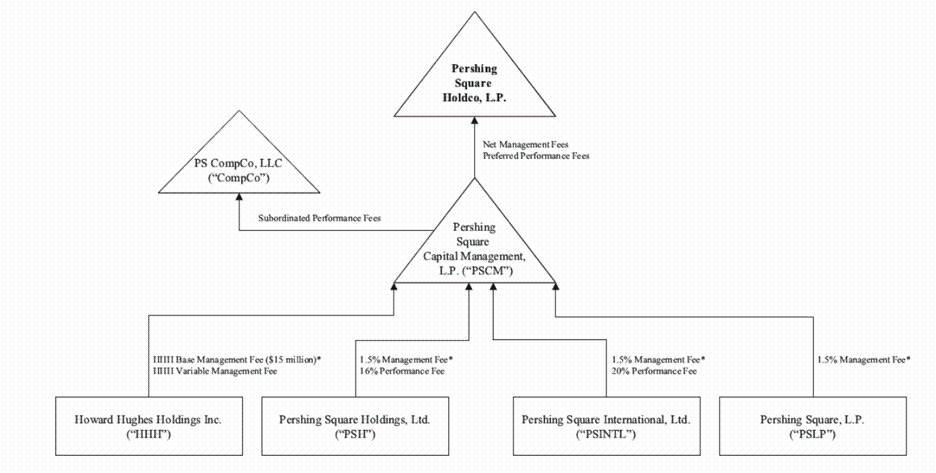
* Management fee presented on an annual basis.
Management Fees
Management fees consist of fees earned by PSCM for providing management and administrative services to our funds and other investment vehicles. PSCM acts as an investment manager providing management and administrative services to PSH, our private funds and other investment vehicles and, for periods following the completion of the Combined Transaction, PSUS, in accordance with each of their investment management agreements. As compensation for services to PSH and our private funds, PSCM receives a quarterly management fee equal to 0.375% (1.5% on an annual basis) of the Net Asset Value, before any accrued performance fees or allocation, (i) with respect to PSH, of its fee-paying shares, (ii) with respect to PSLP, of the capital accounts relating to each of its fee-paying limited partners, and (iii) with respect to PSINTL, of each series of its fee-paying shares of PSINTL. For periods following the completion of the Combined Transaction, PSCM also receives a quarterly management fee equal to 0.5% (2.0% on an annual basis) of the NAV of PSUS.
In connection with the Howard Hughes Transaction, we reduced the management fees paid to PSCM by each of the core funds by an amount, which was calculated as the HHH Fees multiplied by the percentage of HHH’s shares outstanding held by each such fund attributable to its fee-paying capital. Management fees from our funds are recognized over the period during which the related services are performed. See “Business—Advisory Fees and Compensation” in the IPO Prospectus for more information.
Management fees earned from our funds are generally calculated and paid to us quarterly in advance, based on the amount of fee-paying assets under management at the beginning of the quarter. Management fees are prorated for capital contributions in our private funds received during the quarter. Accordingly, changes in our management fee revenue from quarter to quarter are driven by changes in the quarterly balances of fee-paying assets under management and the relative magnitude and timing of contributions and withdrawals in our Private Funds in a given quarter.
Management Fees – HHH Fees
Management fees also consist of the quarterly HHH Fees earned by PSCM for providing investment advisory and other services to HHH pursuant to the terms of the HHH Services Agreement. Pursuant to the HHH Services Agreement, we support HHH’s new diversified holding company strategy by providing services to HHH, such as (i) investment advisory services, (ii) making recommendations with respect to hedging, balance sheet optimization and capital allocation, (iii) executing transactions, (iv) assisting HHH with business and corporate development functions, (v) making voting recommendations for HHH’s investments, (vi) assisting with and advising on fundraising, (vii) monitoring operations of HHH and its investments, subject to the day-to-day authority and responsibility of HHH’s management, (viii) providing recommendations for persons to serve as designees or deputies of HHH’s Chief Investment Officer, (ix) engaging and supervising HHH’s third-party service providers, (x) making dividend payment recommendations, and (xi) providing other services as may be agreed upon.
As compensation for providing services to HHH, we earn (i) a quarterly base fee (the “HHH Base Management Fee”) of $3,750,000 ($15,000,000 on an annual basis) and (ii) a quarterly variable fee (the “HHH Variable Management Fee” and together with the HHH Base Management Fee, the “HHH Fees”) equal to 0.375% of the excess value of the quarter-end stock price of shares of HHH common stock over an initial reference share price of $66.1453, multiplied by a reference share count of 59,393,938 shares. The HHH Base Management Fee and reference share price are subject to annual adjustment for inflation, based on the Core PCE Price Index, and the reference share price and reference share count are subject to adjustment for stock splits, reclassifications or similar capital changes.
The HHH Base Management Fee is calculated and paid to us quarterly in advance at the beginning of each quarter. The HHH Variable Management Fee is calculated and paid to us quarterly no later than fifteen days following the end of each quarter, based on the volume-weighted average trading price of shares of HHH common stock for the fifteen trading days ending on the last trading day of such quarter. Accordingly, changes in our revenue from the HHH Variable Management Fee will be driven by changes in the stock price of shares of HHH common stock from quarter to quarter. As of March 31, 2026, the reference share price was $67.6695 and the volume-weighted average trading price of shares of HHH common stock for the fifteen trading days ending on March 31, 2026 was $63.0229.
Management Fees – Contra-Revenue
We recognized a $292.8 million deferred asset for the premium paid above HHH’s publicly traded share price (the “HHH Premium”), which is deemed for accounting purposes to represent the amount paid to obtain the HHH Services Agreement, when we completed the Howard Hughes Transaction. The HHH Premium is amortized as contra-revenue in management fees on a straight-line basis over a period of 20 years beginning May 5, 2025.
In addition, in periods following the completion of the Combined Transaction, we will recognize a deferred asset for the relative fair value (the “Share Value”) of the shares of our common stock delivered, for no additional consideration, to each initial investor in the PSUS IPO and each private placement investor. The Share Value will be amortized as contra-revenue in management fees on a straight-line basis over a period of 10 years beginning on April 30, 2026, the closing date of the Combined Transaction.
The following table presents a summary of all sources of management fees:
|
|
|
|
|
|
|
|
Three months ended March 31, |
|
|
2026 |
|
2025 |
|
Pershing Square Holdings, Ltd. |
$ |
54,233,716 |
|
$ |
48,449,424 |
|
Pershing Square, L.P. |
|
2,349,969 |
|
|
2,516,123 |
|
Pershing Square International, Ltd. |
|
796,443 |
|
|
1,236,822 |
|
HHH Base Management Fee |
|
3,786,000 |
|
|
— |
|
Total Management Fees - Gross |
$ |
61,166,128 |
|
$ |
52,202,369 |
|
|
|
|
|
|
Less: Amortization of HHH Premium |
|
(3,659,625 |
) |
|
— |
|
|
|
|
|
|
Total Management Fees - Net |
$ |
57,506,503 |
|
$ |
52,202,369 |
|
Performance Fees
Performance fees consist of fees and allocations earned by PSCM, as investment manager, from certain of our funds and other investment vehicles generally based on the NAV appreciation of such funds above a high-water mark. We recognize performance fees from PSH on a “net” basis giving effect to the “fee offset arrangement” as described below.
Performance fees or allocation, if earned, are payable upon the occurrence of crystallization events, which include, but are not limited to, December 31 of each year, withdrawals from our private funds and PSH’s payment of a dividend. Any crystallized or accrued performance fees for PSINTL and PSH earned during the year and outstanding at year-end are reported within performance fees receivable.
PSCM receives a “Variable Performance Fee” from PSH in an amount equal to 16% of the NAV appreciation (before giving effect to accrued performance fees) attributable to the fee-paying shares of PSH above a high-water mark minus a fee reduction of (i) 20% of the performance fees earned by PSCM from non-PSH funds (currently including PSLP and PSINTL) and (ii) 20% of management fees earned from any non-PSH funds that invest in public securities and do not charge performance fees (none as of March 31, 2026 but following the PSUS IPO, PSUS). We refer to this arrangement as the “fee offset arrangement.” In the event the offsettable fees in respect of a previous calculation period were not fully utilized in reducing the PSH performance fee for that period, the amount not utilized is carried forward. See Note 4, “Performance Fees / Allocations” to our Consolidated Financial Statements included in this Quarterly Report for more information.
We consolidate the results of PSGP, which earns a performance allocation from PSLP. However, because we did not have any direct equity interests in PSGP, 100% of these performance allocations are reflected in non-controlling interest on our Consolidated Statements of Operations included in this Quarterly Report. See “—Net (Income) Loss Attributable to Non-Controlling Interest” for more information.
Allocation of Performance Fee Revenue
For the periods presented in this Quarterly Report, our Consolidated Statements of Operations reflect an arrangement for the allocation of performance fee revenue from our funds and other investment vehicles pursuant to the Variable Compensation Agreement, dated as of May 31, 2024, by and among PS Holdco, PSCM, and CompCo (as amended and restated on March 3, 2026, the “VCA”) that was entered into in connection with the Strategic Investment.
The VCA had two primary purposes: (1) to provide PS Holdco with a preferred return-like entitlement of performance fees, which we refer to as the ‘‘Preferred Performance Fees,’’ received by our principal operating subsidiary, PSCM, and (2) to provide an important source of compensation for certain of our personnel, including our investment professionals, consistent with our historical practice of tying a significant portion of the compensation earned by such personnel, including our named executive officers, directly to the performance of the funds we manage. For additional information about the terms of the VCA, see “Executive Compensation—Narrative Disclosure to Summary Compensation Table—Variable Compensation Agreement” in the IPO Prospectus.
The table below presents the allocation of realized performance fees, as adjusted for offsettable fees pursuant to the fee offset arrangement and VCA, as between PS Holdco, PSCM and CompCo that would have been required by the VCA and the arrangement terminating and replacing the VCA implemented in connection with the Combined Transaction using our actual results for the periods presented. As illustrated below, the Preferred Performance Fee that PS Holdco is entitled to receive for a given period is a function of the applicable high-water mark of the fee-paying investors in the fund, as calculated as of January 1 for such period, as adjusted for capital activity and share buybacks. Preferred Performance Fees are earned from the first five percentage points of fund returns, net of management fees, above the applicable high-water mark from certain core funds and subject to certain other offsettable fees. The amount of the Preferred Performance Fees that is paid in any period depends on our realized performance fees. As a result, variability in our fund performance, which impacts both the high-water mark for a period (and accordingly the corresponding Preferred Performance Fee) and our realized performance fees, can result in variability in the amounts paid to us in any period in respect of the accrued Preferred Performance Fees. Any portion of the Preferred Performance Fee that we are entitled to receive from a fund that is not paid in a given period will accrue to the next period’s Preferred Performance Fee for such fund until paid by such fund.
While our Preferred Performance Fee arrangement for the allocation of performance fee revenue may result in variability in the amounts paid to us and CompCo from year to year, particularly if realized performance fees are not sufficient to satisfy the accrued Preferred Performance Fees, we believe it creates a more stable stream of recurring fee-related earnings over the long-term because of the consistency in the calculation of the Preferred Performance Fee that we are entitled to receive.
The table below has not been prepared in accordance with Article 11 of Regulation S-X and is presented for illustrative purposes only to facilitate an understanding of how the VCA and the successor arrangement operate.
|
|
|
|
|
|
|
|
|
|
|
|
|
|
|
|
|
|
|
|
|
|
|
|
|
|
|
|
|
|
|
|
|
Pershing Square Holdings, Ltd. |
|
|
As of December 31, |
|
|
As of
March 31, |
|
|
|
(in millions) |
|
2020 |
|
|
2021 |
|
|
2022 |
|
|
2023 |
|
|
2024 |
|
|
2025 |
|
|
2026 |
|
|
|
High water mark of performance fee-paying investors(1) |
|
$ |
5,198.3 |
|
|
$ |
9,052.5 |
|
|
$ |
10,935.8 |
|
|
$ |
10,524.0 |
|
|
$ |
11,899.7 |
|
|
$ |
12,543.8 |
|
|
$ |
14,934.1 |
|
|
[A] |
Current year’s Preferred Performance Fee(2) |
|
|
41.6 |
|
|
|
72.4 |
|
|
|
87.5 |
|
|
|
84.2 |
|
|
|
95.2 |
|
|
|
100.4 |
|
|
|
119.5 |
|
|
[B] = [A] * 16% * 5% |
Less: Offsettable Management Fees(3) |
|
|
— |
|
|
|
— |
|
|
|
— |
|
|
|
— |
|
|
|
— |
|
|
|
— |
|
|
|
— |
|
|
[C] |
Current year’s Preferred Performance Fee owed to the Company(4) |
|
|
41.6 |
|
|
|
72.4 |
|
|
|
87.5 |
|
|
|
84.2 |
|
|
|
95.2 |
|
|
|
100.4 |
|
|
|
119.5 |
|
|
[D] = [B] + [C] |
Realized PSH Performance Fees(5) |
|
|
665.6 |
|
|
|
453.2 |
|
|
|
— |
|
|
|
306.2 |
|
|
|
226.6 |
|
|
|
489.2 |
|
|
|
— |
|
|
[E] |
Plus: Offsettable Performance Fees(6) |
|
|
16.0 |
|
|
|
3.6 |
|
|
|
— |
|
|
|
2.1 |
|
|
|
1.7 |
|
|
|
2.6 |
|
|
|
— |
|
|
[F] |
PSH Performance Fees available for allocation(7) |
|
|
681.6 |
|
|
|
456.9 |
|
|
|
— |
|
|
|
308.2 |
|
|
|
228.2 |
|
|
|
491.8 |
|
|
|
— |
|
|
[G] = [E] + [F] |
Current year’s Preferred Performance Fee paid to the Company(8) |
|
|
41.6 |
|
|
|
72.4 |
|
|
|
— |
|
|
|
84.2 |
|
|
|
95.2 |
|
|
|
100.4 |
|
|
|
— |
|
|
[H] = MIN ([D], [G]) |
Preferred Performance Fee Carryforward(9) from prior year(s) paid to the Company(10) |
|
|
— |
|
|
|
— |
|
|
|
— |
|
|
|
87.5 |
|
|
|
— |
|
|
|
— |
|
|
|
— |
|
|
[I] = MIN (([G] - [H]),Prior Year [K]) |
Total Preferred Performance Fees paid to the Company(11) |
|
|
41.6 |
|
|
|
72.4 |
|
|
|
— |
|
|
|
171.7 |
|
|
|
95.2 |
|
|
|
100.4 |
|
|
|
— |
|
|
[J] = [H] + [I] |
Preferred Performance Fee Carryforward(9) |
|
|
— |
|
|
|
— |
|
|
|
87.5 |
|
|
|
— |
|
|
|
— |
|
|
|
— |
|
|
|
119.5 |
|
|
[K] = MAX (([D] +Prior Year [K] - [J]), 0) |
Subordinated Performance Fees paid to CompCo(12) |
|
$ |
640.0 |
|
|
$ |
384.5 |
|
|
$ |
— |
|
|
$ |
136.5 |
|
|
$ |
133.1 |
|
|
$ |
391.5 |
|
|
$ |
— |
|
|
[L] = [G] - [J] |
|
|
|
|
|
|
|
|
|
|
|
|
|
|
|
|
|
|
|
|
|
|
|
|
|
|
|
|
|
|
|
|
|
Pershing Square International, Ltd. |
|
|
As of December 31, |
|
|
As of
March 31, |
|
|
|
(in millions) |
|
2020 |
|
|
2021 |
|
|
2022 |
|
|
2023 |
|
|
2024 |
|
|
2025 |
|
|
2026 |
|
|
|
High water mark of performance fee paying investors(1) |
|
$ |
593.2 |
|
|
$ |
391.8 |
|
|
$ |
389.9 |
|
|
$ |
361.9 |
|
|
$ |
384.0 |
|
|
$ |
281.8 |
|
|
$ |
224.7 |
|
|
[A] |
Current year’s Preferred Performance Fee owed to the Company(2) |
|
|
4.7 |
|
|
|
3.1 |
|
|
|
3.1 |
|
|
|
2.9 |
|
|
|
3.1 |
|
|
|
2.3 |
|
|
|
1.8 |
|
|
[B] = [A] * 20% * 80% * 5% |
Realized PSINTL Performance Fees(5) |
|
|
79.9 |
|
|
|
18.2 |
|
|
|
— |
|
|
|
10.3 |
|
|
|
8.3 |
|
|
|
13.1 |
|
|
|
— |
|
|
[C] |
Less: Offsettable Performance Fees(6) |
|
|
(16.0 |
) |
|
|
(3.6 |
) |
|
|
— |
|
|
|
(2.1 |
) |
|
|
(1.7 |
) |
|
|
(2.6 |
) |
|
|
— |
|
|
[D] |
PSINTL Performance Fees available for allocation(7) |
|
|
63.9 |
|
|
|
14.5 |
|
|
|
— |
|
|
|
8.3 |
|
|
|
6.6 |
|
|
|
10.5 |
|
|
|
— |
|
|
[E] = [C] + [D] |
Current year’s Preferred Performance Fee paid to the Company(8) |
|
|
4.7 |
|
|
|
3.1 |
|
|
|
— |
|
|
|
2.9 |
|
|
|
3.1 |
|
|
|
2.3 |
|
|
|
— |
|
|
[F] = MIN ([B], [E]) |
Preferred Performance Fee Carryforward(9) from prior year paid to the Company(10) |
|
|
— |
|
|
|
— |
|
|
|
— |
|
|
|
3.1 |
|
|
|
— |
|
|
|
— |
|
|
|
— |
|
|
[G] = MIN (([E] - [F]), Prior Year [I]) |
Total Preferred Performance Fees paid to the Company(11) |
|
|
4.7 |
|
|
|
3.1 |
|
|
|
— |
|
|
|
6.0 |
|
|
|
3.1 |
|
|
|
2.3 |
|
|
|
— |
|
|
[H] = [F] + [G] |
Preferred Performance Fee Carryforward(9) |
|
|
— |
|
|
|
— |
|
|
|
3.1 |
|
|
|
— |
|
|
|
— |
|
|
|
— |
|
|
|
1.8 |
|
|
[I] = MAX (([B] +Prior Year [I] - [H]), 0) |
Subordinated Performance Fees paid to CompCo(12) |
|
$ |
59.2 |
|
|
$ |
11.4 |
|
|
$ |
— |
|
|
$ |
2.3 |
|
|
$ |
3.6 |
|
|
$ |
8.3 |
|
|
$ |
— |
|
|
[J] = [E] - [H] |
(1)
The high-water mark can vary from year to year depending on changes in the Net Asset Value and amount of fee-paying assets in a fund.
(2)
Represents an amount equal to the performance fees PSCM would have earned from the fund, as described under “Business—Advisory Fees and Compensation” in the IPO Prospectus, if such fund had experienced a return, net of management fees, of 5% per annum above its high-water mark, subject to certain adjustments for non-PSH funds which reflect the fee offset arrangement described above under “—Key Components of Our Results of Operations—Income—Performance Fees.” For non-PSH funds subject to the VCA (currently only PSINTL), the performance fees that would have been earned if such fund had experienced a net of management fees return of 5% per annum above its high-water mark are reduced by the offsettable performance fees for such fund. As an example, for PSINTL, which pays PSCM a 20% performance fee, of which 20% is an offsettable performance fee pursuant to the fee offset arrangement, the current year’s Preferred Performance Fee owed to the Company would represent 0.8% of PSINTL’s high-water mark (the product of 80% * 20% * 5%). For clarity, the current year’s Preferred Performance Fee initially calculated for PSH, which pays PSCM a 16% performance fee, is not similarly reduced by the fee offset arrangement and represents 0.8% of PSH’s high-water mark (the product of 16% * 5%).
(3)
Includes the gross amount of management fees available from certain non-PSH funds pursuant to the investment management agreement between PSH and PSCM to reduce the Preferred Performance Fee calculated for PSH. As of March 31, 2026, no fund generates such offsettable management fees. For periods following completion of the Combined Transaction, the gross amount of such offsettable management fees will consist of 20% of PSUS’s management fees.
(4)
Represents an amount equal to the performance fees PSCM would have earned from PSH, if PSH had experienced a return, net of management fees, of 5% per annum above its high-water mark, subject to certain adjustments for the offsettable management fees. As of March 31, 2026, no fund generates offsettable management fees. For periods following completion of the Combined Transaction, the gross amount of such offsettable management fees will consist of 20% of PSUS’s management fees.
(5)
Refers to the performance fees PSCM earned from the fund, after giving effect to the fee offset arrangement. Pursuant to the investment management agreement between PSH and PSCM, a portion of the performance fees available from certain non-PSH funds reduce the performance fee paid by PSH to PSCM. As of March 31, 2026, the gross amount of such offsettable performance fees consists of (i) 20% of PSLP’s performance allocations and (ii) 20% of PSINTL’s performance fees.
(6)
In the case of PSH, the offsettable performance fees of PSINTL (i.e., 20% of the realized performance fees of PSINTL) are added back to the realized PSH performance fees for purposes of determining the PSH performance fees available for allocation. To avoid double counting, these offsettable performance fees of PSINTL are excluded from the calculation of the PSINTL performance fees available for allocation.
(7)
Refers to the amount available in a given year, if any, to satisfy payment of the Preferred Performance Fee and any Preferred Performance Fee Carryforward, as described in note (9), then owed to the Company.
(8)
Refers to the amount distributed to us from PSCM with respect to the current year’s Preferred Performance Fee, had this arrangement been in effect for the period presented, in an amount equal to the lesser of (i) the current year’s Preferred Performance Fee then owed to the Company and (ii) the performance fees available for allocation to the Company and CompCo. For example, had this arrangement been in effect, we would not have received any distribution from PSCM in respect of the Preferred Performance Fee for 2022 because no performance fees were generated that year due to the funds’ failure to achieve NAV appreciation above their respective high-water marks, resulting in no performance fees available for allocation to the Company and CompCo. As a result, the Preferred Performance Fee owed to the Company for 2022 was carried forward to 2023, a year in which the funds generated sufficient performance fees to pay the Preferred Performance Fee owed to the Company for 2023 and the Preferred Performance Fee Carryforward from 2022. Had the performance fees earned by the funds in 2023 not been sufficient to satisfy the Preferred Performance Fee owed to the Company for 2023 and/or the Preferred Performance Fee Carryforward from 2022, the unpaid portion would have continued to be carried forward to subsequent years until it was paid in full.
(9)
Refers to the unpaid portion, if any, of the current year’s Preferred Performance Fee owed to the Company had this arrangement been in effect for the period presented. The Preferred Performance Fee Carryforward, if any, shall accrue to subsequent periods until satisfied in full. For example, had this arrangement been in effect, a Preferred Performance Fee Carryforward would have been generated in 2022 for the reasons described above in note (8).
(10)
Refers to the amount distributed to us from PSCM with respect to the Preferred Performance Fee Carryforward from prior years, had this arrangement been in effect for the period presented, in an amount equal to the lesser of (i) the accrued Preferred Performance Fee Carryforward and (ii) the performance fees available for allocation to the Company and CompCo, less the amounts distributed to us from PSCM with respect to the current year’s Preferred Performance Fee.
(11)
Refers to the total amount distributed to us from PSCM with respect to the current year’s Preferred Performance Fee owed to the Company and any Preferred Performance Fee Carryforward from prior years had this arrangement been in effect for the period presented.
(12)
Refers to the amount distributed to CompCo from PSCM, had this arrangement been in effect for the period presented, in an amount equal to the difference, if any, between the performance fees available for allocation to the Company and CompCo and the Total Preferred Performance Fees paid to the Company.
Expenses
General and Administrative Expense
General and administrative expense includes occupancy expenses, professional fees, IT related expenses, café expenses, travel and entertainment expenses, insurance expenses, office expenses and other expenses. We expect to incur additional general and administrative expense as a result of operating as a public company, including expenses to comply with the rules and regulations of the SEC and NYSE, as well as higher expenses for directors and officers insurance, investor relations and professional services.
While we have historically incurred expenses related to charitable donations, we do not intend to incur any future expenses related to charitable donations as a public company.
Affiliates Fee Rebate
Affiliates fee rebate consists of expenses related to the fee rebates provided to employees and their affiliates who own PSH shares. We historically rebated management and performance fees attributable to shares of PSH held by our employees and their affiliates. Following the Holdco Reorganization, we ceased to provide these rebates, which were instead paid by PSPG and CompCo. The affiliates fee rebate paid by PSPG following the Holdco Reorganization was recognized as an expense. Following the Combined Transaction, PSPG and CompCo no longer rebate the fees of employees and affiliates invested in PSH.
Profit-Sharing Partner Compensation
For the periods discussed herein, profit-sharing partner compensation consists of expenses related to our cash-based profits interests awards as well as a portion of our Long-Term Incentive Plan.
Prior to the internal reorganization of our ownership structure (the "Holdco Reorganization"), effective as of May 31, 2024, we had profit-sharing arrangements whereby certain personnel and former members of our advisory board, which was dissolved on April 1, 2023, were granted profits participation interests (“Profits Interest Awards”) in PSCM, PSGP and PSVII GP, LLC, (“PSVII GP”, the general partner of certain funds that ceased operations as of December 31, 2024). Profits Interest Awards entitled the profit-sharing partners to a portion of the net profits earned by PSCM, PSGP, PSVII GP and any future Pershing Square entity from performance fees or allocations and management fees, as applicable. Profits Interest Awards do not represent a substantive class of equity under ASC 718, Compensation and are accounted for as cash-based profit-sharing arrangements. As such, amounts distributed or allocated to profit-sharing partners are included in profit-sharing partner compensation in the unaudited Consolidated Statements of Operations.
The Company also established a Long-Term Incentive Plan (“LTIP”) in January 2017 for the benefit of certain profit-sharing partners (the “LTIP Partners”). Similar to the Profits Interest Awards, awards under the LTIP (the “LTIP Awards”) entitled the LTIP Partners to cash distributions pursuant to the terms of their respective agreements and granted them a reduced percentage of their Profits Interest Awards upon retirement under certain circumstances as described in the LTIP. Certain LTIP Partners’ LTIP Awards vested after 10 years of tenure as a profit-sharing partner. The LTIP Awards were treated as a separate class of profits interests from the Profits Interest Awards. The LTIP Awards have been accounted for based on their substance. Portions of the LTIP Awards in which rights to distributions of profits were based fully on the discretion of the managing member of PSCM were in substance a profit-sharing arrangement and were therefore recorded within profit-sharing partner compensation. Other portions of the LTIP Awards, when fully vested, entitled LTIP Partners upon retirement to a distribution equal to the percentage outlined in each of their agreements in perpetuity and represented a substantive class of equity. In connection with the Combined Transaction, the LTIP was replaced in part by certain interests of PSPG, referred to as M Units, that are redeemable, subject to vesting and certain other conditions, for shares of our common stock held by PSPG, in order to continue to align certain of our senior professionals with our long-term investment horizon. See “Executive Compensation—Compensation Arrangements To Be Adopted in Connection with the Combined Offering—Redeemable Interests in PS Partner Group” in the IPO Prospectus.
In conjunction with the Holdco Reorganization and as discussed above, we implemented an arrangement for the allocation of performance fee revenue between us and our senior professionals. In addition, in connection with the Holdco Reorganization, former holders of LTIP Awards in PSCM received interests in PSPG which were treated to the same extent as LTIP Awards. The unvested portion of interests in PSPG, issued upon the Combined Transaction as M Units, are to be amortized on a straight-line basis over the respective service periods.
Following the Combined Transaction, the profit-sharing arrangement and LTIP related to interests in PSPG and PS Inc. and its consolidated subsidiaries (including PSCM) ceased. Amounts historically allocated to profit-sharing partners and LTIP participants will instead be distributed in the form of dividends to all holders of our common stock, including former profit-sharing partners and LTIP participants, in their capacity as equity holders and therefore, amounts distributed to former profit-sharing partners and LTIP participants will no longer be accounted for as compensation expense in accordance with ASC 710, Compensation–General. The LTIP will otherwise remain in full force and effect with respect to the existing interests held by LTIP participants in all other applicable Pershing Square entities, including CompCo and PSGP.
Employee Compensation and Benefits
Employee compensation and benefits reflects all compensation-related items not directly related to partners who participate in the profit-sharing arrangements and the LTIP, and includes salaries, benefits, payroll taxes and discretionary cash bonuses. Employee compensation and benefits also includes the cost of benefits paid to partners who participate in the profit-sharing arrangements and the LTIP. We generally recognize employee compensation and benefit expenses over the related service period. On an annual basis, discretionary cash bonuses generally comprise a significant portion of total employee compensation and benefits for employees who do not hold profits interests. Discretionary cash bonuses are dependent upon a variety of factors, including the performance of PSH, PSUS (following the completion of the Combined Transaction), our private funds and other investment vehicles for the year.
We granted 2,817,000 restricted stock units to certain employees and other service providers under our equity incentive plan (the “Plan”) in connection with the Combined Transaction and may in the future also grant awards to employees, directors, consultants and advisors under the Plan. These equity awards will be recorded as an expense in our consolidated statements of operations. We do not currently plan to grant awards under the Plan to our executive officers. For further discussion of the impact on employee compensation and benefits from subsequent changes to compensation arrangements, see “Unaudited Pro Forma Consolidated Financial Information” in the IPO Prospectus.
Depreciation and Amortization
Depreciation and amortization expense primarily consists of depreciation and amortization expenses associated with our fixed assets. Depreciation includes expenses associated with office furniture and fixtures, office computers, equipment and software. Amortization includes expenses associated with our leasehold improvements. Depreciation of fixed assets is calculated using the straight-line method over a period of three to seven years. Leasehold improvements are amortized over the shorter of the expected useful life or the remaining term of the related lease agreement. Fixed assets and leasehold improvements are recorded at cost less accumulated depreciation and amortization.
Non-Operating Income (Expenses)
Interest Income
Interest income consists of interest earned from our cash on hand.
Unrealized Gain (Loss) on HHH Shares Held at Fair Value
We account for our investment in HHH using the fair value option, in accordance with ASC 825-10, Financial Instruments. As a part of the election, we recognize any changes in the fair value of the investment in HHH as non-operating income or loss, commensurate with changes in the value of HHH’s publicly traded share price as of the end of the reporting period.
Unrealized Gain (Loss) on Investment in Pershing Square, L.P. Held at Fair Value
Unrealized gain (loss) on investment in Pershing Square, L.P. held at fair value consists of the gain or loss related to PSGP’s investment in PSLP. PSGP’s investment in PSLP is held at fair value, which is determined using the Net Asset Value of PSLP in accordance with the ASC 820, Fair Value Measurement, “practical expedient,” as defined by GAAP. We do not hold any direct equity interests in PSGP, the general partner of PSLP. As a result, all income or loss related to PSGP is allocated to non-controlling interest.
Other Income (Expense)
Other income (expense) primarily consists of our office space sublease and license and reimbursement of office services.
Prior to December 31, 2025, Mr. Ackman’s family office, TABLE Management, L.P. (“TABLE”), licensed a portion of our office space under a license agreement which also granted TABLE the use of certain office-related services. As of December 31, 2025, TABLE no longer licenses office space from us, and, as a result, following such date, we no longer receive the related income.
In addition, we had subleased a portion of Pershing Square’s office space to NEOX Public Benefit LLC (“Subtenant”), an entity partially owned by Mr. Ackman. The sublease commenced on December 5, 2022, with rent payments commencing on May 1, 2023 following five months of rent abatement, and was originally set to expire on December 31, 2033. On January 30, 2026, we agreed to terminate our sublease arrangement with Subtenant, effective as of March 1, 2026, who then entered into a direct relationship with the landlord. Starting March 1, 2026, we no longer receive the related income or bear the associated lease expense, although Subtenant may continue the use of certain office-related services for which we will continue to receive certain related income.
Interest Expense
Interest expense primarily consists of interest incurred on borrowings and debt issuance costs that are amortized using the effective interest method over the term of the debt.
Income Tax
Income tax expense consists of taxes paid or payable by our operating subsidiaries. We are subject to the provisions of ASC 740, Income Taxes. This standard requires the evaluation of tax positions taken or expected to be taken in the course of preparing our tax returns to determine whether it is “more-likely-than-not” to be sustained by the applicable tax authority. Uncertain tax positions in which the benefit to be realized does not meet the “more-likely-than-not” threshold would be recorded as a tax expense in the current year.
Prior to the Corporate Conversion, we were a partnership for U.S. tax purposes and not subject to U.S. federal income taxes. Accordingly, no provision has been made for federal income taxes, as the respective partners were individually liable for the taxes on their allocable share of taxable income or loss prior to this date.
We are subject to certain state and local taxes. UBT is recorded on a quarterly basis at the rate of 4% based on the net taxable income apportioned to New York City. We record interest and penalties related to income taxes, if any, within income tax expense.
For the tax years ending December 31, 2026 and 2025, the Partnership and its parent entity PSPG both elected to be subject to the New York State Pass-Through Entity Tax (“NYS PTET”) and the New York City Pass-Through Entity Tax (“NYC PTET” and together with NYS PTET, “PTET”). PTET grants eligible partners a tax credit on their individual New York State and New York City income tax returns, and any PTET owed is a joint liability of (i) PS Holdco or PSPG and (ii) each partner.
In connection with the Corporate Conversion, we became a corporation for U.S. federal and state income tax purposes. As a result, subsequent to the Corporate Conversion, we are subject to U.S. federal income taxes, in addition to state and local taxes.
Net (Income) Loss Attributable to Non-Controlling Interest
A portion of the equity and income or loss from entities that are consolidated but not wholly owned by us is allocated to other owners. The aggregate of the income or loss and corresponding equity that is not owned by us is included within non-controlling interest in the Consolidated Financial Statements. We do not hold any direct equity interests in PSGP, the general partner for PSLP. As a result, all income or loss related to PSGP is allocated to non-controlling interest, and the capital balance represents the economic interests of other owners in PSGP.
Key Operating Metrics
We have developed and use various key operating metrics to assess and monitor the operating performance of our business. We believe that these metrics provide useful information to investors and others in understanding and evaluating our results of operations in the same manner as our management team.
Our calculations of total assets under management, fee-paying assets under management and permanent capital AUM may differ from the calculations of other investment managers. As a result, these measures may not be comparable to similar measures presented by other investment managers. In addition, our calculation of total assets under management includes the fair value of invested capital in our funds from our personnel regardless of whether such invested capital is subject to fees. Our definitions of total assets under management and fee-paying assets under management are not based on any definition of total assets under management and fee-paying assets under management that is set forth in the agreements governing the investment funds we manage.
Total Assets Under Management
Total assets under management reflects (i) with respect to our core funds and PSVII, the net assets of our core funds and PSVII as calculated in accordance with GAAP or IFRS, as applicable, while adding back accrued performance fees and the principal value of PSH’s outstanding bonds (approximately $3.7 billion and $3.6 billion as of December 31, 2025 and March 31, 2026, respectively) without double counting the investment made by any of our funds in PSVII and (ii) with respect to HHH, the market capitalization of HHH plus its net mortgages, notes, and loans payable as disclosed in its most recent periodic report filed with the SEC.
|
|
|
|
|
|
|
|
|
|
|
|
|
|
|
|
|
|
|
|
|
|
|
|
|
|
|
|
Assets Under Management |
|
(in millions) |
|
PSH(1) |
|
|
PSLP |
|
|
PSINTL |
|
|
PSVII(2) |
|
|
Total
Funds |
|
Balance at December 31, 2023 |
|
|
$ |
14,414.6 |
|
|
|
$ |
1,384.3 |
|
|
|
$ |
591.7 |
|
|
|
$ |
1,519.5 |
|
|
|
$ |
17,910.1 |
|
Private Funds Subscriptions |
|
|
— |
|
|
|
|
40.8 |
|
|
|
— |
|
|
|
— |
|
|
|
|
40.8 |
|
Private Funds Redemptions |
|
|
— |
|
|
|
|
(246.0 |
) |
|
|
|
(209.2 |
) |
|
|
|
(1,422.4 |
) |
|
|
|
(1,877.6 |
) |
PSH Dividends |
|
|
|
(107.2 |
) |
|
|
— |
|
|
|
— |
|
|
|
— |
|
|
|
|
(107.2 |
) |
PSH Buybacks |
|
|
|
(117.9 |
) |
|
|
— |
|
|
|
— |
|
|
|
— |
|
|
|
|
(117.9 |
) |
Management Fees |
|
|
|
(188.8 |
) |
|
|
|
(11.1 |
) |
|
|
|
(6.0 |
) |
|
|
|
(0.2 |
) |
|
|
|
(206.1 |
) |
Performance Fees |
|
|
|
(226.6 |
) |
|
|
— |
|
|
|
|
(8.3 |
) |
|
|
— |
|
|
|
|
(234.9 |
) |
Change in Market Value / Market Capitalization |
|
|
|
1,589.1 |
|
|
|
|
159.9 |
|
|
|
|
65.4 |
|
|
|
|
(96.9 |
) |
|
|
|
1,717.5 |
|
Increase (Decrease) in EUR FX Translation of PSH Bond Proceeds |
|
|
|
(34.1 |
) |
|
|
— |
|
|
|
— |
|
|
|
— |
|
|
|
|
(34.1 |
) |
Balance at December 31, 2024 |
|
|
$ |
15,329.2 |
|
|
|
$ |
1,328.0 |
|
|
|
$ |
433.6 |
|
|
|
$ |
— |
|
|
|
$ |
17,090.7 |
|
(1)
As of December 31, 2024 and 2023, PSH’s AUM includes bond proceeds of $1.8 billion and €500 million (translated into USD at the prevailing exchange rate at the reporting date).
(2)
PSVII was liquidated as of December 31, 2024 and had no assets under management as of December 31, 2024.
|
|
|
|
|
|
|
|
|
|
|
|
|
|
|
|
|
|
|
|
|
|
|
Assets Under Management |
|
(in millions) |
|
PSH(1) |
|
|
PSLP |
|
|
PSINTL |
|
|
HHH |
|
|
Total Core
Funds &
HHH |
|
Balance at December 31, 2024 |
|
$ |
15,329.2 |
|
|
$ |
1,328.0 |
|
|
$ |
433.6 |
|
|
$ |
— |
|
|
$ |
17,090.7 |
|
Private Funds Subscriptions |
|
|
— |
|
|
|
104.3 |
|
|
|
80.0 |
|
|
|
— |
|
|
|
184.3 |
|
Private Funds Redemptions |
|
|
— |
|
|
|
(232.2 |
) |
|
|
(199.6 |
) |
|
|
— |
|
|
|
(431.8 |
) |
Initiation of HHH Services Agreement(2) |
|
|
— |
|
|
|
— |
|
|
|
— |
|
|
|
9,256.4 |
|
|
|
9,256.4 |
|
PSH Dividends |
|
|
(118.1 |
) |
|
|
— |
|
|
|
— |
|
|
|
— |
|
|
|
(118.1 |
) |
PSH Buybacks |
|
|
(369.1 |
) |
|
|
— |
|
|
|
— |
|
|
|
— |
|
|
|
(369.1 |
) |
Management Fees |
|
|
(208.0 |
) |
|
|
(10.4 |
) |
|
|
(4.5 |
) |
|
|
— |
|
|
|
(222.9 |
) |
Performance Fees |
|
|
(489.2 |
) |
|
|
— |
|
|
|
(13.1 |
) |
|
|
— |
|
|
|
(502.3 |
) |
Change in Market Value / Market Capitalization(3) |
|
|
3,222.6 |
|
|
|
340.9 |
|
|
|
112.7 |
|
|
|
768.6 |
|
|
|
4,444.8 |
|
PSH Bond Issuance |
|
|
1,235.5 |
|
|
|
— |
|
|
|
— |
|
|
|
— |
|
|
|
1,235.5 |
|
Increase (Decrease) in EUR FX Translation of PSH Bond Proceeds |
|
|
98.0 |
|
|
|
— |
|
|
|
— |
|
|
|
— |
|
|
|
98.0 |
|
Balance at December 31, 2025 |
|
$ |
18,700.9 |
|
|
$ |
1,530.6 |
|
|
$ |
409.0 |
|
|
$ |
10,025.0 |
|
|
$ |
30,665.6 |
|
(1)
As of December 31, 2025, PSH’s AUM includes bond proceeds of $2.3 billion and €1.15 billion (translated into USD at the prevailing exchange rate at the reporting date).
(2)
Reflects HHH’s market capitalization at market open on May 5, 2025 plus its net mortgages, notes, and loans payable as reported in its Quarterly Report on Form 10-Q for the quarter ending March 31, 2025.
(3)
Change in market capitalization is only applicable to HHH.
|
|
|
|
|
|
|
|
|
|
|
|
|
|
|
|
|
|
|
Assets Under Management |
|
(in millions) |
|
PSH(1) |
|
|
PSLP |
|
|
PSINTL |
|
|
Total Core
Funds |
|
Balance at December 31, 2024 |
|
$ |
15,329.2 |
|
|
$ |
1,328.0 |
|
|
$ |
433.6 |
|
|
$ |
17,090.7 |
|
Private Funds Subscriptions |
|
|
— |
|
|
|
11.6 |
|
|
|
— |
|
|
|
11.6 |
|
Private Funds Redemptions |
|
|
— |
|
|
|
(31.3 |
) |
|
|
(34.9 |
) |
|
|
(66.2 |
) |
PSH Dividends |
|
|
(29.9 |
) |
|
|
— |
|
|
|
— |
|
|
|
(29.9 |
) |
PSH Buybacks |
|
|
(137.2 |
) |
|
|
— |
|
|
|
— |
|
|
|
(137.2 |
) |
Management Fees |
|
|
(48.4 |
) |
|
|
(2.5 |
) |
|
|
(1.2 |
) |
|
|
(52.2 |
) |
Performance Fees |
|
|
(0.1 |
) |
|
|
— |
|
|
|
(0.1 |
) |
|
|
(0.1 |
) |
Change in Market Value |
|
|
(162.9 |
) |
|
|
2.0 |
|
|
|
4.9 |
|
|
|
(156.0 |
) |
Change in EUR FX Translation of PSH Bond |
|
|
22.7 |
|
|
|
— |
|
|
|
— |
|
|
|
22.7 |
|
Balance at March 31, 2025 |
|
$ |
14,973.4 |
|
|
$ |
1,307.7 |
|
|
$ |
402.3 |
|
|
$ |
16,683.5 |
|
(1)
As of March 31, 2025, PSH’s AUM includes bond proceeds of $1.8 billion and €500 million (translated into USD at the prevailing exchange rate at the reporting date).
|
|
|
|
|
|
|
|
|
|
|
|
|
|
|
|
|
|
|
|
|
|
|
Assets Under Management |
|
(in millions) |
|
PSH(1) |
|
|
PSLP |
|
|
PSINTL |
|
|
HHH |
|
|
Total Core
Funds &
HHH |
|
Balance at December 31, 2025 |
|
$ |
18,700.9 |
|
|
$ |
1,530.6 |
|
|
$ |
409.0 |
|
|
$ |
10,025.0 |
|
|
$ |
30,665.6 |
|
Private Funds Subscriptions |
|
|
— |
|
|
|
30.0 |
|
|
|
— |
|
|
|
— |
|
|
|
30.0 |
|
Private Funds Redemptions |
|
|
— |
|
|
|
(73.8 |
) |
|
|
(4.4 |
) |
|
|
— |
|
|
|
(78.2 |
) |
PSH Dividends |
|
|
(32.3 |
) |
|
|
— |
|
|
|
— |
|
|
|
— |
|
|
|
(32.3 |
) |
PSH Buybacks |
|
|
(80.0 |
) |
|
|
— |
|
|
|
— |
|
|
|
— |
|
|
|
(80.0 |
) |
Management Fees |
|
|
(54.2 |
) |
|
|
(2.3 |
) |
|
|
(0.8 |
) |
|
|
— |
|
|
|
(57.4 |
) |
Change in Market Value / Market Capitalization(2) |
|
|
(2,403.6 |
) |
|
|
(214.4 |
) |
|
|
(62.5 |
) |
|
|
(1,142.6 |
) |
|
|
(3,823.1 |
) |
Change in EUR FX Translation of PSH Bond |
|
|
(22.3 |
) |
|
|
— |
|
|
|
— |
|
|
|
— |
|
|
|
(22.3 |
) |
Balance at March 31, 2026 |
|
$ |
16,108.4 |
|
|
$ |
1,270.1 |
|
|
$ |
341.3 |
|
|
$ |
8,882.4 |
|
|
$ |
26,602.3 |
|
(1)
As of March 31, 2026, PSH’s AUM includes bond proceeds of $2.3 billion and €1.15 billion (translated into USD at the prevailing exchange rate at the reporting date).
(2)
Change in market capitalization is only applicable to HHH.
The table below presents the AUM of our core funds and HHH as of December 31 for each of the last seven years, and as of March 31, 2026.
|
|
|
|
|
|
|
|
|
|
|
|
|
|
|
|
|
|
|
|
|
|
|
|
|
|
|
|
|
|
|
|
|
|
|
|
|
|
|
Assets Under Management ($ in millions) |
|
|
CAGR |
|
Fund |
|
December 31,
2019 |
|
|
December 31,
2020 |
|
|
December 31,
2021 |
|
|
December 31,
2022(3) |
|
|
December 31,
2023 |
|
|
December 31,
2024 |
|
|
December 31,
2025 |
|
|
March 31,
2026 |
|
|
2020- Q1'26(4) |
|
PSH(1) |
|
$ |
7,121 |
|
|
$ |
11,153 |
|
|
$ |
14,409 |
|
|
$ |
12,215 |
|
|
$ |
14,415 |
|
|
$ |
15,329 |
|
|
$ |
18,701 |
|
|
$ |
16,108 |
|
|
|
14 |
% |
% Growth |
|
|
|
|
|
57 |
% |
|
|
29 |
% |
|
|
(15 |
%) |
|
|
18 |
% |
|
|
6 |
% |
|
|
22 |
% |
|
|
(14 |
)% |
|
|
|
PSLP |
|
|
727 |
|
|
|
903 |
|
|
|
1,472 |
|
|
|
1,217 |
|
|
|
1,384 |
|
|
|
1,328 |
|
|
|
1,531 |
|
|
|
1,270 |
|
|
|
9 |
% |
% Growth |
|
|
|
|
|
24 |
% |
|
|
63 |
% |
|
|
(17 |
%) |
|
|
14 |
% |
|
|
(4 |
%) |
|
|
15 |
% |
|
|
(17 |
)% |
|
|
|
PSINTL |
|
|
726 |
|
|
|
510 |
|
|
|
629 |
|
|
|
520 |
|
|
|
592 |
|
|
|
434 |
|
|
|
409 |
|
|
|
341 |
|
|
|
(11 |
%) |
% Growth |
|
|
|
|
|
(30 |
%) |
|
|
23 |
% |
|
|
(17 |
%) |
|
|
14 |
% |
|
|
(27 |
%) |
|
|
(6 |
%) |
|
|
(17 |
%) |
|
|
|
Total Core Funds |
|
$ |
8,573 |
|
|
$ |
12,566 |
|
|
$ |
16,510 |
|
|
$ |
13,951 |
|
|
$ |
16,391 |
|
|
$ |
17,091 |
|
|
$ |
20,641 |
|
|
$ |
17,720 |
|
|
|
12 |
% |
% Growth |
|
|
|
|
|
47 |
% |
|
|
31 |
% |
|
|
(15 |
%) |
|
|
17 |
% |
|
|
4 |
% |
|
|
21 |
% |
|
|
(14 |
)% |
|
|
|
HHH(2) |
|
|
- |
|
|
|
- |
|
|
|
- |
|
|
|
- |
|
|
|
- |
|
|
|
- |
|
|
|
10,025 |
|
|
|
8,882 |
|
|
|
|
Total Core Funds & HHH |
|
$ |
8,573 |
|
|
$ |
12,566 |
|
|
$ |
16,510 |
|
|
$ |
13,951 |
|
|
$ |
16,391 |
|
|
$ |
17,091 |
|
|
$ |
30,666 |
|
|
$ |
26,602 |
|
|
|
20 |
% |
% Growth |
|
|
|
|
|
47 |
% |
|
|
31 |
% |
|
|
(15 |
%) |
|
|
17 |
% |
|
|
4 |
% |
|
|
79 |
% |
|
|
(13 |
)% |
|
|
|
(1)
As of March 31, 2026 and December 31, 2025, PSH’s AUM includes bond proceeds of $2.3 billion and €1.15 billion (translated into USD at the prevailing exchange rate at the reporting date). As of December 31, 2024, 2023 and 2022, PSH’s AUM includes bond proceeds of $1.8 billion and €500 million (translated into USD at the prevailing exchange rate at the reporting date). As of December 31, 2021, PSH’s AUM includes bond proceeds of $2.43 billion and €500 million (translated into USD at the prevailing exchange rate at the reporting date). As of December 31, 2020, PSH’s AUM includes bond proceeds of $2.1 billion. As of December 31, 2019, PSH’s AUM includes bond proceeds of $1.4 billion.
(2)
As of December 31, 2025, HHH’s AUM reflects its market capitalization as of such date plus its net mortgages, notes, and loans payable as reported in its Quarterly Report on Form 10-Q for the quarter ending September 30, 2025. As of March 31, 2026, HHH’s AUM reflects its market capitalization as of such date plus its net mortgages, notes, and loans payable as reported in its Annual Report on Form 10-K for the year ending December 31, 2025.
(3)
AUM decreased from 2021 to 2022 as a result of (a) certain investor redemptions from our private funds and a share repurchase program with respect to PSH, (b) a debt redemption as one of PSH’s outstanding bonds reached maturity, (c) a quarterly dividend payment to the PSH shareholders, (d) negative performance in our underlying portfolio related to decreases in the stock prices of some of our portfolio companies, (e) crystallization of a performance fee with respect to PSINTL and (f) fluctuations in the value of PSH’s bonds denominated in Euros based on exchange rates.
(4)
Compound Annual Growth Rate (“CAGR”) is presented from December 31, 2019 through March 31, 2026 (with the exception of HHH on its own as its calculation period is less than one year).
Fee-Paying Assets Under Management
Fee-Paying AUM refers to (i) with respect to our core funds and PSVII, the AUM we manage and earn a performance fee and/or management fee from for our core funds and PSVII and (ii) with respect to HHH, the market capitalization of HHH. We believe this measure is useful to stockholders as it provides insight into the capital base upon which we earn our fees.
|
|
|
|
|
|
|
|
|
|
|
|
|
|
|
|
|
|
|
|
|
|
|
Fee-Paying Assets Under Management |
|
(in millions) |
|
PSH(1) |
|
|
PSLP |
|
|
PSINTL |
|
|
PSVII(2) |
|
|
Total
Funds |
|
Balance at December 31, 2023 |
|
$ |
12,062.6 |
|
|
$ |
742.6 |
|
|
$ |
426.0 |
|
|
$ |
67.3 |
|
|
$ |
13,298.5 |
|
Private Funds Subscriptions |
|
— |
|
|
|
11.6 |
|
|
— |
|
|
|
— |
|
|
|
11.6 |
|
Private Funds Redemptions |
|
— |
|
|
|
(143.0 |
) |
|
|
(129.5 |
) |
|
|
(62.8 |
) |
|
|
(335.3 |
) |
PSH Dividends |
|
|
(107.2 |
) |
|
— |
|
|
— |
|
|
|
— |
|
|
|
(107.2 |
) |
PSH Buybacks |
|
|
(117.9 |
) |
|
— |
|
|
— |
|
|
|
— |
|
|
|
(117.9 |
) |
Management Fees |
|
|
(188.8 |
) |
|
|
(11.1 |
) |
|
|
(6.0 |
) |
|
|
(0.2 |
) |
|
|
(206.1 |
) |
Performance Fees / Allocations |
|
|
(226.6 |
) |
|
|
(14.5 |
) |
|
|
(8.3 |
) |
|
|
— |
|
|
|
(249.4 |
) |
Change in Market Value / Market Capitalization |
|
|
1,589.1 |
|
|
|
84.3 |
|
|
|
47.6 |
|
|
|
(4.3 |
) |
|
|
1,716.7 |
|
Balance at December 31, 2024 |
|
$ |
13,011.2 |
|
|
$ |
669.8 |
|
|
$ |
329.8 |
|
|
$ |
— |
|
|
$ |
14,010.9 |
|
Less: Non-Permanent Fee-Paying AUM(3) |
|
— |
|
|
|
(669.8 |
) |
|
|
(329.8 |
) |
|
|
— |
|
|
|
(999.6 |
) |
Permanent Capital AUM |
|
$ |
13,011.2 |
|
|
$ |
— |
|
|
$ |
— |
|
|
$ |
— |
|
|
$ |
13,011.2 |
|
(1)
PSH’s Fee-Paying AUM does not reflect the bonds outstanding as described in footnotes 1 to the tables immediately above titled “Assets Under Management.”
(2)
PSVII was liquidated as of December 31, 2024 and had no assets under management as of December 31, 2024.
(3)
Non-Permanent Fee-Paying AUM refers to the portion of Fee-Paying AUM that is subject to withdrawal or redemption at the option of the fund investor or stockholder.
|
|
|
|
|
|
|
|
|
|
|
|
|
|
|
|
|
|
|
|
|
|
|
Fee-Paying Assets Under Management |
|
(in millions) |
|
PSH(1) |
|
|
PSLP |
|
|
PSINTL |
|
|
HHH |
|
|
Total Core
Funds &
HHH |
|
Balance at December 31, 2024 |
|
$ |
13,011.2 |
|
|
$ |
669.8 |
|
|
$ |
329.8 |
|
|
$ |
— |
|
|
$ |
14,010.9 |
|
Private Funds Subscriptions |
|
— |
|
|
|
7.9 |
|
|
— |
|
|
|
— |
|
|
7.9 |
|
Private Funds Redemptions |
|
— |
|
|
|
(149.0 |
) |
|
|
(157.6 |
) |
|
|
— |
|
|
|
(306.6 |
) |
Private Funds Transfer |
|
— |
|
|
|
0.9 |
|
|
— |
|
|
|
— |
|
|
|
0.9 |
|
Initiation of HHH Services Agreement(2) |
|
— |
|
|
— |
|
|
— |
|
|
|
4,007.3 |
|
|
|
4,007.3 |
|
PSH Dividends |
|
|
(118.1 |
) |
|
— |
|
|
— |
|
|
|
— |
|
|
|
(118.1 |
) |
PSH Buybacks |
|
|
(369.1 |
) |
|
— |
|
|
— |
|
|
|
— |
|
|
|
(369.1 |
) |
Management Fees |
|
|
(208.0 |
) |
|
|
(10.4 |
) |
|
|
(4.5 |
) |
|
|
— |
|
|
|
(222.9 |
) |
Performance Fees / Allocations |
|
|
(489.2 |
) |
|
|
(29.7 |
) |
|
|
(13.1 |
) |
|
|
— |
|
|
|
(532.1 |
) |
Change in Market Value / Market Capitalization(3) |
|
|
3,222.6 |
|
|
|
158.5 |
|
|
|
70.1 |
|
|
|
730.3 |
|
|
|
4,181.5 |
|
Balance at December 31, 2025 |
|
$ |
15,049.4 |
|
|
$ |
648.0 |
|
|
$ |
224.7 |
|
|
$ |
4,737.6 |
|
|
$ |
20,659.7 |
|
Less: Non-Permanent Fee-Paying AUM(4) |
|
— |
|
|
|
(648.0 |
) |
|
|
(224.7 |
) |
|
|
— |
|
|
|
(872.7 |
) |
Permanent Capital AUM |
|
$ |
15,049.4 |
|
|
$ |
— |
|
|
$ |
— |
|
|
$ |
4,737.6 |
|
|
$ |
19,787.0 |
|
(1)
PSH’s Fee-Paying AUM does not reflect the bonds outstanding as described in footnotes 1 to the tables immediately above titled “Assets Under Management.”
(2)
Reflects the market capitalization of HHH at market open on May 5, 2025.
(3)
Change in market capitalization is only applicable to HHH.
(4)
Non-Permanent Fee-Paying AUM refers to the portion of Fee-Paying AUM that is subject to withdrawal or redemption at the option of the fund investor or stockholder.
|
|
|
|
|
|
|
|
|
|
|
|
|
|
|
|
|
|
|
Fee-Paying Assets Under Management |
|
(in millions) |
|
PSH(1) |
|
|
PSLP |
|
|
PSINTL |
|
|
Total Core
Funds |
|
Balance at December 31, 2024 |
|
$ |
13,011.2 |
|
|
$ |
669.8 |
|
|
$ |
329.8 |
|
|
$ |
14,010.9 |
|
Private Funds Subscriptions |
|
|
— |
|
|
|
2.9 |
|
|
|
— |
|
|
|
2.9 |
|
Private Funds Redemptions |
|
|
— |
|
|
|
(20.7 |
) |
|
|
(34.9 |
) |
|
|
(55.6 |
) |
PSH Dividends |
|
|
(29.9 |
) |
|
|
— |
|
|
|
— |
|
|
|
(29.9 |
) |
PSH Buybacks |
|
|
(137.2 |
) |
|
|
— |
|
|
|
— |
|
|
|
(137.2 |
) |
Management Fees |
|
|
(48.4 |
) |
|
|
(2.5 |
) |
|
|
(1.2 |
) |
|
|
(52.2 |
) |
Performance Fees / Allocations |
|
|
(0.1 |
) |
|
|
(0.0 |
) |
|
|
(0.1 |
) |
|
|
(0.1 |
) |
Change in Market Value |
|
|
(162.9 |
) |
|
|
1.0 |
|
|
|
3.7 |
|
|
|
(158.2 |
) |
Private Funds Transfer |
|
|
— |
|
|
|
2.7 |
|
|
|
— |
|
|
|
2.7 |
|
Balance at March 31, 2025 |
|
$ |
12,632.8 |
|
|
$ |
653.3 |
|
|
$ |
297.4 |
|
|
$ |
13,583.4 |
|
Less: Non-Permanent Fee-Paying AUM(2) |
|
|
— |
|
|
|
(653.3 |
) |
|
|
(297.4 |
) |
|
|
(950.6 |
) |
Permanent Capital AUM |
|
$ |
12,632.8 |
|
|
$ |
— |
|
|
$ |
— |
|
|
$ |
12,632.8 |
|
(1)
PSH’s Fee-Paying AUM does not reflect the bonds outstanding as described in footnotes 1 to the tables immediately above titled “Assets Under Management.”
(2)
Non-Permanent Fee-Paying AUM refers to the portion of Fee-Paying AUM that is subject to withdrawal or redemption at the option of the fund investor or stockholder.
|
|
|
|
|
|
|
|
|
|
|
|
|
|
|
|
|
|
|
|
|
|
|
Fee-Paying Assets Under Management |
|
(in millions) |
|
PSH(1) |
|
|
PSLP |
|
|
PSINTL |
|
|
HHH |
|
|
Total Core
Funds &
HHH |
|
Balance at December 31, 2025 |
|
$ |
15,049.4 |
|
|
$ |
648.0 |
|
|
$ |
224.7 |
|
|
$ |
4,737.6 |
|
|
$ |
20,659.7 |
|
Private Funds Subscriptions |
|
|
— |
|
|
|
0.6 |
|
|
|
— |
|
|
|
— |
|
|
|
0.6 |
|
Private Funds Redemptions |
|
|
— |
|
|
|
(23.9 |
) |
|
|
(4.4 |
) |
|
|
— |
|
|
|
(28.3 |
) |
PSH Dividends |
|
|
(32.3 |
) |
|
|
— |
|
|
|
— |
|
|
|
— |
|
|
|
(32.3 |
) |
PSH Buybacks |
|
|
(80.0 |
) |
|
|
— |
|
|
|
— |
|
|
|
— |
|
|
|
(80.0 |
) |
Management Fees |
|
|
(54.2 |
) |
|
|
(2.3 |
) |
|
|
(0.8 |
) |
|
|
— |
|
|
|
(57.4 |
) |
Performance Fees / Allocations |
|
|
— |
|
|
|
— |
|
|
|
— |
|
|
|
— |
|
|
|
— |
|
Change in Market Value / Market Capitalization(2) |
|
|
(2,403.6 |
) |
|
|
(89.4 |
) |
|
|
(34.3 |
) |
|
|
(965.0 |
) |
|
|
(3,492.4 |
) |
Private Funds Transfer |
|
|
— |
|
|
|
— |
|
|
|
— |
|
|
|
— |
|
|
|
— |
|
Balance at March 31, 2026 |
|
$ |
12,479.2 |
|
|
$ |
533.0 |
|
|
$ |
185.1 |
|
|
$ |
3,772.6 |
|
|
$ |
16,970.0 |
|
Less: Non-Permanent Fee-Paying AUM(3) |
|
|
— |
|
|
|
(533.0 |
) |
|
|
(185.1 |
) |
|
|
— |
|
|
|
(718.2 |
) |
Permanent Capital AUM |
|
$ |
12,479.2 |
|
|
$ |
— |
|
|
$ |
— |
|
|
$ |
3,772.6 |
|
|
$ |
16,251.8 |
|
(1)
PSH’s Fee-Paying AUM does not reflect the bonds outstanding as described in footnotes 1 to the tables immediately above titled “Assets Under Management.”
(2)
Change in market capitalization is only applicable to HHH.
(3)
Non-Permanent Fee-Paying AUM refers to the portion of Fee-Paying AUM that is subject to withdrawal or redemption at the option of the fund investor or stockholder.
The table below presents the Fee-Paying AUM of our core funds and HHH as of December 31 for each of the last seven years, and as of March 31, 2026.
|
|
|
|
|
|
|
|
|
|
|
|
|
|
|
|
|
|
|
|
|
|
|
|
|
|
|
|
|
|
|
|
|
|
|
|
|
|
|
Fee-Paying Assets Under Management ($ in millions) |
|
|
CAGR |
|
Fund |
|
December 31,
2019 |
|
|
December 31,
2020 |
|
|
December 31,
2021 |
|
|
December 31,
2022(2) |
|
|
December 31,
2023 |
|
|
December 31,
2024 |
|
|
December 31,
2025 |
|
|
March 31,
2026 |
|
|
2020 - Q1'26(3) |
|
PSH(1) |
|
$ |
5,721 |
|
|
$ |
9,053 |
|
|
$ |
11,409 |
|
|
$ |
9,880 |
|
|
$ |
12,063 |
|
|
$ |
13,011 |
|
|
$ |
15,049 |
|
|
$ |
12,479 |
|
|
|
13 |
% |
% Growth |
|
|
|
|
|
58 |
% |
|
|
26 |
% |
|
|
(13 |
%) |
|
|
22 |
% |
|
|
8 |
% |
|
|
16 |
% |
|
|
(17 |
)% |
|
|
|
PSLP |
|
|
610 |
|
|
|
667 |
|
|
|
735 |
|
|
|
634 |
|
|
|
743 |
|
|
|
670 |
|
|
|
648 |
|
|
|
533 |
|
|
|
(2 |
)% |
% Growth |
|
|
|
|
|
9 |
% |
|
|
10 |
% |
|
|
(14 |
%) |
|
|
17 |
% |
|
|
(10 |
%) |
|
|
(3 |
%) |
|
|
(18 |
%) |
|
|
|
PSINTL |
|
|
717 |
|
|
|
495 |
|
|
|
397 |
|
|
|
333 |
|
|
|
426 |
|
|
|
330 |
|
|
|
225 |
|
|
|
185 |
|
|
|
(19 |
)% |
% Growth |
|
|
|
|
|
(31 |
%) |
|
|
(20 |
%) |
|
|
(16 |
%) |
|
|
28 |
% |
|
|
(23 |
%) |
|
|
(32 |
%) |
|
|
(18 |
%) |
|
|
|
Total Core Funds |
|
$ |
7,047 |
|
|
$ |
10,215 |
|
|
$ |
12,541 |
|
|
$ |
10,847 |
|
|
$ |
13,231 |
|
|
$ |
14,011 |
|
|
$ |
15,922 |
|
|
$ |
13,197 |
|
|
|
11 |
% |
% Growth |
|
|
|
|
|
45 |
% |
|
|
23 |
% |
|
|
(14 |
%) |
|
|
22 |
% |
|
|
6 |
% |
|
|
14 |
% |
|
|
(17 |
)% |
|
|
|
HHH |
|
|
|
|
|
|
|
|
|
|
|
|
|
|
|
|
|
|
|
|
4,738 |
|
|
|
3,773 |
|
|
|
|
Total Core Funds & HHH |
|
$ |
7,047 |
|
|
$ |
10,215 |
|
|
$ |
12,541 |
|
|
$ |
10,847 |
|
|
$ |
13,231 |
|
|
$ |
14,011 |
|
|
$ |
20,660 |
|
|
$ |
16,970 |
|
|
|
15 |
% |
% Growth |
|
|
|
|
|
45 |
% |
|
|
23 |
% |
|
|
(14 |
%) |
|
|
22 |
% |
|
|
6 |
% |
|
|
47 |
% |
|
|
(18 |
)% |
|
|
|
(1)
PSH’s Fee-Paying AUM does not reflect the bonds outstanding as described in footnotes 1 to the tables immediately above titled “Assets Under Management.”
(2)
Fee-Paying AUM decreased from 2021 to 2022 as a result of (a) certain investor redemptions from our private funds and a share repurchase program with respect to PSH, (b) a quarterly dividend payment to the PSH shareholders, (c) negative performance in our underlying portfolio related to decreases in the stock prices of some of our portfolio companies and (d) crystallization of a performance fee with respect to PSINTL.
(3)
Compound Annual Growth Rate (“CAGR”) is presented from December 31, 2019 through March 31, 2026 (with the exception of HHH on its own as its calculation period is less than one year).
Permanent Capital AUM
Permanent capital AUM refers to the portion of Fee-Paying AUM that is not subject to withdrawal or redemption at the option of the fund investor or stockholder. We believe this measure is useful to stockholders as our permanent capital base allows us to take a long-term view and be opportunistic during periods of market volatility, enables superior, long-term investment and produces a financial profile characterized by steady, predictable and recurring management fees. Permanent capital is also a differentiating talent attraction and retention tool, allowing us to hire and retain the top analysts for our own investment team, high-quality employees throughout our company, and experienced senior executives for certain of our portfolio companies.
The following table compares permanent capital AUM for our core funds and HHH as of December 31, 2024 and 2025 and as of March 31, 2026. Following the Combined Transaction, our permanent capital AUM materially increased as PSUS became our flagship NYSE-listed permanent capital vehicle.
|
|
|
|
|
|
|
|
|
|
|
|
|
|
Permanent Capital AUM (in millions) |
|
As of |
|
|
|
December 31, 2024 |
|
|
December 31, 2025 |
|
|
March 31, 2026 |
|
Core Funds and HHH(1) |
|
$ |
13,011.2 |
|
|
$ |
19,787.0 |
|
|
$ |
|
16,251.8 |
|
(1)
Periods prior to May 5, 2025 do not reflect HHH’s permanent capital AUM. HHH’s permanent capital AUM as of December 31, 2025 and March 31, 2026 reflects the market capitalization of HHH as of each date.
Fund Performance
The tables below provide performance information for our core funds to facilitate an understanding of our results of operations for the periods presented. The tables below provide the contributors and detractors to gross performance of the funds’ portfolios for the twelve-month periods ended December 31, 2024 and December 31, 2025, and the three-month periods ended March 31, 2025 and March 31, 2026. The fund return information for individual funds reflected in the tables below are not necessarily indicative of the future performance of any particular fund. An investment in us is not an investment in any of our funds. This track record presentation is unaudited and does not purport to represent the respective fund’s financial results in accordance with GAAP or IFRS, as applicable. There can be no assurance that any of our funds or our other existing and future funds will achieve similar returns. See “Risk Factors—Risks Related to Our Business and Industry—The historical returns attributable to our funds and HHH, including those presented in this prospectus, should not be considered as indicative of the future results of our funds or HHH or of our future results or of any returns expected on an investment in our common stock” in the IPO Prospectus.
|
|
|
|
|
|
|
|
|
|
|
|
|
|
|
|
|
Pershing Square Holdings, Ltd. |
|
|
Pershing Square, L.P. |
|
|
Pershing Square International, Ltd. |
|
January 1, 2024 – December 31, 2024 |
|
|
January 1, 2024 – December 31, 2024 |
|
|
January 1, 2024 – December 31, 2024 |
|
Alphabet Inc. |
|
|
4.9 |
% |
|
Alphabet Inc. |
|
|
4.2 |
% |
|
Alphabet Inc. |
|
|
4.4 |
% |
Chipotle Mexican Grill, Inc. |
|
|
4.4 |
% |
|
Chipotle Mexican Grill, Inc. |
|
|
3.9 |
% |
|
Chipotle Mexican Grill, Inc. |
|
|
4.1 |
% |
Hilton Worldwide Holdings Inc. |
|
|
4.0 |
% |
|
Brookfield Corporation |
|
|
3.3 |
% |
|
Brookfield Corporation |
|
|
3.4 |
% |
Brookfield Corporation |
|
|
3.8 |
% |
|
Hilton Worldwide Holdings Inc. |
|
|
3.3 |
% |
|
Hilton Worldwide Holdings Inc. |
|
|
3.2 |
% |
Federal Home Loan Mortgage Corporation |
|
|
2.3 |
% |
|
Federal Home Loan Mortgage Corporation |
|
|
2.3 |
% |
|
Federal Home Loan Mortgage Corporation |
|
|
2.5 |
% |
Federal National Mortgage Association |
|
|
2.2 |
% |
|
Federal National Mortgage Association |
|
|
1.8 |
% |
|
Federal National Mortgage Association |
|
|
2.3 |
% |
Share Buyback Accretion |
|
|
0.4 |
% |
|
Howard Hughes Holdings Inc. |
|
|
(0.7 |
)% |
|
Howard Hughes Holdings Inc. |
|
|
(0.5 |
)% |
Howard Hughes Holdings Inc. |
|
|
(0.6 |
)% |
|
Restaurant Brands International Inc. |
|
|
(1.3 |
)% |
|
Restaurant Brands International Inc. |
|
|
(1.4 |
)% |
Bond Interest Expense |
|
|
(0.6 |
)% |
|
Nike, Inc. |
|
|
(1.5 |
)% |
|
Nike, Inc. |
|
|
(1.6 |
)% |
Restaurant Brands International Inc. |
|
|
(1.6 |
)% |
|
Interest Rate Swaptions |
|
|
(1.6 |
)% |
|
Interest Rate Swaptions |
|
|
(1.6 |
)% |
Universal Music Group N.V. |
|
|
(1.7 |
)% |
|
Universal Music Group N.V. |
|
|
(1.6 |
)% |
|
Universal Music Group N.V. |
|
|
(2.2 |
)% |
Interest Rate Swaptions |
|
|
(1.9 |
)% |
|
All Other Positions and Other Income/Expense |
|
|
(0.1 |
)% |
|
All Other Positions and Other Income/Expense |
|
|
(0.2 |
)% |
Nike, Inc. |
|
|
(2.2 |
)% |
|
|
|
|
|
|
|
|
|
|
All Other Positions and Other Income/Expense |
|
|
0.4 |
% |
|
|
|
|
|
|
|
|
|
|
Contributors Less Detractors (Gross Return)(1) |
|
|
13.8 |
% |
|
Contributors Less Detractors (Gross Return)(1) |
|
|
12.0 |
% |
|
Contributors Less Detractors (Gross Return)(1) |
|
|
12.4 |
% |
|
|
|
|
|
|
|
|
|
|
|
|
|
|
|
|
|
Pershing Square Holdings, Ltd. |
|
|
Pershing Square, L.P. |
|
|
Pershing Square International, Ltd. |
|
January 1, 2025 - December 31, 2025 |
|
|
January 1, 2025 - December 31, 2025 |
|
|
January 1, 2025 - December 31, 2025 |
|
Alphabet Inc. |
|
|
10.3 |
% |
|
Alphabet Inc. |
|
|
9.0 |
% |
|
Alphabet Inc. |
|
|
8.4 |
% |
Federal National Mortgage Association |
|
|
5.8 |
% |
|
Federal Home Loan Mortgage Corporation |
|
|
5.2 |
% |
|
Federal Home Loan Mortgage Corporation |
|
|
5.9 |
% |
Federal Home Loan Mortgage Corporation |
|
|
5.0 |
% |
|
Federal National Mortgage Association |
|
|
4.7 |
% |
|
Federal National Mortgage Association |
|
|
5.1 |
% |
Brookfield Corporation |
|
|
3.5 |
% |
|
Brookfield Corporation |
|
|
3.0 |
% |
|
Brookfield Corporation |
|
|
3.0 |
% |
Uber Technologies, Inc. |
|
|
2.7 |
% |
|
Amazon.com, Inc. |
|
|
2.2 |
% |
|
Amazon.com, Inc. |
|
|
2.1 |
% |
Amazon.com, Inc. |
|
|
2.4 |
% |
|
Uber Technologies, Inc. |
|
|
2.2 |
% |
|
Uber Technologies, Inc. |
|
|
2.1 |
% |
Share Buyback Accretion |
|
|
1.2 |
% |
|
Universal Music Group N.V. |
|
|
1.1 |
% |
|
Hilton Worldwide Holdings Inc. |
|
|
0.9 |
% |
Hilton Worldwide Holdings Inc. |
|
|
1.0 |
% |
|
Hilton Worldwide Holdings Inc. |
|
|
0.8 |
% |
|
Restaurant Brands International Inc. |
|
|
0.6 |
% |
Universal Music Group N.V. |
|
|
0.7 |
% |
|
Meta Platforms, Inc. |
|
|
0.6 |
% |
|
Meta Platforms, Inc. |
|
|
0.6 |
% |
Meta Platforms, Inc. |
|
|
0.7 |
% |
|
Restaurant Brands International Inc. |
|
|
0.5 |
% |
|
Universal Music Group N.V. |
|
|
0.6 |
% |
Restaurant Brands International Inc. |
|
|
0.5 |
% |
|
Nike, Inc. |
|
|
(1.8 |
%) |
|
Howard Hughes Holdings Inc. |
|
|
0.5 |
% |
Bond Interest Expense |
|
|
(0.8 |
%) |
|
Chipotle Mexican Grill, Inc. |
|
|
(3.3 |
%) |
|
Nike, Inc. |
|
|
(1.9 |
%) |
Nike, Inc. |
|
|
(2.5 |
%) |
|
All Other Positions and Other Income/Expense |
|
|
0.4 |
% |
|
Chipotle Mexican Grill, Inc. |
|
|
(3.6 |
%) |
Chipotle Mexican Grill, Inc. |
|
|
(4.6 |
%) |
|
|
|
|
|
|
All Other Positions and Other Income/Expense |
|
|
(0.2 |
%) |
All Other Positions and Other Income/Expense |
|
|
0.6 |
% |
|
|
|
|
|
|
|
|
|
|
Contributors Less Detractors (Gross Return)(1) |
|
|
26.5 |
% |
|
Contributors Less Detractors (Gross Return)(1) |
|
|
24.6 |
% |
|
Contributors Less Detractors (Gross Return)(1) |
|
|
24.1 |
% |
|
|
|
|
|
|
|
|
|
|
|
|
|
|
|
|
|
Pershing Square Holdings, Ltd. |
|
|
Pershing Square, L.P. |
|
|
Pershing Square International, Ltd. |
|
January 1, 2025 – March 31, 2025 |
|
|
January 1, 2025 – March 31, 2025 |
|
|
January 1, 2025 – March 31, 2025 |
|
Federal National Mortgage Association |
|
|
2.3 |
% |
|
Federal National Mortgage Association |
|
|
1.9 |
% |
|
Federal National Mortgage Association |
|
|
3.1 |
% |
Universal Music Group N.V. |
|
|
1.7 |
% |
|
Universal Music Group N.V. |
|
|
1.8 |
% |
|
Federal Home Loan Mortgage Corporation |
|
|
1.8 |
% |
Federal Home Loan Mortgage Corporation |
|
|
1.4 |
% |
|
Federal Home Loan Mortgage Corporation |
|
|
1.6 |
% |
|
Universal Music Group N.V. |
|
|
1.7 |
% |
Uber Technologies, Inc. |
|
|
1.1 |
% |
|
Uber Technologies, Inc. |
|
|
0.9 |
% |
|
Uber Technologies, Inc. |
|
|
0.9 |
% |
Share Buyback Accretion |
|
|
0.5 |
% |
|
Brookfield Corporation |
|
|
(1.0 |
)% |
|
Brookfield Corporation |
|
|
(1.0 |
)% |
Bond Interest Expense |
|
|
(0.1 |
)% |
|
Chipotle Mexican Grill, Inc. |
|
|
(1.2 |
)% |
|
Chipotle Mexican Grill, Inc. |
|
|
(1.2 |
)% |
Brookfield Corporation |
|
|
(1.2 |
)% |
|
Nike, Inc. |
|
|
(1.4 |
)% |
|
Nike, Inc. |
|
|
(1.5 |
)% |
Chipotle Mexican Grill, Inc. |
|
|
(1.6 |
)% |
|
Alphabet Inc. |
|
|
(1.8 |
)% |
|
Alphabet Inc. |
|
|
(1.8 |
)% |
Nike, Inc. |
|
|
(1.9 |
)% |
|
All Other Positions and Other Income/Expense |
|
|
(0.6 |
)% |
|
All Other Positions and Other Income/Expense |
|
|
(0.9 |
)% |
Alphabet Inc. |
|
|
(2.3 |
)% |
|
|
|
|
|
|
|
|
|
|
All Other Positions and Other Income/Expense |
|
|
(0.8 |
)% |
|
|
|
|
|
|
|
|
|
|
Contributors Less Detractors (Gross Return)(1) |
|
|
(0.9 |
)% |
|
Contributors Less Detractors (Gross Return)(1) |
|
|
0.2 |
% |
|
Contributors Less Detractors (Gross Return)(1) |
|
|
1.1 |
% |
|
|
|
|
|
|
|
|
|
|
|
|
|
|
|
|
|
Pershing Square Holdings, Ltd. |
|
|
Pershing Square, L.P. |
|
|
Pershing Square International, Ltd. |
|
January 1, 2026 – March 31, 2026 |
|
|
January 1, 2026 – March 31, 2026 |
|
|
January 1, 2026 – March 31, 2026 |
|
Restaurant Brands International Inc. |
|
|
0.9 |
% |
|
Restaurant Brands International Inc. |
|
|
0.7 |
% |
|
Restaurant Brands International Inc. |
|
|
0.6 |
% |
Share Buyback Accretion |
|
|
0.2 |
% |
|
Microsoft Corporation |
|
|
(1.0 |
)% |
|
Microsoft Corporation |
|
|
(1.0 |
)% |
Bond Interest Expense |
|
|
(0.2 |
)% |
|
Amazon.com, Inc. |
|
|
(1.0 |
)% |
|
Amazon.com, Inc. |
|
|
(1.0 |
)% |
Microsoft Corporation |
|
|
(1.2 |
)% |
|
Meta Platforms Inc |
|
|
(1.1 |
)% |
|
Federal National Mortgage Association |
|
|
(1.0 |
)% |
Amazon.com, Inc. |
|
|
(1.3 |
)% |
|
Uber Technologies, Inc. |
|
|
(1.4 |
)% |
|
Meta Platforms Inc |
|
|
(1.1 |
)% |
Meta Platforms Inc |
|
|
(1.4 |
)% |
|
Brookfield Corporation |
|
|
(1.5 |
)% |
|
Uber Technologies, Inc. |
|
|
(1.4 |
)% |
Howard Hughes Holdings Inc. |
|
|
(1.5 |
)% |
|
Howard Hughes Holdings Inc. |
|
|
(1.7 |
)% |
|
Brookfield Corporation |
|
|
(1.5 |
)% |
Uber Technologies, Inc. |
|
|
(1.7 |
)% |
|
Federal National Mortgage Association |
|
|
(1.9 |
)% |
|
Universal Music Group N.V. |
|
|
(2.7 |
)% |
Brookfield Corporation |
|
|
(1.9 |
)% |
|
Federal Home Loan Mortgage Corporation |
|
|
(2.5 |
)% |
|
Howard Hughes Holdings Inc. |
|
|
(2.8 |
)% |
Federal National Mortgage Association |
|
|
(2.3 |
)% |
|
Universal Music Group N.V. |
|
|
(2.7 |
)% |
|
Federal Home Loan Mortgage Corporation |
|
|
(3.6 |
)% |
Federal Home Loan Mortgage Corporation |
|
|
(2.4 |
)% |
|
All Other Positions and Other Income/Expense |
|
|
0.3 |
% |
|
All Other Positions and Other Income/Expense |
|
|
0.2 |
% |
Universal Music Group N.V. |
|
|
(3.4 |
)% |
|
|
|
|
|
|
|
|
|
|
All Other Positions and Other Income/Expense |
|
|
0.3 |
% |
|
|
|
|
|
|
|
|
|
|
Contributors Less Detractors (Gross Return)(1) |
|
|
(15.9 |
)% |
|
Contributors Less Detractors (Gross Return)(1) |
|
|
(13.8 |
)% |
|
Contributors Less Detractors (Gross Return)(1) |
|
|
(15.3 |
)% |
(1)
Represents the gross returns from investing in the fund, before the deduction of management fees and accrued or crystallized performance fees, if any. Inclusion of such fees would produce lower returns than presented here. Gross returns reflected above (i) include only returns on the investment in the underlying issuer and the hedge positions that directly relate to the securities that reference the underlying issuer; (ii) do not reflect the cost or benefit of hedges that do not relate to the securities that reference the underlying issuer; and (iii) do not reflect the cost or benefit of portfolio hedges. Contributors or detractors to performance of 50 basis points or more are listed separately, while contributors or detractors to performance of less than 50 basis points are aggregated and shown under “All Other Positions and Other Income/Expense”, except for bond interest expense and share buyback accretion, if any. The contributors and detractors to gross returns presented herein are for illustrative purposes only. The securities listed above may not have been held for the entire calendar year. This performance information is for illustrative purposes only. It is not the performance record of PSUS and should not be considered a substitute for the performance of PSUS. There can be no assurance that any of our funds will achieve comparable or greater results in the future, or that any of our funds will be able to implement their investment strategy or achieve their investment objective. Our funds’ investments may be made under different economic conditions and may include different underlying investments in the future. Furthermore, PSH, PSLP, and PSINTL and the other funds and accounts managed by us prior to the Combined Transaction are not registered under the 1940 Act, unlike PSUS, and, therefore, none of them are subject to the investment restrictions, leverage and derivative restrictions, diversification requirements and other regulatory requirements imposed on registered investment companies by the 1940 Act and on regulated investment companies by the Code. If such funds or accounts had been registered under the 1940 Act and/or operated as regulated investment companies under the Code, their respective returns might have been lower and their ability to undertake certain transactions or investments may have been restricted.
Consolidated Results of Operations
The following tables set forth information regarding our consolidated results of operations for the three months ended March 31, 2026 and 2025:
|
|
|
|
|
|
|
|
|
|
|
|
|
|
|
|
|
|
|
|
|
|
For the Three Months Ended March 31, |
|
|
Change |
|
($ in thousands) |
|
2026 |
|
|
2025 |
|
|
$ |
|
|
% |
|
Revenue |
|
|
|
|
|
|
|
|
|
|
|
|
|
|
|
Management fees, net(1) |
|
$ |
|
57,507 |
|
|
$ |
|
52,202 |
|
|
$ |
|
5,305 |
|
|
|
10 |
% |
Performance fees(2) |
|
|
|
— |
|
|
|
|
102 |
|
|
|
|
(102 |
) |
|
NM |
|
Total revenue |
|
|
|
57,507 |
|
|
|
|
52,305 |
|
|
|
|
5,202 |
|
|
|
10 |
% |
Expenses |
|
|
|
|
|
|
|
|
|
|
|
|
|
|
|
General and administrative expense |
|
|
|
15,987 |
|
|
|
|
10,135 |
|
|
|
|
5,852 |
|
|
|
58 |
% |
Affiliates fee rebate |
|
|
|
14,475 |
|
|
|
|
11,612 |
|
|
|
|
2,863 |
|
|
|
25 |
% |
Profit-sharing partner compensation(2) |
|
|
|
11,767 |
|
|
|
|
15,448 |
|
|
|
|
(3,681 |
) |
|
|
(24 |
%) |
Employee compensation and benefits |
|
|
|
9,627 |
|
|
|
|
4,141 |
|
|
|
|
5,486 |
|
|
|
132 |
% |
Depreciation and amortization expense |
|
|
|
579 |
|
|
|
|
578 |
|
|
|
|
1 |
|
|
|
0 |
% |
Total expenses |
|
|
|
52,435 |
|
|
|
|
41,913 |
|
|
|
|
10,522 |
|
|
|
25 |
% |
Operating income (loss) |
|
|
|
5,072 |
|
|
|
|
10,391 |
|
|
|
|
(5,319 |
) |
|
|
(51 |
%) |
Non-operating income (expenses) |
|
|
|
|
|
|
|
|
|
|
|
|
|
|
|
Interest income |
|
|
|
628 |
|
|
|
|
10,461 |
|
|
|
|
(9,833 |
) |
|
|
(94 |
%) |
Unrealized gain (loss) on HHH shares held at fair value |
|
|
|
(148,590 |
) |
|
|
|
— |
|
|
|
|
(148,590 |
) |
|
NM |
|
Unrealized gain (loss) on investment in Pershing Square, L.P. held at fair value(2) |
|
|
|
(10,944 |
) |
|
|
|
93 |
|
|
|
|
(11,037 |
) |
|
|
(11,868 |
%) |
Other income (expense) |
|
|
|
(3,328 |
) |
|
|
|
1,261 |
|
|
|
|
(4,589 |
) |
|
|
(364 |
%) |
Interest expense |
|
|
|
(514 |
) |
|
|
|
(588 |
) |
|
|
|
74 |
|
|
|
(13 |
%) |
Total non-operating income (loss) |
|
|
|
(162,748 |
) |
|
|
|
11,227 |
|
|
|
|
(173,975 |
) |
|
|
(1,550 |
%) |
Net income (loss) before taxes |
|
|
|
(157,676 |
) |
|
|
|
21,618 |
|
|
|
|
(179,294 |
) |
|
|
(829 |
%) |
Income tax expense |
|
|
|
857 |
|
|
|
|
1,794 |
|
|
|
|
(937 |
) |
|
|
(52 |
%) |
Net income (loss) |
|
|
|
(158,534 |
) |
|
|
|
19,824 |
|
|
|
|
(178,358 |
) |
|
|
(900 |
%) |
Less: Net (income) loss attributable to non-controlling interest |
|
|
|
10,944 |
|
|
|
|
(93 |
) |
|
|
|
11,037 |
|
|
|
(11,868 |
%) |
Net income (loss) attributable to Pershing Square Holdco, L.P. |
|
$ |
|
(147,590 |
) |
|
$ |
|
19,731 |
|
|
$ |
|
(167,321 |
) |
|
|
(848 |
%) |
(1)
We recognized a $292.8 million deferred asset for the HHH Premium, which is deemed for accounting purposes to represent the amount paid to obtain the HHH Services Agreement, when we completed the Howard Hughes Transaction. The HHH Premium is amortized as contra-revenue in management fees on a straight-line basis over a period of 20 years beginning May 5, 2025.
(2)
Includes amounts attributable to consolidated variable interest entities for which Pershing Square Holdco, L.P. does not have any direct equity interests.
Comparison of the Three Months Ended March 31, 2026 and 2025
Revenue
Management Fees
Total management fees increased $9.0 million, or 17%, on a gross basis, and $5.3 million, or 10%, net of the HHH contra-revenue, from the three months ended March 31, 2025 to the three months ended March 31, 2026, primarily driven by an increase of $5.8 million in management fees earned from PSH and an increase of $3.8 million in fees earned pursuant to the HHH Services Agreement, partially offset by contra-revenue of $3.7 million in relation to the amortization of the HHH Premium.
Performance Fees
Total performance fees decreased $0.1 million from the three months ended March 31, 2025 to the three months ended March 31, 2026, as there were no performance fees earned for the three months ended March 31, 2026.
Expenses
General and Administrative Expense
General and administrative expense increased $5.9 million, or 58%, from the three months ended March 31, 2025 to the three months ended March 31, 2026, primarily driven by an increase of $4.1 million in deal expenses related to the Combined Transaction and an increase of $0.6 million in legal fees, partially offset by a decrease of $1.3 million in professional fees related to the HHH Transaction.
Affiliates Fee Rebate
The affiliates fee rebate increased $2.9 million, or 25%, from the three months ended March 31, 2025 to the three months ended March 31, 2026, primarily driven by an increase in fee rebates to partners as a result of an increase in earned management fees.
Profit-Sharing Partner Compensation
Profit-sharing partner compensation decreased $3.7 million, or 24%, from the three months ended March 31, 2025 to the three months ended March 31, 2026. The decrease was primarily driven by the retirement of an LTIP partner in 2025, which resulted in the recognition of a $2.2 million termination benefit for the three months ended March 31, 2025.
Employee Compensation and Benefits
Employee compensation and benefits increased $5.5 million, or 132%, from the three months ended March 31, 2025 to the three months ended March 31, 2026, primarily driven by an increase of $3.9 million in severance expense and an increase in headcount.
Depreciation and Amortization Expense
Depreciation and amortization expense was effectively flat from the three months ended March 31, 2025 to the three months ended March 31, 2026.
Non-operating Income (Expenses)
Interest Income
Interest income decreased $9.8 million, or 94%, from the three months ended March 31, 2025 to the three months ended March 31, 2026. Interest income for the three months ended March 31, 2025 was primarily related to interest earned on cash held following the Strategic Investment. The cash raised from the Strategic Investment was invested, in part, in the HHH Transaction, which led to a decrease in our cash balance and a resulting decrease in interest income earned in subsequent periods including the three months ended March 31, 2026.
Unrealized Gain (Loss) on HHH Shares Held at Fair Value
The unrealized loss on HHH shares held at fair value increased $148.6 million from the three months ended March 31, 2025 to the three months ended March 31, 2026, as a result of the decrease in the share price of HHH’s publicly traded common stock during the three months ended March 31, 2026.
Unrealized Gain (Loss) on Investment in Pershing Square, L.P. Held at Fair Value
Unrealized gain (loss) on investment in PSLP held at fair value decreased $11.0 million, or 11,868%, from the three months ended March 31, 2025 to the three months ended March 31, 2026. For the three months ended March 31, 2025 and 2026, PSGP recorded a gain of $0.1 million and a loss of $10.9 million, respectively, from its investment in PSLP based on PSLP’s fund performance. As of March 31, 2026 and December 31, 2025, PSGP had an ownership interest of approximately 4.3% and 5.2%, respectively, in PSLP.
Other Income (Expense)
Other income (expense) decreased $4.6 million, or 364%, from the three months ended March 31, 2025 to the three months ended March 31, 2026, primarily driven by the termination of the sublease with NEOX resulting in the derecognition of the deferred sublease incentive in an amount of $4.1 million.
Interest Expense
Interest expense decreased $0.1 million, or 13%, from the three months ended March 31, 2025 to the three months ended March 31, 2026 due to decreasing interest rates.
Income Tax Expense
Income tax expense decreased $0.9 million, or 52% from the three months ended March 31, 2025 to the three months ended March 31, 2026, primarily due to a lower apportionment of the Company’s business activity to New York City subject to UBT.
Net (Income) Loss Attributable to Non-Controlling Interest
Net (income) loss attributable to non-controlling interest increased by $11.0 million, or 11,868%, from the three months ended March 31, 2025 to the three months ended March 31, 2026, as a result of the increased loss allocated from PSLP. For the three months ended March 31, 2025, the net (income) allocated from PSLP was $0.1 million. For the three months ended March 31, 2026, the net loss allocated from PSLP was $10.9 million.
Consolidated Changes in Financial Condition
The following table sets forth information regarding our consolidated changes in financial condition as of March 31, 2026 and December 31, 2025:
|
|
|
|
|
|
|
|
|
|
|
|
|
|
|
|
|
|
|
|
|
As of |
|
|
Change |
|
($ in thousands) |
|
March 31, 2026 |
December 31, 2025 |
|
|
$ |
|
|
% |
|
Assets |
|
|
|
|
|
|
|
|
|
|
|
|
|
|
Cash and cash equivalents |
|
$ |
46,845 |
|
|
$ |
|
55,398 |
|
|
$ |
|
(8,553 |
) |
|
|
(15 |
%) |
Restricted cash |
|
|
119 |
|
|
|
|
119 |
|
|
|
|
— |
|
|
|
0 |
% |
Due from affiliates(1) |
|
|
7,628 |
|
|
|
|
15,614 |
|
|
|
|
(7,985 |
) |
|
|
(51 |
%) |
Prepaid expenses |
|
|
3,753 |
|
|
|
|
1,345 |
|
|
|
|
2,408 |
|
|
|
179 |
% |
Investment in Howard Hughes Holdings Inc. (“HHH”), at fair value |
|
|
569,340 |
|
|
|
|
717,930 |
|
|
|
|
(148,590 |
) |
|
|
(21 |
%) |
Deferred HHH Services Agreement premium |
|
|
279,499 |
|
|
|
|
283,158 |
|
|
|
|
(3,660 |
) |
|
|
(1 |
%) |
Investment in Pershing Square, L.P., at fair value(1) |
|
|
54,670 |
|
|
|
|
79,288 |
|
|
|
|
(24,618 |
) |
|
|
(31 |
%) |
Fixed assets and leasehold improvements (net of accumulated depreciation of $18,172 and $17,593) |
|
|
14,418 |
|
|
|
|
14,984 |
|
|
|
|
(566 |
) |
|
|
(4 |
%) |
Lease right-of-use assets |
|
|
8,031 |
|
|
|
|
28,441 |
|
|
|
|
(20,410 |
) |
|
|
(72 |
%) |
Other assets |
|
|
6,173 |
|
|
|
|
3,466 |
|
|
|
|
2,708 |
|
|
|
78 |
% |
Deferred sublease incentive |
|
|
— |
|
|
|
|
4,129 |
|
|
|
|
(4,129 |
) |
|
|
(100 |
%) |
Performance fees receivable |
|
|
— |
|
|
|
|
497,330 |
|
|
|
|
(497,330 |
) |
|
|
(100 |
%) |
Total assets |
|
$ |
990,476 |
|
|
|
$ |
1,701,202 |
|
|
|
$ |
(710,725 |
) |
|
|
(42 |
%) |
Liabilities |
|
|
|
|
|
|
|
|
|
|
|
|
|
|
Accounts payable |
|
$ |
18,789 |
|
|
|
|
8,620 |
|
|
|
|
10,169 |
|
|
|
118 |
% |
Accrued compensation and benefits(1) |
|
|
15,398 |
|
|
|
|
426,094 |
|
|
|
|
(410,695 |
) |
|
|
(96 |
%) |
Performance fee distributions payable(1) |
|
|
10,655 |
|
|
|
|
54,839 |
|
|
|
|
(44,184 |
) |
|
|
(81 |
%) |
Deferred revenue |
|
|
3,786 |
|
|
|
|
3,786 |
|
|
|
|
— |
|
|
|
0 |
% |
Deferred tax liability |
|
|
699 |
|
|
|
|
— |
|
|
|
|
699 |
|
|
NM |
|
Taxes payable |
|
|
263 |
|
|
|
|
17,029 |
|
|
|
|
(16,767 |
) |
|
|
(98 |
%) |
Loans payable |
|
|
34,800 |
|
|
|
|
34,800 |
|
|
|
|
— |
|
|
|
0 |
% |
Operating lease liabilities |
|
|
21,608 |
|
|
|
|
42,673 |
|
|
|
|
(21,065 |
) |
|
|
(49 |
%) |
Affiliates fee rebate payable |
|
|
— |
|
|
|
|
24,144 |
|
|
|
|
(24,144 |
) |
|
NM |
|
Distributions payable to partners |
|
|
— |
|
|
|
|
10,105 |
|
|
|
|
(10,105 |
) |
|
NM |
|
Total liabilities |
|
|
105,998 |
|
|
|
|
622,089 |
|
|
|
|
(516,090 |
) |
|
|
(83 |
%) |
Partners’ capital |
|
|
|
|
|
|
|
|
|
|
|
|
|
|
Partners’ capital controlling interests |
|
|
838,387 |
|
|
|
|
1,016,418 |
|
|
|
|
(178,031 |
) |
|
|
(18 |
%) |
Non-controlling interest in consolidated variable interest entities(1) |
|
|
46,091 |
|
|
|
|
62,695 |
|
|
|
|
(16,604 |
) |
|
|
(26 |
%) |
Total partners’ capital |
|
|
884,478 |
|
|
|
|
1,079,113 |
|
|
|
|
(194,635 |
) |
|
|
(18 |
%) |
Total liabilities and partners’ capital |
|
$ |
990,476 |
|
|
|
$ |
1,701,202 |
|
|
$ |
|
(710,725 |
) |
|
|
(42 |
%) |
(1)
Includes amounts attributable to consolidated variable interest entities for which Pershing Square Holdco, L.P. does not have any direct equity interests.
Comparison of Balances as of March 31, 2026 and December 31, 2025
Cash and Cash Equivalents
Cash and cash equivalents decreased $8.6 million, or 15%, from December 31, 2025 to March 31, 2026, primarily driven by the use of cash for deal expenses related to the Combined Transaction.
Investment in Howard Hughes Holdings Inc. (“HHH”), at fair value
Investment in HHH shares, at fair value decreased by $148.6 million, or 21%, from December 31, 2025 to March 31, 2026, due to a reduction in the share price of HHH’s publicly traded common stock which is used to value the investment.
Performance Fees Receivable
Performance fees receivable decreased $497.3 million, or 100%, from December 31, 2025 to March 31, 2026, because a majority of performance fees crystallize at the end of the year and are collected shortly thereafter.
Accrued Compensation and Benefits
Accrued compensation and benefits decreased $410.7 million, or 96%, from December 31, 2025 to March 31, 2026. Distributions of profit-sharing partner compensation are accrued in the year in which performance fees crystallize, but are not paid out until after year end.
Non-GAAP Financial Measures
We report certain financial measures that are not required by, or presented in accordance with, GAAP. Management uses these non-GAAP financial measures to assess the performance of our business across reporting periods and believes this information is useful to investors for the same reasons. See below for our definitions of Fee-Related Earnings (“FRE”) and Distributable Earnings (“DE”).
Fee-Related Earnings
FRE is a non-GAAP financial measure used by us to evaluate our business by highlighting earnings from recurring management fees and Preferred Performance Fees. We believe FRE is useful to investors because it provides additional insights into the fee-driven operating profitability of our business that is not directly based on the net income of the funds we manage. FRE represents management fees and Preferred Performance Fees less the compensation directly related to the management fees and performance fees, which includes salaries, benefits, payroll taxes and discretionary cash bonuses and other operating expenses, and after deducting “Subordinated Performance Fees,” which consist of amounts in excess of Preferred Performance Fees which are payable to CompCo pursuant to the arrangements described below.
As described above under “— Key Components of Our Results of Operations—Income—Allocation of Performance Fee Revenue,” we implemented the VCA in connection with the Strategic Investment. However, in order to facilitate comparisons with our results following the Combined Transaction, we have presented FRE for the periods presented on a basis that reflects the allocation of our historical performance fees as between the Preferred Performance Fees and Subordinated Performance Fees that the VCA would have required. Although the VCA was terminated in connection with the Combined Transaction and PSCM issued the Preferred Profits Interest (as defined below) to us and the Subordinated Profits Interest (as defined below) to CompCo, the terms of the Preferred Profits Interest and the Subordinated Profits Interest generally provide for the same calculation of Preferred Performance Fees and Subordinated Performance Fees, and the same allocation of such fees between us and CompCo, as historically provided by the VCA.
Distributable Earnings
DE is a non-GAAP financial measure used to assess performance and amounts available for distribution or dividends, including to our personnel and owners of PSPG and holders of our common stock. DE represents FRE plus interest income or less interest expense, as applicable.
These non-GAAP financial measures should not be considered a substitute for, superior to or an alternative to net income attributable to Pershing Square Holdco, L.P., which is the most directly comparable GAAP measure. Further, these non-GAAP financial measures have limitations as analytical tools, and when assessing our operating performance, you should not consider non-GAAP financial measures in isolation or as a substitute for GAAP measures including revenues, net income (loss) and net income attributable to Pershing Square Holdco, L.P. We may calculate or present these non-GAAP financial measures differently than other companies who report measures with the same or similar names, and as a result, the non-GAAP financial measures we report may not be comparable.
The following tables set forth our FRE and DE calculations and a reconciliation of DE and FRE to the most directly comparable financial measure calculated in accordance with GAAP for the years ended December 31, 2020, 2021, 2022, 2023, 2024 and 2025 and the three months ended March 31, 2025 and March 31, 2026:
|
|
|
|
|
|
|
|
|
|
|
|
|
|
|
|
|
|
|
|
|
|
|
|
|
|
|
|
|
|
|
|
|
|
|
|
|
|
|
|
|
|
|
|
|
|
|
|
|
|
|
|
|
|
|
|
|
|
|
|
|
|
|
|
|
|
|
|
|
|
|
|
|
|
|
For the Year Ended December 31, |
|
|
|
For the Three Months Ended March 31, |
|
|
CAGR(6) |
|
($ in thousands) |
|
2020 |
|
|
|
2021 |
|
|
|
2022 |
|
|
2023 |
|
|
2024 |
|
|
2025 |
|
|
|
2025 |
|
|
2026 |
|
|
2020-2025 |
|
Management fees |
|
$ |
117,286 |
|
|
|
$ |
162,443 |
|
|
|
$ |
163,515 |
|
|
$ |
170,801 |
|
|
$ |
206,067 |
|
|
$ |
230,420 |
|
|
|
$ |
52,202 |
|
|
$ |
57,507 |
|
|
|
14 |
% |
Management fees – contra-revenue(1) |
|
|
— |
|
|
|
|
— |
|
|
|
|
— |
|
|
|
— |
|
|
|
— |
|
|
|
9,612 |
|
|
|
|
— |
|
|
|
3,660 |
|
|
|
|
Preferred Performance Fees – current year(2) |
|
|
46,332 |
|
|
|
|
75,555 |
|
|
|
|
33 |
|
|
|
87,087 |
|
|
|
98,269 |
|
|
|
102,604 |
|
|
|
|
102 |
|
|
|
— |
|
|
|
|
Preferred Performance Fees – carryforwards |
|
|
— |
|
|
— |
|
|
— |
|
|
— |
|
|
— |
|
|
|
90,573 |
|
|
|
— |
|
|
|
— |
|
|
|
|
— |
|
|
|
— |
|
|
|
|
FRE revenue |
|
$ |
163,618 |
|
|
|
$ |
237,998 |
|
|
|
$ |
163,548 |
|
|
$ |
348,461 |
|
|
$ |
304,336 |
|
|
$ |
342,636 |
|
|
|
$ |
52,304 |
|
|
$ |
61,167 |
|
|
|
16 |
% |
% Growth |
|
|
|
|
|
|
45 |
% |
|
|
|
(31 |
%) |
|
|
113 |
% |
|
|
(13 |
%) |
|
|
13 |
% |
|
|
|
|
|
|
17 |
% |
|
|
|
Less: Employee compensation and benefits |
|
$ |
(19,170 |
) |
|
|
$ |
(12,699 |
) |
|
|
$ |
(10,859 |
) |
|
$ |
(13,124 |
) |
|
$ |
(13,164 |
) |
|
$ |
(20,228 |
) |
|
|
$ |
(4,141 |
) |
|
$ |
(9,627 |
) |
|
|
|
Less: General and administrative expense, net(3) |
|
|
(11,029 |
) |
|
|
|
(13,428 |
) |
|
|
|
(21,801 |
) |
|
|
(18,380 |
) |
|
|
(45,145 |
) |
|
|
(36,834 |
) |
|
|
|
(8,874 |
) |
|
|
(15,263 |
) |
|
|
|
Less: Depreciation and amortization expense |
|
|
(2,762 |
) |
|
|
|
(2,985 |
) |
|
|
|
(5,035 |
) |
|
|
(2,758 |
) |
|
|
(2,778 |
) |
|
|
(2,301 |
) |
|
|
|
(577 |
) |
|
|
(579 |
) |
|
|
|
Plus: Non-recurring expenses - G&A(4) |
|
|
— |
|
|
|
|
— |
|
|
|
|
— |
|
|
|
— |
|
|
|
25,890 |
|
|
|
14,652 |
|
|
|
|
3,715 |
|
|
|
7,860 |
|
|
|
|
Plus: Non-recurring expenses - compensation(5) |
|
|
— |
|
|
|
|
— |
|
|
|
|
— |
|
|
|
— |
|
|
|
— |
|
|
|
— |
|
|
|
|
— |
|
|
|
4,114 |
|
|
|
|
Less: FRE expenses |
|
$ |
(32,961 |
) |
|
|
$ |
(29,112 |
) |
|
|
$ |
(37,695 |
) |
|
$ |
(34,262 |
) |
|
$ |
(35,197 |
) |
|
$ |
(44,711 |
) |
|
|
$ |
(9,877 |
) |
|
$ |
(13,495 |
) |
|
|
6 |
% |
% Growth |
|
|
|
|
|
|
(12 |
%) |
|
|
|
29 |
% |
|
|
(9 |
%) |
|
|
3 |
% |
|
|
27 |
% |
|
|
|
|
|
|
37 |
% |
|
|
|
|
|
|
|
|
|
|
|
|
|
|
|
|
|
|
|
|
|
|
|
|
|
|
|
|
|
|
|
|
|
|
Fee-related earnings |
|
$ |
130,657 |
|
|
|
$ |
208,886 |
|
|
|
$ |
125,853 |
|
|
$ |
314,199 |
|
|
$ |
269,139 |
|
|
$ |
297,925 |
|
|
|
$ |
42,427 |
|
|
$ |
47,672 |
|
|
|
18 |
% |
% Margin |
|
|
79.9 |
% |
|
|
|
87.8 |
% |
|
|
|
77.0 |
% |
|
|
90.2 |
% |
|
|
88.4 |
% |
|
|
87.0 |
% |
|
|
|
81.1 |
% |
|
|
77.9 |
% |
|
|
|
% Growth |
|
|
|
|
|
|
60 |
% |
|
|
|
(40 |
%) |
|
|
150 |
% |
|
|
(14 |
%) |
|
|
11 |
% |
|
|
|
|
|
|
12 |
% |
|
|
14 |
% |
Interest income (expense), net |
|
$ |
(1,139 |
) |
|
|
$ |
(932 |
) |
|
|
$ |
(2,529 |
) |
|
$ |
(6,330 |
) |
|
$ |
25,413 |
|
|
$ |
14,608 |
|
|
|
$ |
9,873 |
|
|
$ |
114 |
|
|
|
|
Distributable earnings |
|
$ |
129,518 |
|
|
|
$ |
207,954 |
|
|
|
$ |
123,324 |
|
|
$ |
307,869 |
|
|
$ |
294,552 |
|
|
$ |
312,533 |
|
|
|
$ |
52,300 |
|
|
$ |
47,786 |
|
|
|
19 |
% |
% Growth |
|
|
|
|
|
|
61 |
% |
|
|
|
(41 |
%) |
|
|
150 |
% |
|
|
(4 |
%) |
|
|
6 |
% |
|
|
|
|
|
|
(9 |
)% |
|
|
|
(1)
We recognized a $292.8 million deferred asset for the HHH Premium, which is deemed for accounting purposes to represent the amount paid to obtain the HHH Services Agreement, when we completed the Howard Hughes Transaction. The HHH Premium is amortized as contra-revenue in management fees on a straight-line basis over a period of 20 years beginning May 5, 2025.
(2)
Reflects total performance fees less performance fees from Pershing Square, L.P. See footnote 3 in the table immediately below.
(3)
Reflects general and administrative expense less a portion of other income related to the reimbursement of certain expenses.
(4)
Refers to non-recurring expenses that do not represent the ongoing cost of running our business and are not reflective of our operational performance. For the year ended December 31, 2024, includes expenses related to the Strategic Investment. For the year ended December 31, 2025 and the three months ended March 31, 2025, includes expenses related to the HHH Transaction and the Combined Transaction. For the three months ended March 31, 2026, includes expenses related to the Combined Transaction.
(5)
Refers to a one-time severance benefit for a former employee agreed to and recognized in March 2026.
(6)
Compound Annual Growth Rate (“CAGR”) is presented from January 1, 2020 through December 31, 2025.
|
|
|
|
|
|
|
|
|
|
|
|
|
|
|
|
|
|
|
|
|
|
|
|
|
|
|
|
|
|
|
|
|
|
|
|
|
|
|
|
|
|
|
|
|
|
|
|
|
|
|
|
|
|
|
|
|
|
|
|
|
|
For the Year Ended December 31, |
|
|
|
For the Three Months Ended March 31, |
|
($ in thousands) |
|
2020 |
|
|
2021 |
|
|
2022 |
|
|
2023 |
|
|
2024 |
|
|
2025 |
|
|
|
2025 |
|
|
2026 |
|
Net income (loss) attributable to Pershing Square Holdco, L.P. |
|
$ |
481,852 |
|
|
$ |
300,064 |
|
|
$ |
51,839 |
|
|
$ |
209,460 |
|
|
$ |
(14,151 |
) |
|
$ |
249,777 |
|
|
|
$ |
19,731 |
|
|
$ |
(147,590 |
) |
Net (income) loss attributable to non-controlling interest |
|
|
(60,000 |
) |
|
|
(31,678 |
) |
|
|
4,729 |
|
|
|
(24,261 |
) |
|
|
(16,541 |
) |
|
|
(31,933 |
) |
|
|
|
(93 |
) |
|
|
10,944 |
|
Net income |
|
$ |
541,852 |
|
|
$ |
331,742 |
|
|
$ |
47,110 |
|
|
$ |
233,721 |
|
|
$ |
2,390 |
|
|
$ |
281,710 |
|
|
|
$ |
19,824 |
|
|
$ |
(158,534 |
) |
% Margin |
|
|
56.2 |
% |
|
|
48.7 |
% |
|
|
28.8 |
% |
|
|
45.6 |
% |
|
|
0.5 |
% |
|
|
36.9 |
% |
|
|
|
|
|
|
|
Income tax expense |
|
|
17,400 |
|
|
|
10,516 |
|
|
|
4,793 |
|
|
|
18,170 |
|
|
|
15,985 |
|
|
|
22,309 |
|
|
|
|
1,794 |
|
|
|
857 |
|
Net income before taxes |
|
$ |
559,252 |
|
|
$ |
342,258 |
|
|
$ |
51,903 |
|
|
$ |
251,891 |
|
|
$ |
18,375 |
|
|
$ |
304,019 |
|
|
|
$ |
21,618 |
|
|
$ |
(157,677 |
) |
Subordinated Performance Fees(1) |
|
|
(699,174 |
) |
|
|
(395,863 |
) |
|
|
— |
|
|
|
(138,829 |
) |
|
|
(136,618 |
) |
|
|
(399,741 |
) |
|
|
|
— |
|
|
|
— |
|
Management fees – contra-revenue(2) |
|
|
— |
|
|
|
— |
|
|
|
— |
|
|
|
— |
|
|
|
— |
|
|
|
9,612 |
|
|
|
|
— |
|
|
|
3,660 |
|
Gain on lease modification |
|
|
— |
|
|
|
— |
|
|
|
(3,570 |
) |
|
|
— |
|
|
|
— |
|
|
|
— |
|
|
|
|
— |
|
|
|
— |
|
Gain on unvested compensation |
|
|
— |
|
|
|
(897 |
) |
|
|
— |
|
|
|
— |
|
|
|
— |
|
|
|
— |
|
|
|
|
— |
|
|
|
— |
|
Unrealized (gain) loss allocated from Pershing Square, L.P.(3) |
|
|
(4,496 |
) |
|
|
(15,763 |
) |
|
|
4,737 |
|
|
|
(11,362 |
) |
|
|
(6,986 |
) |
|
|
(12,224 |
) |
|
|
|
(93 |
) |
|
|
10,944 |
|
Unrealized (gain) loss on HHH shares held at fair value |
|
|
— |
|
|
|
— |
|
|
|
— |
|
|
|
— |
|
|
|
— |
|
|
|
(110,700 |
) |
|
|
|
— |
|
|
|
148,590 |
|
Performance fees from Pershing Square, L.P.(3) |
|
|
(70,585 |
) |
|
|
(35,935 |
) |
|
|
(13 |
) |
|
|
(19,408 |
) |
|
|
(14,543 |
) |
|
|
(29,742 |
) |
|
|
|
— |
|
|
|
— |
|
Non-recurring expenses - G&A(4) |
|
|
— |
|
|
|
— |
|
|
|
— |
|
|
|
— |
|
|
|
25,890 |
|
|
|
14,652 |
|
|
|
|
3,715 |
|
|
|
7,860 |
|
Non-recurring expenses - compensation(5) |
|
|
— |
|
|
|
— |
|
|
|
— |
|
|
|
— |
|
|
|
— |
|
|
|
— |
|
|
|
|
— |
|
|
|
4,114 |
|
Affiliates fee rebate(6) |
|
|
164,037 |
|
|
|
141,041 |
|
|
|
34,849 |
|
|
|
115,706 |
|
|
|
69,301 |
|
|
|
77,580 |
|
|
|
|
11,612 |
|
|
|
14,475 |
|
Profit-sharing partner compensation(7) |
|
|
210,584 |
|
|
|
183,936 |
|
|
|
35,418 |
|
|
|
115,830 |
|
|
|
339,133 |
|
|
|
459,077 |
|
|
|
|
15,448 |
|
|
|
11,768 |
|
Other (income) loss |
|
|
— |
|
|
|
— |
|
|
|
— |
|
|
|
— |
|
|
|
— |
|
|
|
— |
|
|
|
|
— |
|
|
|
4,052 |
|
Performance fee offset(8) |
|
|
(30,100 |
) |
|
|
(10,823 |
) |
|
|
— |
|
|
|
(5,959 |
) |
|
|
— |
|
|
|
— |
|
|
|
|
— |
|
|
|
— |
|
Distributable earnings |
|
$ |
129,518 |
|
|
$ |
207,954 |
|
|
$ |
123,324 |
|
|
$ |
307,869 |
|
|
$ |
294,552 |
|
|
$ |
312,533 |
|
|
|
$ |
52,300 |
|
|
$ |
47,786 |
|
% Growth |
|
|
|
|
|
61 |
% |
|
|
(41 |
%) |
|
|
150 |
% |
|
|
(4 |
%) |
|
|
6 |
% |
|
|
|
|
|
|
(9 |
)% |
Interest income (expense), net |
|
$ |
1,139 |
|
|
$ |
932 |
|
|
$ |
2,529 |
|
|
$ |
6,330 |
|
|
$ |
(25,413 |
) |
|
$ |
(14,608 |
) |
|
|
$ |
(9,873 |
) |
|
$ |
(114 |
) |
Fee-related earnings |
|
$ |
130,657 |
|
|
$ |
208,886 |
|
|
$ |
125,853 |
|
|
$ |
314,199 |
|
|
$ |
269,139 |
|
|
$ |
297,925 |
|
|
|
$ |
42,427 |
|
|
$ |
47,672 |
|
% Growth |
|
|
|
|
|
60 |
% |
|
|
(40 |
%) |
|
|
150 |
% |
|
|
(14 |
%) |
|
|
11 |
% |
|
|
|
|
|
|
12 |
% |
(1)
PSCM pays the Subordinated Performance Fees to CompCo, an entity that compensates its members (including our investment professionals and certain other employees). As such, the Subordinated Performance Fees are not available to us for distribution or dividends.
(2)
We recognized a $292.8 million deferred asset for the HHH Premium, which is deemed for accounting purposes to represent the amount paid to obtain the HHH Services Agreement, when we completed the Howard Hughes Transaction. The HHH Premium is amortized as contra-revenue in management fees on a straight-line basis over a period of 20 years beginning May 5, 2025.
(3)
The operations of PSGP, the general partner of PSLP, are consolidated with our results under GAAP rules, but we have no equity interest in PSGP and, as a result, the gain/loss allocated from PSLP is attributable to non-controlling interest.
(4)
Refers to non-recurring expenses that do not represent the ongoing cost of running our business and are not reflective of our operational performance. For the year ended December 31, 2024, includes expenses related to the Strategic Investment. For the year ended December 31, 2025 and the three months ended March 31, 2025, includes expenses related to the HHH Transaction and the Combined Transaction. For the three months ended March 31, 2026, includes expenses related to the Combined Transaction.
(5)
Refers to a one-time severance benefit for a former employee agreed to and recognized in March 2026.
(6)
We have historically rebated management and performance fees attributable to shares of PSH held by our employees and their affiliates. Such rebates ceased following the completion of the Combined Transaction, and therefore in order to facilitate period-to-period comparability, we have presented DE for the historical periods presented on a basis that excludes such affiliates fee rebate.
(7)
In connection with the Combined Transaction, shares of our common stock and/or certain interests of PSPG were granted to the partners in PSPG in exchange for their existing profit-sharing interests. As a result, all cash-based profit-sharing distributions which had previously been treated as a compensation expense prior to the completion of the Combined Transaction are treated as equity distributions subsequent to such offering. Therefore, in order to facilitate period-to-period comparability, we have presented DE for the historical periods presented on a basis that excludes such profit-sharing partner compensation.
(8)
Refers to the portion of the fees earned by certain of our funds that serves to reduce the performance fee paid by PSH to PSCM. As such, the amount of the performance fee offset is not available to us for distribution or dividends.
Liquidity and Capital Resources
Overview
We have historically financed our operations and working capital through net cash provided by operating activities, primarily from management fees and performance fees, and borrowings under our 2014 line of credit (the “2014 Line of Credit”) and the 2021 Line of Credit. Going forward, we intend to finance our operations and working capital through net cash provided by operating activities and borrowings under our Revolving Facility (as defined below).
We expect that our cash flow from operations, current cash and cash equivalents, and the availability of borrowings under our Revolving Facility will be sufficient to fund our operations and planned capital expenditures and to service our debt obligations for the next twelve months and the foreseeable future.
2014 Line of Credit and 2021 Line of Credit
We entered into the 2014 Line of Credit and 2021 Line of Credit on October 3, 2014, and December 15, 2021, respectively. See Note 6, “Debt Obligations” to our Consolidated Financial Statements included in this Quarterly Report.
Each of the 2014 Line of Credit and the 2021 Line of Credit included provisions that restricted or limited, among other things, the ability of PSCM to incur additional indebtedness or to create additional liens or other encumbrances on PSCM or the guarantor, Mr. Ackman’s, assets, aside from additional financing from PSCM as defined in the agreement and certain other permitted indebtedness. Each of the 2014 Line of Credit and the 2021 Line of Credit required the guarantor to maintain a net worth of at least $1.0 billion, exclusive of any interest in Pershing Square. The guarantor was also required to maintain at least $250.0 million of aggregate liquidity that is free and clear of any and all encumbrances, consisting of liquid assets at the bank, and/or beneficial ownership in Pershing Square or equity in third-party hedge funds with quarterly liquidity or better.
In addition, the 2021 Line of Credit was secured by a pledge and security agreement whereby PSCM granted the lender a security interest in PSCM’s management fees.
PSCM and the guarantor have complied with the financial covenants imposed by the 2014 Line of Credit and the 2021 Line of Credit throughout the borrowing period. As of March 31, 2026, $34.8 million was outstanding under the 2014 Line of Credit, and we had no borrowings under the 2021 Line of Credit. We repaid all amounts outstanding under, and closed, the 2014 Line of Credit and 2021 Line of Credit upon the completion of the Combined Transaction.
Senior Secured Credit Facilities
On April 30, 2026, we and a syndicate of banks, led by Bank of America, N.A., as administrative agent, entered into a credit agreement (the “Credit Agreement”) in connection with our Combined Transaction. The Credit Agreement consists of (i) a senior secured revolving credit facility (the “Revolving Facility”) in an aggregate principal amount of $250 million, and (ii) a senior secured term loan facility in an aggregate principal amount of $100 million (the “Term Loan Facility,” and together with the Revolving Facility, the “Senior Credit Facilities”).
Borrowings under the Senior Credit Facilities bear interest at a rate equal to, at our option, either (i) Term SOFR, plus an applicable margin or (ii) a base rate equal to the highest of (a) the federal funds effective rate plus 0.50%, (b) the rate of interest in effect as publicly announced by Bank of America from time to time as its “prime rate,” (c) Term SOFR plus 1.00% and (d) 1.00%. The applicable margins will vary based on our consolidated leverage ratio.
Loans under the Term Loan Facility are not subject to amortization prior to maturity, other than with respect to certain customary mandatory prepayment events. The Senior Credit Facilities will mature on April 30, 2029, at which time all outstanding loans and other obligations will be due and payable.
The obligations under the Credit Agreement are guaranteed by certain of our subsidiaries and secured by first-priority liens on substantially all of the assets of the loan parties, subject to customary exceptions and exclusions. The Credit Agreement includes certain financial covenants, which require the Company to (i) maintain a consolidated leverage ratio of no greater than 2.50 to 1.00, (ii) maintain minimum assets under management and (iii) limit declines in the net asset value of specified funds as set forth in the Credit Agreement. In addition, the Credit Agreement includes customary representations and warranties, affirmative and negative covenants and events of default for a credit facility of this type.
Cash Flows
The following table summarizes our cash flows for the three months ended March 31, 2026 and 2025:
|
|
|
|
|
|
|
|
|
|
|
|
|
|
|
|
|
|
|
|
(in thousands) |
|
For the Three Months Ended March 31, |
|
|
|
2026 |
|
|
2025 |
|
Net cash provided by (used in) operating activities |
|
$ |
|
87,896 |
|
|
$ |
|
65,070 |
|
Net cash provided by (used in) investing activities |
|
|
|
(14 |
) |
|
|
|
(46 |
) |
Net cash provided by (used in) financing activities |
|
|
|
(96,435 |
) |
|
|
|
(89,149 |
) |
Cash Flows from Operating Activities
For the three months ended March 31, 2026, net cash provided by operating activities was $87.9 million, resulting from a net loss of $158.5 million, adjusted for the unrealized loss on HHH shares held at fair value, the write-off of the deferred sublease incentive with NEOX, the amortization of deferred HHH services agreement premium, depreciation and amortization expense, non-cash lease expense and the amortization of LTIP grants in profit-sharing partner compensation. Cash flows used in operating activities were also impacted by changes in operating assets and liabilities of $89.0 million, primarily due to a $497.3 million decrease in performance fee receivables and a $24.6 million decrease in the investment in Pershing Square, L.P., partially offset by a $410.7 million decrease in accrued compensation and benefits and a $24.1 million decrease in the affiliates fee rebate payable.
For the three months ended March 31, 2025, net cash provided by operating activities was $65.1 million resulting from net income of $19.8 million adjusted for non-cash depreciation and amortization expense, non-cash lease expense and amortization of LTIP grants in profit-sharing partner compensation. Cash flows provided by operating activities were also impacted by changes in operating assets and liabilities of $43.8 million, primarily due to a $232.6 million decrease in performance fees receivable and a $10.0 million decrease in the investment in Pershing Square, L.P., partially offset by a $159.6 million decrease in accrued compensation and benefits and a $21.7 million decrease in the affiliates fee rebate payable.
Cash Flows from Investing Activities
For each of the three months ended March 31, 2026 and 2025, net cash used in investing activities was insignificant.
Cash Flows from Financing Activities
For the three months ended March 31, 2026, net cash used in financing activities of $96.4 million was related to $90.6 million of payments made for capital distributions and $5.9 million of offering costs for the PSUS IPO.
For the three months ended March 31, 2025, net cash used in financing activities of $89.1 million was primarily related to payments for capital distributions.
Contractual Obligations and Commercial Commitments
As of March 31, 2026, there have been no significant changes to our contractual obligations and other commitments as disclosed in the IPO Prospectus, other than as described elsewhere in this Quarterly Report and other payments made in the ordinary course of business.
Dividend Policy
We intend to pay to holders of our common stock a quarterly cash dividend representing nearly all of our post-tax Distributable Earnings, subject to adjustment by amounts determined by our board of directors to be necessary or appropriate to provide for the conduct of our business, to make appropriate investments in our business and funds, to comply with applicable law and any contractual restrictions, or to provide for future dividends to stockholders for any ensuing quarter. For our definition of Distributable Earnings, see “—Non-GAAP Financial Measures - Distributable Earnings.” We expect to declare and pay dividends in the first month of the quarter in which they are earned for that quarter, beginning in the third quarter of 2026.
All of the foregoing is subject to the qualification that the declaration and payment of any dividends are at the sole discretion of our board of directors, and our board of directors may change our dividend policy at any time, including, without limitation, to reduce such quarterly dividends or even to eliminate such dividends entirely.
Dividends will be treated as qualified dividends to the extent the stockholder holds the shares of our common stock for the requisite holding period.
Because we are a holding company and have no direct operations, we will only be able to pay dividends or other distributions from funds we receive from our subsidiaries. In addition, our ability to pay dividends or other distributions may be limited by the agreements governing any indebtedness we or our subsidiaries may incur in the future.
Critical Accounting Policies and Estimates
The preparation of the Consolidated Financial Statements in conformity with GAAP requires management to make estimates and assumptions that affect the reported amounts of assets and liabilities, disclosure of contingent assets and liabilities at the date of the Consolidated Financial Statements and the amounts of income and expenses during the reported period. While management believes that the estimates utilized in preparing the Consolidated Financial Statements are reasonable and prudent, actual results could differ from those estimates.
An accounting policy is considered to be critical if the nature of the estimates or assumptions is material due to the levels of subjectivity and judgment necessary to account for highly uncertain matters or the susceptibility of such matters to change, and the effect of the estimates and assumptions on financial condition or operating performance.
For a description of our accounting policies, see Note 2, "Significant Accounting Policies," to the Consolidated Financial Statements included elsewhere in this Quarterly Report and for a discussion of our policies and estimates, see the section entitled “Management’s Discussion and Analysis of Financial Condition and Results of Operations—Critical Accounting Policies and Estimates” in our IPO Prospectus. There have been no material changes to our critical accounting policies and estimates since December 31, 2025.
Recent Accounting Developments
Information regarding recent accounting developments and their impact on Pershing Square, if any, can be found in Note 2, “Significant Accounting Policies” of the Consolidated Financial Statements included elsewhere in this Quarterly Report.
Item 3. Quantitative and Qualitative Disclosures About Market Risk
Our exposure to market risks primarily relates to PSCM’s role as investment advisor to our funds and the impact of movements in the underlying value of their investments. Our management fees and performance fees are the primary sources of revenue that could be impacted. The underlying value of our funds’ investments may fluctuate in response to general equity and other market conditions.
We also have exposure to market risks from PSCM’s provision of investment advisory and other services to HHH pursuant to the HHH Services Agreement and the impact of changes in the market capitalization of HHH. The HHH Variable Management Fee is the source of revenue that could be impacted. The market capitalization of HHH may fluctuate in response to general equity and other market conditions.
Additionally, interest rate movements can adversely impact the amount of interest that we pay on debt obligations bearing variable rates.
There have been no material changes to the quantitative and qualitative disclosures about market risk disclosed in our IPO Prospectus.
Item 4. Controls and Procedures
Limitations on Effectiveness of Controls and Procedures
In designing and evaluating our disclosure controls and procedures, management recognizes that any controls and procedures, no matter how well designed and operated, can provide only reasonable assurance of achieving the desired control objectives. In addition, the design of disclosure controls and procedures must reflect the fact that there are resource constraints and that management is required to apply judgment in evaluating the benefits of possible controls and procedures relative to their costs.
Evaluation of Disclosure Controls and Procedures
Our management, with the participation of our principal executive officer and principal financial officer, evaluated, as of the end of the period covered by this Quarterly Report, the effectiveness of our disclosure controls and procedures (as defined in Rules 13a-15(e) and 15d-15(e) under the Exchange Act). Based on that evaluation, our principal executive officer and principal financial officer concluded that, as of March 31, 2026, our disclosure controls and procedures were effective at the reasonable assurance level.
Changes in Internal Control over Financial Reporting
Management has not identified any changes in the Company’s internal control over financial reporting that occurred during our most recent fiscal quarter that have materially affected, or are reasonably likely to materially affect, the Company’s internal control over financial reporting.
Part II - OTHER INFORMATION
Item 1. Legal Proceedings
The information required with respect to this Part II, Item 1 can be found under Note 7, “Commitments and Contingencies” to the Consolidated Financial Statements included in Part I, Item 1, “Financial Statements” of this Quarterly Report on Form 10-Q.
Item 1A. Risk Factors
There have been no material changes to the risk factors disclosed in the IPO Prospectus.
Item 2. Unregistered Sales of Equity Securities and Use of Proceeds
Initial Public Offering
On April 30, 2026, we and PSUS completed our Combined IPO, in which we issued 8,103,392 shares of our common stock. The PSUS Shares were offered at a public offering price of $50.00 per share, and we delivered to each initial investor in the PSUS IPO, for no additional consideration, 1 share of our common stock for every 5 PSUS Shares purchased in the PSUS IPO. The Combined IPO did not result in any proceeds to us. Citigroup Global Markets Inc., UBS Securities LLC, BofA Securities, Inc., Jefferies LLC, and Wells Fargo Securities, LLC acted as representatives of the underwriters for the Combined IPO.
All shares of our common stock issued in our Combined IPO were registered pursuant to the Registration Statement on Form S-1, which was declared effective by the SEC on April 28, 2026 (File No. 333-294165). The offering commenced on April 28, 2026 and was terminated after the sale of all securities registered pursuant to the Registration Statement. Because the shares of our common stock were offered for no consideration as a component part of a single offering, there is no aggregate price of the offering amount registered by us. We bore all costs associated with the offering of shares of our common stock, except that any underwriting fees in connection with the Combined IPO were paid by PSUS. The total expenses of the offering of our common stock, including registration, filing and listing fees, printing and legal and accounting expenses, but excluding the underwriting discounts and commissions to the underwriters of the PSUS IPO, was $32,000,000. No payments for such expenses were made directly or indirectly to (i) any of our officers or directors or their associates, (ii) any persons owning 10% or more of any class of our equity securities, or (iii) any of our affiliates. PSUS intends to invest the net proceeds of the PSUS IPO in accordance with its investment objective and policies.
As previously disclosed in our Current Report on Form 8-K, filed with the SEC on May 1, 2026, we also issued 16,643,862 shares of our common stock in the Combined Private Placement exempt from registration under the Securities Act of 1933, as amended, concurrently with the closing of the Combined IPO. Because the shares of our common stock were delivered for no consideration as a component of the Combined Private Placement, there is no aggregate offering price for the shares of our common stock delivered in the Combined Private Placement.
Item 3. Defaults Upon Senior Securities
None.
Item 4. Mine Safety Disclosures
Not Applicable.
Item 5. Other Information
Trading Plans
During the quarter ended March 31, 2026, no directors or officers, as defined in Rule 16a-1(f), adopted or terminated a “Rule 10b5-1 trading arrangement” or a “non-Rule 10b5-1 trading arrangement,” each as defined in Regulation S-K Item 408.
Item 6. Exhibits
|
|
Exhibit No. |
Description of Exhibits |
3.1* |
Articles of Incorporation of the Registrant |
3.2* |
Bylaws of the Registrant |
|
10.1†
|
Amended and Restated Variable Compensation Agreement, dated as of March 3, 2026, by and among Pershing Square Holdco, L.P., Pershing Square Capital Management, L.P. and PS CompCo, LLC (incorporated by reference to Exhibit 10.15 to the Registrant’s Registration Statement on Form S-1 filed on March 10, 2026) |
31.1* |
Certification of Principal Executive Officer Pursuant to Securities Exchange Act Rules 13a-14(a) and 15(d)-14(a), as Adopted Pursuant to Section 302 of the Sarbanes-Oxley Act of 2002. |
31.2* |
Certification of Principal Financial Officer Pursuant to Securities Exchange Act Rules 13a-14(a) and 15(d)-14(a), as Adopted Pursuant to Section 302 of the Sarbanes-Oxley Act of 2002. |
32.1** |
Certification of Principal Executive Officer Pursuant to 18 U.S.C. Section 1350, as Adopted Pursuant to Section 906 of the Sarbanes-Oxley Act of 2002. |
32.2** |
Certification of Principal Financial Officer Pursuant to 18 U.S.C. Section 1350, as Adopted Pursuant to Section 906 of the Sarbanes-Oxley Act of 2002. |
101.INS* |
XBRL Instance Document - the instance document does not appear in the Interactive Data File as its XBRL tags are embedded within the Inline XBRL document. |
101.SCH* |
Inline XBRL Taxonomy Extension Schema With Embedded Linkbase Documents |
104* |
Cover page formatted as Inline XBRL and contained in Exhibit 101 |
* Filed herewith.
** Furnished herewith. The certifications attached as Exhibits 32.1 and 32.2 to this Quarterly Report are deemed furnished and not filed with the SEC and are not to be incorporated by reference into any filing of the Registrant under the Securities Act or the Exchange Act, whether made before or after the date of this Quarterly Report, irrespective of any general incorporation language contained in such filing.
† Management contract or compensatory plan or arrangement.
The agreements and other documents filed as exhibits to this report are not intended to provide factual information or other disclosure other than the terms of the agreements or other documents themselves, and you should not rely on them for that purpose. In particular, any representations and warranties made by the Company in these agreements or other documents were made solely within the specific context of the relevant agreement or document and may not describe the actual state of affairs as of the date they were made or at any other time.
SIGNATURES
Pursuant to the requirements of Securities Exchange Act of 1934, as amended, the registrant has duly caused this report to be signed on its behalf by the undersigned thereunto duly authorized.
|
|
|
Date: June 4, |
Pershing Square Inc. |
2026 |
|
|
/s/ William A. Ackman |
|
Name: |
William A. Ackman |
|
Title: |
Chief Executive Officer and Chairman (Authorized Officer) |
|
|
Date: June 4, |
/s/ Michael Gonnella |
2026 |
Name: |
Michael Gonnella |
|
Title: |
Chief Financial Officer (Principal Financial Officer and Principal Accounting Officer) |
EX-3.1
2
ps-ex3_1.htm
EX-3.1
EX-3.1
ARTICLES OF INCORPORATION
OF
PERSHING SQUARE INC.
(Effective as of April 28, 2026)
ARTICLE I
NAME
The name of the Corporation is Pershing Square Inc. (the “Corporation”).
ARTICLE II
REGISTERED OFFICE AND REGISTERED AGENT
Section 2.1. Registered Office. The registered office of the Corporation shall be the street address of its registered agent in the State of Nevada.
Section 2.2. Registered Agent. The Corporation may, from time to time, in the manner provided by law, change the registered agent and registered office within the State of Nevada. The Corporation may also maintain an office or offices for the conduct of its business, either within or without the State of Nevada.
ARTICLE III
PURPOSE
The purpose of the Corporation is to engage in any lawful act or activity for which corporations may now or hereafter be organized under Nevada Revised Statutes (as amended from time to time and including any successor provisions, the “NRS”) Chapter 78.
ARTICLE IV
CAPITAL STOCK
Section 4.1. Capitalization. The total number of shares of all classes of stock that the Corporation is authorized to issue is 1,100,000,000 shares, divided into two classes as follows: (i) 1,000,000,000 shares of common stock, par value $0.001 per share (“Common Stock”) and (ii) 100,000,000 shares of preferred stock, par value $0.001 per share (“Preferred Stock”), of which (x) one share is hereby designated as the “Special Voting Share” (the “Special Voting Share”) and (y) the remaining 99,999,999 shares may be designated from time to time in accordance with this Article IV. The number of authorized shares of any of the Common Stock or Preferred Stock may be increased or decreased (but not below the number of shares thereof then outstanding) by the affirmative vote of stockholders of the Corporation entitled to vote thereon, and no vote of the holders of any of the Common Stock or Preferred Stock voting separately as a class shall be required therefor (and any such right otherwise provided under NRS 78.2055(3), 78.207(3) or 78.390(2) is hereby specifically denied), unless a vote of any such holder is expressly required pursuant to these Articles of Incorporation (as the same may be amended and/or restated from time to time, and including any Certificate(s) of Designation (as defined below) relating to any series of Preferred Stock, the “Articles”).
Section 4.2. Preferred Stock.
(A)
Designation of Series of Preferred Stock. The Board of Directors of the Corporation (the “Board”) is hereby expressly authorized, by resolution or resolutions, at any time and from time to time, to provide, out of the authorized but undesignated and unissued shares of Preferred Stock, for one or more series of Preferred Stock and, with respect to each such series, to fix the number of shares constituting such series and the designation of such series, the voting powers (if any) of the shares of such series, and the powers, preferences and relative, participating, optional or other special rights, if any, and any qualifications, limitations or restrictions thereof, of the shares of such series and to cause to be filed with the Nevada Secretary of State a certificate of designation with respect thereto (each, a “Certificate of Designation”). The powers, preferences and relative, participating, optional and other special rights of each series of Preferred Stock, and the qualifications, limitations or restrictions thereof, if any, may differ from those of any and all other series at any time outstanding.
(B)
Voting Rights of Preferred Stock. Except as otherwise required by law, holders of a series of Preferred Stock, as such, shall be entitled only to such voting rights, if any, as shall expressly be granted thereto by these Articles.
Section 4.3. Voting Rights of Common Stock and Special Voting Share.
(A)
Common Stock. Subject to Section 4.3(B), each holder of record of Common Stock, as such, shall be entitled to one vote for each share of Common Stock held of record by such holder on all matters on which stockholders generally or holders of Common Stock as a separate class or series are entitled to vote (whether voting separately as a class or series, or together with any other class(es) or series of the Corporation’s capital stock); provided that to the fullest extent permitted by law, holders of Common Stock, as such, shall have no voting power with respect to, and shall not be entitled to vote on, any amendment to these Articles that relates solely to the terms, number of shares, powers, designations, preferences or relative, participating, optional or other special rights (including, without limitation, voting rights), or to qualifications, limitations or restrictions thereof, of one or more outstanding series of Preferred Stock if the holders of such affected series are entitled, either separately or together with the holders of one or more other such series, to vote thereon pursuant to these Articles or pursuant to the NRS.
(B)
Limitation on Voting Power of Common Stock. Notwithstanding Section 4.3(A), if at any time any Person (other than Pershing Square Management, LLC, a Delaware limited liability company (including its permitted successors and assigns, “ManagementCo”), or any Person of which ManagementCo, or a wholly owned subsidiary of ManagementCo, serves as general partner or managing member or holds a majority by voting power of the interests entitled to vote generally in the election of the board of directors, managers or equivalent governing body of such Person) or group (including, without limitation, any “group” as contemplated by the Securities Exchange Act of 1934, as amended, and the rules and regulations of the U.S. Securities and Exchange Commission thereunder (collectively, the “Exchange Act”)) would otherwise directly or indirectly control the power to vote or direct the voting of shares of Common Stock representing (prior to the application of this Section 4.3(B)) more than 24.9% of the aggregate voting power of the then-outstanding shares of Common Stock and the Special Voting Share, collectively, then the shares of Common Stock in excess of such percentage directly or indirectly controlled by such Person or group shall not be entitled to vote on any matter and shall not be considered to be outstanding for purposes of determining the presence of a quorum at a meeting of stockholders, determining or calculating the votes required to take action or for any other similar purpose relating to a vote of the stockholders. For purposes of this Section 4.3(B) and Section 4.6(B), “Person” shall mean any individual, corporation, general or limited partnership, limited liability company, joint venture, trust, association or any other entity.
(C)
Voting Power of the Special Voting Share. The holder of record of the Special Voting Share, as such (in such capacity, the “SVS Holder”), shall be entitled to voting power (which shall in no event be less than one vote) equal to that number of votes required, when taken together with the aggregate voting power of the then-outstanding shares of Common Stock (determined after the application of Section 4.3(B)) over which the SVS Holder then has the power to vote (directly or indirectly), to give the SVS Holder a majority of the aggregate voting power of the Special Voting Share and the then-outstanding shares of Common Stock (determined after the application of Section 4.3(B)). The SVS Holder, as such, shall be entitled to vote on all matters on which stockholders are entitled to vote generally or on which the Special Voting Share is entitled to vote as a separate class or series, or together with any other class(es) or series of the Corporation’s capital stock; provided that to the fullest extent permitted by law, the SVS Holder, as such, shall have no voting power with respect to, and shall not be entitled to vote on, any amendment to these Articles that relates solely to the terms of any other outstanding series of Preferred Stock if the holders of such affected series are entitled to vote thereon as a separate class or together with the holders of one or more classes or series of capital stock of the Corporation. Notwithstanding anything to the contrary contained in these Articles, and in addition to any other vote required by the NRS or these Articles, the affirmative vote of the SVS Holder, voting separately as a class, shall be required to alter, amend or repeal this Section 4.3(C) or to adopt any provision inconsistent therewith. Except as otherwise provided in these Articles or required by the NRS, the SVS Holder shall vote together with the holders of Common Stock as a single class on all matters submitted to a vote of the stockholders generally and, if and to the extent that the holders of Common Stock shall vote together with the holders of any other class(es) or series of stock of the Corporation, the SVS Holder shall also vote together with the holders of such other class(es) or series of stock on an equivalent basis as the holders of the Common Stock.
(D)
No Cumulative Voting. No holder of shares of Common Stock or the Special Voting Share shall have the right to cumulate votes.
Section 4.4. Dividends and Other Distributions. Subject to the rights, if any, of the holders of any outstanding series of Preferred Stock or any class or series of stock having a preference over or the right to participate with the Common Stock with respect to the payment of dividends and other distributions in cash, property or shares of capital stock of the Corporation and except as otherwise provided by these Articles or the NRS, dividends and other distributions may be declared and paid ratably on the Common Stock out of the funds of the Corporation that are legally available for this purpose at such times and in such amounts as the Board in its discretion shall determine. Except as otherwise provided in Section 4.5, no dividend or other distribution shall be declared or paid on the Special Voting Share. Notwithstanding anything to the contrary in these Articles or the Bylaws (as defined below), the Corporation is hereby specifically allowed to make any distribution that otherwise would be prohibited by NRS 78.288(2)(b).
Section 4.5. Liquidation, Dissolution or Winding Up. In the event of any voluntary or involuntary liquidation, dissolution or winding up of the affairs of the Corporation (each, a “Dissolution Event”), after payment or provision for payment of the debts and other liabilities of the Corporation and subject to the right, if any, of the holders of any outstanding series of Preferred Stock or any class or series of stock having a preference over or the right to participate with the Common Stock as to distributions upon dissolution or liquidation or winding up of the Corporation, the holders of all outstanding shares of Common Stock shall be entitled to receive the remaining assets of the Corporation available for distribution to its stockholders ratably in proportion to the number of shares held by each such stockholder. Upon a Dissolution Event, after payment or provision for payment of the debts and other liabilities of the Corporation and subject to the right, if any, of the holders of any outstanding series of Preferred Stock or any class or series of stock having a preference over or the right to participate with the Special Voting Share as to distributions upon such Dissolution Event, and before any payment or distribution of assets is made in respect of Common Stock, the holder of the Special Voting Share shall be entitled only to receive, out of the assets of the Corporation available for distribution, a distribution in an amount equal to $0.001.
Section 4.6. Transfer Restrictions.
(A)
Special Voting Share. To the maximum extent not prohibited under applicable law, the Special Voting Share shall not be sold, assigned, encumbered, pledged, hypothecated, mortgaged, exchanged, given away, or in any other way disposed of or transferred, in whole or in part, voluntarily or involuntarily, by operation of law, pursuant to judicial process, or otherwise (each, a “Transfer”) except a Transfer (i) to ManagementCo by operation of law, pursuant to judicial process, or otherwise in the event of any liquidation, dissolution or winding up of the affairs of the initial holder of the Special Voting Share or (ii) to the Corporation for such consideration as is determined by the Board. Any Transfer or purported Transfer of the Special Voting Share not made in accordance with this Section 4.6(A) shall be null and void ab initio and of no effect whatsoever.
(B)
Common Stock. Until April 30, 2027, each Person issued shares of Common Stock pursuant to and at the effective time of the Conversion (as defined below) and each transferee thereof (each, a “Restricted Stockholder”) shall not Transfer, or offer or agree to Transfer, any shares of Common Stock held by such Restricted Stockholder (whether acquired at the effective time of the Conversion or thereafter), and no Restricted Stockholder shall permit any direct or indirect equityholder of such Restricted Stockholder to Transfer its direct or indirect interest in such shares of Common Stock or such Restricted Stockholder, except:
i.
with the prior written consent of the Corporation (after approval thereof by the Board), which consent may be withheld in the Corporation’s sole discretion;
ii.
to an Affiliate of such Restricted Stockholder with the prior written consent of the Corporation (after approval thereof by the Board), which consent may not be unreasonably withheld and shall be subject to the Corporation receiving evidence to its reasonable satisfaction that the Transfer to such Affiliate would not expose the Corporation, its subsidiaries, ManagementCo or any other stockholders of the Corporation (or their indirect equityholders), or any investment vehicle, account or other client for which Pershing Square Capital Management, L.P. (“PSCM”) or any Affiliate thereof provides investment advisory services (each, a “Client”) to adverse legal, tax, accounting or reputational consequences; or
iii.
to ManagementCo or another stockholder of the Corporation with the prior written consent of the Corporation (after approval thereof by the Board), which consent may not be unreasonably withheld and shall be subject to the Corporation receiving evidence to its reasonable satisfaction that the Transfer to ManagementCo or such other stockholder of the Corporation would not expose the Corporation, its subsidiaries, ManagementCo or any other stockholders of the Corporation (or their indirect equityholders), or any Client to adverse legal, tax, accounting or reputational consequences;
provided, in each such case, that the applicable transferee acknowledges the restrictions of this Section 4.6(B) and such restrictions are noted conspicuously on the front or back of the stock certificate(s) (or in the statement of information with respect to any uncertificated shares) delivered to such transferee.
Any Transfer or attempted Transfer of any Common Stock in violation of this Section 4.6(B) shall be null and void ab initio and of no effect whatsoever.
For purposes of this Section 4.6(B):
“Affiliate” means, with respect to any Person, (a) any other Person that, directly or indirectly, through one or more intermediaries, is in control of, is controlled by, or is under common control with, such Person or (b) if such Person is a natural Person, such Person’s spouse, parents, children and siblings, whether by blood, adoption or marriage, or any trust or similar entity for the benefit of any of the foregoing Persons. For purposes of this definition, “control” of a Person means the power, directly or indirectly, to direct or cause the direction of the management and policies of such Person, whether by contract or otherwise.
“Conversion” means the conversion of Pershing Square Holdco, L.P., a Delaware limited partnership, into, and the continuation of the existence thereof in the form of, the Corporation, pursuant to Section 17-219 of the Delaware Revised Uniform Partnership Act and NRS Chapter 92A.
ARTICLE V
BYLAWS
In furtherance and not in limitation of the powers conferred by the NRS, the Board is expressly authorized to make, alter, amend, change, add to, rescind or repeal, in whole or in part, the bylaws of the Corporation (as the same may be amended and/or restated from time to time, the “Bylaws”) without the assent or vote of the stockholders in any manner not inconsistent with the laws of the State of Nevada or these Articles. In addition, the Bylaws may be amended or repealed in any respect, and new bylaws may be adopted, in each case by the affirmative vote of the holders of at least a majority of the outstanding voting power of the Corporation, voting together as a single class.
ARTICLE VI
BOARD OF DIRECTORS
Section 6.1. Board of Directors.
(A)
Number of Directors. Except as otherwise provided in these Articles or the NRS, the business and affairs of the Corporation shall be managed by or under the direction of the Board. The total number of directors constituting the whole Board shall be determined from time to time exclusively by resolution adopted by the Board, except as otherwise provided for or fixed pursuant to the provisions of Article IV, any Certificate of Designation and this Article VI.
(B)
Vacancies. Subject to the rights granted to the holders of any one or more series of Preferred Stock then outstanding, any newly created directorship on the Board that results from an increase in the total number of directors and any vacancy occurring in the Board (whether by death, resignation, retirement, disqualification, removal, change in the total number of directors constituting the whole Board, or other cause) shall be filled by the affirmative vote of a majority of the directors then in office (other than directors elected by the holders of any series of Preferred Stock voting separately as a series or together with one or more series, as the case may be), even if they constitute less than a quorum. Any director elected to fill a vacancy or newly created directorship shall hold office until the next election and when his or her successor shall be elected or appointed and qualified, or until his or her earlier death, resignation, retirement, disqualification or removal.
(C)
Removal. Any or all of the directors (other than the directors elected by the holders of any series of Preferred Stock voting separately as a series or together with one or more other such series, as the case may be) may be removed at any time either with or without cause by the affirmative vote of at least the minimum percentage of the voting power of all outstanding shares of stock of the Corporation entitled to vote thereon, voting together as a single class, then permitted under the NRS for such vote (which in any event shall not be less than a simple majority).
(D)
Rights of Holders of Preferred Stock. Whenever the holders of any one or more series of Preferred Stock issued by the Corporation shall have the right, voting separately as a series or separately as a class with one or more such other series, to elect directors at an annual or special meeting of stockholders, the election, term of office, removal and other features of such directorships shall be governed by the terms of these Articles applicable thereto. Notwithstanding Section 6.1(A), the number of directors that may be elected by the holders of any such series of Preferred Stock shall be in addition to the number fixed pursuant to Section 6.1(A), and the total number of directors constituting the whole Board shall be automatically adjusted accordingly.
(E)
Election and Term. Directors of the Corporation need not be elected by written ballot unless the Bylaws shall so provide. Except as otherwise provided in these Articles or the Bylaws, directors of the Corporation shall be elected at each annual meeting of the stockholders and shall serve until the next annual meeting of the stockholders and when their successors are duly elected or appointed and qualified, or until their earlier death, resignation, retirement, disqualification or removal.
ARTICLE VII
CALL OF SPECIAL MEETINGS OF STOCKHOLDERS
Subject to the rights of the holders of any series of Preferred Stock, special meetings of the stockholders of the Corporation may be called only by or at the direction of the Board, the chair of the Board or the chief executive officer of the Corporation or by or at the direction of the Board or the chair of the Board at the request of ManagementCo.
ARTICLE VIII
LIMITATION OF LIABILITY OF DIRECTORS AND OFFICERS
The liability of directors and officers of the Corporation is hereby eliminated or limited to the fullest extent permitted by the NRS. Without limiting the effect of the preceding sentence, if the NRS is amended to further eliminate or limit or authorize corporate action to further eliminate or limit the liability of directors or officers, the liability of directors and officers of the Corporation shall be eliminated or limited to the fullest extent permitted by the NRS, as so amended. Neither any amendment nor repeal of this Article VIII, nor the adoption of any provision of these Articles inconsistent with this Article VIII, shall eliminate, reduce or otherwise adversely affect any limitation on the personal liability of a director or officer of the Corporation existing at the time of such amendment, repeal or adoption of such an inconsistent provision.
ARTICLE IX
INAPPLICABILITY OF CERTAIN NEVADA STATUTES
Section 9.1. Nevada “Combinations with Interested Stockholders” Statutes. The Corporation hereby expressly elects not to be governed by the provisions of NRS 78.411 to 78.444, inclusive.
Section 9.2. Nevada “Acquisition of Controlling Interest” Statutes. The provisions of NRS 78.378 to 78.3793, inclusive, shall not apply to the Corporation or to any acquisition of shares of the Corporation’s capital stock.
ARTICLE X
DERIVATIVE ACTIONS; LIMITED WAIVER OF JURY TRIALS
Section 10.1. Derivative Actions. The Litigation Demand Committee (as defined below) of the Board shall have, and is hereby delegated, the sole and exclusive authority to consider the merits of any litigation demand on the Board made by a stockholder in accordance with Nevada law and to make decisions and take actions with respect to any such demands, including whether to initiate an action or proceeding. For purposes of this Section 10.1, “Litigation Demand Committee” means a committee of the Board composed entirely of one or more disinterested directors who meet the independence standards (but who need not meet the financial literacy or financial expert qualifications) required to serve on an audit committee of a board of directors established by the Exchange Act and by the national securities exchange on which the Common Stock is listed for trading. At any time there is no Litigation Demand Committee, the Board shall retain and have the authority otherwise delegated to such committee pursuant to this Section 10.1.
Section 10.2. Limited Waiver of Jury Trials. To the fullest extent not inconsistent with any applicable U.S. federal laws, any and all “internal actions” (as defined in NRS 78.046) must be tried in a court of competent jurisdiction (subject to the provisions of Section 10.1) before the presiding judge as the trier of fact and not before a jury. This Section 10.2 shall conclusively operate as a waiver of the right to trial by jury by each party to any such internal action.
ARTICLE XI
DEEMED NOTICE AND CONSENT; SEVERABILITY
Section 11.1. Severability. If any provision or provisions of these Articles shall be held to be invalid, illegal or unenforceable as applied to any circumstance for any reason whatsoever: (i) the validity, legality and enforceability of such provisions in any other circumstance and of the remaining provisions of these Articles (including, without limitation, each portion of any paragraph of these Articles containing any such provision held to be invalid, illegal or unenforceable that is not itself held to be invalid, illegal or unenforceable) shall not, to the fullest extent permitted by applicable law, in any way be affected or impaired thereby and (ii) to the fullest extent permitted by applicable law, the provisions of these Articles (including, without limitation, each such portion of any paragraph of these Articles containing any such provision held to be invalid, illegal or unenforceable) shall be construed so as to permit the Corporation to protect its directors, officers, employees and agents from individual liability to the fullest extent permitted under Nevada law.
Section 11.2. Deemed Notice and Consent. To the fullest extent permitted by law, each and every natural person, corporation, general or limited partnership, limited liability company, joint venture, trust, association or any other entity purchasing or otherwise acquiring any interest (of any nature whatsoever) in any shares of the capital stock of the Corporation shall be deemed, by reason of and from and after the time of such purchase or other acquisition, to have notice of and to have consented to all of the provisions of (a) these Articles, (b) the Bylaws and (c) any amendment to the Articles or the Bylaws enacted or adopted in accordance with the Articles, the Bylaws and applicable law.
* * * *
EX-3.2
3
ps-ex3_2.htm
EX-3.2
EX-3.2
BYLAWS
of
PERSHING SQUARE INC.
a Nevada corporation
(As Adopted on April 28, 2026)
ARTICLE I
OFFICES
Section 1.1 Principal Office. The principal office and place of business of Pershing Square Inc., a Nevada corporation (the “Corporation”), shall be at such location as is established from time to time by resolution of the board of directors of the Corporation (the “Board of Directors”).
Section 1.2 Other Offices. Other offices and places of business either within or without the State of Nevada may be established from time to time by resolution of the Board of Directors or as the business of the Corporation may require as determined by any officer of the Corporation. The street address of the Corporation’s registered agent is the registered office of the Corporation in Nevada.
ARTICLE II
STOCKHOLDERS
Section 2.1 Annual Meeting. The annual meeting of the stockholders of the Corporation shall be held at such physical location, if any, and on such date and at such time as may be designated from time to time by the Board of Directors. At the annual meeting, directors shall be elected and any other business may be transacted as may be properly brought before the meeting pursuant to these Bylaws (as amended and/or restated from time to time, these “Bylaws”). Except as otherwise restricted by the articles of incorporation of the Corporation (as amended and/or restated from time to time, the “Articles of Incorporation”), the Board of Directors may postpone, reschedule or cancel any annual meeting of stockholders.
Section 2.2 Special Meetings.
(a)
Subject to any rights of stockholders set forth in the Articles of Incorporation, special meetings of the stockholders may be called only in the manner provided in the Articles of Incorporation and held at such time as the Board of Directors, the chair of the board or the chief executive officer of the Corporation shall determine and state in the notice of such meeting. Except as otherwise set forth in the Articles of Incorporation, stockholders shall have no right to request or call a special meeting. Except as otherwise restricted by the Articles of Incorporation, the Board of Directors may postpone, reschedule or cancel any special meeting of stockholders previously scheduled by the Board of Directors, the chair of the board or the chief executive officer, provided, however, that notwithstanding anything to the contrary herein, with respect to any special meeting of stockholders previously scheduled by the Board of Directors or the chair of the board at the request of Pershing Square Management, LLC (“ManagementCo”) (as permitted by the Articles of Incorporation), the Board of Directors shall not postpone, reschedule or cancel such special meeting without the approval of all directors then in office unless ManagementCo has consented to such postponement, rescheduling or cancellation.
(b)
No business shall be acted upon at a special meeting of stockholders except as set forth in the notice of the meeting.
Section 2.3 Place of Meetings. Any meeting of the stockholders of the Corporation to be held at a physical location may be held at the Corporation’s registered office in the State of Nevada or at such other physical location in or out of the State of Nevada and the United States as may be designated in the notice of meeting. The Board of Directors may, in its sole discretion, determine that any meeting of the stockholders shall be held exclusively, or simultaneously with the conduct of the meeting at a physical location, by means of remote communication (as described in NRS (as defined below) 78.320(4)) or other available technology permitted under the NRS, in accordance with Section 2.14.
Section 2.4 Notice of Meetings; Waiver of Notice.
(a)
The chief executive officer, the president, any vice president, the secretary, an assistant secretary or any other individual designated by the Board of Directors shall sign and deliver or cause to be delivered to the stockholders written notice of any meeting of stockholders not less than ten (10) days, but not more than sixty (60) days, before the date of such meeting. The notice shall state the physical location, if any, the date and time of the meeting, the means of remote communication, if any, by which the stockholders or the proxies thereof shall be deemed to be present and vote and, in the case of a special meeting, the purpose or purposes for which the meeting is called. The notice shall be delivered in accordance with, and shall contain or be accompanied by such additional information as may be required by, the Nevada Revised Statutes (as amended from time to time, the “NRS”), including, without limitation, NRS 78.379, 92A.120 or 92A.410. Any notice of a meeting of stockholders delivered pursuant to and in accordance with NRS 78.370(9) shall be deemed to have satisfied any and all requirements applicable to such notice under these Bylaws.
(b)
In the case of an annual meeting, subject to Section 2.13, any proper business may be presented for action, except that (i) if a proposed plan of merger, conversion or exchange is submitted to a vote, the notice of the meeting must state that the purpose, or one of the purposes, of the meeting is to consider the plan of merger, conversion or exchange and must contain or be accompanied by a copy or summary of the plan; and (ii) if a proposed action creating dissenter’s rights is to be submitted to a vote, the notice of the meeting must state that the stockholders are or may be entitled to assert dissenter’s rights under NRS 92A.300 to 92A.500, inclusive, and be accompanied by a copy of those statutes.
(c)
A copy of the notice shall be personally delivered or mailed postage prepaid to each stockholder of record at the address appearing on the records of the Corporation. Upon mailing, service of the notice is complete, and the time of the notice begins to run from the date upon which the notice is deposited in the mail. If the address of any stockholder does not appear upon the records of the Corporation or is incomplete, it will be sufficient to address any notice to such stockholder at the registered office of the Corporation. Notwithstanding the foregoing and in addition thereto, any notice to stockholders given by the Corporation pursuant to NRS Title 7 (including, without limitation, NRS Chapters 75, 78 and 92A), the Articles of Incorporation or these Bylaws may be given pursuant to any form of electronic transmission permitted under the NRS, if such forms of transmission are consented to in writing by the stockholder receiving such electronically transmitted notice and such consent is filed by the secretary in the corporate records. Notice shall be deemed given (i) by facsimile when directed to a number consented to by the stockholder to receive notice, (ii) by e-mail when directed to an e-mail address consented to by the stockholder to receive notice, (iii) by posting on an electronic network together with a separate notice to the stockholder of the specific posting on the later of the specific posting or the giving of the separate notice or (iv) by any other electronic transmission as consented to by, and when directed to, the stockholder. The stockholder consent necessary to permit electronic transmission to such stockholder shall be deemed revoked and of no force and effect if (A) the Corporation is unable to deliver by electronic transmission two consecutive notices given by the Corporation in accordance with the stockholder’s consent and (B) the inability to deliver by electronic transmission becomes known to the secretary, assistant secretary, transfer agent or other agent of the Corporation responsible for the giving of notice.
(d)
The written certificate of an individual signing a notice of meeting, setting forth the substance of the notice or having a copy thereof attached thereto, the date the notice was mailed or personally delivered to the stockholders and the addresses to which the notice was mailed, shall be prima facie evidence of the manner and fact of giving such notice and, in the absence of fraud, an affidavit of the individual signing a notice of a meeting that the notice thereof has been given by a form of electronic transmission shall be prima facie evidence of the facts stated in the affidavit.
(e)
Any stockholder may waive notice of any meeting by a signed writing or by transmission of an electronic record, either before or after the meeting. Such waiver of notice shall be deemed the equivalent of the giving of such notice.
Section 2.5 Determination of Stockholders of Record.
(a)
For the purpose of determining the stockholders entitled to (i) notice of and to vote at any meeting of stockholders or any adjournment thereof, (ii) receive payment of any distribution or the allotment of any rights, or (iii) exercise any rights in respect of any change, conversion or exchange of stock, or for the purpose of any other lawful action, the Board of Directors may fix, in advance, a record date, which shall not be more than sixty (60) days nor less than ten (10) days before the date of such meeting, if applicable.
(b)
If stockholder action by written consent is permitted under the Articles of Incorporation and these Bylaws, the Board of Directors may adopt a resolution prescribing a date upon which the stockholders of record entitled to give written consent must be determined. The date set by the Board of Directors must not precede or be more than ten (10) days after the date the resolution setting such date is adopted by the Board of Directors. If the Board of Directors does not adopt a resolution setting a date upon which the stockholders of record entitled to give written consent must be determined, and:
(i)
no prior action by the Board of Directors is required by the NRS, then the date shall be the first date on which a valid written consent is delivered to the Corporation in accordance with the NRS, the Articles of Incorporation and these Bylaws; or
(ii)
prior action by the Board of Directors is required by the NRS, then the date shall be the close of business on the date that the Board of Directors adopts the resolution.
(c)
If no record date is fixed, the record date for determining stockholders: (i) entitled to notice of and to vote at a meeting of stockholders shall be at the close of business on the day next preceding the day on which notice is given, or, if notice is waived, at the close of business on the day next preceding the day on which the meeting is held; and (ii) for any other purpose shall be at the close of business on the day on which the Board of Directors adopts the resolution relating thereto. A determination of stockholders of record entitled to notice of or to vote at any meeting of stockholders shall apply to any postponement of any meeting of stockholders to a date not more than sixty (60) days after the record date or to any adjournment of the meeting; provided that the Board of Directors may fix a new record date for the adjourned meeting and must fix a new record date if the meeting is adjourned to a date more than sixty (60) days later than the date set for the original meeting.
Section 2.6 Quorum; Adjourned Meetings.
(a)
Unless the Articles of Incorporation provide for a different proportion, stockholders holding at least a majority of the voting power of the Corporation’s capital stock, represented in person or by proxy (regardless of whether the proxy has authority to vote on any matter), are necessary to constitute a quorum for the transaction of business at any meeting. If, on any issue, voting by classes or series is required by the laws of the State of Nevada, the Articles of Incorporation or these Bylaws, at least a majority of the voting power, represented in person or by proxy (regardless of whether the proxy has authority to vote on any matter), within each such class or series is necessary to constitute a quorum of each such class or series.
(b)
If a quorum is not represented, a majority of the voting power represented or the person presiding at the meeting may adjourn the meeting from time to time until a quorum shall be represented. At any such adjourned meeting at which a quorum shall be represented, any business may be transacted which might otherwise have been transacted at the adjourned meeting as originally called. When a meeting of stockholders is adjourned to another time or physical location hereunder, notice need not be given of the adjourned meeting if the time and physical location, if any, thereof and means of remote communication, if any, by which stockholders and proxyholders may be deemed present in person and may vote at such meeting are (i) announced at the meeting at which the adjournment is taken, (ii) displayed, during the time scheduled for the meeting, on the same electronic network used to enable stockholders and proxyholders to participate in the meeting by means of remote communication or (iii) set forth in the notice of meeting given in accordance with these Bylaws. However, if a new record date is fixed for the adjourned meeting, notice of the adjourned meeting must be given to each stockholder of record as of the new record date. The stockholders present at a duly convened meeting at which a quorum is present may continue to transact business until adjournment, notwithstanding the departure of enough stockholders to leave less than a quorum of the voting power.
Section 2.7 Voting.
(a)
Unless otherwise provided in the NRS, the Articles of Incorporation, or any resolution providing for the issuance of preferred stock adopted by the Board of Directors pursuant to authority expressly vested in it by the provisions of the Articles of Incorporation, each stockholder of record, or such stockholder’s duly authorized proxy, shall be entitled to one (1) vote for each share of voting stock standing registered in such stockholder’s name at the close of business on the record date or the date established by the Board of Directors in connection with stockholder action by written consent, as applicable.
(b)
Except as otherwise provided in these Bylaws, all votes with respect to shares (including pledged shares) standing in the name of an individual at the close of business on the record date (or the date established by the Board of Directors in connection with stockholder action by written consent, as applicable) shall be cast only by that individual or such individual’s duly authorized proxy. With respect to shares held by a representative of the estate of a deceased stockholder, or a guardian, conservator, custodian or trustee, even though the shares do not stand in the name of such holder, votes may be cast by such holder upon proof of such representative capacity. In the case of shares under the control of a receiver, the receiver may vote such shares even though the shares do not stand of record in the name of the receiver but only if and to the extent that the order of a court of competent jurisdiction which appoints the receiver contains the authority to vote such shares. If shares stand of record in the name of a minor, votes may be cast by the duly appointed guardian of the estate of such minor only if such guardian has provided the Corporation with written proof of such appointment.
(c)
With respect to shares standing of record in the name of another corporation, partnership, limited liability company or other legal entity on the record date, votes may be cast: (i) in the case of a corporation, by such individual as the bylaws of such other corporation prescribe, by such individual as may be appointed by resolution of the board of directors of such other corporation or by such individual (including, without limitation, the officer making the authorization) authorized in writing to do so by the chair of the board, the chief executive officer, the president or any vice president of such corporation; and (ii) in the case of a partnership, limited liability company or other legal entity, by an individual representing such stockholder upon presentation to the Corporation of satisfactory evidence of his or her authority to do so.
(d)
Notwithstanding anything to the contrary contained in these Bylaws and except for the Corporation’s shares held in a fiduciary capacity, the Corporation shall not vote or cause to be voted, directly or indirectly, shares of its own stock owned or held as treasury shares (as defined in NRS 78.283(1)), and such treasury shares shall not be counted in determining the total number of outstanding shares entitled to vote.
(e)
Any holder of shares entitled to vote on any matter may cast a portion of the votes in favor of such matter and refrain from casting the remaining votes or cast the same against the proposal, except in the case of elections of directors. If such holder entitled to vote does vote any of such stockholder’s shares affirmatively and fails to specify the number of affirmative votes, it will be conclusively presumed that the holder is casting affirmative votes with respect to all shares held.
(f)
With respect to shares standing of record in the name of two or more persons, whether fiduciaries, members of a partnership, joint tenants, tenants in common, spouses as community property, tenants by the entirety, voting trustees or otherwise and shares held by two or more persons (including proxy holders) having the same fiduciary relationship in respect to the same shares, votes may be cast in the following manner:
(i)
If only one person votes, the vote of such person binds all.
(ii)
If more than one person casts votes, the act of the majority so voting binds all.
(iii)
If more than one person casts votes, but the vote is evenly split on a particular matter, the votes shall be deemed cast proportionately, as split.
(g)
If a quorum is present, unless the Articles of Incorporation, these Bylaws or the NRS provide for a different proportion, the vote of the holders of a majority of the votes cast shall be required to approve a proposal (other than the election of directors) as the act of the stockholders, unless voting by classes or series is required for any action of the stockholders by the laws of the State of Nevada, the Articles of Incorporation or these Bylaws, in which case the vote of the holders of a majority of the votes cast from each such class or series shall be required to approve such proposal. Notwithstanding the foregoing, if the proposal is one upon which, by express provision of the Articles of Incorporation or of these Bylaws, a different or minimum vote is required, such express provision shall govern and control the decision of such proposal.
(h)
If a quorum is present, directors shall be elected by a plurality of the votes cast in respect of the shares present in person or represented by proxy at the meeting and entitled to vote on the election of directors.
Section 2.8 Proxies. At any meeting of stockholders, any holder of shares entitled to vote may designate, in a manner permitted by the laws of the State of Nevada, another person or persons to act as a proxy or proxies. If a stockholder designates two or more persons to act as proxies, then a majority of those persons present at a meeting has and may exercise all of the powers conferred by the stockholder or, if only one is present, then that one has and may exercise all of the powers conferred by the stockholder, unless the stockholder’s designation of proxy provides otherwise. Every proxy shall continue in full force and effect until its expiration or revocation in a manner permitted by the laws of the State of Nevada.
Section 2.9 Stockholder Action by Written Consent. Any action required or permitted to be taken at any annual or special meeting of stockholders of the Corporation may be taken without a meeting if, before or after the action, a written consent thereto is (a) signed by stockholders holding at least a majority of the voting power of the outstanding capital stock of the Corporation entitled to vote on such action (except that if a greater proportion of the voting power would be required for such an action at a meeting, then that proportion of written consents is required), and (b) delivered to the Corporation by delivery to its registered office in the State of Nevada, its principal place of business, or an officer or agent of the Corporation having custody of the books in which proceedings of meetings of stockholders are recorded. Any such delivery made to the Corporation’s registered office shall be made by hand, overnight courier or by certified or registered mail, return receipt requested. In no instance where action is duly and properly authorized by written consent need a meeting of stockholders be called or, unless otherwise required by any certificate of designation relating to any series of preferred stock, notice given.
Section 2.10 Organization.
(a)
Meetings of stockholders shall be presided over by the chair of the board, or, in the absence of the chair, by the vice chair of the board, or if there be no vice chair or in the absence of the vice chair, by the chief executive officer, or if there be no chief executive officer or in the absence of the chief executive officer, by the president, or, in the absence of the president, or, in the absence of any of the foregoing persons, by a chair designated by the Board of Directors, or by a chair chosen at the meeting by the stockholders entitled to cast a majority of the votes which all stockholders present in person or by proxy are entitled to cast. The individual acting as chair of the meeting may delegate any or all of his or her authority and responsibilities as such to any director or officer of the Corporation present in person at the meeting. The secretary, or in the absence of the secretary an assistant secretary, shall act as secretary of the meeting, but in the absence of the secretary and any assistant secretary the chair of the board of directors, the chief executive officer or chair of the meeting may appoint any person to act as secretary of the meeting. The Board of Directors may adopt by resolution such rules and regulations for the conduct of the meeting of stockholders as it shall deem appropriate. Except to the extent inconsistent with such rules and regulations as adopted by the Board of Directors, the order of business at each such meeting shall be as determined by the chair of the meeting and the chair of the meeting shall have the right and authority to prescribe such rules, regulations and procedures and to do all such acts and things as are necessary or desirable for the proper conduct of the meeting, including, without limitation, (i) the establishment of procedures for the maintenance of order and safety, (ii) limitation on participation in the meeting to stockholders of record of the Corporation, their duly authorized and constituted proxies and such other persons as the chair of the meeting shall permit, (iii) limitation on the time allotted for consideration of each agenda item and for questions or comments by meeting participants, (iv) restrictions on entry to such meeting after the time prescribed for the commencement thereof and (v) the opening and closing of the voting polls. The Board of Directors, in its discretion, or the chair of the meeting, in his or her discretion, may require that any votes cast at such meeting shall be cast by written ballot.
(b)
The Corporation may appoint one or more inspectors of elections who may be employees of the Corporation, to act at the meeting or any adjournment thereof and to make a written report thereof. The inspector or inspectors may (i) ascertain the number of shares outstanding and the voting power of each; (ii) determine the number of shares represented at a meeting and the validity of proxies or ballots; (iii) count all votes and ballots; (iv) determine any challenges made to any determination made by the inspector(s); and (v) certify the determination of the number of shares represented at the meeting and the count of all votes and ballots. Such certification and report shall specify such other information as may be required by law. In determining the validity and counting of proxies and ballots cast at any meeting of stockholders of the Corporation, the inspectors may consider such information as is permitted by applicable law. No person who is a candidate for an office at an election may serve as an inspector at such election.
(c)
Only such persons who are nominated in accordance with the procedures set forth in Section 2.12 shall be eligible to be elected at any meeting of stockholders of the Corporation to serve as directors and only such business shall be conducted at a meeting of stockholders as shall have been brought before the meeting in accordance with the procedures set forth in Section 2.12. If any proposed nomination or business was not made or proposed in compliance with Section 2.12 (including proper notice under Section 2.13 and including whether the stockholder or beneficial owner, if any, on whose behalf the nomination or proposal is made solicited (or is part of a group which solicited) or did not so solicit, as the case may be, proxies in compliance with such stockholder’s representation pursuant to clause (a)(iv)(D) of Section 2.13), then the chair of the meeting shall have the power to declare that such nomination shall be disregarded or that such proposed business shall not be transacted. If the stockholder (or a qualified representative of the stockholder) does not appear at the annual or special meeting of stockholders of the Corporation to present a nomination or proposed business, such nomination shall be disregarded and such proposed business shall not be transacted, notwithstanding that such proposal or nomination is set forth in the notice of meeting or other proxy materials and notwithstanding that proxies in respect of such vote may have been received by the Corporation. For purposes of this Section 2.10, to be considered a qualified representative of the stockholder, a person must be a duly authorized officer, manager or partner of such stockholder or authorized by a writing executed by such stockholder (or a reliable reproduction or electronic transmission of the writing) delivered to the Corporation prior to the making of such nomination or proposal at such meeting by such stockholder stating that such person is authorized to act for such stockholder as proxy at the meeting of stockholders.
Section 2.11 Consent to Meetings. Attendance of a person at a meeting (in person or by remote communication) shall constitute a waiver of notice of such meeting, except when the person objects at the beginning of the meeting to the transaction of any business because the meeting is not lawfully called, noticed or convened and except that attendance at a meeting is not a waiver of any right to object to the consideration of matters not included in the notice, to the extent such notice is required, if such objection is expressly made at the time any such matters are presented at the meeting. Neither the business to be transacted at nor the purpose of any regular or special meeting of stockholders need be specified in any written waiver of notice or consent, except as otherwise provided in these Bylaws.
Section 2.12 Director Nominations and Business Conducted at Meetings of Stockholders. Nominations of persons for election to the Board of Directors of the Corporation and the proposal of business to be considered by the stockholders may be made at an annual meeting of stockholders only (i) by or at the direction of ManagementCo, (ii) by or at the direction of the Board of Directors or the chair of the board or any authorized committee of the Board of Directors, (iii) as provided in the Registration Rights Agreement attached as Exhibit 10.4 to the Corporation’s registration statement on Form S-1 (File No. 333- 294165) (with respect to nominations of persons for election to the Board of Directors only) or (iv) by any stockholder of the Corporation who is entitled to vote on such matter at the meeting, who, except in the case of ManagementCo, complied with the notice procedures set forth in Section 2.13 and who was a stockholder of record at the time such notice is delivered to the secretary of the Corporation. The number of nominees a stockholder may nominate for election at the annual meeting or a special meeting on such stockholder’s own behalf (or in the case of a stockholder giving the notice of on behalf of a beneficial owner, the number of nominees a stockholder may nominate for election at the annual meeting on behalf of such beneficial owner) shall not exceed the number of directors to be elected at such meeting. Except as otherwise provided by law, vacancies occurring in any directorship (whether by death, resignation, retirement, disqualification, removal or other cause) and newly created directorships resulting from any increase in the number of directors shall be filled in accordance with the Articles of Incorporation.
Section 2.13 Advance Notice of Director Nominations and Stockholder Proposals by Stockholders.
(a)
For nominations or other business to be properly brought before an annual meeting by a stockholder and for nominations to be properly brought before a special meeting by a stockholder in each case pursuant to Section 2.12, the stockholder of record must have given timely notice thereof in writing to the secretary of the Corporation, and, in the case of business other than nominations, such other business must be a proper matter for stockholder action. To be timely, a stockholder’s notice for nominations or other business to be properly brought before an annual meeting shall be delivered to the secretary at the principal executive offices of the Corporation not later than the close of business on the 90th day nor earlier than the close of business on the 120th day prior to the first anniversary of the immediately preceding year’s annual meeting (which date shall, for purposes of the Corporation’s first annual meeting of stockholders, be deemed to have occurred on June 1 of the preceding calendar year); provided that in the event that the date of the annual meeting is more than 30 days before or more than 70 days after such anniversary date, or if no annual meeting was held in the preceding year, notice by the stockholder to be timely must be so delivered not earlier than the close of business on the 120th day prior to such annual meeting and not later than the close of business on the later of the 90th day prior to such annual meeting or the 10th day following the day on which public announcement (as defined below) of the date of such meeting is first made by the Corporation. In the event the Corporation calls a special meeting of stockholders for the purpose of submitting a proposal to stockholders for the election of one or more directors to fill any vacancy or newly created directorship on the Board of Directors, any such stockholder entitled to vote on such matter may nominate a person or persons (as the case may be) for election to such position(s) as specified in the Corporation’s notice of meeting only if the stockholder delivers a written notice complying with the applicable requirements in this Section 2.13 to the secretary at the principal executive offices of the Corporation not earlier than the close of business on the 120th day prior to such special meeting and not later than the close of business on the later of the 90th day prior to such special meeting or the 10th day following the day on which public announcement (as defined below) of the date of such meeting is first made by the Corporation. In no event shall the public announcement of an adjournment or postponement of an annual meeting or a special meeting commence a new time period (or extend any time period) for the giving of a stockholder’s notice as described above. Notwithstanding anything in this Section 2.13(a) to the contrary, if the number of directors to be elected to the Board of Directors at an annual meeting is increased after the time period for which nominations would otherwise be due under this Section and there is no public announcement by the Corporation naming all of the nominees for director or specifying the size of the increased Board of Directors at least one hundred (100) calendar days prior to the first anniversary of the prior year’s annual meeting of stockholders, then a stockholder’s notice required by this Section shall be considered timely, but only with respect to nominees for any new positions created by such increase, if it is received by the Secretary of the Corporation not later than the close of business on the 10th calendar day following the day on which such public announcement is first made by the Corporation. The notice must be provided by a stockholder of record and must set forth:
(i)
as to each person whom the stockholder proposes to nominate for election or re-election as a director all information relating to such person that is required to be disclosed in solicitations of proxies for election of directors, or is otherwise required, in each case pursuant to Regulation 14A under the Securities Exchange Act of 1934, as amended (the “Exchange Act”), including such person's written consent to being named in the proxy statement as a nominee and accompanying proxy card and to serving as a director if elected, a questionnaire completed and signed by such person (in the form to be provided by the secretary upon written request of any stockholder of record within ten (10) days of such request) with respect to the background and qualification of such proposed nominee and a written representation and agreement (in the form to be provided by the secretary upon written request of any stockholder of record within ten (10) days of such request) that such proposed nominee (A) is not and will not become a party to any agreement, arrangement or understanding with, and has not given any commitment or assurance to, any person or entity as to how such proposed nominee, if elected as a director of the Corporation, will act or vote on any issue or question that has not been disclosed to the Corporation or that could limit or interfere with such proposed nominee’s fiduciary duties under applicable law, (B) is not and will not become a party to any agreement, arrangement or understanding with any person or entity other than the Corporation with respect to any direct or indirect compensation, reimbursement or indemnification in connection with service or action as a director of the Corporation that has not been disclosed to the Corporation, and (C) would be in compliance, if elected as a director of the Corporation, and will comply with, all applicable publicly disclosed corporate governance, code of conduct and ethics, conflict of interest, confidentiality, corporate opportunities, trading and any other policies and guidelines of the Corporation applicable to directors;
(ii)
as to any other business that the stockholder proposes to bring before the meeting, a brief description of the business desired to be brought before the meeting, the text of the proposal or business (including the text of any resolutions proposed for consideration and in the event that such business includes a proposal to amend the Bylaws, the language of the proposed amendment), the reasons for conducting such business at the meeting and any substantial interest (within the meaning of Item 5 of Schedule 14A under the Exchange Act) in such business of such stockholder and the beneficial owner, if any, on whose behalf the proposal is made;
(iv)
as to the stockholder giving the notice and the beneficial owner, if any, on whose behalf the nomination is made or the business is proposed: (A) the name and address of such stockholder, as they appear on the Corporation's books, and the name and address of such beneficial owner, (B) the class and number of shares of stock of the Corporation which are owned of record by such stockholder and such beneficial owner as of the date of the notice, and a representation that the stockholder will notify the Corporation in writing within five business days after the record date for such meeting of the class and number of shares of stock of the Corporation owned of record by the stockholder and such beneficial owner as of the record date for the meeting, and (C) a representation that the stockholder intends to appear in person or by proxy at the meeting to propose such nomination or business; as to the stockholder giving the notice or, if the notice is given on behalf of a beneficial owner on whose behalf the nomination is made or the business is proposed, as to such beneficial owner, and if such stockholder or beneficial owner is an entity, as to each director, executive, managing member or control person of such entity (any such person, a “control person”): (A) the class and number of shares of stock of the Corporation which are beneficially owned (as defined below) by such stockholder or beneficial owner and by any control person as of the date of the notice, and a representation that the stockholder will notify the Corporation in writing within five business days after the record date for such meeting of the class and number of shares of stock of the Corporation beneficially owned by such stockholder or beneficial owner and by any control person as of the record date for the meeting, (B) a description of any agreement, arrangement or understanding with respect to the nomination or other business and/or the voting of shares of any class or series of stock of the Corporation between or among such stockholder or beneficial owner or control person or any of their respective affiliates or associates and/or any other person (collectively, “proponent persons”), including, in the case of a nomination, the nominee, including without limitation any agreements, arrangements or understandings relating to any compensation or payments to be paid to any such proposed nominee(s), pertaining to the nomination(s) or other business proposed to be brought before the meeting of stockholders and any agreements that would be required to be disclosed pursuant to Item 5 or Item 6 of Exchange Act Schedule 13D (regardless of whether the requirement to file a Schedule 13D is applicable to the stockholder, beneficial owner or control person) (which description shall identify the name of each other person who is party to such an agreement, arrangement or understanding) and a representation that the stockholder will notify the Corporation in writing within five business days after the record date for such meeting of any such agreement, arrangement or understanding in effect as of the record date for the meeting, (C) a description of any agreement, arrangement or understanding (including any derivative or short positions, profit interests, options, hedging transactions, and borrowed or loaned shares) that has been entered into as of the date of the stockholder's notice by, or on behalf of, such proponent person, the effect or intent of which may be to provide any proponent person, directly or indirectly, with the opportunity to mitigate loss, manage risk or benefit from changes in the share price of any class of the Corporation's stock, transfer to or from the proponent person, in whole or in part, any of the economic consequences of ownership of any security of the Corporation, or maintain, increase or decrease the voting power of the proponent person with respect to shares of any class of stock of the Corporation, and a representation that the stockholder will notify the Corporation in writing within five business days after the record date for such meeting of any such agreement, arrangement or understanding in effect as of the record date for the meeting, (D) a description of any proxy (other than a revocable proxy given in response to a public proxy solicitation made pursuant to, and in accordance with, the Exchange Act), agreement, arrangement, or understanding pursuant to which such stockholder or beneficial owner has or shares a right, directly or indirectly, to vote any shares of any class or series of capital stock of the Corporation; (E) a description of any agreement, arrangement or understanding with respect to any rights to distributions on the shares of any class or series of capital stock of the Corporation, directly or indirectly, owned beneficially by such stockholder or beneficial owner that are separated or separable pursuant to such agreement, arraignment or understanding from the underlying shares of the Corporation; (F) a description of any performance-related fees (other than an asset-based fee) that such stockholder or beneficial owner, directly or indirectly, is entitled to receive based on any increase or decrease in the value of shares of any class of capital stock of the Corporation or any interests described in clause (A) of this Section 2.13(a)(iv); (G) a representation whether the stockholder or the beneficial owner, if any, and any control person will engage in a solicitation with respect to the nomination or business and, if so, the name of each participant (as defined in Item 4 of Schedule 14A under the Exchange Act) in such solicitation and whether such person intends or is part of a group which intends to (x) deliver a proxy statement and/or form of proxy to holders of at least the percentage of the Corporation's outstanding stock required to approve or adopt the business to be proposed or nomination to be made (in person or by proxy) by the stockholder, (y) otherwise solicit proxies or votes from stockholders in support of such proposal or nomination and/or (z) solicit proxies or votes in support of any proposed nominee in accordance with Rule 14a-19 promulgated under the Exchange Act; and (H) the names and addresses of other stockholders and beneficial owners actually known (without any obligation of inquiry) by any stockholder giving the notice (and/or beneficial owner, if any, on whose behalf the nomination or proposal is made) to support such nomination or proposal, and to the extent known, the class and number of all shares of the Corporation’s capital stock owned beneficially and/or of record by such other stockholder(s) and beneficial owner(s); and a certification that the stockholder giving the notice and the beneficial owner(s), if any, on whose behalf the nomination is made or the business is proposed, has or have complied with all applicable federal, state and other legal requirements in connection with such stockholder’s and/or each such beneficial owner’s acquisition of shares of capital stock or other securities of the Corporation and/or such stockholder’s and/or each such beneficial owner’s acts or omissions as a stockholder of the Corporation, including, without limitation, in connection with such nomination or proposal.
(b)
A stockholder providing notice of a proposed nomination for election to the Board of Directors or other business proposed to be brought before a meeting shall update and supplement such notice from time to time to the extent necessary so that the information provided or required to be provided in such notice shall be true and correct (x) as of the record date for determining the stockholders entitled to notice of the meeting and (y) as of the date that is fifteen (15) days prior to the meeting or any adjournment or postponement thereof. For the avoidance of doubt, the obligation to update and supplement as set forth in this Section 2.13(b) or any other section of these Bylaws shall not limit the Corporation’s rights with respect to any deficiencies in any stockholder’s notice, including, without limitation, any representation required herein, extend any applicable deadlines under these Bylaws or enable or be deemed to permit a stockholder who has previously submitted a stockholder's notice under these Bylaws to amend or update any proposal or to submit any new proposal, including by changing or adding nominees, matters, business and/or resolutions proposed to be brought before a meeting of stockholders. Any such update and supplement shall be delivered in writing to the secretary at the principal offices of the Corporation (i) in the case of any update and supplement required to be made as of the record date for notice of the meeting, not later than five (5) days after the later of such record date and the public announcement of such record date and (ii) in the case of any update or supplement required to be made as of fifteen (15) days prior to the meeting or adjournment or postponement thereof, not later than ten (10) days prior to the date of the meeting or any adjournment or postponement thereof. The Corporation may require any proposed nominee to furnish within ten (10) days of a request therefor such other information as may reasonably be required by the Corporation to determine the eligibility of such proposed nominee to serve as a director of the Corporation, including information relevant to a determination whether such proposed nominee is qualified under the Articles of Incorporation, these Bylaws, the rules or regulations of any stock exchange applicable to the Corporation, or any law or regulation applicable to the Corporation to serve as a director of the Corporation.
(c)
For purposes of Section 2.13(a), a “public announcement” shall mean disclosure (x) in a press release released by the Corporation following its customary procedures and reported by the Dow Jones News Service, Associated Press, Business Wire or PR Newswire or a comparable national news service or is generally available on internet news sites or (y) in a document publicly filed by the Corporation with the Securities and Exchange Commission pursuant to Sections 13, 14 or 15(d) of the Exchange Act and the rules and regulations promulgated thereunder. For purposes of clause (a)(iv)(A) of this Section 2.13, shares shall be treated as “beneficially owned” by a person if the person beneficially owns such shares, directly or indirectly, for purposes of Section 13(d) of the Exchange Act and Regulations 13D and 13G thereunder or has or shares pursuant to any agreement, arrangement or understanding (whether or not in writing): (i) the right to acquire such shares (whether such right is exercisable immediately or only after the passage of time or the fulfillment of a condition or both), (ii) the right to vote such shares, alone or in concert with others and/or (iii) investment power with respect to such shares, including the power to dispose of, or to direct the disposition of, such shares.
(d)
Notwithstanding the foregoing provisions of this Section 2.13, a stockholder shall also comply with all applicable requirements of the Exchange Act and the rules and regulations promulgated thereunder with respect to the matters set forth in this Section 2.13; provided, however, that, to the fullest extent permitted by law, any references in these Bylaws to the Exchange Act or the rules and regulations promulgated thereunder are not intended to and shall not limit any requirements applicable to nominations or proposals as to any other business to be considered pursuant to these Bylaws (including clause (iii) of each of the first and second sentences of Section 2.12), and compliance with clause (iii) of each of the first and second sentences of Section 2.12 of these Bylaws shall be the exclusive means for a stockholder other than ManagementCo to make nominations or submit other business. Nothing in these Bylaws shall be deemed to affect any rights of the holders of any class or series preferred stock pursuant to any applicable provision of the Articles of Incorporation.
(e)
This Section 2.13 shall not apply to notice of a proposal to be made by a stockholder if the stockholder has notified the Corporation of his or her intention to present the proposal at an annual or special meeting only pursuant to and in compliance with Rule 14a-8 under the Exchange Act and such proposal has been included in a proxy statement that has been prepared by the Corporation to solicit proxies for such meeting. Notwithstanding anything to the contrary contained in this Section 2.13, ManagementCo shall not be subject to the notice procedures set forth in paragraphs (a), (b) or (d) of this Section 2.13 with respect to any annual or special meeting of stockholders.
(f)
If the stockholder does not provide the information required under clause (a)(iii)(B) and clauses (a)(iv)(A)-(C) of this Section 2.13 to the Corporation within the time frames specified herein, or if the stockholder (or a qualified representative of the stockholder) does not appear at the annual or special meeting of stockholders of the Corporation to present a nomination or proposed business, such nomination shall be disregarded and such proposed business shall not be transacted, notwithstanding that proxies in respect of such vote may have been received by the Corporation. The chair of the meeting shall have the power to determine whether notice of a nomination or of any business proposed to be brought before the meeting was properly made in accordance with the procedures set forth in this Section 2.13. Notwithstanding the foregoing provisions hereof, a stockholder shall also comply with all applicable requirements of the Act, and the rules and regulations thereunder with respect to the matters set forth herein. Notwithstanding anything to the contrary in these Bylaws, unless otherwise required by law, if any stockholder or proponent person (i) provides notice pursuant to Rule 14a-19(b) promulgated under the Exchange Act with respect to any proposed nominee and (ii) subsequently fails to comply with the requirements of Rule 14a-19 promulgated under the Exchange Act (or fails to timely provide reasonable evidence sufficient to satisfy the Corporation that such stockholder has met the requirements of Rule 14a-19(a)(3) promulgated under the Exchange Act in accordance with the following sentence), then the nomination of each such proposed nominee shall be disregarded, notwithstanding that the nominee is included as a nominee in the Corporation’s proxy statement, notice of meeting or other proxy materials for any annual meeting (or any supplement thereto) and notwithstanding that proxies or votes in respect of the election of such proposed nominees may have been received by the Corporation (which proxies and votes shall be disregarded). If any stockholder or proponent person provides notice pursuant to Rule 14a-19(b) promulgated under the Exchange Act, such stockholder shall deliver to the Corporation, no later than five (5) business days prior to the date of the meeting and any adjournment or postponement thereof, reasonable evidence that it or such stockholder associated person has met the requirements of Rule 14a-19(a)(3) promulgated under the Exchange Act.
Section 2.14 Meetings Through Remote Communications. Stockholders may participate in a meeting of the stockholders by any means of remote communication utilized by the Corporation, including without limitation, videoconferencing, teleconferencing, webcast or other similar method of communication by which all individuals participating in the meeting can hear each other. If any such means are utilized, the Corporation shall, to the extent required under the NRS, implement reasonable measures to (a) verify the identity of each person participating through such means as a stockholder and (b) provide the stockholders a reasonable opportunity to participate in the meeting and to vote on matters submitted to the stockholders, including an opportunity to communicate, and to read or hear the proceedings of the meeting in a substantially concurrent manner with such proceedings. If any stockholder or proxyholder votes or takes other action at the meeting by means of remote communication, a record of such vote or other action shall be maintained by the Corporation. Participation in a meeting pursuant to this Section 2.14 constitutes presence in person at the meeting. Notwithstanding anything to the contrary in these Bylaws, a meeting of stockholders may be held solely by remote communication pursuant to and in accordance with NRS 78.320(4)-(6).
Section 2.15 Delivery to the Corporation. Whenever this Article II requires one or more persons (including a record or beneficial owner of stock), other than ManagementCo, to deliver a document or information to the Corporation or any officer, employee or agent thereof (including any notice, request, questionnaire, revocation, representation or other document or agreement), except as otherwise requested or consented to by the Corporation, such document or information shall be in writing exclusively (and not in an electronic transmission) and shall be delivered exclusively by hand (including, without limitation, overnight courier service) or by certified or registered mail, return receipt requested, and the Corporation shall not be required to accept delivery of any document not in such written form or so delivered.
ARTICLE III
DIRECTORS
Section 3.1 General Powers; Performance of Duties. The business and affairs of the Corporation shall be managed by or under the direction of the Board of Directors, except as otherwise provided in the NRS or the Articles of Incorporation. A member of the Board of Directors, or a member of any committee designated by the Board of Directors shall, in the performance of such person’s duties, be fully protected in relying in good faith upon records of the Corporation and upon such information, opinions, reports or statements presented to the Corporation by any of the Corporation’s officers or employees, or committees of the Board of Directors, or by any other person as to matters the member reasonably believes are within such other person’s professional or expert competence and who has been selected with reasonable care by or on behalf of the Corporation.
Section 3.2 Number, Tenure, and Qualifications.
(a)
The Board of Directors shall consist of at least one (1) individual, with the number of directors established and thereafter changed from time to time solely by resolution adopted by the Board of Directors, without the need for an amendment to these Bylaws or the Articles of Incorporation. Each director shall hold office until the next annual meeting of the stockholders and when his or her respective successor shall be elected or appointed and qualified, or until his or her earlier death, retirement, disqualification, resignation or removal. No reduction of the number of directors shall have the effect of removing any director prior to the expiration of his or her term of office. No provision of this Section 3.2 shall restrict the right of the Board of Directors to fill vacancies or the right of the stockholders to remove directors, each as provided in these Bylaws.
Section 3.3 Chair of the Board. The Board of Directors shall elect a chair of the board from the members of the Board of Directors, who shall preside at all meetings of the Board of Directors and stockholders at which he or she shall be present and shall have and may exercise such powers as may, from time to time, be assigned to him or her by the Board of Directors, these Bylaws or as provided by law.
Section 3.4 Vice Chair of the Board. The Board of Directors may elect a vice chair of the board from the members of the Board of Directors who shall preside at all meetings of the Board of Directors and stockholders at which he or she shall be present and the chair is not present and shall have and may exercise such powers as may, from time to time, be assigned to him or her by the Board of Directors, these Bylaws or as provided by law.
Section 3.5 Removal and Resignation of Directors. Subject to any rights of the holders of preferred stock, if any, and except as otherwise provided in the NRS or the Articles of Incorporation, any director may be removed at any time either with or without cause by the affirmative vote of stockholders representing at least the minimum percentage of the voting power of the issued and outstanding stock of the Corporation entitled to vote thereon, voting together as a single class, then permitted under the NRS for such vote (which in any event shall not be less than a simple majority). Any director may resign effective upon giving written notice, unless the notice specifies a later time for effectiveness of such resignation, to the chair of the board, the president or the secretary, or in the absence of all of them, any other officer of the Corporation. The acceptance of a resignation shall not be necessary to make it effective unless otherwise expressly provided in the resignation.
Section 3.6 Vacancies; Newly Created Directorships. Subject to any rights of the holders of preferred stock, if any, any vacancies on the Board of Directors resulting from death, resignation, retirement, disqualification, removal from office, or other cause, and newly created directorships resulting from any increase in the authorized number of directors, may be filled by a majority vote of the directors then in office or by a sole remaining director, in either case though less than a quorum, and the director(s) so chosen shall hold office for a term expiring at the next annual meeting of the stockholders and when their respective successors are elected or appointed and qualified, or until their earlier death, retirement, disqualification, resignation or removal. No decrease in the number of directors constituting the Board of Directors shall shorten the term of any incumbent directors.
Section 3.7 Annual and Regular Meetings. The Board of Directors, including directors newly elected, if any, may hold an annual meeting of the Board of Directors without call or notice other than this Section 3.7, to transact such business as the Board of Directors deems necessary or appropriate. The Board of Directors may provide by resolution the physical location, date, and hour for holding regular meetings of the Board of Directors between annual meetings, and if the Board of Directors so provides with respect to a regular meeting, notice of such regular meeting shall not be required.
Section 3.8 Special Meetings. Subject to any rights of the holders of preferred stock, if any, and except as otherwise required by law, special meetings of the Board of Directors may be called only by the chair of the board, or if there be no chair of the board, by the chief executive officer, or by the president or the secretary, and shall be called by the chair of the board, the chief executive officer, the president, or the secretary upon the request of at least a majority of the Board of Directors. If the chair of the board, or if there be no chair of the board, each of the chief executive officer, the president, and the secretary, fails for any reason to call such special meeting, a special meeting may be called by a notice signed by at least a majority of the Board of Directors. Unless otherwise indicated in the notice thereof, any and all business may be transacted at a special meeting.
Section 3.9 Place of Meetings. Any regular or special meeting of the Board of Directors may be held at such physical location as the Board of Directors, or in the absence of such designation, as the notice calling such meeting, may designate. A waiver of notice signed by the directors may designate any physical location for the holding of such meeting.
Section 3.10 Notice of Meetings. Except as otherwise provided in Section 3.7, there shall be delivered to each director at the address appearing for him or her on the records of the Corporation, at least twenty-four (24) hours before the time of such meeting, a copy of a written notice of any meeting (i) by delivery of such notice personally, (ii) by mailing such notice postage prepaid, (iii) by facsimile, (iv) by overnight courier, or (v) by electronic transmission or electronic writing, including, without limitation, e-mail. If mailed to an address inside the United States, the notice shall be deemed delivered two (2) business days following the date the same is deposited in the United States mail, postage prepaid. If mailed to an address outside the United States, the notice shall be deemed delivered four (4) business days following the date the same is deposited in the United States mail, postage prepaid. If sent via overnight courier, the notice shall be deemed delivered the business day following the delivery of such notice to the courier. If sent via facsimile, the notice shall be deemed delivered upon sender’s receipt of confirmation of the successful transmission. If sent by electronic transmission (including, without limitation, e-mail), the notice shall be deemed delivered when directed to the e-mail address of the director appearing on the records of the Corporation and otherwise pursuant to the applicable provisions of NRS Chapter 75. If the address of any director is incomplete or does not appear upon the records of the Corporation, it will be sufficient to address any notice to such director at the registered office of the Corporation. Any director may waive notice of any meeting, and the attendance of a director at a meeting and oral consent entered on the minutes of such meeting shall constitute waiver of notice of the meeting unless such director objects, prior to the transaction of any business, that the meeting was not lawfully called, noticed or convened. Attendance for the express purpose of objecting to the transaction of business thereat because the meeting was not properly called or convened shall not constitute presence or a waiver of notice for purposes hereof.
Section 3.11 Quorum; Adjourned Meetings.
(a)
A majority of the directors in office, at a meeting duly assembled, is necessary to constitute a quorum for the transaction of business.
(b)
At any meeting of the Board of Directors where a quorum is not present, a majority of those present may adjourn, from time to time, until a quorum is present, and no notice of such adjournment shall be required. At any adjourned meeting where a quorum is present, any business may be transacted which could have been transacted at the meeting originally called.
Section 3.12 Manner of Acting. Except as provided in Section 3.14, the affirmative vote of a majority of the directors present at a meeting at which a quorum is present is the act of the Board of Directors.
Section 3.13 Meetings Through Electronic Communications. Members of the Board of Directors or of any committee designated by the Board of Directors may participate in a meeting of the Board of Directors or such committee by any means of remote communication utilized by the Corporation, including, without limitation, videoconferencing, teleconferencing, webcast or other similar method of communication by which all individuals participating in the meeting can hear each other. If any such means are utilized, the Corporation shall, to the extent required under the NRS, implement reasonable measures to (a) verify the identity of each person participating through such means as a director or member of the committee, as the case may be, and (b) provide the directors or members of the committee a reasonable opportunity to participate in the meeting and to vote on matters submitted to the directors or members of the committee, including an opportunity to communicate, and to read or hear the proceedings of the meeting in a substantially concurrent manner with such proceedings. Participation in a meeting pursuant to this Section 3.13 constitutes presence in person at the meeting.
Section 3.14 Action Without Meeting. Any action required or permitted to be taken at a meeting of the Board of Directors or of a committee thereof may be taken without a meeting if, before or after the action, a written consent thereto is signed by all of the members of the Board of Directors or the committee, excluding any director(s) not required to sign such consent pursuant to and in accordance with NRS 78.315(2). The written consent may be signed manually or electronically (or by any other means then permitted under the NRS) and in counterparts, including, without limitation, counterparts delivered by facsimile or electronic transmission, and shall be filed with the minutes of the proceedings of the Board of Directors or committee.
Section 3.15 Powers and Duties.
(a)
Except as otherwise restricted by NRS Chapter 78 or the Articles of Incorporation, the Board of Directors has full control over the business and affairs of the Corporation. The Board of Directors may delegate any of its authority to manage, control or conduct the business of the Corporation to any standing or special committee, or to any officer or agent, and to appoint any persons to be agents of the Corporation with such powers, including the power to subdelegate, and upon such terms as it deems fit.
(b)
The Board of Directors, in its discretion, or the chair presiding at a meeting of stockholders, in his or her discretion, may submit any contract or act for approval or ratification at any annual meeting of the stockholders or any special meeting properly called and noticed for the purpose of considering any such contract or act, provided a quorum is present.
(c)
The Board of Directors may, by resolution passed by at least a majority of the Board of Directors, designate one or more committees, provided that each such committee must have at least one director of the Corporation as a member. Unless the Articles of Incorporation, the charter of the committee, or the resolutions designating the committee expressly require that all members of such committee be directors of the Corporation, the Board of Directors may appoint natural persons who are not directors of the Corporation to serve on such committee. The Board of Directors may designate one or more individuals as alternate members of any committee, who may replace any absent or disqualified member at any meeting of the committee. In the absence or disqualification of a member of a committee, the member or members thereof present at any meeting and not disqualified from voting, whether or not he, she or they constitute a quorum, may unanimously appoint another individual to act at the meeting in the place of any such absent or disqualified member. Subject to applicable law and to the extent provided in the resolution of the Board of Directors, any such committee shall have and may exercise all the powers of the Board of Directors in the management of the business and affairs of the Corporation. Such committee or committees shall have such name or names as may be determined from time to time by resolution adopted by the Board of Directors. The committees shall keep regular minutes of their proceedings and report the same to the Board of Directors when required. Each committee of the Board of Directors may fix its own rules of procedure and shall hold its meetings as provided by such rules, except as may otherwise be provided in the resolution of the Board of Directors designating such committee. Unless otherwise provided in such a resolution, the presence of at least a majority of the members then serving on the committee shall be necessary to constitute a quorum unless there are only one or two members then serving, in which event one member shall constitute a quorum; and all matters shall be determined by a majority vote of the members present at a meeting of the committee at which a quorum is present.
Section 3.16 Compensation. The Board of Directors, without regard to personal interest, may establish the compensation of directors for services in any capacity. If the Board of Directors establishes the compensation of directors pursuant to this Section 3.16, such compensation is presumed to be fair to the Corporation unless proven unfair by a preponderance of the evidence.
Section 3.17 Organization. Meetings of the Board of Directors shall be presided over by the chair of the board, or in the absence of the chair of the board by the vice chair, or in his or her absence, by a chair chosen at the meeting. The secretary, or in the absence of the secretary, an assistant secretary, shall act as secretary of the meeting, but in the absence of the secretary and any assistant secretary, the chair of the meeting may appoint any person to act as secretary of the meeting. The order of business at each such meeting shall be as determined by the chair of the meeting.
ARTICLE IV
OFFICERS
Section 4.1 Election. The Board of Directors shall elect or appoint at least a president, a secretary and a chief financial officer, or the equivalents thereof in accordance with NRS 78.130(1). The Board of Directors may from time to time, by resolution, elect or appoint such other officers and agents as it may deem advisable, who shall hold office at the pleasure of the Board of Directors, and shall have such powers and duties and be paid such compensation as may be directed by the Board of Directors. The Board of Directors may delegate any of its authority to elect or appoint officers or other agents of the Corporation to the chief executive officer. Each officer of the Corporation shall serve until their respective successors are elected and appointed and shall qualify or until their earlier resignation or removal. Any individual may simultaneously hold two or more offices.
Section 4.2 Removal; Resignation. Any officer or agent may be removed, with or without cause, by the Board of Directors or, if elected or appointed by the chief executive officer, the chief executive officer. Any officer may resign at any time upon written notice to the Corporation. Any such removal or resignation shall be subject to the rights, if any, of the respective parties under any contract between the Corporation and such officer or agent. In the absence, disability or refusal of any officer to exercise and perform such officer’s duties, the Board of Directors may delegate to another officer such powers or duties.
Section 4.3 Vacancies. Any vacancy in any office because of death, resignation, removal or otherwise may be filled by the Board of Directors for the unexpired portion of the term of such office.
Section 4.4 Chief Executive Officer. The Board of Directors may elect a chief executive officer who, subject to the supervision and control of the Board of Directors, shall have the ultimate responsibility for the management and control of the business and affairs of the Corporation, and perform such other duties and have such other powers as may be reasonably incident to such responsibility or which are delegated to him or her by the Board of Directors, these Bylaws or as provided by law. If the Board of Directors has not elected a chair or vice chair or in the absence or inability to act as the chair, the chief executive officer shall exercise all of the powers and discharge all of the duties of the chair, but only if the chief executive officer is a director of the Corporation.
Section 4.5 President. The president, if not the chief executive officer, subject to the supervision and control of the chief executive officer, shall by elected by the Board of Directors or chief executive officer and in general actively supervise and control the business and affairs of the Corporation. The president shall keep the Board of Directors fully informed as the Board of Directors may request and shall consult the Board of Directors concerning the business of the Corporation. The president shall perform such other duties and have such other powers which are delegated and assigned to him or her by the Board of Directors, the chief executive officer, these Bylaws or as provided by law or as normally exercised by a president. If a chief executive officer of the Corporation is not elected or appointed, the president shall also be deemed the chief executive officer of the Corporation.
Section 4.6 Vice Presidents. The Board of Directors or chief executive officer may elect one or more vice presidents. In the absence or disability of the president, or at the president’s request, the vice president or vice presidents, in order of their rank as fixed by the Board of Directors, and if not ranked, the vice presidents in the order designated by the Board of Directors, or in the absence of such designation, in the order designated by the president, shall perform all of the duties of the president, and when so acting, shall have all the powers of, and be subject to all the restrictions on the president. Each vice president shall perform such other duties and have such other powers which are delegated and assigned to him or her by the Board of Directors, the chief executive officer, the president, these Bylaws or as provided by law.
Section 4.7 Secretary. The secretary shall attend all meetings of the stockholders, the Board of Directors and any committees thereof, and shall keep, or cause to be kept, the minutes of proceedings thereof in books provided for that purpose. He or she shall keep, or cause to be kept, a register of the stockholders of the Corporation and shall be responsible for the giving of notice of meetings of the stockholders, the Board of Directors and any committees, and shall see that all notices are duly given in accordance with the provisions of these Bylaws or as required by law. The secretary shall be custodian of the corporate seal, if any, the records of the Corporation, the stock certificate books, transfer books and stock ledgers, and such other books and papers as the Board of Directors or any appropriate committee may direct. The secretary shall perform all other duties commonly incident to his or her office and shall perform such other duties which are assigned to him or her by the Board of Directors, the chief executive officer, the president, these Bylaws or as provided by law.
Section 4.8 Assistant Secretaries. An assistant secretary shall, at the request of the secretary, or in the absence or disability of the secretary, perform all the duties of the secretary. He or she shall perform such other duties as are assigned to him or her by the Board of Directors, the chief executive officer, the president, these Bylaws or as provided by law.
Section 4.9 Chief Financial Officer. The chief financial officer shall have the care and custody of, and be responsible for, all of the money, funds, securities, receipts and valuable papers, documents and instruments of the Corporation, and all books and records relating thereto. The chief financial officer shall keep, or cause to be kept, full and accurate books of accounts of the Corporation’s transactions, which shall be the property of the Corporation, and shall render financial reports and statements of condition of the Corporation when so requested by the Board of Directors, the chair of the board, the chief executive officer, or the president. The chief financial officer shall perform all other duties commonly incident to his or her office and such other duties as may, from time to time, be assigned to him or her by the Board of Directors, the chief executive officer, the president, these Bylaws or as provided by law. If a treasurer of the Corporation has not been elected or appointed, the chief financial officer shall also be deemed the treasurer of the Corporation.
Section 4.10 Assistant Treasurers. An assistant treasurer shall, at the request of the chief financial officer, or in the absence or disability of the chief financial officer, perform all the duties of the chief financial officer. He or she shall perform such other duties which are assigned to him or her by the Board of Directors, the chief executive officer, the president, the chief financial officer, the treasurer, these Bylaws or as provided by law.
Section 4.11 Execution of Negotiable Instruments, Deeds and Contracts. All (i) checks, drafts, notes, bonds, bills of exchange, and orders for the payment of money of the Corporation, (ii) deeds, mortgages, proxies, powers of attorney and other written contracts, documents, instruments and agreements to which the Corporation shall be a party and (iii) assignments or endorsements of stock certificates, registered bonds or other securities owned by the Corporation shall be signed in the name of the Corporation by the chief executive officer or secretary or such officers or other persons as the Board of Directors may from time to time designate and with such countersignature, if any, as may be required by the Board of Directors. The Board of Directors may authorize the use of the facsimile or electronic signatures of any such persons. Any officer of the Corporation shall be authorized to attend, act and vote, or designate another officer or an agent of the Corporation to attend, act and vote, at any meeting of the owners of any entity in which the Corporation may own an interest or to take action by written consent in lieu thereof. Such officer or agent, at any such meeting or by such written action, shall possess and may exercise on behalf of the Corporation any and all rights and powers incident to the ownership of such interest.
ARTICLE V
CAPITAL STOCK
Section 5.1 Issuance. Shares of the Corporation’s authorized capital stock shall, subject to any provisions or limitations of the laws of the State of Nevada, the Articles of Incorporation or any contracts or agreements to which the Corporation may be a party, be issued in such manner, at such times, upon such conditions and for such consideration as shall be prescribed by the Board of Directors.
Section 5.2 Stock Certificates and Uncertificated Shares.
(a)
Unless the Board of Directors shall otherwise provide by resolution that any shares of stock of the Corporation shall be represented by certificates, the Corporation’s stock shall be uncertificated shares. Within a reasonable time after the issuance or transfer of any uncertificated shares on the books of the Corporation, a written statement certifying the number and class (and the designation of the series, if any) of the shares owned by such stockholder in the Corporation and any restrictions on the transfer or registration of such shares imposed by the Articles of Incorporation, these Bylaws, any agreement among stockholders or any agreement between the stockholders and the Corporation shall be sent by or on behalf of the Corporation to the stockholders of record entitled to such uncertificated shares, and, within 10 days after receipt of a written request therefor from the stockholder of record, the Corporation shall provide to such stockholder of record holding uncertificated shares, a written statement confirming the information contained in such written statement previously sent to the stockholder of record. The Corporation may adopt a system of issuance, recordation and transfer of its shares of stock by electronic or other means not involving the issuance of certificates. Except as otherwise expressly provided by the NRS, the rights and obligations of the stockholders of the Corporation shall be identical whether or not their shares of stock are represented by certificates.
(b)
In the event the Board of Directors provides by resolution that any shares of stock of the Corporation shall be represented by certificates, such certificates shall be signed by or in the name of the Corporation by (i) the chief executive officer, the president, or a vice president and (ii) the secretary, an assistant secretary, the treasurer or the chief financial officer of the Corporation (or any other two officers or agents so authorized by the Board of Directors), certifying the number of shares of stock owned by him, her or it in the Corporation. Whenever any such certificate is countersigned or otherwise authenticated by a transfer agent or a transfer clerk and by a registrar (other than the Corporation), then facsimile or electronic signatures of any corporate officers or agents, the transfer agent, transfer clerk or the registrar of the Corporation may be printed or lithographed upon the certificate in lieu of the actual signatures. In the event that any officer(s) who have signed, or whose facsimile or electronic signatures have been used on any certificate(s) for stock cease to be an officer or officers because of death, resignation or other reason, before the certificate(s) for stock have been delivered by the Corporation, the certificate(s) may nevertheless be adopted by the Corporation and be issued and delivered as though the person(s) who signed the certificate(s), or whose facsimile or electronic signature(s) have been used thereon, had not ceased to be officer(s) of the Corporation.
(c)
Each certificate representing shares shall state the following upon the face thereof: the name of the state of the Corporation’s organization; the name of the person to whom issued; the number and class of shares and the designation of the series, if any, which such certificate represents; the par value of each share, if any, represented by such certificate or a statement that the shares are without par value. Certificates of stock shall be in such form consistent with law as shall be prescribed by the Board of Directors. No certificate shall be issued until the shares represented thereby are fully paid. In addition to the foregoing, all certificates evidencing shares of the Corporation’s stock or other securities issued by the Corporation shall contain such legend or legends as may from time to time be required by the NRS or such other federal, state or local laws or regulations then in effect.
Section 5.3 Surrendered; Lost or Destroyed Certificates. All certificates surrendered to the Corporation, except those representing treasury shares, shall be canceled and no new certificate shall be issued until the former certificate for a like number of shares shall have been canceled, except that in case of a lost, stolen, destroyed or mutilated certificate, a new one may be issued therefor. However, any stockholder applying for the issuance of a stock certificate in lieu of one alleged to have been lost, stolen, destroyed or mutilated shall, prior to the issuance of a replacement, provide the Corporation with his, her or its affidavit of the facts surrounding the loss, theft, destruction or mutilation and, if required by the Board of Directors, an indemnity bond in an amount not less than twice the then-current market value of the stock, and upon such terms as the treasurer or the Board of Directors shall require which shall indemnify the Corporation against any loss, damage, cost or inconvenience arising as a consequence of the issuance of a replacement certificate. Prior to the surrender to the Corporation of the certificate or certificates for a share or shares of stock or notification to the Corporation of the transfer of uncertificated shares with a request to record the transfer of such share or shares, the Corporation may treat the registered owner of such share or shares as the person entitled to receive dividends, to vote, to receive notifications and otherwise to exercise all the rights and powers of an owner of such share or shares. To the fullest extent permitted by law, the Corporation shall not be bound to recognize any equitable or other claim to or interest in such share or shares on the part of any other person, whether or not it shall have express or other notice thereof.
Section 5.4 Replacement Certificate. When the Articles of Incorporation are amended in any way affecting the statements contained in the certificates for outstanding shares of capital stock of the Corporation or it becomes desirable for any reason, in the discretion of the Board of Directors, including, without limitation, the merger of the Corporation with another Corporation or the conversion or reorganization of the Corporation, to cancel any outstanding certificate for shares and issue a new certificate therefor conforming to the rights of the holder, the Board of Directors may order any holders of outstanding certificates for shares to surrender and exchange the same for new certificates within a reasonable time to be fixed by the Board of Directors. The order may provide that a holder of any certificate(s) ordered to be surrendered shall not be entitled to vote, receive distributions or exercise any other rights of stockholders of record until the holder has complied with the order, but the order operates to suspend such rights only after notice and until compliance.
Section 5.5 Transfer of Shares. No transfer of stock shall be valid as against the Corporation except on surrender and cancellation of any certificate(s) therefor (to the extent such shares are evidenced by a physical stock certificate) or by due delivery of transfer instructions (in the case of uncertificated shares) and any documents required therefor to the person in charge of the stock and transfer books and ledgers and in compliance with any procedures adopted by the Corporation or its agents and applicable law, and a record shall be made of each such transfer. Certificates representing such shares, if any, shall be cancelled and new certificates (if the shares are to be certificated) or uncertificated shares (if the shares are to be uncertificated) shall thereupon be issued. Whenever any transfer shall be expressly made for collateral security and not absolutely, the collateral nature of the transfer shall be reflected in the entry of transfer in the records of the Corporation. The Corporation shall, subject to applicable law, have power and authority to make such rules and regulations as it may deem necessary or proper concerning the issue, transfer and registration of certificates for shares of stock of the Corporation or uncertificated shares.
Section 5.6 Transfer Agent; Registrars. The Board of Directors may appoint one or more transfer agents, transfer clerks and registrars of transfer and may require all certificates for shares of stock to bear the signature of such transfer agents, transfer clerks and/or registrars of transfer.
Section 5.7 Miscellaneous. The Board of Directors shall have the power and authority to make such rules and regulations not inconsistent herewith as it may deem expedient concerning the issue, transfer, and registration of certificates for shares of the Corporation’s stock.
ARTICLE VI
DISTRIBUTIONS
Distributions (as defined in NRS 78.191) may be declared, subject to the provisions of the laws of the State of Nevada and the Articles of Incorporation, by the Board of Directors and may be paid in money, shares of corporate stock, property or any other medium not prohibited under applicable law. The Board of Directors may fix in advance a record date, in accordance with and as provided in Section 2.5, prior to the distribution for the purpose of determining stockholders entitled to receive any distribution.
ARTICLE VII
RECORDS AND REPORTS; CORPORATE SEAL; FISCAL YEAR
Section 7.1 Records. All original records of the Corporation shall be kept at the principal office of the Corporation by or under the direction of the secretary or at such other place or by such other person as may be prescribed by these Bylaws or the Board of Directors.
Section 7.2 Corporate Seal. The Board of Directors may, by resolution, authorize a seal, and the seal may be used by causing it, or a facsimile, to be impressed or affixed or reproduced or otherwise. Except as otherwise specifically provided in these Bylaws, any officer of the Corporation shall have the authority to affix the seal to any document requiring it.
Section 7.3 Fiscal Year-End. The fiscal year-end of the Corporation shall be December 31, or such other date as may be fixed from time to time by resolution of the Board of Directors.
ARTICLE VIII
INDEMNIFICATION
Section 8.1 Indemnification and Insurance.
(a)
Indemnification of Directors and Officers.
(i)
For purposes of this Article VIII, (A) “Indemnitee” shall mean each director or officer who was or is a party to, or is threatened to be made a party to, or is otherwise involved in, any Proceeding (as defined below), by reason of the fact that he or she is or was a director, officer, employee or agent (including, without limitation, as a trustee, fiduciary, administrator or manager) of the Corporation or any predecessor entity thereof, or is or was serving in any capacity at the request of the Corporation as a director, officer, employee or agent (including, without limitation, as a trustee, fiduciary administrator, partner, member or manager) of, or in any other capacity for, another corporation or any partnership, joint venture, limited liability company, trust, or other enterprise; and (B) “Proceeding” shall mean any threatened, pending, or completed action, suit or proceeding (including, without limitation, an action, suit or proceeding by or in the right of the Corporation), whether civil, criminal, administrative, or investigative.
(ii)
Each Indemnitee shall be indemnified and held harmless by the Corporation to the fullest extent permitted by the laws of the State of Nevada, against all expense, liability and loss (including, without limitation, attorneys’ fees, judgments, fines, taxes, penalties, and amounts paid or to be paid in settlement) reasonably incurred or suffered by the Indemnitee in connection with any Proceeding; provided that such Indemnitee either is not liable pursuant to NRS 78.138 or acted in good faith and in a manner such Indemnitee reasonably believed to be in or not opposed to the best interests of the Corporation and, with respect to any Proceeding that is criminal in nature, had no reasonable cause to believe that his or her conduct was unlawful. The termination of any Proceeding by judgment, order, settlement, conviction or upon a plea of nolo contendere or its equivalent, does not, of itself, create a presumption that the Indemnitee is liable pursuant to NRS 78.138 or did not act in good faith and in a manner in which he or she reasonably believed to be in or not opposed to the best interests of the Corporation, or that, with respect to any criminal proceeding he or she had reasonable cause to believe that his or her conduct was unlawful. The Corporation shall not indemnify an Indemnitee for any claim, issue or matter as to which the Indemnitee has been adjudged by a court of competent jurisdiction, after exhaustion of all appeals therefrom, to be liable to the Corporation or for any amounts paid in settlement to the Corporation, unless and only to the extent that the court in which the Proceeding was brought or other court of competent jurisdiction determines upon application that in view of all the circumstances of the case, the Indemnitee is fairly and reasonably entitled to indemnity for such amounts as the court deems proper. Except as so ordered by a court and for advancement of expenses pursuant to this Section 8.1, indemnification may not be made to or on behalf of an Indemnitee if a final adjudication establishes that his or her acts or omissions involved intentional misconduct, fraud or a knowing violation of law and was material to the cause of action. Notwithstanding anything to the contrary contained in these Bylaws, no director or officer may be indemnified for expenses incurred in defending any threatened, pending, or completed action, suit or proceeding (including without limitation, an action, suit or proceeding by or in the right of the Corporation), whether civil, criminal, administrative or investigative, that such director or officer incurred in his or her capacity as a stockholder.
(iii)
Indemnification pursuant to this Section 8.1 shall continue as to an Indemnitee who has ceased to be a director, officer, employee or agent of the Corporation or any predecessor entity thereof or a director, officer, employee, agent, partner, member, manager or fiduciary of, or to serve in any other capacity for, another corporation or any partnership, joint venture, limited liability company, trust, or other enterprise and shall inure to the benefit of his or her heirs, executors and administrators.
(iv)
The expenses of Indemnitees must be paid by the Corporation or through insurance purchased and maintained by the Corporation or through other financial arrangements made by the Corporation, as such expenses are incurred and in advance of the final disposition of the Proceeding, upon receipt of an undertaking by or on behalf of such Indemnitee to repay the amount if it is ultimately determined by a court of competent jurisdiction that he or she is not entitled to be indemnified by the Corporation. To the extent that an Indemnitee is successful on the merits or otherwise in defense of any Proceeding, or in the defense of any claim, issue or matter therein, the Corporation shall indemnify him or her against expenses, including attorneys’ fees, actually and reasonably incurred in by him or her in connection with the defense.
(b)
Indemnification of Employees and Other Persons. The Corporation may, by action of its Board of Directors and to the extent provided in such action, indemnify employees and other persons as though they were Indemnitees.
(c)
Non-Exclusivity of Rights. The rights to indemnification provided in this Article VIII shall not be exclusive of any other rights that any person may have or hereafter acquire under any statute, provision of the Articles of Incorporation or these Bylaws, agreement, vote of stockholders or directors, or otherwise.
(d)
Insurance. The Corporation may purchase and maintain insurance or make other financial arrangements on behalf of any Indemnitee for any liability asserted against him or her and liability and expenses incurred by him or her in his or her capacity as a director, officer, employee, member, managing member or agent, or arising out of his or her status as such, whether or not the Corporation has the authority to indemnify him or her against such liability and expenses.
(e)
Other Financial Arrangements. The other financial arrangements which may be made by the Corporation may include the following (i) the creation of a trust fund; (ii) the establishment of a program of self-insurance; (iii) the securing of its obligation of indemnification by granting a security interest or other lien on any assets of the Corporation; and (iv) the establishment of a letter of credit, guarantee or surety. No financial arrangement made pursuant to this subsection may provide protection for a person adjudged by a court of competent jurisdiction, after exhaustion of all appeals therefrom, to be liable for intentional misconduct, fraud, or a knowing violation of law, except with respect to advancement of expenses or indemnification ordered by a court.
(f)
Other Matters Relating to Insurance or Financial Arrangements. Any insurance or other financial arrangement made on behalf of a person pursuant to this Section 8.1 may be provided by the Corporation or any other person approved by the Board of Directors, even if all or part of the other person’s stock or other securities is owned by the Corporation. In the absence of fraud, (i) the decision of the Board of Directors as to the propriety of the terms and conditions of any insurance or other financial arrangement made pursuant to this Section 8.1 and the choice of the person to provide the insurance or other financial arrangement is conclusive; and (ii) the insurance or other financial arrangement is not void or voidable and does not subject any director approving it to personal liability for his action; even if a director approving the insurance or other financial arrangement is a beneficiary of the insurance or other financial arrangement.
Section 8.2 Amendment. The provisions of this Article VIII relating to indemnification shall constitute a contract between the Corporation and each of its directors and officers which may be modified as to any director or officer only with that person’s consent or as specifically provided in this Section 8.2. Notwithstanding any other provision of these Bylaws relating to their amendment generally, any repeal or amendment of this Article VIII which is adverse to any director or officer shall apply to such director or officer only on a prospective basis, and shall not limit the rights of an Indemnitee to indemnification with respect to any action or failure to act occurring prior to the time of such repeal or amendment. Notwithstanding any other provision of these Bylaws (including, without limitation, Article X), no repeal or amendment of these Bylaws shall affect any or all of this Article VIII so as to limit or reduce the indemnification in any manner unless adopted by (i) the unanimous vote of the directors of the Corporation then serving, or (ii) by the stockholders as set forth in Article X; provided that no such amendment shall have a retroactive effect inconsistent with the preceding sentence.
ARTICLE IX
CHANGES IN NEVADA LAW
References in these Bylaws to the laws of the State of Nevada or the NRS or to any provision thereof shall be to such law as it existed on the date these Bylaws were adopted or as such law thereafter may be changed; provided that (i) in the case of any change which expands the liability of directors or officers or limits the indemnification rights or the rights to advancement of expenses which the Corporation may provide in Article VIII, the rights to limited liability, to indemnification and to the advancement of expenses provided in the Articles of Incorporation and/or these Bylaws shall continue as theretofore to the extent permitted by law; and (ii) if such change permits the Corporation, without the requirement of any further action by stockholders or directors, to limit further the liability of directors or limit the liability of officers or to provide broader indemnification rights or rights to the advancement of expenses than the Corporation was permitted to provide prior to such change, then liability thereupon shall be so limited and the rights to indemnification and the advancement of expenses shall be so broadened to the extent permitted by law.
ARTICLE X
FORUM FOR ADJUDICATION OF DISPUTES
Section 10.1 Forum for Adjudication of Disputes. To the fullest extent permitted by law, and unless the Corporation consents in writing to the selection of an alternative forum, the Eighth Judicial District Court of Clark County, Nevada, shall be the sole and exclusive forum for any actions, suits or proceedings, whether civil, administrative or investigative, (a) brought in the name or right of the Corporation or on its behalf, (b) asserting a claim for breach of any fiduciary duty owed by any current or former director, officer, stockholder or employee of the Corporation to the Corporation or the Corporation’s stockholders, (c) any internal action (as defined in NRS 78.046), including any action asserting a claim against the Corporation arising pursuant to any provision of NRS Chapters 78 or 92A, the Articles of Incorporation or these Bylaws, any agreement entered into pursuant to NRS 78.365 or as to which the NRS confers jurisdiction on the district court of the State of Nevada, or (d) asserting a claim governed by the internal affairs doctrine; provided that such exclusive forum provisions will not apply to suits brought to enforce any liability or duty created by the Exchange Act or any other claim for which the federal courts have exclusive jurisdiction. In the event that the Eighth Judicial District Court of Clark County, Nevada does not have jurisdiction over any such action, suit or proceeding, then any other state district court located in the State of Nevada shall be the sole and exclusive forum therefor and in the event that no state district court in the State of Nevada has jurisdiction over any such action, suit or proceeding, then a federal court located within the State of Nevada shall be the sole and exclusive forum therefor. Unless the Corporation consents in writing to the selection of an alternative forum, the federal district courts of the United States of America shall, to the fullest extent permitted by applicable law, be the exclusive forum for the resolution of any complaint asserting a cause of action arising under the federal securities laws of the United States of America, including, in each case, the applicable rules and regulations promulgated thereunder.
Section 10.2 Deemed Notice and Consent. To the fullest extent permitted by law, each and every natural person, corporation, general or limited partnership, limited liability company, joint venture, trust, association or any other entity purchasing or otherwise acquiring any interest (of any nature whatsoever) in any shares of the capital stock of the Corporation shall be deemed, by reason of and from and after the time of such purchase or other acquisition, to have notice of and to have consented to all of the provisions of (a) these Bylaws (including this Article XI), (b) the Articles of Incorporation and (c) any amendment to these Bylaws or the Articles of Incorporation enacted or adopted in accordance with these Bylaws, the Articles of Incorporation and applicable law.
Section 10.3 Severability. If any provision or provisions of these Bylaws shall be held to be invalid, illegal or unenforceable as applied to any person or entity or circumstance for any reason whatsoever, then, to the fullest extent permitted by law, the validity, legality and enforceability of such provision or provisions in any other circumstance and of the remaining provisions of these Bylaws (including, without limitation, each portion of any paragraph of these Bylaws containing any such provision held to be invalid, illegal or unenforceable that is not itself held to be invalid, illegal or unenforceable) and the application of such provision or provisions to other persons, entities and circumstances shall not in any way be affected or impaired thereby.
EX-31.1
4
ps-ex31_1.htm
EX-31.1
EX-31.1
Certifications
I, William A. Ackman, certify that:
1.
I have reviewed this Quarterly Report on Form 10-Q of Pershing Square Inc.;
2.
Based on my knowledge, this report does not contain any untrue statement of a material fact or omit to state a material fact necessary to make the statements made, in light of the circumstances under which such statements were made, not misleading with respect to the period covered by this report;
3.
Based on my knowledge, the financial statements, and other financial information included in this report, fairly present in all material respects the financial condition, results of operations and cash flows of the registrant as of, and for, the periods presented in this report;
4.
The registrant's other certifying officer(s) and I are responsible for establishing and maintaining disclosure controls and procedures (as defined in Exchange Act Rules 13a-15(e) and 15d-15(e)) for the registrant and have:
a.
Designed such disclosure controls and procedures, or caused such disclosure controls and procedures to be designed under our supervision, to ensure that material information relating to the registrant, including its consolidated subsidiaries, is made known to us by others within those entities, particularly during the period in which this report is being prepared;
c.
Evaluated the effectiveness of the registrant's disclosure controls and procedures and presented in this report our conclusions about the effectiveness of the disclosure controls and procedures, as of the end of the period covered by this report based on such evaluation; and
d.
Disclosed in this report any change in the registrant's internal control over financial reporting that occurred during the registrant's most recent fiscal quarter (the registrant's fourth fiscal quarter in the case of an annual report) that has materially affected, or is reasonably likely to materially affect, the registrant's internal control over financial reporting; and
5.
The registrant's other certifying officer(s) and I have disclosed, based on our most recent evaluation of internal control over financial reporting, to the registrant's auditors and the audit committee of the registrant's board of directors (or persons performing the equivalent functions):
a.
All significant deficiencies and material weaknesses in the design or operation of internal control over financial reporting which are reasonably likely to adversely affect the registrant's ability to record, process, summarize and report financial information; and
b.
Any fraud, whether or not material, that involves management or other employees who have a significant role in the registrant's internal control over financial reporting.
Date: June 4, 2026
|
/s/William A. Ackman |
William A. Ackman |
|
Chief Executive Officer and Chairman
(Principal Executive Officer)
|
EX-31.2
5
ps-ex31_2.htm
EX-31.2
EX-31.2
Certifications
I, Michael Gonnella, certify that:
1.
I have reviewed this Quarterly Report on Form 10-Q of Pershing Square Inc.;
2.
Based on my knowledge, this report does not contain any untrue statement of a material fact or omit to state a material fact necessary to make the statements made, in light of the circumstances under which such statements were made, not misleading with respect to the period covered by this report;
3.
Based on my knowledge, the financial statements, and other financial information included in this report, fairly present in all material respects the financial condition, results of operations and cash flows of the registrant as of, and for, the periods presented in this report;
4.
The registrant's other certifying officer(s) and I are responsible for establishing and maintaining disclosure controls and procedures (as defined in Exchange Act Rules 13a-15(e) and 15d-15(e)) for the registrant and have:
a.
Designed such disclosure controls and procedures, or caused such disclosure controls and procedures to be designed under our supervision, to ensure that material information relating to the registrant, including its consolidated subsidiaries, is made known to us by others within those entities, particularly during the period in which this report is being prepared;
c.
Evaluated the effectiveness of the registrant's disclosure controls and procedures and presented in this report our conclusions about the effectiveness of the disclosure controls and procedures, as of the end of the period covered by this report based on such evaluation; and
d.
Disclosed in this report any change in the registrant's internal control over financial reporting that occurred during the registrant's most recent fiscal quarter (the registrant's fourth fiscal quarter in the case of an annual report) that has materially affected, or is reasonably likely to materially affect, the registrant's internal control over financial reporting; and
5.
The registrant's other certifying officer(s) and I have disclosed, based on our most recent evaluation of internal control over financial reporting, to the registrant's auditors and the audit committee of the registrant's board of directors (or persons performing the equivalent functions):
a.
All significant deficiencies and material weaknesses in the design or operation of internal control over financial reporting which are reasonably likely to adversely affect the registrant's ability to record, process, summarize and report financial information; and
b.
Any fraud, whether or not material, that involves management or other employees who have a significant role in the registrant's internal control over financial reporting.
Date: June 4, 2026
|
/s/Michael Gonnella |
Michael Gonnella |
|
Chief Financial Officer
(Principal Financial Officer)
|
EX-32.1
6
ps-ex32_1.htm
EX-32.1
EX-32.1
Certifications Pursuant to
18 U.S.C. Section 1350,
As Adopted Pursuant to
Section 906 of the Sarbanes-Oxley Act of 2002
In connection with the Quarterly Report on Form 10-Q of Pershing Square Inc. (the “Company”) for the period ended March 31, 2026, as filed with the Securities and Exchange Commission on the date hereof (the “Report”), I, William A. Ackman, certify, pursuant to 18 U.S.C. §1350, as adopted pursuant to §906 of the Sarbanes-Oxley Act of 2002, that:
1.
The Report fully complies with the requirements of Section 13(a) or 15(d) of the Securities Exchange Act of 1934; and
2.
The information contained in the Report fairly presents, in all material respects, the financial condition and results of operations of the Company.
Date: June 4, 2026
|
/s/William A. Ackman |
William A. Ackman |
|
Chief Executive Officer and Chairman
(Principal Executive Officer)
|
EX-32.2
7
ps-ex32_2.htm
EX-32.2
EX-32.2
Certifications Pursuant to
18 U.S.C. Section 1350,
As Adopted Pursuant to
Section 906 of the Sarbanes-Oxley Act of 2002
In connection with the Quarterly Report on Form 10-Q of Pershing Square Inc. (the “Company”) for the period ended March 31, 2026, as filed with the Securities and Exchange Commission on the date hereof (the “Report”), I, Michael Gonnella, certify, pursuant to 18 U.S.C. §1350, as adopted pursuant to §906 of the Sarbanes-Oxley Act of 2002, that:
1.
The Report fully complies with the requirements of Section 13(a) or 15(d) of the Securities Exchange Act of 1934; and
2.
The information contained in the Report fairly presents, in all material respects, the financial condition and results of operations of the Company.
Date: June 4, 2026
|
/s/Michael Gonnella |
Michael Gonnella |
|
Chief Financial Officer
(Principal Financial Officer)
|
