FY0001630627falseOnehttp://fasb.org/us-gaap/2025#UsefulLifeShorterOfTermOfLeaseOrAssetUtilityMemberhttp://www.treace.com/20251231#OperatingLeaseAndOtherLiabilitieshttp://www.treace.com/20251231#OperatingLeaseAndOtherLiabilitieshttp://fasb.org/us-gaap/2025#SecuredOvernightFinancingRateSofrOvernightIndexSwapRateMemberhttp://fasb.org/us-gaap/2025#SecuredOvernightFinancingRateSofrOvernightIndexSwapRateMemberthree yearsthree yearshttp://www.treace.com/20251231#OperatingLeaseAndOtherLiabilitiesP10YP1Y0001630627tmci:RoyaltyAgreementWithCertainMembersOfTheSurgeonAdvisoryBoardMembersrt:MaximumMember2024-01-012024-12-310001630627us-gaap:AdditionalPaidInCapitalMember2025-12-310001630627us-gaap:CommercialPaperMember2024-12-310001630627tmci:MidcapFinancialTrustMember2022-04-290001630627us-gaap:MoneyMarketFundsMemberus-gaap:FairValueMeasurementsRecurringMember2025-12-310001630627tmci:CapitalizedSurgicalInstrumentsMember2025-12-310001630627tmci:UnvestedFullValueAwardsMember2024-01-012024-12-310001630627us-gaap:CorporateDebtSecuritiesMember2025-12-310001630627us-gaap:FairValueInputsLevel1Memberus-gaap:FairValueMeasurementsRecurringMemberus-gaap:USTreasuryAndGovernmentMember2025-12-310001630627tmci:TrancheTwoMembertmci:SLRTermLoanFacilityMember2025-12-170001630627us-gaap:SoftwareDevelopmentMember2024-12-310001630627us-gaap:PerformanceSharesMember2025-12-310001630627us-gaap:EmployeeStockOptionMember2025-01-012025-12-310001630627us-gaap:CommonStockMember2025-01-012025-12-310001630627us-gaap:PerformanceSharesMembersrt:MinimumMember2025-01-012025-12-310001630627us-gaap:CertificatesOfDepositMember2024-01-012024-12-310001630627tmci:UnvestedFullValueAwardsMember2025-01-012025-12-310001630627us-gaap:AssetBackedSecuritiesMember2024-12-310001630627tmci:RoyaltyAgreementWithCertainMembersOfTheSurgeonAdvisoryBoardMembersrt:MinimumMember2025-01-012025-12-310001630627tmci:EmployeeSharePurchasePlanMember2021-04-210001630627tmci:RoyaltyAgreementWithCertainMembersOfTheSurgeonAdvisoryBoardMembertmci:TenYearsFromTheFirstSaleOfTheCommercialProductMember2025-01-012025-12-310001630627us-gaap:TreasuryStockCommonMember2024-01-012024-12-310001630627us-gaap:SoftwareAndSoftwareDevelopmentCostsMember2025-12-3100016306272024-12-310001630627tmci:RoyaltyAgreementWithCertainMembersOfTheSurgeonAdvisoryBoardMember2025-01-012025-12-310001630627us-gaap:SellingAndMarketingExpenseMember2023-01-012023-12-310001630627us-gaap:AssetBackedSecuritiesMember2025-12-310001630627tmci:OneMonthSecuredOvernightFinancingRateMembertmci:SLRTermLoanFacilityMember2025-12-170001630627tmci:TwoZeroTwoOneIncentiveAwardPlanMember2025-01-012025-12-3100016306272022-04-292022-04-290001630627us-gaap:CertificatesOfDepositMember2024-12-310001630627tmci:ContingentlyIssuablePsuSharesMember2025-01-012025-12-3100016306272025-12-170001630627tmci:RoyaltyAgreementWithCertainMembersOfTheSurgeonAdvisoryBoardMember2024-01-012024-12-310001630627us-gaap:FairValueInputsLevel2Memberus-gaap:CertificatesOfDepositMemberus-gaap:FairValueMeasurementsRecurringMember2024-12-310001630627us-gaap:RestrictedStockMember2024-12-310001630627us-gaap:RevolvingCreditFacilityMember2022-04-292022-04-290001630627us-gaap:PerformanceSharesMember2023-01-012023-12-310001630627us-gaap:FairValueInputsLevel1Memberus-gaap:FairValueMeasurementsRecurringMemberus-gaap:USTreasuryAndGovernmentMember2024-12-310001630627us-gaap:CommonStockMember2025-12-310001630627us-gaap:PerformanceSharesMembersrt:MaximumMember2025-01-012025-12-310001630627tmci:TrancheTwoMember2025-12-170001630627us-gaap:AdditionalPaidInCapitalMember2024-01-012024-12-310001630627us-gaap:AdditionalPaidInCapitalMember2023-12-310001630627us-gaap:CommonStockMember2023-01-012023-12-310001630627us-gaap:FairValueMeasurementsRecurringMemberus-gaap:USTreasuryAndGovernmentMember2024-12-310001630627us-gaap:AdditionalPaidInCapitalMember2022-12-310001630627us-gaap:ResearchAndDevelopmentExpenseMember2025-01-012025-12-310001630627us-gaap:AdditionalPaidInCapitalMember2023-01-012023-12-310001630627tmci:TermLoansMember2022-04-292022-04-290001630627tmci:ObsolescenceMember2023-01-012023-12-3100016306272025-12-172025-12-1700016306272025-12-310001630627us-gaap:RestrictedStockUnitsRSUMember2024-12-310001630627us-gaap:RevolvingCreditFacilityMember2024-12-310001630627us-gaap:RestrictedStockMember2025-01-012025-12-310001630627us-gaap:AssetBackedSecuritiesMemberus-gaap:FairValueMeasurementsRecurringMember2024-12-3100016306272025-06-300001630627us-gaap:ResearchAndDevelopmentExpenseMember2023-01-012023-12-310001630627us-gaap:CommonStockMember2023-12-310001630627tmci:TrancheThreeMember2025-12-170001630627us-gaap:CostOfSalesMember2025-01-012025-12-310001630627tmci:LegalCostFinancingMember2025-03-250001630627us-gaap:AccumulatedOtherComprehensiveIncomeMember2024-12-310001630627us-gaap:MoneyMarketFundsMember2025-12-310001630627us-gaap:RetainedEarningsMember2024-01-012024-12-310001630627tmci:SLRTermLoanFacilityMember2025-12-170001630627us-gaap:RevolvingCreditFacilityMember2025-12-170001630627us-gaap:CashMember2025-12-310001630627tmci:EmployeeSharePurchasePlanMembersrt:MaximumMember2021-04-210001630627us-gaap:AssetBackedSecuritiesMember2025-01-012025-12-310001630627tmci:RedpointMedical3DMember2024-12-310001630627us-gaap:TreasuryStockCommonMember2025-12-310001630627tmci:TwoZeroTwoOneIncentiveAwardPlanMember2021-04-210001630627tmci:MidcapFinancialTrustMember2025-10-012025-12-310001630627us-gaap:TreasuryStockCommonMember2023-12-310001630627us-gaap:MachineryAndEquipmentMember2024-12-310001630627tmci:RoyaltyAgreementWithCertainMembersOfTheSurgeonAdvisoryBoardMembersrt:MaximumMember2025-01-012025-12-310001630627us-gaap:SoftwareDevelopmentMember2025-12-310001630627us-gaap:AssetBackedSecuritiesMember2024-01-012024-12-310001630627us-gaap:CashMember2024-12-310001630627us-gaap:FairValueInputsLevel2Memberus-gaap:FairValueMeasurementsRecurringMember2024-12-310001630627us-gaap:GeneralAndAdministrativeExpenseMember2024-01-012024-12-310001630627tmci:OneMonthSecuredOvernightFinancingRateMembertmci:SLRTermLoanFacilityMember2025-12-172025-12-170001630627us-gaap:ComputerEquipmentMember2025-12-310001630627us-gaap:FairValueMeasurementsRecurringMember2024-12-310001630627tmci:ThreeMonthSecuredOvernightFinancingRateMemberus-gaap:RevolvingCreditFacilityMember2025-12-172025-12-170001630627us-gaap:SalesRevenueNetMembersrt:MinimumMemberus-gaap:CustomerConcentrationRiskMember2025-01-012025-12-310001630627us-gaap:FairValueMeasurementsRecurringMember2025-12-310001630627us-gaap:FurnitureAndFixturesMember2025-12-310001630627tmci:CapitalizedSurgicalEquipmentMember2025-12-310001630627us-gaap:PerformanceSharesMember2025-01-012025-12-310001630627us-gaap:TreasuryStockCommonMember2024-12-310001630627us-gaap:CommonStockMember2024-12-310001630627tmci:RoyaltyAgreementWithCertainMembersOfTheSurgeonAdvisoryBoardMembertmci:TenYearsFromTheFirstSaleOfTheCommercialProductMember2024-01-012024-12-310001630627us-gaap:AccumulatedOtherComprehensiveIncomeMember2023-01-012023-12-310001630627us-gaap:FairValueInputsLevel1Memberus-gaap:FairValueMeasurementsRecurringMember2025-12-310001630627tmci:CapitalizedSurgicalEquipmentMember2024-12-310001630627tmci:CapitalizedSurgicalEquipmentReadyForUseMember2024-12-310001630627tmci:TwoZeroTwoOneIncentiveAwardPlanMember2024-12-310001630627us-gaap:CorporateDebtSecuritiesMemberus-gaap:FairValueMeasurementsRecurringMember2024-12-310001630627srt:MinimumMembertmci:EmployeeSharePurchasePlanMemberus-gaap:SubsequentEventMember2026-01-012026-01-310001630627us-gaap:MoneyMarketFundsMemberus-gaap:FairValueMeasurementsRecurringMember2024-12-310001630627us-gaap:SalesRevenueNetMembersrt:MinimumMemberus-gaap:CustomerConcentrationRiskMember2024-01-012024-12-310001630627us-gaap:FairValueInputsLevel1Memberus-gaap:FairValueMeasurementsRecurringMember2024-12-310001630627srt:MaximumMembertmci:TwoZeroTwoOneIncentiveAwardPlanMember2025-01-012025-12-310001630627us-gaap:FairValueInputsLevel2Memberus-gaap:AssetBackedSecuritiesMemberus-gaap:FairValueMeasurementsRecurringMember2024-12-310001630627us-gaap:FurnitureAndFixturesMember2024-12-310001630627tmci:RedpointMedical3DMember2025-01-012025-12-310001630627tmci:ObsolescenceMember2025-01-012025-12-310001630627us-gaap:CorporateDebtSecuritiesMemberus-gaap:FairValueMeasurementsRecurringMember2025-12-310001630627us-gaap:PerformanceSharesMembersrt:MaximumMember2024-01-012024-12-310001630627us-gaap:CertificatesOfDepositMemberus-gaap:FairValueMeasurementsRecurringMember2024-12-310001630627us-gaap:RetainedEarningsMember2023-12-310001630627us-gaap:PerformanceSharesMember2024-01-012024-12-310001630627us-gaap:USTreasuryAndGovernmentMember2024-12-310001630627us-gaap:StateAndLocalJurisdictionMember2024-12-310001630627srt:MinimumMember2025-01-012025-12-310001630627us-gaap:PrepaidExpensesAndOtherCurrentAssetsMember2024-12-310001630627tmci:MidCapRevolverCreditFacilityMember2024-12-310001630627us-gaap:StateAndLocalJurisdictionMember2025-12-310001630627us-gaap:AccountsReceivableMemberus-gaap:CustomerConcentrationRiskMembersrt:MaximumMember2024-01-012024-12-310001630627tmci:TermLoansMember2024-01-012024-12-310001630627us-gaap:ResearchAndDevelopmentExpenseMember2024-01-012024-12-310001630627tmci:RedpointMedical3DMember2025-12-3100016306272025-01-012025-12-310001630627tmci:SvbCreditFacilityAndCrgCreditFacilityMember2023-01-012023-12-310001630627us-gaap:FairValueInputsLevel2Memberus-gaap:FairValueMeasurementsRecurringMember2025-12-310001630627us-gaap:RevolvingCreditFacilityMember2022-04-290001630627tmci:TermLoansMembertmci:MidCapTermLoanFacilityMember2024-12-310001630627us-gaap:AdditionalPaidInCapitalMember2024-12-310001630627us-gaap:CommonStockMember2024-01-012024-12-310001630627tmci:RestrictedStockUnitsAndRestrictedStockAwardsMember2025-12-310001630627tmci:RoyaltyAgreementWithCertainMembersOfTheSurgeonAdvisoryBoardMembersrt:MinimumMembertmci:TenYearsFromTheFirstSaleOfTheCommercialProductMember2025-01-012025-12-310001630627us-gaap:AccumulatedOtherComprehensiveIncomeMember2024-01-012024-12-310001630627tmci:TrancheFourMember2022-04-290001630627us-gaap:RetainedEarningsMember2025-01-012025-12-310001630627us-gaap:USTreasuryAndGovernmentMember2025-01-012025-12-310001630627us-gaap:CorporateDebtSecuritiesMember2025-12-310001630627us-gaap:ResearchMember2024-12-310001630627tmci:TrancheOneMembertmci:SLRTermLoanFacilityMember2025-12-170001630627us-gaap:FairValueInputsLevel2Memberus-gaap:FairValueMeasurementsRecurringMemberus-gaap:USTreasuryAndGovernmentMember2025-12-310001630627tmci:CapitalizedSurgicalEquipmentReadyForUseMember2025-12-310001630627us-gaap:MoneyMarketFundsMember2024-12-310001630627us-gaap:DevelopedTechnologyRightsMembertmci:RedpointMedical3DMember2024-12-310001630627us-gaap:LeaseholdImprovementsMember2025-12-310001630627us-gaap:FairValueInputsLevel2Memberus-gaap:CertificatesOfDepositMemberus-gaap:FairValueMeasurementsRecurringMember2025-12-310001630627us-gaap:FairValueInputsLevel2Memberus-gaap:CorporateDebtSecuritiesMemberus-gaap:FairValueMeasurementsRecurringMember2024-12-310001630627us-gaap:RestrictedStockUnitsRSUMember2025-01-012025-12-310001630627us-gaap:RevolvingCreditFacilityMember2024-01-012024-12-310001630627tmci:MidCapRevolverCreditFacilityMember2025-12-310001630627us-gaap:AccumulatedOtherComprehensiveIncomeMember2023-12-310001630627tmci:TermLoansMembertmci:SLRTermLoanFacilityMember2024-12-310001630627us-gaap:DomesticCountryMember2025-12-310001630627us-gaap:PerformanceSharesMembersrt:MaximumMember2023-01-012023-12-310001630627us-gaap:AccumulatedOtherComprehensiveIncomeMember2022-12-310001630627us-gaap:CertificatesOfDepositMember2025-01-012025-12-310001630627tmci:RestrictedStockUnitsAndRestrictedStockAwardsMember2025-01-012025-12-310001630627us-gaap:RetainedEarningsMember2022-12-3100016306272026-02-200001630627srt:MaximumMember2025-01-012025-12-310001630627tmci:TwoZeroOneFourPlanMember2025-12-3100016306272022-12-310001630627us-gaap:CorporateDebtSecuritiesMember2025-01-012025-12-3100016306272022-04-290001630627us-gaap:MachineryAndEquipmentMember2025-12-310001630627tmci:ObsolescenceMember2024-01-012024-12-310001630627us-gaap:FairValueMeasurementsRecurringMemberus-gaap:USTreasuryAndGovernmentMember2025-12-310001630627us-gaap:CorporateDebtSecuritiesMember2024-12-310001630627us-gaap:AccountsReceivableMemberus-gaap:CustomerConcentrationRiskMembersrt:MaximumMember2025-01-012025-12-310001630627us-gaap:PerformanceSharesMembersrt:MinimumMember2023-01-012023-12-310001630627tmci:TermLoansMembertmci:SLRTermLoanFacilityMember2025-12-310001630627us-gaap:PrepaidExpensesAndOtherCurrentAssetsMember2025-12-310001630627us-gaap:SellingAndMarketingExpenseMember2024-01-012024-12-310001630627us-gaap:USTreasuryAndGovernmentMember2024-01-012024-12-3100016306272023-01-012023-12-310001630627tmci:CommonStockOptionsIssuedAndOutstandingMember2025-01-012025-12-310001630627us-gaap:USTreasuryAndGovernmentMember2025-12-3100016306272024-01-012024-12-310001630627us-gaap:CertificatesOfDepositMember2025-12-310001630627tmci:TrancheOneMember2022-04-290001630627us-gaap:FairValueInputsLevel2Memberus-gaap:AssetBackedSecuritiesMemberus-gaap:FairValueMeasurementsRecurringMember2025-12-310001630627us-gaap:CertificatesOfDepositMemberus-gaap:FairValueMeasurementsRecurringMember2025-12-310001630627tmci:TwoZeroOneFourPlanMember2023-01-012023-12-310001630627tmci:RedpointMedical3DMember2025-01-012025-12-310001630627us-gaap:ConstructionInProgressMember2025-12-310001630627us-gaap:ConstructionInProgressMember2024-12-310001630627us-gaap:FairValueInputsLevel2Memberus-gaap:CorporateDebtSecuritiesMemberus-gaap:FairValueMeasurementsRecurringMember2025-12-310001630627us-gaap:AssetBackedSecuritiesMemberus-gaap:FairValueMeasurementsRecurringMember2025-12-310001630627us-gaap:InterestRateFloorMember2022-04-292022-04-290001630627us-gaap:DomesticCountryMember2024-12-310001630627us-gaap:CorporateDebtSecuritiesMember2024-01-012024-12-310001630627tmci:FurnitureFixturesAndEquipmentMember2025-12-310001630627us-gaap:InterestRateCapMember2022-04-292022-04-290001630627tmci:LegalCostFinancingMember2025-03-252025-03-250001630627us-gaap:CommonStockMember2022-12-310001630627us-gaap:CorporateDebtSecuritiesMember2024-12-310001630627tmci:RoyaltyAgreementWithCertainMembersOfTheSurgeonAdvisoryBoardMembertmci:TenYearsFromTheFirstSaleOfTheCommercialProductMembersrt:MaximumMember2025-01-012025-12-310001630627us-gaap:RetainedEarningsMember2024-12-310001630627us-gaap:SellingAndMarketingExpenseMember2025-01-012025-12-310001630627us-gaap:RetainedEarningsMember2025-12-310001630627tmci:CapitalizedSurgicalEquipmentNotReadyForUseMember2024-12-310001630627us-gaap:GeneralAndAdministrativeExpenseMember2025-01-012025-12-310001630627us-gaap:RetainedEarningsMember2023-01-012023-12-3100016306272025-10-012025-12-310001630627us-gaap:CostOfSalesMember2024-01-012024-12-310001630627us-gaap:AdditionalPaidInCapitalMember2025-01-012025-12-310001630627tmci:CommonStockOptionsIssuedAndOutstandingMember2024-01-012024-12-310001630627tmci:EmployeeSharePurchasePlanMemberus-gaap:SubsequentEventMembersrt:MaximumMember2026-01-012026-01-310001630627tmci:TwoZeroOneFourPlanMember2024-12-310001630627us-gaap:PerformanceSharesMembersrt:MinimumMember2024-01-012024-12-310001630627us-gaap:CommercialPaperMember2024-01-012024-12-310001630627us-gaap:ResearchMember2025-12-310001630627tmci:EmployeeSharePurchasePlanMember2025-12-310001630627tmci:ThreeMonthSecuredOvernightFinancingRateMemberus-gaap:RevolvingCreditFacilityMember2025-12-170001630627us-gaap:CostOfSalesMember2023-01-012023-12-310001630627us-gaap:CommercialPaperMemberus-gaap:FairValueMeasurementsRecurringMember2024-12-310001630627tmci:TwoZeroOneFourPlanMember2023-12-310001630627tmci:TwoZeroTwoOneEmployeeStockPurchasePlanMembersrt:MaximumMember2025-01-012025-12-310001630627tmci:SvbCreditFacilityAndCrgCreditFacilityMember2024-01-012024-12-310001630627us-gaap:ResearchMember2025-01-012025-12-310001630627us-gaap:MachineryAndEquipmentMembersrt:MinimumMember2025-12-310001630627us-gaap:FairValueInputsLevel1Memberus-gaap:MoneyMarketFundsMemberus-gaap:FairValueMeasurementsRecurringMember2024-12-310001630627us-gaap:RestrictedStockUnitsRSUMember2025-12-3100016306272021-04-270001630627us-gaap:DevelopedTechnologyRightsMembertmci:RedpointMedical3DMember2025-12-310001630627tmci:ContingentlyIssuablePsuSharesMember2024-01-012024-12-310001630627us-gaap:AccumulatedOtherComprehensiveIncomeMember2025-12-310001630627us-gaap:ComputerEquipmentMember2024-12-310001630627us-gaap:MoneyMarketFundsMemberus-gaap:FairValueInputsLevel1Memberus-gaap:FairValueMeasurementsRecurringMember2025-12-310001630627us-gaap:SalesRevenueNetMembersrt:MinimumMemberus-gaap:CustomerConcentrationRiskMember2023-01-012023-12-310001630627us-gaap:GeneralAndAdministrativeExpenseMember2023-01-012023-12-3100016306272023-12-310001630627us-gaap:LeaseholdImprovementsMember2024-12-310001630627tmci:TwoZeroOneFourPlanMember2024-01-012024-12-310001630627tmci:RoyaltyAgreementWithCertainMembersOfTheSurgeonAdvisoryBoardMembertmci:TenYearsFromTheFirstSaleOfTheCommercialProductMember2023-01-012023-12-310001630627us-gaap:AccumulatedOtherComprehensiveIncomeMember2025-01-012025-12-310001630627tmci:TwoZeroTwoOneEmployeeStockPurchasePlanMember2025-01-012025-12-310001630627us-gaap:TreasuryStockCommonMember2022-12-310001630627us-gaap:MachineryAndEquipmentMembersrt:MaximumMember2025-12-310001630627tmci:SvbCreditFacilityAndCrgCreditFacilityMember2025-01-012025-12-310001630627us-gaap:RestrictedStockMember2025-12-310001630627us-gaap:RevolvingCreditFacilityMember2025-12-172025-12-170001630627tmci:RoyaltyAgreementWithCertainMembersOfTheSurgeonAdvisoryBoardMembersrt:MinimumMembertmci:TenYearsFromTheFirstSaleOfTheCommercialProductMember2024-01-012024-12-310001630627tmci:TermLoansMembertmci:MidCapTermLoanFacilityMember2025-12-310001630627tmci:RoyaltyAgreementWithCertainMembersOfTheSurgeonAdvisoryBoardMembertmci:TenYearsFromTheFirstSaleOfTheCommercialProductMembersrt:MaximumMember2024-01-012024-12-310001630627us-gaap:RevolvingCreditFacilityMember2025-12-310001630627tmci:RemainingThreeTranchesMembertmci:SLRTermLoanFacilityMember2025-12-170001630627tmci:MidcapFinancialTrustMember2022-04-292022-04-290001630627tmci:RoyaltyAgreementWithCertainMembersOfTheSurgeonAdvisoryBoardMembersrt:MinimumMember2024-01-012024-12-310001630627tmci:CapitalizedSurgicalEquipmentNotReadyForUseMember2025-12-310001630627us-gaap:TreasuryStockCommonMember2025-01-012025-12-310001630627us-gaap:TreasuryStockCommonMember2023-01-012023-12-310001630627us-gaap:PerformanceSharesMember2024-12-310001630627tmci:TwoZeroTwoOneIncentiveAwardPlanMember2026-01-012026-01-310001630627us-gaap:FairValueInputsLevel2Memberus-gaap:CommercialPaperMemberus-gaap:FairValueMeasurementsRecurringMember2024-12-31xbrli:purexbrli:sharestmci:Segmentiso4217:USD
UNITED STATES
SECURITIES AND EXCHANGE COMMISSION
Washington, D.C. 20549
FORM 10-K
(Mark One)
|
|
☒ |
ANNUAL REPORT PURSUANT TO SECTION 13 OR 15(d) OF THE SECURITIES EXCHANGE ACT OF 1934 |
For the fiscal year ended December 31, 2025
OR
|
|
☐ |
TRANSITION REPORT PURSUANT TO SECTION 13 OR 15(d) OF THE SECURITIES EXCHANGE ACT OF 1934 |
For the transition period from ____________ to ____________
Commission File Number 001-40355
TREACE MEDICAL CONCEPTS, INC.
(Exact name of Registrant as specified in its Charter)
|
|
Delaware |
47-1052611 |
|
(State or other jurisdiction of
incorporation or organization)
|
(I.R.S. Employer
Identification No.)
|
|
100 Palmetto Park Place
Ponte Vedra, Florida
|
32081 |
(Address of principal executive offices) |
(Zip Code) |
Registrant's telephone number, including area code: (904) 373-5940
Securities registered pursuant to Section 12(b) of the Act:
|
|
|
|
|
Title of each class |
|
Trading
Symbol(s)
|
|
Name of each exchange on which registered |
Common stock, $0.001 par value |
|
TMCI |
|
The Nasdaq Global Select Market |
Securities registered pursuant to Section 12(g) of the Act: None
Indicate by check mark if the Registrant is a well-known seasoned issuer, as defined in Rule 405 of the Securities Act. YES ☐ NO ☒
Indicate by check mark if the Registrant is not required to file reports pursuant to Section 13 or 15(d) of the Act. YES☐ NO ☒
Indicate by check mark whether the Registrant: (1) has filed all reports required to be filed by Section 13 or 15(d) of the Securities Exchange Act of 1934 during the preceding 12 months (or for such shorter period that the Registrant was required to file such reports), and (2) has been subject to such filing requirements for the past 90 days. YES ☒ NO ☐
Indicate by check mark whether the Registrant has submitted electronically every Interactive Data File required to be submitted pursuant to Rule 405 of Regulation S-T (§232.405 of this chapter) during the preceding 12 months (or for such shorter period that the Registrant was required to submit such files). YES ☒ NO ☐
Indicate by check mark whether the registrant is a large accelerated filer, an accelerated filer, a non-accelerated filer, a smaller reporting company, or an emerging growth company. See the definitions of "large accelerated filer," "accelerated filer," "smaller reporting company," and "emerging growth company" in Rule 12b-2 of the Exchange Act.
|
|
|
|
|
|
|
Large accelerated filer |
|
☐ |
|
Accelerated filer |
|
☒ |
|
|
|
|
Non-accelerated filer |
|
☐ |
|
Smaller reporting company |
|
☐ |
|
|
|
|
|
|
|
|
|
|
|
Emerging growth company |
|
☐ |
If an emerging growth company, indicate by check mark if the registrant has elected not to use the extended transition period for complying with any new or revised financial accounting standards provided pursuant to Section 13(a) of the Exchange Act. ☐
Indicate by check mark whether the registrant has filed a report on and attestation to its management's assessment of the effectiveness of its internal control over financial reporting under Section 404(b) of the Sarbanes-Oxley Act (15 U.S.C. 7262(b)) by the registered public accounting firm that prepared or issued its audit report. ☒
If securities are registered pursuant to Section 12(b) of the Act, indicate by check mark whether the financial statements of the registrant included in the filing reflect the correction of an error to previously issued financial statements. ☐
Indicate by check mark whether any of those error corrections are restatements that required a recovery analysis of incentive-based compensation received by any of the registrant's executive officers during the relevant recovery period pursuant to § 240.10D-1(b). ☐
Indicate by check mark whether the Registrant is a shell company (as defined in Rule 12b-2 of the Act). YES ☐ NO ☒
The aggregate market value of the voting and non-voting common equity held by non-affiliates of the Registrant, based on the closing price of the shares of common stock on The Nasdaq Global Select Market on June 30, 2025, was approximately $265.9 million.
The number of shares of Registrant's common stock outstanding as of February 20, 2026 was 64,590,503.
DOCUMENTS INCORPORATED BY REFERENCE
Portions of the registrant's definitive proxy statement relating to its 2026 annual meeting of stockholders (the "2026 Proxy Statement") are incorporated by reference into Part III of this Annual Report on Form 10-K where indicated. The 2026 Proxy Statement will be filed with the U.S. Securities and Exchange Commission within 120 days after the end of the fiscal year to which this Annual Report on Form 10-K relates.
TREACE MEDICAL CONCEPTS, INC.
FORM 10-K FOR THE FISCAL YEAR ENDED DECEMBER 31, 2025
Table of Contents
SPECIAL NOTE REGARDING FORWARD-LOOKING STATEMENTS
As used in this Annual Report on Form 10-K ("Annual Report"), unless expressly indicated or the context otherwise requires, references to "Treace Medical Concepts," "we," "us," "our," or "the Company," refer to Treace Medical Concepts, Inc. This Annual Report contains forward-looking statements within the meaning of the Private Securities Litigation Reform Act of 1995, as codified in Section 27A of the Securities Act of 1933, as amended (the "Securities Act"), and Section 21E of the Securities Exchange Act of 1934, as amended (the "Exchange Act") concerning our business, operations and financial performance and condition, as well as our plans, objectives and expectations for our business, operations and financial performance and condition. Any statements contained herein that are not statements of historical facts may be deemed to be forward-looking statements. In some cases, you can identify forward-looking statements by terminology such as "anticipate," "assume," "believe," "contemplate," "continue," "could," "due," "estimate," "expect," "goal," "intend," "may," "objective," "plan," "predict," "potential," "positioned," "seek," "should," "slated," "target," "will," "would" and other similar expressions that are predictions of or indicate future events and future trends, or the negative of these terms or other comparable terminology.
These forward-looking statements include, but are not limited to, statements about:
•
the expected use of our products by physicians, including our ability to expand the number of active surgeons and maintain or increase the use of our products by existing and new surgeon customers;
•
the expected growth of our business and our organization and expected improvements in profitability, cash usage and other financial results;
•
our ability to increase case volumes and market share and effectively respond to and mitigate the impact of challenges in the current market environment, including evolving surgeon and patient preferences for bunion surgery treatments, the extensive competition in our industry and new product introductions from other industry participants, including in both the Lapidus market and the minimally invasive osteotomy market, and shifts in the setting of care for elective bunion surgeries from hospitals to ambulatory surgery centers;
•
our ability to control and reduce expenses to help offset changes in revenue growth rates, product mix, and other events;
•
our plans and expected timeline related to our products, or developing, commercially releasing or acquiring new or improved products, to address additional indications or otherwise, and the timing and extent that customers adopt and continue to use our products, including our flagship Lapiplasty® system which has higher average selling prices than our new osteotomy and great toe fusion systems;
•
our ability to maintain sufficient balance sheet strength to continue executing on our strategic investments and growth initiatives for the foreseeable future;
•
the impact of softening consumer sentiment, higher insurance deductibles and costs, inflationary pressures, interest rate changes, business downturns, evolving or increased tariffs, changes in trade policy or global trade disruptions, protracted government shutdowns, and general economic conditions on the overall state of the economy, on patient behavior and demand for elective surgeries, on customers' and suppliers' operations, and on our business and results of operations;
•
our expectations regarding our ability to leverage investments in our commercial organization to support demand for our products;
•
our expectations regarding government and third-party payor coverage and reimbursement;
•
the economic success and viability of the hospitals, ambulatory surgery centers, surgeons, and stocking distributors that buy our products;
•
the impact of sales to stocking distributors and other customers on product revenues in future periods, particularly if softening demand means that products already purchased by customers are used more slowly for future cases;
•
our estimates of our expenses, ongoing losses, future revenue, and capital requirements, our ability to comply with covenants under our new 5-year credit facilities, and our need for, or ability to obtain, additional financing or refinancing of outstanding debt at or before maturity;
•
our expected uses of our existing cash, cash equivalents and marketable securities and the sufficiency of such resources to fund our planned operations; our ability to retain and recruit key personnel and optimize our existing sales and marketing infrastructure;
•
our ability to obtain an adequate supply of materials and components for our products, some of which are single-source suppliers;
•
our ability to obtain and maintain intellectual property protection for our products;
•
our ability to protect and enforce our intellectual property, and the time and expense involved in monitoring unauthorized uses of our intellectual property, including in connection with the lawsuits we initiated in October 2024 and May 2025;
•
our ability to successfully defend against infringement of our intellectual property by third parties, including our competitors;
•
the impact on our operations, business, supply chain, patient demand for elective surgeries, case cancellations, and hospital and surgeon availability as a result of natural or other disasters, including hurricanes, floods, tornadoes and other climate-related events, power loss, strikes or other events beyond our control;
•
the anticipated pace of growth in the foot and ankle market;
•
our ability to obtain, maintain and expand regulatory clearances for our products and any new products we develop or acquire;
•
our ability to expand our business in current and new geographic markets;
•
our compliance with Nasdaq requirements and government laws, rules and regulations;
•
the impact of geopolitical tensions and international conflicts on the economy and our business;
•
the impact of a bankruptcy filing by any of our customers;
•
our plans to expand clinical data supporting our products and conduct further clinical studies;
•
the outcome and expense of pending and threatened litigation, or legal proceedings, including a pending purported federal securities class action; and
•
the effect of any infectious disease outbreak and its impact or potential impact on our business or on the healthcare industry, particularly elective surgeries where our products are used.
We believe that it is important to communicate our future expectations to our investors. However, there may be events in the future that we are not able to accurately predict or control and that may cause our actual results to differ materially from the expectations we describe in our forward-looking statements. These forward-looking statements are based on management's current expectations, estimates, forecasts and projections about our business and the industry in which we operate, and management's beliefs and assumptions and are not guarantees of future performance or development and involve known and unknown risks, uncertainties and other factors, many of which are beyond our control. As a result, any or all of our forward-looking statements in this Annual Report or in our Current Reports on Form 8-K, Quarterly Reports on Form 10-Q and in other written materials or oral statements made by senior management to analysts, investors, representatives of the media or others may turn out to be inaccurate. Factors that may cause actual results to differ materially from current expectations include, among other things, those set forth in this Annual Report under "Risk Factors" and elsewhere in this Annual Report and other filings we make with the Securities and Exchange Commission (the "SEC"). Readers and investors are urged to consider these factors carefully in evaluating the forward-looking statements.
These forward-looking statements speak only as of the date of this Annual Report. Except as required by law, we assume no obligation to update or revise these forward-looking statements for any reason, even if new information becomes available in the future. You should not rely upon forward-looking statements as predictions of future events. Although we believe that the expectations reflected in the forward-looking statements are reasonable, we cannot guarantee that the future results, levels of activity, performance or events and circumstances reflected in the forward-looking statements will be achieved or occur. We undertake no obligation to update publicly any forward-looking statements for any reason after the date of this Annual Report to conform these statements to actual results or to changes in our expectations. If we update one or more forward-looking statements, no inference should be drawn that we will make additional updates with respect to those or other forward-looking statements.
You should read this Annual Report and the documents that we reference in this Annual Report and have filed with the SEC as exhibits to this Annual Report with the understanding that our actual future results, levels of activity, performance and events and circumstances may be materially different from what we expect.
PART I
Item 1. Business
Overview
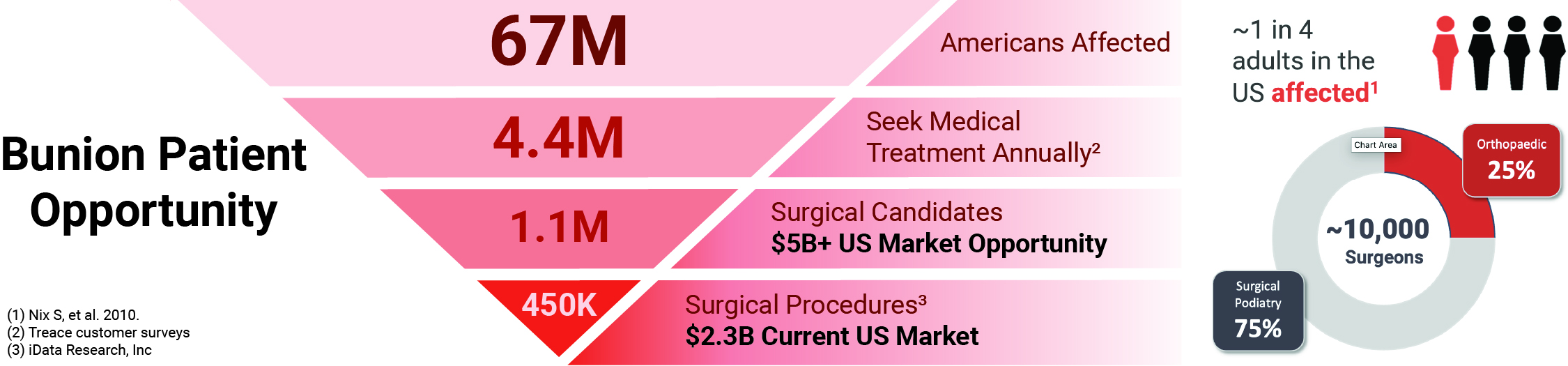
We are a medical technology company with the goal of advancing the standard of care for the surgical management of bunion and related midfoot deformities. Bunions are complex 3-dimensional deformities that originate from an unstable joint in the middle of the foot and affect approximately 67 million Americans, of which we estimate 1.1 million are annual surgical candidates. We have pioneered and patented the Lapiplasty® 3D Bunion Correction® System—a combination of instruments, implants and surgical methods designed to surgically correct all three planes of the bunion deformity and secure the unstable joint, addressing the root cause of the bunion, and helping patients get back to their active lifestyles. To further support the needs of surgeons and bunion patients, we offer the Adductoplasty® Midfoot Correction System, designed for reproducible surgical correction of the midfoot, two systems for minimally invasive osteotomy procedures, namely the Nanoplasty® 3D Minimally Invasive Bunion Correction System and the Percuplasty™ Percutaneous 3D Bunion Correction® System, and the SpeedMTP® System for great toe fusions. We continue to expand our footprint in the marketplace by extending our SpeedPlate® Rapid Compression Implant platform to new applications, as well as providing surgeons with advanced digital solutions with our IntelliGuide® patient specific, pre-op planning and cut guide technology.
We market and sell our products in the United States primarily through a direct employee sales force that is supplemented by independent sales agencies focused on supporting adoption and utilization of our surgical bunion correction systems among the approximately 8,000 surgical podiatrists and 2,600 orthopaedic surgeons with foot and ankle specializations in the United States. To improve clinical outcomes, we devote significant resources to training and educating physicians on the safe and effective use of our systems. We also provide a direct-to-patient outreach program that educates patients on the benefits and risks of our Lapiplasty System and other products with a "Find a Doctor" tool on our website that allows potential patients to search for surgeons trained on our procedures and products in their local markets. We believe our surgeon and patient education programs and specialized teams supporting surgeons in the field combined with our products' differentiated clinical outcomes lead to an increase in utilization of our products per physician over time.
Our employee engineering personnel and our Surgeon Advisory Board and other surgeon consultants help us to generate ideas and develop product innovations. Our Surgeon Advisory Board is comprised of both surgical podiatrists and orthopaedic foot and ankle surgeons who provide us with insights for developing products that meet the needs of each group. Our research and development team is focused on improving clinical outcomes by designing new, procedure-specific instruments and products and by developing enhanced surgical techniques.
Overview of Bunions
Hallux Valgus (commonly known as a "bunion") is a painful, disfiguring deformity characterized by a deviated position of the great toe. Bunions are easily identified visually by the "bump" on the joint at the base of the great toe (the metatarsophalangeal ("MTP") joint). Bunions generally increase in prevalence and severity over time. Nearly 25% of adults between the ages of 18 and 65, and over 35% of people over the age of 65, have bunions. Approximately 4.5 million patients in the United States seek medical attention for bunions annually; of these patients, an estimated 1.1 million are deemed surgical candidates, which represents a total annual addressable market opportunity of more than $5 billion. Approximately 450,000 surgical bunion procedures are performed in the United States every year, representing a greater than $2.3 billion market opportunity. In addition, if the remaining 650,000 of the 1.1 million surgical candidates elected bunion surgery, this represents an incremental opportunity of $3.3 billion.
Bunion deformities are most commonly considered to be the consequence of a hereditary predisposition. Prevalence increases with age, and one study found that 70% of bunion sufferers are female, and that the disorder occurs in both feet, or bilaterally, in 56% of bunion sufferers. Bunions are progressive deformities, with symptoms that typically grow in severity over time.
For those with predispositions for developing bunions, constrained footwear, weight-bearing activities or occupations that aggravate the condition may accelerate progression of the joint deformity and cause symptoms to appear earlier in life. If left untreated, bunions can often have a significant long-term negative impact on sufferers, including:
•
Severe and debilitating pain in the bunion "bump" at the base of the great toe that can also develop in the ball of the foot.
•
Quality of life deterioration with limited mobility, restrictions on footwear and an inability to participate in physical activities.
•
Susceptibility to additional pathologies, such as hammertoes and arthritis of the great toe joint.
•
Increased risk of injury as decreased stability leads to greater potential for falls.
•
Emotional burden from becoming increasingly self-conscious about the bunion's unsightly appearance.
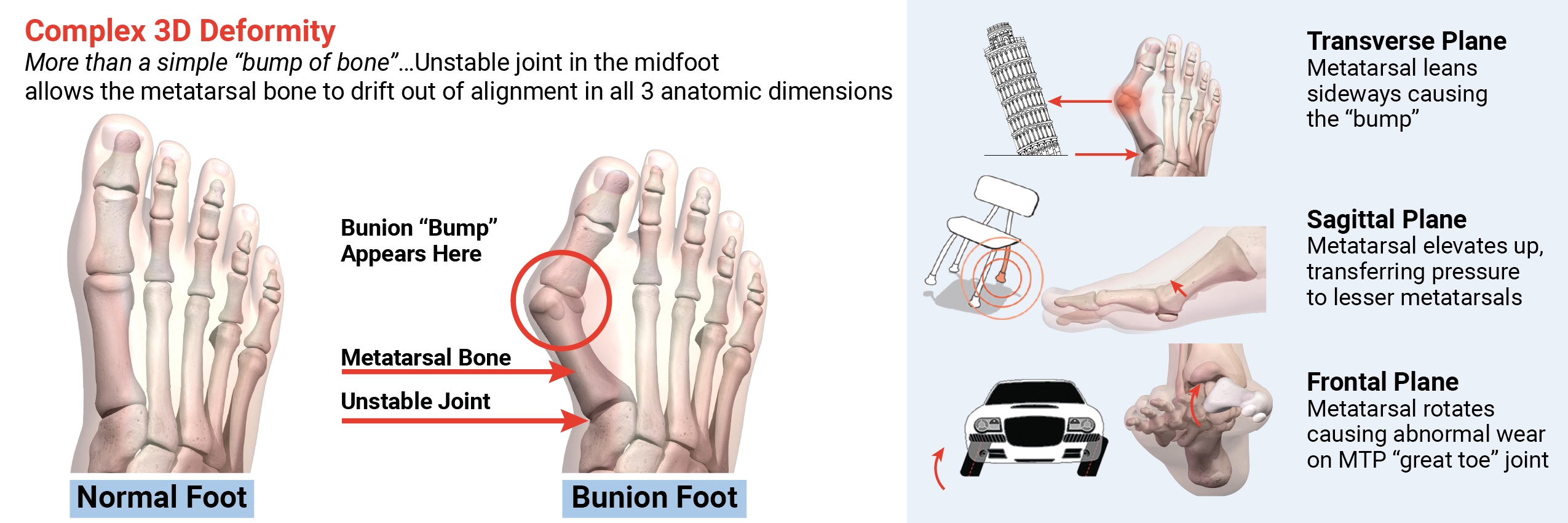
A common misconception is that a bunion is simply an overgrowth of bone that can be shaved off. Bunions are in reality complex 3D deformities caused by deviation and rotation of the metatarsal bone in three anatomic dimensions as shown below.
Traditional treatment options for bunion patients vary with the type and severity of each bunion. During the early stages of the disorder, pain can be managed but will typically worsen and additional symptoms may develop. A physician may initially recommend various non-surgical treatments, including toe spacers, pads or splints, inserts or orthotics, medication or physical therapy. These options are prescribed to alleviate symptoms but do not address the root cause of the deformity. When these non-surgical treatments fail, or when the severity of the bunion deformity progresses past the threshold for such options, surgery is often necessary.
Limitations of Traditional Surgical Treatment Approaches
Historically, there have been two primary surgical approaches to bunion treatment, 2D Osteotomy, historically used by surgeons in approximately 75% of bunion surgeries, and Lapidus Fusion, historically used by surgeons in approximately 25% of bunion surgeries. These traditional surgical treatment approaches are characterized by a 6% to 35% patient dissatisfaction rate for 2D Osteotomy surgery and a 7% to 13% dissatisfaction rate for Lapidus Fusion following surgery. Certain published long-term clinical studies have demonstrated highly variable recurrence rates ranging from 3.6% to 78% following 2D Osteotomy surgery and 38% following Lapidus Fusion surgery. While not all patients with recurrence require a secondary surgical procedure, this high variability for potential recurrence relative to other common surgical procedures is a contributor to patient dissatisfaction.
2D Osteotomy
In a 2D Osteotomy, the bunion "bump" is shaved off and the metatarsal bone of the great toe is cut in half and shifted over to reduce the appearance of the bunion. However, by not correcting the deformity in all three dimensions, there is an increased likelihood that the metatarsal bone will continue to drift out of position over time and for the bunion to return. Additionally, the recovery time has been reported to include up to 6 weeks of non-weight bearing.
Lapidus Fusion
In contrast to 2D Osteotomy, the other common traditional surgical procedure, known as Lapidus Fusion, does address the root cause of the bunion and is routinely referenced in medical literature as a surgical option for bunions since the 1930s. However, even a Lapidus Fusion, as it is conventionally described and performed, still does not address the three-dimensional rotational aspect known to contribute to bunion recurrences.
A conventional Lapidus Fusion surgery fuses the unstable first tarsometatarsal ("TMT") joint but requires a technically challenging correction through a "freehand" technique and has been reported to involve a protracted period of recovery, including approximately 6 to 10 weeks of non-weight-bearing. The freehand technique is highly dependent on the surgeon's skill and requires the physician to perform complex corrections without the benefits of assistive instrumentation that are standard in many other orthopaedic joint procedures, and, consequently, this surgery often results in inconsistent outcomes. Thus, its use has been traditionally reserved for the most advanced and severe bunion pathology.
While bunions have traditionally been viewed as a 2D deformity, recent scientific literature has indicated that 87% of bunions have a 3D, rotational component in addition to the horizontal and vertical misalignments of the metatarsal bone. Failure to correct this third "rotational" dimension of the bunion deformity has been reported to result in a 10 to 12 times increase in the chance of bunion recurrence as compared to 3D surgeries. We believe surgeons have become increasingly aware of the need for 3D bunion correction based on the frequency of lectures and medical journal publications on this topic in recent years.
Our Solutions
We have pioneered our proprietary Lapiplasty 3D Bunion Correction System—a combination of innovative instruments, implants and surgical methods designed to correct all three planes of the bunion deformity and secure the unstable joint, addressing the root cause of the bunion.
Our Lapiplasty System
We believe our Lapiplasty System was the first and remains the leading system designed to enable surgeons to consistently and reliably correct all three dimensions of the bunion deformity, stabilize the first TMT joint and allow return to weight-bearing quickly in a walking boot. In a Lapiplasty Procedure, the entire metatarsal bone is rotated and brought back into position in all three dimensions, eliminating the unsightly bump and restoring normal anatomy. The first TMT joint is secured with titanium fixation technology allowing patients to get back on their feet quickly in a walking boot. The Lapiplasty Procedure can be performed on a wide range of patients with bunion deformities in the hospital outpatient or ambulatory surgery center setting and utilizes existing, well-established reimbursement codes.
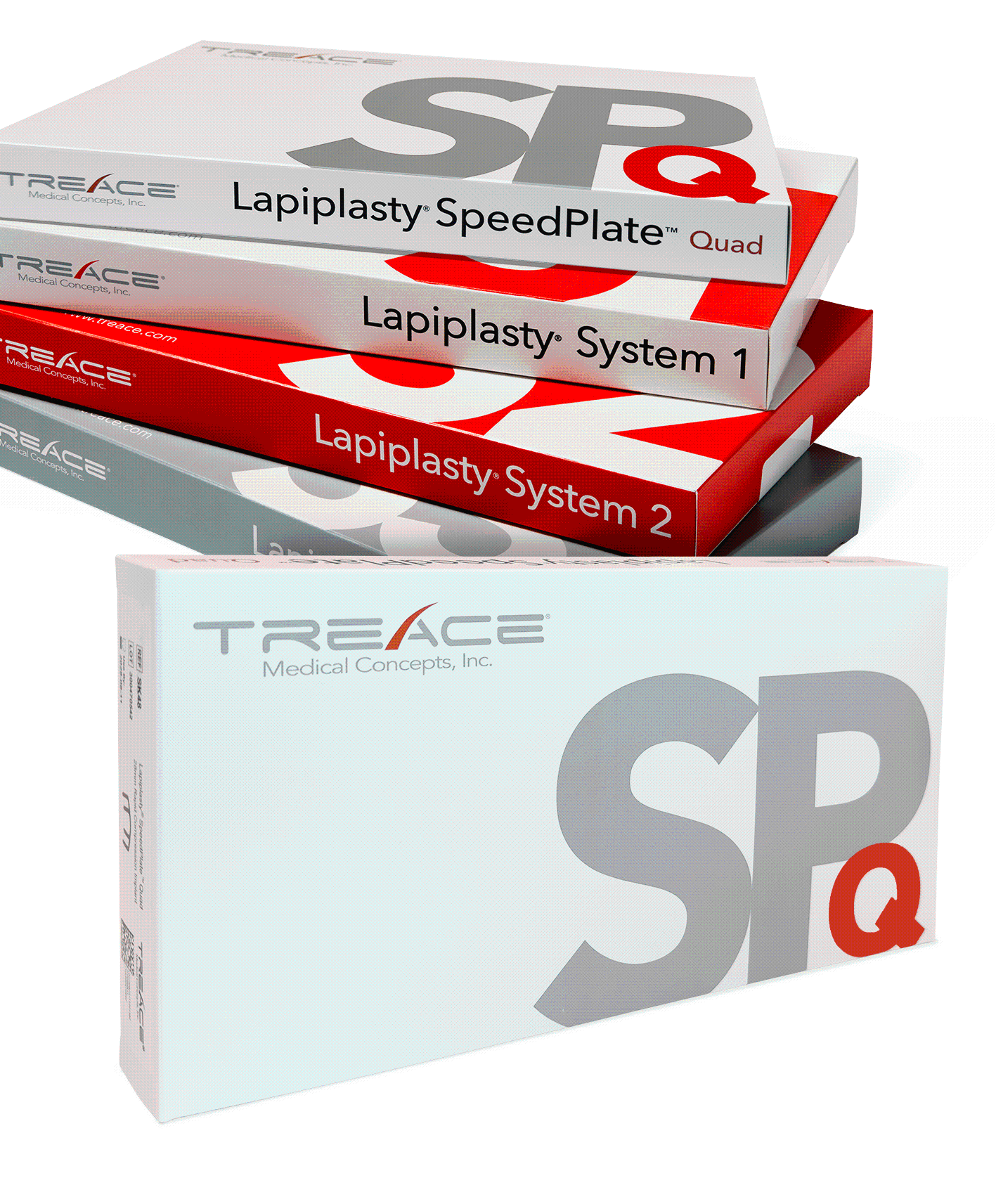
The Lapiplasty System includes both procedural instrumentation and single-use, sterile-packed implant kits. Our procedural instrumentation includes innovative surgical tools designed to enable surgeons to correct all three dimensions of the bunion deformity and the root cause of bunions with accuracy and consistency. Our single-use, sterile-packed implant kits feature low-profile titanium fixation designed to stabilize the TMT joint and to allow early weight-bearing in a walking boot during the critical healing period.
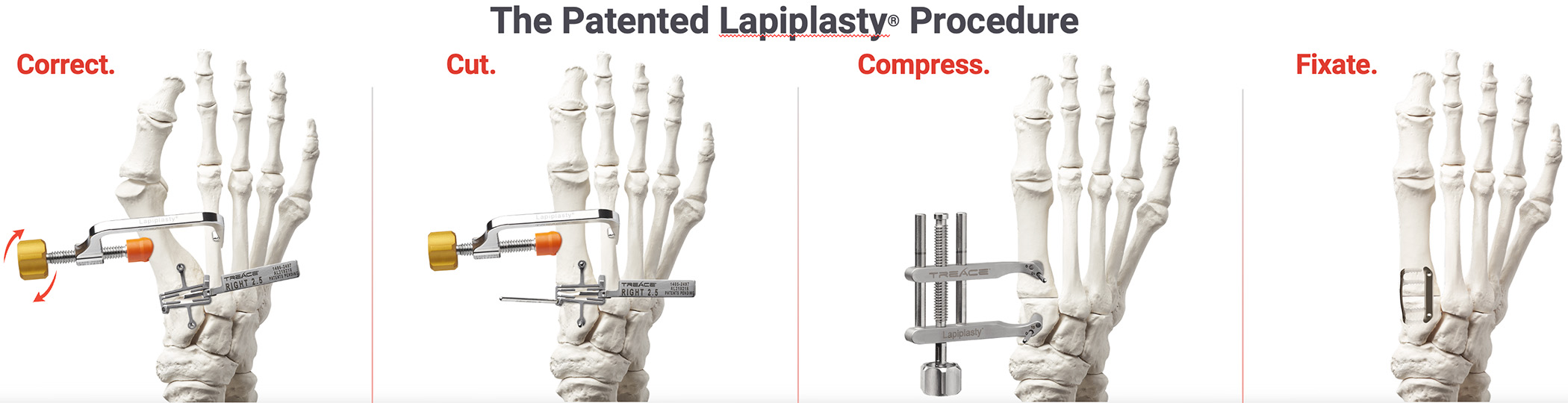
The following table illustrates our patented Lapiplasty System, with procedural instrumentation and implants used in each step of our proprietary Lapiplasty Procedure:
The following table illustrates key components of the Lapiplasty System:
|
|
|
|
|
|
|
|
|
Reusable procedural instrumentation |
|
Sterile-packed implant kits |
Lapiplasty Positioner |
Lapiplasty Compressor |
|
Sterile Implants and Instruments |
|
|
|
Single-use implants and instruments used in the Lapiplasty Procedure and ancillary procedures
|
|
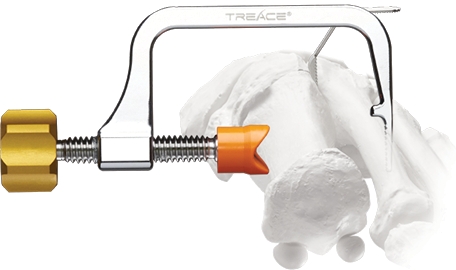
Engineered to quickly and reproducibly correct metatarsal alignment in all three dimensions
|
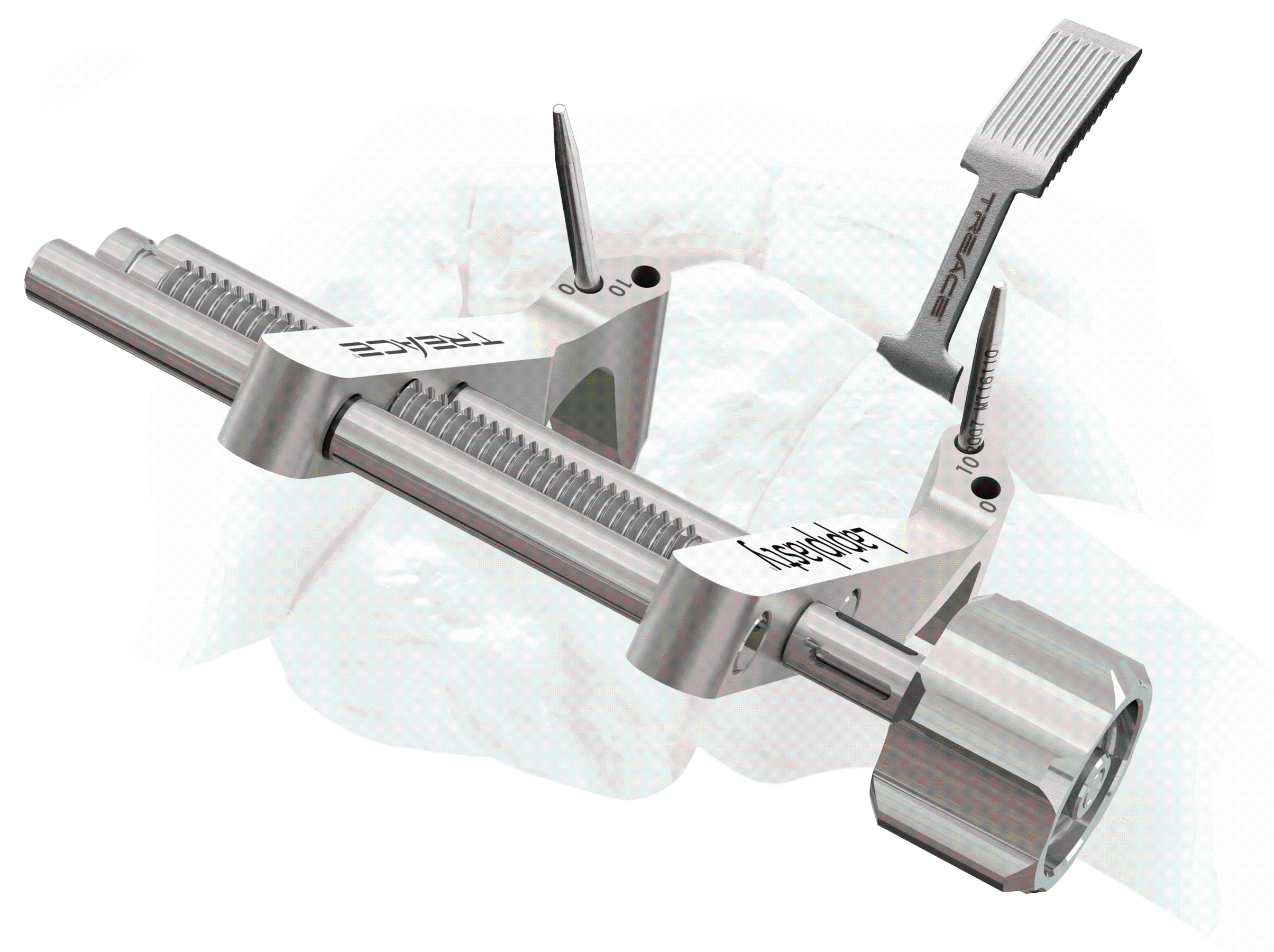
Delivers controlled compression to the precision-cut joint surfaces, while maintaining the three-dimensional correction
|
|
|
Lapiplasty 3-n-1® Guide
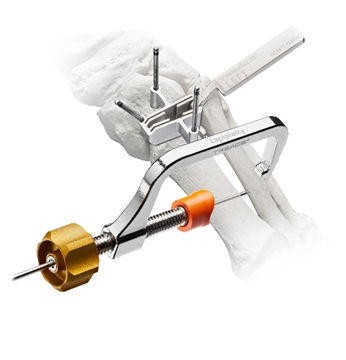
Delivers precise cuts with the metatarsal held in the corrected position, ensuring optimal cut trajectory
|
Lapiplasty Reusable Instrumentation
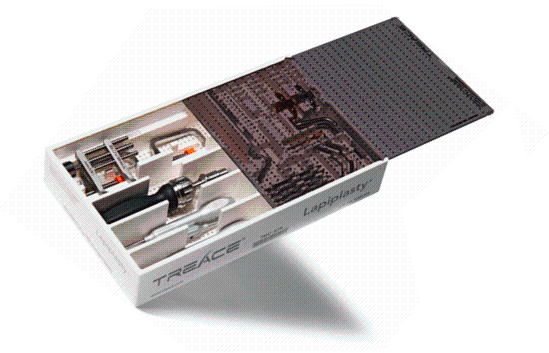
Includes the Positioner,
Compressor and
3-n-1® Guide
|
|
Biplanar Plating
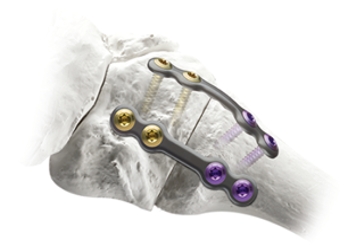
Provides biomechanically-tested biplanar stability; designed to allow rapid return to weight-bearing in a walking boot
|
SpeedPlate Implants
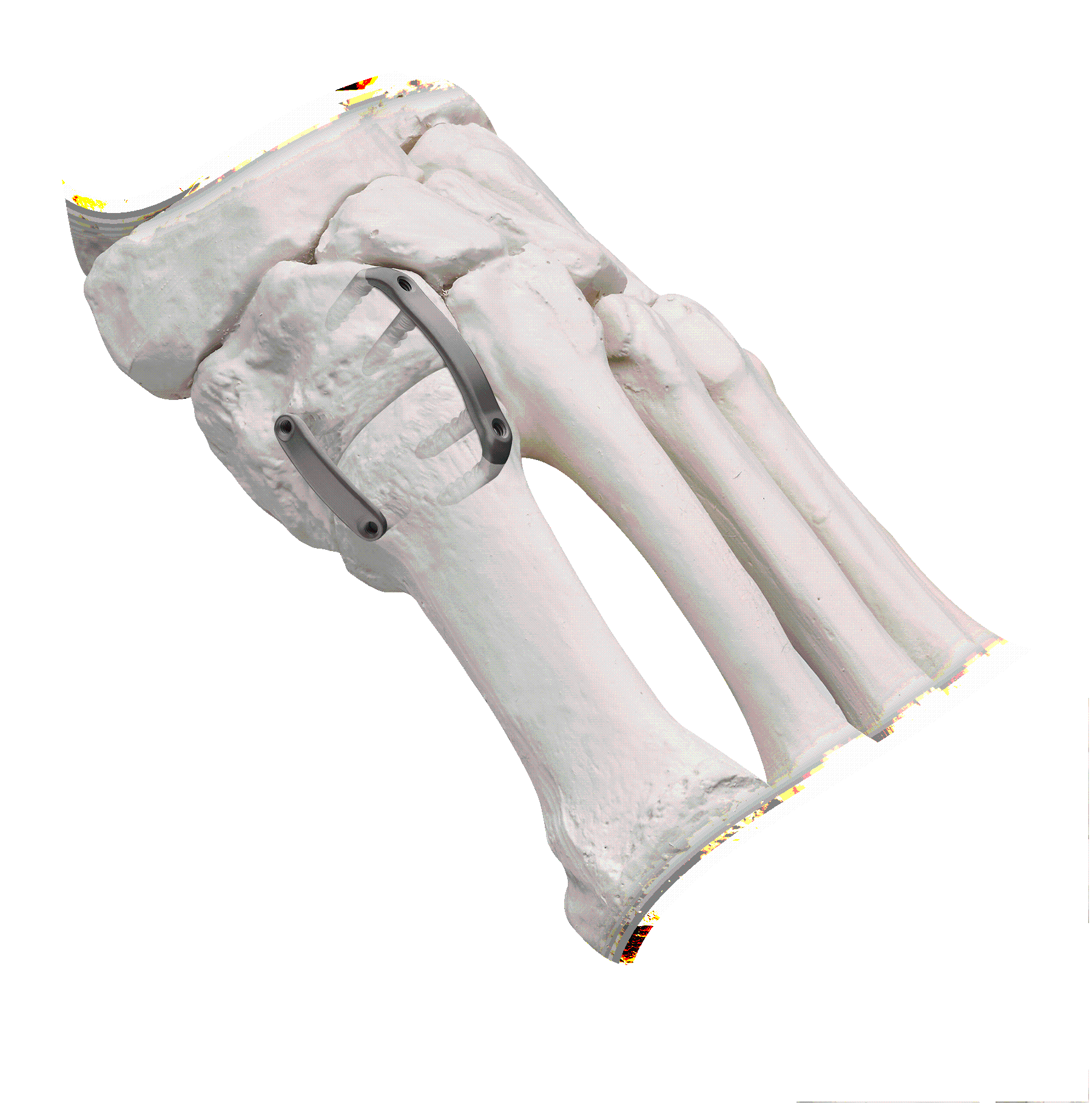
Designed to deliver stability of a titanium locking plate* with speed and compression of a staple
|
* encompasses locking plate and screw construct
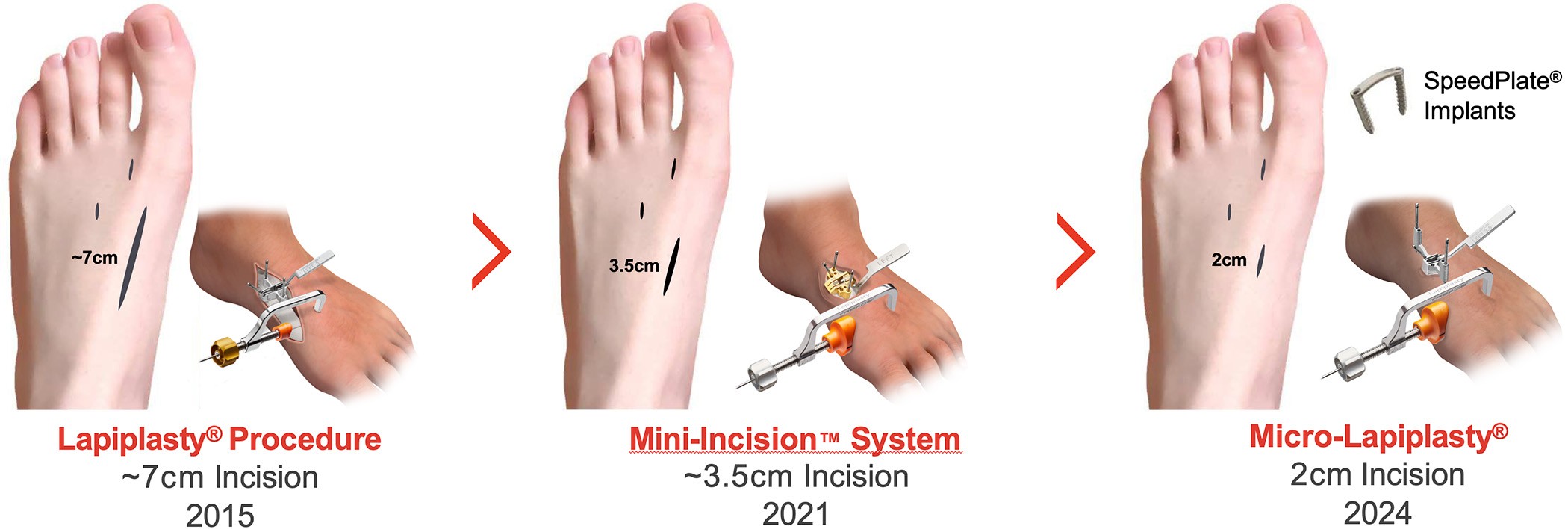
Since its introduction in 2015, we have been dedicated to improving the Lapiplasty Procedure on a continuous basis with advancements designed to make it faster and more efficient to perform and to enable it to be performed through smaller incisions as shown in the image below:
In 2026, we plan to commercialize our next-generation Lapiplasty platform, known as Lapiplasty Lightning™, which combines next-generation three-plane correction instrumentation with new implant designs based on our innovative SpeedPlate dynamic fixation with our FastPitch® locking screws. The Lapiplasty Lightning system is designed to reduce surgical steps for a faster procedure and to support even greater accuracy and control of the 3D correction.
Our Minimally Invasive Products for all Four Bunion Classes
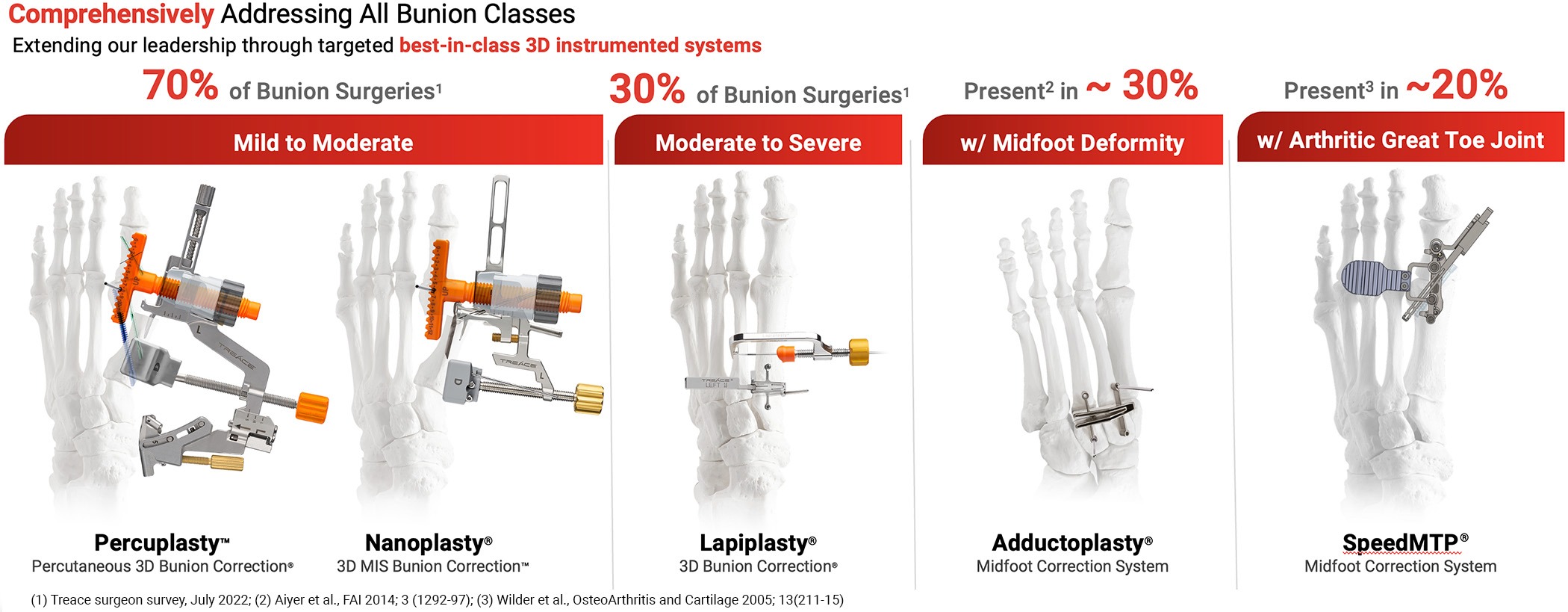
Since our founding, we have been dedicated to improving surgical outcomes for bunion patients. In 2018, our Surgeon Advisory Board published a peer-reviewed paper describing four classes of bunion deformities: (1) mild to moderate bunions, which are estimated to account for approximately 70% of bunion surgeries, (2) moderate to severe bunions, which are estimated to account for approximately 30% of bunion surgeries, (3) bunions with a midfoot deformity, which may occur in up to 30% of bunion patients, and (4) bunions with an arthritic MTP joint, which may occur in approximately 20% of bunion patients.
In late 2024, we introduced three new specialized, minimally-invasive instrumented surgical procedures and products to address surgeon and patient needs in each of these four bunion classes. These new procedures were all fully commercialized and available beginning in the third quarter of 2025. These products and procedures are consistent with our core philosophy of anatomic three-plane bunion correction to support positive patient outcomes and offer user-friendly instrumentation to make these complex procedures controlled and reproducible for the surgeon.
Our Minimally Invasive Distal Osteotomy Systems
Our two new metatarsal osteotomy systems are the Nanoplasty 3D Minimally Invasive Bunion Correction System and the Percuplasty Percutaneous 3D Bunion Correction System. The metatarsal osteotomy procedure is currently estimated to represent approximately 70% of the 450,000 bunion surgeries performed annually in the U.S.
|
|
|
Our Nanoplasty 3D Minimally Invasive Bunion Correction System is designed to deliver a reproducible 3D correction of the bunion deformity through a cosmetically appealing, hidden 1.5 cm incision on the side of the foot. For fixation, the Nanoplasty System utilizes a titanium intramedullary implant with locking screws to provide stability during healing. The Nanoplasty procedure is performed using the familiar powered saw to make the osteotomy cut, rather than a burr. We believe the instrumented Nanoplasty System appeals to surgeons seeking to engage in the growing patient demand for minimally invasive osteotomy bunion surgery without the complexity and steep learning curves of current minimally invasive osteotomy systems on the market. |
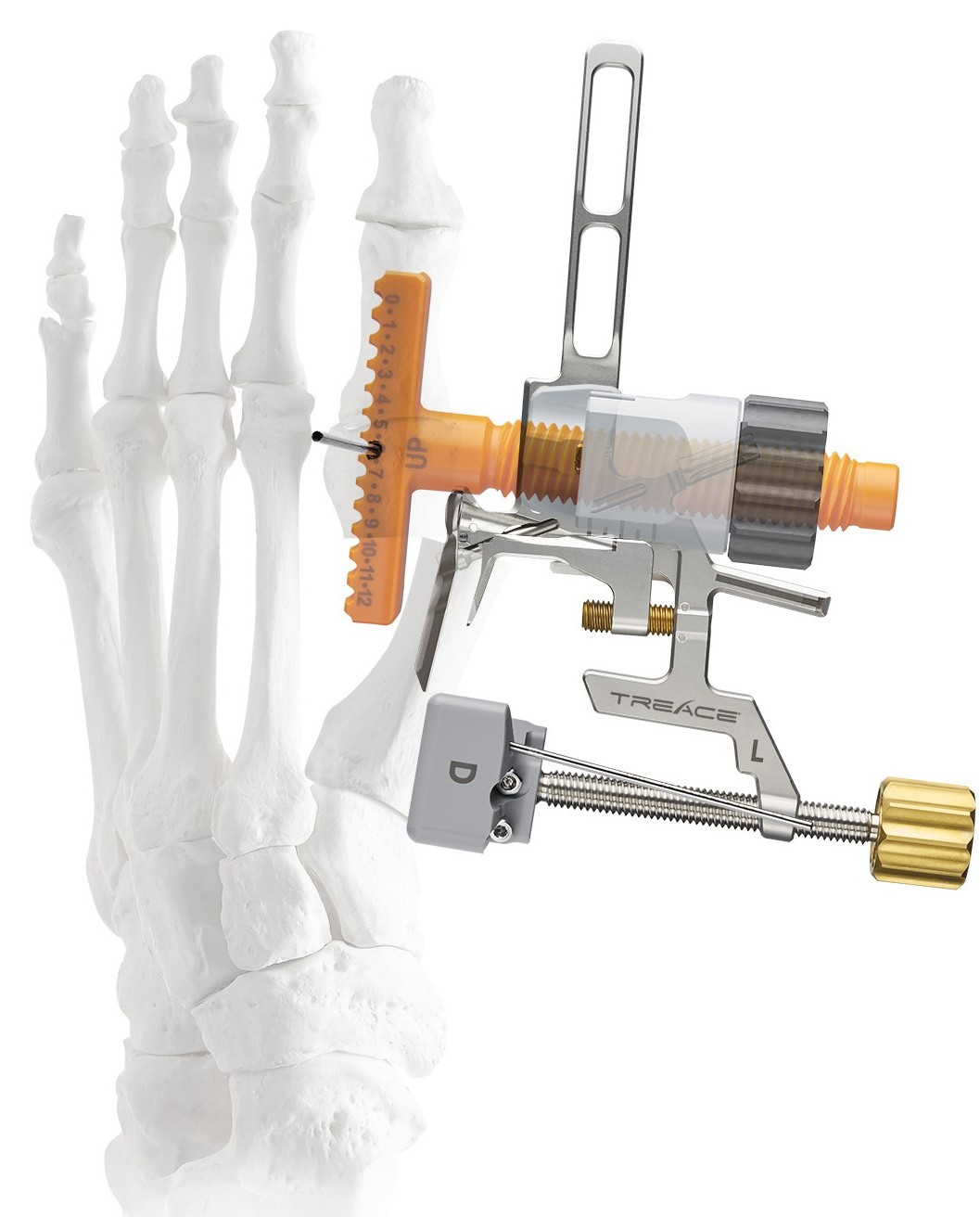 |
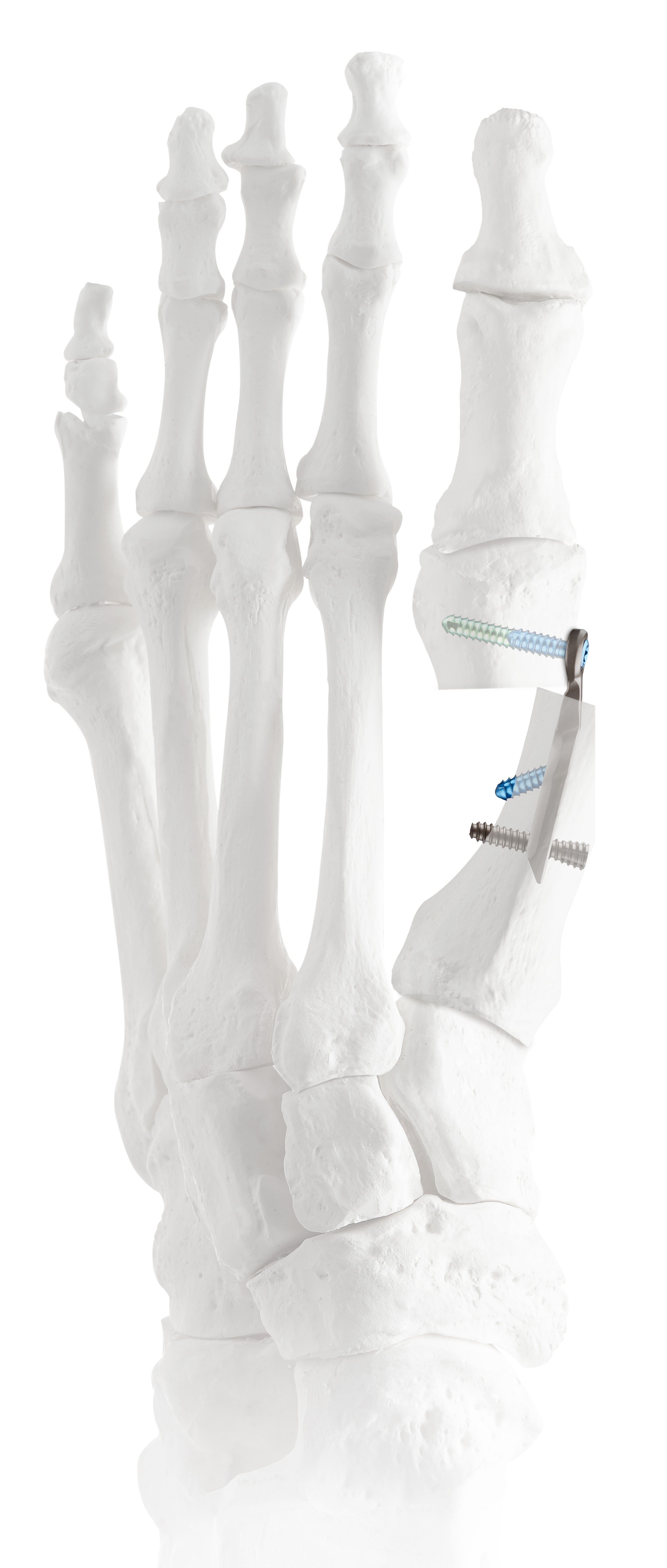
|
|
|
|
The Percuplasty Percutaneous 3D Bunion Correction System is also designed to provide an instrumented, reproducible approach to 3D correction of the bunion deformity through cosmetically appealing, percutaneous incisions. We expect the Percuplasty System to expand surgeon and patient access to the recovery and cosmetic benefits of percutaneous bunion surgery using our sophisticated instrumentation, which is designed to precisely dial-in the correction in all three planes and guide the application of fast, low-profile fixation through "poke-hole" incisions. To support the Percuplasty System, we offer the Percuplasty MIS Power System, which is a console and handpiece that powers the single-use cutting burrs used in the Percuplasty Procedure and can be used across other MIS procedures throughout the foot. In 2026, we plan to introduce Percuplasty SuperBite™ Screws, which are self-drilling beveled compression screws designed for other fusions of the foot. |
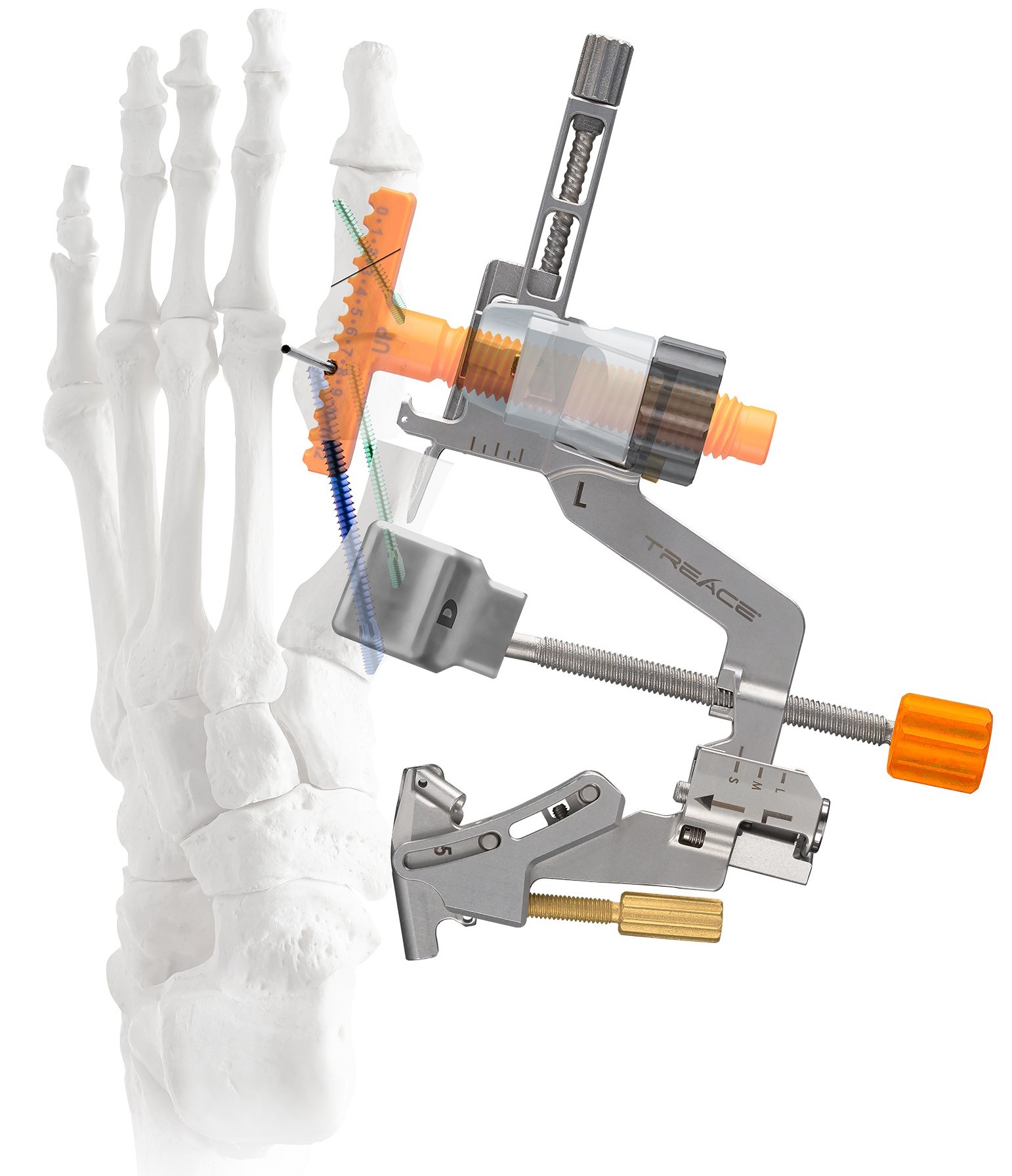
|
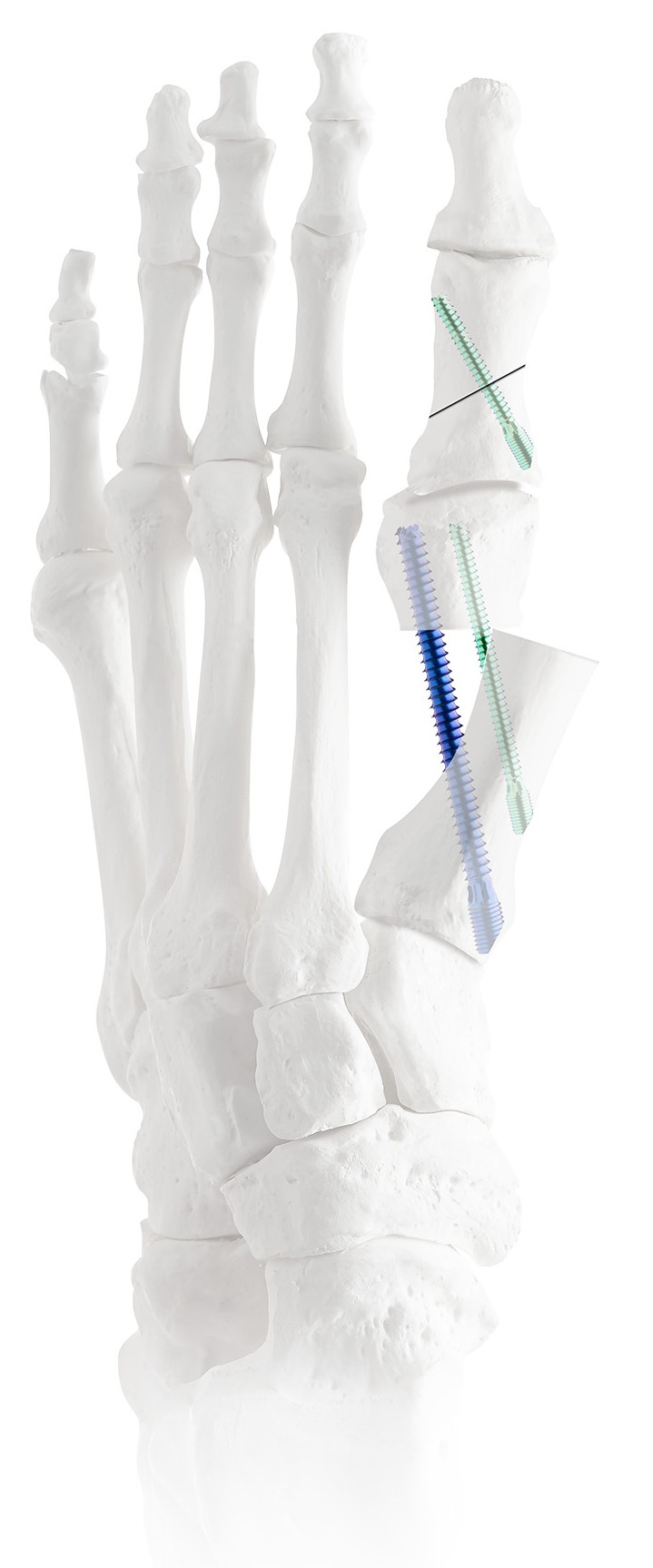 |
Our Adductoplasty System
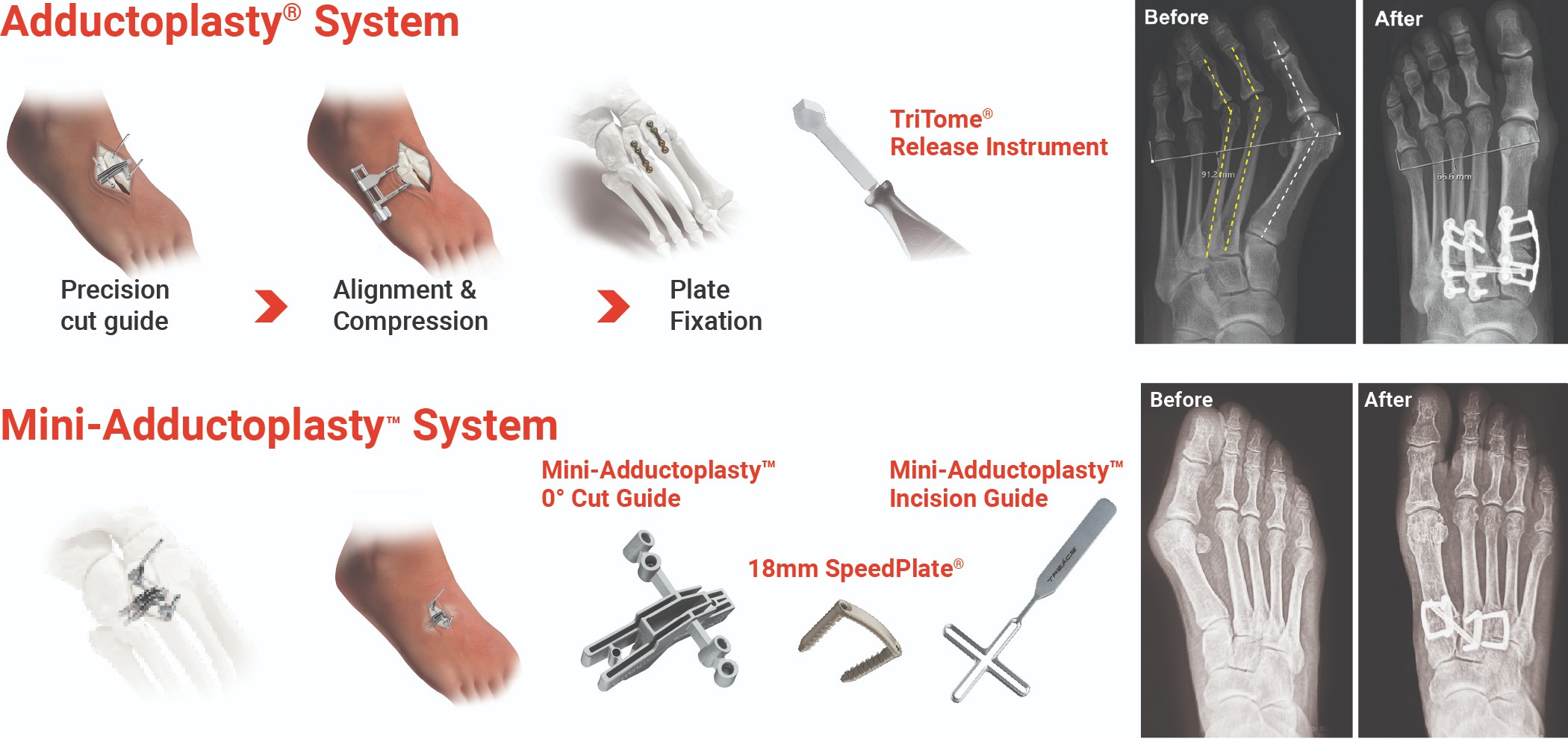
To address the class of bunion that present with a midfoot deformity, in 2021, we launched the Adductoplasty System, which brings together our implants and precision instrumentation in a comprehensive system designed for reproducible correction of metatarsus adductus deformities and osteoarthritis of the midfoot. Midfoot deformities tend to occur in up to 30% of bunion patients. The Adductoplasty System includes instruments that, together with our Lapiplasty fixation implants, may be used for fusion of the second and third TMT joints, which is often necessary in conjunction with bunion surgery. In third quarter of 2024, we began the full commercial release of the Mini-Adductoplasty™ Guides that allow surgeons to perform the Adductoplasty midfoot correction procedure through a 50% smaller incision, thus minimizing soft tissue dissection. The Mini-Adductoplasty Guides include a specialized incision guide and cut guide to enable the procedure to be performed through a 4cm incision.
Our SpeedMTP Rapid Compression Implant
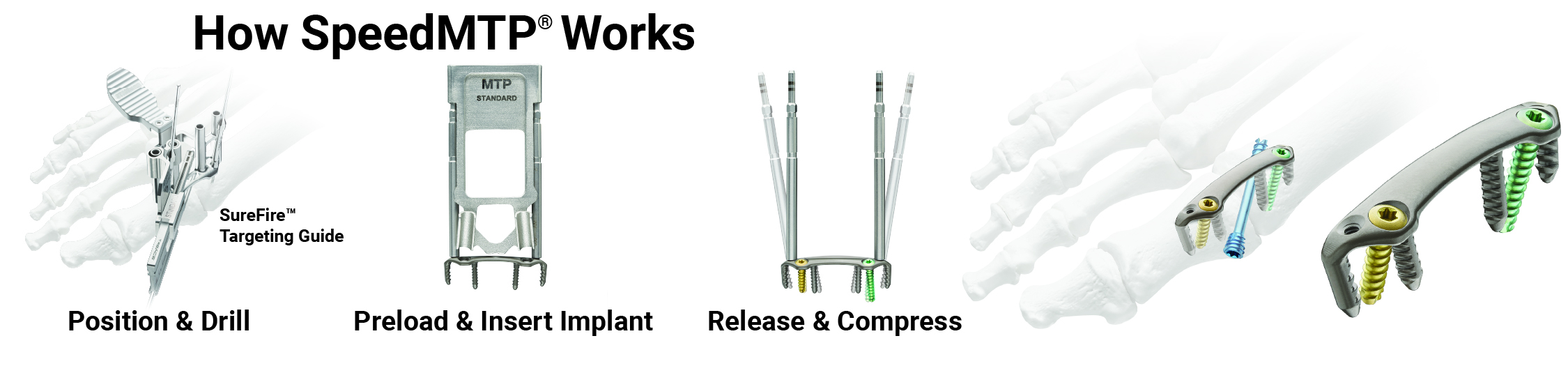
To address the class of bunions that present with an arthritic MTP joint, in the fourth quarter of 2024, we introduced the SpeedMTP implant, a specialized implant for addressing bunions through MTP fusions. The SpeedMTP implant is an ultra-low profile dorsal MTP implant, combining our SpeedPlate and FastPitch technologies for fast insertion, robust strength, and dynamic compression. The ultra-low profile is designed to minimize soft tissue irritation and maximize patient comfort. In late 2025, we introduced the option to use the SureFire™ targeting guide to streamline placement of the implant to facilitate a fast, efficient MTP fusion.
SpeedPlate Implant Fixation Platform
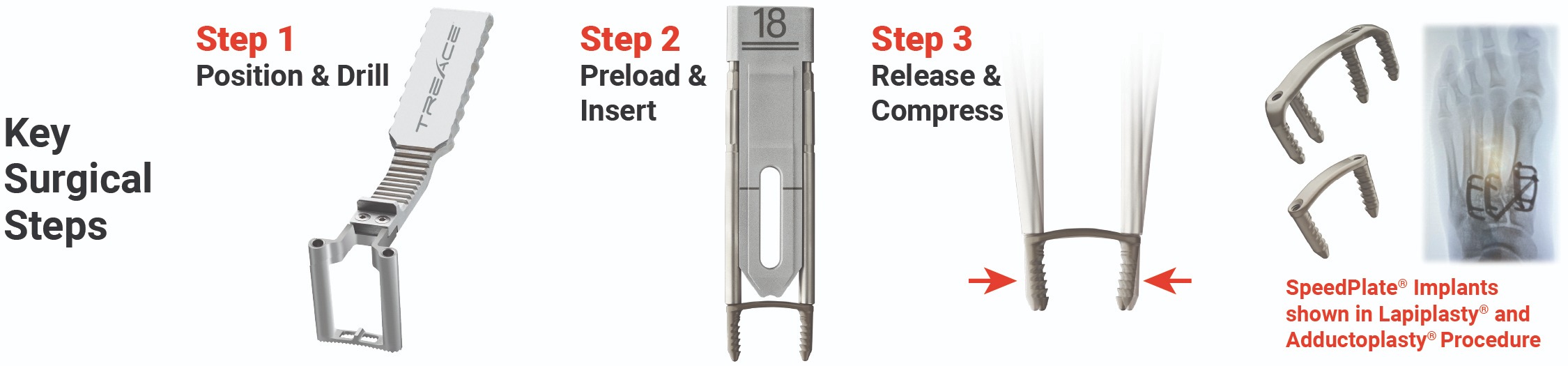
In late 2023, we began the full commercial launch of the SpeedPlate Rapid Compression Implant System, which is an innovative fixation technology designed for rapid insertion while providing dynamic compression of the joint surfaces. Since it can be implanted through a small 2cm incision, the SpeedPlate technology not only offers broad applicability with our proprietary systems but may also be used for other common bone fusion procedures in the foot.
|
|
|
During 2024, our customers rapidly adopted our SpeedPlate fixation platform, and we introduced additional SpeedPlate designs, including designs to address the fusion of larger bones of the midfoot and rearfoot.
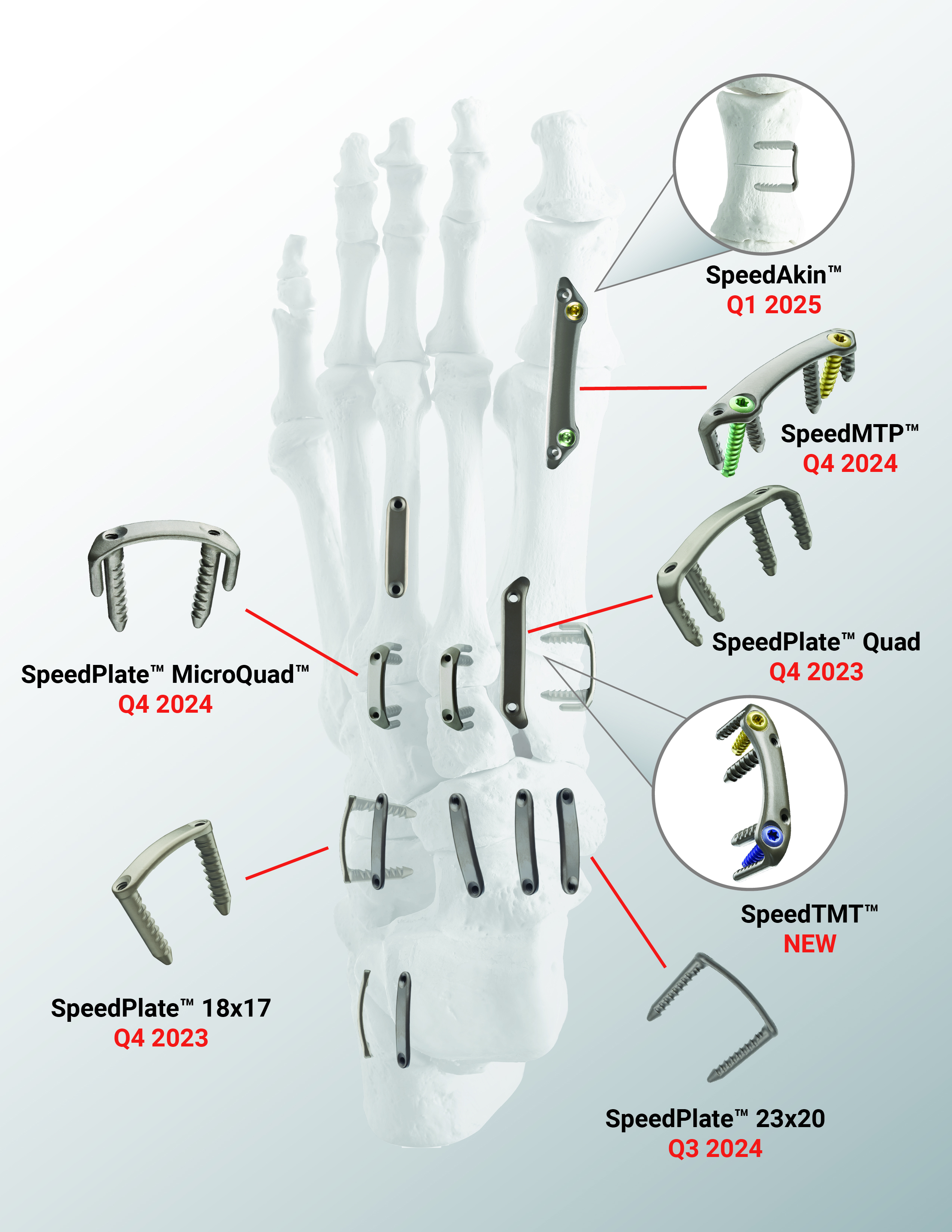
During the fourth quarter of 2024, we began offering the SpeedPlate Micro-Quad implant, a next-generation implant designed for high-stability and anatomic fit in small incision surgical approaches such as the Micro-Lapiplasty and Mini-Adductoplasty Procedures. The Micro-Quad implant has a unique anatomic design with multiple points of fixation on each side of the joint to deliver dynamic compression with rotational stability through a 2.5cm incision for compatibility with minimally invasive techniques.
Another product expanding the SpeedPlate fixation platform is the SpeedAkin™ Anatomic Compression Implant, which offers surgeons a unique anatomic implant to deliver dynamic titanium compression to stabilize the Akin osteotomy during healing. In early 2026, we will begin the limited market release of the SpeedTMT™ Rapid Compression Implant, which combines our SpeedPlate and FastPitch technologies in a dorsal fixation option for TMT fusions.
|
|
Patient Specific Instrumentation
|
|
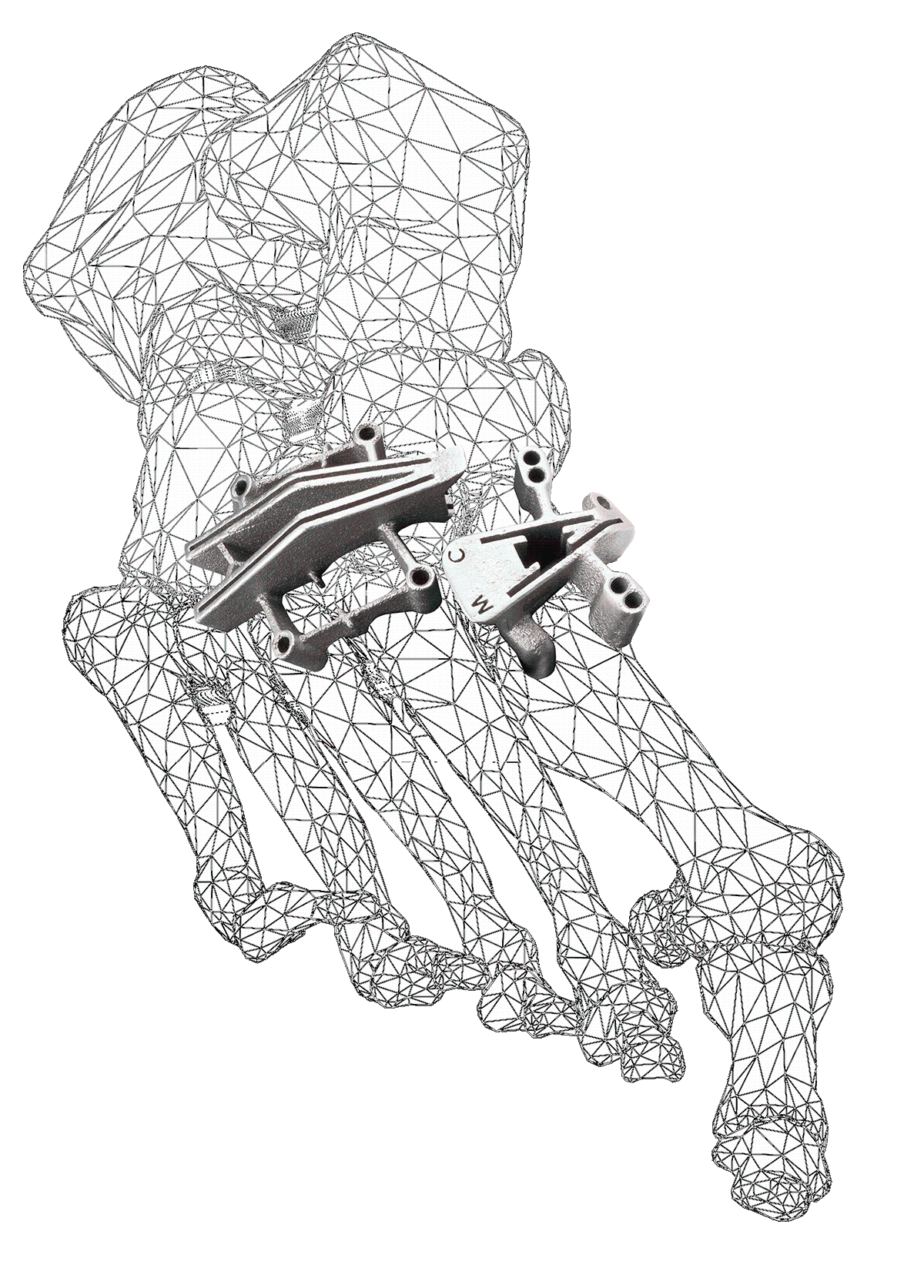
In 2023, we acquired certain assets of MIOS Marketing, LLC d/b/a RedPoint Medical3D ("RPM-3D"). The technology acquired allows us to use patient CT scan data to which we apply software technologies to develop three-dimensional pre-operative plans for correcting a patient's deformity and produce a 3D-printed, patient-specific cut guide designed to deliver accurate surgical correction of deformities customized to the patient's unique foot anatomy. The IntelliGuide® patient specific instrumentation ("PSI") technology is available for both Lapiplasty and Adductoplasty Procedures. Every IntelliGuide PSI system includes patient-specific, 3D-printed cut guides, a 3D model of the patient’s mid-foot bones, and a pre-operative plan for a complete picture of the deformity and correction. This illustration shows the process that a surgeon uses with the IntelliGuide PSI system. |
|
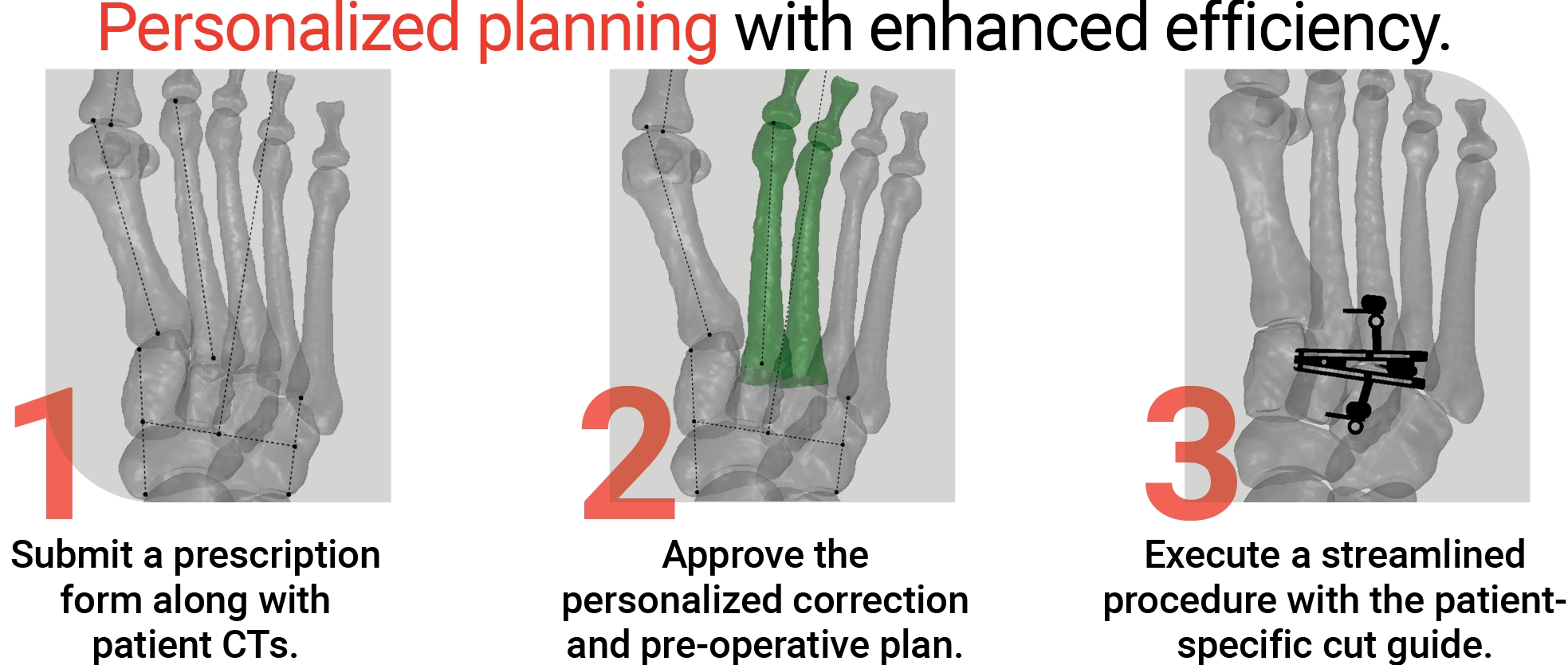
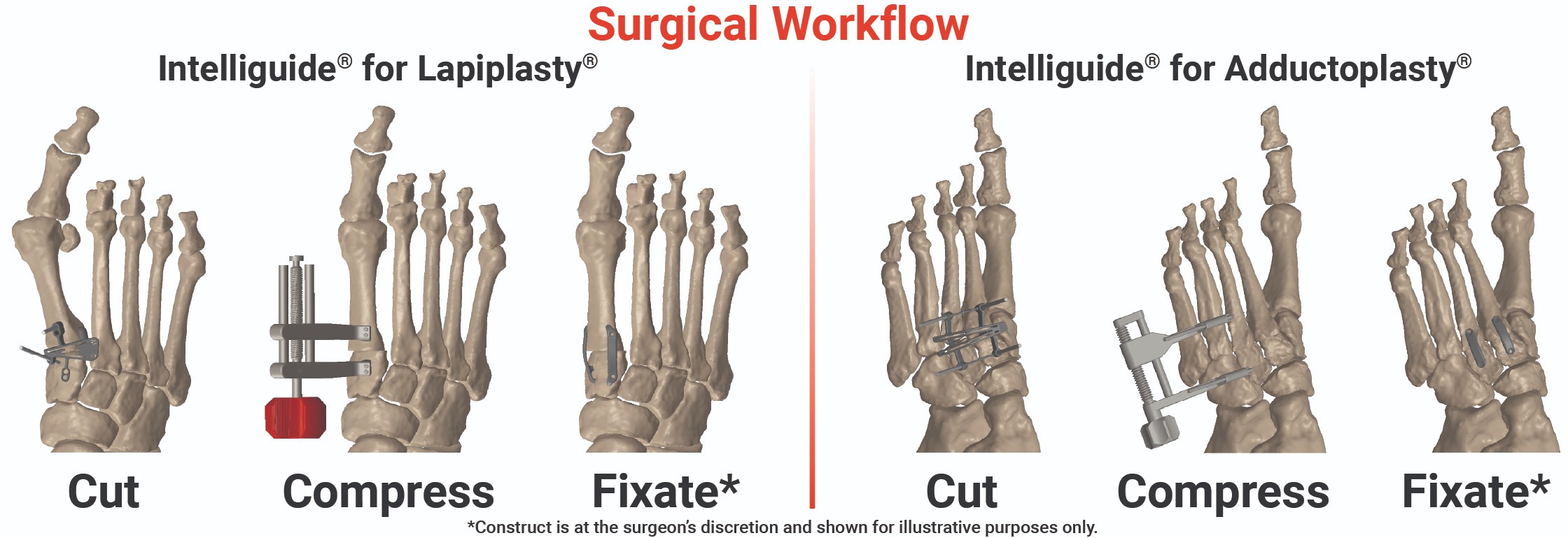
The IntelliGuide System is designed to streamline surgical procedures, reduce steps and instrumentation, and allow surgeons to have confidence and control, particularly with more challenging deformities and revision surgeries.
Below are the three steps for Lapiplasty and Adductoplasty Procedures using IntelliGuide cut guides.
Our Sterile Surgical Instruments
|
|
|
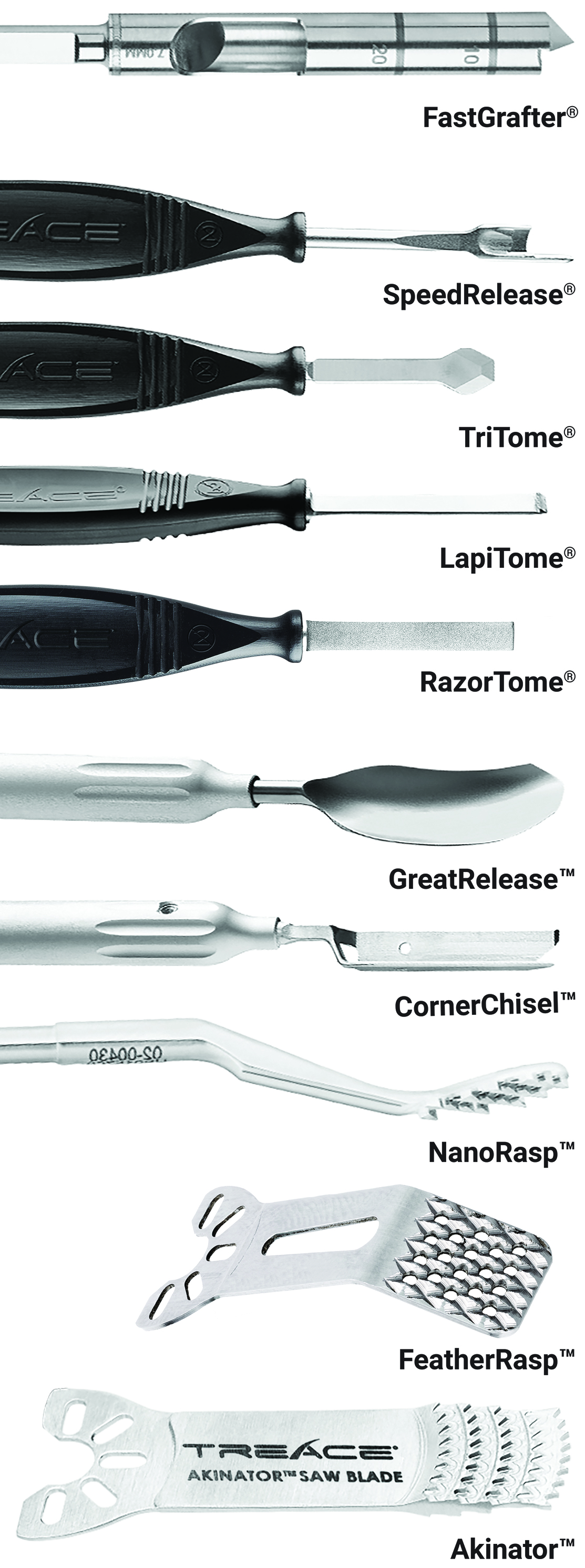
We also offer single use, sterile instruments designed to solve specific problems for surgeons, allowing our procedures to be performed more effectively and efficiently. We commercialized several new designs in 2025 and plan to bring more to market in 2026. Our line of sterile instruments includes:
• FastGrafter® Autografter Harvesting System designed for quick and efficient harvest of autograft bone,
• SpeedRelease® Guided Release Instrument designed for quick and controlled release of the sesamoidal suspensory ligament and other soft tissues,
• TriTome® Triple-Edge Release Instrument designed to release between the metatarsal bases for the Adductoplasty procedure and other applications,
• RazorTome® 7mm Precision Osteotome designed to release plantar soft tissue attachments following TMT bone cuts,
• LapiTome® Hooked Bone Removal Osteotome designed for quick and complete removal of osteotomy bone slices,
• GreatRelease™ Rapid MTP Release Instrument designed to rapidly provide a complete joint release for first MTP fusions,
• CornerChisel™ Release Tool designed for TMT joint preparation by releasing the joint and soft tissue attachments in the Lapiplasty and Adductoplasty procedures and other applications,
• NanoRasp™ MIS Bone Contouring Tool designed to provide controlled, reciprocating contouring of bone surfaces to facilitate preparation for implant placement and/or remove excess bony prominences across various joints,
• FeatherRasp™ Rapid Bone Contouring Instrument designed to enable controlled contouring of bone surfaces to prepare for implant placement or remove osteophytes at any joint, and
• Akinator™ Single-cut Akin Wedge Osteotomy tool designed to create an Akin wedge osteotomy in one precise cut.
|
|
Our Biologics and Wedges
|
|
|
Our products also include:
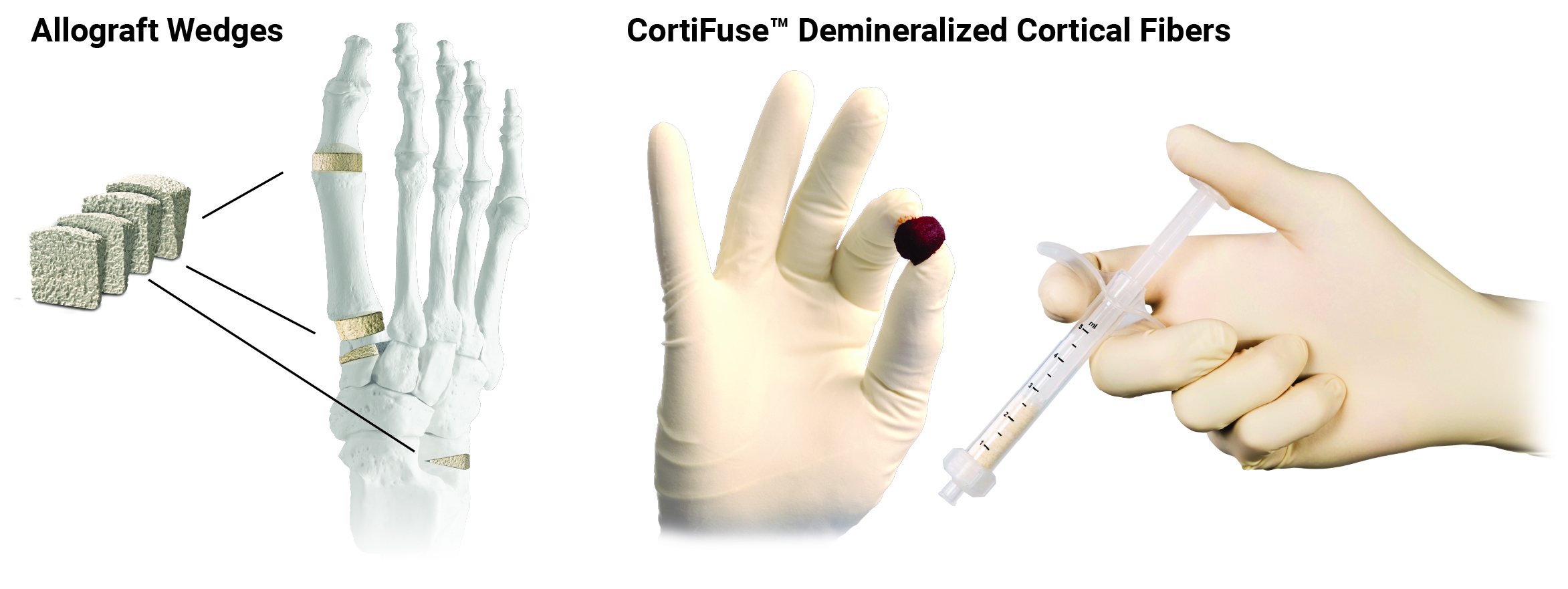
• Treace Allograft Wedges which are pre-shaped grafts designed to facilitate the desired correction for specific procedures, and
• CortiFuse™ Flowable Cortical Fibers, which are cortical microfiber strands that provide a homogenous, flowable, and moldable allograft that handles like a putty.
|
|
Hammertoe PEEK Fixation System
In 2023, we introduced the Hammertoe PEEK Fixation System designed to address hammertoe, claw toe and mallet toe deformities. Hammertoes often present with bunions and are one of the most prevalent deformities in the foot, resulting in approximately 700,000 surgical repairs per year in the U.S. The Hammertoe System is made with PEEK (polyether ether ketone) to offer radiolucency and mechanical properties comparable to bone, is cannulated to facilitate streamlined insertion that allows for accurate implant placement and is a sterile-packed implant and instrument kit for convenient delivery and clinical efficiency.
Our Product Portfolio
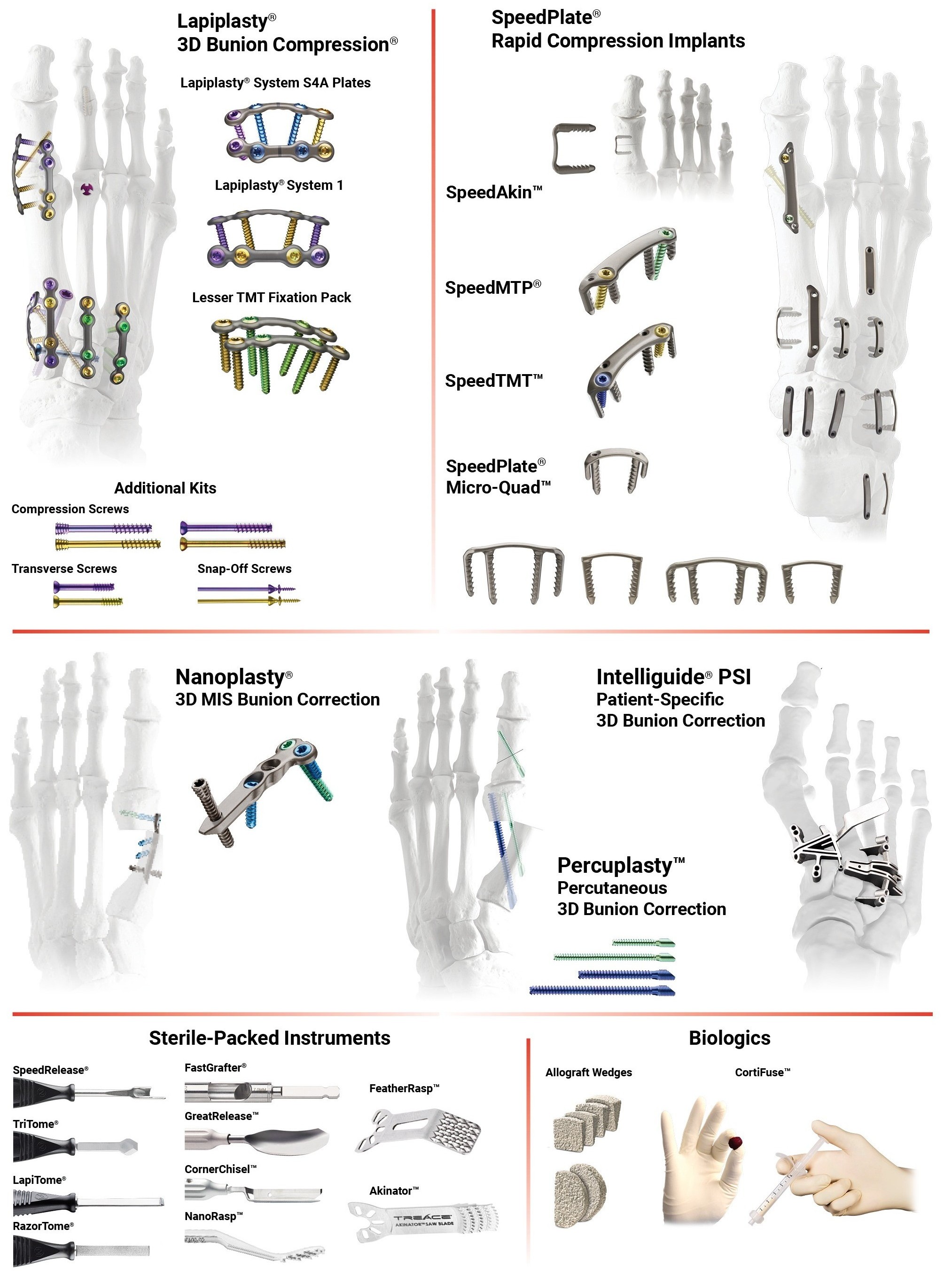
The following diagram depicts the implants and single-use instruments we currently offer as part of our product portfolio:
Key Clinical Advantages of the Lapiplasty System
We believe that the differentiated clinical advantages of the Lapiplasty Procedure support its continued clinical adoption and have helped establish the Lapiplasty Procedure as a standard of care for bunion surgery. We are committed to advancing the understanding of our bunion correction procedures and their benefits to patients, surgeons, facilities and payors through clinical studies and publications in peer-reviewed literature. The Lapiplasty procedure has been cited in 26 peer-reviewed journal publications as of December 2025.
Interim analyses from the ALIGN3D clinical study have been published in the Journal of Foot & Ankle Surgery and most recently presented at industry conferences, including at the AOFAS Annual Meeting in September 2025. The Journal of Foot & Ankle Surgery publication in January-February 2026 presented an interim analysis (139 patients with at least 48 month follow-up) demonstrating early return to weight bearing in a walking boot at an average of 7.7 days, return to work at an average 27.4 days, full unrestricted activity at an average of 4 months, significant improvement in radiographic measures of 3-dimensional bunion correction with 1 recurrence reported at 48 months (0.8% recurrence rate HVA >20o, n=108), and significant improvement in patient-reported pain reduction on the Visual Analog Scale (VAS) and quality of life measurements on the Manchester-Oxford Foot Questionnaire (MOxFQ) and Patient-Reported Outcomes Measurement Information Systems (PROMIS) scores.
Based on the outcomes from multiple studies, further discussed below, and our deep experience in the field of bunion surgery, we believe the key advantages of the Lapiplasty System include the system being designed for:
•
consistent 3D deformity correction;
•
addressing root cause of the deformity;
•
ease and reproducibility of the procedure;
•
fast return to weight-bearing post-surgery in a walking boot;
•
slimmer foot (post 5-month follow up); and
•
low rate of recurrence (as demonstrated across three separate studies which measured recurrence rates at different time points after the Lapiplasty Procedure: 0.9% at 12 months, 0.9% at 17 months; and 0.8% at 48 months).
Clinical studies described in multiple peer-reviewed publications demonstrate the clinical benefits of the Lapiplasty System. These publications demonstrate that the Lapiplasty Procedure allows patients to quickly return to weight-bearing in a walking boot within 3 to 10 days. In addition, these publications demonstrated meaningfully low rates of recurrence (as described above). In addition, these studies indicate a low incidence rate of the bones not healing together (i.e., non-union rate) as well as a low rate of hardware removal. Finally, research also suggests that Lapiplasty may result in a significant decrease in post-operative bony and soft tissue width (i.e., a slimmer foot post 5-month follow up)—although not an indication for surgery, foot width reduction is often a desirable cosmetic and functional outcome and commonly associated with postoperative patient satisfaction.
Recent Interim Data from ALIGN3D Study
Our ALIGN3D prospective, multicenter study is evaluating bunion correction status after five years and includes patient reported outcomes, range of motion results and radiographic outcomes. The study enrolled 173 patients, aged 14 to 58 years, at 7 clinical sites in the United States with 13 participating surgeons. Final patient follow-up for the primary endpoint was completed in the first half of 2023. The table below states the recent interim results of our ALIGN3D clinical study presented at the AOFAS Annual Scientific Conference held in September 2025 demonstrating the following key outcomes, including an analysis of 146 of 173 patients with at least 48 months of follow up after the Lapiplasty Procedure:
|
|
Key outcomes |
Lapiplasty Procedure |
Recurrence rate |
0.7%1 |
Reported time to start weight-bearing |
average of 8.4 days (in a walking boot) |
Symptomatic non-union rate2 |
1.4% |
Hardware removal due to pain |
7.5% |
Patient-reported improvement in pain |
81%3 |
Patient-reported improvement in walking/standing |
90%4 |
Patient-reported improvement in social interaction |
89%4 |
1. At patient's latest visit using HVA>20 degrees, the recurrence rate was 0.7% at 48 months (1 out of 143 patients) and 0% at 60 months (0 out of 84 patients). Using HVA >15 degrees, the recurrence rate was 7.7% at 48 months (11 out of 143 patients) and 4.8% at 60 months (4 out of 84 patients).
2. Non-union rate is a measure of the incidence of the bones not healing together.
3. Visual Analog Scale reported at 24 months post-procedure (n=156).
4. At 48 months post-procedure using the Manchester-Oxford Foot Questionnaire (MOxFQ) scoring system (n=148).
The AOFAS presentation, which includes additional details such as patient demographics, inclusion/exclusion criteria, and complications reported in the studies, is available on our website at www.lapiplasty.com/surgeons/journal-publications/. The information found on our website, including the AOFAS presentation, is not part of this Annual Report or any other report we file with, or furnish to, the SEC.
Recent Final Data from Mini3D Study
The Mini3D clinical study was a prospective, multicenter study evaluating outcomes of the Lapiplasty Procedure using Lapiplasty Mini-Incision System. The study enrolled 105 patients, aged 14 to 58 years, at 9 clinical sites in the United States with 9 participating surgeons. The Journal of Foot & Ankle Surgery publication in March presented an analysis (with 75 and 11 patients completing their 12- and 24- month follow-up visits, respectively) demonstrating median (min, max) length of the primary dorsal incision of 3.5 cm (3.0, 4.0), early return to protected weight bearing at an average of 7.9 days, significant improvement in radiographic measures of 3-dimensional bunion correction at 12 month (0.0% recurrence rate HVA >20o and 5.5% recurrence rate HVA >15o), and significant improvement in patient-reported pain reduction on the Visual Analog Scale (VAS) and quality of life measurements on the Manchester-Oxford Foot Questionnaire (MOxFQ) and Patient-Reported Outcomes Measurement Information Systems (PROMIS) scores maintained through 12 and 24 months.
Commercial Strategy
We are investing in and executing a three-pronged strategy that focuses on rapid product innovations, a bunion-focused direct sales channel, and surgeon education programs.
We currently market and sell our products through a combination of a direct employee sales force, independent sales agencies and stocking distributors in the United States. As of December 31, 2025, we had a field sales fleet of 297 team members including employee sales representatives, district development representatives, market development managers, national accounts and sales management, and an estimate of the individuals from independent sales agencies and stocking distributors focused on marketing and selling our products. In 2025, employee sales representatives generated approximately 80% of total revenue.
We have and are continuing to dedicate meaningful resources to training and developing our sales force and management team in the United States. We are continuing to optimize our employee sales representatives and employee field sales management to strategically access regions with high densities of prospective patients. We believe this strategy will:
•
facilitate growth and better penetrate the market with our products;
•
further align incentives and allow for improved coordination of our sales team; and
•
improve profitability with better operating leverage in the longer term.
We believe our surgeon education and training programs differentiate us from our competitors. We devote significant resources to training and educating physicians on the safe and effective use of our suite of bunion and midfoot correction products. Our comprehensive education programs include simulated surgical workshops, technical assistance in the operating room and advanced training for both new and existing surgeon customers. We believe our multiple post-market clinical outcome studies are also unique in the bunion correction field and are a key element of our medical education program.
Our practice is to require surgeons to complete a simulated surgical training program before performing the Lapiplasty, Adductoplasty, and Nanoplasty Procedures. To facilitate this training, we have developed a robust curriculum including clinical and procedural details as well as hands-on surgical workshops designed to simulate a live surgical procedure. Additionally, we host ongoing peer-to-peer advanced educational training programs to continue to develop the expertise of our surgeon customers, which include monthly online "Mastery Webinar" series and hands-on workshops with experienced faculty surgeons that cover more advanced Lapiplasty techniques and training on our newly developed products and procedures. In 2025, we modified our surgeon training curriculum to address management of all four classes of bunions in a comprehensive educational event that we have branded Bunion Masters™. At these events, attending surgeons who aspire to become experts in bunion surgery engage with our expert faculty and learn proper use of our suite of 3D product solutions from Lapiplasty to Adductoplasty, Nanoplasty, Percuplasty, SpeedMTP and more. Our surgeon training programs are complemented by market development managers who assist with surgeon training and live surgery support with new surgeon users. We believe that our surgeon education programs are effective, and they are intended to result in surgeon users improving their skill and familiarity with our procedures and improved clinical outcomes for their patients.
Surgeons generally can perform their first case after they have been trained and our products have been approved by the surgical facility. Obtaining facility approval may delay surgeon access to our products for 30 to 120 days or more depending on the nature of the facility (or integrated delivery network's) approval process.
We believe our offering is differentiated by supporting surgeons with knowledgeable direct sales employees and market development managers who are experts in our procedures. These employees receive in-depth training to develop a thorough understanding of bunions, patient selection, procedure planning and regulatory policies to meaningfully support continued clinical adoption and existing surgeon customers. Our direct sales employees and market development managers participate in continuous education programs that consist of in-person foundational training, procedure observation and sales skills development. These employees are a key resource for our surgeon customers, and their expertise enables them to provide meaningful clinical and technical support in the operating room and to develop strong relationships with surgeons. We believe that our approach to supporting surgeons leads to better clinical outcomes for patients.
Over the past five years, we have devoted significant resources to our direct-to-patient outreach program to educate patients on the clinical advantages of the Lapiplasty Procedure and generate brand awareness. As part of this program, on April 16, 2024, we announced the first-ever National Bunion Day in the United States, a broad-based awareness and information campaign to address misconceptions and stigma associated with bunions, celebrated the second National Bunion Day in 2025, and plan to support National Bunion Day in the future. We have worked to establish brand recognition for Lapiplasty as the leading procedure for improving bunion treatment outcomes in an industry that has traditionally not conducted significant direct-to-patient programs. We have built a sophisticated marketing infrastructure to deliver our message in a targeted manner utilizing digital and traditional marketing channels. These programs direct potential bunion surgical candidates to our educational website that further explains the Lapiplasty Procedure and its related benefits and risks. Our "Find a Doctor" tool allows them to search for trained Lapiplasty Procedure surgeons in their local markets. While we intend to continue our direct-to-patient education program, we plan to reduce spending on these programs in 2026.
Research and Development
We devote significant resources to research and development of our products. We use employee engineering personnel and our Surgeon Advisory Board and other surgeon consultants to generate ideas and develop product innovations. Our Surgeon Advisory Board is comprised of both podiatrists and orthopaedic foot and ankle surgeons who provide us with insights for developing products that fully meet the needs of each group. Our development team is focused on improving clinical outcomes by designing new procedure-specific products and by developing enhanced surgical techniques in attractive subspecialties within the foot and ankle market.
Our initial product development and commercial efforts have been focused on the bunion market, and our Lapiplasty System specifically. We intend to continue iterating our core Lapiplasty System instrumentation and implants to improve surgical efficiency, enhance reproducibility of outcomes and speed up surgical recovery for patients. We expanded our footprint in the foot and ankle market in 2021 with the Adductoplasty Midfoot Correction System and in 2023 with SpeedPlate Rapid Compression Implants and Hammertoe PEEK Fixation System. In 2024, we focused on developing new technologies to address all four classes of bunions and introduced a number of new products, including (1) the Micro-Lapiplasty Minimally Invasive System, (2) Mini-Adductoplasty Guides, (3) the Nanoplasty 3D Minimally Invasive Bunion Correction System, (4) the Percuplasty Percutaneous 3D Bunion Correction System, (5) IntelliGuide patient specific cut guides for Lapiplasty and Adductoplasty procedures, and (6) SpeedPlate innovations, including the SpeedPlate Micro-Quad, SpeedAkin, and SpeedMTP implants. In 2025, we supported the full commercial release of these technologies, developed additional instrumentation for the Nanoplasty, Percuplasty, SpeedMTP and other products, and worked on additional new offerings, including the Lapiplasty Lightning Next Generation Instrumentation, the SpeedTMT Rapid Compression Implant, and Percuplasty SuperBite Screws. We are also continuing to pursue the development and potential commercialization, if cleared, of new products that we believe would leverage and expand our position in the market to treat other concomitant pathologies that occur in a high percentage of bunion surgeries. Surgeons performing cases using our procedures may use products provided by other companies to treat these concomitant conditions. We believe that providing these complementary products will allow us to capture a higher percentage of the overall product revenue from the surgical case while providing greater efficiency and synergies to the facility and operating room staff by reducing the number of vendors needed to support the case.
Clinical Datasets
We devote significant time and resources to supporting clinical studies to advance the standard of care for the surgical management of bunions and to sharing these results in peer-reviewed publications. As part of our commitment to developing clinical evidence to improve the surgical treatment of bunions, we currently have three prospective, multicenter, post-market studies underway:
1.
the ALIGN3D clinical study designed to evaluate outcomes of the Lapiplasty Procedure, which has completed enrollment with 173 patients;
2.
the MTA3D™ clinical study designed to evaluate outcomes of the combined Adductoplasty and Lapiplasty Procedures for patients in need of metatarsus adductus and hallux valgus corrective surgery, which has completed enrollment with 66 patients; and
3.
the SPRINT™ study designed to evaluate outcomes following joint arthrodesis in the foot after using the SpeedPlate Rapid Compression Implants, which has completed enrollment with 91 patients.
Final data from our Mini3D™ clinical study, which enrolled 105 patients and was designed to evaluate outcomes of the Lapiplasty Procedure using Lapiplasty® Mini-Incision System, was published in the Journal of Foot and Ankle Surgery in March 2025. Each of the ALIGN3D, Mini3D and MTA3D clinical studies has a primary effectiveness endpoint that determines the maintenance of the bunion correction at 24 months after surgery. The primary effectiveness endpoint of the SPRINT study is to assess healing/union rates following joint fixation. More information about the outcome of the ALIGN3D clinical study and Mini3D clinical study is discussed above under the heading "Key Clinical Advantages of the Lapiplasty System." We also support investigator-initiated studies conducted by surgeons seeking to study specific clinical scenarios and endpoints.
Coverage and Reimbursement
Procedures involving our products are performed by foot and ankle surgeons in both hospital outpatient facilities and ambulatory surgery centers. Hospitals, ambulatory surgery centers and surgeons that purchase or use our products generally rely on third-party payors to reimburse for all or part of the costs and fees associated with procedures using our products. As a result, sales of our products depend, in part, on the extent to which the procedures using our products are covered by third-party payors, including government programs such as Medicare and Medicaid, private insurance plans and managed care programs. Based on historical claims data, more than 60% of all bunion surgical cases are paid by private payors.
Medicare publishes national average rates for each procedure in the hospital outpatient and ambulatory surgery center settings. Medicare rates for procedures involving our products may vary from national averages due to geographic location, the nature of facility in which the procedure is performed (i.e., teaching or community hospital) and other factors. While private payors vary in their coverage and payment policies, many use coverage and payment by Medicare as a benchmark to make their own decisions.
Coding and Reimbursement
When procedures using our products are performed in hospital outpatient or ambulatory surgery center settings, both the surgeon and the health care facility submit claims (bills) for payment to the third-party payor using established medical codes (e.g., CPT codes, diagnosis codes and HCPCS codes) that describe the patient history and medical and surgical treatments. Obtaining appropriate payment for services is dependent in part on the physician and health care facility reporting or billing the Current Procedural Terminology ("CPT") code that accurately describes the procedures performed in the case.
The table below sets forth the established CPT codes that are commonly used for Lapidus-type, distal osteotomy, MTP arthrodesis, and midfoot fusion surgeries, including the Lapiplasty, Nanoplasty, Percuplasty, SpeedMTP and Adductoplasty Procedures, as well as for Akin osteotomy and hammertoe correction.
|
|
Established CPT Codes |
CPT 28297 |
Correction, hallux valgus with bunionectomy, with sesamoidectomy, when performed; with first metatarsal and medial cuneiform joint arthrodesis, any method |
CPT 28306 |
Osteotomy, with or without lengthening, shortening or angular correction, metatarsal; first metatarsal |
CPT 28310 |
Osteotomy, shortening, angular or rotational correction; proximal phalanx, first toe (separate procedure) |
CPT 28730 |
Arthrodesis, midtarsal or tarsometatarsal, multiple or transverse |
CPT 28740 |
Arthrodesis, midtarsal or tarsometatarsal, single joint |
CPT 28735 |
Arthrodesis, midtarsal or tarsometatarsal, multiple or transverse; with osteotomy (e.g., flatfoot correction) |
CPT 28750 |
Arthrodesis, great toe; metatarsophalangeal joint |
CPT 28285 |
Correction, hammertoe (e.g., interphalangeal fusion, partial or total phalangectomy) |
CPT 20900 |
Bone graft, any donor area; minor or small (e.g., dowel or button) |
Bunion surgery also often involves multiple concomitant procedures, including Akin osteotomy, Weil osteotomy and hammertoe correction, for example. Each concomitant procedure has an applicable CPT code used for billing third-party payors, which is submitted on the same claim with the primary procedure for reimbursement.
Intellectual Property
We actively seek to protect the technology, inventions, and improvements that we consider important to our business using patents, trade secrets, trademarks and copyrights in the United States and foreign markets.
As of December 31, 2025, our patent portfolio included 95 granted U.S. patents, one exclusively licensed U.S. patent, and 39 granted foreign patents. Eighty-seven of the registered U.S. patents are utility patents. The granted patents cover core Lapiplasty and Adductoplasty-related hardware and surgical techniques as well as other associated innovations, including the main surgical techniques used by the Lapiplasty Procedure as well as associated tools, techniques and/or implants used during the procedure. We have pending patent applications covering our Nanoplasty and Percuplasty related hardware and surgical techniques. Our foreign patents are granted in Australia, Canada, Europe and Japan. Our granted patents expire in 2035 or later.
As of December 31, 2025, we had 189 pending patent applications globally, including 84 in the United States. Outside of the United States we have patent applications pending in Australia, Canada, Europe (before the European Patent Office) and Japan as well as through the Patent Cooperation Treaty ("PCT").
The licensed U.S. patent refers to our exclusive license to a U.S. patent owned by a third party that expires in 2034. Our patents are intended to exclude competitors from practicing the innovations of our currently marketed product offering and to protect potential future commercialization opportunities and to strategically block potential workarounds by competitors.
We own U.S. trademark registrations for several of our most important marks, including "Treace Medical Concepts®," the "Treace Medical Concepts®" logo, "Lapiplasty®," "Adductoplasty®," "3D Bunion Correction®," "IntelliGuide®," "Nanoplasty®," "SpeedMTP®," "SpeedPlate®," and "The Leader in Hallux Valgus Surgery®." We also have pending U.S. trademark registrations on other valuable marks, including "A Step Ahead™," "Akinator™," "BunionMasters™," "Mini-Adductoplasty™," "Percuplasty™," and "SpeedTMT™."
The term of individual patents depends on the legal term for patents in the countries in which they are granted. In most countries, including the United States, the patent term is generally 20 years from the earliest claimed filing date of a nonprovisional patent application in the applicable country. We cannot provide assurance that patents will be issued from any of our pending applications or that, if patents are issued, they will be of sufficient scope or strength to provide meaningful protection for our technology. Notwithstanding the scope of the patent protection available to us, a competitor could develop treatment methods or devices that are not covered by our patents. Furthermore, numerous U.S. and foreign-issued patents and patent applications owned by third parties exist in the fields in which we have commercialized and are developing products. Because patent applications can take many years to issue, there may be applications unknown to us, which applications may later result in issued patents that our existing or future products or technologies may be alleged to infringe.
There has been substantial litigation regarding patent and other intellectual property rights in the medical device industry. We have initiated lawsuits in the past, are currently a plaintiff in two patent infringement lawsuits, and may bring lawsuits in the future to enforce patents issued or licensed to us, enforce our rights in trademarks and copyright, to protect our trade secrets or know-how, to defend against claims of infringement of the intellectual property rights of others, or to determine the scope and validity of the proprietary rights of others. Litigation is costly and diverts our attention from other functions and responsibilities. Furthermore, even if our patents are found to be valid and infringed, a court may refuse to grant injunctive relief against the infringer and instead grant us monetary damages and/or ongoing royalties. Such monetary compensation may be insufficient to adequately offset the damage to our business caused by the infringer's competition in the market.
We are also subject to lawsuits by third parties seeking to enforce their intellectual property rights. If this litigation or future litigation results in adverse determinations, we could be subject to significant liabilities to third parties, could be required to seek licenses from third parties and could be prevented from manufacturing, selling or using our product or techniques, any of which could severely harm our business.
Our knowledge and experience, creative product development, sales and marketing staff and trade secret information, with respect to manufacturing processes, materials and product design, are as important as our patents in maintaining our proprietary product lines. As a condition of employment, we require all employees and key contractors to execute an agreement obligating them to maintain the confidentiality of our proprietary information and assign to us inventions and other intellectual property created during their employment.
For more information, refer to Part I, Item 1A, "Risk Factors—Risks Related to Intellectual Property."
Royalty and License Agreements
We have entered into product development and fee for service agreements with members of our Surgeon Advisory Board and other surgeon consultants that specify the terms under which the consultant is compensated for his or her consulting services and grants us rights to the intellectual property created by the consultant in the course of such services. As products are commercialized with the assistance of the surgeon consultants, we may agree to enter into a royalty agreement if the consultant's contributions to the product are novel, significant and innovative.
We have entered into royalty agreements with surgeon consultants providing royalties based on each individual's level of contribution. Royalty agreements: (1) confirm the irrevocable transfer to us of all pertinent intellectual property rights; (2) set the applicable royalty rate; (3) set the period of time during which royalties are payable; (4) are for a term of either three or ten years, renewable by the parties, and may be terminated by either party on 90 days' notice for convenience (provided that if terminated by the Company for convenience the obligation to pay royalties is not affected); and (5) prohibit the payment of royalties on products sold to entities and/or individuals with whom the surgeon advisor or any other surgeon advisor entitled to royalties is affiliated. Each of the royalty agreements may be subsequently amended to add the license of additional intellectual property covering new products, and as a result, multiple royalty rates and duration of royalty payments may be included in one royalty agreement.
For more information about royalty payments, please see Note 8, "Commitments and Contingencies," of the Notes to Financial Statements.
Manufacturing and Supply
We currently leverage third-party manufacturing relationships to ensure low-cost production while maintaining a capital efficient business model. We generally have multiple sources of supply for critical components of our systems. Our supply agreements do not have "take or pay" commitments or financial penalties that apply if we do not meet minimum purchase obligations. Likewise, except for one supplier, our suppliers have no obligation to sell to us or to manufacture for us any given quantity of our products or components for our products. In most cases, we have redundant manufacturing capabilities for each of our products. We also assemble a portion of our sterile kits at our corporate headquarters. To date, we have not experienced any significant difficulty obtaining our products or components for our products necessary to meet demand, and we have only experienced limited instances where our suppliers had difficulty supplying products by the requested delivery date. We believe manufacturing capacity is sufficient to meet market demand for our products for the foreseeable future.
The suppliers for our products are evaluated, qualified and approved through our supplier management program, which includes various evaluations, assessments, qualifications, validations, testing and inspection to ensure the supplier can meet acceptable quality requirements. We implement a robust change control policy with our key suppliers to ensure that no component or process changes are made without our prior approval.
Order quantities and lead times for components purchased from suppliers are based on our forecasts derived from both historical demand and anticipated future demand. Lead times for components may vary depending on the size of the order, time required to fabricate, specific supplier requirements and current market demand for the components, sub-assemblies and materials.
Competition
Our industry is competitive, subject to technological change and significantly affected by new product introductions and market activities of other industry participants. Our existing products are, and any future products we commercialize will be, subject to competition. We believe the principal competitive factors in our market include:
•
The quality of outcomes and adverse event rates,
•
Patient experience, including patient recovery time and level of discomfort,
•
Acceptance by surgeons, hospitals and other health care providers,
•
Physician learning curves and willingness to adopt new techniques,
•
Ease of use and reliability, Economic benefits and cost savings,
•
Strength of clinical evidence,
•
Strength and scope of intellectual property protections,
•
Effective distribution and marketing to surgeons and potential patients,
•
Product price and qualification for coverage and reimbursement,
•
A highly specialized and focused sales force with strong customer relationships,
•
Surgeon training and medical education programs,
•
Breadth of product line and new product introductions, and
•
Rebates and discounts on unrelated product lines.
Our competition includes medical device manufacturers in the orthopaedic foot and ankle market. Stryker Corporation is currently the leader in the orthopaedic foot and ankle market and has significant market share. Additional companies operating in the orthopaedic foot and ankle market with products specifically focused on bunion surgery include the following large companies: Arthrex, Inc., Paragon 28, Inc., its parent company Zimmer Biomet Holdings, Inc., DePuy Synthes Products, Inc., a Johnson & Johnson subsidiary, and its subsidiary CrossRoads Extremity Systems, Enovis Corporation, CONMED Corporation, Medartis Holdings AG and its subsidiary Nextremity Solutions, Inc.; Medline Industries, Inc., Henry Schein, Inc., and the following smaller companies: RELJA Innovations LLC, Extremity Medical, LLC, Forma Medical, Inc., Fusion Orthopedics, LLC, Sky Surgical, LLC, Vilex LLC, MedCAD F&A, LLC, Ossio Inc., and Voom Medical. While foot and ankle product sales represent a relatively small percentage of our larger competitors' overall sales, many recognize the growth opportunities in this market and have been active in product additions through both internal development efforts and acquisitions.
Our competitors may have significantly greater financial resources, established presence in the market, expertise in research and development, manufacturing, preclinical and clinical testing, obtaining regulatory approvals and reimbursement and marketing approved products than we do. Our larger competitors also have the ability to bundle their bunion products with their broader unrelated product lines and offer rebates and discounts to customers based on purchases of the full bundle, which induces customers to buy competitors' bunion products to meet the requirements to receive the rebates or discounts on the other product lines. These competitors also compete with us in recruiting and retaining qualified research & development, sales, marketing and management personnel, establishing clinical sites and patient registration for clinical studies, as well as in acquiring technologies complementary to, or necessary for, our programs. Smaller or early-stage companies may also prove to be significant competitors. In addition to competing for market share for the bunion and midfoot correction procedures, we also compete against these companies for personnel, including qualified personnel necessary to grow our business.
Finally, we may compete with medical device manufacturers outside the United States if and when we pursue plans to market our products internationally. Among other competitive advantages, such companies have more established sales and marketing programs and networks, established relationships with health care professionals and greater name recognition in such markets.
Government Regulation
Our products and our operations are subject to extensive regulation by the U.S. Food and Drug Administration ("FDA") and other federal and state authorities in the United States, including the U.S. Department of Justice and the U.S. Department of Health and Human Services Office of Inspector General and, if we begin offering our products outside the United States, comparable authorities in foreign jurisdictions. Our products are subject to regulation as medical devices in the United States under the Federal Food, Drug, and Cosmetic Act ("FDCA") as implemented and enforced by the FDA.
United States Regulation
The FDA regulates the development, design, non-clinical and clinical research, manufacturing, safety, efficacy, labeling, packaging, storage, installation, servicing, recordkeeping, premarket clearance or approval, adverse event reporting, advertising, promotion, marketing, sale and distribution, and import and export of medical devices and biologics to ensure that when they are distributed domestically they are safe and effective for their intended uses and otherwise meet the requirements of the FDCA.
FDA Premarket Clearance and Approval Requirements
Unless an exemption applies, each medical device commercially distributed in the United States requires either FDA clearance of a 510(k) premarket notification, FDA grant of a de novo request, or FDA approval of a premarket approval application ("PMA") or FDA approval of a humanitarian device exemption. Under the FDCA, medical devices are classified into one of three classes—Class I, Class II or Class III—depending on the degree of risk associated with each medical device and the extent of manufacturer and regulatory control needed to ensure its safety and effectiveness. Class I includes devices with the lowest risk to the patient and generally require adherence to the FDA's General Controls for medical devices, which include compliance with the applicable portions of the Quality System Regulation ("QSR"), facility registration and product listing, reporting of adverse medical events, and truthful and non-misleading labeling, advertising, and promotional materials. Class II devices are subject to the FDA's General Controls, as well as special controls deemed necessary by the FDA. These special controls can include performance standards, post-market surveillance, patient registries and FDA guidance documents.
While many Class I and certain Class II devices are exempt from the 510(k) premarket notification requirement, manufacturers of certain Class I and Class II devices are required to submit to the FDA a premarket notification under Section 510(k) of the FDCA requesting permission to commercially distribute the device, also referred to as 510(k) clearance. These devices may also be exempt from Good Manufacturing Practices, which are requirements under the FDA Quality System Regulation. If a Class I or Class II device is subject to premarket notification requirements and there is no existing device previously approved by the FDA that is substantially equivalent to the device, a de novo request must be submitted and approved before the device can be marketed. Devices deemed by the FDA to pose the greatest risks, such as life sustaining, life supporting, or some implantable devices are placed in Class III. If substantial equivalence to a legally marketed device cannot be demonstrated via a Class III 510(k), a Class III device must receive PMA approval in order to be legally marketed. Our currently manufactured products are Class I exempt devices and Class II devices subject to 510(k) clearance.
510(k) Clearance Marketing Pathway
Certain of our current products are subject to premarket notification and clearance under section 510(k) of the FDCA. To obtain 510(k) clearance, we must submit to the FDA a premarket notification submission demonstrating that the proposed device is "substantially equivalent" to a legally marketed predicate device, i.e., a device that was legally marketed before May 28, 1976 (pre-amendments device) and for which a PMA is not required, a device that has been reclassified from Class III to Class II or I, or a device that was found substantially equivalent through the 510(k) process. The FDA's 510(k) clearance process usually takes from three to twelve months but may take longer. The FDA may require additional information, including clinical data, to make a determination regarding substantial equivalence. In addition, the FDA collects user fees for certain medical device submissions and annual fees for medical device establishments. For fiscal year 2026, the standard user fee for a 510(k) premarket notification application is $26,067.
If the FDA agrees that the device is substantially equivalent to a predicate device currently on the market, it will grant 510(k) clearance to commercially market the device. If the FDA determines that the device is "not substantially equivalent" to a previously cleared device, the applicant can resubmit the 510(k), file a reclassification petition, submit a PMA, or request a Class I or Class II designation through the "de novo" process, which is a route to market for novel medical devices that are low to moderate risk and are not substantially equivalent to a predicate device.
After a device receives 510(k) clearance, any modification that could significantly affect its safety or effectiveness, or that would constitute a major change or modification in its intended use, will require a new 510(k) clearance or depending on the modification, PMA approval or de novo classification. The FDA requires each manufacturer to determine whether the proposed change requires submission of a 510(k), de novo classification or a PMA in the first instance, but the FDA can review any such decision and disagree with a manufacturer's determination. If the FDA disagrees with a manufacturer's determination, the FDA can require the manufacturer to cease marketing and/or request the recall of the modified device until 510(k) marketing clearance, approval of a PMA, or issuance of a de novo classification. Also, in these circumstances, the manufacturer may be subject to significant regulatory fines or penalties.
PMA Approval Pathway
Class III devices generally require PMA approval before they can be marketed, which is more complex, costly and time consuming than the 510(k) premarket notification process. A PMA must be supported by extensive technical, preclinical, clinical, and manufacturing data to demonstrate the device’s safety and effectiveness. FDA review can take several years, may involve requests for additional information, advisory panel input, and inspections, and does not guarantee approval. None of our products are marketed pursuant to a PMA.
Clinical Trials
Clinical trials are almost always required to support a PMA and are sometimes required to support a 510(k) submission. All clinical investigations of investigational devices to determine safety and effectiveness must be conducted in accordance with the FDA's investigational device exemption ("IDE") regulations which include specific labeling, monitoring, and recordkeeping requirements. If the device is determined to present a "significant risk" to human health, the manufacturer may not begin a clinical trial until it submits an IDE application to the FDA and obtains approval of the IDE from the FDA. The IDE must be supported by appropriate safety and testing protocol data, and the study must be approved by, and conducted under the oversight of, an Institutional Review Board ("IRB"), for each clinical site. If the device presents a non-significant risk to patients, a sponsor may begin the clinical trial after obtaining approval for the trial by one or more IRBs without separate approval from the FDA, but must still follow abbreviated IDE requirements, such as monitoring the investigation, ensuring that the investigators obtain informed consent, and labeling and record-keeping requirements. A clinical trial may be suspended by FDA, the sponsor, or an IRB at any time for various reasons. Even if a clinical trial is completed, the results may not demonstrate the safety and efficacy of a device to the satisfaction of the FDA or may be equivocal or otherwise be insufficient to obtain approval of a device. We are not currently undertaking any FDA IDE trials, as all of our existing products are FDA-cleared through the 510(k) pathway. It is possible, however, that future device development may require IDE clinical trial for approval.
Post-Market Regulation
After a product is cleared or approved for marketing, numerous and pervasive regulatory requirements continue to apply. These include:
•
establishment registration and product listing with the FDA;
•
QSR requirements, which require manufacturers, including third-party manufacturers, to follow stringent design, testing, control, documentation and other quality assurance procedures during all aspects of the design and manufacturing process;
•
labeling and marketing regulations and FDA prohibitions against the promotion of investigational products, or the promotion of "off-label" uses of cleared or approved products;
•
requirements related to promotional activities;
•
clearance or approval of product modifications to 510(k)-cleared devices that could significantly affect safety or effectiveness or that would constitute a major change in intended use of one of our cleared devices, or approval of certain modifications to PMA-approved devices;
•
medical device reporting regulations, which require that a manufacturer report to the FDA if a device it markets may have caused or contributed to a death or serious injury, or has malfunctioned and the device or a similar device that it markets would be likely to cause or contribute to a death or serious injury, if the malfunction were to recur;
•
correction, removal, and recall reporting regulations, which require that manufacturers report to the FDA field corrections and product recalls or removals if undertaken to reduce a risk to health posed by the product or to remedy a violation of the FDCA that may present a risk to health;
•
the FDA's recall authority, whereby the agency can order manufacturers to recall from the market a product that is in violation of governing laws and regulations; and
•
post-market surveillance activities and regulations, which apply when deemed by the FDA to be necessary to protect public health or to provide additional safety and effectiveness data for the product.
Manufacturing processes for medical devices are required to comply with the applicable portions of the QSR, which cover the methods and the facilities and controls for the design, manufacture, testing, production, processes, controls, quality assurance, labeling, packaging, distribution, installation and servicing of finished devices intended for human use.
The QSR also requires, among other things, maintenance of a device master file, device history file, and complaint files. Manufacturers are subject to periodic scheduled or unscheduled inspections by the FDA. Failure to maintain compliance with the QSR requirements could result in the shut-down of, or restrictions on, manufacturing operations and the recall or seizure of marketed products. The discovery of previously unknown problems with any marketed products, including unanticipated adverse events or adverse events of increasing severity or frequency, whether resulting from the use of the device within the scope of its clearance or off-label by a physician in the practice of medicine, could result in restrictions on the device, including the removal of the product from the market or voluntary or mandatory device recalls.
The FDA has broad regulatory compliance and enforcement powers. If the FDA determines that a manufacturer has failed to comply with applicable regulatory requirements, it can take a variety of compliance or enforcement actions, which may result in any of the following sanctions:
•
warning letters, untitled letters, fines, injunctions, consent decrees and civil penalties;
•
recalls, withdrawals, or administrative detention or seizure of our products;
•
operating restrictions or partial suspension or total shutdown of production;
•
refusing or delaying requests for 510(k) marketing clearance or PMA approvals of new products or modified products;
•
withdrawing 510(k) clearances or PMA approvals that have already been granted;
•
refusal to grant export approvals for our products; or
•
civil or criminal prosecution.
Government and Private Payor Coverage and Reimbursement Dynamics
In the United States, our currently approved products are commonly treated as general supplies utilized in orthopaedic surgery and if covered by third-party payors, are paid for as part of the surgical procedure. Outside of the United States, there are many reimbursement programs through private payors as well as government programs. In some countries, government reimbursement is the predominant program available to patients and hospitals. Our commercial success depends in part on the extent to which governmental authorities, private health insurers and other third-party payors provide coverage for and establish adequate reimbursement levels for the procedures during which our products are used. Failure by physicians, hospitals, ambulatory surgery centers and other users of our products to obtain sufficient coverage and reimbursement from third-party payors for procedures in which our products are used, or adverse changes in government and private third-party payor's coverage and reimbursement policies could materially adversely affect our business, financial condition, results of operations and prospects.
Based on our experience to date, third-party payors generally reimburse for the surgical procedures in which our products are used only if the patient meets the established medical necessity criteria for surgery. Some payors are moving toward a managed care system and control their health care costs by limiting authorizations for surgical procedures, including elective procedures using our devices. Although no uniform policy of coverage and reimbursement among payors in the United States exists and coverage and reimbursement for procedures can differ significantly from payor to payor, reimbursement decisions by particular third-party payors may depend upon a number of factors, including the payor's determination that use of a product is:
•
a covered benefit under its health plan;
•
appropriate and medically necessary for the specific indication;
•
neither experimental nor investigational.
Third-party payors are increasingly auditing and challenging the prices charged for medical products and services with concern for upcoding, miscoding, using inappropriate modifiers, or billing for inappropriate care settings. Some third-party payors must approve coverage for new or innovative devices or procedures before they reimburse health care providers who use the products or therapies. Even though a new product may have been cleared for commercial distribution by the FDA, we may find limited demand for the product unless and until reimbursement approval has been obtained from governmental and private third-party payors.
A key component in determining whether appropriate payment amounts are received for physician and other services, including those procedures using our products, is the existence of a CPT code, which describes the procedure in which the product is used. To receive payment, health care practitioners must submit claims to insurers using these codes for payment for medical services. CPT codes are assigned, maintained and annually updated by the American Medical Association and its CPT Editorial Board. If the CPT codes that apply to the procedures performed using our products are changed or deleted, reimbursement for performance of these procedures may be adversely affected.
In the United States, some insured individuals enroll in managed care programs, which monitor and often require pre-approval of the services that a member will receive. Some managed care programs pay their providers on a per capita (patient) basis, which puts the providers at financial risk for the services provided to their patients by paying these providers a predetermined payment per member per month and, consequently, may limit the willingness of these providers to use our products.
We believe the overall escalating cost of medical products and services being paid for by the government and private health insurance has led to, and will continue to lead to, increased pressures on the health care and medical device industry to reduce the costs of products and services. All third-party reimbursement programs are developing increasingly sophisticated methods of controlling health care costs through prospective reimbursement and capitation programs, group purchasing, redesign of benefits, requiring second opinions before major surgery, careful review of bills, encouragement of healthier lifestyles and other preventative services and exploration of more cost-effective methods of delivering health care.
In addition to uncertainties surrounding coverage policies, there are periodic changes to reimbursement levels. Third-party payors regularly update reimbursement amounts and also from time to time revise the methodologies used to determine reimbursement amounts. This includes routine updates to payments to physicians, hospitals and ambulatory surgery centers for procedures during which our products are used. These updates could directly impact the demand for our products.
Health Care Reform
The United States and some foreign jurisdictions are considering or have enacted a number of legislative and regulatory proposals to change the health care system in ways that could affect our ability to sell our products profitably. Among policy makers and payors in the United States and elsewhere, there is significant interest in promoting changes in health care systems with the stated goals of containing health care costs, improving quality or expanding access. Current and future legislative proposals to further reform health care or reduce health care costs may limit coverage of or lower reimbursement for the procedures associated with the use of our products. The cost containment measures that payors and providers are instituting and the effect of any health care reform initiative implemented in the future could impact our revenue from the sale of our products.
In the United States, the implementation of the Affordable Care Act ("ACA") for example, has changed health care financing and delivery by both governmental and private insurers substantially, and affected medical device manufacturers significantly. The ACA, among other things, provided incentives to programs that increase the federal government's comparative effectiveness research, and implemented payment system reforms including a national pilot program on payment bundling to encourage hospitals, physicians and other providers to improve the coordination, quality and efficiency of certain health care services through bundled payment models. Additionally, the ACA expanded eligibility criteria for Medicaid programs and created a new Patient-Centered Outcomes Research Institute to oversee, identify priorities in, and conduct comparative clinical effectiveness research, along with funding for such research. We are also affected by regulatory and legislative changes affecting Medicare payments and processing and reimbursement received by our customers.
We expect additional state and federal health care reform measures to be adopted in the future, some of which could limit the amounts that federal and state governments will pay for health care products and services, which could result in reduced demand for our products or additional pricing pressure. The change in the federal administration in 2025 has resulted and may continue to result in changes to or new legislation, regulations, policies, agency guidance, or executive orders that are difficult to predict, and such changes could have a material adverse impact on our business.
Federal, State and Foreign Fraud and Abuse and Physician Payment Transparency Laws
In addition to FDA restrictions on the marketing, promotion and sale of drugs, biologics and devices, other federal and state laws restrict our business practices. These laws include, without limitation, foreign, federal, and state anti-bribery, anti-kickback and false claims laws, as well as transparency laws regarding payments or other items of value provided to health care providers.
The federal Anti-Kickback Statute prohibits, among other things, knowingly and willfully offering, paying, soliciting or receiving any remuneration (including any kickback, bribe or rebate), directly or indirectly, overtly or covertly, in cash or in kind to induce or reward, or in return for purchasing, leasing, ordering or arranging for or recommending the purchase, lease or order of any good, facility, item or service reimbursable, in whole or in part, under Medicare, Medicaid or other federal health care programs, or for referring an individual to a person for the furnishing of or arranging for the furnishing of any such item or service. Although there are a number of statutory exceptions and regulatory safe harbors protecting some common activities from prosecution, the exceptions and safe harbors are drawn narrowly. Failure to meet all of the requirements of a particular applicable statutory exception or regulatory safe harbor does not make the conduct per se illegal under the federal Anti-Kickback Statute. Instead, the legality of the arrangement will be evaluated on a case-by-case basis based on a cumulative review of all of its facts and circumstances. Several courts have interpreted the statute's intent requirement to mean that if any one purpose of an arrangement involving remuneration is to induce referrals of federal health care program-covered business, including the purchase of medical device products, the federal Anti-Kickback Statute has been violated. In addition, a person or entity does not need to have actual knowledge of the statute or specific intent to violate it in order to have committed a violation. Many states also have adopted anti-kickback laws which establish similar prohibitions and, in some cases, may apply more broadly to items or services covered by any third-party payor, including commercial insurers and self-pay patients.
The federal civil False Claims Act prohibits, among other things, any person or entity from knowingly presenting, or causing to be presented, a false or fraudulent claim for payment or approval to the federal government or knowingly making, using or causing to be made or used a false record or statement material to a false or fraudulent claim to the federal government. Under the False Claims Act, liability may be assessed against companies that cause their customers to submit false or fraudulent claims to the federal government. As a result of a modification made by the Fraud Enforcement and Recovery Act of 2009, a claim includes "any request or demand" for money or property presented to the U.S. government. In addition, a claim including items or services resulting from a violation of the federal Anti-Kickback Statute may constitute a false or fraudulent claim for purposes of the federal civil False Claims Act. Private parties may initiate "qui tam" whistleblower lawsuits against any person or entity under the federal civil False Claims Act in the name of the government and share in the proceeds of the lawsuit.
In addition, the civil monetary penalties statute, subject to certain exceptions, prohibits, among other things, the offer or transfer of remuneration, including waivers of copayments and deductible amounts (or any part thereof), to a Medicare or state healthcare program beneficiary if the person knows or should know it is likely to influence the beneficiary's selection of a particular provider, practitioner or supplier of services reimbursable by Medicare or a state healthcare program.
We are subject to additional federal criminal statutes that prohibit among other actions, knowingly and willfully executing, or attempting to execute, a scheme to defraud any health care benefit program, including private third-party payors, knowingly and willfully embezzling or stealing from a health care benefit program, willfully obstructing a criminal investigation of a health care offense, and knowingly and willfully falsifying, concealing or covering up a material fact or making any materially false, fictitious or fraudulent statement in connection with the delivery of or payment for health care benefits, items or services. Similar to the federal Anti-Kickback Statute, a person or entity does not need to have actual knowledge of the statute or specific intent to violate it in order to have committed a violation. Also, many states have similar fraud and abuse statutes or regulations that apply to items and services reimbursed under Medicaid and other state programs, or, in several states, apply regardless of the payor.
Additionally, there has been a recent trend of increased foreign, federal, and state regulation of payments and transfers of value provided to health care professionals or entities. The federal Physician Payments Sunshine Act imposes annual reporting requirements on certain drug, biologics, medical supplies and device manufacturers for which payment is available under Medicare, Medicaid or Children's Health Insurance Program for payments and other transfers of value provided by them, directly or indirectly, to physicians (defined to include doctors, dentists, optometrists, podiatrists and chiropractors), certain non-physician practitioners (physician assistants, nurse practitioners, clinical nurse specialists, certified nurse anesthetists, anesthesiologist assistants and certified nurse midwives), and teaching hospitals, as well as ownership and investment interests held by physicians and their immediate family members. Certain foreign countries and U.S. states also mandate implementation of commercial compliance programs, impose restrictions on device manufacturer marketing practices and require tracking and reporting of gifts, compensation and other remuneration to health care professionals and entities.
Penalties for violation of any of the health care laws described above or any other governmental regulations that apply to us include, without limitation, civil, criminal and/or administrative penalties, damages, fines, disgorgement, imprisonment, exclusion from participation in government programs, such as Medicare and Medicaid, injunctions, refusal to allow us to enter into government contracts, contractual damages, reputational harm, administrative burdens, diminished profits and future earnings, and the curtailment or restructuring of an entity's operations.
Data Privacy & Security
Numerous state, federal and foreign laws, regulations and standards govern the collection, use, access to, confidentiality and security of health-related and other personal information and could apply now or in the future to our operations or the operations of our service providers. In the United States, numerous federal and state laws and regulations, including data breach notification laws, health information privacy and security laws and consumer protection laws and regulations govern the collection, use, disclosure, and protection of health-related and other personal information. In addition, certain foreign laws govern the privacy and security of personal data, including health-related data. Privacy and security laws, regulations, and other obligations are constantly evolving, may conflict with each other to complicate compliance efforts, and can result in investigations, proceedings, or actions that lead to significant civil and/or criminal penalties and restrictions on data processing.
Employees and Human Capital Resources
We believe in the value of having a team where employees with a range of experiences and strengths can thrive and achieve their highest potential. We believe this serves as an enabler for obtaining the best ideas, innovating, and creating great outcomes for our customers and their patients. To drive strong business results, we must have the right people in the right roles with great leadership, culture, training and rewards, all aligned with our values and business strategies.
To achieve these goals, we are committed to developing great talent at all levels of the organization: by growing talent internally, hiring great external talent, and fostering bench strength and succession plans throughout the organization. We have a number of initiatives in place to attract, develop and retain great talent in an engaging and rewarding culture. Some of the highlights of our approach are as follows:
Talent Acquisition
As of December 31, 2025, we had approximately 450 full-time employees. As we recruit, we are innovatively expanding external talent pools, and we actively seek talent of varied backgrounds and strive to provide a work environment where the best ideas are welcomed from anywhere.
Talent Management and Development
On an annual basis, our leadership team participates in a talent review and succession planning exercise to identify organizational needs, development opportunities, and potential future leaders. As a result of these efforts and our commitment to providing growth opportunities for our talent, 13% of our employees were promoted or took new positions during 2025. We experienced a low undesired turnover of less than 7%, despite the market's strong competition for talent. As part of our talent management process, employees participate in annual performance management to provide self-assessments and create plans to support their career objectives. We provide training and other development opportunities to help employees meet their objectives and have launched and expanded several programs that are developing technical skills, leadership skills, and helping our teams and leaders leverage the strengths of their people. In 2025, we continued our highly successful Treace Leadership Development Program, our strengths-based personal and team development programs, and our sales training programs.
Total Rewards
Our human capital strategies, initiatives, and outcomes are reviewed on a regular basis with the compensation committee of our board of directors. In addition, we partner with consulting firms to regularly benchmark our peer group companies and the broader market, and as a result of this analysis, we have implemented rewards practices that we believe allow us to maintain our competitiveness in the market. We also believe strongly in providing employees the opportunity to participate as owners in the Company; this is done through broad-based equity programs granting stock options and restricted stock units, with approximately 80% of our employees having received at least one equity grant.
Culture
We are committed to delivering an inclusive culture that fosters creativity and innovation, which allows employees to be their best at work. We offer a collegial, collaborative culture supported by competitive, performance-based compensation and benefits, equity awards, career development opportunities, and access to continual growth through live and remote training. We conducted our biennial employee engagement survey in 2024 that showed that 79% of our employees are engaged, which compares favorably with average engagement of 73% of the medical device and biotechnology companies in the benchmark compiled by the independent third-party consulting firm that conducted the engagement survey. We have used these survey results to determine how we can continue to create work environments that energize our employees and enable them to develop and maintain a positive working culture. As part of our work to foster our outstanding culture, the Treace Culture Team of employees from various functions around the business, have continued to promote engagement through peer-to-peer recognition programs and by partnering with Company leaders to develop, implement, and administer our ongoing quarterly Treace Awards to recognize outstanding employee contributions. We also participate in a number of team and community-building initiatives, including where functional teams volunteer with local nonprofits and company-wide charitable activities, such as food and toy drives, a partnership with the Heart Walk, and staffing local charity events.
Workplace Environment and Safety
Protecting the health and safety of our colleagues, agents, visitors, and the communities in which we operate is a business priority and is central to our values. We operate from a state-of-the-art headquarters facility with many features to improve our employees' work experience, including well-equipped training and lab rooms, an onsite cafe, private health and wellness rooms, quiet areas, and collaboration zones. Our Environmental, Health and Safety ("EHS") department works to ensure that our organization complies with applicable EHS regulations. Our EHS team has implemented multiple safety programs, regularly performs safety hazard evaluations within our facility, develops and tests action plans for emergencies such as fire response, severe weather threats and shelter in place incidents, and trains our employees on maintaining safety in the workplace.
None of our employees are represented by a labor union or are a party to a collective bargaining agreement.
Facilities
As of December 31, 2025, we leased approximately 125,000 square feet for our corporate headquarters located in Ponte Vedra, Florida under a lease agreement which terminates in July 2032. We believe that this facility is sufficient to meet our current and anticipated needs in the future and that additional space can be obtained on commercially reasonable terms as needed. We have entered into several subleases for our previous and current corporate headquarter locations for the remaining term of our leases.
Available Information
We file Annual Reports on Form 10-K, Quarterly Reports on Form 10-Q, Current Reports on Form 8-K, proxy statements, amendments to such documents and other information with the SEC. Our SEC filings are available to the public over the Internet at the SEC's website at http://www.sec.gov. We also make these filings available, free of charge, under the Investor Relations section of our website at http://www.treace.com as soon as reasonably practicable after we electronically file such material with, or furnish such material to, the SEC. Our website and the information contained on or connected to that site are not incorporated into this Annual Report or any other public filing made by us with the SEC.
Item 1A. Risk Factors
Our business involves a high degree of risk. You should consider carefully the risks and uncertainties described below, together with all of the other information in this Annual Report, including our audited financial statements and the related notes, Part II, Item 7. "Management's Discussion and Analysis of Financial Condition and Results of Operations," and "Special Note Regarding Forward-Looking Statements." The risks described below are not the only ones facing us. The occurrence of any of the following risks or additional risks and uncertainties not presently known to us or that we currently believe to be immaterial could materially and adversely affect our business, financial condition, results of operations, future prospects and stock price.
Risk Factors Summary
Below is a summary of the principal factors that make an investment in our common stock speculative or risky. The summary below is qualified in its entirety by the more complete discussion of such risks and uncertainties that follows this summary.
•
We have incurred losses in the past and may be unable to achieve or sustain profitability in the future.
•
If we are unable to successfully market and sell our existing and new products, we may be unable to maintain and grow our revenue or earnings as anticipated, which may have a material adverse effect on our results of operations.
•
We operate in a very competitive business environment, and if we are unable to compete successfully against our existing or potential competitors, our business, financial condition and results of operations may be adversely affected.
•
Our sales have been and may continue to be adversely affected due to larger competitors utilizing their established contracts and dominant market positions in unrelated service lines to induce customers to buy their bunion correction systems instead of our products through purchase commitments, rebate payments and/or volume-based pricing agreements.
•
Our revenue is primarily generated from sales of the Lapiplasty System, and we are, therefore, highly dependent on it and the market acceptance and growth of our other existing and new products for our success.
•
Industry trends have resulted in increased downward pricing pressure on medical services and products, which may affect our ability to sell our products at prices necessary to support our current business strategy.
•
Macroeconomic conditions, including inflation, interest rates, softening consumer sentiment, higher insurance costs, and tariff policies, may affect demand for elective procedures, reduce gross margins, increase inventory costs, and otherwise adversely affect our business, financial condition and results of operations.
•
Our business plan relies on certain assumptions about the market for our products; however, the size and expected growth of our addressable market has not been established with precision and may be smaller than we estimate, and even if the addressable market is as large as we have estimated, we may not be able to capture additional market share.
•
We may be unable to successfully demonstrate to surgeons or key opinion leaders the merits of our products and technologies compared to those of our competitors or to address the evolving surgeons' and key opinion leaders' preference for minimally invasive osteotomies and MTP fusions, which may make it difficult to establish our products and technologies as a standard of care and continue achieving market acceptance.
•
Our competitors have and could continue to develop and commercialize products similar to ours even though we have patents and other intellectual property rights protecting our products, and if we are unable to enforce these rights successfully, we may be unable to gain significant market share and to operate our business profitably.
•
If hospitals, ambulatory surgery centers and other health care facilities do not approve or curtail the use of our products, our sales may not increase or may decline.
•
If we fail to continue to develop and retain an effective direct sales force and sales management team, it could negatively impact our revenues, and we may not generate sufficient revenue to achieve profitability.
•
We rely in part on independent sales agencies and stocking distributors to sell our products to customers, and if we are unable to maintain an effective network of independent sales agencies and stocking distributors, we may not achieve our anticipated revenue growth.
•
Discounted sales of products in advance to hospitals and ambulatory surgery centers and stocking distributors may delay reorders and decrease revenue in subsequent periods and have reduced and may continue to reduce our gross margins.
•
We are and may be involved in additional lawsuits or other proceedings to protect or enforce our intellectual property, which could be expensive, time-consuming and unsuccessful. If we were to lose intellectual property lawsuits or other proceedings, our intellectual property rights would be impaired and, if we were found to infringe, violate or misappropriate the intellectual property rights of others, a court could require us to pay significant damages and/or prevent us from selling our products.
•
If adequate levels of reimbursement from third-party payors for procedures using our products are not obtained or maintained, surgeons and patients may be reluctant to use our products, we may find it necessary to reduce the price for our products, and our business will suffer.
•
Our relationships with customers, physicians, other health care providers, and third-party payors are subject to federal and state health care fraud and abuse laws, false claims laws, physician payment transparency laws and other health care laws and regulations. If we or our employees, independent contractors, consultants, service providers, or vendors violate these laws, we could face substantial penalties.
•
If surgeons fail to safely and appropriately use our products, or if we are unable to train podiatrists and orthopaedic surgeons on the safe and appropriate use of our products, we may be unable to achieve our expected sales, growth or profitability.
•
If we experience problems with, or are required to change, our suppliers or manufacturers, we may be unable to meet customer orders for our products in a timely manner or within our budget.
•
Our products must be manufactured in accordance with federal and state quality regulations and are subject to FDA inspection, and our failure to comply with these regulations could result in fines, product recalls, product liability claims, limits on future product clearances, reputational damage and other adverse impacts.
Risks Related to Our Financial Condition and Capital Requirements
We have incurred losses in the past and may be unable to achieve or sustain profitability in the future.
We incurred net losses in each period since we commenced operations. For 2025 and 2024, we incurred net losses of ($59.0) million and ($55.7) million, respectively. As of December 31, 2025, we had an accumulated deficit of $249.0 million and $60.0 million of principal outstanding under our term and revolving loan agreements. We expect to continue to incur significant sales and marketing, medical education, product development, clinical and regulatory, and other expenses. These efforts and additional expenses may be more costly than we expect, and we cannot guarantee that we will be able to maintain or increase our revenue to offset such expenses. Furthermore, as we focus on achieving profitability metrics, we have and may continue to constrain investments in marketing or sales initiatives and take other actions that slow the pace of revenue growth. Our revenue may also decline or our revenue growth may be constrained for a number of reasons, including reduced demand for our products and services, increased competition or if we cannot capitalize on growth opportunities. We will need to generate significant additional revenue to achieve and sustain profitability and, even if we achieve profitability, we cannot be sure that we will remain profitable for any substantial period of time. Our failure to achieve or sustain profitability could negatively impact the value of our common stock.
If we are unable to successfully market and sell our existing and new products, we may be unable to maintain and grow our revenue or earnings as anticipated, which may have a material adverse effect on our results of operations.
While we have experienced significant revenue growth since our inception, our revenue growth has slowed in recent years, and our ability to achieve future revenue growth will depend upon, among other things, the effectiveness of our growth strategies and acceptance of our existing and new products, which may not be as successful as anticipated. We have experienced and may continue to experience difficulty maintaining our historical or prior rate of growth of revenues. Our future success and revenue growth will depend upon numerous factors, including the successful market adoption and distribution of our current and future products, the effectiveness of our surgeon and patient education initiatives, competitive conditions, our ability to attract and retain employees, results of clinical studies, and our ability to manage our business and implement our growth strategy. If we are unable to achieve future growth, our business, financial condition and results of operations will be adversely affected.
The terms of our new loan agreements require us to meet certain operating and financial covenants, place restrictions on our operating and financial flexibility, and expose us to the risk of being declared in default and having the full loan balance accelerated.
Under the terms of our loan agreements discussed in more detail within Note 7, "Long Term Debt," of the Notes to Financial Statements, we are subject to certain affirmative and negative covenants, including (but not limited to), financial covenants related to minimum revenue and minimum liquidity and covenants limiting our ability to incur certain additional indebtedness, create certain liens, enter into a change of control transaction and make certain distributions and investments without our lenders' consent. Our lenders may also declare us in default for certain types of events such as non-payment of debts, inaccurate representations and warranties, failure to comply with terms of material indebtedness and material agreements, bankruptcy and insolvency, a change of control and/or a material adverse change. Upon such events, our lenders could declare an event of default, which would give them the right to declare all borrowings outstanding, together with accrued and unpaid interest and fees, to be immediately due and payable. In addition, our lenders would have the right to proceed against the assets we provided as collateral under the loan agreements. For example, under our loan and security agreement (the "term loan") with SLR Investment Corp ("SLRIC") and the credit agreement (the "revolving loan") with Gemino Healthcare Finance, LLC d/b/a SLR Healthcare ABL ("SLR ABL" and collectively with SLRIC, "SLR"), SLR would have the right to enforce liens and security interests in substantially all of our assets (including intellectual property) in the event of certain specified defaults under the loans with SLR. If the debt under any of our loan agreements is accelerated, we may not have sufficient cash or be able to sell sufficient assets to repay this debt or may have to curtail our growth plans, which would harm our business and financial condition.
We have a limited operating history and face an evolving pace of growth. If we fail to scale our business effectively, our business could be materially and adversely affected.
We formed as a medical device consulting business in July 2013 and began focusing on the foot and ankle market in January 2014. Accordingly, we have a limited operating history, which makes it difficult to evaluate our future prospects. Our operating results have fluctuated in the past, and we expect our future quarterly and annual operating results to continue to fluctuate as we focus on introducing new products, optimizing our sales channel, increasing the demand for our products and continuing to develop clinical evidence to support the safety and efficacy of our systems. We may need to make business decisions that could adversely affect our operating results, such as modifications to our pricing strategy, business structure or operations.
In addition, we have experienced both rapid and slowing growth over the past 8 years. For example, the number of our full-time employees increased from 32 as of December 31, 2017 to 516 as of December 31, 2023 to 449 as of December 31, 2025. The pace of this growth has challenged and is expected to continue to challenge how we manage our management, financial, operational, technological and other resources. In particular, slowing growth increases the challenges involved in a number of areas, including implementing changes to right-size expenses, recruiting and retaining sufficient skilled personnel, and preserving our culture and values. We may not be able to address these challenges in a cost-effective manner, or at all. To achieve our revenue and profitability goals, we must also successfully manage our supply of products from third party manufacturers to match variable customer demand. In addition, we are transforming our business from a Lapiplasty company to a comprehensive bunion solutions company with many more products to order, inspect, track and manage. In the future, we may experience difficulties with quality control, component supply and shortages of qualified personnel, among other problems. These problems could result in delays in product availability and increases in expenses. Any such delay or increased expense could adversely affect our ability to generate revenue. If we do not effectively scale our expenses to match our revenue growth, we may not be able to execute on our business plan, respond to competitive pressures, take advantage of market opportunities, satisfy customer requirements or maintain high-quality product offerings, which could have a material adverse effect on our business, financial condition and results of operations.
We may need additional capital in the future to fund operations or to make opportunistic acquisitions, and such additional capital, if needed, may not be available on acceptable terms, if at all.
Based on our current business plan, we believe that existing cash, cash equivalents, marketable securities, and available debt borrowings under our new loan facilities will allow us to continue our planned operations for at least the next 12 months. If these sources of funding are insufficient to satisfy our liquidity requirements, including because of lower demand for our products as a result of the risks described in this Annual Report, we may require additional capital to maintain and expand our operations. We plan to continue to invest our capital in expanding product offerings, our sales force, and continuing our surgeon education, research and development efforts, and direct to consumer education programs. If we raise additional funds through the issuance of equity, equity-linked or debt securities, those securities may have rights, preferences or privileges senior to those of our common stock, and our existing stockholders may experience dilution.
Any additional debt financing secured by us in the future could require that a substantial portion of our operating cash flow be devoted to the payment of interest and principal on such indebtedness, which may decrease available funds for other business activities, and could involve restrictive covenants relating to our capital-raising activities and other financial and operational matters, which may make it more difficult for us to obtain additional capital and to pursue business opportunities. We cannot be certain that we will be able to obtain additional financing on favorable terms, if at all. If we cannot raise funds on acceptable terms, if and when needed, we may not be able to grow our business or respond to competitive pressures or unanticipated requirements, which could seriously harm our business.
Risks Related to Our Business and Industry
We operate in a very competitive business environment, and if we are unable to compete successfully against our existing or potential competitors, our business, financial condition, and results of operations may be adversely affected.
Our existing products and procedures are, and any new products or procedures we develop and commercialize will be subject to intense competition. The industry in which we operate is competitive, subject to change and sensitive to the introduction of new products, procedures or other market activities of industry participants. Increasingly competitors are entering into the tri-planar bunion correction market with new instruments and implants to compete with the Lapiplasty System. Our ability to compete successfully will depend on our ability to continue to train surgeons on our Lapiplasty, Adductoplasty, Nanoplasty, and Percuplasty Procedures and gain their acceptance of these procedures, develop additional products and procedures to improve these procedures and expand our product offerings to reach the market in a timely manner, receive adequate coverage and reimbursement from third-party payors and provide products that are easier to use, safer, less invasive and more effective than the products and procedures of our competitors. In addition, our ability to increase our customer base and achieve broader market acceptance of our products will depend to a significant extent on our ability to optimize and expand our sales team and marketing efforts. We have dedicated and plan to continue to dedicate significant resources to our sales force and surgeon and patient education programs. It will negatively affect our business, financial condition and results of operations if our sales and marketing efforts and expenditures do not generate a corresponding increase in revenue. In addition, we believe that developing and maintaining broad awareness of our products in a cost-effective manner is critical to achieving broad acceptance of our products and expanding domestically and internationally. Promotional activities may not generate patient or physician awareness or increase revenue, and even if they do, any increase in revenue may not offset the costs and expenses we incur in building our brand. If we fail to successfully promote, maintain and protect our brand, we may fail to attract or retain the surgeon acceptance necessary to realize a sufficient return on our brand building efforts, or to achieve the level of brand awareness that is critical for broad adoption of our products.
Our competition includes medical device manufacturers in the orthopaedic foot and ankle market. Stryker Corporation is currently the leader in the orthopaedic foot and ankle market and has significant market share. Additional companies operating in the orthopaedic foot and ankle market with products specifically focused on bunion surgery include the following large companies: Arthrex, Inc., Paragon 28, Inc., its parent company Zimmer Biomet Holdings, Inc., DePuy Synthes Products, Inc., a Johnson & Johnson subsidiary, and its subsidiary CrossRoads Extremity Systems, Enovis Corporation, CONMED Corporation, Medartis Holdings AG and its subsidiary Nextremity Solutions, Inc.; Medline Industries, Inc., Henry Schein, Inc., and the following smaller companies: RELJA Innovations LLC, Extremity Medical, LLC, Forma Medical, Inc., Fusion Orthopedics, LLC, Sky Surgical, LLC, Vilex LLC, MedCAD F&A, LLC, Ossio Inc., and Voom Medical. While foot and ankle product sales represent a relatively small percentage of our larger competitors' overall sales, many recognize the growth opportunities in this market and have been active in product additions through both internal development efforts and acquisitions. We also face potential competition from many different sources, including academic institutions, governmental agencies and public and private research institutions.
At any time, these competitors and other potential market entrants may develop new products, procedures or treatment alternatives that could render our products obsolete or uncompetitive. In addition, one or more of such competitors may gain a market advantage by developing and patenting competitive products, procedures or treatment alternatives earlier than we can, obtaining regulatory clearances or approvals more rapidly than we can or selling competitive products at prices lower than ours. If medical research were to lead to the discovery of alternative therapies or technologies that improve or cure bunions as an alternative to surgery, such as by natural correction of the unstable joint in the middle of the foot, the use of pharmaceuticals or breakthrough bio-technological innovations or therapies, our profitability could suffer through a reduction in sales or a loss in market share to a competitor. The discovery of methods of prevention or the development of other alternatives to our procedures could result in decreased demand for our products and, accordingly, could have a material adverse effect on our business, financial condition and results of operations.
Many of our current and potential competitors have substantially greater sales and financial resources than we do. The foot and ankle industry has consolidated significantly in the past few years, with many of our smaller competitors, including CrossRoads Extremity Systems, Paragon 28, Inc., In2Bones Global, Inc., Novastep Inc. and Nextremity Solutions, Inc. being acquired by significantly larger competitors. These larger competitors may have more established distribution networks, a broader offering of products, entrenched relationships with hospitals, surgeons and distributors, or greater experience in launching, marketing, distributing and selling products or treatment alternatives. Some competitors have established relationships with certain types of customers, such as integrated delivery networks ("IDNs"), which are groups of healthcare providers such as hospitals, ambulatory surgical centers, and other outpatient care facilities that collectively provide comprehensive and "integrated" customer care for virtually all types of procedures and healthcare needs, or group purchasing organizations ("GPOs"), which negotiate agreements that an IDN may adopt through its membership in the GPO. Some competitors bundle their bunion products with their broader product lines and offer rebates and discounts to customers based on purchases of the full bundle in exchange for a significant purchase commitment from the customer. This means that the customer is induced to buy the competitors' bunion products in order to meet the requirements to receive the rebate on the other product lines.
We also compete with our competitors to hire sales representatives and engage the services of independent sales agencies and stocking distributors. In addition, we compete with our competitors in acquiring technologies and technology licenses complementary to our products or procedures or advantageous to our business. If we are unable to compete successfully against our existing or potential competitors, our business, financial condition and results of operations may be adversely affected, and we may not be able to grow at our expected rate, if at all.
Our sales have been and may continue to be adversely affected due to larger competitors utilizing their established contracts and dominant market positions in unrelated service lines to induce customers to buy their bunion correction systems instead of our products through purchase commitments, rebate payments and/or volume-based pricing agreements.
Certain of our competitors have a dominant market position in medical devices with broad product lines. For example, Stryker Corporation has a dominant market position in the service line for trauma products with IDNs. More than half of instrumented TMT bunion procedures nationwide are performed at an IDN-affiliated hospital or surgical center. Some competitors, including Stryker Corporation, bundle their surgical bunion products with their broader unrelated product lines and offer rebates and discounts to customers based on purchases of the full bundle in exchange for a significant purchase commitment from the customer. This means that the customer is induced to buy the competitors' bunion products in order to meet the requirements to receive the rebate or discount on the unrelated product lines. Due to the amount that customers spend on the competitor's broad product line, these rebates or volume-based discounts on a competitor's unrelated products may be greater than the total amount paid for our products. We have experienced and may continue to experience customers reducing or ceasing their purchases of our products to meet commitments or achieve rebate levels from larger competitors who have bundled their bunion products with unrelated product lines. If competitors' product bundling practices continue to induce customers to reduce or stop purchasing our products, our sales will decrease, and our financial results will be adversely affected.
Our revenue is primarily generated from sales of the Lapiplasty System, and we are, therefore, highly dependent on it and the market acceptance and growth of our other existing and new products for our success.
Sales of the Lapiplasty System accounted for the majority of our revenues in 2025 and prior years. The Lapiplasty System is experiencing lower sales primarily due to evolving surgeon preferences for minimally invasive osteotomy procedures for less severe bunions, competition, lower patient demand for elective bunion surgery due to macroeconomic conditions, and an increasing percentage of elective bunion surgeries being performed in ambulatory surgery centers. While we began the full commercial launch of our new Nanoplasty, Percuplasty and SpeedMTP systems in the second half of 2025 and began to see increases in surgical case volumes, these products sell at lower prices and are in the early stages of adoption. Accordingly, the Lapiplasty System is expected to continue to account for a significant percentage of our revenue for the next several years. Our ability to execute our growth strategy and become profitable will therefore depend upon the continuing use by surgeons, patients, payors, hospitals, and other healthcare facilities, among others, of the Lapiplasty System to correct bunions and the market acceptance and growth of our other existing and new products. The pace of use of the Lapiplasty System may continue to slow, and we may not be able to continue to penetrate the bunion surgery market for the reasons discussed in this "Risk Factors" section. We cannot ensure that the Lapiplasty System will continue to maintain, or that our other existing and new products will achieve, broad market acceptance among surgeons, patients, payors, hospitals and healthcare facilities. Since our business has a limited product line based primarily on the Lapiplasty System, any slowdown or setback in market adoption of the Lapiplasty System and our other existing and new products will negatively impact our business, financial condition and results of operations.
If we fail to continue to develop and retain an effective direct sales force and sales management teams, it could negatively impact our revenues, and we may not generate sufficient revenue to achieve profitability.
Our revenue and profitability are directly dependent upon the sales and marketing efforts of our sales representatives, sales management and sales contracting teams. To expand our business, we have built and are continuing to build and optimize a substantial direct employee sales force supported by sales management and national contracting teams. We have made and are continuing to make significant investments in recruiting and training sales representatives as we expand our business. There is significant competition for sales personnel experienced in relevant medical device sales. Once hired, the training process is lengthy because it requires significant education for new sales representatives to achieve the level of clinical competency with our products expected by surgeons. Upon completion of the training, our sales representatives typically require lead time in the field to grow their network of accounts and achieve the productivity levels we expect them to reach in any individual territory. Furthermore, the use of our products often requires or benefits from direct support from us, including through our experienced sales representatives that provide assistance in the operating room. Beginning in 2024 and continuing in 2025, we have sought to add experienced foot and ankle sales representatives to our team and enhance accountability for achieving sales activity metrics. This has led to turnover and may have affected our revenue. We are also making changes in our sales commission and territory structures. While we believe that these changes will lead to a stronger sales team and performance in the future, we cannot guarantee that sales will increase or that the new sales personnel will continue with us, particularly after their initial commission guarantee periods end. Our future success depends largely on our ability to continue to hire, train, retain and motivate skilled members of our sales management and sales representative teams with significant technical knowledge in various areas and to provide them with a product portfolio generating surgeon interest and commission payments sufficient to meet the sales representatives' desired compensation levels. If we are unable to continue to attract, motivate, develop and retain a sufficient number of qualified sales personnel, and if our sales representatives do not achieve the productivity levels we expect them to reach, our revenue will not grow at the rate we expect, or at all, and our financial performance will suffer.
Furthermore, when we hire personnel from our competitors, we must wait until applicable non-competition and non-solicitation restrictions have expired before deploying such personnel in restricted territories or incur costs to relocate personnel outside of such territories, which means that we have salary and other costs for those personnel that are not offset by corresponding increases in revenue. We and our employees are currently, and may continue in the future to be, subject to allegations that these new hires have violated their non-solicitation or non-competition covenants, have been improperly solicited, or have divulged to us proprietary or other confidential information of their former employers. Defending against these allegations is time-consuming, expensive and diverts the attention of our personnel. Additionally, because the market for experienced sales personnel is competitive, our competitors have hired and may continue to try to hire our sales personnel away from us. As a result, we have dedicated and will continue to dedicate resources to recruiting, filling and training those vacant positions. Any of these risks may adversely affect our business.
We rely in part on independent sales agencies and stocking distributors to sell our products to customers, and if we are unable to maintain an effective network of independent sales agencies and stocking distributors, we may not achieve our anticipated revenue growth.
We utilize a hybrid sales organization with a mix of employee sales personnel, independent sales agencies and stocking distributors to sell our products and to assist us in promoting market acceptance of, and creating demand for, our products by surgeons, hospitals, clinics, medical practices, and other customers. As part of our strategy for 2025, we began utilizing a limited number of stocking distributors to provide access to their established customer base, to build loyalty to our products, and to expand into an additional sales channel. We recognize revenues from the sale to a stocking distributor, which are made at a discount and generally on longer payment terms than those offered to a hospital or surgery center customers.
We rely on sales agents in certain geographies, including those where it is not economical or sustainable to employ a sales representative given the density of surgeons and patients or the size of the territory. If we are unable to engage a sales agent or stocking distributor on reasonable terms, we may not be able to cover that territory at all or may not generate the expected level of sales and may need to spend more of our capital resources to hire sales personnel as employees. In addition, our sales agents and stocking distributors have in the past and may in the future give higher priority to the products of other medical device companies, including products directly competitive with our products (despite contractual prohibitions) or may be required by larger medical devices companies to stop offering our products. Also, when we sell through sales agents and stocking distributors, we have limited contact with the customers, meaning that revenues from that customer are at risk should the independent agent or stocking distributor decide to terminate their relationship with us. There can be no assurance that a sales agent or stocking distributor will devote the resources necessary to provide effective sales and promotional support to our products. In addition, when an independent sales agent or stocking distributor terminates its relationship with us and is retained by one of our competitors, notwithstanding the noncompetition covenants in their contract with us, in the past we have been and in the future may be unable to prevent them from helping competitors solicit business from our existing customers, which has and could continue to adversely affect, our sales.
Similarly, representatives of our sales agents and stocking distributors become familiar with our surgical techniques, products and customers and may terminate their relationships with the agent or distributor and begin selling competitive products. Even though the agent or distributor is obligated to prevent their representatives from competing in this manner, agents have in the past failed to enforce these restrictions, and agents and distributors may fail to do so in the future.
Furthermore, on April 23, 2024, the Federal Trade Commission issued a final rule that could require the Company to rescind our non-competes, which would allow our employees and independent sales representatives to terminate their engagements and compete with us. Enforcement of this final rule has been enjoined by federal courts, but if this injunction is lifted and the final rule becomes effective, it could have a material adverse effect on the Company by allowing our former sales representatives to compete with us.
Discounted sales of products in advance to hospitals and ambulatory surgery centers and stocking distributors may delay reorders and decrease revenue in subsequent periods and have reduced and may continue to reduce our gross margins.
Generally, hospitals and ambulatory surgery centers purchase our products at the time the surgical case is performed. Customers also have the option to purchase our products in advance, generally in larger quantities. In some cases, we offer discounts for these purchases, resulting in lower average selling prices. In addition, in 2025, we initiated a program to sell our products to a limited number of stocking distributors to access their established customer base, build loyalty to our products, and expand into an additional sales channel. Sales to stocking distributors are offered at a discount, and since the stocking distributors purchased products to build their initial inventory in 2025, their purchases may not be replenished at the same pace in future periods. Our use of stocking distributors has and may continue to result in uncertain reorder cadence and revenue and cash flow volatility and pressure our gross margins. Customers that have purchased our products in advance may have lower demand in future quarters for our products if they use our products at a slower than expected rate or otherwise find that they have excess inventory. Our results of operations may be affected by lower gross margins from discounted prices for sales to stocking distributors, hospitals and ambulatory surgery centers, and our revenues in future periods may be reduced if these customers purchase fewer of our products.
Our long-term growth depends on our ability to enhance our products and develop and commercialize additional products in a timely manner. If we cannot innovate, we may not be able to develop or exploit new products or procedures in time to remain competitive.
For us to remain competitive, it is essential to develop and bring to market new products and procedures at an increasing speed. If we are unable to meet customer demands for new products and procedures, or if the products and procedures we introduce are viewed less favorably than our competitors' products or procedures, our results of operations and future prospects may be negatively affected. To meet our customers' needs in these areas, we must continuously design new products, update existing products and invest in and develop and enhance our procedures. Our operating results depend to a significant extent on our ability to anticipate and adapt to technological changes in the bunion and midfoot surgery markets, keep pace with developments and innovations by our competitors and maintain a strong product pipeline. Maintaining a product pipeline is expensive and time-consuming, and we may experience excess or obsolete inventory as we transition to new products. If we are unable to develop, improve and commercialize new and enhanced products due to constraints, such as inability to hire personnel with sufficient technical or sales skills, employee turnover, a lack of research and development and marketing resources, or budget constraints, we may not be able to support market adoption of our products and maintain our competitive position compared to other companies. Furthermore, many of our competitors have the capability to devote a considerably greater amount of funds to their product development programs than we do, and those that do not may be acquired by larger companies that could allocate greater resources to these programs. Our failure or inability to devote adequate resources to new and improved products or compete effectively with our competitors could have a material adverse effect on our business, financial condition and results of operations.
The seasonality of our business creates variance in our quarterly revenue, which makes it difficult to compare or forecast our financial results.
Our revenue fluctuates on a seasonal basis, which affects the comparability of our results from quarter to quarter. In particular, we have experienced and expect to continue to experience seasonality in our business, with higher sales volumes in the fourth calendar quarter, recently accounting for approximately 30 to 35% of full year revenues. Our sales volumes in the fourth quarter tend to be higher as many patients elect to have surgery after meeting their annual deductible and having time to recover over the winter holidays.
Our sales volumes in the subsequent first calendar quarter tend to be lower as a result of adverse weather and by resetting annual patient healthcare insurance plan deductibles, both of which may cause patients to delay elective procedures; however, in some years, the first quarter may benefit from additional sales volumes when high patient demand for surgeries in the fourth quarter cannot be fully accommodated and those surgical procedures are rolled over into the first quarter. In addition to the seasonality noted above, we have experienced and generally expect lower sales volumes in the second and third quarters than throughout the rest of the year as elective procedures generally decline during the spring and summer months. These seasonal variations are difficult to predict accurately, may vary amongst different markets and at times may be entirely unpredictable, which introduces additional risk into our business as we rely upon forecasts of customer demand to build inventory in advance of anticipated sales. In addition, our limited operating history and limited product line have, in part, made our seasonal patterns more difficult to discern, making it more difficult to predict future seasonal patterns.
Industry trends have resulted in increased downward pricing pressure on medical services and products, which may affect our ability to sell our products at prices necessary to support our current business strategy.
The trend toward health care cost containment through aggregating purchasing decisions and industry consolidation, along with the growth of managed care organizations, is placing increased emphasis on the delivery of more cost-effective medical therapies. For example:
•
There has been consolidation among health care facilities and purchasers of medical devices, particularly in the United States. One of the results of such consolidation is that GPOs, IDNs and large single accounts use their market power to consolidate purchasing decisions, which intensifies competition to provide products and services to health care providers and other industry participants, resulting in greater pricing pressures and the exclusion of certain suppliers from important market segments. GPOs and IDNs negotiate pricing for their member hospitals and require us to discount, hold our price firm for multiple years, or limit our ability to increase prices for certain of our products. In addition, GPO and IDN contracts may also require member hospitals to buy a significant percentage of their products from large, diversified medical device suppliers that offer significant discounts. This means that member hospitals may be obligated to use bunion and midfoot surgery systems from our larger competitors in order to meet the commitment to purchase a certain percentage of the GPO's or IDN's supplies from the larger competitor. In a similar development, the foot and ankle industry has become less fragmented and more consolidated in the past several years, as many smaller innovative foot and ankle companies have been acquired by larger orthopaedic companies. This has led to some GPOs, IDNs, large hospital networks and other customers modifying their purchasing practices to favor suppliers with multiple foot and ankle product offerings and broader, often unrelated, product lines.
•
Surgeons increasingly have moved from independent, outpatient practice settings toward employment by hospitals and other larger health care organizations, which aligns surgeons' product choices with their employers' price sensitivities and adds to pricing pressures. Hospitals and health care facilities have introduced and may continue to introduce new pricing structures into their contracts to contain health care costs, including fixed price formulas, multi-year contracts at fixed pricing, and capitated and construct pricing.
•
Certain hospitals provide financial incentives to doctors for reducing hospital costs (known as gainsharing), rewarding physician efficiency (known as physician profiling) and encouraging partnerships with health care service and goods providers to reduce prices.
•
Existing and proposed laws, regulations and industry policies, in both domestic and international markets, regulate or seek to increase regulation of sales and marketing practices and the pricing and profitability of companies in the health care industry.
In addition, the largest medical device companies with multiple product franchises have increased their effort to leverage and contract broadly with customers across franchises by providing volume discounts and commitments, rebates, administrative fees, and multi-year arrangements that have limited and may continue to limit our access to these customers or make it difficult, or impossible, to compete on price.
Our business plan relies on certain assumptions about the market for our products; however, the size and expected growth of our addressable market has not been established with precision and may be smaller than we estimate, and even if the addressable market is as large as we have estimated, we may not be able to capture additional market share.
Our estimates of the addressable market for our current products and future products are based on a number of internal and third-party estimates and assumptions, including the prevalence of bunion sufferers, the prevalence of mild, moderate and severe bunions and related pathologies, and the difficulty of persuading bunion sufferers to undergo bunion surgery, and specifically our Lapiplasty and other procedures.
While we believe our assumptions and the data underlying our estimates are reasonable, these assumptions and our estimates may not be correct. For example, we believe that the aging of the general population and increasingly active lifestyles will continue and that these trends will increase the need for our products and that surgeons and their patients will determine that the Lapiplasty Procedure is appropriate for all severities of bunions, from mild to severe. While the Lapiplasty Procedure and other procedures have increased the percentage of bunions treated at the TMT joint, metatarsal osteotomies continue to be used in approximately 70% of bunion surgeries in the U.S. Over the past few years, more surgeons have been trying minimally invasive metatarsal osteotomy treatments for mild to moderate bunions. If surgeons continue to use and grow their use of minimally invasive metatarsal osteotomy treatments for mild to moderate bunions, the ratio of overall bunion treatments performed at the TMT joint may decline. To meet this demand for minimally invasive metatarsal osteotomy treatments for mild to moderate bunions, we have developed our Nanoplasty and Percuplasty Systems and began their full commercial release in the third quarter of 2025. While we believe our systems are best-in-class, the projected demand for our products could materially differ from actual demand, and our assumptions regarding these trends and acceptance of our products by the medical community may be incorrect or may not materialize, or non-surgical treatments or other surgical techniques may gain more widespread acceptance as a viable alternative to our procedures. In addition, even if the number of bunion sufferers who elect to undergo bunion surgery, and one of our procedures in particular, increases as we expect, technological or medical advances could provide alternatives to address bunion deformities and reduce demand for bunion surgery. As a result, our estimates of the addressable market for our current or future products and procedures may prove to be incorrect.
Further, our direct to patient education program may not be as successful at educating potential surgical candidates as we expect. Thus, even if the total addressable market for our current and future products and procedures is as large as we have estimated, we may not be able to penetrate the existing market to capture additional market share for the reasons discussed in this "Risk Factors" section. The actual number of bunion sufferers who would benefit from our products, the price at which we can sell future products or the addressable market for our products may be smaller than we estimate, or the total addressable market may be as large as we have estimated but we may be unable to capture additional market share; these developments could have a material adverse effect on our business, financial condition and results of operations.
Product liability lawsuits, warranty claims and quality system problems could harm our business.
The manufacture and sale of medical devices expose us to risk of product liability and warranty claims. While the Company offers a limited warranty and has experienced negligible returns of any products alleged to be defective, we bear the risk of warranty claims on the products we supply. We may not be successful in claiming recovery under any warranty or indemnity provided to us by our suppliers or vendors. In addition, warranty claims brought by our customers related to third-party components may arise after our ability to bring corresponding warranty claims against such suppliers expires, which could result in costs to us. We may be subject to product liability claims if our products cause, or merely appear to have caused, patient injury or death. Product liability claims may be brought against us by patients, healthcare providers or others coming into contact with our products. Regardless of merit or eventual outcome, product liability claims may result in costs of litigation; distraction of management’s attention; delays or inability to develop and commercialize new and improved products; decreased demand for our products; damage to our business reputation and customer relationships; product recalls or withdrawals from the market; withdrawal of clinical study participants; substantial monetary awards to claimants; loss of sales; and liabilities associated with adverse outcomes that exceed our insurance coverage.
Additionally, we could experience a material design or manufacturing failure in our products, a quality system failure, other safety issues or heightened regulatory scrutiny that would warrant a recall of some of our products. While we may attempt to manage product liability exposure by proactively recalling or withdrawing from the market any defective products, any recall or market withdrawal of our products may delay the supply of those products to our customers and may impact our reputation. We may not be successful in initiating appropriate market recall or market withdrawal efforts that may be required in the future, and these efforts may not have the intended effect of preventing product malfunctions and the accompanying product liability that may result. Such recalls and withdrawals may also be used by our competitors to harm our reputation for safety or be perceived by patients as a safety risk when considering the use of our products. Product liability lawsuits and claims, safety alerts and product recalls, regardless of their ultimate outcome, could have a material adverse effect on our business and reputation and on our ability to attract and retain customers.
Although we have product liability insurance that we believe is appropriate, this insurance is subject to deductibles and coverage limitations. Our current product liability insurance may not continue to be available to us on acceptable terms, if at all, and, if available, coverage may not be adequate to protect us against any future product liability claims. If we are unable to obtain insurance at an acceptable cost or on acceptable terms or otherwise protect against potential product liability claims, we could be exposed to significant liabilities. A product liability claim, recall or other claim with respect to uninsured liabilities or for amounts in excess of insured liabilities could have a material adverse effect on our business, financial condition and results of operations.
Further, such product liability matters may negatively impact our ability to obtain insurance coverage or cost-effective insurance coverage in future periods.
Our employees and independent contractors, including independent sales representatives and other consultants, service providers and other vendors, may engage in misconduct or other improper activities, including noncompliance with regulatory standards and requirements, which could have an adverse effect on our results of operations.
We are exposed to the risk that our employees and independent contractors, including independent sales agencies and other consultants, and vendors may engage in misconduct or other illegal activity. Misconduct by these parties could include intentional, reckless and/or negligent conduct or other unauthorized activities that violate federal, state or local laws and regulations, as well as the laws, regulations and rules of regulatory bodies such as the FDA; manufacturing standards; U.S. federal and state health care fraud and abuse, data privacy laws and other similar non-U.S. laws; or laws that require the true, complete and accurate reporting of financial information or data. It is not always possible to identify and deter misconduct by employees and other third parties, and the precautions we take to detect and prevent this activity may not be effective in controlling unknown or unmanaged risks or losses or in protecting us from governmental investigations or other actions or lawsuits stemming from a failure to comply with such laws or regulations. In addition, we are subject to the risk that a person or government could allege such fraud or other misconduct, even if none occurred. If any such actions are instituted against us, and we are not successful in defending ourselves or asserting our rights, those actions could have a significant impact on our business and financial results, including, without limitation, the imposition of significant civil, criminal and administrative penalties, damages, monetary fines, disgorgements, possible exclusion from participation in Medicare, Medicaid and other U.S. health care programs, other sanctions, imprisonment, contractual damages, reputational harm, diminished profits and future earnings and curtailment of our operations, any of which could adversely affect our ability to operate our business and our results of operations.
Infectious disease outbreaks have adversely affected, and in the future may adversely affect, our business, financial condition and results of operations.
Our operations have been adversely impacted by pandemics in the past, such as during the government-mandated restrictions on elective procedures that occurred during the COVID-19 pandemic. In addition to reductions in our revenue growth, we also experienced some delays in our supply chain and in study enrollment timelines and regulatory processes. If new potentially contagious and virulent infectious diseases should emerge that result in delays in elective procedures or another pandemic in the United States should occur, our business, revenue growth, financial condition and results of operations could be materially adversely affected.
Risks Related to Administrative, Organizational and Commercial Operations and Growth
If hospitals, ambulatory surgery centers and other health care facilities do not approve or curtail the use of our products, our sales may not increase or may decline.
In order for surgeons to use our products at hospitals, ambulatory surgery centers and other health care facilities, we are often required to obtain approval from those hospitals, ambulatory surgery centers and health care facilities. Typically, hospitals, ambulatory surgery centers and health care facilities review the comparative effectiveness and cost of products used in the facility. The makeup and evaluation processes for health care facilities vary considerably, and it can be a lengthy, costly and time-consuming effort to obtain approval by the relevant health care facilities. Additionally, hospitals, ambulatory surgery centers, other health care facilities, IDNs and GPOs, which manage purchasing for multiple facilities, may also require us to enter into a purchase agreement and satisfy numerous elements of their administrative procurement process, which can also be a lengthy, costly and time-consuming effort. Some procurement processes may require price comparison with competitors' pricing. Because we sell products in sterile kits and use different pricing methods than some competitors, our prices may seem less competitive than they are, which could impact our ability to secure contracts. If we do not obtain access to hospitals, ambulatory surgery centers and other health care facilities in a timely manner, or at all, via their approvals or purchase contract processes, or otherwise, or if we are unable to obtain approvals or secure contracts in a timely manner, or at all, our operating costs will increase, our sales may decrease, and our operating results may be adversely affected. Furthermore, we may expend significant efforts on these costly and time-consuming processes but may not be able to obtain necessary approvals or secure a purchase contract from such hospitals, ambulatory surgery centers, health care facilities, GPOs or IDNs. When we do secure a purchase contract from a GPO or IDN, the hospitals, surgery centers, and other health care facilities participating in the GPO or IDN contract may still not purchase our products or require additional evaluation processes. Likewise, even if we successfully obtain product approval or enter into a purchase contract, in the future the customer may decide to revoke the product approval or not renew the purchase contract. If hospitals, ambulatory surgery centers and other health care facilities do not approve or curtail the use of our products, our revenues, other financial results and condition will be adversely affected.
We may be unable to successfully demonstrate to surgeons or key opinion leaders the merits of our products and technologies compared to those of our competitors or to address the evolving surgeons' and key opinion leaders' preference for minimally invasive osteotomies and MTP fusions, which may make it difficult to establish our products and technologies as a standard of care and continue achieving market acceptance.
Surgeons have historically played the primary role in determining the course of treatment and, ultimately, the type of products that will be used to treat a patient. As a result, our success depends, in large part, on our ability to effectively market and demonstrate to foot and ankle surgeons the merits of our products and methodologies compared to those of our competitors. Acceptance of our products and methodologies depends on educating surgeons as to the distinctive characteristics, clinical benefits, safety and cost-effectiveness of the Lapiplasty Procedure, including the Mini-Incision and Micro-Lapiplasty Systems, the SpeedPlate Rapid Compression Implants, the Adductoplasty Procedure, and the Nanoplasty and Percuplasty Procedures, and our other products and technologies as compared to those of our competitors, and on training surgeons in the proper use of our products. Similarly, surgeons determine whether to correct the bunion at the TMT or MTP joint or through a metatarsal osteotomy based on their own clinical judgment, thus potentially changing the ratio of bunion treatments performed through these procedures. While we now offer our systems for each of these procedure types, we may not be successful in convincing surgeons and key opinion leaders to begin using our new products. If we are not successful in convincing surgeons of the merits of our products and methodologies or educating them on the use of our products, they may not use our products or may not use them effectively, and we may be unable to increase our sales, sustain our growth, or achieve profitability.
Also, since the Lapiplasty Procedure, including the minimally invasive variations, and the Adductoplasty Procedure, are relatively new procedures and the Nanoplasty and Percuplasty Systems are very new procedures introduced in full market release only in the last six months, some surgeons may be reluctant to change their surgical treatment practices for the following reasons, among others:
•
lack of experience with our products and procedures;
•
existing relationships with competitors and distributors that sell competitive products;
•
lack or perceived lack of evidence supporting additional patient benefits;
•
perceived liability risks generally associated with the use of new products and procedures;
•
less attractive availability of coverage and reimbursement by third-party payors compared to procedures using competitive products and other techniques;
•
costs associated with the purchase of new products and equipment; and
•
the time commitment that may be required for training.
These reasons may affect the pace of adoption of the Lapiplasty, Adductoplasty, Nanoplasty, Percuplasty and other procedures and future products and techniques that we may offer.
In addition, we believe recommendations and support of our products and technologies by influential surgeons and key opinion leaders in our industry are essential for market acceptance and establishment of our products and procedures as a standard of care. If we do not continue to receive support from such surgeons and key opinion leaders, if long-term data does not continue to show the benefits of using our products and procedures, or if the benefits offered by our products and procedures are no longer deemed sufficient to justify their cost, surgeons, hospitals and other health care facilities may not use or continue to use our products, and we might be unable to continue to establish our products and procedures as a standard of care and continue to achieve market acceptance.
Our inability to maintain contractual relationships with health care professionals could have a negative impact on our research and development and medical education programs.
We maintain contractual relationships with respected physicians and medical personnel in hospitals, private practice and universities who assist in clinical studies, product research and development and in the training of surgeons on the safe and effective use of our products (refer to "Business—Product Development and our Surgeon Advisory Board"). We continue to place emphasis on the validation of the benefits of the Lapiplasty Procedure, including the minimally invasive variations, and the Adductoplasty System, through clinical studies, the development of proprietary products and product improvements to develop our product lines as well as providing high quality training on those products.
If we are unable to maintain these relationships, our ability to develop and market new and improved products and to engage surgeons to train on the use of those products could decrease, and future operating results could be unfavorably affected. At the same time, the medical device industry's relationship with physicians is under increasing scrutiny by the U.S. Department of Health and Human Services Office of Inspector General ("OIG"), the U.S. Department of Justice ("DOJ"), the state attorneys general and other foreign and domestic government agencies. Our failure to comply with requirements governing the industry's relationships with physicians or an investigation into our compliance by the OIG, the DOJ, state attorneys general and other government agencies, could negatively affect our business, financial condition, and results of operations. Refer to "Risk Factors—Risks Related to Regulatory Matters—Our relationships with customers, physicians, other health care providers, and third-party payors are subject to federal and state health care fraud and abuse laws, false claims laws, physician payment transparency laws and other health care laws and regulations. If we or our employees, independent contractors, consultants, service providers, or vendors violate these laws, we could face substantial penalties."
If adequate levels of reimbursement from third-party payors for procedures using our products are not obtained or maintained, surgeons and patients may be reluctant to use our products, we may find it necessary to reduce the price for our products, and our business will suffer.
In the United States, health care providers who purchase our products generally rely on third-party payors, principally private health insurance plans, federally funded Medicare, and state-funded Medicaid plans, to pay for all or a portion of the cost of bunion correction procedures and products utilized in those procedures. We may be unable to sell our products on a profitable basis if third-party payors deny coverage or reduce their current levels of reimbursement for procedures using products of the type we offer. Our sales depend largely on private health insurers and governmental health care programs reimbursing patients' medical expenses. Surgeons, hospitals and other health care providers may not purchase our products if they do not receive appropriate reimbursement from third-party payors for procedures using our products. Payors continue to review their coverage policies for existing and new therapies and may deny or reduce coverage for treatments that include the use of our products.
In addition, some health care providers in the United States have adopted or are considering bundled payment methodologies and/or managed care systems in which the providers contract to provide comprehensive health care for a fixed cost per person. Health care providers may attempt to control costs by authorizing fewer elective surgical procedures, including bunion and midfoot correction surgeries, or by requiring the use of the least expensive procedure available. In addition, third-party payors increasingly are requiring evidence that medical devices are cost-effective, and if we are unable to meet this requirement, the third-party payor may not reimburse the use of our products, which could reduce sales of our products to health care providers who depend upon reimbursement for payment. Changes in reimbursement policies or health care cost containment initiatives that limit or restrict reimbursement for procedures using our products may have an adverse effect on our business.
If we experience problems with, or are required to change, our suppliers or manufacturers, we may be unable to meet customer orders for our products in a timely manner or within our budget.
For us to be successful, our suppliers must be able to provide us with products and components in substantial quantities, in compliance with regulatory requirements, in accordance with agreed upon specifications, at acceptable costs and on a timely basis. An interruption in our commercial operations could occur if we encounter delays or difficulties in securing these components, and if we cannot then obtain an acceptable substitute. We rely on a limited number of suppliers for the components used in our products. Our suppliers may encounter manufacturing problems for a variety of reasons, including failure to follow specific protocols and procedures, failure to comply with applicable legal and regulatory requirements, equipment malfunctions and environmental factors, failure to properly conduct their own business affairs, and infringement of third-party intellectual property rights, any of which could delay or impede their ability to meet our supply requirements. Our suppliers may also not prioritize the production of our products compared to the suppliers' larger customers so we may experience longer delays in receiving our requested orders.
If we are required to transition to new third-party suppliers for certain components of our products, the use of components or materials furnished by these alternative suppliers could require us to alter our operations. Any such interruption or alteration could harm our reputation, business, financial condition and results of operations.
Furthermore, if we are required to change the manufacturer of a critical component of our Lapiplasty System or other products, we will be required to verify that the new manufacturer maintains facilities, procedures and operations that comply with our quality standards and applicable regulatory requirements, which could further impede our ability to manufacture our products in a timely manner. Transitioning to a new supplier is time-consuming and expensive, may result in interruptions in our operations and product delivery, could affect the performance specifications of our products or could require that we modify the design of those products.
A change in manufacturer could trigger the requirement to submit and obtain a new 510(k) clearance from the FDA, or similar international regulatory authorization before we implement the change, which could cause substantial delays. The occurrence of any of these events could harm our ability to meet the demand for our products in a timely manner or cost-effectively.
We cannot assure you that any need to change suppliers or manufacturers will not cause interruptions in our ability to meet customer demand for our products. For example, if we should encounter delays or difficulties in securing, reconfiguring or revalidating the equipment and components we require for our Lapiplasty Systems and other products, our reputation, business, financial condition and results of operations could be negatively impacted.
If surgeons fail to safely and appropriately use our products, or if we are unable to train podiatrists and orthopaedic surgeons on the safe and appropriate use of our products, we may be unable to achieve our expected sales, growth or profitability.
An important part of our sales process includes our ability to screen for and identify podiatrists and orthopaedic surgeons who have the requisite training and experience to safely and appropriately use our products and to train a sufficient number of these surgeons and to provide them with adequate instruction in the use of our products. There is a training process involved for surgeons to become proficient in the safe and appropriate use of our products. This training process may take longer or be more expensive than expected and may therefore affect our ability to increase sales. Convincing surgeons to dedicate the time and energy necessary for adequate training is challenging, and we may not continue to be successful in these efforts. Evolving federal guidance regarding medical education programs under the federal Anti-Kickback Statute also could limit our ability to train podiatrists and orthopaedic surgeons, and such programs could be subject to challenge under the federal Anti-Kickback Statute. Refer to "Risk Factors—Risks Related to Regulatory Matters—Our relationships with customers, physicians, other health care providers, and third-party payors are subject to federal and state health care fraud and abuse laws, false claims laws, physician payment transparency laws and other health care laws and regulations. If we or our employees, independent contractors, consultants, service providers, or vendors violate these laws, we could face substantial penalties." Furthermore, if clinicians are not properly trained, they may misuse or ineffectively use our products. Any improper use of our products may result in unsatisfactory outcomes, patient injury, negative publicity or lawsuits against us, any of which could harm our reputation and affect future product sales. Accordingly, if surgeons fail to safely and appropriately use our products or if we are unable to train surgeons on the safe and appropriate use of our products, we may be unable to achieve our expected sales, growth or profitability.
Our brand and reputation may be diminished due to real or perceived issues with our procedures or our products, which could have an adverse effect on our business, financial condition, results of operations and prospects.
We have deployed a direct-to-patient outreach program, focused on educating patients on the clinical advantages of the Lapiplasty Procedure and generating brand awareness, to support market acceptance of the Lapiplasty Procedure, particularly since we are seeking to change the standard of care away from traditional bunion surgical techniques. We provide direct-to-patient education through social media as well as digital and traditional marketing channels. These brand promotion activities may not yield increased sales and, even if they do, any sales increases may not offset the expenses we incur to promote our brand. Our future success depends upon maintaining and increasing surgeon and patient demand for our products, resulting in part from patient requests for our Lapiplasty and other procedures, positive patient word-of-mouth, and patient feedback on social media that their experience with our Lapiplasty and other procedures met their expectations. Our procedures involve surgery, and as with any surgery, patients will have a recovery period and may experience complications, and individual outcomes will vary. Patients may be dissatisfied if their expectations about the surgery, recovery process and results, among other things, are not met. Dissatisfied patients may express negative opinions to the press or through social media. Any failure to meet patient expectations and any resulting negative publicity could harm our reputation and future sales. If we fail to successfully promote and maintain our brand, our Lapiplasty solution and other products, or if we incur substantial expenses in an unsuccessful attempt to promote and maintain our brand, our Lapiplasty solution and other products may not continue to be accepted by physicians or patients, which would adversely affect our business, results of operations and financial condition.
The loss of any member on our executive management team or our inability to attract and retain highly skilled members of our sales management and marketing teams and engineers could have a material adverse effect on our business, financial condition and results of operations.
Our success depends on the skills, experience and performance of the members of our executive management team and John T. Treace, our founder and chief executive officer, in particular. The individual and collective efforts of these executives will be important as we continue to commercialize our existing products, develop new products and technologies, and expand our commercial activities.
The loss or incapacity of existing members of our executive management team could have a material adverse effect on our business, financial condition and results of operations if we experience difficulties in hiring qualified successors. We do not maintain "key person" insurance for any of our executives or key employees.
Our commercial, quality, and research and development programs and operations depend on our ability to attract and retain highly skilled team members. We may be unable to attract or retain qualified team members. All of our employees are at-will, which means that either we or the employee may terminate his or her employment at any time. The loss of key employees, failure of any key employee to perform, our inability to attract and retain skilled employees, as needed, or our inability to effectively plan for and implement a succession plan for key employees could have a material adverse effect on our business, financial condition and results of operations.
Performance issues, service interruptions or price increases by shipping carriers could adversely affect our business and harm our reputation and ability to provide our products on a timely basis.
Expedited, reliable shipping of our kits is important to our operations. We rely on providers of transport services for reliable and secure point-to-point transport of our products to our customers and sales representatives and for tracking of these shipments. Should a carrier encounter delivery performance issues such as loss, damage or destruction of our products, it would be costly to replace our products in a timely manner and could cause surgeries using our products to be delayed or canceled, and such occurrences may damage our reputation and lead to decreased demand for our products and increased cost and expense to our business. In addition, any significant increase in shipping rates could adversely affect our operating margins and results of operations. Similarly, strikes, severe weather, natural disasters or other service interruptions affecting delivery services we use would adversely affect our ability to process orders for our products on a timely basis. Climate change and various other environmental and social pressures can impact the frequency and intensity of certain events or contribute to ongoing changes that present similar risks.
Any future international expansion will subject us to additional costs and risks that may have a material adverse effect on our business, financial condition and results of operations.
Historically, all of our sales have been to customers in the United States. To the extent we enter into international markets in the future, there are significant costs and risks inherent in conducting business in international markets. If we expand, or attempt to expand, into foreign markets, we will be subject to new business risks, in addition to regulatory risks. Expansion into foreign markets would impose additional burdens on our executive and administrative personnel, finance and legal teams, research and marketing teams and general managerial resources.
We have limited experience with regulatory environments and market practices internationally, and we may not be able to penetrate or successfully operate in new markets. We may also encounter difficulty expanding into international markets because of limited brand recognition in certain parts of the world, leading to delayed acceptance of our products by surgeons and their patients, hospitals, ambulatory surgery centers and payors in these international markets. If we are unable to expand internationally and manage the complexity of international operations successfully, it could have a material adverse effect on our business, financial condition and results of operations. If our efforts to introduce our products into foreign markets are not successful, we may have expended significant resources without realizing the expected benefit. Ultimately, the investment required for expansion into foreign markets could exceed the results of operations generated from this expansion.
Risks Related to Our Intellectual Property
Our competitors have and could continue to develop and commercialize products similar to ours even though we have patents and other intellectual property rights protecting our products, and if we are unable to enforce these rights successfully, we may be unable to gain significant market share and to operate our business profitably.
Our success depends in large part on our ability to obtain, maintain and solidify a proprietary position for our products, which will depend on our success in obtaining and maintaining effective intellectual property protection, including through patents, trade secrets, copyrights, know-how, trademarks, license agreements and contractual provisions to establish our intellectual property rights and protect our products. These legal means, however, afford only limited protection and may not completely protect our rights. Any failure to continue to obtain or maintain patent and other intellectual property protection with respect to our products could harm our business, financial condition and results of operations.
As of December 31, 2025, our patent portfolio included 95 granted U.S. patents, one exclusively licensed U.S. patent, 84 pending U.S. patent applications, 39 granted foreign patents, 11 pending international PCT patent applications, and 94 pending foreign patent applications.
We cannot assure you that our intellectual property position will not be challenged or that all patents for which we have applied and are pending will be granted. The validity and breadth of claims in patents involve complex legal and factual questions and, therefore, may be highly uncertain. Uncertainties and risks that we face include the following:
•
our pending or future patent applications may not result in the issuance of patents;
•
the scope of any existing or future patent protection may not exclude competitors or provide competitive advantages to us;
•
our patents may not be held valid or enforceable if subsequently challenged;
•
other parties may claim that our products and designs infringe the proprietary rights of others—even if we are successful in defending our patents and proprietary rights, the cost of such litigation may adversely affect our business; and
•
other parties may develop similar products, duplicate our products, or design around our patents.
The patent prosecution process is expensive and time-consuming, and we may not be able to file, prosecute, maintain, enforce or license all necessary or desirable patent applications at a reasonable cost or in a timely manner, or in all jurisdictions. Although we enter into non-disclosure and confidentiality agreements with parties who have access to confidential or patentable aspects of our research and development output, any of these parties may breach such agreements and disclose such output before a patent application is filed, thereby jeopardizing our ability to seek and obtain patent protection. We may choose not to seek patent protection for certain innovations and may choose not to pursue patent protection in certain jurisdictions, and under the laws of certain jurisdictions, patents or other intellectual property rights may be unavailable or limited in scope. It is also possible that we will fail to identify patentable aspects of our developments before it is too late to obtain patent protection. Furthermore, our ability to continue to obtain and maintain valid and enforceable patents depends in part on whether the differences between our inventions and the prior art allow our inventions to be patented over the prior art. Furthermore, the publication of discoveries in scientific literature often lags behind the actual discoveries, and patent applications in the United States and other jurisdictions are typically not published until eighteen (18) months after filing, or in some cases not at all. Therefore, we cannot be certain that we were the first to file for patent protection of such inventions.
In addition, the laws of foreign jurisdictions may not protect our rights to the same extent as the laws of the United States. For example, most countries outside of the United States do not allow patents for methods of treating the human body. This may preclude us from obtaining method patents outside of the United States having similar scope to those we have obtained or may obtain in the future in the United States. This includes certain key method patents covering surgical techniques. Changes in either the patent laws or interpretation of the patent laws in the United States and other countries may diminish the value of our patents or narrow the scope of our patent protection.
Moreover, we are and may be subject to additional U.S. Patent and Trademark Office ("USPTO") inter partes review and post-grant review proceedings challenging our patent rights. In addition, we may be subject to a third-party pre-issuance submission of prior art to the USPTO or patent offices in foreign jurisdictions, or we could become involved in opposition, derivation, or reexamination proceedings. An adverse determination in any such submission, proceeding or litigation could reduce the scope of, or invalidate, our patent rights, allowing third parties to commercialize our technology and compete directly with us, without payment to us.
The issuance of a patent is not conclusive as to its inventorship, scope, validity or enforceability, and our patents may be challenged in the courts or patent offices in the United States and abroad. Such challenges may result in loss of exclusivity or in patent claims being narrowed, invalidated or held unenforceable, in whole or in part, which could limit our ability to stop others from using or commercializing similar or identical products and techniques, or limit the duration of the patent protection of our technology.
We also rely on trade secrets and other unpatented proprietary technology. There can be no assurances that we can meaningfully protect our rights in our unpatented proprietary technology or that others will not independently develop substantially equivalent proprietary products or processes or otherwise gain access to our proprietary technology. We seek to protect our trade secrets and proprietary know-how, in part, with confidentiality agreements with employees and consultants that include customary intellectual property assignment obligations. There can be no assurances, however, that the agreements will not be breached, adequate remedies for any breach would be available or competitors will not discover our trade secrets or independently develop comparable intellectual property.
We are and may be involved in additional lawsuits or other proceedings to protect or enforce our intellectual property, which could be expensive, time-consuming and unsuccessful. If we were to lose intellectual property lawsuits or other proceedings, our intellectual property rights would be impaired and, if we were found to impair the intellectual property rights of others, a court could require us to pay significant damages and/or prevent us from selling our products.
The medical device industry is litigious with respect to patents and other intellectual property rights. Companies in the medical device industry have used intellectual property litigation to gain a competitive advantage. In addition to past lawsuits alleging infringement of our intellectual property rights, on October 14, 2024, we filed a lawsuit against Stryker Corporation and its subsidiary Wright Medical Technology, Inc. (NYSE: SYK), alleging infringement of 9 patents related to our Lapiplasty technologies and unfair competition, and on May 12, 2025, we filed a lawsuit against Zimmer Biomet Holdings, Inc. and Paragon 28, Inc. alleging infringement of 4 patents related to our Lapiplasty technologies. In August 13, 2025, we amended our complaint to add a fifth patent also related to our Lapiplasty technologies. We may bring additional lawsuits in the future alleging that other third parties are infringing our patent, trade secret and other intellectual property rights. Furthermore, we are currently defending against lawsuits alleging that we have infringed on other parties’ patents or other intellectual property and against administrative proceedings challenging our intellectual property rights. We may become a defendant in future lawsuits or administrative proceedings alleging patent or other intellectual property infringement or challenging our intellectual property rights. Legal proceedings, regardless of the outcome, are expensive and have and may continue to drain our financial resources and divert the time and effort of our management. Protracted litigation to defend or prosecute our intellectual property rights could result in our customers or potential customers deferring or limiting their purchase or use of the affected products until resolution of the litigation. In addition, litigation has and will continue to result in public announcements of the outcome of hearings, motions or other interim proceedings or developments, and if securities analysts or investors perceive these results to be negative, this could have a substantial adverse effect on the price of our common shares. Such litigation or proceedings and the legal costs associated with them, could substantially increase our operating losses and have reduced, and may continue to reduce, our resources available for development and marketing activities. We may not have sufficient financial or other resources to adequately conduct such litigation or proceedings. Some of our competitors can sustain the costs of such litigation or proceedings more effectively than we can because of their substantially greater financial resources. Uncertainties resulting from the initiation and continuation of intellection property lawsuits or other proceedings could have a material adverse effect on our ability to compete in the marketplace.
While we are aware of several third-party patents of interest, we do not believe that any of our products infringe any valid claims of patents or other proprietary rights held by others. However, our patent infringement suits have resulted in countersuits and may continue to expose us to additional litigation. On May 23, 2025, Stryker European Operations Holdings LLC and Howmedica Osteonics Corp. filed a suit against us for patent infringement by our hammertoe product, and on August 29, 2025, Paragon 28, Inc. and Disior Oy filed a lawsuit against us and RPM-3D alleging RPM-3D improperly acquired, used, and disclosed confidential and trade secret technology from Disior's software to develop software acquired by us. On December 18, 2025, claims were added, including allegations that our products or techniques infringe 4 patents. While we believe the claims are weak and our defenses are meritorious, there can be no assurances that a court will not determine that we infringe any patents or other proprietary rights held by third parties. Litigation will be necessary to defend against infringement claims of these companies and may be necessary to defend against future claims from other third parties. Moreover, because patent applications can take many years to issue and because publication schedules for pending applications vary by jurisdiction, there may be applications now pending of which we are unaware, and which may result in issued patents which our current or future products infringe. Also, because the claims of published patent applications can change between publication and patent grant, there may be published patent applications that may ultimately issue with claims that we infringe.
In connection with our ongoing efforts to enforce our intellectual property rights against Zimmer Biomet Holdings, Inc. and Paragon 28, Inc, defendant Paragon 28 filed petitions for inter partes review and post-grant review before the Patent Trial and Appeal Board ("PTAB") seeking further administrative review of the validity of four of the five patents-in-suit. We may be involved in other or additional administrative patent proceedings challenging our patent rights or the patent rights of others, in the future against the same or different parties.
While we intend to vigorously defend the validity of our intellectual property, the outcome of PTAB proceedings is inherently uncertain. An adverse determination in any PTAB proceeding could reduce the scope of, or invalidate, certain of our patent rights, allowing third parties to commercialize our technology and compete directly with us, without payment to us. In addition, with PTAB proceedings, defendants frequently move to stay the district court proceedings pending the final outcome of the PTAB’s review. If a court grants such a stay, our ability to seek timely injunctive relief or damages to prevent the unauthorized sale of competing products may be significantly delayed. Such stays can last for 18 months or longer, during which time an infringing competitor may continue to gain market share, erode our pricing, or establish relationships with our surgeon customers.
Furthermore, even if the district court litigation eventually resumes, a stay may diminish the momentum of our enforcement strategy and increase or prolong the cumulative legal costs associated with maintaining parallel proceedings in multiple forums.
If our products were found to infringe any proprietary right of another party, we could be required to pay significant damages and/or cease production, marketing and distribution of those products, or may be required to obtain a license from such third party to continue selling, developing and marketing our products and techniques. We may not be able to obtain any required license on commercially reasonable terms or at all. The acquisition or licensing of third-party intellectual property rights is a competitive area, and our competitors may pursue strategies to acquire or license third party intellectual property rights that we may consider attractive or necessary. If we are unable to successfully obtain rights to required third party intellectual property rights or maintain the existing intellectual property rights we have, we may have to abandon development of the relevant products or redesign those products that contain the allegedly infringing intellectual property, which could harm our business, financial condition and results of operations. Even if we were able to obtain a license, it could be non-exclusive, thereby giving our competitors access to the same technologies licensed to us. We could be forced, including by court order, to cease commercializing the infringing technology or product. In addition, we could be found liable for monetary damages, including treble damages and attorneys' fees if we are found to have willfully infringed a patent. A finding of infringement could force us to cease some of our business operations, which could materially harm our business. Claims that we have misappropriated third parties' confidential information or trade secrets could have a similar negative impact on our business. Intellectual property litigation may lead to unfavorable publicity that harms our reputation and causes the market price of our common shares to decline.
Because competition in our industry is intense, competitors have and may continue to infringe or otherwise violate our issued patents, patents of our licensors or other intellectual property. To counter infringement or unauthorized use, we have filed, are involved in current litigation, and may in the future file additional infringement claims, which can be expensive and time consuming, and could distract our technical and management personnel from their normal responsibilities. As noted above, claims we assert against perceived infringers have and may continue to provoke these parties to assert counterclaims against us alleging that we infringe their patents and file administrative actions challenging the validity of our patent rights. In addition, in a patent infringement proceeding, a court or administrative agency may decide that a patent of ours is invalid or unenforceable, in whole or in part, construe the patent's claims narrowly or refuse to stop the other party from using the technology at issue on the grounds that our patents do not cover the technology in question. An adverse result in any litigation proceeding or administrative action could put one or more of our patents at risk of being invalidated or interpreted narrowly. Our competitors have asserted and may continue to assert invalidity on various grounds, including lack of novelty, obviousness or that we were not the first applicant to file a patent application related to our product. We may elect to enter into license agreements to settle patent infringement claims or to resolve disputes before litigation, and any such license agreements may require us to pay royalties and other fees that could be significant. Furthermore, because of the substantial amount of discovery required in connection with intellectual property litigation, there is a risk that some of our confidential information could be compromised by disclosure.
Our competitors, many of which have made substantial investments in patent portfolios, trade secrets, trademarks and competing technologies, have applied for and obtained, or may in the future apply for or obtain, patents or trademarks that may prevent, limit or otherwise interfere with our ability to make, use, sell and/or export our products or to use our technologies or product names. Moreover, individuals and groups that are non-practicing entities, commonly referred to as "patent trolls," purchase patents and other intellectual property assets for the purpose of making claims of infringement in order to extract settlements. From time to time, we may receive threatening letters, notices or "invitations to license," or may be the subject of claims that our products and business operations infringe, violate or misappropriate the intellectual property rights of others. The defense of these matters can be time consuming, costly to defend in litigation, divert management's attention and resources, damage our reputation and brand and cause us to incur significant expenses or make substantial payments.
We have been and may continue to be subject to claims that we or our employees have misappropriated the intellectual property of a third party, including trade secrets or know-how, or are in breach of non-competition or non-solicitation agreements with our competitors and third parties may claim an ownership interest in intellectual property we regard as our own.
Many of our employees and consultants were previously employed at or engaged by other medical device companies, including our competitors or potential competitors. Some of these employees, consultants and contractors have executed proprietary rights, non-disclosure and non-competition agreements in connection with such previous employment. Although we try to ensure that our employees and consultants do not use the intellectual property, proprietary information, know-how or trade secrets of others in their work for us, we are and may continue to be subject to claims that we or these individuals have, inadvertently or otherwise, misappropriated the intellectual property or disclosed the alleged trade secrets or other proprietary information, of these former employers, competitors or other third parties.
Additionally, we are and may continue to be subject to claims from third parties challenging our ownership interest in or inventorship of intellectual property we regard as our own, for example, based on claims that our agreements with employees or consultants obligating them to assign intellectual property to us are ineffective or in conflict with prior or competing contractual obligations to assign inventions to another employer, to a former employer, or to another person or entity. Litigation or arbitration may be necessary to defend against claims, and it may be necessary or we may desire to enter into a license to settle any such claim; however, there can be no assurance that we would be able to obtain a license on commercially reasonable terms, if at all. If our defense to those claims fails, in addition to paying monetary damages or a settlement payment, a court could prohibit us from using technologies, features or other intellectual property that are essential to our products, if such technologies or features are found to incorporate or be derived from the trade secrets or other proprietary information of the former employers. In addition, we may lose valuable intellectual property rights or personnel. Even if we are successful in defending against these claims, litigation, arbitration and other dispute resolution processes could result in substantial costs and could be a distraction to management. Any litigation or arbitration or the threat thereof may adversely affect our ability to hire employees or contract with independent sales representatives. A loss of key personnel or their work product could hamper or prevent our ability to commercialize our products, which could materially and adversely affect our business, financial condition, operating results, cash flows and prospects.
Continuing to obtain and maintain patent protection depends on compliance with various procedural, document submission, fee payment and other requirements imposed by governmental patent agencies, and our patent protection could be reduced or eliminated for non-compliance with these requirements.
The USPTO and various foreign governmental patent agencies require compliance with a number of procedural, documentary, fee payment and other similar provisions during the patent application process. In addition, periodic maintenance fees, renewal fees, annuity fees and various other government fees on issued patents often must be paid to the USPTO and foreign patent agencies over the lifetime of the patent and/or applications and any patent rights we may obtain in the future. While an unintentional lapse of a patent or patent application can in many cases be cured by payment of a late fee or by other means in accordance with the applicable rules, there are situations in which noncompliance can result in abandonment or lapse of the patent or patent application, resulting in partial or complete loss of patent rights in the relevant jurisdiction. Non-compliance events that could result in abandonment or lapse of a patent or patent application include, but are not limited to, failure to respond to official actions within prescribed time limits, non-payment of fees and failure to properly legalize and submit formal documents. If we fail to maintain the patents and patent applications covering our products, we may not be able to stop a competitor from marketing products that are the same as or similar to our products, which would have a material adverse effect on our business.
If we fail to execute invention assignment agreements with our employees and contractors involved in the development of intellectual property or are unable to protect the confidentiality of our trade secrets, the value of our products and our business and competitive position could be harmed.
In addition to patent protection, we also rely on protection of copyright, trade secrets, know-how and confidential and proprietary information. We generally enter into confidentiality and invention assignment agreements with our employees, consultants and third parties upon their commencement of a relationship with us. However, we may not enter into such agreements with all employees, consultants and third parties who have been involved in the development of our intellectual property. In addition, these agreements may not provide meaningful protection against the unauthorized use or disclosure of our trade secrets or other confidential information, and adequate remedies may not exist if unauthorized use or disclosure were to occur. The exposure of our trade secrets and other proprietary information would impair our competitive advantages and could have a material adverse effect on our business, financial condition and results of operations. In particular, a failure to protect our proprietary rights may allow competitors to copy our products and procedures, which could adversely affect our pricing and market share. Further, other parties may independently develop substantially equivalent know-how and technology.
In addition to contractual measures, we try to protect the confidential nature of our proprietary information using commonly accepted physical and technological security measures. Such measures may not, for example, in the case of misappropriation of a trade secret by an employee or third party with authorized access, provide adequate protection for our proprietary information. Our security measures may not prevent an employee or consultant from misappropriating our trade secrets and providing them to a competitor, and recourse we take against such misconduct may not provide an adequate remedy to protect our interests fully. Unauthorized parties also have and may continue to attempt to copy or reverse engineer certain aspects of our products that we consider proprietary. Enforcing a claim that a party illegally disclosed or misappropriated a trade secret is difficult, expensive and time-consuming, and the outcome is unpredictable. Even though we use commonly accepted security measures, trade secret violations are often a matter of state law, and the criteria for protection of trade secrets can vary among different jurisdictions.
In addition, trade secrets may be independently developed by others in a manner that could prevent legal recourse by us. While we have agreements with our employees, consultants and third parties that obligate them to assign their inventions to us, these agreements may not be self-executing, not all employees or consultants may enter into such agreements, or employees or consultants have and may continue to breach or violate the terms of these agreements, and we may not have adequate remedies for any such breach or violation. If our intellectual property or confidential or proprietary information, such as our trade secrets, were to be disclosed or misappropriated, or if any such information was independently developed by a competitor, it could have a material adverse effect on our competitive position, business, financial condition, results of operations and prospects.
Patent terms may not be sufficient to effectively protect our products and business for an adequate period of time.
Patents have a limited lifespan. In the United States, the natural expiration of a utility patent is generally 20 years after its first effective non-provisional filing date. Although various extensions may be available, the term of a patent, and the protection it affords, is limited. Even if patents covering our proprietary technologies and their uses are obtained, once the patent has expired, we may be open to competition. In addition, although upon issuance in the United States a patent's term can be extended based on certain delays caused by the USPTO, this extension can be reduced or eliminated based on certain delays caused by the patent applicant during patent prosecution. If we do not have sufficient patent terms to protect our products, proprietary technologies and their uses, our business would be seriously harmed.
Changes in U.S. patent laws may limit our ability to obtain, defend and/or enforce our patents.
Patent reform legislation has increased the uncertainties and costs surrounding the prosecution of our patent applications and the enforcement or defense of our issued patents. The Leahy-Smith America Invents Act ("Leahy-Smith Act") included a number of significant changes to U.S. patent law. These include provisions that affect the way patent applications are prosecuted and also affect patent litigation. The USPTO has developed regulations and procedures to govern administration of the Leahy-Smith Act, and many of the substantive changes to patent law associated with the Leahy-Smith Act, and in particular, the first to file provisions, which became effective in 2013. The first to file provisions limit the rights of an inventor to patent an invention if not the first to file an application for patenting that invention, even if such invention was the first invention. The Leahy-Smith Act and its implementation could increase the uncertainties and costs surrounding the enforcement and defense of our issued patents.
The Leahy-Smith Act also included a number of significant changes that affect the way U.S. patent applications are prosecuted and also may affect patent litigation. These included allowing third-party submission of prior art to the USPTO during patent prosecution and additional procedures to attack the validity of a patent by USPTO administered post-grant proceedings, including post-grant review, inter partes review and derivation proceedings. Therefore, the Leahy-Smith Act and its implementation have increased the uncertainties and costs surrounding the prosecution of our patent applications and the enforcement or defense of our issued patents. In addition, future actions by the U.S. Congress, the federal courts and the USPTO could cause the laws and regulations governing patents to change in unpredictable ways. Any of the foregoing could harm our business, financial condition and results of operations.
We may be unable to enforce our intellectual property rights throughout the world.
We have limited intellectual property rights outside the United States. Filing, prosecuting, enforcing, and defending patents or trademarks on our products and any future products in all countries throughout the world would be prohibitively expensive, and the laws of foreign countries may not protect our rights to the same extent as the laws of the United States. This could make it difficult for us to stop infringement of our foreign patents, if obtained, or the misappropriation of our other intellectual property rights. For example, some foreign countries have compulsory licensing laws under which a patent owner must grant licenses to third parties. In addition, some countries limit the enforceability of patents against third parties, including government agencies or government contractors. Competitors may use our technologies to develop their own products in jurisdictions where we have not obtained patent protection. Further, competitors may export otherwise infringing products to territories where we have patent protection, but enforcement is not as strong as that in the United States. These products may compete with our products and any future products, and our patents or other intellectual property rights may not be effective or sufficient to prevent them from competing in these jurisdictions.
Patent protection must ultimately be sought on a country-by-country basis, which is an expensive and time-consuming process with uncertain outcomes. Accordingly, we may choose not to seek patent protection in certain countries, and we will not have the benefit of patent protection in such countries.
Proceedings to enforce our patent rights in foreign jurisdictions could result in substantial costs and divert our efforts and attention from other aspects of our business. Accordingly, our efforts to protect our intellectual property rights in such countries may be inadequate. In addition, changes in the law and legal decisions by courts in the United States and foreign countries may affect our ability to obtain adequate protection for our technology and the enforcement of our intellectual property.
If our trademarks and trade names are not adequately protected, we may not be able to build name recognition in our markets of interest, and our competitive position may be harmed.
We rely on our trademarks, trade names and brand names to distinguish our products from the products of our competitors, and we have registered or applied to register many of these trademarks. There can be no assurance that our trademark applications will be approved. Third parties also have in the past and may in the future oppose our trademark applications or otherwise challenge our use of the trademarks. In the event that our trademarks are successfully challenged, we could be forced to rebrand our products, which could result in loss of brand recognition, and could require us to devote resources to advertising and marketing new brands. Further, there can be no assurance that competitors will not infringe our trademarks or that we will have adequate resources to enforce our trademarks. We also license third parties to use our trademarks. In an effort to preserve our trademark rights, we enter into license agreements with these third parties, which govern the use of our trademarks and require our licensees to abide by quality control standards with respect to the goods and services that they provide under our trademarks. Although we make efforts to monitor the use of our trademarks by our licensees, there can be no assurance that these efforts will be sufficient to ensure that our licensees abide by the terms of their licenses. In the event that our licensees fail to do so, our trademark rights could be diluted. Any of the foregoing could have a material adverse effect on our competitive position, business, financial condition, results of operations and prospects.
Risks Related to Regulatory Matters
We are subject to substantial government regulation that could have a material adverse effect on our business.
Our products are regulated as medical devices. The development, testing, manufacture, distribution, sale, and marketing of our products are subject to extensive regulation and review by numerous governmental authorities. U.S. regulations govern the design, development, testing, clinical trials, premarket clearance and approval, safety, marketing, sale, and registration of new medical devices, in addition to regulating manufacturing practices, reporting, labeling, relationships with health care professionals and recordkeeping procedures. State laws also regulate the sale and distribution of our products and may require registration or licensure. Our failure to comply with applicable regulatory requirements could result in these governmental authorities:
•
issuing warning letters or untitled letters;
•
imposing fines and penalties on us;
•
preventing us from manufacturing, distributing, or selling our products;
•
excluding our products from coverage under governmental health care programs;
•
bringing civil or criminal charges against us;
•
excluding, suspending, or debarring us from participating in governmental programs or selling our products to governmental agencies and contractors;
•
delaying the introduction of our new products into the market;
•
recalling or seizing our products; or
•
withdrawing, suspending or denying approvals or clearances for our products.
Any adverse regulatory action, depending on its magnitude, may restrict us from effectively marketing and selling our products and limit our ability to obtain future pre-market clearances or approvals, and could result in a substantial modification to our business practices and operations.
Our relationships with customers, physicians, other health care providers, and third-party payors are subject to federal and state health care fraud and abuse laws, false claims laws, physician payment transparency laws and other health care laws and regulations. If we or our employees, independent contractors, consultants, service providers, or vendors violate these laws, we could face substantial penalties.
Our relationships with customers, physicians, other health care providers and third-party payors are subject to federal and state health care fraud and abuse laws, false claims laws, physician payment transparency laws and other health care laws and regulations. In particular, the promotion, sale and marketing of health care items and services is subject to extensive laws and regulations designed to prevent fraud, kickbacks, overutilization, self-dealing and other abusive practices. These laws and regulations may restrict or prohibit a wide range of pricing, discounting, marketing and promotion, sales practices, customer incentive and other business arrangements. The U.S. health care laws and regulations that may affect our ability to operate include, but are not limited to:
•
the federal Anti-Kickback Statute, which prohibits, among other things, any person or entity from knowingly and willfully, offering, paying, soliciting or receiving any remuneration, directly or indirectly, overtly or covertly, in cash or in kind, to induce, or in return for, the purchasing, leasing, ordering or arranging for the purchase, lease, or order of any item or service reimbursable under Medicare, Medicaid or other federal health care programs. The term "remuneration" has been broadly interpreted to include anything of value. A person or entity does not need to have actual knowledge of this statute or specific intent to violate it in order to have committed a violation. Although there are a number of statutory exceptions and regulatory safe harbors protecting some common activities from prosecution, the exceptions and safe harbors are drawn narrowly. Practices that may implicate the federal Anti-Kickback Statute, including payments or the provision of other items of value or services to customers and healthcare providers, may expose us to liability if they do not qualify for an exception or safe harbor;
•
federal civil and criminal false claims laws, including the federal civil False Claims Act, and civil monetary penalty laws, which prohibit, among other things, individuals or entities from knowingly presenting, or causing to be presented, claims for payment or approval to Medicare, Medicaid or other federal government programs that are false or fraudulent, knowingly making, using, or causing to be made or used, a false record or statement material to a false or fraudulent claim, or knowingly making a false statement to improperly avoid, decrease or conceal an obligation to pay money to the federal government, including federal health care programs. In addition, the government may assert that a claim including items or services resulting from a violation of the federal Anti-Kickback Statute constitutes a false or fraudulent claim for purposes of the federal civil False Claims Act;
•
the federal Health Insurance Portability and Accountability Act of 1996 ("HIPAA") which created new federal civil and criminal statutes that prohibit knowingly and willfully executing, or attempting to execute, a scheme to defraud any health care benefit program or obtain, by means of false or fraudulent pretenses, representations, or promises, any of the money or property owned by, or under the custody or control of, any health care benefit program, including private third-party payors and knowingly and willfully falsifying, concealing or covering up by any trick, scheme or device, a material fact or making any materially false, fictitious or fraudulent statements in connection with the delivery of, or payment for, health care benefits, items or services. Similar to the federal Anti-Kickback Statute, a person or entity does not need to have actual knowledge of the statute or specific intent to violate it in order to have committed a violation;
•
federal consumer protection and unfair competition laws, which broadly regulate marketplace activities and activities that potentially harm consumers;
•
the federal Physician Payments Sunshine Act, which requires certain manufacturers of drugs, devices, biologics and medical supplies for which payment is available under Medicare, Medicaid or the Children's Health Insurance Program (with certain exceptions) to report annually to the government information related to payments or other transfers of value made to physicians (defined to include doctors, dentists, optometrists, podiatrists and chiropractors), certain non-physician practitioners (physician assistants, nurse practitioners, clinical nurse specialists, certified nurse anesthetists, anesthesiologist assistants and certified nurse midwives), and teaching hospitals, as well as ownership and investment interests held by physicians and their immediate family members; and
•
state and foreign equivalents of each of the health care laws described above, among others, some of which may be broader in scope including, without limitation, state anti-kickback, insurance, and false claims laws that may apply to sales or marketing arrangements and claims involving health care items or services reimbursed by non-governmental third party payors, including private insurers, or that apply regardless of payor; state laws that require device companies to comply with the industry's voluntary compliance guidelines and the relevant compliance guidance promulgated by the federal government; state laws that require device manufacturers to report information related to payments and other transfers of value to physicians and other health care providers, including marketing expenditures; and state and local laws requiring the registration of device sales and medical representatives.
Greater scrutiny of marketing practices in the medical device industry has resulted in numerous government investigations by various government authorities, and this industry-wide enforcement activity is expected to continue. The shifting regulatory environment, along with the requirement to comply with multiple jurisdictions with different and difficult compliance and reporting requirements, increases the possibility that we may run afoul of one or more laws. The costs to comply with these regulatory requirements are becoming more expensive and will also impact our profitability.
Because of the breadth of these laws and the narrowness of the statutory exceptions and regulatory safe harbors available, it is possible that some of our business activities, patient outreach programs or our arrangements with physicians, other health care providers, independent sales agencies and customers could be subject to challenge and expose us to liability under one or more of such laws. It is not always possible to identify and deter employee misconduct or business noncompliance, and the precautions we take to detect and prevent inappropriate conduct may not be effective in controlling unknown or unmanaged risks or losses or in protecting us from governmental investigations or other actions or lawsuits stemming from a failure to be in compliance with such laws or regulations. Efforts to ensure that our business arrangements will comply with applicable health care laws may involve substantial costs. It is possible that governmental and enforcement authorities will conclude that our business practices may not comply with current or future statutes, regulations or case law interpreting applicable fraud and abuse or other health care laws and regulations.
If we or our sales representatives, other employees, agents, independent contractors, consultants, and vendors violate these laws, we may be subject to investigations, enforcement actions and/or significant penalties, including the imposition of significant civil, criminal and administrative penalties, damages, disgorgement, monetary fines, imprisonment, possible exclusion from participation in Medicare, Medicaid and other federal health care programs, contractual damages, reputational harm, diminished profits and future earnings, additional reporting requirements and/or oversight if we become subject to a corporate integrity agreement or similar agreement to resolve allegations of non-compliance with these laws, and curtailment of our operations, any of which could adversely affect our ability to operate our business and our results of operations.
We may not receive, or may be delayed in receiving, the necessary clearances or approvals for our future products or modifications to our current products, and failure to timely obtain necessary clearances or approvals for our future products or modifications to our current products would adversely affect our ability to grow our business.
In the United States, before we can market a new medical device, or a new use of, new claim for or significant modification to an existing product, we must first receive either clearance under Section 510(k) of the FDCA or approval of a PMA or de novo request, from the FDA, unless an exemption applies. In the 510(k) clearance process, before a device may be marketed, the FDA must determine that a proposed device is "substantially equivalent" to a legally-marketed "predicate" device, which includes a device that has been previously cleared through the 510(k) process, a device that was legally marketed before May 28, 1976 (pre-amendments device), a device that was originally on the U.S. market pursuant to an approved PMA and later down-classified, or a 510(k)-exempt device. To be "substantially equivalent," the proposed device must have the same intended use as the predicate device, and either have the same technological characteristics as the predicate device or have different technological characteristics and not raise different questions of safety or effectiveness than the predicate device. Clinical data is sometimes required to support substantial equivalence. In the process of obtaining PMA approval, the FDA must determine that a proposed device is safe and effective for its intended use based, in part, on extensive data, including, but not limited to, technical, pre-clinical, clinical trial, manufacturing and labeling data. The PMA process is typically required for devices that are deemed to pose the greatest risk, such as life-sustaining, life-supporting or implantable devices. To date, our Class II devices have received marketing authorization pursuant to the 510(k) clearance process.
Modifications to products that are approved through a PMA application generally require FDA approval. Similarly, certain modifications made to products cleared through a 510(k) may require a new 510(k) clearance. Both the PMA and the 510(k) clearance process can be expensive, lengthy and uncertain. The FDA's 510(k) clearance process usually takes from three to 12 months, but can last longer. The process of obtaining a PMA is much more costly and uncertain than the 510(k) clearance process and generally takes from one to three years, or even longer, from the time the application is submitted to the FDA, and generally requires the performance of one or more clinical trials. Despite the time, effort and cost, a device may not be approved or cleared by the FDA. Any delay or failure to obtain necessary regulatory clearances or approvals could harm our business. Furthermore, even if we are granted regulatory clearances or approvals, they may include significant limitations on the indicated uses for the device, which may limit the market for the device.
We have made modifications to 510(k)-cleared products in the past and have determined based on our review of the applicable FDA regulations and guidance that in certain instances new 510(k) clearances or PMA approvals were not required. We may make modifications or add additional features in the future that we believe do not require a new 510(k) clearance or approval of a PMA. If the FDA disagrees with our determination and requires us to submit new 510(k) notifications or PMA applications for modifications to our previously cleared products for which we have concluded that new clearances or approvals are unnecessary, we may be required to cease marketing or to recall the modified product until we obtain clearance or approval, and we may be subject to significant regulatory fines or penalties. If the FDA requires us to go through a lengthier, more rigorous examination for future products or modifications to existing products than we had expected, product introductions or modifications could be delayed or canceled, which could adversely affect our ability to grow our business. The FDA can delay, limit or deny clearance or approval of a device for many reasons, including:
•
our inability to demonstrate to the satisfaction of the FDA or the applicable regulatory entity or notified body that our products are safe or effective for their intended uses;
•
the disagreement of the FDA or the applicable foreign regulatory body with the design or implementation of our clinical trials or the interpretation of data from pre-clinical studies or clinical trials;
•
serious and unexpected adverse device effects experienced by participants in our clinical trials;
•
our inability to demonstrate that the clinical and other benefits of the device outweigh the risks;
•
the manufacturing process or facilities we use may not meet applicable requirements; and
•
the potential for approval policies or regulations of the FDA or applicable foreign regulatory bodies to change significantly in a manner rendering our clinical data or regulatory filings insufficient for clearance or approval.
Failure to comply with post-marketing regulatory requirements could subject us to enforcement actions, including substantial penalties, and might require us to recall or withdraw a product from the market.
Even though we have obtained clearance for devices within our Lapiplasty, Adductoplasty, Nanoplasty and Percuplasty Systems and other products in the United States, we are subject to ongoing and pervasive regulatory requirements governing, among other things, the manufacture, marketing, advertising, medical device reporting, sale, promotion, import, export, registration and listing of devices. For example, we must submit periodic reports to the FDA as a condition of 510(k) clearance. These reports include information about failures and certain adverse events associated with the device after its clearance. Failure to submit such reports, or failure to submit the reports in a timely manner, could result in enforcement action by the FDA. Following its review of the periodic reports, the FDA might ask for additional information or initiate further investigation. In addition, any marketing authorizations we are granted are limited to the cleared indications for use. Further, the manufacturing facilities for a product are subject to periodic review and inspection. Subsequent discovery of problems with a product, manufacturer, or manufacturing facility may result in restrictions on the product, manufacturer or manufacturing facility, withdrawal of the product from the market or other enforcement actions.
The regulations to which we are subject are complex and have become more stringent over time. Regulatory changes could result in restrictions on our ability to continue or expand our operations, higher than anticipated costs, or lower than anticipated sales. Plus regulators such as the FDA and other state and foreign regulatory authorities have broad enforcement powers. Our failure to comply with applicable regulatory requirements could result in enforcement action by federal, state or foreign regulatory authorities, which could result in any of the following sanctions:
•
untitled letters or warning letters;
•
fines, injunctions, consent decrees and civil penalties;
•
recalls, termination of distribution, administrative detention or seizure of our products;
•
customer notifications or repair, replacement, or refunds;
•
operating restrictions or partial suspension or total shutdown of production;
•
delays in or refusal to grant our requests for future clearances or approvals or foreign marketing authorizations of new products, new intended uses or modifications to existing products;
•
withdrawals or suspensions of our current 510(k) clearances, resulting in prohibition on sales of our products; FDA refusal to issue certificates to foreign governments needed to export products for sale in other countries; and
•
excluding our products from coverage under governmental health care programs;
•
excluding, suspending, or debarring us from participating in governmental programs or selling our products to governmental agencies and contractors;
•
civil or criminal prosecution.
Any of these sanctions could result in higher than anticipated costs or lower than anticipated sales and have a material adverse effect on our reputation, business, financial condition, and results of operations.
Legislative or regulatory reforms may have a material adverse effect on us.
From time to time, legislation is drafted and introduced in Congress that could significantly change the statutory provisions governing the regulation of medical devices. In addition to new government regulations, the FDA may change its clearance and approval policies, adopt additional regulations or revise existing regulations or take other actions, which may prevent or delay approval or clearance of our future products under development or impact our ability to modify our currently cleared products on a timely basis. Furthermore, FDA regulations and guidance are often revised or reinterpreted by the FDA in ways that may significantly affect our business and our products. Any new statutes, regulations or revisions or reinterpretations of existing regulations may impose additional costs, lengthen review times of any future products, or make it more difficult to obtain clearance or approval for the manufacture, marketing or distribution of our products. In addition, government funding and staffing of the FDA, on which our operations may rely, including those that support our research and development activities, is subject to the political process, which is inherently fluid and unpredictable. Disruptions at the FDA and other agencies may slow the time necessary for new medical devices or modifications to be approved or for cleared medical devices to be reviewed and/or authorized by necessary government agencies, which would adversely affect our business. For example, in recent years, the U.S. government has shut down several times, and some regulatory agencies, such as the FDA, have furloughed critical employees and stopped critical activities. Increased budgetary pressures, workforce changes and regulatory priority shifts could also adversely affect staffing levels and funding for the FDA and other regulatory agencies. If a prolonged government shutdown occurs, or if staffing limitations, funding shortages or similar issues affect the FDA or other regulatory authorities, it could significantly impact the timely review and processing of our regulatory submissions and other requests, which could have a material adverse effect on our business.
We anticipate that governmental authorities will continue to scrutinize the healthcare industry closely and that changes in laws, regulations or policies by governmental authorities may cause increased uncertainties and compliance costs, exposure to litigation and other adverse effects to our business and operations. These and other rapidly changing laws, regulations, policies and related interpretations that our business activities are subject to may increase the ongoing costs and complexities of compliance, including by requiring investments in technology or other compliance systems. In addition, the legal, regulatory and ethical landscape around the use of artificial intelligence and machine learning is rapidly evolving, and our obligations to comply with the evolving legal and regulatory landscape could entail significant costs or limit our ability to incorporate certain artificial intelligence capabilities into our products. Additionally, we are party to various other legal proceedings, claims, governmental and/or regulatory inspections, inquiries and investigations arising out of the ordinary course of its business, which are difficult to predict and the adverse outcomes of which could harm our business.
We cannot determine what effect changes in regulations, statutes, legal interpretation or policies, or government disruptions may have on our business in the future. Such changes could, among other things, require additional time or testing before obtaining clearance or approval; changes to manufacturing methods; recall, replacement or discontinuance of our products; or additional record keeping. If we are slow or unable to adapt to changes in existing requirements or the adoption of new requirements or policies, or if we are not able to maintain regulatory compliance, we may be subject to enforcement action, and we may not achieve or sustain profitability.
In addition, in response to perceived increases in health care costs, in recent years there have been and continue to be proposals by the federal government, state governments, regulators and third-party payors to control these costs and, more generally, to reform the U.S. health care system. Certain of these proposals could limit the prices we will be able to charge for our products or the amount of reimbursement available for our products and could limit the acceptance and availability of our products. See Part I, Item 1. "Business—Government Regulation." The expansion of the government's role in the U.S. healthcare industry may result in decreased profits to us, lower reimbursement by payors for procedures using our products, and/or reduced medical procedure volumes, all of which may have a material adverse effect on our business, financial condition, and results of operations.
Our products must be manufactured in accordance with federal and state quality regulations and are subject to FDA inspection, and our failure to comply with these regulations could result in fines, product recalls, product liability claims, limits on future product clearances, reputational damage and other adverse impacts.
The methods used in, and the facilities used for, the manufacture of our products must comply with the FDA's QSR which is a complex regulatory scheme that covers the procedures and documentation of the design, testing, production, process controls, quality assurance, labeling, packaging, handling, storage, distribution, installation, servicing and shipping of medical devices. Furthermore, we are required to verify that our suppliers maintain facilities, procedures and operations that comply with our quality standards and applicable regulatory requirements. The FDA enforces the QSR through periodic announced or unannounced inspections of medical device manufacturing facilities, which may include the facilities of subcontractors. Our products are also subject to similar state regulations.
We or our third-party manufacturers may not take the necessary steps to comply with applicable regulations, including the QSR, which could cause delays in the delivery of our products or result in the production of products that cannot be sold or distributed. In addition, failure to comply with applicable FDA requirements or later discovery of previously unknown problems with our products or manufacturing processes could result in, among other things: (i) warning letters or untitled letters; (ii) fines, injunctions or civil penalties; (iii) suspension or withdrawal of approvals or clearances; (iv) customer notifications or repair, replacement, refunds, detention, seizures or recalls of our products; (v) total or partial suspension of production or distribution; (vi) administrative or judicially imposed sanctions; (vii) the FDA's refusal to grant pending or future clearances or approvals for our products; (viii) clinical holds; (ix) refusal to permit the import or export of our products; and (x) criminal prosecution of us or our employees. Any of these actions could significantly and negatively impact supply of our products. If any of these events occur, our reputation could be harmed, we could be exposed to tort or product liability claims, and we could lose customers and suffer reduced revenue and increased costs.
The misuse or off-label use of our products may harm our reputation in the marketplace, result in injuries that lead to product liability suits or result in costly investigations, fines or sanctions by regulatory bodies if we are deemed to have engaged in the promotion of these uses, any of which could be costly to our business.
Our currently manufactured products are either Class II medical devices cleared by the FDA for specific indications or they are Class I exempt for general orthopaedic use. For example, our Lapiplasty plating system has been cleared by the FDA for use in stabilization of fresh fractures, revision procedures, joint fusion and reconstruction of the feet. We train our marketing personnel and sales representatives to not promote our devices for uses outside of the FDA-authorized indications for use, known as "off-label uses." We cannot, however, prevent a physician from using our devices off-label, when in the physician's independent professional medical judgment, he or she deems it appropriate. There may be increased risk of injury to patients if physicians attempt to use our devices off-label. Furthermore, the use of our devices for indications other than those cleared by the FDA or approved by any foreign regulatory body (to the extent our products are cleared for use outside the United States in the future) may not effectively treat such conditions, which could harm our reputation in the marketplace among physicians and patients.
If the FDA determines that our promotional materials, sales and marketing activities or health care provider training constitute promotion of an off-label use (e.g., misbranding), it could request that we modify our training, sales, marketing or promotional materials and/or subject us to regulatory or enforcement actions, including the issuance or imposition of an untitled letter, a warning letter, an injunction, a debarment, seizure of the products, recalls, a civil fine or criminal penalties. We could face similar consequences from actions by foreign regulatory bodies if we should offer our products outside the United States. It is also possible that other federal, state or foreign enforcement authorities might take action under other regulatory authority, such as false claims laws, if they consider our business activities to constitute promotion of an off-label use, which could result in significant penalties, including, but not limited to, criminal, civil and administrative penalties, damages, fines, disgorgement, exclusion from participation in government health care programs and the curtailment of our operation.
In addition, physicians may misuse our products or use improper techniques if they are not adequately trained, potentially leading to injury and an increased risk of product liability. If our devices are misused or used with improper technique, we may become subject to costly litigation by our customers or their patients. As described above, product liability claims could divert management's attention from our core business, be expensive to defend and result in sizeable damage awards against us that may not be covered by insurance.
Our products may cause or contribute to adverse medical events or be subject to failures or malfunctions that we are required to report to the FDA, and if we fail to do so, we could be subject to sanctions that could harm our reputation, business, financial condition and results of operations. The discovery of serious safety or efficacy issues with our products, or a recall or a market withdrawal of our products either voluntarily or at the direction of the FDA or another governmental authority, could have a negative impact on us.
We are subject to the FDA's medical device reporting regulations, which require us to report to the FDA when we receive or become aware of information that reasonably suggests that one or more of our products may have caused or contributed to a death or serious injury or malfunctioned in a way that, if the malfunction were to recur, it could cause or contribute to a death or serious injury. The timing of our obligation to report is triggered by the date we become aware of the adverse event as well as the nature of the event. We may fail to report adverse events of which we become aware within the prescribed timeframe. We may also fail to recognize that we have become aware of a reportable adverse event, especially if it is not reported to us as an adverse event or if it is an adverse event that is unexpected or removed in time from the use of the product. We are also required to maintain records under the medical device reporting regulations evidencing our decisions regarding whether incidents are medical device reportable events. If we fail to comply with our reporting obligations, the FDA could take action, including warning letters, untitled letters, administrative actions, criminal prosecution, imposition of civil monetary penalties, revocation of our device clearance or approval, seizure of our products or delay in clearance or approval of future products.
The FDA and foreign regulatory bodies have the authority to require the recall of commercialized products in the event of material deficiencies or defects in design or manufacture of a product or in the event that a product poses an unacceptable risk to health. The FDA's authority to require a recall must be based on a finding that there is reasonable probability that the device could cause serious injury, adverse health consequences, or death. We may also choose to voluntarily recall a product if any material deficiency is found. A government-mandated or voluntary recall by us could occur as a result of an unacceptable risk to health, component failures, malfunctions, manufacturing defects, labeling or design deficiencies, packaging defects or other deficiencies or failures to comply with applicable regulations. Product defects or other errors may occur in the future.
Depending on the corrective action we take to address a product's deficiencies or defects, the FDA may require, or we may decide, that we will need to obtain new clearances or approvals for the device before we may market or distribute the corrected device. Seeking such clearances or approvals may delay our ability to replace the recalled devices in a timely manner. Moreover, if we do not adequately address problems associated with our devices, we may face additional regulatory enforcement actions, including FDA warning letters, cease distribution and notification orders, product seizure, injunctions, administrative penalties or civil or criminal fines.
Companies are required to maintain certain records of recalls and corrections, even if they are not reportable to the FDA. We have and may in the future voluntarily withdraw or correct our products without FDA notification if we determine it is not required. If the FDA disagrees with our determinations, it could require us to report those actions as recalls, and we may be subject to enforcement action. A future recall announcement could harm our reputation with customers, potentially lead to product liability claims against us and negatively affect our sales. In addition, we have had in the past, and may in the future, have reports of adverse events associated with Lapiplasty and other procedures. While adverse events are inherent in the medical device and surgical industry, frequent adverse events can lead to reputational harm and negatively affect our sales. Any corrective action, whether voluntary or involuntary, as well as defending ourselves in a lawsuit, will require the dedication of our time and capital, distract management from operating our business and may harm our reputation and financial results.
Actual or perceived failures to comply with applicable data protection, privacy and security laws, regulations, standards and other requirements could adversely affect our business, results of operations and financial condition.
We and our service providers are subject to federal, state and foreign data protection laws and regulations (i.e., laws and regulations that address data privacy and security). In the United States, numerous federal and state laws and regulations, including HIPAA, state data breach notification laws, state health information privacy laws and federal and state consumer protection laws and regulations (e.g., Section 5 of the Federal Trade Commission Act, which is discussed below), that govern the collection, use, disclosure and protection of health-related and other personal information apply to our operations and the operations of our services providers. We are also subject to U.S. federal rules, regulations and guidance concerning data security for medical devices, including guidance from the FDA. In addition, we obtain health information from third parties (including research institutions from which we obtain clinical trial data) that are subject to privacy and security requirements under HIPAA. Depending on the facts and circumstances, we could be subject to significant civil and criminal penalties if we obtain, use or disclose individually identifiable health information maintained by a HIPAA-covered entity or business associate in a manner that is not authorized or permitted by HIPAA.
The regulatory framework for data privacy and security worldwide is continuously evolving and developing and, as a result, interpretation and implementation standards and enforcement practices are likely to remain uncertain for the foreseeable future and may be subject to change.
Certain states have also adopted comparable privacy and security laws and regulations, some of which may be more stringent than HIPAA. Such laws and regulations will be subject to interpretation by various courts and other governmental authorities, thus creating potentially complex compliance issues for us and our future customers and strategic partners. In addition, California has enacted the California Consumer Privacy Act ("CCPA") that creates individual privacy rights for California consumers and increases the privacy and security obligations of entities handling certain personal information. The CCPA provides for civil penalties for violations, as well as a private right of action for data breaches that is expected to increase data breach litigation. Further, effective in January 2023, California adopted the California Privacy Rights Act ("CPRA") which amends the CCPA and imposes additional data protection obligations on covered businesses, including additional consumer rights processes, limitations on data uses, new audit requirements for higher risk data, and opt outs for certain uses of sensitive data. It also creates a new California data protection agency authorized to issue substantive regulations and could result in increased privacy and information security enforcement. In 2025, California adopted data privacy updates focused on artificial intelligence, automated data deletion, and enhanced consent mechanisms. Similar laws have been adopted in other states, including eight states adopting new laws effective in 2025 and three states adopting new laws effective in 2026, and have been proposed in other states and at the federal level, reflecting a trend toward more stringent privacy legislation in the United States. The enactment of such laws could have potentially conflicting requirements that would make compliance challenging. The evolving state law requirements may require additional compliance investment and potential business process changes. In the event that we are subject to or affected by HIPAA, the CCPA, the CPRA or other domestic privacy and data protection laws, any liability from failure to comply with the requirements of these laws could adversely affect our financial condition.
Furthermore, the Federal Trade Commission ("FTC") and many state attorneys general continue to enforce federal and state consumer protection laws against companies for online collection, use, dissemination and security practices that appear to be unfair or deceptive. For example, according to the FTC, failing to take appropriate steps to keep consumers' personal information secure can constitute unfair acts or practices in or affecting commerce in violation of Section 5(a) of the Federal Trade Commission Act. The FTC expects a company's data security measures to be reasonable and appropriate in light of the sensitivity and volume of consumer information it holds, the size and complexity of its business, and the cost of available tools to improve security and reduce vulnerabilities.
As our operations and business grow, we may become subject to or affected by rapidly evolving data protection laws, rules and regulations in foreign jurisdictions. For example, there are also extensive data protection laws and regulations in effect in the European Economic Area and the United Kingdom that are actively enforced in those jurisdictions. To the extent we are obligated to comply with such data protection laws and regulations and we fail to do so, we may be the subject of litigation, government investigations and enforcement actions, claims by third parties and/or adverse publicity, which could adversely affect our business, results of operations and financial condition.
In addition to government regulation, privacy advocates and industry groups have and may in the future propose self-regulatory standards from time to time. These and other industry standards may legally or contractually apply to us, or we may elect to comply with such standards. We expect that there will continue to be new proposed laws and regulations concerning data privacy and security, and we cannot yet determine the impact such future laws, regulations and standards may have on our business. New laws, amendments to or re-interpretations of existing laws, regulations, standards and other obligations may require us to incur additional costs and restrict our business operations. Because the interpretation and application of laws, regulations, standards and other obligations relating to data privacy and security are still uncertain, it is possible that these laws, regulations, standards and other obligations may be interpreted and applied in a manner that is inconsistent with our data processing and storage practices and policies or the features of our products. If so, in addition to the possibility of fines, lawsuits, regulatory investigations, public censure, other claims and penalties, and significant costs for remediation and damage to our reputation, we could be materially and adversely affected if legislation or regulations are expanded to require changes in our data processing and storage practices and policies or if governing jurisdictions interpret or implement their legislation or regulations in ways that negatively impact our business, financial condition and results of operations. We may be unable to make such changes and modifications in a commercially reasonable manner, or at all. Any inability to adequately address data privacy or security-related concerns, even if unfounded, or to comply with applicable laws, regulations, standards and other obligations relating to data privacy and security, could result in additional cost and liability to us, harm our reputation and brand, damage our relationships with consumers and harm our business, financial condition and results of operations.
We make public statements about our use and disclosure of personal information through our privacy policies, information provided on our website, and press statements. Although we endeavor to comply with our public statements and documentation, we may at times fail to do so or be alleged to have failed to do so. The publication of our privacy policies and other statements that provide promises and assurances about data privacy and security can subject us to potential government or legal action if they are found to be deceptive, unfair or misrepresentative of our actual practices. Any concerns about our data privacy and security practices, even if unfounded, could damage the reputation of our business and harm our business, financial condition and results of operations.
Although we work to comply with applicable laws, regulations and standards, our contractual obligations and other legal obligations, these requirements are evolving and may be modified, interpreted and applied in an inconsistent manner from one jurisdiction to another, and may conflict with one another or other legal obligations with which we must comply. Any failure or perceived failure by us or our employees, representatives, contractors, consultants, collaborators or other third parties to comply with such requirements or adequately address privacy and security concerns, even if unfounded, could result in additional cost and liability to us, damage our reputation and adversely affect our business and results of operations. In addition, if our practices are not consistent, or viewed as not consistent, with legal and regulatory requirements, including changes in laws, regulations and standards or new interpretations or applications of existing laws, regulations and standards, we may also become subject to audits, inquiries, whistleblower complaints, adverse media coverage, investigations, criminal or civil sanctions, all of which may harm our business, financial condition and results of operations.
Our information technology systems may be subject to breaches, cyber-attacks or other disruptions that could, among other adverse consequences, cause us to violate laws, regulations and contractual obligations, could impair our ability to operate our business and could adversely affect our business, results of operations, financial condition, cash flows, reputation or competitive position.
We utilize our own and third party information technology systems to operate our business, and some of these systems are used to process, transmit and store sensitive data, including patient information, consumer information, and other information subject to data protection, privacy and security laws, regulations, standards and other requirements. The breach of these systems, ransomware attacks, cyber-attacks, malicious intrusions or significant disruptions, the wrongful use or disclosure of such sensitive data, and security failures in these systems, including a failure to maintain the security of these systems, as well as through diverse attack vectors, such as social engineering/phishing, company insiders, suppliers or providers, and as a result of human or technological error, including misconfigurations, bugs, or other vulnerabilities in software and hardware, may result in a violation of laws, regulations, standards and other requirements and could expose us to substantial liability, reputational harm, civil and criminal penalties and fines, litigation and enforcement actions and materially and adversely affect our business. Information technology systems and the confidential and sensitive information, including intellectual property, business financial information, trade secrets, and other confidential information, are vulnerable to a range of cybersecurity risks and threats, including malicious code embedded in open-source software, or misconfigurations, "bugs" or other vulnerabilities in commercial software that is integrated into our (or our suppliers’ or service providers’) IT systems, products or services. IT system incidents may disrupt our ability to access important systems and records and could prevent us from running our business for a period of time. We cannot guarantee that we will be immune from an incident or be able to respond rapidly enough to prevent a negative impact on our business. Furthermore, cyber-attacks are expected to accelerate on a global basis in frequency and magnitude as threat actors are becoming increasingly sophisticated in using techniques and tools—including generative and other artificial intelligence—that circumvent security controls, evade detection and remove forensic evidence. As a result, we may be unable to detect, investigate, remediate or recover from future attacks or incidents, or to avoid a material adverse impact to our IT systems, confidential information or business. There can be no assurance that our cybersecurity risk management program and processes, including our policies, controls or procedures, will be fully implemented, complied with or effective in protecting our systems and information. Although we maintain insurance policies, we cannot be certain that any or all of the costs and liabilities incurred in relation to any cybersecurity attack or incident will be covered or that applicable insurance will be available to us in the future on economically reasonable terms or at all.
For more information, see the risk factor entitled "We, along with our suppliers, are dependent on various information technology systems, and failures of, interruptions to, or unauthorized tampering of those systems could have a material adverse effect on our business." Clinical studies can be difficult to design and implement, can take many years, can be expensive and carry uncertain outcomes.
The clinical study process is lengthy and expensive with uncertain outcomes. We have limited long-term data regarding the safety and efficacy of our products. Results of earlier studies may not be predictive of future clinical trial results, or the safety or efficacy profile for such products.
We have conducted multiple post-market clinical outcome studies that we believe are unique in the bunion and other midfoot deformity correction fields and are a key element of our medical education program. Among other studies, we currently have three prospective, multicenter, post-market studies underway: (1) the ALIGN3D clinical study designed to evaluate outcomes of the Lapiplasty Procedure, which has completed enrollment with 173 patients; (2) the MTA3D Clinical Study designed to evaluate outcomes of the combined Adductoplasty and Lapiplasty Procedures for patients in need of metatarsus adductus and hallux valgus corrective surgery, which has completed enrollment with 66 patients; and (3) the SPRINT™ study designed to evaluate outcomes following joint arthrodesis in the foot after using the SpeedPlate Rapid Compression Implants, which has completed enrollment with 91 patients. The ALIGN3D and MTA3D studies have a primary effectiveness endpoint of twenty-four months, and the SPRINT clinical study has a primary effectiveness endpoint of twelve months. It takes time to enroll patients and to evaluate outcomes 12 or 24 months after surgery. Furthermore, after these studies are completed, data about outcomes for periods after the endpoints will not yet be available, limiting comparability with traditional surgical approaches for bunions that have longer-term data about their outcomes.
While we have reported positive interim results in our ALIGN3D and Mini3D post-market clinical studies, we cannot guarantee our post-market clinical studies, or any other clinical study we may conduct or sponsor in the future, will be successful or will otherwise generate data that supports the performance of our products. Our post-market clinical studies are subject to oversight by the institutional review board at the medical institutions where the clinical studies are conducted. We rely also on, and in the future may continue to rely on, contract research organizations ("CROs") and clinical trial sites to ensure the proper and timely conduct of our clinical studies. While we have agreements governing their committed activities, we have limited influence over their actual performance. To the extent our collaborators or the CROs fail to enroll participants in our clinical studies, fail to conduct the studies in accordance with good clinical practice standards and their protocols, or are delayed for a significant time in the execution of our studies, including achieving full enrollment, we may be affected by increased costs and/or program delays, and the utility, reliability, and acceptance of the studies by the FDA or other regulatory authorities could be impaired.
The initiation and completion of any clinical studies may be prevented, delayed or halted for numerous reasons, which could adversely affect the costs, timing or successful completion of our clinical studies. Patient enrollment in clinical studies and completion of patient follow-up depend on many factors, including the size of the patient population, the nature of the study protocol, the proximity of patients to clinical sites, the eligibility criteria for the clinical study, patient compliance, and clinicians' and patients' perceptions as to the potential advantages of the product being studied in relation to other available therapies, including any new treatments that may be approved for the indications we are investigating. If the clinical studies do not continue to show positive outcomes from our products, adoption of our products may slow, and our business, financial condition and prospects may be significantly harmed.
Risks Related to Ownership of Our Common Stock
The market price of our common stock may be volatile and fluctuate substantially.
The market price of our common stock may be highly volatile and has and may in the future fluctuate or decline substantially as a result of a variety of factors, some of which are beyond our control or are related in complex ways, including:
•
actual or anticipated fluctuations in our financial condition and results of operations;
•
the financial projections we may provide to the public, any changes in these projections or our failure to meet these projections;
•
the success of existing or new competitive products or technologies;
•
regulatory or legal developments in the United States and other countries;
•
developments or disputes concerning patent applications, issued patents or other proprietary rights;
•
changes in analysts' estimates, investors' perceptions, recommendations by securities analysts or our failure to achieve analysts' estimates;
•
sales of our common stock by us, our insiders, or other stockholders;
•
delays or setbacks in the ongoing commercialization of our products; changes in the structure of health care payment systems;
•
the recruitment or departure of key personnel;
•
the commencement of litigation or governmental investigations;
•
announcement or expectation of additional financing efforts;
•
the trading volume of our common stock;
•
the impact of pandemic-related or other restrictions on the performance of elective procedures;
•
market conditions in the medical device sectors;
•
the seasonality of our business;
•
an increase in the rate of returns of our products or an increase in warranty claims;
•
general economic, industry and market conditions; and
•
the other factors described in this "Risk Factors" section.
In recent years, the stock market in general, and the market for medical device companies in particular, has experienced significant price and volume fluctuations that have often been unrelated or disproportionate to changes in the operating performance of the companies whose stock is experiencing those price and volume fluctuations. Further, the stock market in general has been highly volatile due to inflation, interest rate increases, supply chain disruptions, general economic conditions, and the COVID-19 pandemic in the United States. Broad market and industry factors may seriously affect the market price of our common stock, regardless of our actual operating performance. These fluctuations may be even more pronounced in the trading market for our stock in the early years after our initial public offering. Following periods of such volatility in the market price of a company's securities, securities class action litigation has often been brought against that company. Because of the potential volatility of our stock price, we may become the target of securities litigation in the future. Securities litigation could result in substantial costs and divert management's attention and resources from our business.
If we must reduce our previously-stated annual financial guidance or if our operating and financial performance in any given period does not meet any guidance that we provide to the public, the market price of our common stock may decline, as it has in the past.
We may, but are not obligated to, provide public guidance on our expected operating and financial results for future periods. Any such guidance will be comprised of forward-looking statements subject to the risks and uncertainties described in this Annual Report and in our other public filings and public statements. Our actual results may not always be in line with or exceed any guidance we have provided, especially in times of economic uncertainty. We have in the past reduced our guidance during the calendar year, and the price of our common stock declined. If, in the future, our operating or financial results for a particular period do not meet any guidance we provide or the expectations of investment analysts, or if we reduce our guidance for future periods, the market price of our common stock may decline, as it has in the past. Even if we do issue public guidance, there can be no assurance that we will continue to do so in the future.
If we do raise additional capital, stockholders may be subject to dilution.
If we issue additional shares of our common stock or other equity securities convertible into common stock to fund operations, develop new products, accelerate other strategies, make acquisitions or support other activities, the ownership interests of our stockholders will be diluted. Because our decision to issue debt or equity securities in any future offering will depend on market conditions and other factors beyond our control, we cannot predict or estimate the amount, timing or nature of any future offerings. To the extent that we raise additional capital through the sale of equity securities, stockholders' ownership interest will be diluted, and the terms may include liquidation or other preferences that adversely affect stockholders' rights. The incurrence of indebtedness would result in increased fixed payment obligations and could involve restrictive covenants, such as limitations on our ability to incur additional debt, limitations on our ability to acquire, sell or license intellectual property rights and other operating restrictions that could adversely impact our ability to conduct our business. Additionally, any future collaborations we enter into with third parties may provide capital in the near term but limit our potential cash flow and revenue in the future. If we raise additional funds through strategic partnerships and alliances and licensing arrangements with third parties, we may have to relinquish valuable rights to our technologies or product candidates, or grant licenses on terms unfavorable to us.
We may seek to grow our business through acquisitions or investments, strategic alliances, or other initiatives, which could have a material adverse effect on our operating results, dilute our stockholders' ownership, increase our debt or cause us to incur significant expense.
From time to time, we may consider opportunities to acquire, invest in, or license other technologies, products and businesses that may enhance our capabilities or complement our existing products. For example, in 2023 we acquired certain assets of RPM-3D. Acquisitions, investments and strategic alliances involve numerous risks, including difficulty integrating acquired technologies or operations, unanticipated costs, diversion of management's attention, and potential loss of key employees or business relationships. We may issue shares of our common stock to finance any such transactions, which could dilute the ownership of our stockholders, or we may incur additional debt. We may not be able to identify suitable opportunities, complete transactions on favorable terms, or successfully integrate any acquired business or technology.
If securities analysts do not publish research or reports about our business or if they publish negative evaluations of our stock, the price of our stock could decline.
The trading market for our common stock relies in part on the research and reports that industry or financial analysts publish about us or our business. We have a limited number of analysts who cover us. If one or more of the analysts covering our business downgrade their evaluations of our stock, the price of our stock could decline. If one or more of these analysts cease to cover our stock, we could lose visibility in the market for our stock, which in turn could cause our stock price to decline.
We have in the past and may in the future be subject to short-selling strategies that may drive down the market price of our common stock and negatively affect our reputation.
Short sellers have in the past and may attempt in the future to drive down the market price of our common stock and damage our reputation. Short sellers may publish or arrange for the publication of negative opinions regarding our business prospects to create negative market momentum. Such publications are not regulated by any governmental or self-regulatory authority and may be based on distortions, omissions or fabrications. Issuers, like us, whose securities have historically had limited trading history or volumes and/or have been susceptible to relatively high volatility levels can be vulnerable to such short seller attacks. Short-selling reports can cause increased volatility in our stock price, and result in regulatory inquiries, stockholder lawsuits, and negative market reactions. Even if such allegations are untrue, we may have to expend significant resources to investigate, respond to stakeholder concerns, and defend ourselves.
We have not paid dividends in the past and do not expect to pay dividends in the future, and, as a result, any return on investment may be limited to appreciation in the price of our stock.
We have never paid cash dividends and do not anticipate paying cash dividends on our common stock in the foreseeable future. The payment of dividends will depend on our earnings, capital requirements, financial condition, prospects for future earnings and other factors our board of directors may deem relevant. There is no guarantee that our common stock will appreciate or even maintain the price at which our holders have purchased it. In addition, our loan agreements limit our ability to, among other things, pay dividends or make other distributions or payments on account of our common stock, in each case subject to certain exceptions. If we do not pay dividends, our stock may be less valuable because a return on stockholders' investment will only occur if our stock price appreciates and the stockholder then sells our common stock.
Insiders will continue to have substantial influence over us, which could limit your ability to affect the outcome of key transactions, including a change of control.
As of December 31, 2025, officers and directors and their respective affiliates beneficially owned shares (not including any vested and exercisable options and unvested restricted stock units) representing approximately 23% of our outstanding common stock. As a result, these stockholders, if they act together, will be able to influence our management and affairs and all matters requiring stockholder approval, including the election of directors and approval of significant corporate transactions. This concentration of ownership may have the effect of delaying or preventing a change in control of our company and might affect the market price of our common stock.
Our business could be negatively impacted by corporate citizenship and ESG matters and/or our reporting of such matters.
Various investors, proxy advisory services, regulatory authorities, consumers and other stakeholders continue to be interested in companies’ management of climate, human capital, and other environmental, social and governance ("ESG") matters. While we from time to time take certain actions to manage our ESG profile and related expectations, such efforts entail costs and may not have the desired effect.
For example, relevant methodologies and data are complex and continue to evolve, and there is no guarantee that our approach will meet the expectations of any particular stakeholder. Moreover, stakeholder expectations (including regulatory requirements) are not uniform and may at times conflict, including as some policymakers seek to constrain companies’ consideration of ESG matters; any failure to successfully navigate such matters may result in harm to our reputation or relations with various stakeholders, expose us to legal action, or have other adverse impacts on our business.
Anti-takeover provisions in our amended and restated certificate of incorporation and bylaws, and Delaware law, could discourage a change in control of our company or a change in our management.
Our amended and restated certificate of incorporation and bylaws as currently in effect contain provisions that might enable our management to resist a takeover. These provisions include:
•
a classified board of directors;
•
advance notice requirements applicable to stockholders for matters to be brought before a meeting of stockholders and requirements as to the form and content of a stockholders' notice;
•
a supermajority stockholder vote requirement for amending certain provisions of our amended and restated certificate of incorporation and bylaws;
•
the right to issue preferred stock without stockholder approval, which could be used to dilute the stock ownership of a potential hostile acquirer;
•
allowing a supermajority of stockholders to remove directors only for cause;
•
a requirement that the authorized number of directors may be changed only by resolution of the board of directors;
•
allowing all vacancies, including newly created directorships, to be filled by the affirmative vote of a majority of directors then in office, even if less than a quorum, except as otherwise required by law;
•
eliminating cumulative voting in elections of directors;
•
a requirement that our stockholders may only take action at annual or special meetings of our stockholders and not by written consent;
•
limiting the forum to Delaware for certain litigation against us; and
•
limiting the persons that can call special meetings of our stockholders to our board of directors, the chairperson of our board of directors, the chief executive officer or the president, in the absence of a chief executive officer.
These provisions might discourage, delay or prevent a change in control of our company or a change in our management. The existence of these provisions could adversely affect the voting power of holders of common stock and limit the price that investors might be willing to pay in the future for shares of our common stock. In addition, because we are incorporated in Delaware, we are governed by the provisions of Section 203 of the Delaware General Corporation Law (the "DGCL"), which generally prohibits a Delaware corporation from engaging in any of a broad range of business combinations with any "interested" stockholder for a period of three years following the date on which the stockholder became an "interested" stockholder.
Our amended and restated certificate of incorporation and amended and restated bylaws provide that the Court of Chancery of the State of Delaware is the sole and exclusive forum for substantially all disputes between us and our stockholders, which could limit our stockholders' abilities to obtain a favorable judicial forum for disputes with us or our directors, officers or employees.
Our amended and restated certificate of incorporation and amended and restated bylaws provide that the Court of Chancery of the State of Delaware (or, in the event that the Court of Chancery does not have jurisdiction, the federal district court for the District of Delaware or other state courts of the State of Delaware) is the exclusive forum for any derivative action or proceeding brought on our behalf, any action asserting a claim of breach of fiduciary duty, any action asserting a claim against us arising pursuant to the DGCL, our amended and restated certificate of incorporation or our amended and restated bylaws, or any action asserting a claim against us that is governed by the internal affairs doctrine; provided that, the exclusive forum provision does not apply to suits brought to enforce any liability or duty created by the Exchange Act or any other claim for which the federal courts have exclusive jurisdiction; and provided further that, if and only if the Court of Chancery of the State of Delaware dismisses any such action for lack of subject matter jurisdiction, such action may be brought in another state or federal court sitting in the State of Delaware.
Our amended and restated certificate of incorporation and amended and restated bylaws also provide that the federal district courts of the United States of America will be the exclusive forum for the resolution of any complaint asserting a cause of action against any defendant arising under the Securities Act. Such provision is intended to benefit and may be enforced by us, our officers and directors, employees, and agents, including the underwriters and any other professional or entity who has prepared or certified any prospectus, including the prospectuses for our initial public offering in 2021 and our offering in 2023.
We believe these provisions may benefit us by providing increased consistency in the application of Delaware law and federal securities laws by chancellors and judges, as applicable, particularly experienced in resolving corporate disputes, efficient administration of cases on a more expedited schedule relative to other forums and protection against the burdens of multi-forum litigation. This choice of forum provision may limit a stockholder's ability to bring a claim in a judicial forum that it finds favorable for disputes with us or any of our directors, officers, other employees or stockholders, which may discourage lawsuits with respect to such claims or make such lawsuits more costly for stockholders, although our stockholders will not be deemed to have waived our compliance with federal securities laws and the rules and regulations thereunder. Furthermore, the enforceability of similar choice of forum provisions in other companies' certificates of incorporation has been challenged in legal proceedings, and it is possible that a court could find these types of provisions to be inapplicable or unenforceable. While the Delaware courts have determined that such choice of forum provisions are facially valid, a stockholder may nevertheless seek to bring a claim in a venue other than those designated in the exclusive forum provisions, and there can be no assurance that such provisions will be enforced by a court in those other jurisdictions. If a court were to find the choice of forum provision that contained in our amended and restated certificate of incorporation and amended and restated bylaws to be inapplicable or unenforceable in an action, we may incur additional costs associated with resolving such action in other jurisdictions, which could seriously harm our business.
General Risk Factors
Macroeconomic conditions, including inflation, interest rates, softening consumer sentiment, higher insurance costs, and tariff policies, may affect demand for elective procedures, reduce gross margins, increase inventory costs, and otherwise adversely affect our business, financial condition and results of operations.
Our results of operations could be adversely affected by general conditions in the national and global economy and financial markets. Furthermore, a severe or prolonged economic downturn, including a recession or depression resulting from the inflation reduction initiatives, higher interest rates, wars, invasions, political disruption or pandemics could result in a variety of risks to our business, including weakened demand for our procedures or products and our ability to raise additional capital when needed on acceptable terms, if at all. In addition, changes in laws or policies governing the terms of foreign trade, and in particular increased trade restrictions, tariffs or taxes on imports from countries where we purchase our products or our suppliers purchase product components may affect the prices of and demand for our products. Since most of our products are used in elective surgical procedures that patients may delay in uncertain economic conditions, our business may slow more than other orthopaedic companies whose products are used in emergency surgery or more acute medical conditions. A weak or declining economy, political disruption and inflation, including those resulting from changes in foreign trade policies, pandemics, wars, invasions, energy supply interruptions or international trade disputes, staffing shortages, or similar events, could also strain our manufacturers or suppliers, possibly resulting in supply disruption, and raising inventory and other costs, or cause our customers to delay making payments for our products. Any of the foregoing could seriously harm our business, and we cannot anticipate all of the ways in which the political or economic climate and financial market conditions could seriously harm our business.
We, along with our suppliers, are dependent on various information technology systems, and failures of, interruptions to, or unauthorized tampering of those systems could have a material adverse effect on our business.
We and our suppliers rely extensively on information technology systems, networks and services, including internet sites, data hosting and processing facilities and tools, physical security system and other hardware, software and technical applications and platforms, some of which are managed, hosted, provided or used by third-parties or their vendors, to conduct business. These systems include, but are not limited to, ordering and managing materials from suppliers, converting materials to finished products (suppliers), shipping products to customers, processing transactions, accessing documents, receiving payments, summarizing and reporting results of operations, complying with regulatory, legal or tax requirements, providing data security, maintaining databases of consumer information, storing patient information, and other processes necessary to manage our business.
Despite the implementation of security measures, our internal computer systems and those of our contractors, consultants and collaborators are vulnerable to damage from cyberattacks, including ransomware and "phishing" attacks, intentional or accidental actions or omissions to act that cause vulnerabilities, computer viruses, unauthorized access, natural disasters, terrorism, war and telecommunication and electrical failures. Attacks upon information technology systems are increasing in their frequency, levels of persistence, sophistication and intensity, and are being conducted by sophisticated and organized groups and individuals with a wide range of motives and expertise. Geopolitical events or issues may increase cybersecurity risks on a global basis. Furthermore, because the techniques used to obtain unauthorized access to, or to sabotage, systems change frequently and often are not recognized until launched against a target, we may be unable to anticipate these techniques or implement adequate preventative measures. We may also experience security breaches that may remain undetected for an extended period, and we may not anticipate these acts or mitigate them adequately or timely, which may compound damages before the incident is discovered or remediated. The extent of a particular cyber incident and the steps that we may need to take to investigate the incident may not be immediately clear, and it may take a significant amount of time before such investigation can be completed and full and reliable information about the incident is known. New regulations may require us to disclose information about a material cybersecurity incident before it has been resolved or fully investigated.
While we do not believe that we have experienced any significant system failure, accident, or security breach to date, if such an event were to occur and cause interruptions in our or our critical third parties' operations, it could result in material disruptions of our operations and ultimately, our financial results. Consequences of data breaches and information technology disruptions include, but are not limited, to patients or employees being exposed to financial or medical identity theft, losing existing customers or have difficulty attracting new customers, experiencing difficulty preventing, detecting, and controlling fraud, being exposed to the loss or misuse of confidential information, having disputes with customers, physicians, and other health care professionals, suffering regulatory sanctions or penalties under federal laws, state laws, or the laws of other jurisdictions, experiencing increases in operating expenses or an impairment in our ability to conduct our operations, delays in conducting business transactions and reporting financial results, incurring expenses or losing revenues as a result of a data privacy breach, product failure, information technology outages or disruptions, or suffering other adverse consequences including lawsuits or other legal action and damage to our reputation. Further, if our systems are damaged or cease to function properly due to any number of causes, ranging from catastrophic events to power outages to security breaches, and our business continuity plans do not effectively and timely compensate, we may suffer interruptions in our ability to manage operations, conduct business, and report financial results and would also be exposed to a risk of loss, including financial assets or litigation and potential liability, which could materially adversely affect our business, financial condition, results of operations and prospects.
We cannot assure you that any limitations of liability provisions in our contracts would be enforceable or adequate or would otherwise protect us from any liabilities or damages with respect to any particular claim relating to a security lapse or breach. While we maintain certain insurance coverage, our insurance may be insufficient or may not cover all liabilities incurred by such attacks. We also cannot be certain that our insurance coverage will be adequate for data handling or data security liabilities actually incurred, that insurance will continue to be available to us on economically reasonable terms, or at all, or that any insurer will not deny coverage as to any future claim. The successful assertion of one or more large claims against us that exceeds available insurance coverage, or the occurrence of changes in our insurance policies, including premium increases or the imposition of large deductible or co-insurance requirements, could have a material adverse effect on our business, including our financial condition, operating results and reputation.
Our operations are vulnerable to interruption or loss due to natural or other disasters, power loss, strikes and other events beyond our control.
A major hurricane, fire or other disaster (such as a wildfire, major flood, earthquake or terrorist attack) affecting our headquarters or our other facilities, or facilities of our suppliers and manufacturers, could significantly disrupt our operations, and delay or prevent product shipment or installation during the time required to repair, rebuild or replace our suppliers' and manufacturers' damaged facilities, which delays could be lengthy and costly. Furthermore, hurricanes and other disasters have in the past and may in the future shutdown or disrupt our customers' surgical facilities or their suppliers, which may result in ceasing or limiting elective procedures involving our products at those facilities. If any of our customers' facilities are negatively impacted by a disaster, shipments of our products could be delayed. Additionally, customers may delay purchases of our products, and patients may delay their elective bunion and related surgeries, until their environment and operations return to normal. Even if we are able to quickly respond to a disaster, the ongoing effects of the disaster could create some uncertainty in the operations of our business. Concerns about terrorism, the effects of a terrorist attack, political turmoil, protests or unrest could also have a negative effect on our operations, those of our suppliers and manufacturers and our customers and their patients.
Failure to establish and maintain an effective system of internal controls could result in material misstatements of our financial statements or cause us to fail to meet our reporting obligations or fail to prevent fraud in which case, our stockholders could lose confidence in our financial reporting and the market price of our common stock could decline.
We are subject to the reporting requirements of the Exchange Act, the Sarbanes-Oxley Act and the rules and regulations of the Nasdaq Stock Market. Under Section 404 of the Sarbanes-Oxley Act and these other rules and regulations, we must furnish a report by our management on our internal control over financial reporting, which must include disclosure of any material weaknesses identified by our management in our internal control over financial reporting, and our independent registered public accounting firm must attest to the effectiveness of our internal control over financial reporting. To achieve compliance with Section 404 for 2025, we have been engaged in a process to document and evaluate our internal control over financial reporting, which has been both costly and extensive. In this regard, we have and will need to continue to dedicate internal resources, including employing financial and accounting personnel, engaging outside consultants and adopting a detailed work plan to assess and document the adequacy of internal control over financial reporting, continue steps to improve control processes as appropriate, validate through testing that controls are functioning as documented, and implement a continuous reporting and improvement process for internal control over financial reporting. While we have not identified any material weakness in our internal controls over financial reporting for 2025, if in any future period we identify one or more material weaknesses in our internal control over financial reporting, we will be unable to assert that our internal control over financial reporting is effective and would receive an adverse opinion regarding our internal control over financial reporting from our independent registered accounting firm.
We may in the future discover that material weaknesses in our system of internal financial and accounting controls and procedures could result or has resulted in a misstatement of our financial statements. If we are unable to remediate future material weaknesses, or otherwise maintain effective internal control over financial reporting, we may not be able to report our financial results accurately, prevent fraud or file our periodic reports in a timely manner, which may adversely affect investor confidence in us and, as a result, our stock price and ability to access the capital markets in the future.
In addition, our internal control over financial reporting will not prevent or detect all errors and all fraud. A control system, no matter how well designed and operated, can provide only reasonable, not absolute, assurance that the control system's objectives will be met. Because of the inherent limitations in all control systems, no evaluation of controls can provide absolute assurance that misstatements due to error or fraud will not occur or that all control issues and instances of fraud will be detected.
Furthermore, in connection with the future attestation process by our independent registered public accounting firm, we may encounter problems or delays in completing the implementation of any requested improvements and receiving a favorable attestation. If we cannot favorably assess the effectiveness of our internal control over financial reporting, or if our independent registered public accounting firm is unable to provide an unqualified attestation report on our internal controls, our stockholders could lose confidence in our reporting and the market price of our common stock could decline. In addition, we could be subject to sanctions or investigations by the Nasdaq Stock Market, the SEC or other regulatory authorities.
Changes in tax laws or regulations that are applied adversely to us or our customers may seriously harm our business.
New income, sales, use or other tax laws, statutes, rules, regulations or ordinances could be enacted at any time, which could affect the tax treatment of any of our future domestic and foreign earnings. Any new taxes could adversely affect our domestic and any future international business operations, and our business and financial performance. Further, existing tax laws, statutes, rules, regulations or ordinances could be interpreted, changed, modified or applied adversely to us.
Our ability to use net operating losses to offset future taxable income may be subject to certain limitations.
Under Sections 382 and 383 of the Internal Revenue Code of 1986, as amended, if a corporation undergoes an "ownership change," generally defined as a cumulative change of more than 50 percentage points (by value) in its equity ownership by certain stockholders over a three-year period, the corporation's ability to use its pre-change net operating loss ("NOL") carryforwards and other pre-change NOLs tax attributes (such as research tax credits) to offset its post-change income or taxes may be limited. Based upon our analysis as of December 31, 2025, we have determined that we do not expect these limitations to impair our ability to use our NOLs prior to expiration. However, if changes in our ownership occur in the future, our ability to use our NOLs may be further limited. For these reasons, we may not be able to utilize a material portion of the NOLs, even if we achieve profitability.
None.
Item 1C. Cybersecurity
Cybersecurity Risk Management and Strategy
We are committed to protecting the privacy and security of our information assets and the data entrusted to us. Our cybersecurity program comprises multiple levels of physical, technical, and administrative safeguards. Our cybersecurity program is informed by industry standards, including the Center for Information Security (CIS) framework for security controls and benchmarks, the National Institute of Standards and Technology (NIST) standards, and the ISO 27000 framework. This does not imply that we meet any particular technical standards, specifications, or requirements at all times, only that we use CIS, NIST, and ISO 27000 as a guide to help us identify, assess, and manage cybersecurity risks relevant to our business.
We have integrated cybersecurity risk management into our broader risk management framework to promote a company-wide culture of cybersecurity risk management. This integration results in cybersecurity considerations as a key part of our decision-making processes. Our cybersecurity team considers emerging threats and new vectors of cyberattack and pursues a deliberate risk-avoidance approach. We also maintain our written security incident response runbook detailing the response and notifications involved with various security events.
Our cybersecurity training and education emphasize periodic phishing tests and a mandatory training curriculum to assist our employees' awareness of common types of attacks. This includes awareness of phishing, smishing, malware, generative AI and deepfake threats, social engineering, and overall security best practices for new and existing employees. We also perform periodic, independent risk assessments that consider four primary areas of risk: physical, digital, social, and administrative/governance.
Since we understand that cybersecurity threats are complex and evolving, we have a dedicated team of both internal and external cybersecurity experts, which is led by our Chief Information & Cybersecurity Officer ("CICSO"). This team is responsible for publishing information technology and security policies, promoting compliance with those policies, implementing a program to mitigate potential threats, and performing periodic risk and maturity assessments. Our risk mitigation measures include network segmentation, cyber protection and containment, detection and response, and recovery. The primary goal of this team is to decrease the risk of cyber incidents having a material impact.
We also have plans in place to respond to cybersecurity incidents. These plans address issues relating to preparation for and detection of incidents, as well as responding to and recovering from incidents. We have procedures designed to assess, investigate, contain, remediate, and mitigate cybersecurity incidents, as well as procedures that seek to comply with legal obligations and regulatory reporting requirements. We periodically engage with assessors, consultants, auditors, and other third parties to review our cybersecurity processes.
Recognizing the risks associated with third-party service providers, we implement processes to manage these risks. We conduct assessments of critical third-party providers before engagement and maintain ongoing monitoring to assess compliance with our cybersecurity standards. In addition, we require SOC 1 Type II attestations from those IT vendors whose applications or cloud infrastructure handle sensitive information.
In the past four years, we have not experienced any cybersecurity incidents that have materially affected or are reasonably likely to materially affect us, including our business strategy, results of operations, or financial condition. We face certain ongoing risks from cybersecurity threats that, if realized, are reasonably likely to materially affect us, including our operations, business strategy, results of operations, or financial condition. See the risk factor entitled "Our information technology systems may be subject to breaches, cyber-attacks or other disruptions that could, among other adverse consequences, cause us to violate laws and regulations and could adversely affect our business, results of operations, financial condition, cash flows, reputation or competitive position."
Cybersecurity Governance
Our Board of Directors considers cybersecurity risk as part of its risk oversight function and has delegated to the Audit Committee responsibility for oversight of risk assessment and risk management, including cybersecurity, and the Company's policies and controls relating to information technology, management information systems, and cybersecurity. The Audit Committee receives quarterly reports from management on our cybersecurity risk management activities.
In addition, management updates the Audit Committee, as necessary, regarding any material cybersecurity incidents, as well as any incidents with lower potential impact. The Audit Committee reports to the full Board of Directors regarding its activities, including those related to cybersecurity.
The CICSO has over three decades of technology experience, working for leading technology and consulting companies and previously served as chief information and cybersecurity officer for both public and private medical device and healthcare organizations. Our cybersecurity team includes a former chief information security officer for large healthcare organizations, a former head of global security for a major enterprise cybersecurity platform, and other similarly credentialed professionals. Our CICSO reports to the Chief Financial Officer and provides regular reports to the Audit Committee on cybersecurity policies, procedures, and risk and remediation efforts. Our CICSO also serves on our Disclosure Committee and has regular dialogue with the senior management team on information security matters and risk management practices.
The CICSO is regularly informed about the latest developments in cybersecurity, including potential threats and innovative risk management techniques. We believe this ongoing knowledge acquisition is crucial for effective prevention, detection, mitigation, and remediation of cybersecurity incidents. The cybersecurity team implements and oversees processes for the regular monitoring of our information systems. In the event of a cybersecurity incident, the cybersecurity team follows a written security incident response runbook, which includes procedures to, among other things, respond to the incident, mitigate its impact, and evaluate and satisfy applicable obligations.
Item 2. Properties
As of December 31, 2025, we leased approximately 125,000 square feet for our corporate headquarters located in Ponte Vedra, Florida under a lease agreement which terminates in July 2032. We believe that this facility is sufficient to meet our current and anticipated needs in the future and that additional space can be obtained on commercially reasonable terms as needed. We currently have several subleases related to our previous and current corporate headquarters locations.
Item 3. Legal Proceedings
Except as described below, we are not a party to any legal proceedings which we believe would have a material adverse effect on our business or results of operations. From time to time, we may become involved in various legal proceedings that arise in the ordinary course of our business.
On April 11, 2025, a shareholder filed a class action complaint in the United States District Court for the Middle District of Florida (captioned McCluney v. Treace Medical Concepts, Inc. et al. Case No. 3:25-cv-00390-WWB-PDB) against us and certain of our officers on behalf of all persons who purchased or otherwise acquired our stock between May 8, 2023 and May 7, 2024 alleging that we and certain of our current executives violated the federal securities laws by making false or misleading statements and failing to disclose material adverse facts about our business, operations and prospects. Specifically, the complaint alleges that we failed to disclose the impact of competition on demand for and utilization of our products and the need to accelerate our plans to offer a new osteotomy product and that our positive statements about our business, operations, and prospects were materially misleading and/or lacked a reasonable basis. The plaintiffs seek unspecified monetary damages, costs, and attorneys’ fees. On July 1, 2025, the court appointed the lead plaintiff and lead counsel. The plaintiffs filed an amended complaint on July 31, 2025, and we filed a motion to dismiss on September 5, 2025. The action is in the preliminary stage. We dispute the allegations in the complaint and intend to defend against this complaint vigorously. Based on the preliminary nature of the proceedings in this action, the outcome remains uncertain, and we cannot reasonably estimate the potential impact, if any, on our business or financial statements at this time. We are insured for Directors and Officers liability for amounts in excess of the retention and up to the policy limits.
On October 14, 2024, we filed a lawsuit against Stryker Corporation and its subsidiary Wright Medical Technology, Inc. (collectively, "Stryker") alleging infringement of 9 patents related to our innovative Lapiplasty 3D Bunion Correction technologies and unfair competition. The suit was filed in the United States District Court for the District of New Jersey and seeks injunctive relief and damages. On January 24, 2025, Stryker filed a motion to dismiss the unfair competition claims which the Court granted on October 2, 2025 without prejudice. The Company filed a first amended complaint on October 24, 2025, and Stryker subsequently filed another motion to dismiss the unfair competition claims on December 5, 2025. The Court denied Stryker’s motions and applications to stay discovery pending a ruling on its new motion to dismiss. The case has continued with the parties exchanging opening claim construction briefs.
On May 23, 2025, Stryker European Operations Holdings LLC and Howmedica Osteonics Corp. filed a suit against us for patent infringement by our hammertoe product. The plaintiffs seek findings of patent infringement, equitable relief, unspecified monetary damages, enhanced damages for willful patent infringement, interest, costs, and attorneys’ fees.
We dispute the allegations in the complaint, and on August 4, 2025, we moved to dismiss all of the claims in the suit. The court denied our motion to dismiss, noting that additional claim construction proceedings would be helpful for the court to resolve the issues presented in the motion to dismiss. Based on the preliminary nature of the proceedings in this action, the outcome remains uncertain, and we cannot estimate the potential impact, if any, on our business or financial statements at this time.
On May 12, 2025, we filed a lawsuit against Zimmer Biomet Holdings, Inc. and Paragon 28, Inc. alleging infringement of 4 patents related to our innovative Lapiplasty 3D Bunion Correction technologies. The suit was filed in the United States District Court for the District of Delaware and seeks injunctive relief and damages. On August 5, 2025, we filed an amended complaint alleging infringement of an additional patent. On December 19, 2025, the defendants moved to dismiss certain patent claims, claims of willful infringement, and all claims against Zimmer Biomet Holdings, Inc. In December 2025 and January 2026, Paragon 28 filed petitions for inter partes review and post-grant review before the Patent Trial and Appeal Board ("PTAB") seeking further administrative review of the validity of four of the five patents-in-suit. The parties filed a motion to extend all deadlines until February 17, 2026.
On August 29, 2025, Paragon 28, Inc. and Disior Oy filed a lawsuit against us and RPM-3D alleging RPM-3D improperly acquired, used, and disclosed confidential and trade secret technology from Disior's software to develop software acquired by us. The suit was filed in the United States District Court for the District of Delaware and seeks injunctive relief and damages. On December 18, 2025, Paragon 28, Inc. and Disior Oy filed an amended complaint adding patent and copyright infringement to their claims. The deadline for us to move, answer or otherwise respond to the amended complaint is February 17, 2026. Based on the preliminary nature of the proceedings in this action, the outcome remains uncertain, and we cannot estimate the potential impact, if any, on our business or financial statements at this time.
Item 4. Mine Safety Disclosures Item 5.
Not applicable.
PART II
Market for Registrant's Common Equity, Related Stockholder Matters and Issuer Purchases of Equity Securities
Market Information
Our common stock began trading on the NASDAQ Global Select Market under the symbol "TMCI" on April 23, 2021. Prior to that time, there was no public market for our common stock.
Holders of Record
At February 20, 2026, there were approximately 17 stockholders of record of our common stock. Since many of our shares of common stock are held by brokers and other institutions on behalf of stockholders, we are unable to estimate the total number of stockholders represented by these record holders.
Dividends
We have never declared or paid, and do not anticipate declaring or paying, any cash dividends on any of our capital stock for the foreseeable future. We currently intend to retain all available funds and any future earnings for use in the operation of our business, to finance the growth and development of our business and for future repayment of debt. Future determinations as to the declaration and payment of dividends, if any, will be at the discretion of our board of directors and will depend on then-existing conditions, including our operating results, financial condition, contractual restrictions, capital requirements, business prospects and other factors our board of directors may deem relevant. In addition, our term loan agreement limits our ability to pay dividends or make other distributions or payments on account of our common stock, in each case subject to certain exceptions.
Recent Sales of Unregistered Securities
None.
Issuer Purchases of Equity Securities
The following table presents information with respect to the Company's repurchases of stock during the three months ended December 31, 2025:
|
|
|
|
|
|
|
|
|
|
|
|
|
|
|
|
|
Period |
|
Total Number of Shares Purchased |
|
|
Average Price Paid Per Share |
|
|
Total Number of Shares Purchased as part of Publicly Announced Plans or Programs |
|
|
Approximate Dollar Value of Shares that May Yet Be Purchased Under the Plans or Programs |
|
October 1 to October 31, 2025(1)(2) |
|
|
1,842 |
|
|
$ |
6.67 |
|
|
|
— |
|
|
|
— |
|
November 1 to November 30, 2025 |
|
|
— |
|
|
|
— |
|
|
|
— |
|
|
|
— |
|
December 1 to December 31, 2025(1)(2) |
|
|
22,099 |
|
|
|
2.83 |
|
|
|
— |
|
|
|
— |
|
Totals |
|
|
23,941 |
|
|
$ |
3.13 |
|
|
|
— |
|
|
|
— |
|
(1)
Includes restricted shares withheld pursuant to the terms of awards under the Company’s share-based compensation plans to offset tax withholding obligations that occur upon vesting and release of restricted shares.
(2)
The value of the restricted shares withheld is the closing price of the Company's common stock on the date the relevant transaction occurs.
Performance Graph
The following chart compares the cumulative total shareholder return on the Company’s common stock during the period between our initial public offering ("IPO") on April 23, 2021 and December 31, 2025, with the cumulative total return on the NASDAQ Composite Index and the S&P Healthcare Equipment Select Industry Index. The comparison assumes $100 was invested on the date of the Company's IPO in the Company’s common stock and in each of the foregoing indices and assumes the reinvestment of all dividends. The comparisons in the graph are based upon historical data and are not indicative of, nor intended to forecast, future performance of the Company’s common stock.
Total Return since IPO
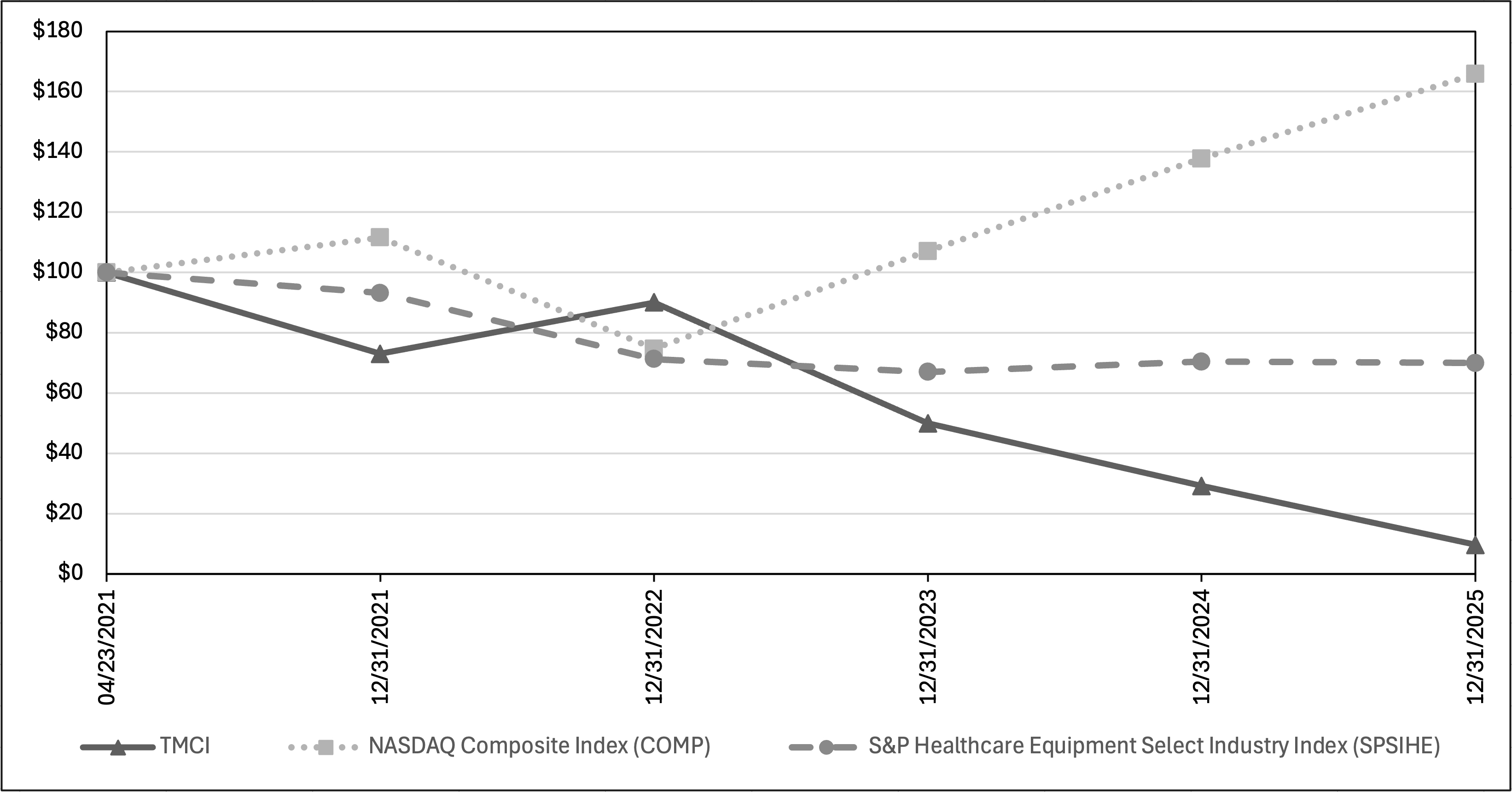
Item 6. [Reserved]
Item 7. Management's Discussion and Analysis of Financial Condition and Results of Operations.
You should read the following discussion and analysis of our financial condition and results of operations together with our financial statements and related notes thereto included elsewhere in this Annual Report. This discussion and other parts of this Annual Report contain forward-looking statements that involve risks and uncertainties, such as statements of our plans, objectives, expectations and intentions that are based on the beliefs of our management, as well as assumptions made by, and information currently available to, our management. Our actual results could differ materially from those discussed in these forward-looking statements. Factors that could cause or contribute to such differences include, but are not limited to, those discussed in the section titled "Risk Factors." Please also see the section titled "Special Note Regarding Forward-Looking Statements."
Overview
We are a medical technology company with the goal of advancing the standard of care for the surgical management of bunion and related midfoot deformities. Bunions are complex 3-dimensional deformities that originate from an unstable joint in the middle of the foot and affect approximately 67 million Americans, of which we estimate 1.1 million are annual surgical candidates. We have pioneered and patented the Lapiplasty 3D Bunion Correction System—a combination of instruments, implants and surgical methods designed to surgically correct all three planes of the bunion deformity and secure the unstable joint, addressing the root cause of the bunion, and helping patients get back to their active lifestyles. To further support the needs of surgeons and bunion patients, we offer the Adductoplasty Midfoot Correction System, designed for reproducible surgical correction of the midfoot, two systems for minimally invasive osteotomy procedures, namely the Nanoplasty 3D Minimally Invasive Bunion Correction System and the Percuplasty Percutaneous 3D Bunion Correction System, and the SpeedMTP System for great toe fusions. We continue to expand our footprint in the marketplace by extending our SpeedPlate rapid compression implant platform to new applications, as well as providing surgeons with advanced digital solutions with our IntelliGuide patient specific, pre-op planning and cut guide technology. With our Lapiplasty System, new osteotomy systems, and other complementary products, we are continuing to execute our strategy of becoming a comprehensive bunion solutions company and supporting further penetration into the bunion market opportunity. See the "Innovation and Growth" section below and the "Our Solutions" section in Item 1 above for more information on our new products.
We were formed in 2013, and since receiving 510(k) clearance for the Lapiplasty System in March 2015, we have expanded our bunion related products in the United States. We market and sell our products to physicians, surgeons, ambulatory surgery centers, hospitals and stocking distributors. Our procedures can be performed in either hospital outpatient or ambulatory surgery centers settings and utilize existing, well-established reimbursement codes. We currently market and sell our products through a combination of a direct employee sales force and independent sales agencies and stocking distributors in the United States. As of December 31, 2025, we had a field fleet of 297 team members. The field fleet includes our direct employee sales force, market development managers, and sales management, and an estimate of individuals from independent sales agencies and stocking distributors focused on marketing and selling our products. Our direct employee sales force generated 80% of revenues in 2025. As of December 31, 2025, the number of active surgeons was 3,337 up from 3,135, an increase of 202 or 6% from the prior year. We define the number of active surgeons as the number of surgeons that performed at least one procedure using one of our systems in the trailing twelve-month period.
As of December 31, 2025, we had cash and cash equivalents of $10.7 million and marketable securities of $37.7 million available for sale to fund operations, an accumulated deficit of $249.0 million, and $60.0 million of principal outstanding under our term loan.
Economic Environment
While gross domestic product is currently expected to expand in 2026, there is continuing uncertainty in the macro-economic environment. Inflation, recession fears, reduced consumer confidence, higher insurance deductibles and other costs, and other adverse economic conditions have negatively impacted, and may continue to negatively impact, consumer demand for elective foot and ankle surgeries. While we continuously work with suppliers to mitigate higher costs and continue to invest in our direct sales channel, focused surgeon education training, and product innovations to build demand for our products, we expect these macro-economic challenges to continue for the foreseeable future, which have impacted and likely will continue to impact the demand for our products and our results of operations.
We believe that our financial performance has depended, and in the foreseeable future will continue to depend, on many factors, including macro-economic conditions as described above, those described below, those noted in the section titled "Special Note Regarding Forward-Looking Statements" and in the section titled "Risk Factors." Before we launched our flagship Lapiplasty System, there were no other products in the market that provided a 3D solution and specialized procedural instrumentation for traditionally freehand, difficult Lapidus surgeries.
Increased Competition, Procedure Preferences and Setting of Care Changes
This allowed us to capitalize on our pioneering technology and grow our market share quickly. Since we launched the Lapiplasty System, we have faced increasing competition from large, mid-sized and small companies that have launched their own Lapidus products. We are also experiencing a shift in patient and surgeon preferences for treating less severe bunions through minimally invasive osteotomy solutions as well as MTP fusions, with competitive products already addressing these types of surgery. Another trend is a shift in where bunion surgeries are performed from hospitals to ambulatory surgery centers, which receive lower procedure reimbursement rates and may be part of IDNs that have established relationships with large orthopaedic companies. These trends have negatively impacted, and may continue to negatively impact, our growth rates, market share, and results of operations. To meet the shifting preferences for treating mild to moderate bunions, we have introduced new bunion systems, including two minimally invasive osteotomy systems and a great toe fusion system. While the adoption of these new systems is increasing, we generally sell them at lower average selling prices than our Lapiplasty System. To the extent we lose market share or experience further declines in sales of our Lapiplasty System, and we are unable to sufficiently increase sales of our new bunion systems to offset such declines, our revenues and results of operations will be adversely affected. In addition, our customer mix initiatives, primarily the use of stocking distributors in 2025, and advance purchases by hospitals and surgery centers may affect both revenue growth and gross margins in future periods. Furthermore, we face extensive competition, and new product introductions in the Lapidus, great toe fusion and minimally invasive osteotomy markets may adversely impact our growth rates, market share and results of operations.
Innovation and Growth
We expect to continue to focus on long-term revenue growth through investments in our business and new products. In sales and marketing, we have dedicated meaningful resources to building a sales force and management team to support our future growth and to providing bunion-focused surgeon training and patient-focused outreach and education.
In research and development, our employee team and surgeon consultants are continually working on next-generation innovations for the surgical correction of bunions and other conditions that often present with bunions. Their work has resulted in the launch of a suite of new products in the past two years, including the following: (1) the Nanoplasty and Percuplasty Systems, which are minimally-invasive 3D osteotomy systems; (2) IntelliGuide PSI Cut Guides for Lapiplasty and Adductoplasty Procedures, which are cut guides created specifically for an individual patient’s foot anatomy; (3) the Micro-Lapiplasty System, which is designed to allow the Lapiplasty Procedure to be performed through a minimally-invasive 2cm incision; (4) the Mini-Adductoplasty System, which is designed to allow the Adductoplasty midfoot correction procedure to be performed through an approximately 50% smaller incision; (5) the SpeedMTP Rapid Compression Implant, a specialized implant for addressing bunions through MTP fusions; (6) new SpeedPlate configurations, including the SpeedAkin implant and the SpeedPlate Micro-Quad implant; and (7) single use osteotomes, including the FeatherRasp Rapid Bone Contouring Tool, the GreatRelease Rapid MTP Release Instrument, Akinator Single-cut Akin Wedge Osteotomy Tool, and Sterile CornerChisel Instrument. We expect to release other new solutions in 2026, including the Lapiplasty Lightning Next Generation Instrumentation designed to further increase the precision and speed of the Lapiplasty Procedure, the SpeedTMT Rapid Compression Implant, which combines our SpeedPlate and FastPitch technologies in a dorsal fixation option for TMT fusions, and Percuplasty SuperBite Screws, which are self-drilling beveled compression screws of different sizes designed for use in other foot fusions.
Intellectual Property Strategy
We actively seek to protect the technology, inventions, and improvements that we consider important to our business using patents, trade secrets, trademarks and copyrights in the United States and foreign markets. As of December 31, 2025, our patent portfolio included 95 granted U.S. patents, with an additional 39 granted patents worldwide and over 185 pending patent applications. In keeping with our strategy of protecting our intellectual property rights, on October 14, 2024, we filed a lawsuit against Stryker Corporation and its subsidiary Wright Medical Technology, Inc. (collectively, "Stryker") alleging infringement of 9 patents related to our innovative Lapiplasty 3D Bunion Correction technologies and unfair competition. The suit was filed in the United States District Court for the District of New Jersey and seeks injunctive relief and damages. In addition, on May 12, 2025, we filed a lawsuit against Zimmer Biomet Holdings, Inc. and Paragon 28, Inc. (collectively, "ZB") alleging infringement of 4 patents related to our innovative Lapiplasty 3D Bunion Correction technologies. The suit was filed in the United States District Court for the District of Delaware and seeks injunctive relief and damages. On August 5, 2025, we filed an amended complaint alleging infringement of an additional patent.
Market Share Growth
The growth of our business depends on our ability to gain broader acceptance of our proprietary procedures and systems by successfully marketing and distributing these products. While surgeon adoption of our products and procedures remains critical to supporting revenue growth, hospital and ambulatory surgery center facility approvals are necessary for existing and future surgeon customers to access our products. To facilitate greater access to our products and support future sales growth, we intend to continue educating hospitals and facility administrators on the differentiated benefits associated with our procedures and systems, supported by our robust portfolio of clinical data on our existing procedures and additional clinical data we expect to develop on our new products. To continue to build our market share, in 2025, we added new commercial and sales leadership as well as experienced foot and ankle sales representatives to our team. While we have experienced overall increases in bunion procedure kit sales and in our market share, our flagship Lapiplasty System is expected to contribute less to our market share growth in future quarters, which could result in reduced revenues and impact our liquidity if product sales from our new bunion systems do not increase sufficiently to offset the decline in sales of the Lapiplasty System. If we are unable to successfully continue to commercialize our procedures and systems, we may not be able to generate sufficient revenue to achieve or sustain profitability.
Seasonality
We have experienced and expect to continue to experience seasonality in our business, with higher sales volumes in the fourth calendar quarter, historically accounting for approximately 30 to 35% of full year revenues, and lower sales volumes in subsequent calendar quarters. Our sales volumes in the fourth quarter tend to be higher as many patients elect to have surgery after meeting their annual deductible and having time to recover over the winter holidays. Our sales volumes in subsequent first calendar quarters also tend to be lower versus the prior year fourth quarters as a result of adverse weather and by resetting annual patient healthcare insurance plan deductibles, both of which may cause patients to delay elective procedures; however, in some years the first quarter may benefit from additional sales volumes when high patient demand for surgeries in the fourth quarter cannot be fully accommodated and those surgical procedures are rolled over into the first quarter. In addition to the seasonality noted above, we generally expect lower sales volumes in the second and third quarters than throughout the rest of the year as elective procedures generally decline during the spring and summer months.
Coverage and Reimbursement
Hospitals, ambulatory surgery centers and surgeons that purchase or use our products generally rely on third-party payors to reimburse for all or part of the costs and fees associated with procedures using our products. As a result, sales of our products depend, in part, on the extent to which the procedures using our products are covered by third-party payors, including government programs such as Medicare and Medicaid, private insurance plans and managed care programs. Based on historical claims data, more than 60% of all bunion surgical cases are paid by private payors.
Medicare payment rates to hospital outpatient departments are set under the Medicare hospital outpatient prospective payment system, which groups clinically similar hospital outpatient procedures and services with similar costs to ambulatory payment classifications ("APCs"). Each APC is assigned a single lump sum payment rate, which includes payment for the primary procedure as well as any integral, ancillary, and adjunctive services. The primary current procedure terminology ("CPT") codes for the Lapiplasty Procedure, CPT 28297 and CPT 28740, are grouped under APC 5115 and APC 5114, respectively. For Lapiplasty Procedures in which fusion is performed on multiple tarsometatarsal ("TMT") joints, CPT 28730 applies and is classified under APC 5115. For Adductoplasty Procedures in which fusion is performed on multiple TMT joints, either CPT 28730 or CPT 27835 applies and are classified under APC 5115. For the Nanoplasty and Percuplasty Procedures, CPT 28306 applies and are classified under APC 5114. For MTP fusions using the SpeedMTP implant or our other plates, CPT 28750 applies and are classified under APC 5114.
Components of Our Results of Operations
Revenue
We currently generate revenue from the sale of our bunion implant kit systems, single-use sterile instruments, and other complementary products. Our systems bring together single-use implant kits, reusable instrument trays, and surgical techniques. We sell the kits and single-use instruments and other products to hospitals, ambulatory surgery centers, and stocking distributors in the United States primarily through a network of employee sales representatives and independent sales agencies.
Cost of Goods Sold
Cost of goods sold consists primarily of direct costs for the purchase of our products from third-party manufacturers. Cost of goods sold also includes royalties, overhead, shipping costs, tariffs, sterilization, product testing, and packaging. We expense all inventory provisions for excess, obsolete, and field losses as cost of goods sold. We evaluate the carrying value of our inventories in relation to historical sales, current inventory levels, and consideration of the life cycle of the product. A significant decrease in demand or development of products could result in an increase in the amount of excess or obsolete inventory on hand, which could lead to additional provisions.
Gross Profit and Gross Margin
We calculate gross profit as revenue less cost of goods sold, and gross margin as gross profit divided by revenue. Our gross margin has been and will continue to be affected by a variety of factors, primarily average selling prices, production, and ordering volumes, change in mix of customers, third-party manufacturing costs and cost-reduction strategies.
Operating Expenses
Sales and Marketing
Sales and marketing expenses consist primarily of compensation for personnel, including salaries, bonuses, benefits, sales commissions and share-based compensation, related to selling and marketing functions, surgical instrument expense, physician education programs, training, shipping costs related to sending products to our sales representatives, travel expenses, marketing initiatives including our direct-to-consumer outreach program and advertising, market research and analysis and conferences and trade shows.
Research and Development
Research and development ("R&D") expenses consist primarily of engineering, product development, clinical studies to develop and support our products, regulatory expenses, and other costs associated with products and technologies that are in development. These expenses include compensation for personnel, including salaries, bonuses, benefits and share-based compensation, supplies, consulting, prototyping, testing, materials, travel expenses, depreciation, and allocated facilities-related expenses.
General and Administrative
General and administrative expenses consist primarily of compensation for personnel, including salaries, bonuses, benefits, and share-based compensation, related to finance, information technology, legal and human resource functions, as well as professional services fees (including legal, audit and tax fees), insurance costs, general corporate expenses, and allocated facilities-related expenses.
Interest Income
Interest income consists of interest earned on our money market funds and marketable securities.
Interest Expense
Interest expense consists of interest incurred and amortization of debt discount and issuance costs related to our term loan and revolving debt facility.
Results of Operations
Comparison of the years ended December 31, 2025 and 2024
The following table summarizes our results of operations for the periods indicated ($ in thousands):
|
|
|
|
|
|
|
|
|
|
|
|
|
|
|
|
|
|
|
|
Year Ended December 31, |
|
|
Change |
|
|
2025 |
|
|
2024 |
|
|
Amount |
|
|
% |
Revenue |
|
$ |
212,690 |
|
|
$ |
209,357 |
|
|
$ |
3,333 |
|
|
|
1.6 |
|
% |
Cost of goods sold |
|
|
42,938 |
|
|
|
41,093 |
|
|
|
1,845 |
|
|
|
4.5 |
|
% |
Gross profit |
|
|
169,752 |
|
|
|
168,264 |
|
|
|
1,488 |
|
|
|
0.9 |
|
% |
Operating expenses |
|
|
|
|
|
|
|
|
|
|
|
|
|
Sales and marketing |
|
|
140,880 |
|
|
|
147,643 |
|
|
|
(6,763 |
) |
|
|
(4.6 |
) |
% |
Research and development |
|
|
20,282 |
|
|
|
20,589 |
|
|
|
(307 |
) |
|
|
(1.5 |
) |
% |
General and administrative |
|
|
62,744 |
|
|
|
55,720 |
|
|
|
7,024 |
|
|
|
12.6 |
|
% |
Total operating expenses |
|
|
223,906 |
|
|
|
223,952 |
|
|
|
(46 |
) |
|
* |
|
% |
Loss from operations |
|
|
(54,154 |
) |
|
|
(55,688 |
) |
|
|
1,534 |
|
|
|
(2.8 |
) |
% |
Interest income |
|
|
2,777 |
|
|
|
4,877 |
|
|
|
(2,100 |
) |
|
|
(43.1 |
) |
% |
Interest expense |
|
|
(5,320 |
) |
|
|
(5,256 |
) |
|
|
(64 |
) |
|
|
1.2 |
|
% |
Debt extinguishment loss |
|
|
(2,737 |
) |
|
|
— |
|
|
|
(2,737 |
) |
|
* |
|
% |
Other income, net |
|
|
432 |
|
|
|
324 |
|
|
|
108 |
|
|
|
33.3 |
|
% |
Other non-operating income (expense), net |
|
|
(4,848 |
) |
|
|
(55 |
) |
|
|
(4,793 |
) |
|
* |
|
% |
Net loss |
|
$ |
(59,002 |
) |
|
$ |
(55,743 |
) |
|
$ |
(3,259 |
) |
|
|
5.8 |
|
% |
*Not meaningful
Revenue. Revenue increased by $3.3 million, or 1.6%, in the year ended December 31, 2025, as compared to 2024. The increase was primarily driven by an increase in the number of bunion procedure kits sold, partially offset by lower average selling prices of our newest bunion procedure kits. While the number of bunion procedure kits sold are increasing overall, our flagship Lapiplasty System is experiencing lower sales primarily due to evolving surgeon preferences for minimally invasive osteotomy procedures, competition, and lower patient demand for elective bunion surgery related to macroeconomic conditions. Revenue for the year ended December 31, 2025 included $13.0 million in sales to stocking distributors, a majority of which was attributable to initial stocking orders during the first three quarters of 2025, compared to no stocking distributor sales during 2024.
Cost of Goods Sold, Gross Profit and Gross Margin. Cost of goods sold increased by $1.8 million, or 4.5%, in the year ended December 31, 2025, as compared to 2024. The increase in cost of goods sold was primarily due to a $1.1 million increase in inventory provisions and a $1.0 million increase in direct costs of goods sold resulting from increased sales, partially offset by a $0.5 million decrease in allocations of payroll and related costs. Gross profit increased $1.5 million, or 0.9%, as compared to the same period in 2024, due to increased sales. Gross profit margin for the year ended December 31, 2025 decreased from 80.4% to 79.8%, as compared to the same period in 2024, primarily due to lower margin sales to stocking distributors and an increase in inventory provisions, partially offset by decreases in allocations of payroll and related costs and royalty rates.
Sales and Marketing Expenses. Sales and marketing expenses decreased by $6.8 million, or 4.6%, in the year ended December 31, 2025, as compared to 2024. Sales and marketing expenses decreased due to an $8.2 million reduction in direct to consumer advertising costs and a $6.8 million decrease in payroll and related costs primarily from optimizing the size and structure of our direct employee sales force, partially offset by a $3.4 million increase for surgeon training and clinical-related expenses, a $1.9 million increase in sales commissions, and a $1.7 million increase in surgical instrument expense due to an increase in volume of surgical instruments.
Research and Development Expenses. Research and development expenses decreased by $0.3 million, or 1.5%, in the year ended December 31, 2025, as compared to 2024. The decrease in research and development expenses was due to a $0.5 million decrease in compensation expense related to the milestone obligation for RPM-3D that was incurred in 2024, but not in 2025, a $0.4 million decrease in product testing and validation costs, and a $0.3 million decrease in purchases of prototypes, partially offset by a $1.0 million increase in payroll and related costs resulting from increased headcount of R&D personnel.
General and Administrative Expenses. General and administrative expenses increased by $7.0 million, or 12.6%, in the year ended December 31, 2025, as compared to 2024.
The increase in general and administrative expenses was primarily related to a $5.4 million increase in legal fees primarily driven by ongoing litigation matters and a $4.3 million increase in payroll and related costs, including higher stock compensation expense, partially offset by a $2.2 million decrease in the provision for allowance for credit losses as compared to 2024 that included a $2.1 million write-off of receivables due from a customer that filed bankruptcy in the second quarter of 2024, and a decrease of $1.3 million in compensation expense related to the milestone obligation for RPM-3D that was incurred in 2024 but not in 2025.
Interest Income. Interest income decreased by $2.1 million, or 43.1% in 2025 as compared to 2024. The decrease in interest income was primarily due to lower cash balances invested in marketable securities in the current year and slightly lower interest rates during 2025.
Debt Extinguishment Loss. Debt extinguishment loss increased by $2.7 million for the year ended December 31, 2025, as compared to the same period of 2024, due to our refinancing during the fourth quarter of 2025.
For the comparison of the results of operations for the years ended December 31, 2024 and 2023, refer to our Annual Report on Form 10-K, for the year ended December 31, 2024, as filed with the U.S. Securities and Exchange Commission on February 27, 2025, in Part II, Item 7. "Management's Discussion and Analysis of Financial Condition and Results of Operations."
Liquidity and Capital Resources
Overview
Before our IPO, our primary sources of capital were private placements of common stock and convertible preferred stock, debt financing agreements and revenue from the sale of our products. In April 2021, we received net proceeds of $107.6 million from our IPO. On February 10, 2023, we received net proceeds of $107.5 million from a follow-on public offering of our common stock.
In December 2025, we entered into a five year $175.0 million senior secured loan arrangement for a term loan and a revolving credit facility. At the loan closing, we borrowed $60.0 million under tranche one of the term loan. The remaining tranches provide up to an additional $65.0 million in borrowing capacity, of which $55.0 million is subject to the achievement of certain revenue objectives.
The revolving loan agreement currently provides $30.0 million in borrowing capacity with the ability to request two additional $10.0 million increases for a total of $50.0 million. The amount available is based on a borrowing base calculation determined by our accounts receivable and inventory assets.
The term loan proceeds were primarily used to repay $50.0 million under the term loan and $4.0 million under the revolving loan facilities with entities affiliated with MidCap Financial Trust ("MidCap").
As of December 31, 2025, we had cash and cash equivalents of $10.7 million and marketable securities of $37.7 million available for sale, an accumulated deficit of $249.0 million, and $60.0 million of principal outstanding under our new term loan. We believe that our existing cash and cash equivalents, marketable securities, available debt borrowings and expected revenues will be sufficient to meet our capital requirements and fund our operations for at least twelve months from the date of issuance of these financial statements. We may be required or decide to raise additional debt or equity financing to support further growth of our operations.
Funding Requirements
We use our cash, marketable securities, and revenues to fund our operations, which primarily include the costs of manufacturing our products, capital expenditures, as well as our operating expenses. The timing and amount of our operating and capital expenditures and use of available funding will depend on many factors, including:
•
the degree and rate of market acceptance of our products;
•
the scope and timing of our investment in our commercial infrastructure and sales force;
•
the costs of our ongoing commercialization activities including product sales, marketing, manufacturing, and distribution;
•
the success of competitors and their products, emergence of new competing technologies or other adverse market developments; the scope of our marketing efforts, including the degree to which we utilize direct to consumer campaigns;
•
the costs of filing, prosecuting, defending and enforcing any patent claims and other intellectual property rights, including enforcing our intellectual property rights against infringing products or technologies or enforcing contractual rights against parties breaching agreements with us, including the litigation proceedings we initiated against Stryker and ZB;
•
the research and development activities we intend to undertake to improve the Lapiplasty System and other products, to commercialize PSI technologies, to gain share in the minimally invasive osteotomy market, and to develop or acquire additional products;
•
our need to implement additional infrastructure and internal systems;
•
shifts in the surgical setting where bunion surgeries are performed and the pricing and reimbursement sensitivity, contract restrictions, IDN, GPO and other established relationships, and decision-making processes of the surgical facility;
•
the effect of softening consumer sentiment, higher health insurance and other costs, inflation, interest rate changes, evolving or increased tariffs, geopolitical tensions, changes in trade policy or global trade disruptions and other general economic conditions on our operations and business;
•
the ability of customers to pay us for our products, including stocking distributors which generally have longer payment terms than hospital and ambulatory surgery center customers;
•
the ability to obtain adequate supplies of materials and components for our products, including from single-source suppliers;
•
any product liability or other lawsuits related to our products;
•
the expenses needed to attract and retain skilled personnel; and
•
the impact of any infectious disease outbreak or natural or other disaster or event beyond our control on our business or on the healthcare industry, particularly elective surgeries where our products are used.
Based upon our current operating plan, we believe that our existing cash, cash equivalents, marketable securities, and available debt borrowings will enable us to fund our operating expenses and capital expenditure requirements for at least the next twelve months. We have based this estimate on assumptions that may prove to be wrong or that may change in the future, and we could utilize our available capital resources sooner than we expect. We may seek to raise any necessary additional capital through public or private equity offerings or debt financings, credit or loan facilities or a combination of one or more of these or other funding sources. Additional funds may not be available to us on acceptable terms or at all. If we fail to obtain necessary capital when needed on acceptable terms, or at all, we could be forced to delay, limit, reduce or terminate our product development programs, commercialization efforts, sales and marketing initiatives, or other operations. If we raise additional funds by issuing equity securities, our stockholders will suffer dilution, and the terms of any financing may adversely affect the rights of our stockholders. In addition, as a condition to providing additional funds to us, future investors may demand, and may be granted, rights superior to those of existing stockholders. Debt financing, if available, is likely to involve restrictive covenants limiting our flexibility in conducting future business activities, and in the event of insolvency, debt holders would be repaid before holders of our equity securities received any distribution of our corporate assets.
Cash Flows
The following table sets forth the primary sources and uses of cash and cash equivalents for the periods presented below (in thousands):
|
|
|
|
|
|
|
|
|
|
|
Year Ended December 31, |
|
|
|
2025 |
|
|
2024 |
|
Net cash (used in) provided by: |
|
|
|
|
|
|
Operating activities |
|
$ |
(15,970 |
) |
|
$ |
(37,167 |
) |
Investing activities |
|
|
13,251 |
|
|
|
35,375 |
|
Financing activities |
|
|
2,077 |
|
|
|
160 |
|
Net increase (decrease) in cash and cash equivalents |
|
$ |
(642 |
) |
|
$ |
(1,632 |
) |
Cash Flows from Operating Activities
Net cash used in operating activities for the year ended December 31, 2025 was $16.0 million, consisting primarily of a net loss of $59.0 million, adjusted for non-cash charges of $51.6 million and an increase in net operating assets. The non-cash charges consist primarily of $33.8 million in share-based compensation expense, $10.6 million in depreciation and amortization expense, $2.7 million in loss on extinguishment of debt, and $2.2 million in non-cash lease expense. The increase in net operating assets was primarily due to a $2.1 million increase in accounts receivable due to increased sales and stocking distributor sales with extended payment terms, a $3.8 million decrease in accounts payable due to timing of payments, a $3.2 million decrease in operating lease liabilities, and a $2.4 million decrease in accrued liabilities, partially offset by a $3.2 million decrease in inventory from 2024 levels primarily due to increased inventory levels held in 2024 in advance of the launch of our new suite of products that went to full market release in 2025. The decrease in accrued liabilities includes a $2.1 million decrease for a milestone payment related to RPM-3D.
Net cash used in operating activities for the year ended December 31, 2024 was $37.2 million, consisting primarily of a net loss of $55.7 million, adjusted for non-cash charges of $44.0 million and an increase in net operating assets. The non-cash charges consist primarily of share-based compensation expense of $30.6 million, depreciation and amortization expense of $8.4 million, provision for allowance for credit losses of $2.9 million primarily due to a $2.1 million write-off of receivables due from a significant customer that filed for bankruptcy in the second quarter 2024, and non-cash lease expense of $2.3
million, partially offset by net accretion of marketable securities of $1.1 million. The increase in net operating assets was primarily due to an increase of $10.0 million in inventories to meet demand for new products, an increase of $5.7 million in accounts receivable due to increased sales, an increase of $0.3 million to other non-current assets, a decrease of $7.9 million in accrued liabilities, a decrease of $2.5 million to operating lease liabilities, and a decrease of $1.3 million to accounts payable, which were partially offset by a $2.2 million increase to prepaid expenses and other assets. The decrease of $7.9 million in accrued liabilities consisted of a decrease of $4.2 million for milestone payments related to RPM-3D and a decrease of $3.7 million due to timing of payments.
Net cash used in operating activities for the year ended December 31, 2023 was $34.6 million, consisting primarily of a net loss of $49.5 million and an increase in net operating assets of $9.7 million, which were partially offset by non-cash charges of $24.7 million. The non-cash charges consist primarily of share-based compensation expense of $17.4 million, depreciation and amortization expense of $5.4 million and non-cash lease expense of $2.5 million, offset by amortization and accretion of marketable securities of $1.4 million. The increase in net operating assets was primarily due to an increase of $9.8 million in inventories to meet demand for new products and safety stock, an increase of $9.3 million in accounts receivable due to sales growth in 2023, and an increase of $1.2 million in prepaid expenses and other assets (excluding unsettled securities transactions), which were partially offset by a $7.5 million increase to accrued liabilities and a $3.2 million increase to accounts payable due to timing of payments and growth of our operations. The increase of $7.5 million in accrued liabilities consisted of an increase of $4.2 million due to timing of payments, and an increase of $3.3 million due to increased accrued compensation expense related to RPM-3D in the second quarter 2023.
Cash Flows from Investing Activities
Net cash provided by investing activities for the year ended December 31, 2025 was $13.3 million, consisting of $67.3 million in sales and maturities of available for sale marketable securities, partially offset by $40.6 million in purchases of available for sale marketable securities from reinvestment of cash received from maturities and $13.5 million in purchases of property and equipment. The purchases of property and equipment included $11.6 million of capitalized surgical instruments for reusable instrument trays related to new products, and $1.9 million for equipment and leasehold improvements to support the growth of our business.
Net cash provided by investing activities for the year ended December 31, 2024 was $35.4 million, consisting of $118.5 million in sales and maturities of available for sale marketable securities, partially offset by $71.6 million in purchases of available for sale marketable securities from reinvestment of cash received from maturities and $11.6 million in purchases of property and equipment. The purchases in property and equipment included $9.5 million of capitalized surgical instruments for reusable instrument trays related to new products, and $2.1 million for equipment and leasehold improvements to
support the growth of our business.
Net cash used in investing activities for the year ended December 31, 2023 was $81.3 million consisting of $169.9 million in purchases of marketable securities available for sale, $20.0 million for the acquisition of the RPM-3D assets, and $11.5 million in purchases of property and equipment, partially offset by $120.0 million in sales and maturities of marketable securities available for sale. The purchases of marketable securities were the result of cash invested from our public offering of common stock during the first quarter of 2023.
The purchases of property and equipment consisted of $5.0 million of capitalized surgical instruments for our reusable instrument trays driven by higher numbers of employee sales representatives and sales growth and $6.5 million of purchases of fixed assets and leasehold improvements primarily for our new corporate headquarters building.
Cash Flows from Financing Activities
Net cash provided by financing activities for the year ended December 31, 2025 was $2.1 million, consisting primarily of $59.3 million of net cash proceeds from the new term loan agreement with SLR Investment Corp. ("SLRIC"), $1.6 million in proceeds from insurance premium financing, and $0.5 million in proceeds from stock option exercises, partially offset by the $56.3 million repayment of the MidCap term and revolving loans, $1.2 million of debt issuance costs related to the new SLRIC borrowings, $0.9 million of shares repurchased for tax withholding from vesting of share-based compensation, and $0.9 million in payments on insurance premium financing.
Net cash provided by financing activities for the year ended December 31, 2024 was $0.2 million, consisting primarily of $0.4 million in proceeds from stock option exercises, partially offset by $0.3 million of shares repurchased for tax withholding from vesting of share-based compensation.
Net cash provided by financing activities for the year ended December 31, 2023 was $109.4 million, consisting of $107.5 million of net cash proceeds from our public offering of common stock in the first quarter of 2023 and $1.9 million from the exercise of stock options.
Royalty Agreements
We recognized royalties expense of $6.4 million and $6.8 million for the years ended December 31, 2025 and 2024, respectively. For the years ended December 31, 2025 and 2024, the aggregate royalty rate was 3.0% and 3.2%, respectively. Each of the royalty agreements with our surgeon consultants prohibits the payment of royalties on products sold to entities and/or individuals with whom any of the surgeon consultants is affiliated.
Operating Lease
We have commitments for future payments related to our corporate headquarters office located in Ponte Vedra, Florida. We entered into a 10-year lease in February 2022 for our headquarters which expires in July 2032. Lease payments comprise the base rent plus operating costs which include taxes, insurance, and common area maintenance. We also have commitments for future payments related to our former headquarters which expire in April 2026 and have subleased this space for the remainder of our lease term. The remaining lease obligations are $20.0 million under these leases as of December 31, 2025.
Critical Accounting Policies and Estimates
Management’s discussion and analysis of our financial condition and results of operations is based on our financial statements, which have been prepared in accordance with U.S. generally accepted accounting principles. The preparation of these financial statements requires us to make estimates and assumptions for the reported amounts of assets, liabilities, revenue, expenses, and related disclosures. Our estimates are based on our historical experience and on various other factors that we believe are reasonable under the circumstances, the results of which form the basis for making judgments about the carrying value of assets and liabilities that are not readily apparent from other sources. Actual results may differ from these estimates under different assumptions or conditions, and any such differences may be material.
While our significant accounting policies are more fully described in Note 2, "Summary of Significant Accounting Policies," of the Notes to Financial Statements included in this Annual Report, we believe the following discussion addresses our most critical accounting policies, which are those that are most important to our financial condition and our results of operations and require our most difficult, subjective and complex judgments.
Stock-Based Compensation
We account for stock-based compensation arrangements at fair value. We determine the fair value on the grant date for stock options using the Black-Scholes model and performance-based restricted stock unit ("PSU") awards using a Monte Carlo valuation model.
The fair value of these awards is recognized over the period during which an award holder is required to provide services in exchange for the award, known as the requisite service period, which is typically the vesting period using the straight-line method. Stock-based compensation expense is recorded net of estimated forfeitures in our Statements of Operations and Comprehensive Loss and are adjusted to actuals as they occur. The estimated forfeiture rate is based on historical analysis of actual forfeiture rates of similar awards.
The fair value of the stock options and PSUs are locked at grant date and will not fluctuate after grant date. However, the underlying inputs to the Black-Scholes option model and the Monte Carlo valuation model may change in the future for new grants which could impact the fair value of stock-based awards granted each year and could cause compensation expense to vary in future periods.
Goodwill and Other Intangible Assets
Our goodwill represents the excess of the cost over the fair value of net assets acquired. The determination of the value of goodwill and intangibles assets arising from acquisitions requires extensive use of accounting estimates and judgments to allocate the purchase price to the fair value of net tangible and intangible assets acquired. Goodwill is not amortized and is assessed for impairment using fair value measurement techniques on an annual basis or more frequently if facts and circumstances warrant such a review. Goodwill is considered to be impaired if we determine that the carrying value of our reporting unit exceeds its respective fair value.
We have a definite-lived intangible technology asset that is reviewed for impairment upon triggering events that indicate the carrying value of the asset may not be recoverable. Recoverability is measured by a comparison of the carrying amount to future net undiscounted cash flows expected to be generated by the associated asset. If the asset's carrying value is determined to not be recoverable, the impairment to be recognized is measured by the amount by which the carrying amount exceeds the fair market value of the intangible asset. Calculating cash flows for this measurement requires us to make significant estimates and assumptions related to forecasts of future revenues, expenses and discount rates. Changes in these assumptions could have a significant impact on the fair value of the technology intangible. If such assets are determined to be impaired, the impairment to be recognized is measured by the amount by which the carrying amount exceeds the fair market value of the assets. The calculation of the fair value of the intangible assets involves Level 3 fair value measurements. Any impairment recognized could significantly impact our results of operations in the period of impairment.
Recently Issued Accounting Pronouncements
For information regarding recent accounting pronouncements and their expected impact on our future results of operations and financial condition, refer to Note 3, "Recent Accounting Pronouncements," of the Notes to Financial Statements.
Item 7A. Quantitative and Qualitative Disclosures About Market Risk
Market Risk
Our primary market risk exposures are interest rate and credit risk.
Interest Rate Risk
The primary objectives of our investment activities are to preserve principal and provide liquidity. Since our investments may be used to fund operations, we performed sensitivity testing which measures the impact on the fair market value of the investments if a hypothetical 50 basis points increase and decrease in interest rates occurred. The interest rate risk analysis assumes using an immediate and parallel shift in interest rates.
The following table presents our estimate of the impact on fair value based on the scenario discussed above (in thousands):
|
|
|
|
|
December 31, 2025 |
|
|
Change in fair value |
Fair value of marketable securities |
|
Down 50 bps |
|
Up 50 bps |
$45,495 |
|
$88 |
|
($89) |
Our outstanding term loan bears interest at a floating rate that fluctuates with the 1-Month SOFR, with a floor of 3% per annum, plus 5.05%. We have a risk to rising interest rates as there is no cap for the term loan interest rate. A 100 basis point increase in 1-Month SOFR would not result in a material impact to the fair value of the term loan.
Credit Risk
We manage our credit risk within the available-for-sale securities portfolio by maintaining a well-diversified investment portfolio that limits the investments to certain types, such as U.S. Treasury and agency securities, money market funds, commercial paper, Yankee CDs, and high credit quality asset-backed securities and corporate debt securities. In addition, the Company's investment policy requires a maximum portfolio duration of one year.
Item 8. Financial Statements and Supplementary Data
INDEX TO FINANCIAL STATEMENTS
Report of Independent Registered Public Accounting Firm
Board of Directors and Stockholders
Treace Medical Concepts, Inc.
Opinion on the financial statements
We have audited the accompanying balance sheets of Treace Medical Concepts, Inc. (a Delaware corporation) (the "Company") as of December 31, 2025 and 2024, the related statements of operations and comprehensive loss, stockholders’ equity, and cash flows for each of the three years in the period ended December 31, 2025, and the related notes and financial statement schedules included under Item 15(a) (collectively referred to as the "financial statements"). In our opinion, the financial statements present fairly, in all material respects, the financial position of the Company as of December 31, 2025 and 2024, and the results of its operations and its cash flows for each of the three years in the period ended December 31, 2025, in conformity with accounting principles generally accepted in the United States of America.
We also have audited, in accordance with the standards of the Public Company Accounting Oversight Board (United States) ("PCAOB"), the Company’s internal control over financial reporting as of December 31, 2025, based on criteria established in the 2013 Internal Control—Integrated Framework issued by the Committee of Sponsoring Organizations of the Treadway Commission ("COSO"), and our report dated February 27, 2026 expressed an unqualified opinion.
Basis for opinion
These financial statements are the responsibility of the Company’s management. Our responsibility is to express an opinion on the Company’s financial statements based on our audits. We are a public accounting firm registered with the PCAOB and are required to be independent with respect to the Company in accordance with the U.S. federal securities laws and the applicable rules and regulations of the Securities and Exchange Commission and the PCAOB.
We conducted our audits in accordance with the standards of the PCAOB. Those standards require that we plan and perform the audit to obtain reasonable assurance about whether the financial statements are free of material misstatement, whether due to error or fraud. Our audits included performing procedures to assess the risks of material misstatement of the financial statements, whether due to error or fraud, and performing procedures that respond to those risks. Such procedures included examining, on a test basis, evidence regarding the amounts and disclosures in the financial statements. Our audits also included evaluating the accounting principles used and significant estimates made by management, as well as evaluating the overall presentation of the financial statements. We believe that our audits provide a reasonable basis for our opinion.
Critical audit matters
Critical audit matters are matters arising from the current period audit of the financial statements that were communicated or required to be communicated to the audit committee and that: (1) relate to accounts or disclosures that are material to the financial statements and (2) involved our especially challenging, subjective, or complex judgments. We determined that there are no critical audit matters.
/s/ GRANT THORNTON LLP
We have served as the Company's auditor since 2018.
Jacksonville, Florida
February 27, 2026
Treace Medical Concepts, Inc.
Balance Sheets
(in thousands, except share and per share amounts)
|
|
|
|
|
|
|
|
|
|
|
December 31, |
|
|
December 31, |
|
|
|
2025 |
|
|
2024 |
|
Assets |
|
|
|
|
|
|
Current assets |
|
|
|
|
|
|
Cash and cash equivalents |
|
$ |
10,708 |
|
|
$ |
11,350 |
|
Marketable securities, short-term |
|
|
37,659 |
|
|
|
64,327 |
|
Accounts receivable, net of allowance for credit losses of $1,824 and $1,326 as of December 31, 2025 and December 31, 2024, respectively |
|
|
42,155 |
|
|
|
40,803 |
|
Inventories |
|
|
36,031 |
|
|
|
39,255 |
|
Prepaid expenses and other current assets |
|
|
5,501 |
|
|
|
5,667 |
|
Total current assets |
|
|
132,054 |
|
|
|
161,402 |
|
Property and equipment, net |
|
|
29,752 |
|
|
|
25,953 |
|
Intangible assets, net of accumulated amortization of $2,375 and $1,425 as of December 31, 2025 and December 31, 2024, respectively |
|
|
7,125 |
|
|
|
8,075 |
|
Goodwill |
|
|
12,815 |
|
|
|
12,815 |
|
Operating lease right-of-use assets |
|
|
7,614 |
|
|
|
8,442 |
|
Other non-current assets, net of allowance for credit losses of $69 and $69 as of December 31, 2025 and December 31, 2024, respectively |
|
|
1,221 |
|
|
|
407 |
|
Total assets |
|
$ |
190,581 |
|
|
$ |
217,094 |
|
Liabilities and Stockholders’ Equity |
|
|
|
|
|
|
Current liabilities |
|
|
|
|
|
|
Accounts payable |
|
$ |
6,726 |
|
|
$ |
10,522 |
|
Accrued liabilities |
|
|
5,784 |
|
|
|
7,197 |
|
Accrued commissions |
|
|
9,365 |
|
|
|
10,121 |
|
Accrued compensation |
|
|
6,331 |
|
|
|
6,575 |
|
Other liabilities |
|
|
2,429 |
|
|
|
510 |
|
Total current liabilities |
|
|
30,635 |
|
|
|
34,925 |
|
Long-term debt, net |
|
|
55,583 |
|
|
|
53,306 |
|
Operating lease liabilities, net of current portion |
|
|
13,982 |
|
|
|
15,934 |
|
Other long-term liabilities |
|
|
3,049 |
|
|
|
37 |
|
Total liabilities |
|
|
103,249 |
|
|
|
104,202 |
|
Commitments and contingencies (Note 8) |
|
|
|
|
|
|
Stockholders’ equity |
|
|
|
|
|
|
Preferred stock, $0.001 par value, 5,000,000 shares authorized as of December 31, 2025 and December 31, 2024; 0 shares issued as of December 31, 2025 and December 31, 2024 |
|
|
— |
|
|
|
— |
|
Common stock, $0.001 par value, 300,000,000 shares authorized; 64,029,378 and 62,385,101 shares issued as of December 31, 2025 and December 31, 2024, respectively |
|
|
64 |
|
|
62 |
|
Additional paid-in capital |
|
|
337,371 |
|
|
|
303,004 |
|
Accumulated deficit |
|
|
(248,992 |
) |
|
|
(189,990 |
) |
Accumulated other comprehensive income (loss) |
|
|
72 |
|
|
|
97 |
|
Treasury stock, at cost; 165,513 and 23,391 shares as of December 31, 2025 and December 31, 2024, respectively |
|
|
(1,183 |
) |
|
|
(281 |
) |
Total stockholders’ equity |
|
|
87,332 |
|
|
|
112,892 |
|
Total liabilities and stockholders’ equity |
|
$ |
190,581 |
|
|
$ |
217,094 |
|
The accompanying notes are an integral part of these financial statements.
P Treace Medical Concepts, Inc.
Statements of Operations and Comprehensive Loss
(in thousands, except share and per share amounts)
|
|
|
|
|
|
|
|
|
|
|
|
|
|
|
Year Ended December 31, |
|
|
|
2025 |
|
|
2024 |
|
|
2023 |
|
Revenue |
|
$ |
212,690 |
|
|
$ |
209,357 |
|
|
$ |
187,118 |
|
Cost of goods sold |
|
|
42,938 |
|
|
|
41,093 |
|
|
|
35,181 |
|
Gross profit |
|
|
169,752 |
|
|
|
168,264 |
|
|
|
151,937 |
|
Operating expenses |
|
|
|
|
|
|
|
|
|
Sales and marketing |
|
|
140,880 |
|
|
|
147,643 |
|
|
|
140,894 |
|
Research and development |
|
|
20,282 |
|
|
|
20,589 |
|
|
|
15,440 |
|
General and administrative |
|
|
62,744 |
|
|
|
55,720 |
|
|
|
47,031 |
|
Total operating expenses |
|
|
223,906 |
|
|
|
223,952 |
|
|
|
203,365 |
|
Loss from operations |
|
|
(54,154 |
) |
|
|
(55,688 |
) |
|
|
(51,428 |
) |
Interest income |
|
|
2,777 |
|
|
|
4,877 |
|
|
|
6,726 |
|
Interest expense |
|
|
(5,320 |
) |
|
|
(5,256 |
) |
|
|
(5,167 |
) |
Debt extinguishment loss |
|
|
(2,737 |
) |
|
|
— |
|
|
|
— |
|
Other income, net |
|
|
432 |
|
|
|
324 |
|
|
|
342 |
|
Other non-operating income (expense), net |
|
|
(4,848 |
) |
|
|
(55 |
) |
|
|
1,901 |
|
Net loss |
|
|
(59,002 |
) |
|
|
(55,743 |
) |
|
|
(49,527 |
) |
|
|
|
|
|
|
|
|
|
|
Other comprehensive income (loss) |
|
|
|
|
|
|
|
|
|
Unrealized gain (loss) on marketable securities |
|
|
(25 |
) |
|
|
(66 |
) |
|
|
190 |
|
Comprehensive loss |
|
$ |
(59,027 |
) |
|
$ |
(55,809 |
) |
|
$ |
(49,337 |
) |
|
|
|
|
|
|
|
|
|
|
Net loss per share, basic and diluted |
|
$ |
(0.93 |
) |
|
$ |
(0.90 |
) |
|
$ |
(0.81 |
) |
Weighted-average shares used in computing net loss per share, basic and diluted |
|
|
63,269,003 |
|
|
|
62,112,037 |
|
|
|
60,852,153 |
|
The accompanying notes are an integral part of these financial statements.
Treace Medical Concepts Inc.
Statements of Stockholders' Equity
(in thousands, except share amounts)
|
|
|
|
|
|
|
|
|
|
|
|
|
|
|
|
|
|
|
|
|
|
|
|
|
|
|
|
|
|
|
|
|
|
|
|
|
|
|
|
|
Accumulated |
|
|
|
|
|
|
|
|
|
|
|
|
|
|
Additional |
|
|
|
|
|
Other |
|
|
|
|
|
Total |
|
|
Common Stock |
|
|
Paid-In |
|
|
Accumulated |
|
|
Comprehensive |
|
|
Treasury |
|
|
Stockholders’ |
|
|
Outstanding Shares |
|
|
Amount |
|
|
Capital |
|
|
Deficit |
|
|
Income (Loss) |
|
|
Stock |
|
|
Equity |
|
Balances at January 1, 2023 |
|
55,628,208 |
|
|
$ |
55 |
|
|
$ |
145,221 |
|
|
$ |
(84,720 |
) |
|
$ |
(27 |
) |
|
$ |
— |
|
|
$ |
60,529 |
|
Issuance of common stock upon exercise of stock options |
|
495,337 |
|
|
|
1 |
|
|
|
1,868 |
|
|
|
— |
|
|
|
— |
|
|
|
— |
|
|
|
1,869 |
|
Issuance of common stock for vesting of restricted stock units |
|
149,919 |
|
|
|
— |
|
|
|
— |
|
|
|
— |
|
|
|
— |
|
|
|
— |
|
|
|
— |
|
Share-based compensation expense |
|
— |
|
|
|
— |
|
|
|
17,363 |
|
|
|
— |
|
|
|
— |
|
|
|
— |
|
|
|
17,363 |
|
Issuance of common stock from public offering, net of issuance costs and underwriting discount of $7.5 million |
|
5,476,190 |
|
|
|
6 |
|
|
|
107,521 |
|
|
|
— |
|
|
|
— |
|
|
|
— |
|
|
|
107,527 |
|
Net loss |
|
— |
|
|
|
— |
|
|
|
— |
|
|
|
(49,527 |
) |
|
|
— |
|
|
|
— |
|
|
|
(49,527 |
) |
Unrealized gain (loss) on available-for-sale marketable securities |
|
— |
|
|
|
— |
|
|
|
— |
|
|
|
— |
|
|
|
190 |
|
|
|
— |
|
|
|
190 |
|
Shares directly withheld from employees for tax payment |
|
— |
|
|
|
— |
|
|
|
— |
|
|
|
— |
|
|
|
— |
|
|
|
(13 |
) |
|
|
(13 |
) |
Balances at December 31, 2023 |
|
61,749,654 |
|
|
$ |
62 |
|
|
$ |
271,973 |
|
|
$ |
(134,247 |
) |
|
$ |
163 |
|
|
$ |
(13 |
) |
|
$ |
137,938 |
|
Issuance of common stock upon exercise of stock options |
|
292,217 |
|
|
|
— |
|
|
|
428 |
|
|
|
— |
|
|
|
— |
|
|
|
— |
|
|
|
428 |
|
Issuance of common stock for vesting of restricted stock units |
|
342,012 |
|
|
|
— |
|
|
|
— |
|
|
|
— |
|
|
|
— |
|
|
|
— |
|
|
|
— |
|
Share-based compensation expense |
|
— |
|
|
|
— |
|
|
|
30,603 |
|
|
|
— |
|
|
|
— |
|
|
|
— |
|
|
|
30,603 |
|
Net loss |
|
— |
|
|
|
— |
|
|
|
— |
|
|
|
(55,743 |
) |
|
|
— |
|
|
|
— |
|
|
|
(55,743 |
) |
Unrealized gain (loss) on available-for-sale marketable securities |
|
— |
|
|
|
— |
|
|
|
— |
|
|
|
— |
|
|
|
(66 |
) |
|
|
— |
|
|
|
(66 |
) |
Shares directly withheld from employees for tax payment |
|
(22,173 |
) |
|
|
— |
|
|
|
— |
|
|
|
— |
|
|
|
— |
|
|
|
(268 |
) |
|
|
(268 |
) |
Balances at December 31, 2024 |
|
62,361,710 |
|
|
$ |
62 |
|
|
$ |
303,004 |
|
|
$ |
(189,990 |
) |
|
$ |
97 |
|
|
$ |
(281 |
) |
|
$ |
112,892 |
|
Issuance of common stock upon exercise of stock options |
|
356,446 |
|
|
|
1 |
|
|
|
545 |
|
|
|
— |
|
|
|
— |
|
|
|
— |
|
|
|
546 |
|
Issuance of common stock for vesting of restricted stock units |
|
1,287,831 |
|
|
|
1 |
|
|
|
(1 |
) |
|
|
— |
|
|
|
— |
|
|
|
— |
|
|
|
— |
|
Share-based compensation expense |
|
— |
|
|
|
— |
|
|
|
33,823 |
|
|
|
— |
|
|
|
— |
|
|
|
— |
|
|
|
33,823 |
|
Net loss |
|
— |
|
|
|
— |
|
|
|
— |
|
|
|
(59,002 |
) |
|
|
— |
|
|
|
— |
|
|
|
(59,002 |
) |
Unrealized gain (loss) on available-for-sale marketable securities |
|
— |
|
|
|
— |
|
|
|
— |
|
|
|
— |
|
|
|
(25 |
) |
|
|
— |
|
|
|
(25 |
) |
Shares directly withheld from employees for tax payment |
|
(142,122 |
) |
|
|
— |
|
|
|
— |
|
|
|
— |
|
|
|
— |
|
|
|
(902 |
) |
|
|
(902 |
) |
Balances at December 31, 2025 |
|
63,863,865 |
|
|
$ |
64 |
|
|
$ |
337,371 |
|
|
$ |
(248,992 |
) |
|
$ |
72 |
|
|
$ |
(1,183 |
) |
|
$ |
87,332 |
|
The accompanying notes are an integral part of these financial statements.
Treace Medical Concepts, Inc.
Statements of Cash Flows
(in thousands)
|
|
|
|
|
|
|
|
|
|
|
|
|
|
|
Year Ended December 31, |
|
|
|
2025 |
|
|
2024 |
|
|
2023 |
|
Cash flows from operating activities |
|
|
|
|
|
|
|
|
|
Net loss |
|
$ |
(59,002 |
) |
|
$ |
(55,743 |
) |
|
$ |
(49,527 |
) |
Adjustments to reconcile net loss to net cash provided by (used in) operating
activities |
|
|
|
|
|
|
|
|
|
Depreciation and amortization expense |
|
|
10,623 |
|
|
|
8,419 |
|
|
|
5,352 |
|
Provision for allowance for credit losses |
|
|
834 |
|
|
|
2,947 |
|
|
|
434 |
|
Share-based compensation expense |
|
|
33,823 |
|
|
|
30,603 |
|
|
|
17,352 |
|
Non-cash lease expense |
|
|
2,222 |
|
|
|
2,349 |
|
|
|
2,461 |
|
Amortization of debt issuance costs |
|
|
292 |
|
|
|
298 |
|
|
|
297 |
|
Debt extinguishment loss |
|
|
2,737 |
|
|
|
— |
|
|
|
— |
|
Amortization (accretion) of premium (discount) on marketable securities, net |
|
|
(123 |
) |
|
|
(1,145 |
) |
|
|
(1,406 |
) |
Other, net |
|
|
1,208 |
|
|
|
538 |
|
|
|
205 |
|
Net changes in operating assets and liabilities, net of acquisitions |
|
|
|
|
|
|
|
|
|
Accounts receivable |
|
|
(2,090 |
) |
|
|
(5,687 |
) |
|
|
(9,301 |
) |
Inventory |
|
|
3,224 |
|
|
|
(10,010 |
) |
|
|
(9,848 |
) |
Prepaid expenses and other assets |
|
|
166 |
|
|
|
2,186 |
|
|
|
(1,210 |
) |
Other non-current assets |
|
|
(503 |
) |
|
|
(330 |
) |
|
|
— |
|
Operating lease liabilities |
|
|
(3,207 |
) |
|
|
(2,473 |
) |
|
|
(119 |
) |
Accounts payable |
|
|
(3,796 |
) |
|
|
(1,313 |
) |
|
|
3,167 |
|
Accrued liabilities |
|
|
(2,413 |
) |
|
|
(7,903 |
) |
|
|
7,528 |
|
Other, net |
|
|
35 |
|
|
|
97 |
|
|
|
40 |
|
Net cash provided by (used in) operating activities |
|
|
(15,970 |
) |
|
|
(37,167 |
) |
|
|
(34,575 |
) |
|
|
|
|
|
|
|
|
|
|
Cash flows from investing activities |
|
|
|
|
|
|
|
|
|
Purchases of available-for-sale marketable securities |
|
|
(40,571 |
) |
|
|
(71,579 |
) |
|
|
(169,865 |
) |
Sales and maturities of available-for-sale marketable securities |
|
|
67,339 |
|
|
|
118,547 |
|
|
|
120,024 |
|
Purchases of property and equipment |
|
|
(13,517 |
) |
|
|
(11,593 |
) |
|
|
(11,458 |
) |
Acquisition, net of cash acquired |
|
|
— |
|
|
|
— |
|
|
|
(20,000 |
) |
Net cash provided by (used in) investing activities |
|
|
13,251 |
|
|
|
35,375 |
|
|
|
(81,299 |
) |
|
|
|
|
|
|
|
|
|
|
Cash flows from financing activities |
|
|
|
|
|
|
|
|
|
Proceeds from interest bearing term debt |
|
|
59,310 |
|
|
|
— |
|
|
|
— |
|
Proceeds from insurance premium financing |
|
|
1,553 |
|
|
|
— |
|
|
|
— |
|
Debt issuance costs |
|
|
(1,199 |
) |
|
|
— |
|
|
|
— |
|
Payments on interest bearing term and revolving debt |
|
|
(56,315 |
) |
|
|
— |
|
|
|
— |
|
Payments on insurance premium financing |
|
|
(916 |
) |
|
|
— |
|
|
|
— |
|
Proceeds from issuance of common stock from public offering, net of issuance costs and underwriting discount of $7.5 million |
|
|
— |
|
|
|
— |
|
|
|
107,527 |
|
Proceeds from exercise of employee stock options |
|
|
546 |
|
|
|
428 |
|
|
|
1,869 |
|
Taxes from withheld shares |
|
|
(902 |
) |
|
|
(268 |
) |
|
|
(13 |
) |
Net cash provided by (used in) financing activities |
|
|
2,077 |
|
|
|
160 |
|
|
|
109,383 |
|
Net increase (decrease) in cash and cash equivalents |
|
|
(642 |
) |
|
|
(1,632 |
) |
|
|
(6,491 |
) |
Cash and cash equivalents at beginning of period |
|
|
11,350 |
|
|
|
12,982 |
|
|
|
19,473 |
|
Cash and cash equivalents at end of period |
|
$ |
10,708 |
|
|
$ |
11,350 |
|
|
$ |
12,982 |
|
|
|
|
|
|
|
|
|
|
|
Supplemental disclosure of cash flow information |
|
|
|
|
|
|
|
|
|
Cash paid for interest |
|
$ |
4,997 |
|
|
$ |
4,955 |
|
|
$ |
5,167 |
|
Operating lease right-of-use asset and lease liability adjustment due to lease incentive |
|
$ |
— |
|
|
$ |
8 |
|
|
$ |
(22 |
) |
Noncash investing activities |
|
|
|
|
|
|
|
|
|
Unrealized (gains) losses, net on marketable securities |
|
$ |
25 |
|
|
$ |
66 |
|
|
$ |
(190 |
) |
Unsettled matured marketable security and receivable from broker |
|
$ |
— |
|
|
$ |
— |
|
|
$ |
3,000 |
|
Noncash portion of internally developed software |
|
$ |
— |
|
|
$ |
— |
|
|
$ |
(11 |
) |
Noncash financing activities |
|
|
|
|
|
|
|
|
|
Legal cost financing |
|
$ |
1,108 |
|
|
$ |
— |
|
|
$ |
— |
|
The accompanying notes are an integral part of these financial statements.
1. Formation and Business of the Company
The Company
Treace Medical Concepts, Inc. (the "Company") is a medical technology company with the goal of advancing the standard of care for the surgical management of bunion and related midfoot deformities. The Company has pioneered and patented the Lapiplasty® 3D Bunion Correction System—a combination of instruments, implants, and surgical methods designed to surgically correct all three planes of the bunion deformity and secure the unstable joint, addressing the root cause of the bunion and helping patients get back to their active lifestyles. To further support the needs of bunion patients, the Company has expanded its product offerings to continue to execute its strategy of becoming a comprehensive bunion solutions company and further penetrating the bunion market opportunity. The Company operates from its corporate headquarters located in Ponte Vedra, Florida.
2. Summary of Significant Accounting Policies
Basis of Presentation
The accompanying financial statements are prepared in accordance with U.S. generally accepted accounting principles ("GAAP").
The Company evaluated events or transactions that may have occurred after the balance sheet date for potential recognition or disclosure through the date the financial statements were issued. No subsequent events or transactions requiring recognition or disclosure were identified.
Use of Estimates
The preparation of financial statements in conformity with GAAP requires management to make estimates and assumptions that affect the reported amounts of assets and liabilities, the disclosure of contingent assets and liabilities at the date of the financial statements, and the reported amounts of revenues and expenses during the reporting periods. Although these estimates are based on the Company’s knowledge of current events and actions it may undertake in the future, actual results may ultimately materially differ from these estimates and assumptions.
Significant estimates and assumptions include valuation of intangible assets and goodwill, reserves and write-downs related to accounts receivable, inventories, the recoverability of long-term assets, deferred tax assets and related valuation allowances, contingencies, and stock-based compensation. The Company had no accrued contingent liabilities as of December 31, 2025 and 2024.
Business Combinations
The Company allocates the purchase consideration to the identifiable assets and liabilities acquired, including intangible assets at fair value on the date of the acquisition. The excess of the fair value of the purchase consideration over the fair value of the identifiable assets and liabilities, if any, is recorded as goodwill. During the measurement period, which is up to one year from the acquisition date, the Company may adjust initial amounts that were recognized at the acquisition date to reflect new information obtained about facts and circumstances that existed as of the acquisition date.
Determining the fair value of assets acquired and liabilities assumed requires significant judgment, including the selection of valuation methodologies that may include the income approach, the cost approach, or the market approach. Significant assumptions used in those methodologies include the timing and amounts of cash flow projections, including revenue growth rates, obsolescence rates, margins, royalty rates, counterparty risk rates, and other discount rates.
Intangibles
Definite-life intangible assets are assessed for impairment upon triggering events that indicate that the carrying value of an asset may not be recoverable. Recoverability is measured by a comparison of the carrying amount to future net undiscounted cash flows expected to be generated by the associated asset. If the asset's carrying value is determined to not be recoverable, the impairment to be recognized is measured by the amount by which the carrying amount exceeds the fair market value of the intangible assets.
Goodwill
Goodwill represents the excess of the purchase price as compared to the fair value of net assets acquired and liabilities assumed. Goodwill is not amortized but is tested for impairment annually or when indications of impairment exist. The Company can elect to qualitatively assess goodwill for impairment if it is more likely than not that the fair value of a reporting unit exceeds its carrying value.
Impairment exists when the carrying amount, including goodwill, of the reporting unit exceeds its fair value, resulting in an impairment charge for this excess (not to exceed the carrying amount of the goodwill). The Company's annual impairment testing date is July 1. The impairment, if determined, is recorded within Operating expenses in the Statements of Operations and Comprehensive Loss in the period the determination is made. There were no impairments recorded during the periods presented.
Segments
The Company is a single reportable segment entity, which is in the business of designing, manufacturing, and marketing medical devices for surgeons, ambulatory surgery centers and hospitals related to the surgical management of bunion and related midfoot deformities. The Company's chief executive officer is the chief operating decision maker ("CODM"). The CODM regularly reviews entity-wide net income and operating results compared to budget and forecast information to assess the Company's performance and to allocate resources for its single reporting segment. The measure of profit or loss is reported in the Statements of Operations and Comprehensive Loss. The measure of segment assets is reported on the Company's Balance Sheets. The Company does not have any intra-entity sales or transfers. All long-lived assets are maintained in the United States.
Cash and Cash Equivalents
The Company considers all highly liquid investments with an original or remaining maturity at the time of purchase of 90 days or less to be cash equivalents. All of the Company's cash equivalents have liquid markets and high credit ratings. The Company maintains its cash in money market funds and bank deposits, the balances of which at times may exceed federally insured limits.
Marketable Securities
The Company considers its debt securities and Yankee certificate of deposits ("Yankee CDs") to be available-for-sale securities. Available-for-sale securities are classified as cash equivalents or short-term marketable securities.
Marketable securities classified as available-for-sale are measured at fair value with temporary unrealized gains and losses reported in other comprehensive loss, and as a component of stockholders' equity (deficit) until their disposition or maturity. The Company reviews all available-for-sale securities at each period end to determine if they remain available-for-sale based on the Company's current intent and ability to sell the security if it is required to do so. Realized gains and losses from the sale of marketable securities, if any, are calculated using the specific-identification method. Premiums and discounts are amortized and accreted, respectively, using the effective interest method. Refer to Note 4, "Fair Value Measurements," for fair value disclosures for cash equivalents and short-term marketable securities.
Available-for-sale securities are subject to a periodic impairment review. The Company may recognize an impairment charge when a decline in the fair value of investments below the cost basis is determined to be other-than-temporary. In determining whether a decline in market value is other-than-temporary, various factors are considered, including the cause, duration of time and severity of the impairment, any adverse changes in the investees' financial condition and the Company's intent and ability to hold the security for a period of time sufficient to allow for an anticipated recovery in market value. Declines in fair value judged to be other-than-temporary are included in Other income, net on the Company's Statements of Operations and Comprehensive Loss. The Company has elected to exclude accrued interest receivable in its measurement of the allowance for credit losses for available-for-sale securities. The Company will cease interest accruals and reverse previously accrued interest through interest income based on management's evaluation of the facts and circumstances of each security under review. The Company did not record any other-than-temporary impairments related to marketable securities in the Company's Statements of Operations and Comprehensive Loss for the years ended December 31, 2025, 2024 and 2023.
Accounts Receivable and Allowances
Accounts receivable are generally from hospitals, ambulatory surgery centers, and stocking distributors and are stated at amounts billed less allowances for credit losses. The Company continually monitors customer payments and maintains an allowance for credit losses resulting from a customer's inability to make required payments. The Company considers factors such as historical experience, credit quality, age of the accounts receivable balances, geographic related risks and economic conditions that may affect a customer's ability to pay. Accounts receivable are written off when individual balances are no longer collectible. The Company has elected to assume that current conditions as of the balance sheet will not change for the remaining life of the asset when determining the allowance for credit losses. As of December 31, 2025, 2024, and 2023 accounts receivable were $42.2 million, $40.8 million, and $38.1 million, respectively, and are presented net of an allowance for credit losses of $1.8 million, $1.3 million, and $1.0 million, respectively. For the years ended December 31, 2025, 2024, and 2023, the Company recorded provisions for credit losses of $0.7 million, $2.9 million, and $0.4 million, respectively. The increase in provision for credit losses for the year ended December 31, 2024 is due to a write-off of receivables due from a customer that filed for bankruptcy in the second quarter of 2024.
Concentration of Credit Risk
Financial instruments that potentially subject the Company to concentrations of risk consist principally of cash, cash equivalents, marketable securities, and accounts receivable. The Company maintains its cash with established financial institutions and has exposure for balances in excess of the Federal Deposit Insurance Corporation ("FDIC") insured limits. The Company's available-for-sale securities portfolio primarily consists of U.S. treasury and agency securities, money market funds, commercial paper, Yankee CDs, high credit quality asset-backed securities and corporate debt securities. The Company's investment policy requires its available-for-sale securities to meet certain criteria including investment type, credit ratings, and a maximum portfolio duration of one year.
The Company earns revenue from the sale of its products to customers such as hospitals, ambulatory surgery centers, and stocking distributors. The Company's accounts receivable is derived from revenue earned from customers. The Company performs ongoing credit evaluations of its customers' financial condition and generally requires no collateral from its customers. At December 31, 2025 and 2024, no customer accounted for more than 10% of accounts receivable. For the years ended December 31, 2025, 2024, and 2023, there were no customers that represented 10% or more of revenue.
Leases
The Company determines whether an arrangement is or contains a lease at the inception of the arrangement and whether such a lease is classified as a financing lease or an operating lease at the commencement date of the lease. Lease liabilities and their corresponding right-of-use assets are recorded based on the present value of lease payments over the expected lease term. The Company determines the commencement date of a lease to be the date on which a lessor makes an underlying asset available for use by the Company. Leases with a term greater than one year are recognized on the Balance Sheets as Operating lease right-of-use assets, Current other liabilities (for the current portion of operating lease liabilities), and Operating lease liabilities, net of current portion. The Company has elected not to recognize right-of-use assets and lease liabilities for leases with terms of 12 months or less (short-term leases). As the interest rates implicit in lease contracts are not readily determinable, the Company utilizes its incremental borrowing rate based on the information available at the commencement date to determine the present value of lease payments. Certain adjustments to the right-of-use asset may be required for items such as initial direct costs paid, incentives received, or impairment charges if the Company determines the right-of-use asset is impaired.
The Company considers the lease term to be the non-cancelable period that the Company has the right to use the underlying asset, together with any periods where it is reasonably certain the Company will exercise an option to extend (or not terminate) the lease.
Rent expense for operating leases is recognized on a straight-line basis over the lease term and is presented in Operating expenses on the Statements of Operations and Comprehensive Loss. The Company has elected to not separate lease and non-lease components for its real estate leases and instead accounts for each separate lease component and the non-lease components associated with that lease component as a single lease component. Variable lease payments are recognized as lease expense as incurred and are recorded in Operating expenses on the Statements of Operations and Comprehensive Loss.
The Company has no finance leases as lessee or as lessor. The Company recognizes rental income for subleases of its leased property on a straight-line basis over the lease term.
Inventories
Inventories consist primarily of surgical kits and components as finished goods and are stated at the lower of cost or net realizable value. Cost is determined based on an average cost method which approximates the first-in, first-out basis and includes primarily outsourced manufacturing costs and direct manufacturing overhead costs. The Company reviews inventory for excess, obsolescence, and field losses and writes down inventory, as necessary. For the years ended December 31, 2025, 2024, and 2023, the Company recorded a provision to cost of goods sold of $2.9 million, $1.8 million, and $0.9 million, respectively, for excess, obsolete, and field related losses to inventory.
Property and Equipment, Net
Property and equipment are recorded at cost. Depreciation of property and equipment is recorded using the straight-line method over the following estimated useful lives as follows:
|
|
|
|
|
Years |
Furniture, fixtures and equipment |
|
7 |
Machinery and equipment |
|
3 or 5 |
Capitalized surgical instruments |
|
3 |
Computer equipment |
|
3 |
Leasehold improvements |
|
Lesser of estimated useful life or lease term |
Software and website development costs |
|
3 |
Long-lived assets are evaluated whenever a change in circumstances indicates that the carrying amount of an asset may not be recoverable. If assets are considered to be impaired, a charge is recorded for an amount that the carrying value exceeds the fair value.
Revenue Recognition
The Company generates revenue from the sale of its proprietary implant kits, single-use sterile instruments, and other complementary products. The Company receives payment for all these products that are consumed during the surgery and does not receive separate consideration for the use of the instrument tray furnished by the Company for the surgeon's use. The Company identifies the instrument trays as a lease component and the implants and other single-use products as a non-lease component in its arrangements with its customers. The Company concluded that the non-lease component is predominant, and as such, elected the practical expedient to not separate the lease and non-lease components. Therefore, the overall arrangement is accounted for under ASC 606.
Implant kits, single use instruments, and other complementary products are sold in the United States through a combination of a direct employee sales force and independent sales agencies, and the Company initiated a program in 2025 to sell its products to a small number of stocking distributors. The Company invoices hospitals, ambulatory surgery centers, and stocking distributors for the implant kits and other products and pays commissions to only the sales representatives and independent sales agencies. The Company has no international sales.
Under ASC 606, revenue is recognized when the customer obtains control of promised goods or services, in an amount that reflects consideration which the entity expects to receive in exchange for those goods or services. To determine revenue recognition for arrangements that an entity determines are within the scope of ASC 606, the Company performs the following five steps as prescribed by ASC 606:
(i)
identify the contract(s) with a customer;
(ii)
identify the performance obligations in the contract;
(iii)
determine the transaction price;
(iv)
allocate the transaction price to the performance obligations in the contract; and
(v)
recognize revenue when (or as) the entity satisfies performance obligations.
A contract with a customer exists when (i) the Company enters into a legally enforceable contract with a customer that defines each party's rights regarding the products to be transferred and identifies the payment terms related to these products, (ii) the contract has commercial substance, and (iii) the Company determines that collection of substantially all consideration for its products that are transferred is probable based on the customer's intent and ability to pay the promised consideration.
The Company considers signed agreements and purchase orders as a customer's contract. Sales prices are specified in either the customer contract or agreed price list, which is executed prior to the transfer of control to the customer.
The Company identifies performance obligations based on the terms of the contract and customary business practices, which include products that are distinct, or a series of distinct goods that are substantially the same and that have the same pattern of transfer to the customer. The transfer of the Company's products to the customer is a distinct performance obligation. The Company does not have any material performance obligations other than the transfer of the products to the customer.
The transaction price in the Company's customer contracts includes fixed consideration to be contractually billed to the customer while variable consideration includes the right of return. The Company does not allocate the transaction price or any variable consideration to the right of return. The Company did not recognize a refund liability as of December 31, 2025 and 2024, and there were negligible returns during the years ended December 31, 2025, 2024, and 2023. The Company has elected to exclude from the measurement of the transaction price all taxes (e.g., sales, use, value-added) assessed by government authorities and collected from a customer.
For shipments to customers, the Company generally offers the right to return the product within 30 days for a full refund, and for returns between 30 and 90 days, the Company offers a full refund less a 15% restocking fee. The Company does not have a history of material product returns for refund. Customer invoices are generally payable within 30 days except for stocking distributors which have longer payment terms. The Company's products are generally sold with a limited standard warranty to the original purchaser of the products against defects in workmanship and materials for 180 days. The Company's liability is limited to providing, at the Company's option, a full refund or credit of the purchase price, or repairing or replacing the product, provided that the customer returns the defective product within 180 days from the purchase date. To date, the Company has had negligible returns of any products alleged to be defective.
Revenue for products is recognized when a customer obtains control of the promised products, which is generally when the customer has the ability to (i) direct its use and (ii) obtain substantially all of the remaining benefits from it. Revenue recognition occurs for the majority of its sales when control of the product transfers to the customer, which is generally at the time the product is used in surgery. The Company also generates a small percentage of total revenues from the sale of products when the products are ordered by hospitals, surgery centers, and stocking distributors in advance of a surgery procedure. The performance obligation is the delivery of the products and therefore, revenue is recognized either at shipment or upon receipt by the customer depending upon the contractual terms of the purchase and when the risk of ownership transfers to the customer.
Contract Costs
The Company applies the practical expedient to recognize the incremental costs of obtaining a contract as expense when incurred if the amortization period would be one year or less. These incremental costs include sales commissions paid to the Company's independent sales agencies or employee sales representatives.
Cost of Goods Sold
Cost of goods sold consists primarily of direct costs for the purchase of the Company’s products from third-party manufacturers. Cost of goods sold also includes royalties, overhead, shipping costs, tariffs, sterilization, product testing, and packaging. The Company expenses all inventory provisions for excess, obsolete, and field losses as cost of goods sold. The Company evaluates the carrying value of its inventories in relation to historical sales, current inventory levels, and consideration of the life cycle of the product. A significant decrease in demand or development of products could result in an increase in the amount of excess or obsolete inventory on hand, which could lead to additional provisions.
Research and Development Expenses
Research and development ("R&D") expenses consist primarily of engineering, product development, clinical studies to develop and support the Company's products, regulatory expenses, and other costs associated with products and technologies that are in development. These expenses include compensation for personnel, including salaries, bonuses, benefits and stock-based compensation, supplies, consulting, prototyping, testing, materials, travel expenses, depreciation and an allocation of facility overhead expenses.
Shipping and Handling
The Company has elected to account for shipping and handling activities as fulfillment activities. As such, the Company does not evaluate shipping and handling as promised services to its customers. The Company may bill customers for shipping and handling costs. Amounts billed for shipping and handling are included in revenue. Shipping and handling costs incurred by the Company are included in sales and marketing expense. Shipping and handling costs totaled $1.7 million, $1.4 million, and $1.3 million, for the years ended December 31, 2025, 2024, and 2023, respectively.
Advertising Costs
Advertising costs are expensed as incurred and are included as a component of sales and marketing expenses. Advertising expense includes the cost of advertising across the various mediums the Company employs, including print, digital, radio and television. Advertising costs totaled approximately $6.6 million, $14.8 million, and $16.1 million, for the years ended December 31, 2025, 2024, and 2023, respectively.
Income Taxes
The Company accounts for income taxes under the liability method, whereby deferred tax assets and liabilities are determined based on the difference between the financial statements and tax bases of assets and liabilities using the enacted tax rates in effect for the year in which the differences are expected to affect taxable income. A valuation allowance is established when necessary to reduce deferred tax assets when management estimates, based on available objective evidence, that it is more likely than not that the benefit will not be realized for the deferred tax assets.
The Company also follows the provisions of ASC 740-10, Accounting for Uncertainty in Income Taxes. ASC 740-10, which prescribes a comprehensive model for the recognition, measurement, presentation and disclosure in financial statements of any uncertain tax positions that have been taken or expected to be taken on a tax return. No liability related to uncertain tax positions is recorded in the financial statements. It is the Company's policy to include penalties and interest expense related to income taxes as part of the provision for income taxes.
Product Liability
The Company believes it carries adequate insurance for possible product liability claims. Accruals for product liability claims and legal defense costs in excess of insured amounts are recorded if it is probable that a liability has been incurred and the amount of any liability can be reasonably estimated. No accruals for product liability claims had been recorded as of December 31, 2025 and 2024.
Debt
Debt issuance costs and discount are presented net of the outstanding debt balance for the term loan and as an asset for the revolving loan as there is no outstanding revolving loan balance. Debt issuance costs and discount include fees payable to the lender related to the term loan either at a specific future date or at the time the loan is repaid. Debt issuance costs and discount are amortized to interest expense using the effective interest method.
Stock-Based Compensation
The Company accounts for stock-based compensation arrangements with employees in accordance with ASC 718, Compensation-Stock Compensation, using a fair-value based method. The Company determines the fair value of stock options and performance-based restricted stock awards units ("PSUs") on the date of grant. The fair value for restricted stock unit awards is the fair value of the stock at the grant date.
The fair value of time-based awards is recognized over the period during which an award holder is required to provide services in exchange for the award, known as the requisite service period, which is typically the vesting period using the straight-line method. The Company accrues for estimated forfeitures on share-based awards and adjusts stock-based compensation cost to actual as forfeitures occur. The estimated forfeitures are based on a historical analysis of actual forfeitures of awards.
The Company estimates the fair value of the stock-based awards using the Black-Scholes option-pricing model, which requires the input of highly subjective assumptions. The assumptions are as follows:
•
Expected Term. The expected term represents the period that the stock options are expected to remain outstanding.
•
Expected Volatility. In prior years, the expected volatility is derived from the historical stock volatilities of comparable publicly listed peers over a period approximately equal to the expected term of the options as the Company does not have sufficient trading history to determine the volatility of its common stock.
•
Risk-Free Interest Rate. The risk-free interest rate is based on the U.S. Treasury yield curve in effect at the date of grant for zero-coupon U.S. Treasury notes with maturities approximately equal to the stock-based awards' expected term.
•
Expected Dividend Yield. The expected dividend yield is zero as the Company has not paid nor anticipates paying any dividends on the common stock in the foreseeable future.
•
Fair Market Value of Common Stock. The fair market value of the common stock is based on its closing price as reported on the date of grant.
The Company continues to use judgment in evaluating the expected volatility and expected terms utilized for the fair value of stock options on a prospective basis. The Company used the simplified method to determine the expected term for options due to the lack of employee exercise history since our initial public offering ("IPO"). As the Company continues to accumulate additional data, the Company may make refinements to the assumptions, which could materially impact the future stock-based compensation expense.
The Company estimates the fair value of PSUs awards with a market condition using the Monte Carlo model, which requires the input of several assumptions. The assumptions are as follows:
•
Beginning Average Stock Price. Includes the stock price for the Company and each peer company within the index for the measurement period prior to the grant date assuming dividends distributed during the period were reinvested for additional shares on the ex-dividend date.
•
Valuation Date Stock Price. The closing price for the Company and each peer company on the grant date.
•
Expected Volatility. The expected volatility is the historical stock volatilities for the Company and each peer company within the index over the period of time that is consistent with the measurement period for the awards.
•
Correlation Coefficients. The correlation coefficients are derived from the price data used to calculate expected volatility and are used to model the way in which each entity's stock price tends to move in relation to the peer company group.
•
Risk-Free Interest Rate. The risk-free interest rate is based on the U.S. Treasury yield curve in effect at the date of grant with maturities equal to the PSU awards performance period.
•
Expected Dividend Yield For Modeling Total Stockholder Return. The total stockholder return for the Company and each peer company in the index is calculated assuming dividends distributed from the start of the measurement period are reinvested on the ex-dividend date in the underlying company's stock.
Net Loss Per Share Attributable to Common Stockholders
Basic net loss per share attributable to common stockholders is calculated by dividing the net loss attributable to common stockholders by the weighted-average number of common shares outstanding during the period, without consideration for potentially dilutive securities. Diluted net loss per share is computed by dividing the net loss by the weighted-average number of common shares and potentially dilutive securities outstanding for the period. For purposes of the diluted net loss per share calculation, common stock options, unvested restricted stock units, performance-based restricted stock units, and restricted stock awards are considered to be potentially dilutive securities. Because the Company has reported a net loss for the years ended December 31, 2025, 2024, and 2023, diluted net losses per common share were the same as basic net losses per common share for these periods.
3. Recent Accounting Pronouncements
Recently Adopted Accounting Pronouncements
In November 2023, the FASB issued ASU 2023-07, Segment Reporting (Topic 280) ("ASC 280"). The update requires all public business entities to identify their reportable segments, including the basis of organization, types of products and services from which each reportable segment derives its revenues, and the title and position of the individual or the name of the group or committee identified as the CODM and an explanation of how the CODM uses the reported measure(s) of segment profit or loss in assessing segment performance and deciding how to allocate resources.
Public entities shall disclose on an annual and interim basis for each reportable segment including entities that only have one reportable segment, certain significant expense categories and amounts that are regularly provided to the CODM and included in reported segment profit or loss. ASC 280 is applied retrospectively to all prior periods presented in the financial statements. This new guidance is effective for fiscal years beginning after December 15, 2023, and interim periods within fiscal years beginning after December 15, 2024. The Company adopted the standard on January 1, 2024. Refer to Note 2, "Summary of Significant Accounting Policies," for the new disclosures about segment reporting.
In December 2023, the FASB issued ASU 2023-09, Income Taxes (Topic 740) ("ASC 740"). The update requires all public business entities on an annual basis to (1) disclose specific categories in the rate reconciliation and (2) provide additional information for reconciling items that meet a quantitative threshold and an explanation, if not otherwise evident, of the individual reconciling items disclosed, such as the nature, effect, and underlying causes of the reconciling items and the judgment used in categorizing the reconciling items. In addition, the update requires certain new disclosures of the amount of income taxes paid (net of refunds received) disaggregated by federal, state, and foreign taxes and the amount of income taxes paid (net of refunds received) disaggregated by individual jurisdictions in which income taxes paid is equal to or greater than five percent of total income taxes paid (net of refunds received). Other new disclosures required include income (or loss) from continuing operations before income tax expense (or benefit) disaggregated between domestic and foreign and income tax expense (or benefit) from continuing operations disaggregated by federal, state, and foreign. The Company adopted the standard January 1, 2025 on a prospective basis. Refer to Note 10, "Income Taxes," for the new tax related disclosures.
In July 2025, the FASB issued ASU 2025-05, Financial Instruments–Credit Losses (Topic 326) ("ASC 326") Measurement of Credit Losses for Accounts Receivable and Contract Assets. The update provides a practical expedient permitting an entity to assume that conditions at the balance sheet date remain unchanged over the life of the asset when estimating expected credit losses for current classified accounts receivable and contract assets. The Company early adopted the standard on December 31, 2025 on a prospective basis. The adoption of this update did not have a material impact on the Company's financial statements.
Recent Accounting Pronouncements Not Yet Adopted
In November 2024, the FASB issued ASU 2024-03, Income Statement—Reporting Comprehensive Income—Expense Disaggregation Disclosures Topic 220-40 ("ASC 220-40"). The update requires all public business entities at interim and annual reporting periods to disclose in (1) a tabular format the amounts of certain specified natural expenses included in each relevant expense caption: the purchases of inventory, employee compensation, depreciation, and intangible asset amortization, (2) a qualitative description of the amounts remaining in relevant expense captions that are not separately disaggregated, and (3) the total amount of selling expenses and an entity's definition of selling expenses annually. The new guidance is effective for annual periods beginning after December 15, 2026, and interim periods beginning after December 15, 2027. Early adoption is permitted. The amendments are to be applied on a prospective basis, with retrospective application permitted. The Company is currently evaluating the impact of the new standard on its financial statements and related disclosures.
In September 2025, the FASB issued ASU 2025-06, Intangibles–Goodwill and Other–Internal-Use Software Topic 350-40: Targeted Improvements to the Accounting for Internal-Use Software ("ASC 350-40"). The update clarifies and modernizes the accounting for costs related to internal-use software. The guidance removes all references to project stages in ASC 350-40 and clarifies the threshold entities should apply to begin capitalizing costs. The new guidance is effective for annual periods beginning after December 15, 2027, and interim periods within those years. Early adoption is permitted. The amendments are to be applied on a prospective, retrospective, or modified transition basis. The Company is currently evaluating the impact of the new standard on its financial statements and related disclosures.
4. Fair Value Measurements
Assets and liabilities recorded at fair value in the financial statements are categorized based upon the level of judgment associated with the inputs used to measure their fair value. Hierarchical levels which are directly related to the amount of subjectivity associated with the inputs to the valuation of these assets or liabilities are as follows:
Level 1—Inputs are unadjusted quoted prices in active markets for identical assets or liabilities that the Company has the ability to access as of the measurement date.
Level 2—Inputs are observable, unadjusted quoted prices in active markets for similar assets or liabilities, unadjusted quoted prices for identical or similar assets or liabilities in markets that are not active or other inputs that are observable or can be corroborated by observable market data for substantially the full term of the related assets or liabilities.
Level 3—Unobservable inputs for the asset or liability only used when there is little, if any, market activity for the asset or liability at the measurement date. This hierarchy requires the Company to use observable market data, when available, and to minimize the use of unobservable inputs when determining fair value.
Assets and Liabilities Measured and Recorded at Fair Value on a Recurring Basis—The following assets and liabilities are measured at fair value on a recurring basis as of December 31, 2025 and December 31, 2024 (in thousands):
|
|
|
|
|
|
|
|
|
|
|
|
|
|
|
|
|
|
|
December 31, 2025 |
|
|
|
Level 1 |
|
|
Level 2 |
|
|
Level 3 |
|
|
Total |
|
Assets: |
|
|
|
|
|
|
|
|
|
|
|
|
Cash equivalents |
|
|
|
|
|
|
|
|
|
|
|
|
Money market funds |
|
$ |
7,836 |
|
|
$ |
— |
|
|
$ |
— |
|
|
$ |
7,836 |
|
Short-term marketable securities at fair value |
|
|
|
|
|
|
|
|
|
|
|
|
U.S. treasury and government agencies |
|
|
6,218 |
|
|
|
500 |
|
|
|
— |
|
|
|
6,718 |
|
Corporate debt |
|
|
— |
|
|
|
19,302 |
|
|
|
— |
|
|
|
19,302 |
|
Asset-backed securities |
|
|
— |
|
|
|
10,438 |
|
|
|
— |
|
|
|
10,438 |
|
Yankee CD |
|
|
— |
|
|
|
1,201 |
|
|
|
— |
|
|
|
1,201 |
|
Total assets |
|
$ |
14,054 |
|
|
$ |
31,441 |
|
|
$ |
— |
|
|
$ |
45,495 |
|
|
|
|
|
|
|
|
|
|
|
|
|
|
|
|
|
|
|
|
December 31, 2024 |
|
|
|
Level 1 |
|
|
Level 2 |
|
|
Level 3 |
|
|
Total |
|
Assets: |
|
|
|
|
|
|
|
|
|
|
|
|
Cash equivalents |
|
|
|
|
|
|
|
|
|
|
|
|
Money market funds |
|
$ |
4,798 |
|
|
$ |
— |
|
|
$ |
— |
|
|
$ |
4,798 |
|
Corporate debt |
|
|
— |
|
|
|
1,197 |
|
|
|
— |
|
|
|
1,197 |
|
Short-term marketable securities at fair value |
|
|
|
|
|
|
|
|
|
|
|
|
U.S. treasury and government agencies |
|
|
10,008 |
|
|
|
— |
|
|
|
— |
|
|
|
10,008 |
|
Commercial paper |
|
|
— |
|
|
|
495 |
|
|
|
— |
|
|
|
495 |
|
Corporate debt |
|
|
— |
|
|
|
32,269 |
|
|
|
— |
|
|
|
32,269 |
|
Asset-backed securities |
|
|
— |
|
|
|
14,781 |
|
|
|
— |
|
|
|
14,781 |
|
Yankee CD |
|
|
— |
|
|
|
6,774 |
|
|
|
— |
|
|
|
6,774 |
|
Total assets |
|
$ |
14,806 |
|
|
$ |
55,516 |
|
|
$ |
— |
|
|
$ |
70,322 |
|
The carrying amounts of the Company's money market funds classified as cash and cash equivalents, accounts receivable, accounts payable, and accrued liabilities, approximate their fair value due to the short-term nature of these assets and liabilities. Based on the borrowing rates currently available to the Company for debt with similar terms and consideration of default and credit risk, the carrying value of the term loan approximates fair value.
The Company's available-for-sale securities portfolio may consist of investments in U.S. treasury and government agency securities, commercial paper, corporate debt securities, asset-backed securities, and Yankee CDs. Yankee CDs are certificates of deposit issued in the United States by a branch of a foreign bank and are denominated in U.S. dollars. The fair value of Level 1 securities is determined on trade prices in active markets for identical assets. The fair value of Level 2 securities is determined using valuation models using inputs that are observable either directly or indirectly, such as quoted prices for similar assets, interest rates, yield curves, credit spreads, default rates, loss severity, broker and dealer quotes, as well as other relevant economic measures.
There were no assets or liabilities measured at fair value on a nonrecurring basis as of December 31, 2025 and December 31, 2024.
5. Business Combination
On June 12, 2023 (the "closing date"), the Company acquired certain assets of MIOS Marketing, LLC d/b/a RedPoint Medical3D ("RPM-3D"), a medical technology company offering pre-operative planning and patient-specific guides designed to deliver accurate surgical correction of deformities tailored to the patient's unique foot anatomy.
RPM-3D's 22 patent applications further expanded and reinforced the Company's global intellectual property portfolio covering technologies for the correction of bunion and related deformities.
The intangible assets balance as of December 31, 2025 and 2024 consisted of the following (in thousands):
|
|
|
|
|
|
|
|
|
|
|
|
|
|
|
|
|
|
|
|
|
|
|
|
|
|
|
|
|
|
|
December 31, 2025 |
|
|
December 31, 2024 |
|
|
|
Weighted Average Amortization Period (in years) |
|
Gross Carrying Amount |
|
|
Accumulated Amortization |
|
|
Net Carrying Amount |
|
|
Gross Carrying Amount |
|
|
Accumulated Amortization |
|
|
Net Carrying Amount |
|
Developed technology |
|
10 |
|
$ |
9,500 |
|
|
$ |
2,375 |
|
|
$ |
7,125 |
|
|
$ |
9,500 |
|
|
$ |
1,425 |
|
|
$ |
8,075 |
|
Intangible assets consist of developed technology. The fair value was determined with the assistance of an external valuation specialist using an income approach, in accordance with ASC Topic 805—Business Combinations. The developed technology is a finite-lived intangible asset with a useful life of ten years that is amortized on straight-line basis.
The intangible amortization for the years ended December 31, 2025, 2024 and 2023 was $1.0 million, $1.0 million, and $0.5 million, respectively.
Estimated intangible amortization expense as of December 31, 2025 for the next five years is as follows (in thousands):
|
|
|
|
|
2026 |
|
$ |
950 |
|
2027 |
|
|
950 |
|
2028 |
|
|
950 |
|
2029 |
|
|
950 |
|
2030 |
|
|
950 |
|
The goodwill balance as of December 31, 2025 is as follows (in thousands):
|
|
|
|
|
Balance as of December 31, 2024 |
|
$ |
12,815 |
|
Acquisitions |
|
|
— |
|
Balance as of December 31, 2025 |
|
$ |
12,815 |
|
On July 1, 2025, we evaluated the goodwill for impairment. We determined after performing the qualitative analysis that there was no evidence that it is more likely than not that the fair value of goodwill was less than the carrying amount. Therefore, it was not necessary to perform a quantitative impairment test. No impairment charges for finite-lived intangibles or goodwill were recorded in any of the periods presented.
6. Balance Sheet Components
Cash and Cash Equivalents
The Company's cash and cash equivalents consisted of the following (in thousands):
|
|
|
|
|
|
|
|
|
|
|
December 31, |
|
|
December 31, |
|
|
|
2025 |
|
|
2024 |
|
Cash |
|
$ |
2,872 |
|
|
$ |
5,355 |
|
Cash equivalents |
|
|
|
|
|
|
Money market funds |
|
|
7,836 |
|
|
|
4,798 |
|
Corporate debt |
|
|
— |
|
|
|
1,197 |
|
Total cash and cash equivalents |
|
$ |
10,708 |
|
|
$ |
11,350 |
|
Marketable Securities
The Company's available-for-sale marketable securities consisted of the following (in thousands):
|
|
|
|
|
|
|
|
|
|
|
|
|
|
|
|
|
|
|
December 31, 2025 |
|
|
|
Amortized Cost |
|
|
Gross Unrealized Gains |
|
|
Gross Unrealized Losses |
|
|
Fair Value |
|
Marketable securities—short-term |
|
|
|
|
|
|
|
|
|
|
|
|
U.S. treasury and government agencies |
|
$ |
6,709 |
|
|
$ |
9 |
|
|
$ |
— |
|
|
$ |
6,718 |
|
Corporate debt |
|
|
19,254 |
|
|
|
48 |
|
|
|
— |
|
|
|
19,302 |
|
Asset-backed securities |
|
|
10,423 |
|
|
|
16 |
|
|
|
(1 |
) |
|
|
10,438 |
|
Yankee CD |
|
|
1,201 |
|
|
|
— |
|
|
|
— |
|
|
|
1,201 |
|
Total marketable securities—short-term |
|
$ |
37,587 |
|
|
$ |
73 |
|
|
$ |
(1 |
) |
|
$ |
37,659 |
|
|
|
|
|
|
|
|
|
|
|
|
|
|
|
|
|
|
|
|
December 31, 2024 |
|
|
|
Amortized Cost |
|
|
Gross Unrealized Gains |
|
|
Gross Unrealized Losses |
|
|
Fair Value |
|
Marketable securities—short-term |
|
|
|
|
|
|
|
|
|
|
|
|
U.S. treasury and government agencies |
|
$ |
9,998 |
|
|
$ |
10 |
|
|
$ |
— |
|
|
$ |
10,008 |
|
Commercial paper |
|
|
495 |
|
|
|
— |
|
|
|
— |
|
|
|
495 |
|
Corporate debt |
|
|
32,216 |
|
|
|
55 |
|
|
|
(2 |
) |
|
|
32,269 |
|
Asset-backed securities |
|
|
14,747 |
|
|
|
35 |
|
|
|
(1 |
) |
|
|
14,781 |
|
Yankee CD |
|
|
6,774 |
|
|
|
— |
|
|
|
— |
|
|
|
6,774 |
|
Total marketable securities—short-term |
|
$ |
64,230 |
|
|
$ |
100 |
|
|
$ |
(3 |
) |
|
$ |
64,327 |
|
As of December 31, 2025, there were no available-for-sale securities with unrealized losses greater than 12 months. There was not an allowance for credit losses required for available-for-sale securities as of December 31, 2025 and 2024.
As of December 31, 2025, the Company had no plans to sell securities with unrealized losses, and believes it is more likely than not that it would not be required to sell such securities before recovery of their amortized cost. For the years ended December 31, 2025, 2024 and 2023, there were no material gains or losses from sales of available-for-sale securities.
As of December 31, 2025 and 2024, accrued interest of $0.3 million and $0.6 million, respectively, is excluded from the amortized cost basis of available-for-sale securities in the tables above and is recorded in Prepaid expenses and other current assets on the Balance Sheets.
As of December 31, 2025 all marketable securities mature within two years, except for asset-backed securities. Asset-backed securities are not due at a single maturity date. As such, these securities were not included.
Property and Equipment, Net
The Company's property and equipment, net consisted of the following (in thousands):
|
|
|
|
|
|
|
|
|
|
|
December 31, |
|
|
December 31, |
|
|
|
2025 |
|
|
2024 |
|
Furniture and fixtures |
|
$ |
2,569 |
|
|
$ |
2,565 |
|
Construction in progress |
|
|
1,069 |
|
|
|
612 |
|
Machinery and equipment |
|
|
3,663 |
|
|
|
3,081 |
|
Capitalized surgical equipment1 |
|
|
33,147 |
|
|
|
22,669 |
|
Computer equipment |
|
|
1,225 |
|
|
|
1,160 |
|
Leasehold improvements |
|
|
10,591 |
|
|
|
10,244 |
|
Software and website development |
|
|
1,357 |
|
|
|
927 |
|
Total property and equipment |
|
|
53,621 |
|
|
|
41,258 |
|
Less: accumulated depreciation and amortization |
|
|
(23,869 |
) |
|
|
(15,305 |
) |
Property and equipment, net |
|
$ |
29,752 |
|
|
$ |
25,953 |
|
1Capitalized surgical equipment includes $28.0 million and $18.3 million that is ready for its intended use and has started depreciating and $5.1 million and $4.4 million that is not ready for its intended use and has not started depreciating as of December 31, 2025 and 2024, respectively.
Depreciation and amortization expense for property and equipment was $9.7 million, $7.5 million, and $4.9 million for the years ended December 31, 2025, 2024, and 2023, respectively.
The Company did not record impairment charges for its property and equipment, net for the years ended December 31, 2025 and 2024.
Accrued Liabilities
Accrued liabilities consist of the following (in thousands):
|
|
|
|
|
|
|
|
|
|
|
December 31, |
|
|
December 31, |
|
|
|
2025 |
|
|
2024 |
|
Accrued royalties expense |
|
$ |
1,830 |
|
|
$ |
2,259 |
|
Accrued interest |
|
|
239 |
|
|
|
420 |
|
Accrued professional services |
|
|
1,532 |
|
|
|
337 |
|
Accrued compensation expense for RPM-3D earn-out1 |
|
|
— |
|
|
|
2,125 |
|
Other accrued expense |
|
|
2,183 |
|
|
|
2,056 |
|
Total accrued liabilities |
|
$ |
5,784 |
|
|
$ |
7,197 |
|
1On June 12, 2023, the Company acquired certain assets of RPM-3D that included an earn-out payment related to the technological advancements and patent milestones, which was paid on January 15, 2025.
Other liabilities
Other liabilities consist of the following (in thousands):
|
|
|
|
|
|
|
|
|
|
|
December 31, |
|
|
December 31, |
|
|
|
2025 |
|
|
2024 |
|
Current portion of operating lease liabilities |
|
$ |
552 |
|
|
$ |
413 |
|
Short-term debt1 |
|
|
1,745 |
|
|
|
— |
|
Other |
|
|
132 |
|
|
|
97 |
|
Total other liabilities |
|
$ |
2,429 |
|
|
$ |
510 |
|
lSee Note 7, "Long-Term Debt," for information regarding the legal cost financing related to the lawsuit against Stryker Corporation and its subsidiary Wright Medical Technology, Inc. Short-term debt includes $1.1 million in financed legal costs as of December 31, 2025 and reflects the amount that may be called within the next twelve months. In addition, short-term debt includes $0.6 million of insurance premiums payable over the next six months.
7. Long-Term Debt
The Company's debt consisted of the following (in thousands):
|
|
|
|
|
|
|
|
|
|
|
December 31, |
|
|
December 31, |
|
|
|
2025 |
|
|
2024 |
|
Revolving line of credit |
|
|
|
|
|
|
MidCap revolving loan facility |
|
$ |
— |
|
|
$ |
4,000 |
|
Term loans |
|
|
|
|
|
|
MidCap term loan facility |
|
|
— |
|
|
|
50,000 |
|
SLR term loan facility |
|
|
60,000 |
|
|
|
— |
|
Total term and revolving loans |
|
|
60,000 |
|
|
|
54,000 |
|
Less: debt discount and issuance costs |
|
|
(4,417 |
) |
|
|
(694 |
) |
Total long-term debt, net |
|
$ |
55,583 |
|
|
$ |
53,306 |
|
As of December 31, 2025, future payments of long-term debt were as follows (in thousands):
|
|
|
|
|
Fiscal Year |
|
|
|
2026 |
|
$ |
— |
|
2027 |
|
|
— |
|
2028 |
|
|
— |
|
2029 |
|
|
— |
|
2030 |
|
|
60,000 |
|
Total principal payments |
|
|
60,000 |
|
Less: Unamortized debt discount and debt issuance costs |
|
|
(4,417 |
) |
Total long-term debt, net |
|
$ |
55,583 |
|
SLR Term Loan and Revolving Loan Facility
On December 17, 2025, the Company entered into a term loan agreement with SLR Investment Corp. ("SLRIC") and several affiliates and a revolving loan agreement with Gemino Healthcare Finance, LLC d/b/a SLR Healthcare ABL ("SLR ABL" and collectively with SLRIC, referred to as "SLR").
The term loan agreement provides a 60 month term loan facility for up to $125.0 million in borrowing capacity to the Company over four tranches. At closing, the Company borrowed $60.0 million under tranche one. The remaining three tranches provide up to an additional $65.0 million, of which $10.0 million (tranche two) is available immediately and $55.0 million is subject to achievement of certain revenue objectives.
The revolving loan agreement provides a 60 month revolving loan facility for up to $30.0 million in additional borrowing capacity. The amount available is based on a borrowing base calculation determined by the Company's accounts receivable and inventory assets. The borrowing base at December 31, 2025 was $30.0 million. The Company may request SLR ABL to approve two additional $10.0 million increases for a total commitment of $50.0 million. As of December 31, 2025, the Company had not drawn on the revolving loan facility.
The term loan bears interest at a rate per annum equal to the 1-Month SOFR plus 5.05%. The 1-Month SOFR is the greater of (1) the forward looking term rate based on the one month tenor and (2) 3.0% per annum, with the rate reset monthly. The revolving loan bears interest at a rate per annum equal to the 3-Month SOFR plus 4.0%. The 3-Month SOFR is the greater of (1) the forward looking term rate based on the three month tenor and (2) 3.0% per annum, with the rate reset daily. The interest is payable monthly in arrears on the first day of each month and on the maturity of the loans. The Company is obligated to pay interest only for the first 48 months and straight-line amortization for the remaining 12 months, subject to the Company's election to extend the initial interest-only period by 12 months to 60 months total, subject to the Company's achievement of a trailing 12-month EBITDA objective measured as of September 30, 2029.
The Company pays a servicing collateral monitoring fee of 1.2% per annum on the average borrowing base and an unused line fee equal to 0.5% per annum on the average unused portion of the commitment. The revolving loan facility agreement provides for SLR ABL to control the Company's lockbox account in the event that the Company begins to draw on the revolving loan. If the Company draws on the revolving loan, the lockbox receipts sweep to the lender and reduce the revolving loan's outstanding balance.
The Company is obligated to pay a $0.4 million fee payable on the earlier of funding tranche two, June 30, 2027, or the prepayment of the term loan and a $0.2 million fee payable on the earlier of funding tranche three, March 31, 2028, or the prepayment of the term loan. In addition, the term loan has a final payment fee of 3.95% of the amount borrowed under the term loan. These fees are recorded as debt issuance costs related to the term loan and within Other long-term liabilities on the Balance Sheets.
If the term loan is repaid before final maturity or the revolving loan facility is terminated before the end of its term, the Company pays a prepayment fee of 3.0% of the term loan balance or the commitment amount in the first year, 2.0% in the second year and 1.0% in the third year and thereafter. The prepayment fees are waived if the Company refinances the outstanding balances with SLR or its affiliates.
The loans are secured by substantially all of the Company's assets, including intellectual property. The loan agreements contain customary representations and warranties and affirmative and negative covenants. The Company is required to meet (1) a minimum liquidity requirement that the Company's cash and cash equivalents and marketable securities held subject to control agreements in favor of the lenders exceed 60% of the term loan outstanding and (2) certain minimum revenue covenants but only if the Company does not meet the minimum liquidity requirement.
The Company meets the minimum liquidity requirement at December 31, 2025.
MidCap Loan and Revolving Loan Facility
On April 29, 2022, the Company entered into a five-year $150.0 million loan facility with entities affiliated with MidCap Financial Trust ("MidCap"), providing up to $120.0 million in term loans and a $30.0 million revolving loan facility.
The term loan facility provided for a 60-month term loan up to $120.0 million in borrowing capacity to the Company, over four tranches. At term loan closing in 2022, the Company drew $50.0 million under tranche one. At December 31, 2024, all term loan tranches had expired and were no longer available to draw.
The MidCap revolving loan facility provided up to $30.0 million in borrowing capacity to the Company based on the borrowing base. The MidCap borrowing base was calculated based on certain accounts receivable and inventory assets. As of December 31, 2024, the borrowing base allowed $26.0 million of remaining availability to the Company under the revolving loan facility, net of the balance drawn of $4.0 million. The Company was required to either (i) maintain a minimum drawn balance under the revolving loan facility or (ii) pay a minimum balance fee that was equal to the amount of the minimum balance deficit multiplied by the applicable interest rate during the period. MidCap had the right to apply funds collected from the Company's lockbox account to reduce the outstanding balance of the revolving loan facility ("Lockbox Deductions") if the outstanding balance under the revolving loan facility exceeded certain thresholds or the Company was in default. As of December 31, 2024, the Company's borrowing level had not activated the Lockbox Deductions, nor was it expected to for the next 12 months; therefore, the Company determined that the revolving loan balance was long-term debt.
The MidCap loans bore interest at an annual rate based on a 30-day forward looking secured overnight financing rate plus 0.10% (subject to a floor of 1.0% and a cap of 3.0% for both loan agreements) plus (i) 6.0% under the term loan agreement and (ii) 4.0% under the revolving loan facility. Interest was payable monthly in arrears on the first day of each month and on the maturity of the loan agreements. The term loan agreement and the revolving loan facility accrued interest as of December 31, 2024 at the capped interest rates of 9% and 7%, respectively. The Company was obligated to pay interest only for the first 48 months and straight-line amortization for the remaining 12 months, subject to the Company's option to extend the initial interest-only period by 12 months to 60 months total if the Company's trailing twelve-month revenue was at or above certain levels. The Company paid a 1% prepayment fee and the final payment fee of 3.0% on the term loan and 1% prepayment fee on the revolving loan commitment amount.
The MidCap loans were secured by all of the Company's assets, including intellectual property. The loan agreements and other ancillary loan documents contained customary representations and warranties and affirmative and negative covenants. Under the MidCap loan agreements, the Company was not required to meet any minimum level of revenue if liquidity (defined as unrestricted cash plus undrawn availability under the MidCap revolving loan agreement) was greater than the outstanding balance under the term loan. If liquidity fell below such outstanding balance, then the Company would be subject to a minimum trailing twelve-month revenue covenant. The Company was not subject to this covenant at December 31, 2024.
The MidCap term and revolving loan facilities were repaid in the fourth quarter of 2025, as part of the refinancing with SLR. The Company incurred a $2.7 million loss on extinguishment of debt related to terminating its previously outstanding borrowing agreements with MidCap.
During the years ended December 31, 2025, 2024, and 2023, the Company recognized $5.3 million, $5.3 million, and $5.2 million, respectively, in interest expense related to debt agreements.
Legal Cost Financing
On March 25, 2025, the Company entered into an agreement with its primary legal counsel related to the pending patent and unfair competition dispute with Stryker Corporation and its subsidiary Wright Medical Technology, Inc. (collectively, "Stryker") to defer payment of certain legal costs incurred in 2025 and 2026 related to the dispute. The agreement anticipates that the amount financed by the Company would not exceed $5.0 million over this two-year period. The deferred portion of the legal costs bear interest at 10% per annum. The total principal and interest financed is scheduled to be repaid in twelve equal monthly installments beginning January 2027. However, if certain thresholds for the currently paid portion of legal costs are not reached in 2025 and 2026, primary counsel has the option to require a portion of the deferred balances up to the current threshold amount to be reallocated to currently due. The amount of legal costs that are not deferred are due according to normal billing terms and are subject to certain contractual thresholds. All current and deferred legal costs are expensed as incurred.
All amounts financed as of December 31, 2025 are classified as current debt and are included in Other liabilities on the Balance Sheets as the primary legal counsel has the option to reallocate the deferred legal costs to currently due up to the threshold. See Note 6, "Balance Sheet Components," for additional information on the amounts of the deferred legal costs.
8. Commitments and Contingencies
License and Royalty Commitments
The Company has entered into product development and fee for service agreements with members of its Surgeon Advisory Board and other surgeon consultants that specify the terms under which the consultant is compensated for his or her consulting services and grants the Company rights to the intellectual property created by the consultant in the course of such services. As products are commercialized with the assistance of members of the Surgeon Advisory Board and other surgeon consultants, the Company may agree to enter into a royalty agreement if such consultant's contributions to the product are novel, significant and innovative.
As of December 31, 2025 and 2024, the Company has royalty agreements with certain members of its Surgeon Advisory Board and other surgeon consultants providing for royalties based on each individual's level of contribution. Royalty agreements: (i) are for a term of either three or ten years, renewable by the parties, and may be terminated by either party on 90 days' notice for convenience (provided that if terminated by the Company for convenience the obligation to pay royalties is not affected); (ii) confirm the irrevocable transfer to the Company of all pertinent intellectual property rights; (iii) set the applicable royalty rate; (iv) set the period of time during which royalties are payable; and (v) prohibit the payment of royalties on products sold to entities and/or individuals with whom the surgeon advisor or any other surgeon advisor entitled to royalties is affiliated. Each of the royalty agreements may be subsequently amended to add the license of additional intellectual property covering new products, and as a result, multiple royalty rates and duration of royalty payments may be included in one royalty agreement.
As of December 31, 2025 and 2024, the Company's royalty agreements provide for (i) royalty payments for 10 years from first commercial sale of the relevant product, and (ii) a royalty rate for each such agreement ranging from 0.2% to 3.0% of net sales for the particular product to which the surgeon contributed.
As of December 31, 2025, 2024 and 2023, the Company has royalty agreements with certain surgeon consultants. The Company recognized royalty expense for the years ended December 31, 2025, 2024, and 2023 of $6.4 million, $6.8 million, and $6.9 million, respectively, resulting in an aggregate royalty rate of 3.0%, 3.2%, and 3.7%, respectively.
Contingencies
In accordance with applicable accounting standards, the Company establishes an accrued liability for litigation contingencies when those matters present loss contingencies that are both probable and can be reasonably estimated. The Company discloses the nature of the contingency when management believes there is at least a reasonable possibility that the outcome may be material to the Company’s financial statements and, where feasible, an estimate of the possible loss. In such cases, there still may be an exposure to loss in excess of any amounts reasonably estimated and accrued. When a loss contingency is not both probable and reasonably estimable, the Company does not establish an accrued liability, but continues to monitor, in conjunction with any outside counsel handling a matter, further developments that would make such loss contingency both probable and reasonably estimable. Once the Company establishes an accrued liability with respect to a loss contingency, the Company continues to monitor the matter for further developments that could affect the amount of the accrued liability that has been previously established, and any appropriate adjustments are made each quarter.
On April 11, 2025, a shareholder filed a class action complaint in the United States District Court for the Middle District of Florida (captioned McCluney v. Treace Medical Concepts, Inc. et al. Case No. 3:25-cv-00390-WWB-PDB) against the Company and certain of its officers on behalf of all persons who purchased or otherwise acquired the Company’s stock between May 8, 2023 and May 7, 2024 alleging that the Company and certain of its officers violated federal securities laws by making false or misleading statements and failing to disclose material adverse facts about the Company's business, operations and prospects. The plaintiffs seek unspecified monetary damages, costs, and attorneys’ fees. On July 1, 2025, the court appointed the lead plaintiff and lead counsel. The plaintiff filed an amended complaint on July 31, 2025, and the Company filed a motion to dismiss on September 5, 2025. The action is in the preliminary stage. The Company disputes the allegations in the complaint and intends to defend against this complaint vigorously. Based on the preliminary nature of the proceedings in this action, the outcome remains uncertain, and the Company cannot reasonably estimate the potential impact, if any, on its business or financial statements at this time. The Company is insured for Directors and Officers liability for amounts in excess of the retention and up to the policy limits.
There were no accrued contingent liabilities as of December 31, 2025 and 2024.
9. Operating Leases
The Company's leases consist of real estate leases in Ponte Vedra, Florida, including a ten-year operating lease for its corporate headquarters.
The Company's leases contain options to renew, none of which the Company is reasonably certain to exercise. The lease agreements do not contain any residual value guarantees or restrictive covenants. For the headquarters lease, the Company is provided a tenant improvement allowance for the construction of leasehold improvements, of which $1.5 million is remaining as of December 31, 2025. In exchange for construction management and supervision services related to these improvements, the Company paid the lessor a fee equal to one and a half percent (1.5%) of total construction costs.
In addition to base rent, the Company pays variable costs related to its share of operating expenses under certain of its lease arrangements. These variable costs are recorded as lease expense as incurred and presented as Operating expenses in the Statements of Operations and Comprehensive Loss. Variable lease costs were $1.0 million, $0.9 million, and $0.7 million for the years ended December 31, 2025, 2024, and 2023, respectively.
Operating lease cost was $2.3 million, $2.3 million, and $2.4 million for the years ended December 31, 2025, 2024, and 2023, respectively. During the years ended December 31, 2025, 2024, and 2023, cash paid for amounts included in operating lease liabilities of $3.4 million, $2.9 million, and $2.2 million, respectively, was included in cash flows from operating activities on the Statements of Cash Flows.
Additional information related to operating leases is as follows:
|
|
|
|
|
|
|
|
|
|
|
December 31, |
|
|
|
2025 |
|
|
2024 |
|
Weighted average remaining lease term (years) |
|
|
6.5 |
|
|
|
7.3 |
|
Weighted average discount rate |
|
|
9.4 |
% |
|
|
9.3 |
% |
The following table summarizes a maturity analysis of operating lease liabilities showing the aggregate lease payments as of December 31, 2025 (in thousands):
|
|
|
|
|
Fiscal Year |
|
|
|
2026* |
|
$ |
1,857 |
|
2027 |
|
|
3,097 |
|
2028 |
|
|
3,159 |
|
2029 |
|
|
3,222 |
|
2030 |
|
|
3,287 |
|
Thereafter |
|
|
5,329 |
|
Total undiscounted lease payments |
|
|
19,951 |
|
Less: imputed interest |
|
|
(5,417 |
) |
Total discounted lease payments |
|
|
14,534 |
|
Less: Current portion of lease liability |
|
|
(552 |
) |
Noncurrent portion of lease liability |
|
$ |
13,982 |
|
*Amount presented is net of allowance for tenant improvements.
The Company recorded rental income for its subleases of $0.5 million, $0.4 million, and $0.3 million for the years ended December 31, 2025, 2024, and 2023, respectively. All subleases are classified as operating leases.
10. Income Taxes
The Company has not recorded an income tax provision for the years ended December 31, 2025, 2024 and 2023 due to its operating losses. All losses before income taxes were generated in the United States.
A reconciliation of the provision for income taxes to the amount computed by applying the 21% statutory U.S. federal income tax rate to income before income taxes after the adoption of ASU 2023-09 is as follows (in thousands):
|
|
|
|
|
|
|
|
|
|
|
|
December 31, 2025 |
|
|
Amount |
|
|
% |
Tax at U.S. statutory rate |
|
$ |
(12,390 |
) |
|
|
(21 |
) |
% |
State and local income taxes* |
|
|
— |
|
|
|
— |
|
|
Tax credits |
|
|
|
|
|
|
|
Research and development tax credits |
|
|
(697 |
) |
|
|
(1 |
) |
|
Changes in valuation allowance |
|
|
8,141 |
|
|
|
13 |
|
|
Nontaxable and nondeductible items |
|
|
|
|
|
|
|
Share-based payment awards |
|
|
5,087 |
|
|
|
9 |
|
|
Others |
|
|
315 |
|
|
|
1 |
|
|
Other adjustments |
|
|
(456 |
) |
|
|
(1 |
) |
|
Effective tax rate |
|
$ |
— |
|
|
|
— |
|
% |
*The state tax expense is zero due to losses with no state contributing to the majority (greater than 50%) of the tax effect of the state and local income taxes.
A reconciliation of the statutory federal income tax to the Company's effective tax for years prior to the adoption of ASU 2023-09 is as follows:
|
|
|
|
|
|
|
|
|
|
|
|
|
December 31, |
|
|
2024 |
|
2023 |
Income tax at the statutory rate |
|
|
(21 |
) |
% |
|
|
(21 |
) |
% |
Stock-based and other compensation |
|
|
5 |
|
|
|
|
(1 |
) |
|
State taxes, net of federal benefit |
|
|
(2 |
) |
|
|
|
(3 |
) |
|
Research and development credits |
|
|
(1 |
) |
|
|
|
(1 |
) |
|
Change in valuation allowance |
|
|
17 |
|
|
|
|
25 |
|
|
Other |
|
|
2 |
|
|
|
|
1 |
|
|
Effective tax rate |
|
|
— |
|
% |
|
|
— |
|
% |
The components of deferred tax assets and liabilities were as follows (in thousands):
|
|
|
|
|
|
|
|
|
|
|
December 31, |
|
|
|
2025 |
|
|
2024 |
|
Deferred tax assets |
|
|
|
|
|
|
Net operating loss carryforwards |
|
$ |
38,092 |
|
|
$ |
28,188 |
|
Interest expense |
|
|
3,325 |
|
|
|
2,423 |
|
Stock based compensation |
|
|
6,920 |
|
|
|
6,376 |
|
Accrued bonus |
|
|
726 |
|
|
|
1,013 |
|
Research and development expenses |
|
|
2,308 |
|
|
|
3,483 |
|
Research and development credits |
|
|
2,289 |
|
|
|
1,592 |
|
Intangible assets |
|
|
908 |
|
|
|
1,099 |
|
Operating lease liabilities |
|
|
3,609 |
|
|
|
3,777 |
|
Other |
|
|
2,165 |
|
|
|
1,319 |
|
Total deferred tax assets |
|
|
60,342 |
|
|
|
49,270 |
|
Less: valuation allowance |
|
|
(56,671 |
) |
|
|
(44,146 |
) |
Net deferred tax assets |
|
$ |
3,671 |
|
|
$ |
5,124 |
|
|
|
|
|
|
|
|
Deferred income tax liabilities |
|
|
|
|
|
|
Depreciation: property and equipment |
|
$ |
(1,764 |
) |
|
$ |
(3,028 |
) |
Operating lease right-of-use assets |
|
|
(1,890 |
) |
|
|
(2,014 |
) |
Other |
|
|
(17 |
) |
|
|
(82 |
) |
Total deferred tax liabilities |
|
|
(3,671 |
) |
|
|
(5,124 |
) |
Net deferred tax liabilities |
|
$ |
— |
|
|
$ |
— |
|
In assessing the realizability of deferred tax assets, management considers whether it is more likely than not that some portion or all of the deferred tax asset will not be realized. The ultimate realization of deferred tax assets is dependent upon the generation of future taxable income during the periods in which those temporary differences become deductible. Management considers the scheduled reversal of deferred tax assets, projected future taxable income, and tax planning strategies in making this assessment. Due to the Company's history of net losses, the deferred tax assets have been fully offset by a full valuation allowance of $56.7 million and $44.1 million as of December 31, 2025 and 2024, respectively. The Company's changes in the deferred tax asset valuation allowance for the years ended December 31, 2025 and 2024, were $12.5 million and $8.9 million, respectively.
The Company had unused federal and state net operating loss carryforwards of approximately $153.8 million and $117.9 million, respectively, as of December 31, 2025, and federal and state net operating loss carryforwards of approximately $121.8 million and $59.8 million, respectively, as of December 31, 2024. The net operating loss carryforwards begin to expire in 2034. The Company's research and development tax credit carryforwards were $2.3 million and $1.6 million as of December 31, 2025 and 2024, respectively, and begin to expire in 2037.
The federal and state net operating loss carryforwards and credits may be subject to significant limitations under Section 382 and Section 383 of the Internal Revenue Code and similar provisions under state law. The Tax Reform Act contains provisions that limit the federal net operating loss carryforwards that may be used in any given year in the event of special occurrences, including significant ownership changes. A Section 382 "ownership change" generally occurs if one or more stockholders or groups of stockholders, who own at least 5% of the Company's stock, increase their ownership by more than 50 percentage points over their lowest ownership percentage within a rolling three-year period. The Company may have previously experienced, and may in the future experience, one or more Section 382 "ownership changes," including in connection with the Company's initial public offering. If so, the Company may lose some or all of the tax benefits of its carryforwards and credits.
Management has reviewed and evaluated the relevant technical merits of each of its tax positions in accordance with accounting principles generally accepted in the United States of America for accounting for uncertainty in income taxes and determined that there are no uncertain tax positions that would have a material impact on the financial statements of the Company. The Company is generally not subject to U.S. Federal and state income tax examinations by tax authorities for tax years before 2021.
11. Stockholders' Equity
Preferred Stock
The Company is authorized to issue 5,000,000 shares of preferred stock. As of December 31, 2025, and December 31, 2024, no shares of preferred stock were outstanding.
Common Stock
On April 27, 2021, the Company amended and restated its Certificate of Incorporation, which became effective upon the closing of the IPO. The Company is authorized to issue 300,000,000 shares of common stock.
Share-based Incentive Plans
In April 2021, prior to the IPO closing, the Company's board of directors and stockholders approved the 2021 Incentive Award Plan ("2021 Plan"), which became effective upon the IPO closing. The Company initially reserved 5,046,278 shares of common stock for issuance of share-based compensation awards, including stock options, restricted stock ("RSA"), restricted stock units ("RSU") and other stock-based awards. The number of shares initially reserved for issuance or transfer pursuant to awards under the 2021 Plan will be increased by (i) the number of shares represented by awards outstanding under the Company's 2014 Stock Option Plan ("2014 Plan") and collectively with the 2021 Plan, the "Stock Plans") that become available for issuance under the terms of the 2021 Plan and (ii) an annual increase on the first day of each fiscal year beginning in 2022 and ending in 2031, equal to the lesser of (i) 5.0% of the shares of stock outstanding (on an as converted basis) on the last day of the immediately preceding fiscal year and (ii) such smaller number of shares of stock as determined by the Company's board of directors; provided, however, that no more than 37,847,090 shares of stock may be issued upon the exercise of incentive stock options.
Prior to the IPO, the Company was authorized to issue stock purchase rights and to grant options to purchase Class A common stock to employees, directors, and consultants under the 2014 Plan. Stock options under the 2014 Plan have a term of no more than ten years from the date of grant and vest in equal installments over a maximum of five years.
No future awards can be granted under the 2014 Plan. The shares underlying outstanding and unexercised options granted to employees, directors and consultants under the 2014 Plan may become available for issuance under the 2021 Plan as follows: (i) to the extent that such an option award terminates, expires or lapses for any reason or is settled in cash without the delivery of shares, any shares subject to the award at such time will be available for future grants under the 2021 Plan; (ii) to the extent shares are tendered or withheld to satisfy the grant, exercise price or tax withholding obligation with respect to any award under the 2014 Plan, such tendered or withheld shares will be available for future grants under the 2021 Plan; and (iii) to the extent that the Company repurchases the shares prior to vesting so that shares are returned to the Company, such shares will be available for future grants under the 2021 Plan.
At December 31, 2025, 3,156,928 shares of common stock remain available for issuance as awards under the 2021 Plan. In January 2026, the number of shares of common stock available for issuance under the 2021 Plan was increased by 3,193,193 shares as a result of the automatic increase provision in the 2021 Plan.
Stock Options
Options under the 2021 Plan may be granted for periods of up to 10 years at exercise prices no less than the fair market value of the Company's common stock on the date of grant; provided, however, that the exercise price of an incentive stock option granted to a 10% stockholder may not be less than 110% of the fair market value of the shares on the date of grant and such option may not be exercisable after the expiration of five years from the date of grant. Stock options granted vest ratably over four years.
The Company uses the Black-Scholes option pricing model to determine the fair value of stock options at the grant dates. The Company did not grant stock options in 2025. The following assumptions were used for options granted during 2024 and 2023 fiscal years:
|
|
|
|
|
|
|
December 31, |
|
|
2024 |
|
2023 |
Expected term (in years) |
|
6.25 |
|
6.25 |
Expected volatility |
|
37.84% - 37.93% |
|
37.43% - 37.61% |
Risk-free interest rate |
|
4.00% - 4.43% |
|
3.75% - 4.44% |
Expected dividend yield |
|
0.00% |
|
0.00% |
Stock option activity for 2025 under the Stock Plans is set forth below:
|
|
|
|
|
|
|
|
|
|
|
|
|
|
|
|
|
|
|
Number of
Shares |
|
|
Weighted-
Average
Remaining
Contractual
Term
(in Years) |
|
|
Weighted-
Average
Exercise
Price |
|
|
Aggregate Intrinsic Value
(in thousands) |
|
Outstanding as of December 31, 2024 |
|
|
7,747,920 |
|
|
|
5.95 |
|
|
$ |
11.60 |
|
|
|
|
Options granted |
|
|
— |
|
|
|
|
|
|
— |
|
|
|
|
Options exercised |
|
|
(356,446 |
) |
|
|
|
|
|
1.53 |
|
|
|
|
Options canceled or expired |
|
|
(233,981 |
) |
|
|
|
|
|
13.86 |
|
|
|
|
Outstanding as of December 31, 2025 |
|
|
7,157,493 |
|
|
|
4.97 |
|
|
$ |
11.97 |
|
|
$ |
2,207 |
|
Options vested and expected to vest at December 31, 2025 |
|
|
7,104,313 |
|
|
|
4.95 |
|
|
$ |
11.91 |
|
|
$ |
2,207 |
|
Options vested and exercisable at December 31, 2025 |
|
|
6,110,890 |
|
|
|
4.58 |
|
|
$ |
10.85 |
|
|
$ |
2,207 |
|
The aggregate intrinsic value of options exercised during the years ended December 31, 2025, 2024, and 2023 was $1.6 million, $2.0 million, and $8.3 million, respectively.
Restricted Stock Units and Awards
Full value award activity for 2025 under the Stock Plans is set forth below:
|
|
|
|
|
|
|
|
|
|
|
|
|
|
|
|
|
|
|
Full Value Awards |
|
|
|
RSUs |
|
|
Weighted-Average Grant Date Fair Value |
|
|
RSAs |
|
|
Weighted-Average Grant Date Fair Value |
|
Unvested as of December 31, 2024 |
|
|
4,433,497 |
|
|
$ |
11.04 |
|
|
|
356 |
|
|
$ |
31.50 |
|
Shares or units granted |
|
|
3,408,354 |
|
|
|
7.94 |
|
|
|
— |
|
|
|
— |
|
Shares or units vested or released |
|
|
(1,280,056 |
) |
|
|
11.24 |
|
|
|
(356 |
) |
|
|
31.50 |
|
Shares or units forfeited |
|
|
(649,702 |
) |
|
|
10.22 |
|
|
|
— |
|
|
|
— |
|
Unvested as of December 31, 2025 |
|
|
5,912,093 |
|
|
$ |
9.30 |
|
|
|
— |
|
|
$ |
— |
|
RSUs and RSAs granted under the 2021 Plan generally vest annually over 4 years in equal installments.
Performance Share Units
The Company grants market condition PSU awards subject to market and service vesting conditions to certain executives under the Company's 2021 Plan. The actual number of PSUs that will vest at the end of the measurement period is determined based on the Company's total stockholder return ("TSR") ranking relative to the TSR of a published index of the Company's peers. The measurement period for its outstanding awards is three years. The grant date value of each target PSU award was determined using a Monte Carlo valuation model. Over the performance period, if the service vesting conditions are met, the actual number of PSUs earned may vary from zero, if performance thresholds are not met, to as much as 200%. In 2025, the Company issued a small number of PSU awards that vest on other performance conditions. The fair value of these PSUs is based on the stock price on the grant date and expense is recognized if the performance condition is probable of occurring. The service requirement for these awards is up to approximately 3 years; however, the employee must remain employed at the time the performance condition is met to receive the award.
The table below summarizes the assumptions used to estimate the grant date fair value of the market condition PSUs granted:
|
|
|
|
|
|
|
|
|
Year Ended December 31, |
|
|
2025 |
|
2024 |
|
2023 |
Weighted average expected volatility of common stock |
|
90.56% |
|
67.68% |
|
61.12% |
Expected volatility of peer index |
|
20.62% to 102.00% |
|
20.99% to 83.87% |
|
21.61% to 95.93% |
Correlation coefficient of peer index |
|
0.05 to 1.00 |
|
0.08 to 1.00 |
|
0.08 to 1.00 |
Weighted average risk-free interest rate |
|
4.29% |
|
4.07% |
|
4.76% |
Dividend yield |
|
0.00% |
|
0.00% |
|
0.00% |
PSU activity for 2025 under the Stock Plans is set forth below:
|
|
|
|
|
|
|
|
|
|
|
Number of Shares |
|
|
Weighted Average Granted Date Fair Value |
|
Unvested as of December 31, 2024 |
|
|
944,175 |
|
|
$ |
24.88 |
|
Granted |
|
|
1,160,625 |
|
|
|
9.13 |
|
Vested |
|
|
(7,775 |
) |
|
|
8.29 |
|
Canceled or forfeited1 |
|
|
(496,625 |
) |
|
|
30.61 |
|
Unvested as of December 31, 2025 |
|
|
1,600,400 |
|
|
$ |
11.76 |
|
1The market condition PSUs from the Company's 2023 grant were all canceled due to not achieving the required objectives.
Share-based compensation expense is reflected in the Statements of Operations and Comprehensive Loss as follows (in thousands):
|
|
|
|
|
|
|
|
|
|
|
|
|
|
|
Year Ended December 31, |
|
|
|
2025 |
|
|
2024 |
|
|
2023 |
|
Cost of goods sold |
|
$ |
436 |
|
|
$ |
419 |
|
|
$ |
228 |
|
Sales and marketing expense |
|
|
6,867 |
|
|
|
6,971 |
|
|
|
4,556 |
|
Research and development expense |
|
|
3,972 |
|
|
|
4,349 |
|
|
|
2,053 |
|
General and administrative expense |
|
|
22,548 |
|
|
|
18,864 |
|
|
|
10,515 |
|
Total |
|
$ |
33,823 |
|
|
$ |
30,603 |
|
|
$ |
17,352 |
|
The weighted-average grant date fair values of the stock options granted were $4.96 and $10.42 per share for the years ended December 31, 2024 and 2023, respectively. The total grant date fair value of shares vested during the years ended December 31, 2025, 2024, and 2023 were $14.5 million, $16.6 million, and $10.1 million, respectively.
As of December 31, 2025, there was $4.1 million of unrecognized share-based compensation expense related to stock options, which the Company expects to recognize over a weighted-average period of 1.23 years. As of December 31, 2025, there was $35.4 million of unrecognized share-based compensation expense related to RSAs and RSUs, which the Company expects to recognize over a weighted-average period of 2.56 years. As of December 31, 2025, unrecognized compensation expense for PSUs was $8.3 million; the expense is expected to be recognized over the weighted-average period of 1.74 years.
Employee Share Purchase Plan
In April 2021, the Company's board of directors and stockholders approved the 2021 Employee Stock Purchase Plan ("ESPP"). The Company initially reserved 504,627 shares of common stock for purchase under the ESPP. The number of shares of common stock reserved for issuance under the ESPP will be automatically increased each year for ten calendar years beginning in 2022 by the number of shares equal to the lesser of 1% of the total number of shares of common stock outstanding as of the last day of the immediately preceding fiscal year or such number of shares as may be determined by the Company's board of directors; provided that the maximum number of shares that may be issued under the ESPP is 7,064,790 shares. Each offering to the employees to purchase stock under the ESPP will begin on a date to be determined by the Company's Compensation Committee and will end no later than six months thereafter. The ESPP allows an eligible employee to purchase shares of the Company's common stock at a discount through payroll deductions of up to 15% of the employee's eligible compensation. At the end of each offering period, employees are able to purchase shares at 85% of the lower of the fair market value of its common stock at the beginning of the offering period or at the end of each applicable offering period. The occurrence and duration of offering periods under the ESPP are subject to the determinations of the Company's Compensation Committee, in its sole discretion. The Company has not yet commenced any enrollment periods under the ESPP.
At December 31, 2025, 2,843,833 shares of common stock are reserved for issuance under the ESPP. In January 2026, the number of shares of common stock available for issuance under the ESPP was increased by 638,638 to 3,482,471 shares as a result of the automatic increase provision in the ESPP.
12. Employee Benefit Plan
The Company sponsors a 401(k) profit sharing plan trust for its employees who satisfy certain eligibility requirements. An employee will be eligible to become a participant in the plan for purposes of (i) elective deferrals and matching contributions on the employee's date of hire and (ii) employer profit sharing contributions after completing one year of service.
The Company matches employee contributions to the 401(k) plan at a rate equal to 100% of the first 3% of the employee's pre-tax salary contributed and 50% of any additional contributions, including and up to 5% of the employee's pre-tax salary. Participants vest in their Company matching contributions immediately upon eligibility to participate in the plan and in any potential future nonelective contributions by the Company on a one-to-six year graded vesting schedule.
Expense for employer contributions under this plan were $2.3 million, $1.6 million, and $1.0 million for the years ended December 31, 2025, 2024, and 2023, respectively.
13. Net Loss Per Share Attributable to Common Stockholders
The following table sets forth the computation of basic and diluted net loss per share attributable to common stockholders which is computed by dividing the net loss attributable to common stockholders by the weighted-average number of shares of common stock outstanding for the period.
As the Company reported a net loss for the years ended December 31, 2025, 2024, and 2023, respectively, basic net loss per share attributable to common stockholders was the same as diluted net loss per share attributable to common stockholders as the inclusion of potentially dilutive shares would have been antidilutive if included in the calculation (in thousands, except share and per share amounts):
|
|
|
|
|
|
|
|
|
|
|
|
|
|
|
Year Ended December 31, |
|
|
|
2025 |
|
|
2024 |
|
|
2023 |
|
Numerator |
|
|
|
|
|
|
|
|
|
Net loss |
|
$ |
(59,002 |
) |
|
$ |
(55,743 |
) |
|
$ |
(49,527 |
) |
Denominator |
|
|
|
|
|
|
|
|
|
Weighted-average common stock outstanding,
basic and diluted |
|
|
63,269,003 |
|
|
|
62,112,037 |
|
|
|
60,852,153 |
|
Net loss per share attributable to common
stockholders, basic and diluted |
|
$ |
(0.93 |
) |
|
$ |
(0.90 |
) |
|
$ |
(0.81 |
) |
The following potentially dilutive securities outstanding have been excluded from the computation of diluted weighted average shares outstanding because such securities have an antidilutive impact due to the Company's net loss, in common stock equivalent shares:
|
|
|
|
|
|
|
|
|
|
|
As of December 31, |
|
|
|
2025 |
|
|
2024 |
|
Common stock options issued and outstanding |
|
|
7,157,493 |
|
|
|
7,747,920 |
|
Unvested full value awards |
|
|
5,912,093 |
|
|
|
4,433,853 |
|
Contingently issuable PSU shares |
|
|
300,000 |
|
|
|
— |
|
Total |
|
|
13,369,586 |
|
|
|
12,181,773 |
|
Item 9. Changes in and Disagreements With Accountants on Accounting and Financial Disclosure
None.
Item 9A. Controls and Procedures.
Evaluation of Disclosure Controls and Procedures
Our management, with the participation and supervision of our Chief Executive Officer and our Chief Financial Officer, have evaluated our disclosure controls and procedures (as defined in Rules 13a-15(e) and 15d-15(e) under the Exchange Act) before filing this Annual Report. Based on that evaluation, our Chief Executive Officer and Chief Financial Officer have concluded that, as of December 31, 2025, the end of the period covered by this Annual Report, our disclosure controls and procedures were effective to provide reasonable assurance that information we are required to disclose in reports that we file or submit under the Exchange Act is recorded, processed, summarized and reported within the time periods specified in SEC rules and forms, and that such information is accumulated and communicated to our management, including our Chief Executive Officer and Chief Financial Officer, as appropriate, to allow timely decisions regarding required disclosure.
Management's Annual Report on Internal Control Over Financial Reporting
The Company's management is responsible for establishing and maintaining adequate internal control over financial reporting (as defined in Rules 13a-15(f) and 15d-15(f) of the Exchange Act) for the Company. Internal control over financial reporting is a process designed under the supervision and with the participation of our management, including our principal executive officer and principal financial officer, to provide reasonable assurance regarding the reliability of financial reporting and the preparation of financial statements for external purposes in accordance with accounting principles generally accepted in the United States of America. Management conducted an assessment of the effectiveness of the Company's internal control over financial reporting based on the criteria set forth by the Committee of Sponsoring Organizations of the Treadway Commission in Internal Control—Integrated Framework (2013 Framework). Based on this assessment, our management concluded that, as of December 31, 2025, our internal control over financial reporting was effective based on those criteria.
Changes in internal control over financial reporting
There was no change in our internal control over financial reporting identified in connection with the evaluation required by Rules 13a-15(d) and 15d-15(d) of the Exchange Act that occurred during the quarter ended December 31, 2025 that has materially affected, or is reasonably likely to materially affect, our internal control over financial reporting.
Inherent limitation on the effectiveness of internal control
Our management, including our Chief Executive Officer and Chief Financial Officer, does not expect that our disclosure controls or our internal control over financial reporting will prevent all errors and all fraud. A control system, no matter how well designed and operated, can provide only reasonable, not absolute, assurance that the objectives of the control system are met. Further, the design of a control system must reflect the fact that there are resource constraints, and the benefits of controls must be considered relative to their costs. Because of the inherent limitations in all control systems, no evaluation of controls can provide absolute assurance that all control issues and instances of fraud, if any, have been detected. These inherent limitations include the realities that judgments in decision-making can be faulty, and that breakdowns can occur because of a simple error or mistake. Additionally, controls can be circumvented by the individual acts of some persons, by collusion of two or more people or by management override of the controls. The design of any system of controls is also based in part upon certain assumptions about the likelihood of future events, and there can be no assurance that any design will succeed in achieving its stated goals under all potential future conditions; over time, controls may become inadequate because of changes in conditions, or the degree of compliance with policies or procedures may deteriorate. Because of the inherent limitations in a cost-effective control system, misstatements due to error or fraud may occur and not be detected.
Report of Independent Registered Public Accounting Firm
Board of Directors and Stockholders
Treace Medical Concepts, Inc.
Opinion on internal control over financial reporting
We have audited the internal control over financial reporting of Treace Medical Concepts, Inc. (a Delaware corporation) (the "Company") as of December 31, 2025, based on criteria established in the 2013 Internal Control—Integrated Framework issued by the Committee of Sponsoring Organizations of the Treadway Commission ("COSO"). In our opinion, the Company maintained, in all material respects, effective internal control over financial reporting as of December 31, 2025, based on criteria established in the 2013 Internal Control—Integrated Framework issued by COSO.
We also have audited, in accordance with the standards of the Public Company Accounting Oversight Board (United States) ("PCAOB"), the financial statements of the Company as of and for the year ended December 31, 2025, and our report dated February 27, 2026 expressed an unqualified opinion on those financial statements.
Basis for opinion
The Company’s management is responsible for maintaining effective internal control over financial reporting and for its assessment of the effectiveness of internal control over financial reporting, included in the accompanying Management's Annual Report on Internal Control Over Financial Reporting. Our responsibility is to express an opinion on the Company’s internal control over financial reporting based on our audit. We are a public accounting firm registered with the PCAOB and are required to be independent with respect to the Company in accordance with the U.S. federal securities laws and the applicable rules and regulations of the Securities and Exchange Commission and the PCAOB.
We conducted our audit in accordance with the standards of the PCAOB. Those standards require that we plan and perform the audit to obtain reasonable assurance about whether effective internal control over financial reporting was maintained in all material respects. Our audit included obtaining an understanding of internal control over financial reporting, assessing the risk that a material weakness exists, testing and evaluating the design and operating effectiveness of internal control based on the assessed risk, and performing such other procedures as we considered necessary in the circumstances. We believe that our audit provides a reasonable basis for our opinion.
Definition and limitations of internal control over financial reporting
A company’s internal control over financial reporting is a process designed to provide reasonable assurance regarding the reliability of financial reporting and the preparation of financial statements for external purposes in accordance with generally accepted accounting principles. A company’s internal control over financial reporting includes those policies and procedures that (1) pertain to the maintenance of records that, in reasonable detail, accurately and fairly reflect the transactions and dispositions of the assets of the company; (2) provide reasonable assurance that transactions are recorded as necessary to permit preparation of financial statements in accordance with generally accepted accounting principles, and that receipts and expenditures of the company are being made only in accordance with authorizations of management and directors of the company; and (3) provide reasonable assurance regarding prevention or timely detection of unauthorized acquisition, use, or disposition of the company’s assets that could have a material effect on the financial statements.
Because of its inherent limitations, internal control over financial reporting may not prevent or detect misstatements. Also, projections of any evaluation of effectiveness to future periods are subject to the risk that controls may become inadequate because of changes in conditions, or that the degree of compliance with the policies or procedures may deteriorate.
/s/ GRANT THORNTON LLP
Jacksonville, Florida
February 27, 2026
Item 9B. Other Information.
(a) Information required to be disclosed in a report on Form 8-K.
None.
(b) Insider Trading Arrangements.
None.
Item 9C. Disclosure Regarding Foreign Jurisdictions that Prevent Inspections.
Not applicable.
PART III
Item 10. Directors, Executive Officers and Corporate Governance
We have adopted a code of conduct applicable to our principal executive, financial and accounting officers and all persons performing similar functions. A copy of our code of conduct is available on our principal corporate website at www.treace.com in the Investors section under "Corporate Governance". We intend to post any required disclosures regarding an amendment to, or waiver from, a provision of our code of conduct on the same website. The information found on our website is not part of this Annual Report or any other report we file with, or furnish to, the SEC.
We have adopted an insider trading compliance policy that governs the purchase, sale, and/or other dispositions of our securities by directors, officers and employees that is reasonably designed to promote compliance with insider trading laws, rules and regulations, and the listing requirements of Nasdaq. A copy of our insider trading compliance policy is filed as Exhibit 19.1 to this Annual Report on Form 10-K.
The other information required by this item is incorporated by reference from our definitive Proxy Statement to be filed with the SEC in connection with our 2026 Annual Meeting of Stockholders within 120 days after the end of the fiscal year ended December 31, 2025.
Item 11. Executive Compensation
The information required by this item is incorporated by reference from our definitive Proxy Statement to be filed with the SEC in connection with our 2026 Annual Meeting of Stockholders within 120 days after the end of the fiscal year ended December 31, 2025.
Item 12. Security Ownership of Certain Beneficial Owners and Management and Related Stockholder Matters
The information required by this item is incorporated by reference from our definitive Proxy Statement to be filed with the SEC in connection with our 2026 Annual Meeting of Stockholders within 120 days after the end of the fiscal year ended December 31, 2025.
Item 13. Certain Relationships and Related Transactions, and Director Independence
The information required by this item is incorporated by reference from our definitive Proxy Statement to be filed with the SEC in connection with our 2026 Annual Meeting of Stockholders within 120 days after the end of the fiscal year ended December 31, 2025.
Item 14. Principal Accounting Fees and Services
Our independent registered public accounting firm is GRANT THORNTON LLP, Jacksonville, FL, Auditor Firm ID: 248.
The other information required by this item is incorporated by reference from our definitive Proxy Statement to be filed with the SEC in connection with our 2026 Annual Meeting of Stockholders within 120 days after the end of the fiscal year ended December 31, 2025.
PART IV
Item 15. Exhibits and Financial Statement Schedules
(a)
The following documents are filed as part of this Annual Report:
Our financial statements are listed in the "Index to the Financial Statements" under Part II, Item 8. "Financial Statements and Supplementary Data" of this Annual Report.
(2)
FINANCIAL STATEMENT SCHEDULES
Schedule II. Valuation and Qualifying Accounts (in thousands):
|
|
|
|
|
|
|
|
|
|
|
|
|
|
|
|
|
|
|
|
|
|
|
|
|
|
Additions |
|
|
|
|
|
|
|
|
|
Balance at beginning of period |
|
|
Charged to expenses |
|
|
Charged to other accounts |
|
|
Write-offs and deductions, net of recoveries |
|
|
Balance at end of period |
|
Allowance for credit losses: |
|
|
|
|
|
|
|
|
|
|
|
|
|
|
|
Year ended December 31, 2025 |
|
$ |
1,326 |
|
|
$ |
834 |
|
|
$ |
— |
|
|
$ |
(267 |
) |
|
$ |
1,893 |
|
Year ended December 31, 2024 |
|
|
980 |
|
|
|
2,947 |
|
|
|
— |
|
|
|
(2,601 |
) |
|
|
1,326 |
|
Year ended December 31, 2023 |
|
|
735 |
|
|
|
434 |
|
|
|
— |
|
|
|
(189 |
) |
|
|
980 |
|
Deferred tax asset valuation allowance: |
|
|
|
|
|
|
|
|
|
|
|
|
|
|
|
Year ended December 31, 2025 |
|
$ |
44,146 |
|
|
$ |
12,525 |
|
|
$ |
— |
|
|
$ |
— |
|
|
$ |
56,671 |
|
Year ended December 31, 2024 |
|
|
35,211 |
|
|
|
8,935 |
|
|
|
— |
|
|
|
— |
|
|
|
44,146 |
|
Year ended December 31, 2023 |
|
|
22,864 |
|
|
|
12,347 |
|
|
|
— |
|
|
|
— |
|
|
|
35,211 |
|
The documents listed in the Exhibit Index of this Annual Report are incorporated by reference or are filed with this Annual Report, in each case as indicated therein.
EXHIBIT INDEX
|
|
|
Incorporated by Reference |
|
|
|
|
|
|
|
10.5+ |
Change in Control Severance Agreement by and between Treace Medical Concepts, Inc. and Sean F. Scanlan |
10-Q |
001-40355 |
10.7 |
8-5-21 |
|
10.6+ |
Change in Control Severance Agreement by and between Treace Medical Concepts, Inc. and Gaetano Guglielmino |
10-K |
001-40355 |
10.6 |
2-27-25 |
|
|
10.7+
|
Incentive Letter Agreement between Treace Medical Concepts, Inc. and Gaetano M. Guglielmino* |
10-Q |
001-40355
|
10.1 |
8-7-25 |
|
10.8+ |
Form of Indemnification Agreement for directors and executive officers |
S-1/A |
333-254863 |
10.1 |
4-19-21 |
|
10.9+ |
2014 Stock Plan, as amended |
S-1 |
333-254863 |
10.2(a) |
3-30-21 |
|
10.10+ |
Form of Stock Option Agreement for Directors under 2014 Stock Plan |
S-1 |
333-254863 |
10.2(b) |
3-30-21 |
|
10.11+ |
Form of Stock Option Agreement for Employees under 2014 Stock Plan |
S-1 |
333-254863 |
10.2(c) |
3-30-21 |
|
10.12+ |
Form of Notice of Option Exercise under 2014 Stock Plan |
S-1 |
333-254863 |
10.2(d) |
3-30-21 |
|
10.13+ |
2021 Incentive Award Plan and related form agreements |
S-1/A |
333-254863 |
10.3 |
4-19-21 |
|
10.14+ |
Form of Performance Stock Unit Award For Employees under 2021 Incentive Award Plan |
10-Q |
001-40355 |
10.1 |
11-9-23 |
|
10.15+ |
2021 Employee Stock Purchase Plan |
S-1/A |
333-254863 |
10.11 |
4-19-21 |
|
10.16+ |
Non-Employee Director Compensation Program |
|
|
|
|
X |
10.17 |
Form of Product Development Royalty Agreement |
S-1 |
333-254863 |
10.12 |
3-30-21 |
|
10.18 |
Credit Agreement (Revolving Loan) dated as of December 17, 2025, between Treace Medical Concepts, Inc. and Gemino Healthcare Finance LLC d/b/a SLR Healthcare ABL* |
|
|
|
|
X |
10.19 |
Loan and Security Agreement dated as of December 17, 2025 among Treace Medical Concepts, Inc. and SLR Investment Corp., as collateral agent and the several lenders and financial institutions* |
|
|
|
|
X |
19.1 |
Insider Trading Compliance Policy |
10-K |
001-40355 |
19 |
2-27-25 |
|
23.1 |
Consent of Grant Thornton LLP, Independent Registered Public Accounting Firm |
|
|
|
|
X |
31.1 |
Certification of Principal Executive Officer Pursuant to Rules 13a-14(a) and 15d-14(a) under the Securities Exchange Act of 1934, as Adopted Pursuant to Section 302 of the Sarbanes-Oxley Act of 2002 |
|
|
|
|
X |
31.2 |
Certification of Principal Financial Officer Pursuant to Rules 13a-14(a) and 15d-14(a) under the Securities Exchange Act of 1934, as Adopted Pursuant to Section 302 of the Sarbanes-Oxley Act of 2002 |
|
|
|
|
X |
32.1# |
Certification of Principal Executive Officer Pursuant to 18 U.S.C. Section 1350, as Adopted Pursuant to Section 906 of the Sarbanes-Oxley Act of 2002 |
|
|
|
|
X |
32.2# |
Certification of Principal Financial Officer Pursuant to 18 U.S.C. Section 1350, as |
|
|
|
|
X |
|
|
|
|
|
|
|
|
Adopted Pursuant to Section 906 of the Sarbanes-Oxley Act of 2002 |
|
|
|
|
|
97.1 |
Policy For Recovery of Erroneously Awarded Compensation |
10-K |
001-40355 |
97.1 |
2-27-25 |
|
101.INS |
Inline XBRL Instance Document – the instance document does not appear in the Interactive Data File because XBRL tags are embedded within the Inline XBRL document. |
|
|
|
|
|
101.SCH |
Inline XBRL Taxonomy Extension Schema With Embedded Linkbase Documents |
|
|
|
|
|
104 |
Cover Page Interactive Data File (embedded within the Inline XBRL document) |
|
|
|
|
|
+ Indicates management contract or compensatory plan.
________________________________________________________________________
* Portions of this exhibit have been omitted in accordance with Item 601(b)(10) of Regulation S-K.
# The certifications attached as Exhibit 32.1 and 32.2 that accompany this Annual Report are deemed furnished and not filed with the U.S. Securities and Exchange Commission and are not to be incorporated by reference into any filing of Treace Medical Concepts, Inc. under the Securities Act of 1933, as amended, or the Securities Exchange Act of 1934, as amended, whether made before or after the date of this Annual Report, irrespective of any general incorporation language contained in such filing.
Item 16. Form 10-K Summary Pursuant to the requirements of Section 13 or 15(d) of the Securities Exchange Act of 1934 the Registrant has duly caused this report to be signed on its behalf by the undersigned, thereunto duly authorized.
None.
SIGNATURES
|
|
|
|
|
|
|
|
|
Treace Medical Concepts, Inc. |
|
|
|
|
|
|
|
Date: February 27, 2026 |
|
By: |
|
/s/ Mark L. Hair |
|
|
|
|
|
Name: |
Mark L. Hair |
|
|
|
|
|
Title: |
Chief Financial Officer |
|
Pursuant to the requirements of the Securities Exchange Act of 1934, this report has been signed below by the following persons on behalf of the registrant and in the capacities and on the dates indicated.
|
|
|
|
Signature
/s/ John T. Treace
|
Title
Chief Executive Officer, Founder and Chairman of the Board
(Principal Executive Officer)
|
Date
February 27, 2026
|
John T. Treace |
|
|
/s/ Mark L. Hair
Mark L. Hair
|
Chief Financial Officer
(Principal Financial Officer and Principal Accounting Officer)
|
February 27, 2026 |
|
/s/ John K. Bakewell
John K. Bakewell
|
Director
|
February 27, 2026
|
|
/s/ Lance A. Berry
Lance A. Berry
|
Director |
February 27, 2026 |
|
/s/ Lawrence W. Hamilton
Lawrence W. Hamilton
|
Director |
February 27, 2026 |
/s/ Elizabeth S. Hanna |
Director |
February 27, 2026 |
Elizabeth S. Hanna |
|
|
|
|
|
/s/ Deepti Jain |
Director |
February 27, 2026 |
Deepti Jain |
|
|
|
|
|
/s/ Jane E. Kiernan |
Director |
February 27, 2026 |
Jane E. Kiernan |
|
|
|
|
|
EX-10.16
2
tmci-ex10_16.htm
EX-10.16
EX-10.16
Exhibit 10.16
Treace Medical Concepts, Inc.
Non-Employee Director Compensation Program
Amended and Restated as of January 17, 2024 and
amended as of August 1, 2024, February 19, 2025 and February 18, 2026
This Treace Medical Concepts, Inc. (the “Company”) Non-Employee Director Compensation Program (this “Program”) was adopted under the Company’s 2021 Incentive Award Plan (the “2021 Plan”) effective as of the closing of the Company’s initial public offering of its common stock, and was amended and restated on January 17, 2024 (the “Restatement Date”) and amended as of August 1, 2024, February 19, 2025, and February 18, 2026. Capitalized terms not otherwise defined herein shall have the meaning ascribed in the Plan. The cash and equity compensation described in this Program shall be paid or be made, as applicable, automatically and without further action of the Board of Directors of the Company (the “Board”), to each member of the Board who is not an employee of the Company or any parent or subsidiary of the Company (each, a “Non-Employee Director”) unless such Non-Employee Director declines the receipt of such cash or equity compensation by written notice to the Company. The notice shall be effective for all subsequent compensation payable after the Company’s receipt of such notice unless otherwise agreed in writing between the Company and the Non-Employee Director.
Cash Compensation – All Non-Employee Directors are entitled to receive the following annual cash compensation for his or her services:
▪
$45,000 per year for services as a Board member
▪
$50,000 per year additionally for services as Chairperson of the Board of Directors
▪
$50,000 per year additionally for services as lead independent director
▪
$20,000 per year additionally for services as Chairperson of the Audit Committee
▪
$10,000 per year additionally for service as an Audit Committee member
▪
$20,000 per year additionally for service as Chairperson of the Compensation Committee
▪
$10,000 per year additionally for service as a Compensation Committee member
▪
$20,000 per year additionally for service as Chairperson of the Nominating and Corporate Governance Committee
▪
$10,000 per year additionally for service as a Nominating and Corporate Governance Committee member
Each annual cash retainer and additional annual fee is paid quarterly in arrears on a prorated basis. In the event a Non-Employee Director does not serve as a Non-Employee Director, or in the applicable positions described above, for an entire calendar quarter, the retainer paid to such Non-Employee Director shall be prorated for the portion of such calendar quarter actually served as a Non-Employee Director, or in such position, as applicable.
Initial Equity Grant for Non-Employee Directors: Each Non-Employee Director who is initially elected or appointed to serve on the Board after the Restatement Date shall be granted under the 2021 Plan or any other applicable Company equity incentive plan then-maintained by the Company (together with the 2021 Plan, the “Plan”) an equity grant with a value equivalent to $300,000, consisting of an award of restricted stock units (the “Initial RSU Award”) with the number of restricted stock units determined by dividing $300,000 by the closing trading price of the Company’s Common Stock on the grant date, rounded up to the nearest whole unit.
The Initial RSU Award will be automatically granted on the date on which such Non-Employee Director commences service on the Board. The Initial RSU Award will vest as to one-third of the underlying restricted stock units on the first, second and third anniversaries of the grant date, subject to the Non-Employee Director’s continued service through the applicable vesting date.
Annual Equity Grant for Non-Employee Directors: Each Non-Employee Director who (i) has been serving on the Board for at least four months as of each annual meeting of the Company’s stockholders (each, an “Annual Meeting”), beginning with the 2023 Annual Meeting, and (ii) will continue to serve as a Non-Employee Director immediately following such Annual Meeting, shall be granted under the Plan equity awards with a value equivalent to $160,000, consisting of an award of restricted stock units (the “Annual RSU Award”) with the number of restricted stock units determined by dividing $160,000 by the closing trading price of the Company’s Common Stock on the grant date, rounded up to the nearest whole unit, up to a maximum of 30,000 restricted stock units. The Annual RSU Award will be automatically granted on the date of the applicable Annual Meeting. The Annual RSU Award shall vest on the earlier of (i) the first anniversary of the grant date, and (ii) immediately before the next Annual Meeting following the grant date, subject to the Non-Employee Director’s continued service through the applicable vesting date.
Other Terms of Equity Awards: Unless otherwise provided by the Board, no portion of an Initial RSU Award or Annual RSU Award which is unvested or, as applicable, unexercisable at the time of a Non-Employee Director’s termination of service with the Company (as determined by the Board) shall become vested and, as applicable, exercisable thereafter. Any Initial RSU Award or Annual RSU Award granted hereunder shall be subject to the Plan and the applicable standard form of award agreement thereunder, as modified to reflect the terms herein.
Members of the Board who are employees of the Company or any parent or subsidiary of the Company who subsequently terminate their employment with the Company and any parent or subsidiary of the Company and remain on the Board will not receive an Initial RSU Award, but to the extent that they are otherwise eligible, will be eligible to receive, after termination from employment with the Company and any parent or subsidiary of the Company, Annual RSU Awards as described above.
Election to Defer Issuances: The Board or its Compensation Committee may, in its discretion, provide each Non-Employee Director with the opportunity to defer the issuance of the shares underlying restricted stock units granted under this Program that would otherwise be issued to the Non-Employee Director in connection with the vesting of the restricted stock units until the earliest of a fixed date properly elected by the Non-Employee Director, the Non-Employee Director’s Termination of Service or a Change in Control. Any such deferral election (“Deferral Election”) shall be subject to such rules, conditions and procedures as shall be determined by the Board or its Compensation Committee, in its sole discretion, which rules, conditions and procedures shall at all times comply with the requirements of Section 409A of the Code, unless otherwise specifically determined by the Board or its Compensation Committee. If an individual elects to defer the delivery of the shares underlying restricted stock units granted under this Program, settlement of the deferred restricted stock units shall be made in accordance with the terms of the Deferral Election.
Election Method: Each Deferral Election must be submitted to the Company in the form and manner specified by the Board or its Compensation Committee. Deferral Elections must comply with the following timing requirements:
•
Initial Deferral Election. Each individual who first becomes a Non-Employee Director may make a Deferral Election with respect to the Non-Employee Director’s restricted stock units to be granted under the Program in the same calendar year as such individual first becomes a Non-Employee Director (the “Initial Deferral Election”). The Initial Deferral Election must be submitted to the Company on or before the date that the individual first becomes a Non-Employee Director (the “Initial Election Deadline”), and the Initial Deferral Election shall become final and irrevocable as of the Initial Election Deadline.
•
Annual Deferral Election. No later than December 31 of each calendar year, or such earlier deadline as may be established by the Board or its Compensation Committee in its discretion (the “Annual Election Deadline”), each individual who is a Non-Employee Director as of immediately before the applicable Annual Election Deadline may make a Deferral Election with respect to the restricted stock units to be granted under the Program in the following calendar year (the “Annual Deferral Election”). The Annual Deferral Election must be submitted to the Company on or before the applicable Annual Election Deadline and shall become final and irrevocable for the subsequent calendar year as of the applicable Annual Election Deadline.
Change in Control: Upon a Change in Control, all outstanding equity awards granted under the Plan and any other equity incentive plan maintained by the Company that are held by a Non-Employee Director shall become fully vested and/or exercisable, irrespective of any other provisions of the Non-Employee Director’s award agreement, subject to such Non-Employee Director’s continued service as of immediately prior to such Change in Control.
Reimbursements: The Company shall reimburse each Non-Employee Director for all reasonable, documented, out-of-pocket travel and other business expenses incurred by such Non-Employee Director in the performance of his or her duties to the Company in accordance with the Company’s applicable expense reimbursement policies and procedures as in effect from time to time.
Miscellaneous: The other provisions of the Plan shall apply to the equity awards granted automatically pursuant to this Program, except to the extent such other provisions are inconsistent with this Program. All applicable terms of the Plan apply to this Program as if fully set forth herein, and all grants of equity awards hereby are subject in all respects to the terms of the Plan. The grant of any equity award under this Program shall be made solely by and subject to the terms set forth in a written agreement in a form approved by the Board and duly executed by an executive officer of the Company.
EX-10.18
3
tmci-ex10_18.htm
EX-10.18
EX-10.18
Exhibit 10.18

Certain information contained in this document has been omitted because it is (i) not material and (ii) the type that the registrant treats as private or confidential. Omitted portions are marked with “[***]” in this exhibit.
CREDIT AGREEMENT
between
TREACE MEDICAL CONCEPTS, INC.
and
such other Persons joined hereto as a Borrower from time to time,
as Borrowers,
with
GEMINO HEALTHCARE FINANCE, LLC d/b/a SLR HEALTHCARE ABL,
as Lender
Dated as of December 17, 2025
TABLE OF CONTENTS
Page
|
|
|
ARTICLE 1 DEFINITIONS, ACCOUNTING TERMS AND PRINCIPLES OF CONSTRUCTION |
9 |
1.01. |
Terms Defined |
9 |
1.02. |
Accounting Terms |
9 |
1.03. |
UCC |
9 |
1.04. |
Construction |
9 |
1.05. |
Time References |
2 |
1.06. |
Schedules and Exhibits |
2 |
ARTICLE 2 THE LOANS |
2 |
2.01. |
Credit Facility – Description. |
2 |
2.02. |
Funding Procedures. |
3 |
2.03. |
Interest and Fees. |
4 |
2.04. |
Additional Interest Provisions. |
5 |
2.05. |
Payments. |
5 |
2.06. |
Taxes; Increased Costs |
6 |
2.07. |
Lockboxes and Collections. |
6 |
2.08. |
Application of Proceeds of Collateral. |
7 |
2.09. |
Commitment Fee |
8 |
ARTICLE 3 COLLATERAL |
8 |
3.01. |
Description |
8 |
3.02. |
Extent of Security Interests |
9 |
3.03. |
Lien Documents |
9 |
3.04. |
Other Actions. |
9 |
3.05. |
Searches |
9 |
3.06. |
Credit Balances; Additional Collateral. |
9 |
3.07. |
Reference to Other Loan Documents |
10 |
ARTICLE 4 CLOSING AND CONDITIONS PRECEDENT TO ADVANCES |
10 |
4.01. |
Resolutions, Opinions and Other Documents |
10 |
4.02. |
Additional Preconditions to Revolving Loans |
11 |
4.03. |
Closing |
12 |
4.04. |
Non-Waiver of Rights |
12 |
ARTICLE 5 REPRESENTATIONS AND WARRANTIES |
12 |
5.01. |
Due Organization, Authorization, Power and Authority |
12 |
5.02. |
Collateral |
13 |
5.03. |
Litigation |
13 |
5.04. |
No Material Adverse Change |
14 |
5.05. |
Solvency |
14 |
5.06. |
Regulatory Compliance |
14 |
|
|
|
5.07. |
Investments |
14 |
5.08. |
Tax Returns and Payments; Pension Contributions |
14 |
5.09. |
Use of Proceeds |
15 |
5.10. |
Full Disclosure |
15 |
5.11. |
Environmental Matters. |
15 |
5.12. |
Regulatory Compliance. |
15 |
5.13. |
Healthcare Matters. |
16 |
5.14. |
[Intentionally Omitted] |
18 |
5.15. |
[Intentionally Omitted] |
18 |
5.16. |
Lockboxes |
18 |
5.17. |
Borrowing Base Certificates |
18 |
5.18. |
Accounts. |
18 |
5.19. |
Representations and Warranties for each Revolving Loan |
18 |
ARTICLE 6 AFFIRMATIVE COVENANTS |
20 |
6.01. |
Government Compliance. |
20 |
6.02. |
Financial Statements; Reports and Certificates; Notices |
20 |
6.03. |
Inventory; Returns |
23 |
6.04. |
Taxes; Pension |
23 |
6.05. |
Insurance |
23 |
6.06. |
Operating Accounts |
23 |
6.07. |
Protection of Intellectual Property Rights |
24 |
6.08. |
Litigation Cooperation |
24 |
6.09. |
Landlord Waivers; Bailee Waivers |
24 |
6.10. |
Creation/Acquisition of Subsidiaries |
24 |
6.11. |
Further Assurances |
24 |
6.12. |
Inspection |
24 |
6.13. |
Access to Cloud Services Provider and Books and Records |
24 |
6.14. |
Notice of Action |
25 |
6.15. |
Verification of Information |
25 |
6.16. |
Accounts Receivables Monitoring System |
25 |
6.17. |
Collateral Reporting |
25 |
6.18. |
Compliance with Laws. |
26 |
6.19. |
Post-Closing Obligations |
26 |
ARTICLE 7 NEGATIVE COVENANTS |
26 |
7.01. |
Dispositions. |
26 |
7.02. |
Changes in Business, Management, Ownership or Business Locations. |
27 |
7.03. |
Mergers or Acquisitions. |
27 |
7.04. |
Indebtedness. |
27 |
7.05. |
Encumbrance.. |
27 |
7.06. |
Maintenance of Collateral Accounts. |
27 |
7.07. |
Restricted Payments. |
27 |
7.08. |
Investments. |
28 |
7.09. |
Transactions with Affiliates.. |
28 |
7.10. |
Subordinated Debt |
28 |
|
|
|
7.11. |
Compliance.. |
28 |
7.12. |
Compliance with Anti-Terrorism Laws. |
28 |
7.13. |
Financial Covenants |
29 |
7.14. |
Material Agreements.. |
29 |
7.15. |
Term Loan Facility |
29 |
ARTICLE 8 DEFAULT |
29 |
8.01. |
Events of Default |
29 |
8.02. |
Cure |
31 |
8.03. |
Rights and Remedies on Default. |
31 |
8.04. |
[Intentionally Omitted]. |
33 |
8.05. |
Nature of Remedies |
33 |
8.06. |
Set-Off |
33 |
8.07. |
Application of Proceeds |
33 |
ARTICLE 9 MISCELLANEOUS |
33 |
9.01. |
Governing Law |
33 |
9.02. |
Integrated Agreement |
33 |
9.03. |
Waiver and Indemnity. |
33 |
9.04. |
Time |
34 |
9.05. |
Expenses of Lender |
34 |
9.06. |
Confidentiality |
34 |
9.07. |
Notices |
35 |
9.08. |
Brokerage |
35 |
9.09. |
Headings |
35 |
9.10. |
Survival |
35 |
9.11. |
Successors and Assigns |
35 |
9.12. |
Duplicate Originals |
36 |
9.13. |
Modification |
36 |
9.14. |
Signatories |
36 |
9.15. |
Third Parties |
36 |
9.16. |
Waivers |
36 |
9.17. |
Consent to Jurisdiction |
37 |
9.18. |
Waiver of Jury Trial |
37 |
9.19. |
Publication |
37 |
9.20. |
Discharge of Taxes, Borrower’s Obligations, Etc. |
37 |
9.21. |
Injunctive Relief |
37 |
9.22. |
Successors and Assigns |
37 |
9.23. |
Severability |
38 |
9.24. |
Authority |
38 |
9.25. |
Usury Limit |
38 |
9.26. |
Termination |
39 |
LIST OF ANNEXES, EXHIBITS AND SCHEDULES
Annex I Definitions
Annex II Taxes; Increased Costs
Exhibit 2.01(b) Form of Revolving Note
Exhibit 2.02(a) Form of Loan Request
Exhibit 4.01(r) Form of Closing Condition Officer’s Certificate
Exhibit 4.02(c) Form of Notice Letter Re: Commercial Obligors
Exhibit 6.02 Form of Compliance Certificate
Schedule 1.01 – Ineligible Obligors and Concentration Limits
Schedule 5.11 – Environmental Matters CREDIT AGREEMENT THIS CREDIT AGREEMENT (“Agreement”) is dated as of December 17, 2025, by and between TREACE MEDICAL CONCEPTS, INC., a Delaware corporation (“Borrower”), and GEMINO HEALTHCARE FINANCE, LLC d/b/a SLR HEALTHCARE ABL, a Delaware limited liability company, as lender (“Lender”). RECITALS WHEREAS, Borrower has requested that Lender make available to Borrower a Credit Facility in the maximum aggregate principal amount of up to Fifty Million and No/100 Dollars ($50,000,000) which will be secured by a first priority perfected security interest in the Collateral; WHEREAS, Lender is willing to make the Credit Facility available to Borrower pursuant to the terms and provisions hereinafter set forth; and WHEREAS, the parties desire to set forth the terms and conditions of their relationship in writing. NOW, THEREFORE, in consideration of the foregoing and for other good and valuable consideration, the receipt and sufficiency of which are hereby acknowledged, the parties hereto, intending to be legally bound, hereby agree as follows: ARTICLE 1 DEFINITIONS, ACCOUNTING TERMS AND PRINCIPLES OF CONSTRUCTION1.01. Terms Defined. As used in this Agreement, those terms set forth in Annex I shall have the respective meanings set forth therein.
1.02. Accounting Terms. All other capitalized terms used but not defined herein shall have the meaning given to such terms in the Code. Any accounting term used but not defined herein shall be construed in accordance with GAAP and all calculations shall be made in accordance with GAAP. The term “financial statements” shall include the accompanying notes and schedules. Notwithstanding anything to the contrary contained herein, all financial statements delivered hereunder shall be prepared, and all financial covenants contained herein shall be calculated, without giving effect to any election under the Statement of Financial Accounting Standards No. 159 (or any similar accounting principle) permitting a Person to value its financial liabilities or Indebtedness at the fair value thereof.1.03. UCC. Any terms used in this Agreement that are defined in the UCC shall be construed and defined as set forth in the UCC unless otherwise defined herein; provided, that to the extent that the UCC is used to define any term herein and such term is defined differently in different Articles of the UCC, the definition of such term contained in Article 9 of the UCC shall govern.1.04. Construction. Unless the context of this Agreement or any other Loan Document clearly requires otherwise, references to the plural include the singular, references to the singular include the plural, the terms “includes” and “including” are not limiting, and the term “or” has, except where otherwise indicated, the inclusive meaning represented by the phrase “and/or.” The words “hereof,” “herein,” “hereby,” “hereunder,” and similar terms in this Agreement or any other Loan Document refer to this Agreement or such other Loan Document, as the case may be, as a whole and not to any particular provision of this Agreement or such other Loan Document, as the case may be. Section, subsection, clause, schedule, and exhibit references herein are to this Agreement unless otherwise specified. Any reference in this Agreement or in any other Loan Document to any agreement, instrument, or document shall include all alterations, amendments, changes, extensions, modifications, renewals, replacements, substitutions, joinders, and supplements, thereto and thereof, as applicable (subject to any restrictions on such alterations, amendments, changes, extensions, modifications, renewals, replacements, substitutions, joinders, and supplements set forth herein). The words “asset” and “property” shall be construed to have the same meaning and effect and to refer to any and all tangible and intangible assets and properties. Any reference herein or in any other Loan Document to the satisfaction, repayment, or payment in full of the Obligations shall mean (a) the payment or repayment in full in immediately available funds of (i) the principal amount of, and interest accrued and unpaid with respect to, all outstanding Revolving Loans, together with the payment of any premium applicable to the repayment of the Revolving Loans, (ii) all expenses that have accrued and are unpaid regardless of whether demand has been made therefor, (iii) all fees or charges that have accrued hereunder or under any other Loan Document and are unpaid, (b) the receipt by Lender of cash collateral in order to secure any contingent Obligations for which a claim or demand for payment has been made on or prior to such time or in respect of matters or circumstances known to Lender at such time that are reasonably expected to result in any loss, cost, damage, or expense (including attorneys’ fees and legal expenses), such cash collateral to be in such amount as Lender reasonably determines is appropriate to secure such contingent Obligations, (c) the payment or repayment in full in immediately available funds of all other outstanding Obligations other than unasserted contingent indemnification Obligations, and (d) the termination of all of the commitments of Lender. Any reference herein to any Person shall be construed to include such Person’s successors and assigns. Any requirement of a writing contained herein or in any other Loan Document shall be satisfied by the transmission of information that is inscribed on a tangible medium or that is stored in an electronic or other medium and is retrievable in perceivable form.1.05. Time References. Unless the context of this Agreement or any other Loan Document clearly requires otherwise, all references to time of day refer to Eastern standard time or Eastern daylight saving time, as in effect in the State of New York on such day. For purposes of the computation of a period of time from a specified date to a later specified date, the word “from” means “from and including” and the words “to” and “until” each means “to and including”; provided that, with respect to a computation of fees or interest payable to Lender, such period shall in any event consist of at least one full day.1.06. Schedules and Exhibits. All of the schedules and exhibits attached to this Agreement shall be deemed incorporated herein by reference.
ARTICLE 2
THE LOANS2.01. Credit Facility – Description.
(a) Subject to the terms and conditions of this Agreement, Lender hereby establishes for the benefit of Borrower a credit facility (“Credit Facility”) which shall include Advances which may be extended by Lender to or for the benefit of Borrower from time to time hereunder in the form of revolving loans (“Revolving Loans”) consisting of a line of credit facility which shall be made available to Borrower after the Closing Date in a maximum aggregate principal amount equal to the Initial Loan Commitment (such date of the initial Advance hereunder being referred to as the “Initial Revolving Loan Advance Date”) provided Borrower provides Lender: (i) not less than thirty (30) days’ prior written notice requesting the initial Advance hereunder; and (ii) prior to the initial Advance hereunder, (x) executed Control Agreements with respect to any Collateral Accounts maintained by Borrower (in form and substance satisfactory to Lender), (y) an original executed Revolving Note and (z) a fully executed Consent to Removal of Personal Property with respect to the facility located at 100 Palmetto Park Place, Ponte Vedra, FL 32081 in form and substance substantially similar to the Consent to Removal of Personal Property delivered to Term Loan Collateral Agent on the Closing Date. After the Closing Date, at the request of Borrower, and so long as no Default or Event of Default exists and with the prior written consent of Lender in its Permitted Discretion, the Initial Loan Commitment may be increased upon the written request of Borrower (which such request shall be made at least ten (10) Business Days prior to the proposed effective date of such Additional Tranche) to Lender to activate an Additional Tranche. The aggregate outstanding principal amount of all Advances shall not, at any time, exceed the Activated Facility Commitment; and the aggregate outstanding principal amount of all Revolving Loans shall not, at any time, exceed the Borrowing Base. In no event shall the initial principal amount of any Revolving Loan be less than Twenty-Five Thousand and No/100 Dollars ($25,000.00). Subject to such limitation, the outstanding balance of all Revolving Loans may fluctuate from time to time, to be reduced by repayments made by Borrower, to be increased by future Revolving Loans which may be made by Lender. If the aggregate outstanding principal amount of all Revolving Loans exceeds the Borrowing Base, or if the aggregate outstanding principal amount of all Advances (whether in the form of Revolving Loans or otherwise), exceeds the Activated Facility Commitment, Borrower shall immediately repay such excess in full pursuant to Section 2.05(c) hereof. Lender has the right at any time, and from time to time, to set aside reserves against the Borrowing Base in such amounts as it may deem appropriate in Lender’s Permitted Discretion; provided that Lender shall provide Borrower with written notice of any adjustment to reserves the same day as adjustment is effected, and the parties hereto hereby agree that an updated Borrowing Base Certificate shall constitute such written notice. The Obligations of Borrower under the Credit Facility and this Agreement are joint and several and shall at all times be absolute and unconditional. Notwithstanding anything to the contrary herein or in any Loan Document, in no event shall the aggregate principal amount of Revolving Loans outstanding exceed (and Lender shall not be obligated to make any Advances of Revolving Loans if the making of such Advance would cause the aggregate principal amount of Revolving Loans outstanding to exceed) the Activated Facility Commitment.
(b) At Closing, Borrower shall execute and deliver a promissory note to Lender in the principal amount of the Revolving Loan Commitment (as may be amended, modified or replaced from time to time, the “Revolving Note”). Upon activation of an Additional Tranche in accordance with Section 2.01(a) hereof, Borrower shall deliver to Lender an amended and restated Revolving Note evidencing the Activated Facility Commitment. The Revolving Note shall evidence Borrower’s joint and several, absolute and unconditional obligation to repay Lender for all Revolving Loans made by Lender under the Credit Facility, with interest as herein and therein provided. Each and every Revolving Loan under the Credit Facility shall be deemed evidenced by the Revolving Note, which is deemed incorporated herein by reference and made a part hereof. The Revolving Note shall be substantially in the form set forth in Exhibit 2.01(b) attached hereto and made a part hereof.
(c) [Intentionally Omitted.]
(d) The initial term of the Credit Facility (the “Initial Term”) shall expire on January 1, 2031. All Revolving Loans shall be repaid on or before the earlier of the last day of the Initial Term or upon termination of the Credit Facility or termination of this Agreement (the “Maturity Date”). After the Maturity Date no further Revolving Loans shall be available from Lender.
(e) After the occurrence, and during the continuation of, an Event of Default, Lender may adjust the Advance Rate in order to reflect, in Lender’s Permitted Discretion, the aggregate amount or percentage of the Collections with respect to the Accounts and the Inventory; provided, that, immediately upon the cure or waiver of such Event of Default, the Advance Rate shall be automatically restored to the rate in effect immediately prior to such adjustment.
2.02. Funding Procedures.
(a) Subject to the terms and conditions of this Agreement and so long as no Default or Event of Default has occurred and is continuing, on and after the Initial Revolving Loan Advance Date, Lender will make Revolving Loans to Borrower. Lender shall provide Borrower with a report regarding the Borrowing Base then in effect (a “Borrowing Base Certificate”) (i) prior to the Initial Revolving Loan Advance Date, on a specified Business Day of each month and (ii) on and after the Initial Revolving Loan Advance Date, on a specified Business Day of each week (such weekly day to be mutually agreeable to Borrower and Lender (each such date shall be referred to herein as the “Settlement Date,” whether or not Borrower has requested a Revolving Loan to be made on such date)). Prior to the Initial Revolving Loan Advance Date, Borrower Representative shall cause the Borrowing Base Certificate received from Lender on the monthly Settlement Date to be executed by a duly Authorized Officer or the Designated Signatory and shall return such duly executed Borrowing Base Certificate to Lender within five (5) Business Days of such monthly Settlement Date. If Borrower does not request a Revolving Loan on any weekly Settlement Date, Borrower Representative shall cause the Borrowing Base Certificate to be executed by a duly Authorized Officer or the Designated Signatory and return such duly executed Borrowing Base Certificate to Lender within one (1) Business Day. Borrower may request a Revolving Loan on any other day of the week other than the Settlement Date (such day on which such Revolving Loan is requested to be made is referred to herein as the “Funding Date”). If Borrower requests a Revolving Loan on the Settlement Date or any Funding Date, which such request shall be received by Lender no later than 12:00 P.M. on such Settlement Date or Funding Date, as applicable, Lender shall prepare a Borrowing Base Certificate and a written request for such Revolving Loan substantially in the form of Exhibit 2.02(a) hereto (a “Loan Request”) and forward such Loan Request to Borrower Representative for execution. Subject to the terms and conditions of this Agreement, if the executed Borrowing Base Certificate and Loan Request are received by Lender before 2:00 P.M. on such Settlement Date or Funding Date, as applicable, Lender will advance on such Settlement Date or Funding Date (or the next Business Day if the executed Borrowing Base Certificate and Loan Request are received by Lender after 2:00 P.M.) to Borrower a Revolving Loan in the amount equal to the lesser of (i) the amount of the Revolving Loan requested by Borrower in the Loan Request, or (ii) the Borrowing Base Excess as of such date. Any Advances made by Lender hereunder shall be treated for all purposes as, and shall accrue interest at the same rate applicable to, Revolving Loans. In the event that the Loan Request does not comply with the foregoing requirements within the timing parameters set forth above, Lender is under no obligation to provide the requested Advance. In connection with a Loan Request made on any Settlement Date, Borrower may also elect a minimum loan amount (a “Minimum Loan Amount”). Upon the election of any Minimum Loan Amount, such Minimum Loan Amount shall remain in effect until the next Settlement Date. The Borrower may submit a Minimum Loan Amount election with the Accounts Detail File via electronic mail on any Download Date or by electronic mail or through Lender’s platform prior to 12:00 P.M. on the applicable Settlement Date.
(b) The Borrowing Base Certificate and the Loan Request may be delivered via facsimile or digitally scanned and delivered by internet electronic mail, and Borrower acknowledges that Lender may rely on Borrower’s signature by facsimile or by scanned image, which shall be legally binding upon Borrower.
(c) Whether or not Borrower has requested a Revolving Loan to be made on such date, Lender may at any time charge against the Borrowing Base an amount equal to all fees, Expenses, principal, interest or other amounts as and when due and payable to Lender hereunder, and such charge shall be deemed to be a Revolving Loan and an Advance hereunder.
(d) Monthly Accounts Detail File.
(i) Not later than 5:00 P.M. on the tenth (10th) day after the preceding month-end (the “Download Date”), Borrower will deliver to Lender a system-generated month end data file associated with the Accounts, which shall include, without limitation, the information required by Lender to enable Lender to process and value the outstanding Accounts of Borrower, as well as bill and collect such Accounts if an Event of Default exists (“Accounts Detail File”).
Upon completion of the processing of the data with respect to such Accounts, Lender or its agent will prepare and deliver to Borrower Representative a Borrowing Base Certificate by no later than 12:00 P.M. on the next Settlement Date, provided, however, if the Accounts Detail File is received less than one (1) Business Day prior to the Settlement Date, the Borrowing Base will not be updated until the next Settlement Date (unless Lender, in its sole discretion, elects to update the Borrowing Base sooner). (ii) No later than 5:00 P.M. (Eastern time) on the tenth (10th) day after the preceding month end, Borrower will deliver to Lender, (A) a system-generated invoice file (the “Invoice File”), reflecting all invoiced billed to customers for a rolling six-month period (or such other timeframe as reasonably specified by Lender) with such rolling six-month period beginning ten (10) months prior to the most recent month end; and (B) a system-generated transaction file, reflecting all transactional activity on the invoices reflected in the Invoice File for the most recent trailing ten month period (or such other timeframe as reasonably specified by Lender). (iii) No later than 5:00 P.M. ten (10) days after the preceding month end Borrower will deliver to Lender a system-generated monthly cash posting file for such preceding month. (e) Lender’s determination of the Estimated Net Value of the Eligible Accounts and other amounts to be determined or calculated under this Agreement shall be made in the exercise of Lender’s Permitted Discretion and shall, in the absence of error, be presumed correct; provided, however, that Lender shall promptly provide, upon Borrower’s request, a reasonably detailed calculation of such determination. 2.03. Interest and Fees. (a) Each Revolving Loan shall bear interest on the outstanding principal amount thereof from the date made until such Revolving Loan is paid in full, at a floating rate per annum equal to the Term SOFR plus the Applicable Rate (together, the “Interest Rate”). In connection with the use or administration of Term SOFR, the Lender will have the right to make Conforming Changes from time to time and, notwithstanding anything to the contrary herein or in any other Loan Document, any amendments implementing such Conforming Changes will become effective without any further action or consent of any other party to this Agreement or any other Loan Document. The Lender will promptly notify Borrower in writing of the effectiveness of any Conforming Changes in connection with the use or administration of Term SOFR. (b) If any Event of Default shall occur and be continuing, the rate of interest applicable to each Revolving Loan then outstanding shall be the Default Rate. The Default Rate shall apply from the date of the Event of Default until the date such Event of Default is cured or waived, and interest accruing at the Default Rate shall be payable upon demand. (c) Should the Credit Facility be terminated, in whole or in part, for any reason prior to the last day of the Initial Term, in addition to repayment of all Obligations then outstanding and termination of Lender’s commitment hereunder, Borrower shall unconditionally be obligated to pay at the time of such termination, a Termination Fee as set forth in the Fee Letter; provided, however, that no Termination Fee shall be payable if such termination occurs in connection with a refinancing of the Obligations with Lender or an Affiliate of Lender so long as the Term Loans have been or are, substantially concurrent with such refinancing of the Obligations, also refinanced with an Affiliate or Affiliates of Lender. Borrower acknowledges that the Termination Fee is an estimate of Lender’s damages in the event of early termination and is not a penalty. In the event of termination of the Credit Facility, all of the Obligations shall be immediately due and payable upon the termination date stated in any notice of termination. All undertakings, agreements, covenants, warranties and representations of Borrower contained in the Loan Documents which by their terms specifically survive termination shall survive any such termination, and Lender shall retain its security interests in the Collateral and all of its rights and remedies under the Loan Documents notwithstanding such termination until Borrower has paid the Obligations (other than inchoate indemnity obligations for which no claim has been asserted in writing) to Lender, in full, in immediately available funds together with the applicable Termination Fee, if any. (d) Borrower shall pay to Lender when due and payable under the terms of the Fee Letter, the fees set forth in the Fee Letter. Except as otherwise expressly provided in the Fee Letter, such fees shall be deemed fully earned and non-refundable upon payment.
2.04. Additional Interest Provisions.
(a) Calculation of Interest. Interest on the Revolving Loans shall be based on a year of three hundred sixty (360) days and charged pro rata for the actual number of days elapsed.
(b) Continuation of Interest Charges. All contractual rates of interest chargeable on outstanding Revolving Loans shall, to the extent not prohibited by Applicable Law, continue to accrue and be paid even after default, maturity, acceleration, termination of the Credit Facility, judgment, bankruptcy or insolvency proceedings of any kind or the happening of any event or occurrence similar or dissimilar.
(c) Applicable Interest Limitations. In no contingency or event whatsoever shall the aggregate of all amounts deemed interest hereunder and charged or collected pursuant to the terms of this Agreement exceed the highest rate permissible under any law which a court of competent jurisdiction shall, in a final determination, deem applicable hereto. In the event that such court determines Lender has charged or received interest hereunder in excess of the highest applicable rate, Lender shall, in its sole discretion, apply and set off such excess interest received by Lender against other Obligations due or to become due and such rate shall automatically be reduced to the maximum rate permitted by such law.
2.05. Payments.
(a) All accrued interest on the Revolving Loans shall be due and payable monthly on the first calendar day of each month commencing with the first calendar day of the month immediately following the Initial Revolving Loan Advance Date. Any accrued Unused Line Fees and Collateral Monitoring Fees for each calendar month shall be due and payable monthly on the first calendar day of the following calendar month.
(b) If at any time the aggregate principal amount of all Revolving Loans outstanding exceeds the Borrowing Base then in effect, or, the aggregate of all Advances exceeds the Activated Facility Commitment, Borrower shall immediately make such principal prepayments of the Revolving Loans (subject to the terms of Section 2.03(c)) as is necessary to eliminate such excess.
(c) The entire principal balance of all of the outstanding Advances, together with all unpaid accrued interest thereon and the Termination Fee, if any, and any unpaid Unused Line Fees and Collateral Monitoring Fees shall be due and payable on the Maturity Date.
(d) [Intentionally Omitted.]
(e) [Intentionally Omitted.]
(f) [Intentionally Omitted.].
(g) All payments and prepayments shall be applied as set forth in Section 2.07(f) and Section 2.08(b). Except as otherwise provided herein, all payments by (or on behalf of) Borrower hereunder (including principal, interest, fees and any other amount due hereunder) shall be remitted to Lender in immediately available funds not later than 2:00 P.M. on the date specified herein; provided that, for the avoidance of doubt, any such payments shall be deemed not to have been received by Lender on any day unless immediately available funds have been credited to the Collection Account prior 2:00 P.M. on such day. Any payment received by Lender in immediately available funds in the Collection Account later than 2:00 P.M. shall be deemed to have been received on the following day and any applicable interest, fee or other amount shall continue to accrue until such following day. Whenever any payment is stated as due on a calendar day which is not a Business Day, the maturity of such payment shall be extended to the next succeeding Business Day, and interest and any other amount due hereunder shall continue to accrue during such extension. In addition, and notwithstanding anything to the contrary contained in this Agreement, each Borrower hereby authorizes Lender to charge interest, principal, fees and all other amounts due to Lender hereunder as and when due against the Borrowing Base with respect to any such payments due and payable under the Revolving Loans, and each such charge shall be deemed to be a Revolving Loan and an Advance hereunder, as of the date on which such payment is due.
2.06. Taxes; Increased Costs. Borrower and Lender each hereby agree to the terms and conditions set forth on Annex II attached hereto.2.07. Lockboxes and Collections.
(a) Prior to the Initial Revolving Loan Advance Date, Borrower will enter into springing Control Agreements in respect of the Commercial Lockbox in such form and with the Lockbox Bank or such other bank as is acceptable to Lender and shall instruct the Lockbox Bank maintaining the Commercial Lockbox that all Collections sent to the Commercial Lockbox shall be deposited into a bank account at the Lockbox Bank in the name of Borrower (which account shall be subject to a Control Agreement in favor of Lender). Borrower shall also instruct the Lockbox Bank as described further in the Depository Agreements to initiate or accept initiation by Lender of a daily transfer of all available funds to an account of Lender to be designated by Lender (the “Collection Account”).
(b) From and after the Initial Revolving Loan Advance Date, Borrower will use commercially reasonable efforts to instruct all of its account debtors to pay and send all Collections with respect to all of the Accounts directly to the Commercial Lockbox. In the event that Borrower receives any Collections that should have been sent to the Commercial Lockbox, Borrower will, promptly upon receipt and in any event within one (1) Business Day of receipt (except with regard to Collections aggregating less than $100,000.00, within three (3) Business Days of receipt), forward such Collections directly to the Commercial Lockbox (or deposit such Collections into a Collateral Account subject to a Control Agreement). Until so forwarded or deposited, such Collections shall be held in trust for the benefit of Lender.
(c) From and after the Initial Revolving Loan Advance Date, Borrower shall not withdraw any amounts from the accounts into which the Collections remitted to the Commercial Lockbox are deposited, nor shall Borrower change the procedures under the agreements governing the Commercial Lockbox and related accounts.
(d) From and after the Initial Revolving Loan Advance Date, Borrower will cooperate with Lender in the identification and reconciliation on a monthly basis of all amounts received in the Commercial Lockbox. If more than fifteen percent (15%) of the Collections since the prior month end is not identified or reconciled to the satisfaction of Lender within twenty (20) Business Days of receipt, Lender shall not be obligated to make further Revolving Loans until such unidentified or unreconciled Collections are identified or reconciled to the reasonable satisfaction of Lender, as the case may be. In addition, if any such amount cannot be identified or reconciled to the reasonable satisfaction of Lender within the time period specified above, Lender may utilize its own staff or, if it deems necessary, engage an outside auditor, in either case at Borrower’s expense (which, in the case of Lender’s own staff, shall be in accordance with Lender’s then-prevailing customary charges (plus expenses)), to make such examination and report as may be necessary to identify and reconcile such amount.
(e) Borrower will not knowingly send to or deposit in the Commercial Lockbox any funds other than payments made with respect to Accounts and Agency Receivables.
(f) From and after the Initial Revolving Loan Advance Date, if no Event of Default has occurred and is continuing, and subject to the provisions of Section 2.05(g), on each Business Day, Lender shall cause all Collections deposited and/or transferred to the Collection Account on the prior Business Day to be disbursed in the following order of priority:
(i) to Lender, any costs and Expenses of Lender required to be paid or reimbursed by Borrower under this Agreement or under any of the other Loan Documents;
(ii) to Lender, in the amount of any Borrowing Base Deficiency, if any, to be applied against the Obligations;
(iii) subject to Section 2.03(c), to Lender, the amount of any prepayment of principal of which Borrower has given at least two (2) Business Days prior written notice; and (iv) to Lender, to be applied to any Advances outstanding under the Revolving Loans until the Revolving Loan balance equals the Minimum Loan Amount.
In addition, so long as no Default or Event of Default shall have occurred, on each Settlement Date, Lender shall disburse to Borrower the amount, if any, by which the collected balance in the Collection Account exceeds the greater of (x) the aggregate outstanding principal amount of the Advances and all interest and other amounts that will be payable on or before the next Settlement Date and (y) the Minimum Loan Amount. Subject to the foregoing, any additional repayment of principal amounts hereunder shall require at least two (2) Business Days’ prior notice from Borrower to Lender. 2.08. Application of Proceeds of Collateral. (a) Unless this Agreement expressly provides otherwise, so long as no Event of Default shall have occurred and be continuing, Lender agrees to apply all Collections as set forth in Section 2.07(f) hereof. (b) If an Event of Default shall have occurred and remain outstanding, Lender may apply Collections, any other proceeds of Collateral and all other payments received by Lender to the payment of the Obligations in such manner and in such order as Lender may elect in its sole discretion; provided, however, that upon payment in full of the Obligations, Lender shall return any excess funds to Borrower. (c) Transfer of Funds from Blocked Accounts. During a Cash Control Period (as defined below), Lender shall have the right and obligation, at Lender’s election in its sole discretion, to require that funds on deposit in a Blocked Account be transferred on each Business Day as directed by Lender pursuant to the terms of the applicable Control Agreement and applied to the outstanding Obligations, and Borrower agrees to take all actions required by Lender or by any bank at which any Blocked Account is maintained in order to effectuate the transfer of funds in this manner. No checks, drafts or other instruments received by Lender shall constitute final payment to Lender unless and until such instruments have actually been collected. Following the termination of any Cash Control Period, Lender agrees to promptly (and in any event within five (5) Business Days) take all actions required by Borrower to rescind or nullify any automatic transfers of funds deposited into any Blocked Account and to give Borrower control over the Blocked Accounts and all funds deposited therein, subject to the terms of a Control Agreement. 2.09 Commitment Fee. As of the Closing, Lender has fully earned, and Borrower shall have paid to Lender, a non-refundable (except as otherwise expressly set forth in the Fee Letter) Commitment Fee as set forth in the Fee Letter. Upon funding of each Additional Tranche, Lender shall have fully earned, and Borrower shall have paid to Lender, an additional non-refundable (except as otherwise expressly set forth in the Fee Letter) commitment fee as set forth in the Fee Letter, which shall be deemed non-refundable when paid.ARTICLE 3 COLLATERAL3.01. Description. To secure the prompt payment and performance in full when due, whether by lapse of time, acceleration, mandatory prepayment or otherwise, of the Obligations, Borrower hereby grants to the Lender a continuing security interest in, and a right to set off against, any and all right, title and interest of Borrower in and to all of the following, whether now owned or existing or owned, acquired, or arising hereafter (collectively, the “Collateral”): all goods, Accounts (including health‑care-insurance receivables), Equipment, Inventory, contract rights or rights to payment of money, leases, license agreements, franchise agreements, General Intangibles, commercial tort claims, documents, instruments (including any promissory notes), chattel paper (whether tangible or electronic), cash, deposit accounts and other Collateral Accounts, all certificates of deposit, fixtures, letters of credit rights (whether or not the letter of credit is evidenced by a writing), securities, and all other investment property, supporting obligations, and financial assets, whether now owned or hereafter acquired, wherever located; and all Borrower’s Books relating to the foregoing, and any and all claims, rights and interests in any of the above and all substitutions for, additions, attachments, accessories, accessions and improvements to and replacements, products, proceeds and insurance proceeds of any or all of the foregoing.
All capitalized terms in this Section 3.01 shall have the meanings set forth in the Uniform Commercial Code unless otherwise defined herein.
Borrower and the Lender hereby acknowledge and agree that the security interest created hereby in the Collateral (i) constitutes continuing collateral security for all of the Obligations, whether now existing or hereafter arising and (ii) is not to be construed as an assignment of any copyrights, copyright licenses, patents, patent licenses, trademarks or trademark licenses.
Notwithstanding the foregoing, the Collateral does not include (a) any interest of Borrower as a lessee or sublessee under a real property lease; (b) rights held under a license that are not assignable by their terms without the consent of the licensor thereof (but only to the extent such restriction on assignment is effective under Section 9-406, 9-407, 9-408 or 9-409 of the UCC (or any successor provision or provisions) of any relevant jurisdiction or any other applicable law (including the United States Bankruptcy Code) or principles of equity); (c) any interest of Borrower as a lessee under an Equipment lease if Borrower is prohibited by the terms of such lease from granting a security interest in such lease or under which such an assignment or Lien would cause a default to occur under such lease; provided, however, that upon termination of such prohibition, such interest shall immediately become Collateral without any action by Borrower or Lender; (d) any “intent to use” trademarks or service mark applications for which an amendment to allege use or statement of use has not been filed under 15 U.S.C. Section 1051(1)(c) or 1051(1)(d), respectively, or if filed has not been deemed in conformance with 15 U.S.C. Section 1051(a) or examined and accepted, respectively, by the United States Patent Trademark Office; (e) any governmental licenses or state or local franchises, charters and authorizations, to the extent that Lender may not validly possess a security interest in any such license, franchise, charter or authorization under Applicable Law; and (f) any Agency Receivables held by Borrower, provided that such accounts are identifiable in Borrower’s books and records.
3.02. Extent of Security Interests. The security interest granted in Section 3.01 hereof shall extend and attach to all Collateral which is presently in existence or hereafter acquired and which is owned by Borrower or in which Borrower has any interest, whether held by Borrower or by others for Borrower’s account, and wherever located.3.03. Lien Documents. At Closing and from time to time thereafter as Lender may reasonably request, Borrower shall execute (if required) and deliver to Lender, or shall have executed (if required) and delivered (all in form and substance reasonably satisfactory to Lender):
(a) Financing Statements. Financing statements pursuant to the UCC, which Lender may file in the jurisdiction in which Borrower is organized and in any other jurisdiction that Lender deems appropriate; and
(b) Other Agreements. Any other agreements, documents, instruments and writings, including security agreements, deposit account control agreements, deeds of trust or mortgages with respect to any real Property owned by Borrower, and assignment agreements, reasonably required by Lender to evidence, perfect or protect Lender’s Liens and security interest in the Collateral or as Lender may reasonably request from time to time, including a waiver agreement from each landlord with respect to any real Property leased by Borrower, in form and substance satisfactory to Lender.
3.04. Other Actions.
(a) In addition to the foregoing, Borrower shall do anything further that may be lawfully and reasonably required by Lender to perfect its security interests and to effectuate the intentions and objectives of this Agreement, including, but not limited to, the execution (if required) and delivery of continuation statements, amendments to financing statements, security agreements, contracts and any other documents required hereunder. At Lender’s request, Borrower shall also promptly deliver (with execution by Borrower of all necessary documents or forms to reflect Lender’s security interest therein) to Lender all items for which Lender must receive possession to obtain a perfected security interest (and only to the extent perfection cannot be achieved by the filing of a financing statement).
(b) Lender is hereby authorized to file financing statements naming Borrower as debtor, in accordance with the Uniform Commercial Code, and if necessary, to the extent applicable, to otherwise file financing statements without Borrower’s signature if permitted by law. Borrower hereby authorizes Lender to file all financing statements and amendments to financing statements describing the Collateral in any filing office as Lender, in its sole discretion may determine, Borrower agrees to comply with the requirements of all federal and state laws and requests of Lender in order for Lender to have and maintain a valid and perfected first priority security interest in the Collateral (in each case, except for (i) Liens in favor of the Term Loan Lenders as contemplated by the Intercreditor Agreement and (ii) Permitted Liens) including executing and causing any other Person to execute such documents as Lender may require to obtain Control (as defined in the UCC) over all Deposit Accounts, Letter-of-Credit Rights and Investment Property (each as defined in the UCC).
3.05. Searches. Lender shall, prior to or at Closing, and thereafter as Lender may reasonably determine from time to time, at Borrower’s expense, obtain the following searches (the results of which are to be consistent with the warranties made by Borrower in this Agreement):
(a) UCC Searches. With respect to Borrower, UCC searches with the Secretary of State and local filing office of its jurisdiction of organization and local filing office of each state where Borrower maintains its chief executive office and/or a place of business or assets;
(b) Judgments, Etc. Judgment, federal tax Lien and corporate tax Lien searches against Borrower, in all applicable filing offices of each state searched under Section 3.05(a) hereof.
3.06. Credit Balances; Additional Collateral.
(a) The rights and security interests granted to the Lender hereunder shall continue in full force and effect, notwithstanding the termination of this Agreement or the fact that the Revolving Loans may from time to time be temporarily in a credit position, until the termination of this Agreement and the full and final payment and satisfaction of the Obligations (other than inchoate indemnity obligations for which no claim has been asserted in writing). The Liens and security interests granted to Lender herein and any other Lien or security interest which Lender may have in any other assets of Borrower secure payment and performance of all present and future Obligations. Upon the termination of this Agreement and the payment in full in cash of the Obligations (other than inchoate indemnity obligations for which no claim has been asserted in writing), Lender shall promptly (and in any event within ten (10) days) release its Liens on the Collateral and return any Property of Borrower in its possession.
(b) Notwithstanding Lender’s security interests in the Collateral, to the extent that the Obligations are now or hereafter secured by any assets or Property other than the Collateral, or by the guaranty, endorsement, assets or Property of any other Person, Lender shall have the right in its sole discretion to determine which rights, security, Liens, security interests or remedies Lender shall at any time pursue, foreclose upon, relinquish, subordinate, modify or take any other action with respect to, without in any way modifying or affecting any of such rights, security, Liens, security interests or remedies, or any of Lender’s rights under this Agreement.
3.07. Reference to Other Loan Documents. Reference is hereby made to the other Loan Documents for additional representations, covenants and other agreements of Borrower regarding the Collateral covered by such Loan Documents.ARTICLE 4
CLOSING AND CONDITIONS PRECEDENT TO ADVANCES
Closing under this Agreement and the making of each Revolving Loan are subject to the following conditions precedent (all documents to be in form and substance satisfactory to Lender and Lender’s counsel):
4.01. Resolutions, Opinions and Other Documents. Prior to the Closing, Borrower shall have delivered to Lender the following:
(a) original Loan Documents (including Control Agreements), each duly executed by Borrower and each Subsidiary, as applicable;
(b) a duly executed legal opinion of counsel to Borrower dated as of the Closing Date;
(c) a completed Perfection Certificate for Borrower and each of its Subsidiaries;
(d) a duly executed Fee Letter;
(e) [reserved];
(f) duly executed copies of the Term Loan Agreement, Intercreditor Agreement and the other Term Loan Documents, each dated as of the Closing Date;
(g) a duly executed Intellectual Property Security Agreement;
(h) the Operating Documents and good standing certificates of Borrower and its Subsidiaries certified by the Secretary of State (or equivalent agency) of Borrower’s and such Subsidiaries’ jurisdiction of organization or formation, each as of a date no earlier than thirty (30) days prior to the Closing Date;
(i) a certificate of Borrower executed by an Authorized Officer of Borrower with appropriate insertions and attachments, including with respect to (i) the Operating Documents of Borrower (which Certificate of Incorporation of Borrower shall be certified by the Secretary of State of the State of Delaware) and (ii) the resolutions adopted by Borrower’s board of directors for the purpose of approving the transactions contemplated by the Loan Documents;
(j) incumbency certificates identifying all Authorized Officers of Borrower, with specimen signatures;
(k) certified copies, dated as of date no earlier than thirty (30) days prior to the Closing Date, of financing statement searches, as Lender shall request, accompanied by written evidence (including any UCC termination statements) that the Liens indicated in any such financing statements either constitute Permitted Liens or have been or, in connection with the initial Term Loan, will be terminated or released;
(l) payment by Borrower of all Expenses (net of the $100,00 diligence deposit deposited with Term Loan Lender) associated with the Credit Facility incurred to the Closing Date and any fees payable on the Closing Date pursuant to the Fee Letter;
(m) satisfactory background checks on the senior management of Borrower;
(n) a duly executed payoff letter in form and substance satisfactory to Lender evidencing the repayment in full and release of liens with respect to Borrower’s Existing Loan Agreement together with such termination and release documents including but not limited to, UCC-3 terminations, control agreement termination notices, intellectual property security agreement termination notices, and landlord waiver termination notices;
(o) evidence satisfactory to the Lender that the insurance policies required by Section 6.05 hereof are in full force and effect, together with appropriate evidence showing loss payable and/or additional insured clauses or endorsements in favor of the Lender;
(p) all UCC financing statements and similar documents required to be filed in order to create in favor of Lender a first priority and exclusive (except for Permitted Liens and the liens in favor of the Term Loan Lenders permitted under the Intercreditor Agreement) perfected security interest in the Collateral (to the extent that such a security interest may be perfected by a filing under the UCC or Applicable Law), shall have been (or will be simultaneous with the Closing) properly filed in each office in each jurisdiction required; (q) all information necessary for Lender to issue wire transfer instructions on behalf of Borrower for the initial and subsequent Revolving Loans and/or Advances, including disbursement authorizations in form acceptable to Lender; (r) a certificate in the form attached hereto as Exhibit 4.01(r) dated the Closing Date and signed by an Authorized Officer of Borrower certifying that all of the conditions specified in this Section 4.01 and Section 4.02 hereof have been fulfilled and that there has not occurred any Material Adverse Change since September 30, 2025; and (s) all other documents, information and reports required to be executed and/or delivered by Borrower under any provision of this Agreement or any of the Loan Documents.
4.02. Additional Preconditions to Revolving Loans. Lender’s obligation to make the initial Revolving Loan and each subsequent Revolving Loan shall be subject to the satisfaction of each of the following conditions: (a) After giving effect to each such Revolving Loan, (i) the aggregate principal amount of all Revolving Loans outstanding shall not exceed the Borrowing Base then in effect and the aggregate amount of all Advances shall not exceed the Revolving Loan Commitment and (ii) the ENV of all Eligible Accounts shall not exceed any of the Concentration Limits. (b) All representations and warranties of Borrower shall be deemed reaffirmed as of the making of such Revolving Loan and shall be true and correct in all material respects both before and after giving effect to such Revolving Loan (except to the extent such representations and warranties expressly relate to an earlier date, in which case they shall be true and correct in all material respects as of such earlier date), and no Event of Default shall have occurred and be continuing, and Borrower shall have certified such matters to Lender. (c) After the Closing Date, to the extent any Obligor is not then making payments to the Commercial Lockbox, Borrower shall have signed and delivered to Lender notices, in the form of Exhibit 4.02(c), directing such Obligor(s) to make payment to the Commercial Lockbox. (d) Borrower shall have taken all actions necessary to permit Lender’s accounts receivable monitoring system to interpret the files (including the Accounts Detail File) provided by Borrower to Lender with respect to all of the Eligible Accounts. (e) The lockbox arrangements required by Section 2.08 hereof shall be in effect, and the amounts received in the lockboxes shall have been identified or reconciled to Lender’s reasonable satisfaction, as required by Section 2.07(d) hereof. (f) Borrower shall have taken such other actions, including the delivery of documents and opinions, as Lender may reasonably request. (g) No Default or Event of Default hereunder shall have occurred and be continuing. (h) Borrower shall have performed and complied in all material respects with all agreements, covenants and conditions contained herein including the provisions of Articles 6 and 7 hereof, which are required to be performed or complied with by Borrower before or at the Closing Date and as of the date of the making of each Advance. 4.03. Closing. Subject to the conditions of this Article 4, the Credit Facility shall be made available on the date (the “Closing Date”) this Agreement is executed and all of the conditions contained in Sections 4.01 and 4.02 hereof are completed (the “Closing”).4.04. Non-Waiver of Rights. By completing the Closing hereunder, or by making Advances hereunder, Lender does not thereby waive a breach of any warranty, representation or covenant made by Borrower hereunder or
under any agreement, document, or instrument delivered to Lender or otherwise referred to herein, and any claims and rights of Lender resulting from any breach or misrepresentation by Borrower are specifically reserved by Lender.ARTICLE 5
REPRESENTATIONS AND WARRANTIES
To induce Lender to complete the Closing and make the Revolving Loans under the Credit Facility to Borrower, Borrower warrants and represents to Lender that:
5.01. Due Organization, Authorization, Power and Authority. Each of Borrower and its Subsidiaries is duly existing and in good standing as a Registered Organization in its jurisdictions of organization or formation and Borrower and each of its Subsidiaries is qualified and licensed to do business and is in good standing in any jurisdiction in which the conduct of its businesses or its ownership of Property requires that it be so qualified except where the failure to do so could not reasonably be expected to have a Material Adverse Change. In connection with this Agreement, each of Borrower and its Subsidiaries has delivered to Lender a completed perfection certificate and any updates or supplements thereto on, before or after the Closing Date (each a “Perfection Certificate” and collectively, the “Perfection Certificates”). Borrower represents and warrants that all the information set forth on the Perfection Certificates pertaining to Borrower and each of its Subsidiaries is accurate and complete.The execution, delivery and performance by Borrower and each of its Subsidiaries of the Loan Documents to which it is, or they are, a party have been duly authorized, and do not (i) conflict with any of Borrower’s or such Subsidiaries’ organizational documents, including its respective Operating Documents, (ii) contravene, conflict with, constitute a default under or violate any material Requirement of Law applicable thereto, (iii) contravene, conflict or violate any applicable order, writ, judgment, injunction, decree, determination or award of any Governmental Authority by which Borrower or such Subsidiary, or any of their Property or assets may be bound or affected, (iv) require any action by, filing, registration, or qualification with, or Governmental Approval from, any Governmental Authority (except such Governmental Approvals which have already been obtained and are in full force and effect) or are being obtained pursuant to Section 6.1(b), or (v) constitute an event of default under any agreement material to the business of Borrower by which Borrower, any of its Subsidiaries or any of their respective properties, is bound. Neither Borrower nor any of its Subsidiaries is in default under any agreement to which it is a party or by which it or any of its assets is bound in which such default could reasonably be expected to have a Material Adverse Change.5.02. Collateral.
(a) Borrower and each its Subsidiaries have good title to, have rights in, and the power to transfer each item of the Collateral upon which it purports to grant a Lien under the Loan Documents, free and clear of any and all Liens except Permitted Liens, and neither Borrower nor any of its Subsidiaries have any Deposit Accounts, Securities Accounts, Commodity Accounts or other investment accounts other than the Collateral Accounts or the other investment accounts, if any, described in the Perfection Certificates delivered to Lender in connection herewith in respect of which Borrower or such Subsidiary has given Lender notice and taken such actions as are necessary to give Lender a perfected security interest therein as required under this Agreement. The Accounts are bona fide, existing obligations of the Account Debtors.
(b) The security interest granted herein is and shall at all times continue to be a first priority perfected security interest in the Collateral, subject only to (i) Liens in favor of the Term Loan Collateral Agent as contemplated by the Intercreditor Agreement, and (ii) Permitted Liens that, under applicable law, have priority over Lender’s Lien.
(c) On the Closing Date, and except as disclosed on the Perfection Certificate (i) the Collateral is not in the possession of any third party bailee, and (ii) no such third party bailee possesses components of the Collateral in excess of Five Hundred Thousand Dollars ($500,000.00).
(d) All Inventory and Equipment is in all material respects of good and marketable quality, free from material defects.
(e) Borrower and each of its Subsidiaries is the sole owner of the Intellectual Property each respectively purports to own, free and clear of all Liens other than Permitted Liens. Except as noted on the Perfection Certificate (which, upon the consummation of a transaction not prohibited by this Agreement, may be updated to reflect such transaction), neither Borrower nor any of its Subsidiaries is a party to, nor is bound by, any material license or other Material Agreement.
(f) None of Borrower or any of its Subsidiaries has used any software or other materials that are subject to an open-source or similar license (including the General Public License, Lesser General Public License, Mozilla Public License, or Affero License) (collectively, “Open Source Licenses”) in a manner that would cause any software or other materials owned by any Borrower or used in any Borrower products to have to be (i) distributed to third parties at no charge or a minimal charge, (ii) licensed to third parties for the purpose of creating modifications or derivative works, or (iii) subject to the terms of such Open Source License.
5.03. Litigation. Except as disclosed on the Perfection Certificate or with respect to which Borrower has provided notice as required hereunder, there are no actions, suits, investigations, or proceedings pending or, to the Knowledge of the Responsible Officers, threatened in writing by or against Borrower or any of its Subsidiaries which, if adversely determined, could reasonably be expected to result in any judgment or liability of more than Two Million Dollars ($2,000,000). 5.04. No Material Adverse Change; Financial Statements. All consolidated financial statements for Borrower and its consolidated Subsidiaries, delivered to Lender fairly present, in conformity with GAAP, and in all material respects the consolidated financial condition of Borrower and its consolidated Subsidiaries, and the consolidated results of operations of Borrower and its consolidated Subsidiaries. Since December 31, 2024, there has not been a Material Adverse Change.5.05. Solvency. Borrower is Solvent. Borrower and each of its Subsidiaries, when taken as a whole, is Solvent.5.06. Regulatory Compliance. Neither Borrower nor any of its Subsidiaries is an “investment company” or a company “controlled” by an “investment company” under the Investment Company Act of 1940, as amended. Neither Borrower nor any of its Subsidiaries is engaged as one of its important activities in extending credit for margin stock (under Regulations X, T and U of the Federal Reserve Board of Governors). Borrower and each of its Subsidiaries has complied in all material respects with the Federal Fair Labor Standards Act. Neither Borrower nor any of its Subsidiaries is a “holding company” or an “affiliate” of a “holding company” or a “subsidiary company” of a “holding company” as each term is defined and used in the Public Utility Holding Company Act of 2005. Neither Borrower nor any of its Subsidiaries has violated any laws, ordinances or rules, the violation of which could reasonably be expected to have a Material Adverse Change. Since January 1, 2022, neither Borrower’s nor any of its Subsidiaries’ real properties or assets has been used by Borrower or such Subsidiary or, to Borrower’s Knowledge, by previous Persons, in disposing, producing, storing, treating, or transporting any Hazardous Substance other than in material compliance with Environmental Laws. Borrower and each of its Subsidiaries has obtained all consents, approvals and authorizations of, made all declarations or filings with, and given all notices to, all Governmental Authorities that are necessary to continue their respective businesses as currently conducted, except where failure to obtain such consent, approval or authorization would not reasonably be expected to result in a Material Adverse Change.
None of Borrower, any of its Subsidiaries, or any of Borrower’s or its Subsidiaries’ Affiliates or any of their respective agents acting or benefiting in any capacity in connection with the transactions contemplated by this Agreement is (i) in violation of any Anti-Terrorism Law, (ii) engaging in or conspiring to engage in any transaction that evades or avoids, or has the purpose of evading or avoiding or attempts to violate, any of the prohibitions set forth in any Anti-Terrorism Law, or (iii) is a Blocked Person. None of Borrower, any of its Subsidiaries, or to the Knowledge of Borrower and any of their Affiliates or agents, acting or benefiting in any capacity in connection with the transactions contemplated by this Agreement, (x) conducts any business or engages in making or receiving any contribution of funds, goods or services to or for the benefit of any Blocked Person, or (y) deals in, or otherwise engages in any transaction relating to, any Property or interest in Property blocked pursuant to Executive Order No. 13224, any similar executive order or other Anti-Terrorism Law.
5.07. Investments. Neither Borrower nor any of its Subsidiaries owns any stock, shares, partnership interests or other equity securities except for Permitted Investments.5.08. Tax Returns and Payments; Pension Contributions. Borrower and each of its Subsidiaries have timely filed (taking into account any applicable extensions) all federal income tax returns and all other material franchise, state and local tax returns and reports required to be filed, and Borrower and each of its Subsidiaries have timely paid all foreign, federal, state, and local Taxes, assessments, deposits and contributions owed by Borrower and such Subsidiaries other than such taxes in an amount not to exceed Fifty Thousand Dollars ($50,000) in the aggregate at any one time, in all jurisdictions in which Borrower or any such Subsidiary is subject to Taxes, including the United States, unless such Taxes (i) are being contested in accordance with the next sentence or (ii) arise from registering with any state or local taxing authority to which any Loan Party or its Subsidiaries has established nexus; provided that any such Taxes do not exceed Two Hundred Fifty Thousand Dollars ($250,000) in the aggregate at any one time and are paid within one (1) year of such registration. Borrower and each of its Subsidiaries may defer payment of any contested Taxes, provided that Borrower or such Subsidiary, (a) in good faith contests its obligation to pay the Taxes by appropriate proceedings promptly and diligently instituted and conducted; and (b) maintains adequate reserves or other appropriate provisions on its books in accordance with GAAP, provided, further, that such action would not involve any material risk of the sale, forfeiture or loss of any material portion of the Collateral. Except as set forth in the Perfection Certificate delivered on the Closing Date, neither Borrower nor any of its Subsidiaries is aware of any claims or adjustments proposed for any of Borrower’s or such Subsidiary’s prior Tax years which could result in additional material Taxes becoming due and payable by Borrower or its Subsidiaries. Borrower and each of its Subsidiaries have paid all amounts necessary to fund all present pension, profit sharing and deferred compensation plans in accordance with their terms, and neither Borrower nor any of its Subsidiaries has withdrawn from participation in, has permitted partial or complete termination of, or has permitted the occurrence of any other event with respect to, any such plan which could reasonably be expected to result in any material liability of Borrower or its Subsidiaries, including any material liability to the Pension Benefit Guaranty Corporation or its successors or any other Governmental Authority.5.09. Use of Proceeds. The extensions of credit under and proceeds of the Credit Facility shall be used (i) to repay existing Indebtedness of Borrower and (ii) for working capital and general business purposes.5.10. Full Disclosure. No written representation, warranty or other statement of Borrower or any of its Subsidiaries in any certificate or written statement, when taken as a whole, given to Lender, as of the date such representation, warranty, or other statement was made, taken together with all such written certificates and written statements given to Lender, contains any untrue statement of a material fact or omits to state a material fact necessary to make the statements contained in the certificates or statements not misleading (it being recognized that projections and forecasts provided by Borrower in good faith and based upon reasonable assumptions are not viewed as facts and that actual results during the period or periods covered by such projections and forecasts may differ from the projected or forecasted results and such differences may be material).5.11. Environmental Matters. Except as disclosed on Schedule 5.11 hereto, Borrower has no Knowledge:
(a) violations of any Environmental Laws on any of the real Property owned or leased by Borrower with respect to which Borrower has received written notice from any Governmental Authority which remains outstanding or unresolved;
(b) of any claims or actions pending threatened, or claims or actions in the past during Borrower’s period of ownership, against Borrower or any of such real Property occupied by Borrower by any Governmental Authority or by any other Person or entity relating to Hazardous Substances or pursuant to any Environmental Laws;
(c) of the presence of any Hazardous Substances on any of such real Property occupied by Borrower;
(d) of any such real Property occupied by Borrower ever having been used by Borrower or any other Person, to refine, produce, store, handle, transfer, process, transport or dispose of Hazardous Substances other than in full compliance with Environmental Laws; (e) of storage tanks (including petroleum or heating oil storage tanks), underground or above ground, present on or under any of such real Property occupied by Borrower, or that have been on or under any such real Property occupied by Borrower but removed therefrom; (f) of any on-site spills, releases, discharges, disposal or storage of Hazardous Substances that have occurred or are presently occurring on any of such real Property occupied by Borrower; or of any spills, releases, discharges, disposal or storage of Hazardous Substances in violation of any Environmental Laws that have occurred or are presently occurring on any other real Property directly as a result of the conduct, action or activities of Borrower (excluding the storage of Hazardous Substances in the ordinary course of business and in compliance with Environmental Laws), which could reasonably be expected to result in a Material Adverse. 5.12. Regulatory Compliance. (a) Borrower is and, during the past three (3) years, has been in compliance in all material respects with all applicable Healthcare Laws. Borrower has, and it and its products are in conformance in all material respects with, all Registrations that are required to conduct its business as currently conducted. No Regulatory Authority has provided any written notice to Borrower that it is considering limiting, suspending, or revoking such Registrations or requiring material changes to the marketing classification or labelling, where such changes would reasonably be expected to materially adversely affect any product of Borrower. Except as would not reasonably be expected to result in a Material Adverse Change, any third party that is a manufacturer, supplier, distributor or independent sales agent for Borrower is in compliance, and has been (to the extent applicable) in compliance, in each case, in all material respects, with all Registrations required by relevant Regulatory Authorities and all applicable Healthcare Laws that reasonably pertain to product components of, accessories to, or products regulated as medical devices and marketed or distributed by Borrower. There are no facts that would reasonably be expected to result in any material Regulatory Action by that Regulatory Authority. (b) All products designed, developed, investigated, manufactured, prepared, assembled, packaged, tested, labelled, distributed, promoted, sold or marketed by Borrower that are subject to the jurisdiction of any Regulatory Authority have been and are being, designed, developed, investigated, manufactured, prepared, assembled, packaged, tested, labelled, distributed, promoted, sold and marketed in compliance in all respects with all applicable Healthcare Laws, in each case except where the failure to do so would not reasonably be expected to cause a Material Adverse Change. (c) Borrower is not subject to any material obligation arising under a Regulatory Action, and no such obligation has been threatened in writing. Borrower has not received any written notice that there is any Regulatory Action or any other civil, criminal or administrative action, suit, demand, claim, complaint, hearing, investigation, demand letter, proceeding or material request for information from the FDA relating to compliance with Healthcare Laws pending against Borrower or an officer, or director of Borrower, excluding (i) routine audits, inspections and inquiries in the ordinary course of business, and (ii) matters that have been fully resolved to the satisfaction of the applicable Regulatory Authority. Borrower has no material liability (whether actual or contingent) for failure to comply with any applicable Healthcare Laws. (d) As of the Closing Date, Borrower is not undergoing any inspection that is outside the ordinary course by any Regulatory Authority related to any activities or products of Borrower that are subject to any Healthcare Laws. (e) Borrower has not received any written notice from any Regulatory Authority alleging that Borrower is not in material compliance with any applicable Healthcare Law. Since December 31, 2024, no product has been seized, withdrawn, recalled, detained, or subject to a suspension of research, manufacturing, distribution or commercialization activity except for recalls duly reported to the FDA. Borrower has not received notice from any Governmental Authority of any proceedings seeking or threatening the withdrawal, recall, revocation, suspension, import detention, or seizure of any of Borrower’s product. (f) Borrower and its Subsidiaries have obtained and maintained all material Governmental Approvals required pursuant to any applicable Healthcare Laws, and all of such Governmental Approvals are in full force and effect. Borrower and its Subsidiaries have fulfilled and performed all of its material obligations with respect
to the Governmental Approvals, and no event has occurred which allows, or after notice or lapse of time would allow, revocation or termination thereof or result in any other impairment of the rights of the holder of any such Governmental Approval.
(g) There have been no recalls, field notifications, field corrections, market withdrawals or replacements, warnings, “dear doctor” letters, investigator notices, safety alerts or other notice of action relating to an alleged material lack of safety, efficacy, or regulatory compliance of Borrower’s or its Subsidiaries’ products (collectively, “Safety Notices”) that resulted in, or could reasonably be expected to result in, a material liability. There are no facts or circumstances that would be reasonably likely to result in (i) a material Safety Notice with respect to any of Borrower’s or its Subsidiaries’ products, (ii) a material adverse change in labeling of any of Borrower’s or its Subsidiaries’ products (excluding routine labeling updates requested by a Regulatory Authority in the ordinary course of business); or (iii) a termination or suspension of marketing or testing of any Borrower’s or its Subsidiaries’ products.
5.13. Healthcare Matters.
(a) Healthcare Permits. Except where the failure to do so would not reasonably be expected to result in a Material Adverse Change, Borrower has (i) each Healthcare Permit and other rights from, and has made all declarations and filings with, all applicable Governmental Authorities, all self-regulatory authorities and all courts and other tribunals necessary for the ownership of its assets and the conduct of its business, and (ii) no Knowledge that any Governmental Authority is taking action or has threatened in writing to limit, suspend or revoke any such Healthcare Permit. All such Healthcare Permits are valid and in full force and effect, and Borrower is in material compliance with the terms and conditions of all such Healthcare Permits.
(b) Medicare and Medicaid. Borrower does not bill, receive reimbursement from or otherwise participate as a provider or supplier in the Medicare or Medicaid program.
(c) No Violation of Healthcare Laws.
(i) Borrower is not and, during the past three (3) years, has not been in violation of any Healthcare Laws, except where such violation would not reasonably be expected to result in a Material Adverse Change.
(d) Healthcare Proceedings. Borrower is not subject to any Healthcare Proceeding or, to Borrower’s Knowledge, investigation by any Governmental Authority relating to any actual non-compliance with any Healthcare Law in any material respect. There currently exist no material restrictions, deficiencies, required plans of correction or other such remedial measures with respect to any Healthcare Permit of Borrower or any Subsidiary of Borrower.
(e) Material Statements. To Borrower’s Knowledge, neither Borrower, nor any Subsidiary of Borrower, nor any officer, affiliate, employee or authorized agent of Borrower or any Subsidiary of Borrower acting on behalf of Borrower or such Subsidiary, has made an untrue statement of a material fact or fraudulent statement to the FDA, failed to disclose a material fact that must be disclosed to the FDA, or committed an act, made a statement or failed to make a statement that, at the time such statement, disclosure or failure to disclose occurred, that could reasonably be expected to provide a basis for the FDA to invoke its policy respecting “Fraud, Untrue Statements of Material Facts, Bribery, and Illegal Gratuities,” set forth in 56 Fed. Regulation 46191 (September 10, 1991).
(f) Prohibited Transactions. Neither Borrower, nor any Subsidiary of Borrower, has, except where any of the following would not reasonably be expected to result in a Material Adverse Change, (i) offered or paid or solicited or received any remuneration, in cash or in kind, or made any financial arrangements, in violation of any Healthcare Law; (ii) given or agreed to give any gift or gratuitous payment of any kind, nature or description (whether in money, Property or services) in violation of any Healthcare Law; (iii) made or agreed to make any contribution, payment or gift of funds or Property to, or for the private use of, any governmental official, employee or agent where either the contribution, payment or gift or the purpose of such contribution, payment or gift is or was in violation of any Healthcare Law; (iv) established or maintained any unrecorded fund or asset or made any misleading, false or artificial entries on any of its books or records in violation of any Healthcare Law; or (v) made, or agreed to
make, any payment to any person with the intention or understanding that any part of such payment would be violate any Healthcare Law. To Borrower’s Knowledge, no person has filed or has threatened in writing to file against Borrower or any of its Subsidiaries an action under any federal or state whistleblower statute related to violations of Healthcare Law, including under the False Claims Act of 1863 (31 U.S.C. § 3729 et seq.).
(g) Exclusion. Neither Borrower, nor any Subsidiary of Borrower, officer, director, partner, independent sales agent or managing employee of Borrower or any Subsidiary of Borrower has been (or has threatened to be) (i) excluded from Medicare or Medicaid pursuant to 42 U.S.C. § 1320a-7 and related regulations, or (ii) “suspended” or “debarred” from selling products to the U.S. government or its agencies pursuant to the Federal Acquisition Regulation, relating to debarment and suspension applicable to federal government agencies generally (42 C.F.R. Subpart 9.4), or other Applicable Laws or regulations.
(h) Corporate Integrity Agreement. Neither Borrower, nor any Subsidiary of Borrower, nor any officer, director, partner, agent or managing employee of Borrower or any Subsidiary of Borrower is a party to, or bound by, any order, individual integrity agreement, corporate integrity agreement, corporate compliance agreement, deferred prosecution agreement, or other formal written agreement with any Governmental Authority concerning compliance with Healthcare Laws.
5.14. [Intentionally Omitted].5.15. [Intentionally Omitted].5.16. Lockboxes. The Commercial Lockbox is the only lockbox account maintained by Borrower, and each Obligor of an Eligible Account has been (or will be immediately after Closing) directed by the notice substantially in the form attached as Exhibit 4.02(c) to this Agreement, and is required to, remit all payments with respect to such Account for deposit in the Commercial Lockbox.5.17. Borrowing Base Certificates. Each Borrowing Base Certificate signed by Borrower, on behalf of Borrower, contains an accurate summary of all Eligible Accounts and Eligible Inventory of Borrower contained in the Borrowing Base as of its date.5.18. Accounts.
(a) Borrower has not done anything to interfere with the collection of the Accounts, and Borrower has not amended or waived the terms or conditions of any Account or any related contract in any material adverse manner or in any manner not consistent with the Ordinary Course of Business unless any such amendment or waiver is promptly and accurately reflected in the immediately following Account Detail File delivered to Lender pursuant to the terms of this Agreement.
(b) Borrower has made all material undisputed payments to Obligors when due necessary to prevent any Obligor from offsetting any earlier overpayment to Borrower against any amounts such Obligor owes on an Account and has notified Lender of any disputed payment to any Obligor in excess of One Hundred Fifty Thousand and No/100 Dollars ($150,000.00).
(c) All monthly subscription and service fees and other amounts due and owing to Oracle America, Inc. pursuant to the Subscription Services Agreement for NetSuite cloud services between Oracle America, Inc. and Borrower are paid and current as of the most recent month end.
5.19. Representations and Warranties for each Revolving Loan. As of each date that Borrower shall request any Revolving Loan, Borrower shall be deemed to make, with respect to each Eligible Account included in the Borrowing Base (as calculated in the most recently delivered Borrowing Base Certificate), each of the following representations and warranties:
(a) Such Account satisfies each of the conditions of an Eligible Account.
(b) All information relating to such Account that has been delivered to Lender is true, complete and correct in all material respects. With respect to each Account, Borrower has delivered to the Obligor all material requested supporting documents, and all information set forth in the bill and supporting documents is true, complete and correct in all material respects.
(c) Other than Permitted Liens, there is no Lien or adverse claim in favor of any third party, nor any filing against Borrower, as debtor, covering or purporting to cover any interest in such Account.
(d) Such Account is (i) payable in an amount not less than its Estimated Net Value by the Obligor identified by Borrower as being obligated to do so, and, to Borrower’s Knowledge, recognized as such by the Obligor, (ii) the legally enforceable obligation of such Obligor, and (iii) an account or general intangible within the meaning of the UCC.
(e) No such Account requires the approval of any third Person for such Account to be pledged as Collateral to Lender hereunder.
(f) Borrower does not have any guaranty of, letter of credit support for, or collateral security for such Account, other than any such guaranty, letter of credit or collateral security as has been pledged as Collateral to Lender.
(g) The Obligor with respect to such Account is located in the United States (unless otherwise approved by Lender, in its sole discretion, in the definition of Eligible Accounts).
(h) The representations and warranties made by Borrower in the Loan Documents and all financial or other information delivered to Lender with respect to Borrower and such Account do not contain any untrue statement of material fact or omit to state a material fact necessary to make the statement made not misleading.
(i) If requested by Lender, a copy of each related contract, if any, to which Borrower is a party involving annual payments or revenue in excess of One Million and No/100 Dollars ($1,000,000.00) has been delivered to Lender unless Borrower shall have, prior to the related Funding Date, certified in an Officer’s Certificate that such delivery is prohibited by the terms of the contract or by law, and the circumstances of such prohibition.
(j) Such Account was billed in accordance with Borrower’s standard billing practices no later than thirty (30) days after the later of (i) the date the goods or services giving rise to such Account were delivered or rendered, as applicable, or (ii) the date Borrower receives the applicable sales order, purchase order, or other requisite documentation from the Obligor necessary to generate an invoice, and each bill contains an express direction requiring the Obligor to remit payments to the Commercial Lockbox.
(k) Such Account has an Estimated Net Value which, when added to the Estimated Net Value of all other Accounts owing by the same Obligor and which constitute Eligible Accounts hereunder, does not exceed any applicable Concentration Limit.
(l) Neither such Account nor the related contract contravenes any laws, rules or regulations applicable thereto in a manner that would adversely affect the validity or enforceability of such Account, and to Borrower’s Knowledge, no party to such related contract is in material violation of any such law, rule or regulation in connection with such contract.
(m) As of the applicable Funding Date, to Borrower’s Knowledge, no Obligor on such Account is bankrupt, insolvent, or is unable to make payment of its obligations when due, and no other fact exists which would cause Borrower reasonably to expect that the amount billed to the related Obligor for such Account will not be paid in full when due.
(n) The ENV of all Eligible Accounts shall not exceed any of the Concentration Limits.
(o) It is genuine and in all respects what it purports to be.
(p) It arises out of a completed, bona fide sale and delivery of goods or rendition of services in the Ordinary Course of Business, and substantially in accordance with any purchase order, contract or other document relating thereto.
(q) It is for a sum certain, maturing as stated in the applicable invoice, a copy of which has been furnished or is available upon request to Lender.
(r) It is not subject to any offset, Lien, deduction, defense, dispute, counterclaim or other adverse condition except for (i) Lender’s Lien, and (ii) offsets, deductions, defenses, disputes, counterclaims or other adverse conditions arising in the Ordinary Course of Business and disclosed to Lender (including, without limitation, standard returns, warranties, and disputes customary for Borrower’s industry); and it is properly owing by Obligor.
(s) No purchase order, agreement, document or Applicable Law contains any restriction on the assignment of the Account to Lender that is effective under Applicable Law (including the UCC), and the applicable Borrower is the sole payee or remittance party shown on the invoice.
(t) No extension, compromise, settlement, modification, credit, deduction or return has been authorized or is in process with respect to the Account, except discounts or allowances granted in the Ordinary Course of Business and disclosed to Lender.
(u) To Borrower’s Knowledge, (i) there are no facts or circumstances that are reasonably likely to impair the enforceability or collectability of such Account; (ii) the Obligor had the capacity to contract when the Account arose, met the applicable Borrower’s customary credit standards at the time such Account arose, is not subject to an insolvency proceeding, and has not failed, or suspended or ceased doing business; and (iii) there are no proceedings or actions pending or, to Borrower’s Knowledge, threatened in writing against any Obligor that could reasonably be expected to materially and adversely affect the Obligor’s ability to pay such Account.
ARTICLE 6
AFFIRMATIVE COVENANTS
Borrower covenants that until all of the Obligations to Lender are paid and satisfied in full and the Credit Facility has been terminated:
6.01. Government Compliance.
(a) Other than specifically permitted hereunder, maintain its and all its Subsidiaries’ legal existence and good standing in their respective jurisdictions of organization and maintain qualification in each jurisdiction in which the failure to so qualify could reasonably be expected to have a Material Adverse Change. Comply with all laws, ordinances and regulations to which Borrower or any of its Subsidiaries is subject, the noncompliance with which could reasonably be expected to have a Material Adverse Change.
(b) Obtain and keep in full force and effect, all of the material Governmental Approvals necessary for the performance by Borrower and its Subsidiaries of their respective businesses and obligations under the Loan Documents and the grant of a security interest to Lender for the ratable benefit of the Lender, in all of the Collateral.
6.02. Financial Statements; Reports and Certificates; Notices.
(a) Deliver to Lender:
(i) as soon as available, but no later than thirty (30) days after the last day of each month, a company prepared consolidated and, if prepared by Borrower or if reasonably requested by the Lender, consolidating balance sheet and income statement covering the consolidated operations of Borrower and its consolidated Subsidiaries for such month certified by a Responsible Officer and in a form reasonably acceptable to the Lender;
(ii) as soon as available, but no later than (i) forty-five (45) days after the last day of each of Borrower’s three fiscal quarters and (ii) sixty (60) days after the last day of Borrower’s fourth fiscal quarter (or, if applicable, in each case, such later date as may be permitted by the SEC pursuant to a filing on Form 12b-25 or similar extension), a company prepared consolidated and, to the extent prepared by Borrower in the ordinary course of business, consolidating balance sheet, income statement and cash flow statement covering the consolidated operations of Borrower and its consolidated Subsidiaries for such fiscal quarter certified by a Responsible Officer as fairly presenting in all material respects the financial condition of Borrower and its Subsidiaries (subject to normal year-end audit adjustments and the absence of footnotes);
(iii) as soon as available, but no later than ninety (90) days after the last day of Borrower’s fiscal year or within five (5) days of filing of the same with the SEC, audited consolidated financial statements covering the consolidated operations of Borrower and its consolidated Subsidiaries for such fiscal year, prepared under GAAP, consistently applied, together with an Unqualified Opinion on the financial statements;
(iv) as soon as available after approval thereof by Borrower’s board of directors, but no later than the earlier of (x) ten (10) Business Days’ after such approval and (y) February 28 of such year, Borrower’s annual financial projections for the entire current fiscal year as approved by Borrower’s board of directors; provided that, any revisions to such projections approved by Borrower’s board of directors shall be delivered to the Lender no later than seven (7) days after such approval);
(v) within five (5) days of delivery, copies of all non-ministerial statements, reports and notices made available to Borrower’s security holders or holders of Subordinated Debt (other than materials provided to members of the Borrower’s board of directors solely in their capacities as security holder or holders of Subordinated Debt);
(vi) [Reserved];
(vii) as soon as available, but no later than thirty (30) days after the last day of each month, copies of the month‑end account statements for each Collateral Account maintained by Borrower or its Subsidiaries, which statements may be provided to Lender by Borrower or directly from the applicable institution(s);
(viii) prompt delivery of (and in any event within ten (10) Business Days after the same are sent or received) copies of all material correspondence, reports, documents and other filings with any Governmental Authority that could reasonably be expected to have a Material Adverse Change on any of the Governmental Approvals material to Borrower’s business or that otherwise could reasonably be expected to have a Material Adverse Change, provided that Borrower shall not be required to disclose any information that is subject to attorney-client privilege;
(vi) prompt written notice of any event that could reasonably be expected to result in a determination of invalidity, unenforceability or unregisterability of any Intellectual Property (or any challenge thereto) or could reasonably be expected to result in a Material Adverse Change;
(vii) written notice delivered at least (10) days’ prior to Borrower’s creation of a New Subsidiary in accordance with the terms of Section 6.10;
(viii) written notice delivered (1) at least (10) Business Days’ prior to Borrower’s (A), changing its respective jurisdiction of organization, (B) changing its organizational structure or type, (C) changing its respective legal name, or (D) changing any organizational number(s) (if any) assigned by its respective jurisdiction of organization and (2) within ten (10) Business Days of adding any new offices or business locations, including warehouses (unless such new offices or business locations contain less than One Million Dollars ($1,000,000.00) in Collateral of Borrower or any of its Subsidiaries); (ix) upon Borrower becoming aware of the existence of any Default or Event of Default, prompt (and in any event within three (3) Business Days) written notice of such occurrence, which such notice shall include a reasonably detailed description of such Default or Event of Default, and Borrower’s proposal regarding how to cure such Default or Event of Default;
(x) immediate notice if Borrower or such Subsidiary has Knowledge that Borrower, or any Subsidiary or Affiliate of Borrower, is listed on the OFAC Lists or (a) is convicted on, (b) pleads nolo contendere to, (c) is indicted on, or (d) is arraigned and held over on charges involving money laundering or predicate crimes to money laundering;
(xi) notice of any commercial tort claim (as defined in the UCC) or letter of credit rights (as defined in the UCC) held by Borrower or any Guarantor, in each case in an amount greater than Five Hundred Thousand Dollars ($500,000.00) and of the general details thereof;
(xii) if Borrower or any of its Subsidiaries is not now a Registered Organization but later becomes one, written notice of such occurrence and information regarding such Person’s organizational identification number within seven (7) Business Days of receiving such organizational identification number; and
(xiii) prompt notice of the termination of or waiver (that adversely affects the Lender) under any Material Agreement;
(xiv) prompt delivery of (and in any event within two (2) Business Days after the same are sent or received) copies of any notices sent to or received from the Term Loan Collateral Agent or any Term Loan Lender; and
(xv) other information as reasonably requested by Lender.
Notwithstanding the foregoing, the financial statements or reports and notices required to be delivered pursuant to all clauses above may be delivered electronically and shall be deemed to have been delivered on the date on which Borrower posts such documents, filed on the SEC EDGAR website or provides a link thereto, on Borrower’s website on the internet at Borrower’s website address provided, however, Borrower shall promptly notify the Lender in writing (which may be by electronic mail) of the posting of any such documents (provided further, that the failure to provide such notice shall not affect the validity or effectiveness of the delivery of such documents for purposes of compliance with this Section).
(b) Concurrently with the delivery of the financial statements specified in Section 6.02(a)(i) above but no later than thirty (30) days after the last day of each month, deliver to Lender:
(i) a duly completed Compliance Certificate signed by a Responsible Officer;
(ii) written notice of the commencement of, and any material development in, the proceedings contemplated by Section 5.08 hereof;
(iii) prompt written notice of any litigation or governmental proceedings pending or threatened (in writing) against Borrower or any of its Subsidiaries, which, if adversely determined, could reasonably be expected to result in any judgment or liability to Borrower or any of its Subsidiaries of more than Two Million Dollars ($2,000,000.00); and
(iv) written notice of all returns, recoveries, disputes and claims regarding Inventory that involve more than Five Hundred Thousand Dollars ($500,000.00) individually or in the aggregate in any calendar year.
(c) Concurrently with the delivery of the financial statements specified in Section 6.02(a)(ii) above but no later than forty-five (45) days after the last day of each quarter, deliver to Lender:
(i) copies of any material Governmental Approvals obtained by Borrower and its Subsidiaries.
(d) Concurrently with the delivery of the financial statements specified in Section 6.02(a)(ii) above but only for the second and fourth fiscal quarters of Borrower and no later than forty-five (45) days after the last day of each such quarter, deliver to Lender:
(i) an updated Perfection Certificate to reflect any amendments, modifications and updates, if any, to certain information in the Perfection Certificate after the Closing Date to the extent such amendments, modifications and updates are permitted by one or more specific provisions in this agreement.
(e) Keep proper, complete and true books of record and account in accordance with GAAP in all material respects. Borrower shall, and shall cause each of its Subsidiaries to, allow, at the sole cost of Borrower, Lender, during regular business hours upon reasonable prior notice (provided that no notice shall be required when an Event of Default has occurred and is continuing), to visit and inspect any of its properties, to examine and make abstracts or copies from any of its books and records, and to conduct a collateral audit and analysis of its operations and the Collateral. Such audits shall be conducted no more often than once every year unless (and more frequently if) an Event of Default has occurred and is continuing.
6.03. Inventory; Returns. Keep all Inventory in good and marketable condition, free from material defects, except for obsolete, slow-moving or worn-out Inventory and ordinary wear and tear. Returns and allowances between Borrower, or any of its Subsidiaries, as applicable, and their respective Account Debtors shall follow Borrower’s, or such Subsidiary’s, customary practices as they exist as of the Closing Date and as such practices may be modified from time to time in the ordinary course of business.6.04. Taxes; Pension. Timely file (taking into account any applicable extensions), and require each of its Subsidiaries to timely file, all required federal tax returns and all other material tax returns and reports, and timely pay, and require each of its Subsidiaries to timely pay, all foreign, federal, state, and local Taxes, assessments, deposits and contributions owed by Borrower or its Subsidiaries, except as otherwise permitted pursuant to the terms of Section 5.08 hereof; deliver to Lender, upon reasonable request, appropriate certificates attesting to such payments; and pay all amounts necessary to fund all present pension, profit sharing and deferred compensation plans in accordance with the terms of such plans.6.05. Insurance. Keep Borrower’s and its Subsidiaries’ business and the Collateral insured for risks and in amounts standard for companies in Borrower’s and its Subsidiaries’ industry and location. Insurance policies shall be in a form, with companies, and in amounts that are reasonably satisfactory to Lender. All property policies shall have a lender’s loss payable endorsement showing Lender as lender loss payee and shall waive subrogation against Lender, and all liability policies shall show, or have endorsements showing, Lender (for the ratable benefit of Lender), as additional insured. The Lender shall be named as lender loss payee and/or additional insured with respect to any such insurance providing coverage in respect of any Collateral, and each provider of any such insurance shall agree, by endorsement upon the policy or policies issued by it or by independent instruments furnished to the Lender, that it will give the Lender thirty (30) days (ten (10) days for non-payment of premium) prior written notice before any such policy or policies shall be materially altered or cancelled. At Lender’s request, Borrower shall deliver to the Lender certified copies of policies and evidence of all premium payments. Proceeds payable under any policy shall, at Lender’s option, be payable to Lender, for the ratable benefit of Lender, on account of the then-outstanding Obligations. Notwithstanding the foregoing, (a) so long as no Event of Default has occurred and is continuing, Borrower shall have the option of applying the proceeds of any casualty policy within one hundred eighty (180) days of receipt thereof up to Five Hundred Thousand Dollars ($500,000.00) with respect to any loss, but not exceeding Two Million Five Hundred Thousand Dollars ($2,500,000.00), in the aggregate for all losses under all casualty policies in any one year, toward the replacement promptly or repair of destroyed or damaged Property or the purchase of other productive assets that are ordinarily used in the Borrower’s business; provided that any such replaced or repaired Property (i) shall be of equal or like value as the replaced or repaired Collateral and (ii) shall be deemed Collateral in which Lender has been granted a first priority security interest, and (b) after the occurrence and during the continuance of an Event of Default, all proceeds payable under such casualty policy shall, at the option of Lender, be payable to Lender, for the ratable benefit of Lender, on account of the Obligations. If Borrower or any of its Subsidiaries fails to obtain insurance as required under this Section 6.05 or to pay any amount or furnish any required proof of payment to
third persons, Lender may make (but has no obligation to do so), at Borrower’s expense, all or part of such payment or obtain such insurance policies required in this Section 6.05, and take any action under the policies Lender deems prudent.6.06. Operating Accounts.
(a) Maintain Borrower’s and Guarantors Collateral Accounts with depositary institutions that have agreed to execute Control Agreements in favor of Lender with respect to such Collateral Accounts. The provisions of the previous sentence shall not apply to Excluded Accounts.
(b) Borrower shall provide Lender ten (10) days’ prior written notice before Borrower or any Guarantor establishes any Collateral Account and shall ensure that the account balance of such Collateral Account is at all times in compliance with the applicable restrictions set forth in this Agreement. In addition, for each Collateral Account that Borrower or any Guarantor, at any time maintains, Borrower or such Guarantor shall cause the applicable bank or financial institution at or with which such Collateral Account is maintained to execute and deliver a Control Agreement or other appropriate instrument with respect to such Collateral Account to perfect Lender’s Lien in such Collateral Account (held for the ratable benefit of Lender) in accordance with the terms hereunder no later than ten (10) Business Days of the establishment of such Collateral Account; provided that no funds may be maintained in any such Collateral Account until the Borrower or any Guarantor (as applicable) has executed and delivered a Control Agreement over such Collateral Account. The provisions of this Section 6.06(b) shall not apply to Excluded Accounts.
(b) Neither Borrower nor any Guarantor shall maintain any Collateral Accounts except Collateral Accounts maintained in accordance with this Section 6.06 and the defined term Excluded Accounts.
6.07. Protection of Intellectual Property Rights. Borrower and each of its Subsidiaries shall: (a) protect, defend and maintain the validity and enforceability of its respective Intellectual Property that is material to its business; (b) promptly advise Lender in writing of material infringement by a third party of its respective Intellectual Property that is material to its business; and (c) not allow any of its respective Intellectual Property material to its respective business to be abandoned, forfeited or dedicated to the public without Lender’s prior written consent.6.08. Litigation Cooperation. Commencing on the Closing Date and continuing through the termination of this Agreement, upon reasonable prior written notice and at reasonable times, make available to Lender, without expense to Lender, Borrower and each of Borrower’s officers, employees and agents and Borrower’s Books, to the extent that Lender may reasonably deem them necessary to prosecute or defend any third party suit or proceeding instituted by or against Lender with respect to any Collateral or relating to Borrower.6.09. Landlord Waivers; Bailee Waivers. In the event that Borrower or any of its Subsidiaries, after the Closing Date, intends to add any new offices or business locations, including warehouses, or otherwise store any portion of the Collateral with, or deliver any portion of the Collateral to, a bailee, in each case pursuant to Section 7.02, then, in the event that the Collateral at any new location is valued (based on book value) in excess of One Million Dollars ($1,000,000.00) in the aggregate, at Lender’s election, Borrower shall use commercially reasonable efforts to cause such bailee or landlord, as applicable, to execute and deliver a bailee waiver or landlord waiver, as applicable, in form and substance reasonably satisfactory to Lender within thirty (30) days after receipt of Lender’s request.6.10. Creation/Acquisition of Subsidiaries. In the event any Borrower or any Subsidiary of any Borrower creates or acquires any Subsidiary after the Closing Date, Borrower or such Subsidiary shall promptly notify the Lender of such creation or acquisition, and Borrower or such Subsidiary shall take all actions reasonably requested by the Lender to achieve any of the following with respect to such “New Subsidiary” (defined as a Subsidiary formed after the date hereof during the term of this Agreement): (i) to cause such New Subsidiary to become either a co-Borrower hereunder, or a secured guarantor with respect to the Obligations; and (ii) to grant and pledge to Lender a perfected security interest in 100% of the stock, units or other evidence of ownership held by Borrower or its Subsidiaries of any such New Subsidiary.6.11. Further Assurances. Execute any further instruments and take further action as Lender reasonably requests to perfect or continue Lender’s Lien in the Collateral or to effect the purposes of this Agreement.
6.12. Inspection. Borrower will permit any of Lender’s officers or other representatives, at reasonable times and upon reasonable prior written notice (unless an Event of Default has occurred and is continuing, in which case no notice shall be required), to visit and inspect Borrower’s location(s) or where any Collateral is kept during regular business hours to examine and audit all of Borrower’s books of account, records, reports and other papers, to make copies and extracts therefrom and to discuss its affairs, finances and accounts with its officers, employees and independent certified public accountants (provided that Borrower is given the opportunity to be present at such discussion) and attorneys (subject to the preservation of attorney-client privilege). Borrower shall pay to Lender all reasonable and documented out-of-pocket fees based on Lender’s then-standard rates for such inspections, currently at the rate of One Thousand One Hundred and No/100 Dollars ($1,100.00) per day, per Person (plus reasonable out-of-pocket expenses); provided, however, that if no Event of Default has occurred and is continuing, Borrower’s obligation to pay Lender such fees shall be limited to such fees incurred in connection with one (1) inspection per fiscal year. All reasonable and documented out-of-pocket costs, fees and expenses incurred in accordance with the prior sentence by Lender in connection with such inspections shall constitute Expenses for purposes of this Agreement.6.13. Access to Cloud Services Provider and Books and Records. Upon the occurrence and during the continuance of an Event of Default, at Lender’s request, Borrower shall promptly provide to Lender, or cause to be promptly provided to Lender, any password or other information necessary to cooperate with Lender to provide access to (or provide reports from or create a separate user account with appropriate permissions) for Lender to access Borrower’s books and records (including any accounts receivable and related financial records) located on any intangible or similar medium (i.e., the “cloud”, etc.) in order for Lender to exercise any of its rights and remedies hereunder, including, without limitation, with respect to the Oracle America, Inc. and the Subscription Services Agreement; provided, that, such access shall be subject to the applicable terms of service of Oracle America, Inc.6.14. Notice of Action. Borrower will promptly notify Lender in the event it becomes aware of:
(a) any legal action, dispute, setoff, counterclaim, defense or reduction that is actually asserted by an Obligor with respect to any Account that could reasonably be expected to have a material adverse effect on the collectability of such Account or all Accounts collectively
(b) (1) that Borrower or any Subsidiary of Borrower, officer, manager, or employee: (A) has had a civil monetary penalty assessed against him or her pursuant to 42 U.S.C. §1320a-7a or is the subject of a formal proceeding seeking to assess such penalty; (B) has been excluded from participation in a Federal Health Care Program (as that term is defined in 42 U.S.C. §1320a-7b) or is the subject of a formal proceeding seeking to assess such penalty; (C) has been convicted (as that term is defined in 42 C.F.R. §1001.2) of any of those offenses described in 42 U.S.C. §1320a-7b or 18 U.S.C. §§669, 1035, 1347, 1518 or is the subject of a formal proceeding seeking to assess such penalty; or (D) has been involved or named in a U.S. Attorney complaint made or any other action taken pursuant to the False Claims Act under 31 U.S.C. §§3729-3731 or in any qui tam action brought pursuant to 31 U.S.C. §3729 et seq. (to the extent such action is not under seal, or if under seal, solely to the extent Borrower has received notice thereof); (2) any formal written allegations of material licensure violations or fraudulent acts or omissions involving Borrower or any Subsidiary of Borrower made by a Governmental Authority; (3) the pending or threatened in writing imposition of any material fine or penalty by any Governmental Authority under any Healthcare Law against Borrower or any Subsidiary of Borrower; (4) any changes in any Healthcare Law (including the adoption of a new Healthcare Law) known to Borrower or any Subsidiary of Borrower that Borrower has disclosed in a filing with the Securities and Exchange Commission as a material event; or (5) any pending or threatened in writing revocation, suspension, termination, probation, restriction, limitation, denial, or non-renewal with respect to any material Healthcare Permit.
6.15. Verification of Information. At the request of Lender and at Lender’s sole cost and expense, Borrower will use commercially reasonable efforts to promptly provide and verify the accuracy of information concerning Borrower and its Subsidiaries of the type provided to Lender in connection with Lender’s decision to enter into this Agreement and such other information concerning Borrower and its Subsidiaries as Lender may reasonably request in connection with any offering documents with respect to the contemplated securitization of, and sale of securities backed by, the Eligible Accounts (the “Securities”); provided that Borrower shall not be required to disclose any (i) Protected Health Information (PHI) or other confidential patient data in violation of HIPAA or other privacy laws, (ii) information subject to attorney-client privilege or the attorney work-product doctrine, or (iii) material non-public information if the disclosure thereof would violate applicable securities laws (including Regulation FD) or Borrower’s internal insider trading policies. Such information provided specifically by Borrower in writing and
approved by Borrower for inclusion in such offering documents (“Borrower Information”) may be published in such offering documents and relied upon by Lender and any party arranging the offering of such Securities by Lender or its assignee. Such Borrower Information will be true and complete in all material respects and will not omit to state a material fact necessary to make the statements contained in such Borrower Information, in light of the circumstances under which they were made, not misleading. Notwithstanding the foregoing, Borrower shall have no liability to Lender or any other Person for the content of any such offering documents (other than the Borrower Information) or for any act or omission of Lender in connection with such securitization. 6.16. Accounts Receivables Monitoring System. Borrower shall deliver to Lender or its agents the Accounts Detail File in accordance with Section 2.02(d) hereof and shall use commercially reasonable efforts to assist during normal business hours, Lender or its agent in completing and maintaining such exchange of files such that the Lender’s accounts receivable monitoring system can interpret the Accounts Detail File provided by Borrower; provided, however, that Borrower shall not be required to materially modify its existing accounting software or incur material out-of-pocket expenses to achieve such compatibility. 6.17. Collateral Reporting. Borrower agrees to furnish to Lender such additional information as Lender may from time-to-time reasonably request in writing in connection with monitoring the Collateral, at the times and in the manner reasonably specified by Lender.6.18. Compliance with Laws.
(a) Without limiting the generality of Section 6.01, Borrower agrees to comply in all material respects with all Environmental Laws, applicable to the ownership (to the extent Borrower owns any real Property) and/or use of Borrower’s real Property and operation of its business, if the failure to so comply could reasonably be expected to cause a Material Adverse Change; provided, that, with respect to any leased real Property, Borrower’s obligations under this Section shall be limited to Environmental Laws applicable to Borrower’s specific operations at such Property and not to the condition of the real Property or the soil/groundwater itself (unless caused by Borrower). Borrower shall not be deemed to have breached any provision of this Section 6.18(a) if (i) Borrower promptly commences and diligently pursues a cure of such breach upon obtaining knowledge thereof and (ii) such failure is cured within thirty (30) days following the earlier of Borrower’s knowledge of such breach or Borrower’s receipt of notice from Lender of such failure, or if such breach cannot in good faith be cured within thirty (30) days, then such breach is cured within a reasonable time frame (not to exceed 90 days) based on the extent and nature of the breach and the necessary remediation, and in conformity with any applicable consent order, consensual agreement and Applicable Law.
(b) Borrower and each of Borrower’s Subsidiaries shall (i) obtain, maintain and preserve, and cause each of its Subsidiaries to obtain, maintain and preserve, and take all necessary action to timely renew, all material Healthcare Permits which are necessary for the ownership of its assets and the conduct of its business (except where Borrower has determined in its good faith business judgment that the maintenance of such Healthcare Permit is no longer necessary or desirable for the conduct of its business); and (ii) keep and maintain all material records required to be maintained by any Governmental Authority or otherwise under any Healthcare Law in compliance in all material respects with such Healthcare Laws; provided, however, that any non-compliance with the foregoing clauses (i) and (ii) shall not constitute a breach of this covenant unless such failure would reasonably be expected to result in a Material Adverse Change.
(c) Borrower and each of Borrower’s Subsidiaries shall maintain a corporate and health care regulatory compliance program to the extent required under Requirements of Law.
6.19. Post-Closing Obligations. Notwithstanding any provision herein or in any other Loan Document to the contrary, to the extent not actually delivered on or prior to the Effective Date, the Borrower shall;
(a) within thirty (30) days of the Closing Date (or such later date as Lender may agree to in its sole discretion) deliver to Lender a duly executed landlord consent or bailee waiver, as applicable (each in form and substance reasonably acceptable to Lender), with respect to any locations (if any) as required under Section 6.09.
ARTICLE 7
NEGATIVE COVENANTS
Borrower covenants that until all of Borrower’s Obligations to Lender are paid and satisfied in full and the Credit Facility has been terminated, Borrower shall not, and shall not permit any of its Subsidiaries to, do any of the following without the prior consent of the Lender:
7.01. Dispositions. Convey, sell, lease, transfer, assign, dispose of, license (collectively, “Transfer”), or permit any of its Subsidiaries to Transfer, all or any part of its business or Property, except for Transfers (a) of Inventory in the ordinary course of business and not pursuant to any bulk sale; (b) of worn out, obsolete, surplus or uneconomic Equipment or other assets no longer used or useful in the business; provided that such Transfers shall not include any Intellectual Property that is material to the business of Borrower or any Guarantor; (c) in connection with Permitted Liens, Permitted Investments and Permitted Licenses; (d) of cash or Cash Equivalents pursuant to transactions not prohibited by this Agreement; (e) of assets among Borrower, or Guarantors or Transfers of assets by a Subsidiary of Borrower to Borrower, or Guarantor; (f) [reserved]; (g) on a non-recourse basis and in the ordinary course of business of past due accounts receivable in connection with the settlement of delinquent accounts receivable or in connection with bankruptcy or reorganization of suppliers or customers in accordance with the applicable terms of this Agreement; (h) [reserved]; (i) the transfer of proceeds to [***] pursuant to the Litigation Funding Agreements solely from the proceeds of the related claims; and (j) other Transfers not to exceed One Million Dollars ($1,000,000) in the aggregate in any fiscal year; provided that such Transfers shall not include any Intellectual Property that is material to the business of Borrower or any Guarantor.7.02. Changes in Business, Management, Ownership or Business Locations. (a) Engage in or permit any of its Subsidiaries to engage in any business other than the businesses engaged in by Borrower or such Subsidiary, as applicable, as of the Closing Date or reasonably related thereto; (b) liquidate or dissolve (provided that any Subsidiary may liquidate or dissolve into Borrower or any other Subsidiary); or (c) permit any Key Person to cease being actively engaged in the management of Borrower unless written notice thereof is provided to Lender within ten (10) days of such cessation; or (d) enter into any transaction or series of related transactions in which (A) the stockholders of Borrower who were not stockholders immediately prior to the first such transaction own more than forty percent (40.00%) of the voting stock of Borrower immediately after giving effect to such transaction or related series of such transactions and (B) except as permitted by Section 7.03, Borrower ceases to own, directly or indirectly, 100% of the ownership interests in each Subsidiary of Borrower. Borrower shall not, and shall not permit any of its Subsidiaries to, without (i) written notice to Lender within ten (10) Business Days of such event add any new offices or business locations, including warehouses (unless such new offices or business locations contain less than One Million Dollars ($1,000,000.00) in assets or Property of Borrower or any of its Subsidiaries, as applicable) and (ii) at least ten (10) Business Days prior written notice to Lender: (A) change its respective jurisdiction of organization, (B) except as permitted by Section 7.03, change its respective organizational structure or type, (C) change its respective legal name, or (D) change any organizational number(s) (if any) assigned by its respective jurisdiction of organization.7.03. Mergers or Acquisitions. Merge or consolidate, or permit any of its Subsidiaries to merge or consolidate, with any other Person, or acquire, or permit any of its Subsidiaries to acquire, all or substantially all of the capital stock or shares or any Property of another Person (other than purchases of inventory, supplies, and equipment in the ordinary course of business), in each case including for the avoidance of doubt through a merger, purchase, in-licensing arrangement or any similar transaction. A Subsidiary may merge or consolidate into another Subsidiary (provided such surviving Subsidiary is a “co Borrower” hereunder or has provided a secured Guaranty of Borrower’s Obligations hereunder in accordance with Section 6.10) or with (or into) Borrower provided Borrower is the surviving legal entity, and as long as no Event of Default is occurring prior thereto or arises as a result therefrom.7.04. Indebtedness. Create, incur, assume, or be liable for any Indebtedness, or permit any Subsidiary to do so, other than Permitted Indebtedness.7.05. Encumbrance. Create, incur, allow, or suffer any Lien on any of its Property, or assign or convey any right to receive income, including the sale of any Accounts, or permit any of its Subsidiaries to do so, except for Permitted Liens, or permit any Collateral not to be subject to the first priority security interest granted herein (except for Permitted Liens), or enter into any agreement, document, instrument or other arrangement (except with or in favor
of Lender, for the ratable benefit of Lender) with any Person which directly or indirectly prohibits or has the effect of prohibiting Borrower, or any of its Subsidiaries, from assigning, mortgaging, pledging, granting a security interest in or upon, or encumbering any of Borrower’s or such Subsidiary’s Intellectual Property, except as is otherwise permitted in Section 7.01 hereof and the definition of “Permitted Liens”.7.06. Maintenance of Collateral Accounts. With respect to Borrower any Guarantors, maintain any Collateral Account except pursuant to the terms of Section 6.06 hereof.7.07. Restricted Payments. (a) Declare or pay any dividends (other than dividends payable solely in capital stock) or make any other distribution or payment in respect of or redeem, retire or purchase any capital stock, except for (i) the declaration or payment of dividends to Borrower or its Subsidiaries, (ii) so long as no Event of Default exists or would result therefrom, the declaration or payment of any dividends solely in the form of equity securities (except for Disqualified Equity Interests), (iii) repurchases pursuant to the terms of employee stock purchase plans, employee or director restricted stock, restricted stock unit or performance stock unit agreements, stockholder rights plans, director or consultant stock option plans, or similar plans, provided such repurchases do not exceed One Million Dollars ($1,000,000.00) in the aggregate per fiscal year, (iv) purchases of fractional shares of capital stock arising out of stock dividends, splits or combinations or business combinations or in connection with exercises or conversions of options, warrants and other convertible securities, (v) repurchases of equity interests deemed to occur upon the “cashless” or “net” exercise of stock options or warrants if such equity interests represent a portion of the exercise price or withholding taxes thereof, (vi) the conversion of any convertible securities into equity interests (other than Disqualified Equity Interests) pursuant to the terms of such convertible securities or otherwise in exchange thereof and (vii) distributions in connection with the retention of equity interests in payment of withholding taxes in connection with equity-based compensation plans, provided such repurchases do not exceed One Million Dollars ($1,000,000.00) in the aggregate per fiscal year; or (b) other than the Obligations in accordance with the terms hereof, purchase, redeem, defease or prepay any principal of, premium, if any, interest or other amount payable in respect of any Indebtedness prior to its scheduled maturity unless (i) being replaced with Indebtedness of at least the same principal amount and such new Indebtedness is Permitted Indebtedness, (ii) such prepayment is of Subordinated Debt and is explicitly permitted by the terms of the applicable subordination, intercreditor, or other similar agreement, or (iii) [reserved]; or (c) be a party to or bound by an agreement that restricts a Subsidiary from paying dividends or otherwise distributing Property to Borrower. For the avoidance of doubt, the remittance of proceeds collected from Agency Receivables to the applicable Stocking Distributor shall not constitute a restricted payment for any purpose pursuant to this Agreement.7.08. Investments. Directly or indirectly make any Investment other than Permitted Investments, or permit any of its Subsidiaries to do so other than Permitted Investments.7.09. Transactions with Affiliates. Directly or indirectly enter into or permit to exist any material transaction with any Affiliate of Borrower or any of its Subsidiaries, except for (a) transactions that are in the ordinary course of Borrower’s or such Subsidiary’s business, upon fair and reasonable terms that are no less favorable to Borrower or such Subsidiary than would be obtained in an arm’s length transaction with a non-affiliated Person, (b) Subordinated Debt or equity investments by Borrower’s investors in Borrower or its Subsidiaries; (c) reasonable and customary fees, compensation, benefits and indemnities paid or provided to directors, officers, and employees of Borrower or any of its Subsidiaries in the ordinary course of business; (d) reimbursement of reasonable out-of-pocket costs and expenses of directors, officers and employees; and (e) transactions strictly among Borrower and its Subsidiaries (or among such Subsidiaries) that are not otherwise prohibited by this Agreement.7.10. Subordinated Debt.. (a) Make or permit any payment on any Subordinated Debt, except under the terms of the subordination, intercreditor, or other similar agreement to which such Subordinated Debt is subject, (b) amend any provision in any document relating to the Subordinated Debt which would increase the amount thereof or adversely affect the subordination thereof to Obligations owed to Lenders (c) payments made with the proceeds of a refinancing of such Subordinated Debt with other Permitted Indebtedness that is subordinated to the Obligations to at least the same extent; or (b) amend any provision in any document relating to the Subordinated Debt which would increase the principal amount thereof (other than as a result of the capitalization of interest) or adversely affect the subordination thereof to Obligations owed to Lender; provided, however, that the foregoing shall not prohibit any amendment to such documents to extend the maturity date thereof, reduce the interest rate or redemption premium thereon, or modify covenants or events of default in a manner less restrictive to the Borrower.
7.11. Compliance. (a) Become an “investment company” or a company controlled by an “investment company”, under the Investment Company Act of 1940, as amended, or undertake as one of its important activities extending credit to purchase or carry margin stock (as defined in Regulation U of the Board of Governors of the Federal Reserve System), or use the proceeds of any Revolving Loan for that purpose; (b) fail to meet the minimum funding requirements of ERISA to the extent that such failure could reasonably be expected to result in a Material Adverse Change; (c) fail to comply with the Federal Fair Labor Standards Act or violate any other law or regulation, if the violation could reasonably be expected to have a Material Adverse Change, or permit any of its Subsidiaries to do so; or (d) withdraw or permit any Subsidiary to withdraw from participation in, permit partial or complete termination of, or permit the occurrence of any other event with respect to, any present pension, profit sharing and deferred compensation plan which could reasonably be expected to result in any liability of Borrower or any of its Subsidiaries, including any liability to the Pension Benefit Guaranty Corporation or its successors or any other Governmental Authority.7.12. Compliance with Anti-Terrorism Laws. Directly or indirectly, knowingly or permit any Affiliate to knowingly enter into any documents, instruments, agreements or contracts with any Person listed on the OFAC Lists. Directly or indirectly or permit any Affiliate to, (a) conduct any business or engage in any transaction or dealing with any Blocked Person, including, without limitation, the making or receiving of any contribution of funds, goods or services to or for the benefit of any Blocked Person, (b) deal in, or otherwise engage in any transaction relating to, any Property or interests in Property blocked pursuant to Executive Order No. 13224 or any similar executive order or other Anti-Terrorism Law, or (c) engage in or conspire to engage in any transaction that evades or avoids, or has the purpose of evading or avoiding, or attempts to violate, any of the prohibitions set forth in Executive Order No. 13224 or other Anti-Terrorism Law.7.13. Financial Covenants. Beginning on the Closing Date and at all times thereafter:
(a) Borrower shall not permit Qualified Cash to be less than the Liquidity Threshold.
(b) if Borrower’s Qualified Cash is less than the Liquidity Threshold, the Borrower’s Net Product Revenue calculated on a trailing twelve (12) month basis, and tested as of the end of the most recent month for which financial statements have been delivered pursuant to Section 6.02(a)(i), shall not be less than the greater of (x) one hundred seventy five percent (175.00%) of the Term Loans Obligations or (y) One Hundred Ninety Million Dollars ($190,000,000.00).
7.14. Material Agreements. Borrower will not and will not permit any of its Subsidiaries to, directly or indirectly, amend or otherwise modify any Material Agreement, which amendments or modifications in any case: (a) is contrary to the terms of this Agreement or any other Loan Documents or (b) could reasonably be expected to be materially adverse to the rights, interests or privileges of Lender or its ability to enforce the same.7.15. Term Loan Facility. Borrower shall not (a) make or permit any payment on any Term Loan Obligations, except in accordance with the terms of the Intercreditor Agreement (or from the proceeds of a permitted refinancing), or (b) amend any provision in any Term Loan Document in a manner not permitted by the Intercreditor Agreement or in a manner materially adverse to the interest of the Lender.ARTICLE 8
DEFAULT8.01. Events of Default. Any one of the following shall constitute an event of default (an “Event of Default”) under this Agreement.
(a) Payment Default. Borrower fails to make any payment of principal or interest on any Revolving Loan or to pay any other Obligation on its due date;
(b) Covenant Default.
(i) Borrower or any of its Subsidiaries fails or neglects to perform any obligation in Sections 6.02 (Financial Statements, Reports, Certificates), 6.04 (Taxes), 6.05 (Insurance), 6.06 (Operating Accounts), 6.07 (Protection of Intellectual Property Rights), 6.09 (Landlord Waivers; Bailee Waivers), 6.10 (Creation/Acquisition of Subsidiaries), 6.12 (Post-Closing Obligations) or Borrower violates any provision in Section 7;
(ii) Borrower, or any of its Subsidiaries, fails or neglects to perform, keep, or observe any other term, provision, condition, covenant or agreement contained in this Agreement or any other Loan Document to which such Person is a party, and as to any default (other than those specified in this Section 8.01) under such other term, provision, condition, covenant or agreement that can be cured, has failed to cure the default within thirty (30) days after the earlier of (i) receipt of written notice of such default from Lender or (ii) Borrower’s actual knowledge of such default; provided, however, that if the default cannot by its nature be cured within the thirty (30) day period or cannot after diligent attempts by Borrower or such Subsidiary, as applicable, be cured within such thirty (30) day period, and such default is likely to be cured within a reasonable time, then Borrower shall have an additional period (which shall not in any case exceed thirty (30) days) to attempt to cure such default, and within such reasonable time period the failure to cure the default shall not be deemed an Event of Default (but no Revolving Loans shall be made during such cure period);
(c) Material Adverse Change. The occurrence of any fact, event or circumstance that could reasonably be expected to result in a Material Adverse Change;
(d) Attachment; Levy; Restraint on Business.
(i) (1) The service of process seeking to attach, by trustee or similar process, any funds of Borrower or any of its Subsidiaries or of any entity under control of Borrower or its Subsidiaries on deposit with any institution at which Borrower or any of its Subsidiaries maintains a Collateral Account, or (2) a notice of lien, levy, or assessment is filed against Borrower or any of its Subsidiaries or their respective assets by any Governmental Authority, and the same under subclauses (1) and (2) of this clause (d)(i) are not, within ten (10) days after the occurrence thereof, discharged or stayed (whether through the posting of a bond or otherwise); and
(ii) (1) any material portion of Borrower’s or any of its Subsidiaries’ assets is attached, seized, levied on, or comes into possession of a trustee or receiver, or (2) any court order enjoins, restrains, or prevents Borrower or any of its Subsidiaries from conducting any part of its business;
(e) Insolvency. (a) Borrower or any of its Subsidiaries is or becomes Insolvent; (b) Borrower or any of its Subsidiaries begins an Insolvency Proceeding; or (c) an Insolvency Proceeding is begun against Borrower or any of its Subsidiaries and not dismissed or stayed within sixty (60) days (but no Revolving Loans shall be extended while Borrower or any Subsidiary is Insolvent and/or until any Insolvency Proceeding is dismissed);
(f) Other Agreements. There is a default in (a) any agreement to which Borrower or any of its Subsidiaries is a party with a third party or parties resulting in the acceleration of the maturity of any Indebtedness in an amount in excess of One Million and No/100 Dollars ($1,000,000.00) individually or Two Million and No/100 Dollars ($2,000,000.00) in the aggregate; or (b) there is any default under a Material Agreement that permits the counterparty thereto to accelerate the payments owed thereunder in an amount in excess of One Million and No/100 Dollars ($1,000,000.00) individually or Two Million and No/100 Dollars ($2,000,000.00) in the aggregate, provided that such default has not been cured or waived within any applicable grace or cure period provided in such Material Agreement;
(g) Judgments. One or more final judgments, orders, or decrees for the payment of money in an amount, individually or in the aggregate, of at least Two Million and No/100 Dollars ($2,000,000.00) (not covered by independent third‑party insurance as to which a valid claim has been submitted and such liability has not been expressly rejected in writing by such insurance carrier) shall be rendered against Borrower or any of its Subsidiaries and shall remain unsatisfied, unvacated, unstayed or unbonded for a period of forty-five (45) days after the entry thereof; (h) Misrepresentations. Borrower or any of its Subsidiaries or any Responsible Officer acting for Borrower or any of its Subsidiaries makes any representation, warranty, or other statement now or later in this Agreement, any Loan Document or in any writing delivered to Lender or to induce Lender to enter this Agreement or any Loan Document, and such representation, warranty, or other statement, when taken as a whole, is incorrect in any material respect when made; provided, however, that to the extent such incorrect representation or warranty is contained in a writing delivered periodically hereunder and results solely from an inadvertent clerical or administrative error, such breach shall not constitute an Event of Default if Borrower corrects such error within three (3) Business Days of discovery; (i) Subordinated Debt. A default or breach occurs under any subordination agreement by Borrower, or any creditor that has signed such an agreement with Lender breaches any terms of such agreement that results in the receipt of a payment by such creditor that is not permitted by the terms thereof, and such default or breach is not cured within any applicable grace or cure period set forth therein. (j) Guaranty. (a) Any Guaranty terminates or ceases for any reason to be in full force and effect; (b) any Guarantor does not perform any obligation or covenant under any Guaranty; and such failure continues after the expiration of any applicable cure or grace period specified therein; (c) any circumstance described in Section 8.01 occurs with respect to any Guarantor; or (d) a Material Adverse Change occurs with respect to any Guarantor that severely impairs such Guarantor’s ability to perform its obligations under the Guaranty; (k) Government Approvals; FDA Action. (a) Any Governmental Approval necessary for the conduct of Borrower’s business shall have been revoked, rescinded, suspended, modified in an adverse manner, or not renewed in the ordinary course for a full term and such revocation, rescission, suspension, modification or non‑renewal has resulted in a Material Adverse Change; or (b) (i) the FDA, U.S. Department of Justice (“DOJ”) or other Governmental Authority initiates a Regulatory Action or any other enforcement action against Borrower or any of its Subsidiaries or any supplier of Borrower or any of its Subsidiaries that causes Borrower or any of its Subsidiaries to recall, withdraw, remove or discontinue manufacturing, distributing, and/or marketing any of its products that had Net Product Revenue of at least Four Million and No/100 Dollars ($4,000,000.00) in the prior twelve (12) months from the date of such recall, withdraw, removal or discontinuation, even if such action is based on previously disclosed conduct; (ii) the FDA or any other comparable Governmental Authority issues a warning letter to Borrower or any of its Subsidiaries with respect to any of its activities or products which could reasonably be expected to result in a Material Adverse Change; (iii) Borrower or any of its Subsidiaries conducts a mandatory or voluntary recall which could reasonably be expected to result in liability and expense to Borrower or any of its Subsidiaries (net of any insurance proceeds actually received) of Two Million Five Hundred Thousand and No/100 Dollars ($2,500,000.00) or more; (iv) Borrower or any of its Subsidiaries enters into a settlement agreement with the FDA, DOJ or other Governmental Authority that results in aggregate liability as to any single or related series of transactions, incidents or conditions, of One Million and No/100 Dollars ($1,000,000.00) or more (net of any insurance proceeds actually received), or that could reasonably be expected to result in a Material Adverse Change, even if such settlement agreement is based on previously disclosed conduct; or (v) the FDA or any other comparable Governmental Authority revokes any authorization or permission granted under any Registration, or Borrower or any of its Subsidiaries withdraws any Registration, that could reasonably be expected to result in a Material Adverse Change; (l) Lien Priority. Except as the result of the action or inaction of the Lender, any Lien created hereunder or by any other Loan Document shall at any time fail to constitute a valid and perfected Lien on any of the Collateral purported to be secured thereby, subject to no prior or equal Lien, other than Permitted Liens arising as a matter of Applicable Law or are expressly permitted under the terms of this Agreement to have priority; or (m) Criminal Proceedings. The indictment of the Borrower or any of its Subsidiaries under any criminal statute, or the conviction of the Borrower or any of its Subsidiaries for a felony or any crime involving fraud, embezzlement, or financial misconduct, or the forfeiture of any material portion of the Collateral. 8.02. Cure. Nothing contained in this Agreement or the Loan Documents shall be deemed to compel Lender to accept a cure of any Event of Default hereunder after the expiration of the cure periods provided herein, if any.8.03. Rights and Remedies on Default.
(a) In addition to all other rights, options and remedies granted or available to Lender under this Agreement or the Loan Documents, or otherwise available at law or in equity, upon or at any time after the occurrence and during the continuance of an Event of Default, Lender may, in its discretion, charge Borrower the Default Rate on all then outstanding or thereafter incurred Obligations and/or withhold or cease making Advances under the Credit Facility, unless such Event of Default is cured to Lender’s reasonable satisfaction or waived in accordance herewith.
(b) In addition to all other rights, options and remedies granted or available to Lender under this Agreement or the Loan Documents (each of which is also then exercisable by Lender), Lender may, in its discretion, upon or at any time after the occurrence and during the continuance of an Event of Default, terminate the Credit Facility (it also being understood that the occurrence of any of the events or conditions set forth in Section 8.01(e) hereof shall automatically cause a termination of the Credit Facility without notice or demand).
(c) The Lender will be entitled to take any and all actions to enforce its claims against Borrower to recover the balance of the Indebtedness then due, including being entitled to pursue all remedies provided for by law, equity, or otherwise;
(d) The Lender will be entitled to take any and all actions permitted by this Agreement and the other Loan Documents, and/or by law, equity or otherwise;
(e) In addition to all other rights, options and remedies granted or available to Lender under this Agreement or the Loan Documents (each of which is also then exercisable by Lender), Lender may, upon or at any time after the occurrence of an Event of Default, while it exists, exercise all rights under the UCC and any other Applicable Law or in equity, by contract or otherwise, and under all Loan Documents permitted to be exercised after the occurrence of an Event of Default, including the following rights and remedies (which list is given by way of example and is not intended to be an exhaustive list of all such rights and remedies):
(i) Subject to all Applicable Laws and regulations governing payment of Medicare and Medicaid receivables or receivables owing by a Governmental Authority, the right to “take possession” of or foreclose on the Collateral (including removing from any premises at which same may be located any and all books and records, computers, electronic media and software programs associated with any Collateral (including electronic records, contracts and signatures pertaining thereto), documents, instruments and files, and any receptacles or cabinets containing same, relating to the Accounts) by any available judicial procedure, or without judicial process, and to enter any premises at which any Collateral may be located for the purpose of taking possession of or removing the same, and notify all Obligors of Lender’s security interest in the Collateral and require payment under the Accounts to be made directly to Lender and Lender may, in its own name or in the name of Borrower, exercise all rights of a secured party with respect to the Collateral and collect, sue for and receive payment on all Accounts, and settle, compromise and adjust the same on any terms as may be satisfactory to Lender, in its commercially reasonable discretion, and Lender may do all of the foregoing with or without judicial process (including notifying the United States postal authorities to redirect mail addressed to Borrower to an address designated by Lender) and may use, at Borrower’s expense, such of Borrower’s personnel, supplies or space as may be necessary to manage such Accounts;
(ii) The right to require Borrower, at Borrower’s expense, to assemble all or any part of the Collateral and make it available to Lender at any place designated by Lender, which may include providing Lender or any entity designated by Lender with access (either remote or direct) to Borrower’s information system for purposes of monitoring, posting payments and rebilling Accounts to the extent deemed desirable by Lender in its sole discretion;
(iii) The right to reduce or modify the Revolving Loan Commitment, Borrowing Base or any portion thereof or the Advance Rates or to modify the terms and conditions upon which Lender may be willing to consider making Advances under the Credit Facility or to take additional reserves in the Borrowing Base for any reason; or
(iv) The right to sell, assign and deliver all or any part of the Collateral and any returned, reclaimed or repossessed merchandise, in the name of Borrower or Lender, or in the name of such other party as Lender may designate, with or without advertisement, at public or private sale, for cash, on credit or otherwise, at Lender’s sole discretion, with or without warranties or representations (including warranties of title, possession, quiet enjoyment and the like), and upon such other terms and conditions as Lender in its sole discretion may deem advisable, and Lender may bid or become a purchaser at any such sale, free from any right of redemption, which right is hereby expressly waived by Borrower.
If any Inventory and Equipment shall require rebuilding, repairing, maintenance or preparation, Lender shall have the right, at its sole discretion, to do such of the aforesaid as is necessary, for the purpose of putting the Inventory and Equipment in such saleable form as Lender shall deem appropriate. (f) Borrower hereby agrees that a notice received by it at least ten (10) calendar days before the time of any intended public sale or of the time after which any private sale or other disposition of the Collateral is to be made, shall be deemed to be reasonable notice of such sale or other disposition. If permitted by Applicable Law, any Collateral which threatens to speedily decline in value or which is sold on a recognized market may be sold immediately by Lender without prior notice to Borrower. Borrower covenants and agrees not to interfere with or impose any obstacle to Lender’s exercise of its rights and remedies with respect to the Collateral. (g) Lender is hereby granted, until the Obligations are paid in full and all obligations of Lender hereunder are terminated, a worldwide license to use, after the occurrence and during the continuance of an Event of Default and without charge, all of Borrower’s labels, trademarks (and associated goodwill), copyrights, patents and advertising matter, and any other form of Intellectual Property, as they pertain to the Collateral, in completing production of, advertising for sale and selling of any Collateral; provided, however, that (i) Lender shall not create any new advertising materials, marketing collateral, or product claims regarding the Collateral without Borrower’s prior written consent (such consent not to be unreasonably withheld or delayed, but limited to ensuring compliance with applicable Healthcare Laws and Borrower’s product labeling), and (ii) Lender acknowledges that its use of such Intellectual Property shall be subject to compliance with all applicable Healthcare Laws. (h) Notwithstanding any provision of this Section 8.03 to the contrary, upon the occurrence of an Event of Default, the Lender shall have the right to exercise any and all remedies referenced in this Section 8.03. 8.04. [INTENTIONALLY OMITTED].8.05. Nature of Remedies. All rights and remedies granted Lender hereunder and under the Loan Documents, or otherwise available at law or in equity, shall be deemed concurrent and cumulative, and not alternative remedies, and Lender may proceed with any number of remedies at the same time until all Obligations (other than inchoate indemnity obligations for which no claim has been asserted in writing) are satisfied in full (or, with respect to contingent or disputed Obligations, have been cash collateralized in a manner reasonably satisfactory to Lender). The exercise of any one right or remedy shall not be deemed a waiver or release of any other right or remedy, and Lender, upon or at any time after the occurrence and during the continuation of an Event of Default, may proceed against Borrower at any time, under any agreement, with any available remedy and in any order (subject to the requirement that Lender act in a commercially reasonable manner regarding the disposition of Collateral as required by the UCC).8.06. Set-Off. Upon the occurrence and during the continuance of an Event of Default, Lender and/or any Affiliate of Lender and/or participant with Lender shall have and be deemed to have, the immediate right of set-off and may apply the funds or other amounts or Property thus set off against any of Borrower’s Obligations hereunder (other than funds held in Excluded Accounts or trust accounts held for the benefit of third parties) provided, however, that Lender shall notify Borrower in writing promptly after such set-off and application (provided that the failure to give such notice shall not affect the validity of such set-off).8.07. Application of Proceeds. The net cash proceeds resulting from Lender’s exercise of any of Lender’s rights pursuant to this Article 8 (after deducting all Expenses relating thereto) shall be applied by Lender to the payment of the Obligations as set forth in Section 2.08(b) hereof, and Borrower shall remain liable to Lender for any deficiencies, and Lender in turn agrees to promptly (and in any event within three (3) Business Days) remit to Borrower or its successors or assigns, any surplus resulting therefrom (subject to the rights of any other secured creditor having a subordinate Lien on such Collateral, including pursuant to the Intercreditor Agreement.
ARTICLE 9
MISCELLANEOUS9.01. GOVERNING LAW. THIS AGREEMENT, AND ALL MATTERS ARISING OUT OF OR RELATING TO THIS AGREEMENT, SHALL BE GOVERNED BY AND CONSTRUED IN ACCORDANCE WITH THE LAWS OF THE STATE OF NEW YORK, WITHOUT GIVING EFFECT TO PRINCIPLES OF CONFLICTS OF LAWS, AND SHALL BE CONSTRUED WITHOUT THE AID OF ANY CANON, CUSTOM OR RULE OF LAW REQUIRING CONSTRUCTION AGAINST THE DRAFTSMAN.9.02. Integrated Agreement. This Agreement, the Revolving Note and the other Loan Documents shall be construed as integrated and complementary of each other. If, after applying the foregoing, an inconsistency still exists, the provisions of this Agreement shall constitute an amendment thereto and shall control.9.03. Waiver and Indemnity.
(a) No omission or delay by Lender in exercising any right or power under this Agreement or any related agreements and documents will impair such right or power or be construed to be a waiver of any Default or Event of Default or an acquiescence therein, and any single or partial exercise of any such right or power will not preclude other or further exercise thereof or the exercise of any other right, and as to Borrower no waiver will be valid unless in writing and signed by Lender and then only to the extent specified.
(b) Borrower agrees to indemnify, defend and hold Lender and its directors, officers, employees, consultants, agents, attorneys, or any other Person affiliated with or representing Lender (each, an “Indemnified Person”) harmless against: (a) all obligations, demands, claims, and liabilities (collectively, “Claims”) asserted by any third party in connection with; related to; following; or arising from, out of or under, the transactions contemplated by the Loan Documents; and (b) all losses and reasonable and documented out-of-pocket Lender’s Expenses incurred, or paid by Indemnified Person in connection with; related to; or arising from, out of or under, the transactions contemplated by the Loan Documents (including reasonable and documented attorneys’ fees and expenses), except, in each case, for Claims and/or losses to the extent determined by a court of competent jurisdiction by final judgment to have resulted from such Indemnified Person’s gross negligence or willful misconduct. Borrower hereby further agrees to indemnify, defend and hold each Indemnified Person harmless from and against any and all liabilities, obligations, losses, damages, penalties, actions, judgments, suits, claims, costs, expenses and disbursements of any kind or nature whatsoever (including the reasonable and documented fees and disbursements of counsel for such Indemnified Person) in connection with any investigative, response, remedial, administrative or judicial matter or proceeding, whether or not such Indemnified Person shall be designated a party thereto and including any such proceeding initiated by or on behalf of Borrower, and the reasonable and documented expenses of investigation by engineers, environmental consultants and similar technical personnel and any commission, fee or compensation claimed by any broker (other than any broker retained by Lender) asserting any right to payment for the transactions contemplated hereby which may be imposed on, incurred by or asserted against such Indemnified Person as a result of or in connection with the transactions contemplated hereby and the use or intended use of the proceeds of the loan proceeds; provided, however, that Borrower shall have no obligation hereunder to any Indemnified Person with respect to any such Claims, losses or expenses that resulted from such Indemnified Person’s gross negligence, willful misconduct or bad faith. The provisions of this Section 9.03(b) shall survive the termination of this Agreement and the payment in full and satisfaction of the Obligations. This Section 9.03(b) and Section 9.05 shall not apply with respect to Taxes other than any Taxes that represent losses, claims, damages, etc. arising from any non-Tax claim.
(c) Lender shall not be liable for, and Borrower hereby agrees that Lender’s liability in the event of a breach by Lender of this Agreement shall be limited to Borrower’s direct damages suffered and shall not extend to, any consequential or incidental damages. In the event Borrower brings suit against Lender in connection with the transactions contemplated hereunder, and Lender is found not to be liable, Borrower shall indemnify and hold Lender harmless from all reasonable costs and expenses, including reasonable attorneys’ fees, incurred by Lender in connection with such suit.
9.04. Time. Whenever Borrower shall be required to make any payment, or perform any act, on a day which is not a Business Day, such payment may be made, or such act may be performed, on the next succeeding
Business Day. Time is of the essence in Borrower’s performance under all provisions of this Agreement and all related agreements and documents.9.05. Expenses of Lender. At Closing and from time to time thereafter, Borrower will pay all reasonable and documented out-of-pocket expenses of Lender within five (5) Business Days of demand (including search costs, audit fees, appraisal fees, and the reasonable fees and expenses of one firm of outside legal counsel for Lender and one firm of local counsel in each relevant jurisdiction) relating to this Agreement and the other Loan Documents (collectively, the “Expenses”). Notwithstanding the foregoing, “Expenses” shall not include costs or expenses resulting from the gross negligence or willful misconduct of Lender as determined by a court of competent jurisdiction by final judgment. Any Expenses not paid within such five (5) Business Day period by Lender shall bear interest at the Default Rate. The Expenses will be reduced by the unapplied portion, if any, of the One Hundred Thousand and No/100 Dollars ($100,000.00) due diligence deposit paid by Borrower to Term Loan Collateral Agent.9.06. Confidentiality. [In handling any confidential information of Borrower, Lender shall exercise the same degree of care that it exercises for its own proprietary information, but in no event less than reasonable care, and shall use such confidential information solely for the purposes of administering the Loan Documents. Disclosure of information may be made: (a) subject to the terms and conditions of this Agreement, to Lender’s Subsidiaries or Affiliates, or in connection with Lender’s own financing or securitization transactions; (b) to prospective transferees (other than those identified in (a) above) or purchasers of any interest in the Revolving Loan (provided, however, the Lender shall, except upon the occurrence and during the continuance of an Event of Default, obtain such prospective transferee’s or purchaser’s agreement to the terms of this provision or to similar confidentiality terms); (c) as required by law, rule, regulation, regulatory or self-regulatory authority, subpoena, or other order (provided that Lender shall, to the extent permitted by law, notify Borrower prior to such disclosure so that Borrower may seek a protective order or other appropriate remedy); (d) to Lender’s regulators or as otherwise required in connection with an examination or audit; (e) as Lender reasonably considers appropriate in exercising remedies under the Loan Documents; and (f) to third party service providers of Lender so long as such service providers have executed a confidentiality agreement or have agreed to similar confidentiality terms with the Lender, as applicable, with terms no less restrictive than those contained herein. Confidential information does not include information that either: (i) is in the public domain or in the Lender’s possession when disclosed to Lender, or becomes part of the public domain after disclosure to the Lender through no breach of this provision by Lender; or (ii) is disclosed to Lender by a third party, if the Lender does not know that the third party is prohibited from disclosing the information. Lender may use confidential information for the development of client databases and market analysis solely for internal purposes and subject to all confidentiality obligations herein. The agreements provided under this Section 9.06 supersede all prior agreements, understanding, representations, warranties, and negotiations between the parties about the subject matter of this Section 9.06.9.07. Notices.
(a) Any notices or consents required or permitted by this Agreement shall be in writing and shall be deemed given if delivered in Person or if sent by facsimile, by scanned image or by nationally recognized overnight courier, or via first-class, certified or registered mail, postage prepaid, to the address of such party set forth on the signature pages hereof, unless such address is changed by written notice hereunder;
(b) Any notice sent by Lender or Borrower by any of the above methods shall be deemed to be given when so received; and
(c) Lender shall be fully entitled to rely upon any facsimile or scanned image transmission or other writing purported to be sent by any Authorized Officer (whether requesting an Advance or otherwise) as being genuine and authorized.
9.08. Brokerage. Borrower represents that Borrower has not committed Lender to the payment of any brokerage fee, commission or charge in connection with this transaction. If any such claim is made on Lender by any broker, finder or agent or other Person, Borrower hereby indemnifies, defends and saves Lender harmless against such claim and further will defend, with counsel satisfactory to Lender, any action or actions to recover on such claim, at Borrower’s own cost and expense, including Lender’s reasonable counsel fees. Borrower further agrees that until any
such claim or demand is adjudicated in Lender’s favor, the amount demanded shall be deemed an Obligation of Borrower under this Agreement.9.09. Headings. The headings of any paragraph or section of this Agreement are for convenience only and shall not be used to interpret any provision of this Agreement.9.10. Survival. All warranties, representations, and covenants made by Borrower herein, or in any of the other Loan Documents or on any certificate, document or other instrument executed and delivered by it or on its behalf under this Agreement, shall be considered to have been relied upon by Lender, and shall survive the delivery to Lender of the Revolving Note, regardless of any investigation made by Lender or on its behalf. All statements in any such certificate or other instrument specifically referenced herein and prepared and/or delivered to Lender shall constitute warranties and representations by Borrower hereunder. Except as otherwise expressly provided herein, all covenants made by Borrower hereunder or under any other Loan Document shall be deemed continuing until all Obligations are paid in full in cash (or, with respect to contingent or disputed Obligations, have been cash collateralized in a manner reasonably satisfactory to Lender) and this Agreement is terminated (other than inchoate indemnity obligations for which no claim has been asserted in writing).9.11. Successors and Assigns. This Agreement shall inure to the benefit of and be binding upon the successors and assigns of each of the parties. Borrower may not transfer, assign or delegate any of its duties or obligations hereunder.9.12. Duplicate Originals. Two (2) or more duplicate originals of this Agreement may be signed by the parties, each of which shall be an original but all of which together shall constitute one and the same instrument. This Agreement may be executed in counterparts, all of which counterparts taken together shall constitute one completed fully executed document.9.13. Modification. No modification hereof or any agreement referred to herein shall be binding or enforceable unless in writing and signed by Borrower and Lender.9.14. Signatories. Each individual signatory hereto represents and warrants that he is duly authorized to execute this Agreement on behalf of his principal and that he executes the Agreement in such capacity and not as a party.9.15. Third Parties. No rights are intended to be created hereunder, or under any other Loan Document for the benefit of any third-party donee, creditor or incidental beneficiary of Borrower. Nothing contained in this Agreement shall be construed as a delegation to Lender of Borrower’s duty of performance, including Borrower’s duties under any Account or contract with any other Person.9.16. Waivers.
(a) Borrower hereby waives diligence, demand, presentment, protest and any notices thereof as well as notices of nonpayment, intent to accelerate and acceleration (except as otherwise expressly provided in this Agreement or the other Loan Documents). To the extent there is more than one Borrower hereunder, each of such Borrower hereby irrevocably, unconditionally and fully subordinates in favor of Lender any and all rights it may have at any time (whether arising directly or indirectly, by operation of law or contract) to assert or receive payment on any claim against the other co-Borrower(s), on account of payments made under this Agreement, including any and all rights of subrogation, reimbursement, exoneration, contribution or indemnity. To the extent there is more than one Borrower hereunder, each of such Borrower waives any event or circumstances that might constitute a legal or equitable defense of, or discharge of, such Borrower. Furthermore, Borrower agrees that if Borrower makes any payment on the Obligations or Lender enforces its Liens or Lender exercises its right of set-off, and such payment or the proceeds of such enforcement or set-off is subsequently invalidated, declared to be fraudulent or preferential, set aside, or required to be repaid by anyone, in whole or in part, including without limitation in connection with any bankruptcy, insolvency or similar proceeding instituted by or against Borrower, then, to the extent of such recovery, the Obligations or part thereof originally intended to be satisfied, and all Liens, rights and remedies therefor, shall be revived and continued in full force and effect as if such payment had not been made or such enforcement or set-off had not occurred.
Borrower consents and agrees that Lender shall be under no obligation to marshal any assets or Collateral in favor of Borrower or against or in payment of any or all of the Obligations (except as required by the UCC). (b) Borrower hereby consents and agrees that Lender, at any time or from time to time in its discretion, may: (i) settle, compromise or grant releases for liabilities of Borrower, and/or any other Person or Persons liable for any Obligations, (ii) exchange, release, surrender, sell, subordinate or compromise any Collateral of any party now or hereafter securing any of the Obligations in accordance with the terms hereof, and (iii) following and during the continuance of an Event of Default, apply any and all payments received at any time against the Obligations in any order as Lender may determine; all of the foregoing in such manner and upon such terms as Lender may see fit, without notice to or further consent from Borrower (except as otherwise expressly provided in this Agreement and the other Loan Documents), who hereby agrees and shall remain bound upon this Agreement notwithstanding any such action on Lender’s part. (c) The liability of Borrower hereunder is absolute and unconditional and shall not be reduced, impaired or affected in any way by reason of (i) any failure to obtain, retain or preserve, or the lack of prior enforcement of, any rights against any Person or Persons (including other Borrower), or in any Property, (ii) the invalidity or unenforceability of any Obligations or rights in any Collateral, (iii) any delay in making demand upon Borrower or any delay in enforcing, or any failure to enforce, any rights against Borrower or in any Collateral even if such rights are thereby lost, (iv) any failure, neglect or omission to obtain, perfect or retain any Lien upon, protect, exercise rights against, or realize on, any Property of Borrower, or any other party securing the Obligations, (v) the existence or nonexistence of any defenses which may be available to the other Borrower with respect to the Obligations, or (vi) the commencement of any bankruptcy, reorganization, liquidation, dissolution or receivership proceeding or case filed by or against Borrower; provided, however, that nothing contained in this Section shall constitute a waiver of any defense, offset, or counterclaim to the extent resulting from the gross negligence or willful misconduct of Lender (as determined by a court of competent jurisdiction in a final, non-appealable judgment). (d) Borrower subordinates all present and future indebtedness owing by any other Borrower to such Borrower to the obligations at any time owing by such other Borrower to Lender under this Agreement and the other Loan Documents. Borrower assigns all such indebtedness to Lender as security for the Obligations. Borrower agrees that, upon the occurrence and during the continuance of an Event of Default, it will make no claim on such indebtedness until the Obligations have been fully discharged in cash. Borrower further agrees not to assign all or any part of such indebtedness without the prior written consent of Lender. 9.17. CONSENT TO JURISDICTION. BORROWER AND LENDER HEREBY IRREVOCABLY CONSENT TO THE NONEXCLUSIVE JURISDICTION OF, AND VENUE IN, ANY STATE OR FEDERAL COURT LOCATED IN THE CITY OF NEW YORK, NEW YORK IN ANY AND ALL ACTIONS AND PROCEEDINGS WHETHER ARISING HEREUNDER OR UNDER ANY OTHER AGREEMENT OR UNDERTAKING. BORROWER AND LENDER WAIVE ANY OBJECTION TO IMPROPER VENUE AND FORUM NON CONVENIENS TO PROCEEDINGS IN ANY SUCH COURT OR COURTS AND ALL RIGHTS TO TRANSFER FOR ANY REASON. BORROWER AND LENDER IRREVOCABLY AGREE TO SERVICE OF PROCESS BY CERTIFIED MAIL, RETURN RECEIPT REQUESTED TO THE ADDRESS OF THE APPROPRIATE PARTY SET FORTH HEREIN.9.18. WAIVER OF JURY TRIAL. EACH OF BORROWER AND LENDER HEREBY WAIVES ANY AND ALL RIGHTS IT MAY HAVE TO A JURY TRIAL IN CONNECTION WITH ANY LITIGATION COMMENCED BY OR AGAINST LENDER WITH RESPECT TO RIGHTS AND OBLIGATIONS OF THE PARTIES HERETO OR UNDER THE LOAN DOCUMENTS, WHETHER SOUNDING IN TORT, CONTRACT OR OTHERWISE.9.19. Publication. Borrower grants Lender the right to publish and/or advertise information to the effect that this transaction has closed, which information may include, without limit, (a) the names of Borrower and Lender, (b) the size of the transaction and (c) those items of information commonly included within a “tombstone advertisement” of the type customarily published in financial or business periodicals; provided, however, that any such publication, advertisement, or use of Borrower’s name, logo, or trademark shall be subject to Borrower’s prior written review and approval (which approval shall be not unreasonably withheld or delayed).
9.20. Discharge of Taxes, Borrower’s Obligations, Etc. Lender, in its good faith discretion, shall have the right at any time, and from time to time, with at least five (5) Business Days’ prior written notice to Borrower, if Borrower fails to do so within such five (5) Business Day period after requested in writing to do so by Lender, to: (a) pay for the performance of any of Borrower’s Obligations hereunder or under any other Loan Document that are then due and payable, and (b) discharge taxes or Liens, at any time levied or placed on any of Borrower’s Property in violation of this Agreement unless Borrower is in good faith with due diligence by appropriate proceedings contesting such taxes or Liens and has established appropriate reserves therefor under GAAP (and effectively stays the enforcement of such Lien). Expenses and advances shall be deemed Advances hereunder and shall bear interest at the rate then-applicable to Revolving Loans until reimbursed to Lender. Such payments and advances made by Lender shall not be construed as a waiver by Lender of an Event of Default under this Agreement.9.21. Injunctive Relief. The parties acknowledge and agree that, in the event of a breach or threatened breach of any party’s obligations hereunder, the other party may have no adequate remedy in money damages and, accordingly, shall be entitled to an injunction (including a temporary restraining order, preliminary injunction, writ of attachment, or order compelling an audit) against such breach or threatened breach, including maintaining the cash management and collection procedure described herein. However, no specification in this Agreement of a specific legal or equitable remedy shall be construed as a waiver or prohibition against any other legal or equitable remedies in the event of a breach or threatened breach of any provision of this Agreement.9.22. Successors and Assigns. This Agreement binds and is for the benefit of the successors and permitted assigns of each party. Borrower may not transfer, pledge or assign this Agreement or any rights or obligations under it without Lender’s prior written consent (which may be granted or withheld in Lender’s discretion). Lender has the right, without the consent of or notice to Borrower, to sell, transfer, assign, pledge, negotiate, or grant participation in (any such sale, transfer, assignment, negotiation, or grant of a participation, a “Lender Transfer”). Notwithstanding anything to the contrary contained herein, so long as no Event of Default has occurred and is continuing, no Lender Transfer (other than a Lender Transfer in connection with (x) assignments by Lender due to a forced divestiture at the request of any regulatory agency; or (y) upon the occurrence of a default, event of default or similar occurrence with respect to Lender’s own financing or securitization transactions) shall be permitted, without Borrower’s consent, to any Person which is an Affiliate or Subsidiary of Borrower, or to a then-current direct competitor of Borrower, as reasonably determined by Lender at the time of such assignment. Lender shall, acting solely for this purpose as a non-fiduciary agent of Borrower, maintain a register on which it enters the name and address of each participant and the principal amounts (and stated interest) of each participant’s interest in the Revolving Loans or other obligations under the Loan Documents (the “Participant Register”); provided that Lender shall have no obligation to disclose all or any portion of the Participant Register (including the identity of any participant or any information relating to a participant’s interest in any commitments, loans or its other obligations under any Loan Document) to any Person except to the extent that such disclosure is necessary to establish that such commitment, loan or other obligation is in registered form under Section 5f.103-1(c) of the United States Treasury Regulations. The entries in the Participant Register shall be conclusive absent manifest error, and Lender shall treat each Person whose name is recorded in the Participant Register as the owner of such participation for all purposes of this Agreement notwithstanding any notice to the contrary. Borrower agrees that each participant shall be entitled to the benefits of the provisions in Annex II attached hereto (subject to the requirements and limitations therein, including the requirements under Section 7 of Annex II attached hereto (it being understood that the documentation required under Section 7 of Annex II attached hereto shall be delivered to the participating Lender)) to the same extent as if it were a Lender and had acquired its interest by assignment pursuant to this Section 9.22; provided that such participant shall not be entitled to receive any greater payment under Annex II attached hereto, with respect to any participation, than its participating Lender would have been entitled to receive, except to the extent such entitlement to receive a greater payment results from a change in law that occurs after the participant acquired the applicable participation.9.23. Severability. If any provision hereof or of any other Loan Document is held to be illegal or unenforceable, such provision shall be fully severable, and the remaining provisions of the applicable agreement shall remain in full force and effect and shall not be affected by such provision’s severance. Furthermore, in lieu of any such provision, there shall be added automatically as a part of the applicable agreement a legal and enforceable provision as similar in terms to the severed provision as may be possible.9.24. Authority.
Without limiting the powers granted to Lender in Section 8.03 hereof, if an Event of Default shall have occurred and be continuing, Borrower hereby authorizes Lender, or any Person or agent which Lender may designate, at Borrower’s cost and expense, to exercise all the following powers, which authority shall be irrevocable until the termination of this Agreement and the full and final payment and satisfaction of the Obligations (but shall automatically terminate upon the cure or waiver, in each case, in writing, of such Event of Default) to: (a) receive, take, endorse, sign, assign and deliver, all in the name of Lender or Borrower, any and all checks, notes, drafts and other documents or instruments relating to the Collateral; (b) receive, open and dispose of all mail addressed to Borrower and to notify postal authorities to change the address for delivery thereof to such address as Lender may designate (provided, however, that Lender shall promptly turn over to Borrower all such mail not relating to the Collateral, including legal notices, tax correspondence, and general business correspondence); (c) request from customers indebted on Accounts at any time, in the name of Lender, information concerning the amounts owing on the Accounts; (d) request from customers indebted on Accounts at any time, in the name of Borrower any certified public accountant designated by Lender or any other designee of Lender, information concerning the amounts owing on the Accounts; (e) transmit to customers indebted on Accounts notice of Lender’s interest therein and to notify customers indebted on Accounts to make payment directly to Lender for Borrower’s account (subject to all Applicable Laws and regulations governing payment of Medicare and Medicaid receivables or receivables owing by a Governmental Authority); and/or (f) take or bring, in the name of Lender or Borrower all steps, actions, suits or proceedings deemed by Lender in its commercially reasonable judgment to enforce or effect collection of the Accounts.9.25. Usury Limit. In no event shall Borrower, upon demand by Lender for payment of any indebtedness relating hereto, by acceleration of the maturity thereof, or otherwise, be obligated to pay interest and fees in excess of the amount permitted by law. Regardless of any provision herein or in any agreement made in connection herewith, Lender shall never be entitled to receive, charge or apply, as interest on any indebtedness relating hereto, any amount in excess of the maximum amount of interest permissible under Applicable Law. If Lender ever receives, collects or applies any such excess, it shall be deemed a partial repayment of principal and treated as such. If as a result, the entire principal amount of the Obligations is paid in full, any remaining excess shall be refunded to Borrower. This Section 9.25 shall control every other provision of this Agreement, the other Loan Documents and any other agreement made in connection herewith.9.26. Termination. Except as otherwise provided in Article 8 hereof, Lender may terminate this Agreement only as of the Maturity Date. Borrower may terminate this Agreement at any time prior to the Maturity Date only in accordance with the terms of Section 2.03(c). [Remainder of Page Intentionally Left Blank]
Signature Page to Credit Agreement (Treace)
IN WITNESS WHEREOF, this Agreement has been duly executed as of the day and year first above written.
|
|
|
BORROWER:
|
TREACE MEDICAL CONCEPTS, INC.,
a Delaware corporation
|
Address for notices to Borrower: |
|
|
By: /s/ Mark L. Hair
Name: Mark L. Hair
Title: Chief Financial Officer
|
|
TREACE MEDICAL CONCEPTS, INC.
100 Palmetto Park Place
Ponte Vedra, FL 32081
Attn: Chief Financial Officer
Email: ###
|
|
Signature Page to Credit Agreement (Treace)
|
|
|
LENDER:
Address for notices to Lender:
One International Plaza, Suite 220
Philadelphia, PA 19113
Thomas Schneider, CEO
P: ###
F: ###
Email: ###
|
GEMINO HEALTHCARE FINANCE, LLC d/b/a SLR HEALTHCARE ABL, a Delaware limited liability company
By: /s/ Jennifer W. Leibowitz
Name: Jennifer W. Leibowitz
Title: Senior Vice President
|
ANNEX I
DEFINITIONS
“Account(s)” means (a) all of Borrower’s present and future accounts, payment intangibles, instruments and chattel paper (including electronic chattel paper) (all as defined in the UCC) and all other rights of Borrower to receive payments including the third-party reimbursable portion of accounts receivable owing to Borrower arising out of the delivery by Borrower of medical, surgical, diagnostic, treatment or other professional or medical or healthcare-related services and/or the supply of goods related to any of such services (whether such services are supplied by Borrower or a third party), including all health-care-insurance-receivables (as defined in the UCC) and all other rights to reimbursement under any agreements with an Obligor, (b) all accounts, general intangibles, rights, remedies, guarantees, supporting obligations, letter-of-credit rights and security interests in respect of the foregoing, and all rights of enforcement and collection, all books and records evidencing or related to the foregoing, and all rights under this Agreement in respect of the foregoing, (c) all information and data compiled or derived by Borrower in respect of such accounts receivable (other than any such information and data subject to legal restrictions of patient confidentiality), and (d) all proceeds of any of the foregoing.
“Account Debtor” is any “account debtor” as defined in the UCC with such additions to such term as may hereafter be made under the UCC.
“Accounts Detail File” has the meaning set forth in Section 2.02(d) hereof.
“Activated Facility Commitment” means the Initial Loan Commitment, plus any activated Additional Tranche.
“Additional Tranche” means the additional amount of Revolving Loans provided pursuant to Section 2.01(a) hereof in excess of the Initial Loan Commitment, each in an amount equal to Ten Million and No/100 Dollars ($10,000,000.00), but in no event shall the sum of (i) the Initial Loan Commitment, plus (ii) all Additional Tranches exceed Fifty Million and No/100 Dollars ($50,000,000.00).
“Advance(s)” means any monies advanced or credit extended, including the Revolving Loans to or for the benefit of Borrower by Lender, under the Credit Facility.
“Advance Rate” means, with respect to Eligible Accounts, eighty-five percent (85%) or such other percentage(s) resulting from an adjustment pursuant to Section 2.01(e) hereof.
“Affiliate” of any Person is a Person that owns or controls directly or indirectly the Person, any Person that controls or is controlled by or is under common control with the Person, and each of that Person’s senior executive officers, directors, partners and, for any Person that is a limited liability company, that Person’s managers and members.
“Agency Receivables” means all accounts related to the invoicing and collection services provided by Borrower in its capacity as an agent, bailee, or fiduciary for a distributor (each, a “Stocking Distributor”) pursuant to the terms of a Distribution Agreement, provided that: (a) such receivables are beneficially owned by such Stocking Distributor and not by Borrower; and (b) Borrower maintains books and records sufficient to distinguish such accounts from the assets of Borrower.
“Anti-Terrorism Laws” are any laws, rules, regulations or orders relating to terrorism or money laundering, including without limitation Executive Order No. 13224 (effective September 24, 2001), the USA PATRIOT Act, the laws comprising or implementing the Bank Secrecy Act, and the laws administered by OFAC.
“Applicable Law” means, as to Borrower or its assets, any law, ordinance, policy, manual provision, administrative guidance, statute, rule or regulation, or any determination of a court or other Governmental Authority, in each case applicable to or binding upon Borrower or any of its assets, or to which Borrower or any of its assets is subject.
“Applicable Rate” means four percent (4.00%) per annum.
“Approved Fund” is any (i) investment company, fund, trust, securitization vehicle or conduit that is (or will be) engaged in making, purchasing, holding or otherwise investing in commercial loans and similar extensions of credit in the ordinary course of its business or (ii) any Person (other than a natural person) which temporarily warehouses loans for Lender or any entity described in the preceding clause (i) and that, with respect to each of the preceding clauses (i) and (ii), is administered or managed by (a) Lender, (b) an Affiliate of Lender or (c) a Person (other than a natural person) or an Affiliate of a Person (other than a natural person) that administers or manages Lender.
“Authorized Officer” means any officer of Borrower authorized by specific resolution of such Borrower to request Revolving Loans and such other matters as set forth in the incumbency certificate referred to in Section 4.01(h) of this Agreement.
“Billing Date” means the last day of the month in which the goods or services were provided.
“Blocked Account” means each bank account that is established by Borrower pursuant to this Agreement and subject to a Control Agreement (other than Excluded Accounts).
“Blocked Person” is any Person: (a) listed in the annex to, or is otherwise subject to the provisions of, Executive Order No. 13224; (b) a Person owned or controlled by, or acting for or on behalf of, any Person that is listed in the annex to, or is otherwise subject to the provisions of, Executive Order No. 13224; (c) a Person with which Lender is prohibited from dealing or otherwise engaging in any transaction by any Anti‑Terrorism Law; (d) a Person that commits, threatens or conspires to commit or supports “terrorism” as defined in Executive Order No. 13224; or (e) a Person that is named a “specially designated national” or “blocked person” on the most current list published by OFAC or other similar list.
“Borrower Representative” means TREACE MEDICAL CONCEPTS, INC.
“Borrowing Base” means, at any date, an amount equal to the lesser of (a) the Revolving Loan Commitment, and (b) the sum of (x) the product of (i) the applicable Advance Rate then in effect, times (ii) the Estimated Net Value of all Eligible Accounts, as of such date, plus (x) the product of (i) seventy-five percent (75%), times (ii) the Estimated Net Value of all Eligible Inventory, as of such date, minus (y) an amount equal to any reserves, minus (z) unposted cash; provided, on any date of determination, the amount of Eligible Inventory included in the Borrowing Base shall not exceed the lesser of (1) fifty percent (50%) of the Borrowing Base and (2) $5,000,000.
“Borrowing Base Certificate” has the meaning set forth in Section 2.02(a) hereof.
“Borrowing Base Deficiency” means, as of any date, the amount, if any, by which (a) the aggregate amount of all Advances outstanding as of such date exceeds (b) the Borrowing Base as of such date.
“Borrowing Base Excess” means, as of any date, the amount, if any, by which (a) the Borrowing Base as of such date exceeds (b) the aggregate amount of all Advances outstanding as of such date.
“Business Day” means any day other than a Saturday, Sunday or a day on which commercial banks in New York, New York are required or authorized to be closed; provided that for purposes of any direct or indirect calculation or determination of, or when used in connection with any interest rate settings, Advances, disbursements, settlements, payments, or other dealings with respect to any Revolving Loan, the term “Business Day” shall also exclude any day that is not a “U.S. Government Securities Business Day”.
“Cash Control Period” means the period of time commencing upon the Lender providing notice of its election to impose a Cash Control Period pursuant to the terms and conditions of a Control Agreement following the occurrence and during the continuance of an Event of Default. For purposes of this Agreement, a Cash Control Period shall be deemed to remain outstanding from the initial date of any Cash Control Period until the earlier of (a) the cure of such Event of Default, (b) the waiver of such Event of Default by the Lender, or (c) the Maturity Date.
“Cash Equivalents” are as of any date of determination, any of the following: (a) marketable securities (i) issued or directly and unconditionally guaranteed as to interest and principal by the United States government, or (ii) issued by any agency of the United States the obligations of which are backed by the full faith and credit of the United States, in each case maturing within twenty five (25) months after such date; (b) marketable direct obligations issued by any state of the United States or any political subdivision of any such state or any public instrumentality thereof, in each case maturing within twenty five (25) months after such date and having, at the time of the acquisition thereof, a rating of at least A-1 from S&P or at least P-1 from Moody’s; (c) commercial paper maturing no more than twenty five (25) months from the date of creation thereof and having, at the time of the acquisition thereof, a rating of at least A-1 from S&P or at least P-1 from Moody’s, or carrying an equivalent rating by a nationally recognized rating agency, if both of the two named rating agencies cease publishing ratings of commercial paper issuers generally; (d) certificates of deposit or bankers’ acceptances maturing within twenty five (25) months after such date and issued or accepted by Lender or by any commercial bank organized under the laws of the United States or any state thereof or the District of Columbia that (i) is at least “adequately capitalized” (as defined in the regulations of its primary federal banking regulator), and (ii) has Tier 1 capital (as defined in such regulations) of not less than $100,000,000; (e) shares of any money market mutual fund that (i) has substantially all of its assets invested continuously in the types of investments referred to in clauses (a) and (b) above, (ii) has net assets of not less than $500,000,000, and (iii) has the highest rating obtainable from either S&P or Moody’s; (f) corporate bonds rated at least BBB+ from S&P or at least Baa1 from Moody’s with a remaining maturity of twenty five (25) months or less or an estimated life of less than twenty five (25) months; (g) non-agency asset-backed securities rated AAA from S&P or AAA from Moody’s with an estimated life of less than twenty five (25) months; and (h) debt investments as described in (a), (b), (d), (f) and (g) above with a floating interest rate and a remaining maturity of twenty five (25) months or less or an estimated life of less than twenty five (25) months. The average maturity of the aggregate of all Cash Equivalents shall not be greater than twelve (12) months.
“CHAMPVA” means, collectively, the Civilian Health and Medical Program of the Department of Veterans Affairs, and all Requirements of Law pertaining to such program, in each case as the same may be amended, supplemented or otherwise modified from time to time.
“Closing” has the meaning set forth in Section 4.03 hereof.
“Closing Date” has the meaning set forth in Section 4.03 hereof.
“Code” means the Internal Revenue Code of 1986, as amended from time to time.
“Collateral” has the meaning set forth in Section 3.01 hereof.
“Collateral Account” is any Deposit Account, Securities Account, or Commodity Account, or any other bank account maintained by Borrower or any Subsidiary at any time.
“Collateral Monitoring Fee” has the meaning set forth in the Fee Letter.
“Collection Account” has the meaning set forth in Section 2.07(a) hereof.
“Collections” means, with respect to any Account, all cash collections on such Account.
“Commercial Lockbox” means collectively, each lockbox and/or deposit account in the name of Borrower and maintained at the Lockbox Bank, or such other bank as is acceptable to Lender, to which Collections on all Accounts are sent or deposited, and which is subject to a Control Agreement.
“Commitment Fee” has the meaning set forth in the Fee Letter.
“Commodity Account” is any “commodity account” as defined in the UCC with such additions to such term as may hereafter be made under the UCC.
“Compliance Certificate” is that certain certificate in substantially the form attached hereto as Exhibit 6.02.
“Concentration Limits” means the various financial tests, expressed as percentages of the then current ENV of all Eligible Accounts, described on Schedule 1.01 hereto as in effect from time to time.
“Conforming Changes” means, with respect to either the use or administration of SOFR, any technical, administrative or operational changes (including changes to the definition of “Business Day,” the definition of “U.S. Government Securities Business Day,” timing and frequency of determining rates and making payments of interest, timing of borrowing requests or prepayment, conversion or continuation notices, the applicability and length of lookback periods and other technical, administrative or operational matters) that the Lender decides may be appropriate to reflect the adoption and implementation of any such rate or to permit the use and administration thereof by the Lender in a manner substantially consistent with market practice (or, if the Lender decides that adoption of any portion of such market practice is not administratively feasible or if the Lender determines that no market practice for the administration of any such rate exists, in such other manner of administration as the Lender decides is reasonably necessary in connection with the administration of this Agreement and the other Loan Documents).
“Contingent Obligation” is, for any Person, any direct or indirect liability, contingent or not, of that Person for (a) any Indebtedness or other obligation of another Person such as an obligation directly or indirectly guaranteed or co-made by that Person, or for which that Person is otherwise directly or indirectly liable; (b) any obligations for undrawn letters of credit or bank guarantees for the account of that Person; and (c) all obligations from any interest rate hedge agreement, currency swap agreement, or commodity hedge agreement, but only to the extent of the net liability of such Person to the counterparty if such agreement were terminated on the date of determination. Notwithstanding the foregoing, “Contingent Obligation” shall expressly exclude endorsements, guarantees, and other support obligations in the ordinary course of business or related to the sale of inventory or liabilities that are non-recourse to the Person. The amount of a Contingent Obligation shall be the lesser of: (i) the stated or determined amount of the primary obligation for which the Contingent Obligation is made; and (ii) the maximum liability for such Contingent Obligation expressly set forth in the instrument creating the guarantee or support arrangement, determined by the Person in good faith and in accordance with GAAP.
“Control Agreement” is any control agreement entered into among the depository institution at which Borrower or any of its Subsidiaries maintains a Deposit Account or the securities intermediary or commodity intermediary at which Borrower or any of its Subsidiaries maintains a Securities Account or a Commodity Account, Borrower or such Subsidiary, as applicable, and Lender pursuant to which Lender obtains “control” (within the meaning of the UCC) over such Deposit Account, Securities Account, or Commodity Account.
“Copyrights” are any and all copyright rights, copyright applications, copyright registrations and like protections in each work or authorship and derivative work thereof, whether published or unpublished and whether or not the same also constitutes a trade secret.
“Credit Facility” has the meaning set forth in Section 2.01(a) hereof.
“Default” means any event or condition that constitutes an Event of Default or that, with the giving of any notice, the passage of time, or both, would be an Event of Default.
“Default Rate” means a fixed per annum rate equal to the rate that is otherwise applicable thereto plus three percentage points (3.00%).
“Defaulted Account” means an Account as to which (a) the initial ENV has not been received in full as Collections within one hundred twenty (120) days of the Billing Date, or (b) Lender reasonably deems uncollectible because of the bankruptcy or insolvency of the Obligor.
“Deposit Account” is any “deposit account” as defined in the UCC with such additions to such term as may hereafter be made under the UCC.
“Depository Agreement(s)” means those certain Depository Agreements entered into in connection with this Agreement among Borrower, Lender and the Lockbox Bank, relating to the Commercial Lockbox.
“Disqualified Equity Interests” means, with respect to any Person, any equity interests in such Person that within less than ninety-one (91) days after the Maturity Date, either by its terms (or by the terms of any security or any other equity interests into which it is convertible or for which it is exchangeable) or upon the happening of any event or condition, (a) matures or is mandatorily redeemable (other than solely for Permitted Indebtedness or other equity interests in such Person or of Borrower that do not constitute Disqualified Equity Interests and cash in lieu of fractional shares of such equity interests), pursuant to a sinking fund obligation or otherwise, (b) is redeemable at the option of the holder thereof, in whole or in part (other than solely for Permitted Indebtedness or other equity interests in such Person or of Borrower that do not constitute Disqualified Equity Interests and cash in lieu of fractional shares of such equity interests), (c) provides for the scheduled payments of dividends or distributions in cash, or (d) is or becomes convertible into or exchangeable for Indebtedness (other than Permitted Indebtedness) or any other equity interests that would qualify as Disqualified Equity Interests.
“Distribution Agreement” means a written distribution, agency, or similar agreement between Borrower and Stocking Distributor under which the Stocking Distributor is authorized to buy Borrower’s products and resell the Borrower’s products to customers substantially in the form provided to Lender prior to the Closing Date.
“Dollars,” “dollars” and “$” each mean lawful money of the United States.
“Download Date” has the meaning set forth in Section 2.02(d) hereof.
“EBITDA” means, for any period, (a) Net Income, plus (b) to the extent deducted in the calculation of Net Income (i) Interest Expense, (ii) depreciation expense and amortization expense, (iii) income tax expense, (including federal, state, local, and foreign income taxes); and (iv) non-cash charges, expenses, or losses (including stock-based compensation expense, goodwill impairment charges, and non-cash currency losses).
“Eligible Account” means an Account owing to Borrower that arises in the Ordinary Course of Business from the sale of goods or rendition of services, is payable in Dollars and meets the following criteria:
(a) which is a liability of an Obligor which is organized under the laws of any jurisdiction in the United States, having its principal office in the United States, and which is not listed on Schedule 1.01 hereto as an ineligible Obligor;
(b) the Obligor of which is not an Affiliate of Borrower;
(c) after the Closing Date, the Obligor of which has received a letter substantially in the form of Exhibit 4.02(c),
(d) as to which the representations and warranties of Section 5.17 hereof are true;
(e) which is not an Individual Payor Account;
(f) which is not outstanding more than one hundred twenty (120) days past the Billing Date;
(g) the Obligor on which does not have fifty percent (50%) or more of its Accounts owing to Borrower constituting Defaulted Accounts;
(h) to the extent such Account does not include late charges or finance charges (it being understood that only such late charges or finance charges of the Account shall be ineligible);
(i) which is not subject to a bona fide dispute between the Obligor and Borrower (but ineligibility shall be limited to the disputed amount thereof);
(j) which is not owing by a creditor or supplier, or otherwise subject to a potential offset, counterclaim, dispute, deduction, discount, recoupment, reserve, defense, chargeback, credit or allowance (but ineligibility shall be limited to the amount thereof); (k) with respect to which an action for the bankruptcy, insolvency, receivership, assignment for the benefit of creditors, dissolution or liquidation, or similar proceeding under any federal or state law has not been commenced by or against the Obligor;
(l) the Obligor on such Account, has not failed, suspended or ceased doing business, is not liquidating, dissolving or winding up its affairs;
(m) the Obligor on which is not insolvent;
(n) which is owing by a Governmental Authority, unless, in the case of the Obligor being the United States or any department, agency or instrumentality thereof, the Account has been assigned to Lender in compliance with the federal Assignment of Claims Act;
(o) which is subject to a duly perfected, first priority Lien in favor of Lender;
(p) the goods giving rise to which Account have been delivered to the Obligor, the services giving rise to which Account have been accepted by the Obligor, or such Account otherwise represents a final sale;
(q) which is not evidenced by Chattel Paper or an Instrument of any kind, or has not been reduced to judgment;
(r) payment of which has not been extended or the Obligor on which has not made a partial payment;
(s) which does not arise from a sale on a cash-on-delivery, bill-and-hold, sale-or-return, sale-on-approval, consignment, or other repurchase or return basis, or from a sale for personal, family or household purposes; or
(t) which does not represent a progress billing or retainage, or relate to services for which a performance, surety or completion bond or similar assurance has been issued; and
(u) which complies with such other criteria and requirements as may be specified from time to time by Lender in its Permitted Discretion.
“Eligible Assignee” is (i) a Lender, (ii) an Affiliate of a Lender, (iii) an Approved Fund and (iv) any commercial bank, savings and loan association or savings bank or any other entity which is an “accredited investor” (as defined in Regulation D under the Securities Act of 1933, as amended) and which extends credit or buys loans as one of its businesses, including insurance companies, mutual funds, lease financing companies and commercial finance companies, in each case, which either (A) has a rating of BBB or higher from Standard & Poor’s Rating Group and a rating of Baa2 or higher from Moody’s Investors Service, Inc. at the date that it becomes a Lender or (B) has total assets in excess of One Billion Dollars ($1,000,000,000.00); provided that notwithstanding the foregoing, “Eligible Assignee” shall not include, unless an Event of Default has occurred and is continuing, (i) Borrower or any of Borrower’s Affiliates or Subsidiaries or (ii) a then-current direct competitor of Borrower, as determined by Lender. Notwithstanding the foregoing, (x) in connection with any assignment by Lender as a result of a forced divestiture at the request of any regulatory agency, the restrictions set forth herein shall not apply and Eligible Assignee shall mean any Person or party and (y) in connection with Lender’s own financing or securitization transactions, the restrictions set forth herein shall not apply and Eligible Assignee shall mean any Person or party providing such financing or formed to undertake such securitization transaction and any transferee of such Person or party upon the occurrence of a default, event of default or similar occurrence with respect to such financing or securitization transaction; provided that no such sale, transfer, pledge or assignment under this clause (y) shall release Lender from any of its obligations hereunder or substitute any such Person or party for Lender as a party hereto until Lender shall have received and accepted an effective assignment agreement from such Person or party in form satisfactory to Lender executed, delivered and fully completed by the applicable parties thereto, and shall have received such other information regarding such Eligible Assignee as Lender reasonably shall require.
“Eligible Inventory” means Inventory of Borrower which meets each of the following requirements:
(a) it (i) is subject to a perfected, first priority Lien in favor of Lender and (ii) is not subject to any other assignment, claim or Lien (other than Permitted Liens);
(b) it is salable and not slow-moving, obsolete or discontinued;
(c) it is in the possession and control of Borrower and it is stored and held in facilities owned by Borrower or, if such facilities are not so owned, Lender (i) is in possession of a landlord waiver with respect thereto or (ii) has established reserves against the Borrowing Base with respect thereto in its Permitted Discretion (not to exceed three (3) months’ rent for such location in the absence of an Event of Default);
(d) it is not Inventory produced in violation of the Fair Labor Standards Act, 29 U.S.C. §201et seq. and subject to the “hot goods” provisions contained in Title 29 U.S.C. § 215 (as amended from time to time or any successor statute);
(e) it is not subject to any agreement or license with a third-party which would restrict Lender’s ability to sell or otherwise dispose of such Inventory;
(f) it is located in the United States or in any territory or possession of the United States that has adopted Article 9 of the Uniform Commercial Code;
(g) it is not “in transit” to Borrower or held by Borrower on consignment;
(h) it is not “work-in-progress” Inventory but “finished goods” Inventory;
(i) it is not supply items or packaging;
(j) it is not identified to any purchase order or contract to the extent progress or advance payments are received with respect to such Inventory;
(k) it does not breach any of the representations, warranties or covenants pertaining to Inventory set forth in the Loan Documents; and
(l) Lender shall not have determined in its Permitted Discretion that it is unacceptable due to age, type, category, quality, quantity and/or any other reason whatsoever.
Inventory which is at any time Eligible Inventory but which, on any date of determination, subsequently fails to meet any of the foregoing requirements shall forthwith cease to be Eligible Inventory.
“Environmental Laws” means, collectively, any local, state or federal law, rule or regulation or common-law duty pertaining to the environment, natural resources, pollution, health (including any environmental clean-up statutes and all regulations adopted by any local, state, federal or other governmental authority, and any statute, ordinance, code, order, decree, law rule or regulation all of which pertain to or impose liability or standards of conduct concerning medical waste or medical products, equipment or supplies), safety or clean-up, including the Comprehensive Environmental Response, Compensation and Liability Act of 1980 (42 U.S.C. § 9601 et seq.), the Resource Conservation and Recovery Act of 1976 (42 U.S.C. § 6901 et seq.), the Federal Water Pollution Control Act (33 U.S.C. § 1251 et seq.), the Hazardous Materials Transportation Act (49 U.S.C. § 5101 et seq.), the Clean Air Act (42 U.S.C. § 7401 et seq.), the Federal Insecticide, Fungicide and Rodenticide Act (7 U.S.C. § 136 et seq.), the Emergency Planning and Community Right-to-Know Act (42 U.S.C. § 11001 et seq.), the Residential Lead-Based Paint Hazard Reduction Act (42 U.S.C. § 4851 et seq.), any analogous state or local laws, any amendments thereto, and the regulations promulgated pursuant to said laws, together with all amendments from time to time to any of the foregoing.
“Equipment” is all “equipment” as defined in the UCC with such additions to such term as may hereafter be made under the UCC, and includes without limitation all machinery, fixtures, goods, vehicles (including motor vehicles and trailers), and any interest in any of the foregoing.
“ERISA” means the Employee Retirement Income Security Act of 1974, as amended, and its regulations.
“Estimated Net Value” or “ENV” means on any date of calculation with respect to any Account or Inventory, an amount equal to the anticipated cash collections as calculated by Lender based upon the applicable Borrower’s historical cash collection and adjustment rate in a manner consistent with Lender’s underwriting procedures in its discretion, except that if Lender determines that all Obligor payments with respect to an Account have been made or if an Account has become a Defaulted Account, the ENV of such Account shall be zero.
“Event of Default” has the meaning set forth in Section 8.01 hereof.
“Excluded Accounts” means: (i) Deposit Accounts exclusively used for payroll, withholding Taxes, payroll Taxes, worker's compensation, and other employee wage and benefit payments to or for the benefit of Borrower’s, or any Guarantor’s, employees and identified to Lender by Borrower as such in the Perfection Certificate, provided that the amount deposited therein shall not exceed a period of service longer than two (2) payroll cycles and; (ii) Collateral Accounts securing Liens permitted by the definition of “Permitted Liens”; (iii) fiduciary, trust and escrow accounts in an amount not to exceed One Million Dollars ($1,000,000) in the aggregate at any time (or such higher amount as may be agreed by Lender in its sole discretion); and (iv) zero-balance accounts.
“Existing Loan Agreement” means that certain Credit and Security Agreement dated as of April 29, 2022, by and among Midcap Funding IV Trust, as collateral agent, the lenders party thereto from time to time, and the Borrower, as amended, amended and restated, supplemented or otherwise modified from time to time.
“Expenses” has the meaning set forth in 9.05(a) hereof.
“FDA” means the U.S. Food and Drug Administration and any Governmental Authority successor thereto or any other comparable Governmental Authority.
“Fee Letter” means that certain Fee Letter dated the Closing Date, between Borrower and the Lender, as amended, amended and restated, supplemented or otherwise modified from time to time.
“Foreign Lender” means a Lender that is not a U.S. Person.
“Funding Date” has the meaning set forth in Section 2.02(a) hereof.
“GAAP” means generally accepted accounting principles set forth in the opinions and pronouncements of the Accounting Principles Board of the American Institute of Certified Public Accountants and statements and pronouncements of the Financial Accounting Standards Board or in such other statements by such other Person as may be approved by a significant segment of the accounting profession in the United States, which are applicable to the circumstances as of the date of determination.
“General Intangibles” are all “general intangibles” as defined in the UCC in effect on the date hereof with such additions to such term as may hereafter be made under the UCC, and includes without limitation, all copyright rights, copyright applications, copyright registrations and like protections in each work of authorship and derivative work, whether published or unpublished, any patents, trademarks, service marks and, to the extent permitted under Applicable Law, any applications therefor, whether registered or not, any trade secret rights, including any rights to unpatented inventions, payment intangibles, royalties, contract rights, goodwill, franchise agreements, purchase orders, customer lists, route lists, telephone numbers, domain names, claims, income and other tax refunds, security and other deposits, options to purchase or sell real or personal Property, rights in all litigation presently or hereafter pending (whether in contract, tort or otherwise), insurance policies (including without limitation key man, property damage, and business interruption insurance), payments of insurance and rights to payment of any kind.
“Government Reimbursement Program” means (a) Medicare, (b) Medicaid, (c) the Federal Employees Health Benefit Program under 5 U.S.C. § § 8902 et seq., (d) TRICARE, (e) CHAMPVA, or (f) if applicable within the context of this Agreement, any agent, administrator, administrative contractor, intermediary or carrier for any of the foregoing.
“Governmental Approval” is any consent, authorization, license, certification, clearance, exemption, approval, order, license, franchise, permit, certificate, accreditation, registration, filing or notice, of, issued by, from or to, or other act by or in respect of, any Governmental Authority.
“Governmental Authority” is any nation or government, any state or other political subdivision thereof, any agency, authority, instrumentality, regulatory body (including, without limitation, the FDA), court, central bank or other entity exercising executive, legislative, judicial, taxing, regulatory or administrative functions of or pertaining to government. Governmental Authority shall include any agency, branch or other governmental body charged with the responsibility and/or vested with the authority to administer and/or enforce any Healthcare Laws.
“Guarantor” is any Person providing a Guaranty in favor of the Lender (including without limitation pursuant to Section 6.10.
“Guaranty” is any guarantee of all or any part of the Obligations, as the same may from time to time be amended, restated, modified or otherwise supplemented.
“Hazardous Substances” means any substances defined or designated as hazardous or toxic waste, hazardous or toxic material, hazardous or toxic substance or similar term, by any environmental statute, rule or regulation of any governmental entity presently in effect and applicable to such real Property.
“Healthcare Laws” means, collectively, any and all federal, state, and local statutes, rules, regulations, and legally binding published guidance pertaining to the medical device industry that are materially applicable to the current business operations of Borrower or any of its Subsidiary, specifically including those laws that impose material liability or standards of conduct concerning: (a) fraud, waste, and abuse, including the federal Anti-Kickback Statute (42 U.S.C. § 1320a-7b(b)), the Stark Law (42 U.S.C. § 1395nn and § 1395(q)), the civil False Claims Act (31 U.S.C. § 3729 et seq.) and the criminal false statements law (42 U.S.C. § 1320a-7b(a)), including but not limited to; (b) data privacy and security, including the Health Insurance Portability and Accountability Act of 1996 (“HIPAA”), but only to the extent applicable to Borrower’s or any of its Subsidiary’s operations; (c) the federal Food, Drug & Cosmetic Act (21 U.S.C. § 301 et seq.) and related regulations, but only to the extent Borrower or any of its Subsidiaries is a manufacturer, developer, or distributor of products regulated thereunder; and (d) the laws, rules, and regulations governing government reimbursement programs (such as Medicare and Medicaid) to the extent that Borrower or any of its Subsidiaries participates in or receives payments from such programs. “Healthcare Laws” shall exclude general federal, state, and local quality, safety, life safety, and accreditation standards unless a violation of such standards results in a material non-compliance with a law specifically included in clauses (a) through (d) as may be amended from time to time.
“Healthcare Permits” means any and all permits, licenses, authorizations, certificates, clearances, exemptions, registrations, approvals, accreditations and plans of third-party accreditation agencies required under any Healthcare Law.
“Healthcare Proceeding” means any inquiries, investigations, probes, audits, hearings, litigation or proceedings (in each case, whether civil, criminal, administrative or investigative) concerning any alleged or actual non-compliance by Borrower with any Healthcare Laws or the requirements of any Healthcare Permit initiated by an Attorney General, the Office of Inspector General, the Department of Justice or any similar governmental agencies or contractors for such agencies.
“HIPAA” means the Health Insurance Portability and Accountability Act of 1996 (42 U.S.C. § 1320d et seq.) as amended by the Health Information Technology for Economic and Clinical Health (HITECH) Act (42 U.S.C. § 17921 et seq.) and the implementing regulations of same.
“Indebtedness” is (a) indebtedness for borrowed money or the deferred price of Property or services, such as reimbursement and other obligations for surety bonds and letters of credit, excluding trade payables incurred in the ordinary course of business and not more than ninety (90) days past due, (b) obligations evidenced by notes, bonds, debentures or similar instruments, (c) capital lease obligations, (d) non-contingent obligations of such Person to reimburse any bank or other Person in respect of amounts paid under a letter of credit, banker’s acceptance or similar instrument, (e) Disqualified Equity Interests, (f) obligations secured by a Lien on any asset of such Person, whether or not such obligation is otherwise an obligation of such Person, (g) “earnouts”, purchase price adjustments, profit sharing arrangements, deferred purchase money amounts and similar payment obligations or continuing obligations of any nature of such Person arising out of purchase and sale contracts to the extent due and payable (provided that the amount of such indebtedness shall be deemed to be the amount that is required to be reflected on the balance sheet of such Person in accordance with GAAP), (h) all Indebtedness of others guaranteed by such Person, (i) off-balance sheet liabilities and/or pension plan or multiemployer plan liabilities of such Person, (j) obligations arising under bonus, deferred compensation, incentive compensation or similar arrangements, other than those arising in the ordinary course of business and (l) Contingent Obligations.
“Indemnified Party” has the meaning set forth in Section 9.03(b) hereof.
“Individual Payor Account” means an Account owing by an Obligor who is an individual patient or person who received the goods or services rendered.
“Initial Loan Commitment” means an amount equal to Thirty Million and No/100 Dollars ($30,000,000.00).
“Initial Revolving Loan Advance Date” means the date on which the initial Advance is made hereunder in accordance with the terms and provisions of Section 2.01(a) hereof.
“Initial Term” has the meaning set forth in Section 2.01(d) hereof.
“Insolvency Proceeding” is any proceeding by or against any Person under the United States Bankruptcy Code, or any other bankruptcy or insolvency law, including assignments for the benefit of creditors, compositions or proceedings seeking reorganization, arrangement, or other relief.
“Insolvent” means not Solvent.
“Intellectual Property” means all of Borrower’s or any of its Subsidiaries’ right, title and interest in and to the following:
(a) its Copyrights, Trademarks and Patents;
(b) any and all trade secrets and trade secret rights, including, without limitation, any rights to unpatented inventions, know‑how, operating manuals;
(c) any and all source code;
(d) any and all design rights which may be available to Borrower;
(e) any and all claims for damages by way of past, present and future infringement of any of the foregoing, with the right, but not the obligation, to sue for and collect such damages for said use or infringement of the Intellectual Property rights identified above; and
(f) all amendments, renewals and extensions of any of the Copyrights, Trademarks or Patents.
“Intellectual Property Security Agreement” means that certain Intellectual Property Security Agreement dated as of the Closing Date between Borrower and Lender, as the same may from time to time be amended, restated, modified or otherwise supplemented.
“Intercreditor Agreement” means that certain Intercreditor Agreement, dated as of the Closing Date, by and between Term Loan Collateral Agent and the Lender, and acknowledged and agreed to by the Borrower, as amended, restated, amended and restated, supplemented or otherwise modified from time to time in accordance with the terms thereof.
“Interest Expense” means for any fiscal period, the Borrower’s, interest expense (whether cash or non-cash), on a consolidated basis, determined in accordance with GAAP for the relevant period ending on such date, including, in any event, interest expense with respect to any Revolving Loans and other Indebtedness of the Borrower and its Subsidiaries, including, without limitation or duplication, all commissions, discounts, or related amortization and other fees and charges with respect to letters of credit and bankers’ acceptance financing and the net costs associated with interest rate swap, cap, and similar arrangements, and the interest portion of any deferred payment obligation (including leases of all types).
“Interest Rate” has the meaning set forth in Section 2.03(a) hereof.
“Inventory” is all “inventory” as defined in the UCC in effect on the date hereof with such additions to such term as may hereafter be made under the UCC, and includes without limitation all merchandise, raw materials, parts, supplies, packing and shipping materials, work in process and finished products, including without limitation such inventory as is temporarily out of any Person’s custody or possession or in transit and including any returned goods and any documents of title representing any of the above.
“Investment” means any beneficial ownership interest in any Person (including stock, partnership interest or other securities), and any loan, advance or capital contribution to any Person.
“Invoice File” has the meaning set forth in Section 2.02(d)(ii) hereof.
“Key Person” is each of Borrower’s (i) Chief Executive Officer, who is John T. Treace as of the Closing Date, (ii) Chief Financial Officer, who is Mark L. Hair as of the Closing Date, and (iii) Chief Commercial Officer, who is Gaetano M. Guglielmino as of the Closing Date.
“Knowledge” means to the “best of” Borrower’s knowledge, or with a similar qualification, knowledge or awareness means the actual knowledge, after reasonable investigation, of the Responsible Officers.
“Lender” is defined in the preamble of this Agreement.
“Lien” means any claim, mortgage, deed of trust, levy, charge, pledge, security interest, or other similar encumbrance of any kind, whether voluntarily incurred or arising by operation of law or otherwise against any Property.
“Litigation Funding Agreements” means any funding agreement or funding agreements to be entered into by and between Borrower and [***], as contemplated by that certain Letter of Intent dated as of October 24, 2025 (the “[***] LOI”), relating to the funding of expenses for the litigation specified therein, along with intercreditor agreements, in each case, which shall be in form and substance reasonably satisfactory to Lender.
“Liquidity Threshold” means an amount equal to (i) sixty percent (60%) times (ii) the outstanding Term Loan Obligations.
“Loan Documents” means this Agreement, the Revolving Note, each Control Agreement, each Depository Agreement, the Fee Letter, the Perfection Certificate, the Intercreditor Agreement, the Intellectual Property Security Agreement, each landlord waiver and collateral access agreement, and all agreements relating to the Commercial Lockbox, all financing statements, any subordination agreements, and any other agreements, instruments, documents and certificates delivered at any time in connection with this Agreement.
“Loan Party” means Borrower and each Guarantor, if any, individually and collectively.
“Loan Request” has the meaning set forth in Section 2.02(a) hereof.
“Lockbox Bank” means [***], a national banking association, or such other bank that is acceptable to Lender.
“[***]” means [***], a Delaware limited partnership.
“Material Adverse Change” is (a) a material adverse change in the business, operations or condition (financial or otherwise) of Borrower and its Subsidiaries, when taken as a whole; or (b) a material impairment of (i) the ability of Borrower to repay the Obligations, (ii) the legality, validity or enforceability of any Loan Document, (iii) the rights and remedies of Lender under any Loan Document except as the result of the action or inaction of Lender or (iv) the validity, perfection or priority of any Lien in favor of Lender, for the benefit of Lender, on any portion of the Collateral except as the result of the action or inaction of the Lender.
“Material Agreement” is (a) the lease for the Company’s headquarters building at 100 Palmetto Park Place, (b) the Litigation Funding Agreements or (c) any other license or agreement with a Person or Governmental Authority or other contractual arrangement to which Borrower or a Subsidiary of Borrower is a party to whereby the termination of which could reasonably be expected to result in a Material Adverse Change.
“Maturity Date” has the meaning set forth in Section 2.01(d) hereof.
“Medicaid” means, collectively, the healthcare assistance program established by Title XIX of the Social Security Act (42 U.S.C. § § 1396 et seq.) and any statutes succeeding thereto, and all Requirements of Law pertaining to such program, including all state statutes and plans for medical assistance enacted in connection with such program, in each case as the same may be amended, supplemented or otherwise modified from time to time.
“Medicare” means, collectively, the health insurance program for the aged and disabled established by Title XVIII of the Social Security Act (42 U.S.C. § § 1395 et seq.) and any statutes succeeding thereto, and all Requirements of Law pertaining to such program, in each case as the same may be amended, supplemented or otherwise modified from time to time.
“Minimum Loan Amount” has the meaning set forth in Section 2.02(a) hereof.
“Net Income” means, for any period, the Borrower’s net income, on a consolidated basis, determined in accordance with GAAP.
“Net Product Revenue” means, as of any date of determination, gross revenue (determined in accordance with GAAP) of Borrower and its Subsidiaries with respect to the sale of ordinary course products of Borrower and its Subsidiaries, in each case, excluding the sum of the following amounts (a) any one-time royalty payment or upfront fees and other similar fees, (b) trade, quantity and cash discounts allowed by Borrower, (c) discounts, refunds, rebates, charge backs, retroactive price adjustments, and any other allowances which effectively reduce net selling price of such products, in each case to the extent determined in accordance with GAAP, (d) product returns and allowances with respect to such products, (e) allowances for shipping or other distribution expenses with respect to such products, (f) set-offs and counterclaims with respect to such products, and (g) any other similar and customary deductions used by Borrower with respect to such products in determining net revenues in the Ordinary Course of Business consistent with past practice; provided, that no such amounts shall be deducted pursuant to clauses (a) through (g) unless such amounts were included in the initial calculation of gross revenue.
“New Subsidiary” shall have the meaning set forth in Section 6.10
“Obligations” means all now existing or hereafter arising debts, obligations, covenants, and duties of payment or performance of every kind, matured or unmatured, direct or contingent, owing, arising, due, or payable to Lender, by or from Borrower whether arising out of this Agreement, the Fee Letter or any other Loan Document or otherwise, including all obligations to repay principal of and interest on all the Revolving Loans, and to pay interest, fees, costs, charges, Expenses, professional fees, and all sums chargeable to Borrower under the Loan Documents, whether or not evidenced by any note or other instrument.
“Obligor” means the party primarily obligated to pay an Account.
“OFAC” is the U.S. Department of Treasury Office of Foreign Assets Control.
“OFAC Lists” are, collectively, the Specially Designated Nationals and Blocked Persons List maintained by OFAC pursuant to Executive Order No. 13224, 66 Fed. Reg. 49079 (Sept. 25, 2001) and/or any other list of terrorists or other restricted Persons maintained pursuant to any of the rules and regulations of OFAC or pursuant to any other applicable Executive Orders.
“Open Source Licenses” shall have the meaning set forth in Section 5.02 hereof.
“Operating Documents” means, for any Person, such Person’s formation documents, as certified by the Secretary of State (or equivalent agency) of such Person’s jurisdiction of organization on a date that is no earlier than thirty (30) days prior to the Closing Date, and, (a) if such Person is a corporation, its bylaws in current form, (b) if such Person is a limited liability company, its limited liability company agreement (or similar agreement), and (c) if such Person is a partnership, its partnership agreement (or similar agreement), each of the foregoing with all current amendments or modifications thereto.
“Ordinary Course of Business” means the ordinary course of business of Borrower or its Subsidiaries, undertaken in good faith by Borrower or such Subsidiaries.
“Participant Register” has the meaning set forth in Section 9.11 hereof.
“Patents” means all patents, patent applications and like protections including without limitation improvements, divisions, continuations, renewals, reissues, re-examination certificates, utility models, extensions and continuations-in-part of the same.
“Perfection Certificate” has the meaning set forth in Section 5.01 hereof.
“Periodic Term SOFR Determination Day” has the meaning set forth in the definition of “Term SOFR”.
“Permitted Acquisition” means any consensual transaction or series of related transactions for the direct or indirect (a) acquisition by Borrower of all or substantially all of the assets of, all of the ownership interests in, or a business line or unit or division of another Person, including any foreign corporations in the acceptable jurisdictions listed below in this definition and (b) acquisition of any intellectual property and related ancillary rights or assets of any person; provided that:
(a) no Default or Event of Default shall exist immediately before or immediately after the consummation of such acquisition;
(b) such acquired Person or assets shall be in a business of the type permitted pursuant to Section 7.02(a);
(c) such acquisition shall not cause the focus or locations of Borrower’s and its Subsidiaries’ operations (when taken as a whole) to be located outside of the United States and substantially all of the assets and operations involved in such transaction shall be located in the United States and with respect to any acquisition involving an in-license to a Loan Party, all such in-licenses or agreements related thereto shall constitute “Collateral”;
(d) such acquisition shall not constitute a hostile acquisition;
(e) all transactions in connection therewith shall be consummated, in all material respects, in accordance with all applicable Requirement of Laws and in conformity with all applicable Governmental Approvals;
(f) in the case of the acquisition of the equity interests of such Person, all of the equity interests acquired, or otherwise issued by such Person or any newly formed Subsidiary of Borrower in connection with such acquisition, shall be directly or indirectly owned one hundred percent (100%) by Borrower, and Borrower shall have taken, or caused to be taken, each of the actions set forth in Section 6.10, if applicable within the applicable time periods set forth therein;
(g) in connection with such acquisition, neither Borrower nor any of its Subsidiaries (including for this purpose, the target of the acquisition) shall acquire or be subject to any Indebtedness or Liens that are not otherwise permitted under this Agreement;
(h) the sum of the purchase price of such proposed new acquisition, computed on the basis of total acquisition consideration paid or incurred, or to be paid or incurred, by Borrower with respect thereto, including, “earnouts”, any other contingent or deferred acquisition consideration (provided that such “earnouts” and any other contingent or deferred acquisition consideration shall be unsecured), and including the amount of Permitted Indebtedness assumed or to which such assets, businesses or business or ownership interest or shares, or any Person so acquired, is subject, shall consist of (i) not more than Twenty Million Dollars ($20,000,000.00) in cash for all such acquisitions during the term of this Agreement and (ii) non-cash consideration consisting solely of equity interests of Borrower (other than Disqualified Equity Interests);
(i) on or prior to the proposed date of consummation of such transaction, the Borrower shall have delivered to the Lender a certificate of a Responsible Officer of the Borrower certifying that such transaction complies with this definition;
(j) Borrower shall have delivered to the Lender at least ten (10) Business Days prior to the closing of such transaction, (i) a notice which shall include a reasonably detailed description of such transaction, (ii) in the case of an acquisition for cash consideration in excess of Two Million Five Hundred Thousand Dollars ($2,500,000), a due diligence package (including, any quality of earnings reports) to the extent available and (iii) copies of the respective agreements, documents or instruments pursuant to which the acquisition is to be consummated;
(k) Borrower has provided evidence satisfactory to Lender demonstrating that (i) the target has EBITDA for the last twelve (12) months (measured at the end of the previous calendar month before such test and without taking into account any synergies, cost savings, efficiencies, or other similar operational or financial savings) of more than Zero Dollars ($0.00) prior to any such transaction being fully consummated and (ii) the cash flow of Borrower and its Subsidiaries, determined on a pro forma consolidated basis after giving effect to such transaction, is not less than the cash flow of Borrower and its Subsidiaries, on a consolidated basis, as it exists immediately prior to giving effect to such transaction, in each case as evidenced by projections (including reasonable detailed calculations thereof) delivered by Borrower to the Lender, which projections shall be in form and substance reasonably acceptable to the Lender;
(l) to the extent that the consideration for any such acquisition includes stock or similar equity interests, the payment of such consideration in the form of stock or similar equity shall comply with the requirements of Section 7.02(d);
(m) Borrower shall be in pro forma compliance with the requirements of Section 7.13 of this Agreement; and
(n) Borrower shall provide to the Lender as soon as available but in any event not later than five (5) Business Days after the execution thereof, a copy of the executed purchase agreement or similar agreement with respect to any such acquisition.
“Permitted Contingent Obligations” means
(a) Contingent Obligations arising in respect of the Indebtedness under the Loan Documents or the Term Loan Documents; (e) Contingent Obligations arising under indemnity agreements with title insurers to cause such title insurers to issue to Lender mortgagee title insurance policies;
(b) Contingent Obligations resulting from endorsements for collection or deposit in the ordinary course of business;
(c) Contingent Obligations incurred in the ordinary course of business with respect to surety and appeal bonds, performance bonds and other similar obligations not to exceed One Million Dollars ($1,000,000) in the aggregate at any time outstanding;
(f) Contingent Obligations arising with respect to customary indemnification obligations in favor of purchasers in connection with dispositions of personal property assets permitted under this Agreement or in connection with any other commercial agreement entered into by Borrower or a Subsidiary thereof in the ordinary course of business;
(g) so long as there exists no Event of Default both immediately before and immediately after giving effect to any such transaction, Contingent Obligations existing or arising under any Swap Contract, provided, however, that such obligations are (or were) entered into by Borrower or a Subsidiary thereof in the ordinary course of business for the purpose of directly mitigating risks associated with fluctuations in interest rates and foreign currency exchange rates by such Person and not for purposes of speculation;
(h) Contingent Obligations existing or arising in connection with any letter of credit for the primary purpose of securing a lease of real property in the Ordinary Course of Business, provided that the aggregate amount of all such letter of credit reimbursement obligations does not at any time exceed One Million Dollars ($1,000,000) outstanding; and
(i) other Contingent Obligations not permitted by clauses (a) through (g) above, not to exceed One Million Dollars ($1,000,000) in the aggregate at any time outstanding.
“Permitted Discretion” means a determination made in good faith and in the exercise (from the perspective of a secured asset-based lender) of a reasonable business judgment.
“Permitted Indebtedness” is:
(a) Borrower’s Indebtedness to Lender under this Agreement and the other Loan Documents;
(b) Indebtedness existing on the Closing Date and disclosed on the Perfection Certificate;
(c) Subordinated Debt;
(d) unsecured Indebtedness to trade creditors incurred in the ordinary course of business;
(e) Indebtedness consisting of capitalized lease obligations and purchase money Indebtedness, in each case incurred by Borrower or any of its Subsidiaries to finance the acquisition, repair, improvement or construction of fixed or capital assets of such person, provided that (i) the aggregate outstanding principal amount of all such Indebtedness does not exceed Two Million Dollars ($2,000,000.00) at any time and (ii) the principal amount of such Indebtedness does not exceed the lower of the cost or fair market value of the Property so acquired or built or of such repairs or improvements financed with such Indebtedness (each measured at the time of such acquisition, repair, improvement or construction is made); (m) solely to the extent that the Term Loan Lenders are Affiliates of Term Loan Collateral Agent, any Term Loan Lender or any investment vehicle managed by the investment manager of the Term Loan Collateral Agent or any Term Loan Lender, Indebtedness under the Term Loan Documents in an aggregate principal amount not to exceed an amount equal to the Term Loan Commitment (as defined in the Term Loan Agreement);
(f) Indebtedness incurred as a result of endorsing negotiable instruments received in the ordinary course of Borrower’s business;
(g) Indebtedness arising in connection with the financing of insurance premiums;
(h) Indebtedness arising in respect of letters of credit, bank guarantees or similar instruments issued for the account of the Borrower or any Subsidiary in the ordinary course of business not to exceed Five Hundred Thousand Dollars ($500,000.00) in the aggregate;
(i) business credit card Indebtedness for credit cards, purchasing or debit cards or other bank card programs not to exceed Two Million Dollars ($2,000,000.00) in the aggregate principal amount at any time outstanding;
(j) Indebtedness in respect of netting services, overdraft protections, payment processing, automatic clearinghouse arrangements, arrangements in respect of pooled deposit or sweep accounts, check endorsements guarantees, and otherwise in connection with deposit accounts or cash management services and Indebtedness arising in connection with automated clearing house transfer of funds or the use of other payment processing services;
(k) [reserved];
(l) other unsecured Indebtedness at any time not to exceed Two Million Dollars ($2,000,000.00) in the aggregate;
(n) to the extent also constituting Permitted Indebtedness (without duplication), Permitted Contingent Obligations;
(o) Indebtedness (if any) owing to [***] (or its permitted assigns) pursuant to the Litigation Funding Agreements in an amount not to exceed the amount(s) required by terms set forth in the [***] LOI at any time, provided that (i) such obligations are non-recourse to the Borrower and its Subsidiaries (except with respect to the proceeds of the specified litigation), and (ii) such obligations are payable solely from the proceeds of the specified litigation (or, in the case of a Buy-Out Option (as defined in the Litigation Funding Agreements) exercised in connection with a transaction that does not comply with the requirements of Section 7.02(d), payable substantially concurrently with the consummation of such transaction that does not comply with the requirements of Section 7.02(d));
(p) Indebtedness owing to Stocking Distributors solely to the extent such Indebtedness represents Agency Receivables in accordance with the applicable Distribution Agreement in an amount not to exceed Four Million and No/100 Dollars ($4,000,000.00) in the aggregate at any time; and
(q) extensions, refinancings, modifications, amendments and restatements of any items of Permitted Indebtedness above, provided that the principal amount thereof is not increased or the terms thereof are not modified to impose materially more burdensome terms upon Borrower, or its Subsidiary, as the case may be.
“Permitted Investments” means:
(a) Investments disclosed on the Perfection Certificate and existing on the Closing Date;
(b) Investments consisting of cash and Cash Equivalents;
(c) Investments consisting of the endorsement of negotiable instruments for deposit or collection or similar transactions in the ordinary course of business;
(d) Investments consisting of Deposit Accounts in which Lender has a perfected Lien (subject to the terms of this Agreement) for the ratable benefit of Lender;
(e) Investments in connection with Transfers permitted by Section 7.01;
(f) Investments consisting of (i) travel advances and employee relocation loans and other employee loans and advances in the ordinary course of business, and (ii) loans to employees, officers or directors relating to the purchase of equity securities of Borrower or its Subsidiaries pursuant to employee stock purchase plans or agreements approved by Borrower’s board of directors; not to exceed One Million Dollars ($1,000,000.00) in the aggregate for (i) and (ii) in any fiscal year;
(g) Investments (including debt obligations) received in connection with the bankruptcy or reorganization of customers or suppliers and in settlement of delinquent obligations of, and other disputes with, customers or suppliers arising in the ordinary course of business;
(h) Investments consisting of notes receivable of, or prepaid royalties and other credit extensions, to customers and suppliers who are not Affiliates, in the ordinary course of business; provided that this paragraph (h) shall not apply to Investments of Borrower in any Subsidiary;
(i) Investments made by Borrower or its Subsidiaries in Borrower or its Subsidiaries; provided that the amount of Investments by Borrower or Subsidiaries that are co-Borrowers or Guarantors in Subsidiaries that are not co-Borrowers or Guarantors shall not exceed One Million Dollars ($1,000,000.00) per fiscal year;
(j) non-cash Investments in joint ventures or strategic alliances in the ordinary course of Borrower’s business consisting of the non exclusive licensing of technology, the development of technology or the providing of technical support;
(k) the granting of Permitted Licenses;
(l) Investments consisting of security deposits with utilities and other like Persons made in the ordinary course of business;
(m) Investments constituting Permitted Acquisitions; and
(n) other Investments not to exceed One Million Dollars ($1,000,000.00) in the aggregate during the term of this Agreement.
“Permitted Licenses” are (A) licenses of over-the-counter software that is commercially available to the public, (B) non-exclusive licenses for the use of the Intellectual Property of Borrower or any of its Subsidiaries entered into in the ordinary course of business, provided, that, with respect to each such license described in clause (B), the license constitutes an arm’s length transaction, the terms of which, on their face, do not provide for a sale or assignment of any Intellectual Property and do not restrict the ability of Borrower or any of its Subsidiaries, as applicable, to pledge, grant a security interest in or lien on, or assign or otherwise Transfer any Intellectual Property, and (C) licenses granted in connection with the settlement of litigation; provided that such licenses are (i) non-exclusive or (ii) exclusive licenses so long as each such license (a) constitutes and arm’s length transaction, the terms of which, on their face, do not provide for a sale or assignment of any Intellectual Property and do not restrict the ability of Borrower or any of its Subsidiaries, as applicable, to pledge, grant a security interest in or lien on, or assign or otherwise Transfer any Intellectual Property, and (b) limited in territory with respect to a specific geographic country or region outside the United States.
“Permitted Liens” means:
(a) Liens existing on the Closing Date and disclosed on the Perfection Certificate or arising under this Agreement and the other Loan Documents;
(b) Liens for Taxes, fees, assessments or other government charges or levies, either (i) not due and payable or (ii) being contested in good faith by appropriate proceedings diligently conducted and for which Borrower maintains adequate reserves on Borrower’s Books in accordance with GAAP, provided that no notice of any such Lien has been filed or recorded under the Code and the Treasury Regulations adopted thereunder, provided, however, that such event shall not constitute an Event of Default unless such Lien remains undischarged, unvacated, unbonded or unstayed for a period of thirty (30) days after the date of such filing; (c) Liens securing Indebtedness permitted under clause (e) of the definition of “Permitted Indebtedness,” provided that (i) such liens exist prior to the acquisition of, or attach substantially simultaneous with, or within twenty (20) days after the, acquisition, lease, repair, improvement or construction of, such Property financed or leased by such Indebtedness and (ii) such liens do not extend to any Property of Borrower other than the Property (and proceeds thereof) acquired, leased or built, or the improvements or repairs, financed by such Indebtedness;
(d) Liens of carriers, warehousemen, suppliers, or other Persons that are possessory in nature arising in the ordinary course of business so long as such Liens attach only to Inventory, and which are not delinquent or remain payable without penalty or which are being contested in good faith and by appropriate proceedings which proceedings have the effect of preventing the forfeiture or sale of the Property subject thereto;
(e) Liens to secure payment of workers’ compensation, employment insurance, old‑age pensions, social security and other like obligations incurred in the ordinary course of business (other than Liens imposed by ERISA);
(f) Liens incurred in the extension, renewal or refinancing of the indebtedness secured by Liens described in (a) through (c), but any extension, renewal or replacement Lien must be limited to the Property encumbered by the existing Lien and the principal amount of the indebtedness may not increase;
(g) leases or subleases of real Property granted in the ordinary course of Borrower’s business (or, if referring to another Person, in the ordinary course of such Person’s business), and leases, subleases, non‑exclusive licenses or sublicenses of personal Property (other than Intellectual Property) granted in the ordinary course of Borrower’s business (or, if referring to another Person, in the ordinary course of such Person’s business), if the leases, subleases, licenses and sublicenses do not prohibit granting Lender a security interest therein;
(h) banker’s liens, rights of setoff and Liens in favor of financial institutions incurred in the ordinary course of business arising in connection with Borrower’s deposit accounts or securities accounts held at such institutions solely to secure payment of fees and similar costs and expenses and provided such accounts are maintained in compliance with Section 6.06(a) hereof;
(i) Liens arising from judgments, decrees or attachments in circumstances not constituting an Event of Default under Section 8.04 or 8.07;
(j) Liens securing Indebtedness permitted under clause (m) of the definition of “Permitted Indebtedness”, so long as such Liens are subject to the terms of the Intercreditor Agreement;
(k) Liens on Collateral Accounts that exclusively serve as cash collateral for the Indebtedness permitted under clauses (h) and (i) of the definition of “Permitted Indebtedness”;
(l) Liens on proceeds of insurance and unpaid premiums to secure Indebtedness permitted under clause (g) of the definition of “Permitted Indebtedness”;
(m) Liens in favor of customs and revenue authorities arising as a matter of law to security payment of customs duties in connection with the importation of goods;
(n) Liens in the nature of deposits, or liens on Collateral Accounts that exclusively serve as cash collateral, to secure the performance of tenders, bids, trade and commercial contracts, licenses and leases, statutory obligations, surety bonds, performance bonds, bank guaranties and other obligations of a like nature incurred in the ordinary course of business, with a value not to exceed One Million Dollars ($1,000,000.00) in the aggregate;
(o) Liens in favor of customs and revenue authorities arising as a matter of Law to secure payment of customs duties in connection with the importation of goods in the ordinary course of business;
(q) [Reserved];
(r) to the extent constituting a Lien, Permitted Licenses;
(p) Leases or subleases of real Property granted in the ordinary course of business; (s) Liens with respect to real estate, easements, rights of way, restrictions, minor defects or irregularities of title, none of which, individually or in the aggregate, materially interfere with the benefits of the security intended to be provided by the Loan Documents, materially affect the value or marketability of the Collateral, impair the use or operation of the Collateral for the use currently being made thereof or impair Borrowers’ ability to pay the Obligations in a timely manner or impair the use of the Collateral or the ordinary conduct of the business of any Borrower or any Subsidiary and which, in the case of any real estate that is part of the Collateral, are set forth as exceptions to or subordinate matters in the title insurance policy accepted by Lender insuring the lien of the Loan Documents;
(t) any Lien securing Indebtedness permitted under clause (e) of Permitted Indebtedness, provided, however, that such Lien attaches concurrently with or within thirty (30) days after the acquisition thereof and Liens incurred in a refinancing of such Indebtedness secured by such Liens;
(u) Liens (other than Liens arising under ERISA or Liens to secure obligations in respect of Indebtedness for borrowed money) not otherwise permitted by this defined term, which secure obligations permitted under this Agreement not exceeding $1,000,000 in the aggregate at any one time outstanding;
(v) Liens solely in respect of amounts deposited in cash collateral accounts securing credit cards permitted by clause (i) of Permitted Indebtedness;
(w) Liens, titles, and interests of Stocking Distributors in and to Agency Receivables, strictly to the extent expressly arising under the applicable Distribution Agreement;
(x) Liens in favor of [***] on the 'Claims' (as defined in the [***] LOI) and a deposit account containing only funding from [***] pursuant to the Litigation Funding Agreements or proceeds arising in connection with the litigation specified in the Litigation Funding Agreements, provided that, in each case, such Liens are subject to an intercreditor agreement reasonably satisfactory to the Lender; and
(y) Liens solely in respect of amounts deposited in cash collateral accounts securing letters of credit permitted by clause (h) of Permitted Indebtedness.
“Person” means any individual, sole proprietorship, partnership, limited liability company, joint venture, company, trust, unincorporated organization, association, corporation, institution, public benefit corporation, firm, joint stock company, estate, entity or government agency.
“Property” means any interest in any kind of property or asset, whether real, personal or mixed, and whether tangible or intangible.
“Qualified Cash” means an amount equal to (a) the amount of Borrower’s consolidated unrestricted cash and Cash Equivalents held in Collateral Accounts that are subject to Control Agreements in favor of Lender, minus (b) the Qualified Cash A/P Amount.
“Qualified Cash A/P Amount” means an amount equal to (a) the amount of Borrower’s consolidated accounts payable (other than Stocking Distributor Payables) under GAAP not paid after the one hundred twentieth (120th) day following the invoice date for such account payable, plus (b) the amount of Borrower’s consolidated Stocking Distributor Payables under GAAP not paid after the tenth (10th) Business Day of the month following the collection of any such account payable.
“Register” has the meaning set forth in Section 9.11 hereof.
“Registered Organization” is any “registered organization” as defined in the UCC with such additions to such term as may hereafter be made under the UCC.
“Registrations” means any registration, authorization, approval, license, permit, clearance, certificate, and exemption issued or allowed by the FDA (including, without limitation, biologics license applications, device pre-market approval applications, device pre-market notifications, investigational device exemptions, product recertifications, manufacturing approvals, registrations and authorizations, CE Marks, pricing and reimbursement approvals, labeling approvals or their foreign equivalent, controlled substance registrations, and wholesale distributor permits).
“Regulatory Action” means an administrative, regulatory, or judicial enforcement action, proceeding, investigation or inspection, FDA Form-483 notice of inspectional observation, warning letter, untitled letter, other notice of violation letter, recall, seizure, Section 305 notice or other similar written communication, inspectional finding, injunction or consent decree, issued by the FDA, a federal or state court, or the applicable Governmental Authority.
“Regulatory Authority” means the FDA or any comparable Governmental Authority that is concerned with the safety, efficacy, reliability, manufacture, sale, advertising, promotion, reimbursement, import, export or marketing of medical devices.
“Requirements of Law” is as to any Person, the organizational or governing documents of such Person, and any law (statutory or common), treaty, rule or regulation or determination of an arbitrator or a court or other Governmental Authority, in each case applicable to or binding upon such Person or any of its Property or to which such Person or any of its Property is subject.
“Responsible Officer” is any of the President, Chief Executive Officer or Chief Financial Officer of Borrower acting alone.
“Revolving Loan(s)” has the meaning set forth in Section 2.01(a) hereof.
“Revolving Loan Commitment” means the Initial Loan Commitment plus the activated amount of each Additional Tranche. For the avoidance of doubt, the aggregate Revolving Loan Commitment on the Closing Date shall be Thirty Million and No/100 Dollars ($30,000,000.00), and if any Additional Tranche is activated pursuant to the terms of this Agreement, the Revolving Loan Commitment shall increase by the amount of such activated Additional Tranche up to an aggregate total amount equal to Fifty Million and No/100 Dollars ($50,000,000.00).
“Revolving Note” has the meaning set forth in Section 2.01(b) hereof.
“Securities” has the meaning set forth in Section 6.15 hereof.
“Securities Account” is any “securities account” as defined in the UCC with such additions to such term as may hereafter be made under the UCC.
“Settlement Date” has the meaning set forth in Section 2.02(a) hereof.
“SLR” has the meaning set forth in the definition of “Term Loan Collateral Agent”.
“SOFR” means a rate equal to the secured overnight financing rate as administered by the SOFR Administrator.
“SOFR Administrator” means the Federal Reserve Bank of New York (or a successor administrator of the secured overnight financing rate).
“Solvent” means, with respect to any Person, that (a) the fair salable value of such Person’s consolidated assets (including goodwill minus disposition costs) exceeds the fair value of such Person’s liabilities, (b) such Person is not left with unreasonably small capital giving effect to the transactions contemplated by this Agreement and the other Loan Documents, and (c) such Person is able to pay its debts (including trade debts) as they mature in the ordinary course (without taking into account any forbearance and extensions related thereto).
“Stocking Distributor Payables” means all accounts payable of Borrower or any of its Subsidiaries related to the invoicing and collection services provided by Borrower for Stocking Distributors pursuant to a Distribution Agreement or otherwise.
“Subordinated Debt” is indebtedness (including any convertible debt) incurred by Borrower or any of its Subsidiaries subordinated to all Indebtedness of Borrower and/or its Subsidiaries to the Lenders (pursuant to a subordination, intercreditor, or other similar agreement in form and substance reasonably satisfactory to Lender entered into between Lender, Borrower, and/or any of its Subsidiaries, and the other creditor), on terms reasonably acceptable to Lender in its discretion.
“Subsidiary” means, with respect to any Person, any Person of which more than fifty percent (50%) of the voting stock or other equity interests (in the case of Persons other than corporations) is owned or controlled, directly or indirectly, by such Person or through one or more intermediaries.
“Swap Contract” means any “swap agreement”, as defined in Section 101 of the United States Bankruptcy Code, that is obtained by Borrower to provide protection against fluctuations in interest or currency exchange rates, but only if Collateral Agent provides its prior written consent to the entry into such “swap agreement.”
“Taxes” means all present or future taxes, levies, imposts, duties, deductions, withholdings (including backup withholding), assessments, fees or other charges imposed by any Governmental Authority, including any interest, additions to tax or penalties applicable thereto.
“Term Loan Agreement” means that certain Loan and Security Agreement, dated as of December 17, 2025, among Borrower, Term Loan Collateral Agent, and the Term Loan Lenders, as amended, modified, amended and restated, supplemented, refinanced or replaced from time to time in accordance with the terms thereof, to the extent not prohibited by the terms of the Intercreditor Agreement or this Agreement.
“Term Loan Collateral Agent” means SLR Investment Corp., a Maryland corporation with an office located at 500 Park Avenue, 3rd Floor, New York, NY 10022 (“SLR”), as collateral agent under the Term Loan Agreement.
“Term Loan Documents” means the “Loan Documents” as defined in the Term Loan Agreement, as they may hereafter be amended, restated, amended and restated, supplemented or otherwise modified from time to time in accordance with the terms thereof, to the extent not prohibited by the terms of the Intercreditor Agreement or this Agreement.
“Term Loan Lenders” means the lenders from time to time party to the Term Loan Agreement.
“Term Loan Obligations” means the “Obligations” as defined in the Term Loan Agreement.
“Term Loans” means the “Term Loans” as defined in the Term Loan Agreement.
“Term SOFR” means the greater of (x) the Term SOFR Reference Rate for a three-month tenor on the first day of the applicable interest period (such day, the “Periodic Term SOFR Determination Day”), as such rate is published by the Term SOFR Administrator; provided, however, that if as of 5:00 p.m. (New York City time) on any Periodic Term SOFR Determination Day the Term SOFR Reference Rate for such tenor has not been published by the Term SOFR Administrator, then Term SOFR will be the Term SOFR Reference Rate for such tenor as published by the Term SOFR Administrator on the first preceding U.S. Government Securities Business Day for which such Term SOFR Reference Rate for such tenor was published by the Term SOFR Administrator so long as such first preceding U.S. Government Securities Business Day is not more than three (3) U.S. Government Securities Business Days prior to such Periodic Term SOFR Determination Day and (y) three percent (3.00%) per annum.
“Term SOFR Administrator” means CME Group Benchmark Administration Limited (CBA) (or a successor administrator of the Term SOFR Reference Rate selected by the Lender in its reasonable discretion).
“Term SOFR Reference Rate” means the forward-looking term rate based on SOFR.
“Termination Fee” has the meaning set forth in the Fee Letter.
“Trademarks” means any trademark and servicemark rights, whether registered or not, applications to register and registrations of the same and like protections, and the entire goodwill of the business of Borrower and each of its Subsidiaries connected with and symbolized by such trademarks.
“Transfer” shall have the meaning set forth in Section 7.01.
“TRICARE” means, collectively, the program of medical benefits covering former and active members of the uniformed services and certain of their dependents, financed and administered by the United States Department of Defense, Health and Human Services and Transportation, and all Requirements of Law pertaining to such program, in each case as the same may be amended, supplemented or otherwise modified from time to time.
“U.S. Government Securities Business Day” means any day except for (a) a Saturday, (b) a Sunday or (c) a day on which the Securities Industry and Financial Markets Association recommends that the fixed income departments of its members be closed for the entire day for purposes of trading in United States government securities.
“Uniform Commercial Code” or “UCC” means the Uniform Commercial Code, as the same may, from time to time, be enacted and in effect in the State of New York; provided, that, to the extent that the UCC is used to define any term herein or in any Loan Document and such term is defined differently in different Articles or Divisions of the UCC, the definition of such term contained in Article or Division 9 shall govern; provided further, that in the event that, by reason of mandatory provisions of law, any or all of the attachment, perfection, or priority of, or remedies with respect to, the Lender’s Lien on any Collateral is governed by the Uniform Commercial Code in effect in a jurisdiction other than the State of New York, the term “Uniform Commercial Code” or “UCC” shall mean the Uniform Commercial Code as enacted and in effect in such other jurisdiction solely for purposes of the provisions thereof relating to such attachment, perfection, priority, or remedies and for purposes of definitions relating to such provisions.
“Unqualified Opinion” means an opinion on financial statements from Grant Thornton LLP or an independent certified public accounting firm acceptable to Lender in its reasonable discretion which opinion shall not include any qualifications or any going concern limitations.
“Unused Line Fee” has the meaning set forth in the Fee Letter.
ANNEX II
Taxes; Increased Costs.
[***]
EX-10.19
4
tmci-ex10_19.htm
EX-10.19
EX-10.19
Certain information contained in this document has been omitted because it is (i) not material and (ii) the type that the registrant treats as private or confidential. Omitted portions are marked with “[***]” in this exhibit.
LOAN AND SECURITY AGREEMENT
among
TREACE MEDICAL CONCEPTS, INC.
and
such other Persons joined hereto as a Borrower from time to time,
as Borrowers,
with
SLR INVESTMENT CORP.,
as Collateral Agent.
and
the several lenders and other financial institutions
from time to time party hereto
Dated as of December 17, 2025
TABLE OF CONTENTS
SECTION PAGE
|
|
|
1. |
DEFINITIONS AND OTHER TERMS |
1 |
1.1 |
TERMS |
1 |
1.2 |
SECTION REFERENCES |
1 |
1.3 |
DIVISIONS |
1 |
1.4 |
DEFINITIONS |
1 |
2. |
LOANS AND TERMS OF PAYMENT |
22 |
2.1 |
PROMISE TO PAY |
22 |
2.2 |
TERM LOANS |
23 |
2.3 |
PAYMENT OF INTEREST ON THE TERM LOANS |
24 |
2.4 |
FEES AND EXPENSES |
25 |
2.5 |
TAXES; INCREASED COSTS |
25 |
2.6 |
INTEREST RATE PROVISIONS |
25 |
2.7 |
SECURED PROMISSORY NOTES |
26 |
3. |
CONDITIONS OF LOANS |
26 |
3.1 |
CONDITIONS PRECEDENT TO INITIAL TERM LOAN |
26 |
3.2 |
CONDITIONS PRECEDENT TO ALL TERM LOANS |
27 |
3.3 |
COVENANT TO DELIVER |
28 |
3.4 |
PROCEDURES FOR BORROWING |
28 |
4. |
CREATION OF SECURITY INTEREST |
28 |
4.1 |
GRANT OF SECURITY INTEREST |
28 |
4.2 |
AUTHORIZATION TO FILE FINANCING STATEMENTS |
28 |
5. |
REPRESENTATIONS AND WARRANTIES |
29 |
5.1 |
DUE ORGANIZATION, AUTHORIZATION: POWER AND AUTHORITY |
29 |
5.2 |
COLLATERAL |
29 |
5.3 |
LITIGATION |
30 |
5.4 |
NO MATERIAL ADVERSE CHANGE; FINANCIAL STATEMENTS |
30 |
5.5 |
SOLVENCY |
30 |
5.6 |
REGULATORY COMPLIANCE |
30 |
5.7 |
INVESTMENTS |
31 |
5.8 |
TAX RETURNS AND PAYMENTS; PENSION CONTRIBUTIONS |
31 |
5.9 |
USE OF PROCEEDS |
31 |
5.10 |
FULL DISCLOSURE |
31 |
5.11 |
ENVIRONMENTAL MATTERS. |
32 |
TABLE OF CONTENTS
SECTION PAGE
|
|
|
5.12 |
REGULATORY COMPLIANCE. |
32 |
6. |
AFFIRMATIVE COVENANTS |
33 |
6.1 |
GOVERNMENT COMPLIANCE |
34 |
6.2 |
FINANCIAL STATEMENTS, REPORTS, CERTIFICATES; NOTICES |
34 |
6.3 |
INVENTORY; RETURNS |
37 |
6.4 |
TAXES; PENSIONS |
37 |
6.5 |
INSURANCE |
37 |
6.6 |
OPERATING ACCOUNTS |
37 |
6.7 |
PROTECTION OF INTELLECTUAL PROPERTY RIGHTS |
38 |
6.8 |
LITIGATION COOPERATION |
38 |
6.9 |
LANDLORD WAIVERS; BAILEE WAIVERS |
38 |
6.10 |
CREATION/ACQUISITION OF SUBSIDIARIES |
38 |
6.11 |
FURTHER ASSURANCES |
39 |
6.12 |
POST-CLOSING |
39 |
7. |
NEGATIVE COVENANTS |
39 |
7.1 |
DISPOSITIONS |
39 |
7.2 |
CHANGES IN BUSINESS, MANAGEMENT, OWNERSHIP, OR BUSINESS LOCATIONS |
39 |
7.3 |
MERGERS OR ACQUISITIONS |
40 |
7.4 |
INDEBTEDNESS |
40 |
7.5 |
ENCUMBRANCE |
40 |
7.6 |
MAINTENANCE OF COLLATERAL ACCOUNTS |
40 |
7.7 |
RESTRICTED PAYMENTS |
40 |
7.8 |
INVESTMENTS |
41 |
7.9 |
TRANSACTIONS WITH AFFILIATES |
41 |
7.10 |
SUBORDINATED DEBT |
41 |
7.11 |
COMPLIANCE |
41 |
7.12 |
COMPLIANCE WITH ANTI‑TERRORISM LAWS |
41 |
7.13 |
FINANCIAL COVENANTS |
42 |
7.14 |
MATERIAL AGREEMENTS |
42 |
7.15 |
ABL FACILITY |
42 |
8. |
EVENTS OF DEFAULT |
42 |
8.1 |
PAYMENT DEFAULT |
42 |
8.2 |
COVENANT DEFAULT |
42 |
TABLE OF CONTENTS
SECTION PAGE
|
|
|
8.3 |
MATERIAL ADVERSE CHANGE |
43 |
8.4 |
ATTACHMENT; LEVY; RESTRAINT ON BUSINESS |
43 |
8.5 |
INSOLVENCY |
43 |
8.6 |
OTHER AGREEMENTS |
43 |
8.7 |
JUDGMENTS |
43 |
8.8 |
MISREPRESENTATIONS |
43 |
8.9 |
SUBORDINATED DEBT |
44 |
8.10 |
GUARANTY |
44 |
8.11 |
GOVERNMENTAL APPROVALS; FDA ACTION |
44 |
8.12 |
LIEN PRIORITY |
44 |
8.13 |
CRIMINAL PROCEEDINGS |
44 |
9. |
RIGHTS AND REMEDIES |
45 |
9.1 |
RIGHTS AND REMEDIES |
45 |
9.2 |
POWER OF ATTORNEY |
46 |
9.3 |
PROTECTIVE PAYMENTS |
47 |
9.4 |
APPLICATION OF PAYMENTS AND PROCEEDS |
47 |
9.5 |
LIABILITY FOR COLLATERAL |
48 |
9.6 |
NO WAIVER; REMEDIES CUMULATIVE |
48 |
9.7 |
DEMAND WAIVER |
48 |
9.8 |
GRANT OF INTELLECTUAL PROPERTY LICENSE |
48 |
10. |
NOTICES |
49 |
11. |
CHOICE OF LAW, VENUE AND JURY TRIAL WAIVER |
49 |
11.1 |
WAIVER OF JURY TRIAL |
49 |
11.2 |
GOVERNING LAW AND JURISDICTION |
50 |
11.3 |
SUBMISSION TO JURISDICTION |
50 |
11.4 |
SERVICE OF PROCESS |
50 |
11.5 |
NON-EXCLUSIVE JURISDICTION |
50 |
12. |
GENERAL PROVISIONS |
51 |
12.1 |
SUCCESSORS AND ASSIGNS |
51 |
12.2 |
INDEMNIFICATION |
52 |
12.3 |
SEVERABILITY OF PROVISIONS |
52 |
12.4 |
CORRECTION OF LOAN DOCUMENTS |
52 |
12.5 |
AMENDMENTS IN WRITING; INTEGRATION |
52 |
TABLE OF CONTENTS
SECTION PAGE
|
|
|
12.6 |
COUNTERPARTS |
53 |
12.7 |
SURVIVAL |
53 |
12.8 |
CONFIDENTIALITY |
53 |
12.9 |
RIGHT OF SET OFF |
54 |
12.10 |
COOPERATION OF BORROWER |
54 |
12.11 |
PUBLIC ANNOUNCEMENT |
55 |
12.12 |
COLLATERAL AGENT AND LENDER AGREEMENT |
55 |
12.13 |
TIME OF ESSENCE |
55 |
12.14 |
TERMINATION PRIOR TO MATURITY DATE; SURVIVAL |
55 |
12.15 |
[RESERVED] |
55 |
12.16 |
ELECTRONIC EXECUTION OF CERTAIN OTHER DOCUMENTS |
55 |
SCHEDULES AND EXHIBTS
SCHEDULE 1.1 Lenders and Commitments
SCHEDULE 5.11 Environmental Matters
EXHIBIT A Description of Collateral
EXHIBIT B Collateral Agent and Lender Terms
EXHIBIT C Taxes; Increased Costs
EXHIBIT D Loan Payment Request Form
EXHIBIT E Compliance Certificate
EXHIBIT F Corporate Borrowing Certificate
EXHIBIT G ACH Letter
EXHIBIT H Form of Secured Promissory Note
EXHIBIT I Interest Rate Provisions
LOAN AND SECURITY AGREEMENT
THIS LOAN AND SECURITY AGREEMENT (as the same may be amended, restated, modified, or supplemented from time to time, this “Agreement”) dated as of December 17, 2025 (the “Effective Date”) among SLR Investment Corp., a Maryland corporation with an office located at 500 Park Avenue, 3rd Floor, New York, NY 10022 (“SLR”), as collateral agent (in such capacity, together with its successors and assigns in such capacity, “Collateral Agent”), and the lenders listed on Schedule 1.1 hereof or otherwise a party hereto from time to time including SLR in its capacity as a Lender (each a “Lender” and collectively, the “Lenders”), and Treace Medical Concepts, Inc., a Delaware corporation with offices located at 100 Palmetto Park Place, Ponte Vedra, FL 32081 (individually and collectively, jointly and severally, “Borrower”), provides the terms on which the Lenders shall lend to Borrower and Borrower shall repay the Lenders. The parties agree as follows:
1. DEFINITIONS AND OTHER TERMS1.1 Terms. Capitalized terms used herein shall have the meanings set forth in Section 1.4 to the extent defined therein. All other capitalized terms used but not defined herein shall have the meaning given to such terms in the Code. Any accounting term used but not defined herein shall be construed in accordance with GAAP and all calculations shall be made in accordance with GAAP. The term “financial statements” shall include the accompanying notes and schedules. Notwithstanding anything to the contrary contained herein, all financial statements delivered hereunder shall be prepared, and all financial covenants contained herein shall be calculated, without giving effect to any election under the Statement of Financial Accounting Standards No. 159 (or any similar accounting principle) permitting a Person to value its financial liabilities or Indebtedness at the fair value thereof.1.2 Section References. Any section, subsection, schedule or exhibit references are to this Agreement unless otherwise specified.1.3 Divisions. For all purposes under the Loan Documents, in connection with any division or plan of division under Delaware law (or any comparable event under a different jurisdiction’s laws): (a) if any asset, right, obligation or liability of any Person becomes the asset, right, obligation or liability of a different Person, then it shall be deemed to have been transferred from the original Person to the subsequent Person, and (b) if any new Person comes into existence, such new Person shall be deemed to have been organized on the first date of its existence by the holders of its equity interests at such time.1.4 Definitions. The following terms are defined in the Sections or subsections referenced opposite such terms:
|
|
“Agreement” |
Preamble |
“Approved Lender” |
Section 12.1 |
“Available Tenor” |
Exhibit I, Section 1 |
“Benchmark” |
Exhibit I, Section 1 |
“Benchmark Replacement” |
Exhibit I, Section 1 |
“Benchmark Replacement Adjustment” |
Exhibit I, Section 1 |
“Benchmark Replacement Date” |
Exhibit I, Section 1 |
“Benchmark Transition Event” |
Exhibit I, Section 1 |
“Benchmark Transition Start Date” |
Exhibit I, Section 1 |
“Benchmark Unavailability Period” |
Exhibit I, Section 1 |
“Borrower” |
Preamble |
“Claims” |
Section 12.2 |
“Collateral Agent” |
Preamble |
|
|
“Collateral Agent Report” |
Exhibit B, Section 5 |
“Communications” |
Section 10 |
“Conforming Changes” |
Exhibit I, Section 1 |
“Connection Income Taxes” |
Exhibit C, Section 1 |
“Default Rate” |
Section 2.3(b) |
“Effective Date” |
Preamble |
“Erroneous Payment” |
Exhibit B, Section 11 |
“Event of Default” |
Section 8 |
“Excluded Taxes” |
Exhibit C, Section 1 |
“FATCA” |
Exhibit C, Section 1 |
“Illegality Notice” |
Exhibit I, Section 1 |
“Indemnified Person” |
Section 12.2 |
“Indemnified Taxes” |
Exhibit C, Section 1 |
“Interest Period” |
Exhibit I, Section 1 |
“Lender” and “Lenders” |
Preamble |
“Lender Transfer” |
Section 12.1 |
“New Subsidiary” |
Section 6.10 |
“Non-Funding Lender” |
Exhibit B, Section 10(c)(ii) |
“Open Source Licenses” |
Section 5.2(f) |
“Other Connection Taxes” |
Exhibit C, Section 1 |
“Other Lender” |
Exhibit B, Section 10(c)(ii) |
“Other Taxes” |
Exhibit C, Section 1 |
“Perfection Certificate” and “Perfection Certificates” |
Section 5.1 |
“Participant Register” |
Section 12.1 |
“Periodic Term SOFR Determination Day” |
Exhibit I, Section 1 |
“Recipient” |
Exhibit C, Section 1 |
“Register” |
Section 12.1 |
“SLR” |
Preamble |
“SOFR” |
Exhibit I, Section 1 |
“SOFR Loan” |
Exhibit I, Section 1 |
“Term A Loan” |
Section 2.2(a)(i) |
“Term B Loan” |
Section 2.2(a)(ii) |
“Term C Loan” |
Section 2.2(a)(iii) |
“Term D Loan” |
Section 2.2(a)(iv) |
“Term Loan” |
Section 2.2(a)(iv) |
“Termination Date” |
Exhibit B, Section 8 |
“Transfer” |
Section 7.1 |
“U.S. Government Securities Business Day” |
Exhibit I, Section 1 |
“U.S. Tax Compliance Certificate” |
Exhibit C, Section 7(b)(ii)(C) |
“Withholding Agent” |
Exhibit C, Section 1 |
In addition to the terms defined elsewhere in this Agreement, the following terms have the following meanings:
“ABL Credit Agreement” means that certain Credit Agreement, dated as of the Effective Date, between the Borrower and the ABL Lender, as amended, restated, amended and restated, supplemented or otherwise modified from time to time in accordance with the terms thereof, to the extent not prohibited by the terms of the Intercreditor Agreement or this Agreement.
“ABL Lender” means Gemino Healthcare Finance, LLC d/b/a SLR Healthcare ABL, in its capacity as lender under the ABL Credit Agreement, together with its permitted successors and assigns in such capacity.
“ABL Loan Documents” means the “Loan Documents” as defined in the ABL Credit Agreement, as they may hereafter be amended, restated, amended and restated, supplemented or otherwise modified from time to time in accordance with the terms thereof, to the extent not prohibited by the terms of the Intercreditor Agreement or this Agreement.
“ABL Obligations” means the “Obligations” as defined in the ABL Credit Agreement.
“Account” is any “account” as defined in the Code with such additions to such term as may hereafter be made under the Code, and includes, without limitation, all accounts receivable and other sums owing to Borrower.
“Account Debtor” is any “account debtor” as defined in the Code with such additions to such term as may hereafter be made under the Code.
“ACH Letter” is ACH debit authorization in the form of Exhibit I hereto.
“Affiliate” of any Person is a Person that owns or controls directly or indirectly the Person, any Person that controls or is controlled by or is under common control with the Person, and each of that Person’s senior executive officers, directors, partners and, for any Person that is a limited liability company, that Person’s managers and members.
“Agency Receivables” means all accounts related to the invoicing and collection services provided by Borrower in its capacity as an agent, bailee, or fiduciary for a distributor (each, a “Stocking Distributor”) pursuant to the terms of a written distribution agreement substantially in the form provided to Collateral Agent prior to the Effective Date (each, a “Distribution Agreement”), provided that: (a) such receivables are beneficially owned by such Stocking Distributor and not by Borrower; and (b) Borrower maintains books and records sufficient to distinguish such accounts from the assets of Borrower.
“Amortization Date” is for each Term Loan, January 1, 2030; provided however if Borrower achieves the Interest-Only Extension Condition, the “Amortization Date” shall be January 1, 2031.
“Anti‑Terrorism Laws” are any laws, rules, regulations or orders relating to terrorism or money laundering, including without limitation Executive Order No. 13224 (effective September 24, 2001), the USA PATRIOT Act, the laws comprising or implementing the Bank Secrecy Act, and the laws administered by OFAC.
“Applicable Rate” means five and five hundredths percent (5.05%).
“Approved Fund” is any (i) investment company, fund, trust, securitization vehicle or conduit that is (or will be) engaged in making, purchasing, holding or otherwise investing in commercial loans and similar extensions of credit in the ordinary course of its business or (ii) any Person (other than a natural person) which temporarily warehouses loans for any Lender or any entity described in the preceding clause (i) and that, with respect to each of the preceding clauses (i) and (ii), is administered or managed by (a) a Lender, (b) an Affiliate of a Lender or (c) a Person (other than a natural person) or an Affiliate of a Person (other than a natural person) that administers or manages a Lender.
“Blocked Person” is any Person: (a) listed in the annex to, or is otherwise subject to the provisions of, Executive Order No. 13224, (b) a Person owned or controlled by, or acting for or on behalf of, any Person that is listed in the annex to, or is otherwise subject to the provisions of, Executive Order No. 13224, (c) a Person with which any Lender is prohibited from dealing or otherwise engaging in any transaction by any Anti‑Terrorism Law, (d) a Person that commits, threatens or conspires to commit or supports “terrorism” as defined in Executive Order No. 13224, or (e) a Person that is named a “specially designated national” or “blocked person” on the most current list published by OFAC or other similar list.
“Borrower’s Books” are Borrower’s or any of its Subsidiaries’ books and records including ledgers, federal, state, local and foreign tax returns, records regarding Borrower’s or its Subsidiaries’ assets or liabilities, the Collateral, business operations or financial condition, and all computer programs or storage or any equipment containing such information.
“Business Day” is any day that is not a Saturday, Sunday or a day on which commercial banks in New York, New York are required or authorized to be closed.
“Cash Equivalents” are as of any date of determination, any of the following: (a) marketable securities (i) issued or directly and unconditionally guaranteed as to interest and principal by the United States government, or (ii) issued by any agency of the United States the obligations of which are backed by the full faith and credit of the United States, in each case maturing within twenty five (25) months after such date; (b) marketable direct obligations issued by any state of the United States or any political subdivision of any such state or any public instrumentality thereof, in each case maturing within twenty five (25) months after such date and having, at the time of the acquisition thereof, a rating of at least A-1 from S&P or at least P-1 from Moody’s; (c) commercial paper maturing no more than twenty five (25) months from the date of creation thereof and having, at the time of the acquisition thereof, a rating of at least A-1 from S&P or at least P-1 from Moody’s, or carrying an equivalent rating by a nationally recognized rating agency, if both of the two named rating agencies cease publishing ratings of commercial paper issuers generally; (d) certificates of deposit or bankers’ acceptances maturing within twenty five (25) months after such date and issued or accepted by any Lender or by any commercial bank organized under the laws of the United States or any state thereof or the District of Columbia that (i) is at least “adequately capitalized” (as defined in the regulations of its primary federal banking regulator), and (ii) has Tier 1 capital (as defined in such regulations) of not less than $100,000,000; (e) shares of any money market mutual fund that (i) has substantially all of its assets invested continuously in the types of investments referred to in clauses (a) and (b) above, (ii) has net assets of not less than $500,000,000, and (iii) has the highest rating obtainable from either S&P or Moody’s; (f) corporate bonds rated at least BBB+ from S&P or at least Baa1 from Moody’s with a remaining maturity of twenty five (25) months or less or an estimated life of less than twenty five (25) months; (g) non-agency asset-backed securities rated AAA from S&P or Aaa from Moody’s with an estimated life of less than twenty five (25) months; and (h) debt investments as described in (a), (b), (d), (f) and (g) above with a floating interest rate and a remaining maturity of twenty five (25) months or less or an estimated life of less than twenty five (25) months. The average maturity of the aggregate of all Cash Equivalents shall not be greater than twelve (12) months.
“Code” is the Uniform Commercial Code, as the same may, from time to time, be enacted and in effect in the State of New York; provided, that, to the extent that the Code is used to define any term herein or in any Loan Document and such term is defined differently in different Articles or Divisions of the Code, the definition of such term contained in Article or Division 9 shall govern; provided further, that in the event that, by reason of mandatory provisions of law, any or all of the attachment, perfection, or priority of, or remedies with respect to, Collateral Agent’s Lien on any Collateral is governed by the Uniform Commercial Code in effect in a jurisdiction other than the State of New York, the term “Code” shall mean the Uniform Commercial Code as enacted and in effect in such other jurisdiction solely for purposes of the provisions thereof relating to such attachment, perfection, priority, or remedies and for purposes of definitions relating to such provisions.
“Collateral” is any and all properties, rights and assets of Borrower described on Exhibit A.
“Collateral Account” is any Deposit Account, Securities Account, or Commodity Account, or any other bank account maintained by Borrower or any Subsidiary at any time.
“Collateral Agent” is SLR, not in its individual capacity, but solely in its capacity as collateral agent on behalf of and for the ratable benefit of the Secured Parties.
“Commitment Percentage” is set forth in Schedule 1.1, as amended from time to time.
“Commodity Account” is any “commodity account” as defined in the Code with such additions to such term as may hereafter be made under the Code.
“Compliance Certificate” is that certain certificate in substantially the form attached hereto as Exhibit E.
“Contingent Obligation” is, for any Person, any direct or indirect liability, contingent or not, of that Person for (a) any Indebtedness or other obligation of another Person such as an obligation directly or indirectly guaranteed or co-made by that Person, or for which that Person is otherwise directly or indirectly liable; (b) any obligations for undrawn letters of credit or bank guarantees for the account of that Person; and (c) all obligations from any interest rate hedge agreement, currency swap agreement, or commodity hedge agreement, but only to the extent of the net liability of such Person to the counterparty if such agreement were terminated on the date of determination. Notwithstanding the foregoing, “Contingent Obligation” shall expressly exclude endorsements, guarantees, and other support obligations in the ordinary course of business or related to the sale of inventory or liabilities that are non-recourse to the Person. The amount of a Contingent Obligation shall be the lesser of: (i) the stated or determined amount of the primary obligation for which the Contingent Obligation is made; and (ii) the maximum liability for such Contingent Obligation expressly set forth in the instrument creating the guarantee or support arrangement, determined by the Person in good faith and in accordance with GAAP.
“Control Agreement” is any control agreement entered into among the depository institution at which Borrower or any of its Subsidiaries maintains a Deposit Account or the securities intermediary or commodity intermediary at which Borrower or any of its Subsidiaries maintains a Securities Account or a Commodity Account, Borrower or such Subsidiary, as applicable, and Collateral Agent pursuant to which Collateral Agent, for the ratable benefit of the Secured Parties, obtains “control” (within the meaning of the Code or, with respect to any Deposit Account, Securities Account or Commodity Account located outside the United States, similar agreement, Collateral Agent obtains a perfected security interest over such Deposit Account, Securities Account, or Commodity Account) over such Deposit Account, Securities Account, or Commodity Account.
“Copyrights” are any and all copyright rights, copyright applications, copyright registrations and like protections in each work or authorship and derivative work thereof, whether published or unpublished and whether or not the same also constitutes a trade secret.
“Default” is any event or condition that constitutes an Event of Default or that, with the giving of any notice, the passage of time, or both, would be an Event of Default.
“Deposit Account” is any “deposit account” as defined in the Code with such additions to such term as may hereafter be made under the Code.
“Designated Deposit Account” is Borrower’s deposit account, account number ending ###, maintained at [***].
“Disqualified Equity Interests” means, with respect to any Person, any equity interests in such Person that within less than ninety-one (91) days after the Maturity Date, either by its terms (or by the terms of any security or any other equity interests into which it is convertible or for which it is exchangeable) or upon the happening of any event or condition, (a) matures or is mandatorily redeemable (other than solely for Permitted Indebtedness or other equity interests in such Person or of Borrower that do not constitute Disqualified Equity Interests and cash in lieu of fractional shares of such equity interests), pursuant to a sinking fund obligation or otherwise, (b) is redeemable at the option of the holder thereof, in whole or in part (other than solely for Permitted Indebtedness or other equity interests in such Person or of Borrower that do not constitute Disqualified Equity Interests and cash in lieu of fractional shares of such equity interests), (c) provides for the scheduled payments of dividends or distributions in cash, or (d) is or becomes convertible into or exchangeable for Indebtedness (other than Permitted Indebtedness) or any other equity interests that would qualify as Disqualified Equity Interests.
“Dollars,” “dollars” and “$” each mean lawful money of the United States.
“EBITDA” means, for any period, (a) Net Income, plus (b) to the extent deducted in the calculation of Net Income (i) Interest Expense, (ii) depreciation expense and amortization expense, (iii) income tax expense, (including federal, state, local, and foreign income taxes); and (iv) non-cash charges, expenses, or losses (including stock-based compensation expense, goodwill impairment charges, and non-cash currency losses).
“Eligible Assignee” is (i) a Lender, (ii) an Affiliate of a Lender, (iii) an Approved Fund and (iv) any commercial bank, savings and loan association or savings bank or any other entity which is an “accredited investor” (as defined in Regulation D under the Securities Act of 1933, as amended) and which extends credit or buys loans as one of its businesses, including insurance companies, mutual funds, lease financing companies and commercial finance companies, in each case, which either (A) has a rating of BBB or higher from Standard & Poor’s Rating Group and a rating of Baa2 or higher from Moody’s Investors Service, Inc. at the date that it becomes a Lender or (B) has total assets in excess of One Billion Dollars ($1,000,000,000.00); provided that notwithstanding the foregoing, “Eligible Assignee” shall not include, unless an Event of Default has occurred and is continuing, (i) Borrower or any of Borrower’s Affiliates or Subsidiaries or (ii) a then-current direct competitor of Borrower, as determined by Collateral Agent. Notwithstanding the foregoing, (x) in connection with any assignment by a Lender as a result of a forced divestiture at the request of any regulatory agency, the restrictions set forth herein shall not apply and Eligible Assignee shall mean any Person or party and (y) in connection with a Lender’s own financing or securitization transactions, the restrictions set forth herein shall not apply and Eligible Assignee shall mean any Person or party providing such financing or formed to undertake such securitization transaction and any transferee of such Person or party upon the occurrence of a default, event of default or similar occurrence with respect to such financing or securitization transaction; provided that no such sale, transfer, pledge or assignment under this clause (y) shall release such Lender from any of its obligations hereunder or substitute any such Person or party for such Lender as a party hereto until Collateral Agent shall have received and accepted an effective assignment agreement from such Person or party in form satisfactory to Collateral Agent executed, delivered and fully completed by the applicable parties thereto, and shall have received such other information regarding such Eligible Assignee as Collateral Agent reasonably shall require.
“Environmental Laws” means, collectively, any local, state or federal law, rule or regulation or common-law duty pertaining to the environment, natural resources, pollution, health (including any environmental clean-up statutes and all regulations adopted by any local, state, federal or other governmental authority, and any statute, ordinance, code, order, decree, law rule or regulation all of which pertain to or impose liability or standards of conduct concerning medical waste or medical products, equipment or supplies), safety or clean-up, including the Comprehensive Environmental Response, Compensation and Liability Act of 1980 (42 U.S.C.
§ 9601 et seq.), the Resource Conservation and Recovery Act of 1976 (42 U.S.C. § 6901 et seq.), the Federal Water Pollution Control Act (33 U.S.C. § 1251 et seq.), the Hazardous Materials Transportation Act (49 U.S.C. § 5101 et seq.), the Clean Air Act (42 U.S.C. § 7401 et seq.), the Federal Insecticide, Fungicide and Rodenticide Act (7 U.S.C. § 136 et seq.), the Emergency Planning and Community Right-to-Know Act (42 U.S.C. § 11001 et seq.), the Residential Lead-Based Paint Hazard Reduction Act (42 U.S.C. § 4851 et seq.), any analogous state or local laws, any amendments thereto, and the regulations promulgated pursuant to said laws, together with all amendments from time to time to any of the foregoing.
“Equipment” is all “equipment” as defined in the Code with such additions to such term as may hereafter be made under the Code, and includes without limitation all machinery, fixtures, goods, vehicles (including motor vehicles and trailers), and any interest in any of the foregoing.
“ERISA” is the Employee Retirement Income Security Act of 1974, as amended, and its regulations.
“Excluded Accounts” means: (i) Deposit Accounts exclusively used for payroll, withholding Taxes, payroll Taxes, worker's compensation, and other employee wage and benefit payments to or for the benefit of Borrower’s, or any Guarantor’s, employees and identified to Collateral Agent by Borrower as such in the Perfection Certificate, provided that the amount deposited therein shall not exceed a period of service longer than two (2) payroll cycles and; (ii) Collateral Accounts securing Liens permitted by the definition of “Permitted Liens”; (iii) fiduciary, trust and escrow accounts in an amount not to exceed One Million Dollars ($1,000,000) in the aggregate at any time (or such higher amount as may be agreed by Collateral Agent in its sole discretion); and (iv) zero balance accounts.
“Exigent Circumstance” means any event or circumstance that, in the reasonable judgment of Collateral Agent, imminently threatens the ability of Collateral Agent to realize upon all or any material portion of the Collateral, such as, without limitation, fraudulent removal, concealment, or abscondment thereof, destruction or material waste thereof, or failure of Borrower or any of its Subsidiaries after reasonable demand to maintain or reinstate adequate casualty insurance coverage, or which, in the judgment of Collateral Agent, could reasonably be expected to result in a material diminution in value of the Collateral.
“FDA” means the U.S. Food and Drug Administration and any Governmental Authority or any successor thereto or any other comparable Governmental Authority.
“Fee Letter” means that certain Fee Letter dated the Effective Date, between Borrower and SLR, as amended, amended and restated, supplemented or otherwise modified from time to time.
“Floor” means a rate of interest equal to three percent (3.00%).
“Foreign Currency” means lawful money of a country other than the United States.
“Fourth Draw Period” is the period commencing on the date Borrower achieves the Fourth Tranche Milestone and ending on the earlier to occur of (a) the occurrence and continuance of an Event of Default and (b) March 31, 2028.
“Fourth Tranche Milestone” means Collateral Agent’s receipt of satisfactory evidence that Borrower has achieved a minimum of Two Hundred Seventy-Five Million Dollars ($275,000,000.00) in Net Product Revenue calculated on a trailing twelve (12) month basis.
“Funding Date” is any date on which a Term Loan is made to or on account of Borrower which shall be a Business Day.
“GAAP” is generally accepted accounting principles set forth in the opinions and pronouncements of the Accounting Principles Board of the American Institute of Certified Public Accountants and statements and pronouncements of the Financial Accounting Standards Board or in such other statements by such other Person as may be approved by a significant segment of the accounting profession in the United States, which are applicable to the circumstances as of the date of determination.
“General Intangibles” are all “general intangibles” as defined in the Code in effect on the date hereof with such additions to such term as may hereafter be made under the Code, and includes without limitation, all copyright rights, copyright applications, copyright registrations and like protections in each work of authorship and derivative work, whether published or unpublished, any patents, trademarks, service marks and, to the extent permitted under applicable law, any applications therefor, whether registered or not, any trade secret rights, including any rights to unpatented inventions, payment intangibles, royalties, contract rights, goodwill, franchise agreements, purchase orders, customer lists, route lists, telephone numbers, domain names, claims, income and other tax refunds, security and other deposits, options to purchase or sell real or personal property, rights in all litigation presently or hereafter pending (whether in contract, tort or otherwise), insurance policies (including without limitation key man, property damage, and business interruption insurance), payments of insurance and rights to payment of any kind.
“Governmental Approval” is any consent, authorization, approval, order, license, franchise, permit, certificate, accreditation, registration, filing or notice, of, issued by, from or to, or other act by or in respect of, any Governmental Authority.
“Governmental Authority” is any federal, state, municipal, national or other government, governmental department, commission, board, bureau, court, agency or instrumentality or political subdivision thereof (including the FDA) or any entity or officer exercising executive, legislative, judicial, taxing, regulatory or administrative functions of or pertaining to any government or any court, in each case whether associated with a state or locality of the United States, the United States, or a foreign government.
“Guarantor” is any Person providing a Guaranty in favor of Collateral Agent for the benefit of the Secured Parties (including without limitation pursuant to Section 6.10).
“Guaranty” is any guarantee of all or any part of the Obligations, as the same may from time to time be amended, restated, modified or otherwise supplemented.
“Hazardous Substances” means any substances defined or designated as hazardous or toxic waste, hazardous or toxic material, hazardous or toxic substance or similar term, by any environmental statute, rule or regulation of any governmental entity presently in effect and applicable to such real property.
“Healthcare Laws” means, collectively, any and all federal, state, and local statutes, rules, regulations, and legally binding published guidance pertaining to the health care industry that are materially applicable to the current business operations of Borrower or any of its Subsidiary, specifically including those laws that impose material liability or standards of conduct concerning: (a) fraud, waste, and abuse, including the federal Anti-Kickback Statute (42 U.S.C. § 1320a-7b(b)), the Stark Law (42 U.S.C. § 1395nn and § 1395(q)), the civil False Claims Act (31 U.S.C. § 3729 et seq.) and the criminal false statements law (42 U.S.C. § 1320a-7b(a)); (b) data privacy and security, including the Health Insurance Portability and Accountability Act of 1996 (“HIPAA”), but only to the extent applicable to Borrower’s or any of its Subsidiary’s operations; (c) the federal Food, Drug & Cosmetic Act (21 U.S.C.
§ 301 et seq.) and related regulations, but only to the extent Borrower or any of its Subsidiaries is a manufacturer, developer, or distributor of products regulated thereunder; and (d) the laws, rules, and regulations governing government reimbursement programs (such as Medicare and Medicaid) to the extent that Borrower or any of its Subsidiaries participates in or receives payments from such programs. “Healthcare Laws” shall exclude general federal, state, and local quality, safety, life safety, and accreditation standards unless a violation of such standards results in a material non-compliance with a law specifically included in clauses (a) through (d) as may be amended from time to time.
“Indebtedness” is (a) indebtedness for borrowed money or the deferred price of property or services, such as reimbursement and other obligations for surety bonds and letters of credit, excluding trade payables incurred in the ordinary course of business and not more than ninety (90) days past due, (b) obligations evidenced by notes, bonds, debentures or similar instruments, (c) capital lease obligations, (d) non-contingent obligations of such Person to reimburse any bank or other Person in respect of amounts paid under a letter of credit, banker’s acceptance or similar instrument, (e) Disqualified Equity Interests, (f) obligations secured by a Lien on any asset of such Person, whether or not such obligation is otherwise an obligation of such Person, (g) “earnouts”, purchase price adjustments, profit sharing arrangements, deferred purchase money amounts and similar payment obligations or continuing obligations of any nature of such Person arising out of purchase and sale contracts to the extent due and payable (provided that the amount of such indebtedness shall be deemed to be the amount that is required to be reflected on the balance sheet of such Person in accordance with GAAP), (h) all Indebtedness of others guaranteed by such Person, (i) off-balance sheet liabilities and/or pension plan or multiemployer plan liabilities of such Person, (j) obligations arising under bonus, deferred compensation, incentive compensation or similar arrangements, other than those arising in the ordinary course of business and (l) Contingent Obligations.
“Insolvency Proceeding” is any proceeding by or against any Person under the United States Bankruptcy Code, or any other bankruptcy or insolvency law, including assignments for the benefit of creditors, compositions or proceedings seeking reorganization, arrangement, or other relief.
“Insolvent” means not Solvent.
“Intellectual Property” means all of Borrower’s or any of its Subsidiaries’ right, title and interest in and to the following:
(a) its Copyrights, Trademarks and Patents;
(b) any and all trade secrets and trade secret rights, including, without limitation, any rights to unpatented inventions, know‑how, operating manuals;
(c) any and all source code;
(d) any and all design rights which may be available to Borrower;
(e) any and all claims for damages by way of past, present and future infringement of any of the foregoing, with the right, but not the obligation, to sue for and collect such damages for said use or infringement of the Intellectual Property rights identified above; and
(f) all amendments, renewals and extensions of any of the Copyrights, Trademarks or Patents.
“Intellectual Property Security Agreement” means that certain Intellectual Property Security Agreement dated as of the Effective Date between Borrower and Collateral Agent, as the same may from time to time be amended, restated, modified or otherwise supplemented.
“Intercreditor Agreement” means that certain Intercreditor Agreement, dated as of the Effective Date, by and between Collateral Agent and the ABL Lender, and acknowledged and agreed to by Borrower, as amended, restated, amended and restated, supplemented or otherwise modified from time to time in accordance with the terms thereof.
“Interest-Only Extension Condition” means (i) no Default or Event of Default has occurred and is continuing and (ii) Collateral Agent’s receipt of satisfactory evidence that Borrower has achieved a minimum of Twenty Million Dollars ($20,000,000.00) in EBITDA calculated on a trailing twelve (12) month basis as of September 30, 2029.
“Interest Expense” means for any fiscal period, the Borrower’s, interest expense (whether cash or non-cash), on a consolidated basis, determined in accordance with GAAP for the relevant period ending on such date, including, in any event, interest expense with respect to any Term Loans and other Indebtedness of the Borrower and its Subsidiaries, including, without limitation or duplication, all commissions, discounts, or related amortization and other fees and charges with respect to letters of credit and bankers’ acceptance financing and the net costs associated with interest rate swap, cap, and similar arrangements, and the interest portion of any deferred payment obligation (including leases of all types).
“Internal Revenue Code” means the Internal Revenue Code of 1986, as amended.
“Inventory” is all “inventory” as defined in the Code in effect on the date hereof with such additions to such term as may hereafter be made under the Code, and includes without limitation all merchandise, raw materials, parts, supplies, packing and shipping materials, work in process and finished products, including without limitation such inventory as is temporarily out of any Person’s custody or possession or in transit and including any returned goods and any documents of title representing any of the above.
“Investment” is any beneficial ownership interest in any Person (including stock, partnership interest or other securities), and any loan, advance or capital contribution to any Person.
“IRS” means the United States Internal Revenue Service.
“Key Person” is each of Borrower’s (i) Chief Executive Officer, who is John T. Treace as of the Effective Date, (ii) Chief Financial Officer, who is Mark L. Hair as of the Effective Date, and (iii) Gaetano M. Guglielmino, who is Chief Commercial Officer as of the Effective Date.
“Knowledge” means to the “best of” Borrower’s knowledge, or with a similar qualification, knowledge or awareness means the actual knowledge, after reasonable investigation, of the Responsible Officers.
“Lender” is any one of the Lenders.
“Lenders” are the Persons identified on Schedule 1.1 hereto and each assignee that becomes a party to this Agreement pursuant to Section 12.1.
“Lenders’ Expenses” are (a) all reasonable and documented audit fees and expenses, costs, and expenses (including reasonable and documented attorneys’ fees and expenses (by outside counsel), as well as appraisal fees, fees incurred on account of lien searches, inspection fees, and filing fees) for preparing, amending, negotiating and administering the Loan Documents, and (b) all fees and expenses (including reasonable and documented attorneys’ fees and expenses, as well as appraisal fees, fees incurred on account of lien searches, inspection fees, and filing fees) for defending and enforcing the Loan Documents (including, without limitation, those incurred in connection with appeals or Insolvency Proceedings) or otherwise incurred by Collateral Agent and/or the Lenders in connection with the Loan Documents.
“Lien” is a claim, mortgage, deed of trust, levy, charge, pledge, security interest, or other encumbrance of any kind, whether voluntarily incurred or arising by operation of law or otherwise against any property.
“Litigation Funding Agreements” means any funding agreement or funding agreements to be entered into by and between Borrower and [***] as contemplated by that certain Letter of Intent dated as of October 24, 2025 (the [***] LOI”), relating to the funding of expenses for the litigation specified therein, along with intercreditor agreements, in each case, which shall be in form and substance reasonably satisfactory to Collateral Agent.
“Liquidity Threshold” means an amount equal to (i) sixty percent (60.00%) times (ii) the Term Loans Outstanding.
“Loan Documents” are, collectively, this Agreement, the Fee Letter, each Control Agreement, the Intellectual Property Security Agreement, the Perfection Certificates, each Compliance Certificate, the ACH Letter, each Loan Payment Request Form, any Guarantees, any subordination or intercreditor agreements, any joinder agreements, any note, or notes or guaranties executed by Borrower or any other Person, any agreements creating or perfecting rights in the Collateral (including all insurance certificates and endorsements, landlord consents and bailee consents) and any other present or future agreement entered into by Borrower, any Guarantor or any other Person for the benefit of the Lenders and Collateral Agent, as applicable, in connection with this Agreement; all as amended, restated, or otherwise modified or supplemented from time to time.
“Loan Payment Request Form” is that certain form attached hereto as Exhibit D.
“[***]” means [***], a Delaware limited partnership.
“Material Adverse Change” is (a) a material adverse change in the business, operations or condition (financial or otherwise) of Borrower and its Subsidiaries, when taken as a whole; or (b) a material impairment of (i) the ability of Borrower to repay the Obligations, (ii) the legality, validity or enforceability of any Loan Document, (iii) the rights and remedies of Collateral Agent or Lenders under any Loan Document except as the result of the action or inaction of the Collateral Agent or Lenders or (iv) the validity, perfection or priority of any Lien in favor of Collateral Agent for the benefit of the Secured Parties on any portion of the Collateral except as the result of the action or inaction of the Collateral Agent or Lenders.
“Material Agreement” (a) the lease for the Company’s headquarters building at 100 Palmetto Park Place, (b) the Litigation Funding Agreements or (c) any other license or agreement with a Person or Governmental Authority or other contractual arrangement to which Borrower or a Subsidiary of Borrower is a party to whereby the termination of which could reasonably be expected to result in a Material Adverse Change.
“Maturity Date” is, for each Term Loan, January 1, 2031.
“Net Income” means, for any period, the Borrower’s net income, on a consolidated basis, determined in accordance with GAAP.
“Net Product Revenue” means, as of any date of determination, gross revenue (determined in accordance with GAAP) of Borrower and its Subsidiaries with respect to the sale of ordinary course products of Borrower and its Subsidiaries, in each case, excluding the sum of the following amounts (a) any one-time royalty payment or upfront fees and other similar fees, (b) trade, quantity and cash discounts allowed by Borrower, (c) discounts, refunds, rebates, charge backs, retroactive price adjustments, and any other allowances which effectively reduce net selling price of such products, in each case to the extent determined in accordance with GAAP, (d) product returns and allowances with respect to such products, (e) allowances for shipping or other distribution expenses with respect to such products, (f) set-offs and counterclaims with respect to such products, and (g) any other similar and customary deductions used by Borrower with respect to such products in determining net revenues in the ordinary course of business consistent with past practice; provided, that no such amounts shall be deducted pursuant to clauses (a) through (e) unless such amounts were included in the initial calculation of gross revenue.
“Obligations” are all of Borrower’s obligations to pay when due any debts, principal, interest, Lenders’ Expenses, the Prepayment Premium, all fees under the Fee Letter, and any other amounts Borrower owes the Collateral Agent or the Lenders now or later, in connection with, related to, following, or arising from, out of or under, this Agreement or, the other Loan Documents, or otherwise, and including interest accruing after Insolvency Proceedings begin (whether or not allowed) and debts, liabilities, or obligations of Borrower assigned to the Lenders and/or Collateral Agent in connection with this Agreement and the other Loan Documents.
“OFAC” is the U.S. Department of Treasury Office of Foreign Assets Control.
“OFAC Lists” are, collectively, the Specially Designated Nationals and Blocked Persons List maintained by OFAC pursuant to Executive Order No. 13224, 66 Fed. Reg. 49079 (Sept. 25, 2001) and/or any other list of terrorists or other restricted Persons maintained pursuant to any of the rules and regulations of OFAC or pursuant to any other applicable Executive Orders.
“Operating Documents” are, for any Person, such Person’s formation documents, as certified by the Secretary of State (or equivalent agency) of such Person’s jurisdiction of organization on a date that is no earlier than thirty (30) days prior to the Effective Date, and, (a) if such Person is a corporation, its bylaws in current form, (b) if such Person is a limited liability company, its limited liability company agreement (or similar agreement), and (c) if such Person is a partnership, its partnership agreement (or similar agreement), each of the foregoing with all current amendments or modifications thereto.
“Patents” means all patents, patent applications and like protections including without limitation improvements, divisions, continuations, renewals, reissues, re-examination certificates, utility models, extensions and continuations-in-part of the same.
“Payment Date” is the first (1st) calendar day of each calendar month, commencing on January 1, 2026.
“Permitted Acquisition” means any consensual transaction or series of related transactions for the direct or indirect (a) acquisition by Borrower of all or substantially all of the assets of, all of the ownership interests in, or a business line or unit or division of another Person, including any foreign corporations in the acceptable jurisdictions listed below in this definition and (b) acquisition of any intellectual property and related ancillary rights or assets of any person; provided that:
(a) no Default or Event of Default shall exist immediately before or immediately after the consummation of such acquisition;
(b) such acquired Person or assets shall be in a business of the type permitted pursuant to Section 7.2(a);
(c) such acquisition shall not cause the focus or locations of Borrower’s and its Subsidiaries’ operations (when taken as a whole) to be located outside of the United States and substantially all of the assets and operations involved in such transaction shall be located in the United States and with respect to any acquisition involving an in-license to a Loan Party, all such in-licenses or agreements related thereto shall constitute “Collateral”;
(d) such acquisition shall not constitute a hostile acquisition;
(e) all transactions in connection therewith shall be consummated, in all material respects, in accordance with all applicable Requirement of Laws and in conformity with all applicable Governmental Approvals;
(f) in the case of the acquisition of the equity interests of such Person, all of the equity interests acquired, or otherwise issued by such Person or any newly formed Subsidiary of Borrower in connection with such acquisition, shall be directly or indirectly owned one hundred percent (100%) by Borrower, and Borrower shall have taken, or caused to be taken, each of the actions set forth in Section 6.10, if applicable within the applicable time periods set forth therein;
(g) in connection with such acquisition, neither Borrower nor any of its Subsidiaries (including for this purpose, the target of the acquisition) shall acquire or be subject to any Indebtedness or Liens that are not otherwise permitted under this Agreement;
(h) the sum of the purchase price of such proposed new acquisition, computed on the basis of total acquisition consideration paid or incurred, or to be paid or incurred, by Borrower with respect thereto, including, “earnouts”, any other contingent or deferred acquisition consideration (provided that such “earnouts” and any other contingent or deferred acquisition consideration shall be unsecured), and including the amount of Permitted Indebtedness assumed or to which such assets, businesses or business or ownership interest or shares, or any Person so acquired, is subject, shall consist of (i) not more than Twenty Million Dollars ($20,000,000.00) in cash for all such acquisitions during the term of this Agreement and (ii) non-cash consideration consisting solely of equity interests of Borrower (other than Disqualified Equity Interests);
(i) on or prior to the proposed date of consummation of such transaction, the Borrower shall have delivered to the Collateral Agent and the Lenders a certificate of a Responsible Officer of the Borrower certifying that such transaction complies with this definition;
(j) Borrower shall have delivered to the Collateral Agent at least ten (10) Business Days prior to the closing of such transaction, (i) a notice which shall include a reasonably detailed description of such transaction, (ii) in the case of an acquisition for cash consideration in excess of Two Million Five Hundred Thousand Dollars ($2,500,000), a due diligence package (including, any quality of earnings reports) to the extent available and (iii) copies of the respective agreements, documents or instruments pursuant to which the acquisition is to be consummated;
(k) Borrower has provided evidence satisfactory to Collateral Agent demonstrating that (i) the target has EBITDA for the last twelve (12) months (measured at the end of the previous calendar month before such test and without taking into account any synergies, cost savings, efficiencies, or other similar operational or financial savings) of more than Zero Dollars ($0.00) prior to any such transaction being fully consummated and (ii) the cash flow of Borrower and its Subsidiaries, determined on a pro forma consolidated basis after giving effect to such transaction, is not less than the cash flow of Borrower and its Subsidiaries, on a consolidated basis, as it exists immediately prior to giving effect to such transaction, in each case as evidenced by projections (including reasonable detailed calculations thereof) delivered by Borrower to the Collateral Agent, which projections shall be in form and substance reasonably acceptable to the Collateral Agent;
(l) to the extent that the consideration for any such acquisition includes stock or similar equity interests, the payment of such consideration in the form of stock or similar equity shall comply with the requirements of Section 7.2(d);
(m) Borrower shall be in pro forma compliance with the requirements of Section 7.13 of this Agreement; and
(n) Borrower shall provide to the Collateral Agent as soon as available but in any event not later than five (5) Business Days after the execution thereof, a copy of the executed purchase agreement or similar agreement with respect to any such acquisition.
“Permitted Contingent Obligations” means
(a) Contingent Obligations arising in respect of the Indebtedness under the Loan Documents or the ABL Loan Documents;
(b) Contingent Obligations resulting from endorsements for collection or deposit in the ordinary course of business;
(c) Contingent Obligations incurred in the ordinary course of business with respect to surety and appeal bonds, performance bonds and other similar obligations not to exceed One Million Dollars ($1,000,000) in the aggregate at any time outstanding;
(e) Contingent Obligations arising under indemnity agreements with title insurers to cause such title insurers to issue to Agent mortgagee title insurance policies;
(f) Contingent Obligations arising with respect to customary indemnification obligations in favor of purchasers in connection with dispositions of personal property assets permitted under this Agreement or in connection with any other commercial agreement entered into by Borrower or a Subsidiary thereof in the ordinary course of business;
(g) so long as there exists no Event of Default both immediately before and immediately after giving effect to any such transaction, Contingent Obligations existing or arising under any Swap Contract, provided, however, that such obligations are (or were) entered into by Borrower or a Subsidiary thereof in the ordinary course of business for the purpose of directly mitigating risks associated with fluctuations in interest rates and foreign currency exchange rates by such Person and not for purposes of speculation;
(h)Contingent Obligations existing or arising in connection with any letter of credit for the primary purpose of securing a lease of real property in the Ordinary Course of Business, provided that the aggregate amount of all such letter of credit reimbursement obligations does not at any time exceed One Million Dollars ($1,000,000) outstanding; and
(i) other Contingent Obligations not permitted by clauses (a) through (h) above, not to exceed One Million Dollars ($1,000,000) in the aggregate at any time outstanding.
“Permitted Indebtedness” is:
(a) Borrower’s Indebtedness to the Lenders and Collateral Agent under this Agreement and the other Loan Documents;
(b) Indebtedness existing on the Effective Date and disclosed on the Perfection Certificate;
(c) Subordinated Debt;
(d) unsecured Indebtedness to trade creditors incurred in the ordinary course of business;
(e) Indebtedness consisting of capitalized lease obligations and purchase money Indebtedness, in each case incurred by Borrower or any of its Subsidiaries to finance the acquisition, repair, improvement or construction of fixed or capital assets of such person, provided that (i) the aggregate outstanding principal amount of all such Indebtedness does not exceed Two Million Dollars ($2,000,000.00) at any time and (ii) the principal amount of such Indebtedness does not exceed the lower of the cost or fair market value of the property so acquired or built or of such repairs or improvements financed with such Indebtedness (each measured at the time of such acquisition, repair, improvement or construction is made);
(f) Indebtedness incurred as a result of endorsing negotiable instruments received in the ordinary course of Borrower’s business;
(g) Indebtedness arising in connection with the financing of insurance premiums;
(h) Indebtedness arising in respect of letters of credit, bank guarantees or similar instruments issued for the account of the Borrower or any Subsidiary in the ordinary course of business not to exceed Five Hundred Thousand Dollars ($500,000.00) in the aggregate;
(i) business credit card Indebtedness for credit cards, purchasing or debit cards or other bank card programs not to exceed Two Million Dollars ($2,000,000.00) in the aggregate principal amount at any time outstanding;
(j) Indebtedness in respect of netting services, overdraft protections, payment processing, automatic clearinghouse arrangements, arrangements in respect of pooled deposit or sweep accounts, check endorsements guarantees, and otherwise in connection with deposit accounts or cash management services and Indebtedness arising in connection with automated clearing house transfer of funds or the use of other payment processing services;
(k) [reserved];
(l) other unsecured Indebtedness at any time not to exceed Two Million Dollars ($2,000,000.00) in the aggregate;
(m) solely to the extent that the ABL Lender is an Affiliate of Collateral Agent, any Lender or any investment vehicle managed by the investment manager of the Collateral Agent or any Lender, Indebtedness under the ABL Loan Documents in an aggregate principal amount not to exceed an amount equal to the Revolving Loan Commitment (as defined in the ABL Credit Agreement);
(n) to the extent also constituting Permitted Indebtedness (without duplication), Permitted Contingent Obligations;
(o) Indebtedness (if any) owing to [***] (or its permitted assigns) pursuant to the Litigation Funding Agreements in an amount not to exceed the amount(s) required by terms set forth in the [***] LOI at any time, provided that (i) such obligations are non-recourse to the Borrower and its Subsidiaries (except with respect to the proceeds of the specified litigation), and (ii) such obligations are payable solely from
the proceeds of the specified litigation (or, in the case of a Buy-Out Option (as defined in the Litigation Funding Agreements) exercised in connection with a transaction that does not comply with the requirements of Section 7.2(d), payable substantially concurrently with the consummation of such transaction that does not comply with the requirements of Section 7.2(d));
(p) Indebtedness owing to Stocking Distributors solely to the extent such Indebtedness represents Agency Receivables in accordance with the applicable Distribution Agreement in an amount not to exceed Four Million Dollars ($4,000,000) in the aggregate at any time; and
(q) extensions, refinancings, modifications, amendments and restatements of any items of Permitted Indebtedness above, provided that the principal amount thereof is not increased or the terms thereof are not modified to impose materially more burdensome terms upon Borrower, or its Subsidiary, as the case may be.
“Permitted Investments” are:
(a) Investments disclosed on the Perfection Certificate and existing on the Effective Date;
(b) Investments consisting of cash and Cash Equivalents;
(c) Investments consisting of the endorsement of negotiable instruments for deposit or collection or similar transactions in the ordinary course of business;
(d) Investments consisting of Deposit Accounts in which Collateral Agent has a perfected Lien (subject to the terms of this Agreement) for the ratable benefit of the Secured Parties;
(e) Investments in connection with Transfers permitted by Section 7.1;
(f) Investments consisting of (i) travel advances and employee relocation loans and other employee loans and advances in the ordinary course of business, and (ii) loans to employees, officers or directors relating to the purchase of equity securities of Borrower or its Subsidiaries pursuant to employee stock purchase plans or agreements approved by Borrower’s board of directors; not to exceed One Million Dollars ($1,000,000.00) in the aggregate for (i) and (ii) in any fiscal year;
(g) Investments (including debt obligations) received in connection with the bankruptcy or reorganization of customers or suppliers and in settlement of delinquent obligations of, and other disputes with, customers or suppliers arising in the ordinary course of business;
(h) Investments consisting of notes receivable of, or prepaid royalties and other credit extensions, to customers and suppliers who are not Affiliates, in the ordinary course of business; provided that this paragraph (h) shall not apply to Investments of Borrower in any Subsidiary;
(i) Investments made by Borrower or its Subsidiaries in Borrower or its Subsidiaries; provided that the amount of Investments by Borrower or Subsidiaries that are co-Borrowers or Guarantors in Subsidiaries that are not co-Borrowers or Guarantors shall not exceed One Million Dollars ($1,000,000.00) per fiscal year;
(k) the granting of Permitted Licenses;
(l) Investments consisting of security deposits with utilities and other like Persons made in the ordinary course of business;
(m) Investments constituting Permitted Acquisitions; and
(n) other Investments not to exceed One Million Dollars ($1,000,000.00) in the aggregate during the term of this Agreement.
(j) non-cash Investments in joint ventures or strategic alliances in the ordinary course of Borrower’s business consisting of the non‑exclusive licensing of technology, the development of technology or the providing of technical support; “Permitted Licenses” are (A) licenses of over-the-counter software that is commercially available to the public, (B) non‑exclusive licenses for the use of the Intellectual Property of Borrower or any of its Subsidiaries entered into in the ordinary course of business, provided, that, with respect to each such license described in clause (B), the license constitutes an arms‑length transaction, the terms of which, on their face, do not provide for a sale or assignment of any Intellectual Property and do not restrict the ability of Borrower or any of its Subsidiaries, as applicable, to pledge, grant a security interest in or lien on, or assign or otherwise Transfer any Intellectual Property and (C) licenses granted in connection with the settlement of litigation; provided that such licenses are (i) non-exclusive or (ii) exclusive licenses so long as each such license (a) constitutes and arm’s length transaction, the terms of which, on their face, do not provide for a sale or assignment of any Intellectual Property and do not restrict the ability of Borrower or any of its Subsidiaries, as applicable, to pledge, grant a security interest in or lien on, or assign or otherwise Transfer any Intellectual Property, and (b) limited in territory with respect to a specific geographic country or region outside the United States.
“Permitted Liens” are:
(a) Liens existing on the Effective Date and disclosed on the Perfection Certificate or arising under this Agreement and the other Loan Documents;
(b) Liens for Taxes, fees, assessments or other government charges or levies, either (i) not due and payable or (ii) being contested in good faith by appropriate proceedings diligently conducted and for which Borrower maintains adequate reserves on Borrower’s Books in accordance with GAAP, provided that no notice of any such Lien has been filed or recorded under the Internal Revenue Code and the Treasury Regulations adopted thereunder, provided, however, that such event shall not constitute an Event of Default unless such Lien remains undischarged, unvacated, unbonded or unstayed for a period of thirty (30) days after the date of such filing;
(c) Liens securing Indebtedness permitted under clause (e) of the definition of “Permitted Indebtedness,” provided that (i) such liens exist prior to the acquisition of, or attach substantially simultaneous with, or within twenty (20) days after the, acquisition, lease, repair, improvement or construction of, such property financed or leased by such Indebtedness and (ii) such liens do not extend to any property of Borrower other than the property (and proceeds thereof) acquired, leased or built, or the improvements or repairs, financed by such Indebtedness;
(d) Liens of carriers, warehousemen, suppliers, or other Persons that are possessory in nature arising in the ordinary course of business so long as such Liens attach only to Inventory, and which are not delinquent or remain payable without penalty or which are being contested in good faith and by appropriate proceedings which proceedings have the effect of preventing the forfeiture or sale of the property subject thereto; (f) Liens incurred in the extension, renewal or refinancing of the indebtedness secured by Liens described in (a) through (c), but any extension, renewal or replacement Lien must be limited to the property encumbered by the existing Lien and the principal amount of the indebtedness may not increase;
(e) Liens to secure payment of workers’ compensation, employment insurance, old‑age pensions, social security and other like obligations incurred in the ordinary course of business (other than Liens imposed by ERISA);
(g) leases or subleases of real property granted in the ordinary course of Borrower’s business (or, if referring to another Person, in the ordinary course of such Person’s business), and leases, subleases, non‑exclusive licenses or sublicenses of personal property (other than Intellectual Property) granted in the ordinary course of Borrower’s business (or, if referring to another Person, in the ordinary course of such Person’s business), if the leases, subleases, licenses and sublicenses do not prohibit granting Collateral Agent or any Lender a security interest therein;
(h) banker’s liens, rights of setoff and Liens in favor of financial institutions incurred in the ordinary course of business arising in connection with Borrower’s deposit accounts or securities accounts held at such institutions solely to secure payment of fees and similar costs and expenses and provided such accounts are maintained in compliance with Section 6.6(a) hereof;
(i) Liens arising from judgments, decrees or attachments in circumstances not constituting an Event of Default under Section 8.4 or 8.7;
(j) Liens securing Indebtedness permitted under clause (m) of the definition of “Permitted Indebtedness”, so long as such Liens are subject to the terms of the Intercreditor Agreement;
(k) Liens on Collateral Accounts that exclusively serve as cash collateral for the Indebtedness permitted under clauses (h) and (i) of the definition of “Permitted Indebtedness”;
(l) Liens on proceeds of insurance and unpaid premiums to secure Indebtedness permitted under clause (g) of the definition of “Permitted Indebtedness”;
(m) Liens in favor of customs and revenue authorities arising as a matter of law to security payment of customs duties in connection with the importation of goods;
(n) Liens in the nature of deposits, or liens on Collateral Accounts that exclusively serve as cash collateral, to secure the performance of tenders, bids, trade and commercial contracts, licenses and leases, statutory obligations, surety bonds, performance bonds, bank guaranties and other obligations of a like nature incurred in the ordinary course of business, with a value not to exceed One Million Dollars ($1,000,000.00) in the aggregate;
(o) Liens in favor of customs and revenue authorities arising as a matter of Law to secure payment of customs duties in connection with the importation of goods in the ordinary course of business;
(p) Leases or subleases of real property granted in the ordinary course of business;
(q) [Reserved];
(r) to the extent constituting a Lien, Permitted Licenses;
(s) Liens with respect to real estate, easements, rights of way, restrictions, minor defects or irregularities of title, none of which, individually or in the aggregate, materially interfere with the benefits of the security intended to be provided by the Loan Documents, materially affect the value or marketability of the Collateral, impair the use or operation of the Collateral for the use currently being made thereof or impair Borrowers’ ability to pay the Obligations in a timely manner or impair the use of the Collateral or the ordinary conduct of the business of any Borrower or any Subsidiary and which, in the case of any real estate that is part of the Collateral, are set forth as exceptions to or subordinate matters in the title insurance policy accepted by Agent insuring the lien of the Loan Documents;
(t) any Lien securing Indebtedness permitted under clause (e) of Permitted Indebtedness, provided, however, that such Lien attaches concurrently with or within thirty (30) days after the acquisition thereof and Liens incurred in a refinancing of such Indebtedness secured by such Liens;
(u) Liens (other than Liens arising under ERISA or Liens to secure obligations in respect of Indebtedness for borrowed money) not otherwise permitted by this defined term, which secure obligations permitted under this Agreement not exceeding $1,000,000 in the aggregate at any one time outstanding;
(v) Liens solely in respect of amounts deposited in cash collateral accounts securing credit cards permitted by clause (i) of Permitted Indebtedness;
(w) Liens, titles, and interests of Stocking Distributors in and to Agency Receivables, strictly to the extent expressly arising under the applicable Distribution Agreement;
(x) Liens in favor of [***] on the 'Claims' (as defined in the [***] LOI) and a deposit account containing only funding from [***] pursuant to the Litigation Funding Agreements or proceeds arising in connection with the litigation specified in the Litigation Funding Agreements, provided that, in each case, such Liens are subject to an intercreditor agreement reasonably satisfactory to the Collateral Agent; and
(y) Liens solely in respect of amounts deposited in cash collateral accounts securing letters of credit permitted by clause (h) of Permitted Indebtedness.
“Person” is any individual, sole proprietorship, partnership, limited liability company, joint venture, company, trust, unincorporated organization, association, corporation, institution, public benefit corporation, firm, joint stock company, estate, entity or government agency.
“Prepayment Premium” is, with respect to any Term Loan subject to prepayment, refinancing, substitution or replacement prior to the Maturity Date, whether by mandatory or voluntary prepayment, acceleration or otherwise (including, but not limited to, upon the occurrence of a bankruptcy or insolvency event (including the acceleration of claims by operation of law)), an additional fee payable to the Lenders in amount equal to:
(a) for a prepayment, refinancing, substitution or replacement made on or after the Funding Date of such Term Loan through and including the first anniversary of the Funding Date of such Term Loan, three percent (3.00%) of the principal amount of such Term Loan prepaid;
(b) for a prepayment, refinancing, substitution or replacement made after the date which is after the first anniversary of the Funding Date of such Term Loan through and including the second anniversary of the Funding Date of such Term Loan, two percent (2.00%) of the principal amount of the Term Loans prepaid; and
(c) for a prepayment, refinancing, substitution or replacement made after the date which is after the second anniversary of the Funding Date of such Term Loan and prior to the Maturity Date, one percent (1.00%) of the principal amount of the Term Loans prepaid.
“Property” means any interest in any kind of property or asset, whether real, personal or mixed, and whether tangible or intangible.
“Pro Rata Share” is, as of any date of determination, with respect to each Lender, a percentage (expressed as a decimal, rounded to the ninth decimal place) determined by dividing the outstanding principal amount of Term Loans held by such Lender by the aggregate outstanding principal amount of all Term Loans.
“Protective Advance” means all sums expended by Lender in accordance with the provisions of Section 9.3 to (a) protect the priority, validity and enforceability of any lien on, and security interests in, any Collateral and the instruments evidencing and securing the Obligations, (b) prevent the value of any Collateral from being diminished, or (c) protect any of the Collateral from being materially damaged, impaired, mismanaged or taken.
“Qualified Cash” means an amount equal to (a) the amount of Borrower’s consolidated unrestricted cash and Cash Equivalents held in Collateral Accounts that are subject to Control Agreements in favor of Collateral Agent, minus (b) the Qualified Cash A/P Amount.
“Qualified Cash A/P Amount” means an amount equal to (a) the amount of Borrower’s consolidated accounts payable (other than Stocking Distributor Payables) under GAAP not paid after the one hundred twentieth (120th) day following the invoice date for such account payable, plus (b) the amount of Borrower’s consolidated Stocking Distributor Payables under GAAP not paid after the tenth (10th) Business Day of the month following the collection of any such account payable.
“Registered Organization” is any “registered organization” as defined in the Code with such additions to such term as may hereafter be made under the Code.
“Registrations” means any registration, authorization, approval, license, permit, clearance, certificate, and exemption issued or allowed by the FDA (including, without limitation, biologics license applications, device pre-market approval applications, device pre-market notifications, investigational device exemptions, product recertifications, manufacturing approvals, registrations and authorizations, CE Marks, pricing and reimbursement approvals, labelling approvals or their foreign equivalent, controlled substance registrations, and wholesale distributor permits).
“Regulatory Action” means an administrative, regulatory, or judicial enforcement action, proceeding, investigation or inspection, FDA Form 483 notice of inspectional observation, warning letter, untitled letter, other notice of violation letter, recall, seizure, Section 305 notice or other similar written communication, inspection finding, injunction or consent decree, issued by the FDA or a federal or state court, or the applicable Governmental Authority.
“Regulatory Authority” means the FDA or any comparable Governmental Authority that is concerned with the safety, efficacy, reliability, manufacture, sale, advertising, promotion, reimbursement, import, export or marketing of medical devices.
“Related Persons” means, with respect to any Person, each Affiliate of such Person and each director, officer, employee, agent, trustee, representative, attorney, accountant and each insurance, environmental, legal, financial and other advisor and other consultants and agents of or to such Person or any of its Affiliates.
“Relevant Governmental Body” means the Federal Reserve Board, the Federal Reserve Bank of New York, and/or a committee officially endorsed or convened by the Federal Reserve Board and/or the Federal Reserve Bank of New York, or any successor thereto.
“Required Lenders” means (i) for so long as all of the Persons that are Lenders on the Effective Date (each an “Original Lender”) have not assigned or transferred any of their interests in their Term Loan other than to an Affiliate of such Lender, Lenders holding one hundred percent (100%) of the aggregate outstanding principal balance of the Term Loan, or (ii) at any time from and after any Original Lender has assigned or transferred any interest in its Term Loan, Lenders holding more than fifty percent (50%) of the aggregate outstanding principal balance of the Term Loan and, in respect of this clause (ii), (A) each Original Lender that has not assigned or transferred any portion of its Term Loan, (B) each assignee or transferee of an Original Lender’s interest in the Term Loan, but only to the extent that such assignee or transferee is an Affiliate or Approved Fund of such Original Lender, and (C) any Person providing financing to any Person described in clauses (A) and (B) above; provided, however, that this clause (C) shall only apply upon the occurrence of a default, event of default or similar occurrence with respect to such financing.
“Requirement of Law” is as to any Person, the organizational or governing documents of such Person, and any law (statutory or common), treaty, rule or regulation or determination of an arbitrator or a court or other Governmental Authority, in each case applicable to or binding upon such Person or any of its property or to which such Person or any of its property is subject.
“Responsible Officer” is any of the President, Chief Executive Officer, or Chief Financial Officer of Borrower acting alone.
“Second Draw Period” is the period commencing on the Effective Date and ending on the earlier to occur of (a) the occurrence and continuance of an Event of Default and (b) June 30, 2027.
“Secured Parties” means the Collateral Agent and the Lenders.
“Securities Account” is any “securities account” as defined in the Code with such additions to such term as may hereafter be made under the Code.
“Solvent” means, with respect to any Person, that (a) the fair saleable value of such Person’s consolidated assets (including goodwill minus disposition costs) exceeds the fair value of such Person’s liabilities, (b) such Person is not left with unreasonably small capital giving effect to the transactions contemplated by this Agreement and the other Loan Documents, and (c) such Person is able to pay its debts (including trade debts) as they mature in the ordinary course (without taking into account any forbearance and extensions related thereto).
“Stocking Distributor Payables” means all accounts payable of Borrower or any of its Subsidiaries related to the invoicing and collection services provided by Borrower for Stocking Distributors pursuant to a Distribution Agreement or otherwise.
“Subordinated Debt” is indebtedness (including any convertible debt) incurred by Borrower or any of its Subsidiaries subordinated to all Indebtedness of Borrower and/or its Subsidiaries to the Lenders (pursuant to a subordination, intercreditor, or other similar agreement in form and substance satisfactory to Collateral Agent and the Required Lenders entered into between Collateral Agent, Borrower, and/or any of its Subsidiaries, and the other creditor), on terms acceptable to Collateral Agent and the Required Lenders in their sole discretion.
“Subsidiary” is, with respect to any Person, any Person of which more than fifty percent (50%) of the voting stock or other equity interests (in the case of Persons other than corporations) is owned or controlled, directly or indirectly, by such Person or through one or more intermediaries.
“Swap Contract” means any “swap agreement”, as defined in Section 101 of the United States Bankruptcy Code, that is obtained by Borrower to provide protection against fluctuations in interest or currency exchange rates, but only if Collateral Agent provides its prior written consent to the entry into such “swap agreement”.
“Taxes” means all present or future taxes, levies, imposts, duties, deductions, withholdings (including backup withholding), assessments, fees or other charges imposed by any Governmental Authority, including any interest, additions to tax or penalties applicable thereto. “Term Loan Commitment” is, for any Lender, the obligation of such Lender to make a Term Loan, up to the principal amount shown on Schedule 1.1. “Term Loan Commitments” means the aggregate amount of such commitments of all Lenders.
“Term Loans Outstanding” means, as of any date, the aggregate principal amount of the Term Loans then outstanding plus, the aggregate amount of all other Obligations.
“Third Draw Period” is the period commencing on the date Borrower achieves the Third Tranche Milestone and ending on the earlier to occur of (a) the occurrence and continuance of an Event of Default and (b) June 30, 2027.
“Third Tranche Milestone” means (i) Borrower’s drawing of the Term B Loans, and (ii) Collateral Agent’s receipt of satisfactory evidence that Borrower has achieved a minimum of Two Hundred Fifty Million Dollars ($250,000,000.00) in Net Product Revenue calculated on a trailing twelve (12) month basis.
“Trademarks” means any trademark and servicemark rights, whether registered or not, applications to register and registrations of the same and like protections, and the entire goodwill of the business of Borrower and each of its Subsidiaries connected with and symbolized by such trademarks.
“Unqualified Opinion” means an opinion on financial statements from Grant Thornton LLP or an independent certified public accounting firm acceptable to Collateral Agent in its reasonable discretion which opinion shall not include any qualifications or any going concern limitations.
2. LOANS AND TERMS OF PAYMENT2.1 Promise to Pay. Borrower hereby unconditionally promises to pay each Lender, the outstanding principal amount of all Term Loans advanced to Borrower by such Lender and accrued and unpaid interest thereon and any other amounts due hereunder as and when due in accordance with this Agreement.2.2 Term Loans.
(a) Availability. Subject to the terms and conditions of this Agreement, the Lenders agree, severally and not jointly, to make term loans to Borrower on the Effective Date in an aggregate principal amount of Sixty Million Dollars ($60,000,000.00) and disbursed in a single advance according to each Lender’s Term A Loan Commitment as set forth on Schedule 1.1 hereto (such term loans are hereinafter referred to singly as a “Term A Loan”, and collectively as the “Term A Loans”). After repayment, no Term A Loan may be re‑borrowed.
(i) Subject to the terms and conditions of this Agreement, the Lenders agree, severally and not jointly, during the Second Draw Period, to make term loans to Borrower in an aggregate principal amount of Ten Million Dollars ($10,000,000) and disbursed in a single advance according to each Lender’s Term B Loan Commitment as set forth on Schedule 1.1 hereto (such term loans are hereinafter referred to singly as a “Term B Loan”, and collectively as the “Term B Loans”). After repayment, no Term B Loan may be re‑borrowed.
(ii) Subject to the terms and conditions of this Agreement, the Lenders agree, severally and not jointly, during the Third Draw Period, to make term loans to Borrower in an aggregate principal amount of Thirty Million Dollars ($30,000,000.00) and disbursed in a single advance according to each Lender’s Term C Loan Commitment as set forth on Schedule 1.1 hereto (such term loans are hereinafter referred to singly as a “Term C Loan”, and collectively as the “Term C Loans”).
After repayment, no Term C Loan may be re‑borrowed.
(iii) Subject to the terms and conditions of this Agreement, the Lenders agree, severally and not jointly, during the Fourth Draw Period, to make term loans to Borrower in an aggregate principal amount of Twenty-Five Million Dollars ($25,000,000.00) and disbursed in a single advance according to each Lender’s Term D Loan Commitment as set forth on Schedule 1.1 hereto (such term loans are hereinafter referred to singly as a “Term D Loan”, and collectively as the “Term D Loans”; each Term A Loan, Term B Loan or Term C Loan and Term D Loan is hereinafter referred to singly as a “Term Loan” and the Term A Loans, the Term B Loans, the Term C Loans and the Term D Loans are hereinafter referred to collectively as the “Term Loans”). After repayment, no Term D Loan may be re‑borrowed.
(b) Repayment. Borrower shall make monthly payments of interest only commencing on the first (1st) Payment Date following the Funding Date of each Term Loan, and continuing on the Payment Date of each successive month thereafter through and including the Payment Date immediately preceding the Amortization Date. Commencing on the Amortization Date, and continuing on the Payment Date of each month thereafter, Borrower shall (i) make monthly payments of interest, to each Lender in accordance with its Pro Rata Share, as calculated by Collateral Agent (which calculations shall be deemed correct absent manifest error) based upon the effective rate of interest applicable to the Term Loan, as determined in Section 2.3(a) plus (ii) make consecutive equal monthly payments of principal to each Lender in accordance with its Pro Rata Share, as calculated by Collateral Agent (which calculations shall be deemed correct absent manifest error) based upon: (A) the respective principal amounts of such Lender’s Term Loans outstanding, and (B) a repayment schedule equal to the number of months remaining from the Amortization Date through and including the Maturity Date. All unpaid principal and accrued and unpaid interest with respect to each such Term Loan is due and payable in full on the Maturity Date. The Term Loans may only be prepaid in accordance with Sections 2.2(c) and 2.2(d).
(c) Mandatory Prepayments. If the Term Loans are accelerated (including, but not limited to, upon the occurrence of a bankruptcy or insolvency event (including the acceleration of claims by operation of law)), Borrower shall immediately pay to Lenders, payable to each Lender in accordance with its respective Pro Rata Share, an amount equal to the sum of: (i) all outstanding principal of the Term Loans plus accrued and unpaid interest thereon through the prepayment date, (ii) any fees payable under the Fee Letter by reason of such prepayment, (iii) the Prepayment Premium, plus (iv) all other Obligations that are due and payable, including, without limitation, Lenders’ Expenses and interest at the Default Rate with respect to any past due amounts. Notwithstanding (but without duplication with) the foregoing, on the Maturity Date, if any fees payable under the Fee Letter by reason of such prepayments had not previously been paid in full in connection with the prepayment of the Term Loans in full, Borrower shall pay to each Lender in accordance with the terms of the Fee Letter. The Prepayment Premium shall also be payable in the event the Obligations (and/or this Agreement) are satisfied or released by foreclosure (whether by power of judicial proceeding), deed in lieu of foreclosure or by any other means. EACH BORROWER AND GUARANTOR EXPRESSLY WAIVES (TO THE FULLEST EXTENT IT MAY LAWFULLY DO SO) THE PROVISIONS OF ANY PRESENT OR FUTURE STATUTE OR LAW THAT PROHIBITS OR MAY PROHIBIT THE COLLECTION OF THE FOREGOING PREPAYMENT PREMIUM IN CONNECTION WITH ANY SUCH ACCELERATION.
(d) Permitted Prepayment of Term Loans. Borrower shall have the option to prepay all, but not less than all of the outstanding principal balance of the Term Loans advanced by the Lenders under this Agreement, provided Borrower (i) provides written notice to Collateral Agent of its election to prepay the Term Loans at least five (5) Business Days prior to such prepayment, and (ii) pays to the Lenders on the date of such prepayment, payable to each Lender in accordance with its respective Pro Rata Share,
an amount equal to the sum of (A) the outstanding principal of the Term Loans plus accrued and unpaid interest thereon through the prepayment date, (B) any fees payable under the Fee Letter by reason of such prepayment, (C) the Prepayment Premium, plus (D) all other Obligations that are due and payable on such prepayment date, including, without limitation, Lenders’ Expenses and interest at the Default Rate (if any) with respect to any past due amounts.
2.3 Payment of Interest on the Term Loans.
(a) Interest Rate. Subject to Section 2.3(b), the principal amount outstanding under the Term Loans shall accrue interest at a floating per annum rate equal to the Term SOFR for the Interest Period thereof plus the Applicable Rate, which interest shall be payable monthly in arrears in accordance with Sections 2.2(b) and 2.3(e). Except as set forth in Section 2.2(b), such interest shall accrue on each Term Loan commencing on, and including, the Funding Date of such Term Loan, and shall accrue on the principal amount outstanding under such Term Loan through and including the day on which such Term Loan is paid in full (or any payment is made hereunder).
(b) Default Rate. Immediately upon the occurrence and during the continuance of an Event of Default, all Obligations shall accrue interest at a fixed per annum rate equal to the rate that is otherwise applicable thereto plus three percentage points (3.00%) (the “Default Rate”). Payment or acceptance of the increased interest rate provided in this Section 2.3(b) is not a permitted alternative to timely payment and shall not constitute a waiver of any Event of Default or otherwise prejudice or limit any rights or remedies of Collateral Agent.
(c) 360‑Day Year. Interest shall be computed on the basis of a three hundred sixty (360) day year for the actual number of days elapsed.
(d) Debit of Accounts. Subject to the terms hereof, Collateral Agent may debit any deposit accounts (other than Excluded Accounts), maintained by Borrower, including the Designated Deposit Account for principal and interest payments scheduled to be paid under the Loan Documents when due. With respect to any other amounts (including fees and expenses) owed by Borrower, Collateral Agent may debit any deposit accounts (other than Excluded Accounts), maintained by Borrower, including the Designated Deposit Account for such amounts only after providing Borrower with at least three (3) Business Days’ prior written notice specifying the nature and amount of such payment.
(e) Payments. Except as otherwise expressly provided herein, all payments by Borrower under the Loan Documents shall be made to the respective Lender to which such payments are owed, at such Person’s office in immediately available funds on the date specified herein. Unless otherwise provided, interest is payable monthly on the Payment Date of each month. Payments of principal and/or interest received after 12:00 noon Eastern time are considered received at the opening of business on the next Business Day. When a payment is due on a day that is not a Business Day, the payment is due the next Business Day and additional fees or interest, as applicable, shall continue to accrue until paid. All payments to be made by Borrower hereunder or under any other Loan Document, including payments of principal and interest, and all fees, expenses, indemnities and reimbursements, shall be made without set‑off, recoupment or counterclaim, in lawful money of the United States and in immediately available funds. Collateral Agent may at its discretion and with prior notice of at least one (1) Business Day, initiate debit entries to the Borrower’s account as authorized on the ACH Letter (i) on each payment date of all Obligations then due and owing, (ii) at any time any payment due and owing with respect to Lender Expenses, and (iii) upon the occurrence and during the continuation of an Event of Default, any other Obligations outstanding.
(f) SOFR Conforming Changes. In connection with the use or administration of Term SOFR, Collateral Agent will have the right to make Conforming Changes from time to time and, notwithstanding anything to the contrary herein or in any other Loan Document, any amendments implementing such Conforming Changes will become effective without any further action or consent of any other party to this Agreement or any other Loan Document.
Collateral Agent will promptly notify Borrower and the Lenders of the effectiveness of any Conforming Changes in connection with the use or administration of Term SOFR. 2.4 Fees and Expenses. Borrower shall pay to Collateral Agent and/or Lenders (as applicable) the following fees and expenses, which shall be deemed fully earned and non-refundable upon payment: (a) Fee Letter. When due and payable under the terms of the Fee Letter, to Collateral Agent and each Lender, as applicable, the fees set forth in the Fee Letter. (b) Prepayment Premium. The Prepayment Premium, when due hereunder, to be shared between the Lenders in accordance with their respective Pro Rata Shares. Borrower expressly agrees (to the fullest extent that each may lawfully do so) that: (i) the Prepayment Premium is reasonable and is the product of an arm’s length transaction between sophisticated business people, ably represented by counsel; (ii) the Prepayment Premium shall be payable notwithstanding the then prevailing market rates at the time payment is made; (iii) there has been a course of conduct between Collateral Agent, Lenders and Borrower giving specific consideration in this transaction for such agreement to pay the Prepayment Premium and (iv) Borrower shall be estopped hereafter from claiming differently than as agreed to in this paragraph. Borrower expressly acknowledges that its agreement to pay the Prepayment Premium to Lenders as herein described is a material inducement to Lenders to provide the Term Loan Commitments and make the Term Loans. (c) Lenders’ Expenses. All Lenders’ Expenses (including reasonable and documented attorneys’ fees and expenses for documentation and negotiation of this Agreement) incurred through and after the Effective Date, when due. 2.5 Taxes; Increased Costs. Borrower, Collateral Agent and the Lenders each hereby agree to the terms and conditions set forth on Exhibit C attached hereto. 2.6 Interest Rate Provisions. Borrower, Collateral Agent and the Lenders each hereby agree to the terms and conditions set forth on Exhibit I attached hereto.2.7 Secured Promissory Notes. If requested by a Lender, the Term Loans shall be evidenced by a Secured Promissory Note or Notes in the form attached as Exhibit H hereto (each a “Secured Promissory Note”), and shall be repayable as set forth in this Agreement. Borrower irrevocably authorizes each Lender to make or cause to be made, on or about the Funding Date of any Term Loan or at the time of receipt of any payment of principal on such Lender’s Secured Promissory Note, an appropriate notation on such Lender’s Secured Promissory Note Record reflecting the making of such Term Loan or (as the case may be) the receipt of such payment. The outstanding amount of each Term Loan set forth on such Lender’s Secured Promissory Note Record shall be, absent manifest error, prima facie evidence of the principal amount thereof owing and unpaid to such Lender, but the failure to record, or any error in so recording, any such amount on such Lender’s Secured Promissory Note Record shall not limit or otherwise affect the obligations of Borrower under any Secured Promissory Note or any other Loan Document to make payments of principal of or interest on any Secured Promissory Note when due. Upon receipt of an affidavit of an officer of a Lender as to the loss, theft, destruction, or mutilation of its Secured Promissory Note, Borrower shall issue, in lieu thereof, a replacement Secured Promissory Note in the same principal amount thereof and of like tenor.
3. CONDITIONS OF LOANS3.1 Conditions Precedent to Initial Term Loan. Each Lender’s obligation to make a Term A Loan is subject to the condition precedent that Collateral Agent and each Lender shall consent to or shall have received, in form and substance satisfactory to Collateral Agent and each Lender, such documents, and completion of such other matters, as Collateral Agent and each Lender may reasonably deem necessary or appropriate, including, without limitation:
(a) original Loan Documents, each duly executed by Borrower and each Subsidiary, as applicable;
(b) a completed Perfection Certificate for Borrower and each of its Subsidiaries;
(c) duly executed Control Agreements with respect to any Collateral Accounts maintained by Borrower or any of its Subsidiaries;
(d) a duly executed Fee Letter;
(e) duly executed copies of the ABL Credit Agreement, Intercreditor Agreement and the other ABL Loan Documents, each dated as of the Effective Date;
(f) a duly executed Intellectual Property Security Agreement;
(g) a duly executed payoff letter in form and substance satisfactory to Collateral Agent and the Lenders evidencing the repayment in full and release of liens with respect to Indebtedness owed by Borrower to MidCap Financial Trust, together with such termination and release documents including but not limited to, UCC-3 terminations, control agreement termination notices, intellectual property security agreement termination notices, landlord waiver termination notices, and bailee agreement termination notices;
(h) the Operating Documents and good standing certificates of Borrower and its Subsidiaries certified by the Secretary of State (or equivalent agency) of Borrower’s and such Subsidiaries’ jurisdiction of organization or formation and the following jurisdictions in which Borrower and each Subsidiary is qualified to conduct business: Texas, Florida, New York, Pennsylvania and Colorado, each as of a date no earlier than thirty (30) days prior to the Effective Date;
(i) a certificate of Borrower in substantially the form of Exhibit F hereto executed by the Secretary of Borrower with appropriate insertions and attachments, including with respect to (i) the Operating Documents of Borrower (which Certificate of Incorporation of Borrower shall be certified by the Secretary of State of the State of Delaware) and (ii) the resolutions adopted by Borrower’s board of directors for the purpose of approving the transactions contemplated by the Loan Documents;
(j) certified copies, dated as of date no earlier than thirty (30) days prior to the Effective Date, of financing statement searches, as Collateral Agent shall request, accompanied by written evidence (including any UCC termination statements) that the Liens indicated in any such financing statements either constitute Permitted Liens or have been or, in connection with the initial Term Loan, will be terminated or released;
(k) a duly executed legal opinion of counsel to Borrower dated as of the Effective Date; (l) evidence satisfactory to Collateral Agent and the Lenders that the insurance policies required by Section 6.5 hereof are in full force and effect, together with appropriate evidence showing loss payable and/or additional insured clauses or endorsements in favor of Collateral Agent, for the ratable benefit of the Secured Parties; (m) [reserved; (n) all UCC financing statements and similar documents required to be filed in order to create in favor of Collateral Agent a first priority (subject to the terms of the Intercreditor Agreement) and exclusive (in each case, except for (i) Liens in favor of the ABL Lender as contemplated by the Intercreditor Agreement and (ii) Permitted Liens) perfected security interest in the Collateral (to the extent that such security interest may be perfected by a filing under the UCC), shall have been (or will be simultaneous with the closing) properly filed in each office in each jurisdiction required; (o) payment of documentary stamp taxes required by the laws of the State of Florida; and (p) payment of the fees payable under the terms of the Fee Letter and Lenders’ Expenses then due as specified in Section 2.4 hereof. 3.2 3.2 Conditions Precedent to all Term Loans. The obligation of each Lender to extend each Term Loan, including the initial Term Loan, is subject to the following conditions precedent: (a) receipt by Collateral Agent of an executed Loan Payment Request Form in the form of Exhibit D attached hereto; (b) the representations and warranties in Section 5 hereof shall be true, accurate and complete in all material respects on the Funding Date of each Term Loan; provided, however, that such materiality qualifier shall not be applicable to any representations and warranties that already are qualified or modified by materiality in the text thereof; and provided, further that those representations and warranties expressly referring to a specific date shall be true, accurate and complete in all material respects as of such date, and no Event of Default shall have occurred and be continuing or result from the funding of such Term Loan; (c) in such Lender’s reasonable discretion, there has not been any Material Adverse Change; (d) No Default or Event of Default, shall exist; and (e) payment of the fees and Lenders’ Expenses then due as specified in Section 2.4 hereof (including payment of the fees payable under the terms of the Fee Letter). 3.3 Covenant to Deliver. Borrower agrees to deliver to Collateral Agent and the Lenders each item required to be delivered to Collateral Agent under this Agreement as a condition precedent to any Term Loan. Borrower expressly agrees that a Term Loan made prior to the receipt by Collateral Agent or any Lender of any such item shall not constitute a waiver by Collateral Agent or any Lender of Borrower’s obligation to deliver such item, and any such Term Loan in the absence of a required item shall be made in each Lender’s sole discretion.3.4 Procedures for Borrowing. Subject to the prior satisfaction of all other applicable conditions to the making of a Term Loan set forth in this Agreement, to obtain a Term Loan (other than the Term Loan funded on the Effective Date), Borrower shall notify the Lenders (which notice shall be
irrevocable) by electronic mail, facsimile, or telephone by 12:00 noon New York City time three (3) Business Days prior to the date the Term Loan is to be made. Together with any such electronic, facsimile or telephonic notification, Borrower shall deliver to Collateral Agent by electronic mail or facsimile a completed Loan Payment Request Form executed by a Responsible Officer or his or her designee. The Collateral Agent may rely on any telephone notice given by a person whom Collateral Agent reasonably believes is a Responsible Officer or designee. On the Funding Date related to any Term Loan, each Lender shall credit and/or transfer (as applicable) to the Designated Deposit Account, an amount equal to its Term Loan Commitment in respect of such Term Loan.4. CREATION OF SECURITY INTEREST4.1 4.1 Grant of Security Interest. Borrower hereby grants Collateral Agent, for the ratable benefit of the Secured Parties, to secure the payment and performance in full of all of the Obligations, a continuing first priority (subject to the terms of the Intercreditor Agreement) security interest in, and pledges to Collateral Agent, for the ratable benefit of the Secured Parties, the Collateral, wherever located, whether now owned or hereafter acquired or arising, and all proceeds and products and supporting obligations (as defined in the Code) in respect thereof. If Borrower shall acquire any commercial tort claim (as defined in the Code), Borrower shall grant to Collateral Agent, for the ratable benefit of the Secured Parties, a first priority security interest therein and in the proceeds and products and supporting obligations (as defined in the Code) thereof, all upon the terms of this Agreement, with such writing to be in form and substance reasonably satisfactory to Collateral Agent.
If this Agreement is terminated, Collateral Agent’s Lien in the Collateral shall continue until the Obligations (other than inchoate indemnity obligations) are repaid in full in cash. Upon payment in full in cash of the Obligations (other than inchoate indemnity obligations) and at such time as the Lenders’ obligation to extend Term Loans has terminated, Collateral Agent shall, at the sole cost and expense of Borrower, release its Liens in the Collateral and all rights therein shall revert to Borrower.
4.2 Authorization to File Financing Statements. Borrower hereby authorizes Collateral Agent to file financing statements or take any other action required to perfect Collateral Agent’s security interests in the Collateral (held for the ratable benefit of the Secured Parties), without notice to Borrower, with all appropriate jurisdictions to perfect or protect Collateral Agent’s interest or rights under the Loan Documents. Such financing statements may include an indication that the financing statement covers “all assets or all personal property” of such Borrower and its Subsidiaries in accordance with Section 9-504 of the Code.5. REPRESENTATIONS AND WARRANTIES
Borrower represents and warrants to Collateral Agent and the Lenders as follows:
5.1 Due Organization, Authorization: Power and Authority. Borrower and each of its Subsidiaries is duly existing and in good standing as a Registered Organization in its jurisdictions of organization or formation and Borrower and each of its Subsidiaries is qualified and licensed to do business and is in good standing in any jurisdiction in which the conduct of its businesses or its ownership of property requires that it be so qualified except where the failure to do so could not reasonably be expected to have a Material Adverse Change. In connection with this Agreement, Borrower and each of its Subsidiaries has delivered to Collateral Agent a completed perfection certificate and any updates or supplements thereto on, before or after the Effective Date (each a “Perfection Certificate” and collectively, the “Perfection Certificates”). Borrower represents and warrants that all the information set forth on the Perfection Certificates pertaining to Borrower and each of its Subsidiaries is accurate and complete.
The execution, delivery and performance by Borrower and each of its Subsidiaries of the Loan Documents to which it is, or they are, a party have been duly authorized, and do not (i) conflict with any of Borrower’s or such Subsidiaries’ organizational documents, including its respective Operating Documents, (ii) contravene, conflict with, constitute a default under or violate any material Requirement of Law applicable thereto, (iii) contravene, conflict or violate any applicable order, writ, judgment, injunction, decree, determination or award of any Governmental Authority by which Borrower or such Subsidiary, or any of their property or assets may be bound or affected, (iv) require any action by, filing, registration, or qualification with, or Governmental Approval from, any Governmental Authority (except such Governmental Approvals which have already been obtained and are in full force and effect) or are being obtained pursuant to Section 6.1(b), or (v) constitute an event of default under any agreement material to the business of Borrower by which Borrower, any of its Subsidiaries or any of their respective properties, is bound. Neither Borrower nor any of its Subsidiaries is in default under any agreement to which it is a party or by which it or any of its assets is bound in which such default could reasonably be expected to have a Material Adverse Change.
5.2 Collateral.
(a) Borrower and each its Subsidiaries have good title to, have rights in, and the power to transfer each item of the Collateral upon which it purports to grant a Lien under the Loan Documents, free and clear of any and all Liens except Permitted Liens, and neither Borrower nor any of its Subsidiaries have any Deposit Accounts, Securities Accounts, Commodity Accounts or other investment accounts other than the Collateral Accounts or the other investment accounts, if any, described in the Perfection Certificates delivered to Collateral Agent in connection herewith in respect of which Borrower or such Subsidiary has given Collateral Agent notice and taken such actions as are necessary to give Collateral Agent a perfected security interest therein as required under this Agreement. The Accounts are bona fide, existing obligations of the Account Debtors.
(b) The security interest granted herein is and shall at all times continue to be a first priority perfected security interest in the Collateral, subject only to (i) Liens in favor of the ABL Lender as contemplated by the Intercreditor Agreement, and (ii) Permitted Liens that, under applicable law, have priority over Collateral Agent’s Lien.
(c) On the Effective Date, and except as disclosed on the Perfection Certificate (i) the Collateral is not in the possession of any third party bailee, and (ii) no such third party bailee possesses components of the Collateral in excess of Five Hundred Thousand Dollars ($500,000.00).
(d) All Inventory and Equipment is in all material respects of good and marketable quality, free from material defects.
(e) Borrower and each of its Subsidiaries is the sole owner of the Intellectual Property each respectively purports to own, free and clear of all Liens other than Permitted Liens. Except as noted on the Perfection Certificate (which, upon the consummation of a transaction not prohibited by this Agreement, may be updated to reflect such transaction), neither Borrower nor any of its Subsidiaries is a party to, nor is bound by, any material license or other Material Agreement.
(f) None of Borrower or any of its Subsidiaries has used any software or other materials that are subject to an open-source or similar license (including the General Public License, Lesser General Public License, Mozilla Public License, or Affero License) (collectively, “Open Source Licenses”) in a manner that would cause any software or other materials owned by any Borrower or used in any Borrower products to have to be (i) distributed to third parties at no charge or a minimal charge, (ii) licensed to third parties for the purpose of creating modifications or derivative works, or (iii) subject to the terms of such Open Source License.
5.3 Litigation. Except as disclosed on the Perfection Certificate or with respect to which Borrower has provided notice as required hereunder, there are no actions, suits, investigations, or proceedings pending or, to the Knowledge of the Responsible Officers, threatened in writing by or against Borrower or any of its Subsidiaries which, if adversely determined, could reasonably be expected to result in any judgment or liability of more than Two Million Dollars ($2,000,000).5.4 No Material Adverse Change; Financial Statements. All consolidated financial statements for Borrower and its consolidated Subsidiaries, delivered to Collateral Agent fairly present, in conformity with GAAP, and in all material respects the consolidated financial condition of Borrower and its consolidated Subsidiaries, and the consolidated results of operations of Borrower and its consolidated Subsidiaries. Since December 31, 2024, there has not been a Material Adverse Change.5.5 Solvency. Borrower is Solvent. Borrower and each of its Subsidiaries, when taken as a whole, is Solvent. 5.6 Regulatory Compliance. Neither Borrower nor any of its Subsidiaries is an “investment company” or a company “controlled” by an “investment company” under the Investment Company Act of 1940, as amended. Neither Borrower nor any of its Subsidiaries is engaged as one of its important activities in extending credit for margin stock (under Regulations X, T and U of the Federal Reserve Board of Governors). Borrower and each of its Subsidiaries has complied in all material respects with the Federal Fair Labor Standards Act. Neither Borrower nor any of its Subsidiaries is a “holding company” or an “affiliate” of a “holding company” or a “subsidiary company” of a “holding company” as each term is defined and used in the Public Utility Holding Company Act of 2005. Neither Borrower nor any of its Subsidiaries has violated any laws, ordinances or rules, the violation of which could reasonably be expected to have a Material Adverse Change. Since January 1, 2022, neither Borrower’s nor any of its Subsidiaries’ real properties or assets has been used by Borrower or such Subsidiary or, to Borrower’s Knowledge, by previous Persons, in disposing, producing, storing, treating, or transporting any Hazardous Substance other than in material compliance with Environmental Laws. Borrower and each of its Subsidiaries has obtained all consents, approvals and authorizations of, made all declarations or filings with, and given all notices to, all Governmental Authorities that are necessary to continue their respective businesses as currently conducted, except where failure to obtain such consent, approval or authorization would not reasonably be expected to result in a Material Adverse Change.
None of Borrower, any of its Subsidiaries, or any of Borrower’s or its Subsidiaries’ Affiliates or any of their respective agents acting or benefiting in any capacity in connection with the transactions contemplated by this Agreement is (i) in violation of any Anti‑Terrorism Law, (ii) engaging in or conspiring to engage in any transaction that evades or avoids, or has the purpose of evading or avoiding or attempts to violate, any of the prohibitions set forth in any Anti‑Terrorism Law, or (iii) is a Blocked Person. None of Borrower, any of its Subsidiaries, or to the Knowledge of Borrower and any of their Affiliates or agents, acting or benefiting in any capacity in connection with the transactions contemplated by this Agreement, (x) conducts any business or engages in making or receiving any contribution of funds, goods or services to or for the benefit of any Blocked Person, or (y) deals in, or otherwise engages in any transaction relating to, any property or interest in property blocked pursuant to Executive Order No. 13224, any similar executive order or other Anti‑Terrorism Law.
5.7 Investments. Neither Borrower nor any of its Subsidiaries owns any stock, shares, partnership interests or other equity securities except for Permitted Investments.5.8 Tax Returns and Payments; Pension Contributions. Borrower and each of its Subsidiaries have timely filed (taking into account any applicable extensions) all federal income tax returns and all other material franchise, state and local tax returns and reports required to be filed, and Borrower and each of its Subsidiaries have timely paid all foreign, federal, state, and local Taxes, assessments,
deposits and contributions owed by Borrower and such Subsidiaries other than such taxes in an amount not to exceed Fifty Thousand Dollars ($50,000) in the aggregate at any one time, in all jurisdictions in which Borrower or any such Subsidiary is subject to Taxes, including the United States, unless such Taxes (i) are being contested in accordance with the next sentence or (ii) arise from registering with any state or local taxing authority to which any Loan Party or its Subsidiaries has established nexus; provided that any such Taxes do not exceed Two Hundred Fifty Thousand Dollars ($250,000) in the aggregate at any one time and are paid within one (1) year of such registration. Borrower and each of its Subsidiaries may defer payment of any contested Taxes, provided that Borrower or such Subsidiary, (a) in good faith contests its obligation to pay the Taxes by appropriate proceedings promptly and diligently instituted and conducted; and (b) maintains adequate reserves or other appropriate provisions on its books in accordance with GAAP, provided, further, that such action would not involve any material risk of the sale, forfeiture or loss of any material portion of the Collateral. Except as set forth in the Perfection Certificate delivered on the Effective Date, neither Borrower nor any of its Subsidiaries is aware of any claims or adjustments proposed for any of Borrower’s or such Subsidiary’s prior Tax years which could result in additional material Taxes becoming due and payable by Borrower or its Subsidiaries. Borrower and each of its Subsidiaries have paid all amounts necessary to fund all present pension, profit sharing and deferred compensation plans in accordance with their terms, and neither Borrower nor any of its Subsidiaries has withdrawn from participation in, has permitted partial or complete termination of, or has permitted the occurrence of any other event with respect to, any such plan which could reasonably be expected to result in any material liability of Borrower or its Subsidiaries, including any material liability to the Pension Benefit Guaranty Corporation or its successors or any other Governmental Authority.5.9 Use of Proceeds. Borrower shall use the proceeds of the Term Loans to repay Indebtedness owed by Borrower to MidCap Financial Trust, as working capital and to fund its general business requirements, and not for personal, family, household or agricultural purposes.5.10 Full Disclosure. No written representation, warranty or other statement of Borrower or any of its Subsidiaries in any certificate or written statement, when taken as a whole, given to Collateral Agent or any Lender, as of the date such representation, warranty, or other statement was made, taken together with all such written certificates and written statements given to Collateral Agent or any Lender, contains any untrue statement of a material fact or omits to state a material fact necessary to make the statements contained in the certificates or statements not misleading (it being recognized that projections and forecasts provided by Borrower in good faith and based upon reasonable assumptions are not viewed as facts and that actual results during the period or periods covered by such projections and forecasts may differ from the projected or forecasted results and such differences may be material). 5.11 Environmental Matters. Except as disclosed on Schedule 5.11 hereto, Borrower has no Knowledge:
(a) violations of any Environmental Laws on any of the real property owned or leased by Borrower with respect to which Borrower has received written notice from any Governmental Authority which remains outstanding or unresolved;
(b) of any claims or actions pending threatened, or claims or actions in the past during Borrower’s period of ownership, against Borrower or any of such real property occupied by Borrower by any Governmental Authority or by any other Person or entity relating to Hazardous Substances or pursuant to any Environmental Laws;
(c) of the presence of any Hazardous Substances on any of such real property occupied by Borrower; (d) of any such real property occupied by Borrower ever having been used by Borrower or any other Person, to refine, produce, store, handle, transfer, process, transport or dispose of Hazardous Substances other than in full compliance with Environmental Laws; (e) of storage tanks (including petroleum or heating oil storage tanks), underground or above ground, present on or under any of such real property occupied by Borrower, or that have been on or under any such real property occupied by Borrower but removed therefrom; (f) of any on-site spills, releases, discharges, disposal or storage of Hazardous Substances that have occurred or are presently occurring on any of such real property occupied by Borrower; or (g) of any spills, releases, discharges, disposal or storage of Hazardous Substances in violation of any Environmental Laws that have occurred or are presently occurring on any other real property directly as a result of the conduct, action or activities of Borrower (excluding the storage of Hazardous Substances in the ordinary course of business and in compliance with Environmental Laws), which could reasonably be expected to result in a Material Adverse Change 5.12 Regulatory Compliance. (a) Borrower is and, during the past three (3) years, has been in compliance in all material respects with all applicable Healthcare Laws. Borrower has, and it and its products are in conformance in all material respects with, all Registrations that are required to conduct its business as currently conducted. No Regulatory Authority has provided any written notice to Borrower that it is considering limiting, suspending, or revoking such Registrations or requiring material changes to the marketing classification or labelling, where such changes would reasonably be expected to materially adversely affect any product of Borrower. Except as would not reasonably be expected to result in a Material Adverse Change, any third party that is a manufacturer, supplier, distributor or independent sales agent for Borrower is in compliance, and has been (to the extent applicable) in compliance, in each case, in all material respects, with all Registrations required by relevant Regulatory Authorities and all applicable Healthcare Laws that reasonably pertain to product components of, accessories to, or products regulated as medical devices and marketed or distributed by Borrower. There are no facts that would reasonably be expected to result in any material Regulatory Action by that Regulatory Authority. (b) All products designed, developed, investigated, manufactured, prepared, assembled, packaged, tested, labelled, distributed, promoted, sold or marketed by Borrower that are subject to the jurisdiction of any Regulatory Authority have been and are being, designed, developed, investigated, manufactured, prepared, assembled, packaged, tested, labelled, distributed, promoted, sold and marketed in compliance in all respects with all applicable Healthcare Laws, in each case except where the failure to do so would not reasonably be expected to cause a Material Adverse Change. (c) Borrower is not subject to any material obligation arising under a Regulatory Action, and no such obligation has been threatened in writing. Borrower has not received any written notice that there is any Regulatory Action or any other civil, criminal or administrative action, suit, demand, claim, complaint, hearing, investigation, demand letter, proceeding or material request for information from the FDA relating to compliance with Healthcare Laws pending against Borrower or an officer, or director of Borrower, excluding (i) routine audits, inspections and inquiries in the ordinary course of business, and (ii) matters that have been fully resolved to the satisfaction of the applicable Regulatory Authority. Borrower has no material liability (whether actual or contingent) for failure to comply with any applicable Healthcare Laws.
(d) As of the Effective Date, Borrower is not undergoing any inspection that is outside the ordinary course by any Regulatory Authority related to any activities or products of Borrower that are subject to any Healthcare Laws.
(e) Borrower has not received any written notice from any Regulatory Authority alleging that Borrower is not in material compliance with any applicable Healthcare Law. Since December 31, 2024, no product has been seized, withdrawn, recalled, detained, or subject to a suspension of research, manufacturing, distribution or commercialization activity except for recalls duly reported to the FDA. Borrower has not received notice from any Governmental Authority of any proceedings seeking or threatening the withdrawal, recall, revocation, suspension, import detention, or seizure of any of Borrower’s product.
(f) Borrower and its Subsidiaries have obtained and maintained all material Governmental Approvals required pursuant to any applicable Healthcare Laws, and all of such Governmental Approvals are in full force and effect. Borrower and its Subsidiaries have fulfilled and performed all of its material obligations with respect to the Governmental Approvals, and no event has occurred which allows, or after notice or lapse of time would allow, revocation or termination thereof or result in any other impairment of the rights of the holder of any such Governmental Approval.
(g) There have been no recalls, field notifications, field corrections, market withdrawals or replacements, warnings, “dear doctor” letters, investigator notices, safety alerts or other notice of action relating to an alleged material lack of safety, efficacy, or regulatory compliance of Borrower’s or its Subsidiaries’ products (collectively, “Safety Notices”) that resulted in, or could reasonably be expected to result in, a material liability. There are no facts or circumstances that would be reasonably likely to result in (i) a material Safety Notice with respect to any of Borrower’s or its Subsidiaries’ products, (ii) a material adverse change in labeling of any of Borrower’s or its Subsidiaries’ products (excluding routine labeling updates requested by a Regulatory Authority in the ordinary course of business); or (iii) a termination or suspension of marketing or testing of any Borrower’s or its Subsidiaries’ products.
6. AFFIRMATIVE COVENANTS
Borrower shall, and shall cause each of its Subsidiaries to, do all of the following:
6.1 Government Compliance.
(a) Other than specifically permitted hereunder, maintain its and all its Subsidiaries’ legal existence and good standing in their respective jurisdictions of organization and maintain qualification in each jurisdiction in which the failure to so qualify could reasonably be expected to have a Material Adverse Change. Comply with all laws, ordinances and regulations to which Borrower or any of its Subsidiaries is subject, the noncompliance with which could reasonably be expected to have a Material Adverse Change.
(b) Obtain and keep in full force and effect, all of the material Governmental Approvals necessary for the performance by Borrower and its Subsidiaries of their respective businesses and obligations under the Loan Documents and the grant of a security interest to Collateral Agent for the ratable benefit of the Secured Parties, in all of the Collateral.
6.2 Financial Statements, Reports, Certificates; Notices.
(a) Deliver to Collateral Agent:
(i) as soon as available, but no later than thirty (30) days after the last day of each month, a company prepared consolidated and, if prepared by Borrower or if reasonably requested by the Lenders, consolidating balance sheet and income statement covering the consolidated operations of Borrower and its consolidated Subsidiaries for such month certified by a Responsible Officer and in a form reasonably acceptable to the Collateral Agent;
(ii) as soon as available, but no later than (i) forty-five (45) days after the last day of each of Borrower’s three fiscal quarters and (ii) sixty (60) days after the last day of Borrower’s fourth fiscal quarter (or, if applicable, in each case, such later date as may be permitted by the SEC pursuant to a filing on Form 12b-25 or similar extension), a company prepared consolidated and, to the extent prepared by Borrower in the ordinary course of business, consolidating balance sheet, income statement and cash flow statement covering the consolidated operations of Borrower and its consolidated Subsidiaries for such fiscal quarter certified by a Responsible Officer as fairly presenting in all material respects the financial condition of Borrower and its Subsidiaries (subject to normal year-end audit adjustments and the absence of footnotes);
(iii) as soon as available, but no later than ninety (90) days after the last day of Borrower’s fiscal year or within five (5) days of filing of the same with the SEC, audited consolidated financial statements covering the consolidated operations of Borrower and its consolidated Subsidiaries for such fiscal year, prepared under GAAP, consistently applied, together with an Unqualified Opinion on the financial statements;
(iv) as soon as available after approval thereof by Borrower’s board of directors, but no later than the earlier of (x) ten (10) Business Days’ after such approval and (y) February 28 of such year, Borrower’s annual financial projections for the entire current fiscal year as approved by Borrower’s board of directors; provided that, any revisions to such projections approved by Borrower’s board of directors shall be delivered to Collateral Agent and the Lenders no later than seven (7) days after such approval);
(v) within five (5) days of delivery, copies of all non-ministerial statements, reports and notices made available to Borrower’s security holders or holders of Subordinated Debt (other than materials provided to members of the Borrower’s board of directors solely in their capacities as security holder or holders of Subordinated Debt);
(vi) [Reserved];
(vii) as soon as available, but no later than thirty (30) days after the last day of each month, copies of the month‑end account statements for each Collateral Account maintained by Borrower or its Subsidiaries, which statements may be provided to Collateral Agent and each Lender by Borrower or directly from the applicable institution(s);
(viii) prompt delivery of (and in any event within ten (10) Business Days after the same are sent or received) copies of all material correspondence, reports, documents and other filings with any Governmental Authority that could reasonably be expected to have a Material Adverse Change on any of the Governmental Approvals material to Borrower’s business or that otherwise could reasonably be expected to have a Material Adverse Change, provided that Borrower shall not be required to disclose any information that is subject to attorney-client privilege;
(ix) prompt written notice of any event that could reasonably be expected to result in a determination of invalidity, unenforceability or unregisterability of any Intellectual Property (or any challenge thereto) or could reasonably be expected to result in a Material Adverse Change; (x) written notice delivered at least (10) days’ prior to Borrower’s creation of a New Subsidiary in accordance with the terms of Section 6.10;
(xi) written notice delivered (1) at least (10) Business Days’ prior to Borrower’s (A), changing its respective jurisdiction of organization, (B) changing its organizational structure or type, (C) changing its respective legal name, or (D) changing any organizational number(s) (if any) assigned by its respective jurisdiction of organization and (2) within ten (10) Business Days of adding any new offices or business locations, including warehouses (unless such new offices or business locations contain less than One Million Dollars ($1,000,000.00) in Collateral of Borrower or any of its Subsidiaries);
(xii) upon Borrower becoming aware of the existence of any Default or Event of Default, prompt (and in any event within three (3) Business Days) written notice of such occurrence, which such notice shall include a reasonably detailed description of such Default or Event of Default, and Borrower’s proposal regarding how to cure such Default or Event of Default;
(xiii) immediate notice if Borrower or such Subsidiary has Knowledge that Borrower, or any Subsidiary or Affiliate of Borrower, is listed on the OFAC Lists or (a) is convicted on, (b) pleads nolo contendere to, (c) is indicted on, or (d) is arraigned and held over on charges involving money laundering or predicate crimes to money laundering;
(xiv) notice of any commercial tort claim (as defined in the Code) or letter of credit rights (as defined in the Code) held by Borrower or any Guarantor, in each case in an amount greater than Five Hundred Thousand Dollars ($500,000.00) and of the general details thereof;
(xv) if Borrower or any of its Subsidiaries is not now a Registered Organization but later becomes one, written notice of such occurrence and information regarding such Person’s organizational identification number within seven (7) Business Days of receiving such organizational identification number; and
(xvi) prompt notice of the termination of or waiver (that adversely affects a Lender) under any Material Agreement;
(xvii) prompt delivery of (and in any event within two (2) Business Days after the same are sent or received) copies of any notices sent to or received from the ABL Lender; and
(xviii) other information as reasonably requested by Collateral Agent or any Lender.
Notwithstanding the foregoing, the financial statements or reports and notices required to be delivered pursuant to all clauses above may be delivered electronically and shall be deemed to have been delivered on the date on which Borrower posts such documents, filed on the SEC EDGAR website or provides a link thereto, on Borrower’s website on the internet at Borrower’s website address provided, however, Borrower shall promptly notify the Collateral Agent in writing (which may be by electronic mail) of the posting of any such documents (provided further, that the failure to provide such notice shall not affect the validity or effectiveness of the delivery of such documents for purposes of compliance with this Section).
(b) Concurrently with the delivery of the financial statements specified in Section 6.2(a)(i) above but no later than thirty (30) days after the last day of each month, deliver to Collateral Agent:
(i) a duly completed Compliance Certificate signed by a Responsible Officer;
(ii) written notice of the commencement of, and any material development in, the proceedings contemplated by Section 5.8 hereof; (iii) prompt written notice of any litigation or governmental proceedings pending or threatened (in writing) against Borrower or any of its Subsidiaries, which, if adversely determined, could reasonably be expected to result in any judgment or liability to Borrower or any of its Subsidiaries of more than Two Million Dollars ($2,000,000.00); and (iv) written notice of all returns, recoveries, disputes and claims regarding Inventory that involve more than Five Hundred Thousand Dollars ($500,000.00) individually or in the aggregate in any calendar year. (c) Concurrently with the delivery of the financial statements specified in Section 6.2(a)(ii) above but no later than forty-five (45) days after the last day of each quarter, deliver to Collateral Agent: (i) copies of any material Governmental Approvals obtained by Borrower and its Subsidiaries. (d) Concurrently with the delivery of the financial statements specified in Section 6.2(a)(ii) above but only for the second and fourth fiscal quarters of Borrower and no later than forty-five (45) days after the last day of each such quarter, deliver to Collateral Agent: (i) an updated Perfection Certificate to reflect any amendments, modifications and updates, if any, to certain information in the Perfection Certificate after the Effective Date to the extent such amendments, modifications and updates are permitted by one or more specific provisions in this agreement. (e) Keep proper, complete and true books of record and account in accordance with GAAP in all material respects. Borrower shall, and shall cause each of its Subsidiaries to, allow, at the sole cost of Borrower, Collateral Agent or any Lender, during regular business hours upon reasonable prior notice (provided that no notice shall be required when an Event of Default has occurred and is continuing), to visit and inspect any of its properties, to examine and make abstracts or copies from any of its books and records, and to conduct a collateral audit and analysis of its operations and the Collateral. Such audits shall be conducted no more often than once every year unless (and more frequently if) an Event of Default has occurred and is continuing. 6.3 Inventory; Returns. Keep all Inventory in good and marketable condition, free from material defects, except for obsolete, slow-moving or worn-out Inventory and ordinary wear and tear. Returns and allowances between Borrower, or any of its Subsidiaries, as applicable, and their respective Account Debtors shall follow Borrower’s, or such Subsidiary’s, customary practices as they exist as of the Effective Date and as such practices may be modified from time to time in the ordinary course of business.6.4 Taxes; Pensions. Timely file (taking into account any applicable extensions), and require each of its Subsidiaries to timely file, all required federal tax returns and all other material tax returns and reports, and timely pay, and require each of its Subsidiaries to timely pay, all foreign, federal, state, and local Taxes, assessments, deposits and contributions owed by Borrower or its Subsidiaries, except as otherwise permitted pursuant to the terms of Section 5.8 hereof; deliver to Collateral Agent, upon reasonable request, appropriate certificates attesting to such payments; and pay all amounts necessary to fund all present pension, profit sharing and deferred compensation plans in accordance with the terms of such plans.6.5 Insurance. Keep Borrower’s and its Subsidiaries’ business and the Collateral insured for risks and in amounts standard for companies in Borrower’s and its Subsidiaries’ industry and location. Insurance policies shall be in a form, with companies, and in amounts that are reasonably satisfactory to
Collateral Agent and Lenders. All property policies shall have a lender’s loss payable endorsement showing Collateral Agent as lender loss payee and shall waive subrogation against Collateral Agent, and all liability policies shall show, or have endorsements showing, Collateral Agent (for the ratable benefit of the Secured Parties), as additional insured. The Collateral Agent shall be named as lender loss payee and/or additional insured with respect to any such insurance providing coverage in respect of any Collateral, and each provider of any such insurance shall agree, by endorsement upon the policy or policies issued by it or by independent instruments furnished to the Collateral Agent, that it will give the Collateral Agent thirty (30) days (ten (10) days for non-payment of premium) prior written notice before any such policy or policies shall be materially altered or cancelled. At Collateral Agent’s request, Borrower shall deliver to the Collateral Agent certified copies of policies and evidence of all premium payments. Proceeds payable under any policy shall, at Collateral Agent’s option, be payable to Collateral Agent, for the ratable benefit of the Secured Parties, on account of the then-outstanding Obligations. Notwithstanding the foregoing, (a) so long as no Event of Default has occurred and is continuing, Borrower shall have the option of applying the proceeds of any casualty policy within one hundred eighty (180) days of receipt thereof up to Five Hundred Thousand Dollars ($500,000.00) with respect to any loss, but not exceeding Two Million Five Hundred Thousand Dollars ($2,500,000.00), in the aggregate for all losses under all casualty policies in any one year, toward the replacement promptly or repair of destroyed or damaged property or the purchase of other productive assets that are ordinarily used in the Borrower’s business; provided that any such replaced or repaired property (i) shall be of equal or like value as the replaced or repaired Collateral and (ii) shall be deemed Collateral in which Collateral Agent has been granted a first priority security interest, and (b) after the occurrence and during the continuance of an Event of Default, all proceeds payable under such casualty policy shall, at the option of Collateral Agent, be payable to Collateral Agent, for the ratable benefit of the Lenders, on account of the Obligations. If Borrower or any of its Subsidiaries fails to obtain insurance as required under this Section 6.5 or to pay any amount or furnish any required proof of payment to third persons, Collateral Agent and/or any Lender may make (but has no obligation to do so), at Borrower’s expense, all or part of such payment or obtain such insurance policies required in this Section 6.5, and take any action under the policies Collateral Agent or such Lender deems prudent.6.6 Operating Accounts.
(a) Maintain Borrower’s and Guarantors Collateral Accounts with depositary institutions that have agreed to execute Control Agreements in favor of Collateral Agent with respect to such Collateral Accounts. The provisions of the previous sentence shall not apply to Excluded Accounts.
(b) Borrower shall provide Collateral Agent ten (10) days’ prior written notice before Borrower or any Guarantor establishes any Collateral Account and shall ensure that the account balance of such Collateral Account is at all times in compliance with the applicable restrictions set forth in this Agreement. In addition, for each Collateral Account that Borrower or any Guarantor, at any time maintains, Borrower or such Guarantor shall cause the applicable bank or financial institution at or with which such Collateral Account is maintained to execute and deliver a Control Agreement or other appropriate instrument with respect to such Collateral Account to perfect Collateral Agent’s Lien in such Collateral Account (held for the ratable benefit of the Secured Parties) in accordance with the terms hereunder no later than ten (10) Business Days of the establishment of such Collateral Account; provided that no funds may be maintained in any such Collateral Account until the Borrower or any Guarantor (as applicable) has executed and delivered a Control Agreement over such Collateral Account. The provisions of this Section 6.6(b) shall not apply to Excluded Accounts.
(c) Neither Borrower nor any Guarantor shall maintain any Collateral Accounts except Collateral Accounts maintained in accordance with this Section 6.6 and the defined term Excluded Accounts.
6.7 Protection of Intellectual Property Rights. Borrower and each of its Subsidiaries shall: (a) protect, defend and maintain the validity and enforceability of its respective Intellectual Property that is material to its business; (b) promptly advise Collateral Agent in writing of material infringement by a third party of its respective Intellectual Property that is material to its business; and (c) not allow any of its respective Intellectual Property material to its respective business to be abandoned, forfeited or dedicated to the public without Collateral Agent’s prior written consent. 6.8 Litigation Cooperation. Commencing on the Effective Date and continuing through the termination of this Agreement, upon reasonable prior written notice and at reasonable times, make available to Collateral Agent and the Lenders, without expense to Collateral Agent or the Lenders, Borrower and each of Borrower’s officers, employees and agents and Borrower’s Books, to the extent that Collateral Agent or any Lender may reasonably deem them necessary to prosecute or defend any third‑party suit or proceeding instituted by or against Collateral Agent or any Lender with respect to any Collateral or relating to Borrower.6.9 Landlord Waivers; Bailee Waivers. In the event that Borrower or any of its Subsidiaries, after the Effective Date, intends to add any new offices or business locations, including warehouses, or otherwise store any portion of the Collateral with, or deliver any portion of the Collateral to, a bailee, in each case pursuant to Section 7.2, then, in the event that the Collateral at any new location is valued (based on book value) in excess of One Million Dollars ($1,000,000.00) in the aggregate, at Collateral Agent’s election, Borrower shall use commercially reasonable efforts to cause such bailee or landlord, as applicable, to execute and deliver a bailee waiver or landlord waiver, as applicable, in form and substance reasonably satisfactory to Collateral Agent within thirty (30) days after receipt of Collateral Agent’s request. 6.10 Creation/Acquisition of Subsidiaries. In the event any Borrower or any Subsidiary of any Borrower creates or acquires any Subsidiary after the Effective Date, Borrower or such Subsidiary shall promptly notify the Collateral Agent and the Lenders of such creation or acquisition, and Borrower or such Subsidiary shall take all actions reasonably requested by the Collateral Agent or the Lenders to achieve any of the following with respect to such “New Subsidiary” (defined as a Subsidiary formed after the date hereof during the term of this Agreement): (i) to cause such New Subsidiary to become either a co-Borrower hereunder, or a secured guarantor with respect to the Obligations; and (ii) to grant and pledge to Collateral Agent a perfected security interest in 100% of the stock, units or other evidence of ownership held by Borrower or its Subsidiaries of any such New Subsidiary. 6.11 Further Assurances. Execute any further instruments and take further action as Collateral Agent or any Lender reasonably requests to perfect or continue Collateral Agent’s Lien in the Collateral or to effect the purposes of this Agreement.6.12 Post-Closing. Notwithstanding any provision herein or in any other Loan Document to the contrary, to the extent not actually delivered on or prior to the Effective Date, the Borrower shall:
(a) within thirty (30) days of the Effective Date (or such later date as Collateral Agent may agree to in its sole discretion), deliver to Collateral Agent a duly executed landlord consent or bailee waiver, as applicable (each in form and substance reasonably acceptable to Collateral Agent), with respect to any locations (if any) as required under Section 6.9.
7. NEGATIVE COVENANTS
Borrower shall not, and shall not permit any of its Subsidiaries to, do any of the following without the prior written consent of the Required Lenders:
7.1 Dispositions. Convey, sell, lease, transfer, assign, dispose of, license (collectively, “Transfer”), or permit any of its Subsidiaries to Transfer, all or any part of its business or property, except for Transfers (a) of Inventory in the ordinary course of business and not pursuant to any bulk sale; (b) of worn‑out, obsolete, surplus or uneconomic Equipment or other assets no longer used or useful in the business; provided that such Transfers shall not include any Intellectual Property that is material to the business of Borrower or any Guarantor; (c) in connection with Permitted Liens, Permitted Investments and Permitted Licenses; (d) of cash or Cash Equivalents pursuant to transactions not prohibited by this Agreement; (e) of assets among Borrower, or Guarantors or Transfers of assets by a Subsidiary of Borrower to Borrower, or Guarantor; (f) [reserved]; (g) on a non-recourse basis and in the ordinary course of business of past due accounts receivable in connection with the settlement of delinquent accounts receivable or in connection with bankruptcy or reorganization of suppliers or customers in accordance with the applicable terms of this Agreement; (h) [reserved]; (i) the transfer of proceeds to [***] pursuant to the Litigation Funding Agreements solely from the proceeds of the related claims; and (j) other Transfers not to exceed One Million Dollars ($1,000,000) in the aggregate in any fiscal year; provided that such Transfers shall not include any Intellectual Property that is material to the business of Borrower or any Guarantor.7.2 Changes in Business, Management, Ownership, or Business Locations. (a) Engage in or permit any of its Subsidiaries to engage in any business other than the businesses engaged in by Borrower or such Subsidiary, as applicable, as of the Effective Date or reasonably related thereto; (b) liquidate or dissolve (provided that any Subsidiary may liquidate or dissolve into Borrower or any other Subsidiary); or (c) permit any Key Person to cease being actively engaged in the management of Borrower unless written notice thereof is provided to Collateral Agent within ten (10) days of such cessation; or (d) enter into any transaction or series of related transactions in which (A) the stockholders of Borrower who were not stockholders immediately prior to the first such transaction own more than forty percent (40.00%) of the voting stock of Borrower immediately after giving effect to such transaction or related series of such transactions and (B) except as permitted by Section 7.3, Borrower ceases to own, directly or indirectly, 100% of the ownership interests in each Subsidiary of Borrower. Borrower shall not, and shall not permit any of its Subsidiaries to, without (i) written notice to Collateral Agent within ten (10) Business Days of such event add any new offices or business locations, including warehouses (unless such new offices or business locations contain less than One Million Dollars ($1,000,000.00) in assets or property of Borrower or any of its Subsidiaries, as applicable) and (ii) at least ten (10) Business Days prior written notice to Collateral Agent: (A) change its respective jurisdiction of organization, (B) except as permitted by Section 7.3, change its respective organizational structure or type, (C) change its respective legal name, or (D) change any organizational number(s) (if any) assigned by its respective jurisdiction of organization.7.3 Mergers or Acquisitions. Merge or consolidate, or permit any of its Subsidiaries to merge or consolidate, with any other Person, or acquire, or permit any of its Subsidiaries to acquire, all or substantially all of the capital stock or shares or any property of another Person (other than purchases of inventory, supplies, and equipment in the ordinary course of business), in each case including for the avoidance of doubt through a merger, purchase, in-licensing arrangement or any similar transaction. A Subsidiary may merge or consolidate into another Subsidiary (provided such surviving Subsidiary is a “co‑Borrower” hereunder or has provided a secured Guaranty of Borrower’s Obligations hereunder in accordance with Section 6.10) or with (or into) Borrower provided Borrower is the surviving legal entity, and as long as no Event of Default is occurring prior thereto or arises as a result therefrom.7.4 Indebtedness. Create, incur, assume, or be liable for any Indebtedness, or permit any Subsidiary to do so, other than Permitted Indebtedness.7.5 Encumbrance.
Create, incur, allow, or suffer any Lien on any of its property, or assign or convey any right to receive income, including the sale of any Accounts, or permit any of its Subsidiaries to do so, except for Permitted Liens, or permit any Collateral not to be subject to the first priority security interest granted herein (except for Permitted Liens), or enter into any agreement, document, instrument or other arrangement (except with or in favor of Collateral Agent, for the ratable benefit of the Secured Parties) with any Person which directly or indirectly prohibits or has the effect of prohibiting Borrower, or any of its Subsidiaries, from assigning, mortgaging, pledging, granting a security interest in or upon, or encumbering any of Borrower’s or such Subsidiary’s Intellectual Property, except as is otherwise permitted in Section 7.1 hereof and the definition of “Permitted Liens”.7.6 Maintenance of Collateral Accounts. With respect to Borrower any Guarantors, maintain any Collateral Account except pursuant to the terms of Section 6.6 hereof.7.7 Restricted Payments. (a) Declare or pay any dividends (other than dividends payable solely in capital stock) or make any other distribution or payment in respect of or redeem, retire or purchase any capital stock, except for (i) the declaration or payment of dividends to Borrower or its Subsidiaries, (ii) so long as no Event of Default exists or would result therefrom, the declaration or payment of any dividends solely in the form of equity securities (except for Disqualified Equity Interests), (iii) repurchases pursuant to the terms of employee stock purchase plans, employee or director restricted stock, restricted stock unit or performance stock unit agreements, stockholder rights plans, director or consultant stock option plans, or similar plans, provided such repurchases do not exceed One Million Dollars ($1,000,000.00) in the aggregate per fiscal year, (iv) purchases of fractional shares of capital stock arising out of stock dividends, splits or combinations or business combinations or in connection with exercises or conversions of options, warrants and other convertible securities, (v) repurchases of equity interests deemed to occur upon the “cashless” or “net” exercise of stock options or warrants if such equity interests represent a portion of the exercise price or withholding taxes thereof, (vi) the conversion of any convertible securities into equity interests (other than Disqualified Equity Interests) pursuant to the terms of such convertible securities or otherwise in exchange thereof and (vii) distributions in connection with the retention of equity interests in payment of withholding taxes in connection with equity-based compensation plans, provided such repurchases do not exceed One Million Dollars ($1,000,000.00) in the aggregate per fiscal year; or (b) other than the Obligations in accordance with the terms hereof, purchase, redeem, defease or prepay any principal of, premium, if any, interest or other amount payable in respect of any Indebtedness prior to its scheduled maturity unless (i) being replaced with Indebtedness of at least the same principal amount and such new Indebtedness is Permitted Indebtedness, (ii) such prepayment is of Subordinated Debt and is explicitly permitted by the terms of the applicable subordination, intercreditor, or other similar agreement, or (iii) [reserved]; or (c) be a party to or bound by an agreement that restricts a Subsidiary from paying dividends or otherwise distributing property to Borrower. For the avoidance of doubt, the remittance of proceeds collected from Agency Receivables to the applicable Stocking Distributor shall not constitute a restricted payment for any purpose pursuant to this Agreement.7.8 Investments. Directly or indirectly make any Investment other than Permitted Investments, or permit any of its Subsidiaries to do so other than Permitted Investments.7.9 Transactions with Affiliates. Directly or indirectly enter into or permit to exist any material transaction with any Affiliate of Borrower or any of its Subsidiaries, except for (a) transactions that are in the ordinary course of Borrower’s or such Subsidiary’s business, upon fair and reasonable terms that are no less favorable to Borrower or such Subsidiary than would be obtained in an arm’s length transaction with a non‑affiliated Person, (b) Subordinated Debt or equity investments by Borrower’s investors in Borrower or its Subsidiaries; (c) reasonable and customary fees, compensation, benefits and indemnities paid or provided to directors, officers, and employees of Borrower or any of its Subsidiaries in the ordinary course of business; (d) reimbursement of reasonable out-of-pocket costs and expenses of directors, officers and employees; and (e) transactions strictly among Borrower and its Subsidiaries (or among such Subsidiaries) that are not otherwise prohibited by this Agreement.
7.10 Subordinated Debt. (a) Make or permit any payment on any Subordinated Debt, except under the terms of the subordination, intercreditor, or other similar agreement to which such Subordinated Debt is subject, (b) amend any provision in any document relating to the Subordinated Debt which would increase the amount thereof or adversely affect the subordination thereof to Obligations owed to the Lenders, (c) payments made with the proceeds of a refinancing of such Subordinated Debt with other Permitted Indebtedness that is subordinated to the Obligations to at least the same extent; or (b) amend any provision in any document relating to the Subordinated Debt which would increase the principal amount thereof (other than as a result of the capitalization of interest) or adversely affect the subordination thereof to Obligations owed to the Lenders; provided, however, that the foregoing shall not prohibit any amendment to such documents to extend the maturity date thereof, reduce the interest rate or redemption premium thereon, or modify covenants or events of default in a manner less restrictive to the Borrower.7.11 Compliance. (a) Become an “investment company” or a company controlled by an “investment company”, under the Investment Company Act of 1940, as amended, or undertake as one of its important activities extending credit to purchase or carry margin stock (as defined in Regulation U of the Board of Governors of the Federal Reserve System), or use the proceeds of any Term Loan for that purpose; (b) fail to meet the minimum funding requirements of ERISA to the extent that such failure could reasonably be expected to result in a Material Adverse Change; (c) fail to comply with the Federal Fair Labor Standards Act or violate any other law or regulation, if the violation could reasonably be expected to have a Material Adverse Change, or permit any of its Subsidiaries to do so; or (d) withdraw or permit any Subsidiary to withdraw from participation in, permit partial or complete termination of, or permit the occurrence of any other event with respect to, any present pension, profit sharing and deferred compensation plan which could reasonably be expected to result in any liability of Borrower or any of its Subsidiaries, including any liability to the Pension Benefit Guaranty Corporation or its successors or any other Governmental Authority.7.12 Compliance with Anti‑Terrorism Laws. Directly or indirectly, knowingly or permit any Affiliate to knowingly enter into any documents, instruments, agreements or contracts with any Person listed on the OFAC Lists. Directly or indirectly or permit any Affiliate to, (a) conduct any business or engage in any transaction or dealing with any Blocked Person, including, without limitation, the making or receiving of any contribution of funds, goods or services to or for the benefit of any Blocked Person, (b) deal in, or otherwise engage in any transaction relating to, any property or interests in property blocked pursuant to Executive Order No. 13224 or any similar executive order or other Anti‑Terrorism Law, or (c) engage in or conspire to engage in any transaction that evades or avoids, or has the purpose of evading or avoiding, or attempts to violate, any of the prohibitions set forth in Executive Order No. 13224 or other Anti‑Terrorism Law.7.13 Financial Covenants. Beginning on the Effective Date and at all times thereafter:
(a) Borrower shall not permit Qualified Cash to be less than the Liquidity Threshold; or
(b) if Borrower’s Qualified Cash is less than the Liquidity Threshold, the Borrower’s Net Product Revenue calculated on a trailing twelve (12) month basis, and tested as of the end of the most recent month for which financial statements have been delivered pursuant to Section 6.2(a)(i), shall not be less than the greater of (x) one hundred seventy five percent (175.00%) of the Term Loans Outstanding or (y) One Hundred Ninety Million Dollars ($190,000,000.00).
7.14 Material Agreements. Borrower will not and will not permit any of its Subsidiaries to, directly or indirectly, amend or otherwise modify any Material Agreement, which amendments or modifications in any case: (a) is contrary to the terms of this Agreement or any other Loan Documents or (b) could reasonably be expected to be materially adverse to the rights, interests or privileges of Collateral Agent or the Lenders or their ability to enforce the same.
7.15 ABL Facility. Borrower shall not (a) make or permit any payment on any ABL Obligations, except in accordance with the terms of the Intercreditor Agreement or (b) amend any provision in any ABL Loan Document in a manner not permitted by the Intercreditor Agreement or in a manner materially adverse to the interest of Collateral Agent and Lenders. 8. EVENTS OF DEFAULT Any one of the following shall constitute an event of default (an “Event of Default”) under this Agreement: 8.1 Payment Default. Borrower fails to (a) make any payment of principal or interest on any Term Loan on its due date, or (b) pay any other Obligation within three (3) Business Days after such Obligations are due and payable (which three (3) Business Day grace period shall not apply to payments due on the Maturity Date or the date of acceleration pursuant to Section 9.1 (a) hereof);8.2 Covenant Default. (a) Borrower or any of its Subsidiaries fails or neglects to perform any obligation in Sections 6.2 (Financial Statements, Reports, Certificates), 6.4 (Taxes), 6.5 (Insurance), 6.6 (Operating Accounts), 6.7 (Protection of Intellectual Property Rights), 6.9 (Landlord Waivers; Bailee Waivers), 6.10 (Creation/Acquisition of Subsidiaries), 6.12 (Post-Closing) or Borrower violates any provision in Section 7; (b) Borrower, or any of its Subsidiaries, fails or neglects to perform, keep, or observe any other term, provision, condition, covenant or agreement contained in this Agreement or any other Loan Document to which such person is a party, and as to any default (other than those specified in this Section 8) under such other term, provision, condition, covenant or agreement that can be cured, has failed to cure the default within thirty (30) days after the earlier of (i) receipt of written notice of such default from Collateral Agent or (ii) Borrower’s actual knowledge of such default; provided, however, that if the default cannot by its nature be cured within the thirty (30) day period or cannot after diligent attempts by Borrower or such Subsidiary, as applicable, be cured within such thirty (30) day period, and such default is likely to be cured within a reasonable time, then Borrower shall have an additional period (which shall not in any case exceed thirty (30) days) to attempt to cure such default, and within such reasonable time period the failure to cure the default shall not be deemed an Event of Default (but no Term Loans shall be made during such cure period). 8.3 Material Adverse Change. The occurrence of any fact, event or circumstance that could reasonably be expected to result in a Material Adverse Change;8.4 Attachment; Levy; Restraint on Business. (a) (i) The service of process seeking to attach, by trustee or similar process, any funds of Borrower or any of its Subsidiaries or of any entity under control of Borrower or its Subsidiaries on deposit with any institution at which Borrower or any of its Subsidiaries maintains a Collateral Account, or (ii) a notice of lien, levy, or assessment is filed against Borrower or any of its Subsidiaries or their respective assets by any government agency, and the same under subclauses (i) and (ii) of this clause (a) are not, within ten (10) days after the occurrence thereof, discharged or stayed (whether through the posting of a bond or otherwise); and
8.5 Insolvency. (a) Borrower or any of its Subsidiaries is or becomes Insolvent; (b) Borrower or any of its Subsidiaries begins an Insolvency Proceeding; or (c) an Insolvency Proceeding is begun against Borrower or any of its Subsidiaries and not dismissed or stayed within sixty (60) days (but no Term Loans shall be extended while Borrower or any Subsidiary is Insolvent and/or until any Insolvency Proceeding is dismissed);8.6 Other Agreements. There is a default in (a) any agreement to which Borrower or any of its Subsidiaries is a party with a third party or parties resulting in the acceleration of the maturity of any Indebtedness in an amount in excess of One Million Dollars ($1,000,000.00) individually or Two Million Dollars ($2,000,000) in the aggregate; or (b) there is any default under a Material Agreement that permits the counterparty thereto to accelerate the payments owed thereunder in an amount in excess of One Million Dollars ($1,000,000) individually or Two Million Dollars ($2,000,000) in the aggregate, provided that such default has not been cured or waived within any applicable grace or cure period provided in such Material Agreement;8.7 Judgments. One or more final judgments, orders, or decrees for the payment of money in an amount, individually or in the aggregate, of at least Two Million Dollars ($2,000,000.00) (not covered by independent third‑party insurance as to which a valid claim has been submitted and such liability has not been expressly rejected in writing by such insurance carrier) shall be rendered against Borrower or any of its Subsidiaries and shall remain unsatisfied, unvacated, unstayed or unbonded for a period of forty-five (45) days after the entry thereof;8.8 Misrepresentations. Borrower or any of its Subsidiaries or any Responsible Officer acting for Borrower or any of its Subsidiaries makes any representation, warranty, or other statement now or later in this Agreement, any Loan Document or in any writing delivered to Collateral Agent and/or the Lenders or to induce Collateral Agent and/or the Lenders to enter this Agreement or any Loan Document, and such representation, warranty, or other statement, when taken as a whole, is incorrect in any material respect when made; provided, however, that to the extent such incorrect representation or warranty is contained in a writing delivered periodically hereunder and results solely from an inadvertent clerical or administrative error, such breach shall not constitute an Event of Default if Borrower corrects such error within three (3) Business Days of discovery.8.9 Subordinated Debt. A default or breach occurs under any subordination agreement by Borrower, or any creditor that has signed such an agreement with Collateral Agent or the Lenders breaches any terms of such agreement that results in the receipt of a payment by such creditor that is not permitted by the terms thereof, and such default or breach is not cured within any applicable grace or cure period set forth therein.8.10 Guaranty. (a) Any Guaranty terminates or ceases for any reason to be in full force and effect; (b) any Guarantor does not perform any obligation or covenant under any Guaranty; and such failure continues after the expiration of any applicable cure or grace period specified therein; (c) any circumstance described in Section 8 occurs with respect to any Guarantor; or (d) a Material Adverse Change occurs with respect to any Guarantor that severely impairs such Guarantor’s ability to perform its obligations under the Guaranty.8.11 Governmental Approvals; FDA Action. (a) Any Governmental Approval necessary for the conduct of Borrower’s business shall have been revoked, rescinded, suspended, modified in an adverse manner, or not renewed in the ordinary course for a full term and such revocation, rescission, suspension,
(b) (i) any material portion of Borrower’s or any of its Subsidiaries’ assets is attached, seized, levied on, or comes into possession of a trustee or receiver, or (ii) any court order enjoins, restrains, or prevents Borrower or any of its Subsidiaries from conducting any part of its business; modification or non‑renewal has resulted in a Material Adverse Change; or (b) (i) the FDA, DOJ or other Governmental Authority initiates a Regulatory Action or any other enforcement action against Borrower or any of its Subsidiaries or any supplier of Borrower or any of its Subsidiaries that causes Borrower or any of its Subsidiaries to recall, withdraw, remove or discontinue manufacturing, distributing, and/or marketing any of its products that had Net Product Revenue of at least Four Million Dollars ($4,000,000) in the prior twelve months from the date of such recall, withdraw, removal or discontinuation, even if such action is based on previously disclosed conduct; (ii) the FDA or any other comparable Governmental Authority issues a warning letter to Borrower or any of its Subsidiaries with respect to any of its activities or products which could reasonably be expected to result in a Material Adverse Change; (iii) Borrower or any of its Subsidiaries conducts a mandatory or voluntary recall which could reasonably be expected to result in liability and expense to Borrower or any of its Subsidiaries (net of any insurance proceeds actually received) of Two Million Five Hundred Thousand Dollars ($2,500,000.00) or more; (iv) Borrower or any of its Subsidiaries enters into a settlement agreement with the FDA, DOJ or other Governmental Authority that results in aggregate liability as to any single or related series of transactions, incidents or conditions, of One Million Dollars ($1,000,000.00) or more (net of any insurance proceeds actually received), or that could reasonably be expected to result in a Material Adverse Change, even if such settlement agreement is based on previously disclosed conduct; or (v) the FDA or any other comparable Governmental Authority revokes any authorization or permission granted under any Registration, or Borrower or any of its Subsidiaries withdraws any Registration, that could reasonably be expected to result in a Material Adverse Change.8.12 Lien Priority. Except as the result of the action or inaction of the Collateral Agent or the Lenders, any Lien created hereunder or by any other Loan Document shall at any time fail to constitute a valid and perfected Lien on any of the Collateral purported to be secured thereby, subject to no prior or equal Lien, other than Permitted Liens arising as a matter of applicable law or are expressly permitted under the terms of this Agreement to have priority; or 8.13 Criminal Proceedings. The indictment of the Borrower or any of its Subsidiaries under any criminal statute, or the conviction of the Borrower or any of its Subsidiaries for a felony or any crime involving fraud, embezzlement, or financial misconduct, or the forfeiture of any material portion of the Collateral.9. RIGHTS AND REMEDIES9.1 Rights and Remedies. (a) Upon the occurrence and during the continuance of an Event of Default, Collateral Agent may, and at the written direction of Required Lenders shall, without notice or demand, do any or all of the following: (i) deliver notice of the Event of Default to Borrower, (ii) by notice to Borrower declare all Obligations immediately due and payable (but if an Event of Default described in Section 8.5 occurs all Obligations shall be immediately due and payable without any action by Collateral Agent or the Lenders) or (iii) by notice to Borrower suspend or terminate the obligations, if any, of the Lenders to advance money or extend credit for Borrower’s benefit under this Agreement or under any other agreement between Borrower and Collateral Agent and/or the Lenders (but if an Event of Default described in Section 8.5 occurs all obligations, if any, of the Lenders to advance money or extend credit for Borrower’s benefit under this Agreement or under any other agreement between Borrower and Collateral Agent and/or the Lenders shall be immediately terminated without any action by Collateral Agent or the Lenders). (b) Without limiting the rights of Collateral Agent and the Lenders set forth in Section 9.1(a) above, upon the occurrence and during the continuance of an Event of Default, Collateral Agent shall have the right and at the written direction of the Required Lenders shall, without notice or demand, to do any or all of the following:
(i) foreclose upon and/or sell or otherwise liquidate, the Collateral (in each case, in accordance with the Code);
(ii) make a demand for payment upon any Guarantor pursuant to the Guaranty delivered by such Guarantor;
(iii) apply to the Obligations any (A) balances and deposits of Borrower that Collateral Agent or any Lender holds or controls, (B) any amount held or controlled by Collateral Agent or any Lender owing to or for the credit or the account of Borrower, or (C) amounts received from any Guarantors in accordance with the respective Guaranty delivered by such Guarantor; and/or
(iv) commence and prosecute an Insolvency Proceeding or consent to Borrower commencing any Insolvency Proceeding.
(c) Without limiting the rights of Collateral Agent and the Lenders set forth in Sections 9.1(a) and (b) above, upon the occurrence and during the continuance of an Event of Default, Collateral Agent shall have the right and at the written direction of the Required Lenders shall, without notice or demand, to do any or all of the following:
(i) settle or adjust disputes and claims directly with Account Debtors for amounts on terms and in any order that Collateral Agent considers advisable, notify any Person owing Borrower money of Collateral Agent’s security interest in such funds, and verify the amount of such account;
(ii) make any payments and do any acts it considers necessary or reasonable to protect the Collateral and/or its Liens in the Collateral (held for the ratable benefit of the Secured Parties). Borrower shall assemble the Collateral if Collateral Agent requests and make it available at such location as Collateral Agent reasonably designates. Collateral Agent may enter premises where the Collateral is located, take and maintain possession of any part of the Collateral, and pay, purchase, contest, or compromise any Lien which appears to be prior or superior to its security interest and pay all expenses incurred. Borrower grants Collateral Agent a license to enter and occupy any of its premises, without charge, to exercise any of Collateral Agent’s rights or remedies;
(iii) ship, reclaim, recover, store, finish, maintain, repair, prepare for sale, and/or advertise for sale, any of the Collateral. Collateral Agent is hereby granted a non‑exclusive, royalty‑free license or other right to use, without charge, Borrower’s and each of its Subsidiaries’ labels, patents, copyrights, mask works, rights of use of any name, trade secrets, trade names, trademarks, service marks, and advertising matter, or any similar property as it pertains to the Collateral, in completing production of, advertising for sale, and selling any Collateral and, in connection with Collateral Agent’s exercise of its rights under this Section 9.1, Borrower’s and each of its Subsidiaries’ rights under all licenses and all franchise agreements inure to Collateral Agent, for the benefit of the Lenders;
(iv) place a “hold” on any Collateral Account maintained with Collateral Agent or any Lender or otherwise in respect of which a Control Agreement has been delivered in favor of Collateral Agent (for the ratable benefit of the Secured Parties) and/or deliver a notice of exclusive control, any entitlement order, or other directions or instructions pursuant to any Control Agreement or similar agreements providing control of any Collateral;
(v) demand and receive possession of Borrower’s Books;
(vi) appoint a receiver to seize, manage and realize any of the Collateral, and such receiver shall have any right and authority as any competent court will grant or authorize in accordance with any applicable law, including any power or authority to manage the business of Borrower or any of its Subsidiaries; and (vii) subject to clauses 9.1(a) and (b), exercise all rights and remedies available to Collateral Agent and each Lender under the Loan Documents or at law or equity, including all remedies provided under the Code (including disposal of the Collateral pursuant to the terms thereof). Notwithstanding any provision of this Section 9.1 to the contrary, (a) any exercise of rights or remedies of the Collateral Agent is subject to the terms of the Intercreditor Agreement and (b) subject to clause (a), upon the occurrence and during the continuation of an Event of Default, Collateral Agent shall have the right to exercise any and all remedies referenced in this Section 9.1 without the written consent of Required Lenders following the occurrence of an Exigent Circumstance. 9.2 Power of Attorney. Borrower hereby irrevocably appoints Collateral Agent as its lawful attorney‑in‑fact, exercisable upon the occurrence and during the continuance of an Event of Default, to: (a) endorse Borrower’s or any of its Subsidiaries’ name on any checks or other forms of payment or security; (b) sign Borrower’s or any of its Subsidiaries’ name on any invoice or bill of lading for any Account or drafts against Account Debtors; (c) settle and adjust disputes and claims about the Accounts of Borrower directly with the applicable Account Debtors, for amounts and on terms Collateral Agent determines reasonable; (d) make, settle, and adjust all claims under Borrower’s insurance policies; (e) pay, contest or settle any Lien, charge, encumbrance, security interest, and adverse claim in or to the Collateral, or any judgment based thereon, or otherwise take any action to terminate or discharge the same; and (f) transfer the Collateral into the name of Collateral Agent or a third party as the Code or any applicable law permits. Borrower hereby appoints Collateral Agent as its lawful attorney‑in‑fact to sign Borrower’s or any of its Subsidiaries’ name on any documents necessary to perfect or continue the perfection of Collateral Agent’s security interest in the Collateral regardless of whether an Event of Default has occurred until all Obligations (other than inchoate indemnity obligations) have been satisfied in full and Collateral Agent and the Lenders are under no further obligation to extend Term Loans hereunder. Collateral Agent’s foregoing appointment as Borrower’s or any of its Subsidiaries’ attorney in fact, and all of Collateral Agent’s rights and powers, coupled with an interest, are irrevocable until all Obligations (other than inchoate indemnity obligations) have been fully repaid and performed and Collateral Agent’s and the Lenders’ obligation to provide Term Loans terminates.9.3 Protective Payments. If Borrower or any of its Subsidiaries fails to pay or perform any covenant or obligation under this Agreement or any other Loan Document, Collateral Agent may pay or perform such covenant or obligation, and all amounts so paid by Collateral Agent are Protective Advances and immediately due and payable, constituting principal and bearing interest at the then highest applicable rate for the Loans hereunder, and secured by the Collateral. No such payments or performance by Collateral Agent shall be construed as an agreement to make similar payments or performance in the future or constitute Collateral Agent’s waiver of any Event of Default. Without limiting the foregoing, each Lender and Borrower hereby authorizes Collateral Agent without the necessity of any notice or further consent from any Lender, from time to time prior to a Default, to make any Protective Advance with respect to any Collateral or the Loan Documents which may be necessary to protect the priority, validity or enforceability of any lien on, and security interest in, any Collateral and the instruments evidencing or securing the obligations of Borrower under the Loan Documents. Borrower agrees to pay on demand all Protective Advances. The Lenders must reimburse Collateral Agent for any Protective Advances (in accordance with their Pro Rata Shares) to the extent not reimbursed by Borrower.9.4 Application of Payments and Proceeds. Notwithstanding anything to the contrary contained in this Agreement, upon the occurrence and during the continuance of an Event of Default, (a) Borrower irrevocably waives the right to direct the application of any and all payments at any time or times
thereafter received by Collateral Agent from or on behalf of Borrower or any of its Subsidiaries of all or any part of the Obligations, and, as between Borrower on the one hand and Collateral Agent and Lenders on the other, Collateral Agent shall have the continuing and exclusive right to apply and to reapply any and all payments received against the Obligations in such manner as Collateral Agent may deem advisable notwithstanding any previous application by Collateral Agent, and (b) the proceeds of any sale of, or other realization upon all or any part of the Collateral shall be applied: first, to the Lenders’ Expenses; second, to accrued and unpaid interest on the Obligations (including any interest which, but for the provisions of the United States Bankruptcy Code, would have accrued on such amounts); third, to the principal amount of the Obligations outstanding; and fourth, to any other Obligations owing to Collateral Agent or any Lender under the Loan Documents. Any balance remaining shall be delivered to Borrower or to whoever may be lawfully entitled to receive such balance or as a court of competent jurisdiction may direct. In carrying out the foregoing, (x) amounts received shall be applied in the numerical order provided until exhausted prior to the application to the next succeeding category, and (y) each of the Persons entitled to receive a payment in any particular category shall receive an amount equal to its pro rata share of amounts available to be applied pursuant thereto for such category. Any reference in this Agreement to an allocation between or sharing by the Lenders of any right, interest or obligation “ratably,” “proportionally” or in similar terms shall refer to the Lenders’ Pro Rata Shares unless expressly provided otherwise. Collateral Agent, or if applicable, each Lender, shall promptly remit to the other Lenders such sums as may be necessary to ensure the ratable repayment of each Lender’s Pro Rata Share of any Term Loan and the ratable distribution of interest, fees and reimbursements paid or made by Borrower. Notwithstanding the foregoing, a Lender receiving a scheduled payment shall not be responsible for determining whether the other Lenders also received their scheduled payment on such date; provided, however, if it is later determined that a Lender received more than its Pro Rata Share of scheduled payments made on any date or dates, then such Lender shall remit to Collateral Agent or other the Lenders such sums as may be necessary to ensure the ratable payment of such scheduled payments, as instructed by Collateral Agent. If any payment or distribution of any kind or character, whether in cash, properties or securities, shall be received by a Lender in excess of its Pro Rata Share, then the portion of such payment or distribution in excess of such Lender’s Pro Rata Share shall be received and held by such Lender in trust for and shall be promptly paid over to the other Lenders (in accordance with their respective Pro Rata Shares) for application to the payments of amounts due on such other Lenders’ claims. To the extent any payment for the account of Borrower is required to be returned as a voidable transfer or otherwise, the Lenders shall contribute to one another as is necessary to ensure that such return of payment is on a pro rata basis. If any Lender shall obtain possession of any Collateral, it shall hold such Collateral for itself and as agent and bailee for the Secured Parties for purposes of perfecting Collateral Agent’s security interest therein (held for the ratable benefit of the Secured Parties).9.5 Liability for Collateral. Collateral Agent and the Lenders shall exercise reasonable care regarding the safekeeping of the Collateral in the possession or under the control of Collateral Agent and the Lenders (it being understood that Collateral Agent and the Lenders shall be deemed to have exercised reasonable care with respect to any Collateral in their possession or control if such Collateral is accorded treatment substantially equal to that which Collateral Agent and the Lenders accord their own property or if such Collateral is preserved in accordance with Section 9-207 of the Code). Collateral Agent and the Lenders shall not be liable or responsible for: (a) the safekeeping of the Collateral; (b) any loss or damage to the Collateral; (c) any diminution in the value of the Collateral; or (d) any act or default of any carrier, warehouseman, bailee, or other Person selected by Collateral Agent with reasonable care; except, in each case, to the extent resulting from the gross negligence or willful misconduct of Collateral Agent or the Lenders (as determined by a court of competent jurisdiction in a final and non-appealable judgment). Borrower bears all risk of loss, damage or destruction of the Collateral (except to the extent resulting from the gross negligence or willful misconduct of Collateral Agent or the Lenders).9.6 No Waiver; Remedies Cumulative. Failure by Collateral Agent or any Lender, at any time or times, to require strict performance by Borrower of any provision of this Agreement or by Borrower or any other Loan Document shall not waive, affect, or diminish any right of Collateral Agent or any Lender thereafter to demand strict performance and compliance herewith or therewith.
No waiver hereunder shall be effective unless signed by Collateral Agent and the Required Lenders and then is only effective for the specific instance and purpose for which it is given. The rights and remedies of Collateral Agent and the Lenders under this Agreement and the other Loan Documents are cumulative. Collateral Agent and the Lenders have all rights and remedies provided under the Code, any applicable law, by law, or in equity. The exercise by Collateral Agent or any Lender of one right or remedy is not an election, and Collateral Agent’s or any Lender’s waiver of any Event of Default is not a continuing waiver. Collateral Agent’s or any Lender’s delay in exercising any remedy is not a waiver, election, or acquiescence.9.7 Demand Waiver. Except as otherwise expressly provided in this Agreement (including, without limitation, the notice and cure rights set forth herein), Borrower waives, to the fullest extent permitted by law, demand, notice of default or dishonor, notice of payment and nonpayment, notice of any default, nonpayment at maturity, release, compromise, settlement, extension, or renewal of accounts, documents, instruments, chattel paper, and guarantees held by Collateral Agent or any Lender on which Borrower or any Subsidiary is liable.9.8 Grant of Intellectual Property License. For the purpose of enabling the Collateral Agent to exercise the rights and remedies under this Section 9 at such time as the Collateral Agent shall be lawfully entitled to exercise such rights and remedies, Borrower and each of its Subsidiaries hereby grant to the Collateral Agent, a non-exclusive, royalty-free license or other right to use, without charge, solely to the extent Borrower and each of its Subsidiaries has the right to do so, solely to the extent the grant thereof does not constitute a breach of any contract (after giving effect to the applicable anti-assignment provisions of the Code), and solely for so long as an Event of Default has occurred and is continuing, Borrower’s and each of its Subsidiaries’ Intellectual Property, labels, and advertising matter, or any similar property as it pertains to the Collateral, in completing production of, advertising for sale, and selling any Collateral and, in connection with Collateral Agent’s exercise of its rights under Section 9.1; provided, however, that such license shall terminate immediately upon the cure or waiver of such Event of Default or the payment in full in cash of the Obligations.10. NOTICES Other than as specifically provided herein, all notices, consents, requests, approvals, demands, or other communication (collectively, “Communications”) by any party to this Agreement or any other Loan Document must be in writing and shall be deemed to have been validly served, given, or delivered: (a) upon the earlier of actual receipt and three (3) Business Days after deposit in the U.S. mail, first class, registered or certified mail return receipt requested, with proper postage prepaid; (b) upon transmission, when sent by facsimile transmission; (c) one (1) Business Day after deposit with a reputable overnight courier with all charges prepaid; or (d) when delivered, if hand‑delivered by messenger, all of which shall be addressed to the party to be notified and sent to the address, facsimile number, or email address indicated below. Any of Collateral Agent, Lender or Borrower may change its mailing address or facsimile number by giving the other party written notice thereof in accordance with the terms of this Section 10. If to Borrower: TREACE MEDICAL CONCEPTS, INC. 100 Palmetto Park Place Ponte Vedra, FL 32081 Attn: Chief Financial Officer Fax: ### Email: ###
|
|
with a copy (which shall not constitute notice) to: |
FREDRIKSON
###
###
Attn: ###
Email: ###
|
|
|
If to Collateral Agent: |
SLR INVESTMENT CORP.
###
###
Attention: ###
Fax: ###
Email: ###
|
|
|
with a copy (which shall not constitute notice) to: |
DLA PIPER LLP (US)
###
###
Attention: ###
Facsimile: ###
Email: ###
|
|
|
11. CHOICE OF LAW, VENUE AND JURY TRIAL WAIVER 11.1 Waiver of Jury Trial. EACH OF BORROWER, COLLATERAL AGENT AND LENDERS UNCONDITIONALLY WAIVES ANY AND ALL RIGHT TO A JURY TRIAL OF ANY CLAIM OR CAUSE OF ACTION BASED UPON OR ARISING OUT OF THIS AGREEMENT, ANY OF THE OTHER LOAN DOCUMENTS, ANY OF THE INDEBTEDNESS SECURED HEREBY, ANY DEALINGS AMONG BORROWER, COLLATERAL AGENT AND/OR LENDERS RELATING TO THE SUBJECT MATTER OF THIS TRANSACTION OR ANY RELATED TRANSACTIONS, AND/OR THE RELATIONSHIP THAT IS BEING ESTABLISHED AMONG BORROWER, COLLATERAL AGENT AND/OR LENDERS. THE SCOPE OF THIS WAIVER IS INTENDED TO BE ALL ENCOMPASSING OF ANY AND ALL DISPUTES THAT MAY BE FILED IN ANY COURT. THIS WAIVER IS IRREVOCABLE. THIS WAIVER MAY NOT BE MODIFIED EITHER ORALLY OR IN WRITING. THE WAIVER ALSO SHALL APPLY TO ANY SUBSEQUENT AMENDMENTS, RENEWALS, SUPPLEMENTS OR MODIFICATIONS TO THIS AGREEMENT, ANY OTHER LOAN DOCUMENTS, OR TO ANY OTHER DOCUMENTS OR AGREEMENTS RELATING TO THIS TRANSACTION OR ANY RELATED TRANSACTION. THIS AGREEMENT MAY BE FILED AS A WRITTEN CONSENT TO A TRIAL BY THE COURT.11.2 Governing Law and Jurisdiction. THIS AGREEMENT, THE OTHER LOAN DOCUMENTS (EXCLUDING THOSE LOAN DOCUMENTS THAT BY THEIR OWN TERMS ARE EXPRESSLY GOVERNED BY THE LAWS OF ANOTHER JURISDICTION) AND THE RIGHTS AND OBLIGATIONS OF THE PARTIES HEREUNDER AND THEREUNDER SHALL IN ALL RESPECTS BE GOVERNED BY AND CONSTRUED IN ACCORDANCE WITH, THE INTERNAL LAWS OF THE STATE OF NEW YORK (WITHOUT REGARD TO THE CONFLICT OF LAWS PRINCIPLES THAT WOULD RESULT IN THE APPLICATION OF ANY LAW OTHER THAN THE LAW OF SUCH STATE), INCLUDING ALL MATTERS OF CONSTRUCTION, VALIDITY AND PERFORMANCE, REGARDLESS OF THE LOCATION OF THE COLLATERAL, PROVIDED, HOWEVER, THAT IF THE LAWS OF ANY JURISDICTION OTHER THAN NEW YORK SHALL GOVERN IN REGARD TO THE VALIDITY, PERFECTION OR EFFECT OF PERFECTION OF ANY LIEN OR IN REGARD TO PROCEDURAL MATTERS AFFECTING ENFORCEMENT OF ANY LIENS IN COLLATERAL,
SUCH LAWS OF SUCH OTHER JURISDICTIONS SHALL CONTINUE TO APPLY TO THAT EXTENT.11.3 Submission to Jurisdiction. Any legal action or proceeding with respect to the Loan Documents shall be brought exclusively in the courts of the State of New York located in the City of New York, Borough of Manhattan, or of the United States of America for the Southern District of New York and, by execution and delivery of this Agreement, each party hereto hereby accepts for itself and in respect of its Property, generally and unconditionally, the jurisdiction of the aforesaid courts. Notwithstanding the foregoing, Collateral Agent and Lenders shall have the right to bring any action or proceeding against Borrower (or any property of Borrower) in the court of any other jurisdiction Collateral Agent or Lenders deem necessary or appropriate in order to realize on the Collateral or other security for the Obligations. The parties hereto hereby irrevocably waive any objection, including any objection to the laying of venue or based on the grounds of forum non conveniens, that any of them may now or hereafter have to the bringing of any such action or proceeding in such jurisdictions.11.4 Service of Process. Borrower and each Lender irrevocably waives personal service of any and all legal process, summons, notices and other documents and other service of process of any kind and consents to such service in any suit, action or proceeding brought in the United States of America with respect to or otherwise arising out of or in connection with any Loan Document by any means permitted by applicable requirements of law, including by the mailing thereof (by registered or certified mail, postage prepaid) to the address of Borrower or Lender specified herein (and shall be effective when such mailing shall be effective, as provided therein). Borrower and each Lender agrees that a final judgment in any such action or proceeding shall be conclusive and may be enforced in other jurisdictions by suit on the judgment or in any other manner provided by law.11.5 Non-exclusive Jurisdiction. Nothing contained in this Article 11 shall affect the right of Collateral Agent or Lenders or Borrower to serve process in any other manner permitted by applicable requirements of law or the Collateral Agent or Lenders to commence legal proceedings or otherwise proceed against Borrower in any other jurisdiction.12. GENERAL PROVISIONS12.1 Successors and Assigns. This Agreement binds and is for the benefit of the successors and permitted assigns of each party. Borrower may not transfer, pledge or assign this Agreement or any rights or obligations under it without Collateral Agent’s prior written consent (which may be granted or withheld in Collateral Agent’s discretion, subject to Section 12.5). The Lenders have the right, without the consent of or notice to Borrower, to sell, transfer, assign, pledge, negotiate, or grant participation in (any such sale, transfer, assignment, negotiation, or grant of a participation, a “Lender Transfer”) all or any part of, or any interest in, the Lenders’ obligations, rights, and benefits under this Agreement and the other Loan Documents; provided, however, that any such Lender Transfer (other than (i) any Transfer at any time that an Event of Default has occurred and is continuing, or (ii) a transfer, pledge, sale or assignment to an Eligible Assignee) of its obligations, rights, and benefits under this Agreement and the other Loan Documents shall require the prior written consent of the Collateral Agent (such approved assignee, an “Approved Lender”). Borrower and Collateral Agent shall be entitled to continue to deal solely and directly with such Lender in connection with the interests so assigned until Collateral Agent shall have received and accepted an effective assignment agreement in form satisfactory to Collateral Agent executed, delivered and fully completed by the applicable parties thereto, and shall have received such other information regarding such Eligible Assignee or Approved Lender as Collateral Agent reasonably shall require. Notwithstanding anything to the contrary contained herein, so long as no Event of Default has occurred and is continuing, no Lender Transfer (other than a Lender Transfer in connection with (x) assignments by a Lender due to a forced divestiture at the request of any regulatory agency; or (y) upon the occurrence of a default, event of default or similar occurrence with respect to a Lender’s own financing or securitization transactions) shall be permitted, without Borrower’s consent, to any Person which is an Affiliate or Subsidiary of Borrower, or a then-current direct competitor of Borrower, as reasonably determined by Collateral Agent at the time of such assignment.
Collateral Agent, acting solely for this purpose as an agent of Borrower, shall maintain at one of its offices in the United States a register for the recordation of the names and addresses of the Lenders, and the Term Loan Commitments of, and principal amounts (and stated interest) of the Term Loans owing to each Lender pursuant to the terms hereof from time to time (the “Register”). The entries in the Register shall be conclusive absent manifest error, and Borrower, Collateral Agent and Lenders shall treat each Person whose name is recorded in the Register pursuant to the terms hereof as Lender hereunder for all purposes of this Agreement. The Register shall be available for inspection by Borrower and any Lender at any reasonable time and from time to time upon reasonable prior notice. Each Lender that sells a participation shall, acting solely for this purpose as a non-fiduciary agent of Borrower, maintain a register on which it enters the name and address of each participant and the principal amounts (and stated interest) of each participant’s interest in the Term Loans or other obligations under the Loan Documents (the “Participant Register”); provided that no Lender shall have any obligation to disclose all or any portion of the Participant Register (including the identity of any participant or any information relating to a participant’s interest in any commitments, loans or its other obligations under any Loan Document) to any Person except to the extent that such disclosure is necessary to establish that such commitment, loan or other obligation is in registered form under Section 5f.103-1(c) of the United States Treasury Regulations. The entries in the Participant Register shall be conclusive absent manifest error, and such Lender shall treat each Person whose name is recorded in the Participant Register as the owner of such participation for all purposes of this Agreement notwithstanding any notice to the contrary. For the avoidance of doubt, Collateral Agent (in its capacity as Collateral Agent) shall have no responsibility for maintaining a Participant Register. Borrower agrees that each participant shall be entitled to the benefits of the provisions in Exhibit C attached hereto (subject to the requirements and limitations therein, including the requirements under Section 7 of Exhibit C attached hereto (it being understood that the documentation required under Section 7 of Exhibit C attached hereto shall be delivered to the participating Lender)) to the same extent as if it were a Lender and had acquired its interest by assignment pursuant to this Section 12.1; provided that such participant shall not be entitled to receive any greater payment under Exhibit C attached hereto, with respect to any participation, than its participating Lender would have been entitled to receive, except to the extent such entitlement to receive a greater payment results from a change in law that occurs after the participant acquired the applicable participation.12.2 Indemnification. Borrower agrees to indemnify, defend and hold each Secured Party and their respective directors, officers, employees, consultants, agents, attorneys, or any other Person affiliated with or representing such Secured Party (each, an “Indemnified Person”) harmless against: (a) all obligations, demands, claims, and liabilities (collectively, “Claims”) asserted by any third party in connection with; related to; following; or arising from, out of or under, the transactions contemplated by the Loan Documents; and (b) all losses and reasonable and documented out-of-pocket Lenders’ Expenses incurred, or paid by Indemnified Person in connection with; related to; or arising from, out of or under, the transactions contemplated by the Loan Documents (including reasonable and documented attorneys’ fees and expenses), except, in each case, for Claims and/or losses to the extent determined by a court of competent jurisdiction by final judgment to have resulted from such Indemnified Person’s gross negligence, willful misconduct or bad faith. Borrower hereby further agrees to indemnify, defend and hold each Indemnified Person harmless from and against any and all liabilities, obligations, losses, damages, penalties, actions, judgments, suits, claims, costs, expenses and disbursements of any kind or nature whatsoever (including the reasonable and documented fees and disbursements of counsel for such Indemnified Person) in connection with any investigative, response, remedial, administrative or judicial matter or proceeding, whether or not such Indemnified Person shall be designated a party thereto and including any such proceeding initiated by or on behalf of Borrower, and the reasonable and documented expenses of investigation by engineers, environmental consultants and similar technical personnel and any commission, fee or compensation claimed by any broker (other than any broker retained by Collateral Agent or Lenders) asserting any right to payment for the transactions contemplated hereby which may be imposed on, incurred by or asserted against such Indemnified Person as a result of or in connection with the transactions contemplated hereby and the use or intended use of the proceeds of the loan proceeds; provided, however, that Borrower shall have no obligation hereunder to any Indemnified Person with respect to any such Claims, losses or expenses that resulted from such Indemnified Person’s gross negligence, willful misconduct or bad faith.
12.3 Severability of Provisions. Each provision of this Agreement is severable from every other provision in determining the enforceability of any provision.12.4 Correction of Loan Documents. Collateral Agent may correct patent errors and fill in any blanks in this Agreement and the other Loan Documents consistent with the agreement of the parties.12.5 Amendments in Writing; Integration. (a) No amendment, modification, termination or waiver of any provision of this Agreement or any other Loan Document, no approval or consent thereunder, or any consent to any departure by Borrower or any of its Subsidiaries therefrom, shall in any event be effective unless the same shall be in writing and signed by Borrower, Collateral Agent and the Required Lenders provided that: (i) no such amendment, waiver or other modification that would have the effect of increasing or reducing a Lender’s Term Loan Commitment or Commitment Percentage shall be effective as to such Lender without such Lender’s written consent; (ii) no such amendment, waiver or modification that would affect the rights and duties of Collateral Agent shall be effective without Collateral Agent’s written consent or signature; and (iii) no such amendment, waiver or other modification shall, unless signed by all the Lenders directly affected thereby, (A) reduce the principal of, rate of interest on or any fees with respect to any Term Loan or forgive any principal, interest (other than default interest) or fees (other than late charges) with respect to any Term Loan (B) postpone the date fixed for, or waive, any payment of principal of any Term Loan or of interest on any Term Loan (other than default interest) or any fees provided for hereunder (other than late charges or for any termination of any commitment); (C) change the definition of the term “Required Lenders” or the percentage of Lenders which shall be required for the Lenders to take any action hereunder; (D) release all or substantially all of any material portion of the Collateral, authorize Borrower to sell or otherwise dispose of all or substantially all or any material portion of the Collateral or release any Guarantor of all or any portion of the Obligations or its Guaranty obligations with respect thereto, except, in each case with respect to this clause (D), as otherwise may be expressly permitted under this Agreement or the other Loan Documents (including in connection with any disposition permitted hereunder); (E) amend, waive or otherwise modify this Section 12.5 or the definitions of the terms used in this Section 12.5 insofar as the definitions affect the substance of this Section 12.5; (F) consent to the assignment, delegation or other transfer by Borrower of any of its rights and obligations under any Loan Document or release Borrower of its payment obligations under any Loan Document, except, in each case with respect to this clause (F), pursuant to a merger or consolidation permitted pursuant to this Agreement; (G) amend any of the provisions of Section 9.4 or amend any of the definitions of Pro Rata Share, Term Loan Commitment, Commitment Percentage or that provide for the Lenders to receive their Pro Rata Shares of any fees, payments, setoffs or proceeds of Collateral hereunder; (H) subordinate the Liens granted in favor of Collateral Agent securing the Obligations; or (I) amend any of the provisions of Sections 12.7 or 12.8. It is hereby understood and agreed that all Lenders shall be deemed directly affected by an amendment, waiver or other modification of the type described in the preceding clauses (C), (D), (E), (F), (G) and (H) of the immediately preceding sentence.
(b) Other than as expressly provided for in Section 12.5(a)(i)‑(iii), Collateral Agent may, at its discretion, or if requested by the Required Lenders, from time to time designate covenants in this Agreement less restrictive by notification to a representative of Borrower.
(c) This Agreement and the Loan Documents represent the entire agreement about this subject matter and supersede prior negotiations or agreements with respect to such subject matter. All prior agreements, understandings, representations, warranties, and negotiations between the parties about the subject matter of this Agreement and the Loan Documents merge into this Agreement and the Loan Documents.
12.6 Counterparts. This Agreement may be executed in any number of counterparts and by different parties on separate counterparts, each of which, when executed and delivered, is an original, and all taken together, constitute one Agreement. Delivery of an executed counterpart of a signature page of this Agreement by facsimile, portable document format (.pdf) or other electronic transmission will be as effective as delivery of a manually executed counterpart hereof.12.7 Survival. Except as otherwise provided in this Agreement, all covenants, representations and warranties made in this Agreement continue in full force and effect until this Agreement has terminated pursuant to its terms and all Obligations (other than inchoate indemnity obligations and any other obligations which, by their terms, are to survive the termination of this Agreement) have been satisfied. The obligation of Borrower in Section 12.2 to indemnify each Lender and Collateral Agent, as well as the confidentiality provisions of each party in Section 12.8 below, shall survive until the statute of limitations with respect to such claim or cause of action shall have run.12.8 Confidentiality. In handling any confidential information of Borrower, each of the Lenders and Collateral Agent shall exercise the same degree of care that it exercises for their own proprietary information, but in no event less than reasonable care, and shall use such confidential information solely for the purposes of administering the Loan Documents. Disclosure of information may be made: (a) subject to the terms and conditions of this Agreement, to the Lenders’ and Collateral Agent’s Subsidiaries or Affiliates, or in connection with a Lender’s own financing or securitization transactions; (b) to prospective transferees (other than those identified in (a) above) or purchasers of any interest in the Term Loans (provided, however, the Lenders and Collateral Agent shall, except upon the occurrence and during the continuance of an Event of Default, obtain such prospective transferee’s or purchaser’s agreement to the terms of this provision or to similar confidentiality terms); (c) as required by law, rule, regulation, regulatory or self-regulatory authority, subpoena, or other order (provided that Lenders and Collateral Agent shall, to the extent permitted by law, notify Borrower prior to such disclosure so that Borrower may seek a protective order or other appropriate remedy); (d) to Lenders’ or Collateral Agent’s regulators or as otherwise required in connection with an examination or audit; (e) as Collateral Agent reasonably considers appropriate in exercising remedies under the Loan Documents; and (f) to third party service providers of the Lenders and/or Collateral Agent so long as such service providers have executed a confidentiality agreement or have agreed to similar confidentiality terms with the Lenders and/or Collateral Agent, as applicable, with terms no less restrictive than those contained herein. Confidential information does not include information that either: (i) is in the public domain or in the Lenders’ and/or Collateral Agent’s possession when disclosed to the Lenders and/or Collateral Agent, or becomes part of the public domain after disclosure to the Lenders and/or Collateral Agent through no breach of this provision by the Lenders or the Collateral Agent; or (ii) is disclosed to the Lenders and/or Collateral Agent by a third party, if the Lenders and/or Collateral Agent does not know that the third party is prohibited from disclosing the information. Collateral Agent and the Lenders may use confidential information for the development of client databases and market analysis solely for internal purposes and subject to all confidentiality obligations herein. The agreements provided under this Section 12.8 supersede all prior agreements,
understanding, representations, warranties, and negotiations between the parties about the subject matter of this Section 12.8. 12.9 Right of Set Off. Borrower hereby grants to Collateral Agent and to each Lender, a Lien, security interest and right of set off as security for all Obligations to Secured Parties hereunder, whether now existing or hereafter arising upon and against all deposits, credits, collateral and property, now or hereafter in the possession, custody, safekeeping or control of any Secured Party or any entity under the control of such Secured Party (including an Affiliate of Collateral Agent) or in transit to any of them (expressly excluding, however, any Excluded Accounts) as provided herein. Solely after the occurrence and during the continuance of an Event of Default, and not otherwise, any Secured Party may (with the consent of the Collateral Agent) set off the same or any part thereof and apply the same to any liability or obligation of Borrower even though unmatured and regardless of the adequacy of any other collateral securing the Obligations; provided, however, that in no event shall any Secured Party exercise any right of set off against any Excluded Account. ANY AND ALL RIGHTS TO REQUIRE COLLATERAL AGENT TO EXERCISE ITS RIGHTS OR REMEDIES WITH RESPECT TO ANY OTHER COLLATERAL WHICH SECURES THE OBLIGATIONS, PRIOR TO EXERCISING ITS RIGHT OF SETOFF WITH RESPECT TO SUCH DEPOSITS, CREDITS OR OTHER PROPERTY OF BORROWER ARE HEREBY KNOWINGLY, VOLUNTARILY AND IRREVOCABLY WAIVED BY BORROWER.12.10 Cooperation of Borrower. If necessary, Borrower agrees to (i) execute any documents reasonably required to effectuate and acknowledge each assignment of a Term Loan Commitment (or portion thereof) or Term Loan (or portion thereof) to an assignee in accordance with Section 12.1, (ii) make Borrower’s management personnel available to meet with Collateral Agent and prospective participants and assignees of Term Loan Commitments, the Term Loans or portions thereof (which meetings shall be conducted telephonically or by video conference and no more often than twice every twelve months in the aggregate unless an Event of Default has occurred and is continuing), and (iii) assist Collateral Agent and the Lenders in the preparation of information relating to the financial affairs of Borrower as any prospective participant or assignee of a Term Loan Commitment (or portions thereof) or Term Loan (or portions thereof) reasonably may request. Subject to the provisions of Section 12.8, Borrower authorizes each Lender to disclose to any prospective participant or assignee of a Term Loan Commitment (or portions thereof), any and all information in such Lender’s possession concerning Borrower and its financial affairs which has been delivered to such Lender by or on behalf of Borrower pursuant to this Agreement, or which has been delivered to such Lender by or on behalf of Borrower in connection with such Lender’s credit evaluation of Borrower prior to entering into this Agreement; provided, however, that any such prospective participant or assignee shall agree in writing to be bound by confidentiality provisions at least as restrictive as those contained in Section 12.8 prior to the receipt of any such information. Any costs, fees, or expenses incurred in connection with any such assignment or participation (including legal fees) shall be borne solely by the applicable Lender, unless an Event of Default has occurred and is continuing.12.11 Public Announcement. Borrower hereby agrees that Collateral Agent and each Lender may (subject to Borrower’s opportunity to review and confer) make a public announcement of the transactions contemplated by this Agreement, and may publicize the same in "tombstone" marketing materials, newspapers and other publications, and otherwise, and in connection therewith may use Borrower’s name, tradenames and logos. Borrower, Collateral Agent and the Lenders may also make disclosures to the Securities and Exchange Commission or other governmental agency as required by applicable law and any other public disclosure with investors, other governmental agencies or other related persons (provided that any such investors or related persons are subject to customary confidentiality obligations).
12.12 Collateral Agent and Lender Agreement. Collateral Agent and the Lenders hereby agree to the terms and conditions set forth on Exhibit B attached hereto. Borrower acknowledges and agrees to the terms and conditions set forth on Exhibit B attached hereto.12.13 Time of Essence. Time is of the essence for the performance of Obligations under this Agreement. 12.14 Termination Prior to Maturity Date; Survival. All covenants, representations and warranties made in this Agreement continue in full force until this Agreement has terminated pursuant to its terms and all Obligations have been satisfied (other than inchoate indemnity obligations and any other obligations which, by their terms, are to survive the termination of this Agreement and for which no claim has been made). So long as Borrower has satisfied the Obligations (other than inchoate indemnity obligations and any other obligations which, by their terms, are to survive the termination of this Agreement and for which no claim has been made) in accordance with the terms of this Agreement, this Agreement may be terminated prior to the Maturity Date by Borrower, effective five (5) Business Days after written notice of termination is given to the Collateral Agent and the Lenders. Upon such termination: (a) all Liens and security interests granted under this Agreement and the other Loan Documents shall automatically terminate and be of no further force or effect; (b) Collateral Agent shall, at Borrower’s expense, promptly (and in any event within five (5) Business Days) execute and deliver to Borrower such UCC-3 termination statements, lien releases, and other documents as Borrower may reasonably request to evidence such termination; (c) Collateral Agent shall promptly return to Borrower all physical Collateral (including stock certificates and promissory notes) held by Collateral Agent; and (d) Collateral Agent shall promptly instruct any bank or financial institution acting as a depositary or custodian to terminate any Control Agreement or similar agreement.12.15 [Reserved]. 12.16 Electronic Execution of Certain Other Documents. The words “execution,” “execute”, “signed,” “signature,” and words of like import in or related to any document to be signed in connection with this Agreement and the transactions contemplated hereby (including without limitation assignments, assumptions, amendments, waivers and consents) shall be deemed to include electronic signatures, the electronic matching of assignment terms and contract formations on electronic platforms approved by the Collateral Agent, or the keeping of records in electronic form, each of which shall be of the same legal effect, validity or enforceability as a manually executed signature or the use of a paper-based recordkeeping system, as the case may be, to the extent and as provided for in any applicable law, including the Federal Electronic Signatures in Global and National Commerce Act, the New York State Electronic Signatures and Records Act, or any other similar state laws based on the Uniform Electronic Transactions Act.
[Balance of Page Intentionally Left Blank]
IN WITNESS WHEREOF, the parties hereto have caused this Agreement to be executed as of the Effective Date.
|
|
|
BORROWER: |
|
|
|
|
|
TREACE MEDICAL CONCEPTS, INC. |
|
|
|
|
|
|
|
|
By /s/ Mark L. Hair |
|
|
Name: Mark L. Hair |
|
|
Title: Chief Financial Officer |
|
|
|
|
|
|
|
|
[Signature Page to Loan and Security Agreement]
|
COLLATERAL AGENT: |
|
SLR INVESTMENT CORP. |
|
|
By /s/ Anthony Storino |
Name: Anthony Storino |
Title: Authorized Signatory |
|
|
LENDERS: |
|
|
SLR INVESTMENT CORP.
SLR HC ONSHORE FUND L.P.
SLR HC BDC LLC
SLR 1818 L.P.
SLR PRIVATE CREDIT FUND II L.P.
SLR PRIVATE CREDIT BDC II LLC
SLR PRIVATE CORPORATE LENDING FUND II L.P.
CRPTF-SLR CREDIT PARTNERSHIP L.P.
|
|
|
By /s/ Anthony Storino |
Name: Anthony Storino |
Title: Authorized Signatory |
[Signature Page to Loan and Security Agreement]
EX-23.1
5
tmci-ex23_1.htm
EX-23.1
EX-23.1
Exhibit 23.1
CONSENT OF INDEPENDENT REGISTERED PUBLIC ACCOUNTING FIRM
We have issued our reports dated February 27, 2026, with respect to the financial statements and internal control over financial reporting included in the Annual Report of Treace Medical Concepts, Inc. on Form 10-K for the year ended December 31, 2025. We consent to the incorporation by reference of said reports in the Registration Statements of Treace Medical Concepts, Inc. on Form S-8 (File No. 333-255541, File No. 333-263327, File No. 333-270352, File No. 333-279266 and File No. 333-287119), and on Form S-3ASR (File No. 333-269622).
/s/ GRANT THORNTON LLP
Jacksonville, Florida
February 27, 2026
EX-31.1
6
tmci-ex31_1.htm
EX-31.1
EX-31.1
Exhibit 31.1
CERTIFICATION PURSUANT TO
RULES 13a-14(a) AND 15d-14(a) UNDER THE SECURITIES EXCHANGE ACT OF 1934,
AS ADOPTED PURSUANT TO SECTION 302 OF THE SARBANES-OXLEY ACT OF 2002
I, John T. Treace, certify that:
(1)
I have reviewed this Annual Report on Form 10-K of Treace Medical Concepts, Inc.;
(2)
Based on my knowledge, this report does not contain any untrue statement of a material fact or omit to state a material fact necessary to make the statements made, in light of the circumstances under which such statements were made, not misleading with respect to the period covered by this report;
(3)
Based on my knowledge, the financial statements, and other financial information included in this report, fairly present in all material respects the financial condition, results of operations and cash flows of the registrant as of, and for, the periods presented in this report;
(4)
The registrant's other certifying officer(s) and I are responsible for establishing and maintaining disclosure controls and procedures (as defined in Exchange Act Rules 13a-15(e) and 15d-15(e)) and internal control over financial reporting (as defined in Exchange Act Rules 13a-15(f) and 15d-15(f)) for the registrant and have:
(a)
Designed such disclosure controls and procedures, or caused such disclosure controls and procedures to be designed under our supervision, to ensure that material information relating to the registrant, including its consolidated subsidiaries, is made known to us by others within those entities, particularly during the period in which this report is being prepared;
(b)
Designed such internal control over financial reporting, or caused such internal control over financial reporting to be designed under our supervision, to provide reasonable assurance regarding the reliability of financial reporting and the preparation of financial statements for external purposes in accordance with generally accepted accounting principles;
(c)
Evaluated the effectiveness of the registrant's disclosure controls and procedures and presented in this report our conclusions about the effectiveness of the disclosure controls and procedures, as of the end of the period covered by this report based on such evaluation; and
(d)
Disclosed in this report any change in the registrant's internal control over financial reporting that occurred during the registrant's most recent fiscal quarter (the registrant's fourth fiscal quarter in the case of an annual report) that has materially affected, or is reasonably likely to materially affect, the registrant's internal control over financial reporting; and
(5)
The registrant's other certifying officer(s) and I have disclosed, based on our most recent evaluation of internal control over financial reporting, to the registrant's auditors and the audit committee of the registrant's board of directors (or persons performing the equivalent functions):
(a)
All significant deficiencies and material weaknesses in the design or operation of internal control over financial reporting which are reasonably likely to adversely affect the registrant's ability to record, process, summarize and report financial information; and
(b)
Any fraud, whether or not material, that involves management or other employees who have a significant role in the registrant's internal control over financial reporting.
|
|
|
|
Date: February 27, 2026 |
|
By: |
/s/ John T. Treace |
|
|
|
John T. Treace |
|
|
|
Chief Executive Officer
(Principal Executive Officer) |
EX-31.2
7
tmci-ex31_2.htm
EX-31.2
EX-31.2
Exhibit 31.2
CERTIFICATION PURSUANT TO
RULES 13a-14(a) AND 15d-14(a) UNDER THE SECURITIES EXCHANGE ACT OF 1934,
AS ADOPTED PURSUANT TO SECTION 302 OF THE SARBANES-OXLEY ACT OF 2002
I, Mark L. Hair, certify that:
(1)
I have reviewed this Annual Report on Form 10-K of Treace Medical Concepts, Inc.;
(2)
Based on my knowledge, this report does not contain any untrue statement of a material fact or omit to state a material fact necessary to make the statements made, in light of the circumstances under which such statements were made, not misleading with respect to the period covered by this report;
(3)
Based on my knowledge, the financial statements, and other financial information included in this report, fairly present in all material respects the financial condition, results of operations and cash flows of the registrant as of, and for, the periods presented in this report;
(4)
The registrant's other certifying officer(s) and I are responsible for establishing and maintaining disclosure controls and procedures (as defined in Exchange Act Rules 13a-15(e) and 15d-15(e)) and internal control over financial reporting (as defined in Exchange Act Rules 13a-15(f) and 15d-15(f)) for the registrant and have:
(a)
Designed such disclosure controls and procedures, or caused such disclosure controls and procedures to be designed under our supervision, to ensure that material information relating to the registrant, including its consolidated subsidiaries, is made known to us by others within those entities, particularly during the period in which this report is being prepared;
(b)
Designed such internal control over financial reporting, or caused such internal control over financial reporting to be designed under our supervision, to provide reasonable assurance regarding the reliability of financial reporting and the preparation of financial statements for external purposes in accordance with generally accepted accounting principles;
(c)
Evaluated the effectiveness of the registrant's disclosure controls and procedures and presented in this report our conclusions about the effectiveness of the disclosure controls and procedures, as of the end of the period covered by this report based on such evaluation; and
(d)
Disclosed in this report any change in the registrant's internal control over financial reporting that occurred during the registrant's most recent fiscal quarter (the registrant's fourth fiscal quarter in the case of an annual report) that has materially affected, or is reasonably likely to materially affect, the registrant's internal control over financial reporting; and
(5)
The registrant's other certifying officer(s) and I have disclosed, based on our most recent evaluation of internal control over financial reporting, to the registrant's auditors and the audit committee of the registrant's board of directors (or persons performing the equivalent functions):
(a)
All significant deficiencies and material weaknesses in the design or operation of internal control over financial reporting which are reasonably likely to adversely affect the registrant's ability to record, process, summarize and report financial information; and
(b)
Any fraud, whether or not material, that involves management or other employees who have a significant role in the registrant's internal control over financial reporting.
|
|
|
|
Date: February 27, 2026 |
|
By: |
/s/ Mark L. Hair |
|
|
|
Mark L. Hair |
|
|
|
Chief Financial Officer
(Principal Financial Officer)
|
EX-32.1
8
tmci-ex32_1.htm
EX-32.1
EX-32.1
Exhibit 32.1
CERTIFICATION PURSUANT TO
18 U.S.C. SECTION 1350, AS ADOPTED PURSUANT TO
SECTION 906 OF THE SARBANES-OXLEY ACT OF 2002
In connection with the Annual Report of Treace Medical Concepts, Inc. (the “Company”) on Form 10-K for the year ended December 31, 2025 as filed with the Securities and Exchange Commission on the date hereof (the “Report”), I certify, pursuant to 18 U.S.C. § 1350, as adopted pursuant to § 906 of the Sarbanes-Oxley Act of 2002, that:
(1) The Report fully complies with the requirements of section 13(a) or 15(d) of the Securities Exchange Act of 1934; and
(2) The information contained in the Report fairly presents, in all material respects, the financial condition and results of operations of the Company.
|
|
|
|
Date: February 27, 2026 |
|
By: |
/s/ John T. Treace |
|
|
|
John T. Treace |
|
|
|
Chief Executive Officer
(Principal Executive Officer)
|
EX-32.2
9
tmci-ex32_2.htm
EX-32.2
EX-32.2
Exhibit 32.2
CERTIFICATION PURSUANT TO
18 U.S.C. SECTION 1350, AS ADOPTED PURSUANT TO
SECTION 906 OF THE SARBANES-OXLEY ACT OF 2002
In connection with the Annual Report of Treace Medical Concepts, Inc. (the “Company”) on Form 10-K for the year ended December 31, 2025 as filed with the Securities and Exchange Commission on the date hereof (the “Report”), I certify, pursuant to 18 U.S.C. § 1350, as adopted pursuant to § 906 of the Sarbanes-Oxley Act of 2002, that:
(1) The Report fully complies with the requirements of section 13(a) or 15(d) of the Securities Exchange Act of 1934; and
(2) The information contained in the Report fairly presents, in all material respects, the financial condition and results of operations of the Company.
|
|
|
|
Date: February 27, 2026 |
|
By: |
/s/ Mark L. Hair |
|
|
|
Mark L. Hair |
|
|
|
Chief Financial Officer
(Principal Financial Officer)
|
