株探米国株
日本語 英語
エドガーで原本を確認する
false000010851600001085162025-12-162025-12-16


UNITED STATES
SECURITIES AND EXCHANGE COMMISSION
WASHINGTON, D.C. 20549


FORM 8-K


CURRENT REPORT

Pursuant to Section 13 or 15(d) of the Securities Exchange Act of 1934

Date of Report (Date of earliest event reported): December 16, 2025


WORTHINGTON ENTERPRISES, INC.

(Exact name of Registrant as Specified in Its Charter)


Ohio

001-08399

31-1189815

(State or Other Jurisdiction
of Incorporation)

(Commission File Number)

(IRS Employer
Identification No.)


200 West Old Wilson Bridge Road


Columbus, Ohio


43085

(Address of Principal Executive Offices)


(Zip Code)


Registrant’s Telephone Number, Including Area Code: (614) 438-3210


(Former Name or Former Address, if Changed Since Last Report)


Check the appropriate box below if the Form 8-K filing is intended to simultaneously satisfy the filing obligation of the registrant under any of the following provisions:

☐Written communications pursuant to Rule 425 under the Securities Act (17 CFR 230.425)
☐Soliciting material pursuant to Rule 14a-12 under the Exchange Act (17 CFR 240.14a-12)
☐Pre-commencement communications pursuant to Rule 14d-2(b) under the Exchange Act (17 CFR 240.14d-2(b))
☐Pre-commencement communications pursuant to Rule 13e-4(c) under the Exchange Act (17 CFR 240.13e-4(c))

Securities registered pursuant to Section 12(b) of the Act:


Title of each class


Trading
Symbol(s)


Name of each exchange on which registered

Common Shares, Without Par Value


WOR


The New York Stock Exchange

Indicate by check mark whether the registrant is an emerging growth company as defined in Rule 405 of the Securities Act of 1933 (§ 230.405 of this chapter) or Rule 12b-2 of the Securities Exchange Act of 1934 (§ 240.12b-2 of this chapter).

Emerging growth company ☐

If an emerging growth company, indicate by check mark if the registrant has elected not to use the extended transition period for complying with any new or revised financial accounting standards provided pursuant to Section 13(a) of the Exchange Act. ☐


Item 2.02.

Results of Operations and Financial Condition.


The following information is furnished pursuant to Item 2.02:

On December 16, 2025, Worthington Enterprises, Inc. (the “Registrant”) issued a news release (the “Financial Release”) reporting results for the three-month period ended November 30, 2025 (the fiscal 2026 second quarter). A copy of the Financial Release is furnished herewith as Exhibit 99.1 and is incorporated herein by this reference.

The Registrant has included both financial measures prepared in accordance with accounting principles generally accepted in the United States (“GAAP”) and non-GAAP financial measures in the Financial Release to provide investors with additional information that the Registrant believes allows for increased comparability of the performance of the Registrant’s ongoing operations from period to period. Please see the Financial Release for further explanations of why the Registrant uses the non-GAAP financial measures and the reconciliations to the most comparable GAAP financial measures.


Item 5.02.

Departure of Directors or Certain Officers; Election of Directors; Appointment of Certain Officers; Compensatory Arrangements of Certain Officers.

Appointment of Directors

On December 16, 2025, the Board of Directors of the Registrant (the “Board”), in accordance with the Registrant’s Code of Regulations and upon the recommendation of its Nominating and Governance Committee, increased the number of authorized directors from 12 to 13, and appointed Charles M. Chiappone as a director of the Registrant to serve as a member of the class of directors whose terms expire at the Registrant’s 2026 annual meeting of shareholders, filling the vacancy created by the increase in the number of authorized directors. Mr. Chiappone's appointment was immediately effective.


Mr. Chiappone, 63, served as Senior Vice President, Ceiling and Wall Solutions of Armstrong World Industries, Inc. ("Armstrong"), a designer and manufacturer of ceiling and wall system solutions, from 2018 to 2022. Prior to that, Mr. Chiappone served as Armstrong’s Senior Vice President, Ceiling Solutions from 2016 to 2018, and as Chief Executive Officer of the Worthington Armstrong Venture (WAVE), Armstrong’s ceiling suspension systems joint venture with the Registrant from 2012 to 2016. Prior to that, he served as President and Chief Executive Officer of Alloy Polymers, a global plastics manufacturer, from 2008 to 2012. He also previously held several senior management positions in marketing, research and development, operations and general management with SPX Cooling Technologies, a division of SPX Corporation, a global provider of technical products and systems, industrial products and services, flow technology, and cooling technologies and services. He began his career at General Electric where he worked in a variety of commercial positions, after serving four years in the United States Marine Corps. This experience, along with his business acumen, leadership style and abilities, and track record of implementing strategic growth and continuous improvement initiatives, make him well qualified to serve on the Board. Mr. Chiappone has not been appointed to any committee of the Board.

Mr. Chiappone will participate, on a pro-rated basis, in the Registrant’s director compensation package for non-employee directors described in the Registrant's definitive proxy statement filed with the Securities and Exchange Commission (the “SEC”) on August 13, 2025. Mr. Chiappone will also enter into an indemnification agreement with the Registrant, the form of which is disclosed as Exhibit 10.35 to the Registrant’s Annual Report on Form 10-K, filed with the SEC on July 30, 2025. There are no arrangements or understandings between Mr. Chiappone and any person pursuant to which Mr. Chiappone was selected as a director, and no family relationships exist between Mr. Chiappone and any director or executive officer of the Registrant. Mr. Chiappone was a party to a transaction to which the Registrant was a participant and in which Mr. Chiappone has a direct or indirect material interest subject to disclosure under Item 404(a) of Regulation S-K, whereby a machine shop owned by Mr. Chiappone provided services to the Registrant, for which the Registrant paid approximately $420,000 for such services in 2025. The rates charged to the Registrant for such services were no less favorable than those that could be obtained from unrelated third parties.


Item 7.01.

Regulation FD Disclosure.


On December 16, 2025, the Registrant issued a news release announcing that its Building Products segment has entered into an agreement to acquire LSI Group, LLC ("LSI"), a leading manufacturer of standing-seam metal roof clips and retrofit components for commercial metal roofs. The purchase price for the acquisition of LSI, which is expected to close in January 2026, is approximately $205 million, subject to closing adjustments and the potential payment of a tax equalization amount of up to $3 million. The acquisition is expected to be funded with the Registrant’s existing cash and borrowings under its revolving credit facilities.


LSI, which is expected to operate within the Registrant’s Building Products segment, employs approximately 140 people and is headquartered in Logansport, Indiana.

A copy of the news release is furnished herewith as Exhibit 99.2. A related investor presentation is furnished herewith as Exhibit 99.3.


The information furnished under Item 7.01 in this Current Report on Form 8-K (this “Form 8-K”), including Exhibits 99.1 and 99.2, shall not be deemed “filed” for purposes of Section 18 of the Securities Exchange Act of 1934, as amended (the “Exchange Act”), or otherwise subject to the liabilities of that section and shall not be deemed incorporated by reference in any filing made by the Registrant under the Securities Act of 1933, as amended, or the Exchange Act, except as set forth by specific reference in such filing. This Form 8-K shall not be deemed an admission as to the materiality of any information in this Form 8-K.


Item 8.01.

Other Events.


On December 16, 2025, the Registrant issued a news release (the “Dividend Release”) reporting that the Board declared a quarterly cash dividend of $0.19 per share in respect of the Registrant’s common shares. The dividend was declared on December 16, 2025, and is payable on March 27, 2026 to shareholders of record at the close of business on March 13, 2026. A copy of the Dividend Release is included with this Form 8‑K as Exhibit 99.4 and is incorporated herein by reference.


Item 9.01.

Financial Statements and Exhibits.


(d) Exhibits: The following exhibits are included with this Form 8‑K:

Exhibit No.

 Description

99.1

News Release issued by Worthington Enterprises, Inc. on December 16, 2025 (Financial Release)

99.2


News Release issued by Worthington Enterprises, Inc. on December 16, 2025 reporting Acquisition of LSI Group

99.3


Materials Referenced in LSI Group News Release (furnished herewith)

99.4


News Release issued by Worthington Enterprises, Inc. on December 16, 2025 (Dividend Release)

104

Cover Page Interactive Data File (embedded within the Inline XBRL document)


SIGNATURES

Pursuant to the requirements of the Securities Exchange Act of 1934, the Registrant has duly caused this report to be signed on its behalf by the undersigned hereunto duly authorized.


WORTHINGTON ENTERPRISES, INC.


Date:

December 16, 2025

By:

/s/Patrick J. Kennedy


Patrick J. Kennedy, Vice President -
General Counsel and Secretary


EX-99.1 2 wor-ex99_1.htm EX-99.1 EX-99.1

img9491595_0.jpg


Worthington Enterprises Reports Second Quarter Fiscal 2026 Results


COLUMBUS, Ohio (December 16, 2025) – Worthington Enterprises Inc. (NYSE: WOR), a designer and manufacturer of market-leading consumer and building products that improve everyday life by elevating spaces and experiences, today reported results for its fiscal 2026 second quarter ended November 30, 2025.


Recent Developments and Second Quarter Highlights (all comparisons to the second quarter of fiscal 2025):

Net sales were $327.5 million, an increase of 19%.
Net earnings decreased 3% to $27.0 million, while adjusted net earnings increased 7% to $32.5 million and adjusted EBITDA grew 8% to $60.5 million.
Earnings per share (“EPS”) – diluted was relatively flat compared to the prior year quarter, while adjusted EPS – diluted increased to $0.65 from $0.60 per share.
Operating cash flow increased 5% to $51.5 million, while free cash flow improved 15% to $39.1 million.
Repurchased 250,000 common shares for $13.7 million leaving 5,015,000 common shares remaining on the company’s share repurchase authorization.
Declared a quarterly dividend of $0.19 per common share payable on March 27, 2026, to shareholders of record at the close of business on March 13, 2026.
Announced the signing of an agreement on December 16, 2025, to acquire LSI Group, a leading manufacturer of commercial metal roof clips, accessories and retrofit systems, for approximately $205 million. The transaction is expected to close in January 2026, subject to regulatory approval and other customary closing conditions.


“We delivered solid financial results for the quarter, achieving year-over-year growth in net sales, adjusted EPS and EBITDA, and free cash flow,” said Worthington Enterprises President and CEO Joe Hayek. “Strong growth in Building Products drove higher sales and earnings, while our Consumer Products team delivered steady results in a cautious consumer environment. Our team continues to execute well as we advance our strategy to drive sustainable growth and long-term shareholder value.”


Worthington Enterprises

December 16, 2025

Page 2

Financial highlights for the current year and prior year quarters are as follows:


(U.S. dollars in millions, except per share amounts)


2Q 2026


2Q 2025


GAAP Financial Measures


Net sales


$

327.5


$

274.0


Operating income


12.3


3.5


Earnings before income taxes


35.8


37.1


Net earnings


27.0


28.0


EPS – diluted


0.55


0.56


Net cash provided by operating activities


51.5


49.1


Non-GAAP Financial Measures (1)


Adjusted operating income


$

13.9


$

6.1


Adjusted EBITDA


60.5


56.2


Adjusted net earnings


32.5


30.2


Adjusted EPS – diluted


0.65


0.60


Free cash flow


39.1


33.9


(1)
Refer to the “Use of Non-GAAP Financial Measures and Definitions” section of this release for additional information regarding the use of non-GAAP financial measures, including reconciliations to the most comparable GAAP measures.


Consolidated Quarterly Results


Net sales for the second quarter of fiscal 2026 increased $53.4 million, or 19.5%, over the prior year quarter to $327.5 million, driven by higher volumes within Building Products, including contributions from Elgen Manufacturing (“Elgen”), which was acquired on June 18, 2025.


Operating income increased $8.7 million to $12.3 million, driven by higher volumes within Building Products, compared to $3.5 million in the prior year quarter. Excluding restructuring and other expense, operating income increased $7.8 million in the quarter to $13.9 million.


Miscellaneous (income) expense was unfavorable by $4.2 million, primarily due to the divestment of the company’s 49% interest in the Sustainable Energy Solutions (“SES”) joint venture’s composite business on October 16, 2025, and the related mark-to-market loss on the securities received as consideration.


Equity income decreased $5.4 million over the prior year quarter to $29.1 million, on lower contributions from ClarkDietrich, which were down $5.6 million, partially offset by higher contributions from WAVE, which were up $1.7 million.


Income tax expense was $8.8 million in the second quarter of fiscal 2026 compared to $9.1 million in the prior year quarter. The decrease was driven by lower pre-tax earnings. Tax expense in the second quarter of fiscal 2026 reflects an estimated annual effective rate of 24.1% in both the current and prior year quarter.


Worthington Enterprises

December 16, 2025

Page 3

Balance Sheet and Cash Flow


The company ended the quarter with cash of $180.3 million, a decrease of $69.8 million from May 31, 2025, primarily driven by the purchase of Elgen. During the second quarter of fiscal 2026, the company generated operating cash flow of $51.5 million, of which $12.4 million was invested in capital expenditures, resulting in free cash flow of $39.1 million, up from $33.9 million in the prior year quarter. Capital expenditures in the current year quarter included approximately $5.8 million related to ongoing facility modernization projects.


Total debt at quarter end was $305.3 million, consisting entirely of long-term debt, an increase of $2.4 million from May 31, 2025, primarily due to the remeasurement of the company’s euro denominated notes. The company had no borrowings under its revolving credit facility as of November 30, 2025, leaving $500.0 million available for future use.


Quarterly Segment Results


Consumer Products generated net sales of $119.9 million in the current year quarter, an increase of $3.2 million, or 2.7%, over the prior year quarter, driven by favorable product mix, partially offset by lower volumes. Adjusted EBITDA was relatively flat at $15.3 million, as the impact of favorable product mix was offset by higher conversion costs and slightly lower volumes.


Building Products generated net sales of $207.5 million in the current year quarter, an increase of $50.2 million, or 31.9%, over the prior year quarter. The increase was driven by higher overall volume, including contributions from Elgen. Adjusted EBITDA increased $5.8 million to $53.0 million, primarily due to volume growth in the wholly owned businesses, partially offset by lower overall contributions of equity income.


Outlook


“Across the company, we remain focused on delivering for our customers, investing in opportunities that fit our strategy and advancing the long-term value of Worthington Enterprises,” Hayek said. “As we enter the back half of our fiscal year, which is typically a seasonally stronger period, we are excited about the opportunities ahead. Today, we announced the signing of an agreement to acquire LSI Group. LSI is a leader in the metal roofing components space and is a great example of our growth strategy of acquiring and building leaders in attractive niche markets.”


Conference Call


The company will review fiscal 2026 second quarter results during its quarterly conference call on December 17, 2025, at 8:30 a.m. Eastern Time. Details regarding the conference call can be found on the company website at www.WorthingtonEnterprises.com.


About Worthington Enterprises

Worthington Enterprises (NYSE: WOR) is a designer and manufacturer of market-leading brands that improve everyday life by elevating spaces and experiences. The company operates with two primary business segments: Building Products and Consumer Products. The Building Products segment includes cooking, heating, cooling and water solutions, architectural and acoustical grid ceilings and metal framing and accessories. The Consumer Products segment provides solutions for the tools, outdoor living and celebrations categories. Product brands within the Worthington Enterprises portfolio include Balloon Time®, Bernzomatic®, Coleman® (propane cylinders), CoMet®, Elgen, Garden Weasel®, General®, HALO™, Hawkeye™, Level5 Tools®, Mag Torch®, NEXI™, Pactool International®, PowerCore™, Ragasco®, Well-X-Trol® and XLite™, among others.


Worthington Enterprises

December 16, 2025

Page 4

Headquartered in Columbus, Ohio, Worthington Enterprises and its joint ventures employ approximately 6,000 people throughout North America and Europe.


Founded in 1955 as Worthington Industries, Worthington Enterprises follows a people-first Philosophy with earning money for its shareholders as its first corporate goal. Worthington Enterprises achieves this outcome by empowering its employees to innovate, thrive and grow with leading brands in attractive markets that improve everyday life. The company engages deeply with local communities where it has operations through volunteer efforts and The Worthington Companies Foundation, participates actively in workforce development programs and reports annually on its corporate citizenship and sustainability efforts. For more information, visit worthingtonenterprises.com.


Safe Harbor Statement


Selected statements contained in this release constitute “forward-looking statements,” as that term is used in the Private Securities Litigation Reform Act of 1995 (the “Act”). The company wishes to take advantage of the safe harbor provisions included in the Act. Forward-looking statements reflect the company’s current expectations, estimates or projections concerning future results or events. These statements are often identified by the use of forward-looking words or phrases such as “believe,” “expect,” “anticipate,” “may,” “could,” “should,” “would,” “intend,” “plan,” “will,” “likely,” “estimate,” “project,” “position,” “strategy,” “target,” “aim,” “seek,” “foresee” and similar words or phrases. These forward-looking statements include, without limitation, statements relating to: future or expected cash positions, liquidity and ability to access financial markets and capital; outlook, strategy or business plans future or expected growth, growth potential, forward momentum, performance, competitive position, sales, volumes, cash flows, earnings, margins, balance sheet strengths, debt, financial condition or other financial measures; pricing trends for raw materials and finished goods and the impact of pricing changes; the ability to improve or maintain margins; expected demand or demand trends for the company or its markets; additions to product lines and opportunities to participate in new markets; expected benefits from transformation and innovation efforts; the ability to improve performance and competitive position at the company’s operations; anticipated working capital needs, capital expenditures and asset sales; anticipated improvements and efficiencies in costs, operations, sales, inventory management, sourcing and the supply chain and the results thereof; projected profitability potential; the ability to make acquisitions and the projected timing, results, benefits, costs, charges and expenditures related to acquisitions, joint ventures, headcount reductions and facility dispositions, shutdowns and consolidations; projected capacity and the alignment of operations with demand; the ability to operate profitably and generate cash in down markets; the ability to capture and maintain market share and to develop or take advantage of future opportunities, customer initiatives, new businesses, new products and new markets; expectations for company and customer inventories, jobs and orders; expectations for the economy and markets or improvements therein; expectations for generating improving and sustainable earnings, earnings potential, margins or shareholder value; effects of judicial rulings; effects of pandemics and widespread health crises and the various responses of governmental and nongovernmental authorities thereto on economies and markets, and on the company’s customers, counterparties, employees and third-party service providers; and other non-historical matters.

Because they are based on beliefs, estimates and assumptions, forward-looking statements are inherently subject to risks and uncertainties that could cause actual results to differ materially from those projected. Any number of factors could affect actual results, including, without limitation, those that follow: the effect of conditions in national and worldwide financial markets, including inflation, increases in interest rates and economic recession, and with respect to the ability of financial institutions to provide capital; the impact of tariffs, the adoption of trade restrictions affecting the company’s products or suppliers, a United States withdrawal from or significant renegotiation of trade agreements, the occurrence of trade wars, the closing of border crossings, and other changes in trade regulations or relationships; changing oil prices and/or supply; product demand and pricing; changes in product mix, product substitution and market acceptance of the company’s products; volatility or fluctuations in the pricing, quality or availability of raw materials (particularly steel), supplies, transportation, utilities, labor and other items required by operations; effects of sourcing and supply chain constraints; the outcome of adverse claims experience with respect to workers’ compensation, product recalls or product liability, casualty events or other matters; effects of facility closures and the consolidation of operations; the effect of financial difficulties, consolidation and other changes within the steel, automotive, construction and other industries in which the company participates; failure to maintain appropriate levels of inventories; financial difficulties (including bankruptcy filings) of original equipment manufacturers, end-users and customers, suppliers, joint venture partners and others with whom the company does business; the ability to realize targeted expense reductions from headcount reductions, facility closures and other cost reduction efforts; the ability to realize cost savings and operational, sales and sourcing improvements and efficiencies, and other expected benefits from transformation initiatives, on a timely basis; the overall success of, and the ability to integrate, newly-acquired businesses and joint ventures, maintain and develop their customers, and achieve synergies and other expected benefits and cost savings therefrom; capacity levels and efficiencies, within facilities, within major product markets and within the industries in which the company participates as a whole; the effect of disruption in the business of suppliers, customers, facilities and shipping operations due to adverse weather, casualty events, equipment breakdowns, labor shortages, interruption in utility services, civil unrest, international conflicts, terrorist activities or other causes; changes in customer demand, inventories, spending patterns, product choices, and supplier choices; risks associated with doing business internationally, including economic, political and social instability, foreign currency exchange rate exposure and the acceptance of the company’s products in global markets; the ability to improve and maintain processes and business practices to keep pace with the economic, competitive and technological environment; the effect of inflation, interest rate increases and economic recession, which may negatively impact the company’s operations and financial results; deviation of actual results from estimates and/or assumptions used by the company in the application of its significant accounting policies; the level of imports and import prices in the company’s markets; the impact of environmental laws and regulations or the actions of the United States Environmental Protection Agency or similar regulators which increase costs or limit the company’s ability to use or sell certain products; the impact of increasing environmental, greenhouse gas emission and sustainability regulations and considerations; the impact of judicial rulings and governmental regulations, both in the United States and abroad, including those adopted by the United States Securities and Exchange Commission and other governmental agencies as contemplated by the Coronavirus Aid, Relief and Economic Security (CARES) Act, the Consolidated Appropriations Act, 2021, the American Rescue Plan Act of 2021, and the Dodd-Frank Wall Street Reform and Consumer Protection Act of 2010; the effect of healthcare laws in the United States and potential changes for such laws, which may increase the company’s healthcare and other costs and negatively impact the company’s operations and financial results; the effects of tax laws in the United States and potential changes for such laws, which may increase the company’s costs and negatively impact the company’s operations and financial results; cyber security risks; the effects of privacy and information security laws and standards; and other risks described from time to time in the company’s filings with the United States Securities and Exchange Commission, including those described in “Part I – Item 1A.


Worthington Enterprises

December 16, 2025

Page 5

– Risk Factors” of the company’s Annual Report on Form 10-K for the fiscal year ended May 31, 2025.


Worthington Enterprises

December 16, 2025

Page 6

Forward-looking statements should be construed in the light of such risks. The company notes these factors for investors as contemplated by the Act. It is impossible to predict or identify all potential risk factors. Consequently, readers should not consider the foregoing list to be a complete set of all potential risks and uncertainties. Readers are cautioned not to place undue reliance on any forward-looking statements, which speak only as of the date made. The company does not undertake, and hereby disclaims, any obligation to update any forward-looking statements, whether as a result of new information, future developments or otherwise, except as required by applicable law.


WORTHINGTON ENTERPRISES, INC.

CONSOLIDATED STATEMENTS OF EARNINGS

(In thousands, except per common share amounts)


Three Months Ended


Six Months Ended


November 30,


November 30,


2025


2024


2025


2024


Net sales


$

327,452


$

274,046


$

631,159


$

531,354


Cost of goods sold


242,823


199,987


464,246


394,800


Gross profit


84,629


74,059


166,913


136,554


Selling, general and administrative expense


70,721


67,918


141,286


133,954


Restructuring and other expense, net


1,644


2,620


4,120


3,778


Operating income (loss)


12,264


3,521


21,507


(1,178

)

Other income (expense):


Miscellaneous income (expense), net


(4,130

)


65


(4,286

)


551


Interest expense, net


(1,472

)


(1,033

)


(1,535

)


(1,522

)

Equity in net income of unconsolidated affiliates


29,118


34,556


65,775


70,048


Earnings before income taxes


35,780


37,109


81,461


67,899


Income tax expense


8,751


9,100


19,611


15,882


Net earnings


27,029


28,009


61,850


52,017


Net loss attributable to noncontrolling interest


(299

)


(251

)


(626

)


(496

)

Net earnings attributable to controlling interest


$

27,328


$

28,260


$

62,476


$

52,513


Basic


Weighted average common shares outstanding


49,160


49,464


49,212


49,475


Earnings per share attributable to controlling interest


$

0.56


$

0.57


$

1.27


$

1.06


Diluted


Weighted average common shares outstanding


49,762


50,138


49,895


50,264


Earnings per share attributable to controlling interest


$

0.55


$

0.56


$

1.25


$

1.04


Cash dividends declared per common share


$

0.19


$

0.17


$

0.38


$

0.34


CONSOLIDATED BALANCE SHEETS

WORTHINGTON ENTERPRISES, INC.

(In thousands)


November 30,


May 31,


2025


2025


Assets


Current assets:


Cash and cash equivalents


$

180,288


$

250,075


Receivables, less allowances of $1,130 and $907, respectively


207,320


215,824


Inventories


Raw materials


98,611


80,522


Work in process


8,201


9,408


Finished products


91,629


79,463


Total inventories


198,441


169,393


Income taxes receivable


25,616


12,720


Prepaid expenses and other current assets


37,117


37,358


Total current assets


648,782


685,370


Investment in unconsolidated affiliates


119,222


129,262


Operating lease assets


39,586


22,699


Goodwill


412,764


376,480


Other intangibles, net of accumulated amortization of $96,736 and $88,887, respectively


219,056


190,398


Other assets


25,284


20,717


Property, plant and equipment:


Land


8,727


8,703


Buildings and improvements


135,134


132,742


Machinery and equipment


390,637


372,798


Construction in progress


50,427


33,326


Total property, plant and equipment


584,925


547,569


Less: accumulated depreciation


296,286


277,343


Total property, plant and equipment, net


288,639


270,226


Total assets


$

1,753,333


$

1,695,152


Liabilities and equity


Current liabilities:


Accounts payable


$

104,779


$

103,205


Accrued compensation, contributions to employee benefit plans and related taxes


29,396


43,864


Dividends payable


9,776


9,172


Other accrued items


46,013


34,478


Current operating lease liabilities


8,472


6,014


Income taxes payable


634


109


Total current liabilities


199,070


196,842


Other liabilities


57,574


53,364


Distributions in excess of investment in unconsolidated affiliate


106,363


103,767


Long-term debt


305,255


302,868


Noncurrent operating lease liabilities


31,942


17,173


Deferred income taxes


90,106


82,901


Total liabilities


790,310


756,915


Shareholders' equity - controlling interest


962,599


937,187


Noncontrolling interest


424


1,050


Total equity


963,023


938,237


Total liabilities and equity


$

1,753,333


$

1,695,152


WORTHINGTON ENTERPRISES, INC.

CONSOLIDATED STATEMENTS OF CASH FLOWS

(In thousands)


Three Months Ended


Six Months Ended


November 30,


November 30,


2025


2024


2025


2024


Operating activities:


Net earnings


$

27,029


$

28,009


$

61,850


$

52,017


Adjustments to reconcile net earnings to net cash provided by operating activities:


Depreciation and amortization


13,764


11,927


26,850


23,757


Provision for (benefit from) deferred income taxes


561


2,682


3,518


(2,855

)

Bad debt expense


230


2,069


209


2,061


Equity in net income of unconsolidated affiliates, net of distributions


5,108


4,268


4,927


7,721


Net loss (gain) on sale of assets


3,012


(508

)


3,012


(526

)

Stock-based compensation


3,326


5,937


6,753


9,862


Unrealized loss on investment in marketable securities


1,243


-


1,243


-


Changes in assets and liabilities, net of impact of acquisitions:


Receivables


6,736


(18,636

)


20,843


9,530


Inventories


3,120


7,836


(12,697

)


1,430


Accounts payable


1,969


447


(9,977

)


(12,646

)

Accrued compensation and employee benefits


(4,079

)


(2,021

)


(14,478

)


(13,466

)

Other operating items, net


(10,501

)


7,043


527


13,314


Net cash provided by operating activities


51,518


49,053


92,580


90,199


Investing activities:


Investment in property, plant and equipment


(12,432

)


(15,161

)


(25,627

)


(24,790

)

Acquisitions, net of cash acquired


-


731


(92,235

)


(88,156

)

Proceeds from sale of assets, net of selling costs


-


1,616


-


13,385


Investment in non-marketable equity securities, net of distributions


(55

)


(40

)


(55

)


(2,040

)

Net cash used by investing activities


(12,487

)


(12,854

)


(117,917

)


(101,601

)


Financing activities:


Dividends paid


(9,623

)


(8,969

)


(18,199

)


(17,085

)

Repurchase of common shares


(13,695

)


(8,079

)


(19,954

)


(14,882

)

Proceeds from issuance of common shares, net of tax withholdings


(2,269

)


(3,893

)


(5,821

)


(7,051

)

Principal payments on long-term obligations


(278

)


-


(476

)


-


Net cash used by financing activities


(25,865

)


(20,941

)


(44,450

)


(39,018

)

Increase (decrease) in cash and cash equivalents


13,166


15,258


(69,787

)


(50,420

)

Cash and cash equivalents at beginning of period


167,122


178,547


250,075


244,225


Cash and cash equivalents at end of period


$

180,288


$

193,805


$

180,288


$

193,805


WORTHINGTON ENTERPRISES, INC.

SEGMENT INFORMATION

(Dollars in thousands)


Three Months Ended


Six Months Ended


November 30,


November 30,


2025


2024


2025


2024


Net sales


Consumer Products


$

119,924


$

116,748


$

238,862


$

234,343


Building Products


207,528


157,298


392,297


297,011


Consolidated


$

327,452


$

274,046


$

631,159


$

531,354


Adjusted EBITDA


Consumer Products


$

15,288


$

15,484


$

31,435


$

33,259


Building Products


52,997


47,185


110,790


86,914


Total reportable segments


68,285


62,669


142,225


120,173


Other (1)


(1,311

)


262


(2,973

)


(892

)

Unallocated Corporate


(6,496

)


(6,718

)


(13,714

)


(14,632

)

Consolidated


$

60,478


$

56,213


$

125,538


$

104,649


Adjusted EBITDA margin


Consumer Products


12.7

%


13.3

%


13.2

%


14.2

%

Building Products


25.5

%


30.0

%


28.2

%


29.3

%

Consolidated


18.5

%


20.5

%


19.9

%


19.7

%


Equity income by unconsolidated affiliate


WAVE (2)


$

26,296


$

24,564


$

58,681


$

52,466


ClarkDietrich (2)


4,133


9,730


10,067


18,474


Other (1)


(1,311

)


262


(2,973

)


(892

)

Consolidated


$

29,118


$

34,556


$

65,775


$

70,048


(1)
Other includes the equity earnings of Taxi Workhorse, LLC and the SES joint venture.
(2)
Equity income contributed by WAVE and ClarkDietrich is included in Building Products segment results.

WORTHINGTON ENTERPRISES, INC.

GAAP / NON-GAAP RECONCILIATIONS

(Dollars in thousands, except per share amounts)


For more information on the non-GAAP measures, refer to the “Use of Non-GAAP Financial Measures and Definitions” section of this release.


Consolidated Results – Adjusted Earnings per Share – Diluted


Three Months Ended November 30, 2025


Earnings


Before


Income


Operating


Income


Tax


Net


Diluted


Income


Taxes


Expense


Earnings (1)


EPS (1)


GAAP

$

12,264


$

35,780


$

8,751


$

27,328


$

0.55


Restructuring and other expense, net (2)


1,644


1,644


(404

)


1,240


0.02


Loss on partial sale of investment in SES (3)


-


2,950


-


2,950


0.06


Unrealized loss on investment in marketable securities


-


1,243


(301

)


942


0.02


Non-GAAP

$

13,908


$

41,617


$

9,456


$

32,460


$

0.65


Three Months Ended November 30, 2024


Earnings


Before


Income


Operating


Income


Tax


Net


Diluted


Income


Taxes


Expense


Earnings (1)


EPS (1)


GAAP

$

3,521


$

37,109


$

9,100


$

28,260


$

0.56


Restructuring and other expense, net


2,620


2,620


(639

)


1,981


0.04


Non-GAAP

$

6,141


$

39,729


$

9,739


$

30,241


$

0.60


Six Months Ended November 30, 2025


Earnings


Before


Income


Operating


Income


Tax


Net


Diluted


Income


Taxes


Expense


Earnings (1)


EPS (1)


GAAP

$

21,507


$

81,461


$

19,611


$

62,476


$

1.25


Restructuring and other expense, net (2)


4,120


4,120


(781

)


3,339


0.07


Loss on partial sale of investment in SES (3)


-


2,950


-


2,950


0.06


Unrealized loss on investment in marketable securities


-


1,243


(301

)


942


0.02


Non-GAAP

$

25,627


$

89,774


$

20,693


$

69,707


$

1.40


Six Months Ended November 30, 2024


Earnings


Operating


Before


Income


Income


Income


Tax


Net


Diluted


(Loss)


Taxes


Expense


Earnings (1)


EPS (1)


GAAP

$

(1,178

)


$

67,899


$

15,882


$

52,513


$

1.04


Restructuring and other expense, net


3,778


3,778


(928

)


2,850


0.06


Non-GAAP

$

2,600


$

71,677


$

16,810


$

55,363


$

1.10


Consolidated Results – Adjusted EBITDA


Three Months Ended


Six Months Ended


November 30,


November 30,


2025


2024


2025


2024


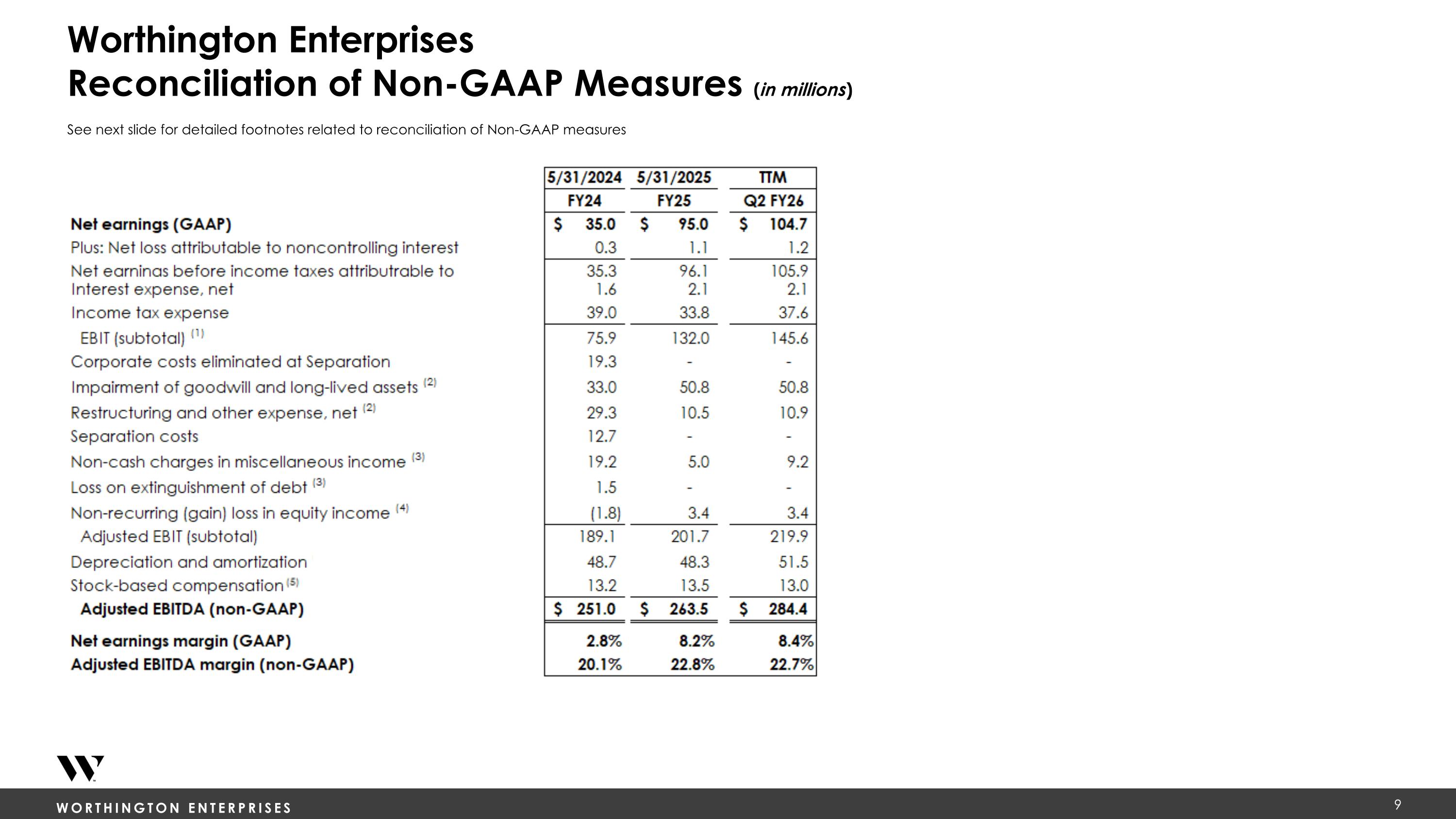
Net earnings (GAAP)


$

27,029


$

28,009


$

61,850


$

52,017


Plus: Net loss attributable to noncontrolling interest


299


251


626


496


Net earnings attributable to controlling interest


27,328


28,260


62,476


52,513


Interest expense, net


1,472


1,033


1,535


1,522


Income tax expense


8,751


9,100


19,611


15,882


EBIT (4)


37,551


38,393


83,622


69,917


Restructuring and other expense, net


1,644


2,620


4,120


3,778


Loss on partial sale of investment in SES (2)


2,950


-


2,950


-


Unrealized loss on investment in marketable securities (3)


1,243


-


1,243


-


Adjusted EBIT (4)


43,388


41,013


91,935


73,695


Depreciation and amortization


13,764


11,927


26,850


23,757


Stock-based compensation (5)


3,326


3,273


6,753


7,197


Adjusted EBITDA (non-GAAP)


$

60,478


$

56,213


$

125,538


$

104,649


Net earnings margin (GAAP)


8.3

%


10.2

%


9.8

%


9.8

%

Adjusted EBITDA margin (non-GAAP)


18.5

%


20.5

%


19.9

%


19.7

%


(1)
Excludes the impact of noncontrolling interest.
(2)
Reflects the loss incurred in connection with divestment of the company’s 49% interest in the composite assets of its SES joint venture on October 16, 2025. In exchange for the company’s interest in the divested assets, it received common shares in both Hexagon Composites and Hexagon Purus.


(3)
Reflects the unrealized loss associated with the marketable securities noted in footnote (2) above.
(4)
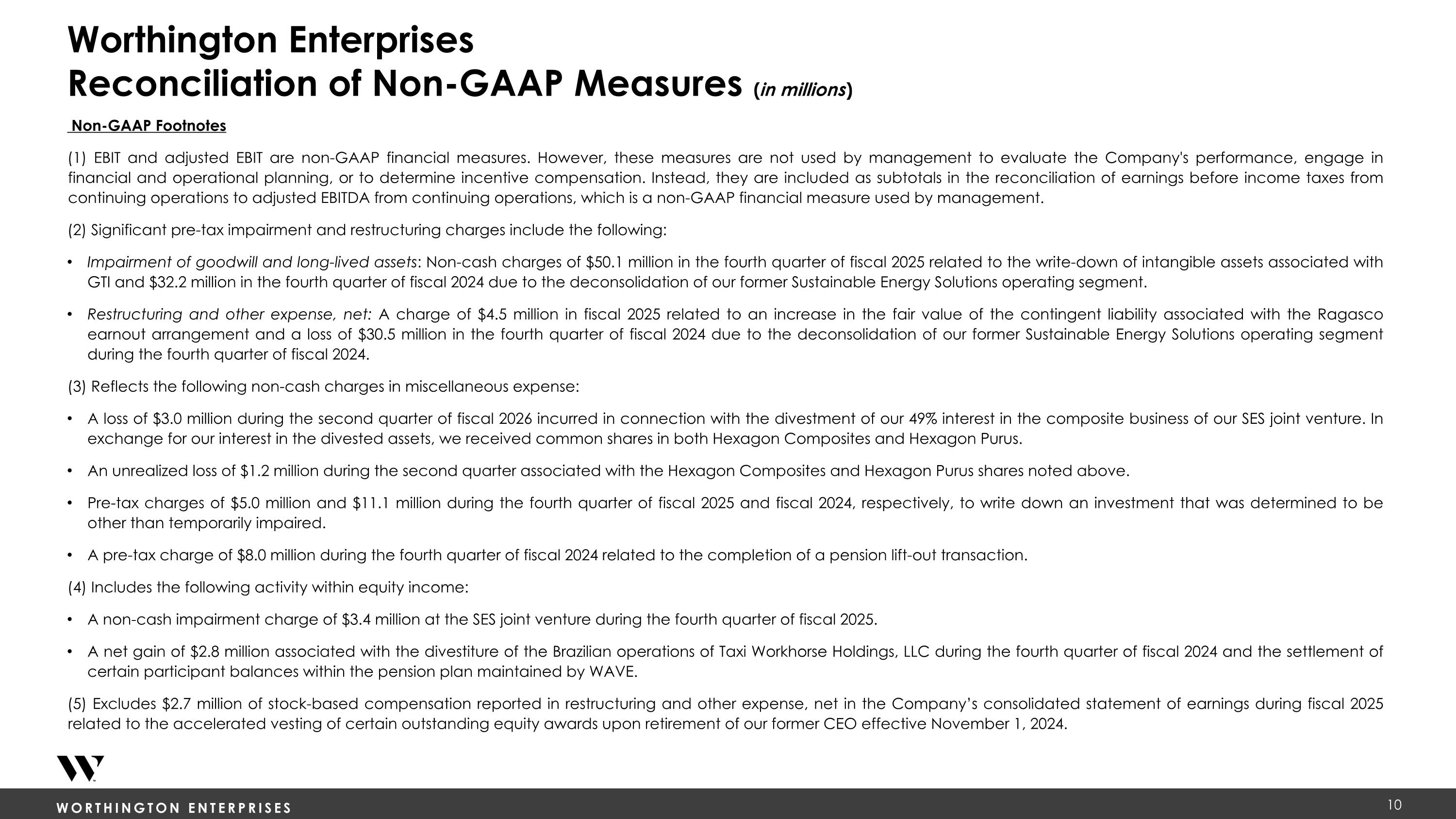
EBIT and adjusted EBIT are non-GAAP financial measures. However, these measures are not used by management to evaluate the company's performance, engage in financial and operational planning, or to determine incentive compensation. Instead, they are included as subtotals in the reconciliation of net earnings to adjusted EBITDA, which is a non-GAAP financial measure used by management.
(5)
Excludes $2.7 million of stock-based compensation reported in restructuring and other expense, net in the company’s consolidated statement of earnings for the three and six months ended November 30, 2024 related to the accelerated vesting of certain outstanding equity awards upon retirement of a key employee.


Consolidated Results - Free Cash Flow


The following tables provide a reconciliation of net cash provided by operating activities to free cash flow and the calculation of operating cash flow conversion to free cash flow conversion for the three and six months ended November 30, 2025 and 2024.


Three Months Ended


Six Months Ended


November 30,


November 30,


2025


2024


2025


2024


Net cash provided by operating activities (GAAP)


$

51,518


$

49,053


$

92,580


$

90,199


Investment in property, plant, and equipment


(12,432

)


(15,161

)


(25,627

)


(24,790

)

Free cash flow (non-GAAP)


$

39,086


$

33,892


$

66,953


$

65,409


Net earnings attributable to controlling interest (GAAP)


$

27,328


$

28,260


$

62,476


$

52,513


Adjusted net earnings attributable to controlling interest (non-GAAP)


$

32,460


$

30,241


$

69,707


$

55,363


Operating cash flow conversion (GAAP) (1)


189

%


174

%


148

%


172

%

Free cash flow conversion (non-GAAP)


120

%


112

%


96

%


118

%


(1)
Operating cash flow conversion is defined as net cash provided by operating activities divided by net earnings attributable to controlling interest.


WORTHINGTON ENTERPRISES, INC.

USE OF NON-GAAP FINANCIAL MEASURES AND DEFINITIONS


NON-GAAP FINANCIAL MEASURES. These materials include certain financial measures that are not calculated and presented in accordance with accounting principles generally accepted in the United States (“GAAP”). Non-GAAP financial measures typically exclude items that management believes are not reflective of, and thus should not be included when evaluating the performance of the company’s ongoing operations. Management uses these non-GAAP financial measures to evaluate ongoing performance, engage in financial and operational planning, and determine incentive compensation. Management believes these non-GAAP financial measures provide useful supplemental information regarding the performance of the company’s ongoing operations and should not be considered as an alternative to the comparable GAAP financial measure. Additionally, management believes these non-GAAP financial measures allow for meaningful comparisons and analysis of trends in the company’s businesses and enables investors to evaluate operations and future prospects in the same manner as management.

The following provides an explanation of each non-GAAP financial measure presented in these materials:


Adjusted operating income (loss) is defined as operating income (loss) excluding the items listed below, to the extent naturally included in operating income (loss).


Adjusted net earnings is defined as net earnings attributable to controlling interest excluding the after-tax effect of the excluded items outlined below.

Adjusted EPS – diluted is defined as adjusted net earnings divided by diluted weighted-average common shares outstanding for the applicable period.


Adjusted EBITDA is the measure by which management evaluates segment performance and overall profitability. EBITDA is defined as earnings before interest, taxes, depreciation, and amortization. Adjusted EBITDA excludes additional items including, but not limited to, those listed below, as well as other items that management believes are not reflective of, and thus should not be included when evaluating the performance of ongoing operations. Adjusted EBITDA also excludes stock-based compensation due to its non-cash nature, which is consistent with how management assesses operating performance and determines incentive compensation. At the segment level, adjusted EBITDA includes expense allocations for centralized corporate back-office functions that exist to support the day-to-day business operations. Public company and other governance costs are held at the corporate level within the unallocated corporate and other category.


Adjusted EBITDA margin is calculated by dividing adjusted EBITDA by net sales.


Free cash flow is a non-GAAP financial liquidity measure that is used by the company to assess its ability to generate cash beyond what is required for its business operations and capital expenditures. The company defines free cash flow as net cash flows from operating activities less investment in property, plant, and equipment.


Free cash flow conversion is a non-GAAP financial measure that is used by the company to measure how much of its adjusted net earnings attributable to controlling interest is converted into cash. The company defines free cash flow conversion as free cash flow divided by adjusted net earnings.

EXCLUSIONS FROM NON-GAAP FINANCIAL MEASURES


Management believes it is useful to exclude the following items from its non-GAAP financial measures for its own and investors’ assessment of the business for the reasons identified below. Additionally, management may exclude other items from non-GAAP financial measures that do not occur in the ordinary course of the company’s ongoing business operations and note them in the reconciliation from net earnings to the non-GAAP financial measure adjusted EBITDA.


Impairment charges are excluded because they do not occur in the ordinary course of the company’s ongoing business operations, are inherently unpredictable in timing and amount, and are non-cash, which management believes facilitates the comparison of historical, current and forecasted financial results.
Restructuring activities consists of established programs that are intended to fundamentally change the company’s operations, and as such are excluded from its non-GAAP financial measures. The company’s restructuring programs may include closing or consolidating production facilities or moving manufacturing of a product to another location, realignment of the management structure of a business unit in response to changing market conditions or general rationalization of headcount. The company’s restructuring activities generally give rise to employee-related costs, such as severance pay, and facility-related costs, such as exit costs and gains or losses on asset disposals but may include other incremental costs associated with the company’s restructuring activities. Restructuring and other expense, net, may also include other nonrecurring items included in operating income but incremental to the company’s normal business activities. These items are excluded because they are not part of the ongoing operations of the company’s underlying business.
Loss on partial sale of investment in SES is excluded because it does not occur in the normal course of business and is inherently unpredictable in timing and amount.
Unrealized losses on marketable equity securities represents the net impact of unrealized losses resulting from mark-to-market adjustments on the company’s marketable equity securities. The company excludes this activity because it is not reflective of on-going operating activity and does not provide a meaningful evaluation of operating performance.



EX-99.2 3 wor-ex99_2.htm EX-99.2 EX-99.2


Worthington Enterprises Agrees to Acquire Leading Metal Roof Components Manufacturer LSI Group


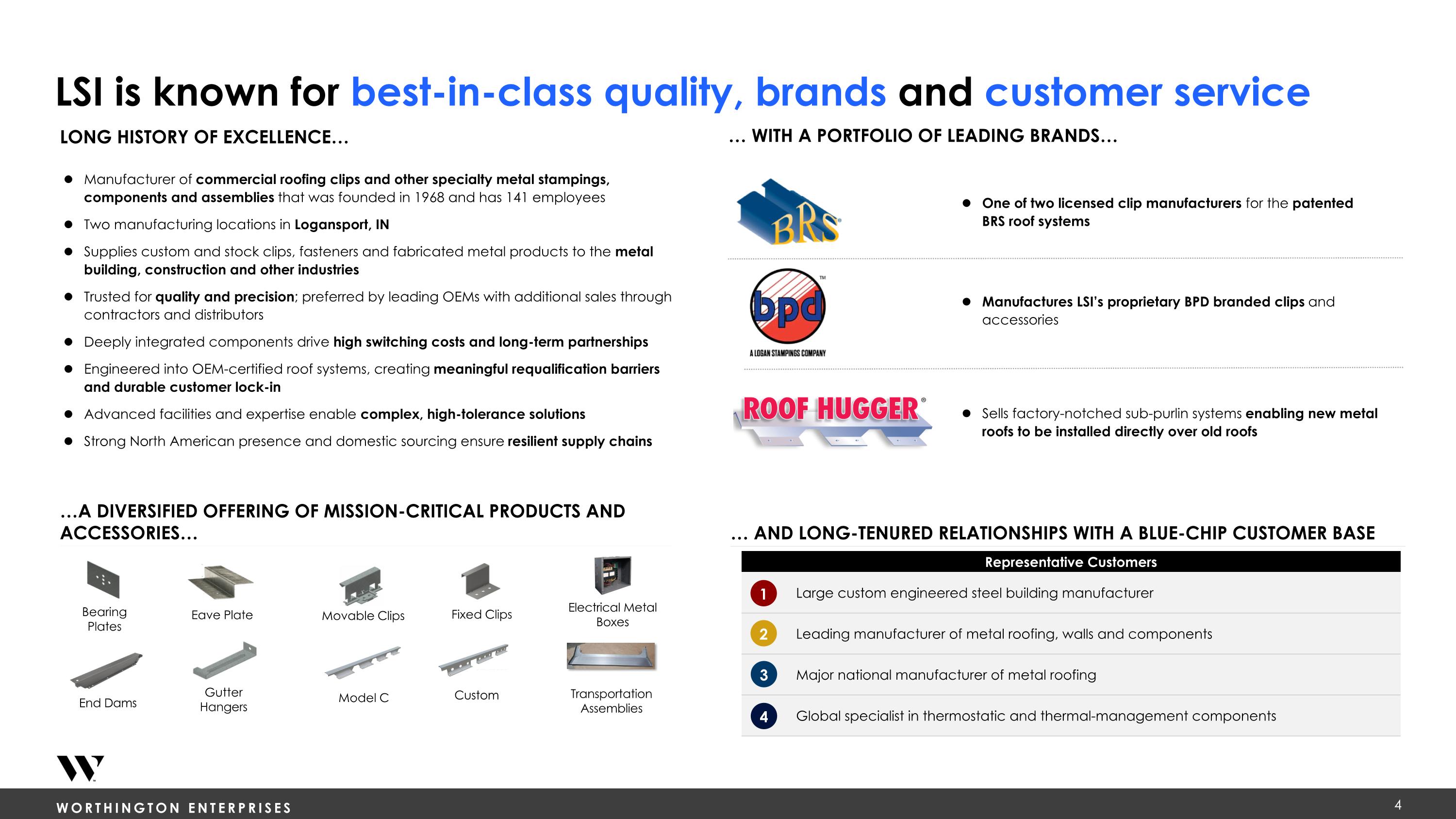
COLUMBUS, OHIO (Dec. 16, 2025) – Worthington Enterprises Inc. (NYSE: WOR), a designer and manufacturer of market-leading brands that improve everyday life by elevating spaces and experiences, today announced it has signed a definitive agreement to acquire LSI Group, LLC (LSI) of Logansport, Indiana. LSI, which includes market-leading brands BPD, Logan Stampings, LSI Metal Fabrication and Roof Hugger®, is one of the largest U.S. manufacturers of standing seam metal roof clips and retrofit components in the commercial metal roof market.


Worthington Enterprises plans to purchase LSI Group for approximately $205 million with cash on hand and borrowings under the company’s revolving credit facility. The transaction is expected to close in January 2026, subject to regulatory approval and other customary closing conditions.


Joe Hayek, president and chief executive officer, Worthington Enterprises, said, “The addition of LSI will further strengthen our Building Products portfolio and deepen engagement with customers across the entire building envelope. A leading U.S. manufacturer in a niche market, LSI has built an exceptional reputation for superior quality, industry-leading lead times and outstanding service backed by long-term customer relationships. Those relationships—and LSI’s people-first culture—align with our own values and commitment to supporting our customers and employees. We’re very much looking forward to welcoming them to our team.”


Demand for resilient, energy-efficient and durable roofing systems is expected to continue growing as building owners prioritize stronger, code-compliant structures in response to evolving weather patterns and manage rising energy costs and aging commercial building infrastructure, especially as roofs built during the early 2000s construction boom are now reaching the end of their service life. Common applications are industrial and manufacturing facilities, retail buildings, academic and municipal structures, hospitality, data centers, and recreation and mixed-use spaces. Standing seam metal roof clips, which act as concealed anchors, secure each metal roof panel to the underlying roof substrate. A new 10,000-square-foot roof requires approximately 8,000 – 10,000 metal roof clips.

LSI serves the retrofit market with the Roof Hugger brand of metal sub-purlins used to attach a new roof on top of an existing roof. Compared to full replacements, retrofitting with a metal roof lowers installation costs, improves energy efficiency, enhances code compliance, minimizes disruption during installation and increases sustainability.


Jimmy Bowes, president, Building Products, Worthington Enterprises, said, “LSI has earned its leadership position in the commercial metal roofing market through precision manufacturing, advanced automation and deep engineering expertise. Their U.S.-based production delivers consistent quality and the industry’s fastest lead times, while their customer-first mindset ensures responsive service and dependable support. We believe the business is well positioned with new construction and retrofit solutions to help OEMs and installers build stronger, longer-lasting structures that protect people and property for generations to come.”

LSI has two manufacturing locations in Logansport where it was founded in 1968 as Logan Stampings. Robert Baker, owner and president, LSI Group, LLC, purchased Logan Stampings in 2004 and grew the business through innovation, acquisition and prioritizing relationships. He will continue as a leader of the LSI business as part of Worthington Enterprises.

Baker said, “Joining Worthington Enterprises marks an exciting new era for LSI Group. Together, we’ll accelerate innovation, expand our reach and deliver even greater value to customers across the building envelope. This partnership opens doors to new opportunities for our employees and strengthens our ability to invest in Logansport, which has been our home for more than 50 years. We’re not just preserving what we’ve built—we’re amplifying it. With Worthington’s scale and shared vision, LSI is positioned to magnify value for all stakeholders and continue leading in commercial metal roofing solutions.”

Bowes concluded, “Robert has built an outstanding business throughout the last 20-plus years with phenomenal people who share our values, prioritize people, champion innovation and achieve ambitious goals. We are excited to welcome them to our team.”

Other products from Worthington Enterprises supporting critical infrastructure for the building envelope include building systems such as HVAC components, architectural and acoustical grid ceilings and metal framing and accessories, along with cylinders and tanks for heating and cooling, construction and water applications.

J.P. Morgan Securities LLC is serving as exclusive financial advisor and Vorys is serving as legal counsel to Worthington Enterprises. Bellmark Partners LLC and Calfee are advising LSI Group.

About Worthington Enterprises

Worthington Enterprises (NYSE: WOR) is a designer and manufacturer of market-leading brands that improve everyday life by elevating spaces and experiences. The company operates with two primary business segments: Building Products and Consumer Products. The Building Products segment includes heating and cooling, cooking, construction and water solutions, and building systems including HVAC components, architectural and acoustical grid ceilings and metal framing and accessories. The Consumer Products segment provides solutions for the tools, outdoor living and celebrations categories. Product brands within the Worthington Enterprises portfolio include Balloon Time®, Bernzomatic®, Coleman® (propane cylinders), CoMet®, Elgen, Garden Weasel®, General®, HALO™, Hawkeye™, LEVEL5 Tools®, Mag Torch®, NEXI™, Pactool International®, PowerCore™, Ragasco®, Well-X-Trol® and XLite™, among others.

Headquartered in Columbus, Ohio, Worthington Enterprises and its joint ventures employ approximately 6,000 people throughout North America and Europe.


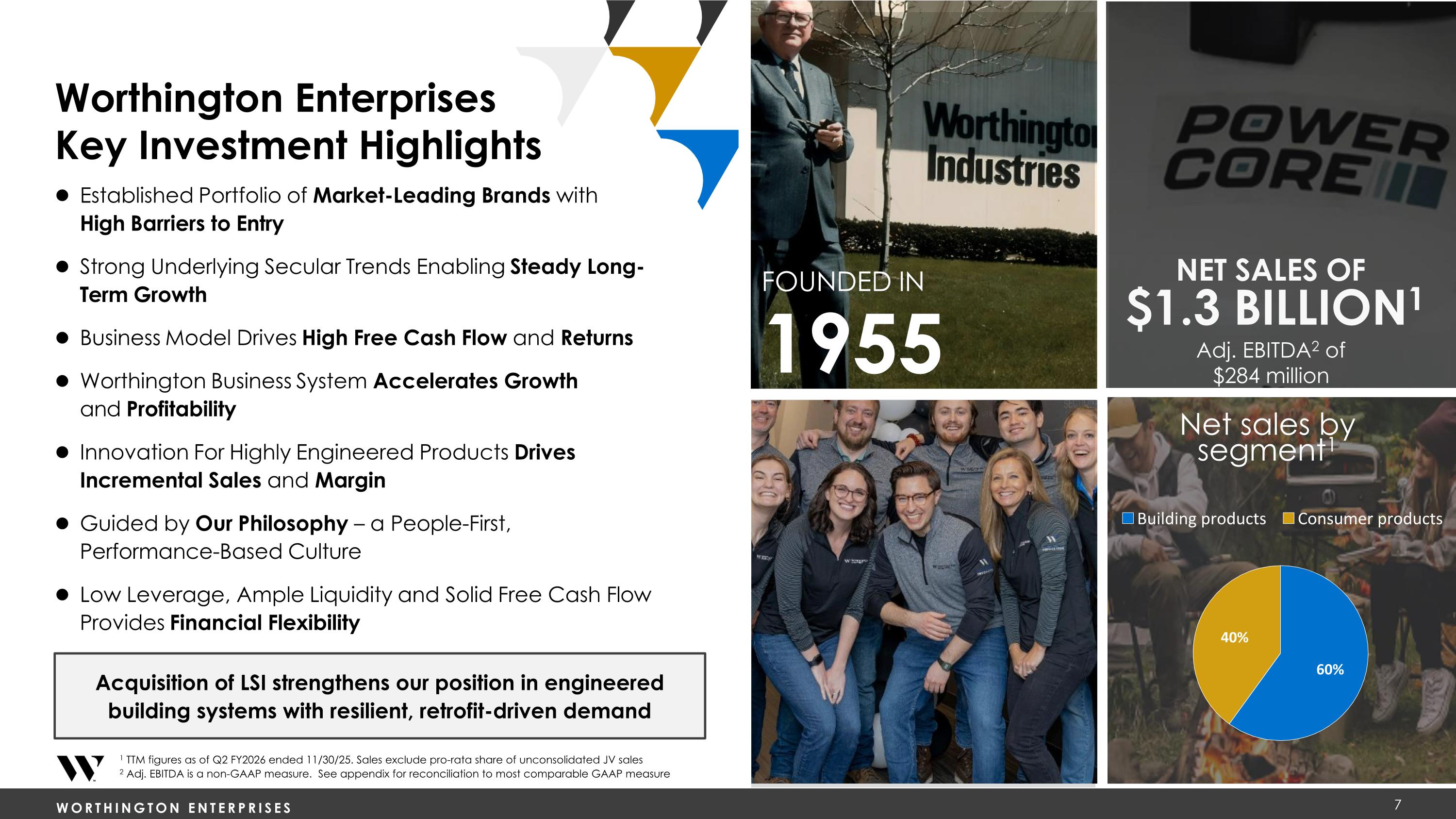
Founded in 1955 as Worthington Industries, Worthington Enterprises follows a people-first Philosophy with earning money for its shareholders as its first corporate goal. Worthington Enterprises achieves this outcome by empowering its employees to innovate, thrive and grow with leading brands in attractive markets that improve everyday life. The company engages deeply with local communities where it has operations through volunteer efforts and The Worthington Companies Foundation, participates actively in workforce development programs and reports annually on its corporate citizenship and sustainability efforts. For more information, visit worthingtonenterprises.com.

Safe Harbor Statement

Selected statements contained in this release constitute “forward-looking statements,” as that term is used in the Private Securities Litigation Reform Act of 1995 (the “Act”). The company wishes to take advantage of the safe harbor provisions included in the Act. Forward-looking statements reflect the company’s current expectations, estimates or projections concerning future results or events. These statements are often identified by the use of forward-looking words or phrases such as “believe,” “expect,” “anticipate,” “may,” “could,” “should,” “would,” “intend,” “plan,” “will,” “likely,” “estimate,” “project,” “position,” “strategy,” “target,” “aim,” “seek,” “foresee” and similar words or phrases. These forward-looking statements include, without limitation, statements relating to: future or expected cash positions, liquidity and ability to access financial markets and capital; outlook, strategy or business plans; the anticipated benefits of the separation of the company’s Steel Processing business (the “Separation); the expected financial and operational performance of, and future opportunities for, the company following the Separation; the company’s performance on a pro forma basis to illustrate the estimated effects of the Separation on historical periods; the tax treatment of the Separation transaction; future or expected growth, growth potential, forward momentum, performance, competitive position, sales, volumes, cash flows, earnings, margins, balance sheet strengths, debt, financial condition or other financial measures; pricing trends for raw materials and finished goods and the impact of pricing changes; the ability to improve or maintain margins; expected demand or demand trends for the company or its markets; additions to product lines and opportunities to participate in new markets; expected benefits from transformation and innovation efforts; the ability to improve performance and competitive position at the company’s operations; anticipated working capital needs, capital expenditures and asset sales; anticipated improvements and efficiencies in costs, operations, sales, inventory management, sourcing and the supply chain and the results thereof; projected profitability potential; the ability to make acquisitions and the projected timing, results, benefits, costs, charges and expenditures related to acquisitions, joint ventures, headcount reductions and facility dispositions, shutdowns and consolidations; projected capacity and the alignment of operations with demand; the ability to operate profitably and generate cash in down markets; the ability to capture and maintain market share and to develop or take advantage of future opportunities, customer initiatives, new businesses, new products and new markets; expectations for company and customer inventories, jobs and orders; expectations for the economy and markets or improvements therein; expectations for generating improving and sustainable earnings, earnings potential, margins or shareholder value; effects of judicial rulings; the ever-changing effects of the novel coronavirus (“COVID-19”) pandemic and the various responses of governmental and nongovernmental authorities thereto on economies and markets, and on the company’s customers, counterparties, employees and third-party service providers; and other non-historical matters.

Because they are based on beliefs, estimates and assumptions, forward-looking statements are inherently subject to risks and uncertainties that could cause actual results to differ materially from those projected.


Any number of factors could affect actual results, including, without limitation, those that follow: the uncertainty of obtaining regulatory approvals in connection with the Separation, including rulings from the Internal Revenue Service; the company’s ability to successfully realize the anticipated benefits of the Separation; the risks, uncertainties and impacts related to the COVID-19 pandemic – the duration, extent and severity of which are impossible to predict, including the possibility of future resurgence in the spread of COVID-19 or variants thereof – and the availability, effectiveness and acceptance of vaccines, and other actual or potential public health emergencies and actions taken by governmental authorities or others in connection therewith; the effect of national, regional and global economic conditions generally and within major product markets, including significant economic disruptions from COVID-19, the actions taken in connection therewith and the implementation of related fiscal stimulus packages; the effect of conditions in national and worldwide financial markets, including inflation, increases in interest rates and economic recession, and with respect to the ability of financial institutions to provide capital; the impact of tariffs, the adoption of trade restrictions affecting the company’s products or suppliers, a United States withdrawal from or significant renegotiation of trade agreements, the occurrence of trade wars, the closing of border crossings, and other changes in trade regulations or relationships; changing oil prices and/or supply; product demand and pricing; changes in product mix, product substitution and market acceptance of the company’s products; volatility or fluctuations in the pricing, quality or availability of raw materials (particularly steel), supplies, transportation, utilities, labor and other items required by operations (especially in light of the COVID-19 pandemic and Russia’s invasion of Ukraine); effects of sourcing and supply chain constraints; the outcome of adverse claims experience with respect to workers’ compensation, product recalls or product liability, casualty events or other matters; effects of facility closures and the consolidation of operations; the effect of financial difficulties, consolidation and other changes within the steel, automotive, construction and other industries in which the company participates; failure to maintain appropriate levels of inventories; financial difficulties (including bankruptcy filings) of original equipment manufacturers, end-users and customers, suppliers, joint venture partners and others with whom the company does business; the ability to realize targeted expense reductions from headcount reductions, facility closures and other cost reduction efforts; the ability to realize cost savings and operational, sales and sourcing improvements and efficiencies, and other expected benefits from transformation initiatives, on a timely basis; the overall success of, and the ability to integrate, newly-acquired businesses and joint ventures, maintain and develop their customers, and achieve synergies and other expected benefits and cost savings therefrom; capacity levels and efficiencies, within facilities, within major product markets and within the industries in which the company participates as a whole; the effect of disruption in the business of suppliers, customers, facilities and shipping operations due to adverse weather, casualty events, equipment breakdowns, labor shortages, interruption in utility services, civil unrest, international conflicts (especially in light of Russia’s invasion of Ukraine), terrorist activities or other causes; changes in customer demand, inventories, spending patterns, product choices, and supplier choices; risks associated with doing business internationally, including economic, political and social instability (especially in light of Russia’s invasion of Ukraine), foreign currency exchange rate exposure and the acceptance of the company’s products in global markets; the ability to improve and maintain processes and business practices to keep pace with the economic, competitive and technological environment; the effect of inflation, interest rate increases and economic recession, which may negatively impact the company’s operations and financial results; deviation of actual results from estimates and/or assumptions used by the company in the application of its significant accounting policies; the level of imports and import prices in the company’s markets; the impact of environmental laws and regulations or the actions of the United States Environmental Protection Agency or similar regulators which increase costs or limit the company’s ability to use or sell certain products; the impact of increasing environmental, greenhouse gas emission and sustainability regulations and considerations; the impact of judicial rulings and governmental regulations, both in the United States and abroad, including those adopted by the United States Securities and Exchange Commission and other governmental agencies as contemplated by the Coronavirus Aid, Relief and Economic Security (CARES) Act, the Consolidated Appropriations Act, 2021, the American Rescue Plan Act of 2021, and the Dodd-Frank Wall Street Reform and Consumer Protection Act of 2010; the effect of healthcare laws in the United States and potential changes for such laws, especially in light of the COVID-19 pandemic, which may increase the company’s healthcare and other costs and negatively impact the company’s operations and financial results; the effects of tax laws in the United States and potential changes for such laws, which may increase the company’s costs and negatively impact the company’s operations and financial results; cyber security risks; the effects of privacy and information security laws and standards; and other risks described from time to time in the company’s filings with the United States Securities and Exchange Commission, including those described in “Part I – Item 1A.


– Risk Factors” of the company’s Annual Report on Form 10-K for the fiscal year ended May 31, 2025.


Forward-looking statements should be construed in the light of such risks. The company notes these factors for investors as contemplated by the Act. It is impossible to predict or identify all potential risk factors. Consequently, readers should not consider the foregoing list to be a complete set of all potential risks and uncertainties. Readers are cautioned not to place undue reliance on any forward-looking statements, which speak only as of the date made. The company does not undertake, and hereby disclaims, any obligation to update any forward-looking statements, whether as a result of new information, future developments or otherwise, except as required by applicable law.

###


EX-99.3 4 wor-ex99_3.htm EX-99.3

Slide 1

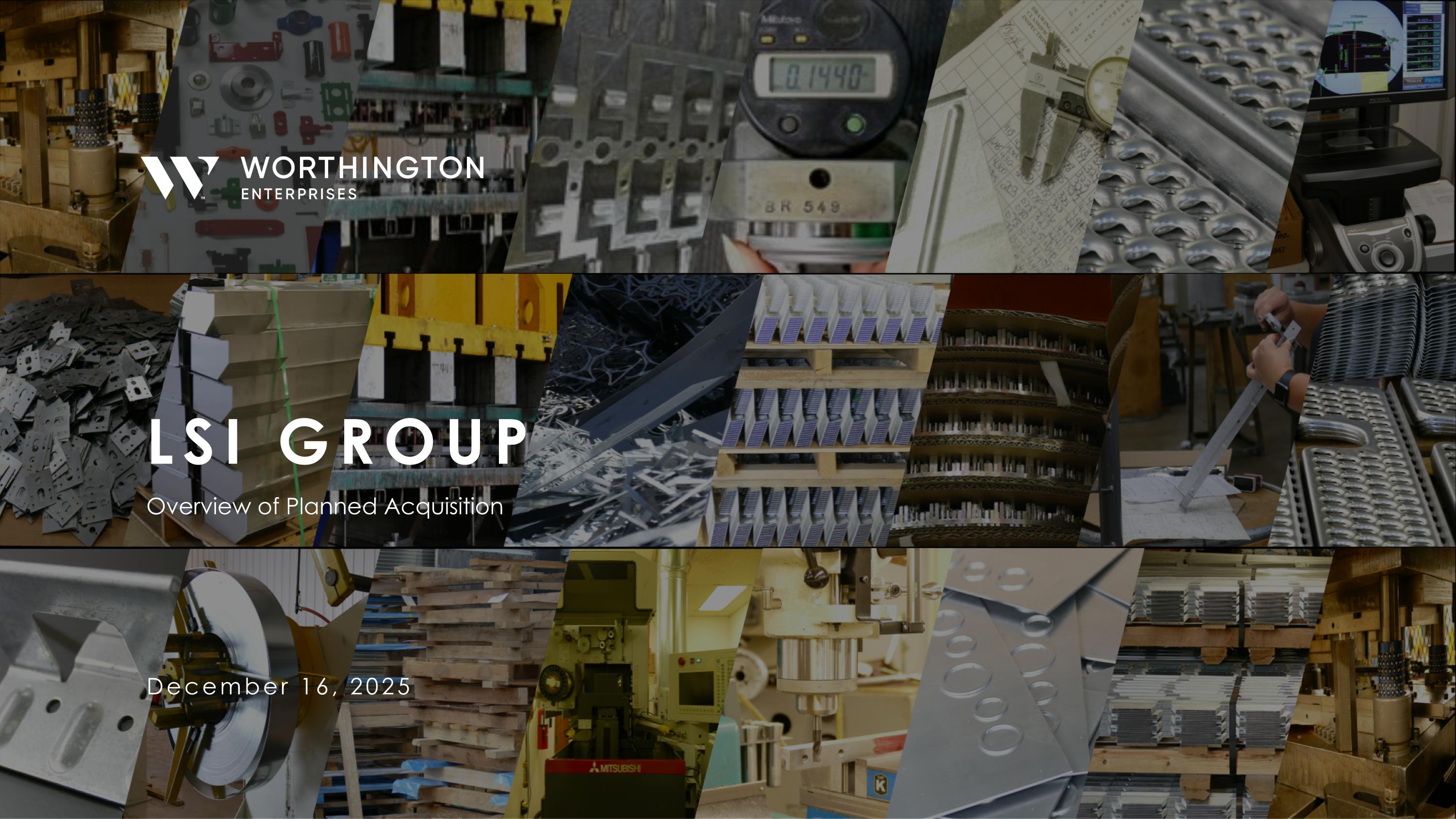
LSI GROUP December 16, 2025 Overview of Planned Acquisition


Slide 2

Notes to Investors FORWARD-LOOKING STATEMENTS.  Selected statements in this presentation constitute “forward-looking statements,” as that term is used in the Private Securities Litigation Reform Act of 1995 (the “Act”).  Worthington Enterprises, Inc. (the “Company” or “Worthington”) wishes to take advantage of the safe harbor provisions included in the Act. Forward-looking statements reflect the Company’s current expectations, estimates or projections concerning future results or events. These statements are often identified by the use of forward-looking words or phrases such as “believe,” “expect,” “anticipate,” “may,” “could,” “should,” “would,” “intend,” “plan,” “will,” “likely,” “estimate,” “project,” “position,” “strategy,” “target,” “aim,” “seek,” “foresee” and similar words or phrases. These forward-looking statements include, without limitation, statements relating to: future or expected cash positions, liquidity and ability to access financial markets and capital; outlook, strategy or business plans;; future or expected performance, growth, demand, financial condition or other financial measures; pricing trends for raw materials and finished goods; additions to product lines and opportunities to participate in new markets; anticipated working capital needs, capital expenditures and asset sales; anticipated improvements and efficiencies in costs, operations, sales, inventory management, sourcing and the supply chain; the ability to make acquisitions, form joint ventures and consolidate operations and the projected timing, benefits and costs related thereto; expectations for the economy and markets; expectations for shareholder value; effects of pandemics and widespread health crises; and other non-historical matters. Because they are based on beliefs, estimates and assumptions, forward-looking statements are inherently subject to risks and uncertainties that could cause actual results to differ materially from those projected. Any number of factors could affect actual results, including, without limitation, those that follow: the effect of conditions in national and worldwide financial markets, including inflation, increases in interest rates and economic recession, and with respect to the ability of financial institutions to provide capital; the impact of tariffs, the adoption of trade restrictions affecting the Company’s products or suppliers, a U.S. withdrawal from or significant renegotiation of trade agreements, the occurrence of trade wars, the closing of border crossings, and other changes in trade regulations or relationships; changing oil prices and/or supply; product demand and pricing; changes in product mix, product substitution and market acceptance of the Company’s products; volatility or fluctuations in the pricing, quality or availability of raw materials (particularly steel), supplies, transportation, utilities, labor and other items required by operations; effects of sourcing and supply chain constraints; the outcome of adverse claims experience with respect to workers’ compensation, product recalls or product liability, casualty events or other matters; effects of facility closures and the consolidation of operations; the effect of financial difficulties, consolidation and other changes within the steel, automotive, construction and other industries in which the Company participates; failure to maintain appropriate levels of inventories; financial difficulties (including bankruptcy filings) of original equipment manufacturers, end-users and customers, suppliers, joint venture partners and others with whom the Company does business; the ability to realize targeted expense reductions from headcount reductions, facility closures and other cost reduction efforts; the ability to realize cost savings and operational, sales and sourcing improvements and efficiencies, and other expected benefits from transformation initiatives, on a timely basis; the overall success of, and the ability to integrate, newly-acquired businesses and joint ventures, maintain and develop their customers, and achieve synergies and other expected benefits and cost savings therefrom; capacity levels and efficiencies, within facilities, within major product markets and within the industries in which the Company participates as a whole; the effect of disruption in the business of suppliers, customers, facilities and shipping operations due to adverse weather, casualty events, equipment breakdowns, labor shortages, interruption in utility services, civil unrest, international conflicts, terrorist activities or other causes; changes in customer demand, inventories, spending patterns, product choices, and supplier choices; risks associated with doing business internationally, including economic, political and social instability, foreign currency exchange rate exposure and the acceptance of the Company’s products in global markets; the ability to improve and maintain processes and business practices to keep pace with the economic, competitive and technological environment; the effect of inflation, interest rate increases and economic recession, which may negatively impact the Company’s operations and financial results; deviation of actual results from estimates and/or assumptions used by the Company in the application of its significant accounting policies; the level of imports and import prices in the Company’s markets; the impact of environmental laws and regulations or the actions of the U.S. Environmental Protection Agency or similar regulators which increase costs or limit the Company’s ability to use or sell certain products; the impact of increasing environmental, greenhouse gas emission and sustainability regulations or considerations; the impact of judicial rulings and governmental regulations, both in the U.S. and abroad, including those adopted by the U.S. Securities and Exchange Commission (“SEC”) and other governmental agencies as contemplated by the Coronavirus Aid, Relief and Economic Security (CARES) Act, the Consolidated Appropriations Act, 2021, the American Rescue Plan Act of 2021, and the Dodd-Frank Wall Street Reform and Consumer Protection Act of 2010; the effect of healthcare laws in the U.S. and potential changes for such laws, which may increase the Company’s healthcare and other costs and negatively impact the Company’s operations and financial results; the effect of tax laws in the U.S. and potential changes for such laws, which may increase the Company’s costs and negatively impact its operations and financial results; cyber security risks; the effects of privacy and information security laws and standards; and other risks described from time to time in the Company’s filings with the SEC, including those described in “Part I — Item 1A. — Risk Factors” of the Company’s Annual Report on Form 10-K for the fiscal year ended May 31, 2025, and its subsequent filings with the SEC. Forward-looking statements should be construed in the light of such risks. It is impossible to predict or identify all potential risk factors.  Consequently, readers should not consider the foregoing list to be a complete set of all potential risks and uncertainties.  Readers are cautioned not to place undue reliance on any forward-looking statements, which speak only as of the date made, which was December 16, 2025. The Company does not undertake, and hereby disclaims, any obligation to update any forward-looking statements, whether as a result of new information, future developments or otherwise, except as required by applicable law.


Slide 3

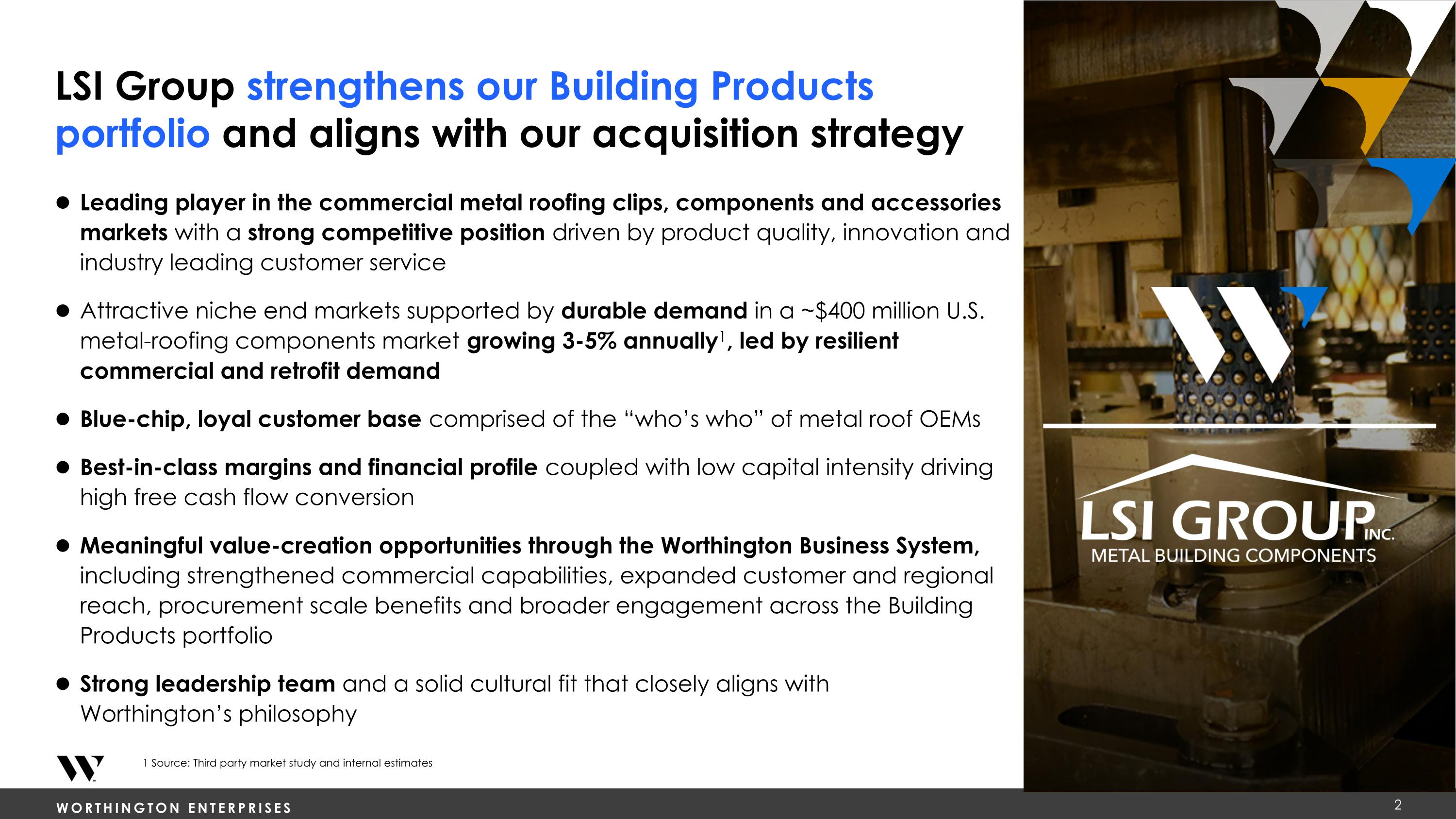
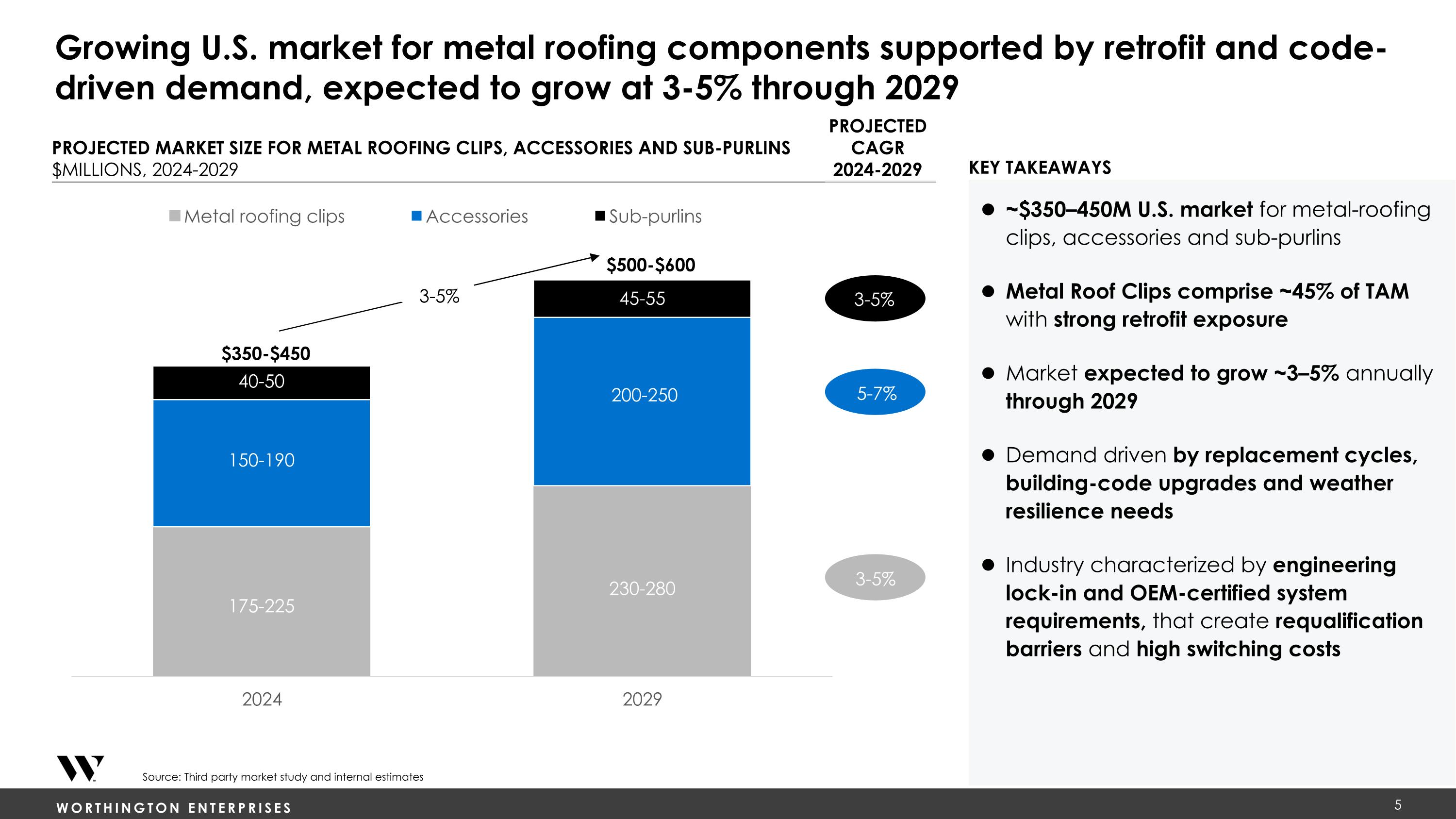
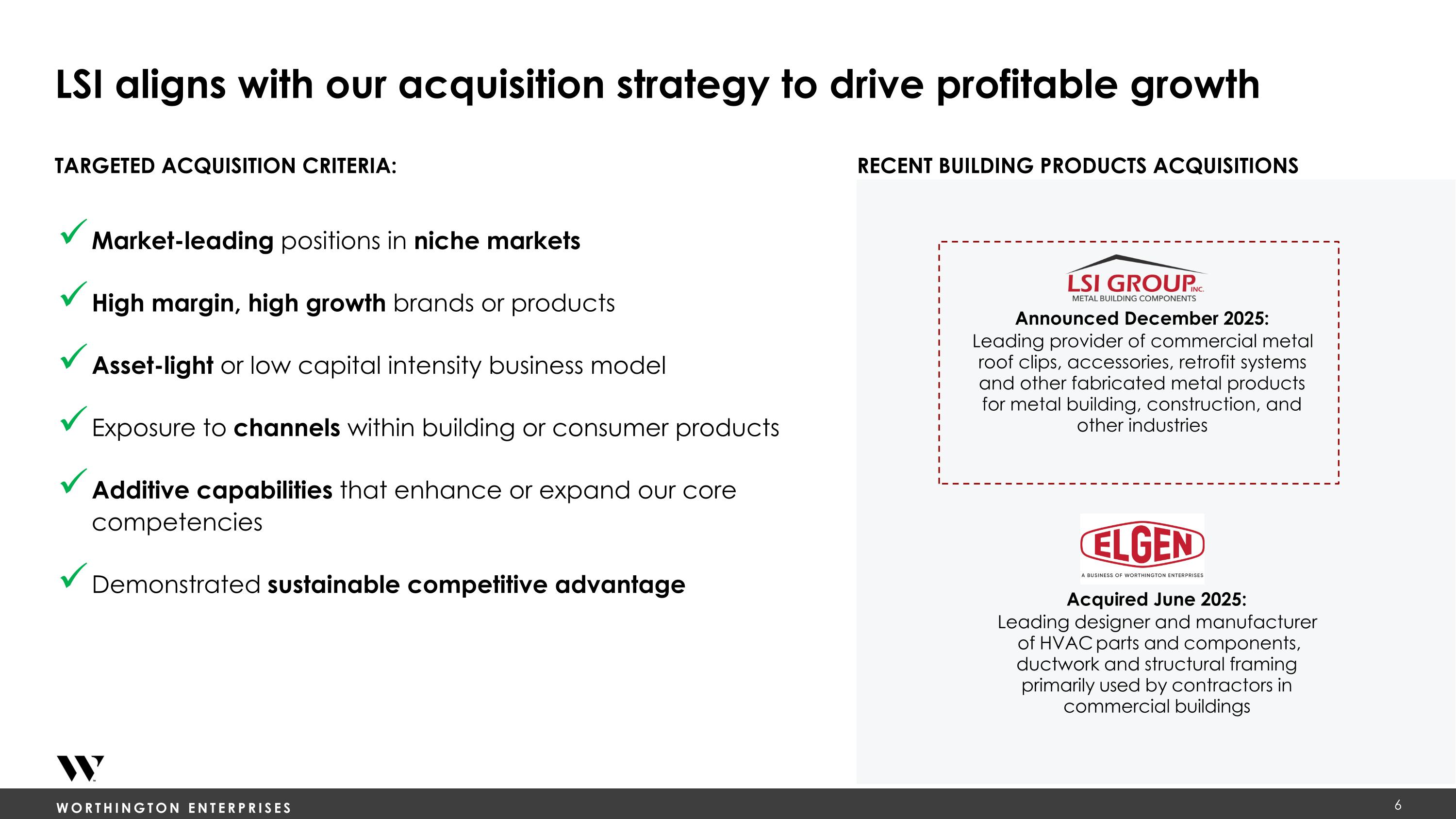
LSI Group strengthens our Building Products portfolio and aligns with our acquisition strategy 1 Source: Third party market study and internal estimates Leading player in the commercial metal roofing clips, components and accessories markets with a strong competitive position driven by product quality, innovation and industry leading customer service Attractive niche end markets supported by durable demand in a ~$400 million U.S. metal-roofing components market growing 3-5% annually1, led by resilient commercial and retrofit demand Blue-chip, loyal customer base comprised of the “who’s who” of metal roof OEMs Best-in-class margins and financial profile coupled with low capital intensity driving high free cash flow conversion Meaningful value-creation opportunities through the Worthington Business System, including strengthened commercial capabilities, expanded customer and regional reach, procurement scale benefits and broader engagement across the Building Products portfolio Strong leadership team and a solid cultural fit that closely aligns with Worthington’s philosophy


Slide 4

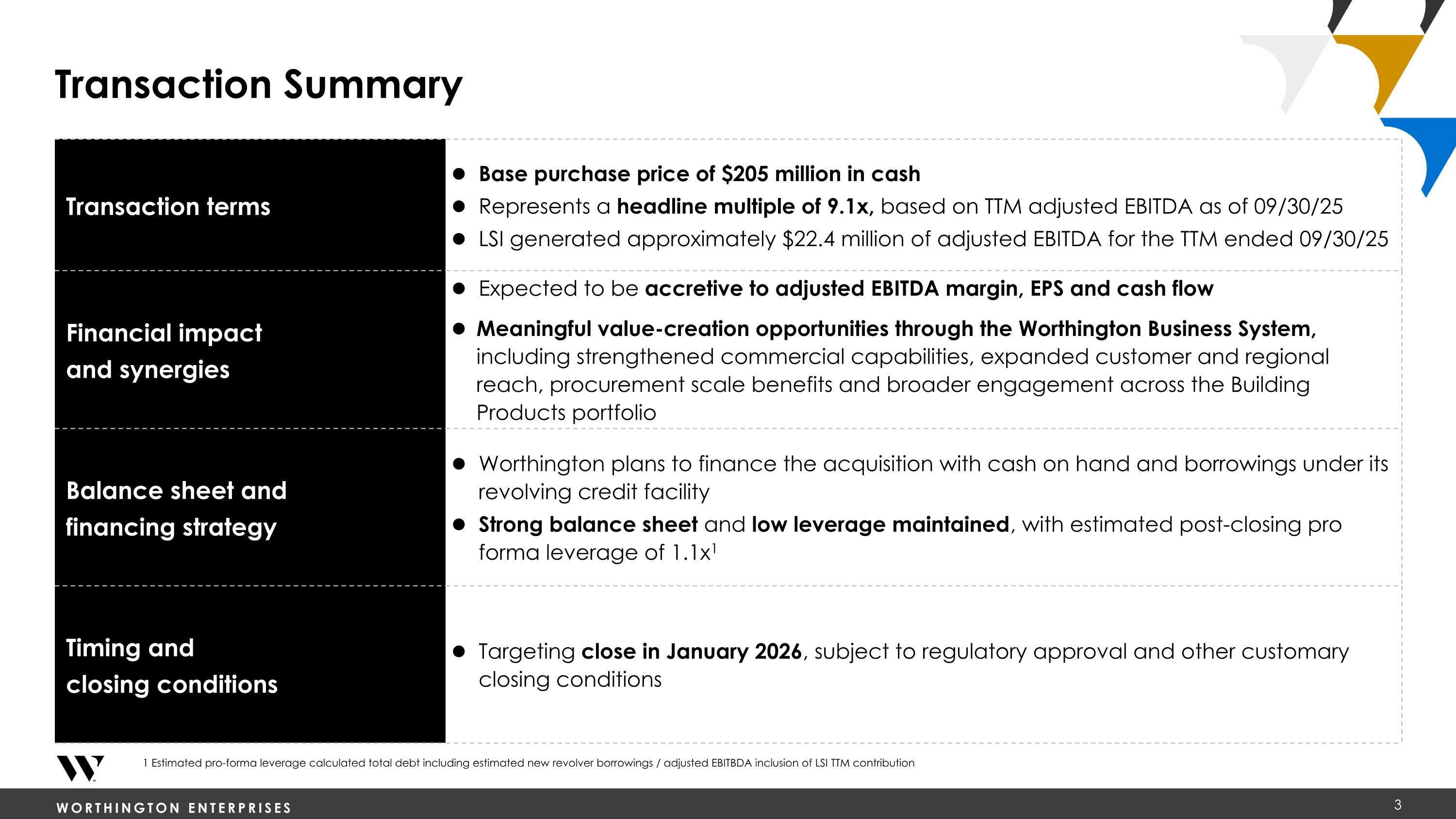
Transaction Summary Transaction terms Base purchase price of $205 million in cash Represents a headline multiple of 9.1x, based on TTM adjusted EBITDA as of 09/30/25 LSI generated approximately $22.4 million of adjusted EBITDA for the TTM ended 09/30/25 Financial impact and synergies Expected to be accretive to adjusted EBITDA margin, EPS and cash flow Meaningful value-creation opportunities through the Worthington Business System, including strengthened commercial capabilities, expanded customer and regional reach, procurement scale benefits and broader engagement across the Building Products portfolio Balance sheet and financing strategy Worthington plans to finance the acquisition with cash on hand and borrowings under its revolving credit facility Strong balance sheet and low leverage maintained, with estimated post-closing pro forma leverage of 1.1x1 Timing and closing conditions Targeting close in January 2026, subject to regulatory approval and other customary closing conditions 1 Estimated pro-forma leverage calculated total debt including estimated new revolver borrowings / adjusted EBITBDA inclusion of LSI TTM contribution


Slide 5

LSI is known for best-in-class quality, brands and customer service long history of excellence… Manufacturer of commercial roofing clips and other specialty metal stampings, components and assemblies that was founded in 1968 and has 141 employees Two manufacturing locations in Logansport, IN Supplies custom and stock clips, fasteners and fabricated metal products to the metal building, construction and other industries Trusted for quality and precision; preferred by leading OEMs with additional sales through contractors and distributors Deeply integrated components drive high switching costs and long-term partnerships Engineered into OEM-certified roof systems, creating meaningful requalification barriers and durable customer lock-in Advanced facilities and expertise enable complex, high-tolerance solutions Strong North American presence and domestic sourcing ensure resilient supply chains One of two licensed clip manufacturers for the patented BRS roof systems Manufactures LSI’s proprietary BPD branded clips and accessories Sells factory-notched sub-purlin systems enabling new metal roofs to be installed directly over old roofs … with a portfolio of leading brands… …a diversified offering of mission-critical products and accessories… … and long-tenured relationships with a blue-chip customer base Fixed Clips Movable Clips Gutter Hangers Bearing Plates End Dams Eave Plate Model C Custom Transportation Assemblies Electrical Metal Boxes Representative Customers Large custom engineered steel building manufacturer Leading manufacturer of metal roofing, walls and components Major national manufacturer of metal roofing Global specialist in thermostatic and thermal-management components 1 2 3 4


Slide 6

Key takeaways Growing U.S. market for metal roofing components supported by retrofit and code-driven demand, expected to grow at 3-5% through 2029​ Source: Third party market study and internal estimates ~$350–450M U.S. market for metal-roofing clips, accessories and sub-purlins Metal Roof Clips comprise ~45% of TAM with strong retrofit exposure Market expected to grow ~3–5% annually through 2029 Demand driven by replacement cycles, building-code upgrades and weather resilience needs Industry characterized by engineering lock-in and OEM-certified system requirements, that create requalification barriers and high switching costs Projected market size for metal roofing clips, accessories and sub-purlins $millions, 2024-2029 175-225 230-280 150-190 40-50 200-250 45-55 $350-$450 $500-$600 3-5% Projected CAGR2024-2029 3-5% 5-7% 3-5%


Slide 7

LSI aligns with our acquisition strategy to drive profitable growth Market-leading positions in niche markets High margin, high growth brands or products Asset-light or low capital intensity business model Exposure to channels within building or consumer products Additive capabilities that enhance or expand our core competencies Demonstrated sustainable competitive advantage Targeted acquisition criteria: Announced December 2025: Leading provider of commercial metal roof clips, accessories, retrofit systems and other fabricated metal products for metal building, construction, and other industries Acquired June 2025: Leading designer and manufacturer of HVAC parts and components, ductwork and structural framing primarily used by contractors in commercial buildings Recent Building Products acquisitions


Slide 8

Established Portfolio of Market-Leading Brands with High Barriers to Entry Strong Underlying Secular Trends Enabling Steady Long-Term Growth Business Model Drives High Free Cash Flow and Returns Worthington Business System Accelerates Growth and Profitability Innovation For Highly Engineered Products Drives Incremental Sales and Margin Guided by Our Philosophy – a People-First, Performance-Based Culture Low Leverage, Ample Liquidity and Solid Free Cash Flow Provides Financial Flexibility 1955 FOUNDED IN Net sales by segment1 Worthington Enterprises Key Investment Highlights Acquisition of LSI strengthens our position in engineered building systems with resilient, retrofit-driven demand NET SALES OF $1.3 BILLION1 Adj. EBITDA2 of $284 million 1 TTM figures as of Q2 FY2026 ended 11/30/25. Sales exclude pro-rata share of unconsolidated JV sales 2 Adj. EBITDA is a non-GAAP measure. See appendix for reconciliation to most comparable GAAP measure


Slide 9

Appendix


Slide 10

See next slide for detailed footnotes related to reconciliation of Non-GAAP measures Worthington Enterprises Reconciliation of Non-GAAP Measures (in millions)


Slide 11

Worthington Enterprises Reconciliation of Non-GAAP Measures (in millions) Non-GAAP Footnotes (1) EBIT and adjusted EBIT are non-GAAP financial measures. However, these measures are not used by management to evaluate the Company's performance, engage in financial and operational planning, or to determine incentive compensation. Instead, they are included as subtotals in the reconciliation of earnings before income taxes from continuing operations to adjusted EBITDA from continuing operations, which is a non-GAAP financial measure used by management. (2) Significant pre-tax impairment and restructuring charges include the following: Impairment of goodwill and long-lived assets: Non-cash charges of $50.1 million in the fourth quarter of fiscal 2025 related to the write-down of intangible assets associated with GTI and $32.2 million in the fourth quarter of fiscal 2024 due to the deconsolidation of our former Sustainable Energy Solutions operating segment. Restructuring and other expense, net: A charge of $4.5 million in fiscal 2025 related to an increase in the fair value of the contingent liability associated with the Ragasco earnout arrangement and a loss of $30.5 million in the fourth quarter of fiscal 2024 due to the deconsolidation of our former Sustainable Energy Solutions operating segment during the fourth quarter of fiscal 2024. (3) Reflects the following non-cash charges in miscellaneous expense: A loss of $3.0 million during the second quarter of fiscal 2026 incurred in connection with the divestment of our 49% interest in the composite business of our SES joint venture. In exchange for our interest in the divested assets, we received common shares in both Hexagon Composites and Hexagon Purus. An unrealized loss of $1.2 million during the second quarter associated with the Hexagon Composites and Hexagon Purus shares noted above. Pre-tax charges of $5.0 million and $11.1 million during the fourth quarter of fiscal 2025 and fiscal 2024, respectively, to write down an investment that was determined to be other than temporarily impaired. A pre-tax charge of $8.0 million during the fourth quarter of fiscal 2024 related to the completion of a pension lift-out transaction. (4) Includes the following activity within equity income: A non-cash impairment charge of $3.4 million at the SES joint venture during the fourth quarter of fiscal 2025. A net gain of $2.8 million associated with the divestiture of the Brazilian operations of Taxi Workhorse Holdings, LLC during the fourth quarter of fiscal 2024 and the settlement of certain participant balances within the pension plan maintained by WAVE. (5) Excludes $2.7 million of stock-based compensation reported in restructuring and other expense, net in the Company’s consolidated statement of earnings during fiscal 2025 related to the accelerated vesting of certain outstanding equity awards upon retirement of our former CEO effective November 1, 2024. 

EX-99.4 5 wor-ex99_4.htm EX-99.4 EX-99.4

img12262158_0.jpg


Worthington Enterprises Declares Quarterly Dividend;

Charles Chiappone Joins Board of Directors


COLUMBUS, OHIO (December 16, 2025) – The Worthington Enterprises Inc. (NYSE: WOR) Board of Directors today declared a quarterly dividend of $0.19 per share. The dividend is payable on March 27, 2026, to shareholders of record on March 13, 2026. The company has paid a quarterly dividend since its initial public offering in 1968.


The board of directors also appointed Charles (Charlie) Chiappone as its newest member effective immediately. Chiappone retired from Armstrong World Industries Inc. in 2022 as senior vice president of the Ceiling and Wall Solutions business. Previously, he served as chief executive officer of Worthington Armstrong Venture (WAVE), which is the suspended ceiling systems joint venture between Worthington Enterprises and Armstrong, and president and chief executive officer of global plastics manufacturer Alloy Polymers. He is a veteran of the United States Marine Corps.


John Blystone, chairman of the board, Worthington Enterprises, said, “We are pleased to welcome Charlie to the Worthington Enterprises board. In addition to his familiarity with our business and culture from his time with Armstrong and WAVE, he brings highly respected perspectives on innovation, transformation and M&A that will help inform our growth strategies as we create value for our shareholders.”


Worthington Enterprises, a designer and manufacturer of market-leading brands that improve everyday life by elevating spaces and experiences, will hold its quarterly earnings conference call tomorrow, December 17 at 8:30 a.m. ET. The company will discuss its fiscal second quarter results, which will be released later today after the market closes.


Please click here to register for tomorrow's live audio webcast or visit IR.worthingtonenterprises.com. For those unable to listen live, a replay will be available in the Investors section of the company’s website approximately two hours after the completion of the call and will be archived for one year.


LIVE CONFERENCE CALL DETAILS

Date: Wednesday, December 17, 2025

Webcast Link: https://events.q4inc.com/attendee/307975816

Starting Time: 8:30 a.m. ET Statements by Worthington Enterprises that are not limited to historical information constitute “forward-looking statements” under federal securities laws.

Conference ID: 1777337

Domestic Participants: 888-330-3567


About Worthington Enterprises


Worthington Enterprises (NYSE: WOR) is a designer and manufacturer of market-leading brands that improve everyday life by elevating spaces and experiences. The company operates with two primary business segments: Building Products and Consumer Products. The Building Products segment includes heating and cooling, cooking, construction and water solutions, and building systems including HVAC components, architectural and acoustical grid ceilings and metal framing and accessories. The Consumer Products segment provides solutions for the tools, outdoor living and celebrations categories. Product brands within the Worthington Enterprises portfolio include Balloon Time®, Bernzomatic®, Coleman® (propane cylinders), CoMet®, Elgen, Garden Weasel®, General®, HALO™, Hawkeye™, LEVEL5 Tools®, Mag Torch®, NEXI™, Pactool International®, PowerCore™, Ragasco®, Well-X-Trol® and XLite™, among others.

Headquartered in Columbus, Ohio, Worthington Enterprises and its joint ventures employ approximately 6,000 people throughout North America and Europe.


Founded in 1955 as Worthington Industries, Worthington Enterprises follows a people-first Philosophy with earning money for its shareholders as its first corporate goal. Worthington Enterprises achieves this outcome by empowering its employees to innovate, thrive and grow with leading brands in attractive markets that improve everyday life. The company engages deeply with local communities where it has operations through volunteer efforts and The Worthington Companies Foundation, participates actively in workforce development programs and reports annually on its corporate citizenship and sustainability efforts. For more information, visit worthingtonenterprises.com.

Forward-Looking Statements

Forward-looking statements are subject to various risks, uncertainties and other factors that may cause actual results to differ materially from those expected by Worthington Enterprises. Readers should evaluate forward-looking statements in the context of such risks, uncertainties and other factors, many of which are described in Worthington Enterprises’ filings with the Securities and Exchange Commission (“SEC”). Forward-looking statements are qualified by the cautionary statements included in Worthington Enterprises’ SEC filings and other public communications. This press release speaks only as of the date hereof. Worthington Enterprises does not undertake any obligation to update or revise its forward-looking statements except as required by applicable law or regulation.


###