Investor Presentation November 18th, 2025
Legal Disclosures This document contains summarized information concerning Regional Management Corp. (the “Company”) and the Company’s business, operations, financial performance, and trends. No representation is made that the information in this document is complete. For additional financial, statistical, and business information, please see the Company’s most recent Annual Report on Form 10-K and Quarterly Reports on Form 10-Q filed with the U.S. Securities and Exchange Commission (the “SEC”), as well as the Company’s other reports filed with the SEC from time to time. Such reports are or will be available on the Company’s website (www.regionalmanagement.com) and on the SEC’s website (www.sec.gov). The information and opinions contained in this document are provided as of the date of this presentation and are subject to change without notice. This document has not been approved by any regulatory or supervisory authority. This presentation, the related remarks, and the responses to various questions may contain various “forward-looking statements” within the meaning of the Private Securities Litigation Reform Act of 1995. Forward-looking statements are not statements of historical fact but instead represent the Company’s expectations or beliefs concerning future events. Forward-looking statements include, without limitation, statements concerning financial outlook or future plans, objectives, goals, projections, strategies, events, or performance, and underlying assumptions and other statements related thereto. Words such as “may,” “will,” “should,” “likely,” “anticipates,” “expects,” “intends,” “plans,” “projects,” “believes,” “estimates,” “outlook,” and similar expressions may be used to identify these forward-looking statements. Such forward-looking statements speak only as of the date on which they were made and are about matters that are inherently subject to risks and uncertainties, many of which are outside of the control of the Company. As a result, actual performance and results may differ materially from those contemplated by these forward-looking statements. Therefore, investors should not place undue reliance on such statements. Factors that could cause actual results or performance to differ from the expectations expressed or implied in forward-looking statements include, but are not limited to, the following: managing growth effectively, implementing Regional Management's growth strategy, and opening new branches as planned; Regional Management's convenience check strategy; Regional Management's policies and procedures for underwriting, processing, and servicing loans; Regional Management's ability to collect on its loan portfolio; Regional Management's insurance operations; exposure to credit risk and repayment risk, which risks may increase in light of adverse or recessionary economic conditions; the implementation of evolving underwriting models and processes, including as to the effectiveness of Regional Management’s custom scorecards; changes in the competitive environment in which Regional Management operates or a decrease in the demand for its products; the geographic concentration of Regional Management's loan portfolio; the failure of third-party service providers, including those providing information technology products; changes in economic conditions in the markets Regional Management serves, including levels of unemployment and bankruptcies; the ability to achieve successful acquisitions and strategic alliances; the ability to make technological improvements as quickly as competitors; security breaches, cyber-attacks, failures in information systems, or fraudulent activity; the ability to originate loans; reliance on information technology resources and providers, including the risk of prolonged system outages; changes in current revenue and expense trends, including trends affecting delinquencies and credit losses; any future public health crises, including the impact of such crisis on our operations and financial condition; changes in operating and administrative expenses; the departure, transition, or replacement of key personnel; the ability to timely and effectively implement, transition to, and maintain the necessary information technology systems, infrastructure, processes, and controls to support Regional Management's operations and initiatives; changes in interest rates; existing sources of liquidity may become insufficient or access to these sources may become unexpectedly restricted; exposure to financial risk due to asset-backed securitization transactions; risks related to regulation and legal proceedings, including changes in laws or regulations or in the interpretation or enforcement of laws or regulations; changes in accounting standards, rules, and interpretations and the failure of related assumptions and estimates; the impact of changes in tax laws and guidance, including the timing and amount of revenues that may be recognized; risks related to the ownership of Regional Management's common stock, including volatility in the market price of shares of Regional Management's common stock; the timing and amount of future cash dividend payments; and anti-takeover provisions in Regional Management's charter documents and applicable state law. The foregoing factors and others are discussed in greater detail in the Company's filings with the SEC. The Company will not update or revise forward-looking statements to reflect events or circumstances after the date of this presentation or to reflect the occurrence of unanticipated events or the non-occurrence of anticipated events, whether as a result of new information, future developments, or otherwise, except as required by law. This presentation contains certain non-GAAP measures. Please refer to the Appendix accompanying this presentation for a reconciliation of non-GAAP measures to the most comparable GAAP measures. This presentation also contains certain financial terms and abbreviations. Please refer to the Appendix accompanying this presentation for a glossary of terms and abbreviations. 2
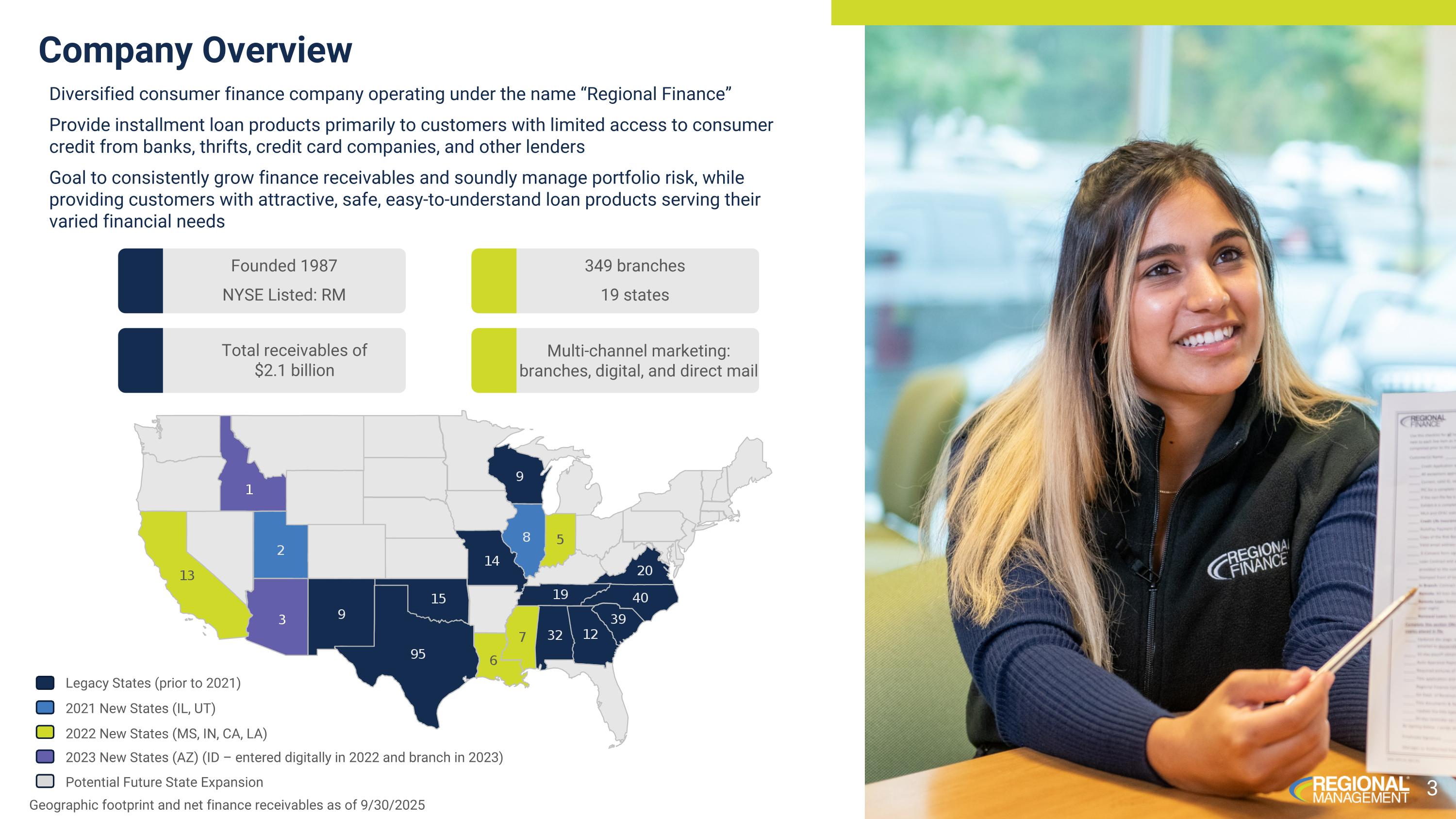
Company Overview Founded 1987 NYSE Listed: RM 349 branches 19 states Total receivables of $2.1 billion Multi-channel marketing: branches, digital, and direct mail Legacy States (prior to 2021) 2021 New States (IL, UT) 2022 New States (MS, IN, CA, LA) Potential Future State Expansion Geographic footprint and net finance receivables as of 9/30/2025 Diversified consumer finance company operating under the name “Regional Finance” Provide installment loan products primarily to customers with limited access to consumer credit from banks, thrifts, credit card companies, and other lenders Goal to consistently grow finance receivables and soundly manage portfolio risk, while providing customers with attractive, safe, easy-to-understand loan products serving their varied financial needs 2023 New States (AZ) (ID – entered digitally in 2022 and branch in 2023) 3
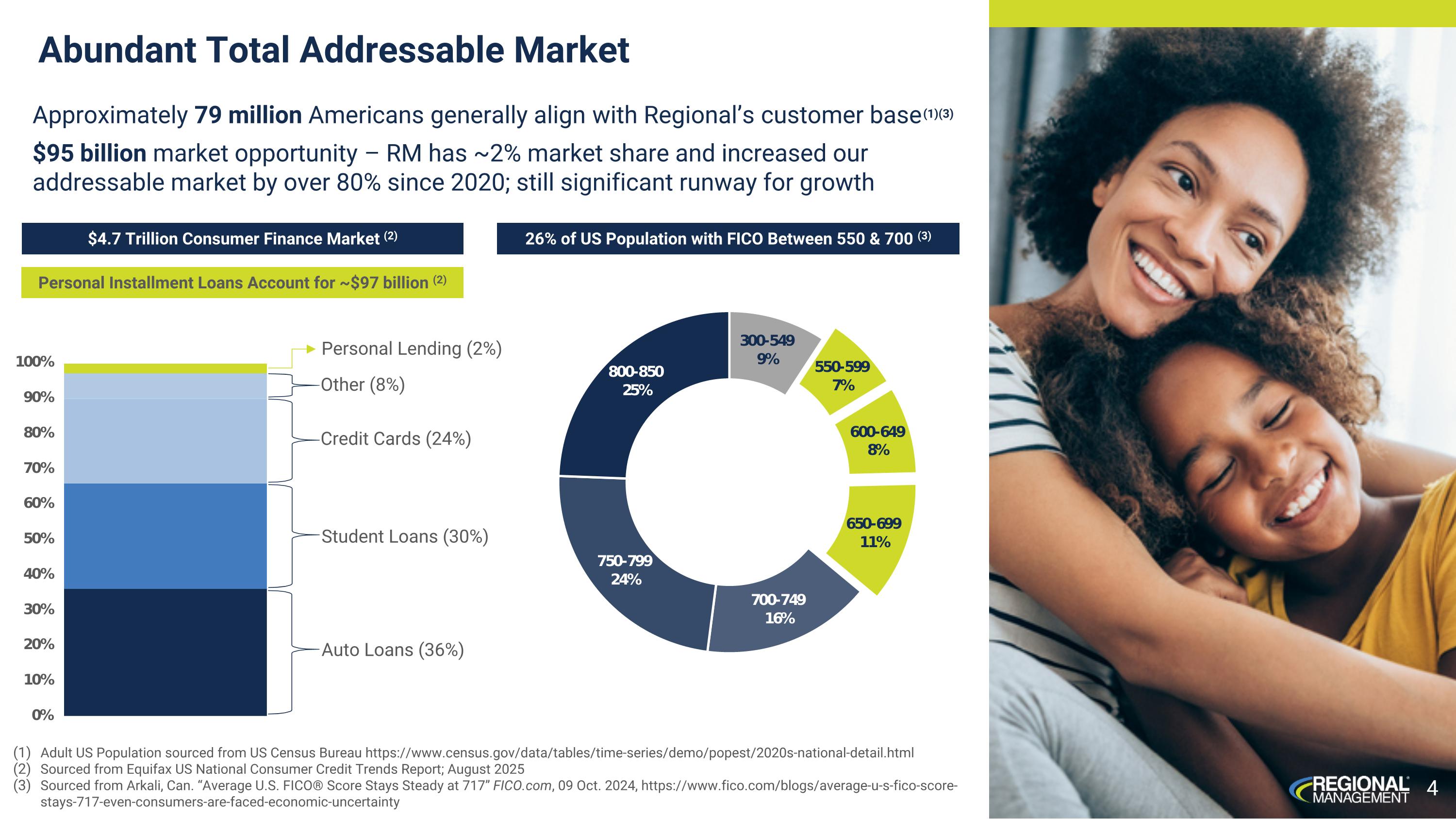
Abundant Total Addressable Market Approximately 79 million Americans generally align with Regional’s customer base (1)(3) $95 billion market opportunity – RM has ~2% market share and increased our addressable market by over 80% since 2020; still significant runway for growth $4.7 Trillion Consumer Finance Market (2) 26% of US Population with FICO Between 550 & 700 (3) Personal Installment Loans Account for ~$97 billion (2) Adult US Population sourced from US Census Bureau https://www.census.gov/data/tables/time-series/demo/popest/2020s-national-detail.html Sourced from Equifax US National Consumer Credit Trends Report; August 2025 Sourced from Arkali, Can. “Average U.S. FICO® Score Stays Steady at 717” FICO.com, 09 Oct. 2024, https://www.fico.com/blogs/average-u-s-fico-score-stays-717-even-consumers-are-faced-economic-uncertainty Auto Loans (36%) Student Loans (30%) Credit Cards (24%) Other (8%) Personal Lending (2%) 4
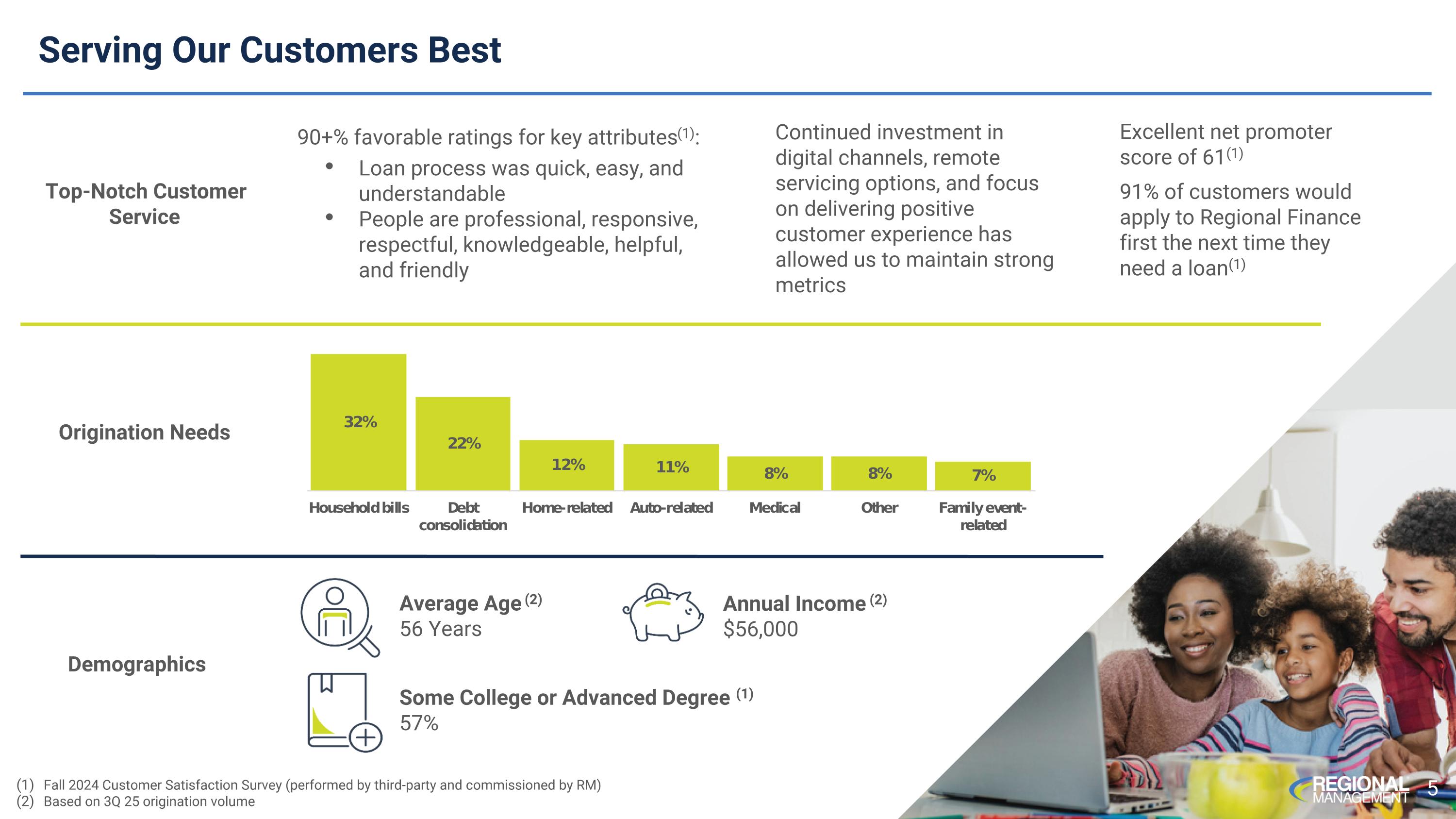
Serving Our Customers Best Excellent net promoter score of 61(1) 91% of customers would apply to Regional Finance first the next time they need a loan(1) 90+% favorable ratings for key attributes(1): Loan process was quick, easy, and understandable People are professional, responsive, respectful, knowledgeable, helpful, and friendly Continued investment in digital channels, remote servicing options, and focus on delivering positive customer experience has allowed us to maintain strong metrics Origination Needs Demographics Top-Notch Customer Service Average Age (2) 56 Years Annual Income (2) $56,000 Some College or Advanced Degree (1) 57% Fall 2024 Customer Satisfaction Survey (performed by third-party and commissioned by RM) Based on 3Q 25 origination volume 5
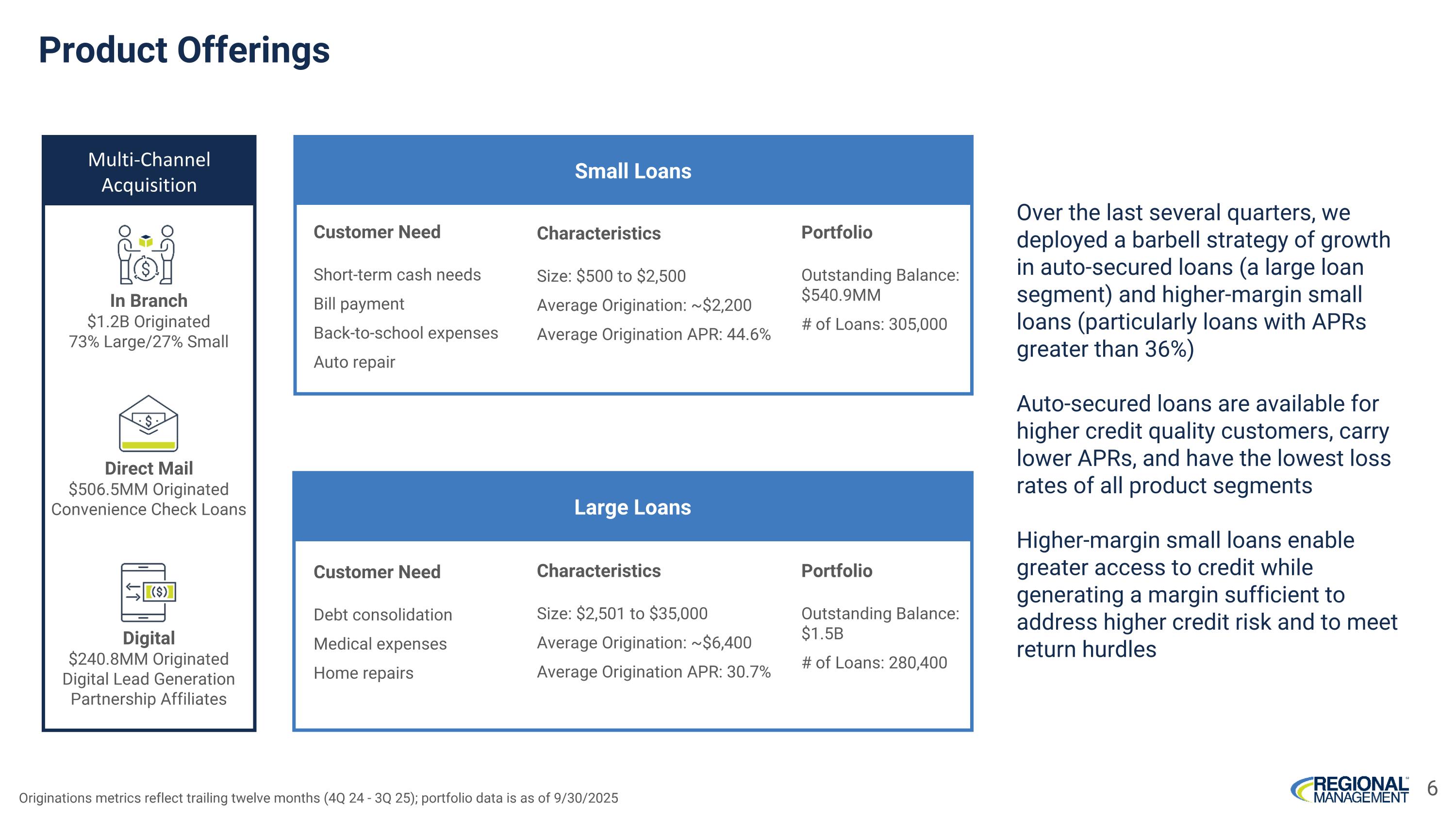
Multi-Channel Acquisition Small Loans Large Loans In Branch $1.2B Originated 73% Large/27% Small Direct Mail $506.5MM Originated Convenience Check Loans Digital $240.8MM Originated Digital Lead Generation Partnership Affiliates Customer Need Short-term cash needs Bill payment Back-to-school expenses Auto repair Characteristics Size: $500 to $2,500 Average Origination: ~$2,200 Average Origination APR: 44.6% Portfolio Outstanding Balance: $540.9MM # of Loans: 305,000 Customer Need Debt consolidation Medical expenses Home repairs Characteristics Size: $2,501 to $35,000 Average Origination: ~$6,400 Average Origination APR: 30.7% Portfolio Outstanding Balance: $1.5B # of Loans: 280,400 Originations metrics reflect trailing twelve months (4Q 24 - 3Q 25); portfolio data is as of 9/30/2025 Over the last several quarters, we deployed a barbell strategy of growth in auto-secured loans (a large loan segment) and higher-margin small loans (particularly loans with APRs greater than 36%) Auto-secured loans are available for higher credit quality customers, carry lower APRs, and have the lowest loss rates of all product segments Higher-margin small loans enable greater access to credit while generating a margin sufficient to address higher credit risk and to meet return hurdles 6 Product Offerings
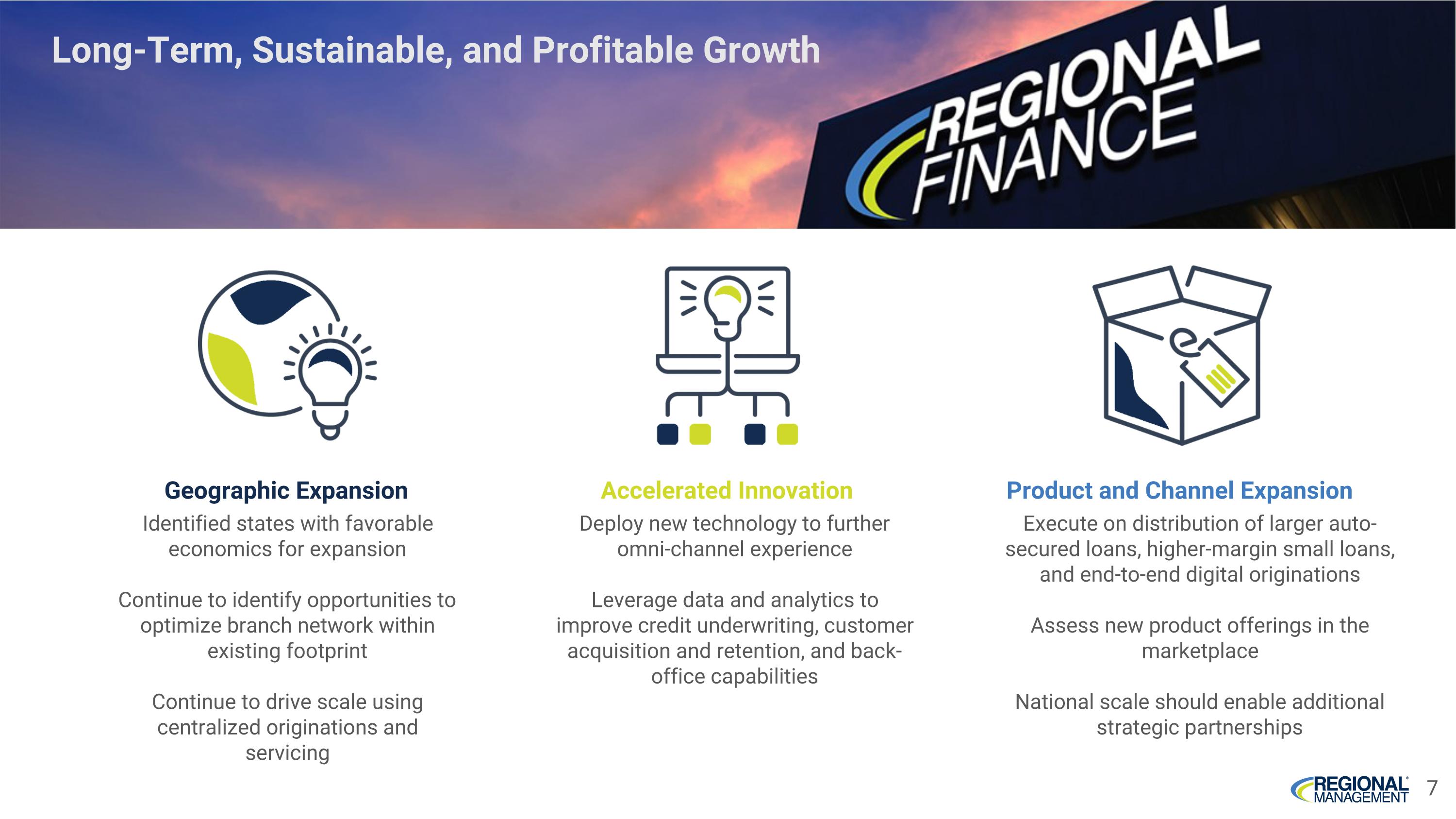
Long-Term, Sustainable, and Profitable Growth Geographic Expansion Accelerated Innovation Product and Channel Expansion Identified states with favorable economics for expansion Continue to identify opportunities to optimize branch network within existing footprint Continue to drive scale using centralized originations and servicing Deploy new technology to further omni-channel experience Leverage data and analytics to improve credit underwriting, customer acquisition and retention, and back-office capabilities Execute on distribution of larger auto-secured loans, higher-margin small loans, and end-to-end digital originations Assess new product offerings in the marketplace National scale should enable additional strategic partnerships 7
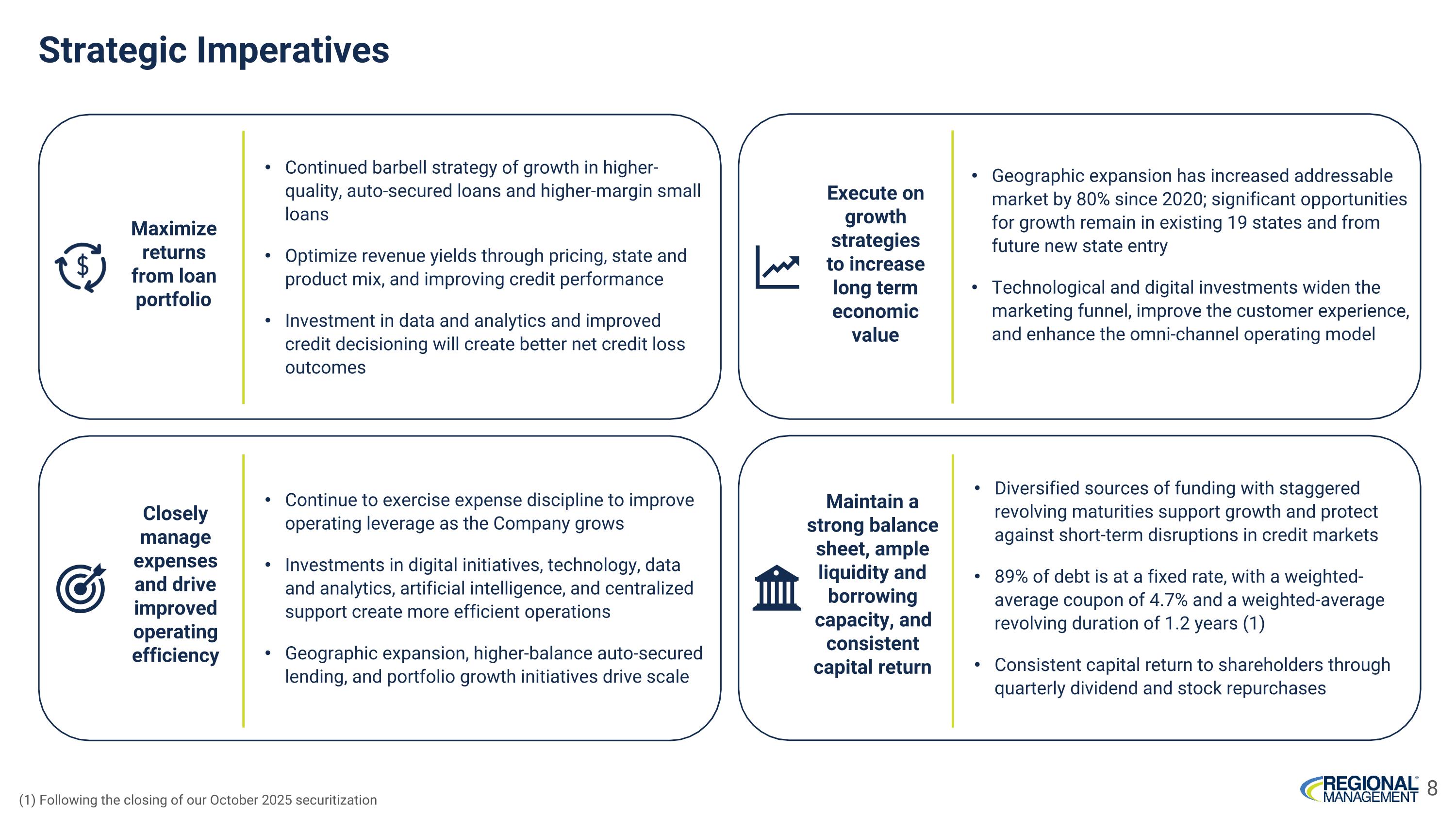
Strategic Imperatives Maximize returns from loan portfolio Continued barbell strategy of growth in higher-quality, auto-secured loans and higher-margin small loans Optimize revenue yields through pricing, state and product mix, and improving credit performance Investment in data and analytics and improved credit decisioning will create better net credit loss outcomes Execute on growth strategies to increase long term economic value Geographic expansion has increased addressable market by 80% since 2020; significant opportunities for growth remain in existing 19 states and from future new state entry Technological and digital investments widen the marketing funnel, improve the customer experience, and enhance the omni-channel operating model Closely manage expenses and drive improved operating efficiency Continue to exercise expense discipline to improve operating leverage as the Company grows Investments in digital initiatives, technology, data and analytics, artificial intelligence, and centralized support create more efficient operations Geographic expansion, higher-balance auto-secured lending, and portfolio growth initiatives drive scale Maintain a strong balance sheet, ample liquidity and borrowing capacity, and consistent capital return Diversified sources of funding with staggered revolving maturities support growth and protect against short-term disruptions in credit markets 89% of debt is at a fixed rate, with a weighted-average coupon of 4.7% and a weighted-average revolving duration of 1.2 years (1) Consistent capital return to shareholders through quarterly dividend and stock repurchases (1) Following the closing of our October 2025 securitization 8

Growth and Capabilities Technology Hybrid Cloud Strategy: Leveraging top platforms for scalability, resilience, and cost efficiency Modern Data Platforms: Secure, centralized foundation for enterprise analytics, AI, and real-time insights Modern Applications: Transitioning to microservices for loan origination to boost speed, innovation, and productivity Security & Governance: Embedding cybersecurity and compliance to ensure trust and resilience AI Enablement: Applying AI tools and exploring use in operations and analytics Continued investment in strategic initiatives will drive continued and sustainable receivables growth, improved credit performance, enhanced productivity, and operating efficiency over the long-term Data and Analytics Deployed machine-learning loan origination model for better credit decisions and outcomes Deployed customer lifetime value profitability model to improve economics of mailable universe Deployed next-generation risk and response acquisition model to optimize direct mail programs Expanded corporate data mart for enhanced analytics and improved efficiencies Market Expansion Expect to open 5 new branches before year-end, and another 5-10 new branches in the first half of 2026 New branches opened between one and three years are averaging $7.8 million of receivables vs. the Company average of $5.9 million (1) Plan to enter an additional 1 to 2 states in 2026 Significant runway for growth through market expansion due to addressable market Digital 37% of new customer originations were sourced digitally and closed in the branch in 3Q 25 Continue testing end-to-end digital loan origination platform with plans to responsibly expand into additional states Continue to enhance our digital customer contact through texting, emailing, and auto-dialer capabilities (1) Based on September 30, 2025 ending net finance receivables 9
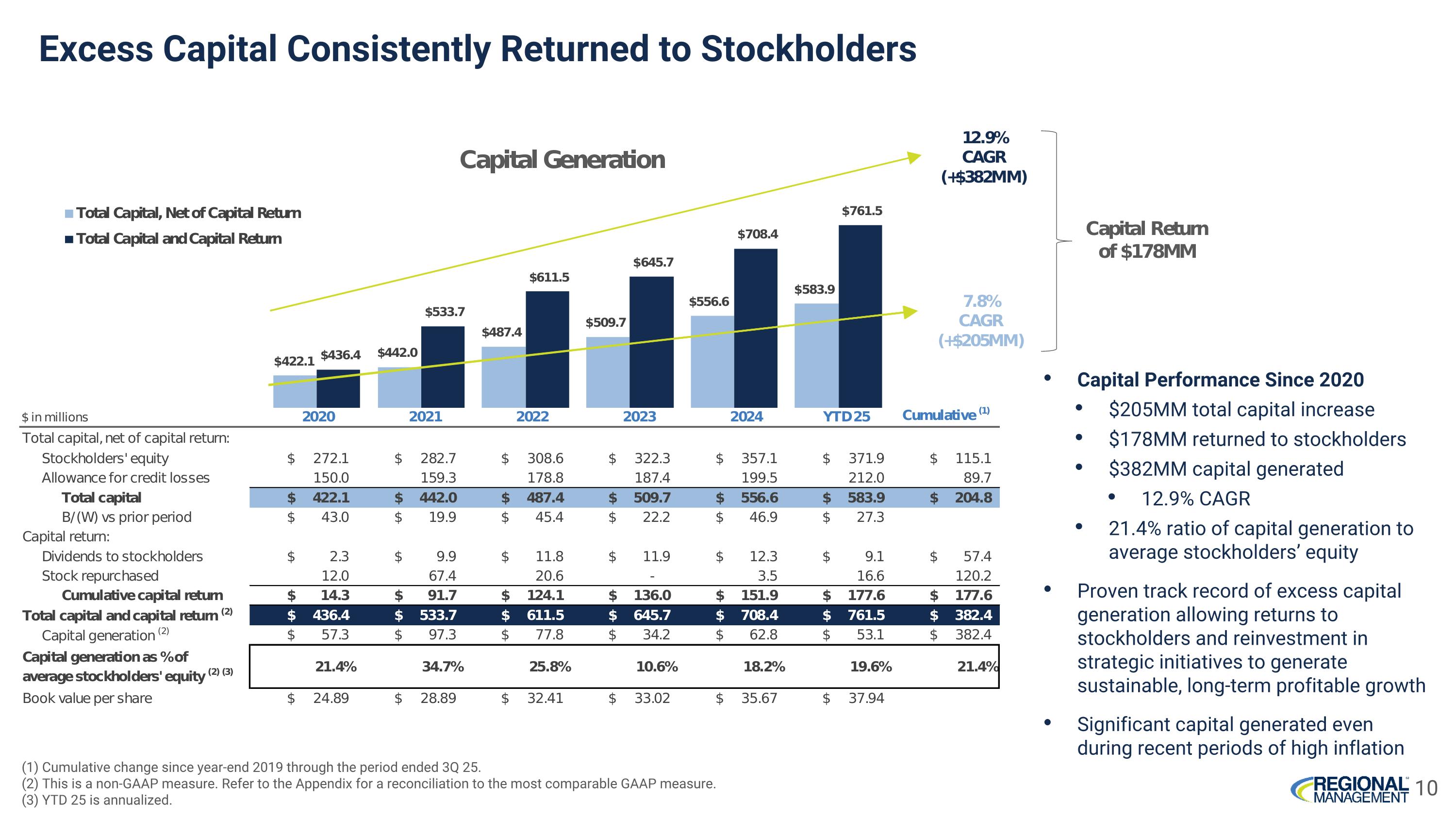
Excess Capital Consistently Returned to Stockholders Capital Performance Since 2020 $205MM total capital increase $178MM returned to stockholders $382MM capital generated 12.9% CAGR 21.4% ratio of capital generation to average stockholders’ equity Proven track record of excess capital generation allowing returns to stockholders and reinvestment in strategic initiatives to generate sustainable, long-term profitable growth Significant capital generated even during recent periods of high inflation (1) Cumulative change since year-end 2019 through the period ended 3Q 25. (2) This is a non-GAAP measure. Refer to the Appendix for a reconciliation to the most comparable GAAP measure. (3) YTD 25 is annualized. 10
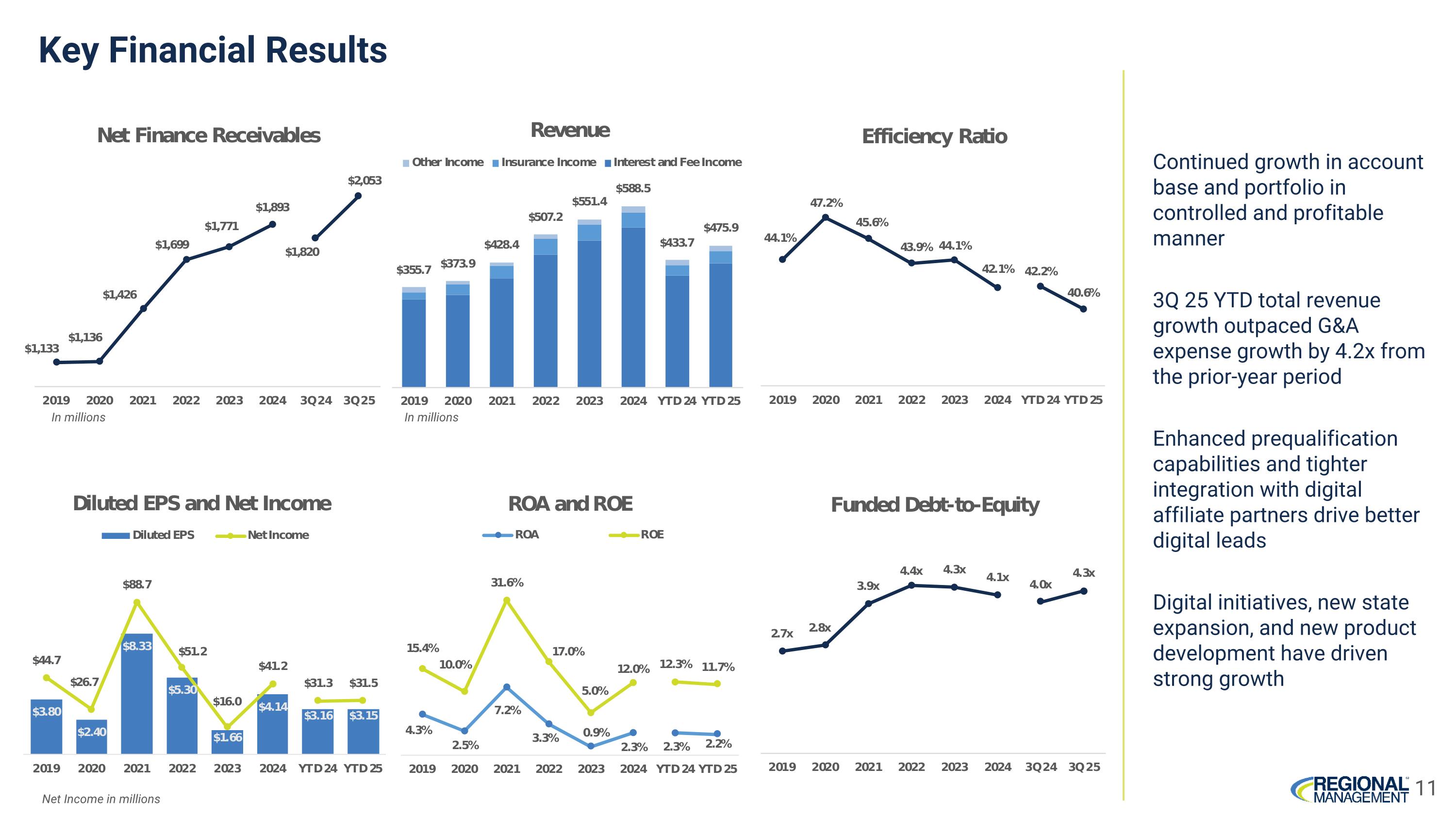
Key Financial Results In millions Net Income in millions Continued growth in account base and portfolio in controlled and profitable manner 3Q 25 YTD total revenue growth outpaced G&A expense growth by 4.2x from the prior-year period Enhanced prequalification capabilities and tighter integration with digital affiliate partners drive better digital leads Digital initiatives, new state expansion, and new product development have driven strong growth In millions 11
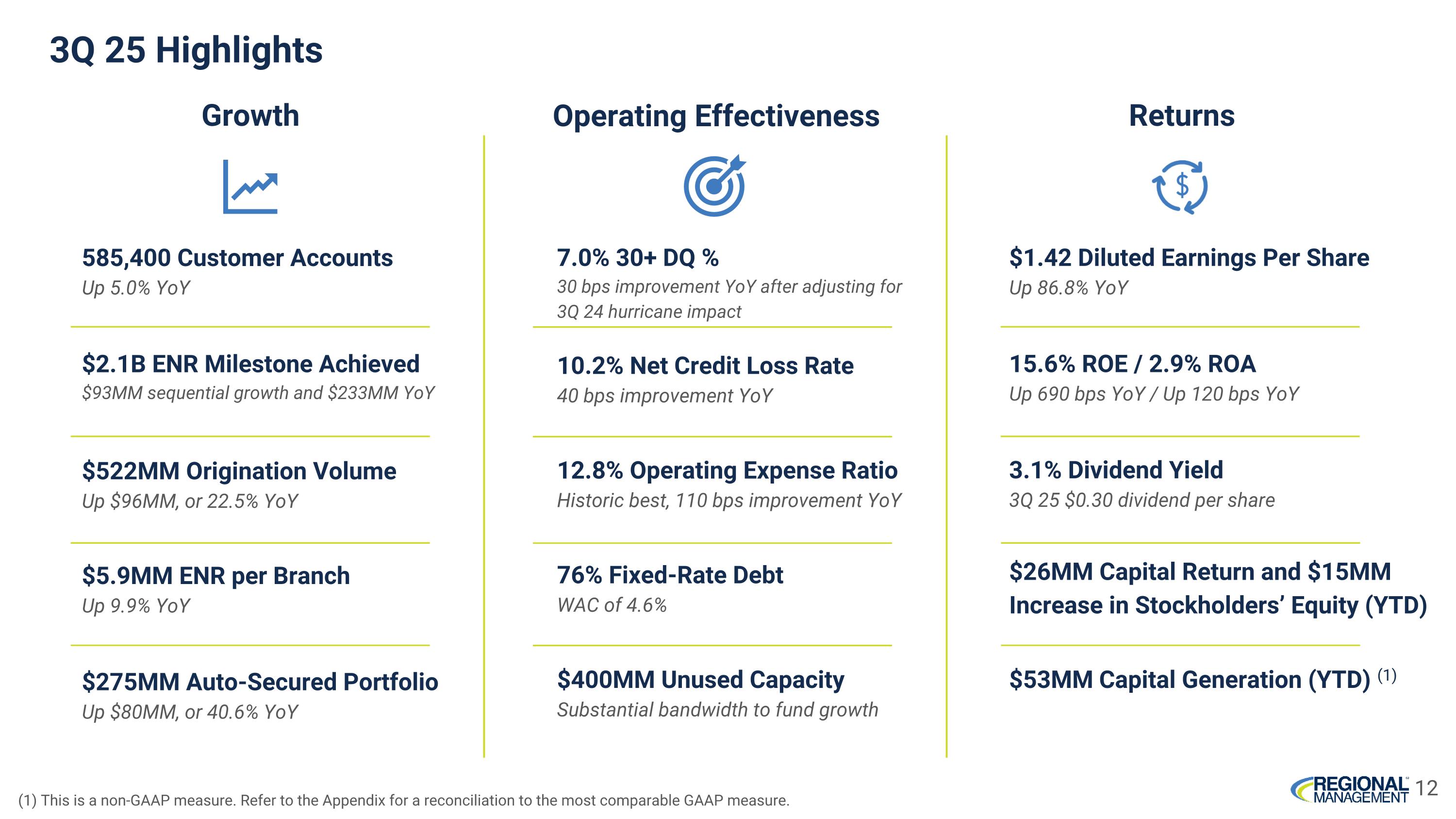
3Q 25 Highlights 585,400 Customer Accounts Up 5.0% YoY $2.1B ENR Milestone Achieved $93MM sequential growth and $233MM YoY $522MM Origination Volume Up $96MM, or 22.5% YoY $5.9MM ENR per Branch Up 9.9% YoY $275MM Auto-Secured Portfolio Up $80MM, or 40.6% YoY 12 Growth Operating Effectiveness Returns 7.0% 30+ DQ % 30 bps improvement YoY after adjusting for 3Q 24 hurricane impact 10.2% Net Credit Loss Rate 40 bps improvement YoY 12.8% Operating Expense Ratio Historic best, 110 bps improvement YoY 76% Fixed-Rate Debt WAC of 4.6% $400MM Unused Capacity Substantial bandwidth to fund growth $1.42 Diluted Earnings Per Share Up 86.8% YoY 15.6% ROE / 2.9% ROA Up 690 bps YoY / Up 120 bps YoY 3.1% Dividend Yield 3Q 25 $0.30 dividend per share $26MM Capital Return and $15MM Increase in Stockholders’ Equity (YTD) $53MM Capital Generation (YTD) (1) (1) This is a non-GAAP measure. Refer to the Appendix for a reconciliation to the most comparable GAAP measure.
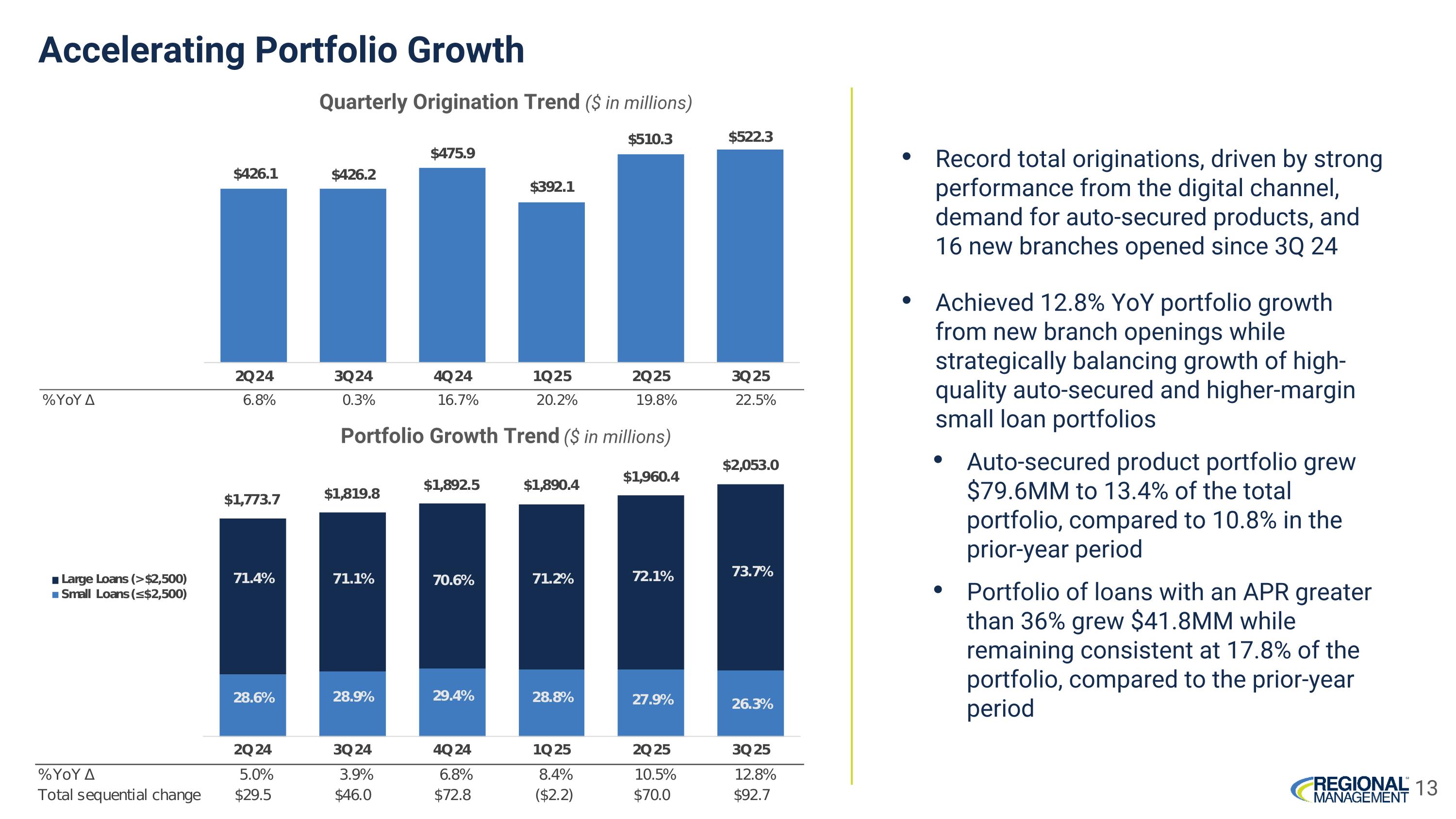
Portfolio Growth Trend ($ in millions) Accelerating Portfolio Growth 13 Record total originations, driven by strong performance from the digital channel, demand for auto-secured products, and 16 new branches opened since 3Q 24 Achieved 12.8% YoY portfolio growth from new branch openings while strategically balancing growth of high-quality auto-secured and higher-margin small loan portfolios Auto-secured product portfolio grew $79.6MM to 13.4% of the total portfolio, compared to 10.8% in the prior-year period Portfolio of loans with an APR greater than 36% grew $41.8MM while remaining consistent at 17.8% of the portfolio, compared to the prior-year period Quarterly Origination Trend ($ in millions)
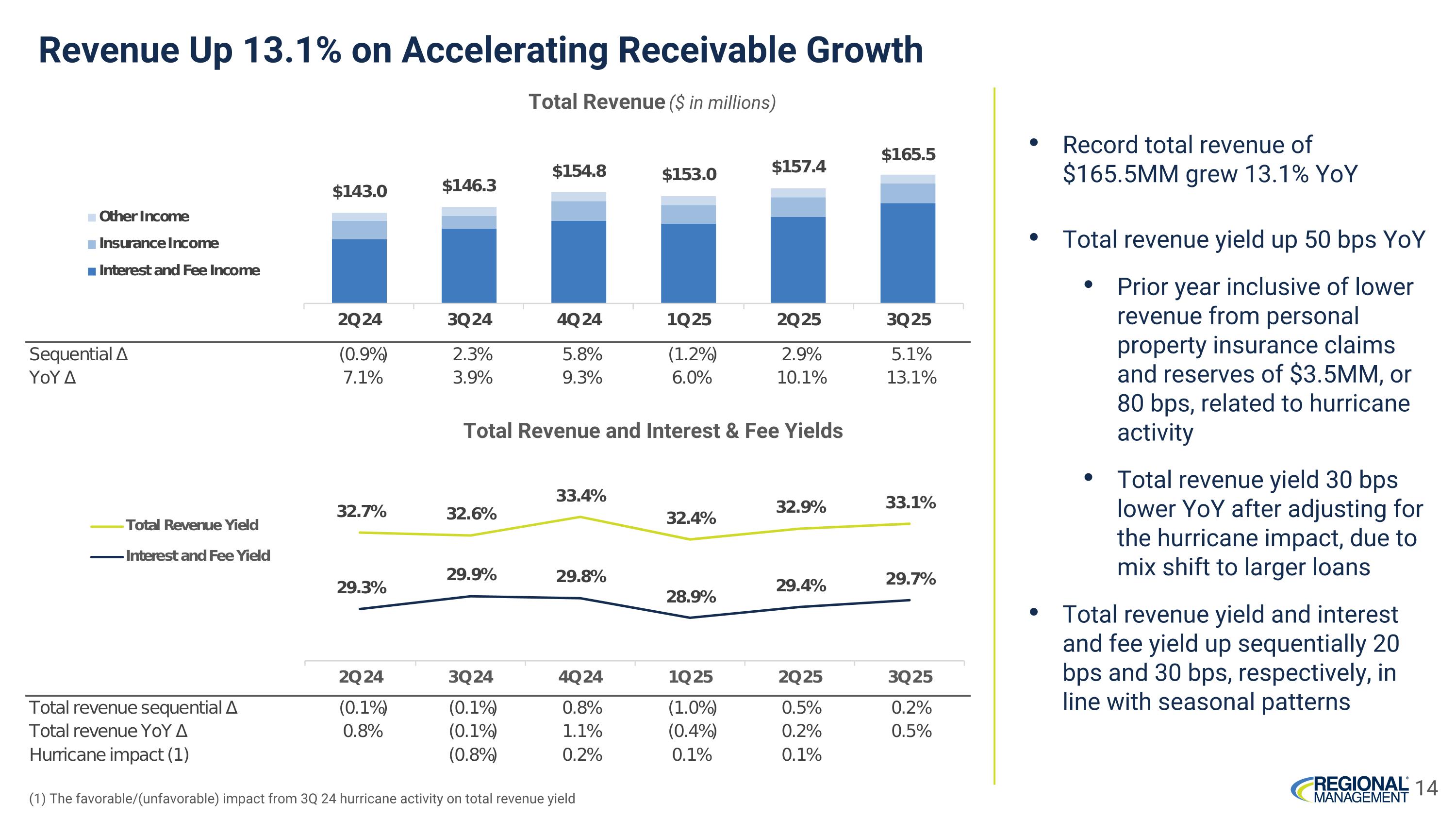
Record total revenue of $165.5MM grew 13.1% YoY Total revenue yield up 50 bps YoY Prior year inclusive of lower revenue from personal property insurance claims and reserves of $3.5MM, or 80 bps, related to hurricane activity Total revenue yield 30 bps lower YoY after adjusting for the hurricane impact, due to mix shift to larger loans Total revenue yield and interest and fee yield up sequentially 20 bps and 30 bps, respectively, in line with seasonal patterns 14 Total Revenue and Interest & Fee Yields Total Revenue ($ in millions) (1) The favorable/(unfavorable) impact from 3Q 24 hurricane activity on total revenue yield Revenue Up 13.1% on Accelerating Receivable Growth
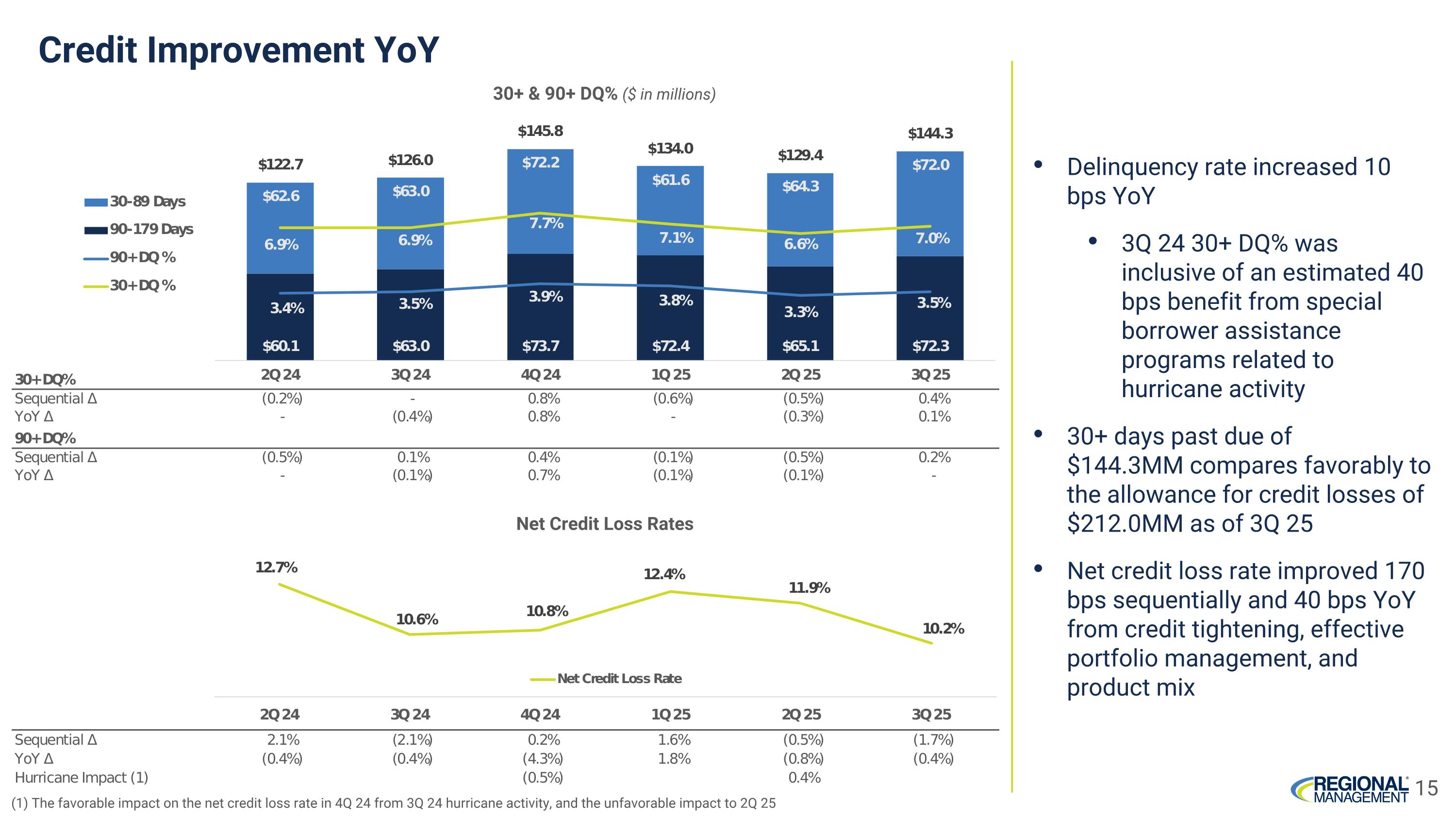
Credit Improvement YoY Delinquency rate increased 10 bps YoY 3Q 24 30+ DQ% was inclusive of an estimated 40 bps benefit from special borrower assistance programs related to hurricane activity 30+ days past due of $144.3MM compares favorably to the allowance for credit losses of $212.0MM as of 3Q 25 Net credit loss rate improved 170 bps sequentially and 40 bps YoY from credit tightening, effective portfolio management, and product mix 30+ & 90+ DQ% ($ in millions) Net Credit Loss Rates 15 (1) The favorable impact on the net credit loss rate in 4Q 24 from 3Q 24 hurricane activity, and the unfavorable impact to 2Q 25
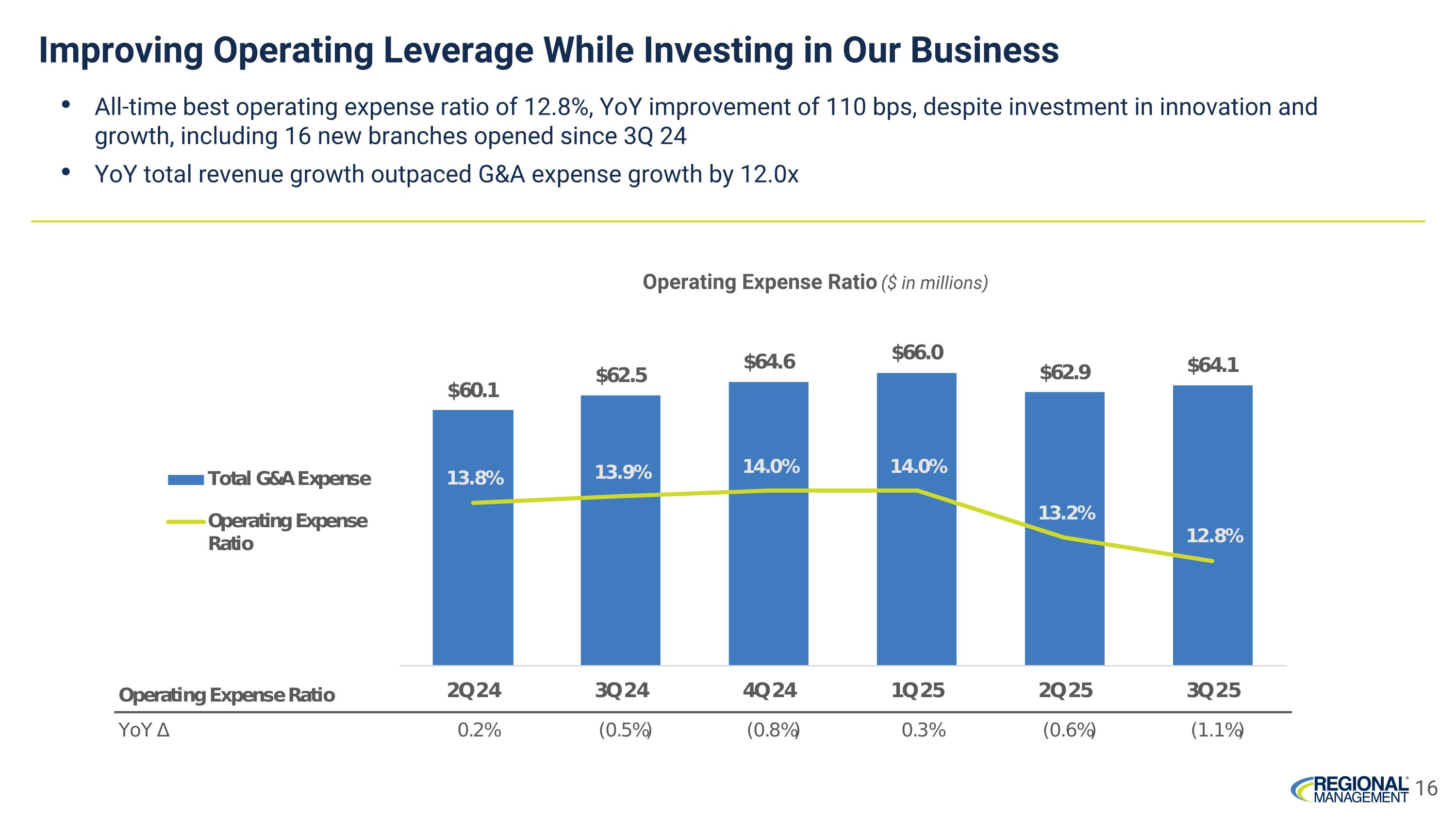
Improving Operating Leverage While Investing in Our Business Operating Expense Ratio ($ in millions) All-time best operating expense ratio of 12.8%, YoY improvement of 110 bps, despite investment in innovation and growth, including 16 new branches opened since 3Q 24 YoY total revenue growth outpaced G&A expense growth by 12.0x 16
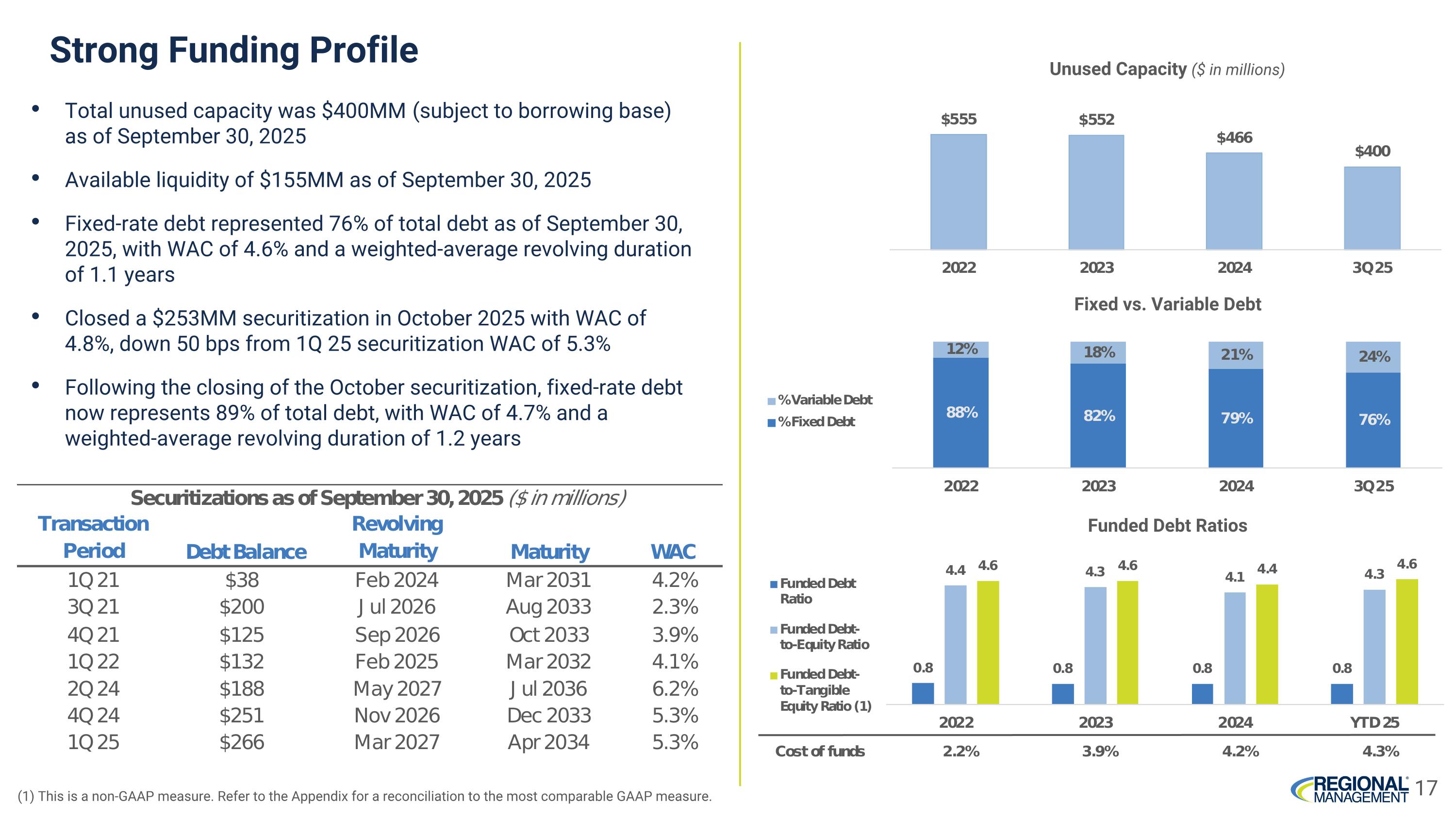
Total unused capacity was $400MM (subject to borrowing base) as of September 30, 2025 Available liquidity of $155MM as of September 30, 2025 Fixed-rate debt represented 76% of total debt as of September 30, 2025, with WAC of 4.6% and a weighted-average revolving duration of 1.1 years Closed a $253MM securitization in October 2025 with WAC of 4.8%, down 50 bps from 1Q 25 securitization WAC of 5.3% Following the closing of the October securitization, fixed-rate debt now represents 89% of total debt, with WAC of 4.7% and a weighted-average revolving duration of 1.2 years Strong Funding Profile Unused Capacity ($ in millions) Fixed vs. Variable Debt Funded Debt Ratios 17 (1) This is a non-GAAP measure. Refer to the Appendix for a reconciliation to the most comparable GAAP measure.
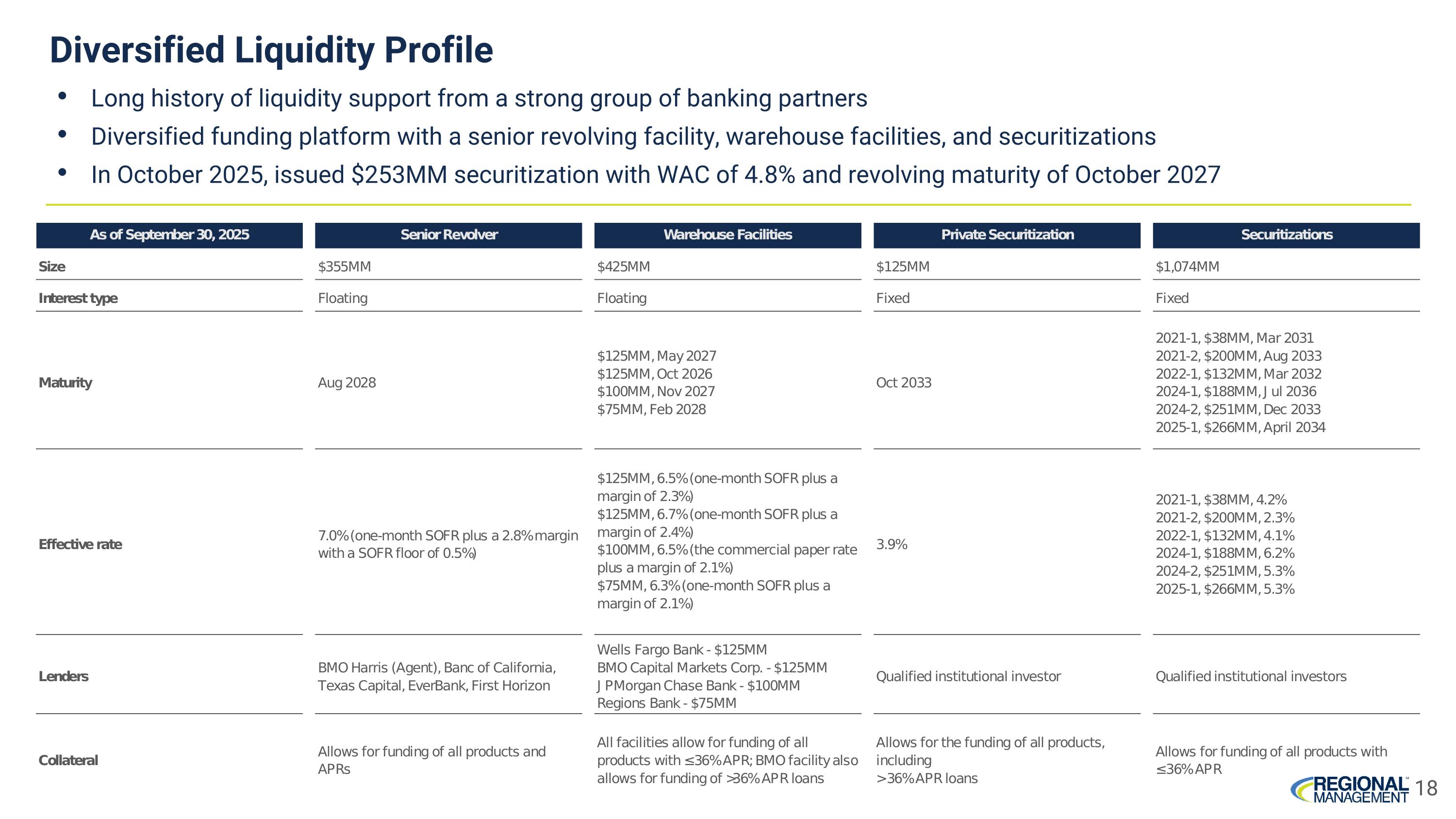
Diversified Liquidity Profile Long history of liquidity support from a strong group of banking partners Diversified funding platform with a senior revolving facility, warehouse facilities, and securitizations In October 2025, issued $253MM securitization with WAC of 4.8% and revolving maturity of October 2027 18
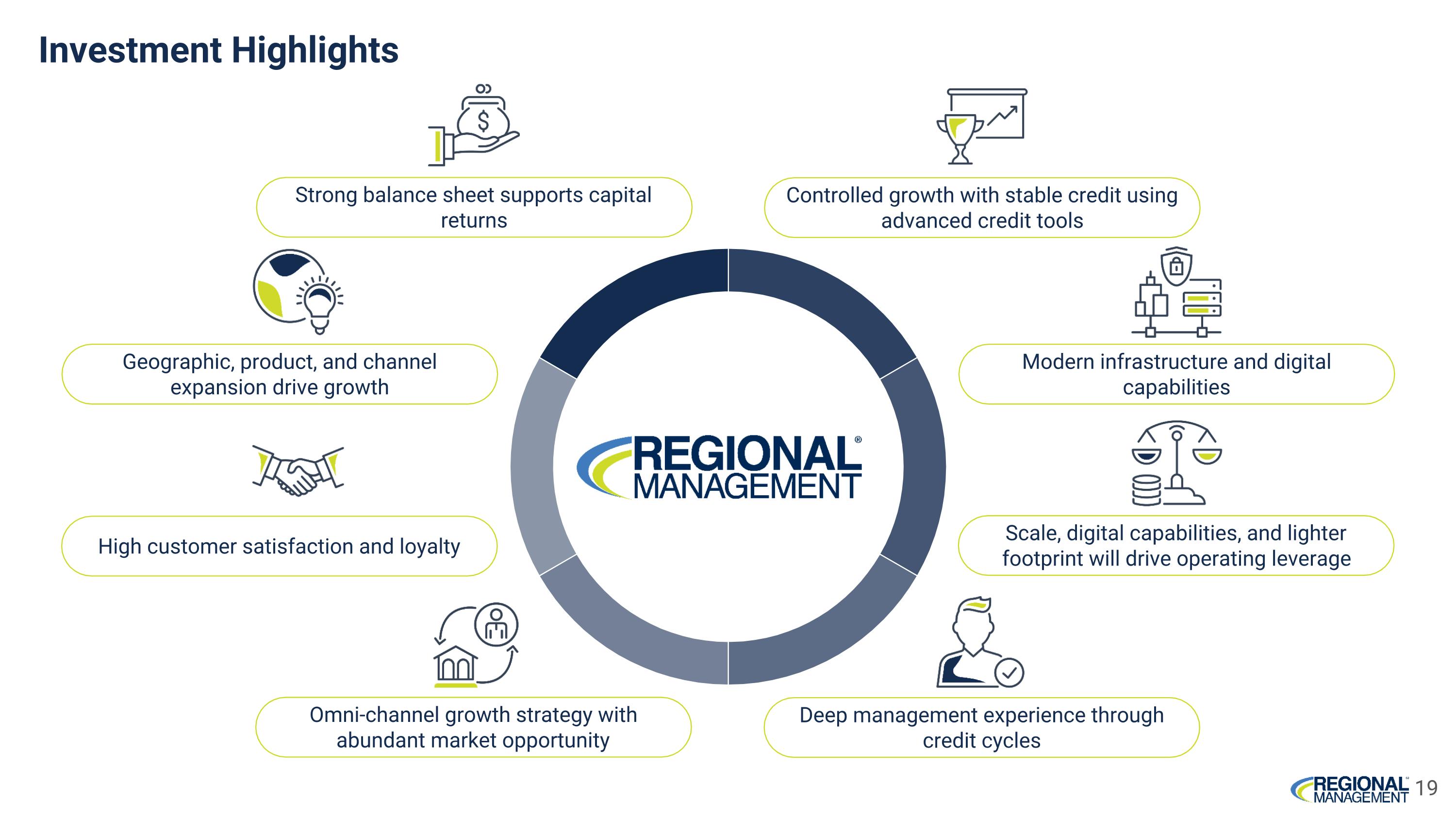
Investment Highlights Strong balance sheet supports capital returns Geographic, product, and channel expansion drive growth Omni-channel growth strategy with abundant market opportunity Controlled growth with stable credit using advanced credit tools Modern infrastructure and digital capabilities Deep management experience through credit cycles High customer satisfaction and loyalty Scale, digital capabilities, and lighter footprint will drive operating leverage 19

Appendix 20
Non-GAAP Financial Measures In addition to financial measures presented in accordance with generally accepted accounting principles (“GAAP”), this presentation contains certain non-GAAP financial measures. The Company’s management utilizes non-GAAP measures as additional metrics to aid in, and enhance, its understanding of the Company’s financial results. The Company believes that these non-GAAP measures provide useful information by excluding certain material items that may not be indicative of our operating results. As a result, the Company believes that the non-GAAP measures that it has presented will aid in the evaluation of the operating performance of the business. Total capital and capital return, capital generation, and capital generation as a % of average stockholders' equity are non-GAAP measures to include stock repurchases and dividends returned to stockholders with total capital. Management uses these measures to evaluate the Company's ability to generate capital to return to stockholders, reinvest in strategic initiatives, and evaluate its capacity to absorb losses. The Company also believes that these capital and absorption measures provide useful information to users of the Company’s financial statements in the evaluation of its ability to generate capital to return to stockholders, reinvest in strategic initiatives, and evaluate its capacity to absorb losses. Furthermore, tangible equity and the funded debt-to-tangible equity ratio are non-GAAP measures that adjust GAAP measures to exclude intangible assets. Management uses these equity measures to evaluate and manage the Company’s capital and leverage position. The Company also believes that these equity measures are commonly used in the financial services industry and provide useful information to users of the Company’s financial statements in the evaluation of its capital and leverage position. As a result, the Company also believes that these adjusted measures will aid users of its financial statements in the evaluation of its operating performance. This non-GAAP financial information should be considered in addition to, not as a substitute for or superior to, measures of financial performance prepared in accordance with GAAP. In addition, the Company’s non-GAAP measures may not be comparable to similarly titled non-GAAP measures of other companies. The following tables provide reconciliations of GAAP measures to non-GAAP measures. 21

Non-GAAP Financial Measures (Cont’d) 22
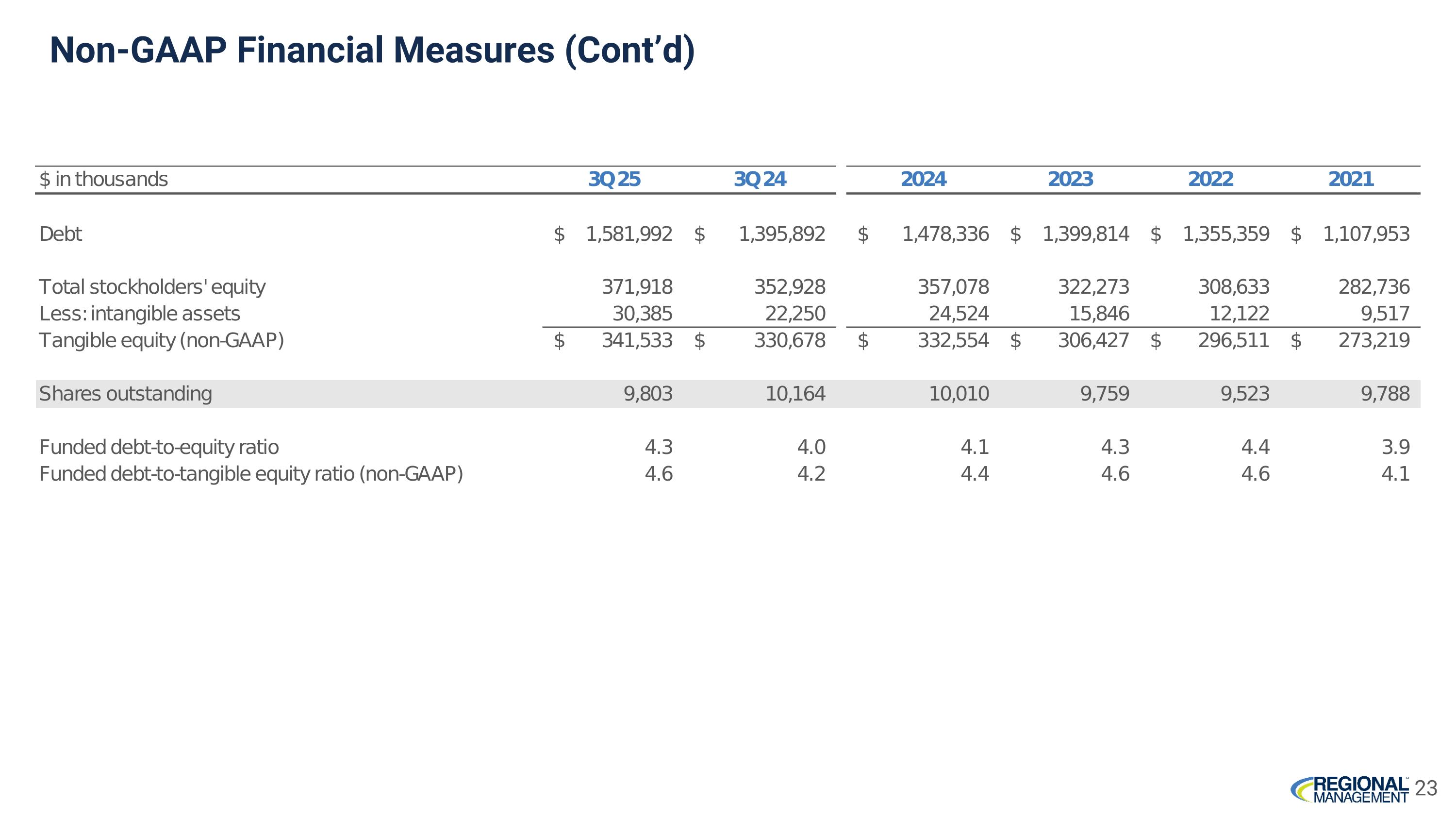
Non-GAAP Financial Measures (Cont’d) 23
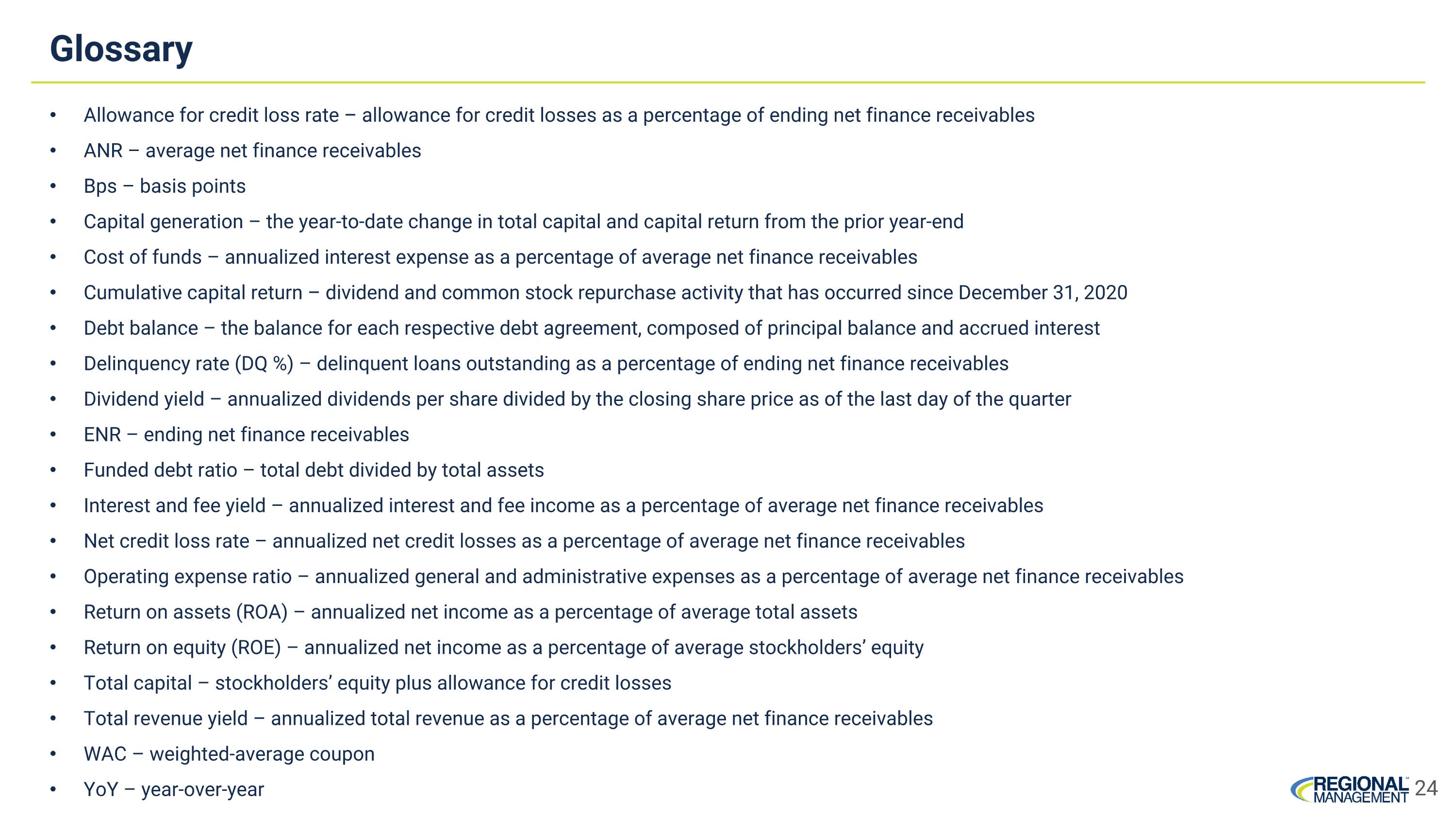
Glossary 24 Allowance for credit loss rate – allowance for credit losses as a percentage of ending net finance receivables ANR – average net finance receivables Bps – basis points Capital generation – the year-to-date change in total capital and capital return from the prior year-end Cost of funds – annualized interest expense as a percentage of average net finance receivables Cumulative capital return – dividend and common stock repurchase activity that has occurred since December 31, 2020 Debt balance – the balance for each respective debt agreement, composed of principal balance and accrued interest Delinquency rate (DQ %) – delinquent loans outstanding as a percentage of ending net finance receivables Dividend yield – annualized dividends per share divided by the closing share price as of the last day of the quarter ENR – ending net finance receivables Funded debt ratio – total debt divided by total assets Interest and fee yield – annualized interest and fee income as a percentage of average net finance receivables Net credit loss rate – annualized net credit losses as a percentage of average net finance receivables Operating expense ratio – annualized general and administrative expenses as a percentage of average net finance receivables Return on assets (ROA) – annualized net income as a percentage of average total assets Return on equity (ROE) – annualized net income as a percentage of average stockholders’ equity Total capital – stockholders’ equity plus allowance for credit losses Total revenue yield – annualized total revenue as a percentage of average net finance receivables WAC – weighted-average coupon YoY – year-over-year