--12-310001620463falseQ30.10.10.10.10.1Onehttp://fasb.org/srt/2025#ChiefExecutiveOfficerMember0001620463us-gaap:CommonStockMember2024-06-300001620463atha:EmployeeStockPurchasePlanMember2024-01-012024-09-300001620463atha:FosgonimetonATH-1017Member2024-07-012024-09-300001620463atha:LaboratoryAndOfficeFacilitiesMemberatha:BothellWashingtonMember2025-09-3000016204632024-06-300001620463atha:ExercisePriceThreeMember2025-01-012025-09-300001620463us-gaap:AdditionalPaidInCapitalMember2025-04-012025-06-300001620463atha:NonVestedRestrictedStockUnitsMember2025-01-012025-09-300001620463us-gaap:RestrictedStockUnitsRSUMember2025-09-300001620463us-gaap:RetainedEarningsMember2025-04-012025-06-300001620463us-gaap:CommonStockMember2025-04-012025-06-300001620463atha:FosgonimetonATH-1017Member2025-07-012025-09-300001620463us-gaap:CashEquivalentsMemberus-gaap:FairValueInputsLevel2Memberus-gaap:CommercialPaperMemberus-gaap:FairValueMeasurementsRecurringMember2024-12-310001620463us-gaap:ResearchAndDevelopmentExpenseMember2024-01-012024-09-3000016204632023-12-310001620463us-gaap:CommonStockMember2024-01-012024-03-310001620463atha:SharesAvailableForFutureGrantUnderTwoThousandTwentyEquityIncentivePlanMember2024-12-310001620463us-gaap:AdditionalPaidInCapitalMember2025-06-300001620463atha:ATH-1105Member2024-07-012024-09-300001620463atha:ShortTermInvestmentMemberus-gaap:FairValueInputsLevel2Memberus-gaap:USGovernmentAgenciesDebtSecuritiesMemberus-gaap:FairValueMeasurementsRecurringMember2025-09-300001620463us-gaap:CashEquivalentsMemberus-gaap:MoneyMarketFundsMemberus-gaap:FairValueInputsLevel1Memberus-gaap:FairValueMeasurementsRecurringMember2025-09-300001620463us-gaap:RetainedEarningsMember2024-07-012024-09-300001620463atha:ShortTermInvestmentMemberus-gaap:FairValueInputsLevel2Memberus-gaap:CommercialPaperMemberus-gaap:FairValueMeasurementsRecurringMember2025-09-300001620463us-gaap:AdditionalPaidInCapitalMember2024-09-300001620463us-gaap:AccumulatedOtherComprehensiveIncomeMember2024-04-012024-06-300001620463atha:ATH-1020Member2024-01-012024-09-300001620463us-gaap:AdditionalPaidInCapitalMember2025-09-300001620463us-gaap:RestrictedStockUnitsRSUMemberatha:TwoThousandAndTwentyEquityIncentivePlanMember2025-01-012025-09-300001620463us-gaap:AccumulatedOtherComprehensiveIncomeMember2023-12-310001620463atha:TwoThousandAndTwentyFourInducementEquityIncentivePlanMember2024-02-290001620463us-gaap:AdditionalPaidInCapitalMember2024-01-012024-03-310001620463atha:Personnel-RelatedCostsExcludingStock-BasedCompensationMember2025-01-012025-09-300001620463atha:ATH-1020Member2024-07-012024-09-300001620463atha:ExercisePriceTwoMember2025-01-012025-09-300001620463us-gaap:GeneralAndAdministrativeExpenseMember2024-07-012024-09-300001620463us-gaap:CommonStockMember2024-04-012024-06-3000016204632025-09-170001620463us-gaap:AccumulatedOtherComprehensiveIncomeMember2024-03-3100016204632024-01-012024-09-300001620463us-gaap:AdditionalPaidInCapitalMember2023-12-310001620463atha:AtTheMarketOfferingMember2023-01-012023-01-310001620463atha:ShortTermInvestmentMemberus-gaap:FairValueInputsLevel2Memberus-gaap:USGovernmentAgenciesDebtSecuritiesMemberus-gaap:FairValueMeasurementsRecurringMember2024-12-310001620463us-gaap:AdditionalPaidInCapitalMember2024-12-310001620463atha:SharesIssuableUponTheExerciseOfOutstandingCommonStockOptionsAndTheVestingOfOutstandingCommonRestrictedStockUnitsGrantedMember2025-09-300001620463us-gaap:CommonStockMember2025-03-310001620463us-gaap:AccumulatedOtherComprehensiveIncomeMember2024-09-3000016204632025-04-012025-06-300001620463us-gaap:CommonStockMember2025-01-012025-03-310001620463us-gaap:RestrictedStockUnitsRSUMember2025-01-012025-09-3000016204632025-11-050001620463us-gaap:CashEquivalentsMemberus-gaap:FairValueInputsLevel2Memberus-gaap:USGovernmentAgenciesDebtSecuritiesMemberus-gaap:FairValueMeasurementsRecurringMember2024-12-310001620463us-gaap:ResearchAndDevelopmentExpenseMember2024-07-012024-09-300001620463us-gaap:CommonStockMember2024-09-300001620463us-gaap:GeneralAndAdministrativeExpenseMember2025-01-012025-09-3000016204632025-03-310001620463atha:SharesAvailableForFutureGrantUnderTwoThousandTwentyEquityIncentivePlanMember2025-09-300001620463us-gaap:CashEquivalentsMemberus-gaap:FairValueMeasurementsRecurringMember2024-12-310001620463atha:ShortTermInvestmentMemberus-gaap:FairValueInputsLevel2Memberus-gaap:CommercialPaperMemberus-gaap:FairValueMeasurementsRecurringMember2024-12-310001620463us-gaap:RetainedEarningsMember2023-12-310001620463us-gaap:RetainedEarningsMember2025-07-012025-09-300001620463atha:ATH-1020Member2025-01-012025-09-300001620463us-gaap:CashEquivalentsMemberus-gaap:MoneyMarketFundsMemberus-gaap:FairValueInputsLevel1Memberus-gaap:FairValueMeasurementsRecurringMember2024-12-310001620463atha:LaboratoryAndOfficeFacilitiesMemberatha:BothellWashingtonMembersrt:MinimumMember2025-09-300001620463us-gaap:LeaseholdImprovementsMember2025-09-3000016204632025-09-172025-09-170001620463us-gaap:CommonStockMember2025-09-3000016204632025-06-300001620463atha:ExercisePriceFourMember2025-01-012025-09-300001620463us-gaap:CommonStockMember2025-06-300001620463atha:Personnel-RelatedCostsExcludingStock-BasedCompensationMember2025-07-012025-09-300001620463atha:ExercisePriceOneMember2025-01-012025-09-300001620463atha:SharesAvailableForFutureGrantUnderTwoThousandTwentyFourInducementEquityIncentivePlanMember2025-09-300001620463us-gaap:CommonStockMember2024-07-012024-09-300001620463atha:SharesAvailableForFutureGrantUnderTwoThousandTwentyFourInducementEquityIncentivePlanMember2024-12-310001620463us-gaap:CommonStockMember2024-03-310001620463us-gaap:GeneralAndAdministrativeExpenseMember2024-01-012024-09-300001620463us-gaap:AdditionalPaidInCapitalMember2025-03-310001620463atha:ExercisePriceOneMember2025-09-300001620463us-gaap:RetainedEarningsMember2025-09-300001620463us-gaap:FairValueMeasurementsRecurringMembersrt:MaximumMember2025-01-012025-09-300001620463atha:Personnel-RelatedCostsExcludingStock-BasedCompensationMember2024-07-012024-09-300001620463atha:LaboratoryAndOfficeFacilitiesMemberatha:BothellWashingtonMember2025-01-012025-09-300001620463us-gaap:CashEquivalentsMemberus-gaap:FairValueMeasurementsRecurringMember2025-09-300001620463us-gaap:ResearchAndDevelopmentExpenseMember2025-07-012025-09-300001620463us-gaap:AccumulatedOtherComprehensiveIncomeMember2025-01-012025-03-310001620463us-gaap:AccountingStandardsUpdate202309Member2025-09-3000016204632025-01-012025-03-310001620463us-gaap:ResearchAndDevelopmentExpenseMember2025-01-012025-09-300001620463us-gaap:LeaseholdImprovementsMember2024-12-310001620463us-gaap:AdditionalPaidInCapitalMember2024-06-3000016204632024-04-012024-06-300001620463us-gaap:RetainedEarningsMember2025-06-300001620463us-gaap:AdditionalPaidInCapitalMember2024-04-012024-06-300001620463us-gaap:AccumulatedOtherComprehensiveIncomeMember2025-06-300001620463us-gaap:GeneralAndAdministrativeExpenseMember2025-07-012025-09-300001620463atha:LaboratoryAndOfficeFacilitiesMemberatha:BothellWashingtonMembersrt:MaximumMember2025-09-300001620463atha:TwoThousandAndTwentyEquityIncentivePlanMember2025-01-010001620463us-gaap:AccumulatedOtherComprehensiveIncomeMember2024-01-012024-03-310001620463atha:PreclinicalProgramsAndOtherCostsMember2025-01-012025-09-300001620463us-gaap:RestrictedStockUnitsRSUMemberatha:TwoThousandAndTwentyEquityIncentivePlanMember2025-09-300001620463atha:ATH-1105Member2025-07-012025-09-300001620463us-gaap:AdditionalPaidInCapitalMember2024-03-310001620463us-gaap:AccumulatedOtherComprehensiveIncomeMember2024-07-012024-09-3000016204632025-09-300001620463us-gaap:AdditionalPaidInCapitalMember2025-07-012025-09-3000016204632024-01-012024-03-310001620463us-gaap:AccumulatedOtherComprehensiveIncomeMember2024-12-310001620463atha:ExercisePriceFourMember2025-09-300001620463atha:Personnel-RelatedCostsExcludingStock-BasedCompensationMember2024-01-012024-09-300001620463us-gaap:AdditionalPaidInCapitalMember2024-07-012024-09-300001620463atha:ExercisePriceTwoMember2025-09-300001620463us-gaap:AdditionalPaidInCapitalMember2025-01-012025-03-310001620463atha:LaboratoryEquipmentMember2024-12-310001620463atha:StockOptionsToPurchaseCommonStockMember2024-01-012024-09-300001620463us-gaap:AccumulatedOtherComprehensiveIncomeMember2025-09-3000016204632024-01-012024-12-310001620463atha:ATH-1105Member2024-01-012024-09-300001620463atha:ATH-1105Member2025-01-012025-09-300001620463us-gaap:RetainedEarningsMember2024-01-012024-03-310001620463atha:PreclinicalProgramsAndOtherCostsMember2025-07-012025-09-300001620463us-gaap:RetainedEarningsMember2024-03-310001620463atha:ShortTermInvestmentMemberus-gaap:FairValueMeasurementsRecurringMember2025-09-300001620463us-gaap:RetainedEarningsMember2024-04-012024-06-300001620463us-gaap:RetainedEarningsMember2025-01-012025-03-310001620463atha:ExercisePriceThreeMember2025-09-300001620463atha:FurnitureFixturesAndComputerEquipmentMember2024-12-310001620463us-gaap:CommonStockMember2024-12-310001620463us-gaap:RetainedEarningsMember2024-09-300001620463us-gaap:AccumulatedOtherComprehensiveIncomeMember2024-06-300001620463us-gaap:RetainedEarningsMember2025-03-310001620463atha:NonVestedRestrictedStockUnitsMember2024-01-012024-09-300001620463us-gaap:CommonStockMember2023-12-310001620463atha:SharesIssuableUponTheExerciseOfOutstandingCommonStockOptionsAndTheVestingOfOutstandingCommonRestrictedStockUnitsGrantedMember2024-12-3100016204632024-09-300001620463atha:TowThousandAndTwentyEmployeeStockPurchasePlanMember2025-01-012025-09-300001620463atha:StockOptionsToPurchaseCommonStockMember2025-01-012025-09-3000016204632025-01-012025-09-300001620463atha:TerminationBenefitsMember2024-01-012024-12-3100016204632025-09-160001620463atha:LaboratoryEquipmentMember2025-09-300001620463atha:PreclinicalProgramsAndOtherCostsMember2024-01-012024-09-300001620463us-gaap:AccumulatedOtherComprehensiveIncomeMember2025-04-012025-06-300001620463atha:TwoThousandAndTwentyEquityIncentivePlanMember2025-01-012025-09-3000016204632024-12-310001620463atha:PreclinicalProgramsAndOtherCostsMember2024-07-012024-09-300001620463us-gaap:RetainedEarningsMember2024-12-3100016204632025-07-012025-09-300001620463us-gaap:CashEquivalentsMemberus-gaap:FairValueInputsLevel2Memberus-gaap:USGovernmentAgenciesDebtSecuritiesMemberus-gaap:FairValueMeasurementsRecurringMember2025-09-300001620463atha:FurnitureFixturesAndComputerEquipmentMember2025-09-300001620463us-gaap:AccumulatedOtherComprehensiveIncomeMember2025-03-310001620463atha:EmployeeStockPurchasePlanMember2025-01-012025-09-3000016204632024-09-152024-09-150001620463atha:FosgonimetonATH-1017Member2025-01-012025-09-300001620463us-gaap:RestrictedStockUnitsRSUMemberatha:TwoThousandAndTwentyEquityIncentivePlanMember2024-12-310001620463atha:SharesAvailableForFutureGrantUnderEmployeeStockPurchasePlanMember2024-12-310001620463us-gaap:CashEquivalentsMemberus-gaap:FairValueInputsLevel2Memberus-gaap:CommercialPaperMemberus-gaap:FairValueMeasurementsRecurringMember2025-09-300001620463us-gaap:AccumulatedOtherComprehensiveIncomeMember2025-07-012025-09-300001620463atha:ShortTermInvestmentMemberus-gaap:FairValueMeasurementsRecurringMember2024-12-310001620463atha:TowThousandAndTwentyEmployeeStockPurchasePlanMember2025-01-0100016204632024-07-012024-09-3000016204632024-03-310001620463atha:FosgonimetonATH-1017Member2024-01-012024-09-300001620463us-gaap:RetainedEarningsMember2024-06-300001620463atha:SharesAvailableForFutureGrantUnderEmployeeStockPurchasePlanMember2025-09-300001620463atha:AtTheMarketOfferingMembersrt:MaximumMember2023-01-31xbrli:purexbrli:sharesatha:Segmentiso4217:USD
UNITED STATES
SECURITIES AND EXCHANGE COMMISSION
Washington, DC 20549
FORM 10-Q
|
|
☒ |
QUARTERLY REPORT PURSUANT TO SECTION 13 OR 15(d) OF THE SECURITIES EXCHANGE ACT OF 1934 |
For the quarterly period ended September 30, 2025
OR
|
|
☐ |
TRANSITION REPORT PURSUANT TO SECTION 13 OR 15(d) OF THE SECURITIES EXCHANGE ACT OF 1934 |
For the transition period from ____ to ____
Commission File Number: 001-39503
Athira Pharma, Inc.
(Exact name of registrant as specified in its charter)
|
|
Delaware |
45-3368487 |
(State or other jurisdiction of
incorporation or organization) |
(I.R.S. Employer
Identification No.) |
18706 North Creek Parkway, Suite 104
Bothell, Washington 98011
(Address of principal executive offices)
(425) 620-8501
(Registrant’s telephone number, including area code)
Securities registered pursuant to Section 12(b) of the Act:
|
|
|
Title of each class |
Trading Symbol(s) |
Name of each exchange on which registered |
Common Stock, $0.0001 par value per share |
ATHA |
The Nasdaq Stock Market LLC |
|
|
(The Nasdaq Capital Market) |
Indicate by check mark whether the registrant (1) has filed all reports required to be filed by Section 13 or 15(d) of the Securities Exchange Act of 1934 during the preceding 12 months (or for such shorter period that the registrant was required to file such reports), and (2) has been subject to such filing requirements for the past 90 days. Yes ☒ No ☐
Indicate by check mark whether the registrant has submitted electronically every Interactive Data File required to be submitted pursuant to Rule 405 of Regulation S-T during the preceding 12 months (or for such shorter period that the registrant was required to submit such files). Yes ☒ No ☐
Indicate by check mark whether the registrant is a large accelerated filer, an accelerated filer, a non-accelerated filer, a smaller reporting company or an emerging growth company. See the definitions of “large accelerated filer,” “accelerated filer,” “smaller reporting company” and “emerging growth company” in Rule 12b-2 of the Exchange Act:
|
|
|
|
Large accelerated filer |
☐ |
Accelerated filer |
☐ |
Non-accelerated filer |
☒ |
Smaller reporting company |
☒ |
Emerging growth company |
☒ |
|
|
If an emerging growth company, indicate by check mark if the registrant has elected not to use the extended transition period for complying with any new or revised financial accounting standards provided pursuant to Section 13(a) of the Exchange Act. ☐
Indicate by check mark whether the registrant is a shell company (as defined in Rule 12b-2 of the Exchange Act). Yes ☐ No ☒
As of November 5, 2025, there were 3,943,887 shares of registrant’s common stock, $0.0001 par value per share, outstanding.
Table of Contents
This report includes our trademarks and registered trademarks, including Athira, Athira Pharma, the Athira logo, and other trademarks or service marks of Athira. Each other trademark, trade name or service mark appearing in this report belongs to its holder.
SUMMARY RISK FACTORS
Our business is subject to numerous risks and uncertainties, including those highlighted in the section of this report captioned “Risk Factors.” The following is a summary of the principal risks we face:
•
We are a clinical-stage biopharmaceutical company with a limited operating history.
•
Our development of ATH-1105 may never lead to a marketable product.
•
Our ability to generate revenue and achieve profitability depends significantly on our ability to achieve a number of objectives.
•
Our approach to targeting neurotrophic factors through the use of small molecules is based on a novel therapeutic approach, which exposes us to unforeseen risks. We have limited data from preclinical studies and clinical trials to date, including for ATH-1105, and we cannot be certain that future trials will yield data in support of the safety, efficacy and tolerability of our drug candidates.
•
We may not be successful in identifying and implementing any strategic transaction and any strategic transactions that we may consummate in the future may not be successful.
•
We have concentrated our research and development efforts on the treatment of central and peripheral nervous system degenerative disorders, a field that has seen very limited success in product development.
•
Clinical development involves a lengthy and expensive process with an uncertain outcome, and results of early, smaller-scale preclinical studies and clinical trials with a single or few clinical trial sites may not be predictive of eventual safety or effectiveness in large-scale potentially pivotal clinical trials across multiple clinical trial sites. We may encounter substantial delays in clinical trials, or may not be able to conduct or complete clinical trials on the expected timelines, if at all.
•
We may expend our limited resources to pursue a particular drug candidate or indication and fail to capitalize on drug candidates or indications that may be more profitable or for which there is a greater likelihood of success.
•
We have been and may in the future be subject to claims, lawsuits, arbitration proceedings, government investigations, securities class action litigation and other legal, regulatory and administrative proceedings and face potential liability and expenses related thereto, which could divert management's attention, and insurance coverage may not be sufficient to cover all costs and damages. This could have a material adverse effect on our business, operating results and financial condition.
•
Any “topline”, interim, initial, or preliminary data from our clinical trials that we announce or publish from time to time may change as more patient data become available and are subject to audit and verification procedures that could result in material changes in the final data.
•
Our reporting of topline or final data for our clinical trials may be delayed and our regulatory submissions or receipt of necessary marketing approvals could be delayed or prevented.
•
If we engage in future acquisitions or strategic partnerships, this may increase our capital requirements, dilute our stockholders, cause us to incur debt or assume contingent liabilities, and subject us to other risks.
•
We will require substantial additional funding to finance our operations, complete the development and commercialization of ATH-1105 and develop and commercialize other current and potential drug candidates. If we are unable to raise this funding and access capital when needed, we may be forced to delay, reduce, or eliminate our drug product development programs, commercialization efforts or other operations.
•
Our success depends on our ability to protect our intellectual property and our proprietary technologies.
•
If the scope of any patent protection we obtain is not sufficiently broad, or if we lose any of our patent protection, our ability to prevent our competitors from commercializing similar or identical product candidates would be adversely affected.
•
We face significant competition, and if our competitors develop and market technologies or products more rapidly than we do or that are more effective, safer, or less expensive than the drug candidates we develop, our commercial opportunities will be negatively impacted.
•
The loss of any of our key personnel could significantly harm our business, results of operations and competitive position.
•
We have incurred significant losses since our inception and anticipate that we will continue to incur significant losses for the foreseeable future.
•
The regulatory approval processes of the U.S. Food and Drug Administration, or FDA, and other comparable foreign regulatory authorities are lengthy, time consuming and inherently unpredictable. If we are not able to obtain, or if there are delays in obtaining, required regulatory approvals for our drug candidates, we will not be able to commercialize, or will be delayed in commercializing, our drug candidates, and our ability to generate revenue will be materially impaired.
•
We rely on third parties to conduct our nonclinical studies and clinical trials. If these third parties do not properly and successfully carry out their contractual duties or meet expected deadlines, we may not be able to obtain regulatory approval of or commercialize our drug candidates.
•
Even if approved, our drug candidates may not achieve adequate market acceptance among physicians, patients, healthcare payors and others in the medical community necessary for commercial success.
•
We have never commercialized a drug candidate before and may lack the necessary expertise, personnel and resources to successfully commercialize any drug products on our own or together with suitable collaborators.
•
The market price of our common stock has been and may continue to be volatile, which could result in substantial losses for investors.
•
We and certain of our directors and executive officers have been, and may in the future be, named as defendants in lawsuits that could result in substantial costs and divert management’s attention.
•
Actions by activist stockholders have in the past been, and may in the future be, disruptive and could cause uncertainty about the strategic direction of our business.
Our Risk Factors are not guarantees that no such conditions exist as of the date of this report and should not be interpreted as an affirmative statement that such risks or conditions have not materialized, in whole or in part.
PART I—FINANCIAL INFORMATION
Item 1. Financial Statements (Unaudited)
Athira Pharma, Inc.
Condensed Consolidated Balance Sheets
(in thousands, except share and per share amounts)
|
|
|
|
|
|
|
|
|
|
|
September 30, |
|
|
December 31, |
|
|
|
2025 |
|
|
2024 |
|
|
|
(unaudited) |
|
|
|
|
Assets |
|
|
|
|
|
|
Current assets: |
|
|
|
|
|
|
Cash and cash equivalents |
|
$ |
20,874 |
|
|
$ |
48,438 |
|
Short-term investments |
|
|
4,352 |
|
|
|
2,837 |
|
Prepaid expenses and other current assets |
|
|
1,799 |
|
|
|
3,566 |
|
Total current assets |
|
|
27,025 |
|
|
|
54,841 |
|
Restricted cash |
|
|
631 |
|
|
|
631 |
|
Property and equipment, net |
|
|
1,715 |
|
|
|
2,444 |
|
Operating lease right-of-use asset |
|
|
607 |
|
|
|
808 |
|
Other long-term assets |
|
|
55 |
|
|
|
55 |
|
Total assets |
|
$ |
30,033 |
|
|
$ |
58,779 |
|
Liabilities and stockholders' equity |
|
|
|
|
|
|
Current liabilities: |
|
|
|
|
|
|
Accounts payable |
|
$ |
266 |
|
|
$ |
319 |
|
Accrued liabilities |
|
|
2,069 |
|
|
|
12,402 |
|
Current operating lease liability |
|
|
452 |
|
|
|
414 |
|
Total current liabilities |
|
$ |
2,787 |
|
|
$ |
13,135 |
|
Operating lease liability, less current portion |
|
|
460 |
|
|
|
803 |
|
Total liabilities |
|
|
3,247 |
|
|
|
13,938 |
|
Stockholders' equity: |
|
|
|
|
|
|
Common stock, $0.0001 par value; 90,000,000 shares
authorized at September 30, 2025 and December 31, 2024,
respectively; 3,943,887 and 3,904,049 shares issued
and outstanding at September 30, 2025 and December 31,
2024, respectively (1) |
|
|
4 |
|
|
|
4 |
|
Additional paid-in capital |
|
|
455,650 |
|
|
|
450,982 |
|
Accumulated other comprehensive (loss) income |
|
|
(2 |
) |
|
|
1 |
|
Accumulated deficit |
|
|
(428,866 |
) |
|
|
(406,146 |
) |
Total stockholders' equity |
|
|
26,786 |
|
|
|
44,841 |
|
Total liabilities and stockholders' equity |
|
$ |
30,033 |
|
|
$ |
58,779 |
|
The accompanying notes are an integral part of these unaudited condensed consolidated financial statements.
(1) The Company effected a reverse stock split of its outstanding shares of common stock on September 17, 2025 where every ten shares of its common stock issued and outstanding was converted into one share of common stock. Any fractional post-split shares as a result of the reverse stock split were rounded down to the nearest whole post-split share. Stockholders of the Company previously authorized the Board of Directors to approve a reverse stock split at the Company's annual meeting on May 29, 2025. All share amounts and per share amounts disclosed in this Quarterly Report on Form 10-Q have been restated to reflect the reverse stock split on a retroactive basis in all periods presented.
Athira Pharma, Inc.
Condensed Consolidated Statements of Operations and Comprehensive Loss
(in thousands, except share and per share amounts)
(unaudited)
|
|
|
|
|
|
|
|
|
|
|
|
|
|
|
|
|
|
Three Months Ended September 30, |
|
Nine Months Ended September 30, |
|
|
|
2025 |
|
|
2024 |
|
2025 |
|
|
2024 |
|
Operating expenses: |
|
|
|
|
|
|
|
|
|
|
|
Research and development |
|
$ |
2,825 |
|
|
$ |
17,922 |
|
$ |
10,788 |
|
|
$ |
61,312 |
|
General and administrative |
|
|
4,049 |
|
|
|
7,572 |
|
|
12,913 |
|
|
|
19,897 |
|
Legal expense |
|
|
— |
|
|
|
4,127 |
|
|
— |
|
|
|
4,127 |
|
Total operating expenses |
|
|
6,874 |
|
|
|
29,621 |
|
|
23,701 |
|
|
|
85,336 |
|
Loss from operations |
|
|
(6,874 |
) |
|
|
(29,621 |
) |
|
(23,701 |
) |
|
|
(85,336 |
) |
Other income, net |
|
|
263 |
|
|
|
880 |
|
|
981 |
|
|
|
3,399 |
|
Net loss |
|
$ |
(6,611 |
) |
|
$ |
(28,741 |
) |
$ |
(22,720 |
) |
|
$ |
(81,937 |
) |
Unrealized (loss) gain on available-for-sale securities |
|
|
1 |
|
|
|
41 |
|
|
(3 |
) |
|
|
352 |
|
Comprehensive loss attributable to common stockholders |
|
$ |
(6,610 |
) |
|
$ |
(28,700 |
) |
$ |
(22,723 |
) |
|
$ |
(81,585 |
) |
Net loss per share attributable to common
stockholders, basic and diluted |
|
$ |
(1.68 |
) |
|
$ |
(7.46 |
) |
$ |
(5.80 |
) |
|
$ |
(21.33 |
) |
Weighted-average shares used in computing
net loss per share attributable to common
stockholders, basic and diluted (1) |
|
|
3,943,887 |
|
|
|
3,851,758 |
|
|
3,919,258 |
|
|
|
3,840,669 |
|
The accompanying notes are an integral part of these unaudited condensed consolidated financial statements.
(1) The Company effected a reverse stock split of its outstanding shares of common stock on September 17, 2025 where every ten shares of its common stock issued and outstanding was converted into one share of common stock. Any fractional post-split shares as a result of the reverse stock split were rounded down to the nearest whole post-split share. Stockholders of the Company previously authorized the Board of Directors to approve a reverse stock split at the Company's annual meeting on May 29, 2025. All share amounts and per share amounts disclosed in this Quarterly Report on Form 10-Q have been restated to reflect the reverse stock split on a retroactive basis in all periods presented.
Athira Pharma, Inc.
Condensed Consolidated Statements of Stockholders’ Equity
For the Three and Nine Months Ended September 30, 2025
(in thousands, except share amounts)
(unaudited)
|
|
|
|
|
|
|
|
|
|
|
|
|
|
|
|
|
|
|
|
|
|
|
|
|
|
|
|
|
|
|
|
|
|
|
|
Accumulated |
|
|
|
|
|
|
|
|
|
Common Stock (1) |
|
|
Additional
Paid-In |
|
|
Other
Comprehensive |
|
|
Accumulated |
|
|
Total
Stockholders’ |
|
|
|
Shares |
|
|
Amount |
|
|
Capital |
|
|
Income (Loss) |
|
|
Deficit |
|
|
Equity |
|
Balance as of January 1, 2025 |
|
|
3,904,049 |
|
|
$ |
4 |
|
|
$ |
450,982 |
|
|
$ |
1 |
|
|
$ |
(406,146 |
) |
|
$ |
44,841 |
|
Issuance of common stock upon vesting of
restricted stock units |
|
|
150 |
|
|
|
— |
|
|
|
— |
|
|
|
— |
|
|
|
— |
|
|
|
— |
|
Stock-based compensation |
|
|
— |
|
|
|
— |
|
|
|
1,637 |
|
|
|
— |
|
|
|
— |
|
|
|
1,637 |
|
Unrealized loss on available-for-sale
securities |
|
|
— |
|
|
|
— |
|
|
|
— |
|
|
|
(5 |
) |
|
|
— |
|
|
|
(5 |
) |
Net loss |
|
|
— |
|
|
|
— |
|
|
|
— |
|
|
|
— |
|
|
|
(9,143 |
) |
|
|
(9,143 |
) |
Balance as of March 31, 2025 |
|
|
3,904,199 |
|
|
$ |
4 |
|
|
$ |
452,619 |
|
|
$ |
(4 |
) |
|
$ |
(415,289 |
) |
|
$ |
37,330 |
|
|
|
|
|
|
|
|
|
|
|
|
|
|
|
|
|
|
|
|
Issuance of common stock upon vesting of
restricted stock units |
|
|
29,688 |
|
|
|
— |
|
|
|
— |
|
|
|
— |
|
|
|
— |
|
|
|
— |
|
Issuance of common stock under
employee stock purchase plan |
|
|
10,000 |
|
|
|
— |
|
|
|
24 |
|
|
|
— |
|
|
|
— |
|
|
|
24 |
|
Stock-based compensation |
|
|
— |
|
|
|
— |
|
|
|
1,597 |
|
|
|
— |
|
|
|
— |
|
|
|
1,597 |
|
Unrealized loss on available-for-sale
securities |
|
|
— |
|
|
|
— |
|
|
|
— |
|
|
|
1 |
|
|
|
— |
|
|
|
1 |
|
Net loss |
|
|
— |
|
|
|
— |
|
|
|
— |
|
|
|
— |
|
|
|
(6,966 |
) |
|
|
(6,966 |
) |
Balance as of June 30, 2025 |
|
|
3,943,887 |
|
|
$ |
4 |
|
|
$ |
454,240 |
|
|
$ |
(3 |
) |
|
$ |
(422,255 |
) |
|
$ |
31,986 |
|
Stock-based compensation |
|
|
— |
|
|
|
— |
|
|
|
1,410 |
|
|
|
— |
|
|
|
— |
|
|
|
1,410 |
|
Unrealized loss on available-for-sale
securities |
|
|
— |
|
|
|
— |
|
|
|
— |
|
|
|
1 |
|
|
|
— |
|
|
|
1 |
|
Net loss |
|
|
— |
|
|
|
— |
|
|
|
— |
|
|
|
— |
|
|
|
(6,611 |
) |
|
|
(6,611 |
) |
Balance as of September 30, 2025 |
|
|
3,943,887 |
|
|
$ |
4 |
|
|
$ |
455,650 |
|
|
$ |
(2 |
) |
|
$ |
(428,866 |
) |
|
$ |
26,786 |
|
|
|
|
|
|
|
|
|
|
|
|
|
|
|
|
|
|
|
|
|
|
|
|
|
|
|
|
|
|
|
|
|
|
|
|
|
|
|
The accompanying notes are an integral part of these unaudited condensed consolidated financial statements.
(1) The Company effected a reverse stock split of its outstanding shares of common stock on September 17, 2025 where every ten shares of its common stock issued and outstanding was converted into one share of common stock. Any fractional post-split shares as a result of the reverse stock split were rounded down to the nearest whole post-split share. Stockholders of the Company previously authorized the Board of Directors to approve a reverse stock split at the Company's annual meeting on May 29, 2025. All share amounts and per share amounts disclosed in this Quarterly Report on Form 10-Q have been restated to reflect the reverse stock split on a retroactive basis in all periods presented.
Athira Pharma, Inc.
Condensed Consolidated Statements of Stockholders’ Equity
For the Three and Nine Months Ended September 30, 2024
(in thousands, except share amounts)
(unaudited)
|
|
|
|
|
|
|
|
|
|
|
|
|
|
|
|
|
|
|
|
|
|
|
|
|
|
|
|
|
|
|
|
|
|
|
|
Accumulated |
|
|
|
|
|
|
|
|
|
Common Stock (1) |
|
|
Additional
Paid-In |
|
|
Other
Comprehensive |
|
|
Accumulated |
|
|
Total
Stockholders’ |
|
|
|
Shares |
|
|
Amount |
|
|
Capital |
|
|
Income (Loss) |
|
|
Deficit |
|
|
Equity |
|
Balance as of January 1, 2024 |
|
|
3,817,259 |
|
|
$ |
4 |
|
|
$ |
439,739 |
|
|
$ |
(349 |
) |
|
$ |
(309,206 |
) |
|
$ |
130,188 |
|
Issuance of common stock upon vesting of
restricted stock units |
|
|
15,405 |
|
|
|
— |
|
|
|
— |
|
|
|
— |
|
|
|
— |
|
|
|
— |
|
Stock-based compensation |
|
|
— |
|
|
|
— |
|
|
|
2,679 |
|
|
|
— |
|
|
|
— |
|
|
|
2,679 |
|
Unrealized gain on available-for-sale securities |
|
|
— |
|
|
|
— |
|
|
|
— |
|
|
|
212 |
|
|
|
— |
|
|
|
212 |
|
Net loss |
|
|
— |
|
|
|
— |
|
|
|
— |
|
|
|
— |
|
|
|
(26,337 |
) |
|
|
(26,337 |
) |
Balance as of March 31, 2024 |
|
|
3,832,664 |
|
|
$ |
4 |
|
|
$ |
442,418 |
|
|
$ |
(137 |
) |
|
$ |
(335,543 |
) |
|
$ |
106,742 |
|
Issuance of common stock upon vesting of
restricted stock units |
|
|
200 |
|
|
|
— |
|
|
|
— |
|
|
|
— |
|
|
|
— |
|
|
|
— |
|
Issuance of common stock under employee
stock purchase plan |
|
|
11,072 |
|
|
|
— |
|
|
|
148 |
|
|
|
— |
|
|
|
— |
|
|
|
148 |
|
Stock-based compensation |
|
|
— |
|
|
|
— |
|
|
|
3,205 |
|
|
|
|
|
|
|
|
|
3,205 |
|
Unrealized gain on available-for-sale securities |
|
|
— |
|
|
|
— |
|
|
|
— |
|
|
|
99 |
|
|
|
|
|
|
99 |
|
Net loss |
|
|
— |
|
|
|
— |
|
|
|
— |
|
|
|
— |
|
|
|
(26,859 |
) |
|
|
(26,859 |
) |
Balance as of June 30, 2024 |
|
|
3,843,937 |
|
|
$ |
4 |
|
|
$ |
445,771 |
|
|
$ |
(38 |
) |
|
$ |
(362,402 |
) |
|
$ |
83,335 |
|
Issuance of common stock upon vesting of
restricted stock units |
|
|
7,566 |
|
|
|
— |
|
|
|
12 |
|
|
|
— |
|
|
|
— |
|
|
|
12 |
|
Issuance of common stock under employee
stock purchase plan |
|
|
15,404 |
|
|
|
— |
|
|
|
— |
|
|
|
— |
|
|
|
— |
|
|
|
— |
|
Stock-based compensation |
|
|
— |
|
|
|
— |
|
|
|
2,936 |
|
|
|
|
|
|
|
|
|
2,936 |
|
Unrealized gain on available-for-sale securities |
|
|
— |
|
|
|
— |
|
|
|
— |
|
|
|
41 |
|
|
|
|
|
|
41 |
|
Net loss |
|
|
— |
|
|
|
— |
|
|
|
— |
|
|
|
— |
|
|
|
(28,741 |
) |
|
|
(28,741 |
) |
Balance as of September 30, 2024 |
|
|
3,866,906 |
|
|
$ |
4 |
|
|
$ |
448,719 |
|
|
$ |
3 |
|
|
$ |
(391,143 |
) |
|
$ |
57,583 |
|
|
|
|
|
|
|
|
|
|
|
|
|
|
|
|
|
|
|
|
|
|
|
|
|
|
|
|
|
|
|
|
|
|
|
|
|
|
|
The accompanying notes are an integral part of these unaudited condensed consolidated financial statements.
(1) The Company effected a reverse stock split of its outstanding shares of common stock on September 17, 2025 where every ten shares of its common stock issued and outstanding was converted into one share of common stock. Any fractional post-split shares as a result of the reverse stock split were rounded down to the nearest whole post-split share. Stockholders of the Company previously authorized the Board of Directors to approve a reverse stock split at the Company's annual meeting on May 29, 2025. All share amounts and per share amounts disclosed in this Quarterly Report on Form 10-Q have been restated to reflect the reverse stock split on a retroactive basis in all periods presented.
Athira Pharma, Inc.
Condensed Consolidated Statements of Cash Flows
(in thousands)
(unaudited)
|
|
|
|
|
|
|
|
|
|
|
Nine Months Ended September 30, |
|
|
|
2025 |
|
|
2024 |
|
Operating activities |
|
|
|
|
|
|
Net loss |
|
$ |
(22,720 |
) |
|
$ |
(81,937 |
) |
Adjustments to reconcile net loss to net cash used in operating activities: |
|
|
|
|
|
|
Stock-based compensation |
|
|
4,644 |
|
|
|
8,820 |
|
Depreciation expense |
|
|
729 |
|
|
|
727 |
|
Non-cash lease expense |
|
|
201 |
|
|
|
178 |
|
Amortization of premiums and accretion of discounts on
available-for-sale securities, net |
|
|
(262 |
) |
|
|
(488 |
) |
Loss on disposal of equipment |
|
|
— |
|
|
|
7 |
|
Changes in operating assets and liabilities: |
|
|
|
|
|
|
Prepaid expenses and other current and long-term assets, net |
|
|
1,767 |
|
|
|
2,930 |
|
Accounts payable and accrued liabilities |
|
|
(10,386 |
) |
|
|
(1,123 |
) |
Operating lease liability |
|
|
(305 |
) |
|
|
(271 |
) |
Net cash used in operating activities |
|
|
(26,332 |
) |
|
|
(71,157 |
) |
Investing activities |
|
|
|
|
|
|
Purchases of available-for-sale securities |
|
|
(19,605 |
) |
|
|
(11,322 |
) |
Maturities of available-for-sale securities |
|
|
18,349 |
|
|
|
68,997 |
|
Purchases of property and equipment |
|
|
— |
|
|
|
(33 |
) |
Net cash (used in) provided by investing activities |
|
|
(1,256 |
) |
|
|
57,642 |
|
Financing activities |
|
|
|
|
|
|
Proceeds from issuance of common stock under employee stock purchase plan |
|
|
24 |
|
|
|
160 |
|
Net cash provided by financing activities |
|
|
24 |
|
|
|
160 |
|
Net decrease in cash, cash equivalents and restricted cash |
|
|
(27,564 |
) |
|
|
(13,355 |
) |
Cash, cash equivalents and restricted cash, beginning of period |
|
|
49,069 |
|
|
|
91,215 |
|
Cash, cash equivalents and restricted cash, end of period |
|
$ |
21,505 |
|
|
$ |
77,860 |
|
The accompanying notes are an integral part of these unaudited condensed consolidated financial statements.
ATHIRA PHARMA, INC.
Notes to Unaudited Condensed Consolidated Financial Statements
1. Description of Business
Organization
Athira Pharma, Inc., or the Company, was incorporated as M3 Biotechnology, Inc. in the state of Washington on March 31, 2011 and reincorporated in the state of Delaware on October 27, 2015. In April 2019, the Company changed its name to Athira Pharma, Inc. The Company currently has office and laboratory space in Bothell, Washington. The Company is a clinical-stage biopharmaceutical company focused on developing small molecules to restore neuronal health and slow neurodegeneration.
Liquidity and Capital Resources
Since the Company’s inception, it has funded its operations primarily with proceeds from the sale and issuance of common stock, convertible preferred stock, common stock warrants, and convertible notes, and to a lesser extent from grant income and stock option exercises. From the Company’s inception through September 30, 2025, it has raised aggregate net cash proceeds of $407.4 million primarily from the issuance of its common stock (excluding option exercises), convertible preferred stock, common stock warrants, and convertible notes.
As of September 30, 2025, the Company had cash, cash equivalents and investments of $25.2 million. The Company’s net loss for the nine months ended September 30, 2025 was $22.7 million and cash used in operations for the nine months ended September 30, 2025 was $26.3 million. Since the Company’s inception, it has devoted substantially all of its resources to its research and development efforts such as small molecule compound discovery, nonclinical studies and clinical trials, as well as manufacturing activities, establishing and maintaining the Company’s intellectual property portfolio, hiring personnel, raising capital, and providing general and administrative support for these operations.
Based upon the Company’s current operating plan, it estimates that its $25.2 million of cash, cash equivalents and investments at September 30, 2025 will be sufficient to fund its operating expenses and capital expenditure requirements through at least the next 12 months. Historically, the Company has incurred net losses from continuing operations and negative operating cash flows. The Company has not yet established an ongoing source of revenue sufficient to cover its operating costs; therefore, the Company expects it will need to continue to raise additional capital to accomplish its operating plan. The Company has a sales agreement in place with Cantor Fitzgerald & Co., or Cantor Fitzgerald, and BTIG, LLC, or BTIG, for an “at the market” equity offering facility through which it may offer and sell shares of its common stock equaling an aggregate amount up to $75.0 million, subject to applicable limitations on sales pursuant to SEC rules and regulations pertaining to the Company’s Registration Statement on Form S-3. The Company has not sold any securities pursuant to this ATM offering. Should it be determined to be strategically advantageous, the Company could pursue public and private offerings of its equity securities similar to those the Company has previously completed, debt financings, or other strategic transactions, which could include income from collaboration, licensing or similar arrangements with third parties, receiving research contributions, or grants, an acquisition or merger or reverse merger, business combination, sale of the Company, sale, exclusive license or other disposition of all or a portion of our assets, a return of capital to stockholders, or other transaction.
2. Significant Accounting Policies
Basis of Presentation
The unaudited condensed consolidated financial statements have been prepared in conformity with U.S. generally accepted accounting principles, or U.S. GAAP. The unaudited condensed consolidated financial statements include the operations of Athira Pharma, Inc., and its wholly owned Australian subsidiary. All intercompany balances and transactions have been eliminated upon consolidation.
The Company effected a reverse stock split on September 17, 2025 of its outstanding shares of common stock at a ratio of 1-for-10 pursuant to a Certificate of Amendment to the Company's Certificate of Incorporation filed with the Secretary of State of the State of Delaware, or the reverse stock split. The reverse stock split was reflected on the Nasdaq Capital Market beginning with the opening of trading on September 18, 2025. The reverse stock split did not change the par value of the Company's common stock. The reverse stock split reduced the total number of authorized number of shares of the Company's common stock from 900,000,000 to 90,000,000 and the total number of authorized shares of the Company’s capital from 1,000,000,000 to 190,000,000. All share amounts and per share amounts disclosed in this Quarterly Report on Form 10-Q have been restated to reflect the reverse stock split on a retroactive basis in all periods presented.
Unaudited Interim Condensed Consolidated Financial Statements
The accompanying condensed consolidated balance sheet as of September 30, 2025, and condensed consolidated statements of operations and comprehensive loss, cash flows, and stockholders’ equity for the three and nine months ended September 30, 2025 and 2024, are unaudited. The balance sheet as of December 31, 2024 was derived from the audited consolidated financial statements as of and for the year ended December 31, 2024. The unaudited interim condensed consolidated financial statements have been prepared on a basis consistent with the audited annual financial statements as of and for the year ended December 31, 2024, and, in the opinion of management, reflect all adjustments, consisting solely of normal recurring adjustments, necessary for the fair presentation of the Company’s financial position as of September 30, 2025, and the unaudited condensed consolidated results of its operations and its cash flows for the three and nine months ended September 30, 2025 and 2024. The financial data and other information disclosed in these notes related to the three and nine months ended September 30, 2025 and 2024 are also unaudited. The unaudited condensed consolidated results of operations for the three and nine months ended September 30, 2025 are not necessarily indicative of the results to be expected for the full year ending December 31, 2025 or any other period. These unaudited interim condensed consolidated financial statements should be read in conjunction with the Company’s audited consolidated financial statements as of and for the year ended December 31, 2024 included in its Annual Report on Form 10-K filed with the Securities and Exchange Commission, or SEC, on February 27, 2025.
Fair Value Measurements
The carrying amounts of certain financial instruments, including cash, cash equivalents, restricted cash, investments, accounts payable and accrued expenses approximate their fair values due to the short-term nature of those amounts.
Restricted Cash
Restricted cash consists of collateral pledged in connection with the Company's corporate credit cards. The table below reconciles the balances of cash and cash equivalents and restricted cash reported on the consolidated balance sheets to the balances of cash, cash equivalents and restricted cash reported on the consolidated statements of cash flows.
|
|
|
|
|
|
|
|
|
|
|
September 30, |
|
|
December 31, |
|
|
|
2025 |
|
|
2024 |
|
Cash and cash equivalents |
|
$ |
20,874 |
|
|
$ |
48,438 |
|
Restricted cash |
|
|
631 |
|
|
|
631 |
|
Cash, cash equivalents and restricted cash |
|
$ |
21,505 |
|
|
$ |
49,069 |
|
Short-term Investments
The Company generally invests its excess cash in investment grade short- to intermediate-term fixed income securities. Such investments are included in cash and cash equivalents, and short-term investments on the consolidated balance sheets, classified as available-for-sale, and reported at fair value with unrealized gains and losses included in accumulated other comprehensive income (loss). Amortization and accretion are included in other income, net. Realized gains and losses on the sale of these securities are recognized in other income, net.
The Company periodically evaluates whether declines in fair values of its investments below their book value are due to expected credit losses, as well as the Company's ability and intent to hold the investment until a forecasted recovery occurs. Expected credit losses are recorded as an allowance through other income, net.
Use of Estimates
The preparation of financial statements in conformity with U.S. GAAP requires management to make estimates and assumptions that affect the reported amounts of assets and liabilities and the disclosure of contingent assets and liabilities at the date of the financial statements and the reported amounts of expenses during the reporting period. Estimates include those used for fair value of assets and liabilities, accrued liabilities, valuation allowance for deferred tax assets, and stock-based compensation. Management evaluates related assumptions on an ongoing basis using historical experience and other factors and adjusts those estimates and assumptions when facts and circumstances dictate. Actual results could differ from those estimates.
Research and Development Expenses
Research and development expenses consist primarily of direct and indirect costs incurred for research activities, including development of the pipeline from the Company’s drug discovery efforts and the development of its drug candidates. Direct costs include laboratory materials and supplies, contracted research and manufacturing, clinical trial costs, consulting fees, and other expenses incurred to sustain the Company’s research and development program. Indirect costs include personnel-related expenses, consisting of employee salaries, related benefits, and stock-based compensation expense for employees engaged in research and development activities, and facilities and other expenses consisting of direct and allocated expenses for rent and depreciation and lab consumables.
Research and development costs are expensed as incurred. In-licensing fees and other costs to acquire technologies used in research and development that have not yet received regulatory approval and that are not expected to have an alternative future use are expensed when incurred. Non-refundable advance payments for goods and services that will be used over time for research and development are capitalized and recognized as goods are delivered or as the related services are performed. The Company estimates the period over which such services will be performed and the level of effort to be expended in each period. If actual timing of performance or the level of effort varies from the estimate, the Company adjusts the amounts recorded accordingly. The Company has not experienced any material differences between accrued or prepaid costs and actual costs since inception.
General and Administrative Expenses
General and administrative expenses consist primarily of personnel-related costs, consisting of employee salaries, related benefits, and stock-based compensation expense for employees in the executive, legal, finance and accounting, human resources, and other administrative functions. General and administrative expenses also include third-party costs such as legal costs, insurance costs, accounting, auditing and tax related fees, consulting fees and facilities and other expenses not otherwise included as research and development expenses. General and administrative costs are expensed as incurred.
Leases
The Company adopted Accounting Standards Codification, or ASC, Topic 842 – Leases effective January 1, 2020. The Company determines if an arrangement contains a lease at inception. The Company performed an evaluation of contracts in accordance with ASC 842 and has determined it has an operating lease agreement for the laboratory and office facilities that the Company occupies. Operating lease right-of-use, or ROU, assets and operating lease liabilities are recognized at the date the underlying asset becomes available for the Company’s use. Operating lease liabilities are based on the present value of the future minimum lease payments over the lease term. ROU assets are measured at the amount of the lease liability, adjusted for any initial direct costs incurred and any lease payments made at or before the lease commencement date, less lease incentives received. As the Company’s leases generally do not provide an implicit interest rate, the present value of the future minimum lease payments is determined using the Company’s incremental borrowing rate.
This rate is an estimate of the collateralized borrowing rate the Company would incur on its future lease payments over a similar term and is based on the information available to the Company at the lease commencement date.
The Company’s leases contain options to extend the leases; lease terms are adjusted for these options only when it is reasonably certain the Company will exercise these options. The Company’s lease agreements do not contain residual value guarantees or covenants.
The Company has made a policy election regarding its real estate leases not to separate non-lease components from lease components, to the extent they are fixed. Non-lease components that are not fixed are expensed as incurred as variable lease expense. The Company’s leases include variable non-lease components, such as common-area maintenance costs. The Company has elected not to record on the balance sheet a lease that has a lease term of 12 months or less and does not contain a purchase option that the Company is reasonably certain to exercise. The Company accounts for leases with initial terms of 12 months or less as operating expenses on a straight-line basis over the lease term.
Lease expense is recognized within operating expenses on a straight-line basis over the terms of the leases. Incentives granted under the Company’s facilities lease, including rent holidays, are recognized as adjustments to lease expense on a straight-line basis over the term of the lease.
Stock-based Compensation
The Company measures compensation expense for all stock-based payments to employees, officers and directors based on the estimated fair value of the award at the grant date. For stock options, the Company estimates the grant date fair value of each option award using the Black-Scholes option-pricing model. The grant date fair value of restricted stock units is based upon the fair market value of the Company’s common stock based on its closing price as reported on the date of grant on the Nasdaq Global Select Market or the Nasdaq Capital Market, as applicable. Compensation expense is recognized over the requisite service period on a straight-line basis. Forfeitures are recognized as they occur.
The Company records compensation expense for stock option and restricted stock unit grants subject to time-based vesting over the remaining implicit service period. The Company records compensation expense for restricted stock unit grants subject to performance-based milestone vesting over the remaining implicit service period when management determines that achievement of the milestone is probable. Management evaluates when the achievement of a performance-based milestone is probable based on the relative satisfaction of the performance conditions as of the reporting date.
Net Loss Per Share Attributable to Common Stockholders
Basic net loss per share attributable to common stockholders is calculated by dividing the net loss attributable to common stockholders by the weighted-average number of shares of common stock outstanding for the period, without consideration of potentially dilutive securities. Diluted net loss per share attributable to common stockholders is the same as basic net loss per share attributable to common stockholders since the effect of potentially dilutive securities is anti-dilutive given the net loss of the Company.
Corporate Restructuring
On September 15, 2024, the Company committed to a workforce reduction that resulted in the termination of approximately 70% of the Company’s workforce, or the Restructuring. In connection with the Restructuring, the Company incurred costs of $2.9 million, consisting primarily of cash severance costs and termination benefits, which the Company recognized during the year ended December 31, 2024. The Company substantially completed the Restructuring by December 31, 2024.
As of December 31, 2024, the accrued liability balance associated with the Restructuring was $0.4 million and was included in the accrued expenses line of the accompanying consolidated balance sheet. Cash paid during the year ended December 31, 2024 associated with the termination benefits was $2.5 million. The remaining $0.4 million accrued as of December 31, 2024 was settled during the nine months ended September 30, 2025.
Emerging Growth Company Status
The Company is an emerging growth company, as defined in the Jumpstart Our Business Startups Act of 2012, or JOBS Act. Under the JOBS Act, emerging growth companies can delay adopting new or revised accounting standards issued subsequent to the enactment of the JOBS Act until such time as those standards apply to private companies. The Company has elected to use this extended transition period for complying with new or revised accounting standards that have different effective dates for public and private companies until the earlier of the date that it is (1) no longer an emerging growth company and (2) affirmatively and irrevocably opts out of the extended transition period provided in the JOBS Act, unless early adoption is permitted. As a result, these financial statements may not be comparable to companies that comply with the new or revised accounting pronouncements as of public company effective dates.
Recently Adopted Accounting Pronouncements
In December 2023, the FASB issued ASU 2023-09, Income Taxes (Topic 740) - Improvements to Income Tax Disclosures. The ASU requires that an entity disclose specific categories in the effective tax rate reconciliation as well as provide additional information for reconciling items that meet a quantitative threshold. Further, the ASU requires certain disclosures of state versus federal income tax expense and taxes paid. The amendments in this ASU are required to be adopted for fiscal years beginning after December 15, 2024. Early adoption is permitted and the amendments should be applied on a prospective basis. The Company adopted the guidance in the fiscal year beginning January 1, 2025. The Company does not expect adoption of this guidance will have a material impact on its annual consolidated financial statements and disclosures.
3. Fair Value
The Company has certain assets and liabilities that are measured at fair value on a recurring basis according to a fair value hierarchy that prioritizes the inputs, assumptions and valuation techniques used to measure fair value. The three levels of the fair value hierarchy are:
Level 1—Unadjusted quoted prices in active markets that are accessible at the measurement date for identical, unrestricted assets or liabilities.
Level 2—Quoted prices in markets that are not active or financial instruments for which all significant inputs are observable, either directly or indirectly.
Level 3—Inputs are generally unobservable and reflect management’s estimates of assumptions that market participants would use in pricing the asset or liability. The fair values are determined using model-based techniques, including probability-based simulation methodologies.
The determination of a financial instrument’s level within the fair value hierarchy is based on an assessment of the lowest level of any input that is significant to the fair value measurement. The Company considers observable data to be market data, which is readily available, regularly distributed or updated, reliable and verifiable, not proprietary, and provided by independent sources that are actively involved in the relevant market.
The following tables reflect the Company’s financial asset balances measured at fair value on a recurring basis (in thousands):
|
|
|
|
|
|
|
|
|
|
|
|
|
|
|
|
|
|
|
|
|
September 30, 2025 |
|
|
|
Level |
|
Amortized
Cost |
|
|
Unrealized
Gains |
|
|
Unrealized
Losses |
|
|
Fair
Value |
|
Cash equivalents: |
|
|
|
|
|
|
|
|
|
|
|
|
|
|
Money market fund |
|
1 |
|
$ |
21 |
|
|
$ |
— |
|
|
$ |
— |
|
|
$ |
21 |
|
U.S. government debt and agency
securities |
|
2 |
|
|
3,637 |
|
|
|
— |
|
|
|
— |
|
|
|
3,637 |
|
Commercial paper |
|
2 |
|
|
12,473 |
|
|
|
— |
|
|
|
(2 |
) |
|
|
12,471 |
|
Total cash equivalents |
|
|
|
$ |
16,131 |
|
|
$ |
— |
|
|
$ |
(2 |
) |
|
$ |
16,129 |
|
Short-term investments: |
|
|
|
|
|
|
|
|
|
|
|
|
|
|
Commercial paper |
|
2 |
|
|
2,684 |
|
|
|
— |
|
|
|
— |
|
|
|
2,684 |
|
U.S. government debt and agency
securities |
|
2 |
|
|
1,668 |
|
|
|
— |
|
|
|
— |
|
|
|
1,668 |
|
Total short-term investments |
|
|
|
$ |
4,352 |
|
|
$ |
— |
|
|
$ |
— |
|
|
$ |
4,352 |
|
|
|
|
|
|
|
|
|
|
|
|
|
|
|
|
|
|
|
|
|
|
December 31, 2024 |
|
|
|
Level |
|
Amortized
Cost |
|
|
Unrealized
Gains |
|
|
Unrealized
Losses |
|
|
Fair
Value |
|
Cash equivalents: |
|
|
|
|
|
|
|
|
|
|
|
|
|
|
Money market fund |
|
1 |
|
$ |
30 |
|
|
$ |
— |
|
|
$ |
— |
|
|
$ |
30 |
|
U.S. government debt and agency
securities |
|
2 |
|
|
10,297 |
|
|
|
2 |
|
|
|
— |
|
|
|
10,299 |
|
Commercial paper |
|
2 |
|
|
19,394 |
|
|
|
— |
|
|
|
(1 |
) |
|
|
19,393 |
|
Total cash equivalents |
|
|
|
$ |
29,721 |
|
|
$ |
2 |
|
|
$ |
(1 |
) |
|
$ |
29,722 |
|
Short-term investments: |
|
|
|
|
|
|
|
|
|
|
|
|
|
|
Commercial paper |
|
2 |
|
|
1,445 |
|
|
|
— |
|
|
|
— |
|
|
|
1,445 |
|
U.S. government debt and agency
securities |
|
2 |
|
|
1,392 |
|
|
|
— |
|
|
|
— |
|
|
|
1,392 |
|
Total short-term investments |
|
|
|
$ |
2,837 |
|
|
$ |
— |
|
|
$ |
— |
|
|
$ |
2,837 |
|
All the commercial paper, U.S. government debt and agency securities, U.S. treasury bills, and corporate bonds designated as short-term investments have an effective maturity date that is equal to or less than one year from the respective balance sheet date.
As of September 30, 2025, the Company does not intend to sell any securities in unrealized loss positions, and it is not more-likely-than-not that the Company will be required to sell such securities prior to the recovery of the amortized cost basis. Based on the Company's assessment, the Company concluded all impairments as of September 30, 2025 to be due to factors other than credit loss, such as changes in interest rates. A credit loss allowance was not recognized and the unrealized losses for available-for-sale securities were recorded in other comprehensive loss.
4. Property and Equipment, Net
Property and equipment consisted of the following (in thousands):
|
|
|
|
|
|
|
|
|
|
|
September 30, |
|
|
December 31, |
|
|
|
2025 |
|
|
2024 |
|
Lab equipment |
|
$ |
705 |
|
|
$ |
705 |
|
Office furniture, fixtures, and
computer equipment |
|
|
712 |
|
|
|
712 |
|
Leasehold improvement |
|
|
4,322 |
|
|
|
4,322 |
|
Property and equipment, at cost |
|
|
5,739 |
|
|
|
5,739 |
|
Less: accumulated depreciation |
|
|
(4,024 |
) |
|
|
(3,295 |
) |
Property and equipment, net |
|
$ |
1,715 |
|
|
$ |
2,444 |
|
Depreciation expense was $0.2 million and $0.7 million for the three and nine months ended September 30, 2025, respectively. Depreciation expense was $0.2 million and $0.7 million for the three and nine months ended September 30, 2024, respectively.
5. Accrued Liabilities
Accrued liabilities consisted of the following (in thousands):
|
|
|
|
|
|
|
|
|
|
|
September 30, |
|
|
December 31, |
|
|
|
2025 |
|
|
2024 |
|
Research and development |
|
$ |
738 |
|
|
$ |
3,424 |
|
Employee compensation and benefits |
|
|
509 |
|
|
|
2,990 |
|
Legal expense |
|
|
— |
|
|
|
4,127 |
|
Professional services and other |
|
|
822 |
|
|
|
1,861 |
|
Total accrued liabilities |
|
$ |
2,069 |
|
|
$ |
12,402 |
|
6. Segment Reporting
The Company operates as a single operating segment, which is the business of developing and commercializing therapeutics. The Company’s chief operating decision maker, or CODM, its chief executive officer, reviews financial information on an aggregate basis for the purpose of allocating resources and assessing performance. When deciding how to allocate resources, the CODM reviews the financial results of the Company's drug candidate programs. The measure of segment assets is reported on the consolidated balance sheet as total assets.
The table below is a summary of the segment profit or loss, including significant segment expenses (in thousands):
|
|
|
|
|
|
|
|
|
|
|
|
|
|
|
|
|
|
Three Months Ended September 30, |
|
Nine Months Ended September 30, |
|
|
|
2025 |
|
|
2024 |
|
2025 |
|
|
2024 |
|
Research and development expenses: |
|
|
|
|
|
|
|
|
|
|
|
Fosgonimeton (ATH-1017) |
|
$ |
317 |
|
|
$ |
10,078 |
|
$ |
2,180 |
|
|
$ |
37,602 |
|
ATH-1105 |
|
|
673 |
|
|
|
2,438 |
|
|
2,834 |
|
|
|
6,793 |
|
ATH-1020 |
|
|
— |
|
|
|
135 |
|
|
5 |
|
|
|
470 |
|
Preclinical programs and other costs |
|
|
268 |
|
|
|
869 |
|
|
928 |
|
|
|
2,927 |
|
Personnel-related costs, excluding stock-
based compensation |
|
|
895 |
|
|
|
3,180 |
|
|
2,811 |
|
|
|
9,966 |
|
Total research and development expenses |
|
|
2,153 |
|
|
|
16,700 |
|
|
8,758 |
|
|
|
57,758 |
|
General and administrative expenses |
|
|
3,067 |
|
|
|
9,742 |
|
|
9,569 |
|
|
|
18,031 |
|
Other segment expenses(a) |
|
|
1,654 |
|
|
|
3,179 |
|
|
5,374 |
|
|
|
9,547 |
|
Total operating expenses |
|
|
6,874 |
|
|
|
29,621 |
|
|
23,701 |
|
|
|
85,336 |
|
Loss from operations |
|
|
(6,874 |
) |
|
|
(29,621 |
) |
|
(23,701 |
) |
|
|
(85,336 |
) |
Other income, net |
|
|
263 |
|
|
|
880 |
|
|
981 |
|
|
|
3,399 |
|
Net loss |
|
$ |
(6,611 |
) |
|
$ |
(28,741 |
) |
$ |
(22,720 |
) |
|
$ |
(81,937 |
) |
|
|
|
|
|
|
|
|
|
|
|
|
|
|
|
|
|
|
|
|
|
|
|
|
(a)Other segment expenses includes stock-based compensation and depreciation expenses.
7. Commitments and Contingencies
Legal Proceedings
From time to time, the Company may be subject to various legal proceedings or claims that arise in the ordinary course of business. The Company accrues a liability when the Company's management believes that it is both probable that a liability has been incurred and the amount of loss can be reasonably estimated. There were no material litigation-related accruals recorded as of September 30, 2025.
Operating Leases
The Company has operating leases for laboratory and office facilities in Bothell, Washington that expire in August 2027. The initial terms of the leases range from 6.3 to 7 years and the Company has options to extend the leases for an additional five years that it is not reasonably certain to exercise. As of September 30, 2025, the Company was not party to any finance leases.
The following table reconciles the Company’s undiscounted operating lease cash flows to its operating lease liability (in thousands):
|
|
|
|
|
|
|
September 30,
2025 |
|
Remaining 2025 |
|
$ |
126 |
|
2026 |
|
$ |
509 |
|
2027 |
|
$ |
346 |
|
Total undiscounted lease payments |
|
$ |
981 |
|
Present value adjustment for minimum lease
commitments |
|
$ |
(69 |
) |
Net lease liability |
|
$ |
912 |
|
The weighted average remaining lease term and the weighted average discount rate used to determine the operating lease liability were as follows:
|
|
|
|
|
|
|
September 30,
2025 |
|
Weighted average remaining lease term (years) |
|
$ |
1.9 |
|
Weighted average discount rate |
|
|
8.1 |
% |
Operating lease expense and variable lease expense consisted of the following (in thousands):
|
|
|
|
|
|
|
|
|
|
|
|
|
|
|
|
|
|
|
Three Months Ended September 30, |
|
|
Nine Months Ended September 30, |
|
|
|
2025 |
|
|
2024 |
|
|
2025 |
|
|
2024 |
|
Operating lease expense |
|
$ |
89 |
|
|
$ |
89 |
|
|
$ |
265 |
|
|
$ |
265 |
|
Variable lease expense |
|
|
45 |
|
|
|
41 |
|
|
|
131 |
|
|
|
108 |
|
8. Common Stock
Each share of common stock has the right to one vote. The holders of common stock are also entitled to receive dividends whenever funds are legally available and if declared by the Company’s board of directors, subject to the prior rights of holders of all classes of stock outstanding having priority rights as to dividends. No cash dividends have been declared by the board of directors from inception.
The Company has reserved the following shares of common stock for future issuance, on an as-converted basis, as follows:
|
|
|
|
|
|
|
|
|
|
|
September 30, |
|
|
December 31, |
|
|
|
2025 |
|
|
2024 |
|
Shares issuable upon the exercise of outstanding
common stock options and the vesting of
outstanding common restricted stock
units granted |
|
|
1,299,857 |
|
|
|
1,023,497 |
|
Shares available for future grant under the 2020
Equity Incentive Plan |
|
|
55,644 |
|
|
|
166,638 |
|
Shares available for future grant under the
Employee Stock Purchase Plan |
|
|
162,885 |
|
|
|
133,844 |
|
Shares available for future grant under the 2024
Inducement Equity Incentive Plan |
|
|
35,000 |
|
|
|
35,000 |
|
Total |
|
|
1,553,386 |
|
|
|
1,358,979 |
|
The Company’s 2020 Equity Incentive Plan, or the 2020 Plan, provides for annual increases in the number of shares that may be issued under the 2020 Plan on January 1, 2021 and each subsequent January 1 thereafter by a number of shares equal to the least of (1) 323,000 shares, (2) 5% of the number of shares of common stock issued and outstanding on the immediately preceding December 31, and (3) an amount determined by the Company’s board of directors.
The Company’s 2020 Employee Stock Purchase Plan, or the ESPP, provides for annual increases in the number of shares that may be issued under the ESPP on January 1, 2021 and each subsequent January 1 thereafter by a number of shares equal to the least of (1) 64,600 shares, (2) 1% of the number of shares of common stock issued and outstanding on the immediately preceding December 31, and (3) an amount determined by the Company’s board of directors.
In February 2024, the board of directors adopted the Athira Pharma, Inc. 2024 Inducement Equity Incentive Plan, or the 2024 Inducement Plan, and, subject to the adjustment provisions of the 2024 Inducement Plan, reserved 75,000 shares of the Company's common stock for issuance pursuant to equity awards granted under the 2024 Inducement Plan.
Effective January 1, 2025, the Company’s 2020 Plan and ESPP reserves increased by 195,204 shares and 39,040 shares, respectively.
9. Stock-based Compensation
Stock‑based compensation expense recognized was as follows (in thousands):
|
|
|
|
|
|
|
|
|
|
|
|
|
|
|
|
|
|
|
Three Months Ended September 30, |
|
|
Nine Months Ended September 30, |
|
|
|
2025 |
|
|
2024 |
|
|
2025 |
|
|
2024 |
|
Research and development |
|
$ |
574 |
|
|
$ |
1,124 |
|
|
$ |
1,737 |
|
|
$ |
3,263 |
|
General and administrative |
|
|
836 |
|
|
|
1,812 |
|
|
|
2,907 |
|
|
|
5,557 |
|
Total stock-based compensation
expense |
|
$ |
1,410 |
|
|
$ |
2,936 |
|
|
$ |
4,644 |
|
|
$ |
8,820 |
|
Valuation Assumptions
The fair value of stock options was determined using the Black-Scholes option-pricing model and the assumptions below. Each of these inputs is subjective and generally required significant judgment.
•
Fair Value of Common Stock—The fair value of each share of common stock is based on the closing price of the Company’s common stock on the date of grant, or other relevant determination date, as reported on The Nasdaq Global Select Market or the Nasdaq Capital Market, as applicable.
•
Risk-Free Interest Rate—The risk-free interest rate is based on the U.S. Treasury zero coupon issues in effect at the time of grant for periods corresponding with the expected term of the option.
•
Expected Volatility—Because the Company was previously privately held and did not have any trading history for its common stock, the expected volatility was estimated based on the average volatility for comparable publicly traded life sciences companies over a period equal to the expected term of the stock option grants. The comparable companies were chosen based on the similar size, stage in life cycle or area of specialty. The Company will continue to apply this process until a sufficient amount of historical information regarding the volatility of its own stock price becomes available.
•
Expected Term—The expected term represents the period that the stock-based awards are expected to be outstanding and is determined using the simplified method (based on the midpoint between the vesting date and the end of the contractual term) as the Company has limited history of relevant stock option exercise activity.
•
Expected Dividend Yield—The Company has never paid dividends on its common stock and has no plans to pay dividends going forward. Therefore, it used an expected dividend yield of zero.
The fair value of each stock option was estimated using the Black-Scholes option-pricing model with the following weighted-average assumptions:
|
|
|
|
|
|
|
|
|
|
|
Nine Months Ended September 30, |
|
|
|
2025 |
|
|
2024 |
|
Risk-free interest rate |
|
|
3.98 |
% |
|
|
4.26 |
% |
Expected volatility |
|
|
100.54 |
% |
|
|
96.93 |
% |
Expected term (in years) |
|
|
5.97 |
|
|
|
6.00 |
|
Expected dividend yield |
|
|
— |
|
|
|
— |
|
|
|
|
|
|
|
|
|
|
|
|
|
|
|
The grant date fair value of restricted stock units is based upon the fair market value of the Company’s common stock based on its closing price as reported on the date of grant on the Nasdaq Global Select Market or the Nasdaq Capital Market, as applicable.
The fair value of options granted during the nine months ended September 30, 2025 and 2024 was $0.4 million and $10.2 million, respectively. The fair value of restricted stock units granted during the nine months ended September 30, 2025 was $0.2 million. There were no restricted stock units granted during the nine months ended September 30, 2024.
Stock Option Activity
Changes in shares available for grant under the 2020 Plan and the 2024 Inducement Plan during the nine months ended September 30, 2025 were as follows:
|
|
|
|
|
|
|
Shares
Available
for Grant |
|
Shares available for grant at December 31, 2024 |
|
|
201,638 |
|
2020 Plan reserve increase on January 1, 2025 |
|
|
195,277 |
|
Options and restricted stock units granted |
|
|
(551,384 |
) |
Options and restricted stock units forfeited,
cancelled, or expired |
|
|
245,113 |
|
Shares available for grant at September 30, 2025 |
|
|
90,644 |
|
A summary of stock option activity under the 2020 Plan and the 2024 Inducement Plan for the nine months ended September 30, 2025 is as follows:
|
|
|
|
|
|
|
|
|
|
|
|
|
|
|
|
|
|
|
Shares |
|
|
Weighted-
Average
Exercise
price
per Share |
|
|
Weighted-
Average
Remaining
Contractual
Term
(in years) |
|
|
Aggregate
Intrinsic
Value
(in
thousands) |
|
Balance at December 31, 2024 |
|
|
961,156 |
|
|
$ |
60.83 |
|
|
8.08 |
|
|
$ |
130 |
|
Granted |
|
|
490,488 |
|
|
|
3.90 |
|
|
|
|
|
|
|
Exercised |
|
|
— |
|
|
|
— |
|
|
|
|
|
|
|
Forfeited/expired |
|
|
(238,736 |
) |
|
|
63.05 |
|
|
|
|
|
|
|
Balance at September 30, 2025 |
|
|
1,212,908 |
|
|
$ |
37.37 |
|
|
|
8.39 |
|
|
$ |
113 |
|
Expected to vest |
|
|
670,785 |
|
|
$ |
11.99 |
|
|
|
9.39 |
|
|
$ |
109 |
|
Options exercisable |
|
|
542,123 |
|
|
$ |
68.76 |
|
|
|
7.15 |
|
|
$ |
4 |
|
|
|
|
|
|
|
|
|
|
|
|
|
|
The total fair value of options granted that vested during the nine months ended September 30, 2025 and 2024 was $5.9 million and $9.2 million, respectively.
The aggregate intrinsic value in the table above is calculated as the difference between the exercise price of the underlying options and the estimated fair value of the Company’s common stock underlying all options that were in-the-money at September 30, 2025. There were no options exercised during the nine months ended September 30, 2025 and 2024. As of September 30, 2025, there was $4.7 million of total unrecognized compensation cost related to non-vested stock options. The Company expects to recognize this cost over a remaining weighted-average period of 1.90 years. The Company utilizes newly issued shares to satisfy option exercises.
Stock options outstanding and exercisable under the 2020 Plan and the 2024 Inducement Plan consisted of the following at September 30, 2025:
|
|
|
|
|
|
|
|
|
|
|
|
|
Exercise Price ($) |
|
Options
Outstanding |
|
|
Options
Exercisable |
|
3.13 to 7.14 |
|
|
570,690 |
|
|
|
70,422 |
|
10.40 to 42.20 |
|
|
430,626 |
|
|
|
269,631 |
|
89.3 to 199.40 |
|
|
185,933 |
|
|
|
176,411 |
|
200.55 to 294.10 |
|
|
25,659 |
|
|
|
25,659 |
|
Total |
|
|
1,212,908 |
|
|
|
542,123 |
|
Restricted Stock Unit Activity
A summary of restricted stock unit, or RSU, activity under the 2020 Plan for the nine months ended September 30, 2025 is as follows:
|
|
|
|
|
|
|
|
|
|
|
Share
Equivalent |
|
|
Weighted-
Average
Grant Date
Fair Value |
|
Non-vested at December 31, 2024 |
|
|
62,259 |
|
|
$ |
4.57 |
|
Granted |
|
|
60,896 |
|
|
$ |
3.76 |
|
Cancelled |
|
|
(6,377 |
) |
|
$ |
4.16 |
|
Vested |
|
|
(29,829 |
) |
|
$ |
4.50 |
|
Non-vested at September 30, 2025 |
|
|
86,949 |
|
|
$ |
4.02 |
|
|
|
|
|
|
|
|
|
|
|
|
|
|
|
As of September 30, 2025, there was $0.1 million of total unrecognized compensation cost related to non-vested RSUs. The Company expects to recognize this cost over a remaining weighted-average period of 0.38 years.
10. Net Loss Per Share Attributable to Common Stockholders
The following outstanding shares of potentially dilutive securities were excluded from the computation of the diluted net loss per share attributable to common stockholders for the periods presented because their effect would have been anti-dilutive:
|
|
|
|
|
|
|
|
|
|
|
Nine Months Ended September 30, |
|
|
|
2025 |
|
|
2024 |
|
Stock options to purchase common stock |
|
|
1,212,908 |
|
|
|
1,078,344 |
|
Non-vested Restricted Stock Units |
|
|
86,949 |
|
|
|
200 |
|
Employee stock purchase plan |
|
|
2,330 |
|
|
|
871 |
|
Total |
|
|
1,302,187 |
|
|
|
1,079,415 |
|
Item 2. Management’s Discussion and Analysis of Financial Condition and Results of Operations.
You should read the following Management’s Discussion and Analysis of Financial Condition and Results of Operations in conjunction with our unaudited condensed consolidated financial statements and notes thereto included in Part I, Item 1 of this report and with our audited financial statements and related notes thereto and Management’s Discussion and Analysis of Financial Condition and Results of Operations included in our Annual Report on Form 10-K, filed with the Securities and Exchange Commission, or the SEC, on February 27, 2025.
Special Note Regarding Forward-Looking Statements
This report contains forward-looking statements that are based on our management’s beliefs and assumptions and on information currently available to our management. This section should be read in conjunction with our unaudited condensed consolidated financial statements and related notes included in Part I, Item 1 of this report. The statements contained in this report that are not purely historical are forward-looking statements within the meaning of Section 27A of the Securities Act of 1933, as amended, or the Securities Act, and Section 21E of the Securities Exchange Act of 1934, as amended, or the Exchange Act.
In some cases, you can identify forward-looking statements by the following words: “anticipate,” “believe,” “continue,” “could,” “estimate,” “expect,” “intend,” “may,” “ongoing,” “plan,” "possible," “potential,” “predict,” “project,” “should,” “target”, “will,” “would” or the negative of these terms or other comparable terminology, although not all forward-looking statements contain these words. You should read these statements carefully because they discuss future expectations, contain projections of future results of operations or financial condition, or state other “forward-looking” information. These statements relate to our future plans, objectives, expectations, intentions and financial performance and the assumptions that underlie these statements. These forward-looking statements include, but are not limited to, statements about:
•
our financial performance;
•
the sufficiency of our existing cash, cash equivalents and investments to fund our future operating expenses and capital expenditure requirements;
•
our ability to obtain funding for our operations, including funding necessary to develop and commercialize our drug candidates;
•
the ability of our nonclinical studies and clinical trials to demonstrate safety and efficacy of our drug candidates;
•
the success, cost and timing of our development activities, nonclinical studies and clinical trials;
•
the rate and degree of market acceptance of our drug candidates;
•
the timing or likelihood of regulatory filings and approvals;
•
the potential learnings from our ACT-AD and SHAPE trials, LIFT-AD independent unblinded interim efficacy and futility analysis, and LIFT-AD trial and their ability to inform and improve future clinical development plans;
•
the potential of our Phase 1 ATH-1105 clinical trial and any subsequent clinical trials to show the clinical benefits of ATH-1105;
•
the timing and focus of our future clinical trials, and the reporting of data from those trials;
•
anticipated milestone timelines, such as the timing of data releases, and our ability to meet such timelines;
•
our plans relating to commercializing our drug candidates, if approved;
•
our plans and ability to establish sales, marketing and distribution infrastructure to commercialize any drug candidates for which we obtain approval;
•
our ability to attract and retain key managerial, scientific and clinical personnel;
•
our ability to contract with third-party suppliers and manufacturers and their ability to perform adequately;
•
the accuracy of our estimates regarding expenses, future revenue, capital requirements and needs for additional financing;
•
the pricing and reimbursement of our drug candidates, if approved; our reliance on third parties to conduct clinical trials of our drug candidates, and for the manufacture of our drug candidates for nonclinical studies and clinical trials;
•
the success of competing therapies that are or may become available;
•
the beneficial characteristics, safety and efficacy of our drug candidates;
•
regulatory developments in the United States and other jurisdictions;
•
our ability to obtain and maintain regulatory approval of our drug candidates in the United States and other jurisdictions, and any related restrictions, limitations or warnings in the label of any approved drug candidate;
•
future agreements with third parties in connection with the commercialization of our drug candidates;
•
our plans, capacity and capability relating to the further development and manufacturing of our drug candidates, including additional indications for which we may pursue regulatory approval;
•
our plans and ability to obtain or protect intellectual property rights, including extensions of existing patent terms where available;
•
the scope of protection we are able to establish and maintain for intellectual property rights covering our drug candidates and technology;
•
the outcome of legal proceedings which may in the future be instituted against us and certain of our directors and officers;
•
the actions by activist stockholders, which have in the past been, and may in the future be, disruptive and could cause uncertainty about the strategic direction of our business;
•
the size and growth potential of the markets for our drug candidates, if approved for commercial use, and our ability to serve those markets;
•
the potential benefits of any strategic collaborations, partnerships, or other transactions we may enter into;
•
our expectations regarding the time during which we will be an emerging growth company under the JOBS Act; and
•
our plans and expectations regarding our exploration of strategic alternatives focused on maximizing stockholder value, including whether or not such process will result in a strategic transaction on terms satisfactory to us, or other alternatives which increase stockholder value.
These forward-looking statements are subject to certain risks and uncertainties that could cause actual results to differ materially from those anticipated in the forward-looking statements. Factors that might cause such a difference include, but are not limited to, those discussed in this report in “Part II, Item 1A—Risk Factors,” and elsewhere in this report. These statements, like all statements in this report, speak only as of their date, and we undertake no obligation to update or revise these statements in light of future developments. Our Risk Factors are not guarantees that no such conditions exist as of the date of this report and should not be interpreted as an affirmative statement that such risks or conditions have not materialized, in whole or in part.
In addition, statements that “we believe” and similar statements reflect our beliefs and opinions on the relevant subject. These statements are based upon information available to us as of the date of this report, and although we believe such information forms a reasonable basis for such statements, such information may be limited or incomplete, and our statements should not be read to indicate that we have conducted a thorough inquiry into, or review of, all potentially available relevant information. These statements are inherently uncertain and you are cautioned not to unduly rely upon these statements.
This report includes our trademarks and registered trademarks, including Athira, Athira Pharma, the Athira logo, and other trademarks, trade names, or service marks of Athira. Each other trademark, trade name or service mark appearing in this report belongs to its holder. Solely for convenience, trademarks, trade names, and service marks referred to in this report are listed without ® or TM symbols, but we will assert, to the fullest extent under applicable law, our rights or the rights of the applicable licensors to these trademarks, trade names, and service marks.
In this report, “we,” “our,” “us,” “Athira,” and “the Company” refer to Athira Pharma, Inc. and its wholly-owned subsidiary.
Overview
We are a clinical-stage biopharmaceutical company focused on developing small molecules engineered to restore neuronal health and slow neurodegeneration. Our approach is designed to modulate the neurotrophic HGF system, that is critical to normal brain function and may play a key role in maintaining the health and functioning of neuronal networks. We believe that by acting on the neurotrophic HGF system and its multiple downstream signaling pathways, we may be able to enhance the body’s natural ability to protect and repair neuronal networks by reducing inflammation, promoting regeneration, and reducing disease-specific protein pathologies, thereby positively impacting the course of disease. We aim to achieve these goals by advancing our novel small molecule compounds which are designed to and have exhibited properties in enhancing the neurotrophic HGF system in either the central nervous system, or CNS, by crossing the blood brain barrier, or BBB, or the peripheral nervous system, or PNS.
We are actively reviewing options for partnerships or other arrangements that will allow us to realize the potential of our drug candidates. Our lead drug candidate is ATH-1105. ATH-1105 is a novel, orally available, brain-penetrant, next-generation small molecule drug candidate designed to positively modulate the neurotrophic HGF system for potential treatment of neurodegenerative diseases, including amyotrophic lateral sclerosis, or ALS, Alzheimer's disease, or AD, and Parkinson’s disease, or PD. ATH-1105 is currently in development for the potential treatment of ALS. We conducted a first-in-human Phase 1 double-blind, placebo-controlled trial that enrolled 80 healthy volunteers to evaluate single and multiple oral ascending doses of ATH-1105. The study was completed in November 2024 and evaluated the safety and tolerability of ATH-1105 and included measurements of pharmacokinetic outcomes. The results of the Phase 1 trial showed that ATH-1105 demonstrated a favorable safety profile and was well-tolerated in healthy volunteers, supporting continued clinical development.
Our previous lead drug candidate, fosgonimeton, is a small molecule drug candidate designed to positively modulate the neurotrophic HGF system for potential treatment of neurodegenerative diseases. In September 2024, we announced the topline results for LIFT-AD, a randomized, double-blind, placebo-controlled, parallel-group 26-week Phase 2/3 clinical trial with fosgonimeton in mild-to-moderate AD. The primary and key secondary endpoints of the LIFT-AD trial did not reach statistical significance compared with placebo at 26 weeks. Based on these results, we decided to pause further development of fosgonimeton and to shift our focus to the clinical development of ATH-1105.
The following figure illustrates the current development stage of our proprietary drug candidates and early discovery and development programs, of which only ATH-1105 is currently in clinical development for the potential treatment of ALS. We have also explored the use of our drug candidates in other indications in the CNS and PNS with the goal of improving neuronal health in multiple neurodegenerative diseases. In addition, our drug discovery efforts have focused on designing and testing new early compounds to enhance the neurotrophic HGF system for a variety of clinical applications.
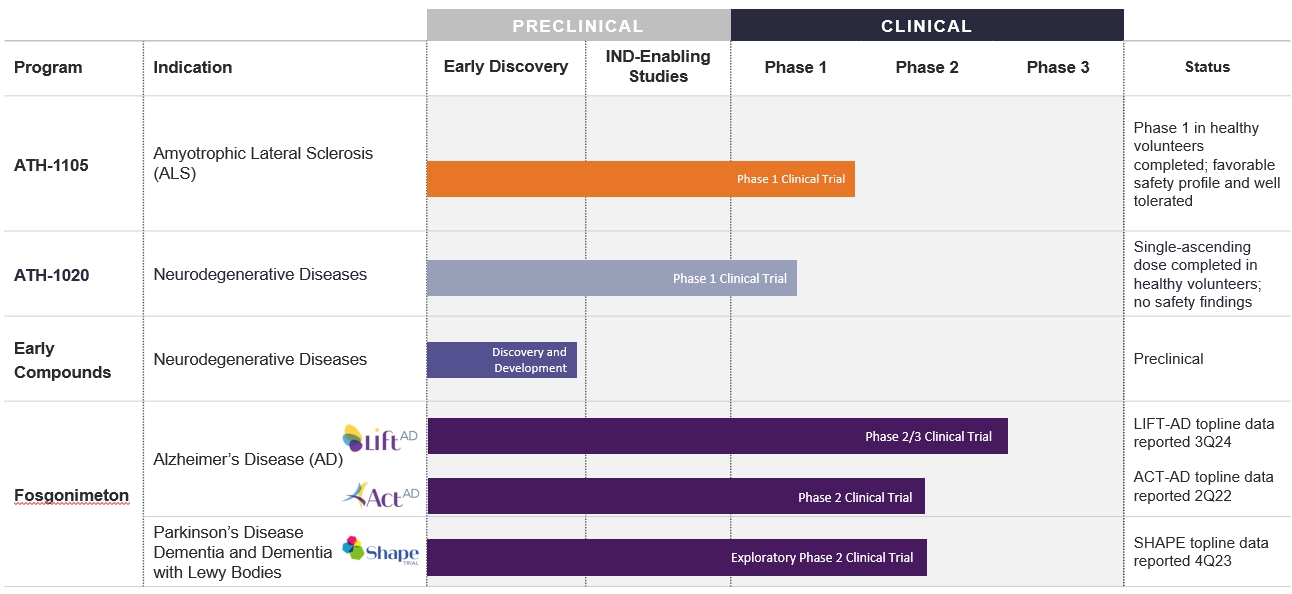
We were incorporated in March 2011 and since our inception, we have devoted substantially all of our resources to our research and development efforts such as small molecule compound discovery, nonclinical studies and clinical trials, as well as manufacturing activities, establishing and maintaining our intellectual property portfolio, hiring personnel, raising capital, and providing general and administrative support for these operations. We do not have any drug products approved for commercial sale, and we have not generated any revenues related to our drug products since inception. Our ability to generate drug product revenue sufficient to achieve profitability, if ever, will depend on the successful development of one or more of our drug candidates which we expect will take a number of years.
We are focused on the development of small molecule therapeutics which enables us to use well-established and widely available manufacturing processes and infrastructure, formulation processes and drug administration technologies or devices. We do not currently operate our own facilities for manufacturing, storing, or distributing our drug candidates. We utilize third-party contract manufacturing organizations, or CMOs, to manufacture and supply our preclinical and clinical materials during the development of our drug candidates. We believe the synthesis of ATH-1105 is reliable and reproducible and the synthetic methods can be further optimized to enable large-scale production that continues to avoid use of toxic materials or specialized equipment or handling during the manufacturing process. We plan to continue to optimize the manufacturing process to support future large-scale and commercial supply that may be needed. Our goal is to identify and develop small molecule drug candidates that are cost-effective to manufacture and easily transferable to third party CMOs. We expect to use similar contract resources for commercialization of our drug products, at least until our resources and operations are at a scale that justifies investment in internal manufacturing capabilities.
Following our receipt of the topline results of LIFT-AD, we made the determination to explore strategic alternatives focused on maximizing stockholder value. As part of that effort, we have paused further development of fosgonimeton while continuing our ongoing development of ATH-1105 and are exploring partnering options. We have engaged Cantor Fitzgerald & Co., or Cantor Fitzgerald, to act as an advisor in exploring potential strategic alternatives that may include, but are not limited to, an acquisition, merger or reverse merger, business combination, equity or debt financing, sale of the Company, sale, exclusive license or other disposition of all or a portion of our assets, a return of capital to stockholders, or other transaction. Despite devoting significant effort to identifying and evaluating potential strategic alternatives, there can be no assurance that this strategic review process will result in us pursuing any transaction or that any transaction, if pursued, will be completed on attractive terms or at all. We have not set a timetable for completion of this strategic review process, as our board of directors has not approved a definitive course of action, and we do not intend to disclose further developments unless and until it is determined that further disclosure is appropriate or necessary. Additionally, there can be no assurances that any particular course of action, business arrangement or transaction, or series of transactions, will be pursued, successfully consummated or lead to increased stockholder value.
Given our stage of development, we have not yet established a commercial organization or distribution capabilities. To the extent that we successfully develop our drug candidates, we intend to build a commercial infrastructure to support future sales. We expect to manage sales, marketing and distribution through internal resources and third-party relationships. While we may commit significant financial and management resources to commercial activities, we will also consider collaborating with one or more pharmaceutical companies to enhance our commercial capabilities.
To date, we have funded our operations primarily through proceeds from the sale of equity securities, including proceeds from the sale and issuance of common stock in our IPO and in a subsequent follow-on public offering, the sale and issuance of convertible preferred stock, common stock warrants, and convertible notes, and to a lesser extent from grant income and stock option exercises. From inception to September 30, 2025, we have raised aggregate net cash proceeds of approximately $407.4 million primarily from the issuance of our common stock (excluding option exercises), convertible preferred stock, common stock warrants, and convertible notes. We have incurred significant operating losses to date. Our net losses were $22.7 million and $81.9 million for the nine months ended September 30, 2025 and 2024, respectively. As of September 30, 2025, we had an accumulated deficit of $428.9 million and cash, cash equivalents and investments of $25.2 million.
We expect to continue to incur operating losses for the foreseeable future as we:
•
continue to advance ATH-1105 and any other drug candidates through preclinical studies and clinical trials;
•
continue to invest in our drug development programs;
•
continue manufacturing activities;
•
attract, hire and retain personnel; obtain, maintain, expand and protect our intellectual property portfolio;
•
operate as a public company;
•
maintain our laboratory and office facilities;
•
implement and maintain operational, financial and management information systems; and
•
seek regulatory approval for any drug candidates that successfully complete clinical trials.
Our net losses may fluctuate significantly from quarter-to-quarter and year-to-year, depending on the timing of our clinical trials and our expenditures on other research and development activities.
We will require substantial additional funding to support our continuing operations and further the development of our drug candidates. Until such time as we can generate significant revenue from drug product sales, if ever, we expect to finance our operations through the sale of equity, debt financings, or other capital sources, which could include income from collaboration, licensing or similar arrangements, for the foreseeable future. Adequate funding may not be available when needed or on terms acceptable to us, or at all. If we are unable to raise additional capital as needed, we may have to significantly delay, scale back or discontinue development of our drug candidates or other operations. Our ability to raise additional funds may be negatively impacted by potential adverse global economic conditions and disruptions to, and volatility in, the credit and financial markets in the United States and worldwide. If we fail to obtain necessary capital when needed on acceptable terms, or at all, it could force us to delay, limit, reduce or terminate our drug product development programs, commercialization efforts or other operations. Insufficient liquidity may also require us to relinquish rights to drug candidates at an earlier stage of development or on less favorable terms than we would otherwise choose. We cannot assure you that we will ever be profitable or generate positive cash flow from operating activities. Based upon our current operating plan, we estimate that our existing cash, cash equivalents and investments will be sufficient to fund our operating expenses and capital expenditure requirements through at least the next 12 months.
Recent Developments
Nasdaq listing transfer, reverse stock split and compliance with the Minimum Bid Requirement
On April 4, 2025, we filed an application to transfer the listing of our common stock from the Nasdaq Global Market to the Nasdaq Capital Market, which transfer was approved and occurred on April 17, 2025.
On September 10, 2025, we filed a certificate of amendment to our Amended and Restated Certificate of Incorporation (the “Certificate of Amendment”), with the Secretary of State of the State of Delaware to effect a 10-for-1 reverse stock split of the shares of our common stock, par value $0.0001 per share, effective as of 5:00 p.m., Eastern Time, on September 17, 2025 (the “reverse stock split”). The total number of authorized shares of our common stock will be reduced from 900,000,000 to 90,000,000 and the total number of authorized shares of our capital stock will be reduced from 1,000,000,000 to 190,000,000. Our common stock began trading on a post-split basis on The Nasdaq Capital Market as of the open of trading on September 18, 2025, and our trading symbol continued to be “ATHA”.
On October 2, 2025, we received written notice from Nasdaq notifying us that since the closing bid price for our common stock was $1.00 per share or greater for ten consecutive business days, we regained compliance with Nasdaq's $1.00 per share minimum closing bid price requirement (the "Minimum Bid Requirement", and this matter is now closed.
Components of Operating Results
Operating Expenses
Research and Development
Research and development expenses consist primarily of direct and indirect costs incurred for our research activities, including our drug discovery efforts and the development of our drug candidates. Direct costs include laboratory materials and supplies, contracted research and manufacturing, clinical trial costs, consulting fees, and other expenses incurred to sustain our research and development program. Indirect costs include personnel-related expenses, consisting of employee salaries, related benefits, and stock-based compensation expense for employees engaged in research and development activities, and facilities and other expenses consisting of direct and allocated expenses for rent and depreciation, and lab consumables.
We expense research and development costs as incurred. Non-refundable advance payments for goods and services that will be used over time for research and development are capitalized and recognized as goods are delivered or as the related services are performed. In-licensing fees and other costs to acquire technologies used in research and development that have not yet received regulatory approval and that are not expected to have an alternative future use are expensed when incurred. We track direct costs by stage of program, clinical or preclinical. However, we do not track indirect costs on a program specific basis because these costs are deployed across multiple programs and, as such, are not separately classified.
As of the date of this report, we cannot reasonably determine the nature, timing, and estimated costs of the efforts that will be necessary to complete the development of, and obtain regulatory approval for, any of our drug candidates. Drug candidates in later stages of development generally have higher development costs than those in earlier stages. We expect to continue to incur research and development expenses for the foreseeable future as we continue to engage in research and development activities related to developing our drug candidates, our drug candidates advance into later stages of development, we conduct larger clinical trials, we seek regulatory approvals for any drug candidates that successfully complete clinical trials, we expand or advance our drug product pipeline, we maintain, expand, protect and enforce our intellectual property portfolio, and we incur expenses associated with hiring or retaining personnel to support our research and development efforts. We also expect our research and development expenses to remain lower in the near term compared to prior periods as a result of our decision to pause further development of fosgonimeton and to shift our focus to the clinical development of ATH-1105.
The process of conducting the necessary clinical research to obtain regulatory approval is costly and time-consuming, and the successful development of our drug candidates is highly uncertain. Our research and development expenses may vary significantly based on factors such as:
•
the impact of our strategic alternative review process and the consummation of any resulting strategic transaction or partnership;
•
the number and scope of preclinical and IND-enabling studies;
•
the phases of development of our drug candidates;
•
the progress and results of our research and development activities;
•
per subject trial costs;
•
the number of trials required for regulatory approval;
•
the number of sites included in the trials;
•
the countries in which the trials are conducted;
•
the length of time required to enroll eligible subjects and initiate clinical trials;
•
the number of subjects that participate in the trials;
•
the drop-out and discontinuation rate of subjects;
•
potential additional safety monitoring requested by regulatory agencies;
•
the duration of subject participation in the trials and follow-up;
•
the cost and timing of manufacturing of our drug candidates;
•
the receipt of regulatory approvals from applicable regulatory authorities;
•
the timing, receipt and terms of any marketing approvals from applicable regulatory authorities;
•
the hiring and retention of research and development personnel;
•
the degree to which we obtain, maintain, defend and enforce our intellectual property rights;
•
the impact of health epidemics on timelines and clinical operations, which may lead to increased costs; and
•
the extent to which we establish collaborations, licensing or similar arrangements and the performance of any related third parties.
A change in the outcome of any of these variables with respect to the development of any of our drug candidates could significantly change the costs and timing associated with the development of that drug candidate.
General and Administrative
General and administrative expenses consist primarily of personnel-related costs, consisting of employee salaries, related benefits, and stock-based compensation expense for our employees in the executive, legal, finance and accounting, human resources, and other administrative functions. General and administrative expenses also include third-party costs such as legal costs, insurance costs, accounting, auditing and tax related fees, business development fees, consulting fees and facilities and other expenses not otherwise included as research and development expenses. We expense general and administrative costs as incurred.
We expect to continue to incur general and administrative expenses for the foreseeable future as we maintain our headcount to support our continued research activities and development of our programs. We also anticipate that we will continue to incur expenses as a result of operating as a public company, including expenses related to compliance with the rules and regulations of the SEC, and those of any national securities exchange on which our securities are traded, legal, auditing, additional insurance expenses, investor relations activities, and other administrative and professional services. We expect to incur additional costs in connection with our strategic alternative review process and in the event we consummate any strategic transaction or partnership as a result. We also expect these additional general and administrative expenses to be offset, at least in part, in the near term as a result of the Restructuring and related cost savings.
Other Income, Net
Other income, net consists primarily of interest earned on our cash, cash equivalents and investments and the amortization of premiums and accretion of discounts on our available-for-sale securities. Absent further fundraising, we expect interest earned on our cash, cash equivalents and investments to decrease as we continue to expend our cash balances to fund our ongoing operations.
Results of Operations
Comparison of the Three Months Ended September 30, 2025 and 2024
The following table summarizes our results of operations for the periods presented:
|
|
|
|
|
|
|
|
|
|
|
|
|
|
|
|
|
|
|
Three Months Ended September 30, |
|
|
|
|
|
|
|
|
|
Dollar |
|
|
% |
|
|
|
2025 |
|
|
2024 |
|
|
Change |
|
|
Change |
|
|
|
(in thousands) |
|
|
|
|
Operating expenses: |
|
|
|
|
|
|
|
|
|
|
|
|
Research and development |
|
$ |
2,825 |
|
|
$ |
17,922 |
|
|
$ |
(15,097 |
) |
|
|
-84 |
% |
General and administrative |
|
|
4,049 |
|
|
|
7,572 |
|
|
|
(3,523 |
) |
|
|
-47 |
% |
Legal expense |
|
|
— |
|
|
|
4,127 |
|
|
|
(4,127 |
) |
|
* |
|
Total operating expenses |
|
|
6,874 |
|
|
|
29,621 |
|
|
|
(22,747 |
) |
|
|
-77 |
% |
Loss from operations |
|
|
(6,874 |
) |
|
|
(29,621 |
) |
|
|
22,747 |
|
|
|
-77 |
% |
Other income, net |
|
|
263 |
|
|
|
880 |
|
|
|
(617 |
) |
|
|
-70 |
% |
Net loss |
|
$ |
(6,611 |
) |
|
$ |
(28,741 |
) |
|
$ |
22,130 |
|
|
|
-77 |
% |
Research and Development Expenses
The following table shows the primary components of our research and development expenses for the periods presented:
|
|
|
|
|
|
|
|
|
|
|
|
|
|
|
|
|
|
|
Three Months Ended September 30, |
|
|
|
|
|
|
|
|
|
Dollar |
|
|
% |
|
|
|
2025 |
|
|
2024 |
|
|
Change |
|
|
Change |
|
|
|
(in thousands) |
|
|
|
|
Direct costs: |
|
|
|
|
|
|
|
|
|
|
|
|
Fosgonimeton (ATH-1017) |
|
$ |
317 |
|
|
$ |
10,078 |
|
|
$ |
(9,761 |
) |
|
|
-97 |
% |
ATH-1105 |
|
|
673 |
|
|
|
2,438 |
|
|
|
(1,765 |
) |
|
|
-72 |
% |
ATH-1020 |
|
|
— |
|
|
|
135 |
|
|
|
(135 |
) |
|
|
-100 |
% |
Preclinical programs and other direct costs |
|
|
61 |
|
|
|
439 |
|
|
|
(378 |
) |
|
|
-86 |
% |
Total direct costs |
|
|
1,051 |
|
|
|
13,090 |
|
|
|
(12,039 |
) |
|
|
-92 |
% |
Indirect costs: |
|
|
|
|
|
|
|
|
|
|
|
|
Personnel-related costs, including stock-
based compensation |
|
|
1,469 |
|
|
|
4,304 |
|
|
|
(2,835 |
) |
|
|
-66 |
% |
Facilities and other costs |
|
|
305 |
|
|
|
528 |
|
|
|
(223 |
) |
|
|
-42 |
% |
Total research and development expenses |
|
$ |
2,825 |
|
|
$ |
17,922 |
|
|
$ |
(15,097 |
) |
|
|
-84 |
% |
*Not meaningful.
Research and development expenses decreased by $15.1 million, from $17.9 million for the three months ended September 30, 2024 to $2.8 million for the three months ended September 30, 2025. The decrease was driven primarily by decreases in fosgonimeton program costs of $9.8 million, personnel-related expenses of $2.8 million, and ATH-1105 program costs of $1.8 million. The decrease in fosgonimeton program costs of $9.8 million was driven by decreases in contract research organization, other third party vendors and clinical site visit costs of $8.7 million following the completion of our Phase 2/3 LIFT-AD clinical trial and the conclusion of our corresponding open-label extension for our Phase 2 ACT-AD and Phase 2/3 LIFT-AD clinical trials in the prior year and a decrease in contract manufacturing costs of $0.7 million.
General and Administrative Expenses
General and administrative expenses decreased by approximately $3.6 million, from $7.6 million for the three months ended September 30, 2024 to $4.0 million for the three months ended September 30, 2025. The decrease was primarily due to a decrease in personnel-related expenses of $2.9 million.
Other Income, Net
Other income, net, decreased by $0.6 million, from $0.9 million for the three months ended September 30, 2024 to $0.3 million for the three months ended September 30, 2025 due to lower income from accretion of discounts on debt securities purchased below par value and held to maturity and lower interest income earned on our available-for-sale securities. These decreases resulted primarily from lower balances of available-for-sale securities held during the three months ended September 30, 2025 compared to the three months ended September 30, 2024.
Comparison of the Nine Months Ended September 30, 2025 and 2024
The following table summarizes our results of operations for the periods presented:
|
|
|
|
|
|
|
|
|
|
|
|
|
|
|
|
|
|
|
Nine Months Ended September 30, |
|
|
|
|
|
|
|
|
|
Dollar |
|
|
% |
|
|
|
2025 |
|
|
2024 |
|
|
Change |
|
|
Change |
|
|
|
(in thousands) |
|
|
|
|
Operating expenses: |
|
|
|
|
|
|
|
|
|
|
|
|
Research and development |
|
$ |
10,788 |
|
|
$ |
61,312 |
|
|
$ |
(50,524 |
) |
|
|
-82 |
% |
General and administrative |
|
$ |
12,913 |
|
|
|
19,897 |
|
|
|
(6,984 |
) |
|
|
-35 |
% |
Legal expense |
|
|
— |
|
|
|
4,127 |
|
|
|
(4,127 |
) |
|
* |
|
Total operating expenses |
|
|
23,701 |
|
|
|
85,336 |
|
|
|
(61,635 |
) |
|
|
-72 |
% |
Loss from operations |
|
|
(23,701 |
) |
|
|
(85,336 |
) |
|
|
61,635 |
|
|
|
-72 |
% |
Other income, net |
|
|
981 |
|
|
|
3,399 |
|
|
|
(2,418 |
) |
|
|
-71 |
% |
Net loss |
|
$ |
(22,720 |
) |
|
$ |
(81,937 |
) |
|
$ |
59,217 |
|
|
|
-72 |
% |
Research and Development Expenses
The following table shows the primary components of our research and development expenses for the periods presented:
|
|
|
|
|
|
|
|
|
|
|
|
|
|
|
|
|
|
|
Nine Months Ended September 30, |
|
|
|
|
|
|
|
|
|
Dollar |
|
|
% |
|
|
|
2025 |
|
|
2024 |
|
|
Change |
|
|
Change |
|
|
|
(in thousands) |
|
|
|
|
Direct costs: |
|
|
|
|
|
|
|
|
|
|
|
|
Fosgonimeton (ATH-1017) |
|
$ |
2,180 |
|
|
$ |
37,602 |
|
|
$ |
(35,422 |
) |
|
|
-94 |
% |
ATH-1105 |
|
|
2,834 |
|
|
|
6,793 |
|
|
|
(3,959 |
) |
|
|
-58 |
% |
ATH-1020 |
|
|
5 |
|
|
|
470 |
|
|
|
(465 |
) |
|
|
-99 |
% |
Preclinical programs and other direct costs |
|
|
266 |
|
|
|
1,419 |
|
|
|
(1,153 |
) |
|
|
-81 |
% |
Total direct costs |
|
|
5,285 |
|
|
|
46,284 |
|
|
|
(40,999 |
) |
|
|
-89 |
% |
Indirect costs: |
|
|
|
|
|
|
|
|
|
|
|
|
Personnel-related costs, including stock-
based compensation |
|
|
4,549 |
|
|
|
13,229 |
|
|
|
(8,680 |
) |
|
|
-66 |
% |
Facilities and other costs |
|
|
954 |
|
|
|
1,799 |
|
|
|
(845 |
) |
|
|
-47 |
% |
Total research and development expenses |
|
$ |
10,788 |
|
|
$ |
61,312 |
|
|
$ |
(50,524 |
) |
|
|
-82 |
% |
Research and development expenses decreased by $50.5 million, from $61.3 million for the nine months ended September 30, 2024 to $10.8 million for the nine months ended September 30, 2025. The decrease was driven primarily by decreases in fosgonimeton program costs of $35.4 million, personnel-related expenses of $8.7 million, and ATH-1105 program costs of $4.0 million. The decrease in fosgonimeton program costs of $35.4 million was driven by decreases in contract research organization, other third party vendors and clinical site visit costs of $26.2 million following the completion of our Phase 2/3 LIFT-AD clinical trial and the conclusion of our corresponding open-label extension for our Phase 2 ACT-AD and Phase 2/3 LIFT-AD clinical trials in the prior year and a decrease in contract manufacturing costs of $6.8 million.
General and Administrative Expenses
General and administrative expenses decreased by approximately $7.0 million, from $19.9 million for the nine months ended September 30, 2024 to $12.9 million for the nine months ended September 30, 2025. The decrease was primarily due to a decrease in personnel-related expenses of $8.7 million.
Other Income, Net
Other income, net, decreased by $2.4 million, from $3.4 million for the nine months ended September 30, 2024 to $1.0 million for the nine months ended September 30, 2025 due to lower income from accretion of discounts on debt securities purchased below par value and held to maturity and lower interest income earned on our available-for-sale securities. These decreases resulted primarily from lower balances of available-for-sale securities held during the nine months ended September 30, 2025 compared to the nine months ended September 30, 2024.
Liquidity and Capital Resources
Sources of Liquidity
Since our inception, we have funded our operations primarily with proceeds from the sale and issuance of common stock, convertible preferred stock, common stock warrants, and convertible notes, and to a lesser extent from grant income and stock option exercises. From our inception through September 30, 2025, we have raised aggregate net cash proceeds of $407.4 million primarily from the issuance of our common stock (excluding option exercises), convertible preferred stock, common stock warrants, and convertible notes.
As of September 30, 2025, we had $25.2 million in cash, cash equivalents and investments and have not generated positive cash flows from operations. Since our inception, we have devoted substantially all of our resources to our research and development efforts such as small molecule compound discovery, nonclinical studies and clinical trials, as well as manufacturing activities, establishing and maintaining our intellectual property portfolio, hiring personnel, raising capital, and providing general and administrative support for these operations.
Material Cash and Future Funding Requirements
Our material cash requirements include our operating leases for laboratory and office facilities. As of September 30, 2025, we had lease payment obligations of $1.0 million, with $0.5 million payable within 12 months. For additional information regarding our lease commitments, see Note 7 to our consolidated financial statements included elsewhere in this report. Additionally, we have purchase obligations and open purchase orders that support normal operations and are primarily due in the next 12 months. These purchase obligations and open purchase orders are generally cancellable in full or in part through the contractual provisions. We anticipate that our research and development expenses and our general and administrative expenses will remain lower in the near-term as a result of our decision to pause further development of fosgonimeton and to shift our focus to the clinical development of ATH-1105, and our decrease in headcount as a result of the Restructuring.
Based upon our current operating plan, we estimate that our $25.2 million of cash, cash equivalents and investments at September 30, 2025 will be sufficient to fund our operating expenses and capital expenditure requirements through at least the next 12 months. However, our resource requirements could materially change depending on the outcome of our ongoing strategic alternative review process, including to the extent we identify and enter into any potential strategic transaction. We will need to raise substantial additional capital to fund the development of our drug candidates. Until such time as we can generate significant revenue from drug product sales, we expect to finance our operations through the sale of equity securities, debt financings, or other capital, which could include income from collaboration, licensing or similar arrangements with third parties, or receiving research contributions, or grants. For example, in January 2023, we entered into a sales agreement with Cantor Fitzgerald and BTIG, LLC, or BTIG, to sell shares of our common stock having aggregate sales proceeds of up to $75.0 million, from time to time, subject to applicable limitations on sales pursuant to SEC rules and regulations, through an ATM equity offering program under which Cantor Fitzgerald and BTIG are acting as sales agents. As of the date of this report, we have not sold any securities pursuant to this ATM offering. To the extent that we raise additional capital through the sale of equity or convertible debt securities, the ownership interest of our stockholders will be or could be diluted, and the terms of these securities may include liquidation or other preferences that adversely affect the rights of our common stockholders. Debt financing and preferred equity financing, if available, may involve agreements that include covenants limiting or restricting our ability to take specific actions, such as incurring additional debt, making capital expenditures or declaring dividends. If we raise funds through collaborations, licenses and other similar arrangements with third parties, we may have to relinquish valuable rights to our technologies, future revenue streams, research programs or drug candidates or grant licenses on terms that may not be favorable to us or may reduce the value of our common stock. Adequate funding may not be available when needed or on terms acceptable to us, or at all. Our ability to raise additional funds may be negatively impacted by potential adverse global economic conditions and disruptions to, and volatility in, the credit and financial markets in the United States and worldwide. If we fail to obtain necessary capital when needed on acceptable terms, or at all, it could force us to delay, limit, reduce or terminate our drug product development programs, commercialization efforts or other operations.
Insufficient liquidity may also require us to relinquish rights to drug candidates at an earlier stage of development or on less favorable terms than we would otherwise choose. We cannot assure you that we will ever be profitable or generate positive cash flows from operating activities.
We have based our projections of operating capital requirements on assumptions that may prove to be incorrect and we may use all our available capital resources sooner than we expect. Because of the numerous risks and uncertainties associated with research, development and commercialization of biotechnology products, we are unable to estimate the exact amount of our operating capital requirements. Our future funding requirements will depend on many factors, including, but not limited to:
•
the scope, timing, progress and results of our ongoing preclinical studies and clinical trials of our drug candidates;
•
the number of trials required for regulatory approval;
•
the scope, progress, results and costs of preclinical development, laboratory testing and clinical trials of other drug candidates that we may pursue;
•
our ability to establish and maintain collaborations, licensing or other similar arrangements, and the financial terms of any such arrangements, including the timing and amount of any future milestone, royalty or other payments due thereunder;
•
the costs, timing and outcome of regulatory review of our drug candidates;
•
the costs and timing of future commercialization activities, including drug product manufacturing, marketing, sales and distribution, for any of our drug candidates for which we receive marketing approval;
•
the revenue, if any, received from commercial sales of our drug candidates for which we receive marketing approval;
•
the costs and timing of preparing, filing and prosecuting patent applications, maintaining and enforcing our intellectual property rights and defending any intellectual property-related claims;
•
the costs related to any legal proceedings;
•
any expenses needed to attract, hire and retain skilled personnel;
•
the costs of operating as a public company;
•
the costs associated with any expansion of our laboratory and office facilities; and
•
the extent to which we acquire or in-license other companies’ product candidates and technologies or engage in other strategic transactions.
A change in the outcome of any of these or other factors with respect to the development of any of our drug candidates could significantly change the costs and timing associated with the development of that drug candidate. Furthermore, our operating plan may change in the future, and we may need additional funds to meet operational needs and capital requirements associated with such operating plan.
Cash Flows
The following table summarizes our cash flows for the periods indicated:
|
|
|
|
|
|
|
|
|
|
|
Nine Months Ended September 30, |
|
|
|
2025 |
|
|
2024 |
|
|
|
(in thousands) |
|
Net cash (used in) provided by: |
|
|
|
|
|
|
Operating activities |
|
$ |
(26,332 |
) |
|
$ |
(71,157 |
) |
Investing activities |
|
|
(1,256 |
) |
|
|
57,642 |
|
Financing activities |
|
|
24 |
|
|
|
160 |
|
Net decrease in cash, cash equivalents and restricted cash |
|
$ |
(27,564 |
) |
|
$ |
(13,355 |
) |
Operating Activities
During the nine months ended September 30, 2025, net cash used in operating activities was $26.3 million. This consisted primarily of a net loss of $22.7 million, partially offset by non-cash charges of $5.3 million, and an increase in our net operating assets of $8.9 million. The non-cash charges primarily consisted of stock-based compensation expense, depreciation expense, non-cash lease expense, and amortization of premiums and accretion of discounts on available-for-sale securities. The increase in our net operating assets was primarily due to a decrease in accrued expenses, partially offset by an increase in accounts payable and a decrease in prepaid expenses and other assets.
During the nine months ended September 30, 2024, net cash used in operating activities was $71.2 million. This consisted primarily of a net loss of $81.9 million, partially offset by non-cash charges of $9.2 million, and a decrease in our net operating assets of $1.5 million. The non-cash charges primarily consisted of stock-based compensation expense, depreciation expense, and amortization of premiums and accretion of discounts on available-for-sale securities. The decrease in our net operating assets was primarily due to a decrease in prepaid expenses and other assets and an increase in accounts payable, partially offset by a decrease accrued expenses.
Investing Activities
During the nine months ended September 30, 2025, net cash used in investing was $1.3 million. This consisted of purchases of available-for-sale securities of $19.6 million, partially offset by maturities of available-for-sale securities of $18.3 million.
During the nine months ended September 30, 2024, net cash provided by investing was $57.6 million. This consisted of maturities of available-for-sale securities of $69.0 million, partially offset by purchases of available-for-sale securities of $11.3 million.
Financing Activities
During the nine months ended September 30, 2025, net cash provided by financing activities was $0.02 million, consisting of proceeds received from the issuance of common stock under our employee stock purchase plan.
During the nine months ended September 30, 2024, net cash provided by financing activities was $0.2 million, consisting of proceeds received from the exercise of stock options and the issuance of common stock under our employee stock purchase plan.
Critical Accounting Policies, Significant Judgments and Use of Estimates
Our financial statements have been prepared in accordance with U.S. generally accepted accounting principles, or GAAP. The preparation of these financial statements requires us to make estimates and assumptions that affect the reported amounts of assets and liabilities and the disclosure of contingent assets and liabilities at the date of the financial statements, as well as the reported revenue and expenses incurred during the reporting periods. Our estimates are based on our historical experience and on various other factors that we believe are reasonable under the circumstances, the results of which form the basis for making judgments about the carrying value of assets and liabilities that are not readily apparent from other sources. Actual results may differ from these estimates under different assumptions or conditions.
Critical accounting policies and significant judgments and estimates are those that we consider the most important to the portrayal of our financial condition and results of operations because they require our most difficult, subjective or complex judgments, often as a result of the need to make estimates about the effect of matters that are inherently uncertain.
During the nine months ended September 30, 2025, there were no material changes to our critical accounting policies. Our critical accounting policies are described under the heading “Management’s Discussion and Analysis of Financial Condition and Results of Operations—Critical Accounting Policies, Significant Judgments and Use of Estimates” in our Annual Report on Form 10-K filed with the SEC on February 27, 2025 and Note 2 to our unaudited condensed consolidated financial statements included in “Part I, Item 1—Financial Statements (Unaudited)” of this report. We believe that of our critical accounting policies, the following accounting policies involve the most judgment and complexity:
•
research and development costs;
•
stock-based compensation; and
Recent Accounting Pronouncements
See Note 2 to our unaudited condensed consolidated financial statements included in "Part I, Item 1—Financial Statements (Unaudited)” of this report for additional information.
Emerging Growth Company Status
We are an emerging growth company, as defined in the JOBS Act. Under the JOBS Act, emerging growth companies can delay adopting new or revised accounting standards issued subsequent to the enactment of the JOBS Act until such time as those standards apply to private companies. We elected to use this extended transition period for complying with new or revised accounting standards that have different effective dates for public and private companies until the earlier of the date that we (1) are no longer an emerging growth company and (2) affirmatively and irrevocably opt out of the extended transition period provided in the JOBS Act. As a result, our financial statements may not be comparable to companies that comply with the new or revised accounting pronouncements as of public company effective dates.
We will remain an emerging growth company until the earliest to occur of: (1) the last day of the fiscal year in which we have at least $1.235 billion in annual revenue; (2) the last day of the fiscal year in which we are deemed to be a “large accelerated filer,” as defined in Rule 12b-2 under the Exchange Act, which would occur if the market value of our common stock held by non-affiliates exceeded $700.0 million as of the last business day of the second fiscal quarter of such year; (3) the date on which we have issued more than $1.0 billion in non-convertible debt securities during the prior three-year period; and (4) December 31, 2025, the last day of the fiscal year in which the fifth anniversary of our initial public offering, or IPO, occurred.
Item 3. Quantitative and Qualitative Disclosures About Market Risk.
As a smaller reporting company, we are not required to provide the information requested by this item pursuant to Item 305 of Regulation S-K.
Item 4. Controls and Procedures.
Evaluation of Disclosure Controls and Procedures
We maintain “disclosure controls and procedures,” as defined in Rules 13a-15(e) and 15d-15(e) under the Exchange Act, or the Exchange Act, that are designed to ensure that information required to be disclosed in the reports that we file or submit under the Exchange Act is (1) recorded, processed, summarized and reported within the time periods specified in the SEC’s rules and forms and (2) accumulated and communicated to our management, including our principal executive and principal financial officer, as appropriate to allow timely decisions regarding required disclosure. Our management recognizes that any controls and procedures, no matter how well designed and operated, can provide only reasonable assurance of achieving their objectives and our management necessarily applies its judgment in evaluating the cost-benefit relationship of possible controls and procedures. Our disclosure controls and procedures are designed to provide reasonable assurance of achieving their control objectives.
Our management, with the participation of our principal executive officer and principal financial and accounting officer, evaluated the effectiveness of our disclosure controls and procedures at the end of the period covered by this Quarterly Report on Form 10-Q. Based upon such evaluation, our principal executive officer and principal financial and accounting officer have concluded that our disclosure controls and procedures were effective at the reasonable assurance level as of such date.
Changes in Internal Control Over Financial Reporting
There have been no changes in our internal control over financial reporting (as defined in Rules 13a-15(f) and 15d-15(f) under the Exchange Act) during the quarter ended September 30, 2025, that have materially affected, or are reasonably likely to materially affect, our internal control over financial reporting.
PART II—OTHER INFORMATION
Item 1. Legal Proceedings.
From time to time, we may be subject to various legal proceedings or claims that arise in the ordinary course of business. As of September 30, 2025, we are not a party to any legal proceedings that, in the opinion of our management, would reasonably be expected to have a material adverse effect on our business, financial condition, operating results or cash flows if determined adversely to us. Regardless of the outcome, litigation can have an adverse impact on us because of defense and settlement costs, diversion of management resources and other factors.
Item 1A. Risk Factors.
You should carefully consider the following risk factors, in addition to the other information contained in this report, including the “Management’s Discussion and Analysis of Financial Condition and Results of Operations” section and our unaudited condensed consolidated financial statements and related notes. If any of the events described in the following risk factors and the risks described elsewhere in this report occurs, our business, operating results and financial condition could be seriously harmed. This report also contains forward-looking statements that involve risks and uncertainties. Our actual results could differ materially from those anticipated in the forward-looking statements as a result of factors that are described below and elsewhere in this report. Our Risk Factors are not guarantees that no such conditions exist as of the date of this report and should not be interpreted as an affirmative statement that such risks or conditions have not materialized, in whole or in part.
Risks Related to Our Business and the Development of Our Drug Candidates
We are a clinical-stage biopharmaceutical company with a limited operating history.
We are a clinical-stage biopharmaceutical company focused on developing small molecules engineered to restore neuronal health and slow neurodegeneration. Our limited operating history may make it difficult to evaluate the success of our business. Drug development is a highly uncertain undertaking and involves a substantial degree of risk. To date, we have not completed a pivotal clinical trial, obtained marketing approval for any drug candidate, manufactured a commercial scale drug candidate, or conducted sales and marketing activities necessary for successful drug candidate commercialization. Our history as a company makes any assessment of our future success and viability subject to significant uncertainty. We will encounter risks and difficulties frequently experienced by clinical-stage biopharmaceutical companies in rapidly evolving fields, and we have not yet demonstrated an ability to overcome such risks and difficulties successfully. If we do not address these risks and difficulties successfully, our business will suffer.
We are currently focusing our efforts primarily on the development of ATH-1105 and we may fail to or be unable to design and execute clinical trials to support marketing approval of ATH-1105 or any other drug candidates we seek to develop. We cannot be certain that our current or planned clinical trials or any other future clinical trials will be completed on time or be successful. We cannot guarantee that the FDA or foreign regulatory authorities will agree with our study design, protocol or protocol amendments, or statistical plan, or that they will interpret clinical trial results as we do, and more clinical trials could be required before we are able to submit applications seeking approval of our drug candidates. To the extent that the results of the clinical trials are not satisfactory to the FDA or foreign regulatory authorities for support of a marketing application, we may be required to expend significant resources, which may not be available to us, to conduct additional clinical trials in support of potential approval of our drug candidates. Even if regulatory approval is secured for any of our drug candidates, the terms of such approval may limit the scope and use of our drug candidate, which may also limit its commercial potential.
Our approach to targeting neurotrophic factors through the use of small molecules is based on a novel therapeutic approach, which exposes us to unforeseen risks. We have limited data from preclinical studies and clinical trials to date, including for ATH-1105, and we cannot be certain that future trials will yield data in support of the safety, efficacy and tolerability of our drug candidates.
We have discovered and are developing small molecule drug candidates to treat neurodegenerative diseases. Our drug candidates target an endogenous neurotrophic factor which is expected to protect and repair neuronal networks, which we believe could ultimately result in improvements in clinical outcomes and disease-relevant biomarkers. The therapeutic promise of neurotrophic factors in neurodegenerative diseases had been hampered in earlier therapies by the lack of efficient and non-invasive delivery to the CNS. Our small molecule drug candidates are designed to penetrate the BBB and enhance the activity of a neurotrophic factor, but we cannot be certain of the safety and efficacy of our drug candidates in applicable patients or that our clinical trials will provide sufficient evidence that our design approach results in the intended therapeutic effect.
The primary and all secondary endpoints of our Phase 2 ACT-AD clinical trial of fosgonimeton in AD were not met by protocoled analysis. A subsequent post hoc analysis of the data in a pre-specified subgroup from patients on fosgonimeton without background AChEIs showed a meaningful, but not statistically significant, improvement in both ERP P300 latency and cognitive performance compared to placebo at 26 weeks. Although post hoc analyses cannot be used to establish efficacy, these analyses can be helpful in informing the design of current and future clinical studies. In addition, the primary endpoint of our Phase 2 SHAPE clinical trial in PDD and DLB was not met by protocoled analysis. Directionally positive results were observed for the 40 mg fosgonimeton dose group with improvements in cognitive, functional and biomarker measurements. In particular, the five patients in the modified intent to treat, or mITT, population treated with fosgonimeton 40 mg once daily saw improvement in ADAS-Cog13 individually, and collectively improved compared with placebo (n=7 mITT, one-sided p=0.0321). Results for patients in the 70 mg dose group were inconsistent.
The topline data from our Phase 2/3 LIFT-AD clinical trial of fosgonimeton in AD showed that neither the trial’s primary endpoint (the Global Statistical Test, or GST, a combination of results from measures of cognition (ADAS-Cog11) and function (ADCS-ADL23)) nor its key secondary endpoints of ADAS-Cog11 and ADCS-ADL23 reached statistical significance compared with placebo at 26 weeks. However, both components of GST, cognition (ADAS-Cog11) and function (ADCS-ADL23), directionally favored fosgonimeton treatment, and in pre-specified subgroups characterized by more rapid disease progression (moderate AD and APOE4 carriers), cognition and function improved or stabilized in the fosgonimeton treated group. In addition, data across biomarkers of protein pathology (Aβ42/40, p-Tau181, and p-Tau217), inflammation (GFAP) and neurodegeneration (NfL) showed directional improvements with fosgonimeton treatment that are consistent with the broad neuroprotective mechanism of HGF modulation. Based on these results, we decided to pause further development of fosgonimeton.
Following the readout of topline data from LIFT-AD, in September 2024 we announced our intention to focus on advancing the clinical development program for ATH-1105 as a potential treatment for ALS. We completed our first-in-human Phase 1 clinical trial in healthy volunteers evaluating the safety and tolerability of ATH-1105, in November 2024. The results of the Phase 1 clinical trial showed that ATH-1105 demonstrated a favorable safety profile and was well-tolerated in healthy volunteers, supporting continued clinical development. We have substantially completed preparation activities to enable initiation of a future clinical trial in people living with ALS, either by us or in conjunction with a partner subject to our continued exploration of strategic alternatives focused on maximizing stockholder value; however, our plans, including trial design, timing and other factors have not yet been finalized.
We have limited evidence regarding the efficacy, safety and tolerability of ATH-1105 and other small molecules in our drug product pipeline. We or a future partner may ultimately determine that ATH-1105, or any of our other small molecules, does not possess certain properties required for therapeutic effectiveness. We or a future partner may spend substantial funds attempting to develop these drug candidates and never succeed in doing so.
Our development of ATH-1105 may never lead to a marketable product.
We are developing ATH-1105 as a small molecule aimed at restoring neuronal health. We have not received regulatory approval for ATH-1105 and cannot be certain that our approach will lead to the development of an approvable or marketable product, alone or in combination with other therapies.
Advancing ATH-1105 as a small molecule aimed at restoring neuronal health creates significant challenges for us or a future partner, including:
•
obtaining marketing approval;
•
if ATH-1105 is approved, educating medical personnel regarding the potential efficacy and safety benefits, as well as the challenges, of incorporating ATH-1105 into existing treatment regimens, including in combination with other treatments for ALS or as a monotherapy; and
•
establishing the sales and marketing capabilities upon obtaining any marketing approvals to gain market acceptance.
Our prospects as a standalone business are highly dependent on the successful development of ATH-1105. Following the September 2024 announcement of topline results from the Phase 2/3 LIFT-AD clinical trial of fosgonimeton showing that neither the trial’s primary endpoint nor its key secondary endpoints were met, we announced our intention to focus on advancing the clinical development program for ATH-1105 as a potential treatment for ALS and other neurodegenerative diseases. Like fosgonimeton, ATH-1105 is a small molecule designed to positively modulate the HGF system.
Although we are encouraged about the potential for ATH-1105 based on preclinical data, we or a future partner may decide to discontinue development of some or all of our product candidates, including if we or a future partner do not demonstrate the safety and efficacy of ATH-1105 in current and future clinical trials. We may pursue strategic alternatives to maximize stockholder value, which could involve, without limitation, exploring the potential for a possible merger, business combination, investment, a purchase, license or other acquisition of assets or return of capital to stockholders.
Our ability to generate revenue and achieve profitability depends significantly on our ability to achieve a number of objectives.
Our business depends entirely on the successful discovery, development and commercialization of our drug candidates. We have no drug products approved for commercial sale and do not anticipate generating any revenue from drug product sales for the next several years, if ever. Our ability to generate drug product revenue will depend heavily on the successful clinical development and eventual commercialization of ATH-1105 or any other drug candidates we may seek to develop. Our ability to generate revenue and achieve profitability depends significantly on our ability to achieve a number of objectives, including:
•
successful and timely completion of nonclinical and clinical development of our drug candidates and any future drug candidates, as well as the associated costs, including any unforeseen costs;
•
establishing and maintaining relationships with contract research organizations, or CROs, and clinical sites for the clinical development, both in the United States and internationally, of our drug candidates and any future drug candidates;
•
timely submission of application for and receipt of marketing approvals from applicable regulatory authorities for any drug candidates for which we successfully complete clinical development;
•
making any required post-marketing approval commitments to applicable regulatory authorities;
•
developing an efficient and scalable manufacturing process for our drug candidates, including obtaining finished products that are appropriately packaged for sale;
•
establishing and maintaining commercially viable supply and manufacturing relationships with third parties that can provide adequate, in both amount and quality, products and services to support clinical development and meet the market demand for drug candidates that we develop, if approved;
•
successful commercial launch following any marketing approval, including the development of a commercial infrastructure, whether inhouse or with one or more collaborators;
•
a continued acceptable safety profile following any marketing approval of our drug candidates;
•
commercial acceptance of our drug candidates by patients, the medical community and third-party payors;
•
identifying, assessing and developing new drug candidates;
•
obtaining, maintaining and expanding patent protection, trade secret protection and regulatory exclusivity, both in the United States and internationally;
•
protecting our rights in our intellectual property portfolio;
•
defending against third-party patent challenges, derivation proceedings, or interference or infringement claims, if any;
•
negotiating favorable terms in any collaboration, licensing or other arrangement that may be necessary or desirable to develop, manufacture or commercialize our drug candidates;
•
obtaining coverage and adequate reimbursement by hospitals, government and third-party payors for drug candidates that we develop;
•
addressing any competing therapies and technological and market developments; and
•
attracting, hiring and retaining qualified personnel.
We may never be successful in achieving our objectives and, even if we are, may never generate revenue that is significant or large enough to achieve profitability. If we do achieve profitability, we may not be able to sustain or increase profitability on a quarterly or annual basis. Our failure to become and remain profitable may decrease the value of our company and could impair our ability to maintain or further our research and development efforts, raise additional necessary capital, grow our business and continue our operations.
We may also experience delays in developing a sustainable, reproducible and scalable manufacturing process or transferring that process to commercial partners, which may prevent us from completing our clinical trials or commercializing our drug candidates on a timely or profitable basis, if at all. Changes in the manufacturing process or facilities will require further comparability analysis and approval by the FDA before implementation, which could delay our clinical trials and drug candidate development, and could require additional clinical trials, including bridging studies and potential confirmatory or Phase 3 registrational trials, to demonstrate consistent and continued safety and efficacy.
We have not previously submitted a new drug application, or NDA, to the FDA or similar approval filings to a comparable foreign regulatory authority, for any drug candidate. An NDA or other relevant regulatory filing must include extensive nonclinical and clinical data and supporting information to establish that the drug candidate is safe and effective for each desired indication. The NDA or other relevant regulatory filing must also include significant information regarding the chemistry, manufacturing and controls for the drug product. We cannot be certain that our current or future drug candidates will be successful in clinical trials. Further, even if they are successful in clinical trials, our drug candidates or any future drug candidates may not receive regulatory approval. If we do not receive regulatory approvals for current or future drug candidates, we may not be able to continue our operations. Even if we successfully obtain regulatory approval to market a drug candidate, our revenue will depend, in part, upon the size of the markets in the territories for which we gain regulatory approval and have commercial rights, as well as the availability of competitive products, whether there is sufficient third-party reimbursement and adoption by physicians.
We have concentrated our research and development efforts on the treatment of central and peripheral nervous system degenerative disorders, a field that has seen very limited success in product development.
We have focused our research and development efforts on addressing CNS and PNS degenerative disorders. Collectively, efforts by pharmaceutical companies in the field of CNS and PNS degenerative disorders have seen very limited successes in product development. The development of CNS therapies presents unique challenges, including an imperfect understanding of the biology, the presence of the BBB that can restrict the flow of drugs to the brain, a frequent lack of translatability of preclinical study results in subsequent clinical trials and dose selection, and the product candidate having an effect that may be too small to be detected using the outcome measures selected in clinical trials or if the outcomes measured do not reach statistical significance. There are few effective therapeutic options available for patients with AD, ALS and other CNS or PNS disorders. Our future success is highly dependent on the successful development of our technology and our drug candidates for treating CNS and PNS disorders. Developing and, if approved, commercializing our drug candidates for treatment of CNS and PNS disorders subjects us to a number of challenges, including ensuring that we have selected the optimal doses, executing an appropriate clinical trial to test for efficacy and obtaining regulatory approval from the FDA and other regulatory authorities.
Clinical development involves a lengthy and expensive process with an uncertain outcome, and results of early, smaller-scale preclinical studies and clinical trials with a single or few clinical trial sites may not be predictive of eventual safety or effectiveness in large-scale potentially pivotal clinical trials across multiple clinical trial sites. We may encounter substantial delays in clinical trials, or may not be able to conduct or complete clinical trials on the expected timelines, if at all.
Our lead drug candidate, ATH-1105, is currently in clinical development for the potential treatment of ALS. It is impossible to predict when or if any of our drug candidates will prove to be effective and safe in humans or will receive regulatory approval.
Before obtaining regulatory approvals for the commercial sale of our drug candidates, we or a future partner must demonstrate through lengthy, complex and expensive nonclinical studies and clinical trials that our drug candidates are both safe and effective for each target indication. Nonclinical and clinical testing is expensive and can take many years to complete, and its outcome is inherently uncertain. Failure can occur at any time during the nonclinical study and clinical trial processes, and, because our drug candidates are in an early stage of development, there is a high risk of failure and we may never succeed in developing marketable products. The results of nonclinical studies and early clinical trials of our drug candidates may not be predictive of the results of later-stage clinical trials. Although product candidates may demonstrate promising results in nonclinical studies and early clinical trials, they may not prove to be safe or effective in subsequent clinical trials.
For example, testing on animals occurs under different conditions than testing in humans and therefore, the results of animal studies may not accurately predict safety and effectiveness in humans. There is typically an extremely high rate of attrition from the failure of product candidates proceeding through nonclinical studies and clinical trials. Product candidates in later stages of clinical trials may fail to show the desired safety and efficacy profile despite having progressed through nonclinical studies and initial clinical trials. For example, in our fosgonimeton Phase 1a/b clinical trial, which enrolled 88 patients, including only 11 patients with mild-to-moderate AD, of whom seven patients were treated with fosgonimeton and the other four patients were randomized to the control, suggested improvements in brain network activity including potentially positive effects on brain function. However, our subsequent Phase 2 ACT-AD clinical trial in AD did not meet its primary endpoint of a change in ERP P300 latency for the full study population nor did it meet the secondary endpoints, and our Phase 2/3 LIFT-AD clinical trial in AD did not meet its primary endpoint (the GST, a combination of results from measures of cognition (ADAS-Cog11) and function (ADCS-ADL23)) nor its key secondary endpoints of ADAS-Cog11 and ADCS-ADL23. Based on these results, we decided to pause further development of fosgonimeton and to shift our focus to the clinical development of ATH-1105.
Early, smaller-scale studies, biomarker analyses, and clinical trials with a single or relatively few clinical trial sites may not be predictive of eventual safety and effectiveness in large-scale pivotal clinical trials across multiple clinical trial sites. Even if data from a pivotal clinical trial are positive, regulators may not agree that such data are sufficient for approval and may require that we conduct additional clinical trials, which could materially delay our anticipated development timelines, require additional funding for such additional clinical trials, and adversely impact our business. A number of companies in the biopharmaceutical industry have suffered significant setbacks in advanced clinical trials due to lack of efficacy or unacceptable safety issues, notwithstanding promising results in earlier trials. Most product candidates that commence nonclinical studies and clinical trials are never approved as products.
In addition, in some instances, there can be significant variability in safety or efficacy results between different nonclinical studies and clinical trials of the same product candidate due to numerous factors, including changes in clinical trial procedures set forth in protocols, differences in the size and type of the patient populations, changes in and adherence to the clinical trial protocols and the rate of dropout among clinical trial participants.
In the future, we may initiate an open-label trial for one or more of our product candidates. An “open-label” clinical trial is one where both the patient and investigator know whether the patient is receiving the investigational product candidate or either an existing approved drug or placebo. Most typically, open-label clinical trials test only the investigational product candidate and sometimes may do so at different dose levels. Open-label clinical trials are subject to various limitations that may exaggerate any therapeutic effect as patients in open-label clinical trials are aware when they are receiving treatment. Open-label clinical trials may be subject to a “patient bias” where patients perceive their symptoms to have improved merely due to their awareness of receiving an experimental treatment. In addition, open-label clinical trials may be subject to an “investigator bias” where those assessing and reviewing the physiological outcomes of the clinical trials are aware of which patients have received treatment and may interpret the information of the treated group more favorably given this knowledge.
We could also encounter delays if a clinical trial is suspended or terminated by us, by the institutional review boards, or IRBs, of the institutions in which such clinical trials are being conducted, by a data safety monitoring board for such clinical trial or by the FDA or comparable foreign regulatory authorities. Clinical trials can be delayed or terminated or fail to meet endpoints for a variety of reasons, including delays or failures related to:
•
the FDA or comparable foreign regulatory authorities disagreeing as to the design or implementation of our clinical trials;
•
the FDA or comparable foreign regulatory authorities disagreeing with our clinical development strategy or statistical plan;
•
changes in governmental regulations or administrative actions;
•
delays in our ability to commence a clinical trial;
•
reaching agreement on acceptable terms with prospective CROs and clinical trial sites, the terms of which can be subject to extensive negotiation and may vary significantly among different CROs and clinical trial sites;
•
obtaining IRB approval at each clinical trial site;
•
recruiting an adequate number of suitable patients to participate in a clinical trial on a timely basis; the number of patients required for clinical trials of our drug candidates may be larger than we anticipate;
•
having subjects complete a clinical trial or return for post-treatment follow-up;
•
clinical trial sites deviating from clinical trial protocol or dropping out of a clinical trial;
•
protocol deviations or non-compliance with good clinical practice, or GCP, requirements, or other data integrity reasons, that cause us or the FDA or other regulatory authorities to exclude data from non-compliant sites or investigators, which may cause the trial to be underpowered to meet the endpoints;
•
delays by us or our CROs in qualifying or analyzing patient data at the completion of clinical trials;
•
failure to demonstrate a benefit from using a drug candidate;
•
addressing subject safety concerns that arise during the course of a clinical trial;
•
adding a sufficient number of clinical trial sites; or
•
obtaining sufficient supply of drug candidate for use in nonclinical studies or clinical trials from third-party suppliers.
Further, conducting clinical trials in foreign countries, as we may do for our drug candidates, presents additional risks that may delay completion of our clinical trials. These risks include the failure of enrolled patients in foreign countries to adhere to clinical protocol as a result of differences in healthcare services or cultural customs, managing additional administrative burdens associated with foreign regulatory schemes, as well as political and economic risks relevant to such foreign countries.
Moreover, principal investigators for our clinical trials may serve as scientific advisors or consultants to us from time to time and receive compensation in connection with such services. Under certain circumstances, we may be required to report some of these relationships to the FDA or comparable foreign regulatory authorities. The FDA or comparable foreign regulatory authority may conclude that a financial relationship between us and a principal investigator has created a conflict of interest or otherwise affected interpretation of the study. The FDA or comparable foreign regulatory authority may therefore question the integrity of the data generated at the applicable clinical trial site and the utility of the clinical trial itself may be jeopardized. This could result in a delay in approval, or rejection, of our marketing applications by the FDA or comparable foreign regulatory authority, as the case may be, and may ultimately lead to the denial of marketing approval of one or more of our drug candidates. If we experience delays in the completion of, or termination of, any clinical trial of our drug candidates, the commercial prospects of our drug candidates will be harmed, and our ability to generate product revenues from any of these drug candidates will be delayed. Moreover, any delays in completing our clinical trials will increase our costs, slow down our drug candidate development and approval process and jeopardize our ability to commence product sales and generate revenues.
If the results of our current and future clinical trials are inconclusive with respect to the efficacy of our drug candidates, if we or a future partner do not meet the clinical endpoints with statistical and clinically meaningful significance, or if there are safety concerns associated with our drug candidates, we may:
•
determine to limit or terminate clinical trials, including our open-label extension trial;
•
be delayed in or prevented from obtaining marketing approval for our drug candidates;
•
obtain approval for indications or patient populations that are not as broad as intended or desired;
•
obtain approval with labeling that includes significant use or distribution restrictions or safety warnings including boxed warnings;
•
be subject to changes in the way the drug candidate is administered;
•
be required to perform additional clinical trials to support approval or be subject to additional post-marketing testing requirements;
•
have regulatory authorities withdraw their approval of the drug product or impose restrictions on its distribution in the form of a modified risk evaluation and mitigation strategy, or REMS;
•
be subject to the addition of labeling statements, such as warnings or contraindications; experience damage to our reputation.
We may expend our limited resources to pursue a particular drug candidate or indication and fail to capitalize on drug candidates or indications that may be more profitable or for which there is a greater likelihood of success.
Because we have limited financial and managerial resources, we focus on research programs and drug candidates that we identify for specific indications. As a result, we may forgo or delay pursuit of opportunities with other drug candidates or for other indications that later prove to have greater commercial potential or a greater likelihood of success. Our resource allocation decisions may cause us to fail to capitalize on viable commercial products or profitable market opportunities. Our spending on current and future research and development programs and drug candidates for specific indications may not yield any commercially viable products. If we do not accurately evaluate the commercial potential or target market for a particular drug candidate, we may relinquish valuable rights to that drug candidate through collaboration, licensing or other royalty arrangements in cases in which it would have been more advantageous for us to retain sole development and commercialization rights.
Our long-term prospects depend in part upon discovering, developing and commercializing additional drug candidates, which may fail in development or suffer delays that adversely affect their commercial viability.
Our future operating results are dependent on our ability to successfully discover, develop, obtain regulatory approval for and commercialize drug candidates beyond those we currently have in clinical and nonclinical development. A drug candidate can unexpectedly fail at any stage of nonclinical and clinical development. The historical failure rate for drug candidates is high due to risks relating to safety, efficacy, clinical execution, changing standards of medical care and other unpredictable variables. The results from nonclinical testing or early clinical trials of a drug candidate may not be predictive of the results that will be obtained in later stage clinical trials of the drug candidate.
The success of other future drug candidates we may develop will depend on many factors, including the following:
•
generating sufficient data to support the initiation or continuation of clinical trials;
•
obtaining regulatory permission to initiate clinical trials;
•
contracting with the necessary parties to conduct clinical trials;
•
successful enrollment of patients in, and the completion of, clinical trials on a timely basis;
•
the timely manufacture of sufficient quantities of the drug candidate for use in clinical trials; and
•
adverse events in the clinical trials.
Even if we successfully advance any other future drug candidates into clinical development, their success will be subject to all of the clinical, regulatory and commercial risks described elsewhere in this “Risk Factors” section. Accordingly, we cannot assure you that we will ever be able to discover, develop, obtain regulatory approval of, commercialize or generate significant revenue from our other future drug candidates.
We have been and may in the future be subject to claims, lawsuits, arbitration proceedings, government investigations, securities class action litigation and other legal, regulatory and administrative proceedings and face potential liability and expenses related thereto, which could divert management’s attention, and insurance coverage may not be sufficient to cover all costs and damages. This could have a material adverse effect on our business, operating results and financial condition.
In the ordinary course of business, we have been and may in the future be the subject of various legal claims, lawsuits, arbitration proceedings, government investigations, securities class action litigation and other legal, regulatory and administrative proceedings. Any such claims, investigations or proceedings against us, whether meritorious or not, could be time-consuming, result in costly litigation, be harmful to our reputation, require significant management attention and divert significant resources, and the resolution of any such claims, investigations or proceedings could result in substantial damages, settlement costs, fines or penalties that could adversely affect our business, financial condition or operating results or result in harm to our reputation and brand, sanctions, consent decrees, injunctions or other remedies requiring a change in our business practices.
In the past, securities class action litigation has often followed announcement of significant business transactions, such as the sale of a company or other strategic transaction, or of negative events, such as negative results from clinical trials. We may be exposed to such litigation or government or regulatory investigations even if no wrongdoing occurred. Litigation and investigations are usually expensive and divert management’s attention and resources, which could adversely affect our business and cash resources and our ability to consummate a potential strategic transaction or the ultimate value our stockholders receive in any such transaction.
Further, under certain circumstances we may have contractual or other legal obligations to indemnify and to incur legal expenses on behalf of investors, directors, officers employees, customers, vendors or other third-parties. For example, our amended and restated bylaws provide that we will indemnify our directors and officers, and may indemnify our employees, agents and other persons, to the fullest extent permitted by the Delaware General Corporation Law. We have also entered into indemnification agreements with directors and officers that require us, among other things, to indemnify them against claims that may arise due to their service in those capacities. These indemnification agreements also require us to advance expenses reasonably and actually incurred by them in investigating or defending any such claims, and it may be difficult or impossible to recover any advanced expenses if it turns out the person was not entitled to indemnification. If we are required or agree to defend or indemnify, or advance expenses to, any of our investors, directors, officers, employees, customers, vendors or other third-parties, we could incur material costs and expenses that could adversely affect our business, results of operations or financial condition.
Washington State University, or WSU, previously announced that it had undertaken a review of prior claims of potential research misconduct involving our former chief executive officer’s doctoral research at WSU. We cannot predict what conclusions WSU has reached or may reach in the future, whether or when WSU would share its conclusions with us or the public, and what effect, if any, this review could have on our business and reputation.
In connection with 2021 claims of potential research misconduct involving our former chief executive officer’s research at WSU, WSU previously announced that it would undertake a review of these claims. These claims precipitated an investigation by our board of directors, securities class action and shareholder derivative litigation, and a Department of Justice civil investigation that have all since been resolved. We cannot predict what, if any, effect this review may have on our business and reputation, including with regards to our in-licensed patents and our relationship with WSU, from which we in-license patents underlying our previous lead drug candidate, fosgonimeton.
Any “topline”, interim, initial, or preliminary data from our clinical trials that we announce or publish from time to time may change as more patient data become available and are subject to audit and verification procedures that could result in material changes in the final data.
From time to time, we may publicly disclose preliminary or topline data from our nonclinical studies and clinical trials, which is based on a preliminary analysis of then-available data, and the results and related findings and conclusions are subject to change following a more comprehensive review of the data related to the particular study or clinical trial. We also make assumptions, estimations, calculations and conclusions as part of our analyses of data, and we may not have received or had the opportunity to fully and carefully evaluate all data. As a result, the topline or preliminary results that we report may differ from future results of the same studies, or different conclusions or considerations may qualify such results, once additional data have been received and fully evaluated. Topline data also remain subject to audit and verification procedures that may result in the final data being materially different from the preliminary data we previously published. As a result, topline data should be viewed with caution until the final data are available.
From time to time, we may also disclose interim data from our nonclinical studies and clinical trials. Interim data from clinical trials that we may complete are subject to the risk that one or more of the clinical outcomes may materially change as patient enrollment continues and more patient data become available or as patients from our clinical trials continue other treatments for their disease. Adverse differences between preliminary or interim data and final data could significantly harm our business prospects. Further, disclosure of interim data by us or by our competitors could result in volatility in the price of our common stock.
Additionally, we rely on data received from clinical trials, whether preliminary or final, to inform decisions on future clinical trials, including trial design, trial size, and whether or not to initiate additional clinical trials. However, this does not guarantee that our expectations based on earlier data will be realized in future clinical trials. For example, in November 2020, we initiated ACT-AD, an exploratory Phase 2 clinical trial, to better understand the overall effects of fosgonimeton on working memory processing speed and cognitive measures. Topline results of ACT-AD were announced in June 2022. We used these data to help inform strategic decisions around LIFT-AD. In September 2024, we announced the topline results for LIFT-AD, showing that the trial did not meet its primary or key secondary endpoints.
Moreover, preliminary or topline results are based on a preliminary analysis of then-available data, and a more comprehensive and full review of the data may result in different conclusions, which could have a negative impact on our decisions regarding any additional trials.
Further, others, including regulatory agencies, may not accept or agree with our assumptions, estimates, calculations, conclusions or analyses or may interpret or weigh the importance of data differently, which could impact the value of the particular program, the approvability or commercialization of the particular drug candidate or drug and our company in general. In addition, the information we choose to publicly disclose regarding a particular study or clinical trial is based on what is typically extensive information, and you or others may not agree with what we determine is material or otherwise appropriate information to include in our disclosure. If the interim, topline, or preliminary data that we report differ from actual results, or if others, including regulatory authorities, disagree with the conclusions reached, our ability to obtain approval for, and commercialize, our drug candidates may be harmed, which could harm our business, operating results, prospects or financial condition.
Our reporting of topline or final data for our clinical trials may be delayed and our regulatory submissions or receipt of necessary marketing approvals could be delayed or prevented.
Our projected timeline for announcing our topline data for ATH-1105 or any other drug candidates we may seek to develop may be delayed, including, among other reasons, due to possible delays in data cleaning, processing or analysis, either on our part and/or on the part of any of our third-party vendors, which could harm our business, operating results, prospects or financial condition.
We also may not be able to initiate or continue clinical trials for our drug candidates if we are unable to recruit and enroll a sufficient number of eligible patients to participate in these clinical trials through completion of such trials as required by the FDA or other comparable foreign regulatory authorities. Patient enrollment is a significant factor in the timing of clinical trials. Our ability to enroll eligible patients may be limited or may result in slower enrollment than we anticipate. Patient enrollment may also be affected if our competitors have ongoing clinical trials for programs that are under development for the same indications as our drug candidates, and patients who would otherwise be eligible for our clinical trials instead enroll in clinical trials of our competitors’ programs. Additionally, publicly reported results of our completed clinical trials may impact enrollment of our trials in progress. If we are unable to locate a sufficient number of such patients, our clinical trial and development plans could be delayed.
If we are delayed or unsuccessful in enrolling the desired number of subjects in our trials, whether as a result of the outcomes of prior trials conducted by us, competing clinical trials, overly stringent eligibility requirements, or other factors, our clinical trial results could be delayed, the costs of our clinical trials could materially increase, and the overall development timeline for ATH-1105 or any other drug candidates we may seek to develop could be negatively impacted. Even if we are successful in enrolling the targeted number of subjects in our trials, the FDA and other regulators may request additional clinical trials with larger numbers of subjects as a condition to any regulatory approval.
Our inability to enroll a sufficient number of patients for our clinical trials would result in significant delays or may require us to abandon one or more clinical trials altogether. Further, to the extent any of our clinical trial sites fail to comply with the approved study protocol, good clinical practices, or FDA regulations, we may be required to exclude such sites, participants such sites may have enrolled, as well as the data collected by such sites. If any of these events were to occur, or if we are required to exclude any data for any reason, we may be required to recruit more sites or more participants than we initially thought. Enrollment delays or other delays in our clinical trials may result in increased development costs for our drug candidates and jeopardize our ability to obtain marketing approval for the sale of our drug candidates. Furthermore, even if we are able to enroll a sufficient number of patients for our clinical trials, we may have difficulty maintaining participation in our clinical trials through the treatment and any follow-up periods.
We face significant competition, and if our competitors develop and market technologies or products more rapidly than we do or that are more effective, safer, or less expensive than the drug candidates we develop, our commercial opportunities will be negatively impacted.
The biotechnology and pharmaceutical industries utilize rapidly advancing technologies and are characterized by intense competition. While we believe that our scientific knowledge, technology and development expertise provide us with competitive advantages, we face competitive pressures from both large and small pharmaceutical companies, emerging biotechnology companies, as well as academic, government and private research institutions. Many of our competitors have access to greater financial resources, market presence, expertise in development, preclinical and clinical testing, manufacturing, commercialization, regulatory approval process, or marketing and sales than we do. Our competitors may compete with us in patient recruitment, use of clinical research organizations, and procurement of operational resources. As a result, our competitors may discover, develop, license or commercialize products before or more successfully than we do.
Drug candidates that we may successfully develop and commercialize will compete with existing therapies and new therapies that may become available in the future. Key product features that would affect our ability to effectively compete with other therapeutics include the efficacy, safety and convenience of our drug products. Our competitors may obtain patent protection or other intellectual property rights that limit our ability to develop or commercialize our drug candidates. The availability of reimbursement from government and other third-party payors will also significantly affect the pricing and competitiveness of our drug products. Current and future Centers for Medicare & Medicaid Services, or CMS, coverage restrictions on classes of drugs that encompass our drug candidates could have a material adverse impact on our ability to commercialize our drug candidates, if approved, generate revenue and attain profitability. It is unclear how future CMS coverage decisions and policies will impact our business. Our competitors may also obtain FDA or other regulatory approval for their products more rapidly than we may obtain approval for ours, which could result in our competitors establishing a strong market position before we are able to enter the market. For additional information regarding our competition, see the section titled “Part I, Item 1 – Business – Competition” in our Annual Report on Form 10-K filed with the SEC on February 27, 2025.
We may develop drug candidates in combination with other therapies, which exposes us to additional risks.
We may develop drug candidates in combination with one or more other approved or unapproved therapies. Even if any drug candidate we develop were to receive marketing approval or be commercialized for use in combination with other existing therapies, we would continue to be subject to the risks that the FDA or comparable foreign regulatory authorities outside of the United States could revoke approval of the therapy used in combination with our drug product or that safety, efficacy, manufacturing or supply issues could arise with any of those existing therapies. If the therapies we use in combination with our drug candidates are replaced as the standard of care for the indications we choose for any of our drug candidates, the FDA or comparable foreign regulatory authorities may require us to conduct additional clinical trials. The occurrence of any of these risks could result in our own drug products, if approved, being removed from the market or being less successful commercially.
We also may choose to evaluate drug candidates in combination with one or more therapies that have not yet been approved for marketing by the FDA or comparable foreign regulatory authorities. We will not be able to market and sell any drug candidate we develop in combination with an unapproved therapy for a combination indication if that unapproved therapy does not ultimately obtain marketing approval either alone or in combination with our drug product. In addition, unapproved therapies face the same risks described with respect to our drug candidate ATH-1105, currently in development, and clinical trials, including the potential for serious adverse effects, delay in their clinical trials and lack of FDA approval. If the FDA or comparable foreign regulatory authorities do not approve these other drugs or revoke their approval of, or if safety, efficacy, quality, manufacturing or supply issues arise with, the drugs we choose to evaluate in combination with our drug candidate we develop, we may be unable to obtain approval of or market such combination therapy.
Risks Related to Our Financial Position and Capital Needs
We will require substantial additional funding to finance our operations, complete the development and commercialization of ATH-1105, and develop and commercialize other current and potential drug candidates. If we are unable to raise this funding and access capital when needed, we may be forced to delay, reduce, or eliminate our drug product development programs, commercialization efforts or other operations.
Since our inception, we have used substantial amounts of cash to fund our operations, and we will continue to incur expenses for the foreseeable future in connection with our ongoing activities, particularly as we continue the research and development of, initiate clinical trials of, and seek marketing approval for, ATH-1105. Developing ATH-1105 and conducting clinical trials for the potential treatment of ALS, and any other indications that we may pursue in the future will require substantial amounts of capital and we are actively seeking a partner to assist with the development of ATH-1105 through a joint collaboration agreement, provision of non-dilutive funding, or a combination of these and other structures. In addition, if we or a future partner obtain marketing approval for ATH-1105 or any future drug candidates, we expect this would result in significant commercialization expenses related to sales, marketing, manufacturing, and distribution. Furthermore, we expect to continue to incur additional costs associated with operating as a public company.
Accordingly, we will need to obtain substantial additional funding in connection with our continuing operations. As of September 30, 2025, we had cash, cash equivalents and investments of $25.2 million. Based upon our current operating plan, we estimate that our existing cash, cash equivalents and investments will be sufficient to fund our operating expenses and capital expenditure requirements through at least the next 12 months.
The amount and timing of our future funding requirements depends on many factors, some of which are outside of our control, including but not limited to:
•
the progress, costs, clinical trial design, results of and timing of our ATH-1105 and other clinical trials, including for potential additional indications that we may pursue beyond ALS, such as AD;
•
the willingness of the FDA and EMA to accept ATH-1105 clinical trial data, as well as data from any completed and planned clinical and nonclinical studies and other work, as the basis for review and approval of ATH-1105 for ALS and the potential need for additional clinical trials;
•
the outcome, costs and timing of seeking and obtaining FDA, EMA and any other regulatory approvals;
•
the number and characteristics of drug candidates that we pursue;
•
our ability to manufacture sufficient quantities of our drug candidates;
•
our need to expand our research and development activities;
•
the costs associated with securing and establishing commercialization and manufacturing capabilities;
•
the costs of acquiring, licensing or investing in businesses, drug candidates and technologies;
•
the cost, timing and outcomes of any litigation involving our company, including securities class actions and government investigations which we may be or may in the future become involved in;
•
our ability to maintain, expand and defend the scope of our intellectual property portfolio, including the amount and timing of any payments we may be required to make, or that we may receive, in connection with the licensing, filing, prosecution, defense and enforcement of any patents or other intellectual property rights;
•
our need and ability to retain management and hire scientific, clinical and other personnel;
•
the effect of competing drugs and drug candidates and other market developments;
•
our need to implement additional internal systems and infrastructure, including financial and reporting systems; and
•
the economic and other terms, timing of and success of any collaboration, licensing or other arrangements into which we may enter in the future.
Because we have undertaken a process to assess strategic alternatives, the timing of which is uncertain, our future capital requirements may vary significantly from what we expect. If a strategic transaction is not consummated, we will require substantial additional funding to support our continuing operations and development. In addition, even if we are successful in completing a strategic transaction, we may still need to raise additional funds for any research and development or clinical programs we choose to pursue.
Because the time and efforts required for successful research and development of our product candidates is highly uncertain, we are unable to estimate the actual funds we will require for development and any marketing and commercialization activities for any product candidates that ultimately may be approved for sale.
In January 2023, we entered into a sales agreement with Cantor Fitzgerald and BTIG to sell shares of our common stock having aggregate sales proceeds of up to $75.0 million, from time to time, subject to applicable limitations on sales pursuant to SEC rules and regulations, through an at-the-market, or ATM, equity offering program under which Cantor Fitzgerald and BTIG are acting as sales agents. We have not sold any securities pursuant to this ATM offering. However, additional funding may not be available to us on acceptable terms or at all. Any such funding may result in dilution to stockholders, imposition of debt covenants and repayment obligations, or other restrictions that may affect our business. If we are unable to obtain funding on a timely basis, we may be required to significantly curtail or abandon one or more of our research or development programs. We also could be required to seek funds through arrangements with collaborative partners or otherwise that may require us to relinquish rights to some of our technologies or drug candidates or otherwise agree to terms unfavorable to us.
We expect to finance our cash needs through a combination of public or private equity offerings, debt financings, collaborations, strategic alliances, licensing arrangements and other marketing or distribution arrangements. In addition, we may seek additional capital to take advantage of favorable market conditions or strategic opportunities even if we believe we have sufficient funds for our current or future operating plans.
Our ability to raise additional funds will depend on financial, economic and other factors, many of which are beyond our control. For example, the current inflationary economic environment and health epidemics have resulted in a disruption of global financial markets. If the disruption persists or deepens, we could be unable to access additional capital, which could negatively affect our ability to consummate certain corporate development transactions or other important, beneficial or opportunistic investments. If additional funds are not available to us when we need them, on terms that are acceptable to us, or at all, we may be required to take steps that could adversely impact our business, including delaying, limiting, reducing or terminating nonclinical studies, clinical trials or other research and development activities or eliminating one or more of our development programs altogether, or delaying, limiting or reducing or terminating efforts to prepare for commercialization of any future approved drug products. We currently have a shelf registration statement effective and an existing ATM equity offering program, however, our ability to raise capital under this registration statement and through our ATM equity offering program may be limited in the future by, among other things, SEC rules and regulations impacting the eligibility of smaller companies to use Form S-3 for primary offerings of securities.
We have incurred significant losses since our inception and anticipate that we will continue to incur significant losses for the foreseeable future.
We have not generated any revenue from drug product sales and our drug candidates will require substantial additional investment before they may provide us with any revenue. We had net losses of $22.7 million and $81.9 million for the nine months ended September 30, 2025 and 2024, respectively, and an accumulated deficit of $428.9 million as of September 30, 2025.
We have devoted most of our financial resources to research and development, including our clinical and nonclinical development activities. To date, we have financed our operations primarily with proceeds from the sale and issuance of common stock, convertible preferred stock, common stock warrants, and convertible notes, and to a lesser extent from grant income and stock option exercises.
We expect to incur significant expenses and operating losses for the foreseeable future, including as a result of the following actions that we may take to:
•
continue our research and nonclinical and clinical development of our drug candidates;
•
expand the scope of our clinical studies for our current and prospective drug candidates;
•
initiate additional nonclinical, clinical or other studies for our drug candidates;
•
change or add additional manufacturers or suppliers and manufacture drug supply and drug product for clinical trials and commercialization; seek regulatory and marketing approvals for any of our drug candidates that successfully complete clinical trials;
•
attract, hire and retain additional personnel;
•
operate as a public company;
•
maintain our facilities and lab space;
•
seek to identify and validate additional drug candidates;
•
acquire or in-license other drug candidates and technologies or engage in other strategic transactions;
•
make milestone or other payments under our in-license or other agreements;
•
maintain, protect and expand our intellectual property portfolio;
•
create additional infrastructure to support our operations and our drug product development efforts; and
•
incur expenses in connection with potential future legal proceedings, and addressing potential stockholder activism.
Our expenses could increase beyond expectations for a variety of reasons, including if we experience any delays or encounter issues with any of the above, are required by the FDA, the European Medicines Agency, or EMA, or other regulatory agencies, domestic or foreign, to perform clinical and other studies in addition to those that we currently anticipate. Our prior losses, combined with expected future losses, have had and will continue to have an adverse effect on our stockholders’ equity.
Adverse events or perceptions affecting the financial services industry could adversely affect our operating results, liquidity, financial condition and prospects.
Limited liquidity, defaults, non-performance or other adverse developments affecting financial institutions or parties with which we do business, or perceptions regarding these or similar risks, have in the past and may in the future lead to market-wide liquidity problems. For example, in March 2023, Silicon Valley Bank, or SVB, was closed and placed in receivership and subsequently, additional financial institutions have been placed into receivership. We did not hold cash deposits or other accounts with SVB and did not, and as of the date of this report do not, otherwise have a direct business relationship with SVB or similarly situated financial institutions. However, companies that did have a business relationship with SVB faced:
•
delayed access to deposits or other financial assets or the uninsured loss of deposits or other financial assets;
•
loss of access to revolving existing credit facilities or other working capital sources or the inability to refund, roll over or extend the maturity of, or enter into new credit facilities or other working capital resources;
•
potential or actual breach of obligations, including U.S. federal and state wage laws and contracts that required them to maintain letters or credit or other credit support arrangements; and
•
termination of cash management arrangements or delays in accessing or actual loss of funds subject to cash management arrangements.
As a result of U.S. government intervention, account holders subsequently regained access to their accounts, including the uninsured portion of deposit accounts; however, borrowers under credit agreements, letters of credit and certain other financial instruments with SVB and similarly situated financial institutions were unable to access to such sources of liquidity. There is no guarantee that the U.S. government will intervene to provide access to uninsured funds in the future in the event of the failure of other financial institutions, or that they would do so in a timely fashion. In such an event, parties with which we have commercial agreements may be unable to satisfy their obligations to, or enter into new commercial arrangements with, us.
Concerns regarding the U.S. or international financial systems could impact the availability and cost of financing, thereby making it more difficult for us to acquire financing on acceptable terms or at all.
Any of these risks could materially impact our operating results, liquidity, financial condition and prospects.
The value of our investments is subject to significant capital markets risk related to changes in interest rates and credit spreads as well as other investment risks, which may adversely affect our operating results, liquidity, financial condition and prospects.
Our results of operations are affected by the performance of our investment portfolio. Our excess cash is invested by an external investment management service provider, under the direction of our management in accordance with our investment policy. The investment policy defines constraints and guidelines that restrict the asset classes that we may invest in by type, duration, quality and value. Our investments are subject to market-wide risks, and fluctuations, as well as to risks inherent in particular securities. The failure of any of the investment risk strategies that we employ could have a material adverse effect on our operating results, liquidity, financial condition and prospects.
The value of our investments is exposed to capital market risks, and our results of operations, liquidity, financial condition or cash flows could be adversely affected by realized losses, impairments and changes in unrealized positions as a result of: significant market volatility, changes in interest rates, changes in credit spreads and defaults, a lack of pricing transparency, a reduction in market liquidity, declines in equity prices, changes in national, state/provincial or local laws and the strengthening or weakening of foreign currencies against the U.S. dollar. Levels of write-down or impairment are impacted by our assessment of the intent to sell securities that have declined in value as well as actual losses as a result of defaults or deterioration in estimates of cash flows. If we reposition or realign portions of the investment portfolio and sell securities in an unrealized loss position, we will incur realized losses. Any such charge may have a material adverse effect on our results of operations and business.
Our ability to use net operating losses to offset future taxable income may be subject to certain limitations.
As of December 31, 2024, we had federal net operating loss carryforwards, or NOLs, to offset future taxable income of approximately $9.5 million and federal tax credit carryforwards of approximately $16.5 million, which expire over a period of 7 to 13 years. Federal NOLs of $196.0 million generated after the 2017 tax year will carry forward indefinitely and will be subject to the 80% of taxable income limitation. As of December 31, 2024, we also had state NOLs of $3.9 million, which expire over a period of 17 to 20 years. A lack of future taxable income would adversely affect our ability to utilize these NOLs.
In addition, under Section 382 of the Internal Revenue Code of 1986, as amended, or the Code, a corporation that undergoes an “ownership change,” generally defined as a greater than 50% change (by value) in ownership by “5 percent shareholders” over a rolling three-year period, is subject to limitations on its ability to utilize its pre-change NOLs and tax credit carryforwards to offset post-change taxable income or taxes. We may have already experienced one or more ownership changes through our equity offerings and other changes in our stock ownership.
Depending on the timing of any future utilization of our pre-change NOLs and tax credit carryforwards, we may be limited as to the amount that can be utilized each year as a result of such previous ownership changes. In addition, future changes in our stock ownership as well as other changes that may be outside of our control, could result in additional ownership changes under Section 382 of the Code. Our NOLs may also be impaired under similar provisions of state law or limited pursuant to provisions of the Tax Cuts and Jobs Act amendments to the Code, as modified by the Coronavirus Aid, Relief, and Economic Security Act. We have recorded a full valuation allowance related to our NOLs and other deferred tax assets due to the uncertainty of the ultimate realization of the future benefits of those assets.
Changes in tax laws could have a material adverse effect on our business, cash flows, results of operations or financial condition.
We are subject to the tax laws, regulations, and policies of several taxing jurisdictions. Changes in tax laws, as well as other factors, could cause us to experience fluctuations in our tax obligations and effective tax rates and otherwise adversely affect our tax positions or our tax liabilities. For example, in August 2022, as part of the Inflation Reduction Act of 2022, or IRA, the United States enacted a 1% excise tax on stock buybacks and a 15% alternative minimum tax on adjusted financial statement income. Additionally, beginning in 2022, the Code eliminated the right to deduct research and development expenditures and instead requires taxpayers to capitalize and amortize U.S. and foreign research and development expenditures over five and 15 tax years, respectively. The One Big Beautiful Bill Act (or "OBBB"), enacted on July 4, 2025, revised these rules, permitting the deduction of certain U.S. research and development expenditures incurred in tax years beginning on or after January 1, 2025, but expenditures attributable to research and development conducted outside the U.S. must continue to be capitalized and amortized over a 15-year period. We do not anticipate a material impact on the Company resulting from the other provisions of OBBB, however, we continue to evaluate the full impact of OBBB on the Company.
Additionally, many countries and local jurisdictions and organizations such as the Organization for Economic Cooperation and Development have proposed or implemented new tax laws or changes to existing tax laws, including additional taxes on payroll or employees. Any new or changes to tax laws could adversely affect our effective tax rate, operating results, tax credits or incentives or tax payments, which could have a material adverse effect on our business, cash flows, results of operations or financial condition.
Risks Related to Strategic Process and Potential Strategic Transaction
We may not be successful in identifying and implementing any strategic transaction and any strategic transactions that we may consummate in the future may not be successful.
Following our receipt of the topline results of LIFT-AD, we made the determination to explore strategic alternatives focused on maximizing stockholder value. As part of this process, we are exploring potential strategic alternatives that may include, but are not limited to, an acquisition, merger or reverse merger, business combination, equity or debt financing, sale of the Company, sale, exclusive license or other disposition of all or a portion of our assets, a return of capital to stockholders, or other transaction. However, there can be no assurance that we will be able to successfully consummate any particular strategic transaction. The process of continuing to evaluate these strategic options is costly, time-consuming and complex and we have incurred and may continue to incur significant costs related to this continued evaluation. We may also incur additional unanticipated expenses in connection with this process. A considerable portion of these costs will be incurred regardless of whether any such course of action is implemented, or transaction is completed. Any such expenses will decrease the remaining cash available for use in our business and may diminish or delay any potential cash distributions to our stockholders. In addition, we may not be able to adequately limit or avoid future liabilities, including future costs relating to the lease on our headquarters, which may impair the value of any potential transaction or present additional challenges to completing a strategic transaction.
There can be no assurances that any particular course of action, business arrangement or transaction, or series of transactions, will be pursued, successfully consummated, lead to increased stockholder value, or achieve the anticipated results. Any failure of such potential transaction to achieve the anticipated results could significantly impair our ability to enter into any future strategic transactions and may significantly reduce or delay any future distributions to our stockholders.
We may not realize any additional value in a strategic transaction.
The market capitalization of our company is currently below the value of our current cash, cash equivalents and short-term investments. Potential counterparties in a strategic transaction involving our company may place minimal or no value on our assets, including ATH-1105. Further, the development and any potential commercialization of our product candidates would require substantial additional cash to fund the costs associated with conducting the necessary preclinical and clinical testing and obtaining regulatory approval. Consequently, any potential counterparty in a strategic transaction involving our company may choose not to spend the additional resources necessary to continue developing our product candidates and may attribute little or no value, in such a transaction, to those product candidates.
If we are successful in completing a strategic transaction, we may be exposed to other operational and financial risks.
Although there can be no assurance that a strategic transaction will result from the process we have undertaken to assess strategic alternatives, the negotiation and consummation of any such transaction will require significant time on the part of our management, and the diversion of management’s attention may disrupt the orderly operation of our company. The negotiation and consummation of any such transaction may also require more time or greater cash resources than we anticipate and expose us to other operational and financial risks, including:
•
increased near-term and long-term expenditures;
•
exposure to unknown liabilities;
•
higher than expected acquisition, disposition or integration costs;
•
incurrence of substantial debt or dilutive issuances of equity securities to fund future operations;
•
write-downs of assets or incurrence of non-recurring, impairment or other charges; difficulty and cost in combining the operations and personnel of any acquired business with our operations and personnel;
•
impairment of relationships with key suppliers or customers of any acquired business due to changes in management and ownership;
•
inability to retain key employees of our company or any acquired business; and
•
possibility of future litigation.
Any of the foregoing risks could have a material adverse effect on our business, financial condition and prospects.
Our board of directors may decide to pursue a dissolution and liquidation. In such an event, the amount of cash available for distribution to our stockholders will depend heavily on the timing of such liquidation as well as the amount of cash that will need to be reserved for commitments and contingent liabilities.
There can be no assurance that a strategic transaction will be pursued or completed, and, whether or not such strategic transaction is completed, our board of directors may decide to pursue a dissolution and liquidation of our company. In such an event, the amount of cash available for distribution to our stockholders will depend heavily on the timing of such decision and, with the passage of time, the amount of cash available for distribution will be reduced as we continue to fund our operations. In addition, if our board of directors were to approve and recommend, and our stockholders were to approve, a dissolution and liquidation, we would be required under Delaware corporate law to pay our outstanding obligations, as well as to make reasonable provision for contingent and unknown obligations, prior to making any distributions in liquidation to our stockholders. As a result of this requirement, a portion of our assets may need to be reserved pending the resolution of such obligations and the timing of any such resolution is uncertain. In addition, we may be subject to litigation or other claims related to a dissolution and liquidation. If a dissolution and liquidation were pursued, our board of directors, in consultation with our advisors, would need to evaluate these matters and make a determination about a reasonable amount to reserve. Accordingly, holders of our common stock could lose all or a significant portion of their investment in the event of a liquidation, dissolution or winding up.
Risks Related to Regulatory Approval and Other Legal Compliance Matters
The regulatory approval processes of the FDA and other comparable foreign regulatory authorities are lengthy, time consuming and inherently unpredictable. If we are not able to obtain, or if there are delays in obtaining, required regulatory approvals for our drug candidates, we will not be able to commercialize, or will be delayed in commercializing, our drug candidates, and our ability to generate revenue will be materially impaired.
Our drug candidates and the activities associated with their development and commercialization, including their design, testing, manufacture, safety, efficacy, recordkeeping, labeling, storage, approval, advertising, promotion, sale, distribution, import and export are subject to comprehensive regulation by the FDA and other regulatory agencies in the United States and by comparable foreign regulatory authorities. Before we can commercialize any of our drug candidates, we must obtain marketing approval.
Obtaining approval by the FDA and other comparable foreign regulatory authorities is unpredictable, typically takes many years following the commencement of clinical trials and depends upon numerous factors, including the type, complexity and novelty of the product candidates involved. In addition, approval policies, regulations or the type and amount of clinical data necessary to gain approval may change during the course of a product candidate’s clinical development and may vary among jurisdictions, which may cause delays in the approval or the decision not to approve an application. Further, securing regulatory approval also requires the submission of information about the drug manufacturing process to, and inspection of manufacturing facilities by, the relevant regulatory authority. Regulatory authorities have substantial discretion in the approval process and may refuse to accept any application or may decide that our data are insufficient for approval and require additional nonclinical, clinical or other data. Even if we eventually complete clinical testing and receive approval for our drug candidates, the FDA and other comparable foreign regulatory authorities may approve our drug candidates for a more limited indication or a narrower patient population than we originally requested or may impose other prescribing limitations or warnings that limit the drug product’s commercial potential. We have not submitted for, or obtained, regulatory approval for any drug candidate, and it is possible that none of our drug candidates will ever obtain regulatory approval. Further, development of our drug candidates or regulatory approval may be delayed for reasons beyond our control.
Applications for our drug candidates could fail to receive regulatory approval for many reasons, including the following:
•
the FDA or other comparable foreign regulatory authorities may disagree with the design, implementation or results of our clinical trials;
•
the FDA or other comparable foreign regulatory authorities may determine that our drug candidates are not safe and effective or have undesirable or unintended side effects, toxicities or other characteristics that preclude our obtaining marketing approval or prevent or limit commercial use;
•
the population studied in the clinical trial may not be sufficiently broad or representative to assure efficacy and safety in the full population for which we seek approval;
•
the FDA or other comparable foreign regulatory authorities may disagree with our interpretation of data from nonclinical studies or clinical trials;
•
we may be unable to demonstrate to the FDA or other comparable foreign regulatory authorities that our drug candidate’s risk-benefit ratio for its proposed indication is acceptable;
•
the FDA or other comparable foreign regulatory authorities may fail to approve the manufacturing processes, test procedures and specifications or facilities of third-party manufacturers with which we contract for clinical and commercial supplies; and
•
the approval policies or regulations of the FDA or other comparable foreign regulatory authorities may significantly change in a manner rendering our clinical data insufficient for approval or resulting in delays in our regulatory approval, including, for example, legislation or agency policies that aim to reform the accelerated approval process and FDA’s increased scrutiny of post-approval confirmatory studies, which can result in withdrawal of accelerated approval if such studies fail to confirm a clinical benefit.
This lengthy approval process, as well as the unpredictability of the results of clinical trials, may result in our failing to obtain regulatory approval to market any of our drug candidates, which would significantly harm our business, results of operations and prospects. In addition, even if we obtain approval of our drug candidates, regulatory authorities may approve any of our drug candidates for fewer or more limited indications than we request, may impose significant limitations in the form of narrow indications, warnings, or a REMS. Regulatory authorities may not approve the price we intend to charge for drug products we may develop, may grant approval contingent on the performance of costly post-marketing clinical trials, or may approve a drug candidate with a label that does not include the labeling claims necessary or desirable for the successful commercialization of that drug candidate. Any of the foregoing scenarios could seriously harm our business.
Of the large number of drugs in development, only a small percentage successfully complete the FDA or comparable foreign regulatory approval processes and are commercialized. The lengthy approval processes as well as the unpredictability of future clinical trial results may result in our failing to obtain regulatory approval to market our drug candidates, which would significantly harm our business, results of operations and prospects.
Further, under the current administration, agency reorganization, government shutdown, lapse of U.S. government appropriations, and mass layoffs due to the federal government reduction in force initiative may impact the normal operations at the FDA as well as other federal agencies. FDA may lack adequate staff and resources to meet current review, approval, and inspection schedules, which could delay our anticipated timelines. In January 2025, President Trump issued an executive order entitled “Unleashing Prosperity Through Deregulation”, which calls for at least 10 existing regulations to be repealed whenever an executive department or agency publicly proposes for notice and comment or otherwise promulgates a new regulation. Fewer agency guidance documents could interfere with FDA programs or lead to more Complete Response Letters or refusals to approve products. Recent developments at the FDA include implementation of Elsa, a generative AI tool, across all centers at the agency, announcement of a plan to phase out animal testing for monoclonal antibodies and certain other drugs, and the announcement of a new Commissioner’s National Priority Voucher program to companies supporting certain U.S. national health priorities and interests. FDA has also increased its scrutiny of foreign drug manufacturing facilities and other contractors based in China, especially with respect to the transfer of biological materials, genetic data, and other sensitive data of American patients to parties located in China. Further, FDA's "real-time" release of newly issued Complete Response Letters associated with withdrawn or abandoned applications, if applicable to any of our product candidates, can materially impact our competitive advantage and intellectual property. There is significant uncertainty in the industry and how federal agencies like the FDA will change in the coming years under the current administration. It is unclear how our industry and our clinical programs will be impacted by policies and regulations implemented under the current administration or other executive orders. To the extent agency changes and government shutdown lead to disruptions in FDA’s operations, including changes in funding for certain programs at the FDA, correspondence and regulatory review processes with the FDA may be materially delayed.
Our current or future drug candidates may cause significant adverse events, toxicities or other undesirable side effects when used alone or in combination with other approved products or investigational new drugs that may result in a safety profile that could inhibit regulatory approval, prevent market acceptance, limit their commercial potential or result in significant negative consequences.
As is the case with pharmaceuticals generally, it is likely that there may be side effects and adverse events associated with our drug candidates’ use. Results of our clinical trials could reveal a high and unacceptable severity and prevalence of side effects or unexpected characteristics. Undesirable side effects caused by our drug candidates could cause us or regulatory authorities to interrupt, delay or halt clinical trials and could result in a more restrictive label or the delay or denial of regulatory approval by the FDA or comparable foreign regulatory authorities. The drug-related side effects could affect patient recruitment or the ability of enrolled patients to complete the clinical trial or result in potential product liability claims. Any of these occurrences may harm our business, financial condition and prospects significantly.
If our drug candidates are associated with undesirable side effects or have unexpected characteristics in nonclinical studies or clinical trials when used alone or in combination with other approved products or investigational new drugs we may need to interrupt, delay or abandon their development or limit development to more narrow uses or subpopulations in which the undesirable side effects or other characteristics are less prevalent, less severe or more acceptable from a risk-benefit perspective. Treatment-related side effects could also affect patient recruitment or the ability of enrolled subjects to complete the clinical trial, or result in potential product liability claims. Any of these occurrences may prevent us from achieving or maintaining market acceptance of the affected drug candidate and may harm our business, financial condition and prospects significantly.
Patients in our clinical trials may in the future suffer significant adverse events or other side effects not observed in our nonclinical studies or previous clinical trials. Some of our drug candidates may be used as chronic therapies or be used in populations for which safety concerns may be particularly scrutinized by regulatory agencies. In addition, if our drug candidates are used in combination with other therapies, our drug candidates may exacerbate adverse events associated with the therapy. Patients treated with our drug candidates may also be undergoing separate treatments which can cause side effects or adverse events that are unrelated to our drug candidates, but may still impact the success of our clinical trials, including, for example, by interfering with the effects of our drug candidates.
If significant adverse events or other side effects are observed in any of our current or future clinical trials, we may have difficulty recruiting patients to the clinical trials, patients may drop out of our clinical trials, or we may be required to abandon the clinical trials or our development efforts of that drug candidate altogether. We, the FDA other comparable regulatory authorities or an IRB may suspend clinical trials of a drug candidate at any time for various reasons, including a belief that subjects in such clinical trials are being exposed to unacceptable health risks or adverse side effects. Some potential therapeutics developed in the biotechnology industry that initially showed therapeutic promise in early-stage clinical trials have later been found to cause side effects that prevented their further development. Even if the side effects do not preclude the drug candidate from obtaining or maintaining marketing approval, undesirable side effects may inhibit market acceptance due to its tolerability versus other therapies. Any of these developments could materially harm our business, financial condition and prospects.
Further, if any of our drug candidates obtains marketing approval, toxicities associated with such drug candidates and not seen during clinical testing may also develop after such approval and lead to a requirement to conduct additional clinical safety trials, additional contraindications, warnings and precautions being added to the drug label, significant restrictions on the use of the drug product or the withdrawal of the drug product from the market. We cannot predict whether our drug candidates will cause toxicities in humans that would preclude or lead to the revocation of regulatory approval based on nonclinical studies or early-stage clinical trials.
Obtaining and maintaining regulatory approval of our drug candidates in one jurisdiction does not mean that we will be successful in obtaining regulatory approval of our drug candidates in other jurisdictions.
Obtaining and maintaining regulatory approval of our drug candidates in one jurisdiction does not guarantee that we will be able to obtain or maintain regulatory approval in any other jurisdiction. For example, even if the FDA grants marketing approval of a drug candidate, comparable regulatory authorities in foreign jurisdictions must also approve the manufacturing, marketing and promotion and reimbursement of the drug candidate in those countries. However, a failure or delay in obtaining regulatory approval in one jurisdiction may have a negative effect on the regulatory approval process in others. Approval procedures vary among jurisdictions and can involve requirements and administrative review periods different from those in the United States, including additional nonclinical studies or clinical trials as clinical trials conducted in one jurisdiction may not be accepted by regulatory authorities in other jurisdictions. In many jurisdictions outside the United States, a drug candidate must be approved for reimbursement before it can be approved for sale in that jurisdiction. In some cases, the price that we intend to charge for our drug products is also subject to approval.
We may also submit marketing applications in other countries. Regulatory authorities in jurisdictions outside of the United States have requirements for approval of drug candidates with which we must comply prior to marketing in those jurisdictions. Obtaining foreign regulatory approvals and establishing and maintaining compliance with foreign regulatory requirements could result in significant delays, difficulties and costs for us and could delay or prevent the introduction of our drug products in certain countries. If we or any future collaborator fail to comply with the regulatory requirements in international markets or fail to receive applicable marketing approvals, our target market will be reduced and our ability to realize the full market potential of our potential drug candidates will be harmed.
Even if we receive regulatory approval of our drug candidates, we will be subject to ongoing regulatory obligations and continued regulatory review, which may result in significant additional expense and we may be subject to penalties if we fail to comply with regulatory requirements or experience unanticipated problems with our drug candidates.
Any regulatory approvals that we receive for our drug candidates will require surveillance to monitor the safety and efficacy of the drug candidate. The FDA may also require a REMS in order to approve our drug candidates, which could entail requirements for a medication guide, physician communication plans or additional elements to ensure safe use, such as restricted distribution methods, patient registries and other risk minimization tools. In addition, if the FDA or a comparable foreign regulatory authority approves our drug candidates, the manufacturing processes, labeling, packaging, distribution, adverse event reporting, storage, advertising, promotion, import, export and recordkeeping for our drug candidates will be subject to extensive and ongoing regulatory requirements. These requirements include submissions of safety and other post-marketing information and reports, registration, as well as continued compliance with current good manufacturing practice, or cGMP, regulations, good laboratory practice, or GLP, regulations and GCP regulations for any clinical trials that we conduct post-approval. Later discovery of previously unknown problems with our drug candidates, including adverse events of unanticipated severity or frequency, or with our third-party manufacturers or manufacturing processes, or failure to comply with regulatory requirements, may result in, among other things:
•
restrictions on the marketing or manufacturing of our drug candidates, withdrawal of the drug product from the market or voluntary or mandatory product recalls;
•
manufacturing delays and supply disruptions where regulatory inspections identify observations of noncompliance requiring remediation;
•
revisions to the labeling, including limitation on approved uses or the addition of additional warnings, contraindications or other safety information, including boxed warnings;
•
imposition of a REMS, which may include distribution or use restrictions;
•
requirements to conduct additional post-market clinical trials to assess the safety of the drug product;
•
fines, warning letters or holds on clinical trials;
•
refusal by the FDA to approve pending applications or supplements to approved applications filed by us or suspension or revocation of approvals;
•
product seizure or detention, or refusal to permit the import or export of our drug candidates; and
•
injunctions or the imposition of civil or criminal penalties.
The FDA’s and other regulatory authorities’ policies may change, and additional government regulations may be enacted that could prevent, limit or delay regulatory approval of our drug candidates. If we are slow or unable to adapt to changes in existing requirements or the adoption of new requirements or policies, or if we are not able to maintain regulatory compliance, we may lose any marketing approval that we may have obtained, and we may not achieve or sustain profitability. We also cannot predict the likelihood, nature or extent of government regulation that may arise from future legislation or administrative or executive action, either in the United States or abroad. It is difficult to predict how current and future legislation, executive actions, and litigation, including the executive orders, will be implemented, and the extent to which they will impact our business, our clinical development, and the FDA’s and other agencies’ ability to exercise their regulatory authority, including FDA’s pre-approval inspections and timely review of any regulatory filings or applications we submit to the FDA. To the extent any executive actions impose constraints on FDA’s ability to engage in oversight and implementation activities in the normal course, our business may be negatively impacted. In 2024, the U.S. Supreme Court overruled the Chevron doctrine, which gave deference to regulatory agencies’ statutory interpretations in litigation against federal government agencies, such as the FDA, where the law is ambiguous. This landmark Supreme Court decision may invite more companies and other stakeholders to bring lawsuits against the FDA to challenge longstanding decisions and policies of the FDA, including FDA’s statutory interpretations of market exclusivities and the “substantial evidence” requirements for drug approvals, which could undermine the FDA's authority, lead to uncertainties in the industry, and disrupt the FDA's normal operations, any of which could impact the FDA’s review of our regulatory submissions. Further, mass layoffs, agency reorganizations, increased attrition, and changes in the leadership of the FDA and other federal agencies under the current administration may lead to new policies and changes in the regulations that could increase our compliance costs or delay our clinical development and timelines. We cannot predict the full impact of this decision, future judicial challenges brought against the FDA, or the nature or extent of government regulation that may arise from future legislation or administrative action.
Moreover, the FDA strictly regulates the promotional claims that may be made about drug products. In particular, a product may not be promoted for uses that are not approved by the FDA as reflected in the product’s approved labeling. The FDA and other agencies actively enforce the laws and regulations prohibiting the promotion of off-label uses, and a company that is found to have improperly promoted off-label uses may be subject to significant civil, criminal and administrative penalties. The occurrence of any event or penalty described above may inhibit our ability to commercialize our drug candidates and generate revenue and could require us to expend significant time and resources in response and could generate negative publicity.
Disruptions at the FDA, the SEC and other government agencies under the current administration, funding cuts or shortages, global health concerns, or other events could hinder their ability to hire and retain key leadership and other personnel, or otherwise prevent new or modified products from being developed, approved or commercialized in a timely manner or at all, or otherwise prevent those agencies from performing normal business functions on which the operation of our business may rely, which could negatively impact our business.
The ability of the FDA to review and approve new products can be affected by a variety of factors, including changes in the administration, changes in the agency leadership, agency reorganization, mass layoffs, budget cuts and other initiatives implemented by the Department of Government Efficiency, changes in government budget and funding levels, ability to hire and retain key personnel and accept the payment of user fees, and statutory, regulatory, and policy changes, and other events that may otherwise affect the FDA’s ability to perform routine functions. Average review times at the agency have fluctuated in recent years as a result. In addition, government funding of the SEC, and other government agencies on which our operations may rely, including those that fund research and development activities is subject to the political process, which is inherently fluid and unpredictable.
To the extent the FDA’s normal operations are disrupted or delayed, for example due to executive orders and other policies promulgated by the administration, travel restrictions, public health or geopolitical issues, staffing shortages or layoffs, or changes in funding, the FDA may not be able to complete the necessary inspections or provide feedback in a timely manner during our clinical development or review period. If any such delays or disruptions were to occur, it could significantly impact the ability of the FDA or other regulatory authorities to timely review and process our regulatory submissions, which could have a material adverse effect on our business. Further, future government shutdowns or delays could impact our ability to access the public markets and obtain necessary capital in order to properly capitalize and continue our operations.
We may attempt to secure approval from the FDA or comparable foreign regulatory authorities through the use of accelerated approval pathways. If we are unable to obtain such approval, we may be required to conduct additional nonclinical studies or clinical trials beyond those that we contemplate, which could increase the expense of obtaining, and delay the receipt of, necessary marketing approvals. Even if we receive accelerated approval from the FDA, if our confirmatory trials do not verify clinical benefit, or if we do not comply with rigorous postmarketing requirements, the FDA may seek to withdraw accelerated approval.
We may seek an accelerated approval for one or more of our drug candidates. Under the accelerated approval program, the FDA may grant accelerated approval to a product candidate designed to treat a serious or life-threatening condition that provides meaningful therapeutic benefit over available therapies upon a determination that the product candidate has an effect on a surrogate endpoint or intermediate clinical endpoint that is reasonably likely to predict clinical benefit. The FDA considers a clinical benefit to be a positive therapeutic effect that is clinically meaningful in the context of a given disease, such as irreversible morbidity or mortality. For the purposes of accelerated approval, a surrogate endpoint is a marker, such as a laboratory measurement or other measure that is thought to predict clinical benefit, but is not itself a measure of clinical benefit. An intermediate clinical endpoint is a clinical endpoint that can be measured earlier than an effect on irreversible morbidity or mortality that is reasonably likely to predict an effect on irreversible morbidity or mortality or other clinical benefit. The accelerated approval pathway may be used in cases in which the advantage of a new drug over available therapy may not be a direct therapeutic advantage, but is a clinically important improvement from a patient and public health perspective. If granted, accelerated approval is usually contingent on the sponsor’s agreement to conduct, in a diligent manner, additional post-approval confirmatory studies to verify and describe the drug’s clinical benefit. If such post-approval studies fail to confirm the drug’s clinical benefit, the FDA may withdraw its approval of the drug.
Prior to seeking accelerated approval for any of our drug candidates, we intend to seek feedback from the FDA and will otherwise evaluate our ability to seek and receive accelerated approval. There can be no assurance that after our evaluation of the feedback and other factors we will decide to pursue or submit an NDA for accelerated approval or any other form of expedited development, review or approval. Similarly, there can be no assurance that after subsequent FDA feedback we will continue to pursue or apply for accelerated approval or any other form of expedited development, review or approval, even if we initially decide to do so. Furthermore, if we decide to submit an application for accelerated approval or receive an expedited regulatory designation (e.g., breakthrough therapy designation) for our drug candidates, there can be no assurance that such submission or application will be accepted or that any expedited development, review or approval will be granted on a timely basis, or at all. The FDA or other comparable foreign regulatory authorities could also require us to conduct further studies prior to considering our application or granting approval of any type. A failure to obtain accelerated approval or any other form of expedited development, review or approval for our drug candidate would result in a longer time period to commercialization of such drug candidate, could increase the cost of development of such drug candidate and could harm our competitive position in the marketplace.
Further, to the extent the FDA materially changes its policies or regulatory requirements with respect to the accelerated approval program or its internal review process for such program, our clinical development plans and regulatory approval under such program could be materially impacted or delayed. On December 29, 2022, the Consolidated Appropriations Act, 2023, including the Food and Drug Omnibus Reform Act, or FDORA, was signed into law. FDORA made several changes to the FDA’s authorities and its regulatory framework, including, among other changes, reforms to the accelerated approval pathway, such as requiring the FDA to specify conditions for post-approval study requirements and setting forth procedures for the FDA to withdraw a product on an expedited basis for non-compliance with post-approval requirements. In January 2025, the Office of Inspector General, or OIG, raised concerns with FDA’s accelerated approval of three of the 24 drugs review by OIG. It is unclear how this OIG report, future policy changes, changes in the leadership of FDA, and new FDA regulations, including those that may be implemented under the current administration, will impact NDAs and our clinical development programs.
We may face difficulties from changes to current regulations and future legislation. Healthcare legislative measures aimed at reducing healthcare costs may have a material adverse effect on our business and results of operations.
The United States and many foreign jurisdictions have enacted or proposed legislative and regulatory changes affecting the healthcare system that could prevent or delay marketing approval of our drug candidates or any future drug candidates, restrict or regulate post-approval activities and affect our ability to profitably sell a drug product for which we obtain marketing approval. Changes in regulations, statutes or the interpretation of existing regulations could impact our business in the future by requiring, for example:
•
changes to our manufacturing arrangements;
•
additions or modifications to drug product labeling;
•
the recall or discontinuation of our drug products; or
•
additional record-keeping requirements. If any such changes were to be imposed, they could adversely affect the operation of our business.
In the United States, there have been and continue to be a number of legislative initiatives to contain healthcare costs. For example, in March 2010, the Patient Protection and Affordable Care Act, as amended by the Health Care and Education Reconciliation Act of 2010, or collectively, ACA, was passed, which substantially changed the way healthcare is financed by both governmental and private insurers, and significantly impacted the U.S. pharmaceutical industry. The ACA contained provisions that may reduce the profitability of drug products through increased rebates for drugs reimbursed by Medicaid programs, extension of Medicaid rebates to Medicaid managed care plans, mandatory discounts for certain Medicare Part D beneficiaries and annual fees based on pharmaceutical companies’ share of sales to federal health care programs. The Medicaid Drug Rebate Program requires pharmaceutical manufacturers to enter into and have in effect a national rebate agreement with the U.S. Department of Health and Human Services Secretary, or HHS Secretary, as a condition for states to receive federal matching funds for the manufacturer’s outpatient drugs furnished to Medicaid patients. The ACA made several changes to the Medicaid Drug Rebate Program, including increasing the minimum Medicaid rebates owed by manufacturers under the Medicaid Drug Rebate Program, extending the rebate program to individuals enrolled in Medicaid managed care organizations. The ACA also established annual fees and taxes on manufacturers of certain branded prescription drugs, and created a new Medicare Part D coverage gap discount program, in which manufacturers must agree to offer 70% (increased pursuant to the Bipartisan Budget Act of 2018, effective as of 2019) point-of-sale discounts off negotiated prices of applicable brand drugs to eligible beneficiaries during their coverage gap period, as a condition for the manufacturer’s outpatient drugs to be covered under Medicare Part D. In December 2020, CMS issued a final rule implementing significant manufacturer price reporting changes under the Medicaid Drug Rebate Program, including regulations that affect manufacturer-sponsored patient assistance programs subject to pharmacy benefit manager accumulator programs and Best Price reporting related to certain value-based purchasing arrangements. Under the American Rescue Plan Act of 2021, effective January 1, 2024, the statutory cap on Medicaid Drug Rebate Program rebates that manufacturers pay to state Medicaid programs will be eliminated. Elimination of this cap may require pharmaceutical manufacturers to pay more in rebates than it receives on the sale of products, which could have a material impact on our business.
As discussed above, since its enactment, there have been judicial and Congressional challenges to certain aspects of the ACA. On January 28, 2021, President Biden issued an executive order to initiate a special enrollment period for purposes of obtaining health insurance coverage through the ACA marketplace, which also instructs certain governmental agencies to review and reconsider their existing policies and rules that limit access to healthcare. In June 2021, the United States Supreme Court held that Texas and other challengers had no legal standing to challenge the ACA, dismissing the case without specifically ruling on the constitutionality of the ACA. Further, on August 16, 2022, President Biden signed the IRA into law, which among other things, extends enhanced subsidies for individuals purchasing health insurance coverage in ACA marketplaces through plan year 2025. The IRA also eliminates the “donut hole” under the Medicare Part D program beginning in 2025 by significantly lowering the beneficiary maximum out-of-pocket cost through a newly established manufacturer discount program. It is possible that the ACA will be subject to judicial or Congressional challenges in the future. It is unclear how additional challenges and healthcare reform measures of the current administration will impact the ACA. Complying with any new legislation and regulatory requirements could be time-intensive and expensive, resulting in a material adverse effect on our business.
The Bipartisan Budget Act of 2018 also amended the ACA, effective January 1, 2019, by increasing the point-of-sale discount that is owed by pharmaceutical manufacturers who participate in Medicare Part D and closing the coverage gap in most Medicare drug plans, commonly referred to as the “donut hole.” CMS published a final rule permitting further collections and payments to and from certain ACA qualified health plans and health insurance issuers under the ACA risk adjustment program in response to the outcome of federal district court litigation regarding the method CMS uses to determine this risk adjustment. In addition, CMS has published a final rule to give states greater flexibility, starting in 2020, in setting benchmarks for insurers in the individual and small group marketplaces, which may have the effect of relaxing the essential health benefits required under the ACA for plans sold through such marketplaces. The American Taxpayer Relief Act of 2012, or ATRA, among other things, reduced Medicare payments to several providers, including hospitals, and increased the statute of limitations period for the government to recover overpayments to providers from three to five years. Other legislative changes include aggregate reductions to Medicare payments to providers of up to 2% per fiscal year pursuant to the Budget Control Act of 2011, which began in 2013 and will remain in effect through 2032 with the exception of a temporary suspension implemented under various COVID-19 relief legislation.
There has been increasing legislative and enforcement interest in the United States with respect to specialty drug pricing practices. Specifically, there have been several recent U.S. Congressional inquiries and proposed federal and state legislation designed to, among other things, bring more transparency to drug pricing, reduce the cost of prescription drugs under Medicare, review the relationship between pricing and manufacturer patient programs, and reform government program reimbursement methodologies for drugs. For example, in July 2021, the Biden administration released an executive order, “Promoting Competition in the American Economy,” with multiple provisions aimed at increasing competition for prescription drugs. In August 2022, Congress passed the IRA, which includes prescription drug provisions that have significant implications for the pharmaceutical industry and Medicare beneficiaries, including allowing the federal government to negotiate a maximum fair price for certain high-priced single source Medicare drugs, imposing penalties and excise tax for manufacturers that fail to comply with the drug price negotiation requirements, requiring inflation rebates for all Medicare Part B and Part D drugs, with limited exceptions, if their drug prices increase faster than inflation, and redesigning Medicare Part D to reduce out-of-pocket prescription drug costs for beneficiaries, among other changes. Further, the Biden administration released an additional executive order on October 14, 2022, directing the U.S. Department of Health and Human Services, or HHS, to submit a report within ninety (90) days on how the Center for Medicare and Medicaid Innovation can be further leveraged to test new models for lowering drug costs for Medicare and Medicaid beneficiaries. Various industry stakeholders, including pharmaceutical companies, the U.S. Chamber of Commerce, the National Infusion Center Association, the Global Colon Cancer Association, and the Pharmaceutical Research and Manufacturers of America, have initiated lawsuits against the federal government asserting that the price negotiation provisions of IRA are unconstitutional. Further, the current administration has issued executive orders focused on decreasing prescription drug prices, including directing the Secretary of Health and Human Services to establish a mechanism through which American patients can buy drugs directly from manufacturers who sell at a most-favored-nation price and directing the U.S. Trade Representative and Secretary of Commerce to take action to ensure foreign countries are not engaged in practices that purposefully and unfairly undercut market prices and drive price hikes in the United States. On September 30, 2025, the government announced the first agreement with a major pharmaceutical company, Pfizer, to bring American drug prices in line with the lowest paid by other developed nations, requiring the company to offer medicines at a deep discount off the list price when selling directly to American patients. Such agreements and other government measures that use most-favored-nation pricing targets for prescription drugs, including the use of international pricing reference to set drug prices in the United States, or increases generic and biosimilar drug entry sooner than expected, can have a material adverse effect on our industry, ability to set adequate pricing for new drugs to recover R&D costs, ability to attract potential investors and potential buyers in the future. We cannot predict the full impact of the executive orders focused on reducing prescription drug prices or increasing domestic drug manufacturing capacity, or other measures that may be implemented by the current administration related to drug pricing, drug supply chain and manufacturing in the United States. The impact of ongoing and future judicial challenges as well as other legislative, executive, and administrative actions and any future healthcare measures and agency rules implemented by the current administration on us and the pharmaceutical industry as a whole is unclear. The implementation of cost containment measures or other healthcare reforms may prevent us from being able to generate revenue, attain profitability, or commercialize our drug candidates if approved.
Current and future CMS coverage restrictions on classes of drugs that encompass our drug candidates could have a material adverse impact on our ability to commercialize our drug candidates, if approved, generate revenue and attain profitability. It is unclear how future CMS coverage decisions and policies will impact our business.
At the state level, individual states are increasingly aggressive in passing legislation and implementing regulations designed to control pharmaceutical and biological product pricing, including price or patient reimbursement constraints, discounts, restrictions on certain product access and marketing cost disclosure and transparency measures, and, in some cases, designed to encourage importation from other countries and bulk purchasing. In addition, regional health care authorities and individual hospitals are increasingly using bidding procedures to determine what pharmaceutical products and which suppliers will be included in their prescription drug and other health care programs. These measures could reduce the ultimate demand for our drug products, once approved, or put pressure on our drug product pricing. A number of states are considering or have recently enacted state drug price transparency and reporting laws that could substantially increase our compliance burdens and expose us to greater liability under such state laws once we begin commercialization after obtaining regulatory approval for any of our drug products. Further, FDA has authorized the state of Florida to develop Section 804 Importation Programs to import certain prescription drugs from Canada for a limited period to help reduce drug costs, provided that Florida’s Agency for Health Care Administration meets the requirements set forth by the FDA. Other states may follow Florida. We expect that additional state and federal healthcare reform measures will be adopted in the future, any of which could limit the amounts that federal and state governments will pay for healthcare products and services, which could result in reduced demand for our drug candidates or additional pricing pressures.
Our revenue prospects could be affected by changes in healthcare spending and policy in the United States and abroad. We operate in a highly regulated industry and new laws, regulations or judicial decisions, or new interpretations of existing laws, regulations or decisions, related to healthcare availability, the method of delivery or payment for healthcare products and services could negatively impact our business, operations and financial condition.
There have been, and likely will continue to be, legislative and regulatory proposals at the foreign, federal and state levels directed at broadening the availability of healthcare and containing or lowering the cost of healthcare. We cannot predict the initiatives that may be adopted in the future, including repeal, replacement or significant revisions to the ACA. The continuing efforts of the government, insurance companies, managed care organizations and other payors of healthcare services to contain or reduce costs of healthcare or impose price controls may adversely affect:
•
the demand for our drug candidates, if we obtain regulatory approval;
•
our ability to set a price that we believe is fair for our drug products;
•
our ability to obtain coverage and reimbursement approval for a drug product;
•
our ability to generate revenue and achieve or maintain profitability;
•
the level of taxes that we are required to pay; and
•
the availability of capital.
Any reduction in reimbursement from Medicare or other government programs may result in a similar reduction in payments from private payors, which may adversely affect our future profitability.
We expect that other healthcare reform measures that may be adopted in the future, may result in more rigorous coverage criteria and in additional downward pressure on the price that we receive for any approved drug product. Any reduction in reimbursement from Medicare or other government programs may result in a similar reduction in payments from private payors. The implementation of cost containment measures or other healthcare reforms may prevent us from being able to generate revenue, attain profitability or commercialize our drug candidates. Legislative and regulatory proposals have been made to expand post-approval requirements and restrict sales and promotional activities for biotechnology products. We cannot be sure to what extent the trajectory of these legislative and regulatory proposals will be implemented by the federal and state governments, whether additional legislative changes will be enacted, whether FDA regulations, guidance or interpretations will be changed, or what the impact of such changes on the marketing approvals of our drug candidates, if any, may be. In addition, increased scrutiny by Congress of the FDA’s approval process may significantly delay or prevent marketing approval, as well as subject us to more stringent product labeling and post-marketing testing and other requirements.
Our relationships with healthcare professionals, clinical investigators, CROs and third party payors in connection with our current and future business activities, and our participation in the federal health care programs and acceptance of federal grant funding, such as funding from the NIH, may be subject to federal and state healthcare fraud and abuse laws, false claims laws, transparency laws, government price reporting, and health information privacy and security laws, which could expose us to, among other things, criminal sanctions, civil penalties, contractual damages, exclusion from governmental healthcare programs, reputational harm, administrative burdens and diminished profits and future earnings.
Healthcare providers and third-party payors play a primary role in the recommendation and prescription of any drug candidates for which we obtain marketing approval. Our current and future arrangements with healthcare professionals, clinical investigators, CROs, third-party payors and customers may expose us to broadly applicable fraud and abuse and other healthcare laws and regulations that may constrain the business or financial arrangements and relationships through which we market, sell and distribute our drug products for which we obtain marketing approval. Similarly, our participation in the federal health care programs and acceptance of federal grant funding from the NIH may subject us to federal false claims laws, civil penalties and assessments, criminal prosecution, and other administrative, civil, and criminal remedies.
The laws that may affect our ability to operate include, but are not limited to:
•
the federal Anti-Kickback Statute, which prohibits, among other things, persons from knowingly and willfully soliciting, receiving, offering or paying any remuneration (including any kickback, bribe, or rebate), directly or indirectly, overtly or covertly, in cash or in kind, to induce, or in return for, either the referral of an individual, or the purchase, lease, order or recommendation of any good, facility, item or service for which payment may be made, in whole or in part, under a federal healthcare program, such as the Medicare and Medicaid programs. A person or entity does not need to have actual knowledge of the statute or specific intent to violate it in order to have committed a violation. Violations are subject to civil and criminal fines and penalties for each violation, plus up to three times the remuneration involved, imprisonment, and exclusion from government healthcare programs. In addition, the government may assert that a claim including items or services resulting from a violation of the federal Anti-Kickback Statute constitutes a false or fraudulent claim for purposes of the False Claims Act, or FCA. There are a number of statutory exceptions and regulatory safe harbors protecting some common activities from prosecution, but the exceptions and safe harbors are drawn narrowly and require strict compliance in order to offer protection.
•
federal civil and criminal false claims laws, including the FCA, which can be enforced through civil “qui tam” or “whistleblower” actions, and civil monetary penalty laws, impose criminal and civil penalties against individuals or entities for, among other things, knowingly presenting, or causing to be presented, claims for payment or approval from Medicare, Medicaid, or other federal health care programs that are false or fraudulent; knowingly making or causing a false statement material to a false or fraudulent claim or an obligation to pay money to the federal government; or knowingly concealing or knowingly and improperly avoiding or decreasing such an obligation. Manufacturers can be held liable under the FCA even when they do not submit claims directly to government payors if they are deemed to “cause” the submission of false or fraudulent claims. The FCA also permits a private individual acting as a “whistleblower” to bring actions on behalf of the federal government alleging violations of the FCA and to share in any monetary recovery. When an entity is determined to have violated the federal civil FCA, the government may impose civil fines and penalties for each false claim, plus treble damages, and exclude the entity from participation in Medicare, Medicaid and other federal healthcare programs. Under the FCA, a “claim” also includes any request (including grant request) or demand for money or property made to the United States or to a contractor, recipient, if the Federal government provides or will reimburse any portion of the funds claimed. “Funds” include money that the NIH awards as part of research grants. Even if a federal grant is not awarded, the grant applicant may be subject to FCA liability if the information contained in or submitted as part of a grant application, including its certifications and assurances, is found to be false, fictitious, or fraudulent.
•
the federal Health Insurance Portability and Accountability Act of 1996, or HIPAA, which created new federal criminal statutes that prohibit knowingly and willfully executing, or attempting to execute, a scheme to defraud any healthcare benefit program or obtain, by means of false or fraudulent pretenses, representations, or promises, any of the money or property owned by, or under the custody or control of, any healthcare benefit program, regardless of the payor (e.g., public or private) and knowingly and willfully falsifying, concealing or covering up by any trick or device a material fact or making any materially false statements in connection with the delivery of, or payment for, healthcare benefits, items or services relating to healthcare matters. Similar to the federal Anti-Kickback Statute, a person or entity can be found guilty of violating HIPAA without actual knowledge of the statute or specific intent to violate it.
•
HIPAA, as amended by the Health Information Technology for Economic and Clinical Health Act of 2009, or HITECH, and their respective implementing regulations, which impose requirements on certain covered healthcare providers, health plans, and healthcare clearinghouses as well as their respective business associates and their subcontractors that perform services for them that involve the use, or disclosure of, individually identifiable health information, relating to the privacy, security and transmission of individually identifiable health information without appropriate authorization. HITECH also created new tiers of civil monetary penalties, amended HIPAA to make civil and criminal penalties directly applicable to business associates, and gave state attorneys general new authority to file civil actions for damages or injunctions in federal courts to enforce the federal HIPAA laws and seek attorneys’ fees and costs associated with pursuing federal civil actions.
•
the federal Physician Payments Sunshine Act, created under the ACA and its implementing regulations, which require manufacturers of drugs, devices, biologicals and medical supplies for which payment is available under Medicare, Medicaid or the Children’s Health Insurance Program (with certain exceptions) to report annually to CMS information related to payments or other transfers of value made to covered recipients, including physicians (defined to include doctors, dentists, optometrists, podiatrists and chiropractors), certain non-physician healthcare professionals (such as physician assistants and nurse practitioners, among others), and teaching hospitals, as well as information regarding ownership and investment interests held by physicians and their immediate family members.
•
federal consumer protection and unfair competition laws, which broadly regulate marketplace activities and activities that potentially harm consumers.
•
analogous state and foreign laws and regulations, such as state and foreign anti-kickback, false claims, consumer protection and unfair competition laws which may apply to pharmaceutical business practices, including but not limited to, research, distribution, sales and marketing arrangements as well as submitting claims involving healthcare items or services reimbursed by any third-party payor, including commercial insurers; state laws that require pharmaceutical companies to comply with the pharmaceutical industry’s voluntary compliance guidelines and the relevant compliance guidance promulgated by the federal government that otherwise restricts payments that may be made to healthcare providers and other potential referral sources; state laws that require drug manufacturers to file reports with states regarding pricing and marketing information, such as the tracking and reporting of gifts, compensations and other remuneration and items of value provided to healthcare professionals and entities; state and local laws requiring the registration of pharmaceutical sales representatives; and state and foreign laws governing the privacy and security of health information in certain circumstances, many of which differ from each other in significant ways and may not have the same effect, thus complicating compliance efforts.
Because of the breadth of these laws and the narrowness of available statutory exceptions and regulatory safe harbors, it is possible that some of our business activities, including our advisory board arrangements with physicians, some of whom receive stock or stock options as compensation for services provided, and any sales and marketing activities after a drug candidate has been approved for marketing in the United States, could be subject to legal challenge and enforcement actions. If our operations are found to be in violation of any of the federal and state laws described above or any other governmental regulations that apply to us, we may be subject to significant civil, criminal, and administrative penalties, including, without limitation, damages, fines, disgorgement, imprisonment, exclusion from participation in government healthcare programs, additional reporting obligations and oversight if we become subject to a corporate integrity agreement or other agreement to resolve allegations of non-compliance with these laws, and the curtailment or restructuring of our operations, any of which could adversely affect our ability to operate our business and our results of operations.
Our employees, independent contractors, consultants, commercial collaborators, principal investigators, CROs, suppliers and vendors may engage in misconduct or other improper activities, including noncompliance with regulatory standards and requirements.
We are exposed to the risk that our employees, independent contractors, consultants, commercial collaborators, principal investigators, CROs, suppliers and vendors may engage in misconduct or other improper activities. Misconduct by these parties could include failures to comply with FDA regulations, provide accurate information to the FDA, comply with federal and state health care fraud and abuse laws and regulations, accurately report financial information or data or disclose unauthorized activities to us. In particular, sales, marketing and business arrangements in the health care industry are subject to extensive laws and regulations intended to prevent fraud, misconduct, kickbacks, self-dealing and other abusive practices. These laws and regulations may restrict or prohibit a wide range of pricing, discounting, marketing and promotion, sales commission, customer incentive programs and other business arrangements. Misconduct by these parties could also involve the improper use of information obtained in the course of clinical trials, which could result in regulatory sanctions and serious harm to our reputation.
It is not always possible to identify and deter misconduct by these parties, and the precautions we take to detect and prevent this activity may not be effective in controlling unknown or unmanaged risks or losses or in protecting us from governmental investigations or other actions or lawsuits stemming from a failure to comply with these laws or regulations. If any such actions are instituted against us, and we are not successful in defending ourselves or asserting our rights, those actions could have a significant impact on our business, including the imposition of significant penalties, including civil, criminal and administrative penalties, damages, fines, disgorgement, imprisonment, exclusion from participation in government funded healthcare programs, such as Medicare and Medicaid, integrity oversight and reporting obligations, contractual damages, reputational harm, diminished profits and future earnings and the curtailment or restructuring of our operations.
If we fail to comply with environmental, health and safety laws and regulations, we could become subject to fines or penalties or incur costs that could have a material adverse effect on the success of our business.
We are subject to numerous environmental, health and safety laws and regulations, including those governing laboratory procedures and the handling, use, storage, treatment and disposal of hazardous materials and wastes. Our operations involve the use of hazardous and flammable materials, including chemicals and biological and radioactive materials. Our operations also produce hazardous waste products. We generally contract with third parties for the disposal of these materials and wastes. We cannot eliminate the risk of contamination or injury from these materials. In the event of contamination or injury resulting from our use of hazardous materials, we could be held liable for any resulting damages, and any liability could exceed our resources. We also could incur significant costs associated with civil or criminal fines and penalties. Although we maintain workers’ compensation insurance to cover us for costs and expenses we may incur due to injuries to our employees resulting from the use of hazardous materials, this insurance may not provide adequate coverage against potential liabilities. We do not maintain insurance for environmental liability or toxic tort claims that may be asserted against us in connection with our storage or disposal of biological, hazardous or radioactive materials.
In addition, we may incur substantial costs in order to comply with current or future environmental, health and safety laws and regulations. These current or future laws and regulations may impair our research, development or commercialization efforts. Failure to comply with these laws and regulations also may result in substantial fines, penalties or other sanctions.
We are subject to certain U.S. and foreign anti-corruption, anti-money laundering, export control, sanctions, and other trade laws and regulations. We can face serious consequences for violations.
Among other matters, U.S. and foreign anti-corruption, anti-money laundering, export control, sanctions, and other trade laws and regulations, which are collectively referred to as Trade Laws, prohibit companies and their employees, agents, clinical research organizations, legal counsel, accountants, consultants, contractors, and other partners from authorizing, promising, offering, providing, soliciting, or receiving directly or indirectly, corrupt or improper payments or anything else of value to or from recipients in the public or private sector. Violations of trade laws can result in substantial criminal fines and civil penalties, imprisonment, the loss of trade privileges, debarment, tax reassessments, breach of contract and fraud litigation, reputational harm, and other consequences. We have direct or indirect interactions with officials and employees of government agencies or government-affiliated hospitals, universities, and other organizations. We also expect our non-U.S. activities to increase in time. We plan to engage third parties for clinical trials or to obtain necessary permits, licenses, patent registrations, and other regulatory approvals and we can be held liable for the corrupt or other illegal activities of our personnel, agents, or partners, even if we do not explicitly authorize or have prior knowledge of such activities.
Risks Related to Our Reliance on Third Parties
We may use strategic collaborations, licensing arrangements or partnerships to accelerate the development and maximize the commercial potential of our programs, and we may not realize the benefits of such collaborations, arrangements or partnerships.
We own or in-license worldwide intellectual property rights to our small molecule candidates. Where appropriate, we may use strategic collaborations, licensing arrangements or partnerships to accelerate the development and maximize the commercial potential of our programs. For example, we have been exploring partnership opportunities to assist with the development of ATH-1105 through a joint collaboration agreement, provision of non-dilutive funding, or a combination of these and other structures. Any of these relationships may require us to incur non-recurring and other charges, increase our near and long-term expenditures, issue securities that dilute our existing stockholders or disrupt our management and business.
We face significant competition in seeking appropriate strategic partners and the negotiation process is time-consuming and complex. Moreover, we may not be successful in our efforts to establish a strategic partnership or other alternative arrangements for our drug candidates because they may be deemed to be at too early of a stage of development for collaborative effort and third parties may not view our drug candidates as having the requisite potential to demonstrate safety and efficacy and obtain marketing approval.
If and when we seek to enter into collaborations, we may not be able to negotiate collaborations on a timely basis, on acceptable terms, or at all. If we are unable to do so, we may have to curtail the development of a drug candidate, reduce or delay its development program or one or more of our other development programs, delay its potential commercialization or reduce the scope of any sales or marketing activities, or increase our expenditures and undertake development or commercialization activities at our own expense. If we elect to increase our expenditures to fund development or commercialization activities on our own, we may need to obtain additional capital, which may not be available to us on acceptable terms or at all. If we do not have sufficient funds, we may not be able to further develop our drug candidates or bring them to market and generate product revenue.
Even if we are successful in entering into collaborations involving our drug candidates, these relationships are subject to numerous risks, which may include the following:
•
collaborators have significant discretion in determining the efforts and resources that they will apply to a collaboration;
•
collaborators may not pursue development and commercialization of our drug candidates or may elect not to continue or renew development or commercialization of our drug candidates based on clinical trial results, changes in their strategic focus due to the acquisition of competitive products, availability of funding or other external factors, such as a business combination that diverts resources or creates competing priorities;
•
collaborators may delay clinical trials, provide insufficient funding for a clinical trial, stop a clinical trial, abandon a drug candidate, repeat or conduct new clinical trials or require a new formulation of a drug candidate for clinical testing;
•
collaborators could independently develop, or develop with third parties, products that compete directly or indirectly with our drug candidates;
•
a collaborator with marketing and distribution rights to one or more drug products may not commit sufficient resources to their marketing and distribution;
•
collaborators may not properly maintain or defend our intellectual property rights or may use our intellectual property or proprietary information in a way that gives rise to actual or threatened litigation that could jeopardize or invalidate our intellectual property or proprietary information or expose us to potential liability;
•
disputes may arise between us and a collaborator that cause the delay or termination of the research, development or commercialization of our drug candidates, or that result in costly litigation or arbitration that diverts management attention and resources; collaborations may be terminated and, if terminated, may result in a need for additional capital to pursue further development or commercialization of the applicable drug candidates; and
•
collaborators may own or co-own intellectual property covering our drug products that results from our collaborating with them, and in such cases, we would not have the exclusive right to commercialize such intellectual property.
As a result, if we enter into additional strategic collaborations, licensing arrangements or partnerships, we may not be able to realize the benefit of such transactions if we are unable to successfully integrate them with our existing operations and company culture, which could delay our timelines or otherwise adversely affect our business. We also cannot be certain that, following a strategic collaboration, licensing arrangement or partnership, we will achieve the revenue or specific net income that justifies such transaction. Any delays in entering into new strategic collaborations, licensing arrangements or partnerships related to our drug candidates could delay the development and commercialization of our drug candidates in certain geographies for certain indications, which would harm our business prospects, financial condition and results of operations.
If we engage in future acquisitions or strategic partnerships, this may increase our capital requirements, dilute our stockholders, cause us to incur debt or assume contingent liabilities, and subject us to other risks.
From time to time, we evaluate various acquisition opportunities and strategic transactions and partnerships, including licensing or acquiring complementary products, intellectual property rights, technologies or businesses. Any potential acquisition or strategic partnership may entail numerous risks, including:
•
increased operating expenses and cash requirements;
•
the assumption of additional indebtedness or contingent liabilities;
•
the issuance of our equity securities;
•
assimilation of operations, intellectual property and products of an acquired company, including difficulties associated with integrating new personnel;
•
the diversion of our management’s attention from our existing programs and initiatives in pursuing such a strategic merger or acquisition;
•
retention of key employees, the loss of key personnel and uncertainties in our ability to maintain key business relationships;
•
risks and uncertainties associated with the other party to such a transaction, including the prospects of that party and their existing products or product candidates and marketing approvals; and
•
our inability to generate revenue from acquired technology or products sufficient to meet our objectives in undertaking the acquisition or even to offset the associated acquisition and maintenance costs.
In addition, if we undertake acquisitions or pursue partnerships in the future, we may issue dilutive securities, assume or incur debt obligations, incur large one-time expenses and acquire intangible assets that could result in significant future amortization expense.
We rely on third parties to conduct our nonclinical studies and clinical trials. If these third parties do not properly and successfully carry out their contractual duties or meet expected deadlines, we may not be able to obtain regulatory approval of or commercialize our drug candidates.
We utilize and depend upon independent investigators and collaborators, such as medical institutions, CROs, CMOs, and strategic partners to conduct and support our nonclinical studies and clinical trials under agreements with us.
We expect to have to negotiate budgets and contracts with CROs, clinical trial sites and CMOs and we may not be able to do so on favorable terms, which may result in delays to our development timelines and increased costs. We will rely heavily on these third parties over the course of our nonclinical studies and clinical trials, and we control only certain aspects of their activities. As a result, we will have less direct control over the conduct, timing and completion of these nonclinical studies and clinical trials and the management of data developed through nonclinical studies and clinical trials than would be the case if we were relying entirely upon our own staff. Nevertheless, we are responsible for ensuring that each of our studies is conducted in accordance with applicable protocol, legal and regulatory requirements and scientific standards, and our reliance on third parties does not relieve us of our regulatory responsibilities.
We and these third parties are required to comply with GCPs, which are regulations and guidelines enforced by the FDA and comparable foreign regulatory authorities for drug candidates in clinical development. Regulatory authorities enforce these GCPs through periodic inspections of clinical trial sponsors, principal investigators and clinical trial sites. If we or any of these third parties fail to comply with applicable GCP regulations, the clinical data generated in our clinical trials may be deemed unreliable and the FDA or comparable foreign regulatory authorities may require us to perform additional clinical trials before approving our marketing applications. In particular, protocol deviations or non-compliance with GCP requirements, or other data integrity reasons, can cause us or the FDA or other regulatory authorities to exclude data from non-compliant sites or investigators, which may cause the trial to be underpowered to meet the endpoints. We cannot assure you that, upon inspection, such regulatory authorities will determine that any of our clinical trials comply with the GCP regulations. In addition, our clinical trials must be conducted with pharmaceutical drug product produced under cGMP regulations and will require a large number of test patients. Our failure or any failure by these third parties to comply with these regulations or to recruit a sufficient number of patients may require us to repeat clinical trials, which would delay the regulatory approval process. Moreover, our business may be implicated if any of these third parties violates federal or state fraud and abuse or false claims laws and regulations or healthcare privacy and security laws.
Any third parties conducting our clinical trials are not and will not be our employees and, except for remedies available to us under our agreements with such third parties, we cannot control whether or not they devote sufficient time and resources to our ongoing, clinical and non-clinical drug candidates. These third parties may also have relationships with other commercial entities, including our competitors, for whom they may also be conducting clinical trials or other drug development activities, which could affect their performance on our behalf. If these third parties do not successfully carry out their contractual duties or obligations or meet expected deadlines, if they need to be replaced or if the quality or accuracy of the clinical data they obtain is compromised due to the failure to adhere to our clinical protocols or regulatory requirements or for other reasons, our clinical trials may be extended, delayed or terminated and we may not be able to complete development of, obtain regulatory approval of or successfully commercialize our drug candidates. As a result, our financial results and the commercial prospects for our drug candidates would be harmed, our costs could increase and our ability to generate revenue could be delayed.
Switching or adding third parties to conduct our nonclinical studies and clinical trials involves substantial cost and requires extensive management time and focus. In addition, there is a natural transition period when a new third party commences work. As a result, delays occur, which can materially impact our ability to meet our desired clinical development timelines.
We contract with third parties for the manufacture of our drug candidates for nonclinical studies and our clinical trials, and expect to continue to do so for additional clinical trials and ultimately for commercialization. This reliance on third parties increases the risk that we will not have sufficient quantities of our drug candidates or drugs or such quantities at an acceptable cost, which could delay, prevent or impair our development or commercialization efforts.
We do not currently have the infrastructure or internal capability to manufacture supplies of our drug candidates for use in development and commercialization. We rely, and expect to continue to rely, on third-party manufacturers for the production of our drug candidates for nonclinical studies and clinical trials under the guidance of members of our organization. We do not have long-term supply agreements. Furthermore, the raw materials for our drug candidates are sourced, in some cases, from a single-source supplier and sometimes involve long lead times from order to receipt of the materials. If we were to experience an unexpected loss of supply of any of our drug candidates or any of our future drug candidates for any reason, whether as a result of manufacturing, supply or storage issues or otherwise, we could experience delays, disruptions, suspensions or terminations of, or be required to restart or repeat, any pending or ongoing clinical trials. We expect to continue to rely on third-party manufacturers for the commercial supply of any of our drug candidates for which we obtain marketing approval. We may be unable to maintain or establish required agreements with third-party manufacturers or to do so on acceptable terms. Even if we are able to establish agreements with third-party manufacturers, reliance on third-party manufacturers entails additional risks, including:
•
the failure of the third party to manufacture our drug candidates according to our schedule, or at all, including if our third-party contractors give greater priority to the supply of other products over our drug candidates or otherwise do not satisfactorily perform according to the terms of the agreements between us and them;
•
the reduction or termination of production or deliveries by suppliers, or the raising of prices or renegotiation of terms; the termination or nonrenewal of arrangements or agreements by our third-party contractors at a time that is costly or inconvenient for us;
•
the breach by the third-party contractors of our agreements with them;
•
the failure of third-party contractors to comply with applicable regulatory requirements;
•
the failure of the third party to manufacture our drug candidates according to our specifications;
•
the mislabeling of clinical supplies, potentially resulting in the wrong dose amounts being supplied or active drug or placebo not being properly identified;
•
clinical supplies not being delivered to clinical sites on time, leading to clinical trial interruptions, or of drug supplies not being distributed to commercial vendors in a timely manner, resulting in lost sales; and
•
the misappropriation of our proprietary information, including our trade secrets and know-how.
We do not have complete control over all aspects of the manufacturing process of, and are dependent on, our contract manufacturing partners for compliance with cGMP regulations for manufacturing both active drug substances and finished drug products. Third-party manufacturers may not be able to comply with cGMP regulations or similar regulatory requirements outside of the United States. If our contract manufacturers cannot successfully manufacture material that conforms to our specifications and the strict regulatory requirements of the FDA or others, they will not be able to secure or maintain marketing approval for their manufacturing facilities. In addition, we do not have control over the ability of our contract manufacturers to maintain adequate quality control, quality assurance and qualified personnel. If the FDA or a comparable foreign regulatory authority does not approve these facilities for the manufacture of our drug candidates or if it withdraws any such approval in the future, we may need to find alternative manufacturing facilities, which would significantly impact our ability to develop, obtain marketing approval for or market our drug candidates, if approved. Our failure, or the failure of our third-party manufacturers, to comply with applicable regulations could result in sanctions being imposed on us, including fines, injunctions, civil penalties, delays, suspension or withdrawal of approvals, license revocation, seizures or recalls of drug candidates or drugs, operating restrictions and criminal prosecutions, any of which could significantly and adversely affect supplies of our drug candidates or drugs and harm our business and results of operations. Our current and anticipated future dependence upon others for the manufacture of our drug candidates or drugs may adversely affect our future profit margins and our ability to commercialize any drug candidates that receive marketing approval on a timely and competitive basis.
In addition, there is currently significant uncertainty about the future relationship between the United States and various other countries, most significantly China, with respect to trade policies, treaties, tariffs, taxes, and other limitations on cross-border operations. For example, in 2024, legislative proposals were passed in the House of Representatives and referred to the Senate that would have limited the extension of certain specific types of government contracts or renewals, loans, or grants, to companies that may do business with select Chinese biotechnology equipment or service providers. Others in Congress have advocated for the use of existing executive branch authorities to limit certain Chinese service providers’ ability to engage in business in the U.S. Although we do not currently use equipment or services produced or provided by such Chinese biotechnology companies, such changes in applicable trade policy may result in us being unable to obtain or use necessary equipment or services, may limit our ability to seek foreign regulatory approvals for our drug candidates, or may cause significant industry-wide supply delays or capacity limitations that could materially disrupt our operations, supply chain, and ability to produce, sell and distribute our drug candidates.
In a recent example of a change in policy that may impact our reliance on foreign third parties, the U.S. government instituted a new set of rules, effective April 8, 2025, that prohibit or restrict transactions involving certain types and amounts of sensitive data – including, e.g., certain genomic data, human biosamples, personal health data, etc., even when de-identified – between U.S. persons and foreign persons associated with specific countries of concern, including China. These new rules require U.S. businesses to seek assurances from all foreign parties with which they share sensitive data (under certain types of agreements) that those parties will not further share that data with parties in countries of concern. This change in trade policy may impact our collection of data for non-clinical and clinical trials and sharing of that data and other data with foreign third parties, and may lead to the potential impacts on our operations, supply chain, and ability to produce, sell and distribute our drug candidates mentioned above.
Furthermore, the U.S. government has made and continues to make significant additional changes in U.S. trade policy and may continue to take future actions that could negatively impact U.S. trade. We cannot predict whether any proposed legislation will be enacted, what executive actions may implicate these kinds of service relationships, or what other actions may ultimately be taken with respect to trade relations between the United States and China or other countries, including countries which the U.S. government has identified as a foreign adversary that poses national security risks to the United States.
Relatedly, the United States has recently enacted and proposed to enact significant new tariffs on a number of countries. President Trump has directed various federal agencies to further evaluate key aspects of U.S. trade policy and there has been ongoing discussion and commentary regarding potential significant changes to U.S. trade policies, treaties and tariffs. There continues to exist significant uncertainty about the future relationship between the U.S. and other countries with respect to such trade policies, treaties and tariffs. These developments, or the perception that any of them could occur, have caused and may continue to cause significant volatility in global financial markets and may have a material adverse effect on global economic conditions, and may significantly reduce global trade and, in particular, trade between the impacted nations and the U.S. Any of these factors could depress economic activity and restrict our access to third party services. In addition, we rely on third parties located outside of the United States to source and manufacture our drug candidates. To the extent their business is impacted by global market or economic volatility, the cost and supply of our drug candidates could be materially and adversely affected.
We cannot predict what products and services may be subject to such actions or what actions may be taken by the other countries in retaliation, any of which may materially and adversely affect our business, financial condition, results of operations, and cash flows.
Our manufacturing process needs to comply with FDA regulations relating to the quality and reliability of such processes. Any failure to comply with relevant regulations could result in delays in or termination of our clinical programs and suspension or withdrawal of any regulatory approvals.
In order to commercially produce our drug products either at our own facility or at a third party’s facility, we will need to comply with the FDA’s cGMP regulations and guidelines. We may encounter difficulties in achieving quality control and quality assurance and may experience shortages in qualified personnel. We are subject to inspections by the FDA and comparable foreign regulatory authorities to confirm compliance with applicable regulatory requirements. Any failure to follow cGMP or other regulatory requirements or delay, interruption or other issues that arise in the manufacture, fill-finish, packaging, or storage of our precision medicines as a result of a failure of our facilities or the facilities or operations of third parties to comply with regulatory requirements or pass any regulatory authority inspection could significantly impair our ability to develop and commercialize our drug candidates, including leading to significant delays in the availability of our precision medicines for our clinical trials or the termination of or suspension of a clinical trial, or the delay or prevention of a filing or approval of marketing applications for our drug candidates. Significant non-compliance could also result in the imposition of sanctions, including warning or untitled letters, fines, injunctions, civil penalties, failure of regulatory authorities to grant marketing approvals for our drug candidates, delays, suspension or withdrawal of approvals, license revocation, seizures or recalls of products, operating restrictions and criminal prosecutions, any of which could damage our reputation and our business.
If our third-party manufacturers use hazardous materials in a manner that causes injury or violates applicable law, we may be liable for damages.
Our research and development activities involve the controlled use of potentially hazardous substances, including chemical materials, by our third-party manufacturers. Our manufacturers are subject to federal, state and local laws and regulations in the United States governing the use, manufacture, storage, handling and disposal of medical and hazardous materials. Although we believe that our manufacturers’ procedures for using, handling, storing and disposing of these materials comply with legally prescribed standards, we cannot completely eliminate the risk of contamination or injury resulting from medical or hazardous materials. As a result of any such contamination or injury, we may incur liability or local, city, state or federal authorities may curtail the use of these materials and interrupt our business operations. In the event of an accident, we could be held liable for damages or penalized with fines, and the liability could exceed our resources. We do not have any insurance for liabilities arising from medical or hazardous materials. Compliance with applicable environmental laws and regulations is expensive, and current or future environmental regulations may impair our research, development and production efforts, which could harm our business, prospects, financial condition or results of operations.
Risks Related to Our Ability to Commercialize our Drug Products
Even if approved, our drug candidates may not achieve adequate market acceptance among physicians, patients, healthcare payors and others in the medical community necessary for commercial success.
Even if our drug candidates receive regulatory approval, they may not gain adequate market acceptance among physicians, patients, healthcare payors and others in the medical community. The degree of market acceptance or reimbursement of any of our approved drug candidates will depend on a number of factors, including:
•
the efficacy and safety profile as demonstrated in clinical trials compared to alternative treatments;
•
the timing of market introduction of the drug candidate as well as competitive products;
•
the clinical indications for which the drug candidate is approved;
•
the extent of physician acceptance of FDA-approved therapies for target indications;
•
restrictions on the use of our drug candidates, such as boxed warnings or contraindications in labeling, or a REMS, if any, which may not be required of alternative treatments and competitor products;
•
the potential and perceived advantages of our drug candidates over alternative treatments;
•
the cost of treatment in relation to alternative treatments;
•
pricing and the availability of coverage and adequate reimbursement by third-party payors, including government authorities;
•
the availability of the approved drug candidate for use as a combination therapy;
•
relative convenience and ease of administration;
•
the willingness of the target patient population to try new therapies and of physicians to prescribe these therapies;
•
the effectiveness of sales and marketing efforts;
•
unfavorable publicity relating to our drug products or drug candidates or similar approved products or product candidates in development by third parties; and
•
the approval of other new therapies for the same indications.
If any of our drug candidates are approved but do not achieve an adequate level of acceptance by physicians, hospitals, healthcare payors and patients, we may not generate or derive sufficient revenue from such drug candidates and our financial results could be negatively impacted.
We have never commercialized a drug candidate before and may lack the necessary expertise, personnel and resources to successfully commercialize any drug products on our own or together with suitable collaborators.
We have never commercialized a drug candidate. We may license certain rights with respect to our drug candidates to collaborators, and, if so, we will rely on the assistance and guidance of those collaborators. For drug candidates for which we retain commercialization rights and marketing approval, we will have to develop our own sales, marketing and supply organization or outsource these activities to a third party.
Factors that may affect our ability to commercialize our drug candidates, if approved, on our own include recruiting and retaining adequate numbers of effective sales and marketing personnel, developing adequate educational and marketing programs to increase public acceptance of our approved drug candidates, ensuring regulatory compliance of our company, employees and third parties under applicable healthcare laws, and other unforeseen costs associated with creating an independent sales and marketing organization. Developing a sales and marketing organization will be expensive and time-consuming and could delay the launch of our drug candidates upon approval. We may not be able to build an effective sales and marketing organization. If we are unable to build our own distribution and marketing capabilities or to find suitable partners for the commercialization of our drug candidates, we may not generate revenues from them or be able to reach or sustain profitability.
If the market opportunity for any drug candidate that we develop is smaller than we believe, our revenue may be adversely affected and our business may suffer.
We intend to initially focus our drug candidate development on treatments for various CNS and PNS disorder indications. The addressable patient populations that may benefit from treatment with our drug candidates, if approved, are based on our estimates. These estimates, which have been derived from a variety of sources, including scientific literature, surveys of clinics, patient foundations and market research, may prove to be incorrect. Further, new studies may change the estimated incidence or prevalence of these CNS and PNS disorders. Any regulatory approval of our drug candidates would be limited to the therapeutic indications examined in our clinical trials and as determined by the FDA, which would not permit us to market our drug products for any other therapeutic indications not expressly approved by the FDA. Additionally, the potentially addressable patient population for our drug candidates may not ultimately be amenable to treatment with our drug candidates. Even if we receive regulatory approval for any of our drug candidates, such approval could be conditioned upon label restrictions that materially limit the addressable patient population. Our market opportunity may also be limited by future competitor treatments that enter the market. If any of our estimates prove to be inaccurate, the market opportunity for any drug candidate that we or our strategic partners develop could be significantly diminished and have an adverse material impact on our business.
If product liability lawsuits are brought against us, we may incur substantial liabilities and may be required to limit commercialization of our drug candidates.
We face an inherent risk of product liability as a result of the planned clinical testing of our drug candidates and will face an even greater risk if we commercialize any drug products. For example, we may be sued if our drug candidates cause or are perceived to cause injury or are found to be otherwise unsuitable during clinical testing, manufacturing, marketing or sale. Any such product liability claims may include allegations of defects in manufacturing, defects in design, a failure to warn of dangers inherent in the product, negligence, strict liability or a breach of warranties. Claims could also be asserted under state consumer protection acts. If we cannot successfully defend ourselves against product liability claims, we may incur substantial liabilities or be required to limit commercialization of our drug candidates. Even successful defense would require significant financial and management resources. Regardless of the merits or eventual outcome, liability claims may result in:
•
decreased demand for our drug candidates or drug products that we may develop;
•
injury to our reputation;
•
withdrawal of clinical trial participants;
•
initiation of investigations by regulators;
•
costs to defend the related litigation;
•
diversion of management’s time and our resources;
•
substantial monetary awards to clinical trial participants or patients;
•
drug product recalls, withdrawals or labeling, marketing or promotional restrictions;
•
exhaustion of any available insurance and our capital resources;
•
the inability to commercialize any drug candidate; and
•
a decline in our share price.
Failure to obtain or retain sufficient product liability insurance at an acceptable cost to protect against potential product liability claims could prevent or inhibit the commercialization of drug products we develop, alone or with corporate collaborators. Although we have clinical trial insurance, our insurance policies also have various exclusions, and we may be subject to a product liability claim for which we have no coverage. We may have to pay any amounts awarded by a court or negotiated in a settlement that exceed our coverage limitations or that are not covered by our insurance, and we may not have, or be able to obtain, sufficient capital to pay such amounts. Even if our agreements with any future corporate collaborators entitle us to indemnification against losses, such indemnification may not be available or adequate should any claim arise.
The insurance coverage and reimbursement status of newly approved products is uncertain. Our drug candidates may become subject to unfavorable pricing regulations, third-party coverage and reimbursement practices, or healthcare reform initiatives, which would harm our business. Failure to obtain or maintain adequate coverage and reimbursement for new or current drug products could limit our ability to market those drug products and decrease our ability to generate revenue.
The regulations that govern marketing approvals, pricing, coverage and reimbursement for new drugs vary widely from country to country. In the United States, recently enacted legislation may significantly change the approval requirements in ways that could involve additional costs and cause delays in obtaining approvals. Some countries require approval of the sale price of a drug before it can be marketed. In many countries, the pricing review period begins after marketing or product licensing approval is granted. In some foreign markets, prescription pharmaceutical pricing remains subject to continuing governmental control even after initial approval is granted. As a result, we might obtain marketing approval for a drug product in a particular country, but then be subject to price regulations that delay our commercial launch of the drug product, possibly for lengthy time periods, and negatively impact the revenue we are able to generate from the sale of the drug product in that country. Adverse pricing limitations may hinder our ability to recoup our investment in one or more drug candidates, even if any drug candidates we may develop obtain marketing approval.
In the United States and markets in other countries, patients generally rely on third-party payors to reimburse all or part of the costs associated with their treatment. Adequate coverage and reimbursement from governmental healthcare programs, such as Medicare and Medicaid, and commercial payors is critical to new product acceptance. Our ability to successfully commercialize our drug candidates will depend in part on the extent to which coverage and adequate reimbursement for these drug products and related treatments will be available from government health administration authorities, private health insurers and other organizations. Government authorities and third-party payors, such as private health insurers and health maintenance organizations, decide which medications they will pay for and establish reimbursement levels. The availability of coverage and extent of reimbursement by governmental and private payors is essential for most patients to be able to afford treatments such as gene therapy products. Sales of these or other future drug candidates that we may identify will depend substantially, both domestically and abroad, on the extent to which the costs of our drug candidates will be paid by health maintenance, managed care, pharmacy benefit and similar healthcare management organizations, or reimbursed by government health administration authorities, private health coverage insurers and other third-party payors. If coverage and adequate reimbursement is not available, or is available only to limited levels, we may not be able to successfully commercialize our drug candidates. Even if coverage is provided, the approved reimbursement amount may not be high enough to allow us to establish or maintain pricing sufficient to realize a sufficient return on our investment. Reimbursement by a third-party payor may depend upon a number of factors, including, but not limited to, the third-party payor’s determination that use of a product is:
•
a covered benefit under its health plan;
•
safe, effective and medically necessary;
•
appropriate for the specific patient;
•
neither experimental nor investigational.
A primary trend in the U.S. healthcare industry and elsewhere is cost containment. Government authorities and third-party payors have attempted to control costs by limiting coverage and the amount of reimbursement for particular medications. In many countries, the prices of medical products are subject to varying price control mechanisms as part of national health systems. In general, the prices of medicines under such systems are substantially lower than in the United States. Other countries allow companies to fix their own prices for medicines, but monitor and control company profits. Additional foreign price controls or other changes in pricing regulation could restrict the amount that we are able to charge for our drug candidates. Accordingly, in markets outside the United States, the reimbursement for products may be reduced compared with the United States and may be insufficient to generate commercially reasonable revenue and profits.
There is also significant uncertainty related to the insurance coverage and reimbursement of newly approved products and coverage may be more limited than the purposes for which the medicine is approved by the FDA or comparable foreign regulatory authorities. In the United States, the principal decisions about reimbursement for new medicines are typically made by CMS, an agency within HHS. CMS decides whether and to what extent a new medicine will be covered and reimbursed under Medicare and private payors tend to follow CMS to a substantial degree. No uniform policy of coverage and reimbursement for products exists among third-party payors and coverage and reimbursement levels for products can differ significantly from payor to payor. As a result, the coverage determination process is often a time consuming and costly process that may require us to provide scientific and clinical support for the use of our drug products to each payor separately, with no assurance that coverage and adequate reimbursement will be applied consistently or obtained in the first instance.
It is difficult to predict what CMS will decide with respect to reimbursement for fundamentally novel products such as ours. Reimbursement agencies in Europe may be more conservative than CMS. Moreover, eligibility for reimbursement does not imply that any drug will be paid for in all cases or at a rate that covers our costs, including research, development, manufacture, sale, and distribution. Interim reimbursement levels for new drugs, if applicable, may also not be sufficient to cover our costs and may not be made permanent. Reimbursement rates may vary according to the use of the drug and the clinical setting in which it is used, may be based on reimbursement levels already set for lower cost drugs and may be incorporated into existing payments for other services. Our inability to promptly obtain coverage and profitable payment rates from both government-funded and private payors for any approved drug products we may develop could have a material adverse effect on our operating results, our ability to raise capital needed to commercialize drug candidates, and our overall financial condition.
Net prices for drugs may be reduced by mandatory discounts or rebates required by government healthcare programs or private payors and by any future relaxation of laws that presently restrict imports of drugs from countries where they may be sold at lower prices than in the United States. Our inability to promptly obtain coverage and profitable reimbursement rates third-party payors for any approved drug products that we develop could have a material adverse effect on our operating results, our ability to raise capital needed to commercialize drug products and our overall financial condition.
Increasingly, third-party payors are requiring that drug companies provide them with predetermined discounts from list prices and are challenging the prices charged for medical products. We cannot be sure that reimbursement will be available for any drug candidate that we commercialize and, if reimbursement is available, the level of reimbursement. Reimbursement may impact the demand for, or the price of, any drug candidate for which we obtain marketing approval. In order to obtain reimbursement, physicians may need to show that patients have superior treatment outcomes with our drug products compared to standard of care drugs, including lower-priced generic versions of standard of care drugs. We expect to experience pricing pressures in connection with the sale of any of our drug candidates due to the trend toward managed healthcare, the increasing influence of health maintenance organizations and additional legislative changes. The downward pressure on healthcare costs in general, particularly prescription drugs and surgical procedures and other treatments, has become very intense. As a result, increasingly high barriers are being erected to the entry of new products.
A variety of risks associated with marketing our drug candidates internationally may materially adversely affect our business.
We plan to eventually seek regulatory approval of our drug candidates outside of the United States and, accordingly, we expect that we will be subject to additional risks related to operating in foreign countries if we obtain the necessary approvals, including:
•
differing regulatory requirements in foreign countries, such as the lack of pathways for accelerated drug approval, may result in foreign regulatory approvals taking longer and being more costly than obtaining approval in the United States;
•
foreign regulatory authorities may disagree with the design, implementation or results of our clinical trials or our interpretation of data from nonclinical studies or clinical trials;
•
approval policies or regulations of foreign regulatory authorities may significantly change in a manner rendering our clinical data insufficient for approval;
•
impact of health epidemics on our ability to produce our drug candidates and conduct clinical trials in foreign countries;
•
unexpected changes in U.S. or non-U.S. tariffs, trade barriers, price and exchange controls and other regulatory requirements, including any changes that nations may impose as a result of political tensions;
•
economic weakness, including inflation, or political instability in particular foreign economies and markets;
•
compliance with legal requirements applicable to privacy, data protection, information security and other matters;
•
compliance with tax, employment, immigration and labor laws for employees living or traveling abroad; foreign taxes, including withholding of payroll taxes;
•
foreign currency fluctuations, which could result in increased operating expenses and reduced revenue, and other obligations incident to doing business in another country;
•
difficulties staffing and managing foreign operations;
•
complexities associated with managing multiple payor reimbursement regimes and government payors in foreign countries;
•
workforce uncertainty in countries where labor unrest is more common than in the United States;
•
potential liability under the Foreign Corrupt Practices Act of 1977 or comparable foreign regulations;
•
challenges enforcing our contractual and intellectual property rights, especially in those foreign countries that do not respect and protect intellectual property rights to the same extent as the United States;
•
production shortages resulting from any events affecting raw material supply or manufacturing capabilities abroad; and
•
business interruptions resulting from geo-political actions, including war and terrorism.
These and other risks associated with international operations may materially adversely affect our ability to attain or maintain profitable operations.
Risks Related to Our Intellectual Property
Our success depends on our ability to protect our intellectual property and our proprietary technologies.
Our commercial success depends in part on our ability to obtain and maintain patent protection and trade secret protection for our drug candidates, proprietary technologies and their uses as well as our ability to operate without infringing upon the proprietary rights of others. We generally seek to protect our proprietary position by filing patent applications in the United States and abroad related to our drug candidates, proprietary technologies and their uses that are important to our business. We may also seek to protect our proprietary position by acquiring or in-licensing relevant issued patents or pending applications from third parties.
Pending patent applications cannot be enforced against third parties practicing the technology claimed in such applications unless, and until, patents issue from such applications, and then only to the extent the issued claims cover the technology. There can be no assurance that our patent applications or the patent applications of any current or future licensors will result in additional patents being issued or that issued patents will afford sufficient protection against competitors with similar technology, nor can there be any assurance that the patents issued will not be infringed, designed around, found unenforceable or invalidated by third parties.
Even issued patents may later be found invalid or unenforceable or may be modified or revoked in proceedings instituted by third parties or the patent owner before various patent offices or in courts. Thus, the degree of future protection for our and any current or future licensors’ proprietary rights is uncertain. Only limited protection may be available and may not adequately protect our rights or permit us to gain or keep any competitive advantage. These uncertainties or limitations in our ability to properly protect the intellectual property rights relating to our drug candidates could have a material adverse effect on our financial condition and results of operations.
We cannot be certain that the claims in our pending patent applications or those of any current or future licensors will be considered patentable by the United States Patent and Trademark Office, or USPTO, courts in the United States or by the patent offices and courts in foreign countries, nor can we be certain that the claims in our owned or in-licensed patents will not be found invalid or unenforceable if challenged.
The patent application process is subject to numerous risks and uncertainties, and there can be no assurance that we or any of our potential future collaborators will be successful in protecting our drug candidates by obtaining and defending patents. These risks and uncertainties include the following:
•
the USPTO and various foreign governmental patent agencies require compliance with a number of procedural, documentary, fee payment and other provisions during the patent process, the noncompliance with which can result in abandonment or lapse of a patent or patent application, and partial or complete loss of patent rights in the relevant jurisdiction;
•
patent applications may not result in any patents being issued;
•
patents and patent applications may be challenged, invalidated, modified, revoked, circumvented, found to be unenforceable or otherwise may not provide any competitive advantage;
•
changes to patent laws in the United States or in other countries may limit the ability to obtain, defend or enforce patents, or may apply retroactively to affect the term or scope of patents;
•
our competitors, many of whom have substantially greater resources than we do and many of whom have made significant investments in competing technologies, may seek or may have already obtained patents that will limit, interfere with or eliminate our ability to make, use and sell our potential drug candidates;
•
there may be significant pressure on the U.S. government and international governmental bodies to limit the scope or term of patent protection both inside and outside the United States for disease treatments that prove successful, as a matter of public policy regarding worldwide health concerns; and
•
countries other than the United States may have patent laws less favorable to patentees than those upheld by U.S. courts, allowing foreign competitors a better opportunity to create, develop and market competing product candidates.
The patent prosecution process is also expensive and time-consuming, and we and any current or future licensors may not be able to file and prosecute all necessary or desirable patent applications at a reasonable cost or in a timely manner or in all jurisdictions where protection may be commercially advantageous. It is also possible that we or any current or future licensors will fail to identify patentable aspects of our research and development output before it is too late to obtain patent protection.
In addition, although we enter into non-disclosure and confidentiality agreements with parties who have access to patentable aspects of our research and development output, such as our employees, outside scientific collaborators, CROs, third-party manufacturers, consultants, advisors and other third parties, any of these parties may breach such agreements and disclose such output before a patent application is filed. Certain of these parties may also be subject to public information disclosure statutes and could determine to disclose patentable aspects of our research and development output pursuant to a request thereunder, notwithstanding the existence of a non-disclosure and confidentiality agreement. Any of these actions could jeopardize our ability to seek patent protection.
Given the amount of time required for the development, testing and regulatory review of new drug candidates, patents protecting such candidates or their use might expire before or shortly after such candidates are commercialized. As a result, our intellectual property may not provide us with sufficient rights to exclude others from commercializing products similar or identical to ours.
If the scope of any patent protection we obtain is not sufficiently broad or the term is not sufficiently long, or if we lose any of our patent protection, our ability to prevent our competitors from commercializing similar or identical product candidates would be adversely affected.
The patent position of biopharmaceutical companies generally is highly uncertain, involves complex legal and factual questions, and has been the subject of much litigation in recent years. As a result, the issuance, scope, term, validity, enforceability and commercial value of our patent rights are highly uncertain. Our pending and future patent applications and those of any current or future licensors may not result in patents being issued which protect our drug candidates or their use or which effectively prevent others from commercializing competitive product candidates.
Moreover, the coverage claimed in a patent application can be significantly reduced before the patent is issued, and its scope can be reinterpreted after issuance. Even if patent applications we own or in-license currently or in the future issues as patents, they may not issue in a form that will provide us with any meaningful protection, prevent competitors or other third parties from competing with us, or otherwise provide us with any competitive advantage. Any patents that we own or in-license may be challenged or circumvented by third parties or may be narrowed, invalidated or rendered unenforceable as a result of challenges by third parties. Consequently, we do not know whether our drug candidates will be protectable or remain protected by valid and enforceable patents. Our competitors or other third parties may be able to circumvent our patents or the patents of any current or future licensors by developing similar or alternative technologies or products in a non-infringing manner which could materially adversely affect our business, financial condition, results of operations and prospects.
The issuance of a patent is not conclusive as to its inventorship, scope, term, validity, or enforceability, and our patents or the patents of any current or future licensors may be challenged in the courts or patent offices in the United States and abroad. We may be subject to a third-party pre-issuance submission of prior art to the USPTO, or become involved in opposition, derivation, revocation, reexamination, post-grant review, or PGR, and inter partes review, or IPR, or other similar proceedings challenging our patent rights. An adverse determination in any such submission, proceeding or litigation could reduce the scope or term of, or invalidate or render unenforceable, our patent rights, allow third parties to commercialize our drug candidates and compete directly with us, without payment to us, or result in our inability to manufacture or commercialize products without infringing third-party patent rights.
Moreover, our patents or the patents of any current or future licensors may become subject to post-grant challenge proceedings, such as oppositions in a foreign patent office, that challenge our claim of priority of invention, scope, validity or patentability with respect to our patents and patent applications and those of any current or future licensors.
For example, third parties may challenge the validity or enforceability of our current or future in-licensed patents and patent applications. The outcome following legal assertions of invalidity and unenforceability is unpredictable. Such challenges may result in loss of patent rights, loss of exclusivity or in patent claims being narrowed, invalidated or held unenforceable, which could limit our ability to stop others from using or commercializing similar technology and drug products not covered by our issued patents. Such proceedings also may result in substantial cost and require significant time from our scientists and management, even if the eventual outcome is favorable to us. In addition, if the breadth or strength of protection provided by our current or future in-licensed patents and patent applications is threatened, regardless of the outcome, it could dissuade companies from collaborating with us to license, develop, or commercialize current or future drug candidates. Further, these proceedings could have a material adverse effect on our business, results of operations and financial condition.
Even though we own patents and patent applications covering our small molecule drug candidates, our patents and any future patents we obtain may not effectively prevent others from developing or commercializing products similar to our drug candidates. Third parties may seek to cast doubt on the validity and enforceability of our owned patents or patent applications. Such events may result in substantial cost and require significant time from our scientists and management, and could dissuade companies from collaborating with us to license, develop, or commercialize current or future drug candidates, even if the eventual outcome is favorable to us.
Intellectual property rights do not necessarily address all potential threats to our competitive advantage.
The degree of future protection afforded by our intellectual property rights is uncertain because intellectual property rights have limitations, and may not adequately protect our business or permit us to maintain our competitive advantage. For example:
•
others may be able to develop products that are similar to our drug candidates but that are not covered by the claims of the patents that we own or license;
•
we or any current or future licensors or collaborators might not have been the first to make the inventions covered by the issued patents or patent application that we own or license;
•
we or any current or future licensors or collaborators might not have been the first to file patent applications covering certain of our or their inventions;
•
others may independently develop similar or alternative technologies or duplicate any of our technologies without infringing our intellectual property rights; it is possible that the pending patent applications we own or license will not lead to issued patents;
•
issued patents that we own or license may be held invalid or unenforceable, as a result of legal challenges by our competitors;
•
our competitors might conduct research and development activities in countries where we do not have patent rights and then use the information learned from such activities to develop competitive products for sale in our major commercial markets;
•
we may not develop additional proprietary technologies that are patentable;
•
the patents of others may have an adverse effect on our business; and
•
we may choose not to file a patent application in order to maintain certain trade secrets or know-how, and a third party may subsequently file a patent application covering such intellectual property.
Should any of these events occur, it could significantly harm our business, results of operations and prospects.
Our commercial success depends significantly on our ability to operate without infringing the patents and other proprietary rights of third parties. Claims by third parties that we infringe their proprietary rights may result in liability for damages or prevent or delay our developmental and commercialization efforts.
Our commercial success depends in part on avoiding infringement of the patents and proprietary rights of third parties. However, our research, development and commercialization activities may be subject to claims that we infringe or otherwise violate patents or other intellectual property rights owned or controlled by third parties. Other entities may have or obtain patents or proprietary rights that could limit our ability to make, use, sell, offer for sale or import our drug candidates and drug products that may be approved in the future, or impair our competitive position. There is a substantial amount of litigation and other legal actions, both within and outside the United States, involving patent and other intellectual property rights in the biopharmaceutical industry, including patent infringement lawsuits, reexaminations, IPR proceedings and PGR proceedings and oppositions before the USPTO and/or corresponding foreign patent offices. Numerous third-party U.S. and foreign issued patents and pending patent applications exist in the fields in which we are developing drug candidates. There may be third-party patents or patent applications with claims to compositions, materials, formulations, methods of manufacture or methods for treatment related to the use or manufacture of our drug candidates.
As the biopharmaceutical industry expands and more patents are issued, the risk increases that our drug candidates may be subject to claims of infringement of the patent rights of third parties. Because patent applications are maintained as confidential for a certain period of time, until the relevant application is published, we may be unaware of third-party patents or patent applications that may be infringed by commercialization of any of our drug candidates, and we cannot be certain that we were the first to file a patent application related to a drug candidate, its use, or our technology. Moreover, because patent applications can take many years to issue, there may be currently-pending patent applications that may later result in issued patents that our drug candidates or their use may infringe. In addition, identification of third-party patent rights that may be relevant to our technology is difficult because patent searching is imperfect due to differences in terminology among patents, incomplete databases and the difficulty in assessing the meaning of patent claims. There is also no assurance that there is not prior art of which we are aware, but which we do not believe is relevant to our business, which may, nonetheless, ultimately be found to limit our ability to make, use, sell, offer for sale or import our drug candidates that may be approved in the future, or impair our competitive position. In addition, third parties may obtain patents in the future and claim that use of our technologies infringes upon these patents. Any defense to claims of patent infringement asserted by third parties would be time consuming and could:
•
result in costly litigation that may cause negative publicity;
•
divert the time and attention of our technical personnel and management;
•
cause development delays;
•
prevent us from commercializing any of our drug candidates until the asserted patent expires or is held finally invalid or not infringed in a court of law;
•
require us to develop non-infringing technology, which may not be possible on a cost-effective basis; subject us to significant liability to third parties; or
•
require us to enter into royalty or licensing agreements, which may not be available on commercially reasonable terms, or at all, or which might be non-exclusive, which could result in our competitors gaining access to the same technology.
Although no third party has asserted a claim of patent infringement against us as of the date of this report, others may hold proprietary rights that could prevent our drug candidates from being marketed. Any patent-related legal action against us claiming damages and seeking to enjoin commercial activities relating to our drug candidates, treatment indications, or processes could subject us to significant liability for damages, including treble damages if we were determined to willfully infringe, and require us to obtain a license to manufacture or market our drug candidates. Defense of these claims, regardless of their merit, would involve substantial litigation expense and would be a substantial diversion for management and other personnel. We cannot predict whether we would prevail in any such actions or that any license required under any of these patents would be made available on commercially acceptable terms, if at all. Moreover, even if we or a future strategic partner were able to obtain a license, the rights may be nonexclusive, which could result in our competitors gaining access to the same intellectual property. In addition, we cannot be certain that we could redesign our drug candidates, our treatment indications, or processes to avoid infringement, if necessary. Accordingly, an adverse determination in a judicial or administrative proceeding, or the failure to obtain necessary licenses, could prevent us from developing and commercializing our drug candidates, which could harm our business, financial condition and operating results. In addition, intellectual property litigation, regardless of its outcome, may cause negative publicity and could prohibit us from marketing or otherwise commercializing our drug candidates and technology.
Parties making claims against us may be able to sustain the costs of complex patent litigation more effectively than we can because they have substantially greater resources. Furthermore, because of the substantial amount of discovery required in connection with intellectual property litigation or administrative proceedings, there is a risk that some of our confidential information could be compromised by disclosure. In addition, any uncertainties resulting from the initiation and continuation of any litigation could have material adverse effect on our ability to raise additional funds or otherwise have a material adverse effect on our business, results of operations, financial condition and prospects.
We may not be successful in obtaining or maintaining necessary rights to our drug candidates through acquisitions and in-licenses.
Because our development programs may in the future require the use of proprietary rights held by third parties, the growth of our business may depend in part on our ability to acquire, in-license, or use these third-party proprietary rights. We may be unable to acquire or in-license any compositions, methods of use, processes or other third-party intellectual property rights from third parties that we identify as necessary for our drug candidates. The licensing and acquisition of third-party intellectual property rights is a competitive area, and a number of more established companies may pursue strategies to license or acquire third-party intellectual property rights that we may consider attractive or necessary. These established companies may have a competitive advantage over us due to their size, capital resources and greater clinical development and commercialization capabilities. In addition, companies that perceive us to be a competitor may be unwilling to assign or license rights to us. We also may be unable to license or acquire third-party intellectual property rights on terms that would allow us to make an appropriate return on our investment or at all. If we are unable to successfully obtain rights to required third-party intellectual property, or if we are unable to maintain the existing intellectual property rights we have, we may have to abandon development of the relevant program or drug candidate, which could have a material adverse effect on our business, financial condition, results of operations, and prospects.
We may be involved in lawsuits to protect or enforce our patents or any current or future licensors’ patents, which could be expensive, time consuming and unsuccessful. Further, our issued patents or any current or future licensors’ patents could be found invalid or unenforceable if challenged in court.
Competitors may infringe our intellectual property rights. To prevent infringement or unauthorized use, we may be required to file infringement claims, which can be expensive and time-consuming. In addition, in a patent infringement proceeding, a court may decide that a patent we own or in-license is not valid, is unenforceable, or is not infringed. If we or any of our potential future collaborators were to initiate legal proceedings against a third party to enforce a patent directed at one of our drug candidates or their method of use, the defendant could counterclaim that our patent or the patent of any current or future licensors is invalid or unenforceable in whole or in part. In patent litigation in the United States, defendant counterclaims alleging invalidity or unenforceability are commonplace. Grounds for a validity challenge include an alleged failure to meet any of several statutory requirements, including allegations of a lack of novelty, obviousness, lack of sufficient written description, non-enablement, or obviousness-type double patenting.
Grounds for an unenforceability assertion could include an allegation that someone connected with prosecution of the patent application misrepresented or fraudulently withheld relevant information from the USPTO or made a misleading statement during prosecution.
Third parties may also raise similar invalidity claims before the USPTO or patent offices abroad, even outside the context of litigation. Such mechanisms include re-examination, PGR, IPR, derivation proceedings, and equivalent proceedings in foreign jurisdictions (e.g., opposition proceedings). Such proceedings could result in the revocation of, cancellation of, or amendment to our patents or any current or future licensors’ patents in such a way that they no longer cover our technology or any drug candidates that we may develop. The outcome following legal assertions of invalidity and unenforceability is unpredictable. With respect to a validity claim, for example, we cannot be certain that there is no invalidating prior art of which we and the patent examiner were unaware during prosecution. If a third party were to prevail on a legal assertion of invalidity or unenforceability, we would lose at least part, and perhaps all, of the patent protection on our technology or any drug candidates that we may develop. Such a loss of patent protection would have a material adverse impact on our business, financial condition, results of operations and prospects.
The outcome following legal assertions of invalidity or unenforceability is unpredictable, and prior art could render our patents or any current or future licensors’ patents invalid. There is no assurance that all potentially relevant prior art relating to our patents and patents applications or the patents and patent applications of any current or future licensors has been found. There is also no assurance that there is not prior art of which we are aware, but which we do not believe affects the validity or enforceability of a claim in our patents and patent applications or the patents and patent applications of any current or future licensors, which may, nonetheless, ultimately be found to affect the validity or enforceability of a claim. Additionally, a finding that issued claims lack sufficient written description or are not enabled could render our patent or any current or future licensors’ patent invalid. A finding that issued claims are obvious under the standard for obviousness-type double patenting could result in a shortened term for our patent or any current or future licensors’ patent, or render our patent or any current or future licensors’ patent invalid.
If a third party were to prevail on a legal assertion of invalidity or unenforceability, we may lose at least part, and perhaps all, of the patent protection on such drug candidate. In addition, if the breadth or strength of protection provided by our patents and patent applications or the patents and patent applications of any current or future licensors is threatened, it could dissuade companies from collaborating with us to license, develop or commercialize current or future drug candidates. Such a loss of patent protection would have a material adverse impact on our business.
Even if resolved in our favor, litigation or other legal proceedings relating to our intellectual property rights may cause us to incur significant expenses, and could distract our management and other personnel from their normal responsibilities. In addition, there could be public announcements of the results of hearings, motions or other interim proceedings or developments and if securities analysts or investors perceive these results to be negative, it could have a substantial adverse effect on the price of our common stock. Such litigation or proceedings could substantially increase our operating losses and reduce the resources available for development activities or any future sales, marketing or distribution activities. We may not have sufficient financial or other resources to conduct such litigation or proceedings adequately. Some of our competitors may be able to sustain the costs of such litigation or proceedings more effectively than we can because of their greater financial resources. Uncertainties resulting from the initiation and continuation of patent litigation or other proceedings could compromise our ability to compete in the marketplace.
Furthermore, because of the substantial amount of discovery required in connection with intellectual property litigation or other legal proceedings relating to our intellectual property rights, there is a risk that some of our confidential information could be compromised by disclosure during this type of litigation or other proceedings. There could also be public announcements of the results of hearings, motions or other interim proceedings or developments. If securities analysts or investors perceive these results to be negative, it could have a material adverse effect on the price of our common stock.
In addition, the issuance of a patent does not give us the right to practice the patented invention. Third parties may have blocking patents that could prevent us from marketing our own patented drug product and practicing our own patented technology.
Intellectual property litigation or legal proceedings may lead to unfavorable publicity that harms our reputation and causes the market price of our common stock to decline.
During the course of any intellectual property litigation or legal proceeding, there could be public announcements of the initiation of the litigation or legal proceeding as well as results of hearings, rulings on motions, and other interim proceedings. If securities analysts or investors regard these announcements as negative, the perceived value of our existing drug candidates, programs or intellectual property could be diminished. Accordingly, the market price of shares of our common stock may decline. Such announcements could also harm our reputation or the market for our future drug products, which could have a material adverse effect on our business.
Derivation proceedings may be necessary to determine priority of inventions, and an unfavorable outcome may require us to cease using the related technology or to attempt to license rights from the prevailing party.
Derivation proceedings provoked by third parties or brought by us or declared by the USPTO may be necessary to determine the priority of inventions with respect to our patents or patent applications or those of any current or future licensors or of third parties. An unfavorable outcome could require us to cease using the related technology or to attempt to license rights to it from the prevailing party. Our business could be harmed if the prevailing party does not offer us a license on commercially reasonable terms. Our defense of derivation proceedings may fail and, even if successful, may result in substantial costs and distract our management and other personnel. In addition, the uncertainties associated with such proceedings could have a material adverse effect on our ability to raise the funds necessary to continue our clinical trials, continue our research programs, license necessary technology from third parties or enter into development or manufacturing partnerships that would help us bring our drug candidates to market.
Patent reform legislation could increase the uncertainties and costs surrounding the prosecution of our patent applications or those of any current or future licensors and the enforcement or defense of our issued patents or those of any current or future licensors.
On September 16, 2011, the Leahy-Smith America Invents Act, or the Leahy-Smith Act, was signed into law. The Leahy-Smith Act includes a number of significant changes to U.S. patent law. These include provisions that affect the way patent applications are prosecuted and may also affect patent litigation. In particular, under the Leahy-Smith Act, the United States transitioned in March 2013 to a “first inventor to file” system in which, assuming that other requirements of patentability are met, the first inventor to file a patent application will be entitled to the patent regardless of whether a third party was first to invent the claimed invention. A third party that filed a patent application in the USPTO after March 2013 but before us could therefore be awarded a patent covering an invention of ours or our current or future licensors even if we or our current or future licensors had made the invention before it was made by such third party. This requires us to be cognizant going forward of the time from invention to filing of a patent application. Furthermore, our ability to obtain and maintain valid and enforceable patents depends on whether the differences between our technology and the prior art allow our technology to be patentable over the prior art. Since patent applications in the United States and most other countries are confidential for a period of time after filing or until issuance, we may not be certain that we or any current or future licensors are the first to either (1) file any patent application related to our drug candidates, their use, or our technology or (2) invent any of the inventions claimed in the patents or patent applications.
The Leahy-Smith Act also included a number of significant changes that affect the way patent applications are prosecuted and also may affect patent litigation. These include allowing third-party submission of printed publications to the USPTO during patent prosecution and additional procedures to attack the validity or enforceability of a patent by USPTO-administered post-grant proceedings, including PGR, IPR, and derivation proceedings. An adverse determination in any such submission or proceeding could reduce the scope or enforceability of, or invalidate, our patent rights, which could adversely affect our competitive position.
Because of a lower evidentiary standard in USPTO proceedings compared to the evidentiary standard in United States federal courts necessary to invalidate a patent claim, a third party could potentially provide evidence in a USPTO proceeding sufficient for the USPTO to hold a claim invalid even though the same evidence would be insufficient to invalidate the claim if first presented in a district court action. Accordingly, a third party may attempt to use the USPTO procedures to invalidate our patent claims or those of our current or future licensors that would not have been invalidated if first challenged by the third party in a district court action. Thus, the Leahy-Smith Act and its implementation could increase the uncertainties and costs surrounding the prosecution of our patent applications or those of any current or future licensors and the enforcement or defense of our issued patents or those of any current or future licensors, all of which could have a material adverse effect on our business, financial condition, results of operations and prospects.
Changes in U.S. patent law, or laws in other countries, could diminish the value of patents in general, thereby impairing our ability to protect our drug candidates.
As is the case with other biopharmaceutical companies, our success is heavily dependent on intellectual property, particularly patents. Obtaining and enforcing patents in the biopharmaceutical industry involve a high degree of technological and legal complexity. Therefore, obtaining and enforcing biopharmaceutical patents is costly, time consuming and inherently uncertain. Changes in either the patent laws or in the interpretations of patent laws in the United States and other countries may diminish the value of our intellectual property and may increase the uncertainties and costs surrounding the prosecution of patent applications and the enforcement or defense of issued patents. We cannot predict the breadth of claims that may be allowed or enforced in our patents or in third-party patents. In addition, Congress or other foreign legislative bodies may pass patent reform legislation that is unfavorable to us.
For example, the U.S. Supreme Court has ruled on several patent cases in recent years, either narrowing the scope of patent protection available in certain circumstances or weakening the rights of patent owners in certain situations. In addition to increasing uncertainty with regard to our ability to obtain patents in the future, this combination of events has created uncertainty with respect to the value of patents, once obtained. Depending on decisions by the U.S. Congress, the U.S. federal courts, the USPTO, or similar authorities in foreign jurisdictions, the laws and regulations governing patents could change in unpredictable ways that would weaken our ability to obtain new patents or to enforce our existing patent and the patents we might obtain or license in the future. As an example, European patent applications now provide the option, upon grant of a patent, of becoming a Unitary Patent, which is subject to the jurisdiction of the Unitary Patent Court, or UPC, in member states that have acceded to and ratified the EU Patent Package. The option of a Unitary Patent is a significant change in European patent practice. As the UPC is a new court system, there is no precedent for the court, increasing the uncertainty of any litigation in the UPC. European patents granted on applications we file may be subject to loss or revocation via the UPC, which could have a material adverse effect on our business and our ability to commercialize or license our technology and products. Moreover, the controlling laws and regulations of the UPC will develop over time and may adversely affect our ability to enforce or defend the validity of any European patents obtained. We have opted out of the UPC with respect to our European patents to date, and we may decide to opt out of the UPC with respect to any pending or future published European patent applications or patents. If certain formalities and requirements are not met, however, such European patents and patent applications could be challenged for non-compliance and brought under the jurisdiction of the UPC. We cannot be certain that future European patents and patent applications will avoid falling under the jurisdiction of the UPC, even if we decide to opt out of the UPC.
We may be subject to claims challenging the inventorship or ownership of our patents and other intellectual property.
We may also be subject to claims that former employees or other third parties have an ownership interest in our patents or other intellectual property. Litigation may be necessary to defend against these and other claims challenging inventorship or ownership. If we fail in defending any such claims, in addition to paying monetary damages, we may lose valuable intellectual property rights. Such an outcome could have a material adverse effect on our business. Even if we are successful in defending against such claims, litigation could result in substantial costs and distraction to management and other employees.
Patent terms may be inadequate to protect our competitive position on our drug candidates for an adequate amount of time.
Patents have a limited lifespan. In the United States, if all maintenance fees are timely paid, the natural expiration of a patent is generally 20 years from its earliest U.S. non-provisional filing date. Various extensions may be available, but the life of a patent, and the protection it affords, is limited. Even if patents covering our drug candidates or their use are obtained, once the patent life has expired, we may be open to competition from competitive products, including generic versions of our drug products. Given the amount of time required for the development, testing and regulatory review of new drug candidates, patents protecting such candidates might expire before or shortly after such candidates are commercialized. As a result, our patent portfolio may not provide us with sufficient rights to exclude others from commercializing drug products similar or identical to ours.
If we do not obtain patent term extension for our drug candidates, our business may be materially harmed.
Depending upon the timing, duration and specifics of FDA marketing approval of our drug candidates, one or more of our U.S. patents or those of any current or future licensors may be eligible for limited patent term restoration under the Drug Price Competition and Patent Term Restoration Act of 1984, or Hatch-Waxman Amendments. The Hatch-Waxman Amendments permit a patent restoration term of up to five years as compensation for patent term lost during product development and the FDA regulatory review process. A maximum of one patent may be extended per FDA approved product as compensation for the patent term lost during clinical trials and the FDA regulatory review process. A patent term extension cannot extend the remaining term of a patent beyond a total of 14 years from the date of product approval and only those claims covering such approved drug product, a method for using it or a method for manufacturing it may be extended. Patent term extension may also be available in certain foreign countries upon regulatory approval of our drug candidates, although the requirements and terms of such extensions vary country-by-country. However, we may not be granted an extension because of, for example, failing to apply within applicable deadlines, failing to apply prior to expiration of relevant patents or otherwise failing to satisfy applicable requirements. Moreover, the applicable time period or the scope of patent protection afforded could be less than we request. If we are unable to obtain patent term extension or restoration or the term of any such extension is less than we request, our competitors may obtain approval of competing products or launch generic versions of our drug products following our patent expiration, and our revenue could be reduced, possibly materially. Further, if this occurs, our competitors may take advantage of our investment in development and clinical trials by referencing our clinical and nonclinical data and launch their drug product earlier than might otherwise be the case.
We will not be able to protect our intellectual property rights throughout the world.
We own and in-license patents and pending patent applications in the United States and in jurisdictions outside of the United States. However, filing, prosecuting and defending patents in all countries throughout the world would be prohibitively expensive, and our intellectual property rights in some countries outside the United States may be less extensive than those in the United States. In addition, the laws of some foreign countries do not protect intellectual property rights to the same extent as federal and state laws in the United States. Consequently, we will not be able to prevent third parties from practicing our inventions in all countries outside the United States or from selling or importing drug products made using our inventions in and into the United States or other jurisdictions. Competitors may use our inventions in jurisdictions where we have not obtained patent protection to develop their own drug products and, further, may export otherwise infringing drug products to territories where we have patent protection, but enforcement is not as strong as that in the United States. These drug products may compete with our drug candidates, and our patents, the patents of any current or future licensors, or other intellectual property rights may not be effective or sufficient to prevent them from competing.
Many companies have encountered significant problems in protecting and defending intellectual property rights in foreign jurisdictions. The legal systems of many foreign countries do not favor the enforcement of patents and other intellectual property protection, which could make it difficult for us to stop the infringement of our patents or any current or future licensors’ patents or marketing of competing drug products in violation of our proprietary rights. Proceedings to enforce our patent rights in foreign jurisdictions could result in substantial costs and divert our efforts and attention from other aspects of our business, could put our patents or the patents of any current or future licensors at risk of being invalidated or interpreted narrowly and our patent applications or the patent applications of any current or future licensors at risk of not issuing and could provoke third parties to assert claims against us. We may not prevail in any lawsuits that we initiate, and the damages or other remedies awarded, if any, may not be commercially meaningful. Accordingly, our efforts to enforce our intellectual property rights around the world may be inadequate to obtain a significant commercial advantage from the intellectual property that we develop or license.
Many countries have compulsory licensing laws under which a patent owner may be compelled to grant licenses to third parties. In addition, many countries limit the enforceability of patents against government agencies or government contractors. In these countries, the patent owner may have limited remedies, which could materially diminish the value of such patents. If we are forced to grant a license to third parties with respect to any patents relevant to our business, our competitive position may be impaired, and our business, financial condition, results of operations and prospects may be adversely affected.
Geopolitical actions could increase the uncertainties and costs surrounding the prosecution or maintenance of our patent applications or those of any current or future licensors and the maintenance, enforcement or defense of our issued patents or those of any current or future licensors. For example, the United States and foreign government actions related to Russia’s invasion of Ukraine may limit or prevent filing, prosecution and maintenance of patent applications in Russia. Government actions may also prevent maintenance of issued patents in Russia. These actions could result in abandonment or lapse of our patents or patent applications, resulting in partial or complete loss of patent rights in Russia. If such an event were to occur, it could have a material adverse effect on our business. In addition, a decree was adopted by the Russian government in March 2022, allowing Russian companies and individuals to exploit inventions owned by patentees that have citizenship or nationality in, are registered in, or have a predominately primary place of business or profit-making activities in the United States and other countries that Russia has deemed unfriendly without consent or compensation. Consequently, we would not be able to prevent third parties from practicing our inventions in Russia or from selling or importing products made using our inventions in and into Russia. Accordingly, our competitive position may be impaired, and our business, financial condition, results of operations and prospects may be adversely affected.
Obtaining and maintaining our patent protection depends on compliance with various procedural, documentary, fee payment, and other requirements imposed by regulations and governmental patent agencies, and our patent protection could be reduced or eliminated for non-compliance with these requirements.
Periodic maintenance fees, renewal fees, annuity fees and various other governmental fees on patents or applications will be due to the USPTO and various foreign patent offices at various points over the lifetime of our patents or applications and those of any current or future licensors. We have systems in place to remind us to pay these fees, and we rely on our outside patent annuity service to pay these fees when due. Additionally, the USPTO and various foreign patent offices require compliance with a number of procedural, documentary, fee payment and other similar provisions during the patent application process. We employ reputable law firms and other professionals to help us comply, and in many cases, an inadvertent lapse can be cured by payment of a late fee or by other means in accordance with rules applicable to the particular jurisdiction. However, there are situations in which noncompliance can result in abandonment or lapse of the patent or patent application, resulting in partial or complete loss of patent rights in the relevant jurisdiction. If such an event were to occur, it could have a material adverse effect on our business.
If our trademarks and trade names are not adequately protected, then we may not be able to build name recognition in our markets of interest and our business may be adversely affected.
We intend to use registered or unregistered trademarks or trade names to brand and market ourselves and our drug products. Our trademarks or trade names may be challenged, infringed, circumvented or declared generic or determined to be infringing on other marks. We may not be able to protect our rights to these trademarks and trade names, which we need to build name recognition among potential partners or customers in our markets of interest, and it may be difficult and costly to register, maintain or protect our rights to these trademarks and trade names in jurisdictions in and outside of the United States. At times, competitors may adopt trade names or trademarks similar to ours, thereby impeding our ability to build brand identity and possibly leading to market confusion. In addition, there could be potential trade name or trademark infringement claims brought by owners of other registered trademarks or trademarks that incorporate variations of our registered or unregistered trademarks or trade names. Over the long term, if we are unable to establish name recognition based on our trademarks and trade names, then we may not be able to compete effectively, and our business may be adversely affected. Our efforts to enforce or protect our proprietary rights related to trademarks, trade names, domain names, copyrights or other intellectual property may be ineffective and could result in substantial costs and diversion of resources and could adversely affect our financial condition or results of operations.
If we are unable to protect the confidentiality of our trade secrets, our business and competitive position would be harmed.
In addition, we rely on the protection of our trade secrets, including unpatented know-how, technology and other proprietary information to maintain our competitive position. Although we have taken steps to protect our trade secrets and unpatented know-how, including entering into confidentiality agreements with third parties, and confidential information and inventions agreements with our employees, consultants and advisors, we cannot provide any assurances that all such agreements have been duly executed, and any of these parties may breach the agreements and disclose our proprietary information, including our trade secrets, and we may not be able to obtain adequate remedies for such breaches. Enforcing a claim that a party improperly disclosed or misappropriated a trade secret is difficult, expensive and time-consuming, and the outcome is unpredictable. In addition, some courts inside and outside the United States are less willing or unwilling to protect trade secrets.
Moreover, third parties may still obtain this information or may come upon this or similar information independently, and we would have no right to prevent them from using that technology or information to compete with us. If any of these events occurs or if we otherwise lose protection for our trade secrets, the value of this information may be greatly reduced, and our competitive position would be harmed. If we do not apply for patent protection prior to such publication or if we cannot otherwise maintain the confidentiality of our proprietary technology and other confidential information, then our ability to obtain patent protection or to protect our trade secret information may be jeopardized.
We may be subject to claims that we or our employees have wrongfully used or disclosed alleged confidential information or trade secrets of third parties.
We have entered into and may enter in the future into non-disclosure and confidentiality agreements to protect the proprietary positions of third parties, such as outside scientific collaborators, CROs, third-party manufacturers, consultants, advisors, potential partners, lessees of shared multi-company property and other third parties. We may become subject to litigation where a third party asserts that we or our employees inadvertently or otherwise breached the agreements and used or disclosed their trade secrets or other information proprietary to the third parties. Defense of such matters, regardless of their merit, could involve substantial litigation expense and be a substantial diversion of employee resources from our business. We cannot predict whether we would prevail in any such actions. Moreover, intellectual property litigation, regardless of its outcome, may cause negative publicity and could prohibit us from marketing or otherwise commercializing our drug candidates. Failure to defend against any such claim could subject us to significant liability for monetary damages or prevent or delay our developmental and commercialization efforts, which could adversely affect our business. Even if we are successful in defending against these claims, litigation could result in substantial costs and be a distraction to our management team and other employees.
Parties making claims against us may be able to sustain the costs of complex intellectual property litigation more effectively than we can because they have substantially greater resources. Furthermore, because of the substantial amount of discovery required in connection with intellectual property litigation, there is a risk that some of our confidential information could be compromised by disclosure. In addition, any uncertainties resulting from the initiation and continuation of any litigation could have material adverse effect on our ability to raise additional funds or otherwise have a material adverse effect on our business, operating results, financial condition and prospects.
We may be subject to claims that we have wrongfully hired an employee from a competitor or that we or our employees have wrongfully used or disclosed alleged confidential information or trade secrets of their former employers.
As is common in the biopharmaceutical industry, in addition to our employees, we engage the services of consultants to assist us in the development of our drug candidates. Many of these consultants, and many of our employees, were previously employed at, or may have previously provided or may be currently providing consulting services to, other biopharmaceutical companies including our competitors or potential competitors. We may become subject to claims that we, our employees or a consultant inadvertently or otherwise used or disclosed trade secrets or other information proprietary to their former employers or their former or current clients. Litigation may be necessary to defend against these claims. If we fail in defending any such claims, in addition to paying monetary damages, we may lose valuable intellectual property rights or personnel, which could adversely affect our business. Even if we are successful in defending against these claims, litigation could result in substantial costs and be a distraction to our management team and other employees.
Our rights to develop and commercialize our drug candidates may be subject, in part, to the terms and conditions of licenses granted to us by others.
We have entered into license agreements with third parties and we may enter into additional license agreements in the future with others to advance our research and development or allow commercialization of drug candidates. These and other licenses may not provide exclusive rights to use such intellectual property and other rights in all relevant fields of use and in all territories in which we may wish to develop or commercialize our drug candidates in the future. Further, these and other licenses may also include certain restrictions or obligations that limit our ability to engage with third parties, including potential restrictions on sublicensing or outsourcing certain activities.
In addition, subject to the terms of any such license agreements, we may not have the right to control the preparation, filing, prosecution, maintenance, enforcement, and defense of patents and patent applications covering our drug candidates that we license from third parties. In such an event, we cannot be certain that these patents and patent applications will be prepared, filed, prosecuted, maintained, enforced, and defended in a manner consistent with the best interests of our business. If any of our current or future licensors fail to prosecute, maintain, enforce, and defend such patents, or lose rights to those patents or patent applications, the rights we have licensed may be reduced or eliminated, and our right to develop and commercialize any of our drug candidates that are subject of such licensed rights could be adversely affected.
Our licensors and any future licensors may have relied on third party consultants or collaborators or on funds from third parties such that our licensors are not the sole and exclusive owners of the patents we in-license. If it is later determined that third parties own the rights to our in-licensed patents, or if other third parties have ownership rights to our in-licensed patents, such third parties may be able to license such patents to our competitors, and our competitors could market drug products similar or identical to our drug candidates. This could have a material adverse effect on our competitive position, business, financial condition, results of operations, and prospects.
It is possible that we may be unable to obtain additional licenses at a reasonable cost or on reasonable terms, if at all. Even if we are able to obtain a license, it may be non-exclusive, thereby giving our competitors access to the same rights licensed to us. In that event, we may be required to expend significant time and resources to redesign our drug candidates, or the methods for manufacturing them or to develop or license replacement technology, all of which may not be feasible on a technical or commercial basis. If we are unable to do so, we may be unable to develop or commercialize the affected drug candidates, which could harm our business, financial condition, results of operations, and prospects significantly. We cannot provide any assurances that third party patents do not exist which might be enforced against our current manufacturing methods, drug candidates, methods of use, or future methods or drug candidates resulting in either an injunction prohibiting our manufacture or future sales, or, with respect to our future sales, an obligation on our part to pay royalties or other forms of compensation to third parties, which could be significant.
If we fail to comply with our obligations in the agreements under which we license intellectual property rights or other rights from third parties or otherwise experience disruptions to our business relationships with our licensors, we could lose license rights that are important to our business.
Disputes may arise between us and our current or future licensors regarding intellectual property and other rights subject to a license agreement, including:
•
the scope of rights granted under the license agreement and other interpretation-related issues;
•
whether and the extent to which our drug candidates infringe on intellectual property of the licensor that is not subject to the licensing agreement;
•
our right to sublicense to third parties;
•
our diligence obligations under the license agreement and what activities satisfy those diligence obligations;
•
our right to transfer or assign the license;
•
the inventorship and ownership of inventions and know-how resulting from the joint creation or use of intellectual property by our licensors and us and our partners; and
•
the priority of invention of patented technology.
In addition, the agreements under which we license intellectual property or other rights from third parties are complex, and certain provisions in such agreements may be susceptible to multiple interpretations. The resolution of any contract interpretation disagreement that may arise could narrow what we believe to be the scope of our rights to the relevant intellectual property or other rights, or increase what we believe to be our financial or other obligations under the relevant agreement, either of which could have a material adverse effect on our business, financial condition, results of operations, and prospects. Moreover, if disputes over intellectual property or other rights that we have licensed prevent or impair our ability to maintain our current licensing arrangements on commercially acceptable terms, we may be unable to successfully develop and commercialize the affected drug candidates, which could have a material adverse effect on our business, financial condition, results of operations, and prospects.
In spite of our best efforts, our licensors might conclude that we have materially breached our license agreements and might therefore terminate the license agreements, thereby removing our ability to develop and commercialize drug candidates covered by these license agreements. If these in-licenses are terminated, or if the underlying patents fail to provide the intended exclusivity, competitors would have the freedom to seek regulatory approval of, and to market, drug products identical to ours. This could have a material adverse effect on our competitive position, business, financial condition, results of operations, and prospects.
The patent protection and patent prosecution for some of our drug candidates may be dependent on third parties.
While we normally seek to obtain the right to control prosecution, maintenance and enforcement of the patent applications and patents relating to our drug candidates and their use, there may be times when the filing and prosecution activities for patent applications and patents relating to our drug candidates are controlled by licensors or collaboration partners. If a licensor or collaboration partner fails to prosecute, maintain and enforce such patents and patent applications in a manner consistent with the best interests of our business, including by payment of all applicable fees for patent applications and patents covering our drug candidates, we could lose our rights to the intellectual property or our exclusivity with respect to those rights, our ability to develop and commercialize those drug candidates may be adversely affected and we may not be able to prevent competitors from making, using and selling drug products similar or identical to our drug candidates. In addition, even where we have the right to control patent prosecution of patents and patent applications we have licensed to and from third parties, we may still be adversely affected or prejudiced by actions or inactions of our licensees, our licensors and their counsel that took place prior to the date upon which we assumed control over patent prosecution.
Intellectual property discovered or developed through government funded programs may be subject to federal regulations such as “march-in” rights, certain reporting requirements and a manufacturing preference for U.S.-based companies. Compliance with such regulations may limit our exclusive rights and limit our ability to contract with non-U.S. manufacturers, which could adversely affect our ability to successfully develop and commercialize our drug products.
Pursuant to the Bayh-Dole Act of 1980, or the Bayh-Dole Act, the U.S. government may have certain rights in any invention developed or reduced to practice with government funding. We have in the past discovered, developed, acquired, or licensed new intellectual property that has been generated through the use of U.S. government funding or grants in which the U.S. government may have certain rights pursuant to the Bayh-Dole Act, and we may do so in the future. These U.S. government rights include a non-exclusive, non-transferable, irrevocable worldwide license to use inventions for any governmental purpose. In addition, the U.S. government has the right, under certain limited circumstances, to require us to grant exclusive, partially exclusive, or non-exclusive licenses to any of these inventions to a third party if it determines that: (1) adequate steps have not been taken to commercialize the invention; (2) government action is necessary to meet public health or safety needs; or (3) government action is necessary to meet requirements for public use under federal regulations (also referred to as “march-in rights”). Such “march-in” rights would apply to new subject matter arising from the use of such government funding or grants and would not extend to pre-existing subject matter or subject matter arising from funds unrelated to the government funding or grants. If the U.S. government exercises its march-in rights in our intellectual property rights that are generated through the use of U.S. government funding or grants, we could be required to license or sublicense intellectual property discovered or developed by us or that we license on terms unfavorable to us, and there can be no assurance that we would receive compensation from the U.S. government for the exercise of such rights. The U.S. government also has the right to take title to these inventions if the grant recipient fails to disclose the invention to the government or fails to file an application to register the intellectual property within specified time limits. Intellectual property generated under a government funded program is also subject to certain reporting requirements, compliance with which may require us to expend substantial resources. Should any of these events occur, it could significantly harm our business, results of operations and prospects. In addition, the Bayh-Dole Act requires that, in certain circumstances, any products embodying intellectual property generated with the use of U.S. government funds or produced through the use of any such intellectual property be manufactured substantially in the United States. This preference for U.S. industry may be waived by the federal agency that provided the funding if the owner or assignee of the intellectual property can show that reasonable but unsuccessful efforts have been made to grant licenses on similar terms to potential licensees that would be likely to manufacture substantially in the United States or that under the circumstances domestic manufacture is not commercially feasible. This preference for U.S. industry may limit our ability to contract with non-U.S. product manufacturers for products covered by such intellectual property, which could adversely affect our ability to successfully develop and commercialize our drug products and have a material adverse effect on our business, financial condition, results of operations, and prospects.
Risks Related to Cybersecurity
We are dependent on networks, infrastructure and data, which exposes us to data security risks, including security failures or breaches of our systems or those used by our CROs or other contractors or consultants. We are dependent upon our own or third-party information technology systems, infrastructure and data, including mobile technologies, to operate our business. The multitude and complexity of our computer systems may fail or suffer security breaches.
As discussed in the section titled "Part 1, Item 1.C—Cybersecurity" in our Annual Report on Form 10-K filed with the SEC on February 27, 2025, we have implemented various processes and policies for identifying, assessing, and managing material risks from cybersecurity threats. However, despite the implementation of such safeguards and security measures, our internal computer systems and those of our CROs and other contractors and consultants may nevertheless be vulnerable to damage from computer viruses and unauthorized access. Likewise, data privacy or security incidents or breaches by employees or others may pose a risk that sensitive data, including our intellectual property, trade secrets or personal information of our employees, patients, customers or other business partners may be exposed to unauthorized persons or to the public or may otherwise be misused. Cyberattacks, malicious internet-based activity, online and offline fraud, and other similar activities threaten the confidentiality, integrity, and availability of our personal, sensitive, confidential or proprietary information and information technology systems, and those of the third parties upon which we rely. For example, in April 2023, CRO Evotec SE faced a cybersecurity attack that temporarily disrupted its systems and operations. Such threats are prevalent and continue to rise, are increasingly difficult to detect, and come from a variety of sources, including traditional computer “hackers,” threat actors, “hacktivists,” organized criminal threat actors, personnel (such as through theft or misuse), sophisticated nation states, and nation-state-supported actors. Some actors now engage and are expected to continue to engage in cyber-attacks, including without limitation nation-state actors for geopolitical reasons and in conjunction with military conflicts and defense activities. During times of war and other major conflicts, we, the third parties upon which we rely, may be vulnerable to a heightened risk of these attacks, including retaliatory cyber-attacks, that could materially disrupt our systems and operations, supply chain, and ability to produce, sell and distribute our goods and services.
We and the third parties upon which we rely may be subject to a variety of evolving threats, including but not limited to social-engineering attacks (including through phishing attacks), malicious code (such as viruses and worms), malware (including as a result of advanced persistent threat intrusions), denial-of-service attacks (such as credential stuffing), credential harvesting, personnel misconduct or error, ransomware attacks, supply-chain attacks, software bugs, server malfunctions, software or hardware failures, loss of data or other information technology assets, adware, telecommunications failures, earthquakes, fires, floods, and other similar threats. Increases in remote work impacting how our employees work and access our systems could lead to additional opportunities for bad actors to launch cyberattacks or for employees to cause inadvertent security risks or incidents and may amplify the impacts of any security breach or incident. Future or past business transactions (such as acquisitions or integrations) could expose us to additional cybersecurity risks and vulnerabilities, as our systems could be negatively affected by vulnerabilities present in acquired or integrated entities’ systems and technologies.
We may rely on third-party service providers and technologies to operate critical business systems to process sensitive information and other company data in a variety of contexts. We may also rely on third-party service providers to provide certain products or services, or otherwise to operate our business. Our ability to monitor these third parties' information security practices is limited, and these third parties may not have adequate information security measures in place. Security incidents or other interruptions suffered by our third-party service providers could cause us to experience adverse consequences. While we may be entitled to damages if our third-party service providers fail to satisfy their privacy- or security-related obligations to us, any award may be insufficient to cover our damages, or we may be unable to recover such award. In addition, supply-chain attacks have increased in frequency and severity, and we cannot guarantee that third parties’ infrastructure in our supply chain or our third-party partners’ supply chains have not been compromised.
Our business partners face similar risks, and any security breach of, or security incident impacting, their systems or that they otherwise suffer could adversely affect our security posture. A security breach or incident or privacy violation that leads to loss of or unauthorized use, disclosure or modification of, or access to trade secrets, company resources, personal, sensitive, confidential or proprietary information, including protected health information or other patient information, or that prevents access to patient information, as well as the perception that any of the foregoing has occurred, could harm our reputation, compel us to comply with federal or state breach notification laws and foreign law equivalents, subject us to mandatory corrective action, cause us to provide other notification or take other steps in response to such breach or violation, require us to verify the correctness of database contents and otherwise subject us to litigation, claims, investigations, penalties or other liability under laws and regulations, any of which could disrupt our business or result in increased costs or loss of revenue or company resources. Moreover, the prevalent use of mobile devices that access confidential information, increase the risk of security breaches and incidents.
Despite efforts to create security barriers to the above-described threats, it is impossible for us to entirely mitigate these risks. To date, we have not experienced any material impact to our business, financial position or results of operations resulting from cyberattacks or other information security incidents such as phishing, social engineering, ransomware or malware attacks; however, because of the frequently changing attack techniques, along with the increased volume and sophistication of such attacks, our business, financial position or results of operations could be adversely impacted in the future. We may be unable to anticipate or prevent techniques used to obtain unauthorized access or to compromise our systems because they change frequently and are generally not detected until after an incident has occurred. If a compromise or other security breach or incident were to occur and cause the loss or corruption of data or interruptions in our operations, it could result in a material disruption of our development programs and our business operations. For example, the loss, unavailability, or corruption of clinical trial data from completed, ongoing or future clinical trials could result in delays in our regulatory approval efforts and significantly increase our costs to recover or reproduce the data. Any disruption or security breach or incident resulting in loss or unavailability of, or damage to, our data or systems, or inappropriate use, disclosure or modification of personal, sensitive, confidential or proprietary information, could result in us incurring liability and in delays to further development and commercialization of our drug candidates could be delayed. While we have invested, and continue to invest, in the protection of our data and information technology infrastructure, there can be no assurance that our efforts will prevent service interruptions, or prevent or identify vulnerabilities or security breaches or incidents, that could adversely affect our business and operations or result in the loss, unavailability, or corruption of, or inappropriate access to or use of, critical or sensitive information or company resources. Any such interruptions, breaches or incidents, or the perception any have occurred, could result in financial, legal, business or reputational harm to us. In addition, our liability insurance may not be sufficient in type or amount to cover us against claims related to security breaches, cyberattacks and other privacy and security breaches or incidents.
Our contracts may not contain limitations of liability, and even where they do, there can be no assurance that limitations of liability in our contracts are sufficient to protect us from liabilities, damages, or claims related to our data privacy and security obligations. We cannot be sure that our insurance coverage will be adequate or sufficient to protect us from or to mitigate liabilities arising out of our privacy and security practices, that such coverage will continue to be available on commercially reasonable terms or at all, or that such coverage will pay future claims.
Data collection is governed by restrictive regulations governing the use, processing and cross-border transfer of personal information.
As we conduct our clinical trials and continue to enroll patients in our current and future clinical trials, we may be subject to additional restrictions relating to privacy, data protection and data security. The collection, use, storage, disclosure, transfer, or other processing of personal data, including personal health data, regarding individuals in the European Economic Area, or EEA, is subject to the EU General Data Protection Regulation, or GDPR. The GDPR is wide-ranging in scope and imposes numerous requirements on companies that process personal data, including requirements relating to processing health and other sensitive data, obtaining consent of the individuals to whom the personal data relates, providing information to individuals regarding data processing activities, implementing safeguards to protect the security and confidentiality of personal data, providing notification of data breaches, and taking certain measures when engaging third-party processors. The GDPR also imposes strict rules on the transfer of personal data to countries outside the EEA, including the United States, and permits data protection authorities to impose large penalties for violations of the GDPR, including potential fines of up to €20 million or 4% of annual global revenues, whichever is greater. The GDPR also confers a private right of action on data subjects and consumer associations to lodge complaints with supervisory authorities, seek judicial remedies, and obtain compensation for damages resulting from violations of the GDPR. In addition, the GDPR includes restrictions on cross-border data transfers. Certain aspects of cross-border data transfers under the GDPR are subject to uncertainty, including as the result of legal proceedings in the EU. For example, in 2020, the Court of Justice for the EU invalidated the EU-U.S. Privacy Shield and imposed additional obligations in connection with the use of standard contractual clauses approved by the EU Commission. The United Kingdom, or UK, also made amendments to its data protection regime on June 19, 2025, in the UK Data (Use and Access) Act, or DUAA which may impact the European Commission’s decision that the UK provides an adequate level of data protection and that generally permits personal data transfers from the EEA to the UK. This decision must be renewed in 2025. The European Commission has proposed to renew the United Kingdom's adequacy decision after assessing the DUAA, but additional procedural steps remain, creating some uncertainty regarding such decision. These and other developments with respect to cross-border data transfers may increase the complexity of transferring personal data across borders and may require us to review and amend our mechanisms relating to cross-border data transfer.
Further, the exit of the UK from the EU has created uncertainty regarding data protection regulation in the UK. The UK has implemented legislation similar to the GDPR, referred to as the UK GDPR, which provides for fines of up to the greater of up to the greater of £17.5 million or 4% of global turnover, and made targeted amendments to it in the UK Data (Use and Access) Act 2025. The GDPR and UK GDPR have increased our responsibility and liability in relation to personal data that we process where subject to these regimes, and we may be required to put in place or modify policies and measures to ensure compliance with the GDPR, including as implemented by individual countries, and the UK GDPR, each of which may require us to modify our policies and procedures and engage in additional contractual negotiations, and which may cause us to incur liabilities, expenses, costs, and operational losses. Compliance with the GDPR and UK GDPR will be a rigorous and time-intensive process that may increase our cost of doing business or require us to change our business practices, and despite our efforts, there is a risk that we may be subject to fines and penalties, litigation, and reputational harm in connection with our activities in the EEA and the UK.
In addition, in the United States, federal, state, and local governments have enacted numerous data privacy and security laws, including data breach notification laws, personal data privacy laws, consumer protection laws (e.g., Section 5 of the Federal Trade Commission Act), and other similar laws (e.g., wiretapping laws). California has enacted the California Consumer Privacy Act, or CCPA, which creates new individual privacy rights for California consumers (as defined in the law) and places increased privacy and security obligations on entities handling personal data of consumers or households. The CCPA requires covered companies to provide new disclosure to consumers about such companies’ data collection, use and sharing practices, provide such consumers new ways to opt-out of certain sales or transfers of personal information, and provide consumers with additional causes of action. The California Privacy Rights Act of 2020 (CPRA), which became operative January 1, 2023, expands the CCPA’s requirements, including applying to personal information of business representatives and employees and establishing a new regulatory agency to implement and enforce the law. Although the CCPA exempts some data processed in the context of clinical trials, the CCPA and CPRA may increase compliance costs and potential liability with respect to other personal data we maintain about California residents. Additionally, numerous other states have proposed or enacted laws addressing privacy and security, including Washington's My Health, My Data Act, and several laws imposing obligations similar to those of the CCPA. The U.S. Department of Justice also has issued rules regarding certain bulk sensitive personal data transfers. The U.S. federal government also is contemplating federal privacy legislation. The CCPA, CPRA, and other evolving legislation relating to privacy, data protection, and information security may impact our business activities and exemplify the vulnerability of our business to the evolving regulatory environment related to personal data and protected health information.
We may also be bound by contractual obligations related to data privacy and security, and our efforts to comply with such obligations may not be successful. For example, certain privacy laws, such as the GDPR and the CCPA/CPRA, require us to impose specific contractual restrictions on our service providers, and we may also be subject to use and disclosure limitations in our contracts with providers who share information with us for clinical trials. Additionally, we may publish privacy policies, marketing materials and other statements, such as compliance with certain certifications or self-regulatory principles, regarding data privacy and security. If these policies, materials, or statements are found to be deficient, lacking in transparency, deceptive, unfair, or misrepresentative of our practices, we may be subject to investigation, enforcement actions by regulators or other adverse consequences.
Obligations related to data privacy and security are quickly changing, becoming increasingly stringent, and creating regulatory uncertainty. Additionally, these obligations may be subject to differing applications and interpretations, which may be inconsistent or conflict among jurisdictions. Preparing for and complying with these obligations requires us to devote significant resources. These obligations may necessitate changes to our business model, information technologies, systems, and practices and to those of any third parties that process personal data on our behalf. We may at times fail (or be perceived to have failed) in our efforts to comply with our data privacy and security obligations. Moreover, despite our efforts, our personnel or third parties on whom we rely may fail to comply with such obligations, which could negatively impact our business operations.
Compliance with U.S. and international data protection laws and regulations could require us to take on more onerous obligations in our contracts, restrict our ability to collect, use and disclose data, or in some cases, impact our ability to operate in certain jurisdictions. Any actual or alleged failure to comply with U.S. or international laws and regulations relating to privacy, data protection, and information security could result in governmental investigations, proceedings and enforcement actions (which could result in civil or criminal penalties), private litigation or adverse publicity, harm to our reputation, and could negatively affect our operating results and business. Moreover, clinical trial subjects about whom we or our potential collaborators obtain information, as well as the providers who share this information with us, may contractually limit our ability to use and disclose the information or impose other obligations or restrictions in connection with our use, retention, and other processing of information, and we may otherwise face contractual restrictions applicable to our use, retention, and other processing of information.
Claims that we have violated individuals’ privacy rights, failed to comply with laws relating to privacy, data protection, or information security, or breached our contractual obligations, even if we are not found liable, could be expensive and time consuming to defend and could result in adverse publicity that could harm our business.
Risks Related to Ownership of Our Common Stock
Our reverse stock split to regain compliance with the Nasdaq Capital Market Minimum Bid Requirement may not result in a lasting proportional increase in the per share price of our common stock and may decrease the liquidity of our common stock. Nasdaq Listing Rule 5450(a)(1) requires listed securities to maintain the Minimum Bid Requirement, and
Nasdaq Listing Rule 5810(c)(3)(A) provides that a failure to meet the Minimum Bid Requirement exists if the deficiency continues for a period of 30 consecutive business days. On October 16, 2024, we received written notice from the Listing Qualifications Department of Nasdaq notifying us that, based on the closing bid price of our common stock for the previous 30 consecutive business days, we did not comply with the Minimum Bid Requirement for continued listing on The Nasdaq Global Market, and that we had until April 14, 2025 to regain such compliance. On April 15, 2025, we received a letter from Nasdaq approving the transfer of the listing of the Company’s common stock from the Nasdaq Global Select Market to the Nasdaq Capital Market, granting an additional 180-day grace period, or until October 13, 2025, to regain compliance with the Minimum Bid Requirement. To regain compliance, our Board of Directors and stockholders approved a 1-for-10 reverse stock split. Although we have regained compliance with the Nasdaq’s listing standards, the long-term effect of the reverse stock split, if any, on the market price for our common stock cannot be accurately predicted. Since the effective date of the reverse stock split on September 17, 2025, the trading price of our common stock increased. From time to time it has traded below the proportionately-adjusted closing price on September 17, 2025. Because some investors may view a reverse stock split negatively, any such decrease may be the result, at least in part, of the reverse stock split. Further, the liquidity of the shares of our common stock may be affected adversely by the reverse stock split given the reduced number of shares that are outstanding following the reverse stock split.
We do not know whether an active market for our common stock will be sustained, and, as a result, it may be difficult for you to sell your shares of our common stock.
If an active market for our common stock is not sustained, it may be difficult for you to sell your shares of common stock at an attractive price or at all. We cannot predict the prices at which our common stock will trade. It is possible that in one or more future periods our results of operations and progression of our drug product pipeline may not meet the expectations of public market analysts and investors, and, as a result of these and other factors, the price of our common stock may fall.
The market price of our common stock has been and may continue to be volatile, which could result in substantial losses for investors.
The market price of our common stock may be volatile. As a result, you may not be able to sell your common stock at or above the price that you paid for such shares. Some of the factors that may cause the market price of our common stock to fluctuate include:
•
results of nonclinical studies and clinical trials;
•
the success of existing or new competitive products or technologies;
•
the timing and results of clinical trials for our current drug candidates and any future drug candidates that we may develop;
•
commencement or termination of collaborations for our drug candidates;
•
failure or discontinuation of any of our drug candidates;
•
results of nonclinical studies, clinical trials or regulatory approvals of drug candidates of our competitors, or announcements about new research programs or drug candidates of our competitors;
•
investor reactions to other companies’ drug development results, including product failures or negative responses from regulatory authorities;
•
regulatory or legal developments in the United States and other countries; developments or disputes concerning patent applications, issued patents or other proprietary rights;
•
the recruitment or departure of key personnel;
•
negative press coverage;
•
the potential commencement of any litigation and/or governmental investigations;
•
the level of expenses related to any of our research programs, drug candidates that we may develop;
•
the results of our efforts to develop additional drug candidates or drug products;
•
actual or anticipated changes in estimates as to financial results, development timelines or recommendations by securities analysts;
•
announcement or expectation of additional financing efforts, including, but not limited to, under our ATM offering;
•
sales of our common stock by us, our insiders, or other stockholders;
•
variations in our financial results or those of companies that are perceived to be similar to us;
•
changes in estimates or recommendations by securities analysts, if any, that cover our stock;
•
changes in the structure of healthcare payment systems;
•
market conditions in the pharmaceutical and biotechnology sectors;
•
volatility with the banking system;
•
the potential impact of health epidemics on our business;
•
direct or indirect impacts on our business, our suppliers and other third parties and our clinical sites as a result of geopolitical events, including the Russia-Ukraine war;
•
changes in regulations and customs, tariffs or trade barriers, or the perception that any such changes could occur;
•
general economic, industry, and market conditions; and
•
the other factors described in this “Part II, Item 1A – Risk Factors” section.
In recent years, the stock market in general, and the market for pharmaceutical and biotechnology companies in particular, has experienced significant price and volume fluctuations that have often been unrelated or disproportionate to changes in the operating performance of the companies whose stock is experiencing those price and volume fluctuations. Broad market and industry factors may seriously affect the market price of our common stock, regardless of our actual operating performance. Following periods of such volatility in the market price of a company’s securities, securities class action litigation has often been brought against that company. Because of the potential volatility of our stock price, we may become the target of securities litigation in the future. Securities litigation could result in substantial costs and divert management’s attention and resources from our business.
We and certain of our directors and executive officers have previously been, and may in the future be, named as defendants in lawsuits that could result in substantial costs and divert management’s attention.
We and certain of our executive officers and directors have in the past been and may in the future be named as defendants in lawsuits concerning our business. Such litigation has caused, and may in the future cause, our management and board of directors to divert time and attention to the litigation and could adversely impact our reputation and further divert management and our board of directors’ attention and resources from other priorities, including the execution of our operating plan and strategies that are important to our ability to grow our business and advance our drug candidates, any of which could have a material adverse effect on our business. In addition, resolution of litigation in a manner adverse to us and for which we incur substantial costs or damages not covered by our directors’ and officers’ liability insurance would have a material adverse effect on our financial condition and business.
Actions by activist stockholders have in the past been, and may in the future be, disruptive and could cause uncertainty about the strategic direction of our business.
Our business could be negatively affected as a result of stockholder activism, which could be disruptive and cause uncertainty about the strategic direction of our business. For example, in February 2022, an activist stockholder announced his intention to nominate himself and one other candidate for election to our board of directors at our 2022 annual meeting of stockholders. While this proxy contest was unsuccessful, stockholder activism could recur and have an adverse effect on our business, results of operations, and financial condition. For example, at times our market capitalization has been less than the aggregate value of our cash, cash equivalents and investments. Other biotechnology companies in this situation have received proposals from shareholder activists to liquidate and return capital to investors.
We strive to maintain constructive communications with our stockholders and welcome their views and opinions with the goal of enhancing value for all stockholders. However, a proxy contest or other activist behaviors could have an adverse effect on us because:
•
responding to actions by activist stockholders can disrupt our operations, is costly and time-consuming, and diverts the attention of our board of directors and senior management team from the pursuit of business strategies, each of which could adversely affect our results of operations and financial condition;
•
perceived uncertainties as to our future direction as a result of changes to the composition of our board of directors may lead to the perception of a change in the direction of our business, as well as instability or lack of continuity, all of which may be exploited by our competitors, may result in the loss of potential business opportunities, may cause concern for those enrolling in our clinical trials, and make it more difficult to attract and retain qualified personnel and business partners;
•
actions by activist stockholders may interfere with any efforts that we undertake in the future to raise capital;
•
actions by activist stockholders could cause significant fluctuations in our stock price based on temporary or speculative market perceptions or other factors that do not necessarily reflect the underlying fundamentals and prospects of our business; and
•
if individuals are elected to our board of directors with a specific agenda as a result of a proxy contest, it may adversely affect our ability to effectively implement our business strategy and to create additional value for our stockholders.
Even if a proxy contest or other activist efforts are not successful, the increased costs that we would bear and the distraction of our board of directors and senior management could negatively impact our business, although we cannot predict with certainty the extent of such negative impacts.
A significant portion of our total outstanding shares may be sold into the market in the near future, which could cause the market price of our common stock to decline significantly, even if our business is doing well.
Sales of a substantial number of shares of our common stock in the public market could occur at any time. These sales, or the perception in the market that the holders of a large number of shares of common stock intend to sell shares, could reduce the market price of our common stock. In addition, shares issued upon the exercise of stock options outstanding under our equity incentive plans or pursuant to future awards granted under those plans will become available-for-sale in the public market to the extent permitted by the provisions of applicable vesting schedules, any applicable market standoff and lock-up agreements, and Rule 144 and Rule 701 under the Securities Act.
We also register shares of common stock that we may issue under our equity compensation plans. Once we register these shares, they can be freely sold in the public market upon issuance and once vested, subject to volume limitations applicable to affiliates. If any of these additional shares are sold, or if it is perceived that they will be sold, in the public market, the market price of our common stock could decline.
Our directors, executive officers and significant stockholders own a substantial percentage of our common stock, which could limit your ability to affect the outcome of key transactions, including a change of control.
Our directors, executive officers, significant holders of our outstanding common stock and their respective affiliates beneficially own a substantial amount of our outstanding common stock as of September 30, 2025. As a result, these stockholders, if they act together, will be able to influence our management and affairs and all matters requiring stockholder approval, including the election of directors and approval of significant corporate transactions. This concentration of ownership may have the effect of delaying or preventing a change in control of our company and might affect the market price of our common stock.
We are an “emerging growth company”, a “smaller reporting company” and a “non-accelerated filer”, and the reduced disclosure requirements available to us may make our common stock less attractive to investors.
We are an “emerging growth company,” as defined in the Jumpstart Our Business Startups Act of 2012, or the JOBS Act, as well as a “smaller reporting company” and a “non-accelerated filer.” For so long as we remain an emerging growth company or smaller reporting company, we are permitted and plan to rely on exemptions from certain disclosure requirements that are applicable to other public companies that are not emerging growth companies or smaller reporting companies. These exemptions include, reduced disclosure obligations regarding executive compensation, and exemptions from the requirements of holding a nonbinding advisory vote on executive compensation and stockholder approval of any golden parachute payments not previously approved. We will lose our status as an emerging growth company on December 31, 2025; however, we qualify as a smaller reporting company and we will remain a smaller reporting company so long as, as of June 30 of the preceding year, (i) the market value of our common shares held by non-affiliates, or our public float, is less than $250 million; or (ii) we have annual revenues less than $100 million and either we have no public float or our public float is less than $700 million. In addition, so long as we qualify as a non-accelerated filer, we are not required to comply with the auditor attestation requirements of Section 404 of the Sarbanes-Oxley Act of 2002, or the Sarbanes-Oxley Act. As a result, the information we provide stockholders will be different than the information that is available with respect to other public companies. We cannot predict whether investors will find our common stock less attractive if we rely on these exemptions. If some investors find our common stock less attractive as a result, there may be a less active trading market for our common stock, and our stock price may be more volatile.
Failure to build and maintain our finance infrastructure and improve our accounting systems and controls could impair our ability to comply with the financial reporting and internal controls requirements for publicly traded companies.
As a public company, we operate in an increasingly demanding regulatory environment, which requires us to comply with the Sarbanes-Oxley Act, the regulations of The Nasdaq Capital Market, the rules and regulations of the SEC, expanded disclosure requirements, accelerated reporting requirements and more complex accounting rules. Company responsibilities required by the Sarbanes-Oxley Act include establishing corporate oversight and adequate internal control over financial reporting and disclosure controls and procedures. Effective internal controls are necessary for us to produce reliable financial reports and are important to help prevent financial fraud. We must perform system and process evaluation and testing of our internal controls over financial reporting to allow management to report on the effectiveness of our internal controls over financial reporting, as required by Section 404 of the Sarbanes-Oxley Act. We may experience difficulty in meeting these reporting requirements in the future.
The process of building and maintaining our accounting and financial functions and infrastructure has required and will continue to require significant additional professional fees, internal costs and management efforts. Any disruptions or difficulties in implementing or using such a system could adversely affect our controls and harm our business. Moreover, such disruption or difficulties could result in unanticipated costs and diversion of management attention. In addition, we may discover weaknesses in our system of internal financial and accounting controls and procedures that could result in a material misstatement of our financial statements. Our internal control over financial reporting will not prevent or detect all errors and all fraud. A control system, no matter how well designed and operated, can provide only reasonable, not absolute, assurance that the control system’s objectives will be met. Because of the inherent limitations in all control systems, no evaluation of controls can provide absolute assurance that misstatements due to error or fraud will not occur or that all control issues and instances of fraud will be detected.
If we are not able to comply with the requirements of Section 404 of the Sarbanes-Oxley Act in a timely manner, or if we are unable to maintain proper and effective internal controls, we may not be able to produce timely and accurate financial statements. If we cannot provide reliable financial reports or prevent fraud, our business and results of operations could be harmed, investors could lose confidence in our reported financial information and we could be subject to sanctions or investigations by Nasdaq, the SEC or other regulatory authorities.
Anti-takeover provisions in our charter documents and under Delaware or Washington law could make an acquisition of us difficult, limit attempts by our stockholders to replace or remove our current management and limit our stock price.
Provisions of our amended and restated certificate of incorporation and amended and restated bylaws may delay or discourage transactions involving an actual or potential change in our control or change in our management, including transactions in which stockholders might otherwise receive a premium for their shares, or transactions that our stockholders might otherwise deem to be in their best interests. Therefore, these provisions could adversely affect the price of our common stock. Among other things, the amended and restated certificate of incorporation and amended and restated bylaws:
•
permit the board of directors to issue up to 100,000,000 shares of preferred stock, with any rights, preferences and privileges as they may designate;
•
provide that the authorized number of directors may be changed only by resolution of the board of directors;
•
provide that all vacancies, including newly-created directorships, may, except as otherwise required by law, be filled by the affirmative vote of a majority of directors then in office, even if less than a quorum;
•
divide the board of directors into three classes;
•
provide that a director may only be removed from the board of directors by the stockholders for cause;
•
require that any action to be taken by our stockholders must be effected at a duly called annual or special meeting of stockholders and may not be taken by written consent;
•
provide that stockholders seeking to present proposals before a meeting of stockholders or to nominate candidates for election as directors at a meeting of stockholders must provide notice in writing in a timely manner, and meet specific requirements as to the form and content of a stockholder’s notice;
•
prevent cumulative voting rights (therefore allowing the holders of a plurality of the shares of common stock entitled to vote in any election of directors to elect all of the directors standing for election, if they should so choose);
•
provide that special meetings of our stockholders may be called only by the chairman of the board, our chief executive officer or by the board of directors; and
•
provide that stockholders are permitted to amend the bylaws only upon receiving at least two-thirds of the total votes entitled to be cast by holders of all outstanding shares then entitled to vote generally in the election of directors, voting together as a single class.
In addition, because we are incorporated in Delaware, we are governed by the provisions of Section 203 of the Delaware General Corporation Law, which generally prohibits a Delaware corporation from engaging in any of a broad range of business combinations with any “interested” stockholder for a period of three years following the date on which the stockholder became an “interested” stockholder. Likewise, because our principal executive offices are located in Washington, the anti-takeover provisions of the Washington Business Corporation Act may apply to us under certain circumstances now or in the future. These provisions prohibit a “target corporation” from engaging in any of a broad range of business combinations with any stockholder constituting an “acquiring person” for a period of five years following the date on which the stockholder became an “acquiring person.”
Our amended and restated bylaws provide that the Court of Chancery of the State of Delaware and the federal district courts of the United States are the exclusive forums for substantially all disputes between us and our stockholders, which could limit our stockholders’ ability to obtain a favorable judicial forum for disputes with us or our directors, officers or employees.
Our amended and restated bylaws provide that the Court of Chancery of the State of Delaware (or, if the Court of Chancery does not have jurisdiction, another state court in Delaware or the federal district court for the District of Delaware) will be the exclusive forum for any derivative action or proceeding brought on our behalf; any action asserting a breach of fiduciary duty; any action asserting a claim against us arising under the Delaware General Corporation Law, our certificate of incorporation or our amended and restated bylaws; any action to interpret, apply, enforce or determine the validity of our certificate of incorporation or our amended and restated bylaws; and any action asserting a claim against us that is governed by the internal affairs doctrine. This provision would not apply to suits brought to enforce a duty or liability created by the Exchange Act or any other claim for which the U.S. federal courts have exclusive jurisdiction.
Our amended and restated bylaws further provide that the federal district courts of the United States will be the exclusive forum for resolving any complaint asserting a cause of action arising under the Securities Act. The enforceability of similar exclusive federal forum provisions in other companies’ organizational documents has been challenged in legal proceedings, and while the Delaware Supreme Court has ruled that this type of exclusive federal forum provision is facially valid under Delaware law, there is uncertainty as to whether other courts would enforce such provisions and that investors cannot waive compliance with the federal securities laws and the rules and regulations thereunder.
These exclusive forum provisions may limit a stockholder’s ability to bring a claim in a judicial forum that it finds favorable for disputes with us or our directors, officers or other employees, which may discourage such lawsuits against us and our directors, officers and other employees. Alternatively, if a court were to find either exclusive forum provision in our amended and restated bylaws to be inapplicable or unenforceable in an action, we may incur further significant additional costs associated with resolving such action in other jurisdictions, all of which could have a material adverse effect on our business, financial condition, and results of operations.
General Risk Factors
The loss of any of our key personnel could significantly harm our business, results of operations and competitive position.
In order to compete, we must attract, retain, and motivate executives and other key employees. Hiring and retaining qualified executives, scientists, technical and legal and accounting staff are critical to our business, and competition for experienced employees in our industry can be high. The loss of one or more of these key employees, or our inability to hire additional key personnel when needed, could have a material adverse effect on our business and prospects.
In addition, the organizational restructuring we undertook in September 2024 that significantly reduced our workforce, including the departure of our chief business officer and chief financial officer and our chief operating officer and chief development officer, may negatively impact employee morale for those who are not directly impacted, which may increase employee attrition and hurt future recruiting efforts, hindering our ability to achieve our key priorities. Any failure to achieve the expected benefits from the reduction in workforce could adversely affect our stock price, financial condition and ability to achieve our key priorities, as well as lead to litigation.
Our advisors and consultants are classified as independent contractors, and we can face consequences if it is determined that they are misclassified as such.
There is often uncertainty in the application of worker classification laws, and consequently there is risk to us that our independent contractors could be deemed to be misclassified under applicable law. The tests governing whether a service provider is an independent contractor or an employee are typically highly fact sensitive and can vary by governing law. Laws and regulations that govern the status and misclassification of independent contractors are also subject to divergent interpretations by various authorities, which can create uncertainty and unpredictability. A misclassification determination or allegation creates potential exposure for us, including but not limited to monetary exposure arising from or relating to failure to withhold and remit taxes, unpaid wages, and wage and hour laws and requirements (such as those pertaining to minimum wage and overtime); claims for employee benefits, social security, workers’ compensation and unemployment; claims of discrimination, harassment, and retaliation under civil rights laws; claims under laws pertaining to unionizing, collective bargaining, and other concerted activity; and other claims, charges, or other proceedings under laws and regulations applicable to employers and employees, including risks relating to allegations of joint employer liability.
Such claims could result in monetary damages (including but not limited to wage-based damages or restitution, compensatory damages, liquidated damages, and punitive damages), interest, fines, penalties, costs, fees (including but not limited to attorneys’ fees), criminal and other liability, assessment, or settlement. Such an allegation, claim, adverse determination, including but not limited to with respect to advisors and consultants that provide services to us could also harm our brand and reputation, which could adversely impact our business.
If securities analysts do not publish research or reports about our business or if they publish negative evaluations of our stock, the price of our stock could decline.
The trading market for our common stock will rely in part on the research and reports that industry or financial analysts publish about us or our business. If no or few analysts commence coverage of us, the trading price of our stock could decrease. Even if we do obtain analyst coverage, if one or more of the analysts covering our business downgrade their evaluations of our stock, the price of our stock could decline. If one or more of these analysts cease to cover our stock, we could lose visibility in the market for our stock, which in turn could cause our stock price to decline.
We will continue to incur increased costs as a result of operating as a public company, and our management will be required to devote substantial time to new compliance initiatives and corporate governance practices.
As a public company, and particularly after we are no longer an emerging growth company or smaller reporting company, we will incur significant legal, accounting, and other expenses that we did not incur as a private company. The Sarbanes-Oxley Act, the Dodd-Frank Wall Street Reform and Consumer Protection Act, the listing requirements of The Nasdaq Capital Market, and other applicable securities rules and regulations impose various requirements on public companies, including establishment and maintenance of effective disclosure and financial controls and corporate governance practices. We have hired, and expect that we will continue to need to hire, additional accounting, finance, and other personnel in connection with our efforts to comply with the requirements of being a public company, and our management and other personnel will need to devote a substantial amount of time towards maintaining compliance with these requirements. These requirements will increase our legal and financial compliance costs and will make some activities more time-consuming and costly. For example, we expect that the rules and regulations applicable to us as a public company may make it more difficult and more expensive for us to obtain director and officer liability insurance, which could make it more difficult for us to attract and retain qualified members of our board of directors. We continue to evaluate and monitor these rules and regulations and cannot predict or estimate the amount of additional costs we may incur or the timing of such costs. These rules and regulations are often subject to varying interpretations, in many cases due to their lack of specificity, and, as a result, their application in practice may evolve over time as new guidance is provided by regulatory and governing bodies. This could result in continuing uncertainty regarding compliance matters and higher costs necessitated by ongoing revisions to disclosure and governance practices.
If we are unable to maintain effective internal controls, our business, financial position and results of operations could be adversely affected.
As a public company, we are subject to reporting and other obligations under the Exchange Act, including the requirements of Section 404 of the Sarbanes-Oxley Act, which require annual management assessments of the effectiveness of our internal control over financial reporting.
The rules governing the standards that must be met for management to determine that our internal control over financial reporting is effective are complex and require significant documentation, testing and possible remediation to meet the detailed standards under the rules. During the course of our testing, our management may identify material weaknesses or deficiencies which may not be remedied in time to meet the deadline imposed by the Sarbanes-Oxley Act. These reporting and other obligations place significant demands on our management and administrative and operational resources, including accounting resources.
Our management is responsible for establishing and maintaining adequate internal control over financial reporting. Our internal control over financial reporting is a process designed to provide reasonable assurance regarding the reliability of financial reporting and the preparation of financial statements for external purposes in accordance with accounting principles generally accepted in the United States. Any failure to maintain effective internal controls could have an adverse effect on our business, financial position and results of operations.
The potential effects of health epidemics could adversely impact our business, including our nonclinical studies and clinical trials.
Our business could in the future be adversely impacted by the effects of possible health epidemics and other outbreaks which could cause disruptions that could severely impact our business, nonclinical studies and clinical trials. Such disruptions may include:
•
delays or difficulties in enrolling and retaining patients in our clinical trials;
•
difficulties interpreting data from our clinical trials due to the possible effects of such diseases on cognition of the subjects enrolled in our clinical trials;
•
delays or difficulties in clinical site initiation, including difficulties in recruiting clinical site investigators and clinical site staff;
•
diversion of healthcare resources away from the conduct of clinical trials, including the diversion of hospitals serving as our clinical trial sites and hospital staff supporting the conduct of our clinical trials;
•
interruption of key clinical trial activities, such as clinical trial site data monitoring, due to limitations on travel imposed or recommended by federal or state governments, employers and others or interruption of clinical trial subject visits and study procedures (such as endoscopies that are deemed non-essential), which may impact the integrity of subject data and clinical study endpoints;
•
interruption or delays in the operations of the FDA or other regulatory authorities, which may impact review and approval timelines;
•
interruption of, or delays in receiving, supplies of our drug candidates from our contract manufacturing organizations due to staffing shortages, production slowdowns or stoppages and disruptions in delivery systems;
•
interruptions in nonclinical studies due to restricted or limited operations at our laboratory facility;
•
limitations on employee resources that would otherwise be focused on the conduct of our nonclinical studies and clinical trials, including because of sickness of employees or their families or the desire of employees to avoid contact with large groups of people;
•
interruptions, difficulties or delays arising in our existing operations and company culture as a result of some or all of our employees working remotely;
•
interruption or delays to our sourced discovery and clinical activities; and
•
changes in clinical site procedures and requirements as well as regulatory requirements for conducting clinical trials during the pandemic.
The trading prices for shares of biopharmaceutical companies have in the past been and could in the future be highly volatile as a result of health epidemics, and the trading prices for shares of our common stock could also experience high volatility. In the event of an emergence of new disease outbreaks or a resurgence of COVID-19, we could face difficulties raising capital through sales of our common stock or such sales may be on unfavorable terms. In addition, a recession, depression or other sustained adverse market event resulting from a health epidemic, could materially and adversely affect our business and the value of our common stock.
The ultimate impact of a possible health epidemic or other outbreak, including a resurgence of COVID-19, on our business operations is highly uncertain and subject to change and will depend on future developments, which cannot be accurately predicted. In addition, our business could be significantly adversely affected by other business disruptions to us or our third-party providers that could seriously harm our potential future revenue and financial condition and increase our costs and expenses. Our operations, and those of our CROs, commercial manufacturing organizations, or CMOs, and other contractors, consultants, and third parties could be subject to other global pandemics, earthquakes, power shortages, telecommunications failures, water shortages, floods, hurricanes, typhoons, fires, extreme weather conditions, medical epidemics and other natural or man-made disasters or business interruptions, for which we are predominantly self-insured. The occurrence of any of these business disruptions could seriously harm our operations and financial condition and increase our costs and expenses. We rely on third-party manufacturers to produce and process our drug candidates. Our ability to obtain clinical supplies of our drug candidates could be disrupted if the operations of these suppliers are affected by a man-made or natural disaster or other business interruption.
Item 2. Unregistered Sales of Equity Securities and Use of Proceeds.
Recent Sales of Unregistered Equity Securities
None.
Item 3. Defaults Upon Senior Securities.
Not applicable.
Item 4. Mine Safety Disclosures.
Not applicable.
Item 5. Other Information.
During our last fiscal quarter, no director or officer, as defined in Rule 16a-1(f) of the Exchange Act, adopted or terminated a “Rule 10b5-1 trading arrangement” or any “non-Rule 10b5-1 trading arrangement,” each as defined in Item 408 of Regulation S-K.
Item 6. Exhibits.
|
|
|
|
|
|
|
|
|
|
Incorporated by Reference |
|
Exhibit
Number
|
|
Description |
Form |
File No. |
Exhibit |
Filing Date |
|
|
|
|
|
|
|
3.1 |
|
Amended and Restated Certificate of Incorporation of the Company |
10-Q |
001-39503 |
3.1 |
November 12, 2020 |
|
|
|
|
|
|
|
3.2 |
|
Certificate of Amendment to the Amended and Restated Certificate of Incorporation of the Company dated May 23, 2024 |
8-K |
001-39503 |
3.1 |
May 29, 2024 |
|
|
|
|
|
|
|
3.3 |
|
Certificate of Amendment to the Amended and Restated Certificate of Incorporation of the Company dated September 10, 2025 |
8-K |
001-39503 |
3.1 |
September 11, 2025 |
|
|
|
|
|
|
|
3.4 |
|
Amended and Restated Bylaws of the Company |
8-K |
001-39503 |
3.1 |
November 18, 2022 |
|
|
|
|
|
|
|
10.1** |
|
2014 Equity Incentive Plan, as amended |
|
|
|
|
|
|
|
|
|
|
|
10.2** |
|
2020 Equity Incentive Plan, as amended |
|
|
|
|
|
|
|
|
|
|
|
10.3** |
|
2020 Employee Stock Purchase Plan, as amended and Form of Subscription Agreement Thereunder |
|
|
|
|
|
|
|
|
|
|
|
10.4** |
|
2024 Inducement Equity Incentive Plan and related form agreements |
|
|
|
|
|
|
|
|
|
|
|
10.5** |
|
Outside Director Compensation Policy, as amended |
|
|
|
|
|
|
|
|
|
|
|
31.1 |
|
Certification of Principal Executive Officer Pursuant to Rules 13a-14(a) and 15d-14(a) under the Securities Exchange Act of 1934, as Adopted Pursuant to Section 302 of the Sarbanes-Oxley Act of 2002. |
|
|
|
|
|
|
|
|
|
|
|
31.2 |
|
Certification of Principal Accounting and Financial Officer Pursuant to Rules 13a-14(a) and 15d-14(a) under the Securities Exchange Act of 1934, as Adopted Pursuant to Section 302 of the Sarbanes-Oxley Act of 2002. |
|
|
|
|
|
|
|
|
|
|
|
32.1* |
|
Certification of Principal Executive Officer Pursuant to 18 U.S.C. Section 1350, as Adopted Pursuant to Section 906 of the Sarbanes-Oxley Act of 2002. |
|
|
|
|
|
|
|
|
|
|
|
32.2* |
|
Certification of Principal Accounting and Financial Officer Pursuant to 18 U.S.C. Section 1350, as Adopted Pursuant to Section 906 of the Sarbanes-Oxley Act of 2002. |
|
|
|
|
|
|
|
|
|
|
|
101.INS |
|
Inline XBRL Instance Document – the instance document does not appear in the Interactive Data File as its XBRL tags are embedded within the Inline XBRL document |
|
|
|
|
|
|
|
|
|
|
|
101.SCH |
|
Inline XBRL Taxonomy Extension Schema With Embedded Linkbase Documents |
|
|
|
|
|
|
|
|
|
|
|
104 |
|
Cover Page Interactive Data File (formatted in Inline XBRL and included in Exhibit 101) |
|
|
|
|
* The certifications filed as Exhibits 32.1 and 32.2 are not deemed “filed” for purposes of Section 18 of the Securities Exchange Act of 1934 and are not to be incorporated by reference into any filing of the Company under the Securities Exchange Act of 1933 or the Securities Exchange Act of 1934, whether made before or after the date hereof irrespective of any general incorporation by reference language contained in any such filing, except to the extent that the registrant specifically incorporates it by reference.
** Indicates a management contract or compensatory plan.
SIGNATURES
Pursuant to the requirements of the Securities Exchange Act of 1934, the registrant has duly caused this report to be signed on its behalf by the undersigned thereunto duly authorized.
|
|
|
|
|
|
Athira Pharma, Inc. |
|
|
|
|
Date: November 6, 2025 |
|
By: |
/s/ Mark Litton |
|
|
|
Mark Litton |
|
|
|
President and Chief Executive Officer (Principal Executive Officer) |
|
|
|
|
Date: November 6, 2025 |
|
By: |
/s/ Robert Renninger |
|
|
|
Robert Renninger |
|
|
|
Senior Vice President, Finance and Accounting (Principal Financial and Accounting Officer) |
EX-10.1
2
atha-ex10_1.htm
EX-10.1
EX-10.1
ATHIRA PHARMA, INC.
2014 EQUITY INCENTIVE PLAN
As Amended and Restated September 17, 2025
1. GENERAL.
(a)
Eligible Stock Award Recipients. The persons eligible to receive Stock Awards are Employees, Directors and Consultants.
(b)
Available Stock Awards. The Plan provides for the grant of the following Stock Awards: (i) Incentive Stock Options, (ii) Nonstatutory Stock Options, (iii) Stock Appreciation Rights, (iv) Restricted Stock Awards, and (v) Restricted Stock Unit Awards.
(c)
Purpose. The Company, by means of the Plan, seeks to secure and retain the services of the group of persons eligible to receive Stock Awards as set forth in Section l(a), to provide incentives for such persons to exert maximum efforts for the success of the Company and any Affiliate, and to provide a means by which such eligible recipients may be given an opportunity to benefit from increases in value of the Common Stock through the granting of Stock Awards.
2. ADMINISTRATION.
(a)
Administration by Board. The Board shall administer the Plan unless and until the Board delegates administration of the Plan to a Committee or Committees, as provided in Section 2(c).
(b)
Powers of Board. The Board shall have the power, subject to, and within the limitations of, the express provisions of the Plan:
(i)
To determine from time to time (A) which of the persons eligible under the Plan shall be granted Stock Awards; (B) when and how each Stock Award shall be granted; (C) what type or combination of types of Stock Award shall be granted; (D) the provisions of each Stock Award granted (which need not be identical), including the time or times when a person shall be permitted to receive cash or Common Stock pursuant to a Stock Award; (E) the number of shares of Common Stock with respect to which a Stock Award shall be granted to each such person; and (F) the Fair Market Value applicable to a Stock Award.
(ii)
To construe and interpret the Plan and Stock Awards granted under it, and to establish, amend and revoke rules and regulations for administration of the Plan. The Board, in the exercise of this power, may correct any defect, omission or inconsistency in the Plan or in any Stock Award Agreement, in a manner and to the extent it shall deem necessary or expedient to make the Plan or Stock Award fully effective.
(iii)
To settle all controversies regarding the Plan and Stock Awards granted under it.
(iv)
To accelerate the time at which a Stock Award may first be exercised or the time during which a Stock Award or any part thereof will vest in accordance with the Plan, notwithstanding the provisions in the Stock Award stating the time at which it may first be exercised or the time during which it will vest.
(v)
To suspend or terminate the Plan at any time. Suspension or termination of the Plan shall not impair rights and obligations under any Stock Award granted while the Plan is in effect except with the written consent of the affected Participant.
(vi)
To amend the Plan in any respect the Board deems necessary or advisable, including, without limitation, amendments relating to Incentive Stock Options and certain nonqualified deferred compensation under Section 409A of the Code and/or to bring the Plan or Stock Awards granted under the Plan into compliance therewith, subject to the limitations, if any, of applicable law. However, except as provided in Section 9(a) relating to Capitalization Adjustments or as provided in Section 2(b)(xi) relating to an Exchange Program, to the extent required by applicable law, stockholder approval shall be required for any amendment of the Plan that either (A) materially increases the number of shares of Common Stock available for issuance under the Plan, (B) materially expands the class of individuals eligible to receive Stock Awards under the Plan, (C) materially increases the benefits accruing to Participants under the Plan or materially reduces the price at which shares of Common Stock may be issued or purchased under the Plan, (D) materially extends the term of the Plan, or (E) expands the types of Stock Awards available for issuance under the Plan. Except as provided above, rights under any Stock Award granted before amendment of the Plan shall not be impaired by any amendment of the Plan unless (1) the Company requests the consent of the affected Participant, and (2) such Participant consents in writing.
(vii)
To submit any amendment to the Plan for stockholder approval, including, but not limited to, amendments to the Plan intended to satisfy the requirements of Section 422 of the Code regarding Incentive Stock Options.
(viii)
To approve forms of Stock Award Agreements for use under the Plan and to amend the terms of any one or more Stock Awards, including, but not limited to, amendments to provide terms more favorable to the Participant than previously provided in the Stock Award Agreement, subject to any specified limits in the Plan that are not subject to Board discretion; provided however, that, the rights under any Stock Award shall not be impaired by any such amendment unless (i) the Company requests the consent of the affected Participant, and (ii) such Participant consents in writing. Notwithstanding the foregoing, subject to the limitations of applicable law, if any, and without the affected Participant’s consent, the Board may amend the terms of any one or more Stock Awards if necessary to maintain the qualified status of the Stock Award as an Incentive Stock Option or to bring the Stock Award into compliance with Section 409A of the Code.
(ix)
Generally, to exercise such powers and to perform such acts as the Board deems necessary or expedient to promote the best interests of the Company and that are not in conflict with the provisions of the Plan or Stock Awards.
(x)
To adopt such procedures and sub-plans as are necessary or appropriate to permit participation in the Plan by Employees, Directors or Consultants who are foreign nationals or employed outside the United States.
(xi)
To effect, at any time and from time to time, including unilaterally, but subject to the consent of any adversely affected Participant, (A) the increase or reduction of the exercise price (or strike price) of any outstanding Stock Award, (B) the cancellation or surrender of any outstanding Stock Award under the Plan in exchange for awards of the same type (which may have higher or lower exercise prices and different terms), awards of a different type, cash, and/or other valuable consideration (as determined by the Board, in its sole discretion), (C) an arrangement whereby Participants would have the opportunity to transfer any outstanding Stock Awards to a financial institution or other person or entity selected by the Board, and/or (D) any other action that is treated as a repricing under generally accepted accounting principles (each, an “Exchange Program”). The Board, in its sole discretion, will determine the terms and conditions of any Exchange Program.
(c)
Delegation to Committee. The Board may delegate some or all of the administration of the Plan to a Committee or Committees. If administration of the Plan is delegated to a Committee, the Committee shall have, in connection with the administration of the Plan, the powers theretofore possessed by the Board that have been delegated to the Committee, including the power to delegate to a subcommittee of the Committee any of the administrative powers the Committee is authorized to exercise (and references in this Plan to the Board shall thereafter be to the Committee or subcommittee), subject, however, to such resolutions, not inconsistent with the provisions of the Plan, as may be adopted from time to time by the Board. The Board may retain the authority to concurrently administer the Plan with the Committee and may, at any time, revest in the Board some or all of the powers previously delegated.
(d)
Delegation to an Officer. The Board may delegate to one or more Officers of the Company the authority to do one or both of the following: (i) designate Officers and Employees of the Company or any of its Subsidiaries to be recipients of Options and Stock Appreciation Rights (and, to the extent permitted by applicable law, other Stock Awards) and the terms thereof, and (ii) determine the number of shares of Common Stock to be subject to such Stock Awards granted to such Officers and Employees; provided, however, that the Board resolutions regarding such delegation shall specify the total number of shares of Common Stock that may be subject to the Stock Awards granted by such Officer and that such Officer may not grant a Stock Award to himself or herself. Notwithstanding the foregoing, the Board may not delegate authority to an Officer to determine the Fair Market Value pursuant to Section 13(t) below.
(e)
Effect of Board’s Decision. All determinations, interpretations and constructions made by the Board in good faith shall not be subject to review by any person and shall be final, binding and conclusive on all persons.
3. SHARES SUBJECT TO THE PLAN.
(a)
Share Reserve. Subject to the provisions of Section 9(a) relating to Capitalization Adjustments, the aggregate number of shares of Common Stock that may be issued pursuant to Stock Awards beginning on the Effective Date shall not exceed thirteen thousand two hundred forty (13,240) shares (the “Share Reserve”). Furthermore, if a Stock Award (i) expires or otherwise terminates without having been exercised in full or (ii) is settled in cash (i.e., the holder of the Stock Award receives cash rather than stock), such expiration, termination or settlement shall not reduce (or otherwise offset) the number of shares of Common Stock that may be issued pursuant to the Plan. For clarity, the limitation in this Section 3(a) is a limitation in the number of shares of Common Stock that may be issued pursuant to the Plan. Accordingly, this Section 3(a) does not limit the granting of Stock Awards except as provided in Section 7(a).
(b)
Reversion of Shares to the Share Reserve. If any shares of Common Stock issued pursuant to a Stock Award are forfeited back to the Company because of the failure to meet a contingency or condition required to vest such shares in the Participant, then the shares which are forfeited shall revert to and again become available for issuance under the Plan. Also, any shares reacquired by the Company pursuant to Section 8(g) or as consideration for the exercise of an Option shall again become available for issuance under the Plan. Notwithstanding the provisions of this Section 3(b), any such shares shall not be subsequently issued pursuant to the exercise of Incentive Stock Options.
(c)
Incentive Stock Option Limit. Notwithstanding anything to the contrary in this Section 3(c), subject to the provisions of Section 9(a) relating to Capitalization Adjustments, the aggregate maximum number of shares of Common Stock that may be issued pursuant to the exercise of Incentive Stock Options shall be three (3) times the Share Reserve.
(d)
Source of Shares. The stock issuable under the Plan shall be shares of authorized but unissued or reacquired Common Stock, including shares repurchased by the Company on the open market or otherwise.
4. ELIGIBILITY.
(a) Eligibility for Specific Stock Awards. Incentive Stock Options may be granted only to employees of the Company or a “parent corporation” or “subsidiary corporation” thereof (as such terms are defined in Sections 424(e) and (f) of the Code). Stock Awards other than Incentive Stock Options may be granted to Employees, Directors and Consultants; provided, however, Nonstatutory Stock Options and SARs may not be granted to Employees, Directors and Consultants who are providing Continuous Service only to any “parent” of the Company, as such term is defined in Rule 405, unless the stock underlying such Stock Awards is treated as “service recipient stock” under Section 409A of the Code because the Stock Awards are granted pursuant to a corporate transaction (such as a spin off transaction) or unless such Stock Awards comply with the distribution requirements of Section 409A of the Code.
(b)
Ten Percent Shareholders. A Ten Percent Shareholder shall not be granted an Incentive Stock Option unless the exercise price of such Option is at least one hundred ten percent (110%) of the Fair Market Value on the date of grant and the Option is not exercisable after the expiration of five (5) years from the date of grant.
(c)
Consultants. A Consultant shall not be eligible for the grant of a Stock Award if, at the time of grant, either the offer or the sale of the Company’s securities to such Consultant is not exempt under Rule 701 because of the nature of the services that the Consultant is providing to the Company, because the Consultant is not a natural person, or because of any other provision of Rule 701, unless the Company determines that such grant need not comply with the requirements of Rule 701 and will satisfy another exemption under the Securities Act as well as comply with the securities laws of all other relevant jurisdictions.
5. PROVISIONS RELATING TO OPTIONS AND STOCK APPRECIATION RIGHTS.
Each Option or SAR shall be in such form and shall contain such terms and conditions as the Board shall deem appropriate. All Options shall be separately designated Incentive Stock Options or Nonstatutory Stock Options at the time of grant, and, if certificates are issued, a separate certificate or certificates shall be issued for shares of Common Stock purchased on exercise of each type of Option. If an Option is not specifically designated as an Incentive Stock Option, then the Option shall be a Nonstatutory Stock Option. The provisions of separate Options or SARs need not be identical; provided, however, that each Option Agreement or Stock Appreciation Right Agreement shall conform to (through incorporation of provisions hereof by reference in the applicable Stock Award Agreement or otherwise) the substance of each of the following provisions:
(a)
Term. Subject to the provisions of Section 4(b) regarding Ten Percent Shareholders, no Option or SAR shall be exercisable after the expiration of ten (10) years from the date of its grant or such shorter period specified in the Stock Award Agreement.
(b)
Exercise Price. Subject to the provisions of Section 4(b) regarding Incentive Stock Options granted to Ten Percent Shareholders, the exercise price (or strike price) of each Option or SAR shall be not less than one hundred percent (100%) of the Fair Market Value of the Common Stock subject to the Option or SAR on the date the Option or SAR is granted. Notwithstanding the foregoing, an Option or SAR may be granted with an exercise price (or strike price) lower than one hundred percent (100%) of the Fair Market Value of the Common Stock subject to the Option or SAR if such Option or SAR is granted pursuant to an assumption of or substitution for another option or stock appreciation right pursuant to a Corporate Transaction and in a manner consistent with the provisions of Sections 409A and 424(a) of the Code (whether or not such Stock Awards are Incentive Stock Options). Each SAR will be denominated in shares of Common Stock equivalents.
(c)
Consideration for Options. The purchase price of Common Stock acquired pursuant to the exercise of an Option shall be paid, to the extent permitted by applicable law and as determined by the Board in its sole discretion, by any combination of the methods of payment set forth below. The Board shall have the authority to grant Options that do not permit all of the following methods of payment (or otherwise restrict the ability. to use certain methods) and to grant Options that require the consent of the Company to utilize a particular method of payment.
The permitted methods of payment are as follows:
(i)
by cash, check, bank draft or money order payable to the Company;
(ii)
pursuant to a program developed under Regulation T as promulgated by the Federal Reserve Board that, prior to the issuance of the stock subject to the Option, results in either the receipt of cash (or check) by the Company or the receipt of irrevocable instructions to pay the aggregate exercise price to the Company from the sales proceeds;
(iii)
by delivery to the Company (either by actual delivery or attestation) of shares of Common Stock;
(iv)
if the Option is a Nonstatutory Stock Option, by a “net exercise” arrangement pursuant to which the Company will reduce the number of shares of Common Stock issuable upon exercise by the largest whole number of shares with a Fair Market Value that does not exceed the aggregate exercise price; provided, however, that the Company shall accept a cash or other payment from the Participant to the extent of any remaining balance of the aggregate exercise price not satisfied by such reduction in the number of whole shares to be issued; provided, further, that shares of Common Stock will no longer be subject to an Option and will not be exercisable thereafter to the extent that (A) shares issuable upon exercise are reduced to pay the exercise price pursuant to the “net exercise,” (B) shares are delivered to the Participant as a result of such exercise, and (C) shares are withheld to satisfy tax withholding obligations;
(v)
according to a deferred payment or similar arrangement with the Optionholder; provided, however, that interest shall compound at least annually and shall be charged at the minimum rate of interest necessary to avoid (A) the imputation of interest income to the Company and compensation income to the Optionholder under any applicable provisions of the Code, and (B) the classification of the Option as a liability for financial accounting purposes; or
(vi)
in any other form of legal consideration that may be acceptable to the Board.
(d)
Exercise and Payment of a SAR. To exercise any outstanding Stock Appreciation Right, the Participant must provide written notice of exercise to the Company in compliance with the provisions of the Stock Appreciation Right Agreement evidencing such Stock Appreciation Right. The appreciation distribution payable on the exercise of a Stock Appreciation Right will be not greater than an amount equal to the excess of (A) the aggregate Fair Market Value (on the date of the exercise of the Stock Appreciation Right) of a number of shares of Common Stock equal to the number of Common Stock equivalents in which the Participant is vested under such Stock Appreciation Right, and with respect to which the Participant is exercising the Stock Appreciation Right on such date, over (B) the strike price that will be determined by the Board at the time of grant of the Stock Appreciation Right. The appreciation distribution in respect to a Stock Appreciation Right may be paid in Common Stock, in cash, in any combination of the two or in any other form of consideration, as determined by the Board and contained in the Stock Appreciation Right Agreement evidencing such Stock Appreciation Right.
(e)
Transferability of Options and SARs. The Board may, in its sole discretion, impose such limitations on the transferability of Options and SARs as the Board shall determine. In the absence of such a determination by the Board to the contrary, the fo11owing restrictions on the transferability of Options and SARs shall apply:
(i)
Restrictions on Transfer. An Option or SAR shall not be transferable except by will or by the laws of descent and distribution and shall be exercisable during the lifetime of the Participant only by the Participant; provided, however, that the Board may, in its sole discretion, permit transfer of the Option or SAR to such extent as permitted by Rule 701 and in a manner consistent with applicable tax and securities laws upon the Participant’s request.
(ii)
Domestic Relations Orders. Notwithstanding the foregoing, an Option or SAR may be transferred pursuant to a domestic relations order; provided, however, that if an Option is an Incentive Stock Option, such Option may be deemed to be a Nonstatutory Stock Option as a result of such transfer.
(iii)
Beneficiary Designation. Notwithstanding the foregoing, the Participant may, by delivering written notice to the Company, in a form provided by or otherwise satisfactory to the Company and any broker designated by the Company to effect Option exercises, designate a third party who, in the event of the death of the Participant, shall thereafter be entitled to exercise the Option or SAR and receive the Common Stock or other consideration resulting from such exercise. In the absence of such a designation, the executor or administrator of the Participant’s estate shall be entitled to exercise the Option or SAR and receive the Common Stock or other consideration resulting from such exercise.
(f)
Vesting Generally. The total number of shares of Common Stock subject to an Option or SAR may vest and therefore become exercisable in periodic installments that may or may not be equal. The Option or SAR may be subject to such other terms and conditions on the time or times when it may or may not be exercised (which may be based on the ·satisfaction of performance goals or other criteria) as the Board may deem appropriate. The vesting provisions of individual Options or SARs may vary. The provisions of this Section 5(f) are subject to any Option or SAR provisions governing the minimum number of shares of Common Stock as to which an Option or SAR may be exercised.
(g)
Termination of Continuous Service. Except as otherwise provided in the applicable Stock Award Agreement or other agreement between the Participant and the Company, in the event that a Participant’s Continuous Service terminates (other than for Cause or upon the Participant’s death or Disability), the Participant may exercise his or her Option or SAR (to the extent that the Participant was entitled to exercise such Stock Award as of the date of termination of Continuous Service) but only within such period of time ending on the earlier of (i) the date three (3) months following the termination of the Participant’s Continuous Service (or such longer or shorter period specified in the Stock Award Agreement, which period shall not be less than thirty (30) days if necessary to comply with applicable state laws unless such termination is for Cause) or (ii) the expiration of the term of the Option or SAR as set forth in the Stock Award Agreement.
If, after termination of Continuous Service, the Participant does not exercise his or her Option or SAR within the time specified herein or in the Stock Award Agreement (as applicable), the Option or SAR shall terminate.
(h)
Extension of Termination Date. Except as otherwise provided in the applicable Stock Award Agreement or other agreement between the Participant and the Company, if the exercise of an Option or SAR following the termination of the Participant’s Continuous Service (other than for Cause or upon the Participant’s death or Disability) would be prohibited at any time solely because the issuance of shares of Common Stock would violate the registration requirements under the Securities Act, then the Option or SAR shall terminate on the earlier of (i) the expiration of a period of three (3) months after the termination of the Participant’s Continuous Service during which the exercise of the Option or SAR would not be in violation of such registration requirements, or (ii) the expiration of the term of the Option or SAR as set forth in the Stock Award Agreement. In addition, unless otherwise provided in a Participant’s Award Agreement, if the sale of any Common Stock received upon exercise of an Option or SAR following the termination of the Participant’s Continuous Service (other than for Cause) would violate the Company’s insider trading policy, then the Option or SAR shall terminate on the earlier of (i) the expiration of a period equal to the applicable post-termination exercise period after the termination of the Participant’s Continuous Service during which the exercise of the Option or SAR would not be in violation of the Company’s insider trading policy, or (ii) the expiration of the term of the Option or SAR as set forth in the applicable Stock Award Agreement.
(i)
Disability of Participant. Except as otherwise provided in the applicable Stock Award Agreement or other agreement between the Participant and the Company, in the event that a Participant’s Continuous Service terminates as a result of the Participant’s Disability, the Participant may exercise his or her Option or SAR (to the extent that the Participant was entitled to exercise such Option or SAR as of the date of termination of Continuous Service), but only within such period of time ending on the earlier of (i) the date twelve (12) months following such termination of Continuous Service (or such longer or shorter period specified in the Stock Award Agreement, which period shall not be less than six (6) months if necessary to comply with applicable state laws), or (ii) the expiration of the term of the Option or SAR as set forth in the Stock Award Agreement. If, after termination of Continuous Service, the Participant does not exercise his or her Option or SAR within the time specified herein or in the Stock Award Agreement (as applicable), the Option or SAR shall terminate.
(j)
Death of Participant. Except as otherwise provided in the applicable Stock Award Agreement or other agreement between the Participant and the Company, in the event that (i) a Participant’s Continuous Service terminates as a result of the Participant’s death, or (ii) the Participant dies within the period (if any) specified in the Stock Award Agreement after the termination of the Participant’s Continuous Service for a reason other than death, then the Option or SAR may be exercised (to the extent the Participant was entitled to exercise such Option or SAR as of the date of death) by the Participant’s estate, by a person who acquired the right to exercise the Option or SAR by bequest or inheritance or by a person designated to exercise the Option or SAR upon the Participant’s death, but only within the period ending on the earlier of (i) the date eighteen (18) months following the date of death (or such longer or shorter period, specified in the Stock Award Agreement, which period shall not be less than six (6) months if necessary to comply with applicable state laws), or (ii) the expiration of the term of such Option or SAR as set forth in the Stock Award Agreement.
If, after the Participant’s death, the Option or SAR is not exercised within the time specified herein or in the Stock Award Agreement (as applicable), the Option or SAR shall terminate.
(k)
Termination for Cause. Except as explicitly provided otherwise in a Participant’s Stock Award Agreement, if a Participant’s Continuous Service is terminated for Cause, the Option or SAR shall terminate upon the termination date of such Participant’s Continuous Service, and the Participant shall be prohibited from exercising his or her Option or SAR from and after the time of such termination of Continuous Service.
(l)
Non-Exempt Employees. No Option or SAR granted to an Employee who is a non-exempt employee for purposes of the Fair Labor Standards Act of 1938, as amended, shall be first exercisable for any shares of Common Stock until at least six months following the date of grant of the Option or SAR. Notwithstanding the foregoing, consistent with the provisions of the Worker Economic Opportunity Act, in the event of the Participant’s death or Disability, upon a Corporate Transaction or a Change in Control in which the vesting of such Options or SARs accelerates, or upon the Participant’s retirement (as such term may be defined in the Participant’s Stock Award Agreement or in another applicable agreement or in accordance with the Company’s then current employment policies and guidelines) any such vested Options and SARs may be exercised earlier than six months following the date of grant. The foregoing provision is intended to operate so that any income derived by a non-exempt employee in connection with the exercise or vesting of an Option or SAR will be exempt from his or her regular rate of pay.
(m)
Early Exercise of Options. An Option may, but need not, include a provision whereby the Optionholder may elect at any time before the Optionholder’s Continuous Service terminates to exercise the Option as to any part or all of the shares of Common Stock subject to the Option prior to the full vesting of the Option. Subject to the “Repurchase Limitation” in Section 8(1), any unvested shares of Common Stock so purchased may be subject to a repurchase right in favor of the Company or to any other restriction the Board determines to be appropriate. Provided that the “Repurchase Limitation” in Section 8(1) is not violated, the Company shall not be required to exercise its repurchase right until at least six (6) months (or such longer or shorter period of time required to avoid classification of the Option as a liability for financial accounting purposes) have elapsed following exercise of the Option unless the Board otherwise specifically provides in the Option Agreement.
(n)
Right of Repurchase. Subject to the “Repurchase Limitation” in Section 8(1), the Option or SAR may include a provision whereby the Company may elect to repurchase all or any part of the vested shares of Common Stock acquired by the Participant pursuant to the exercise of the Option or SAR.
(o)
Right of First Refusal. The Option or SAR may include a provision whereby the Company may elect to exercise a right of first refusal following receipt of notice from the Participant of the intent to transfer all or any part of the shares of Common Stock received upon the exercise of the Option or SAR. Such right of first refusal shall be subject to the “Repurchase Limitation” in Section 8(1).
Except as expressly provided in this Section 5(o) or in the Stock Award Agreement, such right of first refusal shall otherwise comply with any applicable provisions of the Bylaws of the Company.
6. PROVISIONS OF RESTRICTED STOCK AWARDS AND RESTRICTED STOCK UNITS.
(a) Restricted Stock Awards. Each Restricted Stock Award Agreement shall be in such form and shall contain such terms and conditions as the Board shall deem appropriate. To the extent consistent with the Company’s Bylaws, at the Board’s election, shares of Common Stock may be (x) held in book entry form subject to the Company’s instructions until any restrictions relating to the Restricted Stock Award lapse; or (y) evidenced by a certificate, which certificate shall be held in such form and manner as determined by the Board. The terms and conditions of Restricted Stock Award Agreements may change from time to time, and the terms and conditions of separate Restricted Stock Award Agreements need not be identical; provided, however, that each Restricted Stock Award Agreement shall conform to (through incorporation of the provisions hereof by reference in the agreement or otherwise) the substance of each of the following provisions:
(i)
Consideration. A Restricted Stock Award may be awarded in consideration for (A) cash or cash equivalents, (B) past or future services actually or to be rendered to the Company or an Affiliate, or (C) any other form of legal consideration that may be acceptable to the Board in its sole discretion and permissible under applicable law.
(ii)
Vesting. Subject to the “Repurchase Limitation” in Section 8(1), shares of Common Stock awarded under the Restricted Stock Award Agreement may be subject to forfeiture to the Company in accordance with a vesting schedule to be determined by the Board.
(iii)
Termination of Participant’s Continuous Service. If a Participant’s Continuous Service terminates, the Company may receive through a forfeiture condition or a repurchase right, any or all of the shares of Common Stock held by the Participant that have not vested as of the date of termination of Continuous Service under the terms of the Restricted Stock Award Agreement.
(iv)
Transferability. Rights to acquire shares of Common Stock under the Restricted Stock Award Agreement shall be transferable by the Participant only upon such terms and conditions as are set forth in the Restricted Stock Award Agreement, as the Board shall determine in its sole discretion, so long as Common Stock awarded under the Restricted Stock Award Agreement remains subject to the terms of the Restricted Stock Award Agreement.
(v)
Dividends. A Restricted Stock Award Agreement may provide that any dividends paid on Restricted Stock will be subject to the same vesting and forfeiture restrictions as apply to the shares subject to the Restricted Stock Award to which they relate.
(b) Restricted Stock Unit Awards. Each Restricted Stock Unit Award Agreement shall be in such form and shall contain such terms and. conditions as the Board shall deem
appropriate. The terms and conditions of Restricted Stock Unit Award Agreements may change from time to time, and the terms and conditions of separate Restricted Stock Unit Award Agreements need not be identical, provided, however, that each Restricted Stock Unit Award Agreement shall conform to (through incorporation of the provisions hereof by reference in the Agreement or otherwise) the substance of each of the following provisions:
(i)
Consideration. At the time of grant of a Restricted Stock Unit Award, the Board will determine the consideration, if any, to be paid by the Participant upon delivery of each share of Common Stock subject to the Restricted Stock Unit Award. The consideration to be paid (if any) by the Participant for each share of Common Stock subject to a Restricted Stock Unit Award may be paid in any form of legal consideration that may be acceptable to the Board in its sole discretion and permissible under applicable law.
(ii)
Vesting. At the time of the grant of a Restricted Stock Unit Award, the Board may impose such restrictions or conditions to the vesting of the Restricted Stock Unit Award as it, in its sole discretion, deems appropriate.
(iii)
Payment. A Restricted Stock Unit Award may be settled by the delivery of shares of Common Stock, their cash equivalent, any combination thereof or in any other form of consideration, as determined by the Board and contained in the Restricted Stock Unit Award Agreement.
(iv)
Additional Restrictions. At the time of the grant of a Restricted Stock Unit Award, the Board, as it deems appropriate, may impose such restrictions or conditions that delay the delivery of the shares of Common Stock (or their cash equivalent) subject to a Restricted Stock Unit Award to a time after the vesting of such Restricted Stock Unit Award.
(v)
Dividend Equivalents. Dividend equivalents may be credited in respect of shares of Common Stock covered by a Restricted Stock Unit Award, as determined by the Board and contained in the Restricted Stock Unit Award Agreement. At the sole discretion of the Board, such dividend equivalents may be converted into additional shares of Common Stock covered by the Restricted Stock Unit Award in such manner as determined by the Board. Any additional shares covered by the Restricted Stock Unit Award credited by reason of such dividend equivalents will be subject to all the terms and conditions of the underlying Restricted Stock Unit Award Agreement to which they relate.
(vi)
Termination of Participant’s Continuous Service. Except as otherwise provided in the applicable Restricted Stock Unit Award Agreement, such portion of the Restricted Stock Unit Award that has not vested will be forfeited upon the Participant’s termination of Continuous Service.
(vii)
Compliance with Section 409A of the Code. Notwithstanding anything to the contrary set forth herein, any Restricted Stock Unit Award granted under the Plan that is not exempt from the requirements of Section 409A of the Code shall contain such provisions so that such Restricted Stock Unit Award will comply with the requirell1ents of Section 409A of the Code. Such restrictions, if any, shall be determined by the Board and contained in the Restricted Stock Unit Award Agreement evidencing such Restricted Stock Unit Award.
. For example, such restrictions may include, without limitation, a requirement that any Common Stock that is to be issued in a year following the year in which the Restricted Stock Unit Award vests must be issued in accordance with a fixed pre-determined schedule.
7. COVENANTS OF THE COMPANY.
(a)
Availability of Shares. During the terms of the Stock Awards, the Company shall keep available at all times the number of shares of Common Stock reasonably required to satisfy such Stock Awards.
(b)
Securities Law Compliance. The Company shall seek to obtain from each regulatory commission or agency having jurisdiction over the Plan such authority as may be required to grant Stock Awards and to issue and sell shares of Common Stock upon exercise of the Stock Awards; provided, however, that this undertaking shall not require the Company to register under the Securities Act the Plan, any Stock Award or any Common Stock issued or issuable pursuant to any such Stock Award. If, after reasonable efforts, the Company is unable to obtain from any such regulatory commission or agency the authority that counsel for the Company deems necessary for the lawful issuance and sale of Common Stock under the Plan, the Company shall be relieved from any liability for failure to issue and sell Common Stock upon exercise of such Stock Awards unless and until such authority is obtained. A Participant shall not be eligible for the grant of a Stock Award or the subsequent issuance of Common Stock pursuant to the Stock Award if such grant or issuance would be in violation of any applicable securities law.
(c)
No Obligation to Notify. The Company shall have no duty or obligation to any Participant to advise such holder as to the time or manner of exercising such Stock Award. Furthermore, the Company shall have no duty or obligation to warn or otherwise advise such holder of a pending termination or expiration of a Stock Award or a possible period in which the Stock Award may not be exercised. The Company has no duty or obligation to minimize the tax consequences of a Stock Award to the holder of such Stock Award.
8. MISCELLANEOUS.
(a)
Use of Proceeds from Sales of Common Stock. Proceeds from the sale of shares of Common Stock pursuant to Stock Awards shall constitute general funds of the Company.
(b)
Corporate Action Constituting Grant of Stock Awards. Corporate action constituting a grant by the Company of a Stock Award to any Participant shall be deemed completed as of the date of such corporate action, unless otherwise determined by the Board, regardless of when the instrument, certificate, or letter evidencing the Stock Award is communicated to, or actually received or accepted by, the Participant.
(c)
Shareholder Rights. No Participant shall be deemed to be the holder of, or to have any of the rights of a holder with respect to, any shares of Common Stock subject to such Stock Award unless and until (i) such Participant has satisfied all requirements for exercise of the Stock Award pursuant to its terms, if applicable, and (ii) the issuance of the Common Stock subject to such Stock Award has been entered into the books and records of the Company.
(d)
No Employment or Other Service Rights. Nothing in the Plan, any Stock Award Agreement or any other instrument executed thereunder or in connection with any Stock Award granted pursuant thereto shall confer upon any Participant any right to continue to serve the Company or an Affiliate in the capacity in effect at the time the Stock Award was granted or shall affect the right of the Company or an Affiliate to terminate (i) the employment of an Employee with or without notice and with or without cause, (ii) the service of a Consultant pursuant to the terms of such Consultant’s agreement with the Company or an Affiliate, or (iii) the service of a Director pursuant to the Bylaws of the Company or an Affiliate, and any applicable provisions of the corporate law of the state in which the Company or the Affiliate is incorporated, as the case may be.
(e)
Incentive Stock Option $100,000 Limitation. To the extent that the aggregate Fair Market Value (determined at the time of grant) of Common Stock with respect to which Incentive Stock Options are exercisable for the first time by any Optionholder during any calendar year (under all plans of the Company and any Affiliates) exceeds one hundred thousand dollars ($100,000), the Options or portions thereof that exceed such limit (according to the order in which they were granted) shall be treated as Nonstatutory Stock Options, notwithstanding any contrary provision of the applicable Option Agreement(s).
(f)
Investment Assurances. The Company may require a Participant, as a condition of exercising or acquiring Common Stock under any Stock Award, (i) to give written assurances satisfactory to the Company as to the Participant’s knowledge and experience in financial and business matters and/or to employ a purchaser representative reasonably satisfactory to the Company who is knowledgeable and experienced in financial and business matters and that he or she is capable of evaluating, alone or together with the purchaser representative, the merits and risks of exercising the Stock Award; and (ii) to give written assurances satisfactory to the Company stating that the Participant is acquiring Common Stock subject to the Stock Award for the Participant’s own account and not with any present intention of selling or otherwise distributing the Common Stock. The foregoing requirements, and any assurances given pursuant to such requirements, shall be inoperative if (x) the issuance of the shares upon the exercise or acquisition of Common Stock under the Stock Award has been registered under a then currently effective registration statement under the Securities Act, or (y) as to any particular requirement, a determination is made by counsel for the Company that such requirement need not be met in the circumstances under the then applicable securities laws. The Company may, upon advice of counsel to the Company, place legends on stock certificates issued under the Plan as such counsel deems necessary or appropriate in order to comply with applicable securities laws, including, but not limited to, legends restricting the transfer of the Common Stock.
(g)
Withholding Obligations. Unless prohibited by the terms of a Stock Award Agreement, the Board, in its sole discretion and pursuant to such procedures as it may specify from time to time, may permit a Participant to satisfy any U.S. federal, state, local, non-U.S., and other taxes required to be withheld or paid with respect to a Stock Award, in whole or in part by such methods as the Board shall determine, including without limitation: (i) paying cash, (ii)
electing to have the Company withhold otherwise deliverable cash or shares of Common Stock having a fair market value equal to the minimum statutory amount required to be withheld or such greater amount as the Board may determine if such amount would not have adverse accounting consequences, as the Board determines in its sole discretion, (iii) delivering to the Company already-owned shares of Common Stock having a fair market value equal to the statutory amount required to be withheld or such greater amount as the Board may determine, in each case, provided the delivery of such shares of Common Stock will not result in any adverse accounting consequences, as the Board determines in its sole discretion, (iv) selling a sufficient number of shares of Common Stock otherwise deliverable to the Participant through such means as the Board may determine in its sole discretion (whether through a broker or otherwise) equal to the amount required to be withheld or paid, (v) such other consideration and method of payment for the meeting of tax liabilities or withholding obligations as the Board may determine to the extent permitted by applicable laws, or (vi) any combination of the foregoing methods of payment. The amount of the withholding requirement will be deemed to include any amount which the Board agrees may be withheld at the time the election is made, not to exceed the amount determined by using the maximum federal, state or local marginal income tax rates applicable to the Participant with respect to the Stock Award on the date that the amount of tax to be withheld is to be determined or such greater amount as the Board may determine if such amount would not have adverse accounting consequences, as the Board determines in its sole discretion. The fair market value of the shares of Common Stock to be withheld or delivered will be determined as of the date that the taxes are required to be withheld.
(h)
Electronic Delivery. Any reference herein to a “written” agreement or document shall include any agreement or document delivered electronically or posted on the Company’s intranet.
(i)
Deferrals. To the extent permitted by applicable law, the Board, in its sole discretion, may determine that the delivery of Common Stock or the payment of cash, upon the exercise, vesting or settlement of all or a portion of any Stock Award may be deferred and may establish programs and procedures for deferral elections to be made by Participants. Deferrals by Participants will be made in accordance with Section 409A of the Code. Consistent with Section 409A of the Code, the Board may provide for distributions while a Participant is still an employee or otherwise providing services to the Company. The Board is authorized to make deferrals of Stock Awards and determine when, and in what annual percentages, Participants may receive payments, including lump sum payments, following the Participant’s termination of Continuous Service, and implement such other terms and conditions consistent with the provisions of the Plan and in accordance with applicable law.
(j)
Compliance with Section 409A. To the extent that the Board determines that any Stock Award granted hereunder is subject to Section 409A of the Code, the Stock Award Agreement evidencing such Stock Award shall incorporate the terms and conditions necessary to avoid the consequences specified in Section 409A(a)(l) of the Code. To the extent applicable, the Plan and Stock Award Agreements shall be interpreted in accordance with Section 409A of the Code.
(k)
Compliance with Exemption Provided by Rule 12h-l(t).
If: (i) the aggregate of the number of Optionholders and the number of holders of all other outstanding compensatory employee stock options to purchase shares of Common Stock equals or exceeds five hundred (500), and (ii) the assets of the Company at the end of the Company’s most recently completed fiscal year exceed $10 million, then the following restrictions shall apply during any period during which the Company does not have a class of its securities registered under Section 12 of the Exchange Act and is not required to file reports under Section 15(d) of the Exchange Act: (A) the Options and, prior to exercise, the shares of Common Stock acquired upon exercise of the Options may not be transferred until the Company is no longer relying on the exemption provided by Rule 12h-l(f) promulgated under the Exchange Act (“Rule 12h-l(f)”), except: (1) as permitted by Rule 701(c) promulgated under the Securities Act, (2) to a guardian upon the disability of the Optionholder, or (3) to an executor upon the death of the Optionholder (collectively, the “Permitted Transferees”); provided, however, the following transfers are permitted: (i) transfers by the Optionholder to the Company, and (ii) transfers in connection with a change of control or other acquisition involving the Company, if following such transaction, the Options no longer remain outstanding and the Company is no longer relying on the exemption provided by Rule l 2h-1(f); provided further, that any Permitted Transferees may not further transfer the Options; (B) except as otherwise provided in (A) above, the Options and shares of Common Stock acquired upon exercise of the Options are restricted as to any pledge, hypothecation, or other transfer, including any short position, any “put equivalent position” as defined by Rule 16a-1(h) promulgated under the Exchange Act, or any “call equivalent position” as defined by Rule 16a-l(b) promulgated under the Exchange Act by the Optionholder prior to exercise of an Option until the Company is no longer relying on the exemption provided by Rule 12h-l(f); and (C) at any time that the Company is relying on the exemption provided by Rule 12h-l(f), the Company shall deliver to Optionholders (whether by physical or electronic delivery or written notice of the availability of the information on an internet site) the information required by Rule 701(e)(3), (4), and (5) promulgated under the Securities Act every six (6) months, including financial statements that are not more than one hundred eighty (180) days old; provided, however, that the Company may condition the delivery of such information upon the Optionholder’s agreement to maintain its confidentiality.
(l)
Repurchase Limitation. The terms of any repurchase right shall be specified in the Stock Award Agreement. The repurchase price for vested shares of Common Stock shall be the Fair Market Value of the shares of Common Stock on the date of repurchase. The repurchase price for unvested shares of Common Stock shall be the lower of (i) the Fair Market Value of the shares of Common Stock on the date of repurchase or (ii) their original purchase price.
However, the Company shall not exercise its repurchase right until at least six (6) months (or such longer or shorter period of time necessary to avoid classification of the Stock Award as a liability for financial accounting purposes) have elapsed following delivery of shares of Common Stock subject to the Stock Award, unless otherwise specifically provided by the Board.
(m)
Lock-Up. The Company shall require each Participant, as a condition of exercising or acquiring Common Stock under any Stock Award, to agree that in connection with the first underwritten registration of the offering of any securities of the Company under the Securities Act, that such Participant will not sell, dispose of, transfer, make any short sale of, grant any option for the purchase of, or enter into any hedging or similar transaction with the same economic effect as a sale, any shares of Common Stock or other securities of the Company for a period of one hundred eighty (180) days following the effective date of a registration statement of the Company filed under the Securities Act or such longer period as necessary to permit compliance with NASD Rule 2711 or NYSE Member Rule 472 and similar rules and regulations.
9. ADJUSTMENTS UPON CHANGES IN COMMON STOCK; OTHER CORPORATE EVENTS.
(a)
Capitalization Adjustments. In the event of a Capitalization Adjustment, the Board shall appropriately and proportionately adjust: (i) the class(es) and maximum number of securities subject to the Plan pursuant to Section 3(a), (ii) the class(es) and maximum number of securities that may be issued pursuant to the exercise of Incentive Stock Options pursuant to Section 3(c), and (iii) the class(es) and number of securities and price per share of stock subject to outstanding Stock Awards. The Board shall make such adjustments, and its determination shall be final, binding and conclusive.
(b)
Dissolution or Liquidation. Except as otherwise provided in the Stock Award Agreement, in the event of a dissolution or liquidation of the Company, all outstanding Stock Awards (other than Stock Awards consisting of vested and outstanding shares of Common Stock not subject to a forfeiture condition or the Company’s right of repurchase) shall terminate immediately prior to the completion of such dissolution or liquidation, and the shares of Common Stock subject to the Company’s repurchase rights or subject to a forfeiture condition may be repurchased or reacquired by the Company notwithstanding the fact that the holder of such Stock Award is providing Continuous Service, provided, however, that the Board may, in its sole discretion, cause some or all Stock Awards to become fully vested, exercisable and/or no longer subject to repurchase or forfeiture (to the extent such Stock Awards have not previously expired or terminated) before the dissolution or liquidation is completed but contingent on its completion.
(c)
Corporate Transaction. The following provisions shall apply to Stock Awards in the event of a Corporate Transaction unless otherwise provided in the instrument evidencing the Stock Award or any other written agreement between the Company or any Affiliate and the holder of the Stock Award or unless otherwise expressly provided by the Board at the time of grant of a Stock Award. Except as otherwise stated in the Stock Award Agreement, in the event of a Corporate Transaction, then, notwithstanding any other provision of the Plan, the Board shall take one or more of the following actions with respect to Stock Awards, contingent upon the closing or completion of the Corporate Transaction:
(i) arrange for the surviving corporation or acquiring corporation (or the surviving or acquiring corporation’s parent company) to assume or continue the Stock Award or to substitute a similar stock award for the Stock Award (including, but not limited to, an award to acquire the same consideration paid to the stockholders of the Company pursuant to the Corporate Transaction);
(iii)
arrange for the assignment of any reacquisition or repurchase rights held by the Company in respect of Common Stock issued pursuant to the Stock Award to the surviving corporation or acquiring corporation (or the surviving or acquiring corporation’s parent company); accelerate the vesting of the Stock Award (and, if applicable, the time at which the Stock Award may be exercised) to a date prior to the effective time of such Corporate Transaction as the Board shall determine (or, if the Board shall not determine such a date, to the date that is five (5) days prior to the effective date of the Corporate Transaction), with such Stock Award terminating if not exercised (if applicable) at or prior to the effective time of the Corporate Transaction;
(iv)
arrange for the lapse of any reacquisition or repurchase rights held by the Company with respect to the Stock Award;
(v)
cancel or arrange for the cancellation of the Stock Award, to the extent not vested or not exercised prior to the effective time of the Corporate Transaction, for no consideration (subject to Section 8(l) above with respect to outstanding shares of Common Stock, if applicable) or in exchange for such cash consideration, if any, as the Board, in its sole discretion, may consider appropriate; and
(vi)
make a payment, in such form as may be determined by the Board equal to the excess, if any, of (A) the value of the property the holder of the Stock Award would have received upon the exercise of the Stock Award, over (B) any exercise price payable by such holder in connection with such exercise.
The Board need not take the same action with respect to all Stock Awards or with respect to all Participants.
(d)
Change in Control. A Stock Award may be subject to additional acceleration of vesting and exercisability upon or after a Change in Control as may be provided in the Stock Award Agreement for such Stock Award or as may be provided in any other written agreement between the Company or any Affiliate and the Participant, but in the absence of such provision, no such acceleration shall occur.
10. TERMINATION OR SUSPENSION OF THE PLAN.
(a)
Plan Term. The Board may suspend or terminate the Plan at any time. Unless sooner terminated by the Board pursuant to Section 2, the Plan shall automatically terminate on the day before the tenth (10th) anniversary of the earlier of (i) the date the Plan is adopted by the Board, or (ii) the date the Plan is approved by the stockholders of the Company. No Stock Awards may be granted under the Plan while the Plan is suspended or after it is terminated.
(b)
No Impairment of Rights. Suspension or termination of the Plan shall not impair rights and obligations under any Stock Award granted while the Plan is in effect except with the written consent of the affected Participant.
11.
EFFECTIVE DATE OF PLAN.
This Plan shall become effective on the Effective Date.
The law of the State of Washington shall govern all questions concerning the construction, validity and interpretation of this Plan, without regard to that state’s conflict of laws rules.
13.
DEFINITIONS. As used in the Plan, the following definitions shall apply to the capitalized terms indicated below:
(a)
“Affiliate” means, at the time of determination, any “parent” or “majority-owned subsidiary” of the Company, as such terms are defined in Rule 405 of the Securities Act. The Board shall have the authority to determine the time or times at which “parent” or “majority-owned subsidiary” status is determined within the foregoing definition.
(b)
“Board” means the Board of Directors of the Company.
(c)
“Capitalization Adjustment” means any change that is made in, or other events that occur with respect to, the Common Stock subject to the Plan or subject to any Stock Award after the Effective Date without the receipt of consideration by the Company (through merger, consolidation, reorganization, recapitalization, reincorporation, stock dividend, dividend in property other than cash, large nonrecurring cash dividend, stock split, liquidating dividend, combination of shares, exchange of shares, change in corporate structure, or any similar equity restructuring transaction, as that term is used in Statement of Financial Accounting Standards No. 123 (revised)). Notwithstanding the foregoing, the conversion of any convertible securities of the Company shall not be treated as a Capitalization Adjustment.
(d)
“Cause” shall have the meaning ascribed to such term in any written agreement between the Participant and the Company defining such term and, in the absence of such agreement, such term means with respect to a Participant, the occurrence of any of the following events: (i) such Participant’s commission of any felony or any crime involving fraud, dishonesty or moral turpitude under the laws of the United States or any state thereof; (ii) such Participant’s attempted commission of, or participation in, a fraud or act of dishonesty against the Company; (iii) such Participant’s intentional, material violation of any contract or agreement between the Participant and the Company or of any statutory duty owed to the Company; (iv) such Participant’s unauthorized use or disclosure of the Company’s confidential information or trade secrets; or (v) such Participant’s gross misconduct. The determination that a termination of the Participant’s Continuous Service is either for Cause or without Cause shall be made by the Company in its sole discretion. Any determination by the Company that the Continuous Service of a Participant was terminated with or without Cause for the purposes of outstanding Stock Awards held by such Participant shall have no effect upon any determination of the rights or obligations of the Company or such Participant for any other purpose.
(e)
“Change in Control” means the occurrence, in a single transaction or in a series of related transactions, of any one or more of the following events:
(i)
any Exchange Act Person becomes the Owner, directly or indirectly, of securities of the Company representing more than fifty percent (50%) of the combined voting power of the Company’s then outstanding securities other than by virtue of a merger, consolidation or similar transaction.
Notwithstanding the foregoing, a Change in Control shall not be deemed to occur (A) on account of the acquisition of securities of the Company directly from the Company, (B) on account of the acquisition of securities of the Company by an investor, any affiliate thereof or any other Exchange Act Person that acquires the Company’s securities in a transaction or series of related transactions the primary purpose of which is to obtain financing for the Company through the issuance of equity securities or (C) solely because the level of Ownership held by any Exchange Act Person (the “Subject Person”) exceeds the designated percentage threshold of the outstanding voting securities as a result of a repurchase or other acquisition of voting securities by the Company reducing the number of shares outstanding, provided that if a Change in Control would occur (but for the operation of this sentence) as a result of the acquisition of voting securities by the Company, and after such share acquisition, the Subject Person becomes the Owner of any additional voting securities that, assuming the repurchase or other acquisition had not occurred, increases the percentage of the then outstanding voting securities Owned by the Subject Person over the designated percentage threshold, then a Change in Control shall be deemed to occur;
(ii)
there is consummated a merger, consolidation or similar transaction involving (directly or indirectly) the Company and, immediately after the consummation of such merger, consolidation or similar transaction, the stockholders of the Company immediately prior thereto do not Own, directly or indirectly, either (A) outstanding voting securities representing more than fifty percent (50%) of the combined outstanding voting power of the surviving Entity in such merger, consolidation or similar transaction or (B) more than fifty percent (50%) of the combined outstanding voting power of the parent of the surviving Entity in such merger, consolidation or similar transaction, in each case in substantially the same proportions as their Ownership of the outstanding voting securities of the Company immediately prior to such transaction;
(iii)
the stockholders of the Company approve or the Board approves a plan of complete dissolution or liquidation of the Company, or a complete dissolution or liquidation of the Company shall otherwise occur, except for a liquidation into a parent corporation;
(iv)
there is consummated a sale, lease, exclusive license or other disposition of all or substantially all of the consolidated assets of the Company and its Subsidiaries, other than a sale, lease, license or other disposition of all or substantially all of the consolidated assets of the Company and its Subsidiaries to an Entity, more than fifty percent (50%) of the combined voting power of the voting securities of which are Owned by stockholders of the Company in substantially the same proportions as their Ownership of the outstanding voting securities of the Company immediately prior to such sale, lease, license or other disposition; or
Notwithstanding the foregoing definition or any other provision of this Plan, (A) the term Change in Control shall not include a sale of assets, merger or other transaction effected exclusively for the purpose of changing the domicile of the Company, and (B) the definition of Change in Control (or any analogous term) in an individual written agreement between the Company or any Affiliate and the Participant shall supersede the foregoing definition with respect to Stock Awards subject to such agreement; provided, however, that if no definition of Change in Control or any analogous term is set forth in such an individual written agreement, the foregoing definition shall apply.
(f)
“Code” means the Internal Revenue Code of 1986, as amended, as well as any applicable regulations and guidance thereunder.
(g)
“Committee” means a committee of one (1) or more Directors to whom authority has been delegated by the Board in accordance with Section 2(c).
(h)
“Common Stock” means the common stock of the Company.
(i)
“Company” means Athira Pharma, Inc., a Delaware corporation, or any successor thereto.
(j)
“Consultant” means any person, including an advisor, who is (i) engaged by the Company or an Affiliate to render consulting or advisory services and is compensated for such services, or (ii) serving as a member of the board of directors of an Affiliate and is compensated for such services; However, service solely as a Director, or payment of a fee for such service, shall not cause a Director to be considered a “Consultant” for purposes of the Plan.
(k)
“Continuous Service” means that the Participant’s service with the Company or an Affiliate, whether as an Employee, Director or Consultant, is not interrupted or terminated. A change in the capacity in which the Participant renders service to the Company or an Affiliate as an Employee, Director, or Consultant or a change in the Entity for which the Participant renders such service, provided that there is no interruption or termination of the Participant’s service with the Company or an Affiliate, shall not terminate a Participant’s Continuous Service; provided, however, if the Entity for which a Participant is rendering service ceases to qualify as an Affiliate, as determined by the Board in its sole discretion, such Participant’s Continuous Service shall be considered to have terminated on the date such Entity ceases to qualify as an Affiliate. For example, a change in status from an employee of the Company to a consultant of an Affiliate or to a Director shall not constitute an interruption of Continuous Service. To the extent permitted by law, the Board or the chief executive officer of the Company, in that party’s sole discretion, may determine whether Continuous Service shall be considered interrupted in the case of (i) any leave of absence approved by the Board or chief executive officer, including sick leave, military leave or any other personal leave, or (ii) transfers between the Company, an Affiliate, or their successors. Notwithstanding the foregoing, a leave of absence shall be treated as Continuous Service for purposes of vesting in a Stock Award only to such extent as may be provided in the Company’s leave of absence policy, in the written terms of any leave of absence agreement or policy applicable to the Participant, or as otherwise required by law.
(l)
“Corporate Transaction” means the occurrence, in a single transaction or in a series of related transactions, of any one or more of the following events:
(i)
the consummation of a sale or other disposition of all or substantially all, as determined by the Board in its sole discretion, of the consolidated assets of the Company and its Subsidiaries;
(ii)
the consummation of a sale or other disposition of at least ninety percent (90%) of the outstanding securities of the Company; the consummation of a merger, consolidation or similar transaction following which the Company is not the surviving corporation; or
(iv)
the consummation of a merger, consolidation or similar transaction following which the Company is the surviving corporation but the shares of Common Stock outstanding immediately preceding the merger, consolidation or similar transaction are converted or exchanged by virtue of the merger, consolidation or similar transaction into other property, whether in the form of securities, cash or otherwise.
(m)
“Director” means a member of the Board.
(n)
“Disability” means the inability of a Participant to engage in any substantially gainful activity by reason of any medically determinable physical or mental impairment which can be expected to result in death or which has lasted or can be expected to last for a continuous period of not less than twelve (12) months as provided in Sections 22(e)(3) and 409A(a)(2)(c)(i) of the Code and shall be determined by the Board on the basis of such medical evidence as the Board deems warranted under the circumstances.
(o)
“Effective Date” means the effective date of this Plan, which is the earlier. of (i) the date that this Plan is first approved by the Company’s stockholders, or (ii) the date this Plan is adopted by the Board.
(p)
“Employee” means any person employed by the Company or an Affiliate. However, service solely as a Director, or payment of a fee for such services, shall not cause a Director to be considered an “Employee” for purposes of the Plan.
(q)
“Entity” means a corporation, partnership, limited liability company or other entity.
(r)
“Exchange Act” means the Securities Exchange Act of 1934, as amended, and the rules and regulations promulgated thereunder.
(s)
“Exchange Act Person” means any natural person, Entity or “group” (within the meaning of Section 13(d) or 14(d) of the Exchange Act), except that “Exchange Act Person” shall not include (i) the Company or any Subsidiary of the Company, (ii) any employee benefit plan of the Company or any Subsidiary of the Company or any trustee or other fiduciary holding securities under an employee benefit plan of the Company or any Subsidiary of the Company, (iii) an underwriter temporarily holding securities pursuant to a registered public offering of such securities, (iv) an Entity Owned, directly or indirectly, by the stockholders of the Company in substantially the same proportions as their Ownership of stock of the Company; or (v) any natural person, Entity or “group” (within the meaning of Section 13(d) or 14(d) of the Exchange Act) that, as of the Effective Date, is the Owner, directly or indirectly, of securities of the Company representing more than fifty percent (50%) of the combined voting power of the Company’s then outstanding securities.
(t)
“Fair Market Value” means, as of any date, the value of the Common Stock determined by the Board in compliance with Section 409A of the Code or, in the case of an Incentive Stock Option, in compliance with Section 422 of the Code.
(u)
“Incentive Stock Option” means an option that qualifies as an “incentive stock option” within the meaning of Section 422 of the Code and the regulations promulgated thereunder.
(v)
“Nonstatutory Stock Option” means an Option that does not qualify as an Incentive Stock Option.
(w)
“Officer” means any person designated by the Company as an officer.
(x)
“Option” means an Incentive Stock Option or a Nonstatutory Stock Option to purchase shares of Common Stock granted pursuant to the Plan.
(y)
“Option Agreement” means a written agreement between the Company and an Optionholder evidencing the terms and conditions of an Option grant. Each Option Agreement shall be subject to the terms and conditions of the Plan.
(z)
“Optionholder” means a person to whom an Option is granted pursuant to the Plan or, if applicable, such other person who holds an outstanding Option.
(aa)
“Own,” “Owned,” “Owner,” “Ownership” A person or Entity shall be deemed to “Own,” to have “Owned,” to be the “Owner” of, or to have acquired “Ownership” of securities if such person or Entity, directly or indirectly, through any contract, arrangement, understanding, relationship or otherwise, has or shares voting power, which includes the power to vote or to direct the voting, with respect to such securities.
(bb)
“Participant” means a person to whom a Stock Award is granted pursuant to the Plan or, if applicable, such other person who holds an outstanding Stock Award.
(cc)
“Plan” means this Athira Pharma, Inc. 2014 Equity Incentive Plan.
(t)
“Restricted Stock Award” means an award of shares of Common Stock which is granted pursuant to the terms and conditions of Section 6(a).
(dd)
“Restricted Stock Award Agreement” means a written agreement between the Company and a holder of a Restricted Stock Award evidencing the terms and conditions of a Restricted Stock Award. Each Restricted Stock Award Agreement shall be subject to the terms and conditions of the Plan.
(ee)
“Restricted Stock Unit Award” means a right to receive shares of Common Stock which is granted pursuant to the terms and conditions of Section 6(b).
(ff)
“Restricted Stock Unit Award Agreement” means a written agreement between the Company and a holder of a Restricted Stock Unit Award evidencing the terms and conditions of a Restricted Stock Unit Award grant. Each Restricted Stock Unit Award Agreement shall be subject to the terms and conditions of the Plan.
(gg)
“Rule 405” means Rule 405 promulgated under the Securities Act.
(hh)
“Rule 701” means Rule 701 promulgated under the Securities Act.
(ii)
“Securities Act” means the Securities Act of 1933, as amended.
(jj)
“Stock Appreciation Right” or “SAR” means a right to receive the appreciation on Common Stock that is granted pursuant to the terms and conditions of Section 5.
(kk)
“Stock Appreciation Right Agreement” means a written agreement between the Company and a holder of a Stock Appreciation Right evidencing the terms and conditions of a Stock Appreciation Right grant. Each Stock Appreciation Right Agreement shall be subject to the terms and conditions of the Plan.
(ll)
“Stock Award” means any right to receive Common Stock granted under the Plan, including an Incentive Stock Option, a Nonstatutory Stock Option, a Restricted Stock Award, a Restricted Stock Unit Award, or a Stock Appreciation Right.
(mm)
“Stock Award Agreement” means a written agreement between the Company and a Participant evidencing the terms and conditions of a Stock Award grant. Each Stock Award Agreement shall be subject to the terms and conditions of the Plan.
(nn)
“Subsidiary” means, with respect to the Company, (i) any corporation of which more than fifty percent (50%) of the outstanding capital stock having ordinary voting power to elect a majority of the board of directors of such corporation (irrespective of whether, at the time, stock of any other class or classes of such corporation shall have or might have voting power by reason of the happening of any contingency) is at the time, directly or indirectly, Owned by the Company, and (ii) any partnership, limited liability company or other entity in which the Company has a direct or indirect interest (whether in the form of voting or participation in profits or capital contribution) of more than fifty percent (50%).
(oo)
“Ten Percent Shareholder” means a person who Owns (or is deemed to Own pursuant to Section 424(d) of the Code) stock possessing more than ten percent (10%) of the total combined voting power of all classes of stock of the Company or any Affiliate.
EX-10.2
3
atha-ex10_2.htm
EX-10.2
EX-10.2
ATHIRA PHARMA, INC.
2020 EQUITY INCENTIVE PLAN
As Amended and Restated September 17, 2025
1.
Purposes of the Plan. The purposes of this Plan are:
•
to attract and retain the best available personnel for positions of substantial responsibility,
•
to provide additional incentive to Employees, Directors and Consultants, and
•
to promote the success of the Company’s business.
The Plan permits the grant of Incentive Stock Options, Nonstatutory Stock Options, Stock Appreciation Rights, Restricted Stock, Restricted Stock Units and Performance Awards.
2.
Definitions. As used herein, the following definitions will apply:
2.1
“Administrator” means the Board or any of its Committees as will be administering the Plan, in accordance with Section 4 of the Plan.
2.2
“Applicable Laws” means the legal and regulatory requirements relating to the administration of equity-based awards, including but not limited to the related issuance of shares of Common Stock, including but not limited to, under U.S. federal and state corporate laws, U.S. federal and state securities laws, the Code, any stock exchange or quotation system on which the Common Stock is listed or quoted and the applicable laws of any non-U.S. country or jurisdiction where Awards are, or will be, granted under the Plan.
2.3
“Award” means, individually or collectively, a grant under the Plan of Options, Stock Appreciation Rights, Restricted Stock, Restricted Stock Units, or Performance Awards.
2.4
“Award Agreement” means the written or electronic agreement setting forth the terms and provisions applicable to each Award granted under the Plan. The Award Agreement is subject to the terms and conditions of the Plan.
2.5
“Board” means the Board of Directors of the Company.
2.6
“Change in Control” means the occurrence of any of the following events:
(a)
Change in Ownership of the Company. A change in the ownership of the Company which occurs on the date that any one person, or more than one person acting as a group (“Person”), acquires ownership of the stock of the Company that, together with the stock held by such Person, constitutes more than fifty percent (50%) of the total voting power of the stock of the Company; provided, however, that for purposes of this subsection (a), the acquisition of additional stock by any one Person, who is considered to own more than fifty percent (50%) of the total voting power of the stock of the Company will not be considered a Change in Control; provided, further, that any change in the ownership of the stock of the Company as a result of a private financing of the Company that is approved by the Board also will not be considered a Change in Control.
Further, if the stockholders of the Company immediately before such change in ownership continue to retain immediately after the change in ownership, in substantially the same proportions as their ownership of shares of the Company’s voting stock immediately prior to the change in ownership, direct or indirect beneficial ownership of fifty percent (50%) or more of the total voting power of the stock of the Company or of the ultimate parent entity of the Company, such event will not be considered a Change in Control under this subsection (a). For this purpose, indirect beneficial ownership will include, without limitation, an interest resulting from ownership of the voting securities of one or more corporations or other business entities which own the Company, as the case may be, either directly or through one or more subsidiary corporations or other business entities; or Further and for the avoidance of doubt, a transaction will not constitute a Change in Control if: (x) its sole purpose is to change the jurisdiction of the Company’s incorporation, or (y) its sole purpose is to create a holding company that will be owned in substantially the same proportions by the persons who held the Company’s securities immediately before such transaction.
(b)
Change in Effective Control of the Company. If the Company has a class of securities registered pursuant to Section 12 of the Exchange Act, a change in the effective control of the Company which occurs on the date that a majority of members of the Board is replaced during any twelve (12) month period by Directors whose appointment or election is not endorsed by a majority of the members of the Board prior to the date of the appointment or election. For purposes of this subsection (b), if any Person is considered to be in effective control of the Company, the acquisition of additional control of the Company by the same Person will not be considered a Change in Control; or
(c)
Change in Ownership of a Substantial Portion of the Company’s Assets. A change in the ownership of a substantial portion of the Company’s assets which occurs on the date that any Person acquires (or has acquired during the twelve (12) month period ending on the date of the most recent acquisition by such Person or Persons) assets from the Company that have a total gross fair market value equal to or more than fifty percent (50%) of the total gross fair market value of all of the assets of the Company immediately prior to such acquisition or acquisitions; provided, however, that for purposes of this subsection (c), the following will not constitute a change in the ownership of a substantial portion of the Company’s assets: (i) a transfer to an entity that is controlled by the Company’s stockholders immediately after the transfer, or (ii) a transfer of assets by the Company to: (A) a stockholder of the Company (immediately before the asset transfer) in exchange for or with respect to the Company’s stock, (B) an entity, fifty percent (50%) or more of the total value or voting power of which is owned, directly or indirectly, by the Company, (C) a Person, that owns, directly or indirectly, fifty percent (50%) or more of the total value or voting power of all the outstanding stock of the Company, or (D) an entity, at least fifty percent (50%) of the total value or voting power of which is owned, directly or indirectly, by a Person described in this subsection (c)(ii)(C). For purposes of this subsection (c), gross fair market value means the value of the assets of the Company, or the value of the assets being disposed of, determined without regard to any liabilities associated with such assets.
For purposes of this Section 2.6, persons will be considered to be acting as a group if they are owners of a corporation that enters into a merger, consolidation, purchase or acquisition of stock, or similar business transaction with the Company.
Notwithstanding the foregoing, a transaction will not be deemed a Change in Control unless the transaction qualifies as a change in control event within the meaning of Code Section 409A.
2.7
“Code” means the U.S. Internal Revenue Code of 1986, as amended. Reference to a specific section of the Code or regulation thereunder will include such section or regulation, any valid regulation or other formal guidance of general or direct applicability promulgated under such section, and any comparable provision of any future legislation or regulation amending, supplementing or superseding such section or regulation.
2.8
“Committee” means a committee of Directors or of other individuals satisfying Applicable Laws appointed by the Board, or by a duly authorized committee of the Board, in accordance with Section 4 hereof.
2.9
“Common Stock” means the common stock of the Company.
2.10
“Company” means Athira Pharma, Inc., a Delaware corporation, or any successor thereto.
2.11
“Consultant” means any natural person, including an advisor, engaged by the Company or any of its Parent or Subsidiaries to render bona fide services to such entity, provided the services (a) are not in connection with the offer or sale of securities in a capital-raising transaction, and (b) do not directly promote or maintain a market for the Company’s securities, in each case, within the meaning of Form S-8 promulgated under the Securities Act, and provided further, that a Consultant will include only those persons to whom the issuance of Shares may be registered under Form S-8 promulgated under the Securities Act.
2.12
“Director” means a member of the Board.
2.13
“Disability” means total and permanent disability as defined in Code Section 22(e)(3), provided that in the case of Awards other than Incentive Stock Options, the Administrator in its discretion may determine whether a permanent and total disability exists in accordance with uniform and non-discriminatory standards adopted by the Administrator from time to time.
2.14
“Employee” means any person, including Officers and Directors, employed by the Company or any Parent or Subsidiary of the Company. Neither service as a Director nor payment of a director’s fee by the Company will be sufficient to constitute “employment” by the Company.
2.15
“Exchange Act” means the U.S. Securities Exchange Act of 1934, as amended, including the rules and regulations promulgated thereunder.
2.16
“Exchange Program” means a program under which (a) outstanding Awards are surrendered or cancelled in exchange for awards of the same type (which may have higher or lower exercise prices and different terms), awards of a different type, and/or cash, (b) Participants would have the opportunity to transfer any outstanding Awards to a financial institution or other person or entity selected by the Administrator, and/or (c) the exercise price of an outstanding Award is reduced or increased.
The Administrator will determine the terms and conditions of any Exchange Program in its sole discretion.
2.17
“Fair Market Value” means, as of any date and unless the Administrator determines otherwise, the value of Common Stock determined as follows:
(a)
If the Common Stock is listed on any established stock exchange or a national market system, including without limitation the New York Stock Exchange or the Nasdaq Global Select Market, the Nasdaq Global Market, or the Nasdaq Capital Market of The Nasdaq Stock Market, its Fair Market Value will be the closing sales price for such stock (or, if no closing sales price was reported on that date, as applicable, on the last Trading Day such closing sales price was reported) as quoted on such exchange or system on the date of determination, as reported in The Wall Street Journal or such other source as the Administrator deems reliable;
(b)
If the Common Stock is regularly quoted by a recognized securities dealer but selling prices are not reported, the Fair Market Value of a Share will be the mean between the high bid and low asked prices for the Common Stock on the day of determination (or, if no bids and asks were reported on that date, as applicable, on the last Trading Day such bids and asks were reported), as reported in The Wall Street Journal or such other source as the Administrator deems reliable;
(c)
For purposes of any Awards granted on the Registration Date, the Fair Market Value will be the initial price to the public as set forth in the final prospectus included within the registration statement on Form S-1 filed with the Securities and Exchange Commission for the initial public offering of the Common Stock; or
(d)
In the absence of an established market for the Common Stock, the Fair Market Value will be determined in good faith by the Administrator.
2.18
“Fiscal Year” means the fiscal year of the Company.
2.19
“Incentive Stock Option” means an Option that by its terms qualifies and is otherwise intended to qualify as an incentive stock option within the meaning of Code Section 422 and the regulations promulgated thereunder.
2.20
“Inside Director” means a Director who is an Employee.
2.21
“Nonstatutory Stock Option” means an Option that by its terms does not qualify or is not intended to qualify as an Incentive Stock Option.
2.22
“Officer” means a person who is an officer of the Company within the meaning of Section 16 of the Exchange Act and the rules and regulations promulgated thereunder.
2.23
“Option” means a stock option granted pursuant to the Plan.
2.24
“Outside Director” means a Director who is not an Employee.
2.25
“Parent” means a “parent corporation,” whether now or hereafter existing, as defined in Code Section 424(e).
2.26
“Participant” means the holder of an outstanding Award.
2.27
“Performance Awards” means an Award which may be earned in whole or in part upon attainment of performance goals or other vesting criteria as the Administrator may determine and which may be cash- or stock-denominated and may be settled for cash, Shares or other securities or a combination of the foregoing under Section 10.
2.28
“Performance Period” means Performance Period as defined in Section 10.1.
2.29
“Period of Restriction” means the period (if any) during which the transfer of Shares of Restricted Stock are subject to restrictions and therefore, the Shares are subject to a substantial risk of forfeiture. Such restrictions may be based on the passage of time, the achievement of target levels of performance, or the occurrence of other events as determined by the Administrator.
2.30
“Plan” means this 2020 Equity Incentive Plan.
2.31
“Registration Date” means the effective date of the first registration statement that is filed by the Company and declared effective pursuant to Section 12(b) of the Exchange Act, with respect to any class of the Company’s securities.
2.32
“Restricted Stock” means Shares issued pursuant to an Award of Restricted Stock under Section 8 of the Plan, or issued pursuant to the early exercise of an Option.
2.33
“Restricted Stock Unit” means a bookkeeping entry representing an amount equal to the Fair Market Value of one Share, granted pursuant to Section 9. Each Restricted Stock Unit represents an unfunded and unsecured obligation of the Company.
2.34
“Rule 16b‑3” means Rule 16b‑3 of the Exchange Act or any successor to Rule 16b‑3, as in effect when discretion is being exercised with respect to the Plan.
2.35
“Section 16b” means Section 16(b) of the Exchange Act.
2.36
“Section 409A” means Code Section 409A and the U.S. Treasury Regulations and guidance thereunder, and any applicable state law equivalent, as each may be promulgated, amended or modified from time to time.
2.37
“Securities Act” means the U.S. Securities Act of 1933, as amended, including the rules and regulations promulgated thereunder.
2.38
“Service Provider” means an Employee, Director or Consultant.
2.39
“Share” means a share of the Common Stock, as adjusted in accordance with Section 15 of the Plan.
2.40
“Stock Appreciation Right” means an Award, granted alone or in connection with an Option, that pursuant to Section 7 is designated as a Stock Appreciation Right.
2.41
“Subsidiary” means a “subsidiary corporation,” whether now or hereafter existing, as defined in Code Section 424(f).
2.42
“Trading Day” means a day that the primary stock exchange, national market system, or other trading platform, as applicable, upon which the Common Stock is listed (or otherwise trades regularly, as determined by the Administrator, in its sole discretion) is open for trading.
2.43
“U.S. Treasury Regulations” means the Treasury Regulations of the Code. Reference to a specific Treasury Regulation or Section of the Code will include such Treasury Regulation or Section, any valid regulation promulgated under such Section, and any comparable provision of any future legislation or regulation amending, supplementing or superseding such Section or regulation.
3.
Stock Subject to the Plan.
3.1
Stock Subject to the Plan. Subject to adjustment upon changes in capitalization of the Company as provided in Section 15 and the automatic increase set forth in Section 3.2, the maximum aggregate number of Shares that may be subject to Awards and sold under the Plan will be equal to (a) 473,350 Shares plus (b) any Shares subject to awards granted under the Company’s 2014 Equity Incentive Plan (the “2014 Plan”) that, after the date the 2014 Plan is terminated, are cancelled, expire or otherwise terminate without having been exercised in full and Shares issued pursuant to awards granted under the 2014 Plan that are forfeited to or repurchased by the Company, with the maximum number of Shares to be added to the Plan pursuant to clause (b) equal to 195,083 Shares. In addition, Shares may become available for issuance under Sections 3.2 and 3.3. The Shares may be authorized but unissued, or reacquired Common Stock.
3.2
Automatic Share Reserve Increase. Subject to adjustment upon changes in capitalization of the Company as provided in Section 15, the number of Shares available for issuance under the Plan will be increased on the first day of each Fiscal Year beginning with the 2021 Fiscal Year, in an amount equal to the least of (a) 323,000 Shares, (b) five percent (5%) of the outstanding Shares on the last day of the immediately preceding Fiscal Year, or (c) such number of Shares determined by the Board no later than the last day of the immediately preceding Fiscal Year.
3.3
Lapsed Awards. If an Award expires or becomes unexercisable without having been exercised in full, is surrendered pursuant to an Exchange Program, or, with respect to Restricted Stock, Restricted Stock Units, Performance Units or Performance Shares is forfeited to or repurchased by the Company due to the failure to vest, the unpurchased Shares (or for Awards other than Options or Stock Appreciation Rights the forfeited or repurchased Shares) which were subject thereto will become available for future grant or sale under the Plan (unless the Plan has terminated). With respect to Stock Appreciation Rights, only Shares actually issued pursuant to a Stock Appreciation Right will cease to be available under the Plan; all remaining Shares under Stock Appreciation Rights will remain available for future grant or sale under the Plan (unless the Plan has terminated). Shares that have actually been issued under the Plan under any Award will not be returned to the Plan and will not become available for future distribution under the Plan; provided, however, that if Shares issued pursuant to Awards of Restricted Stock, Restricted Stock Units or Performance Awards are repurchased by the Company or are forfeited to the Company due to the failure to vest, such Shares will become available for future grant under the Plan.
Shares used to pay the exercise price of an Award or to satisfy the tax liabilities or withholdings related to an Award will become available for future grant or sale under the Plan. To the extent an Award under the Plan is paid out in cash rather than Shares, such cash payment will not result in reducing the number of Shares available for issuance under the Plan. Notwithstanding the foregoing and, subject to adjustment as provided in Section 15, the maximum number of Shares that may be issued upon the exercise of Incentive Stock Options will equal the aggregate Share number stated in Section 3.1, plus, to the extent allowable under Code Section 422 and the U.S. Treasury Regulations promulgated thereunder, any Shares that become available for issuance under the Plan pursuant to Sections 3.2 and 3.3.
3.4
Share Reserve. The Company, during the term of this Plan, will at all times reserve and keep available such number of Shares as will be sufficient to satisfy the requirements of the Plan.
4.
Administration of the Plan.
4.1.1
Multiple Administrative Bodies. Different Committees with respect to different groups of Service Providers may administer the Plan.
4.1.2
Rule 16b-3. To the extent desirable to qualify transactions hereunder as exempt under Rule 16b-3, the transactions contemplated hereunder will be structured to satisfy the requirements for exemption under Rule 16b-3.
4.1.3
Other Administration. Other than as provided above, the Plan will be administered by (A) the Board or (B) a Committee, which Committee will be constituted to comply with Applicable Laws.
4.2
Powers of the Administrator. Subject to the provisions of the Plan, and in the case of a Committee, subject to the specific duties delegated by the Board to such Committee, the Administrator will have the authority, in its discretion:
(a)
to determine the Fair Market Value;
(b)
to select the Service Providers to whom Awards may be granted hereunder;
(c)
to determine the number of Shares to be covered by each Award granted hereunder;
(d)
to approve forms of Award Agreements for use under the Plan;
(e)
to determine the terms and conditions, not inconsistent with the terms of the Plan, of any Award granted hereunder.
Such terms and conditions include, but are not limited to, the exercise price, the time or times when Awards may be exercised (which may be based on performance criteria), any vesting acceleration or waiver of forfeiture restrictions, and any restriction or limitation regarding any Award or the Shares relating thereto (including but not limited to, temporarily suspending the exercisability of an Award if the Administrator deems such suspension to be necessary or appropriate for administrative purposes or to comply with Applicable Laws, provided that such suspension must be lifted prior to the expiration of the maximum term and post-termination exercisability period of an Award), based in each case on such factors as the Administrator will determine;
(f)
to institute and determine the terms and conditions of an Exchange Program, including, subject to Section 20.3, to unilaterally implement an Exchange Program without the consent of the applicable Award holder;
(g)
to construe and interpret the terms of the Plan and Awards granted pursuant to the Plan;
(h)
to prescribe, amend and rescind rules and regulations relating to the Plan, including rules and regulations relating to sub-plans established for the purpose of satisfying applicable non‑U.S. laws or for qualifying for favorable tax treatment under applicable non‑U.S. laws;
(i)
to modify or amend each Award (subject to Section 20.3), including but not limited to the discretionary authority to extend the post-termination exercisability period of Awards and to extend the maximum term of an Option or Stock Appreciation Right (subject to Sections 6.4 and 7.5);
(j)
to allow Participants to satisfy withholding tax obligations in a manner prescribed in Section 16;
(k)
to authorize any person to execute on behalf of the Company any instrument required to effect the grant of an Award previously granted by the Administrator;
(l)
to allow a Participant to defer the receipt of the payment of cash or the delivery of Shares that otherwise would be due to such Participant under an Award; and
(m)
to make all other determinations deemed necessary or advisable for administering the Plan.
4.3
Effect of Administrator’s Decision. The Administrator’s decisions, determinations and interpretations will be final and binding on all Participants and any other holders of Awards and will be given the maximum deference permitted by Applicable Laws.
5.
Eligibility. Nonstatutory Stock Options, Stock Appreciation Rights, Restricted Stock, Restricted Stock Units, Performance Shares and Performance Units may be granted to Service Providers. Incentive Stock Options may be granted only to Employees.
6.1
Grant of Options. Subject to the terms and provisions of the Plan, the Administrator, at any time and from time to time, may grant Options to Service Providers in such amounts as the Administrator, in its sole discretion, will determine.
6.2
Option Agreement. Each Award of an Option will be evidenced by an Award Agreement that will specify the exercise price, the term of the Option, the number of Shares subject to the Option, the exercise restrictions, if any, applicable to the Option, and such other terms and conditions as the Administrator, in its sole discretion, will determine.
6.3
Limitations. Each Option will be designated in the Award Agreement as either an Incentive Stock Option or a Nonstatutory Stock Option. Notwithstanding such designation, however, to the extent that the aggregate Fair Market Value of the Shares with respect to which Incentive Stock Options are exercisable for the first time by the Participant during any calendar year (under all plans of the Company and any Parent or Subsidiary) exceeds one hundred thousand dollars ($100,000), such Options will be treated as Nonstatutory Stock Options. For purposes of this Section 6.3, Incentive Stock Options will be taken into account in the order in which they were granted, the Fair Market Value of the Shares will be determined as of the time the Option with respect to such Shares is granted, and calculation will be performed in accordance with Code Section 422 and the U.S. Treasury Regulations promulgated thereunder.
6.4
Term of Option. The term of each Option will be stated in the Award Agreement; provided, however, that the term will be no more than ten (10) years from the date of grant thereof. In the case of an Incentive Stock Option granted to a Participant who, at the time the Incentive Stock Option is granted, owns stock representing more than ten percent (10%) of the total combined voting power of all classes of stock of the Company or any Parent or Subsidiary, the term of the Incentive Stock Option will be five (5) years from the date of grant or such shorter term as may be provided in the Award Agreement.
6.5
Option Exercise Price and Consideration.
6.5.1
Exercise Price. The per Share exercise price for the Shares to be issued pursuant to the exercise of an Option will be determined by the Administrator, but will be no less than one hundred percent (100%) of the Fair Market Value per Share on the date of grant. In addition, in the case of an Incentive Stock Option granted to an Employee who owns stock representing more than ten percent (10%) of the voting power of all classes of stock of the Company or any Parent or Subsidiary, the per Share exercise price will be no less than one hundred ten percent (110%) of the Fair Market Value per Share on the date of grant. Notwithstanding the foregoing provisions of this Section 6.5.1, Options may be granted with a per Share exercise price of less than one hundred percent (100%) of the Fair Market Value per Share on the date of grant pursuant to a transaction described in, and in a manner consistent with, Code Section 424(a).
6.5.2
Waiting Period and Exercise Dates. At the time an Option is granted, the Administrator will fix the period within which the Option may be exercised and will determine any conditions that must be satisfied before the Option may be exercised.
6.5.3
Form of Consideration. The Administrator will determine the acceptable form of consideration for exercising an Option, including the method of payment. In the case of an Incentive Stock Option, the Administrator will determine the acceptable form of consideration at the time of grant. Such consideration may consist entirely of: (a) cash (including cash equivalents); (b) check; (c) promissory note, to the extent permitted by Applicable Laws, (d) other Shares, provided that such Shares have a Fair Market Value on the date of surrender equal to the aggregate exercise price of the Shares as to which such Option will be exercised and provided further that accepting such Shares will not result in any adverse accounting consequences to the Company, as the Administrator determines in its sole discretion; (e) consideration received by the Company under a cashless exercise program (whether through a broker or otherwise) implemented by the Company in connection with the Plan; (f) by net exercise; (g) such other consideration and method of payment for the issuance of Shares to the extent permitted by Applicable Laws, or (h) any combination of the foregoing methods of payment. In making its determination as to the type of consideration to accept, the Administrator will consider if acceptance of such consideration may be reasonably expected to benefit the Company.
6.6.1
Procedure for Exercise; Rights as a Stockholder. Any Option granted hereunder will be exercisable according to the terms of the Plan and at such times and under such conditions as determined by the Administrator and set forth in the Award Agreement. An Option may not be exercised for a fraction of a Share.
An Option will be deemed exercised when the Company receives: (a) notice of exercise (in such form as the Administrator may specify from time to time) from the person entitled to exercise the Option, and (b) full payment for the Shares with respect to which the Option is exercised (together with applicable tax withholding). Full payment may consist of any consideration and method of payment authorized by the Administrator and permitted by the Award Agreement and the Plan. Shares issued upon exercise of an Option will be issued in the name of the Participant or, if requested by the Participant, in the name of the Participant and his or her spouse. Until the Shares are issued (as evidenced by the appropriate entry on the books of the Company or of a duly authorized transfer agent of the Company), no right to vote or receive dividends or any other rights as a stockholder will exist with respect to the Shares subject to an Option, notwithstanding the exercise of the Option. The Company will issue (or cause to be issued) such Shares promptly after the Option is exercised. No adjustment will be made for a dividend or other right for which the record date is prior to the date the Shares are issued, except as provided in Section 16 of the Plan.
Exercising an Option in any manner will decrease the number of Shares thereafter available, both for purposes of the Plan and for sale under the Option, by the number of Shares as to which the Option is exercised.
6.6.2
Termination of Relationship as a Service Provider. If a Participant ceases to be a Service Provider, other than upon the Participant’s termination as the result of the Participant’s death or Disability, the Participant may exercise his or her Option, to the extent that the Option is vested on the date of termination, within ninety (90) days of termination, or such shorter or longer period of time, as is specified in the Award Agreement or in writing by the Administrator, in each case, in no event later than the expiration of the term of such Option as set forth in the Award Agreement.
Unless otherwise provided by the Administrator, if on the date of termination the Participant is not vested as to his or her entire Option, the Shares covered by the unvested portion of the Option will revert to the Plan. If after termination the Participant does not exercise his or her Option within the time specified by the Administrator, the Option will terminate, and the Shares covered by such Option will revert to the Plan.
6.6.3
Disability of Participant. If a Participant ceases to be a Service Provider as a result of the Participant’s Disability, the Participant may exercise his or her Option within six (6) months of termination, or such longer or shorter period of time as is specified in the Award Agreement or in writing by the Administrator (but in no event later than the expiration of the term of such Option as set forth in the Award Agreement) to the extent the Option is vested on the date of termination. Unless otherwise provided by the Administrator, if on the date of termination the Participant is not vested as to his or her entire Option, the Shares covered by the unvested portion of the Option will revert to the Plan. If after termination the Participant does not exercise his or her Option within the time specified herein, the Option will terminate, and the Shares covered by such Option will revert to the Plan.
6.6.4
Death of Participant. If a Participant dies while a Service Provider, the Option may be exercised within six (6) months following the Participant’s death, or within such longer or shorter period of time as is specified in the Award Agreement or in writing by the Administrator (but in no event later than the expiration of the term of such Option as set forth in the Award Agreement) to the extent that the Option is vested on the date of death, by the Participant’s designated beneficiary, provided such beneficiary has been designated prior to the Participant’s death in a form (if any) acceptable to the Administrator. If no such beneficiary has been designated by the Participant, then such Option may be exercised by the personal representative of the Participant’s estate or by the person(s) to whom the Option is transferred pursuant to the Participant’s will or in accordance with the laws of descent and distribution (each, a “Legal Representative”). If the Option is exercised pursuant to this Section 6.6.4, Participant’s designated beneficiary or Legal Representative shall be subject to the terms of this Plan and the Award Agreement, including but not limited to the restrictions on transferability and forfeitability applicable to the Service Provider. Unless otherwise provided by the Administrator, if at the time of death Participant is not vested as to his or her entire Option, the Shares covered by the unvested portion of the Option will immediately revert to the Plan. If the Option is not so exercised within the time specified herein, the Option will terminate, and the Shares covered by such Option will revert to the Plan.
6.6.5
Tolling Expiration. A Participant’s Award Agreement may also provide that:
(a)
if the exercise of the Option following the cessation of Participant’s status as a Service Provider (other than upon the Participant’s death or Disability) would result in liability under Section 16(b), then the Option will terminate on the earlier of (i) the expiration of the term of the Option set forth in the Award Agreement, or (ii) the tenth (10th) day after the last date on which such exercise would result in liability under Section 16(b); or
(b)
if the exercise of the Option following the cessation of the Participant’s status as a Service Provider (other than upon the Participant’s death or Disability) would be prohibited at any time solely because the issuance of Shares would violate the registration requirements under the Securities Act, then the Option will terminate on the earlier of (i) the expiration of the term of the Option or (ii) the expiration of a period of thirty (30) days after the cessation of the Participant’s status as a Service Provider during which the exercise of the Option would not be in violation of such registration requirements.
7.
Stock Appreciation Rights.
7.1
Grant of Stock Appreciation Rights. Subject to the terms and conditions of the Plan, a Stock Appreciation Right may be granted to Service Providers at any time and from time to time as will be determined by the Administrator, in its sole discretion.
7.2
Number of Shares. The Administrator will have complete discretion to determine the number of Shares subject to any Award of Stock Appreciation Rights.
7.3
Exercise Price and Other Terms. The per Share exercise price for the Shares that will determine the amount of the payment to be received upon exercise of a Stock Appreciation Right as set forth in Section 7.6 will be determined by the Administrator and will be no less than one hundred percent (100%) of the Fair Market Value per Share on the date of grant. Otherwise, the Administrator, subject to the provisions of the Plan, will have complete discretion to determine the terms and conditions of Stock Appreciation Rights granted under the Plan.
7.4
Stock Appreciation Right Agreement. Each Stock Appreciation Right grant will be evidenced by an Award Agreement that will specify the exercise price, the term of the Stock Appreciation Right, the conditions of exercise, and such other terms and conditions as the Administrator, in its sole discretion, will determine.
7.5
Expiration of Stock Appreciation Rights. A Stock Appreciation Right granted under the Plan will expire upon the date determined by the Administrator, in its sole discretion, and set forth in the Award Agreement. Notwithstanding the foregoing, the rules of Section 6.4 relating to the maximum term and Section 6.5 relating to exercise also will apply to Stock Appreciation Rights.
7.6
Payment of Stock Appreciation Right Amount. Upon exercise of a Stock Appreciation Right, a Participant will be entitled to receive payment from the Company in an amount determined by multiplying:
(a)
The difference between the Fair Market Value of a Share on the date of exercise over the exercise price; times
(b)
The number of Shares with respect to which the Stock Appreciation Right is exercised.
At the discretion of the Administrator, the payment upon Stock Appreciation Right exercise may be in cash, in Shares of equivalent value, or in some combination thereof.
8.1
Grant of Restricted Stock. Subject to the terms and provisions of the Plan, the Administrator, at any time and from time to time, may grant Shares of Restricted Stock to Service Providers in such amounts as the Administrator, in its sole discretion, will determine.
8.2
Restricted Stock Agreement. Each Award of Restricted Stock will be evidenced by an Award Agreement that will specify the Period of Restriction (if any), the number of Shares granted, and such other terms and conditions as the Administrator, in its sole discretion, will determine. Unless the Administrator determines otherwise, the Company as escrow agent will hold Shares of Restricted Stock until the restrictions on such Shares have lapsed.
8.3
Transferability. Except as provided in this Section 8 or as the Administrator determines, Shares of Restricted Stock may not be sold, transferred, pledged, assigned, or otherwise alienated or hypothecated until the end of the applicable Period of Restriction.
8.4
Other Restrictions. The Administrator, in its sole discretion, may impose such other restrictions on Shares of Restricted Stock as it may deem advisable or appropriate.
8.5
Removal of Restrictions. Except as otherwise provided in this Section 8, Shares of Restricted Stock covered by each Restricted Stock grant made under the Plan will be released from escrow as soon as practicable after the last day of the Period of Restriction or at such other time as the Administrator may determine. The Administrator, in its discretion, may accelerate the time at which any restrictions will lapse or be removed.
8.6
Voting Rights. During the Period of Restriction, Service Providers holding Shares of Restricted Stock granted hereunder may exercise full voting rights with respect to those Shares, unless the Administrator determines otherwise.
8.7
Dividends and Other Distributions. During the Period of Restriction, Service Providers holding Shares of Restricted Stock will be entitled to receive all dividends and other distributions paid with respect to such Shares, unless the Administrator provides otherwise. If any such dividends or distributions are paid in Shares, the Shares will be subject to the same restrictions on transferability and forfeitability as the Shares of Restricted Stock with respect to which they were paid.
8.8
Return of Restricted Stock to Company. On the date set forth in the Award Agreement, the Restricted Stock for which restrictions have not lapsed will revert to the Company and again will become available for grant under the Plan.
9.
Restricted Stock Units.
9.1
Grant. Restricted Stock Units may be granted at any time and from time to time as determined by the Administrator. After the Administrator determines that it will grant Restricted Stock Units, it will advise the Participant in an Award Agreement of the terms, conditions, and restrictions related to the grant, including the number of Restricted Stock Units.
9.2
Vesting Criteria and Other Terms. The Administrator will set vesting criteria in its discretion, which, depending on the extent to which the criteria are met, will determine the number of Restricted Stock Units that will be paid out to the Participant. The Administrator may set vesting criteria based upon the achievement of Company-wide, divisional, business unit, or individual goals (including, but not limited to, continued employment or service), applicable federal or state securities laws or any other basis determined by the Administrator in its discretion.
9.3
Earning Restricted Stock Units. Upon meeting the applicable vesting criteria, the Participant will be entitled to receive a payout as determined by the Administrator. Notwithstanding the foregoing, at any time after the grant of Restricted Stock Units, the Administrator, in its sole discretion, may reduce or waive any vesting criteria that must be met to receive a payout.
9.4
Form and Timing of Payment. Payment of earned Restricted Stock Units will be made at the time(s) determined by the Administrator and set forth in the Award Agreement. The Administrator, in its sole discretion, may settle earned Restricted Stock Units in cash, Shares, or a combination of both.
9.5
Cancellation. On the date set forth in the Award Agreement, all unearned Restricted Stock Units will be forfeited to the Company.
10.1
Award Agreement. Each Performance Award will be evidenced by an Award Agreement that will specify any time period during which any performance objectives or other vesting provisions will be measured (“Performance Period”), and such other terms and conditions as the Administrator determines. Each Performance Award will have an initial value that is determined by the Administrator on or before its date of grant.
10.2
Objectives or Vesting Provisions and Other Terms. The Administrator will set any objectives or vesting provisions that, depending on the extent to which any such objectives or vesting provisions are met, will determine the value of the payout for the Performance Awards. The Administrator may set vesting criteria based upon the achievement of Company-wide, divisional, business unit, or individual goals (including, but not limited to, continued employment or service), applicable federal or state securities laws, or any other basis determined by the Administrator in its discretion.
10.3
Earning Performance Awards. After an applicable Performance Period has ended, the holder of a Performance Award will be entitled to receive a payout for the Performance Award earned by the Participant over the Performance Period. The Administrator, in its discretion, may reduce or waive any performance objectives or other vesting provisions for such Performance Award.
10.4
Form and Timing of Payment. Payment of earned Performance Awards will be made at the time(s) determined by the Administrator and set forth in the Award Agreement. The Administrator, in its sole discretion, may settle earned Performance Awards in cash, Shares, or a combination of both.
10.5
Cancellation of Performance Awards. On the date set forth in the Award Agreement, all unearned or unvested Performance Awards will be forfeited to the Company, and again will be available for grant under the Plan.
11.
Outside Director Award Limitations. No Outside Director may be granted, in any Fiscal Year, Awards (the value of which will be based on their grant date fair value determined in accordance with U.S. generally accepted accounting principles) and be provided any other compensation (including without limitation any cash retainers or fees) in amounts that, in the aggregate, exceed $500,000, provided that such amount is increased to $750,000 in the Fiscal Year of his or her initial service as an Outside Director. Any Awards or other compensation provided to an individual (a) for his or her services as an Employee, or for his or her services as a Consultant other than as an Outside Director, or (b) prior to the Registration Date, will be excluded for purposes of this Section 11.
12.
Compliance With Section 409A. Awards will be designed and operated in such a manner that they are either exempt from the application of, or comply with, the requirements of Section 409A such that the grant, payment, settlement or deferral will not be subject to the additional tax or interest applicable under Section 409A, except as otherwise determined in the sole discretion of the Administrator. The Plan and each Award Agreement under the Plan is intended to be exempt from or meet the requirements of Section 409A and will be construed and interpreted in accordance with such intent (including with respect to any ambiguities or ambiguous terms), except as otherwise determined in the sole discretion of the Administrator. To the extent that an Award or payment, or the settlement or deferral thereof, is subject to Section 409A the Award will be granted, paid, settled or deferred in a manner that will meet the requirements of Section 409A, such that the grant, payment, settlement or deferral will not be subject to the additional tax or interest applicable under Section 409A. In no event will the Company or any of its Parent or Subsidiaries have any responsibility, liability, or obligation to reimburse, indemnify, or hold harmless a Participant (or any other person) in respect of Awards, for any taxes, penalties or interest that may be imposed on, or other costs incurred by, Participant (or any other person) as a result of Section 409A.
13.
Leaves of Absence/Transfer Between Locations. Unless the Administrator provides otherwise or as otherwise required by Applicable Laws, vesting of Awards granted hereunder will be suspended during any unpaid leave of absence. A Participant will not cease to be an Employee in the case of (a) any leave of absence approved by the Company or (b) transfers between locations of the Company or between the Company, its Parent, or any of its Subsidiaries. For purposes of Incentive Stock Options, no such leave may exceed three (3) months, unless reemployment upon expiration of such leave is guaranteed by statute or contract. If reemployment upon expiration of a leave of absence approved by the Company is not so guaranteed, then six (6) months following the first (1st) day of such leave, any Incentive Stock Option held by the Participant will cease to be treated as an Incentive Stock Option and will be treated for tax purposes as a Nonstatutory Stock Option.
14.
Limited Transferability of Awards. Unless determined otherwise by the Administrator, Awards may not be sold, pledged, assigned, hypothecated, transferred, or disposed of in any manner other than by will or by the laws of descent and distribution (which, for purposes of clarification, shall be deemed to include through a beneficiary designation if available in accordance with Section 6.6), and may be exercised, during the lifetime of the Participant, only by the Participant. If the Administrator makes an Award transferable, such Award will contain such additional terms and conditions as the Administrator deems appropriate.
15.
Adjustments; Dissolution or Liquidation; Merger or Change in Control.
15.1
Adjustments. In the event that any dividend or other distribution (whether in the form of cash, Shares, other securities, or other property), recapitalization, stock split, reverse stock split, reorganization, merger, consolidation, split-up, spin-off, combination, reclassification, repurchase, or exchange of Shares or other securities of the Company, or other change in the corporate structure of the Company affecting the Shares occurs (other than any ordinary dividends or other ordinary distributions), the Administrator, in order to prevent diminution or enlargement of the benefits or potential benefits intended to be made available under the Plan, will adjust the number and class of shares of stock that may be delivered under the Plan and/or the number, class, and price of shares of stock covered by each outstanding Award, and numerical Share limits in Section 3.
15.2
Dissolution or Liquidation. In the event of the proposed dissolution or liquidation of the Company, the Administrator will notify each Participant as soon as practicable prior to the effective date of such proposed transaction. To the extent it has not been previously exercised, an Award will terminate immediately prior to the consummation of such proposed action.
15.3
Merger or Change in Control. In the event of a merger of the Company with or into another corporation or other entity or a Change in Control, each outstanding Award will be treated as the Administrator determines (subject to the provisions of the following paragraph) without a Participant’s consent, including, without limitation, that (a) Awards will be assumed, or substantially equivalent awards will be substituted, by the acquiring or succeeding corporation (or an affiliate thereof) with appropriate adjustments as to the number and kind of shares and prices; (b) upon written notice to a Participant, that the Participant’s Awards will terminate upon or immediately prior to the consummation of such merger or Change in Control; (c) outstanding Awards will vest and become exercisable, realizable, or payable, or restrictions applicable to an Award will lapse, in whole or in part prior to or upon consummation of such merger or Change in Control, and, to the extent the Administrator determines, terminate upon or immediately prior to the effectiveness of such merger or Change in Control; (d) (i) the termination of an Award in exchange for an amount of cash and/or property, if any, equal to the amount that would have been attained upon the exercise of such Award or realization of the Participant’s rights as of the date of the occurrence of the transaction (and, for the avoidance of doubt, if as of the date of the occurrence of the transaction the Administrator determines in good faith that no amount would have been attained upon the exercise of such Award or realization of the Participant’s rights, then such Award may be terminated by the Company without payment), or (ii) the replacement of such Award with other rights or property selected by the Administrator in its sole discretion; or (e) any combination of the foregoing. In taking any of the actions permitted under this Section 15.3, the Administrator will not be obligated to treat all Awards, all Awards held by a Participant, all Awards of the same type, or all portions of Awards, similarly.
In the event that the successor corporation does not assume or substitute for the Award (or portion thereof), the Participant will fully vest in and have the right to exercise his or her outstanding Options and Stock Appreciation Rights (or portions thereof) not assumed or substituted for, including Shares as to which such Awards would not otherwise be vested or exercisable, all restrictions on Restricted Stock, Restricted Stock Units, Performance Shares and Performance Units (or portions thereof) not assumed or substituted for will lapse, and, with respect to Awards with performance-based vesting (or portions thereof) not assumed or substituted for, all performance goals or other vesting criteria will be deemed achieved at one hundred percent (100%) of target levels and all other terms and conditions met, in each case, unless specifically provided otherwise under the applicable Award Agreement or other written agreement between the Participant and the Company or any of its Subsidiaries or Parents, as applicable.
In addition, unless specifically provided otherwise under the applicable Award Agreement or other written agreement between the Participant and the Company or any of its Subsidiaries or Parents, as applicable, if an Option or Stock Appreciation Right (or portion thereof) is not assumed or substituted in the event of a merger or Change in Control, the Administrator will notify the Participant in writing or electronically that the Option or Stock Appreciation Right (or its applicable portion) will be exercisable for a period of time determined by the Administrator in its sole discretion, and the Option or Stock Appreciation Right (or its applicable portion) will terminate upon the expiration of such period.
For the purposes of this Section 15.3 and Section 15.4 below, an Award will be considered assumed if, following the merger or Change in Control, the Award confers the right to purchase or receive, for each Share subject to the Award immediately prior to the merger or Change in Control, the consideration (whether stock, cash, or other securities or property) received in the merger or Change in Control by holders of Common Stock for each Share held on the effective date of the transaction (and if holders were offered a choice of consideration, the type of consideration chosen by the holders of a majority of the outstanding Shares); provided, however, that if such consideration received in the merger or Change in Control is not solely common stock of the successor corporation or its Parent, the Administrator may, with the consent of the successor corporation, provide for the consideration to be received upon the exercise of an Option or Stock Appreciation Right or upon the payout of a Restricted Stock Unit, Performance Unit or Performance Share, for each Share subject to such Award, to be solely common stock of the successor corporation or its Parent equal in fair market value to the per share consideration received by holders of Common Stock in the merger or Change in Control.
Notwithstanding anything in this Section 15.3 to the contrary, an Award that vests, is earned or paid-out upon the satisfaction of one or more performance goals will not be considered assumed if the Company or its successor modifies any of such performance goals without the Participant’s consent, in all cases, unless specifically provided otherwise under the applicable Award Agreement or other written agreement between the Participant and the Company or any of its Subsidiaries or Parents, as applicable; provided, however, a modification to such performance goals only to reflect the successor corporation’s post-Change in Control corporate structure will not be deemed to invalidate an otherwise valid Award assumption.
Notwithstanding anything in this Section 15.3 to the contrary, and unless otherwise provided in an Award Agreement, if an Award that vests, is earned or paid-out under an Award Agreement is subject to Section 409A and if the change in control definition contained in the Award Agreement (or other agreement related to the Award, as applicable) does not comply with the definition of “change in control” for purposes of a distribution under Section 409A, then any payment of an amount that is otherwise accelerated under this Section will be delayed until the earliest time that such payment would be permissible under Section 409A without triggering any penalties applicable under Section 409A.
15.4
Outside Director Awards. With respect to Awards granted to an Outside Director that are assumed or substituted for, if on the date of or following such assumption or substitution the Participant’s status as a Director or a director of the successor corporation, as applicable, is terminated other than upon a voluntary resignation by the Participant (unless such resignation is at the request of the acquirer), then the Outside Director will fully vest in and have the right to exercise Options and/or Stock Appreciation Rights as to all of the Shares underlying such Award, including those Shares which otherwise would not be vested or exercisable, all restrictions on Restricted Stock and Restricted Stock Units will lapse, and, with respect to Awards with performance-based vesting, all performance goals or other vesting criteria will be deemed achieved at one hundred percent (100%) of target levels and all other terms and conditions met, unless specifically provided otherwise under the applicable Award Agreement or other written agreement between the Participant and the Company or any of its Parent or Subsidiaries, as applicable.
16.1
Withholding Requirements. Prior to the delivery of any Shares or cash pursuant to an Award (or exercise thereof) or such earlier time as any tax withholdings are due, the Company (or any of its Parent, Subsidiaries, or affiliates employing or retaining the services of a Participant, as applicable) will have the power and the right to deduct or withhold, or require a Participant to remit to the Company (or any of its Parent, Subsidiaries, or affiliates, as applicable) or a relevant tax authority, an amount sufficient to satisfy U.S. federal, state, local, non‑U.S., and other taxes (including the Participant’s FICA obligation) required to be withheld or paid with respect to such Award (or exercise thereof).
16.2
Withholding Arrangements. The Administrator, in its sole discretion and pursuant to such procedures as it may specify from time to time, may permit a Participant to satisfy such tax liability or withholding obligation, in whole or in part by such methods as the Administrator shall determine, including, without limitation, (a) paying cash, (b) electing to have the Company withhold otherwise deliverable cash or Shares having a fair market value equal to the minimum statutory amount required to be withheld or such greater amount as the Administrator may determine if such amount would not have adverse accounting consequences, as the Administrator determines in its sole discretion, (c) delivering to the Company already-owned Shares having a fair market value equal to the statutory amount required to be withheld or such greater amount as the Administrator may determine, in each case, provided the delivery of such Shares will not result in any adverse accounting consequences, as the Administrator determines in its sole discretion, (d) selling a sufficient number of Shares otherwise deliverable to the Participant through such means as the Administrator may determine in its sole discretion (whether through a broker or otherwise) equal to the amount required to be withheld or paid, (e) such other consideration and method of payment for the meeting of tax liabilities or withholding obligations as the Administrator may determine to the extent permitted by Applicable Laws, or (f) any combination of the foregoing methods of payment. The amount of the withholding requirement will be deemed to include any amount which the Administrator agrees may be withheld at the time the election is made, not to exceed the amount determined by using the maximum federal, state or local marginal income tax rates applicable to the Participant with respect to the Award on the date that the amount of tax to be withheld is to be determined or such greater amount as the Administrator may determine if such amount would not have adverse accounting consequences, as the Administrator determines in its sole discretion. The fair market value of the Shares to be withheld or delivered will be determined as of the date that the taxes are required to be withheld.
17.
No Effect on Employment or Service. Neither the Plan nor any Award will confer upon a Participant any right with respect to continuing the Participant’s relationship as a Service Provider with the Company or its Subsidiaries or Parents, as applicable, nor will they interfere in any way with the Participant’s right or the right of the Company and its Subsidiaries or Parents, as applicable, to terminate such relationship at any time, with or without cause, to the extent permitted by Applicable Laws.
18.
Date of Grant. The date of grant of an Award will be, for all purposes, the date on which the Administrator makes the determination granting such Award, or such other later date as is determined by the Administrator. Notice of the determination will be provided to each Participant within a reasonable time after the date of such grant.
19.
Term of Plan. Subject to Section 23 of the Plan, the Plan will become effective as of one business day prior to the Registration Date (the “Effective Date”). The Plan will continue in effect until terminated under Section 20, but (a) no Options that qualify as incentive stock options within the meaning of Code Section 422 may be granted after ten (10) years from the earlier of the Board or stockholder approval of the Plan and (b) Section 3.2 relating to automatic share reserve increases will operate only until the ten (10) year anniversary of the earlier of the Board or stockholder approval of the Plan.
20.
Amendment and Termination of the Plan.
20.1
Amendment and Termination. The Administrator may at any time amend, alter, suspend or terminate the Plan.
20.2
Stockholder Approval. The Company will obtain stockholder approval of any Plan amendment to the extent necessary and desirable to comply with Applicable Laws.
20.3
Effect of Amendment or Termination. No amendment, alteration, suspension or termination of the Plan will materially impair the rights of any Participant, unless mutually agreed otherwise between the Participant and the Administrator, which agreement must be in writing and signed by the Participant and the Company. Termination of the Plan will not affect the Administrator’s ability to exercise the powers granted to it hereunder with respect to Awards granted under the Plan prior to the date of such termination.
21.
Conditions Upon Issuance of Shares.
21.1
Legal Compliance. Shares will not be issued pursuant to the exercise of an Award unless the exercise of such Award and the issuance and delivery of such Shares will comply with Applicable Laws and will be further subject to the approval of counsel for the Company with respect to such compliance.
21.2
Investment Representations. As a condition to the exercise of an Award, the Company may require the person exercising such Award to represent and warrant at the time of any such exercise that the Shares are being purchased only for investment and without any present intention to sell or distribute such Shares if, in the opinion of counsel for the Company, such a representation is required.
22.
Inability to Obtain Authority. The inability of the Company to obtain authority from any regulatory body having jurisdiction or to complete or comply with the requirements of any registration or other qualification of the Shares under any U.S. state or federal law or non‑U.S. law or under the rules and regulations of the Securities and Exchange Commission, the stock exchange on which Shares of the same class are then listed, or any other governmental or regulatory body, which authority, registration, qualification or rule compliance is deemed by the Company’s counsel to be necessary or advisable for the issuance and sale of any Shares hereunder, will relieve the Company of any liability in respect of the failure to issue or sell such Shares as to which such requisite authority, registration, qualification or rule compliance will not have been obtained.
23.
Stockholder Approval. The Plan will be subject to approval by the stockholders of the Company within twelve (12) months after the date the Plan is adopted by the Board. Such stockholder approval will be obtained in the manner and to the degree required under Applicable Laws.
24.
Forfeiture Events. The Administrator may specify in an Award Agreement that the Participant’s rights, payments, and benefits with respect to an Award will be subject to the reduction, cancellation, forfeiture, recoupment, reimbursement, or reacquisition upon the occurrence of certain specified events, in addition to any otherwise applicable vesting or performance conditions of an Award. Notwithstanding any provisions to the contrary under this Plan, an Award shall be subject to the Company’s clawback policy as may be established and/or amended from time to time to comply with Applicable Laws (including without limitation pursuant to the listing standards of any national securities exchange or association on which the Company’s securities are listed or as may be required by the Dodd‑Frank Wall Street Reform and Consumer Protection Act) (the “Clawback Policy”). The Administrator may require a Participant to forfeit, return or reimburse the Company all or a portion of the Award and any amounts paid thereunder pursuant to the terms of the Clawback Policy or as necessary or appropriate to comply with Applicable Laws. Unless this Section 24 specifically is mentioned and waived in an Award Agreement or other document, no recovery of compensation under a Clawback Policy or otherwise will constitute an event that triggers or contributes to any right of a Participant to resign for “good reason” or “constructive termination” (or similar term) under any agreement with the Company or any Parent or Subsidiary of the Company.
* * *
EX-10.3
4
atha-ex10_3.htm
EX-10.3
EX-10.3
ATHIRA PHARMA, INC.
2020 EMPLOYEE STOCK PURCHASE PLAN
As Amended and Restated September 17, 2025
1.
Purpose. The purpose of the Plan is to provide employees of the Company and its Designated Companies with an opportunity to purchase Common Stock through accumulated Contributions. The Company intends for the Plan to have two components: a component that is intended to qualify as an “employee stock purchase plan” under Code Section 423 (the “423 Component”) and a component that is not intended to qualify as an “employee stock purchase plan” under Code Section 423 (the “Non‑423 Component”). The provisions of the 423 Component, accordingly, will be construed so as to extend and limit Plan participation in a uniform and nondiscriminatory basis consistent with the requirements of Code Section 423. In addition, this Plan authorizes the grant of an option to purchase shares of Common Stock under the Non‑423 Component that does not qualify as an “employee stock purchase plan” under Code Section 423; an option granted under the Non‑423 Component will provide for substantially the same benefits as an option granted under the 423 Component, except that a Non‑423 Component option may include features necessary to comply with applicable non‑U.S. laws pursuant to rules, procedures or sub‑plans adopted by the Administrator. Except as otherwise provided herein or by the Administrator, the Non‑423 Component will operate and be administered in the same manner as the 423 Component.
2.1
“Administrator” means the Board or any Committee designated by the Board to administer the Plan pursuant to Section 3.
2.2
“Applicable Laws” means the legal and regulatory requirements relating to the administration of equity‑based awards, including but not limited to the related issuance of shares of Common Stock, including but not limited to, under U.S. federal and state corporate laws, U.S. federal and state securities laws, the Code, any stock exchange or quotation system on which the Common Stock is listed or quoted and the applicable laws of any non‑U.S. country or jurisdiction where options are, or will be, granted under the Plan.
2.3
“Board” means the Board of Directors of the Company.
2.4
“Change in Control” means the occurrence of any of the following events:
(a)
Change in Ownership of the Company. A change in the ownership of the Company which occurs on the date that any one person, or more than one person acting as a group (“Person”), acquires ownership of the stock of the Company that, together with the stock held by such Person, constitutes more than fifty percent (50%) of the total voting power of the stock of the Company; provided, however, that for purposes of this subsection (a), the acquisition of additional stock by any one Person, who is considered to own more than fifty percent (50%) of the total voting power of the stock of the Company will not be considered a Change in Control; provided, further, that any change in the ownership of the stock of the Company as a result of a private financing of the Company that is approved by the Board also will not be considered a Change in Control. Further, if
the stockholders of the Company immediately before such change in ownership continue to retain immediately after the change in ownership, in substantially the same proportions as their ownership of shares of the Company’s voting stock immediately prior to the change in ownership, direct or indirect beneficial ownership of fifty percent (50%) or more of the total voting power of the stock of the Company or of the ultimate parent entity of the Company, such event will not be considered a Change in Control under this subsection (a). For this purpose, indirect beneficial ownership will include, without limitation, an interest resulting from ownership of the voting securities of one or more corporations or other business entities which own the Company, as the case may be, either directly or through one or more subsidiary corporations or other business entities; or
(b)
Change in Effective Control of the Company. If the Company has a class of securities registered pursuant to Section 12 of the Exchange Act, a change in the effective control of the Company which occurs on the date that a majority of members of the Board is replaced during any twelve (12) month period by Directors whose appointment or election is not endorsed by a majority of the members of the Board prior to the date of the appointment or election. For purposes of this subsection (b), if any Person is considered to be in effective control of the Company, the acquisition of additional control of the Company by the same Person will not be considered a Change in Control; or
(c)
Change in Ownership of a Substantial Portion of the Company’s Assets. A change in the ownership of a substantial portion of the Company’s assets which occurs on the date that any Person acquires (or has acquired during the twelve (12) month period ending on the date of the most recent acquisition by such Person or Persons) assets from the Company that have a total gross fair market value equal to or more than fifty percent (50%) of the total gross fair market value of all of the assets of the Company immediately prior to such acquisition or acquisitions; provided, however, that for purposes of this subsection (c), the following will not constitute a change in the ownership of a substantial portion of the Company’s assets: (i) a transfer to an entity that is controlled by the Company’s stockholders immediately after the transfer, or (ii) a transfer of assets by the Company to: (A) a stockholder of the Company (immediately before the asset transfer) in exchange for or with respect to the Company’s stock, (B) an entity, fifty percent (50%) or more of the total value or voting power of which is owned, directly or indirectly, by the Company, (C) a Person, that owns, directly or indirectly, fifty percent (50%) or more of the total value or voting power of all the outstanding stock of the Company, or (D) an entity, at least fifty percent (50%) of the total value or voting power of which is owned, directly or indirectly, by a Person described in this subsection (c)(ii)(C). For purposes of this subsection (c), gross fair market value means the value of the assets of the Company, or the value of the assets being disposed of, determined without regard to any liabilities associated with such assets.
4931-4571-8382.3 - 10/28/2025 10:53:47 AM For purposes of this Section 2.4, persons will be considered to be acting as a group if they are owners of a corporation that enters into a merger, consolidation, purchase or acquisition of stock, or similar business transaction with the Company.
Notwithstanding the foregoing, a transaction will not be deemed a Change in Control unless the transaction qualifies as a change in control event within the meaning of Section 409A.
Further and for the avoidance of doubt, a transaction will not constitute a Change in Control if: (x) its sole purpose is to change the jurisdiction of the Company’s incorporation, or (y) its sole purpose is to create a holding company that will be owned in substantially the same proportions by the persons who held the Company’s securities immediately before such transaction.
2.5
“Code” means the U.S. Internal Revenue Code of 1986, as amended. Reference to a specific section of the Code or regulation thereunder will include such section or regulation, any valid regulation or other formal guidance of general or direct applicability promulgated under such section, and any comparable provision of any future legislation or regulation amending, supplementing or superseding such section or regulation.
2.6
“Committee” means a committee of the Board appointed in accordance with Section 3 hereof.
2.7
“Common Stock” means the common stock of the Company.
2.8
“Company” means Athira Pharma, Inc., a Delaware corporation, or any successor thereto.
2.9
“Compensation” means an Eligible Employee’s base straight time gross earnings, but exclusive of payments for overtime, shift premium, commissions, incentive compensation, equity compensation, bonuses and other similar compensation. The Administrator, in its discretion, may, on a uniform and nondiscriminatory basis, establish a different definition of Compensation for a subsequent Offering Period.
2.10
“Contributions” means the payroll deductions and other additional payments that the Company may permit to be made by a Participant to fund the exercise of options granted pursuant to the Plan.
2.11
“Designated Company” means any Subsidiary that has been designated by the Administrator from time to time in its sole discretion as eligible to participate in the Plan. For purposes of the 423 Component, only the Company and its Subsidiaries may be Designated Companies, provided, however that at any given time, a Subsidiary that is a Designated Company under the 423 Component will not be a Designated Company under the Non‑423 Component.
2.12
“Director” means a member of the Board.
2.13
“Eligible Employee” means any individual who is a common law employee providing services to the Company or a Designated Company and is customarily employed for at least twenty (20) hours per week and more than five (5) months in any calendar year by the Employer, or any lesser number of hours per week and/or number of months in any calendar year established by the Administrator (if required under Applicable Laws) for purposes of any separate Offering or for Participants in the Non‑423 Component. For purposes of the Plan, the employment relationship will be treated as continuing intact while the individual is on sick leave or other leave of absence that the Employer approves or is legally protected under Applicable Laws with respect to the Participant’s participation in the Plan. Where the period of leave exceeds three (3) months and the individual’s right to reemployment is not guaranteed either by statute or by contract, the employment relationship will be deemed to have terminated three (3) months and one (1) day following the commencement of such leave.
The Administrator, in its discretion, from time to time may, prior to an Enrollment Date for all options to be granted on such Enrollment Date in an Offering, determine (for each Offering under the 423 Component, on a uniform and nondiscriminatory basis or as otherwise permitted by U.S. Treasury Regulations Section 1.423‑2) that the definition of Eligible Employee will or will not include an individual if he or she: (a) has not completed at least two (2) years of service since his or her last hire date (or such lesser period of time as may be determined by the Administrator in its discretion), (b) customarily works not more than twenty (20) hours per week (or such lesser period of time as may be determined by the Administrator in its discretion), (c) customarily works not more than five (5) months per calendar year (or such lesser period of time as may be determined by the Administrator in its discretion), (d) is a highly compensated employee within the meaning of Code Section 414(q), or (e) is a highly compensated employee within the meaning of Code Section 414(q) with compensation above a certain level or is an officer or subject to the disclosure requirements of Section 16(a) of the Exchange Act, provided the exclusion is applied with respect to each Offering under the 423 Component in an identical manner to all highly compensated individuals of the Employer whose employees are participating in that Offering. Each exclusion will be applied with respect to an Offering under the 423 Component in a manner complying with U.S. Treasury Regulations Section 1.423‑2(e)(2)(ii). Such exclusions may be applied with respect to an Offering under the Non‑423 Component without regard to the limitations of U.S. Treasury Regulations Section 1.423‑2.
2.14
“Employer” means the employer of the applicable Eligible Employee(s).
2.15
“Enrollment Date” means the first Trading Day of each Offering Period.
2.16
“Exchange Act” means the U.S. Securities Exchange Act of 1934, as amended, including the rules and regulations promulgated thereunder.
2.17
“Exercise Date” means the first Trading Day on or after May 18th and November 18th of each Offering Period, provided that the first Exercise Date under the Plan will be the first Trading Day on or after May 18, 2021. Notwithstanding the foregoing, in the event that an Offering Period is terminated prior to its expiration pursuant to Section 18, the Administrator, in its sole discretion, may determine that any Purchase Period also terminating under such Offering Period will terminate without options being exercised on the Exercise Date(s) that otherwise would have occurred on the last Trading Day of such Purchase Period.
2.18
“Fair Market Value” means, as of any date and unless the Administrator determines otherwise, the value of Common Stock determined as follows:
(a)
If the Common Stock is listed on any established stock exchange or a national market system, including without limitation the New York Stock Exchange or the Nasdaq Global Select Market, the Nasdaq Global Market, or the Nasdaq Capital Market of The Nasdaq Stock Market, its Fair Market Value will be the closing sales price for such stock (or, if no closing sales price was reported on that date, as applicable, on the last Trading Day such closing sales price was reported) as quoted on such exchange or system on the date of determination, as reported in The Wall Street Journal or such other source as the Administrator deems reliable;
(b)
If the Common Stock is regularly quoted by a recognized securities dealer but selling prices are not reported, the Fair Market Value of a share of Common Stock will be the mean between the high bid and low asked prices for the Common Stock on the day of determination (or if no bids and asks were reported on that date, as applicable, on the last Trading Day such bids and asks were reported), as reported in The Wall Street Journal or such other source as the Administrator deems reliable;
(c)
For purposes of the Enrollment Date of the first Offering Period under the Plan, the Fair Market Value will be the initial price to the public as set forth in the final prospectus included within the registration statement on Form S‑1 filed with the Securities and Exchange Commission for the initial public offering of the Common Stock (the “Registration Statement”); or
(d)
In the absence of an established market for the Common Stock, the Fair Market Value will be determined in good faith by the Administrator.
The determination of fair market value for purposes of tax withholding may be made in the Administrator’s discretion subject to Applicable Laws and is not required to be consistent with the determination of Fair Market Value for other purposes.
2.19
“Fiscal Year” means the fiscal year of the Company.
2.20
“New Exercise Date” means a new Exercise Date if the Administrator shortens any Offering Period then in progress.
2.21
“Offering” means an offer under the Plan of an option that may be exercised during an Offering Period as further described in Section 6. For purposes of the Plan, the Administrator may designate separate Offerings under the Plan (the terms of which need not be identical) in which Eligible Employees of one or more Employers will participate, even if the dates of the applicable Offering Periods of each such Offering are identical and the provisions of the Plan will separately apply to each Offering. To the extent permitted by U.S. Treasury Regulations Section 1.423‑2(a)(1), the terms of each Offering need not be identical provided that the terms of the Plan and an Offering together satisfy U.S. Treasury Regulations Section 1.423‑2(a)(2) and (a)(3).
2.22
“Offering Periods” means the consecutive periods of approximately six (6) months during which an option granted pursuant to the Plan may be exercised, commencing on the first Trading Day on or after May 18th and November 18th of each year and terminating on the first Trading Day on or after November 18th and May 18th, approximately six (6) months later; provided, however, that the first Offering Period under the Plan will commence with the first Trading Day on or after the date on which the Securities and Exchange Commission declares the Company’s Registration Statement effective and will end on the first Trading Day on or after May 18, 2021, and provided, further, that the second Offering Period under the Plan will commence on the first Trading Day on or after May 18, 2021. The duration and timing of Offering Periods may be changed pursuant to Sections 6 and 18.
2.23
“Parent” means a “parent corporation,” whether now or hereafter existing, as defined in Code Section 424(e).
2.24
“Participant” means an Eligible Employee that participates in the Plan.
2.25
“Plan” means this Athira Pharma, Inc. 2020 Employee Stock Purchase Plan.
2.26
“Purchase Period” means the period during an Offering Period and during which shares of Common Stock may be purchased on behalf of Participants thereunder in accordance with the terms of the Plan. Purchase Periods will have such duration as determined by the Administrator, commencing after one Exercise Date and ending with the next Exercise Date, except that the first Purchase Period of any Offering Period will commence on the Enrollment Date and end with the next Exercise Date. Unless the Administrator provides otherwise, a Purchase Period in an Offering Period will have the same duration as, and coincide with the length of, such Offering Period.
2.27
“Purchase Price” means an amount equal to eighty‑five percent (85%) of the Fair Market Value of a share of Common Stock on the Enrollment Date or on the Exercise Date, whichever is lower; provided however, that the Purchase Price may be determined for subsequent Offering Periods by the Administrator subject to compliance with Code Section 423 (or any successor rule or provision or any other Applicable Law, regulation or stock exchange rule) or pursuant to Section 18.
2.28
“Registration Date” means the effective date of the first registration statement that is filed by the Company and declared effective pursuant to Section 12(b) of the Exchange Act, with respect to any class of the Company’s securities.
2.29
“Section 409A” means Code Section 409A and the U.S. Treasury Regulations and guidance thereunder, and any applicable state law equivalent, as each may be promulgated, amended or modified from time to time.
2.30
“Subsidiary” means a “subsidiary corporation,” whether now or hereafter existing, as defined in Code Section 424(f).
2.31
“Trading Day” means a day that the primary stock exchange, national market system, or other trading platform, as applicable, upon which the Common Stock is listed (or otherwise trades regularly, as determined by the Administrator, in its sole discretion) is open for trading.
2.32
“U.S. Treasury Regulations” means the Treasury Regulations of the Code. Reference to a specific Treasury Regulation or Section of the Code will include such Treasury Regulation or Section, any valid regulation promulgated under such Section, and any comparable provision of any future legislation or regulation amending, supplementing or superseding such Section or regulation.
3.1
Stock Subject to the Plan. Subject to adjustment upon changes in capitalization of the Company as provided in Section 17 hereof, the maximum number of shares of Common Stock that will be made available for sale under the Plan will be equal to 32,300 shares of Common Stock.
3.2
Automatic Share Reserve Increase. Subject to adjustment upon changes in capitalization of the Company as provided in Section 17 hereof, the number of shares of Common Stock available for issuance under the Plan will be increased on the first day of each Fiscal Year beginning with the 2021 Fiscal Year in an amount equal to the least of (a) 64,600 shares of Common Stock, (b) one percent (1%) of the outstanding shares of Common Stock on the last day of the immediately preceding Fiscal Year, or (c) such number of Shares determined by the Board no later than the last day of the immediately preceding Fiscal Year.
The shares of Common Stock may be authorized, but unissued, or reacquired Common Stock.
4.
Administration. The Plan will be administered by the Board or a Committee appointed by the Board, which Committee will be constituted to comply with Applicable Laws. The Administrator will have full and exclusive discretionary authority to
(a)
construe, interpret and apply the terms of the Plan,
(b)
delegate ministerial duties to any of the Company’s employees,
(c)
designate separate Offerings under the Plan,
(d)
designate Subsidiaries as participating in the 423 Component or Non‑423 Component,
(e)
determine eligibility,
(f)
adjudicate all disputed claims filed under the Plan, and
(g)
establish such procedures that it deems necessary or advisable for the administration of the Plan (including, without limitation, to adopt such procedures, sub‑plans, and appendices to the enrollment agreement as are necessary or appropriate to permit the participation in the Plan by employees who are foreign nationals or employed outside the U.S., the terms of which sub‑plans and appendices may take precedence over other provisions of this Plan, with the exception of Section 3 hereof, but unless otherwise superseded by the terms of such sub‑plan or appendix, the provisions of this Plan will govern the operation of such sub‑plan or appendix). Unless otherwise determined by the Administrator, the Eligible Employees eligible to participate in each sub‑plan will participate in a separate Offering under the 423 Component, or if the terms would not qualify under the 423 Component, in the Non‑423 Component, in either case unless such designation would cause the 423 Component to violate the requirements of Code Section 423.
Without limiting the generality of the foregoing, the Administrator is specifically authorized to adopt rules and procedures regarding eligibility to participate, the definition of Compensation, handling of Contributions, making of Contributions to the Plan (including, without limitation, in forms other than payroll deductions), establishment of bank or trust accounts to hold Contributions, payment of interest, conversion of local currency, obligations to pay payroll tax, determination of beneficiary designation requirements, withholding procedures and handling of stock certificates that vary with applicable local requirements. The Administrator also is authorized to determine that, to the extent permitted by U.S. Treasury Regulations Section 1.423‑2(f), the terms of an option granted under the Plan or an Offering to citizens or residents of a non‑U.S. jurisdiction will be less favorable than the terms of options granted under the Plan or the same Offering to employees resident solely in the U.S. Every finding, decision and determination made by the Administrator will, to the full extent permitted by law, be final and binding upon all parties.
5.1
First Offering Period. Any individual who is an Eligible Employee immediately prior to the first Offering Period automatically will be enrolled in the first Offering Period.
5.2
Subsequent Offering Periods. Any Eligible Employee on a given Enrollment Date subsequent to the first Offering Period will be eligible to participate in the Plan, subject to the requirements of Section 7.
5.3
Non‑U.S. Employees. Eligible Employees who are citizens or residents of a non‑U.S. jurisdiction (without regard to whether they also are citizens or residents of the United States or resident aliens (within the meaning of Code Section 7701(b)(1)(A))) may be excluded from participation in the Plan or an Offering if the participation of such Eligible Employees is prohibited under the laws of the applicable jurisdiction or if complying with the laws of the applicable jurisdiction would cause the Plan or an Offering to violate Code Section 423. In the case of the Non‑423 Component, an Eligible Employee may be excluded from participation in the Plan or an Offering if the Administrator has determined that participation of such Eligible Employee is not advisable or practicable.
5.4
Limitations. Any provisions of the Plan to the contrary notwithstanding, no Eligible Employee will be granted an option under the Plan (a) to the extent that, immediately after the grant, such Eligible Employee (or any other person whose stock would be attributed to such Eligible Employee pursuant to Code Section 424(d)) would own capital stock of the Company or any Parent or Subsidiary of the Company and/or hold outstanding options to purchase such stock possessing five percent (5%) or more of the total combined voting power or value of all classes of the capital stock of the Company or of any Parent or Subsidiary of the Company, or (b) to the extent that his or her rights to purchase stock under all employee stock purchase plans (as defined in Code Section 423) of the Company or any Parent or Subsidiary of the Company accrues at a rate, which exceeds twenty‑five thousand dollars ($25,000) worth of stock (determined at the Fair Market Value of the stock at the time such option is granted) for each calendar year in which such option is outstanding at any time, as determined in accordance with Code Section 423 and the regulations thereunder.
6.
Offering Periods. The Plan will be implemented by consecutive Offering Periods with a new Offering Period commencing on the first Trading Day on or after May 18th and November 18th each year, or on such other date as the Administrator will determine; provided, however, that the first Offering Period under the Plan will commence with the first Trading Day on or after the Registration Date and end on the first Trading Day on or after May 18, 2021, and provided, further, that the second Offering Period under the Plan will commence on the first Trading Day on or after May 18, 2021. The Administrator will have the power to change the duration of Offering Periods (including the commencement dates thereof) with respect to future Offerings without stockholder approval if such change is announced prior to the scheduled beginning of the first Offering Period to be affected thereafter; provided, however, that no Offering Period may last more than twenty‑seven (27) months.
7.1
First Offering Period. An Eligible Employee will be entitled to continue to participate in the first Offering Period pursuant to Section 5.1 only if such individual submits a subscription agreement authorizing Contributions in a form determined by the Administrator (which may be similar to the form attached hereto as Exhibit A) to the Company’s designated plan administrator (a) no earlier than the effective date of the Form S‑8 registration statement with respect to the issuance of Common Stock under this Plan and (b) with respect to the first Offering Period, no later than ten (10) business days following the effective date of such Form S‑8 registration statement or such other date as the Administrator may determine (the “Enrollment Window”). An Eligible Employee’s failure to submit the subscription agreement during the Enrollment Window will result in the automatic termination of such individual’s participation in the first Offering Period.
7.2
Subsequent Offering Periods. An Eligible Employee may participate in the Plan pursuant to Section 5.2 by (a) submitting to the Company’s stock administration office (or its designee), a properly completed subscription agreement authorizing Contributions in the form provided by the Administrator for such purpose, or (b) following an electronic or other enrollment procedure determined by the Administrator, in either case, on or before a date determined by the Administrator prior to an applicable Enrollment Date.
8.1
Contribution Amounts. At the time a Participant enrolls in the Plan pursuant to Section 7, he or she will elect to have Contributions (in the form of payroll deductions or otherwise, to the extent permitted by the Administrator) made on each pay day during the Offering Period in an amount not exceeding fifteen percent (15%) of the Compensation, which he or she receives on each pay day during the Offering Period; provided, however, that should a pay day occur on an Exercise Date, a Participant will have any Contributions made on such day applied to his or her account under the then‑current Purchase Period or Offering Period.
8.2
Contribution Methods. The Administrator, in its sole discretion, may permit all Participants in a specified Offering to contribute amounts to the Plan through payment by cash, check or other means set forth in the subscription agreement prior to each Exercise Date of each Offering Period. A Participant’s subscription agreement will remain in effect for successive Offering Periods unless terminated as provided in Section 12 hereof.
(a)
In the event Contributions are made in the form of payroll deductions, such payroll deductions for a Participant will commence on the first pay day following the Enrollment Date and will end on the last pay day on or prior to the last Exercise Date of such Offering Period to which such authorization is applicable, unless sooner terminated by the Participant as provided in Section 12 hereof; provided, however, that for the first Offering Period, payroll deductions will commence on the first pay day on or following the end of the Enrollment Window.
(b)
All Contributions made for a Participant will be credited to his or her account under the Plan and Contributions will be made in whole percentages of his or her Compensation only. A Participant may not make any additional payments into such account.
8.3
Participant Changes to Contributions. A Participant may discontinue his or her participation in the Plan as provided under Section 12.
Until and unless determined otherwise by the Administrator, in its sole discretion, during any Offering Period, a Participant may not increase the rate of his or her Contributions and may decrease the rate of his or her Contributions only one (1) time, provided that such decrease is to a Contribution rate of zero percent (0%). In addition, until and unless determined otherwise by the Administrator, in its sole discretion, during any Offering Period, a Participant may increase or decrease the rate of his or her Contributions (as a whole percent to a rate between zero percent (0%) and the maximum percentage specified in Section 8.1), which Contribution rate adjustment will become effective upon the commencement of the next Offering Period and remain in effect for subsequent Offering Periods and, except as set forth in the immediately preceding sentence, any such adjustment will not affect the Contribution rate for any ongoing Offering Period.
(a)
A Participant may make a Contribution rate adjustment pursuant to this Section 8.3 by (A) properly completing and submitting to the Company’s stock administration office (or its designee), a new subscription agreement authorizing the change in Contribution rate in the form provided by the Administrator for such purpose, or (B) following an electronic or other procedure prescribed by the Administrator, in either case, on or before a date determined by the Administrator prior to (x) the scheduled beginning of the first Offering Period to be affected or (y) an applicable Exercise Date, as applicable. If a Participant has not followed such procedures to change the rate of Contributions, the rate of his or her Contributions will continue at the originally elected rate throughout the Offering Period and future Offering Periods (unless the Participant’s participation is terminated as provided in Sections 12 or 13).
(b)
The Administrator may, in its sole discretion, limit or amend the nature and/or number of Contribution rate changes (including to permit, prohibit and/or limit increases and/or decreases to rate changes) that may be made by Participants during any Purchase Period or Offering Period, and may establish such other conditions or limitations as it deems appropriate for Plan administration.
(c)
Any change in Contribution rate made pursuant to this Section 8.3 will be effective as of the first full payroll period following five (5) business days after the date on which the change is made by the Participant (unless the Administrator, in its sole discretion, elects to process a given change in Contribution rate earlier).
8.4
Other Contribution Changes. Notwithstanding the foregoing, to the extent necessary to comply with Code Section 423(b)(8) and Section 5.4 hereof (which generally limit participation in an Offering Period pursuant to certain Applicable Laws), a Participant’s Contributions may be decreased to zero percent (0%) by the Administrator at any time during an Offering Period (or a Purchase Period, as applicable). Subject to Code Section 423(b)(8) and Section 5.4 hereof, Contributions will recommence at the rate originally elected by the Participant effective as of the beginning of the first Offering Period (or Purchase Period, as applicable) scheduled to end in the following calendar year, unless the Participant’s participation has terminated as provided in Sections 12 or 13.
8.5
Cash Contributions. Notwithstanding any provisions to the contrary in the Plan, the Administrator may allow Participants to participate in the Plan via cash contributions instead of payroll deductions if (a) payroll deductions are not permitted or advisable under Applicable Laws, (b) the Administrator determines that cash contributions are permissible for Participants participating in the 423 Component and/or (c) the Participants are participating in the Non‑423 Component.
8.6
Tax Withholdings. At the time the option is exercised, in whole or in part, or at the time some or all of the Common Stock issued under the Plan is disposed of (or at any other time that a taxable event related to the Plan occurs), the Participant must make adequate provision for the Company’s or Employer’s federal, state, local or any other tax liability payable to any authority including taxes imposed by jurisdictions outside of the U.S., national insurance, social security or other tax withholding or payment on account obligations, if any, which arise upon the exercise of the option or the disposition of the Common Stock (or any other time that a taxable event related to the Plan occurs). At any time, the Company or the Employer may, but will not be obligated to, withhold from the Participant’s compensation the amount necessary for the Company or the Employer to meet applicable withholding obligations, including any withholding required to make available to the Company or the Employer any tax deductions or benefits attributable to the sale or early disposition of Common Stock by the Eligible Employee. In addition, the Company or the Employer may, but will not be obligated to, withhold from the proceeds of the sale of Common Stock or use any other method of withholding the Company or the Employer deems appropriate to the extent permitted by U.S. Treasury Regulations Section 1.423‑2(f).
8.7
Use of Funds. The Company may use all Contributions received or held by it under the Plan for any corporate purpose, and the Company will not be obligated to segregate such Contributions except under Offerings or for Participants in the Non‑423 Component for which Applicable Laws require that Contributions to the Plan by Participants be segregated from the Company’s general corporate funds and/or deposited with an independent third party, provided that, if such segregation or deposit with an independent third party is required by Applicable Laws, it will apply to all Participants in the relevant Offering under the 423 Component, except to the extent otherwise permitted by U.S. Treasury Regulations Section 1.423‑2(f). Until shares of Common Stock are issued, Participants will have only the rights of an unsecured creditor with respect to such shares.
9.
Grant of Option. On the Enrollment Date of each Offering Period, each Eligible Employee participating in such Offering Period will be granted an option to purchase on each Exercise Date during such Offering Period (at the applicable Purchase Price) up to a number of shares of Common Stock determined by dividing such Eligible Employee’s Contributions accumulated prior to such Exercise Date and retained in the Eligible Employee’s account as of the Exercise Date by the applicable Purchase Price.
9.1
Certain Option Limits. In no event will an Eligible Employee be permitted to purchase during each Offering Period more than 1,000 shares of Common Stock (subject to any adjustment pursuant to Section 17), and provided further that such purchase will be subject to the limitations set forth in Sections 3 and 5.4 and in the subscription agreement. For future Offering Periods, the Administrator, in its absolute discretion, may increase or decrease the maximum number of shares of Common Stock that an Eligible Employee may purchase during each Purchase Period or Offering Period, as applicable.
9.2
Option Receipt. The Eligible Employee may accept the grant of such option (i) with respect to the first Offering Period by submitting a properly completed subscription agreement in accordance with the requirements of Section 7 on or before the last day of the Enrollment Window, and (ii) with respect to any subsequent Offering Period under the Plan, by electing to participate in the Plan in accordance with the requirements of Section 7.
9.3
Option Term. Exercise of the option will occur as provided in Section 10, unless the Participant’s participation has terminated pursuant to Sections 12 or 13. The option will expire on the last day of the Offering Period.
10.1
Automatic Exercise. Unless a Participant’s participation in the Plan has terminated as provided in Sections 12 and 13, his or her option for the purchase of shares of Common Stock will be exercised automatically on the Exercise Date, and the maximum number of full shares subject to the option will be purchased for such Participant at the applicable Purchase Price with the accumulated Contributions from his or her account. No fractional shares of Common Stock will be purchased; any Contributions accumulated in a Participant’s account, which are not sufficient to purchase a full share will be retained in the Participant’s account for the subsequent Purchase Period or Offering Period, as applicable, subject to earlier withdrawal by the Participant as provided in Sections 12 or 13. Any other funds left over in a Participant’s account after the Exercise Date will be returned to the Participant. During a Participant’s lifetime, a Participant’s option to purchase shares of Common Stock hereunder is exercisable only by him or her.
10.2
Pro Rata Allocations. If the Administrator determines that, on a given Exercise Date, the number of shares of Common Stock with respect to which options are to be exercised may exceed (a) the number of shares of Common Stock that were available for sale under the Plan on the Enrollment Date of the applicable Offering Period, or (b) the number of shares of Common Stock available for sale under the Plan on such Exercise Date, the Administrator may in its sole discretion (x) provide that the Company will make a pro rata allocation of the shares of Common Stock available for purchase on such Enrollment Date or Exercise Date, as applicable, in as uniform a manner as will be practicable and as it will determine in its sole discretion to be equitable among all Participants exercising options to purchase Common Stock on such Exercise Date, and continue all Offering Periods then in effect or (y) provide that the Company will make a pro rata allocation of the shares of Common Stock available for purchase on such Enrollment Date or Exercise Date, as applicable, in as uniform a manner as will be practicable and as it will determine in its sole discretion to be equitable among all participants exercising options to purchase Common Stock on such Exercise Date, and terminate any or all Offering Periods then in effect pursuant to Section 18. The Company may make a pro rata allocation of the shares of Common Stock available on the Enrollment Date of any applicable Offering Period pursuant to the preceding sentence, notwithstanding any authorization of additional shares of Common Stock for issuance under the Plan by the Company’s stockholders subsequent to such Enrollment Date.
11.
Delivery. As soon as reasonably practicable after each Exercise Date on which a purchase of shares of Common Stock occurs, the Company will arrange the delivery to each Participant of the shares purchased upon exercise of his or her option in a form determined by the Administrator (in its sole discretion) and pursuant to rules established by the Administrator. The Company may permit or require that shares be deposited directly with a broker designated by the Company or with a trustee or designated agent of the Company, and the Company may utilize electronic or automated methods of share transfer. The Company may require that shares be retained with such broker, trustee or agent for a designated period of time and/or may establish other procedures to permit tracking of disqualifying dispositions or other dispositions of such shares. No Participant will have any voting, dividend, or other stockholder rights with respect to shares of Common Stock subject to any option granted under the Plan until such shares have been purchased and delivered to the Participant as provided in this Section 11.
12.1
Withdrawal Procedures. A Participant may withdraw all but not less than all the Contributions credited to his or her account and not yet used to exercise his or her option under the Plan at any time by (a) submitting to the Company’s stock administration office (or its designee) a written notice of withdrawal in the form determined by the Administrator for such purpose (which may be similar to the form attached hereto as Exhibit B), or (b) following an electronic or other withdrawal procedure determined by the Administrator. The Administrator may set forth a deadline of when a withdrawal must occur to be effective prior to a given Exercise Date in accordance with policies it may approve from time to time. All of the Participant’s Contributions credited to his or her account will be paid to such Participant as soon as administratively practicable after receipt of notice of withdrawal and such Participant’s option for the Offering Period will be automatically terminated, and no further Contributions for the purchase of shares will be made for such Offering Period. If a Participant withdraws from an Offering Period, Contributions will not resume at the beginning of the succeeding Offering Period, unless the Participant re‑enrolls in the Plan in accordance with the provisions of Section 7.
12.2
No Effect on Future Participation. A Participant’s withdrawal from an Offering Period will not have any effect upon his or her eligibility to participate in any similar plan that may hereafter be adopted by the Company or in succeeding Offering Periods that commence after the termination of the Offering Period from which the Participant withdraws.
13.
Termination of Employment. Upon a Participant’s ceasing to be an Eligible Employee, for any reason, he or she will be deemed to have elected to withdraw from the Plan and the Contributions credited to such Participant’s account during the Offering Period but not yet used to purchase shares of Common Stock under the Plan will be returned to such Participant, or, in the case of his or her death, to the person or persons entitled thereto, and such Participant’s option will be automatically terminated. Unless determined otherwise by the Administrator in a manner that, with respect to an Offering under the 423 Component, is permitted by, and compliant with, Code Section 423, a Participant whose employment transfers between entities through a termination with an immediate rehire (with no break in service) by the Company or a Designated Company will not be treated as terminated under the Plan; however, if a Participant transfers from an Offering under the 423 Component to the Non‑423 Component, the exercise of the option will be qualified under the 423 Component only to the extent it complies with Code Section 423; further, no Participant will be deemed to switch from an Offering under the Non‑423 Component to an Offering under the 423 Component or vice versa unless (and then only to the extent) such switch would not cause the 423 Component or any option thereunder to fail to comply with Code Section 423.
14.
Section 409A. The Plan is intended to be exempt from the application of Section 409A, and, to the extent not exempt, is intended to comply with Section 409A and any ambiguities herein will be interpreted to so be exempt from, or comply with, Section 409A. In furtherance of the foregoing and notwithstanding any provision in the Plan to the contrary, if the Administrator determines that an option granted under the Plan may be subject to Section 409A or that any provision in the Plan would cause an option under the Plan to be subject to Section 409A, the Administrator may amend the terms of the Plan and/or of an outstanding option granted under the Plan, or take such other action the Administrator determines is necessary or appropriate, in each case, without the Participant’s consent, to exempt any outstanding option or future option that may be granted under the Plan from or to allow any such options to comply with Section 409A, but only to the extent any such amendments or action by the Administrator would not violate Section 409A.
Notwithstanding the foregoing, the Company and any of its Parent or Subsidiaries will have no liability, obligation or responsibility to reimburse, indemnify, or hold harmless a Participant or any other party if the option to purchase Common Stock under the Plan that is intended to be exempt from or compliant with Section 409A is not so exempt or compliant or for any action taken by the Administrator with respect thereto. The Company makes no representation that the option to purchase Common Stock under the Plan is compliant with Section 409A.
15.
Rights as Stockholder. Until the shares of Common Stock are issued (as evidenced by the appropriate entry on the books of the Company or of a duly authorized transfer agent of the Company), a Participant will have only the rights of an unsecured creditor with respect to such shares, and no right to vote or receive dividends or any other rights as a stockholder will exist with respect to such shares. Shares of Common Stock to be delivered to a Participant under the Plan will be registered in the name of the Participant or, if so required under Applicable Laws, in the name of the Participant and his or her spouse.
16.
Transferability. Neither Contributions credited to a Participant’s account nor any rights with regard to the exercise of an option or to receive shares of Common Stock under the Plan may be assigned, transferred, pledged or otherwise disposed of in any way (other than by will or the laws of descent and distribution) by the Participant. Any such attempt at assignment, transfer, pledge or other disposition will be without effect, except that the Company may treat such act as an election to withdraw funds from an Offering Period in accordance with Section 12 hereof.
17.
Adjustments, Dissolution, Liquidation, Merger or Change in Control.
17.1
Adjustments. In the event that any dividend or other distribution (whether in the form of cash, Common Stock, other securities, or other property), recapitalization, stock split, reverse stock split, reorganization, merger, consolidation, split‑up, spin‑off, combination, reclassification, repurchase, or exchange of Common Stock or other securities of the Company, or other change in the corporate structure of the Company affecting the Common Stock occurs (other than any ordinary dividends or other ordinary distributions), the Administrator, in order to prevent diminution or enlargement of the benefits or potential benefits intended to be made available under the Plan, will adjust the number and class of Common Stock that may be delivered under the Plan, the Purchase Price per share, the class and the number of shares of Common Stock covered by each option under the Plan that has not yet been exercised, and the numerical share limits of Sections 3 and 9.1.
17.2
Dissolution or Liquidation. In the event of the proposed dissolution or liquidation of the Company, any Offering Period then in progress will be shortened by setting a New Exercise Date, and will terminate immediately prior to the consummation of such proposed dissolution or liquidation, unless provided otherwise by the Administrator. The New Exercise Date will be before the date of the Company’s proposed dissolution or liquidation. The Administrator will notify each Participant in writing or electronically, prior to the New Exercise Date, that the Exercise Date for the Participant’s option has been changed to the New Exercise Date and that the Participant’s option will be exercised automatically on the New Exercise Date, unless prior to such date the Participant has withdrawn from the Offering Period as provided in Section 12 hereof.
17.3
Merger or Change in Control. In the event of a merger of the Company with or into another corporation or other entity or Change in Control, each outstanding option will be assumed or an equivalent option substituted by the successor corporation or a Parent or Subsidiary of the successor corporation. In the event that the successor corporation refuses to assume or substitute for the option, the Offering Period with respect to which such option relates will be shortened by setting a New Exercise Date on which such Offering Period will end. The New Exercise Date will occur before the date of the Company’s proposed merger or Change in Control. The Administrator will notify each Participant in writing or electronically prior to the New Exercise Date, that the Exercise Date for the Participant’s option has been changed to the New Exercise Date and that the Participant’s option will be exercised automatically on the New Exercise Date, unless prior to such date the Participant has withdrawn from the Offering Period as provided in Section 12 hereof.
18.
Amendment or Termination.
18.1
Amendment, Suspension, Termination. The Administrator, in its sole discretion, may amend, suspend, or terminate the Plan, or any part thereof, at any time and for any reason. If the Plan is terminated, the Administrator, in its discretion, may elect to terminate all outstanding Offering Periods either immediately or upon completion of the purchase of shares of Common Stock on the next Exercise Date (which may be sooner than originally scheduled, if determined by the Administrator in its discretion), or may elect to permit Offering Periods to expire in accordance with their terms (and subject to any adjustment pursuant to Section 17). If the Offering Periods are terminated prior to expiration, all amounts then credited to Participants’ accounts that have not been used to purchase shares of Common Stock will be returned to the Participants (without interest thereon, except as otherwise required under Applicable Laws, as further set forth in Section 22 hereof) as soon as administratively practicable.
18.2
Certain Administrator Changes. Without stockholder consent and without limiting Section 18.1, the Administrator will be entitled to change the Offering Periods and any Purchase Periods, designate separate Offerings, limit the frequency and/or number of changes in the amount withheld during an Offering Period, establish the exchange rate applicable to amounts withheld in a currency other than U.S. dollars, permit Contributions in excess of the amount designated by a Participant in order to adjust for delays or mistakes in the Company’s processing of properly completed Contribution elections, establish reasonable waiting and adjustment periods and/or accounting and crediting procedures to ensure that amounts applied toward the purchase of Common Stock for each Participant properly correspond with Contribution amounts, and establish such other limitations or procedures as the Administrator determines in its sole discretion advisable that are consistent with the Plan.
18.3
Changes Due to Accounting Consequences. In the event the Administrator determines that the ongoing operation of the Plan may result in unfavorable financial accounting consequences, the Administrator may, in its discretion and, to the extent necessary or desirable, modify, amend or terminate the Plan to reduce or eliminate such accounting consequence including, but not limited to:
(a)
amending the Plan to conform with the safe harbor definition under the Financial Accounting Standards Board Accounting Standards Codification Topic 718 (or any successor thereto), including with respect to an Offering Period underway at the time;
(b)
altering the Purchase Price for any Purchase Period or Offering Period including a Purchase Period or Offering Period underway at the time of the change in Purchase Price;
(c)
shortening any Purchase Period or Offering Period by setting a New Exercise Date, including a Purchase Period or Offering Period underway at the time of the Administrator action;
(d)
reducing the maximum percentage of Compensation a Participant may elect to set aside as Contributions; and
(e)
reducing the maximum number of shares of Common Stock a Participant may purchase during any Purchase Period or Offering Period.
Such modifications or amendments will not require stockholder approval or the consent of any Plan Participants.
19.
Conditions Upon Issuance of Shares.
19.1
Legal Compliance. Shares of Common Stock will not be issued with respect to an option unless the exercise of such option and the issuance and delivery of such shares pursuant thereto will comply with Applicable Laws and will be further subject to the approval of counsel for the Company with respect to such compliance.
19.2
Investment Representations. As a condition to the exercise of an option, the Company may require the person exercising such option to represent and warrant at the time of any such exercise that the shares are being purchased only for investment and without any present intention to sell or distribute such shares if, in the opinion of counsel for the Company, such a representation is required.
20.
Term of Plan. The Plan will become effective upon the later to occur of (a) its adoption by the Board or (b) the business day immediately prior to the Registration Date. It will continue in effect for a term of twenty (20) years, unless sooner terminated under Section 18, provided that Section 3.2 relating to automatic share reserve increases will operate only until the ten (10) year anniversary of the earlier of the Board or stockholder approval of the Plan.
21.
Stockholder Approval. The Plan will be subject to approval by the stockholders of the Company within twelve (12) months after the date the Plan is adopted by the Board. Such stockholder approval will be obtained in the manner and to the degree required under Applicable Laws.
22.
Interest. No interest will accrue on the Contributions of a participant in the Plan, except as may be required by Applicable Laws, as determined by the Company, and if so required by the laws of a particular jurisdiction, will apply, with respect to Offerings under the 423 Component, to all Participants in the relevant Offering, except to the extent otherwise permitted by U.S. Treasury Regulations Section 1.423‑2(f).
23.
No Effect on Employment. Neither the Plan nor any option under the Plan will confer upon any Participant any right with respect to continuing the Participant’s employment with the Company or its Subsidiaries or Parents, as applicable, nor will they interfere in any way with the Participant’s right or the right of the Company and its Subsidiaries or Parents, as applicable, to terminate such employment relationship at any time, free from any liability or any claim under the Plan.
24.
Reports. Individual accounts will be maintained for each Participant in the Plan. Statements of account will be given to participating Eligible Employees at least annually, which statements will set forth the amounts of Contributions, the Purchase Price, the number of shares of Common Stock purchased and the remaining cash balance, if any.
25.
Notices. All notices or other communications by a Participant to the Company under or in connection with the Plan will be deemed to have been duly given when received in the form and manner specified by the Company at the location, or by the person, designated by the Company for the receipt thereof.
26.1
Gender and Number. Except where otherwise indicated by the context, any feminine term used herein also will include the masculine and any masculine term used herein also will include the feminine; the plural will include the singular and the singular will include the plural.
26.2
Severability. If any provision of the Plan is or becomes or is deemed to be invalid, illegal, or unenforceable for any reason in any jurisdiction or as to any Participant, such invalidity, illegality, or unenforceability will not affect the remaining parts of the Plan, and the Plan will be construed and enforced as to such jurisdiction or Participant as if the invalid, illegal, or unenforceable provision had not been included.
26.3
Governing Law. The Plan will be governed by, and construed in accordance with, the laws of the State of Delaware, but without regard to its conflict of law provisions.
26.4
Headings. Headings are provided herein for convenience only, and will not serve as a basis for interpretation of the Plan.
27.
Compliance with Applicable Laws. The terms of this Plan are intended to comply with all Applicable Laws and will be construed accordingly.
28.
Automatic Transfer to Low Price Offering Period. Unless determined otherwise by the Administrator, this Section 28 applies to an Offering Period to the extent such Offering Period provides for more than one (1) Exercise Date within such Offering Period. To the extent permitted by Applicable Laws, if the Fair Market Value of a share of Common Stock on any Exercise Date in an Offering Period is less than the Fair Market Value of a share of Common Stock on the Enrollment Date of such Offering Period, then all Participants in such Offering Period will be withdrawn automatically from such Offering Period immediately after the exercise of their option on such Exercise Date and automatically re‑enrolled in the immediately following Offering Period as of the first day thereof.
EXHIBIT A
ATHIRA PHARMA, INC.
2020 EMPLOYEE STOCK PURCHASE PLAN
SUBSCRIPTION AGREEMENT
_____ Original Application Offering Date: _________________
_____ Change in Payroll Deduction Rate
1.
____________________ hereby elects to participate in the Athira Pharma, Inc. 2020 Employee Stock Purchase Plan (the “Plan”) and subscribes to purchase shares of the Company’s Common Stock in accordance with this Subscription Agreement and the Plan. Any capitalized terms not specifically defined in this Subscription Agreement will have the meaning ascribed to them under the Plan.
2.
I hereby authorize and consent to payroll deductions from each paycheck in the amount of ____% of my Compensation on each payday (from 0% to 15%) during the Offering Period in accordance with the Plan. (Please note that no fractional percentages are permitted.) I understand that only my first, one election to decrease the rate of my payroll deductions may be applied with respect to an ongoing Offering Period in accordance with the terms of the Plan, and any subsequent election to decrease the rate of my payroll deductions during the same Offering Period, and any election to increase the rate of my payroll deductions during any Offering Period, will not be applied to the ongoing Offering Period.
3.
I understand that said payroll deductions will be accumulated for the purchase of shares of Common Stock at the applicable Purchase Price determined in accordance with the Plan. I understand that if I do not withdraw from an Offering Period, any accumulated payroll deductions will be used to automatically exercise my option and purchase Common Stock under the Plan. I further understand that if I am outside of the U.S., my payroll deductions will be converted to U.S. dollars at an exchange rate selected by the Company on the purchase date.
4.
I have received a copy of the complete Plan and its accompanying prospectus. I understand that my participation in the Plan is in all respects subject to the terms of the Plan.
5.
Shares of Common Stock purchased for me under the Plan should be issued in the name(s) of _____________ (Eligible Employee or Eligible Employee and spouse only).
6.
If I am a U.S. taxpayer, I understand that if I dispose of any shares received by me pursuant to the Plan within two (2) years after the Offering Date (the first day of the Offering Period during which I purchased such shares) or one (1) year after the Exercise Date, I will be treated for federal income tax purposes as having received ordinary income at the time of such disposition in an amount equal to the excess of the fair market value of the shares at the time such shares were purchased by me over the price that I paid for the shares.
I hereby agree to notify the Company in writing within thirty (30) days after the date of any disposition of my shares and I will make adequate provision for federal, state or other tax withholding obligations, if any, which arise upon the disposition of the Common Stock. The Company may, but will not be obligated to, withhold from my compensation the amount necessary to meet any applicable withholding obligation including any withholding necessary to make available to the Company any tax deductions or benefits attributable to sale or early disposition of Common Stock by me. If I dispose of such shares at any time after the expiration of the two (2) year and one (1) year holding periods, I understand that I will be treated for federal income tax purposes as having received income only at the time of such disposition, and that such income will be taxed as ordinary income only to the extent of an amount equal to the lesser of (a) the excess of the fair market value of the shares at the time of such disposition over the purchase price which I paid for the shares, or (b) fifteen percent (15%) of the fair market value of the shares on the first day of the Offering Period. The remainder of the gain, if any, recognized on such disposition will be taxed as capital gain.
7.
For employees that may be subject to tax in non U.S. jurisdictions, I acknowledge and agree that, regardless of any action taken by the Company or any Designated Company with respect to any or all income tax, social security, social insurances, National Insurance Contributions, payroll tax, fringe benefit, or other tax‑related items related to my participation in the Plan and legally applicable to me including, without limitation, in connection with the grant of such options, the purchase or sale of shares of Common Stock acquired under the Plan and/or the receipt of any dividends on such shares (“Tax‑Related Items”), the ultimate liability for all Tax‑Related Items is and remains my responsibility and may exceed the amount actually withheld by the Company or a Designated Company. Furthermore, I acknowledge that the Company and/or any Designated Company (a) make no representations or undertakings regarding the treatment of any Tax‑Related Items in connection with any aspect of the options under the Plan and (b) do not commit to and are under no obligation to structure the terms of the grant of options or any aspect of my participation in the Plan to reduce or eliminate my liability for Tax‑Related Items or achieve any particular tax result. Further, if I have become subject to tax in more than one jurisdiction between the date of my enrollment and the date of any relevant taxable or tax withholding event, as applicable, I acknowledge that the Company and/or the Employer (or former employer, as applicable) may be required to withhold or account for Tax‑Related Items in more than one jurisdiction.
Prior to the purchase of shares of Common Stock under the Plan or any other relevant taxable or tax withholding event, as applicable, I agree to make adequate arrangements satisfactory to the Company and/or the applicable Designated Company to satisfy all Tax‑Related Items. In this regard, I authorize the Company and/or the applicable Designated Company, or their respective agents, at their discretion, to satisfy any applicable withholding obligations with regard to all Tax‑Related Items by one or a combination of the following: (a) withholding from my wages or Compensation paid to me by the Company and/or the applicable Designated Company; or (b) withholding from proceeds of the sale of the shares of Common Stock purchased under the Plan either through a voluntary sale or through a mandatory sale arranged by the Company (on my behalf pursuant to this authorization).
Depending on the withholding method, the Company may withhold or account for Tax‑Related Items by considering applicable maximum withholding rates, in which case I will receive a refund of any over‑withheld amount in cash and will have no entitlement to the Common Stock equivalent.
Finally, I agree to pay to the Company or the applicable Designated Company any amount of Tax‑Related Items that the Company or the applicable Designated Company may be required to withhold as a result of my participation in the Plan that cannot be satisfied by the means previously described. The Company may refuse to purchase shares of Common Stock under the Plan on my behalf and/or refuse to issue or deliver the shares or the proceeds of the sale of shares if I fail to comply with my obligations in connection with the Tax‑Related Items.
8.
By electing to participate in the Plan, I acknowledge, understand and agree that:
(a)
the Plan is established voluntarily by the Company, it is discretionary in nature and it may be modified, amended, suspended or terminated by the Company at any time, to the extent provided for in the Plan;
(b)
all decisions with respect to future grants under the Plan, if applicable, will be at the sole discretion of the Company;
(c)
the grant of options under the Plan will not create a right to employment or be interpreted as forming or amending an employment or service contract with the Company, or any Designated Company, and will not interfere with the ability of the Company or any Designated Company, as applicable, to terminate my employment (if any);
(d)
I am voluntarily participating in the Plan;
(e)
the options granted under the Plan and the shares of Common Stock underlying such options, and the income and value of same, are not intended to replace any pension rights or compensation;
(f)
the options granted under the Plan and the shares of Common Stock underlying such options, and the income and value of same, are not part of my normal or expected compensation for any purpose, including, but not limited to, calculating any severance, resignation, termination, redundancy, dismissal, end‑of‑service payments, bonuses, long‑service awards, pension or retirement benefits or similar payments;
(g)
the future value of the shares of Common Stock offered under the Plan is unknown, indeterminable and cannot be predicted with certainty;
(h)
the shares of Common Stock that I acquire under the Plan may increase or decrease in value, even below the Purchase Price;
no claim or entitlement to compensation or damages will arise from the forfeiture of options granted to me under the Plan as a result of the termination of my status as an Eligible Employee (for any reason whatsoever, and whether or not later found to be invalid or in breach of employment laws in the jurisdiction where I am employed or the terms of my employment agreement, if any) and, in consideration of the grant of options under the Plan to which I am otherwise not entitled, I irrevocably agree never to institute a claim against the Company, or any Designated Company, waive my ability, if any, to bring such claim, and release the Company, and any Designated Company from any such claim that may arise; if, notwithstanding the foregoing, any such claim is allowed by a court of competent jurisdiction, I will be deemed irrevocably to have agreed to not to pursue such claim and agree to execute any and all documents necessary to request dismissal or withdrawal of such claim; and
(j)
in the event of the termination of my status as an Eligible Employee (for any reason whatsoever, whether or not later found to be invalid or in breach of employment laws in the jurisdiction where I am employed or the terms of my employment agreement, if any), my right to participate in the Plan and any options granted to me under the Plan, if any, will terminate effective as of the date that I am no longer actively employed by the Company or one of its Designated Companies and, in any event, will not be extended by any notice period mandated under the employment laws in the jurisdiction in which I am employed or the terms of my employment agreement, if any (e.g., active employment would not include a period of “garden leave” or similar period pursuant to the employment laws in the jurisdiction in which I am employed or the terms of my employment agreement, if any); the Company will have the exclusive discretion to determine when I am no longer actively employed for purposes of my participation in the Plan (including whether I may still be considered to be actively employed while on a leave of absence).
9.
I understand that the Company and/or any Designated Company may collect, where permissible under applicable law certain personal information about me, including, but not limited to, my name, home address and telephone number, date of birth, social insurance number or other identification number, salary, nationality, job title, any shares of Common Stock or directorships held in the Company, details of all options granted under the Plan or any other entitlement to shares of Common Stock awarded, canceled, exercised, vested, unvested or outstanding in my favor (“Data”), for the exclusive purpose of implementing, administering and managing the Plan. I understand that Company may transfer my Data to the United States, which is not considered by the European Commission to have data protection laws equivalent to the laws in my country. I understand that the Company will transfer my Data to its designated broker, or such other stock plan service provider as may be selected by the Company in the future, which is assisting the Company with the implementation, administration and management of the Plan. I understand that the recipients of the Data may be located in the United States or elsewhere, and that a recipient’s country of operation (e.g., the United States) may have different, including less stringent, data privacy laws that the European Commission or my jurisdiction does not consider to be equivalent to the protections in my country. I understand that I may request a list with the names and addresses of any potential recipients of the Data by contacting my local human resources representative. I authorize the Company, the Company’s designated broker and any other possible recipients which may assist the Company with implementing, administering and managing the Plan to receive, possess, use, retain and transfer the Data, in electronic or other form, for the sole purpose of implementing, administering and managing my participation in the Plan.
implement, administer and manage my participation in the Plan. I understand that that I may, at any time, view Data, request additional information about the storage and processing of Data, require any necessary amendments to Data or refuse or withdraw the consents herein, in any case without cost, by contacting in writing my local human resources representative. Further, I understand that I am providing the consents herein on a purely voluntary basis. If I do not consent, or if I later seek to revoke my consent, my employment status or career with the Company or any Designated Company will not be adversely affected; the only adverse consequence of refusing or withdrawing my consent is that the Company would not be able to grant me options under the Plan or other equity awards, or administer or maintain such awards. Therefore, I understand that refusing or withdrawing my consent may affect my ability to participate in the Plan. For more information on the consequences of my refusal to consent or withdrawal of consent, I understand that I may contact my local human resources representative.
If I am an employee outside the U.S., I understand that in accordance with applicable law, I have the right to access, and to request a copy of, the Data held about me. I also understand that I have the right to discontinue the collection, processing, or use of my Data, or supplement, correct, or request deletion of my Data. To exercise my rights, I may contact my local human resources representative.
I hereby explicitly and unambiguously consent to the collection, use and transfer, in electronic or other form, of my personal data as described herein and any other Plan materials by and among, as applicable, the Company and its Subsidiaries for the exclusive purpose of implementing, administering and managing my participation in the Plan. I understand that my consent will be sought and obtained for any processing or transfer of my data for any purpose other than as described in the enrollment form and any other plan materials.
10.
I understand that Data will be held only as long as is necessary to If I have received the Subscription Agreement or any other document related to the Plan translated into a language other than English and if the meaning of the translated version is different than the English version, the English version will control, subject to applicable laws.
11.
The provisions of the Subscription Agreement and these appendices are severable and if any one or more provisions are determined to be illegal or otherwise unenforceable, in whole or in part, the remaining provisions nevertheless will be binding and enforceable.
12.
Notwithstanding any provisions in this Subscription Agreement, I understand that if I am working or resident in a country other than the United States, my participation in the Plan also will be subject to the additional terms and conditions set forth on Appendix A and any special terms and conditions for my country set forth on Appendix A. Moreover, if I relocate to one of the countries included in Appendix A, the special terms and conditions for such country will apply to me to the extent the Company determines that the application of such terms and conditions is necessary or advisable for legal or administrative reasons. Appendix A constitutes part of this Subscription Agreement and the provisions of this Subscription Agreement govern each Appendix (to the extent not superseded or supplemented by the terms and conditions set forth in the applicable Appendix).
13.
I hereby agree to be bound by the terms of the Plan. The effectiveness of this Subscription Agreement is dependent upon my eligibility to participate in the Plan.
|
|
Employee’s Social |
|
Security Number |
(for U.S.‑based employees): |
Employee’s Address: |
|
|
|
|
|
I UNDERSTAND THAT THIS SUBSCRIPTION AGREEMENT WILL REMAIN IN EFFECT THROUGHOUT SUCCESSIVE OFFERING PERIODS UNLESS TERMINATED BY ME.
Dated:
Signature of Employee
EXHIBIT B
ATHIRA PHARMA, INC.
2020 EMPLOYEE STOCK PURCHASE PLAN
NOTICE OF WITHDRAWAL
The undersigned Participant in the Offering Period of the Athira Pharma, Inc. 2020 Employee Stock Purchase Plan (the “Plan”) that began on ____________, ______ (the “Offering Date”) hereby notifies the Company that he or she hereby withdraws from the Offering Period. He or she hereby directs the Company to pay to the undersigned as promptly as practicable all the payroll deductions credited to his or her account with respect to such Offering Period. The undersigned understands and agrees that his or her option for such Offering Period will be terminated automatically. The undersigned understands further that no further payroll deductions will be made for the purchase of shares in the current Offering Period and the undersigned will be eligible to participate in succeeding Offering Periods only by delivering to the Company a new Subscription Agreement. Capitalized terms not otherwise defined herein will have the meaning ascribed to them under the Plan.
Name and Address of Participant:
Signature:
Date:
EX-10.4
5
atha-ex10_4.htm
EX-10.4
EX-10.4
ATHIRA PHARMA, INC.
2024 INDUCEMENT EQUITY INCENTIVE PLAN
As Amended and Restated September 17, 2025
1.
Purposes of the Plan. The purposes of this Plan are to attract and retain the best available personnel for positions of substantial responsibility by providing an inducement material to individuals entering into employment with the Company or any Parent or Subsidiary of the Company.
The Plan permits the grant of Nonstatutory Stock Options, Stock Appreciation Rights, Restricted Stock, Restricted Stock Units and Performance Awards. Each Award under the Plan is intended to qualify as an employment inducement award under Nasdaq Listing Rule 5635(c)(4), the official regulations and other official interpretive material and guidance issued under such rule (together, the “Inducement Listing Rules”).
2.
Definitions. As used herein, the following definitions will apply:
2.1
“Administrator” means the Board or any of its Committees as will be administering the Plan, in accordance with Section 4 of the Plan.
2.2
“Applicable Laws” means the legal and regulatory requirements relating to the administration of equity-based awards, including but not limited to the related issuance of shares of Common Stock, including but not limited to, under U.S. federal and state corporate laws, U.S. federal and state securities laws, the Code, any stock exchange or quotation system on which the Common Stock is listed or quoted and the applicable laws of any non-U.S. country or jurisdiction where Awards are, or will be, granted under the Plan.
2.3
“Award” means, individually or collectively, a grant under the Plan of Options, Stock Appreciation Rights, Restricted Stock, Restricted Stock Units, or Performance Awards.
2.4
“Award Agreement” means the written or electronic agreement setting forth the terms and provisions applicable to each Award granted under the Plan. The Award Agreement is subject to the terms and conditions of the Plan.
2.5
“Board” means the Board of Directors of the Company.
2.6
“Change in Control” means the occurrence of any of the following events:
(a)
Change in Ownership of the Company. A change in the ownership of the Company which occurs on the date that any one person, or more than one person acting as a group (“Person”), acquires ownership of the stock of the Company that, together with the stock held by such Person, constitutes more than fifty percent (50%) of the total voting power of the stock of the Company; provided, however, that for purposes of this subsection (a), the acquisition of additional stock by any one Person, who is considered to own more than fifty percent (50%) of the total voting power of the stock of the Company will not be considered a Change in Control; provided, further, that any change in the ownership of the stock of the Company as a result of a private financing of the Company that is approved by the Board also will not be considered a Change in Control. Further, if
4937-0526-4750.3 - 10/28/2025 10:53:31 AM
the stockholders of the Company immediately before such change in ownership continue to retain immediately after the change in ownership, in substantially the same proportions as their ownership of shares of the Company’s voting stock immediately prior to the change in ownership, direct or indirect beneficial ownership of fifty percent (50%) or more of the total voting power of the stock of the Company or of the ultimate parent entity of the Company, such event will not be considered a Change in Control under this subsection (a). For this purpose, indirect beneficial ownership will include, without limitation, an interest resulting from ownership of the voting securities of one or more corporations or other business entities which own the Company, as the case may be, either directly or through one or more subsidiary corporations or other business entities; or
(b)
Change in Effective Control of the Company. If the Company has a class of securities registered pursuant to Section 12 of the Exchange Act, a change in the effective control of the Company which occurs on the date that a majority of members of the Board is replaced during any twelve (12) month period by Directors whose appointment or election is not endorsed by a majority of the members of the Board prior to the date of the appointment or election. For purposes of this subsection (b), if any Person is considered to be in effective control of the Company, the acquisition of additional control of the Company by the same Person will not be considered a Change in Control; or
(c)
Change in Ownership of a Substantial Portion of the Company’s Assets. A change in the ownership of a substantial portion of the Company’s assets which occurs on the date that any Person acquires (or has acquired during the twelve (12) month period ending on the date of the most recent acquisition by such Person or Persons) assets from the Company that have a total gross fair market value equal to or more than fifty percent (50%) of the total gross fair market value of all of the assets of the Company immediately prior to such acquisition or acquisitions; provided, however, that for purposes of this subsection (c), the following will not constitute a change in the ownership of a substantial portion of the Company’s assets: (i) a transfer to an entity that is controlled by the Company’s stockholders immediately after the transfer, or (ii) a transfer of assets by the Company to: (A) a stockholder of the Company (immediately before the asset transfer) in exchange for or with respect to the Company’s stock, (B) an entity, fifty percent (50%) or more of the total value or voting power of which is owned, directly or indirectly, by the Company, (C) a Person, that owns, directly or indirectly, fifty percent (50%) or more of the total value or voting power of all the outstanding stock of the Company, or (D) an entity, at least fifty percent (50%) of the total value or voting power of which is owned, directly or indirectly, by a Person described in this subsection (c)(ii)(C). For purposes of this subsection (c), gross fair market value means the value of the assets of the Company, or the value of the assets being disposed of, determined without regard to any liabilities associated with such assets.
For purposes of this Section 2.6, persons will be considered to be acting as a group if they are owners of a corporation that enters into a merger, consolidation, purchase or acquisition of stock, or similar business transaction with the Company.
Notwithstanding the foregoing, a transaction will not be deemed a Change in Control unless the transaction qualifies as a change in control event within the meaning of Code Section 409A.
-2-
4937-0526-4750.3 - 10/28/2025 10:53:31 AM
Further and for the avoidance of doubt, a transaction will not constitute a Change in Control if: (x) its primary purpose is to change the jurisdiction of the Company’s incorporation, or (y) its primary purpose is to create a holding company that will be owned in substantially the same proportions by the persons who held the Company’s securities immediately before such transaction.
2.7
“Code” means the U.S. Internal Revenue Code of 1986, as amended. Reference to a specific section of the Code or regulation thereunder will include such section or regulation, any valid regulation or other formal guidance of general or direct applicability promulgated under such section, and any comparable provision of any future legislation or regulation amending, supplementing or superseding such section or regulation.
2.8
“Committee” means a committee of Directors or of other individuals satisfying Applicable Laws appointed by the Board, or by a duly authorized committee of the Board, in accordance with Section 4 hereof.
2.9
“Common Stock” means the common stock of the Company.
2.10
“Company” means Athira Pharma, Inc., a Delaware corporation, or any successor thereto.
2.11
“Consultant” means any natural person, including an advisor, engaged by the Company or any of its Parent or Subsidiaries to render bona fide services to such entity, provided the services (a) are not in connection with the offer or sale of securities in a capital-raising transaction, and (b) do not directly promote or maintain a market for the Company’s securities, in each case, within the meaning of Form S-8 promulgated under the Securities Act, and provided further, that a Consultant will include only those persons to whom the issuance of Shares may be registered under Form S-8 promulgated under the Securities Act.
2.12
“Director” means a member of the Board.
2.13
“Disability” means total and permanent disability as defined in Code Section 22(e)(3), provided that the Administrator in its discretion may determine whether a permanent and total disability exists in accordance with uniform and non-discriminatory standards adopted by the Administrator from time to time.
2.14
“Employee” means any person, including Officers and Directors, employed by the Company or any Parent or Subsidiary of the Company. Neither service as a Director nor payment of a director’s fee by the Company will be sufficient to constitute “employment” by the Company. However, for the avoidance of doubt, although a person who is an Employee also may be a Director, a person who already is serving as a Director prior to becoming an Employee will not be eligible to be granted an Award under the Plan unless permitted under the Inducement Listing Rules. The Company shall determine in good faith and in the exercise of its discretion whether an individual has become or has ceased to be an Employee and the effective date of such individual’s employment or termination of employment, as the case may be. For purposes of an individual’s rights, if any, under the Plan as of the time of the Company’s determination, all such determinations by the Company shall be final, binding and conclusive, notwithstanding that the Company or any court of law or governmental agency subsequently makes a contrary determination.
-3-
4937-0526-4750.3 - 10/28/2025 10:53:31 AM
2.15
“Exchange Act” means the U.S. Securities Exchange Act of 1934, as amended, including the rules and regulations promulgated thereunder.
2.16
“Exchange Program” means a program under which (a) outstanding Awards are surrendered or cancelled in exchange for awards of the same type (which may have higher or lower exercise prices and different terms), awards of a different type, and/or cash, (b) Participants would have the opportunity to transfer any outstanding Awards to a financial institution or other person or entity selected by the Administrator, and/or (c) the exercise price of an outstanding Award is reduced. Pursuant to the provisions of Section 4.3, the Administrator may not institute an Exchange Program.
2.17
“Fair Market Value” means, as of any date and unless the Administrator determines otherwise, the value of Common Stock determined as follows:
(a)
If the Common Stock is listed on any established stock exchange or a national market system, including without limitation the New York Stock Exchange or the Nasdaq Global Select Market, the Nasdaq Global Market, or the Nasdaq Capital Market of The Nasdaq Stock Market, its Fair Market Value will be the closing sales price for such stock (or, if no closing sales price was reported on that date, as applicable, on the last Trading Day such closing sales price was reported) as quoted on such exchange or system on the date of determination, as reported in The Wall Street Journal or such other source as the Administrator deems reliable;
(b)
If the Common Stock is regularly quoted by a recognized securities dealer but selling prices are not reported, the Fair Market Value of a Share will be the mean between the high bid and low asked prices for the Common Stock on the day of determination (or, if no bids and asks were reported on that date, as applicable, on the last Trading Day such bids and asks were reported), as reported in The Wall Street Journal or such other source as the Administrator deems reliable; or
(c)
In the absence of an established market for the Common Stock, the Fair Market Value will be determined in good faith by the Administrator.
2.18
“Fiscal Year” means the fiscal year of the Company.
2.19
“Incentive Stock Option” means an Option that by its terms qualifies and is otherwise intended to qualify as an incentive stock option within the meaning of Code Section 422 and the regulations promulgated thereunder.
2.20
“Nonstatutory Stock Option” means an Option that by its terms does not qualify or is not intended to qualify as an Incentive Stock Option.
2.21
“Officer” means a person who is an officer of the Company within the meaning of Section 16 of the Exchange Act and the rules and regulations promulgated thereunder.
2.22
“Option” means a stock option granted pursuant to the Plan. All Options granted under the Plan will be Nonstatutory Stock Options.
2.23
“Parent” means a “parent corporation,” whether now or hereafter existing, as defined in Code Section 424(e).
-4-
4937-0526-4750.3 - 10/28/2025 10:53:31 AM
2.24
“Participant” means the holder of an outstanding Award.
2.25
“Performance Awards” means an Award which may be earned in whole or in part upon attainment of performance goals or other vesting criteria as the Administrator may determine and which may be cash- or stock-denominated and may be settled for cash, Shares or other securities or a combination of the foregoing under Section 10.
2.26
“Performance Period” means Performance Period as defined in Section 10.2.
2.27
“Period of Restriction” means the period (if any) during which the transfer of Shares of Restricted Stock are subject to restrictions and therefore, the Shares are subject to a substantial risk of forfeiture. Such restrictions may be based on the passage of time, the achievement of target levels of performance, or the occurrence of other events as determined by the Administrator.
2.28
“Plan” means this 2024 Inducement Equity Incentive Plan.
2.29
“Restricted Stock” means Shares issued pursuant to an Award of Restricted Stock under Section 8 of the Plan, or issued pursuant to the early exercise of an Option.
2.30
“Restricted Stock Unit” means a bookkeeping entry representing an amount equal to the Fair Market Value of one Share, granted pursuant to Section 9. Each Restricted Stock Unit represents an unfunded and unsecured obligation of the Company.
2.31
“Rule 16b‑3” means Rule 16b‑3 of the Exchange Act or any successor to Rule 16b‑3, as in effect when discretion is being exercised with respect to the Plan.
2.32
“Section 16b” means Section 16(b) of the Exchange Act.
2.33
“Section 409A” means Code Section 409A and the U.S. Treasury Regulations and guidance thereunder, and any applicable state law equivalent, as each may be promulgated, amended or modified from time to time.
2.34
“Securities Act” means the U.S. Securities Act of 1933, as amended, including the rules and regulations promulgated thereunder.
2.35
“Service Provider” means an Employee, Director or Consultant.
2.36
“Share” means a share of the Common Stock, as adjusted in accordance with Section 15 of the Plan.
2.37
“Stock Appreciation Right” means an Award, granted alone or in connection with an Option, that pursuant to Section 7 is designated as a Stock Appreciation Right.
2.38
“Subsidiary” means a “subsidiary corporation,” whether now or hereafter existing, as defined in Code Section 424(f).
-5-
4937-0526-4750.3 - 10/28/2025 10:53:31 AM
2.39
“Trading Day” means a day that the primary stock exchange, national market system, or other trading platform, as applicable, upon which the Common Stock is listed (or otherwise trades regularly, as determined by the Administrator, in its sole discretion) is open for trading.
2.40
“U.S. Treasury Regulations” means the Treasury Regulations of the Code. Reference to a specific Treasury Regulation or Section of the Code will include such Treasury Regulation or Section, any valid regulation promulgated under such Section, and any comparable provision of any future legislation or regulation amending, supplementing or superseding such Section or regulation.
3.
Stock Subject to the Plan.
3.1
Stock Subject to the Plan. Subject to adjustment upon changes in capitalization of the Company as provided in Section 14, the maximum aggregate number of Shares that may be subject to Awards and sold under the Plan is 75,000 Shares. In addition, Shares may become available for issuance under Section 3.2. The Shares may be authorized but unissued, or reacquired Common Stock.
3.2
Lapsed Awards. If an Award expires or becomes unexercisable without having been exercised in full, or, with respect to Restricted Stock, Restricted Stock Units, Performance Units or Performance Shares is forfeited to or repurchased by the Company due to the failure to vest, the unpurchased Shares (or for Awards other than Options or Stock Appreciation Rights the forfeited or repurchased Shares) which were subject thereto will become available for future grant or sale under the Plan (unless the Plan has terminated). With respect to Stock Appreciation Rights, only Shares actually issued pursuant to a Stock Appreciation Right will cease to be available under the Plan; all remaining Shares under Stock Appreciation Rights will remain available for future grant or sale under the Plan (unless the Plan has terminated). Shares that have actually been issued under the Plan under any Award will not be returned to the Plan and will not become available for future distribution under the Plan; provided, however, that if Shares issued pursuant to Awards of Restricted Stock, Restricted Stock Units or Performance Awards are repurchased by the Company or are forfeited to the Company due to the failure to vest, such Shares will become available for future grant under the Plan. Shares used to pay the exercise price of an Award or to satisfy the tax liabilities or withholdings related to an Award will become available for future grant or sale under the Plan. To the extent an Award under the Plan is paid out in cash rather than Shares, such cash payment will not result in reducing the number of Shares available for issuance under the Plan.
3.3
Share Reserve. The Company, during the term of this Plan, will at all times reserve and keep available such number of Shares as will be sufficient to satisfy the requirements of the Plan.
4.
Administration of the Plan.
4.1.1
Multiple Administrative Bodies. Different Committees with respect to different groups of Service Providers may administer the Plan.
-6-
4937-0526-4750.3 - 10/28/2025 10:53:31 AM
4.1.2
Rule 16b-3. To the extent desirable to qualify transactions hereunder as exempt under Rule 16b-3, the transactions contemplated hereunder will be structured to satisfy the requirements for exemption under Rule 16b-3.
4.1.3
Other Administration. Other than as provided above, the Plan will be administered by (A) the Board or (B) a Committee, which Committee will be constituted to comply with Applicable Laws. Until and unless determined otherwise by the Board, the Compensation Committee of the Board will have full authority to act as Administrator.
4.1.4
Approval. Awards granted under the Plan must be approved by a majority of the Company’s “Independent Directors” (within the meaning of the Inducement Listing Rules) or the Compensation Committee of the Board, in each case acting as the Administrator.
4.1.5
Delegation of Authority for Day-to-Day Administration. Except to the extent prohibited by Applicable Laws and except to the extent provided by subsection 4.1.4, the Administrator may delegate to one or more individuals the day-to-day administration of the Plan and any of the functions assigned to it in this Plan. Such delegation may be revoked at any time.
4.2
Powers of the Administrator. Subject to the provisions of the Plan, and in the case of a Committee, subject to the specific duties delegated by the Board to such Committee, the Administrator will have the authority, in its discretion:
(a)
to determine the Fair Market Value;
(b)
to select the individuals to whom Awards may be granted hereunder, subject to Section 5 (which Awards will be intended as a material inducement to the individual becoming an Employee);
(c)
to determine the number of Shares to be covered by each Award granted hereunder;
(d)
to approve forms of Award Agreements for use under the Plan;
(e)
to determine the terms and conditions, not inconsistent with the terms of the Plan, of any Award granted hereunder. Such terms and conditions include, but are not limited to, the exercise price, the time or times when Awards may be exercised (which may be based on performance criteria), any vesting acceleration or waiver of forfeiture restrictions, and any restriction or limitation regarding any Award or the Shares relating thereto (including but not limited to, temporarily suspending the exercisability of an Award if the Administrator deems such suspension to be necessary or appropriate for administrative purposes or to comply with Applicable Laws, provided that such suspension must be lifted prior to the expiration of the maximum term and post-termination exercisability period of an Award), based in each case on such factors as the Administrator will determine; to modify or amend each Award (subject to Section 19.3), including but not limited to the discretionary authority to extend the post-termination exercisability period of Awards and to extend the maximum term of an Option or Stock Appreciation Right (subject to Sections 6.3 and 7.5);
(f)
to construe and interpret the terms of the Plan and Awards granted pursuant to the Plan;
-7-
4937-0526-4750.3 - 10/28/2025 10:53:31 AM
(g)
to prescribe, amend and rescind rules and regulations relating to the Plan, including rules and regulations relating to sub-plans established for the purpose of satisfying applicable non‑U.S. laws or for qualifying for favorable tax treatment under applicable non‑U.S. laws;
(i)
to allow Participants to satisfy withholding tax obligations in a manner prescribed in Section 16;
(j)
to authorize any person to execute on behalf of the Company any instrument required to effect the grant of an Award previously granted by the Administrator;
(k)
to allow a Participant to defer the receipt of the payment of cash or the delivery of Shares that otherwise would be due to such Participant under an Award; and
(l)
to make all other determinations deemed necessary or advisable for administering the Plan.
4.3
No Exchange Program. Notwithstanding anything herein to the contrary, the Administrator may not institute an Exchange Program.
4.4
Effect of Administrator’s Decision. The Administrator’s decisions, determinations and interpretations will be final and binding on all Participants and any other holders of Awards and will be given the maximum deference permitted by Applicable Laws.
5.
Eligibility. Nonstatutory Stock Options, Stock Appreciation Rights, Restricted Stock, Restricted Stock Units, Performance Shares and Performance Units may be granted to Employees, so long as the following requirements are satisfied:
5.1
The Employee was not previously an Employee or Director, or the Employee is to become employed by the Company or any of its Parents or Subsidiaries following a bona fide period of non-employment (within the meaning of the Inducement Listing Rules); and
5.2
The grant of the Award or Awards is an inducement material to the Employee’s entering into employment with the Company (or any of its Parents or Subsidiaries, as applicable) in accordance with the Inducement Listing Rules.
6.1
Grant of Options. Subject to the terms and provisions of the Plan, including without limitation the eligibility requirements of Section 5, the Administrator, at any time and from time to time, may grant Options to any individual as a material inducement to the individual becoming an Employee, which grant shall become effective only if the individual actually becomes an Employee, in such amounts as the Administrator, in its sole discretion, will determine.
-8-
4937-0526-4750.3 - 10/28/2025 10:53:31 AM
6.2
Option Agreement. Each Award of an Option will be evidenced by an Award Agreement that will specify the exercise price, the term of the Option, the number of Shares subject to the Option, the exercise restrictions, if any, applicable to the Option, and such other terms and conditions as the Administrator, in its sole discretion, will determine.
6.3
Term of Option. The term of each Option will be stated in the Award Agreement; provided, however, that the term will be no more than ten (10) years from the date of grant thereof.
6.4
Option Exercise Price and Consideration.
6.4.1
Exercise Price. The per Share exercise price for the Shares to be issued pursuant to the exercise of an Option will be determined by the Administrator, but will be no less than one hundred percent (100%) of the Fair Market Value per Share on the date of grant.
6.4.2
Waiting Period and Exercise Dates. At the time an Option is granted, the Administrator will fix the period within which the Option may be exercised and will determine any conditions that must be satisfied before the Option may be exercised.
6.4.3
Form of Consideration. The Administrator will determine the acceptable form of consideration for exercising an Option, including the method of payment. Such consideration may consist entirely of: (a) cash (including cash equivalents); (b) check; (c) promissory note, to the extent permitted by Applicable Laws, (d) other Shares, provided that such Shares have a Fair Market Value on the date of surrender equal to the aggregate exercise price of the Shares as to which such Option will be exercised and provided further that accepting such Shares will not result in any adverse accounting consequences to the Company, as the Administrator determines in its sole discretion; (e) consideration received by the Company under a cashless exercise program (whether through a broker or otherwise) implemented by the Company in connection with the Plan; (f) by net exercise; (g) such other consideration and method of payment for the issuance of Shares to the extent permitted by Applicable Laws, or (h) any combination of the foregoing methods of payment. In making its determination as to the type of consideration to accept, the Administrator will consider if acceptance of such consideration may be reasonably expected to benefit the Company.
6.5.1
Procedure for Exercise; Rights as a Stockholder. Any Option granted hereunder will be exercisable according to the terms of the Plan and at such times and under such conditions as determined by the Administrator and set forth in the Award Agreement. An Option may not be exercised for a fraction of a Share.
An Option will be deemed exercised when the Company receives: (a) notice of exercise (in such form as the Administrator may specify from time to time) from the person entitled to exercise the Option, and (b) full payment for the Shares with respect to which the Option is exercised (together with applicable tax withholding). Full payment may consist of any consideration and method of payment authorized by the Administrator and permitted by the Award Agreement and the Plan. Shares issued upon exercise of an Option will be issued in the name of the Participant or, if requested by the Participant, in the name of the Participant and his or her spouse. Until the Shares are issued (as evidenced by the appropriate entry on the books of the Company or of a duly authorized transfer agent of the Company), no right to vote or receive dividends or any other rights as a stockholder will exist with respect to the Shares subject to an Option, notwithstanding the exercise of the Option.
-9-
4937-0526-4750.3 - 10/28/2025 10:53:31 AM
The Company will issue (or cause to be issued) such Shares promptly after the Option is exercised. No adjustment will be made for a dividend or other right for which the record date is prior to the date the Shares are issued, except as provided in Section 14 of the Plan.
Exercising an Option in any manner will decrease the number of Shares thereafter available, both for purposes of the Plan and for sale under the Option, by the number of Shares as to which the Option is exercised.
6.5.2
Termination of Relationship as a Service Provider. If a Participant ceases to be a Service Provider, other than upon the Participant’s termination as the result of the Participant’s death or Disability, the Participant may exercise his or her Option, to the extent that the Option is vested on the date of termination, within ninety (90) days of termination, or such shorter or longer period of time, as is specified in the Award Agreement or in writing by the Administrator, in each case, in no event later than the expiration of the term of such Option as set forth in the Award Agreement. Unless otherwise provided by the Administrator, if on the date of termination the Participant is not vested as to his or her entire Option, the Shares covered by the unvested portion of the Option will revert to the Plan. If after termination the Participant does not exercise his or her Option within the time specified by the Administrator, the Option will terminate, and the Shares covered by such Option will revert to the Plan.
6.5.3
Disability of Participant. If a Participant ceases to be a Service Provider as a result of the Participant’s Disability, the Participant may exercise his or her Option within six (6) months of termination, or such longer or shorter period of time as is specified in the Award Agreement or in writing by the Administrator (but in no event later than the expiration of the term of such Option as set forth in the Award Agreement) to the extent the Option is vested on the date of termination. Unless otherwise provided by the Administrator, if on the date of termination the Participant is not vested as to his or her entire Option, the Shares covered by the unvested portion of the Option will revert to the Plan. If after termination the Participant does not exercise his or her Option within the time specified herein, the Option will terminate, and the Shares covered by such Option will revert to the Plan.
6.5.4
Death of Participant. If a Participant dies while a Service Provider, the Option may be exercised within six (6) months following the Participant’s death, or within such longer or shorter period of time as is specified in the Award Agreement or in writing by the Administrator (but in no event later than the expiration of the term of such Option as set forth in the Award Agreement) to the extent that the Option is vested on the date of death, by the Participant’s designated beneficiary, provided such beneficiary has been designated prior to the Participant’s death in a form (if any) acceptable to the Administrator. If no such beneficiary has been designated by the Participant, then such Option may be exercised by the personal representative of the Participant’s estate or by the person(s) to whom the Option is transferred pursuant to the Participant’s will or in accordance with the laws of descent and distribution (each, a “Legal Representative”). If the Option is exercised pursuant to this Section 6.5.4, Participant’s designated beneficiary or Legal Representative shall be subject to the terms of this Plan and the Award Agreement, including but not limited to the restrictions on transferability and forfeitability applicable to the Service Provider. Unless otherwise provided by the Administrator, if at the time of death Participant is not vested as to his or her entire Option, the Shares covered by the unvested portion of the Option will immediately revert to the Plan.
-10-
4937-0526-4750.3 - 10/28/2025 10:53:31 AM
If the Option is not so exercised within the time specified herein, the Option will terminate, and the Shares covered by such Option will revert to the Plan.
6.5.5
Tolling Expiration. A Participant’s Award Agreement may also provide that:
(a)
if the exercise of the Option following the cessation of Participant’s status as a Service Provider (other than upon the Participant’s death or Disability) would result in liability under Section 16(b), then the Option will terminate on the earlier of (i) the expiration of the term of the Option set forth in the Award Agreement, or (ii) the tenth (10th) day after the last date on which such exercise would result in liability under Section 16(b); or
(b)
if the exercise of the Option following the cessation of the Participant’s status as a Service Provider (other than upon the Participant’s death or Disability) would be prohibited at any time solely because the issuance of Shares would violate the registration requirements under the Securities Act, then the Option will terminate on the earlier of (i) the expiration of the term of the Option or (ii) the expiration of a period of thirty (30) days after the cessation of the Participant’s status as a Service Provider during which the exercise of the Option would not be in violation of such registration requirements.
7.
Stock Appreciation Rights.
7.1
Grant of Stock Appreciation Rights. Subject to the terms and provisions of the Plan, including without limitation the eligibility requirements of Section 5, a Stock Appreciation Right may be granted to any individual as a material inducement to the individual becoming an Employee, which grant shall become effective only if the individual actually becomes an Employee, at any time and from time to time as will be determined by the Administrator, in its sole discretion.
7.2
Number of Shares. The Administrator will have complete discretion to determine the number of Shares subject to any Award of Stock Appreciation Rights.
7.3
Exercise Price and Other Terms. The per Share exercise price for the Shares that will determine the amount of the payment to be received upon exercise of a Stock Appreciation Right as set forth in Section 7.6 will be determined by the Administrator and will be no less than one hundred percent (100%) of the Fair Market Value per Share on the date of grant. Otherwise, the Administrator, subject to the provisions of the Plan, will have complete discretion to determine the terms and conditions of Stock Appreciation Rights granted under the Plan.
7.4
Stock Appreciation Right Agreement. Each Stock Appreciation Right grant will be evidenced by an Award Agreement that will specify the exercise price, the term of the Stock Appreciation Right, the conditions of exercise, and such other terms and conditions as the Administrator, in its sole discretion, will determine.
7.5
Expiration of Stock Appreciation Rights. A Stock Appreciation Right granted under the Plan will expire upon the date determined by the Administrator, in its sole discretion, and set forth in the Award Agreement. Notwithstanding the foregoing, the rules of Section 6.4 relating to the maximum term and Section 6.3 relating to exercise also will apply to Stock Appreciation Rights.
-11-
4937-0526-4750.3 - 10/28/2025 10:53:31 AM
7.6
Payment of Stock Appreciation Right Amount. Upon exercise of a Stock Appreciation Right, a Participant will be entitled to receive payment from the Company in an amount determined by multiplying:
(a)
The difference between the Fair Market Value of a Share on the date of exercise over the exercise price; times
(b)
The number of Shares with respect to which the Stock Appreciation Right is exercised.
At the discretion of the Administrator, the payment upon Stock Appreciation Right exercise may be in cash, in Shares of equivalent value, or in some combination thereof.
8.1
Grant of Restricted Stock. Subject to the terms and provisions of the Plan, including without limitation the eligibility requirements of Section 5, the Administrator, at any time and from time to time, may grant Shares of Restricted Stock to any individual as a material inducement to the individual becoming an Employee, which grant shall become effective only if the individual actually becomes an Employee, in such amounts as the Administrator, in its sole discretion, will determine.
8.2
Restricted Stock Agreement. Each Award of Restricted Stock will be evidenced by an Award Agreement that will specify the Period of Restriction (if any), the number of Shares granted, and such other terms and conditions as the Administrator, in its sole discretion, will determine. Unless the Administrator determines otherwise, the Company as escrow agent will hold Shares of Restricted Stock until the restrictions on such Shares have lapsed.
8.3
Transferability. Except as provided in this Section 8 or as the Administrator determines, Shares of Restricted Stock may not be sold, transferred, pledged, assigned, or otherwise alienated or hypothecated until the end of the applicable Period of Restriction.
8.4
Other Restrictions. The Administrator, in its sole discretion, may impose such other restrictions on Shares of Restricted Stock as it may deem advisable or appropriate.
8.5
Removal of Restrictions. Except as otherwise provided in this Section 8, Shares of Restricted Stock covered by each Restricted Stock grant made under the Plan will be released from escrow as soon as practicable after the last day of the Period of Restriction or at such other time as the Administrator may determine. The Administrator, in its discretion, may accelerate the time at which any restrictions will lapse or be removed.
8.6
Voting Rights. During the Period of Restriction, Service Providers holding Shares of Restricted Stock granted hereunder may exercise full voting rights with respect to those Shares, unless the Administrator determines otherwise.
8.7
Dividends and Other Distributions. During the Period of Restriction, Service Providers holding Shares of Restricted Stock will be entitled to receive all dividends and other distributions paid with respect to such Shares, unless the Administrator provides otherwise.
-12-
4937-0526-4750.3 - 10/28/2025 10:53:31 AM
If any such dividends or distributions are paid in Shares, the Shares will be subject to the same restrictions on transferability and forfeitability as the Shares of Restricted Stock with respect to which they were paid.
8.8
Return of Restricted Stock to Company. On the date set forth in the Award Agreement, the Restricted Stock for which restrictions have not lapsed will revert to the Company and again will become available for grant under the Plan.
9.
Restricted Stock Units.
9.1
Grant. Subject to the terms and provisions of the Plan, including without limitation the eligibility requirements of Section 5, Restricted Stock Units may be granted at any time and from time to time as determined by the Administrator to any individual as a material inducement to the individual becoming an Employee, which grant shall become effective only if the individual actually becomes an Employee, in such amounts as the Administrator, in its sole discretion, will determine. After the Administrator determines that it will grant Restricted Stock Units, it will advise the Participant in an Award Agreement of the terms, conditions, and restrictions related to the grant, including the number of Restricted Stock Units.
9.2
Vesting Criteria and Other Terms. The Administrator will set vesting criteria in its discretion, which, depending on the extent to which the criteria are met, will determine the number of Restricted Stock Units that will be paid out to the Participant. The Administrator may set vesting criteria based upon the achievement of Company-wide, divisional, business unit, or individual goals (including, but not limited to, continued employment or service), applicable federal or state securities laws or any other basis determined by the Administrator in its discretion.
9.3
Earning Restricted Stock Units. Upon meeting the applicable vesting criteria, the Participant will be entitled to receive a payout as determined by the Administrator. Notwithstanding the foregoing, at any time after the grant of Restricted Stock Units, the Administrator, in its sole discretion, may reduce or waive any vesting criteria that must be met to receive a payout.
9.4
Form and Timing of Payment. Payment of earned Restricted Stock Units will be made at the time(s) determined by the Administrator and set forth in the Award Agreement. The Administrator, in its sole discretion, may settle earned Restricted Stock Units in cash, Shares, or a combination of both.
9.5
Cancellation. On the date set forth in the Award Agreement, all unearned Restricted Stock Units will be forfeited to the Company.
10.1
Grant of Performance Awards. Subject to the terms and provisions of the Plan, including without limitation the eligibility requirements of Section 5, Performance Awards may be granted to any individual as a material inducement to the individual becoming an Employee, which grant shall become effective only if the individual actually becomes an Employee, at any time and from time to time, as will be determined by the Administrator, in its sole discretion.
-13-
4937-0526-4750.3 - 10/28/2025 10:53:31 AM
10.2
Award Agreement. Each Performance Award will be evidenced by an Award Agreement that will specify any time period during which any performance objectives or other vesting provisions will be measured (“Performance Period”), and such other terms and conditions as the Administrator determines. Each Performance Award will have an initial value that is determined by the Administrator on or before its date of grant.
10.3
Objectives or Vesting Provisions and Other Terms. The Administrator will set any objectives or vesting provisions that, depending on the extent to which any such objectives or vesting provisions are met, will determine the value of the payout for the Performance Awards. The Administrator may set vesting criteria based upon the achievement of Company-wide, divisional, business unit, or individual goals (including, but not limited to, continued employment or service), applicable federal or state securities laws, or any other basis determined by the Administrator in its discretion.
10.4
Earning Performance Awards. After an applicable Performance Period has ended, the holder of a Performance Award will be entitled to receive a payout for the Performance Award earned by the Participant over the Performance Period. The Administrator, in its discretion, may reduce or waive any performance objectives or other vesting provisions for such Performance Award.
10.5
Form and Timing of Payment. Payment of earned Performance Awards will be made at the time(s) determined by the Administrator and set forth in the Award Agreement. The Administrator, in its sole discretion, may settle earned Performance Awards in cash, Shares, or a combination of both.
10.6
Cancellation of Performance Awards. On the date set forth in the Award Agreement, all unearned or unvested Performance Awards will be forfeited to the Company, and again will be available for grant under the Plan.
11.
Compliance With Section 409A. Awards will be designed and operated in such a manner that they are either exempt from the application of, or comply with, the requirements of Section 409A such that the grant, payment, settlement or deferral will not be subject to the additional tax or interest applicable under Section 409A, except as otherwise determined in the sole discretion of the Administrator. The Plan and each Award Agreement under the Plan is intended to be exempt from or meet the requirements of Section 409A and will be construed and interpreted in accordance with such intent (including with respect to any ambiguities or ambiguous terms), except as otherwise determined in the sole discretion of the Administrator. To the extent that an Award or payment, or the settlement or deferral thereof, is subject to Section 409A the Award will be granted, paid, settled or deferred in a manner that will meet the requirements of Section 409A, such that the grant, payment, settlement or deferral will not be subject to the additional tax or interest applicable under Section 409A. In no event will the Company or any of its Parent or Subsidiaries have any responsibility, liability, or obligation to reimburse, indemnify, or hold harmless a Participant (or any other person) in respect of Awards, for any taxes, penalties or interest that may be imposed on, or other costs incurred by, Participant (or any other person) as a result of Section 409A.
12.
Leaves of Absence/Transfer Between Locations. Unless the Administrator provides otherwise or as otherwise required by Applicable Laws, vesting of Awards granted hereunder will be suspended during any unpaid leave of absence.
-14-
4937-0526-4750.3 - 10/28/2025 10:53:31 AM
A Participant will not cease to be an Employee in the case of (a) any leave of absence approved by the Company or (b) transfers between locations of the Company or between the Company, its Parent, or any of its Subsidiaries.
13.
Limited Transferability of Awards. Unless determined otherwise by the Administrator (and subject to the provisions of Section 4.3), Awards may not be sold, pledged, assigned, hypothecated, transferred, or disposed of in any manner other than by will or by the laws of descent and distribution (which, for purposes of clarification, shall be deemed to include through a beneficiary designation if available in accordance with Section 6.5), and may be exercised, during the lifetime of the Participant, only by the Participant. If the Administrator makes an Award transferable, such Award will contain such additional terms and conditions as the Administrator deems appropriate.
14.
Adjustments; Dissolution or Liquidation; Merger or Change in Control.
14.1
Adjustments. In the event that any dividend or other distribution (whether in the form of cash, Shares, other securities, or other property), recapitalization, stock split, reverse stock split, reorganization, merger, consolidation, split-up, spin-off, combination, reclassification, repurchase, or exchange of Shares or other securities of the Company, or other change in the corporate structure of the Company affecting the Shares occurs (other than any ordinary dividends or other ordinary distributions), the Administrator, in order to prevent diminution or enlargement of the benefits or potential benefits intended to be made available under the Plan, will adjust the number and class of shares of stock that may be delivered under the Plan and/or the number, class, and price of shares of stock covered by each outstanding Award, and numerical Share limits in Section 3.
14.2
Dissolution or Liquidation. In the event of the proposed dissolution or liquidation of the Company, the Administrator will notify each Participant as soon as practicable prior to the effective date of such proposed transaction. To the extent it has not been previously exercised, an Award will terminate immediately prior to the consummation of such proposed action.
14.3
Merger or Change in Control. In the event of a merger of the Company with or into another corporation or other entity or a Change in Control, each outstanding Award will be treated as the Administrator determines (subject to the provisions of the following paragraph) without a Participant’s consent, including, without limitation, that (a) Awards will be assumed, or substantially equivalent awards will be substituted, by the acquiring or succeeding corporation (or an affiliate thereof) with appropriate adjustments as to the number and kind of shares and prices; (b) upon written notice to a Participant, that the Participant’s Awards will terminate upon or immediately prior to the consummation of such merger or Change in Control; (c) outstanding Awards will vest and become exercisable, realizable, or payable, or restrictions applicable to an Award will lapse, in whole or in part prior to or upon consummation of such merger or Change in Control, and, to the extent the Administrator determines, terminate upon or immediately prior to the effectiveness of such merger or Change in Control; (d) (i) the termination of an Award in exchange for an amount of cash and/or property, if any, equal to the amount that would have been attained upon the exercise of such Award or realization of the Participant’s rights as of the date of the occurrence of the transaction (and, for the avoidance of doubt, if as of the date of the occurrence of the transaction the Administrator determines in good faith that no amount would have been attained upon the exercise of such Award or realization of the Participant’s rights, then such Award may be terminated by the Company without payment), or (ii) the replacement of such Award with other rights or property selected by the Administrator in its sole discretion; or (e) any combination of the foregoing.
-15-
4937-0526-4750.3 - 10/28/2025 10:53:31 AM
In taking any of the actions permitted under this Section 14.3, the Administrator will not be obligated to treat all Awards, all Awards held by a Participant, all Awards of the same type, or all portions of Awards, similarly.
In the event that the successor corporation does not assume or substitute for the Award (or portion thereof), the Participant will fully vest in and have the right to exercise his or her outstanding Options and Stock Appreciation Rights (or portions thereof) not assumed or substituted for, including Shares as to which such Awards would not otherwise be vested or exercisable, all restrictions on Restricted Stock, Restricted Stock Units, Performance Shares and Performance Units (or portions thereof) not assumed or substituted for will lapse, and, with respect to Awards with performance-based vesting (or portions thereof) not assumed or substituted for, all performance goals or other vesting criteria will be deemed achieved at one hundred percent (100%) of target levels and all other terms and conditions met, in each case, unless specifically provided otherwise under the applicable Award Agreement or other written agreement between the Participant and the Company or any of its Subsidiaries or Parents, as applicable. In addition, unless specifically provided otherwise under the applicable Award Agreement or other written agreement between the Participant and the Company or any of its Subsidiaries or Parents, as applicable, if an Option or Stock Appreciation Right (or portion thereof) is not assumed or substituted in the event of a merger or Change in Control, the Administrator will notify the Participant in writing or electronically that the Option or Stock Appreciation Right (or its applicable portion) will be exercisable for a period of time determined by the Administrator in its sole discretion, and the Option or Stock Appreciation Right (or its applicable portion) will terminate upon the expiration of such period.
For the purposes of this Section 14.3, an Award will be considered assumed if, following the merger or Change in Control, the Award confers the right to purchase or receive, for each Share subject to the Award immediately prior to the merger or Change in Control, the consideration (whether stock, cash, or other securities or property) received in the merger or Change in Control by holders of Common Stock for each Share held on the effective date of the transaction (and if holders were offered a choice of consideration, the type of consideration chosen by the holders of a majority of the outstanding Shares); provided, however, that if such consideration received in the merger or Change in Control is not solely common stock of the successor corporation or its Parent, the Administrator may, with the consent of the successor corporation, provide for the consideration to be received upon the exercise of an Option or Stock Appreciation Right or upon the payout of a Restricted Stock Unit, Performance Unit or Performance Share, for each Share subject to such Award, to be solely common stock of the successor corporation or its Parent equal in fair market value to the per share consideration received by holders of Common Stock in the merger or Change in Control.
Notwithstanding anything in this Section 14.3 to the contrary, an Award that vests, is earned or paid-out upon the satisfaction of one or more performance goals will not be considered assumed if the Company or its successor modifies any of such performance goals without the Participant’s consent, in all cases, unless specifically provided otherwise under the applicable Award Agreement or other written agreement between the Participant and the Company or any of its Subsidiaries or Parents, as applicable; provided, however, a modification to such performance goals only to reflect the successor corporation’s post-Change in Control corporate structure will not be deemed to invalidate an otherwise valid Award assumption.
-16-
4937-0526-4750.3 - 10/28/2025 10:53:31 AM
Notwithstanding anything in this Section 14.3 to the contrary, and unless otherwise provided in an Award Agreement, if an Award that vests, is earned or paid-out under an Award Agreement is subject to Section 409A and if the change in control definition contained in the Award Agreement (or other agreement related to the Award, as applicable) does not comply with the definition of “change in control” for purposes of a distribution under Section 409A, then any payment of an amount that is otherwise accelerated under this Section will be delayed until the earliest time that such payment would be permissible under Section 409A without triggering any penalties applicable under Section 409A.
15.1
Withholding Requirements. Prior to the delivery of any Shares or cash pursuant to an Award (or exercise thereof) or such earlier time as any tax withholdings are due, the Company (or any of its Parent, Subsidiaries, or affiliates employing or retaining the services of a Participant, as applicable) will have the power and the right to deduct or withhold, or require a Participant to remit to the Company (or any of its Parent, Subsidiaries, or affiliates, as applicable) or a relevant tax authority, an amount sufficient to satisfy U.S. federal, state, local, non‑U.S., and other taxes (including the Participant’s FICA obligation) required to be withheld or paid with respect to such Award (or exercise thereof).
15.2
Withholding Arrangements. The Administrator, in its sole discretion and pursuant to such procedures as it may specify from time to time, may permit a Participant to satisfy such tax liability or withholding obligation, in whole or in part by such methods as the Administrator shall determine, including, without limitation, (a) paying cash, (b) electing to have the Company withhold otherwise deliverable cash or Shares having a fair market value equal to the minimum statutory amount required to be withheld or such greater amount as the Administrator may determine if such amount would not have adverse accounting consequences, as the Administrator determines in its sole discretion, (c) delivering to the Company already-owned Shares having a fair market value equal to the statutory amount required to be withheld or such greater amount as the Administrator may determine, in each case, provided the delivery of such Shares will not result in any adverse accounting consequences, as the Administrator determines in its sole discretion, (d) selling a sufficient number of Shares otherwise deliverable to the Participant through such means as the Administrator may determine in its sole discretion (whether through a broker or otherwise) equal to the amount required to be withheld or paid, (e) such other consideration and method of payment for the meeting of tax liabilities or withholding obligations as the Administrator may determine to the extent permitted by Applicable Laws, or (f) any combination of the foregoing methods of payment. The amount of the withholding requirement will be deemed to include any amount which the Administrator agrees may be withheld at the time the election is made, not to exceed the amount determined by using the maximum federal, state or local marginal income tax rates applicable to the Participant with respect to the Award on the date that the amount of tax to be withheld is to be determined or such greater amount as the Administrator may determine if such amount would not have adverse accounting consequences, as the Administrator determines in its sole discretion. The fair market value of the Shares to be withheld or delivered will be determined as of the date that the taxes are required to be withheld.
16.
No Effect on Employment or Service. Neither the Plan nor any Award will confer upon a Participant any right with respect to continuing the Participant’s relationship as a Service Provider with the Company or its Subsidiaries or Parents, as applicable, nor will they interfere in any way with the Participant’s right or the right of the Company and its Subsidiaries or Parents, as applicable, to terminate such relationship at any time, with or without cause, to the extent permitted by Applicable Laws.
-17-
4937-0526-4750.3 - 10/28/2025 10:53:31 AM
17.
Date of Grant. The date of grant of an Award will be, for all purposes, the date on which the Administrator makes the determination granting such Award, or such other later date as is determined by the Administrator. Notice of the determination will be provided to each Participant within a reasonable time after the date of such grant.
18.
Term of Plan. The Plan will become effective upon its adoption by the Board or the designated Committee (as applicable). It will continue in effect for a term of ten (10) years from the date of the initial action by the Board or its designated Committee (as applicable) to adopt the Plan unless terminated earlier under Section 19 of the Plan.
19.
Amendment and Termination of the Plan.
19.1
Amendment and Termination. The Administrator may at any time amend, alter, suspend or terminate the Plan.
19.2
Stockholder Approval. The Company will obtain stockholder approval of any Plan amendment to the extent that the Administrator (in its discretion) determines such approval is necessary and desirable to comply with Applicable Laws.
19.3
Effect of Amendment or Termination. No amendment, alteration, suspension or termination of the Plan will materially impair the rights of any Participant, unless mutually agreed otherwise between the Participant and the Administrator, which agreement must be in writing and signed by the Participant and the Company. Termination of the Plan will not affect the Administrator’s ability to exercise the powers granted to it hereunder with respect to Awards granted under the Plan prior to the date of such termination.
20.
Conditions Upon Issuance of Shares.
20.1
Legal Compliance. Shares will not be issued pursuant to the exercise of an Award unless the exercise of such Award and the issuance and delivery of such Shares will comply with Applicable Laws and will be further subject to the approval of counsel for the Company with respect to such compliance.
20.2
Investment Representations. As a condition to the exercise of an Award, the Company may require the person exercising such Award to represent and warrant at the time of any such exercise that the Shares are being purchased only for investment and without any present intention to sell or distribute such Shares if, in the opinion of counsel for the Company, such a representation is required.
21.
Inability to Obtain Authority. The inability of the Company to obtain authority from any regulatory body having jurisdiction or to complete or comply with the requirements of any registration or other qualification of the Shares under any U.S. state or federal law or non‑U.S.
-18-
4937-0526-4750.3 - 10/28/2025 10:53:31 AM
law or under the rules and regulations of the Securities and Exchange Commission, the stock exchange on which Shares of the same class are then listed, or any other governmental or regulatory body, which authority, registration, qualification or rule compliance is deemed by the Company’s counsel to be necessary or advisable for the issuance and sale of any Shares hereunder, will relieve the Company of any liability in respect of the failure to issue or sell such Shares as to which such requisite authority, registration, qualification or rule compliance will not have been obtained.
22.
Forfeiture Events. The Administrator may specify in an Award Agreement that the Participant’s rights, payments, and benefits with respect to an Award will be subject to the reduction, cancellation, forfeiture, recoupment, reimbursement, or reacquisition upon the occurrence of certain specified events, in addition to any otherwise applicable vesting or performance conditions of an Award. Notwithstanding any provisions to the contrary under this Plan, an Award shall be subject to the Company’s clawback policy as may be established and/or amended from time to time to comply with Applicable Laws (including without limitation pursuant to the listing standards of any national securities exchange or association on which the Company’s securities are listed or as may be required by the Dodd‑Frank Wall Street Reform and Consumer Protection Act) (the “Clawback Policy”). The Administrator may require a Participant to forfeit, return or reimburse the Company all or a portion of the Award and any amounts paid thereunder pursuant to the terms of the Clawback Policy or as necessary or appropriate to comply with Applicable Laws. Unless this Section 22 specifically is mentioned and waived in an Award Agreement or other document, no recovery of compensation under a Clawback Policy or otherwise will constitute an event that triggers or contributes to any right of a Participant to resign for “good reason” or “constructive termination” (or similar term) under any agreement with the Company or any Parent or Subsidiary of the Company.
* * *
-19-
4937-0526-4750.3 - 10/28/2025 10:53:31 AM
EX-10.5
6
atha-ex10_5.htm
EX-10.5
EX-10.5
ATHIRA PHARMA, INC.
OUTSIDE DIRECTOR COMPENSATION POLICY
As amended and restated September 17, 2025
Athira Pharma, Inc. (the “Company”) believes that the granting of equity and cash compensation to members of the Company’s Board of Directors (the “Board,” and members of the Board, “Directors”) represents an effective tool to attract, retain and reward Directors who are not employees of the Company (“Outside Directors”). This Outside Director Compensation Policy (the “Policy”) is intended to formalize the Company’s policy regarding cash compensation and grants of equity awards to its Outside Directors. Unless otherwise defined herein, capitalized terms used in this Policy will have the meaning given such term in the Company’s 2020 Equity Incentive Plan, as amended from time to time, or if such plan no longer is in use at the time of the grant of an equity award, the meaning given such term or similar term in the equity plan then in place under which the equity award is granted (the “Plan”). Each Outside Director will be solely responsible for any tax obligations incurred by such Outside Director as a result of the equity awards and cash and other compensation such Outside Director receives under this Policy.
1.
Effective Date. This Policy will be effective as of the day immediately prior to the effective date of the first registration statement that is filed by the Company and declared effective pursuant to Section 12(b) of the U.S. Securities Exchange Act of 1934, as amended, with respect to any class of the Company’s securities (the effective date of such registration statement, the “Registration Date,” and the effective date of this Policy, the “Effective Date”).
2.1
Board Member Annual Cash Retainer. Following the Effective Date, each Outside Director will be paid an annual cash retainer of $40,000. There are no per‑meeting attendance fees for attending Board meetings or meetings of any committee of the Board.
2.2
Additional Annual Cash Retainers. Following the Effective Date, each Outside Director who serves as the Chair of the Board, or the chair or a member of a committee of the Board, will be eligible to earn additional annual fees as follows:
|
|
Chair of the Board: |
$30,000 |
Audit Committee Chair: |
$15,000 |
Audit Committee Member: |
$7,500 |
Compensation Committee Chair: |
$10,000 |
Compensation Committee Member: |
$5,000 |
Nominating and Corporate Governance Committee Chair: |
$8,000 |
Nominating and Corporate Governance Committee Member: |
$4,000 |
|
|
Compliance Committee Chair: |
$10,000 |
Compliance Committee Member: |
$5,000 |
For clarity, each Outside Director who serves as the chair of a committee will receive only the additional annual fee as the chair of the committee and not the additional annual fee as a member of such committee while serving as such chair, provided, that the Outside Director who serves as the Chair of the Board will receive the annual fee for services provided in such role as well as the annual fee as an Outside Director.
2.3
Payment Timing and Proration. Each annual cash retainer under this Policy will be paid quarterly in arrears on a prorated basis to each Outside Director who has served in the relevant capacity at any time during the immediately preceding fiscal quarter of the Company (“Fiscal Quarter”), and such payment will be made no later than thirty (30) days following the end of such immediately preceding Fiscal Quarter. For clarity, an Outside Director who has served as an Outside Director, as a member of an applicable committee (or chair thereof) during only a portion of the relevant Fiscal Quarter will receive a prorated payment of the quarterly installment of the applicable annual cash retainer(s), calculated based on the number of days during such Fiscal Quarter such Outside Director has served in the relevant capacities. For clarity, an Outside Director who has served as an Outside Director or as a member of an applicable committee (or chair thereof) from the Effective Date through the end of the Fiscal Quarter containing the Effective Date (the “Initial Period”), as applicable, will receive a prorated payment of the quarterly installment of the applicable annual cash retainer(s), calculated based on the number of days during the Initial Period that such Outside Director has served in the relevant capacities.
3.
Equity Compensation. Outside Directors will be eligible to receive all types of Awards (except Incentive Stock Options) under the Plan, including discretionary Awards not covered under this Policy. All grants of Awards to Outside Directors pursuant to Sections 3.2, 3.3, and 3.4 of this Policy will be automatic and nondiscretionary, except as otherwise provided herein, and will be made in accordance with the following provisions:
3.1
No Discretion. No person will have any discretion to select which Outside Directors will be granted Awards under this Policy or to determine the number of Shares to be covered by such Awards (except as provided in Sections 3.5.4 and 10 below).
3.2
Initial Awards. Each individual who first becomes an Outside Director following the Effective Date automatically will be granted an award of Options (an “Initial Award”) to purchase 4,180 Shares. The grant date of the Initial Award will be the first Trading Day on or after the date on which such individual first becomes an Outside Director (such first date as an Outside Director, the “Initial Start Date”), whether through election by the stockholders of the Company or appointment by the Board to fill a vacancy. If an individual was an Inside Director, becoming an Outside Director due to termination of the individual’s status as an Employee will not entitle the Outside Director to an Initial Award. Each Initial Award will be scheduled to vest as to one thirty‑sixth (1/36th) of the Shares subject to the Initial Award on a monthly basis following the Initial Award’s grant date on the same day of the month as such grant date (or on the last day of the month, if there is no corresponding day in such month), subject to the Outside Director remaining a Service Provider through the applicable vesting date.
3.3
Annual Award. On the first Trading Day immediately following each Annual Meeting of the Company’s stockholders (an “Annual Meeting”), each Outside Director who, as of the date of such Annual Meeting, has been in continuous service as an Outside Director since the date of the most recently preceding Annual Meeting, automatically will be granted an award of Options to purchase 2,090 Shares. An Outside Director who, as of the date of such Annual Meeting, has not been in continuous service as an Outside Director since the date of the most recently preceding Annual Meeting, automatically will be granted a prorated award of Options, with the number of Options granted pursuant to such prorated award equal to the product of 2,090 multiplied by the quotient of (i) the number of whole months of continuous service as an Outside Director completed as of the date of such Annual Meeting divided by (ii) twelve (12), rounded down to the nearest whole share (up to a maximum of 2,090 shares) (the awards described in this Section 3.3, each, an “Annual Award”). The Annual Award will be scheduled to vest as to all of the Shares subject to the Annual Award on the earlier of (i) the one (1) year anniversary of the date the Annual Award is granted or (ii) the day immediately before the date of the next Annual Meeting that occurs after the Annual Award’s grant date, subject to the Outside Director remaining a Service Provider through the applicable vesting date.
3.4
IPO Award. Effective as of the Registration Date, each Outside Director will be granted an award of Options (the “IPO Award”) to purchase 2,774 Shares. Each IPO Award will be scheduled to vest as to one thirty‑sixth (1/36th) of the Shares subject to the IPO Award on a monthly basis following the Vesting Commencement Date on the same day of the month as the Vesting Commencement Date (or the last day of the month, if there is no corresponding day in a given month) over a period of three (3) years from the Vesting Commencement Date, so that all of the Shares subject to the IPO Award will be scheduled to be vested by three-year anniversary of the Vesting Commencement Date, subject to the Outside Director remaining a Service Provider through the applicable vesting date. The Vesting Commencement Date of any IPO Award granted to each Outside Director other than James Johnson will be the Registration Date. The Vesting Commencement Date of any IPO Award granted to James Johnson will be August 26, 2020.
3.5
Additional Terms of Initial Awards, Annual Awards and IPO Awards. The terms and conditions of each Initial Award, Annual Award and IPO Award (each, a “Policy Award”) will be as follows.
3.5.1
The term of each Policy Award will be ten (10) years, subject to earlier termination as provided in the Plan.
3.5.2
The per Share exercise price of each Policy Award will be equal to one hundred percent (100%) of the Fair Market Value per Share on such Policy Award’s grant date. For purposes of clarity, the per Share exercise price of an IPO Award will be equal to the initial Share price to the public as set forth in the final prospectus included within the registration statement on Form S-1 filed with the Securities and Exchange Commission for the Company’s initial public offering of its Common Stock.
3.5.3
Each Policy Award will be granted under and subject to the terms and conditions of the Plan and the applicable form of Award Agreement previously approved by the Board or its Committee, as applicable, for use thereunder.
3.5.4
The Board or its Committee, as applicable and in its discretion, may change and otherwise revise the terms of Policy Awards to be granted in the future pursuant to this Policy, including without limitation the number of Shares subject thereto and type of Award.
4.
Change in Control. In the event of a Change in Control, each Outside Director will fully vest in his or her outstanding Company equity awards as of immediately prior to the Change in Control, including any Policy Award, provided that the Outside Director continues to be an Outside Director through the date of such Change in Control.
5.
Annual Compensation Limit. No Outside Director may be granted, in any Fiscal Year, Awards with values (based on their grant date fair value determined in accordance with U.S. generally accepted accounting principles), and be provided any other compensation (including without limitation any cash retainers or fees) in amounts that, in any Fiscal Year, in the aggregate, exceed $500,000, provided that such amount is increased to $750,000 in the Fiscal Year of his or her initial service as an Outside Director. Any Awards or other compensation provided to an individual (a) for his or her services as an Employee, or for his or her services as a Consultant other than as an Outside Director, or (b) prior to the Registration Date, will be excluded for purposes of this Section 5.
6.
Travel Expenses. Each Outside Director’s reasonable, customary and properly documented travel expenses to meetings of the Board and any of its committees, as applicable, will be reimbursed by the Company.
7.
Adjustments. In the event that any dividend or other distribution (whether in the form of cash, Shares, other securities or other property), recapitalization, stock split, reverse stock split, reorganization, merger, consolidation, split-up, spin-off, combination, reclassification, repurchase, or exchange of Shares or other securities of the Company, or other change in the corporate structure of the Company affecting the Shares occurs (other than any ordinary dividends or other ordinary distributions), the Administrator, in order to prevent diminution or enlargement of the benefits or potential benefits intended to be made available under this Policy, will adjust the number and class of the shares of stock issuable pursuant to Policy Awards.
8.
Section 409A. In no event will cash compensation or expense reimbursement payments under this Policy be paid after the later of (a) the fifteenth (15th) day of the third (3rd) month following the end of the Company’s taxable year in which the compensation is earned or expenses are incurred, as applicable, or (b) the fifteenth (15th) day of the third (3rd) month following the end of the calendar year in which the compensation is earned or expenses are incurred, as applicable, in compliance with the “short-term deferral” exception under Section 409A. It is the intent of this Policy that this Policy and all payments hereunder be exempt from or otherwise comply with the requirements of Section 409A so that none of the compensation to be provided hereunder will be subject to the additional tax imposed under Section 409A, and any ambiguities or ambiguous terms herein will be interpreted to be so exempt or comply. In no event will the Company or any of its Parents or Subsidiaries have any responsibility, liability, or obligation to reimburse, indemnify, or hold harmless an Outside Director (or any other person) for any taxes imposed, or other costs incurred, as a result of Section 409A.
9.
Stockholder Approval. The initial adoption of this Policy will be subject to approval by the Company’s stockholders prior to the Effective Date. Unless otherwise required by applicable law, following such approval, this Policy will not be subject to approval by the Company’s stockholders, including, for clarity, as a result of or in connection with any action taken with respect to this Policy as contemplated in Section 10.
10.
Revisions. The Board or any committee of the Board that has been designated appropriate authority with respect to Outside Director compensation (or with respect to any applicable element or elements thereof, authority with respect to such element or elements) (the “Committee”) may amend, alter, suspend or terminate this Policy at any time and for any reason. Further, the Board may provide for cash, equity, or other compensation to Outside Directors in addition to the compensation provided under this Policy. No amendment, alteration, suspension or termination of this Policy will materially impair the rights of an Outside Director with respect to compensation that already has been paid or awarded, unless otherwise mutually agreed between the Outside Director and the Company. Termination of this Policy will not affect the Board’s or the Committee’s ability to exercise the powers granted to it with respect to Awards granted under the Plan pursuant to this Policy before the date of such termination, including without limitation such applicable powers set forth in the Plan.
* * *
EX-31.1
7
atha-ex31_1.htm
EX-31.1
EX-31.1
Exhibit 31.1
CERTIFICATION OF THE PRINCIPAL EXECUTIVE OFFICER PURSUANT TO EXCHANGE ACT RULE 13a-14(a)/15d-14(a)
AS ADOPTED PURSUANT TO SECTION 302 OF THE SARBANES-OXLEY ACT OF 2002
I, Mark Litton, certify that:
1.
I have reviewed this Quarterly Report on Form 10-Q of Athira Pharma, Inc.;
2.
Based on my knowledge, this report does not contain any untrue statement of a material fact or omit to state a material fact necessary to make the statements made, in light of the circumstances under which such statements were made, not misleading with respect to the period covered by this report;
3.
Based on my knowledge, the financial statements, and other financial information included in this report, fairly present in all material respects the financial condition, results of operations and cash flows of the registrant as of, and for, the periods presented in this report;
4.
The registrant’s other certifying officer and I are responsible for establishing and maintaining disclosure controls and procedures (as defined in Exchange Act Rules 13a-15(e) and 15d–15(e)) and internal control over financial reporting (as defined in Exchange Act Rules 13a-15(f) and 15d-15(f)) for the registrant and have:
a)
Designed such disclosure controls and procedures, or caused such disclosure controls and procedures to be designed under our supervision, to ensure that material information relating to the registrant, including its consolidated subsidiaries, is made known to us by others within those entities, particularly during the period in which this report is being prepared;
b)
Designed such internal control over financial reporting, or caused such internal control over financial reporting to be designed under our supervision, to provide reasonable assurance regarding the reliability of financial reporting and the preparation of financial statements for external purposes in accordance with generally accepted accounting principles;
c)
Evaluated the effectiveness of the registrant’s disclosure controls and procedures and presented in this report our conclusions about the effectiveness of the disclosure controls and procedures, as of the end of the period covered by this report based on such evaluation; and
d)
Disclosed in this report any change in the registrant’s internal control over financial reporting that occurred during the registrant’s most recent fiscal quarter (the registrant’s fourth fiscal quarter in the case of an annual report) that has materially affected, or is reasonably likely to materially affect, the registrant’s internal control over financial reporting; and
5.
The registrant’s other certifying officer and I have disclosed, based on our most recent evaluation of internal control over financial reporting, to the registrant’s auditors and the audit committee of the registrant’s board of directors (or persons performing the equivalent functions):
a)
All significant deficiencies and material weaknesses in the design or operation of internal control over financial reporting which are reasonably likely to adversely affect the registrant’s ability to record, process, summarize and report financial information; and
b)
Any fraud, whether or not material, that involves management or other employees who have a significant role in the registrant’s internal control over financial reporting.
Date: November 6, 2025
|
|
/s/ Mark Litton |
|
Mark Litton |
|
President and Chief Executive Officer |
|
(Principal Executive Officer) |
|
EX-31.2
8
atha-ex31_2.htm
EX-31.2
EX-31.2
Exhibit 31.2
CERTIFICATION OF THE PRINCIPAL FINANCIAL OFFICER PURSUANT TO EXCHANGE ACT RULE 13a-14(a)/15d-14(a)
AS ADOPTED PURSUANT TO SECTION 302 OF THE SARBANES-OXLEY ACT OF 2002
I, Robert Renninger, certify that:
1.
I have reviewed this Quarterly Report on Form 10-Q of Athira Pharma, Inc.;
2.
Based on my knowledge, this report does not contain any untrue statement of a material fact or omit to state a material fact necessary to make the statements made, in light of the circumstances under which such statements were made, not misleading with respect to the period covered by this report;
3.
Based on my knowledge, the financial statements, and other financial information included in this report, fairly present in all material respects the financial condition, results of operations and cash flows of the registrant as of, and for, the periods presented in this report;
4.
The registrant’s other certifying officer and I are responsible for establishing and maintaining disclosure controls and procedures (as defined in Exchange Act Rules 13a-15(e) and 15d–15(e)) and internal control over financial reporting (as defined in Exchange Act Rules 13a-15(f) and 15d-15(f)) for the registrant and have:
a)
Designed such disclosure controls and procedures, or caused such disclosure controls and procedures to be designed under our supervision, to ensure that material information relating to the registrant, including its consolidated subsidiaries, is made known to us by others within those entities, particularly during the period in which this report is being prepared;
b)
Designed such internal control over financial reporting, or caused such internal control over financial reporting to be designed under our supervision, to provide reasonable assurance regarding the reliability of financial reporting and the preparation of financial statements for external purposes in accordance with generally accepted accounting principles;
c)
Evaluated the effectiveness of the registrant’s disclosure controls and procedures and presented in this report our conclusions about the effectiveness of the disclosure controls and procedures, as of the end of the period covered by this report based on such evaluation; and
d)
Disclosed in this report any change in the registrant’s internal control over financial reporting that occurred during the registrant’s most recent fiscal quarter (the registrant’s fourth fiscal quarter in the case of an annual report) that has materially affected, or is reasonably likely to materially affect, the registrant’s internal control over financial reporting; and
5.
The registrant’s other certifying officer and I have disclosed, based on our most recent evaluation of internal control over financial reporting, to the registrant’s auditors and the audit committee of the registrant’s board of directors (or persons performing the equivalent functions):
a)
All significant deficiencies and material weaknesses in the design or operation of internal control over financial reporting which are reasonably likely to adversely affect the registrant’s ability to record, process, summarize and report financial information; and
b)
Any fraud, whether or not material, that involves management or other employees who have a significant role in the registrant’s internal control over financial reporting.
Date: November 6, 2025
|
|
/s/ Robert Renninger |
|
Robert Renninger |
|
Senior Vice President, Finance and Accounting |
|
(Principal Financial and Accounting Officer) |
|
EX-32.1
9
atha-ex32_1.htm
EX-32.1
EX-32.1
Exhibit 32.1
ATHIRA PHARMA, INC.
CERTIFICATION PURSUANT TO
18 U.S.C. SECTION 1350,
AS ADOPTED PURSUANT TO
SECTION 906 OF THE SARBANES-OXLEY ACT OF 2002
In connection with the Quarterly Report on Form 10-Q of Athira Pharma, Inc. (the “Company”) for the quarter ended September 30, 2025, as filed with the Securities and Exchange Commission on the date hereof (the “Report”), I, Mark Litton, President and Chief Executive Officer (Principal Executive Officer) of the Company, certify, pursuant to 18 U.S.C. Section 1350, as adopted pursuant to Section 906 of the Sarbanes-Oxley Act of 2002, that, to my knowledge:
(1)
The Report fully complies with the requirements of Section 13(a) or 15(d), as applicable, of the Securities Exchange Act of 1934; and
(2)
The information contained in the Report fairly presents, in all material respects, the financial condition and results of operations of the Company.
Date: November 6, 2025
|
|
/s/ Mark Litton |
|
Mark Litton |
|
President and Chief Executive Officer |
|
(Principal Executive Officer) |
|
This certification accompanies the Report to which it relates, is not deemed filed with the Securities and Exchange Commission and is not to be incorporated by reference into any filing of Athira Pharma, Inc. under the Securities Act of 1933, as amended, or the Securities Exchange Act of 1934, as amended (whether made before or after the date of the Report), irrespective of any general incorporation language contained in such filing.
EX-32.2
10
atha-ex32_2.htm
EX-32.2
EX-32.2
Exhibit 32.2
ATHIRA PHARMA, INC.
CERTIFICATION PURSUANT TO
18 U.S.C. SECTION 1350,
AS ADOPTED PURSUANT TO
SECTION 906 OF THE SARBANES-OXLEY ACT OF 2002
In connection with the Quarterly Report on Form 10-Q of Athira Pharma, Inc. (the “Company”) for the quarter ended September 30, 2025, as filed with the Securities and Exchange Commission on the date hereof (the “Report”), I, Robert Renninger, Senior Vice President, Finance and Accounting (Principal Financial and Accounting Officer) of the Company, certify, pursuant to 18 U.S.C. Section 1350, as adopted pursuant to Section 906 of the Sarbanes-Oxley Act of 2002, that, to my knowledge:
(1)
The Report fully complies with the requirements of Section 13(a) or 15(d), as applicable, of the Securities Exchange Act of 1934; and
(2)
The information contained in the Report fairly presents, in all material respects, the financial condition and results of operations of the Company.
Date: November 6, 2025
|
/s/ Robert Renninger |
Robert Renninger |
Senior Vice President, Finance and Accounting |
(Principal Financial and Accounting Officer) |
This certification accompanies the Report to which it relates, is not deemed filed with the Securities and Exchange Commission and is not to be incorporated by reference into any filing of Athira Pharma, Inc. under the Securities Act of 1933, as amended, or the Securities Exchange Act of 1934, as amended (whether made before or after the date of the Report), irrespective of any general incorporation language contained in such filing.
