Q4 2025 Investor Presentation(WSBC financials as of the three months ended September 30, 2025) John Iannone Senior Vice President & Director of Investor Relations 304-905-7021 Note: update footnote copyright year annually

Forward-looking statements in this report relating to WesBanco’s plans, strategies, objectives, expectations, intentions and adequacy of resources, are made pursuant to the safe harbor provisions of the Private Securities Litigation Reform Act of 1995. The information contained in this report should be read in conjunction with WesBanco’s Form 10-K for the year ended December 31, 2024 and documents subsequently filed by WesBanco with the Securities and Exchange Commission (“SEC”) including WesBanco’s Form 10-Q for the quarters ended March 31 and June 30, 2025, which are available at the SEC’s website, www.sec.gov or at WesBanco’s website, www.WesBanco.com. Investors are cautioned that forward-looking statements, which are not historical fact, involve risks and uncertainties, including those detailed in WesBanco’s most recent Annual Report on Form 10-K filed with the SEC under “Risk Factors” in Part I, Item 1A. Such statements are subject to important factors that could cause actual results to differ materially from those contemplated by such statements, including, without limitation, the expected cost savings and any revenue synergies from the merger of WesBanco and Premier may not be fully realized within the expected timeframes; disruption from the merger of WesBanco and Premier may make it more difficult to maintain relationships with clients, associates, or suppliers; the effects of changing regional and national economic conditions, changes in interest rates, spreads on earning assets and interest-bearing liabilities, and associated interest rate sensitivity; sources of liquidity available to WesBanco and its related subsidiary operations; potential future credit losses and the credit risk of commercial, real estate, and consumer loan customers and their borrowing activities; actions of the Federal Reserve Board, the Federal Deposit Insurance Corporation, the Consumer Financial Protection Bureau, the SEC, the Financial Institution Regulatory Authority, the Municipal Securities Rulemaking Board, the Securities Investors Protection Corporation, and other regulatory bodies; potential legislative and federal and state regulatory actions and reform, including, without limitation, the impact of the implementation of the Dodd-Frank Act; adverse decisions of federal and state courts; fraud, scams and schemes of third parties; cyber-security breaches; competitive conditions in the financial services industry; rapidly changing technology affecting financial services; marketability of debt instruments and corresponding impact on fair value adjustments; and/or other external developments materially impacting WesBanco’s operational and financial performance. WesBanco does not assume any duty to update forward-looking statements. While forward-looking statements reflect our good-faith beliefs, they are not guarantees of future performance. All forward-looking statements are necessarily only estimates of future results. Accordingly, actual results may differ materially from those expressed in or contemplated by the particular forward-looking statement, and, therefore, you are cautioned not to place undue reliance on such statements. Further, any forward-looking statement speaks only as of the date on which it is made, and we undertake no obligation to update any forward-looking statement to reflect events or circumstances after the date on which the statement is made or to reflect the occurrence of unanticipated events or circumstances, except as required by applicable law. Statements in this presentation with respect to the benefits of the merger between WesBanco and Premier, the parties’ plans, obligations, expectations, and intentions, and the statements with respect to accretion, earn back of tangible book value, tangible book value dilution and internal rate of return, constitute forward-looking statements as defined by federal securities laws. Such statements are subject to numerous assumptions, risks, and uncertainties. Actual results could differ materially from those contained or implied by such statements for a variety of factors including: the expected cost savings and any revenue synergies from the merger may not be fully realized within the expected time frames; disruption from the merger may make it more difficult to maintain relationships with clients, associates, or suppliers; changes in economic conditions; movements in interest rates; competitive pressures on product pricing and services; success and timing of other business strategies; the nature, extent, and timing of governmental actions and reforms; extended disruption of vital infrastructure; and other factors described in WesBanco’s 2024 Annual Report on Form 10-K and documents subsequently filed by WesBanco with the Securities and Exchange Commission. In addition to the results of operations presented in accordance with Generally Accepted Accounting Principles (GAAP), WesBanco's management uses, and this presentation contains or references, certain non-GAAP financial measures, such as pre-tax pre-provision income, tangible common equity/tangible assets; net income excluding after-tax restructuring and merger-related expenses and excluding after-tax day one provision for credit losses on acquired loans; efficiency ratio; return on average assets; and return on average tangible equity. WesBanco believes these financial measures provide information useful to investors in understanding our operational performance and business and performance trends which facilitate comparisons with the performance of others in the financial services industry. Although WesBanco believes that these non-GAAP financial measures enhance investors' understanding of WesBanco's business and performance, these non-GAAP financial measures should not be considered an alternative to GAAP. The non-GAAP financial measures contained therein should be read in conjunction with the audited financial statements and analysis as presented in the Annual Report on Form 10-K as well as the unaudited financial statements and analyses as presented in the Quarterly Reports on Forms 10-Q for WesBanco and its subsidiaries, as well as other filings that the company has made with the SEC. Forward-Looking Statements and Non-GAAP Financial Measures
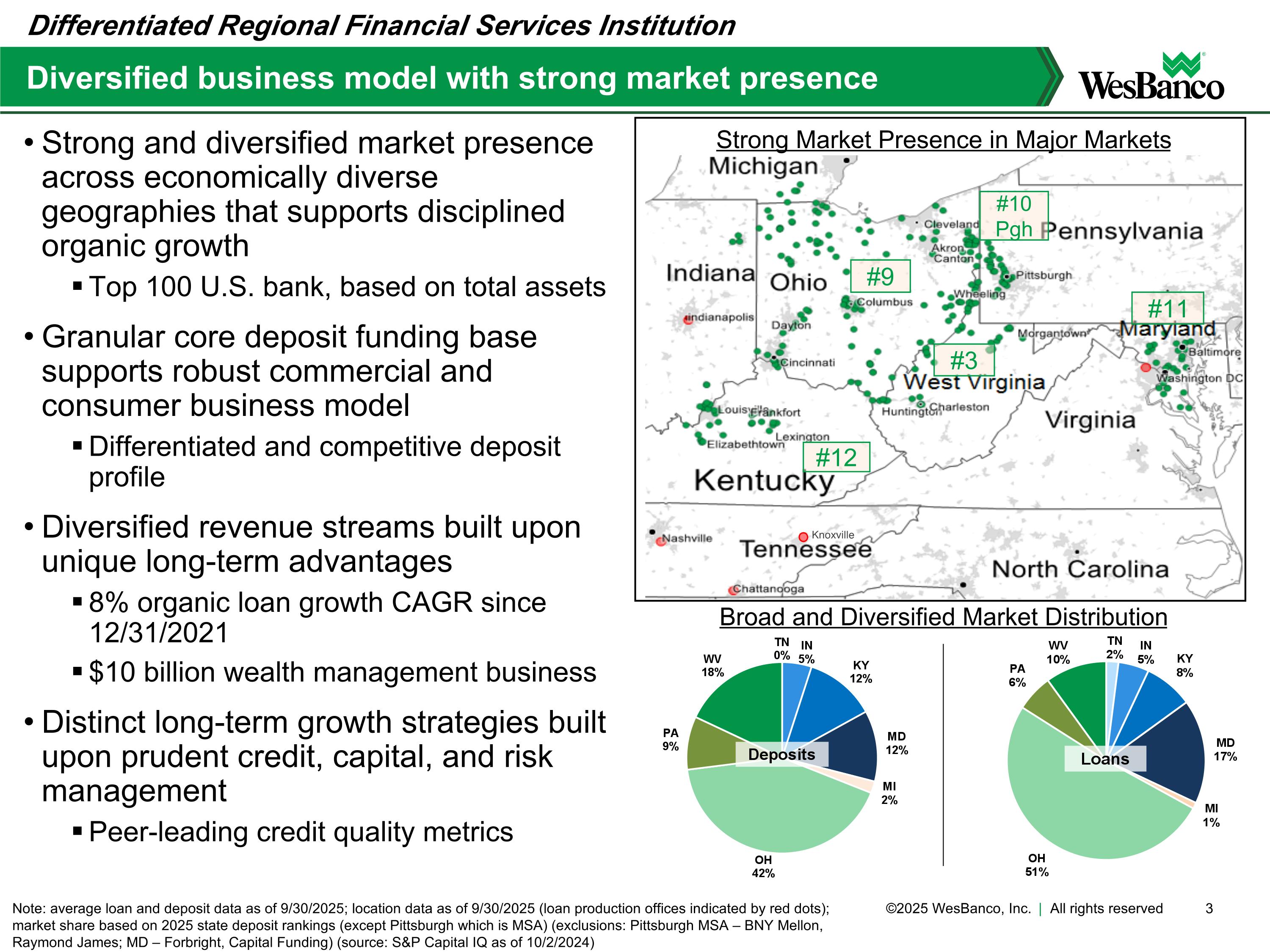
Strong and diversified market presence across economically diverse geographies that supports disciplined organic growth Top 100 U.S. bank, based on total assets Granular core deposit funding base supports robust commercial and consumer business model Differentiated and competitive deposit profile Diversified revenue streams built upon unique long-term advantages 8% organic loan growth CAGR since 12/31/2021 $10 billion wealth management business Distinct long-term growth strategies built upon prudent credit, capital, and risk management Peer-leading credit quality metrics Diversified business model with strong market presence Note: average loan and deposit data as of 9/30/2025; location data as of 9/30/2025 (loan production offices indicated by red dots); market share based on 2025 state deposit rankings (except Pittsburgh which is MSA) (exclusions: Pittsburgh MSA – BNY Mellon, Raymond James; MD – Forbright, Capital Funding) (source: S&P Capital IQ as of 10/2/2024) Differentiated Regional Financial Services Institution #11 #9 #12 #3 #10 Pgh Strong Market Presence in Major Markets Broad and Diversified Market Distribution Knoxville

Broad and diversified loan and deposit distribution across contiguous eight state footprint, with complementary loan production office strategy Full suite of commercial and consumer banking capabilities, complemented by a wealth management business with a 100+ year track-record of success managing assets of $7.7B under trust and $2.6B under securities brokerage Robust legacy deposit base provides core funding and pricing advantages Streamlining through digitization and technology investments Unique advantages, sustainable growth, shareholder focus Note: assets under trust are market value of Trust & Investment Services assets under management and securities brokerage assets are account value (including annuities), both as of 9/30/2025; Moody’s Ratings ratings announced 9/5/2025; Kroll Bond Rating Agency ratings affirmation announced 7/30/2025 Investment Rationale Broad and Diversified with Unique Long-Term Advantages Disciplined Growth from Distinct Long-Term Growth Strategies Legacy of Credit Quality, Risk Management, and Shareholder Focus Organic growth-oriented business model supported by strategic acquisition and loan and production office strategies that support positive operating leverage Relationship-focused model that meets customer needs efficiently and effectively Leveraging digital capabilities to drive customer relationship value Focus on positive operating leverage built upon a culture of expense management Critical, long-term focus on shareholder return combined with an uncompromising approach to risk management, credit underwriting, and capital management Eight consecutive “outstanding” CRA ratings from the FDIC since 2003 Issuer rating of Baa3 for WesBanco, Inc. and baseline credit assessment of Baa2 and deposit rating of A3 for WesBanco Bank, Inc. from Moody’s Ratings Senior unsecured debt ratings of BBB+ for WesBanco, Inc. and A- for WesBanco Bank, Inc. from Kroll Bond Rating Agency

Meaningful valuation upside potential plus an ~5% dividend yield Note: peer bank group includes all U.S. banks with total assets of $20B to $50B (excluding FFIN); stock prices, P/E (price to earnings) ratios, and EPS consensus (WSBC $3.77) from FactSet (as of 11/3/2025); dividend yield (please see slide 27 footnote); research ratings as of 11/3/2025 Investment Rationale 25% upside to WSBC stock price from applying peer average P/E ratio of 10.3x to WesBanco’s 2026 consensus earnings per share (EPS) Above peer average consensus EPS growth 2024 to 2025: WSBC +40% vs. peers +18% 2025 to 2026: WSBC +15% vs. peers +12% Dividend yield of 4.9%, compared to 3.2% for bank group 3 sell-side research “buy” ratings and 2 “top picks”

Strategies for Long-Term Success

Organic growth-oriented business model Long-Term Growth Strategies Focus on Delivering Positive Operating Leverage Strong Legacy of Credit, Capital, and Risk Management Diversified Loan Portfolio Built upon a Relationship Focused Model Distinct Revenue Capabilities, Led by 100+ Year Wealth Management Business Digital Banking Service Strategies and Core Deposit Advantage Franchise-Enhancing Expansion through LPO Strategy and Targeted Acquisitions

Focus on strategic diversification and growth built upon strong credit quality Balance disciplined loan origination with prudent underwriting standards Focus on relationship lending Key offerings include loan swaps, treasury management, foreign exchange, cyber security, and lockbox services Strong residential mortgage program, including home equity lending Loan production office and lender hiring strategy Average loans to average deposits ratio of 89.4% provides opportunity for continued loan growth Manageable lending exposures De-emphasized consumer and several CRE categories in recent years Office investment loan portfolio ~$600 million (~3% of the total loan portfolio) and in stable condition Geographically diverse (no Tier 1 cities) Average loan-to-value ~65% Average debt service coverage ratio ~1.5x Focus on balanced loan growth with strong underwriting standards Note: loan and deposit data as of quarter ending 9/30/2025; loan-to-value and debt service coverage as of 6/30/2025; office investment portfolio excludes owner-occupied; organic CAGR, as of 9/30/2025, excludes closed acquisitions since 12/31/2021 (please see slide 12) Diversified Loan Portfolio $18.9 Billion Loan Portfolio Loan Category C&I Comm’l R/E (Total) HELOC Residential R/E Consumer Total 16% 19% 17% 25% 9% Organic 3% 9% 11% 10% (18%) CAGR Since 12/31/2021 Replace some sub-bullets with HC veritical? We are proud to launch our dedicated Healthcare Vertical! Led by Suzanne Myers, EVP & Director of Commercial Healthcare, this strategic initiative is designed to serve the complex and vital needs of the healthcare industry. With decades of experience in healthcare commercial banking, Suzanne has had the privilege of working alongside operators, providers and investors across the continuum of care, including senior living, skilled nursing, continuing care retirement communities, hospitals and specialty care. This vertical is about more than just lending—it’s about partnership. Our goal is to take a holistic approach, aligning our full suite of banking solutions with the financial strategies and operational realities of our clients. Whether it’s real estate lending, treasury management, deposits, derivatives, private banking, investments or insurance, we lead with deep sector knowledge and a commitment to long-term relationships. What differentiates WesBanco is our hands-on, relationship-first approach. We don’t just provide financial products—we take the time to understand the people, the mission and the operational dynamics behind each organization. That level of engagement allows us to deliver more relevant, customized solutions and build trust with our clients from day one. Healthcare is an industry like no other. It demands expertise, adaptability and a true understanding of the regulatory and reimbursement landscape. Suzanne has built a national referral network and collaborated with healthcare leaders coast to coast. That insight is now embedded in how WesBanco shows up for our healthcare clients. Please join us in congratulating the Commercial Healthcare team on their hard work and dedication to bringing this vision to life and helping power the future of healthcare through thoughtful banking, trusted advice and a partner-first mentality!

Securities Brokerage $2.6B in account value 11,800+ accounts* Securities investment sales Investment advisory services Licensed banker and regional player/coach programs Expansion opportunities in KY, IN, and Mid-Atlantic markets, as well as external business development opportunities Trust & Investment Services $7.7B of trust and mutual fund assets under management 7,700+ relationships Legacy market private wealth management growth opportunities Expansion opportunities in the Mid-Atlantic market WesMark Funds – six proprietary funds across equities, bonds, and tactical assets Strong capabilities built upon a century of success Note: assets, loans, deposits, and clients as of 9/30/2025; chart financials as of 12/31 unless otherwise stated; Trust & Investment Services trust and mutual fund assets under management (“AUM”) are market value and Securities Brokerage is account value (including annuities and managed accounts); * does not include PFC Wealth Management $0.1 $0.4 $0.8 $1.1 Private Client Loans and Deposits (as of 12/31) ($B) CAGR 33% Trust & Investment Services AUM (Market Value as of 12/31) ($B) CAGR 5.5% 9/30 9/30 Private Client $2.9B in private client loans and deposits 9,650+ relationships Private wealth management growth opportunities across all markets $2.9 Securities Brokerage Account Value (Market Value as of 12/31) ($B) CAGR 18% 9/30 Insurance: personal, commercial, title, health, and life; expand title business in all markets; digital insurance agency for both personal and commercial property & casualty; and third-party administrator (TPA) services for small business healthcare plans

New capabilities with long-term growth opportunities Treasury Management Focus on building comprehensive business customer relationships by providing individualized services to improve cash flow management, increase earning power, and strengthen fraud protection for clients Key Treasury Management services Online and mobile access Deposit services Payables Sweep products Fraud and risk mitigation New Treasury Management products Multi-card (purchasing, T&E, fleet, virtual cards) Deposit escrow sub-accounting capabilities Integrated payables Integrated receivables In 2025/2026 try to develop a metric/chart to add to slide During 2023, transformed the Treasury Management business line into a sales-oriented organization that strategically partners with commercial and business bankers to strengthen customer relationships Represents an untapped market for our business clients, as current focus is on building a strong pipeline to drive future fee-based revenues Industry experts estimate that 40% of all B2B payments in the U.S. are still made with a check ... costing companies $25 billion of processing costs annually

Digital banking utilization ~75% of retail customers utilize online digital banking services ~5.7 million web and mobile logins per month ~385,000 mobile wallet transactions, ~69,000 Zelle® payments, and ~36,000 mobile deposits per month Digital acquisition ~40% of residential mortgage applications submitted via online portal >540 deposit accounts opened online per month WesBanco Insurance Services launched white-label insurance capabilities with a web-based term-life insurance platform, and a fully-integrated digital property and casualty insurance for consumers and small businesses State-of-the-art core banking software system Omni-channel presence – real-time account activity across all channels Improved customer service through reduced manual activities More efficient processing cost structure Cloud-based architecture utilization Early adoption to leverage modernized data and application platforms, combined with significant expense and performance benefits Actively analyzing advanced artificial intelligence (AI) and robotic process automation (RPA) technologies to automate business processes Leveraging digital to drive customer value and enterprise efficiency Note: digital statistics as of 9/30/2025 year-to-date; Zelle® payment service added August 2021; online residential mortgage applications and deposit account opening capabilities launched July 2019; WesBanco Insurance Services online term-life and P&C insurance capabilities launched November 2020 and January 2021, respectively; core banking software system upgraded 8/2/2021 Robust Digital Capabilities
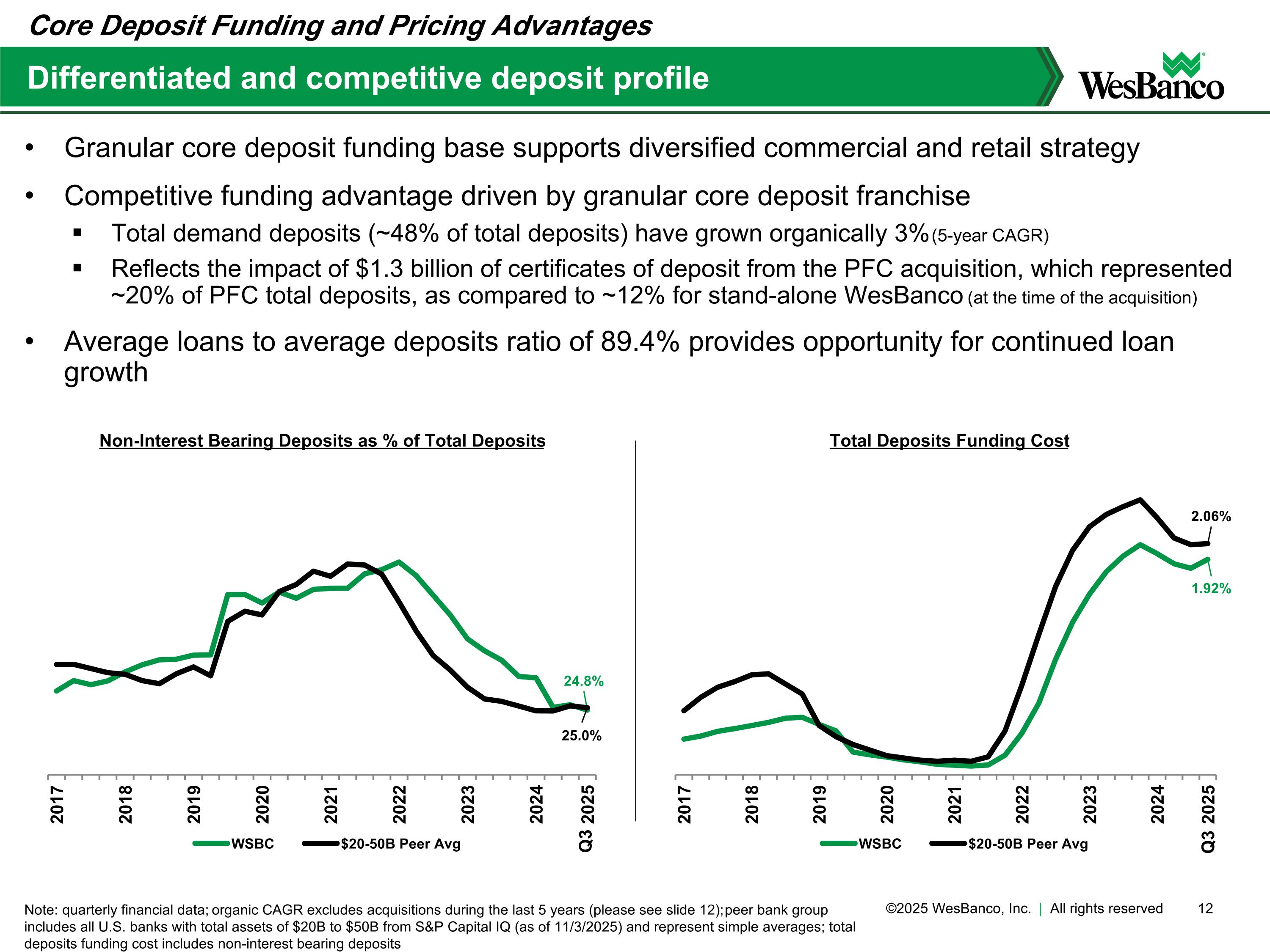
Differentiated and competitive deposit profile Note: quarterly financial data; organic CAGR excludes acquisitions during the last 5 years (please see slide 12); peer bank group includes all U.S. banks with total assets of $20B to $50B from S&P Capital IQ (as of 11/3/2025) and represent simple averages; total deposits funding cost includes non-interest bearing deposits Core Deposit Funding and Pricing Advantages Granular core deposit funding base supports diversified commercial and retail strategy Competitive funding advantage driven by granular core deposit franchise Total demand deposits (~48% of total deposits) have grown organically 3% (5-year CAGR) Reflects the impact of $1.3 billion of certificates of deposit from the PFC acquisition, which represented ~20% of PFC total deposits, as compared to ~12% for stand-alone WesBanco (at the time of the acquisition) Average loans to average deposits ratio of 89.4% provides opportunity for continued loan growth Q3 Q3

Targeted acquisitions in existing markets and new higher-growth metro areas, as well as a complementary loan production office (“LPO”) strategy Long-term focus on appropriate capital management to enhance shareholder value Strong capital and liquidity, along with strong regulatory compliance processes, provides ability to execute transactions quickly Diligent efforts to maintain a community bank-oriented, value-based approach to our markets History of successful acquisitions that have improved earnings Franchise-Enhancing Expansion Loan production office strategy and targeted acquisitions Note: Wheeling headquarters indicated by green star; loan production office strategy indicated by red dots; AmTrust was an acquisition of five branches Franchise-Enhancing Expansion Contiguous Markets Expansion Franchise-Enhancing Expansion Mergers PFC OLBK FFKT FTSB YCB ESB FSBI AmTrust OAKF Announced Jul-2024 Jul-2019 Apr-2018 Nov-2017 May-2016 Oct-2014 Jul-2012 Jan-2009 Jul-2007 Closed Feb-2025 Nov-2019 Aug-2018 Apr-2018 Sep-2016 Feb-2015 Nov-2012 Mar-2009 Nov-2007 Loan Production Offices Knoxville (2Q2025) Chattanooga (3Q2023) Indianapolis (2Q2022) Nashville (1Q2022) Northern VA (3Q2021 and enhanced 2Q2025)

(1) Track-record of expense control with on-going enhancement efforts Note: financial data as of 12/31; current year data as of 9/30/2025 year-to-date; balance sheet data as of period ends (1) Non-GAAP measure – please see reconciliation in appendix; non-interest expense excludes restructuring and merger-related expenses Delivering Positive Operating Leverage ESB Merger (Feb-15) Fidelity Merger (Nov-12) YCB Merger (Sep-16) FTSB (Apr-18) & FFKT (Aug-18) Mergers OLBK Merger (Nov-19) Track-record of disciplined growth, balanced by a fundamental focus on expense management and supported by franchise-enhancing acquisitions, in order to deliver positive operating leverage and enhance shareholder value Implemented the next phase of our financial center optimization strategy to close 27 locations in early-2026 PFC Merger (Feb-25)

Strong legacy of credit and risk management and regulatory compliance Based upon conservative underwriting standards and approval processes supported by centralized back-office and loan funding functions Mature enterprise risk management program headed by Chief Risk Officer addressing key risks in all business lines and functional areas Enhanced compliance and risk management system and testing platform Strong and scalable BSA/AML function Examined by CFPB for consumer compliance supervision Eight consecutive “outstanding” CRA ratings since 2003 Strong regulatory capital ratios significantly above regulatory requirements On 9/10/2025, raised $230 million of Series B preferred stock through the issuance of 9.2 million depositary shares to be used to redeem the $150 million Series A preferred stock, $50 million to redeem sub-debt from PFC, and general corporate purposes Capital ratios above both regulatory and well-capitalized levels Note: capital ratios enhanced by August 2020 preferred stock issuance of $150MM, August 2024 common equity raise of $200MM (in conjunction with the acquisition of Premier Financial Corp.), and September 2025 preferred stock issuance of $230MM Strong Risk Management and Capital Position memo Well-Capitalized 8.0% Required 6.0% memo Well-Capitalized 5.0% Required 4.0% Tier 1 Leverage Capital Ratio Tier 1 Risk-Based Capital Ratio
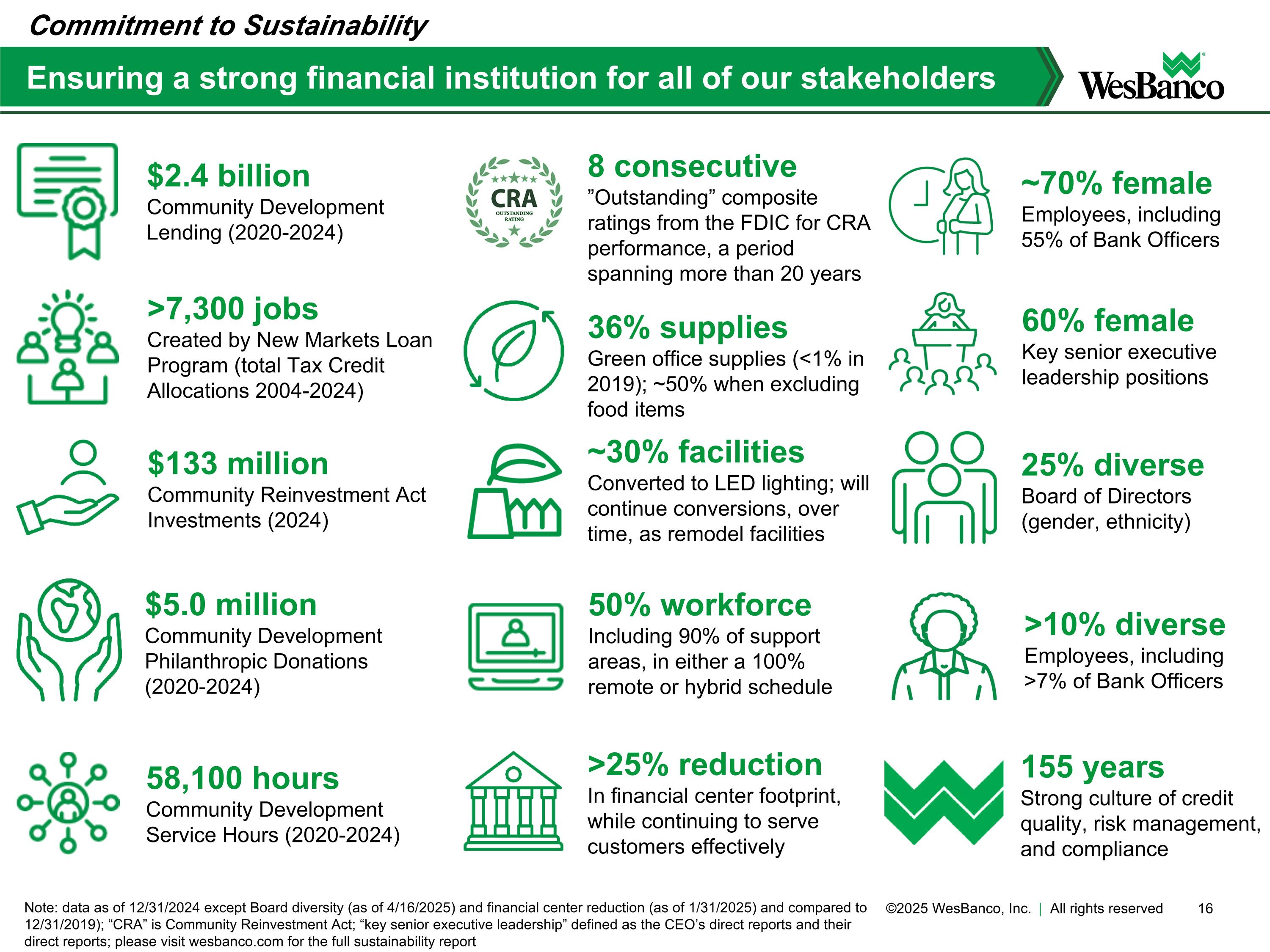
Ensuring a strong financial institution for all of our stakeholders Note: data as of 12/31/2024 except Board diversity (as of 4/16/2025) and financial center reduction (as of 1/31/2025) and compared to 12/31/2019); “CRA” is Community Reinvestment Act; “key senior executive leadership” defined as the CEO’s direct reports and their direct reports; please visit wesbanco.com for the full sustainability report Commitment to Sustainability >7,300 jobs Created by New Markets Loan Program (total Tax Credit Allocations 2004-2024) $2.4 billion Community Development Lending (2020-2024) $133 million Community Reinvestment Act Investments (2024) $5.0 million Community Development Philanthropic Donations (2020-2024) 58,100 hours Community Development Service Hours (2020-2024) 8 consecutive ”Outstanding” composite ratings from the FDIC for CRA performance, a period spanning more than 20 years ~70% female Employees, including 55% of Bank Officers 60% female Key senior executive leadership positions 25% diverse Board of Directors (gender, ethnicity) >10% diverse Employees, including >7% of Bank Officers 36% supplies Green office supplies (<1% in 2019); ~50% when excluding food items ~30% facilities Converted to LED lighting; will continue conversions, over time, as remodel facilities 50% workforce Including 90% of support areas, in either a 100% remote or hybrid schedule >25% reduction In financial center footprint, while continuing to serve customers effectively 155 years Strong culture of credit quality, risk management, and compliance

WesBanco was one of just 300 public companies being named to Forbes’ inaugural list of the Most Trusted Companies in America Newsweek again named WesBanco Bank one of America’s Best Regional Banks, based on soundness, profitability, and positively impacting their communities For the third consecutive year, WesBanco was named one of the best performing 100 largest banks by S&P Global Market Intelligence Bauer Financial again awarded WesBanco Bank their highest rating as a “five-star” bank – for the 45th consecutive quarter WesBanco Bank received the America Saves Designation of Savings Excellence for Banks, a designation from America Saves, for the 10th consecutive year and one of only 11 banks WesBanco Bank has also been named a best in state bank for Ohio and a greatest workplace for the state of West Virginia by two leading financial magazines National accolades a testament to strong performance & foundation Commitment to Excellence

Financial Overview

Deposit growth fully funded loan growth both year-over-year and sequentially Total organic loan growth was 4.8% YoY and 2.2% QoQ annualized Commercial real estate payoffs increased to approximately $235 million during Q3 Net interest margin of 3.53% increased 58 basis points year-over-year reflecting higher earning asset yields and lower funding costs Efficiency ratio of 55.1% improved due to expense synergies generated from the PFC acquisition and driving positive operating leverage Implemented the next phase of our financial center optimization strategy to close 27 locations in early-2026, with expected net pre-tax savings of approximately $6 million Net Income Available to Common Shareholders and Diluted EPS(1) $90.0 million; $0.94/share Net Interest Margin +58bp YoY Total Loan Growth +52.0% YoY; +2.2% QoQ (annualized) Average loans to average deposits 89.4% Non-Performing Assets to Total Assets 0.35% Tangible Common Equity to Tangible Assets(1) 7.92% Net interest margin of 3.53% and loan growth fully funded by deposits Note: financial and operational highlights during the quarter ended September 30, 2025; PFC = Premier Financial Corp.; YoY = year-over-year; QoQ = quarter-over-quarter; bp = basis points (1) Non-GAAP measure – please see reconciliation in appendix Q3 2025 Financial and Operational Highlights
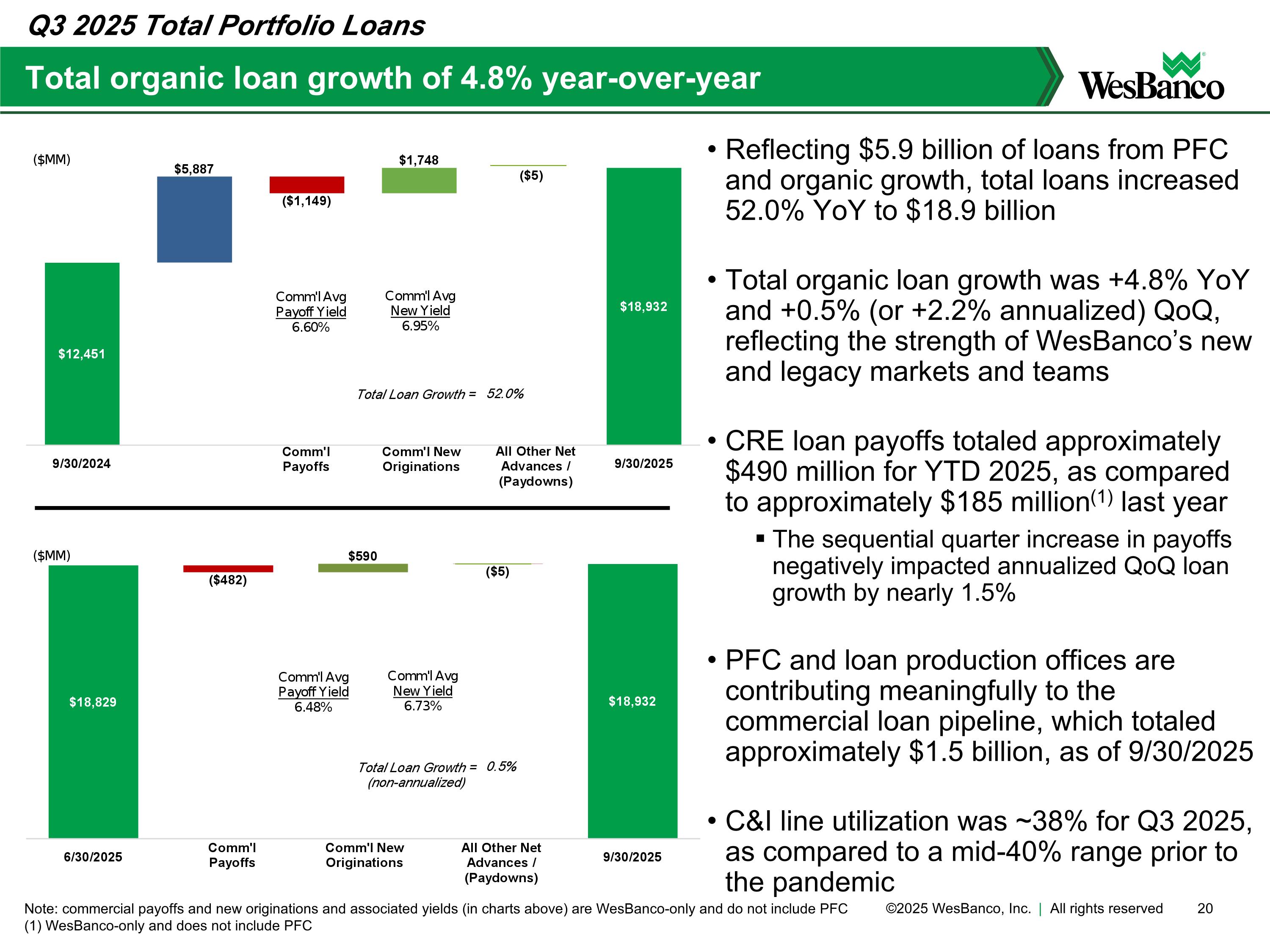
Reflecting $5.9 billion of loans from PFC and organic growth, total loans increased 52.0% YoY to $18.9 billion Total organic loan growth was +4.8% YoY and +0.5% (or +2.2% annualized) QoQ, reflecting the strength of WesBanco’s new and legacy markets and teams CRE loan payoffs totaled approximately $490 million for YTD 2025, as compared to approximately $185 million(1) last year The sequential quarter increase in payoffs negatively impacted annualized QoQ loan growth by nearly 1.5% PFC and loan production offices are contributing meaningfully to the commercial loan pipeline, which totaled approximately $1.5 billion, as of 9/30/2025 C&I line utilization was ~38% for Q3 2025, as compared to a mid-40% range prior to the pandemic Total organic loan growth of 4.8% year-over-year Q3 2025 Total Portfolio Loans Note: commercial payoffs and new originations and associated yields (in charts above) are WesBanco-only and do not include PFC (1) WesBanco-only and does not include PFC

Deposit growth fully funded loan growth Note: “uninsured deposits” are approximated; “collateralized municipal deposits” are collateralized by securities Reflecting $6.9 billion of deposits from PFC and organic growth, total deposits increased 53.8% YoY to $21.3 billion Deposit growth fully funded loan growth both year-over-year and sequentially On a sequential quarter basis, total deposits increased $130 million due to the efforts of our consumer and business teams more than offsetting the intentional runoff of $50 million of higher cost brokered deposits and less reliance on public funds from PFC Distribution: consumer ~52% and business ~32% (note: public funds, which are separately collateralized, ~16%) Average loans to average deposits were 89.4%, providing continued capacity to fund loan growth Q3 2025 Total Deposits

NIM benefiting from loan growth and management of funding costs Q2 2025 NIM of 3.53% improved 58 basis points YoY, through a combination of higher loan and securities yields and lower funding costs As expected, the NIM declined 6 basis points on a sequential quarter basis due to the repricing of PFC marked certificates of deposits partially offset by legacy net interest margin improvement Deposit funding costs, including non-interest bearing deposits, were 192 basis points and decreased 13 basis points YoY FHLB borrowings of $1.3 billion decreased $475 million quarter-over-quarter as advances were paid-off with excess cash Of the $1.3 billion of borrowings at 9/30/2025, approximately 92% have 2025 maturities, with an average rate of 4.42% Q3 2025 Net Interest Margin (NIM)

Non-interest income increased year-over-year due primarily to the acquisition of PFC which drove higher service charges on deposits, trust fees, mortgage banking income, digital banking income, and bank-owned life insurance Service charges on deposits reflect the addition of PFC, fee income from new products and services and treasury management, and increased general consumer spending Digital banking fees reflect higher volumes primarily associated with our larger customer base Reflecting record asset levels, trust fees and securities brokerage revenue increased due to the addition of PFC wealth clients, market value appreciation, and organic growth Gross swap fees were $3.2 million, compared to $1.1 million in the prior year Fair market valuation was a negligible gain, as compared to a $1.7 million loss last year Fee income increased $15.3 million, or 51.5%, year-over-year Note: OREO = other real estate owned; AUM = assets under management; securities account values include annuities Q3 2025 Non-Interest Income

Expenses declined $0.7 million sequentially due to cost control Q3 2025 Non-Interest Expense Non-interest expense, excluding merger and restructuring charges, decreased sequentially from discretionary cost control Marketing expense increased quarter-over-quarter in support of our deposit campaign Non-interest expense, excluding merger and restructuring charges, increased 46% YoY due to the addition of the PFC expense base associated with approximately 900 employees and 70 financial centers Salaries and wages and employee benefits expense increased due to higher staffing levels and higher health insurance costs Amortization of intangible assets increased due to the core deposit intangible asset that was created from the acquisition of PFC

Comparable operating measures to peer bank group Note: financial data is year-to-date for dates specified; peer bank group includes all U.S. banks with total assets of $20B to $50B from S&P Capital IQ (as of 11/3/2025 and represent simple averages; NIM (fully taxable-equivalent (FTE) and annualized basis) and non-interest expense (does not exclude restructuring & merger-related expenses) are company reported; other figures are S&P calculations); 2020 and 2021 comparability impacted by timing of the adoption of Current Expected Credit Losses (“CECL”) accounting standard and economic assumptions used by each bank (WSBC adopted January 1, 2020); please see reconciliations in the appendix Return on Average Assets Non-Interest Expense to Total Assets Net Interest Margin Return on Average Tangible Common Equity Disciplined Execution upon Growth Strategies 1.09% 1.40% 1.20% 0.81% 0.88% 15.5% 16.7% 17.1% 13.2% 11.0% Consider replacing with efficiency ratio?

Favorable asset quality measures compared to peer bank group Note: financial data as of quarter ending for dates specified; peer bank group includes all U.S. banks with total assets of $20B to $50B from S&P Capital IQ (as of 11/3/2025) and represent simple averages except criticized & classified loans as % of total loans which is a weighted average; 2020 and 2021 comparability impacted by timing of the adoption of Current Expected Credit Losses (“CECL”) accounting standard and economic assumptions used by each bank (WSBC adopted January 1, 2020) Non-Performing Assets as % of Total Assets Net Charge-Offs as % of Average Loans (YTD Annualized) Allowance for Credit Losses as % of Total Loans Criticized & Classified Loans as % of Total Loans Strong Legacy of Credit Quality

Critical, long-term focus on shareholder return Note: dividend through August 2025 declaration announcement; WSBC dividend yield based upon 10/31/2025 closing stock price of $30.10; peer bank group includes all U.S. banks with total assets of $20B to $50B (as of most recent period) from S&P Capital IQ (as of 11/3/2025 and represent simple average) Under the existing share repurchase authorization that was approved on February 24, 2022 by WesBanco’s Board of Directors Non-GAAP measure – please see reconciliation in appendix Focus on appropriate capital allocation to provide financial flexibility while continuing to enhance shareholder value through earnings growth and effective capital management Capital management strategy: dividends, loan growth, acquisitions, share repurchases Q3 2025 dividend yield 4.9%, compared to 3.2% for bank group ~0.9 million shares continue to remain for repurchase (as of 9/30/2025)(1) On 9/10/2025, raised $230 million of Series B preferred stock through the issuance of 9.2 million depositary shares $150 million of the proceeds will be used to redeem the Series A preferred stock, $50 million to redeem sub-debt from PFC, and general corporate purpose Capital Management Strategy Tangible Book Value per Share ($)(2) Quarterly Dividend per Share ($) +164% +76%

Appendix

Key metrics Note: PTPP = pre-tax, pre-provision Non-GAAP measure – please see reconciliation in appendix Excludes restructuring and merger-related expenses and/or day 1 provision for credit losses on acquired loans Q3 2025 Financial and Operational Highlights

Tangible common equity to tangible assets ratio of 7.92%, which reflects the impact of the successful closing of the PFC acquisition Weighted average yield 3.20% vs. 2.57% last year Weighted average duration 4.2 Total unrealized securities losses (after-tax): Available for Sale (“AFS”) = $155MM Held to Maturity (“HTM”)(2) = $83MM Securities represent 16% of total assets Note: securities chart excludes allowance for credit losses for HTM securities; weighted average yields have been calculated on a taxable-equivalent basis using the federal statutory rate of 21%; after-tax unrealized losses have been calculated using the Other Comprehensive Income (“OCI”) tax rate of ~23% Non-GAAP measure – please see reconciliation in appendix HTM losses not recognized in accumulated other comprehensive income Q3 2025 Total Securities

Allowance coverage ratio of 1.15% Note: ACL at 9/30/2025 excludes off-balance sheet credit exposures of $7.6 million The allowance for credit losses on loans was $217.7 million at 9/30/2025, which provided a coverage ratio of 1.15% Excluded from the allowance for credit losses and related coverage ratio are fair market value adjustments on previously acquired loans representing 1.67% of total loans Q3 2025 Current Expected Credit Loss (CECL)

Non-Interest Expense to Total Assets and Efficiency Ratio Reconciliation Note: “non-interest expense to total assets” are annualized by utilizing the actual numbers of days in the quarter versus the year; “efficiency ratio” is non-interest expense excluding restructuring and merger-related expense divided by total income; FTE represents fully taxable equivalent; merger closings: Premier Financial Corporation February 2025; Old Line Bancshares November 2019; Farmers Capital Bank Corporation August 2018; First Sentry Bancshares April 2018; Your Community Bankshares September 2016; ESB Financial February 2015; Fidelity Bancorp November 2012; AmTrust 5 branches March 2009

Pre-Tax, Pre-Provision Income (PTPP) and Ratios Reconciliation

Net Income and Diluted Earnings per Share (EPS) Reconciliation

Tangible Book Value per Share Reconciliation

Return on Average Assets (1) Ratios are annualized by utilizing the actual numbers of days in the quarter versus the year Note: Current Expected Credit Losses (“CECL”) accounting standard adopted January 1, 2020 by WSBC; Premier Financial Corporation merger closed February 2025 Reconciliation

Return on Average Tangible Equity Reconciliation (1) Amortization of intangibles tax effected at 21% for all prior periods (2) Ratios are annualized by utilizing the actual numbers of days in the quarter versus the year Note: Current Expected Credit Losses (“CECL”) accounting standard adopted January 1, 2020 by WSBC; Premier Financial Corporation merger closed February 2025

Return on Average Tangible Common Equity Reconciliation (1) Amortization of intangibles tax effected at 21% for all prior periods (2) Ratios are annualized by utilizing the actual numbers of days in the quarter versus the year Note: Current Expected Credit Losses (“CECL”) accounting standard adopted January 1, 2020 by WSBC; Premier Financial Corporation merger closed February 2025
