 エドガーで原本を確認する
UNITED STATES
SECURITIES AND EXCHANGE COMMISSION
Washington, D.C. 20549
FORM 8-K
CURRENT REPORT
Pursuant to Section 13 or 15(d)
of the Securities Exchange Act of 1934
October 17, 2025
(Date of report; date of
earliest event reported)
Commission file number: 1-3754
ALLY FINANCIAL INC.
(Exact name of registrant as specified in its charter)
| Delaware | 38-0572512 | |
|
(State or other jurisdiction of incorporation or organization) |
(I.R.S. Employer Identification No.) |
Ally Detroit Center
500 Woodward Ave.
Floor 10, Detroit, Michigan
48226
(Address of principal executive offices)
(Zip Code)
(866) 710-4623
(Registrant’s telephone number, including area code)
Check the appropriate box below if the Form 8-K filing is intended to simultaneously satisfy the filing obligation of the registrant under any of the following provisions (see General Instruction A.2. below):
| ☐ | Written communications pursuant to Rule 425 under the Securities Act (17 CFR 230.425) |
| ☐ | Soliciting material pursuant to Rule 14a-12 under the Exchange Act (17 CFR 240.14a-12) |
| ☐ | Pre-commencement communications pursuant to Rule 14d-2(b) under the Exchange Act (17 CFR 240.14d-2(b)) |
| ☐ | Pre-commencement communications pursuant to Rule 13e-4(c) under the Exchange Act (17 CFR 240.13e-4(c)) |
Securities registered pursuant to Section 12(b) of the Act (listed on the New York Stock Exchange):
Title of each class |
Trading symbols |
|
| Common Stock, par value $0.01 per share | ALLY |
Indicate by check mark whether the registrant is an emerging growth company as defined in Rule 405 of the Securities Act of 1933 (§230.405 of this chapter) or Rule 12b-2 of the Securities Exchange Act of 1934 (§240.12b-2 of this chapter).
Emerging growth company ☐
If an emerging growth company, indicate by check mark if the registrant has elected not to use the extended transition period for complying with any new or revised financial accounting standards provided pursuant to Section 13(a) of the Exchange Act. ☐
| Item 2.02 | Results of Operation and Financial Condition. |
On October 17, 2025, Ally Financial Inc. issued a press release announcing preliminary operating results for the third quarter ended September 30, 2025. The press release is attached hereto and incorporated by reference as Exhibit 99.1. Charts furnished to securities analysts are attached hereto and incorporated by reference as Exhibit 99.2. In addition, supplemental financial data furnished to securities analysts is attached hereto and incorporated by reference as Exhibit 99.3.
| Item 9.01 | Financial Statements and Exhibits. |
Exhibit |
Description |
|
| 99.1 | Press Release, Dated October 17, 2025 | |
| 99.2 | Charts Furnished to Securities Analysts | |
| 99.3 | Supplemental Financial Data Furnished to Securities Analysts | |
| 104 | The cover page from this Current Report on Form 8-K, formatted in Inline XBRL | |
SIGNATURES
Pursuant to the requirements of the Securities Exchange Act of 1934, the registrant has duly caused this report to be signed on its behalf by the undersigned hereunto duly authorized.
| ALLY FINANCIAL INC. | ||||
| (Registrant) | ||||
| Dated: October 17, 2025 | /s/ Austin T. McGrath |
|||
| Austin T. McGrath | ||||
| Vice President, Controller, and Chief Accounting Officer | ||||
Exhibit 99.1
News release: IMMEDIATE RELEASE

| Ally Financial Reports Third Quarter 2025 Financial Results | ||||||
| $1.18 |
11.9% | $513 million | $2.2 billion | |||
| GAAP EPS |
RETURN ON COMMON EQUITY | PRE-TAX INCOME | GAAP TOTAL NET REVENUE | |||
| $1.15 |
15.3% | $502 million | $2.2 billion | |||
| ADJUSTED EPS1 |
CORE ROTCE1 | CORE PRE-TAX INCOME1 | ADJUSTED TOTAL NET REVENUE1 | |||
FINANCIAL HIGHLIGHTS
|
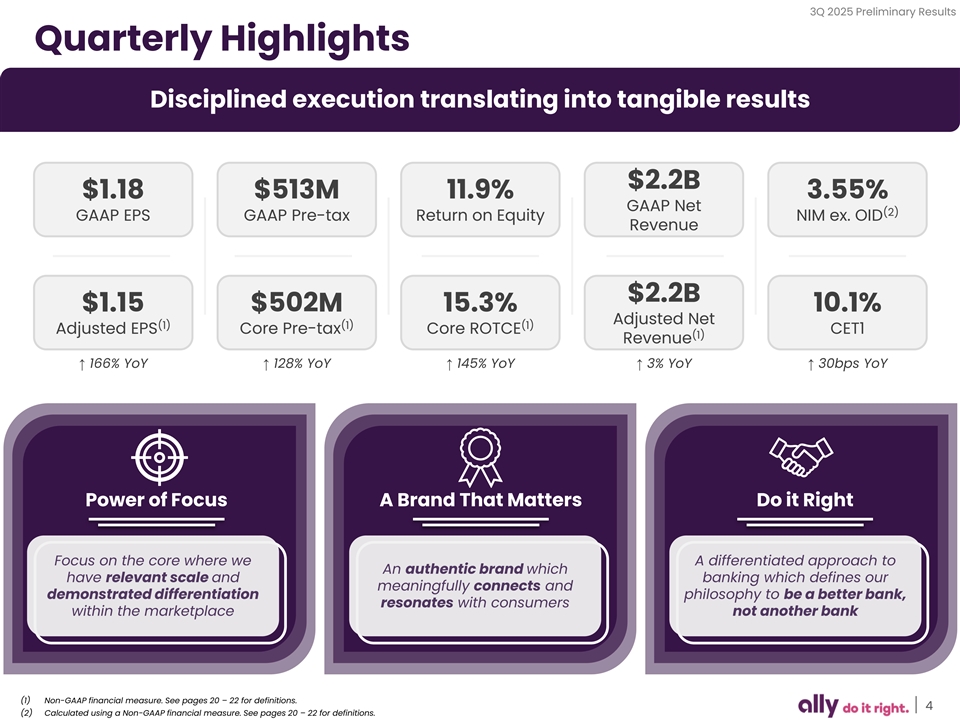
• GAAP EPS of $1.18 and Adjusted EPS of $1.15, up 116% and 166% year over year, respectively
• GAAP Pre-tax income of $513 million, up $248 million year over year. Core pre-tax income of $502 million, up $282 million year over year
• NIM ex. OID1 of 3.55% is up 10 bps quarter over quarter
• Common equity tier 1 ratio of 10.1% increased ~20 bps quarter over quarter | Fully phased-in AOCI CET1 of 8.0% up ~90 bps since year-end 2024
• Closed $5 billion credit risk transfer at the tightest spread in program history, generating ~20bps of CET1 at time of issuance |
|
OPERATIONAL HIGHLIGHTS
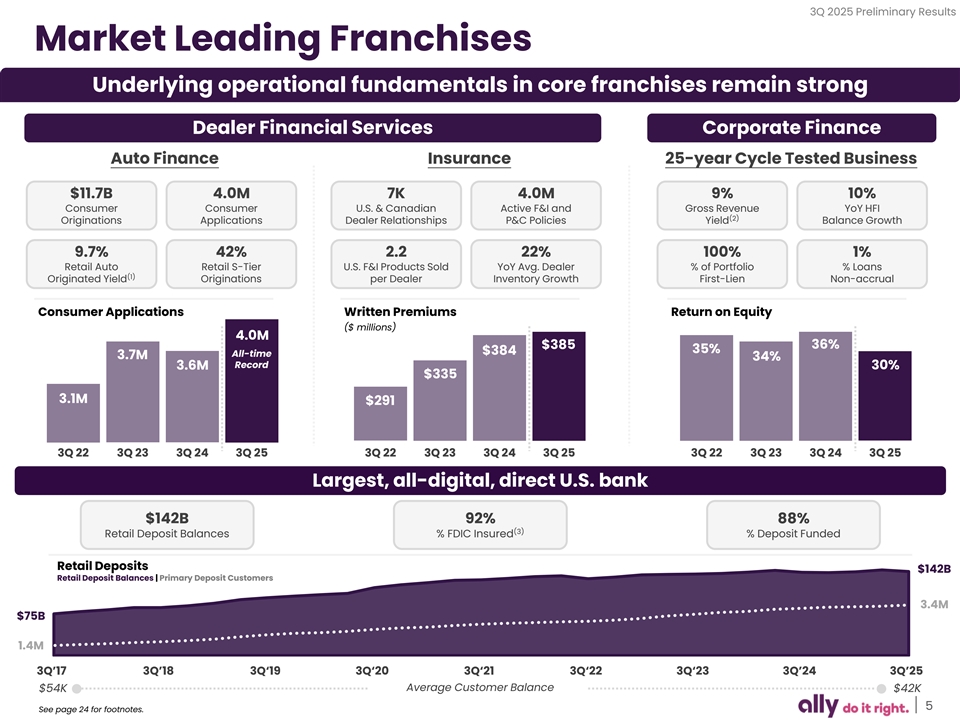
• $11.7 billion of consumer auto originations sourced from a record 4.0 million consumer auto applications
• Retail auto originated yield1 of 9.72% with 42% of volume within the highest credit quality tier
• 188 bps retail auto net charge-offs, down 36 bps year over year
• Insurance written premiums of $385 million, flat year over year & up 2% year over year excluding excess of loss reinsurance
• $142 billion of retail deposits | 92% FDIC insured | 88% core deposit funded
• 66 consecutive quarters of retail deposit customer growth, serving 3.4 million customers
• Corporate Finance HFI portfolio of $11.3 billion | Strong returns with 3Q ROE of 30%, no new non-performing loans, and no charge-offs |
|
CEO COMMENTS
“This quarter’s results represent another clear proof point of our continued progress toward improved returns,” said Chief Executive Officer, Michael Rhodes. “Across each of our core businesses, we are seeing the benefits of sharper strategic alignment and disciplined execution.
Dealer Financial Services remains a key source of competitive strength, as exceptional dealer engagement fueled another record quarter, with 4 million consumer applications resulting in $11.7 billion of originations, up 25% year over year. Insurance continues to expand our all-in dealer value proposition, leveraging synergies with Auto Finance to deepen relationships, support written premiums, and grow market share.
Corporate Finance delivered yet another impressive performance, generating a 30% ROE for the quarter, highlighting the quality of the franchise. With criticized assets and non-accrual loans near historic lows, our team continues to demonstrate the disciplined risk management that guides our growth strategy.
At Ally Bank, we continue to set the standard for digital banking, delivering best-in-class products and experiences to our 3.4 million deposit customers, and grew our customer base for the 66th consecutive quarter. We ended the quarter with $142 billion in retail deposits, of which 92% are FDIC insured. Our deposit base remains a clear differentiator and underscores our position as the nation’s largest all-digital bank.
We’ve built meaningful momentum across each of our businesses, with the benefits of our focused approach becoming increasingly more evident in our improving financial performance. I am pleased with our progress, and I am confident we have laid the foundation to deliver compelling long-term value to our shareholders through disciplined execution. The momentum is real, and we’re confident in our ability to sustain it.” |
Third Quarter 2025 Financial Results
| Increase / (Decrease) vs. | ||||||||||||||||||||
| ($ millions except per share data) | 3Q 25 | 2Q 25 | 3Q 24 | 2Q 25 | 3Q 24 | |||||||||||||||
| GAAP Net Income (Loss) Attributable to Common Shareholders |
$ | 371 | $ | 324 | $ | 171 | 15 | % | 117 | % | ||||||||||
| Core Net Income Attributable to Common Shareholders1 |
$ | 363 | $ | 309 | $ | 136 | 17 | % | 167 | % | ||||||||||
|
|
|
|
|
|
|
|
|
|
|
|||||||||||
| GAAP Earnings per Common Share (basic or diluted as applicable) |
$ | 1.18 | $ | 1.04 | $ | 0.55 | 14 | % | 116 | % | ||||||||||
| Adjusted EPS1 |
$ | 1.15 | $ | 0.99 | $ | 0.43 | 16 | % | 166 | % | ||||||||||
|
|
|
|
|
|
|
|
|
|
|
|||||||||||
| Return on GAAP Shareholder’s Equity |
11.9 | % | 10.7 | % | 5.8 | % | 10 | % | 104 | % | ||||||||||
| Core ROTCE1 |
15.3 | % | 13.6 | % | 6.2 | % | 12 | % | 145 | % | ||||||||||
|
|
|
|
|
|
|
|
|
|
|
|||||||||||
| GAAP Common Shareholder’s Equity per Share |
$ | 41.56 | $ | 39.71 | $ | 39.68 | 5 | % | 5 | % | ||||||||||
| Adjusted Tangible Book Value per Share1 |
$ | 39.19 | $ | 37.30 | $ | 35.41 | 5 | % | 11 | % | ||||||||||
|
|
|
|
|
|
|
|
|
|
|
|||||||||||
| GAAP Total Net Revenue |
$ | 2,168 | $ | 2,082 | $ | 2,135 | 4 | % | 2 | % | ||||||||||
| Adjusted Total Net Revenue1 |
$ | 2,157 | $ | 2,064 | $ | 2,090 | 5 | % | 3 | % | ||||||||||
| 1 | The following are non-GAAP financial measures which Ally believes are important to the reader of the Consolidated Financial Statements, but which are supplemental to and not a substitute for GAAP measures: Adjusted Earnings per Share (Adjusted EPS), Adjusted Total Net Revenue, Core Pre-Tax Income, Core Net Income Attributable to Common Shareholders, Core OID, Core Return on Tangible Common Equity (Core ROTCE), Estimated Retail Auto Originated Yield, Tangible Common Equity, Net Financing Revenue (excluding Core OID) and Adjusted Tangible Book Value per Share (Adjusted TBVPS). These measures are used by management and we believe are useful to investors in assessing the company’s operating performance and capital. Refer to the Definitions of Non-GAAP Financial Measures and Other Key Terms, and Reconciliation to GAAP later in this release. |

Discussion of Third Quarter 2025 Results
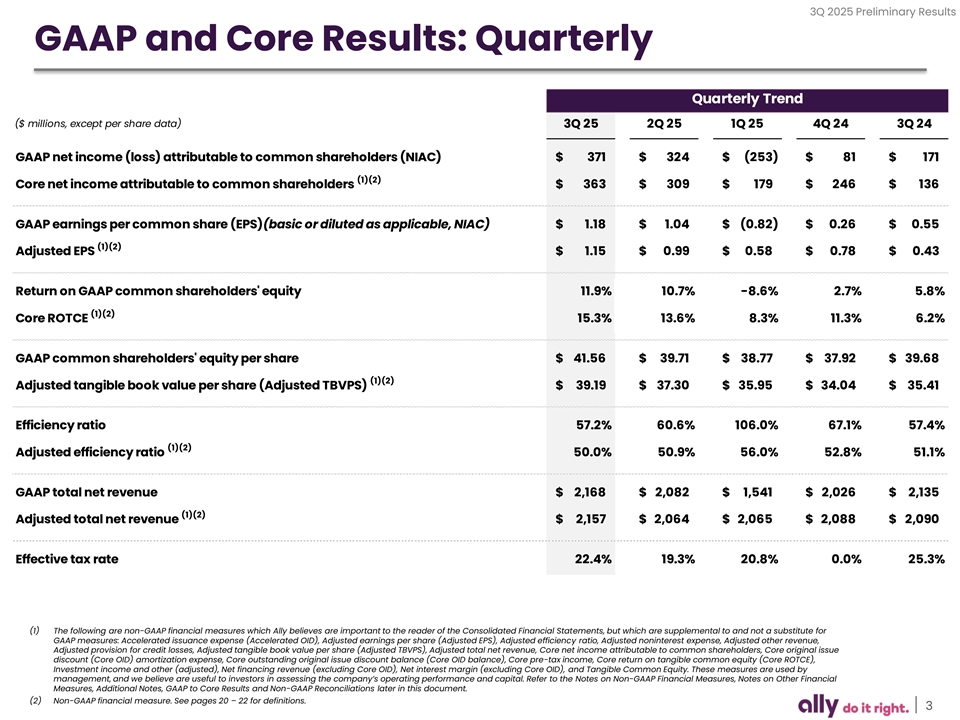
Net income attributable to common shareholders was $371 million in the quarter, compared to $171 million in the third quarter of 2024.
Net financing revenue was $1.6 billion, up $64 million year over year. Net interest margin (“NIM”) of 3.51% and net interest margin excluding core OIDA of 3.55% were up 22 and 23 bps year over year, respectively.
Other revenue decreased $31 million year over year to $584 million including a $27 million increase in fair value of equity securities in the quarter compared to a $59 million increase in the third quarter of 2024. Adjusted other revenueA of $557 million increased $1 million year over year as the removal of fee-related income due to the sale of Credit Card and the wind-down of the consumer mortgage portfolio was offset by momentum across diversified revenue streams including Insurance, SmartAuction, Passthrough programs, and higher realized investment gains.
Provision for credit losses decreased $230 million year over year to $415 million, driven by an increase in the retail auto reserve rate in the prior year period, lower retail auto net charge-offs, and the sale of credit card.
Noninterest expense increased $15 million year over year.
| A | Represents a non-GAAP financial measure. Refer to the Definitions of Non-GAAP Financial Measures and Other Key Terms and Reconciliation to GAAP later in this press release. |
Third Quarter 2025 Financial Results
| Increase/(Decrease) vs. | ||||||||||||||||||||
| ($ millions except per share data) | 3Q 25 | 2Q 25 | 3Q 24 | 2Q 25 | 3Q 24 | |||||||||||||||
| (a) Net Financing Revenue |
$ | 1,584 | $ | 1,516 | $ | 1,520 | $ | 68 | $ | 64 | ||||||||||
| Core OID1 |
17 | 16 | 14 | 1 | 2 | |||||||||||||||
|
|
|
|
|
|
|
|
|
|
|
|||||||||||
| Net Financing Revenue (excluding Core OID)1 |
1,601 | 1,532 | 1,534 | 69 | 66 | |||||||||||||||
| (b) Other Revenue |
584 | 566 | 615 | 18 | (31 | ) | ||||||||||||||
| Repositioning3 |
— | — | — | — | — | |||||||||||||||
| Change in Fair Value of Equity Securities2 |
(27 | ) | (35 | ) | (59 | ) | 7 | 32 | ||||||||||||
|
|
|
|
|
|
|
|
|
|
|
|||||||||||
| Adjusted Other Revenue1 |
557 | 531 | 556 | 25 | 1 | |||||||||||||||
| (c) Provision for Credit Losses |
415 | 384 | 645 | 31 | (230 | ) | ||||||||||||||
| Repositioning3 |
— | — | — | — | — | |||||||||||||||
|
|
|
|
|
|
|
|
|
|
|
|||||||||||
| Adjusted Provision for Credit Losses1 |
415 | 384 | 645 | 31 | (230 | ) | ||||||||||||||
| (d) Noninterest Expense |
1,240 | 1,262 | 1,225 | (22 | ) | 15 | ||||||||||||||
| Repositioning3 |
— | — | — | — | — | |||||||||||||||
|
|
|
|
|
|
|
|
|
|
|
|||||||||||
| Adjusted Noninterest Expense1 |
1,240 | 1,262 | 1,225 | (22 | ) | 15 | ||||||||||||||
|
|
|
|
|
|
|
|
|
|
|
|||||||||||
| Pre-Tax Income (loss) (a+b-c-d) |
$ | 513 | $ | 436 | $ | 265 | $ | 77 | $ | 248 | ||||||||||
| Income Tax Expense (Benefit) |
115 | 84 | 67 | 31 | 48 | |||||||||||||||
| Net Income (Loss) from Discontinued Operations |
— | — | — | — | — | |||||||||||||||
|
|
|
|
|
|
|
|
|
|
|
|||||||||||
| Net Income (Loss) |
$ | 398 | $ | 352 | $ | 198 | $ | 46 | $ | 200 | ||||||||||
| Preferred Dividends |
27 | 28 | 27 | (1 | ) | — | ||||||||||||||
|
|
|
|
|
|
|
|
|
|
|
|||||||||||
| Net Income (Loss) Attributable to Common Shareholders |
$ | 371 | $ | 324 | $ | 171 | $ | 47 | $ | 200 | ||||||||||
|
|
|
|
|
|
|
|
|
|
|
|||||||||||
| GAAP EPS (basic or diluted, as applicable) |
$ | 1.18 | $ | 1.04 | $ | 0.55 | $ | 0.14 | $ | 0.63 | ||||||||||
| Core OID, Net of Tax1 |
0.04 | 0.04 | 0.04 | 0.00 | 0.01 | |||||||||||||||
| Change in Fair Value of Equity Securities, Net of Tax2 |
(0.07 | ) | (0.09 | ) | (0.15 | ) | 0.02 | 0.08 | ||||||||||||
| Repositioning, Discontinued Ops., and Other, Net of Tax3 |
— | — | — | — | — | |||||||||||||||
|
|
|
|
|
|
|
|
|
|
|
|||||||||||
| Adjusted EPS1 |
$ | 1.15 | $ | 0.99 | $ | 0.43 | $ | 0.16 | $ | 0.72 | ||||||||||
| (1) | Represents a non-GAAP financial measure. Refer to the Definitions of Non-GAAP Financial Measures and Other Key Terms and Reconciliation to GAAP later in this press release. |
| (2) | Impacts the Insurance, Corporate Finance and Corporate and Other segments. The change reflects fair value adjustments to equity securities that are reported at fair value. Management believes the change in fair value of equity securities should be removed from select financial measures because it enables the reader to better understand the business’s ongoing ability to generate revenue and income. |
| (3) | Contains non-GAAP financial measures and other financial measures. See pages 5 and 6 for definitions. |
2
Pre-Tax Income by Segment
| Increase/(Decrease) vs. | ||||||||||||||||||||
| ($ millions) | 3Q 25 | 2Q 25 | 3Q 24 | 2Q 25 | 3Q 24 | |||||||||||||||
| Automotive Finance |
$ | 421 | $ | 472 | $ | 355 | $ | (51 | ) | $ | 66 | |||||||||
| Insurance |
79 | 28 | 102 | 51 | (23 | ) | ||||||||||||||
|
|
|
|
|
|
|
|
|
|
|
|||||||||||
| Dealer Financial Services |
$ | 500 | $ | 500 | $ | 457 | $ | — | $ | 43 | ||||||||||
| Corporate Finance |
95 | 96 | 105 | (1 | ) | (10 | ) | |||||||||||||
| Corporate and Other |
(82 | ) | (160 | ) | (297 | ) | 78 | 215 | ||||||||||||
|
|
|
|
|
|
|
|
|
|
|
|||||||||||
| Pre-Tax Income (Loss) from Continuing Operations |
$ | 513 | $ | 436 | $ | 265 | $ | 77 | $ | 248 | ||||||||||
|
|
|
|
|
|
|
|
|
|
|
|||||||||||
| Core OID1 |
17 | 16 | 14 | 1 | 2 | |||||||||||||||
| Change in Fair Value of Equity Securities2,3 |
(27 | ) | (35 | ) | (59 | ) | 7 | 32 | ||||||||||||
| Repositioning and Other3 |
— | — | — | — | — | |||||||||||||||
|
|
|
|
|
|
|
|
|
|
|
|||||||||||
| Core Pre-Tax Income1 |
$ | 502 | $ | 418 | $ | 220 | $ | 85 | $ | 282 | ||||||||||
|
|
|
|
|
|
|
|
|
|
|
|||||||||||
| (1) | Represents a non-GAAP financial measure. Refer to the Definitions of Non-GAAP Financial Measures and Other Key Terms and Reconciliation to GAAP later in this press release. |
| (2) | Change in fair value of equity securities primarily impacts the Insurance, Corporate Finance, and Corporate and Other segments. Reflects equity fair value adjustments which requires change in the fair value of equity securities to be recognized in current period net income. |
| (3) | Contains non-GAAP financial measures and other financial measures. See pages 5 and 6 for definitions. |
Discussion of Segment Results
Auto Finance
Pre-tax income of $421 million was up $66 million year over year, primarily driven by lower provision expense.
Net financing revenue of $1.3 billion was down $54 million year over year, primarily driven by lower lease gains and lower commercial assets. Ally’s retail auto portfolio yield, excluding the impact from hedges, increased 22 bps year over year to 9.21% as the portfolio continues to turn over and benefit from higher yielding vintages.
Provision for credit losses of $410 million was down $169 million year over year, reflecting continued improvement in credit and a retail auto reserve rate increase during the prior year quarter. The retail auto net charge-off rate of 1.88% decreased 36 bps year over year. Retail auto delinquencies 30+ days past due, inclusive of non-accrual loans, decreased 30 bps year over year to 4.90%, representing the second consecutive quarter of year over year improvement.
Noninterest expense of $578 million was up $60 million year over year.
Consumer auto originations of $11.7 billion included $7.0 billion of used retail volume, or 60% of total originations, $3.1 billion of new retail volume, and $1.5 billion of lease. Estimated retail auto originated yieldB was 9.72% in the quarter with 42% of originations in our highest credit quality tier.
End-of-period auto earning assets of $115.4 billion increased $0.2 billion year over year. End-of-period consumer auto earning assets of $93.6 billion increased $2.2 billion year over year driven by strong consumer originations. End-of-period commercial earning assets of $21.8 billion were down $2.1 billion year over year, driven by lower new vehicle inventory.
Insurance
Pre-tax income of $79 million was down $23 million year over year. Results reflect a $29 million decrease in the change in fair value of equity securities year over year. Core pre-tax incomeC of $52 million increased $6 million year over year, driven by higher investment income.
Insurance losses of $141 million, up $6 million year over year, reflects increased P&C exposure.
Written premiums of $385 million, flat year over year, and up 2% excluding excess of loss reinsurance.
Total investment income, excluding the change in fair value of equity securitiesD, was $62 million, up $13 million year over year driven by higher realized investment gains.
| B | Estimated Retail Auto Originated Yield is a forward-looking non-GAAP financial measure determined by calculating the estimated average annualized yield for loans originated during the period. Refer to the Definitions of Non-GAAP Financial Measures and Other Key Terms and Reconciliation to GAAP later in this press release. |
| C | Represents a non-GAAP financial measure. Refer to the Definitions of Non-GAAP Financial Measures and Other Key Terms and Reconciliation to GAAP later in this press release. |
| D | Change in the fair value of equity securities to be recognized in current period net income. Refer to the Definitions of Non-GAAP Financial Measures and Other Key Terms and Reconciliation to GAAP later in this press release. |
3
Discussion of Segment Results
Corporate Finance
Pre-tax income of $95 million was down $10 million year over year driven by lower other revenue.
Net financing revenue of $111 million was up $2 million year over year driven by higher earning assets. Other revenue of $25 million was down $12 million year over year driven by higher syndication and fee income in the prior year period.
Provision expense of $8 million was $3 million favorable year over year primarily due to lower specific reserve activity.
Return on equity (ROE) for the quarter was 30%.
The held-for-investment loan portfolio of $11.3 billion is 100% first lien. Criticized assets and non-accrual loan percentages remain near historically low levels at 9% and 1%, respectively.
Capital, Liquidity & Deposits
Capital
Ally paid a $0.30 per share quarterly common dividend, which was unchanged year over year. Ally’s Board of Directors approved a $0.30 per share common dividend for the fourth quarter of 2025. Ally did not repurchase any shares on the open market during the quarter.
Ally’s common equity tier 1 (CET1) capital ratio was 10.1%. Risk weighted assets (RWA) of $150.7 billion were down $0.6 billion quarter over quarter. Within the quarter, Ally closed a $5 billion credit risk transfer at the tightest spread in program history, generating approximately 20bps of CET1 at the time of issuance.
Liquidity & Funding
Cash and cash equivalentsE totaled $9.5 billion. Highly liquid securities were $19.9 billion and unused pledged borrowing capacity at the FHLB and FRB was $10.3 billion and $26.9 billion, respectively. Total current available liquidityF was $66.6 billion, 5.8x uninsured deposit balances.
Deposits represented 88% of Ally’s funding portfolio.
Deposits
Retail deposits of $141.8 billion were up $0.4 billion year over year, and down $1.3 billion quarter over quarter. Total deposits were $148.4 billion and Ally maintained an industry-leading customer retention rateG.
The average retail deposit portfolio yield was 3.48%, down 70 bps year over year and down 10 bps quarter over quarter.
Ally Bank added 44 thousand net new deposit customers in the quarter, totaling 3.4 million. Millennials and younger customers continue to comprise the largest generation segment of new customers.
| E | Cash & cash equivalents may include the restricted cash accumulation for retained notes maturing within the following 30 days and returned to Ally on the distribution date. See page 17 of the Financial Supplement for more details. |
| F | Total liquidity includes cash & cash equivalents, highly liquid securities and current unused borrowing capacity at the FHLB, and FRB Discount Window. See page 17 of the Financial Supplement for more details. |
| G | See definitions of non-GAAP financial measures and other key terms later in this document for more details. |
4
Definitions of Non-GAAP Financial Measures and Other Key Terms
Ally believes the non-GAAP financial measures defined here are important to the reader of the Consolidated Financial Statements, but these are supplemental to and not a substitute for GAAP measures. See Reconciliation to GAAP below for calculation methodology and details regarding each measure.
Adjusted earnings per share (Adjusted EPS) is a non-GAAP financial measure that adjusts GAAP EPS for revenue and expense items that are typically strategic in nature or that management otherwise does not view as reflecting the operating performance of the company. Management believes Adjusted EPS can help the reader better understand the operating performance of the core businesses and their ability to generate earnings. In the numerator of Adjusted EPS, GAAP net income attributable to common shareholders is adjusted for the following items: (1) excludes discontinued operations, net of tax, as Ally is primarily a domestic company and sales of international businesses and other discontinued operations in the past have significantly impacted GAAP EPS, (2) adds back the tax-effected non-cash Core OID, (3) adjusts for tax-effected repositioning and other which are primarily related to the extinguishment of high-cost legacy debt, strategic activities and significant other one-time items, (4) change in fair value of equity securities, (5) excludes significant discrete tax items that do not relate to the operating performance of the core businesses, and adjusts for preferred stock capital actions that have been taken by the company to normalize its capital structure, as applicable for respective periods. See page 6 for calculation methodology and details.
Core Return on Tangible Common Equity (Core ROTCE) is a non-GAAP financial measure that management believes is helpful for readers to better understand the ongoing ability of the company to generate returns on its equity base that supports core operations. For purposes of this calculation, tangible common equity is adjusted for Core OID balance and net DTA. Ally’s Core net income attributable to common shareholders for purposes of calculating Core ROTCE is based on the actual effective tax rate for the period adjusted for significant discrete tax items including tax reserve releases, which aligns with the methodology used in calculating adjusted earnings per share.
| (1) | In the numerator of Core ROTCE, GAAP net income attributable to common shareholders is adjusted for discontinued operations net of tax, tax-effected Core OID, tax-effected repositioning and other which are primarily related to the extinguishment of high-cost legacy debt, strategic activities and significant other one-time items, change in fair value of equity securities, significant discrete tax items, and preferred stock capital actions, as applicable for respective periods. |
| (2) | In the denominator, GAAP shareholder’s equity is adjusted for goodwill and identifiable intangibles net of DTL, Core OID balance, and net DTA. |
Adjusted Efficiency Ratio is a non-GAAP financial measure that management believes is helpful to readers in comparing the efficiency of its core banking and lending businesses with those of its peers. In the numerator of Adjusted Efficiency Ratio, total noninterest expense is adjusted for Rep and warrant expense, Insurance segment expense, and repositioning and other which are primarily related to the extinguishment of high-cost legacy debt, strategic activities and significant other one-time items, as applicable for respective periods. In the denominator, total net revenue is adjusted for Core OID and Insurance segment revenue. See Reconciliation to GAAP on page 7 for calculation methodology and details.
Adjusted Tangible Book Value per Share (Adjusted TBVPS) is a non-GAAP financial measure that reflects the book value of equity attributable to shareholders even if Core OID balance were accelerated immediately through the financial statements. As a result, management believes Adjusted TBVPS provides the reader with an assessment of value that is more conservative than GAAP common shareholder’s equity per share. Adjusted TBVPS generally adjusts common equity for: (1) goodwill and identifiable intangibles, net of DTLs, and (2) tax-effected Core OID balance to reduce tangible common equity in the event the corresponding discounted bonds are redeemed/tendered, as applicable for respective periods.
Core Net Income Attributable to Common Shareholders is a non-GAAP financial measure that serves as the numerator in the calculations of Adjusted EPS and Core ROTCE and that, like those measures, is believed by management to help the reader better understand the operating performance of the core businesses and their ability to generate earnings. Core Net Income Attributable to Common Shareholders adjusts GAAP net income attributable to common shareholders for discontinued operations net of tax, tax-effected Core OID expense, tax-effected repositioning and other primarily related to the extinguishment of high-cost legacy debt and strategic activities and significant other, preferred stock capital actions, significant discrete tax items and tax-effected changes in equity investments measured at fair value, as applicable for respective periods. See Reconciliation to GAAP on page 6 for calculation methodology and details.
Core Original Issue Discount (Core OID) Amortization Expense is a non-GAAP financial measure for OID, and is believed by management to help the reader better understand the activity removed from: Core pre-tax income (loss), Core net income (loss) attributable to common shareholders, Adjusted EPS, Core ROTCE, Adjusted efficiency ratio, Adjusted total net revenue, and Net financing revenue (excluding Core OID). Core OID is primarily related to bond exchange OID which excludes international operations and future issuances. See page 7 for calculation methodology and details.
Core Outstanding Original Issue Discount Balance (Core OID balance) is a non-GAAP financial measure for outstanding OID and is believed by management to help the reader better understand the balance removed from Core ROTCE and Adjusted TBVPS. Core OID balance is primarily related to bond exchange OID which excludes international operations and future issuances. See page 7 for calculation methodology and details.
Core Pre-Tax Income is a non-GAAP financial measure that adjusts pre-tax income from continuing operations by excluding (1) Core OID, and (2) change in fair value of equity securities (change in fair value of equity securities impacts the Insurance and Corporate Finance segments), and (3) Repositioning and other which are primarily related to the extinguishment of high-cost legacy debt, strategic activities and significant other one-time items, as applicable for respective periods or businesses. Management believes core pre-tax income can help the reader better understand the operating performance of the core businesses and their ability to generate earnings. See the Pre-Tax Income by Segment Table on page 3 for calculation methodology and details.
Tangible Common Equity is a non-GAAP financial measure that is defined as common stockholders’ equity less goodwill and identifiable intangible assets, net of deferred tax liabilities. Ally considers various measures when evaluating capital adequacy, including Tangible Common Equity. Ally believes that Tangible Common Equity is important because we believe readers may assess our capital adequacy using this measure. Additionally, presentation of this measure allows readers to compare certain aspects of our capital adequacy on the same basis to other companies in the industry. For purposes of calculating Core Return on Tangible Common Equity (Core ROTCE), Tangible Common Equity is further adjusted for Core OID balance and net deferred tax asset. See page 6 for calculation methodology & details.
Net Interest Margin (excluding Core OID) is calculated using a non-GAAP measure that adjusts net interest margin by excluding Core OID. The Core OID balance is primarily related to bond exchange OID which excludes international operations and future issuances. Management believes net interest margin ex. Core OID is a helpful financial metric because it enables the reader to better understand the business’ profitability and margins.
Net Financing Revenue (excluding Core OID) is calculated using a non-GAAP measure that adjusts net financing revenue by excluding Core OID. The Core OID balance is primarily related to bond exchange OID which excludes international operations and future issuances. Management believes net financing revenue ex. Core OID is a helpful financial metric because it enables the reader to better understand the business’ ability to generate revenue.
Adjusted Other Revenue is a non-GAAP financial measure that adjusts GAAP other revenue for OID expenses, repositioning, and change in fair value of equity securities. Management believes adjusted other revenue is a helpful financial metric because it enables the reader better understand the business’ ability to generate other revenue.
Adjusted Total Net Revenue is a non-GAAP financial measure that management believes is helpful for readers to understand the ongoing ability of the company to generate revenue. For purposes of this calculation, GAAP net financing revenue is adjusted by excluding Core OID to calculate net financing revenue ex. core OID. GAAP other revenue is adjusted for OID expenses, repositioning, and change in fair value of equity securities to calculate adjusted other revenue. Adjusted total net revenue is calculated by adding net financing revenue ex. core OID to adjusted other revenue.
Adjusted Noninterest Expense is a non-GAAP financial measure that adjusts GAAP noninterest expense for repositioning items. Management believes adjusted noninterest expense is a helpful financial metric because it enables the reader to better understand the business’ expenses excluding nonrecurring items.
Adjusted Provision for Credit Losses is a non-GAAP financial measure that adjusts GAAP provision for credit losses for repositioning items. Management believes adjusted provision for credit losses is a helpful financial metric because it enables the reader to better understand the business’s expenses excluding nonrecurring items.
Estimated Retail Auto Originated Yield is a financial measure determined by calculating the estimated average annualized yield for loans originated during the period. At this time there currently is no comparable GAAP financial measure for Estimated Retail Auto Originated Yield and therefore this forecasted estimate of yield at the time of origination cannot be quantitatively reconciled to comparable GAAP information.
Net Charge-Off Ratios are annualized net charge-offs divided by average outstanding finance receivables and loans excluding loans measured at fair value and loans held-for-sale.
Accelerated issuance expense (Accelerated OID) is the recognition of issuance expenses related to calls of redeemable debt.
Customer retention rate is the annualized 3-month rolling average of 1 minus the monthly attrition rate; excludes escheatment.
Repositioning is primarily related to the extinguishment of high-cost legacy debt, strategic activities, restructuring, and significant other one-time items.
Corporate and Other primarily consists of activity related to centralized corporate treasury activities such as management of the cash and corporate investment securities and loan portfolios, short- and long-term debt, retail and brokered deposit liabilities, derivative instruments, the amortization of the discount associated with new debt issuances and bond exchanges, and the residual impacts of our corporate FTP and treasury ALM activities. Corporate and Other also includes certain equity investments, the management of our consumer mortgage portfolio, and reclassifications and eliminations between the reportable operating segments. Subsequent to June 1, 2016, the revenue and expense activity associated with Ally Invest was included within the Corporate and Other segment. Subsequent to October 1, 2019, the revenue and expense activity associated with Ally Lending was included within the Corporate and Other segment. Ally Lending was moved to Assets of Operations Held for Sale on December 31, 2023. The sale of Ally Lending closed on March 1, 2024. Subsequent to December 1, 2021, the revenue and expense activity associated with Ally Credit Card was included within the Corporate and Other segment. Ally Credit Card was moved to Assets of Operations Held for Sale on March 31, 2025. The sale of Ally Credit Card closed on April 1, 2025.
5
Change in fair value of equity securities impacts the Insurance, Corporate Finance and Corporate and Other segments. The change reflects fair value adjustments to equity securities that are reported at fair value. Management believes the change in fair value of equity securities should be removed from select financial measures because it enables the reader to better understand the business’ ongoing ability to generate revenue and income.
Estimated impact of CECL on regulatory capital per final rule issued by U.S. banking agencies – In December 2018, the FRB and other U.S. banking agencies approved a final rule to address the impact of CECL on regulatory capital by allowing BHCs and banks, including Ally, the option to phase in the day-one impact of CECL over a three-year period. In March 2020, the FRB and other U.S. banking agencies issued an interim final rule that became effective on March 31, 2020 and provided an alternative option for banks to temporarily delay the impacts of CECL, relative to the incurred loss methodology for estimating the allowance for loan losses, on regulatory capital. A final rule that was largely unchanged from the March 2020 interim final rule was issued by the FRB and other U.S. banking agencies in August 2020, and became effective in September 2020. For regulatory capital purposes, these rules permitted us to delay recognizing the estimated impact of CECL on regulatory capital until after a two-year deferral period, which for us extended through December 31, 2021. Beginning on January 1, 2022, we are required to phase in 25% of the previously deferred estimated capital impact of CECL, with an additional 25% to be phased in at the beginning of each subsequent year until fully phased in by the first quarter of 2025. Under these rules, firms that adopt CECL and elect the five-year transition will calculate the estimated impact of CECL on regulatory capital as the day-one impact of adoption plus 25% of the subsequent change in allowance during the two-year deferral period, which according to the final rule approximates the impact of CECL relative to an incurred loss model. We adopted this transition option during the first quarter of 2020, and phased in the regulatory capital impacts of CECL from January 1, 2022, to January 1, 2025, based on this five-year transition period.
Reconciliation to GAAP
Adjusted Earnings per Share
| Numerator ($ millions) |
3Q 25 | 2Q 25 | 3Q 24 | |||||||||||||
| GAAP Net Income (Loss) Attributable to Common Shareholders |
$ | 371 | $ | 324 | $ | 171 | ||||||||||
| Discontinued Operations, Net of Tax |
— | — | — | |||||||||||||
| Core OID |
17 | 16 | 14 | |||||||||||||
| Repositioning and Other |
— | — | — | |||||||||||||
| Change in the Fair Value of Equity Securities |
(27 | ) | (35 | ) | (59 | ) | ||||||||||
| Tax on: Core OID, Repo, & Change in Fair Value of Equity Securities (21% tax rate) |
2 | 4 | 9 | |||||||||||||
| Significant Discrete Tax Items |
— | — | — | |||||||||||||
|
|
|
|
|
|
|
|||||||||||
| Core Net Income Attributable to Common Shareholders |
[a] | $ | 363 | $ | 309 | $ | 136 | |||||||||
| Denominator |
||||||||||||||||
| Weighted-Average Common Shares Outstanding (basic or diluted as applicable, thousands) |
[b] | 313,823 | 312,434 | 311,044 | ||||||||||||
|
|
|
|
|
|
|
|||||||||||
| Adjusted EPS |
[a] ÷ [b] | $ | 1.15 | $ | 0.99 | $ | 0.43 | |||||||||
Core Return on Tangible Common Equity (ROTCE)
| Numerator ($ millions) |
3Q 25 | 2Q 25 | 3Q 24 | |||||||||||||
| GAAP Net Income (Loss) Attributable to Common Shareholders |
$ | 371 | $ | 324 | $ | 171 | ||||||||||
| Discontinued Operations, Net of Tax |
— | — | — | |||||||||||||
| Core OID |
17 | 16 | 14 | |||||||||||||
| Repositioning and Other |
— | — | — | |||||||||||||
| Change in Fair Value of Equity Securities |
(27 | ) | (35 | ) | (59 | ) | ||||||||||
| Tax on: Core OID, Repo, & Change in Fair Value of Equity Securities (21% tax rate) |
2 | 4 | 9 | |||||||||||||
| Significant Discrete Tax Items |
— | — | — | |||||||||||||
|
|
|
|
|
|
|
|||||||||||
| Core Net Income Attributable to Common Shareholders |
[a] | $ | 363 | $ | 309 | $ | 136 | |||||||||
| Denominator (Average, $ millions) |
||||||||||||||||
| GAAP Shareholder’s Equity |
$ | 14,832 | $ | 14,390 | $ | 14,057 | ||||||||||
| Preferred Equity |
(2,324 | ) | (2,324 | ) | (2,324 | ) | ||||||||||
|
|
|
|
|
|
|
|||||||||||
| GAAP Common Shareholder’s Equity |
$ | 12,508 | 12,066 | $ | 11,733 | |||||||||||
| Goodwill & Identifiable Intangibles, Net of Deferred Tax Liabilities (DTLs) |
(187 | ) | (241 | ) | (710 | ) | ||||||||||
|
|
|
|
|
|
|
|||||||||||
| Tangible Common Equity |
$ | 12,321 | $ | 11,824 | $ | 11,023 | ||||||||||
| Core OID Balance |
(696 | ) | (713 | ) | (759 | ) | ||||||||||
| Net Deferred Tax Asset (DTA) |
(2,119 | ) | (2,004 | ) | (1,531 | ) | ||||||||||
|
|
|
|
|
|
|
|||||||||||
| Normalized Common Equity |
[b] | $ | 9,506 | $ | 9,107 | $ | 8,733 | |||||||||
|
|
|
|
|
|
|
|||||||||||
| Core Return on Tangible Common Equity |
[a] ÷ [b] | 15.3 | % | 13.6 | % | 6.2 | % | |||||||||
6
Adjusted Tangible Book Value per Share
| Numerator ($ millions) |
3Q 25 | 2Q 25 | 3Q 24 | |||||||||||||
| GAAP Shareholder’s Equity |
$ | 15,117 | $ | 14,547 | $ | 14,414 | ||||||||||
| Preferred Equity |
(2,324 | ) | (2,324 | ) | (2,324 | ) | ||||||||||
|
|
|
|
|
|
|
|||||||||||
| GAAP Common Shareholder’s Equity |
$ | 12,793 | $ | 12,223 | $ | 12,090 | ||||||||||
| Goodwill and Identifiable Intangible Assets, Net of DTLs |
(187 | ) | (187 | ) | (707 | ) | ||||||||||
|
|
|
|
|
|
|
|||||||||||
| Tangible Common Equity |
12,606 | 12,036 | 11,383 | |||||||||||||
| Tax-effected Core OID Balance (21% tax rate) |
(544 | ) | (557 | ) | (594 | ) | ||||||||||
|
|
|
|
|
|
|
|||||||||||
| Adjusted Tangible Book Value |
[a] | $ | 12,062 | $ | 11,479 | $ | 10,790 | |||||||||
| Denominator | ||||||||||||||||
| Issued Shares Outstanding (period-end, thousands) |
[b] | 307,828 | 307,787 | 304,715 | ||||||||||||
| Metric | ||||||||||||||||
| GAAP Common Shareholder’s Equity per Share |
$ | 41.56 | $ | 39.71 | $ | 39.68 | ||||||||||
| Goodwill and Identifiable Intangible Assets, Net of DTLs per Share |
(0.61 | ) | (0.61 | ) | (2.32 | ) | ||||||||||
|
|
|
|
|
|
|
|||||||||||
| Tangible Common Equity per Share |
$ | 40.95 | $ | 39.10 | $ | 37.36 | ||||||||||
| Tax-effected Core OID Balance (21% tax rate) per Share |
(1.77 | ) | (1.81 | ) | (1.95 | ) | ||||||||||
|
|
|
|
|
|
|
|||||||||||
| Adjusted Tangible Book Value per Share |
[a] ÷ [b] | $ | 39.19 | $ | 37.30 | $ | 35.41 | |||||||||
Adjusted Efficiency Ratio
| Numerator ($ millions) |
3Q 25 | 2Q 25 | 3Q 24 | |||||||||||||
| GAAP Noninterest Expense |
$ | 1,240 | $ | 1,262 | $ | 1,225 | ||||||||||
| Insurance Expense |
(374 | ) | (424 | ) | (365 | ) | ||||||||||
| Repositioning and Other |
— | — | — | |||||||||||||
|
|
|
|
|
|
|
|||||||||||
| Adjusted Noninterest Expense for Adjusted Efficiency Ratio |
[a] | $ | 866 | $ | 838 | $ | 860 | |||||||||
| Denominator ($ millions) | ||||||||||||||||
| Total Net Revenue |
$ | 2,168 | $ | 2,082 | $ | 2,135 | ||||||||||
| Core OID |
17 | 16 | 14 | |||||||||||||
| Repositioning Items |
— | — | — | |||||||||||||
| Insurance Revenue |
(453 | ) | (452 | ) | (467 | ) | ||||||||||
|
|
|
|
|
|
|
|||||||||||
| Adjusted Net Revenue for Adjusted Efficiency Ratio |
[b] | $ | 1,732 | $ | 1,646 | $ | 1,682 | |||||||||
| Adjusted Efficiency Ratio |
[a] ÷ [b] | 50.0 | % | 50.9 | % | 51.1 | % | |||||||||
Original Issue Discount Amortization Expense ($ millions)
| 3Q 25 | 2Q 25 | 3Q 24 | ||||||||||
| GAAP Original Issue Discount Amortization Expense |
$ | 19 | $ | 18 | $ | 17 | ||||||
| Other OID |
(2 | ) | (2 | ) | (3 | ) | ||||||
|
|
|
|
|
|
|
|||||||
| Core Original Issue Discount (Core OID) Amortization Expense |
$ | 17 | $ | 16 | $ | 14 | ||||||
Outstanding Original Issue Discount Balance ($ millions)
| 3Q 25 | 2Q 25 | 3Q 24 | ||||||||||
| GAAP Outstanding Original Issue Discount Balance |
$ | (708 | ) | $ | (727 | ) | $ | (780 | ) | |||
| Other Outstanding OID Balance |
20 | 22 | 29 | |||||||||
|
|
|
|
|
|
|
|||||||
| Core Outstanding Original Issue Discount Balance (Core OID Balance) |
$ | (688 | ) | $ | (705 | ) | $ | (751 | ) | |||
7
| ($ millions) | ||||||||||||||
| Net Financing Revenue (Excluding Core OID) |
3Q 25 | 2Q 25 | 3Q 24 | |||||||||||
| GAAP Net Financing Revenue |
[w] | $ | 1,584 | $ | 1,516 | $ | 1,520 | |||||||
| Core OID |
17 | 16 | 14 | |||||||||||
|
|
|
|
|
|
|
|||||||||
| Net Financing Revenue (Excluding Core OID) |
[a] | $ | 1,601 | $ | 1,532 | $ | 1,534 | |||||||
| Adjusted Other Revenue |
3Q 25 | 2Q 25 | 3Q 24 | |||||||||||
| GAAP Other Revenue |
[x] | $ | 584 | $ | 566 | $ | 615 | |||||||
| Accelerated OID & Repositioning Items |
— | — | — | |||||||||||
| Change in Fair Value of Equity Securities |
(27 | ) | (35 | ) | (59 | ) | ||||||||
|
|
|
|
|
|
|
|||||||||
| Adjusted Other Revenue |
[b] | $ | 557 | $ | 531 | $ | 556 | |||||||
| Adjusted Total Net Revenue |
3Q 25 | 2Q 25 | 3Q 24 | |||||||||||
| Adjusted Total Net Revenue |
[a]+[b] | $ | 2,157 | $ | 2,064 | $ | 2,090 | |||||||
| Adjusted Provision for Credit Losses |
3Q 25 | 2Q 25 | 3Q 24 | |||||||||||
| GAAP Provision for Credit Losses |
[y] | $ | 415 | $ | 384 | $ | 645 | |||||||
| Repositioning |
— | — | — | |||||||||||
|
|
|
|
|
|
|
|||||||||
| Adjusted Provision for Credit Losses |
[c] | $ | 415 | $ | 384 | $ | 645 | |||||||
| Adjusted Noninterest Expense |
3Q 25 | 2Q 25 | 3Q 24 | |||||||||||
| GAAP Noninterest Expense |
[z] | $ | 1,240 | $ | 1,262 | $ | 1,225 | |||||||
| Repositioning |
— | — | — | |||||||||||
|
|
|
|
|
|
|
|||||||||
| Adjusted Noninterest Expense |
[d] | $ | 1,240 | $ | 1,262 | $ | 1,225 | |||||||
| Core Pre-Tax Income |
3Q 25 | 2Q 25 | 3Q 24 | |||||||||||
| Pre-Tax Income (Loss) |
[w]+[x]-[y]-[z] | $ | 513 | $ | 436 | $ | 265 | |||||||
|
|
|
|
|
|
|
|||||||||
| Core Pre-Tax Income |
[a]+[b]-[c]-[d] | $ | 502 | $ | 418 | $ | 220 | |||||||
Insurance Non-GAAP Walk to Core Pre-Tax Income
| ($ millions) | 3Q 2025 | 3Q 2024 | ||||||||||||||||||||||
| GAAP | Change in the fair value of equity securities |
Non-GAAP1 | GAAP | Change in the fair value of equity securities |
Non-GAAP1 | |||||||||||||||||||
| Insurance |
||||||||||||||||||||||||
| Premiums, Service Revenue Earned and Other |
$ | 364 | $ | — | $ | 364 | $ | 362 | $ | — | $ | 362 | ||||||||||||
| Losses and Loss Adjustment Expenses |
141 | — | 141 | 135 | — | 135 | ||||||||||||||||||
| Acquisition and Underwriting Expenses |
233 | — | 233 | 230 | — | 230 | ||||||||||||||||||
| Investment Income and Other |
89 | (27 | ) | 62 | 105 | (56 | ) | 49 | ||||||||||||||||
|
|
|
|
|
|
|
|
|
|
|
|
|
|||||||||||||
| Pre-Tax Income from Continuing Operations |
$ | 79 | $ | (27 | ) | $ | 52 | $ | 102 | $ | (56 | ) | $ | 46 | ||||||||||
| 1 | Non-GAAP line items walk to Core Pre-Tax Income, a non-GAAP financial measure that adjusts Pre-Tax Income. |
8
Additional Financial Information
For additional financial information, the third quarter 2025 earnings presentation and financial supplement are available in the Events & Presentations section of Ally’s Investor Relations Website at http://www.ally.com/about/investor/events-presentations/.
About Ally Financial Inc.
Ally Financial Inc. (NYSE: ALLY) is a financial services company with the nation’s largest all-digital bank and an industry-leading auto financing business, driven by a mission to “Do It Right” and be a relentless ally for customers and communities. The company serves customers with deposits and securities brokerage and investment advisory services as well as auto financing and insurance offerings. The company also includes a seasoned corporate finance business that offers capital for equity sponsors and middle-market companies. For more information, please visit www.ally.com.
For more information and disclosures about Ally, visit https://www.ally.com/#disclosures.
For further images and news on Ally, please visit http://media.ally.com.
Forward-Looking Statements
This earnings release and related communications should be read in conjunction with the financial statements, notes, and other information contained in our Annual Reports on Form 10-K, Quarterly Reports on Form 10-Q, and Current Reports on Form 8-K. This information is preliminary and based on company and third-party data available at the time of the presentation or related communication.
This earnings release and related communications contain forward-looking statements within the meaning of the Private Securities Litigation Reform Act of 1995. These statements can be identified by the fact that they do not relate strictly to historical or current facts—such as statements about the outlook for financial and operating metrics and performance and future capital allocation and actions. Forward-looking statements often use words such as “believe,” “expect,” “anticipate,” “intend,” “pursue,” “seek,” “continue,” “estimate,” “project,” “outlook,” “forecast,” “potential,” “target,” “objective,” “trend,” “plan,” “goal,” “initiative,” “priorities,” or other words of comparable meaning or future-tense or conditional verbs such as “may,” “will,” “should,” “would,” or “could.” Forward-looking statements convey our expectations, intentions, or forecasts about future events, circumstances, or results. All forward-looking statements, by their nature, are subject to assumptions, risks, and uncertainties, which may change over time and many of which are beyond our control. In particular, forward-looking statements about Ally’s outlook, including expectations regarding net interest margin, adjusted other revenue, net-charge offs, non-interest expenses and average earning assets, and other forward-looking statements are based on our current expectations and are subject to various important factors that could cause actual results to differ materially, including general economic conditions, expectations regarding interest rates and inflation, monetary and fiscal policies in the United States and other jurisdictions, the composition of our balance sheet, including with respect to our loan and securities portfolios, the impact of our strategic initiatives, including recent initiatives involving our Credit Card and Mortgage operations, demand for new and used vehicles, demand for auto loans and leases and the impact of escalating tariffs and other trade policies on us, our customers and our strategic partners, and the economic impacts, volatility and uncertainty resulting therefrom.
You should not rely on any forward-looking statement as a prediction or guarantee about the future. Actual future objectives, strategies, plans, prospects, performance, conditions, or results may differ materially from those set forth in any forward-looking statement. Some of the factors that may cause actual results or other future events or circumstances to differ from those in forward-looking statements are described above and in our Annual Report on Form 10-K for the year ended December 31, 2024, our subsequent Quarterly Reports on Form 10-Q or Current Reports on Form 8-K, or other applicable documents that are filed or furnished with the U.S. Securities and Exchange Commission (collectively, our “SEC filings”).
Any forward-looking statement made by us or on our behalf speaks only as of the date that it was made. We do not undertake to update any forward-looking statement to reflect the impact of events, circumstances, or results that arise after the date that the statement was made, except as required by applicable securities laws. You, however, should consult further disclosures (including disclosures of a forward-looking nature) that we may make in any subsequent SEC filings.
This earnings release and related communications contain specifically identified non-GAAP financial measures, which supplement the results that are reported according to U.S. generally accepted accounting principles (“GAAP”). These non-GAAP financial measures may be useful to investors but should not be viewed in isolation from, or as a substitute for, GAAP results. Differences between non-GAAP financial measures and comparable GAAP financial measures are reconciled in the document. This document also includes forward-looking non-GAAP financial measures, such as outlooks for Net Interest Margin (ex. OID), Adjusted Other Revenue and Adjusted Noninterest Expense. We are unable to provide a reconciliation of these forward-looking non-GAAP financial measures to their most directly comparable GAAP financial measures because we are unable to provide, without unreasonable effort, a meaningful or accurate calculation or estimation of amounts that would be necessary for the reconciliation due to the inherent difficulty in forecasting and quantifying the occurrence and financial impact of various items that have not yet occurred, are out of our control or cannot be reasonably predicted. Forward-looking non-GAAP financial measures may vary materially from the corresponding GAAP financial measures.
Unless the context otherwise requires, the following definitions apply. The term “loans” means the following consumer and commercial products associated with our direct and indirect financing activities: loans, retail installment sales contracts, lines of credit, and other financing products excluding operating leases. The term “operating leases” means consumer- and commercial-vehicle lease agreements where Ally is the lessor and the lessee is generally not obligated to acquire ownership of the vehicle at lease-end or compensate Ally for the vehicle’s residual value. The terms “lend,” “finance,” and “originate” mean our direct extension or origination of loans, our purchase or acquisition of loans, or our purchase of operating leases, as applicable. The term “consumer” means all consumer products associated with our loan and operating-lease activities and all commercial retail installment sales contracts. The term “commercial” means all commercial products associated with our loan activities, other than commercial retail installment sales contracts. The term “partnerships” means business arrangements rather than partnerships as defined by law.
| Contacts: | ||
| Sean Leary | Peter Gilchrist | |
| Ally Investor Relations | Ally Communications (Media) | |
| 704-444-4830 | 704-644-6299 | |
| sean.leary@ally.com | peter.gilchrist@ally.com |
9

Exhibit 99.2 Ally Financial Inc. 3Q 2025 Earnings Review October 17, 2025 Contact Ally Investor Relations at (866) 710-4623 or investor.relations@ally.com
3Q 2025 Preliminary Results Forward-Looking Statements and Additional Information This presentation and related communications should be read in conjunction with the financial statements, notes, and other information contained in our Annual Reports on Form 10-K, Quarterly Reports on Form 10-Q, and Current Reports on Form 8-K. This information is preliminary and based on company and third-party data available at the time of the presentation or related communication. This presentation and related communications contain forward-looking statements within the meaning of the Private Securities Litigation Reform Act of 1995. These statements can be identified by the fact that they do not relate strictly to historical or current facts—such as statements about the outlook for financial and operating metrics and performance and future capital allocation and actions. Forward-looking statements often use words such as “believe,” “expect,” “anticipate,” “intend,” “pursue,” “seek,” “continue,” “estimate,” “project,” “outlook,” “forecast,” “potential,” “target,” “objective,” “trend,” “plan,” “goal,” “initiative,” “priorities,” or other words of comparable meaning or future-tense or conditional verbs such as “may,” “will,” “should,” “would,” or “could.” Forward-looking statements convey our expectations, intentions, or forecasts about future events, circumstances, or results. All forward-looking statements, by their nature, are subject to assumptions, risks, and uncertainties, which may change over time and many of which are beyond our control. In particular, forward-looking statements about Ally’s outlook, including expectations regarding net interest margin, adjusted other revenue, net-charge offs, non-interest expenses and average earning assets, and other forward-looking statements are based on our current expectations and are subject to various important factors that could cause actual results to differ materially, including general economic conditions, expectations regarding interest rates and inflation, monetary and fiscal policies in the United States and other jurisdictions, the composition of our balance sheet, including with respect to our loan and securities portfolios, the impact of our strategic initiatives, including recent initiatives involving our Credit Card and Mortgage operations, demand for new and used vehicles, demand for auto loans and leases and the impact of escalating tariffs and other trade policies on us, our customers and our strategic partners, and the economic impacts, volatility and uncertainty resulting therefrom. You should not rely on any forward-looking statement as a prediction or guarantee about the future. Actual future objectives, strategies, plans, prospects, performance, conditions, or results may differ materially from those set forth in any forward-looking statement. Some of the factors that may cause actual results or other future events or circumstances to differ from those in forward-looking statements are described above and in our Annual Report on Form 10-K for the year ended December 31, 2024, our subsequent Quarterly Reports on Form 10-Q or Current Reports on Form 8-K, or other applicable documents that are filed or furnished with the U.S. Securities and Exchange Commission (collectively, our “SEC filings”). Any forward-looking statement made by us or on our behalf speaks only as of the date that it was made. We do not undertake to update any forward-looking statement to reflect the impact of events, circumstances, or results that arise after the date that the statement was made, except as required by applicable securities laws. You, however, should consult further disclosures (including disclosures of a forward-looking nature) that we may make in any subsequent SEC filings. This presentation and related communications contain specifically identified non-GAAP financial measures, which supplement the results that are reported according to U.S. generally accepted accounting principles (“GAAP”). These non-GAAP financial measures may be useful to investors but should not be viewed in isolation from, or as a substitute for, GAAP results. Differences between non-GAAP financial measures and comparable GAAP financial measures are reconciled in the presentation. This document also includes forward-looking non-GAAP financial measures, such as outlooks for Net Interest Margin (ex. OID), Adjusted Other Revenue and Adjusted Noninterest Expense. We are unable to provide a reconciliation of these forward-looking non-GAAP financial measures to their most directly comparable GAAP financial measures because we are unable to provide, without unreasonable effort, a meaningful or accurate calculation or estimation of amounts that would be necessary for the reconciliation due to the inherent difficulty in forecasting and quantifying the occurrence and financial impact of various items that have not yet occurred, are out of our control or cannot be reasonably predicted. Forward- looking non-GAAP financial measures may vary materially from the corresponding GAAP financial measures. Unless the context otherwise requires, the following definitions apply. The term “loans” means the following consumer and commercial products associated with our direct and indirect financing activities: loans, retail installment sales contracts, lines of credit, and other financing products excluding operating leases. The term “operating leases” means consumer- and commercial-vehicle lease agreements where Ally is the lessor and the lessee is generally not obligated to acquire ownership of the vehicle at lease-end or compensate Ally for the vehicle’s residual value. The terms “lend,” “finance,” and “originate” mean our direct extension or origination of loans, our purchase or acquisition of loans, or our purchase of operating leases, as applicable. The term “consumer” means all consumer products associated with our loan and operating-lease activities and all commercial retail installment sales contracts. The term “commercial” means all commercial products associated with our loan activities, other than commercial retail installment sales contracts. The term “partnerships” means business arrangements rather than partnerships as defined by law. 2
3Q 2025 Preliminary Results GAAP and Core Results: Quarterly Quarterly Trend ($ millions, except per share data) 3Q 25 2Q 25 1Q 25 4Q 24 3Q 24 GAAP net income (loss) attributable to common shareholders (NIAC) $ 371 $ 3 24 $ (253) $ 81 $ 171 (1)(2) Core net income attributable to common shareholders $ 3 63 $ 3 09 $ 179 $ 246 $ 1 36 GAAP earnings per common share (EPS)(basic or diluted as applicable, NIAC) $ 1.18 $ 1.04 $ (0.82) $ 0.26 $ 0 .55 (1)(2) Adjusted EPS $ 1.15 $ 0.99 $ 0 .58 $ 0.78 $ 0.43 Return on GAAP common shareholders' equity 11.9% 10.7% -8.6% 2.7% 5.8% (1)(2) Core ROTCE 15.3% 13.6% 8.3% 11.3% 6.2% GAAP common shareholders' equity per share $ 41.56 $ 39.71 $ 38.77 $ 37.92 $ 39.68 (1)(2) Adjusted tangible book value per share (Adjusted TBVPS) $ 39.19 $ 37.30 $ 35.95 $ 34.04 $ 35.41 Efficiency ratio 57.2% 60.6% 106.0% 67.1% 57.4% (1)(2) Adjusted efficiency ratio 50.0% 50.9% 56.0% 52.8% 51.1% GAAP total net revenue $ 2,168 $ 2,082 $ 1,541 $ 2,026 $ 2,135 (1)(2) Adjusted total net revenue $ 2 ,157 $ 2,064 $ 2 ,065 $ 2,088 $ 2,090 Effective tax rate 22.4% 19.3% 20.8% 0.0% 25.3% (1) The following are non-GAAP financial measures which Ally believes are important to the reader of the Consolidated Financial Statements, but which are supplemental to and not a substitute for GAAP measures: Accelerated issuance expense (Accelerated OID), Adjusted earnings per share (Adjusted EPS), Adjusted efficiency ratio, Adjusted noninterest expense, Adjusted other revenue, Adjusted provision for credit losses, Adjusted tangible book value per share (Adjusted TBVPS), Adjusted total net revenue, Core net income attributable to common shareholders, Core original issue discount (Core OID) amortization expense, Core outstanding original issue discount balance (Core OID balance), Core pre-tax income, Core return on tangible common equity (Core ROTCE), Investment income and other (adjusted), Net financing revenue (excluding Core OID), Net interest margin (excluding Core OID), and Tangible Common Equity. These measures are used by management, and we believe are useful to investors in assessing the company’s operating performance and capital. Refer to the Notes on Non-GAAP Financial Measures, Notes on Other Financial Measures, Additional Notes, GAAP to Core Results and Non-GAAP Reconciliations later in this document. (2) Non-GAAP financial measure. See pages 20 – 22 for definitions. 3
3Q 2025 Preliminary Results Quarterly Highlights Disciplined execution translating into tangible results $2.2B $1.18 $513M 11.9% 3.55% GAAP Net (2) GAAP EPS GAAP Pre-tax Return on Equity NIM ex. OID Revenue $2.2B $1.15 $502M 15.3% 10.1% Adjusted Net (1) (1) (1) Adjusted EPS Core Pre-tax Core ROTCE CET1 (1) Revenue ↑ 166% YoY↑ 128% YoY↑ 145% YoY↑ 3% YoY↑ 30bps YoY Power of Focus A Brand That Matters Do it Right Focus on the core where we A differentiated approach to An authentic brand which have relevant scale and banking which defines our meaningfully connects and demonstrated differentiation philosophy to be a better bank, resonates with consumers within the marketplace not another bank (1) Non-GAAP financial measure. See pages 20 – 22 for definitions. 4 (2) Calculated using a Non-GAAP financial measure. See pages 20 – 22 for definitions.
3Q 2025 Preliminary Results Market Leading Franchises Underlying operational fundamentals in core franchises remain strong Dealer Financial Services Corporate Finance Auto Finance Insurance 25-year Cycle Tested Business $11.7B 4.0M 7K 4.0M 9% 10% Consumer Consumer U.S. & Canadian Active F&I and Gross Revenue YoY HFI (2) Originations Applications Dealer Relationships P&C Policies Yield Balance Growth 9.7% 42% 2.2 22% 100% 1% Retail Auto Retail S-Tier U.S. F&I Products Sold YoY Avg. Dealer % of Portfolio % Loans (1) Originated Yield Originations per Dealer Inventory Growth First-Lien Non-accrual Consumer Applications Written Premiums Return on Equity ($ millions) 4.0M $385 36% 35% $384 All-time 3.7M 34% Record 3.6M 30% $335 3.1M $291 3Q 22 3Q 23 3Q 24 3Q 25 3Q 22 3Q 23 3Q 24 3Q 25 3Q 22 3Q 23 3Q 24 3Q 25 Largest, all-digital, direct U.S. bank $142B 92% 88% (3) Retail Deposit Balances % FDIC Insured % Deposit Funded Retail Deposits $142B Retail Deposit Balances | Primary Deposit Customers 3.4M $75B 1.4M 3Q’17 3Q’18 3Q‘19 3Q‘20 3Q‘21 3Q‘22 3Q‘23 3Q’24 3Q’25 Average Customer Balance $54K $42K 5 See page 24 for footnotes.
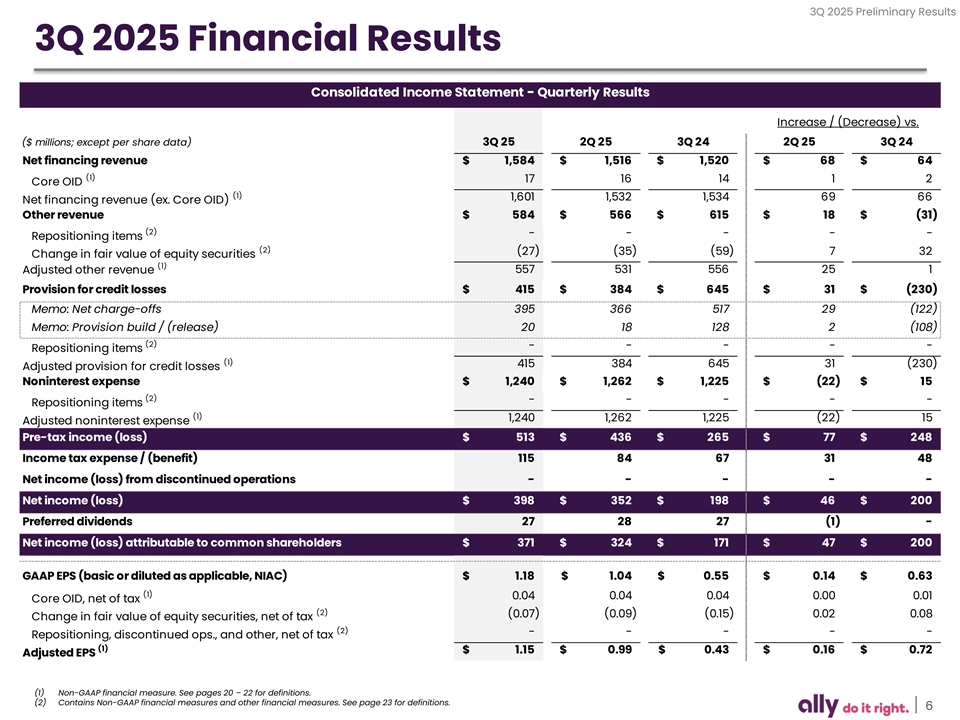
3Q 2025 Preliminary Results 3Q 2025 Financial Results Consolidated Income Statement - Quarterly Results Increase / (Decrease) vs. ($ millions; except per share data) 3Q 25 2Q 25 3Q 24 2Q 25 3Q 24 Net financing revenue $ 1,584 $ 1,516 $ 1,520 $ 68 $ 64 (1) 17 16 14 1 2 Core OID (1) 1 ,601 1,532 1,534 69 66 Net financing revenue (ex. Core OID) Other revenue $ 584 $ 566 $ 615 $ 18 $ (31) (2) - - - - - Repositioning items (2) ( 27) (35) (59) 7 32 Change in fair value of equity securities (1) Adjusted other revenue 557 531 556 25 1 Provision for credit losses $ 4 15 $ 3 84 $ 645 $ 31 $ ( 230) Memo: Net charge-offs 395 366 517 29 (122) Memo: Provision build / (release) 20 18 128 2 (108) (2) - - - - - Repositioning items (1) 415 384 6 45 31 (230) Adjusted provision for credit losses Noninterest expense $ 1,240 $ 1,262 $ 1 ,225 $ (22) $ 15 (2) - - - - - Repositioning items (1) 1 ,240 1 ,262 1 ,225 (22) 15 Adjusted noninterest expense Pre-tax income (loss) $ 513 $ 436 $ 265 $ 77 $ 248 Income tax expense / (benefit) 115 84 67 31 48 Net income (loss) from discontinued operations - - - - - Net income (loss) $ 398 $ 352 $ 198 $ 46 $ 2 00 Preferred dividends 27 28 27 (1) - Net income (loss) attributable to common shareholders $ 371 $ 324 $ 1 71 $ 47 $ 200 GAAP EPS (basic or diluted as applicable, NIAC) $ 1 .18 $ 1.04 $ 0 .55 $ 0.14 $ 0.63 (1) 0.04 0.04 0.04 0.00 0 .01 Core OID, net of tax (2) ( 0.07) (0.09) (0.15) 0.02 0.08 Change in fair value of equity securities, net of tax (2) - - - - - Repositioning, discontinued ops., and other, net of tax (1) $ 1.15 $ 0.99 $ 0 .43 $ 0.16 $ 0.72 Adjusted EPS (1) Non-GAAP financial measure. See pages 20 – 22 for definitions. (2) Contains Non-GAAP financial measures and other financial measures. See page 23 for definitions. 6

3Q 2025 Preliminary Results Balance Sheet and Net Interest Margin NIM of 3.55% reflects structural momentum of the balance sheet and supports full-year NIM between 3.45%-3.50% 3Q 2025 2Q 2025 3Q 2024 Average Average Average Yield Yield Yield Balance Balance Balance Retail Auto Loans (ex. hedge) $ 84,592 9.21% $ 83,858 9.19% $ 83,574 8.99% Memo: Impact from hedges 0.07% 0.08% 0.30% Retail Auto Loans (inc. hedge) $ 84,592 9.28% $ 83,858 9.27% $ 83,574 9.29% Auto Leases (net of depreciation) 8,255 6.70% 7,919 6.88% 8,038 7.22% Commercial Auto 21,119 6.19% 2 0,863 6.18% 23,883 7.14% Corporate Finance 1 1,085 8.59% 11,079 8.52% 10,101 9.82% (1) Consumer Mortgage 16,458 3.14% 16,798 3.17% 17,922 3.21% (2) - - - - 2,125 22.13% Consumer Other - Ally Credit Card (3) 8 ,465 4.28% 8 ,888 4.32% 7,867 5.14% Cash and Cash Equivalents (4) 2 8,756 3.47% 28,658 3.50% 29,982 3.51% Investment Securities & Other Earning Assets $ 178,730 7.02% $ 1 78,063 7.00% $ 183,492 7.38% (4) Total Loans and Leases 141,815 7.89% 140,816 7.88% 145,930 8.29% (5) Deposits $ 1 47,660 3.50% $ 148,444 3.59% $ 152,241 4.23% Unsecured Debt 1 0,902 7.35% 10,458 7.47% 10,484 7.27% Secured Debt 1,780 5.41% 1,794 5.51% 1,364 6.39% (6) 4,590 4.26% 4,352 4.15% 5,743 3.83% Other Borrowings Funding Sources $ 164,932 3.80% $ 165,048 3.88% $ 1 69,832 4.42% NIM (as reported) 3.51% 3.41% 3.29% (7) $ 696 9.54% $ 7 13 9.07% $ 759 7.53% Core OID (7) NIM (ex. Core OID) 3.55% 3.45% 3.32% 7 See page 24 for footnotes.
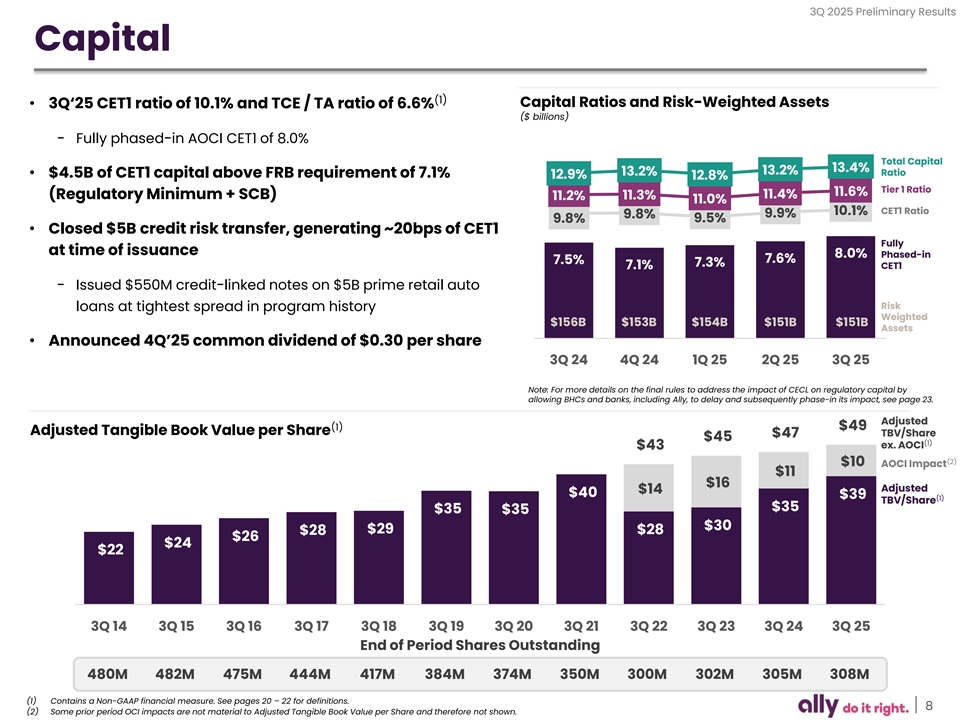
3Q 2025 Preliminary Results Capital (1) Capital Ratios and Risk-Weighted Assets • 3Q‘25 CET1 ratio of 10.1% and TCE / TA ratio of 6.6% ($ billions) − Fully phased-in AOCI CET1 of 8.0% Total Capital 13.4% 13.2% 13.2% Ratio • $4.5B of CET1 capital above FRB requirement of 7.1% 12.9% 12.8% Tier 1 Ratio 11.6% 11.4% (Regulatory Minimum + SCB) 11.2% 11.3% 11.0% CET1 Ratio 10.1% 9.9% 9.8% 9.8% 9.5% • Closed $5B credit risk transfer, generating ~20bps of CET1 Fully at time of issuance 8.0% Phased-in 7.6% 7.5% 7.3% 7.1% CET1 − Issued $550M credit-linked notes on $5B prime retail auto Risk loans at tightest spread in program history Weighted $156B $153B $154B $151B $151B Assets • Announced 4Q’25 common dividend of $0.30 per share 3Q 24 4Q 24 1Q 25 2Q 25 3Q 25 Note: For more details on the final rules to address the impact of CECL on regulatory capital by allowing BHCs and banks, including Ally, to delay and subsequently phase-in its impact, see page 23. Adjusted (1) $49 Adjusted Tangible Book Value per Share $47 TBV/Share $45 (1) $43 ex. AOCI (2) $10 AOCI Impact $11 $16 Adjusted $14 $40 $39 (1) TBV/Share $35 $35 $35 $30 $29 $28 $28 $26 $24 $22 3Q 14 3Q 15 3Q 16 3Q 17 3Q 18 3Q 19 3Q 20 3Q 21 3Q 22 3Q 23 3Q 24 3Q 25 End of Period Shares Outstanding 480M 482M 475M 444M 417M 384M 374M 350M 300M 302M 305M 308M (1) Contains a Non-GAAP financial measure. See pages 20 – 22 for definitions. 8 (2) Some prior period OCI impacts are not material to Adjusted Tangible Book Value per Share and therefore not shown.
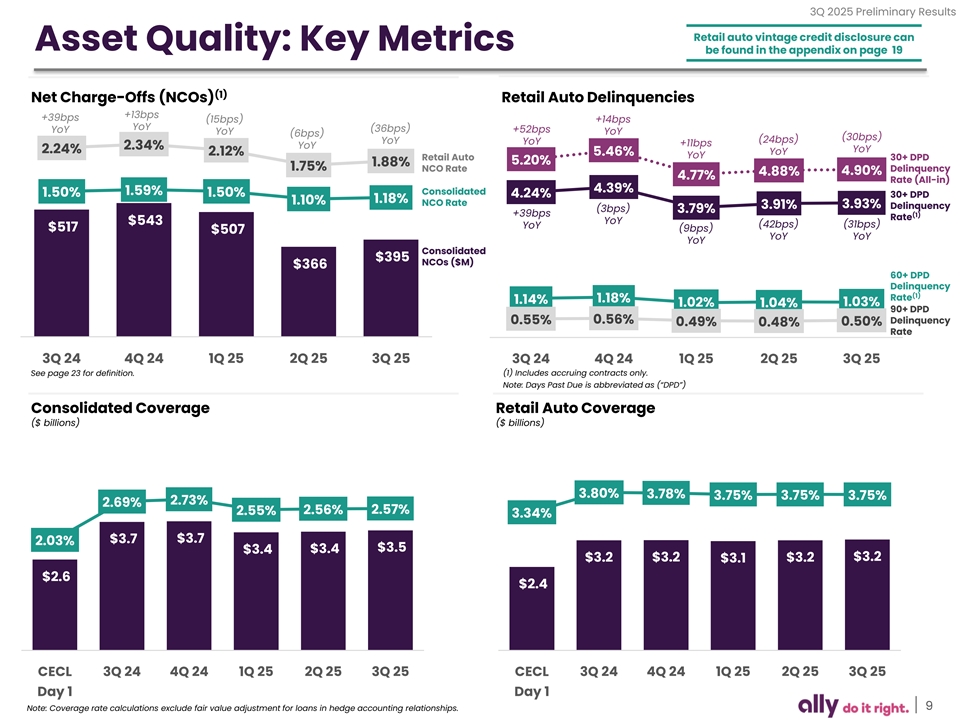
3Q 2025 Preliminary Results Retail auto vintage credit disclosure can Asset Quality: Key Metrics be found in the appendix on page 19 (1) Net Charge-Offs (NCOs) Retail Auto Delinquencies +13bps +39bps (15bps) +14bps YoY (36bps) YoY +52bps YoY YoY (6bps) (30bps) (24bps) YoY YoY +11bps 2.34% YoY 2.24% YoY YoY 2.12% 5.46% YoY Retail Auto 30+ DPD 5.20% 1.88% 1.75% NCO Rate Delinquency 4.90% 4.88% 4.77% Rate (All-in) 4.39% Consolidated 1.59% 1.50% 1.50% 4.24% 30+ DPD 1.18% 1.10% NCO Rate 3.93% 3.91% Delinquency (3bps) 3.79% +39bps (1) Rate YoY $543 (42bps) (31bps) YoY $517 (9bps) $507 YoY YoY YoY Consolidated $395 NCOs ($M) $366 60+ DPD Delinquency (1) Rate 1.18% 1.14% 1.02% 1.03% 1.04% 90+ DPD 0.55% 0.56% Delinquency 0.49% 0.48% 0.50% Rate 3Q 24 4Q 24 1Q 25 2Q 25 3Q 25 3Q 24 4Q 24 1Q 25 2Q 25 3Q 25 See page 23 for definition. (1) Includes accruing contracts only. Note: Days Past Due is abbreviated as (“DPD”) Consolidated Coverage Retail Auto Coverage ($ billions) ($ billions) 3.80% 3.78% 3.75% 3.75% 3.75% 2.73% 2.69% 2.56% 2.57% 2.55% 3.34% $3.7 $3.7 2.03% $3.5 $3.4 $3.4 $3.2 $3.2 $3.2 $3.1 $3.2 $2.6 $2.4 CECL 3Q 24 4Q 24 1Q 25 2Q 25 3Q 25 CECL 3Q 24 4Q 24 1Q 25 2Q 25 3Q 25 Day 1 Day 1 Note: Coverage rate calculations exclude fair value adjustment for loans in hedge accounting relationships. 9
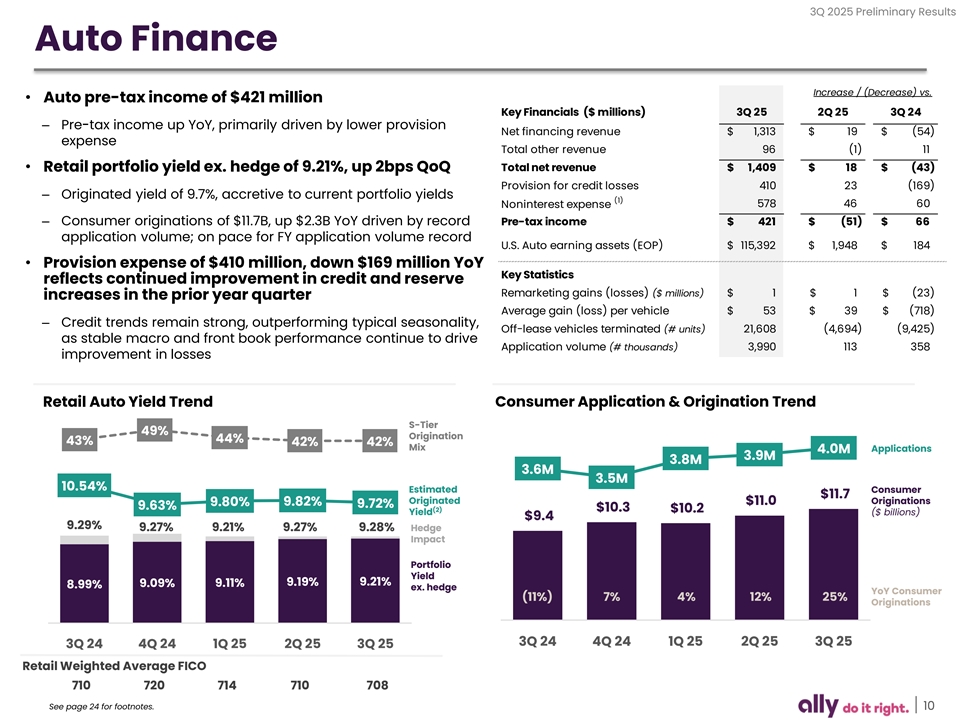
3Q 2025 Preliminary Results Auto Finance Increase / (Decrease) vs. • Auto pre-tax income of $421 million Key Financials ($ millions) 3Q 25 2Q 25 3Q 24 – Pre-tax income up YoY, primarily driven by lower provision Net financing revenue $ 1,313 $ 19 $ (54) expense Total other revenue 96 (1) 11 • Retail portfolio yield ex. hedge of 9.21%, up 2bps QoQ Total net revenue $ 1,409 $ 18 $ (43) Provision for credit losses 4 10 23 ( 169) – Originated yield of 9.7%, accretive to current portfolio yields (1) Noninterest expense 578 46 60 – Consumer originations of $11.7B, up $2.3B YoY driven by record Pre-tax income $ 4 21 $ (51) $ 66 application volume; on pace for FY application volume record U.S. Auto earning assets (EOP) $ 115,392 $ 1 ,948 $ 1 84 • Provision expense of $410 million, down $169 million YoY Key Statistics reflects continued improvement in credit and reserve Remarketing gains (losses) ($ millions) $ 1 $ 1 $ (23) increases in the prior year quarter Average gain (loss) per vehicle $ 53 $ 39 $ ( 718) – Credit trends remain strong, outperforming typical seasonality, Off-lease vehicles terminated (# units) 21,608 (4,694) (9,425) as stable macro and front book performance continue to drive Application volume (# thousands) 3,990 113 3 58 improvement in losses Retail Auto Yield Trend Consumer Application & Origination Trend S-Tier 49% Origination 44% 43% 42% 42% Mix Applications 4.0M 3.9M 3.8M 3.6M 3.5M 10.54% Estimated Consumer $11.7 Originated Originations $11.0 9.80% 9.82% 9.72% 9.63% (2) $10.3 $10.2 Yield ($ billions) $9.4 9.29% 9.27% 9.21% 9.27% 9.28% Hedge Impact Portfolio Yield 9.21% 9.11% 9.19% 9.09% 8.99% ex. hedge YoY Consumer (11%) 7% 4% 12% 25% Originations 3Q 24 4Q 24 1Q 25 2Q 25 3Q 25 3Q 24 4Q 24 1Q 25 2Q 25 3Q 25 Retail Weighted Average FICO 710 720 714 710 708 See page 24 for footnotes. 10

3Q 2025 Preliminary Results Insurance Increase / (Decrease) vs. Key Financials ($ millions) 3Q 25 2Q 25 3Q 24 • Insurance pre-tax income of $79 million and core pre- (1) Premiums, service revenue earned and other income $ 364 $ 1 $ 2 tax income of $52 million VSC losses 34 (1) (2) – $364 million of earned premiums, up $2 million YoY Weather losses 22 (69) (4) All other losses 85 8 12 • Insurance losses of $141 million, up $6 million YoY Losses and loss adjustment expenses 141 (62) 6 driven by portfolio growth (2) 233 12 3 Acquisition and underwriting expenses – No significant weather loss events in the quarter Total underwriting income/(loss) (10) 51 (7) Investment income and other 89 - (16) • Written premiums of $385 million, flat YoY and up 2% Pre-tax income (loss) $ 79 $ 51 $ (23) YoY excluding excess of loss reinsurance (3) (27) 3 29 Change in fair value of equity securities (1) $ 52 $ 54 $ 6 Core pre-tax income (loss) – New P&C inventory relationships and disciplined execution supports written premium growth and increased market share Total assets (EOP) $ 9,848 $ 143 $ 393 – Insurance complimentary product offering enhances dealer Key Statistics - Insurance Ratios 3Q 25 2Q 25 3Q 24 value proposition, positioning Ally as a preferred lender Loss ratio 38.7% 56.0% 37.1% Underwriting expense ratio 63.9% 61.1% 63.5% Combined ratio 102.6% 117.1% 100.6% Written Premiums Insurance Losses ($ millions) ($ millions) $203 $390 $384 $385 $385 $349 $24 $161 $18 P&C Premium $108 $115 $129 $134 $141 $135 $81 $20 $34 $116 Other $19 $22 $25 GAP $20 $31 $24 $17 P&C non- $21 $91 $31 $43 weather $277 F&I Premium $269 $268 $261 $58 $251 $36 $26 Weather $22 VSC $36 $34 $35 $34 $33 3Q 24 4Q 24 1Q 25 2Q 25 3Q 25 3Q 24 4Q 24 1Q 25 2Q 25 3Q 25 Note: F&I: Finance and insurance products and other. P&C: Property and casualty insurance products. (1) Non-GAAP financial measure. See pages 20 – 22 for definitions. 11 See page 24 for additional footnotes.

3Q 2025 Preliminary Results Corporate Finance Increase / (Decrease) vs. • Corporate Finance pre-tax income of $95 million Key Financials ($ millions) 3Q 25 2Q 25 3Q 24 Net financing revenue $ 111 $ 3 $ 2 – Net financing revenue of $111 million, up QoQ and YoY Other revenue 25 6 ( 12) – Other revenue of $25 million, down YoY driven by higher Total net revenue 1 36 9 (10) Provision for credit losses 8 10 (3) syndication and fee income in prior year quarter (2) 33 - 3 Noninterest expense – Portfolio continues to deliver strong returns with 3Q ROE of 30% Pre-tax income $ 95 $ (1) $ (10) (3) 0 0 1 Change in fair value of equity securities • Held-for-investment loans of $11.3 billion (1) Core pre-tax income $ 95 $ (1) $ (9) – Well-diversified, high-quality, 100% first-lien, floating rate loans Total assets (EOP) 11,343 $ 303 $ 945 – Focus on responsible growth in a highly competitive marketplace • Disciplined credit and operational risk management – No new non-performing loans and no charge-offs in the quarter – Criticized assets and non-accrual loans of 9% and 1%, respectively (near historically low levels) HFI Balances by Lending Vertical $11.3B $10.6B $10.3B $9.4B Specialty 26% 17% 20% Finance 16% $6.6B 49% Private 18% 45% 45% 50% Credit Finance 36% 39% 34% Sponsor 29% 46% 30% Finance 3Q 21 3Q 22 3Q 23 3Q 24 3Q 25 (1) Non-GAAP financial measure. See pages 20 – 22 for definitions. 12 See page 24 for additional footnotes.
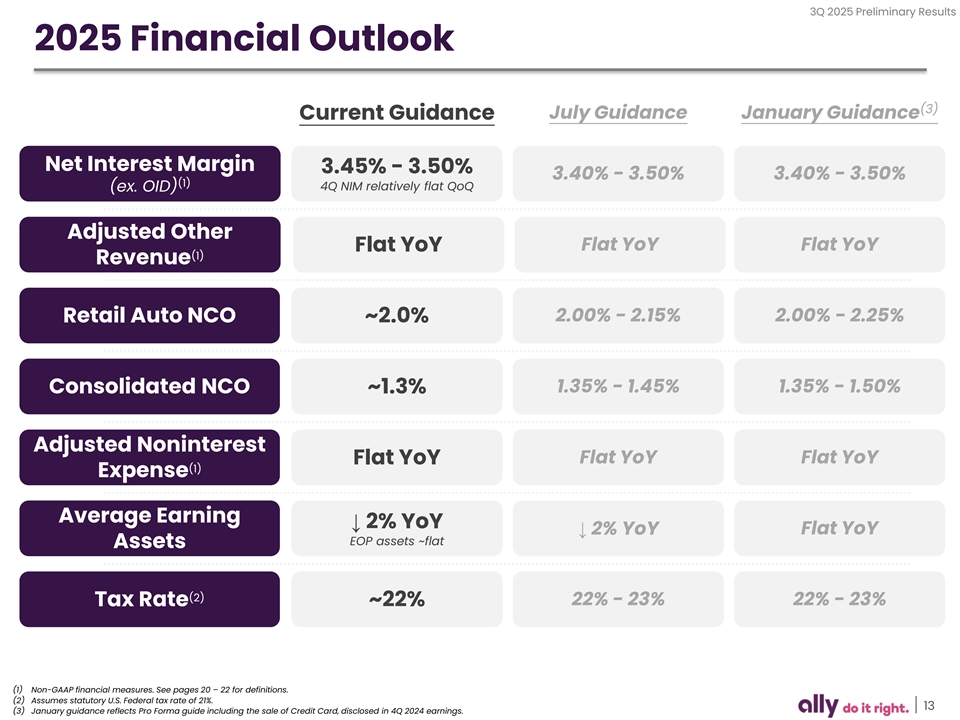
3Q 2025 Preliminary Results 2025 Financial Outlook (3) July Guidance January Guidance Current Guidance Net Interest Margin 3.45% - 3.50% 3.40% - 3.50% 3.40% - 3.50% (1) 4Q NIM relatively flat QoQ (ex. OID) Adjusted Other Flat YoY Flat YoY Flat YoY (1) Revenue 2.00% - 2.15% 2.00% - 2.25% Retail Auto NCO ~2.0% Consolidated NCO ~1.3% 1.35% - 1.45% 1.35% - 1.50% Adjusted Noninterest Flat YoY Flat YoY Flat YoY (1) Expense Average Earning ↓ 2% YoY ↓ 2% YoY Flat YoY EOP assets ~flat Assets (2) 22% - 23% 22% - 23% Tax Rate ~22% (1) Non-GAAP financial measures. See pages 20 – 22 for definitions. (2) Assumes statutory U.S. Federal tax rate of 21%. 13 (3) January guidance reflects Pro Forma guide including the sale of Credit Card, disclosed in 4Q 2024 earnings.

Supplemental

3Q 2025 Preliminary Results Supplemental Results By Segment Results by Segment and GAAP to Core Pre-tax income Walk QUARTERLY TREND Increase/(Decrease) vs. ($ millions) 3Q 25 2Q 25 3Q 24 2Q 25 3Q 24 $ 4 21 $ 472 $ 355 $ ( 51) $ 66 Automotive Finance 79 28 1 02 51 (23) Insurance $ 500 $ 5 00 $ 4 57 $ - $ 43 Dealer Financial Services 95 96 105 (1) (10) Corporate Finance (82) (160) ( 297) 78 2 15 Corporate and Other Pre-tax income (loss) $ 5 13 $ 4 36 $ 265 $ 77 $ 2 48 (1) 17 16 14 1 2 Core OID (2) (27) (35) (59) 7 32 Change in fair value of equity securities (3) - - - - - Repositioning and other (1) $ 502 $ 418 $ 220 $ 85 $ 2 82 Core Pre-tax income Insurance - GAAP to Core Walk GAAP Pre-tax income (loss) $ 79 $ 28 $ 1 02 $ 51 $ ( 23) (4) (27) (30) (56) 3 29 Core Adjustments Core Pre-tax income (loss) $ 52 $ (2) $ 46 $ 54 $ 6 Corporate Finance - GAAP to Core Walk GAAP Pre-tax income $ 95 $ 96 $ 105 $ (1) $ (10) (4) 0 (0) (1) 0 1 Core Adjustments Core Pre-tax income (loss) $ 95 $ 96 $ 104 $ ( 1) $ ( 9) Corporate & Other - GAAP to Core Walk $ (82) $ (160) $ (297) $ 78 $ 215 GAAP Pre-tax income (loss) (4) 17 12 12 5 4 Core Adjustments Core Pre-tax income (loss) $ (65) $ (148) $ ( 285) $ 83 $ 21 9 (1) Non-GAAP financial measure. See pages 20 – 22 for definitions. See page 25 for additional footnotes. 15
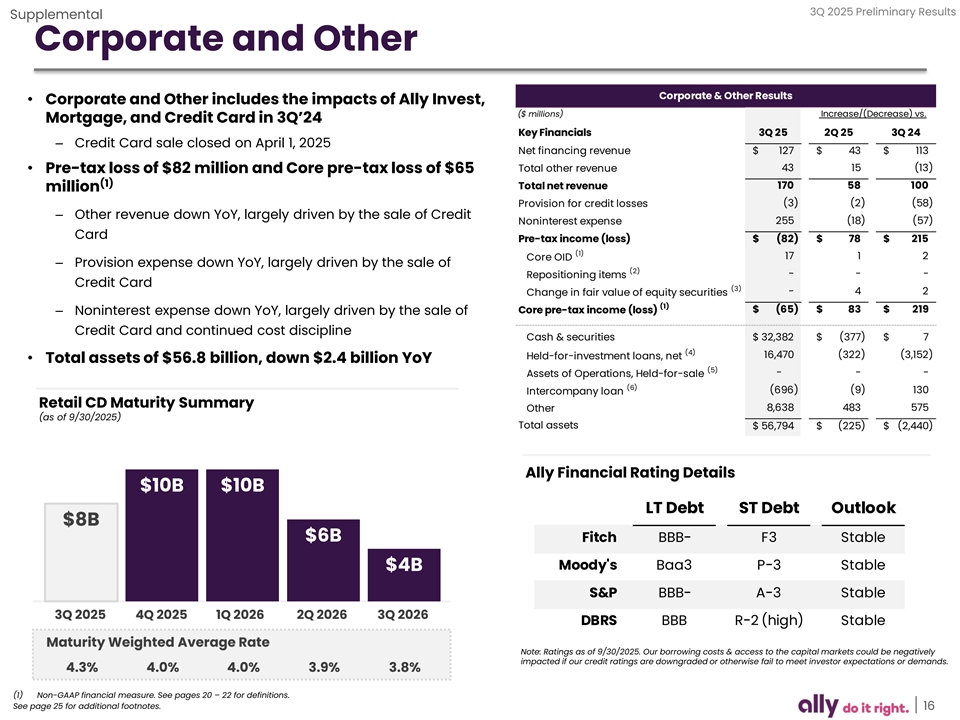
3Q 2025 Preliminary Results Supplemental Corporate and Other Corporate & Other Results • Corporate and Other includes the impacts of Ally Invest, ($ millions) Increase/(Decrease) vs. Mortgage, and Credit Card in 3Q’24 Key Financials 3Q 25 2Q 25 3Q 24 – Credit Card sale closed on April 1, 2025 Net financing revenue $ 127 $ 43 $ 113 Total other revenue 43 15 (13) • Pre-tax loss of $82 million and Core pre-tax loss of $65 (1) Total net revenue 170 58 100 million Provision for credit losses (3) (2) (58) – Other revenue down YoY, largely driven by the sale of Credit 255 (18) (57) Noninterest expense Card Pre-tax income (loss) $ (82) $ 78 $ 215 (1) 17 1 2 Core OID – Provision expense down YoY, largely driven by the sale of (2) - - - Repositioning items Credit Card (3) - 4 2 Change in fair value of equity securities (1) Core pre-tax income (loss) $ (65) $ 83 $ 2 19 – Noninterest expense down YoY, largely driven by the sale of Credit Card and continued cost discipline Cash & securities $ 32,382 $ (377) $ 7 (4) 16,470 (322) (3,152) Held-for-investment loans, net • Total assets of $56.8 billion, down $2.4 billion YoY (5) - - - Assets of Operations, Held-for-sale (6) (696) (9) 1 30 Intercompany loan Retail CD Maturity Summary 8,638 483 575 Other (as of 9/30/2025) Total assets $ 5 6,794 $ (225) $ (2,440) Ally Financial Rating Details $10B $10B LT Debt ST Debt Outlook $8B $6B Fitch BBB- F3 Stable Moody's Baa3 P-3 Stable $4B S&P BBB- A-3 Stable 3Q 2025 4Q 2025 1Q 2026 2Q 2026 3Q 2026 DBRS BBB R-2 (high) Stable Maturity Weighted Average Rate Note: Ratings as of 9/30/2025. Our borrowing costs & access to the capital markets could be negatively impacted if our credit ratings are downgraded or otherwise fail to meet investor expectations or demands. 4.3% 4.0% 4.0% 3.9% 3.8% (1) Non-GAAP financial measure. See pages 20 – 22 for definitions. See page 25 for additional footnotes. 16
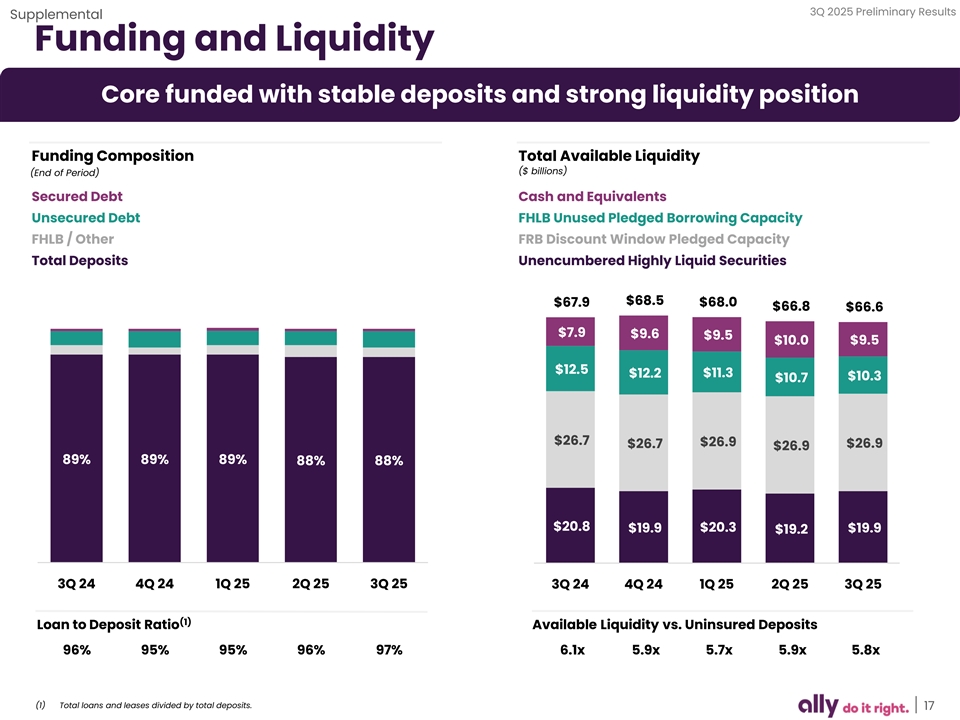
3Q 2025 Preliminary Results Supplemental Funding and Liquidity Core funded with stable deposits and strong liquidity position Funding Composition Total Available Liquidity ($ billions) (End of Period) Secured Debt Cash and Equivalents Unsecured Debt FHLB Unused Pledged Borrowing Capacity FHLB / Other FRB Discount Window Pledged Capacity Total Deposits Unencumbered Highly Liquid Securities $68.5 $67.9 $68.0 $66.8 $66.6 $7.9 $9.6 $9.5 $10.0 $9.5 $12.5 $12.2 $11.3 $10.3 $10.7 $26.7 $26.9 $26.7 $26.9 $26.9 89% 89% 89% 88% 88% $20.8 $20.3 $19.9 $19.9 $19.2 3Q 24 4Q 24 1Q 25 2Q 25 3Q 25 3Q 24 4Q 24 1Q 25 2Q 25 3Q 25 (1) Loan to Deposit Ratio Available Liquidity vs. Uninsured Deposits 96% 95% 95% 96% 97% 6.1x 5.9x 5.7x 5.9x 5.8x (1) Total loans and leases divided by total deposits. 17
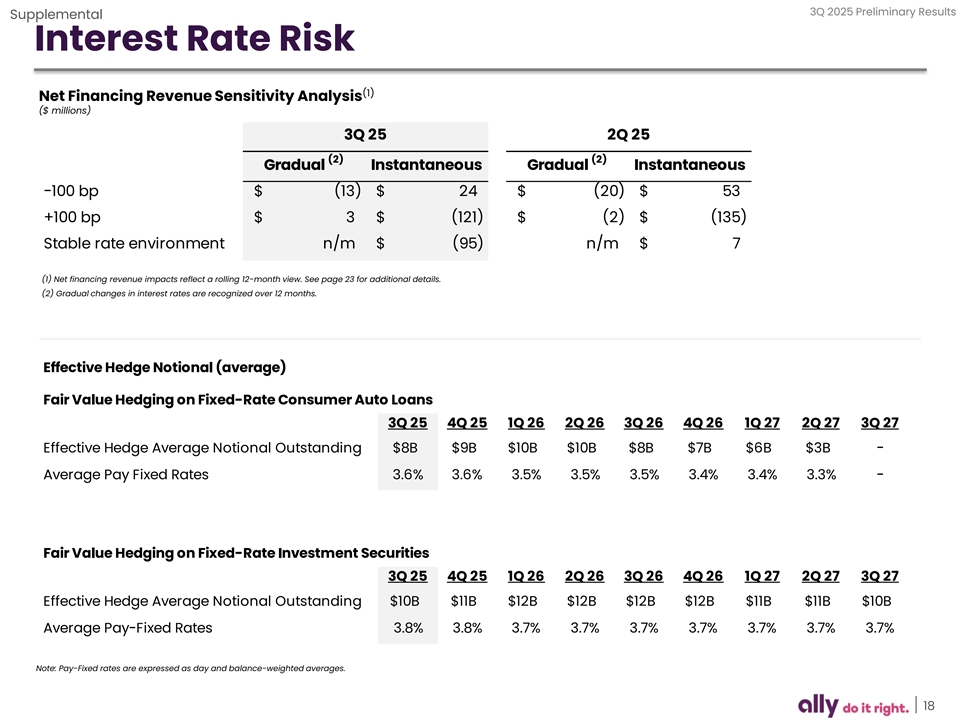
3Q 2025 Preliminary Results Supplemental Interest Rate Risk (1) Net Financing Revenue Sensitivity Analysis ($ millions) 3Q 25 2Q 25 (2) (2) Gradual Instantaneous Gradual Instantaneous -100 bp $ (13) $ 24 $ (20) $ 53 +100 bp $ 3 $ (121) $ ( 2) $ (135) Stable rate environment n/m $ (95) n/m $ 7 (1) Net financing revenue impacts reflect a rolling 12-month view. See page 23 for additional details. (2) Gradual changes in interest rates are recognized over 12 months. Effective Hedge Notional (average) Fair Value Hedging on Fixed-Rate Consumer Auto Loans 3Q 25 4Q 25 1Q 26 2Q 26 3Q 26 4Q 26 1Q 27 2Q 27 3Q 27 Effective Hedge Average Notional Outstanding $8B $9B $10B $10B $8B $7B $6B $3B - Average Pay Fixed Rates 3.6% 3.6% 3.5% 3.5% 3.5% 3.4% 3.4% 3.3% - Fair Value Hedging on Fixed-Rate Investment Securities 3Q 25 4Q 25 1Q 26 2Q 26 3Q 26 4Q 26 1Q 27 2Q 27 3Q 27 Effective Hedge Average Notional Outstanding $10B $11B $12B $12B $12B $12B $11B $11B $10B Average Pay-Fixed Rates 3.8% 3.8% 3.7% 3.7% 3.7% 3.7% 3.7% 3.7% 3.7% Note: Pay-Fixed rates are expressed as day and balance-weighted averages. 18

3Q 2025 Preliminary Results Supplemental Supplemental Earnings Detail (1) Retail Auto - EOP 30+ Day DQs by Vintage 2025 | 2024 | 2023 | 2022 6.00% 4.42% 3.93% 5.25% MO. 33 3.20% 1.66% MO. 21 1.32% MO. 9 Months on Book (1) Includes accruing contracts only. Historical Savings Pricing Historical Reference Only - Fed Funds | Spread | - OSA | Cumulative Beta 5.50% 5.00% (130bps) (100bps) 4.50% 4.50% 4.50% 4.20% (70bps) (90bps) 4.00% (100bps) 3.80% 3.60% 3.50% Cum. 70% Beta 60% N/A Initial Fed Cut 40% 40% September 18, 2024 2Q 24 3Q 24 4Q 24 1Q 25 2Q 25 19
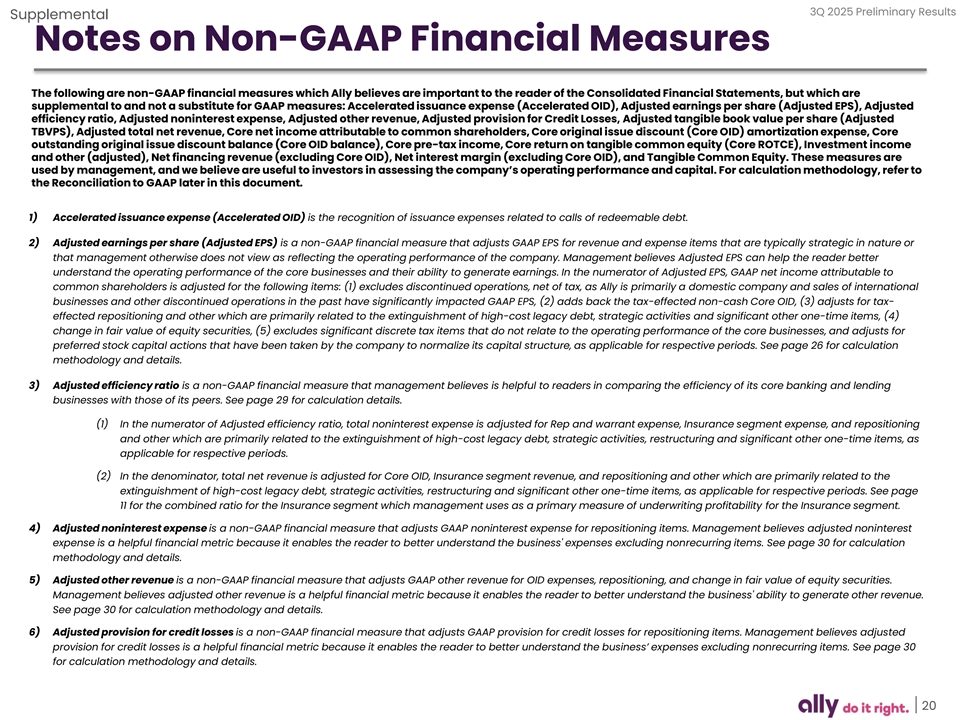
3Q 2025 Preliminary Results Supplemental Notes on Non-GAAP Financial Measures The following are non-GAAP financial measures which Ally believes are important to the reader of the Consolidated Financial Statements, but which are supplemental to and not a substitute for GAAP measures: Accelerated issuance expense (Accelerated OID), Adjusted earnings per share (Adjusted EPS), Adjusted efficiency ratio, Adjusted noninterest expense, Adjusted other revenue, Adjusted provision for Credit Losses, Adjusted tangible book value per share (Adjusted TBVPS), Adjusted total net revenue, Core net income attributable to common shareholders, Core original issue discount (Core OID) amortization expense, Core outstanding original issue discount balance (Core OID balance), Core pre-tax income, Core return on tangible common equity (Core ROTCE), Investment income and other (adjusted), Net financing revenue (excluding Core OID), Net interest margin (excluding Core OID), and Tangible Common Equity. These measures are used by management, and we believe are useful to investors in assessing the company’s operating performance and capital. For calculation methodology, refer to the Reconciliation to GAAP later in this document. 1) Accelerated issuance expense (Accelerated OID) is the recognition of issuance expenses related to calls of redeemable debt. 2) Adjusted earnings per share (Adjusted EPS) is a non-GAAP financial measure that adjusts GAAP EPS for revenue and expense items that are typically strategic in nature or that management otherwise does not view as reflecting the operating performance of the company. Management believes Adjusted EPS can help the reader better understand the operating performance of the core businesses and their ability to generate earnings. In the numerator of Adjusted EPS, GAAP net income attributable to common shareholders is adjusted for the following items: (1) excludes discontinued operations, net of tax, as Ally is primarily a domestic company and sales of international businesses and other discontinued operations in the past have significantly impacted GAAP EPS, (2) adds back the tax-effected non-cash Core OID, (3) adjusts for tax- effected repositioning and other which are primarily related to the extinguishment of high-cost legacy debt, strategic activities and significant other one-time items, (4) change in fair value of equity securities, (5) excludes significant discrete tax items that do not relate to the operating performance of the core businesses, and adjusts for preferred stock capital actions that have been taken by the company to normalize its capital structure, as applicable for respective periods. See page 26 for calculation methodology and details. 3) Adjusted efficiency ratio is a non-GAAP financial measure that management believes is helpful to readers in comparing the efficiency of its core banking and lending businesses with those of its peers. See page 29 for calculation details. (1) In the numerator of Adjusted efficiency ratio, total noninterest expense is adjusted for Rep and warrant expense, Insurance segment expense, and repositioning and other which are primarily related to the extinguishment of high-cost legacy debt, strategic activities, restructuring and significant other one-time items, as applicable for respective periods. (2) In the denominator, total net revenue is adjusted for Core OID, Insurance segment revenue, and repositioning and other which are primarily related to the extinguishment of high-cost legacy debt, strategic activities, restructuring and significant other one-time items, as applicable for respective periods. See page 11 for the combined ratio for the Insurance segment which management uses as a primary measure of underwriting profitability for the Insurance segment. 4) Adjusted noninterest expense is a non-GAAP financial measure that adjusts GAAP noninterest expense for repositioning items. Management believes adjusted noninterest expense is a helpful financial metric because it enables the reader to better understand the business' expenses excluding nonrecurring items. See page 30 for calculation methodology and details. 5) Adjusted other revenue is a non-GAAP financial measure that adjusts GAAP other revenue for OID expenses, repositioning, and change in fair value of equity securities. Management believes adjusted other revenue is a helpful financial metric because it enables the reader to better understand the business' ability to generate other revenue. See page 30 for calculation methodology and details. 6) Adjusted provision for credit losses is a non-GAAP financial measure that adjusts GAAP provision for credit losses for repositioning items. Management believes adjusted provision for credit losses is a helpful financial metric because it enables the reader to better understand the business’ expenses excluding nonrecurring items. See page 30 for calculation methodology and details. 20
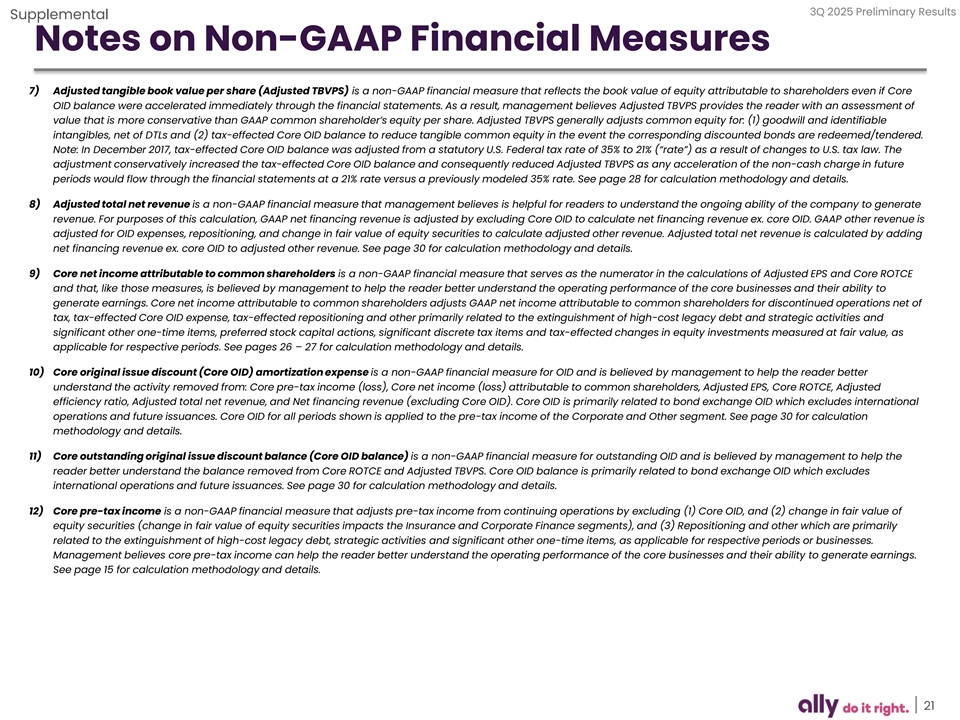
3Q 2025 Preliminary Results Supplemental Notes on Non-GAAP Financial Measures 7) Adjusted tangible book value per share (Adjusted TBVPS) is a non-GAAP financial measure that reflects the book value of equity attributable to shareholders even if Core OID balance were accelerated immediately through the financial statements. As a result, management believes Adjusted TBVPS provides the reader with an assessment of value that is more conservative than GAAP common shareholder’s equity per share. Adjusted TBVPS generally adjusts common equity for: (1) goodwill and identifiable intangibles, net of DTLs and (2) tax-effected Core OID balance to reduce tangible common equity in the event the corresponding discounted bonds are redeemed/tendered. Note: In December 2017, tax-effected Core OID balance was adjusted from a statutory U.S. Federal tax rate of 35% to 21% (“rate”) as a result of changes to U.S. tax law. The adjustment conservatively increased the tax-effected Core OID balance and consequently reduced Adjusted TBVPS as any acceleration of the non-cash charge in future periods would flow through the financial statements at a 21% rate versus a previously modeled 35% rate. See page 28 for calculation methodology and details. 8) Adjusted total net revenue is a non-GAAP financial measure that management believes is helpful for readers to understand the ongoing ability of the company to generate revenue. For purposes of this calculation, GAAP net financing revenue is adjusted by excluding Core OID to calculate net financing revenue ex. core OID. GAAP other revenue is adjusted for OID expenses, repositioning, and change in fair value of equity securities to calculate adjusted other revenue. Adjusted total net revenue is calculated by adding net financing revenue ex. core OID to adjusted other revenue. See page 30 for calculation methodology and details. 9) Core net income attributable to common shareholders is a non-GAAP financial measure that serves as the numerator in the calculations of Adjusted EPS and Core ROTCE and that, like those measures, is believed by management to help the reader better understand the operating performance of the core businesses and their ability to generate earnings. Core net income attributable to common shareholders adjusts GAAP net income attributable to common shareholders for discontinued operations net of tax, tax-effected Core OID expense, tax-effected repositioning and other primarily related to the extinguishment of high-cost legacy debt and strategic activities and significant other one-time items, preferred stock capital actions, significant discrete tax items and tax-effected changes in equity investments measured at fair value, as applicable for respective periods. See pages 26 – 27 for calculation methodology and details. 10) Core original issue discount (Core OID) amortization expense is a non-GAAP financial measure for OID and is believed by management to help the reader better understand the activity removed from: Core pre-tax income (loss), Core net income (loss) attributable to common shareholders, Adjusted EPS, Core ROTCE, Adjusted efficiency ratio, Adjusted total net revenue, and Net financing revenue (excluding Core OID). Core OID is primarily related to bond exchange OID which excludes international operations and future issuances. Core OID for all periods shown is applied to the pre-tax income of the Corporate and Other segment. See page 30 for calculation methodology and details. 11) Core outstanding original issue discount balance (Core OID balance) is a non-GAAP financial measure for outstanding OID and is believed by management to help the reader better understand the balance removed from Core ROTCE and Adjusted TBVPS. Core OID balance is primarily related to bond exchange OID which excludes international operations and future issuances. See page 30 for calculation methodology and details. 12) Core pre-tax income is a non-GAAP financial measure that adjusts pre-tax income from continuing operations by excluding (1) Core OID, and (2) change in fair value of equity securities (change in fair value of equity securities impacts the Insurance and Corporate Finance segments), and (3) Repositioning and other which are primarily related to the extinguishment of high-cost legacy debt, strategic activities and significant other one-time items, as applicable for respective periods or businesses. Management believes core pre-tax income can help the reader better understand the operating performance of the core businesses and their ability to generate earnings. See page 15 for calculation methodology and details. 21
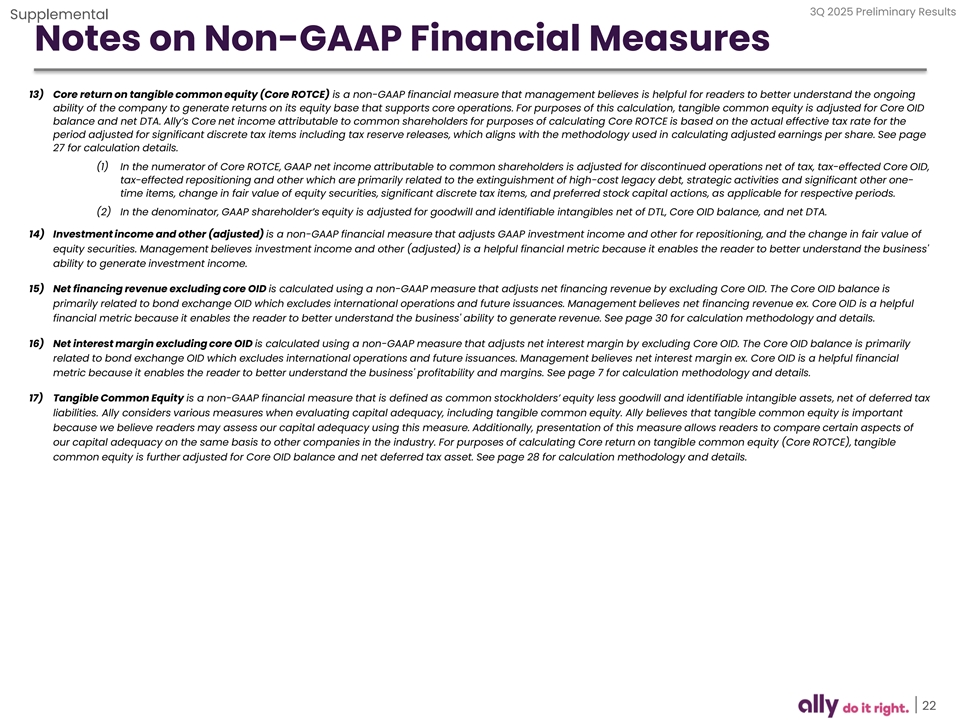
3Q 2025 Preliminary Results Supplemental Notes on Non-GAAP Financial Measures 13) Core return on tangible common equity (Core ROTCE) is a non-GAAP financial measure that management believes is helpful for readers to better understand the ongoing ability of the company to generate returns on its equity base that supports core operations. For purposes of this calculation, tangible common equity is adjusted for Core OID balance and net DTA. Ally’s Core net income attributable to common shareholders for purposes of calculating Core ROTCE is based on the actual effective tax rate for the period adjusted for significant discrete tax items including tax reserve releases, which aligns with the methodology used in calculating adjusted earnings per share. See page 27 for calculation details. (1) In the numerator of Core ROTCE, GAAP net income attributable to common shareholders is adjusted for discontinued operations net of tax, tax-effected Core OID, tax-effected repositioning and other which are primarily related to the extinguishment of high-cost legacy debt, strategic activities and significant other one- time items, change in fair value of equity securities, significant discrete tax items, and preferred stock capital actions, as applicable for respective periods. (2) In the denominator, GAAP shareholder’s equity is adjusted for goodwill and identifiable intangibles net of DTL, Core OID balance, and net DTA. 14) Investment income and other (adjusted) is a non-GAAP financial measure that adjusts GAAP investment income and other for repositioning, and the change in fair value of equity securities. Management believes investment income and other (adjusted) is a helpful financial metric because it enables the reader to better understand the business' ability to generate investment income. 15) Net financing revenue excluding core OID is calculated using a non-GAAP measure that adjusts net financing revenue by excluding Core OID. The Core OID balance is primarily related to bond exchange OID which excludes international operations and future issuances. Management believes net financing revenue ex. Core OID is a helpful financial metric because it enables the reader to better understand the business' ability to generate revenue. See page 30 for calculation methodology and details. 16) Net interest margin excluding core OID is calculated using a non-GAAP measure that adjusts net interest margin by excluding Core OID. The Core OID balance is primarily related to bond exchange OID which excludes international operations and future issuances. Management believes net interest margin ex. Core OID is a helpful financial metric because it enables the reader to better understand the business' profitability and margins. See page 7 for calculation methodology and details. 17) Tangible Common Equity is a non-GAAP financial measure that is defined as common stockholders’ equity less goodwill and identifiable intangible assets, net of deferred tax liabilities. Ally considers various measures when evaluating capital adequacy, including tangible common equity. Ally believes that tangible common equity is important because we believe readers may assess our capital adequacy using this measure. Additionally, presentation of this measure allows readers to compare certain aspects of our capital adequacy on the same basis to other companies in the industry. For purposes of calculating Core return on tangible common equity (Core ROTCE), tangible common equity is further adjusted for Core OID balance and net deferred tax asset. See page 28 for calculation methodology and details. 22

3Q 2025 Preliminary Results Supplemental Notes on Other Financial Measures 1) Change in fair value of equity securities impacts the Insurance, Corporate Finance and Corporate and Other segments. The change reflects fair value adjustments to equity securities that are reported at fair value. Management believes the change in fair value of equity securities should be removed from select financial measures because it enables the reader to better understand the business’ ongoing ability to generate revenue and income. 2) Estimated impact of CECL on regulatory capital per final rule issued by U.S. banking agencies - In December 2018, the FRB and other U.S. banking agencies approved a final rule to address the impact of CECL on regulatory capital by allowing BHCs and banks, including Ally, the option to phase in the day-one impact of CECL over a three-year period. In March 2020, the FRB and other U.S. banking agencies issued an interim final rule that became effective on March 31, 2020 and provided an alternative option for banks to temporarily delay the impacts of CECL, relative to the incurred loss methodology for estimating the allowance for loan losses, on regulatory capital. A final rule that was largely unchanged from the March 2020 interim final rule was issued by the FRB and other U.S. banking agencies in August 2020, and became effective in September 2020. For regulatory capital purposes, these rules permitted us to delay recognizing the estimated impact of CECL on regulatory capital until after a two-year deferral period, which for us extended through December 31, 2021. Beginning on January 1, 2022, we are required to phase in 25% of the previously deferred estimated capital impact of CECL, with an additional 25% to be phased in at the beginning of each subsequent year until fully phased in by the first quarter of 2025. Under these rules, firms that adopt CECL and elect the five-year transition will calculate the estimated impact of CECL on regulatory capital as the day-one impact of adoption plus 25% of the subsequent change in allowance during the two-year deferral period, which according to the final rule approximates the impact of CECL relative to an incurred loss model. We adopted this transition option during the first quarter of 2020, and phased in the regulatory capital impacts of CECL from January 1, 2022, to January 1, 2025, based on this 5-year transition period. 3) Estimated retail auto originated yield is a financial measure determined by calculating the estimated average annualized yield for loans originated during the period. At this time there currently is no comparable GAAP financial measure for Estimated Retail Auto Originated Yield and therefore this forecasted estimate of yield at the time of origination cannot be quantitatively reconciled to comparable GAAP information. 4) Interest rate risk modeling – We prepare our forward-looking baseline forecasts of net financing revenue taking into consideration anticipated future business growth, asset/liability positioning, and interest rates based on the implied forward curve. The analysis is highly dependent upon a variety of assumptions including the repricing characteristics of retail deposits with both contractual and non-contractual maturities. We continually monitor industry and competitive repricing activity along with other market factors when contemplating deposit pricing actions. Please see our SEC filings for more details. 5) Net charge-off ratios are calculated as annualized net charge-offs divided by average outstanding finance receivables and loans excluding loans measured at fair value and loans held-for-sale. 6) Repositioning is primarily related to the extinguishment of high-cost legacy debt, strategic activities, restructuring, amounts related to nonrecurring business transactions or pending transactions, and significant other one-time items. 7) U.S. consumer auto originations New Retail – standard and subvented rate new vehicle loans; Lease – new vehicle lease originations; Used – used vehicle loans Nonprime – originations with a FICO® score of less than 620 23
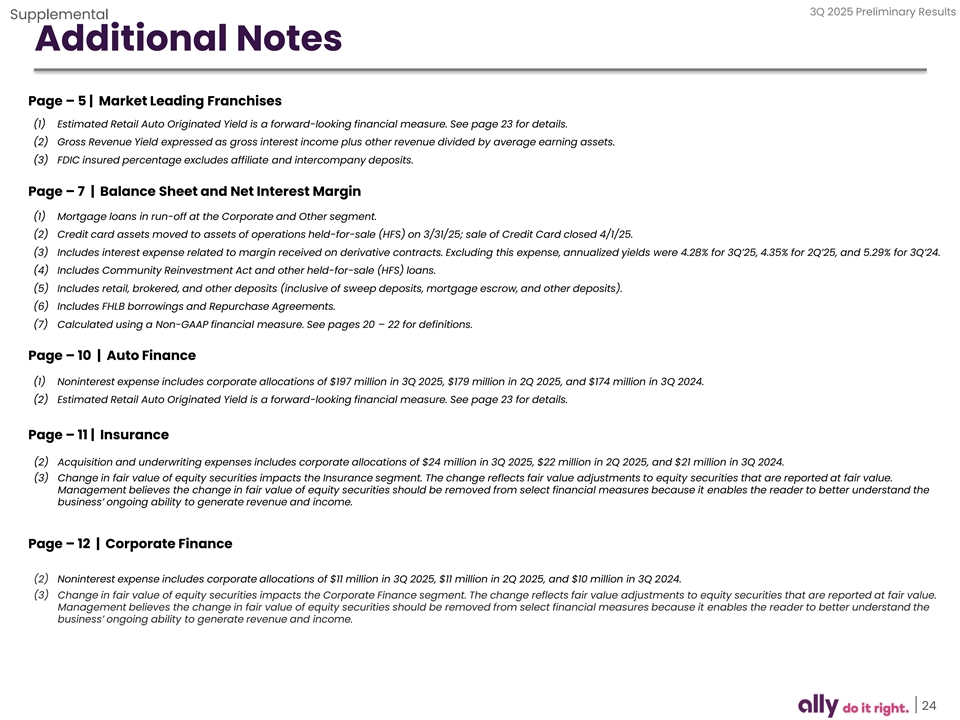
3Q 2025 Preliminary Results Supplemental Additional Notes Page – 5 | Market Leading Franchises (1) Estimated Retail Auto Originated Yield is a forward-looking financial measure. See page 23 for details. (2) Gross Revenue Yield expressed as gross interest income plus other revenue divided by average earning assets. (3) FDIC insured percentage excludes affiliate and intercompany deposits. Page – 7 | Balance Sheet and Net Interest Margin (1) Mortgage loans in run-off at the Corporate and Other segment. (2) Credit card assets moved to assets of operations held-for-sale (HFS) on 3/31/25; sale of Credit Card closed 4/1/25. (3) Includes interest expense related to margin received on derivative contracts. Excluding this expense, annualized yields were 4.28% for 3Q’25, 4.35% for 2Q’25, and 5.29% for 3Q’24. (4) Includes Community Reinvestment Act and other held-for-sale (HFS) loans. (5) Includes retail, brokered, and other deposits (inclusive of sweep deposits, mortgage escrow, and other deposits). (6) Includes FHLB borrowings and Repurchase Agreements. (7) Calculated using a Non-GAAP financial measure. See pages 20 – 22 for definitions. Page – 10 | Auto Finance (1) Noninterest expense includes corporate allocations of $197 million in 3Q 2025, $179 million in 2Q 2025, and $174 million in 3Q 2024. (2) Estimated Retail Auto Originated Yield is a forward-looking financial measure. See page 23 for details. Page – 11 | Insurance (2) Acquisition and underwriting expenses includes corporate allocations of $24 million in 3Q 2025, $22 million in 2Q 2025, and $21 million in 3Q 2024. (3) Change in fair value of equity securities impacts the Insurance segment. The change reflects fair value adjustments to equity securities that are reported at fair value. Management believes the change in fair value of equity securities should be removed from select financial measures because it enables the reader to better understand the business’ ongoing ability to generate revenue and income. Page – 12 | Corporate Finance (2) Noninterest expense includes corporate allocations of $11 million in 3Q 2025, $11 million in 2Q 2025, and $10 million in 3Q 2024. (3) Change in fair value of equity securities impacts the Corporate Finance segment. The change reflects fair value adjustments to equity securities that are reported at fair value. Management believes the change in fair value of equity securities should be removed from select financial measures because it enables the reader to better understand the business’ ongoing ability to generate revenue and income. 24

3Q 2025 Preliminary Results Supplemental Additional Notes Page – 15 | Results by Segment (2) Change in fair value of equity securities impacts the Insurance, Corporate Finance and Corporate and Other segments. The change reflects fair value adjustments to equity securities that are reported at fair value. Management believes the change in fair value of equity securities should be removed from select financial measures because it enables the reader to better understand the business’ ongoing ability to generate revenue and income. (3) Repositioning and other are primarily related to the extinguishment of high-cost legacy debt, strategic activities, restructuring, and significant other one-time items, as applicable for respective periods or businesses. (4) Includes adjustments for non-GAAP measures Core OID expense, change in fair value of equity securities, and repositioning. Page – 16 | Corporate and Other (2) Repositioning and other are primarily related to the extinguishment of high-cost legacy debt, strategic activities, restructuring, and significant other one-time items, as applicable for respective periods or businesses. (3) Change in fair value of equity securities impacts the Corporate and Other segments. The change reflects fair value adjustments to equity securities that are reported at fair value. Management believes the change in fair value of equity securities should be removed from select financial measures because it enables the reader to better understand the business’ ongoing ability to generate revenue and income. (4) HFI consumer mortgage portfolio in all periods and Ally credit card portfolio in 3Q 2024. (5) Amounts related to Credit Card; sale of Credit Card closed on 4/1/2025. (6) Intercompany loan related to activity between Insurance and Corporate. 25
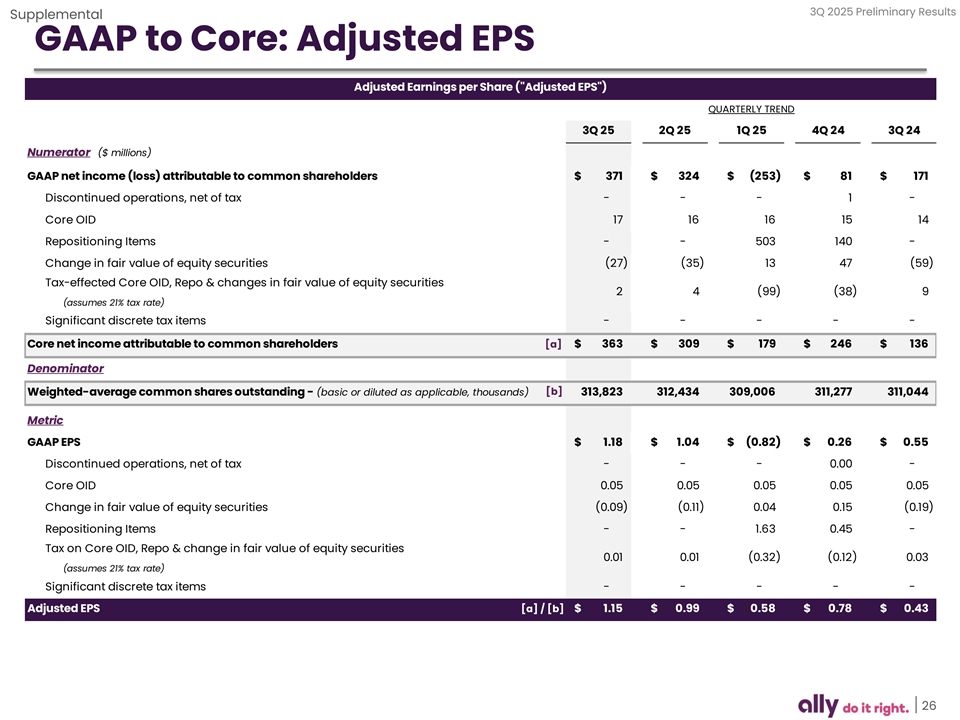
3Q 2025 Preliminary Results Supplemental GAAP to Core: Adjusted EPS Adjusted Earnings per Share ( Adjusted EPS ) QUARTERLY TREND 3Q 25 2Q 25 1Q 25 4Q 24 3Q 24 Numerator ($ millions) GAAP net income (loss) attributable to common shareholders $ 371 $ 3 24 $ (253) $ 81 $ 171 Discontinued operations, net of tax - - - 1 - Core OID 17 16 16 15 14 Repositioning Items - - 503 140 - Change in fair value of equity securities (27) ( 35) 13 47 (59) Tax-effected Core OID, Repo & changes in fair value of equity securities 2 4 ( 99) (38) 9 (assumes 21% tax rate) Significant discrete tax items - - - - - Core net income attributable to common shareholders [a] $ 363 $ 3 09 $ 179 $ 246 $ 136 Denominator [b] Weighted-average common shares outstanding - (basic or diluted as applicable, thousands) 3 13,823 312,434 3 09,006 3 11,277 311,044 Metric GAAP EPS $ 1.18 $ 1.04 $ (0.82) $ 0.26 $ 0.55 Discontinued operations, net of tax - - - 0.00 - Core OID 0.05 0.05 0.05 0.05 0.05 Change in fair value of equity securities ( 0.09) ( 0.11) 0.04 0.15 ( 0.19) Repositioning Items - - 1.63 0.45 - Tax on Core OID, Repo & change in fair value of equity securities 0.01 0.01 ( 0.32) (0.12) 0.03 (assumes 21% tax rate) Significant discrete tax items - - - - - Adjusted EPS [a] / [b] $ 1.15 $ 0.99 $ 0.58 $ 0.78 $ 0.43 26

3Q 2025 Preliminary Results Supplemental GAAP to Core: Core ROTCE Core Return on Tangible Common Equity ( Core ROTCE ) QUARTERLY TREND 3Q 25 2Q 25 1Q 25 4Q 24 3Q 24 Numerator ($ millions) GAAP net income (loss) attributable to common shareholders $ 371 $ 324 $ (253) $ 81 $ 171 Discontinued operations, net of tax - - - 1 - Core OID 17 16 16 15 14 Repositioning Items - - 503 140 - Change in fair value of equity securities (27) (35) 13 47 (59) Tax on Core OID, Repo & change in fair value of equity securities 2 4 (99) (38) 9 (assumes 21% tax rate) Significant discrete tax items & other - - - - - Core net income attributable to common shareholders [a] $ 363 $ 309 $ 179 $ 246 $ 136 Denominator (Average, $ billions) GAAP shareholder's equity $ 1 4.8 $ 14.4 $ 14.1 $ 14.2 $ 14.1 less: Preferred equity (2.3) (2.3) (2.3) (2.3) (2.3) GAAP common shareholder's equity $ 12.5 $ 12.1 $ 11.7 $ 11.8 $ 11.7 Goodwill & identifiable intangibles, net of deferred tax liabilities ( DTLs ) (0.2) (0.2) (0.4) (0.7) (0.7) Tangible common equity $ 12.3 $ 11.8 $ 11.3 $ 11.2 $ 11.0 Core OID balance (0.7) (0.7) (0.7) (0.7) (0.8) Net deferred tax asset ( DTA ) (2.1) (2.0) (1.9) (1.7) (1.5) Normalized common equity [b] $ 9.5 $ 9.1 $ 8 .6 $ 8.7 $ 8.7 Core Return on Tangible Common Equity [a] / [b] 15.3% 13.6% 8.3% 11.3% 6.2% 27

3Q 2025 Preliminary Results Supplemental GAAP to Core: Adjusted TBVPS Adjusted Tangible Book Value per Share ( Adjusted TBVPS ) QUARTERLY TREND 3Q 25 2Q 25 1Q 25 4Q 24 3Q 24 Numerator ($ billions) GAAP shareholder's equity $ 15.1 $ 14.5 $ 14.2 $ 13.9 $ 14.4 less: Preferred equity (2.3) (2.3) (2.3) (2.3) (2.3) GAAP common shareholder's equity $ 12.8 $ 12.2 $ 11.9 $ 11.6 $ 12.1 Goodwill and identifiable intangibles, net of DTLs (0.2) (0.2) (0.3) (0.6) (0.7) Tangible common equity 12.6 12.0 11.6 11.0 11.4 Tax-effected Core OID balance (0.5) (0.6) (0.6) (0.6) ( 0.6) (assumes 21% tax rate) Adjusted tangible book value [a] $ 12.1 $ 11.5 $ 11.0 $ 10.4 $ 10.8 Denominator Issued shares outstanding (period-end, thousands) [b] 307,828 307,787 307,152 3 05,388 304,715 Metric GAAP shareholder's equity per share $ 49.1 $ 4 7.3 $ 46.3 $ 45.5 $ 47.3 less: Preferred equity per share (7.5) (7.6) (7.6) (7.6) (7.6) GAAP common shareholder's equity per share $ 41.6 $ 39.7 $ 38.8 $ 37.9 $ 39.7 Goodwill and identifiable intangibles, net of DTLs per share (0.6) (0.6) (1.0) (2.0) (2.3) Tangible common equity per share 41.0 39.1 37.8 35.9 37.4 Tax-effected Core OID balance (1.8) (1.8) (1.9) (1.9) (1.9) (assumes 21% tax rate) per share Adjusted tangible book value per share [a] / [b] $ 39.2 $ 37.3 $ 36.0 $ 34.0 $ 35.4 28
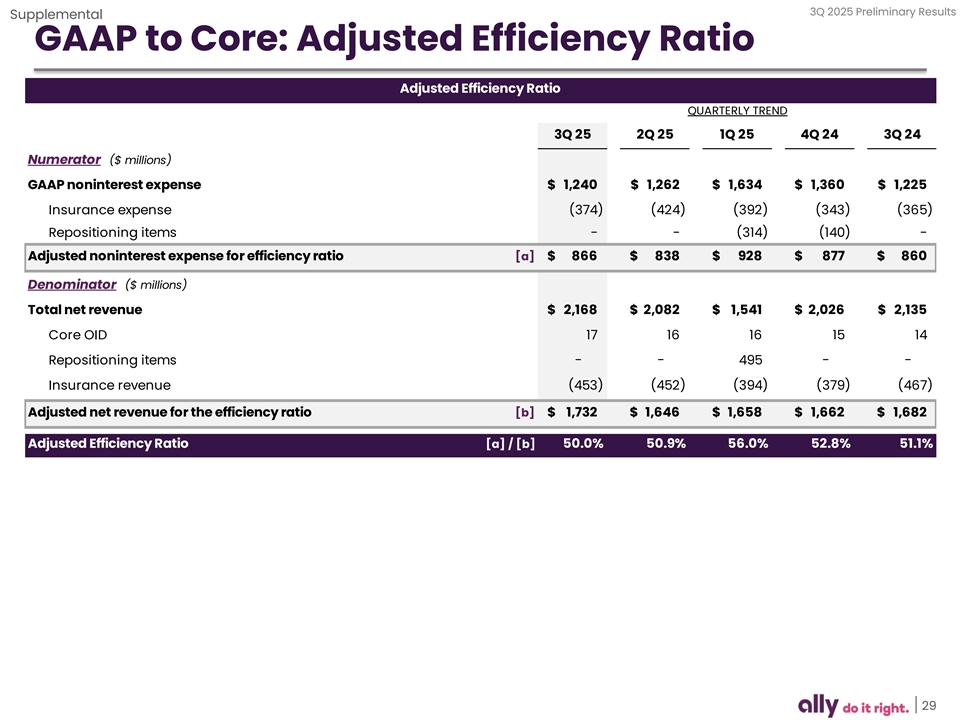
3Q 2025 Preliminary Results Supplemental GAAP to Core: Adjusted Efficiency Ratio Adjusted Efficiency Ratio QUARTERLY TREND 3Q 25 2Q 25 1Q 25 4Q 24 3Q 24 Numerator ($ millions) GAAP noninterest expense $ 1,240 $ 1 ,262 $ 1,634 $ 1,360 $ 1,225 Insurance expense (374) ( 424) (392) (343) (365) Repositioning items - - ( 314) ( 140) - Adjusted noninterest expense for efficiency ratio [a] $ 866 $ 838 $ 928 $ 877 $ 860 Denominator ($ millions) Total net revenue $ 2 ,168 $ 2,082 $ 1 ,541 $ 2,026 $ 2,135 Core OID 17 16 16 15 14 Repositioning items - - 4 95 - - Insurance revenue (453) (452) (394) (379) ( 467) Adjusted net revenue for the efficiency ratio [b] $ 1 ,732 $ 1,646 $ 1,658 $ 1,662 $ 1,682 Adjusted Efficiency Ratio [a] / [b] 50.0% 50.9% 56.0% 52.8% 51.1% 29
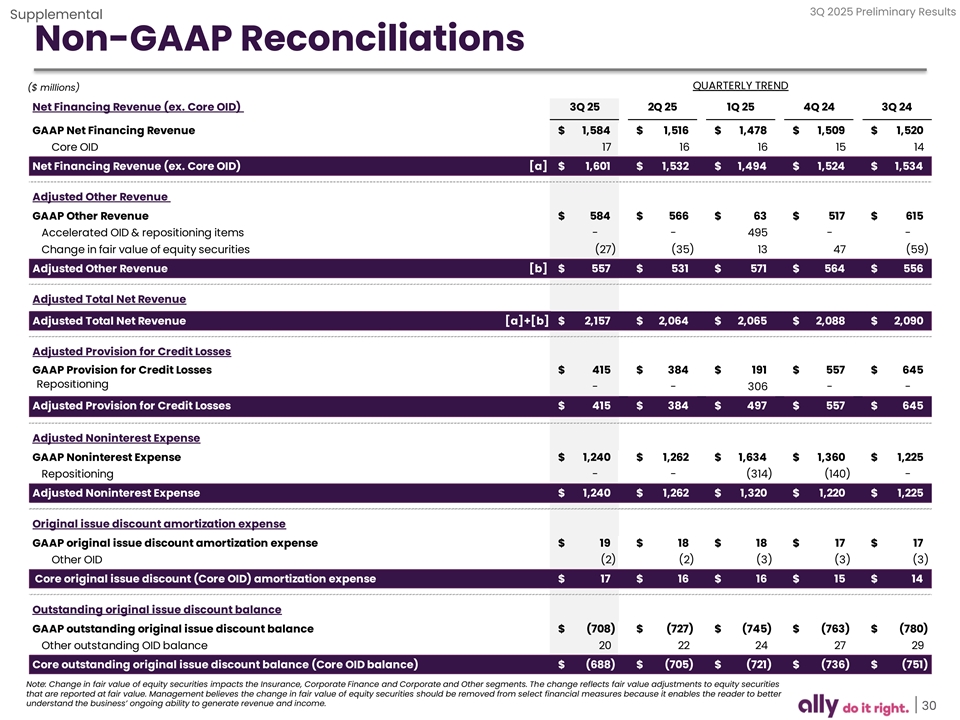
3Q 2025 Preliminary Results Supplemental Non-GAAP Reconciliations QUARTERLY TREND ($ millions) Net Financing Revenue (ex. Core OID) 3Q 25 2Q 25 1Q 25 4Q 24 3Q 24 GAAP Net Financing Revenue $ 1,584 $ 1,516 $ 1 ,478 $ 1 ,509 $ 1,520 Core OID 17 16 16 15 14 Net Financing Revenue (ex. Core OID) [a] $ 1 ,601 $ 1,532 $ 1,494 $ 1 ,524 $ 1,534 Adjusted Other Revenue GAAP Other Revenue $ 584 $ 566 $ 63 $ 517 $ 6 15 Accelerated OID & repositioning items - - 495 - - Change in fair value of equity securities (27) (35) 13 47 (59) Adjusted Other Revenue [b] $ 557 $ 531 $ 571 $ 564 $ 556 Adjusted Total Net Revenue Adjusted Total Net Revenue [a]+[b] $ 2,157 $ 2 ,064 $ 2,065 $ 2,088 $ 2,090 Adjusted Provision for Credit Losses GAAP Provision for Credit Losses $ 415 $ 384 $ 1 91 $ 557 $ 645 Repositioning - - 306 - - Adjusted Provision for Credit Losses $ 415 $ 384 $ 4 97 $ 557 $ 645 Adjusted Noninterest Expense GAAP Noninterest Expense $ 1,240 $ 1,262 $ 1,634 $ 1 ,360 $ 1,225 Repositioning - - (314) (140) - Adjusted Noninterest Expense $ 1 ,240 $ 1,262 $ 1,320 $ 1,220 $ 1,225 Original issue discount amortization expense GAAP original issue discount amortization expense $ 19 $ 18 $ 18 $ 17 $ 17 Other OID (2) (2) ( 3) (3) ( 3) Core original issue discount (Core OID) amortization expense $ 17 $ 16 $ 16 $ 15 $ 14 Outstanding original issue discount balance GAAP outstanding original issue discount balance $ (708) $ ( 727) $ (745) $ (763) $ (780) Other outstanding OID balance 20 22 24 27 29 Core outstanding original issue discount balance (Core OID balance) $ (688) $ (705) $ (721) $ (736) $ (751) Note: Change in fair value of equity securities impacts the Insurance, Corporate Finance and Corporate and Other segments. The change reflects fair value adjustments to equity securities that are reported at fair value. Management believes the change in fair value of equity securities should be removed from select financial measures because it enables the reader to better understand the business’ ongoing ability to generate revenue and income. 30

Exhibit 99.3 THIRD QUARTER 2025 FINANCIAL SUPPLEMENT
ALLY FINANCIAL INC. FORWARD-LOOKING STATEMENTS AND ADDITIONAL INFORMATION This document and related communications should be read in conjunction with the financial statements, notes, and other information contained in our Annual Reports on Form 10-K, Quarterly Reports on Form 10-Q, and Current Reports on Form 8-K. This information is preliminary and based on company and third-party data available at the time of the presentation or related communication. This document and related communications contain forward-looking statements within the meaning of the Private Securities Litigation Reform Act of 1995. These statements can be identified by the fact that they do not relate strictly to historical or current facts—such as statements about the outlook for financial and operating metrics and performance and future capital allocation and actions. Forward-looking statements often use words such as “believe,” “expect,” “anticipate,” “intend,” “pursue,” “seek,” “continue,” “estimate,” “project,” “outlook,” “forecast,” “potential,” “target,” “objective,” “trend,” “plan,” “goal,” “initiative,” “priorities,” or other words of comparable meaning or future-tense or conditional verbs such as “may,” “will,” “should,” “would,” or “could.” Forward-looking statements convey our expectations, intentions, or forecasts about future events, circumstances, or results. All forward-looking statements, by their nature, are subject to assumptions, risks, and uncertainties, which may change over time and many of which are beyond our control. In particular, forward-looking statements about Ally’s outlook, including expectations regarding net interest margin, adjusted other revenue, net-charge offs, non-interest expenses and average earning assets, and other forward-looking statements are based on our current expectations and are subject to various important factors that could cause actual results to differ materially, including general economic conditions, expectations regarding interest rates and inflation, monetary and fiscal policies in the United States and other jurisdictions, the composition of our balance sheet, including with respect to our loan and securities portfolios, the impact of our strategic initiatives, including recent initiatives involving our Credit Card and Mortgage operations, demand for new and used vehicles, demand for auto loans and leases and the impact of escalating tariffs and other trade policies on us, our customers and our strategic partners, and the economic impacts, volatility and uncertainty resulting therefrom. You should not rely on any forward-looking statement as a prediction or guarantee about the future. Actual future objectives, strategies, plans, prospects, performance, conditions, or results may differ materially from those set forth in any forward-looking statement. Some of the factors that may cause actual results or other future events or circumstances to differ from those in forward-looking statements are described above and in our Annual Report on Form 10-K for the year ended December 31, 2024, our subsequent Quarterly Reports on Form 10-Q or Current Reports on Form 8-K, or other applicable documents that are filed or furnished with the U.S. Securities and Exchange Commission (collectively, our “SEC filings”). Any forward-looking statement made by us or on our behalf speaks only as of the date that it was made. We do not undertake to update any forward-looking statement to reflect the impact of events, circumstances, or results that arise after the date that the statement was made, except as required by applicable securities laws. You, however, should consult further disclosures (including disclosures of a forward-looking nature) that we may make in any subsequent SEC filings. This document and related communications contain specifically identified non-GAAP financial measures, which supplement the results that are reported according to U.S. generally accepted accounting principles (“GAAP”). These non-GAAP financial measures may be useful to investors but should not be viewed in isolation from, or as a substitute for, GAAP results. Differences between non-GAAP financial measures and comparable GAAP financial measures are reconciled in the presentation. This presentation also includes forward-looking non-GAAP financial measures, such as outlooks for Net Interest Margin (ex. OID), Adjusted Other Revenue and Adjusted Noninterest Expense. We are unable to provide a reconciliation of these forward-looking non-GAAP financial measures to their most directly comparable GAAP financial measures because we are unable to provide, without unreasonable effort, a meaningful or accurate calculation or estimation of amounts that would be necessary for the reconciliation due to the inherent difficulty in forecasting and quantifying the occurrence and financial impact of various items that have not yet occurred, are out of our control or cannot be reasonably predicted. Forward-looking non-GAAP financial measures may vary materially from the corresponding GAAP financial measures. Unless the context otherwise requires, the following definitions apply. The term “loans” means the following consumer and commercial products associated with our direct and indirect financing activities: loans, retail installment sales contracts, lines of credit, and other financing products excluding operating leases. The term “operating leases” means consumer- and commercial-vehicle lease agreements where Ally is the lessor and the lessee is generally not obligated to acquire ownership of the vehicle at lease-end or compensate Ally for the vehicle’s residual value. The terms “lend,” “finance,” and “originate” mean our direct extension or origination of loans, our purchase or acquisition of loans, or our purchase of operating leases, as applicable. The term “consumer” means all consumer products associated with our loan and operating-lease activities and all commercial retail installment sales contracts. The term “commercial” means all commercial products associated with our loan activities, other than commercial retail installment sales contracts. The term “partnerships” means business arrangements rather than partnerships as defined by law. consumer products associated with our loan and operating-lease activities and all commercial retail installment sales contracts. The term “commercial” means all commercial products associated with our loan activities, other than commercial retail installment sales contracts. The term “partnerships” means business arrangements rather than partnerships as defined by law. 2
ALLY FINANCIAL INC. TABLE OF CONTENTS Page(s) Consolidated Results Consolidated Financial Highlights 4 Consolidated Income Statement 5 Consolidated Period-End Balance Sheet 6 Consolidated Average Balance Sheet 7 Segment Detail Segment Highlights 8 Automotive Finance 9-10 Insurance 11 Corporate Finance 12 Corporate and Other 13 Credit Related Information 14-15 Supplemental Detail Capital 16 Liquidity and Deposits 17 Net Interest Margin 18 Earnings Per Share Related Information 19 Adjusted Tangible Book Per Share Related Information 20 Core ROTCE Related Information 21 Adjusted Efficiency Ratio Related Information 22 3
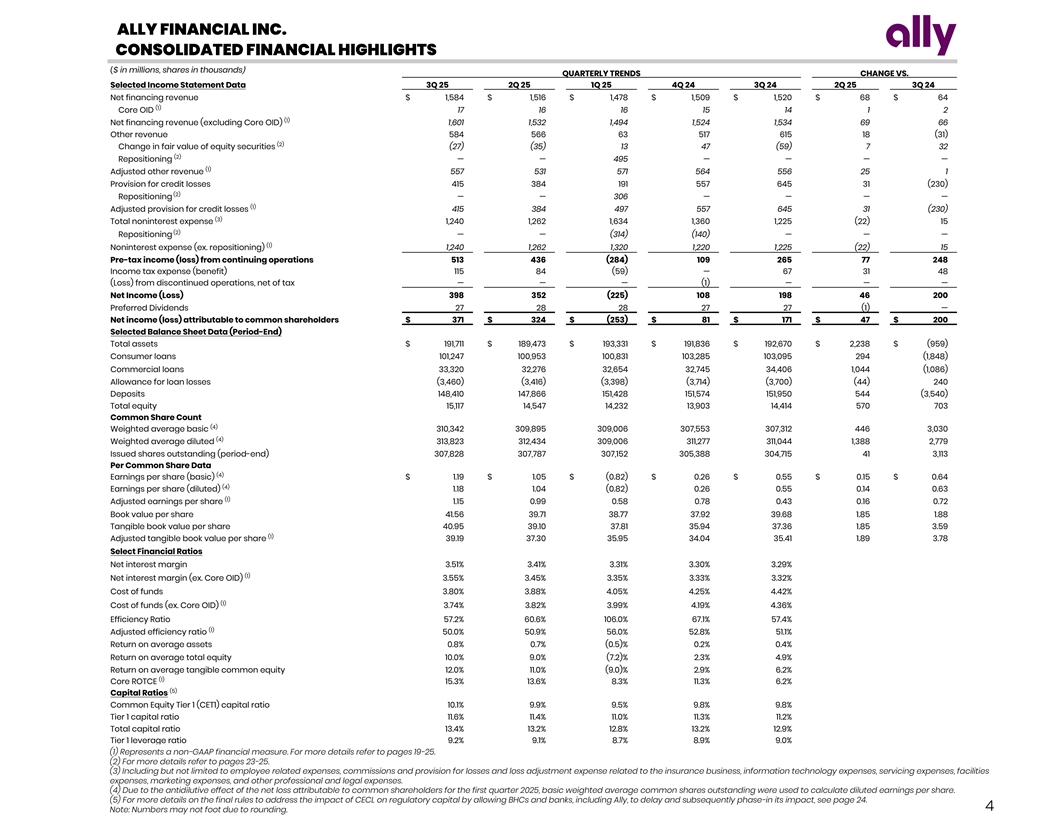
ALLY FINANCIAL INC. CONSOLIDATED FINANCIAL HIGHLIGHTS ($ in millions, shares in thousands) QUARTERLY TRENDS CHANGE VS. Selected Income Statement Data 3Q 25 2Q 25 1Q 25 4Q 24 3Q 24 2Q 25 3Q 24 Net financing revenue $ 1,584 $ 1,516 $ 1,478 $ 1,509 $ 1,520 $ 68 $ 64 (1) Core OID 17 16 16 15 14 1 2 (1) Net financing revenue (excluding Core OID) 1,601 1,532 1,494 1,524 1,534 69 66 Other revenue 584 566 63 517 615 18 (31) (2) Change in fair value of equity securities (27) (35) 13 47 (59) 7 32 (2) Repositioning — — 495 — — — — (1) Adjusted other revenue 557 531 571 564 556 25 1 Provision for credit losses 415 384 191 557 645 31 (230) (2) Repositioning — — 306 — — — — (1) Adjusted provision for credit losses 415 384 497 557 645 31 (230) (3) Total noninterest expense 1,240 1,262 1,634 1,360 1,225 (22) 15 (2) Repositioning — — (314) (140) — — — (1) Noninterest expense (ex. repositioning) 1,240 1,262 1,320 1,220 1,225 (22) 15 Pre-tax income (loss) from continuing operations 513 436 (284) 109 265 77 248 Income tax expense (benefit) 115 84 (59) — 67 31 48 (Loss) from discontinued operations, net of tax — — — (1) — — — Net Income (Loss) 398 352 (225) 108 198 46 200 Preferred Dividends 27 28 28 27 27 (1) — Net income (loss) attributable to common shareholders $ 371 $ 324 $ (253) $ 81 $ 171 $ 47 $ 200 Selected Balance Sheet Data (Period-End) Total assets $ 191,711 $ 189,473 $ 193,331 $ 191,836 $ 192,670 $ 2,238 $ (959) Consumer loans 101,247 100,953 100,831 103,285 103,095 294 (1,848) Commercial loans 33,320 32,276 32,654 32,745 34,406 1,044 (1,086) Allowance for loan losses (3,460) (3,416) (3,398) (3,714) (3,700) (44) 240 Deposits 148,410 147,866 151,428 151,574 151,950 544 (3,540) Total equity 15,117 14,547 14,232 13,903 14,414 570 703 Common Share Count (4) Weighted average basic 310,342 309,895 309,006 307,553 307,312 446 3,030 (4) Weighted average diluted 313,823 312,434 309,006 311,277 311,044 1,388 2,779 Issued shares outstanding (period-end) 307,828 307,787 307,152 305,388 304,715 41 3,113 Per Common Share Data (4) Earnings per share (basic) $ 1.19 $ 1.05 $ (0.82) $ 0.26 $ 0.55 $ 0.15 $ 0.64 (4) Earnings per share (diluted) 1.18 1.04 (0.82) 0.26 0.55 0.14 0.63 (1) Adjusted earnings per share 1.15 0.99 0.58 0.78 0.43 0.16 0.72 Book value per share 41.56 39.71 38.77 37.92 39.68 1.85 1.88 Tangible book value per share 40.95 39.10 37.81 35.94 37.36 1.85 3.59 (1) Adjusted tangible book value per share 39.19 37.30 35.95 34.04 35.41 1.89 3.78 Select Financial Ratios Net interest margin 3.51% 3.41% 3.31% 3 .30% 3.29% (1) Net interest margin (ex. Core OID) 3 .55 % 3 .45 % 3 .35% 3.33% 3.32% Cost of funds 3 .80 % 3 .88 % 4 .05% 4 .25% 4.42 % (1) Cost of funds (ex. Core OID) 3 .74% 3.82 % 3 .99% 4.19% 4 .36 % Efficiency Ratio 5 7.2 % 6 0.6% 106.0 % 6 7.1% 57.4% (1) Adjusted efficiency ratio 50.0% 50.9% 56.0% 52.8% 51.1% Return on average assets 0.8% 0 .7 % ( 0.5) % 0.2% 0 .4 % Return on average total equity 1 0.0% 9.0% ( 7.2) % 2 .3 % 4.9% Return on average tangible common equity 12.0% 11.0% ( 9.0)% 2 .9% 6 .2% (1) Core ROTCE 15.3% 1 3.6% 8.3 % 1 1.3% 6 .2% (5) Capital Ratios Common Equity Tier 1 (CET1) capital ratio 1 0.1% 9.9% 9.5 % 9 .8% 9 .8% Tier 1 capital ratio 11.6 % 11.4 % 11.0% 11.3 % 11.2 % Total capital ratio 13.4% 13.2% 12.8% 13.2% 12.9% Tier 1 leverage ratio 9.2 % 9.1% 8.7 % 8 .9 % 9.0 % (1) Represents a non-GAAP financial measure. For more details refer to pages 19-25. (2) For more details refer to pages 23-25. (3) Including but not limited to employee related expenses, commissions and provision for losses and loss adjustment expense related to the insurance business, information technology expenses, servicing expenses, facilities expenses, marketing expenses, and other professional and legal expenses. (4) Due to the antidilutive effect of the net loss attributable to common shareholders for the first quarter 2025, basic weighted average common shares outstanding were used to calculate diluted earnings per share. (5) For more details on the final rules to address the impact of CECL on regulatory capital by allowing BHCs and banks, including Ally, to delay and subsequently phase-in its impact, see page 24. 4 Note: Numbers may not foot due to rounding.
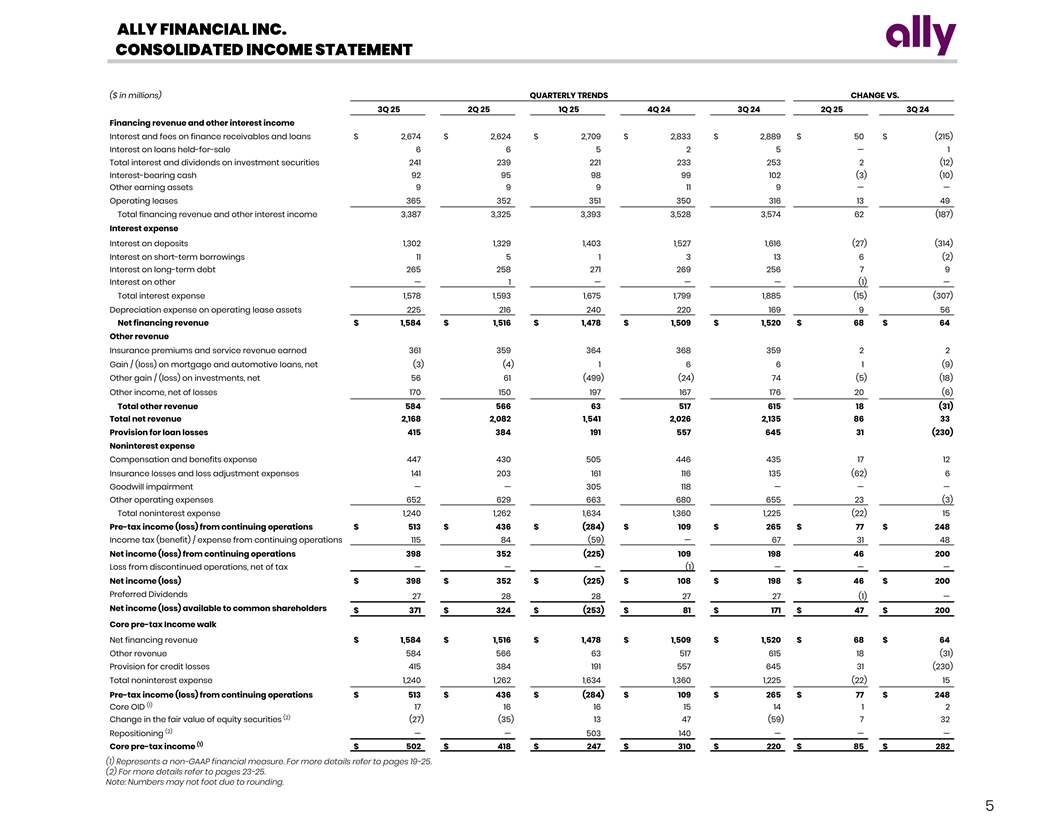
ALLY FINANCIAL INC. CONSOLIDATED INCOME STATEMENT ($ in millions) QUARTERLY TRENDS CHANGE VS. 3Q 25 2Q 25 1Q 25 4Q 24 3Q 24 2Q 25 3Q 24 Financing revenue and other interest income Interest and fees on finance receivables and loans $ 2,674 $ 2,624 $ 2,709 $ 2,833 $ 2,889 $ 50 $ (215) Interest on loans held-for-sale 6 6 5 2 5 — 1 Total interest and dividends on investment securities 241 239 221 233 253 2 (12) Interest-bearing cash 92 95 98 99 102 (3) (10) Other earning assets 9 9 9 11 9 — — Operating leases 365 352 351 350 316 13 49 Total financing revenue and other interest income 3,387 3,325 3,393 3,528 3,574 62 (187) Interest expense Interest on deposits 1,302 1,329 1,403 1,527 1,616 (27) (314) Interest on short-term borrowings 11 5 1 3 13 6 (2) Interest on long-term debt 265 258 271 269 256 7 9 Interest on other — 1 — — — (1) — Total interest expense 1,578 1,593 1,675 1,799 1,885 (15) (307) Depreciation expense on operating lease assets 225 216 240 220 169 9 56 Net financing revenue $ 1,584 $ 1,516 $ 1,478 $ 1,509 $ 1,520 $ 68 $ 64 Other revenue Insurance premiums and service revenue earned 361 359 364 368 359 2 2 Gain / (loss) on mortgage and automotive loans, net (3) (4) 1 6 6 1 (9) Other gain / (loss) on investments, net 56 61 (499) (24) 74 (5) (18) Other income, net of losses 170 150 197 167 176 20 (6) Total other revenue 584 566 63 517 615 18 (31) Total net revenue 2,168 2,082 1,541 2,026 2,135 86 33 Provision for loan losses 415 384 191 557 645 31 (230) Noninterest expense Compensation and benefits expense 447 430 505 446 435 17 12 Insurance losses and loss adjustment expenses 141 203 161 116 135 (62) 6 Goodwill impairment — — 305 118 — — — Other operating expenses 652 629 663 680 655 23 (3) Total noninterest expense 1,240 1,262 1,634 1,360 1,225 (22) 15 Pre-tax income (loss) from continuing operations $ 513 $ 436 $ (284) $ 109 $ 265 $ 77 $ 248 Income tax (benefit) / expense from continuing operations 115 84 (59) — 67 31 48 Net income (loss) from continuing operations 398 352 (225) 109 198 46 200 Loss from discontinued operations, net of tax — — — (1) — — — Net income (loss) $ 398 $ 352 $ (225) $ 108 $ 198 $ 46 $ 200 Preferred Dividends 27 28 28 27 27 (1) — Net income (loss) available to common shareholders $ 371 $ 324 $ (253) $ 81 $ 171 $ 47 $ 200 Core pre-tax Income walk Net financing revenue $ 1,584 $ 1,516 $ 1,478 $ 1,509 $ 1,520 $ 68 $ 64 Other revenue 584 566 63 517 615 18 (31) Provision for credit losses 415 384 191 557 645 31 (230) Total noninterest expense 1,240 1,262 1,634 1,360 1,225 (22) 15 Pre-tax income (loss) from continuing operations $ 513 $ 436 $ (284) $ 109 $ 265 $ 77 $ 248 (1) Core OID 17 16 16 15 14 1 2 (2) Change in the fair value of equity securities (27) (35) 13 47 (59) 7 32 (2) Repositioning — — 503 140 — — — (1) Core pre-tax income $ 502 $ 418 $ 247 $ 310 $ 220 $ 85 $ 282 (1) Represents a non-GAAP financial measure. For more details refer to pages 19-25. (2) For more details refer to pages 23-25. Note: Numbers may not foot due to rounding. 5

ALLY FINANCIAL INC. CONSOLIDATED PERIOD-END BALANCE SHEET ($ in millions) QUARTERLY TRENDS CHANGE VS. Assets 3Q 25 2Q 25 1Q 25 4Q 24 3Q 24 2Q 25 3Q 24 Cash and cash equivalents Noninterest-bearing $ 429 $ 530 $ 543 $ 522 $ 544 $ (101) $ (115) Interest-bearing 9,817 10,062 9,866 9,770 8,072 (245) 1,745 Total cash and cash equivalents 10,246 10,592 10,409 10,292 8,616 (346) 1,630 (1) Investment securities 27,982 27,896 27,956 27,627 29,223 86 (1,241) Loans held-for-sale, net 179 185 209 160 306 (6) (127) Finance receivables and loans, net 134,567 133,229 133,485 136,030 137,501 1,338 (2,934) Allowance for loan losses (3,460) (3,416) (3,398) (3,714) (3,700) (44) 240 Total finance receivables and loans, net 131,107 129,813 130,087 132,316 133,801 1,294 (2,694) Investment in operating leases, net 8,599 7,992 7,879 7,991 7,967 607 632 Premiums receivable and other insurance assets 2,903 2,893 2,806 2,790 2,810 10 93 Other assets 10,695 10,102 11,545 10,660 9,947 593 748 (2) Assets of operations held-for-sale — — 2,440 — — — — Total assets $ 191,711 $ 189,473 $ 193,331 $ 191,836 $ 192,670 $ 2,238 $ (959) Liabilities Deposit liabilities Noninterest-bearing $ 174 $ 155 $ 133 $ 131 $ 174 $ 19 $ — Interest-bearing 148,236 147,711 151,295 151,443 151,776 525 (3,540) Total deposit liabilities 148,410 147,866 151,428 151,574 151,950 544 (3,540) Short-term borrowings 3,879 3,856 3,339 1,625 1,771 23 2,108 Long-term debt 16,749 15,876 16,465 17,495 16,807 873 (58) Interest payable 1,097 912 954 890 1,425 185 (328) Unearned insurance premiums and service revenue 3,648 3,627 3,563 3,535 3,534 21 114 Accrued expense and other liabilities 2,811 2,789 3,315 2,814 2,769 22 42 Liabilities of operations held-for-sale — — 35 — — — — Total liabilities $ 176,594 $ 174,926 $ 179,099 $ 177,933 $ 178,256 $ 1,668 $ (1,662) Equity (3) Common stock and paid-in capital $ 15,310 $ 15,291 $ 15,248 $ 15,233 $ 15,199 $ 19 $ 111 Preferred stock 2,324 2,324 2,324 2,324 2,324 — — Retained earnings (accumulated deficit) 427 151 (78) 270 284 276 143 Accumulated other comprehensive loss (2,944) (3,219) (3,262) (3,924) (3,393) 275 449 Total equity 15,117 14,547 14,232 13,903 14,414 570 703 Total liabilities and equity $ 191,711 $ 189,473 $ 193,331 $ 191,836 $ 192,670 $ 2,238 $ (959) (1) Includes Held-to-maturity securities. (2) Credit Card moved to Assets of Operations Held-For-Sale (HFS) on 03/31/25. Sale of Credit Card closed on 04/01/25. (3) Includes Treasury stock. Note: Numbers may not foot due to rounding. 6
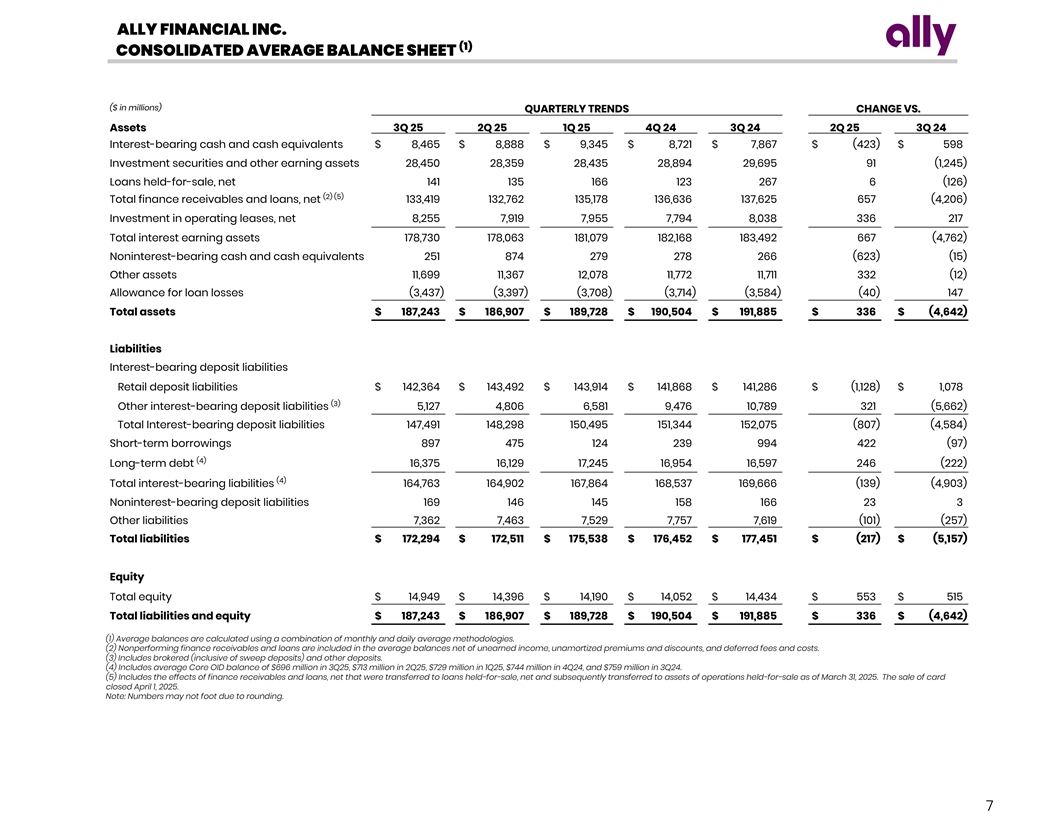
ALLY FINANCIAL INC. (1) CONSOLIDATED AVERAGE BALANCE SHEET ($ in millions) QUARTERLY TRENDS CHANGE VS. Assets 3Q 25 2Q 25 1Q 25 4Q 24 3Q 24 2Q 25 3Q 24 Interest-bearing cash and cash equivalents $ 8,465 $ 8,888 $ 9,345 $ 8,721 $ 7,867 $ (423) $ 598 Investment securities and other earning assets 28,450 28,359 28,435 28,894 29,695 91 (1,245) Loans held-for-sale, net 141 135 166 123 267 6 (126) (2) (5) Total finance receivables and loans, net 133,419 132,762 135,178 136,636 137,625 657 (4,206) Investment in operating leases, net 8,255 7,919 7,955 7,794 8,038 336 217 Total interest earning assets 178,730 178,063 181,079 182,168 183,492 667 (4,762) Noninterest-bearing cash and cash equivalents 251 874 279 278 266 (623) (15) Other assets 11,699 11,367 12,078 11,772 11,711 332 (12) Allowance for loan losses (3,437) (3,397) (3,708) (3,714) (3,584) (40) 147 Total assets $ 187,243 $ 186,907 $ 189,728 $ 190,504 $ 191,885 $ 336 $ (4,642) Liabilities Interest-bearing deposit liabilities Retail deposit liabilities $ 142,364 $ 143,492 $ 143,914 $ 141,868 $ 141,286 $ (1,128) $ 1,078 (3) Other interest-bearing deposit liabilities 5,127 4,806 6,581 9,476 10,789 321 (5,662) Total Interest-bearing deposit liabilities 147,491 148,298 150,495 151,344 152,075 (807) (4,584) Short-term borrowings 897 475 124 239 994 422 (97) (4) Long-term debt 16,375 16,129 17,245 16,954 16,597 246 (222) (4) Total interest-bearing liabilities 164,763 164,902 167,864 168,537 169,666 (139) (4,903) Noninterest-bearing deposit liabilities 169 146 145 158 166 23 3 Other liabilities 7,362 7,463 7,529 7,757 7,619 (101) (257) Total liabilities $ 172,294 $ 172,511 $ 175,538 $ 176,452 $ 177,451 $ (217) $ (5,157) Equity Total equity $ 14,949 $ 14,396 $ 14,190 $ 14,052 $ 14,434 $ 553 $ 515 Total liabilities and equity $ 187,243 $ 186,907 $ 189,728 $ 190,504 $ 191,885 $ 336 $ (4,642) (1) Average balances are calculated using a combination of monthly and daily average methodologies. (2) Nonperforming finance receivables and loans are included in the average balances net of unearned income, unamortized premiums and discounts, and deferred fees and costs. (3) Includes brokered (inclusive of sweep deposits) and other deposits. (4) Includes average Core OID balance of $696 million in 3Q25, $713 million in 2Q25, $729 million in 1Q25, $744 million in 4Q24, and $759 million in 3Q24. (5) Includes the effects of finance receivables and loans, net that were transferred to loans held-for-sale, net and subsequently transferred to assets of operations held-for-sale as of March 31, 2025. The sale of card closed April 1, 2025. Note: Numbers may not foot due to rounding. 7

ALLY FINANCIAL INC. SEGMENT HIGHLIGHTS QUARTERLY TRENDS CHANGE VS. ($ in millions) Pre-tax Income / (Loss) 3Q 25 2Q 25 1Q 25 4Q 24 3Q 24 2Q 25 3Q 24 Automotive Finance $ 421 $ 472 $ 375 $ 397 $ 355 $ (51) $ 66 Insurance 79 28 2 36 102 51 (23) Dealer Financial Services 500 500 377 433 457 — 43 Corporate Finance 95 96 76 120 105 (1) (10) (1) Corporate and Other (82) (160) (737) (444) (297) 78 215 Pre-tax income (loss) from continuing operations $ 513 $ 436 $ (284) $ 109 $ 265 $ 77 $ 248 (2) (3) Core OID 17 16 16 15 14 1 2 (4) Change in the fair value of equity securities (27) (35) 13 47 (59) 7 32 (4) Repositioning and other — — 503 140 — — — (3) Core pre-tax income $ 502 $ 418 $ 247 $ 310 $ 220 $ 85 $ 282 (1) Corporate and Other includes the impact of centralized asset and liability management, corporate overhead allocation activities, consumer mortgage portfolio, Ally Invest activity, and the credit card portfolio. The sale of Credit Card closed on 04/01/25. (2) Core OID for all periods shown are applied to the pre-tax income of the Corporate and Other segment. (3) Represents a non-GAAP measure. For more details refer to pages 19-25. (4) For more details refer to pages 23-25. Note: Numbers may not foot due to rounding. 8
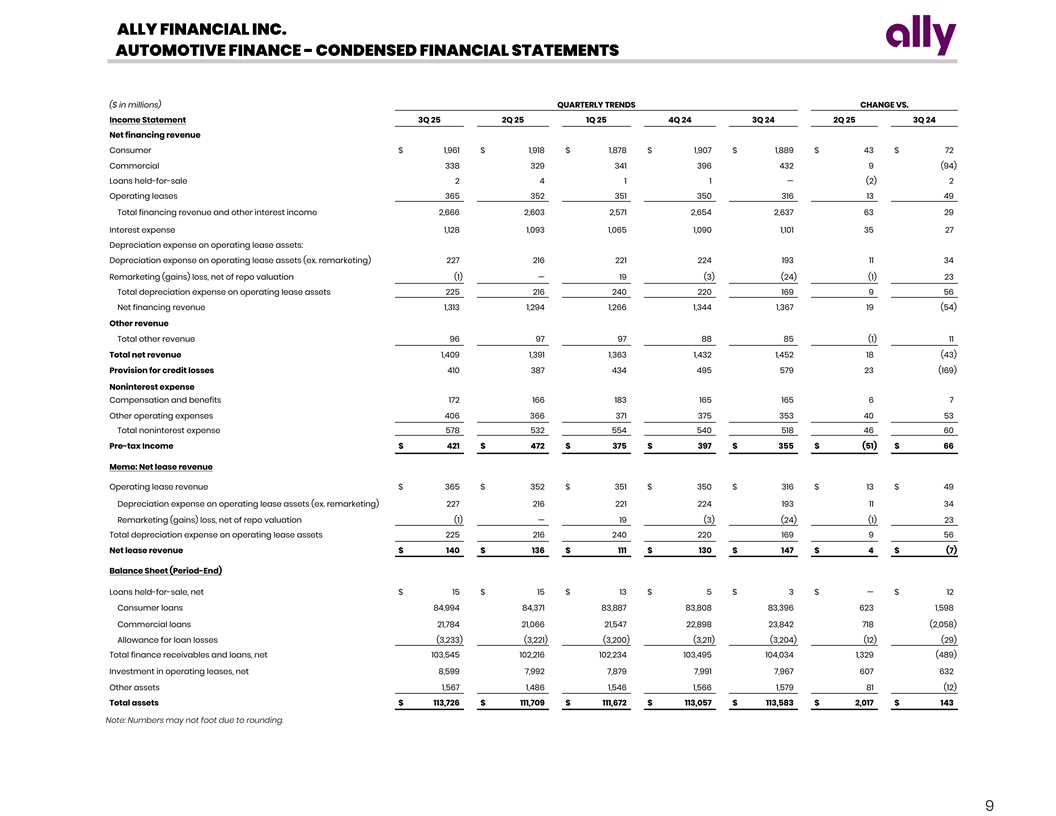
ALLY FINANCIAL INC. AUTOMOTIVE FINANCE - CONDENSED FINANCIAL STATEMENTS ($ in millions) QUARTERLY TRENDS CHANGE VS. Income Statement 3Q 25 2Q 25 1Q 25 4Q 24 3Q 24 2Q 25 3Q 24 Net financing revenue Consumer $ 1,961 $ 1,918 $ 1,878 $ 1,907 $ 1,889 $ 43 $ 72 Commercial 338 329 341 396 432 9 (94) Loans held-for-sale 2 4 1 1 — (2) 2 Operating leases 365 352 351 350 316 13 49 Total financing revenue and other interest income 2,666 2,603 2,571 2,654 2,637 63 29 Interest expense 1,128 1,093 1,065 1,090 1,101 35 27 Depreciation expense on operating lease assets: Depreciation expense on operating lease assets (ex. remarketing) 227 216 221 224 193 11 34 Remarketing (gains) loss, net of repo valuation (1) — 19 (3) (24) (1) 23 Total depreciation expense on operating lease assets 225 216 240 220 169 9 56 Net financing revenue 1,313 1,294 1,266 1,344 1,367 19 (54) Other revenue Total other revenue 96 97 97 88 85 (1) 11 Total net revenue 1,409 1,391 1,363 1,432 1,452 18 (43) Provision for credit losses 410 387 434 495 579 23 (169) Noninterest expense Compensation and benefits 172 166 183 165 165 6 7 Other operating expenses 406 366 371 375 353 40 53 Total noninterest expense 578 532 554 540 518 46 60 Pre-tax Income $ 421 $ 472 $ 375 $ 397 $ 355 $ (51) $ 66 Memo: Net lease revenue Operating lease revenue $ 365 $ 352 $ 351 $ 350 $ 316 $ 13 $ 49 Depreciation expense on operating lease assets (ex. remarketing) 227 216 221 224 193 11 34 Remarketing (gains) loss, net of repo valuation (1) — 19 (3) (24) (1) 23 Total depreciation expense on operating lease assets 225 216 240 220 169 9 56 Net lease revenue $ 140 $ 136 $ 111 $ 130 $ 147 $ 4 $ (7) Balance Sheet (Period-End) Loans held-for-sale, net $ 15 $ 15 $ 13 $ 5 $ 3 $ — $ 12 Consumer loans 84,994 84,371 83,887 83,808 83,396 623 1,598 Commercial loans 21,784 21,066 21,547 22,898 23,842 718 (2,058) Allowance for loan losses (3,233) (3,221) (3,200) (3,211) (3,204) (12) (29) Total finance receivables and loans, net 103,545 102,216 102,234 103,495 104,034 1,329 (489) Investment in operating leases, net 8,599 7,992 7,879 7,991 7,967 607 632 Other assets 1,567 1,486 1,546 1,566 1,579 81 (12) Total assets $ 113,726 $ 111,709 $ 111,672 $ 113,057 $ 113,583 $ 2,017 $ 143 Note: Numbers may not foot due to rounding. 9
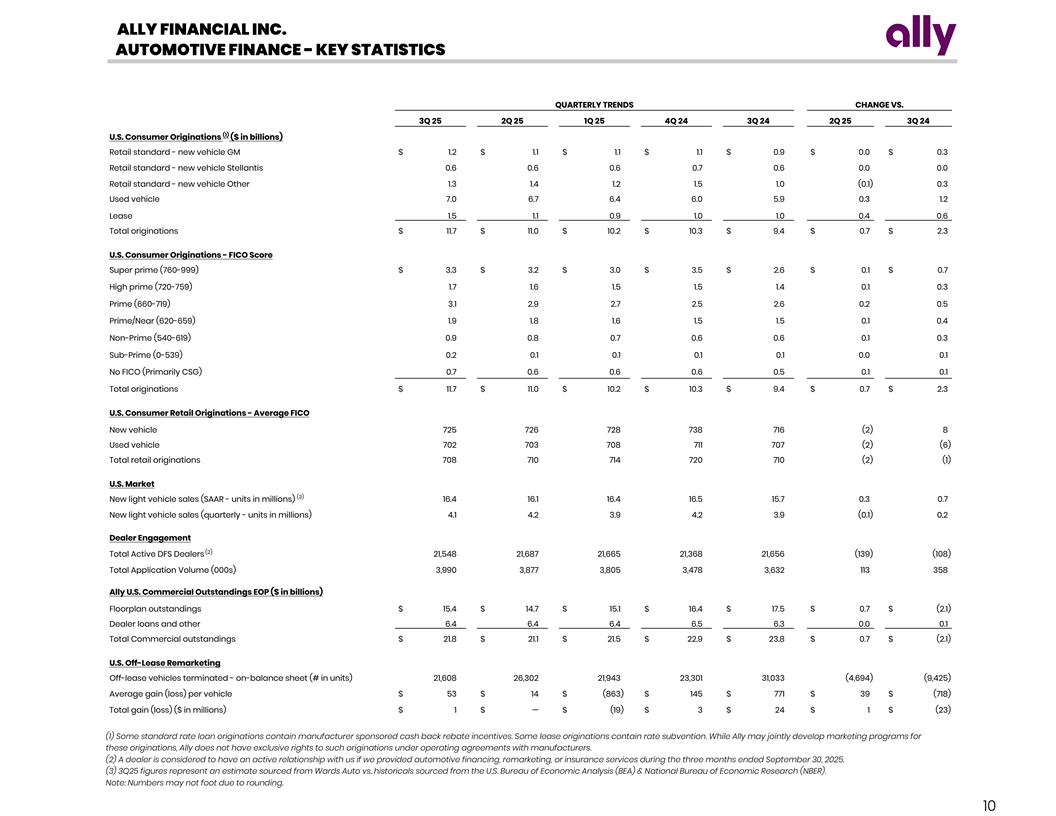
ALLY FINANCIAL INC. AUTOMOTIVE FINANCE - KEY STATISTICS QUARTERLY TRENDS CHANGE VS. 3Q 25 2Q 25 1Q 25 4Q 24 3Q 24 2Q 25 3Q 24 (1) U.S. Consumer Originations ($ in billions) Retail standard - new vehicle GM $ 1.2 $ 1.1 $ 1.1 $ 1.1 $ 0.9 $ 0.0 $ 0.3 Retail standard - new vehicle Stellantis 0.6 0.6 0.6 0.7 0.6 0.0 0.0 Retail standard - new vehicle Other 1.3 1.4 1.2 1.5 1.0 (0.1) 0.3 Used vehicle 7.0 6.7 6.4 6.0 5.9 0.3 1.2 Lease 1.5 1.1 0.9 1.0 1.0 0.4 0.6 Total originations $ 11.7 $ 11.0 $ 10.2 $ 10.3 $ 9.4 $ 0.7 $ 2.3 U.S. Consumer Originations - FICO Score Super prime (760-999) $ 3.3 $ 3.2 $ 3.0 $ 3.5 $ 2.6 $ 0.1 $ 0.7 High prime (720-759) 1.7 1.6 1.5 1.5 1.4 0.1 0.3 Prime (660-719) 3.1 2.9 2.7 2.5 2.6 0.2 0.5 Prime/Near (620-659) 1.9 1.8 1.6 1.5 1.5 0.1 0.4 Non-Prime (540-619) 0.9 0.8 0.7 0.6 0.6 0.1 0.3 Sub-Prime (0-539) 0.2 0.1 0.1 0.1 0.1 0.0 0.1 No FICO (Primarily CSG) 0.7 0.6 0.6 0.6 0.5 0.1 0.1 Total originations $ 11.7 $ 11.0 $ 10.2 $ 10.3 $ 9.4 $ 0.7 $ 2.3 U.S. Consumer Retail Originations - Average FICO New vehicle 725 726 728 738 716 (2) 8 Used vehicle 702 703 708 711 707 (2) (6) Total retail originations 708 710 714 720 710 (2) (1) U.S. Market (3) New light vehicle sales (SAAR - units in millions) 16.4 16.1 16.4 16.5 15.7 0.3 0.7 New light vehicle sales (quarterly - units in millions) 4.1 4.2 3.9 4.2 3.9 (0.1) 0.2 Dealer Engagement (2) Total Active DFS Dealers 21,548 21,687 21,665 21,368 21,656 (139) (108) Total Application Volume (000s) 3,990 3,877 3,805 3,478 3,632 113 358 Ally U.S. Commercial Outstandings EOP ($ in billions) Floorplan outstandings $ 15.4 $ 14.7 $ 15.1 $ 16.4 $ 17.5 $ 0.7 $ (2.1) Dealer loans and other 6.4 6.4 6.4 6.5 6.3 0.0 0.1 Total Commercial outstandings $ 21.8 $ 21.1 $ 21.5 $ 22.9 $ 23.8 $ 0.7 $ (2.1) U.S. Off-Lease Remarketing Off-lease vehicles terminated - on-balance sheet (# in units) 21,608 26,302 21,943 23,301 31,033 (4,694) (9,425) Average gain (loss) per vehicle $ 53 $ 14 $ (863) $ 145 $ 771 $ 39 $ (718) Total gain (loss) ($ in millions) $ 1 $ — $ (19) $ 3 $ 24 $ 1 $ (23) (1) Some standard rate loan originations contain manufacturer sponsored cash back rebate incentives. Some lease originations contain rate subvention. While Ally may jointly develop marketing programs for these originations, Ally does not have exclusive rights to such originations under operating agreements with manufacturers. (2) A dealer is considered to have an active relationship with us if we provided automotive financing, remarketing, or insurance services during the three months ended September 30, 2025. (3) 3Q25 figures represent an estimate sourced from Wards Auto vs. historicals sourced from the U.S. Bureau of Economic Analysis (BEA) & National Bureau of Economic Research (NBER). Note: Numbers may not foot due to rounding. 10

ALLY FINANCIAL INC. INSURANCE - CONDENSED FINANCIAL STATEMENTS AND KEY STATISTICS ($ in millions) QUARTERLY TRENDS CHANGE VS. Income Statement (GAAP View) 3Q 25 2Q 25 1Q 25 4Q 24 3Q 24 2Q 25 3Q 24 Net financing revenue (1) Total interest and fees on finance receivables and loans $ 5 $ 4 $ 5 $ 5 $ 4 $ 1 $ 1 Interest and dividends on investment securities 39 36 34 34 31 3 8 Interest bearing cash 5 5 5 6 8 — (3) Total financing revenue and other interest revenue 49 45 44 45 43 4 6 Interest expense 16 15 14 14 13 1 3 Net financing revenue 33 30 30 31 30 3 3 Other revenue Insurance premiums and service revenue earned 361 359 364 368 359 2 2 Other gain / (loss) on investments, net 56 59 (4) (24) 75 (3) (19) Other income, net of losses 3 4 4 4 3 (1) — Total other revenue 420 422 364 348 437 (2) (17) Total net revenue 453 452 394 379 467 1 (14) Noninterest expense Compensation and benefits expense 29 26 30 27 27 3 2 Insurance losses and loss adjustment expenses 141 203 161 116 135 (62) 6 Other operating expenses 204 195 201 200 203 9 1 Total noninterest expense 374 424 392 343 365 (50) 9 Pre-tax income (loss) $ 79 $ 28 $ 2 $ 36 $ 102 $ 51 $ (23) Memo: Income Statement (Managerial View) Insurance premiums and other income Insurance premiums and service revenue earned $ 361 $ 359 $ 364 $ 368 $ 359 $ 2 $ 2 (2) Investment income and other (adjusted) 62 59 41 55 49 3 13 Other income 3 4 4 4 3 (1) — Total insurance premiums and other income 426 422 409 427 411 4 15 Expense Insurance losses and loss adjustment expenses 141 203 161 116 135 (62) 6 Acquisition and underwriting expenses Compensation and benefit expense 29 26 30 27 27 3 2 Insurance commission expense 158 155 162 162 164 3 (6) Other expense 46 40 39 38 39 6 7 Total acquistion and underwriting expense 233 221 231 227 230 12 3 Total expense 374 424 392 343 365 (50) 9 (2) Core pre-tax (loss) / income 52 (2) 17 84 46 54 6 (3) Change in the fair value of equity securities 27 30 (15) (48) 56 (3) (29) Income (loss) before income tax expense $ 79 $ 28 $ 2 $ 36 $ 102 $ 51 $ (23) Balance Sheet (Period-End) Cash and investment securities $ 5,845 $ 5,728 $ 5,527 $ 5,317 $ 5,461 $ 117 $ 384 (1) Intercompany loans 696 687 804 864 826 9 (130) Premiums receivable and other insurance assets 2,921 2,910 2,824 2,809 2,829 11 92 Other assets 386 380 334 335 339 6 47 Total assets $ 9,848 $ 9,705 $ 9,489 $ 9,325 $ 9,455 $ 143 $ 393 Key Statistics (4) Total written premiums and revenue $ 385 $ 349 $ 385 $ 390 $ 384 $ 36 $ 1 (5) Loss ratio 38.7 % 5 6.0 % 4 3.7 % 3 1.3 % 37.1 % (6) Underwriting expense ratio 6 3.9 % 61.1 % 62.8 % 6 1.2 % 63.5 % Combined ratio 102.6 % 1 17.1 % 1 06.5 % 92.5 % 100.6 % (1) Intercompany activity represents excess liquidity placed with corporate segment. (2) Represents a non-GAAP financial measure. For more details refer to pages 19-25. (3) For more details refer to pages 23-25. (4) Written premiums are net of ceded premium for reinsurance. (5) Loss ratio is calculated as Insurance losses and loss adjustment expenses divided by Insurance premiums and service revenue earned and Other Income, net of losses. (6) Underwriting expense ratio is calculated as Compensation and benefits expense and Other operating expenses divided by Insurance premiums and service revenue earned and Other income, net of losses. Note: Numbers may not foot due to rounding. 11
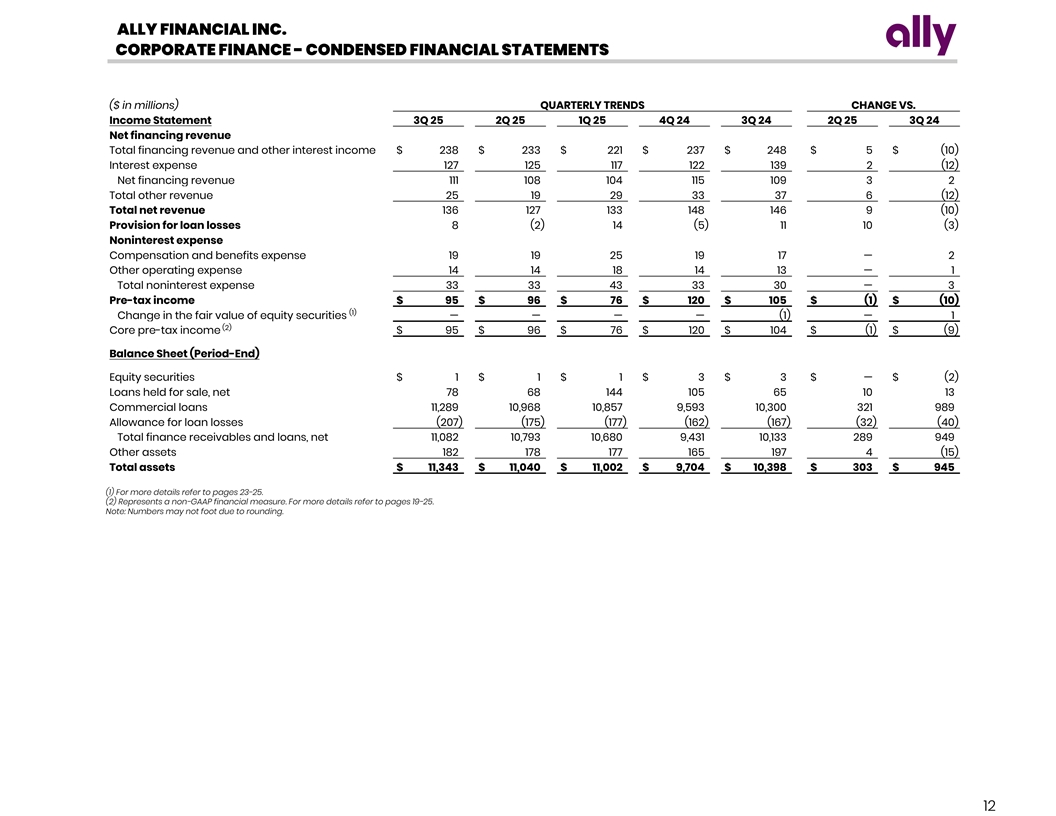
ALLY FINANCIAL INC. CORPORATE FINANCE - CONDENSED FINANCIAL STATEMENTS ($ in millions) QUARTERLY TRENDS CHANGE VS. Income Statement 3Q 25 2Q 25 1Q 25 4Q 24 3Q 24 2Q 25 3Q 24 Net financing revenue Total financing revenue and other interest income $ 238 $ 233 $ 221 $ 237 $ 248 $ 5 $ (10) Interest expense 127 125 117 122 139 2 (12) Net financing revenue 111 108 104 115 109 3 2 Total other revenue 25 19 29 33 37 6 (12) Total net revenue 136 127 133 148 146 9 (10) Provision for loan losses 8 (2) 14 (5) 11 10 (3) Noninterest expense Compensation and benefits expense 19 19 25 19 17 — 2 Other operating expense 14 14 18 14 13 — 1 Total noninterest expense 33 33 43 33 30 — 3 Pre-tax income $ 95 $ 96 $ 76 $ 120 $ 105 $ (1) $ (10) (1) Change in the fair value of equity securities — — — — (1) — 1 (2) Core pre-tax income $ 95 $ 96 $ 76 $ 120 $ 104 $ (1) $ (9) Balance Sheet (Period-End) Equity securities $ 1 $ 1 $ 1 $ 3 $ 3 $ — $ (2) Loans held for sale, net 78 68 144 105 65 10 13 Commercial loans 11,289 10,968 10,857 9,593 10,300 321 989 Allowance for loan losses (207) (175) (177) (162) (167) (32) (40) Total finance receivables and loans, net 11,082 10,793 10,680 9,431 10,133 289 949 Other assets 182 178 177 165 197 4 (15) Total assets $ 11,343 $ 11,040 $ 11,002 $ 9,704 $ 10,398 $ 303 $ 945 (1) For more details refer to pages 23-25. (2) Represents a non-GAAP financial measure. For more details refer to pages 19-25. Note: Numbers may not foot due to rounding. 12
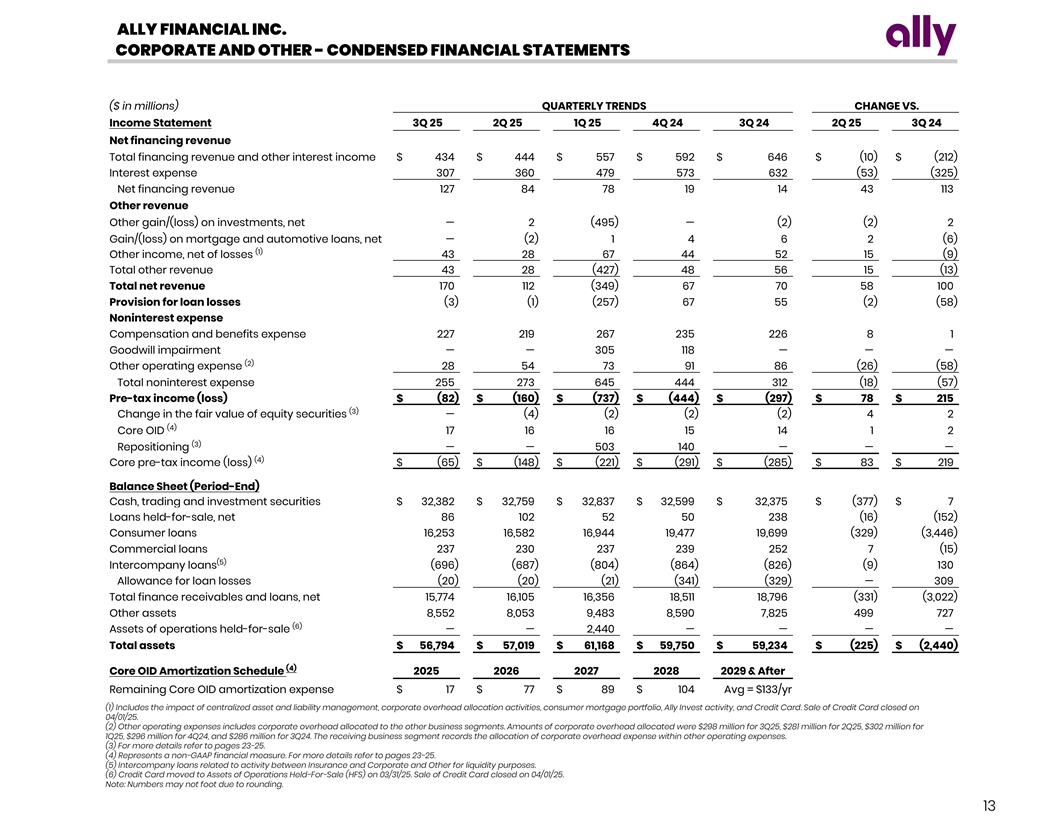
ALLY FINANCIAL INC. CORPORATE AND OTHER - CONDENSED FINANCIAL STATEMENTS ($ in millions) QUARTERLY TRENDS CHANGE VS. Income Statement 3Q 25 2Q 25 1Q 25 4Q 24 3Q 24 2Q 25 3Q 24 Net financing revenue Total financing revenue and other interest income $ 434 $ 444 $ 557 $ 592 $ 646 $ (10) $ (212) Interest expense 307 360 479 573 632 (53) (325) Net financing revenue 127 84 78 19 14 43 113 Other revenue Other gain/(loss) on investments, net — 2 (495) — (2) (2) 2 Gain/(loss) on mortgage and automotive loans, net — (2) 1 4 6 2 (6) (1) Other income, net of losses 43 28 67 44 52 15 (9) Total other revenue 43 28 (427) 48 56 15 (13) Total net revenue 170 112 (349) 67 70 58 100 Provision for loan losses (3) (1) (257) 67 55 (2) (58) Noninterest expense Compensation and benefits expense 227 219 267 235 226 8 1 Goodwill impairment — — 305 118 — — — (2) Other operating expense 28 54 73 91 86 (26) (58) Total noninterest expense 255 273 645 444 312 (18) (57) Pre-tax income (loss) $ (82) $ (160) $ (737) $ (444) $ (297) $ 78 $ 215 (3) Change in the fair value of equity securities — (4) (2) (2) (2) 4 2 (4) Core OID 17 16 16 15 14 1 2 (3) Repositioning — — 503 140 — — — (4) Core pre-tax income (loss) $ (65) $ (148) $ (221) $ (291) $ (285) $ 83 $ 219 Balance Sheet (Period-End) Cash, trading and investment securities $ 32,382 $ 32,759 $ 32,837 $ 32,599 $ 32,375 $ (377) $ 7 Loans held-for-sale, net 86 102 52 50 238 (16) (152) Consumer loans 16,253 16,582 16,944 19,477 19,699 (329) (3,446) Commercial loans 237 230 237 239 252 7 (15) (5) Intercompany loans (696) (687) (804) (864) (826) (9) 130 Allowance for loan losses (20) (20) (21) (341) (329) — 309 Total finance receivables and loans, net 15,774 16,105 16,356 18,511 18,796 (331) (3,022) Other assets 8,552 8,053 9,483 8,590 7,825 499 727 (6) Assets of operations held-for-sale — — 2,440 — — — — Total assets $ 56,794 $ 57,019 $ 61,168 $ 59,750 $ 59,234 $ (225) $ (2,440) (4) Core OID Amortization Schedule 2025 2026 2027 2028 2029 & After Remaining Core OID amortization expense $ 17 $ 77 $ 89 $ 104 Avg = $133/yr (1) Includes the impact of centralized asset and liability management, corporate overhead allocation activities, consumer mortgage portfolio, Ally Invest activity, and Credit Card. Sale of Credit Card closed on 04/01/25. (2) Other operating expenses includes corporate overhead allocated to the other business segments. Amounts of corporate overhead allocated were $298 million for 3Q25, $281 million for 2Q25, $302 million for 1Q25, $296 million for 4Q24, and $286 million for 3Q24. The receiving business segment records the allocation of corporate overhead expense within other operating expenses. (3) For more details refer to pages 23-25. (4) Represents a non-GAAP financial measure. For more details refer to pages 23-25. (5) Intercompany loans related to activity between Insurance and Corporate and Other for liquidity purposes. (6) Credit Card moved to Assets of Operations Held-For-Sale (HFS) on 03/31/25. Sale of Credit Card closed on 04/01/25. Note: Numbers may not foot due to rounding. 13

ALLY FINANCIAL INC. CREDIT RELATED INFORMATION ($ in millions) QUARTERLY TRENDS CHANGE VS. (1) Asset Quality - Consolidated 3Q 25 2Q 25 1Q 25 4Q 24 3Q 24 2Q 25 3Q 24 Ending loan balance $ 134,567 $ 133,229 $ 133,485 $ 137,501 $ 136,030 $ 1,338 $ (2,934) 30+ Accruing DPD $ 3,401 $ 3,345 $ 3,224 $ 3,645 $ 3,800 $ 56 $ (244) 30+ Accruing DPD % 2 .53% 2 .51 % 2 .42 % 2 .65 % 2.79 % 60+ Accruing DPD $ 883 $ 883 $ 869 $ 987 $ 1,026 $ — $ (104) 60+ Accruing DPD % 0 .66% 0 .66% 0 .65 % 0 .72% 0.75 % Non-performing loans (NPLs) $ 1,353 $ 1,359 $ 1,417 $ 1,490 $ 1,486 $ (6) $ (137) Net charge-offs (NCOs) $ 395 $ 366 $ 507 $ 517 $ 543 $ 29 $ (122) (2) Net charge-off rate 1 .18 % 1.10% 1.50% 1 .50% 1.59% Provision for loan losses $ 415 $ 384 $ 191 $ 645 $ 557 $ 31 $ (230) Allowance for loan losses (ALLL) $ 3,460 $ 3,416 $ 3,398 $ 3,700 $ 3,714 $ 44 $ (240) (3) (4) ALLL as % of Loans 2 .57% 2 .56% 2 .55 % 2 .69 % 2.73 % (3) ALLL as % of NPLs 256 % 2 51 % 240% 2 48% 250 % (3) ALLL as % of NCOs 2 19 % 2 34 % 1 68 % 1 79 % 171% (5) U.S. Auto Delinquencies - HFI Retail Contract $'s 30+ Delinquent contract $ $ 3,340 $ 3,301 $ 3,181 $ 3,534 $ 3,681 $ 39 $ (194) % of retail contract $ outstanding 3.93% 3 .91% 3 .79 % 4 .24 % 4 .39% 60+ Delinquent contract $ $ 877 $ 879 $ 852 $ 951 $ 984 $ (2) $ (74) % of retail contract $ outstanding 1.03% 1.04 % 1.02 % 1 .14% 1.18 % U.S. Auto Annualized Net Charge-Offs - HFI Retail Contract $'s Net charge-offs $ 399 $ 366 $ 445 $ 467 $ 488 $ 33 $ (68) (2) % of avg. HFI assets 1.88 % 1.75 % 2.12 % 2 .24% 2 .34% (6) U.S. Auto Annualized Net Charge-Offs - HFI Commercial Contract $'s Net charge-offs $ — $ — $ — $ — $ — $ — $ — (2) % of avg. HFI assets (0.01)% (0.01) % — % ( 0.01)% — % (1) Loans within this table are classified as held-for-investment recorded at amortized cost as these loans are included in our allowance for loan losses. (2) Net charge-off ratios are calculated as annualized net charge-offs divided by average outstanding finance receivables and loans excluding loans measured at fair value, conditional repurchase loans and loans held- for-sale during the year for each loan category. (3) Excludes provision for credit losses related to our reserve for unfunded commitments. (4) ALLL coverage ratios are based on the allowance for loan losses related to loans held-for-investment excluding those loans held at fair value as a percentage of the unpaid principal balance, net of premiums and discounts. (5) Auto delinquency metrics include accruing contracts only. (6) Commercial Auto data includes Insurance advances. Note: Numbers may not foot due to rounding. 14

ALLY FINANCIAL INC. CREDIT RELATED INFORMATION, CONTINUED ($ in millions) (1) Automotive Finance QUARTERLY TRENDS CHANGE VS. Consumer 3Q 25 2Q 25 1Q 25 4Q 24 3Q 24 2Q 25 3Q 24 Net Charge-offs $ 399 $ 366 $ 445 $ 488 $ 467 $ 33 $ (68) Allowance for loan losses $ 3,186 $ 3,166 $ 3,144 $ 3,170 $ 3,166 $ 20 $ 20 (2) Total consumer loans $ 84,994 $ 84,365 $ 83,868 $ 83,757 $ 83,424 $ 629 $ 1,570 (3) Coverage ratio 3.75% 3 .75% 3 .75 % 3 .78 % 3.80 % (4) Commercial Net Charge-offs $ — $ — $ — $ — $ — $ — $ — Allowance for loan losses $ 47 $ 55 $ 56 $ 41 $ 38 $ (8) $ 9 Total commercial loans $ 21,794 $ 21,078 $ 21,560 $ 22,913 $ 23,854 $ 716 $ (2,060) Coverage ratio 0 .21 % 0 .26% 0.26% 0 .18% 0 .16 % (1) Consumer Mortgage Net Charge-offs $ (3) $ — $ (1) $ (1) $ (1) $ (3) $ (2) Allowance for loan losses $ 17 $ 17 $ 18 $ 19 $ 19 $ — $ (2) Total consumer loans $ 16,253 $ 16,588 $ 16,963 $ 17,234 $ 17,501 $ (335) $ (1,248) Coverage ratio 0 .10 % 0.10 % 0 .11 % 0 .10% 0.11% (1) (5) Consumer Other - Ally Credit Card Net Charge-offs $ — $ — $ 63 $ 56 52 $ — $ (52) Allowance for loan losses $ — $ — $ — $ 319 307 $ — $ (307) Total consumer loans $ — $ — $ — $ 2,294 2,170 $ — $ (2,170) Coverage ratio — % — % — % 1 3.92 % 14.14 % (1) Corporate Finance Net Charge-offs $ (1) $ — $ — $ — $ (1) $ (1) $ — Allowance for loan losses $ 207 $ 175 $ 177 $ 162 $ 167 $ 32 $ 40 Total commercial loans $ 11,289 $ 10,968 $ 10,857 $ 9,593 $ 10,300 $ 321 $ 989 Coverage ratio 1.83% 1 .60 % 1 .63 % 1 .69% 1.62% (1) Corporate and Other Net Charge-offs $ — $ — $ — $ — $ — $ — $ — Allowance for loan losses $ 3 $ 3 $ 3 $ 3 $ 3 $ — $ — Total commercial loans $ 237 $ 230 $ 237 $ 239 $ 252 $ 7 $ (15) Coverage ratio 1.36% 1 .36 % 1.36 % 1.36% 1.36 % (1) ALLL coverage ratios are based on the domestic allowance as a percentage of finance receivables and loans reported at their gross carrying value, which includes the principal amount outstanding, net of unearned income, unamortized deferred fees reduced by costs on originated loans, unamortized premiums and discounts on purchased loans, unamortized basis adjustments arising from the designation of finance receivables and loans as the hedged item in qualifying fair value hedge relationships, and cumulative principal charge-offs. Excludes loans held at fair value. (2) Includes $0M of fair value adjustment for loans in hedge accounting relationships in 3Q25, ($6M) in 2Q25, ($19M) in 1Q25, ($51M) in 4Q24 and $28M in 3Q24. (3) Excludes $0M of fair value adjustment for loans in hedge accounting relationships in 3Q25, ($6M) in 2Q25, ($19M) in 1Q25, ($51M) in 4Q24 and $28M in 3Q24. (4) Commercial Auto data includes Insurance advances. (5) Sale of Credit Card closed on 04/01/25. Note: Numbers may not foot due to rounding. 15
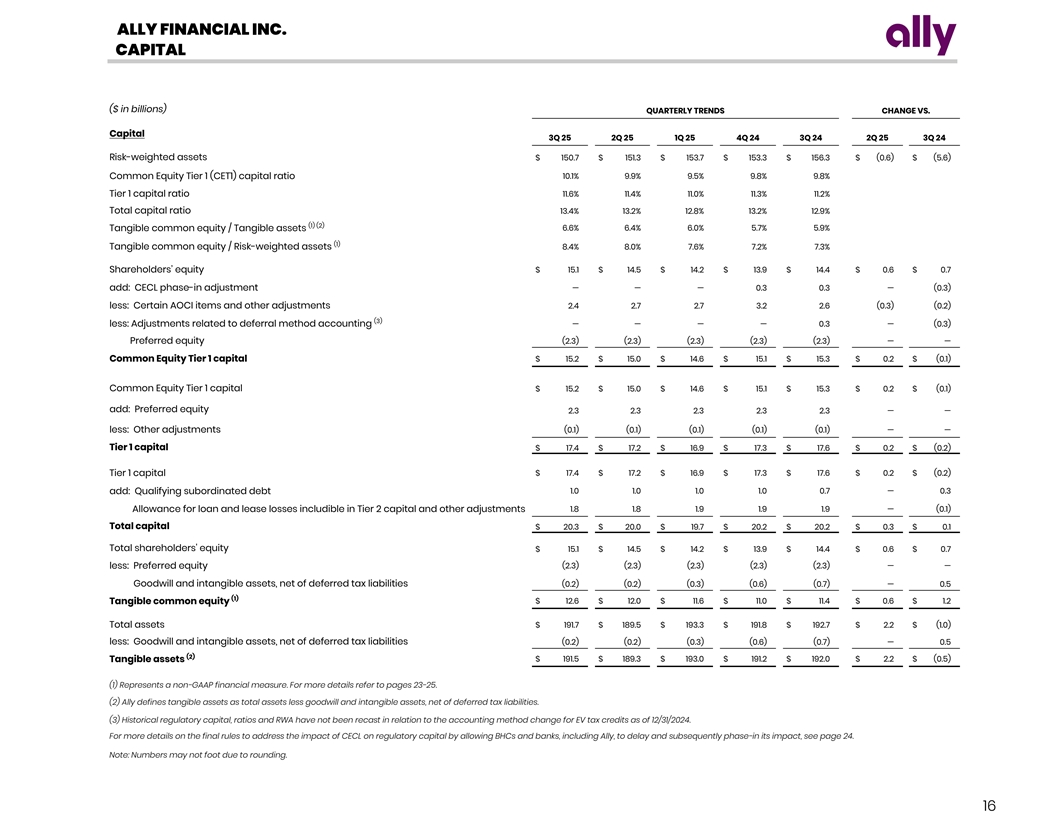
ALLY FINANCIAL INC. CAPITAL ($ in billions) QUARTERLY TRENDS CHANGE VS. Capital 3Q 25 2Q 25 1Q 25 4Q 24 3Q 24 2Q 25 3Q 24 Risk-weighted assets $ 150.7 $ 151.3 $ 153.7 $ 153.3 $ 156.3 $ (0.6) $ (5.6) 1 0.1% 9.9% 9 .5% 9.8 % 9 .8 % Common Equity Tier 1 (CET1) capital ratio Tier 1 capital ratio 11.6 % 11.4% 11.0% 11.3% 1 1.2 % Total capital ratio 1 3.4 % 13.2 % 1 2.8% 1 3.2% 12.9 % (1) (2) 6 .6 % 6.4 % 6 .0% 5.7% 5 .9% Tangible common equity / Tangible assets (1) Tangible common equity / Risk-weighted assets 8 .4 % 8 .0 % 7 .6 % 7 .2% 7.3% Shareholders’ equity $ 15.1 $ 14.5 $ 14.2 $ 13.9 $ 14.4 $ 0.6 $ 0.7 add: CECL phase-in adjustment — — — 0.3 0.3 — (0.3) less: Certain AOCI items and other adjustments 2.4 2.7 2.7 3.2 2.6 (0.3) (0.2) (3) less: Adjustments related to deferral method accounting — — — — 0.3 — (0.3) Preferred equity (2.3) (2.3) (2.3) (2.3) (2.3) — — Common Equity Tier 1 capital $ 15.2 $ 15.0 $ 14.6 $ 15.1 $ 15.3 $ 0.2 $ (0.1) Common Equity Tier 1 capital $ 15.2 $ 15.0 $ 14.6 $ 15.1 $ 15.3 $ 0.2 $ (0.1) add: Preferred equity 2.3 2.3 2.3 2.3 2.3 — — less: Other adjustments (0.1) (0.1) (0.1) (0.1) (0.1) — — Tier 1 capital $ 17.4 $ 17.2 $ 16.9 $ 17.3 $ 17.6 $ 0.2 $ (0.2) Tier 1 capital $ 17.4 $ 17.2 $ 16.9 $ 17.3 $ 17.6 $ 0.2 $ (0.2) add: Qualifying subordinated debt 1.0 1.0 1.0 1.0 0.7 — 0.3 Allowance for loan and lease losses includible in Tier 2 capital and other adjustments 1.8 1.8 1.9 1.9 1.9 — (0.1) Total capital $ 20.3 $ 20.0 $ 19.7 $ 20.2 $ 20.2 $ 0.3 $ 0.1 Total shareholders' equity $ 15.1 $ 14.5 $ 14.2 $ 13.9 $ 14.4 $ 0.6 $ 0.7 less: Preferred equity (2.3) (2.3) (2.3) (2.3) (2.3) — — Goodwill and intangible assets, net of deferred tax liabilities (0.2) (0.2) (0.3) (0.6) (0.7) — 0.5 (1) Tangible common equity $ 12.6 $ 12.0 $ 11.6 $ 11.0 $ 11.4 $ 0.6 $ 1.2 Total assets $ 191.7 $ 189.5 $ 193.3 $ 191.8 $ 192.7 $ 2.2 $ (1.0) less: Goodwill and intangible assets, net of deferred tax liabilities (0.2) (0.2) (0.3) (0.6) (0.7) — 0.5 (2) Tangible assets $ 191.5 $ 189.3 $ 193.0 $ 191.2 $ 192.0 $ 2.2 $ (0.5) (1) Represents a non-GAAP financial measure. For more details refer to pages 23-25. (2) Ally defines tangible assets as total assets less goodwill and intangible assets, net of deferred tax liabilities. (3) Historical regulatory capital, ratios and RWA have not been recast in relation to the accounting method change for EV tax credits as of 12/31/2024. For more details on the final rules to address the impact of CECL on regulatory capital by allowing BHCs and banks, including Ally, to delay and subsequently phase-in its impact, see page 24. Note: Numbers may not foot due to rounding. 16
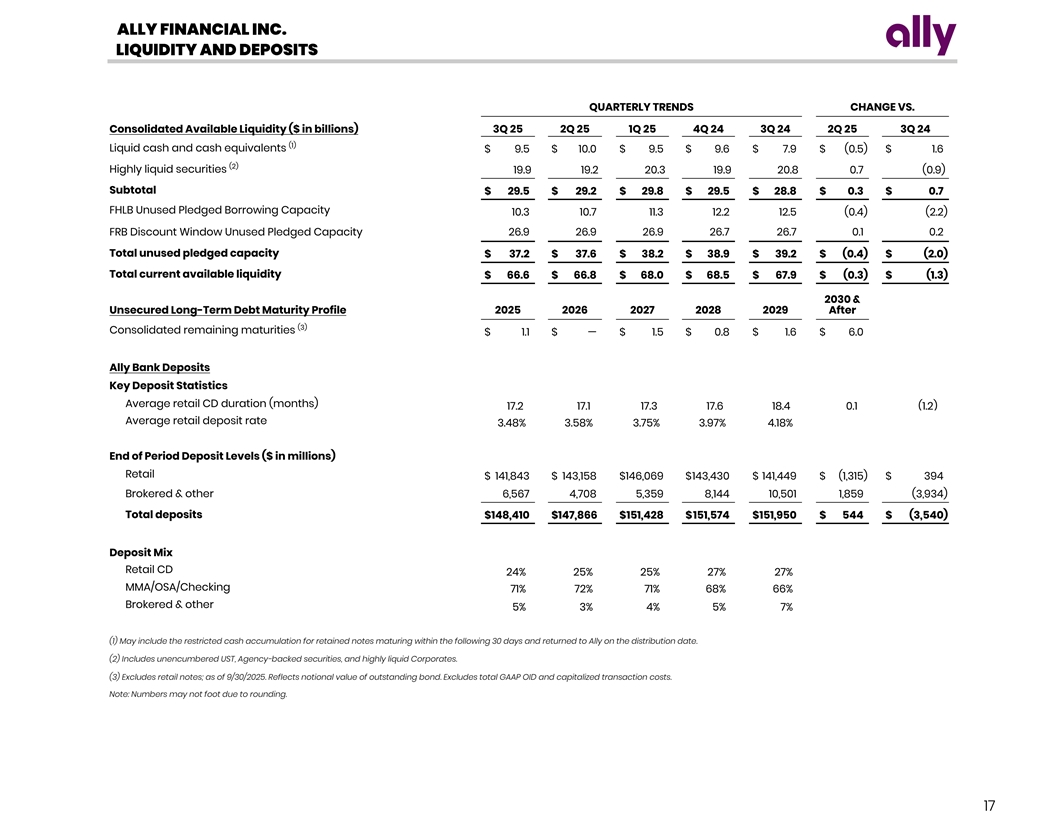
ALLY FINANCIAL INC. LIQUIDITY AND DEPOSITS QUARTERLY TRENDS CHANGE VS. Consolidated Available Liquidity ($ in billions) 3Q 25 2Q 25 1Q 25 4Q 24 3Q 24 2Q 25 3Q 24 (1) Liquid cash and cash equivalents $ 9.5 $ 10.0 $ 9.5 $ 9.6 $ 7.9 $ (0.5) $ 1.6 (2) Highly liquid securities 19.9 19.2 20.3 19.9 20.8 0.7 (0.9) Subtotal $ 29.5 $ 29.2 $ 29.8 $ 29.5 $ 28.8 $ 0.3 $ 0.7 FHLB Unused Pledged Borrowing Capacity 10.3 10.7 11.3 12.2 12.5 (0.4) (2.2) FRB Discount Window Unused Pledged Capacity 26.9 26.9 26.9 26.7 26.7 0.1 0.2 Total unused pledged capacity $ 37.2 $ 37.6 $ 38.2 $ 38.9 $ 39.2 $ (0.4) $ (2.0) Total current available liquidity $ 66.6 $ 66.8 $ 68.0 $ 68.5 $ 67.9 $ (0.3) $ (1.3) 2030 & Unsecured Long-Term Debt Maturity Profile 2025 2026 2027 2028 2029 After (3) Consolidated remaining maturities $ 1.1 $ — $ 1.5 $ 0.8 $ 1.6 $ 6.0 Ally Bank Deposits Key Deposit Statistics Average retail CD duration (months) 17.2 17.1 17.3 17.6 18.4 0.1 (1.2) Average retail deposit rate 3 .48% 3.58% 3.75% 3 .97 % 4.18% End of Period Deposit Levels ($ in millions) Retail $ 141,843 $ 143,158 $ 146,069 $ 143,430 $ 141,449 $ (1,315) $ 394 Brokered & other 6,567 4,708 5,359 8,144 10,501 1,859 (3,934) Total deposits $ 148,410 $ 147,866 $ 151,428 $ 151,574 $ 151,950 $ 544 $ (3,540) Deposit Mix Retail CD 24% 25% 25% 2 7 % 27 % MMA/OSA/Checking 7 1% 72 % 7 1 % 68% 66% Brokered & other 5 % 3% 4 % 5 % 7 % (1) May include the restricted cash accumulation for retained notes maturing within the following 30 days and returned to Ally on the distribution date. (2) Includes unencumbered UST, Agency-backed securities, and highly liquid Corporates. (3) Excludes retail notes; as of 9/30/2025. Reflects notional value of outstanding bond. Excludes total GAAP OID and capitalized transaction costs. Note: Numbers may not foot due to rounding. 17

ALLY FINANCIAL INC. NET INTEREST MARGIN QUARTERLY TRENDS CHANGE VS. ($ in millions) 3Q 25 2Q 25 1Q 25 4Q 24 3Q 24 2Q 25 3Q 24 Average Balance Details $ 84,592 $ 83,858 $ 83,701 $ 83,554 $ 83,574 $ 734 $ 1,018 Retail Auto Loans 8,255 7,919 7,955 7,794 8,038 336 217 Auto Lease (net of dep.) 14,771 14,570 15,324 17,074 17,535 201 (2,764) Dealer Floorplan Other Dealer Loans 6,348 6,293 6,339 6,374 6,348 55 — 11,085 11,079 10,304 9,824 10,101 6 984 Corporate Finance (1) 16,458 16,798 17,104 17,438 17,922 (340) (1,464) Mortgage (2) Consumer Other - Ally Credit Card — — 2,274 2,220 2,125 — (2,125) 8,465 8,888 9,345 8,721 7,867 (423) 598 Cash and Cash Equivalents 28,756 28,658 28,733 29,169 29,982 98 (1,226) Investment Securities and Other $ 178,730 $ 178,063 $ 181,079 $ 182,168 $ 183,492 $ 667 $ (4,762) Total Earning Assets Interest Revenue 3,162 3,109 3,153 3,308 3,405 53 (243) (3) $ 11,598 $ 11,171 $ 11,797 $ 11,083 $ 11,243 $ 427 $ 355 Unsecured Debt (ex. Core OID balance) Secured Debt 1,780 1,794 2,096 2,155 1,364 (14) 416 (4) 147,660 148,444 150,640 151,502 152,241 (784) (4,581) Deposits 4,590 4,352 4,204 4,699 5,743 238 (1,153) Other Borrowings (3) Total Funding Sources (ex. Core OID balance) $ 165,628 $ 165,761 $ 168,738 $ 169,439 $ 170,591 $ (133) $ (4,963) (3) Interest Expense (ex. Core OID) 1,561 1,577 1,659 1,784 1,871 (16) (310) (3) Net Financing Revenue (ex. Core OID) $ 1,601 $ 1,532 $ 1,494 $ 1,524 $ 1,534 $ 69 $ 66 Net Interest Margin (yield details) Retail Auto Loan 9 .28 % 9 .27% 9.21% 9.27 % 9 .29 % 0 .01% ( 0.01)% 9 .21 % 9 .19% 9 .11% 9.09 % 8 .99 % 0.02 % 0.22 % Retail Auto Loan (excl. hedge impact) 6.70 % 6 .88% 5.69% 6 .60% 7.22% ( 0.18)% (0.52)% Auto Lease (net of dep.) 6.42 % 6.41% 6.50% 7.01% 7 .68 % 0 .01% (1.26)% Dealer Floorplan 5 .66% 5.64% 5.66% 5.60% 5 .65 % 0.02 % 0.01 % Other Dealer Loans Corporate Finance 8 .59 % 8 .52% 8.78 % 9 .68 % 9.82% 0 .07 % (1.23)% 3 .14% 3.17% 3 .23% 3.17 % 3 .21 % ( 0.03) % (0.07)% Mortgage (2) Consumer Other - Ally Credit Card — % — % 2 1.16% 2 1.48% 22.13% —% (22.13)% (5) Cash and Cash Equivalents 4 .28% 4.32 % 4 .23% 4 .52% 5 .14% ( 0.04)% (0.86) % 3 .47 % 3 .50 % 3.26 % 3 .34 % 3.51% (0.03) % ( 0.04) % Investment Securities and Other Total Earning Assets 7.02% 7 .00 % 7.06% 7 .22% 7 .38 % 0.02 % (0.36) % (3) Unsecured Debt (ex. Core OID & Core OID balance) 6.33% 6 .42% 6 .40 % 6 .37% 6 .27 % ( 0.09)% 0 .06% Secured Debt 5 .41% 5.51% 5 .55% 6 .29 % 6 .39 % ( 0.10) % (0.98) % (4) Deposits 3 .50% 3 .59 % 3 .78% 4 .01 % 4.23 % (0.09) % ( 0.73) % (6) 4 .26 % 4 .15% 4.03% 3 .88 % 3 .83 % 0.11% 0 .43 % Other Borrowings (3) 3.74 % 3 .82 % 3.99 % 4 .19% 4.36 % ( 0.08) % ( 0.61)% Total Funding Sources (ex. Core OID & Core OID balance) NIM (as reported) 3 .51 % 3 .41% 3.31 % 3.30% 3 .29 % 0 .10% 0.22% (3) 3 .55% 3.45 % 3 .35% 3 .33 % 3.32 % 0.10 % 0.23 % NIM (ex. Core OID & Core OID balance) (1) Mortgage loans in run-off at the Corporate and Other segment. (2) Credit card assets moved to Assets of Operations Held-for-Sale (HFS) on 3/31/25. Sale of Credit Card closed on 04/01/25. (3) Represents a non-GAAP financial measure. Excludes Core OID from interest expense and Core OID balance from Unsecured Debt. For more details refer to pages 23-25. (4) Includes retail, brokered, and other deposits. Other includes sweep deposits and other deposits. (5) Includes interest expense related to margin received on derivative contracts. Excluding this expense, annualized yields were 4.28% for 3Q25, 4.35% for 2Q25, 4.37% for 1Q25, 4.68% for 4Q24, and 5.29% for 3Q24.. (6) Includes FHLB Borrowings, Repurchase Agreements and other. Note: Numbers may not foot due to rounding. 18

ALLY FINANCIAL INC. EARNINGS PER SHARE RELATED INFORMATION ($ in millions, shares in thousands) QUARTERLY TRENDS CHANGE VS. Earnings Per Share Data 3Q 25 2Q 25 1Q 25 4Q 24 3Q 24 2Q 25 3Q 24 GAAP net income (loss) attributable to common shareholders $ 371 $ 324 $ (253) $ 81 $ 171 $ 47 $ 200 (1) Weighted-average common shares outstanding - basic 310,342 309,895 309,006 307,553 307,312 446 3,030 (1) Weighted-average common shares outstanding - diluted 313,823 312,434 309,006 311,277 311,044 1,388 2,779 Issued shares outstanding (period-end) 307,828 307,787 307,152 305,388 304,715 41 3,113 (1) Net income (loss) per share - basic $ 1.19 $ 1.05 $ (0.82) $ 0.26 $ 0.55 $ 0.15 $ 0.64 (1) Net income (loss) per share - diluted $ 1.18 $ 1.04 $ (0.82) $ 0.26 $ 0.55 $ 0.14 $ 0.63 (2) Adjusted Earnings per Share ( Adjusted EPS ) Numerator GAAP net income (loss) attributable to common shareholders $ 371 $ 324 $ (253) $ 81 $ 171 $ 47 $ 200 Discontinued operations, net of tax — — — 1 — — — (3) Core OID 17 16 16 15 14 1 2 (4) Change in the fair value of equity securities (27) (35) 13 47 (59) 7 32 Core OID, repositioning & change in the fair value of equity securities tax (tax rate 21%) 2 4 (99) (38) 9 (2) (7) (4) Repositioning — — 503 140 — — — (3) Core net income attributable to common shareholders $ 363 $ 309 $ 179 $ 246 $ 136 $ 53 $ 227 Denominator Weighted-average common shares outstanding - basic or diluted as applicable 313,823 312,434 309,006 311,277 311,044 1,388 2,779 (2) Adjusted EPS $ 1.15 $ 0.99 $ 0.58 $ 0.78 $ 0.43 $ 0.16 $ 0.72 GAAP original issue discount amortization expense $ 19 $ 18 $ 18 $ 17 $ 17 $ 0 $ 1 Other OID (2) (2) (3) (3) (3) 0 1 (3) Core original issue discount (Core OID) amortization expense $ 17 $ 16 $ 16 $ 15 $ 14 $ 1 $ 2 GAAP outstanding original issue discount balance $ (708) $ (727) $ (745) $ (763) $ (780) $ 19 $ 72 Other outstanding OID balance 20 22 24 27 29 (2) (9) (3) Core outstanding original issue discount balance (Core OID balance) $ (688) $ (705) $ (721) $ (736) $ (751) $ 17 $ 63 GAAP Net Financing Revenue $ 1,584 $ 1,516 $ 1,478 $ 1,509 $ 1,520 $ 68 $ 64 (3) Core OID 17 16 16 15 14 1 2 (3) Net Financing Revenue (ex. Core OID) $ 1,601 $ 1,532 $ 1,494 $ 1,524 $ 1,534 $ 69 $ 66 GAAP Other Revenue $ 584 $ 566 $ 63 $ 517 $ 615 $ 18 $ (31) (4) Repositioning — — 495 — — — — (4) Change in the fair value of equity securities (27) (35) 13 47 (59) 7 32 (3) Adjusted Other Revenue $ 557 $ 531 $ 571 $ 564 $ 556 $ 25 $ 1 GAAP Provision Expense $ 415 $ 384 $ 191 $ 557 $ 645 $ 31 $ (230) (4) Repositioning — — 306 — — — — (3) Adjusted Provision (ex. Repositioning) $ 415 $ 384 $ 497 $ 557 $ 645 $ 31 $ (230) GAAP Noninterest Expense $ 1,240 $ 1,262 $ 1,634 $ 1,360 $ 1,225 $ (22) $ 15 (4) Repositioning and other — — (314) (140) — — — (3) Adjusted Noninterest Expense $ 1,240 $ 1,262 $ 1,320 $ 1,220 $ 1,225 $ (22) $ 15 (1) Due to the antidilutive effect of the net loss attributable to common shareholders for the first quarter 2025, basic weighted average common shares outstanding were used to calculate basic or diluted earnings per share, as applicable. (2) Adjusted earnings per share (Adjusted EPS) is a non-GAAP financial measure that adjusts GAAP EPS for revenue and expense items that are typically strategic in nature or that management otherwise does not view as reflecting the operating performance of the company. Management believes Adjusted EPS can help the reader better understand the operating performance of the core businesses and their ability to generate earnings. In the numerator of Adjusted EPS, GAAP net income attributable to common shareholders is adjusted for the following items: (1) excludes discontinued operations, net of tax, as Ally is primarily a domestic company and sales of international businesses and other discontinued operations in the past have significantly impacted GAAP EPS, (2) adds back the tax- effected non-cash Core OID, (3) adjusts for tax-effected repositioning and other which are primarily related to the extinguishment of high cost legacy debt, strategic activities and significant other one-time items, (4) change in fair value of equity securities, (5) excludes significant discrete tax items that do not relate to the operating performance of the core businesses, and adjusts for preferred stock capital actions that have been taken by the company to normalize its capital structure, as applicable for respective periods. See pages 23-25 for details. (3) Represents a non-GAAP financial measure. For more details refer to pages 23-25. (4) For more details refer to pages 23-25. Note: Numbers may not foot due to rounding. 19
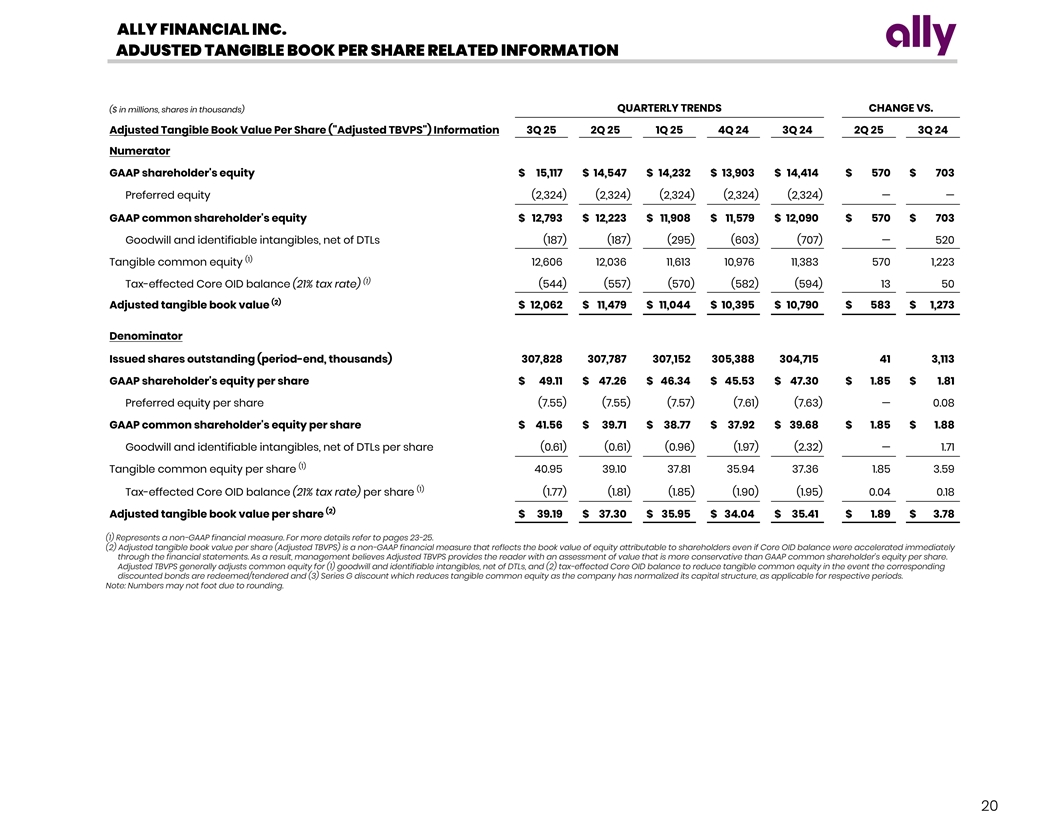
ALLY FINANCIAL INC. ADJUSTED TANGIBLE BOOK PER SHARE RELATED INFORMATION QUARTERLY TRENDS CHANGE VS. ($ in millions, shares in thousands) Adjusted Tangible Book Value Per Share ( Adjusted TBVPS ) Information 3Q 25 2Q 25 1Q 25 4Q 24 3Q 24 2Q 25 3Q 24 Numerator GAAP shareholder's equity $ 15,117 $ 14,547 $ 14,232 $ 13,903 $ 14,414 $ 570 $ 703 Preferred equity (2,324) (2,324) (2,324) (2,324) (2,324) — — GAAP common shareholder's equity $ 12,793 $ 12,223 $ 11,908 $ 11,579 $ 12,090 $ 570 $ 703 Goodwill and identifiable intangibles, net of DTLs (187) (187) (295) (603) (707) — 520 (1) Tangible common equity 12,606 12,036 11,613 10,976 11,383 570 1,223 (1) Tax-effected Core OID balance (21% tax rate) (544) (557) (570) (582) (594) 13 50 (2) Adjusted tangible book value $ 12,062 $ 11,479 $ 11,044 $ 10,395 $ 10,790 $ 583 $ 1,273 Denominator Issued shares outstanding (period-end, thousands) 307,828 307,787 307,152 305,388 304,715 41 3,113 GAAP shareholder's equity per share $ 49.11 $ 47.26 $ 46.34 $ 45.53 $ 47.30 $ 1.85 $ 1.81 Preferred equity per share (7.55) (7.55) (7.57) (7.61) (7.63) — 0.08 GAAP common shareholder's equity per share $ 41.56 $ 39.71 $ 38.77 $ 37.92 $ 39.68 $ 1.85 $ 1.88 Goodwill and identifiable intangibles, net of DTLs per share (0.61) (0.61) (0.96) (1.97) (2.32) — 1.71 (1) Tangible common equity per share 40.95 39.10 37.81 35.94 37.36 1.85 3.59 (1) Tax-effected Core OID balance (21% tax rate) per share (1.77) (1.81) (1.85) (1.90) (1.95) 0.04 0.18 (2) Adjusted tangible book value per share $ 39.19 $ 37.30 $ 35.95 $ 34.04 $ 35.41 $ 1.89 $ 3.78 (1) Represents a non-GAAP financial measure. For more details refer to pages 23-25. (2) Adjusted tangible book value per share (Adjusted TBVPS) is a non-GAAP financial measure that reflects the book value of equity attributable to shareholders even if Core OID balance were accelerated immediately through the financial statements. As a result, management believes Adjusted TBVPS provides the reader with an assessment of value that is more conservative than GAAP common shareholder’s equity per share. Adjusted TBVPS generally adjusts common equity for (1) goodwill and identifiable intangibles, net of DTLs, and (2) tax-effected Core OID balance to reduce tangible common equity in the event the corresponding discounted bonds are redeemed/tendered and (3) Series G discount which reduces tangible common equity as the company has normalized its capital structure, as applicable for respective periods. Note: Numbers may not foot due to rounding. 20

ALLY FINANCIAL INC. CORE ROTCE RELATED INFORMATION ($ in millions) unless noted otherwise QUARTERLY TRENDS CHANGE VS. Core Return on Tangible Common Equity ( Core ROTCE ) 3Q 25 2Q 25 1Q 25 4Q 24 3Q 24 2Q 25 3Q 24 Numerator GAAP net income (loss) attributable to common shareholders $ 371 $ 324 $ (253) $ 81 $ 171 $ 47 $ 200 Discontinued operations, net of tax — — — 1 — — 0 (2) Core OID 17 16 16 15 14 1 2 (2) Change in the fair value of equity securities (27) (35) 13 47 (59) 7 32 Core OID, repositioning & change in the fair value of equity 2 4 (99) (38) 9 (2) (7) securities tax (tax rate 21%) (2) Repositioning — — 503 140 — — — (1) Core net income attributable to common shareholders $ 363 $ 309 $ 179 $ 246 $ 136 $ 53 $ 227 Denominator (average, $ millions) GAAP shareholder's equity $ 14,832 $ 14,390 $ 14,068 $ 14,159 $ 14,057 $ 443 $ 776 Preferred equity (2,324) (2,324) (2,324) (2,324) (2,324) — — Goodwill & identifiable intangibles, net of deferred tax liabilities (187) (241) (449) (655) (710) 54 523 ( DTLs ) (1) Tangible common equity $ 12,321 $ 11,824 $ 11,295 $ 11,180 $ 11,023 $ 496 $ 1,298 Core OID balance (696) (713) (729) (744) (759) 16 62 Net deferred tax asset ( DTA ) (2,119) (2,004) (1,923) (1,713) (1,531) (114) (588) Normalized common equity $ 9,506 $ 9,107 $ 8,644 $ 8,723 $ 8,733 $ 398 $ 772 (3) Core Return on Tangible Common Equity 15.3% 13.6% 8 .3 % 1 1.3% 6.2% Memo (average, $ millions): Accumulated Other Comprehensive Loss $ (3,082) $ (3,241) $ (3,593) $ (3,659) $ (3,701) (1) Represents a non-GAAP measure. See pages 23-25 for methodology and detail. (2) For more details see pages 23-25. (3) Core return on tangible common equity (Core ROTCE) is a non-GAAP financial measure that management believes is helpful for readers to better understand the ongoing ability of the company to generate returns on its equity base that supports core operations. For purposes of this calculation, tangible common equity is adjusted for Core OID balance and net DTA. Ally’s Core net income attributable to common shareholders for purposes of calculating Core ROTCE is based on the actual effective tax rate for the period adjusted for significant discrete tax items including tax reserve releases, which aligns with the methodology used in calculating adjusted earnings per share. (1) In the numerator of Core ROTCE, GAAP net income attributable to common shareholders is adjusted for discontinued operations net of tax, tax-effected Core OID, tax-effected repositioning and other which are primarily related to the extinguishment of high-cost legacy debt, strategic activities and significant other one-time items, change in fair value of equity securities, significant discrete tax items, and preferred stock capital actions, as applicable for respective periods. (2) In the denominator, GAAP shareholder’s equity is adjusted for goodwill and identifiable intangibles net of DTL, Core OID balance, and net DTA. Note: Numbers may not foot due to rounding. 21
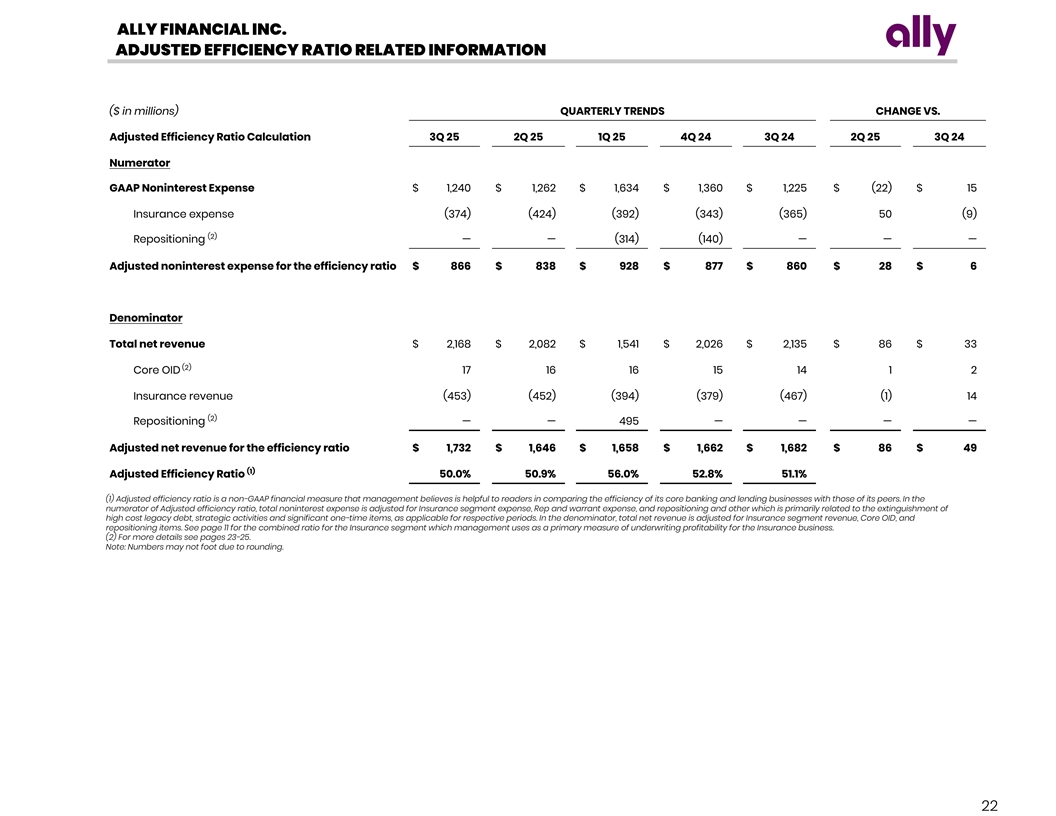
ALLY FINANCIAL INC. ADJUSTED EFFICIENCY RATIO RELATED INFORMATION ($ in millions) QUARTERLY TRENDS CHANGE VS. Adjusted Efficiency Ratio Calculation 3Q 25 2Q 25 1Q 25 4Q 24 3Q 24 2Q 25 3Q 24 Numerator GAAP Noninterest Expense $ 1,240 $ 1,262 $ 1,634 $ 1,360 $ 1,225 $ (22) $ 15 Insurance expense (374) (424) (392) (343) (365) 50 (9) (2) Repositioning — — (314) (140) — — — Adjusted noninterest expense for the efficiency ratio $ 866 $ 838 $ 928 $ 877 $ 860 $ 28 $ 6 Denominator Total net revenue $ 2,168 $ 2,082 $ 1,541 $ 2,026 $ 2,135 $ 86 $ 33 (2) Core OID 17 16 16 15 14 1 2 Insurance revenue (453) (452) (394) (379) (467) (1) 14 (2) Repositioning — — 495 — — — — Adjusted net revenue for the efficiency ratio $ 1,732 $ 1,646 $ 1,658 $ 1,662 $ 1,682 $ 86 $ 49 (1) Adjusted Efficiency Ratio 50.0 % 5 0.9% 5 6.0% 5 2.8% 51.1 % (1) Adjusted efficiency ratio is a non-GAAP financial measure that management believes is helpful to readers in comparing the efficiency of its core banking and lending businesses with those of its peers. In the numerator of Adjusted efficiency ratio, total noninterest expense is adjusted for Insurance segment expense, Rep and warrant expense, and repositioning and other which is primarily related to the extinguishment of high cost legacy debt, strategic activities and significant one-time items, as applicable for respective periods. In the denominator, total net revenue is adjusted for Insurance segment revenue, Core OID, and repositioning items. See page 11 for the combined ratio for the Insurance segment which management uses as a primary measure of underwriting profitability for the Insurance business. (2) For more details see pages 23-25. Note: Numbers may not foot due to rounding. 22

ALLY FINANCIAL INC. The following are non-GAAP financial measures which Ally believes are important to the reader of the Consolidated Financial Statements, but which are supplemental to and not a substitute for GAAP measures: Accelerated issuance expense (Accelerated OID), Adjusted earnings per share (Adjusted EPS), Adjusted efficiency ratio, Adjusted noninterest expense, Adjusted other revenue, Adjusted tangible book value per share (Adjusted TBVPS), Adjusted total net revenue, Core net income attributable to common shareholders, Core original issue discount (Core OID) amortization expense, Core outstanding original issue discount balance (Core OID balance), Core pre-tax income, Core return on tangible common equity (Core ROTCE), Investment income and other (adjusted), Net financing revenue (excluding Core OID), Net interest margin (excluding Core OID), and Tangible Common Equity. These measures are used by management and we believe are useful to investors in assessing the company’s operating performance and capital. 1) Accelerated issuance expense (Accelerated OID) is the recognition of issuance expenses related to calls of redeemable debt. 2) Adjusted earnings per share (Adjusted EPS) is a non-GAAP financial measure that adjusts GAAP EPS for revenue and expense items that are typically strategic in nature or that management otherwise does not view as reflecting the operating performance of the company. Management believes Adjusted EPS can help the reader better understand the operating performance of the core businesses and their ability to generate earnings. In the numerator of Adjusted EPS, GAAP net income attributable to common shareholders is adjusted for the following items: (1) excludes discontinued operations, net of tax, as Ally is primarily a domestic company and sales of international businesses and other discontinued operations in the past have significantly impacted GAAP EPS, (2) adds back the tax-effected non-cash Core OID, (3) adjusts for tax-effected repositioning and other which are primarily related to the extinguishment of high cost legacy debt, strategic activities and significant other one-time items, (4) excludes change in fair value of equity securities, (5) excludes significant discrete tax items that do not relate to the operating performance of the core businesses, and adjusts for preferred stock capital actions that have been taken by the company to normalize its capital structure, as applicable for respective periods. 3) Adjusted efficiency ratio is a non-GAAP financial measure that management believes is helpful to readers in comparing the efficiency of its core banking and lending businesses with those of its peers. (1) In the numerator of Adjusted efficiency ratio, total noninterest expense is adjusted for Rep and warrant expense, Insurance segment expense, and repositioning and other which are primarily related to the extinguishment of high-cost legacy debt, strategic activities and significant other one-time items, as applicable for respective periods. (2) In the denominator, total net revenue is adjusted for Core OID and Insurance segment revenue. 4) Adjusted noninterest expense is a non-GAAP financial measure that adjusts GAAP noninterest expense for repositioning items. Management believes adjusted noninterest expense is a helpful financial metric because it enables the reader better understand the business' expenses excluding nonrecurring items. 5) Adjusted other revenue is a non-GAAP financial measure that adjusts GAAP other revenue for OID expenses, repositioning, and change in fair value of equity securities. Management believes adjusted other revenue is a helpful financial metric because it enables the reader to better understand the business' ability to generate other revenue. 6) Adjusted Provision for Credit Losses is a non-GAAP financial measure that adjusts GAAP provision for credit losses for repositioning items. Management believes adjusted provision for credit losses is a helpful financial metric because it enables the reader better understand the business’s expenses excluding nonrecurring items. 7) Adjusted tangible book value per share (Adjusted TBVPS) is a non-GAAP financial measure that reflects the book value of equity attributable to shareholders even if Core OID balance were accelerated immediately through the financial statements. As a result, management believes Adjusted TBVPS provides the reader with an assessment of value that is more conservative than GAAP common shareholder’s equity per share. Adjusted TBVPS generally adjusts common equity for: (1) goodwill and identifiable intangibles, net of DTLs, (2) tax-effected Core OID balance to reduce tangible common equity in the event the corresponding discounted bonds are redeemed/tendered, and (3) Series G discount which reduces tangible common equity as the company has normalized its capital structure, as applicable for respective periods. Note: In December 2017, tax-effected Core OID balance was adjusted from a statutory U.S. Federal tax rate of 35% to 21% (“rate”) as a result of changes to U.S. tax law. The adjustment conservatively increased the tax-effected Core OID balance and consequently reduced Adjusted TBVPS as any acceleration of the non-cash charge in future periods would flow through the financial statements at a 21% rate versus a previously modeled 35% rate. 8) Adjusted total net revenue is a non-GAAP financial measure that management believes is helpful for readers to understand the ongoing ability of the company to generate revenue. For purposes of this calculation, GAAP net financing revenue is adjusted by excluding Core OID to calculate net financing revenue ex. core OID. GAAP other revenue is adjusted for OID expenses, repositioning, and change in fair value of equity securities to calculate adjusted other revenue. Adjusted total net revenue is calculated by adding net financing revenue ex. core OID to adjusted other revenue. 9) Change in fair value of equity securities impacts the Insurance, Corporate Finance and Corporate and Other segments. The change reflects fair value adjustments to equity securities that are reported at fair value. Management believes the change in fair value of equity securities should be removed from select financial measures because it enables the reader to better understand the business’ ongoing ability to generate revenue and income. 23
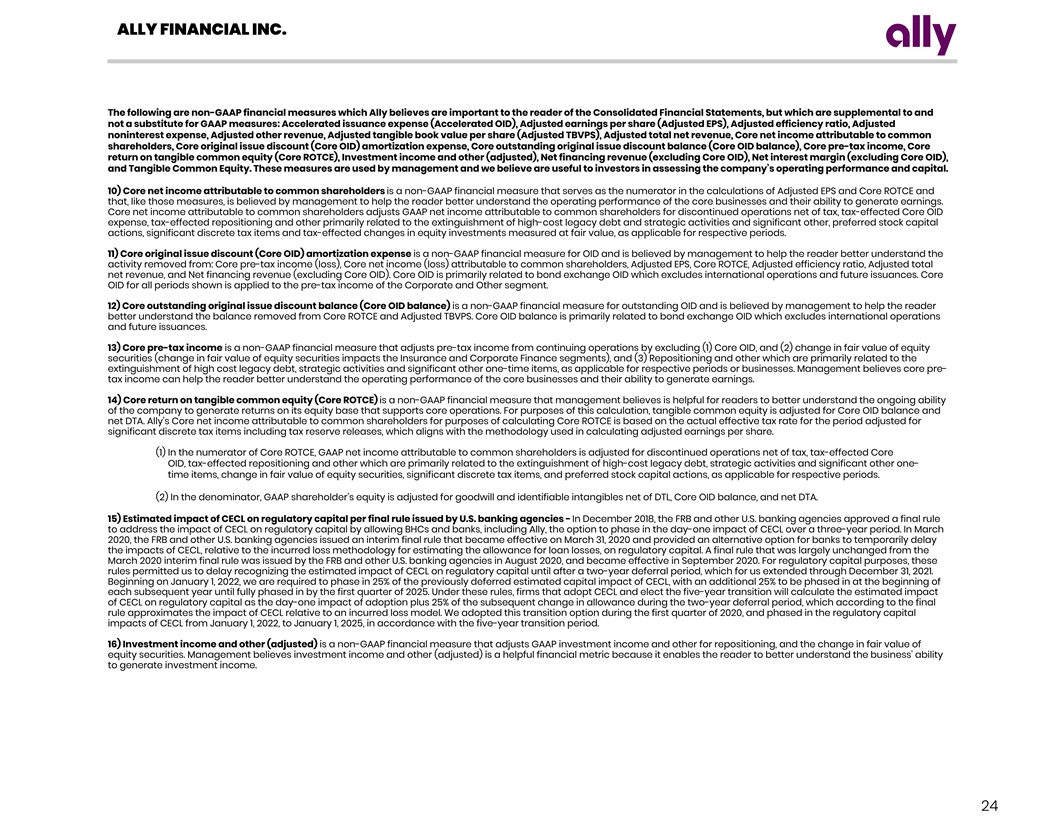
ALLY FINANCIAL INC. The following are non-GAAP financial measures which Ally believes are important to the reader of the Consolidated Financial Statements, but which are supplemental to and not a substitute for GAAP measures: Accelerated issuance expense (Accelerated OID), Adjusted earnings per share (Adjusted EPS), Adjusted efficiency ratio, Adjusted noninterest expense, Adjusted other revenue, Adjusted tangible book value per share (Adjusted TBVPS), Adjusted total net revenue, Core net income attributable to common shareholders, Core original issue discount (Core OID) amortization expense, Core outstanding original issue discount balance (Core OID balance), Core pre-tax income, Core return on tangible common equity (Core ROTCE), Investment income and other (adjusted), Net financing revenue (excluding Core OID), Net interest margin (excluding Core OID), and Tangible Common Equity. These measures are used by management and we believe are useful to investors in assessing the company’s operating performance and capital. 10) Core net income attributable to common shareholders is a non-GAAP financial measure that serves as the numerator in the calculations of Adjusted EPS and Core ROTCE and that, like those measures, is believed by management to help the reader better understand the operating performance of the core businesses and their ability to generate earnings. Core net income attributable to common shareholders adjusts GAAP net income attributable to common shareholders for discontinued operations net of tax, tax-effected Core OID expense, tax-effected repositioning and other primarily related to the extinguishment of high-cost legacy debt and strategic activities and significant other, preferred stock capital actions, significant discrete tax items and tax-effected changes in equity investments measured at fair value, as applicable for respective periods. 11) Core original issue discount (Core OID) amortization expense is a non-GAAP financial measure for OID and is believed by management to help the reader better understand the activity removed from: Core pre-tax income (loss), Core net income (loss) attributable to common shareholders, Adjusted EPS, Core ROTCE, Adjusted efficiency ratio, Adjusted total net revenue, and Net financing revenue (excluding Core OID). Core OID is primarily related to bond exchange OID which excludes international operations and future issuances. Core OID for all periods shown is applied to the pre-tax income of the Corporate and Other segment. 12) Core outstanding original issue discount balance (Core OID balance) is a non-GAAP financial measure for outstanding OID and is believed by management to help the reader better understand the balance removed from Core ROTCE and Adjusted TBVPS. Core OID balance is primarily related to bond exchange OID which excludes international operations and future issuances. 13) Core pre-tax income is a non-GAAP financial measure that adjusts pre-tax income from continuing operations by excluding (1) Core OID, and (2) change in fair value of equity securities (change in fair value of equity securities impacts the Insurance and Corporate Finance segments), and (3) Repositioning and other which are primarily related to the extinguishment of high cost legacy debt, strategic activities and significant other one-time items, as applicable for respective periods or businesses. Management believes core pre- tax income can help the reader better understand the operating performance of the core businesses and their ability to generate earnings. 14) Core return on tangible common equity (Core ROTCE) is a non-GAAP financial measure that management believes is helpful for readers to better understand the ongoing ability of the company to generate returns on its equity base that supports core operations. For purposes of this calculation, tangible common equity is adjusted for Core OID balance and net DTA. Ally’s Core net income attributable to common shareholders for purposes of calculating Core ROTCE is based on the actual effective tax rate for the period adjusted for significant discrete tax items including tax reserve releases, which aligns with the methodology used in calculating adjusted earnings per share. (1) In the numerator of Core ROTCE, GAAP net income attributable to common shareholders is adjusted for discontinued operations net of tax, tax-effected Core OID, tax-effected repositioning and other which are primarily related to the extinguishment of high-cost legacy debt, strategic activities and significant other one- time items, change in fair value of equity securities, significant discrete tax items, and preferred stock capital actions, as applicable for respective periods. (2) In the denominator, GAAP shareholder’s equity is adjusted for goodwill and identifiable intangibles net of DTL, Core OID balance, and net DTA. 15) Estimated impact of CECL on regulatory capital per final rule issued by U.S. banking agencies - In December 2018, the FRB and other U.S. banking agencies approved a final rule to address the impact of CECL on regulatory capital by allowing BHCs and banks, including Ally, the option to phase in the day-one impact of CECL over a three-year period. In March 2020, the FRB and other U.S. banking agencies issued an interim final rule that became effective on March 31, 2020 and provided an alternative option for banks to temporarily delay the impacts of CECL, relative to the incurred loss methodology for estimating the allowance for loan losses, on regulatory capital. A final rule that was largely unchanged from the March 2020 interim final rule was issued by the FRB and other U.S. banking agencies in August 2020, and became effective in September 2020. For regulatory capital purposes, these rules permitted us to delay recognizing the estimated impact of CECL on regulatory capital until after a two-year deferral period, which for us extended through December 31, 2021. Beginning on January 1, 2022, we are required to phase in 25% of the previously deferred estimated capital impact of CECL, with an additional 25% to be phased in at the beginning of each subsequent year until fully phased in by the first quarter of 2025. Under these rules, firms that adopt CECL and elect the five-year transition will calculate the estimated impact of CECL on regulatory capital as the day-one impact of adoption plus 25% of the subsequent change in allowance during the two-year deferral period, which according to the final rule approximates the impact of CECL relative to an incurred loss model. We adopted this transition option during the first quarter of 2020, and phased in the regulatory capital impacts of CECL from January 1, 2022, to January 1, 2025, in accordance with the five-year transition period. 16) Investment income and other (adjusted) is a non-GAAP financial measure that adjusts GAAP investment income and other for repositioning, and the change in fair value of equity securities. Management believes investment income and other (adjusted) is a helpful financial metric because it enables the reader to better understand the business' ability to generate investment income. 24
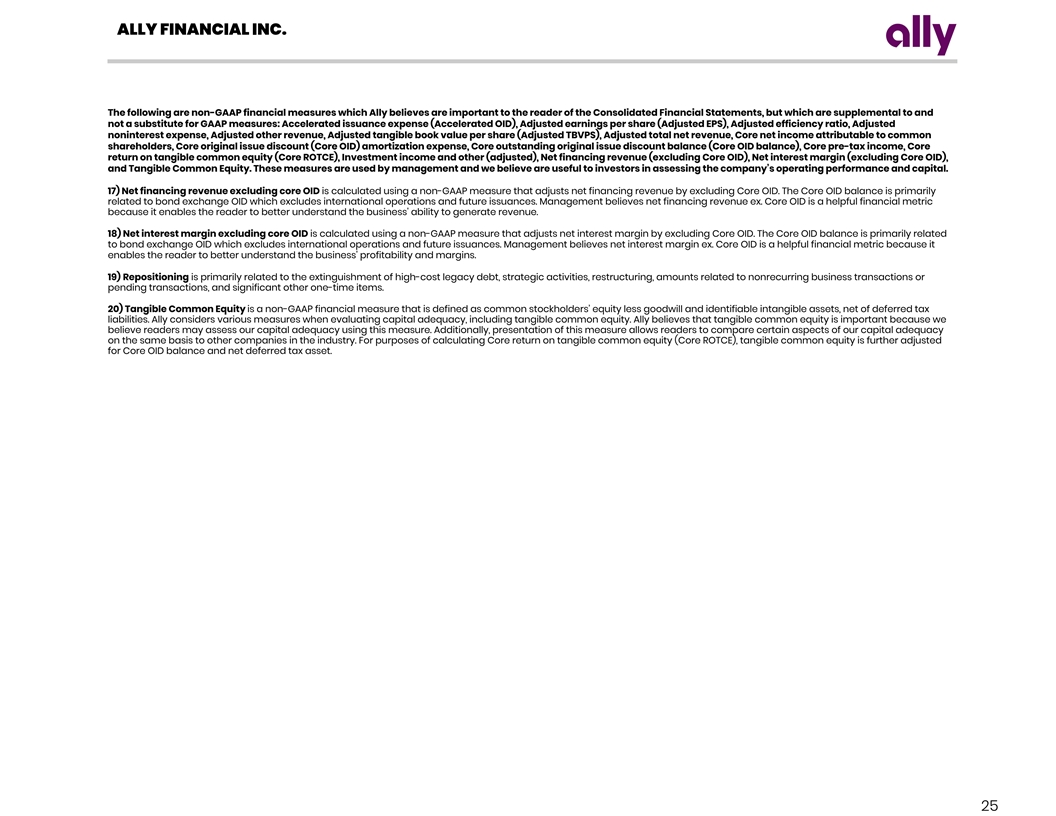
ALLY FINANCIAL INC. The following are non-GAAP financial measures which Ally believes are important to the reader of the Consolidated Financial Statements, but which are supplemental to and not a substitute for GAAP measures: Accelerated issuance expense (Accelerated OID), Adjusted earnings per share (Adjusted EPS), Adjusted efficiency ratio, Adjusted noninterest expense, Adjusted other revenue, Adjusted tangible book value per share (Adjusted TBVPS), Adjusted total net revenue, Core net income attributable to common shareholders, Core original issue discount (Core OID) amortization expense, Core outstanding original issue discount balance (Core OID balance), Core pre-tax income, Core return on tangible common equity (Core ROTCE), Investment income and other (adjusted), Net financing revenue (excluding Core OID), Net interest margin (excluding Core OID), and Tangible Common Equity. These measures are used by management and we believe are useful to investors in assessing the company’s operating performance and capital. 17) Net financing revenue excluding core OID is calculated using a non-GAAP measure that adjusts net financing revenue by excluding Core OID. The Core OID balance is primarily related to bond exchange OID which excludes international operations and future issuances. Management believes net financing revenue ex. Core OID is a helpful financial metric because it enables the reader to better understand the business' ability to generate revenue. 18) Net interest margin excluding core OID is calculated using a non-GAAP measure that adjusts net interest margin by excluding Core OID. The Core OID balance is primarily related to bond exchange OID which excludes international operations and future issuances. Management believes net interest margin ex. Core OID is a helpful financial metric because it enables the reader to better understand the business' profitability and margins. 19) Repositioning is primarily related to the extinguishment of high-cost legacy debt, strategic activities, restructuring, amounts related to nonrecurring business transactions or pending transactions, and significant other one-time items. 20) Tangible Common Equity is a non-GAAP financial measure that is defined as common stockholders’ equity less goodwill and identifiable intangible assets, net of deferred tax liabilities. Ally considers various measures when evaluating capital adequacy, including tangible common equity. Ally believes that tangible common equity is important because we believe readers may assess our capital adequacy using this measure. Additionally, presentation of this measure allows readers to compare certain aspects of our capital adequacy on the same basis to other companies in the industry. For purposes of calculating Core return on tangible common equity (Core ROTCE), tangible common equity is further adjusted for Core OID balance and net deferred tax asset. 25