 エドガーで原本を確認する
UNITED STATES
SECURITIES AND EXCHANGE COMMISSION
Washington, D.C. 20549
FORM 6-K
REPORT OF FOREIGN PRIVATE ISSUER
PURSUANT TO SECTION 13A-16 OR 15D-16
UNDER THE SECURITIES EXCHANGE ACT OF 1934
For the month of May 2025
Commission File Number: 001-40865
Wallbox N.V.
(Translation of registrant’s name into English)
Carrer del Foc, 68
Barcelona, Spain 08038
Tel: +34 930 181 668
(Address of principal executive office)
Indicate by check mark whether the registrant files or will file annual reports under cover of Form 20-F or Form 40-F.
Form 20-F ☒ Form 40-F ☐
EXPLANATORY NOTE
On May 30, 2025, Wallbox N.V. (“Wallbox” or the “Company”) published information relating to its Annual General Meeting of shareholders to be held on June 30, 2025 (the “2025 Annual General Meeting”).
A copy of the Company’s (1) Invitation Announcement to the 2025 Annual General Meeting of Wallbox N.V., (2) Convocation Notice and Explanatory Notes, (3) Annual Report (including the Annual Accounts for the Financial Year 2024), (4) proposed Deed of Amendment to the Company’s Articles of Association regarding the increase of authorized capital, and (5) proposed Deed of Amendment to the Company’s Articles of Association regarding the reverse stock split, are attached hereto as exhibit 99.1, 99.2, 99.3, 99.4 and 99.5, respectively (collectively, the “Annual General Meeting Materials”).
Copies of the Annual General Meeting Materials are available for inspection and can be obtained free of charge by shareholders and others through the Company’s website at investors.wallbox.com and at the offices of the Company at Carrer del Foc 68, 08038 Barcelona, Spain, until the close of the 2025 Annual General Meeting.
EXHIBIT INDEX
SIGNATURES
Pursuant to the requirements of the Securities Exchange Act of 1934, as amended, the registrant has duly caused this report to be signed on its behalf by the undersigned hereunto duly authorized.
| Wallbox N.V. | ||||||
| Date: May 30, 2025 | By: | /s/ Enric Asunción Escorsa |
||||
| Enric Asunción Escorsa | ||||||
| Chief Executive Officer | ||||||
Exhibit 99.1
Date: Amsterdam, the Netherlands, 30 May 2025
WALLBOX N.V.
with its official seat in Amsterdam, the Netherlands
INVITATION
To the 2025 Annual General Meeting (AGM) of Wallbox N.V. (Company)
at 30 June 2025 CEST on 12:30 pm CEST 2025
at Parnassusweg 300, 1081 LC Amsterdam, the Netherlands
Agenda
| (1) | Opening |
| (2) | Discussion of the annual report for the financial year 2024 (discussion item) |
| (3) | Adoption of the annual accounts for the financial year 2024 (voting item) |
| (4) | Explanation of policy on reserves and dividends (discussion item) |
| (5) | Discharge from liability of the directors for the performance of their duties during the financial year 2024 (voting item) |
| (6) | Reappointment and appointment of the following six directors of the Company for a term expiring at the end of the Company’s annual general meeting to be held in the year 2026 (voting items): |
| (a) | Reappointment of Enric Asunción Escorsa as executive director |
| (b) | Reappointment of Beatriz González Ordóñez as non-executive director |
| (c) | Reappointment of Francisco J. Riberas Mera as non-executive director |
| (d) | Reappointment of Ferdinand Schlutius as non-executive director |
| (e) | Reappointment of Jordi Lainz Gavalda as non-executive director |
| (f) | Appointment of Juan González del Castillo Burgos as non-executive director |
| (7) | Authorization of the Board to acquire shares in its own capital (voting item) |
| (8) | Designation of the Board as the corporate body authorized to issue shares and grant rights to subscribe for shares (voting item) |
| (9) | Designation of the Board as the corporate body authorized to limit and/or exclude pre-emptive rights in relation to an issuance of shares or a granting of rights to subscribe for shares (voting item) |
| (10) | Reappointment of Ernst & Young Accountants, LLP as external auditor for the financial year 2025 (voting item) |
| (11) | Increase of the authorized capital and amendment of the articles of association of the Company (voting item) |
| (12) | Reverse stock split and amendment of the articles of association of the Company (voting item) |
| (13) | Cancellation of fractional shares held or acquired by the Company (voting item) |
| (14) | Offset of losses against share premium (voting item) |
| (15) | Any other business |
| (16) | Closing |
Meeting materials
Copies of the annual report for the financial year 2024, the annual accounts for the financial year 2024 and the explanatory notes to the agenda (as well as any other meeting materials, including copies of the proposed amendments to the articles of association of the Company, including the verbatim text thereof) are available for inspection and can be obtained free of charge by shareholders and others through the Company’s website (https://investors.wallbox.com) and at the offices of the Company at Carrer del Foc 68, 08038 Barcelona, Spain, until the close of the AGM.
Record Date and designated registers
The record date for all shareholders for the AGM is 2 June 2025 (Record Date). All holders of shares in the capital of the Company as of the Record Date are entitled to receive notice, attend the AGM and vote at the AGM. Those shareholders, and any other person with meeting rights and/or voting rights with respect to shares in the capital of the Company, listed as such on the Record Date in the Company’s shareholders’ register or in the register maintained by the Company’s U.S. transfer agent, Continental Stock Transfer & Trust Company, may attend and, if relevant, vote at the AGM (Registered Holders), regardless of who is entitled to the shares in the capital of the Company at the date of the AGM.
Attendance and voting
Class A shares in the capital of the Company confer the right to cast one vote at the AGM. Class B shares in the capital of the Company confer the right to cast ten votes at the AGM.
Attendance and voting at the meeting in person
Registered Holders and persons who beneficially own shares in the capital of the Company through a broker, bank, nominee or other financial intermediary on the Record Date (Beneficial Owners), who wish to attend and vote at the AGM, must notify the Company in writing of their intention to do so no later than 5:59 am CEST on 26 June 2025 (11:59 pm ET on 25 June 2025).
Registered Holders must (i) include in their notification to the Company their name and the number of shares in the capital of the Company held by them on the Record Date, (ii) enclose with their notification proof of their ownership of the relevant shares and bring such proof to the AGM, and (iii) bring proof of identity to the AGM.
Beneficial Owners must have their broker, bank, nominee or other financial intermediary with whom the underlying shares in the capital of the Company are on deposit, issue a proxy to them which confirms they are authorized to take part in and vote at the AGM. These Beneficial Owners must (i) include in their notification to the Company their name and the number of shares beneficially owned by them on the Record Date, (ii) enclose with their notification proof of their beneficial ownership of the relevant shares, such as a recent account statement, as well as the aforementioned proxy issued to them, and bring such proof and proxy to the AGM, and (iii) bring proof of identity to the AGM.
Attendance and voting through proxy
In order to be represented and have votes cast at the AGM, shareholders may have themselves represented at the AGM by an electronically recorded or written proxy (instead of attending the meeting in person).
If you are a Registered Holder you will receive by mail an internet notice and you may vote:
| • | by Internet—You can vote over the internet at www.proxyvote.com by following the instructions on the internet notice; and |
| • | by Mail—You can download the proxy card from the Company’s website at https://investors.wallbox.com/shareholder-meetings and vote by mail by signing, dating and mailing the 2025 voting proxy card and return it in the postage-paid envelope which was provided to Vote Processing, c/o Broadridge, 51 Mercedes Way, Edgewood, NY 11717. |
Internet voting facilities for Registered Holders will be available 24 hours a day and will close at 5:59 am CEST on 26 June 2025 (11:59 pm ET on 25 June 2025). Proxies by mail must be received no later than 5:59 am CEST, on 26 June 2025 (11:59 pm ET on 25 June 2025). To vote via the internet, you will need the 16-digit control number included on your internet notice or on the instructions that accompanied your proxy materials.
If you received an internet notice by mail, you will not receive a printed copy of the proxy materials in the mail unless you specifically request them. If you would like to receive a printed copy of our proxy materials, you should follow the instructions for requesting such materials contained on the internet notice. If you received printed copies of our proxy materials, then instructions regarding how you can vote are contained on the proxy card included in the materials.
Whether or not you expect to attend the AGM in person, we urge you to vote your shares as promptly as possible to ensure your representation and the presence of a quorum at the AGM. If you submit your 2025 voting proxy card or vote online, you may still decide to attend the AGM in person.
If you are a Beneficial Owner and your shares are held in through a bank or broker nominee or other financial intermediary, you will receive instructions on how to vote from the bank or broker. You must follow their instructions in order for your shares to be voted. Internet voting also may be offered to shareholders owning shares through certain banks and brokers. In any case, the instructions vote of the Beneficial Owner must be received on 26 June 2025 (11:59 pm ET on 25 June 2025) by Broadridge.
Registration and admission
Registration will take place at the registration desk at the venue between 11.30 am CEST and the commencement of the AGM at 12.30 pm CEST. It is not possible to register after this time. The chairperson of the AGM decides on all matters relating to admission to the AGM. Any notification, proxy and any other document to be submitted in accordance with the procedures described above received after the dates and/or times described above, may be ignored. Registered Holders, Beneficial Owners, proxyholders and other attendees who have not complied with or do not comply with the procedures described above may be refused entry to the AGM.
Other matters
In case you have any questions with respect to the AGM, please contact agm@wallbox.com. You are advised to check our website (https://investors.wallbox.com) on a regular basis for updates on the AGM. The official language of the AGM shall be the English language.
The Board,
Wallbox N.V.
Exhibit 99.2

WALLBOX N.V.
CONVOCATION NOTICE OF THE 2025 ANNUAL GENERAL MEETING
This is the convocation notice for the annual general meeting of shareholders of Wallbox N.V., a public limited liability company under Dutch law, having its official seat in Amsterdam, the Netherlands, registered with the Dutch trade register under number 83012559 (Company), to be held on 30 June 2025 at 12:30 pm CEST at Parnassusweg 300, 1081 LC Amsterdam, the Netherlands (AGM).
AGENDA
The agenda items of the AGM shall be as follows. Undefined terms in this agenda shall have the meaning as set out in the explanatory notes to the agenda.
| (1) | Opening |
| (2) | Discussion of the annual report for the financial year 2024 (discussion item) |
| (3) | Adoption of the annual accounts for the financial year 2024 (voting item) |
| (4) | Explanation of policy on reserves and dividends (discussion item) |
| (5) | Discharge from liability of the directors for the performance of their duties during the financial year 2024 (voting item) |
| (6) | Reappointment and appointment of the following six directors of the Company for a term expiring at the end of the Company’s annual general meeting to be held in the year 2026 (voting items): |
| (a) | Reappointment of Enric Asunción Escorsa as executive director |
| (b) | Reappointment of Beatriz González Ordóñez as non-executive director |
| (c) | Reappointment of Francisco J. Riberas Mera as non-executive director |
| (d) | Reappointment of Ferdinand Schlutius as non-executive director |
| (e) | Reappointment of Jordi Lainz Gavalda as non-executive director |
| (f) | Appointment of Juan González del Castillo Burgos as non-executive director |
| (7) | Authorization of the Board to acquire shares in its own capital (voting item) |
| (8) | Designation of the Board as the corporate body authorized to issue shares and grant rights to subscribe for shares (voting item) |
| (9) | Designation of the Board as the corporate body authorized to limit and/or exclude pre-emptive rights in relation to an issuance of shares or a granting of rights to subscribe for shares (voting item) |
| (10) | Reappointment of Ernst & Young Accountants, LLP as external auditor for the financial year 2025 (voting item) |
| (11) | Increase of the authorized capital and amendment of the articles of association of the Company (voting item) |
| (12) | Reverse stock split and amendment of the articles of association of the Company (voting item) |
| (13) | Cancellation of fractional shares held or acquired by the Company (voting item) |
| (14) | Offset of losses against share premium (voting item) |
| (15) | Any other business |
| (16) | Closing |
1
No business shall be voted on at the AGM, except such items as included as voting items in the abovementioned agenda.
Meeting materials
Copies of the annual report for the financial year 2024, the annual accounts for the financial year 2024 and the explanatory notes to the agenda (as well as any other meeting materials, including copies of the proposed amendments to the articles of association of the Company, including the verbatim text thereof) are available for inspection and can be obtained free of charge by shareholders and others through the Company’s website (https://investors.wallbox.com) and at the offices of the Company at Carrer del Foc 68, 08038 Barcelona, Spain, until the close of the AGM.
Record Date and designated registers
The record date for all shareholders for the AGM is June 2, 2025 (Record Date). All holders of shares in the capital of the Company as of the Record Date are entitled to receive notice, attend the AGM and vote at the AGM. Those shareholders, and any other person with meeting rights and/or voting rights with respect to shares in the capital of the Company, listed as such on the Record Date in the Company’s shareholders’ register or in the register maintained by the Company’s U.S. transfer agent, Continental Stock Transfer & Trust Company, may attend and, if relevant, vote at the AGM (Registered Holders), regardless of who is entitled to the shares in the capital of the Company at the date of the AGM.
Attendance and voting
Class A shares in the capital of the Company confer the right to cast one vote at the AGM. Class B shares in the capital of the Company confer the right to cast ten votes at the AGM.
Attendance and voting at the meeting in person
Registered Holders and persons who beneficially own shares in the capital of the Company through a broker, bank, nominee or other financial intermediary on the Record Date (Beneficial Owners), who wish to attend and vote at the AGM, must notify the Company in writing of their intention to do so no later than 5:59 am CEST on June 26, 2025 (11:59 pm ET on June 25, 2025).
Registered Holders must (i) include in their notification to the Company their name and the number of shares in the capital of the Company held by them on the Record Date, (ii) enclose with their notification proof of their ownership of the relevant shares and bring such proof to the AGM, and (iii) bring proof of identity to the AGM.
Beneficial Owners must have their broker, bank, nominee or other financial intermediary with whom the underlying shares in the capital of the Company are on deposit, issue a proxy to them which confirms they are authorized to take part in and vote at the AGM. These Beneficial Owners must (i) include in their notification to the Company their name and the number of shares beneficially owned by them on the Record Date, (ii) enclose with their notification proof of their beneficial ownership of the relevant shares, such as a recent account statement, as well as the aforementioned proxy issued to them, and bring such proof and proxy to the AGM, and (iii) bring proof of identity to the AGM.
Attendance and voting through proxy
In order to be represented and have votes cast at the AGM, shareholders may have themselves represented at the AGM by an electronically recorded or written proxy (instead of attending the meeting in person).
If you are a Registered Holder you will receive by mail an internet notice and you may vote:
| • | by Internet—You can vote over the internet at www.proxyvote.com by following the instructions on the internet notice; and |
2
| • | by Mail—You can download the proxy card from the Company’s website at https://investors.wallbox.com/shareholder-meetings and vote by mail by signing, dating and mailing the 2025 voting proxy card and return it in the postage-paid envelope which was provided to Vote Processing, c/o Broadridge, 51 Mercedes Way, Edgewood, NY 11717. |
Internet voting facilities for Registered Holders will be available 24 hours a day and will close at 5:59 am CEST on June 26, 2025 (11:59 pm ET on June 25, 2025). Proxies by mail must be received no later than 5:59 am CEST, on June 26, 2025 (11:59 pm ET on June 25, 2025).
To vote via the internet, you will need the 16-digit control number included on your internet notice or on the instructions that accompanied your proxy materials.
If you received an internet notice by mail, you will not receive a printed copy of the proxy materials in the mail unless you specifically request them. If you would like to receive a printed copy of our proxy materials, you should follow the instructions for requesting such materials contained on the internet notice. If you received printed copies of our proxy materials, then instructions regarding how you can vote are contained on the proxy card included in the materials.
Whether or not you expect to attend the AGM in person, we urge you to vote your shares as promptly as possible to ensure your representation and the presence of a quorum at the AGM. If you submit your 2025 voting proxy card or vote online, you may still decide to attend the AGM in person.
If you are a Beneficial Owner and your shares are held in through a bank or broker nominee or other financial intermediary, you will receive instructions on how to vote from the bank or broker. You must follow their instructions in order for your shares to be voted. Internet voting also may be offered to shareholders owning shares through certain banks and brokers. In any case, the instructions vote of the Beneficial Owner must be received no later than 5:59 am CEST, on June 26, 2025 (11:59 pm ET on June 25, 2025) by Broadridge.
Registration and admission
Registration will take place at the registration desk at the venue between 11:30 am CEST and the commencement of the AGM at 12:30 pm CEST. It is not possible to register after this time. The chairperson of the AGM decides on all matters relating to admission to the AGM. Any notification, proxy and any other document to be submitted in accordance with the procedures described above received after the dates and/or times described above, may be ignored. Registered Holders, Beneficial Owners, proxyholders and other attendees who have not complied with or do not comply with the procedures described above may be refused entry to the AGM.
Other matters
In case you have any questions with respect to the AGM, please contact agm@wallbox.com. You are advised to check our website (https://investors.wallbox.com) on a regular basis for updates on the AGM. The official language of the AGM shall be the English language.
The Board,
30 May 2025
3
WALLBOX N.V.
EXPLANATORY NOTES TO THE AGENDA OF THE 2025 ANNUAL GENERAL MEETING
These are the explanatory notes to the agenda for the annual general meeting of shareholders of Wallbox N.V., a public limited liability company under Dutch law, having its official seat in Amsterdam, the Netherlands, registered with the Dutch trade register under number 83012559 (Company), to be held on 30 June 2025 at 12:30 pm CEST at Parnassusweg 300, 1081 LC Amsterdam, the Netherlands (AGM).
| (1) | Discussion of the annual report for the financial year 2024 (discussion item) |
This agenda item comprises a discussion of the Company’s annual report over the financial year 2024. The Company’s annual report over the financial year 2024 has been made available on the website of the Company (http://www.investors.wallbox.com) and the Company’s office address.
| (2) | Adoption of the annual accounts for the financial year 2024 (voting item) |
The Company’s annual accounts over the financial year 2024 have been drawn up and signed by all directors of the Company. The Company’s annual accounts over the financial year 2024 have been made available on the website of the Company (http://www.investors.wallbox.com) and the Company’s office address.
It is proposed to adopt these annual accounts.
| (3) | Explanation of policy on reserves and dividends (discussion item) |
This agenda item comprises an explanation of the Company’s policy on reserves and dividends, which is as follows. For the foreseeable future, the Company intends to retain all available funds and any future earnings to fund the development and expansion of the business. The payment of cash dividends in the future will be dependent upon the Company’s revenues and earnings, if any, capital requirements and general financial condition.
Under Dutch law, the Company may only pay dividends to the extent the Company’s equity (eigen vermogen) exceeds the sum of its paid up and called up part of its issued capital and the reserves which must be maintained pursuant to the law and (if it concerns a distribution of profits) after adoption by the general meeting of the Company of the annual accounts from which it appears that such distribution is permitted.
Subject to such restrictions, any future determination to pay dividends will be at the discretion of the Board of Directors of the Company (Board). The Board may decide that all or part of the remaining profits shall be added to the reserves. After such reservation, any remaining profit will be at the disposal of the general meeting of the Company. The Board may resolve to make interim distributions on the Company shares, subject to certain requirements, and with observance of (other) applicable statutory provisions, without the approval of the general meeting of the Company. However, the Company does not anticipate paying any dividends on the Company shares for the foreseeable future.
| (4) | Discharge from liability of the directors for the performance of their duties during the financial year 2024 (voting item) |
It is proposed that the directors of the Company be discharged from liability for the performance of their duties during the financial year 2024, insofar as the performance of such duties is disclosed in the Company’s annual report or annual accounts over the financial year 2024 or has otherwise been publicly disclosed prior to the adoption of the Company’s annual accounts over the financial year 2024.
4
| (5) | Reappointment and appointment of the following six directors of the Company for a term expiring at the end of the Company’s annual general meeting to be held in the year 2026 (voting items) |
Pursuant to the Company’s articles of association, directors of the Company are appointed by the general meeting of the Company at the nomination of the Board. A director of the Company shall be appointed for a term of approximately one year, which term of office shall lapse immediately after the close of the annual general meeting held in the year after his or her appointment. A director of the Company may be reappointed with due observance of the preceding sentence.
| (a) | Reappointment of Enric Asunción Escorsa as executive director |
In accordance with the nomination made by the Board, it is proposed to reappoint Enric Asunción Escorsa as executive director of the Company for a term expiring at the end of the Company’s annual general meeting to be held in the year 2026.
Enric Asunción Escorsa has performed his tasks satisfactorily and based upon this performance of tasks since his prior appointment, the Board believes that Enric Asunción Escorsa is the appropriate candidate for this position.
Mr. Asunción, 40 years old, is the Chief Executive Officer and executive director of the Board. Mr. Asunción is a Wallbox co-founder and has served as Wallbox’s Chief Executive Officer and as a member of the Wallbox board since 2015. Previously, Mr. Asunción served as Program Manager of Charging Installations at Tesla, Inc., an American electric vehicle and clean energy company, from June 2014 to June 2015. Prior to Tesla, Inc., Mr. Asunción worked as an engineer at Applus+ IDIADA, an engineering company providing design, testing, engineering and homologation services to the automotive industry, from July 2011 to June 2014. Mr. Asunción holds an Engineering degree from Universitat Politecnica de Catalunya (DNF). The Board believes that Mr. Asunción is well qualified to serve on the Board due to the perspective and experience he brings as Wallbox’s Chief Executive Officer and co-founder and his extensive experience in the automotive industry.
| (b) | Reappointment of Beatriz González Ordóñez as non-executive director |
In accordance with the nomination made by the Board, it is proposed to reappoint Beatriz González Ordóñez as non-executive director of the Company for a term expiring at the end of the Company’s annual general meeting to be held in the year 2026.
Beatriz González Ordóñez has performed her tasks satisfactorily and based upon this performance of tasks since her prior appointment, the Board believes that Beatriz González Ordóñez is the appropriate candidate for this position.
Ms. González, 50 years old, is the Founding and Managing Partner of Seaya Ventures, a Spanish venture capital firm specializing in technology companies. In addition to Wallbox, she has served as a board member of Cabify, Glovo, Spotahome, Filmin, Bewe, Revelock and Toqio, since 2014, 2016, 2016, 2020, 2015, 2019, and 2021, respectively. She also serves as an independent board member of Endeavor Spain and Idealista. Prior to founding Seaya in 2012, Ms. González worked at Morgan Stanley, in the finance and investment industry, from 1998 to 2000, Darby Overseas Investments, a private equity firm, from 2002 to 2003, Excel Partners, a private equity firm, from 2003 to 2004, and Fonditel, the largest pension fund in Spain, from 2005 to 2011. Ms. González holds a Finance degree from CUNEF and an MBA from Columbia Business School. The Board believes that Ms. González is qualified to serve on the Board because of her extensive experience managing funds in the technology sector.
| (c) | Reappointment of Francisco J. Riberas Mera as non-executive director |
In accordance with the nomination made by the Board, it is proposed to reappoint Francisco J. Riberas Mera as non-executive director of the Company for a term expiring at the end of the Company’s annual general meeting to be held in the year of 2026.
5
Francisco J. Riberas Mera has performed his tasks satisfactorily and based upon this performance of tasks since his prior appointment, the Board believes that Francisco J. Riberas Mera is the appropriate candidate for this position.
Mr. Riberas, 60 years old, has been on the board of directors of Gestamp, a Spanish multinational group specialized in the design, development and manufacture of metal automotive components, since its incorporation in 1997. Mr. Riberas holds a Law degree and Economics and Business Administration degree from Comillas Pontifical University. Mr. Riberas began his professional career in the Gonvarri Group as director of Corporate Development and later as Managing Director. In 1997, Mr. Riberas formed Gestamp. Mr. Riberas sits on the management bodies of other Gestamp affiliates and of companies in Acek Group, including in the Gonvarri Group, Acek Energias Renovables and Inmobiliaria Acek. He is also a member of other boards of directors, including Telefonica and CIE Automotive. In addition, he is chairman of the Spanish Association of Automotive Suppliers (Sernauto) and chairman of the Fundación Consejo España China, among others. The Board believes that Mr. Riberas is qualified to serve on the Board because of his extensive experience in the automotive industry.
| (d) | Reappointment of Ferdinand Schlutius as non-executive director |
In accordance with the nomination made by the Board, it is proposed to reappoint Mr. Schlutius as non-executive director of the Company for a term expiring at the end of the Company’s annual general meeting to be held in the year 2026.
Mr. Schlutius has performed his tasks satisfactorily and based upon this performance of tasks since his prior appointment, the Board believes that Mr. Schlutius is the appropriate candidate for this position.
Mr. Ferdinand Schlutius, 34 years old, is Co-CEO of ABL GmbH, company member of Wallbox Group. Previously he was the Head of Sales of ABL Group. Mr. Ferdinand Schlutius studied for a Bachelor degree in Business and Economics at WU Vienna. The Board believes that Mr. Ferdinand Schlutius is qualified to serve on the Board because of his extensive experience in the eMobility market.
| (e) | Reappointment of Jordi Lainz Gavalda as non-executive director |
In accordance with the nomination made by the Board, it is proposed to reappoint Mr. Jordi Lainz Gavalda as non-executive director of the Company for a term expiring at the end of the Company’s annual general meeting to be held in the year 2026.
Mr. Lainz has performed his tasks satisfactorily and based upon this performance of tasks since his prior appointment, the Board believes that Mr. Lainz is the appropriate candidate for this position.
Mr. Lainz, 56 years old, has served as CFO of the Company from March 2019 until May 2024. Prior to joining Wallbox, Mr. Jordi Lainz Gavalda served as Corporate Director and CFO of Eurofred Group, distributor of air conditioning and industrial heating systems, from June 2011 to February 2019. Prior to Eurofred Group, Mr. Jordi Lainz Gavalda served as a director and member of the audit committee of Ficosa International, S.A., au automotive global supplier, from May 1998 to May 2011. Mr. Jordi Lainz Gavalda, holds an Economics degree from University of Barcelona and is an auditor in Spain (Censor Jurado de Cuentas). The Board believes that Mr. Jordi Lainz Gavalda is qualified to serve on the Board because of his extensive experience in the automotive sector and his familiarity with the Company and its business having served as the Company’s Chief Financial Officer.
| (f) | Appointment of Juan González del Castillo Burgos as non-executive director |
In accordance with the nomination made by the Board, it is proposed to appoint Mr. Juan González del Castillo Burgos as non-executive director of the Company for a term expiring at the end of the Company’s annual general meeting to be held in the year 2026.
6
Ms. González del Castillo, 41 years old, is Partner, COO, and CFO at Seaya, a Spanish venture capital firm specialising in technology companies. He serves on the boards of several companies, including The Hotels Network, Savana, Cafler, and Aquí tu Reforma. Additionally, he actively oversees various portfolio companies such as Cabify, Glovo, Clarity, Flexcar, and Biome Makers. He is also a board member of the Seaya investment platform. Before joining Seaya, Ms. González del Castillo worked at KPMG from 2008 to 2018, where he focused on audit and deal advisory. He holds a degree in Finance and a Master’s in Auditing, and he is a registered member of the Official Register of Account Auditors in Spain. The Board believes that Mr. González del Castillo is qualified to serve on the Board because of his extensive financial experience.
| (6) | Authorization of the board to acquire shares in its own capital (voting item) |
On 7 June 2024, the general meeting of the Company resolved to authorize the Board, for a period ending 18 months following 7 June 2024, to acquire fully paid-up shares in the capital of the Company by any means, including through derivative products, purchases on a stock exchange, private purchases, block trades, or otherwise, for a price which is higher than nil and does not exceed 110% of the average market price of the shares on the New York Stock Exchange (such average market price being the average of the closing prices on each of the five consecutive trading days preceding the date the acquisition is agreed upon by the Company), up to 10% of the Company’s issued capital (determined as at 7 June 2024).
It is now proposed to renew the authorization, and hence to authorize the Board, for a period ending 18 months following the date of the AGM, to acquire fully paid-up shares in the capital of the Company by any means, including through derivative products, purchases on a stock exchange, private purchases, block trades, or otherwise, for a price which is higher than nil and does not exceed 110% of the average market price of the shares on the New York Stock Exchange (such average market price being the average of the closing prices on each of the five consecutive trading days preceding the date the acquisition is agreed upon by the Company), up to 10% of the Company’s issued capital (determined as at the date of the AGM).
In case the AGM does not approve the proposed renewed authorization, the authorization granted by the general meeting of the Company on 7 June 2024 will remain in force.
| (7) | Designation of the Board as the corporate body authorized to issue shares and grant rights to subscribe for shares (voting item) |
On 1 October 2021, the general meeting of the Company resolved to designate the Board, for a period ending 5 years following 1 October 2021, as the corporate body authorized to (a) issue shares and/or to grant rights to subscribe for shares (rechten tot het nemen van aandelen) in the capital of the Company up to the authorized capital of the Company as included in the articles of association of the Company from time to time (Issuance Designation) and (b) limit and/or exclude pre-emptive rights in relation to an issuance of shares in the capital of the Company or a granting of rights to subscribe for shares in the capital of the Company, as referred to under (a) above.
It is now proposed by the Board to extend the Issuance Designation for five years, and hence to designate the Board, for a period ending 5 years following the date of the AGM, as the corporate body authorized to issue shares and/or to grant rights to subscribe for shares (rechten tot het nemen van aandelen) in the capital of the Company up to the authorized capital of the Company as included in the articles of association of the Company from time to time.
In case the AGM does not approve the proposed extended designation, the Issuance Designation will remain in force until 1 October 2026.
7
| (8) | Designation of the Board as the corporate body authorized to limit and/or exclude pre-emptive right rights in relation to an issuance of shares or a granting of rights to subscribe for shares (voting item) |
On 1 October 2021, the general meeting of the Company resolved to designate the Board, for a period ending 5 years following 1 October 2021, as the corporate body authorized to (a) issue shares and/or to grant rights to subscribe for shares (rechten tot het nemen van aandelen) in the capital of the Company up to the authorized capital of the Company as included in the articles of association of the Company from time to time and (b) limit and/or exclude pre-emptive rights in relation to an issuance of shares in the capital of the Company or a granting of rights to subscribe for shares in the capital of the Company, as referred to under (a) above (Pre-emptive Rights Designation).
It is now proposed by the Board to extend the Pre-emptive Rights Designation for five years, and hence to designate the Board, for a period ending 5 years following the date of the AGM, as the corporate body authorized to limit and/or exclude pre-emptive rights in relation to an issuance of shares in the capital of the Company or a granting of rights to subscribe for shares in the capital of the Company, as referred to under agenda item 8 above.
In case the AGM does not approve the proposed extended authorization, the Pre-emptive Rights Designation will remain in force until 1 October 2026.
| (9) | Reappointment of Ernst & Young Accountants, LLP as external auditor for the financial year 2025 (voting item) |
It is proposed to reappoint and instruct Ernst & Young Accountants, LLP as external auditor for the audit of the annual accounts of the Company for the financial year 2025. This proposal is based on the positive outcome of an evaluation and selection procedure performed by the Company.
| (10) | Increase of the authorized capital and amendment of the articles of association of the Company (voting item) |
It is proposed by the Board to amend the authorized capital for the ordinary class A shares in the capital of the Company (Class A Shares) in article 5.2 of the articles of association of the Company and, accordingly, the total authorized capital of the Company in article 5.1 of the articles of association of the Company, by amending the articles of association of the Company.
The current authorized capital of the Company allows for the issuance of a maximum of 409,770,000 Class A Shares. To create further flexibility for the Company to raise capital, it is proposed to increase the number of Class A Shares in the authorized capital up to 730,500,000 Class A Shares, as reflected in the proposed deed of amendment of the articles of association of the Company (Deed of Amendment AoA I).
The proposed amendments are reflected in the draft Deed of Amendment AoA I. A version of this document showing the proposed amendments to the articles of association of the Company is available at the offices of the Company and on the Company’s website. In addition, shareholders will have the opportunity to receive a copy of the proposal until the day of the AGM, at no extra charge.
This agenda item also includes the proposal to authorize each member of the Board and also each employee of Loyens & Loeff N.V., severally, to have the Deed of Amendment AoA I executed.
| (11) | Reverse stock split and amendment of the articles of association of the Company (voting item) |
It is proposed by the Board to authorize the Board, in its discretion, to execute a reverse stock split of the ordinary class A shares in the capital of the Company (Class A Shares), ordinary class B shares in the capital of the Company (Class B Shares) and ordinary conversion shares in the capital of the Company (Conversion Shares, and together with the Class A Shares and the Class B Shares: Shares), with a range between 10:1 and 40:1 (Split Ratio Range).
8
The primary purpose for effecting the reverse stock split would be to increase the per-share trading price of the Class A Shares to maintain their listing on the New York Stock Exchange (NYSE). A listing on NYSE requires that listed securities maintain a minimum bid price of USD 1.00 (Minimum Bid Price) per share (Minimum Bid Price Rule). On 21 November 2024, the Company received a deficiency letter from the NYSE, notifying the Company that, for a consecutive 30 trading-day period, the average closing price for the Class A Shares was below the Minimum Bid Price.
On 2 December 2024, the Company notified the NYSE that it intends to cure the share price deficiency and to regain compliance with the NYSE continued listing standards. Pursuant to the rules of the NYSE, the Company can regain compliance at any time within the six-month period following receipt of the NYSE notice if, on the last trading day of any calendar month during the cure period the Company has a closing share price of at least USD 1.00 and an average closing share price of at least USD 1.00 over the 30 trading-day period ending on the last trading day of that month.
If and when the Board determines to implement the reverse stock split, the reverse stock split ratio will be set within the Split Ratio Range and with the proviso that (i) the reverse stock split will be implemented in such a way that it does not entail a share capital reduction and (ii) the reverse stock split ratio as established by the Board will be the same for each class of Shares. If the reverse stock split is implemented, the reverse stock split ratio as established by the Board will be announced in accordance with applicable laws and regulations.
Subject to shareholder approval at the AGM, the Board will have the authority, to elect, at any time after the AGM, to effect a reverse stock split. The Board will have the flexibility to decide whether or not to effect a reverse stock split, and at what ratio within the Split Ratio Range, is in the Company’s best interests.
Each shareholder will own a reduced number of Class A Shares, Class B Shares and/or Conversion Shares following effectiveness of the reverse stock split. However, the Company expects that the market price of the Class A Shares immediately after the reverse stock split will increase above the market price of the Class A Shares immediately prior to the reverse stock split, which is designed to help the Company regain and maintain compliance with the Minimum Bid Price Rule. The reverse stock split will affect all shareholders uniformly and will not affect any shareholder’s percentage ownership interest in the Company (except to the extent that the reverse stock split would result in any of the shareholders owning a fractional interest as described below). Proportionate voting rights and other rights of the holders of Shares will not be affected by the proposed reverse stock split (except to the extent that the reverse stock split would result in any shareholders owning a fractional interest as described below).
Likewise, the reverse stock split will affect all holders of warrants and outstanding equity awards under the Company’s incentive and stock option plans, as ultimately determined by the Board in accordance with the terms of such plans and warrant agreements. In any case, to the extent that the reverse stock split would result in a fractional position, the relevant positions in such warrants and plans will be rounded down, unless otherwise provided in the relevant plans or agreements or otherwise ultimately determined by the Board in accordance with the terms of such plans and warrant agreements.
The nominal value per Class A share, Class B Share and Conversion Share would be adjusted from EUR 0.12, EUR 1.20 and EUR 1.08 per share, respectively, before the reverse stock split to a proportionately increased nominal value per share (based on the final split ratio) after the reverse stock split, as described further below. Correspondingly, the authorized number of Class A Shares, Class B Shares and Conversion Shares in the authorized capital at the time would be proportionately decreased (based on the final split ratio) in article 5.2 of the articles of association of the Company (to be rounded upwards to whole numbers of shares, if applicable). Accordingly, the total authorized capital of the Company at the time in article 5.1 of the articles of association of the Company may slightly increase.
9
Shares that are held in registered form in the Company’s shareholders’ register or in the register maintained by the Company’s U.S. transfer agent, Continental Stock Transfer & Trust Company, will be consolidated and converted into shares based on the new nominal value to be determined in accordance with the final share split ratio. Any fractional shares created as a result of such consolidation and conversion will be subject to the rights specified in article 38 of the draft deed of amendment of the articles of association of the Company (Deed of Amendment AoA II), as referenced below. Notwithstanding the above, any fractional Class A Shares resulting from the final share split ratio will, as much as possible, be aggregated in a whole number of Class A Shares and sold, as a result of which respective registered shareholders will receive a cash payment from Continental Stock Transfer & Trust Company in lieu of such holder’s fractional share.
For persons holding their shares in “street name” through a bank, broker or nominee, positions will be rounded down as a result of the share consolidation. As a result, shareholders entitled to fractional Shares in accordance with the final share split ratio will receive a cash payment from their relevant bank or nominee. In this regard, such shareholders (holding Shares through a bank, broker or other nominee) should note that such banks, brokers or other nominees may have different procedures for processing the reverse stock split than those that would be put in place by the Company for registered shareholders that hold such shares directly, and their procedures may result, for example, in differences in the precise cash amounts being paid by such nominees in lieu of a fractional share. If you hold your Shares with such a bank, broker or other nominee and if you have questions in this regard, you are encouraged to contact your bank, broker or nominee.
The cash payment paid will be equal to the fraction of a share to which such holder would otherwise be entitled multiplied by the closing price per Class A Share on the trading day immediately preceding the effective date of the reverse share split as reported by NYSE (as adjusted to give effect to the final share split ratio). No transaction costs would be assessed to shareholders for the cash payment. Shareholders would not be entitled to receive interest for their fractional shares for the period of time between the effective date of the reverse share split and the date payment is issued or received.
In addition, notwithstanding the decrease in the number of outstanding shares following the reverse stock split, the Board does not intend for this transaction to be the first step in a series of plans or proposals of a “going private transaction” within the meaning of Rule 13e-3 of the Securities Exchange Act of 1934, as amended.
For the purpose of the reverse stock split the authorization by the General Meeting to execute the reverse stock split will, as proposed by the Board, also include an approval to (i) amend articles 5.1 and 5.2 of the articles of association of the Company, (ii) add a new article 38 to the articles of association of the Company and (iii) amend the definition of “Final Conversion Event” of article 1.1 of the articles of association of the Company (see further below). The proposed amendments are reflected in the draft Deed of Amendment AoA II. A version of this document showing the proposed amendments to the articles of association of the Company is available at the offices of the Company and on the Company’s website. In addition, shareholders will have the opportunity to receive a copy of the proposal until the day of the AGM, at no extra charge.
The Class A Shares are currently registered under section 12(b) of the U.S. Securities and Exchange Act of 1934 (the “Exchange Act”), and the Company is subject to the periodic reporting and other requirements of the Exchange Act. The reverse stock split will not affect the registration of the Class A Shares under the Exchange Act or the applicable periodic reporting requirements.
This agenda item also includes the proposal to authorize each member of the Board and also each employee of Loyens & Loeff N.V., severally, to have the Deed of Amendment AoA II executed.
The proposed amendment to the articles of association of the Company will not change the terms of the Shares. After the reverse stock split, the respective classes of Shares will have the same voting rights and rights to dividends and distributions as under the current articles of association of the Company. The definition of “Final Conversion Event” of article 1.1 of the articles of association of the Company will be amended based on the final split ratio.
10
Under the current association of the Company, this definition reads as “(…) less than twenty percent (20%) of the aggregate number of issued and outstanding Class B Shares held by the Initial Holders on the Closing Date”. It is proposed to amend this definition as follows: “(…) less than twenty percent (20%) of (x) the aggregate number of issued and outstanding Class B Shares held by the Initial Holders on the Closing Date divided by (y) [number]”, whereby (y) shall be based on the final split ratio.
Any if board members and officers of the Company are hereby authorized, empowered and directed to prepare, execute, file or deliver, or cause to be prepared, executed, filed and/or delivered, any and all applications, notices or other documents that they deem necessary or appropriate to effectuate the Reverse Share Split, including any filings with NYSE.
| (12) | Cancellation of fractional shares held or acquired by the Company (voting item) |
It is proposed by the Board to cancel any or all fractional shares in the capital of the Company held or repurchased by the Company as a result of the reverse stock split or otherwise. This cancellation may be executed by the Board in one or more tranches, up to the date of the Company’s annual general meeting to be held in 2026.
The number and class(es) of fractional shares that will be cancelled (whether or not in tranches) shall be determined by the Board.
| (13) | Offset of losses against share premium (voting item) |
In view of the Company’s individual balance sheet as at December 31, 2024, which forms part of the individual annual accounts of the Company as at such date that are submitted for approval under the third item of the agenda, the Company has, among others, the following share premium amounting to EUR 531,113,000.
According to the aforementioned balance sheet, and once the proposed appropriation of losses is approved (as it is proposed to the General Meeting under the third item of the agenda, that is, the application of the result of the financial year 2024 to “accumulated deficit”), the total “accumulated deficit” account amounts to EUR 635,483,000.
With the aim of strengthening and improving the Company’s balance sheet, it is proposed by the Board to apply an amount of EUR 531,113,000 of the share premium account to offset the “accumulated deficit” of the Company on such amount.
Likewise, it is proposed to authorize the Board, to apply amounts from the share premium account to offset, in whole or in part, any amounts of accumulated deficit, as allocated in the Company’s adopted annual financial statements, from time to time, provided that (i) a balance sheet of the Company no older than 3 months shows that the amount of share premium reserve is sufficient for purposes of such offset, (ii) in the opinion of the Board, the contemplated offset is in the best interest of the Company and its stakeholders, and (iii) the Board shall have determined in advance that the Company, after the contemplated offset, will continue to be able to fulfil its obligations under debts which have become due and payable
***
11
Exhibit 99.3

|
EY Accountants B.V. |
Tel: +31 88 407 10 00 |
||
| Boompjes 258 | Fax: +31 88 407 89 70 | |||
| 3011 XZ Rotterdam, Netherlands | ey.com | |||
| Postbus 2295 3000 CG Rotterdam, Netherlands |
The board of directors and the supervisory board of
Wallbox N.V.
Attn. Mr. E. Asunción
Carrer del Foc 68
08038 BARCELONA
SPAIN
| Rotterdam, May 22, 2025 | BSS0024470/MK/mm |
Dear Mr. Asunción,
Please find enclosed an authenticated copy of the annual report of Wallbox N.V. for the financial year ended December 31, 2024 and our auditor’s report thereon dated May 22, 2025. We also send you one copy of the aforementioned auditor’s report.
We consent, under the conditions as set out in the enclosed information sheet Publication of auditor’s report, to include and publish our auditor’s report as enclosed, in the section Other information of copies of the annual report for the financial year ended December 31, 2024, provided that they are identical to the enclosed authenticated copy of the annual report, subject to adoption of the audited financial statements, without modification, by the general meeting. The annual report to be filed with the Trade Register of the Chamber of Commerce, including the audited financial statements should be filed within one month of May 22, 2025. Publication of our auditor’s report is only allowed together with the corresponding complete set of the annual report.
Our auditor’s report states the name of our firm and the name of the responsible audit partner but without a signature. We kindly request you to include our auditor’s report without signature in the version of the annual financial reporting that will be filed and published. We have enclosed one copy of our auditor’s report including a signature. This copy is meant for your filing purposes. It is not allowed to file or publish the authenticated copy of annual financial reporting (authenticated by us for identification purposes).
The annual report to be filed with the Trade Register of the Chamber of Commerce needs to be filed no later than eight days after adoption of the financial statements by the general meeting and prior to January 1, 2026.
Please note that it is legally required to (timely) file the annual report including the audited financial statements with the Trade Register of the Chamber of Commerce and that non-compliance is an offence punishable by law. In certain situations not complying with the publication requirements could even lead to personal liability for board of directors and for the supervisory board.
If prior to the general meeting circumstances arise that require a modification to the financial statements, please note that such modifications should be made prior to the general meeting. In this situation, of course, we withdraw our consent granted above.
EY Accountants B.V. is a private limited liability company with registered office and principal place of business at Boompjes 258, 3011 XZ Rotterdam, the Netherlands and registered with the Chamber of Commerce number 92704093. Our services are subject to general terms and conditions, which inter alia contain a limitation of liability clause and a choice of forum.
|
|
Page 2 |
All members of board of directors and the supervisory board sign a copy of the financial statements. If a signature is missing, the reason is included in the annual report to be filed. In order to prevent the abuse of signatures we discourage the filing of a signed copy of the annual report.
The annual report to be filed with the Trade Register of the Chamber of Commerce should include the general meeting’s adoption date of the financial statements.
If you wish to publish the annual report including the audited financial statements on the internet, it is your responsibility to ensure proper separation of the annual report from other information. For example, by presenting the annual report as a separate read-only file, or by issuing a warning if readers switch from the web page containing the annual report (“You are now leaving the secured page containing the annual report, including the audited financial statements”).
Yours sincerely,
EY Accountants B.V.
A.A. Heij
| Enclosures: | Auditor’s report without signature to be included in the annual report |
Signed auditor’s report for your files
Annual report authenticated for identification purposes
Information sheet Publication of auditor’s report
|
|
EY Accountants B.V. |
Tel: +31 88 407 10 00 |
||
| Boompjes 258 | Fax: +31 88 407 89 70 | |||
| 3011 XZ Rotterdam, Netherlands | ey.com | |||
| Postbus 2295 3000 CG Rotterdam, Netherlands |
Independent auditor’s report
To: the shareholders and the board of directors of Wallbox N.V.
Report on the audit of the financial statements 2024 included in the annual report
Our opinion
We have audited the accompanying financial statements 2024 of Wallbox N.V. based in Amsterdam, the Netherlands. The financial statements comprise the consolidated financial statements and the company financial statements.
In our opinion:
| • | The consolidated financial statements give a true and fair view of the financial position of Wallbox N.V. as at December 31, 2024 and of its result and its cash flows for 2024 in accordance with International Financial Reporting Standards as adopted in the European Union (EU-IFRSs) and with Part 9 of Book 2 of the Dutch Civil Code |
| • | The company financial statements give a true and fair view of the financial position of Wallbox N.V, as at December 31, 2024 and of its result for 2024 in accordance with Part 9 of Book 2 of the Dutch Civil Code |
The consolidated financial statements comprise:
| • | The consolidated statement of financial position as at December 31, 2024 |
| • | The following statements for the year ended December 31, 2024: the consolidated statements of profit or loss and other comprehensive income, changes in equity and cash flows |
| • | The notes comprising material accounting policy information and other explanatory information |
The company financial statements comprise:
| • | The company statement of financial position as at December 31, 2024 |
| • | The company statement of profit and loss account for the year ended December 31, 2024 |
| • | The notes comprising a summary of the accounting policies and other explanatory information |
Basis for our opinion
We conducted our audit in accordance with Dutch law, including the Dutch Standards on Auditing. Our responsibilities under those standards are further described in the Our responsibilities for the audit of the financial statements section of our report.
We are independent of Wallbox N.V. in accordance with the Wet toezicht accountantsorganisaties (Wta, Audit firms supervision act), the Verordening inzake de onafhankelijkheid van accountants bij assurance-opdrachten (ViO, Code of Ethics for Professional Accountants, a regulation with respect to independence) and other relevant independence regulations in the Netherlands. Furthermore we have complied with the Verordening gedrags- en beroepsregels accountants (VGBA, Dutch Code of Ethics for professional accountants).
We believe the audit evidence we have obtained is sufficient and appropriate to provide a basis for our opinion.
EY Accountants B.V. is a private limited liability company with registered office and principal place of business at Boompjes 258, 3011 XZ Rotterdam, the Netherlands and registered with the Chamber of Commerce number 92704093. Our services are subject to general terms and conditions, which inter alia contain a limitation of liability clause and a choice of forum.
|
|
Page 2 |
Material uncertainty related to going concern
We draw attention to the Going concern section in the notes in section 2 of the financial statements which indicates that while Wallbox N.V. believes that the assumptions underlying the forecasts are reasonable and that the Company has a credible plan to execute its strategy, there remains an inherent material uncertainty in relation to the achievement of forecasted operating cashflows, the ability to raise additional capital as well as renewing short-term credit lines and meeting covenants or obtaining waivers. These conditions indicate the existence of a material uncertainty which may cast significant doubt about the company’s ability to continue as a going concern. We refer to the section Our audit response related to going concern that describes how the going concern assumption and the relevant events and conditions that may cast significant doubt on the company’s ability to continue as a going concern were addressed in our audit. Our opinion is not modified in respect of this matter.
Information in support of our opinion
We designed our audit procedures in the context of our audit of the financial statements as a whole and in forming our opinion thereon. The following information in support of our opinion and any findings were addressed in this context, and we do not provide a separate opinion or conclusion on these matters.
Our understanding of the business
Wallbox N.V. (“the company” and, together with its consolidated subsidiaries, “the group”) is a provider of electric vehicle (EV) charging and energy management solutions worldwide. The company’s strategy is based a combination of growth and maintenance of performance in order to outperform the growth of the broader EV charging market using its scalable business model and through investments in or acquisitions of complimentary companies, products or technologies. We paid specific attention in our audit to a number of areas driven by the operations and nature of the group and our risk assessment.
We determined materiality and identified and assessed the risks of material misstatement of the financial statements, whether due to fraud or error in order to design audit procedures responsive to those risks and to obtain audit evidence that is sufficient and appropriate to provide a basis for our opinion.
Materiality
| Materiality | €3.25 million (2023: €3.5 million). | |
| Benchmark applied | 2% of Revenue for the year ended December 31, 2024 (2023: approximately 2.5%). | |
| Explanation | We determined materiality based on our understanding of the company’s business and our perception of the financial information needs of users of the financial statements. We considered that revenue is one of the key indicators of the company’s performance and considered a focus area of the users of the financial statements. | |
We have also taken into account misstatements and/or possible misstatements that in our opinion are material for the users of the financial statements for qualitative reasons.
|
|
Page 3 |
We agreed with the audit committee of the board of directors that misstatements in excess of €160 thousand, which are identified during the audit, would be reported to them, as well as smaller misstatements that in our view must be reported on qualitative grounds.
Scope of the group audit
Wallbox N.V. is organized through various legal entities in various jurisdiction with a head office and shared service center in Spain which provides the financial accounting role for each legal entity. The financial information of this group is included in the financial statements.
We are responsible for planning and performing the group audit to obtain sufficient appropriate audit evidence regarding the financial information of the entities or business units within the group as a basis for forming an opinion on the financial statements. We are also responsible for the direction, supervision, review and evaluation of the audit work performed for purposes of the group audit. We bear the full responsibility for the auditor’s report.
Based on our understanding of the group and its environment, the applicable financial framework and the group’s system of internal control, we identified and assessed risks of material misstatement of the financial statements and the significant accounts and disclosures. Based on this risk assessment, we determined the nature, timing and extent of audit work performed, including the entities or business units within the group (components) at which to perform audit work. For this determination we considered the nature of the relevant events and conditions underlying the identified risks of material misstatements for the financial statements, the association of these risks to components and the materiality or financial size of the components relative to the group.
We have worked closely together with our regional component team in Spain, in performing audit work in respect of our audit approach related to going concern, fraud risks and non-compliance with laws and regulations; the work on our key audit matters and in directing, supervising, reviewing or coordinating the work of the component teams. We communicated the audit work to be performed and identified risks through instructions for component auditors as well as requesting component auditors to communicate matters related to the financial information of the component that is relevant to identifying and assessing risks.
This resulted in a coverage of approximately 98% of revenue, 97% of operating expenses and 99% of total assets. For other components, we performed specified audit procedures and analytical procedures to corroborate that our risk assessment and scoping remained appropriate throughout the audit.
We performed site visits to meet with management and our regional component team in Spain, observe the group’s operations, discuss the group risk assessment and the risks of material misstatements. We reviewed and evaluated the adequacy of the deliverables from component auditors and reviewed key working papers for selected components to address the risks of material misstatement. We held planning meetings, key meetings required based on circumstances and we attended closing meetings with management and component teams in Spain. During these meetings and calls, amongst others, the planning, procedures performed based on risk assessments, findings and observations were discussed and any further work deemed necessary by the primary or regional component team was then performed.
|
|
Page 4 |
By performing the audit work mentioned above at the entities or business units within the group, together with additional work at group level, we have been able to obtain sufficient and appropriate audit evidence about the group’s financial information to provide an opinion on the financial statements.
Teaming and use of specialists
We ensured that the audit teams both at group and at component levels included the appropriate skills and competences which are needed for the audit of a listed client in the electric vehicle technology industry. We included specialists in the areas of IT audit, forensics and income tax, Turnaround and Restructuring Specialists and have made use of our own experts in the areas of valuations of intangible assets and property, plant and equipment.
Our audit response related to going concern
We refer to the section Material uncertainty related to going concern above. Based on our procedures performed, we concluded that a material uncertainty exists which may cast significant doubt about the company’s ability to continue as a going concern. Our conclusions are based on the audit evidence obtained up to the date of our auditor’s report. However, future events or conditions may cause a company to cease to continue as a going concern.
The board of directors evaluated the liquidity forecast and made a specific assessment of the company’s ability to continue as a going concern and to continue its operations for the foreseeable future. As disclosed in Note 2 section Going Concern assumption and Financial Position to the consolidated financial statements the board of directors believes while the assumptions underlying the forecasts are reasonable and that the company has a credible plan to execute its strategy, there remains an inherent material uncertainty in relation to the achievement of forecasted operating cashflows, the ability to raise additional capital as well as renewing short-term credit lines and meeting covenants or obtaining waivers. A significant deviation from the business plan, or the inability to secure necessary waivers or alternative financing, could cast significant doubt on the Company’s ability to continue as a going concern.
We further refer to Section Principal risks and uncertainties of the annual report that includes the detailed description of the Risks Related to Our Business. The financial statements have been prepared on a going concern basis.
We discussed and evaluated the specific assessment with the board of directors exercising professional judgment and maintaining professional skepticism. We involved our Turnaround and Restructuring Specialists and specifically focused on, among other things, the impact of the events and conditions that are relevant for the company’s ability to continue as a going concern and mitigating factors, significant assumptions, the process followed by the board of directors to make the assessment and management bias that could represent a risk of material misstatement.
We considered whether the board of directors’ going concern assessment, based on our knowledge and understanding obtained through our audit of the financial statements or otherwise, contains all relevant events or conditions that may cast significant doubt on the company’s ability to continue as a going concern.
|
|
Page 5 |
Furthermore, we evaluated forecasted cash flows and the substantiation for significant assumptions, with a focus on whether the company will have sufficient liquidity to continue to meet its obligations as they fall due and will continue to comply with loan covenants in the next twelve months and the foreseeable future. Furthermore, we have performed sensitivity analysis on revenue projections to assess the impact on the cashflow forecasts and continued compliance with loan covenants. We also discussed with the board of directors the possibilities of obtaining a waiver in case the covenants are not met. Additionally, we verified the waivers obtained in relation to the minimum cash requirement included in the framework agreement. Finally, we evaluated relevant disclosures and considered whether relevant events and conditions, mitigating factors and significant assumptions related to going concern have been disclosed and particularly whether these disclosures adequately convey the degree of uncertainty.
Our focus on fraud and non-compliance with laws and regulations
Our responsibility
Although we are not responsible for preventing fraud or non-compliance and we cannot be expected to detect non-compliance with all laws and regulations, it is our responsibility to obtain reasonable assurance that the financial statements, taken as a whole, are free from material misstatement, whether caused by fraud or error. The risk of not detecting a material misstatement resulting from fraud is higher than for one resulting from error, as fraud may involve collusion, forgery, intentional omissions, misrepresentations, or the override of internal control.
Our audit response related to fraud risks
We identified and assessed the risks of material misstatements of the financial statements due to fraud. During our audit we obtained an understanding of the company and its environment and the components of the system of internal control, including the risk assessment process and the board of directors’ process for responding to the risks of fraud and monitoring the system of internal control, as well as the outcomes. We refer to section 2.1 Risk Factors of the annual report for the board of directors’ risk assessment after consideration of potential fraud risks.
We evaluated the design and relevant aspects of the system of internal control and in particular the fraud risk assessment, as well as the Wallbox Code of Ethics & Conduct, Whistleblower Policy and incident registration. We evaluated the design and the implementation of internal controls designed to mitigate fraud risks.
As part of our process of identifying fraud risks, we evaluated fraud risk factors with respect to financial reporting fraud, misappropriation of assets and bribery and corruption in close co-operation with our forensic specialists. We evaluated whether these factors indicate that a risk of material misstatement due to fraud is present.
We incorporated elements of unpredictability in our audit. We also considered the outcome of our other audit procedures and evaluated whether any findings were indicative of fraud or non-compliance.
We addressed the risks related to management override of controls, as this risk is present in all organizations. For these risks we have, among other things, performed procedures to evaluate key accounting estimates for management bias that may represent a risk of material misstatement due to fraud, in particular relating to important judgment areas and significant accounting estimates as disclosed in Note 3 Use of Judgments and Estimates to the consolidated financial statements.
|
|
Page 6 |
We have also used data analysis to identify and address high-risk journal entries and evaluated the business rationale (or the lack thereof) of significant extraordinary transactions, including those with related parties.
The following fraud risk identified required significant attention during our audit.
| Risk of improper revenue recognition | ||
| Fraud risk | We presumed that there are risks of fraud in revenue recognition. We evaluated that the bill-and-hold agreements in particular give rise to such risks. | |
| Our audit approach | We describe the audit procedures responsive to the presumed risk of fraud in revenue recognition in the description of our audit approach for the key audit matter risk of improper revenue recognition. | |
We considered available information and made enquiries of relevant members of the management team, directors, legal, compliance, human resources and regional directors and the audit committee of the board of directors.
The fraud risks we identified, enquiries and other available information did not lead to specific indications for fraud or suspected fraud potentially materially impacting the view of the financial statements.
Our audit response related to risks of non-compliance with laws and regulations
We performed appropriate audit procedures regarding compliance with the provisions of those laws and regulations that have a direct effect on the determination of material amounts and disclosures in the financial statements. Furthermore, we assessed factors related to the risks of non-compliance with laws and regulations that could reasonably be expected to have a material effect on the financial statements from our general industry experience, through discussions with the board of directors and legal, reading minutes, inspection of compliance reports, and performing substantive tests of details of classes of transactions, account balances or disclosures.
We also inspected lawyers’ letters and correspondence with regulatory authorities. We remained alert to any indication of (suspected) non-compliance throughout the audit. Finally, we obtained written representations that all known instances of non-compliance with laws and regulations have been disclosed to us.
Our key audit matters
Key audit matters are those matters that, in our professional judgment, were of most significance in our audit of the financial statements. We have communicated the key audit matters to the audit committee of the board of directors. The key audit matters are not a comprehensive reflection of all matters discussed. In addition to the matter described in the Material uncertainty related to going concern section we selected the following key audit matters. In comparison with last year, we did not include a key audit matter Accounting related to ABL acquisition and underlying purchase price accounting, as this related to a 2023 business combination.
|
|
Page 7 |
| Recognition and valuation of intangible assets | ||
| Risk | As at December 31, 2024, the carrying amount of the group’s recognized intangible assets is €76.1 million, which comprises software for an amount of €6.9 million, trademarks, industrial property and customer relationships for €2.9 million and development costs for €66.3 million. As disclosed in note 10a of the consolidated financial statements, costs of €26.5 million have been recognized as an intangible asset during the year. This amount in mainly related to development costs, €23.8 million respectively to activated software for an amount of €2.7 million. Also, impairment charges of €23.7 million have been recognized in 2024 on intangible assets, of which €9.1 million relates to the Wallbox Europe CGU (mainly the factory in Barcelona) and €14.6 million relates to ABL, as disclosed in note 11 of the consolidated financial statements. ABL is a cash-generating unit, or “CGU”, purchased in 2023 that focusses on EV charging solutions in Germany. | |
| The recognition and valuation of intangible assets was a key audit matter due to the significance of the amount recognized and the judgement involved in assessing whether the criteria set out in IAS 38, “Intangible Assets” have been met and determining whether indicators of impairment exist and the determination of impairment in accordance with IAS 36, “Impairment of assets” is a key area of judgment for management. This requires management judgement with respect to the technical feasibility of the development projects, determination of the useful life of intangible assets and the likelihood of the projects delivering future economic benefits, the ability to measure the costs reliably and determine whether the costs are directly attributable to the projects. Additionally, the process and the methodologies for the evaluation and calculation of the recoverable amount of intangible assets is based on assumptions that imply management judgment, with particular reference to expected future cash flows and applied discount rate (Weighted Average Cost of Capital) to calculate the present value of these cash flows. | ||
| Our audit approach | Our audit procedures related to this key audit matter included, amongst others evaluating the appropriateness of group’s accounting policies related to the recognition of development costs as intangible assets in accordance with IAS 38, impairment of (intangible) assets in accordance with IAS 36 and whether these accounting policies have been applied consistently or whether changes, if any, are appropriate in the circumstances. We have obtained an understanding and evaluated the design of the processes and key controls implemented by the group in connection with the recognition of development costs as intangible assets. | |
| The procedures designed and performed to address the matter in our audit included, among others: | ||
| • For a sample of invoices, we have evaluated and tested the nature of the type of costs incurred that are recognized as intangible assets and evaluated whether these costs meet the criteria set out in IAS 38. |
||
| • For a sample, we have tested payroll costs recognized to supporting payroll records and assessed the determination as to whether the recognized payroll costs relate to development activities and to verify that development costs are in accordance with approved development budgets. |
||
|
|
Page 8 |
| Recognition and valuation of intangible assets | ||
| • We evaluated the key assumptions made in recognizing intangible assets, including an assessment of whether recognized costs lead to probable future economic benefits. |
||
| • With the assistance of our valuation specialists, we performed independent calculations on the impairment test model developed and the discount rates applied. Additionally, we performed sensitivity analyses over other key assumptions used for ABL and Wallbox Europe CGU. We evaluated the key assumptions applied in determining the recoverable amount and evaluated the CGUs identified and tested the allocation of assets to the carrying value of each CGU. We assessed the cash flow forecasts for each CGU, by comparing volumes with those forecasted per approved budget and EV industry market research reports and comparing forecasted revenue and margins with actuals. |
||
| Finally, we evaluated the adequacy and accuracy of the related disclosures in the financial statements. | ||
| Key observations | Based on the audit procedures performed, we did not identify any material misstatements in the recognition and valuation of intangible assets. | |
| Risk of improper revenue recognition | ||
| Risk | During the year ended December 31, 2024, the group recognized revenue from contracts with customers amounting to €164 million relating to the sales of goods and services as disclosed in note 19 of the consolidated financial statements. Revenue is one of the key indicators of the company’s performance and considered a focus area of the users of the financial statements. We have identified a fraud risk that revenues may be overstated through pre -mature revenue recognition or fictitious revenues as a result of management override or other inappropriate influence over the financial reporting process. We therefore consider the risk of improper revenue recognition a key audit matter, in particular relating to bill -and-hold agreements. Bill-and-hold agreements are disclosed in note 5 C of the consolidated financial statements. | |
| Our audit approach | Our audit procedures related to this key audit matter included, amongst others, evaluating the appropriateness of group’s revenue recognition policies, in particular relating to bill-and-hold agreements, in accordance with IFRS 15, “Revenue from Contracts with Customers” and whether these policies have been applied consistently or whether changes, if any, are appropriate in the circumstances. We have obtained an understanding and evaluated the design of the processes and key controls implemented by the group in connection with revenue recognition, in particular relating to bill-and-hold agreements. | |
|
|
Page 9 |
| Risk of improper revenue recognition | ||
| The procedures designed and performed to address the matter in our audit included, among others: | ||
| • For a sample of sales transactions, we verified contract arrangements with customers with supporting documentation for goods delivered, including bill-and-hold agreements to verify that all underlying criteria for revenue recognition have been met in accordance with IFRS 15. |
||
| • We have sent confirmation letters to customers to validate sales transactions in connection with bill-and-hold agreements. |
||
| • We have performed subsequent events procedures related to sales transactions under bill-and-hold agreements including: a) obtaining delivery notes for those products delivered to the client post year-end and b) reviewing credit notes issued post year-end to assess whether they related to a bill-and-hold sale. |
||
| • We have performed specific testing procedures on manual journal entries affecting sales near year-end. |
||
| Evaluating the adequacy and accuracy of the related disclosures in the financial statements. | ||
| Key observations | Based on the audit procedures performed, we did not identify any material misstatements in the revenue recognized in the financial statements. | |
Report on other information included in the annual report
The annual report contains other information in addition to the financial statements and our auditor’s report thereon.
Based on the following procedures performed, we conclude that the other information:
| • | Is consistent with the financial statements and does not contain material misstatements |
| • | Contains the information as required by Part 9 of Book 2 of the Dutch Civil Code for the management report and the other information as required by Part 9 of Book 2 of the Dutch Civil Code |
We have read the other information. Based on our knowledge and understanding obtained through our audit of the financial statements or otherwise, we have considered whether the other information contains material misstatements. By performing these procedures, we comply with the requirements of Part 9 of Book 2 of the Dutch Civil Code and the Dutch Standard 720. The scope of the procedures performed is substantially less than the scope of those performed in our audit of the financial statements.
The board of directors is responsible for the preparation of the other information, including the management report in accordance with Part 9 of Book 2 of the Dutch Civil Code and other information required by Part 9 of Book 2 of the Dutch Civil Code.
|
|
Page 10 |
Report on other legal and regulatory requirements
Engagement
We were engaged by the general meeting as auditor of Wallbox N.V. on May 30, 2023, as of the audit for the year 2023 and have operated as statutory auditor ever since that date.
Description of responsibilities regarding the financial statements
Responsibilities of the board of directors for the financial statements
The board of directors is responsible for the preparation and fair presentation of the financial statements in accordance with EU-IFRSs and Part 9 of Book 2 of the Dutch Civil Code. Furthermore, the board of directors is responsible for such internal control as the board of directors determines is necessary to enable the preparation of the financial statements that are free from material misstatement, whether due to fraud or error.
As part of the preparation of the financial statements, the board of directors is responsible for assessing the company’s ability to continue as a going concern. Based on the financial reporting framework mentioned, the board of directors should prepare the financial statements using the going concern basis of accounting unless the board of directors either intends to liquidate the company or to cease operations, or has no realistic alternative but to do so. The board of directors should disclose events and circumstances that may cast significant doubt on the company’s ability to continue as a going concern in the financial statements.
The audit committee of the board of directors advises the board of directors in relation to its responsibilities and undertakes preparatory work for the board of directors’ decision-making regarding the supervision of the integrity and quality of the company’s financial reporting.
Our responsibilities for the audit of the financial statements
Our objective is to plan and perform the audit engagement in a manner that allows us to obtain sufficient and appropriate audit evidence for our opinion.
Our audit has been performed with a high, but not absolute, level of assurance, which means we may not detect all material misstatements, whether due to fraud or error during our audit.
Misstatements can arise from fraud or error and are considered material if, individually or in the aggregate, they could reasonably be expected to influence the economic decisions of users taken on the basis of these financial statements. The materiality affects the nature, timing and extent of our audit procedures and the evaluation of the effect of identified misstatements on our opinion.
|
|
Page 11 |
We have exercised professional judgment and have maintained professional skepticism throughout the audit, in accordance with Dutch Standards on Auditing, ethical requirements and independence requirements. The Information in support of our opinion section above includes an informative summary of our responsibilities and the work performed as the basis for our opinion.
Our audit further included among others:
| • | Performing audit procedures responsive to the risks identified, and obtaining audit evidence that is sufficient and appropriate to provide a basis for our opinion |
| • | Obtaining an understanding of internal control relevant to the audit in order to design audit procedures that are appropriate in the circumstances, but not for the purpose of expressing an opinion on the effectiveness of the company’s internal control |
| • | Evaluating the appropriateness of accounting policies used and the reasonableness of accounting estimates and related disclosures made by the board of directors |
| • | Evaluating the overall presentation, structure and content of the financial statements, including the disclosures |
| • | Evaluating whether the financial statements represent the underlying transactions and events in a manner that achieves fair presentation |
Communication
We communicate with the audit committee of the board of directors regarding, among other matters, the planned scope and timing of the audit and significant audit findings, including any significant findings in internal control that we identify during our audit.
We provide the audit committee of the board of directors with a statement that we have complied with relevant ethical requirements regarding independence, and to communicate with them all relationships and other matters that may reasonably be thought to bear on our independence, and where applicable, related safeguards.
From the matters communicated with the audit committee of the board of directors, we determine the key audit matters: those matters that were of most significance in the audit of the financial statements. We describe these matters in our auditor’s report unless law or regulation precludes public disclosure about the matter or when, in extremely rare circumstances, not communicating the matter is in the public interest.
Rotterdam, May 22, 2025
EY Accountants B.V.
A.A. Heij
Wallbox N.V.
Dutch statutory annual report
for the financial year ended December 31, 2024
1
Table of Contents
| 1 |
INTRODUCTION |
4 | ||||
| 1.1 |
Preparation |
4 | ||||
| 1.2 |
Forward-looking statements |
4 | ||||
| 1.3 |
Non-IFRS and other financial and operating metrics |
5 | ||||
| 2 |
PRINCIPAL RISKS AND UNCERTAINTIES |
6 | ||||
| 2.1 |
Risk Factors . |
6 | ||||
| 3 |
INFORMATION ON THE COMPANY |
31 | ||||
| 3.1 |
History and development of the company |
31 | ||||
| 3.2 |
Business overview |
31 | ||||
| 3.3 |
Organizational structure |
45 | ||||
| 3.4 |
Property, plant and equipment |
45 | ||||
| 3.5 |
Employees |
46 | ||||
| 4 |
OPERATING AND FINANCIAL REVIEW AND PROSPECTS |
46 | ||||
| 4.1 |
Operating Results |
46 | ||||
| 4.1.1 |
Business Overview |
46 | ||||
| 4.1.2 |
Reporting Segments |
50 | ||||
| 4.1.3 |
Key factors Affecting Operating Results |
50 | ||||
| 4.1.4 |
Key components of results of operations |
53 | ||||
| 4.1.5 |
Operating results |
55 | ||||
| 4.1.6 |
Segment results |
57 | ||||
| 4.2 |
Liquidity and Capital Resources |
61 | ||||
| 4.3 |
Research and Development, Patents and Licenses, etc |
65 | ||||
| 4.3 |
Trend Information |
65 | ||||
| 4.4 |
Critical Accounting Estimates |
66 | ||||
| 4.5 |
Quantitative and Qualitative Disclosures About Market Risk |
66 | ||||
| 5 |
LEGAL PROCEEDINGS |
67 | ||||
| 6 |
CONTROLS AND PROCEDURES |
67 | ||||
| 7 |
CORPORATE GOVERNANCE |
70 | ||||
| 7.1 |
Dutch Corporate Governance Code |
70 | ||||
| 7.2 |
Culture, Code of Ethics & Conduct and other corporate governance practices |
70 | ||||
| 7.3 |
General meeting of shareholders |
73 | ||||
| 7.3.1 |
Functioning of our general meeting of shareholders |
73 | ||||
| 7.3.2 |
Powers of our general meeting of shareholders |
73 | ||||
| 7.3.3 |
Shareholder rights |
74 | ||||
| 7.4 |
Directors and Senior Management |
74 | ||||
2
| 7.5 |
Committees | 79 | ||||
| 7.5.1 |
General | 79 | ||||
| 7.5.2 |
Audit committee | 79 | ||||
| 7.5.3 |
Compensation committee | 80 | ||||
| 7.5.4 |
Nomination and corporate governance committee | 80 | ||||
| 7.6 |
Evaluation | 81 | ||||
| 7.7 |
Diversity | 82 | ||||
| 8 |
COMPENSATION REPORT | 83 | ||||
| 8.1 |
Compensation policy | 83 | ||||
| 8.2 |
Compensation of directors and senior management | 83 | ||||
| 9 |
RELATED PARTY TRANSACTIONS | 88 | ||||
| 10 |
PROTECTIVE MEASURES | 89 | ||||
| 11 |
CONSOLIDATED FINANCIAL STATEMENTS | 93 | ||||
| 12 |
COMPANY FINANCIAL STATEMENTS | 165 | ||||
| 13 |
OTHER INFORMATION | 181 | ||||
| 13.1 |
Profit appropriation provisions | 181 | ||||
| 13.2 |
Shares carrying limited economic entitlement | 181 | ||||
| 13.3 |
Material subsequent events | 181 | ||||
| 13.4 |
Branches | 181 | ||||
| 13.5 |
Independent auditors report | 182 | ||||
3
| 1 | INTRODUCTION |
| 1.1 | Preparation |
Except where the context otherwise requires or where otherwise indicated, the terms “Wallbox,” the “Company,” “we,” “us,” “our,” “our Company” and “our business” refer to Wallbox N.V., a Dutch public limited liability company (naamloze vennootschap), in each case together with its consolidated subsidiaries as a consolidated entity.
This report (the “Annual Report”) has been prepared by the Company’s board of directors (the “Board”) pursuant to Section 2:391 of the Dutch Civil Code (“DCC”) and also contains (i) the Company’s statutory annual accounts within the meaning of Section 2:361(1) DCC and (ii) to the extent applicable, the information to be added pursuant to Section 2:392 DCC. This Annual Report relates to the financial year ended December 31, 2024 and, unless explicitly stated otherwise, information presented in this Annual Report is as at December 31, 2024.
The statutory board report (bestuursverslag) as referred to in Section 2:391 DCC is formed by chapters 1, 2, 3, 4, 5, 6, 7, 8, 9 and 10.
The consolidated financial statements enclosed with this Annual Report (the “Consolidated Financial Statements”) have been prepared in accordance with International Financial Reporting Standards as adopted by the European Union (EU-IFRS) and with Section 2:362(9) DCC. The company financial statements enclosed with this Annual Report (the “Company Financial Statements”) have been prepared in accordance with Title 9, Book 2 DCC. In accordance with Section 2:362(8) of the Dutch Civil Code, the company financial statements are prepared based on the accounting principles of recognition, measurement and determination of profit, as applied in the Company’s Consolidated Financial Statements. These principles also include the classification and presentation of financial instruments, being equity instruments or financial liabilities.
The terms “€,” “EUR,” “Euro” or “euro” refer to the currency introduced at the start of the third stage of European economic and monetary union pursuant to the treaty establishing the European Community, as amended. The terms “dollars,” “USD” or “$” refer to U.S. dollars.
Certain figures in this Annual Report may not recalculate exactly due to rounding. This is because percentages and/or figures contained herein are calculated based on actual numbers and not the rounded numbers presented.
| 1.2 | Forward-looking statements |
This Annual Report contains statements that constitute “forward-looking statements”. All statements contained in this Annual Report other than statements of historical fact should be considered forward-looking statements, including, without limitation, statements regarding our future operating results and financial position, impact of the reduction in workforce efforts, business strategy and plans, potential outcomes of our partnerships and transactions, market growth and objectives for future operations. The words “anticipate,” “believe,” “can,” “continue,” “could,” “estimate,” “expect,” “focus,” “forecast,” “intend,” “likely,” “may,” “might,” “plan,” “possible,” “potential,” “predict,” “project,” “should,” “target,” “will,” “would” and similar expressions are intended to identify forward-looking statements, though not all forward-looking statements use these words or expressions. These statements are neither historical facts nor assurances of future performance. Although we believe that these estimates and forward-looking statements are based upon reasonable assumptions, they are subject to numerous known and unknown risks and uncertainties, some of which are beyond our control, and are made in light of the information currently available to us.
Actual results could differ materially from those anticipated in forward-looking statements for many reasons, including the factors described in chapter 2 “Principal risks and uncertainties” herein. Accordingly, you should not rely on these forward-looking statements, which speak only as of the date hereof.
We undertake no obligation to publicly revise any forward-looking statement to reflect circumstances or events after the date hereof or to reflect the occurrence of unanticipated events.
4
In addition, statements that include “we believe” and similar statements reflect our beliefs and opinions on the relevant subject. These statements are based on information available to us as of the date hereof. While we believe that information provides a reasonable basis for these statements, that information may be limited or incomplete. Our statements should not be read to indicate that we have conducted an exhaustive inquiry into, or review of, all relevant information. These statements are inherently uncertain, and you are cautioned not to unduly rely on these statements.
Although we believe the expectations reflected in the forward-looking statements were reasonable at the time made, we cannot guarantee future results, level of activity, performance or achievements. Moreover, neither we nor any other person assumes responsibility for the accuracy or completeness of any of these forward-looking statements. You should carefully consider the cautionary statements contained or referred to in this section in connection with the forward-looking statements contained herein and any subsequent written or oral forward-looking statements that may be issued by us or persons acting on our behalf.
| 1.3 | Non-IFRS and other financial and operating metrics |
We have included in this Annual Report certain financial measures not based on IFRS, including EBITDA and Adjusted EBITDA (together, the “Non-IFRS Measures”), as well as operating metrics, including Gross Margin. See the definitions set forth below for a further explanation of these terms.
Management uses the Non-IFRS Measures:
| • | as measurements of operating performance because they assist us in comparing our operating performance on a consistent basis, as they remove the impact of items not directly resulting from our core operations; |
| • | for planning purposes, including the preparation of our internal annual operating budget and financial projections; |
| • | to evaluate the performance and effectiveness of our strategic initiatives; and |
| • | to evaluate our capacity to fund capital expenditures and expand our business. |
The Non-IFRS Measures may not be comparable to similar measures disclosed by other companies, because not all companies and analysts calculate these measures in the same manner. We present the Non-IFRS Measures because we consider them to be important supplemental measures of our performance, and we believe they are frequently used by securities analysts, investors and other interested parties in the evaluation of companies. Management believes that investors’ understanding of our performance is enhanced by including the Non-IFRS Measures as a reasonable basis for comparing our ongoing results of operations. By providing the Non-IFRS Measures, together with reconciliations to IFRS, we believe we are enhancing investors’ understanding of our business and our results of operations, as well as assisting investors in evaluating how well we are executing our strategic initiatives.
Items excluded from the Non-IFRS Measures are significant components in understanding and assessing financial performance. The Non-IFRS Measures have limitations as analytical tools and should not be considered in isolation, or as an alternative to, or a substitute for loss for the year, revenue or other financial statement data presented in our Consolidated Financial Statements as indicators of financial performance. Some of the limitations are:
| • | such measures do not reflect all our expenditures, or future requirements for capital expenditures or contractual commitments; |
| • | such measures do not reflect changes in our working capital needs; |
| • | such measures do not reflect our share based payments, income tax benefit/(expense) or the amounts necessary to pay our taxes; |
| • | although depreciation and amortization are not included in the calculation of Adjusted EBITDA, the assets being depreciated and amortized will often have to be replaced in the future and such measures do not reflect any costs for such replacements; and |
| • | other companies may calculate such measures differently than we do, limiting their usefulness as comparative measures. |
5
Due to these limitations, EBITDA and Adjusted EBITDA should not be considered as measures of discretionary cash available to us to invest in the growth of our business and are in addition to, not a substitute for or superior to, measures of financial performance prepared in accordance with IFRS. In addition, the Non-IFRS Measures we use may differ from the non-IFRS financial measures used by other companies and are not intended to be considered in isolation or as a substitute for the financial information prepared and presented in accordance with IFRS. Furthermore, not all companies or analysts may calculate similarly titled measures in the same manner. We compensate for these limitations by relying primarily on our IFRS results and using the Non-IFRS Measures only as supplemental measures.
We define our Non-IFRS Measures and other financial and operating metrics as follows:
“Gross Margin” is defined as revenue less changes in inventory, raw materials and other consumables used.
“EBITDA” is defined as loss for the year before income tax credit, financial income, financial expenses, amortization and depreciation, change in fair value of derivative warrants and foreign exchange gains/(losses). “Change in fair value of derivative warrant liabilities” and “Foreign exchange gains/(losses)” were added to the definition of EBITDA, as management believe it presents a more useful measure to evaluate the Company’s performance.
“Adjusted EBITDA” is defined as a result of loss for the year before income tax credit, financial income, financial expenses, amortization and depreciation, change in fair value of derivative warrants and foreign exchange gains/(losses) further to take into account the impact of certain non-cash and other items that we do not consider in our evaluation of ongoing operating performance. These non-cash and other items include, but not are limited to, share based payment plan expenses, certain one-time expenses related to a reduction in workforce initiated in January 2023, certain non-cash expenses related to the ESPP plan launched in January 2023, any negative goodwill arising from business combinations and other items outside the scope of our ordinary activities.
Refer to chapter 4.1.6 “Operating and Financial Review and Prospects — 4.1. Operating Results—Reconciliations of Non-IFRS and Other Financial and Operating Metrics” included elsewhere in this Annual Report for reconciliations of our Non-IFRS measures to the most directly comparable IFRS financial measures.
| Market | and Industry Data |
Unless otherwise indicated, information contained in this Annual Report concerning our industry and the markets in which we operate, including our general expectations, market position and market opportunity, is based on our management’s estimates and research, as well as industry and general publications and research, surveys and studies conducted by third parties. We believe the information from these third-party publications, research, surveys and studies included in this Annual Report is reliable. Management’s estimates are derived from publicly available information, their knowledge of our industry and their assumptions based on such information and knowledge, which we believe to be reasonable. This data involves a number of assumptions and limitations which are necessarily subject to a high degree of uncertainty and risk due to a variety of factors, including those described in this Annual Report under chapter 0 “Risk Factors”. These and other factors could cause our future performance to differ materially from our assumptions and estimates.
| 2 | PRINCIPAL RISKS AND UNCERTAINTIES |
Our business is subject to numerous risks and uncertainties, including those described below in chapter 0 “Risk Factors”.
| Risk | Factors |
You should carefully consider the risks and uncertainties described below, together with all of the other information in this Annual Report, including our audited consolidated financial statements and related notes included elsewhere in this Annual Report. Our business, financial condition or results of operations could be materially and adversely affected by any of these risks.
Risks Related to Our Business
We are an early stage company with a history of operating losses, and expect to incur significant expenses and continuing losses at least for the near and medium-term.
6
We have a history of operating losses and negative operating cash flows. We incurred a net loss of €151.8 million and €112.1 million for the years ended December 31, 2024 and 2023, respectively. We believe we will continue to incur operating and net losses at least for the near and medium-term. A significant portion of our operating expenses are fixed. We anticipate that, due to, among other things, ongoing administrative expenses associated with our U.S. listing and related regulations and reporting requirements, we will operate at a loss for the near and medium-term. Additional losses could impair our liquidity and may require us to raise additional capital or to curtail certain of our operations in an effort to preserve capital. Incurring additional losses could also erode investor’s confidence in our ability to manage our business effectively and result in a decline in the price of Shares. Even if we achieve profitability, there can be no assurance that we will be able to maintain profitability in the future. We may need to raise additional financing through loans, securities offerings or additional transactions in order to fund our ongoing operations. There is no assurance that we will be able to obtain such additional financing or that we will be able to obtain such additional financing on favorable terms if at all.
Our growth and success is highly correlated with and thus dependent upon the continuing adoption of, and demand for EVs, as well as, availability of critical components needed for EVs and our products. Among other things, changes to fuel economy standards or the success of alternative fuels, or changes to rebates, tax credits and other financial incentives from governments, utilities and others to offset the purchase or operating cost of EVs and EV charging technology, may negatively impact the EV market and, thus, the demand for our products and services.
Our potential profitability and growth is highly dependent upon the continued adoption of electric vehicles (“EVs”) by consumers, businesses, and fleet operators continued support from regulatory programs and in each case, the use of our chargers and charging stations, any of which may not occur at the levels we currently anticipate or at all. The market for EVs is still rapidly evolving, characterized by rapidly changing technologies, increasing consumer choice as it relates to available EV models, their pricing and performance, evolving government regulation and industry standards, changing consumer preferences and behaviors, intensifying levels of concern related to environmental issues, and governmental initiatives related to climate change and the environment generally. Although demand for EVs has grown overall in recent years, there is no guarantee of continuing our sustained future demand, as seen with a slower market growth than expected initially, which impacted our results.
Residential, commercial and public charging may not develop as expected and may fail to attract projected market share of total EV charging. If the market for EVs develops more slowly than expected, or if demand for EVs decreases, our growth would be reduced and its business, prospects, financial condition and operating results would be harmed. The market for EVs could be affected by numerous factors, such as:
| • | perceptions about EV features, quality, driver experience, safety, performance and cost; |
| • | perceptions about the limited range over which EVs may be driven on a single battery charge and about availability and access to sufficient public EV charging stations; |
| • | competition, including from other types of alternative fuel vehicles (such as hydrogen fuel cell vehicles), plug-in hybrid EVs and high fuel-economy internal combustion engine (“ICE”) vehicles; |
| • | increases in fuel efficiency in legacy ICE and hybrid vehicles; |
| • | volatility in the price of gasoline and diesel at the pump; |
| • | EV supply chain disruptions including but not limited to availability of certain components (such as semiconductors, microchips and lithium), ability of EV OEMs to ramp-up EV production, availability of batteries, and battery materials; |
| • | concerns regarding the stability of the electrical grid; |
| • | the decline of an EV battery’s ability to hold a charge over time; |
| • | availability of service for EVs; |
| • | consumers’ perception about the convenience, speed, and cost of EV charging; |
| • | government regulations and economic incentives, including adverse changes in, or expiration of, favorable tax incentives related to EVs, EV charging stations or decarbonization generally; |
7
| • | political and social movements against EV adoption; |
| • | relaxation of government mandates or quotas regarding the sale of EVs; |
| • | the number, price and variety of EV models available for purchase; |
| • | inflationary pressures on the cost of EVs and the cost of financing EV purchases; and |
| • | concerns about the future viability of EV manufacturers. |
In addition, sales of vehicles in the automotive industry can be cyclical, which may affect growth in acceptance of EVs. It is uncertain how macroeconomic factors will impact demand for EVs, particularly since they can be more expensive than traditional gasoline-powered vehicles, when the automotive industry globally has been experiencing a recent decline in sales. Furthermore, because fleet operators often make large purchases of EVs, this cyclicality and volatility in the automotive industry may be more pronounced with commercial purchasers, and any significant decline in demand from these customers could reduce demand for EV charging and our products and services in particular.
While many global OEMs and several new market entrants have announced plans for new EV models, the lineup of EV models, with increasing charging needs, expected to come to market over the next several years may not materialize in that timeframe or may fail to attract sufficient customer demand. In addition, market entrants in the EV market may not ultimately succeed, which could reduce market demand, and several startup EV makers have recently filed for bankruptcy. Demand for EVs may also be affected by factors directly impacting automobile prices or the cost of purchasing and operating automobiles, such as sales and financing incentives, prices of raw materials and parts and components, cost of fuel and governmental regulations, including tariffs, import regulation and other taxes. Volatility in demand may lead to lower vehicle unit sales, which may result in reduced demand for EV charging solutions and therefore adversely affect our business, financial condition and operating results.
As regulatory initiatives have required an increase in the mileage capabilities of cars and consumption of renewable transportation fuels, such as ethanol and biodiesel, consumer acceptance of EVs and other alternative vehicles has been increasing. However, the EV fueling model is different from gasoline and other fuel models, requiring behavior changes and education of businesses, consumers, regulatory bodies, local utilities, and other stakeholders. Further developments in, and improvements in affordability of, alternative technologies, such as renewable diesel, biodiesel, ethanol, hydrogen fuel cells or compressed natural gas, proliferation of hybrid powertrains involving such alternative fuels, or improvements in the fuel economy of the ICE vehicles, whether as the result of regulation or otherwise, may materially and adversely affect demand for EVs and EV charging stations in some market verticals. Regulatory bodies may also adopt rules that substantially favor certain alternatives to petroleum-based propulsion over others, which may not necessarily be EVs. Local jurisdictions may also impose restrictions on urban driving due to congestion, which may prioritize and accelerate micro mobility trends and slow EV adoption growth. If any of the above cause or contribute to automakers reducing the availability of EV models or cause or contribute to consumers or businesses to no longer purchase EVs or purchase fewer of them, it would materially and adversely affect our business, operating results, financial condition and prospects.
The U.S. federal government, European states and some state and local governments provided incentives to end users and purchasers of EVs and EV charging stations in the form of rebates, tax credits, and other financial and behavioral incentives, such as payments for regulatory credits. The EV market relies on governmental rebates, tax credits, and other financial incentives to significantly lower the effective price of EVs and EV charging stations, and these incentives have been reducing over the past year. In the United States, for example, with the passage of the Inflation Reduction Act, the Biden administration committed over $369 billion towards climate investments, representing the largest single investment in this area in the country’s history. The package included both consumer and corporate incentives and loans with the aims of reducing emissions by 40% by 2030. However, the outcome of the 2024 U.S. presidential election has introduced increased uncertainty regarding these incentives. Early actions by the current U.S. administration indicate a potential departure from prior federal support for electric vehicles, including reconsideration of funding programs and national targets. Accordingly, these incentives may expire on a particular date, end when the allocated funding is exhausted, or be reduced or terminated as a matter of administrative, regulatory, or legislative policy under the current or future U.S. administration. Any reduction in rebates, tax credits or other financial incentives could negatively affect the EV market and adversely impact our business operations, expansion potential and financial results.
8
Furthermore, new tariffs and policy incentives favoring equipment manufactured by or assembled at American factories, could put us at a competitive disadvantage if we are not able to develop our U.S. manufacturing capacity on the timelines we currently expect or at all, including by increasing the cost or delaying the availability of charging equipment, by challenging or eliminating our ability to apply or qualify for grants and other government incentives, or by disqualifying us from the ability to compete for certain charging infrastructure buildout solicitations and programs, including those initiated by federal government agencies. Moreover, given the political nature of these policies and programs, a future U.S. administration or future governments in any of the jurisdictions that are material for our operations and business, could make policy or legislative changes that put us at competitive disadvantage, make it prohibitively costly or unattractive for us to pursue existing business initiatives, or negatively impact demand for our products and services.
Similarly, even if new legislation incentivizes EV adoption, we cannot predict what form such incentives may take at this time. If we are not eligible for grants or other incentives under such programs, while our competitors are, it may adversely affect our competitiveness or results of operation.
Political and economic uncertainty and macroeconomic factors could adversely affect our business, financial condition and results of operations.
Our operating results could be materially impacted by changes in the overall global macroeconomic environment and other economic factors that impact our cost structure and revenue results. Changes in economic conditions, including supply chain constraints, logistics challenges, labor shortages, and steps taken by governments and central banks, as well as other stimulus and spending programs, have, in the past, led to (and could, in the future, lead to) higher inflation, resulting in an increase in costs, currency volatility and changes in fiscal and monetary policy, including increased interest rates and reduced consumer spending. In a higher inflationary environment, we may be unable to raise the prices of our products and services sufficiently to keep up with the rate of inflation. Moreover, negative macroeconomic conditions such as evolving tariff policies, rising trade tensions—particularly between the U.S. and China—and increased scrutiny of imports from certain regions, may result in new or heightened tariffs, export controls, or other trade restrictions. Geopolitical instability (such as the ongoing conflict between Russia and Ukraine and the ongoing conflict in the Middle East) and related sanctions could continue to have significant ramifications on global financial markets, including volatility in the U.S. and global financial markets that could adversely impact our ability to obtain financing in the future on terms acceptable to us. These inflationary pressures and other negative macroeconomic conditions could impact our revenues and resulting margins and could have an adverse impact on results of operations and could cause the market value of our common shares to decline and adversely affect our financial condition, cash flows and results of operations.
Failure of banks or other financial institutions could adversely affect our cash, cash equivalents and investments and our business and financial condition may suffer as a result.
We maintain our cash at financial institutions, so if banks and financial institutions enter receivership or become insolvent in the future due to financial conditions affecting the banking system and financial markets, our ability to access our cash, cash equivalents and investments, including transferring funds, making payments or receiving funds, may be threatened and could have a material adverse effect on our business and financial condition.
If we fail to manage our growth effectively, our business, operating results and financial condition could be adversely affected.
We have experienced rapid growth in recent periods, and historical growth rates may not be sustainable or indicative of future growth. Furthermore, the expected continued growth and expansion of our business may place a significant strain on management, business operations, financial condition and infrastructure and corporate culture, and we may not successfully anticipate our business and personnel needs. For example, in January 2023, we implemented cost-saving initiatives that were maintained throughout 2024 to better align our cost structure with the current demand environment. These cost-saving initiatives will continue through 2025. The main initiatives that we have implemented during this period have focused on workforce reduction and operational cost savings. These initiatives are subject to known and unknown risks and uncertainties, including whether we have targeted the appropriate areas of the business and at the appropriate scale. In addition, these cost-saving initiatives could take more time and be more costly than anticipated and could place substantial demands on management, which could lead to the diversion of management’s attention from other business priorities. Any reduction in workforce may yield unintended consequences and costs, such as attrition beyond the intended reduction in workforce, the distraction of employees and reduced employee morale, which could, in turn, adversely impact productivity, including through a loss of continuity, loss of accumulated knowledge or inefficiency during transitional periods. Any of these impacts could also adversely affect our reputation as an employer, make it more difficult for us to hire new employees in the future and increase the risk that we may not achieve the anticipated benefits.
9
As our business and company evolves, our information technology systems and our internal control over financial reporting and procedures may not be adequate to support our operations and may allow data security incidents that may interrupt business operations and allow third parties to obtain unauthorized access to business information or misappropriate funds. We may also face risks to the extent such third parties infiltrate the information technology infrastructure of our contractors.
To manage our operations and personnel, we will need to continue to improve our operational, financial and management controls and reporting systems and procedures. Failure to manage growth effectively could result in difficulty or delays in attracting new customers, declines in quality or customer satisfaction, increases in costs, difficulties in introducing new products and services or enhancing existing products and services, loss of customers, information security vulnerabilities or other operational difficulties, any of which could adversely affect our business performance and operating results. Our strategy is based on a combination of growth and maintenance of strong performance, and any inability to scale, maintain customer experience related to our charging products or charging stations may impact our growth trajectory and results of operations.
Our estimates of market opportunity and forecasts of market growth may prove to be inaccurate.
Estimates of future EV adoption, the total addressable market for our products and services and market opportunity estimates and growth forecasts, whether obtained from third-party sources or developed internally, are subject to significant uncertainty and are based on assumptions and estimates that may prove to be inaccurate. This is especially so during periods of macroeconomic volatility, among other factors outside our control. Management’s estimates and forecasts relating to the size and expected growth of the target market, market demand and EV adoption may also prove to be inaccurate. In particular, estimates regarding the current and projected market opportunity for public and residential charging or our market share related to that opportunity are difficult to predict. The estimated addressable market may not materialize in the timeframe of the projections, if ever, and, even if the markets meet the size estimates and growth estimates, our business could fail to grow at similar rates.
We currently face competition from a number of companies and expect to continue to face significant competition in our markets.
The EV charging market is relatively new, and we currently face competition from a number of EV charging companies and may face increasing competition from other competitors that may enter the space including but not limited to OEMs, utilities, tech companies, solar companies that branch into EV charging, and other new entrants. The principal competitive factors in the industry include consumer awareness and brand recognition of our residential charging products; technical features of chargers in respect of both hardware and software; relationships with localities and utilities; charger connectivity to EVs and ability to charge all standards; software-enabled services offering and overall customer experience; brand, track record and reputation; access to component vendors and OEMs, service providers, installation professionals; and policy incentives and pricing.
We have varying levels of penetration in our markets and those markets are characterized by unique competitive dynamics. For example, the European EV charging market can be characterized as fragmented.
There are many small and local players, with only a limited number of parties having sufficient scale and funding to be competitive in the long term. From a competitive perspective, the North American market has high barriers to entry due to strict certification and validation requirements. Therefore, this market differs from Europe as the market is less fragmented. Similar to the European market, the APAC market can be characterized as a highly fragmented market with less than a handful of players that have gained significant scale in the industry. From a technology and pricing perspective, EV charging solutions in APAC are cost-competitive as they can be manufactured at a lower cost point. Our growth in each of our markets requires differentiating ourselves as compared to our competition. If we are unable to penetrate, or further penetrate, the market in each of the geographies in which we operate or intend to operate, our future revenue growth and profits may be impacted. In addition, there are competitors, in particular those with limited funding, experience or commitment to quality assurance, which could cause poor experiences, hampering overall EV adoption or trust in any particular provider. Further, our current or potential competitors may be acquired by third parties with different commercial objectives and imperatives and greater available resources.
10
Additionally, future changes in charging preferences; the development of inductive EV charging capabilities; battery chemistries, ultralong-range batteries or energy storage technologies, industry standards or applications; driver behavior or battery EV efficiency may develop in ways that limit our future share gains in certain high promising markets or slow the growth of our addressable market. We may face competition from other EV charging technologies, such as battery swapping technology or wireless / inductive charging, or technologies which may be developed in the future. Competitors may be able to respond more quickly and effectively than us to new or changing opportunities, technologies, standards or customer requirements, and may be better equipped to initiate or withstand substantial price competition.
The EV charging business may become more competitive, pressuring future increases in utilization and margins. Competition is still developing and is expected to increase as the number of EVs sold increases. New competitors or alliances may emerge in the future that secure greater market share, have proprietary technologies that drivers prefer, more effective marketing abilities and/or face different financial hurdles, which could put us at a competitive disadvantage.
Further, our current strategic initiatives may fail to result in a sustainable competitive advantage for us. Future competitors could also be better positioned to serve certain segments of our current or future target markets, which could create price pressure or erode our market share. In light of these factors, current or potential customers may utilize charging services of competitors. If we fail to adapt to changing market conditions or continue to compete successfully with current charging product providers or new competitors, our growth will be inhibited, adversely affecting our business and results of operations.
A loss or disruption with respect to our supply or manufacturing partners could negatively affect our business.
We rely on a limited number of vendors and OEMs for manufacturing of components of our charging products which at this stage of the industry is unique to each supplier and thus singularly sourced with respect to components. This reliance on a limited number of vendors and OEMs increases our risks. In the event of production interruptions or supply chain disruptions including but not limited to availability of certain key components such as semiconductors, which have experienced supply shortages that have significantly affected the overall automotive industry, we may not be able to take advantage of increased production from other sources or develop alternate or secondary vendors without incurring material additional costs and substantial delays. Thus, our business would be adversely affected if one or more of our vendors or OEMs is impacted by any interruption at a particular location. The lack of component parts and delays experienced by our vendors and OEMs have necessitated us having to seek other sources and increase our inventory of component parts.
As the demand for EV charging increases, vendors and OEMs may not be able to dedicate sufficient supply chain, production, or sales channel capacity to keep up with the required pace of charging product and infrastructure expansion. Global supply chains continue to experience a period of unprecedented disruption, in addition to which, as the EV market grows, the industry may be exposed to deteriorating design requirements, undetected faults or the erosion of testing standards by charging equipment and component suppliers, which may adversely impact the performance, reliability and lifecycle cost of the chargers. If we or our suppliers experience a significant increase in demand, or if we need to replace an existing supplier, it may not be possible to supplement service or replace them on acceptable terms, which may undermine our ability to make sales and timely deliveries of chargers. For example, it may take a significant amount of time to identify a vendor that has the capability and resources to supply components in sufficient volume.
In addition, we conduct business in jurisdictions that have, or are considering adopting, supply chain regulations. Our adherence to any such regulations and efforts to mitigate risks associated with our supply chain is likely to increase our compliance costs. Additionally, our evaluation of suppliers’ adherence to these regulations may be an extensive process and may not fully mitigate these risks. The thorough process of vetting vendors for their quality, reliability, and ethical standards also means that losing a key vendor or OEM could negatively impact our business and financial performance.
Further, should the U.S. Government require that charging equipment be manufactured in the U.S. in order to access federal financial support or secure contracts with the federal government, we may have to source components from alternative vendors or OEMs or work with current vendors and OEMs to develop additional manufacturing capacity in the U.S. to participate in the covered federal programs.
11
If we are unable to attract and retain key employees our ability to compete and successfully grow our business would be harmed.
We are dependent upon the efforts of certain key personnel. If we are unable to attract and retain key employees and hire qualified management, technical, engineering, sales and business development personnel, our ability to compete and successfully grow our business would be harmed. Furthermore, the loss of such key personnel could negatively impact the operations and financial results of our business.
From time to time, there may be changes in our executive management team resulting from the hiring or departure of executives, which could disrupt our business. The replacement of one or more of our executive officers or other key employees would likely involve significant time and costs and may significantly delay or prevent the achievement of our business objectives. We also do not maintain any key person life insurance policies.
To continue to execute our growth strategy, we also must attract and retain highly skilled personnel including, software engineers and other employees with the technical skills in design and engineering that will enable us to deliver quality EV charging products and energy management solutions. Competition is intense for qualified professionals. We may experience difficulty in hiring and retaining highly skilled personnel with appropriate qualifications. The pool of qualified personnel with experience working in our market is limited overall. In addition, many of the companies with which we compete for experienced personnel have greater resources.
Volatility in the price of shares may, therefore, negatively impact our ability to attract or retain highly skilled personnel. Further, the requirement to expense stock options and other equity-based compensation may discourage us from granting the size or type of stock option or equity awards that job candidates require to join us. Failure to attract new personnel or failure to retain and motivate our current personnel, could harm our business.
Our customers are not under long-term contract and our customer orders may fluctuate.
We do not have commitments greater than one year from any of our customers, and we may not be able to retain customers or attract new customers that provide us with revenue that is comparable to the revenue generated by any customers we may lose. The duration of the contracts we do have with our distribution partners is typically one year and such contracts may contain termination clauses and do not provide for minimum volumes or other commitments to purchase our chargers. Because our customers do not have long-term contracts, it may be difficult for us to accurately predict future revenue streams. We cannot provide assurance that current customers will continue to use our products or services or that we will be able to replace departing customers with new customers that provide us with comparable revenue. We have also experienced customer concentration in the past, with Iberdrola representing 3.0% of our revenues for the year ended December 31, 2022, 4.9% for the year ended December 31, 2023 and 3.7% for the year ended December 31, 2024 being surpassed in 2024 by Free2Move representing 4.4%. The loss of a key customer, including but not limited to Iberdrola or Free2Move, could have a material impact on our business.
We expect to expend resources to maintain consumer awareness of our brands, build brand loyalty and generate interest in our products. Failure to effectively expand our sales and marketing capabilities could harm our ability to increase or maintain our customer base and achieve broader market acceptance of our products.
Our ability to grow our customer base, achieve broader market acceptance, grow revenue, and achieve and sustain profitability will depend, to a significant extent, on our ability to effectively expand our sales and marketing operations and activities, which will require significant investment. We had €4.8. million, €10.4 million and €23.9 million in marketing expenses in each of the years ended December 31, 2024, 2023 and 2022, respectively, and although we’re currently under a cost reduction policy, we expect to expend more resources in the future in order to build consumer awareness of our brands. We rely on our business development, sales and marketing teams to obtain new customers and grow our retail business. We plan to continue to expand in these functional areas but we may not be able to recruit and hire a sufficient number of competent personnel with requisite skills, technical expertise and experience, which may adversely affect our ability to expand our sales capabilities. The hiring process can be costly and time-consuming, and new employees may require significant training and time before they achieve full productivity. Recent hires and planned hires may not become as productive as quickly as anticipated, and we may be unable to hire or retain sufficient numbers of qualified individuals. Our ability to achieve significant revenue growth in the future will depend, in large part, on our success in recruiting, training, incentivizing and retaining a sufficient number of qualified personnel attaining desired productivity levels within a reasonable time. Our business will be harmed if investment in personnel related to business development and related company activities does not generate a significant increase in revenue.
12
We rely on third-parties that we do not control for many aspects of our business, marketing and distribution channels, and our failure to manage and maintain relationships with such third-parties, or any failure by such third-parties to promote or maintain the brand and quality of our products, could harm our brand, reputation and adversely affect our business. Furthermore, we are dependent on third parties for installations, which are subject to risks associated with cost overruns and delays. Third parties may improperly install our products, which may result in additional costs to us and may adversely affect our brand, reputation and business.
We sell our EV charging solutions through various channels. We have built and maintain an ecosystem of partner channels including, installers, resellers and value-add distributors. We provide marketing materials, training and support to our partners to improve sales and enters into contracts with such parties governing certain aspects of their conduct; however, we do not ultimately control such parties. Our failure to manage and maintain relationships with such third-parties, or any failure by such third-parties to promote or maintain the brand and quality of our products, could harm our brand, reputation and adversely affect our business.
Additionally, outside of the installation services our subsidiary COIL provides in North America, we do not typically install our charging products or charging stations. We offer installation service through our certified installer network that are intended to ensure installation according to local governmental and industrial standards; however, these installation services are often offered through third parties that we do not control. The installation of charging products, particularly our charging stations, is generally subject to oversight and regulation in accordance with state and local laws and ordinances. Installations are subject to risks associated with cost overruns and delays. Third parties may improperly install our products, which may damage or break our products and give the end-user the perception the product is faulty and may adversely affect our brand, reputation and business.
Our business model is predicated on the presence of qualified and capable installation professionals in the new markets it intends to enter. There is no guarantee that there will be an adequate supply of such partners.
A shortage in the number of qualified contractors may impact the viability of the business plan, increase risks around the quality of works performed and increase costs if outside contractors are brought into a new market.
Negative publicity or product quality issues, whether real or perceived, could tarnish our reputation and our brand image. Failure to maintain, enhance and protect our brand image could have a material adverse effect on our results of operations. In addition, any failure to meet customer specifications could result in reduced net sales and income.
We are dependent on consumer adoption of our products. If we do not continue to offer a high quality product and user experience, our business, brand and reputation will suffer.
A failure or inability by us to meet customer specifications or consumer expectations could damage our reputation and adversely affect our ability to attract new business and result in delayed or lost sales. Our ability to create, maintain, enhance and protect our brand image and reputation and consumers’ connection to our brand depends in part on our design and marketing efforts. Negative publicity or product quality issues, whether real or perceived, could tarnish our reputation and brand image. Failure to maintain, enhance and protect our brand image could have a material adverse effect on our results of operations. In addition, any failure to meet customer specifications could result in reduced revenues and increased net losses.
Computer malware, viruses, ransomware, hacking, phishing attacks and other network disruptions could result in security and privacy breaches, loss of proprietary information and interruption in service, which would harm our business.
Computer malware, viruses, physical or electronic break-ins and similar disruptions could lead to interruption and delays in our services and operations and loss, misuse or theft of data. Computer malware, viruses, ransomware, hacking, phishing attacks or denial of service, against online networks have become more prevalent and may occur on our systems. Any attempts by cyber attackers to disrupt our services or systems, if successful, could harm our business, introduce liability to data subjects, result in the misappropriation of funds, be expensive to remedy and damage our reputation or brand. Insurance may not be sufficient to cover significant expenses and losses related to cyber-attacks. Even with the security measures we have implemented, our facilities and systems, and those of our third-party service providers, could be vulnerable to security breaches, computer viruses, lost or misplaced data, programming errors, scams, burglary, human errors, acts of vandalism, or other events. Efforts to prevent cyber attackers from entering computer systems are expensive to implement, and we may not be able to cause the implementation or enforcement of such preventions with respect to its third-party vendors.
13
Though it is difficult to determine what, if any, harm may directly result from any specific interruption or attack, any failure to maintain performance, reliability, security and availability of systems and technical infrastructure may, in addition to other losses, harm our reputation, brand and ability to attract customers, even if such actions do not result in any actual security breach or loss of data.
There are several factors ranging from human error to data corruption that could materially impact the efficacy of any processes and procedures designed to enable us to recover from a disaster or catastrophe, including by lengthening the time services are partially or fully unavailable to customers and users. It may be difficult or impossible to perform some or all recovery steps and continue normal business operations due to the nature of a particular cyber-attack, disaster or catastrophe or other disruption, especially during peak periods, which could cause additional reputational damages, or loss of revenues, any of which would adversely affect our business and financial results.
There can be no assurance that our cybersecurity risk management program and processes, including our policies, controls or procedures, will be fully implemented, complied with or effective in protecting our systems and information.
Growing our customer base depends upon the effective operation of our mobile applications with mobile operating systems, networks and standards that are beyond our control.
We are dependent on the interoperability of our mobile applications with mobile operating systems that we do not control, such as Google’s Android and Apple’s iOS, and any changes in such systems that degrade our products’ functionality or give preferential treatment to competitive products could adversely affect the usage of our applications on mobile devices. Additionally, in order to deliver high quality mobile products, it is important that our products work well with a range of mobile technologies, systems, networks and standards that we do not control. We may not be successful in developing relationships with key participants in the mobile industry or in developing products that operate effectively with these technologies, systems, networks or standards.
In addition, a portion of our software platform depends on our interest in and partnership with Electromaps, S.L. an electromobility and EV charging management platform (“Electromaps”). We are dependent on Electromaps for a portion of our revenues and to build consumer awareness of our brand and products. Widespread adoption of charging payment mobile platforms or other charging solutions as a competitor with, or an alternative to, Electromaps may negatively impact its business, operating results and financial condition. In order to execute on its business model, Electromaps will need to develop a network of operators of charging stations with integrated payment infrastructure and generate sufficient downloads of its mobile application to take advantage of network effects.
Disruption of operations, including as a result of natural disasters, at our manufacturing sites or those of third-party suppliers could prevent us from filling customer orders on a timely basis and adversely affect our reputation and results of operations.
Events beyond our control could have an adverse effect on our business, financial condition, results of operations and cash flows. Disruption to our platform resulting from natural disasters, atmospheric changes and extreme weather events (whether as a result of climate change or otherwise), including fires, floods, droughts, storms, extreme temperatures, sea level rise and earthquakes, as well as other events such as political events, war, terrorism, pandemics, or other events could impair our ability to continue to provide our products and services. Similarly, disruptions in the operations of our key third-parties, such as data centers, servers or other technology providers, could have a material adverse effect on our business. If any of these events were to occur, our business, results of operations, or financial condition could be adversely affected.
14
Our business is significantly dependent on our ability to meet labor needs, and we may be subject to work stoppages at our facilities or at the facilities of our supply and manufacturing partners, which could negatively impact the profitability of our business.
The success of our business depends significantly on our ability to hire and retain quality employees, including at our manufacturing and distribution facilities, many of whom are skilled. We may be unable to meet our labor needs and control our costs due to external factors such as the availability of a sufficient number of qualified persons in the workforce of the markets in which we operate, unemployment levels, demand for certain labor expertise, prevailing wage rates, wage inflation, changing demographics, health and other insurance costs, adoption of new or revised employment and labor laws and regulations, and the impacts of man-made or natural disasters, atmospheric changes and extreme weather events, including as a result of climate change, and health pandemics. Should we fail to increase our wages competitively in response to increasing wage rates, the quality of our workforce could decline. Any increase in the cost of labor could have an adverse effect on our operating costs, financial condition and results of operations. If we are unable to hire and retain skilled employees, our business could be materially adversely affected.
If our employees or the employees of our manufacturing and supply partners were to engage in a strike, work stoppage or other slowdown in the future, we could experience a significant disruption of our operations, which could interfere with our ability to deliver products on a timely basis and could have other negative effects, such as decreased productivity and increased labor costs. Any interruption in the delivery of our products could reduce demand for our products and could have a material adverse effect on our Company.
We may have to initiate product recalls or withdrawals or may be subject to litigation or regulatory enforcement actions and/or incur material product liability claims, which could increase our costs and harm our brand, reputation and adversely affect our business.
As a manufacturer, marketer and retailer, we may initiate product recalls or withdrawals, or may be subject to seizures, product liability or other litigation claims and adverse public relations if our products are defective or alleged to cause injury, or if we are alleged to have violated governmental regulations in the manufacture, sale or distribution of any products, whether caused by us or someone in our manufacturing or supply chain. We also offer warranties on many of our products which may result in additional payments in the future if our products prove to be defective.
A product recall, withdrawal or seizure could result in destruction of product inventory and inventory write-off, negative publicity, temporary facility closings for us or our contract manufacturers or OEMs, supply chain interruption, fines, substantial and unexpected expenditures, which would reduce operating profit and cash flow. In addition, a product recall, withdrawal or seizure may require significant management attention. Product recalls may materially and adversely affect consumer confidence in our brands, hurt the value of our brands and lead to decreased demand for our products and decline in price charged for our products. Product recalls, withdrawals or seizures also may lead to increased scrutiny by federal, state or international regulatory agencies of our operations and increased litigation and could have a material adverse effect on our business, results of operations, financial condition and cash flows.
We may be subject to various product liability claims, particularly as we expand in the United States. Any such product liability claims may also include allegations of defects in manufacturing, defects in design, a failure to warn of dangers inherent in the product, negligence, strict liability, or a breach of warranties. Claims could also be asserted under state consumer protection laws. If we cannot successfully defend ourselves against product liability claims, we may incur substantial liabilities or be required to limit commercialization of our existing products. Even successful defense would require significant financial and management resources. In addition, our inability to obtain or maintain sufficient insurance coverage at an acceptable cost or to otherwise protect against potential product liability claims could prevent or inhibit the development and commercial production and sale of our products, which could adversely affect our business, financial condition, results of operations, and prospects.
15
We are subject to extensive environmental, health and safety laws and regulations which, if not met, could have a material adverse effect on our business, financial condition and results of operations.
We and our operations, as well as those of our contractors, suppliers, and customers, are subject to certain environmental laws and regulations, including laws related to the use, handling, storage, transportation, and disposal of hazardous substances and wastes as well as electronic wastes and hardware, whether hazardous or not. These laws may require us or others in our value chain to obtain permits and comply with procedures that impose various restrictions and obligations that may have material effects on our operations. If key permits and approvals cannot be obtained on acceptable terms, or if other operational requirements cannot be met in a manner satisfactory for our operations or on a timeline that meets our commercial obligations, it may adversely impact our business.
Throughout the world, electrical appliances are subject to various mandatory and voluntary standards, including requirements in some jurisdictions, including the United States, that products be listed by Underwriters’ Laboratories, Inc. or other similar recognized laboratories. In the United States, we are required to undergo certification and testing of compliance with UL standards, as well as other national and industry specific standards. We endeavor to have our products designed to meet the certification requirements of, and to be certified in, each of the jurisdictions in which they are sold. Compliance with such certifications could be costly and if we or our products were to fail to comply with any such certifications, we could be limited in our ability to sell and market our products, which would have a material adverse effect on our business financial condition and results of operations.
Environmental and health and safety laws and regulations can be complex and may be subject to change, such as through new requirements enacted at the supranational, national, sub-national, and/or local level or new or modified regulations that may be implemented under existing law. The nature and extent of any changes in these laws, rules, regulations and permits may be unpredictable and may have material effects on our business. Future legislation and regulations or changes in existing legislation and regulations, or interpretations thereof, including those relating to hardware manufacturing, electronic waste, or batteries, could cause additional expenditures, restrictions and delays in connection with our operations as well as other future projects, the extent of which cannot be predicted. California adopted more stringent regulation of EV charging and, in February 2023, the U.S. Department of Transportation and U.S. Department of Energy included minimum standards and “Buy America” requirements for EV chargers funded by certain U.S. federal programs.
Further, we currently rely on third parties to ensure compliance with certain environmental laws, including those related to the disposal of hazardous and non-hazardous wastes. We generally do not manufacture the components of our charging products. Rather, our employees and contractors engage in assembly of charging products at our facilities primarily using components manufactured by OEMs. Nonetheless, any failure to properly handle or dispose of wastes, regardless of whether such failure is our or our contractors, may result in liability under environmental laws in the United States, including, but not limited to, the Comprehensive Environmental Response, Compensation and Liability Act (“CERCLA”) and state analogs, under which liability may be imposed without regard to fault or degree of contribution for the investigation and clean-up of contaminated sites, as well as impacts to human health and damages to natural resources. We may also generate or dispose of solid wastes, which may include hazardous wastes that are subject to the requirements of the Resource Conservation and Recovery Act (“RCRA”), and comparable state statutes. While RCRA regulates both solid and hazardous wastes, it imposes strict requirements on the generation, storage, treatment, transportation and disposal of hazardous wastes. Certain components of our chargers may be excluded from RCRA’s hazardous waste regulations, provided certain requirements are met. However, if these components do not meet all of the established requirements for the exclusion, or if the requirements for the exclusion change, we may be required to treat such products as hazardous waste, which are subject to more rigorous and costly disposal requirements. Any such changes in the laws and regulations, or our ability to qualify the materials it uses for exclusions under such laws and regulations, could adversely affect our operating expenses. Additionally, we may not be able to secure contracts with third parties to continue their key supply chain and disposal services for our business, which may result in increased costs for compliance with environmental laws and regulations.
16
We have a significant presence in international markets and plan to continue to expand our international operations, which exposes us to a number of risks that could affect our future growth.
Expansion in existing or new international markets requires additional management attention and resources in order to tailor our solutions to the unique aspects of each country. In addition, we face the following additional risks associated with our expansion into international locations:
| • | challenges caused by distance, language and cultural differences; |
| • | longer payment cycles in some countries; |
| • | credit risk and higher levels of payment fraud; |
| • | compliance with applicable foreign laws and regulations, including laws and regulations with respect to privacy, consumer protection, spam and content, and the risk of penalties to our customers and individual members of management if its practices are deemed to be non-compliant; |
| • | compliance with changing energy, electrical, and power regulations; |
| • | compliance with new or changed climate, sustainability or other similar foreign regulations; |
| • | unique or different market dynamics or business practices; |
| • | currency exchange rate fluctuations; |
| • | foreign exchange controls; |
| • | political and economic instability; |
| • | export restrictions; |
| • | potentially adverse tax consequences; and |
| • | higher costs associated with doing business internationally. |
These risks could harm our international expansion efforts, which could have a materially adverse effect on its business, financial condition or results of operations.
We are susceptible to risks associated with an increased focus by stakeholders and regulators on environmental and social matters, including climate change, which may adversely affect our business and results of operations.
Climate-related events, including the increasing frequency of extreme weather events and their impact on critical infrastructure in the United States and elsewhere, have the potential to disrupt our business and those of our third-party suppliers, and customers, and may cause us to experience higher attrition, losses and additional costs to maintain or resume operations or provide services.
There are also increasing regulatory expectations on certain environmental, social and sustainability governance-related matters, which will likely lead to increased costs as well as scrutiny that could heighten all of the risks identified in this risk factor. For example, in several jurisdictions, we are subject to sustainability-related regulation with respect to our operations and our supply chain, and this may increase our costs or negatively impact our sourcing options. Further, there is an increased focus, including by governmental and nongovernmental organizations, investors, customers, and other stakeholders, on certain environmental and social matters, including increased pressure to expand disclosures related to the physical and transition risks related to climate change or to establish sustainability goals, such as the reduction of greenhouse gas emissions, as well as on gender diversity, all of which could expose us to market, operational and execution costs or risks. Our inability to comply with these and other sustainability requirements in the future could adversely affect sales of and demand for our products and services.
17
On January 5, 2023, Directive (EU) 2022/2464 (the “CSRD”) entered into force introducing extensive sustainability reporting obligations. While the directive is already in effect, its reporting requirements will apply to the Company as of financial year 2025. In addition, the European legislator is currently considering a proposal for a corporate sustainability due diligence directive, which, if passed, would introduce, inter alia, additional environmental and human rights due diligence requirements in respect of our business operations and value chain.
Certain of our existing environmental and sustainability initiatives may be costly and may not have the desired effect, and many of our environmental and sustainability-related actions, statements and commitments are based on expectations, assumptions, or third-party information that we currently believe to be reasonable but which may subsequently be determined to be erroneous or not in keeping with best practice. We may also be unable to complete certain initiatives or targets, either on timelines/costs initially anticipated or at all. If we fail to, or are perceived to fail to, comply with or advance certain environmental and sustainability initiatives (including the manner in which we complete such initiatives), we may be subject to various adverse impacts, including reputational damage and potential stakeholder engagement and/or litigation, even if such initiatives are currently voluntary. Additionally, certain of our customers, business partners, and suppliers may be subject to the issues and expectations identified in this risk factor, which may augment or create additional risks, including risks that may not be known to us.
If we do not obtain adequate capital funding or improve our financial performance, we may not be able to continue as a going concern.
The report of our independent registered public accounting firm for the year ended December 31, 2024 included herein contains a section ‘Material uncertainty related to going concern’ posing doubt as to our ability to continue as a going concern as a result of recurring losses from operations and there remains an inherent uncertainty in relation to the achievement of forecasted operating cash flows, the ability to raise additional capital as well as renewing short-term credit lines and meeting covenants or obtaining waivers. This report is dated May 22, 2025. The consolidated financial statements of the Group have been prepared in accordance with International Financial Reporting Standards (IFRS) as adopted by the European Union (EU-IFRS) and Part 9 of Book 2 of the Dutch Civil Code, which contemplate that we will continue to operate as a going concern. Our consolidated financial statements do not contain any adjustments that might result if we are unable to continue as a going concern. Our ability to continue as a going concern will be determined by our ability to continue generating revenues from our operations, which will enable us to fund our expansion plans and realize our business objectives.
We have acquired businesses and may acquire other businesses and/or companies, which could require significant management attention, disrupt our business, dilute shareholder value, and adversely affect our results of operations.
As part of our business strategy, we have made and may make future investments in or acquisitions of complementary companies, products or technologies. These activities involve significant risks to our business. We may not be able to find suitable acquisition candidates, and we may not be able to complete such acquisitions on favorable terms, if at all. If we do complete acquisitions, they may not ultimately strengthen our competitive position. Any acquisitions we complete could be viewed negatively by our partners and clients, which could have an adverse impact on our business. In addition, if we are unsuccessful at integrating employees or technologies acquired, our financial condition and results of operations, including revenue growth, could be adversely affected. Any acquisition and subsequent integration will require significant time and resources. We may not be able to successfully evaluate and use the acquired technology or employees, or otherwise manage the acquisition and integration processes successfully. As such, we cannot assure you that our investments in acquired businesses will be successful or that such endeavors will result in the realization of the synergies, cost savings and innovation that may be possible within a reasonable period of time, if at all. We will be required to pay cash, incur debt and/or issue equity securities to pay for any such acquisition, each of which could adversely affect our financial condition or result in dilution to shareholders of the Shares. Our use of cash to pay for acquisitions would limit other potential uses of our cash, including investments in sales and marketing and product development organizations, and in infrastructure to support scalability. The issuance or sale of equity or convertible debt securities to finance any such acquisitions would result in dilution to shareholders. If we incur debt, it would result in increased fixed obligations and could also impose covenants or other restrictions that could impede our ability to manage our operations.
18
Our indebtedness could adversely restrict our ability to operate, affect our financial condition, prevent us from complying with requirements under our debt instruments and prevent us from paying cash distributions to our shareholders.
We have outstanding indebtedness and the ability to incur more debt. As of December 31, 2024, our total loans and borrowings was €198.5 million, including €9.1 million outstanding under our loan agreement with Banco Santander, S.A. from April 2021 (as described below), €19.4 million outstanding under the BBVA Facility Agreement (as defined below) for a term loan commitment, €14.9 million under the loan agreement with Banco Santander, S.A. from December 2022 (as described below), €35 million under the October 2023 Facility Agreements (as defined below), €15 million under the HSBC Facility Agreement from March 22, 2024 (as described below) and working capital lines amounting to €88.6 million. Some of these loan agreements require that we comply with various affirmative and negative covenants. Refer to chapter 4.1.1 “Operating and Financial Review and Prospects — 4.1 Operating Results — Recent Transactions.”
The restrictions under our indebtedness may prevent us from engaging in certain transactions which might otherwise be considered beneficial to us and could have other important consequences to unitholders. For example, they could increase our vulnerability to general adverse economic and industry conditions, limit our ability to make distributions; to fund future working capital, capital expenditures and other general partnership requirements; to engage in future acquisitions, construction or development activities; to access capital markets (debt and equity); or to otherwise fully realize the value of our assets and opportunities because of the need to dedicate a substantial portion of our cash flows from operations to payments on our indebtedness or to comply with any restrictive terms of our indebtedness; limit our flexibility in planning for, or reacting to, changes in our businesses and the industries in which we operate; and place us at a competitive disadvantage as compared to our competitors that have less debt.
We may incur additional indebtedness (public or private) in the future under our existing agreements, by issuing debt instruments, under new credit agreements, under joint venture credit agreements, under new credit agreements of our unrestricted subsidiaries, under finance leases or synthetic leases, or a combination of any of these. Failure to comply with the terms and conditions of any existing or future indebtedness would constitute an event of default. If an event of default occurs, the lenders or noteholders will have the right to accelerate the maturity of such indebtedness and foreclose upon the collateral, if any, securing that indebtedness.
In addition, from time to time, some of our subsidiaries for which we may act as guarantor may have substantial indebtedness, which will include affirmative and negative covenants and other provisions that limit their freedom to conduct certain operations, events of default, prepayment and other customary terms.
Our results of operations may fluctuate.
Our results may fluctuate in the future due to a variety of factors, many of which are beyond our control. In addition to the other risks described herein, our results of operations to fluctuate due to, including but limitation:
| • | the timing and volume of new sales; |
| • | fluctuations in costs; |
| • | the timing of new product rollouts; |
| • | weaker than anticipated demand for charging products and stations, whether due to changes in government incentives and policies or due to other conditions; |
| • | fluctuations in sales and marketing, business development or research and development expenses; |
| • | supply chain interruptions and manufacturing or delivery delays; |
| • | the timing and availability of new products relative to customers’ and investors’ expectations; |
| • | the impact of health pandemics on our workforce, or those of our customers, suppliers, vendors or business partners; |
| • | disruptions in sales, production, service or other business activities or our inability to attract and retain qualified personnel; |
19
| • | unanticipated changes in federal, state, local, or foreign government incentive programs, which can affect demand for EVs; |
| • | seasonal fluctuations in EV purchases; |
| • | fluctuations in currency exchange rates; |
| • | difficulties in developing effective marketing campaigns in unfamiliar international markets; |
| • | political, social, and economic instability, including the ongoing war between Russia and Ukraine, potential conflict between China and Taiwan, terrorist attacks, and security concerns in general; and |
| • | credit market crises or other adverse market conditions or macroeconomic factors. |
| • | the technology used, the ability to keep up with advancements, and the obsolescence of the technologies. |
Fluctuations in operating results and cash flow could, among other things, give rise to short-term liquidity issues. In addition, revenue, and other operating results may fall short of the expectations of investors and financial analysts, which could have an adverse effect on the price of Class A Shares.
Exchange rate fluctuations between the Euro and other currencies may negatively affect our earnings.
We currently have sales denominated in currencies other than the Euro. Fluctuations in the exchange rates of these foreign currencies has had and in the future could have a negative impact on our business, financial condition and results of operations. We have not previously engaged in foreign currency hedging. If we decide to hedge our foreign currency exposure, we may not be able to hedge effectively due to lack of experience, unreasonable costs or illiquid markets. In addition, those activities may be limited in the protection they provide us from foreign currency fluctuations and can themselves result in losses.
We and our subsidiaries may be significantly impacted by changes in tax laws and regulations or their interpretation.
Governments in the various jurisdictions in which we and our subsidiaries are established and/ or operate continue to review, reform and modify tax laws, regulations, treaties, interpretations, policy initiatives and tax authority practices, and how we are treated for tax purposes is subject to changes. We are unable to predict whether a tax reform may be proposed or enacted in the future (including with retroactive effect) or whether such changes would have a significant impact on our business, but such changes could result in material changes to the taxes that we are required to provide for and pay in various jurisdictions.
When tax laws and regulations change, or when new tax laws and regulations are introduced and implemented, such changes or new laws and regulations may be unclear in certain respects and could be subject to further potential amendments and technical corrections, and may be subject to interpretations and implementing regulations by the relevant governmental authorities, any of which could mitigate or increase certain adverse effects of the tax changes or of the new tax laws and regulations. Existing tax laws and regulations could also be interpreted or applied in a manner adverse to us or our subsidiaries.
We have incurred and are likely to continue incurring significant tax losses, the use of which may be limited under Spanish and other tax laws, and may be further limited in the future in case of changes in the applicable tax laws or their interpretation by the competent tax authorities. Similarly, we expect to obtain future tax savings from tax credits generated in Spain and in other jurisdictions in which we operate, and such tax losses and credits may eventually be rendered unavailable should a change in tax laws (or in their interpretation) take place. In particular, we are entitled to a significant amount of tax credits with respect to R&D costs under Spanish tax laws. We expect to be able to use such R&D tax credits in future fiscal years to reduce our cash tax liabilities. If the Spanish tax laws and regulations with respect to such R&D credits change in a manner that is detrimental to our position (e.g. by limiting the amount of tax credits that may be applied in a given fiscal year, by amending the criteria currently used to assess the amount of tax credits that may be claimed, or even by derogating the current tax regime), our overall tax expenses may increase. Any increase in our tax expenses due to a forfeiture, limitation or non-availability of tax losses and credits could have a material and adverse effect on our financial condition and results of operations.
20
We may also be subject to reviews or audits by tax authorities in the various jurisdictions in which we operate, and although we believe our tax estimates are reasonable, if the applicable taxing authorities disagree with the positions taken on our tax returns or if they deem us not be otherwise compliant with all applicable tax laws and regulations, tax authorities may carry out enforcement actions against us. Enforcement actions may be administrative, civil or criminal in nature, and could result in litigation, payments of additional taxes, penalties, interest or other sanctions. Any such non-compliance with applicable tax laws and regulations and their consequences to us may impact our operations, or even our ability to operate in such jurisdictions, and may adversely affect our business, prospects, financial condition and results of operations.
We are subject to the FCPA and other anti-corruption laws, as well as export control laws, import and customs laws, trade and economic sanctions laws and other laws governing our international operations.
We are subject to the FCPA and other anti-bribery laws in countries where we conduct activities, including the U.K. Bribery Act 2010 (“Bribery Act”). These laws generally prohibit companies their employees, and third-party intermediaries acting on their behalf from promising, authorizing, offering, or providing, directly or indirectly, improper payments of anything of value to government officials, political parties, and private-sector recipients for the purpose of obtaining or retaining business, directing business to any person, or securing any improper advantage. In addition, the FCPA requires U.S. issuers to maintain books and records that accurately and fairly represent their transactions and to implement a system of internal accounting controls. Other anti-corruption laws, including the Bribery Act, prohibit commercial bribery of private parties as well as the acceptance of bribes. We operate a global business and may have direct or indirect interactions with officials and employees of government agencies or state-owned or government controlled entities, including in jurisdictions that pose a heightened risk of anti-corruption violations, and we may participate in relationships with third parties whose conduct could potentially subject us to liability under the FCPA other anti-corruption laws, even if we do not explicitly authorize or have actual knowledge of such activities.
We are also subject to other laws and regulations governing our international operations, including regulations administered by the governments of the U.S., U.K. and authorities in the European Union and its member states, including applicable export control regulations, economic sanctions and embargoes on certain countries, regions, and persons, import and customs requirements, collectively referred to as the Trade Control laws. Trade Control Laws are often the subject of frequent change and compliance with these laws regarding the import and export of our products may create delays in the introduction of our products in international markets, and, in some cases, prevent the export of our products to some countries altogether.
We have policies and procedures designed to promote compliance with anti-bribery and Trade Control Laws. However, we cannot provide assurance that our internal controls and compliance systems will always protect us from liability for acts committed by employees, agents or business partners. If we are not in compliance these laws, we may be subject to criminal and civil fines and penalties, disgorgement, injunctions, debarment from debarment from government contracts, collateral litigation, as well as other sanctions and remedial measures. These consequences could have an adverse impact on our business, financial condition, results of operations and liquidity. Likewise, any investigation of potential violations of these laws could also have an adverse impact on our reputation, our business, results of operations and financial condition. In addition, responding to any enforcement action may result in a significant diversion of management’s attention and resources and significant defense costs and other professional fees.
The ongoing military action between Russia and Ukraine has in the past and could in the future adversely affect our business, financial condition and results of operations.
On February 24, 2022, Russian military forces launched an offensive in Ukraine. Prior to this time, for the year ended December 31, 2021, we had aggregate net sales of €58.9 thousand in Ukraine and Russia. As a result of the conflict, beginning in February 2022, we stopped marketing our products in Russia, and do not intend to pursue new opportunities with customers in that country. Although the length, impact and outcome of the ongoing military conflict is still unpredictable, this conflict could lead to significant market and other disruptions, including significant volatility in commodity prices and supply of energy resources, instability in financial markets, supply chain interruptions, political and social instability, changes in consumer or purchaser preferences as well as an increase in cyberattacks and espionage.
21
Additionally, as a result of the conflict in Ukraine, governmental authorities in the United States, the European Union and the United Kingdom, among others, launched an expansion of coordinated sanctions and export control measures in the region. Such sanctions and other measures, as well as the existing and potential further responses from Russia or other countries to such sanctions, tensions and military actions, could adversely affect the global economy and financial markets as well as our business, financial condition and results of operations. Our operations could be particularly vulnerable to potential interruptions in the supply of certain critical materials, such as nickel, palladium, semiconductors, and wire harnesses, which are used in assembly of automobiles and/or the assembly of our chargers. Any interruption to the delivery or the availability of these materials could significantly impact our ability to conduct our operations.
In light of the recent developments, the geopolitical landscape has shifted, with the U.S. reconsidering its stance on aid to Ukraine and European nations pushing for a more unified defense strategy. The ongoing diplomatic efforts, including discussions between the U.S. and Russia, could influence global economic conditions and supply chain stability. We are actively monitoring the situation in Ukraine and assessing its impact on our business, including our business partners and customers. To date we have not experienced any material interruptions in our infrastructure, supplies, technology systems or networks needed to support our operations. We have no way to predict the progress or outcome of the conflict, as the conflict, and any resulting government reactions, are developing and beyond our control. The extent and duration of the military action, sanctions and resulting market disruptions could have a substantial impact on the global economy and our business for an unknown period of time.
Increases in component costs, shipping costs, long lead times, supply shortages, and supply changes has disrupted and could in the future disrupt our supply chain and factors such as wage rate increases, inflation and interest rate increases can have a material adverse effect on our business, results of operations, financial condition and prospects.
Meeting customer demand partially depends on our ability to obtain timely and adequate delivery of components for our products. We are subject to the risk of shortages and long lead times in the supply of these components and the risk that our suppliers discontinue or modify components used in our products. In addition, the lead times associated with certain components are lengthy and preclude rapid changes in design, quantities, and delivery schedules. Our ability to meet demand has been, and may in the future be, impacted by our reliance on the availability of components from these suppliers. We may experience component shortages, and the predictability of the availability of these components may be limited, which may be heightened during periods of health pandemics or geopolitical conflict. In the event of a component shortage or supply interruption from suppliers of these components, we may not be able to develop alternate sources in a timely manner. Developing alternate sources of supply for these components may be time-consuming, difficult, and costly and we may not be able to source these components on terms that are acceptable to us, or at all, which may undermine our ability to fill our orders in a timely manner. Any interruption or delay in the supply of any of these parts or components, or the inability to obtain these parts or components from alternate sources at acceptable prices and within a reasonable amount of time, would harm our ability to timely ship our products to our customers. Moreover, volatile economic conditions may make it more likely that our suppliers and logistics providers may be unable to timely deliver supplies, or at all, and there is no guarantee that we will be able to timely locate alternative suppliers of comparable quality at an acceptable price. In addition, international supply chains may be impacted by events outside of our control and limit our ability to procure timely delivery of supplies or finished goods and services. We have seen, and may continue to see, increased congestion at ports that we rely on for our business. In many cases, we have had to secure alternative transportation, or use alternative routes, at increased costs to run our supply chain.
The global economy has recently experienced a period of high inflationary pressures; however, these pressures have begun to ease in 2024. While hostilities in Ukraine or the Middle East could still create some inflationary effects, the overall impact on fuel costs and global supply chains has moderated. In the past, we have been affected by inflation and we may still face adverse impacts if costs for supplies, materials and labor rise again. Additionally, inflation is often accompanied by higher interest rates, which may reduce the consumer or commercial demand for our products, increase the borrowing cost of EVs for consumers, or increase our financing costs. In an inflationary environment, depending on other economic conditions, we may be unable to raise prices enough to keep up with the rate of inflation, which would reduce our profit margin. Increases in the prices of components could negatively affect our margins. Changes in prices are dependent on a number of factors beyond our control, including macroeconomic factors that may affect commodity prices; changes in supply and demand; general economic conditions; significant political events; labor costs; competition; import duties, tariffs, anti-dumping duties and other similar costs; currency exchange rates and government regulation; and events such as natural disasters and widespread outbreaks of infectious diseases and health pandemics. If we are unable to increase our prices or experience a delay in our ability to increase our prices or to recover such increases in our costs, our business, financial condition and results of operations could be harmed.
22
Risks Related to Our Technology, Intellectual Property and Infrastructure
We may need to defend against intellectual property infringement or misappropriation claims, which may be time-consuming and expensive, and our business could be adversely affected.
From time to time, the holders of intellectual property rights may assert their rights and urge us to take licenses, and/or may bring suits alleging infringement or misappropriation of such rights. There can be no assurance that we will be able to mitigate the risk of potential suits or other legal demands by competitors or other third parties. Accordingly, we may consider entering into licensing agreements with respect to such rights, although no assurance can be given that such licenses can be obtained on acceptable terms or that litigation will not occur, and such licenses and associated litigation could significantly increase our operating expenses. In addition, if we are determined to have or believe there is a high likelihood that we have infringed upon or misappropriated a third party’s intellectual property rights, we may be required to cease making, selling or incorporating certain key components or intellectual property into the products and services we offers, to pay substantial damages and/or royalties, to redesign our products and services, and/or to establish and maintain alternative branding. In addition, to the extent that our customers and business partners become the subject of any allegation or claim regarding the infringement or misappropriation of intellectual property rights related to our products and services, we may be required to indemnify such customers and business partners. The scope of these indemnity obligations varies, but may, in some instances, include indemnification for damages and expenses, including attorneys’ fees. Even if we are not a party to any litigation between a customer or business partner and a third party relating to infringement by our products, an adverse outcome in any such litigation could make it more difficult for us to defend our products against intellectual property infringement claims in any subsequent litigation in which we are a named party. If we were required to take one or more such actions, our business, prospects, brand, operating results and financial condition could be materially and adversely affected. In addition, any litigation or claims, whether or not valid, could result in substantial costs, negative publicity, reputational harm and diversion of resources and management attention.
The increasing adoption of artificial intelligence in our operations presents potential risks, and failure to effectively implement AI could negatively impact our business, financial condition, and operating results.
We are actively assessing the potential integration of artificial intelligence (AI) into our platforms, products, and services while monitoring developments in this rapidly evolving field. However, AI presents a range of challenges, uncertainties, and potential unintended consequences that may affect our ability to adopt and leverage these technologies effectively. Any future implementation of AI may require additional resources, and there is no guarantee that such efforts will deliver meaningful benefits.
The evolving nature of AI, combined with rapid technological advancements and increasing competition, creates uncertainty about how these technologies may impact our industry. Competitors may develop more advanced, efficient, or cost-effective AI-driven solutions, which could affect our market position. Additionally, AI-related regulatory frameworks are still emerging, and new laws or compliance requirements could impose operational constraints, increase costs, or require changes to how AI is utilized. The long-term impact of these regulatory shifts remains uncertain and could influence our strategic decisions.
Furthermore, we may rely on third-party providers that incorporate AI into their products and services, which could limit our oversight and control over these technologies. AI models—whether developed by third parties or potentially adopted in the future—could be subject to errors, biases, or security vulnerabilities, leading to flawed decision-making, operational disruptions, or reputational risks.
Any of these factors, whether related to AI adoption, third-party dependencies, or regulatory developments, could materially and adversely affect our business, financial condition, and operating results.
Our business may be adversely affected if we are unable to obtain patents or otherwise protect our technology and intellectual property from unauthorized use by third parties.
Our success depends, at least in part, on our ability to protect our core technology and intellectual property. To accomplish this, we rely on, and plan to continue relying on, a combination of trade secrets (including know-how), employee and third-party nondisclosure agreements, copyright, trademarks, intellectual property licenses and other contractual rights to retain ownership of, and protect, our technology. As of December 31, 2024, we have one granted design patent in the U.S.A. and we have filed: (a) two international patents which are currently in national phase before the relevant authorities and (b) two design patent applications in the USA which are currently under examination by the relevant authorities. Failure to adequately protect our technology and intellectual property could result in competitors offering similar products, potentially resulting in the loss of some of our competitive advantage and a decrease in revenue which would adversely affect our business, prospects, financial condition and operating results.
23
The measures we take to protect our technology intellectual property from unauthorized use by others may not be effective for various reasons, including the following:
| • | the scope of any issued patents that may result from the pending patent application may not be broad enough to protect proprietary rights; |
| • | the costs associated with enforcing patents, trademarks, confidentiality and invention agreements or other intellectual property rights may make enforcement impracticable; |
| • | current and future competitors may circumvent patents or independently develop similar inventions, trade secrets or works of authorship, such as software; |
| • | know-how and other proprietary information we purport to hold as a trade secret may not qualify as a trade secret under applicable laws; and |
| • | proprietary designs and technology embodied in our products may be discoverable by third parties through means that do not constitute violations of applicable laws. |
Intellectual property and trade secret laws vary significantly throughout the world. Some foreign countries do not protect intellectual property rights to the same extent as do the laws of the United States. Further, policing the unauthorized use of our intellectual property in foreign jurisdictions may be costly, difficult or even impossible. Therefore, our intellectual property rights may not be as strong or as easily enforced outside of the United States.
Any issued patent which may result from the pending patent application may come to be considered “standards essential.” If this is the case, we may be required to license certain technology on “fair, reasonable and non-discriminatory” terms, decreasing revenue. Further, competitors, vendors, or customers may, in certain instances, be free to create variations or derivative works of our technology and intellectual property, and those derivative works may become directly competitive with our offerings. Finally, we may not be able to leverage, or obtain ownership of, all technology and intellectual property developed by our vendors in connection with design and manufacture of our products, thereby jeopardizing our ability to obtain a competitive advantage over our competitors.
The EV industry is evolving as are the standards governing EV charging and the current lack of industry standards could result in future incompatibilities and issues that could require significant resources and or time to remedy.
The EV industry is evolving as are the standards governing EV charging which have not had the benefit of time-tested use cases. These immature industry standards could result in future incompatibilities and issues that could require significant resources and or time to remedy. Utilities and other large market participants also mandate their own adoption of specifications that have not become widely adopted in the industry, which may hinder innovation or slow new product or new feature introduction.
In addition, automobile manufacturers may choose to develop and promulgate their own proprietary charging standards and systems, which could lock out competition for EV chargers, or may produce proprietary chargers that compete with our chargers. Such automobile manufacturers may use their size and market position to influence the market, which could limit our market and reach to customers, negatively impacting our business.
Further, should regulatory bodies later impose a standard that is not compatible with our infrastructure or products, we may incur significant costs to adapt our business model to the new regulatory standard, which may require significant time and expense and, as a result, may have a material adverse effect on our revenues or results of operations.
Our technology, the technology of Electromaps, or services provided by COIL, could have undetected defects, errors or bugs in hardware or software which could reduce market adoption, damage our reputation with current or prospective customers, and/or expose us to product liability and other claims that could materially and adversely affect our business.
We may be subject to claims that chargers have malfunctioned and persons were injured or purported to be injured due to latent defects. Any insurance that we carry may not be sufficient or it may not apply to all situations. Similarly, to the extent that such malfunctions are related to components obtained from third-party vendors, such vendors may not assume responsibility for such malfunctions. Any of these events could adversely affect our brand, reputation, operating results or financial condition.
24
Our software platform is complex and includes a number of licensed third-party commercial and open-source software libraries. Our software may contain latent defects or errors that may be difficult to detect and remediate. We are continuing to evolve the features and functionality of our platform through updates and enhancements, and as we do, we may introduce additional defects or errors that may not be detected until after deployment to customers. In addition, if our products and services, including any updates or patches, are not implemented or used correctly or as intended, inadequate performance and disruptions in service may result.
Any defects or errors in product or services offerings, or the perception of such defects or errors, or other performance problems could result in any of the following, each of which could adversely affect our business and results of our operations:
| • | expenditure of significant financial and product development resources, including recalls, in efforts to analyze, correct, eliminate or work around errors or defects; |
| • | loss of existing or potential customers or partners; |
| • | interruptions or delays in sales; |
| • | equipment replacements; |
| • | delayed or lost revenue; |
| • | delay or failure to attain market acceptance; |
| • | delay in the development or release of new functionality or improvements; |
| • | negative publicity and reputational harm; |
| • | warranties, sales credits or refunds; |
| • | exposure of confidential or proprietary information; |
| • | diversion of development and customer service resources; |
| • | breach of warranty claims; |
| • | legal claims under applicable laws, rules and regulations; and |
| • | the expense and risk of litigation. |
We also face the risk that any contractual protections we seek to include in our agreements with customers are rejected, not implemented uniformly or may not fully or effectively protect from claims by customers, resellers, business partners or other third parties. In addition, any insurance coverage or indemnification obligations of suppliers for our benefit may not adequately cover all such claims, or cover only a portion of such claims. A successful product liability, warranty, or other similar claim could have an adverse effect on our business, operating results, and financial condition. In addition, even claims that ultimately are unsuccessful could result in expenditure of funds in litigation, divert management’s time and other resources and cause reputational harm.
Interruptions, delays in service, communications outages or inability to increase capacity at third-party data center facilities could impair the use or functionality of our subscription services, harm our business and subject us to liability.
We currently serve customers from third-party data center facilities operated by Amazon Web Services as well as others. Our services are housed in third-party data. Any outage or failure of such data centers could negatively affect our product connectivity and performance. Our primary environments are operated by Amazon, and any interruptions of these primary and backup data centers could negatively affect our product connectivity and performance. Any incident affecting a data center facility’s infrastructure or operations, whether caused by natural disasters or extreme weather events (whether as a result of climate change or otherwise), such as fires, floods, droughts, storms, extreme temperatures, sea level rise, earthquakes, power loss, telecommunications failures, breach of security protocols, computer viruses and disabling devices, failure of access control mechanisms, natural disasters, war, criminal act, military actions, terrorist attacks and other similar events could negatively affect the use, functionality or availability of our services. Climate change may increase the likelihood of these risks and the severity of their impact by resulting in certain natural disasters occurring more frequently or with greater intensity, which could disrupt our operations, or the operations of our third parties or suppliers.
25
Any damage to, or failure of, our systems, or those of our third-party providers or suppliers, could interrupt our operations or hinder the use or functionality of our services. Impairment of or interruptions in our services may reduce revenue, subject us to claims and litigation, cause customers to terminate their subscriptions, and adversely affect renewal rates and our ability to attract new customers. Our business will also be harmed if customers and potential customers believe our products and services are unreliable.
The EV charging market is characterized by rapid technological change, which requires us to continue to develop new products and product innovations. Any delays in such development could adversely affect market adoption of our products and our financial results.
Continuing technological changes in battery and other EV technologies could adversely affect adoption of current EV charging technology, continuing and increasing reliance on EV charging infrastructure and/or the use of our products and services. Our future success will depend in part upon our ability to develop and introduce a variety of new capabilities and innovations to our existing product offerings, as well as introduce a variety of new product offerings to address the changing needs of the EV charging market.
As EV technologies change, we may need to upgrade or adapt our charger technology and introduce new products and services in order to serve vehicles that have the latest technology, in particular battery technology, which could involve substantial costs. Even if we are able to keep pace with changes in technology and develop new products and services, our research and development expenses could increase and our prior products could become obsolete more quickly than expected.
We cannot guarantee that any new products will be released in a timely manner, or at all, or achieve market acceptance. Delays in delivering new products that meet customer requirements could damage our relationships with customers and lead them to seek alternative products or services. Delays in introducing products and innovations or the failure to offer innovative products or services at competitive prices may cause existing and potential customers to use our competitors’ products or services.
If we are unable to devote adequate resources to develop products or cannot otherwise successfully develop products or services that meet customer requirements on a timely basis or that remain competitive with technological alternatives, our products and services could lose market share, our revenue will decline, we may experience higher operating losses and our business and prospects will be adversely affected.
We expect to incur research and development costs and devote significant resources to developing new products, which could significantly reduce our profitability.
Our future growth depends on penetrating new markets, adapting existing products to new applications and customer requirements, and introducing new products that achieve market acceptance. We plan to incur significant research and development costs in the future as part of our efforts to design, develop, manufacture and introduce new products and enhance existing products. Further, our research and development program may not produce successful results, and our new products may not achieve market acceptance, create additional revenue or become profitable.
We may be unable to leverage customer data in all geographic locations, and this limitation may impact research and development operations.
We rely on data collected through our mobile application. We use this data in connection with, among other things, determining the placement for our charging stations. Our inability to obtain necessary rights to use this data or freely transfer this data could result in delays or otherwise negatively impact our research and development and expansion efforts and limit our ability to derive revenues from value-add customer products and services.
We are subject to governmental regulation and other legal obligations related to privacy, data protection and information security and may be subject to governmental enforcement actions, litigation, fines and penalties or adverse publicity if we are unable to comply with such obligations.
26
We collect, process, store, and use a wide variety of data from current and prospective customers and other individuals, including personal information. Federal, state, local and foreign governments and agencies in the jurisdictions in which we operate, and in which customers operate, have adopted, are considering adopting, or may adopt laws and regulations regarding the collection, use, storage, processing, and disclosure of information regarding consumers and other individuals, which could impact our ability to offer services in certain jurisdictions. Laws and regulations relating to the collection, use, disclosure, security, and other processing of individuals’ information can vary significantly from jurisdiction to jurisdiction. The costs of compliance with, and other burdens imposed by, laws, regulations, standards, and other obligations relating to privacy, data protection, and information security are significant. In addition, some companies, particularly larger enterprises, often will not contract with vendors that do not meet these rigorous standards and may impose onerous data-related obligations on vendors. Accordingly, the failure, or perceived inability, to comply with these laws, regulations, standards, and other obligations may limit the use and adoption of our products and services, reduce overall demand, lead to regulatory investigations, litigation, and significant fines, penalties, or liabilities for actual or alleged noncompliance, or slow the pace at which we close sales transactions, any of which could harm our business. Moreover, if we or any of our employees or contractors fail or are believed to fail to adhere to appropriate practices regarding customers’ data, it may damage our reputation and brand.
Additionally, existing laws, regulations, standards, and other obligations may be interpreted in new and differing manners in the future, and may be inconsistent among jurisdictions. Future laws, regulations, standards, and other obligations, and changes in the interpretation of existing laws, regulations, standards, and other obligations could result in increased regulation, increased costs of compliance and penalties for non-compliance, and limitations on data collection, use, disclosure, and transfer for us and our customers. Further, California adopted the California Consumer Privacy Act (“CCPA”) and the California Attorney General has begun enforcement actions. Further, on November 3, 2020, California voters approved the California Privacy Rights Act (“CPRA”) which amends and expands the CCPA. The costs of compliance with, and other burdens imposed by, laws and regulations relating to privacy, data protection, and information security that are applicable to the businesses of customers may adversely affect ability and willingness to process, handle, store, use, and transmit certain types of information, such as demographic and other personal information.
In addition to government activity, privacy advocacy groups, the technology industry, and other industries have established or may establish various new, additional, or different self-regulatory standards that may place additional burdens on technology companies. Customers may expect that we meet voluntary certifications or adhere to other standards established by them or third parties. If we are unable to maintain these certifications or meet these standards, it could reduce demand for our solutions and adversely affect our business.
Personal data information is increasingly subject to legislation and regulations in numerous non-U.S. jurisdictions around the world. We operate in the European Union, where the General Data Protection Regulation 2016/679 (“GDPR”), imposes strict requirements on controllers and processors of personal data. These include higher standards for obtaining consent from individuals to process their personal data, more robust disclosures to individuals, a strong individual rights regime, shortened timelines for data breach notifications and restrictions on the transfer of personal data outside of the European Economic Area.
Following its departure from the European Union, the United Kingdom has adopted a separate regime based on the GDPR (“UK GDPR”) that imposes similarly onerous requirements. Companies that violate the EU or UK regime can face regulatory investigations, private litigation, prohibitions on data processing, and fines of up to the greater of 4% of their worldwide annual revenue or 20 million Euros (for the EU) or £17.5 million (for the U.K.). Other EU and UK data protection laws and evolving regulatory guidance restrict the ability of companies to market electronically, including through the use of cookies and similar technologies, and companies are increasingly subject to strict enforcement action including fines for non-compliance. As a result, operating our business or offering our services in European or other countries with onerous data protection laws would subject us to substantial compliance costs, potential liability (including class actions) and reputational damage, and may require changes to the ways we collect and use consumer information.
A number of data protection laws (including the GDPR, the UK GDPR and the CCPA) have introduced mandatory breach reporting to regulators and, under certain circumstances, to the individuals whose personal data was compromised in the breach.
Many other jurisdictions are considering or are about to adopt data protection regulations, which are sometimes inconsistent or conflicting. While we strive to monitor and comply with this complex and ever- changing patchwork of laws, a failure or perceived or alleged failure to comply with applicable data privacy requirements in one of the jurisdictions could result in litigation and proceedings against us by governmental entities, customers, or others, fines and civil or criminal penalties, limited ability or inability to operate our business, offer services, or market our business in certain jurisdictions, negative publicity and harm to our brand and reputation, and reduced overall demand for our products and services.
27
Such occurrences could adversely affect our business, financial condition, and results of operations. Our general liability insurance may not cover all potential claims to which we are exposed and may not be adequate to indemnify us for the full extent of our potential liabilities. In addition, we could be adversely affected if data privacy regulations are expanded (through new regulation or through legal rulings) to require major changes in our business practices.
We rely on the Apple App Store and the Google Play Store to offer and promote our apps. If such platform providers change their terms and conditions to our detriment, our business may be adversely affected.
The Apple App Store and the Google Play Store are the primary distribution, marketing, promotion and payment platforms for our apps, including myWallbox and Electromaps. Any deterioration in our relationship with Google or Apple could harm our business and adversely affect the value of our shares.
We are subject to these platforms’ standard terms and conditions for app developers, which govern the promotion, distribution and operation of apps. These platforms have policies governing, for example, treatment of virtual credits and gifts, use of user data, personal and sensitive information and advertising identifiers, as well as ones relating to advertising (including deceptive, disruptive and inappropriate ads) and interference with app and device functionality. Each platform has broad discretion to change and interpret its terms of service and other policies with respect to us and those changes may be unfavorable to us. A platform provider may also change its fee structure, add fees associated with access to and use of its platform, alter how we are able to advertise on the platform, change how the personal information of our users is made available to app developers on the platform or limit the use of personal information for advertising purposes. Our business could be harmed if a platform provider modifies its current terms of service or other policies, including fees, in a manner adverse to us.
If we violate, or if a platform provider believes we have violated, these terms and conditions (or if there is any change or deterioration in our relationship with these platform providers), the particular platform provider may discontinue or limit our access to that platform, which could prevent us from making its apps available to or otherwise from serving our mobile customers. Any limit or discontinuation of our access to any platform could adversely affect our business, financial condition or results of operations.
Risks Related to Being a Public Company
Our management team has limited experience managing a public company.
Members of our management team have limited experience managing a publicly traded company, interacting with public company investors, and complying with the increasingly complex laws, rules and regulations that govern public companies. As a public company, we are subject to significant obligations relating to reporting, procedures and internal controls, and our management team may not successfully or efficiently manage such obligations. These obligations and scrutiny will require significant attention from our management and could divert their attention away from the day-to-day management of our business, which could adversely affect our business, financial condition and results of operations.
We will continue to incur increased costs as a result of operating as a public company, and our management will be required to devote substantial time to new compliance initiatives and corporate governance practices.
As a public company, we incur significant legal, accounting and other expenses that we did not incur as a private company. The Sarbanes-Oxley Act, the Dodd-Frank Wall Street Reform and Consumer Protection Act, the listing requirements of the NYSE and other applicable securities rules and regulations impose various requirements on public companies, including establishment and maintenance of effective disclosure and financial controls and corporate governance practices. Our management and other personnel continue to devote a substantial amount of time to these compliance initiatives. Moreover, these rules and regulations continue to increase our legal and financial compliance costs and make some activities more time-consuming and costly.
We cannot predict or estimate the amount of additional costs we may incur or the timing of such costs. These rules and regulations are often subject to varying interpretations, in many cases due to their lack of specificity, and, as a result, their application in practice may evolve over time as new guidance is provided by regulatory and governing bodies. This could result in continuing uncertainty regarding compliance matters and higher costs necessitated by ongoing revisions to disclosure and governance practices.
28
We are required to comply with the SEC’s rules implementing Sections 302 and 404 of the Sarbanes-Oxley Act, which require management to certify financial and other information in our annual reports and provide an annual management report on the effectiveness of control over financial reporting. As a result, we are required to disclose material changes in internal control over financial reporting on an annual basis. To achieve compliance with Section 404, we are engaged in a process to document and evaluate our internal control over financial reporting, which is both costly and challenging. In this regard, we will need to continue to dedicate internal resources, potentially engage outside consultants and adopt a detailed work plan to assess and document the adequacy of internal control over financial reporting, continue taking steps to improve control processes as appropriate, validate through testing that controls are functioning as documented and implement a continuous reporting and improvement process for internal control over financial reporting.
We have identified material weaknesses in the past and, if we identify one or more material weaknesses in the future, it could result in an adverse reaction in the financial markets due to a loss of confidence in the reliability of our financial statements. As a result, the market price of our shares could be negatively affected, and we could become subject to litigation including shareholder suits or investigations by the stock exchange on which our securities are listed, the SEC or other regulatory authorities, which could require additional financial and management resources.
We identified material weaknesses in connection with our internal control over financial reporting. Our efforts to remediate these material weaknesses may not be successful in a timely manner, or at all, and we may identify other material weaknesses.
As previously reported, in connection with the audits of our consolidated financial statements for each of the years ended December 31, 2023 and 2022, our management and independent registered public accounting firm identified material weaknesses in our internal control over financial reporting as of December 31, 2024, which relates to: (i) lack of sufficient personnel in the finance team with an appropriate level of knowledge and experience in the application of International Financial Reporting Standards (IFRS) in relation to complex accounting transactions, and also in the application of other IFRS matters such as goodwill impairment testing, (ii) IT general controls have not been sufficiently designed or were not operating effectively, including controls over the completeness and accuracy of reports used in controls, and (iii) accounting policies and practices are not designed appropriately to establish an effective structure of internal controls. Thus, policies and procedures specifically with respect to the review, supervision and monitoring of the accounting and reporting functions were not operating effectively and/or documented accordingly.To address these material weaknesses, we have made and continue to make a number of changes to our program and controls as set forth in chapter 6 “Controls and Procedures— Disclosure Controls and Procedures.”
Further, our independent registered public accounting firm has not been engaged to express, nor have it expressed, an opinion on the effectiveness of our internal control over financial reporting. We are currently in the process of remediating these material weaknesses and we are taking steps that we believe will address their underlying causes, however, we cannot predict the ultimate timing or success of our remediation plan. We have also enlisted the help of external advisors to provide assistance in the areas of internal controls and IFRS accounting in the short term, and are evaluating the longer-term resource needs of our accounting staff, including IFRS expertise. These remediation measures may be time-consuming and costly, and might place significant demands on our financial, accounting and operational resources. These actions and planned actions are subject to ongoing management evaluation and will require validation and testing of the design and operating effectiveness of internal controls over a sustained period of financial reporting cycles before we are able to determine that the controls are operating effectively and the material weaknesses have been remediated. In addition, there is no assurance that we will be successful on implementing all measures and internal controls in a timely manner.
Assessing our procedures to improve our internal control over financial reporting is an ongoing process. We can provide no assurance that our remediation efforts will be successful or that we will not have material weaknesses in the future. Any material weaknesses we identify could result in an adverse reaction in the financial markets due to a loss of confidence in the reliability of our consolidated financial statements.
29
Our internal control over financial reporting will not be effective if we cannot detect or prevent material errors at a reasonable level of assurance. Our past or future financial statements may not be accurate and we may not be able to timely report our financial condition or results of operations, which may adversely affect investor confidence in us and the price of Class A Shares.
As a public company, we have significant requirements for enhanced financial reporting and internal controls. The process of designing, implementing, testing and maintaining effective internal controls is a continuous effort that will require us to anticipate and react to changes in our business and the economic and regulatory environments. In this regard, we need to continue to dedicate internal resources, potentially engage outside consultants, adopt a detailed work plan to assess and document the adequacy of internal control over financial reporting, continue steps to improve control processes as appropriate, validate through testing whether such controls are functioning as documented, and implement a continuous reporting and improvement process for internal control over financial reporting.
Our internal control over financial reporting is currently not effective and as such it could not detect or prevent material errors at a reasonable level of assurance. If we are unable to establish or maintain appropriate internal financial reporting controls and procedures, it could cause us to fail to meet our reporting obligations on a timely basis, result in material misstatements in our consolidated financial statements and adversely affect our operating results. In addition, we are required, pursuant to Section 404 of the Sarbanes Oxley Act (“Section 404”), to furnish a report by our management on, among other things, the effectiveness of our internal control over financial reporting. This assessment is required to include disclosure of any material weaknesses identified by our management in our internal control over financial reporting. The rules governing the standards that must be met for our management to assess our internal control over financial reporting are complex and require significant documentation and testing. Testing and maintaining internal controls may divert our management’s attention from other matters that are important to our business. In addition, pursuant to Section 404, once we are no longer an emerging growth company, we will be required to include in the annual reports that we file with the SEC an attestation report on our internal control over financial reporting issued by our independent registered public accounting firm.
Furthermore, as a public company, we may, during the course of our testing of our internal controls over financial reporting, or during the subsequent auditing by our independent registered public accounting firm, identify deficiencies which would have to be remediated to satisfy the SEC rules for certification of our internal controls over financial reporting. As a consequence, we have to disclose in periodic reports we file with the SEC significant deficiencies or material weaknesses in our system of internal controls. The existence of a material weakness would preclude management from concluding that our internal controls over financial reporting are effective, and would preclude our independent auditors from issuing an unqualified opinion that our internal controls over financial reporting are effective. In addition, disclosures of this type in our SEC reports could cause investors to lose confidence in the accuracy and completeness of our financial reporting and may negatively affect the trading price of Class A Shares, and we could be subject to sanctions or investigations by regulatory authorities. Moreover, effective internal controls are necessary to produce reliable financial reports and to prevent fraud. If we have deficiencies in our disclosure controls and procedures or internal controls over financial reporting, it could negatively impact our business, results of operations and reputation.
Our failure to timely and effectively implement controls and procedures required by Section 404(a) of the Sarbanes-Oxley Act could have a material adverse effect on our business.
We are required to provide management’s attestation on internal controls. Management may not be able to effectively and timely implement controls and procedures that adequately respond to the increased regulatory compliance and reporting requirements. If we are not able to implement the additional requirements of Section 404(a) in a timely manner or with adequate compliance, we may not be able to assess whether our internal controls over financial reporting are effective, which may subject us to adverse regulatory consequences and could harm investor confidence and the market price of the Class A Shares.
Our failure to comply with Section 802.01C of the NYSE Listed Company could lead to a potential delisting from the NYSE
On November 21, 2024 the company received a notification from the NYSE that it is not in compliance with Section 802.01C of the NYSE Listed Company Manuel. This is because the average closing price of the Company’s Class A ordinary shares (the ‘‘Class A Shares”) was less than $1.00 over a consecutive 30 trading-day period. On December 2, 2024, the Company notified the NYSE that it intends to cure the share price deficiency and to regain compliance with the NYSE continued listing standards. The company can regain compliance at any time within six-month period following receipt of the NYSE notice if, on the last trading day of any calendar month during the cure period the Company has a closing share price of at least $1.00 and an average closing share price of at least $1.00 over the 30 trading-day period ending on the last trading day of that month.
30
The company intends to consider all available alternatives to cure the share price non-compliance to return to compliance with the NYSE continued listing standards. The notice does not affect its normal course of its business operations and has no immediate impact on the listing of the Class A Shares, which continue to be listed and traded on the NYSE during this period, subject to the Company’s compliance with the other applicable NYSE listing standards.
| 3 | INFORMATION ON THE COMPANY |
| 3.1 | History and development of the company |
Wall Box Chargers, S.L. was incorporated as a Spanish limited liability company (sociedad limitada) on May 22, 2015. Wallbox B.V. was incorporated as a Dutch private limited liability company (besloten vennootschap met beperkte aansprakelijkheid) on June 7, 2021 solely for the purpose of effectuating the Business Combination.
On October 1, 2021 we closed the business combination (the “Business Combination”) pursuant to the business combination agreement, dated as of June 9, 2021, as amended by and among Wallbox B.V, Merger Sub, Kensington and Wallbox Chargers S.L. (the “Business Combination Agreement”). In connection with the closing of the Business Combination (the “Closing”), we converted into a Dutch public limited liability company (naamloze vennootschap) and changed our legal name to Wallbox N.V. Our commercial name is “Wallbox”. In October 2021 (the “Closing Date”), we listed our shares and warrants on NYSE under the symbol “WBX” and “WBX.WS” respectively.
We are registered in the Commercial Register of the Netherlands Chamber of Commerce (Kamer van Koophandel) under number 83012559. Our official seat (statutaire zetel) is in Amsterdam, the Netherlands and the mailing and business address of our principal executive office is Carrer del Foc 68, 08038 Barcelona, Spain. Our telephone number is +34 930 181 668. Our agent for service of process in the United States is Wallbox USA Inc., which maintains its principal offices at 800 W. El Camino Real, Suite 180 Mountain View, CA 94040.
Our website address is www.Wallbox.com. We may use our website as a means of disclosing material non-public information. Such disclosures will be included on our website in the “Investor Relations” section or at investors.wallbox.com. Accordingly, investors should monitor such sections of our website, in addition to following our press releases, SEC filings and public conference calls and webcasts. Information contained on, or that can be accessed through, our website does not constitute a part of this Annual Report and is not incorporated by reference herein. We have included our website address in the Annual Report solely for informational purposes. Our SEC filings are available to you on the SEC’s website at www.sec.gov. This site contains reports and other information regarding issuers that file electronically with the SEC. The information on that website is not part of this Annual Report and is not incorporated by reference herein.
For a discussion of important events in the development of our business, see chapter 4.1.1 “Operating and Financial Review and Prospects — 4.1. Operating Results—Business Overview.” For a discussion of our principal capital expenditures and divestitures, refer to chapter 4.2 “Operating and Financial Review and Prospects – Liquidity and Capital Resources”, chapter 3.4 “Property, plant and equipment” and Note 8, “Property, plant and equipment”, included within our Consolidated Financial Statements included elsewhere in this Annual Report.
| 3.2 | Business overview |
Overview
We believe we are a global leader in intelligent electric vehicle charging and energy management solutions. Founded in 2015, we create smart charging systems that combine innovative technology with outstanding design and that manage the communication between user, vehicle, grid, building and charger.
31
Our mission is to facilitate the adoption of electric vehicles today to make more sustainable use of energy tomorrow. By designing, manufacturing, and distributing charging solutions for residential, business, and public use, we intend to lay the infrastructure required to meet the demands of EV ownership everywhere. We believe our customer-centric approach to our holistic hardware, software, installation and service offering allows us to solve existing barriers to EV adoption as well as anticipate potential future opportunities. We are committed to creating solutions that will not only allow for faster, simpler EV charging but that will also change the way the world uses energy. In our pursuit to accomplish this vision, the Company has acquired five private businesses to date:
| 1. | Intelligent Solutions (Acquired in February 2020): We believe Intelligent Solutions was one of the largest distributors of intelligent charging solutions in Northern Europe, with an extensive partner network of car dealers, installers, and utility companies in Norway, Sweden, Finland, and Denmark. Headquartered in Stavanger, Norway, Intelligent Solutions offers a variety of services from hardware to installation service and technical support. We believe this acquisition was a key component in our strategy to expand our business in Northern Europe. |
| 2. | Electromaps (Acquired in September 2020): We believe Electromaps is a leading digital platform for accessing free and paid for electric charging points in southern Europe. The app provides its almost 1 million registered users access to the charging points and ability to make payments directly from their mobile phone, unifying the entire charging infrastructure and improving the electric vehicle driving experience. Through this acquisition, we took our first step into the public electric charging space and plan to continue to foster innovation on the Electromaps platform. |
| 3. | ARES (Acquired in July 2022): ARES is an innovative provider of printed circuit boards and through its acquisition, we expanded our design and manufacturing capabilities and believe this acquisition will improve our innovation cycle time and strengthen our supply chain resilience. |
| 4. | COIL (Acquired in August 2022): COIL is a leading EV charging installer serving the U.S. market, enabling in-house installation and maintenance solutions for commercial, public and residential charging applications, expanding our addressable market into a large and growing segment. |
| 5. | Albert Buettner GmbH (“ABL”) business (acquired in November 2023): ABL business was a pioneer in EV charging solutions in Germany, the largest EV market in Europe. |
Our smart charging product portfolio includes Level 2 alternating current (“AC”) chargers (“Pulsar Plus,” “Pulsar Max”, “Pulsar Pro”, “eM4” and “eMC”) for home and business applications, and direct current (“DC”) fast chargers (“Supernova” and “Hypernova”) for public applications. We also offer the world’s first bi-directional DC charger for the home (“Quasar”), which allows users to both charge their electric vehicle and use the energy from the car’s battery to power their home or business, or send stored energy back to the grid. Our proprietary residential and business software “myWallbox” gives users and charge point owners complete control over their private charging and energy management activities. Meanwhile, our dedicated semi-public and public charging software platform, “Electromaps” enables drivers to locate and transact with all public charging stations registered to its brand-agnostic charger database and also allows charge point operators to manage their public charging stations at scale.
As of December 31, 2024, we had offices across three continents and sold over 1 million chargers across more than 120 countries. Our products are currently manufactured in Spain, Germany and the U.S. We remain committed to increasing our worldwide presence and believe the EV market will continue to grow as the market continues to mature with new EV offerings, continuous roll-out of charging infrastructure and stricter emissions target in specific regions with the aim of reducing CO2.
Through our vertically-integrated model, we keep development cycles short, enabling an accelerated time to market. Furthermore, we expect our compliance with complex certification requirements paired with our focus on engineering excellence will power our rapid growth as the global supplier of first-class charging products.
32
Segments
Management determined that we have three reportable operating segments: (i) Europe-Middle East and Asia (EMEA), (ii) North America (NORAM), and (iii) Asia-Pacific (APAC) given our organizational structure and the manner in which our business is reviewed and managed. Our reportable operating segments reflect the principal geographies for our commercial activities around the world, and how we are allocating resources and evaluating operating performance. Refer to chapter 4.1.6, “Segment results” and Note 7, “Operating Segments,” to our consolidated financial statements included elsewhere in this Annual Report for additional information about these segments.
The Wallbox Model
Since our inception, we have been progressively building a charging solutions ecosystem, enabling users worldwide to seamlessly manage their energy needs through a combination of hardware, software, and services. During this journey, we have been closely following the EV user and catering to their needs.
The first phase of this journey started in 2016 with the launching of the Pulsar and Commander AC chargers. Our founders analyzed the EV charging market and saw an unserved demand for compact, smart, and efficient residential charging products, based on an estimated 70% charging happening at home. After providing the residential market with these innovative AC chargers, we launched our complementary software, myWallbox, which enabled users to monitor in real time their EV charging utilization and status, and program the charger to charge during off-peak hours enabling compelling cost savings.
In 2019, as EVs started to become widely adopted and the demand for parking spaces with EV-charging solutions increased, we added the Copper charger to our AC charging portfolio and launched a second generation of our Pulsar and Commander chargers. This new generation of semi-public chargers included multi-user capabilities for fleets, offices, and condominiums, including: local load balancing, power sharing, security-locking and payment options for monthly individual invoices, among others.
Also in 2019, we launched our first DC bidirectional charger, Quasar. Quasar is designed to enable users to make flexible use of the energy saved in the battery and discharge the EV battery during peak hours when energy costs are high, sell it back to the grid where regulations allow or discharge the energy stored in their vehicle to power their home during outages. Moreover, Quasar is intended to allow EV owners to self-consume clean energy by using solar surpluses or other renewable sources. This innovative system provides users a way to store excess energy in their vehicles when it is not fully utilized by their homes. We believe that Quasar is a compact, affordable and easy-to-use product that is revolutionizing home charging and energy management. In January 2022, we introduced Quasar 2, our newest bi-directional DC charger specifically intended for the US and European markets and compliant with Combined Charging System (“CCS”) standards. CCS standards are most common in European, whereas Quasar 1 leveraged CHAdeMO charging systems, most used in Asian branded vehicles.
We believe the demand for public charging will continue to grow with the overall EV market. As EVs become less expensive and may therefore penetrate a broader customer demographic, including those who are less likely to own a private parking space, the need for public charging facilities will be further heightened. We aim to address this demand through the commercialization of our first DC fast charger for public use, Supernova. Supernova, which we first introduced in late 2020, is a DC fast charger to be used in semi-public and public environments. The first generation version is designed to be able to charge at speeds of 60 kW. With the latest generation version Supernova is able to charge at speeds of 220 kW. Supernova offers an internal design, with six independent power modules, makes it reliable, light and easy to install and service.
Expanding our product portfolio for the DC fast charging space, we announced Hypernova at the IAA Mobility fair in 2021. Hypernova is designed to deliver up to 400 kW that allows it to fully charge an electric car in the time it takes to make a rest stop. It also employs advanced software to allow it to optimize available power and adapt to the number of EVs connected, making it an attractive option for public charging along highways and national road networks.
Our offering of public charging solutions is complemented through Electromaps, an online platform that enables users to find publicly available charging ports and pay for their use. The data obtained through this platform is highly valuable to us, given it allows us to monitor public charging trends and analyze potential opportunities for the future deployment of Supernova.
33
In October 2023, we announced the acquisition of ABL, a recognized company in EV charging solutions in Germany, the largest EV market in Europe. Wallbox and ABL have a combined number of over one million EV chargers installed worldwide. This transaction is aimed at accelerating our commercial business plan by enhancing our product and certification portfolio, reduce operational risk through reduced capital expenditures and research and development costs and, leverage ABL’s in-house component manufacturing. Refer to chapter 4, “Operating and Financial Review and Prospects.”
During 2024, we have commenced the global roll-out of the Pulsar Pro, which is designed for commercial and multifamily residential use. The charger is equipped with RFID integration, different connectivity options and ISO 15118 readiness ensuring secure and future-ready charging capabilities. As part of the Pulsar Pro product family we have also introduced the Pulsar Pro Socket.
Since 2015, we have been enhancing our hardware and software ecosystem, providing the EV charger user a full suite of EV charging solutions and energy management solutions, catalyzing the EV adoption and sustainable energy use. During these last eight years, we have based our user-centric business model on the following five key pillars:
(1) Make charging technology simple: Our goal is to make every person feel confident and comfortable using a Wallbox product; therefore, even our most advanced technology is easy to use.
(2) Smart solutions: From embedded intelligence that balances the energy use between customer’s car and home, to breakthroughs in vehicle-to-grid (“V2G”) and vehicle-to-home (“V2H”) energy management, Wallbox products bring together the best in EV charging technology.
(3) Innovative technology: Innovation is at our core, focusing not just on customers’ needs today, but their needs in the future.
(4) Design-centric solutions: We believe that design is a necessity, not a luxury. A well-designed product makes for a better experience, and this is what we strive for across our entire product portfolio.
(5) Highly compatible charging solutions: Our equipment is compatible with all hybrid and electric car manufacturers across the globe, and we sell our products in countries across six continents.
This business model results in revenues through the: (i) sale of hardware (chargers & accessories); (ii) hardware installation services; (iii) software services (subscription fees from businesses and fleets through myWallbox and commissions obtained from every charging transaction carried out through Electromaps); and (iv) service contracts under the Wallbox Care plan launched in 2023, providing added value services such as commissioning, preventive and corrective maintenance, extended warranty and more.
34
Portfolio
We offer a broad range of EV charging hardware, software, and services to users in the home, business and public domains. All Wallbox chargers integrate out-of-the-box intelligent software features, which we believe positions us as one of the smartest and most user-friendly solutions on the market. Our software platforms myWallbox and Electromaps allow users to seamlessly manage their energy and make EV charging a seamless, simple experience.
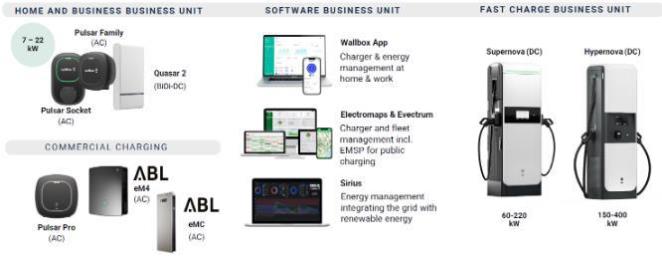
Home & Business
| • | EV Charging Hardware: |
| • | Pulsar Plus, Pulsar Plus Socket, Pulsar Max, Pulsar Max Socket, Pulsar Pro, and Pulsar Pro Socket: AC smart chargers for individual homes or shared spaces with a charging capacity of up to 22 kW. Their key characteristics include Wi-Fi, 4G and Bluetooth connectivity, the smart features available on the Wallbox app, and compatibility with OCPP communication protocols |
| • | Quasar 2: DC bi-directional charger for home-use that allows users to charge and discharge their electric vehicle, enabling them to use their car battery to power their home or sell energy back to the grid. Its V2H (vehicle-to-home) and V2G (vehicle-to-grid) functionalities turn the EV into a powerful energy source. Quasar 2 has a charging capacity of up to 12 kW and a CCS charging cable. Its key characteristics include 4G, Wi-Fi, Ethernet and Bluetooth connectivity, and the smart features available on the Wallbox app. In 2022, we introduced Quasar 2, our newest bi-directional DC charger specifically intended for the US and European markets and compliant with CCS standards. In January 2025, we received the U.S product certification from UL solutions for the Quasar 2. |
| • | Wallbox ABL eM4 Single and Twin: AC smart chargers designed by ABL for fleets and businesses equipped with built-in MID meters and Eichrecht approved variants for charged power monetization and reimbursement. Both eM4 Single and Twin have a charging capacity of up to 22 kW and one or two Type-2 sockets compatible with permanent cable locking. eM4s are hardware ready for ISO 15118 and OCPP 2.0.1, making them compatible with Plug&Charge, the charging authentication technology that allows EVs to identify themselves and start charging by just connecting them to the charging point. In addition, the ABL eM4 Single and Twin AC smart chargers have an RFID card reader with sound feedback and a RGB-LED charging status ring. Other important highlights are its ease of installation thanks to wired and wireless load management for up to a 100 charging points; integrated RCCBs type A; multiple connectivity options as 4G, Wi-Fi and Ethernet and the dedicated commissioning app for installers. |
35
| • | eMC3: AC smart charging pole designed by ABL for public charging, as well as fleets and company parking lots. It is equipped with built-in MID meters and Eichrecht approved variants for charged power monetization and reimbursement. eMC3 has a charging capacity of up to 44 kW, providing a maximum of 22 kW on each of its two Type-2 sockets. It has a RFID card reader and a LED display to indicate its charging points status and charging session information. It also provides for ease of installation as self-standing points, its included MCBs and RCCBs Type B, OCPP compatibility and multiple connectivity options as 4G, Wi-Fi and Ethernet. |
| • | EV Charging Software: |
| • | The myWallbox platform: A cloud based software designed to provide smart management of Wallbox chargers in Residential and Business parking setting such as workplaces, fleets and semi-public parking lots. The myWallbox app and portal include a range of management features available for all our clients. It allows remote control and over the air updates for continuous improvement and maintenance of Wallbox chargers. The myWallbox key functionalities include: |
| • | Manage charging status and information from smart devices |
| • | Real-time status, notifications and statistics of Wallbox chargers |
| • | Remote locking and unlocking Wallbox chargers on the myWallbox app |
| • | Manage multiple users and chargers using the myWallbox portal |
| • | Accessing an integrated payment system to manage charging fees |
| • | Accessing a range of intelligent energy management features such as: |
Schedules that take advantage of off-peak utility rates
Power Sharing, that allows connecting multiple chargers to the same electrical circuit and balances the power distribution based on each vehicle’s need for power
Dynamic Power Sharing, that measures the live energy usage at home or in the building and automatically adjusts the charge to all connected EVs in harmony with the local grid’s capacity, avoiding blackouts and costly energy bills.
| • | Public EV Charging Hardware |
| • | Supernova: DC fast charger equipment designed for public use provides 60 to 220 kW of charging capacity, providing drivers more than 100 miles of range in 10 min. Offering a charging experience in the segment with a competitive cost, Supernova was created to satisfy both EV drivers and charge point operators. Due to its innovative modular design, using six power modules, has shown to be more reliable and efficient, yet significantly lighter than other comparable public chargers, making it easier to transport, install and maintain. A wide array of sensors, real-time data and round-the-clock connectivity can allow for efficient remote and on-site maintenance, reducing costs and simplifying planning and operations. Available with different charging cables, OCPP compatibility and over-the-air software updates, Supernova can easily integrate to any existing charging network and charge any present and future electric vehicle. Supernova offers drivers a seamless charging experience through its interactive lighting system, 10 inch Touchscreen, RFID reader, multiple payment options and wheelchair accessibility. Chargepoint operators can also leverage a custom branding program, wrapping the chargers in their unique logos and color palettes. In addition, chargepoint operators can make use of adjacent services and solutions such as Sirius Energy Intelligence, to optimize available power between the chargers, Wallbox Care Program, for maintenance and extended warranty, and battery energy storage systems, through our partnership with Pramac. In 2024, Wallbox started to sell the UL certified Supernova in North America and announced that we have obtained the Germany’s Eichrecht certification for Supernova. |
36

In addition to the Supernova product, which is currently available, Wallbox has other DC fast charging solutions under development including the Hypernova. The Hypernova concept is a distributed charging system with several dispensers with a centralized power system up to 600kW. In the current design proposal, this future DC fast charging solution can deliver up to 400 kW per dispenser that allows it to fully charge an electric car in under 15 minutes, or the approximate time it takes to make a rest stop, making it ideal for public charging along highways and transcontinental road networks. The Hypernova design, which is still subject to change, is expect to have additional features including integrated cable management, and several authentication and payment options accepted worldwide.
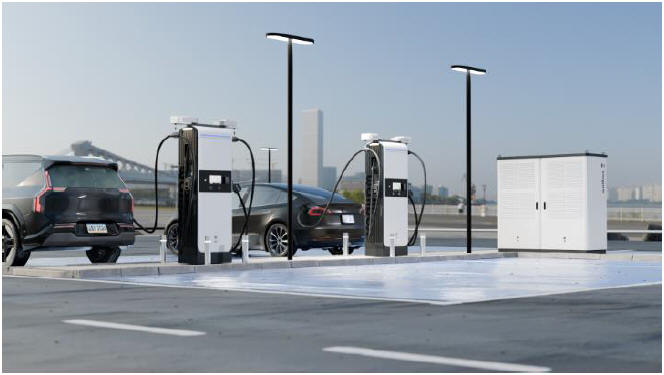
37
| • | EV Charging Software |
| • | Electromaps: Hardware-agnostic e-mobility service provider (eMSP) and charger management software with close to 1 million registered users which are connected close to 500,000 charge points worldwide as of December 31, 2024 and enables users to find publicly available charging ports. In addition, we have established partnerships in Europe with operators of charging points that allow users to pay for their charging directly via Electromaps. We intend to extend these relationships with charging operators outside of Europe and enable this payment feature globally. |
| • | EVectrum: Hardware-agnostic platform for managing chargers used by fleets and public networks to provide charging services in various locations, including retail stores, hotels, public parking spaces, streets and highways. A dedicated EV Fleet charger management solution, EVectrum enables drivers to charge on the go, in-premise and at home. EVectrum allows users to publish on the Electromaps platform any charging point they manage, providing them with an opportunity to sell or rent the chargers to other users. As a hardware-agnostic platform, it can accommodate chargers from different brands. |
| • | Building Energy Management Software |
| • | Sirius is an energy management solution that is designed to seamlessly integrate the electric grid with solar, on-site batteries and other renewable energy sources. Sirius is capable of managing various energy sources and can automatically choose the greenest or less expensive one available to meet the building’s demand, as well as storing energy surpluses in EVs or battery walls plugged to the system. With its automated intelligence, Sirius is designed to increase a building’s renewable energy consumption significantly. It is also designed to help solve one of the biggest challenges of large-scale use of most green energy sources: its weather-dependent availability, which often results in supply/demand imbalances and consumption inefficiencies. |
| • | Sirius is created for creating savings and reducing the carbon emissions impact from our Headquarters in Barcelona. During 2024, 495.8 MWh of the building’s consumption was renewable energy produced by our 425 kW solar installation, composed by 937 panels. Sirius managed to use most of the excess solar energy produced due to Quasar, our bidirectional chargers that allow Sirius to store energy on our fleet of 7 Nissan LEAF cars and the 560 kWh stationary battery available on-site. Because Sirius’ intelligence is designed to select the best time to charge from the grid (i.e. when less expensive) or when to use stored solar energy, the system saves approximately 40% of the annual energy bill. |
| • | Upgrades & Accessories |
| • | We provide upgrade options that combine the myWallbox platform with our energy meters and accessories, enabling advanced energy management features and seamless charges: |
| • | Energy meter: A power meter that measures the available energy at home or in the building in real time. It enables several energy management features such as Dynamic Power Sharing, as well as new functionalities that are available through remote software updates. |
| • | EV charging cables: Cables with Type 2 to Type 2 and Type 2 to Type 1 connectors, available in lengths of 5m and 7m, ensure compatibility with every electric vehicle. |
| • | Pedestals: Standard, Onyx and Eiffel pedestals are free standing mounting solutions that provide an alternative solution to hanging chargers on the wall. |
| • | RFID cards: Identification cards allow secure shared access to the chargers. Chargers with an RFID reader can be unlocked by approaching a card to it. RFID cards are compatible with Pulsar Pro and Quasar. |
38
| • | Services |
| • | We offer necessary services intended to provide tailored end-to-end solutions: |
| • | Installation: The certified partners of our installer network, receive training from a team of professional engineers. The in-depth acquired knowledge of our products ensure installations according to local governmental and industrial standards. This also allows us to sell charger and installation bundles through its ecommerce website and on 3rd party marketplaces like Amazon. |
| • | Charging network management: Our Charge Point Operators manage the provided charging networks, making sure every charger is operative and providing support and assistance on any charging related doubt or potential issue. |
| • | In 2023, we introduced the Wallbox Care Program, specifically designed for fast-charging solutions. This program provides a variety of customizable services aimed at providing an optimal installation, operation, and maintenance of Supernova. The services offered include commissioning, corrective and preventive maintenance, remote support, spare parts, extended warranty, training, and support materials. |
Manufacturing and Sources and Availability of Raw Materials
We design and manufacture our products in-house across our factories. We opened our factory in Barcelona, Spain (Zona Franca) in December 2021. We opened a factory in the U.S. in Arlington, Texas in October 2022 to service the North American EV charging market. All chargers manufactured in our facilities are certified to be sold across North America, Europe, Latin America and the APAC region.
On November, 2, 2023, we added two new production facilities to the other two existing facilities through our acquisition of ABL assets, with one facility in Nürnberg, Germany (Lauf an der Pegnitz) and other in Tangier, Morocco.
We source our components and raw materials through a global supply chain, with a majority of the sources currently based in Europe. The components and raw materials needed for our products are impacted by supply constraints, which can result in pressure to increase prices. We look to mitigate these impacts by placing orders in advance with the objective of avoiding material price increases. We also look to our in-house engineering and validations team to integrate both existing and new suppliers, provide in-house testing and end-of-line validation capabilities, which we believe helps us adapt when there are unexpected market changes and shortages and address the lack of critical components like microchips or lithium. We also work to negotiate preferred vendor status with suppliers of critical components so that we are provided the volume we need. We also incentivize cost reduction and engineering initiatives that allow us to reduce the cost of our hardware, offsetting external variable costs including raw materials and freight.
Customers and Strategic Partnerships
We have established and maintain strong long-term relationships with a broad range of partners in order to broaden our sales channels across a wide range of customers and geographies. Some of the key types of partners we seek to work with include automotive manufacturers, utility companies, distributors, resellers, installers, enterprises, and eCommerce companies. Some of the key clients we have previously worked with include automotive OEMs and dealerships, energy companies, value-added distributors and resellers, installers, enterprises, and e-commerce.
Of these companies, a significant portion of our revenues in the year ended December 31, 2024, come from utility companies, such as Iberdrola, Florida Power & Light Company, Generac Power Systems, and COPEC. We have a longstanding partnership with Iberdrola, a large multinational electric utility and one of our largest institutional investors. In July 2020, Iberdrola entered into a non-binding letter of intent with us expressing its interest in purchasing 6,500 Supernova chargers through 2022. During 2022, Iberdrola expressed an interest in increasing their order from 6,500 Supernovas to 10,000 public chargers, adding our ultra-fast powered charger Hypernova. For additional information, please refer to Item 7, “Major Shareholders and Related Party Transactions-–Related Party Transactions.” We intend to leverage our partnership with Iberdrola to assist with global expansion and accelerate the market entrance of our Supernova product.
The majority of our sales during the year ended December 31, 2024 were generated through distributors, resellers, and installers such as Free2Move, Pluginvest, Libra Energy, Osprey, Rexel International, and Platt Electric Supply. Lastly, a smaller portion of our sales during 2024 were from direct sales, split almost evenly between sales to enterprises and e-commerce sales made directly through our website or via Amazon.
39
Go-to-Market Strategy
Our product focus follows the user. Given that more than 70% of EV charging happens at home, we predominantly focus on home and business solutions, but we sold our first units of Supernova for public charging in the first quarter of 2022.
One of the many ways in which we differentiate ourselves in the EV charging market is our consumer-focused approach of our product offering. Unlike many of the more traditional industrial-centric EV charging products, we place a particular focus on compact and appealing product designs and ease-of-use for the customers across their whole product experience from purchase to installation to usage.
We sell our EV charging solutions through various channels. The most logical point of sale of a charger is at automotive OEMs and utility companies. We have built and maintain an ecosystem of partner channels including, installers, resellers and value-add distributors. Additionally, we also sell directly to enterprises and end consumers through e-commerce sales.
We offer customer purchasing experience across all our channels:
| • | Own channels - Customers can purchase the charger and installation as a bundle with delivery within 48 hours. Customers can also pay in installments. |
| • | Partner channels - We provide marketing materials, training and support to our partners to improve sales. |
Home & Business Go-to-Market Strategy:
We sell EV charging solutions in over 120 countries as of December 31, 2024 and have successfully penetrated several markets that previously had limited EV charging presence.
We intend to enter new markets through partnering with local companies that offer geography specific knowledge, strong installation and charge point operations (CPO) capabilities, and relationships with potential future clients. By leveraging the partner’s local expertise combined with our differentiated solution, we pursue various customers, such as, national utilities, OEMs, auto dealerships, and importers. This enables us to build out a network of installation partners, value-add resellers and distributors in the region. We accelerate growth in each region through qualified leads, channel marketing and advertising, installation and commercial training. After achieving scale in the market we then establish field offices and continue to seek other B2B opportunities for further expansion.
Public Go-To-Market Strategy:
We began the roll-out of our first public charger, Supernova, in the first half of 2022 and intend to expand this growth through a two-phase approach:
| • | Partnerships with utilities and local distributors: Given that public chargers will be directly connected to the public grid, we intend to develop strategic agreements with local utilities and their corresponding distributors to carry out the installation of the Supernova. We have already made significant progress on this phase, successfully expanding our collaboration with some of the world’s largest utility companies, such as Iberdrola, Ignitis, Atlante, Osprey, Free2Move and Pluginvest. |
| • | Building a sales network: The second phase of the Supernova roll-out comprises the development of a set of commercial agreements with trusted partners that might be interested in acquiring the Supernova to deliver a fast-charging solution to either their fleets (e.g. a supermarket which has EVs for their delivery service), or for their customers (e.g. a shopping mall that wants to provide users with the ability to charge their parked car while shopping). We will leverage our already existing commercial agreements on Home & Business chargers to offer these enterprises our new public fast charging solution, Supernova. |
40
Competition
We have approached the market with a differentiated, user focused philosophy: we started our journey within the home segment, built out our brand, and subsequently added the business and public segments to our product portfolio, to be able to empower users where they go. With only a very few companies operating globally, we believe we have a competitive position to support the EV driver on the full spectrum of EV charging. We own the entire process in house—from design to assembly to certification—which we believe allows us to adapt and respond quickly with a product that fits different customer needs across borders and on a global scale. With our product portfolio of smart charging solutions for residential and work use and fast DC chargers and eMSP solution, we believe we are poised to be a leader in the industry.
Europe
The European EV charging market is characterized as fragmented. There are many small and local players, with only a limited number of parties having sufficient scale and funding to be competitive in the long term. The European market is important as it is expected to grow rapidly, following leading European markets such as Norway and the Netherlands. Even though there are many local parties with a solution for public charging, we believe we offer more stylish, compact, lighter, and feature-rich products, which is appealing for residential charging and caters to the entire continent. In addition to the superior charging solutions and important energy management capabilities, we believe we are well-positioned in Europe with local offices in several countries complemented by a European-wide partnership with installers, OEMs, and distributors, as well as the ABL business in Germany.
North America
Although the North American market is still in development from an EV penetration perspective, it is an important market for us to position ourselves early. Namely, as one of the largest automobile markets globally, we believe the North American market has a significant sales volume potential as EV sales are expected to increase steadily. From a competitive perspective, the North American market has high barriers to entry due to strict certification and validation requirements. Therefore, this market differs from Europe as the market is less fragmented with only a few large players: a dynamic that we see as ripe for disruption. With our residential offering, we believe we are well-positioned to gain market share as we can capitalize well on the consumer-driven characteristics of this market. Also, we opened a manufacturing facility in October 2022 to produce and distribute Pulsar Plus to the North American market. In 2024, we have also started to offer our public charging solution, the Supernova UL, in the North America market. This opens up a new segment which we believe has a lot of potential.
APAC
The APAC market is expected to continue to be one of the leading EV charging markets in the coming years. China is currently, by far, the leader in EV sales and in the installation of public charging infrastructure. Yet, similar to the European market, the rest of APAC market can be characterized as a highly fragmented market with less than a handful of players that have gained significant scale in the industry. From a technology and pricing perspective, the EV charging solutions are cost-competitive as they can be manufactured at a lower cost point. However, the charge points in the APAC region tend to have inferior technology in terms of quality, functionalities, capabilities or lack certification standards to operate in other regions. With our innovative, advanced, smart, and seamlessly connected EV charging solution technology with easy-to-use functionalities and embedded software, we have developed a differentiated solution for the APAC market. In addition, we have bolstered our position with an office in Shanghai covering China and APAC regions and a new subsidiary in Shanghai after the acquisition of ABL business.
For a breakdown of total revenues for the principal markets where we compete, please refer to Note 7. “Operating Segments,” within our consolidated financial statements included elsewhere in this Annual Report.
41
Competitive Strengths
Strong global brand
We have built a brand by taking a very consumer centric approach. We do not white label our products, which we believe allows us to maintain attractive margins and create a recognizable brand. Our award winning product portfolio is third-party validated by highly regarded international trade organizations, including ADI Delta Awards (2024), Winner of The smarter E AWARD (2023), Winner of European Product Design (2023), Winner of Reddot Product Award (2022), Winner of iF Design Product Award (2022), Winner of Good Design (2021), Best of CES (2020), and Fast World Changing Ideas finalist (2020) amongst others. Our portfolio extends worldwide, demonstrating our ability and speed to adapt and meet the different regulations across regions as well as across segments, providing the same customer centric approach across all use cases, whether at home, work or in public locations. We believe customers can find a Wallbox charger that fits their needs. This effort has led to partnerships with well-recognized brands such as Costco, Kia, Free2Move and Generac to provide our products and services.
Large global total addressable market
We believe the EV market is at an inflection point and is experiencing substantial growth. Mass EV adoption translates to significant charging infrastructure growth. Despite dampened sentiments in EV markets and slower growth the recent years, the growth of the global EV market remained solid with 25% year-over-year growth in 2024 according to Rho Motion. We believe that the EV charging market continues to be a large opportunity with more than 230 million chargers to be sold between 2025 and 2035. This total is dominated by home chargers, with more than 165 million chargers expected to be sold in the same time period and accounting for 71% of the total chargers sales. In addition to these, it is projected that there will be 16 million public chargers, 42 million work place chargers and 10 million depot chargers to be sold during this period. Over $800 billion of cumulative investment would be needed to install all of these chargers. We believe we are positioned to capture and control a large share of this market by leveraging smart charging technology to enable mass EV adoption, fast time to market and robust supply chain to meet demand, global operations and local certifications.
Full-service technology provider
We have a full suite of EV charging solutions spanning proprietary hardware, software, and services for domestic, business and public charging. Our enterprise grade software platform seamlessly connects across all of the chargers. As of December 31, 2024, through myWallbox, we have managed over 113 million charging sessions and over 2,2622 GWh charged. Additionally, we believe we offer the most innovative features on the market, such as Bluetooth, PV match, gesture control, facial recognition, V2H/V2G, which allows us to maintain high margins.
Powerful business model
Historically we have achieved strong revenue growth, which we attribute to our scalable business model and our having successfully implemented our sales strategy into new geographies. Our in-house design and manufacturing capability enables us to have very fast development cycles, adapt to the ever-changing global supply chain and never run out of stock. In-house certification allows us to expand to new countries and adapt to new local requirements.
Truly global business with strong blue-chip customers
We serve a variety of customers and have established channel distribution in more than 120 countries as of December 31, 2024. Customers include automotive manufacturers, utility companies, resellers, distributors and installers. We also sell direct to consumers via enterprise or e-commerce sales through our website or via Amazon.
Uniquely positioned at the intersection of energy and mobility markets
EV owners typically double their home’s energy consumption through charging. We believe our embedded software across our products enables customers to control charging and manage energy. For example, our DC bi-directional charger for the home, Quasar, allows the battery of an EV to discharge the energy stored in the vehicle and power a home for up to five days. Quasar also allows EV owners producing renewable energy to store the energy in their vehicles when not fully utilized by their home.
42
Founder-led company, experienced management team and high-profile investors
We are led by a management team with expertise across technology, energy, industrial and financial organizations. As of December 31, 2024, we had a team of over 905 individuals, which consisted of mostly software and hardware engineers and a global salesforce. Since the Company’s founding in 2015, we have been able to demonstrate our capabilities in expanding the EV charging business in Europe, North America and Asia. We are backed by global leading strategic and financial investors, including Iberdrola and Generac.
Growth Strategies
We believe our scalable business model will enable us to continue to outperform the growth of the broader EV charging market. We intend to achieve this growth by focusing on the following strategies:
Continue our global expansion: We intend to continue to expand beyond the more than 120 countries (as of December 31, 2024) where we currently sell locally-certified products by increasing our presence in the core EV markets, and penetrating rapidly developing markets such as APAC and Eastern Europe.
Launch new technologies: We plan to continue to update our product portfolio to include the latest and energy efficient technology - as we have done with the Pulsar Pro and Pulsar Socket product line (upgrades from Pulsar). Additionally, we expect to launch complimentary energy management software features and innovative hardware products, such as ultra-fast powered (400kW) chargers.
Provide all-in-one energy solutions with the charger at the center: Our goal is to unlock the full potential of every EV. There are already several countries (UK, Australia, and Germany amongst others) where we have established partnerships with utilities and energy distributors. These partnerships enable users to connect directly to the grid, “vehicle-to-grid” (V2G), allowing them to sell their excess energy. V2G connectivity gives rise to a broad set of energy functionalities that we expect to launch to redefine the future of charging; energy technology will only get smarter, and we intend to spearhead this movement.
Seasonality
For a description of our business seasonality, see chapter 4, “Operating and Financial Review and Prospects.”
Intellectual Property
We rely on a combination of patent, trademark, copyright, unfair competition and trade secret laws, as well as confidentiality procedures and contractual restrictions, to establish, maintain and protect our proprietary rights. Our success depends in part upon our ability to obtain and maintain proprietary protection for our products, technology and know-how, to operate without infringing the proprietary rights of others, and to prevent others from infringing our proprietary rights.
As of December 31, 2024, we have one (1) granted design patent in the U.S.A. and we have filed: (a) two (2) international patents which are currently in national phase before the relevant authorities and (b) two (2) design patent applications in the USA which are currently under examination by the relevant authorities. Additionally, with the ABL purchase we enhanced our intellectual property portfolio acquiring the certification of the German EV charging calibration-law (Eichrecht). We continue to regularly assess opportunities for seeking patent protection for those aspects of our technology, designs and methodologies that we believe provide a meaningful competitive advantage.
We intend to continue to regularly assess opportunities for seeking patent protection for those aspects of our technology, designs and methodologies that we believe provide a meaningful competitive advantage. If we are unable to do so, our ability to protect our intellectual property or prevent others from infringing our proprietary rights may be impaired.
43
Government Regulation
Product Certifications
Throughout the world, electrical appliances are subject to various mandatory and voluntary standards, including requirements in some jurisdictions, including the United States, that products be listed by Underwriters’ Laboratories, Inc. (“UL”) or other NTRL laboratory. In the United States, we are required to undergo certification and testing of compliance with UL standards, as well as other national and industry specific standards. We endeavor to have our products designed to meet the certification requirements of, and to be certified in, each of the jurisdictions in which they are sold. We provide many of our certifications in-house depending on the local requirements; although, the requirements for certification vary from jurisdiction to jurisdiction and may require third party certifications in certain jurisdictions.
CPSC
As a marketer and distributor of consumer products, we are subject to the Consumer Products Safety Act and the Federal Hazardous Substances Act, which empower the U.S. Consumer Product Safety Commission (“CPSC”) to seek to exclude products that are found to be unsafe or hazardous from the market. Under certain circumstances, the CPSC could require us to repair, replace or refund the purchase price of one or more of our products, or we may voluntarily do so.
OSHA
We are subject to the Occupational Safety and Health Act of 1970, as amended (“OSHA”). OSHA establishes certain employer responsibilities, including maintenance of a workplace free of recognized hazards likely to cause death or serious injury, compliance with standards promulgated by the Occupational Safety and Health Administration and various record keeping, disclosure and procedural requirements. Various standards, including standards for notices of hazards, safety in excavation and demolition work and the handling of asbestos, may apply to our operations.
NEMA
The National Electrical Manufacturers Association (“NEMA”) is the association of electrical equipment and medical imaging manufacturers. NEMA provides a forum for the development of technical standards that are in the best interests of the industry and users, advocacy of industry policies on legislative and regulatory matters, and collection, analysis, and dissemination of industry data.
Waste Handling and Disposal
We generally do not manufacture the components of our charging products. Rather, our employees and contractors engage in assembly of charging products at our facilities primarily using components manufactured by OEMs. Nonetheless, we may be subject to laws and regulations regarding the handling and disposal of hazardous substances and solid wastes, including electronic wastes and batteries. These laws generally regulate the generation, storage, treatment, transportation and disposal of solid and hazardous waste, and may impose strict, joint and several liability for the investigation and remediation of areas where hazardous substances may have been released or disposed of. For instance, CERCLA, also known as the Superfund law, in the United States and comparable state laws impose liability, without regard to fault or the legality of the original conduct, on certain classes of persons that contributed to the release of a hazardous substance into the environment. These persons include current and prior owners or operators of the site where the release occurred as well as companies that disposed of or arranged for the disposal of hazardous substances found at the site. Under CERCLA, these persons may be subject to joint and several strict liability for the costs of cleaning up the hazardous substances that have been released into the environment, for damages to natural resources and for the costs of certain health studies. CERCLA also authorizes the EPA and, in some instances, third parties to act in response to threats to the public health or the environment and to seek to recover from the responsible classes of persons the costs they incur. We may handle hazardous substances within the meaning of CERCLA, or similar state statutes, in the course of ordinary operations and, as a result, may be jointly and severally liable under CERCLA for all or part of the costs required to clean up sites at which these hazardous substances have been released into the environment.
44
We also generate solid wastes, which may include hazardous wastes that are subject to the requirements of the Resource Conservation and Recovery Act (“RCRA”) and comparable state statutes. While RCRA regulates both solid and hazardous wastes, it imposes strict requirements on the generation, storage, treatment, transportation and disposal of hazardous wastes. Certain components of our products are excluded from RCRA’s hazardous waste regulations, provided certain requirements are met. However, if these components do not meet all of the established requirements for the exclusion, or if the requirements for the exclusion change, we may be required to treat such products as hazardous waste, which are subject to more rigorous and costly disposal requirements. Any such changes in the laws and regulations, or our ability to qualify the materials it uses for exclusions under such laws and regulations, could adversely affect our operating expenses.
Similar laws exist in other jurisdictions where we operate. Additionally, in the EU, we are subject to the Waste Electrical and Electronic Equipment Directive (“WEEE Directive”). The WEEE Directive provides for the creation of a collection scheme where consumers return electrical waste and electronic equipment to merchants, such as us. If we fail to properly manage such electrical waste and electronic equipment, we may be subject to fines, sanctions, or other actions that may adversely affect our financial operations.
General
Environmental and health and safety laws and regulations can be complex and may be subject to change, such as through new requirements enacted at the supranational, national, sub-national, and/or local level or new or modified regulations that may be implemented under existing law. The nature and extent of any changes in these laws, rules, regulations and permits may be unpredictable and may have material effects on our business. Future legislation and regulations or changes in existing legislation and regulations, or interpretations thereof, including those relating to hardware manufacturing, electronic waste, or batteries, could cause additional expenditures, restrictions and delays in connection with our operations as well as other future projects, the extent of which cannot be predicted. For instance, California may adopt more stringent regulation of EV charging and, in February 2023, the U.S. Department of Transportation and U.S. Department of Energy announced plans to include minimum standards and “Buy America” requirements for EV charger stations funded by certain U.S. federal programs. In addition, various local, state, and national incentives exist or may come to exist to encourage the installation of EV charging stations; nevertheless, the level and duration of such incentives are not guaranteed and may be subject to change over time.
| 3.3 | Organizational structure |
Please refer to Note [28], “Details of Wallbox Group subsidiaries” of our audited consolidated financial statements included elsewhere in this Annual Report for a listing of our significant subsidiaries, including name, country of incorporation, and proportion of ownership interest.
| 3.4 | Property, plant and equipment |
Our Facilities
We design and manufacture our products in-house across our leased factories located in Barcelona, Spain (Zona Franca) which has an estimated production capacity of approximately 624 thousand chargers per year, Arlington, Texas which has an estimated production capacity of approximately 283 thousand chargers per year, Nürnberg, Germany (Lauf an der Pegnitz) which has an estimated production capacity of approximately 302 thousand chargers per year and approximately 20,100 thousand of connectivity components per year and Tangier, Morocco where we produce components for the charger’s production. In addition, the Group has a facility to manufacture printed circuit boards (“pcb”) in Sant Boi de Llobregat, Barcelona, Spain which has an estimated production capacity of approximately 660 thousand pcb’s per year. All chargers manufactured across our facilities are certified to be sold across the United States, the European Union and APAC Region including China.
Our headquarters are located in Barcelona, Spain where we currently lease approximately 11,000 square meters of office space. We believe this space is sufficient to meet our needs for our headquarters in the foreseeable future and that any additional space we may require will be available on commercially reasonable terms.
45
| 3.5 | Employees |
Average number of employees in the last 3 years is:
| (Average number of employees) |
2024 | 2023 | 2022 | |||||||||
| Directives |
50 | 69 | 41 | |||||||||
| Administrative |
193 | 387 | 445 | |||||||||
| Commercials |
193 | 189 | 194 | |||||||||
| Operators |
339 | 212 | 38 | |||||||||
| Engineers |
333 | 408 | 464 | |||||||||
|
|
|
|
|
|
|
|||||||
| Total |
1,108 | 1,265 | 1,182 | |||||||||
|
|
|
|
|
|
|
|||||||
We strive to offer competitive employee compensation and benefits in order to attract and retain a skilled and diverse workforce. As of December 31, 2024, we had 905 employees compared with the 1,457 employees at December 31, 2023. Most of our employees are located in Spain, although our global footprint has employees working in offices across seven European countries, an office in China and another in the United States. We have not experienced a work stoppage and believe we maintain positive relationships with our employees.
| 4 | OPERATING AND FINANCIAL REVIEW AND PROSPECTS |
| 4.1 | Operating Results |
You should read the following discussion in conjunction with our Consolidated Financial Statements included elsewhere in this Annual Report. This discussion contains forward-looking statements and involves numerous risks and uncertainties, including, but not limited to, those described in Chapter 2 “Principal risks and uncertainties”. Actual results could differ materially from those contained in any forward-looking statements.
When we refer to the “Company” we are referring to Wallbox N.V. and its consolidated subsidiaries.
| 4.1.1 | Business Overview |
We believe we are a global leader in intelligent electric vehicle charging and energy management solutions. Founded in 2015, we create smart charging systems that combine innovative technology with outstanding design with the goal of managing the communication between user, vehicle, grid, building and charger.
Our mission is to facilitate the adoption of electric vehicles today to make more sustainable use of energy tomorrow. By designing, manufacturing, and distributing charging solutions for residential, business, and public use, we intend to lay the infrastructure required to meet the demands of mass electric vehicle ownership everywhere. We believe our customer-centric approach to our holistic hardware, software, and service offering allows us to solve existing barriers to EV adoption as well as anticipate opportunities soon to come. In our pursuit to accomplish this vision, we have acquired five companies to date:
| 1. | Intelligent Solutions (controlling interest acquired in February 2020): Intelligent Solutions was one of the largest distributors of intelligent charging solutions in Northern Europe, with an extensive partner network of car dealers, installers, and utility companies in Norway, Sweden, Finland, and Denmark. Headquartered in Stavanger, Norway, Intelligent Solutions offers a variety of services from hardware to installation service and technical support. We believe this acquisition was a key component in our strategy to expand our business in Northern Europe. |
| 2. | Electromaps (controlling interest acquired in September 2020): the leading digital platform for accessing free and paid for electric charging points in southern Europe. The app provides its 200,000+ users access to the charging points and ability to make payments directly from their mobile phone, unifying the entire charging infrastructure and improving the electric vehicle driving experience. Through this acquisition, we took our first step into the public electric charging space and plan to continue to foster innovation at Electromaps. |
46
| 3. | ARES (acquired in July 2022): ARES is an innovative provider of printed circuit boards and through its acquisition, we expanded our design and manufacturing capabilities and believe this acquisition will increase our innovation cycle time and improve our supply chain resilience. |
| 4. | COIL (acquired in August 2022): COIL is a leading EV charging installer serving the U.S. market, enabling in-house installation and maintenance solutions for commercial, public and residential charging applications. |
| 5. | ABL business (acquired in November 2023): ABL business was a pioneer in EV charging solutions in Germany, the largest EV market in Europe.We acquired the operations, personnel and assets (which constitute a business) of ABL, which acquisition also included ABL’s ownership in each of ABL Morocco S.A., which owns a production facility in Tangier, Morocco, ABL (Shanghai) Co. Ltd, and ABL Nederland B.V. The total consideration for this transaction was €14.6 million, consisting of €10.1 million up front cash payment in 2023 with the balance of €4.5 million paid in several installments during 2024. During the last year, the initial strategic advantages of this transaction have been leveraged as cross-selling activities, co-development of products, and operational integration are well underway. One example of these milestones, is the introduction of the Eichrecht certified Supernova DC fast charger. This certification is crucial for any company looking to sell chargers designed for the public segment in Germany. |
In connection with the acquisition, on December 15, 2023, Wall Box Chargers entered into an investment and shareholders’ agreement with Greenmobility invest 2 GmbH (a German limited liability company (“GI2”), the majority indirect shareholders of ABL), pursuant to which GI2 acquired a 25.1% interest in the share capital of ABL for an aggregate capital contribution of €8.4 thousand. The Investment and Shareholders’ Agreement provides for a put and call option for GI2 and WBX SLU. The Investment and Shareholders’ Agreement is governed by German law. As a consequence of ABL Gmbh not achieving the conditions for executing the aforementioned put and call, Wallbox does not have an obligation to acquire the 25.1% interest in the share capital of ABL and has decided to not execute the option.
Private Placement Equity Offering
On June 15, 2023, we closed a private placement of Class A Shares, pursuant to which we sold 18,832,432 Class A Shares for aggregate gross proceeds of $48.6 million (€44.9 million) to certain existing investors and strategic partners at a price of $2.58 per share. Pursuant to the registration rights we agreed to as part of the private placement, we filed a registration statement for the resale of the Class A Shares purchased in the private placement on July 19, 2023.
On December 13, 2023, we closed a private placement of Class A Shares, pursuant to which we sold 10,360,657 Class A Shares for aggregate gross proceeds of $31.6 million (€29.3 million) to certain existing investors and Generac Power Systems, Inc (“Generac”) at a price of $3.05 per share. Pursuant to the registration rights we agreed to as part of the private placement, we filed a registration statement for the resale of the Class A Shares purchased in the private placement on January 12, 2024. Concurrently with the closing of the transaction several agreements have been entered into by the Company:
(a) a letter agreement between Generac and the Company, pursuant to which Generac has the following rights: (i) a first right of refusal to purchase or subscribe for any securities, including equity, equity-linked or debt securities or assets that the Company may propose to issue or sell to certain of Generac’s competitors; and (ii) for as long as Generac and its affiliates collectively own at least 3% of the Company’s outstanding share capital: (1) preemptive rights to participate with respect to certain future equity offerings by the Company, to the extent Generac does not have substantially similar antidilution protections in the organizational or charter documents of the Company; and (2) Company shall obtain the consent of Generac prior to approve any changes the Company may propose that adversely affect the rights of Class A Shares; and
(b) a letter agreement between Kariega Ventures, S.L., a major shareholder of the Company, which is controlled by Mr. Asunción, and the Company, pursuant to which Kariega Ventures, S.L., and the Company will agree to take best efforts to support the election of the director nominee set forth by Generac pursuant to its director nomination rights, which director nomination rights Generac shall have for so long as it, together with its affiliates, collectively own at least 3% of the Company’s outstanding share capital.
47
On August 5, 2024, we closed a private placement of Class A Shares, pursuant to which we sold 36,334,277 Class A Shares for aggregate gross proceeds of $45 million (€ 41.4 million) to certain existing investors and strategic partners at a price of $1.24 per share. Pursuant to the registration rights we agreed to as part of the private placement, we filed a registration statement for the resale of the Class A Shares purchased in the private placement on September 5, 2024.
On February 21, 2025, we closed a private placement of Class A Shares, pursuant to which we sold 26,707,142 Class A Shares for aggregate gross proceeds of $9.9 million (€ 9.4 million) to certain existing investors and strategic partners at a price of $0.37 per share.
BBVA Facility and Warrant Agreement
On February 9, 2023 (the “BBVA Facility Closing Date”), Wallbox, as guarantor, and its wholly-owned direct Spanish subsidiary, Wall Box Chargers, S.L.U., as borrower (Wall Box Chargers) entered into a Facility Agreement (the “BBVA Facility Agreement”) with Banco Bilbao Vizcaya Argentaria S.A. (“BBVA”). The BBVA Facility Agreement provides for an aggregate term loan commitment of €25.0 million (the “BBVA Facility”), which amount was fully drawn down on the BBVA Facility Closing Date and for which we received an amount of €24.6 million after the deduction of fees and expenses. Related to this loan, on November 11, 2024, Wall Box Chargers, S.L.U., as borrower, signed an agreement with the BBVA which included a grace period of 18 months from the last installment payment and without variation of any other terms of the initial agreement. See details in “Framework Agreement caption.
Principal outstanding under the BBVA Facility Agreement shall accrue interest on a daily basis at a rate equal to 1 month EURIBOR plus an amount equal to 8.00% per annum. The BBVA Facility is secured by certain intellectual property rights. The BBVA Facility matures on the fourth anniversary of the BBVA Facility Closing Date and under certain circumstances may be extended to mature on the fifth anniversary of the BBVA Facility Closing Date. Wall Box Chargers is permitted to prepay the BBVA Facility in whole or in part upon notice thereof in accordance with the terms of the BBVA Facility Agreement. Upon an event of default specified in the BBVA Facility Agreement that remains uncured after 15 business days, the BBVA Facility may become due and payable in full upon provision of notice thereof in accordance with the terms of the BBVA Facility Agreement. The BBVA Facility Agreement also contains customary affirmative and negative covenants. The BBVA Facility Agreement is governed by Spanish law.
Concurrently with the closing of the BBVA Facility Agreement and in consideration thereof, we entered into a Warrant Agreement (the “Warrant Agreement”) and Subscription Agreement (the “Subscription Agreement”) with BBVA (together with its assignees, the “Warrantholder”) pursuant to which we issued to the Warrantholder, and the Warrantholder subscribed for and acquired, an aggregate of 1,007,894 warrants exercisable for 1,007,894 Class A Shares, for an exercise price of $5.32 per share. Pursuant to the Subscription Agreement, we filed a registration statement on January 12, 2024, which registration statement was declared effective on January 22, 2024, registering the resale of the Class A Shares issuable upon exercise of the Warrant. The Warrant Agreement provides for a redemption right in our favor when the Class A Shares achieve a value of $11.00 per share.
Syndicated Loan
On October 16, 2023, we, our wholly owned subsidiary, Wallbox USA, Inc. (“Wallbox USA”), and Wall Box Chargers, entered into agreements (the “October 2023 Facility Agreements”) that provide for: (i) a syndicated loan with Instituto de Crédito Oficial E.P.E., Institut Català de Finances, Mora Banc Grup SA and EBN Banco de Negocios, S.A. (“EBN Banco”) as funding entities, EBN Banco as coordinating entity and agent, Wallbox Spain as borrower and Wallbox USA and Wallbox as guarantors; and (ii) a loan with Compañía Española de Financiación Del Desarrollo COFIDES, S.A., S.M.E., as funding entity, EBN Banco as coordinating entity, Wallbox USA as borrower and Wallbox Spain and Wallbox as guarantors. The October 2023 Facility Agreements provide for an aggregate term loan commitment of €35.0 million (the “October 2023 Term Loan”), which aggregate amount was elected to be drawn on October 14, 2023. As of December 31, 2024, we had €35.0 million of borrowings outstanding under the October 2023 Term Loan. We intend to use €30.0 million of the proceeds for investments in manufacturing lines at our charger manufacturing plants in Barcelona and for the development of energy management software and €5.0 million of the proceeds to expand our plant and assembly lines in the United States.
48
Principal outstanding under the October 2023 Term Loan accrues interest on a daily basis at a rate equal to three-month EURIBOR plus an amount equal to 3.25% per annum, provided that, the October 2023 Facility Agreements also include sustainability-linked pricing adjustments and, as to Facility Agreement 2, pricing adjustments related to sales in the United States. This loan will be secured by the property assets that are acquired in Barcelona with the proceeds under the October 2023 Term Loan, the bank accounts related to the October 2023 Facility Agreements and the credit rights under the insurance agreements related to the property assets to be secured. The October 2023 Term Loan matures on the fifth anniversary of October 16, 2023. The relevant borrower is permitted to prepay the October 2023 Term Loan in whole or in part upon notice thereof in accordance with the terms of the October 2023 Facility Agreements. The October 2023 Facility Agreements also contain covenants that require, based on our audited consolidated financial statements, a total debt to equity ratio ranging from 2.00x or less in 2023 to 1.20x or less in 2026 and thereafter, and a net debt to equity ratio ranging from 1.40x or less in 2023 to 0.90x or less in 2026 and thereafter, as well as other affirmative and negative covenants and customary events of default. As of December 31, 2024, we are not in compliance with these financial covenants, however, we have obtained a waiver issued by the bank. Additionally, on April 8, 2025, as part of the Framework agreement explained below, the Group reached an agreement under which the financial covenants have been amended as follows: a total debt to equity ration of 2.70x or less in 2025, 3.20x or less in 2026 and 2.70x in 2027 and thereafter, and a net debt to equity ratio of 2.10x or less in 2025, 2.40x or less in 2026 and 2.00x in 2027 and thereafter.
HSBC Facility Agreement
On March 22, 2024, Wallbox and Wallbox USA Inc, as guarantors, and its wholly-owned direct Spanish subsidiary, Wall Box Chargers, S.L.U., as borrower (“Wall Box Chargers”) entered into a Facility Agreement with Hong Kong and Shanghai Banking Corporation Limited (“HSBC”). The HSBC Facility Agreement provides for an Asset Based Lending commitment of €15.0 million (the “ HSBC Facility”). As of December 31, 2024, we had €15.0 million of borrowings outstanding under the HSBC Facility. The HSBC Facility is secured by certain stock rights valued at Euros 15 million. The HSBC Facility matures on the third anniversary of the HSBC Facility Closing Date. Wall Box Chargers is permitted to prepay the HSBC Facility in whole or in part upon notice thereof in accordance with the terms of the HSBC Facility Agreement. Upon an event of default specified in the HSBC Facility Agreement, the HSBC Facility may become due and payable in full upon provision of notice thereof in accordance with the terms of the HSBC Facility Agreement. The HSBC Facility Agreement contains affirmative and negative covenants, including without limitation a minimum cash requirement and restrictions on incurrence of additional debt, liens or fundamental changes. The HSBC Facility Agreement also contains financial covenants regarding maintenance as of the end of each closing month of a minimum of Current Ratio (Current Assets/Current liabilities) calculated with some exclusions, of 1.25 and a minimum Inventory Turnover of 400 days. The HSBC Facility Agreement is governed by Spanish law. On December 31, 2024 we obtained a waiver issued by HSBC regarding the compliance with the covenants under the agreements governing our indebtedness. This waiver sets new covenant levels. On January 30, 2025, we signed an amendment on the initial agreement setting the covenant range of the current ratio at 1.1, and minimum cash required to 45 million.
Framework Agreement
On November 11, 2024, the Group entered into a framework agreement with Banco Bilbao Vizcaya Argentaria, S.A. and Banco Santander, S.A. providing an 18-month grace period on debt repayments. Additionally, as part of the agreement, the financial institutions have committed to maintaining the short-term financing agreements in force at least until June 30, 2026. The agreement included a clause requiring adherence from all relevant lenders (CaixaBank, S.A., EBN Banco de Negocios, S.A., Institut Catala de Finances, Instituto de Crédito Oficial, Mora Banck Grup S.A. and Compañía Española de Financiación del Desarrollo Cofides, S.A.) by May 11, 2025. In accordance with IAS 1, the Group classified €9.4 million of borrowings as current liabilities at year-end, as the right to defer payment beyond 12 months was not in place as of December 31, 2024. Additionally, as of year-end, as a result of this classification, there was a breach of financial covenants which resulted in a balance of €15 million being reclassified as current liabilities.
On April 8, 2025, all those financial institutions adhered to the framework agreement, formalizing the grace period and waiving financial covenant requirements for 2025.
49
| 4.1.2 | Reporting Segments |
For management purposes, we are organized into business units based on geographical areas and therefore have three existing reportable segments. Our segments are:
| • | EMEA: Europe-Middle East Asia |
| • | NORAM: North America |
| • | APAC: Asia-Pacific |
Refer to Note [7] “Operating Segments”, included within our Consolidated Financial Statements for further details.
| 4.1.3 | Key factors Affecting Operating Results |
We believe our performance and future success depend on several factors that present significant opportunities for it but also pose risks and challenges, including those discussed below and in the section of this Annual Report titled “Principal risks and uncertainties.”
Growth in EV Adoption
Our revenue growth is directly tied to the continued acceptance of passenger and commercial EVs, which we believe drives the demand for charging products and infrastructure. The market for EVs is still rapidly evolving and although demand for EVs has grown in recent years, there is no guarantee such demand will continue into the future. Factors impacting the adoption of EVs include but are not limited to: perceptions about EV features, quality, safety, performance and cost; perceptions about the limited range over which EVs may be driven on a single battery charge; volatility in the cost of oil, gasoline, and electricity; availability of services for EVs; consumers’ perception about the convenience and cost of charging EVs; government subsidies for EVs and electricity; the development, prevalence and market adoption of EV fleets; and increases in fuel efficiency of non-EV transportation. In addition, macroeconomic factors could impact demand for EVs, particularly since EVs can be more expensive than traditional gasoline-powered vehicles and the automotive industry globally has been experiencing a recent decline in sales. If the market for EVs does not develop as expected or if there is any slow-down or delay in overall EV adoption rates, this would impact our ability to increase its revenue or grow its business.
Competition
We believe we are currently one of the market leaders in Europe and North America in residential EV charging solutions based on the number of charging units sold compared to EVs sold on a country by country basis. We also provide and derive revenue from installation services and Electromaps, our online platform that enables users to find and pay for publicly available charging ports and manage their charging fleet. We intend to expand our market share over time in our product categories, including public charging stations, leveraging the network effect of its products, our partnership with Iberdrola and the Electromaps platform. Additionally, we intend to expand and grow our revenues via the rollout of the Supernova and Hypernova public charging stations. Nonetheless, existing competitors may expand their product offerings and sales strategies, and new competitors may enter the market. Furthermore, our competition includes competition resulting from acceptance of other types of alternative fuel vehicles, plug-in hybrid electric vehicles and high fuel-economy gasoline powered vehicles. If our market share decreases due to increased competition, our revenue and ability to generate profits in the future may be impacted.
50
Global Expansion
We operate in Europe, North America, Latin America and APAC. Europe and North America are expected to be significant contributors to our revenue in future years with manufacturing capacity added to North America in 2022 and the inorganic growth due to the acquisition of ABL.
The European EV charging market can be characterized as fragmented. There are many small and local players, with only a limited number of parties having sufficient scale and funding to be competitive in the long term. Especially due to the government regulations currently in place, the EV sales are expected to increase in Europe. From a competitive perspective, the North American market has high barriers to entry due to strict certification and validation requirements. Therefore, this market differs from Europe as the market is less fragmented with only a few large players.
Similar to the European market, the APAC market can be characterized as a highly fragmented market with a small number of players that have gained significant scale in the industry. From a technology and pricing perspective, EV charging solutions in APAC are cost-competitive as they can be manufactured at a lower cost point. Our growth in each of our markets requires us to differentiate ourselves as compared to our competition. If we are unable to penetrate, or further penetrate, the market in each of the geographies in which we operate or intend to operate, our future revenue growth and profits may be impacted.
During this year ended December 31, 2024, our sales in Latin America were not significant, however, we intend to expand our market presence in this region.
Impact of New Product Releases
As we introduce new products, such as the market introduction of our Supernova public charging stations, our profitability may be temporarily impacted by launch costs until our supply chain achieves targeted cost reductions. For example, during our launch of Supernova in 2022 we had a negative Gross Margin of 15.5% in connection with Supernova sales in 2022 based on €7,166 thousand in revenue and €8,278 thousand in changes in inventories and raw materials and consumables. However, in the year ended December 31, 2023 the Gross Margin from our sales of Supernova was positive 17.9% based on €30,511 thousand in revenue and €25,040 thousand in changes in inventories and raw materials and consumables, which continued to improve during the year ended December 31, 2024 ending with a Gross Margin from our sales of Supernova of 30.5% based on €25,598 thousand in revenue and €17,798 thousand in changes in inventories and raw materials and consumables
In addition, we may accelerate our operating expenditures where we see growth opportunities which may impact profitability until upfront costs and inefficiencies are absorbed and normalized operations are achieved. We also continuously evaluate and may adjust our operating expenditures based on our launch plans for our new products, as well as other factors including the pace and prioritization of current projects under development and the addition of new projects. As we attain higher revenue, we expect operating expenses as a percentage of total revenue to continue to decrease in the future as we focus on increasing operational efficiency and process automation.
Government Mandates, Incentives and Programs
The U.S. federal, state and local government, European member states, and China provide incentives to end users and buyers of EVs and EV charging products in the form of rebates, tax credits and other financial incentives. These governmental rebates, tax credits and other financial incentives significantly lower the effective price of EVs and EV charging products or stations to customers. However, the outcome of the 2024 U.S. presidential election has introduced increased uncertainty regarding these incentives. Early actions by the current U.S. administration indicate a potential departure from prior federal support for electric vehicles, including reconsideration of funding programs and national targets. Accordingly, these incentives may expire on a particular date, end when the allocated funding is exhausted, or be reduced or terminated as a matter of administrative, regulatory, or legislative policy under the current or future U.S. administration. Any reduction in rebates, tax credits or other financial incentives could reduce the demand for EVs and for charging infrastructure, including infrastructure offered by us.
51
Penetration into the Public Charging Market
We commenced commercialization of the Supernova, our first DC fast charger for public use, during the first quarter of 2022. We have signed letters of intent (“LOI”) to collaborate with some of the world’s biggest utility companies for delivery of Supernova, and expect in the future to expand beyond utilities into additional distribution channels. One example includes Iberdrola which announced its intention to potentially acquire up to 10,000 public fast chargers from Wallbox as part of its sustainable mobility plan to deploy more than 150,000 chargers in homes, businesses and public road networks. In addition, we continue to introduce new versions of our Supernova product line with higher charging capacity which now can also be sold in North America and in Germany as we have all relevant certifications in place. Our offering of public charging solutions is complemented through Electromaps, an online platform that enables users to find publicly available charging ports and pay for their use. We have established partnerships in Europe with operators of charging points that allow users to pay for their charging directly via Electromaps. We intend to extend these relationships with charging operators outside of Europe and enable this payment feature globally.
Seasonality
Our business is seasonal in nature. Typically, consumers purchase more EVs in the second half of the year, particularly in the fourth quarter, and the seasonal variation in the timing of sales of our residential products tends to be correlated with sales of EVs. As a result, sales in the second half, and particularly in the fourth quarter, would, after adjusting for our growth, be higher than in the first half of the fiscal year and our results of operations may be subject to seasonal fluctuations as a result.
Impact of the war between Russia and Ukraine
As a result of the war between Russia and Ukraine, the U.S. and certain allies in Europe imposed sanctions on Russia and could impose further sanctions against it. Russia could respond in kind. Sanctions imposed by any of these countries could disrupt our supply of critical components among our manufacturing facilities in Barcelona as well as our production and the sales of EVs. As a result of the war, we stopped marketing our products in Russia, and will not pursue new opportunities with customers in that country. Although such sales in the Ukraine region have not been significant to our business, further disruptions could negatively affect our ability to provide critical components to affiliates or produce finished goods for customers, which could increase our costs, require capital expenditures and harm our results of operations and financial condition.
Recently, the geopolitical landscape has shifted, with the U.S. reconsidering its stance on aid to Ukraine and European nations pushing for a more unified defense strategy. The ongoing diplomatic efforts, including discussions between the U.S. and Russia, could influence global economic conditions and supply chain stability. Additionally, heightened tensions and evolving sanctions policies may create further unpredictability in international trade and regulatory compliance.
We continue to monitor the situation closely and assess its potential impact on our business.
The Global Economic Environment
Certain factors in the global economic environment that may impact our global operations include, among other things currency fluctuations, capital and exchange controls, global economic conditions including inflation, interest rates, monetary policy, restrictive government actions, changes in intellectual property, legal protections and remedies, trade regulations, tax laws and regulations and procedures and actions affecting approval, production, pricing, and marketing of, reimbursement for and access to our products, as well as impacts of political or civil unrest or military action, including the current conflict between Russia and Ukraine, tensions between China and the U.S., the U.K., the EU, the Middle East and India, terrorist activity, unstable governments and legal systems, inter-governmental disputes, public health outbreaks, epidemics, pandemics, natural disasters or disruptions related to climate change. During 2022, global supply chains experienced disruptions that impacted and continues to impact delivery rates of electric vehicles. As a result, in January 2023, we announced cost reduction measures balanced between operating and personnel expenses, impacting approximately 15% of our workforce. We have continued with these cost reductions measures in 2024 as we continue to right size the organisation to match the current market demand environment, and these initiatives will continue through 2025.
52
| 4.1.4 | Key components of results of operations |
Revenue
Our revenue consists of retail sales and sales from distributors, resellers and installer customers of charging solutions for EVs, which includes electronic chargers and other services. We recognize revenue from contracts with customers when control of the goods or services are transferred to the customer at an amount that reflects the consideration to which we expect to be entitled in exchange for those goods or services.
Sale of Chargers and other related products
Revenue related to the sale of chargers consists of sales of public and home & business charging devices, as well as accessories. Revenue from the sale of goods is recognized at the point in time when control of the asset is transferred to the customer.
Sale of Services
Revenue related to the rendering of services consists of installation and software services, including commissions obtained from every charging transaction carried out through Electromaps; although, at this time, such revenue consists primarily of installation services.
Revenue from contracts with customers for installation services is generally recognized when the services have been completed to the customer (at a point in time given the short period that the service is rendered). Revenue is recognized at an amount that reflects the consideration to which we expect to be entitled in exchange for those services. For installation contracts where the time required to complete execution is longer, the revenue recognition for each period is calculated taking into account the percentage of completion at the end of each financial period, considering the work in progress and the costs incurred until this date compared to the budgeted costs.
Changes in Inventories and Raw Materials and Consumables Used
This account consists of changes in inventory due to consumption of finished goods, raw materials and other consumables. Inventory consists of electric chargers and related parts, which are available for sale or for warranty requirements. Inventories are stated at the lower of cost or net realizable value. Cost is determined by the weighted average cost method. Inventory that is sold to third parties is included within changes in inventories and raw materials and consumables used. We periodically review for slow-moving, excess or obsolete inventories. Products that are determined to be slow-moving, excess or obsolete, if any, are written down to net realizable value.
Employee Benefits
Employee benefits consist primarily of wages and salaries, share-based payment plan expenses and social security. We have 5 different share-based plans: (i) 2018 Legacy Stock Option Program for Founders; (ii) 2020 Legacy Stock Option Program for Employees (“ESOP”); (iii) 2018 Legacy Stock Option Program for Management (“MSOP”); (iv) Wallbox N.V. Amended & Restated 2021 Employee Stock Purchase Plan; and (v) Wallbox N.V. 2021 Equity Incentive Plan (“RSU”). For the MSOP, ESOP and RSU we record share-based payments based on the estimated fair value of the award at the grant date. It is recognized as an expense in the consolidated statements of profit or loss over the requisite service period. The estimated fair value of the award granted after the Business Combination is based on the market price of our common stock listed on the NYSE on the date of grant. employee benefits also includes the impact from Coil and Ares earn-outs to sellers as it is linked to their continued provision of services in future.
For the 2018 Legacy Stock Option Program for Founders, we record share-based payments based on the estimated fair value using the American option chain and considering the conditions established in the plan. This plan is considered fully vested from their date of concession.
Other Operating Expenses
Other operating expenses primarily consist of professional services, marketing expenses, external temporary workers expense, delivery expense, insurance premiums and other expenses, including leases of machinery with lease terms of twelve months or less and leases of office equipment with low value, including IT equipment.
53
Amortization and Depreciation
Depreciation, amortization and accretion relates to our intangible assets, right-of-use assets, property and equipment.
Impairment of non-current assets
Impairment of assets consists of the impairment expenses booked in the period as a result of the impairment tests performed.
Net Other income
Net other income consists of all other income and expenses linked to activities that are outside the core of our operating activities and may include income or losses related to gain or loss of assets, liabilities, and grants.
Operating Loss
Operating loss consists of our revenue and net other income less changes in inventories and raw materials and consumables used, employee benefits, other operating expenses and amortization and depreciation.
Financial Income and Financial Expenses
Financial income consists of interest income on outstanding cash positions and fair value adjustments of derivative instruments and valuation of financial instruments. Financial expenses consist of interest expense on loan and borrowings including leases, fair value adjustments on the convertible bonds, valuation of financial instruments and the unwinding effect on the put option liabilities. For our financial expenses please refer to chapter 4.1.5 “Operating Results — 4.1. Operating Results — Net Financial Results”.
Change in fair value of derivative warrant liabilities
Public and Private Warrants originally issued by Kensington to its public shareholders and its sponsors were converted on the closing date of the Business Combination, into a right to acquire one Class A Share (a “Wallbox Warrant”) on substantially the same terms as were in effect immediately prior to the closing date. These warrants were considered part of the net assets of Kensington at the time of the Business Combination. In addition, during 2023, Wallbox issued new warrants as part of the facility agreement with Banco Bilbao Vizcaya Argentaria, S.A. (“BBVA”) entered into in February 2023. On February 9, 2023 the Company signed an agreement with BBVA granting BBVA an aggregate of 1,007,894 warrants exercisable for 1,007,894 Class A shares for an exercise price of 5.32 USD per share (the “BBVA Warrants”). The BBVA warrants are exercisable until February 9, 2033 unless earlier redeemed by the Company pursuant to the warrant agreement.
On July 30, 2024, Wallbox and Generac entered into warrant agreements (the “Warrant Agreements”), pursuant to which we issued to Generac (together with its assignees, the “Warrant holder”), and the Warrant holder subscribed for and acquired, (a) an aggregate of 11,135,873 warrants exercisable until May 8, 2029 (type 1) and (b) an aggregate of 1,967,098 warrants exercisable until July 30,2028 (type 2), in each case for an equal number of our Class A Shares, at an exercise price of up to 3.05 USD per Class A Share (which exercise price may be lowered at the sole discretion of the Company prior to the Expiration Date (as defined in the Warrant Agreements). The Warrant Agreements also provide for a redemption right in our favor when the reported trading price of our Class A Shares is at least 6.00 USD per share on each of twenty (20) trading days within the thirty (30) trading-day period ending on the third business day prior to the date when the notice of redemption is given.
According to management’s assessment, the Public and Private Warrants, BBVA Warrants and Generac Warrants fall within the scope of IAS 32 and have been classified as a derivative financial liability. In accordance with IFRS 9 guidance, derivatives that are classified as financial liabilities shall be measured at fair value with subsequent changes in fair value to be recognized in profit and loss.
Foreign Exchange Gains /(Losses)
Foreign exchange gains (losses) consist of realized and unrealized gains (losses) on foreign currency transactions and outstanding balances at year-end.
54
Share of Loss of Equity-Accounted Investees
Share of loss of equity-accounted investees consists of recognized losses attributable to our 50% interest in Wallbox-Fawsn Joint Venture started on June 15, 2019, and over which we have joint control and a 50% economic interest. The principal activity of the joint venture in China is the manufacture and sale of charging solutions with a clear focus on the automotive sector. On May 24, 2023, the Company sold its 50% interest in the JV for a consideration of €390,000.
Income Tax Credit
Income tax credit relates to a percentage of research and development (“R&D”) related expenses that are expected to be eligible for tax deductions. As a deduction as a result of our tax residency in Spain, the tax credit is available as a deduction for certain eligible R&D expenses, including IT and product development.
Loss for the Year
Loss for the year consists of our operating loss, net financial loss, share of loss of equity-accounted investees and income tax credit.
| 4.1.5 | Operating results |
Comparison of the years ended December 31, 2024 and 2023
The results of operations presented below should be reviewed in conjunction with our consolidated financial statements and the notes thereto included elsewhere in this Annual Report. The following table sets forth our consolidated results of operations data for the years ended December 31, 2024 and 2023:
| Year Ended December 31, | Variance | |||||||||||||||
| 2024 | 2023 | € | % | |||||||||||||
| (€ in thousands, except percentages) | ||||||||||||||||
| Sales of goods |
€ | 146,222 | € | 129,416 | € | 16,806 | 13 | % | ||||||||
| Sales of services |
17,721 | 14,353 | 3,368 | 23 | % | |||||||||||
| Revenue |
163,943 | 143,769 | 20,174 | 14 | % | |||||||||||
| Changes in inventories and raw materials and consumables |
(107,920 | ) | (95,503 | ) | (12,417 | ) | 13 | % | ||||||||
| Employee benefits |
(71,488 | ) | (81,236 | ) | 9,748 | (12 | )% | |||||||||
| Other operating expenses |
(54,089 | ) | (59,788 | ) | 5,699 | (10 | )% | |||||||||
| Amortization and depreciation |
(37,873 | ) | (28,443 | ) | (9,430 | ) | 33 | % | ||||||||
| Impairment of assets |
(26,415 | ) | — | (26,415 | ) | — | ||||||||||
| Net other income |
25 | 14,260 | (14,235 | ) | (100 | )% | ||||||||||
| Operating loss |
(133,817 | ) | (106,941 | ) | (26,876 | ) | 25 | % | ||||||||
| Financial income |
1,945 | 1,472 | 473 | 32 | % | |||||||||||
| Financial expenses |
(23,680 | ) | (15,247 | ) | (8,433 | ) | 55 | % | ||||||||
| Change in fair value of derivative warrant liabilities |
1,081 | 6,476 | (5,395 | ) | (83 | )% | ||||||||||
| Foreign exchange gains/(losses) |
(4,044 | ) | 1,466 | (5,510 | ) | n/m | ||||||||||
| Net Financial Result |
(24,698 | ) | (5,833 | ) | (18,865 | ) | 323 | % | ||||||||
| Loss before Tax |
(158,515 | ) | (112,774 | ) | (45,741 | ) | 41 | % | ||||||||
| Income tax credit |
6,723 | 703 | 6,020 | 856 | % | |||||||||||
| Loss for the year |
(151,792 | ) | (112,071 | ) | (39,721 | ) | 35 | % | ||||||||
Revenues
Sales of goods revenue increased by €16,806 thousand, or 13%, for the year ended December 31, 2024 as compared to the year ended December 31, 2023, primarily due to the increase of sales of our AC and DC chargers in our main markets and the contribution of ABL sales for the full year. Sales of DC chargers has grown more quickly than the sales of AC chargers.
55
Sales of services revenue increased by €3,368 thousand, or 23%, for the year ended December 31, 2024 as compared to the year ended December 31, 2023, primarily due to an increase in fees from installation services offered by us, including in connection with the services offered by COIL.
Operating Loss
Expenses related to changes in inventories and raw materials and consumables used increased by (12,417) thousand, or 13%, for the year ended December 31, 2024 as compared to the year ended December 31, 2023. These expenses increased at a lower rate than our revenues, primarily as a result of efficiency gains that led to improvements in the Gross Margin of our products.
Employee benefits expense decreased by €9,748 thousand, or (12)%, for the year ended December 31, 2024 as compared to the year ended December 31, 2023, despite 2024 including a full year of employee benefit expenses for ABL employees. This is primarily due to the workforce reduction measures that reflects the improvements achieved in terms of personnel cost efficiency.
Other operating expenses decreased by €5,699 thousand, or (10)%, for the year ended December 31, 2024 as compared to the year ended December 31, 2023, primarily due to the impact of our programs for cost reductions started in 2023.
Amortization and depreciation increased by €(9,430) thousand, or 33%, for the year ended December 31, 2024 as compared to the year ended December 31, 2023, primarily due to investments in machinery and tools for the manufacturing facilities of the Company and the acquisition of ABL at the end of 2023.
Impairment of assets of €26,415 thousand corresponds to the impairment of Nordics CGU, ABL CGU and Wallbox Europe CGU following the impairment tests performed.
Net other income decreased by €(14,235) thousand, or (100)%, for the year ended December 31, 2024 as compared to the year ended December 31, 2023, primarily due to the negative goodwill recognized in 2023 related to ABL acquisition.
Net Financial Result
Financial income increased by 473 thousand for the year ended December 31, 2024 as compared to the year ended December 31, 2023, primarily resulting from the increase in the interest rate of our financial investments.
Financial expenses increased by €(8,433) thousand for the year ended December 31, 2024 as compared to the year ended December 31, 2023, primarily due to the impact of the interest and bank fees and expenses incurred as a result of the amounts drawn down under our available lines of credit during 2024.
Change in fair value of derivative warrant liabilities decreased by €(5,395) thousand for the year ended
December 31, 2024 as compared to the year ended December 31, 2023, primarily due to the change in fair value of derivative
warrants and the issuance of new Generac warrants.
Foreign exchange gains decreased by €(5,510) thousand for the year ended December 31, 2024 as compared to the year ended December 31, 2023, primarily due to fluctuations in USD against the Euro.
Income Tax Credit
Income tax credit increased by €6,020 thousand, or 856%, for the year ended December 31, 2024 as compared to the year ended December 31, 2023, primarily due to the reversal of the deferred tax liability for an amount of Euros 4,829 thousand, related to the intangible assets recognized in 2023 as part of the ABL’s business combination, which have been impaired as a result of the impairment test performed in fiscal year 2024, and an increased amount of tax credits receivable for certain R&D expenses. No deferred tax assets were recorded for losses carried forward and as a result no regular corporate income charge is recorded in both years.
56
Comparison of the years ended December 31, 2023 and 2022
For a discussion of the financial results and condition for the fiscal year ended December 31, 2022, please refer to “Item 5. Operating and financial review and prospects—A. Operating results—Comparison of the years ended December 31, 2023 and 2022” of our Annual Report on Form 20-F for the year ended December 31, 2023 filed on March 21, 2024.
| 4.1.6 | Segment results |
EMEA Segment
Comparison of the years ended December 31, 2024 and 2023
The following table presents our results of operations at a segment level for EMEA for the years ending December 31, 2024 and 2023:
| Year Ended December 31, | Variance | |||||||||||||||
| 2024 | 2023 | € | % | |||||||||||||
| (€ in thousands, except percentages) | ||||||||||||||||
| Revenue |
€ | 134,371 | € | 121,858 | € | 12,513 | 10 | % | ||||||||
| Changes in inventories and raw materials and consumables used |
(89,941 | ) | (81,453 | ) | (8,488 | ) | 10 | % | ||||||||
| Employee benefits |
(58,314 | ) | (61,103 | ) | 2,789 | (5 | )% | |||||||||
| Other operating expenses |
(45,016 | ) | (50,717 | ) | 5,701 | (11 | )% | |||||||||
| Amortization and depreciation |
(35,282 | ) | (25,478 | ) | (9,804 | ) | 38 | % | ||||||||
| Impairment of assets |
(26,415 | ) | — | (26,415 | ) | — | ||||||||||
| Net other income |
372 | 14,176 | (13,804 | ) | (97 | )% | ||||||||||
| Operating loss |
(120,225 | ) | (82,717 | ) | (37,508 | ) | 45 | % | ||||||||
Revenue increased by €12,513 thousand, or 10%, for the year ended December 31, 2024 as compared to the year ended December 31, 2023, primarily due to the increase of sales of our AC and DC chargers in our main markets and the contribution of ABL sales. Sales of DC chargers has grown more quickly than the sales of AC chargers.
Expenses related to changes in inventories and raw materials and consumables used increased by (8,488) thousand, or 10%, for the year ended December 31, 2024 as compared to the year ended December 31, 2023. These expenses increased primarily as a result of the increase in sales in this segment.
Employee benefits expense decreased by €2,789 thousand, or (5)%, for the year ended December 31, 2024 as compared to the year ended December 31, 2023, primarily due to reflecting the improvements achieved in terms of personnel cost efficiency.
Other operating expenses decreased by €5,701 thousand, or (11)%, for the year ended December 31, 2024 as compared to the year ended December 31, 2023, primarily due to the impact of our programs for cost reductions started in 2023.
Impairment of assets of €26,415 thousand corresponds to the impairment of Nordics CGU, ABL CGU and Wallbox Europe CGU following the impairment tests performed.
Net other income decreased by €13,804 thousand, or 97%, for the year ended December 31, 2024 as compared to the year ended December 31, 2023, primarily due to the negative goodwill recognized in 2023 related to ABL acquisition.
57
NORAM Segment
Comparison of the years ended December 31, 2024 and 2023
The following table presents our results of operations at a segment level for NORAM for the years ending December 31, 2024 and 2023:
| Year Ended | Variance | |||||||||||||||
| 2024 | 2023 | € | % | |||||||||||||
| (€ in thousands, except percentages) | ||||||||||||||||
| Revenue |
€ | 37,417 | € | 25,770 | € | 11,647 | 45 | % | ||||||||
| Changes in inventories and raw materials and consumables used |
(26,569 | ) | (17,197 | ) | (9,372 | ) | 54 | % | ||||||||
| Employee benefits |
(12,902 | ) | (19,393 | ) | 6,491 | (33 | )% | |||||||||
| Other operating expenses |
(9,625 | ) | (10,318 | ) | 693 | (7 | )% | |||||||||
| Amortization and depreciation |
(2,589 | ) | (2,755 | ) | 166 | (6 | )% | |||||||||
| Net other income |
(347 | ) | 119 | (466 | ) | n/m | ||||||||||
| Operating loss |
(14,615 | ) | (23,774 | ) | 9,159 | (39 | )% | |||||||||
n/m=not meaningful
The increase in revenues of €11,647 thousand, or 45% for the year ended December 31, 2024 as compared to the year ended December 31, 2023 is driven by the strong AC and DC sales in the North America market.
Expenses related to changes in inventories and raw materials and consumables used increased by (9,372) thousand, or 54%, for the year ended December 31, 2024 as compared to the year ended December 31, 2023. These expenses increased primarily as a result of the increase in sales in this segment, expenses associated with the accelerated launch of new products and changes in product mix.
Employee benefits expense decreased by €6,491 thousand, or (33)%, for the year ended December 31, 2024 as compared to the year ended December 31, 2023, primarily due to the reduction in personnel in this region as part of the reduction cost program started in 2023.
Operating loss decreased by 9,159 thousand, or (39)%, for the year ended December 31, 2024 as compared to the year ended December 31, 2023, primarily due to the impact of cost reduction program started in 2023.
58
APAC Segment
Comparison of the years ended December 31, 2024 and 2023
The following table presents our results of operations at a segment level for APAC for the years ended December 31, 2024 and 2023:
| Year Ended | Variance | |||||||||||||||
| 2024 | 2023 | € | % | |||||||||||||
| (€ in thousands, except percentages) | ||||||||||||||||
| Revenue |
€ | 1,765 | € | 1,713 | €52 | 3 | % | |||||||||
| Changes in inventories and raw materials and consumables used |
(945 | ) | (615 | ) | (330 | ) | 54 | % | ||||||||
| Employee benefits |
(272 | ) | (740 | ) | 468 | (63 | )% | |||||||||
| Other operating expenses |
(363 | ) | (543 | ) | 180 | (33 | )% | |||||||||
| Amortization and depreciation |
(2 | ) | (210 | ) | 208 | (99 | )% | |||||||||
| Net other income |
— | (1 | ) | 1 | (100 | )% | ||||||||||
| Operating income / (loss) |
183 | (396 | ) | 579 | (146 | )% | ||||||||||
The increase in revenue of €52 thousand, or 3% for the year ended December 31, 2024 as compared to the year ended December 31, 2023 is driven by the expansion of our sales presence across the region.
Expenses related to changes in inventories and raw materials and consumables used increased by (330) thousand, or 54%, for the year ended December 31, 2024 as compared to the year ended December 31, 2023. These expenses increased primarily as a result of the increase in sales in this segment.
Employee benefits expense decreased by €468 thousand, or (63)%, for the year ended December 31, 2024 as compared to the year ended December 31, 2023, primarily due to the reduction in personnel in this region as part of the reduction cost program started in 2023.
Operating income for the year ended December 31, 2024 improved by €579 thousand compared to the year ended December 31, 2023 primarily due to the increase of activity mentioned above.
59
Reconciliations of Non-IFRS and Other Financial and Operating Metrics
The following table reconciles EBITDA and Adjusted EBITDA to the most directly comparable IFRS financial measures, which is loss for the year:
| 2024 | 2023* | 2022* | ||||||||||
| (€ in thousands) | ||||||||||||
| Loss for the year |
€ | (151,792 | ) | € | (112,071 | ) | € | (62,800 | ) | |||
| Income tax credit |
(6,723 | ) | (703 | ) | (4,926 | ) | ||||||
| Amortization and depreciation |
37,873 | 28,443 | 18,890 | |||||||||
| Financial income |
(1,945 | ) | (1,472 | ) | (2,307 | ) | ||||||
| Financial expenses(1) |
23,680 | 15,247 | 7,998 | |||||||||
| Change in fair value of derivative warrant liabilities(2) |
(1,081 | ) | (6,476 | ) | (80,748 | ) | ||||||
| Foreign exchange gains/(losses) |
4,044 | (1,466 | ) | 3,618 | ||||||||
| EBITDA |
(95,944 | ) | (78,498 | ) | (120,275 | ) | ||||||
| Share based payment expenses(3) |
2,837 | 14,191 | 32,625 | |||||||||
| Other items(4) |
(25 | ) | (3,094 | ) | (1,844 | ) | ||||||
| Negative goodwill(5) |
0 | (11,166 | ) | 0 | ||||||||
| One-time expenses(6) |
6,123 | 3,031 | 0 | |||||||||
| Other non-cash expenses(7) |
712 | 1,360 | 0 | |||||||||
| Impairment of assets |
26,415 | 0 | 0 | |||||||||
| Adjusted EBITDA |
(59,882 | ) | (74,176 | ) | (89,494 | ) | ||||||
| * | Calculation of EBITDA has been changed compared to previous Annual Reports. “Change in fair value of derivative warrant liabilities” and “Foreign exchange gains/(losses)” were added to the definition of EBITDA, as management believes it presents a more useful measure to evaluate the Company’s performance. |
| • | (1) Financial expenses is comprised of interest and fees on bank loans, interest on lease liabilities, interest on shareholder and other borrowings, interest on convertible bonds, accretion of discount on put option liabilities and other finance costs (such as fair value loss on financial investments and impairment on financial investments), excluding fair value adjustment of convertible bonds. |
| • | (2) Represents expenses or incomes related to change the fair value of the warrants liabilities. Please refer to Note 13 to our consolidated financial statements include elsewhere in this Annual Report. |
| • | (3) Represents share based payments expense. Please refer to Note 21 to our consolidated financial statements include elsewhere in this Annual Report. |
| • | (4) Other items consists of all other income and expenses linked to activities that are outside the core of our operating activities and may include income or losses related to gain or loss of assets, liabilities, grants. The amounts set forth in the table above represent net other income for the periods presented. |
| • | (5) Negative goodwill related to the ABL acquisition. |
| • | (6) One-time expenses consist of legal expenses related to reduction in workforce process initiated in January 2023, severance payments to the employees that have left the Company and the provision for indemnities related to litigation involving certain former employees. |
| • | (7) Other non-cash expenses consist of non-cash expenses related to the ESPP plan launched in January 2023. |
60
| 4.2 | Liquidity and Capital Resources |
Sources of Liquidity
We have a history of operating losses and negative operating cash flows. We have experienced net losses and significant cash outflows from cash used in operating activities over the past years as we have been investing significantly in the development of our EV charging products. During the year ended December 31, 2024, we incurred a loss for the year of €151.8 million and net cash used in operating activities of €51.5 million. As of December 31, 2024, we had cash, cash equivalents and financial investments of €46.1 million, outstanding current loans and borrowings of €131.8 million and an accumulated deficit of €569.2 million.
Our current working capital needs relate mainly to the growth of the current business and continuing operations. Our ability to expand and grow our business will depend on many factors, including our working capital needs and the evolution of our operating cash flows. Our primary cash requirements include operating expenses, satisfaction of commitments to various counterparties and suppliers, and capital expenditures (including property and equipment). Our principal uses of cash in recent periods have been funding of our operations and development of intangibles with respect to EV chargers and energy management software.
Our primary sources of liquidity have historically been cash generated from operations, the issuance of debt and equity instruments and bank loans, as described below.
During 2020, convertible bonds were issued for an amount of €25.9 million, and in 2021 we issued convertible bonds in an amount of €34.6 million.
In April 2021, we entered into a loan agreement with Banco Santander, S.A. for a loan in the amount of €12.6 million with a maturity of 2027 to finance the investments for a new factory in Zona Franca, Barcelona. Among other things, this loan originally prohibited the payment of dividends and the incurrence of liens without equally and ratably securing such loan, although in September 2021 we obtained a waiver of the loan’s prohibition of the payment of dividends. Related to this loan, on November 11, 2024, Wall Box Chargers, S.L.U., as borrower, signed an agreement with Banco Santander, S.A which included a grace period of 18 months from the last installment payment and without variation of any other terms of the initial agreement.
On December 5, 2022, we completed a private placement of our Class A Shares and issued and sold 8,176,694 Class A Shares for aggregate gross proceeds of $43.5 million (€41.7 million) to certain existing investors and strategic partners at a price of $5.32 per share. Investors in the transaction included, among others, Iberdrola and Kensington Capital Partners, both strategic partners and current shareholders, Infisol 3000 and Orilla Asset Management, S.L., current shareholders each of which have a seat on our Board, and Enric Asunción, Co-founder and CEO of the Company.
On December 30, 2022, we entered into a loan agreement with Banco Santander, S.A. for a loan in the amount of €17.9 million with a maturity date in 2029.
On February 9, 2023 (the “BBVA Facility Closing Date”), Wallbox, as guarantor, and its wholly-owned direct Spanish subsidiary, Wall Box Chargers, S.L.U., as borrower (“Wall Box Chargers”) entered into a Facility Agreement (the “BBVA Facility Agreement”) with Banco Bilbao Vizcaya Argentaria S.A. (“BBVA”). The BBVA Facility Agreement provides for an aggregate term loan commitment of €25.0 million (the “BBVA Facility”), and we received net borrowings of €24.6 million after deducting fees and expenses. As of December 31, 2024, we had €25.0 million of borrowings outstanding under the BBVA Facility.
The BBVA Facility is secured by certain intellectual property rights. The BBVA Facility matures on the fourth anniversary of the BBVA Facility Closing Date and under certain circumstances may be extended to mature on the fifth anniversary of the BBVA Facility Closing Date. Wall Box Chargers is permitted to prepay the BBVA Facility in whole or in part upon notice thereof in accordance with the terms of the BBVA Facility Agreement. Upon an event of default specified in the BBVA Facility Agreement that remains uncured after 15 business days, the BBVA Facility may become due and payable in full upon provision of notice thereof in accordance with the terms of the BBVA Facility Agreement.
61
The BBVA Facility Agreement contains affirmative and negative covenants, including without limitation a minimum cash requirement and restrictions on incurrence of additional debt, liens, fundamental changes, asset sales, restricted payments and transactions with affiliates. The BBVA Facility Agreement also contains financial covenants regarding maintenance as of the end of each fiscal quarter of a maximum senior net debt to gross profit ratio ranging from 1.60x in 2023 to 0.60x in 2026 and thereafter and a minimum level of shareholders’ equity of 0.00. We obtained a waiver issued by BBVA regarding the compliance with the covenants under the agreements governing our indebtedness. The BBVA Facility Agreement is governed by Spanish law. On November 11, 2024, Wallbox, as guarantor, and its direct wholly-owned Spanish subsidiary, Wall Box Chargers, S.L.U., as borrower (“Wall Box Chargers”), signed an agreement with Banco Bilbao Vizcaya Argentaria S.A. (“BBVA”) which includes an additional grace period of 18 months from the last installment payment and without variation of any other terms of the initial agreement.
Substantially concurrently with the closing of the BBVA Facility Agreement and in consideration thereof, we entered into a Warrant Agreement (the “Warrant Agreement”) and Subscription Agreement (the “Subscription Agreement”) with BBVA (together with its assignees, the “Warrantholder”) pursuant to which we issued to the Warrantholder, and the Warrantholder subscribed for and acquired, an aggregate of 1,007,894 warrants exercisable for 1,007,894 Class A Shares, for an exercise price of $5.32 per share. Pursuant to the Subscription Agreement, we agreed to file a registration statement for the resale of the Class A Shares issuable upon exercise of the Warrant. The Warrant Agreement provides for a redemption right in favor of Wallbox when the Class A Shares achieve a value of $11.00 per share.
On April 3, 2023, we entered into an Equity Distribution Agreement (the “Equity Distribution Agreement”) with Canaccord Genuity LLC (“Canaccord”) and Oppenheimer & Co. Inc. (“Oppenheimer”) with respect to the offer and sale of our Class A Shares, with aggregate offering price of up to $100 million (the “ATM Offering”), from time to time, establishing an at the market program under which Canaccord and Oppenheimer will act as sales agents (the “Sales Agents”). The sales, if any, of the Class A Shares under the Equity Distribution Agreement will be made by any method permitted that is deemed an “at the market offering” as defined in Rule 415(a)(4) under the Securities Act, or, in negotiated transactions or block transactions. The Equity Distribution Agreement provides that the commission payable to the Sales Agents for sales of our Class A Shares shall be up to three percent (3.0%) of the gross sales proceeds for any Class A Shares sold through the Sales Agent pursuant to the Equity Distribution Agreement. During the year ended December 31, 2023, we sold 2,630,076 Class A Shares resulting in $7,526 thousand (€6,876 thousand) in net proceeds, after deducting the commission and expenses payable to the Sales Agent in connection with such sales. During the year ended December 31, 2024 we sold 75,394 Class A Shares resulting in $45.6 thousand (€43.2 thousand) in net proceeds, after deducting the commission and expenses payable to the Sales Agent in connection with such sales.
On June 15, 2023, we closed a private placement of Class A Shares, pursuant to which we sold 18,832,432 Class A Shares for aggregate gross proceeds of $48.6 million (€44.9 million) to certain existing investors and strategic partners at a price of $2.58 per share. Pursuant to the registration rights we agreed to as part of the private placement, we filed a registration statement for the resale of the Class A Shares purchased in the private placement on July 19, 2023.
On October 16, 2023, we, our wholly owned subsidiary, Wallbox USA, Inc. (“Wallbox USA”), and Wall Box Chargers, entered into agreements (the “October 2023 Facility Agreements”) that provide for: (i) a syndicated loan with Instituto de Crédito Oficial E.P.E., Institut Català de Finances, Mora Banc Grup SA and EBN Banco de Negocios, S.A. (“EBN Banco”) as funding entities, EBN Banco as coordinating entity and agent, Wallbox Spain as borrower and Wallbox USA and Wallbox as guarantors; and (ii) a loan with Compañía Española de Financiación Del Desarrollo COFIDES, S.A., S.M.E., as funding entity, EBN Banco as coordinating entity, Wallbox USA as borrower and Wallbox Spain and Wallbox as guarantors. The October 2023 Facility Agreements provide for an aggregate term loan commitment of €35.0 million (the “October 2023 Term Loan”), which aggregate amount was elected to be drawn on October 14, 2023. As of December 31, 2023, we had €35.0 million of borrowings outstanding under the October 2023 Term Loan.
62
Principal outstanding under the October 2023 Term Loan will accrue interest on a daily basis at a rate equal to three-month EURIBOR plus an amount equal to 3.25% per annum, provided that, the October 2023 Facility Agreements also include sustainability-linked pricing adjustments and, as to Facility Agreement 2, pricing adjustments related to sales in the United States. The Term Loan will be secured by the property assets that were acquired in Barcelona with the proceeds under the October 2023 Term Loan, the bank accounts related to the October 2023 Facility Agreements and the credit rights under the insurance agreements related to the property assets to be secured. The October 2023 Term Loan matures on the fifth anniversary of October 16, 2023. The relevant borrower is permitted to prepay the October 2023 Term Loan in whole or in part upon notice thereof in accordance with the terms of the October 2023 Facility Agreements. The October 2023 Facility Agreements also contain covenants that require, based on Wallbox’s audited consolidated financial statements, a total debt to equity ratio ranging from 2.00x or less in 2023 to 1.20x or less in 2026 and thereafter, and a net debt to equity ratio ranging from 1.40x or less in 2023 to 0.90x or less in 2026 and thereafter, as well as other affirmative and negative covenants and customary events of default. As of December 31, 2024 we obtained a waiver issued by EBN Banco regarding the compliance with the covenants under the agreements governing our indebtedness.
On December 13, 2023 we closed a private placement of Class A Shares, pursuant to which we sold 10,360,657 Class A Shares for aggregate gross proceeds of $31.6 million (€29.3 million) to certain existing investors and Generac Power Systems, Inc. (“Generac”) at a price of $3.05 per share. Pursuant to the registration rights we agreed to as part of the private placement we filed a registration statement for the resale of the Class A Shares purchased in the private placement on January 12, 2024. Substantially concurrently with the closing of the transaction several agreements have been entered into by the Company.
On March 22, 2024, Wallbox and Wallbox USA Inc, as guarantors, and its wholly-owned direct Spanish subsidiary, Wall Box Chargers, S.L.U., as borrower (“Wall Box Chargers”) entered into a Facility Agreement with Hong Kong and Shanghai Banking Corporation Limited (“HSBC”). The HSBC Facility Agreement provides for an Asset Based Lending commitment of €15.0 million (the “ HSBC Facility”), for which we had €15.0 million of borrowings outstanding under the HSBC Facility as of December 31, 2024. The HSBC Facility is secured by certain stock rights. The HSBC Facility matures on the third anniversary of the HSBC Facility Closing Date. Wall Box Chargers is permitted to prepay the HSBC Facility in whole or in part upon notice thereof in accordance with the terms of the HSBC Facility Agreement. Upon an event of default specified in the HSBC Facility Agreement, the HSBC Facility may become due and payable in full upon provision of notice thereof in accordance with the terms of the HSBC Facility Agreement. The HSBC Facility Agreement contains affirmative and negative covenants, including without limitation a minimum cash requirement and restrictions on incurrence of additional debt, liens or fundamental changes. The HSBC Facility Agreement also contains financial covenants regarding maintenance as of the end of each closing month of a minimum of Current Ratio (Current Assets/Current Liabilities) calculated with some exclusions, of 1.25 and a minimum of an Inventory Turnover of 400 days. The HSBC Facility Agreement is governed by Spanish law. On December 31, 2024 we obtained a waiver issued by HSBC regarding the compliance with the covenants under the agreements governing our indebtedness. This waiver sets new covenant levels. On January 30, 2025, we signed an amendment on the initial agreement setting the covenant range of the current ratio at 1.1, and minimum cash required to €45 million.
On August 5, 2024, we close a private placement of Class A Shares, pursuant to which we sold 36,334,277 Class A Shares for aggregate gross proceeds of $45 million (€ 41.6 Million) to certain existing investors and strategic partners at a price of $1.24 per share. Pursuant to the registration rights we agreed to as part of the private placement, we filed a registration statement for the resale of the Class A Shares purchased in the private placement on September 5, 2024.
On November 11, 2024, the Group entered into a framework agreement with several financial institutions providing an 18-month grace period on debt repayments. Additionally, as part of the agreement, the financial institutions have committed to maintaining the short-term financing agreements in force at least until June 30, 2026 with a limit of Euro 84.2 million. The agreement included a clause requiring adherence from all relevant lenders by May 11, 2025. The loan and borrowings outstanding amounts from the lender included in the agreement as of December 31, 2024 amounts to Euro 88.2 million.
In accordance with IAS 1, the Group classified €9.4 million of borrowings as current liabilities at year-end, as the right to defer payment beyond 12 months was not in place as of December 31, 2024. Additionally, as of year-end, as a result of this classification, there was a breach of financial covenants which resulted in a long-term debt balance of €15 million being reclassified as current liabilities.
63
On April 8, 2025, all remaining financial institutions adhered to the framework agreement, formalizing the grace period and waiving original financial covenant requirements for 2025, but setting a new requirement of minimum cash of Euro 35 million, amongst other conditions. As of April 30, 2025, the Company’s cash position was below the aforementioned €35 million threshold, thereby breaching the covenant. However, the Company received a communication from its main financial institutions granting a waiver until 30 June 2026 for the minimum cash requirement with an effective date on May 20, 2025. Additionally, the Group is renegotiating its €15 million bilateral loan with one of the lenders including financial covenants.
Management has prepared detailed business and liquidity plans, including financial forecasts extending through at least the second quarter of 2026, which demonstrate the Company’s ability to meet its operational and financial obligations as they fall due. These plans incorporate a number of assumptions regarding revenue growth (sales volumes), gross margin performance driven by product mix and cost efficiencies, operating expense management, working capital optimization driven by inventory reduction, the ability to raise additional capital as well as renewing short-term credit lines and meeting covenants or obtaining waivers.
As disclosed in Note 27 of the Consolidated financial statements, all of the financial institutions involved in the agreement signed on November 11, 2024, have now adhered to the framework agreement on April 8, 2025, which includes the agreed grace period and covenant waivers.
We believe that our sources of liquidity and capital will be sufficient to meet our business needs for at least the next twelve months. We also expect these sources of liquidity will be sufficient to fund our long-term contractual obligations and capital needs. However, this is subject, to a certain extent, to general economic, financial, competitive, regulatory and other factors that are beyond our control. If we are unable to generate sufficient cash flows from operations in the future, we may have to obtain additional financing, which may include equity or debt issuances and/or credit financing. If we obtain additional capital by issuing equity, the interests of our existing shareholders will be diluted and, if we incur additional indebtedness, that indebtedness may contain significant financial and other covenants that may significantly restrict our operations. We cannot assure you that we would be able to obtain additional financing on favorable terms or at all.
Contractual Obligations and Commitments
As of December 31, 2024, we had contractual obligations to purchase, construct or develop property, plant and equipment assets, for an amount of €335 thousand (€775 thousand as of December 31, 2023) and commitments for the acquisition of intangible assets of €1,644 thousand (€1,127 thousand as of December 31, 2023). These commitments mainly correspond to the work that, as of December 31, 2024, are being executed in the investments in machinery and tools for the factories located in Texas and Barcelona. Please refer to Note 8, “Property, Plant and Equipment,” and Note 10, “Intangible Assets and Goodwill,” of the consolidated financial statements included elsewhere in this Annual Report for more information.
Additionally, our lease agreements provide for lease obligations and the future interest payable under these agreements is as set forth in the table below. Please refer to Note 9, “Assets for Rights of Use and Lease Liabilities” of the consolidated financial statements included elsewhere in this Annual Report for more information.
| Payments due by period | ||||||||||||||||||||
| Total | Less than 1 year |
1-2 years | 2-5 years | More than 5 years |
||||||||||||||||
| (€ in thousands) | ||||||||||||||||||||
| Lease obligations |
€ | 46,885 | € | 6,189 | € | 10,000 | 16,888 | 13,808 | ||||||||||||
Capital Expenditures
For the year ended December 31, 2024, our capital expenditures for property, plant and equipment were €3,114 thousand.
Liquidity Policy
As an early-stage company, we maintain a strong focus on liquidity and define our liquidity risk tolerance based on uses and sources to maintain a sufficient liquidity position to meet our obligations under both normal and stressed conditions. We manage our liquidity to provide access to sufficient funding to meet our business needs and financial obligations, as well as capital allocation and growth objectives.
64
Cash Flow Summary
Comparison of the years ended December 31, 2024 and 2023
The following table summarizes our cash flows for the years ended December 31, 2024 and 2023:
| Year Ended December 31, | Variance | |||||||||||||||
| 2024 | 2023 | € | % | |||||||||||||
| (€ in thousands, except percentages) | ||||||||||||||||
| Net cash used in operating activities |
€ | (51,532 | ) | € | (64,100 | ) | € | 12,568 | 20 | % | ||||||
| Net cash used in investing activities |
€ | (39,461 | ) | € | (54,145 | ) | € | 14,684 | 27 | % | ||||||
| Net cash from financing activities |
€ | 2,955 | € | 140,631 | € | (137,676 | ) | (98 | )% | |||||||
Operating Activities
Net cash used in operating activities decreased by €12,568 thousand, or 20%, for the year ended December 31, 2024 as compared to year ended December 31, 2023. This decrease was attributable primarily to a decrease in operating expenses including headcount and personnel costs and other operating expenses, as part of the program to reduce costs started in 2023
Investing Activities
Net cash used in investing activities decreased by €(14,684) thousand, or (27)%, for the year ended December 31, 2024 as compared to the year ended December 31, 2023. This was primarily driven by the net impact of capital expenditures related to the ABL acquisition, amounting to €10 million in 2023 and €4 million in 2024. Additionally, general capital expenditures were lower in 2024 as a result of our cost-saving initiatives.
Financing Activities
Net cash from financing activities of December 31, 2024 decreased by €(137,676) thousand or (98)% for the year ended December 31, 2024 as compared to year ended December 31, 2023, primarily because we have reduced the net proceeds from loans, meaning that the net impact of proceeds from loans, repayment of loans and payment of interests are lower in 2024 for an aggregate amount of €93 million. Additionally, the cash flow from net proceeds from private placements and capital increase from ATM program in 2024 have been lower as compared to 2023 which impact in an aggregate amount of €39 million. Also, we have increased the payments related to lease liabilities for an amount of €4 million due to the new rent contracts assumed by the Company.
Research and Development, Patents and Licenses, etc.
For information regarding research and development policies for the last three years, Please refer to chapter 3.2, “Business Overview.”
| 4.3 | Trend Information |
Other than as disclosed elsewhere in this Annual Report, we are not aware of any trends, uncertainties, demands, commitments or events since December 31, 2023 that are reasonably likely to have a material adverse effect on our revenues, income, profitability, liquidity or capital resources, or that would cause the disclosed financial information to be not necessarily indicative of future operating results or financial conditions.
65
However, we recognize the significant opportunities that artificial intelligence (AI) presents for enhancing our business operations and customer experience. Specifically, we are implementing AI-driven solutions in two key areas:
| 1. | Software Solutions: We are integrating AI-based self-diagnosis models to assist users in troubleshooting issues with charging devices. Through interactive AI-powered bots, customers experiencing technical difficulties will be guided through remote actions such as rebooting or upgrading the device’s software, reducing downtime and enhancing operational efficiency. |
| 2. | Service AI: We are leveraging AI to accelerate diagnostic processes and improve service resolution times. By utilizing advanced AI algorithms, we aim to enhance the speed and accuracy of issue identification, leading to faster and more effective technical support interventions. |
These advancements are expected to significantly improve customer experience, fostering greater engagement and satisfaction while also optimizing our service efficiency. We believe that the integration of AI in these areas will contribute to a more seamless and proactive customer support ecosystem, reinforcing our commitment to innovation and operational excellence.
| 4.4 | Critical Accounting Estimates |
Our discussion and analysis of our financial condition and results of operations is based on our consolidated financial statements, which have been prepared in accordance with IFRS. The preparation of these financial statements requires us to make estimates, assumptions and judgements that affect the reported amounts of assets, liabilities, revenues, costs and expenses. We evaluate our estimates and judgements on an ongoing basis, and our actual results may differ from these estimates. We base our estimates on historical experience, known trends and events, contractual milestones and other various factors that are believed to be reasonable under the circumstances, the results of which form the basis for making judgments about the carrying value of assets and liabilities that are not readily apparent from other sources.
Our critical accounting policies are described in Note 3, “Use of Judgements and Estimates,” within our consolidated financial statements included elsewhere in this Annual Report. Actual results may differ from these estimates.
Recent Accounting Pronouncements
Please refer to Note 4, “New IFRS and IFRIC Not Yet Effective” of our consolidated financial statements included elsewhere in this Annual Report for more information regarding recently issued accounting pronouncements and discussion of the impact of recent accounting pronouncements, respectively.
Off Balance Sheet Arrangements
None.
| 4.5 | Quantitative and Qualitative Disclosures About Market Risk |
Refer to Note 26, “Financial Risk Management,” of our audited consolidated financial statements included elsewhere in this Annual Report for more information.
Interest Rate Risk
We are exposed to interest rate risk from possible losses due to changes in the fair value or the future cash flows of a financial instrument because of fluctuations in market interest rates. A hypothetical 10% change in interest rates would mean an increase (decrease) in profit or loss for the years ended December 31, 2024, December 31, 2023 and 2022 by €2,027 thousand, €1,951 thousand and €1,317 thousand, respectively. See Note 26.b “Market Rate Risk — Interest rate risk” for additional information.
Foreign Currency Risk
We have foreign currency risks related to its revenue and operating expenses denominated in currencies other than the Euro, causing both its revenue and its operating results to be impacted by fluctuations in the exchange rates.
66
Gains or losses from the revaluation of certain cash balances, accounts receivable balances and intercompany balances that are denominated in these currencies impact our net loss. A hypothetical decrease in all foreign currencies against the Euro of 10% would not result in a material foreign currency loss on foreign-denominated balances, for the years ended December 31, 2024, 2023 and 2022, except for the USD currency (please refer to Note 26.b, “Market Rate Risk—Currency risk” of our audited consolidated financial statements included elsewhere in this Annual Report). As our global operations expand, our results may be more materially impacted by fluctuations in the exchange rates of the currencies in which it does business.
At this time, we do not enter into financial instruments to hedge its foreign currency exchange risk, but it may in the future.
Other Market Price Risk
We held €25,303, €5,187 thousand and €5,030 thousand of investments in funds as of December 31, 2024, December 31, 2023 and December 31, 2022, respectively, that have been measured at fair value through profit or loss (please refer to Note 13, “Financial Assets and Financial Liabilities”). We also hold investments in funds measured at fair value through other comprehensive income (please refer to Note 13, “Financial Assets and Financial Liabilities”) that amounted to €275 thousand, €239 thousand and €239 thousand as of December 31, 2024, December 31, 2023, and 2021, respectively, and therefore the exposure is evaluated as not significant. Additionally, we have derivative warrant liabilities (please refer to Note 13, “Financial Assets and Financial Liabilities”) that were subject to an adjustment of €1,081 thousand recognized as an income in the consolidated statement of profit or loss of 2024.
| 5 | LEGAL PROCEEDINGS |
We are not party to any material legal proceedings. From time to time, we may be involved in legal proceedings or subject to claims incident to the ordinary course of business. Regardless of the outcome, such proceedings or claims can have an adverse impact on us because of defense and settlement costs, diversion of resources and other factors, and there can be no assurances that favorable outcomes will be obtained.
| 6 | CONTROLS AND PROCEDURES Risk management and control systems |
It is recognized by the Board that risk management is integral to the Company’s strategy and to the achievement of our long-term goals (see also chapter 3.2 (Business overview) and chapter 4.1.3 (Key Factors Affecting Operating Results)). Our Board is responsible for reviewing the Company’s risk management and control systems in relation to the financial reporting by the Company. The Audit Committee has been charged with the periodic oversight of these risk management and control systems, with reports being provided to the Board. Our Audit Committee assists the Board, among other things, in reviewing and discussing with the Board and the independent auditor the audit plan as well as our annual audited financial statement and other financial statements prior to the publication, as well as the effectiveness of the Company’s internal controls over its financial reporting.
Our risk appetite is the result of our wide geographical spread, prudent financial management and commitment to sustainable long-term value creation. Risks are taken consciously, assessing their impact on our objectives. The level of risk we are willing to take depends on the type of objective it impacts (reputational, financial or business continuity related).
The Company uses a variety of strategies to manage risks and uncertainties that are inherent to its operations. Accordingly, the Company has established a comprehensive risk control matrix including internal controls, financial statements, insurance, employees training and systems. Moreover, contractual protections are often utilized through agreements with suppliers, customers, and partners, incorporating indemnification clauses, warranties, and limitations of liability to mitigate risks. In terms of internal controls, both preventive and detective controls are implemented monthly through an internal flow, defining control owners and supervisors within management across all our departments. Additionally, controls are conducted on a monthly, quarterly, semi-annual, and annual basis, contingent upon the nature of the risk. Uniform internal control schedules are adhered to across all Company locations, meticulously reviewed and monitored by the Global Corporate Services Department.
67
Disclosure Controls and Procedures
We maintain disclosure controls and procedures (as that term is defined in Rules 13a-15e and 15d-15(e) under the Exchange Act) that are designed to ensure that information required to be disclosed in our reports under the Exchange Act and pursuant to the DCC and the DCGC is recorded, processed, summarized and reported within the time periods specified in the applicable rules and regulations and that such information is accumulated and communicated to our management, including our Chief Executive Officer and Chief Financial Officer, as appropriate, to allow for timely decisions regarding required disclosures. Any controls and procedures, no matter how well designed and operated, can provide only reasonable assurance of achieving the desired control objectives. Our management, with the participation of our Chief Executive Officer and Chief Financial Officer, has evaluated the effectiveness of the design and operation of our disclosure controls and procedures as of December 31, 2024. Based upon that evaluation, our management, including our Chief Executive Officer and Chief Financial Officer concluded that, as a result of the material weaknesses in our internal control over financial reporting described below, the design and operation of our disclosure controls and procedures were not effective as of December 31, 2024.
Plan for remediating of Material Weaknesses
As previously reported, in connection with the audits of our consolidated financial statements for each of the years ended December 31, 2023 and 2022, our management and independent registered public accounting firm identified material weaknesses in our internal control over financial reporting as it relates to the year ended December 31, 2024. These material weaknesses related to:
(a) Lack of sufficient personnel in the finance team with an appropriate level of knowledge and experience in the application of International Financial Reporting Standards (IFRS) in relation to complex accounting transactions, and in the application of other IFRS matters such as goodwill impairment testing.
(b) IT general controls have not been sufficiently designed or were not operating effectively, including controls over the completeness and accuracy of reports used in controls.
(c) Accounting policies and practices are not designed appropriately to establish an effective structure of internal controls. Thus, policies and procedures specifically with respect to the review, supervision and monitoring of the accounting and reporting functions were not operating effectively and/or documented accordingly.
Remediation Plan
To address these material weaknesses, we have made and are continuing to make several changes to our program and controls. We are proceeding with the remediation plan established last year, which remains in progress and includes:
68
(a) We are actively hiring strong talent to the team and have engaged and we will continue engaging third party experts to ensure that we get the appropriate level of knowledge and experience in the application of International Financial Reporting Standards (“IFRS”) as issued by the International Accounting Standard Board (“IASB”), relating to both complex accounting transactions, such as accounting for business combinations, share based payments, and also in the application of other IFRS matters, such as goodwill impairment testing and purchase price allocation.
(b) In February 2025 we have appointed a CIO who will work with our Head of Finance Systems & Transformation and external advisors to implement new procedures and general IT controls and controls over the completeness and accuracy of reports used in controls including:
| • | Expanding controls and/or applying other appropriate procedures to address the design and operation of ITGCs on systems supporting our financial processes. |
| • | Developing a training program addressing ITGCs and policies, including educating control owners concerning the principles and requirements of each control, with a focus on those related to user access and change-management over IT systems impacting financial reporting. |
| • | Developing and maintaining policy documentation underlying ITGCs to promote knowledge transfer upon personnel and function changes. |
| • | Implementing an IT management review and testing plan to monitor ITGCs with a specific focus on systems supporting our financial reporting processes. |
(c) We have acquired and implemented a new software application to facilitate proper monitoring and supervision of the accounting and reporting procedures. This new software has been launched in February 2025.
We recognize that additional measures may be necessary to remediate the material weaknesses or to adjust the remediation plans outlined above. We will not be able to confirm the successful remediation of these weaknesses until the relevant controls have been thoroughly implemented, have operated effectively for a sufficient period, and have been validated through formal testing.
While we are committed to addressing these weaknesses as effectively and efficiently as possible, the timeline and ultimate success of our remediation efforts cannot be guaranteed at this stage. We will continue to monitor the design and operational effectiveness of our processes, procedures, and controls, and we will implement any further changes that management deems appropriate to strengthen our internal control environment.
Management’s Annual Report on Internal Control over Financial Reporting
Our management is responsible for establishing and maintaining adequate internal control over our financial reporting (as such term is defined in Rule 13a-15(f) and 15d-15(f) under the Exchange Act). Our management, with the participation of the Chief Executive Officer and the Chief Financial Officer, conducted an assessment of the effectiveness of our internal control over financial reporting as of December 31, 2024 based on the criteria set forth in “Internal Control — Integrated Framework (2013)” issued by the Committee of Sponsoring Organizations of the Treadway Commission. Based on this assessment, our management concluded that, as of December 31, 2024, our internal control over financial reporting was not effective due to the material weaknesses described above.
Changes in Internal Control over Financial Reporting
Except for the remediation efforts described above being taken to address the material weaknesses, during the year ended December 31, 2024, there were no other changes in our internal control over financial reporting that occurred during the period covered by this Annual Report that have materially affected, or are reasonably likely to materially affect, our internal control over financial reporting. In this regard, please refer to Chapter 6 “Controls and Procedures – Remediation of Material Weakness”
69
| 7 | CORPORATE GOVERNANCE |
| 7.1 | Dutch Corporate Governance Code |
As a listed Dutch public limited liability company (naamloze vennootschap), we are subject to the Dutch corporate governance code (the “DCGC”). The DCGC contains both principles and best practice provisions on corporate governance that regulate relations between the board and the general meeting and matters in respect of financial reporting, auditors, disclosure, compliance and enforcement standards. The DCGC is based on a “comply or explain” principle. Accordingly, companies are required to disclose in their statutory management report, filed in the Netherlands, whether they comply with the provisions of the DCGC. For further information and the full text of the DCGC please refer to: www.mccg.nl.
On December 20, 2022, the Corporate Governance Code Monitoring Committee published an update to the DCGC.
The updated DCGC entered into force as for the financial year beginning on or after January 1, 2023.
We acknowledge the importance of good corporate governance. However, we do not comply with all the provisions of the DCGC, to a large extent because such provisions conflict with or are inconsistent with the corporate governance rules of the NYSE and U.S. securities laws, or because we believe such provisions do not reflect customary practices of global companies listed on the NYSE.
Except as set out below, during the fiscal year to which this report relates, we have complied with the principles and best practice provisions of the DCGC as published on December 8, 2016, to the extent that these are directed at the Board. We are still in the process of assessing the impact (if any) of the updates to the DCGC and we will align our governance and governance documents as appropriate.
Compensation (best practice provisions 3.1.2, 3.2.3, 3.3.2, 3.3.3 and 3.4.1)
Consistent with market practice in the United States, and for as long as that is the trading jurisdiction of our Class A Shares, and in order to further support our ability to attract and retain the right highly qualified candidates for the Board:
| • | options awarded to our executive directors as part of their compensation could (subject to the terms of the option awards) vest and become exercisable during the first three years after the date of grant; |
| • | though individual and Company performance are considered when granting any variable pay, no pre-defined measurable performance criteria apply, and no scenario analyses have been performed in relation to variable pay; |
| • | our directors may generally sell our Class A Shares held by them at any point in time, subject to applicable law, Company policy and applicable lock-up arrangements; |
| • | our non-executive directors may be granted compensation in the form of shares, options and/or other equity-based compensation; and |
| • | our executive directors may be entitled to a severance payment in excess of their respective annual base salaries. |
The non-executive directors confirm that the statements required to be made pursuant to best practice provision 5.1.5 of the DCGC, to the extent applicable, are included in this management report and for the purposes of this best practice provision should be regarded as statements made by the non-executive directors.
| 7.2 | Culture, Code of Ethics & Conduct and other corporate governance practices |
Fostered a culture of transparency and compliance
We recognize the importance of transparency and regulatory compliance,and regularly conduct peer analyses and industry benchmarking exercises. By implementing robust reporting, promoting open communication channels, and prioritizing adherence to regulatory standards, we cultivate an environment where integrity and accountability are paramount. This dedication to transparency and compliance not only enhances stakeholder trust but also strengthens our foundation for sustainable growth and ethical business practices.
70
Culture & Engagement
We emphasize our dedication to providing quality employment experiences that prioritize employee wellbeing, engagement, and a vibrant organizational culture. Recognizing that employees are the cornerstone of our success, we endeavor to go beyond conventional performance metrics by fostering an environment where every team member feels valued, supported, and empowered to excel. We not only enhance individual experiences but also foster collective success and drive innovation throughout the company. During 2024, we have continued with the following quality employment actions:
| • | Wallboxer’s Voice: Engagement survey for all employees. |
| • | All Hands quarterly meetings with the Management Team and all employees. |
| • | After-works one a quarter in Wallbox new canteen |
Communications
At Wallbox, the culture is not merely a static set of values; it’s a dynamic, evolving entity that progresses through communication with its people and stakeholders.
| • | People Connect Newsletter: Regular and relevant updates regarding the ongoing People projects were shared with the Connect Newsletter. Arriving straight to employees’ inboxes, it serves as a link, keeping Wallboxers informed, engaged, and connected. |
| • | AllHands: A quarterly internal meeting for all employees at Wallbox where the CEO speaks, sharing business updates and key projects followed by an after-work. |
| • | Extended Leadership Meeting: Top Management shares insights and business updates to the management group, and there are workshops and other activities to advance transparency and collaboration between Directors, Heads and VPs across different departments. |
| • | To ensure that culture and communication remain at the heart of everything done in the organization, Wallbox undertook comprehensive measures to understand what makes Wallbox, “Wallbox”. Wallbox gathers survey data twice a year asking for topics such as engagement, communications, trust, and diversity & inclusion. Wallboxers valued aspects such as camaraderie, team trust, and managerial consideration, reflecting a strong sense of teamwork and support within the organization. |
Ensure respectful culture & environment
We underscore our proactive approach in cultivating a workplace where respect is paramount and every individual feels valued and empowered. Through meticulous preparation and implementation of comprehensive strategies, including internally conducted unconscious bias training, we have taken deliberate steps to foster an environment characterized by mutual respect, dignity, and inclusivity.
Moreover, we have a confidential ethics channel, providing a confidential platform to report any issues, including harassment or misconduct, within the company. This initiative ensures that concerns are addressed promptly and appropriately, reinforcing our commitment to upholding the highest standards of ethical conduct and accountability. We encourage anyone (including employees, business partners, customers, consumers and others) to report any unethical conduct or situation using the confidential ethics channel.
Additionally, we have dedicated sections of the updated Code of Conduct and Ethics addressing inclusiveness and respect, as well as disciplinary regimes, within our policies and procedures. These resources serve as guides for promoting a culture of inclusivity, addressing potential issues, and enforcing consequences for behavior that falls short of our values and expectations.
Training
Two main tailormade programs with the Learning and development framework were concluded during the period:
| 1. | First Managers Activator Program (MAP). 74 managers from 13 different nationalities enrolled, each participant received 24 hours of training across the 12-month program. |
71
| 2. | First edition of FemForward, a six-session program designed as part of the Diversity and Inclusion Plan to empower and create growth paths for top female talent. A total of 28 talented Wallboxers participated in FemForward, with inspiring insights from internal and external speakers. |
Key training initiatives in 2024 focused on compliance & business ethics, accounting and financial standards, ISOs, and health & safety (H&S). These essential programs ensured that employees were well-equipped with the necessary knowledge and skills to uphold ethical standards, maintain financial integrity, adhere to industry regulations, and prioritize safety in the workplace. We demonstrated our commitment to fostering a culture of responsibility and excellence across all aspects of operations.
| Hours 2024 | ||||
| Compliance and Business Ethics |
148 | |||
| Accounting and financial standards |
57 | |||
| ISO |
56 | |||
| Health, safety and compliance |
128 | |||
Human Rights Policy
At Wallbox, we recognize the importance of upholding fundamental human rights across all aspects of our operations. Our Human Rights Policy that underscores our commitment to respecting and promoting human rights in line with international standards and best practices. The Policy encompasses the following 7 principles:
| • | Respect for Human Rights: We are committed to upholding and respecting the human rights of all individuals involved in our operations, including employees, customers, suppliers, partners, and stakeholders. This commitment includes respecting freedom of association, collective bargaining, non-discrimination, and the rights of ethnic minorities and indigenous peoples. |
| • | Prohibition of Forced Labor and Child Labor: We strictly prohibit the use of forced or compulsory labor, as well as child labor, in all our operations. |
| • | Supply Chain Responsibility: We expect our suppliers and partners to adhere to the same high standards of human rights, environmental responsibility, and ethical conduct that we apply to our own operations. |
| • | Health and Safety: We are committed to providing a safe and healthy work environment for all employees, contractors, and visitors, and will take appropriate measures to prevent accidents, injuries, and illnesses. |
| • | Prevention of Modern Slavery: We are committed to complying with the UK Modern Slavery Act 2015, the Modern Slavery Act 2018 issued by the Australian Border Force, and other applicable anti-slavery and human trafficking laws. We expect our suppliers and partners to share this commitment and to take adequate measures to prevent modern slavery in their operations. |
| • | Respect for Privacy: We will respect the privacy of our employees, customers, and other stakeholders, and will ensure that any personal data collected is handled in accordance with applicable laws and regulations. |
| • | Stakeholder Engagement: We will engage with our stakeholders to promote transparency and accountability across our operations and value chain. This includes regular communication with employees, customers, suppliers, and partners to ensure they share our commitment to human rights. |
Code of Ethics & Conduct
We adopted a Code of Ethics & Conduct that applies to all of our employees, officers and directors, including those officers responsible for financial reporting. Our Code of Ethics & Conduct is available on our website (www.wallbox.com). We intend to disclose any amendment to the code, or any waivers of its requirements, on its website to the extent required under applicable law, rules, regulations or stock exchange requirements. The information contained on our website is not incorporated by reference in this Annual Report. We granted no waivers under our Code of Ethics & Conduct in 2024.
72
The Company closely monitors the effectiveness of and compliance with the Code of Ethics & Conduct. Violations of the Code of Ethics & Conduct are usually determined through, among other things: periodic activities of compliance monitoring, the whistleblowing reports and management procedures and checks forming part of the standard operating procedures.
| 7.3 | General meeting of shareholders |
| 7.3.1 | Functioning of our general meeting of shareholders |
Our general meetings are to be held in a location determined in accordance with Dutch law and the Articles of Association. Our annual general meeting shall be held each year within six months after the end of our financial year. Other general meetings shall be held as often as the Board or the Chair & CEO deems necessary, and shall be held within three months after the Board has considered it to be likely that our equity has decreased to an amount equal to or lower than half of its paid-up and called-up share capital, in order to discuss the measures to be taken if so required.
General meetings are convened by the Board or the Chair & CEO. Pursuant to Dutch law, one or more shareholders and/or other persons with meeting rights who individually or jointly represent at least the part of our issued share capital prescribed by law for this purpose, may request the Board in writing to convene a general meeting setting out in detail the matters to be discussed. If the Board has not taken the steps necessary to ensure that the general meeting could be held within the relevant statutory period after the request, the requesting shareholders and/or other persons with meeting rights may at their request be authorized by the preliminary relief judge of the district court to convene a general meeting.
The notice of a general meeting shall be given by the Board by means of an announcement with due observance of the statutory notice period and in accordance with the law. The notice of a general meeting shall in any event state the items to be dealt with, the items to be discussed and which items to be voted on, the place and time of the meeting and the procedure for participating at the meeting whether or not by written proxy-holder. The notice of a general meeting shall also state the record date and the manner in which the persons with meeting rights may procure their registration and exercise their rights. Those persons with meeting rights and those persons with voting rights who are listed on the record date for a general meeting as such in a register designated for that purpose by the Board, are deemed persons with meeting rights or persons with voting rights, respectively, for that general meeting, regardless of who is entitled to the Shares at the date of our general meeting. Under Dutch law, the record date is currently the 28th day prior to the date of a general meeting.
Pursuant to the Dutch law, a subject for discussion which has been requested in writing by one or more shareholders and/or other persons with meeting rights who individually or jointly represent at least three percent of our issued share capital, shall be included in the notice of our general meeting or shall be notified in the same manner as the other subjects for discussion, provided we have received the request (including the reasons for such request) not later than sixty days before the day of the meeting. Such written requests must comply with the conditions stipulated by the Board as to be posted on our website.
Our general meeting shall be presided over by the chairman of the Board or another director designated for that purpose by the Board. If the chairman of the Board is not present at the meeting and no other director has been designated by the Board to preside over the general meeting, the general meeting itself shall appoint a chairperson. The chairperson of the general meeting shall appoint a secretary of the general meeting. Minutes of the proceedings at a general meeting shall in principle be kept by the secretary.
| 7.3.2 | Powers of our general meeting of shareholders |
All powers that do not vest in our Board pursuant to applicable law, our Articles of Association or otherwise, vest in our general meeting of shareholders. The main powers of our general meeting of shareholders include, subject in each case to the applicable provisions in our Articles of Association:
| i. | the appointment, suspension and dismissal of our directors; |
| ii. | the approval of certain resolutions of our Board concerning a material change to our identity or character or our business; |
73
| iii. | the reduction of our issued share capital through a decrease of the nominal value, or cancellation, of shares in our capital; |
| iv. | the adoption of our statutory annual accounts; |
| v. | the appointment of the Dutch independent auditor to examine our statutory annual accounts; |
| vi. | amendments to our Articles of Association; |
| vii. | approving a merger or demerger by us, without prejudice to the authority of our Board to resolve on certain types of mergers and demergers if certain requirements are met; and |
| viii. | our dissolution. |
In addition, our general meeting of shareholders has the right, and our Board must provide, any information reasonably requested by our general meeting of shareholders, unless this would be contrary to an overriding interest of the Company.
| 7.3.3 | Shareholder rights |
Each Class A Share confers the right on the holder to cast one vote at our general meeting and each Class B Share confers the right on the holder to cast ten votes at our general meeting. If and to the extent voting rights are not suspended, each Conversion Share confers the right on the holder to cast nine votes at our general meeting. To the extent the law or the articles of association do not require a qualified majority, all resolutions of our general meeting shall be adopted by a simple majority of the votes cast.
The chairperson of our general meeting shall decide on the method of voting. Abstentions, blank votes and invalid votes shall not be counted as votes. The ruling by the chairperson of our general meeting on the outcome of a vote shall be decisive. All disputes concerning voting for which neither the law nor the articles of association provide a solution are decided by the chairperson of our general meeting.
No votes may be cast at our general meeting for a Share held by us or our subsidiary. We or our subsidiary may not cast a vote in respect of a Share on which we or it holds a right of pledge or a right of usufruct. However, holders of a right of pledge or a right of usufruct on Shares held by us or our subsidiary are not excluded from voting, if the right of pledge or the usufruct was created before the Share belonged to us or the subsidiary.
When determining how many votes are cast by shareholders, how many shareholders are present or represented, or which part of our issued share capital is represented at our general meeting, no account shall be taken of Shares for which, pursuant to the law or the articles of association, no vote can be cast.
| 7.4 | Directors and Senior Management |
We have a one-tier board, consisting of one or more executive directors and one or more non-executive directors.
The number of executive directors and the number of non-executive directors are determined by the Board. The executive directors and non-executive directors shall be appointed as such by the General Meeting at the nomination of the Board.
A director shall be appointed for a term of approximately one year, which term of office shall lapse immediately after the close of the annual General Meeting held in the year after his or her appointment. A director may be reappointed with due observance of the preceding sentence. A non-executive director may be in office for a period not exceeding twelve (12) years, which period may or may not be interrupted, unless at the proposal of the Board the General Meeting resolves otherwise. In the event of reappointment of a non-executive director after an eight-year period (or any reappointment thereafter), our management report shall include the reasons for such reappointment, in accordance with the principles and best practice provisions of the DCGC.
The General Meeting may at all times suspend or dismiss any director. The Board may at all times suspend an executive director.
The Board is comprised of eleven directors.
74
The Board has adopted written rules and regulations dealing with, inter alia, its internal organization, the manner in which decisions are taken, the composition, duties and organization of committees and any other matters concerning the Board, the executive directors, the non-executive directors and committees established by the Board.
The following table lists the names, ages and positions of those individuals who serve as our directors and executive officers as of December 31, 2024. The Board is comprised of eleven directors. The Board consists of an executive director and ten non-executive directors.
| Name | Position | Age | Gender | Nationality | Date of initial appointment |
Expiration of current term of office |
Board meeting participation rate |
|||||||||
|
|
||||||||||||||||
| Executive Officers |
||||||||||||||||
| Enric Asunción Escorsa |
Chief Executive Officer, Director | 39 | M | Spanish | October 1, 2021 | After close of the AGM to be held in 2025 | 100 | % | ||||||||
| Luis Boada |
Chief Financial Officer | 41 | M | Spanish | May, 2024 | After close of the AGM to be held in 2025 | N/A | |||||||||
| Eduard Castañeda |
Chief Innovation Officer | 39 | M | Spanish | October 1, 2021 | After close of the AGM to be held in 2025 | N/A | |||||||||
|
|
||||||||||||||||
| Board Members |
||||||||||||||||
| Enric Asunción Escorsa |
Executive Director | 39 | M | Spanish | October 1, 2021 | After close of the AGM to be held in 2025 | 100 | % | ||||||||
| Beatriz González Ordóñez |
Non-executive Director | 50 | F | Spanish | October 1, 2021 | After close of the AGM to be held in 2025 | 100 | % | ||||||||
| Francisco Riberas |
Non-executive Director | 60 | M | Spanish | October 1, 2021 | After close of the AGM to be held in 2025 | 100 | % | ||||||||
| David Mesonero |
Non-executive Director | 44 | M | Spanish | October 9, 2024 | After close of the AGM to be held in 2025 | 100 | % | ||||||||
| Pol Soler |
Non-executive Director | 44 | M | Spanish | October 1, 2021 | After close of the AGM to be held in 2025 | 100 | % | ||||||||
| Donna J. Kinzel |
Non-executive Director | 57 | F | Spanish | June 22, 2022 | After close of the AGM to be held in 2025 | 100 | % | ||||||||
75
| Justin E. Mirro |
Non-executive Director | 56 | M | Spanish | May 30, 2023 | After close of the AGM to be held in 2025 | 100 | % | ||||||||
| Dieter Zetsche |
Non-executive Director | 71 | M | German | May 30, 2023 | After close of the AGM to be held in 2025 | 100 | % | ||||||||
| Jordi Lainz |
Non-executive Director | 56 | M | Spanish | June 7, 2024 | After close of the AGM to be held in 2025 | 100 | % | ||||||||
| Ferdinand Schlutius |
Non-executive Director | 34 | M | German | June 7, 2024 | After close of the AGM to be held in 2025 | 100 | % | ||||||||
| Paolo Campinoti* |
Non-executive Director | 57 | M | Italian | June 7, 2024 | After close of the AGM to be held in 2025 | 100 | % |
| * | Mr. Campinoti resigned as board member on May 5, 2025, effective as of such date |
Executive Officers
Enric Asunción Escorsa. Mr. Asunción is the Chief Executive Officer and Executive Director of the Board. Mr. Asunción is a Wallbox co-founder and has served as our Chief Executive Officer and as a member of the Board since 2015. Previously, Mr. Asunción served as Program Manager of Charging Installations at Tesla, Inc., an American electric vehicle and clean energy company, from June 2014 to June 2015. Prior to Tesla, Inc., Mr. Asunción worked as an engineer at Applus+ IDIADA, an engineering company providing design, testing, engineering and homologation services to the automotive industry, from July 2011 to June 2014. Mr. Asunción holds an Engineering degree from Universitat Politecnica de Catalunya (DNF). We believe Mr. Asunción is well qualified to serve on the Board due to the perspective and experience he brings as our Chief Executive Officer and co-founder and his extensive experience in the automotive industry.
Luis Boada Ros. Mr. Boada is the Chief Financial Officer (CFO) of Wallbox, a position he has held since May 2024. He joined Wallbox with over 17 years of professional experience in corporate development, finance, and investor relations, with extensive knowledge of both North American and European markets. Before joining Wallbox, Mr. Boada served as the CFO for North America at Fluidra, a global leader in pool equipment and connected solutions, listed on the Spanish Stock Exchange. During his more than eight-year tenure at Fluidra, he held various roles, including Global Head of M&A and Investor Relations. Prior to his time at Fluidra, Mr. Boada led a global solar photovoltaic business unit for Abantia, now Dominion, and worked in investment banking at Credit Suisse in London. He holds a Business Administration degree from ESADE and completed the CFO Leadership Program at Stanford University Graduate School of Business.
Eduard Castañeda. Mr. Castañeda is the Chief Innovation Officer. Mr. Castañeda is a Wallbox co-founder and has served as our Chief Innovation Officer since November 2022, and was formerly Chief Product officer from 2020 to 2022 and Chief Technology Officer from 2018 to 2020. Mr. Castañeda also served on the Board of directors as a technical director from 2015 to 2020. Prior to Wallbox, Mr. Castañeda served as a Track Engineering at TPV Racing, a company that introduced telemetry data into real-time motorsports racing teams, from 2005 to 2015. Mr. Castañeda studied Industrial Engineering at the School of Industrial Engineering of Barcelona.
76
The Board
David Mesonero. Mr. Mesonero serves as a member of the Board. Mr. Mesonero holds a degree in Business Administration and Management from ICADE and an MBA from IESE (University of Navarra). Mr. Mesonero has extensive experience in financial and strategic management of companies in the energy sector and he is currently the Global Head of Corporate Development of Iberdrola, S.A. Mr. Mesonero also currently serves as member of the board of directors of Avangrid Renewables, Llc., Iberdrola Energía Internacional and Windar Renovables. Prior to his role at Iberdrola, Mr. Mesonero was CFO of PRISA Group, Deputy Director of the Corporate Development Division of Iberdrola, S.A., and CFO at Siemens Gamesa Renewable Energy. Prior to his appointment as CFO at Siemens Gamesa Renewable Energy, Mr. Mesonero was the Managing Director of Corporate Development and Strategy, leading the merger process between Gamesa and Siemens Wind Power. He was also a member of the board of Windar and Adwen and of Gamesa’s regional boards in India, Mexico and Brazil. Following that, he was appointed Chief Integration Officer. He has a background as a strategic consultant and investment banker and specializes in capital markets and in designing diverse financing structures.
Pol Soler. Mr. Soler serves as a member of the Board. Mr. Soler is the Chief Executive Officer of Quadis, a leading Spanish car dealership group. He is also a board member of Escapa, a leading Spanish bicycle distributor. Mr. Soler holds a Bachelor’s degree in Business Administration and MBA from Esade Business School. We believe that Mr. Soler is qualified to serve on the Board because of his extensive experience in the automobile industry.
Francisco Riberas. Mr. Riberas serves as a member of the Board. Mr. Riberas has been on the board of directors of Gestamp, a Spanish multinational engineering company, since its incorporation in 1997 and was appointed to Executive Chairman on March 24, 2017. Mr. Riberas holds a Law degree and Economics and Business Administration degree from Comillas Pontifical University. Mr. Riberas began his professional career in the Gonvarri Group as director of Corporate Development and later as Managing Director. In 1997, Mr. Riberas formed Gestamp. Mr. Riberas sits on the management bodies of other Gestamp affiliates and of companies in Acek Group, including in the Gonvarri Group, Acek Energias Renovables and Inmobiliaria Acek. He is also a member of other boards of directors, such as CIE Automotive. In addition, he is chairman of the Spanish Association of Automotive Suppliers (Sernauto) and chairman of the Fundación Consejo España China. We believe that Mr. Riberas is qualified to serve on the Board because of his extensive experience in the automobile industry.
Beatriz González Ordóñez. Ms. González serves as a member of the Board. Ms. González is the Founding and Managing Partner of Seaya Ventures, a Spanish venture capital firm specializing in technology companies. In addition to Wallbox, she has served as a board member of Cabify, Glovo, Spotahome, Filmin, Bewe, Revelock and Toqio, since 2014, 2016, 2016, 2020, 2015, 2019, and 2021, respectively. She also serves as an independent board member of Endeavor Spain and Idealista. Prior to founding Seaya in 2012, Ms. González worked at Morgan Stanley, in the finance and investment industry, from 1998 to 2000, Darby Overseas Investments, a private equity firm, from 2002 to 2003, Excel Partners, a private equity firm, from 2003 to 2004, and Fonditel, the largest pension fund in Spain, from 2005 to 2011. Ms. González holds a Finance degree from CUNEF and an MBA from Columbia Business School. We believe Ms. González is qualified to serve on the Board based on her extensive experience managing funds in the technology sector.
Donna J. Kinzel. Ms. Kinzel serves as a member of the Board. Ms. Kinzel is the Chief Financial Officer of Ursuline Academy in Wilmington, Delaware. In her role, she is responsible for all aspects of Ursuline Academy’s financial and operating functions to ensure support of the school’s mission, core values, and strategic plan. Prior to her current role, Ms. Kinzel served as Senior Vice President, Chief Financial Officer and Treasurer at Pepco Holdings. In this role, she oversaw the financial planning and analysis, operational finance, accounting, treasury and risk management functions for Pepco Holdings. Ms. Kinzel was elected as the chair of our audit committee in 2022, and brings with her an extensive history of accounting and finance with large, public organizations. We believe Ms. Kinzel’s expertise has helped us and will continue to help us to develop best practices as a public company.
Justin Mirro serves as a member of the Board. Mr. Mirro is the Founder of Kensington Capital Partners LLC, where he has served as President since 2015 has advised on over $70 billion of M&A, debt, equity and restructuring transactions for automotive assemblers, suppliers, the aftermarket and dealerships. Mr. Mirro spent almost 20 years as an automotive investment banker for various global banks including The Royal Bank of Canada, Jefferies & Company, Moelis & Company and Salomon Smith Barney. He also brings a vast personal network of industry leaders throughout the automotive supply chain which will assist as Wallbox further expands in North America operationally and with institutional investors. Mr. Mirro is a member of the board of Amprius Technologies (NYSE: AMPX) and former member of the board of Quantumscape (NYSE: QS).We believe Mr. Mirro is well qualified to serve on our board of directors based on his extensive experience in financing in the automotive and automotive-related sector.
77
Dieter Zetsche serves as a member on the Board. Mr. Zetsche is Chairman of TUI AG (XETRA: TUI1) and holds several other board positions both as a member and advisor. With over 45 years of automotive experience, first joining the research department of Daimler-Benz AG in 1976, Dr. Zetsche brings unrivaled industry expertise to Wallbox as the company continues to expand partnerships with leading OEMs globally. Notably Dr. Zetsche has been a member of the Board of Management of Daimler AG since December 1998 and was Chairman of the Board of Management of Daimler AG from January 2006 until May 2019, during which he was also Head of Mercedes-Benz Cars. We believe Dr. Zetsche is well qualified to serve on our board of directors based on his extensive experience in the automobile sector.
Jordi Lainz. Mr. Lainz serves as a member on the Board. Mr. Lainz was Chief Financial Officer of Wallbox from 2019 to 2024. Prior to joining the company, Mr. Lainz held the position of Corporate Director and CFO of Eurofred Group, a distributor of air conditioning and industrial heating systems, from June 2011 to February 2019. Prior to Eurofred Group, Mr. Lainz served as a director and member of the audit committee of Ficosa International, S.A., a automotive global supplier, from May 1998 to May 2011. Mr. Lainz, holds an Economics degree from University of Barcelona and is an auditor in Spain (Censor Jurado de Cuentas).
Paolo Campinoti. Mr. Campinoti serves as a member of the Board. Mr. Campinoti has served as Executive Vice President with commercial responsibility over EMEA, APAC, LATAM since the acquisition by Generac of Pramac Group in 2016. Based in Italy, Mr. Campinoti also continues to serve as the CEO of the Pramac Group, a position held since 1995. Previously he worked within Pramac Group in several other managerial roles. In over 30 years of service to the Pramac Group, Mr. Campinoti has led the transformation of the Pramac Group from a local Italian company to a leading power generation manufacturer with global brand recognition and presence. Mr. Campinoti holds a Bachelor of Business Administration in Economics degree from the University of Florence. Mr. Campinoti served as the Chairman of the Industrial Business Association for the South of Tuscany and as honorary consul of Romania in Florence. Since 2023 Mr. Campinoti is the honorary consul of Bahrein in Florence.
Ferdinand Schlutius. Mr. Schlutius serves as a member of the Board. Mr. Schlutius is involved at ABL, a pioneer in EV charging solutions in Germany, and the fourth company to join the Wallbox Group. Previously Mr. Schlutius was the Head of Sales of ABL Group. Mr. Schlutius studied for a Bachelor degree in Business and Economics at WU Vienna.
There are no family relationships among any of our executive officers or directors.
Director Nomination and Appointment Rights
Iberdrola is the indirect owner of 100% of the interests in Inversiones Financieras Perseo, S.L. (“Perseo”), a shareholder and commercial partner of Wallbox. On October 5, 2021, Enric Asunción Escorsa furnished a letter to Inversiones Financieras Perseo, S.L. Pursuant to such letter, Mr. Asunción agreed to take best efforts to support the election of one director as Perseo may designate, for so long as Perseo owns shares representing 3% of the share capital outstanding of Wallbox N.V. David José Mesonero Molina currently serves as Iberdrola’s acting director designee on the Board.
In December 2023, a letter agreement between Kariega Ventures, S.L. (“Kariega”), a major shareholder of Wallbox N.V., which is controlled by Mr. Asunción, and Wallbox N.V. was executed, pursuant to which Kariega, and Wallbox N.V. agreed to take best efforts to support the election of director as Generac Power “Systems,“Inc. (“Generac”) may designate, for so long as Generac owns shares representing 3% of the share capital outstanding of Wallbox N.V. Paolo Campinoti currently serves as Generac’s acting director designee on the Board.
Director Independence
In addition, all of Wallbox’s non-executive directors qualify as independent within the meaning of the DCGC. Therefore, the independence requirements referred to in the DCGC have been complied with.
78
| 7.5 | Committees |
| 7.5.1 | General |
Committees of the Board of Directors
The Board established three standing committees from among its non-executive directors, including an Audit Committee, Compensation Committee and Nominating and Corporate Governance Committee. The Board shall remain collectively responsible for decisions prepared by the committees.
| 7.5.2 | Audit committee |
Audit committee members are non-executive directors of the Board and are Beatriz González, Donna J. Kinzel, and Justin Mirro. Donna J. Kinzel serves as chair of the audit committee.
Our board of directors has also determined that each member of the audit committee is financially literate and Donna J. Kinzel qualifies as an “audit committee financial expert” as defined in applicable SEC rules.
The audit committee advises the Board in relation to its responsibilities, undertakes preparatory work for the Board’s decision-making regarding the supervision of the integrity and quality of our financial reporting and the effectiveness of our internal risk management and control systems and shall prepare resolutions of the Board in relation thereto. The Board adopted an audit committee charter, which details the principal functions of the audit committee, including, among other things:
| • | meeting with our independent registered public accounting firm regarding, among other issues, audits, and adequacy of our accounting and control systems; |
| • | monitoring the independence of our independent registered public accounting firm; |
| • | verifying the rotation of the lead (or coordinating) audit partner having primary responsibility for the audit and the audit partner responsible for reviewing the audit as required by law; |
| • | inquiring and discussing with management our compliance with applicable laws and regulations; |
| • | pre-approving all audit services and permitted non-audit services to be performed by our independent registered public accounting firm, including the fees and terms of the services to be performed; |
| • | appointing or replacing our independent registered public accounting firm; |
| • | determining the compensation and oversight of the work of our independent registered public accounting firm (including resolution of disagreements between management and the independent auditor regarding financial reporting) for the purpose of preparing or issuing an audit report or related work; |
| • | establishing procedures for the receipt, retention and treatment of complaints received by us regarding accounting, internal accounting controls or reports which raise material issues regarding our financial statements or accounting policies; and |
| • | reviewing and approving related party transactions in accordance with our Related Party Transaction Policy and Procedures. |
79
| 7.5.3 | Compensation committee |
Compensation committee members are non-executive directors of the Board and include Pol Soler, Donna J. Kinzel and Jordi Lainz. Pol Soler serves as chairman of the compensation committee.
The compensation committee advises the Board in relation to its responsibilities and shall prepare resolutions of the Board in relation thereto. The Board adopted a compensation committee charter which details the principal functions of the compensation committee, including, among other things:
| • | reviewing and approving on an annual basis the corporate goals and objectives relevant to our Chair of the Board and Chief Executive Officer’s compensation, evaluating the Chair of the Board and Chief Executive Officer’s performance in light of such goals; |
| • | reviewing and approving the compensation of all of its other executive officers; |
| • | reviewing its executive compensation policies and plans; |
| • | implementing and administering its incentive compensation equity-based remuneration plans; |
| • | assisting management in complying with its annual report disclosure requirements; |
| • | approving all special perquisites, special cash payments and other special compensation and benefit arrangements for its executive officers and employees; and |
| • | reviewing, evaluating and recommending changes, if appropriate, to the remuneration for directors. |
The charter also provides that the compensation committee may, in its sole discretion, retain or obtain the advice of a compensation consultant, external legal counsel or other adviser and is directly responsible for the appointment, compensation and oversight of the work of any such adviser. However, before engaging or receiving advice from a compensation consultant, external legal counsel or any other adviser, the compensation committee will consider the independence of each such adviser, including the factors required by the NYSE and the SEC.
| 7.5.4 | Nomination and corporate governance committee |
Nominating and corporate governance committee members are non-executive directors of the Board and are David Mesonero, Pol Soler and Beatriz González Ordóñez. David Mesonero serves as chairman of the nominating and corporate governance committee.
The nominating and corporate governance committee advises the Board in relation to its responsibilities and shall prepare resolutions of the Board in relation thereto. The nominating and corporate governance committee is also responsible for overseeing the selection of persons to be nominated to serve on the Board and shaping our corporate governance. The nominating and corporate governance committee will consider persons identified by its members, management, shareholders and others. the Board adopted a nominating and corporate governance committee charter which details the principal functions of the nominating and corporate governance committee, including, among other things:
| • | developing and recommending to the Board a set of corporate governance guidelines; |
| • | assessing the functioning of individual directors of the Board and making recommendations for appointments and reappointments to the Board and the committees of the Board; |
| • | supervising the policy of the Board on the selection criteria and appointment procedures for senior management; |
| • | participating in our succession planning for the Chair of the Board and Chief Executive Officer and other executive officers, including an emergency succession plan for the Chair of the Board and Chief Executive Officer; and |
| • | making recommendations to the Board regarding other company governance matters. |
80
| 7.6 | Evaluation |
Evaluation
During the financial year to which this Annual Report relates, our Board has evaluated its own functioning, the functioning of its committees and that of the individual members of the Board on the basis of self-evaluation form distributed to, and completed by, the directors. As part of these evaluations, the Board has considered (i) substantive aspects, mutual interaction and the interaction between the non-executive directors and the executive directors, (ii) events that occurred in practice from which lessons may be learned and (iii) the desired profile, composition, competencies and expertise of the Board. These evaluations are intended to facilitate an examination and discussion by the Board of its effectiveness and potential areas for improvement. On the basis of these evaluations, the Board has concluded that it is functioning properly. The Board further believes that its committees have functioned well in carrying out their duties.
Duties of Board Members and Conflicts of Interest
The Board is entrusted with the management of our Company and, for such purpose, has all the powers within the limits of the law that are not granted by our Articles of Association to others. We have a one-tier board, consisting of one or more executive directors and one or more non-executive directors.
The executive directors are primarily responsible for all of our day-to-day operations. The non-executive directors supervise (i) the executive directors’ policy and performance of duties and (ii) our general affairs and its business, and render advice and direction to the executive directors. The executive directors shall timely provide the non-executive directors with the information they need to carry out their duties. The directors furthermore perform any duties allocated to them under or pursuant to the law or Articles of Association. Each director has a duty to our Company to properly perform its duties. In the performance of their tasks, the directors shall be guided by the interests of our Company and the enterprise connected with it. Under Dutch law, the interests of our Company and the enterprise connected with it extend to the interests of all stakeholders, such as shareholders, creditors, employees, customers and suppliers.
Pursuant to our Articles of Association and the regulations of the Board (the “Board Regulations”), a Director shall not participate in the discussions and/or decision-making process on a subject or transaction in relation to which he/she has a direct or indirect personal conflict of interest with our Company within the meaning of Article 13.2 of the Board Regulations or Section 2:140 paragraph 5 DCC (“Conflict of Interest”). Such transaction must be concluded on terms which are customary in the market concerned and be approved by the Board.
During the year ended December 31, 2024, there were no transactions where there was a Conflict of Interest.
Executive Officer Employment Agreements and Board Member Service Agreements
We have entered into management services agreements with each of our executive management team members, including our executive director. The management services agreements contain a termination notice period for us and the executive directors. All of the management services agreements provide that the manager or executive director, as the case might be, may be terminated in the event of an urgent cause (dringende reden) without advance notice. The management services agreements contain post-termination restrictive covenants, including confidentiality, and post-termination non-competition and non-solicitation covenants.
Additionally, the shareholders approved a remuneration policy for non-executive directors that provides for compensation, including an annual cash fee, an annual equity grant, an annual fee for membership on a committee of the Board, an annual fee for acting as a chairperson of the Board and annual fee for acting as a chairperson of a committee of the Board. The remuneration policy was adopted by non-executive directors.
Board Observers
Mr. Marc Sabé served during the year ended December 31, 2024 and continues to serve as an observer on our Board. Mr Sabé is an employee of Eurofred, S.A., which is a company affiliated with one of our major shareholders, Mingkiri, S.L.
81
| 7.7 | Diversity |
Director and Officer Qualifications
We are not expected to formally establish any specific, minimum qualifications that must be met by each of its officers. However, we expect generally to evaluate several qualities, including the following: educational background, diversity of professional experience, including whether the person is a current or was a former chief executive officer or chief financial officer of a public company or the head of a division of a prominent international organization, knowledge of our business, nationality, integrity, professional reputation, independence, wisdom, and ability to represent the best interests of our shareholders.
The Board has adopted a Board Profile Policy, a Diversity Policy and Board Regulations regarding director qualification considerations.
Gender Diversity in the Board and sub-top
Other key management positions refer to all chief officers of the Company. The number of men and women who are members of the Board of Directors at the end of the financial year 2024, as well as in other key management positions of Wallbox is as follows:
| December 31, 2024 | ||||||||
| Men | Women | |||||||
| Board |
9 | 2 | ||||||
| Other key management positions |
6 | 1 | ||||||
|
|
|
|
|
|||||
| Total |
13 | 3 | ||||||
We continue working to decrease the gender gap in the composition of the Board of Directors and in other key management positions of Wallbox. In the coming years, we have a set of actions to analyze, set milestones, and promote towards a more diverse and inclusive environment. The company is in negotiations with the Equality Comittte regardind this Diversity and Integrity plan. To do so, the company continues with an internal program for gender balance with two main pillars: create a respectful environment at work for all and work on the development and growth of female employees at Wallbox. This Equality plan consists into perform a diagnostic of the current situation of the company analyzing during the whole career of the employees, how the gender diversity impacts in topics like remuneration, promotion, discrimination, access to training, maternity leave, reduced working hours, etc., and determining the action to be in place in order to solve the biases identified. By taking these actions, the company aims for a healthy growth of the number of women in managerial positions, taking into account the percentage of women in the overall employee population.
Considering the percentage of women in the Board of Directors as a whole (executive and non-executive members) was 18% as of December 31, 2024 (two out of eleven members of the Board of Directors are women), we define as an appropriate target to grow this percentage to 40% by the end of financial year 2027.
In respect of women in other key management positions of Wallbox, we define as an appropriate target to have 33% of such position be filled by women by the end of financial year 2027, meaning an increase of approximately 19% compared to this percentage as of December 31, 2024 (which was approximately 14% (one out of seven members of the other key management positions).
82
| 8 | COMPENSATION REPORT |
| 8.1 | Compensation policy |
The compensation of the executive directors shall be determined by the Board with observance of the remuneration policy adopted by the General Meeting at the proposal of the Board. The executive directors shall not participate in the deliberations and decision-making regarding the determination of the remuneration of the executive directors. The compensation of the non-executive directors shall be determined by the Board with observance of the remuneration policy adopted by the General Meeting.
Any compensation in the form of our Shares or rights to subscribe for our Shares will be subject to the approval of the General Meeting. Such proposal shall state at least the maximum number of Shares or rights to subscribe for Shares that may be granted to directors and the criteria for making or amending such grants.
Our remuneration policy authorizes the Board to determine the amount, level and structure of the compensation packages of our directors at the recommendation of our compensation committee. These compensation packages may consist of
a mix of fixed and variable compensation components, including base salary, short-term incentives, long-term incentives, fringe benefits, severance pay and pension arrangements, as determined by the Board.
Pursuant to Section 2:135(1) DCC, our general meeting of shareholders has adopted a remuneration policy. Our remuneration policy is designed to (i) attract, retain and motivate directors with the leadership qualities, skills and experience needed to support and promote the growth and sustainable success of the Company and its business, (ii) drive strong business performance, promote accountability and incentivize our directors to achieve short and long-term performance targets with the objective of increasing the Company’s equity value and contributing to the Company’s strategy for sustainable long-term value creation, (iii) assure that the interests of our directors are closely aligned to those of the Company, its business and its stakeholders, and (iv) ensure the overall market competitiveness of the compensation packages which may be granted to our directors, while providing our Board sufficient flexibility to tailor the Company’s compensation practices on a case-by-case basis, depending on the market conditions from time to time. We believe that this approach and philosophy benefits the realization of the Company’s long-term objectives while keeping with the Company’s risk profile.
| 8.2 | Compensation of directors and senior management |
We set out below the amount of compensation paid and benefits in kind provided by us or our subsidiaries to our executive officers and members of our Board for services in all capacities to us or our subsidiaries for the year ended December 31, 2024, as well as the amount contributed by us or our subsidiaries to retirement benefit plans for our executive officers and members of our Board.
Compensation of Our Executive Officers
The amount of compensation, including benefits in kind, accrued or paid to our executive officers with respect to the year ended December 31, 2024 is described in the table below:
| All executives | ||||
| (€ in thousands) | ||||
| Periodically-paid remuneration |
€ | 872 | ||
| Bonuses |
€ | 84 | ||
| Share based payments(1) |
€ | 460 | ||
| Termination benefit |
285 | |||
| Total compensation |
€ | 1,701 | ||
| (1) | No amounts were set aside or accrued by Wallbox in 2024 to provide pension, retirement or similar benefits for our executive officers. |
83
Remuneration for Members of the Board
The compensation of the executive directors shall be determined by the Board with observance of the remuneration policy adopted by the General Meeting at the proposal of the Board. The executive directors shall not participate in the deliberations and decision-making regarding the determination of the remuneration of the executive directors. The compensation of the non-executive directors shall be determined by the Board with observance of the remuneration policy adopted by the General Meeting.
Any compensation in the form of our Shares or rights to subscribe for our Shares will be subject to the approval of the General Meeting. Such proposal shall state at least the maximum number of Shares or rights to subscribe for Shares that may be granted to directors and the criteria for making or amending such grants.
Our remuneration policy authorizes the Board to determine the amount, level and structure of the compensation packages of our directors at the recommendation of our compensation committee. These compensation packages may consist of
a mix of fixed and variable compensation components, including base salary, short-term incentives, long-term incentives, fringe benefits, severance pay and pension arrangements, as determined by the Board.
With respect to the year ended December 31, 2024, our non-executive directors are entitled to receive the cash compensation, as described in the table below (in Euros thousand).
| Nonexecutive director |
Member of the Board |
Member of the Compensation Committee |
Member of the Audit Committee |
Member of the Nominating and Governance |
Total | |||||||||||||||
| Beatriz González Ordóñez |
€ | 43 | (*)(**) | € | — | € | 5 | € | 5 | € | 53 | |||||||||
| Francisco Riberas |
€ | 40 | € | — | € | — | € | — | € | 40 | ||||||||||
| Anders Pettersson |
€ | 51 | (*)(**) | € | 4 | (**) | € | — | € | — | € | 55 | ||||||||
| César Ruipérez Cassinello |
€ | 31 | (**) | € | — | € | — | € | 5 | (*)(**) | € | 36 | ||||||||
| Pol Soler |
€ | 40 | € | 10 | (*) | € | — | € | 5 | € | 55 | |||||||||
| Donna Kinzel |
€ | 40 | € | 5 | € | 15 | (*) | € | — | € | 60 | |||||||||
| Justin Mirro |
€ | 40 | € | — | € | 5 | € | — | € | 45 | ||||||||||
| Dr. Dieter Zetsche |
€ | 40 | € | — | € | — | € | — | € | 40 | ||||||||||
| P. Campinoti |
€ | 23 | (**) | € | — | € | — | € | — | € | 23 | |||||||||
| J. Lainz |
€ | 23 | (**) | € | 1 | (**) | € | — | € | — | € | 24 | ||||||||
| F. Schlutius |
€ | 23 | (**) | € | — | € | — | € | — | € | 23 | |||||||||
| D. Mesonero |
€ | 9 | (**) | € | — | € | — | € | 2 | (*)(**) | € | 11 | ||||||||
| (*) | Chairman of the Board or the applicable committee. |
| (**) | Pro-rated amount based on the time served on the Board or applicable committee during 2024. |
Equity awards
Our founders, directors and executive officers held the following stock options (both vested and unvested) as of December 31, 2024:
| Beneficiary |
Grant date | Number of options outstanding |
Strike price | |||||||
| Enric Asunción Escorsa(*) |
April 6, 2022 | 775,267 | € | 1.93 | ||||||
| Jordi Lainz |
October 1, 2021 | 1,233,049 | € | 0.0021 | ||||||
| Luís Boada |
June 27, 2024 | 463,107 | — | |||||||
| Eduard Castañeda(*) |
April 6, 2022 | 238,342 | € | 1.93 | ||||||
84
| (*) | As of December 31, 2021, both Enric Asuncion Escorsa and Eduard Castaneda were already participating in the Founders Stock Option Plan as discussed in Note 21 of the consolidated financial statements included elsewhere in this Annual Report. On April 6, 2022, Enric Asuncion Escorsa was granted 775,267 options and Eduard Castaneda was granted 258,342, in each case, with a strike price of €1.93. |
Our shareholders approved at our annual general meeting held in May 2023 a compensation program for our non-executive directors that provides for an initial equity award upon such director’s appointment to the Board and an annual equity award. The maximum aggregate amount that can be awarded under this compensation program is 250,899 restricted share units (“RSUs”).
Wallbox Legacy Employee Stock Option Programs
Prior to the Business Combination, certain beneficiaries were given the opportunity to participate in an Employee Stock Option Program (the “Legacy Stock Option Program”) as part of a long-term equity incentive scheme. The Legacy Stock Option Program consists of three different programs: one for founders, one for management and one for other employees. The Legacy Stock Option Program for founders was adopted by our shareholders in June 2021. The Legacy Stock Option Program for management was adopted by our shareholders in July 2018. The Legacy Stock Option Program for employees was adopted by our shareholders in May 2020.
Under the Legacy Stock Option Program for founders, we have reserved for issuance to the beneficiaries 1,033,610 stock options to purchase our shares at a per share exercise price equal to €1.93. Stock options granted under the Legacy Stock Option Program for founders will, for a period of 3 years, only become exercisable in equal monthly installments, determined by pro rating the options (i.e. 1/36th per month) over such three year period, on the last day of each calendar month and will be freely exercisable thereafter; provided all such options will expire after five years from the grant date. Founders who terminate employment with us may retain any stock options vested as of the applicable termination date. On April 6, 2022, Enric Asuncion Escorsa was granted 775,267 options and Eduard Castañeda was granted 258,342, in each case, with a strike price of €1.93.
Under the Legacy Stock Option Program for management, the beneficiaries received 7,253,823 stock options to purchase Class A Shares at a per share exercise price equal to €0.0021. Stock options granted under the Legacy Stock Option Program for managers generally vest in equal yearly instalments on the last day of each year over a 3 year period and expire 2 years from the last of such vesting dates. Managers who terminate employment with us may retain any stock options vested.
Under the Legacy Stock Option Program for employees, the beneficiaries received 1,626,206 stock options to purchase Class A Shares at a per share exercise price equal to €0.0021. We have agreed to reimburse such employees for the amount of any exercise price paid in connection with the exercise of such options. Stock options granted under the Legacy Stock Option Program for employees generally vest in equal monthly installments on the last day of each calendar month over an 8 month period. Employees who terminate employment with we may retain any stock options vested as of the applicable termination date.
In accordance with the terms of the Legacy Stock Option Programs for employees, participants were entitled to execute their vested shares at the occurrence of an “Exit Event” and were not exercisable until an “Exit Event” occurs. Notwithstanding the foregoing, following the consent of each individual award holder, this “Exit Event” requirement was waived and the stock options will instead become vested and exercisable based on the conditions applicable to such stock options as of immediately prior to the Business Combination without regard to the “Exit Event” condition.
Wallbox N.V. 2021 Equity Incentive Plan
We maintain the Incentive Plan (an omnibus equity incentive plan), as a means to attract, retain and incentivize service providers (including executive officers), consultants and directors, and employees and consultants of any of our subsidiaries, as well as such other persons designated as eligible for participation by the plan administrator in its discretion are eligible to receive awards under the Incentive Plan.
The number of shares initially available for issuance under awards granted pursuant to the Incentive Plan was 17,090,419. The number of shares initially available for issuance will be increased on January 1 of each calendar year beginning in 2022 and ending in 2031, by an amount equal to the lesser of (a) 2.5% of the shares of Class A Shares outstanding on the final day of the immediately preceding calendar year and (b) such smaller number of shares as determined by the Board.
85
Wallbox N.V. Amended and Restated 2021 Employee Stock Purchase Plan
In connection with the Business Combination, the Board adopted an employee stock purchase plan (as amended by the Board on December 14, 2022 and approved by our shareholders on May 30, 2023, the “ESPP”) in order to facilitate employees of ours and our affiliates to purchase Class A Shares at a discount through payroll deductions and to benefit from share price appreciation, thus enhancing the alignment of employee and shareholder interests, which is essential to our long term success. The material terms of the ESPP are summarized below.
Summary of the ESPP
This section summarizes certain principal features of the ESPP. The summary is qualified in its entirety by reference to the complete text of the ESPP.
The ESPP is comprised of two distinct components in order to provide increased flexibility to grant the right to purchase shares of Class A Shares under the ESPP to U.S. and to non-U.S. employees. Specifically, the ESPP authorizes (1) the grant of the right to purchase shares of Class A Shares by U.S. employees that are intended to qualify as rights granted pursuant to an “employee stock purchase plan” under Section 423 of the Code (the “Section 423 Component”), and (2) the grant of the right to purchase shares of Class A Shares that are not intended to qualify as rights granted pursuant to an “employee stock purchase plan” under Section 423 of the Code to facilitate participation for employees located outside of the U.S. who do not benefit from favorable U.S. federal tax treatment or who otherwise are not eligible or not intended to participate in the Section 423 Component and to provide flexibility to comply with non-U.S. law and other considerations (the “Non-Section 423 Component”). Where permitted under local law and custom, we expect that the Non-Section 423 Component will generally be operated and administered on terms and conditions similar to the Section 423 Component.
Shares Available for Awards; Administration
A total of 8,545,209 shares were initially reserved for issuance under the ESPP, which was increased by 1,377,838 on January 1, 2022. In addition, the number of shares available for issuance under the ESPP will be annually increased on January 1 of each calendar year beginning in 2022 and ending on and including January 31, 2031, by an amount equal to the lesser of (A) 1% of the aggregate number of shares of Class A Shares outstanding on the final day of the immediately preceding calendar year and (B) such smaller number of shares as is determined by the Board. The Board or the compensation committee of the Board will administer and will have authority to interpret the terms of the ESPP and determine eligibility of participants. The compensation committee currently acts as the administrator of the ESPP.
Eligibility
We expect that substantially all of our employees will be eligible to participate in the ESPP.
However, an employee may not be granted rights to purchase stock under the ESPP if the employee, immediately after the grant, would own (directly or through attribution) stock possessing 5% or more of the total combined voting power or value of all classes of stock and other securities of Wallbox, or a parent or subsidiary corporation of Wallbox. Directors who are not employees are not eligible to participate. Employees who choose not to participate, or are not eligible to participate at the start of an offering period but who become eligible thereafter, may enroll in any subsequent offering period. Additionally, the plan administrator may provide that an employee will not be eligible to participate in an offering period under the Section 423 Component if (i) such employee is a highly compensated employee under Section 414(q) of the Code, (ii) such employee has not met a service requirement designated by the plan administrator, (iii) such employee’s customary employment is for twenty hours per week or less, (iv) such employee’s customary employment is for less than five months in any calendar year and/or (v) such employee is a citizen or resident of a non-U.S. jurisdiction or the grant of a right to purchase shares of Class A Shares under the ESPP to such employee would be prohibited under the laws of such non-U.S. jurisdiction or the grant of a right to purchase such shares under the ESPP to such employee in compliance with the laws of such non-U.S. jurisdiction would cause the ESPP to violate the requirements of Section 423 of the Code.
Grant of Rights
Stock will be offered under the ESPP during offering periods. The length of the offering periods under the ESPP will be determined by the plan administrator and may be up to twenty-seven months long. The plan administrator will establish one or more purchase periods within each offering period. The number of purchase periods within, and purchase dates during each offering period, will be established by the plan administrator prior to the commencement of each offering period. The length of the purchase periods will be determined by the plan administrator and may be up to twenty-seven months long. Employee payroll deductions will be used to purchase shares on each purchase date during an offering period.
86
The purchase dates for each offering period will be the final trading day of the purchase period or such other date as determined by the plan administrator. Payroll deductions for each offering periods under the ESPP will commence for a participant on the first regular payday following the applicable enrollment date of an offering period and will end on the last such payday in the offering period to which such participant’s authorization is applicable, unless sooner terminated or suspended by the participant or plan administrator under the ESPP. The plan administrator may, in its discretion, modify the terms of future offering periods. In non-U.S. jurisdictions where participation in the ESPP through payroll deductions is prohibited, the plan administrator may provide that an eligible employee may elect to participate through contributions to the participant’s account under the ESPP in a form acceptable to the plan administrator in lieu of or in addition to payroll deductions.
The ESPP permits participants to purchase Class A Shares through payroll deductions of a specified percentage or a fixed dollar amount of their eligible compensation, which, in either event, may not be less than 1% and may not be more than the maximum percentage specified by the plan administrator for the applicable offering period or purchase period. In the absence of a contrary designation, such maximum percentage will be 20%. The plan administrator will establish a maximum number of shares that may be purchased by a participant during any offering period or purchase period. In addition, no employee will be permitted to accrue the right to purchase stock under the Section 423 Component at a rate in excess of $25,000 worth of shares during any calendar year during which such a purchase right is outstanding (based on the fair market value per share of Class A Shares as of the first day of the offering period).
On the first trading day of each offering period, each participant will be granted the right to purchase shares of Class A Shares. The right will expire on the earlier of, the end of the applicable offering period, the last purchase date of the offering period, and the date on which the participant withdraws from the ESPP, and will be exercised at that time to the extent of the payroll deductions (or contributions) accumulated during the offering period. The purchase price of the shares, in the absence of a contrary designation, with respect to the Section 423 Component will be 85% of the lower of the fair market value of Class A Shares on the first trading day of the offering period or on the purchase date. Participants may voluntarily end their participation in the ESPP at any time during a specified period prior to the end of the applicable offering period, and will be paid their accrued payroll deductions (and contributions, if applicable) that have not yet been used to purchase shares of Class A Shares. If a participant withdraws from the ESPP during an offering period, the participant cannot rejoin until the next offering period. Participation ends automatically upon a participant’s termination of employment.
A participant may not transfer rights granted under the ESPP other than by will or the laws of descent and distribution, and are generally exercisable only by the participant.
Certain Transactions
In the event of certain non-reciprocal transactions or events affecting Class A Shares, including, without limitation, any dividend or other distribution, change in control, reorganization, merger, repurchase, redemption, recapitalization, liquidation, dissolution, sale of all or substantially all of our assets or sale or exchange of our shares of Class A Shares, or other similar corporate transaction or event, the plan administrator will make equitable adjustments to the ESPP and outstanding rights. In the event of any events or transactions set forth in the immediately preceding sentence or any unusual or non-recurring events or transactions, the plan administrator may provide for (1) either the replacement of outstanding rights with other rights or property or termination of outstanding rights in exchange for cash, (2) the assumption or substitution of outstanding rights by the successor or survivor corporation or parent or subsidiary thereof, if any, (3) the adjustment in the number and type of shares of stock subject to outstanding rights, (4) the use of participants’ accumulated payroll deductions to purchase stock on a new purchase date prior to the next scheduled purchase date and termination of any rights under ongoing offering periods or (5) the termination of all outstanding rights.
Plan Amendment; Termination
The plan administrator may amend, suspend or terminate the ESPP at any time. However, shareholder approval will be obtained for any amendment that increases the aggregate number or changes the type of shares that may be sold pursuant to rights under the ESPP, in excess of the initial pool and annual increase as described above, or changes the corporations or classes of corporations whose employees are eligible to participate in the ESPP. The ESPP will continue until terminated by the Board.
87
| 9 | RELATED PARTY TRANSACTIONS |
The following includes, among other information, a description of related party transactions since January 1, 2024.
Private Placement Equity Offerings
On August 5, 2024, we closed a private placement of Class A Shares, pursuant to which we sold 36,334,277 Class A Shares for aggregate gross proceeds of $45 million (€ 41.6 Million) to certain existing investors and strategic partners at a price of $1.24 per share. Pursuant to the registration rights we agreed to as part of the private placement, we filed a registration statement for the resale of the Class A Shares purchased in the private placement on September 5, 2024.
On February 21, 2025, we closed a private placement of Class A Shares, pursuant to which we sold 26,707,142 Class A Shares for aggregate gross proceeds of $9.9 million (€ 9.4 million) to certain existing investors and strategic partners at a price of $0.37 per share.
Iberdrola
Iberdrola S.A. (together with its affiliates, “Iberdrola”) is the indirect owner of 100% of the interests in Inversiones Financieras Perseo, S.L. (“Perseo”) a greater than 5% shareholder of Wallbox.
In June 2021, we entered into a lease with a subsidiary of Iberdrola for Company offices located in Barcelona. The lease agreement provides for a monthly payment to be annually updated. This lease agreement covers the period until August 2032. During the year ended December 31, 2024, the Company’s cost was an aggregate of €624 thousand in rent and other expenses under the lease agreement. The cost in the year ended December 31, 2023 amounted to €616 thousand.
In July 2020, Iberdrola entered into Letter of Intent to purchase Supernova charging stations from Wallbox. The terms of this letter of intent, in which Iberdrola expressed its interest in purchasing 6,500 Supernova chargers and, in 2022, expressed an interest to increase the number of public use chargers it plans to purchase for a total of 10,000 chargers. As of December 31, 2024, 113 public chargers were already sold to Iberdrola under the letter of intent.
In the normal course of business, we enter into transactions and commercial arrangements with affiliates of Iberdrola, which, for the year ended December 31, 2024, involved sales of our chargers in an aggregate amount of €6.1 million which represents the same purchase price as is sold to unrelated third parties.
On September 27, 2021, we, as buyer, entered into a Power Purchase Agreement (“PPA”) with Iberdrola Clientes, S.A.U. (“Iberdrola Clientes”), a Spanish limited liability company and affiliate of Iberdrola, as seller, for the supply of renewable energy to meet the energy demands of our Zona Franca factory located in Poligono Industrial Zona Franca Calle D, 26-08040 Barcelona, Spain (the “Zona Franca Factory”). Pursuant to the PPA, Iberdrola Clientes installed, commissioned and operates certain photovoltaic facilities (the “Facilities”). The Facilities are considered a “self-consumption” facility and as such, Iberdrola Clientes is entitled to market any excess energy generated by the Facilities that remain after our Zona Franca Factory’s energy needs have been met. The PPA has an initial term of ten (10) years and is renewable for an additional period of fifteen (15) years. In the fiscal year ended December 31, 2024, we paid Iberdrola Clientes €68,000 under this agreement.
On October 5, 2021, Enric Asunción Escorsa furnished a letter to Perseo pursuant to which Mr. Asunción agreed to take best efforts to support the election of the director Perseo designates under the designation right Perseo has for so long as it owns shares representing 3% of our outstanding share capital. David José Mesonero Molina currently serves as such director designee on the Board.
88
Generac
On December 13, 2023, in connection of the closing of the private placement of Class A Shares, Kariega Ventures, S.L., a major shareholder of the Company, which is controlled by Mr. Asunción, and the Company, entered into a letter agreement pursuant to which Kariega Ventures, S.L., and the Company agreed to take best efforts to support the election of the director nominee set forth by Generac pursuant to its director nomination rights, which director nomination rights Generac shall have for so long as it, together with its affiliates, collectively own at least 3% of the Company’s outstanding share capital. For additional information please refer to chapter 4.1.1 “Operating and Financial Review and Prospects — 4.1 Operating Results — Recent Transactions.”
Remuneration Arrangements with the Board and Senior Management
For a description of our remuneration agreements with members of the Board and senior management, see chapter 8 “Compensation report.”
Indemnification
Our Articles of Association provides for certain indemnification rights for our directors relating to claims, suits or proceedings arising from his or her service to our Company or, at our request, service to other entities, as directors or officers to the maximum extent permitted by Dutch law.
Review, Approval or Ratification of Transactions with Related Persons
Our Board of Directors has adopted a written Related Parties Transaction Policy and Procedures to set forth the policies and procedures for the review and approval or ratification of related party transactions. This policy covers material transactions or loans reportable under this Item between the Company and a related party, including without limitation our directors and senior management as well as their family members, and certain shareholders, and provides that such transactions be reviewed and approved or ratified by the Audit Committee. Such review shall assess if the transaction is on terms comparable to those that could be obtained in arm’s length dealings with an unrelated third party, whether the transaction is inconsistent with the interest of the Company and its shareholders, the extent of the related party’s interest in the transaction, and shall also take into account the conflicts of interest and corporate opportunity provisions of our organizational documents.
In addition to the conflict of interest rules included in the Board Regulations, we adopted a Code of Ethics & Conduct that applies to all of our employees, officers and directors, including those officers responsible for financial reporting, relating to, inter alia, conflicts of interest and transactions that may result in a conflict of interest with our Company, our Code of Ethics & Conduct is available on our website. We intend to disclose any amendment to the code, or any waivers of its requirements, on its website to the extent required under applicable law, rules, regulations or stock exchange requirements.
| 10 | PROTECTIVE MEASURES |
Under Dutch law, various protective measures are possible and permissible within the boundaries set by Dutch law and Dutch case law, among which, in accordance with the DCGC, shareholders having the right to put an item on the agenda under the rules described above shall exercise such right only after consulting the Board in that respect. If one or more shareholders intend to request that an item be put on the agenda that may result in a change in our strategy (for example, the dismissal of Directors), the Board must be given the opportunity to invoke a reasonable period to respond to such intention. Such period shall not exceed 180 (hundred eighty) days (or such other period as may be stipulated for such purpose by Dutch law and/or the DCGC from time to time). If invoked, the Board must use such response period for further deliberation and constructive consultation, in any event with the shareholders(s) concerned, and must explore the alternatives. At the end of the response time, the Board must report on this consultation and the exploration of alternatives to the General Meeting. The response period may be invoked only once for any given General Meeting and shall not apply: (a) in respect of a matter for which a response period has been previously invoked; or (b) if a shareholder holds at least 75% of our issued share capital as a consequence of a successful public bid. The response period may also be invoked in response to shareholders or others with meeting rights under Dutch law requesting that a General Meeting be convened, as described above.
89
Pursuant to Dutch law, one or more shareholders and/or other persons with meeting rights under Dutch law who individually or jointly represent at least 10% of our issued share capital, may request the Board to convene a General Meeting setting out in detail the matters to be discussed. If the Board has not taken the steps necessary to ensure that such meeting can be held within 6 (six) weeks after the request, the requesting shareholder(s) and or other persons with meeting rights may at their request be authorized by the competent Dutch court in preliminary relief proceedings to convene a General Meeting. The court shall refuse the application if it does not appear that the applicant(s) has/have previously requested the Board to convene a General Meeting and the Board has not taken the necessary steps so that the General Meeting could be held within 6 (six) weeks after the request. Such a request to the Board is subject to certain additional requirements. Additionally, the applicant must have a reasonable interest in the meeting being held.
Further thereto, in May 2021, a bill came into force that introduces a statutory cooling-off period of up to 250 days during which the General Meeting would not be able to dismiss, suspend or appoint members of the Board (or amend the provisions in the Articles of Association governing these matters) unless these matters were proposed by the Board. This cooling-off period could be invoked by the Board in the event:
| a. | shareholders, using either their shareholder proposal right or their right to request a General Meeting, propose an agenda item for the General Meeting to dismiss, suspend or appoint a Director (or to amend any provision in the Articles of Association dealing with those matters); or |
| b. | a public offer for has been announced or made without agreement having been reached with on such offer, |
provided, in each case, that in the opinion of the Board such proposal or offer materially conflicts with the interests of and its business.
The cooling-off period, if invoked, ends upon the earliest of the following events:
| a. | the expiration of 250 days from: |
| (i) | in case of shareholders using their shareholder proposal right, the day after the deadline for making such proposal for the next General Meeting has expired; |
| (ii) | in case of Shareholders using their right to request a General Meeting, the day when they obtain court authorization to do so; or |
| (iii) | in case of a public offer as described above being made without agreement having been reached with on such offer, the first following day; |
| b. | the day after a public offer without agreement having been reached with us on such offer, having been declared unconditional; or |
| c. | the Board deciding to end the cooling-off period earlier. |
In addition, one or more shareholders that may (jointly) exercise the shareholder proposal right at the time that the cooling-off period is invoked, may request the Enterprise Chamber (Ondernemingskamer) of the Amsterdam Court of Appeals (Gerechtshof Amsterdam) for early termination of the cooling-off period. The Enterprise Chamber must rule in favor of the request if the shareholders can demonstrate that:
| a. | the Board, in light of the circumstances at hand when the cooling-off period was invoked, could not reasonably have come to the conclusion that the relevant shareholder proposal or hostile offer constituted a material conflict with the interests of and its business; |
| b. | the Board cannot reasonably believe that a continuation of the cooling-off period would contribute to careful policy-making; |
| c. | if other defensive measures, having the same purpose, nature and scope as the cooling-off period, have been activated during the cooling-off period and are not terminated or suspended at the relevant shareholders’ written request within a reasonable period following the request (i.e., no ‘stacking’ of defensive measures). |
During the cooling-off period, if invoked, the Board must gather all relevant information necessary for a careful decision-making process. In this context, the Board must at least consult with shareholders representing at least 3% of our issued share capital at the time the cooling-off period was invoked and with the our works council, if applicable. Formal statements expressed by these stakeholders during such consultations must be published on our website to the extent these stakeholders have approved that publication.
90
Ultimately one week following the last day of the cooling-off period, the Board must publish a report in respect of its policy and conduct of affairs during the cooling-off period on our website. This report must also remain available for inspection by our shareholders and others with meeting rights under Dutch law at our office and must be tabled for discussion at the next General Meeting.
Finally, in this respect, certain provisions of the Articles of Association may also make it more difficult for a third-party to acquire control of our Company or effect a change in the composition of the Board, including that suspension or dismissal of directors other than at the proposal of the Board will require a two-thirds majority of the votes cast, representing more than one half of our issued capital.
91
Signature page to the Dutch statutory board report of Wallbox N.V. for the fiscal year ended December 31, 2024.
Barcelona, May 22, 2025
|
|
| Enric Asunción |
| (Executive director) |
|
|
||||
| Beatriz González | Francisco Riberas | David Mesonero | ||
| (Non-executive director) | (Non-executive director) | (Non-executive director) | ||
|
|
||||
| Pol Soler | Donna J. Kinzel | Justin Mirro | ||
| (Non-executive director) | (Non-executive director) | (Non-executive director) | ||
|
|
||||
| Dieter Zetsche | Jordi Lainz | Ferdinand Schlutius | ||
| (Non-executive director) | (Non-executive director) | (Non-executive director) | ||
92
11 CONSOLIDATED FINANCIAL STATEMENTS
93
WALLBOX N.V. AND SUBSIDIARIES
Consolidated Financial Statements
December 31, 2024, 2023 and 2022
94
WALLBOX N.V.
CONSOLIDATED STATEMENTS OF FINANCIAL POSITION AS AT DECEMBER 31, 2024 AND 2023
| (In thousand Euros) |
Notes | December 31, 2024 |
December 31, 2023 |
|||||||
| Assets |
||||||||||
| Non-Current Assets |
||||||||||
| Property, plant and equipment |
8 | 67,848 | 76,183 | |||||||
| Right-of-use assets |
9 | 32,175 | 35,423 | |||||||
| Intangible assets |
10 a) | 76,101 | 94,049 | |||||||
| Goodwill |
10 b) and 11 | 11,178 | 13,385 | |||||||
| Non-current financial assets |
13 | 1,350 | 1,521 | |||||||
| Tax credit receivables |
24 | 6,047 | 6,056 | |||||||
|
|
|
|
|
|||||||
| Total Non-Current Assets |
194,699 | 226,617 | ||||||||
| Current Assets |
||||||||||
| Inventories |
14 | 70,082 | 92,478 | |||||||
| Trade and other financial receivables |
13 | 29,671 | 43,416 | |||||||
| Other receivables |
24 | 5,866 | 8,429 | |||||||
| Other current financial assets |
13 | 26,110 | 5,810 | |||||||
| Other current assets and deferred charges |
2,007 | 1,276 | ||||||||
| Advance payments |
14 | 4,595 | 4,357 | |||||||
| Cash and cash equivalents |
15 | 20,036 | 101,158 | |||||||
|
|
|
|
|
|||||||
| Total Current Assets |
158,367 | 256,924 | ||||||||
|
|
|
|
|
|||||||
| Total Assets |
353,066 | 483,541 | ||||||||
|
|
|
|
|
|||||||
| Equity and Liabilities |
||||||||||
| Equity |
||||||||||
| Share capital |
16 | 55,243 | 50,352 | |||||||
| Share premium |
16 | 531,113 | 481,615 | |||||||
| Accumulated deficit |
16 | (569,175 | ) | (420,195 | ) | |||||
| Other equity components |
16 | 34,835 | 32,149 | |||||||
| Foreign currency translation reserve |
16 | 12,784 | 5,868 | |||||||
|
|
|
|
|
|||||||
| Total Equity attributable to owners of the Company |
64,800 | 149,789 | ||||||||
| Non-controlling interest |
(2,222 | ) | 22 | |||||||
|
|
|
|
|
|||||||
| Total Equity |
62,578 | 149,811 | ||||||||
| Liabilities |
||||||||||
| Non-Current Liabilities |
||||||||||
| Loans and borrowings |
13 | 66,659 | 80,861 | |||||||
| Lease liabilities |
9 and 13 | 31,742 | 34,063 | |||||||
| Provisions |
17 | 3,064 | 13,836 | |||||||
| Government grants |
18 | 7,216 | 4,849 | |||||||
| Deferred tax liabilities |
24 | 3,412 | 9,347 | |||||||
| Long term deferred income |
19 | 2,644 | — | |||||||
|
|
|
|
|
|||||||
| Total Non-Current Liabilities |
114,737 | 142,956 | ||||||||
| Current Liabilities |
||||||||||
| Loans and borrowings |
13 | 131,810 | 126,496 | |||||||
| Derivative warrants liabilities |
13 | 2,168 | 3,119 | |||||||
| Lease liabilities |
9 and 13 | 4,664 | 4,914 | |||||||
| Trade and other financial payables |
13 | 29,052 | 45,081 | |||||||
| Other payables |
24 | 3,071 | 6,209 | |||||||
| Provisions |
17 | 2,349 | 1,752 | |||||||
| Government grants |
18 | 585 | 551 | |||||||
| Contract liabilities |
19 | 2,052 | 2,652 | |||||||
|
|
|
|
|
|||||||
| Total Current Liabilities |
175,751 | 190,774 | ||||||||
|
|
|
|
|
|||||||
| Total Liabilities |
290,488 | 333,730 | ||||||||
|
|
|
|
|
|||||||
| Total Equity and Liabilities |
353,066 | 483,541 | ||||||||
|
|
|
|
|
|||||||
|
|
|
|
|
|||||||
The accompanying notes form an integral part of these consolidated financial statements.
95
WALLBOX N.V.
CONSOLIDATED STATEMENTS OF PROFIT OR LOSS AND OTHER COMPREHENSIVE INCOME FOR THE YEARS ENDED DECEMBER 31, 2024, 2023 AND 2022
| (In thousand Euros except per share data) |
Notes | December 31, 2024 | December 31, 2023 | December 31, 2022 | ||||||||||
| Revenue |
19 | 163,943 | 143,769 | 144,185 | ||||||||||
| Changes in inventories and raw materials and consumables used |
20 | (107,920 | ) | (95,503 | ) | (85,605 | ) | |||||||
| Employee benefits |
21 | (71,488 | ) | (81,236 | ) | (88,814 | ) | |||||||
| Other operating expenses |
20 | (54,089 | ) | (59,788 | ) | (91,555 | ) | |||||||
| Amortization and depreciation |
8, 9 and 10 | (37,873 | ) | (28,443 | ) | (18,890 | ) | |||||||
| Impairment of assets |
11 | (26,415 | ) | — | — | |||||||||
| Net other income |
20 | 25 | 14,260 | 1,844 | ||||||||||
|
|
|
|
|
|
|
|||||||||
| Operating Loss |
(133,817 | ) | (106,941 | ) | (138,835 | ) | ||||||||
| Financial income |
22 | 1,945 | 1,472 | 2,307 | ||||||||||
| Financial expenses |
22 | (23,680 | ) | (15,247 | ) | (7,998 | ) | |||||||
| Change in fair value of derivative warrant liabilities |
13 | 1,081 | 6,476 | 80,748 | ||||||||||
| Foreign exchange gains/(losses) |
22 | (4,044 | ) | 1,466 | (3,618 | ) | ||||||||
|
|
|
|
|
|
|
|||||||||
| Financial Results |
(24,698 | ) | (5,833 | ) | 71,439 | |||||||||
| Share of loss of equity-accounted investees |
— | — | (330 | ) | ||||||||||
|
|
|
|
|
|
|
|||||||||
| Loss before Tax |
(158,515 | ) | (112,774 | ) | (67,726 | ) | ||||||||
| Income tax credit |
24 | 6,723 | 703 | 4,926 | ||||||||||
|
|
|
|
|
|
|
|||||||||
| Loss for the Year |
(151,792 | ) | (112,071 | ) | (62,800 | ) | ||||||||
| Attributable to: |
||||||||||||||
| Equity holders of the Company |
(148,980 | ) | (112,068 | ) | (62,800 | ) | ||||||||
| Non-controlling interest |
(2,812 | ) | (3 | ) | — | |||||||||
| Earnings per share |
||||||||||||||
| Basic and diluted losses per share (euros per share) |
23 | (0.66 | ) | (0.60 | ) | (0.38 | ) | |||||||
|
|
|
|
|
|
|
|||||||||
|
|
|
|
|
|
|
|||||||||
| Loss for the Year |
(151,792 | ) | (112,071 | ) | (62,800 | ) | ||||||||
| Other comprehensive (loss)/income |
||||||||||||||
| Other comprehensive (loss)/income that may be reclassified to profit or loss in subsequent periods |
||||||||||||||
| Currency translation differences in foreign operations, net of tax |
6,916 | (4,729 | ) | 7,996 | ||||||||||
| Changes in the fair value of debt instruments at fair value through other comprehensive income, net of tax |
36 | — | (9 | ) | ||||||||||
|
|
|
|
|
|
|
|||||||||
| Net other comprehensive (loss)/income that may be reclassified to profit or loss in subsequent periods |
6,952 | (4,729 | ) | 7,987 | ||||||||||
|
|
|
|
|
|
|
|||||||||
| Other comprehensive income/(loss) for the year |
6,952 | (4,729 | ) | 7,987 | ||||||||||
|
|
|
|
|
|
|
|||||||||
| Total comprehensive loss for the year |
(144,840 | ) | (116,800 | ) | (54,813 | ) | ||||||||
|
|
|
|
|
|
|
|||||||||
|
|
|
|
|
|
|
|||||||||
The accompanying notes form an integral part of these consolidated financial statements.
96
WALLBOX N.V.
CONSOLIDATED STATEMENTS OF CHANGES IN EQUITY FOR THE YEARS ENDED DECEMBER 31, 2024, 2023 AND 2022
| Attributable to owners of the Company | ||||||||||||||||||||||||||||||||||||
| (In thousand Euros) |
Notes | Share capital |
Share premium |
Accumulated deficit |
Other equity components |
Foreign currency translation reserve |
Total | Non- controlling interest |
Total Equity |
|||||||||||||||||||||||||||
| Balance at January 1, 2022 |
44,480 | 322,391 | (243,896 | ) | 5,496 | 2,601 | 131,072 | — | 131,072 | |||||||||||||||||||||||||||
|
|
|
|
|
|
|
|
|
|
|
|
|
|
|
|
|
|||||||||||||||||||||
| Total comprehensive (loss)/income for the year |
||||||||||||||||||||||||||||||||||||
| Loss for the year |
— | — | (62,800 | ) | — | — | (62,800 | ) | — | (62,800 | ) | |||||||||||||||||||||||||
| Other Comprehensive (loss)/income for the year |
— | — | — | (9 | ) | 7,996 | 7,987 | — | 7,987 | |||||||||||||||||||||||||||
|
|
|
|
|
|
|
|
|
|
|
|
|
|
|
|
|
|||||||||||||||||||||
| Total comprehensive income for the year |
— | — | (62,800 | ) | (9 | ) | 7,996 | (54,813 | ) | — | (54,813 | ) | ||||||||||||||||||||||||
| Transactions with owners of the Company |
||||||||||||||||||||||||||||||||||||
| Contribution of equity (Private placement) |
16 | 981 | 40,745 | — | — | — | 41,726 | — | 41,726 | |||||||||||||||||||||||||||
| Contribution of equity (Ares acquisition) |
84 | 6,216 | — | — | — | 6,300 | — | 6,300 | ||||||||||||||||||||||||||||
| Contribution of equity (Electromaps acquisition) |
13 | 20 | 1,480 | — | — | — | 1,500 | — | 1,500 | |||||||||||||||||||||||||||
| Contribution of equity (Execution of options and warrants) |
16 | 204 | 7,408 | — | (1,291 | ) | — | 6,321 | — | 6,321 | ||||||||||||||||||||||||||
| Share based payments |
21 | — | — | — | 34,837 | — | 34,837 | — | 34,837 | |||||||||||||||||||||||||||
| Business Combinations to be settled in equity instruments |
16 | — | — | — | 2,207 | — | 2,207 | — | 2,207 | |||||||||||||||||||||||||||
|
|
|
|
|
|
|
|
|
|
|
|
|
|
|
|
|
|||||||||||||||||||||
| Total contributions and distributions |
1,289 | 55,849 | — | 35,753 | — | 92,891 | — | 92,891 | ||||||||||||||||||||||||||||
|
|
|
|
|
|
|
|
|
|
|
|
|
|
|
|
|
|||||||||||||||||||||
| Total transactions with owners of the Company |
1,289 | 55,849 | (62,800 | ) | 35,744 | 7,996 | 38,078 | — | 38,078 | |||||||||||||||||||||||||||
|
|
|
|
|
|
|
|
|
|
|
|
|
|
|
|
|
|||||||||||||||||||||
| Balance at December 31, 2022 |
45,769 | 378,240 | (306,696 | ) | 41,240 | 10,597 | 169,150 | — | 169,150 | |||||||||||||||||||||||||||
|
|
|
|
|
|
|
|
|
|
|
|
|
|
|
|
|
|||||||||||||||||||||
| Total comprehensive (loss)/income for the year |
||||||||||||||||||||||||||||||||||||
| Loss for the year |
— | — | (112,068 | ) | — | — | (112,068 | ) | (3 | ) | (112,071 | ) | ||||||||||||||||||||||||
| Other Comprehensive (loss)/income for the year |
— | — | — | — | (4,729 | ) | (4,729 | ) | (4,729 | ) | ||||||||||||||||||||||||||
|
|
|
|
|
|
|
|
|
|
|
|
|
|
|
|
|
|||||||||||||||||||||
| Total comprehensive income for the year |
— | — | (112,068 | ) | — | (4,729 | ) | (116,797 | ) | (3 | ) | (116,800 | ) | |||||||||||||||||||||||
| Transactions with owners of the Company |
||||||||||||||||||||||||||||||||||||
| Contribution of equity (Private placement) |
16 | 3,503 | 70,739 | — | — | — | 74,242 | — | 74,242 | |||||||||||||||||||||||||||
| Contribution of equity (Coil acquisition) |
33 | 2,284 | — | (2,317 | ) | — | — | — | — | |||||||||||||||||||||||||||
| Contribution of equity (ATM) |
13 | 316 | 5,790 | — | — | — | 6,106 | — | 6,106 | |||||||||||||||||||||||||||
| Contribution of equity (Execution of options and warrants) |
16 | 731 | 24,562 | — | (23,446 | ) | — | 1,847 | — | 1,847 | ||||||||||||||||||||||||||
| Share based payments |
21 | — | — | — | 16,672 | — | 16,672 | — | 16,672 | |||||||||||||||||||||||||||
| Non-controlling interest on acquisition of subsidiary |
— | — | — | — | — | — | 25 | 25 | ||||||||||||||||||||||||||||
| Other movements |
— | — | (1,431 | ) | — | — | (1,431 | ) | — | (1,431 | ) | |||||||||||||||||||||||||
|
|
|
|
|
|
|
|
|
|
|
|
|
|
|
|
|
|||||||||||||||||||||
| Total contributions and distributions |
4,583 | 103,375 | (1,431 | ) | (9,091 | ) | — | 97,436 | 25 | 97,461 | ||||||||||||||||||||||||||
|
|
|
|
|
|
|
|
|
|
|
|
|
|
|
|
|
|||||||||||||||||||||
| Total transactions with owners of the Company |
4,583 | 103,375 | (113,499 | ) | (9,091 | ) | (4,729 | ) | (19,361 | ) | 22 | (19,339 | ) | |||||||||||||||||||||||
|
|
|
|
|
|
|
|
|
|
|
|
|
|
|
|
|
|||||||||||||||||||||
| Balance at December 31, 2023 |
50,352 | 481,615 | (420,195 | ) | 32,149 | 5,868 | 149,789 | 22 | 149,811 | |||||||||||||||||||||||||||
|
|
|
|
|
|
|
|
|
|
|
|
|
|
|
|
|
|||||||||||||||||||||
| Total comprehensive (loss)/income for the year |
||||||||||||||||||||||||||||||||||||
| Loss for the year |
— | — | (148,980 | ) | — | — | (148,980 | ) | (2,812 | ) | (151,792 | ) | ||||||||||||||||||||||||
| Other Comprehensive (loss)/income for the year |
— | — | — | 36 | 6,916 | 6,952 | — | 6,952 | ||||||||||||||||||||||||||||
|
|
|
|
|
|
|
|
|
|
|
|
|
|
|
|
|
|||||||||||||||||||||
| Total comprehensive income for the year |
— | — | (148,980 | ) | 36 | 6,916 | (142,028 | ) | (2,812 | ) | (144,840 | ) | ||||||||||||||||||||||||
| Transactions with owners of the Company |
||||||||||||||||||||||||||||||||||||
| Contribution of equity (Private placement) |
16 | 4,360 | 37,045 | — | — | — | 41,405 | — | 41,405 | |||||||||||||||||||||||||||
| Contribution of equity (Ares acquisition) |
16 | 45 | 410 | — | (473 | ) | — | (18 | ) | — | (18 | ) | ||||||||||||||||||||||||
| Contribution of equity (ATM) |
16 | 9 | 34 | — | — | — | 43 | — | 43 | |||||||||||||||||||||||||||
| Contribution of equity (Execution of options and warrants) |
16 | 472 | 12,458 | — | (12,135 | ) | — | 795 | — | 795 | ||||||||||||||||||||||||||
| Share based payments |
21 | — | — | — | 3,826 | — | 3,826 | — | 3,826 | |||||||||||||||||||||||||||
| Others |
5 | (449 | ) | — | — | — | (444 | ) | — | (444 | ) | |||||||||||||||||||||||||
| Other movements (Notes 6 and 17) |
— | — | — | 11,432 | — | 11,432 | 568 | 12,000 | ||||||||||||||||||||||||||||
|
|
|
|
|
|
|
|
|
|
|
|
|
|
|
|
|
|||||||||||||||||||||
| Total contributions and distributions |
4,891 | 49,498 | — | 2,650 | — | 57,039 | 568 | 57,607 | ||||||||||||||||||||||||||||
|
|
|
|
|
|
|
|
|
|
|
|
|
|
|
|
|
|||||||||||||||||||||
| Total transactions with owners of the Company |
4,891 | 49,498 | (148,980 | ) | 2,686 | 6,916 | (84,989 | ) | (2,244 | ) | (87,233 | ) | ||||||||||||||||||||||||
|
|
|
|
|
|
|
|
|
|
|
|
|
|
|
|
|
|||||||||||||||||||||
| Balance at December 31, 2024 |
55,243 | 531,113 | (569,175 | ) | 34,835 | 12,784 | 64,800 | (2,222 | ) | 62,578 | ||||||||||||||||||||||||||
|
|
|
|
|
|
|
|
|
|
|
|
|
|
|
|
|
|||||||||||||||||||||
|
|
|
|
|
|
|
|
|
|
|
|
|
|
|
|
|
|||||||||||||||||||||
The accompanying notes form an integral part of these consolidated financial statements.
97
WALLBOX N.V.
CONSOLIDATED STATEMENTS OF CASH FLOWS FOR THE YEARS ENDED DECEMBER 31, 2024, 2023 AND 2022
| (In thousand Euros) |
Notes | December 31, 2024 |
December 31, 2023 |
December 31, 2022 |
||||||||||
| Cash flows from Operating Activities |
||||||||||||||
| Loss for the Year |
(151,792 | ) | (112,071 | ) | (62,800 | ) | ||||||||
| Adjustments for: |
||||||||||||||
| Amortization and depreciation |
8, 9 and 10 | 37,873 | 28,443 | 18,890 | ||||||||||
| Impairment of assets |
11 | 26,415 | — | — | ||||||||||
| Expected credit loss for trade and other receivables |
13 and 20 | 2,088 | 1,893 | 3,873 | ||||||||||
| Impairments of inventories |
20 | 6,318 | 999 | 1,575 | ||||||||||
| Impairments of financial assets |
— | — | 1,411 | |||||||||||
| Change in provisions |
17 | 156 | 2,426 | 1,737 | ||||||||||
| Government grants |
18 | (1,198 | ) | (1,706 | ) | (718 | ) | |||||||
| Financial income |
22 | (1,945 | ) | (1,472 | ) | (2,307 | ) | |||||||
| Financial expenses |
22 | 23,680 | 15,247 | 6,743 | ||||||||||
| Change in fair value of derivative warrant liabilities |
13 | (1,081 | ) | (6,476 | ) | (80,748 | ) | |||||||
| Exchange differences |
22 | 4,044 | (1,466 | ) | 3,618 | |||||||||
| Income tax credit |
24 | (6,723 | ) | (703 | ) | (4,926 | ) | |||||||
| Share based payments expense |
21 | 3,826 | 16,672 | 32,625 | ||||||||||
| Results from disposals of property, plant and equipment |
20 | 1,384 | — | — | ||||||||||
| Share of loss of equity accounted associates |
— | — | 330 | |||||||||||
| Negative Goodwill |
20 | — | (11,166 | ) | — | |||||||||
| Proceeds from government grants |
6,374 | 6,329 | 479 | |||||||||||
| Changes in |
||||||||||||||
| - inventories |
11,677 | 23,553 | (73,622 | ) | ||||||||||
| - trade and other financial receivables |
10,580 | 2,703 | (11,801 | ) | ||||||||||
| - other assets |
(19,125 | ) | 1,227 | 7,297 | ||||||||||
| - trade and other financial payables |
(6,127 | ) | (30,417 | ) | 21,723 | |||||||||
| - contract liabilities |
2,044 | 1,885 | 329 | |||||||||||
|
|
|
|
|
|
|
|||||||||
| Net cash used in operating activities |
(51,532 | ) | (64,100 | ) | (136,292 | ) | ||||||||
|
|
|
|
|
|
|
|||||||||
| Cash flows from Investing Activities |
||||||||||||||
| Investment in equity-accounted investees |
— | — | (714 | ) | ||||||||||
| Loans granted to equity-accounted investees |
— | — | (140 | ) | ||||||||||
| Acquisition of intangible assets |
10 | (27,247 | ) | (32,178 | ) | (27,384 | ) | |||||||
| Acquisition of property, plant and equipment |
8 | (8,244 | ) | (12,236 | ) | (37,795 | ) | |||||||
| Acquisition of financial assets at fair value through profit or loss |
— | — | (12,450 | ) | ||||||||||
| Proceeds from sale of financial assets at fair value through profit or loss |
— | 248 | 64,994 | |||||||||||
| Acquisition of subsidiaries, net of cash acquired |
6 | (3,970 | ) | (9,979 | ) | (470 | ) | |||||||
|
|
|
|
|
|
|
|||||||||
| Net cash used in investing activities |
(39,461 | ) | (54,145 | ) | (13,959 | ) | ||||||||
|
|
|
|
|
|
|
|||||||||
|
|
|
|
|
|
|
|||||||||
The accompanying notes form an integral part of these consolidated financial statements.
98
WALLBOX N.V.
CONSOLIDATED STATEMENTS OF CASH FLOWS FOR THE YEARS ENDED DECEMBER 31, 2024, 2023 AND 2022
| (In thousand Euros) |
Notes | December 31, 2024 |
December 31, 2023 |
December 31, 2022 |
||||||||||||
| Cash flows from Financing Activities |
||||||||||||||||
| Proceeds from issuing equity instruments (ATM) |
16 | 43 | 6,106 | — | ||||||||||||
| Proceeds from issuing equity instruments (Private placement) |
16 | 41,405 | 74,242 | 41,726 | ||||||||||||
| Proceeds from issuing equity instruments (Warrants conversions and others) |
13 and 16 | 333 | 1,847 | 4,641 | ||||||||||||
| Proceeds from loans |
13 | 759,526 | 419,471 | 291,204 | ||||||||||||
| Repayments of loans |
13 | (770,956 | ) | (337,977 | ) | (218,902 | ) | |||||||||
| Repayments of related parties loans |
— | — | (42 | ) | ||||||||||||
| Interest paid of convertible bonds |
— | — | (223 | ) | ||||||||||||
| Payment of principal portion of lease liabilities |
9 | (5,846 | ) | (2,809 | ) | (2,191 | ) | |||||||||
| Payment of interest on lease liabilities |
9 | (1,911 | ) | (1,341 | ) | (1,267 | ) | |||||||||
| Interest and bank fees paid |
22 | (19,639 | ) | (18,908 | ) | (3,199 | ) | |||||||||
|
|
|
|
|
|
|
|||||||||||
| Net cash from financing activities |
2,955 | 140,631 | 111,747 | |||||||||||||
|
|
|
|
|
|
|
|||||||||||
|
|
|
|
|
|
|
|||||||||||
| Net increase in cash and cash equivalents |
(88,038 | ) | 22,386 | (38,504 | ) | |||||||||||
| Cash and cash equivalents at beginning of year |
101,158 | 83,308 | 113,865 | |||||||||||||
| Exchange gains/(losses) |
6,916 | (4,536 | ) | 7,947 | ||||||||||||
|
|
|
|
|
|
|
|||||||||||
| Cash and cash equivalents at 31 December |
20,036 | 101,158 | 83,308 | |||||||||||||
|
|
|
|
|
|
|
|||||||||||
|
|
|
|
|
|
|
|||||||||||
The accompanying notes form an integral part of these consolidated financial statements.
99
WALLBOX N.V.
Notes to the consolidated financial statements
| 1. | REPORTING ENTITY |
Wallbox N.V. (the “Company” or “Wallbox”) was incorporated as a Dutch private limited liability company under the name Wallbox B.V. on June 7, 2021 and was subsequently converted into a Dutch public limited liability company. Wallbox is registered in the Commercial Registry of the Netherlands Chamber of Commerce under ID number 83012559. Its statutory seat is in Amsterdam, the Netherlands, and the mailing and business address of its principal executive office is Carrer del Foc 68, 08038 Barcelona, Spain.
These consolidated financial statements comprise the Company and its subsidiaries (together referred to as the “Group”). The Group is primarily involved in the development, manufacturing, and sales of innovative solutions for charging electric vehicles. Further information about the Group’s business activities, reportable segments, and the related party relationships of the Group is included in Note 19 on Revenue, Note 7 on Segment reporting, and Note 25 on Group Information, respectively.
Wallbox is the Parent of the Group. The Group’s principal subsidiaries as of December 31, 2024, 2023 and 2022 are set out in Note 28. Unless otherwise stated, their share capital consists solely of ordinary shares which are held directly by the Group, and the proportion of ownership interests held equals the voting rights held by the Group.
Wallbox is listed on the New York Stock Exchange with the ticker WBX.
| 2. | BASIS OF ACCOUNTING |
These consolidated financial statements of the Group have been prepared in accordance with International Financial Reporting Standards (IFRS) as adopted by the European Union (EU-IFRS) and Part 9 of Book 2 of the Dutch Civil Code.
These consolidated financial statements are approved and authorized for issuance on behalf of the Company’s board of directors on May 6, 2025.
Refer to Note 5 for details of the Group’s significant accounting policies.
Disclosures in respect of the years ended December 31, 2024 and 2023 are presented as have been previously reported.
| Going | Concern Assumption and Financial Position |
| Going | concern |
The accompanying consolidated financial statements of the Group have been prepared under the going concern assumption. This basis of presentation presumes that the Group will continue its operations for a period of at least twelve months from the issuance date of these financial statements, and that it will be able to realize assets and discharge liabilities in the ordinary course of business. Additional details are provided below.
Wallbox has historically incurred net losses and significant cash outflows from operating activities, reflecting its investment in the development of electric vehicle charging solutions and the establishment of commercial operations globally. For the fiscal year ended December 31, 2024, the Group recorded a consolidated net loss of Euros 151,792 thousand and net cash used in operations of Euros 51,532 thousand. As of December 31, 2024, the Group had an accumulated deficit of Euros 569,175 thousand and positive total equity of Euros 62,578 thousand. The Group held Euros 46,146 thousand in cash, cash equivalents, and financial investments as of year-end.
The Group has financed its operations through a combination of bank borrowings and equity issuances. As of December 31, 2024, total borrowings amounted to Euros 198,469 thousand (compared to Euros 207,357 as of December 31, 2023). Some of these borrowings are subject to financial covenants, which the Group either complied with as of December 31, 2024 or obtained waivers from the relevant financial institutions.
| Financing |
On November 11, 2024, the Group entered into a framework agreement with several financial institutions providing an 18-month grace period on debt repayments. Additionally, as part of the agreement, the financial institutions have committed to maintaining the short-term financing agreements (credit lines) in force at least until June 30, 2026 with a limit of Euro 84.2 million. The agreement included a clause requiring adherence from all relevant lenders by May 11, 2025. The loan and borrowings outstanding amounts from the lender included in the agreement as of December 31, 2024 amounts to Euro 88.2 million.
100
WALLBOX N.V.
Notes to the consolidated financial statements
In accordance with IAS 1, the Group classified €9.4 million of borrowings as current liabilities at year-end, as the right to defer payment beyond 12 months was not in place as of December 31, 2024. Additionally, as of year-end, as a result of this classification, there was a breach of financial covenants which resulted in a long-term debt balance of €15 million being reclassified as current liabilities.
On April 8, 2025, all remaining financial institutions adhered to the framework agreement, formalizing the grace period and waiving original financial covenant requirements for 2025, but setting a new requirement of minimum cash of Euro 35 million, amongst other conditions. As of April 30, 2025, the Company’s cash position was below the aforementioned €35 million threshold, thereby breaching the covenant. However, the Company received a communication from its main financial institutions granting a waiver until 30 June 2026 for the minimum cash requirement with an effective date on May 20, 2025. Additionally, the Group is renegotiating its €15 million bilateral loan with one of the lenders including financial covenants.
| Liquidity | Forecast |
Management has prepared detailed business and liquidity plans, including financial forecasts extending through at least the second quarter of 2026, which demonstrate the Company’s ability to meet its operational and financial obligations as they fall due.
These plans incorporate a number of key assumptions regarding revenue growth (sales volumes), gross margin performance driven by product mix and cost efficiencies, operating expense management, working capital optimization driven by inventory reduction, the ability to raise additional capital as well as renewing short-term credit lines and meeting covenants or obtaining waivers.
As disclosed in Note 27, all of the financial institutions involved in the agreement signed on November 11, 2024, have adhered to the framework agreement on April 8, 2025, which includes the agreed grace period and covenant waivers.
On February 21, 2025, the Company raised €9.9 million via a capital increase.
While management believes the assumptions underlying the forecasts are reasonable and that the Company has a credible plan to execute its strategy, there remains an inherent material uncertainty in relation to the achievement of forecasted operating cashflows, the ability to raise additional capital as well as renewing short-term credit lines and meeting covenants or obtaining waivers. A significant deviation from the business plan, or the inability to secure necessary waivers or alternative financing, could cast significant doubt on the Company’s ability to continue as a going concern. Notwithstanding these uncertainties, based on current forecasts and available resources, management has concluded that the going concern basis of accounting remains appropriate for the preparation of these consolidated financial statements.
The financial statements do not contain any adjustment that would result if the Group were unable to continue as a going concern.
| Basis | of measurement |
These consolidated financial statements have been prepared primarily on a historical cost basis. The only exceptions to the application of the cost basis during their preparation have been the subsequent measurement of:
| • | financial assets related to investment (see Note 13), which are measured at fair value through other comprehensive income (FVTOCI); |
| • | financial investments related to investment funds with financial institutions (see Note 13), which are measured at fair value through profit or loss (FVTPL); and |
| • | the derivative warrant liabilities (see Note 13) and the contingent consideration related to the business acquisitions (see Note 6), which are measured at fair value through profit or loss (FVTPL). |
| Basis | of consolidation |
These consolidated financial statements comprise the financial statements of the Company and its subsidiaries as of December 31, 2024. Control is achieved when the Group is exposed, or has rights, to variable returns from its involvement with the investee and can affect those returns through its power over the investee. Specifically, the Group controls an investee if, and only if, the Group has the following:
| • | Power over the investee (i.e., existing rights that give it the current ability to direct the relevant activities of the investee). |
101
WALLBOX N.V.
Notes to the consolidated financial statements
| • | Exposure, or rights, to variable returns from its involvement with the investee. |
| • | The ability to use its power over the investee to affect its returns. |
| • | Generally, there is a presumption that a majority of voting rights results in control. When the Group has less than a majority of the voting or similar rights of an investee, the Group considers all relevant facts and circumstances in assessing whether it has power over an investee, including: |
| • | The contractual arrangement(s) with the other vote holders of the investee. |
| • | Rights arising from other contractual arrangements. |
| • | The Group’s voting rights and potential voting rights. |
The Group re-assesses whether it controls an investee if facts and circumstances indicate that there are changes to one or more of the three elements of control. The consolidation of a subsidiary begins when the Group obtains control over the subsidiary and ceases when the Group loses control of the subsidiary. Assets, liabilities, income and expenses of a subsidiary acquired or disposed of during the year are included in the consolidated financial statements from the date the Group gains control until the date the Group ceases to control the subsidiary.
Profit or loss and each component of other comprehensive income (OCI) are attributed to the equity holders of the parent of the Group and the non-controlling interests, even if this results in the non-controlling interests having a deficit balance. When necessary, adjustments are made to the financial statements of subsidiaries to bring their accounting policies in line with the Group’s accounting policies. All intra-group assets and liabilities, equity, income, expenses, and cash flows relating to transactions between members of the Group are eliminated in consolidation.
A change in the ownership interest of a subsidiary, without a loss of control, is accounted for as an equity transaction.
If the Group loses control over a subsidiary, it derecognizes the related assets (including goodwill), liabilities, non-controlling interest and other components of equity, while any resulting gain or loss is recognized in the statement of profit or loss. Any investment retained when the group loses control is recognized at fair value.
| Functional | and presentation currency |
These consolidated financial statements are presented in Euros, which is also the Parent Company’s functional currency. All amounts have been rounded to the nearest unit of thousand Euros, unless otherwise indicated.
| Limitations | on the distribution of dividends |
Once the appropriations required by law or the by-laws of the Parent Company have been made, dividends may only be distributed with a charge to freely distributable reserves, provided that equity is not reduced to an amount below share capital. Profit recognized directly in equity cannot be distributed, either directly or indirectly. In the event of prior years’ losses causing the Company’s equity to be lower than share capital, profit will be used to offset these losses.
In accordance with Dutch law, the foreign currency translation reserve as shown on the face of the consolidated statement of financial position is not freely distributable. Furthermore, a free distribution is restricted for the amount of capitalized internal development costs as carried on the consolidated statement of financial position. As at December 31, 2024 the amount of capitalized development costs as carried on the consolidated statement of financial position amounts to Euros 66,308 thousand (2023: Euros 66,408 thousand) as further detailed in Note 10.
102
WALLBOX N.V.
Notes to the consolidated financial statements
3. USE OF JUDGMENTS AND ESTIMATES
We prepare our financial statements in accordance with IFRS, which requires management to make judgments, estimates and assumptions that affect the application of accounting policies and the reported amounts of assets, liabilities, income and expenses. Actual results may differ from these estimates.
Critical judgement and estimates:
Below is a summary of the areas which involve a greater degree of judgment or complexity, and which have the most significant effect on the amounts recognized in the consolidated financial statements:
| • | Going concern |
The Company’s management assesses the going concern of the company on an ongoing basis by estimating the future cash flows an d anticipating cash outflows for the following 12 months. The Company’s management makes judgments about the future expected cash outflows and cash inflows based on the budget approved by the Board of Directors. This includes estimates about the expected growth rate, Wallbox’s market share, the gross margins, compliance with covenants, the exercise of warrants and availability of other financial funding from banks. See additional comment regarding Going concern judgement and estimates in Note 2.
| • | Impairment of non-current assets (including goodwill) |
Goodwill is tested for impairment at the cash-generating unit level (“CGU”) on an annual basis, or if an event occurs or circumstances change that could reduce the recoverable amount of a CGU below its carrying amount. Potential events or circumstances of this nature would include a significant change in the business climate, legal factors, operating performance indicators, competition, or sale or disposal of a significant portion of a reporting unit.
The Company makes judgments about the allocation of goodwill to each cash generating unit, the process of determining the cash generating units and the recoverability of non-current assets with finite lives whenever events or changes in circumstances indicate that impairment may exist. Recoverability of finite life assets is measured by comparing the carrying amount of the asset to the future undiscounted cash flows the asset is expected to generate. If the asset is impaired, then the amount of any impairment is measured as the difference between the carrying amount and the recoverable amount of the impaired asset. The assumptions and estimates about the future values and remaining useful lives of its non-current assets are complex and subjective. They can be affected by a variety of factors, including external factors such as industry and economic trends, as well as internal factors such as changes in business strategy and internal forecasts.
In order to determine the recoverable amount, the Company estimates expected future cash flows from the assets and applies an appropriate discount rate to calculate the present value of these cash flows. Future cash flows are dependent on whether the budgets and forecasts for the next five years are achieved, whereas the discount rates depend on the interest rate and risk premium associated with each of the companies.
Impairment losses on goodwill and non-current assets were recognized during the year ended December 31, 2024, in the Nordics, ABL, and Wallbox Europe CGUs. For further details, refer to Note 11 to the consolidated financial statements.
| • | Capitalization of development costs and determination of the useful life of intangible assets |
The Company’s management reviews expenditures, including wages and benefits for employees, incurred on development activities and, based on its judgments of the costs incurred, assesses whether the expenditure meets the capitalization criteria set out in IAS 38 and the intangible assets accounting policy disclosed in Note 5. The Company’s management considers whether additional expenditures on projects relate to maintenance or new development projects. Only qualifying expenditures for new development projects will be capitalized.
The useful life of capitalized development costs is determined by management at the time the newly developed charger is brought into use and is regularly reviewed for appropriateness. For unique charger products controlled and developed by the Company, the useful life is based on historical experience with similar products as well as anticipation of future events, such as changes in technology, which may impact their useful economic life. (See Note 5).
| • | Business combinations (including put options liabilities) |
103
WALLBOX N.V.
Notes to the consolidated financial statements
The Company accounts for business combinations using the acquisition method when the acquired set of activities and assets meets the definition of a business and control is transferred to the Company. In determining whether a particular set of activities and assets is a business, the Company assesses whether the set of assets and activities acquired includes, at a minimum, an input and a substantive process and whether the acquired set has the ability to produce outputs.
The Company determines and allocates the purchase price of an acquired business to the assets acquired and liabilities assumed as of the business combination date. The purchase price allocation process requires the Company to use significant estimates and assumptions with respect to the identification of assets previously not recognized, such as customer relationships, brand name and intangible assets, and the determination of the fair value of assets and liabilities acquired.
| • | Share-Based Payments |
The Company’s management measures equity settled share-based payments at fair value at the grant date and expenses the cost over the vesting period, with a corresponding increase in equity. The expense is based upon management’s estimate of the percentage of equity instruments which will eventually vest. At each statement of financial position date, management revises its estimate of the number of equity instruments expected to vest as a result of the effect of non-market-based vesting conditions. The impact of the revision of the original estimates, if any, is recognized in profit or loss such that the cumulative expense reflects the revised estimate, with a corresponding adjustment to equity reserves.
Prior to the completion of the Business Combination on October 1, 2021, as the ordinary shares of Wallbox Chargers, S.L.U. were not listed on a public marketplace, the calculation of the fair value of its ordinary shares was subject to a greater degree of estimation in determining the basis for share-based options that it issued. Given the absence of a public market during the first months of the year, management was required to estimate the fair value of the ordinary shares at each grant date.
The Company’s management determined the estimated fair value of its awards based on the estimated market price of the Parent’s stock on the date of grant, in practice the share price of Wallbox NV at grant date, and by applying methodologies generally accepted for this kind of valuation (see Note 21).
The date at which the fair value of the equity instruments granted is measured for the purposes of IFRS 2 for transactions with employees and others providing similar services is the grant date. Grant date is the date at which the entity and the employee agree to a share-based payment arrangement, at which point the entity and the counterparty have a shared understanding of the terms and conditions of the arrangement. At grant date, the entity confers on the counterparty the right to cash, other assets, or equity instruments of the entity, provided the specified vesting conditions, if any, are met. If that agreement is subject to an approval process (for example, by shareholders), the grant date is the date when that approval is obtained.
The assumptions underlying the valuations represent the Company’s best estimates, which involve inherent uncertainties and the application of management judgment. (See Note 21).
| • | Income taxes |
Deferred tax assets are recognized to the extent that it is probable that future taxable profits will be available against which the temporary differences can be utilized or whether there are taxable temporary differences that can support any DTAs. In order to determine the amount of the deferred tax assets to be recognized, the directors consider the amounts and dates on which future taxable profits will be obtained and the reversal period for taxable temporary differences. The Company has not recognized deferred tax assets as of December 31, 2024 or December 31, 2023. The key area of judgment is therefore an assessment of whether it is probable that there will be suitable taxable profits against which any deferred tax assets can be utilized. The Company operates in a number of international tax jurisdictions. Further details of the Company’s accounting policy in relation to deferred tax assets are discussed in Note 5.
Research and development tax credits are recognized as an asset once it is considered that there is sufficient assurance that any amount claimable will be received. The key judgement therefore arises in respect of the likelihood of a claim being successful when a claim has been quantified but has not yet been received. In making this judgement, the Company considers the nature of the claim and the track record of success of previous claims.
The Company is subject to income taxes in numerous jurisdictions and there are transactions for which the ultimate tax determination cannot be assessed with certainty in the ordinary course of business. An uncertain tax position is recognized as a benefit only if it is “more likely than not” that the tax position would be sustained in a tax examination, with a tax examination being presumed to occur. The amount recognized is the largest amount of tax benefit that is greater than 50% likely to be made on examination. For tax positions not meeting this “more likely than not” test, no tax benefit is recorded. Penalties and interest incurred related to underpayment of income tax are classified as income tax expense in the period incurred. (See Note 24).
104
WALLBOX N.V.
Notes to the consolidated financial statements
| • | Warrants |
Public and Private Warrants originally issued by Kensington to its public shareholders and its sponsors were converted on the closing date of the Business Combination Agreement, into a right to acquire one Class A ordinary share of Wallbox N.V. (a “Wallbox Warrant”) on substantially the same terms as were in effect immediately prior to the closing date. These warrants were considered part of the net assets of Kensington at the time of the Transaction.
On the closing date of the Business Combination Agreement, Wallbox N.V. issued Warrants to registered holders of Kensington’s Public and Private Warrants in exchange for the originally issued Warrants. The terms of the replacement Warrants issued by Wallbox N.V. were for the same terms as the original Warrants (to the extent applicable), and the exchange was treated as the assumption of the original Warrants.
In addition, in 2023, Wallbox issued warrants as part of the new facility agreement with Banco Bilbao Vizcaya Argentaria, S.A. (“BBVA”) entered into in February 2023.
Generac is one of our shareholders who participated in certain capital increases during 2023 and 2024. In 2024, Wallbox has issued new warrants to Generac as part of the agreement in the shareholders funding.
According to management’s assessment, the Public and Private Warrants, BBVA Warrants and Generac Warrants fall within the scope of IAS 32 and have been classified as derivative financial liabilities as they fail the fixed for fixed criterion, amongst others because of their exercise price in a foreign currency (USD) and because of certain redemption clauses in place. Additionally, the Private Warrants can be exercised on a cashless basis in return for a variable number of shares as further detailed in Note 13. In accordance with IFRS 9 guidance, derivatives that are classified as financial liabilities shall be measured at fair value with subsequent changes in fair value to be recognized in profit or loss (refer to Note 13).
Although these estimates made by the Company’s directors were based on the best information available on December 31, 2024, it is possible that events which might take place in the future would result in adjustments being necessary in future years.
4. NEWLY EFFECTIVE AND NEWLY ISSUED BUT NOT YET EFFECTIVE IFRS AND IFRIC.
The standards and interpretations effective during the 2024 and those issued but not yet in force are detailed below:
a) Standards and interpretations effective as of January 1, 2024
| • | Classification of liabilities as current or non-current and non-current liabilities with Covenants (Amendments to IAS1) |
| • | IAS 7 Statement of Cash Flows and IFRS 7 Financial Instruments (Amendments): Disclosures to enhance disclosures on reverse factoring arrangements |
| • | Lease liability in a Sale and Leaseback (Amendment to IFRS 16) |
The Group has not had any significant impacts on the consolidated financial statements of 2024.
b) New standards, amendments and interpretations effective and the European Union
| • | Lack of convertibility (Amendment to IAS 21) [effective as of January 1, 2025] |
| • | Classification and measure of financial instruments and Contracts referencing Nature-dependent Electricity (Amendments (Amendments to IFRS 9 and IFRS 7) [effective as of January 1,2026] |
| • | IFRS 18 Disclosures of the financial statements [effective as of January 1, 2027] |
The Group intends to adopt the standards, interpretations, and amendments to the standards issued by the IASB, which are not mandatory in the European Union, when they come into force, if applicable. The Group is currently analyzing the impact of this change.
105
WALLBOX N.V.
Notes to the consolidated financial statements
5. SIGNIFICANT ACCOUNTING POLICIES
The Group has consistently applied the following significant accounting policies to all periods presented in these consolidated financial statements.
A. Basis of consolidation
i. Business combinations
The Group accounts for business combinations using the acquisition method when the acquired set of activities and assets meets the definition of a business and control is transferred to the Group. In determining whether a particular set of activities and assets is a business, the Group assesses whether the set of assets and activities acquired includes, at a minimum, an input and substantive process and whether the acquired set has the ability to produce outputs.
The consideration transferred in the acquisition is generally measured at fair value, as are the identifiable net assets acquired. Any goodwill that arises is tested annually for impairment (see (M)(ii)). Any gain on a bargain purchase is recognized in profit or loss immediately. Transaction costs are expensed as incurred.
The consideration transferred does not include amounts related to the settlement of pre-existing relationships. Such amounts are generally recognized in profit or loss.
Any contingent consideration is measured at fair value as of the date of acquisition. If an obligation to pay contingent consideration that meets the definition of a financial instrument is classified as equity, then it is not remeasured, and settlement is accounted for within equity. Otherwise, other contingent consideration is remeasured at fair value at each reporting date and subsequent changes in the fair value of the contingent consideration are recognized in profit or loss.
When the contingent consideration to be paid to the sellers of the acquired business combination that are currently employed by the group and the payment will be automatically forfeited if employment terminates, the contingent consideration is considered as remuneration for post combination services.
When business combinations involve the granting of put options to non-controlling entities to be settled in cash, the Group recognizes at acquisition date a financial liability for the present value of the exercise price of the option, and it is remeasured at fair value until it is paid.
ii. Subsidiaries
Subsidiaries are entities controlled by the Group. The Group ‘controls’ an entity when it is exposed to, or has rights to, variable returns from its involvement with the entity and has the ability to affect those returns through its power over the entity. The financial statements of subsidiaries are included in the consolidated financial statements from the date on which control commences until the date on which control ceases.
iii. Non-controlling interests
Non-controlling interests (NCI) are measured initially at their proportionate share of the acquiree’s identifiable net assets at the date of acquisition.
Changes in the Group’s interest in a subsidiary that do not result in a loss of control are accounted for as equity transactions.
For business combinations that include a put option liability to acquire the remaining non-controlling interests of that business, the Group will make use of the policy choice to recognize the interest of the acquired business in full without the recognition of any non-controlling interests. The fair value of the put option liability on transaction date is then accounted for as part of the consideration paid for the business and will be remeasured at each reporting date.
v. Interests in equity-accounted investees
Associates are those entities in which the Group has significant influence, but not control or joint control, over the financial and operating policies. A joint venture is an arrangement in which the Group has joint control, whereby the Group has rights to the net assets of the arrangement, rather than rights to its assets and obligations for its liabilities.
106
WALLBOX N.V.
Notes to the consolidated financial statements
Interests in associates and joint ventures are accounted for using the equity method. They are initially recognized at cost, which includes transaction costs. Subsequent to initial recognition, the consolidated financial statements include the Group’s share of the profit or loss and other comprehensive income (OCI) of equity-accounted investees, until the date on which significant influence or joint control ceases.
During 2023 the Company sold its investment in FAWSN (Note 12) so, as of December 31, 2024 and 2023 the Group has not any interests in equity-accounted investees.
vi. Transactions eliminated on consolidation
Intra-group balances and transactions, and any unrealized income and expenses (except for foreign currency transaction gains or losses) arising from intra-group transactions are eliminated. Unrealized gains arising from transactions with equity-accounted investees are eliminated against the investment to the extent of the Group’s interest in the investee. Unrealized losses are eliminated in the same way as unrealized gains, but only to the extent that there is no evidence of impairment.
B. Foreign currency
i. Foreign currency transactions
Transactions in foreign currencies are translated into the respective functional currencies of Group companies at the exchange rates at the dates of the transactions.
Monetary assets and liabilities denominated in foreign currencies are translated into the functional currency at the exchange rate at the reporting date. Non-monetary assets and liabilities that are measured at fair value in a foreign currency are translated into the functional currency at the exchange rate when the fair value was determined. Non-monetary items that are measured based on historical cost in a foreign currency are translated at the exchange rate at the date of the transaction. Foreign currency differences are generally recognized in profit or loss and presented within finance costs.
ii. Foreign currency operations
The assets and liabilities of foreign operations, including goodwill and fair value adjustments arising on acquisition, are translated into Euros using the exchange rates as of the reporting date. The income and expenses of foreign operations are translated into Euros using the exchange rates on the dates of the transactions.
Foreign currency differences are recognized in OCI and accumulated in the translation reserve, except to the extent that the translation difference is allocated to NCI.
When a foreign operation is disposed of in its entirety or partially such that control, significant influence, or joint control is lost, the cumulative amount in the translation reserve related to that foreign operation is reclassified to profit or loss as part of the gain or loss on disposal. If the Group disposes of part of its interest in a subsidiary but retains control, then the relevant proportion of the cumulative amount is reattributed to NCI. When the Group disposes of only part of an associate or joint venture while retaining significant influence or joint control, the relevant proportion of the cumulative amount is reclassified profit or loss.
C. Revenue from contracts with customers
The Company develops, manufactures, and retails charging solutions for EVs, which includes electronic chargers and other services.
Revenue from contracts with customers is recognized when control of the goods or services is transferred to the customer at an amount that reflects the consideration to which the Group expects to be entitled in exchange for those goods or services.
Sale of chargers, Printed Circuit Boards (“PCBs”) and other products
Revenue from the sale of chargers, PCBs and other products are recognized at the point in time when control of the asset is transferred to the customer.
In case of the bill-and-hold agreements, the control of the asset is transferred to the client as soon as the chargers are ready to be picked up by the client, even though the chargers remain in the warehouse of Wallbox. Revenue recognized under bill-and-hold agreements is only recorded if the customer has the ability to direct the use of the products. This means that these products are identified separately as belonging to the customer in the Wallbox ’s warehouse, that the products are ready for physical transfer to the customer upon their request, and that the Group has no ability to use the products or to direct the products to another customer.
107
WALLBOX N.V.
Notes to the consolidated financial statements
The Group considers whether there are other promises in the contract that are separate performance obligations to which a portion of the transaction price needs to be allocated (e.g., warranties, warehousing). In determining the transaction price for the sale of chargers, PCBs and other products, the Group considers the effects of variable consideration (if any). In addition, the major part of these transactions are performed under a sole purchase order and the price is not variable.
Contracts with customers do not include variable payments or significant financing components. There are no obligations for returns, refunds, or similar, other than regular warranty liabilities for products that are working unproperly based on warranty laws and regulations in each country in which Wallbox operates. These warranties are not considered a separate performance obligation under the contract. In addition, there are certain contracts with clients which include rebates for sales volumes which are accounted for as a reduction in revenue.
Sale of services
Revenue related to the rendering of services mainly consists of revenue from installation services and services related to managing solutions of charging point operators using software developed internally.
Revenue from contracts with customers for installation services is recognized when control of the services is transferred to the customer (at a point in time given the short period over which the service is rendered). Revenue is recognized at an amount that reflects the consideration to which the Group expects to be entitled in exchange for those services. For installation contracts, where the time required to complete execution is longer, revenue recognized for each period is calculated taking into account the percentage of completion at the end of each financial period, considering the work in progress and the costs incurred until this date compared to the budgeted costs.
The sale of installation services is always made in combination with the sale of a charger, although they are considered distinct performance obligations. Delivery of the charger and the installation services do not always happen at the same time, leading, in some cases, to chargers being delivered to customers with the installation pending. In this scenario, a contract liability is recognized when invoicing both services prior to rendering the installation services.
A contract liability is recognized if a payment is received or if a payment is due (whichever is earlier) from a customer before the Group transfers the related goods or services. Contract liabilities are recognized as revenue when the Group performs its obligation under the contract (i.e., transfers control of the related goods or services to the customer).
D. Employee benefits
i. Short – term employee benefits
Short-term employee benefits are expensed as the related service is provided. A liability is recognized for the amount expected to be paid if the Group has a present legal or constructive obligation to pay this amount as a result of past service provided by the employee and if the obligation can be estimated reliably. For the post-acquisition remuneration see Business combinations (see 5. A.i.).
ii. Share-based payment arrangements
The grant-date fair value of equity-settled share-based payment arrangements granted to employees is generally recognized as an expense, with a corresponding increase in equity, over the vesting period of the awards. The amount recognized as an expense is adjusted to reflect the number of awards for which the related service and non-market performance conditions are expected to be met, such that the amount ultimately recognized is based on the number of awards that meet the related service and non-market performance conditions at the vesting date. For the post-acquisition remuneration see Business combinations (see 5. A.i.).
iii. Termination benefits
Termination benefits are expensed at the earlier of when the Group can no longer withdraw the offer of those benefits or when the Group recognizes costs for a restructuring process. If benefits are not expected to be settled wholly within 12 months of the reporting date, are discounted.
E. Finance income and finance costs
The Group´s finance income and finance costs include:
| • | interest income; |
108
WALLBOX N.V.
Notes to the consolidated financial statements
| • | interest expense; |
| • | the foreign currency gain or loss on financial assets and financial liabilities; |
| • | Changes in fair value of contingent liabilities; |
| • | valuation of convertible bonds and derivatives warrant liabilities at FVTPL; |
| • | the net gain or loss on the disposal of investments in debt securities measured at FVTOCI; |
| • | impairment losses (and reversals) on investments in debt securities carried at amortized cost or FVTOCI. |
Interest income or expense is recognized using the effective interest method. Dividend income is recognized in profit or loss on the date on which the Group’s right to receive payment is established.
The ‘effective interest rate’ is the rate that discounts estimated future cash payments or receipts through the expected life of the financial instrument to exactly:
| • | the gross carrying amount of the financial asset; or |
| • | the amortized cost of the financial liability. |
In calculating interest income and expense, the effective interest rate is applied to the gross carrying amount of the asset (when the asset is not credit-impaired) or to the amortized cost of the liability. However, for financial assets that have become credit-impaired subsequent to initial recognition, interest income is calculated by applying the effective interest rate to the amortized cost of the financial asset. If the asset is no longer credit-impaired, then the calculation of interest income reverts the gross basis.
F. Income tax
Income tax expense consists of current and deferred tax. It is recognized in profit or loss except to the extent that it relates to a business combination, or items recognized directly in equity or in OCI.
i. Current tax
Current tax comprises the expected tax payable or receivable on the taxable income or loss for the year and any adjustment to the tax payable or receivable in respect of previous years. The current tax payable or receivable amount is the best estimate of the tax amount expected to be paid or received that reflects any uncertainty related to income taxes. It is measured using tax rates enacted or substantively enacted at the reporting date. The current tax also includes any tax arising from dividends.
Current tax assets and liabilities are offset only if certain criteria are met.
ii. Deferred tax
Deferred tax is recognized as the result of temporary differences between the carrying amounts of assets and liabilities for financial reporting purposes and the amounts used for taxation purposes. Deferred tax is not recognized for:
| • | temporary differences on the initial recognition of assets or liabilities in a transaction that is not a business combination and that affects neither accounting nor taxable profit or loss; however if the asset (deductible) and the liability (taxable) arisen in a single transaction are equal, the initial recognition exception shall not apply, and the Company recognize the corresponding deferred tax assets and liabilities. |
| • | temporary differences related to investments in subsidiaries, associates and jointly-controlled entities to the extent that the Group is able to control the timing of the reversal of the temporary differences and it is probable that they will not reverse in the foreseeable future; and |
| • | taxable temporary differences arising on the initial recognition of goodwill. |
109
WALLBOX N.V.
Notes to the consolidated financial statements
Deferred tax assets are recognized for unused tax losses and deductible temporary differences to the extent that it is probable that future taxable profits will be available against which they can be used. Future taxable profits are determined based on the reversal of relevant taxable temporary differences. If the amount of taxable temporary differences is insufficient to recognize a deferred tax asset in full, then future taxable profits, adjusted for reversals of existing temporary differences, are considered, based on the business plans for individual subsidiaries in the Group. Deferred tax assets are reviewed at each reporting date and are reduced to the extent that it is no longer probable that the related tax benefit will be realized; such reductions are reversed when the probability of future taxable profits improves.
Unrecognized deferred tax assets are reassessed at each reporting date and recognized to the extent that it has become probable that future taxable profits will be available against which they can be used.
Deferred tax is measured using the tax rates that are expected to be applied to temporary differences when they reverse, using tax rates enacted or substantively enacted at the reporting date, and reflects any uncertainty related to income taxes, if any.
iii. Tax credit receivables
As per the accounting policy choice, tax credit receivables derived from government incentive schemes delivered through the tax system are accounted for using IAS 12 by analogy, as it has been concluded that it better reflects the economic substance of the incentive (tax allowance for R&D investments) rather than applying IAS 20 Government Grants. Consequently, these incentives are presented in profit or loss as a deduction from the current tax expense to the extent that the entity is entitled to claim the credit in the current reporting period, and as tax credit receivables in the statement of financial position.
G. Inventories
Inventories are valued at the lower of cost or net realizable value. Costs incurred in bringing each product to its present location and condition are accounted for, as follows:
| • | Raw materials: purchase cost on a weighted average cost method; |
| • | Finished goods and work in progress: cost of direct materials and labor and a proportion of manufacturing overheads based on the normal operating capacity but excluding borrowing costs. |
Net realizable value is the estimated selling price in the ordinary course of business, less estimated costs of completion and the estimated costs necessary to make the sale.
H. Property, plant and equipment
i. Recognition and measurement
Items of property, plant and equipment are measured at cost, which includes capitalized borrowing costs when their construction or manufacture takes more than a year, less accumulated depreciation and any accumulated impairment losses. Assets under construction are also measured at cost plus capitalized borrowing costs when their construction or manufacture takes more than one year and are not depreciated until they are ready for use.
If significant parts of an item of property, plant and equipment have different useful lives, then they are accounted for as separate items (major components) of property, plant and equipment.
Any gain or loss on disposal of an item of property, plant and equipment is recognized in profit or loss.
ii. Subsequent expenditure
Subsequent expenditure is capitalized only if it is probable that the future economic benefits associated with the expenditure will flow to the Group.
iii. Depreciation
Depreciation is calculated to write off the cost of items of property, plant and equipment, less their estimated residual values using the straight-line method over their estimated useful lives and is generally recognized in profit or loss. Property, plant and equipment will be depreciated from the moment they are ready for use. Land is not depreciated.
110
WALLBOX N.V.
Notes to the consolidated financial statements
The estimated useful lives of property, plant and equipment for current and comparative periods are as follows:
| Useful life (years) | ||||
| Buildings |
50 years | |||
| Technical installations |
33 years | |||
| Machinery |
8 years | |||
| Equipment |
4-8 years | |||
| Furniture |
10 years | |||
| IT equipment |
4 years | |||
| Motor vehicles |
10 years | |||
| Leasehold improvements |
( | *) | ||
| Other property, plant and equipment |
10 years | |||
(*) The shorter of the lease term or useful life of the asset.
Depreciation methods, useful lives and residual values are reviewed at each reporting date and adjusted if appropriate.
I. Intangible assets and goodwill
i. Recognition and measurement
Goodwill: Goodwill arising on the acquisition of subsidiaries is measured at cost less accumulated impairment losses.
Research and development: Expenses related to research activities are recognized in profit or loss as incurred.
Development expenditure is capitalized only if the expenditure can be measured reliably, the product or process is technically and commercially feasible, future economic benefits are probable, and the Group intends to and has sufficient resources to complete development and to use or sell the asset. Otherwise, it is recognized in profit or loss as incurred. Subsequent to initial recognition, development expenditure is measured at cost less accumulated amortization and any accumulated impairment losses.
Software: Expenses capitalized as software are those incurred in the ongoing development of a centralized system that will streamline the Group’s business structure by integrating various underlying software platforms and adding new specific functionalities for the Group.
Other intangible assets: Other intangible assets, including customer relationships, patents, and trademarks, that are acquired by the Group and have finite useful lives are measured at cost less accumulated amortization and any accumulated impairment losses.
ii. Subsequent expenditure
Subsequent expenditure is capitalized only when it increases the future economic benefits embodied in the specific asset to which it relates. All other expenditure, including expenditure on internally generated goodwill and brands, is recognized in profit or loss as incurred.
iii. Amortization
Amortization is calculated to write off the cost of intangible assets less their estimated residual values using the straight-line method over their estimated useful lives and is generally recognized in profit or loss. Goodwill is not amortized.
The estimated useful lives for current and comparative periods are as follows:
| Useful life (years) | ||||
| Patents |
( | *) | ||
| Customer relationships |
5 years | |||
| Trademarks |
10 years | |||
| Computer software |
4-6 years | |||
| Development |
5 years | |||
(*) the shorter of legal or useful life of the asset.
Amortization methods, useful lives and residual values are reviewed at each reporting date and adjusted if appropriate.
111
WALLBOX N.V.
Notes to the consolidated financial statements
J. Financial instruments
i. Recognition and initial measurement
Trade receivables and debt securities issued are initially recognized when they are originated. All other financial assets and financial liabilities are initially recognized when the Group becomes a party to the contractual provisions of the instrument.
A financial asset (unless it is a trade receivable without a significant financing component) or financial liability is initially measured at fair value plus or minus, for an item not at FVTPL, transaction costs that are directly attributable to its acquisition or issue. A trade receivable without a significant financing component is initially measured at the transaction price.
ii. Classification and subsequent measurement
Financial assets
On initial recognition, a financial asset is classified as measured at: amortized cost; FVTOCI – debt investment; FVTOCI – equity investment; or FVTPL.
Financial assets are not reclassified subsequent to their initial recognition unless the Group changes its business model for managing financial assets, in which case all affected financial assets are reclassified on the first day of the first reporting period following the change in the business model.
A financial asset is measured at amortized cost if it meets both of the following conditions and is not designated as measured at FVTPL:
| • | it is held within a business model whose objective is to hold assets to collect contractual cash flows; and |
| • | its contractual terms give rise on specified dates to cash flows that are solely payments of principal and interest on the principal amount outstanding. |
A hedge fund investment is measured at FVTOCI if it meets both of the following conditions and is not designated as measured at FVTPL:
| • | it is held within a business model whose objective is achieved by both collecting contractual cash flows and selling financial assets; and |
| • | its contractual terms give rise on specified dates to cash flows that are solely payments of principal and interest on the principal amount outstanding. |
On initial recognition of an equity investment that is not held for trading, the Group may irrevocably elect to present subsequent changes in the investment’s fair value in OCI. This election is made on an investment-by-investment basis.
All financial assets not classified as measured at amortized cost or FVTOCI as described above are measured at FVTPL. On initial recognition, the Group may irrevocably designate a financial asset that otherwise meets the requirements to be measured at amortized cost or at FVTOCI as measured at FVTPL, if doing so eliminates or significantly reduces an accounting mismatch that would otherwise arise.
Financial assets – Business model assessment
The Group assesses the objective of the business model in which a financial asset is held at a portfolio level because this best reflects the way the business is managed and how information is provided to management. The information considered includes:
| • | the stated policies and objectives for the portfolio and the operation of those policies in practice. These include whether management’s strategy focuses on earning contractual interest income, maintaining a particular interest rate profile, matching the duration of the financial assets to the duration of any related liabilities or expected cash outflows or realizing cash flows through the sale of the assets; |
| • | how the performance of the portfolio is evaluated and reported to the Group’s management; |
112
WALLBOX N.V.
Notes to the consolidated financial statements
| • | the risks that affect the performance of the business model (and the financial assets held within that business model) and how those risks are managed; |
| • | how managers of the business are compensated – e.g., whether compensation is based on the fair value of the assets managed or the contractual cash flows collected; and |
| • | the frequency, volume and timing of sales of financial assets in prior periods, the reasons for such sales and expectations about future sales activity. |
Transfers of financial assets to third parties in transactions that do not qualify for derecognition are not considered sales for this purpose, consistent with the Group’s continuing recognition of the assets.
Financial assets that are held for trading or are managed, and whose performance is evaluated on a fair value basis, are measured at FVTPL.
Financial assets – Assessment whether contractual cash flows are solely payments of principal and interest
For the purposes of this assessment, ‘principal’ is defined as the fair value of the financial asset on initial recognition. ‘Interest’ is defined as consideration for the time value of money and for the credit risk associated with the principal amount outstanding during a particular period of time and for other basic lending risks and costs (e.g., liquidity risk and administrative costs), as well as a profit margin.
In assessing whether the contractual cash flows are solely payments of principal and interest, the Group considers the contractual terms of the instrument. This includes assessing whether the financial asset contains a contractual term that could change the timing or amount of contractual cash flows such that it would not meet this condition. In making this assessment, the Group considers:
| • | contingent events that would change the amount or timing of cash flows; |
| • | terms that may adjust the contractual coupon rate, including variable-rate features; |
| • | prepayment and extension features; and |
| • | terms that limit the Group’s claim to cash flows from specified assets (e.g., non-recourse features). |
A prepayment feature is consistent with the solely payments of principal and interest criterion if the prepayment amount substantially represents unpaid amounts of principal and interest on the principal amount outstanding, which may include reasonable compensation for early termination of the contract. Additionally, for a financial asset acquired at a discount or premium relative to its contractual par amount, a feature that permits or requires prepayment at an amount that substantially represents the contractual par amount plus accrued (but unpaid) contractual interest (which may also include reasonable compensation for early termination) is treated as consistent with this criterion if the fair value of the prepayment feature is insignificant at initial recognition.
Financial assets at FVTPL: These assets are subsequently measured at fair value. Net gains and losses, including any interest or dividend income, are recognized in profit or loss.
Financial assets at amortized cost: These assets are subsequently measured at amortized cost using the effective interest method. The amortized cost is reduced by impairment losses. Interest income, foreign exchange gains and losses and impairment are recognized in profit or loss. Any gain or loss on derecognition is recognized in profit or loss.
Debt investments at FVTOCI: These assets are subsequently measured at fair value. Interest income calculated using the effective interest method, foreign exchange gains and losses and impairment are recognized in profit or loss. Other net gains and losses are recognized in OCI. On derecognition, gains and losses accumulated in OCI are reclassified to profit or loss.
Equity investments at FVTOCI: These assets are subsequently measured at fair value. Dividends are recognized as income in profit or loss unless the dividend clearly represents a recovery of part of the cost of the investment. Other net gains and losses are recognized in OCI and are never reclassified to profit or loss.
113
WALLBOX N.V.
Notes to the consolidated financial statements
Financial liabilities – Classification, subsequent measurement and gains and losses
Financial liabilities are classified as measured at amortized cost or at FVTPL. A financial liability is classified as measured at FVTPL if it is classified as held-for-trading, it is a derivative, or it is designated as such on initial recognition. Financial liabilities at FVTPL are measured at fair value and any corresponding net gains and losses, including any interest expense, are recognized in profit or loss. Other financial liabilities are subsequently measured at amortized cost using the effective interest method. Interest expense and foreign exchange gains and losses are recognized in profit or loss. Any gain or loss on derecognition is also recognized in profit or loss.
The Group’s financial liabilities include trade and other financial payables, other payables, loans and borrowings, convertible bonds, put option liabilities and warrants.
Changes in the carrying amount of the put option liability recognized in a business combination (refer to Note 5.A.i for background on policy election) are recognized in profit or loss. Any potential dividends paid to the other shareholders are recognized as an expense in the consolidated financial statements. If the put option liability is exercised, then the financial liability is extinguished by the payment of the exercise price.
If warrants meet the definition of a derivative, they are accounted for as derivative financial instruments and are recorded as financial liabilities at fair value through profit or loss, as commented in Note 13. Such derivative financial instruments were initially recognized at fair value and subsequently remeasured at fair value through profit or loss.
iii. Derecognition
Financial assets
The Group derecognizes a financial asset when:
| • | the contractual rights to the cash flows from the financial asset expire; or |
| • | it transfers the rights to receive the contractual cash flows in a transaction in which either: |
| • | substantially all the risks and rewards of ownership of the financial asset are transferred; or |
| • | the Group neither transfers nor retains substantially all the risks and rewards of ownership and it does not retain control of the financial asset. |
The Group periodically enters into transactions whereby it transfers assets recognized in its statement of financial position but retains either all or substantially all the risks and rewards of the transferred assets. In these cases, the transferred assets are not derecognized.
Financial liabilities
The Group derecognizes a financial liability when its contractual obligations are discharged, cancelled or expire. The Group also derecognizes a financial liability when its terms are modified and the cash flows of the modified liability are substantially different, in which case a new financial liability based on the modified terms is recognized at fair value.
On derecognition of a financial liability, the difference between the carrying amount extinguished and the consideration paid (including any non-cash assets transferred or liabilities assumed) is recognized in profit or loss. The cash flows associated with financial liabilities are presented gross in the statement of cash flows regardless of their maturity date.
iv. Offsetting
Financial assets and financial liabilities are offset and the net amount presented in the statement of financial position when, and only when, the Group currently has a legally enforceable right to set off the amounts and it intends either to settle them on a net basis or to realize the asset and settle the liability simultaneously.
K. Share capital
i. Ordinary shares
Incremental costs directly attributable to the issue of ordinary shares are recognized as a deduction from equity. Income tax relating to transaction costs of an equity transaction is accounted for in accordance with IAS 12.
114
WALLBOX N.V.
Notes to the consolidated financial statements
ii. Repurchase and reissue of ordinary shares (treasury shares)
When shares recognized as equity are repurchased, the amount of the consideration paid, which includes directly attributable costs, is recognized as a deduction from equity. Repurchased shares are classified as treasury shares and are presented in the treasury share reserve. When treasury shares are sold or reissued subsequently, the amount received is recognized as an increase in equity and the resulting surplus or deficit on the transaction is presented within share premium.
L. Compound financial instruments
Compound financial instruments issued by the Group comprise convertible bonds denominated in Euros that can be converted to ordinary shares at the option of the holder, where the number of shares to be issued is fixed and does not vary with changes in fair value.
M. Impairment
i. Non-derivative financial assets
Financial instruments and contract assets
The Group recognizes loss allowances for expected credit losses (ECLs) on:
| • | financial assets measured at amortized cost; |
| • | debt investments measured at FVTOCI; and |
| • | contract assets. |
The Group measures loss allowances at an amount equal to lifetime ECLs, except for the following, which are measured at 12-month ECLs:
| • | debt securities that are determined to have low credit risk at the reporting date; and |
| • | other debt securities and bank balances for which credit risk (the risk of default occurring over the expected life of the financial instrument) has not increased significantly since initial recognition. |
Loss allowances for trade receivables (including lease receivables) and contract assets are always measured at an amount equal to lifetime ECLs.
When determining whether the credit risk of a financial asset has increased significantly since initial recognition and when estimating ECLs, the Group considers reasonable and supportable information that is relevant and available without undue cost or effort. This includes both quantitative and qualitative information and analysis based on the Group’s historical experience and informed credit assessment, as well as forward-looking information.
The Group assumes that the credit risk on a financial asset has increased significantly if it is more than 30 days past due.
The Group considers a financial asset to be in default when the debtor is unlikely to pay its credit obligations to the Group in full, without recourse by the Group to actions such as realizing security (if any is held).
Lifetime ECLs are the ECLs that result from all possible default events over the expected life of a financial instrument.
12-month ECLs are the portion of ECLs that result from default events that are possible within the 12 months after the reporting date (or a shorter period if the expected life of the instrument is less than 12 months). The maximum period considered when estimating ECLs is the maximum contractual period over which the Group is exposed to credit risk.
Measurement of ECLs
ECLs are a probability-weighted estimate of credit losses. Credit losses are measured as the present value of all cash shortfalls (i.e., the difference between the cash flows due to the entity in accordance with the contract and the cash flows that the Group expects to receive).
ECLs are discounted at the effective interest rate of the financial asset.
115
WALLBOX N.V.
Notes to the consolidated financial statements
Credit-impaired financial assets
At each reporting date, the Group assesses whether financial assets carried at amortized cost and debt securities at FVTOCI are credit-impaired. A financial asset is ‘credit-impaired’ when one or more events that have a detrimental impact on the estimated future cash flows of the financial asset have occurred.
Evidence that a financial asset is credit-impaired includes the following observable data:
| • | significant financial difficulty of the debtor; |
| • | a breach of contract such as a default or being more than 90 days past due; |
| • | the restructuring of a loan or advance by the Group on terms that the Group would not consider otherwise; |
| • | it is probable that the debtor will enter bankruptcy or other financial reorganization; or |
| • | the disappearance of an active market for a security because of financial difficulties. |
Presentation of allowance for ECL in the statement of financial position
Loss allowances for financial assets measured at amortized cost are deducted from the gross carrying amount of the assets.
Write-offs
The gross carrying amount of a financial asset is written off when the Group has no reasonable expectation of recovering a financial asset in its entirety or a portion thereof. For individual customers, the Group has a policy of writing off the gross carrying amount when the financial asset is 180 days past due based on historical experience with recoveries of similar assets. For corporate customers, the Group individually makes an assessment with respect to the timing and amount of the write-off based on whether there is a reasonable expectation of recovery. The Group expects no significant recovery from the amount written off. However, financial assets that are written off could still be subject to enforcement activities in order to comply with the Group’s procedures for recovery of amounts due.
ii. Non-financial assets
At each reporting date, the Group reviews the recoverability of its non-financial assets (other than inventories, contract assets and deferred tax assets) by comparing the carrying amount of the asset to the future undiscounted cash flows the asset is expected to generate to determine whether there is any indication of impairment. If any such indication exists, then the asset’s recoverable amount is estimated. Goodwill is tested at least annually for impairment.
For impairment testing, assets are grouped together into the smallest group of assets that generates cash inflows from continuing use that are largely independent of the cash inflows of other assets, or Cash Generating Units (CGUs). Goodwill arising from a business combination is allocated to CGUs or groups of CGUs that are expected to benefit from the synergies of the combination.
An impairment loss is recognized if the carrying amount of an asset or CGU exceeds its recoverable amount.
The recoverable amount of an asset or CGU is the higher of its fair value less costs of disposal and its value in use. Value in use is based on the estimated future cash flows, discounted to their present value using a pre-tax discount rate that reflects current market assessments of the time value of money and the risks specific to the asset or CGU.
Impairment losses are recognized in profit or loss. They are allocated first to reduce the carrying amount of any goodwill allocated to the CGU, and then to reduce the carrying amounts of the other assets in the CGU on a pro rata basis.
An impairment loss in respect of goodwill is not reversed. For other assets, an impairment loss is reversed only to the extent that the asset’s carrying amount does not exceed the carrying amount that would have been determined, net of depreciation or amortization, if no impairment loss had been recognized.
116
WALLBOX N.V.
Notes to the consolidated financial statements
N. Provisions
Provisions are determined by discounting the expected future cash flows at a pre-tax rate that reflects current market assessments of the time value of money and the risks specific to the liability. The unwinding of the discount is recognized as a finance cost.
Warranties: A provision for warranties is recognized when the underlying products or services are sold and is based on historical warranty data and a weighting of possible outcomes against their associated probabilities.
Indemnities: A provision for indemnities to the employees is recognized when the Company has communicated to the employee their intention to finalize the work relation, but the out of the employee is not executed at year end.
O. Grants
Government grants are recognized where there is reasonable assurance that the grant will be received and that all attached conditions will be complied with. When the grant relates to an expense item, it is recognized as income on a systematic basis over the periods that the related costs it is intended to compensate are expensed. When the grant relates to an asset, it is recognized as income in equal amounts over the expected useful life of the related asset.
When the Group receives grants of non-monetary assets, the asset and the grant are recorded at nominal amounts and released to profit or loss over the expected useful life of the asset, based on the pattern of consumption of the benefits of the underlying asset by equal annual instalments.
P. Leases (the Group as a lessee)
At inception of a contract, the Group assesses whether a contract is, or contains, a lease. A contract is, or contains, a lease if the contract conveys the right to control the use of an identified asset for a period of time in exchange for consideration.
At commencement, or on modification of a contract that contains a lease component, the Group allocates the consideration in the contract to each lease component on the basis of its relative stand-alone price. However, for the leases of property, the Group has elected not to separate lease and non-lease components and to account for them as a single lease component.
The Group recognizes a right-of-use asset and a lease liability at the lease commencement date. The right-of-use asset is initially measured at cost, which comprises the initial amount of the lease liability adjusted for any lease payments made at or before the commencement date, plus any initial direct costs incurred and an estimate of costs to dismantle and remove the underlying asset or to restore the underlying asset or the site on which it is located, less any lease incentives received.
The right-of-use asset is subsequently depreciated using the straight-line method from the commencement date to the end of the lease term, unless the lease transfers ownership of the underlying asset to the Group by the end of the lease term or the cost of the right-of-use asset reflects that the Group will exercise a purchase option. In that case, the right-of-use asset will be depreciated over the useful life of the underlying asset, which is determined on the same basis as that of property, plant and equipment. In addition, the right-of-use asset is periodically reduced by impairment losses, if any, and adjusted for certain remeasurements of the lease liability.
The lease liability is initially measured at the present value of the lease payments that are not paid at the commencement date, discounted using the interest rate implicit in the lease or, if that rate cannot be readily determined, the Group’s incremental borrowing rate. Generally, the Group uses its incremental borrowing rate as the discount rate.
The Group determines its incremental borrowing rate by obtaining interest rates from various external financing sources and makes certain adjustments to reflect the terms of the lease and type of the asset leased.
Lease payments included in the measurement of the lease liability comprise the following:
| • | fixed payments, including in-substance fixed payments; |
| • | variable lease payments that depend on an index or a rate, initially measured using the index or rate as at the commencement date; |
| • | amounts expected to be payable under a residual value guarantee; and |
117
WALLBOX N.V.
Notes to the consolidated financial statements
| • | the exercise price under a purchase option that the Group is reasonably certain to exercise, lease payments in an optional renewal period if the Group is reasonably certain to exercise an extension option, and penalties for early termination of a lease unless the Group is reasonably certain not to terminate early. |
The lease liability is measured at amortized cost using the effective interest method. It is remeasured when there is a change in future lease payments arising from a change in an index or rate, if there is a change in the Group’s estimate of the amount expected to be payable under a residual value guarantee, if the Group changes its assessment of whether it will exercise a purchase, extension or termination option, or if there is a revised in-substance fixed lease payment.
When the lease liability is remeasured in this way, a corresponding adjustment is made to the carrying amount of the right-of-use asset or is recorded in profit or loss if the carrying amount of the right-of-use asset has been reduced to zero.
Short-term leases and leases of low-value assets
The Group has elected not to recognize right-of-use assets and lease liabilities for leases of low-value assets (less than Euros 5,000) and short-term leases, including IT equipment. The Group recognizes the lease payments associated with these leases as an expense on a straight-line basis over the lease term.
Q. Fair value measurement
‘Fair value’ is the price that would be received to sell an asset or paid to transfer a liability in an orderly transaction between market participants at the measurement date in the principal market or, in its absence, the most advantageous market to which the Group has access at that date. The fair value of a liability reflects its non-performance risk.
Several of the Group’s accounting policies and disclosures require the measurement of fair values for both financial and non-financial assets and liabilities.
The Group measures the fair value of an instrument using the quoted price in an active market for that instrument, if that price is available. A market is regarded as ‘active’ if transactions for the asset or liability take place with sufficient frequency and volume to provide pricing information on an ongoing basis.
If there is no quoted price in an active market, then the Group uses valuation techniques that maximize the use of relevant observable inputs and minimize the use of unobservable inputs. The chosen valuation technique incorporates all of the factors that market participants would take into account when pricing a transaction.
If an asset or a liability measured at fair value has a bid price and an ask price, then the Group measures assets and long positions at a bid price and liabilities and short positions at an ask price.
The best evidence of the fair value of a financial instrument on initial recognition is normally the transaction price – i.e., the fair value of the consideration given or received. If the Group determines that the fair value on initial recognition differs from the transaction price and the fair value is evidenced neither by a quoted price in an active market for an identical asset or liability nor based on a valuation technique for which any unobservable inputs are judged to be insignificant in relation to the measurement, then the financial instrument is initially measured at fair value, adjusted to defer the difference between the fair value on initial recognition and the transaction price. Subsequently, that difference is recognized in profit or loss on an appropriate basis over the life of the instrument but no later than when the valuation is wholly supported by observable market data or the transaction is closed out.
The Group uses observable market data to the extent possible. Fair values are categorized into different levels in a fair value hierarchy based on the inputs used in the valuation techniques as follows.
Level 1: quoted prices (unadjusted) in active markets for identical assets or liabilities.
Level 2: inputs other than quoted prices included in Level 1 that are observable for the asset or liability, either directly (i.e., as prices) or indirectly (i.e., derived from prices).
Level 3: inputs for the asset or liability that are not based on observable market data (unobservable inputs).
118
WALLBOX N.V.
Notes to the consolidated financial statements
If the inputs used to measure the fair value of an asset or a liability fall into different levels of the fair value hierarchy, then the fair value measurement is categorized in its entirety in the same level of the fair value hierarchy as the lowest level input that is significant to the entire measurement.
The Group recognizes transfers between levels of the fair value hierarchy at the end of the reporting period during which the change has occurred.
Further information about the assumptions made in measuring fair values is included in the following notes:
Note 21 – Employee benefits (share-based payment arrangements);
Note 13 – Financial assets and financial liabilities; and
Note 6 – Business combinations.
R. Cash and cash equivalents
Cash and cash equivalents comprise cash balances and call deposits with an original maturity of three months or less, both for the statement of financial position and for the statement of cash flows.
We maintain cash and cash equivalents with major Financial institutions. Our cash and cash equivalents of bank deposits held with banks that, at the time, exceed federally or locally insured limits.
S. Assets held for sale
An entity shall be classified as a non-current asset (or disposal group) as held for sale if its carrying amount will be recovered principally through a sale transaction rather than through continuing use.
For this to be the case, the asset (or disposal group) must be available for immediate sale in its present condition subject only to terms that are usual and customary for sales of such assets (or disposal groups) and its sale must be highly probable.
For the sale to be highly probable, the appropriate level of management must be committed to a plan to sell the asset (or disposal group), and an active process to locate a buyer and complete the plan must have been initiated. Further, the asset (or disposal group) must be actively marketed for sale at a price that is reasonable in relation to its current fair value. In addition, the sale should be expected to qualify for recognition as a completed sale within one year from the date of classification and actions required to complete the plan should indicate that it is unlikely that significant changes to the plan will be made or that the plan will be withdrawn. The probability of shareholders’ approval (if required in the jurisdiction) should be considered as part of the assessment of whether the sale is highly probable.
An entity that is committed to a sale plan involving loss of control of a subsidiary shall classify all the assets and liabilities of that subsidiary as held for sale, regardless of whether the entity will retain a non-controlling interest in its former subsidiary after the sale. An entity shall measure a non-current asset (or disposal group) classified as held for sale at the lower of its carrying amount and fair value less costs to sell.
6. BUSINESS COMBINATIONS
During 2024, no new business combinations have occurred.
The business combinations of AR Electronics Solutions, S.L. and Coil Inc. was disclosed in the 2023 consolidated financial statements.
A- ABL Gmbh
On November 2, 2023, the Group acquired the operations, personnel and assets (which constitute a business) of ABL (Albert Buettner GmbH), incorporated in Germany, a pioneer in EV charging solutions in Germany, the largest EV market in Europe with more than two million EVs on the road. The total consideration for this transaction was Euros 24,972 thousand, and consisted of Euros 10,102 thousand of a cash payment in 2023, a fair value of the deferred payments for an amount of Euros 4,465 thousand, of which Euros 3,898 thousand remained outstanding as of December 31, 2023 and has been paid during 2024, and a put option liability of Euros 10,405 thousand. Under this transaction, on December 15, 2023, Wall Box Chargers entered into an investment and shareholders’ agreement with Greenmobility invest 2 GmbH (a German limited liability company (“GI2”), the majority indirect shareholders of ABL), pursuant to which GI2 acquired a 25.1% interest in the share capital of ABL (this transaction has been completed on February 7, 2024).
119
WALLBOX N.V.
Notes to the consolidated financial statements
The Investment and Shareholders’ Agreement provides for a put and call option for GI2 and WBX SLU, respectively, that would provide the right to sell its shares to WBX SLU for cash and/or shares in the Company under the terms detailed in the Investment and Shareholders’ Agreement. The fair value of the put option liability was estimated at Euros 10,405 thousand. These put and call rights may be exercised after ABL’s financial statements for the fiscal year ending December 31, 2024 are authorized for issuance.
Based on forecasted sales, Wallbox assumed that both parties will exercise their call and put rights under the agreement. Therefore, Wallbox elected to apply a policy choice that allows it to recognize the acquisition of 100% of the interests in the subsidiary against the consideration paid, reflected by the financial liability derived from the put option. As a result, the Group did not recognize non-controlling interests.
As a consequence of ABL Gmbh not achieving the conditions for executing the aforementioned put and call, Wallbox does not have an obligation to acquire the 25.1% interest in the share capital of ABL and has decided to not execute the option and consequently has reversed the valuation of the put option liability as a “Other Equity Components” for an amount of Euro 12,000 thousand (Note 17). At the same time, the Company has recognized a minority interest for Euros 570 thousand in the “Other Comprehensive Income”.
The transaction accelerated Wallbox’s commercial business plan by enhancing the product and certification portfolio, including the German EV charging calibration-law (Eichrecht). Leveraging ABLs relationships, reputation, and experienced team, Wallbox can deliver a comprehensive suite of residential, commercial, and public charging hardware and energy management software in this attractive market. As well, Wallbox benefits from reduced operational risk through reduced Capex and R&D spend, in addition to leveraging ABL’s in-house component manufacturing. These combined efforts enable Wallbox to bring new products to market more quickly and efficiently, including fast chargers.
Details of the purchase consideration were as follows:
| (In thousand Euros) |
||||
| Purchase consideration: |
||||
| Amount paid (in cash) |
10,102 | |||
| Deferred consideration (in cash) |
4,465 | |||
| Put option liability |
10,405 | |||
|
|
|
|||
| Total |
24,972 | |||
|
|
|
|||
Assets and liabilities recognized at fair value as a result of the acquisition were as follows:
| (In thousand Euros) |
||||
| Property, plant and equipment |
18,322 | |||
| Intangible assets |
16,244 | |||
| Right of use |
13,014 | |||
| Inventories |
8,403 | |||
| Trade and other financial receivables |
679 | |||
| Other assets |
765 | |||
| Cash and cash equivalents |
690 | |||
|
|
|
|||
| Total Assets |
58,117 | |||
|
|
|
|||
| Lease liabilities |
(13,014 | ) | ||
| Deferred tax liabilities |
(8,378 | ) | ||
| Trade and other financial payables |
(562 | ) | ||
| Other liabilities |
(25 | ) | ||
| Total Liabilities |
(21,979 | ) | ||
|
|
|
|||
| Identifiable net assets acquired |
36,138 | |||
|
|
|
|||
| Purchase consideration |
24,972 | |||
|
|
|
|||
| Negative Goodwill arising on acquisition (Note 20) |
(11,166 | ) | ||
|
|
|
|||
120
WALLBOX N.V.
Notes to the consolidated financial statements
As a consequence of the purchase consideration being lower than the fair value of the net assets acquired in this transaction, the Group did recognize a gain for an amount of Euros 11,166 thousand (Note 20).
The contribution in 2023 of the acquired business to the consolidated revenue was Euros 5,995 thousand, and the contribution to the consolidated net result for the year 2023 was a loss of Euros 2,888 thousand. If the business combination had taken place on January 1, 2023, the contribution to consolidated revenue and to the consolidated net result (losses) of the year 2023 would have amounted to Euros 9,605 thousand and Euros (2,370) thousand, respectively.
The costs related to the Business Combination during 2023 amounted to Euros 290 thousand.
7. OPERATING SEGMENTS
Basis for segmentation
The Group’s business segment information included in this note is presented in accordance with the disclosure requirements set forth in IFRS 8. Segment reporting is a basic tool used for monitoring and managing the Group’s different activities. Segment reporting is prepared based on the lowest level units, which are then aggregated in line with the structure established by Group management to set up higher level units and, finally, the actual business segments.
The Group has consistently aligned the information from this item with the information used internally for top management reports (Group top management consists of all Chief Officers acting as decision makers). The Group’s operating segments reflect its organizational and management structures. Group management reviews the Group’s internal reports and uses these segments to assess performance and allocate resources.
The segments are differentiated by geographical areas from which revenue is or will be generated. The financial information for each segment is prepared by aggregating figures from the different geographical areas and business units existing in the Group. This information links both the accounting data from the units included in each segment and that provided by the management reporting systems. In all cases, the same general principles are applied as those used in the Group.
For management purposes, the Group is organized into business units based on geographical areas and therefore has three reportable business segments. The business segments are as follows:
| • | EMEA: Europe-Middle East Asia |
| • | NORAM: North America |
| • | APAC: Asia-Pacific |
Transfer prices between operating segments are on an arm’s-length basis in a manner similar to transactions with third parties.
Revenue from sales of goods reported in the EMEA segment also include sales from Wallbox Chargers, S.L. to Latin America region.
121
WALLBOX N.V.
Notes to the consolidated financial statements
Information on reportable segments
Information related to each reportable segment is set out below. Segment operating profit (loss) is used to measure performance, as management believes that this information is the most relevant when evaluating the results of the respective segments relative to other entities operating in the same industries.
| Year ended December 31, 2024 | ||||||||||||||||||||||||
| (In Thousand Euros) |
EMEA | NORAM | APAC | Total segments |
Consolidated adjustments and eliminations |
Consolidated | ||||||||||||||||||
| Revenue from sales of goods |
128,059 | 25,423 | 1,361 | 154,843 | (8,621 | ) | 146,222 | |||||||||||||||||
| Revenue from sales of services |
6,312 | 11,994 | 404 | 18,710 | (989 | ) | 17,721 | |||||||||||||||||
| Changes in inventories and raw materials and consumables used |
(89,941 | ) | (26,569 | ) | (945 | ) | (117,455 | ) | 9,535 | (107,920 | ) | |||||||||||||
| Employee benefits |
(58,314 | ) | (12,902 | ) | (272 | ) | (71,488 | ) | — | (71,488 | ) | |||||||||||||
| Other operating expenses |
(45,016 | ) | (9,625 | ) | (363 | ) | (55,004 | ) | 915 | (54,089 | ) | |||||||||||||
| Amortization and depreciation |
(35,282 | ) | (2,589 | ) | (2 | ) | (37,873 | ) | — | (37,873 | ) | |||||||||||||
| Impairment of assets |
(26,415 | ) | — | — | (26,415 | ) | — | (26,415 | ) | |||||||||||||||
| Other income |
372 | (347 | ) | — | 25 | — | 25 | |||||||||||||||||
|
|
|
|
|
|
|
|
|
|
|
|
|
|||||||||||||
| Operating Profit / (Loss) |
(120,225 | ) | (14,615 | ) | 183 | (134,657 | ) | 840 | (133,817 | ) | ||||||||||||||
| Total Assets |
503,360 | 49,472 | 1,408 | 554,240 | (201,174 | ) | 353,066 | |||||||||||||||||
|
|
|
|
|
|
|
|
|
|
|
|
|
|||||||||||||
| Total Liabilities |
348,507 | 43,385 | 1,022 | 392,914 | (102,426 | ) | 290,488 | |||||||||||||||||
|
|
|
|
|
|
|
|
|
|
|
|
|
|||||||||||||
| Year ended December 31, 2023 | ||||||||||||||||||||||||
| (In Thousand Euros) |
EMEA | NORAM | APAC | Total segments |
Consolidated adjustments and eliminations |
Consolidated | ||||||||||||||||||
| Revenue from sales of goods |
115,071 | 17,042 | 1,020 | 133,133 | (3,717 | ) | 129,416 | |||||||||||||||||
| Revenue from sales of services |
6,787 | 8,728 | 693 | 16,208 | (1,855 | ) | 14,353 | |||||||||||||||||
| Changes in inventories and raw materials and consumables used |
(81,453 | ) | (17,197 | ) | (615 | ) | (99,265 | ) | 3,762 | (95,503 | ) | |||||||||||||
| Employee benefits |
(61,103 | ) | (19,393 | ) | (740 | ) | (81,236 | ) | — | (81,236 | ) | |||||||||||||
| Other operating expenses |
(50,717 | ) | (10,318 | ) | (543 | ) | (61,578 | ) | 1,790 | (59,788 | ) | |||||||||||||
| Amortization and depreciation |
(25,478 | ) | (2,755 | ) | (210 | ) | (28,443 | ) | — | (28,443 | ) | |||||||||||||
| Other income |
14,176 | 119 | (1 | ) | 14,294 | (34 | ) | 14,260 | ||||||||||||||||
|
|
|
|
|
|
|
|
|
|
|
|
|
|||||||||||||
| Operating Loss |
(82,717 | ) | (23,774 | ) | (396 | ) | (106,887 | ) | (54 | ) | (106,941 | ) | ||||||||||||
| Total Assets |
599,950 | 157,919 | 375 | 758,244 | (274,703 | ) | 483,541 | |||||||||||||||||
|
|
|
|
|
|
|
|
|
|
|
|
|
|||||||||||||
| Total Liabilities |
301,341 | 38,024 | 183 | 339,548 | (5,818 | ) | 333,730 | |||||||||||||||||
|
|
|
|
|
|
|
|
|
|
|
|
|
|||||||||||||
| Year ended December 31, 2022 | ||||||||||||||||||||||||
| (In thousand Euros) |
EMEA | NORAM | APAC | Total segments |
Consolidated adjustments and eliminations |
Consolidated | ||||||||||||||||||
| Revenue from sales of goods |
134,156 | 19,936 | 17 | 154,109 | (17,737 | ) | 136,372 | |||||||||||||||||
| Revenue from sales of services |
5,989 | 3,616 | 397 | 10,002 | (2,189 | ) | 7,813 | |||||||||||||||||
| Changes in inventories and raw materials and consumables used |
(88,104 | ) | (15,787 | ) | (16 | ) | (103,907 | ) | 18,302 | (85,605 | ) | |||||||||||||
| Employee benefits |
(74,895 | ) | (13,533 | ) | (386 | ) | (88,814 | ) | — | (88,814 | ) | |||||||||||||
| Other operating expenses |
(72,844 | ) | (21,026 | ) | (113 | ) | (93,983 | ) | 2,428 | (91,555 | ) | |||||||||||||
| Amortization and depreciation |
(17,058 | ) | (1,830 | ) | (2 | ) | (18,890 | ) | — | (18,890 | ) | |||||||||||||
| Other income/(expense) |
1,508 | 335 | 1 | 1,844 | — | 1,844 | ||||||||||||||||||
|
|
|
|
|
|
|
|
|
|
|
|
|
|||||||||||||
| Operating Loss |
(111,248 | ) | (28,289 | ) | (102 | ) | (139,639 | ) | 804 | (138,835 | ) | |||||||||||||
|
|
|
|
|
|
|
|
|
|
|
|
|
|||||||||||||
| Total Assets |
515,796 | 155,529 | 60 | 671,385 | (249,401 | ) | 421,984 | |||||||||||||||||
|
|
|
|
|
|
|
|
|
|
|
|
|
|||||||||||||
| Total Liabilities |
336,356 | 32,001 | 47 | 368,404 | (115,570 | ) | 252,834 | |||||||||||||||||
|
|
|
|
|
|
|
|
|
|
|
|
|
|||||||||||||
122
WALLBOX N.V.
Notes to the consolidated financial statements
Eliminations and unallocated items
There have been no significant transactions between segments for the years ended December 31, 2024, 2023 and 2022, except for inter-segment revenues which are eliminated in the column ‘Consolidated adjustments and eliminations’. The elimination of revenue and changes in inventories and raw materials and consumables used mainly relates to eliminating the intercompany sales of EMEA to NORAM and APAC. The impact of this elimination on consolidated operating loss relates to the elimination of profit on stock of inventories held by the NORAM segment.
Certain financial assets and liabilities are not allocated to these segments, as they are managed on a Group basis. These are reflected in the ‘Consolidated adjustments and eliminations’ column. All finance income and expenses are considered to be part of the Corporate segment and hence not further allocated to the operating segments EMEA, NORAM and APAC.
External revenue by location
The countries where the Group has sold more then 10% of the annual revenue are as follows:
| Year ended December 31, 2024 | ||||||||||||||||||||||||
| (In thousand Euros) | 2024 | 2023 | 2022 | |||||||||||||||||||||
| Revenue | % | Revenue | % | Revenue | % | |||||||||||||||||||
| Country | ||||||||||||||||||||||||
| Germany |
39,989 | 24 | % | 9,111 | 6 | % | 7,944 | 6 | % | |||||||||||||||
| United States |
31,493 | 19 | % | 22,268 | 15 | % | 19,412 | 13 | % | |||||||||||||||
| Spain |
24,460 | 15 | % | 29,590 | 21 | % | 20,076 | 14 | % | |||||||||||||||
| Italy |
5,562 | 3 | % | 14,686 | 10 | % | 14,927 | 10 | % | |||||||||||||||
| Other countries |
62,439 | 38 | % | 68,114 | 47 | % | 81,826 | 57 | % | |||||||||||||||
|
|
|
|
|
|
|
|
|
|
|
|
|
|||||||||||||
| Total |
163,943 | 100 | % | 143,769 | 100 | % | 144,185 | 100 | % | |||||||||||||||
123
WALLBOX N.V.
Notes to the consolidated financial statements
8. PROPERTY, PLANT AND EQUIPMENT
| (In thousand Euros) | Buildings and Leasehold improvements |
Fixtures and fittings |
Plant and equipment |
Assets under construction |
Total | |||||||||||||||
| Balance at January 1, 2023 |
18,675 | 3,809 | 35,222 | 172 | 57,878 | |||||||||||||||
|
|
|
|
|
|
|
|
|
|
|
|||||||||||
| Additions |
807 | 220 | 6,887 | 1,192 | 9,106 | |||||||||||||||
| Business Combination |
1,234 | — | 17,088 | — | 18,322 | |||||||||||||||
| Transfers |
363 | (26 | ) | 929 | (1,266 | ) | — | |||||||||||||
| Depreciation for the year |
(1,984 | ) | (705 | ) | (5,765 | ) | (8,454 | ) | ||||||||||||
| Translation differences |
(31 | ) | (24 | ) | (614 | ) | — | (669 | ) | |||||||||||
|
|
|
|
|
|
|
|
|
|
|
|||||||||||
| Balance at December 31, 2023 |
19,064 | 3,274 | 53,747 | 98 | 76,183 | |||||||||||||||
|
|
|
|
|
|
|
|
|
|
|
|||||||||||
| Additions |
293 | 327 | 2,494 | — | 3,114 | |||||||||||||||
| Disposals |
(61 | ) | (24 | ) | (944 | ) | — | (1,029 | ) | |||||||||||
| Impairment of assets |
— | (376 | ) | — | — | (376 | ) | |||||||||||||
| Transfers |
98 | 1,267 | (1,267 | ) | (98 | ) | — | |||||||||||||
| Depreciation for the year |
(2,321 | ) | (1,107 | ) | (7,720 | ) | — | (11,148 | ) | |||||||||||
| Translation differences |
5 | 43 | 1,056 | — | 1,104 | |||||||||||||||
|
|
|
|
|
|
|
|
|
|
|
|||||||||||
| Balance at December 31, 2024 |
17,078 | 3,404 | 47,366 | — | 67,848 | |||||||||||||||
|
|
|
|
|
|
|
|
|
|
|
|||||||||||
| Cost |
||||||||||||||||||||
| At December 31, 2022 |
20,829 | 4,749 | 38,707 | 172 | 64,457 | |||||||||||||||
|
|
|
|
|
|
|
|
|
|
|
|||||||||||
| At December 31, 2023 |
23,202 | 4,919 | 62,997 | 98 | 91,216 | |||||||||||||||
|
|
|
|
|
|
|
|
|
|
|
|||||||||||
| At December 31, 2024 |
23,537 | 6,532 | 64,336 | — | 94,405 | |||||||||||||||
|
|
|
|
|
|
|
|
|
|
|
|||||||||||
| Accumulated depreciation |
||||||||||||||||||||
| At December 31, 2022 |
(2,153 | ) | (941 | ) | (3,485 | ) | — | (6,579 | ) | |||||||||||
|
|
|
|
|
|
|
|
|
|
|
|||||||||||
| At December 31, 2023 |
(4,137 | ) | (1,646 | ) | (9,250 | ) | — | (15,033 | ) | |||||||||||
|
|
|
|
|
|
|
|
|
|
|
|||||||||||
| At December 31, 2024 |
(6,458 | ) | (2,753 | ) | (16,970 | ) | — | (26,181 | ) | |||||||||||
|
|
|
|
|
|
|
|
|
|
|
|||||||||||
| Impairment of assets |
||||||||||||||||||||
| At December 31, 2022 |
— | — | — | — | — | |||||||||||||||
|
|
|
|
|
|
|
|
|
|
|
|||||||||||
| At December 31, 2023 |
— | — | — | — | — | |||||||||||||||
|
|
|
|
|
|
|
|
|
|
|
|||||||||||
| At December 31, 2024 |
— | (376 | ) | — | — | (376 | ) | |||||||||||||
|
|
|
|
|
|
|
|
|
|
|
|||||||||||
Additions to property, plant and equipment for 2024 totaling Euros 3,114 thousand mainly due to the acquisition of machinery and tools for manufacturing plants. Additions of property, plant and equipment for 2023 totaling Euros 9,106 thousand mainly due to the acquisition of machinery and tools for manufacturing plants.
At December 31, 2024, additions to property, plant and equipment for which payment was still pending totaled Euros 719 thousand (Euros 5,849 thousand at December 31, 2023).
The Group has items in use that were fully depreciated as of December 31, 2024 for an amount of Euros 385 thousand (Euros 85 thousand as of December 31, 2023).
The Group recognized impairment losses on non-current assets amounting to Euros 376 thousand during the year ended December 31, 2024. For further details, please refer to Note 11.
Other information
The Group has obtained insurance policies that cover the carrying amount of its property, plant and equipment.
The commitments amount to Euros 335 thousand (Euros 775 thousand at December 31, 2023). These commitments mainly correspond to the acquisition of tools and machinery.
There are no other significant contractual obligations to purchase, construct or develop property, plant and equipment assets.
124
WALLBOX N.V.
Notes to the consolidated financial statements
As a consequence of certain loans the Group had a pledge on certain assets classified as property, plant and equipment at December 31, 2024 for an amount of Euros 24,789 thousand (Euros 0 thousand at December 2023) (Note 13). There are no additional restrictions on the sale of its property, plant and equipment and no additional pledge exists on these assets at December 31, 2024 and 2023, except for the leasehold improvement which cannot be realized and which totals Euros 23,537 thousand at December 31, 2024 (Euros 23,202 thousand at December 31, 2023).
9. ASSETS FOR RIGHTS OF USE AND LEASE LIABILITIES
Group as a lessee
The Group has lease contracts for various items of plant, machinery, vehicles and other equipment used in its operations. Leases of plant and machinery generally have lease terms between 3 and 20 years, while motor vehicles and other equipment generally have lease terms between 3 and 5 years. The Group’s obligations under its leases are secured by the lessor’s title to the leased assets. Generally, the Group is restricted from assigning and subleasing the leased assets.
a) Set out below are the carrying amounts of right-of-use assets recognized and the movements during the periods:
| (In thousand Euros) |
Buildings | Vehicles | Other assets | Total | ||||||||||||
| Balance at January 1, 2023 |
22,398 | 1,195 | 1,295 | 24,888 | ||||||||||||
|
|
|
|
|
|
|
|
|
|||||||||
| Additions |
272 | 522 | 592 | 1,386 | ||||||||||||
| Business combinations (Note 6) |
9,387 | 547 | 3,080 | 13,014 | ||||||||||||
| Depreciation for the year |
(2,561 | ) | (657 | ) | (590 | ) | (3,808 | ) | ||||||||
| Others |
245 | — | — | 245 | ||||||||||||
| Translation differences |
(246 | ) | (56 | ) | — | (302 | ) | |||||||||
|
|
|
|
|
|
|
|
|
|||||||||
| Balance at December 31, 2023 |
29,495 | 1,551 | 4,377 | 35,423 | ||||||||||||
|
|
|
|
|
|
|
|
|
|||||||||
| Additions |
— | 1,084 | 2,226 | 3,310 | ||||||||||||
| Depreciation for the year |
(3,084 | ) | (1,016 | ) | (2,050 | ) | (6,150 | ) | ||||||||
| Translation differences |
(408 | ) | — | — | (408 | ) | ||||||||||
|
|
|
|
|
|
|
|
|
|||||||||
| Balance at December 31, 2024 |
26,003 | 1,619 | 4,553 | 32,175 | ||||||||||||
|
|
|
|
|
|
|
|
|
|||||||||
The new additions correspond to the capitalization of the car rental contracts of ABL. Additionally, the part concerning ‘Other Assets’ pertains to contracts for information applications in WBX Spain. Main variation in 2023 is explained by the additions of ABL’s Group leases.
125
WALLBOX N.V.
Notes to the consolidated financial statements
b) Set out below are the carrying amounts of lease liabilities and the movements during the periods:
| (In thousand Euros) |
Buildings | Vehicles | Other assets | Total | ||||||||||||
| Balance at January 1, 2023 |
25,137 | 1,179 | 985 | 27,301 | ||||||||||||
|
|
|
|
|
|
|
|
|
|||||||||
| Additions to liabilities |
272 | 522 | 592 | 1,386 | ||||||||||||
| Business combinations (Note 6) |
9,387 | 547 | 3,080 | 13,014 | ||||||||||||
| Interest on lease liabilities |
1,230 | 41 | 70 | 1,341 | ||||||||||||
| Lease payments |
(2,742 | ) | (681 | ) | (727 | ) | (4,150 | ) | ||||||||
| Others |
245 | — | — | 245 | ||||||||||||
| Translation differences |
(66 | ) | (94 | ) | — | (160 | ) | |||||||||
|
|
|
|
|
|
|
|
|
|||||||||
| Balance at December 31, 2023 |
33,463 | 1,514 | 4,000 | 38,977 | ||||||||||||
|
|
|
|
|
|
|
|
|
|||||||||
| Additions to liabilities |
— | 1,084 | 2,226 | 3,310 | ||||||||||||
| Interest on lease liabilities |
1,633 | 95 | 183 | 1,911 | ||||||||||||
| Lease payments |
(4,149 | ) | (1,639 | ) | (1,969 | ) | (7,757 | ) | ||||||||
| Translation differences |
(35 | ) | — | — | (35 | ) | ||||||||||
|
|
|
|
|
|
|
|
|
|||||||||
| Balance at December 31, 2024 |
30,912 | 1,054 | 4,440 | 36,406 | ||||||||||||
|
|
|
|
|
|
|
|
|
|||||||||
An analysis of the contractual maturity of lease liabilities, including future interest payable, is as follows:
| (In thousand Euros) |
December 31, 2024 |
December 31, 2023 |
December 31, 2022 |
|||||||||
| 6 months or less |
3,284 | 3,491 | 1,892 | |||||||||
| 6 months to 1 year |
2,905 | 3,339 | 1,952 | |||||||||
| From 1 to 2 years |
10,000 | 5,760 | 3,879 | |||||||||
| From 2 to 5 years |
16,888 | 13,925 | 9,844 | |||||||||
| More than 5 years |
13,808 | 25,020 | 17,820 | |||||||||
|
|
|
|
|
|
|
|||||||
| Total |
46,885 | 51,535 | 35,387 | |||||||||
|
|
|
|
|
|
|
|||||||
Amounts recognized in profit or loss derived from lease liabilities and expenses on short-term and low value leases (IFRS 16 exemption applied) are as follows:
| (In thousand Euros) |
2024 | 2023 | 2022 | |||||||||
| Interest on lease liabilities (see note 22) |
1,911 | 1,341 | 1,267 | |||||||||
| Expenses relating to short-term and low value leases (see note 20) |
1,785 | 2,314 | 3,454 | |||||||||
Of the leasing contracts, those related to vehicle rental do not have extension options, whereas leasing contracts for plants and office buildings may include extension options that have been considered from the inception of the lease.
126
WALLBOX N.V.
Notes to the consolidated financial statements
10. INTANGIBLE ASSETS AND GOODWILL a) Intangible assets
Details of and movement in items comprising intangible assets are as follows:
| (In thousand Euros) |
Software | Trademarks, industrial property and customer relationships |
Development costs |
Other | Total | |||||||||||||||
| Balance at January 1, 2023 |
6,377 | 4,042 | 49,537 | 844 | 60,800 | |||||||||||||||
|
|
|
|
|
|
|
|
|
|
|
|||||||||||
| Additions |
3,413 | 68 | 28,478 | 1,327 | 33,285 | |||||||||||||||
| Business Combination (Note 6) |
— | 16,144 | 100 | — | 16,244 | |||||||||||||||
| Transfers |
— | — | 2,171 | (2,171 | ) | — | ||||||||||||||
| Amortization for the year |
(1,538 | ) | (807 | ) | (13,848 | ) | — | (16,194 | ) | |||||||||||
| Translation differences |
(1 | ) | (57 | ) | (29 | ) | — | (87 | ) | |||||||||||
|
|
|
|
|
|
|
|
|
|
|
|||||||||||
| Balance at December 31, 2023 |
8,251 | 19,390 | 66,408 | — | 94,049 | |||||||||||||||
|
|
|
|
|
|
|
|
|
|
|
|||||||||||
| Additions |
2,689 | — | 23,797 | — | 26,486 | |||||||||||||||
| Disposals |
(2 | ) | — | (353 | ) | — | (355 | ) | ||||||||||||
| Impairment of assets |
(2,761 | ) | (14,259 | ) | (6,670 | ) | — | (23,690 | ) | |||||||||||
| Transfers |
1,479 | (72 | ) | (1,407 | ) | — | — | |||||||||||||
| Amortization for the year |
(2,807 | ) | (2,301 | ) | (15,467 | ) | — | (20,575 | ) | |||||||||||
| Translation differences |
79 | 107 | — | — | 186 | |||||||||||||||
|
|
|
|
|
|
|
|
|
|
|
|||||||||||
| Balance at December 31, 2024 |
6,928 | 2,865 | 66,308 | — | 76,101 | |||||||||||||||
|
|
|
|
|
|
|
|
|
|
|
|||||||||||
| Cost |
||||||||||||||||||||
| At December 31, 2022 |
8,777 | 4,578 | 64,577 | 844 | 78,776 | |||||||||||||||
|
|
|
|
|
|
|
|
|
|
|
|||||||||||
| At December 31, 2023 |
12,189 | 20,733 | 95,297 | — | 128,218 | |||||||||||||||
|
|
|
|
|
|
|
|
|
|
|
|||||||||||
| At December 31, 2024 |
16,434 | 20,768 | 117,334 | — | 154,535 | |||||||||||||||
|
|
|
|
|
|
|
|
|
|
|
|||||||||||
| Accumulated amortization |
||||||||||||||||||||
| At December 31, 2022 |
(2,400 | ) | (536 | ) | (15,040 | ) | — | (17,976 | ) | |||||||||||
|
|
|
|
|
|
|
|
|
|
|
|||||||||||
| At December 31, 2023 |
(3,938 | ) | (1,343 | ) | (28,888 | ) | — | (34,170 | ) | |||||||||||
|
|
|
|
|
|
|
|
|
|
|
|||||||||||
| At December 31, 2024 |
(6,745 | ) | (3,644 | ) | (44,355 | ) | — | (54,745 | ) | |||||||||||
|
|
|
|
|
|
|
|
|
|
|
|||||||||||
| Impairment of assets |
||||||||||||||||||||
| At December 31, 2022 |
— | — | — | — | — | |||||||||||||||
|
|
|
|
|
|
|
|
|
|
|
|||||||||||
| At December 31, 2023 |
— | — | — | — | — | |||||||||||||||
|
|
|
|
|
|
|
|
|
|
|
|||||||||||
| At December 31, 2024 |
(2,761 | ) | (14,259 | ) | (6,670 | ) | — | (23,690 | ) | |||||||||||
|
|
|
|
|
|
|
|
|
|
|
|||||||||||
During 2024, the Group made investments in several development projects, consisting of payroll expenses and other costs totaling Euros 23,797 thousand (Euros 28,478 thousand in 2023), for which the associated development expenditures met the requirements for capitalization.
Trademarks, industrial property and customer relationships includes trademarks for an amount of Euros 489 thousand (Euros 13,205 thousand in 2023), customer relationships totalling Euros 2,376 thousand (Euros 2,754 thousand in 2023) and industrial properties for an amount of Euros 0 thousand (Euros 3,431 thousand in 2023).
The total additions of internally developed intangibles (Development Costs and Software) were Euros 19,696 thousand (Euros 26,182 thousand in 2023) corresponds to the capitalization carried out by the Group in relation to the product development process, especially for the DC products under the names of Quasar, Supernova and Hypernova, AC products under the names of Pulsar, and MyWallbox software.
The average remaining amortization term for these assets is between 3 and 5 years.
Additions of computer software totaled Euros 2,689 thousand (Euros 3,413 thousand in 2023) due primarily to the implementation of new software applications. The patents and customer relationships category also include the registration of brands, logos, and design patents for different chargers, although there were no additions this 2024 (Euros 68 thousand in 2023).
127
WALLBOX N.V.
Notes to the consolidated financial statements
The Group recognized impairment losses on non-current assets amounting to Euros 23,690 thousand during the year ended December 31, 2024. These losses correspond to Euros 2,761 thousand in software, Euros 14,259 thousand in trademarks, industrial property and customer relationships and Euros 6,670 thousand in development costs. For further details, please refer to Note 11.
The Group has items in use that were fully depreciated as of December 31, 2024 for an amount of Euros 2,555 thousand, as compared to Euros 880 thousand as of December 31, 2023.
At December 31, 2024, additions of intangible assets for which payment was still pending totaled Euros 1,191 thousand (Euros 1,952 thousand at December 31, 2023). The Group has no restrictions on the realizability of its intangible assets and no pledge exists on these assets as of December 31, 2024 and 2023.
At December 31, 2024, there are commitments for the acquisition of intangible assets for Euros 1,644 thousand (Euros 1,127 thousand at December 31, 2023).
b) Goodwill
The Goodwill breakdown by CGU as of December 31, 2024 and December 31, 2023 is as follows:
| (In thousand Euros) |
ARES | Coil | Nordics | Electromaps/ Software |
Total | |||||||||||||||
| 2024 | 4,424 | 3,297 | — | 3,457 | 11,178 | |||||||||||||||
| 2023 | 4,424 | 3,101 | 2,403 | 3,457 | 13,385 | |||||||||||||||
The change in the carrying amount of goodwill corresponds to the exchange differences from Coil business combination and the impairment recognized for Nordics CGU (Note 11).
11. IMPAIRMENT TESTING OF GOODWILL AND NON-CURRENT ASSETS
For impairment testing purposes, goodwill acquired through business combinations is allocated to the following CGUs: Nordics, Electromaps/Software, AR Electronic Solutions, S.L.U. and Coil, Inc.
The Group performed its annual impairment testing as of December 31, 2024 and 2023, except for Nordics CGU as disclosed below.
Nordics
Nordics is the cash-generating unit focused on the development of the electric charger market for the Group in Scandinavia, capitalizing on the existing customer base and institutional experience obtained as the installation provider of Intelligent Solutions. The recoverable amount of the Nordics CGU has been determined based on a value in use calculation performed in June 2024, which utilized cash flow projections covering a five-year period, based on the forecast for 2024 and the 2024 financial budget approved by senior management.
The projected cash flows have been built to reflect the increasing demand for EV chargers and associated services in this region. The pre-tax discount rate applied to cash flow projections is 14.5% (2023: 15.07%), and cash flows beyond the five-year period are extrapolated using a 1.5% (2023: 1.5%) growth rate. As a result of this analysis, and considering the low performance during 2024 driven by local regulatory changes the Company has booked an impairment of goodwill for an amount of Euros 2,349 thousand.
Key assumptions utilized in the value in use calculation for this cash generating unit, are as follows:
| • | Revenue and EBITDA: |
In the Nordics countries, we have considered an updated forecast for 2024 and an increase in revenue aligned with increase in revenue for the overall Wallbox Group or in line with the CAGR of the sector (from 2024-2028 period). Also, in terms of EBITDA we have considered increases of EBITDA levels achieved through the improvements in the gross margin due to the mix of products and a reduction cost plan started in 2023 impacting in the operational expenses and the employee benefits.
128
WALLBOX N.V.
Notes to the consolidated financial statements
| • | Discount rates: |
Discount rates represent the current market assessment of the risks specific to each CGU and take into consideration the time value of money and individual risks of the underlying assets that have not been incorporated in the cash flow estimates.
The discount rate calculation is based on the specific circumstances of the Group and its CGUs and is derived from the Group’s weighted average cost of capital (WACC). The WACC takes into account costs associated with both debt and equity. The cost of equity is derived from the expected return on investment by the Group’s investors. The cost of debt is based on the interest-bearing borrowings the Group is obliged to service.
Business-specific risk is incorporated by applying individual beta factors. The beta factors have been evaluated annually based on publicly available market data.
Alpha factor adjustments to the discount rate are made to consider unit specific factors such as the size, liquidity, and market (in addition to other factors) in order to reflect a pre-tax discount rate.
Electromaps/Software
Electromaps/Software is the cash-generating unit focused on the development and sale of software for the Group’s electric chargers. The recoverable amount of the Electromaps/Software CGU has been determined based on a value in use calculation, which utilizes cash flow projections covering a five-year period, based on 2025 financial budget approved by the board.
The projected cash flows have been built to reflect increased demand for the software and services associated with EV sales. The pre-tax discount rate applied to the cash flow projections is 18.36% (2023: 17.1%). and cash flows beyond the five-year period are extrapolated using a 2% (2023: 2%) growth rate. As a result of this analysis, no impairment has been recognized. The recoverable amount is largely depending on the future growth of the company and the terminal value calculated.
Key assumptions utilized in the value in use calculation are as follows:
| • | Number of future users and market share during the forecast period: |
The number of future users in this CGUs is rapidly increasing and the unit has high market share in the Spanish market. Even a slight reduction of the market share would be counteracted by the increase in the aggregate number of users anticipated to enter the market.
| • | Discount rates: |
Discount rates represent the current market assessment of the risks specific to each CGU, taking into consideration the time value of money and individual risks of the underlying assets that have not been incorporated in the cash flow estimates.
The discount rate calculation is based on the specific circumstances of the Group and its CGUs and is derived from the Group’s weighted average cost of capital (WACC). The WACC takes into account costs associated with both debt and equity. The cost of equity is derived from the expected return on investment by the Group’s investors. The cost of debt is based on the interest-bearing borrowings the Group is obliged to service.
Business-specific risk is incorporated by applying individual beta factors. The beta factors have been evaluated based on publicly available market data.
Alpha factor adjustments to the discount rate are made to consider unit specific factors such as the size, liquidity, and market (in addition to other factors) in order to reflect a pre-tax discount rate.
Based on the impairment test performed no impairment is needed.
A raise in the unit’s pre-tax discount rate to 20.36% (i.e., +2%) would not result in an impairment, given the existing significant headroom.
| • | Growth rates used to extrapolate cash flows beyond the forecast period: |
129
WALLBOX N.V.
Notes to the consolidated financial statements
A reduction of this rate to 1% would not result in impairment, given the existing headroom.
Ares
Ares is the cash-generating unit focused on providing to Wallbox innovative printed circuit boards (PCBs). The recoverable amount of the Ares CGU has been determined based on a value in use calculation, which utilizes cash flow projections covering a five-year period, based on 2025 financial budget approved by the directors. In a time where continued supply chain uncertainty persists, bringing this critical component in-house is a key differentiator.
The projected cash flows have been built to reflect the increasing demand for EV chargers and associated services around the world. The pre-tax discount rate applied to cash flow projections is 18.90% (2023: 11.9%), and cash flows beyond the five-year period are extrapolated using a 2% growth rate (2023: 2%). As a result of this analysis, no impairment has been recognized.
Key assumptions utilized in the value in use calculation are as follows:
| • | Revenue and EBITDA: |
In the ARES business, we have considered an increase in revenue aligned with increase in revenue for the overall Wallbox Group. Also, in terms of EBITDA we have considered increases of EBITDA achieved through the improvements in the gross margin due to the mix of revenue between intercompany transactions and third party transactions and aligned with the level of activity forecasted.
| • | Discount rates: |
Discount rates represent the current market assessment of the risks specific to each CGU and take into consideration the time value of money and individual risks of the underlying assets that have not been incorporated in the cash flow estimates.
The discount rate calculation is based on the specific circumstances of the Group and its CGUs and is derived from the Group’s weighted average cost of capital (WACC). The WACC takes into account costs associated with both debt and equity. The cost of equity is derived from the expected return on investment by the Group’s investors. The cost of debt is based on the interest-bearing borrowings the Group is obliged to service.
Business-specific risk is incorporated by applying individual beta factors. The beta factors have been evaluated annually based on publicly available market data.
Alpha factor adjustments to the discount rate are made to consider unit specific factors such as the size, liquidity, and market (in addition to other factors) in order to reflect a pre-tax discount rate.
A raise in the unit’s pre-tax discount rate to 20.90% (i.e., +2%) would result in an impairment of approximately Euros 1 million.
| • | Growth rates used to extrapolate cash flows beyond the forecast period: |
A reduction of this rate to 1% would not result in impairment, given the existing headroom.
Coil
Coil is the cash-generating unit focused on providing electrical installation services for EV charging, battery storage and electrical infrastructure in North America. The recoverable amount of the COIL CGU has been determined based on a value in use calculation, which utilizes cash flow projections covering a five-year period, based on 2025 financial budget approved by the directors.
The projected cash flows have been built to reflect the increasing demand for EV chargers and associated services in the USA. The pre-tax discount rate applied to cash flow projections is 18.00% (2023:16.84%), and cash flows beyond the five-year period are extrapolated using a 2.15% growth rate. As a result of this analysis, no impairment has been recognized.
Key assumptions utilized in the value in use calculation are as follows:
| • | Revenue and EBITDA: |
130
WALLBOX N.V.
Notes to the consolidated financial statements
In the Coil business, we have considered an increase in revenue aligned with increase in revenue for the overall Wallbox Group. Also, in terms of EBITDA we have considered increases of EBITDA aligned with the level of activity forecasted.
| • | Discount rates: |
Discount rates represent the current market assessment of the risks specific to each CGU and take into consideration the time value of money and individual risks of the underlying assets that have not been incorporated in the cash flow estimates.
The discount rate calculation is based on the specific circumstances of the Group and its CGUs and is derived from the Group’s weighted average cost of capital (WACC). The WACC takes into account costs associated with both debt and equity. The cost of equity is derived from the expected return on investment by the Group’s investors. The cost of debt is based on the interest-bearing borrowings the Group is obliged to service.
Business-specific risk is incorporated by applying individual beta factors. The beta factors have been evaluated annually based on publicly available market data.
Alpha factor adjustments to the discount rate are made to consider unit specific factors such as the size, liquidity, and market (in addition to other factors) in order to reflect a pre-tax discount rate.
A rise in the unit’s pre-tax discount rate until to 20.00% (it means an increase of 2%) would not result in impairment, given the existing headroom.
| • | Growth rates used to extrapolate cash flows beyond the forecast period: |
A reduction of this rate to 1% would not result in impairment, given the existing headroom.
In addition to the impairment tests mentioned above, and as a result of the accumulated operating losses as well as the Group’s failure to meet its sales growth expectations due to the current situation in the electric vehicle market, it has been determined that indicators of impairment exist. Accordingly, the Group has carried out the following impairment tests:
ABL
ABL is the cash-generating unit focused on the EV charging solutions in Germany. The recoverable amount of the ABL CGU has been determined based on a value in use calculation, which utilizes cash flow projections covering a nine-year period (aligned with the useful life remaining of the main assets in this CGU), based on 2025 financial budget approved by the board.
The projected cash flows have been built to reflect the increasing demand for EV chargers and associated services in this region. The pre-tax discount rate applied to cash flow projections is 18.66%, and cash flows beyond the nine-year period are extrapolated using a 2% growth rate. As a result of this analysis, the Company has booked an impairment of intangible assets for an amount of Euros 14,613 thousand (Note 10), an impairment of tangible assets for an amount of Euros 376 thousand (Note 8) and an impairment of inventories for an amount of Euros 1,043 thousand (Note 14).
Key assumptions utilized in the value in use calculation for this cash generating unit, are as follows:
| • | Revenue, Gross margin and EBITDA: |
In this CGU, we have considered an increase in revenue aligned with increase in revenue for the overall Wallbox Group or in line with the CAGR of the sector (from 2025-2033 period). In terms of Gross margins, the test is based on average values achieved in the most recent year. The gross margin expected for this CGU is around 50%. Also, in terms of EBITDA we have considered increases of EBITDA levels achieved through the improvements in the gross margin due to the mix of products and a reduction cost plan started in 2024 impacting in the operational expenses and the employee benefits.
| • | Discount rates: |
Discount rates represent the current market assessment of the risks specific to each CGU and take into consideration the time value of money and individual risks of the underlying assets that have not been incorporated in the cash flow estimates.
131
WALLBOX N.V.
Notes to the consolidated financial statements
The discount rate calculation is based on the specific circumstances of the Group and its CGUs and is derived from the Group’s weighted average cost of capital (WACC).
The WACC takes into account costs associated with both debt and equity. The cost of equity is derived from the expected return on investment by the Group’s investors. The cost of debt is based on the interest-bearing borrowings the Group is obliged to service.
Business-specific risk is incorporated by applying individual beta factors. The beta factors have been evaluated annually based on publicly available market data.
Alpha factor adjustments to the discount rate are made to consider unit specific factors such as the size, liquidity, and market (in addition to other factors) in order to reflect a pre-tax discount rate. Any reasonable change in key assumptions would result in an additional impairment.
Wallbox Europe CGU
Wallbox Europe CGU is the cash-generating unit focused on the EV charging solutions in Europe, mainly located in the factory in Zona Franca D26 (Barcelona). The recoverable amount of the Wallbox Europe CGU has been determined based on a value in use calculation, which utilizes cash flow projections covering a ten-year period (aligned with the useful life remaining of the main assets in this CGU), based on 2025 financial budget approved by the board.
The projected cash flows have been built to reflect the increasing demand for EV chargers and associated services in this region. The pre-tax discount rate applied to cash flow projections is 18.12%. As a result of this analysis, the Company has booked an impairment of intangible assets for an amount of Euros 9,077 thousand (Note 10).
Key assumptions utilized in the value in use calculation for this cash generating unit, are as follows:
| • | Revenue, Gross margin and EBITDA: |
In this CGU, we have considered an increase in revenue aligned with increase in revenue for the overall Wallbox Group or in line with the CAGR of the sector (from 2025-2034 period). In terms of Gross margins, the test is based on the expected Gross margin in the budget approved by the board for 2025. The gross margin expected for this CGU is around 45%. Also, in terms of EBITDA we have considered increases of EBITDA levels achieved through the improvements in the gross margin due to the mix of products and a reduction cost plan started in 2023 impacting in the operational expenses and the employee benefits.
| • | Discount rates: |
Discount rates represent the current market assessment of the risks specific to each CGU and take into consideration the time value of money and individual risks of the underlying assets that have not been incorporated in the cash flow estimates.
The discount rate calculation is based on the specific circumstances of the Group and its CGUs and is derived from the Group’s weighted average cost of capital (WACC).
The WACC takes into account costs associated with both debt and equity. The cost of equity is derived from the expected return on investment by the Group’s investors. The cost of debt is based on the interest-bearing borrowings the Group is obliged to service.
Business-specific risk is incorporated by applying individual beta factors. The beta factors have been evaluated annually based on publicly available market data.
Alpha factor adjustments to the discount rate are made to consider unit specific factors such as the size, liquidity, and market (in addition to other factors) in order to reflect a pre-tax discount rate.
Any reasonable change in key assumptions would result in an additional impairment.
132
WALLBOX N.V.
Notes to the consolidated financial statements
Wallbox North America CGU
Wallbox North America CGU is the cash-generating unit focused on the EV charging solutions in North America, mainly located in the factory in Arlington (Texas). The recoverable amount of the Wallbox North America CGU has been determined based on a value in use calculation, which utilizes cash flow projections covering a 18-year period (aligned with the useful life remaining of the main assets in this CGU), based on 2025 financial budget approved by the board.
The projected cash flows have been built to reflect the increasing demand for EV chargers and associated services in this region. The pre-tax discount rate applied to cash flow projections is 17.6%, and cash flows beyond the ten-year period are extrapolated using a 2.15% growth rate. As a result of this analysis, no impairment has been recognized.
Key assumptions utilized in the value in use calculation for this cash generating unit, are as follows:
| • | Revenue, Gross margin and EBITDA: |
In this CGU, we have considered an increase in revenue aligned with increase in revenue for the overall Wallbox Group or in line with the CAGR of the sector (from 2025-2042 period). In terms of Gross margins, the test is based on the expected Gross margin in the budget approved by the board for 2025. The gross margins expected for this CGU is around 39% to 48%. Also, in terms of EBITDA we have considered increases of EBITDA levels achieved through the improvements in the gross margin due to the mix of products and a reduction cost plan started in 2023 impacting in the operational expenses and the employee benefits.
| • | Discount rates: |
Discount rates represent the current market assessment of the risks specific to each CGU and take into consideration the time value of money and individual risks of the underlying assets that have not been incorporated in the cash flow estimates.
The discount rate calculation is based on the specific circumstances of the Group and its CGUs and is derived from the Group’s weighted average cost of capital (WACC).
The WACC takes into account costs associated with both debt and equity. The cost of equity is derived from the expected return on investment by the Group’s investors. The cost of debt is based on the interest-bearing borrowings the Group is obliged to service.
Business-specific risk is incorporated by applying individual beta factors. The beta factors have been evaluated annually based on publicly available market data.
Alpha factor adjustments to the discount rate are made to consider unit specific factors such as the size, liquidity, and market (in addition to other factors) in order to reflect a pre-tax discount rate.
A rise in the unit’s pre-tax discount rate to 19.6% (i.e., +2%) would result in an impairment of around Euros 2 million.
12. EQUITY-ACCOUNTED INVESTEES
Joint venture
Wallbox-Fawsn New Energy Vehicle Charging Technology (Suzhou) Co., Ltd. was a joint venture incorporated on June 15, 2019, over which the Group had joint control and a 50% interest. On May 24, 2023, the Group sold its 50% interest in the joint venture for a consideration of Euros 390 thousand.
13. FINANCIAL ASSETS AND FINANCIAL LIABILITIES
The following table shows the carrying amounts and fair values of financial assets, including their levels in the fair value hierarchy.
Financial assets
A breakdown of financial assets at December 31, is as follows:
133
WALLBOX N.V.
Notes to the consolidated financial statements
A. Current and non-current financial assets
| December 31, 2024 | December 31, 2023 | |||||||||||||||
| (In thousand Euros) |
Non-current | Current | Non-current | Current | ||||||||||||
| Customer sales and services |
— | 29,243 | — | 43,258 | ||||||||||||
| Other receivables |
— | 428 | — | 140 | ||||||||||||
| Loans to employees |
180 | — | 180 | 18 | ||||||||||||
|
|
|
|
|
|
|
|
|
|||||||||
| Trade and other financial receivables |
180 | 29,671 | 180 | 43,416 | ||||||||||||
| Guarantee deposit |
1,170 | — | 1,341 | — | ||||||||||||
|
|
|
|
|
|
|
|
|
|||||||||
| Non-current financial assets |
1,170 | — | 1,341 | — | ||||||||||||
| Guarantee deposit |
— | 209 | — | 82 | ||||||||||||
| Financial investments |
— | 25,901 | — | 5,728 | ||||||||||||
|
|
|
|
|
|
|
|
|
|||||||||
| Other current financial assets |
— | 26,110 | — | 5,810 | ||||||||||||
|
|
|
|
|
|
|
|
|
|||||||||
| Total |
1,350 | 55,781 | 1,521 | 49,226 | ||||||||||||
|
|
|
|
|
|
|
|
|
|||||||||
Trade and other financial receivables are mainly amounts due from customers for goods sold or services performed in the ordinary course of business. They are due for settlement in the short term (less than 1 year) and therefore are classified as current. Trade and other financial receivables are recognized initially at the amount of consideration that is unconditional, unless they contain significant financing components, in which case they are recognized at fair value. The Group holds the trade receivables with the objective of collecting the contractual cash flows and therefore measures them subsequently at amortized cost using the effective interest method.
The carrying amounts of the customer sales and services include receivables which are subject to a factoring arrangement. Under this arrangement, the Group has transferred the relevant receivables to the factor in exchange for cash and is prevented from selling or pledging the receivables. However, the Group has retained late payment and credit risk. The Group therefore continues to recognize the transferred assets in their entirety in its statement of financial position.
The amount repayable under the factoring agreement is presented as secured borrowing. The Group considers that the held to collect business model remains appropriate for these receivables and hence continues to measure them at amortized cost.
At December 31, 2024, other current financial assets include financial investments, such as investment funds in financial institutions, totaling Euros 25,901 thousand (Euros 5,728 thousand at December 31, 2023).
These financial investments are deposits managed by financial institutions in investment funds to obtain profitability. The Group has considered their classification as current assets because it expects to liquidate these investments in the following 12 months.
B. Expected credit loss assessment for corporate customers at December 31, 2024 and 2023.
The Group applies the IFRS 9 simplified approach to measuring expected credit losses using a lifetime expected credit loss provision for trade receivables and contract assets. To measure expected credit losses on a collective basis, trade receivables and contract assets are grouped based on similar credit risk and aging. The contract assets have similar risk characteristics to the trade receivables for similar types of contracts.
The impairment of trade receivables is recognized under “Expected credit loss for trade and other receivables” in other operating expenses.
The total expense recognized in profit or loss 2024 was Euros 2,088 thousand and Euros 1,893 thousand during 2023. This amount includes Euros 987 thousand corresponding mainly due to the impact of final uncollectible balances (2023: Euros 581 thousand). The allowance for doubtful debts provision as of December 31, 2024 estimated based on the expected credit loss, was Euros 1,360 thousand, as compared to Euros 1,536 thousand as of December 31, 2023, for amounts outstanding less than 180 days as at reporting date. Additionally, the Company has recognized as of December 31, 2024, a bad debt provision for amounts outstanding 180 days or longer for Euros 6,113 thousand, as compared to Euros 4,836 thousand as at December 31, 2023, which has been calculated taking into account specific accounts receivable considered doubtful.
134
WALLBOX N.V.
Notes to the consolidated financial statements
The expected loss rates are based on the Group’s historical credit losses.
C. Financial assets by class and category
| December 31, 2024 | ||||||||||||||||
| (In thousand Euros) |
Financial assets measured at amortized cost |
Financial assets measured at FTVPL |
Financial assets measured at FVTOCI |
Total | ||||||||||||
| Customer sales and services |
29,243 | — | — | 29,243 | ||||||||||||
| Other receivables |
428 | — | — | 428 | ||||||||||||
| Loans to employees |
180 | — | — | 180 | ||||||||||||
|
|
|
|
|
|
|
|
|
|||||||||
| Trade and other financial receivables |
29,851 | — | — | 29,851 | ||||||||||||
| Guarantee deposit |
1,170 | — | — | 1,170 | ||||||||||||
|
|
|
|
|
|
|
|
|
|||||||||
| Non-current financial assets |
1,170 | — | — | 1,170 | ||||||||||||
| Guarantee deposit |
209 | — | — | 209 | ||||||||||||
| Financial investments |
323 | 25,303 | 275 | 25,901 | ||||||||||||
|
|
|
|
|
|
|
|
|
|||||||||
| Other current financial assets |
532 | 25,303 | 275 | 26,110 | ||||||||||||
|
|
|
|
|
|
|
|
|
|||||||||
| Total |
31,553 | 25,303 | 275 | 57,131 | ||||||||||||
|
|
|
|
|
|
|
|
|
|||||||||
| December 31, 2023 | ||||||||||||||||
| (In thousand Euros) |
Financial assets measured at amortized cost |
Financial assets measured at FTVPL |
Financial assets measured at FVTOCI |
Total | ||||||||||||
| Customer sales and services |
43,258 | — | — | 43,258 | ||||||||||||
| Other receivables |
140 | — | — | 140 | ||||||||||||
| Loans to employees |
198 | — | — | 198 | ||||||||||||
|
|
|
|
|
|
|
|
|
|||||||||
| Trade and other financial receivables |
43,596 | — | — | 43,596 | ||||||||||||
| Guarantee deposit |
1,341 | — | — | 1,341 | ||||||||||||
|
|
|
|
|
|
|
|
|
|||||||||
| Non-current financial assets |
1,341 | — | — | 1,341 | ||||||||||||
| Guarantee deposit |
82 | — | — | 82 | ||||||||||||
| Financial investments |
302 | 5,187 | 239 | 5,728 | ||||||||||||
|
|
|
|
|
|
|
|
|
|||||||||
| Other current financial assets |
384 | 5,187 | 239 | 5,810 | ||||||||||||
|
|
|
|
|
|
|
|
|
|||||||||
| Total |
45,321 | 5,187 | 239 | 50,747 | ||||||||||||
|
|
|
|
|
|
|
|
|
|||||||||
Financial assets measured at FVTOCI correspond to investments in hedge funds whose quotation is considered level 1 for fair value purposes.
The financial investments valued at FVTPL relate to investment funds held at financial institutions. These financial assets are considered level 3 for fair value purposes.
The rest of the financial assets (both current and non-current) are measured at their amortized cost, which does not materially differ from their fair value.
Financial liabilities
Loans and borrowings
| December 31, 2024 | December 31, 2023 | |||||||||||||||
| (In thousand Euros) |
Non-current | Current | Non-current | Current | ||||||||||||
| Loans |
66,659 | 43,179 | 80,861 | 32,037 | ||||||||||||
| Working capital lines of credit and others |
— | 88,631 | — | 94,459 | ||||||||||||
| Loans and borrowings |
66,659 | 131,810 | 80,861 | 126,496 | ||||||||||||
| Derivative warrant liabilities |
— | 2,168 | — | 3,119 | ||||||||||||
| Lease liabilities (see note 9) |
31,742 | 4,664 | 34,063 | 4,914 | ||||||||||||
|
|
|
|
|
|
|
|
|
|||||||||
| Total |
98,401 | 138,642 | 114,924 | 134,529 | ||||||||||||
|
|
|
|
|
|
|
|
|
|||||||||
135
WALLBOX N.V.
Notes to the consolidated financial statements
Financial liabilities are measured at their amortized cost, which does not differ from their fair value (it is considered that the applicable interest rates still represent market spreads), except for the derivative warrant liabilities which is measured at FVTPL.
The working capital lines of credit are a type of short-term financing used to cover ongoing business’s operations. These small-business loans are not used to fund large investments and are renewed every 90 days.
Bank loans
At December 31, 2024, the Group had credit lines and other financing products of Euros 125,619 thousand (Euros 130,670 thousand at December 31, 2023), of which a total of Euros 88,614 thousand has been drawn down (Euros 94,442 thousand at December 31, 2023). In addition to the aforementioned financing products, the company engages in non-recourse factoring with a limit of Euro 12,000 thousand at December 31, 2024 and 2023, of which Euro 561 thousand have been disposed (Euros 1.630 thousand at December 31, 2023).
As disclosed in Note 2, On November 11, 2024, the Group entered into a framework agreement with several financial institutions providing an 18-month grace period on debt repayments. Additionally, as part of the agreement, the financial institutions have committed to maintaining the short-term financing agreements in force at least until June 30, 2026. The agreement included a clause requiring adherence from all relevant lenders by May 11, 2025.
In accordance with IAS 1, the Group classified €9.4 million of borrowings as current liabilities at year-end, as the right to defer payment beyond 12 months was not in place as of December 31, 2024.
On April 8, 2025, all remaining financial institutions adhered to the framework agreement, formalizing the grace period and waiving financial covenant requirements for 2025. This agreement includes a minimum cash at the end of each month of €35 million, amongst other conditions. As of April 30, 2025, the Company’s cash position was below the aforementioned €35 million threshold, thereby breaching the covenant. However, the Company received a communication from its main financial institutions granting a waiver until 30 June 2026 for the minimum cash requirement with an effective date on May 20, 2025.
Interest expense on bank loans was Euros 19,957 thousand at December 31, 2024 (Euros 13,791 thousand at December 31, 2023) (See Note 22). At December 31, 2024, accrued interest payable was Euros 564 thousand (Euros 204 thousand at December 31, 2023).
The group has loans which require compliance with certain financial covenants. On December 31, 2024, the Group achieved these financial covenants or has obtained the corresponding waiver issued by the bank. Additionally, as of year-end, as a result of the classification, of debt of the aforementioned framework agreement, there was a breach of financial covenants which resulted in a balance of €15 million being reclassified as current liabilities. Additionally, the Group is renegotiating its €15 million bilateral loan with one of the lenders including financial covenants.
The Group had a loan with a nominal value of Euros 15 million that includes a pledge on the inventories at December 31, 2024 for the same amount (Note 14). In addition, the Group had loans with a total nominal value of Euros 35 million that include a pledge on the property, plant and equipment at December 31, 2024 for a gross amount of Euros 24,789 thousand (Note 8).
Details of the maturities, by year, of the principal and interest of the loans and borrowings as of December 31, 2024 and December 31, 2023, are as follows:
| (In thousand Euros) |
December 31, 2024 | December 31, 2023 | ||||||
| 2024 |
— | 136,179 | ||||||
| 2025 |
139,103 | 31,317 | ||||||
| 2026 |
33,962 | 26,379 | ||||||
| 2027 |
21,545 | 17,699 | ||||||
| 2028 |
13,814 | 12,831 | ||||||
| 2029 |
3,356 | — | ||||||
| More than five years |
2,554 | 4,784 | ||||||
|
|
|
|
|
|||||
| Total |
214,334 | 229,189 | ||||||
|
|
|
|
|
|||||
136
WALLBOX N.V.
Notes to the consolidated financial statements
Details of loans and borrowings at December 31, 2024 and 2023 are as follows
| (In thousand Euros) |
December 31, 2024 | |||||||||||||||||||
| Company |
Currency | Less than 1 year |
1 to 3 years | Over 3 years | Total | |||||||||||||||
| Bank loans |
||||||||||||||||||||
| Fixed rate loan |
EUR | 5,703 | 7,099 | 12,802 | ||||||||||||||||
| Floating rate loan |
EUR | 114,804 | 3,203 | 2,735 | 120,742 | |||||||||||||||
| Covenant Loan |
EUR | 11,078 | 49,850 | 60,928 | ||||||||||||||||
|
|
|
|
|
|
|
|
|
|||||||||||||
| Total |
131,585 | 60,152 | 2,735 | 194,472 | ||||||||||||||||
|
|
|
|
|
|
|
|
|
|||||||||||||
| Borrowings |
||||||||||||||||||||
| Fixed rate loan |
EUR | 225 | 742 | 3,030 | 3,997 | |||||||||||||||
|
|
|
|
|
|
|
|
|
|||||||||||||
| Total |
225 | 742 | 3,030 | 3,997 | ||||||||||||||||
|
|
|
|
|
|
|
|
|
|||||||||||||
| Total |
131,810 | 60,894 | 5,765 | 198,469 | ||||||||||||||||
|
|
|
|
|
|
|
|
|
|||||||||||||
| (In thousand Euros) |
December 31, 2023 | |||||||||||||||||||
| Company |
Currency | Less than 1 year |
1 to 3 years | Over 3 years | Total | |||||||||||||||
| Bank loans |
||||||||||||||||||||
| Fixed rate loan |
EUR | 19,927 | 4,914 | 429 | 25,270 | |||||||||||||||
| Floating rate loan |
EUR | 98,149 | 6,201 | 10,274 | 114,624 | |||||||||||||||
| Covenant Loan |
EUR | 8,270 | 36,818 | 19,719 | 64,807 | |||||||||||||||
|
|
|
|
|
|
|
|
|
|||||||||||||
| Total |
126,346 | 47,933 | 30,422 | 204,701 | ||||||||||||||||
|
|
|
|
|
|
|
|
|
|||||||||||||
| Borrowings |
||||||||||||||||||||
| Fixed rate loan |
EUR | 150 | 459 | 2,047 | 2,656 | |||||||||||||||
|
|
|
|
|
|
|
|
|
|||||||||||||
| Total |
150 | 459 | 2,047 | 2,656 | ||||||||||||||||
|
|
|
|
|
|
|
|
|
|||||||||||||
| Total |
126,496 | 48,392 | 32,469 | 207,357 | ||||||||||||||||
|
|
|
|
|
|
|
|
|
|||||||||||||
As of December 31, 2024, the Group had loans at variable interest rates referenced to Euribor plus a differential between 2% and 8% and at fixed interest rates that range between 0% and 5.67%, respectively, compared to variable rates referenced to Euribor plus a differential between 3% and 8% and fixed rates between 0% and 5.67%, respectively, during fiscal year ended December 31, 2023.
Borrowings
At December 31, 2024, loans from Government entities were outstanding for Euros 3,997 thousand (Euros 2,656 thousand at December 31, 2023).
B. Derivative warrant liabilities
As part of the Business combination occurred in October 2021 with Kensignton, 5,750,000 Public Warrants and 8,933,333 Private Warrants issued by Kensington were assumed by Wallbox.
Public Warrants entitle the holder to convert each warrant into one Class A ordinary share of Wallbox, Euros 0.12 par value, at an exercise price of USD 11.50.
Private Warrants, on a cash-less basis, entitle their holder to convert the warrants into a number of Wallbox Class A ordinary shares, Euros 0.12 par value, equal to the product of the number of warrants to convert multiplied by the quotient obtained by dividing the excess of ‘Sponsor’s Fair Market Value’ over the exercise price of USD 11.50 by the Sponsor’s Fair Market Value’.
137
WALLBOX N.V.
Notes to the consolidated financial statements
The Sponsor Fair Market Value shall mean the average last reported sale price of the ordinary shares for the ten (10) trading days ending on the third trading day prior to the date on which notice of exercise of the Private Warrant is provided.
Until warrant holders acquire the ordinary shares upon exercise of such warrants, they will have no voting or economic rights. The warrants will expire on October 1, 2026, five years after the Transaction, or earlier upon redemption or liquidation, in accordance with their terms.
In addition, during 2023, Wallbox issued new warrants as part of the facility agreement with Banco Bilbao Vizcaya Argentaria S.A. (“BBVA”) entered into in February 2023. On February 9, 2023 the Company signed an agreement with BBVA granting BBVA an aggregate of 1,007,894 warrants exercisable for 1,007,894 Class A Shares for exercise price of 5.32 USD per share (the “BBVA Warrants”). The BBVA Warrants are exercisable until February 9, 2033 unless earlier redeemed by the Company pursuant to the warrant agreement.
On July 30, 2024, Wallbox and Generac entered into warrant agreements (the “Warrant Agreements”), pursuant to which we issued to Generac (together with its assignees, the “Warrant holder”), and the Warrant holder subscribed for and acquired, (a) an aggregate of 11,135,873 warrants exercisable until May 8, 2029 (type 1) and (b) an aggregate of 1,967,098 warrants exercisable until July 30,2028 (type 2), in each case for an equal number of our Class A Shares, at an exercise price of up to 3.05 USD per Class A Share (which exercise price may be lowered at the sole discretion of the Company prior to the Expiration Date (as defined in the Warrant Agreements). The Warrant Agreements also provide for a redemption right in our favor when the reported trading price of our Class A Shares is at least 6.00 USD per share on each of twenty (20) trading days within the thirty (30) trading-day period ending on the third business day prior to the date when the notice of redemption is given.
As there are no elements in the warrant agreements that give Wallbox the option to prevent the warrant owners from converting their warrants within 12 months, Wallbox has classified the derivative warrant liabilities as a current liability.
Movement in the derivative warrant liabilities for the year ended December 31, 2024 and 2023 is summarized as follows:
| Public Warrant | Private Warrant | BBVA Warrant | Generac Warrant | Total | ||||||||||||||||||||||||||||||||||||
| Number of | Thousand | Number of | Thousand | Number of | Thousand | Number of | Thousand | Number of | Thousand | |||||||||||||||||||||||||||||||
| warrants | Euros | warrants | Euros | warrants | Euros | warrants | Euros | warrants | Euros | |||||||||||||||||||||||||||||||
| At December 31, 2022 |
5,259,506 | 2,170 | 8,883,333 | 3,664 | — | — | — | — | 14,142,839 | 5,834 | ||||||||||||||||||||||||||||||
|
|
|
|
|
|
|
|
|
|
|
|
|
|
|
|
|
|
|
|
|
|||||||||||||||||||||
| Warrants issuance |
— | — | — | — | 1,007,894 | 3,893 | — | — | 1,007,894 | 3,893 | ||||||||||||||||||||||||||||||
| Change in fair value of derivative warrant liabilities |
— | (1,440 | ) | — | (2,433 | ) | — | (2,603 | ) | — | — | — | (6,476 | ) | ||||||||||||||||||||||||||
| Exchange differences |
— | (17 | ) | — | (29 | ) | — | (86 | ) | — | — | — | (132 | ) | ||||||||||||||||||||||||||
|
|
|
|
|
|
|
|
|
|
|
|
|
|
|
|
|
|
|
|
|
|||||||||||||||||||||
| At December 31, 2023 |
5,259,506 | 713 | 8,883,333 | 1,202 | 1,007,894 | 1,204 | — | — | 15,150,733 | 3,119 | ||||||||||||||||||||||||||||||
|
|
|
|
|
|
|
|
|
|
|
|
|
|
|
|
|
|
|
|
|
|||||||||||||||||||||
| Warrants issuance |
— | — | — | — | — | — | 13,102,971 | 9,517 | 13,102,971 | 9,517 | ||||||||||||||||||||||||||||||
| Public warrants exercises in |
||||||||||||||||||||||||||||||||||||||||
| January 2024 |
(387 | ) | — | — | — | — | — | — | — | (387 | ) | — | ||||||||||||||||||||||||||||
| Change in fair value of derivative warrant liabilities |
— | (300 | ) | — | (507 | ) | — | (1,120 | ) | — | (8,671 | ) | — | (10,598 | ) | |||||||||||||||||||||||||
| Exchange differences |
— | (271 | ) | — | (456 | ) | — | 120 | — | 737 | — | 130 | ||||||||||||||||||||||||||||
|
|
|
|
|
|
|
|
|
|
|
|
|
|
|
|
|
|
|
|
|
|||||||||||||||||||||
| At December 31, 2024 |
5,259,119 | 142 | 8,883,333 | 239 | 1,007,894 | 204 | 13,102,971 | 1,583 | 28,253,317 | 2,168 | ||||||||||||||||||||||||||||||
|
|
|
|
|
|
|
|
|
|
|
|
|
|
|
|
|
|
|
|
|
|||||||||||||||||||||
Fair value measurements
The financial liability for the derivative warrants is accounted for at fair value through profit or loss. The Private Warrants have been measured at fair value using a Monte Carlo simulation (Level 3). The Public Warrants are listed and have been measured at fair value using the quoted price (Level 1).
As of December 31, 2024, the fair value of the Public and Private Warrants was USD 0.028 (2023: USD 0.15) based on the public quote of Public Warrants. The fair value of the BBVA Warrants was USD 0.21 (2023: USD 1.32) based on a Black-Scholes valuation methodology for options and warrants. The fair value of Generac Warrants was USD 0.13 for type 1 warrants and USD 0.1 for type 2 warrants, both based on a Black-Scholes valuation methodology for options and warrants.
138
WALLBOX N.V.
Notes to the consolidated financial statements
Reconciliation of movements of liabilities to cash flows arising from financing activities
| Derivative | ||||||||||||||||
| Loans and | warrant | Lease | ||||||||||||||
| (In thousand Euros) |
borrowings | liabilities | liabilities | Total | ||||||||||||
| Balance at January 1, 2024 |
207,357 | 3,119 | 38,977 | 249,453 | ||||||||||||
|
|
|
|
|
|
|
|
|
|||||||||
| Proceeds from loans |
759,526 | — | — | 759,526 | ||||||||||||
| Principal paid on lease liabilities |
— | — | (5,846 | ) | (5,846 | ) | ||||||||||
| Interest paid on lease liabilities |
— | — | (1,911 | ) | (1,911 | ) | ||||||||||
| Repayments of loans |
(770,956 | ) | — | — | (770,956 | ) | ||||||||||
| Interest and bank fees paid |
(19,639 | ) | — | — | (19,639 | ) | ||||||||||
|
|
|
|
|
|
|
|
|
|||||||||
| Total changes from financing cash flows |
(31,069 | ) | — | (7,757 | ) | (38,826 | ) | |||||||||
| The effect of changes in foreign exchange rates |
735 | 130 | (35 | ) | 830 | |||||||||||
|
|
|
|
|
|
|
|
|
|||||||||
| Change in fair value of derivative warrant liabilities |
— | (1,081 | ) | — | (1,081 | ) | ||||||||||
| New leases |
— | — | 3,310 | 3,310 | ||||||||||||
| Governmental loan receivable |
1,447 | — | — | 1,447 | ||||||||||||
| Interest and bank fees expenses |
19,999 | 1,911 | 21,910 | |||||||||||||
| Other |
— | |||||||||||||||
| Total liability-related other changes |
21,446 | (1,081 | ) | 5,221 | 25,586 | |||||||||||
| Balance at December 31, 2024 |
198,469 | 2,168 | 36,406 | 237,043 | ||||||||||||
|
|
|
|
|
|
|
|
|
|||||||||
| Derivative | ||||||||||||||||
| Loans and | warrant | Lease | ||||||||||||||
| (In thousand Euros) |
borrowings | liabilities | liabilities | Total | ||||||||||||
| Balance at January 1, 2023 |
133,627 | 5,834 | 27,301 | 166,762 | ||||||||||||
|
|
|
|
|
|
|
|
|
|||||||||
| Proceeds from loans |
419,471 | — | — | 419,471 | ||||||||||||
| Principal paid on lease liabilities |
— | — | (2,809 | ) | (2,809 | ) | ||||||||||
| Interest paid on lease liabilities |
— | — | (1,341 | ) | (1,341 | ) | ||||||||||
| Repayments of loans |
(337,977 | ) | — | — | (337,977 | ) | ||||||||||
| Interest and bank fees paid |
(18,908 | ) | — | — | (18,908 | ) | ||||||||||
|
|
|
|
|
|
|
|
|
|||||||||
| Total changes from financing cash flows |
62,586 | — | (4,150 | ) | 58,436 | |||||||||||
| The effect of changes in foreign exchange rates |
(149 | ) | (132 | ) | (160 | ) | (441 | ) | ||||||||
|
|
|
|
|
|
|
|
|
|||||||||
| Change in fair value of derivative warrant liabilities |
— | (6,476 | ) | — | (6,476 | ) | ||||||||||
| New leases |
— | — | 1,386 | 1,386 | ||||||||||||
| Business combinations |
— | — | 13,014 | 13,014 | ||||||||||||
| Transfers |
(3,893 | ) | 3,893 | — | — | |||||||||||
| Interest and bank fees expenses |
13,906 | — | 1,341 | 15,247 | ||||||||||||
| Other |
1,280 | — | 245 | 1,525 | ||||||||||||
| Total liability-related other changes |
11,293 | (2,583 | ) | 15,986 | 24,696 | |||||||||||
|
|
|
|
|
|
|
|
|
|||||||||
| Balance at December 31, 2023 |
207,357 | 3,119 | 38,977 | 249,453 | ||||||||||||
|
|
|
|
|
|
|
|
|
|||||||||
139
WALLBOX N.V.
Notes to the consolidated financial statements
| Derivative | ||||||||||||||||
| Loans and | warrant | |||||||||||||||
| (In thousand Euros) |
borrowings | liabilities | Lease liabilities | Total | ||||||||||||
| Balance at January 1, 2022 |
51,345 | 83,252 | 19,710 | 154,307 | ||||||||||||
|
|
|
|
|
|
|
|
|
|||||||||
| Proceeds from loans |
291,204 | — | — | 291,204 | ||||||||||||
| Proceeds from warrants (Public and Private) |
— | 4,625 | — | 4,625 | ||||||||||||
| Principal paid on lease liabilities |
— | — | (2,191 | ) | (2,191 | ) | ||||||||||
| Interest paid on lease liabilities |
— | — | (1,267 | ) | (1,267 | ) | ||||||||||
| Repayments of loans |
(218,902 | ) | — | — | (218,902 | ) | ||||||||||
| Repayments of borrowings |
(42 | ) | — | — | (42 | ) | ||||||||||
| Interest and bank fees paid |
(3,199 | ) | — | — | (3,199 | ) | ||||||||||
| Interest paid on convertible bonds |
(223 | ) | — | — | (223 | ) | ||||||||||
|
|
|
|
|
|
|
|
|
|||||||||
| Total changes from financing cash flows |
68,838 | 4,625 | (3,458 | ) | 70,005 | |||||||||||
|
|
|
|
|
|
|
|
|
|||||||||
| The effect of changes in foreign exchange rates |
46 | 5,011 | 278 | 5,335 | ||||||||||||
|
|
|
|
|
|
|
|
|
|||||||||
| Change in fair value of derivative warrant liabilities |
— | (80,748 | ) | — | (80,748 | ) | ||||||||||
| New leases |
— | — | 8,517 | 8,517 | ||||||||||||
| Governmental loan receivable |
248 | — | — | 248 | ||||||||||||
| Public Warrants exercised |
— | (6,306 | ) | — | (6,306 | ) | ||||||||||
| Business combinations |
9,439 | — | 988 | 10,427 | ||||||||||||
| Interest and bank fees expenses |
3,711 | — | 1,266 | 4,977 | ||||||||||||
|
|
|
|
|
|
|
|
|
|||||||||
| Total liability-related other changes |
13,398 | (87,054 | ) | 10,771 | (62,885 | ) | ||||||||||
|
|
|
|
|
|
|
|
|
|||||||||
| Balance at December 31, 2022 |
133,627 | 5,834 | 27,301 | 166,762 | ||||||||||||
|
|
|
|
|
|
|
|
|
|||||||||
Trade and other payables
Details of trade and other payables at December 31, 2024 and 2023 are as follows:
| (In thousand Euros) |
December 31, 2024 | December 31, 2023 | ||||||
| Suppliers |
23,517 | 36,538 | ||||||
| Personnel (salaries payable) |
5,390 | 5,843 | ||||||
| Customer advances |
145 | 2,700 | ||||||
|
|
|
|
|
|||||
| Total |
29,052 | 45,081 | ||||||
|
|
|
|
|
|||||
Trade and other payables are unsecured and are typically paid in less than 12 months upon recognition. The carrying amounts of trade and other payables are considered equal to their fair values, due to their short-term nature.
The Group has secured various financing lines through confirming arrangements. These instruments allow the Group to obtain financing by facilitating payments to suppliers.
Payments to suppliers ahead of the invoice due date are processed by the finance provider, and the Group settles the original invoice by paying the finance provider in line with the new conditions agreed with the finance supplier (90 to 120 days).
The Group recognizes a liability to the bank until the maturity of the debt.
All trade payables subject to the supplier finance arrangements are included in current loans and borrowings in the consolidated statements of financial position.
140
WALLBOX N.V.
Notes to the consolidated financial statements
| (In thousand Euros) |
December 31, 2024 | December 31, 2023 | ||||||
| Carrying amount of liabilities |
||||||||
| Presented within trade and other payables |
886 | 979 | ||||||
| Presented within loans and borrowings (*) |
31,681 | 33,068 | ||||||
|
|
|
|
|
|||||
| Liabilities that are part of the arrangements |
136 days after the invoice date | 50 days after the invoice date | ||||||
| Comparable trade payables that are not part of the arrangements |
60 days after the invoice date | 60 days after the invoice date | ||||||
| (*) | The supplier has already received the payment for this amount. |
There were no significant non-cash changes in the carrying amount of the trade payables.
14. INVENTORIES
Details of inventories at December 31, 2024 and 2023 are as follows:
| (In thousand Euros) |
December 31, 2024 | December 31, 2023 | ||||||
| Raw materials |
29,860 | 41,066 | ||||||
| Semi-finished goods |
25,876 | 31,623 | ||||||
| Finished goods |
14,346 | 19,789 | ||||||
|
|
|
|
|
|||||
| Total |
70,082 | 92,478 | ||||||
|
|
|
|
|
|||||
The Group has insurance policies in place to cover all inventories, with specific global insurances coverage for each of the Group’s warehouses.
There were no commitments for the acquisition of inventories at the end of 2024 and 2023. Advance payments for the acquisition of inventories at December 31, 2024 were Euros 4,595 thousand (Euros 4,357 thousand at December 31, 2023).
Based on current information, the group has an inventory provision of Euros 8,160 thousand at December 31, 2024 to cover the impact of slow-moving and obsolete inventories (Euros 2,885 thousand at December 31, 2023). (See Note 20).
Additionally, as a consequence of the impairment test of ABL CGU, the Group has recognized an additional impairment of inventories for an amount of Euros 1,043 thousand (Note 11).
As a consequence of certain loans the Group had a pledge on the inventories at December 31, 2024 for an amount of Euros 15,000 thousand (Euros 0 thousand at December 2023) (Note 13).
15. CASH AND CASH EQUIVALENTS
Detail of cash and equivalents at December 31, 2023 and 2022 are as follows:
| (In thousand Euros) |
December 31, 2024 | December 31, 2023 | ||||||
| Cash |
3 | 17 | ||||||
| Banks and other credit institutions |
13,336 | 28,786 | ||||||
| Banks and other credit institutions, foreign currency |
6,412 | 35,441 | ||||||
| Other cash equivalents |
285 | 36,914 | ||||||
|
|
|
|
|
|||||
| Total |
20,036 | 101,158 | ||||||
|
|
|
|
|
|||||
We maintain cash and cash equivalents with major Financial institutions. The Other cash equivalents corresponds to bank deposits which due date is lower than three months. Our cash and cash equivalents of bank deposits held with banks that, at the time, exceed federally or locally insured limits.
The current accounts earn interest at applicable market rates and this interest is not significant.
141
WALLBOX N.V.
Notes to the consolidated financial statements
Details of banks and other credit institutions with balances held in foreign currency are as follows:
| (In thousand Euros) |
December 31, 2024 | December 31, 2023 | ||||||
| USD |
4,575 | 30,686 | ||||||
| GBP |
1,001 | 3,356 | ||||||
| NOK |
97 | 29 | ||||||
| SEK |
532 | 1,024 | ||||||
| DKK |
196 | 346 | ||||||
| AUD |
11 | — | ||||||
|
|
|
|
|
|||||
| Total |
6,412 | 35,441 | ||||||
|
|
|
|
|
|||||
Significant non-cash transactions from investing and financing activities are as follows:
| (In thousand Euros) |
December 31, 2024 | December 31, 2023 | ||||||
| Fair value changes in derivative warrant liabilities (Note 13) |
(1,081 | ) | (6,476 | ) | ||||
| Addition of lease liabilities (Note 9) |
3,310 | 1,386 | ||||||
| Issuance of shares for the acquisition of a significant non-cash investing activity (ARES) (Note 16) |
455 | — | ||||||
| Issuance of shares for the acquisition of a significant non-cash investing activity (Coil) (Note 16) |
— | 2,317 | ||||||
16. CAPITAL AND RESERVES Share capital and share premium
As of December 31, issued share capital is as follows:
| (In thousand Euros) |
Total shares | Share Capital | ||||||
| December 31, 2024 |
||||||||
| Class A shares of euro 0.12 nominal value each |
237,362,279 | 28,490 | ||||||
| Class B shares of euro 1.20 nominal value each |
13,500,793 | 16,201 | ||||||
| Class C shares of euro 1.08 nominal value each |
9,770,000 | 10,552 | ||||||
|
|
|
|
|
|||||
| Total |
260,633,072 | 55,243 | ||||||
|
|
|
|
|
|||||
| (In thousand Euros) |
Total shares | Share Capital | ||||||
| December 31, 2023 |
||||||||
| Class A shares of euro 0.12 nominal value each |
187,890,468 | 22,549 | ||||||
| Class B shares of euro 1.20 nominal value each |
22,250,793 | 26,701 | ||||||
| Class C shares of euro 1.08 nominal value each |
1,020,000 | 1,102 | ||||||
|
|
|
|
|
|||||
| Total |
211,161,261 | 50,352 | ||||||
|
|
|
|
|
|||||
All the shares issued were fully paid as of the date of the capital increases. Wallbox’s Class A Shares, Class B Shares and Conversion Shares (“Class C Shares”) provide their holders with same economic rights; however, Class B Shares provide holders with ten (10) votes per share, Class C Shares provide holders with nine (9) votes per share and Class A Shares provide holders with one (1) vote per share.
Wallbox Class A Shares began trading on the NYSE under the “WBX” symbol on October 4, 2021.
As at December 31, authorized share capital is as follows:
142
WALLBOX N.V.
Notes to the consolidated financial statements
| December 31, 2024 |
Shares (number) |
Nominal (Euros) |
Share Capital (in thousand Euros) |
|||||||||
| Class A |
409,770,000 | 0.12 | 49,172 | |||||||||
| Class B |
40,230,000 | 1.20 | 48,276 | |||||||||
| Conversion shares |
9,770,002 | 1.08 | 10,552 | |||||||||
|
|
|
|
|
|
|
|||||||
| Total |
459,770,002 | 108,000 | ||||||||||
|
|
|
|
|
|
|
|||||||
| December 31, 2023 |
Shares (number) |
Nominal (Euros) |
Share Capital (in thousand Euros) |
|||||||||
| Class A |
401,020,000 | 0.12 | 48,122 | |||||||||
| Class B |
48,980,000 | 1.20 | 58,776 | |||||||||
| Conversion shares |
1,020,002 | 1.08 | 1,102 | |||||||||
|
|
|
|
|
|
|
|||||||
| Total |
451,020,002 | 108,000 | ||||||||||
|
|
|
|
|
|
|
|||||||
Movement of share capital and share premium are as follows:
| Shares (number) | Price per Share (Euros) |
Share Capital (In thousand Euros) |
Share Premium (In thousand Euros) |
|||||||||||||
| At December 31, 2023 |
211,161,261 | 50,352 | 481,615 | |||||||||||||
|
|
|
|
|
|
|
|
|
|||||||||
| January 2024: Stock option plan execution (MSOP/Warrants) (Class A shares) |
219,240 | 0.12 | 26 | 151 | ||||||||||||
| February 2024: Stock option plan execution (MSOP/ESOP/RSU) (Class A shares) |
234,625 | 0.12 | 28 | 923 | ||||||||||||
| March 2024: Stock option plan execution (MSOP/RSU) (Class A shares) |
622,615 | 0.12 | 75 | 1,312 | ||||||||||||
| March 2024: Change Class B shares into Class A shares and Class C shares |
3,750,000 | — | — | — | ||||||||||||
| April 2024: Stock option plan execution (MSOP/RSU) (Class A shares) |
684,537 | 0.12 | 82 | 4,816 | ||||||||||||
| May 2024: Stock option plan execution (MSOP/ESOP/RSU) (Class A shares) |
100,708 | 0.12 | 12 | 400 | ||||||||||||
| June 2024: Stock option plan execution (MSOP/ESOP/RSU/ESPP) (Class A shares) |
548,207 | 0.12 | 66 | 657 | ||||||||||||
| July 2024: Stock option plan execution (MSOP) (Class A shares) |
39,520 | 0.12 | 5 | 229 | ||||||||||||
| July 2024: Payment in shares earn out Ares (Class A shares) |
380,208 | 0.12 | 45 | 410 | ||||||||||||
| August 2024: Capital increase (Private placement) (Class A shares) |
36,334,277 | 0.12 | 4,360 | 37,045 | ||||||||||||
| August 2024: Stock option plan execution (MSOP/ESOP/RSU) (Class A shares) |
116,765 | 0.12 | 14 | 1,094 | ||||||||||||
| September 2024: Stock option plan execution (MSOP/ESOP/RSU) (Class A shares) |
128,256 | 0.12 | 15 | 325 | ||||||||||||
| October 2024: Stock option plan execution (ESOP/RSU) (Class A shares) |
56,770 | 0.12 | 7 | 293 | ||||||||||||
| November 2024: Stock option plan execution (MSOP/ESOP/RSU) (Class A shares) |
333,118 | 0.12 | 40 | 1,431 | ||||||||||||
| December 2024: Stock option plan execution (MSOP/ESOP/RSU/ESPP) (Class A shares) |
847,571 | 0.12 | 102 | 827 | ||||||||||||
| December 2024: Capital increase (ATM) (Class A shares) |
75,394 | 0.12 | 9 | 34 | ||||||||||||
| December 2024: Change Cass B shares into Class A shares and Class C shares |
5,000,000 | — | — | — | ||||||||||||
| Other movements |
— | — | 5 | (449 | ) | |||||||||||
|
|
|
|
|
|
|
|
|
|||||||||
| At December 31, 2024 |
260,633,072 | 55,243 | 531,113 | |||||||||||||
|
|
|
|
|
|
|
|
|
|||||||||
143
WALLBOX N.V.
Notes to the consolidated financial statements
| Shares (number) | Price per Share (Euros) |
Share Capital (In thousand Euros) |
Share Premium (In thousand Euros) |
|||||||||||||
| At December 31, 2022 |
172,151,148 | 45,769 | 378,240 | |||||||||||||
|
|
|
|
|
|
|
|
|
|||||||||
| January 2023: Stock option plan execution (MSOP/ESOP) (Class A shares) |
140,594 | 0.12 | 17 | 622 | ||||||||||||
| January 2023: Payment in shares Coil acquisition (MSOP/ESOP) (Class A shares) |
272,826 | 0.12 | 33 | 2,284 | ||||||||||||
| February 2023: Stock option plan execution (MSOP/ESOP) (Class A shares) |
168,085 | 0.12 | 20 | 113 | ||||||||||||
| March 2023: Stock option plan execution (MSOP/ESOP/RSU) (Class A shares) |
141,071 | 0.12 | 17 | 437 | ||||||||||||
| March 2023: Founder warrants execution (Class B shares) |
20,000 | 1.20 | 24 | 173 | ||||||||||||
| March 2023: Change Cass B shares into Class A shares and Class C shares |
20,000 | — | — | — | ||||||||||||
| April 2023: Stock option plan execution (MSOP/ESOP/RSU) (Class A shares) |
569,745 | 0.12 | 69 | 6,313 | ||||||||||||
| April 2023: Capital increase (ATM) (Class A shares) |
175,586 | 0.12 | 21 | 390 | ||||||||||||
| May 2023: Stock option plan execution (MSOP/ESOP) (Class A shares) |
181,144 | 0.12 | 22 | 648 | ||||||||||||
| May 2023: Capital increase (ATM) (Class A shares) |
2,312,313 | 0.12 | 278 | 5,465 | ||||||||||||
| June 2023: Stock option plan execution (MSOP/ESOP/RSU/ESPP) (Class A shares) |
660,045 | 0.12 | 79 | 2,068 | ||||||||||||
| June 2023: Capital Increase (Private placement) (Class A shares) |
18,832,432 | 0.12 | 2,260 | 42,689 | ||||||||||||
| June 2023: Change Cass B shares into Class A shares and Class C shares |
1,000,000 | |||||||||||||||
| June 2023: Capital increase (ATM) (Class A shares) |
71,015 | 0.12 | 9 | 55 | ||||||||||||
| July 2023: Stock option plan execution (MSOP/RSU) (Class A shares) |
78,345 | 0.12 | 9 | 1,075 | ||||||||||||
| July 2023: Capital increase (ATM) (Class A shares) |
71,162 | 0.12 | 9 | 213 | ||||||||||||
| August 2023: Stock option plan execution (MSOP/ESOP/RSU) (Class A shares) |
1,021,037 | 0.12 | 123 | 5,541 | ||||||||||||
| September 2023: Stock option plan execution (MSOP/ESOP/RSU) (Class A shares) |
825,502 | 0.12 | 99 | 3,776 | ||||||||||||
| October 2023: Stock option plan execution (MSOP/RSU) (Class A shares) |
405,965 | 0.12 | 49 | 1,051 | ||||||||||||
| November 2023: Stock option plan execution (MSOP/ESOP/RSU) (Class A shares) |
955,130 | 0.12 | 115 | 1,332 | ||||||||||||
| December 2023: Stock option plan execution (MSOP/ESOP/RSU/ESPP) (Class A shares) |
727,459 | 0.12 | 87 | 1,081 | ||||||||||||
| December 2023: Capital Increase (Private placement) (Class A shares) |
10,360,657 | 0.12 | 1,243 | 28,049 | ||||||||||||
|
|
|
|
|
|
|
|
|
|||||||||
| At December 31, 2023 |
211,161,261 | 50,352 | 481,615 | |||||||||||||
|
|
|
|
|
|
|
|
|
|||||||||
On December 31, 2020, share capital of Wallbox Chargers S.L.U. totaled Euros 196 thousand and consisted of 392,118 shares with a par value of Euro 0.50 each (at December 31, 2019, share capital amounted to thousand Euros 169 and consisted of 337,300 shares with a par value of Euros 0.50 each).
On September 16, 2021, convertible bonds and a convertible note were converted, resulting in a capital issuance of 147,443 Class A ordinary shares of Wallbox Chargers S.L.U. with a par value of Euros 0.50 each, with a corresponding increase in share capital and share premium totaling Euros 74 thousand and Euros 87,032 thousand, respectively.
On October 1, 2021, pursuant to the Business Combination Agreement, each holder of Wallbox Chargers S.L.U. ordinary shares exchanged by means of a contribution in kind its Wallbox Chargers S.L.U. ordinary shares to Wallbox N.V. in exchange for the issuance of shares in accordance with the Exchange Ratio. As a result, Wallbox Chargers became a wholly owned subsidiary of Wallbox N.V. The contribution consisted of 539,561 Wallbox Chargers S.L.U. ordinary shares, Euros 0.50 par value, being exchanged for 106,778,437 Class A ordinary shares of Wallbox N.V., Euros 0.12 par value, and 23,250,793 Class B ordinary shares, Euros 1.20 par value. Share capital increased by Euros 40,445 thousand and the share premium decreased by the same amount.
Furthermore, on October 1, 2021, each share of Kensington’s common stock was exchanged by means of a contribution in kind in exchange for the issuance of Class A Shares, whereby Wallbox issued one Class A Share for each share of new Kensington common stock exchanged, resulting in the issuance of 19,861,318 Wallbox Class A ordinary shares, Euros 0.12 par value. Consequently, share capital increased by Euros 2,383 thousand and share premium by Euros 151,915 thousand, which includes the impact of the IFRS 2 share listing expense totaling thousand Euros 72,172 and the deduction of the net balance of transaction costs totaling Euros 17,397 thousand.
Concurrently with the execution of the Business Combination Agreement, Kensington and Wallbox entered into Subscription Agreements (the “Subscription Agreements”), dated June 9, 2021 and September 29, 2021, with certain investors (the “PIPE Investors”), pursuant to which the PIPE Investors agreed to subscribe to and purchase, and Wallbox agreed to issue and sell, an aggregate of 11,100,000 Class A Shares (the “PIPE Shares”) at a price of USD 10.00 per share for an aggregate of USD 111,000 thousand in proceeds (the “PIPE Financing”) on the Closing Date. Such 11,100,000 Class A Shares resulted in increases to share capital and share premium totaling Euros 1,332 thousand and Euros 94,528 thousand, respectively.
In September 2021, Wallbox NV issued 375,000 Class A ordinary shares, par value Euro 0.12, increasing share capital by Euros 45 thousand.
144
WALLBOX N.V.
Notes to the consolidated financial statements
Finally, on November 23, 2021 and December 21, 2021, 43,028 and 1,000 Public Warrants, respectively, were converted into 43,028 and 1,000 Wallbox Class A ordinary shares, par value Euros 0.12, increasing share capital by thousand Euros 5 and raising share premium by Euros 636 thousand.
The capital increase that took place during fiscal year 2022 corresponded mainly due to the Private placement, execution of the Stock Plan, the Kensington warrant conversion and payment with shares of the Ares acquisition and Electromaps acquisition.
Capital increases in fiscal year 2023 corresponded mainly to the Private placement, execution of the Stock Plan (see Note 21), the equity-settled consideration for the Coil acquisition, and at-the-market program.
Additionally, during 2023, the Company exchanged 1,020,000 Class B ordinary shares with a nominal value of Euro 1.20 per share (“Class B Shares”) for 1,020,000 Class A Shares with a nominal value of Euro 0.12 per share and 1,020,000 Class C Shares with a nominal value of Euro 1.08 per share.
Capital increases in fiscal year 2024 correspond mainly to the Private placement, execution of Stock Plan (see Note 21), the payment in share for the earn out of Ares acquisition, the Kensington warrant conversion (see Note 13) and at-the-market program.
Additionally, during 2024, the Company exchanged 8,750,000 Class B ordinary shares with a nominal value of Euro 1.20 per share (“Class B shares”) for 8,750,000 Class A Shares with nominal value of Euro 0.12 per share and 8,750,000 Class C Shares with a nominal value of Euro 1.08 per share.
The share premium is freely distributable, provided that equity is not lower than the aggregate of share capital as a result of such distributions and the legal reserves.
Nature and purpose of reserves
Consolidated prior years’ accumulated deficit
At December 31, 2024, total consolidated accumulated deficit was Euros (569,175) thousand (Euros (420,195) thousand at December 31, 2023.
A free distribution is restricted for the amount of capitalized internal development costs as carried on the consolidated statement of financial position. As at December 31, 2024 the amount of capitalized development costs as carried on the consolidated statement of financial position amounts to Euros 66,308 thousand (2023: Euros 66,408 thousand) as further detailed in Note 10, for which a legal reserve has been formed in the Company Financial Statements of Wallbox N.V. as required under Dutch Law.
Foreign currency translation reserve
The translation reserve comprises all foreign currency differences arising from the translation of the financial statements of foreign operations. This legal reserve is not freely distributable. This reserve was Euros 12,784 thousand at December 31, 2024 (Euros 5,868 thousand at December 31, 2023).
Other equity components
Share-based payments
The share-based payments reserve is used to recognize the value of equity-settled share-based payments provided to employees, including key management personnel, as part of their remuneration. This reserve was Euros 22,626 thousand at December 31, 2024 (Euros 31,223 thousand at December 31, 2023). Refer to Note 21 for further details of these plans.
Equity-settled earn-out
In addition, this caption includes Euros 738 thousand corresponding to the amount to be paid in shares for to the acquisition of Ares (2023: Euros 921 thousand corresponding to the amount to be paid in shares for the acquisition of Ares and Coil.
Measurement adjustments to financial assets through OCI
Investments in hedge funds referred to in Note 13 are measured at fair value at year end. The change in their valuation is recognized as other equity components through other comprehensive income.
145
WALLBOX N.V.
Notes to the consolidated financial statements
Others
Within the others the Group has included the impact of reversing the put option liability related to ABL acquisition (Note 17).
17. PROVISIONS
Details of the provisions are as follows:
| At December 31, 2024 | Non-current | Current | ||||||||||||||||||||||
| (In thousand Euros) |
Other | Service warranties |
Total Non- current |
Other | Service warranties |
Total Current |
||||||||||||||||||
| Carrying amount at the beginning of the year |
11,652 | 2,184 | 13,836 | — | 1,752 | 1,752 | ||||||||||||||||||
| Reversal of ABL put option liability (Note 6) |
(12,000 | ) | — | (12,000 | ) | — | — | — | ||||||||||||||||
| Financial expense from provisions update (Note 22) |
1,669 | — | 1,669 | — | — | — | ||||||||||||||||||
| Charge / (Credit) to results: |
(899 | ) | 458 | (441 | ) | 500 | 97 | 597 | ||||||||||||||||
| (+) additional provisions recognized (net) |
655 | 2,032 | 2,687 | — | 1,475 | 1,475 | ||||||||||||||||||
| (+/-) Short-term transferred |
(500 | ) | — | (500 | ) | 500 | — | 500 | ||||||||||||||||
| (-) Amounts used during the year |
(1,054 | ) | (1,574 | ) | (2,628 | ) | — | (1,378 | ) | (1,378 | ) | |||||||||||||
|
|
|
|
|
|
|
|
|
|
|
|
|
|||||||||||||
| Carrying amount at year end |
422 | 2,642 | 3,064 | 500 | 1,849 | 2,349 | ||||||||||||||||||
|
|
|
|
|
|
|
|
|
|
|
|
|
|||||||||||||
| At December 31, 2023 | Non-current | Current | ||||||||||||||||||
| (In thousand Euros) |
Other | Service warranties |
Total Non- current |
Service warranties |
Total Current |
|||||||||||||||
| Carrying amount at the beginning of the year |
120 | 1,319 | 1,439 | 1,318 | 1,318 | |||||||||||||||
| Business combinations (Note 6) |
10,405 | — | 10,405 | — | — | |||||||||||||||
| Charge / (Credit) to results: |
1,127 | 865 | 1,992 | 434 | 434 | |||||||||||||||
| (+) additional provisions recognized (net) |
1,245 | 3,060 | 4,305 | — | — | |||||||||||||||
| (+/-) Short-term transferred |
— | (1,752 | ) | (1,752 | ) | 1,752 | 1,752 | |||||||||||||
| (-) Amounts used during the year |
(118 | ) | (443 | ) | (561 | ) | (1,318 | ) | (1,318 | ) | ||||||||||
|
|
|
|
|
|
|
|
|
|
|
|||||||||||
| Carrying amount at year end |
11,652 | 2,184 | 13,836 | 1,752 | 1,752 | |||||||||||||||
|
|
|
|
|
|
|
|
|
|
|
|||||||||||
Service warranties
Products developed and sold by the Group are under warranty for a period of three years and, therefore, a provision is made annually to cover the estimated costs that could be incurred in relation to projects and products under warranty at year end. This provision is calculated based on an estimate of warranty costs incurred and their relation to the volume of sales under warranty.
Other provisions
As of December 31, 2024, “Other” provisions caption includes mainly the contingent consideration (earn-out) related to Ares amounting to Euros 922 thousand During 2024, we have reversed the put option liability related to ABL acquisition as a consequence of it not being executed prior to its expiration. (Note 6).
As of December 31, 2023, the “Other” provisions included mainly the contingent consideration (earn-out) related to Ares and put option liability related to ABL acquisition (Note 6) amounting to Euros 11,342 thousand and a provision for indemnities for an amount of Euros 311 thousand.
As of December 31, 2024 there are various ongoing claims in relation to commercial agreements, amounting to a maximum expenses of Euros 2 million. The Company, along with its external advisors assesses the likelihood of success of the claim as possible, but not probable, and therefore no provision has been recorded in relation to these claims.
146
WALLBOX N.V.
Notes to the consolidated financial statements
18. GOVERNMENT GRANTS
Details of Government grants at December 31, are as follows:
| (In thousand Euros) |
December 31, 2024 | December 31, 2023 | ||||||||||||||||
| Grants |
Government Entity |
Non-current liability |
Current liability |
Non-current liability |
Current liability | |||||||||||||
| Movilidad 2030 |
Centro para el Desarrollo Tecnológico | |||||||||||||||||
| Industrial, E.P.E. (CDTI) | 530 | 43 | 701 | 88 | ||||||||||||||
| Flexener |
Centro para el Desarrollo Tecnológico | |||||||||||||||||
| Industrial, E.P.E. (CDTI) | 48 | 4 | 118 | 31 | ||||||||||||||
| Magnetor |
Centro para el Desarrollo Tecnológico | |||||||||||||||||
| Industrial, E.P.E. (CDTI) | — | — | 13 | 7 | ||||||||||||||
| Zeus Ptas |
Centro para el Desarrollo Tecnológico | |||||||||||||||||
| Industrial, E.P.E. (CDTI) | 303 | 25 | 475 | 7 | ||||||||||||||
| Alt impacte |
Agencia para la Competitividad de la Empresa | |||||||||||||||||
| de la Generalitat de Cataluña (ACCIÓ) | 356 | 29 | 389 | 49 | ||||||||||||||
| Minichargers |
Centro para el Desarrollo Tecnológico | |||||||||||||||||
| Industrial, E.P.E. (CDTI) | 49 | 4 | 62 | 9 | ||||||||||||||
| Electrolinera |
Instituto para la Diversificación y Ahorro de la | |||||||||||||||||
| Energía (IDAE) | — | — | 421 | — | ||||||||||||||
| Accio - creació lloc |
Agencia para la Competitividad de la Empresa | |||||||||||||||||
| treballs |
de la Generalitat de Cataluña (ACCIÓ) | 101 | 8 | 110 | 37 | |||||||||||||
| Hermes Estudios |
Ministerio de Industria, Comercio y Turismo | 591 | 48 | 692 | 223 | |||||||||||||
| Hermes Viabilidad |
Ministerio de Industria, Comercio y Turismo | 1,232 | 100 | 1,505 | 51 | |||||||||||||
| Hermes Formación |
Ministerio de Industria, Comercio y Turismo | 142 | 11 | 233 | 49 | |||||||||||||
| Top Gun |
Centro para el Desarrollo Tecnológico | |||||||||||||||||
| Industrial, E.P.E. (CDTI) | 26 | 2 | 47 | — | ||||||||||||||
| Torres Quevedo |
Agencia Estatal de Investigación | 71 | 6 | 83 | — | |||||||||||||
| ILIOS - PERTE VEC 2 |
Ministerio de Industria, Comercio y Turismo | 2,900 | 235 | — | — | |||||||||||||
| GRID FORMING |
European Climate, Infrastructure and | |||||||||||||||||
| LOAD |
Environment Executive Agency (CINEA) | 371 | 30 | — | — | |||||||||||||
| REDWDS - USA |
California Energy Commission | 496 | 40 | — | — | |||||||||||||
|
|
|
|
|
|
|
|
|
|||||||||||
| Total |
7,216 | 585 | 4,849 | 551 | ||||||||||||||
|
|
|
|
|
|
|
|
|
|||||||||||
As of December 31, 2024 government grants include the grants assigned to the Group by the “Centro para el Desarrollo Tecnológico Industrial, E.P.E. (CDTI)” and “Agencia para la Competitividad de la Empresa de la Generalitat de Cataluña (ACCIÓ)”, “Agencia Estatal de Investigación”, “Ministerio de Industria, Comercio y Turismo”, “European Climate, Infrastructure and Environment Executive Agency (CINEA)” and “California Energy Comission” for an amount of Euros 1,034 thousand, Euros 494 thousand, Euros 77 thousand, Euros 5,259 thousand, Euros 401 thousand and Euros 536 thousand, respectively, to develop new technologies and promote smart mobility solutions.
As of December 31, 2023 government grants include the grants assigned to the Group by the “Centro para el Desarrollo Tecnológico Industrial, E.P.E. (CDTI)”, “Agencia para la Competitividad de la Empresa de la Generalitat de Cataluña (ACCIÓ)”, “Instituto para la Diversificación y Ahorro de la Energía (IDAE)”, “Agencia Estatal de Investigación” and “Ministerio de Industria, Comercio y Turismo” for an amount of Euros 1,558 thousand, Euros 585 thousand, Euros 421 thousand, Euros 83 thousand and Euros 2,753 thousand, respectively, to develop new technologies and promote smart mobility solutions.
As of December 31, 2024 Euros 1,872 thousand are pending to be received from government entities, as compared to Euros 3,200 thousand as of December 31, 2023 (Note 24).
The impact in the statement of profit or loss (recognized in the “Other income” caption) for 2024 amounts to Euros 1,198 thousand, as a result of the established conditions agreed with the aforementioned entities (Euros 1,706 thousand for 2023).
147
19. REVENUE FROM CONTRACTS WITH CUSTOMERS
Disaggregation of revenue from contracts with customers set out below is the disaggregation of the Group’s revenue from contracts with customers:
| Year ended December 31, | ||||||||||||
| (In thousand Euros) |
2024 | 2023 | 2022 | |||||||||
| Lines: |
||||||||||||
| Sales of goods |
146,222 | 129,416 | 136,372 | |||||||||
| Sales of services |
17,721 | 14,353 | 7,813 | |||||||||
|
|
|
|
|
|
|
|||||||
| Total |
163,943 | 143,769 | 144,185 | |||||||||
|
|
|
|
|
|
|
|||||||
| Geographical markets (*): |
||||||||||||
| EMEA |
125,182 | 116,929 | 120,619 | |||||||||
| NORAM |
37,417 | 25,701 | 23,552 | |||||||||
| APAC |
1,344 | 1,139 | 14 | |||||||||
|
|
|
|
|
|
|
|||||||
| Total |
163,943 | 143,769 | 144,185 | |||||||||
|
|
|
|
|
|
|
|||||||
| (*) | The differences between geographical markets information and the segment disclosures in the Note 7 comes from the intercompany eliminations. |
There is no individual customer exceeding 10% of total revenues during 2024, 2023 or 2022.
Service revenue includes mainly installations services, software operation and maintenance.
The sale of installation services is always made in combination with the sale of a charger, although they are considered distinct performance obligations. Delivery of the charger and the installation services do not always happen at the same time, leading, in some cases, to chargers being delivered to customers with the installation pending. In this scenario, a contract liability is recognized when invoicing both services prior to rendering the installation services.
A contract liability and long term deferred income are recognized if a payment is received or if a payment is due (whichever is earlier) from a customer before the Group transfers the related goods or services. These contract liabilities and long term deferred income are mainly related to the contracts for extended warranties to the clients. Contract liabilities and long term deferred income are recognized as revenue when the Group performs under the contract. (i.e., transfers control of the related goods or services to the customer).
20. EXPENSES AND NET OTHER INCOME
A. Changes in inventories and raw materials and consumables used
Details of changes in inventories and raw materials and consumables used are as follows:
| Year ended December 31, | ||||||||||||
| (In thousand Euros) |
2024 | 2023 | 2022 | |||||||||
| Consumption of finished goods, raw materials and other consumables |
93,426 | 87,933 | 81,002 | |||||||||
| Scrap stock, slow moving & obsolete accrual |
5,275 | 999 | 864 | |||||||||
| Work carried out by other companies |
8,176 | 6,571 | 3,739 | |||||||||
| Impairment of assets (see Note 11) |
1,043 | — | — | |||||||||
|
|
|
|
|
|
|
|||||||
| Total |
107,920 | 95,503 | 85,605 | |||||||||
|
|
|
|
|
|
|
|||||||
Changes to inventories are recorded within the consumption of finished goods, raw materials and other consumables caption.
148
WALLBOX N.V.
Notes to the consolidated financial statements
B. Operating expenses
Operating expenses are primarily as follows:
| Year ended December 31, | ||||||||||||
| (In thousand Euros) |
2024 | 2023 | 2022 | |||||||||
| Professional services |
11,686 | 11,591 | 14,129 | |||||||||
| Marketing expenses |
4,831 | 10,387 | 23,934 | |||||||||
| Delivery |
4,462 | 4,580 | 10,291 | |||||||||
| External temporary workers |
2,306 | 2,599 | 4,994 | |||||||||
| Office expense |
7,428 | 7,970 | 7,296 | |||||||||
| Insurance premium |
1,918 | 2,330 | 3,350 | |||||||||
| Utilities and similar expenses |
4,573 | 3,310 | 4,471 | |||||||||
| Online platforms fees |
385 | 1,212 | 3,381 | |||||||||
| Customs duty tax |
533 | 577 | 887 | |||||||||
| Travel expenses |
2,164 | 2,581 | 4,139 | |||||||||
| Short-term and low value leases |
1,785 | 2,314 | 3,454 | |||||||||
| Bank Services |
822 | 738 | 880 | |||||||||
| Expected credit loss for trade and other receivables (Note 13) |
(176 | ) | (120 | ) | 1,003 | |||||||
| Repairs |
2,246 | 1,362 | 509 | |||||||||
| Other impairment and losses (see Note 13) |
2,264 | 2,013 | 2,870 | |||||||||
| Warranty provision (see Note 17) |
555 | 1,299 | 1,738 | |||||||||
| Other |
6,307 | 5,045 | 4,229 | |||||||||
|
|
|
|
|
|
|
|||||||
| Total |
54,089 | 59,788 | 91,555 | |||||||||
|
|
|
|
|
|
|
|||||||
C. Net other income
Details of Net other income are primarily as follows:
| Year ended December 31, | ||||||||||||
| (In thousand Euros) |
2024 | 2023 | 2022 | |||||||||
| Negative Goodwill (Note 6) |
— | 11,166 | — | |||||||||
| Subsidies (Note 18) |
1,198 | 1,706 | 680 | |||||||||
| Impact of disposals tangible assets (see Note 8) |
(1,029 | ) | — | — | ||||||||
| Impact of disposals intangible assets (see Note 10) |
(355 | ) | — | — | ||||||||
| Other |
211 | 1,388 | 1,164 | |||||||||
|
|
|
|
|
|
|
|||||||
| Total |
25 | 14,260 | 1,844 | |||||||||
|
|
|
|
|
|
|
|||||||
21. EMPLOYEE BENEFITS
Details of employee benefits for the years ended December 31, 2024, 2023 and 2022 are as follows:
| Year ended December 31, | ||||||||||||
| (In thousand Euros) |
2024 | 2023 | 2022 | |||||||||
| Wages and salaries |
54,028 | 49,228 | 43,106 | |||||||||
| Share-based payments |
2,837 | 13,307 | 32,625 | |||||||||
| Social Security |
14,623 | 18,701 | 13,083 | |||||||||
|
|
|
|
|
|
|
|||||||
| Total |
71,488 | 81,236 | 88,814 | |||||||||
|
|
|
|
|
|
|
|||||||
The Group has not entered into any defined contribution or defined benefit plans for which pensions costs are incurred. The majority of employees are working in Spain and are participating in a state pension plan for which the expenses are included in social security.
149
WALLBOX N.V.
Notes to the consolidated financial statements
Details of the personnel expense recognized for share-based payment transactions are as follows:
| Year ended December 31, | ||||||||||||
| (In thousand Euros) |
2024 | 2023 | 2022 | |||||||||
| Management stock option plan |
143 | 2,915 | 14,377 | |||||||||
| Founder Stock options plan |
— | — | 8,195 | |||||||||
| RSU Employees |
2,253 | 11,289 | 6,862 | |||||||||
| Performance based earn out in shares and RSU’s management Ares |
289 | 647 | 531 | |||||||||
| Performance based earn out in shares and RSU’s management COIL |
— | (744 | ) | 1,769 | ||||||||
| RSU Management |
1,006 | 1,508 | 3,103 | |||||||||
| ESPP |
135 | 265 | — | |||||||||
| Capitalization of share-based payment transactions in intangible assets |
(989 | ) | (2,573 | ) | (2,212 | ) | ||||||
|
|
|
|
|
|
|
|||||||
| Total |
2,837 | 13,307 | 32,625 | |||||||||
|
|
|
|
|
|
|
|||||||
Management Stock Option Plan
At a meeting held on July 25, 2018, the shareholders voted to implement a share-based plan (the “Management stock option plan” or “MSOP”) link with Wallbox Chargers and to provide a more direct incentive structure.
This arrangement was an equity-settled plan. Consequently, the Group recognizes a personnel expense against an increase in equity based on the fair value of the options at grant date, i.e., the day on which the Management Stock Option Plan contract is signed by the Company and the member of management.
Each of the tranches had vesting conditions linked to the employment of the beneficiaries and to their performance.
In accordance with the terms and conditions of the Transaction, these options will be available to be executed in exchange for Wallbox NV shares, Euros 0.12 par value (previously Euros 0.50 par value) in a period of 10 years from the Closing date, and each outstanding option was converted into 240.990795184659 options based on the “Exchange Ratio”.
The Management Stock Option Plan grants management stock options to purchase Class A Shares at a per share exercise price equal to Euro 0.0021.
The Company records this share-based payments plan based on the estimated fair value of the award at the grant date and is recognized as an expense in the consolidated statements of profit or loss over the requisite service period. The estimated fair value of the award was based on the closest financial round of share capital issued for the firsts grants and the latest ones are based on the estimated market price of the Parent’s stock on the date of the grant, in practice the share price of Wallbox NV at the grant date is used during this reporting period.
Employee Stock Option Plan
During the COVID-19 pandemic, shareholders agreed to offer all employees of Wallbox Chargers, S.L.U. (the “Beneficiaries” or, individually, the “Beneficiary”) the possibility of participating in a share-based payment plan (the “Employees Stock Options Plan” or “ESOP”) to receive stock options (the “Options”) to purchase a certain number of ordinary shares (the “Shares”) of Wallbox Chargers. Participation in this Plan was voluntary, and it was created as a cash saving measure, as it was offered in exchange for a reduction in the salaries of the Beneficiaries, which has resulted in strategic cash maintenance during the uncertain period caused by the COVID-19 pandemic. The exercise price of the options is Euros 0.50. Furthermore, because of these savings, the Company was able to continue with its strategic plans and continues to hire the best professionals from the industry to exit the COVID-19 period with a strong position relative to its competitors.
This arrangement was an equity-settled plan. Consequently, the Group recognized a personnel expense against an increase in equity based on the fair value of the options at grant date, which in this case was May 1, 2020.
The Employee Stock Option Plan vesting period finished at the end of 2020 and all of the options granted were available for execution when one of the liquidity events defined in this Plan took place. In accordance with the terms and conditions of the Transaction, these options will be available for execution in exchange for Wallbox NV shares, Euros 0.12 par value (previously Euros 0.50 par value), in a period of 10 years from the Closing date, and each outstanding option was converted into 240.990795184659 options based on the “Exchange Ratio”.
150
WALLBOX N.V.
Notes to the consolidated financial statements
The Company recorded this share-based payments plan based on the estimated fair value of the award at the grant date and recognizes an expense in the consolidated statements of profit or loss over the requisite service period. The estimated fair value of the award was based on the closest financial round of share capital issued for the firsts grants and the latest ones are based on the estimated market price of the Parent’s stock on the date of the grant, in practice the share price of Wallbox NV at the grant date is used during this reporting period.
Founders Stock Option Plan
At a meeting held on June 30, 2021, the shareholders of Wallbox Chargers, S.L.U. agreed to implement a share-based payment plan (Legacy Stock Option Program) to strengthen the bond with the founders of Wallbox and in order to align the interests of the founders with the creation of additional value for the Company. This would be accomplished via Options with a strike price at a valuation equal to or higher than current market value and by allowing the founders to benefit from more liquid Options which are fully vested and transferable from their date of concession.
In accordance with the terms and conditions of the Plan, these options will be available to be executed in exchange for Wallbox NV shares, Euros 0.12 par value (previously Euros 0.50 par value), and the exercise price of the options will be equivalent to Euros 1.93 per share after applying the “Exchange Ratio” of 240.990795184659 (previously Euros 466.24 per share).
The maximum number of Shares that shall underlie all of the Options included in this plan shall be, at the Effective Date, the equivalent of 4,289 shares of Wallbox Chargers, S.L.U. (1,033,610 Class A shares of Wallbox NV after applying the Exchange Ratio). Options under this plan shall be granted on Class B ordinary shares of the Company.
The Board of Directors of the Company shall deliver a personal notice to each Beneficiary, with an invitation to participate in the Plan, which shall contain, among others, the number of Options granted to each Beneficiary; and, where appropriate, the individual conditions governing the participation of the Beneficiary in the Plan. For the purposes of this Plan, the date of concession shall be that date indicated in the Invitation Notice.
These invitations were sent in 2022, so the Group recognized the expense accordingly to the valuation of these options in 2022 as they vested following their grant. The Group valued each option at USD 8.66. To determine the fair value at grant date of these options the Group used American option chain, where each option has a maturity of 5 years.
Each beneficiary must comply with the following conditions in order to exercise the options:
| i. | A lock-up period of three years, during which time they will be able to exercise the options proportionally on a monthly basis; however this lock up period was cancelled in December 2023. |
| ii. | The Company has not initiated a Temporary Suspension of exercise; and |
| iii. | Any other specific conditions included in the Beneficiary’s Invitation Notice have been fulfilled. |
RSU for Employees
At a meeting held on April 6, 2022, the compensation committee approved the implementation of an Incentive Award Plan pursuant to which Awards of Restricted Stock Units (“RSU“) were granted to employees. Each RSU granted represents a right to receive one listed share of Wallbox NV at the end of each vesting period, subject to the grantee’s continued service through the applicable vesting date.
The RSUs vest according to the below schedule, subject to the grantee’s continued service through each applicable vesting date:
| i. | 33% will vest on the 1st anniversary date as from the date of grant, |
| ii. | 33% will vest on the 2nd anniversary date as from the date of grant. |
| iii. | 34% will vest on the 3rd anniversary date as from the date of grant. |
In addition, the Company granted RSUs to the employees of the subsidiaries acquired in the second half of 2022. These RSUs are subject to certain performance-based vesting conditions, which have been considered 100% covered when valuing these RSUs.
151
WALLBOX N.V.
Notes to the consolidated financial statements
The Company records this share-based payments plan based on the estimated fair value of the award at the grant date and recognized an expense in the consolidated statements of profit or loss over the requisite service period. Considering that there is no exercise price applicable, the estimated fair value of the award is based on the listed share price of Wallbox, NV on the date of grant.
RSUs for Management
At a meeting held on April 6, 2022, the compensation committee approved to grant an Incentive Award Plan pursuant to which awards of RSUs were granted to management. Each RSU granted represents a right to receive one listed share of Wallbox N.V. at the end of each vesting period, subject to continued service.
The RSUs are subject to service-based and performance-based vesting conditions and vest as follows:
| i. | Serviced-based Condition: one third of the RSUs are subject to the service -based condition and will vest as follows: |
| • | 50% of this 33% will vest on the 1st anniversary date as from the date of grant, |
| • | 50% of this 33% will vest on the 2nd anniversary date as from the date of grant. |
| ii. | Performance-based Condition: two-thirds of the RSUs are subject to the performance-based condition and will vest as follows: |
| • | Period 1: 50% will vest: |
| • | If between April 8, 2025 and April 8, 2029 (both dates included), at any time, the closing stock price (the last price at which the Company stock trades during the regular trading session) equals or exceeds $25 per share for any 20 trading days within any 30 trading days period. |
| • | Accelerator event: If the Company announces results for Fourth Quarter and Full Year 2024 reporting (i) revenue of at least Euro 1 billion , (ii) the Company’s auditor confirms that the cash flows corresponding to 2024 is positive, and (iii) if from December 1, 2024, at any time, the closing stock price (the last price at which the Company stock trades during the regular trading session) equals or exceeds $25 per share for any 20 trading days within any 30 trading days period. |
| • | Period 2: 50% will vest: |
| • | If between April 8, 2027 and April 8, 2029 (both dates included), at any time, the closing stock price (the last price at which the Company stock trades during the regular trading session) equals or exceeds $30 per share for any 20 trading days within any 30 trading days period. |
Also on November 11, 2022 the Compensation committee has approved granting new RSUs to certain management personnel of the group. These RSUs will vest according only to performance conditions which are aligned with the performance conditions disclosed above.
The Group has valued each RSU, under such plan as follows:
Service-based Condition: This fair value has been determined by discounting the forward price of Wallbox NV stock at each vesting date. The price in this tranche has been based on the spot price at grant date.
Performance-based Condition: This fair value has been based on Wallbox’s price developments according to the Black-Scholes model. Prices for each averaging window are obtained via Monte Carlo simulation.
In addition, during 2023, the Company granted RSUs to members of the Board of Directors. These RSUs have fully vested in 2023.
ESPP
In January 2023, the Group launched an offering period under the Amended and Restated 2021 Employee Stock Purchase Plan (“ESPP”) for a length of one year, with the purpose of increasing employee engagement and motivation. This program has been extended for the subsequent years considering two open windows per year where the employees can decide to join or leave the plan. The offering has been designed in accordance with the share-based payments plan approved by the Company upon listing in October 2021. The Employee Stock Purchase Plan consists of an offer to buy a maximum of 20,000 shares by each of the Company’s employees who participates in the ESPP with a discount of up to 15%, with a limit of 1% to 10% of annual salary per year.
152
WALLBOX N.V.
Notes to the consolidated financial statements
Movements during the year
The following table illustrates the movements in stock options at December 31, excluding earn out payments in shares for the business combinations in 2022:
| RSU | RSU | RSU Coil & | ||||||||||||||||||||||||||
| Number of warrants |
ESOP | MSOP | Founders | Employees | Management | Ares | Total | |||||||||||||||||||||
| At December 31, 2023 |
910,382 | 3,003,867 | 1,013,609 | 2,984,802 | 1,458,334 | 350,615 | 9,721,609 | |||||||||||||||||||||
|
|
|
|
|
|
|
|
|
|
|
|
|
|
|
|||||||||||||||
| Granted |
— | — | — | 1,822,625 | 1,720,415 | — | 3,543,040 | |||||||||||||||||||||
| Exercised |
(229,291 | ) | (1,063,152 | ) | — | (1,101,262 | ) | (248,976 | ) | (95,926 | ) | (2,738,607 | ) | |||||||||||||||
| Other |
(5,400 | ) | 5,400 | — | — | — | — | |||||||||||||||||||||
| Cancelled |
— | (13,253 | ) | — | (1,372,241 | ) | (333,333 | ) | (31,889 | ) | (1,750,716 | ) | ||||||||||||||||
|
|
|
|
|
|
|
|
|
|
|
|
|
|
|
|||||||||||||||
| At December 31, 2024 |
675,691 | 1,932,862 | 1,013,609 | 2,333,924 | 2,596,440 | 222,800 | 8,775,326 | |||||||||||||||||||||
|
|
|
|
|
|
|
|
|
|
|
|
|
|
|
|||||||||||||||
| RSU | RSU | RSU Coil & | ||||||||||||||||||||||||||
| Number of warrants |
ESOP | MSOP | Founders | Employees | Management | Ares | Total | |||||||||||||||||||||
| At December 31, 2022 |
1,285,619 | 6,238,316 | 1,033,609 | 2,027,765 | 2,000,000 | 496,019 | 13,081,328 | |||||||||||||||||||||
|
|
|
|
|
|
|
|
|
|
|
|
|
|
|
|||||||||||||||
| Granted |
— | 38,610 | — | 2,425,280 | — | — | 2,463,890 | |||||||||||||||||||||
| Exercised |
(375,237 | ) | (3,271,405 | ) | (20,000 | ) | (944,298 | ) | (249,999 | ) | (145,404 | ) | (5,006,343 | ) | ||||||||||||||
| Cancelled |
— | (1,654 | ) | — | (523,945 | ) | (291,667 | ) | — | (817,266 | ) | |||||||||||||||||
|
|
|
|
|
|
|
|
|
|
|
|
|
|
|
|||||||||||||||
| At December 31, 2023 |
910,382 | 3,003,867 | 1,013,609 | 2,984,802 | 1,458,334 | 350,615 | 9,721,609 | |||||||||||||||||||||
|
|
|
|
|
|
|
|
|
|
|
|
|
|
|
|||||||||||||||
| RSU | RSU | RSU Coil & | ||||||||||||||||||||||||||
| Number of warrants |
ESOP | MSOP | Founders | Employees | Management | Ares | Total | |||||||||||||||||||||
| At December 31, 2021 |
1,584,192 | 7,253,823 | — | — | — | — | 8,838,015 | |||||||||||||||||||||
|
|
|
|
|
|
|
|
|
|
|
|
|
|
|
|||||||||||||||
| Granted |
— | 33,000 | 1,033,609 | 2,198,289 | 2,000,000 | 496,019 | 5,760,917 | |||||||||||||||||||||
| Exercised |
(298,573 | ) | (927,410 | ) | — | (12,800 | ) | — | — | (1,238,783 | ) | |||||||||||||||||
| Cancelled |
— | (121,097 | ) | — | (157,724 | ) | — | — | (278,821 | ) | ||||||||||||||||||
|
|
|
|
|
|
|
|
|
|
|
|
|
|
|
|||||||||||||||
| At December 31, 2022 |
1,285,619 | 6,238,316 | 1,033,609 | 2,027,765 | 2,000,000 | 496,019 | 13,081,328 | |||||||||||||||||||||
|
|
|
|
|
|
|
|
|
|
|
|
|
|
|
|||||||||||||||
The number of exercisable options at December, 31:
| Number of exercisable options |
2024 | 2023 | 2022 | |||||||||
| ESOP |
675,691 | 910,382 | 1,285,619 | |||||||||
| MSOP |
1,932,862 | 2,729,650 | 4,873,644 | |||||||||
| Founders |
1,013,609 | 1,013,609 | 258,402 | |||||||||
| RSU |
— | — | — | |||||||||
|
|
|
|
|
|
|
|||||||
| Total |
3,622,162 | 4,653,641 | 6,417,665 | |||||||||
|
|
|
|
|
|
|
|||||||
The ESOPs and MSOP’s weren’t exercisable until an “Exit event” occurred. As the company was listed as from October 2021, the vested options became exercisable. As a listing on a stock market qualifies as an “Exit event”.
The weighted average fair value and exercise price for each plan is calculated as follows, excluding earn out payments in shares for the business combinations in 2022:
| Units | Exercise price | Average fair value | Remaining | |||||||||||||||||||||||||||||||||||
| 2024 | 2023 | 2022 | 2024 | 2023 | 2022 | 2024 | 2023 | 2022 | contractual life |
|||||||||||||||||||||||||||||
| Management stock option plan |
1,932,862 | 3,003,867 | 6,238,316 | 0.0021 | 0.0021 | 0.0021 | 3.07 | 2.91 | 3.10 | All options are vested | ||||||||||||||||||||||||||||
| Employee stock option plan |
675,691 | 910,382 | 1,285,619 | — | — | — | 0.91 | 0.88 | 0.85 | All options are vested | ||||||||||||||||||||||||||||
| Founder Stock options plan |
1,013,609 | 1,013,609 | 1,033,609 | 1.93 | 1.93 | 1.93 | 7.93 | 7.93 | 7.93 | All options are vested | ||||||||||||||||||||||||||||
| RSU Employees |
2,333,924 | 2,984,802 | 2,027,765 | — | — | — | 0.33 | 1.55 | 9.32 | 2025-2027 | ||||||||||||||||||||||||||||
| RSU Coil & Ares |
222,800 | 350,615 | 496,019 | — | — | — | 9.43 | 9.43 | 9.43 | 2025 | ||||||||||||||||||||||||||||
| RSU Management |
2,596,440 | 1,458,334 | 2,000,000 | — | — | — | 1.44 | 2.81 | 2.81 | 2025-2029 | ||||||||||||||||||||||||||||
|
|
|
|
|
|
|
|
|
|
|
|
|
|
|
|
|
|
|
|
||||||||||||||||||||
| 8,775,326 | 9,721,609 | 13,081,328 | ||||||||||||||||||||||||||||||||||||
|
|
|
|
|
|
|
|||||||||||||||||||||||||||||||||
153
WALLBOX N.V.
Notes to the consolidated financial statements
22. FINANCIAL INCOME AND EXPENSES
Details of financial income and expenses are as follows:
| December 31, | December 31, | December 31, | ||||||||||||||
| (In thousand Euros) |
Note | 2024 | 2023 | 2022 | ||||||||||||
| Financial income |
||||||||||||||||
| Fair value adjustment of the put option |
— | — | 2,002 | |||||||||||||
| Fair value gain on financial investments |
1,932 | 1,127 | 280 | |||||||||||||
| Fair Value of derivative |
— | 191 | 15 | |||||||||||||
| Other finance income |
13 | 154 | 10 | |||||||||||||
|
|
|
|
|
|
|
|||||||||||
| Total financial income |
1,945 | 1,472 | 2,307 | |||||||||||||
|
|
|
|
|
|
|
|||||||||||
| Financial expenses |
||||||||||||||||
| Interest and fees on bank loans |
13 | 19,957 | 13,791 | 3,711 | ||||||||||||
| Interest on leases |
9 | 1,911 | 1,341 | 1,267 | ||||||||||||
| Fair value loss on financial investments |
— | — | 1,343 | |||||||||||||
| Impairment of financial investments |
— | — | 1,411 | |||||||||||||
| Fair value of derivative |
101 | — | — | |||||||||||||
| Financial expenses from provisions update |
17 | 1,669 | — | — | ||||||||||||
| Other finance costs |
42 | 115 | 266 | |||||||||||||
|
|
|
|
|
|
|
|||||||||||
| Total financial expenses |
23,680 | 15,247 | 7,998 | |||||||||||||
|
|
|
|
|
|
|
|||||||||||
| December 31, | December 31, | December 31, | ||||||||||||||
| (In thousand Euros) |
2024 | 2023 | 2022 | |||||||||||||
| Exchange differences |
(4,044 | ) | 1,466 | (3,618 | ) | |||||||||||
|
|
|
|
|
|
|
|||||||||||
| Total |
(4,044 | ) | 1,466 | (3,618 | ) | |||||||||||
|
|
|
|
|
|
|
|||||||||||
On July 27, 2022, Wallbox Chargers, S.L.U. acquired the remaining 49% of share capital of Electromaps, S.L.U., resulting in ownership of 100% of its share capital as of that date, for purchase consideration of Euros 1,799 thousand. The transaction resulted in recognition of a gain on the settlement of the associated financial liability totaling Euros 2,002 thousand, which was recorded as financial income in the statement of profit or loss. The payment of the consideration was made through a cash payment of Euros 150 thousand on July 29, 2022 and Euros 150 thousand on August 30, 2022. The remaining amount was paid through the issuance of 163,861 Class A shares of Wallbox NV whose nominal value is Euros 0.12 per share.
23. LOSS PER SHARE
Basic loss per share is calculated by dividing net loss for the year attributable to equity holders of the Parent by the weighted average number of ordinary shares outstanding during the year.
As the Company had losses in all three periods, potential issuable ordinary shares from Management Stock Options, Employee Stock Options, RSU plans and Warrants are not dilutive (losses per share would be less and anti-dilution would exist). Hence, these shares are not considered in the calculation of losses per diluted share.
154
WALLBOX N.V.
Notes to the consolidated financial statements
Details of the calculation of basic and diluted earnings/loss per share are as follows:
| Year ended December 31, | ||||||||||||
| (In thousand Euros) |
2024 | 2023 | 2022 | |||||||||
| Loss for the year |
(151,792 | ) | (112,071 | ) | (62,800 | ) | ||||||
| Dilutive effects on earnings per share |
— | — | — | |||||||||
|
|
|
|
|
|
|
|||||||
| Total loss for basic and diluted earnings per share |
(151,792 | ) | (112,071 | ) | (62,800 | ) | ||||||
|
|
|
|
|
|
|
|||||||
| Number of shares |
December 31, 2024 |
December 31, 2023 |
December 31, 2022 |
|||||||||
| Weighted average number of ordinary shares for basic and diluted earnings per share (thousand shares) |
231,233 | 187,679 | 163,367 | |||||||||
|
|
|
|
|
|
|
|||||||
| (In Euros) |
December 31, 2024 |
December 31, 2023 |
December 31, 2022 |
|||||||||
| Basic and diluted losses per share |
(0.66 | ) | (0.60 | ) | (0.38 | ) | ||||||
|
|
|
|
|
|
|
|||||||
24. TAX CREDIT AND OTHER RECEIVABLES/OTHER PAYABLES
A. Tax credit and other receivables/Other payables
| (In thousand Euros) |
December 31, 2024 | December 31, 2023 | ||||||
| VAT receivable |
2,740 | 3,800 | ||||||
| Government grants receivable |
1,872 | 3,200 | ||||||
| Income tax credit receivable (short term) |
1,073 | 1,258 | ||||||
| Income tax credit receivable (long term) |
6,047 | 6,056 | ||||||
| Other tax receivable |
181 | 171 | ||||||
|
|
|
|
|
|||||
| Tax credit and other receivables |
11,913 | 14,485 | ||||||
|
|
|
|
|
|||||
| (In thousand Euros) |
December 31, 2024 | December 31, 2023 | ||||||
| VAT payable |
1,612 | 2,741 | ||||||
| Current income tax liability |
— | — | ||||||
| Social Security payable |
307 | 1,372 | ||||||
| Personal Income Tax payable |
1,152 | 2,096 | ||||||
| Deferred tax liabilities |
3,412 | 9,347 | ||||||
|
|
|
|
|
|||||
| Deferred tax liabilities and other payables |
6,483 | 15,556 | ||||||
|
|
|
|
|
|||||
B. Amounts recognized in profit or loss
| Year ended December 31, | ||||||||||||
| (In thousand Euros) |
2024 | 2023 | 2022 | |||||||||
| Loss before Tax / Profit |
(158,515 | ) | (112,774 | ) | (67,726 | ) | ||||||
|
|
|
|
|
|
|
|||||||
| Tax income (at 25%) |
39,629 | 28,150 | 16,932 | |||||||||
| Unrecognized deferred tax assets on tax losses and temporary differences |
(39,629 | ) | (28,150 | ) | (16,932 | ) | ||||||
| R&D tax credits |
(1,064 | ) | (685 | ) | (5,468 | ) | ||||||
| Other movements |
(5,659 | ) | (18 | ) | 542 | |||||||
|
|
|
|
|
|
|
|||||||
| Income tax credit |
(6,723 | ) | (703 | ) | (4,926 | ) | ||||||
|
|
|
|
|
|
|
|||||||
As Wallbox N.V. is a Spanish tax resident, is the corporate tax rate of Spain is being used, which is a nominal tax rate of 25%.
Deductible temporary differences for which no deferred tax assets have been recognized totaled Euros 28,926 thousand at December 31, 2024. At December 31, 2023 deductible temporary differences for which no deferred tax asset were recognized in the statement of financial position amounted to Euros 5,106 thousand.
155
WALLBOX N.V.
Notes to the consolidated financial statements
The amount of Euros 28,926 thousand (Euros 5,106 thousand at 2023) was related to deductible temporary differences generated in 2024, primarily associated with the impairment recognized in 2024, share-based payment plan provision, obsolescence provision and part of the financial expenses, and also the temporary differences related to IFRS 16.
At December 31, details of unrecognized tax losses to be offset in the future are as follows:
| (In thousand Euros) |
December 31, 2024 |
December 31, 2023 |
||||||
| 2015 |
47 | 47 | ||||||
| 2016 |
439 | 439 | ||||||
| 2017 |
56 | 56 | ||||||
| 2018 |
1,579 | 1,579 | ||||||
| 2019 |
3,318 | 3,318 | ||||||
| 2020 |
9,025 | 9,025 | ||||||
| 2021 |
122,456 | 122,456 | ||||||
| 2022 |
3,167 | 3,167 | ||||||
| 2023 |
41,962 | 42,480 | ||||||
| 2024 |
80,676 | — | ||||||
|
|
|
|
|
|||||
| Total |
262,725 | 182,567 | ||||||
|
|
|
|
|
|||||
The tax losses detailed above correspond to the Spanish tax consolidated headed by Wallbox NV. There is no time limit to apply these tax losses. Additionally, the unrecognized tax losses of Wallbox USA Inc amount to Euros 69,228 thousand as of December 31, 2024 (Euros 54,533 thousand as of December 31, 2023). Regarding ABL GmbH, the unrecognized tax losses amount to Euros 16,494 as of December 31, 2024 (Euros 2,517 thousand as of December 31, 2023). The unrecognized tax losses of the rest of the subsidiaries amount to Euro 16,068 thousand (Euros 17,267 thousand as of December 31, 2023).
Tax losses may be offset indefinitely in the future. The existence of unused tax losses, as well as the lack of track record of generating tax profits, evidences that future taxable profit may not be available to the Group, at least for the near and medium term, as the Company is early stage. Having considered all evidence available and the current investment phase, management determined that there was insufficient positive evidence to support the fact that it is probable that future taxable profits will be available against which to offset the tax losses. Accordingly, no deferred tax asset is recognized in the financial statements.
25. GROUP INFORMATION
A. Related parties
Details of transactions and balances with related parties are as follows:
| Year ended December 31, 2024 | ||||||||||||||||
| (In Thousand Euros) |
Shareholders | Joint Venture | Key management |
Total | ||||||||||||
| Revenue |
— | — | — | — | ||||||||||||
| Interest |
— | — | — | — | ||||||||||||
| Impairment of financial assets |
— | — | — | — | ||||||||||||
| Statement of financial position |
||||||||||||||||
|
|
|
|
|
|
|
|
|
|||||||||
| Accounts receivables and accounts payables |
— | — | — | — | ||||||||||||
| Year ended December 31, 2023 | ||||||||||||||||
| (In Thousand Euros) |
Shareholders | Joint Venture | Key management |
Total | ||||||||||||
| Statement of profit or loss |
||||||||||||||||
|
|
|
|
|
|
|
|
|
|||||||||
| Revenue |
328 | — | — | 328 | ||||||||||||
| Statement of financial position |
||||||||||||||||
|
|
|
|
|
|
|
|
|
|||||||||
| Accounts receivables and accounts payables |
369 | — | — | 369 | ||||||||||||
156
WALLBOX N.V.
Notes to the consolidated financial statements
| Year ended December 31, 2022 | ||||||||||||||||
| (In Thousand Euros) |
Shareholders | Joint Venture | Key management |
Total | ||||||||||||
| Statement of profit or loss |
||||||||||||||||
|
|
|
|
|
|
|
|
|
|||||||||
| Revenue |
67 | — | — | 67 | ||||||||||||
| Interest |
— | 47 | — | 47 | ||||||||||||
| Impairment of financial assets |
— | (1,945 | ) | — | (1,945 | ) | ||||||||||
| Statement of financial position |
67 | (1,898 | ) | (1,831 | ) | |||||||||||
|
|
|
|
|
|
|
|
|
|||||||||
Only revenues to shareholders holding a minimal interest in the Group of 50% has been disclosed as a related party transaction in accordance with IAS 24 definitions.
In connection with the August 2024 private placement of Class A Shares, Enric Asuncion Escorsa purchased 40,372 Class A Shares, Orilla Asset Management, S.L. purchased 4,279,371 Class A Shares, AM Gestio, S.L. purchased 1,614,857 Class A Shares, Consilium, S.L. purchased 2,139,686 Class A Shares and Generac Power Systems, Inc purchased 28,259,991 Class A Shares , in each case, at price of $1.24 per share.
In connection with the June 2023 private placement of Class A Shares, Enric Asuncion Escorsa purchased 387,597 Class A Shares, Orilla Asset Management, S.L. purchased 7,751,938 Class A Shares, AM Gestio, S.L. purchased 1,937,985 Class A Shares, Consilium, S.L. purchased 6,429,330 Class A Shares, Anangu Corp, S.L. purchased 387,597 Class A Shares and Black Label Equity I SCR, S.A. purchased 1,937,985 Class A Shares, in each case, at price of $2.58 per share.
In connection with the December 2023 private placement of Class A Shares, Enric Asuncion Escorsa purchased 65,574 Class A Shares, Orilla Asset Management, S.L. purchased 327,869 Class A Shares and Inversiones Financieras Perseo, S.L. purchased 98,361 Class A Shares, in each case, at price of $3.05 per share.
B. Remuneration of Directors and Key Management
The remuneration expenses recorded for the members of the Board of Directors in 2024, 2023 and 2022 are as follows:
| Year ended December 31, | ||||||||||||
| (thousand Euros) |
2024 | 2023 | 2022 | |||||||||
| Short-term benefits |
394 | 436 | 774 | |||||||||
| Cost of non-executive directors |
465 | 424 | 303 | |||||||||
| Share-based payment plan expenses |
— | 1,078 | 6,146 | |||||||||
|
|
|
|
|
|
|
|||||||
| Total |
859 | 1,938 | 7,223 | |||||||||
|
|
|
|
|
|
|
|||||||
Details of the remuneration expenses recorded for the Company’s senior management (excluding the executive members of the Board of Directors) are as follows:
| Year ended December 31, | ||||||||||||
| (thousand Euros) |
2024 | 2023 | 2022 | |||||||||
| Short-term benefits |
1,602 | 1,724 | 1,908 | |||||||||
| Termination benefits |
325 | 14 | 206 | |||||||||
| Share-based payment plan expenses |
1,383 | 2,863 | 13,842 | |||||||||
|
|
|
|
|
|
|
|||||||
| Total |
3,310 | 4,601 | 15,956 | |||||||||
|
|
|
|
|
|
|
|||||||
No expenses for post-employment benefits were incurred during 2024, 2023 and 2022.
At December 31, 2024 and 2023 the group had no pension or life insurance obligations with members of senior management.
At December 31, 2024 and 2023 no advances or loans had been granted to members of senior management, nor had the Company extended any guarantees on their behalf.
157
WALLBOX N.V.
Notes to the consolidated financial statements
During 2024, public liability insurance premiums of Euros 523 thousand (Euros 996 thousand in 2023) had been incurred to be covered for damages or losses that may be incurred by directors in the performance of their duties. These insurance premiums do however not form part of the remuneration of the Directors and has therefore not be included in the table above.
26. FINANCIAL RISK MANAGEMENT
Risk management policies are established by management, having previously been approved by the Company’s directors. Based on these policies, the Finance department has established a number of procedures and controls to identify, measure and manage risks associated with the use of financial instruments. These policies, inter alia, prohibit the Company from speculating with derivatives.
Any activity involving financial instruments exposes the Company to credit risk, market risk and liquidity risk.
| a) | Credit risk |
Credit risk arises from possible losses deriving from failure to comply with contractual obligations on the part of the Group’s counterparties, i.e., the possibility of not recovering financial assets at the amount recognized and within the established term.
The maximum credit risk exposure is as follows:
| December 31, 2024 | December 31, 2023 | |||||||||||||||
| (In thousand Euros) |
Non-current | Current | Non-current | Current | ||||||||||||
| Customer sales and services |
— | 29,243 | — | 43,258 | ||||||||||||
| Other receivables |
— | 428 | — | 140 | ||||||||||||
| Loans to employees |
180 | — | 180 | 18 | ||||||||||||
|
|
|
|
|
|
|
|
|
|||||||||
| Trade and other financial receivables |
180 | 29,671 | 180 | 43,416 | ||||||||||||
| Loans granted to Joint Venture |
— | — | — | — | ||||||||||||
| Guarantee deposit |
1,170 | — | 1,341 | — | ||||||||||||
|
|
|
|
|
|
|
|
|
|||||||||
| Non-current financial assets |
1,170 | — | 1,341 | — | ||||||||||||
| Guarantee deposit |
— | 209 | — | 82 | ||||||||||||
| Financial investments |
— | 25,901 | — | 5,728 | ||||||||||||
|
|
|
|
|
|
|
|
|
|||||||||
| Other current financial assets |
— | 26,110 | — | 5,810 | ||||||||||||
|
|
|
|
|
|
|
|
|
|||||||||
| Total |
1,350 | 55,781 | 1,521 | 49,226 | ||||||||||||
|
|
|
|
|
|
|
|
|
|||||||||
The Sales and Finance departments establish credit limits for each customer based on information received from an entity specializing in commercial solvency analysis. Refer to Note 13B for further disclosure on the expected credit loss of customer sales and services.
b) Market risk
Market risk arises from possible losses deriving from fluctuations in the fair value or in future cash flows of financial instruments because of changes in market prices. Market risk includes interest rate, currency and other price risks.
Interest rate risk
Interest rate risk arises from possible losses due to changes in the fair value or the future cash flows of a financial instrument because of fluctuations in market interest rates.
| (In thousand Euros) |
Currency | December 31, 2024 |
December 31, 2023 |
|||||||||
| Fixed rate Loan |
EUR | 16,799 | 27,926 | |||||||||
| Floating rate loan |
EUR | 181,670 | 179,431 | |||||||||
|
|
|
|
|
|||||||||
| Total |
198,469 | 207,357 | ||||||||||
|
|
|
|
|
|||||||||
158
WALLBOX N.V.
Notes to the consolidated financial statements
A 100 basis point change in interest rates would mean an increase (decrease) in profit or loss at December 31, 2024 of Euros 2,027 thousand (Euros (1,951) thousand at December 31, 2023). This calculation assumes that the change occurred on the date of the report applied to the risk exposures existing on that date. This analysis assumes that all other variables are held constant and considers the effect of interest rates.
| 2024 | 2023 | 2022 | ||||||||||||||||||||||
| (In thousand Euros) |
Profit or loss | Profit or loss | Profit or loss | |||||||||||||||||||||
| 100 bp increase |
100 bp decrease |
100 bp increase |
100 bp decrease |
100 bp increase | 100 bp decrease |
|||||||||||||||||||
| Floating rate loan |
(2,027 | ) | 2,027 | (1,951 | ) | 1,951 | (1,317 | ) | 1,317 | |||||||||||||||
|
|
|
|
|
|
|
|
|
|
|
|
|
|||||||||||||
Currency risk
Currency risk is the risk of possible losses due to changes in the fair value of and future cash flows from financial instruments as a result of exchange rate fluctuations.
Cash and cash equivalents, trade and other financial receivables and other current assets / deferred charges are primarily the items included within the Group’s assets and liabilities that are denominated in a currency other than the functional currency.
The following table shows the sensitivity of monetary assets and liabilities to a reasonably possible strengthening (weakening) of the Euro in each of the foreign currencies as of December 31. This analysis assumes that all other variables, particularly interest rates, remain constant and ignores any impact from anticipated sales and purchases. The Group’s exposure to foreign currency exchange for all other currencies is not significant.
| 2024 | 2023 | 2022 | ||||||||||||||||||||||
| Profit or loss | Profit or loss | Profit or loss | ||||||||||||||||||||||
| (In thousand Euros) |
Strengthening | Weakening | Strengthening | Weakening | Strengthening | Weakening | ||||||||||||||||||
| USD (10% movement) |
(2,251 | ) | 2,752 | (1,270 | ) | 1,552 | (565 | ) | 691 | |||||||||||||||
Other market price risk
The Group has derivative warrant liabilities (see Note 13) measured at FVTPL.
The derivative warrant liabilities of Euros 2,168 thousand at December 31, 2024 (Euros 3,119 thousand at December 31, 2023) included a fair value adjustment of Euros 1,081 thousand compared to December 31, 2023.
A change of the warrant price by 1% would result in an increase/decrease of the underlying warrant liabilities of Euros 22 thousand (2023: Euros 31 thousand).
| c) | Liquidity risk |
Liquidity risk arises where the Group might not hold, or have access to, sufficient liquid funds at an appropriate cost to settle its payment obligations at any given time.
Details of working capital are as follows:
| (In thousand Euros) |
December 31, 2024 | December 31, 2023 | ||||||
| Current assets |
158,367 | 256,924 | ||||||
| Current liabilities |
175,751 | 190,774 | ||||||
|
|
|
|
|
|||||
| Total |
(17,384 | ) | 66,150 | |||||
|
|
|
|
|
|||||
159
WALLBOX N.V.
Notes to the consolidated financial statements
Although the working capital is negative, this is a consequence of the classification under current liabilities of the grace period mentioned in Note 13, in accordance with IAS 1, and the resulting reclassification due to a breach of certain covenant. As indicated in Note 2 and Note 13, in April 2025 the Group signed the new agreement and reached an understanding with the financial institution concerned with the aforementioned covenant. Therefore, the Group considers that it has the necessary resources to meet its payment obligations arising from its operations. Refer to note 2 for details about the group financial position and the going concern assumptions applied in preparing the consolidated financial statements.
Details of the maturities, by year, of the principal of the loans and borrowings at December 31, are as follows:
| December 31, 2024 | ||||||||||||
| (In Euros) |
Capital | Interest | Total | |||||||||
| 2025 |
131,810 | 7,293 | 139,103 | |||||||||
| 2026 |
28,504 | 5,458 | 33,962 | |||||||||
| 2027 |
19,371 | 2,174 | 21,545 | |||||||||
| 2028 |
13,020 | 794 | 13,814 | |||||||||
| 2029 |
3,217 | 139 | 3,356 | |||||||||
| More than five years |
2,547 | 7 | 2,554 | |||||||||
|
|
|
|
|
|
|
|||||||
| Total |
198,469 | 15,865 | 214,334 | |||||||||
|
|
|
|
|
|
|
|||||||
| December 31, 2023 | ||||||||||||
| (In Euros) |
Capital | Interest | Total | |||||||||
| 2024 |
126,496 | 9,682 | 136,179 | |||||||||
| 2025 |
25,533 | 5,784 | 31,317 | |||||||||
| 2026 |
22,859 | 3,520 | 26,379 | |||||||||
| 2027 |
15,831 | 1,868 | 17,699 | |||||||||
| 2028 |
12,017 | 815 | 12,831 | |||||||||
| More than five years |
4,621 | 163 | 4,784 | |||||||||
|
|
|
|
|
|
|
|||||||
| Total |
207,357 | 21,832 | 229,189 | |||||||||
|
|
|
|
|
|
|
|||||||
160
WALLBOX N.V.
Notes to the consolidated financial statements
d) Capital management
For the purpose of the Group’s capital management, capital includes issued capital, share premium and all other equity reserves attributable to the equity holders of the Parent. The primary objective of the Group’s capital management is to maximize shareholder value. The Group manages its capital structure and makes adjustments to compensate for changes in economic conditions or its financial requirements in order to execute its business plans. The Group may also issue new shares or issue/repay debt financial instruments to maintain or adjust the capital structure. The Group monitors capital management to ensure that it meets its financial needs to achieve its business objectives while maintaining its solvency.
No changes were made in the objectives, policies or processes for managing capital during the years ended December 31, 2024 and 2023.
27. EVENTS AFTER THE REPORTING PERIOD
After the reporting date of December 31, 2024, the following significant events have occurred:
In the first quarter of 2025, certain employees converted 787,597 options, as part of their stock option plan, into 787,597 Class A ordinary shares of Euros 0.12 of par value, resulting in an increase of share capital of Euros 95 thousand.
Additionally, in the first quarter of 2025, we closed capital increases as part of the ATM programme, pursuant to which we sold 739,742 Class A ordinary shares of Euros 0.12 of per value, resulting in an increase of share capital of Euros 89 thousand.
On February 21, 2025, we closed a private placement of Class A Shares, pursuant to which we sold 26,707,142 Class A Shares for aggregate gross proceeds of $9,9 million (€ 9.4 Million) to certain existing investors and strategic partners at a price of $0.37 per share.
As disclosed in Note 2, on April 8, 2025, all remaining financial institutions adhered to the framework agreement, formalizing the grace period and waiving financial covenant requirements for 2025 (Notes 2 and 13). Additionally, the Group is renegotiating its €15 million bilateral loan with one of the lenders including financial covenants (Note 13).
28. OTHER INFORMATION
A. Audit fees
Our auditors charged the following fees for professional services rendered for the years ended 31 December 2024 and 2023:
| (In Euros thousand) |
2024 | 2023 | ||||||
| Audit services |
1,644 | 1,435 | ||||||
| Other assurance related services |
— | — | ||||||
| Tax services |
— | — | ||||||
|
|
|
|
|
|||||
| Total |
1,644 | 1,435 | ||||||
|
|
|
|
|
|||||
The total fees above include Euros 164 thousand charged by EY Accountants B.V. ( previously Ernst & Young Accountants LLP) for the audit of the statutory annual report (2023: Euros 150 thousand charged by Ernst & Young Accountants LLP for the audit of the statutory annual report). The remainder part is charged by other EY network companies for the audit of various reports as filed with the SEC (EY network in 2023).
161
WALLBOX N.V.
Notes to the consolidated financial statements
B. Employees
Wallbox NV has 1 employee in both 2024 and 2023.
Wallbox Netherlands B.V. (a subsidiary company domiciled in the Netherlands) had 6 employees in 2024 (8 employees also in 2023 and 2022), the rest are all employees outside the Netherlands. The average number of employees working for the Group during the financial year, classified in a manner appropriate to the organization of the business, are the following:
| (Average number of employees) |
2024 | 2023 | 2022 | |||||||||
| Directives |
50 | 69 | 41 | |||||||||
| Administrative |
193 | 387 | 445 | |||||||||
| Commercials |
193 | 189 | 194 | |||||||||
| Operators |
339 | 212 | 38 | |||||||||
| Engineers |
333 | 408 | 464 | |||||||||
|
|
|
|
|
|
|
|||||||
| Total |
1,108 | 1,265 | 1,182 | |||||||||
|
|
|
|
|
|
|
|||||||
162
WALLBOX N.V.
Notes to the consolidated financial statements
28. DETAILS OF WALLBOX GROUP SUBSIDIARIES
| % Equity interest | ||||||||||||||||||||||
| Company name |
Registered office |
Activity |
Company holding investment |
December 31, 2024 |
December 31, 2023 |
Consolidation method | ||||||||||||||||
| Wall Box Chargers, S.L.U. |
Paseo de la Castellana, 95. Planta 28, 28046, Madrid, Spain | Retail innovative solutions for charging Electric Vehicles | Wallbox NV | 100 | % | 100 | % | * | Fully consolidated | |||||||||||||
| Kensington Capital Acquisition Corp II |
1400 Old Country Road, Suite 301, Westbury, NY 11590 | Special purpose acquisition company | Wallbox NV | 100 | % | 100 | % | * | Fully consolidated | |||||||||||||
| Wallbox Energy, S.L.U. |
Calle Foc 68, 08038, Barcelona, Spain | Retail innovative solutions for charging Electric Vehicles | Wall Box Chargers, S.L.U. |
— | 100 | % | — | — | ||||||||||||||
| Wallbox UK Limited |
378-380 Deansgate, Manchester, United Kingdom M3 4LY | Retail innovative solutions for charging Electric Vehicles | Wall Box Chargers, S.L.U. |
100 | % | 100 | % | — | Fully consolidated | |||||||||||||
| SAS Wallbox France |
Avenue des Champs Elysées 102, 75008, Paris, France | Retail innovative solutions for charging Electric Vehicles | Wall Box Chargers, S.L.U. |
100 | % | 100 | % | — | Fully consolidated | |||||||||||||
| WBC Wallbox Chargers Deutschland GmbH |
Oskar-von-Miller-Ring 20, 80333 Munich, Germany | Retail innovative solutions for charging Electric Vehicles | Wall Box Chargers, S.L.U. |
100 | % | 100 | % | — | Fully consolidated | |||||||||||||
| Wallbox Italy, S.R.L. |
Piazza Tre Torri 2, 20145 CAP, Milano, Italy | Retail innovative solutions for charging Electric Vehicles | Wall Box Chargers, S.L.U. |
100 | % | 100 | % | — | Fully consolidated | |||||||||||||
| Wallbox Netherlands B.V. |
Kingsfordweg 151,1042 GR Amsterdam, The Netherlands | Retail innovative solutions for charging Electric Vehicles | Wall Box Chargers, S.L.U. |
100 | % | 100 | % | — | Fully consolidated | |||||||||||||
| Wallbox USA Inc. |
800 W. El Camino Real Suite 180, Mountain View CA 94040, United States | Retail innovative solutions for charging Electric Vehicles | Wall Box Chargers, S.L.U. |
100 | % | 100 | % | — | Fully consolidated | |||||||||||||
| Wallbox Shanghai Ldt. |
Unit 05-129 Level 5, No. 482, 488, 492, 518 Xinjiang Road, Jingan District, Shanghai Municipality, China | Retail innovative solutions for charging Electric Vehicles | Wall Box Chargers, S.L.U. |
100 | % | 100 | % | — | Fully consolidated | |||||||||||||
| Wallbox AS |
Professor Olav Hanssens vei 7A, 4021 Stavanger, Norway | Retail innovative solutions for charging Electric Vehicles | Wall Box Chargers, S.L.U. |
100 | % | 100 | % | — | Fully consolidated | |||||||||||||
| Wallbox ApS |
Rådhuspladsen 16, 1550 København, Denmark | Retail innovative solutions for charging Electric Vehicles | Wallbox Norway AS |
100 | % | 100 | % | — | Fully consolidated | |||||||||||||
| Wallbox AB |
Kistagången 12, 164 40 Kista, Sweden | Retail innovative solutions for charging Electric Vehicles | Wallbox Norway AS |
100 | % | 100 | % | — | Fully consolidated | |||||||||||||
| Wallbox Oy |
PL 747, 00101 Helsinki, Finland | Retail innovative solutions for charging Electric Vehicles | Wallbox Norway AS |
100 | % | 100 | % | — | Fully consolidated | |||||||||||||
| Electromaps, S.L.U. |
Calle Foc 68, 08038, Barcelona, Spain | Retail innovative solutions for charging Electric Vehicles | Wall Box Chargers, S.L.U. |
100 | % | 100 | % | — | Fully consolidated | |||||||||||||
| Coil, Inc. |
1307 Hayes Street Suite 5 San Francisco, CA 94117 US | EV Charge installer | Wallbox USA, Inc. | 100 | % | 100 | % | — | Fully consolidated | |||||||||||||
| AR Electronics Solutions, S.L.U. |
Calle Foc 68, 08038, Barcelona, Spain | Manufacture of Electronical components | Wall Box Chargers, S.L.U. |
100 | % | 100 | % | — | Fully consolidated | |||||||||||||
| Wallbox Australia PTY, Ltd |
152 Elizabeth Street—Level 4—Melbourne VIC 3000 | Retail innovative solutions for charging Electric Vehicles | Wall Box Chargers, S.L.U. |
100 | % | 100 | % | — | Fully consolidated | |||||||||||||
| WBX Chargers Portugal, Unipessoal Lda |
Edifício Scala, Rua de Vilar, 235, 2.o andar Porto Concelho: Porto Freguesia: Lordelo do Ouro e Massarelos 4050 626 Porto | Retail innovative solutions for charging Electric Vehicles | Wall Box Chargers, S.L.U. |
100 | % | 100 | % | — | Fully consolidated | |||||||||||||
| Wallbox Belgium BV |
1831 Diegem, Pegasuslaan 5, Belgium | Retail innovative solutions for charging Electric Vehicles | Wall Box Chargers, S.L.U. |
100 | % | 100 | % | — | Fully consolidated | |||||||||||||
| ABL Gmbh (1) |
Albert-Büttner-Straße 11, 91207 Lauf / Pegnitz, Deutschland | Retail innovative solutions for charging Electric Vehicles | Wall Box Chargers, S.L.U. |
75 | % | 100 | % | — | Fully consolidated | |||||||||||||
| ABL Morocco S.A. |
Lot 2, Ilot 72 Tanger 90100, Morocco | Retail innovative solutions for charging Electric Vehicles | ABL Gmbh | 99 | % | 99 | % | — | Fully consolidated | |||||||||||||
| ABL Nederland B.V. |
Meander 251 6825 MC Arnhem, Netherlands | Retail innovative solutions for charging Electric Vehicles | ABL Gmbh | 100 | % | 100 | % | — | Fully consolidated | |||||||||||||
| ABL (Shangai) Co. Ltd |
Yuandong Building, No. 1101 Pudong South Road, 200120 Shanghai, China | Retail innovative solutions for charging Electric Vehicles | ABL Gmbh | 100 | % | 100 | % | — | Fully consolidated | |||||||||||||
| (*) | direct ownership |
| (-) | indirect ownership |
| (1) | ABL GmbH is using the exemption rules acc. Sec. 264 (3) German commercial law in the extend that ABL GmbH isn’t required to (prepare,) audit and publish their statutory financial statement as of 31st December 2023 (2024) |
163
WALLBOX N.V.
Notes to the consolidated financial statements
Barcelona, 22, 2025
|
|
| Enric Asunción |
| (Executive director) |
|
|
||||
| Beatriz González | Francisco Riberas | David Mesonero | ||
| (Non-executive director) | (Non-executive director) | (Non-executive director) | ||
|
|
||||
| Pol Soler | Donna J. Kinzel | Justin Mirro | ||
| (Non-executive director) | (Non-executive director) | (Non-executive director) | ||
|
|
||||
| Dieter Zetsche | Jordi Lainz | Ferdinand Schlutius | ||
| (Non-executive director) | (Non-executive director) | (Non-executive director) | ||
164
| 12 | COMPANY FINANCIAL STATEMENTS |
165
WALLBOX N.V.
Company Financial Statements
December 31, 2024 and 2023
166
WALLBOX N.V.
Company Statement of Financial Position for the periods ended
31 December 2024 and 31 December 2023
| Before appropriation of result (In Euros thousand) |
Notes | 31 December 2024 | 31 December 2023 | |||||||||
| Assets |
||||||||||||
| Non-Current Assets |
||||||||||||
| Intangible assets |
5 | — | — | |||||||||
| Investment in subsidiaries |
6 | 182,448 | 122,306 | |||||||||
| Loans to companies |
7 | 9,525 | — | |||||||||
| Other non-current assets |
180 | 180 | ||||||||||
|
|
|
|
|
|||||||||
| Total Non-Current Assets |
192,153 | 122,486 | ||||||||||
|
|
|
|
|
|||||||||
| Current Assets |
||||||||||||
| Receivables from subsidiaries |
7 | 6,077 | 91,223 | |||||||||
| Other current assets |
793 | 555 | ||||||||||
| Prepaid expenses |
— | — | ||||||||||
| Other current financial assets |
7 | 19,982 | — | |||||||||
| Cash and cash equivalents |
8 | 13 | 43,799 | |||||||||
|
|
|
|
|
|||||||||
| Total Current Assets |
26,865 | 135,577 | ||||||||||
|
|
|
|
|
|||||||||
| Total Assets |
219,018 | 258,063 | ||||||||||
|
|
|
|
|
|||||||||
| Equity and Liabilities |
||||||||||||
| Equity |
||||||||||||
| Share capital |
9 | 55,243 | 50,352 | |||||||||
| Share premium |
9 | 531,113 | 481,615 | |||||||||
| Other components of equity |
9 | 34,835 | 32,149 | |||||||||
| Foreign currency translation reserve |
9 | 12,784 | 5,868 | |||||||||
| Legal reserve |
9 | 66,308 | 66,408 | |||||||||
| Accumulated deficit |
9 | (486,503 | ) | (374,532 | ) | |||||||
| Result for the year |
9 | (148,980 | ) | (112,071 | ) | |||||||
|
|
|
|
|
|||||||||
| Total Equity |
9 | 64,800 | 149,789 | |||||||||
| Liabilities |
||||||||||||
| Non-Current Liabilities |
||||||||||||
| Loans and borrowings from subsidiaries |
7 | 35,256 | — | |||||||||
|
|
|
|
|
|||||||||
| Total Non-Current Liabilities |
35,256 | — | ||||||||||
| Current Liabilities |
||||||||||||
| Loans and borrowings |
7 | 18,393 | 17,799 | |||||||||
| Derivative warrant liabilities |
7 | 2,168 | 3,119 | |||||||||
| Payables to subsidiaries |
7 | 95,715 | 84,286 | |||||||||
| Trade and other financial payables |
7 | 2,594 | 3,035 | |||||||||
| Other current liabilities |
92 | 35 | ||||||||||
|
|
|
|
|
|||||||||
| Total Current Liabilities |
118,962 | 108,274 | ||||||||||
|
|
|
|
|
|||||||||
| Total Equity and Liabilities |
219,018 | 258,063 | ||||||||||
|
|
|
|
|
|||||||||
167
WALLBOX N.V.
Company Statement of Profit and Loss for the periods ended
31 December 2024 and 31 December 2023
| (In Euros thousand) |
Notes | 1 January – 31 December 2024 |
1 January – 31 December 2023 |
|||||||||
| Other operating income |
10 | 545 | 318 | |||||||||
| Employee benefits |
10 | (380 | ) | (285 | ) | |||||||
| Other operating expenses |
10 | (4,283 | ) | (5,628 | ) | |||||||
| Depreciation and amortization |
5 | (12 | ) | — | ||||||||
| Impairment of assets |
(59 | ) | — | |||||||||
| Net other losses |
10 | (633 | ) | — | ||||||||
|
|
|
|
|
|||||||||
| Operating Loss |
(4,822 | ) | (5,595 | ) | ||||||||
| Financial income and expenses |
1,314 | 6,522 | ||||||||||
| Foreign exchange losses |
2,347 | (983 | ) | |||||||||
|
|
|
|
|
|||||||||
| Net Financial Result |
11 | 3,661 | 5,539 | |||||||||
|
|
|
|
|
|||||||||
| Result before Tax |
(1,161 | ) | (56 | ) | ||||||||
|
|
|
|
|
|||||||||
| Income taxes |
12 | — | — | |||||||||
| Share of result in subsidiaries after income taxes |
6, 7 | (147,819 | ) | (112,015 | ) | |||||||
|
|
|
|
|
|||||||||
| Net Result after Tax |
(148,980 | ) | (112,071 | ) | ||||||||
|
|
|
|
|
|||||||||
168
WALLBOX N.V.
Notes to the Company Financial Statements
| 1. | Reporting Entity |
Wallbox N.V. (the Company or Wallbox) was incorporated as a Dutch private limited liability company under the name Wallbox B.V. on 7 June 2021, and then converted into a Dutch public limited liability company. It is registered in the Commercial Registry of the Netherlands Chamber of Commerce under number 83012559. Its official seat is in Amsterdam, the Netherlands, and the mailing and business address of its principal executive office is Carrer del Foc 68, 08038 Barcelona, Spain.
The company financial statements, together with the consolidated financial statements, are part of the statutory financial statements of Wallbox N.V. (the Company). The financial information of the Company is included in the Company’s consolidated financial statements.
| 2. | Financial reporting period |
The company financial statements cover the financial year ended 31 December 2024. For comparative purposes, these financial statements include comparative information for the period ended 31 December 2023.
| 3. | Basis of Preparation |
The Company financial statements of Wallbox N.V. have been prepared in accordance with Part 9, Book 2 of the Dutch Civil Code. In accordance with sub 8 of article 362, Book 2 of the Dutch Civil Code, the Company financial statements are prepared based on the accounting principles of recognition, measurement and determination of profit, as applied in the consolidated financial statements. These principles also include the classification and presentation of financial instruments, being equity instruments or financial liabilities.
In case no other policies are mentioned, refer to the accounting policies as described in the accounting policies in the consolidated financial statements. For an appropriate interpretation, the company financial statements of Wallbox N.V. should be read in conjunction with the consolidated financial statements.
The company prepared its consolidated financial statements in accordance with the International Financial Reporting Standards (‘IFRS’) as adopted by the European Union.
Information on the use of financial instruments and related risks for the group is provided in the notes to the consolidated financial statements of the group.
These financial statements are presented in Euros, which is the Company’s functional currency. All amounts have been rounded to the nearest unit of thousand Euro, unless otherwise indicated.
| 4. | Significant Accounting Policies |
In addition, to the accounting policies described in the consolidated financial statements, the Company applies the accounting policies below.
Investments in subsidiaries
Group companies are all entities in which the Company has directly or indirectly control. The Company controls an entity when it is exposed, or has rights, to variable returns from its involvement with the group companies and has the ability to affect those returns through its power over the group companies. Group companies are recognized from the date on which control is obtained by the Company and derecognized from the date that control by the Company over the group company ceases.
Investments in subsidiaries are measured according to the equity method. If the equity method is used, newly acquired subsidiaries are initially measured based on the fair value of their identifiable assets and liabilities at the acquisition date. For subsequent valuation the value increases or decreases with its share in the results of the participating interest and its share in the changes recognized directly in the equity of the participating interest as from the acquisition date, determined in accordance with the IFRS accounting policies disclosed in the consolidated financial statements. If the valuation of a subsidiary based on the equity value is negative, it will be stated at nil.
169
WALLBOX N.V.
Any long-term, subordinated receivables which qualify as net investment in the subsidiary are impaired up to an amount equal to the participating interest negative value. When measuring interests in a participating interest with an equity deficit, other long-term interests in the participating interest that actually shall be regarded as part of the net investment shall also be taken into account. To the extent that there are receivables still outstanding after these items have been written down, further reduction in value needs to be assessed. This also applies to other amounts receivable from the participating interest which are not part of the net investment. If and to the extent that the investor legal entity has guaranteed all or part of the liabilities of the participating interest or has a constructive obligation to ensure that the participating interest will pay (its share) of its liabilities, the investor legal entity shall form a provision.
| 5. | Intangible assets |
Details of and movement in items comprising intangible assets are as follows:
| (in Euros thousand) |
Software | Total | ||||||
| Balance at January 1, 2023 |
— | — | ||||||
|
|
|
|
|
|||||
| Additions |
— | — | ||||||
| Amortization for the year |
— | — | ||||||
|
|
|
|
|
|||||
| Balance at 31 December 2023 |
— | — | ||||||
|
|
|
|
|
|||||
| Additions |
71 | 71 | ||||||
| Amortization for the year |
(12 | ) | (12 | ) | ||||
| Impairment of assets |
(59 | ) | (59 | ) | ||||
|
|
|
|
|
|||||
| Balance at 31 December 2024 |
— | — | ||||||
|
|
|
|
|
|||||
This year, the company capitalized the acquisition of a software license as an Intangible Asset for an amount of Euros 71 thousand. The license is expected to enhance operational efficiency and is amortized over its estimated useful life. As a consequence of the impairment test performed, the Company has recognized an impairment of assets for an amount of Euros 59 thousand.
| 6. | Investments in subsidiaries |
The information regarding subsidiaries at 31 December is as follows:
| (in Euros thousand) |
Equity method 31 December 2024 |
Proportion of ownership interest held |
Equity method 31 December 2023 |
Proportion of ownership interest held |
||||||||||||
| Wallbox Chargers, S.L.U. |
51,267 | 100 | % | — | 100 | % | ||||||||||
| Kensington Capital Acquisition Corp II |
131,181 | 100 | % | 122,306 | 100 | % | ||||||||||
|
|
|
|
|
|
|
|
|
|||||||||
| 182,448 | 122,306 | |||||||||||||||
|
|
|
|
|
|
|
|
|
|||||||||
Wallbox Chargers, S.L.U. main activity is to retail innovative solutions for charging Electric Vehicles in Spain. The company is domiciliated at Paseo de la Castellana, 95, Planta 28, 28046, Madrid, Spain.
Kensington Capital Acquisition Corp II is a special purpose acquisition company. The company is domiciliated at 1400 Old Country Road, Suite 301, Westbury, New York 11590, US.
Refer to Note 28 of the consolidated financial statements for a complete list of subsidiaries that are indirectly held by Wallbox N.V.
170
WALLBOX N.V.
The movement in the equity method of subsidiaries for the financial period ended 31 December 2024 and 31 December 2023 can be specified as follows:
| (in Euros thousand) |
Investments in subsidiaries | |||
| Balance at 31 December 2023 |
122,306 | |||
|
|
|
|||
| Share in result of subsidiaries |
(147,819 | ) | ||
| Other capital movements |
3,826 | |||
| Exchange differences |
6,916 | |||
| Contribution to subsidiaries |
209,825 | |||
| Re-allocation of last year’s loss |
(24,038 | ) | ||
| Other |
11,432 | |||
|
|
|
|||
| Balance at 31 December 2024 |
182,448 | |||
|
|
|
|||
During the fiscal year, the company provided financial and operational support to its subsidiaries to facilitate their growth and ensure alignment with the group’s overall strategic objectives. A total contribution of Euros 209,825 thousand was allocated to enhance operational capacity, fund specific projects, and support working capital requirements. Such contributions are aligned with the company’s commitment to fostering sustainable growth and strengthening its subsidiaries’ market position.
| (in Euros thousand) |
Investments in subsidiaries | |||
| Balance at 31 December 2022 |
200,416 | |||
| Share in result of subsidiaries |
(87,977 | ) | ||
| Other capital movements |
16,024 | |||
| Exchange differences |
(4,729 | ) | ||
| Other |
(1,428 | ) | ||
|
|
|
|||
| Balance at 31 December 2023 |
122,306 | |||
|
|
|
|||
Share in result of subsidiaries
Details of the share in result by subsidiary are as follows:
| (in Euros thousand) |
31 December 2024 |
31 December 2023 |
||||||
| Wallbox Chargers, S.L.U. |
(149,932 | ) | (90,090 | ) | ||||
| Kensington Capital Acquisition Corp II |
2,113 | 2,113 | ||||||
|
|
|
|
|
|||||
| (147,819 | ) | (87,977 | ) | |||||
|
|
|
|
|
|||||
| Impairment of Wallbox Chargers, S.L.U. receivables (Note 7) |
— | (24,038 | ) | |||||
|
|
|
|
|
|||||
| (147,819 | ) | (112,015 | ) | |||||
|
|
|
|
|
|||||
In 2023, the result of Wallbox Chargers, S.L.U. was applied to the financial investment of this subsidiary with the limit of 0 euros. Following the shareholders’ contribution in 2024, the remaining losses that had been allocated to receivables from subsidiaries in 2023, Euro 24,038 thousand have been reassigned and applied to financial investments during 2024.
Other capital movements
This relates to the impact of the estimated fair value of the share-based payment expenses recorded by subsidiaries. The estimated fair value of the award was based on the estimated market price of the stock option on the grant date. Refer to Note 21 of the consolidated financial statements for further details.
171
WALLBOX N.V.
Other
This relates to put option liability associated with ABL acquisition as a consequence of it not being executed prior to its expiration. Refer to Note 6 and 17 of the consolidated financial statements for further details.
7. Current financial assets and current financial liabilities
Non-Current financial assets
Loans to companies
Details of loans to companies are as follows:
| (in Euros thousand) |
31 December 2024 | 31 December 2023 | ||||||
| Wallbox Chargers, S.L.U. |
9,525 | — | ||||||
|
|
|
|
|
|||||
| 9,525 | — | |||||||
|
|
|
|
|
|||||
As part of the equity restructuring process of the Wallbox Group subsidiaries, several actions were undertaken, including the assignment of the receivable that Wallbox N.V. held from Wallbox USA Inc. to Wallbox Chargers, S.L.U. As a result, a receivable from Wallbox Chargers, S.L.U. in the amount of EUR 9,525 thousand was recognized.
This loan has a maturity date on December 31, 2044 and an interest rate of 1,72%.
The fair value of the loan does not differ significantly from its book value.
Current financial assets
Details of Current financial assets at 31 December are as follows:
| (In Euros thousand) |
31 December 2024 | 31 December 2023 | ||||||
| Receivables from subsidiaries |
6,077 | 91,223 | ||||||
|
|
|
|
|
|||||
| 6,077 | 91,223 | |||||||
|
|
|
|
|
|||||
Refer to Note 13 of the consolidated financial statements for further detail on the other current financial assets.
Receivables from subsidiaries
On 31 December, the Company has the following receivables from subsidiaries:
| (in Euros thousand) |
31 December 2024 | 31 December 2023 | ||||||
| Wallbox Chargers, S.L.U. (*) |
5,245 | 83,895 | ||||||
| Wallbox USA, Inc. |
291 | 6,996 | ||||||
| Other group companies |
541 | 332 | ||||||
|
|
|
|
|
|||||
| 6,077 | 91,223 | |||||||
|
|
|
|
|
|||||
The current receivables from subsidiaries correspond to the current account for operations among different entities of the Group that are due in less than a year. These receivables fair value approximates the carrying amounts due to its short-term character and they bear no interest. No securities were obtained.
(*) In 2023 this amount includes an impairment for an amount of Euro 24,038 thousand (Note 6), which has been reversed in 2024 as part of the contribution subsidiaries.
172
WALLBOX N.V.
Other current financial assets
On 31 December, the Company has the following other current financial assets:
| (in Euros thousand) |
31 December 2024 | 31 December 2023 | ||||||
| Deposit |
19,937 | — | ||||||
| Other |
43 | — | ||||||
|
|
|
|
|
|||||
| 19,980 | — | |||||||
|
|
|
|
|
|||||
During the financial year, an amount of Euros 19,937 thousand has been recognized under short-term financial assets.This deposit has a maturity date on February 28, 2025 and an interest rate of 2.65%
Non-Current financial liabilities
Non-current financial liabilities
Details of Non-Current financial liabilities at 31 December are as follows:
| (in Euros thousand) |
31 December 2024 | 31 December 2023 | ||||||
| Kensington Capital Acquisition Corp II |
35,256 | — | ||||||
|
|
|
|
|
|||||
| 35,256 | — | |||||||
|
|
|
|
|
|||||
As part of the equity restructuring process of the Wallbox Group subsidiaries, several transactions were executed, including the assignment of the receivable that Kensington Capital Acquisition Corp II held from Wallbox Chargers, S.L.U to Wallbox N.V. This transaction led to the recognition of a liability to that Kensington Capital Acquisition Corp II in the amount of EUR 35,256 thousand. Subsequently, Wallbox N.V. made a shareholder contribution of the aforementioned amount to its subsidiary, Wallbox Chargers, S.L.U.
This loan has a maturity date on December 31, 2044 and an interest rate of 1,72%.
The fair value of the loan does not differ significantly from its book value.
Current financial liabilities
Details of Current financial liabilities at 31 December are as follows:
| (In Euros thousand) |
31 December 2024 | 31 December 2023 | ||||||
| Derivative warrant liabilities |
2,168 | 3,119 | ||||||
| Loans and borrowings |
18,393 | 17,799 | ||||||
| Payables to subsidiaries |
95,715 | 84,286 | ||||||
| Trade and other financial payables |
2,594 | 3,035 | ||||||
|
|
|
|
|
|||||
| Total |
118,870 | 108,239 | ||||||
|
|
|
|
|
|||||
In April 2023, a new credit line was established with Banco Santander International, S.A. The contract termination date is April 2025, and the agreed-upon interest rate is the Daily SOFR plus an annual margin of 1.50%. Refer to Note 13 of the consolidated financial statements for further detail on the derivative warrant liabilities.
173
WALLBOX N.V.
Payables to subsidiaries
On 31 December, the Company has the following payables to subsidiaries:
| (in Euros thousand) |
31 December 2024 | 31 December 2023 | ||||||
| Kensington Capital Acquisition Corp II |
95,715 | 84,286 | ||||||
|
|
|
|
|
|||||
| 95,715 | 84,286 | |||||||
|
|
|
|
|
|||||
The payables to subsidiaries correspond to the current account for operations among different entities of the Group that are due in less than a year. These liabilities fair value approximates the carrying amounts due to its short-term character and they bear no interest. No securities were given.
Trade and other financial payables
Details of Trade and other financial payables at 31 December are as follows:
| (in Euros thousand) |
31 December 2024 | 31 December 2023 | ||||||
| Trade payables and accrued expenses |
2,569 | 2,909 | ||||||
| Payroll accruals |
25 | 126 | ||||||
|
|
|
|
|
|||||
| Total |
2,594 | 3,035 | ||||||
|
|
|
|
|
|||||
| 8. | Cash and Cash Equivalents |
Detail of Cash and equivalents at 31 December are as follows:
| (in Euros thousand) |
31 December 2024 | 31 December 2023 | ||||||
| Bank and other credits institutions |
3 | 7 | ||||||
| Bank and other credits institutions, foreign currency |
10 | 43,792 | ||||||
|
|
|
|
|
|||||
| 13 | 43,799 | |||||||
|
|
|
|
|
|||||
The cash and cash equivalents are freely disposable to the Company.
The current accounts earn interest at the market rates applicable and this interest is not material.
| 9. | Equity |
The shareholders’ equity in the Company financial statements equals the equity attributable to common shareholders presented in the consolidated financial statements, except that the legal reserve for capitalized development costs is presented separately from accumulated deficit as required under Dutch Law.
The presentation of the movement in the shareholders’ equity can be specified as follows:
| (In Euros thousand) |
Share capital | Share premium | Other equity | Foreign currency translation reserve |
Legal reserve | Accumulated deficit | Result for the year | Total equity | ||||||||||||||||||||||||
| Balance at 1 January 2024 |
50,352 | 481,615 | 32,149 | 5,868 | 66,408 | (374,532 | ) | (112,071 | ) | 149,789 | ||||||||||||||||||||||
| Appropriation of result of prior period |
— | — | — | — | — | (112,071 | ) | 112,071 | — | |||||||||||||||||||||||
| Net result for the year |
— | — | — | — | — | — | (148,980 | ) | (148.980 | ) | ||||||||||||||||||||||
| Other comprehensive income |
— | — | 36 | — | — | — | — | 36 | ||||||||||||||||||||||||
| Issue of new shares |
4,891 | 49,947 | (12,608 | ) | — | — | — | — | 42,230 | |||||||||||||||||||||||
| Shared-based payments |
— | — | 3,826 | — | — | — | — | 3,826 | ||||||||||||||||||||||||
| Foreign currency translation differences |
— | — | — | 6,916 | — | — | — | 6,916 | ||||||||||||||||||||||||
| Movement of legal reserve |
— | — | — | — | (100 | ) | 100 | — | — | |||||||||||||||||||||||
| Others* |
— | (449 | ) | 11,432 | — | — | — | — | 10,983 | |||||||||||||||||||||||
|
|
|
|
|
|
|
|
|
|
|
|
|
|
|
|
|
|||||||||||||||||
| 983Balance at 31 December 2024 |
55,243 | 531,113 | 34,835 | 12,784 | 66,308 | (486,503 | ) | (148,980 | ) | 64,800 | ||||||||||||||||||||||
|
|
|
|
|
|
|
|
|
|
|
|
|
|
|
|
|
|||||||||||||||||
174
WALLBOX N.V.
| * | This relates to put option liability associated with ABL acquisition as a consequence of it not being executed prior to its expiration. Refer to Note 6 and 17 of the consolidated financial statements for further details. |
| (In Euros thousand) |
Share capital | Share premium | Other equity |
Foreign currency translation reserve |
Legal reserve |
Accumulated deficit | Result for the year | Total equity | ||||||||||||||||||||||||
| Balance at 1 January 2023 |
45,769 | 378,240 | 41,240 | 10,597 | 49,537 | (293,433 | ) | (62,800 | ) | 169,150 | ||||||||||||||||||||||
| Appropriation of result of prior period |
— | — | — | — | — | (62,800 | ) | 62,800 | — | |||||||||||||||||||||||
| Net result for the year |
— | — | — | — | — | — | (112,071 | ) | (112,071 | ) | ||||||||||||||||||||||
| Other comprehensive income |
— | — | — | — | — | — | — | — | ||||||||||||||||||||||||
| Issue of new shares |
4,583 | 103,375 | (25,763 | ) | — | — | — | — | 82,195 | |||||||||||||||||||||||
| Shared-based payments |
— | — | 16,672 | — | — | — | — | 16,672 | ||||||||||||||||||||||||
| Foreign currency translation differences |
— | — | — | (4,729 | ) | — | — | — | (4,729 | ) | ||||||||||||||||||||||
| Movement of legal reserve |
— | — | — | — | 16,871 | (16,871 | ) | — | — | |||||||||||||||||||||||
| Others* |
— | — | — | — | — | (1,428 | ) | — | (1,428 | ) | ||||||||||||||||||||||
|
|
|
|
|
|
|
|
|
|
|
|
|
|
|
|
|
|||||||||||||||||
| Balance at 31 December 2023 |
50,352 | 481,615 | 32,149 | 5,868 | 66,408 | (374,532 | ) | (112,071 | ) | 149,789 | ||||||||||||||||||||||
|
|
|
|
|
|
|
|
|
|
|
|
|
|
|
|
|
|||||||||||||||||
Share capital
As at 31 December 2024 and 2023, the authorized share capital comprises the following classes of shares:
| 31 December 2024 | 31 December 2023 | |||||||||||||||
| Total Shares | Authorized | Total Shares | Authorized | |||||||||||||
| (in Euros thousand) |
(units) | Share Capital | (units) | Share Capital | ||||||||||||
| Class A shares of Euro 0.12 nominal value each |
409,770,000 | 49,172 | 401,020,000 | 48,122 | ||||||||||||
| Class B shares of Euro 1.20 nominal value each |
40,230,000 | 48,276 | 48,980,000 | 58,776 | ||||||||||||
| Class C shares of Euro 1.08 nominal value each |
9,770,002 | 10,552 | 1,020,002 | 1,102 | ||||||||||||
|
|
|
|
|
|
|
|
|
|||||||||
| Total |
459,770,002 | 108,000 | 451,020,002 | 108,000 | ||||||||||||
|
|
|
|
|
|
|
|
|
|||||||||
As at 31 December, issued share capital can be specified is as follows:
| 31 December 2024 | 31 December 2023 | |||||||||||||||
| Total Shares | Issued Share | Total Shares | Issued Share | |||||||||||||
| (in Euros thousand) |
(units) | Capital | (units) | Capital | ||||||||||||
| Class A shares of Euro 0.12 nominal value each |
237,362,279 | 28,490 | 187,890,468 | 22,549 | ||||||||||||
| Class B shares of Euro 1.20 nominal value each |
13,500,793 | 16,201 | 22,250,793 | 26,701 | ||||||||||||
| Class C shares of Euro 1.08 nominal value each |
9,770,000 | 10,552 | 1,020,000 | 1,102 | ||||||||||||
|
|
|
|
|
|
|
|
|
|||||||||
| Total |
260,633,072 | 55,243 | 211,161,261 | 50,352 | ||||||||||||
|
|
|
|
|
|
|
|
|
|||||||||
Further details on the shares issued during the financial years ended 31 December 2024 and 2023 can be found in the consolidated statement of changes in equity and in Note 16 of the consolidated financial statements.
Share premium
The share premium reserve relates to contribution on issued shares in excess of the nominal value of the shares (above par value). The share premium is freely distributable, provided that equity is not lower than the sum of share capital and legal reserves as a result of such distribution.
Other components of equity
This mainly relates to a share-based payments reserve that is used to recognize the value of equity-settled share-based payments provided to employees of Wallbox N.V. and its subsidiaries, including key management personnel, as part of their remuneration. The reserve is freely distributable, provided that equity is not lower than the sum of share capital and legal reserves as a result of such distribution.
Foreign currency translation reserve
The translation reserve of Euros 12,786 thousand (2023: Euros 5,868 thousand) comprises all foreign currency differences arising from the translation of the financial statements of foreign operations, as well as the effective portion of any foreign currency differences arising from hedges of a net investment in a foreign operation. In accordance with Dutch law, this legal reserve is not freely distributable.
175
WALLBOX N.V.
Legal reserve
In accordance with Dutch law, a legal reserve of Euros 66,308 thousand (2023: Euros 66,408 thousand) has been formed for the amount of capitalized development costs as carried on the statement of financial position of the Company and its subsidiaries, which legal reserve is not freely distributable.
Appropriation of result of the prior period warrant
The financial statements over 2023 were adopted by the General Meeting on 7 June 2024. The net loss for the financial period ended 31 December 2023 of Euros 112,071 thousand has been added to the accumulated deficit in accordance with the decision of the General Meeting.
Proposed appropriation of the result for the year ended 31 December 2024
The Board of Directors propose to add the net loss for the financial year ended 31 December 2024 in the amount of Euros 148,980 thousand to the accumulated deficit. This proposal still needs to be approved by the general meeting and has not been reflected in the Company’s financial statements yet.
| 10. | Operating Loss |
Other operating income
| 1 January – | 1 January – | |||||||
| (in Euros thousand) |
31 December 2024 | 31 December 2023 | ||||||
| Services fees charged to subsidiaries |
545 | 318 | ||||||
|
|
|
|
|
|||||
| 545 | 318 | |||||||
|
|
|
|
|
|||||
Employee benefits
| 1 January – | 1 January – | |||||||
| (in Euros thousand) |
31 December 2024 | 31 December 2023 | ||||||
| Short-term employee benefits |
380 | 97 | ||||||
| Share-based payment expenses |
— | 188 | ||||||
|
|
|
|
|
|||||
| 380 | 285 | |||||||
|
|
|
|
|
|||||
Other operating expenses
| 1 January – | 1 January – | |||||||
| (in Euros thousand) |
31 December 2024 | 31 December 2023 | ||||||
| Professional services |
3,293 | 2,806 | ||||||
| Insurance premium |
578 | 1,026 | ||||||
| Board remuneration in RSU |
— | 886 | ||||||
| Bank services |
5 | 6 | ||||||
| Other |
407 | 904 | ||||||
|
|
|
|
|
|||||
| 4,283 | 5,628 | |||||||
|
|
|
|
|
|||||
Net other losses
The profit and loss account reflects mainly the additional expenses arising from a cost of conclusion of certain litigations of the Company.
176
WALLBOX N.V.
| 11. | Net Financial Result |
Details of finance income and costs are as follows:
| 1 January – | 1 January – | |||||||
| (in Euros thousand) |
31 December 2024 | 31 December 2023 | ||||||
| Change in fair value of derivative warrant liabilities |
1,081 | 6,476 | ||||||
| Other financial income and expenses |
233 | 46 | ||||||
|
|
|
|
|
|||||
| Financial income and expenses |
1,314 | 6,522 | ||||||
|
|
|
|
|
|||||
| Foreign Exchange income and expenses |
2,347 | (983 | ) | |||||
|
|
|
|
|
|||||
| Net Financial Result |
3,661 | 5,539 | ||||||
|
|
|
|
|
|||||
Refer to Note 13 of the consolidated financial statements for further detail on the fair value changes of the derivative warrant liabilities.
The foreign exchange results are mainly incurred on translation of the derivative warrant liabilities, payables to subsidiaries and cash balances that are denominated in USD.
| 12. | Income Tax |
The Company has been regarded as a company resident for tax purposes in Spain, therefore, subject to tax obligations imposed under Spanish laws on Spanish - resident entities. The nominal tax rate of Spain amounts to 25%.
Having considered all evidence available, management determined that there was no sufficient positive evidence outweighing existing negative evidence to support that it is probable that future taxable profits will be available against which to offset the tax losses. Accordingly, no deferred tax asset is recognized in the financial statements for losses carried forward. As such, no corporate income tax charge has been recorded for the period ended 31 December 2024 and 31 December 2023.
| 13. | Related Parties |
Besides the receivables and payables to subsidiaries and the derivative warrant liabilities to shareholders, there are no other outstanding balances with related parties as of 31 December 2024 and 2023.
Besides the service fee income from subsidiaries as described in Note 10 and the equity transactions as disclosed in Note 9, transactions with related parties during the financial year ending on 31 December 2024 includes Euros 397 thousand in management fees, no transactions in 2023.
177
WALLBOX N.V.
| 14. | Remuneration Board of Directors |
Details of the remuneration of the Company’s statutory Board of Directors are as follows:
| 2024 | ||||||||||||||||
| Base | Variable | Share-based | ||||||||||||||
| (in Euros thousand) |
compensation | compensation | compensation | Total | ||||||||||||
| Executive Directors |
||||||||||||||||
| Enric Asunción Escorsa |
394 | — | — | 394 | ||||||||||||
| Non-executive Directors |
||||||||||||||||
| Beatriz González Ordóñez(2) |
53 | — | — | 53 | ||||||||||||
| Donna J. Kinzel |
60 | — | — | 60 | ||||||||||||
| Francisco Riberas |
40 | — | — | 40 | ||||||||||||
| Anders Pettersson(2) |
55 | — | — | 55 | ||||||||||||
| Paolo Campinoti |
23 | — | — | 23 | ||||||||||||
| Jordi Lainz (3) |
134 | — | 151 | 285 | ||||||||||||
| Ferdinand Schlutius |
23 | — | — | 23 | ||||||||||||
| David Mesonero(1) |
11 | — | — | 11 | ||||||||||||
| Pol Soler |
55 | — | — | 55 | ||||||||||||
| Cesar Ruipérez Cassinello (1) |
36 | — | — | 36 | ||||||||||||
| Justin Mirro |
45 | — | — | 45 | ||||||||||||
| Dr. Dieter Zetsche |
40 | — | — | 40 | ||||||||||||
|
|
|
|
|
|
|
|
|
|||||||||
| Total |
969 | — | 151 | 1,120 | ||||||||||||
|
|
|
|
|
|
|
|
|
|||||||||
| (1) | Mr. C. Ruipérez resigned on October 9,2024 and it has been appointed Mr. D. Mesonero. |
| (2) | Mr. Pettersson has resigned as Chairman and Ms. Gonzalez was appointed to take his place. |
| (3) | Mr. Lainz has a compensation as a committe member. As a result, a portion of their salary compensation pertains to their role as an employee, while another portion is allocated as remuneration for their position as a board member. |
| 2023 | ||||||||||||||||
| Base | Variable | Share-based | ||||||||||||||
| (in Euros thousand) |
compensation | compensation | compensation | Total | ||||||||||||
| Executive Directors |
||||||||||||||||
| Enric Asunción Escorsa |
322 | 114 | 188 | 624 | ||||||||||||
| Non-executive Directors |
||||||||||||||||
| Beatriz González Ordóñez |
50 | — | 140 | 190 | ||||||||||||
| Donna J. Kinzel |
56 | — | 96 | 152 | ||||||||||||
| Francisco Riberas |
47 | — | 140 | 187 | ||||||||||||
| Anders Pettersson |
65 | — | 140 | 205 | ||||||||||||
| Pol Soler |
53 | — | 140 | 193 | ||||||||||||
| Cesar Ruipérez Cassinello |
47 | — | — | 47 | ||||||||||||
| Marc Sabé |
40 | — | 140 | 180 | ||||||||||||
| Justin Mirro |
34 | — | 47 | 81 | ||||||||||||
| Dr. Dieter Zetsche |
31 | — | 47 | 78 | ||||||||||||
|
|
|
|
|
|
|
|
|
|||||||||
| Total |
745 | 114 | 1,078 | 1,937 | ||||||||||||
|
|
|
|
|
|
|
|
|
|||||||||
The amounts above relate to the total remuneration for all members of the statutory Board of Directors of Wallbox N.V. for the financial year 2024 and 2023 as charged to Wallbox N.V. and its subsidiaries.
At 31 December 2024 and 2023, the Company has no pension or life insurance obligations with members of the Board of Directors.
At 31 December 2024 and 2023, no advances or loans have been granted to members of the Board of Directors, nor has the Company extended any guarantees on their behalf.
178
WALLBOX N.V.
As at 31 December 2024 and 2023, a total of 775,267 share options of ordinary Class B shares are outstanding with Mr. Enric Asunción Escorsa, Executive Director of the Company, which were granted on 6 April 2022 under the Founder Stock Options plan as detailed in Note 21 of the consolidated financial statements. The exercise price amounts to Euros 1.93 per share option.
As at 31 December 2024 and 2023, no share options are outstanding with any Non-Executive Director. As at 31 December 2024 there are 218,750 RSUs granted to the Non-Executive Directors.
| 15. | Average number of employees |
The Company employed 1 person outside the Netherlands in both 2024 and 2023.
| 16. | Audit fees |
Our auditors charged the following fees for professional services rendered for the years ended 31 December 2024 and 2023:
| (In Euros thousand) |
2024 | 2023 | ||||||
| Audit services |
1,644 | 1,435 | ||||||
| Other assurance related services |
— | — | ||||||
| Tax services |
— | — | ||||||
|
|
|
|
|
|||||
| Total |
1,644 | 1,435 | ||||||
|
|
|
|
|
|||||
The total fees above include Euros 164 thousand charged by EY Accountants B.V. ( previously Ernst & Young Accountants LLP) for the audit of the statutory annual report (2023: Euros 150 thousand charged by Ernst & Young Accountants LLP for the audit of the statutory annual report). The remainder part is charged by other EY network companies for the audit of various reports as filed with the SEC (EY network in 2023).
The methodology employed for calculation involves recognizing the total audit fees and/or other costs during the current financial year coinciding with the work performed.
| 17. | Guarantees |
The Company has issued guarantees to banks in the total amount of Euros 108,000 thousand (2023: Euros 95,500 thousand) for loans and working capital lines obtained by its subsidiary Wallbox Chargers S.L.U.
| 18. | Events after the Reporting Period |
After the reporting date of December 31, 2024 the following significant events have occurred:
In the first quarter of 2025, certain employees converted 787,597 options, as part of their stock option plan, into 787,597 Class A ordinary shares of Euros 0.12 of par value, resulting in an increase of share capital of Euros 95 thousand.
Additionally, in the first quarter of 2025, we closed capital increases as part of the ATM programme, pursuant to which we sold 739,742 Class A ordinary shares of Euros 0.12 of per value, resulting in an increase of share capital of Euros 89 thousand.
On February 21, 2025, we closed a private placement of Class A Shares, pursuant to which we sold 26,707,142 Class A Shares for aggregate gross proceeds of $9,9 million (€ 9.4 Million) to certain existing investors and strategic partners at a price of $0.37 per share.
As disclosed in Note 2 of the Consolidated financial statements, on April 8, 2025, all remaining financial institutions adhered to the framework agreement, formalizing the grace period and waiving financial covenant requirements for 2025 (see Notes 2 and 13 of the Consolidated financial statements). Additionally, the Group is renegotiating its €15 million bilateral loan with one of the lenders including financial covenants (see Note 13 of the Consolidated financial statements).
179
Barcelona, May 22, 2025
|
|
| Enric Asunción |
| (Executive director) |
|
|
||||
| Beatriz González | Francisco Riberas | David Mesonero | ||
| (Non-executive director) | (Non-executive director) | (Non-executive director) | ||
|
|
||||
| Pol Soler | Donna J. Kinzel | Justin Mirro | ||
| (Non-executive director) | (Non-executive director) | (Non-executive director) | ||
|
|
||||
| Dieter Zetsche | Jordi Lainz | Ferdinand Schlutius | ||
| (Non-executive director) | (Non-executive director) | (Non-executive director) | ||
180
| 13 | OTHER INFORMATION |
| 13.1 | Profit appropriation provisions |
Pursuant to our Articles of Association, the holders of Class A Shares and Class B Shares shall be entitled pari passu to distributions, as any and all distributions on the Shares shall be made in such a way that on each Share an equal amount or value will be distributed provided that and with observance of the following order of priority: (a) in the event of a distribution of profits in respect of a financial year, a distribution for an amount equal to one percent (1%) of the nominal value of Conversion Shares shall first be distributed on each issued and outstanding Conversion Share, and (b) following such distribution on Conversion Shares, no further distribution shall be made on Conversion Shares in respect of such financial year.
| 13.2 | Shares carrying limited economic entitlement |
The Conversion Shares carry a limited entitlement to the Company’s profit and reserves. As at December 31, 2024, 9,770,000 Conversion Shares were issued.
| 13.3 | Material subsequent events |
We refer to Note 27 “Events after the Reporting Period” of our audited consolidated financial statements included elsewhere in this Annual Report.
| 13.4 | Branches |
We do not have any branch offices
181
Independent auditor’s report
To: the shareholders and the board of directors of Wallbox N.V.
Report on the audit of the financial statements 2024 included in the annual report
Our opinion
We have audited the accompanying financial statements 2024 of Wallbox N.V. based in Amsterdam, the Netherlands. The financial statements comprise the consolidated financial statements and the company financial statements.
In our opinion:
| • | The consolidated financial statements give a true and fair view of the financial position of Wallbox N.V. as at December 31, 2024 and of its result and its cash flows for 2024 in accordance with International Financial Reporting Standards as adopted in the European Union (EU-IFRSs) and with Part 9 of Book 2 of the Dutch Civil Code |
| • | The company financial statements give a true and fair view of the financial position of Wallbox N.V, as at December 31, 2024 and of its result for 2024 in accordance with Part 9 of Book 2 of the Dutch Civil Code |
The consolidated financial statements comprise:
| • | The consolidated statement of financial position as at December 31, 2024 |
| • | The following statements for the year ended December 31, 2024: the consolidated statements of profit or loss and other comprehensive income, changes in equity and cash flows |
| • | The notes comprising material accounting policy information and other explanatory information |
The company financial statements comprise:
| • | The company statement of financial position as at December 31, 2024 |
| • | The company statement of profit and loss account for the year ended December 31, 2024 |
| • | The notes comprising a summary of the accounting policies and other explanatory information |
Basis for our opinion
We conducted our audit in accordance with Dutch law, including the Dutch Standards on Auditing. Our responsibilities under those standards are further described in the Our responsibilities for the audit of the financial statements section of our report.
We are independent of Wallbox N.V. in accordance with the Wet toezicht accountantsorganisaties (Wta, Audit firms supervision act), the Verordening inzake de onafhankelijkheid van accountants bij assurance-opdrachten (ViO, Code of Ethics for Professional Accountants, a regulation with respect to independence) and other relevant independence regulations in the Netherlands. Furthermore we have complied with the Verordening gedrags- en beroepsregels accountants (VGBA, Dutch Code of Ethics for professional accountants).
We believe the audit evidence we have obtained is sufficient and appropriate to provide a basis for our opinion.
|
|
Page 2 |
Material uncertainty related to going concern
We draw attention to the Going concern section in the notes in section 2 of the financial statements which indicates that while Wallbox N.V. believes that the assumptions underlying the forecasts are reasonable and that the Company has a credible plan to execute its strategy, there remains an inherent material uncertainty in relation to the achievement of forecasted operating cashflows, the ability to raise additional capital as well as renewing short-term credit lines and meeting covenants or obtaining waivers. These conditions indicate the existence of a material uncertainty which may cast significant doubt about the company’s ability to continue as a going concern. We refer to the section Our audit response related to going concern that describes how the going concern assumption and the relevant events and conditions that may cast significant doubt on the company’s ability to continue as a going concern were addressed in our audit. Our opinion is not modified in respect of this matter.
Information in support of our opinion
We designed our audit procedures in the context of our audit of the financial statements as a whole and in forming our opinion thereon. The following information in support of our opinion and any findings were addressed in this context, and we do not provide a separate opinion or conclusion on these matters.
Our understanding of the business
Wallbox N.V. (“the company” and, together with its consolidated subsidiaries, “the group”) is a provider of electric vehicle (EV) charging and energy management solutions worldwide. The company’s strategy is based a combination of growth and maintenance of performance in order to outperform the growth of the broader EV charging market using its scalable business model and through investments in or acquisitions of complimentary companies, products or technologies. We paid specific attention in our audit to a number of areas driven by the operations and nature of the group and our risk assessment.
We determined materiality and identified and assessed the risks of material misstatement of the financial statements, whether due to fraud or error in order to design audit procedures responsive to those risks and to obtain audit evidence that is sufficient and appropriate to provide a basis for our opinion.
Materiality
| Materiality | €3.25 million (2023: €3.5 million). | |
| Benchmark applied | 2% of Revenue for the year ended December 31, 2024 (2023: approximately 2.5%). | |
| Explanation | We determined materiality based on our understanding of the company’s business and our perception of the financial information needs of users of the financial statements. We considered that revenue is one of the key indicators of the company’s performance and considered a focus area of the users of the financial statements. | |
We have also taken into account misstatements and/or possible misstatements that in our opinion are material for the users of the financial statements for qualitative reasons.
|
|
Page 3 |
We agreed with the audit committee of the board of directors that misstatements in excess of €160 thousand, which are identified during the audit, would be reported to them, as well as smaller misstatements that in our view must be reported on qualitative grounds.
Scope of the group audit
Wallbox N.V. is organized through various legal entities in various jurisdiction with a head office and shared service center in Spain which provides the financial accounting role for each legal entity. The financial information of this group is included in the financial statements.
We are responsible for planning and performing the group audit to obtain sufficient appropriate audit evidence regarding the financial information of the entities or business units within the group as a basis for forming an opinion on the financial statements. We are also responsible for the direction, supervision, review and evaluation of the audit work performed for purposes of the group audit. We bear the full responsibility for the auditor’s report.
Based on our understanding of the group and its environment, the applicable financial framework and the group’s system of internal control, we identified and assessed risks of material misstatement of the financial statements and the significant accounts and disclosures. Based on this risk assessment, we determined the nature, timing and extent of audit work performed, including the entities or business units within the group (components) at which to perform audit work. For this determination we considered the nature of the relevant events and conditions underlying the identified risks of material misstatements for the financial statements, the association of these risks to components and the materiality or financial size of the components relative to the group.
We have worked closely together with our regional component team in Spain, in performing audit work in respect of our audit approach related to going concern, fraud risks and non-compliance with laws and regulations; the work on our key audit matters and in directing, supervising, reviewing or coordinating the work of the component teams. We communicated the audit work to be performed and identified risks through instructions for component auditors as well as requesting component auditors to communicate matters related to the financial information of the component that is relevant to identifying and assessing risks.
This resulted in a coverage of approximately 98% of revenue, 97% of operating expenses and 99% of total assets. For other components, we performed specified audit procedures and analytical procedures to corroborate that our risk assessment and scoping remained appropriate throughout the audit.
We performed site visits to meet with management and our regional component team in Spain, observe the group’s operations, discuss the group risk assessment and the risks of material misstatements. We reviewed and evaluated the adequacy of the deliverables from component auditors and reviewed key working papers for selected components to address the risks of material misstatement. We held planning meetings, key meetings required based on circumstances and we attended closing meetings with management and component teams in Spain. During these meetings and calls, amongst others, the planning, procedures performed based on risk assessments, findings and observations were discussed and any further work deemed necessary by the primary or regional component team was then performed.
|
|
Page 4 |
By performing the audit work mentioned above at the entities or business units within the group, together with additional work at group level, we have been able to obtain sufficient and appropriate audit evidence about the group’s financial information to provide an opinion on the financial statements.
Teaming and use of specialists
We ensured that the audit teams both at group and at component levels included the appropriate skills and competences which are needed for the audit of a listed client in the electric vehicle technology industry. We included specialists in the areas of IT audit, forensics and income tax, Turnaround and Restructuring Specialists and have made use of our own experts in the areas of valuations of intangible assets and property, plant and equipment.
Our audit response related to going concern
We refer to the section Material uncertainty related to going concern above. Based on our procedures performed, we concluded that a material uncertainty exists which may cast significant doubt about the company’s ability to continue as a going concern. Our conclusions are based on the audit evidence obtained up to the date of our auditor’s report. However, future events or conditions may cause a company to cease to continue as a going concern.
The board of directors evaluated the liquidity forecast and made a specific assessment of the company’s ability to continue as a going concern and to continue its operations for the foreseeable future. As disclosed in Note 2 section Going Concern assumption and Financial Position to the consolidated financial statements the board of directors believes while the assumptions underlying the forecasts are reasonable and that the company has a credible plan to execute its strategy, there remains an inherent material uncertainty in relation to the achievement of forecasted operating cashflows, the ability to raise additional capital as well as renewing short-term credit lines and meeting covenants or obtaining waivers. A significant deviation from the business plan, or the inability to secure necessary waivers or alternative financing, could cast significant doubt on the Company’s ability to continue as a going concern.
We further refer to Section Principal risks and uncertainties of the annual report that includes the detailed description of the Risks Related to Our Business. The financial statements have been prepared on a going concern basis.
We discussed and evaluated the specific assessment with the board of directors exercising professional judgment and maintaining professional skepticism. We involved our Turnaround and Restructuring Specialists and specifically focused on, among other things, the impact of the events and conditions that are relevant for the company’s ability to continue as a going concern and mitigating factors, significant assumptions, the process followed by the board of directors to make the assessment and management bias that could represent a risk of material misstatement.
We considered whether the board of directors’ going concern assessment, based on our knowledge and understanding obtained through our audit of the financial statements or otherwise, contains all relevant events or conditions that may cast significant doubt on the company’s ability to continue as a going concern.
|
|
Page 5 |
Furthermore, we evaluated forecasted cash flows and the substantiation for significant assumptions, with a focus on whether the company will have sufficient liquidity to continue to meet its obligations as they fall due and will continue to comply with loan covenants in the next twelve months and the foreseeable future. Furthermore, we have performed sensitivity analysis on revenue projections to assess the impact on the cashflow forecasts and continued compliance with loan covenants. We also discussed with the board of directors the possibilities of obtaining a waiver in case the covenants are not met. Additionally, we verified the waivers obtained in relation to the minimum cash requirement included in the framework agreement. Finally, we evaluated relevant disclosures and considered whether relevant events and conditions, mitigating factors and significant assumptions related to going concern have been disclosed and particularly whether these disclosures adequately convey the degree of uncertainty.
Our focus on fraud and non-compliance with laws and regulations
Our responsibility
Although we are not responsible for preventing fraud or non-compliance and we cannot be expected to detect non-compliance with all laws and regulations, it is our responsibility to obtain reasonable assurance that the financial statements, taken as a whole, are free from material misstatement, whether caused by fraud or error. The risk of not detecting a material misstatement resulting from fraud is higher than for one resulting from error, as fraud may involve collusion, forgery, intentional omissions, misrepresentations, or the override of internal control.
Our audit response related to fraud risks
We identified and assessed the risks of material misstatements of the financial statements due to fraud. During our audit we obtained an understanding of the company and its environment and the components of the system of internal control, including the risk assessment process and the board of directors’ process for responding to the risks of fraud and monitoring the system of internal control, as well as the outcomes. We refer to section 2.1 Risk Factors of the annual report for the board of directors’ risk assessment after consideration of potential fraud risks.
We evaluated the design and relevant aspects of the system of internal control and in particular the fraud risk assessment, as well as the Wallbox Code of Ethics & Conduct, Whistleblower Policy and incident registration. We evaluated the design and the implementation of internal controls designed to mitigate fraud risks.
As part of our process of identifying fraud risks, we evaluated fraud risk factors with respect to financial reporting fraud, misappropriation of assets and bribery and corruption in close co-operation with our forensic specialists. We evaluated whether these factors indicate that a risk of material misstatement due to fraud is present.
We incorporated elements of unpredictability in our audit. We also considered the outcome of our other audit procedures and evaluated whether any findings were indicative of fraud or non-compliance.
We addressed the risks related to management override of controls, as this risk is present in all organizations. For these risks we have, among other things, performed procedures to evaluate key accounting estimates for management bias that may represent a risk of material misstatement due to fraud, in particular relating to important judgment areas and significant accounting estimates as disclosed in Note 3 Use of Judgments and Estimates to the consolidated financial statements.
|
|
Page 6 |
We have also used data analysis to identify and address high-risk journal entries and evaluated the business rationale (or the lack thereof) of significant extraordinary transactions, including those with related parties.
The following fraud risk identified required significant attention during our audit.
| Risk of improper revenue recognition | ||
| Fraud risk | We presumed that there are risks of fraud in revenue recognition. We evaluated that the bill-and-hold agreements in particular give rise to such risks. | |
| Our audit approach | We describe the audit procedures responsive to the presumed risk of fraud in revenue recognition in the description of our audit approach for the key audit matter risk of improper revenue recognition. | |
We considered available information and made enquiries of relevant members of the management team, directors, legal, compliance, human resources and regional directors and the audit committee of the board of directors.
The fraud risks we identified, enquiries and other available information did not lead to specific indications for fraud or suspected fraud potentially materially impacting the view of the financial statements.
Our audit response related to risks of non-compliance with laws and regulations
We performed appropriate audit procedures regarding compliance with the provisions of those laws and regulations that have a direct effect on the determination of material amounts and disclosures in the financial statements. Furthermore, we assessed factors related to the risks of non-compliance with laws and regulations that could reasonably be expected to have a material effect on the financial statements from our general industry experience, through discussions with the board of directors and legal, reading minutes, inspection of compliance reports, and performing substantive tests of details of classes of transactions, account balances or disclosures.
We also inspected lawyers’ letters and correspondence with regulatory authorities. We remained alert to any indication of (suspected) non-compliance throughout the audit. Finally, we obtained written representations that all known instances of non-compliance with laws and regulations have been disclosed to us.
Our key audit matters
Key audit matters are those matters that, in our professional judgment, were of most significance in our audit of the financial statements. We have communicated the key audit matters to the audit committee of the board of directors. The key audit matters are not a comprehensive reflection of all matters discussed. In addition to the matter described in the Material uncertainty related to going concern section we selected the following key audit matters. In comparison with last year, we did not include a key audit matter Accounting related to ABL acquisition and underlying purchase price accounting, as this related to a 2023 business combination.
|
|
Page 7 |
| Recognition and valuation of intangible assets | ||
| Risk | As at December 31, 2024, the carrying amount of the group’s recognized intangible assets is €76.1 million, which comprises software for an amount of €6.9 million, trademarks, industrial property and customer relationships for €2.9 million and development costs for €66.3 million. As disclosed in note 10a of the consolidated financial statements, costs of €26.5 million have been recognized as an intangible asset during the year. This amount in mainly related to development costs, €23.8 million respectively to activated software for an amount of €2.7 million. Also, impairment charges of €23.7 million have been recognized in 2024 on intangible assets, of which €9.1 million relates to the Wallbox Europe CGU (mainly the factory in Barcelona) and €14.6 million relates to ABL, as disclosed in note 11 of the consolidated financial statements. ABL is a cash -generating unit, or “CGU”, purchased in 2023 that focusses on EV charging solutions in Germany. | |
| The recognition and valuation of intangible assets was a key audit matter due to the significance of the amount recognized and the judgement involved in assessing whether the criteria set out in IAS 38, “Intangible Assets” have been met and determining whether indicators of impairment exist and the determination of impairment in accordance with IAS 36, “Impairment of assets” is a key area of judgment for management. This requires management judgement with respect to the technical feasibility of the development projects, determination of the useful life of intangible assets and the likelihood of the projects delivering future economic benefits, the ability to measure the costs reliably and determine whether the costs are directly attributable to the projects. Additionally, the process and the methodologies for the evaluation and calculation of the recoverable amount of intangible assets is based on assumptions that imply management judgment, with particular reference to expected future cash flows and applied discount rate (Weighted Average Cost of Capital) to calculate the present value of these cash flows. | ||
| Our audit approach | Our audit procedures related to this key audit matter included, amongst others evaluating the appropriateness of group’s accounting policies related to the recognition of development costs as intangible assets in accordance with IAS 38, impairment of (intangible) assets in accordance with IAS 36 and whether these accounting policies have been applied consistently or whether changes, if any, are appropriate in the circumstances. We have obtained an understanding and evaluated the design of the processes and key controls implemented by the group in connection with the recognition of development costs as intangible assets. | |
| The procedures designed and performed to address the matter in our audit included, among others: | ||
| • For a sample of invoices, we have evaluated and tested the nature of the type of costs incurred that are recognized as intangible assets and evaluated whether these costs meet the criteria set out in IAS 38. |
||
| • For a sample, we have tested payroll costs recognized to supporting payroll records and assessed the determination as to whether the recognized payroll costs relate to development activities and to verify that development costs are in accordance with approved development budgets. |
||
|
|
Page 8 |
| Recognition and valuation of intangible assets | ||
| • We evaluated the key assumptions made in recognizing intangible assets, including an assessment of whether recognized costs lead to probable future economic benefits. |
||
| • With the assistance of our valuation specialists, we performed independent calculations on the impairment test model developed and the discount rates applied. Additionally, we performed sensitivity analyses over other key assumptions used for ABL and Wallbox Europe CGU. We evaluated the key assumptions applied in determining the recoverable amount and evaluated the CGUs identified and tested the allocation of assets to the carrying value of each CGU. We assessed the cash flow forecasts for each CGU, by comparing volumes with those forecasted per approved budget and EV industry market research reports and comparing forecasted revenue and margins with actuals. |
||
| Finally, we evaluated the adequacy and accuracy of the related disclosures in the financial statements. | ||
| Key observations | Based on the audit procedures performed, we did not identify any material misstatements in the recognition and valuation of intangible assets. | |
| Risk of improper revenue recognition | ||
| Risk | During the year ended December 31, 2024, the group recognized revenue from contracts with customers amounting to €164 million relating to the sales of goods and services as disclosed in note 19 of the consolidated financial statements. Revenue is one of the key indicators of the company’s performance and considered a focus area of the users of the financial statements. We have identified a fraud risk that revenues may be overstated through pre -mature revenue recognition or fictitious revenues as a result of management override or other inappropriate influence over the financial reporting process. We therefore consider the risk of improper revenue recognition a key audit matter, in particular relating to bill -and-hold agreements. Bill-and-hold agreements are disclosed in note 5 C of the consolidated financial statements. | |
| Our audit approach | Our audit procedures related to this key audit matter included, amongst others, evaluating the appropriateness of group’s revenue recognition policies, in particular relating to bill-and-hold agreements, in accordance with IFRS 15, “Revenue from Contracts with Customers” and whether these policies have been applied consistently or whether changes, if any, are appropriate in the circumstances. We have obtained an understanding and evaluated the design of the processes and key controls implemented by the group in connection with revenue recognition, in particular relating to bill-and-hold agreements. | |
|
|
Page 9 |
| Risk of improper revenue recognition | ||
| The procedures designed and performed to address the matter in our audit included, among others: | ||
| • For a sample of sales transactions, we verified contract arrangements with customers with supporting documentation for goods delivered, including bill-and-hold agreements to verify that all underlying criteria for revenue recognition have been met in accordance with IFRS 15. |
||
| • We have sent confirmation letters to customers to validate sales transactions in connection with bill-and-hold agreements. |
||
| • We have performed subsequent events procedures related to sales transactions under bill-and-hold agreements including: a) obtaining delivery notes for those products delivered to the client post year -end and b) reviewing credit notes issued post year-end to assess whether they related to a bill -and-hold sale. |
||
| • We have performed specific testing procedures on manual journal entries affecting sales near year-end. |
||
| Evaluating the adequacy and accuracy of the related disclosures in the financial statements. | ||
| Key observations | Based on the audit procedures performed, we did not identify any material misstatements in the revenue recognized in the financial statements. | |
Report on other information included in the annual report
The annual report contains other information in addition to the financial statements and our auditor’s report thereon.
Based on the following procedures performed, we conclude that the other information:
| • | Is consistent with the financial statements and does not contain material misstatements |
| • | Contains the information as required by Part 9 of Book 2 of the Dutch Civil Code for the management report and the other information as required by Part 9 of Book 2 of the Dutch Civil Code |
We have read the other information. Based on our knowledge and understanding obtained through our audit of the financial statements or otherwise, we have considered whether the other information contains material misstatements. By performing these procedures, we comply with the requirements of Part 9 of Book 2 of the Dutch Civil Code and the Dutch Standard 720. The scope of the procedures performed is substantially less than the scope of those performed in our audit of the financial statements.
The board of directors is responsible for the preparation of the other information, including the management report in accordance with Part 9 of Book 2 of the Dutch Civil Code and other information required by Part 9 of Book 2 of the Dutch Civil Code.
|
|
Page 10 |
Report on other legal and regulatory requirements
Engagement
We were engaged by the general meeting as auditor of Wallbox N.V. on May 30, 2023, as of the audit for the year 2023 and have operated as statutory auditor ever since that date.
Description of responsibilities regarding the financial statements
Responsibilities of the board of directors for the financial statements
The board of directors is responsible for the preparation and fair presentation of the financial statements in accordance with EU-IFRSs and Part 9 of Book 2 of the Dutch Civil Code. Furthermore, the board of directors is responsible for such internal control as the board of directors determines is necessary to enable the preparation of the financial statements that are free from material misstatement, whether due to fraud or error.
As part of the preparation of the financial statements, the board of directors is responsible for assessing the company’s ability to continue as a going concern. Based on the financial reporting framework mentioned, the board of directors should prepare the financial statements using the going concern basis of accounting unless the board of directors either intends to liquidate the company or to cease operations, or has no realistic alternative but to do so. The board of directors should disclose events and circumstances that may cast significant doubt on the company’s ability to continue as a going concern in the financial statements.
The audit committee of the board of directors advises the board of directors in relation to its responsibilities and undertakes preparatory work for the board of directors’ decision-making regarding the supervision of the integrity and quality of the company’s financial reporting.
Our responsibilities for the audit of the financial statements
Our objective is to plan and perform the audit engagement in a manner that allows us to obtain sufficient and appropriate audit evidence for our opinion.
Our audit has been performed with a high, but not absolute, level of assurance, which means we may not detect all material misstatements, whether due to fraud or error during our audit.
Misstatements can arise from fraud or error and are considered material if, individually or in the aggregate, they could reasonably be expected to influence the economic decisions of users taken on the basis of these financial statements. The materiality affects the nature, timing and extent of our audit procedures and the evaluation of the effect of identified misstatements on our opinion.
|
|
Page 11 |
We have exercised professional judgment and have maintained professional skepticism throughout the audit, in accordance with Dutch Standards on Auditing, ethical requirements and independence requirements. The Information in support of our opinion section above includes an informative summary of our responsibilities and the work performed as the basis for our opinion.
Our audit further included among others:
| • | Performing audit procedures responsive to the risks identified, and obtaining audit evidence that is sufficient and appropriate to provide a basis for our opinion |
| • | Obtaining an understanding of internal control relevant to the audit in order to design audit procedures that are appropriate in the circumstances, but not for the purpose of expressing an opinion on the effectiveness of the company’s internal control |
| • | Evaluating the appropriateness of accounting policies used and the reasonableness of accounting estimates and related disclosures made by the board of directors |
| • | Evaluating the overall presentation, structure and content of the financial statements, including the disclosures |
| • | Evaluating whether the financial statements represent the underlying transactions and events in a manner that achieves fair presentation |
Communication
We communicate with the audit committee of the board of directors regarding, among other matters, the planned scope and timing of the audit and significant audit findings, including any significant findings in internal control that we identify during our audit.
We provide the audit committee of the board of directors with a statement that we have complied with relevant ethical requirements regarding independence, and to communicate with them all relationships and other matters that may reasonably be thought to bear on our independence, and where applicable, related safeguards.
From the matters communicated with the audit committee of the board of directors, we determine the key audit matters: those matters that were of most significance in the audit of the financial statements. We describe these matters in our auditor’s report unless law or regulation precludes public disclosure about the matter or when, in extremely rare circumstances, not communicating the matter is in the public interest.
Rotterdam, May 22, 2025
EY Accountants B.V.
signed by A.A. Heij
|
|
Publication of auditor’s report
| 1 | Conditions |
Authorization to publish the auditor’s report is granted subject to the following conditions:
| • | Further consultation with the auditor is essential if, after this authorization has been granted, facts and circumstances become known which materially affect the view given by the financial statements. |
| • | The authorization concerns inclusion of the auditor’s report in the annual report to be tabled at the Annual General Meeting (hereafter AGM) incorporating the financial statements as drawn up. |
| • | The authorization also concerns inclusion of the auditor’s report in the annual report to be filed with the Trade Registrar, provided consideration of the financial statements by the AGM does not result in any amendments. |
| • | Financial statements for filing at the offices of the Trade Registrar which have been abridged in accordance with Section 397 of Book 2 of the Dutch Civil Code must be derived from the financial statements adopted by the AGM and a draft version of these financial statements for filing purposes must be submitted to us for inspection. |
| • | The auditor’s report can also be included if the financial statements are published electronically, such as on the internet. In such cases, the full financial statements should be published and these should be easily distinguishable from other information provided electronically at the same time. |
| • | If the published financial statements are to be included in another document which is to be made public, authorization to include the auditor’s report must again be granted by the auditor. |
| 2 | Explanations to the conditions |
| 2.1 | Board of supervisory directors and board of executive directors |
The auditor usually forwards his report to the board of supervisory directors and to the board of executive directors. This is pursuant to Book 2 of the Dutch Civil Code, section 393 which stipulates inter alia: “The auditor sets out the outcome of his examination in a report”. “The auditor reports on his examination to the board of supervisory directors and the board of executive directors”.
| 2.2 | Annual General Meeting (AGM) |
Publication of the auditor’s report will only be permitted subject to the auditor’s express consent. Publication is understood to mean: making available for circulation among the public or to such group of persons as to make it tantamount to the public. Circulation among shareholders or members, as appropriate, also comes within the scope of the term “publication”, so that inclusion of the auditor’s report in the annual report to be tabled at the AGM similarly requires authorization by the auditor.
| 2.3 | Auditor’s reports and financial statements |
The authorization concerns publication in the annual report incorporating the financial statements that are the subject of the auditor’s report. This condition is based on the auditors’ rules of professional practice, which state that the auditor will not be allowed to authorize publication of his report except together with the financial statements to which this report refers.
The auditor will also at all times want to see the rest of the annual report, since the auditor is not allowed to authorize publication of his report if, owing to the contents of the documents jointly published, an incorrect impression is created as to the significance of the financial statements.
| 2.4 | Events between the date of the auditor’s report and the AGM |
Attention should be paid to the fact that between the date of the auditor’s report and the date of the meeting at which adoption, as appropriate, of the financial statements is considered, facts or circumstances may have occurred which materially affect the view given by the financial statements. Under COS 560, the auditor must perform audit procedures designed to obtain sufficient audit evidence to ensure that all events occurring before the date of the auditor’s report that warrant amendment of or disclosure in the financial statements have been identified.
If the auditor becomes aware of events that may be of material significance to the financial statements, the auditor must consider whether those events have been adequately recognized and sufficiently disclosed in the notes to the financial statements. If between the date of the auditor’s report and the date of publication of the financial statements, the auditor becomes aware of a fact that may have a material impact on the financial statements, the auditor must assess whether the financial statements should be amended, discuss the matter with management and act as circumstances dictate.
| 2.5 | Trade Registrar |
The financial statements are tabled at the AGM (legal entities coming within the scope of Title 9 of Book 2 of the Dutch Civil Code table the directors’ report and the other information as well). The AGM considers adoption of the financial statements. Only after the financial statements have been adopted, do they become the statutory (i.e., the company) financial statements. As a rule, the statutory financial statements will be adopted without amendment. The auditor’s report must be attached to the statutory financial statements as part of the other information. As a rule, the text of this report will be the same as that issued earlier. The documents to be made public by filing at the offices of the Trade Registrar will consist of the statutory financial statements, the directors’ report and the other information. The auditor’s report which refers to the unabridged financial statements will then have to be incorporated in the other information. If consideration of the financial statements by the AGM does not result in any amendments, the auditor’s report may be attached to the financial statements adopted, by the AGM and, provided the annual report and financial statements are filed promptly at the offices of the Trade Registrar, published as part of these annual report and financial statements.
| 2.6 | Other manner of publication |
The financial statements may also be published other than by filing at the offices of the Trade Registrar. In that event, too, inclusion of the auditor’s report is permitted, provided the financial statements are published in full. If publication concerns part of the financial statements or if the financial statements are published in abridged form, publication of any report the auditor has issued on such financial statements will be prohibited, unless:
| a. | He has come to the conclusion that, in the circumstances of the case, the document concerned is appropriate Or |
| b. | Based on legal regulations, publication of the document concerned is all that is required |
If less than the full financial statements are published, further consultation with the auditor is essential. If the financial statements and the auditor’s report are published on the internet, it should be ensured that the financial statements are easily distinguishable from other information contained on the internet site. This can be achieved, for example, by including the financial statements as a separate file in a read-only format or by including a warning message when the reader exits the financial statements document.
| 2.7 | Inclusion in another document |
If the published financial statements are to be included in another document which is to be made public, this is considered a new publication and authorization must again be obtained from the auditor. An example of this situation is the publication of an offering circular which includes the financial statements, after these financial statements have been filed at the office of the Trade Registrar together with the other annual reports. For each new publication, authorization must again be obtained from the auditor.
| 2.8 | Events after the AGM |
Even if facts and circumstances have become known after the adoption of the financial statements as a result of which they no longer give the statutory true and fair view, the auditor must stand by the report issued on the financial statements as adopted and by the auditor’s report filed at the offices of the Trade Registrar. In that event, the legal entity is required to file a statement at the offices of the Trade Registrar on these facts and circumstances accompanied by an auditor’s report. In this situation, too, further consultation with the auditor is essential.
Exhibit 99.4
AGTM/WALW/BLOML/5174782/40083169
#57075773
Draft dated 22 May 2025 - for discussion purposes only
NOTE ABOUT TRANSLATION:
This document is an English translation of a deed (to be) executed in the Dutch language. In preparing this document, an attempt has been made to translate as literally as possible without jeopardising the overall continuity of the text. Inevitably, however, differences may occur in translation and if they do, the Dutch text will govern by law. In this translation, Dutch legal concepts are expressed in English terms and not in their original Dutch terms. The concepts concerned may not be identical to concepts described by the English terms as such terms may be understood under the laws of other jurisdictions.
AMENDMENT TO THE ARTICLES OF ASSOCIATION
(Wallbox N.V.)
This • day of • two thousand twenty-five, there appeared before me, Michel Pieter van Agt, civil law notary officiating in Amsterdam, the Netherlands:
[•employee of Loyens & Loeff N.V.], with office address at Parnassusweg 300, 1081 LC Amsterdam, the Netherlands.
The person appearing declared the following:
on the • day of • two thousand twenty-five the general meeting of Wallbox N.V., a public company under Dutch law, having its corporate seat in Amsterdam, the Netherlands, and with address at Carrer del Foc 68, 08038 Barcelona, Spain, registered with the Dutch trade register under number 83012559 (Company), at the proposal of the Company’s board of directors, resolved to partially amend the articles of association of the Company, as well as to authorise the person appearing to have this deed executed. The adoption of such resolutions is evidenced by a copy of a statement of the chairperson of the general meeting which shall be attached to this deed (Annex I).
The articles of association of the Company were established at the incorporation of the Company, by a notarial deed, executed on the seventh day of June two thousand twenty-one before B.C. Cornelisse, civil law notary officiating in Amsterdam, the Netherlands. The articles of association of the Company have most recently been amended by a notarial deed, executed on the first day of October two thousand twenty-one, before B.C. Cornelisse, civil law notary officiating in Amsterdam, the Netherlands.
In implementing the aforementioned resolution, the articles of association of the Company are hereby amended as follows.
1
Amendment
Article 5, paragraph 1 and paragraph 2 are amended and shall read as follows:
| “5.1 | The authorized capital of the Company equals • euro (EUR •).1 |
| 5.2 | The authorized capital of the Company is divided into five hundred seventy million (730,500,000) Class A Shares, with a nominal value of twelve eurocent (EUR 0.12) each, • (•)2 Class B Shares, with a nominal value of one euro and twenty eurocent (EUR 1.20) each, and • (•)3 Conversion Shares, with a nominal value of one euro and eight eurocent (EUR 1.08) each.”. |
Final statement
Finally, the person appearing has declared that as a result of this amendment of the articles of association, the issued capital of the Company amounts to • (EUR •), divided into:
| (a) | • (•) Class A Shares, with a nominal value of twelve eurocent (EUR 0.12) each; |
| (b) | • (•) Class B Shares, with a nominal value of one euro and twenty eurocent (EUR 1.20) each; and |
| (c) | • (•) Conversion Shares, with a nominal value of one euro and eight eurocent (EUR 1.08) each. |
End
The person appearing is known to me, civil law notary.
This deed was executed in Amsterdam, the Netherlands, on the date stated in the first paragraph of this deed. The contents of the deed have been stated and clarified to the person appearing. The person appearing has declared not to wish the deed to be fully read out, to have noted the contents of the deed timely before its execution and to agree with the contents. After limited reading, this deed was signed first by the person appearing and thereafter by me, civil law notary.
| 1 | Note to draft: amount will be the sum of (x) EUR 730,500,000 multiplied by EUR 0.12 (authorized Class A Shares) plus (y) the authorized EUR amounts of Class B Shares and Conversion Shares at the time of execution of this deed. |
| 2 | Note to draft: number of authorized Class B Shares will be the number of authorized Class B Shares at the time of execution of this deed. |
| 3 | Note to draft: number of authorized Conversion Shares will be the number of authorized Conversion Shares at the time of execution of this deed. |
2
AGTM/WALW/BLOML/5174782/40083169
#57069358
Concept d.d. 22 mei 2025 - uitsluitend voor discussiedoeleinden
STATUTENWIJZIGING
(Wallbox N.V.)
Op • tweeduizend vijfentwintig is voor mij, mr. Michel Pieter van Agt, notaris met plaats van vestiging Amsterdam, verschenen:
[• medewerker Loyens & Loeff N.V.], met kantooradres: Parnassusweg 300, 1081 LC Amsterdam.
De comparant heeft het volgende verklaard:
de algemene vergadering van Wallbox N.V., een naamloze vennootschap, gevestigd te Amsterdam en met adres: Carrer del Foc 68, 08038 Barcelona, Spanje, ingeschreven in het handelsregister onder nummer 83012559 (vennootschap), heeft, op voorstel van het bestuur van de vennootschap, op • tweeduizend vijfentwintig besloten de statuten van de vennootschap partieel te wijzigen, alsmede om de comparant te machtigen deze akte te doen passeren. Van deze besluitvorming blijkt uit een kopie van een verklaring van de voorzitter van de algemene vergadering die aan deze akte zal worden gehecht (Bijlage I).
De statuten van de vennootschap zijn vastgesteld bij oprichting van de vennootschap, bij notariële akte op zeven juni tweeduizend eenentwintig verleden voor mr. B.C. Cornelisse, notaris met plaats van vestiging Amsterdam. De statuten van de vennootschap zijn laatstelijk gewijzigd bij notariële akte op één oktober tweeduizend eenentwintig, verleden voor mr. B.C. Cornelisse, notaris met plaats van vestiging Amsterdam.
Ter uitvoering van voormeld besluit tot statutenwijziging worden de statuten van de vennootschap hierbij gewijzigd als volgt.
1
Wijziging
Artikel 5 lid 1 en lid 2 worden gewijzigd en komen te luiden als volgt:
| “5.1 | Het maatschappelijk kapitaal van de vennootschap bedraagt • euro (EUR •).1 |
| 5.2 | Het maatschappelijk kapitaal van de vennootschap is verdeeld in zevenhonderddertig miljoen vijfhonderdduizend (730.500.000) soort A aandelen, met een nominaal bedrag van twaalf eurocent (EUR 0,12) elk, • (•)2 soort B aandelen, met een nominaal bedrag van één euro en twintig eurocent (EUR 1,20) elk, en • (•)3 conversieaandelen, met een nominaal bedrag van één euro en acht eurocent (EUR 1,08) elk.”. |
Slotverklaring
Ten slotte heeft de comparant verklaard dat per het moment waarop deze statutenwijziging van kracht wordt, het geplaatste kapitaal van de vennootschap euro (EUR •) bedraagt, verdeeld in:
| (a) | • (•) soort A aandelen, met een nominaal bedrag van • (EUR •) elk; |
| (b) | • (•) soort B aandelen, met een nominaal bedrag van één euro en twintig eurocent elk; en |
| (c) | • (•) conversieaandelen, met een nominaal bedrag van één euro en acht eurocent (EUR 1,08) elk. |
Slot
De comparant is mij, notaris, bekend.
Deze akte is verleden te Amsterdam op de datum aan het begin van deze akte vermeld. De zakelijke inhoud van deze akte is aan de comparant opgegeven en toegelicht. De comparant heeft verklaard op volledige voorlezing van de akte geen prijs te stellen, tijdig voor het verlijden van de inhoud daarvan te hebben kennisgenomen en met de inhoud in te stemmen. Onmiddellijk na beperkte voorlezing is deze akte eerst door de comparant en daarna door mij, notaris, ondertekend.
| 1 | Note to draft: amount will be the sum of (x) EUR 730,500,000 multiplied by EUR 0.12 (authorized Class A Shares) plus (y) the authorized EUR amounts of Class B Shares and Conversion Shares at the time of execution of this deed. |
| 2 | Note to draft: number of authorized Class B Shares will be the number of authorized Class B Shares at the time of execution of this deed. |
| 3 | Note to draft: number of authorized Conversion Shares will be the number of authorized Conversion Shares at the time of execution of this deed. |
2
Exhibit 99.5
AGTM/WALW/BLOML/5174782/40083169
#56558131
Draft dated 13 May 2025 - for discussion purposes only
NOTE ABOUT TRANSLATION:
This document is an English translation of a deed (to be) executed in the Dutch language. In preparing this document, an attempt has been made to translate as literally as possible without jeopardising the overall continuity of the text. Inevitably, however, differences may occur in translation and if they do, the Dutch text will govern by law. In this translation, Dutch legal concepts are expressed in English terms and not in their original Dutch terms. The concepts concerned may not be identical to concepts described by the English terms as such terms may be understood under the laws of other jurisdictions.
AMENDMENT TO THE ARTICLES OF ASSOCIATION
(Wallbox N.V.)
This ● day of ● two thousand twenty-five, there appeared before me, Michel Pieter van Agt, civil law notary officiating in Amsterdam, the Netherlands:
[●employee of Loyens & Loeff N.V.], with office address at Parnassusweg 300, 1081 LC Amsterdam, the Netherlands.
The person appearing declared the following:
| (A) | on the ● day of ● two thousand twenty-five the general meeting of Wallbox N.V., a public company under Dutch law, having its corporate seat in Amsterdam, the Netherlands, and with address at Carrer del Foc 68, 08038 Barcelona, Spain, registered with the Dutch trade register under number 83012559 (Company), at the proposal of the Company’s board of directors (Board), resolved, among other things, to: |
| (i) | authorise the Board to execute a reverse stock split (Reverse Stock Split) and amend the articles of association of the Company for the purpose of the Reverse Stock Split; and |
| (ii) | authorise the person appearing to have this deed executed; |
| (B) | on the ● day of ● two thousand twenty-five the Board resolved to set the final ratio for the Reverse Stock Split at ● (●) and to execute the Reverse Stock Split by means of an amendment to the articles of association of the Company. |
The adoption of such resolutions is evidenced by a copy of a statement of the chairperson of the general meeting and a copy of a resolution of the Board, respectively, which shall be attached to this deed (Annex I and II).
The articles of association of the Company were established at the incorporation of the Company, by a notarial deed, executed on the seventh day of June two thousand twenty-one before B.C. Cornelisse, civil law notary officiating in Amsterdam, the Netherlands. The articles of association of the Company have most recently been amended by a notarial deed, executed on the ● day of ● ●, before ●, civil law notary officiating in Amsterdam, the Netherlands.
1
In implementing the aforementioned resolutions, the articles of association of the Company are hereby amended as follows.
| 1 | Amendment A |
The definition of “Final Conversion Event” in article 1 paragraph 1 is amended and shall read as follows:
“Final Conversion Event: the conversion event occurring at the earliest of:
| (a) | the date set by the Board that is no less than sixty-one (61) days and no more than one hundred eighty (180) days after the date on which the aggregate number of issued and outstanding Class B Shares held (jointly) by the Excluded Holders and their Permitted Entities represents less than twenty percent (20%) of (x) the aggregate number of issued and outstanding Class B Shares held by the Initial Holders on the Closing Date divided by (y) ● (●)1; or |
| (b) | the date set by the meeting of holders of Class B Shares;”. |
| 2 | Amendment B |
Article 5, paragraph 1 and paragraph 2 are amended and shall read as follows:
“5.1 The authorized capital of the Company equals ● (EUR ●)2.
5.2 The authorized capital of the Company is divided into ● (●) Class A Shares, with a nominal value of ● (EUR ●) each, ● (●) Class B Shares, with a nominal value of ● (EUR ●) each and ● (●) Conversion Shares, with a nominal value of ● (EUR ●) each.”.3
| 3 | Amendment C |
After article 37, a new Article is inserted, reading as follows:
| “38 | Transitory Provisions. Share consolidation and fractional shares4 |
| 38.1 | The Class A Shares with a nominal value of twelve eurocent (EUR 0.12) each, held by a Shareholder (which may be the Company) immediately prior to the amendment of the articles of association of the Company pursuant to this deed, are consolidated into such number of Class A Shares with a nominal value of ● (EUR ●) each, as shall be found by multiplying the total number of Class A Shares with a nominal value of twelve eurocent (EUR 0.12) each, held by the respective Shareholder immediately prior to this amendment to this articles of association, by [●]/[●] ([●]/[●]), with the further provision that the numerator of a fraction of one (1) Class A Share with a nominal value of twelve eurocent (EUR 0.12) each, of which fraction the denominator equals [●] ([●]) shall designate the number of fractional Class A Shares with a claim on [●]/[●] ([●]/[●]) part of a Class A Share with a nominal value of [●] euro (EUR [●]) that the respective Shareholder also holds as of this amendment to the articles of association in connection with the aforementioned consolidation of Class A Shares. |
| 38.2 | The Class B Shares with a nominal value of one euro and twenty eurocent (EUR 1.20) each, held by a Shareholder (which may be the Company) immediately prior to the amendment of the articles of association of the Company pursuant to this deed, are consolidated into such number of Class B |
| 1 | Note to draft: amounts will be completed based on final ratio for the Reverse Stock Split. |
| 2 | Note to draft: amounts will be completed based on final ratio for the Reverse Stock Split. |
| 3 | Note to draft: amounts will be completed based on final ratio for the Reverse Stock Split. |
| 4 | Note to draft: amounts will be completed based on final ratio for the Reverse Stock Split. |
2
Shares with a nominal value of ● (EUR ●) each, as shall be found by multiplying the total number of Class B Shares with a nominal value of one euro and twenty eurocent (EUR 1.20) each, held by the respective Shareholder immediately prior to this amendment to this articles of association, by [●]/[●] ([●]/[●]), with the further provision that the numerator of a fraction of one (1) Class B Share with a nominal value of one euro and twenty eurocent (EUR 1.20) each, of which fraction the denominator equals [●] ([●]) shall designate the number of fractional Class B Shares with a claim on [l●]/[●] ([●]/[●]) part of a Class B Share with a nominal value of [●] euro (EUR [●]) that the respective Shareholder also holds as of this amendment to the articles of association in connection with the aforementioned consolidation of Class B Shares.
| 38.3 | The Conversion Shares with a nominal value of one euro and eight eurocent (EUR 1.08) each, held by a Shareholder (which may be the Company) immediately prior to the amendment of the articles of association of the Company pursuant to this deed, are consolidated into such number of Conversion Shares with a nominal value of ● (EUR ●) each, as shall be found by multiplying the total number of Conversion Shares with a nominal value of one euro and eight eurocent (EUR 1.08) each, held by the respective Shareholder immediately prior to this amendment to this articles of association, by [●]/[●] ([●]/[●]), with the further provision that the numerator of a fraction of one (1) Conversion Share with a nominal value of one euro and eight eurocent (EUR 1.08) each, of which fraction the denominator equals [●] ([●]) shall designate the number of fractional Conversion Shares with a claim on [●]/[●] ([●]/[●]) part of a Conversion Share with a nominal value of [●] euro (EUR [●]) that the respective Shareholder also holds as of this amendment to the articles of association in connection with the aforementioned consolidation of Conversion Shares. |
| 38.4 | Each fractional Class A Share, fractional Class B Share and fractional Conversion Share shall be in registered form. |
| 38.5 | Without prejudice to the other provisions of this article 38 and notwithstanding article 12.3 in respect of fractional Class A Shares, the provisions of Title 4 of Book 2 of the DCC on shares and shareholders shall apply accordingly to fractional Shares and holders of fractional Shares, to the extent not stipulated otherwise in those provisions. |
| 38.6 | The provisions of these articles of association with respect to Shares and Shareholders shall apply accordingly to fractional Shares and holders of fractional Shares, to the extent not stipulated otherwise in those provisions and article 38.7 and article 38.9. |
| 38.7 | A holder of one or more fractional Shares may exercise the Meeting Right and voting rights attached to a Class A Share, Class B Share or Conversion Share, respectively, together with one or more other holders of one or more of the fractional Shares of the respective class to the extent the total number of the fractional Shares of the respective class held by such holders of fractional Shares equals [●] ([●]) or a multiple thereof. These rights shall be exercised either by one of them who has been authorized to that effect by the others in writing, or by a proxy authorized to that effect by those holders of fractional Shares in writing. |
3
| 38.8 | Each holder of a fractional Share is entitled to [●]/[●] ([●]/[●]) part of the (interim) dividend and any other distribution to which the holder of one (1) Class A Share, Class B Share and Conversion Share, respectively, is entitled. |
| 38.9 | In the event the holder of one or more fractional Shares of the respective class acquires such number of fractional Shares of the respective class that the total number of fractional Shares of the respective class held by him at least equals the number of fractional Shares of the respective class that constitutes one (1) share of the respective class, then such fractional Shares shall be consolidated into one (1) Class A Share, Class B Share or Conversion Share, as applicable. |
| 38.10 | One or more Class A Shares, Class B Shares or Conversion Shares, respectively, held by the Company in its own share capital, can be divided into [●] ([●]) fractional Shares of the respective class upon a resolution of the Board. Fractional Shares created in this way, will not be consolidated in accordance with article 38.9 as long as those fractional Shares are held by the Company, unless the Board resolves to consolidate in accordance with article 38.9. |
| 38.11 | This article and its heading shall (under renumbering of the possible articles included in the articles of association after this article and the references to those articles) lapse per the moment that no fractional Shares are outstanding anymore. |
Final statement
Finally, the person appearing has declared that as a result of this amendment of the articles of association, the issued capital of the Company amounts to ● (EUR ●), divided into:
| (a) | ● (●) Class A Shares, with a nominal value of ● (EUR ●) each, and ● (●) fractional Class A Shares; |
| (b) | ● (●) Class B Shares, with a nominal value of ● (EUR ●) each, and ● (●) fractional Class B Shares; and |
| (c) | ● (●) Conversion Shares, with a nominal value of ● (EUR ●) each, and ● (●) fractional Conversion Shares. |
End
The person appearing is known to me, civil law notary.
This deed was executed in Amsterdam, the Netherlands, on the date stated in the first paragraph of this deed. The contents of the deed have been stated and clarified to the person appearing. The person appearing has declared not to wish the deed to be fully read out, to have noted the contents of the deed timely before its execution and to agree with the contents. After limited reading, this deed was signed first by the person appearing and thereafter by me, civil law notary.
4
AGTM/WALW/BLOML/5174782/40083169
#56788019
Concept d.d. 13 mei 2025 - uitsluitend voor discussiedoeleinden
STATUTENWIJZIGING
(Wallbox N.V.)
Op ● tweeduizend vijfentwintig is voor mij, mr. Michel Pieter van Agt, notaris met plaats van vestiging Amsterdam, verschenen:
[● medewerker Loyens & Loeff N.V.], met kantooradres: Parnassusweg 300, 1081 LC Amsterdam.
De comparant heeft het volgende verklaard:
| (A) | op ● tweeduizend vijfentwintig heeft de algemene vergadering van Wallbox N.V., een naamloze vennootschap, gevestigd te Amsterdam en met adres: Carrer del Foc 68, 08038 Barcelona, Spanje, ingeschreven in het handelsregister onder nummer 83012559 (vennootschap), op voorstel van het bestuur van de vennootschap (bestuur) onder andere besloten: |
| (i) | het bestuur te machtigen om een omgekeerde aandelensplitsing uit te voeren (Omgekeerde Aandelensplitsing) en de statuten van de vennootschap te wijzigen in verband met de Omgekeerde Aandelensplitsing; en |
| (ii) | de comparant te machtigen deze akte te doen passeren; |
| (B) | op ● tweeduizend vijfentwintig heeft het bestuur besloten de definitieve ratio voor de Omgekeerde Aandelensplitsing vast te stellen op ● (●) en de Omgekeerde Aandelensplitsing uit te voeren middels een wijziging van de statuten van de Vennootschap. |
Van deze besluitvorming blijkt uit een kopie van een verklaring van de voorzitter van de algemene vergadering en een kopie van een bestuursbesluit, respectievelijk, die aan deze akte zullen worden gehecht (Bijlage I en II).
De statuten van de vennootschap zijn vastgesteld bij oprichting van de vennootschap, bij notariële akte op zeven juni tweeduizend eenentwintig verleden voor mr. B.C. Cornelisse, notaris met plaats van vestiging Amsterdam. De statuten van de vennootschap zijn laatstelijk gewijzigd bij notariële akte op ●, verleden voor mr. ●, notaris met plaats van vestiging Amsterdam.
Ter uitvoering van voormeld besluit tot statutenwijziging worden de statuten van de vennootschap hierbij gewijzigd als volgt.
1
| 1 | Wijziging A |
| De | definitie van “finale conversiegebeurtenis” in artikel 1 lid 1 wordt gewijzigd en komt te luiden als volgt: |
| “finale | conversiegebeurtenis: de conversiegebeurtenis die zich als eerst voordoet, zijnde: |
| (a) | de door het bestuur vastgestelde datum die niet minder dan éénenzestig (61) dagen en niet meer dan honderdtachtig (180) dagen is na de datum waarop het totaaI aantaI gepIaatste soort B aandeIen (gezamenIijk) gehouden door de uitgesloten houders en hun toegestane entiteiten minder dan twintig procent (20%) vertegenwoordigd van (x) het totale aantal uitgegeven en geplaatste soort B aandelen gehouden door de initiële houders op de closingdatum gedeeld door (y) ● (●)1; of |
| (b) | de door de vergadering van houders van soort B aandelen vastgestelde datum;”. |
| 2 | Wijziging B |
| Artikel | 5 lid 1 en lid 2 worden gewijzigd en komen te luiden als volgt: |
| “5.1 | Het maatschappelijk kapitaal van de vennootschap bedraagt ● euro (EUR ●)2. |
| 5.2 | Het maatschappelijk kapitaal van de vennootschap is verdeeld in ● (●) soort A aandelen, met een nominaal bedrag van ● euro (EUR ●) elk, ● (●) soort B aandelen, met een nominaal bedrag van ● euro (EUR ●) elk en ● (●) conversieaandelen, met een nominaal bedrag van ● euro (EUR ●) elk.”.3 |
| 3 | Wijziging C |
Na artikel 37 wordt een nieuw artikel ingevoegd, luidende als volgt:
| “38 | Overgangsbepaling. Aandelenconsolidatie en onderaandelen4 |
| 38.1 | De soort A aandelen, met een nominaal bedrag van twaalf eurocent (EUR 0,12) elk, welke onmiddellijk voorafgaand aan de wijziging van de statuten van de vennootschap ingevolge deze akte worden gehouden door een aandeelhouder (of de vennootschap), zijn samengevoegd tot zoveel soort A aandelen met een nominaal bedrag van ● (EUR ●) elk, als wordt gevonden door het totale aantal van de door de betreffende aandeelhouder onmiddellijk voorafgaand aan deze statutenwijziging gehouden soort A aandelen met een nominaal bedrag van twaalf eurocent (EUR 0,12) elk te vermenigvuldigen met [●]/[●] ([●]/[●]), waarbij voorts geldt dat de teller van de breuk van één (1) soort A aandeel met een nominaal bedrag van twaalf eurocent (EUR 0,12) elk, van welke breuk de noemer ● (●) is, het aantal onderaandelen met een gerechtigdheid van [●]/[●] ([●]/[●]) deel één (1) soort A aandeel van ● euro (EUR ●) aangeeft dat de desbetreffende aandeelhouder in verband met vorenbedoelde samenvoeging met ingang van deze statutenwijziging tevens houdt. |
| 1 | Note to draft: amounts will be completed based on final ratio for the Reverse Stock Split. |
| 2 | Note to draft: amounts will be completed based on final ratio for the Reverse Stock Split. |
| 3 | Note to draft: amounts will be completed based on final ratio for the Reverse Stock Split. |
| 4 | Note to draft: amounts will be completed based on final ratio for the Reverse Stock Split. |
2
| 38.2 | De soort B aandelen, met een nominaal bedrag van één euro en twintig eurocent (EUR 1,20) elk, welke onmiddellijk voorafgaand aan de wijziging van de statuten van de vennootschap ingevolge deze akte worden gehouden door een aandeelhouder (of de vennootschap), zijn samengevoegd tot zoveel soort B aandelen met een nominaal bedrag van ● (EUR ●) elk, als wordt gevonden door het totale aantal van de door de betreffende aandeelhouder onmiddellijk voorafgaand aan deze statutenwijziging gehouden soort B aandelen met een nominaal bedrag van één euro en twintig eurocent (EUR 1,20) elk te vermenigvuldigen met [●]/[●] ([●]/[●]), waarbij voorts geldt dat de teller van de breuk van één (1) soort B aandeel met een nominaal bedrag van één euro en twintig eurocent (EUR 1,20) elk, van welke breuk de noemer ● (●) is, het aantal onderaandelen met een gerechtigdheid van [●l]/●[l] ([●l]/●[l]) deel één (1) soort B aandeel van ● euro (EUR ●) aangeeft dat de desbetreffende aandeelhouder in verband met vorenbedoelde samenvoeging met ingang van deze statutenwijziging tevens houdt. |
| 38.3 | De conversieaandelen, met een nominaal bedrag van één euro en acht eurocent (EUR 1,08) elk, welke onmiddellijk voorafgaand aan de wijziging van de statuten van de vennootschap ingevolge deze akte worden gehouden door een aandeelhouder (of de vennootschap), zijn samengevoegd tot zoveel conversieaandelen met een nominaal bedrag van ● (EUR ●) elk, als wordt gevonden door het totale aantal van de door de betreffende aandeelhouder onmiddellijk voorafgaand aan deze statutenwijziging gehouden conversieaandelen met een nominaal bedrag van één euro en acht eurocent (EUR 1,08) elk te vermenigvuldigen met [●]/[●] ([●]/[●]), waarbij voorts geldt dat de teller van de breuk van één (1) conversieaandeel met een nominaal bedrag van één euro en acht eurocent (EUR 1,08) elk, van welke breuk de noemer ● (●) is, het aantal onderaandelen met een gerechtigdheid van [●]/[●] ([●]/[●]) deel één (1) conversieaandeel van ● euro (EUR ●) aangeeft dat de desbetreffende aandeelhouder in verband met vorenbedoelde samenvoeging met ingang van deze statutenwijziging tevens houdt. |
| 38.4 | Ieder soort A onderaandeel, soort B onderaandeel en conversieonderaandeel luidt op naam. |
| 38.5 | Onverminderd het overigens in dit artikel 38 bepaalde en onverminderd artikel 12.3 met betrekking tot soort A onderaandelen, vinden de bepalingen van Titel 4 van Boek 2 BW over aandelen en aandeelhouders overeenkomstige toepassing op onderaandelen en houders van onderaandelen, voor zover uit die bepalingen niet anders blijkt. |
| 38.6 | De bepalingen van deze statuten over aandelen respectievelijk houders van aandelen zijn van overeenkomstige toepassing op onderaandelen en houders van onderaandelen, voor zover uit die bepalingen en artikel 38.7 en artikel 38.9 niet anders blijkt. |
| 38.7 | Een houder van een of meer onderaandelen kan tezamen met een of meer andere houders van een of meer onderaandelen de aan een soort A aandeel, soort B aandeel of conversieaandeel, respectievelijk, verbonden vergader- en stemrechten uitoefenen voor zover het door zodanige houders van een of meer onderaandelen van de respectievelijke soort gezamenlijk gehouden aantal onderaandelen van de respectievelijke soort gelijk is aan [●] ([●]) of een veelvoud daarvan. Deze rechten worden uitgeoefend hetzij door één van hen, daartoe door de anderen schriftelijk gevolmachtigd, hetzij door een gevolmachtigde aan wie daartoe door die houders van onderaandelen schriftelijke volmacht is verleend. |
3
| 38.8 | Iedere houder van een onderaandeel is gerechtigd tot [●]/[●] ([●]/[●]) gedeelte van het (interim)dividend en enige andere uitkering waartoe een houder van een (1) soort A aandeel, soort B aandeel of conversieaandeel is gerechtigd. |
| 38.9 | Indien de houder van een of meer onderaandelen van de respectievelijke soort een zodanig aantal onderaandelen van de respectievelijke soort verkrijgt dat het totaal door hem gehouden aantal onderaandelen van de respectievelijke soort ten minste gelijk is aan het aantal onderaandelen van de respectievelijke soort dat een gewoon aandeel van de respectievelijke soort vormt, worden deze onderaandelen samengevoegd tot een (1) soort A aandeel, soort B aandeel of conversieaandeel, zoals van toepassing is. |
| 38.10 | Het bestuur kan bij besluit een of meer door de vennootschap in haar eigen kapitaal gehouden soort A aandelen, soort B aandelen of conversieaandelen, respectievelijk, in [●] ([●]) onderaandelen van de respectievelijke soort, opsplitsen. Onderaandelen die op deze wijze zijn ontstaan, zullen zolang deze door de vennootschap worden gehouden niet overeenkomstig artikel 38.9 worden geconsolideerd, tenzij het bestuur besluit deze overeenkomstig artikel 38.9 te consolideren. |
| 38.11 | Dit artikel vervalt tezamen met zijn opschrift (onder vernummering van de eventuele hierna in deze statuten opgenomen artikelen en verwijzingen naar die artikelen) per het moment dat er geen onderaandelen meer uitstaan. |
Slotverklaring
Ten slotte heeft de comparant verklaard dat per het moment waarop deze statutenwijziging van kracht wordt, het geplaatste kapitaal van de vennootschap ● euro (EUR ●) bedraagt, verdeeld in:
| (a) | ● (●) soort A aandelen, met een nominaal bedrag van ● (EUR ●) elk, en ● (●) soort A onderaandelen; |
| (b) | ● (●) soort B aandelen, met een nominaal bedrag van ● (EUR ●) elk, en ● (●) soort B onderaandelen; en |
| (c) | ● (●) conversieaandelen, met een nominaal bedrag van ● (EUR ●) elk, en ● (●) conversieonderaandelen. |
Slot
De comparant is mij, notaris, bekend.
Deze akte is verleden te Amsterdam op de datum aan het begin van deze akte vermeld. De zakelijke inhoud van deze akte is aan de comparant opgegeven en toegelicht. De comparant heeft verklaard op volledige voorlezing van de akte geen prijs te stellen, tijdig voor het verlijden van de inhoud daarvan te hebben kennisgenomen en met de inhoud in te stemmen. Onmiddellijk na beperkte voorlezing is deze akte eerst door de comparant en daarna door mij, notaris, ondertekend.
4