 エドガーで原本を確認する
UNITED STATES
SECURITIES AND EXCHANGE COMMISSION
Washington, D.C. 20549
FORM 6-K
REPORT OF FOREIGN PRIVATE ISSUER
PURSUANT TO RULE 13a-16 OR 15d-16
UNDER THE SECURITIES EXCHANGE ACT OF 1934
For the month of April 2025
Commission File Number 001-31236
TSAKOS ENERGY NAVIGATION LIMITED
(Translation of registrant’s name into English)
367 Syngrou Avenue, 175 64 P. Faliro, Athens, Greece
(Address of principal executive office)
Indicate by check mark whether the registrant files or will file annual reports under cover of Form 20-F or Form 40-F.
Form 20-F ☒ Form 40-F ☐
TSAKOS ENERGY NAVIGATION LIMITED
FORM 6-K
EXHIBIT INDEX
| Exhibit Number |
Exhibit Title | |
| 99.1 | Proxy Statement for the 2025 Annual Meeting of Shareholders | |
| 99.2 | Form of Proxy Card for the 2025 Annual Meeting of Shareholders | |
| 99.3 | Notice of Internet Availability of Proxy Materials | |
| 99.4 | 2024 Audited Financial Statements | |
SIGNATURES
Pursuant to the requirements of the Securities Exchange Act of 1934, the registrant has duly caused this report to be signed on its behalf by the undersigned, thereunto duly authorized.
Date: April 30, 2025
| TSAKOS ENERGY NAVIGATION LIMITED | ||
| By: | /s/ George Saroglou |
|
| George Saroglou | ||
| President and Chief Operating Officer | ||
Exhibit 99.1
TSAKOS ENERGY NAVIGATION LIMITED
367 Syngrou Avenue
175 64 P. Faliro
Athens, Greece
April 30, 2025
Dear Shareholder:
You are cordially invited to attend the 2025 Annual General Meeting of Shareholders of Tsakos Energy Navigation Limited, which will be held on Thursday, June 12, 2025, at 15:00 (3:00 pm) Greek local time in our Auditorium, 367 Syngrou Avenue, P. Faliro, Athens, Greece.
The following Notice of the 2025 Annual General Meeting of Shareholders and 2025 Proxy Statement describes the items to be considered by the shareholders at the meeting and contains certain information about our company and its officers and directors.
We are pleased to provide our proxy materials to our shareholders over the Internet. On or about May 2, 2025, we will begin mailing a Notice of Internet Availability of Proxy Materials to shareholders informing them that our 2025 Proxy Statement, 2024 audited consolidated financial statements and voting instructions are available online. As more fully described in that Notice, shareholders may choose to access our proxy materials on the Internet or may request to receive paper copies of the proxy materials. This allows us to conserve natural resources and reduce the costs of printing and distributing the proxy materials, while providing our shareholders with access to the proxy materials in a fast and efficient manner. If you request proxy materials by mail, the Notice of the 2025 Annual General Meeting of Shareholders, 2025 Proxy Statement and proxy card or voting instruction card and 2024 audited consolidated financial statements will be sent to you.
Whether or not you are able to attend the 2025 Annual General Meeting of Shareholders in person, it is important that your shares be represented. You can vote your shares by using the Internet, by telephone, or by requesting a printed copy of the proxy materials and completing and returning by mail the proxy card or voting instruction card that you will receive in response to your request. Instructions on each of these voting methods are outlined in the enclosed Proxy Statement. Please vote as soon as possible.
We hope to see you on June 12th.
Sincerely,
Efstratios Georgios Arapoglou
Chairman of the Board of Directors
TSAKOS ENERGY NAVIGATION LIMITED
367 Syngrou Avenue
175 64 P. Faliro
Athens, Greece
NOTICE OF ANNUAL GENERAL MEETING OF SHAREHOLDERS
To Be Held On Thursday, June 12, 2025
NOTICE IS HEREBY GIVEN that the 2025 Annual General Meeting of Shareholders (the “2025 Annual General Meeting”) of Tsakos Energy Navigation Limited, a Bermuda company (the “Company”), will be held at 15:00 (3:00 pm) Greek local time, on Thursday, June 12, 2025, in the Company’s Auditorium at 367 Syngrou Avenue, P. Faliro, Athens, Greece for the following purposes:
| (1) | to re-elect two directors who retire by rotation; |
| (2) | to receive and consider the Company’s 2024 audited financial statements; |
| (3) | to appoint Ernst & Young (Hellas) Certified Auditors Accountants S.A. (“Ernst & Young (Hellas)”), Athens, Greece, as auditors of the Company for the fiscal year ending December 31, 2025 and to authorize the Audit Committee of the Board of Directors to set their remuneration; |
| (4) | to approve the directors’ remuneration; |
| (5) | to transact such other business as may properly come before the 2025 Annual General Meeting. |
Copies of our audited consolidated financial statements are available at https://materials.proxyvote.com/G9108L and on the Company’s website at www.tenn.gr
Only holders of record of the Company’s common shares, par value $5.00 per share (the “Common Shares”), at the close of business on April 17, 2025 will be entitled to receive notice of, and to vote at, the 2025 Annual General Meeting and at any adjournment thereof. As described in the attached Proxy Statement, the nominees for election to our Board of Directors are Efstratios Georgios Arapoglou and Denis Petropoulos.
You are cordially invited to attend the 2025 Annual General Meeting. Whether or not you expect to attend the 2025 Annual General Meeting in person, please vote your shares by using the Internet, by telephone, or by completing and returning by mail the proxy card or voting instruction card. Voting your shares by using the Internet, by telephone, or by returning the proxy card or voting instruction card does not affect your right to vote in person, should you decide to attend the 2025 Annual General Meeting. We look forward to seeing you.
By Order of the Board of Directors
George V. Saroglou
President and Chief Operating Officer
Athens, Greece
April 30, 2025
IMPORTANT
WE URGE SHAREHOLDERS TO VOTE AS PROMPTLY AS POSSIBLE BY USING THE INTERNET, BY TELEPHONE, OR BY COMPLETING AND RETURNING BY MAIL THE PROXY CARD OR VOTING INSTRUCTION CARD. A PROMPT RESPONSE IS HELPFUL AND YOUR COOPERATION WILL BE APPRECIATED. VOTING YOUR SHARES BY USING THE INTERNET, BY TELEPHONE, OR BY RETURNING THE PROXY CARD OR VOTING INSTRUCTION CARD WILL NOT AFFECT YOUR RIGHT TO VOTE IN PERSON, SHOULD YOU DECIDE TO ATTEND THE 2025 ANNUAL GENERAL MEETING.
TSAKOS ENERGY NAVIGATION LIMITED
367 Syngrou Avenue
175 64 P. Faliro
Athens, Greece
PROXY STATEMENT FOR THE 2025 ANNUAL GENERAL MEETING OF SHAREHOLDERS
To be held on June 12, 2025
This Proxy Statement is furnished in connection with the solicitation of proxies by the Board of Directors (the “Board”) of Tsakos Energy Navigation Limited, a Bermuda company (the “Company”), for use at the 2025 Annual General Meeting of Shareholders (the “2025 Annual General Meeting”) of the Company to be held at 15:00 (3:00 pm) Greek local time, on Thursday, June 12, 2025, in the Company’s Auditorium at 367 Syngrou Avenue, P. Faliro, Athens, Greece and at any adjournments thereof.
VOTING METHODS
Internet Voting
Shareholders of record may vote by accessing the following website address: http://www.investorvote.com/TEN.
All street name holders may vote by using the Internet by accessing the following website address: http://www.proxyvote.com.
Telephone Voting
Shareholders of record may also vote by calling the following toll-free telephone number: 1-800-652-8683 within the United States and Canada from a touch tone telephone. Please follow the instructions provided by the recorded message.
If you are a street name holder, and you requested printed proxy materials, you may vote by telephone if your bank or broker makes that method available to you in the voting instruction card enclosed with the proxy materials that your bank or broker sends to you.
Vote by Mail
If you receive a printed copy of the proxy materials, you can vote by completing the accompanying proxy card or voting instruction form and returning it in the return envelope provided. If you receive a Notice, you can request a printed copy of the proxy materials by following the instructions contained in the Notice. If you vote by Internet or telephone, you do not need to return your proxy card or voting instruction form.
Shareholders of Record and Beneficial Owners
If your shares are registered directly in your name on the books of the Company maintained with the Company’s transfer agent, Computershare, you are considered the “shareholder of record” of those shares and, if you request to receive a paper copy of them, the proxy materials will be mailed directly to you.
If your shares are held in a stock brokerage account or by a bank or other nominee, you are considered the “beneficial owner” of shares held in street name (also called a “street name” holder), and, if you request to receive a paper copy of them, the proxy materials will be forwarded to you by your broker, bank or nominee. As the beneficial owner, you have the right to direct your broker, bank or nominee how to vote and are also invited to attend the 2025 Annual General Meeting. However, since you are not a shareholder of record, you may not vote these shares in person at the 2025 Annual General Meeting unless you bring with you a legal proxy duly executed by the shareholder of record. A legal proxy may be obtained from your broker, bank or other nominee.
1
VOTING OF PROXY, REVOCATION
A proxy that is properly executed, whether by using the Internet, by telephone or by mail, and not subsequently revoked will be voted in accordance with instructions contained therein. If no instructions are given with respect to the matters to be acted upon, proxies will be voted as follows: (1) for the election of Efstratios Georgios Arapoglou and Denis Petropoulos as directors, (2) for the approval of the Company’s 2024 audited financial statements, (3) for the appointment of Ernst & Young (Hellas) as the Company’s auditors for the fiscal year ending December 31, 2025 and to authorize the Audit Committee to set their remuneration, (4) for the approval of the directors’ remuneration, and (5) otherwise in accordance with the best judgment of the person or persons voting the proxy on any other matter properly brought before the 2025 Annual General Meeting.
Any shareholder who votes by completing and returning by mail the proxy card or voting instruction card or by using the Internet or by telephone, may revoke its proxy or change its vote at any time before it is voted at the 2025 Annual General Meeting by (A) delivering written notice to the Secretary of the Company of its revocation, (B) executing and delivering to the Secretary of the Company a later dated proxy by using the Internet, by telephone or by mail, or (C) by appearing in person at the 2025 Annual General Meeting and voting his, her or its shares in person.
EXPENSES OF SOLICITATION
Proxies are being solicited by the Board. The expenses of the preparation of proxy materials and the solicitation of proxies for the 2025 Annual General Meeting will be borne by the Company on behalf of the Board. In addition to solicitation by mail, proxies may be solicited in person, by telephone, telecopy, electronically, or other means, or by directors, officers and regular employees of the Company who will not receive additional compensation for such solicitations. If you choose to vote on the Internet, you are responsible for Internet access charges you may incur. D.F. King Co. Inc. has been engaged by the Company to assist in the solicitation of proxies for a fee of $17,500, plus their costs and expenses. Although there is no formal agreement to do so, the Company will reimburse banks, brokerage firms and other custodians, nominees and fiduciaries for reasonable expenses incurred by them in forwarding the proxy materials to the beneficial owners of the Company’s Common Shares.
VOTING SECURITIES
Holders of record of the Company’s Common Shares as of the close of business on April 17, 2025 will be entitled to notice of, and to vote at, the 2025 Annual General Meeting or any adjournments thereof. On that date there were 30,127,603 Common Shares outstanding, the holders of which are entitled to one vote for each share registered in their names with respect to each matter to be voted on at the 2025 Annual General Meeting. The presence in person or by proxy (regardless of whether the proxy has authority to vote on all matters) of two shareholders of record will constitute a quorum at the 2025 Annual General Meeting.
VOTE REQUIRED
Assuming that a quorum is present at the 2025 Annual General Meeting, directors will be elected by a plurality of the votes cast at the 2025 Annual General Meeting by holders of Common Shares present in person or represented by proxy. Approval of other items at the 2025 Annual General Meeting requires that the number of votes cast in favor of the action exceeds the number of votes cast in opposition to the action. Withholding authority to vote for directors and broker non-votes will not affect the election of directors or the outcome of the vote on other proposals.
2
BOARD OF DIRECTORS VOTING RECOMMENDATION
The Board of Directors recommends that shareholders vote FOR Item No. 1, the election of each nominee to the Board of Directors; FOR Item No. 2, the approval of the Company’s 2024 audited financial statements; FOR Item No. 3, the appointment of Ernst & Young (Hellas), as the Company’s auditors and authorization of the Audit Committee to set their remuneration; and FOR Item No. 4, the approval of the remuneration of the directors.
SECURITY OWNERSHIP OF CERTAIN BENEFICIAL OWNERS AND MANAGEMENT
The following table sets forth certain information regarding the beneficial ownership of our outstanding common shares as of April 4, 2025, held by:
| • | each person or entity that we know beneficially owns 5% or more of our common shares; and |
| • | all our directors and officers as a group. |
Beneficial ownership is determined in accordance with the rules of the Securities and Exchange Commission (“SEC”). In general, a person who has or shares voting power or investment power with respect to securities is treated as a beneficial owner of those securities. Beneficial ownership does not necessarily imply that the named person has the economic or other benefits of ownership. Under SEC rules, shares subject to options, warrants or rights currently exercisable or exercisable within 60 days are considered as beneficially owned by the person holding those options, warrants or rights. The applicable percentage of ownership of each shareholder is based on 30,127,603 Common Shares outstanding on April 4, 2025. Information for certain holders is based on their latest filings with the SEC or information delivered to us.
| Name of Beneficial Owner |
Number of Shares Beneficially Owned |
Percentage of Outstanding Common Shares |
||||||
| Tsakos Holdings Foundation(1) |
3,223,003 | 10.7 | % | |||||
| Redmont Trading Corp.(1) |
738,001 | 2.4 | % | |||||
| First Tsakos Investments Inc.(1) |
2,485,002 | 8.2 | % | |||||
| Sea Consolidation S.A. of Panama(2) |
1,550,000 | 5.1 | % | |||||
| Methoni Shipping Company Limited(2) |
1,423,702 | 4.7 | % | |||||
| Intermed Champion S.A. of Panama(2) |
893,500 | 3.0 | % | |||||
| Tsakos Energy Management Ltd.(2) |
1,075,000 | 3.6 | % | |||||
| All officers and directors as a group (12 persons)(3) |
332,465 | 1.1 | % | |||||
| (1) | According to Amendment No. 14 to Schedule 13D jointly filed on May 23, 2022, by Tsakos Holdings Foundation (“Tsakos Holdings”), Redmont Trading Corp. (“Redmont”) and First Tsakos Investments Inc. (“First Tsakos”) and information provided to us. Tsakos Holdings is the sole holder of outstanding capital stock of First Tsakos and Redmont and may be deemed to have shared voting and dispositive power of the common shares reported by Redmont. Tsakos Holdings is a Liechtenstein foundation whose beneficiaries include persons and entities affiliated with the Tsakos family, charitable institutions and other unaffiliated persons and entities. The council which controls Tsakos Holdings consists of five members, two of whom are members of the Tsakos family. Under the rules of the SEC, beneficial ownership includes the power to directly or indirectly vote or dispose of securities or to share such power. It does not necessarily imply economic ownership of the securities. Members of the Tsakos family are among the five council members of Tsakos Holdings and accordingly may be deemed to share voting and/or dispositive power with respect to the shares owned by Tsakos Holdings and may be deemed the beneficial owners of such shares. |
| (2) | According to Amendment No. 14 to Schedule 13D jointly filed on May 23, 2022, by Sea Consolidation S.A. of Panama (“Sea Consolidation”), Intermed Champion S.A. of Panama (“Intermed”), Methoni |
3
| Shipping Company Limited (“Methoni”), Tsakos Energy Management Ltd (“TEM”) and information provided to us, Panayotis Tsakos and Nikolas Tsakos, Sea Consolidation, Intermed, Methoni, TEM, Panayotis Tsakos and Nikolas Tsakos beneficially owned 1,550,000, 893,500, 1,423,702, 1,075,000, 3,867,202 and 5,023,802 common shares, respectively. Each of Panayotis Tsakos and Nikolas Tsakos, our chief executive officer, shares voting and dispositive control over the common shares held by each of Sea Consolidation, Intermed and Methoni and may be deemed to indirectly beneficially own such common shares. Nikolas Tsakos controls TEM and may be deemed to indirectly own the common shares held by TEM. Panayotis Tsakos is the father of Nikolas Tsakos. |
| (3) | Does not include shares owned by Tsakos Holdings, First Tsakos, Redmont Trading Corp., Sea Consolidation, Intermed, Tsakos Energy Management Ltd. or Methoni. |
Based on information provided to us, entities affiliated with Panayotis Tsakos and Nikolas Tsakos own 141,500, or 3.0%, of our outstanding Series E Preferred Shares, and 159,000, or 2.4%, of our outstanding Series F Preferred Shares as of April 4, 2025. Entities affiliated with Nikolas Tsakos own 45,000, or 0.95%, of our outstanding Series E Preferred Shares and 100,000, or 1.5%, of our outstanding Series F Preferred Shares as of April 4, 2025.
To our knowledge, none of the entities in the above table own any other shares, and none of our other officers or directors own 1% or more, of our Series E Preferred Shares or Series F Preferred Shares, as of April 4, 2025.
As of April 4, 2025, we had 54 holders of record of our common shares. These shareholders of record include CEDEFAST which, as nominee for the Depository Trust Company, is the record holder of 29,976,454 common shares representing approximately 99.5% of our outstanding common shares. CEDEFAST is the nominee of banks and brokers which hold shares on behalf of their customers, the beneficial owners of the shares, who may or may not be resident in the United States. However, apart from the shareholders indicated in the footnotes (1) and (2) above and certain of the directors and officers, we believe that the majority of the remaining shareholders are resident in the United States. The Company is not aware of any arrangements the operation of which may at a subsequent date result in a change of control of the Company.
ITEM NO. 1 – ELECTION OF DIRECTORS
The Company’s Bye-laws provide that the Board will consist of not less than five nor more than 15 members. Under the Company’s Bye-laws, one-third (or the number nearest one-third) of the Board (with the exception of any executive director) retires by rotation each year.
Messrs. Efstratios Georgios Arapoglou and Denis Petropoulos have been chosen by lot to retire and present themselves for re-election.
NOMINEES FOR ELECTION
| Nominee |
Age(1) | Position |
Director Since | |||
| Efstratios Georgios (Takis) Arapoglou (2)(3) |
73 | Chairman of the Board | 2010 | |||
| Denis Petropoulos (2)(3) |
68 | Director | 2018 |
4
DIRECTORS CONTINUING IN OFFICE
| Director |
Age(1) | Position |
Director Since | |||||
| Nikolas P. Tsakos | 61 | Chief Executive Officer, Director | 1993 | |||||
| George V. Saroglou | 60 | President, Chief Operating Officer, Director | 2001 | |||||
| Michael G. Jolliffe | 75 | Director, Vice Chairman | 1993 | |||||
| Efthimios E. Mitropoulos (2) | 85 | Director | 2012 | |||||
| Aristides A. N. Patrinos (2) | 77 | Director | 2006 | |||||
| Karen Purnell (2) Nicholas F. Tommasino (2)(3) |
63 67 |
Director Director |
|
2022 2017 |
|
|||
| (1) | As of April 1, 2025 |
| (2) | Member of the Corporate Governance, Nominating and Compensation Committee |
| (3) | Member of the Audit Committee |
Nominees for Election
The Board of Directors recommends that shareholders vote FOR each of the following nominees to the Board of Directors.
EFSTRATIOS GEORGIOS (TAKIS) ARAPOGLOU
CHAIRMAN OF THE BOARD
Takis Arapoglou is currently a consultant with an earlier career in International Capital Markets and Corporate & Investment Banking based in London and later in managing, restructuring and advising publicly listed Financial Institutions and Corporates in South Eastern Europe and the Middle East. Most recent executive assignments include: Managing Director and Global Head of the Banks and Securities Industry for Citigroup (1997-2004), Chairman and CEO of the National Bank of Greece (2004-2009), Chairman of the Hellenic Banks Association (2004-2009), CEO of Commercial Banking at EFG-Hermes Holding SAE (2010-2012). He has over fifteen years’ experience in chairing boards and being a member of boards and board committees of international companies, focusing on Governance, Risk Management, Digital transformation and Sustainability. He is presently holding the following non-executive board positions: Chairman of Bank of Cyprus- listed on the Athens Stock Exchange, Independent board member of EFG-Hermes Holding listed on the Cairo Stock Exchange and independent board member of Bank Alfalah, listed on the Karachi Stock Exchange. He is a member of the Business Advisory Council for the International MBA program at the Athens University of Economics and Business. He holds degrees in Mathematics, Engineering and Management from Greek and British Universities.
DENIS PETROPOULOS
DIRECTOR
Mr. Petropoulos is past chairman of the Baltic Exchange, headquartered in London, UK. He remains the chairman of Board of Advisors to London International Shipping Week 2025. He has worked in competitive ship broking for over 40 years and has presented on a broad base of shipping related topics at many major international industry conferences. His knowledge of the energy industry and in particular its shipping requirements for crude oils, products, chemicals, LPG and LNG extends to all the supply and refinery centers around the world. Mr. Petropoulos left H.Clarksons in 1985 to open Braemar Tankers, which in 2001 evolved into Braemar PLC listed on the London Stock Exchange, where he sat on the board as Executive Director. In 2011 he opened Braemar’s shipbroking office in Singapore and remained there until 2018 heading up the company’s expanding shipping service operations in the Asia-Australia. He came off the Braemar Shipping Services PLC board in 2015 and remains a shareholder of Braemar PLC, as it is known today. Mr. Petropoulos presently serves on INTERTANKO’s Associate Members’ Committee. He is a trustee of Baltic Exchange Charity Foundation and a patron of the National Maritime Museum London.
5
He was educated at Westminster School, London, and University of Surrey, UK.
Directors Continuing in Office
The following directors will continue in office:
NIKOLAS P. TSAKOS, Dr.
FOUNDER AND CHIEF EXECUTIVE OFFICER AND DIRECTOR
Mr. Nikolas P. Tsakos is the Founder and Chief Executive Officer of Tsakos Energy Navigation (TEN), a pioneering shipping company, established in 1993 and quoted on the New York Stock Exchange. He comes from a traditional Chios seafaring family and has extensive seagoing experience, having also served as an Officer in the Greek Navy. Mr. Tsakos is Vice-Chairman of the GSCC in London, was the Chairman of INTERTANKO from 2014 to 2018 and the former President of the environmental organization “HELMEPA”. He sits on the boards of a number of maritime and finance organizations and associations. Mr. Tsakos is the co-founder, together with his family, of the Maria Tsakos Educational Foundation, which supports the higher education of young men and women, both in their native island Chios and abroad. Nikolas graduated from Columbia University in New York with a degree in Economics and Political Science and obtained a Master’s Degree in Shipping, Trade and Finance from London’s City University Business School (CASS). In 2011, he was awarded an honorary doctorate from City University, for his pioneering work in the equity financial markets relating to shipping companies. He is married and has three children.
GEORGE V. SAROGLOU
PRESIDENT, CHIEF OPERATING OFFICER AND DIRECTOR
Mr. Saroglou has been Chief Operating Officer of the Company since 1996 and President of the Company since 2023. Mr. Saroglou worked for a private Greek information technology systems integrator from 1987 until 1994. From 1995 to 1996 he was employed in the Trading Department of the Tsakos Group. He graduated from McGill University in Canada in 1987 with a Bachelor’s Degree in Science (Mathematics). Mr. Saroglou is the cousin of Mr. Tsakos.
MICHAEL G. JOLLIFFE
CO-FOUNDER AND VICE CHAIRMAN
Mr. Jolliffe is the co-founder and Vice Chairman of our Board since 1993. He is a director of a number of companies in shipping, agency representation and shipbroking capital services. Mr. Jolliffe is Chief Executive Officer of Tsakos Containers Navigation LLC, a shipping company set up in joint venture between the Tsakos and Jolliffe families and Warwick Capital Partners, a London based fund manager. He is also Chairman of the Wighams Group owning companies involved in shipbroking, agency representation and capital markets businesses. He is also Chairman of StealthGas Inc., a shipping company which is quoted on the Nasdaq Stock Exchange and which owns LPG carriers.
EFTHIMIOS E. MITROPOULOS, KCMG
DIRECTOR
Mr. Mitropoulos is Secretary-General Emeritus of the International Maritime Organization (IMO), the United Nations specialized agency responsible for the regulation of international shipping from the safety, security and environmental protection points of view. After 23 years of service at IMO (ten of which as Director of the Maritime Safety Division), he was elected Secretary-General in 2003 and re-elected in 2007 for a total of the maximum time permitted of eight years. As a graduate of both Merchant and Naval Academies of Greece, he spent time at sea as a navigation officer and twenty years as a commissioned Hellenic Coast Guard officer, retiring as a rear admiral, having represented Greece at IMO and various other international forums dealing with shipping matters over a twelve year period and having spent two years as Harbour Master of Corfu.
6
Between 2004 and 2012, he was Chancellor of the World Maritime University, Malmö, Sweden and Chairman of the Governing Board of the International Maritime Law Institute in Malta. He is the author of several books on shipping, including texts on tankers, modern types of merchant ships, safety of navigation and shipping economics and policy. He is Chairman of the Board of the “Maria Tsakos” Public Benefit Foundation – International Centre for Maritime Research and Tradition. He is a member of several shipping societies in Greece and in the United Kingdom and a recipient of many awards and distinctions from Governments, international organizations and universities. He is an honorary citizen of Galaxidi, Greece and Malmö, Sweden.
ARISTIDES A.N. PATRINOS, Ph.D
DIRECTOR
Dr. Patrinos is a member of the Novim Group and the Chair of its Scientific Advisory Board. Novim is a think tank based in Santa Barbara, California. He is also on the faculty of the New York University Langone Health Center. He was also affiliated with Synthetic Genomics Inc, (SGI) serving as President (2006-2011), Senior Vice President for Corporate Affairs (2011-2012), and Programs and Policy Advisor (2012-2020). SGI is a US-based privately held company dedicated to developing and commercializing synthetic biology instruments, clean and renewable fuels and chemicals, sustainable food products; and novel medical applications such as synthetic vaccines and other biologics. Dr. Patrinos also serves on the Advisory Board of EdenRoc Sciences a private company focused on healthcare, big data, and human decision-making and on the advisory board of the President of the University of Illinois. Dr. Patrinos also consults for Oak Ridge National Laboratory, the Energy Futures Initiative, and the translational medicine program of the University of Pittsburgh, Pennsylvania. He started his career as an Assistant Professor at the University of Rochester, New York. From 1976 to 2006 Dr. Patrinos served in the U.S. Department of Energy (DOE) and several of the DOE National Laboratories and engaged in R&D for several facets of energy production and use and led key research programs in biology and the environment, including global climate change. He played a leading role in the Human Genome Project and has been a central architect of the “genomics” revolution. He is a member of many scientific societies and is the recipient of numerous awards and distinctions including three U.S. Presidential Rank Awards, and two Secretary of Energy Gold Medals. He holds a Diploma in Mechanical and Electrical Engineering from the National Technical University of Athens (Metsovion) and a Ph.D. in Mechanical Engineering and Astronautical Sciences from Northwestern University in Evanston, Illinois. During 2016, Dr. Patrinos was Senior Advisor to DOE Secretary Ernest Moniz. In 2013, an EU stamp was issued in his honor, and he is an honorary citizen of the Greek County of Vari, Voula, and Vouliagmeni.
KAREN PURNELL, Dr.
DIRECTOR
Dr. Karen Purnell is a Fellow of the Royal Society of Chemistry. She is an established professional in the shipping and environmental sector spanning more than 30 years. Her previous executive position was as Managing Director of ITOPF Ltd. She held this role for 12 years and was responsible for ensuring that shipowners, their P&I insurers, and government agencies receive objective technical advice on accidental ship-source pollution and mitigation of pollution damage. Prior to joining ITOPF, Dr Purnell worked in various R&D and analytical chemistry roles, including the decontamination of radioactively contaminated sites in the UK and USA. Dr Purnell was UK Secretary of State appointed Director on the Board of the Harwich Haven Authority (a Trust Port) from 2015 until the end of her term in December 2020. She was appointed a Trustee of the Harwich Haven Authority Pension Fund in 2021 and she currently serves as Chairman of the Board of Pension Trustees. She also served on the Board of Lloyds Editorial until 2021. Karen mentors university students and school children on Science, Technology, Engineering and Maths (STEM subjects) and is a Liveryman of the Worshipful Company of Shipwrights.
7
NICHOLAS F. TOMMASINO
DIRECTOR
Mr. Tommasino is a retired partner of Deloitte LLP, a global professional services firm focusing on Audit, Tax, Advisory and Consulting services. With more than 38 years of experience, including 27 as a Partner until his retirement in 2016, he served global clients in a variety of industries including Transportation, Telecommunications, Pharmaceuticals, Agribusiness and Hospitality. He provided services across a wide range of areas including audit, mergers and acquisitions, U.S. listings, including foreign private issuers, and regulatory and risk areas. He held a number of leadership roles from leading the New York Audit and Advisory practice to the Northeast Practice to the entire East Sector culminating in his assuming the role of Chairman and CEO of Deloitte and Touche LLP (D&T) where he was responsible for all aspects of a multi-billion dollar, fourteen thousand personnel, professional services firm. He directed the Development and Implementation of Strategy, Operations, Talent, Quality, Governance and Cultural Cultivation at D&T. He was a Board member of D&T (including Chairman) and chaired the D&T Executive Committee. He served as a Trustee and Vice President of the Madison Square Boys and Girls Club. He was an associate adjunct professor at Columbia University. He graduated Summa Cum Laude with a BS in accounting from Manhattan College.
CORPORATE OFFICERS OF THE COMPANY
The corporate officers of the Company are appointed annually by the Board and serve at the discretion of the Board. The current corporate officers of the Company, their respective ages and positions are set forth below:
| Name |
Age | Position |
||||
| Nikolas P. Tsakos |
61 | Chief Executive Officer | ||||
| George V. Saroglou |
60 | President and Chief Operating Officer | ||||
| Paul Durham |
74 | Co-Chief Financial Officer and Chief Accounting Officer | ||||
| Theoharrys E. Kosmatos |
55 | Co-Chief Financial Officer | ||||
| Vasileios Papageorgiou |
78 | Chief Marine Officer | ||||
Biographies for Messrs. Tsakos and Saroglou are set forth under “Directors Continuing in Office” above.
PAUL DURHAM
CO-CHIEF FINANCIAL OFFICER AND CHIEF ACCOUNTING OFFICER
Mr. Durham joined Tsakos in 1999 and has served as our Chief Financial Officer and Chief Accounting Officer since 2000. Mr. Durham is a Fellow of the Institute of Chartered Accountants in England & Wales. From 1989 through 1998, Mr. Durham was employed in Athens with the Latsis Group, a shipping, refinery and banking enterprise, becoming Financial Director of Shipping in 1995. From 1983 to 1989, Mr. Durham was employed by RJR Nabisco Corporation, serving as internal audit manager for Europe, Asia and Africa until 1986 and then as financial controller of one of their United Kingdom food divisions. Mr. Durham worked with public accounting firms Ernst & Young (London and Paris) from 1972 to 1979 and Deloitte & Touche (Chicago and Athens) from 1979 to 1983. Mr. Durham is a graduate in Economics from the University of Exeter, England.
THEOHARRYS E. KOSMATOS
CO-CHIEF FINANCIAL OFFICER
Mr. Kosmatos became the Company’s Co-Chief Financial Officer on July 1, 2024. Mr. Kosmatos began his career in 1994 with Elka Shipping (London) Ltd., a large dry bulk and tanker operator and in 1995 joined the Shipping Banking Group of the Commercial Bank of Greece as a credit analyst in the bank’s London office. In May of 1997 he moved to New York to join American Marine Advisors, Inc (currently AMA Capital Partners LLC) a maritime investment bank, where he specialized in corporate workouts, project structuring, capital raisings and other M&A advisory assignments. He joined TEN in September of 2004 with a mandate to develop the Company’s corporate finance activity and liaise with the firm’s investor base particularly in the US and Europe.
8
During his tenor at TEN, Mr. Kosmatos has been responsible for the sourcing of over $1.0 billion in various financial instruments, ranging from follow-on equity offerings, preferred stock issuances and the formulation of structured financial products including operating and financial leases, all with blue-chip North American, European and Asian counterparties. Mr. Kosmatos holds a BA (Hons) in Classical Studies & Politics from the University of London (Queen Mary College) and an MSc in Shipping, Trade & Finance from London’s City University (Cass Business School). In 2001, he completed an executive Corporate Finance and Accounting program at Columbia Business School.
VASILEIOS PAPAGEORGIOU
CHIEF MARINE OFFICER
Mr. Papageorgiou is our Chief Marine Officer. He monitors our fleet’s technical and operational performance. In addition, he heads the newbuilding section and technically led the recent successful large scale fleet expansion and renewal plan. For the past 20 years Mr. Papageorgiou has overseen the construction of more than 128 vessels of diverse type and range, amongst them DP Shuttle tankers and LNG vessels. He has an extended technical academic background, holding Bachelor of Science degrees in Naval Architecture and Marine Engineering and Master of Science degrees in Internal Combustion Engines and Management and Economics. Mr. Papageorgiou initiated his career 52 years ago, being employed for a period of 5 years in the Greek ship and repair yards of Skaramanga, Perama and Elefsis, being engaged in the supervision of ship repairs and new buildings. In 1976 and for a period of 4 years he worked for Chalkis Shipyard and Carras Shipping Co attending repairs and new buildings in Japan and Yugoslavia. In 1980, Mr. Papageorgiou joined Lloyd’s Register of Shipping initially as a junior Ship and Engine Surveyor in the Far East area (Korea, Japan, China, Hong Kong, Philippines). He was the first surveyor of Greek nationality of Lloyd’s Register supervising the construction of new buildings in Asia. Soon he was promoted to Principal Surveyor, thereafter to Senior Principal Surveyor, a position held for the first time by an Engineer of Greek nationality. Successively, in 1990, Lloyd’s Register appointed him in the post of area Managing Director for the wider region of Greece, Balkans and Middle East, again a position held for the first time by a Greek citizen. Mr. Papageorgiou is an active participant in a wide range of technical committees.
9
CORPORATE GOVERNANCE
Board of Directors
Our business is managed under the direction of the Board, in accordance with the Companies Act 1981 of Bermuda, as amended (the “Companies Act”) and our Memorandum of Association and Bye-laws. Members of the Board are kept informed of our business through: discussions with the Chairman of the Board, the Chief Executive Officer and other members of our management team; the review of materials provided to directors; and, participation in meetings of the Board and its committees. In accordance with our Bye-laws, the Board has specified that the number of directors will be set at no less than five nor more than fifteen. We currently have nine directors on our Board. Under our Bye-laws, one third (or the number nearest to one third) of the Board (with the exception of any executive director) retires by rotation each year. The Bye-laws require that the one third of the directors to retire by rotation be those who have been in office longest since their last appointment or re-appointment. The Bye-laws specify that where the directors to retire have been in office for an equal length of time, those to retire are to be determined by lot (unless they agree otherwise among themselves). From the current directors, Messrs. Arapoglou and Petropoulos have been selected to stand for re-election at this year’s Annual General Meeting.
During the fiscal year ended December 31, 2024, the full Board held four meetings, one of which was by teleconference, two being held at Megaron Macedonia, 367 Syngrou Avenue, Athens, Greece, and one being held at Vouliagmeni. Each director attended all of the meetings of the Board and all of the meetings of committees of which such director was a member in 2024, except for one director, who attended at least 75% of such meetings.
Independence of Directors
The foundation for the Company’s corporate governance is the Board’s policy that a majority of the members of the Board should be independent. With the exception of the two Executive Directors (Messrs. Tsakos and Saroglou) and one Non-Executive Director (Mr. Jolliffe), the Board believes that each of the other incumbent directors (Messrs. Tommasino, Arapoglou, Mitropoulos and Petropoulos, Dr. Patrinos and Dr. Purnell) is independent under the standards established by the New York Stock Exchange (the “NYSE”) because none has a material relationship with the Company directly or indirectly or any relationship that would interfere with the exercise of their independent judgment as directors of the Company.
The Board made its determination of independence in accordance with its Corporate Governance Guidelines, which specify standards and a process for evaluating director independence. The Guidelines provide that:
| • | A director cannot be independent if he or she fails to meet the objective requirements as to “independence” under the NYSE listing standards. |
| • | If a director meets the objective NYSE standards, he or she will be deemed independent, absent unusual circumstances, if in the current year and the past three years the director has had no related-party transaction or relationship with the Company or an “interlocking” relationship with another entity triggering disclosure under SEC rules. |
| • | If a director who meets the objective NYSE independence requirements either has had a disclosable transaction or relationship or the Corporate Governance, Nominating and Compensation Committee requests that the Board consider any other circumstances in determining the director’s independence, the Board will make a determination of the director’s independence. |
To promote open discussion among the independent directors, those directors met three times in regularly scheduled executive sessions in 2024 without participation of the Company’s management and will continue to do so in 2025. Dr. Patrinos serves as the Presiding Director for purposes of these meetings.
10
Documents Establishing Our Corporate Governance
The Board and the Company’s management have engaged in an ongoing review of our corporate governance practices in order to oversee our compliance with the applicable corporate governance rules of the NYSE and the SEC.
The Company has adopted a number of key documents that are the foundation of its corporate governance, including:
| • | a Code of Business Conduct and Ethics for Directors, Officers and Employees; |
| • | a Corporate Governance, Nominating and Compensation Committee Charter; |
| • | an Audit Committee Charter; |
| • | a Business Development and Capital Markets Committee Charter; and |
| • | an Environmental and Operational Committee Charter. |
These documents, along with the Board’s Corporate Governance Guidelines and other important supplemental policies, are posted in the “Corporate Governance” section of the Tsakos Energy Navigation Limited website and may be viewed at http://www.tenn.gr. We will also provide any of these documents in hard copy upon the written request of a shareholder. Shareholders may direct their requests to the attention of Investor Relations, c/o George Saroglou or Paul Durham or Harrys Kosmatos, Tsakos Energy Navigation Limited, 367 Syngrou Avenue, 175 64 P. Faliro, Athens, Greece.
The Board has a long-standing commitment to sound and effective corporate governance practices. The Board’s Corporate Governance Guidelines address a number of important governance issues such as:
| • | Selection and monitoring of the performance of the Company’s senior management; |
| • | Succession planning for the Company’s senior management; |
| • | Qualifications for membership on the Board; |
| • | Functioning of the Board, including the requirement for meetings of the independent directors; and |
| • | Standards and procedures for determining the independence of directors. |
The Board believes that the Corporate Governance Guidelines and other governance documents meet current requirements and reflect a very high standard of corporate governance.
Committees of the Board
The Board has established an Audit Committee, a Corporate Governance, Nominating and Compensation Committee, a Business Development and Capital Markets Committee and an Operational, Safety and Environmental (“OSE”) Committee.
Audit Committee
The current members of the Audit Committee are Messrs. Tommasino, Arapoglou and Petropoulos, each of whom is an independent director. Mr. Tommasino serves as the Chairman of the committee. The Audit Committee is governed by a written charter, which is approved and adopted annually by the Board. The Board has determined that the continuing members of the Audit Committee meet the applicable independence requirements, and that all continuing members of the Audit Committee meet the requirement of being financially literate. The Audit Committee held three meetings during the fiscal year ended December 31, 2024. The Audit Committee is appointed by the Board and is responsible for, among other matters:
| • | engaging the Company’s external and internal auditors; |
| • | approving in advance all audit and non-audit services provided by the auditors; |
11
| • | approving all fees paid to the auditors; |
| • | reviewing the qualification and independence of the Company’s external auditors; |
| • | discussing compliance with accounting standards and any proposals which the external auditors have made regarding the Company’s accounting standards with the external auditors; |
| • | overseeing the Company’s financial reporting and internal control functions; |
| • | overseeing the Company’s whistleblower’s process and protection; |
| • | overseeing general compliance with related regulatory requirements; |
| • | overseeing the executive management’s identification and assessment of risks that the Company faces and the establishment of a risk management structure capable of addressing and mitigating those risks; |
| • | overseeing the division of risk-related responsibilities among each of the Board committees as clearly as possible and performing a gap analysis to confirm that the oversight of any risk is not missed; |
| • | in conjunction with the full Board, approving the Company-wide risk management program; and |
| • | assessing whether the Company’s technical and commercial managers have effective procedures for managing risks. |
The Board of Directors has determined that each of Messrs. Tommasino, Arapoglou and Petropoulos, whose biographical details are included herein, qualifies as an “audit committee financial expert” under current SEC regulations and each is independent in accordance with SEC rules and the listing standards of the NYSE.
Corporate Governance, Nominating and Compensation Committee
The current members of the Corporate Governance, Nominating and Compensation Committee are Messrs. Arapoglou, Mitropoulos, Tommasino, Petropoulos, Dr. Patrinos and Dr. Purnell, each of whom is an independent director. Dr. Patrinos serves as the Chairman of the committee. The Corporate Governance, Nominating and Compensation Committee is appointed by the Board and is responsible for:
| • | developing and recommending to the Board corporate governance guidelines applicable to the company and keeping such guidelines under review; |
| • | overseeing the evaluation of the Board and management; |
| • | arranging for an annual performance evaluation of the committee and producing an annual report to the Board; |
| • | reviewing regularly the Board structure, size and composition and making recommendations to the Board with regard to any adjustments that are deemed necessary; |
| • | identifying and nominating candidates for the approval of the Board to fill Board vacancies as and when they arise; |
| • | implementing plans for succession, making recommendations to the Board for the continuation in service of an executive director and recommending directors who are retiring by rotation to be put forward for re-election; |
| • | determining the compensation of the non-executive directors, determining and administering the Company’s long-term incentive plans, including any equity-based plans and grants under them; and |
| • | producing an annual report on executive compensation as required by the SEC to be included in the Company’s annual proxy statement or annual report. |
During 2024, there were three meetings of the Corporate Governance, Nominating and Compensation Committee.
12
Business Development and Capital Markets Committee
The current members of the Business Development and Capital Markets Committee are Messrs. Arapoglou, Jolliffe, Saroglou and Tsakos. Mr. Jolliffe is Chairman of the committee. The Business Development and Capital Markets Committee was established in 2014 for the purpose of overseeing the financial policies and activities of the Company and its subsidiaries relating to the Company’s capital structure and capital raising activities. The committee reviews and approves presentations to, and communications with, shareholders, financial analysts, and potential investors and oversees the establishment and maintenance of the Company’s relations with investment banks and financial institutions, as well as the development and expansion of the Company’s business, including the evaluation of strategic growth opportunities.
Operational, Safety and Environmental Committee
The current members of the Operational, Safety and Environmental Committee are Messrs. Jolliffe, Mitropoulos and Papageorgiou and Dr. Patrinos and Dr. Purnell. Mr. Mitropoulos is Chairman of the committee. The primary role of the OSE Committee is to draw the attention of the Board and the Company’s management to issues of concern regarding the safety and security of crew and vessels and the impact of the maritime industry on the environment, to provide an update on related legislation and technological innovations, and more specifically highlight areas in which the Company itself may play a more active role in being in the forefront of adopting operational procedures and technologies that will ensure maximum safety for crew and vessels and contribute to a better environment.
How to Contact the Board and its Committees
We have established a process by which shareholders can contact our Board, including any committee of the Board or the independent members of the Board.
To contact the Board or a committee of the Board or the independent members of the Board, you may write to the following address:
TSAKOS ENERGY NAVIGATION LIMITED
c/o Chairman of the Corporate Governance,
Nominating and Compensation Committee
367 Syngrou Avenue
175 64 P. Faliro
Athens, Greece
| • | All concerns and complaints will be received and processed by the Company’s Chief Operating Officer and/or the Company’s Head of Compliance & Internal Audit. |
| • | Priority will be assigned to communications involving an allegation of a threat to a person, property or the environment, and to on-going or time-sensitive issues. |
| • | If you have provided your name or have received a control number to permit anonymous or confidential treatment, you will receive a response to your communication by telephone or in writing. |
| • | The Chairman of the Board or the Chairman of the Corporate Governance, Nominating and Compensation Committee will decide whether to forward your communication to other Directors, including the Executive Directors, taking into account the substance of the communication and any request that may have been made regarding such dissemination. |
To enable directors to attend the Annual General Meeting of Shareholders, the Board has established a practice of scheduling a regular Board meeting to coincide with the Annual General Meeting. In 2024, all of the directors in office prior thereto and continuing in office thereafter attended the Annual General Meeting of Shareholders.
13
COMPENSATION DISCUSSION AND ANALYSIS
Board Compensation
We pay no cash compensation to our directors who are executive officers. For the year ended December 31, 2024, the aggregate cash compensation of all of the members of the Board was $685,000 per the following annual fee schedule, which was approved by the shareholders of the Company on June 14, 2024:
| • | Service on the Board - $60,000 |
| • | Service on the Audit Committee - $20,000 |
| • | Service on the Business Development and Capital Markets Committee - $10,000 |
| • | Service on the Operational, Safety and Environmental Committee - $10,000 |
| • | Service as Chairman of the Corporate Governance, Nominating and Compensation Committee - $10,000 |
| • | Service as Chairman of the Operational, Safety and Environmental Committee - $10,000 |
| • | Service as Chairman of the Audit Committee - $30,000 |
| • | Service as Chairman of the Business Development and Capital Markets Committee - $30,000 |
| • | Service as Chairman of the Board - $40,000 |
No fees are paid for service, other than as Chairman, on the Corporate Governance and Nominating and Compensation Committee.
We do not provide benefits for directors upon termination of their service with us.
We do not propose any changes to the fee schedule set forth above for 2025. In Item No. 4, the Board recommends that the shareholders re-approve such fee schedule to be payable to non-management directors for the year ending December 31, 2025.
Management Company
Tsakos Energy Management Limited (“Tsakos Energy Management”), under its management agreement with us, provides overall executive and commercial management of our affairs in exchange for a monthly management fee. Under the terms of our management agreement with Tsakos Energy Management, we paid Tsakos Energy Management total management fees of $19.9 million in 2024, $19.5 million in 2023, and $20.2 million in 2022.
From the management fee we pay Tsakos Energy Management, Tsakos Energy Management in turn pays a management fee to Tsakos Shipping & Trading S.A. (“Tsakos Shipping” or “TST”)/Tsakos Shipmanagement S.A. (“TSM” formerly Tsakos Columbia Shipmanagement S.A.) for its services as technical manager of most of the vessels in our fleet. We prepay or reimburse our technical manager at cost for all vessel operating expenses payable by them in their capacity as technical manager of the fleet. In 2024, 2023 and 2022, an additional amount of $2.2 million, $1.2 million and $nil, respectively, was paid in fees directly by the Company to TST for additional services it provided and seafarers’ training. For additional services and seafarers’ training TSM charged the amount of $nil, $0.6 million and $1.9 million for 2024, 2023 and 2022, respectively.
In 2024, 2023 and 2022, we granted Tsakos Energy Management an incentive award of $7.0 million, $5.0 million and $1.0 million, respectively.
Our management agreement with Tsakos Energy Management was amended and restated on March 8, 2007 and has a term of ten years that renews annually. Tsakos Energy Management may terminate the management agreement at any time upon not less than one year’s notice.
14
In addition, either party may terminate the management agreement under certain circumstances, including the following:
| • | certain events of bankruptcy or liquidation involving either party; |
| • | a material breach by either party; or |
| • | a failure by Tsakos Energy Management, for a continuous period of two months, materially to perform its duties because of certain events of force majeure. |
Moreover, following a change in control of us, which would occur if at least one director were elected to our Board without having been recommended by our existing Board, Tsakos Energy Management may terminate the agreement on 10 business days’ notice. If Tsakos Energy Management terminates the agreement for this reason, then we would immediately be obligated to pay Tsakos Energy Management the present discounted value of all of the payments that would have otherwise been due under the management agreement up until June 30 of the tenth year following the date of termination plus the average of the incentive awards previously paid to Tsakos Energy Management multiplied by ten. Under these terms, therefore, a termination as of December 31, 2024 would have resulted in a payment of approximately $166.7 million. Under the terms of the Management Agreement between the Company and Tsakos Energy Management, the Company may terminate the agreement only under specific circumstances, such as breach of contract by the manager and change of control in the shareholding of the manager without the prior approval of the Company’s Board of Directors.
Management Compensation
Messrs. Tsakos, Saroglou, Durham, Kosmatos and Papageorgiou serve as Chief Executive Officer, President and Chief Operating Officer, Co-Chief Financial Officer and Chief Accounting Officer, Co-Chief Financial Officer and Chief Marine Officer, respectively. Such individuals are employees of Tsakos Energy Management, except for Mr. Papageorgiou who is an employee of Tsakos Shipping, and, except for the equity compensation discussed below under “Stock Compensation Plan” and the compensation paid to Mr. Papageorgiou for service on the OSE Committee, are not directly compensated by the Company. Although he is not a member of the Board, our Chief Marine Officer, Mr. Papageorgiou serves on the Operational, Safety and Environmental Committee and receives the same $10,000 per annum cash compensation for service on such committee as is paid to non-executive members of the Board serving thereon.
Employees
Tsakos Energy Navigation Limited has no salaried employees. All crew members are employed by the owning-company of the vessel on which they serve, except where the vessel may be on a bareboat charter-out, or where the vessels or the crewing thereof, are under third-party management arranged by our technical managers. All vessel owning-companies are subsidiaries of Tsakos Energy Navigation Limited. Approximately 3,000 officers and crew members served on board the vessels we own and were managed by our technical managers as of December 31, 2024.
Share Ownership
The Common Shares beneficially owned by our directors and executive officers and/or companies affiliated with these individuals are disclosed in “Security Ownership of Certain Beneficial Owners and Management” above.
Stock Compensation Plan
On May 1, 2024, our Board of Directors adopted, in accordance with Bermuda law, the Tsakos Energy Navigation Limited 2024 Equity Incentive Plan (the “2024 Plan”), which replaced the share-based incentive plan (the “2012 Plan”) adopted in 2012.
15
The 2024 Plan permits us to grant share options or other share based awards with respect to up to 1,000,000 of our common shares to our directors and officers, to the officers of the vessels in the fleet, and to the directors, officers and employees of our manager, Tsakos Energy Management, and our commercial and technical manager, Tsakos Shipping.
The purpose of the 2024 Plan is to provide a means to attract, retain, motivate and reward the persons whose performance of administrative, commercial, management, technical and maritime services are important for the Company by increasing their ownership in our Company. Awards under the 2024 Plan may include options to purchase our common shares, restricted stock units, restricted share awards, other share-based awards (including share appreciation rights granted separately or in tandem with other awards) or a combination thereof.
The 2024 Plan is administered by our Corporate Governance, Nominating and Compensation Committee. Such committee has the authority, among other things, to: (i) select the present or prospective directors, officers, consultants and other personnel entitled to receive awards under the 2024 Plan; (ii) determine the form of awards, or combinations of awards; (iii) determine the number of shares covered by an award; and (iv) determine the terms and conditions of any awards granted under the 2024 Plan, including any restrictions or limitations on transfer, any vesting schedules or the acceleration of vesting schedules and any forfeiture provision or waiver of the same.
In 2023 and 2022, no awards were issued under our 2012 Plan. In 2024, we granted an aggregate of 625,000 restricted common shares under the 2024 Plan to Company directors, officers and other employees and persons who provide services to the Company and its subsidiaries and employees of any management company. The restricted shares are scheduled to vest upon satisfaction of the time-based and performance-based conditions. The time-based condition will be satisfied so long as the participant continues to have a service relationship with the Company or its subsidiaries or any management company on the applicable vesting dates. The performance-based condition will be satisfied upon determination by the Company that the fleet utilization as defined in the awards, equals or exceeds 85% for the period from January 1, 2024 through the end of the last complete fiscal quarter preceding each vesting date. The vesting schedule is as follows: 25% of the shares granted to each recipient on January 1, 2025, 25% to vest on July 1, 2025, 25% to vest on January 1, 2026, and 25% to vest on July 1, 2026. Total stock-based compensation expense recognized for 2024 relating to these restricted shares amounted to $8.1 million, of which $1.7 million was for restricted shares granted to executive officers and $1.1 million was for restricted shares granted to non-executive directors. No stock-based compensation expense was recognized in the years ended December 31, 2023 and 2022.
Total stock compensation expense recognized was $nil for the years ended December 31, 2023 and December 31, 2022.
16
REPORT OF THE AUDIT COMMITTEE
The Tsakos Energy Navigation Limited Audit Committee of the Board is composed entirely of non-management directors. The members of the Audit Committee meet the independence and financial literacy requirements set forth by the SEC and the NYSE and Nicholas F. Tommasino, Efstratios Georgios Arapoglou and Denis Petropoulos each qualify as an “audit committee financial expert” as defined by the SEC.
The Audit Committee of the Board operates pursuant to a written charter, which may be accessed through the Corporate Governance section of the Company’s website at http://www.tenn.gr. In accordance with this charter, the Audit Committee assists the Board of Directors in fulfilling its oversight responsibility relating to the integrity of the Company’s financial statements and system of internal controls. The Audit Committee reviews and assesses the adequacy of its charter on an annual basis.
The Company’s Management team has the primary responsibility for the financial statements and the reporting process, including the system of internal controls. The Audit Committee assists the Board in its general oversight of the Company’s financial reporting processes. Specifically, the Audit Committee:
| • | Reviewed and discussed the Company’s annual audited financial statements and quarterly financial statements, including the Management’s Discussion and Analysis of Financial Condition and Results of Operations included in the Company’s Form 20-F for the year ended December 31, 2024, with Company management and Ernst & Young (Hellas), its Independent Auditors. |
| • | The Committee also reviewed related issues and disclosure items, including the Company’s earnings press releases, and performed its regular review of critical accounting policies and the processes by which the Company’s Chief Executive Officer and Co-Chief Financial Officers certify the information contained in its quarterly and annual filings. |
| • | Discussed with Ernst & Young (Hellas) the matters required to be discussed by the Public Company Accounting Oversight Board. The Committee also received the written disclosures and letter from Ernst & Young (Hellas) required by applicable requirements of the Public Company Accounting Oversight Board regarding Ernst & Young (Hellas)’s communications with the Audit Committee concerning independence and discussed with Ernst & Young (Hellas) their independence and related matters. |
| • | As part of its review of audit matters, the Audit Committee supervises the relationship between the Company and its independent public accountants, including: having responsibility to recommend to the Board for Shareholder approval the selection, compensation and retention of the independent public accountants; approving the nature and type of their services; approving their audit and non-audit services; reviewing the plan for and the results of the annual audit and quarterly reviews of the Company’s Consolidated Financial Statements; and confirming their independence. The Audit Committee has evaluated Ernst & Young (Hellas)’s qualifications, performance and independence, including that of the lead audit partner. As part of the engagement process, the Audit Committee considers whether to rotate the independent public accountants. The Audit Committee has recommended to the Board that the Shareholders approve the selection of Ernst & Young (Hellas) as the Company’s independent public accountants for the year 2025. |
During the year 2024, the Audit Committee held three meetings. During these meetings, the Audit Committee met with representatives of Ernst & Young (Hellas), both with management present and in private sessions without management present, to discuss the results of the audit and to solicit their evaluation of the Company’s accounting principles, practices and judgments applied by management and the quality and adequacy of the Company’s internal controls. At such meetings, the Audit Committee also met in private sessions with the Head of Compliance & Internal Audit, who reports directly to the Audit Committee, to discuss the audit results for 2024 and audit plans for 2025. The Audit Committee continually reviews specific areas of risk management with the Company.
17
In performing the above described functions, the Audit Committee acts only in an oversight capacity and necessarily relies on the work and assurances of Company management and the independent public accounting firm, which, in their report, expresses an opinion on the conformity of the Company’s annual financial statements to accounting principles generally accepted in the United States.
In addition, in reliance upon the reviews and discussions as outlined above, the Audit Committee recommended, and the Board of Directors approved, the inclusion of the Company’s audited financial statements in its annual report on Form 20-F for the year ended December 31, 2024 for filing with the SEC and presentation to the Company’s shareholders.
THE AUDIT COMMITTEE
Nicholas F. Tommasino – Chairman
Efstratios Georgios Arapoglou – Member
Denis Petropoulos – Member
Notwithstanding anything to the contrary set forth in any of our previous or future filings with the Securities and Exchange Commission (the “SEC”) under the Securities Act of 1933, as amended, or the Securities Exchange Act of 1934, as amended (the “Exchange Act”), that might “incorporate by reference” future or previous filings, including this Proxy Statement, in whole or in part, the above “Report of the Audit Committee” shall not be incorporated by reference into any such filings, nor shall it be deemed to be soliciting material or deemed filed with the SEC under the Securities Act of 1933, as amended, or under the Exchange Act.
This Proxy Statement also includes references to our website address. This website is intended to provide inactive, textual references only. The information on this website is not part of this Proxy Statement.
Independent Registered Public Accountants
The accounting firm of Ernst & Young (Hellas), Athens, Greece served as the Company’s independent registered public accounting firm for the years ended December 31, 2024 and December 31, 2023 and has served in such capacity since 2002.
Principal Accounting Fees and Services
An aggregate amount of €724,500 was billed and accrued for fiscal year 2024 relating to fees for audit services performed by Ernst & Young (Hellas), Athens, Greece. An aggregate amount of $712,950 was billed and accrued for fiscal year 2023 for audit services performed by Ernst & Young (Hellas), Athens, Greece. Audit fees include the aggregate fees billed for professional services rendered for the audit of our annual financial statements and for related services that are reasonably related to the performance of the audit or services that are normally provided by the auditor in connection with regulatory filings or engagements for those financial years (including comfort letters, review of the 20-F, consents and other services related to SEC requirements). Aggregate Audit fees for 2023 included fees of $19,950 related to services rendered in connection with the Company’s filling of a Registration Statement on Form F-3 with the SEC on August 4, 2023.
The Audit Committee Charter sets forth the Company’s policy regarding retention of the independent auditors, requiring the Audit Committee to review and approve in advance the retention of the independent auditors for the performance of all audit and lawfully permitted non-audit services. The Chairman of the Audit Committee, or in the absence of the Chairman, any member of the Audit Committee designated by the Chairman, has authority to approve in advance any lawfully permitted non-audit services. The Audit Committee is authorized to establish other policies and procedures for the pre-approval of such services. Where non-audit services are approved under delegated authority, the action must be reported to the full Audit Committee at its next regularly scheduled meeting.
18
ITEM NO. 2 – APPROVAL OF AUDITED FINANCIAL STATEMENTS
The Board, acting on the recommendation of the Audit Committee, recommends the approval by the Company’s shareholders of the audited financial statements for the fiscal year ended December 31, 2024, together with the report of the Company’s auditors, Ernst & Young (Hellas), Athens, Greece. Representatives of Ernst & Young (Hellas), Athens, Greece are expected to be present at the 2025 Annual General Meeting. They will have the opportunity to make a statement if they so desire, and are expected to be available to respond to appropriate questions from shareholders.
ITEM NO. 3 – APPOINTMENT OF AUDITORS AND AUTHORIZATION OF THE AUDIT COMMITTEE TO DETERMINE THEIR REMUNERATION
The Audit Committee of the Board has recommended that the Company’s shareholders appoint the firm of Ernst & Young (Hellas), Athens, Greece, independent registered public accounting firm, as auditors of the Company for the year ending December 31, 2025.
The Board, acting on the recommendation of the Audit Committee, recommends this Item No. 3 and that the Company’s shareholders appoint Ernst & Young (Hellas), Athens, Greece as auditors of the Company for the fiscal year ending December 31, 2025 and authorize the Audit Committee to set their remuneration.
ITEM NO. 4 – REMUNERATION OF THE DIRECTORS
We pay no cash compensation to our executive officers or to our directors who are executive officers. For the year ended December 31, 2024, the aggregate cash compensation of all of the members of the Board was $685,000. The annual fee allocation for directors was last approved by the shareholders of the Company on June 14, 2024.
The Board recommends that the shareholders approve the fee schedule for non-management directors in 2025 as set forth in this Proxy Statement under the section “Compensation Discussion and Analysis–Board Compensation”.
ANNUAL REPORT AND AUDITED FINANCIAL STATEMENTS
The Company’s Annual Report on Form 20-F and its audited consolidated financial statements for the fiscal year ended December 31, 2024, are available at www.proxyvote.com and on the Company’s website, http://www.tenn.gr and can be accessed through the SEC’s Web site at http://www.sec.gov. If you would like to receive, at no cost, a printed copy of the Company’s audited consolidated financial statements for the fiscal year ended December 31, 2024, please contact the Company by telephone at +30 210 94 07 710, by email at ten@tenn.gr or in writing at Tsakos Energy Navigation Limited, Investor Relations, c/o George Saroglou or Paul Durham, 367 Syngrou Avenue, 175 64 P. Faliro, Athens, Greece.
George V. Saroglou
President and Chief Operating Officer
April 30, 2025
19
Exhibit 99.2
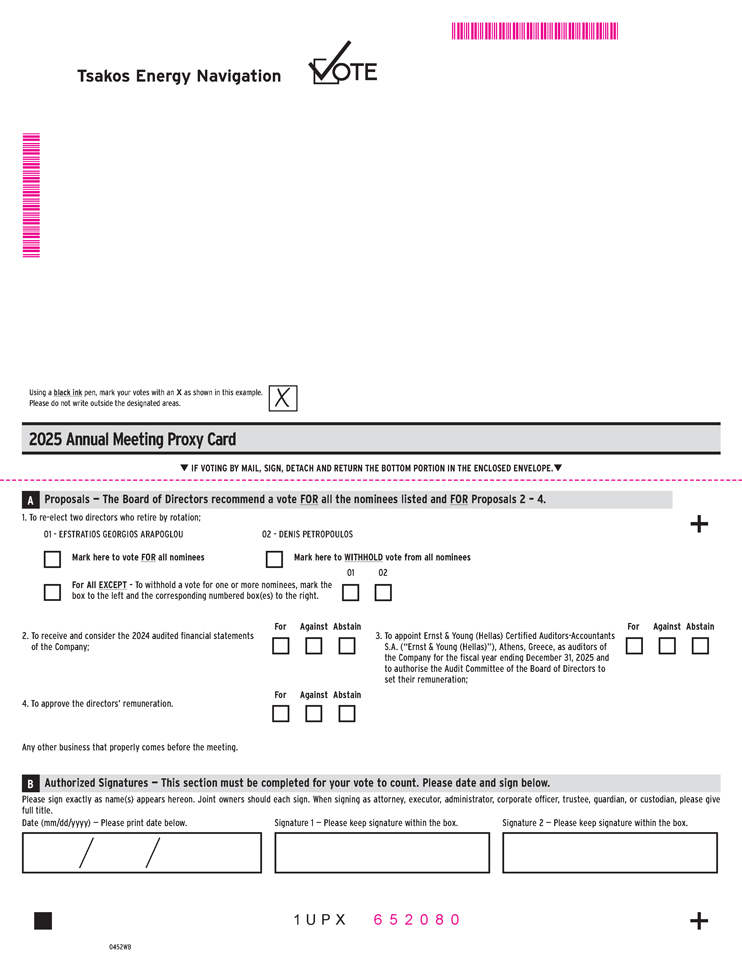
Tsakos Energy Navigation Using a black ink pen, mark your votes with an X as shown in this example. Please do not write outside the designated areas. 2025 Annual Meeting Proxy Card IF VOTING BY MAIL, SIGN, DETACH AND RETURN THE BOTTOM PORTION IN THE ENCLOSED ENVELOPE. A Proposals — The Board of Directors recommend a vote FOR all the nominees listed and FOR Proposals 2 – 4. 1. To re-elect two directors who retire by rotation; 01—EFSTRATIOS GEORGIOS ARAPOGLOU 02—DENIS PETROPOULOS Mark here to vote FOR all nominees Mark here to WITHHOLD vote from all nominees 01 02 For All EXCEPT—To withhold a vote for one or more nominees, mark the box to the left and the corresponding numbered box(es) to the right. For Against Abstain 2. To receive and consider the 2024 audited financial statements of the Company; For Against Abstain 4. To approve the directors’ remuneration. Any other business that properly comes before the meeting. For Against Abstain 3. To appoint Ernst & Young (Hellas) Certified Auditors-Accountants S.A. (“Ernst & Young (Hellas)”), Athens, Greece, as auditors of the Company for the fiscal year ending December 31, 2025 and to authorise the Audit Committee of the Board of Directors to set their remuneration; B Authorized Signatures — This section must be completed for your vote to count. Please date and sign below. Please sign exactly as name(s) appears hereon. Joint owners should each sign. When signing as attorney, executor, administrator, corporate officer, trustee, guardian, or custodian, please give full title. Date (mm/dd/yyyy) — Please print date below. Signature 1 — Please keep signature within the box. Signature 2 — Please keep signature within the box. 1 UPX 652080 0452WB

IF VOTING BY MAIL, SIGN, DETACH AND RETURN THE BOTTOM PORTION IN THE ENCLOSED ENVELOPE. TSAKOS ENERGY NAVIGATION LIMITED Notice of 2025 Annual Meeting of Shareholders Proxy Solicited by Board of Directors for Annual Meeting — June 12, 2025 Mr. Efstratios Georgios Arapoglou, and if Mr. Arapoglou is not present, any director of the Company, with full power of substitution, is hereby authorized to represent and vote the shares of the undersigned, with all the powers which the undersigned would possess if personally present, at the Annual Meeting of Shareholders of Tsakos Energy Navigation Limited to be held on June 12, 2025 or at any postponement or adjournment thereof. Shares represented by this proxy will be voted by the shareholder. If no such directions are indicated, the Proxy will have authority to vote FOR the election of the Board of Directors and FOR items 2-4. In his discretion, the Proxy is authorized to vote upon such other business as may properly come before the meeting. (Items to be voted appear on reverse side)
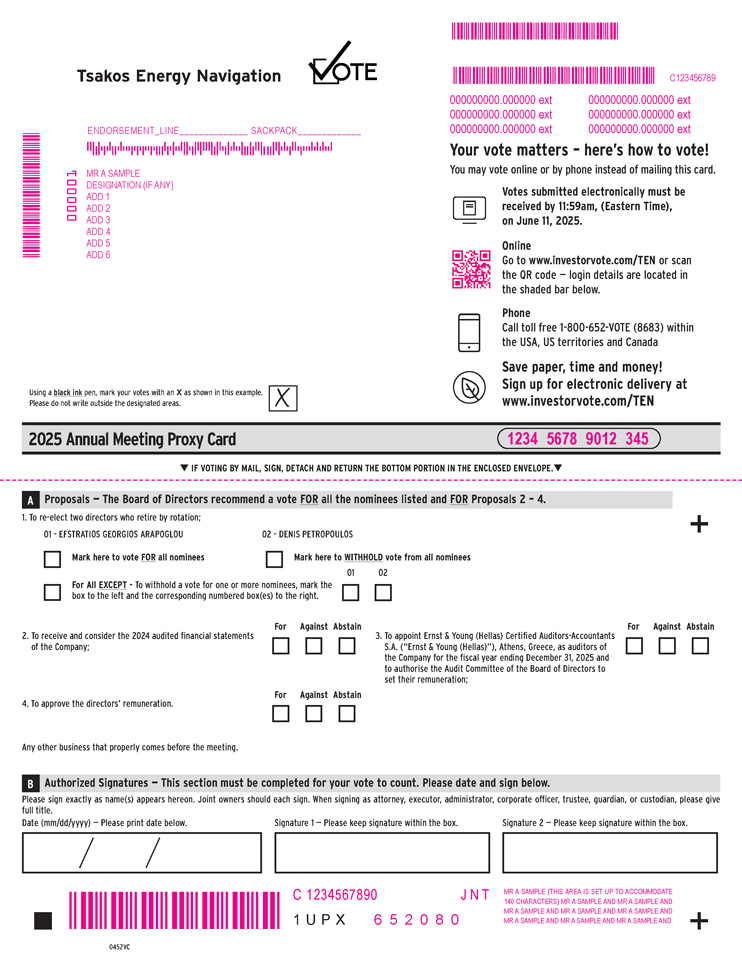
Tsakos Energy Navigation ENDORSEMENT_LINE SACKPACK 000001 MR A SAMPLE DESIGNATION (IF ANY) ADD 1 ADD 2 ADD 3 ADD 4 ADD 5 ADD 6 C123456789 000000000.000000 ext 000000000.000000 ext 000000000.000000 ext 000000000.000000 ext 000000000.000000 ext 000000000.000000 ext Your vote matters – here’s how to vote! You may vote online or by phone instead of mailing this card. Votes submitted electronically must be received by 11:59am, (Eastern Time), on June 11, 2025. Online Go to www.investorvote.com/TEN or scan the QR code — login details are located in the shaded bar below. Phone Call toll free 1-800-652-VOTE (8683) within the USA, US territories and Canada Save paper, time and money! Sign up for electronic delivery at www.investorvote.com/TEN Using a black ink pen, mark your votes with an X as shown in this example. Please do not write outside the designated areas. 2025 Annual Meeting Proxy Card 1234 5678 9012 345 IF VOTING BY MAIL, SIGN, DETACH AND RETURN THE BOTTOM PORTION IN THE ENCLOSED ENVELOPE. A Proposals — The Board of Directors recommend a vote FOR all the nominees listed and FOR Proposals 2 – 4. 1. To re-elect two directors who retire by rotation; 01—EFSTRATIOS GEORGIOS ARAPOGLOU 02—DENIS PETROPOULOS Mark here to vote FOR all nominees Mark here to WITHHOLD vote from all nominees 01 02 For All EXCEPT—To withhold a vote for one or more nominees, mark the box to the left and the corresponding numbered box(es) to the right. 2. To receive and consider the 2024 audited financial statements For Against Abstain 3. To appoint Ernst & Young (Hellas) Certified Auditors-Accountants For Against Abstain of the Company; S.A. (“Ernst & Young (Hellas)”), Athens, Greece, as auditors of the Company for the fiscal year ending December 31, 2025 and to authorise the Audit Committee of the Board of Directors to set their remuneration; 4. To approve the directors’ remuneration. For Against Abstain Any other business that properly comes before the meeting. B Authorized Signatures — This section must be completed for your vote to count. Please date and sign below. Please sign exactly as name(s) appears hereon. Joint owners should each sign. When signing as attorney, executor, administrator, corporate officer, trustee, guardian, or custodian, please give full title. Date (mm/dd/yyyy) — Please print date below. Signature 1 — Please keep signature within the box. Signature 2 — Please keep signature within the box. C 1234567890 J N T 1 UPX 652080 MR A SAMPLE (THIS AREA IS SET UP TO ACCOMMODATE 140 CHARACTERS) MR A SAMPLE AND MR A SAMPLE AND MR A SAMPLE AND MR A SAMPLE AND MR A SAMPLE AND MR A SAMPLE AND MR A SAMPLE AND MR A SAMPLE AND 0452VC
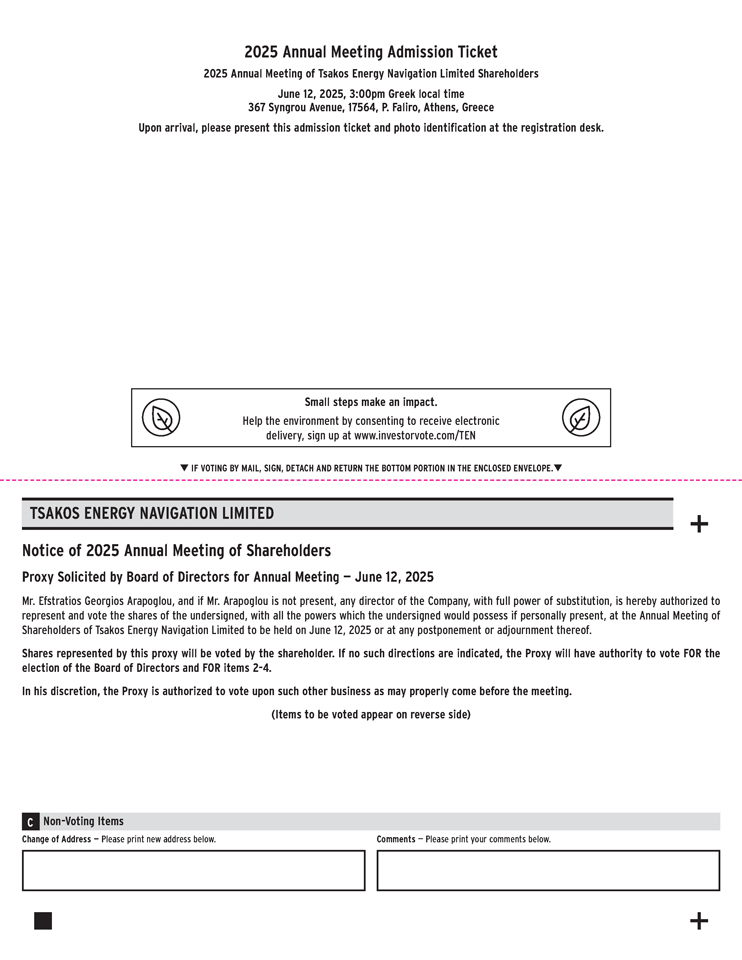
2025 Annual Meeting Admission Ticket 2025 Annual Meeting of Tsakos Energy Navigation Limited Shareholders June 12, 2025, 3:00pm Greek local time 367 Syngrou Avenue, 17564, P. Faliro, Athens, Greece Upon arrival, please present this admission ticket and photo identification at the registration desk. Small steps make an impact. Help the environment by consenting to receive electronic delivery, sign up at www.investorvote.com/TEN IF VOTING BY MAIL, SIGN, DETACH AND RETURN THE BOTTOM PORTION IN THE ENCLOSED ENVELOPE. TSAKOS ENERGY NAVIGATION LIMITED Notice of 2025 Annual Meeting of Shareholders Proxy Solicited by Board of Directors for Annual Meeting — June 12, 2025 Mr. Efstratios Georgios Arapoglou, and if Mr. Arapoglou is not present, any director of the Company, with full power of substitution, is hereby authorized to represent and vote the shares of the undersigned, with all the powers which the undersigned would possess if personally present, at the Annual Meeting of Shareholders of Tsakos Energy Navigation Limited to be held on June 12, 2025 or at any postponement or adjournment thereof. Shares represented by this proxy will be voted by the shareholder. If no such directions are indicated, the Proxy will have authority to vote FOR the election of the Board of Directors and FOR items 2-4. In his discretion, the Proxy is authorized to vote upon such other business as may properly come before the meeting. (Items to be voted appear on reverse side) C Non-Voting Items Change of Address — Please print new address below. Comments — Please print your comments below.
Exhibit 99.3
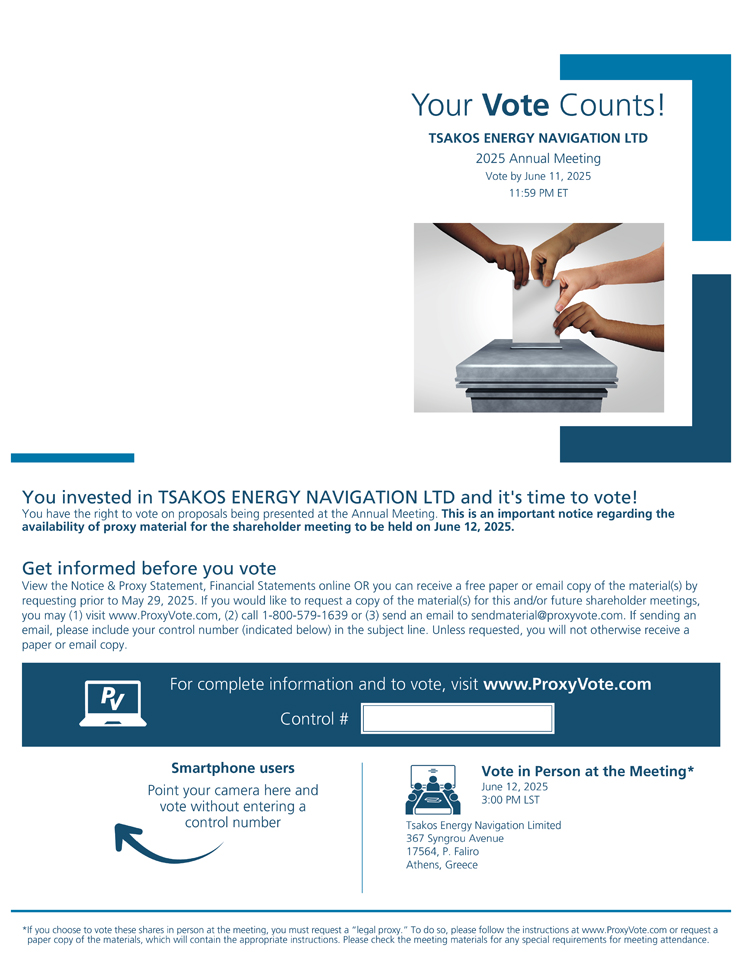
Your Vote Counts! TSAKOS ENERGY NAVIGATION LTD 2025 Annual Meeting Vote by June 11, 2025 11 :59 PM ET You invested in TSAKOS ENERGY NAVIGATION LTD and it•s time to vote! You have the right to vote on proposals being presented at the Annual Meeting. This is an important notice regarding the availability of proxy material for the shareholder meeting to be held on June 12, 2025. Get informed before you vote View the Notice & Proxy Statement, Financial Statements online OR you can receive a free paper or email copy of the material(s) by requesting prior to May 29, 2025. If you would like to request a copy of the material(s) for this and/or future shareholder meetings, you may (1) visit www.ProxyVote.com, (2) call 1-800-579-1639 or (3) send an email to sendmaterial@proxyvote.com. If sending an email, please include your control number (indicated below) in the subject line. Unless requested, you will not otherwise receive a paper or email copy. Smartphone users Vote in Person at the Meeting* Point your camera here and June 12, 2025 3:00PM LST vote without entering a ~Inumber Tsakos Energy Navigation Limited 367 Syngrou Avenue 17564, P. Faliro Athens, Greece *If you choose to vote these shares in person at the meeting, you must request a “legal proxy.” To do so, please follow the instructions at www.ProxyVote.com or request a paper copy of the materials, which will contain the appropriate instructions. Please check the meeting materials for any special requirements for meeting attendance.
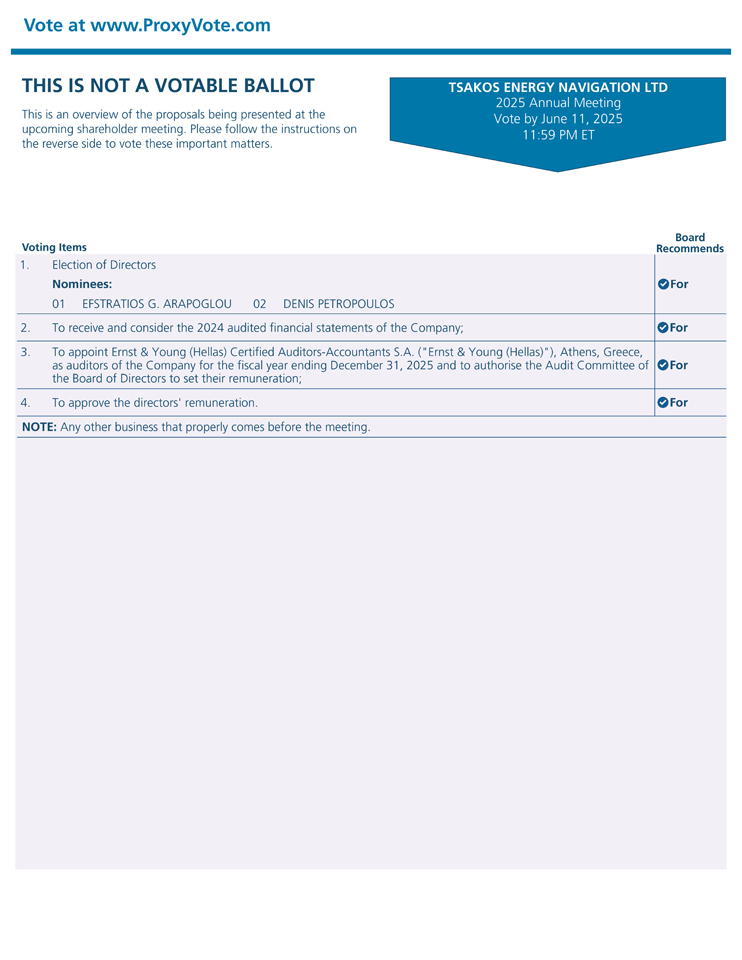
Vote at www.ProxyVote.com THIS IS NOT A VOTABLE BALLOT TSAKOS ENERGY NAVIGATION LTD 2025 Annual Meeting This is an overview of the proposals being presented at the Vote by June 11, 2025 upcoming shareholder meeting. Please follow the instructions on the reverse side to vote these important matters. 11:59PMET Board Voting Items Recommends 1. Election of Directors Nominees: 0 For 01 EFSTRATIOS G. ARAPOGLOU 02 DENIS PETROPOULOS 2. To receive and consider the 2024 audited financial statements of the Company; 0 For 3. To appoint Ernst & Young (Hellas) Certified Auditors-Accountants S.A. (II Ernst & Young (Hellas) II), Athens, Greece, as auditors of the Company for the fiscal year ending December 31, 2025 and to authorise the Audit Committee of 0 For the Board of Directors to set their remuneration; 4. To approve the directors’ remuneration. 0 For NOTE: Any other business that properly comes before the meeting.
Exhibit 99.4

TSAKOS ENERGY NAVIGATION LIMITED AND SUBSIDIARIES
CONSOLIDATED FINANCIAL STATEMENTS
2024
TSAKOS ENERGY NAVIGATION LIMITED AND SUBSIDIARIES
INDEX TO CONSOLIDATED FINANCIAL STATEMENTS
F-1
Report of Independent Registered Public Accounting Firm
To the Stockholders and the Board of Directors of Tsakos Energy Navigation Limited
Opinion on the Financial Statements
We have audited the accompanying consolidated balance sheets of Tsakos Energy Navigation Limited and subsidiaries (the Company) as of December 31, 2024 and 2023, the related consolidated statements of comprehensive income, other comprehensive income, stockholders’ equity and cash flows for each of the three years in the period ended December 31, 2024, and the related notes (collectively referred to as the “consolidated financial statements”). In our opinion, the consolidated financial statements present fairly, in all material respects, the financial position of the Company at December 31, 2024 and 2023, and the results of its operations and its cash flows for each of the three years in the period ended December 31, 2024, in conformity with U.S. generally accepted accounting principles.
We also have audited, in accordance with the standards of the Public Company Accounting Oversight Board (United States) (PCAOB), the Company’s internal control over financial reporting as of December 31, 2024, based on criteria established in Internal Control-Integrated Framework issued by the Committee of Sponsoring Organizations of the Treadway Commission (2013 framework) and our report dated April 11, 2025 expressed an unqualified opinion thereon.
Basis for Opinion
These financial statements are the responsibility of the Company’s management. Our responsibility is to express an opinion on the Company’s financial statements based on our audits. We are a public accounting firm registered with the PCAOB and are required to be independent with respect to the Company in accordance with the U.S. federal securities laws and the applicable rules and regulations of the Securities and Exchange Commission and the PCAOB.
We conducted our audits in accordance with the standards of the PCAOB. Those standards require that we plan and perform the audit to obtain reasonable assurance about whether the financial statements are free of material misstatement, whether due to error or fraud. Our audits included performing procedures to assess the risks of material misstatement of the financial statements, whether due to error or fraud, and performing procedures that respond to those risks. Such procedures included examining, on a test basis, evidence regarding the amounts and disclosures in the financial statements. Our audits also included evaluating the accounting principles used and significant estimates made by management, as well as evaluating the overall presentation of the financial statements. We believe that our audits provide a reasonable basis for our opinion.
Critical Audit Matter
The critical audit matter communicated below is a matter arising from the current period audit of the financial statements that was communicated or required to be communicated to the audit committee and that: (1) relates to accounts or disclosures that are material to the financial statements and (2) involved our especially challenging, subjective or complex judgments. The communication of the critical audit matter does not alter in any way our opinion on the consolidated financial statements, taken as a whole, and we are not, by communicating the critical audit matter below, providing a separate opinion on the critical audit matter or on the accounts or disclosures to which it relates.
F-2
Impairment indicators for vessels held and used
| Description of the matter | As of December 31, 2024, the carrying value of the Company’s vessels, including unamortized dry-docking costs was $2,957,918. As discussed in Note 1(i), 4 and 5 to the consolidated financial statements, the Company assesses whether events or changes in circumstances have occurred that could indicate that the carrying amounts of its vessels plus unamortized dry-docking costs may not be recoverable, in accordance with the guidance in ASC 360 – Property, Plant and Equipment (“ASC 360”).
Auditing the Company’s impairment indicator assessment was complex due to the judgement and estimation uncertainty required to evaluate events or changes in circumstances affecting the market and economic conditions in a cyclical and volatile industry, as well as the subjectivity involved in assessing potential indicators of impairment.
|
|
| How we addressed the matter in our audit |
We obtained an understanding, evaluated the design and tested the operating effectiveness of controls over the Company’s impairment indicator assessment process concerning controls over management’s identification of impairment indicators.
We analyzed management’s impairment assessment of vessel impairment indicators against the accounting guidance in ASC 360. In order to test management’s assessment of the developments in market conditions, our procedures included, among others, performing an analysis over the market charter rates and market prices, recent sale and purchase activity for second-hand tanker and LNG vessels, as well as changes in third-party valuations using market information derived from external industry data. Our procedures also included sensitivity analyses to evaluate the impact from potential sales. We assessed the Company’s disclosures in Notes 1(i), 4 and 5 to the consolidated financial statements. |
/s/ Ernst & Young (Hellas) Certified Auditors Accountants S.A.
We have served as the Company’s auditor since 2002.
Athens, Greece
April 11, 2025
F-3
Report of Independent Registered Public Accounting Firm
To the Stockholders and the Board of Directors of Tsakos Energy Navigation Limited
Opinion on Internal Control over Financial Reporting
We have audited Tsakos Energy Navigation Limited and subsidiaries’ internal control over financial reporting as of December 31, 2024, based on criteria established in Internal Control — Integrated Framework issued by the Committee of Sponsoring Organizations of the Treadway Commission (2013 framework) (the COSO criteria). In our opinion, Tsakos Energy Navigation Limited and subsidiaries (the Company) maintained, in all material respects, effective internal control over financial reporting as of December 31, 2024, based on the COSO criteria.
We also have audited, in accordance with the standards of the Public Company Accounting Oversight Board (United States) (PCAOB), the consolidated balance sheets of the Company as of December 31, 2024 and 2023, the related consolidated statements of comprehensive income, other comprehensive income, stockholders’ equity and cash flows for each of the three years in the period ended December 31, 2024, and the related notes and our report dated April 11, 2025 expressed an unqualified opinion thereon.
Basis for Opinion
The Company’s management is responsible for maintaining effective internal control over financial reporting and for its assessment of the effectiveness of internal control over financial reporting included in the accompanying Management’s Annual Report on Internal Control over Financial Reporting. Our responsibility is to express an opinion on the Company’s internal control over financial reporting based on our audit. We are a public accounting firm registered with the PCAOB and are required to be independent with respect to the Company in accordance with the U.S. federal securities laws and the applicable rules and regulations of the Securities and Exchange Commission and the PCAOB.
We conducted our audit in accordance with the standards of the PCAOB. Those standards require that we plan and perform the audit to obtain reasonable assurance about whether effective internal control over financial reporting was maintained in all material respects.
Our audit included obtaining an understanding of internal control over financial reporting, assessing the risk that a material weakness exists, testing and evaluating the design and operating effectiveness of internal control based on the assessed risk, and performing such other procedures as we considered necessary in the circumstances. We believe that our audit provides a reasonable basis for our opinion.
Definition and Limitations of Internal Control Over Financial Reporting
A company’s internal control over financial reporting is a process designed to provide reasonable assurance regarding the reliability of financial reporting and the preparation of financial statements for external purposes in accordance with generally accepted accounting principles. A company’s internal control over financial reporting includes those policies and procedures that (1) pertain to the maintenance of records that, in reasonable detail, accurately and fairly reflect the transactions and dispositions of the assets of the company; (2) provide reasonable assurance that transactions are recorded as necessary to permit preparation of financial statements in accordance with generally accepted accounting principles, and that receipts and expenditures of the company are being made only in accordance with authorizations of management and directors of the company; and (3) provide reasonable assurance regarding prevention or timely detection of unauthorized acquisition, use, or disposition of the company’s assets that could have a material effect on the financial statements.
F-4
Because of its inherent limitations, internal control over financial reporting may not prevent or detect misstatements. Also, projections of any evaluation of effectiveness to future periods are subject to the risk that controls may become inadequate because of changes in conditions, or that the degree of compliance with the policies or procedures may deteriorate.
/s/ Ernst & Young (Hellas) Certified Auditors Accountants S.A.
Athens, Greece
April 11, 2025
F-5
TSAKOS ENERGY NAVIGATION LIMITED AND SUBSIDIARIES
CONSOLIDATED BALANCE SHEETS
DECEMBER 31, 2024, AND 2023
(Expressed in thousands of U.S. Dollars—except share and per share data)
| 2024 | 2023 | |||||||
| ASSETS | ||||||||
| CURRENT ASSETS: |
||||||||
| Cash and cash equivalents |
$ | 343,373 | $ | 372,032 | ||||
| Restricted cash |
4,939 | 4,662 | ||||||
| Margin deposits |
4,270 | 4,270 | ||||||
| Trade accounts receivable, net (Note 1(f)) |
26,451 | 46,698 | ||||||
| Capitalized voyage expenses |
1,437 | 1,448 | ||||||
| Due from related parties (Note 2) |
2,842 | 5,287 | ||||||
| Advances and other |
36,284 | 26,275 | ||||||
| Vessels held for sale (Note 1(j)) |
— | 20,985 | ||||||
| Inventories |
18,948 | 22,513 | ||||||
| Prepaid insurance and other |
8,380 | 3,913 | ||||||
| Receivable, short-term (Note 3) |
4,370 | — | ||||||
| Current portion of financial instruments-Fair value |
509 | 1,253 | ||||||
|
|
|
|
|
|||||
| Total current assets |
451,803 | 509,336 | ||||||
|
|
|
|
|
|||||
| FINANCIAL INSTRUMENTS-FAIR VALUE, net of current portion |
84 | — | ||||||
| RIGHT OF USE ASSETS UNDER OPERATING LEASES (Note 3) |
15,937 | 36,969 | ||||||
| LONG-TERM RECEIVABLE (Note 3) |
8,183 | 23,812 | ||||||
| INVESTMENT IN DEBT SECURITIES (Note 9) |
25,230 | 5,064 | ||||||
| FIXED ASSETS (Note 4) |
||||||||
| Advances for vessels under construction |
246,392 | 150,575 | ||||||
| Vessels |
4,030,874 | 3,616,223 | ||||||
| Accumulated depreciation |
(1,111,091 | ) | (1,016,202 | ) | ||||
| Vessels’ Net Book Value |
2,919,783 | 2,600,021 | ||||||
|
|
|
|
|
|||||
| Total fixed assets |
3,166,175 | 2,750,596 | ||||||
|
|
|
|
|
|||||
| DEFERRED CHARGES AND LEASEHOLD IMPROVEMENTS, net (Note 5) |
39,110 | 38,313 | ||||||
|
|
|
|
|
|||||
| Total assets |
$ | 3,706,522 | $ | 3,364,090 | ||||
|
|
|
|
|
|||||
| LIABILITIES AND STOCKHOLDERS’ EQUITY | ||||||||
| CURRENT LIABILITIES: |
||||||||
| Current portion of long-term debt and other financial liabilities (Note 6) |
$ | 251,752 | $ | 191,974 | ||||
| Payables |
55,846 | 40,207 | ||||||
| Due to related parties (Note 2) |
880 | 3,558 | ||||||
| Accrued liabilities |
49,901 | 33,391 | ||||||
| Unearned revenue (Note 1n) |
37,410 | 31,902 | ||||||
| Current portion of obligations under operating leases (Note 3) |
11,608 | 21,031 | ||||||
| Current portion of financial liability under operating leases (Note 3) |
1,097 | 1,067 | ||||||
| Current portion of financial instruments-Fair value |
25 | 72 | ||||||
|
|
|
|
|
|||||
| Total current liabilities |
$ | 408,519 | $ | 323,202 | ||||
|
|
|
|
|
|||||
F-6
| 2024 | 2023 | |||||||
| LONG-TERM DEBT AND OTHER FINANCIAL LIABILITIES, net of current portion (Note 6) |
$ | 1,495,342 | $ | 1,370,683 | ||||
| LONG-TERM OBLIGATIONS UNDER OPERATING LEASES (Note 3) |
4,329 | 15,937 | ||||||
| FINANCIAL LIABILITY UNDER OPERATING LEASES, net of current portion (Note 3) |
— | 1,097 | ||||||
| LIABILITIES ASSUMED FROM TIME CHARTERS ATTACHED (Note 15) |
31,135 | — | ||||||
| FINANCIAL INSTRUMENTS—FAIR VALUE, net of current portion |
— | 524 | ||||||
| STOCKHOLDERS’ EQUITY (Note 8) |
||||||||
| Preferred Shares, $ 1.00 par value; 25,000,000 shares authorized, 4,745,947 Series E Preferred Shares and 6,747,147 Series F Preferred Shares issued and outstanding at December 31, 2024 and December 31, 2023 |
11,493 | 11,493 | ||||||
| Common shares, $ 5.00 par value; 60,000,000 shares authorized at December 31, 2024 and December 31, 2023; 30,805,776 shares issued and 30,127,603 shares outstanding at December 31, 2024 and 30,183,776 shares issued and 29,505,603 shares outstanding at December 31, 2023 respectively. |
151,541 | 150,919 | ||||||
| Additional paid-in capital |
919,718 | 912,214 | ||||||
| Cost of treasury stock |
(6,791 | ) | (6,791 | ) | ||||
| Accumulated other comprehensive (loss) income |
(904 | ) | 2,485 | |||||
| Retained earnings |
652,651 | 548,237 | ||||||
|
|
|
|
|
|||||
| Total Tsakos Energy Navigation Limited stockholders’ equity |
1,727,708 | 1,618,557 | ||||||
| Non-controlling interest |
39,489 | 34,090 | ||||||
| Total stockholders’ equity |
1,767,197 | 1,652,647 | ||||||
|
|
|
|
|
|||||
| Total liabilities and stockholders’ equity |
$ | 3,706,522 | $ | 3,364,090 | ||||
|
|
|
|
|
|||||
The accompanying notes are an integral part of the consolidated financial statements.
F-7
TSAKOS ENERGY NAVIGATION LIMITED AND SUBSIDIARIES
CONSOLIDATED STATEMENTS OF COMPREHENSIVE INCOME
FOR THE YEARS ENDED DECEMBER 31, 2024, 2023 AND 2022
(Expressed in thousands of U.S. Dollars—except share and per share data)
| 2024 | 2023 | 2022 | ||||||||||
| VOYAGE REVENUES: |
$ | 804,061 | $ | 889,566 | $ | 860,400 | ||||||
| EXPENSES: |
||||||||||||
| Voyage expenses |
152,875 | 155,724 | 209,890 | |||||||||
| Charter hire expense |
17,966 | 24,680 | 32,774 | |||||||||
| Vessel operating expenses |
198,049 | 194,914 | 190,268 | |||||||||
| Depreciation and amortization |
159,902 | 144,241 | 140,821 | |||||||||
| General and administrative expenses |
45,373 | 33,339 | 29,854 | |||||||||
| (Gain) Loss on sale of vessels (Note 4) |
(48,662 | ) | (81,198 | ) | 440 | |||||||
| Impairment charges (Note 4) |
— | 26,367 | — | |||||||||
|
|
|
|
|
|
|
|||||||
| Total expenses |
525,503 | 498,067 | 604,047 | |||||||||
|
|
|
|
|
|
|
|||||||
| Operating income |
278,558 | 391,499 | 256,353 | |||||||||
|
|
|
|
|
|
|
|||||||
| OTHER INCOME (EXPENSES): |
||||||||||||
| Interest and finance costs, net (Note 7) |
(112,151 | ) | (100,821 | ) | (50,253 | ) | ||||||
| Interest income |
15,124 | 14,582 | 2,000 | |||||||||
| Other, net |
99 | (176 | ) | 366 | ||||||||
|
|
|
|
|
|
|
|||||||
| Total other expenses, net |
(96,928 | ) | (86,415 | ) | (47,887 | ) | ||||||
|
|
|
|
|
|
|
|||||||
| Net income |
181,630 | 305,084 | 208,466 | |||||||||
| Less: Net income attributable to the non-controlling interest |
(5,399 | ) | (4,902 | ) | (4,232 | ) | ||||||
|
|
|
|
|
|
|
|||||||
| Net income attributable to Tsakos Energy Navigation Limited |
$ | 176,231 | $ | 300,182 | $ | 204,234 | ||||||
|
|
|
|
|
|
|
|||||||
| Effect of preferred dividends (Note 10) |
(27,000 | ) | (30,184 | ) | (34,724 | ) | ||||||
| Deemed dividend on Series D Preferred Shares (Note 10) |
— | (3,256 | ) | — | ||||||||
| Undistributed income to Series G participants |
— | — | (1,250 | ) | ||||||||
| Undistributed income allocated to non-vested restricted common stock (Note 10) |
(959 | ) | — | — | ||||||||
| Net income attributable to common stockholders of Tsakos Energy Navigation Limited |
$ | 148,272 | $ | 266,742 | $ | 168,260 | ||||||
| Earnings per share, basic attributable to Tsakos EnergyNavigation Limited common stockholders |
$ | 5.03 | $ | 9.04 | $ | 6.02 | ||||||
| Earnings per share, diluted attributable to Tsakos EnergyNavigation Limited common stockholders |
$ | 5.03 | $ | 9.04 | $ | 6.01 | ||||||
|
|
|
|
|
|
|
|||||||
| Weighted average number of shares, basic |
29,505,603 | 29,505,603 | 27,970,799 | |||||||||
|
|
|
|
|
|
|
|||||||
| Weighted average number of shares, diluted |
29,505,603 | 29,505,603 | 28,188,064 | |||||||||
|
|
|
|
|
|
|
|||||||
The accompanying notes are an integral part of these consolidated financial statements.
F-8
TSAKOS ENERGY NAVIGATION LIMITED AND SUBSIDIARIES
CONSOLIDATED STATEMENTS OF OTHER COMPREHENSIVE INCOME FOR THE YEARS ENDED
DECEMBER 31, 2024, 2023 AND 2022
(Expressed in thousands of U.S. Dollars-except share and per share data)
| 2024 | 2023 | 2022 | ||||||||||
| Net income |
$ | 181,630 | $ | 305,084 | $ | 208,466 | ||||||
| Other comprehensive income |
||||||||||||
| Unrealized (loss) income on interest rate swaps, net |
(3,389 | ) | (5,180 | ) | 24,840 | |||||||
|
|
|
|
|
|
|
|||||||
| Comprehensive income |
178,241 | 299,904 | 233,306 | |||||||||
|
|
|
|
|
|
|
|||||||
| Less: comprehensive income attributable to the non-controlling interest |
(5,399 | ) | (4,902 | ) | (4,232 | ) | ||||||
|
|
|
|
|
|
|
|||||||
| Comprehensive income attributable to Tsakos Energy Navigation Limited |
$ | 172,842 | $ | 295,002 | $ | 229,074 | ||||||
|
|
|
|
|
|
|
|||||||
The accompanying notes are an integral part of these consolidated financial statements.
F-9
TSAKOS ENERGY NAVIGATION LIMITED AND SUBSIDIARIES
CONSOLIDATED STATEMENTS OF STOCKHOLDERS’ EQUITY
FOR THE YEARS ENDED DECEMBER 31, 2024, 2023 AND 2022
(Expressed in thousands of U.S. Dollars-except for share and per share data)
| Treasury stock | ||||||||||||||||||||||||||||||||||||||||
| Preferred Shares |
Common Shares |
Additional Paid-in Capital |
Shares | Amount | Retained Earnings |
Accumulated Other Comprehensive Income (Loss) |
Tsakos Energy Navigation Limited |
Non- controlling Interest |
Total Stockholders’ Equity |
|||||||||||||||||||||||||||||||
| BALANCE December 31, 2021 |
$ | 15,461 | $ | 126,221 | $ | 973,582 | 678,173 | $ | (6,791 | ) | $ | 149,505 | $ | (17,175 | ) | $ | 1,240,803 | $ | 50,988 | $ | 1,291,791 | |||||||||||||||||||
| Net income |
— | — | — | — | — | 204,234 | — | 204,234 | 4,232 | 208,466 | ||||||||||||||||||||||||||||||
| Issuance of Common Shares |
— | 23,167 | 20,674 | — | — | — | — | 43,841 | — | 43,841 | ||||||||||||||||||||||||||||||
| Partial redemption of Class B preferred shares of subsidiary |
— | — | — | — | — | — | — | — | (2,500 | ) | (2,500 | ) | ||||||||||||||||||||||||||||
| Partial redemption of Series G convertible preferred shares |
(459 | ) | 1,531 | (1,072 | ) | — | — | — | — | — | — | — | ||||||||||||||||||||||||||||
| Sale of Series D preferred shares |
— | — | 1 | — | — | — | — | 1 | — | 1 | ||||||||||||||||||||||||||||||
| Sale of Series E preferred shares |
2 | — | 50 | — | — | — | — | 52 | — | 52 | ||||||||||||||||||||||||||||||
| Sale of Series F preferred shares |
6 | — | 133 | — | — | — | — | 139 | — | 139 | ||||||||||||||||||||||||||||||
| Cash dividends paid ($0.25 per common share) |
— | — | — | — | — | (7,289 | ) | — | (7,289 | ) | — | (7,289 | ) | |||||||||||||||||||||||||||
| Dividends paid on Class B preferred shares of subsidiary |
— | — | — | — | — | — | — | — | (1,698 | ) | (1,698 | ) | ||||||||||||||||||||||||||||
| Dividends paid on Series D preferred shares |
— | — | — | — | — | (7,694 | ) | — | (7,694 | ) | — | (7,694 | ) | |||||||||||||||||||||||||||
| Dividends paid on Series E preferred shares |
— | — | — | — | — | (10,975 | ) | — | (10,975 | ) | — | (10,975 | ) | |||||||||||||||||||||||||||
| Dividends paid on Series F preferred shares |
— | — | — | — | — | (16,024 | ) | — | (16,024 | ) | — | (16,024 | ) | |||||||||||||||||||||||||||
| Dividends paid on Series G Convertible preferred shares |
— | — | — | — | — | (31 | ) | — | (31 | ) | — | (31 | ) | |||||||||||||||||||||||||||
| Other comprehensive income |
— | — | — | — | — | — | 24,840 | 24,840 | — | 24,840 | ||||||||||||||||||||||||||||||
F-10
| Treasury stock | ||||||||||||||||||||||||||||||||||||||||
| Preferred Shares |
Common Shares |
Additional Paid-in Capital |
Shares | Amount | Retained Earnings |
Accumulated Other Comprehensive Income (Loss) |
Tsakos Energy Navigation Limited |
Non- controlling Interest |
Total Stockholders’ Equity |
|||||||||||||||||||||||||||||||
| BALANCE December 31, 2022 |
$ | 15,010 | $ | 150,919 | $ | 993,368 | 678,173 | $ | (6,791 | ) | $ | 311,726 | $ | 7,665 | $ | 1,471,897 | $ | 51,022 | $ | 1,522,919 | ||||||||||||||||||||
| Net income |
— | — | — | — | — | 300,182 | — | 300,182 | 4,902 | 305,084 | ||||||||||||||||||||||||||||||
| Redemption of Class B preferred shares of subsidiary |
— | — | — | — | — | — | — | — | (20,388 | ) | (20,388 | ) | ||||||||||||||||||||||||||||
| Redemption of Series D preferred shares |
(3,517 | ) | — | (81,154 | ) | — | — | (3,256 | ) | — | (87,927 | ) | — | (87,927 | ) | |||||||||||||||||||||||||
| Cash dividends paid ($1.0 per common share) |
— | — | — | — | — | (29,508 | ) | — | (29,508 | ) | — | (29,508 | ) | |||||||||||||||||||||||||||
| Dividends paid on Class B preferred shares of subsidiary |
— | — | — | — | — | — | — | — | (1,446 | ) | (1,446 | ) | ||||||||||||||||||||||||||||
| Dividends paid on Series D preferred shares |
— | — | — | — | — | (3,907 | ) | — | (3,907 | ) | — | (3,907 | ) | |||||||||||||||||||||||||||
| Dividends paid on Series E preferred shares |
— | — | — | — | — | (10,976 | ) | — | (10,976 | ) | — | (10,976 | ) | |||||||||||||||||||||||||||
| Dividends paid on Series F preferred shares |
— | — | — | — | — | (16,024 | ) | — | (16,024 | ) | — | (16,024 | ) | |||||||||||||||||||||||||||
| Other comprehensive loss |
— | — | — | — | — | — | (5,180 | ) | (5,180 | ) | — | (5,180 | ) | |||||||||||||||||||||||||||
| BALANCE December 31, 2023 |
$ | 11,493 | $ | 150,919 | $ | 912,214 | 678,173 | $ | (6,791 | ) | $ | 548,237 | $ | 2,485 | $ | 1,618,557 | $ | 34,090 | $ | 1,652,647 | ||||||||||||||||||||
| Net income |
— | — | — | — | — | 176,231 | — | 176,231 | 5,399 | 181,630 | ||||||||||||||||||||||||||||||
| Issuance and forfeiture of restricted shares 622,000 |
— | 622 | (622 | ) | — | — | — | — | — | — | — | |||||||||||||||||||||||||||||
| Cash dividends paid ($1.50 per common share) |
— | — | — | — | — | (44,817 | ) | — | (44,817 | ) | — | (44,817 | ) | |||||||||||||||||||||||||||
| Dividends paid on Series E preferred shares |
— | — | — | — | — | (10,976 | ) | — | (10,976 | ) | — | (10,976 | ) | |||||||||||||||||||||||||||
| Dividends paid on Series F preferred shares |
— | — | — | — | — | (16,024 | ) | — | (16,024 | ) | — | (16,024 | ) | |||||||||||||||||||||||||||
| Stock based compensation expense |
— | — | 8,126 | — | — | — | — | 8,126 | — | 8,126 | ||||||||||||||||||||||||||||||
| Other comprehensive loss |
— | — | — | — | — | — | (3,389 | ) | (3,389 | ) | — | (3,389 | ) | |||||||||||||||||||||||||||
| BALANCE December 31, 2024 |
$ | 11,493 | $ | 151,541 | $ | 919,718 | 678,173 | $ | (6,791 | ) | $ | 652,651 | $ | (904 | ) | $ | 1,727,708 | $ | 39,489 | $ | 1,767,197 | |||||||||||||||||||
The accompanying notes are an integral part of these consolidated financial statements.
F-11
| TSAKOS ENERGY NAVIGATION LIMITED AND SUBSIDIARIES
CONSOLIDATED STATEMENTS OF CASH FLOWS FOR THE YEARS ENDED DECEMBER 31, 2024, 2023 AND 2022 (expressed in thousands of U.S. dollars) |
| 2024 | 2023 | 2022 | ||||||||||
| Cash Flows from Operating Activities: |
||||||||||||
| Net income |
$ | 181,630 | $ | 305,084 | $ | 208,466 | ||||||
| Adjustments to reconcile net income to net cash provided by operating activities |
||||||||||||
| Depreciation |
138,396 | 122,811 | 120,459 | |||||||||
| Amortization of deferred dry-docking costs and leasehold improvements |
20,091 | 21,124 | 19,246 | |||||||||
| Amortization of deferred finance costs |
3,626 | 3,623 | 4,052 | |||||||||
| Amortization of right of use assets for finance lease |
1,415 | 306 | 1,116 | |||||||||
| Amortization of assumed liabilities from time charters attached |
(15,792 | ) | — | — | ||||||||
| Amortization of revenue escalation |
2,013 | (3,984 | ) | (2,004 | ) | |||||||
| Stock based compensation expense |
8,126 | — | — | |||||||||
| Interest expense on long term receivable, net |
(541 | ) | (505 | ) | (403 | ) | ||||||
| Interest income from debt securities, accrued |
(166 | ) | (64 | ) | — | |||||||
| Change in fair value of derivative instruments |
(3,541 | ) | (5,868 | ) | (5,923 | ) | ||||||
| (Gain) Loss on sale of vessels |
(48,662 | ) | (81,198 | ) | 440 | |||||||
| Impairment charges |
— | 26,367 | — | |||||||||
| Payments for dry-docking |
(24,738 | ) | (19,071 | ) | (29,445 | ) | ||||||
| Proceeds from swaps terminations |
— | — | 16,195 | |||||||||
| (Increase) Decrease in: |
||||||||||||
| Receivables and other, net |
16,866 | 28,371 | (35,238 | ) | ||||||||
| Margin deposits |
— | — | 1,579 | |||||||||
| Inventories |
3,565 | 3,704 | (3,299 | ) | ||||||||
| Prepaid insurance and other |
(3,398 | ) | 2,905 | (4,957 | ) | |||||||
| Capitalized voyage expenses |
11 | 456 | (65 | ) | ||||||||
| Increase (Decrease) in: |
||||||||||||
| Payables and other |
12,961 | (11,830 | ) | (27,064 | ) | |||||||
| Accrued liabilities |
10,314 | (2,805 | ) | 8,345 | ||||||||
| Unearned revenue |
5,508 | 5,853 | 17,029 | |||||||||
|
|
|
|
|
|
|
|||||||
| Net Cash provided by Operating Activities |
307,684 | 395,279 | 288,529 | |||||||||
|
|
|
|
|
|
|
|||||||
| Cash Flows from Investing Activities: |
||||||||||||
| Advances for vessels under construction |
(160,413 | ) | (134,741 | ) | (31,809 | ) | ||||||
| Vessel acquisitions and/or improvements |
(489,609 | ) | (163,644 | ) | (301,560 | ) | ||||||
| Investments in debt securities |
(20,000 | ) | (5,000 | ) | — | |||||||
| Proceeds from sale of vessels |
228,416 | 165,944 | 31,555 | |||||||||
|
|
|
|
|
|
|
|||||||
| Net Cash used in Investing Activities |
(441,606 | ) | (137,441 | ) | (301,814 | ) | ||||||
|
|
|
|
|
|
|
|||||||
| Cash Flows from Financing Activities: |
||||||||||||
| Proceeds from long-term debt and other financial liabilities |
410,632 | 411,424 | 701,105 | |||||||||
| Financing costs |
(4,805 | ) | (3,952 | ) | (6,296 | ) | ||||||
| Payments of long-term debt and other financial liabilities |
(226,085 | ) | (426,315 | ) | (494,171 | ) | ||||||
| Payments on principal portion of financial liabilities |
(2,385 | ) | (1,564 | ) | (2,933 | ) | ||||||
| Redemption of Series D preferred shares |
— | (87,927 | ) | — | ||||||||
| Redemption of Series B preferred shares |
— | (20,388 | ) | (2,500 | ) | |||||||
| Proceeds from stock issuance program, net |
— | — | 43,841 | |||||||||
| Proceeds from preferred stock issuance, net |
— | — | 192 | |||||||||
| Cash dividends |
(71,817 | ) | (61,861 | ) | (43,711 | ) | ||||||
|
|
|
|
|
|
|
|||||||
| Net Cash provided by (used in) Financing Activities |
105,540 | (190,583 | ) | 195,527 | ||||||||
|
|
|
|
|
|
|
|||||||
F-12
| 2024 | 2023 | 2022 | ||||||||||
| Net (decrease) increase in cash and cash equivalents and restricted cash |
$ | (28,382 | ) | $ | 67,255 | $ | 182,242 | |||||
| Cash and cash equivalents and restricted cash at beginning of period |
376,694 | 309,439 | 127,197 | |||||||||
|
|
|
|
|
|
|
|||||||
| Cash and cash equivalents and restricted cash at end of period |
$ | 348,312 | $ | 376,694 | $ | 309,439 | ||||||
|
|
|
|
|
|
|
|||||||
| Interest paid |
||||||||||||
| Cash paid for interest net of amounts capitalized |
$ | 108,648 | $ | 101,344 | $ | 48,946 | ||||||
| Reconciliation of cash and cash equivalents and restricted cash at end of period: |
||||||||||||
| Current Assets: |
||||||||||||
| Cash and cash equivalents |
343,373 | 372,032 | 304,367 | |||||||||
| Restricted cash |
4,939 | 4,662 | 5,072 | |||||||||
|
|
|
|
|
|
|
|||||||
| Total Cash and cash equivalents and restricted cash |
348,312 | 376,694 | 309,439 | |||||||||
|
|
|
|
|
|
|
|||||||
The accompanying notes are an integral part of these consolidated financial statements.
F-13
TSAKOS ENERGY NAVIGATION LIMITED AND SUBSIDIARIES
NOTES TO CONSOLIDATED FINANCIAL STATEMENTS DECEMBER 31, 2024, 2023 AND 2022
(Expressed in thousands of U.S. Dollars, except for share and per share data, unless otherwise stated)
1. Significant Accounting Policies
(a) Basis of presentation and description of business: The accompanying consolidated financial statements have been prepared in accordance with U.S. generally accepted accounting principles (“U.S. GAAP”) and include the accounts of Tsakos Energy Navigation Limited (the “Holding Company”), and its wholly-owned and majority-owned subsidiaries (collectively, the “Company”). All intercompany balances and transactions have been eliminated upon consolidation.
The Company owns and operates a fleet of crude oil and product carriers including three vessels chartered-in and two liquified natural gas (“LNG”) carriers providing worldwide marine transportation services under long, medium or short-term charters.
(b) Use of Estimates: The preparation of consolidated financial statements in conformity with U.S. GAAP requires management to make estimates and assumptions that affect the amounts of assets and liabilities and expenses, reported in the consolidated financial statements and the accompanying notes. Although actual results could differ from those estimates, management does not believe that such differences would be material.
(c) Other Comprehensive Income (Loss): The consolidated statement of other comprehensive income (loss), presents the change in equity (net assets) during a period from transactions and other events and circumstances from non-owner sources. It includes all changes in equity during a period except those resulting from investments by shareholders and distributions to shareholders. Reclassification adjustments are presented out of accumulated other comprehensive income (loss) on the face of the statement in which the components of other comprehensive income (loss) are presented or in the notes to the consolidated financial statements. The Company follows the provisions of ASC 220 “Comprehensive Income”, and presents items of net income, items of other comprehensive income (“OCI”) and total comprehensive income in two separate and consecutive statements.
(d) Foreign Currency Translation: The functional currency of the Company is the U.S. Dollar because the Company’s vessels operate in international shipping markets in which the U.S. Dollar is utilized to transact most business. The accounting books of the Company are also maintained in U.S. Dollars. Transactions involving other currencies during the year are converted into U.S. Dollars using the exchange rates in effect at the time of the transactions. At the balance sheet dates, monetary assets and liabilities, which are denominated in other currencies, are translated into U.S. Dollars at the year-end exchange rates. Resulting gains or losses are reflected within Vessel operating expenses in the accompanying consolidated statements of comprehensive income.
(e) Cash, Cash Equivalents and Restricted Cash: The Company classifies highly liquid investments such as time deposits and certificates of deposit and their equivalents with original maturities of three months or less as cash and cash equivalents. Cash deposits with certain banks that may only be used for special purposes (including loan repayments) are classified as Restricted cash. Interest earned on cash and cash equivalents and cash deposits is presented as interest income in the accompanying consolidated statements of comprehensive income.
(f) Trade Accounts Receivable, Net and Credit Losses Accounting: Trade accounts receivable, net at each balance sheet date includes estimated recoveries from charterers for hire, freight and demurrage and revenue earned but not yet billed, net of any allowance for receivables deemed uncollectible. Trade accounts receivable are recorded when the right to consideration becomes unconditional. The Company’s management at each balance sheet date reviews all outstanding invoices and provides allowance for receivables deemed uncollectible primarily based on the aging of such balances and any amounts in dispute. During 2024, 2023 and 2022, the Company had no write offs of trade accounts receivable, deemed uncollectible.
F-14
TSAKOS ENERGY NAVIGATION LIMITED AND SUBSIDIARIES
NOTES TO CONSOLIDATED FINANCIAL STATEMENTS DECEMBER 31, 2024, 2023 AND 2022
(Expressed in thousands of U.S. Dollars, except for share and per share data, unless otherwise stated)
As of January 1, 2020, the Company adopted ASC 326 which requires entities to use a forward-looking approach based on expected losses to estimate credit losses on certain types of financial instruments, including trade accounts receivable. The Company maintains an allowance for credit losses for expected uncollectable accounts receivable, which is recorded as an offset to trade accounts receivable and changes in such, if any, are classified as allowance for credit losses in the consolidated statements of comprehensive income.
The Company assessed collectability by reviewing accounts receivable on a collective basis where similar characteristics exist and on an individual basis when the Company identifies specific customers with known disputes or collectability issues. In determining the amount of the allowance for credit losses, the Company considered historical collectability based on past due status. The Company also considered customer-specific information, current market conditions and reasonable and supportable forecasts of future economic conditions to determine adjustments to historical loss data.
Impairment of accounts receivable arising from operating leases, i.e. time charters, should be accounted in accordance with ASC 842, and not in accordance with Topic 326. Impairment of accounts receivable arising from voyage charters, which are accounted in accordance with ASC 606, are within the scope of Subtopic 326 and must therefore, be assessed for expected credit losses. No allowance was warranted for the years ended December 31, 2024, and December 31, 2023.
In addition, no allowance was recorded for cash equivalents as the majority of cash balances as of the balance sheet date were on time deposits with highly reputable credit institutions, for which periodic evaluations of the relative credit standing of those financial institutions are performed. No allowance was recorded on insurance claims as of December 31, 2024, and December 31, 2023.
(g) Inventories: Inventories consist of bunkers, lubricants, victualling and stores and are stated at the lower of cost or net realizable value. The cost is determined primarily by the first-in, first-out method. Net realizable value is defined as estimated selling prices in the ordinary course of business, less reasonably predictable costs of completion, disposal and transportation. When evidence exists that the net realizable value of inventory is lower than its cost, the difference is recognized as a loss in earnings in the period in which it occurs.
(h) Fixed Assets: Fixed assets consist of vessels and vessels under construction. Vessels are stated at cost, less accumulated depreciation. The cost of vessels includes the contract price and pre-delivery costs incurred during the construction and upon delivery of new buildings, including capitalized interest, and expenses incurred upon the acquisition of second-hand vessels. Subsequent expenditures for conversions and major improvements are capitalized when they appreciably extend the life, increase the earning capacity or improve the efficiency or safety of the vessels; otherwise, they are charged to expense as incurred. Expenditures for routine repairs and maintenance are expensed as incurred.
Depreciation is provided on the straight-line method based on the estimated remaining economic useful lives of the vessels, less an estimated residual value based on a scrap price.
(i) Impairment of Fixed Assets and Right-of-use assets: The Company reviews vessels for impairment whenever events or changes in circumstances indicate that the carrying amount of a vessel including any unamortized dry-docking costs (Note 1(k)) may not be recoverable, in accordance with ASC 360 “Property, Plant and Equipment”. When such indicators are present, a vessel to be held and used is tested for recoverability by comparing the estimate of future undiscounted net operating cash flows expected to be generated by the use of the vessel over its remaining useful life and its eventual disposition to its carrying amount.
F-15
TSAKOS ENERGY NAVIGATION LIMITED AND SUBSIDIARIES
NOTES TO CONSOLIDATED FINANCIAL STATEMENTS DECEMBER 31, 2024, 2023 AND 2022
(Expressed in thousands of U.S. Dollars, except for share and per share data, unless otherwise stated)
Net operating cash flows are determined by applying various assumptions regarding the use or probability of sale of each vessel, future revenues net of commissions, operating expenses, scheduled dry-dockings, expected off-hire and scrap values, and taking into account historical revenue data and published forecasts on future world economic growth and inflation. Should the carrying value of the vessel, including any unamortized dry-docking costs, exceed its estimated future undiscounted net operating cash flows, impairment is measured based on the excess of the carrying amount plus any unamortized dry-docking costs over the fair market value of the asset. The Company determines the fair value of its vessels based on management estimates and assumptions and by making use of available market data and taking into consideration third-party valuations. In cases where sale and purchase activity in the market does not exist or is limited, the Company uses future discounted net operating cash flows or a combination of future discounted net operating cash flows and third-party valuations to estimate the fair value of an impaired vessel, respectively. The review of the carrying amounts in connection with the estimated recoverable amount for the Company’s vessels and advances for vessels under construction as of December 31, 2024, indicated no impairment charge compared to the impairment charge of $26,367 recorded for the year ended December 31, 2023, and $nil for the year ended December 31, 2022 (Note 4).
In addition, the Company reviews and tests its right-of-use-assets under operating leases for impairment, under ASC 360 “Property, Plant and Equipment”, whenever events or changes in circumstances indicate by comparing their carrying amount plus any unamortized leasehold improvements (Note 1(k)) with the estimated future undiscounted net operating cash flows expected to be generated by the use of the vessel, considering three-year charter rates estimates and the average of those, over the remaining lease term (Note 4). The review of the carrying amount in connection with the estimated recoverable amount for the Company’s right-of-use assets as of December 31, 2024, 2023 and 2022, indicated no impairment charge.
(j) Reporting Assets held for sale: It is the Company’s policy to dispose of vessels when suitable opportunities occur and not necessarily to keep them until the end of their useful life. Long-lived assets are classified as held for sale when all applicable criteria enumerated under ASC 360 “Property, Plant, and Equipment” are met and are measured at the lower of their carrying amount or fair value less cost to sell. These assets are not depreciated once they meet the criteria to be held for sale. An impairment charge for an asset held for sale is recognized when its fair value less cost to sell is lower than its carrying value at the date it meets the held for sale criteria and upon subsequent measurement. At December 31, 2024, there were no vessels held for sale. On December 6, 2023, the Company considered that the suezmax tanker Eurochampion 2004 met the criteria to be classified as held for sale and reclassified the amount of $20,985 as held for sale, based on the lower of its carrying amount and Level 1 inputs indicative of the vessel’s sale price less cost to sell. Vessel delivered to its new owner on January 11, 2024. There was no impairment charge for vessels classified as held for sale as at December 31, 2023.
(k) Accounting for Special Survey, Dry-docking Costs and Leasehold improvements: The Company follows the deferral method of accounting for dry-docking and special survey costs whereby actual costs incurred are reported in Deferred Charges and leasehold improvements and are amortized on a straight-line basis over the period through the date the next dry-docking is scheduled to become due (approximately every five years during the first fifteen years of the vessels’ life and every two and a half years within the remaining useful life of the vessels). Costs relating to routine repairs and maintenance are expensed as incurred. The unamortized portion of special survey and dry-docking costs for a vessel that is sold and/or classified as held for sale, is included as part of the carrying amount of the vessel in determining the gain or loss on sale of the vessel.
The Company follows the deferral method of accounting for leasehold improvement costs whereby actual costs incurred are reported in Deferred Charges and leasehold improvements and are amortized on a straight-line basis over the shorter of the useful life of those leasehold improvements and the remaining lease term, unless the lease transfers ownership of the underlying asset to the lessee or the lessee is reasonably certain to exercise an option to purchase the underlying asset, in which case the lessee shall amortize the leasehold improvements to the end of their useful life.
F-16
TSAKOS ENERGY NAVIGATION LIMITED AND SUBSIDIARIES
NOTES TO CONSOLIDATED FINANCIAL STATEMENTS DECEMBER 31, 2024, 2023 AND 2022
(Expressed in thousands of U.S. Dollars, except for share and per share data, unless otherwise stated)
(l) Loan Costs: Costs incurred for obtaining new loans or refinancing of existing loans, upon application of certain criteria, are capitalized and amortized over the term of the respective loan, using the effective interest rate method. Capitalized expenses for undrawn loan amounts as of the balance sheet date are deferred. Any unamortized balance of costs relating to loans repaid or refinanced as debt extinguishments is expensed in the period the repayment or extinguishment is made. Deferred financing costs, net of accumulated amortization, are presented as a reduction of long-term debt (Note 6).
(m) Accounting for Leases (Company act as lessee): Leases, where the Company is regarded as the lessee, are classified as either operating leases or finance leases, based on an assessment of the terms of the lease. According to the provisions of ASC 842-20-30-1, at the commencement date, a lessee shall measure both of the following: a) The lease liability at the present value of the lease payments not yet paid, discounted using the discount rate for the lease at lease commencement and b) The right-of-use assets, which shall consist of all of the following: i) The amount of the initial measurement of the lease liability, ii) Any lease payments made to the lessor at or before the commencement date, minus any lease incentives received and iii) Any initial direct costs incurred by the lessee.
After lease commencement, the Company measures the lease liability for an operating lease at the present value of the remaining lease payments using the discount rate determined at lease commencement. The right-of-use assets is subsequently measured at the amount of the remeasured lease liability, adjusted for the remaining balance of any lease incentives received, any cumulative prepaid or accrued rent if the lease payments are uneven throughout the lease term and any unamortized initial direct costs.
After lease commencement, the Company measures the lease liability for finance leases by increasing the carrying amount to reflect interest on the lease liability and reducing the carrying amount to reflect the lease payments made during the period. The right-of-use asset is amortized from the lease commencement date to the remaining useful life of the underlying asset since the Company has either the obligation or is reasonably certain to exercise its option to purchase the underlying asset. For finance leases, interest expense is determined using the effective interest method and is included under interest and finance cost, net in the consolidated statements of comprehensive income. Upon exercise of the option to purchase the underlying asset and settlement of the remaining lease liability, if the right-of-use asset was not previously presented together with vessels, the Company reclassifies the right-of-use asset to Fixed Assets under the consolidated balances sheets and applies Topic 360 to the asset beginning on the date the purchase option was exercised.
Any changes made to leased assets to customize it for a particular use or need of the lessee are capitalized as leasehold improvements. Amounts attributable to leasehold improvements are presented separately from the related right-of-use assets, whereas amortization on the leasehold improvements is recognized on a straight-line basis and is included under depreciation and amortization in the consolidated statements of comprehensive income. (Note 1(k)).
Sale and Leaseback transactions: In accordance with ASC 842, the Company, as seller-lessee, determines whether the transfer of an asset should be accounted as a sale in accordance with ASC 606. The existence of an option for the seller-lessee to repurchase the asset precludes the accounting for the transfer of the asset as a sale unless both of the following criteria are met: (1) the exercise price of the option is the fair value of the asset at the time the option is exercised and (2) there are alternative assets, substantially the same as the transferred asset, readily available in the marketplace; and the classification of the leaseback as a finance lease or a sales-type lease, precludes the buyer-lessor from obtaining control of the asset.
F-17
TSAKOS ENERGY NAVIGATION LIMITED AND SUBSIDIARIES
NOTES TO CONSOLIDATED FINANCIAL STATEMENTS DECEMBER 31, 2024, 2023 AND 2022
(Expressed in thousands of U.S. Dollars, except for share and per share data, unless otherwise stated)
The existence of an obligation for the Company, as seller-lessee, to repurchase the asset precludes accounting for the transfer of the asset as sale as the transaction would be classified as a financing arrangement by the Company as it effectively retains control of the underlying asset. If the transfer of the asset meets the criteria of sale, the Company, as seller-lessee recognizes the proceeds from the sale when the buyer-lessor obtains control of the asset, derecognizes the carrying amount of the underlying asset and accounts for the lease in accordance with ASC 842. If the transfer does not meet the criteria of sale, the Company does not derecognize the transferred asset, accounts for any amounts received as a financing arrangement and recognizes the difference between the amount of consideration received and the amount of consideration to be paid as interest.
The Company has three and five sale and leaseback transactions accounted for as operating leases as of December 31, 2024, and 2023, respectively, and one accounted for as a financing arrangement as of December 31, 2024, and 2023 (Note 3 & 6).
(n) Accounting for Revenues and Expenses: Voyage revenues are generated from voyage charter agreements and contracts of affreightment, bareboat charter, time charter agreements (including profit sharing clauses) or pooling arrangements.
Voyage charters and contracts of affreightment: Voyage charters are contracts made in the spot market for the use of a vessel for a specific voyage in return of payment of an agreed upon freight rate per ton of cargo. Contracts of affreightment are contracts for multiple voyage charter employments. Revenues from voyage charters in the spot market or under contracts of affreightment are recognized ratably from commencement of cargo loading to completion of discharge of the current cargo, in accordance with ASC 606. Voyage charter payments are due upon discharge of the cargo. Revenues from voyage charters and contracts of affreightment amounted to $218,588, $348,860 and $405,104 for the years ended December 31, 2024, 2023 and 2022, respectively. At December 31, 2024 and 2023, receivables from voyage charters and contracts of affreightment amounted to $11,416 and $31,543 respectively, the majority of them collected upon completion of the voyage.
Demurrage revenue, which is included in voyage revenues, represents charterers’ reimbursement for any potential delays exceeding the allowed lay time as per charter party agreement and is recognized as the performance obligation is satisfied.
Time, bareboat charters and pooling arrangements: For time charters and bareboat arrangements, a contract exists, and the vessel is delivered (commencement date) to the charterer, for a fixed period of time, at rates that are determined in the charter agreement and the relevant voyage expenses (i.e. port dues, canal tolls, pilotages and fuel consumption) burden the charterer. The charterer has the right, upon delivery of the vessel, to control the use of the vessel as it has the right to: (i) decide the (re)delivery time of the vessel; (ii) arrange the ports from which the vessel shall pass; (iii) give directions to the master of the vessel regarding the vessel’s operations (i.e. speed, route, bunkers purchases, etc.); (iv) sub-charter the vessel and (v) consume any income deriving from the vessel’s charter.
Thus, time and bareboat charter agreements are accounted as operating leases (Company acts as lessor), ratably on a straight line over the duration of the charter agreement and therefore, fall under the scope of ASC 842.
For vessels operating in pooling arrangements, the Company earns a portion of the generated total revenues, net of expenses incurred by the pool. Revenues and voyage expenses are pooled and allocated to each pool’s participants on a time charter equivalent, or TCE basis, in accordance with an agreed-upon formula, which is determined by points awarded to each vessel in the pool based on the vessel’s age, design and other performance characteristics.
F-18
TSAKOS ENERGY NAVIGATION LIMITED AND SUBSIDIARIES
NOTES TO CONSOLIDATED FINANCIAL STATEMENTS DECEMBER 31, 2024, 2023 AND 2022
(Expressed in thousands of U.S. Dollars, except for share and per share data, unless otherwise stated)
Revenue under pooling arrangements is accounted as a variable rate operating leases, falling under the scope of ASC 842 and is recognized for the applicable period, when the collectability is reasonably assured, based on the net revenue distributed by the pool.
The charterer may charter the vessel with or without the owner’s crew and other operating services (time charter/pooling arrangements, and bareboat charter, respectively). Thus, the agreed daily rates (hire rates) in the case of time charter agreements and pooling arrangements also include compensation for part of the agreed crew and other operating services provided by the owner (non-lease components). The Company has elected to account for the lease and non-lease components of time charter agreements and pooling arrangements as a combined component in its consolidated financial statements, having taken into account that the non-lease component would be accounted for ratably on a straight-line basis over the duration of the time charter and pooling arrangements in accordance with ASC 606 and that the lease component is considered as the predominant component. In this respect, the Company qualitatively assessed that more value is ascribed to the vessel rather than to the services provided under the time charter agreements and pooling arrangements.
Profit sharing contracts are accounted as variable consideration and included in the transaction price to the extent that variable amounts earned beyond an agreed fixed minimum hire are determinable at the reporting date and when there is no uncertainty associated with the variable consideration. Profit-sharing revenues are calculated at an agreed percentage of the excess of the charter’s average daily income over an agreed amount.
Revenue from time charter hire arrangements with an escalation clause is recognized on a straight-line basis over the charter term unless another systematic and rational basis is more representative of the time pattern in which the vessel is employed.
Revenues from time, bareboat and pooling charter arrangements amounted to $585,473, $540,706 and $455,296 for the years ended December 31, 2024, 2023 and 2022, respectively.
Revenues generated from time charter and bareboat charters are usually collected in advance.
In the event of an incident involving one of the Company’s vessels and where the loss of hire is insurable, the recovery is recorded when such loss of hire is realized or realizable and all contingencies are resolved. During 2024, 2023 and 2022, the Company incurred insurance recoveries from loss of hire amounting to $11,075, $5,400 and $4,995, respectively, included in voyage revenues of the consolidated statements of comprehensive income.
Voyage related and vessel operating expenses: Voyage expenses primarily consist of port charges, canal dues and bunker (fuel) costs relating to spot charters or contract of affreightment. These voyage expenses are borne by the Company unless the vessel is on time-charter, in which case they are borne by the charterer. Commissions (i.e. brokerage and address) are included in voyage expenses under all types of employment. All voyage expenses are expensed as incurred, apart from bunker expenses which consist of part of the contract fulfillment costs and are recognized as a deferred contract cost and amortized over the voyage period when the relevant criteria under ASC 340-40 are met. Unamortized deferred contract costs are included in the consolidated balance sheet under Capitalized voyage expenses. Costs amortized during the year ended December 31, 2024, to fulfill contracts were $4,851. Commissions are expensed as incurred. Vessel operating costs include crew costs, insurances, repairs and maintenance, spares, stores, lubricants, quality and safety costs and other expenses such as tonnage tax, registration fees and communication costs, as well as foreign currency gains or losses. All vessel operating
F-19
TSAKOS ENERGY NAVIGATION LIMITED AND SUBSIDIARIES
NOTES TO CONSOLIDATED FINANCIAL STATEMENTS DECEMBER 31, 2024, 2023 AND 2022
(Expressed in thousands of U.S. Dollars, except for share and per share data, unless otherwise stated)
expenses are expensed as incurred. Under a bareboat charter, the charterer assumes responsibility for all voyage and vessel operating expenses and risk of operation. Upon adoption of ASC 842, the Company made an accounting policy election to not recognize contract fulfillment costs for time charters under ASC 340-40. At December 31, 2024 and 2023, receivables from voyage related and operating reimbursable expenses amounted to $995 and $1,555, respectively, the majority of them collected upon completion of the voyage.
The Company records insurance claim recoveries for insured losses incurred on damages to fixed assets, net of any deductible amounts, at the time the recovery is probable under the related insurance policies and the claim is not subject to litigation. During 2024, 2023 and 2022, the Company incurred insurance recoveries from damages to fixed assets amounting to $10,774, $8,867 and $6,980, respectively, included in operating and voyage expenses of the consolidated statements of comprehensive income.
European Union’s Emissions Trading System: The EU Emissions Trading System (EU ETS) is the European Union’s policy to reduce greenhouse gas emissions within the EU by setting a cap on the total emissions allowed, which decreases over time. From January 1, 2024, companies, including shipping companies with vessels over 5,000 gross tonnage, must purchase emission allowances to cover their CO2 emissions, and they can trade these allowances for financial flexibility. Shipping companies are required to monitor, report, and verify their emissions, and at the end of each year, they must surrender allowances equal to their emissions.
As of December 31, 2024, the Company has recognized European Union Allowances (EUAs) to be surrendered by September 30, 2025, amounting to $12,945, included in accrued liabilities in the accompanying consolidated balances sheets. The amount of $6,739, are collectable from charterers and are included in trade accounts receivable, net in the accompanying consolidated balance sheets and the amount of $3,670 has been purchased and/or received from charterers and are included in advances and other in the accompanying consolidated balance sheets.
The value of EUAs provided by charterers is recognized under voyage revenues, while the EUAs obligations under the EU ETS are included in voyage expenses in the Company’s consolidated statements of comprehensive income. The EUAs obligations are measured at the estimated cost of purchasing credits from the EUA market, based on the voyage completion date. EUAs obligations not reimbursable from charterers are revalued using market prices from an EUA index. For the year ended December 31, 2024, the Company recorded $8,158 in voyage revenues and $13,034 in voyage expenses in the accompanying consolidated statements of comprehensive income, including $174 for remeasurement of EUAs obligations, as applicable.
Unearned revenue: Unearned revenue represents cash received prior to the year-end for which a related service has not been provided. It primarily relates to charter hire paid in advance at the amount of $23,151 as at December 31, 2024 ($17,391 as at December 31, 2023), and to revenue resulting from charter agreements with varying rates at the amount of $14,259 as at December 31, 2024 ($14,511 as at December 31, 2023).
Customers’ concentration: Voyage revenues for 2024, 2023 and 2022 included revenues derived from significant charterers as follows (in percentages of total voyage revenues):
| Charterer |
2024 | 2023 | 2022 | |||||||||
| A |
17 | % | 22 | % | 13 | % | ||||||
| B |
10 | % | 10 | % | 8 | % | ||||||
| C |
9 | % | 9 | % | 8 | % | ||||||
F-20
TSAKOS ENERGY NAVIGATION LIMITED AND SUBSIDIARIES
NOTES TO CONSOLIDATED FINANCIAL STATEMENTS DECEMBER 31, 2024, 2023 AND 2022
(Expressed in thousands of U.S. Dollars, except for share and per share data, unless otherwise stated)
(o) Segment Reporting: The Company has identified its Chief Operating Officer as the Chief Operations Decision Maker (“CODM”) in accordance with ASC 280 “Segment Reporting”. The CODM manages the business on a consolidated basis and uses the information as reported on the accompanying consolidated statements of comprehensive income to allocate resources, makes operating decisions and assesses performance, without discrete financial information by type of vessel or by type of charter or by type of cargo. Additionally, the vessels serve the same type of customers, have similar operations and maintenance requirements, operate in the same regulatory environment, and are subject to similar economic characteristics. Although operating results may be identified by type of vessel, the CODM reviews operating results primarily by consolidated net income of the fleet as this is reflected in the accompanying consolidated statements of comprehensive income. In addition, the CODM is provided on a regular basis with the consolidated operating expenses, deemed as significant and consolidated voyage revenues, both included in the segment profit, presented under corresponding captions in the consolidated statements of comprehensive income. The Company operates two LNG carriers which meet the quantitative thresholds used to determine reportable segments. The CODM does not review the operating results of these vessels separately or make any decisions about resources to be allocated to these vessels or assess their performance separately; therefore, the LNG carriers do not constitute a separate reportable segment. The Company’s vessels operate on many trade routes throughout the world and, therefore, the provision of geographic information is considered impracticable by management. For the above reasons, the Company has determined that it operates in one reportable segment, the worldwide maritime transportation of liquid energy-related products and the assets of such segment are presented under the caption total assets in the accompanying consolidated balance sheets. The accounting policies applied to the reportable segment are the same as those used in the preparation of the Company’s consolidated financial statements.
(p) Derivative Financial Instruments: The Company regularly enters into interest rate swap contracts to manage its exposure to fluctuations of interest rates associated with its specific borrowings. Also, the Company enters into bunker swap contracts and put or call options to manage its exposure to fluctuations of bunker prices associated with the consumption of bunkers by its vessels. In addition, the Company enters into EUAs swap agreements to manage its exposure to the EUAs obligations, that the Company must surrender latest by September 30, 2025, for the previous calendar year. Interest rate, bunker and EUAs price differentials paid or received under the swap agreements are recognized as part of Interest and finance costs, net. On the inception of a put or call option on bunkers an asset or liability is recognized. The subsequent changes in its fair value and realized payments or receipts upon exercise of the options are recognized in the consolidated statement of comprehensive income (loss) as part of the interest and finance costs, net. All derivatives are recognized in the consolidated financial statements at their fair value. On the inception date of the derivative contract, the Company evaluates the derivative as an accounting hedge of the variability of cash flow to be paid of a forecasted transaction (“cash flow” hedge). Changes in the fair value of a derivative that is qualified, designated and highly effective as a cash flow hedge are recorded in other comprehensive income (loss) until earnings are affected by the forecasted transaction. Changes in the fair value of undesignated derivative instruments and the ineffective portion of designated derivative instruments are reported in earnings in the period in which those fair value changes occur. Realized gains or losses on early termination of undesignated derivative instruments are also classified in earnings in the period of termination of the respective derivative instrument.
The Company formally documents all relationships between hedging instruments and hedged items, as well as the risk-management objective and strategy for undertaking various hedge transactions. This process includes linking all derivatives that are designated as cash flow hedges of the variable cash flows of a forecasted transaction to a specific forecasted transaction. The Company also formally assesses, both at the hedge’s inception and on an ongoing basis, whether the derivatives that are used in hedging transactions are highly effective in offsetting changes in cash flow of hedged items. When it is determined that a derivative is not highly effective as a hedge or that it has ceased to be a highly effective hedge, the Company discontinues hedge accounting prospectively.
F-21
TSAKOS ENERGY NAVIGATION LIMITED AND SUBSIDIARIES
NOTES TO CONSOLIDATED FINANCIAL STATEMENTS DECEMBER 31, 2024, 2023 AND 2022
(Expressed in thousands of U.S. Dollars, except for share and per share data, unless otherwise stated)
In accordance with ASC 815 “Derivatives and Hedging,” the Company may prospectively discontinue the hedge accounting for an existing hedge if the applicable criteria are no longer met, the derivative instrument expires, is sold, terminated or exercised or if the Company removes the designation of the respective cash flow hedge. In those circumstances, the net gain or loss remains in accumulated other comprehensive income (loss) and is reclassified into earnings in the same period or periods during which the hedged forecasted transaction affects earnings, unless the forecasted transaction is no longer probable in which case the net gain or loss is reclassified into earnings immediately.
(q) Fair Value Measurements: The Company follows the provisions of ASC 820, “Fair Value Measurements and Disclosures” which defines fair value and provides guidance as to the measure assets, liabilities and equity instruments classified in stockholders’ equity. The guidance creates a fair value hierarchy of measurement and describes fair value as the price that would be received to sell an asset or paid to transfer a liability or the consideration to transfer equity interests issued in an orderly transaction between market participants in the market in which the reporting entity transacts.
In accordance with the requirements of accounting guidance relating to Fair Value Measurements and Disclosures, the Company classifies and discloses its assets, liabilities carried at the fair value in one of the following categories (Note 14): Level 1: Quoted market prices in active markets for identical assets or liabilities or equity instruments; Level 2: Observable market based inputs or unobservable inputs that are corroborated by market data; Level 3: Unobservable inputs that are not corroborated by market data.
(r) Going concern: The Company evaluates whether there is substantial doubt about its ability to continue as a going concern by applying the provisions of ASC 205-40. In more detail, the Company evaluates whether there are conditions or events that raise substantial doubt about the Company’s ability to continue as a going concern within one year from the date the consolidated financial statements are issued. As part of such evaluation, the Company did not identify any conditions that raise substantial doubt about the entity’s ability to continue as a going concern. Accordingly, the Company continues to adopt the going concern basis in preparing its consolidated financial statements.
(s) Treasury stock: Treasury stock is stock that is repurchased by the issuing entity, reducing the number of outstanding shares in the open market. When shares are repurchased, they may either be cancelled or held for reissue. If not cancelled, such shares are referred to as treasury stock. Treasury stock is essentially the same as unissued capital and reduces ordinary share capital. The cost of the acquired shares should generally be shown as a deduction from stockholders’ equity. Dividends on such shares held in the entity’s treasury should not be reflected as income and not shown as a reduction in equity. Gains and losses on sales of treasury stock should be accounted for as adjustments to stockholders’ equity and not as part of income. Depending on whether the shares are acquired for reissuance or retirement, treasury stock is accounted for under the cost method or the constructive retirement method. The cost method is also used, when reporting entity management has not made decisions as to whether the reacquired shares will be retired, held indefinitely or reissued. The Company has elected for the repurchase of its common shares to be accounted for under the cost method. Under this method, the treasury stock account is charged for the aggregate cost of shares reacquired.
(t) Earnings Per Share Attributable to Common Stockholders: The Company computes earnings per share using the two-class method required for participating securities. The two-class method requires income available to common stockholders for the period to be allocated between common shares and participating securities based upon their respective rights to receive dividends as if all income for the period had been distributed.
F-22
TSAKOS ENERGY NAVIGATION LIMITED AND SUBSIDIARIES
NOTES TO CONSOLIDATED FINANCIAL STATEMENTS DECEMBER 31, 2024, 2023 AND 2022
(Expressed in thousands of U.S. Dollars, except for share and per share data, unless otherwise stated)
(u) Investment in Debt Securities: The Company classifies the investments in debt securities as “held-to-maturity”, “trading” or “available-for-sale”, whose classification determines the respective accounting methods stipulated by ASC 320. Interest income for all categories of investments in securities are included in the accompanying consolidated statements of comprehensive income. The debt securities that the Company has positive intent and ability to hold to maturity are classified as held-to-maturity securities and stated at amortized cost (Note 9).
(v) Preferred Shares: The Company follows the provision of ASC 480 “Distinguishing Liabilities from Equity” and ASC 815 “Derivatives and Hedging” to determine the classification of preferred shares as permanent equity, temporary equity or liability. A share that must be redeemed upon or after an event that is not certain of occurrence is not required to be accounted for as a liability pursuant to ASC 480, once the event becomes certain to occur, that instrument should be reclassified to a liability. If preferred shares become mandatorily redeemable pursuant to ASC 480, the Company reclassifies at fair value from equity to a liability. The difference between the carrying amount and fair value is treated by the Company as a deemed dividend and charged to net income available to common stockholders. The guidance in ASC 260-10-S99-2 is also applicable to the reclassification of the instrument. That guidance states that if an equity-classified preferred stock is subsequently reclassified as a liability based on other US GAAP, the equity instrument is considered redeemed through the issuance of a debt instrument. As such, the Company treats the difference between the carrying amount of the preferred share in equity and the fair value of the preferred share as a dividend for earnings per share purposes.
(w) Liabilities assumed from time charters attached: When the Company enters into an acquisition transaction, it determines whether the acquisition transaction was a purchase of an asset or a business based on the facts and circumstances of the transaction, following ASC 805 “Business Combinations”. For asset acquisitions, when acquiring vessels with attached time charters, the Company recognizes any related asset or liability based on the market value of the assumed charters. It calculates the present value of the difference between the existing charter rate and the market rate for a similar charter, with the same duration, on the acquisition date. This difference is discounted using the Company’s weighted average cost of capital on the acquisition date. The acquisition cost is allocated on a relative fair value basis, to the qualifying assets acquired. Any intangible asset or liability related to the time charter is included in intangible assets and/or liabilities assumed from time charters attached, in the accompanying consolidated balance sheets and is amortized over the remaining term of the charter, in voyage revenues line of the accompanying consolidated statements of comprehensive income.
(x) Stock Based Compensation expense: Stock based compensation expense represents the cost of shares granted to directors and officers of the Company and employees, and persons who provide services to the Company and its subsidiaries and employees of any management company, under the Company’s equity incentive plan, and is included in general and administrative expenses in the accompanying consolidated statements of comprehensive income. The restricted stock issued to employees, directors and officers of any management company, at the grant date, are measured at fair value, equal to the closing stock price on that date and are not remeasured subsequently. The related cost is recognized using the straight-line method over the requisite service period, which is the vesting period during which the employee must provide service to earn the award. For awards that are subject to performance conditions and future service conditions, and if it is probable that the performance conditions for these awards will be satisfied, then, the compensation cost in respect of these awards is recognized over the requisite service period, using the accelerated attribution method, which treats an award with multiple vesting dates as multiple awards and results in a front-loading of the costs of the award.
Further, the Company accounts for restricted share award forfeitures upon occurrence. This is a change to the Company’s previous policy of estimating expected forfeitures, made during the year ended December 31, 2024, upon grant of awards under the 2024 Plan (Note 8).
F-23
TSAKOS ENERGY NAVIGATION LIMITED AND SUBSIDIARIES
NOTES TO CONSOLIDATED FINANCIAL STATEMENTS DECEMBER 31, 2024, 2023 AND 2022
(Expressed in thousands of U.S. Dollars, except for share and per share data, unless otherwise stated)
While the previous accounting policy was acceptable, the change is preferable as it aligns better with the industry’s share-based arrangements. No impact applied due to this change in the Company’s accompanying consolidated financial statements for the comparative years, thus, no retrospective application due to this change was necessary. The cumulative effect of the change in the retained earnings included in the accompanying consolidated balance sheets, was nil. The effect of the change has no material effect on the accompanying consolidated financial statements for the year ended December 31, 2024.
New Accounting Pronouncements
Furthermore, in November 2023, the Financial Accounting Standards Board (“FASB”) issued Accounting Standard Update (“ASU”) No. 2023-07, Segment Reporting (Topic 280): Improvements to Reportable Segment Disclosures, which requires a public entity to disclose significant segment expenses and other segment items by reportable segment on an annual basis and expands the extent of interim segment disclosures. The guidance is applied retrospectively to all periods presented in the financial statements, unless it is impracticable to do so. The ASU does not change how a public entity identifies its operating segments, aggregates them, or applies the quantitative thresholds to determine its reportable segments. The Company adopted this ASU during the year ended December 31, 2024. The adoption of this ASU affected only the Company’s disclosures (Note 1(o)), with no impact to its consolidated financial statements.
In November 2024, the FASB issued ASU 2024-03, “Income Statement—Reporting Comprehensive Income—Expense Disaggregation Disclosures (Subtopic 220-40): Disaggregation of Income Statement Expenses”. The standard is intended to require more detailed disclosure about specified categories of expenses (including employee compensation, depreciation, and amortization) included in certain expense captions presented on the face of the income statement. This ASU is effective for fiscal years beginning after December 15, 2026, and for interim periods within fiscal years beginning after December 15, 2027. Early adoption is permitted. The amendments may be applied either prospectively to financial statements issued for reporting periods after the effective date of this ASU or retrospectively to all prior periods presented in the financial statements. The Company is currently assessing the impact this standard will have on its consolidated financial statements.
In March 2024, the FASB issued ASU 2024-01—Compensation—Stock Compensation (Topic 718): Scope Application of Profits Interest and Similar Awards, to improve GAAP by adding an illustrative example that includes four fact patterns to demonstrate how an entity should apply the scope guidance in paragraph 718-10-15-3 to determine whether a profits interest award should be accounted for in accordance with Topic 718, Compensation—Stock Compensation. For public business entities, the amendments in this ASU are effective for annual periods beginning after December 15, 2024, and interim periods within those annual periods. Early adoption is permitted for both interim and annual financial statements that have not yet been issued or made available for issuance. If an entity adopts the amendments in an interim period, it should adopt them as of the beginning of the annual period that includes that interim period. The Company does not expect the adoption of ASU 2024-01 to have a material effect on its consolidated financial statements and related disclosures.
2. Transactions with Related Parties
(a) Tsakos Energy Management Limited (the “Management Company”): The Holding Company has a Management Agreement (“Management Agreement”) with the Management Company, a Liberian corporation, to provide overall executive and commercial management of its affairs for a monthly fee, which may be adjusted per the Management Agreement of March 8, 2007, effective from January 1, 2008, at the beginning of each year, in accordance with the terms of the Management Agreement, if both parties agree.
F-24
TSAKOS ENERGY NAVIGATION LIMITED AND SUBSIDIARIES
NOTES TO CONSOLIDATED FINANCIAL STATEMENTS DECEMBER 31, 2024, 2023 AND 2022
(Expressed in thousands of U.S. Dollars, except for share and per share data, unless otherwise stated)
On January 1, 2022, monthly fees for operating conventional vessels were $27.5, for the suezmax Eurochampion 2004, the aframaxes Maria Princess and Sapporo Princess, the VLCCs Ulysses, Hercules I, which are managed by a third-party manager, amounted to $28.6, for third-party managed vessels, the handymaxes Afrodite and Ariadne, were $27.5, for chartered in vessels or chartered out on a bare-boat basis and for vessels under construction monthly fees were $20.4, $35.0 for the DP2 suezmax shuttle tankers, while the monthly fees for LNG carriers, Neo Energy and Maria Energy were $38.9 and $30.8 for the LNG carrier Tenergy (since delivery January 12, 2022). From May 1, 2022, monthly fees increased to $28.5 for all conventional vessels, for third-party managed vessels, the suezmax Eurochampion 2004, the aframaxes Maria Princess and Sapporo Princess, the VLCCs Ulysses, Hercules I increased to $29.1, for the handymaxes Afrodite and Ariadne remained at $27.5, for the suezmax tanker Decathlon $28.5 (from August 1, 2022). For chartered in vessels or chartered out on a bare-boat basis and for vessels under construction, monthly fees increased to $21.0, $36.0 for the DP2 suezmax shuttle tankers, while the monthly fees for LNG carriers, Neo Energy and Maria Energy increased to $42.4 and $34.3 for the LNG carrier Tenergy.
On January 1, 2023, monthly fees for operating conventional vessels were $30.0, for the suezmax Eurochampion 2004, the aframaxes Maria Princess and Sapporo Princess, the VLCCs Ulysses, Hercules I, which are managed by a third-party manager, amounted to $29.7, for third-party managed vessels, the handymaxes Afrodite and Ariadne (up to the sale, March 7, 2023 and February 16, 2023, respectively) and the aframax Ise Princess were $28.9, for chartered in vessels or chartered out on a bare-boat basis and for vessels under construction monthly fees were $21.0, $36.0 for the DP2 suezmax shuttle tankers, while the monthly fees for LNG carriers, Neo Energy and Maria Energy were $45.1 and $36.7 for the LNG carrier Tenergy. Monthly fees for VLCC Dias I, which is managed by a third-party manager, remained at $28.7. Monthly fees for the suezmax Decathlon, which is managed by a third-party manager amounted to $28.4.
On January 1, 2024, monthly fees for operating conventional vessels were $30.0 apart from the LNG carriers, the DP2 suezmax shuttle tankers, the third-party managed vessels, chartered in vessels or chartered out on a bare-boat basis, and for vessels under construction. Monthly fees for third-party managed vessels were $28.8, for the suezmax tanker Decathlon, $30.1 for the VLCCs Ulysses, Hercules I, $45.9 for LNG carriers Maria Energy and Neo Energy (up to the sale May 31, 2024) and $37.5 for Tenergy, $30.1 for the aframax tankers Sapporo Princess (up to November 17, 2024) and Maria Princess, and $29.3 for the aframax tanker Ise Princess, respectively. Monthly fees for VLCC Dias I and suezmax tanker Eurochampion 2004 (up to the sale January 11, 2024) amounted to $28.7 and $29.7, respectively. For the newly acquired vessels, aframax tankers Alpes, Aspen, and the suezmax tanker Popi Sazaklis, monthly fees amounted to $29.3 and $28.7 for the dual fuel LNG aframax tankers DF Montmartre and DF Mystras, respectively. Monthly fees for DP2 suezmax shuttle tankers were $36.0. For chartered in vessels or chartered out on a bare-boat basis and for vessels under construction, monthly fees were $21.0.
The Management Company, for services rendered, charged $19,880, $19,503 and $20,228 for the years ended December 31, 2024, 2023 and 2022, respectively. Management fees for vessels are included in the General and Administrative Expenses in the accompanying consolidated statements of comprehensive income.
In addition to the management fee, the Management Agreement provides for an incentive award to the Management Company, which is at the absolute discretion of the Holding Company’s Board of Directors. For the years ended December 31, 2024, 2023 and 2022, an award of $7,000, $5,000, and $1,000, respectively, was granted to the Management Company and is included in the General and Administrative expenses in the accompanying consolidated statements of comprehensive income.
F-25
TSAKOS ENERGY NAVIGATION LIMITED AND SUBSIDIARIES
NOTES TO CONSOLIDATED FINANCIAL STATEMENTS DECEMBER 31, 2024, 2023 AND 2022
(Expressed in thousands of U.S. Dollars, except for share and per share data, unless otherwise stated)
The Holding Company and the Management Company have certain officers and directors in common. The Chief Executive Officer and Director of the Holding Company, is also the sole stockholder of the Management Company and the son of the founder of TST (as defined below). The Management Company may unilaterally terminate its Management Agreement with the Holding Company at any time upon one year’s notice. In addition, if even one director is elected to the Holding Company without the recommendation of the existing Board of Directors, the Holding Company would be obligated to pay the Management Company an amount calculated in accordance with the terms of the Management Agreement. Under the terms of the Management Agreement between the Holding Company and the Management Company, the Holding Company may terminate the Management Agreement only under specific circumstances, without the prior approval of the Holding Company’s Board of Directors.
Estimated future management fees payable over the next ten years under the Management Agreement, exclusive of any incentive awards and based on existing vessels and known vessels scheduled for future delivery as at December 31, 2024, are $23,010 for 2025, $22,911 for 2026, $22,776 for 2027, $23,061 for 2028, $22,956 for 2029 and $94,284 from 2030 to 2034.
Also, under the terms of the Management Agreement, the Management Company provide supervisory services for the construction of new vessels for a monthly fee of $21.0 in 2024, 2023 and 2022. These fees in total amounted to $2,093, $1,897 and $1,107 for the years ended December 31, 2024, 2023 and 2022, respectively and are accounted for as part of construction costs. At December 31, 2024, the amount due to the Management Company was $170 ($157 at December 31, 2023).
(b) Tsakos Shipmanagement S.A. (“TSM”): The Management Company appointed TSM (previously named TCM, until May 2, 2023) to provide technical management to the Company’s vessels up to February 2023, when TST (Note 2(c)) assumed all technical management responsibilities for all vessels under TSM structure.
The previously named TCM was owned jointly and in equal part by related party interests and by a private German group during the period up to February 2023, and is now fully owned by related party interests. TSM for technical services charged $nil, $567 and $1,947 for the years ended December 31, 2024, 2023 and 2022, respectively, and it is included in operating expenses in the accompanying consolidated statements of comprehensive income.
At December 31, 2024, the amount due from TSM was $2,623 ($5,287 at December 31, 2023), relating to advance payments on vessel operating expenses.
TSM has a 25% share in a manning agency, located in the Philippines, named TSM Tsakos Maritime Philippines (TMPI), which provides crew to certain of the Company’s vessels. The Company has no control or ownership directly in TSM Tsakos Maritime Philippines, nor had any direct transactions to date with the agency.
(c) Tsakos Shipping and Trading S.A. (“TST”): The Management Company appointed TST to provide technical management to the Company’s vessels from February 2023. The Management Company, at its own expense, pays technical management fees to TST, and the Company bears and pays directly to TST most of its operating expenses, including repairs and maintenance, provisioning and crewing of the Company’s vessels, as well as certain charges which are capitalized or deferred, including reimbursement of the costs of TST personnel sent overseas to supervise repairs and perform inspections on the Company’s vessels.
F-26
TSAKOS ENERGY NAVIGATION LIMITED AND SUBSIDIARIES
NOTES TO CONSOLIDATED FINANCIAL STATEMENTS DECEMBER 31, 2024, 2023 AND 2022
(Expressed in thousands of U.S. Dollars, except for share and per share data, unless otherwise stated)
TST for technical services rendered charged $2,222, $1,203, $nil for the years ended December 31, 2024, 2023 and 2022, respectively, included in operating expenses in the accompanying consolidated statements of comprehensive income. At December 31, 2024, the amount due from TST as technical manager was $176 ($1,098 at December 31, 2023).
TST provides chartering services for the Company’s vessels by communicating with third-party brokers to solicit research and propose charters. For this service, the Company pays TST a chartering commission of approximately 1.25% on all freights, hires and demurrages. Such commissions are included in Voyage expenses in the accompanying consolidated statements of comprehensive income. TST also provides sale and purchases of vessels brokerage service. In 2024, 2023 and 2022, TST charged a brokerage commission of $1,168 (representing 0.5% of the sale price) for the sale of the two suezmax tankers, Eurochampion 2004 and Euronike, the two aframax tankers Izumo Princess and Nippon Princess and the LNG carrier, Neo Energy, $848 (representing 0.5% of the sale price) for the sale of the six handymax tankers, Artemis, Afrodite, Ariadne, Aris, Apollon, Ajax and the two handysize tankers Arion and Amphitrite and $326 (representing 1.0% of the sale price) for the sale of the aframax tanker Proteas and the panamax tanker Inca, respectively. TST may also charge a fee on delivery of each new building vessel in payment for the cost of design and supervision of the new building by TST. In 2024, $1,000 in aggregate was charged for supervision fees of the aframax tankers Njord DF, Ran DF, Chios DF and Ithaki DF, and in 2023, $500 was charged for supervision fees of the LNG carrier, Tenergy and the DP2 suezmax shuttle tanker, Porto. In 2022, no such fee was charged. All commissions are paid in the ordinary course of the Company’s business.
TST for chartering services rendered charged $9,657, $11,026 and $10,684 for the years ended December 31, 2024, 2023 and 2022, respectively. At December 31, 2024, the amount due to TST as commercial manager was $430 ($1,501 at December 31, 2023). At December 31, 2024, an amount of $510 ($667 at December 31, 2023) is also due to TST, included in accrued liabilities, which relates to services rendered but not yet invoiced.
(d) Argosy Insurance Company Limited (“Argosy”): The Company places its hull and machinery insurance, increased value insurance, war risk insurance and certain other insurance through Argosy, a captive insurance company affiliated with TST. Argosy, for services rendered, charged $15,150, $14,420 and $10,965 for the years ended December 31, 2024, 2023 and 2022, respectively. At December 31, 2024, the amount due from Argosy was $219 ($2,468 due to Argosy at December 31, 2023). At December 31, 2024, an amount of $758 ($328 at December 31, 2023) is also due to Argosy, included in accrued liabilities, which relates to services rendered but not yet invoiced.
(e) AirMania Travel S.A. (“AirMania”): Apart from third-party agents, the Company also uses an affiliated company, AirMania, for travel services. AirMania, for services rendered, charged $7,027, $6,589 and $6,437 for the years ended December 31, 2024, 2023 and 2022, respectively.
At December 31, 2024, the amount due to AirMania was $456 ($530 at December 31, 2023).
3. Right-of-use assets and lease liabilities
Operating leases
On December 21, 2020, the Company commenced a new five-year sale and leaseback agreement for the aframax, Sakura Princess. The agreed net sale price was $24,527. Under this leaseback agreement, there is a seller’s credit of $4,425 on the sales price that becomes immediately payable to the Company by the owners at the end of the five-year charter or upon sale of the vessel during the charter period.
F-27
TSAKOS ENERGY NAVIGATION LIMITED AND SUBSIDIARIES
NOTES TO CONSOLIDATED FINANCIAL STATEMENTS DECEMBER 31, 2024, 2023 AND 2022
(Expressed in thousands of U.S. Dollars, except for share and per share data, unless otherwise stated)
As of December 31, 2024, the Company has classified the seller’s credit, as short-term receivable amounting to $4,370. In accordance with ASC 842 and the package of practical expedients, the Company accounts for the transaction as an operating lease. Upon execution of the sale and leaseback of the aframax tanker, Sakura Princess, the Company recognized a financial liability amounting to $5,148, being the difference between the sale price of the asset and its fair value, as per ASC 842-40. The financial liability recognized for aframax Sakura Princess was $1,097 (current) as of December 31, 2024, and $2,164 (current portion $1,067 and non-current portion $1,097) as of December 31, 2023.
On June 21, 2021, the Company commenced a new five-year sale and leaseback agreement for each of the two suezmaxes, Arctic and Antarctic. The agreed net sale price was $52,304. Under these leaseback agreements, there is a seller’s credit of $8,415 on the sales price that becomes immediately payable to the Company by the owners at the end of the five-year charter or upon sale of the vessel during the charter period. As of December 31, 2024, the Company has classified the seller’s credit, as long-term receivable amounting to $8,183. In accordance with ASC 842 and the package of practical expedients, the Company accounts for the transaction as an operating lease.
At December 31, 2024 and 2023, the Company assessed the recoverability of the seller’s credits, considering the impairment indicators present, resulting in no impairment charge.
As at December 31, 2024, the Company recognized on its consolidated balance sheet a right-of-use assets under operating leases of $13,182 for the two suezmaxes Arctic and Antarctic and $2,755 for the aframax tanker Sakura Princess, equal to the corresponding obligation under operating leases based on the present value of the future minimum lease payments, for each of the three right-of-use assets, respectively. The Company has not incurred any initial direct costs for the sale and leaseback transactions and has not performed any payments prior to the commencement date of the contracts. The leaseback agreements include option periods, which are not recognized as part of the right-of-use assets and the obligation under operating leases.
The incremental borrowing rate used to determine the obligations under operating leases was 2.54% for the sale and leaseback agreement of the aframax, Sakura Princess and 2.98% for the sale and leaseback agreement for each of the two suezmaxes Arctic and Antarctic and the respective weighted average remaining lease term was 0.97 and 1.48 years, respectively, as at December 31, 2024 and 1.98 and 2.49 years, respectively, as at December 31, 2023. As at December 31, 2024 and 2023, both the right-of use assets and the corresponding obligation under operating leases were $15,937 (current portion $11,608 and non-current portion $4,329) and $36,969 (current portion $21,031 and non-current portion $15,937), respectively.
| Year |
Lease Commitment |
|||
| 2025 |
15,332 | |||
| 2026 |
4,992 | |||
| Minimum net lease payments |
$ | 20,324 | ||
|
|
|
|||
| Less: Present value discount |
(3,290 | ) | ||
|
|
|
|||
| Total Obligations under operating leases and financial liability (current and non-current portion) |
$ | 17,034 | ||
|
|
|
|||
The Company has subleased all three vessels and recognized sublease revenue, net of voyage expenses of $33,217 for the year ended December 31, 2024, compared to five vessels with recognized sublease revenue, net of voyage expenses of $77,414 and $54,877 for the years ended December 31, 2023 and 2022, respectively.
F-28
TSAKOS ENERGY NAVIGATION LIMITED AND SUBSIDIARIES
NOTES TO CONSOLIDATED FINANCIAL STATEMENTS DECEMBER 31, 2024, 2023 AND 2022
(Expressed in thousands of U.S. Dollars, except for share and per share data, unless otherwise stated)
Finance leases
On January 9, 2020, the Company commenced a five-year sale and leaseback agreement for each of the two suezmax tankers, Archangel and Alaska. The agreed net sale price was $61,070. Under these leaseback agreements, there was a seller’s credit of $11,800 on the sales price that would become immediately payable to the Company by the owners at the end of the five-year charter or upon sale of the vessels during the charter period. At inception, the Company accounted for the transaction as an operating lease and continued to do so following the adoption of ASC 842 and the package of practical expedients. On May 31, 2024, the Company signed an addendum in the bareboat agreement for each of the two suezmax tankers, Archangel and Alaska, to repurchase both vessels. In accordance with ASC 842, the Company accounted for the transaction as a lease modification and upon reassessment of the classification of the lease, the Company has classified the above transaction as a finance lease. On July 19, 2024 and August 22, 2024, the Company repurchased Alaska and Archangel, respectively, at a purchase price of $21,000 each, net of the seller’s credit amount of $5,900 for each vessel. As of the effective date of the modification, the corresponding lease liability under finance leases was remeasured to $43,316, including the application of the seller’s credit of $11,800 as a prepayment to repurchase the vessels. The incremental borrowing rate used to determine the right-of-use assets and the obligations under finance leases was 7.1%. During 2024, the lease liability under finance leases was reduced by $1,835 to reflect the lease payments made during the period and increased by an interest expense of $517, presented in the Company’s consolidated statements of comprehensive income under interest and finance costs. In addition, as of the effective date of the modification, the right-of-use-assets were adjusted, upon remeasurement of the lease liability resulting in total amount of $55,116. The amount of the right-of-use-assets is amortized on a straight-line method based on the estimated remaining economic lives of the vessels and is presented in the Company’s consolidated statements of comprehensive income under depreciation and amortization. During 2024, the right-of-use assets were amortized by $1,415. Upon repurchase of Alaska and Archangel, the Company derecognized the right-of-use-assets and the lease liability amounting to $53,702 and $41,998, respectively, and recognized both vessels as fixed assets in the accompanying consolidated balance sheets (Note 4).
The Company has subleased both vessels (Archangel and Alaska), the amount of $6,777 and $3,206 was recognized as sublease revenue, net of voyage expenses for the operating lease period (January 1, 2024 until May 31, 2024) and the finance lease period, respectively (May 31, 2024 until July 17, 2024 and August 22, 2024 for Alaska and Archangel, respectively).
On December 21, 2017, the Company commenced a five-year sale and leaseback agreement for each of the two suezmaxes, Eurochampion 2004 and Euronike. The agreed net sale price was $65,200. Under these leaseback agreements, there was a seller’s credit of $13,000 on the sales price that would become immediately payable to the Company by the owners at the end of the five-year charter or upon sale of the vessels during the charter period. At inception, the Company accounted the transaction as an operating lease and continued to do so following the adoption of ASC 842 and the package of practical expedients. On October 20, 2022, the Company signed an addendum in the bareboat agreement for each of the two suezmaxes, Eurochampion 2004 and Euronike, whereby had the option to extend the charter period for one year and add two purchase options to repurchase the vessels. In accordance with ASC 842, the Company accounted the transaction as a lease modification and upon reassessment of the classification of the lease, the Company classified the above transaction as a finance lease. On February 14, 2023, and February 21, 2023, the Company repurchased the two suezmaxes, Eurochampion 2004 and Euronike, respectively at a purchase price of $13,750 each, net of the seller’s credit amount of $6,500 for each vessel. As of the effective date of the modification, the corresponding lease liability under finance leases was remeasured to $29,968, including the application of the seller’s credit of $13,000 as a prepayment to repurchase the vessels. The incremental borrowing rate used to determine the right-of-use assets and the obligations under finance leases was 3.9%.
F-29
TSAKOS ENERGY NAVIGATION LIMITED AND SUBSIDIARIES
NOTES TO CONSOLIDATED FINANCIAL STATEMENTS DECEMBER 31, 2024, 2023 AND 2022
(Expressed in thousands of U.S. Dollars, except for share and per share data, unless otherwise stated)
During 2022, the lease liability under finance leases was reduced by $2,164 to reflect the lease payments made during the period and increased by an interest expense of $229, presented in the Company’s consolidated statements of comprehensive income under interest and finance costs. In addition, as of the effective date of the modification, the right-of-use-assets were adjusted, upon remeasurement of the lease liability resulting in total amount of $42,968. The amount of the right-of-use-assets is amortized on a straight-line method based on the estimated remaining economic lives of the vessels and is presented in the Company’s consolidated statements of comprehensive income under depreciation and amortization. Upon repurchase of Eurochampion 2004 and Euronike, the Company derecognized the right-of-use-assets and the lease liability amounting to $41,545 and $27,500, respectively, and recognized both vessels as fixed assets in the accompanying consolidated balance sheets (Note 4).
The amount of $5,809 was recognized for the finance lease period from January 1, 2023, until February 14, 2023, and February 21, 2023, for Eurochampion 2004 and Euronike, respectively. The Company subleased both vessels, the amount of $17,916 was recognized as sublease revenue, net of voyage expenses for the operating lease period from January 1, 2022, until October 20, 2022. The amount of $4,407 was recognized for the finance lease period from October 20, 2022, until December 31, 2022, for both vessels.
4. Vessels
Acquisitions
On January 11 and 19, 2024 the Company took delivery of its newbuilding aframax tankers Chios DF (Simel Navigation Co.) and Ithaki DF (Torvi Marine Corp.), respectively, for an aggregate cost of $156,649. During the first half of 2024, the Company acquired four aframax tankers DF Montmartre (Pink Diamond Sea Inc.), Alpes (Ortsa Oceanway Corp.), DF Mystras (Palermo Enterprises Corp.), Aspen (Quartz Maritime Limited), and the suezmax tanker Popi Sazaklis (Soho Shipping & Trading Co.), for an aggregate cost of $350,000.
On July 19, 2024 and August 22, 2024, the Company acquired the two suezmaxes Alaska (Lobelia Shipping Ltd) and Archangel (Creed Shipping S.A.), respectively (Note 3).
On February 14, 2023, and February 21, 2023, the Company acquired the two suezmaxes, Eurochampion 2004 (Sea Serenity Shipping Corp.) and Euronike (Stardust Shiptrade Inc), respectively, (Note 3). On September 21, 2023 and October 26, 2023, the Company took delivery of the newbuilding aframax tankers Njord DF (Arionas Marine S.A.) and Ran DF (Gudne Marine Corp.), respectively, for an aggregate cost of $155,677.
Sales
In 2024, the Company sold its suezmax tankers Eurochampion 2004 and Euronike, the aframax tankers Izumo Princess and Nippon Princess for net proceeds of $151,779, realizing total gain of $59,006. In 2024, the Company also sold its LNG carrier Neo Energy, for net proceeds of $76,637 realizing total loss of $10,344.
In 2023, the Company sold its handymax tankers, Afrodite, Artemis, Ariadne, Aris, Ajax and Apollon and its handysize tankers, Arion, Amphitrite, for net proceeds of $165,944, realizing total gains of $81,198.
The net (gains) losses from the sale of the vessels are separately reflected in the accompanying consolidated statements of comprehensive income.
F-30
TSAKOS ENERGY NAVIGATION LIMITED AND SUBSIDIARIES
NOTES TO CONSOLIDATED FINANCIAL STATEMENTS DECEMBER 31, 2024, 2023 AND 2022
(Expressed in thousands of U.S. Dollars, except for share and per share data, unless otherwise stated)
Impairment
As of December 31, 2024, the Company reviewed the carrying amount including any unamortized dry-docking costs and leasehold improvements in connection with the estimated recoverable amount and the probability of sale for each of its vessels, vessels under construction and its right-of-use-assets under operating leases, whenever events or changes in circumstances indicated that impairment indicators were present. This review did not indicate an impairment of the carrying value of the Company’s vessels, vessels under construction and its right-of-use-assets under operating leases.
As of December 31, 2023, this review indicated that events and circumstances changed during 2023 and that the carrying amount of the LNG carrier Neo Energy, built in 2007 was not recoverable. The fair value of this vessel as at December 31, 2023 was determined based on Level 3 inputs of the fair value hierarchy, through a combination of future discounted net operating cash flows, and third party valuations (Note 14(c)). More specifically, the Company’s future discounted net operating cash flows for this vessel were determined using significant unobservable inputs, such as a discount rate of 7.7%, based on estimated weighted average cost of capital using cost of equity and cost of debt components and daily rate of $42.9, based on ten-year historical average for LNG carriers. Based on this evaluation the Company determined that the carrying value of the LNG carrier Neo Energy should be impaired. Consequently, its carrying value of $114,367 has been written down to $88,000, and an impairment charge of $26,367 has been recorded. In 2022, there was no indication of an impairment charge.
Impairment charges are separately reflected in the accompanying consolidated statements of comprehensive income.
5. Deferred Charges and leasehold improvements
Deferred charges, consisting of dry-docking and special survey costs, net of accumulated amortization, amounted to $38,135 and $33,682 at December 31, 2024 and 2023, respectively. Leasehold improvements for the suezmaxes Antarctic and the aframax Sakura Princess amounted to $975, at December 31, 2024 ($4,631 for the suezmaxes Archangel, Alaska, Arctic, Antarctic and the aframax tanker Sakura Princess, at December 31, 2023). Amortization of deferred dry-docking costs and of leasehold improvements is included in Depreciation and amortization in the accompanying consolidated statements of comprehensive income.
6. Long –term debt and other financial liabilities
Long-term debt
| Facility |
2024 | 2023 | ||||||
| Loans |
1,605,654 | 1,411,779 | ||||||
| Less: Deferred finance costs, net |
(8,495 | ) | (8,046 | ) | ||||
|
|
|
|
|
|||||
| Total long-term debt |
1,597,159 | 1,403,733 | ||||||
|
|
|
|
|
|||||
| Less: Current portion of debt |
(245,475 | ) | (185,516 | ) | ||||
| Add: Deferred finance costs, current portion |
2,739 | 2,532 | ||||||
|
|
|
|
|
|||||
| Long-term debt, net of current portion and deferred finance costs |
1,354,423 | 1,220,749 | ||||||
|
|
|
|
|
|||||
F-31
TSAKOS ENERGY NAVIGATION LIMITED AND SUBSIDIARIES
NOTES TO CONSOLIDATED FINANCIAL STATEMENTS DECEMBER 31, 2024, 2023 AND 2022
(Expressed in thousands of U.S. Dollars, except for share and per share data, unless otherwise stated)
Loan balances outstanding at December 31, 2024, amounted to $1,605,654. These bank loans are payable in U.S. Dollars in semi-annual installments with balloon payments mainly due at maturity between May 2025 and September 2033. Interest rates on the outstanding loans as at December 31, 2024, are based on Secured Overnight Financing Rate (“SOFR”) plus a spread.
On March 1, 2024, the Company signed a new five-year loan agreement amounting to $245,000 to finance the acquisition of the five vessels, Alpes, Popi Sazaklis, Aspen, DF Mystras and DF Montmartre. The new loan is repayable in ten semi-annual installments of i) $2,012.5, commencing six months after the delivery of the vessel, plus a balloon of $28,175 payable together with the last installment, ii) $2,012.5, commencing six months after the delivery of the vessel, plus a balloon of $28,175 payable together with the last installment, iii) $1,615.5, commencing six months after the delivery of the vessel, plus a balloon of $25,845 payable together with the last installment, iv) $1,565, commencing six months after the delivery of the vessel, plus a balloon of $37,550 payable together with the last installment, and v) $1,565, commencing six months after the delivery of the vessel, plus a balloon of $37,550 payable together with the last installment.
On March 13, 2024, the Company signed a new seven-year loan agreement amounting to $103,456 relating to the pre- and post- delivery financing of the under construction DP2 suezmax shuttle tanker Athens 04. The new loan is repayable in fourteen semi-annual installments of $2,873.77, commencing six months after the delivery of the vessel, plus a balloon of $63,223.108 payable together with the last installment.
On May 31, 2024, the Company signed a new one and a half year loan extension on the existing loan agreement reaching maturity, relating to the refinancing of the panamax tankers, Selini and Salamina. The loan is repayable in two semi-annual installments of $2,308.8, commencing six months after the date signed, plus a balloon of $2,308.8.
On May 31, 2024, the Company prepaid the amount of $28,147 to the lender due to sale of its LNG carrier Neo Energy.
On August 30, 2024, the Company signed a seven-year loan agreement amounting to $111,776 relating to the pre- and post- delivery financing of the under construction DP2 suezmax shuttle tanker Anfield. The new loan is repayable in fourteen semi-annual installments of $3,000, commencing six months after the delivery of the vessel, plus a balloon of $69,776 payable together with the last installment. On September 5, 2024, the Company drew down the amount of $14,903.5.
On December 10, 2024, the Company signed a new five-year loan agreement amounting to $25,000 relating to the refinancing of the suezmax tanker, Eurovision. On December 10, 2024, the Company drew down the amount of $25,000 and prepaid the amount of $20,682. The new loan is repayable in ten semi-annual installments of $1,785.7, commencing six months after the drawdown date, plus a balloon of $7,143 payable together with the last installment.
On April 2, 2025, the Company signed a new one year loan extension on the existing loan agreement reaching maturity, relating to the refinancing of the handysize tankers, Byzantion and Bosporos. The loan is repayable in three semi-annual installments of $1,365.
According to the debt extinguishment guidance of ASC 470-50 “Debt Modifications and Extinguishments”, the Company expenses any unamortized deferred financing costs on its prepaid loans (Note 7).
At December 31, 2024, interest rates on the bank loans ranged from 5.90% to 7.40%.
F-32
TSAKOS ENERGY NAVIGATION LIMITED AND SUBSIDIARIES
NOTES TO CONSOLIDATED FINANCIAL STATEMENTS DECEMBER 31, 2024, 2023 AND 2022
(Expressed in thousands of U.S. Dollars, except for share and per share data, unless otherwise stated)
The weighted-average interest rates on all executed loans for the applicable periods were:
| Year ended December 31, 2024 |
6.87 | % | ||
| Year ended December 31, 2023 |
6.68 | % | ||
| Year ended December 31, 2022 |
3.91 | % |
Loan movements throughout 2024:
| Loan |
Origination Date |
Original Amount |
Balance at January 1, 2024 |
New Loans | Prepaid | Repaid | Balance at December 31, 2024 |
|||||||||||||||||||||
| 12-year term loan |
2016 | 309,824 | 69,053 | — | — | 10,069 | 58,984 | |||||||||||||||||||||
| 7 1/2-year term loan |
2017 | 85,000 | 51,000 | — | — | 5,666 | 45,334 | |||||||||||||||||||||
| 8-year term loan |
2018 | 82,752 | 65,514 | — | — | 4,596 | 60,918 | |||||||||||||||||||||
| 5-year term loan |
2019 | 38,250 | 6,928 | — | — | 2,310 | 4,618 | |||||||||||||||||||||
| 7-year term loan |
2019 | 56,352 | 47,898 | — | — | 2,818 | 45,080 | |||||||||||||||||||||
| 10-year term loan |
2019 | 54,387 | 45,158 | — | — | 3,011 | 42,147 | |||||||||||||||||||||
| 7-year term loan |
2019 | 72,000 | 52,800 | — | — | 4,800 | 48,000 | |||||||||||||||||||||
| 5-year term loan |
2019 | 71,036 | 26,400 | — | — | 2,400 | 24,000 | |||||||||||||||||||||
| 5-year term loan |
2019 | 35,000 | 22,272 | — | 20,682 | 1,590 | — | |||||||||||||||||||||
| 5-year term loan |
2020 | 16,800 | 6,825 | — | — | 2,730 | 4,095 | |||||||||||||||||||||
| 5-year term loan |
2020 | 70,000 | 33,654 | — | — | 11,217 | 22,437 | |||||||||||||||||||||
| 6-year term loan |
2020 | 37,500 | 29,169 | — | — | 2,652 | 26,517 | |||||||||||||||||||||
| 5-year term loan |
2020 | 47,000 | 11,803 | — | — | 5,901 | 5,902 | |||||||||||||||||||||
| 5-year term loan |
2021 | 44,500 | 20,227 | — | — | 8,091 | 12,136 | |||||||||||||||||||||
| 5-year term loan |
2021 | 26,000 | 22,000 | — | — | 2,000 | 20,000 | |||||||||||||||||||||
| 4-year term loan |
2021 | 38,000 | 19,312 | — | — | 3,662 | 15,650 | |||||||||||||||||||||
| 7-year term loan |
2021 | 74,500 | 70,327 | — | — | 4,173 | 66,154 | |||||||||||||||||||||
| 5-year term loan |
2022 | 62,000 | 53,750 | — | — | 5,500 | 48,250 | |||||||||||||||||||||
| 6-year term loan |
2022 | 67,500 | 54,000 | — | — | 9,000 | 45,000 | |||||||||||||||||||||
| 5-year term loan |
2022 | 25,200 | 20,685 | — | — | 3,010 | 17,675 | |||||||||||||||||||||
| 8-year term loan |
2022 | 118,400 | 118,400 | — | — | 6,600 | 111,800 | |||||||||||||||||||||
| 5-year term loan |
2022 | 42,000 | 36,558 | — | — | 5,442 | 31,116 | |||||||||||||||||||||
| 6-year term loan |
2022 | 67,500 | 58,500 | — | — | 9,000 | 49,500 | |||||||||||||||||||||
| 5-year term loan |
2022 | 189,000 | 177,188 | — | — | 11,812 | 165,376 | |||||||||||||||||||||
| 5-year term loan |
2023 | 85,000 | 65,727 | — | 28,147 | 9,980 | 27,600 | |||||||||||||||||||||
| 5-year term loan |
2023 | 72,150 | 69,144 | — | — | 6,013 | 63,131 | |||||||||||||||||||||
| 5-year term loan |
2023 | 70,000 | 67,150 | — | — | 5,700 | 61,450 | |||||||||||||||||||||
| 5-year term loan |
2023 | 49,000 | 45,937 | — | — | 6,125 | 39,812 | |||||||||||||||||||||
| 8-year term loan |
2023 | 118,400 | 44,400 | 74,000 | — | 3,289 | 115,111 | |||||||||||||||||||||
| 7-year term loan |
2023 | 100,000 | — | 25,864 | — | — | 25,864 | |||||||||||||||||||||
| 5-year term loan |
2024 | 245,000 | — | 245,000 | — | 8,771 | 236,229 | |||||||||||||||||||||
| 7-year term loan |
2024 | 103,456 | — | 25,864 | — | — | 25,864 | |||||||||||||||||||||
| 7-year term loan |
2024 | 111,776 | — | 14,904 | — | — | 14,904 | |||||||||||||||||||||
| 5-year term loan |
2024 | 25,000 | — | 25,000 | — | — | 25,000 | |||||||||||||||||||||
|
|
|
|
|
|
|
|
|
|
|
|||||||||||||||||||
| Total |
1,411,779 | 410,632 | 48,829 | 167,928 | 1,605,654 | |||||||||||||||||||||||
|
|
|
|
|
|
|
|
|
|
|
|||||||||||||||||||
F-33
TSAKOS ENERGY NAVIGATION LIMITED AND SUBSIDIARIES
NOTES TO CONSOLIDATED FINANCIAL STATEMENTS DECEMBER 31, 2024, 2023 AND 2022
(Expressed in thousands of U.S. Dollars, except for share and per share data, unless otherwise stated)
The above bank loans are secured by first priority mortgages on all vessels owned by the Company’s subsidiaries, by assignments of earnings and insurances of the respectively mortgaged vessels, and by corporate guarantees of the relevant ship-owning subsidiaries and in certain cases of the Holding Company as well.
The loan agreements include, among other covenants, covenants requiring the Company to obtain the lenders’ prior consent in order to incur or issue any financial indebtedness, additional borrowings, pay dividends provided no event of default has occurred, sell vessels and assets, and change the beneficial ownership or management of the vessels. Also, the covenants require the Company to maintain a minimum liquidity, not legally restricted, of $80,905 at December 31, 2024, a minimum consolidated leverage ratio, a minimum hull value in connection with the vessels’ outstanding loans and insurance coverage of the vessels against all customary risks. One loan agreement requires a monthly pro rata transfer to retention account of any principal due but unpaid. Two loan agreements require the Company to maintain throughout the security period, an aggregate balance in a deposit account of $3,050, not legally restricted.
As at December 31, 2024, the Company and its subsidiaries had thirty-three loan agreements, totaling $1,605,654. The Company fulfilled its requirements in respect of the financial covenants of all of its loan agreements, as at December 31, 2024.
The Company’s liquidity requirements relate primarily to servicing its debt, funding the equity portion of investments in vessels and funding working capital.
The annual principal payments, including balloon payments on loan maturity, required to be made after December 31, 2024, are as follows:
| Year |
Amount | |||
| 2025 |
$ | 245,475 | ||
| 2026 |
253,836 | |||
| 2027 |
383,373 | |||
| 2028 |
235,675 | |||
| 2029 |
247,878 | |||
| 2030 and thereafter |
239,417 | |||
|
|
|
|||
| Total |
$ | 1,605,654 | ||
|
|
|
|||
Other financial liabilities, net
The amounts in the accompanying consolidated balance sheets are analyzed as follows:
| December 31, 2024 |
December 31, 2023 |
|||||||
| Other financial liabilities |
$ | 151,584 | $ | 160,912 | ||||
| Less: Deferred finance costs, net |
(1,649 | ) | (1,988 | ) | ||||
|
|
|
|
|
|||||
| Total other financial liabilities, net |
149,935 | 158,924 | ||||||
|
|
|
|
|
|||||
| Less: Current portion of other financial liabilities |
(9,328 | ) | (9,328 | ) | ||||
| Add: Deferred finance costs, current portion |
312 | 338 | ||||||
|
|
|
|
|
|||||
| Other financial liabilities, net of current portion and deferred finance costs |
$ | 140,919 | $ | 149,934 | ||||
|
|
|
|
|
|||||
F-34
TSAKOS ENERGY NAVIGATION LIMITED AND SUBSIDIARIES
NOTES TO CONSOLIDATED FINANCIAL STATEMENTS DECEMBER 31, 2024, 2023 AND 2022
(Expressed in thousands of U.S. Dollars, except for share and per share data, unless otherwise stated)
As of December 31, 2024, the annual principal payments of Other financial liabilities required to be made after December 31, 2024, are as follows:
| Year |
Amount | |||
| 2025 |
$ | 9,328 | ||
| 2026 |
9,328 | |||
| 2027 |
9,328 | |||
| 2028 |
9,328 | |||
| 2029 |
9,328 | |||
| 2030 and thereafter |
104,944 | |||
|
|
|
|||
| Total |
$ | 151,584 | ||
|
|
|
|||
7. Interest and Finance Costs, net
| 2024 | 2023 | 2022 | ||||||||||
| Interest expense |
121,574 | 106,727 | 56,673 | |||||||||
| Less: Interest capitalized |
(8,273 | ) | (4,923 | ) | (1,219 | ) | ||||||
|
|
|
|
|
|
|
|||||||
| Interest expense, net |
113,301 | 101,804 | 55,454 | |||||||||
| Interest expense on redeemable preferred shares |
— | 791 | — | |||||||||
| Bunker and other commodities swaps, put and call options cash settlements |
(1,376 | ) | 288 | (9,912 | ) | |||||||
| Amortization of deferred finance costs |
3,626 | 3,623 | 4,052 | |||||||||
| Bank charges |
107 | 237 | 410 | |||||||||
| Discount of long-term receivables |
— | — | 350 | |||||||||
| Amortization of deferred gain on termination of financial instruments |
(3,596 | ) | (5,265 | ) | (618 | ) | ||||||
| Change in fair value of non-hedging financial instruments |
89 | (657 | ) | 517 | ||||||||
|
|
|
|
|
|
|
|||||||
| Net total |
112,151 | 100,821 | 50,253 | |||||||||
|
|
|
|
|
|
|
|||||||
Interest and finance costs were $121,574, $106,727 and $56,673 for the years ended December 31, 2024, 2023 and 2022, respectively.
Capitalized interest is based on expenditure incurred to date on vessels under construction. Capitalized interest amounted to $8,273, $4,923 and $1,219 for the years ended December 31, 2024, 2023 and 2022, respectively.
During 2022, the Company discontinued ten of its cash flow hedge interest rate swaps through early termination agreements. The Company considered the forecasted transactions as still probable for seven of those interest rate swaps, and presented the amount received in Accumulated other comprehensive income. Respective amounts are amortized into Company’s earnings until the expiry date of each interest rate swap. During 2024, 2023 and 2022, amortization of deferred gain on termination of hedging interest rate swaps amounted to $3,596 (positive) $5,265 (positive) and $618 (positive), respectively. For the remaining three discontinued hedging interest rate swaps, the forecasted transactions were assessed as not probable to occur. Two out of the three hedges were de-designated as hedging swaps concurrent with their termination, while the third one was terminated later in 2022. The accumulated other comprehensive income corresponding to these interest rate swaps upon de-designation amounting to $3,135 (positive) were immediately classified into earnings during 2022.
F-35
TSAKOS ENERGY NAVIGATION LIMITED AND SUBSIDIARIES
NOTES TO CONSOLIDATED FINANCIAL STATEMENTS DECEMBER 31, 2024, 2023 AND 2022
(Expressed in thousands of U.S. Dollars, except for share and per share data, unless otherwise stated)
Following the de-designation, the change in the fair value of the one discontinued cash flow hedge and up to its termination, has been included in change in fair value of non-hedging financial instruments and amounted to $1,472 (positive) during 2022.
At December 31, 2024 and 2023, the Company held one floating-to-fixed interest rate swap with a major financial institution maturing March 2028, on which it pays fixed rate of 3.82% and receives floating rates based on the six-month SOFR. The interest rate swap agreement was designated and qualified as a non-hedging interest rate swap and its change in fair value has been included in the change in fair value of non-hedging financial instruments. The fair value of this swap agreement was $266 (positive) and $122 (positive) at December 31, 2024, and 2023, respectively. The change in fair value amounted to $144 (positive) and 122 (positive) for the years ended December 31, 2024 and 2023, respectively and has been included in the change in fair value of non-hedging financial instruments. At December 31, 2022, the Company was committed to one floating-to-fixed interest rate swap with major financial institution which matured in April 2023. The interest rate swap agreement was designated and qualified as cash flow hedge, to hedge its exposure to interest rate fluctuations associated with its debt covering notional amounts.
During 2024, the Company entered into thirteen bunker swap agreements and six other commodities swap agreements, in order to hedge its exposure to bunker price fluctuations associated with the consumption of bunkers by its vessels and the EU Allowances exposure, respectively, with maturity dates between July 2024 through December 2025 For the year ended December 31, 2024, the total net cash received for those agreements amounted to $1,376. As at December 31, 2024, the Company held five bunker swap agreements and three EUAs swap agreements. During 2023, the Company entered into eight bunker swap agreements and two EUAs swap agreements. On December 19, 2023, the two EUAs swap agreements expired, and the Company paid $288. During 2022, the Company entered into early termination agreements of all its bunker swap agreements. Total cash received from those swap terminations amounted to $9,912. The fair value of bunker swap agreements EUAs emission swap agreements at December 31, 2024 and 2023, was $302 (positive) and $535 (positive), respectively. The change in the fair values for the years ended December 31, 2024, 2023 and 2022 was $233 (negative), $535 (positive) and $1,989 (negative), respectively.
On May 30, 2023, the Company announced the redemption of 3,517,061 Series D Cumulative Redeemable Perpetual Preferred Shares along with accrued dividends. Upon declaration, Series D Preferred Shares were re-classified from equity to current liabilities and any accrued dividends of the period, amounting to $791, were recognized as interest expense.
During 2024, 2023 and 2022, the Company has written-off unamortized deferred finance costs of $202, $430, and $1,195, respectively, according to debt extinguishment guidance of ASC 470-50, included in Amortization of deferred finance costs in the above table.
During 2024, 2023 and 2022, the Company recognized a discount on its lease liability (Note 3) amounting to $nil, $nil and $350, respectively.
8. Stockholders’ Equity
On May 1, 2024, the Company’s Board of Directors adopted, in accordance with Bermuda law, the Tsakos Energy Navigation Limited 2024 Equity Incentive Plan (the “2024 Plan”), which replaced the Company’s share-based incentive plan adopted in 2012. The 2024 Plan permits the Company to grant share options or other share based awards with respect to up to 1,000,000 of the Company’s common shares to its directors and officers, to the officers of the vessels in the fleet, and to the directors, officers and employees of our managers.
F-36
TSAKOS ENERGY NAVIGATION LIMITED AND SUBSIDIARIES
NOTES TO CONSOLIDATED FINANCIAL STATEMENTS DECEMBER 31, 2024, 2023 AND 2022
(Expressed in thousands of U.S. Dollars, except for share and per share data, unless otherwise stated)
On July 24, 2024, 625,000 restricted common shares were granted under the 2024 Plan to Company directors and officers as well as other employees and persons who provide services to the Company and its subsidiaries and employees of any management company, of which 3,000 shares have subsequently been forfeited. The restricted shares are scheduled to vest upon satisfaction of the time-based and performance-based conditions. The time-based condition will be satisfied so long as the participant continues to have a service relationship with the Company or its subsidiaries or any management company on the applicable vesting dates. The performance-based condition will be satisfied upon determination by the Company that the fleet utilization as defined in the awards, equals or exceeds 85% for the period from January 1, 2024 through the end of the last complete fiscal quarter preceding each vesting date. The vesting schedule is as follows: 25% of the shares granted to each recipient on January 1, 2025, 25% to vest on July 1, 2025, 25% to vest on January 1, 2026, and 25% to vest on July 1, 2026.
During the year ended December 31, 2024, stock-based compensation expense on restricted common stock amounted to $8,126, whereas total unrecognized stock-based compensation expense relating to the Company’s outstanding restricted common stock was $8,089, as of December 31, 2024. The average period over which the total stock-based compensation expense related to non-vested restricted common stock, was expected to be recognized, was 1.49 years.
Movements under this plan are as follows:
| Number of Restricted Shares Granted |
Number of Restricted Shares Forfeited |
Number of Restricted Shares Vested |
Balance of Non-Vested Restricted Shares |
Weighted average grant date fair value |
||||||||||||||||
| December 31, 2023 |
— | — | — | — | $ | — | ||||||||||||||
| Granted July 24,2024 |
625,000 | (3,000 | ) | — | 622,000 | $ | 26.07 | |||||||||||||
| Vested during 2024 |
— | — | — | — | $ | 26.07 | ||||||||||||||
|
|
|
|
|
|
|
|
|
|
|
|||||||||||
| December 31, 2024 |
625,000 | (3,000 | ) | — | 622,000 | $ | 26.07 | |||||||||||||
In 2022, the Company issued 4,633,473 common shares for net proceeds of $43,841. In 2023, the Company did not issue additional common shares.
In 2022, the Company issued 165 of its Series D Preferred Shares, 2,239 of its Series E Preferred Shares and 5,888 of its Series F Preferred Shares for total net proceeds of $192. In 2023 and 2024, the Company issued nil preferred shares.
In September 2022, the holder exercised the conversion option and converted all 459,286 Series G Convertible Preferred Shares that remained outstanding, with a conversion price of $15.00 per share, representing a conversion rate of two-thirds of a common share per Series G Convertible Preferred Share, par value $1.00 per share and liquidation preference of $10.00 per share, into 306,190 common shares of the Company. The Company had nil Series G Convertible Preferred Shares outstanding as of December 31, 2024, 2023 and 2022 respectively.
As of December 31, 2022 the outstanding Series B Cumulative Redeemable Perpetual Preferred Shares (the “Shyris Shipping Preferred Shares”) of Shyris Shipping Company S.A. (“Shyris Shipping”), a wholly owned subsidiary of the Company, par value $0.001, each with a liquidation preference of $10.00 per share were 2,048,841 with an aggregate liquidation price of $20,388, which were entitled to receive cumulative semi-annual dividends from Shyris Shipping at a rate of 7.50% per annum, payable in arrears on the 1st day of March and September of each year, as, when and if declared by the Shyris Shipping Board of Directors.
F-37
TSAKOS ENERGY NAVIGATION LIMITED AND SUBSIDIARIES
NOTES TO CONSOLIDATED FINANCIAL STATEMENTS DECEMBER 31, 2024, 2023 AND 2022
(Expressed in thousands of U.S. Dollars, except for share and per share data, unless otherwise stated)
Shyris Shipping paid dividends on the Shyris Shipping Preferred Shares amounting to $nil, $1,446 and $1,698 in the period ended December 31, 2024, 2023 and 2022, respectively (Note 10).
The Shyris Shipping Preferred Shares were non-convertible and perpetual, and redeemable by Shyris Shipping, in whole or in part, at redemption prices that decline over time from 112.5% to 100% of the deemed issuance price, plus any accrued and unpaid dividends. The Shyris Shipping Preferred Shares did not meet the criteria for mandatorily redeemable financial instruments and their value of $22,889, upon issuance was included in non-controlling interest. Additionally, the Company determined that the economic characteristics and risks of the embedded redemption features were clearly and closely related to the host contract, apart from certain feature with minimal value.
During 2022, Shyris Shipping redeemed 250,000 of the outstanding Shyris Shipping Preferred Shares for an aggregate redemption price of $2,500 and was included in non-controlling interest in the accompanying consolidated balance sheet as at December 31, 2022. On January 20, 2023, July 25, 2023, and September 1, 2023, Shyris Shipping redeemed 100,000, 500,000 and 1,438,841 of the outstanding Shyris Shipping Preferred Shares for an aggregate redemption price of $1,000, $5,000, and $14,388, respectively. Following these redemptions, no Shyris Shipping Preferred Shares were outstanding as of December 31, 2024 and 2023, respectively.
On July 7, 2023, the Company redeemed all of its 3,517,061 Series D Preferred Shares, par value $1.00 per share with a liquidation preference of $25.00 per share along with the payment of a final dividend of $0.243056 per share, as declared on May 30, 2023. The difference between the carrying value and the fair value of the Series D Preferred Shares, amounting to $3,256, was recognized as a reduction of retained earnings as a deemed dividend, and has been considered in the calculations of Earnings per Common Share in 2023 (Note 10).
9. Investments in debt securities
On October 25, 2023, the Company entered a seven-year investment in debt securities amounting to $5,000. Interest income is earned on a quarterly basis on the 25th day of January, April, July and October in each year from, and including, January 25, 2024, to, and including, October 25, 2030.
On March 1, 2024, the Company entered a seven-year investment in debt securities amounting to $5,000. Interest income is earned on a quarterly basis on the 3rd day of March, June, September and December in each year from, and including, June 3, 2024, to, and including, March 3, 2031.
On October 10, 2024, the Company entered a two-year investment in debt securities amounting to $5,000. Interest income is earned on a quarterly basis on the 10th day of January, April, July and October in each year from, and including, January 10, 2025, to, and including, October 9, 2026.
On October 30, 2024, the Company entered a two-year investment in debt securities amounting to $10,000. Interest income is earned on a quarterly basis on the 30th day of January, April, July and October in each year from, and including, January 30, 2025, to, and including, October 30, 2026.
The Company classified the above investments in debt securities as held-to-maturity and recognized at amortized cost basis. The carrying value of the investments as of December 31, 2024 and 2023, amounted to $25,230 and $5,064, respectively.
F-38
TSAKOS ENERGY NAVIGATION LIMITED AND SUBSIDIARIES
NOTES TO CONSOLIDATED FINANCIAL STATEMENTS DECEMBER 31, 2024, 2023 AND 2022
(Expressed in thousands of U.S. Dollars, except for share and per share data, unless otherwise stated)
The maturity schedule of the outstanding investments in debt securities as of December 31, 2024, is as follows:
| Maturity date |
Carrying amount |
Fair value |
||||||
| Due within 1 year |
$ | — | $ | — | ||||
| Due in 1-5 years |
15,088 | 14,932 | ||||||
| Due in 5-10 years |
10,142 | 10,188 | ||||||
|
|
|
|
|
|||||
| Total |
$ | 25,230 | $ | 25,120 | ||||
|
|
|
|
|
|||||
No allowance for credit losses was warranted on investments as of December 31, 2024 and 2023, respectively.
10. Earnings per Common Share
The Company calculates basic earnings per share in conformity with the two-class method required for companies with participating securities. Non-vested restricted common stock granted under the Company’s 2024 Plan, are entitled to receive dividends which are not refundable, and therefore are considered participating securities (Note 8). For the year ended December 31, 2023, the Company had no participating securities. For the year ended December 31, 2022, the Company considered its Series G redeemable convertible preferred shares (Note 8), to be participating securities as the holders are entitled to receive dividends on as-converted basis in the event that dividends are declared and paid on the Company’s common shares.
Under the two-class method, net income is reduced by the amount of dividends declared or accumulated in the current period for common stockholders and participating security holders. The remaining earnings or “undistributed income” is allocated between common stock and participating securities to the extent that each security may share in earnings as if all of the earnings for the period had been distributed. Once calculated, basic earnings per share is computed by dividing the net income attributable to common stockholders by the weighted average number of common shares outstanding during each year presented, less shares subject to repurchase. The Company’s participating securities do not contractually require their holders to participate in the Company’s losses. The calculation of basic earnings per share does not consider the non-vested restricted common stock as outstanding.
Diluted earnings per share is computed by giving effect to all potentially dilutive common share equivalents outstanding for the period. For the year ended December 31, 2024, securities that could potentially dilute basic earnings per share in the future, included in the computation of diluted earnings per share, were the non-vested restricted common stock. The treasury stock method is used to compute the dilutive effect of shares issued under the Company’s equity incentive plan. The two-class method is used for diluted earnings per share when such is the most dilutive method, considering anti – dilution sequencing as per ASC 260. Potential common shares that have an anti-dilutive effect are excluded from the calculation of diluted earnings per share. For purposes of the treasury stock calculation, weighted non-vested restricted shares of 57,182 for the year ended December 31, 2024, are considered common share equivalents but have been excluded from the calculation of diluted earnings per share as their effect is anti-dilutive.
For the year ended December 31, 2023, there were no potentially dilutive securities outstanding. For the year ended December 31, 2022, securities that could potentially dilute basic earnings per share in the future, included in the computation of diluted earnings per share. The if-converted method is used to compute the dilutive effect of Series G redeemable convertible preferred shares on as-converted basis. For purposes of this calculation, 217,265 weighted potential redeemable convertible preferred shares, are considered common share equivalents, for the year ended December 31, 2022, are included in the computation of diluted earnings per common share.
F-39
TSAKOS ENERGY NAVIGATION LIMITED AND SUBSIDIARIES
NOTES TO CONSOLIDATED FINANCIAL STATEMENTS DECEMBER 31, 2024, 2023 AND 2022
(Expressed in thousands of U.S. Dollars, except for share and per share data, unless otherwise stated)
The following table sets forth the computation of basic and diluted net income per share:
| 2024 | 2023 | 2022 | ||||||||||
| Numerator |
||||||||||||
| Net income attributable to Tsakos Energy Navigation Limited |
$ | 176,231 | $ | 300,182 | $ | 204,234 | ||||||
| Preferred share dividends, Series D |
— | (3,184 | ) | (7,694 | ) | |||||||
| Preferred share dividends, Series E |
(10,976 | ) | (10,976 | ) | (10,975 | ) | ||||||
| Preferred share dividends, Series F |
(16,024 | ) | (16,024 | ) | (16,024 | ) | ||||||
| Preferred share dividends, Series G |
— | — | (31 | ) | ||||||||
| Undistributed income to Series G participants |
— | — | (1,250 | ) | ||||||||
| Deemed dividend on Series D preferred shares |
— | (3,256 | ) | — | ||||||||
| Undistributed income allocated to non-vested restricted common stock |
(959 | ) | — | — | ||||||||
|
|
|
|
|
|
|
|||||||
| 148,272 | 266,742 | 168,260 | ||||||||||
|
|
|
|
|
|
|
|||||||
| Preferred share dividends, Series G |
— | — | 31 | |||||||||
| Undistributed income to Series G participants |
— | — | 1,250 | |||||||||
|
|
|
|
|
|
|
|||||||
| Net income attributable to common stockholders of Tsakos Energy Navigation Limited, for dilution purposes |
148,272 | 266,742 | 169,541 | |||||||||
|
|
|
|
|
|
|
|||||||
| Denominator |
||||||||||||
| Weighted average number of shares, basic |
29,505,603 | 29,505,603 | 27,970,799 | |||||||||
| Effect of dilutive shares |
— | — | 217,265 | |||||||||
|
|
|
|
|
|
|
|||||||
| Weighted average number of shares, diluted |
29,505,603 | 29,505,603 | 28,188,064 | |||||||||
|
|
|
|
|
|
|
|||||||
| Earnings per share, basic attributable to Tsakos Energy Navigation Limited |
$ | 5.03 | $ | 9.04 | $ | 6.02 | ||||||
| Earnings per share, diluted attributable to Tsakos Energy Navigation Limited |
$ | 5.03 | $ | 9.04 | $ | 6.01 | ||||||
11. Non-controlling Interest in Subsidiaries
The Company owns 51% of Mare Success S.A., the holding-company of two Panamanian registered companies which own the vessels Maya until May 19, 2021, Inca until August 17, 2022, dates of vessels sale, two Liberian registered companies which own the vessels Selini and Salamina and two Marshall Islands registered companies which own the vessels Byzantion and Bosporos. 49% of Mare Success S.A. is owned by Polaris Oil Shipping Inc. (“Polaris”), an affiliate of one of the Company’s major charterers, Flopec Petrolera Ecuatoriana (“Flopec”). Mare Success S.A. is fully consolidated in the accompanying consolidated financial statements. There have been no transactions between Polaris and the Company since the incorporation of Mare Success S.A., whereas approximately 8.81% of the Company’s 2024 revenue (8.7% in 2023 and 5.6% in 2022) was generated through charter agreements with Flopec.
F-40
TSAKOS ENERGY NAVIGATION LIMITED AND SUBSIDIARIES
NOTES TO CONSOLIDATED FINANCIAL STATEMENTS DECEMBER 31, 2024, 2023 AND 2022
(Expressed in thousands of U.S. Dollars, except for share and per share data, unless otherwise stated)
12. Commitments and Contingencies
As at December 31, 2024, the Company had under construction two suezmax tankers, three DP2 suezmax shuttle tankers, two MR tankers and five LR1 tankers.
The total contracted amount remaining to be paid for the twelve vessels under construction plus the extra costs agreed as at December 31, 2024, were $725,686. The amount of $339,280 is due to be paid in 2025, $178,297 in 2026, $146,482 in 2027 and $61,627 in 2028.
In the ordinary course of the shipping business, various claims and losses may arise from disputes with charterers, agents and other suppliers relating to the operations of the Company’s vessels. Management believes that all such matters are either adequately covered by insurance or are not expected to have a material adverse effect on the Company’s results from operations or financial condition.
Brazilian authorities have charged certain shipbrokers with various offenses in connection with charters entered into between a major state oil entity and various international shipowners. Starting in 2020, in parallel with U.S. Department of Justice and U.S. Securities and Exchange Commission (“SEC”) investigations regarding whether the circumstances surrounding these charters, including the actions taken by these shipbrokers, constituted non-compliance with provisions of the U.S. Foreign Corrupt Practices Act of 1977 (FCPA) applicable to the Company, the Company investigated these matters. The Company is always committed to doing business in accordance with anti-corruption laws and cooperated with these agencies. In June 2024, the SEC informed the Company that it had terminated its investigation of the Company.
Charters-out
The future minimum revenues of vessels in operation at December 31, 2024, before reduction for brokerage commissions and assuming no off-hire days, expected to be recognized on non-cancelable time charters are as follows:
| Year |
Amount | |||
| 2025 |
$ | 430,051 | ||
| 2026 |
253,103 | |||
| 2027 |
169,037 | |||
| 2028 |
106,388 | |||
| 2029 |
28,383 | |||
| 2030 to 2038 |
235,500 | |||
|
|
|
|||
| Minimum charter revenues |
$ | 1,222,462 | ||
|
|
|
|||
13. Income Taxes
Under the laws of the countries of the Company’s subsidiaries’ incorporation and/or vessels’ registration (Greece, Liberia, Marshall Islands, Panama, Bahamas, Cyprus, Malta), the companies are subject to registration and tonnage taxes, which have been included in the Vessel operating expenses.
The Company is not expected to be subject to United States Federal income tax on its gross income from the international operations of ships. In general, foreign persons operating ships to and from the United States are subject to United States Federal income tax of 4% of their United States source gross transportation income, which equals 50% of their gross income from transportation to or from the United States.
F-41
TSAKOS ENERGY NAVIGATION LIMITED AND SUBSIDIARIES
NOTES TO CONSOLIDATED FINANCIAL STATEMENTS DECEMBER 31, 2024, 2023 AND 2022
(Expressed in thousands of U.S. Dollars, except for share and per share data, unless otherwise stated)
The Company believes that it is exempt from United States Federal income tax on its United States source gross transportation income, as each vessel-operating subsidiary is organized in a foreign country that grants an equivalent exemption to corporations organized in the United States, and derives income from the international operation of ships and satisfies the stock ownership test as defined by the Internal Revenue Code and related regulations as a result of the Company’s stock being primarily and regularly traded on an established securities market in the United States. Under the regulations, a Company’s stock is considered to be regularly traded on an established securities market if (i) one or more classes of its stock representing 50% or more of its outstanding shares, by voting power and value, is listed on the market and is traded on the market, other than in minimal quantities, on at least 60 days during the taxable year; and (ii) the aggregate number of shares of stock traded during the taxable year is at least 10% of the average number of shares of the stock outstanding during the taxable year. Other requirements such as the substantiation and reporting requirements under the regulations also must be satisfied to qualify for the exemption from United States Federal income tax.
14. Financial Instruments
| (a) | Interest rate risk: The Company is subject to interest rate risk associated with changing interest rates with respect to its variable interest rate term loans and financial liabilities as described in Notes 6 and 7. |
| (b) | Concentration of credit risk: Financial Instruments subject to credit risk consist principally of cash, trade accounts receivable, long-term receivables related to seller’s credits under sale and leaseback transactions, investments in debt securities and derivatives. |
The Company places its temporary cash investments, consisting mostly of deposits, primarily with high credit qualified financial institutions. The Company performs periodic evaluations of the relative credit standing of those financial institutions that are considered in the Company’s investment strategy. The Company limits its credit risk with receivable by performing ongoing credit evaluations of its customers’ financial condition and generally does not require collateral for its receivable and does not have any agreements to mitigate credit risk. The Company limits the exposure of non-performance by counterparties to derivative instruments by diversifying among counterparties with high credit ratings and performing periodic evaluations of the relative credit standing of the counterparties. The Company performs relevant enquiries on a periodic basis to assess the recoverability of the long-term receivable related to seller’s credits under sale and leaseback transactions and estimates that the amount presented on the accompanying balance sheets approximates the amount that is expected to be received by the Company at the end of the non-cancellable lease period.
| (c) | Fair value: The carrying amounts reflected in the accompanying consolidated balance sheet of cash and cash equivalents, restricted cash, trade accounts receivable, margin deposits, accounts payable and due from (to) related parties, approximate their respective fair values due to the short maturity of these instruments. The fair value of long-term debt and other financial liabilities with variable interest rates approximate the recorded values, generally due to their variable interest rates. The carrying value of the long-term receivables related to seller’s credits under sale and leaseback transactions approximate their fair value. The carrying amount of investments in debt securities approximates their respective fair values due to their short maturity and/or the volatility of the underlying interest rates. |
The fair values of interest rate swap agreements, bunker swap agreements and other commodities swap agreements discussed in Note 7 above and the fair values of the investments in debt securities discussed in Note 9 above, are determined through Level 2 of the fair value hierarchy as defined in FASB guidance for Fair Value Measurements and are derived principally from or corroborated by observable market data, interest rates, yield curves and other items that allow value to be determined.
F-42
TSAKOS ENERGY NAVIGATION LIMITED AND SUBSIDIARIES
NOTES TO CONSOLIDATED FINANCIAL STATEMENTS DECEMBER 31, 2024, 2023 AND 2022
(Expressed in thousands of U.S. Dollars, except for share and per share data, unless otherwise stated)
The fair value of the impaired LNG carrier Neo Energy discussed in Note 4 as at December 31, 2023, was determined through Level 3 inputs of the fair value hierarchy, as defined in FASB guidance for Fair Value Measurements and was determined by management through a combination of future discounted net operating cash flows and third-party valuations, (non-recurring basis).
The estimated fair values of the Company’s financial instruments, other than derivatives at December 31, 2024 and 2023, are as follows:
| 2024 | 2023 | |||||||||||||||
| Carrying Amount |
Fair Value | Carrying Amount |
Fair Value | |||||||||||||
| Financial assets (liabilities) |
||||||||||||||||
| Cash and cash equivalents |
343,373 | 343,373 | 372,032 | 372,032 | ||||||||||||
| Restricted cash |
4,939 | 4,939 | 4,662 | 4,662 | ||||||||||||
| Margin deposits |
4,270 | 4,270 | 4,270 | 4,270 | ||||||||||||
| Long-term receivable (including short-term portion) |
12,553 | 12,553 | 23,812 | 23,812 | ||||||||||||
| Investment in debt securities |
25,230 | 25,120 | 5,064 | 5,064 | ||||||||||||
| Debt and other financial liabilities |
(1,757,238 | ) | (1,757,238 | ) | (1,572,692 | ) | (1,572,692 | ) | ||||||||
The Company does not offset fair value amounts recognized for derivatives by the right to reclaim cash collateral or the obligation to return cash collateral. The amount of collateral to be posted is defined in the terms of respective master agreement executed with counterparties or exchanges and is required when agreed upon threshold limits are exceeded. As of December 31, 2024, the Company deposited cash collateral related to its derivative instruments under its collateral security arrangements of $4,270, ($4,270 as of December 31, 2023), which is recorded within margin deposits in the consolidated balance sheets.
Tabular Disclosure of Derivatives Location
Derivatives are recorded in the consolidated balance sheet on a net basis by the counterparty when a legal right of set-off exists. The following tables present information with respect to the fair values of derivatives reflected in the consolidated balance sheet on a gross basis by transaction (recurring measurements). The tables also present information with respect to gains and losses on derivative positions reflected in the consolidated statements of comprehensive income or in the consolidated balance sheets, as a component of accumulated other comprehensive loss.
| Asset Derivatives | Liability Derivatives | |||||||||||||||||
| December 31, 2024 |
December 31, 2023 |
December 31, 2024 |
December 31, 2023 |
|||||||||||||||
| Derivative |
Balance Sheet Location |
Fair Value | Fair Value | Fair Value | Fair Value | |||||||||||||
| Derivatives not designated as hedging instruments |
|
|||||||||||||||||
| Interest rate swaps |
Current portion of financial instruments—Fair Value | 182 | 646 | — | — | |||||||||||||
| Interest rate swaps |
Financial instruments—Fair Value, net of current portion | 84 | — | — | 524 | |||||||||||||
| Bunker and EUAs swaps |
Current portion of financial instruments - Fair value | 327 | 607 | 25 | 72 | |||||||||||||
| Subtotal |
593 | 1,253 | 25 | 596 | ||||||||||||||
|
|
|
|
|
|
|
|
|
|||||||||||
| Total derivatives |
593 | 1,253 | 25 | 596 | ||||||||||||||
|
|
|
|
|
|
|
|
|
|||||||||||
F-43
TSAKOS ENERGY NAVIGATION LIMITED AND SUBSIDIARIES
NOTES TO CONSOLIDATED FINANCIAL STATEMENTS DECEMBER 31, 2024, 2023 AND 2022
(Expressed in thousands of U.S. Dollars, except for share and per share data, unless otherwise stated)
Derivatives designated as Hedging Instruments - Net effect on the Consolidated Statements of Comprehensive Income
| (Loss) Gain Recognized in Accumulated Other Comprehensive (Loss) Income on Derivative (Effective Location |
Amount | |||||||||||||
| Derivative |
2024 | 2023 | 2022 | |||||||||||
| Interest rate swaps |
91 | (134 | ) | 28,393 | ||||||||||
|
|
|
|
|
|
|
|||||||||
| Reclassification to Interest and finance costs, net due to de-designations |
(3,596 | ) | (5,265 | ) | (3,753 | ) | ||||||||
| Reclassification to Depreciation expense |
116 | 219 | 200 | |||||||||||
|
|
|
|
|
|
|
|||||||||
| Total |
(3,389 | ) | (5,180 | ) | 24,840 | |||||||||
|
|
|
|
|
|
|
|||||||||
The accumulated income (loss) from Derivatives designated as Hedging instruments recognized in accumulated other comprehensive (loss) income as of December 31, 2024, 2023 and 2022, was $904 (loss), $2,485 (income) and $7,665 (income) respectively.
Derivatives not designated as Hedging Instruments – Net effect on the Consolidated Statements of Comprehensive Income
|
Net Realized and Unrealized Gain (Loss) Recognized on Statement of Comprehensive Income Location |
Amount | |||||||||||||
| Derivative |
2024 | 2023 | 2022 | |||||||||||
| Interest rate swaps |
Interest and finance costs, net | 144 | 122 | 1,472 | ||||||||||
| Bunker and EUAs swaps |
Interest and finance costs, net | 1,143 | 247 | 7,923 | ||||||||||
| Total |
1,287 | 369 | 9,395 | |||||||||||
|
|
|
|
|
|
|
|||||||||
15. Liabilities assumed from time charters attached
Upon acquisition of the four aframax tankers, DF Montmartre, Alpes, DF Mystras, Aspen, and the suezmax tanker Popi Sazaklis (Note 4), with time charter agreements attached, the Company recognized a liability of $46,927 (Level 2), being the present value of the difference between the existing charter rates and the market rates on the acquisition date of each vessel, included in liabilities assumed from time charters attached in the accompanying consolidated balance sheets as of December 31, 2024. For the year ended December 31, 2024, the amortization of liabilities assumed from time charters attached amounted to $15,792, compared to $nil for the prior year. The amortization of liabilities assumed from time charters attached is included in voyage revenues in the accompanying consolidated statements of comprehensive income.
F-44
TSAKOS ENERGY NAVIGATION LIMITED AND SUBSIDIARIES
NOTES TO CONSOLIDATED FINANCIAL STATEMENTS DECEMBER 31, 2024, 2023 AND 2022
(Expressed in thousands of U.S. Dollars, except for share and per share data, unless otherwise stated)
The unamortized balance of the liability as of December 31, 2024, is expected to be amortized over the weighted average period of 1.7 years as follows:
| Period/ Year |
Amount | |||
| 2025 |
18,813 | |||
| 2026 |
8,047 | |||
| 2027 |
4,275 | |||
| Liabilities assumed from time charters attached |
$ | 31,135 | ||
|
|
|
|||
16. Subsequent Events
| a) | On January 2, 2025, 155,500 restricted shares or equal to the 25% of the restricted shares granted in July 2024, vested under the 2024 Plan. |
| b) | On January 29, 2025, the Company paid a dividend of $0.59375 per share for its 9.50% Series F Preferred Shares. |
| c) | On February 27, 2025, the Company paid a dividend of $0.57812 per share for its 9.25% Series E Preferred Shares. |
| d) | On March 26, 2025, the Company sold its suezmax tanker Pentathlon. |
| e) | On March 14, 2025, the Company signed nine shipbuilding contracts for the construction of nine DP2 suezmax shuttle tankers (Hull 2733, Hull 2734, Hull 2735, Hull 2736, Hull 2737, Hull 2738, Hull 2739, Hull 2740 and Hull 2741) with Samsung Heavy Industries. The total contract price for all nine vessels is in the region of $1.3 billion. |
F-45